E-text prepared by RichardW and the Online Distributed Proofreading Team ( http://www.pgdp.net ) from page images generously made available by Internet Archive ( https://archive.org ) — A Mechanical Account of Poisons in Several Essays, by Richard Mead (Second Edition, 1708).
Printed by J. M.
for RALPHSMITH
at the Bible, under the
Piazza’s, of the Royal Exchange,
Cornhill. 1708.
THE PREFACE — THE CONTENTS.
To
give an exact and particular
Account of the Nature
and Manner of acting of
Poisons, is no easie Matter; but to
Discourse more intelligibly of Them
than Authors have hitherto done, not
very difficult. One may without much
Pains shew their Effects to be owing
to something more than the bare Qualities
of Heat or Cold; and Discover
the Footsteps of Mechanism in those
surprizing Phænomena which are
commonly ascribed to some Occult
or Unknown Principle. But to Unravel
the Springs of the several Motions
upon which such Appearances
do depend, and Trace up all the Symptoms
to their First Causes, requires
some Art as well as Labour; and that
both upon the account of the Exquisite
Fineness, and marvellous Composition,
of the Animal Machine in which they
are Transacted, and of the Minuteness
of those Bodies which have the
force to induce in it such Sudden and
Violent Alterations.
I have attempted somewhat this way
in the following Essays; in which I
do not promise Methodical, and Finish’d
Treatises, but only some short
Hints of Natural History, and Rude
Strokes of Reasoning; which, if put
together, and rightly Improved, may
perhaps serve to furnish out a more tolerable
SPECIMEN of the DOCTRINE
of POISONS, than has
yet been Published.
The First Draught of this small
Piece, I made some Years since, Entertaining
my self at Leisure Hours,
with Experiments on Vipers, and
other Venomous Creatures; Examining
now and then the Texture of
Arsenic, Mercury Sublimate, and
the like Malignant Substances; Turning
over what Authors had said
on the several Subjects, and making
such Remarks as from Time to Time
Occurr’d.
There continued Enquiries made up
at last, Three or Four short Discourses;
which, when I began to Digest
into Order, the Increase of Business
contracted the Intervals of my
spare Time; and the Diversion of
such Studies quickly giving way to
the Severity of more Necessary Labours,
They were quite thrown by,
Till Talking not long since with Dr.
Areskine, concerning the Viper,
I took Occasion to review my scattered
Papers, and confirm my Reasonings by
New Experiments. He very readily
offered Me His Anatomical Observations;
These I have put at the
End of the First Essay; Which do
not promise a Complete Dissection
of the Animal, but chiefly shew
the Make of those Parts which are
concern’d in the Poison.
My Design, in Thinking of These
Matters, was, to Try how far I could
carry Mechanical Considerations in
Accounting for those Surprizing Changes,
which Poisons make in an Animal
Body; Concluding (as I think,
fairly) that if so abstruse Phænomena
as These did come under the known
Laws of Motion, It might very well
be taken for granted, that the more
obvious Appearances in the same Fabrick
are owing to such Causes as are
within the Reach of Geometrical
Reasoning; And that therefore as the first
Step towards the Removal of a Disease
is to know Its Origin, so he is
likely to be the best Physician, who
having the same assistance of Observations
and Histories with Others, does
best understand the Humane Oeconomy,
the Texture of the Parts,
Motions of the Fluids, and the Power
which other Bodies have to make Alterations
in any of These.
Nor indeed ought any One to Doubt
of This, who considers that the Animal
Compages is not an irregular
Mass, and disorderly Jumble of Atoms,
but the Contrivance of Infinite
Wisdom, and Master-piece of that
Creating Power, who has been pleased
to do all Things by Establish’d Laws
and Rules, and that Harmony and
Proportion should be the Beauty of all
his Works.
It were therefore heartily to be wish’d,
that those Gentlemen who are so much
afraid of Introducing Mathematical
Studies, that is, Demonstration and
Truth, into the Practice of Physick,
were so far at least Instructed in the necessary
Disciplines, as to be able to pass
a true Judgment, what Progress and
Advances may be made this way; They
would not then perhaps Decry an Attempt
of so much Moment to the Wellfare
of Mankind, as vain and impossible,
because it is difficult, and requires Application
and Pains.
It is very evident, that all other
Methods of Improving Medicine have
been found Ineffectual, by the Stand it
has been at these two or three Thousand
Years; and that since of late Mathematicians
have set Themselves to the
Study of it, Men do already begin to
Talk so Intelligibly and Comprehensibly,
even about abstruse Matters, that it
may be hop’d in a short time, if Those
who are Design’d for this Profession,
are early, while their Minds and Bodies
are Patient of Labour and Toil, Initiated
in the Knowledge of Numbers and
Geometry, that Mathematical Learning
will be the Distinguishing Mark
of a Physician from a Quack; and that
He who wants this necessary Qualification,
will be as Ridiculous as one without
Greek or Latin.
I have, as to what regards the Animal
Oeconomy, Referr’d as much
as I could to the Works of Bellini,
which have brought great Light into the
Dark Regions of Physick, and Taught
Us to argue clearly and consistently, instead
of Amusing our selves with Unintelligible
Words or Precarious Hypotheses.
The Dissertations of Dr.
Pitcarne, who is the Honour of his
Profession in Scotland, are a Convincing
Proof of the Advantage of such a
Mechanical Way of Reasoning; nor
could Malice it self deny This, were
not Ignorance in Confederacy with it,
which will secure any One from being
Benefitted by the most useful Demonstrations.
Notwithstanding This, I have been
forced now and then to make Digressions
from my Subject, to clear some Doctrines
necessary to be known which have not been
Explained by others. For indeed the Data
from which We argue in these Matters
are by many too few. Dr. Cheyne, the
Author of the New Theory of Fevers,
has enumerated several Particulars in
which the Theoretic Part of Medicine
still wants Improvement. If
these Deficiencies were made good, We
might with more Ease Proceed in our
Enquiries into Human Nature, and
should soon Convince the World, that
the most useful of Arts, if duly Cultivated,
is more than meer Conjecture,
or base Empiricism.
As to the Authors I have made use
of, who have Treated of Poisons, I
have Quoted only those who Furnished
me with Matter of Fact; For there are
but few Originals; and very large
Volumes on this Subject do many times
contain little more than a Collection of
Vulgar Errors.
I had once Thought to have carried
these Searches farther; in Particular,
besides what is occasionally mention’d in
the last Essay concerning Infection in
acute Diseases, to have enquired into the
Nature of Contagious and Hereditary
Distempers. But the Humour of
Scribling would not hold out; And some
perhaps will say, ’Tis well enough it
didn’t; For I am not Ignorant how
Few I am like to Please; If it be hard
to Think and Write Justly, ’tis harder
yet to Bring Others to one’s own Taste;
Nor shall I be at all Angry, if to Many
I have afforded Matter of Satyr and
Invective; Less Wit suffices for These
than for the Discovery of Useful Truths.
They who have no Smattering of Mathematical
Knowledge, are incompetent
Judges of what Service I have done
towards the Improvement of the Theory,
or Practice of Medicine, and
Those who are acquainted with these
Matters, will, it may be, think it something
to Talk Intelligibly on such difficult
and abstruse Points. I neither
want Applause, nor fear Censure;
and therefore be the Fate of These Papers
what it will, as they were first
Penn’d for my own Satisfaction, and
Innocent Entertainment; so I am resolved
They shall never Ingage me in
the Trouble of Quarrels or Disputes.
Of Venomous Exhalations from the Earth,
Poisonous Airs and Waters.
ESSAY. I. — OF THE VIPER.
The
Viper has always been so
Notorious for its Venom, that the
most remote Antiquity made it an
Emblem of what is Hurtful and Destructive.
Nay, so terrible was the Nature of these
Creatures, that they were very commonly
thought to be sent as Executioners of
Divine Vengeance upon Mankind for Enormous
Crimes, which had escaped the
Course of Common Justice. Thus Herodotus(1)
and Ælian(2) do both take notice
that Adders were sacred among the
Ægyptians; that they affirmed of one sort
of ’em particularly, that they were made
to be Ministers of the Will of the Gods,
by averting Evil from Good Men, and
punishing the Bad. And Pausanias(3)
observes of the Arabians, that they forbore
to offer any Violence to the Vipers
which were found near to the Balsam-Tree,
as reputing ’em Holy. The Footsteps
of which Superstition do still remain
among these People to this very Day,
for Veslingius(4) saw many of ’em take
these Creatures into their Houses, feed
’em, and worship them as the Genii of the
Place. The same odd Fancy obtains in
the East-Indies, for the King of Calicut
causes Cottages to be set up for Serpents
to keep them from the Rain, and makes
it Death to any that shall hurt one of
’em; thinking them to be Heavenly Spirits,
because they can so suddenly Kill
Men
(5). A Remarkable Instance of
such an Opinion as this we have in the
History of St. Paul(6), whom the People
of Malta when they saw the Viper
leap upon his Hand, presently concluded
to be a Murderer, and as readily made a
God of him, when instead of having his
Hand Inflamed, or falling down Dead,
(one or other of which is usually the
Effect of those Bites) he without any harm
shook the Beast into the Fire. It being
Obvious enough to imagine, that He must
stand in a near Relation at least to the
Gods themselves, who could thus Command
the Messengers of their Vengeance,
and Counterwork the Effects of such
powerful Agents.
And this, after the many Conjectures
upon the Matter, seems to be
the true Reason why Antiquity not
only Represented the First Masters of
Physick, Hermes, Æsculapius, Hippocrates,
&c. in their Statues and Medals,
with a Viper added to their Figure, but
also Worshipped them under this Form,
for Diseases in those Days, especially the
most Violent, Plagues, Fevers, &c. were
in like manner, as these Creatures, reputed
the Commission’d Messengers of Divine
Anger and Displeasure
(7). They therefore
who by their Art could Cure and
Stop the Course of these, as they were supposed
to do this by the particular Leave
and Assistance of Heaven, so had Honours
paid to Them accordingly, and this
Representation was in the Nature of an
Hieroglyphick Character; for as the
Learned Spanhem observes,
(8) the Viper
was a Symbol or Emblem of Divine Power.
Macrobius indeed gives us another account
of this Custom, and that is from the
Property which all Serpents have of casting
their Exuviæ, or Upper-Skin, every
Year, which makes ’em fit Emblems or
Representations of Health; the Recovery
of which from Sickness and Diseases may
justly be looked upon as the beginning of
a fresh Period of Life, and (as the
throwing off the Senectus of these Creatures
seems to be) the Renewing of
Age
(9).
Whether one or the other of these
Reasons be allow’d of, or both thought
good, certain it is that such fond and superstitious
Fancies concerning the Viper,
together with the mistaken Opinion that
few of its Parts were exempt from
Poison, did not suffer the Ancients to make
any Curious Enquiries into its Nature by
Anatomy and Experiments, and this is
the Cause of the many Errors they have
delivered down to us in these Points,
which by gradual Advances have since
been rectified, and the inward Make, Properties,
and Generation of this Animal,
largely treated of; more especially M.
Redi(10), Charas(11), and Dr. Tyson in
his Dissection of the Rattle-Snake(12),
which is a larger Species of a Viper, have
taken Pains on this Subject, to whose Discoveries,
what is yet wanting, we shall
add at the End of this Essay.
The Symptoms which follow upon
the Bite of a Viper, when it fastens either
one or both its greater Teeth in any Part
of the Body, are an acute Pain in the
Place Wounded, with a Swelling at first
Red, but afterwards Livid, which by
degrees spreads farther to the Neighbouring
Parts with great Faintness, and a
Quick, tho’ Low, and sometimes Interrupted
Pulse, great Sickness at the Stomach,
with Bilious, Convulsive Vomitings, Cold
Sweats, and sometimes Pains about the
Navel; and if the Cure be not speedy,
Death it self, unless the Strength of Nature
prove sufficient to overcome these
Disorders; and tho’ it does, the Swelling
still continues inflamed for some time;
nay, in some Cases more considerably upon
the abating of the other Symptoms,
than at the beginning; and often from
the small Wound runs a sanious Liquor,
and little Pustules are raised about it; the
colour of the whole Skin is changed Yellow,
as if the Patient had the Jaundice.
These Mischiefs, altho’ different Climates,
Season of the Year more or less
Hot, the greater or lesser Rage of the Viper,
the Beast it self of a larger or smaller
Size, and consequently able to communicate
more or less Venom, and the like
Circumstances, may variously heighten or
abate ’em, yet do usually discover themselves
much after the same manner in all;
unless the Bite happen not to be accompanied
with the Effusion of that Liquor,
which is the main Instrument and Cause
of this violent and shocking Disturbance.
But before I proceed to enquire into
the Nature and Manner of Acting of this
Juice, it may be worth the while to take
Notice, that this is not made on purpose
to be deadly and destructive to Mankind;
but that the true Design of it is (tho’ Authors
have not regarded it) to perform
an Office and Service of so great Moment,
to the Preservation of the Individual,
that without it this Creature could not
subsist.
For Vipers live chiefly upon Lizzards,
Frogs, Toads, Mice, Moles, and the like
Animals, which they do not chew, but
swallow down whole, and they lie in
the Stomach; or if that be not big enough
to receive them, partly in that, and partly
in the Œsophagus, which is membranous
and capable of great Distension, till
by the Salival Juices of those Parts, together
with the Help of the Fibres of the
Stomach, and the Contraction of the
Muscles of the Abdomen, they are gradually
dissolved into a Fluid Substance, fit
for the Nourishment of their Bodies,
which is the Work of many Days; this
is one Reason why these Creatures can
live so long without taking any fresh
Food, which I have known them to do
Three or Four Months; as another is,
that their Blood is a grosser and more
viscid Fluid than that of most other Animals;
so that there is but a very little expence
of it by Transpiration, and consequently
less need of Recruit; this not
only Microscopes discover, but Reason
teaches; because there is but very little
Muscular Force in the Stomach to comminute
the Food, and make a Chyle of
fine Parts, and therefore the Blood must
accordingly be of a Tough and Clammy
Consistence. Besides, the Heart of a Viper
has properly but one Ventricle, and the
Circulation of the Blood is performed after
the same Manner as it is in a Frog and Tortoise,
in which not above one Third of it
passes thro’ the Lungs; upon which Account
its Comminution in them by the Air is
proportionably lesser than in other Animals.
Now such a manner of Feeding as this does
necessarily require, that the Prey should
upon the first Catching be immediately
kill’d, otherwise it were by no means fit
to be let into the Stomach; for we are not
to think that the Force of this Part would
be alone sufficient to destroy it, the Subtilty
of a living Creature (besides the
Consideration of the Weakness of the Fibres)
being in a great Measure able to elude
that, as indeed we do every Day find
live Animals in the Ventricles of others;
and therefore to do this is the proper Use
both of the Teeth and their Poison; for
which being designed and adapted, it is
no wonder if the Viper, this same Way by
which it destroys its Prey, proves sometimes
mischievous to any other Creatures
besides, when it happens to be enraged, or
by any Provocation stirr’d up to bite.
The Description of the Poisonous Fangs,
their Make, Articulation and Motion, as
also of the Glands that separate the Yellowish
Liquor, and the Bags that contain
it; I shall give, together with some Anatomical
Observations, at the End of this
Discourse.
This Venomous Juice it self is of so
inconsiderable a quantity, that it is no
more than one good Drop that does the
Execution; and for this reason Authors
have contented themselves with Trials of
the Bite upon several Animals, never
Essaying to examine the Texture and
Make of the Liquor it self; for which purpose
I have oftentimes by holding a Viper
advantageously, and inraging it till it
struck out its Teeth, made it to bite upon
somewhat solid, so as to void its Poison;
which carefully putting upon a Glass Plate,
I have with a Microscope, as nicely as I
could, viewed its Parts and Composition.
Upon the first Sight I could discover
nothing but a Parcel of small Salts nimbly
floating in the Liquor, but in a very
short time the Appearance was changed,
and these saline Particles were now shot
out as it were into Crystals of an incredible
Tenuity and Sharpness, with something
like Knots here and there, from which
they seemed to proceed, so that the
whole Texture did in a manner represent
a Spider’s Webb, tho’ infinitely Finer, and
more Minute; and yet withal so rigid
were these pellucid Spicula, or Darts, that
they remained unaltered upon my Glass
for several Months
(13).
I have made several Trials with this
Juice in order to find out under what
Tribe of Salts these Crystals are to be ranged;
and not without some difficulty, by
reason of the Minute Quantity of the Liquor,
and the Hazard of Experiments of
this Nature, have plainly seen that it does,
as an Acid, turn the blue Tincture of Heliotropium
to a Red Colour.
I did not succeed so well in mixing it
with Syrup of Violets, and yet it did really
seem to induce in this a Reddish Hue;
but I am very certain it did not at all
change it to a Greenish Colour, as it
would have done if any ways Alcalious.
This may suffice in their own way of
arguing, to convince those Gentlemen,
who without the Assistance of any Experiments,
meerly to serve an Hypothesis
which they have too fondly taken up,
have with great Assurance told the World,
that the Viperine Venom is an Alcali,
and consequently to be cured by Acid
Remedies. But it is by far more easie to
Spin out a false Notion into precarious
Reasonings, than to make faithful Experiments,
and fairly improve ’em by just and
necessary Consequences.
To proceed, this Discovery agrees very
well with a Relation communicated
by an Ingenious Person to Dr. Tyson,
which does so much illustrate this Matter,
that I shall transcribe it in his own Words,
out of the before cited Philosophical
Transactions; he says then, That being
in the Indies, there came to him an Indian
with several Sorts of Serpents, offering
to shew him some Experiments about the
Force of their Poison; having therefore
first pulled out a large One, the Indian
told him this would do no Harm; and
making a Ligature on his Arm as in letting
Blood, he exposed it naked to the
Serpent, being first irritated to make him
bite it; the Blood that came out of the
Wound made by his Teeth, he gathered
with his Finger, and laid it on his
Thigh, till he had got near a Spoonful,
after this he takes out another called
Cobra de Capelo, which was lesser, and inlarges
much upon the Greatness of his
Poison; to shew an Instance of it, grasping
it out about the Neck, he expresses
some of the Liquor in the Bags of the
Gums, about the Quantity of half a
Grain, and this he puts to the coagulated
Bleed on his Thigh, which immediately
put it into a great Fermentation, and
working like Barme, changed it into a
Yellowish Liquor.
This I say does well enough accord
with what we have been advancing concerning
the Nature of this Juice, for Mr.
Boyle has long since proved by Experiments,
that there is nothing of Acid in
human Blood; and Dr. Pitcarn(14) has
demonstrated, that the Acid Substances of
Vegetables taken into the Stomach, are by
the Action of this Part, the Lungs and
Heart, when they come into the Blood-Vessels,
turn’d to Alcalious; so that the
Arterial Fluid must necessarily be considered
as an Alcali; and therefore according
to the known Principles of Chymistry,
its mixture with such a Liquor as we have
discovered the Viperine Sanies to be, will
always exhibit some such appearance as
this now related.
But not to engage any farther in these
sort of Controversies, we may perhaps
from the foregoing Observations receive
some Light in order to understand the
Nature and Reason of all those Symptoms
which attend the Bite of this Creature.
For the pungent Salts of this Venom,
when with Force thrown into the
Wound, will not only as so many Stimuli,
irritate and fret the sensile Membranes,
whereupon there necessarily follows a
greater Afflux than ordinary of the Animal
Juices that way, (as is manifest from
the Bellinian Doctrine, De Stimulis) so
that the wounded Part must be Swelled,
Inflamed, Livid, &c. but also these Spicula
being mixt with the Blood, will so
disjoin and disunite the Parts of it, that
its Mixture must be quite alter’d; and
from the various Cohæsion of its Globules
will arise such different Degrees of Fluidity
and Impulse towards the Parts, &c.
from what this Liquor had before, that
its very Nature will be changed, or in the
common way of speaking, it will be truly
and really Fermented.
To understand aright how all this is done,
it is necessary to hint somewhat concerning
the Nature of Fluids in General, and
those Alterations in them which we call
Fermentations; for I shall retain this
known Word, tho’ in the proper Sense
in which ’tis commonly used, there can
be no Fermenting of the Liquors in the
Animal Body.
And here I must refer to the Treatise
of Bellini de Fermentis, who has with
great Clearness shewn, that there is in
all Fluids not only a simple Contact of
their Parts, but also a nisus in Contactum,
or Cohæsion, and this of a certain
Degree or Force, and besides, of a particular
Direction; which is indeed, tho’ express’d
in other words, the very same thing with
the Attraction of the Particles one to another;
This Mr. Newton has demonstrated
to be the great Principle of Action in the
Universe, has taught us the Laws of it
in the greater Quantities and Collections
of Matter; and he who rightly Studies
his Philosophy will understand that the
same obtains in the most Minute and Finest
Corpuscles, which do unite into Bodies
of different Solidity and Make, according
to the Degree with which they do mutually
attract each other, and to the
Superficies, by which, when drawn, they do
touch and adhere. To this if we add a
Pression of the several Parts of the Fluid
every way, and consider withal, that
this Uniform Attraction of the Parts to
one another must be variously changed
by the different Attraction of Heterogeneous
Bodies mixt with them, we have
the great Principles of all Fluids, upon
which their several Phænomena do depend.
And hence it follows, that whatsoever
Power is sufficient to make a Change in
this Attraction, or Cohæsion of the Parts,
makes an Alteration of the Nature of the
Fluid; that is, as the Chymists express it,
puts it into a Fermentation. And if any
one shall think it necessary to enquire into
the particular Manner of producing
such an Effect, we may perhaps in so abstruse
a Matter not improbably Conjecture
thus, That our Blood consisting chiefly
of Two Parts, a simple Lymph, and an infinite
Number of small Globules, containing
a very subtle and elastic Fluid, these
acute Salts, when mingled with it, do prick
those Globules, or Vesiculæ, and so let out
their imprisoned active Substance, which
expanding it self every way, must necessarily
be the Instrument of this speedy
Alteration and Change
(15). From such an
Hypothesis as this (and, it may be, not very
easily from any other) we may account
for many of the surprizing Phænomena
in the Fermentations of Liquors; and as
precarious as it seems, its Simplicity, and
Plainness, and Agreement with the forementioned
Doctrine, will, I believe, recommend
it before any other to those who are
not unacquainted with Geometrical Reasonings.
But I wave these Considerations
at present, and shall only add One Remark
or Two with Relation to the purpose in
Hand, and so proceed.
In the first place then, we may from this
Theory, learn, how it comes to pass that so
small a Portion of Juice should infect so
great a quantity of Liquor; for in order
to do this, it is not necessary that the Venom
should be at the very first mixt with
all its Parts; but it is sufficient that it
prick some of the Bladders, and the elastic
Matter of these being let out, will be a
nimble Vehicle to the acute Salts, and not
only by its activity disperse them thro’
the Fluid, but restore to them their decreasing
Force, and thus continue their Effects,
till a great part of the Liquor undergoes
at least, in some Degree, the like Alteration.
And this will the more easily happen
in the present Case, because the Force
with which this Poison is thrown into
the Blood, as appears from the Mechanism
of the discharging Organs, is very
great, and consequently its Effects will be
proportionably violent, or the Mischief
more large and diffused.
The want of this may be one Reason
why the Experiment of first making a
Wound in the Flesh with any sharp Instrument,
and then dropping in the Sanies,
may not always succeed so well in killing
Animals, as one would from the preceeding
Doctrine be ready to expect. Tho’
if some amends be made for this Defect,
by taking a greater quantity of the Juice,
and carefully instilling it, It proves equally
Fatal this way, as when immediately
discharg’d from the Viper it self. Thus
it might happen that those Trials of this
kind, which were happily made by SrRedi,
might not however convince MrCharas,
in as much as there is oftentimes a great
deal of difference in the Event of Experiments,
when made with Purpose, and a
Design that they should succeed, and when
Timorously and Cautiously managed, lest
they should unluckily overthrow a darling
Hypothesis.
The other Observation I shall draw from
the foregoing Theory, is this, That it appears
from hence what a vast variety there
may be in the Fermentations even of one
and the same Fluid; for these being no
other than Changes made in the Cohæsion
of the compounding Particles, are capable
of as many Alterations as Motion in
its Degrees and Directions can admit of,
which are really Infinite.
This I mention with regard to some of
the following Essays, in which, if we ascribe
many Symptoms seemingly very different,
to a Ferment rais’d in the Blood,
it may be consider’d, that the Nature of
this Cause is such, as according to the several
Properties of the Primum Agens, or
Fermenting Power, to bear by far more Varieties
than any one can be aware of.
To return to the Viper; the Effects of
such an Agitation of the Blood, as we
have been describing, must not only be
whatever are the Consequences of a disturbed
Circulation, and irregular and interrupted
Secretion of the Spirits, as low
Pulse, Faintings, Sickness, Palpitation of
the Heart, Convulsive Vomitings,
Tremblings of the Body, &c. but also the Texture
of this Fluid being thus broken, those
Parts of it which are of the slowest Motion,
and greatest Viscidity, will be easily
separated from the others; such they
are, which when united together do compound
the Bile, and therefore these will
tinge the Capillary Vessels, and fine Ducts
in the Skin, with a Yellowish Colour;
that is, will induce an Icterus, or Jaundice.
For it is not only (if at all Primarily)
from an Obstruction of the Biliary Canals
that this Symptom does proceed, but also
from any Cause whatsoever, which either
destroys the Saline Part of the Bile, by
the means of which its Oil is kept mixt
with the Water of the Blood, or else increases
the Oily and Sulphureous Part to
that Degree, that tho’ it be duly impregnated
with Salt, yet the Watery Part of
the Blood, which can only take up a certain
Proportion of it, being already Saturated,
can receive no more; or lastly,
does, by disuniting the compounding Particles
of the Blood, alter that Intestine
Motion and Agitation which is necessary
to carry along thro’ the Vessels, together
with the more volatile Parts, those which
are more Clammy and Glutinous. For
in all these Cases ’tis plain that the Bilious
Corpuscles must be præcipitated upon
those Parts of the Body where there is
least Motion, that is, upon the extreme
Superficies.
And tho’ this Theory may perhaps appear
extravagant, because new and uncommon,
yet it will not, I believe, seem
ill grounded or irrational to those who
understand the Doctrine of the Mixture
of Heterogene Fluids, and their Separation;
and who withal know, that the
Vessels are rarely obstructed, unless it be
from the fault of the Liquid they carry,
and consequently that a Defect in the Bile
it self must be (excepting some extraordinary
Cases) antecedent to the Obstruction
of the Biliary Ducts.
In short, the different Cure of this Disease
confirms these Notions; for an Icterus
from the first Cause assign’d, which is generally
owing to a sedentary Life, want of
Exercise, &c. and attended with an extreme
Costiveness and white Fæces, is cured
by Volatile, Acrimonious, and Bitter
Salts. From the Second produced oftentimes
by drinking strong Liquors, Spirits,
&c. and accompanied with a Diarrhœa,
partly by Diluting and Temperating, partly
by Stomachic and Strenghning
Medicines. As the last Species of it (for the
sake of which we have mention’d the other)
is removed by such Antidotes as overcome
and destroy the Venomous Ferment,
corrupting the Blood, and breaking
its Compages. But to have hinted these
things may abundantly suffice for the
present.
We must however take Notice, That
tho’ the main Alterations made by this
Poison be in the Fluid of the Arteries, yet
that That of the Nerves may hereby be
considerably changed too; for This consisting,
as well as the Blood of differing
Parts, and being dispersed in small Tubes
all over the Body, is not only very capable
of various Degrees of Force, Impulse,
&c. but Undulating continually towards
the Brain, and being the chief Instrument
of Motion and Action, may perhaps sometimes
more immediately convey the Mischief
to the sensile Membranes, and thus
be the Cause of those violent Pains, Convulsions,
Sickness, &c with which Those
who are Bitten are presently seiz’d.
Many are the Experiments I could relate
to evince the Truth of this Reasoning
concerning the Viperine Venom, which
do entirely agree with those made by
SrRedi, whose Judgment and Sincerity
in Observations of this Nature no Body
ever called in Question, till Monsieur
Charas having espous’d a Notion, that
this Poison does not lie in the Yellow
Liquor of the Gums, but in the enraged
Spirits of the Viper, rais’d new Difficulties
about the Success of some Trials
made in France, endeavouring thereby to
invalidate the Force and Authority of those
made in Italy.
I shall therefore, in order to put this
Matter out of all doubt, mention Two
or Three Experiments made by Dr. Areskine,
when at Paris, that it may appear
how defective those of Mr. Charas are,
and that the Difference of the Climate
does not (as some began to imagine
(16))
make any considerable Alteration in the
Effects of this Venom, or its manner of
Killing.
First then, having got a large Female
Viper, he made it to Bite Six Pigeons,
one after another; the First and Second
that were bit, died within about half an
Hour, one a little Time before the other;
the third liv’d about two Hours; the
Fourth seem’d to be very sick, but
recovered; the Fifth and Sixth were no more
hurt than if they had been prick’d with a
Pin or Needle.
Then he cut off the Head of a brisk
Viper, and let it lie twenty four Hours,
with the Fangs of which he wounded One
Pigeon in the Breast, and another in the
Thigh, which both expired as soon after,
as if they had been biten by a living Viper.
After this, having got a great many Vipers
together, he made them bite upon a
peice of Glass of a Cylindrical Figure, by
this means preserving the Yellow Juice
which they emitted, and slightly wounding
two Pigeons, he first let the Bleeding
be stopt, then put some of this Liquor into
the Wounds, upon which both the
Pigeons died about two Hours after.
The same Ingenious Person tells me,
that Monsieur du Verney made not only
These, but also several other Experiments
of the same Nature, in the Royal Acamy,
with the like Success.
These Proofs are so convincing and
full, that no one, I think, can desire more;
but they will receive yet a farther Confirmation
from the Apparatus or Mechanism
of the Organs, with admirable Nicety
contrived for the Discharge of this
Venom, of which more by and by.
Nor is it any Objection against all This,
that the Liquor is innocent and harmless
in the Mouth or Stomach of any one, so
as that it may be safely tasted or sucked
out of the Wound, and swallowed; for,
as we observ’d before, that many Acid
Substances taken into the Stomach are by
the Action of that Part turned to Alcalious,
so there is no Question but these
Saline Spicula are partly by the Muscular
Force of the Fibres, partly by the Salival
Juice, all broken and dissolved; or if any
can pass into the Intestines, the Balsam
of the Bile will be an Antidote for Them;
the Reason of which will appear when we
come to the Cure.
In the mean time it may not be amiss
to Remark, That even the Ancients seem
to have known thus much concerning
the Nature of this Poison; of this Galen
gives us Testimony in severl Places; particularly
in his Book de Temperamentis(17),
where he takes notice, that nothing
has the same Power upon the human Body
outwardly as inwardly; Thus (says he) neither
the Venom of the Viper, nor of the Asp
nor frothy Spittle of the Mad Dog, are alike
Mischievous when they fall upon the
Skin, or enter into the Stomach, as when
outwardly communicated by a Wound.
The chief of the Latin Physicians
(18),
Celsus has elegantly express’d the Matter
in few Words, when advising to Suck the
Wound made by the Bite; he adds, Neq;
Hercules Scientiam præcipuam habent hi
qui Psilli nominantur, sed audaciam usu ipso
confirmatam, nam Venenum Serpentis, ut
quædam etiam Venatoria Venena, quibus
Galli præcipuè utuntur, non gustu sed in
vulnere nocent.
And therefore brave Cato, when marching
the Remains of Pompey’s Army thro’
Africa, very wisely told the Soldiers, almost
choak’d with Thirst, yet afraid to
drink of a Spring they came to, because
full of Serpents
(19),
Noxia Serpentum est
admisto sanguine Pestis,
Morsu Virus habent,
& Fatum Dente minantur,
Pocula Morte
carent――
In the like manner it was in those
times also known, that the virulent Juice
had the same bad Effects, when mixt with
the Blood, by means of a common
Wound, as when communicated by the
Venomous Bite. This made
Celsus(20)
advise in sucking out the Poison, to take
care there be no Ulcer in the Mouth;
tho’ this Caution be rather slighted and
ridiculed by
Severinus(21), and others;
who do hereby discover how little they
understood of the Seat and Nature of this
Poison. And
Galen(22) mentioning the
Story of Cleopatra, relates from other
Authors, that she killed her self by pouring
the Virus of an Asp into a Wound made in
her Arm by her own Teeth.
In short, it is upon this Foundation,
that Pliny(23) assures us, the Scythians
Poison’d their Arrows with the Sanies of
Vipers mixt with human Blood; the way
of doing it Aristotle(24) has at large related;
and the Tartars are said to use the
like Trick to this Day. After the same
manner the Indians make use of the Venom
of the Lizard, called Gecco; this
Creature they hang up by the Tail, and
by Whipping exasperate till it discharge
its Virus, in which they tinge their
Darts; and a very slight Wound with
these Weapons is speedy Death
(25).
It is worth the while in the next Place
to consider the Cure of this Mischief,
which without all doubt ought to be by
such External Mannagement of the Wound
as may immediately destroy the infused
Venom.
Mr. Boyle(26) experienced a hot Iron
held as near the Place as the Patient could
possibly endure it very effectual to this
Purpose. But the same Method did not
answer Expectation in the famous Case
related by Monsieur Charas(27).
An extraordinary Virtue against this
and other venomous Bites is ascribed to
the Snake-stones brought from the East-Indies,
one of which is to be presently apply’d
to the Part, and let stick till it drop
off; these are said to be taken out of the
Head of the Serpent called by the Portugueze,
Cobra de Capelo; and to suck
the Poison out of the Wound. SrRedi(28) made Trials with several of
them, but found no Service from any.
Yet Baglivi(29) tells us of a terrible Bite
of a Scorpion cured this way. Monsieur
Charas(30) his Pigeons all died, tho’ these
were immediately clapped on, and stuck
close to the Wound: But Dr. Havers
saw a good Effect of one upon a Dog,
who tho’ severely bitten, suffered no
Harm, nor any farther Mark of the Poison
than a livid Circle round the Place.
In plain Truth, as these celebrated Stones
do not seem to be what it is pretended they
are, but rather Factitious Bodies compounded,
it may be, of Calcined Bones,
and some Testaceous Matters mixt together;
so by Reason of their spongy and
porous Texture, they do very readily
adhere to any moistened Part of the Flesh,
and imbibe whatsoever humidity they meet
with. This their Quality any one may
experience by holding one of them to
the Roof of his Mouth; and it is upon
this Score, that when put into Water,
Bubbles are raised by the Air in their Interstices,
which some have too fondly
thought to be the Effects of their throwing
out the Venom they had sucked in.
Their make being thus, some Part at least
of the Poisonous Juice may easily be
drawn out of the Wound by such an Application,
and yet so much of it may
sometimes happen to remain in the Flesh,
as may make the Bite however to prove
Mortal. And thus it fared with a Pigeon,
to the Thigh of which, first bitten by a
Viper, I applied one of the Stones; for
tho’ it stuck fast to the Wound, and thus
saved the Life for about four Hours;
(whereas others usually died in about
half an Hour) yet after this the Mortification
of the Part prevailed to that Degree
as to become fatal to the tender
Creature.
But our Viper-Catchers have a Remedy
far beyond all these, in which They do
place so great Confidence, as to be no
more afraid of a Bite than of a common
Puncture, immediately curing themselves
by the Application of their Specifick.
This, tho’ they keep as a great Secret,
I have however upon strict Enquiry
found out to be no other than the Axungia
Viperina presently rubbed into the
Wound. And to convince my self of
its good Effects, I inraged a Viper to
bite a young Dog in the Nose; both the
Teeth were struck deep in; he howled
bitterly, and the Part began to swell;
I diligently applied some of the Axungia
I had ready at Hand, and he was very
well the next Day.
But because some Gentlemen who saw
this Experiment were apt to impute the
Cure rather to the Dog’s Spittle, (he licking
the Wound) than to the Virtue of
the Fat, we made him to be bit again in
the Tongue, forbearing the Use of our
Remedy, and he died within four or
five Hours.
At another time I made the like Trial
with the same Success.
As this Axungia consists of Clammy
and Viscid Parts, which are withal more
Penetrating and Active than most other
Oily Substances, so these, without all
doubt, do involve, and as it were sheath
the Volatile Salts of the Venemous Liquor,
and thus prevent their Shooting
out into those Crystalline Spicula, which
we have observ’d to be the main Instruments
of that deadly Mischief which attends
the Bite.
By this means it comes to pass, that
this Cure, if rightly manag’d, is so easie and
certain, as not to need the help of any
Internal Medicines to forward it; but
These however must take place, where,
thro’ Want of the other, the Poison is
spread farther, and has tainted the whole
Mass of Blood.
Nor yet is it necessary even in this Case
to fatigue the Patient with a Farrago of
Theriacas, Antidotes, &c. for the Volatile
Salt of Vipers is alone sufficient to do
the Work, if given in just Quantities,
and duly repeated; provided moderate
Sweats be incouraged in Bed; thus it
succeeded with Monsieur Charas in the
before cited Case, and in some others I
could relate; in one of which the Mischief
had gone so far as to induce an universal
Icterus.
This leads me last of all to hint something
concerning the Use of the Viper in
Physick; because Authors are very large
in enumerating its Virtues against many,
and those too some of ’em very obstinate,
Distempers.
One of the first whom we find in Antiquity
to have made use of the Flesh of
this Creature to Medicinal Purposes, was,
I think, Antonius Musa, the Famons Physician
to Octavius Cæsar; of whom Pliny(31)
tells us, That when he met with incurable
Ulcers, he ordered the eating of Vipers,
and by this means they were quickly
Healed.
It is not improbable that he might have
learned this from the Great Greek Physician
Craterus, mention’d often by Cicero
in his Epistles to Atticus, who, as Porphyrius(32)
relates, very happily cured a miserable
Slave, whose Skin in a strange manner
fell off from his Bones, by advising him to
feed upon Vipers dressed after the manner
of fish.
Be this as it will, in Galen’s time the
profitable Qualities of the Viper were
very commonly known; himself relating
(33)
very remarkable Stories of the Cures
of the Elephantiasis, or Lepra, done by the
Viper Wine.
Aretæus, who most probably liv’d about
the same time with Galen, and of all
the Ancients has most accurately described
the Elephantiasis, commends, as Craterus
did, the eating of Vipers instead of Fish in
the same Diseases
(34). And to this purpose
I remember, that as Lopes(35) in his Relations
of the Kingdom of Congo in Africa,
takes notice how greedily the Negroes eat
Adders, roasting them, and esteeming
them as the most delicious Food; so
Dampier(36) also informs us, that the Natives
of Tonquin in the East Indies do treat
their Friends with Arack, in which Snakes
and Scorpions have been infus’d, accounting
this not only a great Cordial, but also
an Antidote against the Leprosie, and all
other sorts of Poison.
The Physicians in Italy and France do
very commonly prescribe the Broth and
Gelly of Vipers Flesh for much the same
Uses, that is, to invigorate and purifie the
Mass of Blood exhausted with Diseases,
or tainted with some Vicious and Obstinate
Ferment.
From all this it appears, That the main
Efficacy of the Viperine Flesh is to quicken
the Circle of the Blood, promote its
due Mixture, and by this means cleanse
and scoure the Glands of those stagnating
Juices, which, turning to Acidity, are the
Origine of many, at least, of those troublesome
Distempers in the Surface of the
Body, which go under the Names of Scrophulous,
Leprous, &c.
These good Effects are owing to that
penetrating, strong Salt, with which the
Substance of these Creatures does, in a very
great Proportion, abound; and the
Reason of this is from the Food they live
on, which we have observ’d before to be
Lizzards, Moles, &c. whose Nature every
one knows to be such as must necessarily,
when they are dissolv’d in the Stomach,
supply the Blood with a great
Quantity of Active and Volatile Parts.
And herein lies the Difference between
the Flesh of Vipers, and that of other Innocent
Serpents, which feeding upon Grass,
Herbs, &c. do not recommend themselves
to us by any of those Properties which
are in so Eminent a Degree found in the
former.
Whosoever reflects on what has been
said on this Head, will very readily Acknowledge,
That our Physicians deal too
Cautiously or Sparingly with a Remedy
which may be apply’d to very good Purposes,
when they prescribe a few Grains
of the Pouder of dried Vipers, or make
up a small Quantity of their Flesh into
Troches; whereas, if Service be really to
be done this Way, the Patient ought to eat
frequently of Viper-Gelly, or Broth; or
rather, as the ancient manner was, to boil
Vipers, and eat them like Fish; if this
Food will not go down, (tho’ really very
Good and Delicious Fare) to make use at
least of Wine, in which Vipers have for
a long time been infused, by which I
know a very obstinate Lepra has been
removed; or lastly, in some Cases, especially
where Wine is not Convenient,
to take good Quantities of their Volatile
Salt, in which alone the Virtue of the
before-named Medicines does principally
reside.
An APPENDIX to the Foregoing Essay; Containing Some Anatomical Observations on the V IPER , and an Account of some other Venomous Animals.
In
repeated Dissections of the Viper,
comparing the Descriptions given Us
by Authors with the Parts themselves,
I have found them in many Particulars
to be very Defective. I shall however
at present confine my self to some
Observations made chiefly on those
Organs which serve to prepare and emit the
Poison.
To begin therefore with the Head.
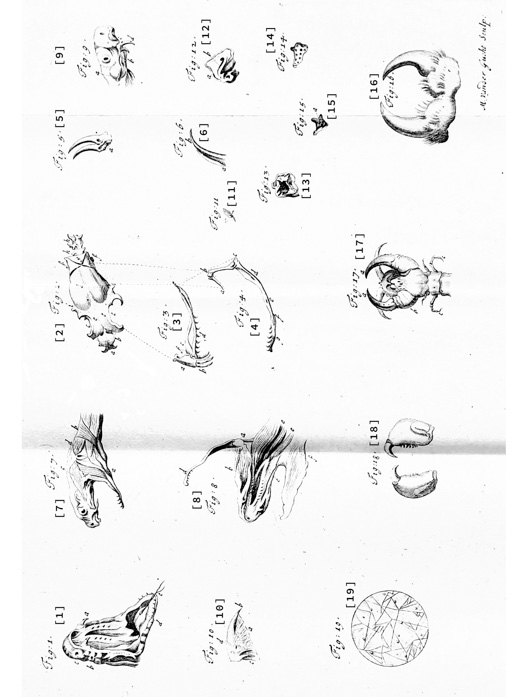
The Skull (Fig. 2.) is composed of several
Bones, joined together by Sutures, as
in Man, but with this Difference, that
the Os Frontis in the Viper consists of
Two Bones united by a Rectilinear Suture,
and the Parietal Bones are entire;
whereas in Man the Parietal Bones have
Sutures, and the Os Frontis is entire.
(a) Shews Two small Semicircular
Bones, which form the inferior Part of
the Nostrils.
(b) The Two Bones which make the
upper Part of the Nose, from the latter
pass down two thin Laminæ, which touching
one another, and falling perpendicular
upon the Ossa Palati, compose the
Septum of the Nose.
(e e) Point out the Ossa Frontis, which
form the upper Part of the Orbits of the
Eyes. And (c c) the Orbits themselves.
The Parietal Bones (d) make a large
Cavity, in which the greatest Part of the
Brain is contained, and this we may call
the Sinciput.
Behind this Bone are placed the Ossa
Temporum (f f) in which lye the
Organs of Hearring; and behind Them a
Bone (g) which, we may call the Os Occipitis,
covers the posterior Part of the
Brain. This is joined to the first Vertebra
of the Neck (h), by a Spherical Articulation,
as all the Vertebræ are to one another;
and this is the Reason why this
Creature can turn its Head and Body so
much, and so nimbly, every way.
To some of These there are Two other
Bones Articulated for particular Uses.
The First of Them, which serves as a
Basis to the Articulation of the Rest (a,
Fig. 4.), is fastned by one Extremity to
a small Proturberance (i, Fig. 2.) in the
middle and lateral Part of the Os Sincipitis,
and running back towards the Vertebræ,
lyes in the same Plain with the
Sinciput. This Bone has a Motion, tho’
very inconsiderable, both upwards and
downwards. By means of This, the opening
of the Mouth is somewhat inlarged in
the Time of Deglutition.
That End of this Bone, which is next
to the Vertebræ, is articulated at oblique
Angles with Another (b) placed Horizontally,
and whose Motion is forwards
and backwards, being made chiefly for
moving the Bones of the upper and lower
Jaw, into which the Teeth are inserted.
By reason of this kind of Articulation,
It cannot contribute any thing towards
widening the Mouth for Swallowing.
This Bone, and That with which it is
joined, I call the Common Bones.
The Upper Jaw (Fig. 3.) is, besides
the Teeth, composed on each side of three
Bones. The First (a), into which the
Poisonous Fangs are fixt, is articulated
with the Anterior Protuberance of the
Orbit of the Eye; and has a Motion
of Flexion and Extension, that is, forwards
and backwards, by which the
Fangs are Erected or Depress’d. It is
small at the Joint, but grows broader by
degrees, to a pretty large Basis, the better
to contain a considerable Number of
Teeth. It is Spongy like the Substance of
the Vertebræ, and no ways fit to be the
immediate Organ of Hearing, as Mr. Charas
and some others have imagined.
The Second (c), is a broad thin Bone,
Articulated by one Extreme to the Former,
(f), and by the other firmly fixt to the
middle of the third Bone. When this
is thrust forwards, it likewise pushes the
First, and by this means the Erection of
the Fangs is helped; and when it is pull’d
backwards, they are depressed.
The third Bone (e d), is join’d by
one Extremity (e), to the End of one of
the Bones of the Lower Jaw (c, Fig. 4.),
And being somewhat crooked, turns in
a little towards the Basis of the Cranium,
and running along the Inferior Part of it
towards the Nose, terminates near the
Internal and Anterior Part of the first
Bone.
The Lower Jaw (c d e f g, Fig. 4.)
on each side is made up of two Bones,
but firmly united, the Extremity of the
one entring within the other (f). The
First (c d e) articulates with the Second
of the Common Bones (b), where
it is broad, and sends off an Apophysis,
into which there is a Muscle inserted,
which helps to open the Jaw. There is
in this is a Hole (d), for the Entrance
of the Branch of the Nerve, which
passing thro’ a Canal in the middle of it,
goes to the Extremity of the Second Bone,
and in its way sends off several Branches
which go to the Teeth; and also a very
considerable one, which goes out at (e),
and is wholly spent upon the Neighbouring
Muscles.
The Second Bone (f g) serves chiefly
to receive the small Teeth, which answer
to those in the upper Jaw.
As for the Teeth, they are of two
Sorts, the Great, or poisonous Fangs, and
the Small.
The Great (b, Fig. 3.), being fixt in
the First Bone of the Upper Jaw, are
Crooked and Bent, like the Dentes Canini
in most Carnivorous Animals. They
are manifestly hollow from their Root a
considerable way, not to the very Apex
or Point, (which is solid and sharp,
the better to pierce the Skin) but to a
small distance from it, as is plainly seen
by splitting the Tooth thro’ the middle
(Vid. Fig. 6.). This Cavity ends at the
Convex Part in a visible Slit, very well
resembling the Nip or Cut of a Pen (Fig.
9. d), which is the Emissary or Outlet to
the Poyson.
Galen(37) has given us a considerable
Hint of this Make of the Tooth:
For, The Mountebanks (He says) used to
suffer themselves to be bit by Vipers, having
first with some Pastes stopt the Holes of their
Teeth, that the Venom being thus kept in,
the Spectators might think they did by their
Antidote secure themselves from its dangerous
Effects.
The Reason why these Teeth are
Crooked, is, That the Point of the Tooth,
when the Viper bites, may be Perpendicular
to the Part to be Wounded;
for the Head being raised back in the
Time of Biting, and the Tooth erected,
if this were strait, It would not, by
reason of its oblique Situation to the
part, enter with so much Force, nor so
deep into the Flesh.
As for the Number of the Poisonous
Fangs, I have observed, that there are,
for the most part, besides One, Two or
Three on each side, fixt Perpendicularly
to the first Bone of the Upper Jaw,
some others which are Young, and of
a smaller Size, adhering to the same Bone:
Their Points are hardened, and they
have their Fissures formed as in the other,
but their Roots are Soft and Mucilaginous,
like the Roots of the Teeth
in Infants, and so they lye always depress’d
at the Bottoms of the Former, as may
be seen Fig. 10. c.
They drop off from the Bone at the
least Touch; and therefore some Anatomists
have imagined them to be fastened
to Muscles or Tendons, which would
have rendred Them altogether Useless.
For they are made to supply the Place
of the Greater, when they fall away, or
are pulled out by Accident, and in order
to do this, they do by degrees harden, and
rise more and more, till at last they stand
upright, and come to a Perpendicular Situation
in the Bone.
They are not all of the same Growth,
for in some we can only discern the Shape
of a Tooth without any Hardness, in others
the Point, and in the next somewhat
more is hardened, and so on to the greatest
Fang.
Their Number is very uncertain, there
being sometimes six or seven in each side of
the Jaw, sometimes fewer.
These seem to have occasioned the Disputes
among the Ancients concerning the
Number of the Viperine Teeth.
The Poysonous Fangs have small Holes
at the Internal Part of their Root, thro’
which the Vessels pass which carry their
Nourishment (Fig. 5. a).
It is remarkable, that Nature has provided
Young Vipers with Poisonous
Teeth grown to their Perfection, that so
they may kill their Prey as soon as they
come into the World.
The Second Kind of Teeth, or the Small,
are hooked, and bent, as well as the
former, but without any Slit or Opening.
Of These there are Four Rows, Two on
each side of the Mouth. They are fixt in
the third Bone of the Upper Jaw, and in
the Second in the Lower, as exhibited to
view in the Figures.
Their Use is to hold the Prey fast
while Execution is done by the Bite, lest
in struggling to get away, It should pull out
the Fangs.
The Instruments that Emit the Venom
being thus describ’d, we come next to
those which serve to Prepare and Contain it.
This Liquor is separated from the
Blood by a Gland on each side of the
Head, placed in the Anterior and Lateral
Part of the Os Sincipitis, just behind the
Orbit of the Eye (Fig. 9. a); It lies immediately
under that Muscle which helps to
depress the Fangs, so that by the Action of
this it is Press’d; which is an admirable
Contrivance to forward the Secretion of the
Juice out of it.
’Tis a Conglomerated Gland, composed of
many smaller ones contained in a common
Membrane; each of These sends off an
Excretory Vessel, all which do afterwards
Unite and Form one Duct (b), which
running towards the Roots of the Fangs,
discharges the Yellow Liquor into a Bag.
This Bag is fixt to the Basis of the
first Bone of the Upper Jaw, and also
to the Extremity of the Second, covering
the Fangs near the Root (d, Fig. 10.).
To the upper Part of this Vesicula there is
joined another (a), in the Anterior Part
of which there is a Passage for the Poisonous
Teeth.
This consists of Muscular Fibres, both
Longitudinal and Circular, by Means of
which it can Contract it self when the
Fangs are erected; and by this Contraction
the Venom is press’d into the Hole at
the Root of the Tooth, and forced out at
the Fissure near the Point.
That this is so done, I have frequently
observed with the naked Eye, having
cut off the Head of a Viper, and immediately
pinching the Neck to make it
open the Mouth wide; for by this means
the Venom was Squirted out as from a
Syringe.
When the Viper lyes quiet with its
Mouth shut, the Fangs are depress’d and
covered with the External Bag; when it
intends to bite, it opens the Mouth very
wide, at the same time the lower Extremity
of the Second of the Common Bones (Fig.
4. b) is moved forwards by proper Muscles,
and turns as it were upon the fixt
Centre (b), thus pushing forward the Upper
and Lower Jaws, whose Extremes are
united at (c). By this means the Lower
Part of the First Bone of the Upper Jaw
(Fig. 3. a) is thrust forwards, the other
Extremity turning in the Cavity of its
Articulation, where it is fastned by Ligaments;
the Fangs being by this Mechanism
Erected, the Bags which covered
them, by the Contraction of their Longitudinal
Fibres, are pulled back, and the
Action of the Circular Ones does at the same
Time straiten the Internal Bag, and force
the Juice into the Teeth.
Besides this, when the Viper bites, It
strikes in the Fangs to the very Root; and
thus the Vesiculæ are still more squeezed
for the Discharge of the Liquor.
It is worthy our Observation, that the
Viper can move the Jaw Bones on one
side without moving Those on the other,
for they are not joined together at the
Extremes as in other Animals; which
Contrivance is very beneficial to it in the
swallowing its Prey; in that, while the
Teeth on one side stand unmoved, and
fixt in the Flesh to hold it, Those on the
other side are brought forward, to draw
it in farther, then they keep it fast till the
former Jaws advance again in their Turn.
Thus they act successively, and force the
Animal intire (there being no Dentes
Incisivi or Molares to divide it) into the
Œsophagus, whose Muscular Fibres are
very Weak, and can help but little in the
Business.
It may not be amiss to conclude these
Remarks with a short Hint concerning
the Organs of Hearing; Mr. Charas (who
is however followed by others in it) having,
as we mention’d before, Entertain’d
a very absurd Opinion about Them.
These then are placed in the Temporal
Bones, as in other Animals, and consist of
One long, small Bone (Vid.Fig. 11.),
like that of Birds, whose Extremity
is broad, like the Basis of the Stapes in
Man, and situated upon a little Hole
which opens into the Labyrinth; and besides
of three Demicircular Canals (Fig. 12.
a b) which also open into the Labyrinth.
This Labyrinth (Fig. 13.) has a great
many Eminencies in it of no determin’d
Regular Figure (Fig. 14.), and is covered
with a Membrane full of Nerves and
Blood Vessels. The Nerve enters from the
Brain at a Hole in the middle of this Cavity
(a, Fig. 15.).
There is no Cochlea in the Ear of the
Viper; but the Anterior Demicircular
Canal opens into a Semicanal, which
makes some Spiral Turns in the Fore-part
of the Labyrinth; in like manner as it is
in Fish.
The Passage for the Air to these Organs
is not Outward, but, as in some Fish,
thro’ the Mouth, between the Upper and
Under Jaws, running below the Second of
the Common Bones. But of This, and also
of the True Mechanic Use of the aforesaid
Parts, more hereafter.
Poisonous Animals.
As
the Viper is Hurtful by Instilling
a Liquid Poison into the Wound
made by its Teeth; so likewise
are all Venomous Creatures whatsoever,
whether they Bite or Sting, tho’ there be
some difference in the Contrivance of their
Organs, Mischievous after much the same
Manner; and mostly for the same good
Use and Purpose, that is, in order to Kill
their Prey.
This will fully appear, by Examining
the Instruments of Death in several of
Them.
First then, The Spider which lives upon
Flies, Wasps, and the like Insects, is
provided with a hooked Forceps, placed
just by the Mouth, very sharp and fine;
with this he pierces the Flesh of little
Creatures caught in his Webb, and at the
same time infuses a Juice into the Puncture,
by which means the Animal being
Killed, He sucks out the Moisture from
the Body, and leaves it a dry husky
Carkass.
MrVan Leewenhoek, in his Account of
Spiders, lately publish’d
(38), has, together
with the other Parts, by the help of
his Glasses, describ’d these Weapons, which
He finds to lie couched on each side the
Mouth, in a Row of Teeth, till they are
raised to do Execution. These Rows of
Small Teeth are design’d to hold the Prey,
that It may not escape the Force of the
Bite. And in the Convex Part, towards
the Point of each Claw, He has delineated
a little Aperture or Slit, thro’ which
he supposes the Poison issues out at the
same time the Wound is made.
This Situation and Motion of these
Parts, I have several times view’d; but
was never able to discern the Exit or
Opening; which, having a just Deference
to the Industry and Application of so Nice
an Observer in Things of this Nature, I,
at first, imputed to my own Unskilfulness
in such Enquiries, knowing my Microscope
to be very good; till at last, after
repeated Trials, I very plainly saw, That
nothing dropt out of the Claws, which
were always dry while the Spider Bit, but
that a short, white Proboscis was at the
same time thrust out of the Mouth, which
instilled a Liquor into the Wound.
Then I concluded, That MrLeewenhoek
had Delineated the Apertures in these
Weapons, only from the Analogy which he
thought they must bear to the Viperine
Fangs, the Sting of the Scorpion, Bee, &c.
And I was confirmed in this Opinion by
examining a Claw of the great American
Spider, described (tho’ but lamely) by
Piso(39), and called Nhamdu; this was
given Me by Mr. Pettiver, and being above
fifty Times bigger than that of the
largest Europæan Spider
(40), if there had
been any Slit in it, my Glass would no
doubt have discover’d it, but yet I found it
to be quite Solid.
And indeed the Quantity of Liquor
emitted by our common Spiders when
they kill their Prey, is visibly so Great,
and the wounding Weapons so Minute,
that they could contain but a very inconsiderable
Portion thereof, if it were to
be discharged that Way.
To this purpose, I remember Mr. Boyle
somewhere tells a Story of a Person blinded
by a Spider dropping its Venom into
his Eye, which tho’ it can hardly find
Credit with some, is however confirmed by
what Piso relates of his Nhamdu, Viz.
That in catching it great heed is to be
taken, lest its Poison fall into the Eye,
This causing a total Loss of the Sight.
What Mr. Leewenhoek observes of the
Enmity these Creatures bear to one another
I have often seen; for if Four,
Five, or more be put together into a
Glass, they immediately fall to Fighting
with all the Fury imaginable; Limbs
struck off are usually the Præludes to the
terrible Slaughter, which continues till
all are killed, the Surviving Conqueror
himself most commonly Dying of his
Wounds.
The Weapons of Mischief in the Scolopendra
are much the same with Those of
the Spider, only larger. One of these
Creatures I had brought to Me alive out
of a Ship which came from the East-Indies,
where Bontius(41) says, Their Bite is so
painful, that it makes People almost mad;
but it died before I had an opportunity of
making Trial of its Poison; however, I
very diligently looked upon the Claws
(42),
and found them to have no more Cavity
than is necessary for the Insertion of their
Muscles, nor any Exit or Out-let towards
their Apex; these therefore serve only to
pierce the Flesh, and the Venom is infused
from a Proboscis out of the Mouth; tho’
This I could not very well discern, because
the Parts had been kept too long dry
before I examined Them.
The Case is much the same with Stinging
Animals; of These the Scorpion is the
Chief, whose Virus in different Countries
is more or less dangerous, according as ’tis
exalted by various Degrees of Heat; thus
in Africa particularly its Effects are so dreadful,
that as Joann. Leo(43) tells Us, the
Town of Pescara there is in a manner left
desolate by the Inhabitants in the Summer
Time, by Reason of the great Abundance
of these Creatures, certain Death following
their Sting.
Some of this deadly kind (the same,
tho’ not so large with That in the East-Indies,
of which Swammerdam(44) has given
a very accurate Description and Figure)
SrRedi had sent him from Tunis(45); and
it being November, irritated them to Sting
Pigeons, Pullets, &c. without any bad
Effect at all of their Poison; but upon the
approaching Spring, One of them which
had been kept all the Winter, nay, eight
Months, without any Food, and the Wound
of whose Sting before was harmless, stung
to Death two Pigeons successively; but
a Third and Fourth wounded in like manner,
suffered no Hurt. Yet having let the
Scorpion rest all Night, He killed another
Pigeon the next Morning.
At the Point of the Sting he very often
could discern a small drop of white Liquor,
which when the Wound was made, entered
into the Flesh.
As this Liquid Venom is either not separated
from the Blood into the Cavity of the
Sting, during the cold of Winter, or at
least the Scorpion wants Strength at that
Time to throw it out with Force and Energy.
So even in the hot Months, after
it is exhausted by two or three Attacks, the
Sting is no longer hurtful, till the Expence
of this Juice is recruited by Time.
’Tis very remarkable concerning this
Insect, what an ingenious Gentleman who
lived several Years in Barbary told Me, he
had many times tried; That if it be surrounded
with a Circle of Burning Coals,
It does, upon the Sense of the Heat, turn
it self violently every way to make an
Escape; but finding it impossible, and
the Pain from the Fire increasing, it
strikes it self Twice or Thrice with the
Sting on the Back, and immediately dies
of the Wounds.
Others may make what Reflections
They please on this Self-Murder, it is
to Me beyond all Dispute sufficient to decide
the Controversie between Writers,
whether Poisonous Animals of the same
Species can kill each other. Which is not
only confirmed by what we before observed
of the Spider, but is likewise true of Vipers;
for Dr. Herman bringing from the Indies
Three of the Cobras de Capelo all in one
Glass, Two of them were killed in the
Voyage by Fighting.
As the Viperine Venom is the Quintessence
and most active Part of those Animal
Juices with which the Viper is nourished,
so is also That of the Scorpion; for this
Insect lives chiefly upon Locusts, &c. and
the same Person from Barbary inform’d
Me, That seeing oftentimes Locusts sticking
up in the Ground as if they were Set
there, by looking he found that some Part
of them was always eat away, and that
these Places were the Holes of Scorpions,
who had dragg’d their Prey thither, and
fed on it as they had Occasion.
In like manner, as the Axungia Viperina
cures the Bite of the Viper, so also the
Oleum Scorpionum, or Oil in which Scorpions
have been infused, is a present Remedy
for the Sting of this Creature.
The Mechanism of the Sting of a Bee,
Dr. Hooke has very accurately described
(46).
One may with the naked Eye sometimes
see it discharge the Venom; and
in this, by the help of a Glass, I can easily
discover a great Number of Minute Salts
Floating.
And indeed this Apparatus or Contrivance
is so universal, that we find even
in Vegetables something Analogous hereunto;
for the last mention’d Author
(47),
has shewn Us, That the pricking Points of
Nettles do at the same time they pierce the
Skin, instil a Venomous Juice into the
Wound.
(7)Leg. Cornel. Cels. præfat. in Medicin Morbos ait
vetustissimis temporib. ad Iram Deorum immortalium relatos esse, & ab
iisdem opem posci solitam.
(8)Divinæ Potentiæ Symbolum. Vid. Ezec. Spanhem. De Vsu
Numismat. p. m. 125, 126, & 181, & seq;
(9)Saturnal. Lib. 1. c. 20. Ideo Simulachris Eorum
(Æsculapii & Salutis) junguntur figuræ Draconum quia præstant ut humana
Corpora velut infirmitatis pelle depositâ, ad pristinum revirescant
vigorem, ut virescunt Dracones per annos singulos pelle senectutis
exutâ.
ESSAY II. — OF THE BITE OF THE TARANTULA AND MAD DOG.
I
Join these Two Poisons together, because
tho’ they differ very much in
their Effects, yet both do agree in
this, that they induce a particular Delirium
sui generis, attended partly with
Maniacal, partly with Melancholy Symptoms.
The Tarantula (of which the Figure
may be seen in Baglivi’s Dissertation
(48),)
is a Spider of Apulia of the
Octonocular kind; that is of that Species
that has eight Eyes, and spins Webbs;
it has eight Legs, four on each side,
and in each Leg three Joints; from the
Mouth proceed two Darts, in Shape just
like to a hooked Forceps, or Crab’s Claws;
these are solid, and very sharp, so that
they can easily pierce the Skin; and between
these and the Fore-Legs there are
two little Horns, which I suppose do
answer to those Bodies call’d from their
Use in Flies the Feelers; because as they
do, so this Creature is observed to move
’em very briskly when it approaches to
its Prey.
This, as other Spiders do, propagates
its Species by laying Eggs, which are very
numerous; so that there are found sometimes
in the Female, when dissected, a
hundred or more; and these are hatched
partly by the Heat of the Mother, partly
by that of the Sun, in about twenty or
thirty Days Time.
There is also a Spider of the like Nature
with the Tarantula in the West-Indies,
which Fr. Hernandez(49) describes by
the Name of Hoitztocatl, or the Pricking
Spider; and says, that its Bite induces
Madness.
In the Summer Months, especially
when the Heats are greatest, as in the
Dog-Days, the Tarantula creeping among
the Corn in the Fields, bites the Mowers
and Passengers; in the Winter it lurks in
Holes, and is scarcely seen; and if it does
bite then, it is not venomous, neither does
it induce any ill Symptoms.
But in the hot Weather, altho’ the Pain
of its Bite is at first no greater than what is
caused by the Sting of a Bee, yet the Part
quickly after is discoloured with a Livid,
Black, or Yellowish Circle, and raised to
an inflam’d Swelling; the Patient within
a few Hours is seized with a violent Sickness,
Difficulty of Breathing, universal
Faintness, and sometimes Trembling, with
a Weakness of the Head; being asked what
the Ail is, makes no Reply, or with a querulous
Voice, and melancholy Look, points
to his Breast, as if the Heart was most affected.
During this mournful Scene, all the
usual Alexipharmick and Cordial Medicines
are of no Service; for notwithstanding
their repeated Use, the Patient growing
by degrees more melancholy, stupid,
and strangely timorous, in a short Time expires,
unless Musick be called to his Assistance,
which alone, without the Help of
Medicine, performs the Cure.
For at the first Sound of the Musical
Instrument, altho’ the Sick lie, as it were,
in an Apoplectick Fit, they begin by Degrees
to move their Hands and Feet, till at
last they get up, and fall to Dancing
with wonderful Vigour, at first for three
or four Hours, then they are put to Bed,
refreshed from their sweating, for a short
time, and repeat the Exercise with the
same Vehemence, perceiving no Weariness
or Weakness from it, but professing they
grow stronger and nimbler the more they
dance.
At this Sport they usually spend
Twelve Hours a Day, and it continues
Three or Four Days; by which time
they are generally freed from all their
Symptoms, which do nevertheless attack
’em again about the same time the next
Year; and if they do not take Care to
prevent this Relapse by Musick, they fall
into a Jaundice, Want of Appetite, universal
Weakness, and such like Diseases;
which are every Year increased, if Dancing
be neglected, till at last they prove
incurable.
As Musick is the common Cure, so they
who are bitten are pleas’d some with one
Sort of it, some with another; one is raised
with a Pipe, another with a Tymbrel;
one with a Harp, another with a Fiddle;
so that the Musicians make sometimes several
Essays before they can accommodate
their Art to the Venom; but this is constant
and certain, not withstanding this
Variety, that they all require the quickest
and briskest Tunes, and are never moved by
a slow, dull Harmony.
While the Tarantati, or Affected, are
Dancing, they lose in a manner the Use
of all their Senses, like so many Drunkards,
do many Ridiculous and Foolish
Tricks, talk and act obscenely and
rudely, take great Pleasure in playing
with Vine-Leaves, with naked Swords,
red Cloths, and the like; and on the
other Hand can’t bear the Sight of any
thing black; so that if any By-stander
happen to appear in that Colour, he must
immediately withdraw, otherwise they
relapse into their Symptoms with as much
Violence as ever.
It may afford some Light towards Understanding
the Nature of this Poison,
to observe that Apulia is the hottest Part
of all Italy, lying Eastward, and having
all the Summer long but very little Rain
to temper the Heats, so that the Inhabitants,
as one of that Country observes
(50),
do breath an Air, as it were, out of a fiery
Furnace; hence their Temperament is dry,
and adust, as appears by their being generally
lean, passionate, impatient, ready to
Action, quick-witted, very subject to inflammatory
Distempers, Phrensies, Melancholy,
and the like, upon which Account
there are more mad People in this, than in
all the other Parts of Italy; nay, what
in other Countries is but a light Melancholy,
arises here to a great Heigth; for Women
in a Chlorosis do suffer almost the same
Symptoms as Persons poisoned by the Tarantula
do, and are cured the same Way;
and in like manner the Venom of the Scorpion
does here in Effects and Cure agree very
much with that of this Spider.
From all this History it sufficiently appears,
that those that are bitten by a Tarantula,
do thereupon become Delirous,
and that in order to account for their
surprizing Symptoms; the Nature of a
Delirium, from which many of them proceed,
ought to be understood.
Such is the Constitution of the Human
Œconomy, that as upon the Impression
of outward Objects made upon the Organs,
and by the Fluid of the Nerves
conveyed to the Common Sensory; different
Species are excited there, and represented
to the Mind; so likewise upon this
Representation, at the Command and Pleasure
of the Soul, part of the same Fluid
is determin’d into the Muscles, and mixing
with the Arterial Blood there, performs
all the Variety of Voluntary Motions
and Actions.
This Order has been always so constant
in Us, that at length by a kind of natural
Habitude, without the Intervention of
the Reasoning Faculty, Representations
made to the Mind do immediately and
necessarily produce suitable Motions in
the Bodily Organs. When therefore these
Representations are irregular, the Actions
consequent to them must necessarily be so
too.
This being premis’d, it may perhaps be
probably said, that a Delirium is the Representation
and various Composition of
several Species to the Mind, without any
Order or Coherence; together, at least most
commonly, with irregular, or, as it were,
undesigned Motions of the Body; that is,
such a wandring and irregular Motion of
the Nervous Fluid, whereby several Objects
are represented to the Mind, and
upon this Representation divers Operations
perform’d by the Body, tho’ those
Objects are not impress’d upon the Organs,
nor those Operations or Motions deliberately
commanded by the Soul.
The Mind indeed is the first Principle
of all Muscular Motion; but in such Cases
as these, its Promptitude to Action or
Habit being so great, it is in a manner
surpriz’d, and cannot recover it self after
the Spirits are with violent Force determin’d
pursuant to the Representation of
the Species. For, as in the former State
of Things a Man is said to act Rationally,
so this latter Case is call’d a Perturbation
of Mind, that is, a Delirium; tho’ it is
very manifest, that in reality the Defect
is not in the Rational, but Corporeal Part;
such Species being really presented to the
Mind, upon which by the Order of our
Constitution such Motions ought to follow
in the Body.
Thus, for Instance, if the Liquor of
the Nerves is, without the Presence of any
thing hurtful, put into a Motion like unto
that which a painful Impression makes
in it, the same Bodily Actions must insue
as proceed from Fear, Anger, or the like
Passion, determining the Spirits towards
the Muscular Parts; and a By-stander,
who sees no reason for such a Representation
made to the Mind, will presently
conclude that the Person thus acting acts
without or besides his Reason, that is, is
Delirous; especially if the Hurry and
Confusion of the Spirits be such, that not
only one, but several different Species be
at the same time presented to the Mind;
for a Man in this Case may act the Part of
one Joyful, Angry, Timorous, or the
like, without any appearing Reason, and
all this almost in the same Moment of
Time.
In one Word, Deliria are the Dreams
of those who are Awake; and as these in
Us Sleeping are infinitely various and
wonderfully Compounded, and all from
the same common Cause, diversely pressing
the Orifices of the Nerves, and thus
making different Repercussions of their
Fluid; and as we all know that this
Confusion making the Representation of
several Species to the Mind, there do hereupon
follow, tho’ the Body seem now
at Rest and in perfect Repose, such Motions
in the Organs as are usually the Effect
of the Arbitrary Determination of the
Spirits thither; so We are now to enquire
what Alteration of the Body made by this
Venom, can be the Occasion of this Disorder
and Tumult in the Nervous Fluid,
which excites in the Party infected such
surprizing, and almost contradictory, Representations.
Most of the Symptoms of those who
are bitten by the Tarantula are at the first,
that is, before they rise to a Delirium,
plainly the same with those which the
Bite of a Viper induces; without doubt
therefore, as we have before observed
of the common Spider, that it pierces the
Flesh with its hooked Forceps, and at the
same time instils from the Proboscis in the
Mouth a liquid Venom into the Wound;
so the like Claws in This (of which I have
taken the Figure
(51) out of P. Bonanni,
very much magnified
(52),) do serve to
make Way for an active and penetrating
Juice emitted from the same Part.
Of the Nature of which we may probably
conjecture, that it is, when mixed
with the Blood, being exalted by the
Heat of the Climate, of so great Force
and Energy, that it immediately raises an
extraordinary Fermentation in the whole
Arterial Fluid, by which its Texture and
Crasis is very considerably altered; the
Consequent of which Alteration, when the
Ebullition is over, must necessarily be a
Change in the Cohæsion of its Parts, by
which the Globules, which did before
with equal Force press each other, have now
a very differing and irregular Nisus or
Action, so that some of ’em do so firmly
cohere together, as to compose Moleculæ,
or small Clusters; upon which
Account there being now a greater number
of Globules contained in the same
Space than before, and besides, the Impulse
of many of these when united together
differing according to the Conditions
of their Cohæsion, as to Magnitude,
Figure, &c. not only will the Impetus,
with which this Fluid is drove towards
the Parts, be at some Strokes at
least greater than ordinary; but the
Pressure upon the Blood Vessels must be
very unequal and irregular; and this
more especially will be felt in them which
are most easily distended; such are those
of the Brain, &c. And hereupon the
Fluid of the Nerves must necessarily be
put into various Undulatory Motions,
some of which will be like unto those
which different Objects acting upon the
Organs or Passions of the Mind, do naturally
excite in It, whereupon such Actions
must follow in the Body, as are usually the
Consequents of the several Species of
Sadns, Joy, Despair, or the like Determinations
of the Thoughts; and we
shall readily pronounce one in this Condition,
Sad, Joyful, Timorous, &c. and all
without any apparent Reason or Cause;
that is, in one Word, we shall say he is
Delirous.
This is in some Degree a Coagulation of
the Blood, which will the more certainly,
when attended with an extraordinary
Heat, as in the present Case, produce such
like Effects as these, because the Spirits
separated from the Blood thus Inflamed,
and Compounded of hard, fixt and dry
Particles, must unavoidably share in this
Alteration; that is, whereas their Fluid
consists of two Parts, One more active
and Volatile, the Other more Viscid and
Glutinous, which is a kind of Vehicle to
the former; their Active Part will bear
too great a Proportion to the Viscid;
and thus they must necessarily be of more
than ordinary Volatility and Force, and
will therefore, upon the least Occasion
imaginable, be irregularly determin’d to
every Part; and hereupon will follow
Tremblings of the Body, Anger or Fear
upon a light or no Cause, extream Pleasure
at what is but a Trivial Entertainment,
as Red, Green Colours, or the
like; and on the other hand, wonderful
Sadness at any thing not agreeable to the
Eyes, as dark and black Things; nay,
ridiculous Laughter, obscene Talk and
Actions, and such like Symptoms; because
in this Constitution of the Nervous
Fluid, the most light Occasion will make
as real a Reflux and Undulation of it to
the Brain; that is, will present as lively
and vivid Species there, as the strongest
Cause and Impression can produce in its
natural State and Condition; nay, in
such a Confusion, the Spirits cannot but
sometimes, without any manifest Cause at
all, be hurried towards those Organs,
to which at other times they have
been most frequently determined; and
every one knows which they are in hot
Countries and Constitutions.
We must however here remember what
in the former Essay we mention’d of the
Fluid of the Nerves, being immediately
altered by the venomous Juice.
It will perhaps make this Theory more
than probable, to consider that Baglivi(53),
in the Dissection of a Rabbit kill’d
by a Tarantula, found the Blood Vessels
of the Brain very turgid, and the Substance
of the Brain it self, that is, the Beginning
of the Nerves, lightly inflamed,
and with livid Spots here and there, the
Lungs and other Viscera distended, with
concrete glotted Blood, and large Grumes
of Blood with Polypous Branches in the
Heart, a large Quantity of extravasated
Serum upon the Brain, which is (as he
takes Notice) mostly observed in those
Subjects which died by a Coagulation of
the Blood.
Neither is it amiss to remark, that in a
Chlorosis there is nothing preternatural
but an infarctus of the Arteries, and
hence a retarded Circulation, from an
Evacuation suppress’d; and in this Country
too much Heat; that is, a beginning
Coagulation, together with an Inflammatory
Disposition.
In short, Bellini has at large demonstrated,
how Deliria, as well as Melancholic
as Manaical, do proceed from a State of
the Blood and Spirits, not unlike to that
I have here described.
But no less a Confirmation of these
Notions may we have from the Cure;
as to which it is observable, that the Tarantati
have no Inclination to dance before
they hear the Musick; for being
ask’d to do it, they answer, it is impossible,
they have no Strengh.
As for the Reason therefore of their
starting up at the first Noise of the Instrument,
we must reflect upon what we
have just now been saying concerning the
Cause of the Motions of the Body in a
Delirium; and consider withal, that muscular
Motion is no other than a Contraction
of the Fibres from the Arterial
Fluid making an Effervescence with the
Nervous Juice, which by the light Vibration
and Tremor of the Nerve, is derived
into the Muscle.
And thus we have a twofold Effect
and Operation of Musick, that is, both
upon the Mind and Body. For a brisk
Harmony excites lively Species of Joy and
Gladness, which are always accompany’d
with a more frequent and stronger Pulse,
or an increased influx of the Liquor of
the Nerves into the Muscles, upon which
suitable Actions must immediately follow;
and if we remember what we before hinted,
that People in this Country are
sprightly and ready to Exercise, and that
in such a state of the Fluids as we have describ’d,
a slight Occasion presents as strong
Species, as a greater can at another time:
The Influence of Musick on the Mind will
appear to be so much the more powerful
and certain.
As for the Body, since it is sufficient for
the purpose of putting the Muscles into
Action, to cause those Tremors of the
Nerves by which their Fluid is alternately
dropt into the moving Fibres; it is all one
whether this be done by the determination
of the Will, or the outward Impulsions of
an Elastic Fluid; such is the Air; and
that Sounds are the Vibrations of It, is beyond
dispute.
These therefore rightly modulated may
shake the Nerves as really as the Imperium
Voluntatis can do, and consequently produce
the like Effects.
That This is so, besides what we shall
add anon, we may be convinced by a
Story which Mr. Boyle(54) relates out of
Scaliger, of a Knight of Gascony whom the
sound of a Bagpipe would unavoidably force
to make Water; for this Secretion we
know is regularly the Effect of an Arbitrary
Contraction of the Muscle of the
Bladder.
The obstinate continuing of the Tarantati
in this Exercise, is doubtless in a
great Measure owing to the strong Opinion
they have of receiving Advantage
from it, being incouraged by the By-standers,
and having always believed, and
been told, that it was the only Cure in these
Cases.
The Benefit from Musick is not only
their Dancing to It, and so evacuating
by Sweat a great Part of the Inflammatory
Fluid; but besides this, the repeated Percussions
of the Air hereby made, by immediate
Contact shaking the Contractile
Fibres of the Membranes of the Body,
especially those of the Ear, which being
continuous to the Brain, do communicate
their Tremblings to its Membranes and
Vessels; by these continued Succussions
and Vibrations, the Cohæsion of the Parts
of the Blood is perfectly broken, and its
Coagulation prevented; so that the Heat
being removed by Sweating, and the
Coagulation by the Contraction of the
Muscular Fibrillæ, the wounded Person is
restored to his former Condition.
If any one doubts of this force of the
Air, let him consider that it is in Mechanics(55)
Demonstrated, that the smallest
Percussion of the smallest Body, can overcome
the resistance of any great Weight
which is in Rest; and that the Languid
Tremor of the Air, which is made by the
Sound of a Drum or Trumpet, may shake
the vastest and strongest Edifices.
But besides all this, We must allow a
great deal to the determinate Force, and
particular Modulation, of these trembling
Percussions; for contractile Bodies may
be acted upon by one certain Degree of
Motion in the ambient Fluid, tho’ a greater
Degree of it differently qualified may
produce nothing at all of the like Effect;
this is not only very apparent in the common
Experiment of Two String’d Musical
Instruments tuned both to the same
Heigth, the Strings of the one being struck
upon, those of the other will found, and
yet a much greater Motion of the Air
may not Cause any sensible Vibration at
all in the same Chords; but also by the
Trick which many have of finding the
Tone or Note peculiarly belonging to any
Wine Glass, and by accommodating their
Voice exactly to that Tone, and yet making
it loud and lasting, they will make the
Vessel tho’ not touch’d, first to Tremble,
and then Burst; which it will not do if
their Voice be but a little eithet too low
or too high.
This last Consideration makes it no very
difficult matter to conceive the reason,
why different Persons, infected with this
Venom, do require oftentimes a different
sort of Musick in order to their Cure, in
as much as their Nerves and Distractile
Membranes have differing Tensions, and
consequently are not in like manner to
be acted upon by the same Vibrations.
Nor are We to wonder at the Oddness
of this Method and Practice; for Musick,
altho’ it be Now-a-days applied to quite
different Purposes, was anciently made
great Use of for the removing of many,
and those too some of the most difficult
and obstinate Diseases.
For this we have a Famous Testimony
in Galen himself,
(56) who tells us, that
Æsculapius used to recover Those in whom
violent Motions of the Mind had induced
a hot Temperament of Body, by Melody and
Songs. Pindar(57) mentions the same
thing; and indeed from hence not only
the Notion, but the very Name of
Charming(58) seems to have taken its
Origine. Athenæus(59) relates that Theophrastus
in his Book of Enthusiasm says,
Ischiadic Pains are Cured by the Phrygian
Harmony. This sort of Musick was
upon a Pipe, and the most vehement and
brisk, of all the Ancients knew; so that
indeed it was said to raise those who
heard it to downright Fury and Madness
(60):
And such we have observed
to be required to the Venom of the Tarantula.
But what is besides in this last Authority
very observable to our Purpose, is the
manner of using this Remedy, and that
was
(61) by Playing upon the part affected,
which confirms what we have just
now advanced concerning the Effect of
the Percussion of the Air upon the
Contractile Fibres of the Brain, for Piping upon
any Member of the Body, cannot be
suppos’d to do Service any other way,
than by such Succussions and Modulated
Vibrations as we before mention’d. And
this indeed Cælius Aurelianus(62) agrees
to, who calls this Practice, Decantare
Loca dolentia; and says, that the Pain is
mitigated and discuss’d by the Tremblings
and Palpitations of the Part.
Aulus Gellius(63) not only relates this
same Cure of Ischiadic Ails as a thing
notorious enough, but adds besides out of
Theophrastus, that the Musick of a Pipe
rightly managed healed the Bites of Vipers.
And not only does Apollonius(64) mention
the Cure of Distractions of the
Mind, Epilepsies, and several other Distempers
this same way; but Democritus(65)
in his Treatise of Plagues, taught, that
the Musick of Pipes was the Medicine for
most Diseases; which Thales of Crete confirmed
by his Practice, when sent for by
the Lacedæmonians to remove from them
the Pestilence, he did it by the help of
Musick
(66).
All which Instances do evince this Remedy
to have been very ancient in many
Cases; and indeed as Cælius-Aurelianus(67),
takes notice that the first use of it was ascrib’d
to Pythagoras himself, so He having
settled and founded his Sect in those very
Parts of Italy which are the Country of
the Tarantulæ, going then under the
Name of Græcia magna, now Calabria, it
is not, I think, at all improbable that he
may have been the Author and Inventor
of this Practice there, which has continued
ever since. Especially since Jamblichus
affirms
(68), not only that he made use of
Musick in Physick, but particularly that
he found out and contrived some Harmonies
to ease the Passions of the Mind,
and others for the Cure of Bites: But of
Musick enough.
To conclude with this Poison, we may
take notice that, as to the Return of the
Symptomes the next Year, That is owing
to the same excessive Heat in those Months,
acting again upon the small remains of
the Venomous Ferment; thus Bartholin(69)
relates a Story of a Melancholy Physician
at Venice who suffer’d the Attacks
of his Disease only during the Dog-days,
which yearly ended and return’d with
them. A convincing proof how great a
share Heat has in all these Cases.
Of the Mad DOG.
More
difficult and terrifying are
the Symptoms from the Bite of a
Mad Dog, whose Venom has this also surprising
in it, that the bad Effects do not
appear oftentimes till the Cause of ’em is
forgot; for the Wound is as easily cured
as a common Bite is; but nevertheless a
considerable time after, a melancholy Tragedy
succeeds, sometimes sooner, sometimes
later; for there are Instances of its
being deferred to Two,
(70) Six Months,
nay, a Year, and longer, tho’ the attack is
generally within Forty Days after the
Wound; about that time, the Patient
complains of Running Pains all over his
Body, especially near the Part wounded,
like unto those in a Rheumatism, grows
pensive and sad, prone to Anger upon little
or no Occasion, with an intermitting
Pulse, Tremblings and Contractions of the
Nerves,
with a great inward Heat and
Thirst; and yet in a few Days (when the
Disease is come to its height) a Dread and
Fear of Water, and any Liquor whatsoever;
so that at the very sight of it he falls
into dismal Convulsions and Agonies, and
cannot drink the least drop; and this Hydrophobia,
or Aquæ Timor, has been always
accounted the surest Sign and Mark of
this Poison, as distinguishing it from all others.
The Ancients have at large described
these Symptoms, as Galen, Dioscorides,
Aetius, Ægineta, but most particularly of
all, Cælius Aurelianus(71); and later Writers
have given us several Instances of the
Hydrophobia; Two Histories of it published,
the one by Dr. Lister(72), the other
by Dr. Howman(73), I shall more especially
take Notice of, and refer to, as containing
the most exact and large Account
of any I have met with; he that desires
more, may consult the several Authors cited
by that diligent Observer, Stalpart
van der Wiel(74).
That this Disease is accompany’d with
a Delirium, is almost the common Opinion
both of Ancients and Moderns; Damocrates
called it the barking Phrensie
(75);
but Dr. Lister agrees in this Point with
Petrus Salius Diversus(76), and will not
allow a Delirium to be the necessary consequent
of this Venom; and yet at the
same time he tells us, that his Patient barked
like a Dog, and bit at the By-standers;
that he threw into his Mouth what was
given him more hastily and suddenly
than it is Natural or Customary for Men
to do.
From such Actions as these, together
with those mentioned before in relating
the Symptoms, it is obvious enough to
conclude, that Persons thus affected are
in a proper Sence Delirous. Tho’ at the
same time I do think that the Hydrophobia
it self (whatever is commonly believed)
does not at all proceed from this Delirium,
as will by and by appear.
I know indeed that the main and
plausible Objection against a Delirium
is this, that the Patient himself does
Reason against his Timorousness, tho’
he cannot overcome it, forewarns the
Standers-by of his Outrageous Fits,
desires them to take care of themselves,
and the like. Which from what
I have already said concerning a Delirium,
appears to be very consistent with
it, nay, convinces that there is the greatest
Degree of it in this Case; in as much as
that it is not a Distemper of the Mind but
of the Body. And to this purpose I remember
to have seen my self an Instance
of one in a Fever, who foretold some
time before any signs of a Delirium were
discovered, how raving and unruly He
should be, and made good his Prognostick
to that degree, that it was very hard
Work to tame and master him; tho’, as
he told me afterwards, he reason’d as
much as he could against that groundless
Jealousie of his Friends designing to
Murder him, which put him upon his
Mad Actions, but was not able to Conquer
the prevailing Species of Fear and
Anger.
This Delirium therefore, as Cælius
Aurelianus(77)
says, Proceeds intirely from an
indisposition of the Body, which is without
all doubt owing to the alteration made
in the Blood by the Saliva of the Mad
Dog, instill’d into the Wound inflicted by
the Bite.
That we may rightly understand this,
we must take Notice, that the Rabies or
Madness in a Dog is the effect of a Violent
Fever; and therefore it is most common
in excessive Hot Weather, tho’ sometimes
intense Cold maybe the Cause of it;
That no Dog in this Case ever sweats;
from whence it follows, that when his Blood
is in a Ferment, it cannot, as in other Creatures,
discharge it self upon the surface of
the Body, and therefore must of necessity
throw out a great many Saline and Active
Particles upon those Parts, where there is
the most constant and easie Secretion; and
such, next to the Miliary in the Skin in Us,
are the Salival Glands; for this reason
much more Spittle is separated in a Dog
when Mad, than at any other time, and
that very frothy, or impregnated with
Hot, Subtil Parts.
Now as we every Day observe, that
what is thrown out from Liquors in a
Ferment, is capable of inducing the like
Motion in another Liquor of the same
kind, when duly mixed with it; so we
may very well suppose in the present Case,
that the Saliva, which is it self one of the
most Fermentative Juices in Nature, being
turgid with Fiery, Saline Particles
thrown into it out of the boiling Blood,
when it comes by means of a Wound to
be Incorporated with the Arterial Fluid
of any One, does by Degrees raise a
preternatural Effervescence in it; the Effects
of which will necessarily be most felt
in those Parts which being tender, are
the least able to refill the distension of the
Blood Vessels; such are the Stomach, and
especially the Brain; and hereupon Deliria,
with Maniacal, and such like Symptoms,
will easily insue.
A Person thus affected may be said in
a Degree to have put on the Canine Nature,
tho’ his Reason be all this time untouch’d
and intire, may Bite, Howl, &c.
because the like violent Agitation of the
Blood in Him as was in the Dog will present
like Species, and consequently (so far
as their different Natures will allow) produce
like Actions; just as it has been
observed, that Sheep bitten by a Mad Dog,
have run at the Shepherd like so many
Dogs to Bite him; so much can an Alteration
of the Blood and Spirits do. And
as a Timorous Creature may be imboldened,
so we oftentimes see Persons Courageous
enough by a change made in the
Blood by Evacuations, that is, by want
of Force and Motion in that Fluid, made
sheepish Cowards, in despight of their
Reason, so long as that Defect is continued.
But the main difficulties in this matter
are, the Mischief discovering it self so
long after the Bite, and the Hydrophobia.
As to the former, we are to consider,
that Fermentation being a Change made
in the Cohæsion of the compounding
Parts of a Fluid, it is sometimes a longer,
sometimes a shorter time before this Alteration
is wrought; which variety may
proceed either from the different Nature
and Constitution of the Ferment, or of
the Liquor Fermented, and a great Number
of Circumstances besides. So that this
Venom may be all the while doing its
Work, tho’ the change made by it may
not be so considerable as to be sensibly
taken Notice of till a long time after.
Nay, it may so happen, that the Ferment
being Weak may not raise in the Blood
any remarkable Agitation at all, till some
accidental Alteration in the Body unluckily
gives it an additional Force. As
we before observed, how much external
Heat concurrs to heighten the Symptoms
from the Bite of the Tarantula. And this
probably may be the Case of Those in
whom this Malignity has not appear’d
till Six, or Twelve Months after the
Wound.
That we may understand the Reason
of the Hydrophobia, it is to be Remarked,
that this dread of Water does not come
on till the latter end of the Disease, Three
or Four Days before Death; that is, not
till this preternatural Fermentation in the
Blood is come to its Heigth; and as in the
Dog, so in the Patient, a great quantity of
Fermentative Particles is thrown off upon
the Glands of the Mouth and Stomach, as
appears by his Foaming at the Mouth, &c.
As also, that this Fear is not from a
sight of, or any imaginary appearance in
the Water, for if the Vessel be close shut,
and the Patient bid to suck thro’ a Quill,
as soon as he has tasted, he falls into Anguish
and Convulsions, as Dr. Lister observed.
It is therefore highly probable,
if not certain, that this surprising Symptom
proceeds from the intolerable Pain which
any Liquor at this time taken induces,
partly by hurting the inflamed Membranes
of the Fauces in Deglutition; partly by
fermenting with these Active Particles
discharged by the Blood upon the Stomachic
Glands, and thus twitching and
irritating the Nervous Membranes; the
very memory of which grievous Sence, after
it is once felt, is so terrible, that the affected
Person chuses any thing rather than to
undergo it a second time.
The Effects of this Irritation are manifest
in the Convulsions of the Stomach,
and frequent Singultus, with which the
Patient is continually oppress’d. And we
all know by how necessary a kind of
Mechanism we do fly from and abhor
those things which have proved disagreeable
to the Animal Œconomy, to
which nothing is so contrary and repugnant
as Pain; at the first Approaches of
which, Nature Starts and Recoils, tho’
Reason be arm’d with never so much
Courage and Resolution to undergo the
Shock.
Nor will any Body wonder how this
Ferment should cause such Torment, who
considers how often, even in Colical Cases,
Persons are downright distracted by excessive
Pain, from a Cause not unlike to this
we are treating of, that is, from a corrosive
Ferment in the Bowels, rarefying the
Juices there into Flatus, and by this means
irritating and stimulating those tender
Membranes into Spasmodic and Convulsive
Motions.
And indeed Dr. Lister’s Patient told
him, that the very swallowing of his own
Spittle put him to such Torture in his
Stomach, that Death it self was not so
Terrible as the Inexpressible Agony.
It may serve both to Illustrate and Confirm
this Theory, to take Notice, that
not only may (according to these Principles)
other Bites besides that of a Dog
happen to induce the like Symptoms; thus
Malpighi(78) relates a Story of a Mother
made Hydrophoba by the Bite of her Epileptic
Daughter; but that there are other Cases,
without any Bite at all, which are attended
with an Hydrophobia.
Thus Schenkius(79), Salmuth(80) and
others have observ’d a Dread of Water,
without any Suspicion of a Bite, from
Malignant Fevers. Now in These there is
doubtless a Hot, Putrid Ferment in the
Blood; and it is no wonder if Part of it
be discharged upon the Throat and Stomach,
which we do evidently find in
these Distempers to be more particularly
affected by It, especially towards the latter
End, from the Aphthæ, Singultus, and
the like usual Symptoms of a fatal Malignity.
Nay, Hippocrates(81) himself seems more than once to have remarked
something like this Symptom in Fevers, and to call those who were thus
affected Βραχυπόται, or little Drinkers; for I cannot assent to Dr.
Lister, (tho’ Cælius Aurelianus be on his side) who thinks that the
Βραχυπόται are ὑδροφόβοι, from the Bite of a Mad Dog; as well for other
Reasons, as because Plutarch(82) assures Us, that the Hydrophobia
and Elephantiasis were both first taken Notice of in the time of
Asclepiades the Physician; who liv’d in the Days of Pompey the
Great, many Years later than either Hippocrates or Aristotle.
Neither is it amiss to add, that Ioannes
Faber(83) in the Dissection of one who
dy’d at Rome of the Bite of a Mad Dog, and
a Hydrophobia succeeding it, found the
Blood Coagulated in the right Ventricle
of the Heart, the Lungs wonderfully
Red and Tumefied; but especially the
Throat, Stomach, and Bowels, bearing the
Marks of the Inflammatory Venom.
The same Observation has been made
by others in Bodies Dead of this Disease.
Thus the Acta Medica Hafniensia(84)
relate one Case, in which, part of
the Liver was Inflamed, the Lungs
Parched and Dry, and the inner Coat of
the Stomach so Mortified, that it might be
abraded with one’s Fingers.
Bonetus(85) tells another, where all the
Viscera were found quite arid, without any
Juice at all.
And in a very particular History of
an Hydrophobia, lately published at Ulm,
(86)
We are informed, that the Stomach,
when opened, discover’d the Marks of
an Erosion or Excoriation, with something
like a Gangrene, and Suffusion of Blood
here and there. Which does very well
agree with the Observations in the German
Ephemerides(87), where we find several
Footsteps of a Sphacelus or Mortification
in the Bodies of Those who died
Hydrophobi.
The Cure of this Poison is either immediately
upon the Wound made, or some
Days after, before the Fear of Water is
discover’d; for at that time all Authors do
agree the Malady to be Incurable; and the
Reason is plain from what has been already
deliver’d.
As in other Venomous Bites, so in
this, Galen(88) very wisely advises to
inlarge the Wound, by making a round
Incision about it, to Cauterise it with a
hot Iron, and apply drawing Medicines,
so as to keep it a running Ulcer at least
Forty Days.
(89)Scarifying and Cupping
may answer where this Severity is not
allow’d: And however, the Dressing it
with Unguentum Ægyptiacum (or the like)
Scalding Hot, must not be omitted; by
which alone, timely applied, I am
assured that one Bitten was happily preserved.
But where these Means of destroying
the Ferment in the beginning are omitted,
the dangerous Consequences of its
being mixed with the Blood is by all
possible Care to be prevented.
To this purpose, to say nothing of the
many Inconsiderate Jumbles of Antidotes,
Theriacas, &c. nor of such vulgar Trifles
as the Liver of the Mad Dog, of which
Galen(90) observed, that tho’ some who
made use of it, together with other good
Medicines, recover’d, yet that they who
trusted to it alone died; one of the
greatest Remedies commended to us by
Antiquity, is the Cineres Cancrorum Fluviatilium;
which Galen(91) says, no Body
ever made use of, and miscarried; and
before Him Dioscorides(92) assured, that
’tis a Medicine may be rely’d on. These
were given in large Quantities, viz. a
good Spoonful or Two every Day for
Forty Days together, either alone, or
rather mix’d with the Powder of Gentian
Root and Frankincense. The Vehicle
was either Water or Wine. In like
manner at this Day the Remedy in the
greatest Repute of any against most Poisons
in the West-Indies, is a kind of a
River-Craw-Fish, call’d Aratu(93).
This is manifestly an Absorbent, and very
Diuretic Medicine, especially when prepared
after the right manner, which was by
Burning the Craw-Fish alive upon a Copper-Plate,
with a Fire made of the Cuttings
or Twigs of White Briony: For whether
the latter part of the Management signifies
much or no, the former most certainly
does; and the Salt of the Copper,
which powerfully provokes Urine, being
mix’d with that of the Ashes, may very
much exalt their Virtue.
And it is upon this same Score, that
the Spongia of the Cynnorrhodos or Rosa
Sylvestris is so Celebrated an Antidote,
not only for this Poison, but also for
that of the Viper, Tarantula, and others
too, that ’tis call’d in Sicily Sanatodos, or
All-heal; this being not a Vegetable, as
P. Boccone(94) who has wrote a whole
Letter of its wondrous Virtues, terms it,
but an Animal Alkali, as well as the
former; for as Mr. Ray(95) has observed,
this Spongy Excrescence, if it be cut, is
found full of White Worms; Being the
Nest of these Insects, which lodging here
all the Winter, do in the beginning of the
Spring turn to Flies, and quit their Quarters.
Indeed this Remedy was antiently
too of so great Esteem, that Pliny recommends
it as the only Cure of an Hydrophobia,
divinely discovered by an Oracle
(96).
As all Insects abound with a Diuretick
Salt, so Cantharides more than any others;
therefore the Learned Bacchius(97) goes
farther, and from the Authority of
Rhazes and Joannes Damascenus, advises
to give these in Substance for many Days
together. The Preparation of this Antidote,
(so he calls it) is by infusing the
Cantharides in Soure Butter-milk Twenty
Four Hours, then drying them, and with
the Flower of Lentils and Wine making
them up into Troches of a Scruple Weight,
of which one is to be taken every Day,
By which means he assures us, that tho’
the Patient make bloody Urine, yet that
Milk largely drank will abate that Symptom,
and that an Hydrophobia will be
happily prevented. Boccone(98) tells Us,
That in Upper Hungary They give Cantharides
to Men bitten by a Mad Dog, Five
to a Dose; and to Beasts in greater Quantity.
But of the inward Use of these Flies
more in its proper Place.
In short, all the Specifics in this Case
are such as do either absorb a peccant
Acidity in the Stomach, or carry it off by
Urine; as Terra Lemnia, highly commended
by Galen(99), Garlick, Agrimony,
Oxylapathum, and many others, of which
a Catalogue may be seen in S. Ardoynus. So
the Alyssum or Madwort, celebrated for this
use by the Ancient Physicians, as well that
described by Diascorides, which is a Species
of Leucoium, as the other of Galen,
which is a Marrubium, is very manifestly
a Bitter, Stomachic, and Diuretic Plant
(100).
The Lichen cinereus terrestris, recommended
in the Philosophical Transactions
(101),
Operates the same way.
But the greatest and surest Cure of all,
is frequent Submerging or Ducking the
Patient in Water. The first mention I
find of this is in Cornelius Celsus(102);
whether he had it from the Ancient Grecian
Physicians, or it was the Discovery
of his own Age, matters but little to our
Purpose; certain it is, that he collected
his Principal Rules of Bathing from Cleophantus,
who, as Pliny says
(103), did, besides
many other delightful things, first
introduce the Use of Baths; As appears
by comparing the Writings of the One
with the Fragments of the Other, preserv’d
in the Works of Galen. And that from
Asclepiades, who afterwards so far improved
this Part of Physick, that he discarded
almost all inward Medicines, he
might learn this Management, is not improbable;
for the Hydrophobia (as we before
took Notice) having been first regarded
in the time of this great Physician,
’tis very likely that among other Advantages
of his new Method, he might commend
it for the Cure of so deplorable a
Malady.
However it be, This Practice was in
this last Age with great Authority revived
by the Ingenious Baron Van Helmont(104),
who having in his own Country seen
how great Service it did, has at large set
down both the manner of the Operation;
and, Consonant to the Principles of his
own Philosophy, shewn the Reason of
its good Effects. Since him Tulpius(105), an
Observer of very good Credit, takes notice,
that tho’ he saw many, yet that never
one miscarry’d, where it was in time
made use of.
As all Baths do chiefly act by the
sensible Qualities of Heat and Cold, and
the Gravity of their Fluid; so we need
go no farther to fetch the Reason of the
great Advantage of this Method in the
present Case, than to the Pressure of the
Water upon the Body of the Patient.
Every one knows how plentifully
plunging into cold Water provokes Urine,
which proceeds no doubt from the constriction
hereby made of the Fibres of the
Skin and Vessels. Thus this outward
Cure differs not much in effect from the
inward Medicines beforementioned, but
must necessarily have the better of them
in this Respect, that when the
Fermenting Blood stretches its Vessels, the exceeding
weight of the ambient Fluid resists
and represses this Distension, and so prevents
the Effects of It. For this Reason
the Salt Water of the Sea is especially
chosen for this Business, because its greater
Gravity than that of Fresh does more
powerfully do all this, and break the beginning
Cohæsion of the Parts of the
Blood.
Thus we may, without having recourse
to the Fright and Terror, with which
this Method, when rightly practis’d, (by
keeping the Party under Water for a considerable
time, till he is almost quite
drowned) is usually accompanied, probably
enough account for the Advantages
of this Immersion. Tho’ it is not unlikely
that this new Fear may have some
good Effect in the Case too, for not only
Convulsions, but Agues, and other Diseases,
have oftentimes been happily Cured,
merely by terrifying and surprising the
Patient.
The Reason of this will easily be understood
by him who knows what Alterations
the Passions of the Mind do make
in the Fluid of the Nerves and Arteries;
of which in another Place.
It may for our present purpose suffice
to take Notice, That as in Consideration
of the last mentioned Effect upon the
Mind, Van Helmont commends this same
Practice in all Sorts of Madness, and
Chronical Deliria; so upon the account
of the before hinted Alterations on the
Body, Bathing was, among the Ancients,
the common Cure of Melancholy, and such
like Distempers
(106). And as the younger
Van Helmont(107) to confirm his Father’s
Notions, tells Us, that one Dr. Richardson
did with wonderful Success make use
of this Management in these Cases, so in
like manner Prosper Alpinus(108) takes Notice,
that the Egyptians do at this Day
perfectly recover Melancholy Persons by
the same Method, only with this Difference,
that they make their Baths warm.
He that compares what has been already
advanc’d concerning Deliria, with the
Bellinian Theory of Melancholy and Maniacal
Distempers, and reflects upon the
Nature of Baths, and their manner of
Acting, will see so much Reason in this
Practice, as to be sorry that ’tis
now-a-days almost quite laid aside and neglected.
For we must observe, that altho’ there be
some Difference in the Treatment and
Cure of Deliria, whether Maniacal or
Melancholy, when they are Originally
from the Mind, as the Effects of Care,
Trouble, or the like, and when from an
Indisposition of the Body; yet that both
do agree in this, that they require an Alteration
to be made in the Blood and Spirits;
inasmuch as the Mind, by often,
nay, almost continually, renewing to it
self any one Idea, of Love, Sorrow, &c.
does so constantly determine the Spirits
and Blood, one and the same way, that
the Body does at last as much share in the
Alteration, as if it had been primarily affected,
and consequently must have, in
some manner, the same Amendment. Upon
this Score Baccius(109) asserts the admirable
Use of Temperate Baths, in all
kind of Distractions; and assures us, that
not only common Deliria, but even the
Dæmoniaci, Phanatici, Lycanthropi themselves,
&c. are cured by frequent Washings
in fresh Water, and a moist and
Nourishing Diet.
But to insist upon this Subject is
foreign to our purpose; only in regard
that the most usual Methods of Cure in
these Cases are so very tedious, and oftentimes
unsuccessful at the last, I thought
it not amiss to hint thus much, in order to
the advancing something more Certain
and Effectual towards the Removal of the
greatest Unhappiness to which Mankind
is liable.
To conclude with the Hydrophobia;
where these Remedies fail, or are Administred
too late, the Patient, from the
prevailing inflammatory Disposition of
the Blood, grows more and more Delirous,
and by Degrees downright raving Mad,
at last (as it most commonly happens in
Maniacal People) suffers a total Resolution
of Strength, and Dies. Thus Dr. Howna’s
Case ended in a perfect universal
Paralysis.
Altho’
there be a great Variety of
Internal Poisons, as well Mineral
as Vegetable; yet they do all
of ’em seem to agree in their Primary Effects,
and Manner of Operation; and as
the Teeth or Stings of Venomous Animals
do constantly infuse a Juice into the
Wound they make, by which the Mass of
Blood is infected; so the Force of These
is chiefly confined to the Stomach and
Primæ Viæ; and tho’ it may in some
Cases be Communicated Farther, yet
the Principal Mischief is done in These
Parts.
Deleterious Medicines, says Dioscorides,
are many, but the Alterations made by
them in the Body, common, and but few(110).
Of all this kind, those of a Mineral
Nature are the most violent and deadly,
the greater Gravity and Solidity of their
Parts giving to these a Force and Action
surpassing the mischief of Vegetable Juices;
and therefore whereas noxious Plants do
vary their Effects in different Creatures,
so as to prove harmless, nay, perhaps Beneficial
and Nutritive to some, as Hemlock
they say is to Goats
(111) and Starlings
(112),
and Henbane to Hogs
(113),
the Strength of the Stomach in These Animals
being sufficient to Conquer and Divide
such Corrosive Substances, and their
Blood perhaps requiring to be recruited
by such warm and active Particles; A
Mineral Malignity is not, at least so far
as we know, conquerable by any, but becomes
universally hurtful and destructive.
We shall here give the first Place to
Mercury Sublimate.
This is no other than a Mixture of
Quicksilver with common Salt. The way
of preparing it, as ’tis made at Venice,
from whence great quantities are sent into
other Countries, Tachenius has given
Us in his Hippocrates Chymicus(114); as to
which we must observe, that tho’ there
be always added a proportion of Salt-Petre,
and Calcin’d Vitriol to the other
Ingredients, yet these do not enter into
the Composition, but only serve to facilitate
the Work; as abundantly appears
from this Experiment, That Mercury sublim’d
with the same Proportion of Nitre
and Vitriol without Marine Salt, neither
receives any increase of its Weight, nor
acquires any malignant Quality.
The Effects of this Poison when taken
are, violent Griping Pains, with a Distension
of the Belly, Vomiting of a slimy,
frothy Matter, sometimes mixt with
Blood, and Stools of the same, an intolerable
Heat and Thirst, with cold Sweats,
Tremblings, Convulsions, &c. as will appear
from the following History
(115).
To a large Dog was given a Drachm
of Mercury Sublimate, mixt with a little
Bread; within a quarter of an Hour He
fell into terrible Vomitings, casting up
frequently a Viscid, frothy Mucus, every
time more and more Bloody, and purged
the same downwards; till tired and spent
with this hard Service, He lay down
quietly as it were to Sleep, but Died the
next Morning.
The Abdomen being opened, a great
quantity of extravasated Blood was found
between the Liver and Stomach, and
between the duplicature of the Omentum
about the Stomach; the Guts as
well as the Stomach were distended, and
full of a frothy Bloody Mucus; on the
outside they were of a livid Colour, within
all over red, and inflamed down to
the very Rectum; The Fibrous Coat of the
Stomach being taken off, between that
and the Nervous one, grumous Blood was
found in several Places; the like was discovered
here and there in the Intestins between
the same Coats.
The same Symptoms with these, and manifest
Signs of a burning Corrosion followed
with Ulcers in the Bowels, Baccius(116)
observ’d in a young Man Poison’d by Sublimate,
mixt with his Meat.
What we are here chiefly to examine is,
how from Ingredients singly Innocent and
Harmless, so Mischievous a Compound can
result; for as the Case is very plain with
respect to Salt, so is it likewise now Notorious
enough, that Quick-silver it self,
which the Ancients, Dioscorides, Galen,
Pliny, &c. have unjustly rank’d among
Poisons, is in many Diseases inwardly taken
of very safe and beneficial Use; and
that not only when disguised with Sulphur,
Sugar, &c. but Crude, without any
Correction, or vainly pretended Mortification.
This the Arabian Physicians first gave
the hint of; Avicen,
(117) having observ’d,
that They who drink It in a large quantity
receive no hurt, its weight making a
free Passage thro’ the Body. This was Incouragement
enough for the Practice of
giving whole Pounds of It in the Iliac
Passion; which is oftentimes done with
good Success, without any frightful Symptom
accompanying the Advantage receiv’d
from its Ponderosity.
Afterwards it plainly appear’d that
this Mineral, tho’ not taken in so great a
Dose as could immediately force its way
thro’ the Intestins, even when it was
lodged for some time in this or that Part,
was not at all hurtful by any Corrosive or
Malignant Quality. And Fallopius(118),
Brasavolus(119), with others of great Note,
confirmed its harmless Efficacy in the Cure
of the Worms, not only in adult Persons,
but even in the more tender Constitutions
of Children.
Nor are these the only Cases in which
good Service may be had from this
Weighty Fluid; he that rightly considers
the State of the Animal Oeconomy,
the various Alterations it suffers from
the Stagnation of its more Viscid Juices
in the smallest Canals, and how much
the Impulse and Force of the Circling
Blood, by which Obstructions are to be
removed, must be increased by its carrying
along with it such Particles as the
Mercurial Globuli, will perhaps see good
Reason to allow, that the prudent and
cautious Management of Quicksilver may
do that in some obstinate and dangerous
Diseases, which we cannot promise our
selves from any other of our known Medicines
whatsoever.
But I am not to insist on this Head; and
the learned Author of the New Theory of
Fevers(120), has already most ingeniously
explain’d the Mechanism by which such
Effects as these are produced in the humane
Body. It suffices to my present purpose,
to have proved that pure Mercury is not
Poisonous or Corrosive; and therefore
not only have I seen Two Ounces of It
given every Day for One and Twenty
Days together, without any Inconvenience
at all; but found once some quantity
of It in the Perinæum of a Subject I took
from the Gallows for a Dissection (whose
rotten Bones quickly discovered what Disease
it was had required the Use of it, and
that I suppose chiefly in External Application
by Unction) without any Marks of
Corrosion of the Part where it was
lodged.
Tho’ withal we may upon this Occasion
remark, that the extreme Gravity of
this Mineral alone, however serviceable
it may be in other Respects; yet when
it happens in so great a Quantity to
Obstruct the Capillary Ducts, as that the
Force of the Circling Fluid is not sufficient
to Wash it away, must necessarily induce
Symptoms troublesome and bad enough,
as Spasms, Contractions, Palsies, &c.
which They do commonly Experience,
who have either been too often dawbed
with Mercurial Ointments, or for a long
time imploy’d in rubbing the Quicksilver
upon Looking-Glasses; for the Internal
Use of It will never produce any such Mischiefs.
As for Sublimate then, most certain it
is, that the Saline Particles do impart to
the Mercury this Malignant Quality; or
to speak more properly, That the Salt receives
from the Mercurial Corpuscles such
an Increase of its Gravity and Momentum,
as renders its Cutting Corrosion
more Effectual and Penetrating; for the
manner after which this Matter is done,
is plainly this.
The Globules of the Mercury, tho’ so
minutely divided by the Action of the
Fire, as to rise in the form of a Fume,
yet are still Solid and Ponderous Bodies;
’tis all one to the present purpose, whether
We suppose ’em perfectly Sphærical,
or with the Learned Gulielmini(121)Sphæroidical,
for in both Cases, by reason of
their extreme Parvity, being perhaps Simple
and Elementary Bodies, they will easily
be lodg’d in the Pores and Interstices
of the Saline Crystals; which being compos’d
of the Atoms of Salt, variously by
Sublimation combin’d and united, are a
kind of Cutting Lamellæ or Blades; the
force of which could never have been very
penetrating, upon the account of their
Lightness and easie Dissolution, if the Mercury,
without blunting their Edge, or
breaking their Figure, did not lend ’em an
Additional Weight, and thus at the same
time strengthen their Action, and prevent
their quick Solution by the Juices of the
Stomach; which cannot now disjoin their
Compounding Parts, because the Vacuities
into which they should, in order to
do this, insinuate themselves, are already
possess’d, and taken up by the Mercurial
Globules.
In short, These Crystals, which are to
be considered as so many sharp Knives or
Daggers, Wounding and Stabbing the
tender Coats of the Stomach, and thus
causing excessive Pains, with an Abrasion
of their Natural Mucus, and (upon the
constant Sense of Irritation) continual Vomitings,
&c. must of necessity, sticking
here and there in the capillary Vessels,
stop the Passage of the Blood in several
Places, whereupon it Stagnates, and
there follow little Inflammations, which
growing higher and higher, terminate
quickly in perfect Ulcers and Gangrenes;
and these though singly very small, yet
many in number, do all together make
up one continued and incurable Mortification.
This being the Nature of Sublim’d Mercury,
it may not be amiss to enquire, how
it comes to pass, That This same Compound
resublim’d with live Mercury in
the Proportion of Four Parts to Three,
(for the Sublimate will not take up an
equal quantity) especially if the work be
repeated Three or Four times, looses its
Corrosiveness to that Degree as to become
not only a Safe, but in many Cases, a Noble
Medicine. For I do not see that any
of the Chymical Writers have hit upon
the true Solution of this Phænomenon.
Here then it is to be considered, That
the Action of the Saline Crystals depending
upon their Solidity and Largeness,
these must necessarily, by every subsequent
Sublimation, be broken into smaller and
smaller Parts; the Mercurial Globules (for
the Reasons given by the Author(122) of
the forementioned Theory of Fevers) arising
more quickly and easily than the
Salts, quit the Interstices in which they
were lodged, and the Crystalline Blades
are divided every time more and more
by the force of the Fire; whereupon a
new Combination of Parts succeeds; and
although there be a greater Proportion
of the Mineral to the Salts than before,
which makes Dulcify’d Mercury Specifically
heavier than the Corrosive; yet the
broken pieces of the Crystals uniting into
little Masses of differing Figures from
their former Make, those Cutting Points
which were before so sharp, are now
either quite lost, or at least, by reason of
their Bluntness, cannot make Wounds
deep enough to be equally mischievous
and deadly; and therefore do only Vellicate
and Twitch the sensible Membranes
of the Stomach to that Degree, as
excites them to an Excretion of their Contents
and Glandular Juices, upwards or
downwards, according as the force of Irritation
is greater or less.
Thus a violent Poison is mitigated into
a Vomit or Purge; nay, it may easily
happen (especially in Robust Constitutions,
and if the Bowels be at the same
time by any means defended against the
Stimulating Power of the Medicine) that
this Twitching may be so slight, as to be
almost insensible, and hardly troublesome;
and then the Mercurial Globules
being freed indeed from most of the Saline
Parts in their Passage thro’ the Primæ
Viæ, but still having a mixture of some
few of them, are quickly conveyed into
the Blood, where by their Motion and
Weight they must necessarily dissolve the
Preternatural Cohæsions of all the Liquors,
particularly of Those which Circulate
in the smallest Canals, and are
most Viscid and Tenacious, making ’em
more Fluxile and Thin, or of more easie
Secretion; whereupon all the Glands of
the Body are, as it were, set to Work, and
Scoured of their Contents; but the Salival
Ones especially, being many in
Number, very large and wide, and the
Juice they separate of a Tough and Ropy
Substance, so that a considerable quantity
of It is accumulated before it is forced
out at the Orifices of the Ducts. These
Effects will be most remarkable in Them,
and a Salivation or Spitting must continue
so long, till the Active Mineral Particles
are thro’ these and the other Passages discharged
out of the Body.
As the Difference between Mercury
Corrosive and Dulcified lies in a greater
and lesser Degree of Operation and Force,
so this same Consideration distinguishes
the several Preparations of this Mineral
from each other; which tho’ very many,
yet do all vary their Effects in the Body,
only according as the Mercurial Globules
are differently combined with Salts, and
the Points of These more or less broken
by the Action of the Fire, in the Burning
of Spirits upon Them, and such like Managements:
And therefore however dignified
with the great Names of Arcana,
Panacææ, Princes Powders, &c. They do
not afford Us any thing Singular and Extraordinary,
beyond what we may with
equal Advantage promise our selves from
some or other of the most common and
usual Processes.
We may also fairly conclude from this
Reasoning, that the safest way of raising
a Salivation is by Internal Medicines;
since whatever Mischiefs can be apprehended
from These, may in a greater degree
follow from the External Use of Mercury;
not only because, as We have already
hinted, the Mineral Globules being intimately
combined with Salts in the several
Preparations given inwardly, will
by the Irritation of These, be easily and
fully thrown out at the Organs of Secretions,
till the Blood is quite discharged
of its Load; whereas, in all the Dawbings
with Mercurial Ointments, We can
never be certain that none of the heavy
Particles are left lodg’d in the Interstices
of the Fibres or Cells of the Bones; But
also, in as much as by computing the Portion
of Mercury in all the Doses necessarily
to promote a Spitting, and the Weight
of the same Mineral usually apply’d when
this is done by Unction, it will appear,
that the quantity in the latter Case vastly
exceeds that in the former, and consequently
that the Inconveniencies to be
feared will be in the same proportion.
Therefore this External Management
of Mercury is only to be allow’d of, where
either the Case will bear the Violence of
such a Method, or outward Ulcers and
Tumors require a particular Cure by
Liniments, &c.
Nor is it improper to Remark that, We
do hereby see how the Use of this Mineral
comes to produce that Effect so often
complain’d of, (tho’ not always with
Reason) of making the Bones Foul or
Carious. For, if the Laminæ or Fibres
of These are already so much broken and
spoiled by a Disease, as that the Circulation
of the Fluids thro’ ’em can’t be maintain’d,
they must necessarily be corrupted
more by the Weight of the Mercurial Globules;
tho’ here also it is plain, that the
outward Use of this Remedy will be more
to be blamed than the inward.
And indeed, as the earliest Use of Mercury
was in Unguents and Emplasters, so
most of the Prejudices and Out-cries against
It are owing to Effects produced
this way. For the first attempts of the
Cure of Venereal Maladies by this Remedy,
were learned from the Arabians(123),
who having recommended Mercurial Ointments
in the Lepra or Scabies, gave a
handle to the Italian Physicians to try their
Efficacy, in removing the Foulness of the
Skin from a new and terrible Contagion;
neither were they sparing of their Liniments,
which they continued to rub in
for 12, 15, nay, sometimes for above 30
Days together
(124). So that it is no wonder
if they often met with very untoward
Symptoms from so severe a Treatment,
and if, (as some of them
(125) do affirm)
they now and then found Mercury in the
rotten Bones of their Patients, who had,
it may be, suffered too much both from
their Disease and their Physician.
Thus much of Mercury. Let Us in the
next place examine Arsenick, about the
Nature and Composition of which Authors
are very much puzzled.
This, in short, is either Native or Factitious,
and each of Three sorts, Yellow,
Red, and White. The Native Yellow is
what the Latins call’d Auripigmentum;
and this Olaus Wormius(126) makes Threefold.
The Red is the Sandaracha of the
Greeks. The White was not known to the
Ancients; and indeed Theophrastus seems
only to have known the Red; but Dioscorides
describes both Red and Yellow;
Nicander had no Knowledge of either;
The only Mineral Poisons He mentions
are Litharge and Ceruss.
Orpiment and Sandaracha differ only
by their greater or lesser Concoction in
the Earth; and therefore from Orpiment
Boiled in a close Pot Five Hours in a
Furnace Fire, is made the Factitious Sandaracha,
as perfect as the Natural(127).
The Factitious Yellow is made from the
Crusts of the Natural Orpiment(128).
The Native White is more rare, but
found plentifully in some Silver Mines in
Germany(129).
But the White Factitious is of the most
common Use of all; and it is, as Agricola
tells us, no other than Orpiment again and
again sublimed with an equal part of
Fossile Salt, till it is brought to a Whiteness.
Orpiment and Sandaracha are mostly
found in Mines of God; and all Metallic
Writers do agree them to be the
best Signs of the Richness of the Vein.
This is Ground sufficient for the Chymists
to take Arsenick for the Subject Matter
of their great Work, as they call It; and
they have very fondly accommodated
some Ænigmatical Lines in the Sibylline
Oracles(130) to this Mineral. Tho’ the
Interpretation be strained, and not fairly
made out, (the Author of these Verses,
whatever he might mean, being indeed
Discoursing of the Name of the Divine
Power it self) yet very true it is, that
this great Expectation from Arsenick is as
old at least as Caligula; that is, of more
ancient Date considerably than the far
greatest part of those Suppositious and
Ill-contrived Compositions which do now
bear the Name of Oracles: For that Covetous
Emperor, as Pliny relates
(131), ordered
a great quantity of Orpiment to be
wrought upon, that He might extract
Gold out of It, and made some; but as it
usually happens in such like Attempts,
the quantity did not answer the Expence.
It is more to our purpose to take notice,
that the later Pretenders to this Philosophy,
by finding their three Principles, Salt,
Sulphur, and Mercury in this Body, will
lead Us into its true Nature and Composition.
For whether We take Orpiment or Sandaracha,
either of them will afford a Regulus
or Mercurial Substance, more pure
than that of Antimony. The manner of
extracting It Lemery(132) has taught;
and to This indeed the Mineral owes its
great Ponderosity.
The Inflammability and Smell of Arsenick
are sufficient Proofs of its abounding
Sulphur, which may without much difficulty
be separated from It
(133).
That it consists of some Saline Parts
we are assured by Its Solution in common
Water
(134); and it is upon the account of
These that It does more happily promote
the Flowing of Metals than any
other Salt-Pouders which the Workmen
make use of: Wherefore some have called
It a coagulated Aqua Fortis.
From all this it appears, that Authors
do vainly Dispute wherein the Noxious
quality of Arsenick resides, since the Case
here is plainly much the same with that
of Sublimate Corrosive; and as the Salts
there, together with the Mercurial Particles,
do compose pungent Crystals, so without
all doubt the Regulus of this Mineral
gives a like force to the Saline Bodies,
which without this weight could be but
of small Effect. The main difference is,
that in Arsenick we have an addition of
Sulphur, which does not only strengthen
the Action of the other Parts, in that as
a Vinculum it keeps them united together;
but consisting besides of many hot and
fiery Corpuscles, promotes the Inflammation
of those Wounds which the Crystalline
Spicula make in the Membranes of
the Stomach.
Upon the Score of such a Texture and
Make as this, Arsenick makes no Ebullition
either with Alcalies or Acids(135);
and as the Regulus of It being cleared
from most of its Salts, is by much less
hurtful than the crude Mineral it self;
so on the other Hand, the Factitious
White, in which there is a much greater
Proportion of the Saline to the Metallic
Parts, is the most Violent of all the kinds,
superiour in Force to Mercury Sublimate.
The several Histories related by Wepfer(136)
do put this out of Question; It
is sufficient to our Purpose to mention
One.
A Dog having eat some Fat mixt
with White Arsenic, died the next Day;
The upper Part of the Stomach, when
opened, was red and inflamed, the Coats
thinner than ordinary, the bottom of It
was covered with a fætid Slime, and some
Pieces of Fat; the Thin Guts were so
Corroded as to be Pervious in Three Places,
Two of the Ulcers so large that
they would easily admit a Bean. The
Cavity of the Abdomen contained a yellowish
Ichor tinged with Blood.
The Case being thus, one would wonder
what should induce Authors to prescribe
so Corrosive a Mineral to be worn
upon the Pit of the Stomach, as an Amulet
against the Plague. This Trick we may
well believe to be Dangerous, when
Lionardo di Capo(137) tells Us of a Child a
kill’d by the Violent Vomiting and Purging,
occasion’d from a slight Wound
made in the Head by a Comb wet with
Oil in which Arsenick had been infused;
for the Pores of the Body being opened
by Heat and Exercise, some of the Noxious
Effluvia may easily Insinuate themselvs
into the Part; accordingly Crato(138)
observ’d an Ulcer of the Breast caused by
this Application; Verzascha(139) Violent
Pains, and fainting Fits; Diemerbrock(140),
and Dr. Hodges(141), Death it
self.
The Truth of the Matter is, This Practice
seems to owe its Origine to a Mistake
(142),
some of the Arabian Physicians
had commended Darsini worn in a Bag for
a Preservative in Plague time; This in
their Language signifies Cinnamom; but
the Latin Interpreters retaining the same
Word in their Translations (as was frequently
done), one or other afterwards
not understanding its meaning, and
deceived
by the likeness of the sound, substituted
in its Place De Arsenico, as if Darsini
were all one with Zarnich. The Authority
of the first Author served to propagate
the Error; nor were Those wanting
who reason’d upon the Matter, and found
it agreable to their Philosophy, that this
Mineral should draw to it self and concenter
the Arsenical Effluvia out of the
Air, and thus secure the Body from their
Infection; These being, as they imagined,
the Common Cause of Pestilential
Diseases.
Having thus particularly Discoursed
of the Nature of these Two Poisons, I
shall not need to insist upon any more
out of the Mineral Kingdom.
All of Them bear some Analogy to the
former, and are more or less Dangerous,
according as their Salts receive a differing
Force from the Metallic Particles. For
this Reason as we have observed, that
the most Virulent may be mitigated by
breaking the Points of the Saline Crystals;
so on the other Hand, the most Innocent
Minerals may become Corrosive, by combining
Them with Salts, as we see in the
several Preparations of Silver, Antimony,
Iron, &c.
Poisonous Plants.
To Proceed therefore to Vegetables;
the most Notorious of These for Venomous
Juices among the Ancients were
Cicuta and Aconitum.
Our Œnanthe Cicutæ facie, succo viroso,
which Wepfer has described by the Name
of Cicuta Aquatica, and of the dismal
Effects of which in some Children, who
by mistake did Eat of It, He has wrote
a large Volume, was very probably the
Cicuta so much in use of old, especially
at Athens, for Killing. At least the Violence
of This makes It a much fitter Instrument
of Death than the common Hemlock,
which is not by far of so Malignant
a quality.
Tho’ we must withal allow differing
Climates very considerably to heighten or
abate the Virtues of Plants. And it is
not altogether Improbable, that the Poison
with which the Athenians took away
the Lives of Malefactors was an inspissated
Juice compounded of That of Cicuta and
other Corrosive Herbs
(143).
But be this as it will; The Alterations
which Wepfer observed the Roots of
Œnanthe to make in the Body, were a Violent
Pain and Heat in the Stomach, Terrible
Convulsions, with the Loss of all the
Senses, Distorsion of the Eyes, and flowing
of Blood out at the Ears, the Mouth
so fast shut that no Art could open It, Efforts
to Vomit, but nothing thrown up,
frequent Hick-Coughs, with a great Distension
and Swelling, especially at the
Pit of the Stomach; and when Death had
concluded the Tragedy, a continued Running
of green Froth at the Mouth.
Stalpart van der Wiel gives Us the like
account of Two Persons kill’d at the Hague
by the same Roots(144).
In a Dog, who for Experiment’s sake
died by this Poison, The Stomach when
opened was found quite Constringed, and
shut up at both Orifices, Its inward Surface
red, with livid Spots here and there;
The Intestines were empty; only the
Rectum contained a little greenish Mucus.
Thus it appears, that this Plant consists
of Hot, Acrious and Corrosive Parts,
which by Rarefying the Juices of the
Stomach, and Wounding Its Nervous
Membrane, are the Cause of all those
Disorders which do immediately follow.
For upon the Sense of a violent Irritation
and Pain, the Fluid of the Nerves
is presently in large quantities determined
to the Part affected; and this, if the
Stimulus be not over great, will be only
to such a Degree as is sufficient, by contracting
the Fibres of the Stomach, and
Muscles of the Abdomen, to throw off
the Cause of the Disagreable Sensation;
but the uneasie Twitching being too terrible
to be born, the Mind, by a kind of
surprize, does with Haste and Fury as it
were Command the Spirits thither; Thus
the Business is over-done, and the Action
of the Fibres becomes so strong, that the
Orifices of the Stomach are quite closed;
so that instead of discharging the Noxious
Matter, The Torment is made greater,
and the whole Œconomy put into Confusion.
This forcible Contraction of the Muscles
was the Reason that one of the Children
which Wepfer saw, made Urine in
the midst of the Agony, to the height
of Five or Six Foot, with a strength and
violence Surprising to the Spectators.
Nor is it any wonder, if in these Circumstances
all Sense be lost, Blood gush
out at the Ears, Nostrils, &c. the Parts
being all torn and broke by the Violence
of the Convulsions; which tho’ they began
in the Muscles of the Belly, must
at last prevail in the Members too,
till the whole Fabrick is shock’d and
overturn’d; and some of the Corrosive
Salts perhaps getting into the Blood, and
by the Rarefaction of It Distending the
Vessels, The Membranous Coats of which
being already overstretched, will the
more easily give way, and let out their
Fluid.
The Case of Aconitum is much the
same; this is our Napellus or Monkshood;
and its Effects do so nearly agree
with those now related of Œnanthe,
that I shall not need to recite Them;
the Experiments of Wepfer(145) are full
and convincing. And indeed as all the
Histories which this same Author has so
carefully given Us of Trials made with
several Vegetable Poisons, Solanum, Nux
Vomica, Coculus Indicus, &c. on different
Creatures, do put it out of all doubt, that
the common Mischief of These is a
Twitching and Inflammation of the Stomach;
so it appears from hence, that Virulent
Plants, although they may be distinguished
even from one another by particular
Virtues, do however Kill by a like Operation
and Force, which differs chiefly
in Degree from That of Noxious Minerals.
And therefore in order to know what
the Specifick Qualities of any such Herbs
are, they must be given only in very
small Doses; and then perhaps it would
appear, that they are not made (as some
do imagine) to be Deleterious and Destructive,
but for very Good and Beneficial
Uses; as we do particularly Experience in
the Case of Opium.
Nor is it at all strange, that the Symptoms
from a Vegetable, and from a Mineral
Virulency, should be so different, although
of the same kind, and only of
unequal force; for the more solid Parts
of Minerals, eroding the Coats of the
Stomach, induce a perfect Mortification
and Gangrene, and thus do their Work
at once; whereas the weaker Salts of
Plants can make but a slighter Excoriation,
upon the painful Sense of which
those Agonies and Convulsions that follow
do rather gradually exhaust the
Strength; and thus the Animal is not
kill’d so speedily, nor with the same Appearances.
Upon this Score, tho’ Mineral Poisons
do not pass the Primæ Viæ, Vegetable
ones in some Cases possibly may; just as
We find Those Medicines which have a
great Degree of Irritation presently to induce
a Vomiting; whereas the same Twitching
a little weakened suffers them to pass
into the Intestines, and Work downwards
by Stools.
By this We may perhaps give some
Guess at the Nature of those Poisons,
with which They tell Us the Natives in
some Parts of Africa and India are so expert
at Killing, that they can do It in a
longer or shorter time as they please.
These are most probably either the Fruits,
or the Inspissated Juices of Corrosive
Plants, which inflaming the Bowels, may
cause little Ulcers there, whose Fatal
Consequences, we know, may very well
be slow and lingering.
This I am the rather induced to believe,
because an Ingenious Surgeon, who
liv’d in Guinea, told Me, that the Antidote
by which the Negroes would sometimes
Cure Those who were poisoned,
was the Leaf of an Herb which purged
both upwards and downwards. For by
this means the Stomach might be cleared
from the adhering Corrosive Parts of the
Venom. Yet I can hardly think it possible
at the same time that they should be
able, by varying the Composition or Quantity
of the Dose, to ascertain the Time in
which It shall Kill, to a Week, Month, &c.
nor indeed have I ever met with any Person
who could Attest This, to be Matter of
Fact.
Tho’ repeated Trials and Observations
may help one well practised in such
Tricks to give notable Conjectures in this
Point.
The Ancients indeed pretended much the
same thing with their Aconitum, of which
They seem to have made a kind of Secret
and Mystery; as we learn from Theophrastus(146),
who says, The ordering of
this Poison was different, according as It
was designed to Kill in Two, Three Months,
or a Year: But this he relates only as a
common Tale or Opinion, and not as a
Story to which Himself gave any manner
of Credit.
It is very plain; that the common Cure
of all Poisons of this kind, must be by
freeing the Stomach, as soon as possible,
from the Corrosive Vellicating Particles,
and defending the Membranes from their
Acrimony, by such Things as are of a
a Smooth, Oily and Lubricating Substance.
(123)Vid. Jaan. Baptist. Montan. Tract. de Morb. Gallic.
inter Autor. de Morb. Gall. p. m. 482. Et Fallop. de
Morb. Gall. Cap. 76.
(124)Nicol. Mass. de Morb. Gall. Tract. 4. Cap. 2.
(125)Argentum vivum accepi ex Osse Cujusdam corrupto,
quem perunctum ab Empyricis plus decies ferebant, non semel
emanavisse. Anton. Gall. in Lib. de Ligno Sancto
non permiscendo.
Non semel in Sepulchris Argentum Vivum in Mortuorum
Capitibus reperi. Anton. Musa Brasavolus in Tract. de
Morb. Gallic.
The
Ancients having Experienced
that Opium would oftentimes
Kill, though taken in no
large quantity, ranked It with Poisons,
and gave It the first place among Those,
which from their Stupefying Quality They
call’d Narcotic.
True indeed it is, that We do every
Day find This to be, in a small Dose,
one of the most Noble Remedies in the
World. But it is not worth the while to
engage in the Controversie warmly debated
by some Authors, how far Poisons are
Medicinal; since it is notorious enough,
that Medicines do sometimes prove Poisonous.
And take the Matter as We
please, it may serve to very good Purposes
to understand the manner of Operation
of so Celebrated a Drug, and help
Us in a great Measure to ascertain Its Use
in different Cases, if we are beforehand
rightly apprised of Its Nature and Way
of Acting.
In order hereunto, it is necessary, besides
some other Præcognita, since one of
the chief Virtues of this Medicine Is
Hypnotic, to Define distinctly what Sleep
is, or rather, (to avoid Confusion and
Disputes about Words) what Difference
there is between an Animal Body when
asleep and when awake. For I suppose
the History, Manner of Preparing, &c.
of Opium, to be already sufficiently
known.
First then, There is no One but knows
that in Sleep there is a Cessation from
Action. When Waking, We Walk, Discourse,
Move this or that Limb, &c. but
in natural and undisturbed Rest there is
nothing of all These; that is, whereas
being awake, We do perform several Motions
by the voluntary Contraction of our
Muscles; when asleep, those Muscles only
are Contracted, whose Action is in a
manner Involuntary, or to which the
Mind has always so constantly determin’d
the Spirits, that It does it by a Habit,
without the Intervention of the Reasoning
Faculty; such are Those of the Heart
and Breast.
So that there is at this time a kind of
Relaxation or Loosness of the moving
Fibres of the several Members; or at least
such a quiet Position and State of them,
by which all the Antagonist Muscles are
in an Æquilbrium and Equality of Action,
not overpowering one another. For
this indeed seems to be one great Design
of Sleep, to recover to the Parts overstretched
by Labour their former Tone
and Force; and therefore we do naturally,
when composing our selves to Rest,
put our Body into that Posture which
does most Favour the particularly wearied
Limbs, and conduce to this end.
In the next place, it is very plain that
there is in Sleep not only a Rest and Suspension
from Acting of most of our Bodily
Organs, but even of our Thinking Faculty
too. That is (for I would prevent
Cavils) a ceasing from such Thoughts
as when Waking We are exercised about,
which we do Reflect upon, and
Will to employ our Mind with. For
though Dreams are Thoughts, yet they
are but imperfect and incoherent Ones,
and are indeed either so faint and languid
Representations, as to be consistent
with our Sleep, as some may be; or else
if they be strong and lively, they are, as
every one knows, the Interruption and Disturbance
of It.
From hence It will follow, That the
Motion of the Arterial Fluid must be, Ceteris
Paribus, more sedate, even and regular,
in the time of Sleeping than Waking;
For, besides the various Alterations which
in the latter State this receives from the
several Passions of the Mind, the very
Contractions of the Muscles themselves in
Exercises of the Body do differently forward
its Course; whereas in Sleep the
force of the Heart and Pectoral Muscles
being more constant and uniform, gives
it a more calm and equally continued Impulse.
Hence also it will come to pass, that
the Influx of the Liquor of the Nerves into
the Organs of the Body, as also Its
Reflux towards the Brain, is in Sleep either
none, or very inconsiderable; that is,
that this Fluid has at this time but little
or no Motion. For ’tis Muscular Action
and Sensation that require It to be thus
determin’d, this way or that, which are
now hardly any. And yet by the arrival
of Blood at the Brain, this Juice will
still be separated there, fit to be derived
into its Canals or Tubes. So that by
this means there will be a kind of Accumulation,
or laying up in Store, of Spirits
for the Offices and Requirements of
Waking.
Thus We may in short look upon the
time of Watching, as the time of Wearing
out, or the Destruction of the Animal
Fabrick; and the time of Sleep, as that
in which it is repaired and recruited;
not only upon the account of what We
have just mentioned concerning the Nervous
Liquor, but also with respect to all
the other Parts, as well Fluid as Solid.
For Action does necessarily by Degrees
impair the Springs and Organs; and in
Motion something is continually abraded
and struck off from the Distractile Fibres,
which cannot otherwise be restored than
by their being at rest from Tension. Besides
that, such a regular and steady
Course of the Blood, as we have observed
to be in Sleep, is by far more fit and
proper for Nutrition, or an Apposition
of Parts to the Vessels, which an uneven
Hurry of It is more apt to tear off and
wash away.
The Case being thus, it is very plain
that whatsoever can induce such a Disposition
of the Fluids and Muscular Parts
of the Body, as this We have described,
will so far cause Sleepiness. And in like
manner, when any thing interposes and
hinders this Composedness and Tranquillity,
the removing of the Impediment will
be the causing of Sleep; inasmuch as this
is only reducing the Animal Œconomy to
its right State, in which by natural Order
there must be a Succession of Sleeping and
Waking.
Thus it appears how necessarily continued
Exercises do make Us Sleepy, since
These do exhaust the Juice of the Nerves;
that is, both lessen its Influx into the Organs
of Motion, and incline the Mind
not to determine it any longer that way,
upon the account of the Pain and Uneasiness,
with which too violent a Tension
of the Parst is always attended; which
therefore we must needs desire to Relax,
or lay to Rest.
That Sleepiness which follows upon
a fulness of the Stomach after Eating
or Drinking, is owing to a different
Cause; and does indeed so nearly fall in
with the Effects of Opiate Medicines, that
it requires a particular Consideration.
As Hunger, or the Emptiness of the
Stomach, is a painful Sensation; so the
satisfying or removing of This, is a pleasing
or agreeable One. Now all Pain
is a Stimulus upon the Part affected; and
This, we all know, being attended with
Contractions of the pained Membranes,
causes a greater Afflux than ordinary of
the Nervous Juice that way. On the
other Hand, Pleasure, or a delightful Sensation
in any part, is accompanied with
a smooth Undulation, and easie Reflux of
the Liquor of the Nerves towards the
Brain. This is, as it were, the Entertainment
of the Mind, with which being Taken
up, it does not Determine the Spirits
to the Organs of Motion; That is, there
is such a Relaxation of the Muscular Fibres,
and such a Disposition of the Nervous
Fluid, as we have observed to be
necessary to Sleep.
This is the Reason of that Chilliness in
the Limbs, which we commonly Complain
of after a good Feast.
If it seem strange that a Pleasure in the
Stomach should so powerfully Influence
the Mind; let it be considered, on the
other Hand, how violent Effects, an uneasie
and disagreeable Sense in the same
Part does produce; what a terrible
Agony Two or Three Grains of Crocus Metallorum
throws the whole Fabrick into;
how readily the Fluid of the Nerves is
with a more than Ordinary Impetus determin’d
and commanded into the Muscles
of the Stomach and Abdomen, in order to
throw off the Enemy, and remove the ungrateful
Sensation.
Now the Consequences which we have
ascribed to a pleasing Sense in this Part,
are only just the contrary of these we
find the opposite Affection of Pain induces.
And indeed Pleasure and Pain are
Two great Springs of Action in the Animal
Œconomy; The Changes they
make in the Fabrick are the Causes of
many Effects which seem surprising, because
we do not regard the Mechanism
by which they are produced: but these
must be more considerable in the Stomach
than any where else; This Part being,
for very wise Purposes, of so acute a Feeling,
that some Philosophers have for this
Reason thought It to be the Seat of the
Soul.
Besides this Consideration, We must
take notice that, the Stomach being distended
with Food, presses upon the descending
Trunk of the Aorta, and thus causes
a greater Fulness of the Vessels in the
upper Parts; whereupon the Brain is
loaded, or the Derivation of Spirits into
the Nerves diminished, and Unactivity or
Drowsiness insues. From hence proceed
Those Flushings in the Face, Redness, &c.
after plentiful Eating or Drinking, most
Visible in Those whose Vessels are Lax
and Weak, as in Exhausted and Hectick
Persons they more especially are.
Thus we may, without the Assistance
of the New Chyle entring into the Vessels,
account for that Inclination to Sleep which
follows upon a full Stomach; Tho’ we
must also allow the Distension from This
to be a considerable Cause of the same
Effect; But this does not happen immediately,
nay, sometimes perhaps not within
Two or Three Hours after Eating;
and therefore the sudden Drowsiness must
(as well as the present Refreshment and
Reviving which Meat gives) be chiefly
owing to some more speedy Alteration.
We come then in the next Place to
Opium it self; The Chymical Analysis of
which
(147) does out of One Pound afford
of a Volatile Spirit of the like Nature with
that drawn from Harts-horn, Five
Ounces and Five Drachms; of a fætid Oil,
One Ounce Two Drachms and a half;
of Caput Mortuum, smelling like Spirit of
Harts-horn, Seven Ounces and Six
Drachms.
The Virtues therefore of Opium are
owing to a volatile Alcaline Salt, intimately
mixt and combin’d with an Oily,
Sulphureous Substance. The Effects of
which We must consider, first of all upon
the Stomach, and afterwards, when
they have passed the Primæ Viæ, upon the
Arterial Fluid it self.
An agreeable Sensation produced in the
Stomach, together with a Distension of
Its Membranes, we observed before to be
the Cause of that Sleepiness to which we
are so prone after Eating. The One of
These ingages the Mind, the Other acts
upon the Body. For Pleasure amuses
the Soul, as it were, so that It does not
Think, or exercise it self about any outward
Objects; that is, Is inclined to Rest.
And the Fulness of the Vessels in the Brain
Checks and Hinders, in some Measure,
the Derivation of the Nervous Juice into
the Organs, &c.
Now They who take a moderate Dose
of Opium, especially if not long
accustomed to It, are so Transported with the
pleasing Sense It induces, that They are,
as They oftentimes express themselves,
in Heaven; and tho’ They do not always
Sleep, (which proceeds from the
Presentation of pleasing Images to the
Mind being so strong, that like Dreams
they do over-ingage the Fancy, and so interrupt
the State of Rest) yet they do however
injoy so perfect an Indolence and
Quiet, that no Happiness in the World
can surpass the Charms of this agreable
Extasie.
Thus We have from this Medicine, but
in a far more eminent Degree, all those
Effects which we observed to follow upon
that grateful Sense in the Stomach,
which a moderate Fulness produces.
For no Bodies are so fit and able pleasingly
to affect our sensile Membranes, as
Those which consist of Volatile Parts,
whose activity is tempered and allayed by
the smoothness of some Lubricating and
Oily ones; which by lightly Rarefying
the Juices of the Stomach, and causing a
pleasant Titillation of Its Nervous Coat,
will induce an agreable Plenitude, and
entertain the Mind with Ideas of Satisfaction
and Delight.
The Case being thus, We easily see
upon what Mechanism the other Virtues
of Opium do depend, Its Easing Pains,
Checking Evacuations, &c. not only in
that the Mind being taken up with a
pleasing Sense, is diverted from a disagreable
One; But all Pain being attended
with a Contraction of the Part, That Relaxation
of the Fibres which is now caused,
eludes and destroys the Force of the
Stimulus.
In like manner in immoderate Secretions
there is most commonly an Irritation
of the Organs, the Removal of which
will abate the Discharge. And herein
lies the Incrassating Quality of this Medicine,
in that the Twitching Sense upon
the Membranes of the Lungs, Bowels, &c.
being now lessened, the sharp Humor is
suffered to lodge there in a greater quantity,
before it is so troublesome as to be
thrown off and expell’d; it being all one
as if there were no Irritation of the Part,
if the uneasie Sense thereof be not regarded
by the Mind.
These Effects will all be heightened by
the Mixture of the Opiate Particles with
the Blood; Which is hereupon Rarefied,
and Distends its Vessels, especially those
of the Brain; and thus does still to a
greater Degree lessen the Influx of the
Nervous Fluid to the Parts, by pressing
upon the little Tubuli, or Canals, thro’
which it is derived.
This is the Reason of that Difficulty of
Breathing, which they do for a time
Experience who take these kind of Medicines;
This Symptom being inseparable
from the Rarefaction of the Blood in the
Lungs.
From hence it appears, that the Action
of Opium is very Analogous to that of
other Volatile Spirits, only that a small
Portion of It has a force equal to that of
a greater quantity of most of Them.
This is very evident in Those who accustom
Themselves to take large Doses of
It; as the Turks and Persians do to that
Degree, that it is no uncommon thing
there to Eat a Drachm or Two at a time;
for the Effects of It in Them are no other
than downright Drunkenness; upon which
account
(148) it is as common a Saying
with Them, and on the same Occasion,
He has eat Opium; as with Us, He has
drank too much Wine.
Neither indeed do They otherwise bear
such large quantities of It, than our
Tipplers will a great deal of Brandy; that is,
by habituating themselves to It by degrees,
beginning with small Doses, and
requiring still more and more to raise
themselves to the same Pitch. Just as
Galen(149) tells Us of a Woman at Athens,
who by a gradual Use had brought
her self to Take, without any hurt, a considerable
quantity of Cicuta or Hemlock.
Which Instance is the more to our Purpose,
because Nic. Fontanus(150) knew
one who being Recovered of the Plague,
and wanting Sleep, did, with very good
Effect, eat Hemlock for some time, till
falling Ill again of a Fever, and having
left off the Use of this Remedy, He indeavoured
to procure Rest by repeated Doses
of Opium, which (Nature having been
accustomed to a stronger Alterative) had
no Operation, till the help of Cicuta was
again call’d in with desired Success.
It is a sufficient Confirmation of all
this Reasoning, that Prosper Alpinus(151)
observed among the Egyptians, those
who had been accustom’d to Opium, and
were faint and languid thro’ want of It,
(as Drinkers are if they have not their
Spirits) to be recovered, and put into the
same State of Indolence and Pleasure, by
large Doses of Cretic Wine made hotter
by the Infusion of Pepper, and the like
strong Aromatics.
Nor is it perhaps amiss to remark, that
in Maniacal People, as is frequently observ’d,
a Quadruple Dose of Opium will
scarce produce any considerable Effect:
Now in Persons so affected, the Mind is
deeply ingaged and taken up with some
Images or other, as Love, Anger, &c.
so that it is not to be so easily moved or
diverted by those pleasing Representations
which it would attend to at another
time, and upon which the Virtues of this
Medicine do in a great measure depend.
Besides this, those who are Maniacal do
to a Wonder bear the Injuries of Cold,
Hunger, &c. and have a prodigious degree
of Muscular Force, which argues the
Texture of their Blood to be very strong,
and the Cohæsion of its Globules great;
so that the Spirituous Parts of the Opiate
cannot make that Disjunction and Rarefaction
of this Fluid in Them, which it
does in ordinary Bodies and Constitutions.
Many are the Immprovements which
might be made of this Theory, with
relation to the Practice of Physick; but these
will be obvious enough to one instructed
in the Animal Œconomy.
To conclude then as to the Subject in
Hand, it is very plain that there needs no
more to make Opium prove Destructive or
a Poison, than to take too great a quantity
of It; for then It must Inflame the Stomach,
and Rarefie the Blood to such a
Degree, that the Vessels cannot again recover
their Tone, whereupon Apoplectic
Symptoms, &c. will insue.
To be convinced of this, I forced into
the Stomach of a small Dog about half a
Drachm of Crude Opium dissolved in
Boiling Water. He quickly Vomited It
up with a great quantity of Frothy Spittle;
but repeating the Trial, by holding
up his Head, and beating him, I made
him retain Three or Four Doses, intermitting
between each about a quarter of
an Hour; when he had thus taken, as I
could guess, near Two Drachms, I watch’d
him about an Hour, then he began to
Sleep, but presently started up with Convulsions,
fell into universal Tremblings,
his Head constantly twitch’d and shaking,
he breath’d short and with labour, lost
intirely the Use first of his hinder Legs,
and then of the fore ones, which were
stiff and rigid like Sticks. As he lay
Snorting, to hasten his End, I was giving
him more of the Solution, but on a
sudden his Limbs grew limber, and He
Died.
Opening his Stomach, I found It wonderfully
distended, tho’ empty of every
thing but some Water and Opium; parcels
of Frothy Mucus swimming in It; the
inside was as clean as if scraped and
washed from all the Slime of the Glands,
with some Redness here and there, as in
a beginning Inflammation. The Pylorus
was Contracted. The Blood-Vessels of
the Brain were very full; and I took out
a large Grume of Concrete Blood from
the upper part of It, cutting into the Sinus
Longitudinalis, as is not uncommon in
Apoplectic Carcasses; but found no extravasated
Serum in the Ventricles, nor among
any of the Membranes.
As to the Cure of such a Case; besides
other Evacuations, Acid Medicines and
Lixivial Salts must certainly do Service;
these by their Diuretic force causing a
Depletion of the Vessels. This is the
Foundation upon which Starky compounded
his Pacific Pill. Generous Wine,
which the Ancients gave for an Antidote,
can be no other ways useful, than as It
dissolves the Resinous Clammy Part of
the Opium sticking to the Coats of the
Stomach, and so forwards its Expulsion
by other Helps, which cause a Contraction
of the Muscular Fibres.
Footnotes to Essay IV.
(147)
Vid. Pitcarn. de Circulasione Sanguinis
in animalibus, §. 20.
ESSAY V. — Of Venomous Exhalations from the EARTH, Poisonous Airs and Waters.
Besides
these already treated of, there is yet another way of being
Poisoned, and that is by Venomous Steams and Exhalations, or a
Poisonous Air taken into the Body by the Breath.
This is notorious enough, and Authors
do upon many Occasions make mention
of it; but when they come to explain
the particular manner how this Kills,
they most commonly reduce it to some
of the Poisons which prove destructive by
being admitted into the Stomach, alledging
that Malignant Fumes and Airs
are therefore fatal, because impregnated
with Arsenical Mercurial, and the like,
Deleterious Μιάσματα or Particles, they do
convey these into the Blood; which being
of a very Corrosive Nature, must
necessarily do hurt both to the Fluid and
Solid Parts.
And indeed that the Fumes of these
same Minerals are very pernicious, and
Air fill’d with their Atoms very unfit
for Respiration, is most certain; but to
argue from hence, that all deadly Vapours
and Malignant Airs owe their Mischief
to these only, is too fond and ill-grounded
a Conceit; since upon a due
Enquiry it will appear, that there may
be, and are, Mortiferous Exhalations from
the Earth, infecting the Air, of a Nature
so different from any of those Poisons,
that the very Substance from which they
arise may not be at all hurtful, tho’ taken
into the Stomach it self.
Venomous Steams and Damps from the
Earth the Latins in one Word call’d
Mephites(152).
This, as many other Tuscan Words,
comes from a Syriac Theme, which signifies
to blow or breathe
(153).
And in ancient times several Places
were notorious for ’em; so the Mephitis
of Hierapolis was very Famous, of which
Cicero, Galen, but more particularly, and
from his own Sight and Knowledge Strabo(154)
makes mention.
Such another was the Specus Corycius in
Cilicia, which upon the account of its
stinking deadly Air, such as is thought to
proceed from the Mouth of Dragons,
which the Poets give to Typhon, was call’d
Cubile Typhonis. This Pompon. Mela(155)
describes; and it is indeed as ancient as
Homer(156); for Arima, in which he places
it, was, as Eustathius says, a Mountain
of Cilicia.
Neither are such Fumes as these infrequent
Now-a-days; and though mostly
taken notice of in Mines, Pits, and other
Subterraneous Places, yet they are
sometimes met with in the Surface of the
Earth too, especially in Countries fruitful
of Minerals, or pregnant with Imbowelled
Fires; such are Hungary and Italy,
which latter (as Seneca(157) observes) has
always been more than any other remarkable
for ’em.
I shall therefore, having had the opportunity
of making some Remarks upon
One the most Famous of all in those
Parts, give as good an account as I can of
That, and its manner of Killing; which
tho’ I dare not affirm to be universally
applicable to any Mephitis whatsoever,
yet seems plainly to be the Case of most
of ’em; and where it is not, this simple
Mischief will only be found to be complicated
with another; and then some extraordinary
Symptoms or Appearances in
the Animals kill’d, will easily make a
Discovery of the Additional Venom and
Malignity.
This Celebrated Mofeta taken notice
of, (or at least some other hereabouts)
even in the time of Pliny(158), is about Two
Miles distant from Naples, just by the
Lago d’ Agnano, in the way to Pozzoli
or Puteoli, and is commonly call’d la Grotta
de Cani, because the Experiment of
its deadly Nature is frequently made upon
Dogs; tho’ it be as certainly fatal to
any other Animal, if it come within the
reach of its Vapour; for Charles the
Eighth of France prov’d it so upon an
Ass; and two Slaves put into it by order
of D. Pietro di Toledo, Viceroy of Naples,
with their Heads held down to the Earth,
were both kill’d
(159).
’Tis a small Grotta at the Foot of a
little Hill, about Eight Foot high,
Twelve long, and Six broad; from the
Ground arises a thin, subtle, warm Fume,
visible enough to a discerning Eye, which
does not spring up in little parcels here
and there, but is one continued Steam,
covering the whole Surface of the bottom
of the Cave; and has this remarkable
difference from common Vapours, that
it does not, like Smoak, disperse it self into
the Air, but quickly after its rise falls
back again, and returns to the Earth; the
Colour of the sides of the Grotta being
the measure of its Ascent; for so far it
is of a darkish Green, but higher, only
common Earth, and this is about Ten
Inches. And therefore as my self found
no Inconvenience by standing in it, so no
Animal if its Head be kept above this
Mark is in the least injured: But when
(as the manner is) a Dog, or any other
Creature, is forcibly held below it, or by
reason of its smalness can’t hold its Head
above it, It presently, like one stunn’d,
loses all Motion, falls down as Dead, or
in a Swoon, the Limbs convuls’d and
trembling, till at last no more sign of Life
appears than a very weak and almost Insensible
beating of the Heart and Arteries,
which if the Animal be left there a little
longer, quickly ceases too, and then the
Case is Irrecoverable; But if snatch’d out,
and laid in the open Air, soon comes to
Life again, and sooner if thrown into the
adjacent Lake.
In this short, but accurate, History of
the Grotta de Cani, I have set dow those
Particulars which do not only distinguish
Mephitical Exhalations from common and
innocent Fumes, but also give hints sufficient,
I think, Mechanically to determine
the Reason and Manner of their surprising
Effects.
And not to spend time in refuting the
Opinions of Others, I shall only take Notice,
that here can be no suspicion of any
true Venom or real Poison; if there was,
it were impossible that Animals taken out
of the Grotta, should so immediately recover
the Effects of it, without any remaining
appearance of Faintness and
Sickness, or such like Symptoms as those
suffer who have been breathing in an Air
impregnated with malignant corrosive
Effluvia. Besides, that the Venomous
Corpuscles would certainly, in some Degree
at least, infect the Air in the upper
Part of the Cave, which continues pure,
and fit for Respiration. Neither indeed
after what manner soever this Poison be
imagin’d to Act, whether by dissolving
or coagulating the Blood, could its Efficacy
be so sudden and momentaneous,
without some Marks of it in the Creatures
kill’d, when opened, which yet do discover
nothing of this Nature extraordinary,
neither in the Fluid, nor in the Solid
Parts.
In order therefore to understand wherein
this deadly quality Consists; I say in
the first Place, that Life, so far as it respects
the Body, is, in one Word, the
Circulation of the Blood; that is, its
Motion in Conical Distractile Vessels from the
Heart to the Extreme Parts, and its Return
to the Heart again by the same Canals
inverted; For ’tis upon this that all
Animal Functions, all Sense and Motion
Voluntary and Involuntary, do depend;
so that the Regularity of this Course is the
Measure of Health, or the most perfect
Life, as its various Irregularities are the
Occasions of Sickness and Diseases, or a
beginning Death.
Now all the Animal Operations and
Offices which proceed from this Circulation,
are the Effects of several Secretions
of Liquors of very different Natures out
of the same Fluid Mass; It was therefore
absolutely necessary that the Blood, before
It be distributed to the Organs, should be
so comminuted and broken, as that no
Cohæsion of its Parts should hinder the
Separation of these Juices from It, when it
Arrives with a determinate Force at the
Orifices of the Secretory Vessels.
This Work is done in Its Passage thro’
the Lungs, by the repeated Compression
of the Air in those Bladders upon the Arteries,
with wonderful Contrivance dispers’d
among ’em
(160). Herein lies the
Use and Necessity of Respiration; and the
sudden Mischief of Stopping it, in that
the whole Mass of Blood being to pass
this way, upon a Check here, there presently
insues a Stagnation, that is, a Cessation
of all Animal Functions, or Death;
Which will be the more speedy, if not
only no Air is inspired, but a Fluid of a
quite different Nature from It succeeds in
its Place.
Wherefore it must be observed, that this
good Effect of the Air is performed by its
Elasticity; And that no Fluid whatsoever,
that we know besides, is Elastic, at least
to any considerable Degree, that is, has a
faculty of expanding and dilating it
self when compressed; No, not Water, as
near as That is thought to approach to
Air in its Nature.
And now as to the present Case, I took
notice before that this Vapour is one continued
and uninterrupted Steam, and that
quickly after Its rise it falls down again;
that is, that it has little or no mixture of
Air with It, or no Elasticity; and is, on
the other Hand, very heavy, when forsaken
by the Force of Heat that drove it
upwards.
So that I make no Question, but that
Animals in this Place do instead of Air
inspire Mineral Fumes, that is, a thin
watery Vapour, impregnated with such
Particles as do, when united together, compose
solid and heavy Masses; which is
so far from helping the Course of the
Blood thro’ the Lungs, that it rather expels
the Air out of the Vesiculæ, and straitens
the Passage of the Blood Vessels, by
its too great Gravity; whereupon the
Bladders are relaxed and subside, and the
Circulation is immediately Interrupted.
But if the Animal be in time removed out
of this Steam, that small Portion of Air
which does after every Exspiration remain
in the Vesiculæ, may be powerful
enough to drive out this Noxious Fluid;
especially if the Head of the Creature be
held downwards, that so its Gravity may
forward its Expulsion; or It be thrown
into Water, which by assisting, upon the
account of its Coldness, the Contraction
of the Fibres, promotes the retarded Circle
of the Blood; as we every Day experience
in a Deliquium Animi, or Swooning
Fit.
Tho’ if this Stagnation be continued
too long, no Art can renew Life, no
more than in One perfectly strangled; nor
will the Lake of Agnano it self be of any
Service; which shews that there is no
singular Virtue in That Water beyond
any other; nor is it, as some have fondly
Imagin’d, a Peculiar Antidote to the Poison
of the Grotta.
The bad Effects of such Fumes as This
will be the more certain, because the inspired
Mineral Particles twitch and irritate
the Membranes, which are hereupon contracted
to that Degree, as not to be able
to recover their Tone, and so the Force
and Action of the Lungs is quite lost.
It appears from all This not to be at
all necessary to make any farther Enquiry
into the particular Nature of these Mineral
Particles, since they do in this Case
act chiefly by their Gravity, which is common
to ’em all. Tho’ indeed the Greenish
Colour of the Earth, together with its
Subacid Taste, very much (as L. di Capoa
observes) like to that of the Phlegm
of Vitriol, seem to declare them, if not
altogether, yet principally at least, to be
Vitriolick.
To conclude this Part of our Discourse;
I think it a sufficient Confirmation of
this Reasoning, that in Frogs kill’d in
this Grotta, the Bladders of the Lungs
(more visible otherwise and distinct in
these Creatures than in most others),
were found subsided, and quite empty
of Air
(161). But if any one desires a
farther Proof, he may, according to these
Principles, make (as Lionardo di Capoa(162)
did) an Artificial Mephitis; for if
Antimony, Bismuth, or any other such Mineral
be finely powdered, and moistened
with Aqua Fortis, or Spirit of Nitre, there
will arise a great Heat, and a thick dark
Smoak, in which, as in the Grotta de Cani,
Torches are extinguish’d, and Animals,
tho’ but slowly, stifled and kill’d.
And this Effect will be more sensible, and
equal to the most Violent Mephites, if the
Antimony or Marcasite be mix’d with Bitumen,
and the Spirit of Nitre, or Aqua
Fortis, intirely depurated from all its
Phlegm.
And thus I have shewn how Death
may enter at the Nostrils, tho’ nothing
properly Venomous be inspired. It were
perhaps no difficult Matter to make it appear,
how a lesser Degree of this Mischief
may produce Effects, tho’ seemingly very
different from these now mention’d,
yet in reality of the same Pernicious
Nature; I mean, how such an alteration of
the common Air as renders it in a manner
Mephitical, that is, increases its
Gravity, and lessens its Elasticity, (which
is done by too much Heat, and at the
same time too great a Proportion of watery
and other grosser Particles mixt with
it) may be the Cause of Epidemic Diseases,
and, it may be, more especially of
those, which by Reason of their untoward
Symptoms, are usually call’d Malignant.
For it is very Remarkable, that Hippocrates(163)
observ’d the Constitution of
the Air, which preceded Pestilential Fevers,
to be great Heats, attended with much
Rain and Southern Winds; and Galen(164)
takes Notice, that no other than a moist
and hot Temperament of the Air
brings the Plague it self; and that
the Duration of this Constitution is
the Measure of the Violence of the
Pestilence. Lucretius(165) is of the same
Mind, for in his admirable Description
of the Plague of Athens, These
Diseases, says He, either come from the
Air, or arise from the Earth,
――Ubi Putrorem humida nacta est
Intempestivis Pluviisq; & Solibus icta.
In short, the general Histories of Epidemic
Distempers, do almost constantly
Confirm thus much, and would have done
it more, if the vain Notion of Occult Venoms
had not prepossess’d the Minds of
Authors, and made Them regardless of
the manifest Causes.
And this is notorious enough in those
Countries where Malignant Diseases are
most rife; Thus it is a very common Observation
in the East-Indies, that during
the dry Heats the Season is Healthful, but
when the Rains fall immediately upon the
Hot Weather, then untoward Fevers begin
to threaten.
The same is observ’d in Africa; for
(as Joan, Leo(166) relates) if Showers fall
there during the Sultry Heats of July and
August, the Plague and Pestilential Fevers
insue thereupon, with which whosoever
is infected hardly escapes.
And here I might, by Reflecting on the
Use and Necessity of Respiration, and the
particular manner of performing It, (of
which I have hinted something already)
and considering withal the true Nature
of Fevers, easily shew how such a Constitution
of the Air, as this is, must necessarily
produce such Effects; might run
over the Propositions of Bellini; which as
they do plainly evince Malignant and
Pestilential Fevers to be owing to a viscid
and tenacious Lentor or Slime, which at
first obstructs the Capillary Arteries, and
afterwards being dissolved by Heat, Ferments
with the Blood, and changes it into
a Mass unequally Fluid and Glutinous,
and therefore unfit for all the Operations
of the Animal OEconomy; so it would be
no uneasie Task to prove, that Air at the
same time Hot and Moist, being less able
to comminute and break the Arterial
Fluid in the Lungs than is necessary, in
order to prepare it for Secretions, it is no
wonder, if when the Blood passing thro’
the Capillary Vessels arrives at the Secretory
Organs, the Cohæsion of its Parts not
being sufficiently removed, instead of deriving
several Juices out of it into the
Glands, it leaves its most Glutinous and
Viscid Parts sticking about the Orifices of
these Vessels; which tho’ they may at
first be wash’d away by the repeated Impulses
of the succeeding Blood, yet the
Cause continuing, and these Strokes growing
still Weaker and Weaker, (from a
lesser quantity of Spirits being separated,
and hence a more languid Contraction of
the Heart) These Obstructions are increas’d
to that Degree as not to be remov’d,
till by the Violent Agitation of
a greater Heat, this Slimy Mucus is thrown
into the Blood again, and there in the
Nature of a Ferment so disturbs its Mixture,
and changes its Compages, as to make
it a Fluid of quite different Properties,
that is, altogether unfit for the same Functions
or Offices.
This Effect will be the more certain,
because a damp Air upon the surface of
the Body checks insensible Perspiration,
so that a great quantity of this being detained,
the Obstructions are still greater
in the small Tubes; whereas indeed upon
the Account of a more than ordinary
Heat, this Discharge ought now to be in
an increased Proportion.
Such a Disposition of the Blood as this
the Ancients call’d Putrid; and to speak
plainly, it is a Beginning Stagnation, with a
Succeeding Heat and Fermentation.
Nor would it be amiss here to take notice,
how unjustly some Authors, having
quitted the Consideration of plain Causes,
for Occult Venoms and Deleterium quid,
have brought in the θεῖον τὶ (something
Divine) of Hippocrates(167) to favour
their fond Hypothesis; tho’ His best Interpreter
Galen, understood by this Expression
no such thing as they mean; but on
the other Hand, only the manifest Constitution
of the ambient Air, such as himself
has described in his Aphorisms(168),
and which is exactly the same with That
We have been discoursing of.
And therefore not only does Minadous(169)
rightly Remark, that in his whole
Epidemics, Hippocrates never once mentions
any Venom or Poison as the Cause
of Malignant Diseases; But the Divine
Old Man himself in another Treatise(170)
expresly teaches Us, that All Maladies do
equally, or one as much as another, proceed
from the Gods, there being nothing more Divine
in this than in that, each acknowledging
its own Natural and Manifest Cause.
But I willingly wave insisting upon
these Heads, as well as the Hints which
might be taken from this Theory, of some
Use perhaps in the Cure of these Distempers;
and leave it to our Physicians to
judge upon how good Grounds They do,
in Cases of this Nature, under the Notion
of Alexipharmics, give such Medicines as
raise a great Heat both in the Stomach
and Blood; only praying Them to take
Care, least while They are ingaging the
Animal Spirits in War with Malignities,
They do send Treacherous Auxiliaries
to the supposed weak Party; that is, that
they either raise new Tumults and Disorders
of worse Consequence than the Original
Mischief; or at least, by clogging
the Wheels, and throwing Dust upon the
Springs of the finest Machine in the Creation,
do check and interrupt the Action of
Nature
(171), when ’tis imploy’d about the
most Nice and Critical Work.
Neither can I, tho’ an occasion be fairly
offer’d, by any means be induced to
intermeddle in the Controversie of those
Gentlemen, who by the help of Two
Words are made Masters both of Philosophy
and Physick; I mean, the
Violent Assertors of Acid and Alkali. These
scanty Principles fall infinitely short of
that vast Variety there is in the Works of
Nature; However, for Their Sakes who
are as yet Advanc’d no farther, I will advise
the Contending Parties, (because little
good is got by Quarrelling) to Think
of an Union, and if They can find no
Remedies but out of these Two Tribes,
to make Use of such as result from a prudent
Mixture of some out of Each. If
this Project does not take, to Resolve
however on both sides, To Distinguish
the differing Times of the same Disease,
and know, that as, on the one Hand, Acid
Medicines are oftentimes as certainly hurtful
in the latter End, as they do service
in the Beginning of the Fever; so, on
the other, those which are Alcalious must
necessarily for the same Reason do mischief
in the first Periods, for which they
are profitable in the last Days of the Distemper.
By what Mechanism this comes to pass,
They will easily understand, when they
have learn’d what Alteration such things
as these are do make in the humane Body;
nor will it then be a difficult Matter
to convince Them, That He is equally a
fond Slave to an Hypothesis, who because
Acids are sometimes of great Service in
Fevers, concludes that their Origine is
Alcalious; as He who knowing that Stagnating
and Fermenting Juices do easily
turn to Acidity, from thence Argues that
Alcalies are the only Cure of this Stagnation
and Ferment.
But Dr. Pitcarne(172) has abundantly
demonstrated the Weakness of These
Men’s Reasonings, and the Vanity of such
Immechanical Theories.
And here I would put a Period to this
Part of the Discourse, were it not that
these Distempers being sometimes Contagious,
and Contagion being justly reputed
a real Poison, it may be worth the while to
examine a little what This is, and wherein
it consists; more especially, because
some may perhaps be apt to think This to
be an Argument of an Occult Venom’s being
the First and Original Cause.
We are therefore to take Notice, that
when a Fever is communicated by way of
Infection from one already Diseased, this
most commonly happens in the latter End
of the Distemper, that is, (as we before
discoursed concerning the Hydrophobia)
when the Fermenting Blood is throwing
off great quantities of its Active Fermentative
Particles upon the Glands of the
most constant and easie Secretion; such
are those in the Surface of the Body, and
the Mouth and Stomach; By this means
therefore the Liquid of insensible Perspiration,
and the Sweat is impregnated with
these μιάσματα, and thus the ambient Air
becomes fill’d with ’em; so that not only,
(as Bellini Argues
(173),) may some of these
Effluvia insinuate themselves into the Blood
of a sound Person thro’ the Pores of the
outward Skin, but also in Inspiration thro’
the Membrane of the Lungs; for He has
in another Place
(174) demonstrated how
the Air, or something from It, may this
way come to be mix’d with the Arterial
Fluid; And thus the like Ferment will be
rais’d Here, as was in the Originally Distemper’d
Subject.
This may be One, but there is perhaps
another yet more dangerous manner
of Infection, and that is, by the Breath
of the Diseased taken in by a By-stander,
especially in the last Moments, seizing
the Stomach, and fixing a Malignity There.
For it is upon this Score, that Those
who are Infected do presently complain
of an extreme Pain and Nausea in the
upper Orifice of the Stomach; and that
all Authors do agree in the admirable
Use of Vomits timely given in this Case;
These by their Stimulating Force removing
the very Minera of the Disease;
and likewise that, oftentimes in Pestilential
Illnesses, the Stomach when open’d
has been found Gangren’d and Mortify’d.
This made Van Helmont(175), who had
observ’d this Part in one kill’d by a Plague
Infection, perforated and eroded in several
Places, no otherwise than He had seen
in one Poison’d by Arsenick, conclude,
that the Plague for the most Part begins
in the Stomach from a coagulated Tartar
there.
Herein lies the difference of Contagion,
from the first Invasion of Malignant Distempers;
The Effects of the One are the
Cause and Beginning of the Other; and
therefore it is no wonder, if tho’ the
Symptoms in the former are by a gradual
Increase wrought up to their height, they
do however in the latter, even at the very
first, discover their ill Nature and
Violence, and, like a reinforc’d Enemy, by
surer Strokes make quicker Dispatch.
And this also is the Reason of the great
Increase of Funerals in Plague Time, in
that One Death is thus added to Another.
If it be difficult to explain the particular
manner how the Stomach comes to be
thus affected, We must not therefore deny
Matter of Fact; and may however probably
Conjecture, that the last Breath of
one Dying of a Malignant Distemper,
proves thus pernicious, in that Those
fermenting active Particles, which, as we
just now observ’d, the Blood discharges
upon the Glands of the Mouth, Stomach,
Lungs, &c. impregnating the Air in its
Passage thro’ these; when the same happens
to be immediately inspired by a
sound Person, it may easily taint the
Salival Juices in the Mouth, which are
very Glutinous, and of a fermenting Nature,
and therefore susceptible enough
of Contagious Effluvia, but especially of
such as proceed from the same Liquor infected
in the Sick Party. Now the Spittle
is continually swallow’d down into
the Stomach, and so will quickly impress
its Labes, or ill Quality, on so tender and
sensible a Part; that is, will lodge these
Corrosive Salts, (for such We may suppose
the Particles of Infection) in the Secretory
Ducts; whereupon the Glands being
obstructed, little Tumors are by the Afflux
of their Fluid rais’d here and there, which
breaking become small Ulcers, and produce
that dismal Train of Symptoms
which we have already related.
And here it may not be amiss to take
notice, that all Authors do agree, One
great Cause of Pestilential Distempers,
especially in Armies and Camps, to be dead
Bodies lying expos’d and rotting in the
open Air; The Reason of which is plain
from what we have been advancing; For
Battels being generally fought in the Summer
Time, it is no wonder, if the Heat
acting upon the unbury’d Carcasses, and
Fermenting the Juices, draws forth those
active Particles, which in great quantities
filling the Atmosphere, when they are inspired
and let into the Stomach, do affect
It after the manner already described.
To illustrate this Matter, I shall relate
a remarkable Story told Me by the learned
Dr. Baynard. The Body of a Malefactor
was Hung up in Chains in the Country;
after a few Months, in very hot Weather
it was Sport and Pastime to some Boys,
Playing thereabouts to Swing the
Carcass up and down; One more bold than
the Rest struck It with his Fist upon the
naked Belly, which being outwardly
parch’d and dry, and from the falling down
of the Humours Swell’d and Tense, was
easily burst by the Blow; out gush’d
a Water so Corrosive and Fiery, that
running down the poor Lad’s Arm, it
caus’d a Violent Excoriation, and a very
hard Matter it was to preserve It from
being truly mortified. What this Serum
could do upon the outward Skin, the
more Volatile Parts of It would, without
all doubt, Effect upon the more tender
and sensible Membranes of the Stomach,
if a considerable number of them were
fixt there. The Fluids of Humane Bodies
being Ranker and more abounding
in active Salts than those of other Creatures,
which are not continually repaired
and nourish’d by the Juices of Animals.
The Way by which Bad Food, ill ripened
Fruits of the Earth, &c. do oftentimes
produce Malignant and Pestilential
Diseases, is not very different from That
by which We have observ’d Unwholesome
Airs to be the Cause of the like Effects.
For the Juices with which Those
do supply the Blood being Corrupted,
must necessarily make a Fluid of quite
other Properties than what the Animal
Œconomy requires, that is, neither Fit
for Nutrition, nor for the Secretion of
those Liquors which in the several Organs
are to be derived from It; whereupon the
small Tubes are obstructed by an unequally
Glutinous Slime; and it is therefore no
wonder, if besides the other Symptoms insuing,
Sore Pustules, Inflammations, Ulcers,
&c. (more common in Fevers from
this Cause than in any other,) are raised
in the Surface of the Body.
This is the Ground of the common
Observation, that a Famine is very often
succeeded by a Pestilence. And This Calamity
generally begins among the Poorer
sort of People, whose Diet to be sure is
the worst.
The City of Surat in the East-Indies is
seldom or never free from the Plague;
and yet it is observ’d, that the English who
Trade there are in no danger of being Infected
thereby. Now the Chief of the
Natives in this Place are Banians, who
neither Eat Flesh, nor Drink Wine, but
Live very Poorly upon Herbs, Rice, Water,
&c. and most of the Inhabitants do
the like, except Foreigners; This Poor
Fare, together with the Heat of the Climate,
makes them so liable to Malignant
Distempers; from the Attacks of which
Those who Feed well are more Safe and
Secure.
Thus much concerning Poisonous Exhalations
and Airs, so far as the Consideration
of the Grotta de’ Cani has led Us on
to enquire into their Effects; for tho’
there may be other Alterations of this
same Element, differing in their Nature
from this we have insisted upon, and yet
equally Pernicious and Hurtful, yet We
take no Notice of any of them, in regard
that those which are from Arsenical, Mercurial,
and the like Fumes, are reducible
to a foregoing Essay; and those which
are owing to a Change of the known
Properties of the Air, may be easily explain’d
by what has been already delivered
in This. I shall therefore rather
chuse to make some Remarks on
the Mischief of another Fluid, which as
It is the next in use to This we have
been treating of, so the bad Qualities of
it, when it comes to be altered, must
necessarily be almost equally Fatal and
Dangerous.
I mean Water, which is of so constant
Service, not only for our Drinks, but also
in preparing of our Flesh and Bread,
that it may justly be said to be the Vehicle
of all our Nourishment; so that whenever
this happens to put on other Properties
than are necessary to fit it for this Purpose,
it is no wonder if in its Passage
thro’ the Body these do make suitable Impressions
there.
Thus at Paris(176), where the Water
of the River Seine is so full of Stony
Corpuscles, that even the Pipes through
which it is carried, in time are incrusted
and stopt up by ’em, The Inhabitants
are more Subject to the Stone in the
Bladder than in most other Cities. The
same I observed in the Baths of Abano, a
few Miles from Padua, to that Degree,
that it is necessary very frequently to
clear the Wheel of a Mill driven by the
Current of these Springs, from the great
quantity of petrify’d Matter with which it
is from time to time incumbered.
In like manner, let the gross Particles
with which the Water is saturated be of
any other Nature, Metallick, Salts, &c.
these, according to their various Gravity,
the Capacity of Canals, and such like
Circumstances, will, when they come to
circulate in the Animal Body, be by the
Laws of Motion deposited in one Part or
other. So those Mineral Bodies, and Nitrous
Salts, which abound in the Snowy
Waters of the Alps, do so certainly Stuff
and Inlarge the Glands of the Throat in
Those who Drink ’em, that scarce any
who live there are exempted from this
Inconvenience
(177).
For this Reason, the Choice of Water
for Drink among the Ancients was by
Weight, the lightest being preferr’d, as,
most free from all Heterogeneous Bodies.
The Case therefore of Poisonous Springs
is, their having Corrosive Corpuscles
mixt with their Water, which cannot fail
when forsaken in the Canals of the Body
of their Vehicle, to do the same mischief
as they would if taken by themselves
undiluted; only with this difference,
that they may in this form be
carried sometimes farther into the Animal
Œconomy, and so having pass’d the
Primæ Viæ, discover their Malignity in
some of the inmost Recesses. Thus the
Fons Ruber in Æthiopia, mention’d by
Pliny(178), about which abundance of
native Minium or Cinnabar was found,
shew’d its ill Effects chiefly on the Brain;
and therefore Ovid(179) says of it,
――Si quis Faucibus hausit
Aut Furit aut patitur mirum gravitate Soporem.
We shall not need then to inlarge on this
Matter, since any of the foremention’d
Mineral Poisons may thus impart their
deadly quality to Waters; and accordingly
there are Instances of Arsenical, Mercurial,
&c. Fountains, of which the Histories
may be seen in the Collections of the Learned
Baccius(180). And one very remarkable
in the Philosophical Transactions(181).
But as We before took Notice concerning
Airs, so it may be worth the while to
observe of Waters; that there are some
Alterations of them, which tho’ not properly
Poisonous, yet are of so great Consequence
in their Effects, that they may
very well deserve to be regarded.
This I shall do with respect to a great
Abuse, committed in this kind about the
City; and that is, In the chusing of stagnating
impure Well-Water for the Brewing
of Beer, and making other Drinks. Such
a Fluid indeed has oftentimes a greater
Force and Aptness to extract the Tincture
out of Malt, than is to be had in the
more innocent and soft Liquor of Rivers;
but for this very Reason it ought not,
unless upon meer Necessity, to be made
use of; this quality being owing to the
Mineral Particles and Aluminous Salts with
which it is impregnated.
A late Author(182) by searching into
the first Accounts of the Distemper we
call the Scurvy, describ’d by Pliny(183)
and Strabo(184), under the promiscuous
Names of Stomacace and Scelotyrbe; and
examining the Authentick Histories of It
in later Years, made by the most observing
Physicians in those Countries where
it was unhappily revived, as Olaus Magnus,
Balduinus Ronseus, J. Wierus, Solomon
Albertus, &c. finds that the Origine of It
was in all times and places charged upon
the use of unwholesome stagnating Waters.
Then by comparing together the
Clayie Strata of the Earth about the Cities
of London, Paris, and Amsterdam, He
shews that where the Water is worst,
there this Malady is most rife. So that
He has put it out of all doubt, that most
of the perplex’d and complicated Symptoms
which are ranged under this one
general Name, if they do not entirely
owe their Birth to the Malignity of this
Element, do however acknowledge it to
be their main and principal Cause.
And indeed Hippocrates himself, as He
has very plainly decipher’d this Disease
(185),
by the Title of σπλῆνες μέγαλοι, or
great Milts; so he does very particularly
in another Treatise(186), take notice, that
Drinking of Stagnating Well-Waters must
necessarily induce an ill Disposition both of
the Milt and Belly.
If we enquire into the Reason of such
ill Effects, we must consider, that Clay
is a Mineral Glebe, and that the gross
Particles and Metallick Salts with which
Waters passing thro’ such a Bottom do
abound, are, as Dr. Lister(187) observes,
not to be mastered, that is, indigestible
in the Humane Body. Not only therefore
will these Cause, as He very well Argues,
calculous Concretions in the Kidneys,
Bladder, and Joints; and as Hippocrates
experienced, hard Swellings in the Spleen;
but they must necessarily oftentimes by
their Corrosive quality twitch and irritate
the sensible Membranes of the Stomach
and Bowels, and thus hinder and
interrupt the Digestion of our Food.
Nay, besides all this, when they come
into the Blood, it is no wonder if the
small Canals of insensible Perspiration
are frequently stopt and obstructed by
’em; for it is upon this Score that Sanctorius(188)
teaches Us, that heavy Water
converts the Matter of Transpiration into
an Ichor, which being retained, induces a
Cachexy.
What Mischiefs will insue hereupon
every one sees; not only Pains in the
Limbs, livid Spots in the Surface of the
Body, Ulcers, &c. from the Acrimony
of the undischarged Moisture; but many
besides of those perplexing Symptoms
which go by the Name of Hysterical and
Hypochondriacal, may take their rise from
the same Source; for the before cited
Sanctorius(189) has remark’d, that the Flatus
or Wind so inseparable from those Cases,
is no other than the Fluid of Perspiration
rude and unfinished.
If these Inconveniencies are oftentimes
not felt, at least not till towards the declining
Age, in strong and active Habits
of Body; yet I am, from very good Experience,
assured, that they deserve Consideration
in weaker Constitutions, and a Sedentary
Life, especially of the more tender
Sex.
I have the honour to be nearly related
to a worthy Person, who led formerly
an afflicted Life from the frequent returns
of Violent Colick Pains, till she was with
happy Success advised by the Noble Van
Helmont not to Drink (as she then did)
Beer Brewed with Well-Water; and her
Health is even now so far owing to this
Management, that an Error in It is unavoidably
follow’d with the wonted Complaints.
For these Reasons Pliny(190) tells Us,
that Those Waters are Condemn’d in the first
Place, which when Boiled do incrustate the
sides of the Vessels; And that our Well-Waters
do this, no Body who looks into
the Tea-Kettles of our Gentlewomen can
be Ignorant.
And indeed in Ancient Times, when
Physick was more a Science, which is now
more a Trade, as that Part of It, which
relates to Diet was more carefully studied,
than it is Now-a-days; so this Point particularly
of which we are Treating was of
so great Moment, that Hippocrates, who
wrote the best Book
(191) on the Subject
that ever was Publish’d, has in a great
Measure accounted not only for the Diseases,
but even for the Temper and Disposition
of the People of several Countries,
from the Difference of the Waters with
which Nature has supplied Them.
Footnotes to Essay V. — The Explication of Those Figures which are not Explained in the Treatise. — Transcriber’s Note
FIG. 1.
Represents the Head of the Viper
in its Natural Bigness, with the
Mouth open, and Fangs Erected.
(a) Marks the Poisonous Fang.
(b) The Eye.
(c) The Hole of one Nostril.
(d) The Larynx.
(e) The Forked Tongue.
All the Other Figures relating to the Viper
are drawn larger than the Life.
Fig. 7, & 8. Exhibit some Muscles, which
serve for the Motion of the Jaws.
(a, Fig. 7.) Elevator Maxillæ Inferioris.
(b) Depressor ejusdem.
(c) Depressor Dentis Venenosi.
(d) A Strong Ligament fastened by one
Extremity to the Spinal Apophysis of the
Second Vertebra of the Neck, and by
the other to the end of the Elevator
Maxillæ Inferioris.
(a, Fig. 8.) A Muscle, which being fixt
to the Extremity of both Jaws, serves
to pull them backwards, and may be
call’d Retractor.
(b) The Internal side of the Depressor
Dentis Venenosi.
(c) Elevator Dentis Venenosi.
(d) The Extremity of the Lower Jaw.
(e e) Flexores Capitis.
(f) The Internal Part of the Skin covered
with some Muscular Fibres.
Fig.
17. Shews the Head of the Scolopendra.
(a a) The Wounding Claws.
(b) The Mouth.
(c c) The Two First Feet.
Fig. 18. The Weapons of the Nhamdu in
their Natural Bigness.
Footnotes were moved to the ends of chapters and renumbered 1–191.
¶ Illustrations (figs. 1–19.) were all
printed on one large page. The available image of this page is not very
good—in particular, the Figure numbers are not all easy to read.
Therefore, the figure numbers have been added in more legible form,
in square brackets "[]" to the image. The html edition of this ebook contains a somewhat
better image.
¶ I created the cover image and hereby assign
it to the public domain.
Original spelling and grammar are generally retained, with a few
exceptions noted below.
Page viii. The phrase "Which do no not promise a" was changed to
"Which do not promise a".
Page 19.
Changed impregdated to impregnated in the phrase “tho’ it
be duly impregdated with Salt”.
Page 83.
In this discussion, the footnote designators are the original
printed ones, which have been changed to numbers in this edition. There
were four footnote anchors [a, b, c, c] on the page, which begins with
“Nerves, with a great inward”, and four distinct footnotes labeled [a
b c c]. The fourth has been herein given its own distinct anchor and
label. Then on page 84, which begins “That this Disease is accompany’d
with a Delirium”, there were two printed footnote anchors [e, f],
and three footnotes [d, e, f]. The footnote originally labeled “d” is
herein eliminated from page 84; it said “Vid. Galen. de Theriac. ad
Pison, l. 1. cap. 16.”.
Page 94.
The third footnote (now numbered 89)
originally read approximately thus: “(f)
Vid. Aetium. .6: c. 24.” but there is a smudge preceding the “.6:”,
possibly a number or some other character.
Page 97.
There were three footnotes [f g h] on this page, which begins
with “this Spongy Excrescence, if it be”, and only two footnote anchors
[g h]. The first footnote (f) is a duplicate of the third and last
footnote from page 96, and so has been removed from this edition.
Page 120.
Changed Treament to Treatment, in “Symptoms from so
severe a Treament”.
Page 122.
The phrase “found in Mines of God” is retained, but is
perhaps wrong. The first footnote, now labeled 130, beginning “(f)
Lib. [smudge]” is partly illegible.