OBJECTS FOR WOOD-CARVING.
“The most difficult part of making is to know what to make.”
In no circumstances should
the wood-carver be at a
loss for a subject to work
on, yet this is the commonest
source of complaint,
especially among
young artists, that they
“do not know what to
take up.” One result of
this is the wearisome
production of panels or
“fancy pieces” without
any definite aim, and a
constant imitation of one
another’s work. Unfortunately
there are a
great many who cannot
understand or form any
idea how a pattern would
look when executed.
They will pass it over in
an engraving, but when
they see it actually
carved and made up they
appreciate it. Now the
tutor should teach the
pupils, and the students
teach themselves, to
think of subjects, to invent them, to sketch and execute them.
I have found that all workers are invariably more defective in
this respect than in any other, and that it is one in which the
direction of almost every art school in the world is either utterly
wanting, or else leaves much to be desired.
Pupils should be encouraged to look at every object with an
eye to ornamenting or decorating it, so far as that can be done
without detracting from its usefulness. In every school a list of
objects for carving should be hung up, and the workers be
frequently requested to think of subjects to add to the list;
outline sketches of furniture and other objects should be
supplied. It is not at all understood that even a very little
frequent employment of the mind inventing and planning, no
matter at what, stimulates all the mental faculties to an extraordinary
degree.
I therefore seriously urge that the wood-carver shall earnestly
study the following list of subjects, add to it, and at times take
one or the other of them and sketch it with variations. He may
remember while doing this, that any of the ornaments given
may be varied and applied to different things, as, for instance,
the vine on a circular panel may be easily adapted to a square.
Full directions for doing this may be found in “The Manual of
Design,”[2] price one shilling, which also contains many patterns
perfectly adapted to carving.
The first subject to be considered is: What to design or
make; how its surface can be appropriately ornamented; and,
how to produce the best effect with the least work. Mere
elaboration is admired only by the ignorant, and the less
cultivated a pupil is, the more inclined he will be to densely
crowded petty patterns.
If the pupil wants a design for any of the objects described in
this chapter, and if he can draw at all, and has any skill in
adapting or changing a pattern, as, for instance, to make one
which fills a triangle or a square “set” into a circle, or extend
to a long panel or a border, he will find something for any of
them, either in this book, or in the “Manual of Design” already
referred to. Let him also take pains to collect as many patterns as
he can of all kinds, and keep them in a portfolio for reference.
Every student of wood-carving should remember that if he
has a folding looking-glass, which he can make for himself by
cutting in two a square mirror of, say, six inches by twelve, he
can, out of any pattern in this book, or from any simple ornament
whatever, make (with the least effort of ingenuity or adaptiveness)
a border by repeating it in succession, or a centre
ornament which may be multiplied in whole or in part ad
infinitum. That is to say, he can fill any given space, be it a
panel, ceiling, circle, triangle, or hexagon. Or he can fill such
spaces by simply cutting out ornaments from card-board, and
placing them together to form vines or outgrowths from one
another.
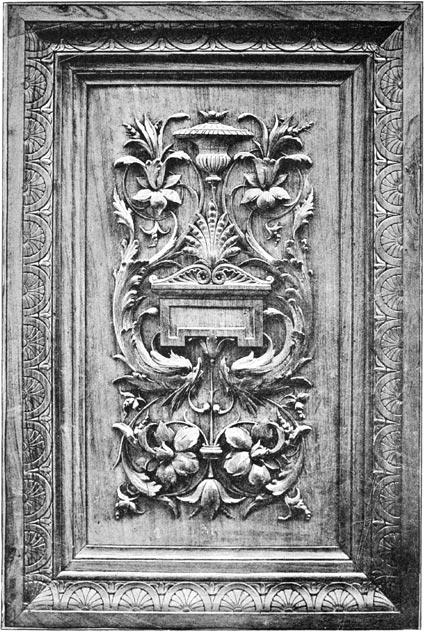
Panels. A panel is defined as a board with a surrounding
frame. The word is derived from the old English panel, a piece
of cloth, Latin pannus, “a cloth or patch”; from the same word
we have pane. In wood-carving we practically apply it to small
boards intended to be set in furniture, or walls, or ceilings, or
made into book-covers or box-lids. The uses of panels are
without limit, as they may be introduced into almost every kind
of furniture, such as the backs and sides of chairs, chests, bedsteads,
caskets, window-garden boxes, doors, or wherever a flat
surface can be adorned. When surrounded with a frame or
several strips of moulding, any panel becomes improved when
the outer frame is not overdone. As a rule the border of a
panel should be plain, so as to distinctly define or set forth the
pattern. For this reason many very ordinary and even rude
subjects “come out” or look well when thus “mounted.” A
series of carved panels makes a beautiful frieze for any room.
A good general size for most work is a panel six inches by
twelve, more or less, and half an inch thick. In spacing a panel
for ornament the pupil may begin by making one circle in the
centre and one in each corner, so that the five may fill up the
whole space. Convert these into a vine and apply ornaments.
There are of course endless variations of this principle. (Consult
the “Manual of Design.”)
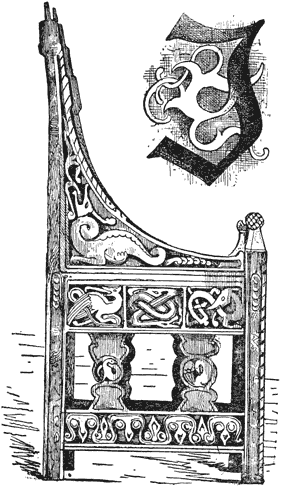
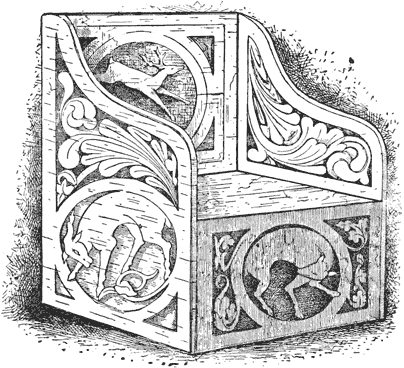
Chairs. Take any chair, copy it, and then fill the spaces with
ornaments to be carved. Large, square, high-backed, old-fashioned
chairs admit of the most panelling, and can be made up
by any cabinet-maker or carpenter, vide Fig. 69. It is a very good
plan to always have such objects made up in pieces, carve them
separately, and then have them
put together. It may be observed
for beginners, and those who are
not much practised in cabinet-making,
that there is a very substantial
kind of furniture once
made very commonly in Germany,
and which has been much
revived of late years. It is made
entirely without glue, nails, or
screws, by simply cutting holes
into which tenons or ends project,
which ends are fastened on the other side by holes and pins.
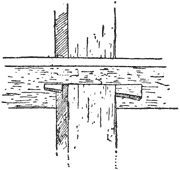
On this principle every kind of furniture can be made by any
man who is ingenious enough to simply measure boards, cut
square holes, and adapt pins to them. Such articles as are
made by this process are very much stronger than any others,
and they have the great advantage that they can be easily
taken apart, packed, or be stored in very small space when not
in use; and the style is of course more adapted to carving than
ordinary furniture. The writer has in his possession chairs 250
years old made on this principle. The seat is a square nearly
two inches thick, in which four holes are bored, into which the
legs are simply set, as in a milking-stool. Between the hind
legs two square holes are cut, into which similar tenons made
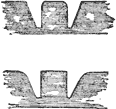
in the lower end of the back are fitted. In these tenons
two square holes are cut,
just exactly on the other
side of the seat, into which
square pins are driven, Fig.
65. With a very little ingenuity
or will, anybody can
contrive to make any piece
of furniture on the same
principle. The seats of
chairs and stools, or the
faces of tables, should
never be carved, for very
apparent reasons. There
is plenty of space for the
carver to work at on the
edges and legs, and this
may be made striking
enough by means of
colouring and gilding,
Figs. 64 and 66.
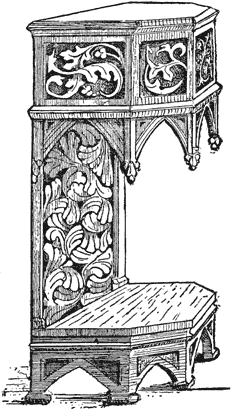
Fig. 66. Console or Bracket.
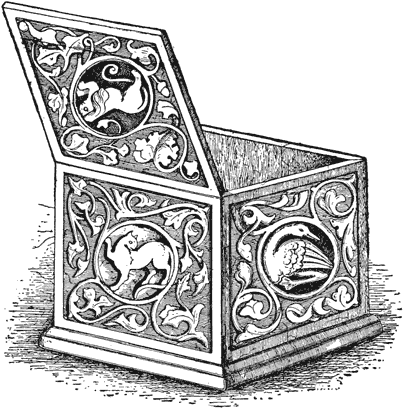
Boxes. These have
formed in all ages favourite
subjects for decoration.
They vary from the
smallest casket to the
chest. A box with the
lid forms five panels, or,
seen from any point, three. In Italy, of old, they were often
carved without and within. Boxes may be made by simply
gluing, nailing, or screwing together, but they may be so
dovetailed by an expert workman that the juncture is quite imperceptible.
Vide “Forty Lessons in Carpentry Practice,” by
C. F. Mitchell. Cassell and Co. It is a feat in cabinet-making
to do this perfectly, and boxes thus joined are very expensive.
The appearance of boxes is much improved by the addition
of moulding-strips, bases, and projecting ornaments. The
student is advised to carve or buy a few bosses, such as heads
of animals or faces, and rosettes, and try the experiment of
fitting them to a box or carving them on one, Fig. 67.
Caskets for Cigars. This applies also to receptacles into
which glasses for flowers may be put. Take a cylinder of wood,
turned, or made up like a barrel, and fit a base to it, and a
lid. They may be made of very large joints of bamboo,
which may also be beautifully carved, and partly coloured in
the lines, as is common in China. It is best for turned cylinders
and bamboo to have them surrounded with metal rings to
prevent their splitting. They may also be made square, that
is, as boxes.
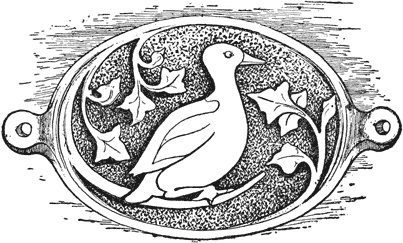
Fig. 68. Tray for Cigar Ashes.
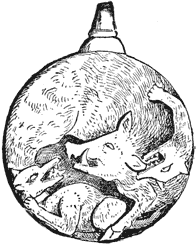
Trays for Cigar Ashes. These are best when carved from
hard wood, such as box, though any other may be used. It is
much better that they be made rather larger and deeper than
many in use, as ashes are continually being knocked out of
small and shallow ones. They may be round or square, like a
fish or a small book (with a lid), a shell, a tortoise, or a scooped
hand, a face, or a figure of any animal or human being, Fig. 68.
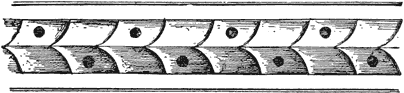
Basket-work. This is very easily imitated in wood, and it
forms a very pretty and fanciful style for many kinds of objects.
Take any kind of basket-work, either that of split osiers, which
are half-round, or Italian rush-work, or American Indian, which
is made of flat strips of ash or pine-bark interwoven, or
Indian rattan, and imitate it with flat gouges or firmers. It is
very easy work, and beginners soon become expert in it. It
improves the effect, when the work is finished, if dark colour
be painted into the depressions. Basket-work may be used for
diaper ground. The American Indian basket-work, in flat strips
from one-third of an inch to an inch in breadth, is easiest to
imitate, and may be executed with a single V tool or firmer.
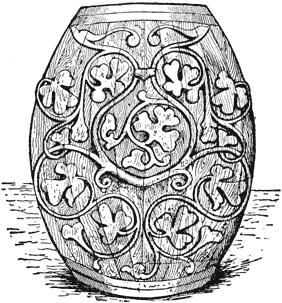
Casks, Small Barrels, Kegs. These are useful for waste-paper
boxes, or to contain canes and umbrellas. When carved and
coloured they form very attractive articles of furniture. They
may be used for garden seats. Heads of animals appliqué to
these, some for handles to lift them, or else holes must be cut in
them for this purpose, vide Fig. 56.
Frames for Pictures or Looking-glasses. These give a wide
range to the wood-carver, for all borders are suitable to frames.
Heads may be appliqué to corners and centres of frames. It is
very much to be desired that designers and carvers would exert
their inventiveness and endeavour to break up the monotony and
feebleness which characterize most frames, vide borders and
photograph frames.
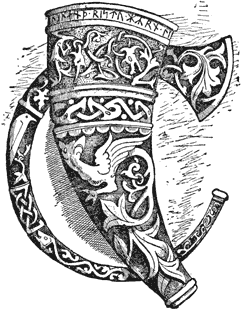
Horns. Horns may be carved, as previously described, and
imitations of them in wood are easily made. They are ornamental
objects, and useful when hung up to contain small
objects. They can, by steeping in hot water, be softened and
flattened, vide initial to Fifteenth Lesson.
Tiles. These are really panels. They are pieces of wood
from half an inch to an inch in thickness, the size of ordinary
tiles, carved in bold relief with free hand, coloured or not, and
are very useful for house decoration, chimney-piece borders,
cornices, and corners. The tile when employed with much repetition
becomes the diaper ornament.
Window Gardens to contain flower-pots. These are square
chests, as long as the window is wide, and from a foot to eighteen
inches in depth. They may be made with two or three panels,
or one long panel in front, with one at each end. They form
admirable subjects for decoration.
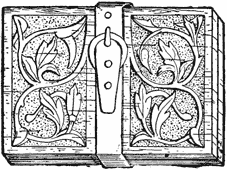
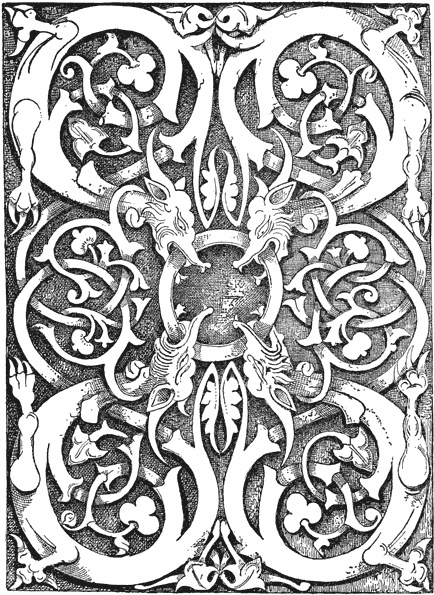
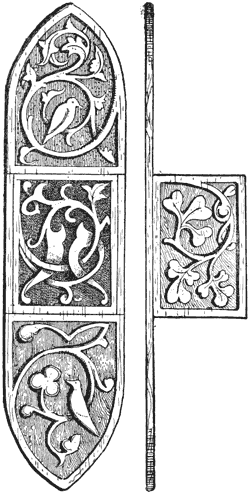
Albums, Portfolios, Book-covers. These are panels, and afford
an infinite range of design and effects in wood-carving. They
may be very beautifully and easily ornamented in mere stamping
and outlining (vide Lesson II.), or by putting in diaper grounds,
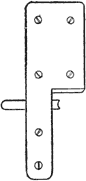
or basket-work, or by very low relief carving, in which case there
should be a border in a little higher relief to protect the pattern
from being rubbed, Fig. 70.
Canoes. In many countries large or real canoes are made
from one piece of wood and elaborately carved. Very pretty
miniature canoes may be made from one to three feet in
length from any kind of wood, and covered with any kind of
ornamentation. It is not necessary to excavate them from a
single block or log, as they may be made from two or more
pieces. They form useful receptacles for many objects.
Panels of Doors. These might be generally ornamented.
Every kind of wood-carving is applicable to them, but it should
be remembered that for all such decoration a large, free, and
bold style is absolutely necessary, and that it is unwise to make
mural work, which should be visible at great distances, out of
pretty flowers or too delicate work. A room with good bold
door-panels, wainscot, or dado and a frieze, seems half furnished,
while trifling and feeble ornaments detract from such appearance.
The great secret of the attractiveness of mediæval and savage
decoration is its energy. Even eccentricity and grotesqueness
lose all that is repulsive in them when they are simply and
vigorously set forth.
Carved patterns in low relief may be applied to door-panels.
Foot-stools. These are really small panelled boxes, unless
made with supports or
legs.
Benches. Simple
benches are seldom decorated,
but they are
admirably adapted to
it. Never carve the
seats, unless they are
made to fold up to
protect them from the
rain, in which case the
under ornaments of
choir-seats or misereres
may be appropriately
used. When the bench
has a back it becomes
a rude sofa or settee or
settle (Anglo-Saxon
setl, a seat). Properly
speaking a settle is a
long bench with a high
back. This may be
carved in panels. There
was an old Saxon and
early English double
chair made to seat two,
which is like a short
settle.
Hanging Boxes. These
are boxes generally
made with a back, which
is the longest piece, and which goes above and below the receptacle
part. They are useful for newspapers or letters. Every
kind of carving is applicable to them, Fig. 71.
Key Boxes. These are small hanging cabinets. In every
family there are many loose keys of trunks and furniture lying
about loose, and hard to find when wanted. If there were a key
box they would always be readily found. Make a box or frame,
let us say eighteen inches in length by ten inches width, of four
strips of deal or any wood. These strips may be half an inch in
thickness by an inch in width. Nail or glue them together so as
to form the four sides of a box. Then take one or two or three
strips of thin planed board, and neatly nail them on to form a
back to the shallow box. Now take a panel, which is to form
the lid or door of the cabinet. It will be better to make a
narrow frame of four strips, and set the panel in this, as a door,
with hinges and lock. This is to be hung up on the wall. It will
very much improve the whole if the interior and outside of the
cabinet, or all the deal, be stained to match the door, which, as
it is to be carved, should be of walnut or oak, or some better class
of wood. Then get some small silver or plated-headed nails and
drive them in rows in the cabinet. The keys are to be hung up
on these.
Cabinets. These may be in the nature of upright boxes with
doors, with three sides ornamented, the fourth being placed
against the wall, or three-sided for a corner. The forms of
cabinets are extremely varied, and the artist should pass much
time in designing them. They are of all sizes, from great
armoires for clothing down to caskets. The word cabinet is
derived from the French cabane, a cabin. The earliest dwellers
in Italy made the receptacles for the ashes of the dead exactly
like the cabins in which they dwelt.
Sabots or Wooden Shoes. These serve admirably to carve,
and are very pretty when coloured or ivoried, bronzed in
antique style, or otherwise ornamented. Sabots are useful
to contain small articles, and may be turned into cigar-ash
holders.
Umbrella Handles. These offer an inexhaustible field for the
designer and carver of small objects.
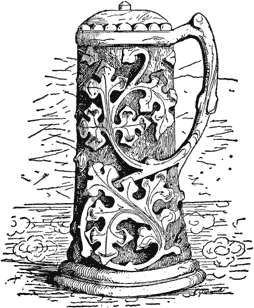
Tankards. These and all kinds of cylindrical objects are the
same as regards design as panels, only that the pattern when
not in set divisions must be continuous, or going round without
a break. They have been already
described.
Pen and Pencil Boxes. A very
convenient form is that of a
round-turned wood, plain, upright
jar. Small square or round
carved boxes for such a purpose
are not hard to make. They
may be made like towers or
castles, the trunks of trees,
barrels, or almost any hollow
objects.
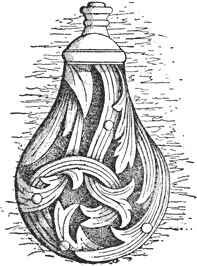
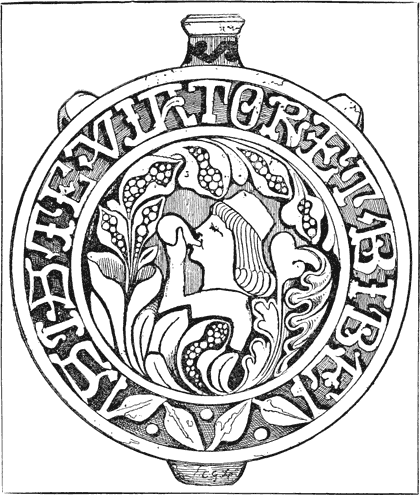
Pilgrim Bottles and Powder
Flasks. Take two pieces of
board, each one inch thick,
plane them smooth, and saw
both into ovals exactly matching,
of, say, six inches by ten.
Cut away the centre from both.
Fit them exactly. Then round each half in such a manner that,
when brought together, they form a round ring, like a French
loaf. Then carefully hollow out the centre of both, including
the neck, and glue the halves together. Carve the outside,
Figs. 72 and 73. During the Middle Ages such bottles were
made of many sizes to contain gunpowder. They were carved
from ivory or hard wood, and were covered with a very great
variety of subjects, such as deer, dogs, wild boars, birds, cupids,
scenes from the heathen mythology and the Bible, as well as
ordinary grotesques.
Shrines or Reliquaries. This is the conventional name for
boxes or caskets made exactly in the form of houses, the lid
being one side of the roof. The shape is a convenient one for a
box. They were covered with ornaments of the most varied or
grotesque kinds.
Mummies. The Egyptian mummy or its outward box or
sarcophagus forms an excellent subject for a useful box. Take
two pieces of wood, adapt them to make a box, like the
Egyptian type, that is, the lid being about one-fourth as thick as
the box. Appliqué or glue more wood on to the lid, in the
centre. The whole may be then smoothed into shape, painted
and gilt, or else carved in low relief, or simply stamped. It may
also be all gilt, and the dot work and shadows painted in brown
or ivoried. Take for model a real sarcophagus. The work is
not difficult, and the result will be a very handsome object.
Roman Sarcophagus. This is simply a square box carved in
very high relief, after the pattern of a Roman tomb. The ornaments
may be appliqué. These sarcophagi are very beautiful
when ivoried.
Books. A very pretty pattern for a box is an old book of the
twelfth or thirteenth century, with its clasps and other ornaments
in high relief. One of the covers is set on hinges, and forms the
lid. Care should be taken to polish and ornament the whole so
as to look like an original. It was very common to make the
sides of old books of wooden panels, which were carved in high
relief. Silver and brass or iron clasps and studs taken from
such old books may be bought in many bric-à-brac shops.
Staves or Alpenstocks. A staff four or five feet in length is
more useful for a pedestrian going a great distance than a cane,
and it is remarkable that it should have fallen into such disuse.
In old times in northern countries they were often made square,
the corners being slightly rounded, and were then covered with
Runic inscriptions and ornaments. These were very often
almanacks, so that a man wishing to know what was the day of
the week or month had only to consult his staff, or to “up stick.”
These were called clogs. They might be acceptable and useful
to many tourists. They were commonly carved by the peasants,
and a few may possibly still be found in Suffolk.
Spoons. Wooden spoons are easily carved and ornamented.
It is very curious, that quite apart from any modern slang
attached to the words “spooney” or “to spoon,” two spoons,
from their fitting together exactly, are considered in many
countries as a type of matrimony and perfect agreement. In
Wales, as in Sweden and Algeria, it is usual to present a newly
married couple with a piece of wood carved into the form of two
spoons, and I myself possess specimens of such. If anyone
wishes to establish the custom in England he would probably
find that the present would be generally welcome. Two spoons
in one cup are, it is well known, the sign of a happy marriage.
I have seen large wooden spoons carved and painted and
varnished, or gilt; two of these tied together with a ribbon were
hung up as an amulet to secure peace.
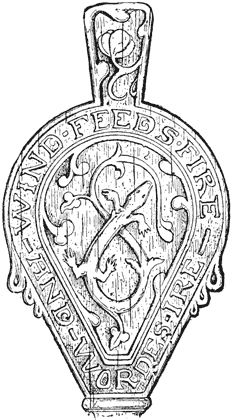
Bellows. These are carved in low relief, and may be ornamented
by simple indentation or outlining and stamping. It is
the easiest course to get the wood and saw it out, half or one-third
inch walnut or oak, and then carve it, and have the bellows
made up, Figs. 74 and 75.
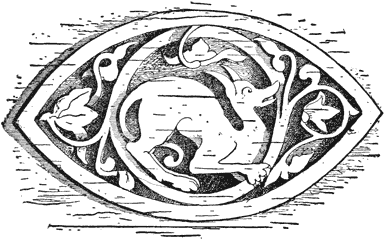
Platters. Take a piece of panel, one-third to half of an inch
in thickness, and saw it out into any shape, such as that of a
fish, a wild boar, a pig, a cat, a rabbit, tortoise, hare, etc., care
being taken that the shape always approach that of a circle, an
oval, or at least a diamond. Most animals can be drawn fitting
into a circular border, as you can ascertain for yourself by
putting a cat or a hare, etc., into a hoop. Indent with stamped
work or carve in ribbon-work, low relief, finish and polish with
care, dye black, and then oil or varnish. These are useful for
interposing between cups, vases, etc., and the table-cloth. Very
pretty effects may be produced by inlaying small discs of pearl
or ivory to form the eyes, etc.
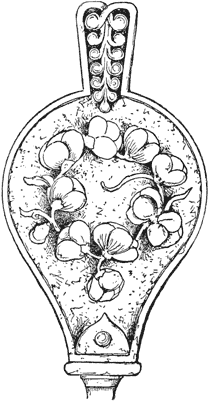
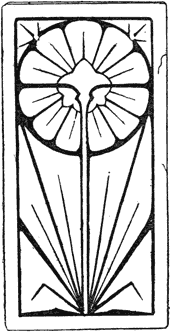
Fig. 74. The Wind-Flower,
or Anemone.
Lunettes and Spaces. It will often happen that there is over a
chimney-piece or door, or under or over a window, a space like a
semi-circle, or half an ellipse or oval, or square or rectangle of
any kind, which might very well be filled in, and it will be found
that, in most cases, there is nothing more appropriate than wood-carving.
It will be an easy matter for anyone in the least
familiar with drawing to adapt the designs in this work, or in the
“Manual of Design,” to such spaces.
False Sofa-backs. When a plain flat lounge or sofa is placed
against a wall its appearance may be greatly improved in one of
two ways. Firstly, a carpet or cloth may be hung on the wall,
just matching it in size and meeting it. Secondly, and this is
very effective, get boards or panels made into a piece, just as
broad as the sofa is long, and from two feet to any height you
please. It may reach down to the ground, or begin with the
sofa. Carve it. This will seem to be the back of the sofa, or a
guard for the wall; in any case it will appear very well. It may
be made of separate panels, say six or eight inches by twelve or
sixteen, made up into a frame. Such pieces may be placed to
back any kind of furniture which rests permanently against the
wall.
Door Pieces. Panels just as long as the door is wide, and
from one to two, three, or even four feet across, when carved,
form handsome decorations to place above a door; they may
also be used to place above windows. Inscriptions, or simple
figures with ornament, look very well on them.
Outside or Façade Pieces. Many a house, be it mansion or
cottage, which seems utterly prosaic and plain, might be greatly
improved if between its windows, on the outside, there could be
set ornamental panels. These may be painted, carved in stone,
moulded of Portland cement or other artificial stone, and in
many cases carved of wood. Ornamented inscriptions in old
English, and simple figures, are suitable for these panels; in any
case let those who adopt them try not to have the commonplace
cupids and ornaments generally seen in mural decoration. It may
not be in good form to be grotesque, but those who entirely
avoid it are almost always commonplace. Fig. 76.
Wood or Coal Boxes. These are square boxes with lids, to be
placed by the fireplace. The coal-scuttle, with the coals, may be
placed in them. In carving everything of the kind it is a good
idea to introduce ornamental lettering and appropriate mottoes.
Bread Platters. These may be seen in every fancy or furnishing
shop where wooden wares are
sold. They can be much improved
by carving to serve as round panels.
Chimney-pieces. These generally
consist of pilaster panels and strips,
and anybody who can execute these
in detail can have them made up.
It is desirable for the pupil to copy
a few or many chimney-pieces, great
or small, from real ones, and adopt
the ornaments from them. And as
they are articles which receive a
great deal of wear and tear and
rubbing, it may be well to remember
that too delicate finish is misplaced where scrubbing
with soap and sand is sure to set in some day, and where,
at any rate, dusting and other processes are inevitable. After
a few years the foliage or flowers undercut to the last degree,
begin to shed their leaves, and appear broken or ragged.
Good flat-carving, which endures anything, is better than this,
and the roses, even if in high relief, would look none the worse
for being solidly though conventionally cut. A good chimney-piece
and a handsome high-backed armchair can be very well
executed by anybody who can do ordinary panel carving.
There is no fireplace in even the humblest cottage for which
a chimney-piece may not be made. Its upper portion can in
most cases be made to support shelves or a cabinet; when in a
corner these of course are triangular. Gothic or ornamented
lettering may be used in the ornament. For this, proverbs or
quotations relative to the fireplace are appropriate.
Beams. When the beams which support the floor above
are left exposed, the room is improved by being made higher.
If these beams are carved, even if it be done rudely, the
whole room seems to be adorned. This is strikingly the
case when the beams are stained a dark brown, and then
touched up a little on the prominent points with gilding. If
it be too difficult to carve the beams in situ or in place, it is
easy to ornament them with applied carved ornaments. Pains
should be taken to make these appear to be uniform with the
wood.
Racks. These may be for umbrellas, hats, garments, pipes
weapons, and other purposes. Great ingenuity and taste can
be developed in designing them. Of one thing let the designer
be very careful. Let him see that the pegs or hooks are strongly
fixed and are not ornamented. I have seen such pieces of furniture,
in which a four-cornered sharp-edged flower is placed once
and even twice on a hook, while on others there is at the end a
projection more than an inch in diameter, which is flat on the
back or under side, with a sharp edge. The result is, that when
a coat is hung by the loop on such a peg and is then turned or
twisted once or twice, as often happens, it is almost impossible
at times to get it off.
The Boss or round central projection formed a very important
part or speciality in mediæval wood-carving. It can be advantageously
used as a centre, and sets off to good effect surrounding
flat or plain carving. It is sometimes used as a handle for
chests. It is, when a simple half-circle, very easily sketched
into shape. It may be formed into the head of an animal,
a flower, a single curling leaf, or several leaves. The student
is specially urged to copy as many as he can from Gothic
designs. A boss at the bottom of a bowl, or in a saucer or
plaque, produces a good effect, the concave surface round it
making a beautiful effect of shade, which might be more frequently
employed by picture-frame makers. This ornament,
which is very easily made and very striking, is thus prepared.
Get a bowl or a shallow round platter; any turner will make
one for you. Then carve from a hemisphere of wood a head
or a boss of leaves or flowers, or a dragon. Round the bottom
with a file to fit, and with glue and a screw fasten it to the
bowl. The interior of the bowl may be polished, varnished,
gilded, or ivoried.
Clock Cases. A common clock is not very expensive, and when
it is properly repainted and set in a well-carved frame its value
will be very much enhanced. A tower is a very good subject
for a clock case.
Vestibule. The small ante-hall, between the first and second
door, common in very many houses. This can be ornamented
with a wainscot or dados in long panels. It is very often thus
decorated in America. For cottages and country houses, or even
for town mansions, such panels may be beautifully and fitly
decorated with gouge-work in grooves, a flat pattern in simple
cutting-in, such as any person may learn how to execute in a
few hours. Fill in the pattern or cuts with dark paint, and if
exposed to changes of temperament or rubbing, let it be oiled or
varnished. The same work is of course as appropriate to halls
as any other rooms, but the vestibule, being small, may serve for
a beginning.
Staircase Balusters. These afforded inexhaustible work for the
artists of the olden time, and they should be tempting to every
wood-carver. It is not at all necessary that they should be
strictly of open work, in lattices or rails, as beautiful objects of
the kind were once often made in panels. But the carver should
especially be aware of projecting leaves or crochets, as they are
very apt to “catch” garments.
Garden-work. Much bold wood-carving may be executed for
gardens in a great variety of forms. Stands or tables for potted
flowers and tubs may be decorated, panels placed in walls, and
summer-houses made in far greater variety than they are at
present. Poetry supplies an infinite variety of inscriptions
appropriate to gardens, which may be carved and ornamented.
It is worth noting that statues of Flora and Pomona and
Vertumnus in simple archaic forms were used to protect gardens
and orchards among the Romans, and it would be an easy matter
to carve these in low relief in panels.
Gates. The gates of country places, gardens, etc., afford a
wide scope for the skill of the carver, and as they are the first
objects generally seen about a house they may be most appropriately
ornamented. In this, as in much other work, the art of
the carpenter is combined with that of the carver. It should be,
however, remembered, as regards gates, as of all decoration
whatever, that anything which can ever be in any manner in the
way is not beautiful, sensible, or proper. There should never
be a jagged or pointed ornament wherever it can “catch”
clothing.
Bedsteads. The bedstead was of old considered so appropriate
for carving, that I find in an excellent old Italian work on furniture
more illustrations of this article than any other. Even very
simple and cheap ones may be redoubled in value by a little
judicious carving.
Trays. These may be made in great variety, to contain many
kinds of objects. As a rule the tray is a long shallow box, but
it may be carved from one piece of wood, and is then used to
carry objects in, the single piece being necessary to give it
strength. If ornamented with carving the tray forms an attractive
object when hung up on the wall. And it may be here
remarked that one great object of all carving is, that most objects
which are useful in some way shall be ornamental when not in
use. We do not wish to have trays and coal-boxes in the way
if they are plain, but when decorated they serve as well as
pictures to ornament a room.
Coal or Wood Boxes. See Wood or Coal Boxes.
Salt Boxes, Collection Boxes. These very useful articles need
not be limited as regards contents, nor confined to the kitchen
or to “collection.” If the part of the box which goes against
the wall, or its back, be lengthened, the salt box becomes a kind
of bracket. Vide Hanging Boxes.
Shelf-boards. It very often happens that a literary man, or
draughtsman, or architect, though his work-table may be large,
finds it crowded with books, etc. To find place for these the
shelf-board is very convenient. It is simply a board, let us say
one foot wide, placed on two supports, which lift it twelve or
fifteen inches from the table. To economize room these supports
may each be a square open box, in which books may be placed.
The advantage of this shelf is that it may be displaced at any
time when the table is cleared. A plain board in a room is not
an attractive object, its edge, or even one side of it, may therefore
be carved.
Brackets and Bracket Shelves. These useful objects may be
made in a great variety of forms. The simplest is merely three
pieces of board fastened together in a triangle. In the illustration,
Fig. 77, there are five pieces. The centre of b slopes at an
angle of 45°. Bracket shelves are made by hanging two brackets
and laying a board across them. A bracket may be made on a
longer board, and have two or more shelves, it then becomes a
hanging rack or cabinet. Or the support may be a long strip in
which pegs of wood or metal are placed, on which objects are
hung. A very great variety of carved or stamped ornament
may be adapted to brackets.
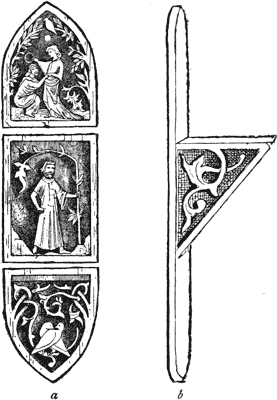
Fig. 77. Bracket. The Tannhäuser.
Violin and Guitar Cases. In the old times these were often
elaborately carved, and thus formed an ornament, instead of being,
like all now used, anything but attractive.
Handles for Drawers. The hanging or hinge style of old-fashioned
handles, now so prevalent, has the drawbacks of not
being always easy to open or “find,” and of frequently breaking.
The knob, which was screwed on, was always wearing out and
getting out of order. The best and most practical kind is made
with a square shank which passes through a square hole in the
drawer. It has also in itself a square hole into which a square
pin is driven, which holds it fast. Carving in very low relief may
be applied to ornament these handles, but it should never be such
as to produce positive inequalities, such as press into, or may
hurt the hand. If the pin be slightly wedge-shaped, it can
never wear out, nor can the handle become loose, since when it
does, all that is required is to drive it in further. A very plain
chest of drawers may be made much more attractive with a
handsome set of handles. Handles are another form of bosses.
Applied Ornaments. Old Roman bronze coins, such as may
be bought for two or three pence, are often quite handsome
enough to be applied with beautiful effect in caskets, tankards,
or boxes. Lay the coin on the wood, draw its exact circle
with a pin, and do this until the line is rather deeply scratched.
Cut out the disc with great care, so that the coin may fit tightly
into it. For this purpose very thick coins are preferable. Let
it project a little from the surface. Fasten it in with diamond
or Turkey cement. Of course, medals or coins of any kind
may be used. Make a border in the wood round the coin, and
if you like, apply other ornament to this border. Large nails
with circular boss heads are very effective in furniture. Chests
may be beautifully ornamented with them.
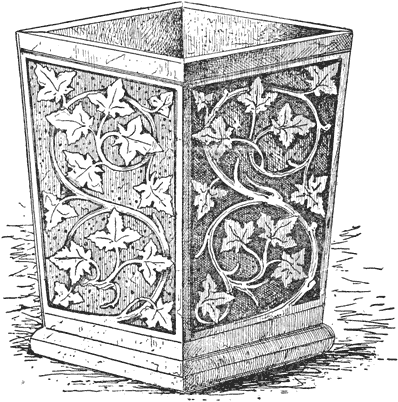
Waste-Paper Box. A carved box is much more “sightly” and
solid than an ordinary waste-paper basket. The box may be
carved in a basket pattern, and made rather wider at the top
than the bottom.
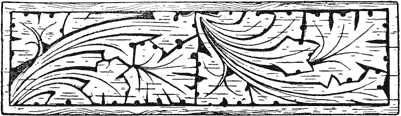
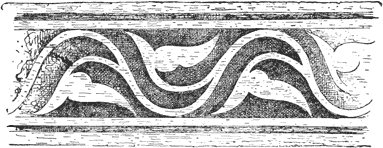
Borders. Any ornament continued in a line or strip forms a
border. A wave line, or one made of hemi-circles, joined or not
with ornaments in every compartment, is a good plan for a
border. So is a vine of any kind. When the hemi-circles are
squared and joined, it becomes the basis for the Greek Meander
or Wall of Troy. Angles and other forms are also used. Any
diaper may be repeated so as
to form a border. Borders
around panels and other
margins, and all along the
edges of boards for shelves,
brackets and most of the
works mentioned in this list,
may be executed in highly
decorative effect, and with
an ease and precision difficult
to attain by carving,
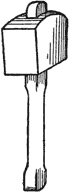
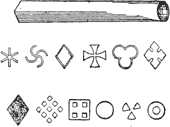
with the hammer and stamps
mentioned in the first lesson.
Lines are first drawn on the
work as guides to place the
punches to insure regularity.
Pilaster. Though this term
is generally applied to what
may be called a flat-sided
pillar against a wall, or a flat
half pillar, in wood-carving
it means quite as often a perpendicular
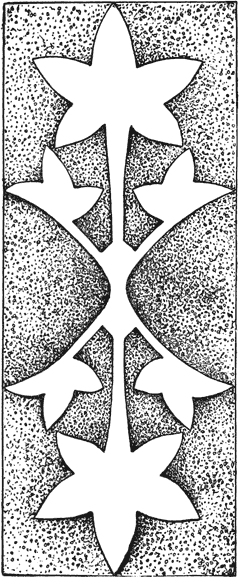
border in relief.
Like borders, pilasters are
used in many ways in decoration, as on walls, bureaux, cabinets,
sideboards, tables, or wherever a long “strip” is to be filled.
Base Moulding. This is generally a border which is the lower
portion of a piece of furniture, etc. Thus, if there is a panel
and frame, and under this, just over the “feet,” a carved strip, it
is a base moulding. Narrow fillets on these may be also
decorated by stamping.
Sideboard or Buffet. A piece of furniture eminently adapted
to ornament. It may be made with a back or with shelves,
niches, or a cabinet placed on it instead of a back.
Alms Boxes, Money Boxes. These are made up for churches,
generally after Gothic designs, and afford a wide range of
design.
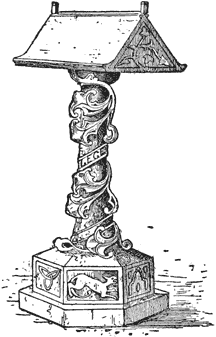
Lectern. A church reading desk. This has always been a
favourite subject with wood-carvers, Fig. 78.
Ends of Pews. A favourite subject for carvers in the days
of old, vide Fig. 80.
Porte-papier. A very useful article to carry paper, or a sketchbook,
or to press leaves and flowers and convey them home.
Take two pieces of board, from one-third to one-half an inch in
thickness, and six inches by eight in size, more or less as may
be desired. The paper is placed between these boards and
the whole secured with a hand-strap. It is usual to carve a
flower pattern on these.
Ring or Circular Boxes. Take a board, of any thickness, e.g.
one of two inches, and make of it a disc or circle, using the steel
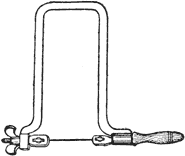
fret saw, Fig. 16; then marking out another circle within this,
saw out a ring about three-quarters of an inch in thickness.
Adapt to this a bottom and lid, both, of course, also circular. It
will be like what is known as a cheese box. To double the
depth saw out two rings and glue them together. This will
give four inches depth. Boxes may thus be made of any shape,
such as a fish, and then carved.
Photograph or Mirror Frames, or Mounts. Take a piece of
thin board, six inches by four or five, or any size required. Cut
out of one corner of this as much as will be required for the
photograph or mirror, leaving enough wood for a pattern.
These have become very popular of late, Fig. 79.
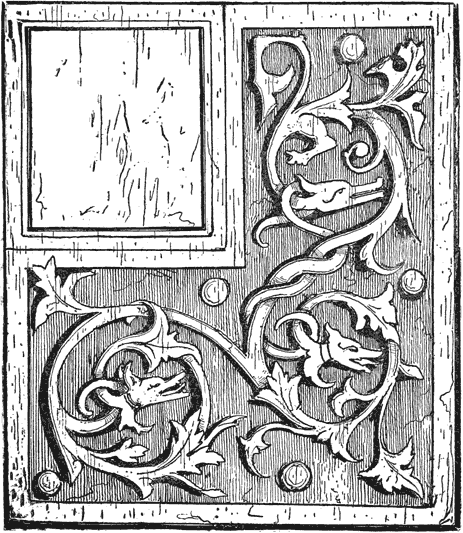
Fig. 79. Frame for a Photograph, Looking Glass, etc.
Triptych. Two folding covers or boards on hinges, intended
to cover a picture or carved or enamelled or inlaid work. These
triptychs may be used reversed as writing desks, or else carved
on both sides, and then when open hung on the wall as ornaments.
When there are only two boards, as in an album, it is
called a diptych.
Encoignures. Tables made with an angle to fit into a corner
of a room.
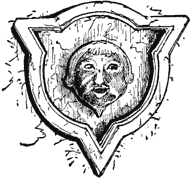
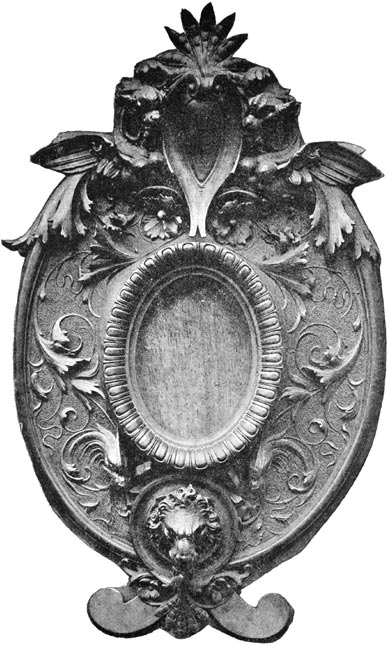
Shields. Carved in wood, these form beautiful ornaments.
Incitega. A kind of stand or table for flowers. It was generally
made of rods or strips, but it may be very easily formed like a
box, that is, a truncated pyramid reversed. The sides are carved.
Monopodium or Centre-table. A small circular table supported
on a central stem or foot, used by the ancients at social
entertainments.
Orb. A globe covered with ornaments carved in low relief.
They form very effective decorations.
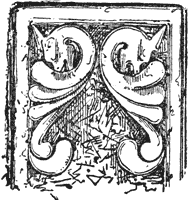
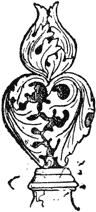
Finial. A terminating ornament, corresponding to a flower
as a crochet does to a side leaf, Fig. 80, etc.
Coin-brackets. Brackets made to fit into the corner of a room.
Corner-cabinets. Cabinets adapted to a corner of a room.
There are also coin or corner objects of furniture of all kinds.
Mouldings. These are narrow borders or strips, and are very
effective in giving relief in long spaces. A good effect for a full
border, a diaper ground or a broad pattern, may often be made
by doubling, trebling, etc., mouldings. By using the folding
mirror a segment of any moulding or border may be converted
into an ornament to fill up any given space, of any shape. There
are several tools specially made for cutting figures in mouldings.
Poppy-heads. There are many cases where carving may be
applied with good effect to relieve bareness. “Such ornaments,
generally small groups of foliage” (though often figures with
leaves), “were formerly placed on the summits of bench-ends
desks, and other clerical wood-work” (F. W. Fairholt). Poppy-heads
can be placed, however, or adapted, to all kinds of furniture,
with a variation in form, Fig. 80.
Sconce. A wall candlestick, which usually takes the form of a
projecting bracketed support in wood or metal. They originated
in the fifteenth century, and were generally of enriched design.
They may be sawed out of boards, or carved in many forms.
Trellis-screens. These are thin boards of open lattice-work,
generally made by fret-sawing and subsequent
carving. They are useful to place behind
windows, and for many purposes.
Tympanum. A triangular space, which may
be filled in with carved ornament.
Verge or Barge-board. The gable ornament
of wood-work, used extensively for houses in
the fifteenth century. It affords a wide field
for decoration.
Wreaths. Carved circles or rings of wood,
which form beautiful ornaments, especially
when hung up at intervals. They may be used
for picture-frames, Fig. 81.
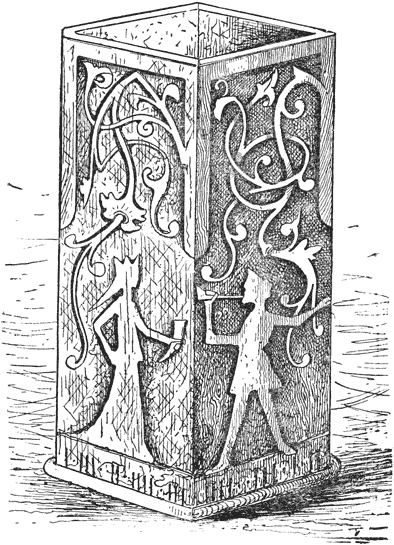
Acerra. A square box, on legs or supports.
Heads and Legs. When a cylinder, or square
stick, or horn, or oval box, is made to rudely
resemble a figure by adding to it a head and legs, this is so
called.
Ædicula. A small house or tower, generally used as a box.
Very effective and beautiful articles are thus made.
Ante-fix. Ornament carved in stone or wood, or made from
terra-cotta, “to give an ornamental finish or to conceal unsightly
junctions in masonry” (Fairholt). There are few country houses
or cottages where they cannot be applied.
Ciborium, Synedoche. Very richly adorned receptacles in which
the Host is kept. They may be imitated for cabinets. In
Spanish churches they are called custodia.
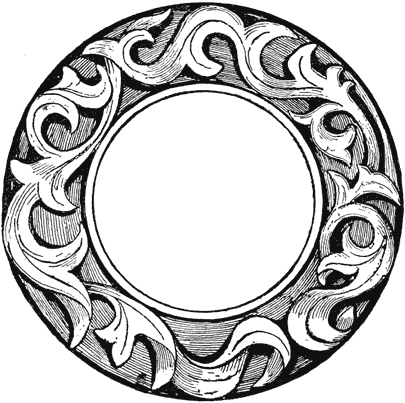
Fig. 81. Ring-box, Wreath, or Bread Platter.
Cyma. A moulding consisting of a round and hollow conjoined,
termed cyma recta when hollow above, and cyma reversa
when the cavity is below.
Modillons. Brackets in Gothic architecture, the lower portion
often in the form of a grotesque animal or human being.
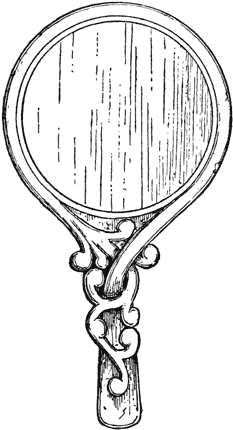
Hand Mirrors. These afford an endless field for design.
Fig. 82.
Echinus. The egg and tongue or egg and anchor moulding,
much like the heart and dart ornament. It is easily made and
is very effective. Faces may be cut on the “eggs.”
Outlines. Figures of men, animals, etc., cut or sawed out of
boards, and either painted or carved. They are common in
Italian churches. They form very effective hanging ornaments.
Birds can be adapted to beautiful outlines.
Hammer Beam. The projecting end of a beam, often carved.
Hood Moulding. The moulding which covers or surmounts a
door or window on the outside, forming a sort of hood or
weather-guard. It is also called a dripstone or weather moulding.
It can be beautifully ornamented, and thus becomes a
striking decoration.
Impost. The horizontal moulding on the summit of a pillar
from which the arch springs.
Console. (French.) Brackets in furniture.
Perfume Chests. Boxes with perforated lids in which is kept
pot-pourri of rose leaves, or a mixture of powdered orris-root and
spice.
Churns. A carved churn is a fanciful ornament, used to contain
papers, etc. The handle is fixed to the cover and serves to
lift it.
Handles for Bowls, Cups, or Boxes. These are sawn from board
from one half to an inch in thickness, and then fastened to the
bowl or box, generally with screws. When gracefully or quaintly
shaped they convert any ordinary bowl or tankard, with very
little trouble, to an attractive ornament. They are almost peculiar
to Sweden and Norway, where they may be seen in museums in
very great variety.
Bark Frames. A curious and striking ornament may be
made in this manner. Take a piece of cork, oak, or other bark,
which may be a foot in length by six inches. Make in it an
oval or circle, in which carve any subject. The writer once had
an image of the Virgin thus carved, which was much admired.
Dark brown bark is much improved by having gilding roughly
spread on its projecting points. If the ground of the carving be
gilt and the bark left in its natural condition the effect will also
be good.
Three-legged, or Milking Stools. These are commonly carved
on the seat. Ornaments may be carved and better applied
as in Fig. 83.
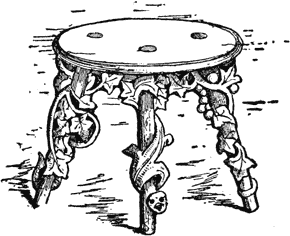
Fig. 83. Three-legged Stool.