Art has appeared to us till now under peculiar circumstances.
We have seen it in Asia and Africa,
and in both parts of the world it represented the
uninterrupted struggle of humanity for self-consciousness.
Humanity was too much under the influence
of the marvellous and incomprehensible, and neither
the marvellous nor the incomprehensible can be
brought into shape. The Indians tried to give forms
to the metaphysical phenomena of nature; the
Persians were bent on the glorification of the power
of one visible earthly despot; the Egyptians tried to
copy the realistic phenomena of nature, and inscribed
them with mystic signs, uniting Indian abstractions
with the real phenomena of nature. When a
thought was fixed into a form; the thought, being
at the same time a religious conception, could no
more be changed; it became in art what a technical
name for a natural phenomenon is in science. Oxygen
is oxygen, and designates only that element; so when
once a form was settled, as that of Vishnu or Amn,
S’iva or Osiris—or the serpent fixed as a symbol of
eternity, or the hawk as a symbol of light—the inner
or spiritual life of the artist was fettered down to
outward forms with special inward meanings. Thus
the constraining sway of misunderstood nature on one
side, and the stationary precepts of an omnipotent
hierarchy on the other, entangled the artist’s imagination
and paralysed every effort of his subjective
power of production. The different nations began to
be wrapped up in their different artistic forms, which
became by degrees hard and impenetrable national
and religious incrustations; the masses, held in abeyance,
led by theocratical art, had only to glorify one
visible or invisible tyrant, with whom the universe
was blessed. Eastern art was to a certain degree
plastic, only too plastic as in India; but it was too
penetrated with an incomprehensible spiritualism to
find the right objects for its plastic tendencies. Even
where geometrical figures, flowers, or trees were used,
the effect of their simple combination was marred by
a want of harmony between thought and form, or
idea and body. This harmony between outward
form and inner spirit, wherein real beauty consists,
this balance between the dynamic and static cosmogonical
elements, was wanting in Eastern art. The
East rent nature asunder, and looked upon matter as
evil; and yet matter was to be used, to bring spirit
into form. The element of S’iva, Ahriman, or Typhon
was to give visible form to the conceptions of Brahmă,
Ormuzd, or Osiris, and could not do this, because the
connecting link to blend the apparently-opposed
powers into one, was wanting. A uniting force for
this mysterious antagonism, a mediator between
heaven and earth, divinity and humanity, was sought
for, but not found. The Persian unconsciously set
Meshiah (man, mensch) down as that element, but
Meshiah was not yet allowed to come to any free
development, and he sank into the pitiful and degraded
position of a slave to despotic oligarchs, or
still more intolerant spiritual hierarchs. Meshiah
(humanity) was first freed by the Greeks in form and
by Christ in spirit.
There can be no doubt that the Greeks were, for a
short time at least, the ancient representatives of the
well-balanced static and dynamic forces in humanity.
Of all the geographical districts of the world, whether
in the Eastern or Western hemisphere, none are so
admirably adapted for the cultivation of social intercourse
as the Grecian isles, and the Grecian peninsula,
the classical region of the Ægean Sea. Nowhere is
so large a coast-line found, surrounding so small a
territorial surface; nowhere such a variety of creeks,
capes, promontories, inlets, and harbours as round the
Peloponnesus, and the islands uniting Asia Minor
with Greece and Italy. No streams like the Ganges,
or the Hoang-ho; no mountains like the Belur Tag
or Himâlâya. Gorgeous uniformity is the characteristic
of China and India; variety and change the
very element of the Greek world. Mountains, plains,
valleys, streams, are all of a limited size; there rules
a sweet, eternal harmony between spirit and form;
nothing is exaggerated, nothing overawes man; he
feels at home; the dark-blue sky over-arches his
verdant, hilly, amiable earth, adorned with brooks and
hills, boskets and flowers. Valley chases valley;
rivulet pursues rivulet; clouds follow clouds; the
morning dawn flies before the bright noon, and the
noon dies away, in the cool sighs of the evening
breezes, into the embrace of dark night. The self-conscious
spirit of youthful humanity came into life
for the first time in Greece. Everything with the
Greeks was feeling, but a feeling, conscious of a real
purpose in religion, the State, the family, and in art.
We shall see that intuitive feeling grow by degrees
into critical reflection, but in the first instance everything
with the Greeks was ingenuous, or, as the French
call it, ‘naïve.’ This classical ‘naïveté,’ this unconscious,
unaffected simplicity, enabled them to become
masters of intuitive productions, and to look upon
this world with an unbiassed eye, prone only to see
what was harmonious and beautiful. The whole life
of the Greeks was thus one long ideal dream of
poetical and artistic reality. They took an interest,
however, in objective individuality only; the beauties
of nature as one great total did not yet affect their
subjective comprehension. They could not grasp the
pantheistic notion of the Indians, who saw in every
detailed phenomenon of the universe the working of
ONE indivisible and incomprehensible first cause.
They shuddered at the Egyptian monsters, which
were to serve as symbols of that sublime conception
which lost on the Nile all its primitive grandeur.
They found the Persian absorption of the universe
into a conflict between light and darkness too dreary,
and ascribed to it the loss of all individual freedom.
They worked out a system of their own, based on
Indian grandeur, Egyptian symbolism, and Persian
abstractions. To be thoroughly acquainted with this
combination of influences is the very first step towards
an understanding of Greek art.
The Greeks were Aryans in language, and in
mode of thinking; Aryans who had detached themselves
very early from their Cis-Himâlâyan brethren,
and peopled Asia Minor and the surrounding islands.
They were strengthened by Egyptian and Phœnician
immigrations, and invigorated by Thracia’s warlike
spirit.
Like a plant that only lives and grows by means
of the antithetic activity of air, light, and water, the
Greek State-body had air supplied by Orpheus from
Thracia, light by Kekrops from Egypt, and water
by Kadmus from Phœnicia. Independent freedom
and love of the arts were the gifts of the North; the
South furnished them with deep knowledge, and
Phœnicia gave them the vivifying spirit of commerce.
Their language is an offshoot of the Sanskrit, but
stands in a more distant relation to it than the Zend—to
which it is closely allied. They are principally
distinguished from the Asiatic nations by their
decided hatred of everything arbitrary and chaotic.
From their love for individuality and diversity of
customs, manners and modes of thinking, sprang the
national unity of the Greeks in the fairy realms of
Poetry and Art. When they began to feel themselves
a people, they assumed the name of Hellenes;
and their first historical deed was the admirable completion
of a language which, for simplicity, power, and
beauty, has remained up to our own days a model for
all other languages, for it alike possesses eurythmy
and power of expression. The overwhelming metaphysical
subtleties of the Sanskrit are simplified; the
variety of consonants and vowels reduced, and the
mode of writing corrected; everything proving a deep
sense for order, clearness, and moderation.
They had three dialects: the Doric, distinguished
by a broader pronunciation; the Ionic, possessed of
softness and a melodious richness; and the Æolic, a
kind of mixture without a special character. The
Dorians came southwards from the hoary mountains
of Thessaly, and gained step by step an influence and
dominion over the other tribes of Greece. The
Ionians occupied the east, and were considered the
connecting link between Hellas and Asia; but whatever
the Hellenes took from Byblos, Sidon, Tyros or
the Libanon, assumed a really Hellenic form, after it
had passed through the purifying element of Doric
correctness. The south gave ideas, and the north
brought them into form.
Whatever the Hellenes touched they beautified.
The powerful giant Bhîma of the Mahâbhârata is the
prototype of Herakles; but in the myths concerning
Herakles we recognise the mere personification of
commercial daring and enterprise. Accompanied by
his dog, he finds the cochineal; the goblet in which
he sails to Erytheia is but the Phœnician merchantman;
the Phœnicians are referred to, when it is recorded
of him that he had broken the devastating
horn of the mountain-streams. Moloch, to whom
Assyrians, Indians and Hebrews sacrificed, without
ever being capable of investing the fire-spitting
monster with anything like poetry, was destroyed by
Herakles. The gods of Asia became with the
Hellenes demons, from whom they learned some
useful trades. Poseidon, the god of the sea, is, like
the element over which he rules and in which he
dwells, of a sinister, implacable character; he requires
human sacrifices, annihilates horses (meaning ships),
in fact does, as incarnate divinity, what the sea does
in our own times. The Titans are acquainted with
astronomy, and are personifications of a certain knowledge
in maritime matters. Proteus, the Egyptian
Pharaoh, is with them the keeper of the seas, and
Atlas the father of nautical astronomy, and both
were companions of the Tyrean Herkules. In all the
myths and legends of the Greeks we can trace some
facts. The divinity they could only comprehend in
the well-proportioned form of a human being, and a
hero or benefactor of humanity became with them a
divinity. This blending into one of the divine and
human is the most important feature in Greek
thought. Vishnu and Osiris also became incarnate—but
their deeds were supernatural; the principal
feature of their ‘man-godhead,’ or ‘divine manhood,’
is an incomprehensible mysticism. Their anthropomorphism
had in it something gloomy. When the
divine Apollo uttered the memorable words: ‘Man,
know thyself,’ the Greeks became suddenly conscious
of the inborn spark of the divine intellect in man; the
gods were intelligible to them, and the Asiatic world
of abstractions emerged in a thousand different human
forms of divine conceptions.
Uranos (Varuna in Sanskrit) is heaven, or rather
space—Kronos, time, and Gæa, earth. Uranos as well
as Kronos and Pontos were offsprings of the Earth. So
far we have to deal with the same mystical elements
which engendered all the Asiatic cosmogonies. But
Uranos and Gæa are set down as male and female,
and are endowed with powerful children—the Titans
and Titanides, the Hekatoncheires (or Kentimanos,
hundred-handed, powerful giants with fifty heads),
and the Kyklopes, who were very clever, and invented
many useful arts.
The most important gods were Okeanos, Japetós,
and Kronos. The human character of Greek mythology
begins even before the birth of Zeus. Uranos
was afraid of his own children, and had them confined
in eternal darkness in Tartaros; their mother, Gæa,
had pity on them, and armed the youngest, Kronos,
with a sickle, with which he attacked Uranos, and deprived
him of his creative power. From that moment
Uranos was idle, could produce no new forms, and
was neither worshipped by gods nor men. The fact
which underlies this dramatic scene, in which gods
are the actors, is a cosmical phenomenon. In time
all things were created, and in time the creative
force, as far as our earth was concerned, ceased with
the creation of man, to be productive of new forms.
Kronos had five children—Hestia, Demeter, Here,
Pluton, and Poseidon, and these he devoured. In
this cruel image we see represented the revolving
movements of time, in which the present is everlastingly
the prey of the past, engendering the future.
The sixth son of Kronos, Zeus (creative ether), was
saved by his mother’s cunning, for she gave the inhuman
god a stone instead of her child; Metis, however
(Maya, Matter), afterwards the wife of Zeus;
rescues the children that Kronos had swallowed, and
he is obliged to give them back again in an eternal
circle. These children of Kronos are years, months,
weeks, days and hours. We have here an instance
of the manner in which phenomena were turned by
the Hellenes into living beings. Kronos was an old
man with a long flowing beard, and held a sickle or
scythe in his hands, with which he cut down everything.
And as symbol of eternity a serpent lay by
his side.
Zeus serves us even more as a specimen of the
anthropomorphic tendency of the Greeks. He was
the father of the gods, and had to fight with the
Titans. He led the immortal gods, who assembled
on Mount Olympus against these terrible Titans,
who mustered in great strength on Mount Othrys.
For ten years the battle raged without result;
heaven, earth, and sea resounded with the frightful
struggle. Gæa advised the gods to call in the
Kyklopes and Hekatoncheires. These presented
Poseidon with the trident, Pluton with the helmet that
had the power to make the wearer invisible, and
Zeus received from the depths of the earth the flaming
thunderbolts. Then only the Titans had to yield to
storms and lightnings, and were chained down at last
in Tartaros. We read a chapter of geology when we
peruse Hesiod’s description of this struggle. In the
Titans, Kyklopes, and the hundred-handed giants we
recognise the antediluvian monsters—the mastodons,
megatheriums, and saurians, petrified for ever in the
strata of the earth’s crust. Zeus, after his conquest,
began to rule the Olympian gods and mankind.
He himself was full of passion and wrath, of human
failings and shortcomings; but, after all, he was kind,
dignified—even in his weakness, just and grand. He
smiled, and love and joy pervaded the universe; he
frowned, and the universe shook to its very foundations.
He indulged in freaks, and still was afraid of
his haughty and jealous wife, who acted in many
instances as a well-bred lady would, who had the
misfortune to be wedded to an amorous husband.
Zeus was frequently so troubled by his riotous gods
and goddesses, that he had a bad headache, and was
once obliged to call in Hephaistos to cure him with
a heavy blow, and on this occasion Minerva (wisdom)
sprang forth armed with spear, helmet, and shield.
The truth that intellect and reason are of divine
origin was proclaimed in this myth. In the Greek
legends the poet’s imagination has turned the forces
of nature into beautiful men, women, or children.
How much the gods, with them, were the creatures
of man’s fancy, may be seen in the fear of the
opinions of their earth-born children with which the
gods were endowed. The Almighty Thunderer,
when his heavenly subjects made too much noise,
often cried: ‘What will my earthly sons say?’ and
for fear that they might find fault with him he yielded,
and made concessions, and heaven and earth, sun,
moon and stars were again at peace.
It is true that in Indian lore the same characters
are drawn, but, like their supernatural gods, they
are gigantic and monstrous. Men and women in
the Indian fables, behave like unwieldy spectres,
that frighten us during an uneasy dream; we must
first divest them of their inhuman forms in order
to comprehend them. The conceptions are too
marvellous to impress us with moral lessons; we are
lost in allegories, metaphors, symbols and double
meanings. This occurs less in Greek mythology.
Atlas was the representative of patience; he had
for ever to carry the world on his shoulders, and
was turned at last into a rocky mountain range.
Epimetheus was the prototype of senseless carelessness,
and was destroyed by his own folly. Prometheus
at last was the embodiment of considerate
prudence; he was devoured by the vulture of ‘care
and sorrow for the morrow.’ Prometheus may be said
to be the best, most intelligible emblem of classic
humanity, as Faust may be considered as the incarnation
of romantic mankind. Prometheus wanted
to bring matter into form; Faust to know what
held spirit and matter together. Prometheus stole
fire from heaven, made man of clay, and vivified him.
Faust knew that this heavenly fire was a force over
which he had no control, and he called in a spirit
to teach him ‘how all one whole harmonious weaves,
each in the other works and lives.’ The ‘formal’
is the longing of the Greek Faust, and the ‘spiritual’
the aspiration of the Teuton Prometheus. All the
Greek eîdola embodied some power of nature.
Philomela was a pining woman. The Laurel was
formed out of the lovely Daphne (from the Sanskrit
Dahanah, our word ‘dawn’). In every tree a Dryad
dwelt, in every wave a Naiad sported. Demeter’s
tears for her lost daughter Persephone nourished
rivulets. On the bright heights of Mount Olympus,
on Helikon, or Parnassus, or Pindus, above the petty
cares of every-day life, sat the earnest Klio with an
open scroll and a stylum, recording with lovely patience
the events of the past. Euterpe, with her two flutes,
brought harmony into the discordant sounds of the
earthly spheres, and filled the world with songs and
tunes; Melpomene, armed with gloomy mask and
dagger, presided over the fictitious sufferings of
humanity struggling with the inexorable fates,
reflecting in an artificial mirror—reality. Thalia,
with a shepherd’s staff and a Silenus’ mask, endowed
with an eternal smile, comforted man with more
cheerful views. Terpsichore, with a lyre of seven
chords, taught him to express joy, happiness, and
pious veneration by the rhythmical movements of his
body. Erato, on her Kythera with nine chords, warbled
love-songs, and inspired and aided young poets to
pour out in measured language the immeasurable
feelings of their souls. Polyhymnia, or Polymnia,
protected orators, philosophers, and stage-players,
and enabled them to keep within the boundaries of
moderation, for she placed the first finger of her
right hand on her lips, impressing them with the
necessity for caution. Urania, with her eyes lifted
to the starry heavens, tried to draw man’s attention
to the well-regulated courses of the heavenly bodies,
proclaiming in eternal silence with fiery tongues the
glories of the universe. Kalliope finally taught man
to record heroic deeds in epic poetry. These nine
muses, presided over by the manly and wise, valorous
and glorious Apollo, nursed, taught, and accompanied
the Hellenes through life; they met them as lovely
charmers in a thousand different forms, in temples,
on friezes, metopes, goblets, pateras, amphoræ, and
urns; nothing possessed a meaning for them that
had not a poetical, artistic, and scientific aim.
Life with the Greeks was one continual festivity.
They worshipped their gods in singing joyous songs,
in running, playing, and wrestling. They thought it
a duty to develop both body and intellect, the gifts
of the immortal gods. They deeply loved poetry,
wrote it if they could, or recited it, or listened to it and
imbibed it with their whole souls. They rejoiced in
athletic sports; influenced by Terpsichore, they showed
the wondrous beauty of their harmoniously-constructed
bodies. Joy and delight swelled their muscles when
they wrestled, and throbbed through all their veins
when they moved in rhythmical simplicity, like the
stars in heaven. They prayed when they composed
epic poems; they worshipped when they wrote
tragedies or comedies; they honoured the gods when
they built temples; they humbly beseeched their
blessing when they sculptured. The whole life of the
Greeks was one grateful act of artistic devotion. Their
temples were so many hymns in stone and marble;
their ornamentations in reliefs, sculptures, winding
frets and meanders, are epic poems, dramatic representations,
and lyric effusions of the very highest
intellectual refinement. Art with the Greeks was
cherished, cultivated, and loved for its own divine
sake. Rich and poor, old and young, men and
women, boys and girls, used art and poetry, science
and philosophy, as the plastic language of their
ever-praying lips, hands and minds. Whenever the
life of a nation is thus inspired; when the comprehensive
culture of intellect, the harmonious development
of the body, and the mysterious feelings of
existence are guided by the mighty and productive
energy of an awakened and excited imagination, and
regulated by a consciousness of order; art must attain
that expansive, noble, and beautiful form which we
admire in the Greeks.
Greek poetry and philosophy had the same basis
of reality as their mythology. That which was
asserted by the Asiatic and African law-givers to
have been directly dictated by the gods, was gradually
acquired by the Greeks through deductive and inductive
reasoning. Soon the mythological conceptions
of the poets were turned into eîdola. Aphrodite was
set down as the representative of matter, out of which
all things were formed. Pallas-Athene lost her individuality,
and became intellect pervading humanity.
Apollo was no more the ‘god-man’ or the living sun,
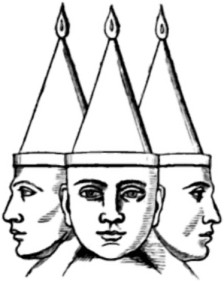
but cosmical heat. The forms of fearful monsters
that originated in Asia, with ferocious jaws, with
three heads, spreading fear and awe, looking as if
nothing but human flesh could satisfy their voracity,
also terrified the Greeks during the mythic period of
their national existence, and human flesh was accordingly
sacrificed. Such sacrifices were prevalent
wherever monster-gods, without human shape, without
legs or arms, with fishes’ tails, dog’s or cat’s heads,
with round and glaring eyes, and many arms, inspired
the masses with fear and trembling. This was the
case in Greece when monsters and pirates peopled the
sea-coasts; when Geryon, the giant with three bodies,
three heads, six hands, six legs, and two wings;
Echidna, the wife of Typhon; the Lernean serpent,
with nine or with fifty heads; the Chimera, with a lion’s
or goat’s head; the Sphinx, with a woman’s head and
bust, the body of a lion, and the wings and tail of a
dragon; and the fearfully howling Skylla, with six
heads and six long necks, formed part of their pantheon.
As soon, however, as poetry threw a glittering
veil of beauty over the forces and phenomena of nature,
no one thought of sacrificing human flesh to the gods.
Who could have slaughtered a human being in the
sight of the Olympian Zeus or the Pallas-Athene of
Pheidias, the Venus of Alkemenes, or the Apollo of
Praxiteles?
The Greek mind, once on the road to progress
through a correct appreciation of beauty, developed
with incredible rapidity.
The elements of art as well as of science are threefold.
We have:—
α. The reign of imagination through the emotional
element, more or less regulated;
β. That of intellect, the reflective element, more
or less influenced by imagination; and
γ. That of reason, the speculative element, discerning
between imagination and intellect, and binding
the two into one.
The first element is the province of the unconscious
artist. He trusts his own subjective imagination,
and sees things only from his individual point of
view.
The second tries to compare the different products
of art, to draw analogies between them, and to assign
causes for certain forms. This is the province of the
chronicler, the antiquary, and the art-historian.
The third reaches the sphere of philosophical
consciousness. In it the esthetical writer combines a
correct appreciation of art as a grand total, with all
its essential details. He sees distinctly its inner
element based on immutable general laws, and comprehends
the necessary organism, without which an
artistic work cannot exist.
Poetry and philosophy, like art, passed through
these developments in Greece. First we have the
epic and lyric poets: Homer, Hesiod, Sappho,
Alkæus, and Pindar; next the dramatic poets:
Æschylus, Sophokles, and Euripides. At last the
philosophers and historians: Plato, Aristotle, Herodotus,
Thukydides, and Xenophon.
In analogy with these purely mental phases we
have in art: the architect, who constructs a small
world of organic coherence out of inorganic matter
by means of his imagination; the sculptor, who reproduces
with discernment the organic world around
him in inorganic matter, but endows it with individual
expression and feeling; the painter at last, who
creates with his colours a union of spirit and matter,
of idea and form.
Beauty was in all Greek products the vital element.
‘True beauty, the companion of the gods,
must be sought for,’ says Pausanias, and makes no
advances; it is too elevated to communicate itself,’
And Plato propounds: ‘The Supreme has no image;
he converses only with the wise; with the vulgar he
shows himself proud and forbidding; always equal,
he expresses the emotion of the souls, he wraps himself
in the delicious calm of that divine nature of
which the great masters in the arts, according to
ancient writers, endeavoured to seize the type.’ This
delicious calm may be traced everywhere in Greek
art, and forms its essential element.
The temples of the Greeks were national and
public buildings. They were not mere shrines destined
as exclusive dwelling-places for some visible or
invisible, concrete or abstract, theocratic monster.
They were the central spots for their national assemblies,
their gatherings, and for the celebration of their
public festivities.
The Olympian, Pythian, Nemæan, and Isthmian
games attracted visitors to these temples. These games
did not consist of mere exhibitions of athletic prowess;
but poets like Pindar—tragedians like Æschylus and
Sophokles—historians like Herodotus—read to enraptured
audiences the masterly products of their intellectual
powers. Wrestlers and runners, sculptors and
poets, and tragic and comic writers vied with one
another to be crowned with a laurel wreath, or to
receive a palm-twig, some a crown, or a tripod. No
sordid feeling of gain mingled with their yet unalloyed
pleasure in being distinguished for mere distinction’s
sake; the commercial question was unregarded. The
prizes, given away in the sight of the delighted masses,
were for everything—for bodily as well as for intellectual
excellence—even for proficiency in the art of
kissing. At the festival of the Philesian Apollo a
prize for the most exquisite kiss was conferred upon a
young lady. At Sparta and at Lesbos, in the temple of
Here, and also among the citizens of Parrhasia, women
contended for the prizes with men. How much we try
to imitate Greek customs may be judged from the
fact, that we also give prizes for exquisite dogs, cats
out of proportion, and fat babies; but we are sorry
to say, that this is done with a keen eye to business—to
advertise a baby-food or a dog-or cat-fancier.
That art is not altogether Greek with us need astonish
no one. We are trained for practical purposes, but
the Greeks were trained to appreciate beauty, symmetry,
and harmony, not in verses only, but also in
the human frame and in every product of art. Architecture
with them was thoroughly plastic; it was
never subservient to some metaphysical subtlety; it
was finished in itself; a total of which every part
formed, as in the human body, a completing element—without
which the whole conception of a temple would
be as incomplete as a man without arms, legs, or toes.
The Greek temple entirely differed from the gloomy
buildings of Egypt or India, which were constructed
as symbols of hell, earth, and heaven; hell was for
the sinners, the outcasts and the poor; earth for the
respectable middle-classes; and heaven for the priests,
the kings and their high officials. The constructions
never made any attempt at symmetrical beauty, but
aimed only at gorgeous pomp, in order to overawe the
credulous mob—mystery was their essence. Sudden
turnings placed the terrified worshipper, unawares, face
to face with some colossal idol, looking to the excited
and surprised imagination twice as large as it was,
and ascending and descending staircases visibly
divided the temple into abodes of splendour and
horror. With the ancient Greeks in constructing a
temple, the first question was the aim of the building;
to whom was it to be dedicated—to Zeus, Apollo,
Poseidon, Minerva or Venus? This question once
decided, the most convenient spot, in accordance with
the character of the god to whose worship the
temple was to be dedicated, was chosen. The building
to be erected was always to be in harmony with the
surrounding scenery.
The temple with the Greeks generally stood on a
terrace-like base of several steps.
The Doric, Ionic, and Korinthian orders, as
architectural subdivisions, are most usual. So far as
the different styles are concerned, a fourth must be
added, which modern art-historians call the Attic.
The Greeks were undoubtedly the first people who
succeeded in producing architectural works of art;
they were also the first:—
(a) To distinguish the material;
(b) To bring about symmetry and proportion; and
(c) To construct with a clear consciousness of
purpose.
Marble was most profusely made use of; wood
also, but the latter by degrees disappeared altogether.
The Athenians completed even the roofs of their
temples in stone.
The Greeks availed themselves of soft materials,
such as clay, chalk, gypsum, and marble dust, for
stucco (κονίασις {koniasis}), in which they excelled all other
nations.
Metal too formed an important element in their
decorations. It is asserted by many authorities that
the Korinthian capital was not the latest development
of Greek architecture; but that on the contrary it
was older than the simplified and more correct Doric
capital, which, showing no traces of wood-construction,
is altogether of a pure ‘stone-feeling,’ whilst the forms
of the Korinthian capital bear undoubted traces of
wood-carving and metallotechnic.
We see that the Greeks employed pliable, plastic,
elastic and solid materials; the great secret of their
success lay in the fact that they made use of these
elements appropriately.
The vertical and horizontal were the principal
lines used by the Greeks. The curved line was not
altogether excluded. The uprising straight lines in
columns were cylindrical or conical. The relation of
the lines to one another, and to the whole of the
building, was regulated by a strict observation of the
laws of proportion.
The diameter or half-diameter of the column (the
module) served as the unit for the whole building.
As in the human body the general law of proportion
does not exclude an infinite diversity of forms, so in
the Greek temples regulation did not preclude variety.
In man the height is limited, and, to a certain extent,
determined by his bones. This was the case in the
Greek temple. The height was limited by the diameter
of the column. Taking two columns of the
same height, the one thin and the other thick, the
thin column will appear high and the other short,
but both will have a certain proportion, taken from
their own body; the one will be, say, nine times the
diameter of its body, and the other only seven times.
Proportion in no way fetters the artist; it allows him
perfect freedom, but freedom in order, without which
no good building is possible. All architectural elements
are of geometrical origin. These elements are
to be divided into those that support, and those that
are supported. The column is the most perfect
supporting body; surrounding a vertical axis in a
slightly conical form. Through the ‘contractura,’ the
swelling or tapering, it assumes the most perfect
expression of the dynamic force in the striving
upwards. Through the square plinth (Abacus) a
harmonious union is effected between column, as
supporter, and architrave, as the supported, or static,
element of the building.
The Greek temple was pre-eminently the house
of the man-like god. The god in the most exquisite
idealised human form was visibly present. A forecourt
(pronaos) led to the cella (naos); there was a
rear-court (posticum), and occasionally a special court
(the opisthodome) was added. Architecture and
sculpture were closely allied in Greece; and still so
clear and rational a separation between these two
art-sisters, as existed there, has nowhere been
observed. Through this apparent contradiction,
architecture gained an independent soul, full of emotion
and life, whilst sculpture obtained a well-proportioned
body, the closely united artistic product
being thus endowed with solidity and firmness.
The general architectural arrangement of a Greek
temple was invariably the same. The cella, the
abode of the divinity, was of smaller or larger
dimensions. Two rows of columns adorned the
interior, supporting an upper gallery. If the central
space was left roofless, to supply the temple with
light, it was called hypæthral. A temple, surrounded
by one row of columns, was designated a Peripteros;
if two rows of columns ornamented it, a Dipteros.
With a front portico it was Prostyle; provided with
a court, both front and back, Amphiprostyle. The
pillars projecting on the side walls were antæ; and
a temple having this decorative element was styled
an Antætemple. The colonnade surrounding the
temple at smaller or greater distances, represented
a combined power of support. The base marked the
independent existence of the separate columns. The
shaft was covered with channelled flutings, and rose
vertically with a convex extension of its circumference
(called entasis). It then strongly contracted, thus
expressing in the most perfect manner not merely
passive sustaining, but an active and lively support.
Above the capitals the mighty beams of the architrave
(epistyle) were held together by a broad band, on
which rested the frieze, sometimes adorned with
triglyphs and metopes, or with reliefs; above it
projected the overhanging plinth of the principal
cornice. On the narrow sides of the oblong building,
bordered by a cornice (the corona, geison) and the
roof-gutter, rose the pediment with its groups and
statues. On the front edge of the roof, both at
the corners and in the middle, there stood smaller
sculptures or marble palm-trees; whilst at the sides
the rain-water was ejected through lions’ heads; the
finishing horizontal lines were eurythmically crowned
with palm-shaped tiles (antifixæ). The roof and the
rest of the building, in the noblest works, were of
marble, the architectural product being thus transformed
into an elegant chiselled work of sculpture.
The Greeks had in their mythology:
1. Powerful gods and goddesses, as Zeus, Pallas,
Poseidon, and Mars.
2. Charming and lovely divinities, as Aphrodite,
Eros, and Persephone.
3. Mixtures of sublime power and beauty, of
manly dignity and womanly grace, as Here, Diana,
Bacchus, and Apollo. In studying the characteristics
of these three groups of divinities we become acquainted
with the principal features of the three
orders of their architecture.
I. The Doric order is full of power and monumental
dignity. Force is its most prominent characteristic.
II. The Ionic order mingles southern imagination
with northern severity; this order, with its voluted
capital instead of the simple abacus, is of a more
complicated character and livelier expression.
III. The Korinthian order exhibits, instead of
the tapering Doric, a slender column—ending in a
richly-decorated, upward-striving capital. There is
something of the Doric style in the Ionic, and something
of the Ionic in the Korinthian. The Doric was,
however, the basis of Greek architecture.
A. The Doric order had six distinct developments
of style.
a. The proto-Doric, compressed and heavy.
b. The lax Archaic-Doric, slender, with more distinctly-tapering
columns.
c. The stern Archaic-Doric, more finished and
graceful in its proportions.
d. The pure Doric, most correct in all its details.
e. The Attic-Doric, during the rule of Perikles,
combining utmost severity with the very highest
refinement in execution.
f. The Makedonian-Doric style; not correctly
proportioned, the columns becoming elongated, and
the distances narrowed. Gorgeousness and vanity
predominate.
B. The Ionic order had three distinct phases of
development in style.
a. The first simple in form, with the strongly-pronounced
volute.
b. The richly ornamented style, as in the temple of
Minerva Polias.
c. The compound style; half Doric and half Ionic.
C. The Korinthian order passed through four
phases of style:
a. The undecided style; half Ionic and half Korinthian.
b. The finished style; graceful and rich.
c. The over-decorated style, with strong Ionic
forms.
d. The variegated style, with decorative additions
of trophies, winged-horses, dolphins, and eagles; half
northern and half southern—combining Asiatic with
Greek forms.
D. The Doric intermingled with Ionic forms produced
in Attica a peculiar order, or rather mere style,
neither Doric, nor Ionic, nor Korinthian—a kind of
eclectic style which we may very properly call the
Attic style. The Erechtheium of Athens was in this
style. There are six principal distinctions in this
style, which justify us in treating it as totally distinct
from those mentioned under A, B and C:—
1. A particular plinth is wanting in the base.
2. Instead of this, a double contraction is transformed
into one, united to the common support by
means of a strong circular ovolo. The contractura is
expressed on a small scale in the base.
3. The shaft is more slender in proportion.
4. The volutes are more projecting.
5. The frieze is considerably higher than it is
generally in any of the other orders.
6. The corona is without the dentated ornament;
but the projecting plinth is strongly undercut, and
powerfully overhangs the finishing member of the
frieze.
In all classifications of this kind a narrow-minded
pedantry is to be avoided; canons, of whatever sort,
hinder the natural growth of art. Still worse than
strict canons is ignorance. Without a correct and
thorough knowledge of Greek literature, no man can
aspire to an exalted position in poetry and science;
and without a correct and thorough study of Greek
art, no man can become an artist. We do not recommend
a slavish imitation of the Greeks, but a thorough
understanding of their slow development, through the
phases of unconscious reproduction and systematically
conscious creation, to the philosophical appreciation of
beauty, which enabled them to reflect in their works
of art the eternal types of Nature in an idealised form.
The same gradual development which we remarked
in their architecture also took place in Greek
keramic art. The oldest pottery was coarse, the
material generally taken from the most recent formation
of the soil, the Cainozoic period. These older
specimens are very much alike amongst all the Aryan
nations. The forms are undecided, and made by the
hand; the ornaments, as in pre-historic times, consisted
of points, zigzags, spirals and knobs. At a
very early period, however, the Greeks as Pelasgians,
Achaians, Danaians and Argeians, possessed more
defined outlines, and a more perfect symmetry, even
in their very coarsest pottery.
In the oldest, so-called Tyrrhenian, vases we
have already a decided plastic improvement. The
ornamentation takes its patterns from metallotechnic,
and we recognise Asiatic influences in the winged
horses and lions, stamped in the clay as flat ornaments.
The Greek taste improved; leaves and
flowers were treated with a delicate, idealising conventionalism;
the vine, ivy, anthimion, and masks and
festoons, were used for decorative purposes, and gave
to the well-shaped vessel a high artistic value. This
was the most successful period of pottery for Greece.
Samos appears to have been the principal place for
its manufacture. The use of the wheel was long
dispensed with; the Greeks trusting more to the
delicacy of their touch than to the technical accuracy
of a machine. In Asia the wheel had long been
known, and it had exercised rather a detrimental than
an improving influence on pottery, as the forms, settled
by religious prejudices, or venerable custom, did not
change, but remained stationary. As soon as the
Greeks adopted the wheel—it must have been in
use before Homer, for he speaks of it—their better-trained
minds brought a new spirit into the handicraft
of the potter, which was then turned into real art.
Korœbos, of Athens, a mythic person, is said to
have elevated keramic art to high perfection. Dibutades
is said to have been the first modeller in clay,
and Talos, his nephew, is mentioned as the inventor of
the potter’s wheel in Hellas.
With reference to the process of colouring we
have two distinct classes of Greek pottery:—
1. The oligochromatic, from ὀλίγος {oligos} (small), and
χρῶμα {chrôma} (colour).
2. The polychromatic, from πολύς {polus} (many), and
χρῶμα {chrôma} (colour).
I. The oligochromatic class of Greek pottery may
be divided into two distinct styles: a. The Archaic;
b. The Hellenic.
A. As soon as the wheel became generally used, a
finer paste was required, fit for exposure to a greater
heat, and for the production of a greater variety of
vessels. In the beginning the paste was coarse-grained
and of a yellowish-grey; later it was fine,
and the colour homogeneous. The glazing was
without lustre, brownish-black, and spotted, proving
a want of experience in baking. We have violet,
brownish-red, and white tints badly fixed on the
black glaze. With the exception of Pithoi (wine
jars) found at Thera, the vessels belonging to the
Archaic style are generally of moderate size, broad
and compressed, with sudden and bold interruptions
of the curves, and abrupt unions of the extremities.
The ornament is not yet an integral part of the
vessel. The general forms are cups, pots, flasks, &c.,
all being entirely black. Some are ornamented with
yellowish or white points, or with simple lines drawn
all over the vessel. By degrees a clearer understanding
of the laws of ornamentation is perceptible; the
ornamentation becomes restricted to the bulge, whilst
rings, meanders, and floral ornamentations mark the
upper and lower parts of the vessel. A further
progress may be seen in the treatment of ornamentation
in the animals which surround the vessels
in parallel circles. Highly interesting are the flowers,
balls, and crosses on these oligochromatic vases. With
the progress of civilisation we find the human figure
introduced, surrounded, however, by monstrous combinations
of Asiatic origin. Genii, with and without
wings, make their appearance; then divinities amongst
lions, panthers, ostriches, and a profusion of symbolic
representations. Swans are either tamed, chased,
or killed. The spirit of Persepolis and Nineveh, of
Phœnicia and Egypt, animates these pre-Homeric
compositions; they are entirely incomprehensible.
This pottery of the Greeks is of the very highest
interest; we may advantageously study in it the
progress of civilisation amongst them.
We have a period in which monster chases
monster; then a period in which men kill monsters;
then, when men begin to settle down, and to pass
from the barbarous state of mere hunters into a more
settled mode of living, freed from obnoxious wild
animals, they fight against men. The conquerors
have decidedly Aryan features, whilst the conquered
have unmistakably Turanian faces. (See the work
of Lord Hamilton.) At length we suddenly surprise
them before the walls of Troy; the incidents of
the Iliad are known, and furnish the potters with
heroic subjects. Achilles and Hektor, Penelope and
Ulysses, may be recognised; the first two in deadly
combat, the two latter meeting after a long separation.
The subject, in these Archaic vases and vessels, is not
yet thoroughly purified, for amongst the heroes we
see Gorgons with spread wings and lolling tongues.
Other monsters, destroying animals, surround the
principal actors of the drama as mere unconcerned
‘dummies.’ We accompany the development a step
further, and observe that the monsters have a share
in the action; they seem to take part pro and con,
like the gods in the Iliad, and, later, they appear in
yet more purified forms as protecting divinities. It
is as if the Iliad had first been drawn in clay by
potters and improved upon, till at last it was shaped
in its divine form, and edited under the name of
Homer.
B. The Hellenic, or classic, style of Greek pottery,
based on the Archaic, shows great improvements in
every direction. The paste is harder, finer, and well
glazed, and the colours are less discordant. The red is
of a fiery brightness, and the black without any spots—sometimes
with a greenish hue. In the decoration great
delicacy of shape and feeling is prominent. The figures
are laid on with anatomical accuracy. The limiting
frame is dispensed with, giving ampler scope to a
freer and still more connected ornamentation. The
curves are less protruding, and the transition from
concave to convex lines is gentler. The canon of this
period, that the vessel had to form in all its parts
one continuous line, rendered these products sometimes
stiff and over-regulated. The influence of the progress
in the Attic style, however, soon corrected this
evil, and the potters of Greece vied with the very
best sculptors and painters in beautiful works.
The Asiatic types of winged or unwinged monsters
were merely used as grotesque or comical friezes,
and soon began to disappear altogether, to make
room for some useful animal, and, finally, to give
place to frets or garlands of the most beautiful combinations.
For the monstrous creations of an overheated
imagination, heroes, gods, and goddesses were
substituted. Perseus destroying Medusa; the Forge of
Hephaistos; a triclinium with Herakles and Alkmene,
Hermes and Athene; diskoboli and their teachers;
Aphrodite at her toilette; Ares, Herakles, Athene,
and Zeus driven in their quadrigas by Nikê;
Elektra at the tomb of Agamemnon; Aphrodite
crossing the sea on a swan; the blind Chiron healed
by Apollo; the weighing of Cupids—‘young loves
for sale;’ and rows of well-sketched warriors, representing
the victories of valour, beauty, and honesty
over barbaric roughness, dishonesty, and despotism,
form the subjects of pictorial ornamentation. What
an immense field for the student of art to peruse, to
fill his imagination with lively classical scenes!
II. The polychromatic style took its origin in the
very first attempts in pottery, when white pipe-clay
was painted over. The colours used were red, violet,
and yellow oxides of iron. At the period when
marble was introduced in architecture, and ivory in
sculpture, during the middle of the fifth century B.C., we
find these highly-coloured and richly-decorated vases.
The paste was very fine, originally white, and the
colouring encaustic. Not only mineral pigments and
metallic oxides, but also vegetable colours, requiring
only a very slow fire, were known and used. The
encaustic consisted of a polychromatic paste more or
less opaque, containing, in addition to wax, also flint,
whether as principal or secondary element it is difficult
to decide. This polychromatic treatment is to
be observed on some smaller vessels, and vases known
under the name of Lekythus (with a narrow mouth),
and on saucers of large dimensions, the outsides
having reddish figures on black grounds, and the
insides, coloured figures on white grounds. Pottery
led to fashioning in clay, and this to modelling in
bronze and sculpture.
Architecture took its origin in religion, as also did
sculpture. Opposed to the inorganic, objective productions
of human intellect, as embodied in architecture,
is spirit aspiring to a subjective existence in
sculpture. The inorganic sternness of architecture is
far surpassed by plastic art, which embodies spirit in
a less fixed form. Spirit is not yet absolutely free,
for it requires a tangible body to show its existence.
Unlike music and painting, which by a mere movement
of the air, or a mixture of tints, produce bodies,
plastic art has to fill the three dimensions of space,
and does this by means of coarse matter—with clay,
wood, bronze, or stone.
Sculpture stands higher in the scale of art than
architecture, for it is not obliged to transform inorganic
matter for a utilitarian purpose.
At a certain period the Greeks were contented
with shapeless divinities; a pointed stone, a square
piece of wood, the deformed root of a tree, a pillar
with a circular finish, or a cone, sufficed for their
piety. Even Plato indulged in the untenable proposition
that art was mere mimicry, and therefore
a falsehood, and detrimental to virtue; as truth
ought to be the only aim of humanity. The Beautiful
with Plato was a mere abstraction, applicable exclusively
to the absolute ‘good’; artistic beauty was
looked down upon by him as something bad and
altogether objectionable. The Kynic and Kyrenæic
schools held to a certain degree the opinions of Plato.
The Kynics said that anything good was beautiful—anything
bad ugly; whilst the Kyrenæics propounded
that everything beautiful must be good—anything
ugly must be bad; and in this way the
notions, good and bad, beautiful and ugly, changed
places. This dialectic difference led at last to Aristotle’s
deeper appreciation of art.
Aristotle, who rarely started from pre-conceived,
à priori ideas, but attached his deep reasonings and
admirable inductions to something tangible and really
existent, pronounced, in opposition to the idealistic
Plato, more correct thoughts on art. Imitation,
mimicry (μίμησις {mimêsis}), is with him the subjective formation
or creation of an idea, and therefore a process far
superior to that of imperfect reality; in fact it is a
sublimated, idealised representation and reproduction
of reality. Next to the ‘mimesis’ he required purification
from all passion (κάθαρσις {katharsis}) to be the aim and
purpose of art. Genius and imagination were the
means by which alone a work of art could be produced.
The principal element in every work of art
was with him ἦθος {êthos}, and wherever Ethos, the ethic or
moral principle, was wanting, the product failed to
be artistic in the highest sense of the word.
The development of Greek sculpture has borne
out the sublime views of Aristotle on art. As soon
as the merely naturalistic and sensational began to
rule supreme, the Katharsis was neglected, the Ethic
no longer swayed works of art, and the Antique died
out.
The priests at Delphos, at a time when Greece
abounded with the most exquisite Apollo-statues,
still held to a pointed pillar as the emblem of the
god of wisdom and the leader of the muses. Anthropomorphism
was long opposed by the hierarchy of
Delphi, but they encouraged the artists to produce
beautiful vessels, tripods, lamps, sacrificial basins, &c.,
which had to be made according to certain prescribed
forms. By degrees the Asiatic idea ‘that God
created man in his own image’ was inverted by the
Greeks, ‘and man began to create the gods in his
own image.’ This one sentence embodies the cause
of the progressive development of Greek sculpture on
the one hand, and the ever-stationary forms of the
East on the other. The Greeks had also idols that
dropped from heaven, puppet-like forms or symbolic
carvings, like the Artemis of Ephesus or the four-armed
Apollo of the Lakedemonians, reminding us
of Vishnu.
The discoveries at Athens, Kyprus, and most
recently at Hassarlik by Dr. Schliemann, prove the
gradual and slow progress of Greek sculpture in all
its different phases. The first Parthenon, destroyed
by the Persians, was adorned with divinities entirely
different in shape from those which surrounded it
after it had been rebuilt 444 B.C. The dresses,
ornamentations, jewels, and pearls are of Assyro-Egyptian
and Indo-Persian patterns. The faces of
the divinities show far more of the Turanian than
of the Aryan type. The eyes are protruding, the
cheek-bones high, the drapery is extremely stiff, the
anatomy doll-like, and the features bear a kind of
repulsive grin. In the gigantic, rock-hewn bull, near
Smyrna, we have a proof that the Indian Nundi and
the Egyptian Apis must have had their worshippers
in Greece.
Of Daidalos it is reported that he was the first
who improved upon these symbolic carvings. He
made winking gods and walking images by means
of mechanical contrivances. He is said to have
been a contemporary of Theseus; both belong therefore
to the mythical period. Though a statue of
Herakles, holding in his right arm a club, whilst his
left extended bears a lion’s skin as a shield, is
attributed to him; and though Homer mentions
Daidalos, of Krete, as having wrought a dance in
metal for Ariadne, which formed the model for that
wrought by Hephaistos on the shield of Achilles;
the fact that the very word to ‘embellish’ is taken
from his name, points less to a distinct person than
to the period in which Greek art began to free itself
from Asiatic bondage.
The historical periods into which we may group
Greek sculpture correspond to those of their architecture.
First period, from the 8th century B.C. to the
Persian wars, 470 B.C.
Second period, from Kimon to the end of the
Peloponnesian war, 470 B.C.-400 B.C.
Third period, from the delivery of Athens to the
conquest of Greece by the Romans, 400 B.C.-146 B.C.
This third period comprises Greek sculpture in its
decline.
Struggle into existence, growth and development,
acme and decline, follow in rapid succession. Wood-carvers
and potters begin; then we have a transition
to bronze-works under Glaukos, who was the first to
solder the separate parts of the statues, which prior to
him had been always beaten into union. Following up
this improvement, the artists of Samos succeeded in
making a clay-model, and then in covering it with
the fluid metal. As if by a supernatural charm the
bright metal statue grew out of the gloomy clay, and
formed an everlasting monument to adorn temples,
squares, and streets. Rhœkos and Theodorus of
Samos, with Smilis, built the Labyrinth at Lemnos,
which they adorned with 150 columns, which were
turned out by an ingenious mechanism, an improvement
on the art of casting in bronze. Pliny describes
a bronze figure by Theodorus, which held in its right
hand a file, and in its left a quadriga with a charioteer,
which was so small that the car, with the four horses
and the driver, could be covered by the wing of a
fly. The celebrated ring of Polykrates, admirably
wrought gold and silver sacrificial vessels, and a vine
with golden leaves and grapes of precious stones, were
also attributed to this artist. At Chios, the birth-place
of Glaukos, the family of Mêlas worked for the
first time in Parian marble; whilst Byzes of Naxos
cut marble into thin slabs for architectural purposes,
giving a more exquisite finish to the houses of the
gods. On every side a marked improvement took
place. The head-dress of Apollo was still that of
the Egyptian sphinx. The faces of the statues were
placid, mask-like, as if modelled separately and then
fixed on; the eyes looked as if first cut out, and then
placed into their sockets; but the anatomy of the body
was treated with greater care and a more refined feeling.
The legs were close together and the arms hung down
perpendicularly, with a prescribed stiffness, but there
were details in the treatment of the stone surface, which
promised well for the future of Greek art, and the
promise was most faithfully kept.
The struggling art freed itself from the fetters of
stern canons. Custom, struck by the lightning of
genius, had to vanish, and life, truth, and beauty
as essential elements ruled the Greek mind. To
blend the isolated perfections of the two sexes into
one became the aim of Greek art. Women were
sculptured with the colder lines of manly firmness,
and men received gentler forms through a less angular
treatment. The artists conscientiously purified their
works from all passions and second thoughts, expressing
nothing that could divert the mind from the simple
admiration of idealised nature. At this period they
only succeeded in animating the limbs of their statues:
action was expressed with great power in strained
muscles and swelling veins. The faces were still
without life, and without a comprehension of those
emotions which vibrate electrically in the countenances
of excited humanity. They could not yet petrify the
thinking soul, but they undoubtedly already succeeded
in sculpturing the animated body to perfection.
The second period was ushered in by the versatile
and productive talents of Onatas, Ageladas, Kalamis,
Iphikrates, Pythagoras of Regium, and Myron.
Greece had attained her independence, the Persian
hordes of despotism were vanquished, and Athens
enjoyed her hegemony. Freedom and national
exultation produced Sokrates, Plato, and Anaxagoras
in philosophy; Kimon, Perikles, and Themistokles
in politics; Æschylus, Sophokles, and
Euripides in dramatic poetry; and Pheidias, Praxiteles,
and Skopas in sculpture. If we add to
this fourfold triad Herodotus, Thukydides, and
Xenophon, we have given an array of names each
of which singly would have filled the world with its
fame, and become a landmark in the progressive
development of humanity. Athens was at this
period the most brilliant centre of intellectual and
artistic life. Men were inspired by the general
animation; they began to modify old thoughts, to
transform eîdola, and to give birth to numberless
productions which in beauty and striving for truth
surpassed anything attempted before. Schools of
arts vied with the schools of wrestlers, poets, and
thinkers, and all excited the dramatists to their
grand conceptions, which again reacted on plastic
art. Under these influences the imaginary theogony
yielded to a more scientific inquiry into the origin
of all things, which led to the recognition of the first
incomprehensible, immutable, eternal cause, no longer
based on mere belief, but on the immovable rock of
scientific conviction. No wonder that art was also
inspired by this spiritual movement. The conceptions
of the priests and philosophers were to be loudly
proclaimed in visible forms, and the sculptor, from a
deep feeling of veneration for the Supreme Artist of
the Universe, became the expounder of the divinity,
and the exclusive high priest of beauty and truth.
Instead of singing Vedantic hymns or Egyptian
psalms and litanies to the glory of God, the Greek
sculptors hewed the gods in majestic forms, and every
touch of their chisels on the lifeless marble, every
blow of their hammers, became an eternally resounding
prayer in honour of God.
Wood, metal, clay, precious stones, and marble
had by degrees yielded to the creative power of the
Greek masters; and matter could no longer resist in
any way their ruling intellectual force. At this moment,
under these circumstances, Pheidias, the son of Charmides
of Athens, the pupil of Hegias and Ageladas,
stepped forward, and was raised by the superiority of
his genius to the dignity of king of Greek plastic
art. The Zeus of Olympia and the Athene of the
Parthenon qualified Pheidias as the sculptor of the concrete
form of the divinity; for if the father of the gods
had had a visible form, and his wisdom and intellect
had been incarnate in Athene, both must have looked
as they were sculptured by Pheidias. In symbolic emblems
he poetically expressed the powers of the two
divinities; and used the mineral, the vegetable, and
animal kingdoms to glorify their power.
Nothing is left us of these two master-pieces but
the glowing descriptions of those who saw and admired
them. That which a combination of thousands
of our artists, with all our technical advancement, can
scarcely accomplish; the drawing of thousands and
thousands of intellectual human beings together to
admire their works of art; was done by Pheidias.
Men flocked from all parts of the world to see and
admire his statues, and to offer fervent thanks to the
Father of all for having endowed one of his creatures
with the power to give a correct form to Homer’s
lines:
He (Zeus) spoke, and awful bends his sable brows;
Shakes his ambrosial curls and gives the nod,
The stamp of fate, and sanction of the god;
High heaven with trembling the dread signal took,
And all Olympus to the centre shook.
We possess in the Vatican a copy of the original
head of the Jupiter, and what a master-piece even
this bad copy is! What a power in the bold, arched
brows; the large eyes with their benevolent, forgiving,
and yet commanding glance; the full, parted
lips ready to bless and to forgive; the luxuriant
beard, the mighty locks inspiring veneration, and the
beautifully-rounded cheeks, expressive of creative
force and eternal manly beauty! The independent
works of Pheidias were very numerous. Besides the
two colossal divinities of bronze (Athene Promachos,
50 feet high, and Athene ἡ Λημνία {hê Lêmnia}), we find twelve
others mentioned: of these, six were statues of Athene;
one colossal Apollo of bronze, 70 feet high; one
marble Hermes; three of Aphrodite (two of marble,
and one of ivory and gold); a mother of the gods,
material unknown; and an Asklepios (Æsculapius) of
gold and ivory. Of sacrificial statues, a group of
thirteen bronze figures, in commemoration of the
victory of Marathon, is mentioned as having been
executed by him. In this work twelve mythical
characters surrounded one historical figure—that of
Miltiades; a proof that the Greeks attributed their
victory far more to the help of the gods than to the
exertions of their leaders. They were much more
inclined to adorn the courts of their temples and
their public places with the statues of orators, wrestlers,
poets, artists, and philosophers, than with those
of men who, in defending their country against invading
hordes of barbarians, did their duty and nothing
more. What a scope for our artists if we were to
adorn our town-halls, courts of justice, our museums,
universities, academies, public places, and churches
with the statues of those who had devoted their
energies to religion, oratory, science, art, politics, and
the general welfare of their country! If gratitude
were to prompt us to do this, and not childish vanity
or egotistical pride, we should shortly have many
Pantheons with excellent sculptures.
In no town in Europe can the artist study the
sculptural splendour of ancient Greece with greater
ease than in London. Of the ninety-two metopes
which adorned the Parthenon on the Akropolis at
Athens we possess seventeen; of the frieze of the
cella 3–1/5 feet high and 524 feet long, representing
the Panathenaic procession, we possess fifty-three
plates and casts of the whole western side. In
all these sculptures what a clear power of grouping,
what a variety of characters, what handsome men
and women! The flower of Athens is seen assembled
to do homage in joyous excitement to the supreme
divinity of the State, the embodiment of wisdom and
intellect. Some are crowned with wreaths; others
carry sun-shades, chairs, splendid pitchers, ornamented
vases, or decorated pateras; some are ready to
start; others, preparing in animated haste to take their
places, are in the act of mounting their prancing
horses, or, already mounted, eagerly await the arrival
of their friends. On the eastern side, under the entrance
to the temple, there was an admirable group of
gods and goddesses, in whose presence peplus, or
sacred veil, is delivered to the authorities of the
temple; animals are led to be sacrificed—flute and
kythara-players follow. Amongst the hundreds and
hundreds of figures not one is like the other; the
exquisite variety in the folds of the dresses of the
sitting, standing, walking, riding, driving groups is in
general unsurpassed for beauty of design, and perfection
of execution. None of the figures are raised
more than three inches from the background, and yet
the most correct perspective is observed. There is
such a softness and truthfulness, such a firmness and
ideal vitality in this frieze, that we may at least
attribute the composition to Pheidias himself. Some
plates of the western side are less excellent in execution;
the forms are marked with roughness and
dryness, and some faults in the outlines are also
apparent to the critic. Some of the horses have legs
too long, and bodies too thin; in one of the horses,
which is bending its neck to rub its head against one
of its fore feet, the curves are much too stiff. The
execution of these reliefs must have been left to some
inferior artist. What we must admire is, that there
are so few faults. The correct study of this frieze
ought to serve us as an example in grouping, and
would teach us how to arrange a marble strip round
some monument for the sake of decoration. Little of
this influence, however, is to be observed in our
sculptors. We intend to evolve sculpture from our own
inner consciousness, and neglect these ancient books
with their glorious poems in Pentelic marble; we
prefer ‘going to nature’ as the popular phrase runs,
and ignore or despise the study of the antique.
Now the Greeks had an opportunity of going to real
nature—not with the darkened eye of Asiatic prejudice,
despising matter and exalting spirit—but
with a prejudice in the very opposite direction, cultivating
spirit only so far as it served to embellish and
to reproduce form. In this they attained perfection,
and to surpass them in sculpture is after all impossible;
we can only try to equal them, and to learn from
what they have left us, to produce other combinations.
In this spirit we ought to study the nine figures from
the eastern pediment of the Parthenon, in the British
Museum. What forms, what exquisite drapery! The
finest tissue of pliable stuff is reproduced in hard
Pentelic marble. The drapery disguises, and at the
same time reveals, the beautiful forms of the human
frame. Softness and sensationalism were equally
avoided by Pheidias and his school. The study of
anatomy was not yet degraded to coarse realism. It
was not yet the aim of Greek sculptors to distort the
human body so as to exhibit expanded muscles, over-strained
sinews, and swelling veins, as expressions of
pain, grief, distress, or contortions of the death-agony.
Anatomy served Pheidias as a mould, into which he
poured his beautiful conceptions—the spiritualised
forms of gods and men. Katharsis was the principle
of his school. The very heights of perfection were
reached by Pheidias, Polykletus, and Alkemenes.
Gods and goddesses were the subjects of their chisels.
They were not only the high-priests of art—but inspired
prophets, to whom divine beauty was revealed
in all its brightness and splendour.
The existence of the Greek State was suddenly
shaken to its very foundation. Internal dissensions
weakened the safety of the citizens; sophistry destroyed
philosophy, and mannerism grasped Greek
art, dragged it down from its heights of idealised
beauty and hurled it into the abyss of sensational
realism. The best specimen of this school is the
frieze from the temple of Apollo at Bassæ, near
Phigalia in Arkadia. (Found 1812, now in the
British Museum.) It represents Kentaurs fighting
with Amazons. The old Indian Ghandarvas, the
moist and heavy clouds that hinder the sun from
breaking forth in all his glory, and are conquered by
his fiery shafts, became in time monsters, half-men,
half-horses, fighting against loveliness and civilisation.
The Amazons in this instance represent fair Greece
rushing into civil strife. Passion is predominant in
action and expression. Amazons are dragged by
the hair and by the legs from their horses; a Kentaur
is seen biting a warrior in the shoulder. Bold naturalism
and vulgar realism go hand-in-hand in these
sculptures. How sensitive art is—how faithfully it
reflects the social condition of a nation! and the feelings
by which the artists were pervaded may be studied
in this frieze. The nude is treated with exquisite
truthfulness, but there is heaviness in the sudden, too
violent movements. Action and expression lose the
balance of the symmetrical. The women are common;
their drapery floating and yet stiff, deranged for the
sake of effect. The artists worked no more with love
and security. The political party spirit troubled
their imagination. The chisel trembled with rage
or fear, with hatred or passion, in their hands; they
saw prophetically the national downfall of their
country, and with it science, art, poetry, and philosophy
were to be rendered for thousands of years
houseless and homeless.
Once more art revived under Skopas, Praxiteles,
and Lysippus, but in a totally different shape. Greece
had lost through her civil war the proper balance
between her moral and intellectual forces. Simplicity
and refinement of thought had vanished. In
literature metaphors prevailed; in politics Aristides
had to yield to the double-tongued Alkibiades; in
tragedy Sophokles was superseded by Euripides;
in sculpture the immortal Pheidias was followed by
Praxiteles. The national spirit of the Greeks, inspired
by common interests, swayed by the very
highest aspirations in arts and sciences, suddenly collapsed
into a narrow-minded, particularising egotism.
Tribes cared only for tribes, parties for parties. The
public buildings began to be neglected, whilst the
private dwellings gained in ornamentation and
comfort, what was denied to the grand national
enterprises. The public places were no longer adorned
with the statues of those who had gained the general
approbation of the masses. The artist, doubtful
whom to please, tried to please everyone, or to
satisfy the individual fancy of a paying patron. Art
was no more the chaste virgin sacrificing to beauty,
but became a courtesan seeking general and special
favour at all hazards. The divinities were no more
the representations of a spiritual eîdolon, but a glowing
sentiment of sensual love was poured over their
frames; they were no longer ideal conceptions in
marble, but beautiful flesh forms in stone or
bronze. They lost all generalisation, they were more
correct in the anatomical outlines, but a passionate
sentiment of sensuality thrilled through every
point. Kephisodotus (the elder), probably the father
of Praxiteles, embodied the change in Greek
thought in a beautiful group. Eirene (peace) fondles
the child Pluton (riches)—a splendid allegorical representation
of the political condition of Greece at
this time. ‘Let us put an end to our quarrels; let
us have peace, and enjoy life once more.’
Skopas, born on the island of Paros, expressed
the modern flow of ideas in Greece with greater
clearness. Violent scenes of deadly struggle filled
the pediments of the temple of Athene Alea at
Tegea. In front, the hunt of the Kalydonian boar
by Herakles, at the back Achilles fighting with
Telephos was represented. An under-current of
thought, a kind of allegory, may be traced in this
composition, for the boar to be hunted was the
opposition. Art was no longer to exalt the mind
unconditionally, but to fulfil another purpose—to irritate,
to excite to hatred, and to arouse passion; thus
placed, art must lose its civilising influence, and it
did this step by step. Even the divinities sculptured
by Skopas were not to inspire veneration, but to
please by little allegorical additions; his Apollo
(Smintheus) stood on a mouse; Apollo, the leader of
the muses, the representative of vivifying light in art,
science, and the universe, degraded to a beautiful
‘mouse-killer.’ Aphrodite, the mother of humanity,
was sculptured sitting on a goat—the vilest emblem
of passion in union with the purest eîdolon of tender
love. Another Apollo was represented in the long
waving robes of an elegant Grecian lady playing the
lyre; this was still more objectionable. Though the
drapery excites our admiration by its exquisite softness
and finish, the statue appears to have been
chiselled to show the artist’s skill in carving a heap
of waving drapery. Whenever art condescends to
such tricks it is on the high-road to degradation.
Skopas composed a splendid group for a pediment,
representing Achilles receiving from his mother the
arms forged by Hephaistos. The principal figures
are Thetis, the queen of the bright green waves,
Poseidon, and Achilles; they are surrounded by a
crowd of Nereids and Tritons, all in harmonious
arrangement. Richer in grouping are some marble
reliefs (now in the Glyptothek at Münich), representing
the wedding of Poseidon and Amphitrite.
The mother of the bride, Doris, is seated on a Hippokamp
(sea-horse), holding two torches towards the
couple; Tritons play on shells and lyres a merry
wedding tune. Nereids surround them. One rides
on a sea-bull, led by a mischievous-looking Eros,
standing on its left fore-foot; another, mounted on a
fantastic sea-monster, is accompanied by another, borne
by a Triton; other Nereids follow, pointing towards
the principal group, one sitting on a Hippokamp,
with an Eros on its curled tail; a dragon carrying a
Nereid is led with self-conscious pride by another
Eros, whilst a Triton carries another sea-nymph on
his winding body with placid and contented looks.
The composition in general, and in all its details,
is perfect. Without over-crowding the allotted space,
it could not be better filled up. There is a striking
freedom in the lines, and lively contrast of forms.
We may consider this relief the prototype of all
those fantastic compositions of the pure renaissance
style, in which we see dragons and monsters, bulls
and horses, entwined with plants and flowers, nymphs
and gods, everything real and imaginary, beautiful
and graceful, united into one great dissonant
harmony. Skopas was the first (so far as we know)
who sculptured Venus in the full beauty of her nude
body. Pheidias would have considered such a treatment
of the mother of mankind blasphemy. In a
group of Eros, Himeros, and Pothos (Love, Longing,
and Desire), we find a classification of a general
feeling into three distinct subdivisions, executed with
conscious discernment in order to produce a sensational
effect. A raving Bacchante appears to rush
away with dishevelled hair, in flowing robes; the head
is thrown backwards in delirious delight; the marble
lives and breathes maddening joy, but is vivified with
sensual feelings, and not inspired with the elevating
spirit of artistic simplicity and purity.
Of this period we may study another master-piece
in the British Museum; the frieze of the tomb of
Mausolos at Halikarnassus. The greater part is in
London and the remainder at Genoa. The subject
is a battle between Greeks and Amazons. The composition
is nearly as good as that on the Parthenon.
There is a continuous symmetrical stream of action
and reaction, as in the dashing waves of a stormy
sea. Skopas worked the eastern, Bryaxis the
northern, Timeotheos the southern, and Leochares the
western side. Many mistakes may be found in the
details, but the whole is a master-piece of manly
thought;—it may be said to have been the last manly
product of the period.
Praxiteles altogether turned the scale; Aphrodite,
Demeter, Persephone, Flora, Eros, Dionysius,
and Apollo, are the divinities mostly sculptured by
him. Everything is smooth, young, and effeminate.
All harshness of line is avoided, all loftier ideas discarded.
The flesh become stone is placed before us
in charming and full roundness. Aphrodite was no
longer draped—but with the concealing drapery the
higher conception of the divinity fled. Venus, conscious
of her charms, with a smile on her lips, and a
coquettish movement of her hand, sinks to the level
of an every-day woman. Venus had eaten of the tree
of knowledge; with the consciousness of her particular
womanly charms the ideal of divine universality was
gone.
We possess of Praxiteles, an Eros in the Vatican,
and his celebrated Apollo with the lizard (Saurokthonos)
in the Louvre. Both these statues are more
women than men. The lines are too soft; the bodies
as though without muscles or bones, composed only
of flesh and fat. It is true that the older artists also
softened down the too marked lines of the sexes, and
in blending them together created ideal forms of
beauty; but now the mere surface of the woman’s
body was used for both sexes, to affect the senses
exclusively.
Three groups (the one probably for the pediment
of a temple, the other two forming independent works
of art) deserve special mention.
The group of Niobe and her dying children,
attributed to Skopas or Praxiteles. Greece was fast
sinking. Niobe-Greece sees her children struck down
one after the other by the inexorable decree of the gods,
who are bent on punishing the proud mother who only
cared for the outward beauty of her children, and
neglected their moral inner grandeur. Niobe, amidst
a harmonious confusion of misery and endless woe,
stands erect, and presses the youngest child to herself,
turning her proud looks upwards, her eyes filled with
tears of heroic resignation—for she knows the gods
have willed her downfall, and their will is unalterable.
This moment of agony, of mental rather than bodily
suffering, makes the group a master-piece of antique
beauty and grandeur.
This cannot be said of the sensational Laokoön,
the joint work of Agesander, Athenodorus, and Polydoros
(of which there is a copy in the Vatican), and
the so-called ‘Farnese Bull,’ the joint work of Apollonios
and Tauriskos (a copy of which exists in the
museum at Naples). Bodily anguish is the dominating
element in these two groups. If it were the
province of art to depress the soul, and to fill us with
pain and horror, nothing could surpass the technical
skill with which these two are arranged.
In the first we have:—
1. In the father a stifled death scream.
2. In the younger son, to the right, the last convulsions
of a dying boy.
3. In the elder son, to the left, an unbounded horror
at witnessing the frightful death of father and brother.
There is no psychological necessity in this group
to indemnify us for the pathological and anatomical
truthfulness of so great an amount of horrible suffering.
Art has never to serve as a hospital ward, and
to force us to witness the contortions of a poor family
dying poisoned by strychnine or arsenic. Not less
objectionable is the revenge of a mother and her two
sons on a defenceless woman. In this group we
have:—
1. The horror-stricken, half-dying, half-imploring
look of poor Dirkê.
2. The merciless glance of the jealous Antiope,
wrapt in placid satisfaction to see herself revenged on
her rival.
3. The ferocious anger of the two passionate sons;
and, lastly,
4. The wild look of the furious bull, ready to dash
the beautiful frame of a frail woman to pieces. Dramatic
justice is here meted out by the artist in a most
revolting way. A bull is called in to help to punish;
it is the vulgarity of the cruel revenge that degrades
the technically masterly work of art. The free
grouping of marble statues is one of the most difficult
tasks, and was never attempted during the classic
period of ancient art. A mixture of men and animals
is even more to be avoided.
As soon as the gods of Egypt changed their
architectural and monumental position, they lost
their sway over the superstitious masses; as soon as
the Greeks lost that balance of morality, which, in the
form of the beautiful, regulated their life, science, and
art, they lost at the same time their productive power.
Form and idea as in Asia came into conflict; the
formal had attained the extreme of perfection, and
the new ideas had not yet ripened.
Art was either to touch the feelings or to speak to
reason—it was to be based on a mere imitation of
nature, or to be the expression of some thought in
some form. This ‘either,’—‘or,’—or this ‘neither,’—‘nor,’
which divided art-critics during this period,
made an end of art altogether. The Asiatics rent the
universe asunder with conflicting abstractions based
on the phenomena of nature; the Greeks lost their
power, when they once recognised that there was
something higher than the mere form. A new sphere
was felt to open new spiritual beauties—but this
sphere was to be attained through totally different
means. The formal was however so highly developed
by the Greeks that we shall see the new spirit, after
more than a thousand years, become incarnate in those
forms.
We see then clearly that art, the product of the
creative force of men, requires a certain moral and
intellectual condition, under which alone it can actively
live. Change the moral temperature through the
superstitions of a terrified populace, the aspect of
nature, the despotic organisation of government, or
the rule of a wild, uneducated mob, and the artistic
force will also change or die out altogether. The
artist acts only to a certain degree on the public; the
public reacts with a greater combined vis inertiæ on
the artist, who is merely the reflection of certain
ideas floating in the intellectual atmosphere around
him. Is a man who sees nothing but emaciated,
beggarly, or sanctimonious faces, thin limbs, hungry
looks, dwellings bare of all domestic comfort, decayed
brick-houses and crumbling walls, to paint convivial
scenes of happiness and joy? Or let him change this
atmosphere and live in a sphere of so-called respectability;
having always the same bland smile before
him, the same trimmed whiskers, the same business-like
self-contentment, the same stiff collars and cuffs;
hearing the same stereotyped, insignificant phrases
about the weather or the funds, the price of coals or
meat—will he, influenced by such an atmosphere, not
draw or paint only caricatures, and never grand and
heart-stirring historical paintings, recording in glowing
colours scenes full of life, excitement, passion,
and dramatic action? In such surroundings it is
necessary for an artist to create for himself a world of
his own—an intellectual world—by turning to the
glorious records of the past, and devoting every
spare hour to the study of the ancients and the reading
of history. His imagination, deadened by reality,
must be fed and nourished by the poets, poetry,
works of art, and historical facts of the past. Our
meagreness and poverty in artistic productions take
their origin in our unpardonable neglect of the study
of history; through this neglect we have deprived art
altogether of its firmest basis.
The very moment that the Greek artists lost their
historical and poetical ground, they took to and excelled
in painting barbers’ and shoemakers’ shops;
oyster shells, vases, little combinations of chairs and
musical instruments, and small things, with great
accuracy. In fact the same causes produced the same
pictorial effects; the mind of the Greek nation had
dwindled, and their works of art embraced decorations
of household furniture and pottery. In these ornamentations
the reminiscences of a by-gone age may
be traced; they are still symmetrical to the highest
degree, plants are still treated with great conventional
freedom, but the Greeks only worked as skilful workmen—artists
they produced no more.

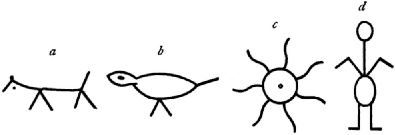
 .
By uniting these five points they produce
that ingenious system for the conventional
treatment of flowers and animals, which has been
divided by Owen Jones
.
By uniting these five points they produce
that ingenious system for the conventional
treatment of flowers and animals, which has been
divided by Owen Jones 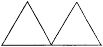 which formed three triangles symbolically representing
the three forces in
which formed three triangles symbolically representing
the three forces in  meaning the preserver; whilst S’iva had for his symbol
a triangle with the apex upwards,
meaning the preserver; whilst S’iva had for his symbol
a triangle with the apex upwards,  denoting the transformer.

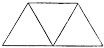


 the serpent, was added, the form
without beginning and end; no wonder that, encircling
the equilateral triangle and joined to the square,
it became the symbol of the mysterious, incomprehensible
forces of nature. The triangle, square, and the circle
the serpent, was added, the form
without beginning and end; no wonder that, encircling
the equilateral triangle and joined to the square,
it became the symbol of the mysterious, incomprehensible
forces of nature. The triangle, square, and the circle