No subject, of late years, has so much engrossed the attention
of geologists as the antiquity of the human race. The
interest was greatly increased by the publication of Sir Charles
Lyell's "Antiquity of Man." This work called the attention
of the public to the subject, and so great became the interest
that many volumes and memoirs have been added to the list,
discussing the question in various ways, and, for the most
part, in such a manner as to add fresh interest and throw
more light on the subject. The scientific men were slow to
take advantage of the discoveries continually being made of
the bones and works of man found in caves and associated
with the remains' of extinct animals. It is probable, even at
this late day, there would not have been so much discussion
of this subject had not Sir Charles Lyell lent the weight of
his great name to it. Educated men, everywhere, began to
doubt the correctness of Archbishop Usher's chronology, and
so complete has been the revolution of opinion that it is
almost impossible to find an intelligent man who would limit
the period of man's existence to 6,000 years.
To Aimé Boué, a French geologist, must be attributed the
honor of having been the first to proclaim the high antiquity
of the human race; to Dr. Schmerling, the learned Belgian
osteologist, on account of his laborious investigations, untiring
zeal, and great work on the subject, the merited title
of being the founder of the new science; to M. Boucher de
Perthes, its great apostle; while to Sir Charles Lyell and Sir
John Lubbock must be ascribed the honor of having made
the new theory popular.
The new science soon became permanently established,
and the geologists at once set about classifying the facts before
them, in order to assign to them their respective places
in the geological epochs. All are agreed in respect to the
chronological orders, but all have not used the same nomenclature,
in consequence of which more or less confusion has
been the result. Sir J. Lubbock has divided pre-historic
archæology into four great epochs, as follows:
"I. That of the Drift; when man shared the possession
of Europe with the mammoth, the cave-bear, the woolly-haired
rhinoceros, and other extinct animals. This we may
call the 'Palæolithic' period.
"II. The later or polished Stone Age; a period characterized
by beautiful stone weapons and instruments made of
flint and other kinds of stone; in which, however, we find no
trace of the knowledge of any metal, excepting gold, which
seems to have been sometimes used for ornaments. This we
may call the 'Neolithic' period.
"III. The Bronze Age, in which bronze was used for
arms and cutting instruments of all kinds.
"IV. The Iron Age, in which that metal had superseded
bronze for arms, axes, knives, etc."[1]
These divisions are recognized by Lyell and Tylor.
Edward Lartet has proposed the following classification:
I. THE STONE AGE.
1st. Epoch of extinct animals (or of the great bear and
mammoth).
2d. Epoch of migrated existing animals (or the reindeer
epoch).
3d. Epoch of domesticated existing animals (or the polished
stone epoch).
II. THE METAL AGE.
1st. The Bronze Epoch.
2d. The Iron Epoch.
This mode of division is adopted by M. Figuier, in his
"Primitive Man," by the Museum of Saint-Germain in that
portion devoted to pre-historic antiquities, and adhered to in
essential points by Troyon and d'Archiac.
Professor Renevier, of Lausanne, has proposed a somewhat
different scheme, founded upon the epochs of Swiss
glaciation. It is as follows:
"I. Pre-glacial Epoch, in which man lived cotemporaneously
with the elephant (Elephas antiquus), rhinoceros
(R. hemitæchus), and the cave-bear (Ursus spelæus).
"II. Glacial Epoch, in which man lived cotemporaneously
with the mammoth (Elephas primigenius), rhinoceros (R.
tichorrhinus), cave-bear, etc.
"III. Post-glacial Epoch, in which man lived cotemporaneously
with the mammoth and reindeer (Cervus tarandus).
"IV. Last Epoch, or epoch of the Pile-buildings, in
which man lived cotemporaneously with the Irish elk (Megaceros
hibernicus), aurochs (Bison Europæus)," etc.[2]
Westropp divides the periods of man, in respect to his
stages of civilization, as follows: Savagery, hunters, herdsmen,
and agriculturists.
In the following pages a somewhat different classification
has been adopted, and may be thus explained:
I. Pre-glacial Epoch; that period antedating the glaciers
of the post-tertiary, in which man lived cotemporaneously
with the animals of the tertiary, southern elephant (E.
meridionalis), etc.
II. Glacial Epoch; that period of the post-tertiary when
man was forced to contend with the great ice-fields and the
floods immediately succeeding them, when the mammoth
(E. primigenius), rhinoceros (R. tichorrhinus), cave-bear, etc.,
began to flourish.
III. Interglacial Epoch; that period between the glacial
and the second advance of the ice, in which man lived cotemporaneously
with the animals of the preceding epoch,
and the cave bear became extinct.
IV. Reindeer Epoch; that period when the glaciers again
advanced; in which man's chief food consisted of the flesh of
the reindeer (C. tarandus), that animal having made its way
in numerous herds as far south as the Pyrenees.
V. Neolithic Epoch; that period in which man polished
his weapons of stone, and sought to domesticate certain animals,
the dog, etc.
VI. Bronze Epoch; that period characterized by weapons
and implements being made chiefly of bronze.
VII. Iron Epoch; that period in which bronze was generally
superseded by iron.
This classification, on the whole, seems to be the best that
could be devised, for the reason it attempts to place the evidences
of the existence of man in their relative geological
positions.
Other methods have misled the student. There was no
universal Stone, Bronze, or Iron Age. The classification
given by Lubbock applies to Europe, but is too general. I
have adopted the word "Neolithic" for want of a better
term, although the signification of the word is appropriate to
the period it is intended to represent.
These various epochs are not sharply defined, the one
from the other; but one merges into the other by gradual progression
covering a period of thousands of years. The growth
of the various plants and animals, and their retreat or final
extinction, have also been very slow.
An outline of the history of the discoveries which led to a
careful investigation of the question, and which resolved the
question into a science, is not only one of interest but also of
importance to the careful thinker seeking information on
the subject.
Prior to the study of the ancient implements the "people
had so little notion of the nature and signification of the
stone axes and weapons of earlier and later times that they
were regarded with superstitious fear and hope, and as productions
of lightning and thunder. Hence for a long time they
were called thunderbolts even by the learned.... As
late as the year 1734 when Mahndel explained in the Academy
of Paris that these stones were human implements, he was
laughed at, because he had not proved that they could not
have been formed in the clouds."[3]
As early as the year 1700, a human skull was dug out of
the calcareous tuff of Constatt, in company with the bones
of the mammoth. It is preserved in the Natural History
Museum at Stuttgart.
In the year 1715, an Englishman named Kemp found in
London, by the side of elephants' teeth, a stone hatchet, similar
to those which have been subsequently found in great
numbers in different parts of the world. This hatchet is still
preserved in the British Museum.
In 1774, in the cavern of Gailenreuth, Bavaria, J. F. Esper
discovered some human bones mingled with the remains
of extinct animals.
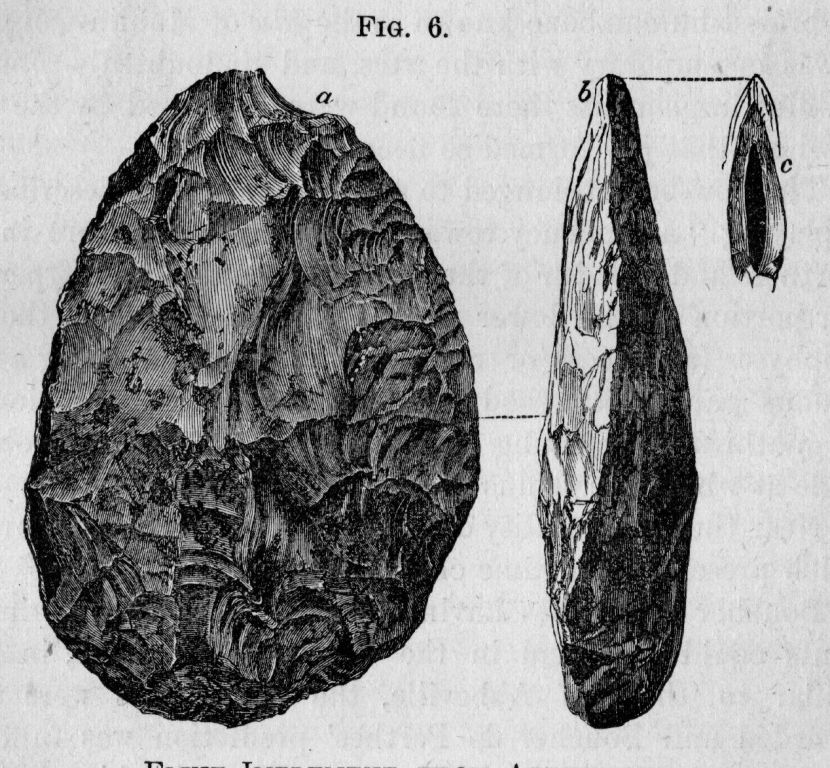
In 1797, unpolished flint axes were dug out in great numbers
from a brick-field near Hoxne, county of Suffolk, where
they occurred at a depth of twelve feet, mingled with the
bones of extinct species of animals. They were gathered up
and thrown by basketsful upon the neighboring road. In
the year 1801, before the Society of Antiquaries, John Frere
read a paper upon them, in which he stated that they
pointed to a very remote period. This communication, short
as it was, contained the essence of all subsequent discoveries
and speculations as to the antiquity of man. But the society
regarded the subject as of no importance.
During the construction of a canal (1815-1823) in Hollerd,
there was found, near Maestricht, in the loess, a human
jaw in company with the bones of extinct animals. This
bone is preserved in the museum at Leyden.
In 1823, Aimé Boué disinterred portions of a human skeleton
from ancient undisturbed loess near Lahr, a small village
nearly opposite Strasbourg. These bones were placed in
the care of Cuvier, but, having been neglected, are now lost.
In the same year, Dr. Buckland, an English geologist, published
his "Reliquiæ Diluvianæ," a work principally devoted
to a description of the Kirkdale Cave. The author combined
all the known facts which favored the coexistence of
man, with the extinct animals.
In 1828, M. Tournal and M. Christol explored numerous
caverns in the south of France. In the cavern of Bize,
Tournal found human bones and teeth, and fragments of rude
pottery, together with the bones of both living and extinct
species of animals, imbedded in the same mud and breccia,
cemented by stalagmite. The human bones were in the same
chemical condition as those of the extinct species.
M. Christol found in the cavern of Pondres, near Nimes,
some human bones in the same mud with the bones of an
extinct hyena and rhinoceros.
In 1833, Dr. Schmerling explored the two bone-caverns
of Engis and Enghihoul (Belgium). In the former he found
the Engis skull (now in the museum of the University of
Liége), at a depth of nearly five feet, under an osseous breccia.
The earth also contained the teeth of rhinoceros, horse, hyena,
and bear, and exhibited no marks of disturbance. He also
found the skull of a young person imbedded by the side of a
mammoth's tooth. It was entire, but so fragile, that it fell
to pieces before it was extracted. In the cave of Enghihoul
he found numerous bones belonging to three human individuals,
mingled with the bones of extinct animals. In these
caves he noted rude flint instruments, but did not collect
many of them. In the care of Chokier, he discovered a polished
and jointed needle-shaped bone, with a hole pierced
through it, at its base. The caves of Engis and Chokier have
been annihilated, while only a part of Enghihoul remains.
Soon after these discoveries Dr. Schmerling published a
work which described and represented a vast quantity of
objects which had been discovered in the Belgian caverns.
The scientific men were not yet prepared to receive the new
discoveries, and it attracted but little attention at that time.
Too much praise cannot be bestowed upon Dr. Schmerling
for his unremitting labors. Of these labors Sir Charles Lyell
has said: "To have undertaken, in 1832, with a view of
testing its truth (antiquity of fossil human bones) to follow
the Belgian philosopher through every stage of his observations
and proofs, would have been no easy task even for one well-skilled
in geology and osteology. To be let down, as Schmerling
was, day after day, by a rope tied to a tree, so as to slide to
the foot of the first opening of the Engis cave, where the best-preserved
human skulls were found; and, after thus gaining
access to the first subterranean gallery, to creep on all fours
through a contracted passage leading to larger chambers, there
to superintend by torchlight, week after week and year after
year, the workmen who were breaking through the stalagmitic
crust as hard as marble, in order to remove piece by
piece the underlying bone-breccia nearly as hard; to stand
for hours with one's feet in the mud, and with water dripping
from the roof on one's head, in order to mark the position
and guard against the loss of each single bone of a skeleton;
and at length, after finding leisure, strength, and courage for
all these operations, to look forward, as the fruits of one's
labor, to the publication of unwelcome intelligence, opposed
to the prepossessions of the scientific as well as the unscientific
public;—when these circumstances are taken into account,
we need scarcely wonder.... that a quarter of a
century should have elapsed before even the neighboring professors
of the University of Liége came forth to vindicate
the truthfulness of their indefatigable and clear-sighted countryman."[4]
In 1835, M. Joly, then professor at the Lyceum of Montpellier,
found in the cave of Nabrigas (Lozére) the skull of
a cave-bear, on which an arrow had left its mark. Close
by, was a fragment of pottery marked by the finger of the
moulder.
It was in the valley of the Somme (a river in the north of
France) that M. Boucher de Perthes found those famous flint-axes
of the rudest form. His explorations had been going
on for a long time. He did all he could to bring these discoveries
before the public. In the year 1836 he began to proclaim
the high antiquity of man, in a series of communications
addressed to the Société d'Emulation of Abbeville. To
the same society, in the year 1838, he exhibited the flint-axes
he had found, but without result. In 1839, he took these
hatchets to Paris, and showed them to some of the members
of the Institute. At first they gave some encouragement
toward these researches; but this favorable feeling did not
last long. In 1841 he began to form his collection, which
has since become so justly celebrated. He engaged trained
workmen to dig in the diluvial beds, and in a short time he
had collected twenty specimens of flint wrought by the hand
of man, though in a very rude state. In 1846, he published
his first work on the subject, entitled "De l'Industrie Primitive,
ou les Arts et leur Origine." In the following year he
published his "Antiquités Celtiques et Antédiluviennes," in
which he gave illustrations of these stone implements. This
work attracted no attention until the year 1854, when a
French savant, named Rigollot, made a personal examination
and was successful in his search for these relicts in the neighborhood
of Amiens. He was soon followed by Sir C. Lyell,
Sir John Lubbock, Dr. Falconer, Sir Roderick I. Murchison,
and other eminent scientists.
Boucher de Perthes, continuing his researches, was rewarded,
in the year 1863, by finding the lower half of a
human jaw bone, covered with an earthy crust, which he
extracted with his own hands from a gravel-pit at Abbeville.
A few inches from it a flint hatchet was discovered. They
were at a depth of fifteen feet below the surface. This bone
has been called the jaw of Moulin-Quignon, and is preserved
in the Museum of Natural History at Paris.
The discovery of this bone produced a great sensation
among English geologists. Christy, Falconer, Carpenter,
and Busk went to France and examined the locality where
the bone was found. They went away satisfied with both
its authenticity and antiquity. Some geologists, however,
doubted its authenticity; but at the present time all, or
nearly all, recognize the truth of the conclusions of Boucher
de Perthes.
Not far from the same locality, he was again successful, in
1869, in finding a number of human bones presenting the
same character as the jaw of Moulin-Quignon.
In 1840, Rev. J. MacEnery, of Devonshire, England, found
in a cave, called Kent's Hole, human bones and flint knives
among the remains of the mammoth, cave-bear, hyena,
and two-horned rhinoceros, all from under a crust of stalagmite.
Mr. MacEnery began the explorations of this cave as
early as 1825. He did not publish his notes on his discoveries
but they remained in manuscript until 1859, when they
were obtained by Mr. Vivian.
Mr. Godwin-Austen, in his communication to the Geological
Society in the year 1840, states, in his description of
Kent's Hole, he found works of art in all parts of the cave.
The fossil Man of Denise was discovered by a peasant, in
an old volcanic tuff, near the town of Le Puy-en-Velay,
Central France, an account of which was first published by
Dr. Aymard, in 1844. Able naturalists, who have examined
these bones, especially those familiar with the volcanic regions
of Central France, declared that they believed them to have
been enveloped by natural causes in the tufaceous matrix in
which they are now seen.
In the years 1845-1850, Casiano de Prado made discoveries
on the banks of the Manzanares, near Madrid. They
consisted of portions of the skeletons of the rhinoceros, and a
nearly perfect skeleton of an elephant in the diluvial sand.
Lying beneath this ossiferous sand, were several flint axes of
human workmanship.
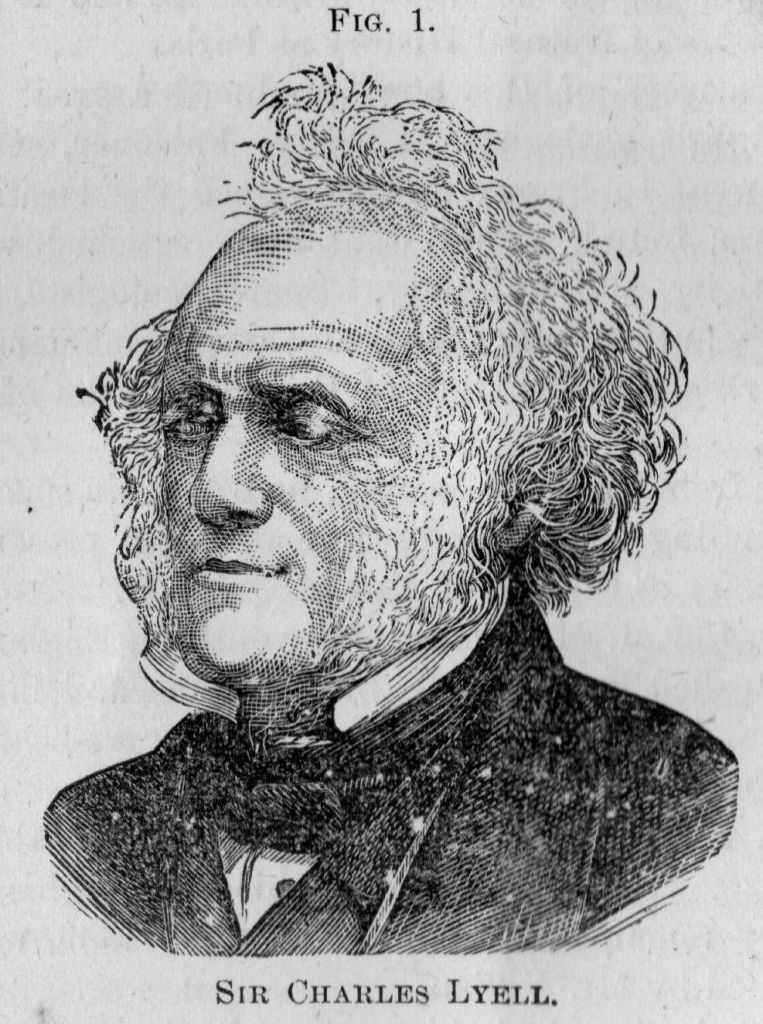 Fig. 1.
Sir Charles Lyell.
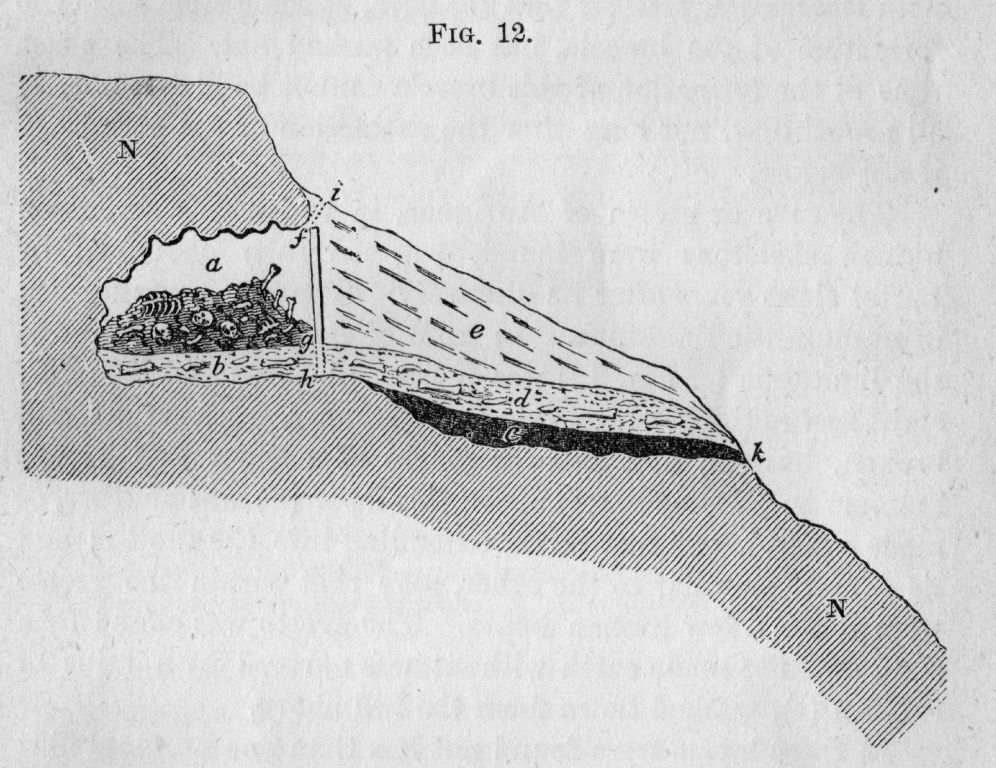
Near the town of Aurignac, France, a workman named
Bonnemaison, in the year 1852, accidently discovered a cave
containing the remains of seventeen human skeletons. These
bones were taken by Dr. Amiel, the mayor of Aurignac, who
was ignorant of their value, and consigned to the parish cemetery.
The spot of their re-inhumation has been forgotten,
and this treasure is now lost to science. In 1860, the cave
was explored by Edward Lartet. After a long and patient
examination, he came to the conclusion that the cave was a
human burial place, cotemporary with the mammoth and other
great animals of the quaternary epoch.
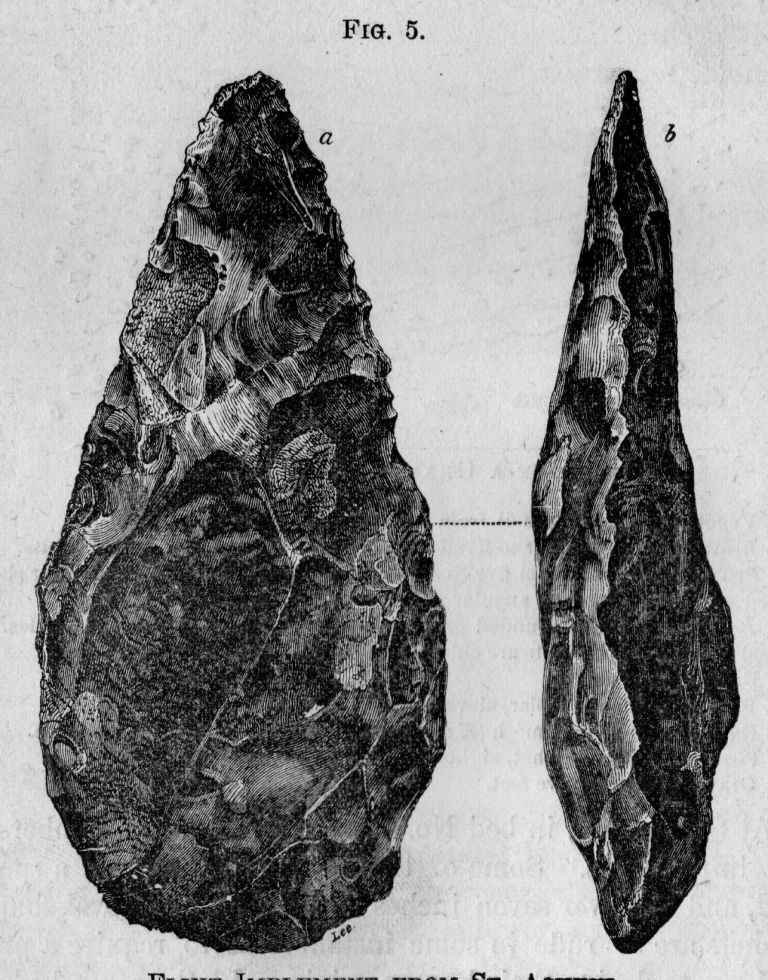
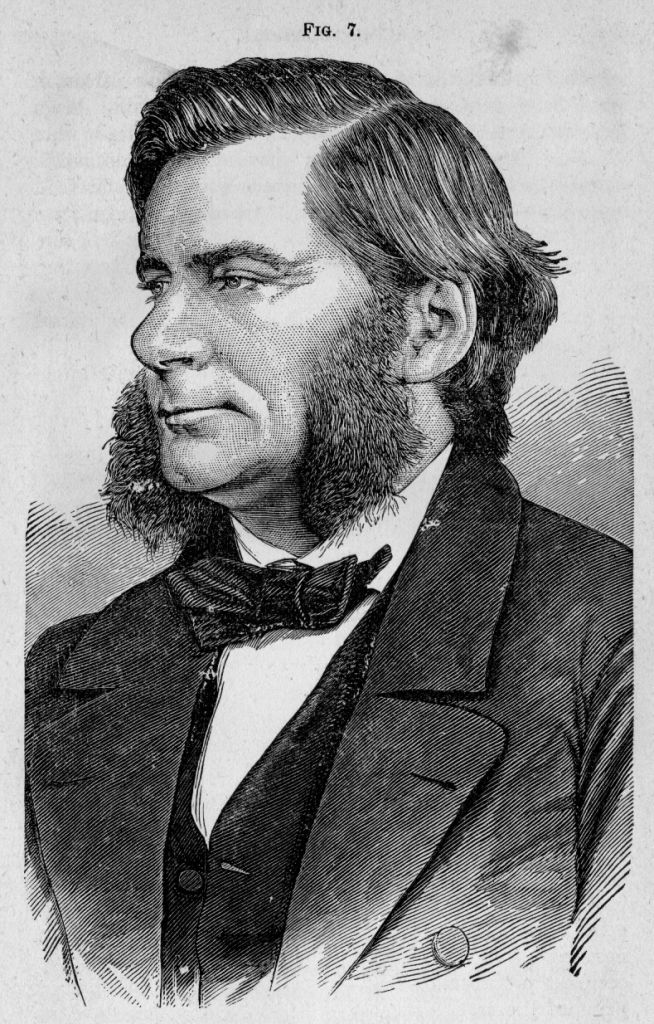
It was at the meeting of the British Association, in 1855,
that Sir Charles Lyell declared his belief in the great antiquity
of the human race. He had before opposed the idea,
but was convinced of the truth by personal examination of
human bones and flint hatchets, from the quarries of St.
Acheul. He became enthusiastic in his investigations, and,
in order to present the discussion clearly to the scientific public,
he published his "Geological Evidences of the Antiquity
of Man," in 1863. In the last edition of his "Principles of
Geology," he bestows considerable space to the discussion of
the subject. He was closely followed, in the same view, by
other eminent geologists.
The remains of the ancient Lake Dwellings of Switzerland
were discovered in the winter of 1853-1854. That winter
was so dry and cold that the water of the lakes fell far below
its ordinary level. On account of this, a large tract of
ground of Lake Zurich was gained by the people throwing
up embankments. In the process of the work, the piles on
which stood the dwellings, fragments of pottery, bone and
stone implements, and various other relics, were discovered.[5]
Dr. Keller, of Zurich, examined the objects, and at once
came to a right understanding as to their signification. He
carefully examined the remains, and described these lake
habitations in six memoirs presented to the Antiquarian
Society of Zurich, in 1854, 1858, 1860, 1863, and 1866. In
1866 these memoirs were translated into English by J. E.
Lee, together with articles from other antiquaries, under the
title of "The Lake Dwellings of Switzerland, and other parts
of Europe." This work contains ninety-seven plates, besides
many wood-cuts.
Memoirs of the Dwellers of different lakes have, from time
to time, been published, but they are included in the translated
work of Dr. Keller.
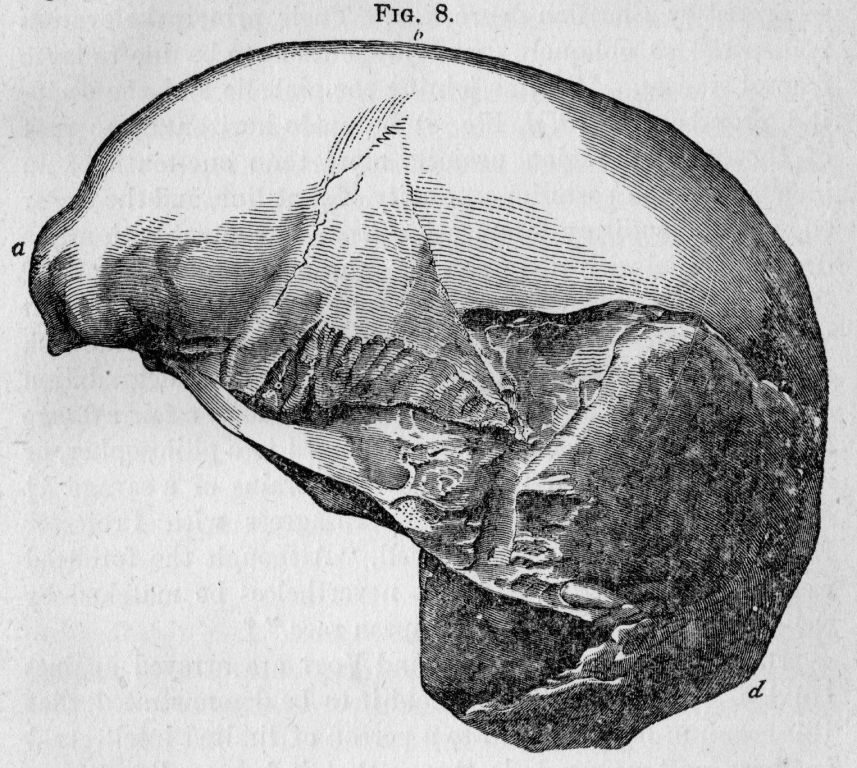
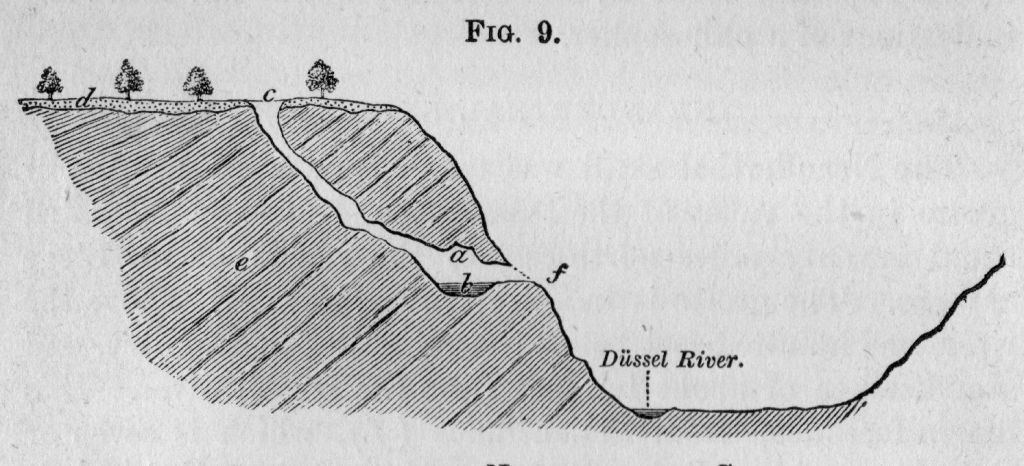
The far-famed Neanderthal skull was discovered by Dr.
Fuhlrott, in the year 1857, in a limestone cavern, near Düsseldorf,
in a deep ravine known by the name of Neanderthal.
This skull, with parts of the skeleton to which it belonged,
was found under a layer of mud, about five feet in thickness.
It is now in the cabinet of Dr. Fuhlrott, Elberfeld, Rhenish
Prussia.
In 1858, a bone-cavern was found near Torquay, not far
from Kent's Hole. This cave was examined by a scientific
commission. At first it was undertaken by the Royal Society,
but when its grants had failed, Miss Burdett-Coutts paid
the expenses of completing the work. In this cave, under a
layer of stalagmite, were found many flint knives, associated
with the bones of extinct mammals.
M. A. Fontan found in the cave of Massat (Department
of Ariége), in 1859, human teeth and utensils associated with
the remains of the cave-bear, the fossil hyena, and the cave-lion
(Felis spelœa).
In 1861, M. A. Milne Edwards found certain relics of
human industry mingled with the fossil bones of animals, in
the cave of Lourdes, France.
In 1862, Dr. Garrigou published the result of the researches
which he, in conjunction with Rames and Filhol, had
made in the caverns of Ariége. These explorers found the
jaw-bones of the cave-bear and cave-lion, which had been
wrought by the hands of man.
In the upper strata of the tertiary beds (pliocene) at St.
Prest (Department of Eure), in the year 1863, M. Desnoyers
found the bones of extinct animals which were cut or notched
by flint instruments. In the same strata Abbé Bourgeois discovered
implements of stone. He communicated his discoveries
to the International Congress held at Paris in 1867.
In 1864, James Brown found flint implements midway
between Gosport and Southampton, included in gravel from
eight to twelve feet thick, capping a cliff which at its
greatest height is thirty-five feet above high-water mark.
These flint tools exactly resemble those found at Abbeville
and Amiens. Some of them are preserved in the Blackmore
Museum at Salisbury.
In 1865, there was found in the loess of the Rhine, near
Colmar, Alsace, human bones in the same bed with bones of
the mammoth, horse, stag, auroch, and other animals.
In 1866, Alfred Stevens first dug out a hatchet from the
gravel at the top of the sea-cliff east of the Bournemouth
opening, Southampton river. Soon after, Dr. Blackmore, to
the west of the valley, obtained two other flint implements.
The spot was examined by Lyell in 1867.
Dr. Edward Dupont, an eminent Belgian cave explorer,
in the year 1866, found a fragment of a human jaw in the
Trou de la Naulette, a bone cave situated on the bank of the
river Lesse not far from Chaleux.
At the International Congress of 1867, M. A. Issel reported
he had found several human bones in beds of Pliocene age,
near Savonia, in Liguria.
The Reindeer Station on the Schusse, in Swabia, was discovered
in 1867, during the operations undertaken for the
improvement of a mill-pond. The Schusse is a little river
which flows into the lake of Constance, and its source is upon
the high plateau of Upper Swabia between the lake of Constance
and the upper course of the Danube.
In 1868, Thomas Codrington discovered an oval flint implement
in gravel at the top of the Foreland Cliff, Isle of
Wight, five miles southeast of Ryde.
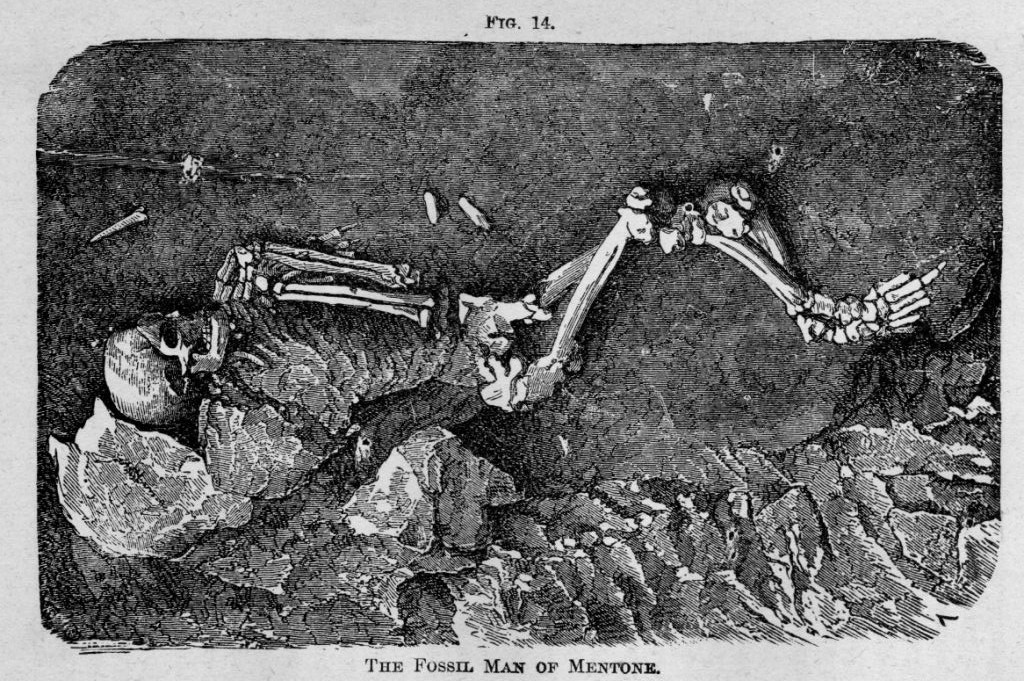
The fossil Man of Mentone was discovered, in 1873, by M.
Riviére, in a cave near Nice, France. The skeleton was
almost entire, and imbedded twenty feet below the surface of
the deposit.
In 1873, M. Riviére discovered another human skeleton,
by the side of which lay a few unpolished stone implements,
in one of the caves in the same neighborhood.
In 1873 and 1874, M. Riviére was again so fortunate as to
discover, in neighboring caves, the remains of three persons,
two of them those of children. The skeletons were in the
same condition, and decked with similar ornaments, as those
he had previously discovered.
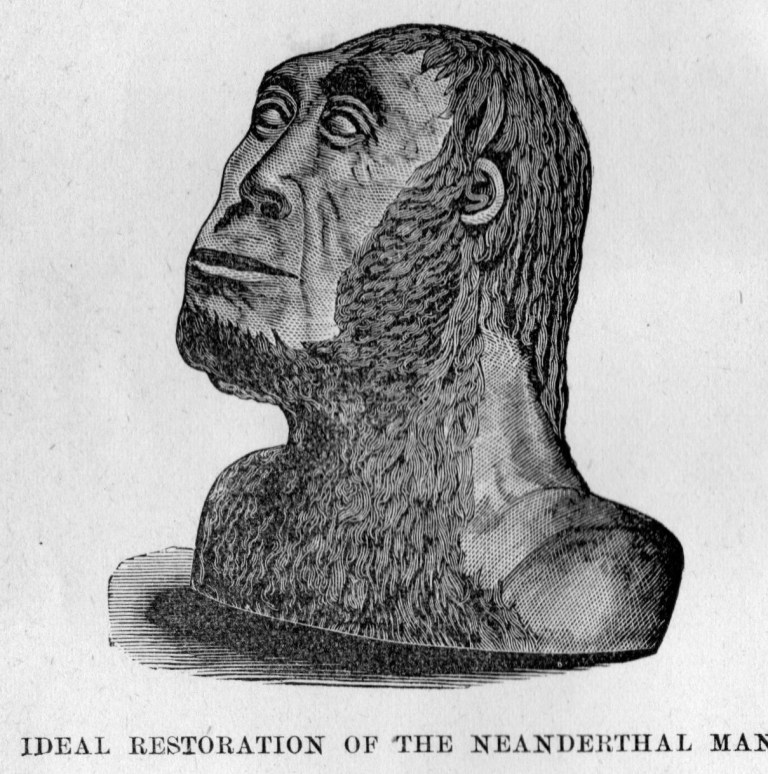 IDEAL RESTORATION OF THE NEANDERTHAL MAN.