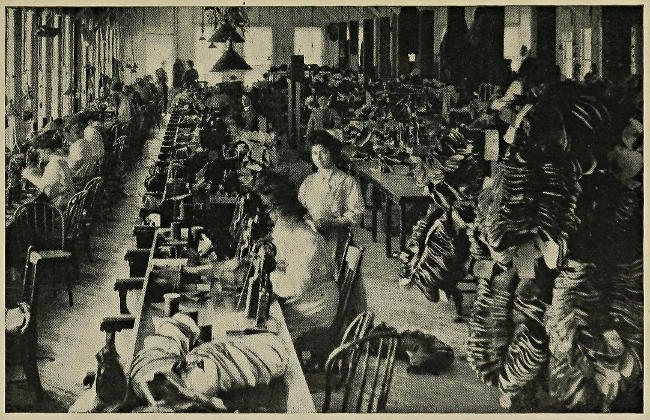
The various processes of tanning may
be roughly divided into two classes,
vegetable chemical and mineral chemical.
The first class is often spoken of in tanneries
simply as the “vegetable” while the second
is called “chemical” process. In the vegetable
processes the tanning is accomplished
by tannin, which is found in various barks
and woods of trees and leaves of plants. In
the so-called chemical processes the tanning
is done with mineral salts and acids which
produce an entirely different kind of leather
from that procured by vegetable tanning.
There is also a method of tanning, or,
more properly speaking, tawing, in which
alum and salt are used. This process
makes white leather that is used for many
purposes; it is also colored and used in
the manufacture of fine gloves. Leather
is also made by tanning skins with oil.
Chamois skins are made in this way.
The materials that are used to tan hides
and skins act upon the hide fibers in such
a way that the hides are rendered proof
against decay and become pliable and strong.
There are many vegetable tans; they are
used for sole leather, upper leather, and
colored leather for numerous purposes.
The bark of hemlock trees is one of the
principal tans. The woods and barks
of oak, chestnut, and quebracho trees
are often used. Palmetto roots yield a
good tan. Large quantities of leather are
treated with gambier and various other
tanning materials that come from foreign
countries. Sumac leaves, which are imported
from Sicily, contain tannin that
makes soft leather suitable for hat sweatbands,
suspender trimmings, etc. Sumac
is also obtained from the State of Virginia,
but the foreign leaves contain more tannin
and make better leather than the
American.
To a large extent the so-called chemical
processes have supplanted the vegetable
processes, that is, old tan bark and sumac
processes; but in some tanneries both
methods are used on different kinds of
skins.
In the old bark process the tan bark is
ground coarse and is then treated in leaches
with hot water until the tanning quality is
drawn out. The liquor so obtained is used
at various strengths as needed.
In the newer method the tan liquor is
displaced by a solution of potassium bichromate,
which produces its results with much
less expenditure of time.
When the hides or skins are ready for
the tanning process, they are put into a
revolving drum, known as a “pinwheel,”
or into a pit in which are revolving paddles,
with a dilute solution of potassium dichromate
or sodium dichromate, acidified with
hydrochloric or sulphuric acid. If the pinwheel
is employed, it is revolved for seven
hours or longer; after which time the
liquor is drawn off and replaced by an
acidified solution of sodium thiosulphate or
bisulphite, and then the revolution is continued
several hours longer. If the pit is
used, the skins are removed to another
drum containing the second solution, and
kept at rest or overturned for a like period.
In removing the skins from the pinwheel
or vat, and in handling them after treatment
with lime for the loosening of the hair, the
hands and arms of the workmen are seriously
injured, becoming raw if not protected by
rubber gloves; even with gloves it is difficult
to prevent injury, and in some establishments
the workmen are relieved by
the substitution of a single-bath process,
in which the liquor is less harmful to the
skin.
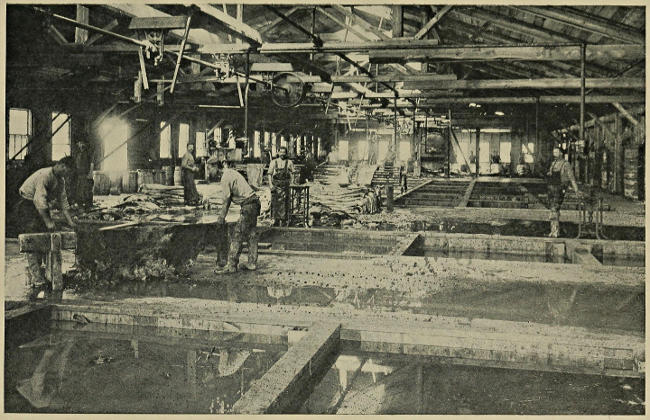
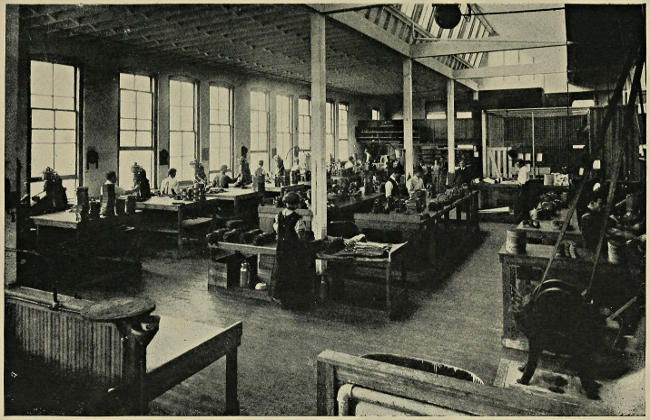
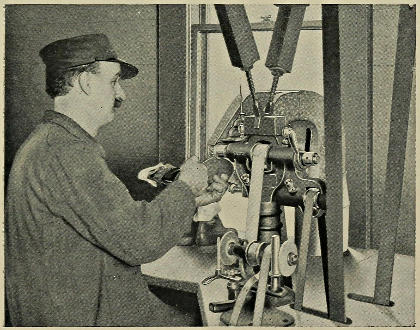
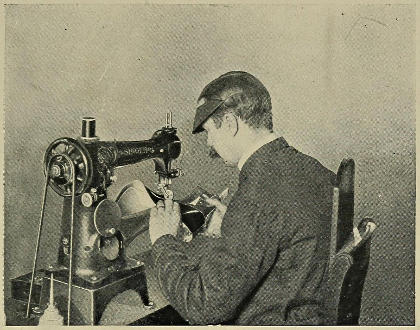
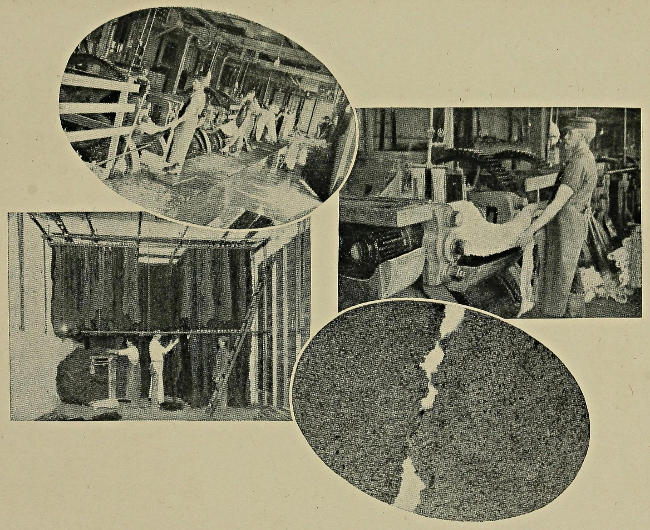
Tanning Process
Showing the vats, the unhairing and liming processes. Page 24.
The hides are then removed from the
pits, washed and brushed, followed by slow
drying in the air. When partly dried, they
are placed in a pile and covered until heating
is induced. They are then dampened
and rolled with brass rollers to give the
leather solidity. Sole leather is oiled but
little. Weight is increased by adding glucose
and salt.
Various rapid processes of tanning have
been devised in which the hides are suspended
in strong liquors or are tanned in
large revolving drums. It is claimed that
this hastens the process, but the product
has been criticized as lacking substance or
being brittle.
Chrome tannage has been chiefly developed
in this country during the last twenty
years and is now in general use. It consists
in throwing an insoluble chromium hydroxide
or oxide on the fibers of a skin which
has been impregnated with a soluble chromium
salt—potassium bichromate. Other
salts like basic chromium chloride, chromium
chromate, and chromic alum are also used.
The hydrochloric or sulphuric acid acts
by setting free chromic acid.
After several hours, the skin shows a
uniform yellow when cut through its thickest
part. It is then drained and the skin
worked in a solution of sodium bisulphite
and mineral acid (to free sulphur dioxide).
The chromic acid is absorbed by the fiber
and later reduced by sulphur dioxide.
In the making of chrome black leather
each tanner has his own method. Contrary
to the general belief, there are many different
methods of chrome tannage. No two tanneries
employ just the same process.
Tanners of chrome leather seek to produce
leather suitable for the particular
demands made upon it by the peculiarities
or characteristics of the varying seasons.
Summer shoes require a cool, light leather;
at other times a heavier tannage is essential,
with some call for a practically waterproof
product.
All leathers, whether vegetable-or chrome-tanned,
must be “fat liquored.” That is
to say, a certain amount of fatty material
must be put into the skin in order that it
may be mellow, workable, and serviceable.
This is very essential in producing calf
leather. Fat liquors usually contain oil
and soap, which have been boiled in water
and made into a thin liquor. The leather
is put into a drum with the hot fat liquor;
the drum is set in motion, and as it revolves
the leather tumbles about in the drum and
absorbs the oil and soap from the water.
It is the fat liquor that makes the leather
soft and strong.
Leather used in shoes is divided into two
classes: sole leather and upper leather.
Sole leather is a heavy, solid, stiff leather
and may be bent without cracking. It is
the foundation of the shoe, and therefore
should be of the best material. The hides
of bulls and oxen yield the best leather for
this purpose.
The hide that is tanned for sole leather is
soaked for several days in a weak solution
(which is gradually made stronger) of oak or
hemlock tan made from the bark. Oak-tanned
hide is preferred and may be known
by its light color. A chemical change takes
place in the fiber of the hide. This is a
high-grade tannage, and is distinguished
principally by its fine fibers and close,
compact texture.
Oak sole leather, by reason of its tough
character, and its close, fibrous texture,
resists water and will wear well down
before cracking. It is by many considered
better than other leather for flexible-sole
shoes, requiring waterproof qualities.
Sole leather is divided into three classes
according to the tanning—oak, hemlock,
and union.
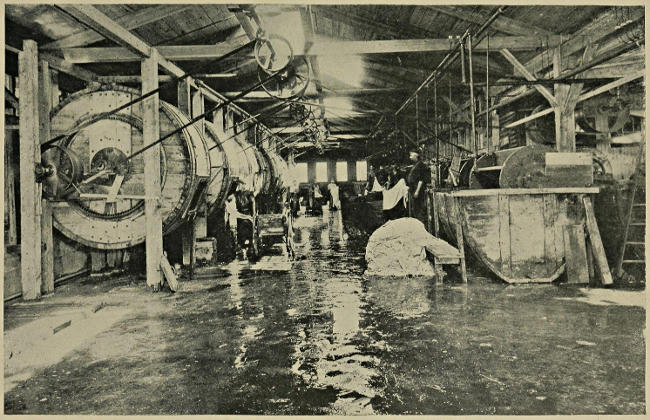
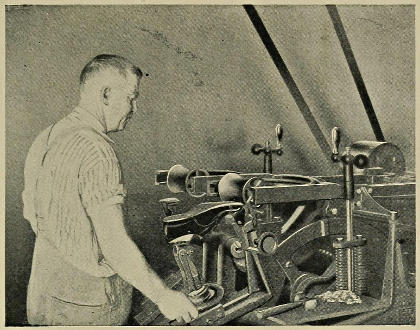
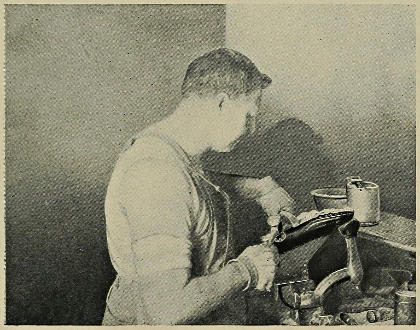
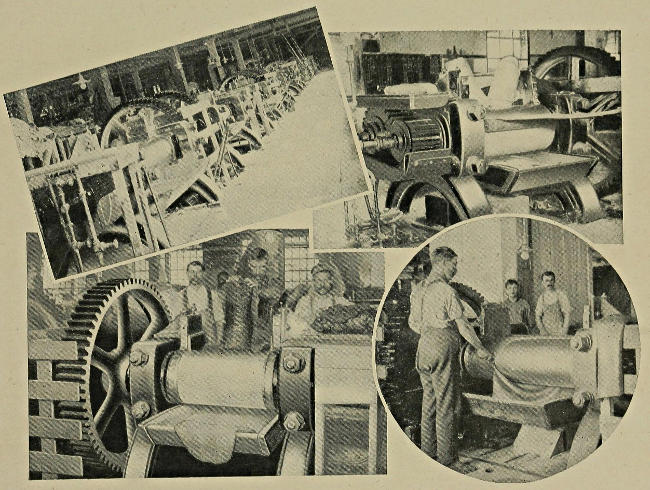
Tanning Process
Showing the rotating drums. See page 24.
Oak tanning is as follows: the hides are
hung in pits containing weak or nearly
spent liquors from a previous tanning, and
agitated so as to take up tannin evenly.
Strong liquor would harden the surface
so as to prevent thorough penetration into
the interior of the hides. After ten or
twelve days, the hides are taken out and
laid away in fresh tan and stronger liquor.
This process is repeated as often as necessary
for eight to ten months. At the end of this
time the hide has absorbed all of the tannin
which it will take up.
Hemlock tanning is similar to the oak
tanning in process. The hemlock tan is a
red shade. Hemlock produces a very hard
and inflexible leather. It is modified by
use of bleaching materials which are applied
to the leather after being tanned. It is sold
in sides without being trimmed, while the
oak is sold in backs, with belly and head
trimmed off.
Hemlock leather is used extensively and
almost principally for men’s and boys’
stiff-soled, heavy shoes, where no flexibility
is required or expected. Its principal desirable
quality is its resistance to trituration,
or being ground to a powder, and its use in
men’s and boys’ pegged, nailed, or standard
screw shoes is not in any way objectionable
to the wearer. In fact, for this class of
shoes, it is probably the best leather that
can be used. But when hemlock is used
in men’s and boys’ Goodyear welt shoes,
where a flexible bottom is expected and
required, it generally does not give good
results. It cannot satisfactorily resist the
constant flexing to which it is subjected,
and after the sole is worn half through, the
constant bending causes it to crack crosswise.
On this account it becomes like a
sieve, and has no power of resistance in
water, and therefore it is not at all suited
to flexible-bottomed shoes.
In “union-tanned” hides, both oak and
hemlock are used and the result is a compromise
in both color and quality. This
tan was first used about fifty years ago.
Twenty-five years ago the union leather
tanners began to experiment with bleaching
materials to avoid the use of oak bark,
which was becoming scarce and high priced,
and eventually developed a system of tanning
union leather with hemlock or kindred
tanning agents, excluding oak. The red
color and the hard texture were modified
by bleaching the leather to the desired
color and texture. This produces leather
which has not the fine, close tannage of
genuine oak leather and at the same time
lacks the compact, hard character of hemlock
leather. Union leather produced in
this manner is a sort of mongrel or hybrid
leather, being neither oak nor hemlock.
On account of its economy in cutting
qualities, however, it is largely used in the
manufacture of medium-priced shoes where
a certain degree of flexibility is required in
the sole. This is particularly true of women’s
shoes.
Union leather is sold largely in backs and
trimmed the same as oak, though not so
closely.
Sole leather is also made nowadays by
tanning the hides by the chrome or chemical
process. This leather is very durable
and pliable and is used on athletic and sporting
shoes. It has a light green color and
is much lighter in weight than the oak or
hemlock leather.
Many kinds of hide are used for sole
leather. This country does not produce
nearly enough hides for the demand, and
great quantities are imported from abroad,
although most of the imported hides come
from South America. Imported hides are
divided into two general classes, dry hides
and green-salted hides.
Dry hides are of two kinds, the dry
“flint,” which are dried carefully after
being taken from the animal and cured
without salt. These generally make good
leather, although if sunburnt, the leather is
not strong. “Dry-salted hides” are salted
and cured to a dry state. Dry hides of
both kinds are used for hemlock leather
only, although all hemlock leather is not
made from dry hides.
Green-salted hides are used in making
oak-tanned leather as well as hemlock, and
those used by United States tanners come
largely from domestic points; but there is a
variable amount imported each year from
abroad, principally from Europe and South
America. Green-salted hides are of two
general classes, those branded and those
free of brands.
Cow and steer hides of the branded type
are used by tanners of oak and union leather.
Those not branded are used more largely for
belting and upholstering leathers, a small
part finding their way into hemlock leather.
Sole leather remnants, strictly speaking,
include such a wide variety of items that
it is difficult to cover them all. Few people,
however, realize the big range of usefulness
of this class of stock. While not exactly a
by-product, remnants are often classed as
such. Under the class of sole leather
remnants are included sole leather offal,
such as heads, bellies, shoulders, shanks,
shins, men’s heeling, men’s half heeling,
men’s and women’s three-and four-piece
heeling, etc. Stock that cannot be used
in the shoe business goes into the chemical
and fertilizer trade, among other outlets.
By a special acid process of burning this
stock, ammonia is derived from it, which
goes into fertilizer; and another by-product
is sulphuric acid for the chemical trade.
The amount of ammonia obtained is small,
being about seven per cent of ammonia to
a ton of sole leather scrap. This is mixed
with fertilizer and sold mostly in the Southern
States, and to a small extent in the West,
there being a law in many of the Western
States against the use of fertilizer made
from leather products, on account of its
low grade.
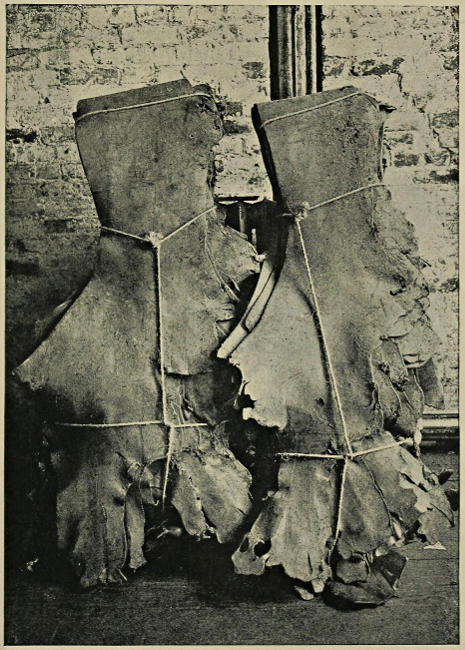
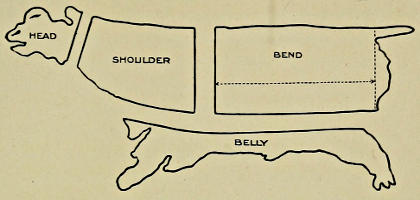
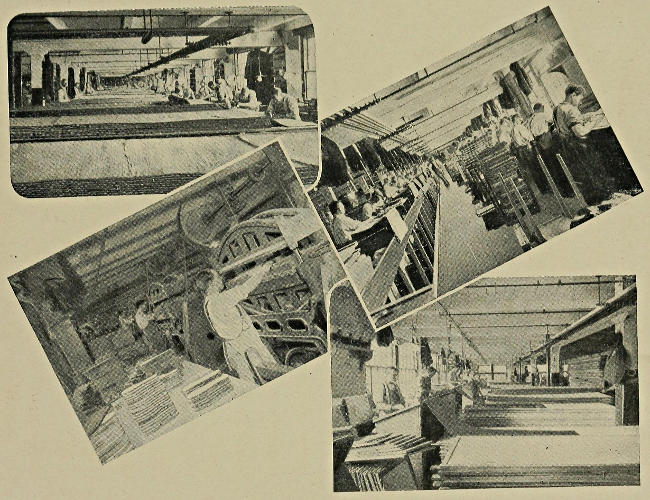
Sole Leather Offal
Showing bellies, shoulders, etc. Page 35.
In the disposition of offal, heads are used
for taps, top lifts, and under lifts. Shoulders
are used for outsoles and inner soles, while
bellies are used for medium to heavy taps
and counters. Lightweight bellies and
shanks are utilized for making box toes
and counters.
Shanks are also used for taps and under
lifts. This stock is solid and substantial
and well suited for these purposes. The
bellies, being flexible, are the best part of
the hide obtainable for inner soles.
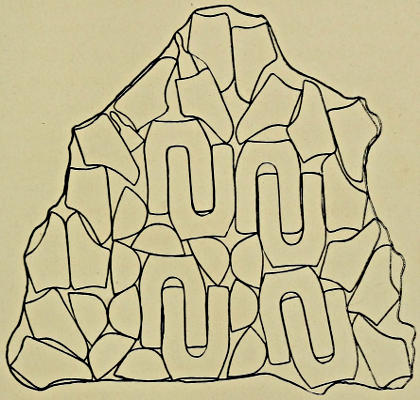
In cutting out soles, the manufacturer
accumulates a considerable quantity of
solid or center pieces, which are used for
small top lifts, also for “Cuban” tops,
thereby using up the bulk of the small
heavy scrap that ordinarily would be sold
for pieced heeling. There is also a demand
for similar stock from the hardware trade,
where it is used for making mallet and tool
handles, also for wagon and carriage
washers. Large quantities of men’s and
women’s heeling and half heeling go to
England, where it is cut up by heel manufacturers
into lifts and sectional lifts for
the English trade; there being a shortage
of this class of offal there.
The shoe manufacturer, after cutting his
soles and taps, is obliged to skive them to
get the particular iron he needs. This
leaves what is known as a “flesh sole
shape,” also a “tap shape.” These skivings
are pasted together by another class of
trade and again used for inner soling and
taps in the cheaper grades of shoes. Smaller
skivings, or waste, after sorting out the sole
and tap shapes, are sold to the leather
board trade. This eventually comes back
to the shoe trade in the shape of leather
board and is cut into heel lifts. The waste
after cutting heel lifts is again resold to
the leather board trade and makes another
round trip to the shoe manufacturer. This
illustration, as well as many others in the
leather remnant business, demonstrates the
scientific principle that nothing is ever
entirely lost. In regard to pieced heel lifts,
these are made in either two, three, or four
sections. This refers to what are known as
sectional heel lifts. Scrap leather is also
used for shanking for the European trade.
Soles and taps, known as rejects, that is,
those thrown out by the high-grade trade,
are sold to manufacturers of cheaper lines.
A shoe manufacturer cutting his own soles
and buying sole leather in sides, after sorting
out the soles suited to his own requirements,
will sell what he cannot use to remnant
dealers, who in turn re-sell them to shoe
manufacturers requiring that particular
class of stock. The scrap leather, or remnant
dealer, thus forms a useful link in the
chain of distribution, furnishing a market
where shoe and leather manufacturers may
dispose of their surplus products to best
advantage, and providing a source of supply
for buyers who wish any particular article
to suit their individual needs.
Upper or dressed leather is made from
kips or large calfskins. It is tanned and
finished like all other forms of leather by
variations of the foregoing process. Thick
hides are often split thin by machinery,
and the parts retained and finished separately.
The parts of the leather from the
hair side are most valuable and are called
“grain” leather; the inner parts or “flesh
splits” are made into a variety of different
kinds of leather by waxing, oiling, and
polishing.
It is finished by scouring with brushes and
then rubbed with a piece of glass, which
removes creases and wrinkles and stretches
the leather. Then it is stuffed with a
mixture of oil, soap, and tallow, which is
worked into it by rolling. Various finishes
are given to leather, such as seal grain,
buff, glove grain, oil grain, satin calf,
russet, plain shoe, etc.
Upper leathers are blacked by rubbing with
a mixture of lampblack and oil or tallow, or
with a solution of copperas and logwood.
No tanning process, no matter how good
or thorough, can make firm, serviceable,
wear-resisting leather out of all portions
of any hide, because nature made some
parts of every hide porous, spongy, and
lacking in fibrous strength.
Calfskins used by tanners are of several
classes. American calfskins, taken off in
the United States and Canada, are usually
sold green pelted. Farmers raise only a
small fraction of the calves born. Each
cow must produce a calf in order to insure a
maximum flow of milk. Most of the farmers
keep cows to produce milk, hence they
sell the young calves for veal and use their
skins for high-grade calf leather.
In European countries farmers fatten
their calves before selling them in order to
get a higher price for the veal. The skin
is not so valuable for leather as the skin
from younger calves, and it is used for
lower-value leathers.
Calfskin is not split. A heavier weight
skin might be. It is shaved to a uniform
thickness.
Calf leather is divided into the following
classes, depending upon the finish of the
leather:—
Boarded calf (made in both chrome and
bark tannage).
Wax calf, finished on the flesh side with a
waxy, hard surface.
Box calf is a proprietary name. It is
boarded—rubbed with a board to raise the
grain. It is known by minute, squarelike
lines.
Mat calf is a dull-finished calfskin, used
more in topping.
Suede calf is finished on flesh side. Most
makes of suede calf are chromed, although
there are some vegetable.
Storm calf is a heavy skin, finished for
winter wear. Considerable oil is used in
finishing.
French calf is finished on flesh side.
Dry hides are obtained from Buenos
Ayres, where the cattle are raised on the
plains. This city exports a large quantity of
hides, dry, salted, and cured by smoking.
The hides of cows generally yield inferior
grain leather; but South American cowhides
may be worked for light sole leather.
Calves’ hides are thinner, but when well
tanned, curried, and dressed, they yield a
very soft and supple leather for boots and
shoes. They are finished with wax and
oil on the flesh side, and can also be finished
on the hair (grain of skin).
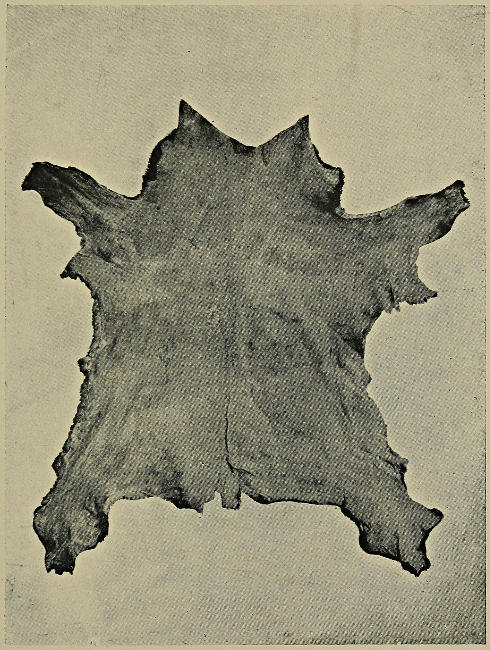
Calves’ skin (green salted).
Paris City calfskins. These are obtained
in three grades—light, medium, and heavy.
Light grades run from four to five,
or seven to eight pounds; medium grades
run from seven to nine pounds; heavy
grades run from nine to twelve pounds.
Patent leather may be made from colt,
calf, or kid skin. Coltskin is the skin of
young horses, or split skins of mature
horses.
Patent colt and kid are used for the most
part in the medium fine grades, and patent
side (cowhide) is used in the medium and
cheaper grades. Chrome tanned are used entirely
in the manufacture of patent leather.
Patent leather, as it appears in shoes,
may be described either as varnished leather,
coltskin, or kid, and sometimes the French
use calfskin. The process is largely a
secret one, although there is no longer any
patent on the principle of the same. It is
made by shaving the skins on the flesh side
or hair side to a uniform thickness. Then
it is de-greased to put the skin in condition
to receive the finish and protect the same
from peeling off. Successive coats of liquid
black varnish are applied, the first coats
being dried and rubbed down, so as to work
the liquid thoroughly into the fibers of the
leather. The last coat is applied with a brush,
and baked to from one hundred and twenty
to one hundred and forty degrees Fahrenheit
for thirty-six hours and then allowed to dry
in direct sunlight for from six to ten hours,
which seems to be essential to remove
the sticky feeling. Various ingredients are
used in making the different varnishes, the
first coating consisting of naphtha, wood
alcohol, amyl acetate, etc. The black
varnishes consist of linseed oil and various
other mixtures, heated in iron kettles. The
final coating is a naphtha preparation resembling
japanning material. The hide is
stretched on a frame during the varnishing
operations.
It is almost impossible to tell the difference
in quality of shiny leather by appearance,
although in general the leather on which
the grain shows through the varnish will
prove more serviceable than that on which
the finish is so thick as to hide the grain.
Great care must be exercised in resewing
patent leather shoes that have been exposed
during the cold weather, as the cold has
a tendency to freeze the finish. Patent
leather, like all varnished coatings, is liable
to crack. No one can guarantee it not to do
so. The kid patent leather is more elastic
and porous than other kinds. The serious
objection to the use of patent leather for a
shoe is its air-tightness. This makes it both
unhygienic and uncomfortable. The kid
patent leather is the only patent leather
that has not this objection.
Kid is a term applied to shoe leather
made from the skins of mature goats. The
skin of the young goat or kid is made into
the thin, flexible leather used for kid gloves,
which is too delicate for general use in
shoes. The goats from which come the
supply of leather used in this country for
women’s and children’s fine shoes are not
the common, domesticated kind known in
this country, but are wild goats or allied
species partially domesticated, and are
found in the hill regions of India, the mountains
of Europe, portions of South America,
etc.
There are about sixty-eight recognized
kinds of goatskins that are imported from
all over the world. The Brazilian, Buenos
Ayres, Andean, Mexican, French, Russian,
Indian, and Chinese are a few of the many
kinds that are known as such. Each
particular species of goat hide possesses
its own peculiarities of texture. The thickness
and grain differ according to the environment
in which the animal has been
raised. It is peculiar that those raised in
cold climates do not have as thick skins as
those raised in warmer climates, for the long,
thick hair apparently takes the strength.
We may wonder where all the skins come
from that are made up into glazed kid,
mat kid, and suede, at the rate of several
thousand dozen every day. The great proportion
of the skins are goatskins. These
are almost all imported from abroad, where
the animals are slaughtered and disposed of
much the same as we dispose of beef and
veal here. Sheepskins and carbarettas, the
hides of animals that are a cross between
sheep and goats, are also used.
The finer grades of kid and goatskins
which are tanned in large quantities in
New England, come from the Far East.
In China there are two great ports from
which skins are shipped, Tientsin and
Shanghai. Back in the interior, starting
from a point about twelve hundred miles
from the sea, collectors make their rounds
twice a year.
The breeder of goats kills his flock just
before the collector is due, skins the animals
on the hillside, preserves the meat for food,
and with the kidskins, which have been
partly dried, wrapped in a bundle carried
upon the back, or upon a pack animal, the
breeder makes his way to the station. It
may be that there are a half hundred
breeders awaiting the coming of the collector
and he pays them the market price for the
skins.
Whenever the collector has a sufficient supply
to make it profitable to ship, he bales the
skins and then sends them over the thousand
mile journey along the river to the seaport.
From Tientsin or Shanghai they are
taken by tramp steamers, which reach
Eastern ports by way of the Suez Canal,
and on the trip the steamers make several
ports, so that it is from six to ten weeks
before the skins reach America.
Another method of importing is to have
the raw material shipped across the Pacific
and then transferred to a railroad, but the
difference in cost to the manufacturer is so
great that it is unprofitable.
The China goatskins are rated as among
the finest in the world and when tanned
they make the highest-grade shoe.
Then there are mocha skins, which come
from Tripoli, Arabia, and Northern Africa.
In those places the method of collection is
practically the same as in China.
The two best-known grades are the
Hodieda and the Benghazi. They derive
their designations from the exporting cities.
Hodieda is located in the southwestern
part of Arabia on the Red Sea, while
Benghazi is in Barca, one of the provinces
of Tripoli.
Other goatskins are produced in India
and Russia, and millions of skins are exported
annually from Bombay, Madras, and
Calcutta. These skins are not brought
direct to America, but are transshipped at
Marseilles or London.
The jobbers in Europe or India occupy
rather a unique position, for according to
their practice it is almost impossible for
them to suffer financial losses in dealing
with an American tanner. The latter, when
he wishes to arrange for his year’s supply of
raw material, negotiates with an agent in
Boston, with whom he signs a contract
for so many skins. Then it is necessary for
the tanner to either purchase with money
equal to the face value or secure by loans
letters of credit from Boston banking
houses which have European connections.
Before the skins are exported, the jobber
has his money from the European banking
concerns and the bills of lading are forwarded
to the Boston bankers, who turn them over
to the tanners, and, when the occasion
requires, obtain from the tanners what is
known as a deed of trust.
All goatskins are tanned by the same
chrome tanning process, whether the finish
is to be glazed or mat. The proportions of
chemicals vary according to the texture of
the skin, and according to the grain.
The process of tanning is quicker than
the tanning of heavier hides, and all varieties
of tannage are used, the chrome
methods having come into very general use.
There are many kinds of finish given, such
as glazed, dull, mat, patent, etc. One
quality that distinguishes goat leather, the
“kid” of shoemaking, is the fact that the
fibers of the skin are interlaced and interlocked
in all directions. The finished skins
as they come from the tannery, by whatever
process they may be put through, are sorted
for size and quality, a number of grades
being made. Instead of ripping straight
through, like a piece of cloth, or splitting
apart in layers, as sheepskin will do when
made into leather, the kid holds together
firmly in all directions.
Glazed kid is colored after it is tanned by
submerging it in the color, a very important
process. The glossy surface is obtained by
“striking” or burnishing on the grain side.
It is made in black and colors, particularly
tan, and is known by about as many names
as there are manufacturers of it.
Glazed kid is used in the uppers of shoes,
making a fine, soft shoe that is particularly
comfortable in warm weather, and is said
to prevent cold feet in winter, owing to
unrestricted circulation.
Mat kid is a soft, dull black kid, the
softness being the result of treatment with
beeswax or olive oil. It is finished on the
grain side the same as glazed kid, and is
used principally for shoe toppings. It is
very similar in appearance to mat calf and
is often used in preference to it, as it is of
much lighter weight, and about as strong.
Suede kid is not tanned, but is subjected
to a feeding process in an egg solution,
called “tawing,” to make it soft and pliable.
The skin is stretched and the color is applied
by “brushing” (with a brush). The color
does not permeate the skin, but is merely
on the surface. Suedes are made from
carbarettas and split sheepskins. Suedes
are used very extensively in making slippers,
and come in a great variety of colors.
A castor kid is a Persian lambskin finished
the same as a suede, and is used in
making very soft, fine-appearing leather—like
glove leather. The skin is of such a
very light weight that it has to be “backed
up” before being made into shoes.
Fancy leathers are used extensively for
toppings of shoes having patent leather
vamps. Facings are selected from fancy
leathers to make the inside of a shoe attractive
and to increase its wearing quality.
Leathers of dull or glazed finish are used in
typical shoe colors.
Miscellaneous kinds of kids are as
follows:—
- A. Kangaroo
- B. Buckskin
- C. Sheepskin
- D. Chamois
- E. Cordovan
- F. Splits
- a. Seal Grain
- b. Buff
- c. Oil Grain
- d. Satin Calf
- G. Enamel
- H. Sides
Kangaroo is the skin of the animal of that
name.
Buckskin is the skin of certain deer.
Sheepskin is the skin of the familiar domestic
sheep.
Chamois is the skin of the animal of that
name and by courtesy the specially treated
skins of certain domestic animals.
It is a simple matter to recognize a kid-skin
among the various kinds of upper
leather, because of its very light weight
and pliability.
During the winter, leather, in drying,
is apt to become frozen, especially where no
well-equipped drying loft is provided. Such
leather becomes weak and limp if thawed
out too rapidly. In freezing, the water in
the hides which have been hung up to dry
is forced out and stretches apart the hide
fiber. The wetter the hides, therefore, the
more demoralized they will be by the frost.
The treatment of rushing the frozen leather
into a warm room is inadvisable; the best
method is to allow the hides to hang as they
were and to tightly close all openings to
the outside air. In case this is impossible,
it is best to place the leather in a heap, in a
room where the temperature will not fall
below the freezing point, and to cover it
with a cloth. In case the leather rolls up,
it should be moistened before the roll becomes
greater than is customary; it will
thus become firmer throughout. Some upper
leather and especially sheepskins for lining
purposes are aided by freezing, since the
leather becomes white and plump and also
is of a bright color, though the durability
is somewhat lessened.
The popularity of white leather for shoes
is increasing wonderfully. There is good
reason for this. The modern white shoes
have a stylish and fashionable appearance
which has won the hearts of women of all
ages and conditions, and when they want
a thing, there is always alertness in supplying
it. The new love for white shoes is
interesting to trace. Years ago white
leather for shoes was made principally
from deerskins. But this leather, while
attractive when new, would stretch soon
after being worn, and take on a yellowish
tinge. Besides, the price of such shoes was
very high, and it is not surprising that they
became supplanted by the cheaper, but
attractive and useful, white canvas shoes,
which became quick sellers during the season.
It is greatly to the credit of our tanners
that they have been able to perfect and
put on the market a white leather for shoes
which answers all requirements satisfactorily.
This leather is made from cowhides;
the white color will not fade nor turn
yellow, and best of all, the leather can be
easily cleaned and made to look good as
new. Another advantage is that such
leathers can be used in shoes that sell at
popular prices.
There are many common, commercial
grades of upper leather.
Willow calf is a fine, soft, chrome tannage
of calfskin. It is sold in three colors,
light tan, ox blood, and olive-brown. The
distinguishing features of this leather are
its durability and the fact that it always
keeps soft and pliable. It is adapted to the
highest quality of men’s and women’s shoes.
Box calf is a storm-calf leather of highest
quality. It is a waterproof, chrome tannage
in a medium tan color, with a dull
finish. This is the best leather obtainable
for rough, outdoor wear, walking shoes,
hunting boots, etc. It is also adapted to
men’s and women’s very fine footwear.
There is a growing demand for this kind
of shoe. In the uppers of the best storm
shoes you will always find box calf.
Royal kid is a black chrome calfskin,
dull finished with a smooth, natural grain
of fine texture, soft and pliable. It is used
for vamps and whole shoes of the highest
grades for men and women, and is a very
popular material for the fall and winter
shoe. The desirable qualities of fine calf
leather are making the demand for it
grow faster than the supply of raw material
increases.
Tan royal is a tan color, chrome calf
leather, smooth finish, fine grain, excellent
cutting qualities, uniform, of medium
rich tan shades. Tan calf leather is very
attractive and the tan shoe is now a staple
product.
Cadet kid is a bright black, smooth-finished,
chrome calfskin for men’s and
women’s fine shoes. This tannage and
finish give a remarkable cutting value.
The stability of this stock is entirely unique
and makes the finished shoe stand up,
keeping its much desired shape through the
different tests of manufacturing. It is said
to be the best calfskin, by the best judges,
the shoe manufacturers.
Bronko patent is distinguished for its
fine, coltskin-effect grain. It has a rich
and lustrous black patent finish. The
results obtained from bronko patent in its
workings through the shoe factory and its
wearing qualities afterward have never been
equaled. Bronko is one of the finest results
of the development of chrome patent
leather.
Cadet kid side is a chrome side leather
that closely imitates the calfskin, called
cadet kid. It has a bright, lustrous finish,
and a remarkably fine grain. It is surprisingly
like fine calf leather in appearance.
Cadet calf sides are similar to cadet kid
sides with the exception of a boarded finish.
This is another black chrome, side leather
which comes very near to a calfskin.
Mat royal chrome side is a special finish,
closely resembling calf, used for the tops
of men’s and women’s medium fine shoes.
Black hawk patent is a well-tanned,
well-finished patent leather for medium-priced
women’s shoes and for tipping.
Colored box chrome side, boarded, is a
substitute for willow calf.
Black box chrome side, boarded, is a
substitute for box calf in medium fine shoes.
Kangaroo kid side is a back-tanned, dull,
smooth, black leather nearly like calf, used
in the tops of men’s shoes, and men’s and
women’s whole shoes.
Waterproof black is a high quality
leather of great durability for men’s and
boys’ heavy shoes. Waterproof brown is
similar to waterproof black, except in color,
and is a leather made for hard service.
Amhide black is a soft, dry, high-grade
tannage for lightweight, comfortable, sporting,
work, and hard-wear shoes.
Amhide russet is like black amhide in
everything but color.
Hercules storm chrome is a leather distinguished
for its fine grain and good appearance
of medium heavy weight.
Boris is a heavy-weight, soft, waterproof
leather for men’s medium quality shoes. It
is finished in three colors and black.
Zulu is a medium-priced leather, which
makes a very fine wearing heavy shoe. It is
made in two colors and black.
Bison is a colored or black-finished
leather, of a high grade, very comfortable
and durable.
Ottawa is of two colors and black finished,
and is suitable for high quality, heavy,
rough shoes.
Sheboygan calf is a heavily stuffed, soft,
waterproof leather. It is of two colors and
black.
Dongola calf is a black leather used for
durable, medium-priced, heavy, outdoor
shoes.
Belt knife splits are sold in several tannages
and finishes of the most improved
manufacture. These splits are sorted in
all weights. Uniform selection is maintained,
and the quality in every way is of
the highest order.
Oxford calf union splits is one of the
highest grades of grain-finished, union splits.
It has an extremely soft and fine appearance.
Cambridge calf union splits have a most
careful and high-grade finish, but somewhat
firmer than Oxford calf.
Flesh splits are sold in two tannages.
These are the highest-grade flesh splits
that it is possible to make, and they are a
long distance ahead of the ordinary flesh
splits, their improved finish making them
a modern and largely used substitute for
satin.
Ottawa black and russet splits include
a variety of printed splits, used for shoes
in combination with grain leather and for
whole shoes. They are selected in many
weights.
Flexible splits for Goodyear, gem, McKay
inner soles, is leather that offers the greatest
advantages to large and small buyers. It
is the product of six different tanneries,
assorted in all the usual weights. Great
care is taken in the manufacture of these
splits to adapt them perfectly to the shoe
manufacturer’s needs.
Flexible bends are used by manufacturers
of Goodyear welt shoes requiring a straight
Goodyear or gem inner sole. They find
these bends of great advantage on account
of the small amount of waste, the strength
and desirability of stock. They are made
in six tannages.
Chrome flexible splits for inner soles furnish
a very strong and durable leather for
inner soles, taps, and outer soles.
Ooze gusset splits, colored, give a very
low-priced leather suitable for gussets, bellows
tongues for high-cut boots, also for
the quarter-linings of Oxfords.
Ooze vamp splits, black and colored, are
strong, durable, low-priced leathers suitable
for cheap work shoes where waterproof
qualities are not required.
Chrome-tanned embossed splits, colored,
are made in a great variety of patterns for
cheap shoes and other work where leather
is required. They are durable and low
priced.
A native steer about four years old,
killed in the month of October, affords the
best example of a good hide for belting
manufacture, that is, for the transmission
of power from pulley to pulley. At this
age and at this season the steer is in prime
condition.
On account of the great and enormous
strain put upon belting, and the necessity
for its running true upon the pulley, it
should be of the highest grade possible,
combining great strength to prevent
stretching, and evenness of grain to insure
long wear; therefore only hides of selected
steers are serviceable, and these in turn
are rejected when they contain any blemishes
or cuts or other imperfections. After
a hide is accepted for belting purposes, it is
subjected to a generous trimming, the head,
neck, legs, and belly being cut away, leaving
only a small and compact section embracing
from two to two and a quarter feet on
each side of the backbone and extending
about six feet along the same from the
tail forward. This is the portion of the hide
where the fibers are closely and firmly
knit together, and where the vitality is
the greatest, due to the close proximity of
the network of nerves radiating from each
side of the spine to all parts of the hide.
The hides of the bull and cow of every
breed are inferior for belting purposes to
that of the steer. The hide of the bull is
coarse and hard, with the neck very heavy
and full of wrinkles, causing a variation in
the thickness and run of the grain of the
leather. The hide of the cow is thin, does
not run uniform in thickness, being heavier
on the hips than at the shoulder, and is
lacking in the firmness necessary in good
belting. The sharp angles of the hip bones
of a cow also tend to form pockets in the
hide.
After the hide has been trimmed, it is
subject to the process of “currying.” All
membranes or particles of flesh adhering
to the hide are removed by a machine which
shaves the membrane, etc., off, with lightning
rapidity. The leather is then washed
and scoured by machine, which removes all
dirt still adhering to the hide. After the
leather is thoroughly cleaned and while in
a damp state, it is placed upon the table,
and greases, composed of pure animal oil,
are worked into the leather on both the
grain and the flesh side with brushes.
This is carried on in the cold state. It is
then put into a large revolving wheel
containing water heated to a high degree,
which causes the leather to swell and pores
to open. The leather is then taken out
and put into another wheel containing
heavy mineral oil and heated several degrees
greater than the water, and tumbled about
in the wheel until the heavy oil fills the
distended pores and fibers. After this, the
leather is allowed to dry.
The hides are allowed to remain for
several months in the tan liquor until the
green hide is changed into leather.
After the hide has been changed into
leather, it is stretched. To properly stretch
the leather for belting purposes, it must
first be cut so as to remove that part which
shows the markings of the backbone of
the steer.
Leather is stretched by placing it in
clamps, every part of the piece getting the
same pull. (The leather is put into the
clamps while damp, as damp leather will
give the greatest amount of stretching.)
When the stretching process is completed
and the leather has thoroughly dried in
stretching clamps, it is released. These
pieces of leather are quite dry, very firm,
and not very pliable. The leather is now
moistened in order that it shall be more
pliable as it passes through the finishing
processes. After the water has soaked into
the leather (called sammied), it becomes very
soft. It is then subjected to a roller under
heavy pressure to take all the unevenness
out of the hide. It is next thoroughly
dried, causing the fibers to shrink; then
again moistened and put through a polishing
machine, which acts on the same principle
as the rolling jack.
The sides and centers are now put through
a cutting machine, which reduces the leather
to strips of different sizes.
Belts are put together by cementing the
parts. Belt cement is a most powerful adhesive.
It actually governs the strength of
the belt, as the belt is as strong as the weakest
part of the joint.
Rawhide is used for a great many purposes.
After the side of leather has been
trimmed of the portions that cannot be
used, it is sold to the lace maker. He
measures the same in a machine.
The trimmings from the side of the hide
may be used for a mallet head or other
tools made of leather. The most common
products of the strong section of rawhide
strings are shoe strings, belting laces, and
parts of harnesses. It is also made into
leather shoe strings that are used in the
logging camps.
When the hide is selected for the rawhide
purposes, it is first passed to a de-hairing
machine, where all the hair is removed.
It is then fleshed; that is, all loose membrane
and any flesh that may have adhered
to the hide are removed from the flesh side.
The rawhide is then placed in a special
bath for the purpose of opening the pores,
before the oils and greases are added to it.
After this bath, it is dried thoroughly in a
hot box and then put into wheels which
mill the greases into the hide.
The hide, which is made hard by this
drying process, is put through breakers,
where it is thoroughly worked into soft
and pliable form.
The hide is next passed to the setting-out
machine, which finishes all forms of leather—by
condensing and strengthening the
fibers. Special oils are applied to both
the grain and flesh side of the hide. It is
finished by hand and cut into laces. This
hand finishing is usually done in order to
reject all parts that are not perfect.
Haired leather is tanned by acid—a
quicker method. The hide is split into
sides and tanned with the belly stock on
them, which is used for car straps, cowbell
straps, trunk straps, and riding bridles.
There are a great many by-products in
a leather belting factory, all of which are
used. The finest strips are used for whip
lashes, small pieces are used for the French
heel, and the extremely small pieces are
used in leather mats.
The by-product from the belting bull,
which is about fifty per cent, is used for shoe
leather and leather straps. There is considerable
leather taken from the belting
bull for certain harness work. The belly
is thick and porous though not tough, and
is used for halters, cow bridles, and other
parts of harness where the strain is not
great.
Round belt is made from the best belting,
but while the strain on round belting is
not severe, the leather must be soft and
pliable. It is selected from regular stock
of native steer hide.
Leather that has been tanned is made
up of a great many little bundles of fibers.
The coarser and stronger fibers are on the
inside, and the very fine and smoothly laid
fibers are on the outside. These fibers are
so intertwined and so elastic that when the
leather bends these bundles play on one
another. On account of the smoothness
of the surface it may be polished, and
beautiful finishes and effects obtained on
the leather.
The elasticity of leather (which is due
to the elasticity of its fibers) allows it to
stretch to a great extent. The tendency
to return to its original position is very
strong at the beginning, but grows weaker
if the strain is continued at any one point.
Of course, in stretching the leather, there is
always a corresponding drawing in another
part of the shoe, which gives it a worn and
baggy appearance.
When shoes are removed from the feet,
they are oftentimes damp, due to perspiration.
The stretched or strained fibers are
apt to shrink and return to their original
position. In order to avoid this, it is
necessary to place shoe-trees in them.
When the linings of shoes are exposed to
friction and excretion of perspiration from
the feet of some people, they deteriorate.
This is due to the fact that the acids of
perspiration (acetic, formic and butyric
acids) have become so concentrated that
they act on the fibers of the leather. These
acids exert a burning effect, causing the
fibers to lose their elasticity so that they
no longer play on one another, but become
fastened to each other. The result is that
they become hard, and any attempt to
bend the leather tears them apart; and
once the union of fibers is destroyed it
cannot be repaired.
In order to keep the fibers in such a
condition (soft and flexible), they should be
lubricated often (twice a week) with a liquid
followed by a wax paste, usually called
shoe dressing. When a brush or a piece of
cloth is rubbed over the surface of leather
containing the shoe lubricants (shoe polish),
it produces a smooth surface called a
“shine.”
Compounds which shine without friction
produced by brush or cloth should not be
used, as they are simply varnishes and
one coat on top of the other destroys the
leather.
In olden times our fathers and mothers
used handmade shoes, and wore them till
they had passed their period of usefulness.
At that time the consumption did not equal
the production of leather. Knowledge of
conditions in the great western countries
to-day will show that many of the big
cattle-raising sections, once famed for their
cattle, have been taken up by homesteaders
and are now producing grain instead of
cattle. But since the appearance of the
machine-made shoe, different styles of
shoes are placed on the market at different
seasons, to correspond to the change of
style of clothing, and shoes are often
discarded before they are worn out. We
have not been able thus far to utilize
cast-off leather as the shoddy mill uses
wool and silk, etc. The result is that
the consumption of leather is above the
production, therefore substitutes must be
used.
In shoe materials there is at present an
astonishing diversity and variety. Every
known leather is used from kid to cowhide,
and textile fabrics have developed rapidly,
especially in the making of women’s and
children’s shoes. The satins, velvets, serges,
and other fabrics that are used in the
manufacture of shoes must be firm and
well woven, and are usually supplied with
a backing of firm, canvas-like fabric, to
give strength.
As to wearing quality the old saying,
“There is nothing like leather,” still holds
good; but people do not buy shoes for their
wearing qualities alone in these days. Style
and intrinsic beauty are considered, and
have a cash value just as in any other
article of apparel.
Each fabric is made of two sets of threadlike
yarn woven at right angles to each
other. They are called the warp and filling
(weft). The warp is composed of yarn
running the longest way of the fabric, and
filling runs the short way of the fabric.
Since the warp is the body of the cloth, it
is its strongest part and all fabric in shoes
should be placed warpwise across the foot
of the wearer, so as to be able to resist the
great strain.
Various attempts have been made for
legislation to prohibit the treating of leather
by chemicals or the use of substances to
increase its weight. Complaints have been
made by a number of shoe manufacturers
that the excessive use of glucose (a form
of sugar) in sole leather has resulted in
injuring the leather and fabrics composing
the uppers of shoes.
Representatives of large leather firms
claim that the methods of tanning sole
leather have radically changed during the
last few years, and that the small quantity
of glucose and epsom salts that is used
to-day in finishing sole leather is absolutely
necessary to its value, and is in no sense
an adulterant or weighting material. Shoe
manufacturers, on the other hand, claim
that in some cases larger amounts of glucose,
salt, etc., have been added to the soft
leather from the belly of the animal, in
order to give it the desired stiffness. On
account of the high price of leather, various
attempts have been made to find a substitute
for it. Most of these substitutes consist
of strong cloth treated with some
drying oil like linseed, the oil having previously
been mixed with other solid substances.
A prize of five thousand francs has been
awarded to a Belgian inventor, Louis
Gevaert, for his unusually superior artificial
leather. The process consists in the more
or less intimate impregnation of stout cloth
with tannic albuminoid substances. Shoes
made of this are said to possess not only the
resistance and elasticity of natural leather,
but its durability of wear. Moreover, they
are much cheaper, costing, including manufacture,
only four francs (about eighty
cents) and being sold at about six francs
per pair.