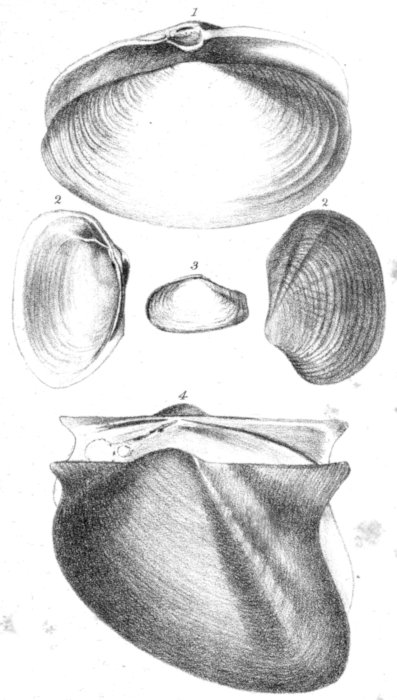
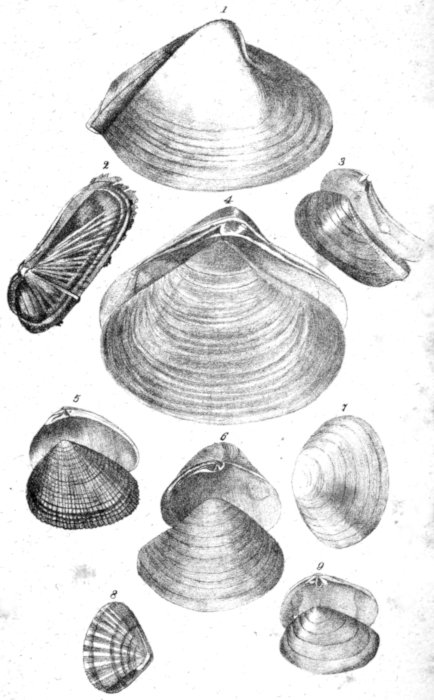
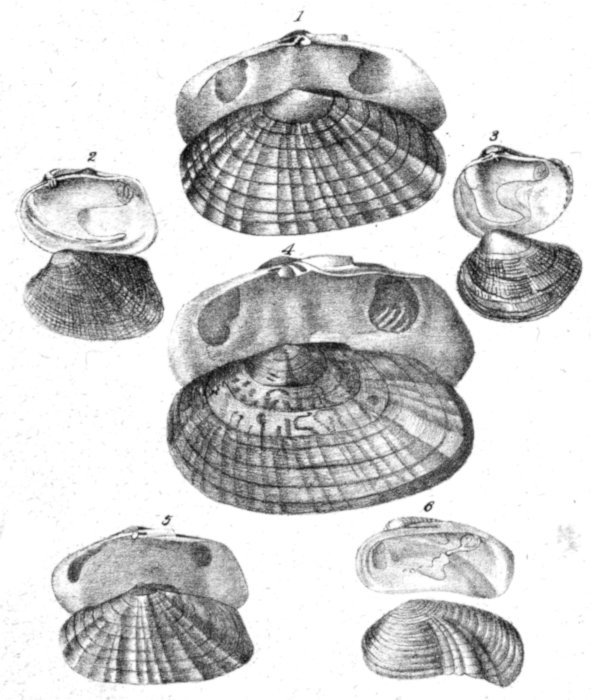
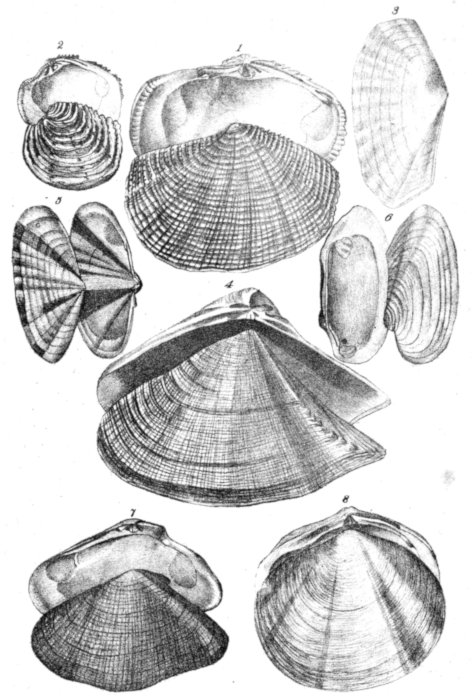
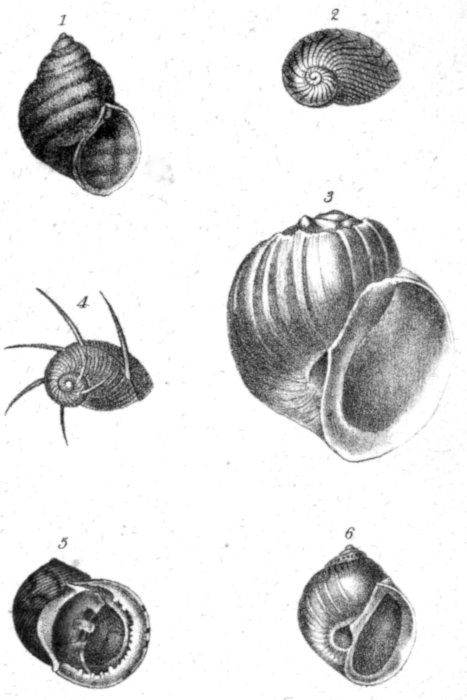
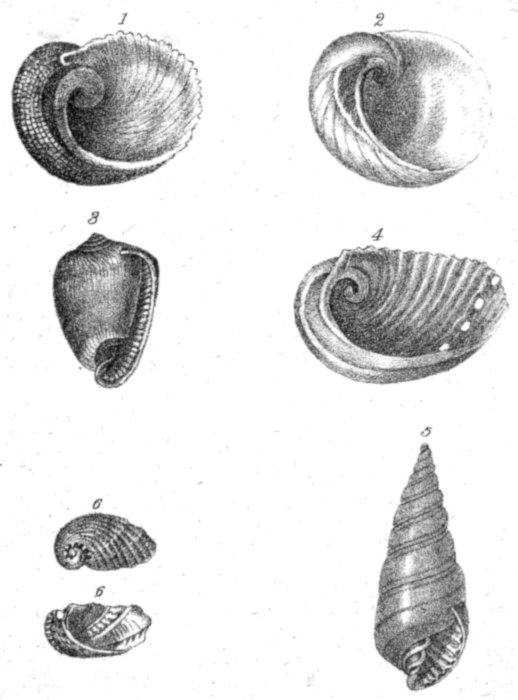
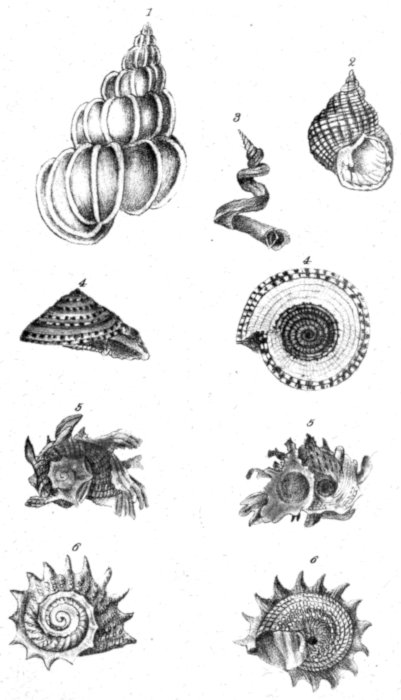
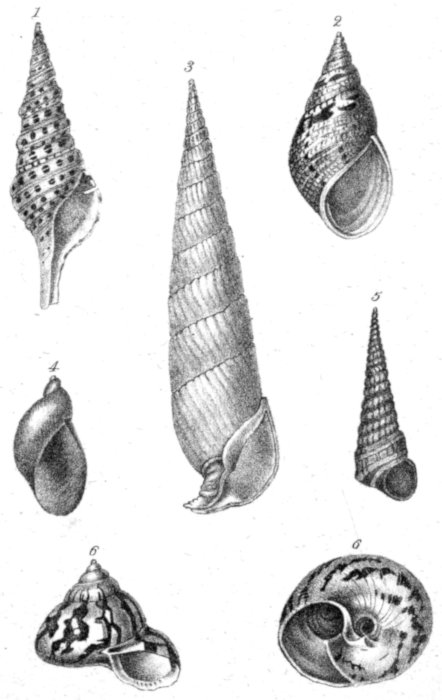
A MANUAL OF CONCHOLOGY, ACCORDING TO THE SYSTEM LAID DOWN BY LAMARCK, WITH THE LATE IMPROVEMENTS BY DE BLAINVILLE. EXEMPLIFIED AND ARRANGED FOR THE USE OF STUDENTS.
Transcriber’s Note:
The cover image was created by the transcriber and is placed in the public domain.
BY THOMAS WYATT, M.A.
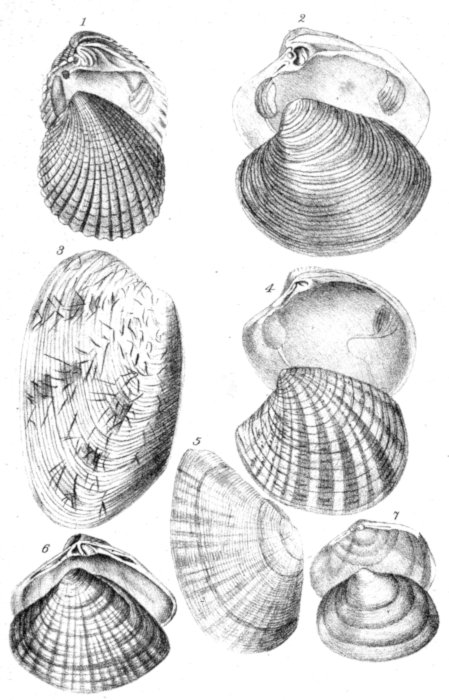
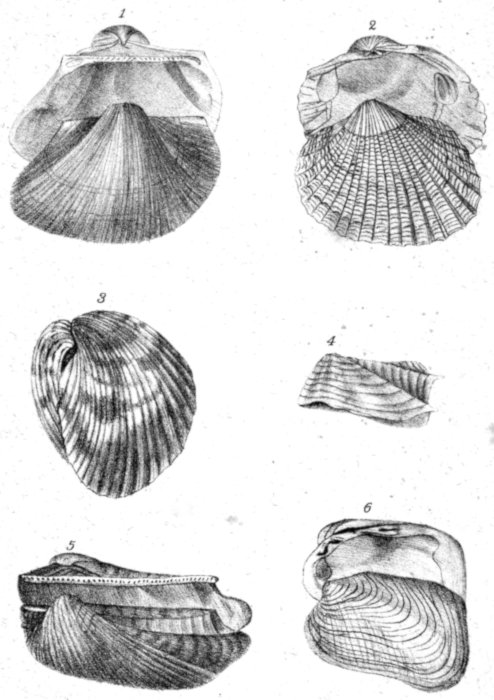
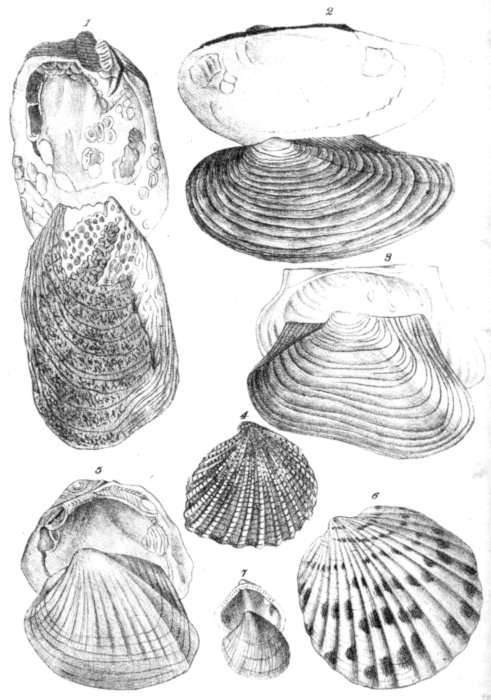
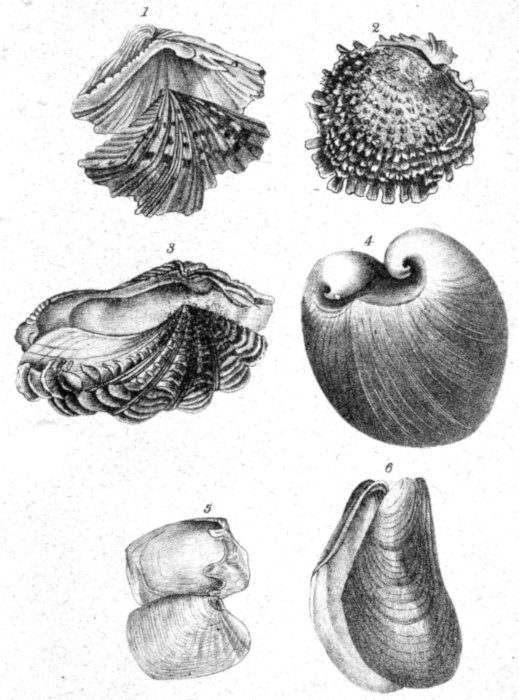
ILLUSTRATED BY THIRTY-SIX PLATES CONTAINING MORE THAN TWO HUNDRED TYPES, DRAWN FROM THE NATURAL SHELL.
NEW-YORK:
HARPER & BROTHERS, CLIFF-STREET.
1838.
Entered, according to Act of Congress, in the year 1838, by
Thomas Wyatt,
in the Clerk’s Office of the Eastern District of Pennsylvania.
INTRODUCTION.
iii
Conchology or Testaceology is a numerous and beautiful
branch of Natural History, treating of the testaceous covering
of animals; perhaps none but the department of Flora
can vie with it in variety, symmetry of form, and rich colouring.
It has ever excited admiration, and obtained a prominent
situation in the cabinet; and so great are the facilities
afforded at the present day to procure specimens and obtain
a knowledge of this science, that it has become one of the
requisites of a finished education. Shells are found in all
parts of the world, both on land and in water; but the most
beautiful and valuable species are found between the tropics.
At first they were regarded as pleasing curiosities, and
prized only on that account; but the investigations of scientific
men have proved that the study of this science is not
only interesting, but useful. Much valuable information has
already been obtained, and, from the investigations of modern
naturalists, much more may be anticipated.
So intimate is the connexion between Conchology and
Geology, that a knowledge of the one is indispensable to
the study and acquirement of the other. The geologist will
draw much advantage from a close study of the testaceous
covering of molluscous animals to aid him in determining
the identity or the superposition of the different strata of the
ivearth and the extraordinary changes it has undergone; for,
as Bergman elegantly says, “fossil shells, coral, and wood
are the only three remaining medals of Creation.” He will
see in the innumerable quantity of these animals, succeeding
each other from generation to generation in the depth of the
seas, one of the evident causes of the growth and increase
of islands and continents.
But man may find in the knowledge of Mollusca applications
still more direct to his well being in society, both as to
the advantages and disadvantages to be derived from them:
thus a great number of species are proper for food, as oysters,
mussels, &c., which are objects of commercial speculations.
The Pinna furnishes the Italians with materials for
a rich dress, and the pearl, so much prized by the Orientals,
by princes, and particularly by the ladies, as a modest and
beautiful ornament, is produced by a disease of the animals
in certain species of shells. It was this knowledge which
made the celebrated Linnæus imagine that it was possible
to form an artificial pearlery in the rivers of Sweden. The
mother of pearl, so much employed as an ornament in articles
of luxury, is only the interior lining of certain univalve
or bivalve shells. Painting draws from some of these animals
many colours, valuable not so much for their beauty
as their usefulness, as Chinese ink and sepia.
The brightest and richest colour known by the ancients,
and used by them for the celebrated Tyrian purple dye, is
produced by animals at this time known by the name of
Purpura.
The Teredo attacks the wood of our vessels, and often
does much injury; therefore the knowledge of its manners,
vhabits, and customs must be of great importance in countries
infested with them, so as to be able to provide a remedy
against them. Snails and slugs are also enemies much to
be dreaded in our gardens.
Lamarck, in his last work, the result of the successive
and continual labours of his whole life and those of his contemporaries,
has rendered a very great service to science,
but especially to conchology, by describing, or, at least, characterizing
the numerous species of shells in his own splendid
cabinet. It may be proper here to remark, that a part
of Lamarck’s cabinet is now in the possession of Isaac Lea,
Esq., of Philadelphia, to whom we are much indebted for
valuable assistance. To Dr. Comstock, and the Rev. W.
Turner, of Hartford, Conn., we are much indebted for kind
favours; their aid has greatly facilitated our labours.
In this Manual of Conchology we have endeavoured to
give a free translation of Lamarck’s system, as simplified
by De Blainville; and, in order to facilitate as much as possible
the study of this beautiful and interesting science, we
have divested it of numerous technicalities, and divided it
into four classes: Annelides, Cirrhipedes, Conchifera, and
Mollusca.
To each class we have assigned its various families, to
each family its genera, and to each genus its living species;
thereby making it plain and within the reach of the meanest
capacity. A type of almost every genus is given, excepting
only those shells which, from their similarity to other genera,
may easily be classed.
It was deemed advisable, as this is intended for an easy
introduction to the science, to omit many divisions and subdivisions,
viwhich would only serve to perplex and render the
attainment more difficult.
As the Naiades, or shells of this country, are given in several
valuable scientific works lately published, we have only
slightly touched them in the place they are intended to occupy.
We cannot expect that the work now presented to the public
is free from imperfections; but we ask for their lenity and
kind forbearance to excuse whatever defects there may be in
our humble attempts to advance the cause of science. Conchology,
like other departments of natural history, is progressing;
and that which is given to-day is almost always
susceptible of being modified to-morrow; should this work
be well received, it is our intention to give, as soon as practicable,
an enlarged work, containing even the minute microscopic
shells and the fossils, with plates containing types of
as many species of the genera as can possibly be obtained.
The plates were drawn and coloured with great care and
accuracy from the natural shells in our own cabinet, under
the superintendence of Mr. James Ackerman, artist.
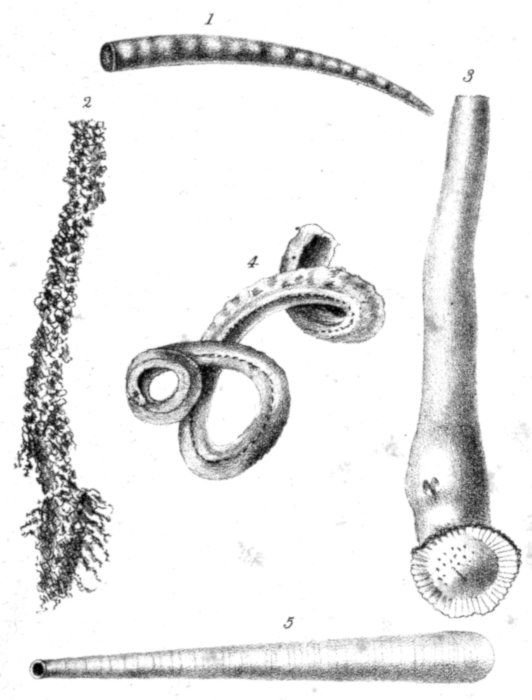
CLASS I. ANNELIDES. CONTAINS FOUR FAMILIES. — FAMILY I. Dorsaliæ. Two genera. — 1. Arenicola. Has no shell. One species. — 2. Siliquaria. Four species. — FAMILY II. Maldaniæ. Two genera. — 1. Clymene. One species. — 2. Dentalium. The Tooth Shell. Twelve species. — FAMILY III. Amphitritæa. Four genera. — 1. Pectinaria. Two species. — 2. Sabellaria. Two species. — 3. Terebella. Three species. — 4. Amphitrite. Six species. — FAMILY IV. Serpulacea. Five genera. — 1. Spirorbis. Five species. — 2. Serpula. The Worm Shell. Twenty-six species. — 3. Vermilia. Eight species. — 4. Galeolaria. Two species. — 5. Magilus. One species.
11
A. piscatorium.
Shell very thin, conical, tubular, involuted in a loose and
irregular spiral manner; aperture circular, edges sharp, interrupted
in the middle by a notch prolonged like a slit
through nearly all its length, stopped abruptly at some distance
from the summit.
Shell tapering, undulating, spiral at the extremity.
S. muricata. The Prickly Siliquaria.
Species armed with short spines or prickles; aperture
sometimes margined; usually of a rosy or pink colour.
12
C. amphistoma. The double-mouthed Clymene.
Tube thin and slender, open at both ends; incrusted externally
with sand and fragments of shells.
This genus took its name from its resemblance to an elephant’s
tooth. It is an attenuated conical tube, slightly bent,
and open at both ends.
Shell tubular, regular, symmetrical, lightly curved longitudinally,
conic, attenuated insensibly posteriorly, and open
at each extremity by a round orifice.
Dentalium elephantinum.
D. aprinum.
D. fasciatum.
D. entale.
D. Tarentinum.
D. corneum.
D. octoganum.
D. novemcostatum.
D. dentale.
D. nigrum.
D. politum.
D. eburneum.
D. elephantinum. The Elephant’s Tooth Shell.
Species in which the tube is striated or ribbed longitudinally;
the ribs are generally ten in number; green colour.
Species very minutely striated; white or yellowish colour.
D. pellucidum. The pellucid Dentalium.
Species narrow and thin; pale topaz colour.
D. politum. The ring-striated Tooth Shell.
Species finely pointed, solid, striated annularly; generally
rosy or pink colour.
D. rectum. The straight Tooth Shell.
Species entirely straight, with longitudinal ribs.
13D. eburneum. The Ivory Tooth Shell.
Species of a reddish or pale yellow colour, with the tip
frequently tinged with orange or pink.
The similarity of the four genera comprising this family
is such, that it was thought sufficient to give only one type
(the sabellaria crassissima), as the student may easily recognise
the others.
A membranous or papyraceous tube, in the form of a reversed
cone; unfixed; exterior covered with sandy adhesions.
Pectinaria Belgica.
Pectinaria capensis.
P. Belgica. The Belgic Pectinaria.
Tube inversely conic, membranous, and covered with sand.
The covering of the animal belonging to this genus is
composed of fragments and particles of marine substances,
adhering to a tubular membrane; some are detached and
others are fixed. The tubes are cellular at the base, and the
orifice expanded.
Sabellaria alveolata.
Sabellaria crassissima.
S. alveolata. The Honeycomb Sabellaria.
Consists of numerous parallel tubes, nearly straight, communicating
by an aperture, forming when in mass the appearance
of a honeycomb; it adheres to rocks in clusters.
S. crassissima. The very thick or strong Sabellaria.
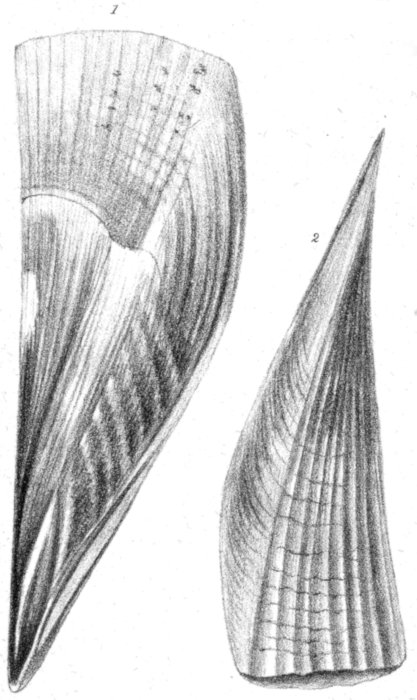
Pl. 33, fig. 2.
Species incrusted with small stones; sometimes found
thick and of a large size.
14
Tube elongated, cylindrical, membranous, attenuated and
pointed at the base, with adhesions of sand.
Terebella conchilega.
T. cristata.
T. ventricosa.
T. conchilega. The shelly Terebella.
Tube covered with numerous fragments of broken shells.
Nearly the same as the Terebella, but of a tougher membranous
texture, and generally without adhesions.
Amphitrite ventilabrum.
A. penicillus.
A. magnifica.
A. vesiculosa.
A. volutacornis.
A. infundibulum.
A. ventilabrum. The Fan Amphitrite.
Tube subulate, smooth, of a yellowish colour.
Tube testaceous, spirally twisted on a horizontal plane,
with terminal aperture rounded or angular, attached by the
lower part to marine substances.
Spirorbis Nautiloides.
S. spirillum.
S. carinata.
S. lamellosa.
S. tricostalis.
S. Nautiloides. The Nautilus-shaped Spirorbis.
White, transversely wrinkled and minute.
The name of this genus is derived from the Latin word
serpo, to creep, on account of the vermiform character of
some of its species.
They are invariably tubular, sometimes solitary, but more
15frequently in clusters spirally entwined, adhering to marine
substances. In colour they are brown, purple, yellow,
tawny, pink or white, and sometimes tinged with green.
Tube solid, calcareous, irregularly twisted, fixed to other
substances.
Serpula vermicularis.
S. fascicularis.
S. intestinum.
S. contortuplicata.
S. plicaria.
S. glomerata.
S. decussata.
S. protensa.
S. infundibulum.
S. annulata.
S. cereolus.
S. filograna.
S. vermicella.
S. filaria.
S. pellucida.
S. intorta.
S. cristata.
S. spirulæa.
S. quadrangularis.
S. minima.
S. echinata.
S. sulcata.
S. costalis.
S. dentifera.
S. sipho.
S. arenaria.
S. vermicularis. The wormlike Serpula.
White, cylindrical, tapering, rugged, variously curved and
twisted.
Tube testaceous, cylindrical, more or less twisted, gradually
attenuated posteriorly; opening round, the margin with
one, two, or three teeth; shell adhering by the side to other
substances; provided with a convex operculum.
Vermilia rostrata.
V. triquetra.
V. bicarinata.
V. eruca.
V. subcrenata.
V. plicifera.
V. scabra.
V. tæniata.
V. triquetra. The three-sided Vermilia.
White or reddish, rugged, twisted and triangular, carinated
along the back.
16
Distinguished from the Vermilia by a very peculiar operculum.
Found in groups, adhering together at the base.
Tube open at the summit; aperture orbicular, terminated
on the side by a spatulous tongue; operculum orbicular, squamose,
consisting of from five to nine testaceous parts or
valves, all attached to one side of the operculum; the middle
one dentated at the truncated part of its summit, the
others a little toothed on their internal edge.
Galeolaria cæspitosa.
Galeolaria elongata.
G. elongata. The elongated Galeolaria.
Whitish, existing in congregated masses; operculum as
above.
A very singular shell, greatly resembling a petrified body,
composed of a testaceous white substance like alabaster.
The base is bent into a short spire, with about four contiguous
whorls; the last prolonged and nearly straight. The
animal, as it increases in size, abandons the spiral part by
increasing the tubular part, filling up the part it quits with
calcareous matter, which proves that it advances gradually.
Tube partially involuted, convex in its upper exterior part,
the lower side flattened, platted, carinated, and somewhat
angular; the spire short, helix-formed, and prolonged through
the rest of its extent in nearly a right line; aperture entire,
oval, with a sort of sinus or gutter in the middle line, producing
the keel of the shell.
M. antiquus. The antiquated Magilus.
Answers to the above description; colour pale yellowish
brown, transversely wrinkled.
CLASS II. CIRRHIPEDES. HAS BUT ONE FAMILY. — Cirrhipedes. Ten genera. — 1. Tubicinella. One species. — 2. Coronula. Three species. — 3. Balanus. The Acorn Shell. Twenty-eight species. — 4. Acasta. Three species. — 5. Creusia. Three species. — 6. Pyrgoma. One species. — 7. Anatifera. Five species. — 8. Pollicipes. Three species. — 9. Cineras. One species. — 10. Otion. Two species.
17
Lamarck divided the Lepas of Linnæus into the various
genera which compose this family. The term lepas is derived
from the Greek word λεπας, a rock, alluding to its
custom of adhering to rocks and marine bodies. The shell
often varies in shape, covering, and colouring; it is generally
conical, but sometimes hemispherical; some of the valves
are placed perpendicularly on a base, broad at the lower
margin and tapering towards the summit, which is closed
by small horizontal valves forming the operculum. The
number of valves is indefinite, from four to twenty-four; but
all are diversified with striæ, ridges, and grooves. The striæ
are mostly transverse, and the ridges longitudinal.
The valves which compose the operculum or lid vary in
shape, and are in number two, three, four, or more; they are
generally attached to a ligament.
They are seldom, if ever, found detached, but adhere in
groups to rocks, shells, anchors, marine animals, &c. Those
that fix themselves to ships are generally called barnacles;
they rapidly increase in size and number, do great damage,
and greatly impede the progress of the vessel. Some of
this family are affixed at the base of the shell to other substances,
and are therefore called sessile; others are attached
to a fleshy peduncle or stem, and are said to be pedunculated.
The peduncle or stem, proceeding from the base of the shell
to the substance which sustains it, is sometimes smooth, fine
18in texture, and tinged with bright red or orange; sometimes
it is of a dark or brownish colour, with a texture much
coarser and granulated.
Has the form of a cylindrical tube, slightly curved, and
open at both ends; one extremity closed by four trapezoidal
valves attached to the inner margin, the other end closed by
a membrane. The annular ribs which separate the compartments
show its progressive growth. Found buried so
deeply in the fat of marine animals, particularly whales, that
only the operculum and the upper part of the tube are visible.
Shell rather elevated, sub-cylindrical, the partitions
rather small and indented; the spaces or compartments almost
quadrilateral; the inferior much more narrow than the
others; the apertures equal and circular; the membrane
which closes the superior forming a tube between the four
almost equal valves of the operculum.
T. balænarum. The Whale Tubicinella.
Tubular, with transverse ribs, and a ring-shaped margin;
operculum bottle-shaped.
Found imbedded in the skin of whales and other marine
animals, though not generally at so great a depth as the Tubicinella.
Shell in form a little variable and without trace
of support; the coronary part formed of six pieces, as in
those properly called Balanus, but more regularly disposed
in a manner to imitate a kind of crown or tube; spaces alternately
hollowed and saliant; operculum not articulated,
composed of two pairs of small, level, delicate valves, joined
at the aperture of the tube by a considerable membranous
part, leaving a passage for the cirrhous appendages of the
animal.
Coronula testudinaria.
C. balænarum.
C. diadema.
C. quinquevalvis.
19C. testudinaria. The Tortoise Coronula.
Very depressed, circular, as if radiated by the disposition
of marked spaces, striated transversely, forming six rays diverging
from the centre to the circumference; aperture oval
and hexagonal.
C. balænarum. The Whale Coronula.
A little more elevated; the spaces prominent, equal between
them, much larger than the excavated; the aperture
subcircular; the operculum of four valves, almost equal, occupying
but a small space of the membranous part which
forms between them a sort of tube.
C. diadema. The Crown Coronula.
More elevated, sub-hexagonal; the spaces almost equal,
the hollow parts larger than the saliant; the superior aperture
very large and hexagonal; the inferior much smaller,
of the same form, and communicating in a round excavation
by radiated plates; the operculum bivalve.
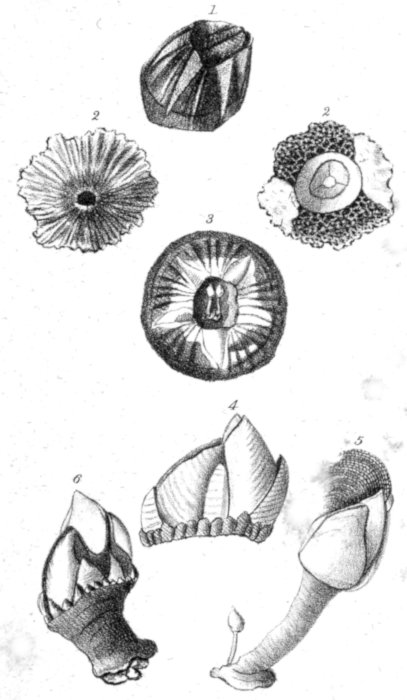
C. quinquevalvis. The five-valved Coronula. Pl. 4,
fig. 3.
Species irregular, having only five valves, of a purple hue.
So named from its resemblance to an acorn. Shell conical;
the coronary part formed of six very distinct valves,
one dorsal, one ventral, and two pairs of laterals, with or
without a calcareous support; operculum of four articulated
pieces, forming a sort of pyramid in the superior aperture of
the tube.
Either has no support or a membranous one; armed with
spines exteriorly.
Found in sponge, from which, when detached, it cannot
stand erect on account of the convexity of the base.
Shell oval, sub-conic, shaped like a Patella, with six lateral
unequal valves slightly connected; operculum with four
valves.
Acasta Montagui.
A. glans.
A. sulcata.
A. Montagui. Montague’s Acasta.
Valves erect, triangular, acute, with muricated ascending
spines.
The shells of this genus are generally small; found in
the seas of hot countries attached to madrepore and other
marine substances.
Shell sessile, thin, Patella-shaped; aperture oval, rather
large, closed by a large sub-pyramidal bivalve operculum; a
21considerable calcareous support, funnel-shaped, penetrating
the bodies to which the animal is attached.
Creusia stromia.
C. spinulosa.
C. verruca.
C. spinulosa. The spiny Creusia.
Very depressed, striated, sometimes with marks of division
into four pieces; operculum bivalve.
Whitish, slightly depressed, with interwoven obliquely striated
valves; the margin at the base irregularly serrated.
The principal difference between this genus and the Creusia
is in form.
Shell sessile, rather globular appearance on account of
the valves being more closely united, ventricose, convex
above, apex perforated, aperture small and elliptical; operculum
bivalve.
P. cancellata. The cancellated Pyrgoma.
Thick, conical, Patella-shaped, ribs radiating from the
summit to the base; aperture very small, closed by an operculum
of which the two pieces are long and narrow on each
side; pale violet colour.
The shells of this genus and the three following genera
are affixed to marine bodies by a tough membranous peduncle,
varying in length.
Shell flat, with five valves imbricating more or less on the
edges, united by a thin membrane.
Valves indefinite in number, from six to twenty-four; almost
equal, and open like tulips; colour bluish, purplish,
brownish, or reddish cast.
Shell composed of five testaceous oblong valves, separate,
not covering the whole of the body; two at the sides of the
aperture, the others on the back; peduncle of a greenish
colour, with six longitudinal stripes.
C. vittata. The filleted Cineras.
Answers to the above description.
Shell composed of two testaceous valves, enclosed in a
mantle or membranous bag, which is prolonged and terminated
in two fleshy tubes formed like ears, one of the two
having a lateral opening.
Otion Cuvierii.
Otion Blainvillii.
O. Cuvierii. Cuvier’s Otion.
Answers to the above.
O. Blainvilli. Blainville’s Otion.
Ash coloured; the body and ears spotted with black.
CLASS III. CONCHIFERA. — FAMILY I. Tubicola. Six genera. — 1. Aspergillum. The Watering-pot Shell. Four species. — 2. Clavagella. One species. — 3. Fistulana. Four species. — 4. Septaria. One species. — 5. Teredina. Two fossil species. — 6. Teredo. The Ship Worm. Three species. — FAMILY II. Pholadaria. Two genera. — 1. Pholas. The Stone Piercer. Nine species. — 2. Gastrochæna. Three species. — FAMILY III. Solenides. Four genera. — 1. Solen. Eighteen species. — 2. Panopæa. One species. — 3. Solecurtus. Three species. — 4. Glycimeris. Two species. — FAMILY IV. Myaria. Two genera. — 1. Mya. The Trough Shell, or Gaper. Four species. — 2. Anatina. The Duck’s Bill. Ten species. — FAMILY V. Mactracea. Seven genera. — 1. Lutraria. Eleven species. — 2. Mactra. The Kneading-trough. Thirty-three species. — 3. Crassatella. Eleven species. — 4. Erycina. One species. — 5. Ungulina. Two species. — 6. Solenimya. Two species. — 7. Amphidesma. Sixteen species. — FAMILY VI. Corbulacea. Two genera. — 1. Corbula. Nine species. — 2. Pandora. Two species. — FAMILY VII. Lithophagi. Three genera. — 1. Saxicava. Five species. — 2. Petricola. Thirteen species. — 3. Venerirupis. Seven species. — FAMILY VIII. Nymphacea. Ten genera. — 1. Sanguinolaria. Four species. — 2. Psammobia. Eighteen species. — 3. Psammotæa. Seven species. — 4. Tellina. The Tellen. Fifty-four species. — 5. Tellinides. One species. — 6. Corbis. One species. — 7. Lucina. Twenty species. — 8. Donax. The Wedge Shell. Twenty-seven species. — 9. Capsa. Two species. — 10. Crassina. One species. — FAMILY IX. Conchacea. Seven genera. — 1. Cyclas. Eleven species. — 2. Cyrena. Ten species. — 3. Galathea. One species. — 4. Cyprina. Two species. — 5. Cytherea. Seventy-eight species. — 6. Venus. Eighty-eight species. — 7. Venericardia. One species. — FAMILY X. Cardiacea. Five genera. — 1. Cardium. Cockle, or Heart Shell. Forty-eight species. — 2. Cardita. Twenty-one species. — 3. Cypricardia. Four species. — 4. Hiatella. Two species. — 5. Isocardia. Three species. — FAMILY XI. Arcacea. Four genera. — 1. Cucullæa. One species. — 2. Arca. The Ark. Thirty-seven species. — 3. Pectunculus. Nineteen species. — 4. Nucula. Six species. — FAMILY XII. Trigonacea. Two genera. — 1. Trigonia. One species. — 2. Castalia. One species. — FAMILY XIII. Naiades. Four genera. — 1. Unio. Forty-eight species. — 2. Hyria. Two species. — 3. Anodonta. Fifteen species. — 4. Iridina. One species. — FAMILY XIV. Chamacea. Three genera. — 1. Diceras. One fossil species. — 2. Chama. The Clam or Gaper. Seventeen species. — 3. Etheria. Four species. — FAMILY XV. Tridacnites. Two genera. — 1. Tridacna. The Clam Shell. Six species. — 2. Hippopus. One species. — FAMILY XVI. Mytilacea. Three genera. — 1. Mytilus. The Muscle. Thirty-five species. — 2. Modiola. Twenty-three species. — 3. Pinna. The Wing Shell. Fifteen species. — FAMILY XVII. Malleacea. Five genera. — 1. Crenatula. Seven species. — 2. Perna. Ten species. — 3. Malleus. The Hammer. Six species. — 4. Avicula. Thirteen species. — 5. Meleagrina. Two species. — FAMILY XVIII. Pectinides. Seven genera. — 1. Pedum. The Shepherd’s Crook. One species. — 2. Lima. The File Shell. Six species. — 3. Pecten. The Scallop. Fifty-nine species. — 4. Plagiostoma. Ten fossil species. — 5. Plicatula. Five species. — 6. Spondylus. The thorny Oyster. Twenty-one species. — 7. Podopsis. Two fossil species. — FAMILY XIX. Ostracea. Six genera. — 1. Gryphæa. One species. — 2. Ostrea. The Oyster. Forty-eight species. — 3. Vulsella. The Tweezers. Six species. — 4. Placuna. The Chinese Window Shell. Three species. — 5. Anomia. The Antique Lamp. Six species. — 6. Crania. The Scull. One species. — FAMILY XX. Brachiopoda. Three genera. — 1. Orbicula. One species. — 2. Terebratula. Twelve species. — 3. Lingula. One species.
23
CONTAINS TWENTY FAMILIES.
A well-known but rare shell; the larger end closed by a
convex disk, with numerous small perforations, and encircled
by a dilated margin of elegant papyraceous tubes, resembling
a beautifully plaited ruff; the smaller end open. Found in
sandy places at low water.
Shell oval, slightly elongated, striated longitudinally, sub-equilateral;
adhering, more or less confounded with the
coats of a rather thick calcareous tube, conic, club-shaped,
open at its attenuated extremity, and terminated at the other
by a convex disk pierced by a great number of sub-tubular,
rounded holes, and by a fissure in the centre.
Species smooth, in which the circumference of the disk is
bordered with a waved testaceous fringe.
A. Novæ Zeylandiæ. The New-Zealand Aspergillum.
Species in which the circumference of the disk is without
a fringe.
An irregular tube, with branches or projecting tubes at the
closed end; within it is one free or moveable valve, united
24by a ligament to another, which is blended with the tube;
this distinguishes it from the Aspergillum. Found in sand
and coral.
Shell oval, very slightly elongated, striated longitudinally,
slightly irregular; equivalve, inequilateral; hinge a little variable;
ligament exterior; two well-marked distant muscular
impressions; a calcareous sub-cylindrical tube, more or
less completely surrounding the shell, and terminated before
by a single orifice.
C. aperta. The open Clavagella.
Tube erect, adhering; aperture waved, entire, expanding,
funnel-shaped, leaving the two valves open or uncovered in
all their anterior part; with an ovate face valve.
Lamarck asserts that the tube and shell of this genus are
quite distinct. It so greatly resembles the Teredo that it is
with difficulty distinguished. It is found in sand, wood,
stone, and sometimes shells.
Shell annular or very short, not sharp nor angular anteriorly,
but in other respects much like that of the Teredo.
Tube generally shorter, thicker, more solid, more club-shaped
than that of the Teredo, always closed at its anterior
extremity in such a manner as to contain and entirely
hide the shell; the posterior extremity open, and divided interiorly
into two syphons by a partition.
Fistulana clava.
F. corniformis.
F. gregata.
F. lagenula.
F. corniformis. The horn-shaped Fistulana.
Answers to the above description.
F. gregata. The gregarious Fistulana.
Sheath or tube doubly club-shaped, congregating; shell
angularly arcuated, with double angulated serrated wings.
Species with one end clavate, the other incurved, narrower,
25obtuse, and perforated in the middle; shell generally flexuous,
of a brownish colour; exterior rough, interior smooth.
The tube of this genus unquestionably contains a bivalve
shell; but, as no perfect specimen has yet been found, nothing
decisive is known respecting it.
Tube calcareous, thick, conically elongated, more or less
flexuous, as if composed of pieces placed on the ends of
each other, or as if articulated, with a ring or projection
more or less marked at the place of the joints, but without
traces of partitions; terminated on one side by an inflation,
oftentimes with some interior partitions, and on the other by
two tubes, distinct and sub-articulated.
S. arenaria. The Sand Septaria.
The type of this genus.
A genus without a living species, given here to preserve
the family entire, having a shell thick, oval, short, very gaping
posteriorly, equivalve, inequilateral; summits well marked;
a spoonlike cavity in each valve.
Tube or sheath testaceous, cylindrical; anterior end open;
posterior end closed, but exhibiting the two valves of the
shell.
This genus derived its name from the faculty it possesses
of boring wood. The T. navalis can penetrate the stoutest
oaken planks of a ship’s sides by means of two valves affixed
to the head of the animal. The effects produced
would be much more destructive but from the fact of their
generally perforating the wood in the direction of the grain.
Sir E. Home wrote a very scientific and interesting description
of a species not mentioned by Lamarck, called the T.
gigantea, found imbedded in indurated mud in the Island of
26Sumatra. It is the largest species known, some having
been seen four or five feet long.
Shell thick, solid, very short or annular, open at both extremities;
equivalve, equilateral, angular and sharp anteriorly,
only slightly touching by the opposite edges; hinge
obsolete; a considerable internal spoonlike cavity; one
slightly sensible muscular impression.
Tube more or less distinct from the substance in which
the animal lives, cylindrical, straight or flexuous, closed with
age at the oral extremity so as to envelop the animal and its
shell; always open at the other end, and divided interiorly
into two syphons by a middle partition.
Teredo navalis.
T. palmulata.
T. gigantea.
T. navalis. The common Ship Worm.
Species very thin, cylindrical, and smooth; slightly twisted,
white, finely striated longitudinally.
This genus is without any tubular sheath; it derives its
name from the Greek word φωλεω, to hide, alluding to the
custom of its inhabitant in forming cells in rocks, wood, &c.
In form the Pholas is generally oblong, having two large
valves opposite to each other, with a number of smaller ones
attached to the back as a substitute for a hinge. The two
large valves never shut close; they are open at one end, and
sometimes at both.
The exterior of the shell is usually of a pure or dusky
white, but sometimes of a brownish cast. In some species
the shell is adorned with beautiful delicate reticulations, like
the finest lace; in others the texture is coarser, like small
basket-work. They are found in the American, Indian, and
European seas, each shell in a separate habitation formed in
27limestone, sandstone, wood, coral, &c.; often discovered
completely imbedded in the oak planks of ships traversing
those seas; as they advance in growth they enlarge the space
within, and leave the aperture by which they entered of its
primitive size.
Shell thin, sub-transparent, finely striated, elongated oval,
bivalve, equivalve, inequilateral; the valves only touching
in the middle of their edges; the summits but little marked,
and concealed by a callosity produced by the expansion of
the dorsal lobes of the mantle; near the hinge are often developed
one or more accessory calcareous pieces; an incurved
tooth interior beneath the hinge.
Answers to the general description, but is beset with
small calcareous spiny nodules on the ribs, which run widening
and enlarging from the summit to the margin; colour
white or very light brown.
Oval, the dorsal callosity leaving the summit free, and extending
towards the anterior and inferior extremity in such
a manner that each valve seems to be formed of three parts,
because of an oblique furrow from the summit to the margin;
a tooth running down in the inside from the summit;
one pair of accessory pieces at the posterior extremity of
the shell.
Elongated, wedge-shaped, covered with regular elevated
jagged or scalloped ribs, elegantly disposed; three dorsal
accessory pieces; muscular impression almost medial.
P. crispata. The curled Pholas.
Somewhat oval, truncated behind, and as if divided into
two parts by an oblique furrow from the summit to the base;
anterior part reticulated, the other parts plain; muscular impression
marginal.
P. clavata. The clubbed Pholas.
Short, wedge-form, little gaping, with many accessory
pieces.
Always without accessory pieces, and, therefore, easily
distinguished from the Pholas.
Shell equivalve, somewhat wedge-shaped, with a very
large, oval, oblique, anterior opening between the valves;
the posterior extremity nearly close; hinge linear, marginal,
without teeth; two distant muscular impressions; sometimes
with a kind of tube or calcareous general envelope.
Gastrochæna cuneiformis.
G. mytiloides.
G. modiolina.
G. modiolina. The Modioliform Gastrochæna.
Oval, thin, brittle, gaping at the side; light reddish brown,
with a bluish white interior.
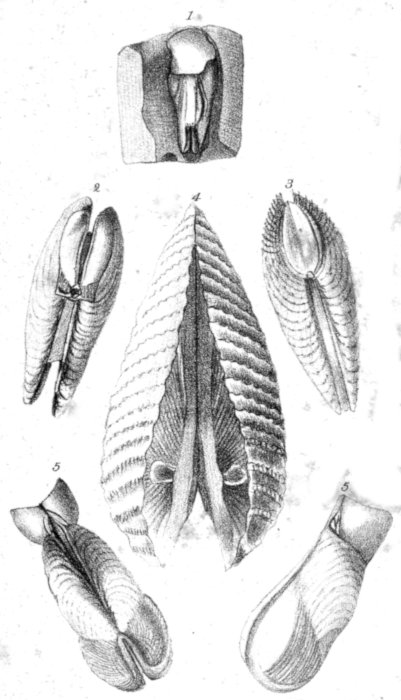
G. cuneiformis. The wedgelike Gastrochæna. Pl. 3,
fig. 1.
Species with a smooth shell, and without distinct tube.
(Represented as imbedded in wood.)
29
There are many species belonging to this genus differing
considerably in form and appearance. Its name is derived
from a Greek word signifying a pipe or tube. It is a bivalve
whose breadth sometimes exceeds its length; some species
have a resemblance to the sheath of a razor or a knife handle;
others are curved like the scabbard of a cimeter.
The Solen is found in the sand of the seashore, which it
sometimes penetrates to the depth of one or two feet.
Most of the species are covered with an epidermis, which
renders their colours more or less obscure. In general they
present but little beauty, though some are of a bright pink
colour, and some are beautifully and delicately radiated with
purple and white.
The principal characteristic of this genus is the hinge,
which generally has one subulate tooth, though sometimes
two or three.
Shell equivalve, extremely inequilateral, transversely elongated,
open at both ends; the apices very small, and entirely
at the commencement of the dorsal line; one or two teeth
in the hinge; ligament external; two distant muscular impressions;
the anterior one very long and narrow, the posterior
one sub-angular.
Valves equal, truncated at both ends; straight or slightly
curved; summit terminal.
S. cultellus. The kidney-shaped Solen.
Species a little curved lengthwise; summit not terminal.
S. rostratus. The violet-beaked Solen.
Species with longer and narrower valves, flatter at the extremities;
callosity at the hinge very visible; cardinal teeth
or hinge nearer the middle than the anterior side.
S. ensis. The Sabre Solen.
Species linear, sabre-shaped; a single compressed tooth
in each valve; olive brown at the base, and of a purple hue
near the apex.
S. siliqua. The podlike Solen.
Species linear, straight; two teeth in one valve and one
in the other; covered with a glossy brown epidermis; striated
transversely.
S. antiquatus. The Antiquated Solen.
Species thin, white, and almost transparent; striated concentrically;
ends rounded; hinge near the centre; a tooth
in one valve locking into two in the other; the teeth erect
and projecting beyond the margin; covered with a dark-coloured
epidermis.
Distinguished from the Mya by the prominency of the
apex and the situation of the ligament.
Shell regular, elongated oval, gaping at the two extremities,
equivalve, inequilateral; summit but little marked, and
anterodorsal; hinge very complete, similar, formed by a
conical primary tooth before a short, compressed, ascending
callosity; ligament exterior, attached to the callosity; two
muscular impressions.
31P. Aldrovandi. The Panopæa of Aldrovandus. Pl. 5,
fig. 2.
The type of this genus, transversely elongated, undulated;
concentrically wrinkled; of dark green colour, almost black.
Shell oval, elongated, equivalve, sub-equilateral, edges almost
straight and parallel; the extremities equally rounded,
and as if truncated; summits but little marked; hinge toothless,
or formed by some rudimentary primary teeth; ligament
projecting, affixed to the thick nymphal callosities; two distant,
rounded muscular impressions.
Solecurtus radiatus.
S. strigilatus.
S. legumen.
S. radiatus. The radiated Solecurtus.
Species flat, small, with an interior ridge running down
obliquely from the summit to the abdominal margin.
S. strigilatus. The strigilated Solecurtus.
Species more cylindrical, without interior ridge.
S. legumen. The Pease-pod Solecurtus. Pl. 31, fig. 6.
Species still more elongated and sub-cylindrical.
Distinguished from the Solen by being without teeth at
the hinge.
Shell covered with epidermis, slightly irregular, elongated,
gaping at the two extremities, equivalve, inequilateral; the
summits but little marked; hinge toothless; a longitudinal
callosity; ligament exterior, affixed to very projecting callosities
on the shortest side of the shell; two distinct muscular
impressions.
Glycimeris margaritacea.
Glycimeris siliqua.
G. siliqua. The podlike Glycimeris.
Transversely oblong, covered with a black epidermis;
32umbones decorticated; internal disc of the valves white,
thick, and callous.
This term is derived from the Greek word μυω, to close,
alluding to the animal’s custom of closing the valves. The
principal characteristic of the Mya is its gaping at one end;
it is likewise distinguished by having a large spoonlike
tooth proceeding from beneath the beak. Its form is greatly
varied, but generally covered with a greenish epidermis,
which may be removed; and the shell, when polished, will
display beautiful prismatic colours. The Mya is found on
the seashore or on the banks of large rivers, partially concealed
in the sand and mud.
Shell transverse, inequilateral, surrounded with a thick
epidermis; rather solid; edges thin and sharp; summits but
little marked; hinge dissimilar; one or two large, compressed,
spoon-shaped teeth rising perpendicularly from the plane
of the left valve, and fitting into the entrance of a primary
cavity in the right valve; ligament interior, attaching the
tooth and cavity; two distant muscular impressions; the
anterior long and narrow, the posterior rounded; the mantle
impression narrow, with a large sinus or hollow.
Sub-oval, truncated; small end gaping; large end rounded;
33covered with a dark yellowish epidermis; inside white;
wrinkled transversely.
Shell elongated oval, very thin, fragile, semipellucid;
much inflated at one end like a duck’s bill, whence it derives
its common name; equivalve, very inequilateral; hinge
toothless; the anterior side rounded and much longer than
the posterior; ligament interior affixed to a bony spoonlike
process in each valve, and sustained by a lateral plate running
obliquely into the interior of the shell.
Anatina laterna.
A. truncata.
A. subrostrata.
A. longirostris.
A. globulosa.
A. trapezoides.
A. rugosa.
A. imperfecta.
A. myalis.
A. rupicola.
A. subrostrata. The beaklike Anatina.
Species equivalve and regular.
A. myalis. The Mya-like Anatina.
Species inequivalve.
A. trapezoides. The trapezium-shaped Anatina. Pl.
12, fig. 5.
Species with a moveable tooth or calcareous piece upon
the right valve, lodged in the angle formed by the spoonlike
process.
This genus was taken from the Mactra, and is perfectly
distinct, as it wants the lateral teeth. It is called Lutricola
by De Blainville, from its lurking in sand or mud at the
mouths of large rivers.
Shell inequilateral, orbicular, sub-triangular or transversely
34oval, gaping at the extremities; hinge with one cardinal
tooth folded in two, or two teeth, one of which is plain,
with an opposite hollow to receive it; no lateral teeth; ligament
interior and fixed in the hollow cavity of the primary
tooth.
Lutraria solenoides.
L. rugosa.
L. compressa.
L. piperata.
L. tellinoides.
L. elliptica.
L. papyracea.
L. plicatella.
L. crassiplica.
L. complanata.
L. candida.
L. solenoides. The Solen-like Lutraria.
Species oblong, sub-cylindrical, very gaping, two very
strong cardinal teeth; the spoonlike cavity of the ligament
vertical.
L. compressa. The compressed Lutraria.
Species oval or orbicular, almost equilateral, very compressed,
little gaping; hinge similar; internal ligament inserted
in the pit of a vertical spoonlike cavity; two distinct
tubes, without longitudinal striæ.
L. rugosa. The rugged Lutraria.
Species ovate, closed at both ends; striæ from the summit
to the base.
L. elliptica. The oval Lutraria.
Oblong oval, nearly smooth, having a few concentric striæ,
and some diagonal striæ at the ends of the valves; colour
yellow or greenish brown; inside white.
The name given to this genus was derived from the Greek
word μακτρα, from its resemblance to a trough used for
kneading bread.
In all species of this genus a similarity of colouring and
form pervades the whole. In shape they are sub-triangular
or oblong, with a smooth, striated, or transversely-ribbed exterior.
In some species the valves gape at both ends, and in
35others at the anterior only. The most general colour is
lilac, or white tinged with blue or yellow; some have purple
rays on a brown ground.
A singularity in the form of the hinge of the Mactra distinguishes
it from all other genera. It is of a triangular form,
has a bent or angular compressed tooth on each valve, with
a small oblique cavity on each side to which the ligament is
attached. There are also two lateral teeth, one near the
ligament and the other near the primary tooth. These teeth
are thin and fragile; the primary tooth is sometimes indistinct,
but the lateral teeth always exist.
The Mactra is found buried in the sand at a little distance
from the seashore. Shell generally thin and brittle, covered
with epidermis, of a triangular form, transverse, equivalve,
inequilateral; beaks prominent; one compressed, folded, cardinal
tooth, with an adjoining pit in each valve, projecting
inward; lateral teeth thin, lamellous, entering, placed near
the hinge; exterior ligament small; an interior ligament
inserted in the cardinal pits; two muscular impressions,
united by a narrow marginal tongue.
Mactra gigantea.
M. Spengleri.
M. striatella.
M. carinata.
M. straminea.
M. Australis.
M. violacea.
M. fasciata.
M. turgida.
M. plicataria.
M. rufescens.
M. maculata.
M. subplicata.
M. triangularis.
M. lactea.
M. abbreviata.
M. Helvacea.
M. grandis.
M. stultorum.
M. maculosa.
M. ovalina.
M. alba.
M. solida.
M. castanea.
M. rufa.
M. squalida.
M. Brasiliana.
M. donacina.
M. depressa.
M. lilacea.
M. trigonella.
M. deltoides.
M. crassatella.
36M. gigantea. The gigantic Mactra.
Species in which the cardinal teeth are almost obsolete,
in consequence of the enlargement of the pit of the ligament.
Species in which all the teeth are very large, lamellous,
striated longitudinally; colour reddish brown.
M. solida. The solid Mactra.
Species thick, solid, without epidermis; lateral teeth finely
striated.
M. trigonella. The three-cornered Mactra.
Species in which the lateral teeth are almost obsolete;
exterior surface smooth.
M. triangularis. The triangular Mactra.
Species very small, strong, opaque, white; inside white;
margin strongly crenated.
M. crassa. The thick Mactra.
Species very thick, solid, striated longitudinally; the cardinal
teeth obsolete, or almost so; the lateral very thick,
very close, and reflected; an external ligament as well as an
internal one.
May be easily known from the Mactra and Lutraria, as
the valves, when closed, fit exactly, and do not gape. It is
remarkable that all the living species contained in this genus
only exist in the seas of Australasia, while at least seven
species in a fossil state are found in France.
Shell inequilateral, sub-orbicular, close, equivalve, sometimes
attenuated at one end; two divergent primary teeth,
with a cavity at the side; lateral teeth obsolete; ligament
internal, inserted in the cavity of the hinge.
Crassatella Kingicola.
C. donacina.
C. sulcata.
C. subradiata.
C. contraria.
C. cuneata.
37C. rostrata.
C. glabrata.
C. erycinæa.
C. cycladea.
C. striata.
C. sulcata. The furrowed Crassatella. Pl. 6, fig 4.
Shell ordinarily thick, striated transversely, denticulated,
sub-triangular, equivalve, inequilateral, summits well marked
and evidently turned forward; hinge very large, subsimilar,
formed by two diverging cardinal teeth, separated by a large
pit; ligament almost entirely interior, and inserted in the pit.
C. Kingicola. The King’s Island Crassatella.
Ovate, orbicular; yellowish white, with obsolete rays;
very minutely striated transversely; the umbones somewhat
plicated.
The only living species of this genus is found on the sand
in New-Holland, but there are many fossils in France. It
is so equivocal in character that it is difficult to judge of
their hinge.
E. cardioides. The cardium-shaped Erycina. Pl. 6,
fig. 5.
Shell rather longer than high, sub-triangular, regular, equivalve,
inequilateral, rarely gaping; the summits well marked
and a little anteriorly inclined; hinge subsimilar; two unequal
cardinal teeth, converging at the summit, and leaving
a pit between them; two lateral teeth, not distant, lamellous,
inserted; ligament interior, fixed in the cavity between
the primary teeth.
This genus is very remarkable for having the pit or cavity
divided into two parts, the one at the end of the other; the
ligament is partially seen from the outside.
Ungulina oblonga.
Ungulina transversa.
38U. transversa. The transverse Ungulina.
Shell vertical or longitudinal, rather irregular, not gaping,
equivalve, inequilateral, with summits little marked and decorticated;
hinge dorsal, formed by one short, primary cleft
tooth, before an oblong pit, divided by a small ligament, in
which is inserted a sub-interior ligament; colour yellowish
brown.
This genus, which at first sight is confounded with the
Solens, differs from them particularly by the singular disposition
of the ligament placed at the short side of the shell.
Solenimya Australis.
Solenimya Mediterranea.
S. Australis. The Australian Solenimya. Pl. 6, fig. 2.
Shell covered with a thick brownish epidermis, regular,
thick, elongated oval, edges straight and parallel, equally
rounded at both extremities; valves equal, very inequilateral.
S. Mediterranea. The Mediterranean Solenimya.
Transversely oblong; dark brown, ribbed longitudinally,
with imbricated projecting foliations; inside white.
This genus was constituted by Lamarck on account of
the peculiar characters which distinguished it from those
genera which it most resembles; particularly in having the
valves connected by two ligaments.
Shell generally small, transverse, sub-oval or rounded,
occasionally a little gaping at the sides; hinge with one or
two cardinal teeth, and a narrow cavity for the interior ligament;
exterior ligament short.
Amphidesma variegata.
A. donacilla.
A. lactea.
A. cornea.
A. albella.
A. flexuosa.
A. prismatica.
A. phaseolina.
A. corbuloides.
A. glabrella.
39A. lucinalis.
A. Boysii.
A. tenuis.
A. purpurascens.
A. nucleola.
A. physioides.
A. glabrella. The smooth Amphidesma. Pl. 6, fig. 9.
Species lenticular or oval, with or without a lunated depression.
This genus approximates the Crassatella and Ungulina,
but is distinguished from them by the inequality of the valves
and the strong primary tooth.
Shell rather solid, a little irregular and triangular, inequivalve,
more or less inequilateral, rounded and enlarged
before, attenuated and prolonged behind; summits well
marked, one projecting behind the other; hinge anomalous,
formed by a large, conical, recurved cardinal tooth, with a
cavity at its base for the reception of the tooth of the other
valve; ligament very small; two muscular impressions little
distant.
Corbula Australis.
C. sulcata.
C. erythrodon.
C. ovalina.
C. Taitensis.
C. nucleus.
C. impressa.
C. porcina.
C. semen.
C. nucleus. The kernel Corbula.
Strong, sub-triangular, under valve larger than the upper
one; transversely striated; covered with a thick brownish
epidermis.
Shell white, regular, elongated, inequivalve, inequilateral;
right or upper valve entirely flat, with a plait or fold; much
produced towards the beak; hinge anomalous, formed by a
transverse cardinal tooth on the right valve, entering into a
corresponding cavity on the left; ligament internal, oblique,
triangular, inserted in a pit rather deep, with edges a little projecting
on each valve; two rounded muscular impressions.
This genus is taken from the Mytilus, and, like the Pholas,
possesses the faculty of penetrating calcareous rocks, from
which it cannot be extracted without breaking the substance
in which it is imbedded.
Shell bivalve, thick, covered with epidermis, rather irregular,
elongated, sub-cylindrical, obtuse at the two extremities;
summits little marked; hinge toothless, or with a
very small rudimentary tooth; ligament external, a little inflated.
Saxicava rugosa.
S. Gallicana.
S. pholadis.
S. Australis.
S. veneriformis.
S. Australis. The Australian Saxicava. Pl. 7, fig. 6.
Answers to the above description.
S. Gallicana. The Gallic Saxicava.
Oblong, wrinkled, truncated at the posterior extremity,
one valve larger than the other; pale horn colour.
41
This genus possesses the same faculty of boring rocks as
the Saxicava; it is distinguished from the latter genus by
the hinge having one or two teeth in each valve.
Shell sub-trigonal, transverse, inequilateral; upper side
narrowed and a little gaping; lower side rounded.
Petricola lamellosa.
P. ochroleuca.
P. semilamellata.
P. lucinalis
P. striata.
P. costellata.
P. rocelaria.
P. exilis.
P. ruperella.
P. chamoides.
P. pholadiformis.
P. labagella.
P. linguatula.
P. lamellosa. The lamellous Petricola. Pl. 7, fig. 3.
Species oval, trigonal, radiated; two teeth on one valve,
and one on the other.
P. pholadiformis. The Pholas-shaped Petricola.
Species transversely elongated.
Another lithophagous shell, taken from the genus Venus,
from which it is distinguished by the different disposition of
the teeth, having three primary in one of the valves at least.
Shell more or less irregular, sub-trigonal, striated or radiated,
equivalve, inequilateral, the anterior side shorter and
rounded, the posterior sub-truncated; summits well marked;
hinge sub-regular, more or less dissimilar, formed by slender,
narrow, cardinal teeth, variable in number on each valve,
sometimes two on the right and three on the left, and sometimes
three on both; these teeth are small, contiguous, parallel,
and but little, if at all, divergent exterior; very weak.
Venerirupis perforans.
V. nucleus.
V. irus.
V. exotica.
V. distans.
V. crenata.
V. carditoides.
42V. perforans. The perforating Venerirupis.
Sub-rhombic, transversely striated, wrinkled on the anterior
side; exterior brown, interior white, sometimes tinged
with purple.
Species longitudinally striated; cardinal teeth two, sometimes
three on the right and three on the left.
This family is divided into N. Solenaria and N. Tellinaria,
from their resemblance to the Solen and the Tellina.
N. Solenaria. Three genera.
This genus may be distinguished from the Solen by never
having the transverse oblong shape, or the edge of the valves
parallel to the base.
Sanguinolaria occidens.
S. rosea.
S. livida.
S. rugosa.
S. rosea. The rosy Sanguinolaria.
Semi-orbicular, smooth, shining and convex; near the umbones
of a beautiful rose colour, which becomes paler as it
descends; acute transverse striæ.
S. occidens. The setting-sun Sanguinolaria. Pl. 7, fig. 4.
Oval, a little elongated, very compressed, slightly gaping,
valves elliptical, equally rounded at the two extremities, without
mark of posterior keel; summits slightly indicated; hinge
formed by one or two contiguous cardinal teeth on each
valve; ligament projecting, convex; margins not parallel.
Taken from the Tellina, which it much resembles in form,
but from which it differs by not having the irregular plait on
the anterior part.
43Shell ovate, transverse, slightly gaping; summits projecting;
hinge formed by two teeth on one valve, and only one
inserted on the other.
Of the same form as the Psammobia, but differing in the
number of teeth, as the left valve of the Psammotæa has
only one tooth; sometimes one valve is toothless, while the
other has two teeth.
Shell transverse oval or oblong; gaping a little at the
sides; one primary tooth on each valve, though sometimes
on only one of them; ligament exterior, attached to callosities
at the hinge, and without an irregular plait.
The first five of these genera have one or two lateral teeth,
the remaining two have none.
This genus differs but little from the Donax; its species
are numerous, especially in the seas of hot countries; they
are found sunk deep in the sand.
There are but few genera that can vie with the Tellina in
beauty, variety, or number; some are smooth and polished,
some are remarkable for their beautiful radiations, and others
are covered with minute striæ and undulations; occasionally
the whole surface is covered with imbrications or scales.
They are produced abundantly in almost every sea and
in many rivers, but the finest species are found in the pearl-fisheries
of Ceylon.
The usual form of the Tellina is broad at one end and
gradually tapering towards the other. It derives its name
from the Greek word τελειω, to bring to a termination.
Shell of variable form, generally striated longitudinally
and very compressed; equivalve, more or less inequilateral;
anterior side longer and more rounded than the posterior;
offers a flexuous plait or twist at the inferior margin; summits
little marked; hinge similar; one or two cardinal
teeth; two distant lateral teeth, with a pit at their base in
each valve; ligament external.
Shell elongated; posterior side shorter and more narrow
than the anterior.
T. foliacea. The foliaceous Tellen.
Species transversely oblong; upon the edge of the front
side of either valve are rows of serrated teeth, running from
the apex to the margin.
T. bimaculata. The double-spotted Tellen.
Species orbicular, easily known by answering to its common
name.
T. fabula. The false Tellen.
Shell very thin, pellucid, and oval; yellowish colour,
darker towards the umbo, which is nearly central, pointed
and turned a little to one side; anterior side slopes to an
obtuse point; posterior side large and rounded; hinge with
three teeth in one valve and two in the other.
T. scobinata. The rasp Tellen.
Species oval or sub-orbicular, sub-equilateral.
46T. donacina. The Donax-like Tellen. Pl. 9, fig. 5.
Sub-oval, flattish, semi-striated and semipellucid; hinge
with two teeth in one valve and one in the other; pale yellow,
radiated longitudinally with pink.
T. depressa. The depressed Tellen.
Oval, flat, pointed at the smaller end and slightly reflected;
pale yellowish colour, faintly striated concentrically; covered
with a pale brown epidermis.
Though this genus bears a great affinity to many others,
it cannot be united with any; having lateral teeth, it differs
from the Psammobia; by not having the valves twisted, it
differs from the Tellina; the valves closing, and having muscular
impressions in the interior, render it distinct from the
Lucina.
Shell equilateral, rather elongated, almost without the
flexuous plait; two cardinal teeth diverging, and two remote
lateral teeth, of which the anterior is but little distant from
the summit.
T. Timorensis. The Tellinides of Timor. Pl. 8, fig. 3.
The only type and species of this genus.
This genus was at first classed by Lamarck with the Lucina;
but Cuvier, having discovered that the organization of
the animals differed, made this a distinct genus, which was
adopted by Lamarck.
Shell transverse, equivalve, no flexuosity; apices curved
inward, opposed to each other; two primary and two lateral
teeth, the posterior one nearest to the hinge; muscular impression
simple, valves sometimes convex, strongly ribbed
transversely, striated longitudinally, margins serrated and
closely interlocking.
Species white, rather thick, oval, a little elongated, almost
47equilateral; the cardinal and the lateral teeth well marked;
the muscular impression anterior, rounded.
In the hinge and lateral teeth it much resembles the Tellina,
but differs from it in never being flexuous. This genus
is more easily characterized by the orbicular, compressed,
general form of the shell, than by the dental system, which
is sometimes entirely effaced.
Shell compressed, regular, orbicular, sub-equilateral; summits
small and pointed, inclined anteriorly; hinge similar,
but variable; two divergent cardinal teeth, little marked, and
sometimes entirely effaced; two remote lateral teeth, with a
pit at the base, sometimes obsolete; posterior ligament more
or less sunk; two widely-separated muscular impressions,
of which the anterior is narrow and long.
Lucina Jamaicensis.
L. Pennsylvanica.
L. edentula.
L. mutabilis.
L. radula.
L. squamosa.
L. lactea.
L. undata.
L. circinaria.
L. columbella.
L. concentrica.
L. divaricata.
L. carnaria.
L. scabra.
L. reticulata.
L. sinuata.
L. pecten.
L. lutea.
L. digitalis.
L. globularis.
L. Jamaicensis. The Jamaica Lucina. Pl. 8, fig. 8.
Species lenticular, striated concentrically; the teeth of the
hinge variable, and sometimes obsolete.
L. undata. The waved Lucina.
Orbicular, thin, convex, undulated with fine irregular striæ;
exterior pale yellow, interior white; margin glossy and plain.
The singularity of form that gave rise to its common
name renders it easily distinguished. It very much resembles
48a wedge, being very broad and thick at one extremity,
and gradually tapering towards the other. They vary in
colour, but the most general is purple radiated on a white
ground, diverging from the beak to the margin; many have
an orange tinge, and others a pink hue; the interior generally
partakes of the colour of the exterior. There are not,
perhaps, two species that have absolutely the same hinge.
The Donax is found buried deep in the sand of the seashore,
with the short side uppermost.
Shell sub-trigonal, greater in length than in height, equivalve,
very inequilateral; posterior side much shorter than
the anterior; summits almost vertical; hinge complex, similar;
two cardinal teeth in one or both valves; one or two
remote lateral teeth on each valve; ligament posterior, short,
and inflated; two rounded muscular impressions.
Species oval, of which the posterior side is sub-truncated;
with decussated and muricated striæ.
D. trunculus. The common Donax.
Oblong, glossy, finely striated longitudinally, transversely
banded and radiated with purple; white, clouded with purple
49within; internal margin of the valves distinctly dentated or
crenulated.
D. denticulata. The denticulated Donax.
Species of which the posterior side is truncated; furrowed
from the summit to the base.
This genus was separated by Lamarck from the Donax
on account of the peculiarity of the hinge.
Capsa lævigata.
Capsa Braziliensis.
C. lævigata. The smooth Capsa.
Triangular, sub-equilateral, obsoletely striated transversely;
covered with a greenish yellow epidermis; inside violet
towards the umbones.
C. Braziliensis. The Brazilian Capsa. Pl. 8, fig. 7.
Shell elongated, covered with epidermis; equivalve, close;
the cardinal teeth reduced to one large sub-bifid tooth on the
right valve, placing itself between two very thin ones on the
left; ligament external, on the short side.
Distinguished from the Crassatella by the position of the
ligament, and from the Venus by having only two teeth on each
valve; one of them on the left valve projects very slightly.
C. Danmoniensis. The Devonshire Crassina. Pl. 6,
fig. 1.
Solid, thick, sub-orbicular, sub-equilateral; two very large
divergent teeth on one valve, and two very unequal ones on
the other; regular parallel grooves and ribs; covered with a
yellowish epidermis; inside white; margin broad and plain.
This family is divided into Conchæ fluviatiles, fresh-water
shells, and Conchæ marinæ, sea shells.
50
C. Fluviatiles. Three genera.
The shells of this genus are very small, and are found
buried in the mud of fresh waters; the apices or summits
are never eroded, and some species are so thin as to be transparent.
Shell covered with a brown epidermis, oval or sub-orbicular,
regular, equivalve, inequilateral; summits blunt, contiguous,
or turned anteriorly; hinge similar, complex, formed
by a variable number of cardinal teeth, and by two remote
lateral teeth with a cavity at the base; ligament exterior,
posterior, and convex; two distant muscular impressions,
without posterior sinus.
Species sub-orbicular, convex, thin, pellucid, with fine
concentric striæ; cardinal teeth a little variable, always very
small, and sometimes obsolete; summits not eroded, covered
with a horn-coloured epidermis; interior bluish white.
This genus of shells is found in rapid rivers and streams;
it was formerly classed with the Cyclas, from which, however,
it greatly differs in having three cardinal teeth on each
valve, and also lateral teeth. They are thick, solid shells,
sometimes of a large size; the apices always eroded or
carious.
Shell rounded and trigonal, ventricose, inequilateral; hinge
with three teeth on each valve; two lateral teeth, one of
which is near the primary ones; ligament exterior, placed
51on the largest side; in some species the lateral teeth are
crenulated, in others they are entire.
Species sub-trigonal or elongated oval; summits decorticated,
more anterior; three cardinal teeth, of which the two
posterior are forked; exterior greenish brown, interior variegated
with white and violet; sulcated transversely.
This beautiful shell is found in fresh waters, and is distinguished
from the Cyrena by the divergent form of the
primary tooth.
Shell equivalve, sub-trigonal, covered with a greenish epidermis,
beneath which the surface is of a milky white, highly
polished, with several violet or pale chestnut rays diverging
from the apex to the margin; primary teeth furrowed, two
on the right valve joined at the base, three on the other valve
placed triangularly, the intermediate one being advanced,
separate, thick, and callous; the muscular impressions are
lateral, and appear double on each side.
C. Marinæ. Four genera.
This shell is generally large, resembling the Venus, from
which it may be distinguished by having on the front side
one impressed lateral tooth, which is sometimes obsolete;
the nymphæ or callosities of the hinge large, arched, and
terminated near the apices by a cavity, sometimes very deep.
De Blainville says that this genus is intermediary to the
52Cyclas and the Venus, and contains but one living species;
Lamarck makes two, though at first he characterized eight.
Cyprina tennistria.
Cyprina Islandica.
C. Islandica. The Icelandic Cyprina. Pl. 9, fig. 2.
Shell thick, regular, heart-shaped, covered with dark
brown epidermis; white interior; sub-striated longitudinally;
apices very strongly recurved anteriorly, and often
contiguous; hinge thick, sub-similar, formed by three cardinal
teeth but little convergent, and by one remote posterior
lateral tooth, sometimes obsolete; ligament very thick, convex,
fixed to large, arched, nymphal callosities, preceded
by a cavity more or less deep, hollowed immediately behind
the summits; muscular impressions subcircular and very
distant.
This genus was taken from the Venus, and is easily defined
as distinct from it by having four primary teeth on one valve,
and only three united on the other, with an isolated cavity,
oval and parallel to the margin; the lateral teeth divergent
to the summit. In some species the internal margin is entire,
having the anterior cardinal tooth with a striated canal
or uneven sides; in others the anterior cardinal tooth is entire,
without a striated canal; sometimes the internal margin
is crenulated or dentated.
Shell solid, regular, equivalve, inequilateral; apices equal,
recurved, and slightly projecting; four primary teeth on one
valve, of which three are divergent and approximating at the
base, and one remote; three primary divergent teeth on the
other valve, with a distant cavity parallel to the edge.
Cytherea lusoria.
C. petechialis.
C. impudica.
C. castanea.
C. zonaria.
C. graphica.
C. morphina.
C. purpurata.
C. casta.
C. corbicula.
53C. meretrix.
C. gigantea.
C. erycina.
C. lilacina.
C. impar.
C. erycinella.
C. pectoralis.
C. planatella.
C. florida.
C. nitidula.
C. Chione.
C. maculata.
C. citrina.
C. albina.
C. lata.
C. mactroides.
C. trigonella.
C. sulcatina.
C. Hebræa.
C. castrensis.
C. ornata.
C. picta.
C. tigrina.
C. scripta.
C. numulina.
C. muscaria.
C. pectinata.
C. gibbia.
C. ranella.
C. testudinalis.
C. divaricata.
C. cuneata.
C. placunella.
C. rugifera.
C. tripla.
C. Venetiana.
C. juvenilis.
C. rufa.
C. Guiniensis.
C. Dione.
C. Arabica.
C. trimaculata.
C. immaculata.
C. pellucida.
C. hepatica.
C. lucinalis.
C. lactea.
C. exoleta.
C. lincta.
C. concentrica.
C. prostrata.
C. interrupta.
C. tigerina.
C. punctata.
C. umbonella.
C. undatina.
C. pulicaris.
C. mixta.
C. abbreviata.
C. plicatina.
C. flexuosa.
C. macrodon.
C. lunularis.
C. squamosa.
C. lunaris.
C. cardilla.
C. cygnus.
C. dentaria.
C. Chione. The Chione Cytherea.
Thick, solid, heart-shaped, covered with a smooth brown
54epidermis, beneath which the shell is of a beautiful purple;
radiated longitudinally, faintly wrinkled transversely, anterior
cardinal tooth entire, and without a striated canal; apex
turned sideways, with a cordiform depression.
C. mactroides. The Mactra-like Cytherea. Pl. 9, fig. 4.
Species thin, convex, triangular; summits very marked;
margins sharp; anterior cardinal tooth entire.
C. pectinata. The pectinated Cytherea.
Species oval, thick, solid, more or less compressed, costated,
pectinated upon the edges.
This genus of shells is numerous and varied. It surpasses
all bivalve shells in beauty, and is in form very like
the Cytherea, but easily distinguished by the hinge, which
almost invariably contains three approximate teeth, and a
lateral tooth diverging to the summit. The internal margin
of the valves is crenated or dentated, with or without lamellar
striæ.
The shells are of the most beautiful and lively tints; the
exterior as well as the interior colouring is of almost every
possible shade and hue. They are found buried a little
below the surface on the sandy shores of most parts of the
world, particularly in warm climates.
Shell solid, thick, regular, perfectly equivalve and close,
more or less inequilateral; summits well marked, inclined
anteriorly; hinge sub-similar; the middle cardinal tooth
forked, or three cardinal teeth more or less contiguous and
convergent towards the summit; ligament thick, often arched,
convex, and exterior; two distant muscular impressions;
cordiform depressions beneath the beaks.
Venus puerpera.
V. reticulata.
V. pygmæa.
V. corbis.
V. verrucosa.
V. rugosa.
V. casina.
V. crebiscula.
55V. crenulata.
V. discina.
V. granulata.
V. marica.
V. cingulata.
V. cardivides.
V. grisea.
V. elliptica.
V. Dombeii.
V. mercenaria.
V. lagopus.
V. gallina.
V. gallinula.
V. pectinula.
V. sulcata.
V. lamellata.
V. exalbida.
V. rufa.
V. dorsata.
V. hiantina.
V. crassisulca.
V. corrugata.
V. Malabarica.
V. papilionacea.
V. adspersa.
V. punctifera.
V. turgida.
V. literata.
V. florida.
V. petalina.
V. bicolor.
V. floridella.
V. catenifera.
V. pulchella.
V. sinuosa.
V. tristis.
V. plicata.
V. cancellata.
V. pectorina.
V. sulcaria.
V. textilis.
V. texturata.
V. geographica.
V. rariflamma.
V. decussata.
V. pullastra.
V. glandina.
V. truncata.
V. retifera.
V. anomala.
V. galactites.
V. exilis.
V. scalarina.
V. Scotica.
V. aurea.
V. virginea.
V. marmorata.
V. ovulæa.
V. laterisulca.
V. callipyga.
V. opima.
V. nebulosa.
V. phaseolina.
V. carneola.
V. flammiculata.
V. conularis.
V. strigosa.
V. aphrodina.
V. Perronii.
V. aphrodinoides.
V. elegantina.
V. flammea.
56V. rimularis.
V. vulvina.
V. vermiculosa.
V. subrostrata.
V. undulosa.
V. pumila.
V. ovata.
V. inquinata.
V. Casina. The Casina, or broad-ribbed Venus. Pl. 8,
fig. 2.
Sub-orbicular, with transversely acute recurved ridges;
lamellar striæ; crenulated on the hind margin; slightly
channelled behind the depression.
V. decussata. The intersected Venus. Pl. 9, fig. 3.
Species sub-rhomboidal, with decussated striæ; margin
not denticulated; umbo placed near one end; the three teeth
of the hinge very contiguous and very weak; exterior brownish
and marked with purple lines.
V. aurea. The golden Venus.
Sub-orbicular, inequilateral, transversely and concentrically
striated; yellow golden colour.
V. corbis. The basket Venus.
Species sub-rhomboidal, deeply latticed; teeth very thick,
ligament entirely concealed, margin dentated.
V. puerpera. The convex or spotted Venus.
Species thick, solid, orbicular or sub-orbicular, with concentric
striæ, or, rather, laminæ; teeth very thick; margin
dentated.
V. granulata. The granulated Venus.
Species thick, solid, cardium-shaped, radiated from the
summit to the base.
This genus resembles the Venus, but has only two oblique
cardinal teeth on each valve.
Shell equivalve, inequilateral, sub-orbicular, sides generally
with longitudinal rayed ribs; hinge with two oblique
cardinal teeth in each valve, turned in the same direction.
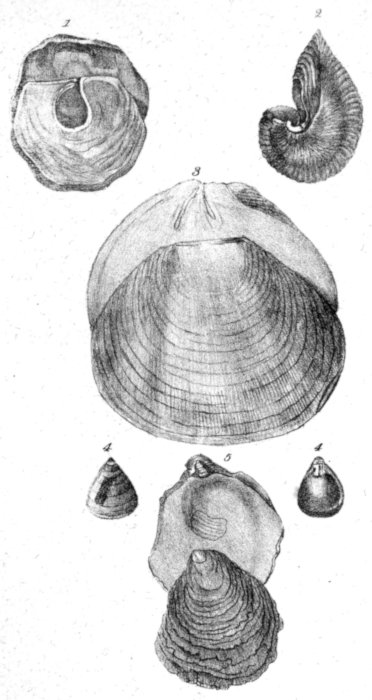
57V. imbricata. The imbricated Venericardia. Pl. 9, fig. 1.
Species almost round, having convex longitudinal ribs, covered
with imbricated rough scales; inferior margin rounded
and dentated; more and more equilateral; the two teeth
short and oblique.
This genus received its name from its resemblance to a
heart (καρδια). It is so well defined by Linnæus that no alteration
was made by Lamarck, except in making two divisions
of them; the first distinguished by having the anterior
side as large or larger than the posterior, and no distinct
angle at the apex; the second by possessing carinated or angular
umbones, and the posterior side often much larger than
the anterior. These shells are found at a small depth in the
sand on almost every seashore.
Shell inflated, equivalve, sub-cordiform (when seen anteriorly),
generally costated from the summit to the circumference;
summits very evident; slightly recurved forward;
hinge complex, similar, formed by two oblique cardinal teeth,
articulating with the corresponding teeth on the other valve;
two distant lateral teeth on each valve; ligament dorsal, posterior,
and very short.
Cardium costatum.
C. Indicum.
C. ringens.
C. Asiaticum.
C. tennicostatum.
C. fimbriatum.
C. pseudolima.
C. aculeatum.
C. erinaceum.
C. tuberculatum.
C. Brasilianum.
C. apertum.
C. papyraceum.
C. bullatum.
C. ciliare.
C. echinatum.
C. lævigatum.
C. biradiatum.
C. eolicum.
C. pectinatum.
58C. isocardia.
C. muricatum.
C. angulatum.
C. marmoreum.
C. elongatum.
C. ventricosum.
C. rugosum.
C. sulcatum.
C. serratum.
C. unedo.
C. medium.
C. fragum.
C. retusum.
C. tumoriferum.
C. rusticum.
C. edule.
C. Groenlandicum.
C. latum.
C. crenulatum.
C. exiguum.
C. minutum.
C. roseum.
C. scobinatum.
C. hemicardium.
C. cardissa.
C. inversum.
C. Junoniæ.
C. lineatum.
C. edule. The edible Cardium, or common Cockle. Pl.
10, fig. 2.
Species not gaping, with about twenty-six depressed ribs
and transverse obsolete scales; of a cream colour; beaks
protuberant.
C. cardissa. Venus’s Heart.
Species heart-shaped, valves angularly flattened, umbones
alternating.
C. lævigatum. The smooth Cardium.
Species smooth or nearly so, anterior side as large as the
posterior.
C. hemicardium. The half-heart Cardium.
Species ribbed, with elevated rough striæ; the anterior
side is very short and almost flat.
C. costatum. The high-ribbed Cardium.
No angle at the umbones; anterior side at least as large as
the posterior; rows of white, hollow, elevated ribs, situated
at regular distances, proceeding from the umbones to the margin,
with the spaces between them of a reddish brown colour.
C. unedo. The Strawberry Heart.
Species with ribs armed with small crescent-shaped
scales.
59C. tuberculatum. The tuberculated Cardium.
Species not gaping, with large ribs armed with nodules.
Lamarck took this genus from the Chama on account of
several peculiarities in the shell as well as in the animal. It
is not affixed to other bodies by its lower valve, but, according
to De Blainville, lies exposed on the rocks. There is
some difficulty in distinguishing this genus from the Venericardia,
without carefully examining the position of the two
teeth.
Shell regular, thick, solid, equivalve, more or less inequilateral;
summit dorsal, always very recurved anteriorly;
hinge similar, formed by two oblique teeth; one short cardinal
placed beneath the umbo, the other oblique, arched, marginal,
and prolonged; ligament elongated, sub-exterior, and
inserted; two very distinct muscular impressions.
Cardita sulcata.
C. ajar.
C. turgida.
C. squamosa.
C. phrenetica.
C. crassicosta.
C. rufescens.
C. calyculata.
C. subaspera.
C. nodulosa.
C. intermedia.
C. trepezia.
C. bicolor.
C. depressa.
C. concamerata.
C. sinuata.
C. aviculina.
C. citrina.
C. sublævigata.
C. corbularis.
C. lithophagella.
C. crassicosta. The thick-ribbed Cardita.
Species elongated, a little gaping at the inferior margin;
ligament concealed.
Sub-cordiform or oval, more transverse than longitudinal;
colour white, tesselated with brown; posterior depression
heart-shaped; longitudinal, convex, transversely-striated ribs.
60
Distinguished from the Cardita by having three teeth beneath
the apices, and a callous lengthened tooth or ridge.
Shell obliquely elongated, equivalve, inequilateral; valves
striated, but never ribbed; hinge with three teeth beneath
the umbo, and one lateral elongated tooth.
Cypricardia Guinaica.
C. angulata.
C. rostrata.
C. coralliophaga.
C. Guinaica. The Guinea Cypricardia. Pl. 10, fig. 6.
Species elongated, very inequilateral; summit rounded
and recurved anteriorly; two short divergent cardinal teeth,
besides a lamellous tooth; ligament very long, projecting or
not; yellowish white, covered with decussated striæ.
Established by Daudin; classed by Linnæus with the Solen,
but Lamarck is of opinion that it more nearly approximates
the Cardita.
Shell thin, sub-rhomboidal, equivalve, very inequilateral,
gaping at its inferior margin and posterior extremity; the
summit very anterior and recurved in front; dorsal hinge
formed by a single tooth on one valve corresponding to a
semicircular slope on the opposite valve, or by a small tooth
with a cardinal cavity in each valve; ligament probably exterior
and dorsal; muscular impressions unknown.
Hiatella Arctica.
Hiatella biaperta.
H. Arctica. The Arctic Hiatella.
Shell small, transversely oblong; apices truncated, with
two divergent spring ridges; a small tooth on each valve;
cream colour, with decussated striæ; inside pearly.
H. biaperta. The double-clefted Hiatella. Pl. 10, fig. 4.
Species that has only a single tooth on one valve; yellowish
white.
61
Taken from the Chama of Linnæus on account of a peculiarity
in the shape of the cardinal teeth, and the singular
curvature of the umbones.
Shell free, regular, heart-shaped, equivalve, very inequilateral;
summits diverging, strongly recurved spirally, forward,
and outward; hinge dorsal, long, similar, formed by
two flat cardinal teeth, with an elongated lateral one behind
the ligament, which is dorsal and exterior, diverging towards
the summits; muscular impressions very distinct and rather
small; slightly wrinkled longitudinally; exterior reddish
chestnut colour, interior white.
The Isocardia Moltkiana is a very rare shell, and the
most elegant species of this genus.
Distinguished from the Arca by the muscular impression
within, to one side of which is an ear-shaped testaceous appendage;
the shell is more trapeziform, and the hinge by
age becomes obsolete, giving the teeth a more horizontal
appearance.
Shell equivalve, inequilateral, trapeziform, heart-shaped;
beaks distant, and separated by the angular groove of the
ligament, which is altogether external; hinge linear, straight,
with small transverse teeth, having at its extremity from
two to five parallel ribs; valves marked with minute and
strong longitudinal striæ, and sometimes one valve overlaps;
margins crenulated.
C. auriculifera. The eared Cucullæa. Pl. 10, fig. 1.
Species navicular or obliquely heart-shaped, with decussated
62striæ; hinge completely straight, with two parallel
ribs at each end, the terminal teeth longer and more oblique
than the others; exterior chestnut colour, interior white,
tinged with violet.
This genus is easily known by its resemblance to the
hull of a ship; the hinge is peculiar, being composed of
numerous sharp teeth alternately inserted between each
other. The Arca of Linnæus was divided by Lamarck into
the four genera that compose this family, each possessing a
strong distinctive character. All the shells of this family
are found in the sea at a little distance from the shore; they
are covered with a dark greenish lamellar or velvet-like epidermis,
frequently ending in a deep fringe at the margin.
Shell a little varied in form, but most generally elongated,
and more or less oblique at the posterior extremity; sometimes
very inequilateral; summits more or less distant, and
a little recurved forward; hinge anomalous, straight, or a
little curved; long, and formed by a line of short vertical
teeth decreasing from the extremities to the centre; ligament
exterior, broad; sometimes the margin is crenated.
Species boat-shaped, oblong, striated transversely and
ribbed longitudinally; umbones remote and incurvated;
margins entire and gaping; hinge straight; whitish, with divergent
zigzag chestnut stripes; inside bluish white.
A. tortuosa. The twisted Ark.
A rare species; shell elongated, close, twisted; hinge
completely straight.
A. barbata. The bearded Ark.
Species with the hinge straight, not hollowed or not gaping
inferiorly, and of which the muscle is not adherent.
This genus has the ligament partially inserted internally,
and has no exterior angular groove. The valves never gape,
often have rayed longitudinal ribs, are compressed, and the
shell by age becomes thick and ponderous, sometimes attaining
a large size. The teeth in the hinge are not so numerous
as in the Arca and Cucullæa; the centre teeth appear
worn down.
Shell close, orbicular, doubly convex, equivalve, sub-equilateral;
summits almost vertical, and more or less distant;
hinge formed on each valve by a rather numerous series of
small teeth, disposed in a curved line, sometimes broken
under the summit; ligament external and large.
Pectunculus glycimeris.
P. pilosus.
P. undulatus.
P. marmoratus.
P. scriptus.
P. angulatus
P. stellatus.
P. pallens.
P. violacescens.
P. zonalis.
64P. pennaceus.
P. rubens.
P. castaneus.
P. pectiniformis.
P. striatularis.
P. nummarius.
P. pectinatus.
P. radians.
P. vitreus.
P. glycimeris. The delicious Pectunculus.
Sub-orbicular, umbones produced; finely striated transversely
and longitudinally; covered with epidermis, under
which it is marked with reddish chestnut spots or bands;
inside white; margins crenulated.
P. pilosus. The hairy Pectunculus.
Species convex, more or less smooth and hairy.
P. pectiniformis. The Pecten-shaped Pectunculus. Pl.
11, fig. 6.
Species lenticular, more compressed, pectinated, and more
or less rough.
Shell small, more or less thick, sub-triangular, equivalve,
inequilateral; summits contiguous and turned forward;
hinge similar, formed by a numerous series of very
pointed teeth, pectinated and disposed in a line interrupted
under the summit; ligament internal, short, inserted in a
small oblique cavity in each valve; two muscular impressions;
valves more or less pearly within.
Nucula lanceolata.
N. rostrata.
N. pella.
N. Nicobarica.
N. obliqua.
N. margaritacea.
N. rostrata. The beaked Nucula.
Species of which the margin is entire.
N. margaritacea. The pearly Nucula. Pl. 11, fig. 7.
Species of which the margin is crenated; numerous regular
pectinated teeth; obliquely ovate, trigonal; striæ minute
and almost obsolete; covered with a greenish epidermis; inside
silvery, pearl-like.
65
Supposed to be in very deep places in the sea; it is a
strong, beautiful, pearly shell, sub-trigonal or sub-orbicular;
thick, regular, equivalve, inequilateral; summits slightly
prominent, recurved, anterodorsal; hinge complex, dorsal,
dissimilar; two large oblong teeth laterally compressed,
joined angularly under the summit, strongly furrowed on the
right valve, penetrating into two excavations of the same
form, equally furrowed on the left valve; ligament exterior
and marginal; two distinct muscular impressions.
T. pectinata. The pectinated Trigonia. Pl. 11, fig. 4.
Species sub-orbicular, with radiated or divergent, prominent,
and somewhat scaly ribs; inside pearly; margin crenellated.
This genus is found in fresh waters, and differs from the
Trigonia in the number and position of the lamellar teeth.
The substance of the shell is pearly.
Shell sub-trigonal, equivalve, inequilateral; umbones eroded,
covered with epidermis, and inflected anteriorly; hinge
with two lamellar teeth, transversely striated, one of them
posterior, distant, and shortened, the other anterior, lengthened,
and lateral; ligament exterior.
C. ambigua. The ambiguous Castalia. Pl. 11, fig. 5.
Short, sub-trigonal; umbones truncated; longitudinally
ribbed, with distant transverse striæ; covered with epidermis,
under which the shell is of a pale chestnut brown, inside
pearly; the lamellar and præ-apicial teeth are well
marked, more regular, and all striated perpendicular to their
length.
66
The species of this genus become every day more numerous;
they are found in all countries, but particularly in
North America. The Unio is a fresh-water shell, and therefore,
with great propriety, removed from the Mya, which consists
entirely of marine shells. The substance is pearly;
the exterior covered with a brown or green epidermis; the
apices eroded. They are found in the mud of rivers, with
their apices downward; some are slightly gaping, and some
species produce fine pearls.
Shell generally very thick, pearly within, covered with
epidermis; summits eroded, dorsal, and sub-interior; besides
a long lamellous tooth under the ligament, the hinge
is formed by a double precardinal tooth, more or less compressed,
and dentated irregularly on the left valve, simple on
the right valve; ligament external, dorsal, and post-apicial;
muscular impressions well marked.
Species oval, not auriculated, strong, anterior side rhomboid
and attenuated; the opposite side obtusely acute; the
umbones somewhat warted; concentrically wrinkled; covered
with a dusky green epidermis.
U. sinuata. The crooked Unio.
Species oval, sub-auriculated; cardinal tooth short, not
lamellar or sub-striated.
U. sub-orbiculata. The sub-orbicular Unio.
Species round or almost round; cardinal tooth compressed,
elongated, and often lamellar.
Easily distinguished from the Unio by a compound cardinal
tooth, which slopes in an inclined position towards the
posterior side. They are more found in lakes than in rivers.
Shell solid, pearly, equivalve, obliquely triangular, auriculated;
base truncated and straight; hinge with two projecting
teeth; the cardinal divided into numerous divergent
parts; anterior ones smaller, the others long and lamellar.
Hyria avicularis.
Hyria corrugata.
H. avicularis. The little bird Hyria. Pl. 5, fig. 4.
Umbones smooth and polished; ears large, with pointed
terminations; finely striated; interior pearly, exterior of a
rich reddish golden-yellow colour; covered with a greenish
brown epidermis.
68
A fresh-water shell, found in ponds and lakes, difficult to
be distinguished from the Unio but by the hinge, which wants
the cardinal and lateral tooth, and merely presents a smooth
internal rim round the edge terminated by a sinus or notch,
in which the anterior extremity of the ligament is sunk; the
substance is pearly, covered with a false epidermis.
Shell ordinarily rather thin, regular, close, equivalve, inequilateral;
summit anterodorsal; hinge linear, without teeth;
ligament external, dorsal, and post-apicial; two well-marked
muscular impressions.
Species oval, thin, elongated, hinge straight, and only auriculated
anteriorly; beaks small and ventricose; concentrically
wrinkled; covered with a greenish epidermis, which is
frequently of a brown tinge towards the umbo.
A. rubens. The ruddy Anodonta.
Species oval, hinge arched, without trace of auricula or
ear.
A. trapezialis. The trapezium Anodonta. Pl. 11, fig. 3.
Species oval or rounded, auriculated on both sides the
summit.
A very rare shell, separated from the Anodonta on account
of the hinge being attenuated in the middle, and having small
tubercles distributed along its length. The substance is
69thicker and more solid than the Anodonta, and of a brilliant
rose-coloured pearly hue; it is found in the rivers of warm
countries.
Shell equivalve, inequilateral, transverse, with small apices;
recurved, but nearly erect; not auriculated; hinge very long,
linear, crenulated through all its length; ligament external
and marginal; two well-marked muscular impressions.
I. exotica. The exotic Iridina.
The only species of this genus answering to the above
description.
Only found in a fossil state; distinguished from the Chama
by the hinge, which is dissimilar, formed by a large thick
tooth, concave in the greater valve; summits very projecting;
almost regular spiral contortions.
D. arietina. The ram’s-horn Diceras.
Shell irregular, inequivalve, inequilateral, somewhat heart-shaped,
with divergent beaks.
In this genus are now comprehended only such as have a
thick oblique transverse tooth, resembling a lengthened callosity,
generally crenulated or grooved, fitting into a corresponding
cavity in the lower valve. The animals inhabiting
these shells have the faculty of affixing themselves to other
bodies by the lower valve.
The Chama received its name from its gaping; it is found
in most seas, particularly in the Southern; sometimes its
colours are elegantly blended.
Shell irregular, adherent, inequivalve, inequilateral; summits
more or less twisted spirally, especially in the lower
valve; some from left to right, others from right to left;
70hinge dissimilar, large, formed by one lamellous, arched,
sub-crenulated, post-cardinal tooth, articulating into a furrow
of the same form; exterior, post-apicial, slightly inserted;
two large and rather distant muscular impressions.
Species of which the summits twist from left to right;
imbricated, dilated, waved foliations; striated obsoletely;
exterior white, orange, red, or yellow; interior white.
C. arcinella. The hedgehog Chama.
Species of which the summits twist from right to left;
the pink-coloured ones of this species are the most prized.
Distinguished from the Chama by the want of teeth in the
hinge, and being of a pearly substance. It is a rare shell,
only found in deep water, where it is attached to the rocks
by the lower valve. Its irregular form is perhaps occasioned
by the lower valve adapting itself to the form of the body
to which it is affixed. Two species are fluviatile and two
marine.
Shell adhering, irregular, thick, pearly, inequivalve, inequilateral;
summits thick, little evident; hinge toothless,
callous, thick, irregular; longitudinal, sub-dorsal ligament,
partly exterior and partly penetrating into the shell; two oblong
muscular impressions, one inferior and anterior, the
71other superior and sub-posterior; with or without an oblong
incrusted callosity on the base of the valve.
Species with an oblong callosity on the anterior part of
the shell; oval, depressed, dilated towards the umbones;
summits distant.
E. semilunata. The semilunar Etheria.
Species without callosity at the base.
The most ponderous shell known, sometimes measuring
several feet in length, and sometimes weighing five hundred
pounds.
By Linnæus this genus was classed with the Chama, but
the characteristic distinctions are so great that they are easily
known. The Chama is irregular, has but one tooth, and is
fastened to other substances by the lower valve; the Tridacna
is equivalve, has but two teeth, and is affixed to other
bodies by a byssus consisting of filiform tendons.
The animal inhabiting this shell is said to produce very
fine pearls, but there is no pearly appearance on the valves.
Shell thick, solid, varying in size; some are very small
and some very large; regular, triangular, more or less inequilateral;
the summits inclined backward; hinge dissimilar,
entirely anterior to the summits; one lamellous precardinal
tooth, and two distant lateral teeth on the left valve,
corresponding to two lamellous precardinal teeth and one
remote lateral tooth in the right valve; ligament anterior,
elongated; one forked sub-median muscular impression, almost
marginal and oftentimes nearly obsolete; valves with
broad, rounded longitudinal ribs, armed with vaulted scales,
72more or less elevated; posterior slope heart-shaped, and
widely gaping.
Species of which the shell is sometimes very large, white,
transversely ovate or elongated; the anterior side longer
than the posterior; broad ribs covered with vaulted scales;
when of a pink or orange colour, greatly valued.
Similar to the Tridacna, but distinguished from it by having
its posterior slope closed with a dentated margin; its ribs
are never arched or vaulted, and its anterior side is shorter
than the posterior side.
H. maculatus. The spotted Hippopus. Pl. 12, fig. 1.
Shell transversely ovate, ventricose, with scaly ribs; lunule,
heart-shaped, and oblique; margins deeply crenulated;
reddish purple spots.
As arranged by Lamarck, now comprises only such shells
as are regular, equivalve, and longitudinal; solid in substance,
and attached to other bodies by a short thick byssus.
In colour and appearance they greatly vary, some being
smooth and beautifully variegated with delicate colours, or
radiated with purple and white; some are coarsely ribbed or
granulated, and have only one colour, as black, blue, yellow,
brown, or green; all are covered with an epidermis, to which
oftentimes the colour is confined.
Shell of a close texture, elongated, more or less oval,
sometimes sub-triangular, equivalve, summits anterior, more
73or less curved, a little sloping inferiorly; hinge generally
without teeth, or with two very small rudimentary teeth;
ligament dorsal, linear, sub-interior, inserted in a long and
narrow furrow; two muscular impressions, of which the anterior
is very small, with or without longitudinal grooves or
furrows.
Mytilus Magellanicus.
M. erosus.
M. crenatus.
M. decussatus.
M. hirsutus.
M. elongatus.
M. latus.
M. zonarius.
M. ungulatus.
M. violaceus.
M. opalus.
M. smaragdinus.
M. corneus.
M. edulis.
M. retusus.
M. Hesperianus.
M. perna.
M. exustus.
M. bilocularis.
M. ovalis.
M. ustulatus.
M. Domingensis.
M. Senegalensis.
M. Afer.
M. achatinus.
M. ungularis.
M. planulatus.
M. borealis.
M. Galloprovincialis.
M. angustanus.
M. lineatus.
M. lacunatus.
M. canalis.
M. incurvatus.
M. abbreviatus.
M. incurvatus. The incurvated Mytilus.
Nearly smooth, elongated oval, valves inflated and curved
near the ligament; apex acute.
M. Afer. The African Mytilus.
More or less compressed and sub-triangular, without
grooves; byssus very large and much developed; summit
entirely terminal and anterior; smooth and radiated with
blue or purple, covered with a dark brown epidermis; inside
margin blue, shade decreasing to the centre.
M. crenatus. The crenated Mytilus.
Species longitudinally grooved, radiated, or striated.
74M. hirsutus. The bearded Mytilus.
Species with grooves; covered with a shaggy or bearded
epidermis.
Taken by Lamarck from the Mytilus, as it differs by
being more transverse than longitudinal, and the beaks, instead
of being terminal, are placed beneath the apex.
Shell smooth, sub-transverse, equivalve, regular, sub-triangular,
the posterior side short; summits almost lateral;
hinge lateral and linear, without teeth; ligament partly interior,
placed in a marginal furrow; one sub-lateral elongated
muscular impression in each valve.
Modiola Papuana.
M. tulipa.
M. albicosta.
M. vagina.
M. picta.
M. sulcata.
M. plicatula.
M. semifusca.
M. securis.
M. purpurata.
M. barbata.
M. Guyanensis.
M. Adriatica.
M. pulex.
M. discrepans.
M. discors.
M. trapezina.
M. cinnamomea.
M. silicula.
M. plicata.
M. semen.
M. lithophaga.
M. caudigera.
M. discors. The discordant Modiola.
Shell elongated oval, very convex, narrowest at the anterior
end; striated at the two extremities; summit oblique;
exterior greenish; interior white, with sometimes a pink-tinge,
and somewhat pearly; crenulated margin.
Species smooth, more or less triangular; summit near the
anterior extremity; byssus obsolete in adults.
M. sulcata. The furrowed Modiola.
Species striated longitudinally.
75
This genus is the same as constituted by Linnæus; the
shell is marine, generally very brittle and fragile, in form resembling
an acute angled triangle; usually covered with longitudinal
ribs and elevated transverse striæ; generally horn
coloured.
This genus is remarkable for the production of an abundant
byssus of a fine brown silky texture, which the Italians
frequently fabricate into articles of dress, equal in appearance
to the finest silk.
The Pinnæ often grow to a large size; they are sometimes
found standing erect in the smooth-water bays, with
the base of the shell uppermost, but generally affixed by the
byssus to rocks and other sub-marine bodies. The filaments
that compose the byssus are so tough and strong that
the shells are not easily detached.
Shell fibrous, fragile, regular, equivalve, longitudinal, triangular,
base gaping and as if truncated; summit pointed
and straight; hinge dorsal, longitudinal, linear, and without
teeth; marginal ligament occupying almost the whole of
the dorsal edge of the shell; one very broad muscular impression
behind a trace of the anterior in the summit.
Pinna rudis.
P. flabellum.
P. seminuda.
P. angustina.
P. nobilis.
P. squamosa.
P. marginata.
P. muricata.
P. pectinata.
P. saccata.
P. varicosa.
P. dolabrata.
P. ingens.
P. vexillum.
P. nigrina.
P. squamosa. The scaly Pinna.
Species very close and rounded at the posterior extremity;
valves convex, covered with vaulted imbricated scales.
Species gaping at the posterior extremity, which is as if
76truncated; valves rather rounded at the upper end, and in
the shape of an expanded fan; light fawn colour.
P. pectinata. The pectinated Pinna. Pl. 13, fig. 1.
Thin, pellucid; longitudinally ribbed and spinous for half
its width, obliquely striated transversely on the other half.
There is one peculiar distinction between this genus and
the Perna; the hinge of the Crenatula is composed of
slightly concave callous crenulations, which receive the ligament;
while in the Perna it consists of parallel truncated
linear teeth (or, rather, riblike joints), corresponding and opposed
to the opposite ones, the ligament being inserted only
in their interstices.
Shell thin, very delicate, irregular, valves flattened, foliaceous,
sub-rhomboidal, sub-equivalve; hinge longitudinal,
dorsal, without teeth; ligament sub-multiple, and inserted in
a series of rounded cavities corresponding with the dorsal
margin; one sub-central muscular impression.
Crenatula avicularis.
C. modiolaris.
C. nigrina.
C. bicostalis.
C. viridis.
C. mytiloides.
C. phasianoptera.
C. avicularis. The avicular Crenatula. Pl. 14, fig. 2.
Answers to the above description.
C. mytiloides. The muscle-shaped Crenatula.
Oblong, ovate, oblique; base acute; violet coloured, with
obscure radiations.
In speaking of the Crenatula, we gave the characteristic
distinction, which regarded it natural and expedient to make
the Perna form a different genus.
77Shell irregular, very compressed, foliaceous, sub-equivalve,
rather variable form, gaping at the anterior part of the lower
extremity; summit very small, hinge straight, vertical, without
teeth; ligament multiple, and inserted in a series of longitudinal
parallel furrows.
Species elongated, without earlike appendages, or having
very small ones.
P. ephippium. The saddle Perna.
Species round, compressed, very pearly in the interior;
very slightly, if at all, auricled; margin acute; exterior purplish
brown.
A shell of a singular form, resembling a pickaxe, found
only in the Indian and Australian Seas; there are two species,
the white and the black, both of which, when in fine
preservation, are highly esteemed, but the white is more rare
and valuable.
Shell sub-nacreous, irregular, rugged, sub-equivalve, inequilateral,
generally auricled before and prolonged behind,
so as to be in form like a hammer; summit entirely anterior;
between them and the inferior auricle, an oblique cut
or slope for the passage of the byssus; hinge linear, elongated,
without teeth; ligament simple, triangular, inserted
in a conical oblique cavity, partly exterior; one rather large
sub-central muscular impression.
Species with two earlike appendages; trilobate, colour
blackish brown.
M. albus. The white Malleus.
Species trilobate; base of the lateral lobe prolonged, without
a sinus; the base and the pit of the ligament not distinct;
colour white, with transverse undulations.
M. vulsellatus. The tweezer Malleus.
Species slightly auricled.
M. normalis. The square Malleus.
Species without earlike appendages.
Remarkable for the form of its shell, which resembles,
when partially expanded, a bird flying.
Shell foliaceous or not, thin and very fragile, always pearly,
sub-equivalve; form sub-regular, but rather variable; summit
anterior; valves oblique, the left one with a little notch,
through which the byssus passes; sometimes unequally and
obliquely auricled; hinge linear, toothless, or with two small
rudimentary teeth; ligament more or less exterior, placed in
a narrow groove, sometimes enlarged towards the summit;
one very large posterior muscular impression; and one very
small anterior.
Avicula macroptera.
A. lotorium.
A. semi-sagitta.
A. heteroptera.
A. falcata.
A. crocea.
A. Tarentina.
A. Atlantica.
A. squamulosa.
A. papilionacea.
A. costellata.
A. physoides.
A. virens.
79A. macroptera. The rounded Avicula. Pl. 14, fig. 3.
Species oval, oblique, the earlike appendages very developed,
especially the superior; one tooth at the hinge.
A. Atlantica. The Atlantic Avicula.
Obliquely curved, yellowish fawn colour, with dark reddish-brown
stains; interior pearly.
The form of the shell is orbicular and equivalve, without
the elongated transverse base on the cardinal tooth, and the
sloping sides of the opening for the passage of the byssus
are perceptible on both valves; these peculiarities distinguish
it from the Avicula.
Shell sub-equivalve, rotundate, nearly square, externally
squamose; the inferior cardinal margin straight, not caudate
anteriorly; a sinus at the posterior base of the valves for
the passage of the byssus; the left valve being at this place
narrow and channelled; hinge linear, without teeth.
Meleagrina margaritifera.
Meleagrina albina.
M. margaritifera. The pearl-bearing Meleagrina, sometimes
called the mother-of-pearl oyster.
Species slightly oblique, somewhat square, pearly, very
thick, compressed; undulated and transversely striated, with
a series of lamellated longitudinal scales; exterior greenish,
interior pearly. This shell is celebrated for its irridescent
colours, and is valued for the beautiful and costly pearls it
produces. These pearls are formed from a deposition of the
substance destined to line the shell upon sand or other bodies,
casually or purposely introduced within the mantle of
the animal; the shell itself is the mother-of-pearl used for inlaying,
or making various elegant trinkets.
80
The common name was given to this genus from the resemblance
to a French shepherd’s crook. The shell is of
a regular form; its lower valve, in which is a sinus for the
byssus, is turned up at the edges, and the upper valve falls
within it.
Shell inequivalve, a little eared; apices unequal, distant,
rounded, little evident; hinge without teeth; ligament inserted
in an oblique groove, prolonged to the summit, and
carried within in a kind of spoonlike cavity.
P. spondyloideum. The spondylus-shaped Pedum. Pl.
15, fig. 5.
Ovate, wedge shaped, flat; superior valve with longitudinal
striæ; white, granulated, and rough; slightly tinged
with purple near the beak.
No sinus or notch; the valves, thick and gaping, form a
lateral opening; the ears are small, but distinct.
Shell oval, more or less oblique, almost equivalve, with
small ears, regularly gaping at the anterior part of the lower
edge; summits anterior and distant; hinge longitudinal,
without teeth; ligament rounded, almost exterior, inserted
in a cavity of each valve; central muscular impression divided
into three very distinct parts.
Answers to the above description, with valves ventricose,
armed with vaulted scales.
81L. fragilis. The fragile Lima.
Oblong ovate, very pellucid, delicately white, with longitudinal
distinct striæ; lower margin denticulated, closely interlocking
when the valves are closed.
The shells constituting this genus are found in all seas;
they are well known, and many of them are very beautiful.
The form is usually regular; their surface is adorned
with elevated divergent ribs, varying in number from five to
thirty, proceeding from the beaks and terminating at the margins
in a scalloped outline.
Some are equivalve, others have one valve flat and the
other convex; the colours of the upper valve are brighter
than those of the lower.
There is considerable variation in the size and form of the
ears, which in some species are equal or nearly so, but in
others are unequal; some are so small as to be nearly indistinct.
The ribs are variously diversified with beautiful
colours and delicate checker-work; the margins are mostly
crenated, and oftentimes beautifully coloured.
These shells were formerly worn by Pilgrims on their hat
or coat, as a mark of having been to the holy shrine in Palestine.
Shell free, regular, thin, solid, auricled, equivalve, equilateral;
summits contiguous; hinge without teeth; a ligamental
membrane through all the length of the hinge, besides
a short, thick ligament, almost entirely internal, which
fills a triangular cavity under the summits; one sub-central
muscular impression.
Species of which the two valves are ribbed and almost
equally convex, the right a little less, and having its inferior
ear less broad than the left, so as to produce a kind of groove
for the passage of the byssus.
P. Jacobæus. The scallop of St. James.
Species very inequivalve; the left valve being very flat,
the right convex; ears equal.
P. pleuronectes. The sole Scallop.
Species equivalve, not closing; surface smooth and ribbed
within; one valve perfectly white, the other of a brownish
or reddish colour.
83
Only known as fossils; probably introduced here by Lamarck
to serve as a connecting link for the genera Lima,
Pecten, Spondylus, and Podopsis.
Shell rather thick, regular, free, sub-equivalve, sub-auriculated;
the two valves almost equally convex, both provided
with a distinct summit, recurved in the middle of a level surface,
with a great triangular slope in the middle; the cardinal
base transverse, straight; hinge without teeth; a conical
cardinal pit situated below the beak, partly internal, opening
outward, and receiving the ligament.
P. spinosa. The thorny Plagiostoma.
Subarcuated, the umbo of one shell higher than that of
the other, with longitudinal ribs and remote concentric rings.
Separated from the Spondylus of Linnæus on account of
its distinct structure. The ligament is altogether internal;
it is without ears, and the prolonged beak so conspicuous
in that genus. The Plicatula has the faculty of affixing itself
to another body, so that many are found grouped together
in clusters. The valves are strongly plaited within and
without, closely interlocking with each other.
Shell solid, adhering, sub-irregular, without ears, inequivalve,
pointed at the summit, rounded and plaited behind;
hinge with two strong teeth in each valve, with a cavity between
them, in which the ligament is internally inserted.
Plicatula ramosa.
P. depressa.
P. cristata.
P. reniformis.
P. Australis.
P. ramosa. The branched Plicatula. Pl. 15, fig. 2.
Oblong, trigonal, very thick; strong longitudinal plaits;
exterior brown, with a yellow tinge, with reddish arrow-shaped
markings; interior white.
84
The valves of this genus greatly resemble those of the
common oyster, but have ears, and are covered with long
recurved or straight-pointed spines.
The lower valve is much larger than the upper, and has
foliaceous laminæ, by which it is attached to the other substances.
They are found in all seas of hot countries, but
particularly in the Indian; they adhere to rocks, coral, &c.,
oftentimes in large groups.
The usual colours are red, purple, white, brown, or orange,
several of which are sometimes blended in the same shell.
Shell solid, adhering, sub-regular, more or less spined,
sub-auriculated, inequivalve; the right or inferior valve fixed,
much more excavated than the other, and having behind, at
the summit, a triangular face, which enlarges and elongates
with age; hinge longitudinal, provided in each valve with
two strong teeth entering into corresponding cavities; ligament
short, almost medial, partly exterior; one sub-dorsal,
muscular impression.
Spondylus gædaropus.
S. Americanus.
S. arachnoides.
S. candidus.
S. multilamellatus.
S. coccineus.
S. crassisquama.
S. spathuliferus.
S. ducalis.
S. longitudinalis.
S. costatus.
S. variegatus.
S. longispineus.
S. regius.
S. avicularis.
S. microlepos.
S. croceus.
S. aurantius.
S. radians.
S. zonalis.
S. violacescens.
S. gædaropus. The thorny red Spondylus. Pl. 15, fig. 1.
Upper valve red, under one white, with longitudinal striæ
or ribs; rough granulations, and somewhat tongue-shaped;
rather short truncated spines.
85S. longispineus. The long-spined Spondylus.
Thickly spined, longitudinally sulcated and ribbed; alternate
spines arcuated and tongue-shaped; valves of a reddish
colour; umbones orange.
Only introduced here to fill up the family and keep up the
chain of connexion. It approximates the genus Gryphea.
Shell rather thick, sub-regular, symmetrical, equilateral,
inequivalve, adhering by the extremity of the shorter valve;
the other terminated by a summit pointed, a little recurved
and medial; articulation very angular, by means of two very
distant condyles.
This genus resembles the Ostrea, with which it was formerly
classed, but from which it is distinguished by the peculiar
character of the lower valve. It is very deep and
carinated, with a summit terminating in a long spirally recurved
beak, slightly turned to one side; the edge sharp and
angular.
It is seldom, if ever, attached to other bodies. Shell more
finely lamellated than that of the oyster, free or slightly adherent,
sub-equilateral, very inequivalve; the lower valve
very concave, with a summit more or less recurved like a
hook; the upper valve much smaller, and formed like a lid;
hinge without teeth; ligament inserted in an oblong arched
cavity; one single muscular impression on each valve.
G. angulata. The angulated Gryphæa. Pl. 16, fig. 2.
Oblong ovate, with three long longitudinal carinated ribs
below; summit of the inferior valve is subvolute. This is a
rare shell.
86
As given by Lamarck, is a natural and well-defined family.
It is too well known to require description. It fixes itself to
other bodies by the laminæ of the whole surface of one valve,
and generally remains immoveable, exhibiting no other signs
of life other than that of opening its valves to receive nutriment.
Shell irregular, inequivalve, inequilateral, exterior roughly
foliaceous, interior somewhat pearly; the left or inferior
valve larger, deeper, and adhesive, its summit prolonging with
age in a sort of heel, the right or superior valve smaller,
more or less in the form of a lid; hinge without teeth; ligament
short, sub-interior, inserted in an oblong cardinal cavity,
increasing with the summit; muscular impression single and
sub-central.
Species orbicular, and not plaited; rugged, with undulated,
imbricated scales; one valve flat and the other convex;
variable in size; outside greenish brown, inside pearly
white, sometimes with a bluish tinge.
O. Virginica. The Virginian Oyster.
Species longitudinal and not plaited.
O. imbricata. The imbricated Oyster.
Species orbicular and plaited.
O. crista-galli. The Cock’s-comb Oyster.
Species strongly plaited longitudinally.
This genus has several characteristics which distinguish
it from the Ostrea; they are free; the valves and the apices
are nearly equal, with a projecting callosity on each valve,
depressed underneath, and obliquely arched for the reception
of the ligament.
Shell sub-nacreous, sub-regular, sub-equivalve, inequilateral;
upper valve finely granulated, or striated longitudinally
from the apex to the margin; summits anterior, distant, recurved
below; hinge without teeth; ligament undivided,
thick, inserted in a rounded cavity, made in a slightly projecting
callosity on each valve; muscular impression sub-central,
rather large, and two very small ones entirely anterior.
V. lingulata. The tongue-like Vulsella. Pl. 15, fig. 6.
Elongated, depressed, transversely striated; pale yellowish
brown, with longitudinal darker stripes.
88
This genus received its common name from the thin,
transparent nature of the valves of the shell, particularly of
the species placenta, which by the ingenious Chinese are
often polished and used as a substitute for window-glass.
The hinge of the shells of this genus is so peculiar as to
make it perfectly distinct; entirely interior, fastened by a
ligament shaped like a V on one of the valves.
Shell free, sub-irregular, very thin, almost entirely transparent,
flat, sub-equivalve, sub-equilateral, slightly auricled;
hinge entirely internal, formed on the superior less valve
by two elongated, unequal, oblique ribs converging at the
summit, to the interior side of which a ligament like the letter
V is inserted in two equally converging, rather deep
cavities of the lower valve, which is more convex; one
rather small, sub-central muscular impression.
Sub-orbicular, flat, white, and transparent; finely striated
longitudinally, slightly decussated.
When Linnæus formed this genus and named it Anomia,
he probably did so from its having no determinate character.
Its common name was given it by the fancied resemblance
of some of its species to an antique lamp. Like the
oyster, they seldom leave their place; they are always affixed
to marine bodies by an osseous operculum, formed by the
thick extremity of the animal’s muscle. The lower valve is
perforated and smaller, conforming to the shape of the substance
to which it is affixed.
Shell adhering, irregular, inequivalve, inequilateral, ostraceous;
inferior valve rather more flat than the superior, divided
at the summit into two sloping branches, whose approaching
together forms a large oval hole, through which
protrudes a muscle, the extremity of which becomes ossified
89and adheres to extraneous bodies; one sub-central muscular
impression divided into three.
Shell sub-orbicular, irregularly wrinkled and waved; upper
valve convex, under flat and perforated at the hinge,
through which passes the ligament by which it is affixed to
other bodies; inside pearly, and of various changing colours,
such as green, purple, violet, and yellow.
So called from the appearance caused by three holes or
cavities on the surface of the lower valve.
Shell irregular, orbicular, inequivalve; the inferior valve
almost flat, and marked on the interior with four muscular
impressions, sometimes very deep, and of which the two
sub-central are sufficiently connected to form but one; the
superior valve like a Patella, more or less convex, with four
very distinct muscular impressions, rather distant.
Orbicular; upper valve gibbous and conical, lower valve
flat, with three perforations.
Greatly resembling a Patella, for which it is often mistaken
on account of the lower valve being very thin, flat, and
adhering.
Shell sub-orbicular, very compressed, inequilateral, very
inequivalve; the inferior valve very thin, adherent, and imperforated;
90the superior valve like a Patella, with a summit
more or less inclined towards the posterior side.
O. Norwegica. The Norwegian Orbicula. Pl. 17, fig. 4.
Upper valve in the form of a depressed cone, with a summit
produced and pointed.
Taken from the Anomia, and with great propriety, as its
characteristic differences are very great; the perforation of
the Anomia is always in the smaller valve, which is attached
to the larger by a cardinal ligament, while in the Terebratula
the perforation is always in the larger valve, which is
connected to the smaller by teeth at the hinge. In some
the valves are smooth, and in others grooved longitudinally.
Shell thin, equilateral, sub-triangular, inequivalve; one of
the valves larger and more convex than the other, prolonged
behind by a sort of heel, sometimes recurved, and pierced
by a round hole at its extremity; frequently sloped more or
less by a cleft of variable form; the opposite valve smaller,
more flat, sometimes formed like a lid, having in the interior
a system of support variable in form and complication
in every true species; hinge limited, prominent, and formed
by two articulating surfaces of one valve placed between
corresponding projections of the other; a kind of tendinous
ligament issuing from the sloping cleft of the shell, by which
it is attached to marine bodies.
Terebratula vitrea.
T. dilatata.
T. rotunda.
T. flavescens.
T. dentata.
T. dorsata.
T. pisum.
T. globosa.
T. sanguinea.
T. caput-serpentis.
T. truncata.
T. psittacea.
T. dorsalis. The dorsal Terebratula. Pl. 17, fig. 1.
The summit of the large valve pierced with a round hole,
very circumscribed; grooved longitudinally; valves as if
cut sloping in the middle line.
91T. globosa. The globose Terebratula.
Species smooth, with the valves rounded at their anterior
edge.
T. caput serpentis. The Serpent’s-head Terebratula.
Species grooved, with the summit or heel of the large
valve deeply hollowed even to the edge of the articulation;
the slope rounded; the valves sub-bilobate by the apparent
slope of the anterior edge.
The valves of this genus are united by means of a tubular,
fleshy, or membranous peduncle surrounding the narrow part
of them, and of which the base is affixed to marine substances.
Shell covered with epidermis, sub-equivalve, equilateral,
depressed, elongated, truncated anteriorly, summit middle
and posterior, without trace of ligament, but supported at
the extremity of a long fibro-gelatinous peduncle, which attaches
it vertically to sub-marine bodies; multiple muscular
impression.
L. anatina. The Duck’s-bill Lingula. Pl. 17, fig. 2.
Covered with a green, shining epidermis, shaped like a
duck’s bill, and having a cylindrical peduncle.
CLASS IV. MOLLUSCA. TWENTY-TWO FAMILIES. — FAMILY I. Pteropoda. Six genera — 1. Hyalæa. Venus’s Chariot. Two species. — 2. Clio. Has no Shell. Two species. — 3. Cleodora. Two species. — 4. Limacina. One species. — 5. Cymbulia. The Slipper. One species. — 6. Pneumodermon. Has no shell. One species. — FAMILY II. Phyllidiacea. Four genera. — 1. Phyllidia. Three species. — 2. Chitonellus. Two species. — 3. Chiton. Six species. — 4. Patella. The Limpet or Dishlike Shell. Forty-five species. — FAMILY III. Calyptracea. Seven genera. — 1. Parmaphora. The Duck’s-bill Limpet. Three species. — 2. Emarginula. The Slit Limpet. Four species. — 3. Fissurella. The Keyhole Limpet. Nineteen species. — 4. Pileopsis. The Caplike Limpet. Four species. — 5. Calyptræa. The Cup and Saucer Limpet. Four species. — 6. Crepidula. The Slipper Limpet. Six species. — 7. Ancylus. The Lake Limpet. Two species. — FAMILY IV. Bullacea. Three genera. — 1. Acera. Has no shell. One species. — 2. Bullæa. One species. — 3. Bulla. The Bubble. Eleven species. — FAMILY V. Aplysiacea. Two genera. — 1. Aplysia. Three species. — 2. Dolabella. Two species. — FAMILY VI. Limacinea. Five genera. — 1. Onchidium. Has no shell. Two species. — 2. Parmacella. One species. — 3. Limax. Four species. — 4. Testacella. One species. — 5. Vitrina. One species. — FAMILY VII. Colimacea. Eleven genera. — 1. Helix. The Snail. One hundred and seven species. — 2. Carocolla. Eighteen species. — 3. Anostoma. Two species. — 4. Helicina. Four species. — 5. Pupa. Twenty-seven species. — 6. Clausilia. Twelve species. — 7. Bulimus. Thirty-four species. — 8. Achatina. Twenty species. — 9. Succinea. Three species. — 10. Auricula. Fourteen species. — 11. Cyclostoma. Twenty-eight species. — FAMILY VIII. Lymnæcea. Three genera. — 1. Planorbis. Twelve species. — 2. Physa. Four species. — 3. Lymnæa. Eleven species. — FAMILY IX. Melanides. Three genera. — 1. Melania. Sixteen species. — 2. Melanopsis. Three species. — 3. Pirena. Four species. — FAMILY X. Peristomides. Three genera. — 1. Valvata. One species. — 2. Paludina. Seven species. — 3. Ampullaria. Eleven species. — FAMILY XI. Neritacea. Five genera. — 1. Neritina. Twenty-one species. — 2. Navicella. Three species. — 3. Nerita. The Hoof Shell. Seventeen species. — 4. Natica. Thirty-one species. — 5. Janthina. Two species. — FAMILY XII. Macrostomides. Four genera. — 1. Sigaretus. Four species. — 2. Stomatella. Five species. — 3. Stomatia. Two species. — 4. Haliotis. The Ear Shell. Fifteen species. — FAMILY XIII. Plicacea. Two genera. — 1. Tornatella. Six species. — 2. Pyramidella. Five species. — FAMILY XIV. Scalarides. Three genera. — 1. Vermetus. One species. — 2. Scalaria. Seven species. — 3. Delphinula. Three species. — FAMILY XV. Turbinacea. Seven genera. — 1. Solarium. Seven species. — 2. Trochus. The Top Shell. Sixty-nine species. — 3. Monodonta. Twenty-three species. — 4. Turbo. The Turban Shell. Thirty-four species. — 5. Planaxis. Two species. — 6. Phasianella. The Pheasant Snail. Ten species. — 7. Turritella. The Screw Shell. Thirteen species. — FAMILY XVI. Canalifera. Eleven genera. — 1. Cerithium. Thirty-six species. — 2. Pleurotoma. Twenty-three species. — 3. Turbinella. Twenty-three species. — 4. Cancellaria. Twelve species. — 5. Fasciolaria. Eight species. — 6. Fusus. Thirty-six species. — 7. Pyrula. Twenty-eight species. — 8. Struthiolaria. Two species. — 9. Ranella. Fourteen species. — 10. Murex. The Trumpet Shell. Sixty-six species. — 11. Triton. Thirty-one species. — FAMILY XVII. Alata. Three genera. — 1. Rostellaria. Three species. — 2. Pteroceras. Seven species. — 3. Strombus. The Wing Shell. Thirty-two species. — FAMILY XVIII. Purpurifera. Eleven genera. — 1. Cassidaria. Five species. — 2. Cassis. The Helmet Shell. Twenty-five species. — 3. Ricinula. Nine species. — 4. Purpura. Fifty species. — 5. Monoceros. The Unicorn. Five species. — 6. Concholepas. One species. — 7. Harpa. The Harp Shell. Eight species. — 8. Dolium. The Tun Shell. Seven species. — 9. Buccinum. The Whelk. Fifty-eight species. — 10. Eburna. Five species. — 11. Terebra. The Needle Shell. Twenty-four species. — FAMILY XIX. Columellaria. Five genera. — 1. Columbella. Eighteen species. — 2. Mitra. The Mitre Shell. Eighty species. — 3. Voluta. The Volute or Wreath. 44 species. — 4. Marginella. Twenty-four species. — 5. Volvaria. Five species. — FAMILY XX. Convoluta. Six genera. — 1. Ovula. The Egg. 12 species. — 2. Cypræa. The Cowrie. 68 species. — 3. Terebellum. One species. — 4. Ancillaria. Four species. — 5. Oliva. The Olive. Sixty-two species. — 6. Conus. The Cone. One hundred and eighty-one species. — FAMILY XXI. Nautilacea. Two genera. — 1. Spirula. One species. — 2. Nautilus. Two species. — FAMILY XXII. Heteropoda. Two genera. — 1. Argonauta. The Paper Sailor. Three species. — 2. Carinaria. The glassy Nautilus. Three species.
92
Some genera of this family are without a testaceous covering,
and are mentioned only for the sake of preserving the
family entire.
This genus derives its common name from a fancied resemblance
to a miniature triumphal car.
Shell very thin, transparent, symmetrical, convex below,
flat above, valves unequal, form tricuspidated, cleft at the
sides, open like a cleft anteriorly, and tridentated posteriorly;
summit truncated.
Hyalæa tridentata.
Hyalæa cuspidata.
H. tridentata. The three-toothed Hyalæa.
Transparent, horn-coloured, globular; tridentated posteriorly;
summit and two posterior sides open; finely striated
transversely.
Clio Borealis.
Clio Australis.
Shell gelatinous, cartilaginous, transparent, in shape of a
reversed pyramid or lanceolate truncated, only open at the
summit.
Cleodora pyramidata.
Cleodora caudata.
93C. pyramidata. The pyramidal Cleodora.
Like a pyramid, triangular, thin, transparent; aperture
obliquely truncated.
Shell papyraceous, very fragile, planorbis form, sub-carinated,
involuted rather obliquely, in such a manner as to be
deeply and largely umbilicated on one side, and the spine
slightly projecting and pointed on the other; aperture large,
entire.
L. helicialis. The Helix-like Limacina.
Thin, fragile, spiral; the volutions united in a discoid form.
Shell or case cartilaginous, transparent, conical posteriorly
where the animal adheres, and prolonged above like a long
hollow semi-cylinder, under which the animal can take
shelter.
C. Peronii. Peron’s Cymbulia.
Shell shaped like a shoe, somewhat gelatinous or cartilaginous,
very transparent crystalline, oblong pointed at the
vertex, truncated at the base.
P. Peronii.
The animals of this genus are covered with a coriaceous
skin, but without a shell.
Phyllidia varicosa.
P. pustulosa.
P. ocellata.
Formerly classed with the Chiton; but as the testaceous
94plates of this genus are never joined, the two may be easily
distinguished.
Shell elongated, multivalve; alternate pieces generally
longitudinal; sides naked.
Chitonellus striatus.
Chitonellus larvæformis.
C. striatus. The striated Chitonellus.
Striæ radiating from the apex of each valve; margin serrated;
base of the last valve obtuse.
C. larvæformis. The Caterpillar Chitonellus.
More or less cylindrical, almost naked; the valves of the
shell very small, and almost entirely concealed under the
skin; tufts hairy or silky between the parts of the valves
near the margin.
This genus was so called from the resemblance of its testaceous
covering to a coat of mail. The form of the Chiton
is very similar to a well-known insect called the woodlouse,
found in decayed timber; it generally adheres to rocks, or
lies rolled up like a ball among seaweed and stones. In
length it seldom exceeds an inch, except in tropical climates,
where they are sometimes three or four inches long. In general
there are eight valves, the termination of which is surrounded
by a scaly or rough ligament, which enables the animal
to expand or contract its shell freely. It presents a
great variety of colour; in general it is dark brown, overcast
with a shade of green, but some are beautifully variegated
with pink, yellow, blue, or red; interior green or whitish.
Shell more or less elongated, consisting of a longitudinal
series of eight very symmetrical calcareous pieces, more or
less curved, and round at both extremities; summit more or
less marked, and when imbricated, always from front to rear.
Depressed, valves large, carinated, well imbricated; the
interstices offering well-marked lateral spaces; the border
of the mantle regularly scaly.
C. marginatus. The marginated Chiton. Pl. 1, fig. 2.
Valves carinated and projecting over each other; finely
shagreened, with a dusky reddish-brown margin.
C. fascicularis. The fasciculated Chiton. Pl. 1, fig. 3.
Valves more narrow, imbricated, without distinct spaces;
lateral parts of the skin naked or hairy, but always provided
with silky or hairy tufts disposed in pairs between the junctions
of the valve.
Shell beset with long, thin, curved, tubular, hairy, blackish
spines.
The Patella of Linnæus was divided by Lamarck into
several distinct genera, and now comprehends only such
shells as are of a conical form, with an imperforated summit.
The anterior is that part to which the summit inclines, and
is always more narrow than the posterior part.
It derives its name from its resemblance to a little dish;
the colour and structure are various; some are smooth,
others granulated, and many are covered with elevated tuberculated
ribs. The exterior is sometimes of a pale fawn
colour, and the interior of a bright pink; some have a silvery
hue, but the more general colour is bluish white or
light brown.
This genus of shells is very numerous in all seas, but
chiefly in hot countries, where they are found of a larger
size; they generally adhere by their base to rocks, stones,
and marine substances, from which it is difficult to detach
them.
96Shell oval or circular, sub-conic; summit right or more
or less recurved anteriorly; the cavity simple, entire, more
or less deep; the margin complete and entirely horizontal;
a narrow muscular impression.
Conic, summit obtuse and vertical; sometimes ribbed
from the vertex to the margin with divergent striæ, sometimes
striated without ribs; exterior dark brown or greenish,
internal blue or purple radiations.
P. compressa. The compressed or flat-sided Patella.
Pl. 2, fig. 2.
Oval, elongated, compressed on the sides, having the
97summit sub-anterior, well marked, and curved; exterior fawn
colour, interior of a silvery hue.
P. deaurata. The golden red Patella. Pl. 2, fig. 3.
Sub-conic, summit more anterior, with a slight forward inclination;
colour yellowish red.
P. cochlear. The spoonlike Patella. Pl. 2, fig. 4.
Depressed, the summit hardly marked, and much more
narrow in front than behind; exterior brownish, interior light
blue.
P. scutellaris. The buckler Patella. Pl. 2, fig. 5.
Depressed, summit sub-anterior, radiated from the summit
to the margin; brown colour, with a yellowish band parallel
to the margin.
P. pectinata. The pectinated Patella. Pl. 2, fig. 6.
Oval, summit well marked and anteriorly inclined; ribbed
from the summit to the margin, which is slightly convex in
the middle.
P. cymbularia. The cymbular Patella. Pl. 2, fig. 7.
Oval, thin, pearly, with a festooned margin; summit nearly
marginal; colour white, shaded with very light brown.
The genera that constitute this family were separated by
Lamarck from the Patella of Linnæus.
The characteristic distinctions of this shell were first
pointed out by De Blainville.
Shell elongated, very depressed; the summit greatly post-medial,
and evidently inclined behind; aperture as large as
the shell; the lateral edges straight and parallel, the posterior
rounded, the anterior sharp and notched in the middle;
98muscular impression large, elongated oval, slightly open in
front.
Parmophora Australis.
P. brevicula.
P. granulata.
P. Australis. The Australian Parmophorus.
Shell oblong, depressed; vertex slightly recurved; striated
concentrically; one margin rounded, and the other truncated.
Most of the shells of this genus are small; some are elevated,
and others of a widely-depressed conical form.
Shell conical, recurved; summit entire; slit, or more or
less hollowed on the anterior side; a muscular impression in
form of a horseshoe, open behind and thicker at the beginning.
Emarginula Blainvillii.
E. marginata.
E. fissura.
E. rubra.
E. Blainvillii. Blainville’s Emarginula.
Shell with the notch or slit in the middle of the back, and
not extending to the margin.
Oval, compressed, summit well marked, with reticulated
striæ and ribs; fissure extending half way from the margin
to the summit; exterior light brown, interior white.
E. marginata. The marginated Emarginula.
More compressed than the preceding; summit distinct,
anterior margin formed like a gutter.
The perforation not being perfectly round, but generally
ovate oblong, procured for this genus its common name, by
which it is easily distinguished.
Shell simple, conical, depressed, recurved; summit perforated
a little anterior in an oblong or oval manner, like a keyhole;
99the exterior surface ribbed longitudinally, slightly striated
transversely.
Fissurella picta.
F. nimbosa.
F. crassa.
F. Græca.
F. nodosa.
F. Cayennensis.
F. lilacina.
F. rosea.
F. Barbadensis.
F. radiata.
F. viridula.
F. hiantula.
F. pustula.
F. fascicularis.
F. Javanicensis.
F. depressa.
F. Peruviana.
F. gibberula.
F. minuta.
F. nimbosa. The scaly-ribbed Fissurella.
Species of which the middle part of the edges of the
aperture is hollowed in such a manner that, when placed on
a level surface, they touch only at the extremities.
F. rosea. The rosy Fissurella.
Species more depressed, edges bent up lengthwise, forming
a kind of canal.
Conical, ovate oblong; striæ cancellated and elevated;
sections tuberculated; exterior yellowish brown or clouded,
interior white or light blue.
Easily distinguished by its form, which gave rise to the
common name.
Shell oblique, sharp pointed; cone bent forward, with a recurved,
almost spiral summit, finely striated longitudinally
and slightly wrinkled transversely; aperture a round oval;
the margin at the base nearly round, more or less regularly
crenated and indented, interior with a lengthened, arched,
transverse muscular impression.
Pileopsis ungarica.
P. mitrula.
P. intorta.
P. subrufa.
100P. ungarica. The Fool’s Cap.
Conical, vertex slightly spiral, pointed, and recurved; exterior
pale fawn colour, and the outer margin bordered with
a fringed epidermis; interior sometimes of a very bright
pink or rose colour.
This genus of shells is remarkable for having in the interior
cavity a transverse funnel or tongue-shaped testaceous
appendage, from which originated its common name.
Shell conic, base orbicular; summit vertical and imperforated;
cavity deep, having at its interior summit a tongue-like
appendage. This appendage is sometimes vertical and
sometimes like a horseshoe, having on it a muscular impression
of variable form.
Calyptræa extinctorium.
C. lævigata.
C. equestris.
C. tectum-sinense.
C. extinctorium. The extinguisher Calyptræa.
Species in which the internal appendage is horn-shaped;
colour brownish.
C. equestris. The equestrian Calyptræa. Pl. 32, fig. 4.
Species in which the internal appendage is like a horseshoe,
open in front.
C. tectum-sinense. The Chinese roof Calyptræa.
Shell formed of separate, transverse, irregular round laminæ
of uniform size, attached to each other by the summit
on the exterior of each, presenting the appearance of a number
of small flat Patellæ piled one on the other; colour yellowish,
margin entire, very glossy within.
Very similar to the Navicella, but distinguished from it by
not having an operculum.
Shell irregular, form very variable, depressed or compressed;
spire obliquely inclined to one side; margin entire;
101cavity large, divided by a horizontal partition, which gives it
the form of a half-decked boat.
Crepidula fornicata.
C. porcellana.
C. aculeata.
C. unguiformis.
C. dilatata.
C. Peruviana.
C. porcellana. The brown-spotted Crepidula.
Shell thick, flat, summit not spiral.
C. aculeata. The prickly Crepidula.
Oval, brown, roughly striated, vertex recurved, interior
blue or purple.
C. sub-spirata. The sub-spiral Crepidula. Pl. 32, fig. 2.
Species almost round, summit sub-spiral; colour yellowish
white, with a bluish tinge towards the summit.
This is a fresh-water shell, found in the lakes of Europe.
Shell thin and brittle, obliquely conical; summit pointed
and recurved; margins simple, base oval and smooth.
Ancylus oblongus.
Ancylus fluviatilis.
A. oblongus. The oblong Ancylus.
Aperture elongated, vertex turned to one side, striated concentrically;
exterior pale yellowish colour, interior light blue.
A. fluviatilis. The river Ancylus. Pl. 32, fig. 3.
Simple, oval, almost symmetrical; summit pointed, compressed,
very distinct; bent back a little to the right, but not
marginal; the edges of the aperture entire and effuse.
Acera Carnosa.
Formerly classed with the Bulla, but separated from it on
102account of the shell being entirely covered by the animal, and
never externally visible.
Shell oval, thin, fragile, more or less involuted on one
side, rendering the aperture more or less wide.
Shell interior and very incompletely involuted, without
spire or columella; sub-orbicular, white, transparent, faintly
striated, and slightly wrinkled; almost entirely open.
The great confusion that existed in this genus, as classed
by Linnæus, has been elucidated by the division and classification
of Lamarck. This genus derived its name from the
resemblance which some of the smaller species have to a
bubble of water. Its shells are found in almost all parts of
the world.
Shell external, oval, involuted; aperture very large, open
the whole length of the shell, and generally wider at the
base; outer edge sharp and smooth; summit umbilicated.
Bulla lignaria.
B. ampulla.
B. striata.
B. naucum.
B. physis.
B. fasciata.
B. aplustre.
B. hydatis.
B. cornea.
B. fragilis.
B. solida.
B. aplustre. The streamer-like Bulla. Pl. 17, fig. 7.
Species completely involute; the spire very distinct, visible,
but not projecting, with a kind of thickening at the anterior
part of the columellar edge.
B. lignaria. The woodlike Bulla.
Species sub-involute, no visible spire either within or without,
but narrowed towards the top when it is slightly umbilicated;
yellowish brown colour, with transverse pale striæ.
B. hydatis. The watery Bulla.
Species more solid, thicker, almost entirely involute;
103whorls of the spire slightly visible in an umbilicus projecting
interiorly from the summit.
B. naucum. The sea-nut Bulla.
Species thin; the whorls of the spire visible externally,
but without projection, and with a suture as if caniculated
without thickening at the anterior part of the columellar edge.
B. fragilis. The fragile Bulla.
Species very thin, rather involute; the whorls of the spire
distinct within as without; the suture deep, angular, and cleft
in a greater or less part of its length.
This genus may almost be said to have no testaceous covering,
as it appears more like the element of a shell.
Aplysia depilans.
A. fasciata.
A. punctata.
A. depilans. The bald Aplysia.
Shell dorsal, semicircular, of a thin yellow cartilaginous
substance.
Closely allied to the Aplysia; it is a singularly formed shell,
difficult to describe, as it contains few of the characteristics
which distinguish other shells.
Shell rudimentary, entirely flat, sub-spiral, with a summit
thick and very callous.
Dolabella Rumphii.
Dolabella fragilis.
D. Rumphii. Rumphius’s Dolabella.
Base thick, callous, and sub-spiral; dilated above, thin, and
wedge-shaped.
104
Onchidium Typhæ.
Onchidium Peronii.
Lamarck has given a description of the animal of this genus,
but only mentions that the scutcheon contains a shell or
solid crustaceous body.
Parmacella Olivieri.
The animal belonging to this genus is furnished with a
coriaceous shield, wrinkled.
Limax rufus.
L. albus.
L. cinerus.
L. agrestis.
Shell external, very small, ear-shaped; very depressed,
summit inclined posteriorly, not spiral; aperture oval, very
large; the left edge sharp, a little rolled inward, especially
behind.
T. Haliotidea. The Haliotis-shaped Testacella. Pl. 17,
fig. 6.
Answering to the above description; very thin, transparent,
and yellowish.
Shell proportionally very small, extremely thin, pellucid,
almost membranous, oval or sub-globular; spire very short,
of which the last whorl is very large; aperture large, semilunar;
the edges sharp; the left edge arched, and extending
itself interiorly to the summit.
V. pellucida. The pellucid Vitrina. Pl. 17, fig. 3.
Extremely thin, pellucid, and glossy; depressed, spire
105very short; aperture large and oval; colour pale yellowish
green.
According to the systematic arrangement of Lamarck,
this genus now consists of shells with peculiar characteristic
distinctions.
By Linnæus, marine, land, and fresh-water shells were
united in this genus, and so confounded that the naturalist
would often look in vain for the distinguishing characters
which would enable him to class and determine the genus
of the object under examination.
Notwithstanding the divisions of Lamarck, its species are
numerous; the shells are terrestrial, and found in all parts of
the globe; some are rare and beautiful.
The term Helix was given to this genus from the spiral
form of the shell.
Shell extremely variable in form, generally globular, sometimes
ventricose, conoid, never turriculated; summit constantly
obtuse and rounded; aperture generally of a medium
size, but sometimes very large or very small, always modified
by the turn of the spire; oval, semilunar, more wide
than long, edges disunited, entering but very little into the
formation of the interior; the right lip or margin thickened
or reflected.
Species shaped like a Planorbis, rough or hairy, more or
less largely umbilicated, margin sharp.
H. Naticoides. The Natica-shaped Snail. Pl. 18, fig. 7.
Species ventricose.
H. obvoluta. The small white-lipped Snail. Pl. 18,
fig. 9.
Species more or less depressed, umbilicated, Planorbis-shaped,
the edges of the aperture thickened, callous, and
even toothed.
H. conoides. The cone-shaped Snail. Pl. 18, fig. 4.
Species conoidal; the turns of the spire rounded.
H. pomatia. The edible Snail.
Species sub-globular, not umbilicated; the margin of the
aperture thickened; aperture covered with a calcareous lid
resembling an operculum.
H. nitida. The pellucid Snail.
Species depressed, more or less largely umbilicated; the
edges sharp, but always thin and shining.
H. nemoralis. The grove Snail.
Species imperforated, semi-globular, thin, and sub-pellucid;
not umbilicated, with a light inflexion at the place of
the junction of the columella with the margin of the aperture;
108colour various, inner margin white or reddish brown;
volutions five, with several dark brown bands.
H. Carthusiana. The Carthusian Snail.
Species sub-depressed, sub-umbilicated, with a sharp
edge, thickened within by a roll.
H. arbustorum. The orchard Snail.
Sub-globular, sub-pellucid, sub-umbilicated, five volutions,
finely striated longitudinally; mottled with greenish
yellow, streaked with deep chestnut, a broad brown band
commonly at the edge of the outer lip, and running round
through the volutions to the apex.
All terrestrial shells in this genus, taken from the Linnæan
Helix on account of the peculiarity of the shell, which is
orbicular, more or less flat on the upper part; the circumference
of the shells constantly carinated or sub-carinated;
aperture ovate, transverse, contiguous to the axis of the
shells; outer lip sub-angular, sometimes toothed within.
Species discoid, very umbilicated; edges thick, but not
toothed; beautiful bands.
C. elegans. The elegant Carocolla.
Species with a conical spire a little elevated, the base
flat, the aperture square, with sharp edges.
109C. labyrinthus. The winding Carocolla.
Species discoid, umbilicated, with the aperture toothed.
An extraordinary shell, sometimes called the antique lamp
from its form.
Shell orbicular, the spire convex and obtuse; aperture
round, toothed within, grinning, turned upward to the spire;
margin reflected.
Anostoma depressa.
Anostoma globulosa.
A. depressa. The depressed Anostoma.
Sub-globular, depressed and sub-carinated in its circumference,
not umbilicated; aperture round, the margin continued
by a callosity, toothed, thickened, and turned towards
the back of the shell.
A. globulosa. The globular Anostoma.
Globose, with two small punctures, one on each side of
the lip; slightly carinated, smooth, and white; margin reflected.
A terrestrial shell, distinguished from the Helix by its
transverse callous columella; depressed and diminished in
thickness at the lower part.
Shell sub-globular or conoid, spire low, a little depressed;
aperture semi-ovate, modified by the last turn of the spire;
the edge of the aperture sharp or a little reflected in a roll,
the left edge enlarged at its base in a large callosity, which
entirely covers the umbilicus and joins obliquely with the
columella, which is twisted and a little projecting; the operculum
horny, complete, sometimes calcareous externally.
Helicina Neritella.
H. striata.
H. fasciata.
H. viridis.
H. Neritella. The Nerite-shaped Helicina. Pl. 19, fig. 4.
Species yellowish white, finely striated, the edge reflected
in a roll.
110H. striata. The striated Helicina.
Globular, striated, the right edge sharp, but reflected; the
umbilical callosity rather thick, the operculum calcareous
and solidified by a marginal roll and a vertical crosspiece.
These shells are generally very small, some not more
than an eighth of an inch in length; chiefly terrestrial.
Shell cylindrical, elongated, or sub-globular, ordinarily ventricose:
summit obtuse; the turns of the spire numerous,
almost equal; aperture round or oval, with margins almost
equal, expanded, reflected; one or two plaits on the columellar
edge, and several teeth, varying in number on the
right margin.
Species cylindrical, obtuse, aperture compressed and distorted
by the last whorl in its adult state making suddenly a
gibbous inflection to the left.
P. muscorum. The moss Pupa.
Species very small, oval or more or less spherical, obtuse,
light brownish colour; aperture large, with one tooth; volutions
convex; outer lip white and reflected.
111P. mumia. The double-toothed Pupa. Pl. 19, fig. 2.
Species cylindrical, obtuse at both ends, aperture semi-ovate,
with two teeth.
Remarkable for having the termination of the lower whorl
quite detached from the base of the shell.
Shell cylindrical, elongated, a little ventricose in the middle,
generally fusiform, summit obtuse, the last turn smaller
than the preceding; aperture small, irregular, oval; at least
one plait, posterior to the columella, increasing with age so
as to be separated, and forming at the posterior angle of the
aperture a rounded sinus.
Pellucid, finely striped longitudinally, the margins of the
volutions papillose; aperture with two plaits; brownish colour.
The shells of this beautiful genus are all terrestrial, and
differ from the Helix and Bulla of Linnæus in never being
of an orbicular shape. The animals inhabiting them are
said to be oviparous, and have eggs nearly as large as those
of a pigeon.
Shell oval, oblong, sometimes sub-turriculated; the summit
of the spire obtuse, and the last turn much greater than
all the others taken together; aperture oblong oval, the edge
disunited; the right reflected outward in adults; the columella
112smooth, with an inflection in the middle, at the point
of junction of the columella with the mouth of the aperture
which it forms.
Bulimus ovatus.
B. hæmastomus.
B. gallina sultana.
B. zigzag.
B. undatus.
B. ovoideus.
B. interruptus.
B. Peruvianus.
B. Favannii.
B. Kambeul.
B. calcareus.
B. decollatus.
B. Lyonetianus.
B. inflatus.
B. radiatus.
B. fragilis.
B. Guadaloupensis.
B. Richii.
B. inversus.
B. citrinus.
B. sultanus.
B. Pythogaster.
B. Mexicanus.
B. multifasciatus.
B. Bengalensis.
B. Caribæorum.
B. octonus.
B. terebraster.
B. articulatus.
B. acutus.
B. ventricosus.
B. montanus.
B. hordeaceus.
B. lubricus.
B. montanus. The mountain Bulimus.
Ovate oblong, umbilicated, slightly striated longitudinally,
with several convex volutions; aperture semi-oval; brownish
colour; outer lip white and reflected.
B. hæmastomus. The rose-lipped Bulimus.
Species oval or of ordinary form.
B. ventricosus. The ventricose Bulimus.
Species ventricose, from which circumstance it derived
its name.
B. radiatus. The radiated Bulimus. Pl. 19, fig. 7.
Species turriculated.
B. citrinus. The citron Bulimus.
Species sinistral.
B. multifasciatus. The many-banded Bulimus.
Species slightly umbilicated.
113
This likewise is an elegant genus of shells, classed by
Linnæus with the Bulla. They are the largest land-shells
known, and greatly resemble the Bulimus, but never have
their lips reflected or thickened. Sometimes the last whorl
is compressed and attenuated at the base, and sometimes
ventricose and not compressed.
Shell in form very variable, but generally sub-turriculated,
ventricose, striated longitudinally; the summit papillose;
aperture a little variable, but never thickened or reflected;
the right edge always acute, the columellar margin rather
strongly hollowed, entirely formed by the columella, of which
the anterior extremity is constantly open and truncated.
Achatina perdix.
A. zebra.
A. acuta.
A. bicarinata.
A. Mauritiana.
A. castanea.
A. glans.
A. Peruviana.
A. albo-lineata.
A. fusco-lineata.
A. immaculata.
A. purpurea.
A. ustulata.
A. vexillum.
A. Virginea.
A. Priamus.
A. fulminea.
A. columnaria.
A. folliculus.
A. acicula.
A. Virginea. The Virginian Achatina.
Smooth, conoid, with aperture almost round; very short,
grayish white, with red and black transverse bands; columella
rose-coloured, with one plait; volutions ventricose;
inside of the lips bluish; a transverse callosity in the interior.
Species sub-turriculated, of which the last whorl is attenuated
anteriorly.
114A. columnaris. The columnar Achatina. Pl. 18, fig. 3.
Species evidently turriculated.
A terrestrial shell, though the animal that inhabits it is
almost amphibious; it greatly resembles the Bulimus, but is
easily distinguished by never having the lip reflected or
thickened.
Shell very thin, translucid, ovate-oblong, with a conical-pointed
spire formed of a small number of whorls; aperture
very large, oval, oblique; the edges disunited; the right
always acute, the left acute and arched, formed by the columella.
Succinea cucullata.
S. amphibia.
S. oblonga.
S. amphibia. The amphibious Succinea. Pl. 24, fig. 4.
Species elongated, very thin and pellucid; spire short;
aperture expanding; amber colour.
This genus was so called from the resemblance which
the aperture bears to the shape of an ear; many of the species
are named from their resemblance to the ears of particular
quadrupeds. It is a land-shell, found chiefly in the
East and West India Islands.
Shell thick, solid, more or less smooth, oval, oblong, spire
short and obtuse; aperture entire, oblong, enlarged, ear-shaped,
much contracted behind; edges disunited; right lip
sometimes thick and outwardly reflected; the left or columella
with one or more teeth or thick callous plaits.
Species thick, oblong, conical, with minute decussated
striæ and granulations; light brown; two plaits on the columella;
right outwardly reflected.
A. scarabæus. The Beetle’s Ear.
Species of which the columella has three plaits, and the
whole internal side of the right edge denticulated.
A. myosotis. The dwarf Auricula.
Species minute, with two plaits on the columella, and one
tooth behind.
A. Sileni. Silenus’s Ear.
Species very small, without plaits or teeth.
A terrestrial shell, varying considerably in form, but distinguished
by a round aperture, reflected lip, and horny operculum.
Shell more or less elevated, volutions rounded, summit
papillose; aperture round, the edges united circularly and
reflected; the left having its origin very detached from the
spire.
Operculum calcareous, complete, not spiral; summit sub-central.
Cyclostoma planorbula.
C. volvulus.
C. carinata.
C. sulcata.
C. unicarinata.
C. tricarinata.
C. obsoleta.
C. rugosa.
C. labeo.
C. interrupta.
C. ambigua.
C. semilabris.
C. flavula.
C. patulum.
C. fasciata.
C. mumia.
C. quaternata.
C. ferruginea.
C. decussata.
C. lineolata.
C. mamillaris.
C. ligata.
C. lincinella.
C. orbella.
C. fimbriata.
C. multilabris.
C. elegans.
C. truncatulum.
116C. elegans. The elegant Cyclostoma. Pl. 19, fig. 5.
Species with spire slightly elevated, ovate, conical, umbilicated;
volutions convex; finely striated transversely.
C. fasciata. The banded Cyclostoma.
Species with spire very elevated.
C. Planorbula. The Planorbis-shaped Cyclostoma.
Species with spire very depressed.
Taken from the Helix of Linnæus to distinguish the
aquatic from the terrestrial shells. This genus is found in
fresh water, and has no operculum.
Shell thin, often sinistral, discoid, or involuted almost in
the same vertical plane; the spire not projecting and entirely
lateral, so that the shell is hollowed or depressed on each
side; aperture small, transverse, with edges sharp, not reflected,
disunited by the last whorl of the spire which modifies
it; sometimes carinated.
Planorbis cornu-arietis.
P. corneus.
P. carinatus.
P. lutescens.
P. orientalis.
P. spirorbis.
P. vortex.
P. deformis.
P. contortus.
P. hispidus.
P. nitidus.
P. imbricatus.
P. carinatus. The keeled Planorbis.
Species with a keel; depressed, upper side concave.
This genus is generally heterostrophe (that is, with whorls
turned to the left hand); found in fresh water; it greatly resembles
the Lymnæa, but has not a widened aperture.
117Shell often sinistral, oval, oblong, or globular, perfectly
smooth; aperture oval, contracted posteriorly; the right
edge sharp, advanced above the plane of the left edge; columella
twisting obliquely, and enlarging to join itself to the
anterior part of the columellar margin.
Physa castanea.
P. fontinalis.
P. hypnorum.
P. subopaca.
P. fontinalis. The fountain Physa. Pl. 20, fig. 2.
Volutions reversed, oval, ventricose, pellucid, horn-coloured;
spire short and acute.
Shell aquatic, oval, turreted or conical, thin, smooth, spire
pointed; aperture oval, entire; edges disunited, the left
with a very oblique plait at the point of junction of the columella
with the rest of the margin.
Ovate, ventricose; spire subulate and very acute; aperture
large and ovate; horn coloured.
L. leucostoma. The shining Lymnæa.
Species sub-turreted, with the right edge thickened.
Likewise taken from the Helix of Linnæus.
Shell fluviatile, covered with epidermis, oval, oblong; spire
slightly pointed, more or less turreted; the margin of the
118whorls often surmounted by spires; aperture oval, entire;
columella smooth and arched; closed by a thin, horny, complete
operculum.
Covered with a black epidermis, under which the colour
is deep chestnut; ovate oblong, with the whorls transversely
keeled and coronated with triangular tubercles, from which
emanate ciliated spines.
The shells of this genus are fluviatile, and distinguished
from the Melania by having the upper part of the columella
callous.
Shell oval or slightly sub-turriculated; aperture oval,
without trace of tube, but hollowed anteriorly, without a
posterior sinus; the columellar edge callous and rather deeply
excavated; operculum horny, sub-spiral, rather complete.
Melanopsis Buccinoides.
M. costata.
M. lævigata.
M. Buccinoides. The Buccinum-shaped Melanopsis. Pl.
20, fig. 6.
Species turriculated; colour bluish white, clouded with
purple; spiral whorls dentated.
M. costata. The ribbed Melanopsis.
Species sub-turriculated and ribbed.
M. lævigata. The polished Melanopsis.
Species ovate, smooth, chestnut colour.
119
This shell resembles the Melania, but is easily distinguished
by having a sinus at the base and another at the summit.
Shell turreted, aperture oblong, closed by a horny operculum;
right lip sharp, with a distinct sinus at the base and
another at the summit; base of the columella inclined towards
the right.
Pirena terebralis.
P. spinosa.
P. aurita.
P. granulosa.
P. terebralis. The wimble Pirena.
Subulate, longitudinally striated, covered with a dark-brown
epidermis; aperture white, outer lip expanded.
This genus contains shells found in fresh water.
Shell sub-discoid or conoid, umbilicated, spiral whorls
rounded; summit papillose; aperture round, not modified by
the last whorl; the edges completely united, sharp; operculum
complete, horny, and orbicular.
Small, globular, conoid, deeply umbilicated; summit obtuse;
wrinkled longitudinally, covered with a yellowish epidermis.
Generally inhabits fresh water, though some have been
found where it is quite saline.
Shell conoid, covered with epidermis, spiral whorls rounded;
rather longer than broad, edges united, always sharp;
the commencement of the left edge immediately attached to
the last whorl of the spire; operculum horny, complete, or
marginal, not spiral, with concentral elements.
120Paludina vivipara.
P. achatina.
P. Bengalensis.
P. unicolor.
P. impura.
P. muriatica.
P. viridis.
P. vivipara. The viviparous Paludina. Pl. 21, fig. 1.
Thin, ovate, ventricose, wrinkled longitudinally; body with
three brown bands: covered with a greenish epidermis; aperture
almost round.
This genus is evidently intermediary to the Paludina and
the Natica. Its species are probably all fluviatile; some attain
a great size.
Shell thin, globular, ventricose; umbilicus small, forming
a compressed funnel-shaped aperture, without interior callosity;
spire very short, the last whorl much larger than all the
others together; aperture ovate, longer than broad, with margins
united; right margin smooth and sharp; columellar lip
thickened, projecting, and reflected over the umbilicus; operculum
horny, rarely calcareous, thin, oval, not spiral, with
concentric elements; summit sub-marginal, inferior, passing
obliquely by the right edge of the aperture, but attached to
the left.
Ampullaria Guyanensis.
A. rugosa.
A. fasciata.
A. canaliculata.
A. effusa.
A. Guinaica.
A. virens.
A. carinata.
A. avellana.
A. intorta.
A. fragilis.
A. Guyanensis. The Guiana Ampullaria.
Globular, thick, with unequal longitudinal striæ; covered
with brown epidermis; inside golden colour.
Species sinistral, with a very large umbilicus, spirally carinated.
Formerly classed with the Nerita, but separated from it
because the Nerita is a marine shell, and those of this genus
are fluviatile.
They are generally thin, smooth, or very finely striated;
the right side of the aperture is not crenulated or dentated,
and the animal dissolves the interior of the spire.
Shell thin, ovate, not umbilicated; aperture semilunar; inner
lip reflected on the columella, and sometimes crenated;
outer lip without teeth internally; operculum with a lateral
tooth.
Neritina perversa.
N. pulligera.
N. dubia.
N. zebra.
N. zigzag.
N. gagates.
N. lugubris.
N. corona.
N. brevispina.
N. crepidularia.
N. auriculata.
N. Domingensis.
N. fasciata.
N. lineolata.
N. semi-conica.
N. strigilata.
N. meleagris.
N. Virginea.
N. fluviatilis.
N. viridis.
N. Bætica.
N. fluviatilis. The fresh-water Neritina.
Shell very small, oval; back convex, smooth, white, with
black or brown spots; spire inclined, lateral lip slightly denticulated;
right edge sharp, operculum very oblique.
N. zebra. The zebra or striped Neritina. Pl. 21, fig. 2.
Same as N. fluviatilis, but striped instead of spotted.
Species provided with long spines, and with the columellar
edge denticulated.
N. auriculata. The eared Neritina.
Species with the columellar edge denticulated; the two
extremities of the right edge extending beyond the aperture,
and forming with the callosity, which is reflected over the
columella, a kind or ear, produced by the tentacular lobe of
the animal.
N. perversa. The perverse Neritina.
Species shaped like a Calyptræa, with the superior summit
vertical, spiral; the last whorl forming all the base of
the shell.
A fresh-water shell, closely allied to the Neritina; it generally
has the appearance of porcelain.
Shell ovate oblong, covered with epidermis, shaped like a
Patella, summit not spiral, but straight, turned quite to the
base, and concave beneath; no columella; the columellar
edge replaced by a kind of sharp partition, which covers part
of the aperture, with a sinus at its left extremity; muscular
impression shaped like a horseshoe, open in front and interrupted
behind; thin, calcareous operculum, with a subulate,
lateral tooth adhering to the posterior margin; the other
edges sharp.
Navicella elliptica.
N. lineata.
N. tessellata.
N. elliptica. The oval Navicella.
Shell covered with olive epidermis, under which it is
smooth, shining, spotted and streaked with purple, blue, or
brown; spire curved, prominent, extending beyond the
margin.
123
A marine shell, never spined, but variously striated.
Some species of this genus are very beautiful; they are frequently
worn as ornaments by the Indians.
Shell solid, thick, more or less globular, flat beneath, spire
but little, if at all, projecting, not umbilicated; aperture
large, semilunar, very entire; the external margin very much
hollowed; the internal or columellar straight, sharp, and
shaped like a partition, often dentated; operculum horny or
calcareous, sub-spiral; the summit entirely marginal at its
extremity, implanted by teeth more or less marked, and
sunk in the columellar margin, on which it seems articulated.
Nerita exuvia.
N. textilis.
N. undata.
N. peloronta.
N. chlorostoma.
N. atrata.
N. polita.
N. albicilla.
N. chamæleon.
N. versicolor.
N. Ascensionis.
N. Malaccensis.
N. lineata.
N. scabricosta.
N. plicata.
N. tessellata.
N. signata.
N. peloronta. The bleeding-tooth Nerita. Pl. 21, fig. 5.
Thick, transversely sulcated; inner lip with two crenulations,
with a bloody mark at their base; under lip with two
notches near its internal upper edge; colour yellowish, tinged
with red, with variously coloured bands.
N. exuvia. The exuvia Nerita.
Species with the inner lip toothed and tuberculated.
N. polita. The smooth Nerita.
Species with both lips toothed; beautifully distinguished
by having three or four bright crimson bands, on a dark mottled
ground, running in a parallel direction with the convolutions
of the shell. A favourite Indian ornament.
124
A marine shell, formerly classed with the Nerita, but distinguished
by being without teeth, and having an umbilicus
modified by the callosity.
Shell smooth, rather thin, and not covered with epidermis;
the spire evident, though low, umbilicated; the columellar
edge not toothed, more or less callous, modifying the
umbilicus; the right edge thin and not toothed interiorly;
operculum calcareous or horny and smooth, semi-spiral, with
concentric ribs fitting into a slight groove on the columella.
Natica glaucina.
N. albumen.
N. mamillaris.
N. mamilla.
N. ampullaria.
N. canrena.
N. cruentata.
N. millepunctata.
N. vitellus.
N. helvacea.
N. collaria.
N. monilifera.
N. labrella.
N. rufa.
N. uni-fasciata.
N. melanostoma.
N. aurantia.
N. conica.
N. plumbea.
N. lineata.
N. fulminea.
N. maculosa.
N. vittata.
N. castanea.
N. Marochiensis.
N. arachnoidea.
N. zebra.
N. zonaria.
N. Chinensis.
N. Javanica.
N. cancellata.
N. canrena. The Canrena Natica.
Sub-globular, smooth, umbilicus deep, bordered anteriorly
by a kind of callous column; spire a little prominent; exterior
fawn coloured, with bands and rays of reddish brown;
interior white; operculum calcareous.
Species with the umbilicus uncovered, and the operculum
horny.
125N. mamilla. The nipple Natica.
Species with the umbilicus entirely covered over by a large
callosity; the spire papillose, and the operculum horny.
Formerly classed with the Helix, which it somewhat resembles
in form, but properly separated, as it differs in every
other respect.
It is a singular marine shell, often found in great numbers
floating on the surface of the sea, suspended by a vesicular
appendage, which stains the hand of a purple colour.
Shell sub-globular, ventricose, extremely thin and fragile;
transparent, of a beautiful violet colour; the spire low, lateral,
pointed, with sub-carinated whorls; aperture large, sub-angular,
greatly modified by the last whorl of the spire; edges
disunited, the left entirely formed by the columella, which is
straight and continued beyond the base, the right edge sharp,
often with a sinus in the middle.
Very fragile, aperture triangular, with a small notch on
the margin of the outer lip; beautiful violet colour.
Distinguished from the Natica by the great width of the
aperture, and its short spiral columella.
Shell oval, more or less thick, very depressed, spiral short,
little elevated, lateral; aperture very extended, entire, the
left edge reflected and sharp; two lateral muscular impressions
very disunited.
Sigaretus Haliotoideus.
S. convexus.
S. lævigatus.
S. cancellatus.
126S. convexus. The convex Sigaretus. Pl. 22, fig. 2.
Very thin, smooth, back convex, spire white, rather prominent;
aperture very expanded; umbilicus rather deep; yellow,
with a reddish tinge, transversely striated.
S. Haliotoideus. The Haliotis-shaped Sigaretus.
Species thick, solid, depressed; spire flattish, aperture exposing
the whole of the interior.
To be easily distinguished from the Stomatia by not having
a transversal rib.
Shell very depressed, orbicular or oblong; imperforate;
interior pearly; aperture very large, oval, longer than wide;
the right edge effuse, dilated, and open; summit pointed and
incurved.
Stomatella imbricata.
S. rubra.
S. sulcifera.
S. auricula.
S. planulata.
S. imbricata. The imbricated Stomatella. Pl. 22, fig. 1.
Bearing a very great resemblance to the Haliotis, but is
never perforated.
Shell ear-shaped, imperforate; oblong, spire elevated and
recurved to one side; aperture entire, oblong; interior pearly;
tuberculated, and with a transverse sub-carinated rib.
S. phymotis. The tumoured Stomatia. Pl. 22, fig. 6.
This genus is very beautiful, and derived its common
name from its resemblance to the human ear. The exterior
is generally tuberculated and loaded with marine substances,
which gives it a rough and uncouth appearance, but
the interior forms a splendid contrast by its natural iridescence.
Each shell is furnished with a row of orifices near
the margin, varying in number from eight upward; of these
from three to seven are generally open, and the others close.
These holes are made by the animal as it increases the size
of the shell, to admit the passage of a short syphon.
They are found adhering to rocks like the Patella, and are
detached with great difficulty.
Shell ear-shaped, pearly, recurving, very depressed, more
or less oval, with spire very small, very low, almost posterior
and lateral; aperture as large as the shell, with margins
continued; the right thin and sharp, the left flat, enlarged,
and sharp; a series of holes, complete or incomplete,
parallel to the left margin; one large oval muscular impression.
Haliotis Midæ.
H. iris.
H. tubifera.
H. excavata.
H. Australis.
H. tuberculata.
H. striata.
H. asinina.
H. glabra.
H. lamellosa.
H. unilateralis.
H. rugosa.
H. canaliculata.
H. tricostalis.
H. dubia.
H. asinina. The asinine Haliotis.
Internal margin very broad, inside pearly, smooth, shining,
iridescent, reflecting green, pink, and orange; back clouded
with brown and green; striated longitudinally.
H. costata. The ribbed Haliotis. Pl. 22, fig. 4, interior.
Pl. 32, fig. 6, exterior.
Species with disk rounded anteriorly.
128H. canaliculata. The channelled Haliotis.
Species with disk elevated by a large parallel rib, hollowed
interiorly, and with the anterior margin more or less irregular.
H. tuberculata. The tuberculated Haliotis.
Aperture open the whole length of the shell; outer lip irregular,
exterior reddish brown, striated longitudinally and
wrinkled transversely, with a few raised tubercles; interior
pearly, reflecting the most beautiful shades of pink, blue,
green, and yellow.
Shell thick, oval, convolute, the spire very short; the last
whorl much larger than all the others united; the external
thin, sharp, dentated interiorly; one or two large plaits on the
columella, of which one serves to separate the two parts of
the foot.
Tornatella flammea.
T. solidula.
T. fasciata.
T. auricula.
T. nitidula.
T. pedipes.
T. fasciata. The banded Tornatella.
Spire produced, apex acute, aperture straightened, with one
plait on the columella; finely striated transversely, with two
white transverse bands; colour purplish red.
T. coniformis. The cone-shaped Tornatella. Pl. 22,
fig. 3.
Species like a cone; the spire entirely flat.
Shell smooth, not covered with epidermis, conical, elongated
or sub-turriculated; aperture semi-oval, entire; the
outer lip sharp, dentated interiorly, plaited, enlarged over the
umbilicus, which it leaves more or less exposed.
129Pyramidella terebellum.
P. dolabrata.
P. plicata.
P. corrugata.
P. maculosa.
P. dolabrata. The dentated Pyramidella. Pl. 22, fig. 5.
Answers to the above description; when placed on its base,
it falls on one side.
P. terebellum. The wimble Pyramidella.
Smooth, glossy, white, with reddish-brown bands; columella
recurved; inside of the lip smooth.
Resembling in appearance the shell of a Serpula; but the
organization of the animal caused this to be made a distinct
genus.
Its shells are usually found grouped together or intertwined
with each other, and are very remarkable for being
attached to marine bodies by the attenuated and pointed extremity
of the spire.
Shell conical, tubular, thin, involute spirally, more or less
close, with whorls almost completely disunited; free or adherent
by intertwining; aperture straight, circular, with edges
sharp and complete; several partitions not perforated towards
the summit; operculum horny and complete.
V. lumbricales. The wormlike Vermetus. Pl. 23, fig. 3.
A flexuous shell, with a spiral, acute tip, very much resembling
a corkscrew; colour reddish brown, sometimes clouded
with a darker shade.
A marine shell, with a circular aperture like the Cyclostoma,
but easily distinguished by its turreted form; longitudinal,
elevated ribs, never connected together, rather oblique, and
sharp; the shape of the shell is elegant, being a spiral cone,
130formed by gibbous whorls, unconnected by a columella,
gradually increasing from the apex to the base. The colour
is generally yellowish or brownish white. When perfect and
of good size, they are of great value and highly prized.
Shell sub-turreted, the whorls of the spire more or less
pressed and garnished with interrupted longitudinal ribs,
formed by the successive preservation of the reflected margin
of the aperture, which is small, perfectly round, with
edges united, thickened, and outwardly reflected; operculum
horny and thin.
Scalaria pretiosa.
S. lamellosa.
S. coronata.
S. varicosa.
S. communis.
S. Australis.
S. raricosta.
S. pretiosa. The precious Scalaria, more commonly called
the Wentle Trap, or Winding Staircase. Pl. 23, fig. 1.
This shell has its spiral whorls separate, and appears like
an attenuated tube evolved round a cone; spire detached,
with a deep umbilicus; volutions connected by longitudinal
ribs; body extremely ventricose; colour cream yellow.
S. communis. The common Scalaria, or false Wentle
Trap.
More taper and elongated than the S. pretiosa. It has no
umbilicus, and the whorls are closely united.
A marine shell, which, like the Scalaria, has a round aperture,
but its solidity and pearly substance distinguishes it
from the Cyclostoma, which is terrestrial.
Shell thick, pearly in the interior, sub-discoid or conical;
the spiral whorls sometimes detached, rounded, spiny, with
a large umbilicus; aperture round or multrigonal, not modified;
edges perfectly united with a small spire, tuberculated
exteriorly.
Delphinula laciniata.
D. distorta.
D. turbinopsis.
131D. laciniata. The fringed Delphinula. Pl. 23, fig. 5.
Shell depressed, umbilicus large, surrounded by large
vaulted scales in spiral rows; strong waved spiral striæ;
colour reddish purple, variegated with white.
Some shells of this genus are highly valued for their beauty
and rarity.
Shell orbicular, involuted almost in the same plane; Planorbis-shaped;
the spire of the right side very depressed;
umbilicus large and conical, with edges denticulated or not
at the entrance; aperture not modified by the last whorl of
the spire, which is entirely flat; no columella.
Solarium perspectivum.
S. granulatum.
S. lævigatum.
S. stramineum.
S. hybridum.
S. variegatum.
S. luteum.
S. perspectivum. The perspective Solarium. Pl. 23,
fig. 4.
Species very carinated in their circumference; the aperture
square; umbilicus large and crenated; colour yellowish,
with brown and white bands on the sutures of the volutions.
S. variegatum. The variegated Solarium.
Species sub-carinated, aperture sub-orbicular.
This genus derived its name from its resemblance to a
top.
The shells are marine, found in almost all parts of the
world; some are smooth, but the greater number are covered,
with knobs, spines, tuberculations, or undulations.
The long spines on the margin of the T. Solaris are placed
at regular distances, and resemble the rays of the sun. Many,
132when decorticated, look like mother-of-pearl; others have a
splendid metallic lustre. The T. agglutinans possesses the
faculty of covering itself with extraneous substances, such
as stones, corals, fragments of shells, &c. Of this species
there are two kinds, which, though conchologically known
only by one name, are familiarly known by two; the Conchologist
and the Mineralogist; the former so called from
being loaded with shells, and the latter with stones, &c.
Sometimes the Conchologist is loaded with corals only, and
then is called the Zoologist.
Shell thick, generally pearly, shaped like a top, spire
sometimes depressed, sometimes elevated and pointed at the
summit, sharp or carinated at its circumference, umbilicated
or not; aperture depressed, angular or sub-angular, sometimes
heart-shaped, with edges disunited; the right sharp;
the columella arched, twisted, and often projecting forward;
operculum horny, thin, with numerous spiral whorls, narrow,
and increasing a little from the centre to the circumference.
Trochus imperialis.
T. longispina.
T. solaris.
T. Indicus.
T. radians.
T. pileus.
T. calyptræformis.
T. fimbriatus.
T. brevispina.
T. rotularius.
T. stella.
T. stellaris.
T. niloticus.
T. pyramidalis.
T. noduliferus.
T. cærulescens.
T. obeliscus.
T. virgatus.
T. asperatus.
T. rhodostomus.
T. spinulosus.
T. costulatus.
T. inermis.
T. agglutinans.
T. cælatus.
T. tuber.
T. magus.
T. merula.
T. argyrostomus.
T. Cookii.
T. conuloides.
T. conulus.
T. jujubinus.
T. Javanicus.
T. annulatus.
T. doliarius.
133T. maculatus.
T. granosus.
T. squarrosus.
T. incrassatus.
T. flammulatus.
T. elatus.
T. marmoratus.
T. Mauritianus.
T. imbricatus.
T. triserialis.
T. crenulatus.
T. asperulus.
T. acutus.
T. concavus.
T. lineatus.
T. zizyphinus.
T. granulatus.
T. granatum.
T. moniliferus.
T. iris.
T. ornatus.
T. bicingulatus.
T. calliferus.
T. umbilicaris.
T. undatus.
T. Pharaonis.
T. sagittiferus.
T. carneolus.
T. cinerarius.
T. excavatus.
T. nanus.
T. pyramidatus.
T. erythroleucos.
T. imperialis. The imperial Trochus. Pl. 23, fig. 6.
Species umbilicated, spire very depressed, sharp and radiated
at their circumference by the preservation of an angular
canal from the middle of the right margin. This species
is rare and beautiful, found in New-Zealand.
T. zizyphinus. The livid Trochus.
Species with strong transverse striæ; colour livid, with
undulated streaks of red or brownish carnation.
T. agglutinans. The agglutinating or Carrier Trochus.
Species umbilicated, with spire very depressed; the base
much enlarged, and as if excavated by the large projection
of the angle of the right edge, which advances much beyond
the rounded columellar edge; generally covered with shells,
stones, or coral.
T. niloticus. The large marble Trochus.
Species not umbilicated, conical, with base flat and circular;
the columella twisted; the aperture very angular.
134T. obeliscus. The obelisk Trochus.
Species not umbilicated, conic, elevated, flat and circular
base; the termination of the columella strongly twisted,
but passing down by the margin, appearing sloped by the
advance of an internal longitudinal plait.
T. iris. The iris Trochus.
Species not umbilicated, conic, base oblique; aperture
large, slightly angular; the columella twisted, and forming a
kind of tooth at its termination.
T. granulatus. The granulated Trochus.
Conic, imperforate at the base, spirally granulated and
not marginated at the edges of the volutions; body swelling
out; spire tapering abruptly; apex acute, flesh-coloured.
T. umbilicaris. The umbilicated Trochus.
Shell conico-convex, rather flat, rounded at the top; apex
depressed, volutions sub-marginate; striated spirally; aperture
compressed and angular; umbilicus large, extending to
the apex; colour whitish.
This genus occupies an intermediate space between the
Trochus and the Turbo; distinguished from the former by
the aperture being more round and slightly depressed, and
from the latter by the toothlike projecting angle which the
truncated columella occasions at the base of the aperture.
Shell ovate or conoid, aperture round and entire, with an
operculum; outer lip disunited from the body at the top;
columella arched and truncated at the base.
Monodonta bicolor.
M. pagodus.
M. tectum Persicum.
M. papillosa.
M. coronaria.
M. Egyptiaca.
M. carchedonius.
M. tectum.
M. labio.
M. Australis.
M. canalifera.
M. viridis.
M. fragarioides.
M. constricta.
135M. modulus.
M. articulata.
M. lugubris.
M. punctulata.
M. tricarinata.
M. canaliculata.
M. Seminigra.
M. rosea.
M. lineata.
M. coronaria. The crowned Monodonta.
Species in which the columella greatly projects, and the
spire is entirely flat; covered with numerous small tubercles;
colour white; the columella tinged with red.
M. labio. The double-lipped Monodonta. Pl. 23, fig. 2.
Species sub-globular, umbilicated, spiral whorls rounded;
the columella terminated by a tooth.
M. fragarioides. The strawberry-shaped Monodonta.
Species more or less globular, of which the columella, almost
straight, offers but a little obstacle to its junction with
the margin.
Distinguished from the Monodonta by never having the
columella truncated at the base; and from the Trochus by
being solid, with the whorls constantly convex and never flattened.
Like the Trochus, when decorticated, the Turbo exhibits
splendid pearly, gold, or silver irridescent colours.
Shell thick, pearly in the interior; depressed, conical, or
sub-turreted; umbilicated or not, little or not carinated at its
circumference; aperture round or little depressed; the middle
of the external edge not bent, but sometimes hollowed or
sloped in some part; the edges rarely joined by a callosity;
the columella arched, rarely twisted, and not truncated at the
base; operculum calcareous or horny; the spire visible externally
in the latter and interiorly in the former; the exterior
often thickened and curved.
Species in which the aperture is oblique; the columella
losing itself entirely in its continuation with the margin, the
umbilicus always uncovered; colour black and white.
T. setosus. The bristly Turbo.
Thick, transversely and deeply sulcated, longitudinally
striated; spire short, volutions rounded, lip crenulated; inside
pearly, variegated with white, green, and brown.
T. rugosus. The rough Turbo.
Species of which the aperture is perfectly round in the direction
of the axis; the operculum horny.
Shell marine, generally small, solid, of an oval conical form,
oblong, a little sloping in front; columella flattened and truncated
anteriorly; right margin furrowed or radiated within,
and thickened by a callosity running to its origin; operculum
oval, thin, horny, and sub-spiral.
Planaxis sulcata.
Planaxis undulata.
P. sulcata. The furrowed Planaxis. Pl. 27, fig. 4.
This genus of shells is celebrated for the beauty and variety
of the colouring, disposed in such a manner as to resemble
the plumage of a pheasant.
They are marine shells, many of which are rare and valuable;
they possess a very distinctive character, that of a
slightly projecting angle running along the columella.
Shell rather thick, oval, smooth, without epidermis, spire
pointed; aperture oval, larger in front, with disunited edges;
the right sharp; the columella uniting itself a little with the
left edge, and offering interiorly a longitudinal callosity;
operculum calcareous, oval, oblong, sub-spiral, the summit
at one of its extremities.
Phasianella bulimoides.
P. rubens.
P. variegata.
P. elegans.
P. Peruviana.
P. lineata.
P. nebulosa.
P. sulcata.
P. Mauritiana.
P. angulifera.
P. picta. The painted Phasianella. Pl. 24, fig. 2.
Species smooth, oval, glossy, volutions inflated; reddish
white, with crimson or reddish brown spots; aperture sub-ovate.
This genus is easily distinguished from all screwlike
shells by a sinus on the right margin of the aperture, not
existing in any other shell of similar form.
Shell marine, turreted, not pearly, rather thin, striated according
to the turning of the spire, which is very pointed,
and has numerous whorls; aperture rounded; the edges
disunited posteriorly; the right extremity thin, and, when
perfect, having a light sinus about the middle; operculum
horny.
138Turritella duplicata.
T. terebra.
T. imbricata.
T. replicata.
T. fuscata.
T. cornea.
T. brevialis.
T. bicingulata.
T. trisulcata.
T. exoleta.
T. carinifera.
T. Australis.
T. Virginiana.
T. bicingulata. The twice-girdled Turritella. Pl. 24,
fig. 5.
Species that answers to the above description.
T. terebra. The auger Turritella.
Taper, pointed, acute transverse striæ, the intermediate
spaces prominent and acute; white, reddish, or cream coloured.
A beautiful and numerous genus of turreted shells, with
an expanded outer lip and short beak; the greater part are
marine; many are found at the mouths of rivers, and a few
in lakes, though none can properly be called river shells. In
appearance they are like an elongated pyramidal cone, and
the spire is at least two thirds the length of the shell. The
exterior is seldom smooth, but striated, tuberculated, granulated,
or spinous.
Shell more or less turreted, generally tuberculated; aperture
small, oval, oblique; the columellar edge hollowed, callous;
the right edge sharp, and dilating a little with age;
operculum horny, oval, rounded, sub-spiral, and striated.
Cerithium giganteum.
C. palustre.
C. sulcatum.
C. telescopium.
C. ebeninum.
C. erythræonense.
C. muricatum.
C. radula.
C. crassum.
C. decollatum.
139C. nodulosum.
C. vulgatum.
C. obeliscus.
C. granulatum.
C. aluco.
C. echinatum.
C. subulatum.
C. heteroclites.
C. zonale.
C. semiferrugineum.
C. torulosum.
C. tuberculatum.
C. morus.
C. obtusum.
C. semigranosum.
C. asperum.
C. lineatum.
C. vertagus.
C. fasciatum.
C. ocellatum.
C. literatum.
C. atratum.
C. eburneum.
C. punctatum.
C. lima.
C. perversum.
C. vertagus. The curved beak Cerithium. Pl. 24, fig. 3.
Species with evidently a small canal, very short, and recurved
obliquely towards the back.
C. aluco. The caterpillar Cerithium.
Species with a canal much smaller, but entirely straight,
and a sinus well formed at the posterior union of the two
edges.
C. semigranosum. The semi-granulated Cerithium.
Fusiform, turreted; apex acute; the suture with double
spiral rows of large granules; minutely striated transversely,
with sulcated granulations; colour reddish brown.
Distinguished from the Cerithium by having a notch or
slit in the right margin.
Shell fusiform, rather rugged, spire turreted; aperture
ovate, small, terminated by a canal variable in length; the
right edge sharp, more or less notched; operculum horny.
Pleurotoma imperialis.
P. auriculifera.
P. muricata.
P. echinata.
P. fascialis.
P. bimarginata.
P. buccinoides.
P. cingulifera.
140P. flavidula.
P. interrupta.
P. crenularis.
P. cincta.
P. unizonalis.
P. lineata.
P. spirata.
P. virgo.
P. Babylonia.
P. undosa.
P. marmorata.
P. tigrina.
P. crispa.
P. albina.
P. nodifera.
P. Babylonia. The Tower of Babel Pleurotoma. Pl.
24, fig. 1.
Species in which the tube is rather long, and the notch is
a little posterior to the middle of the edge.
P. auriculifera. The eared Pleurotoma.
Species in which the tube is short, and the notch entirely
against the spire.
P. nodifera. The knotty or Javanese Pleurotoma.
Species with outer lip largely notched and deeply crenulated;
upper volution smooth; under volution and body
striated transversely, with angulated oblique nodules at the
suture; colour reddish yellow.
By Linnæus this genus was classed with the Voluta,
though they are more closely allied to the Murex; differing,
however, from them by having no varices.
Shell generally turbinated, but sometimes turreted, rugged,
and thick; spire variable in form; aperture elongated,
terminated by a straight canal, often rather short; the left
edge almost straight, and formed by a callosity which hides
the columella; the right edge entire and sharp; the columella
with two or three unequal, almost transverse plaits.
Turbinella scolymus.
T. rapa.
T. napus.
T. pyrum.
T. pugillaris
T. leucozonalis.
T. rustica.
T. cingulifera.
T. polygonia.
T. carinifera.
141T. rhinoceros
T. cornigera.
T. ceramica.
T. capitellam.
T. mitis.
T. globulus.
T. infundibulum.
T. craticulata.
T. lineata.
T. nassatula.
T. triserialis.
T. variolaris.
T. ocellata.
T. rapa. The turnip Turbinella.
Species fusiform and almost smooth.
T. scolymus. The artichoke Turbinella.
Species turbinated and spinous.
T. infundibulum. The funnel-shaped Turbinella.
Species turreted and fusiform.
T. pyrum. The pear-shaped Turbinella.
Species with spire short, mucronate; apex mammiliform,
beak long; columella with four plaits; colour yellowish
white, with irregular reddish brown spots.
This genus is not given by De Blainville precisely like
Lamarck, as he has removed those that are greatly canaliculated
either to the Murex or Turbinella. They are all
marine shells, and greatly approximate the last-mentioned
genus.
Shell oval, globular, ventricose, rugged; the spire middling,
pointed; aperture ovate, enlarged, grooved, and sometimes
sub-canaliculated anteriorly; the right edge effuse,
concave, sharp; the left or columellar edge almost straight,
and marked in the middle by two or three plaits; operculum
horny.
Cancellaria reticulata.
C. asperella.
C. scalaria.
C. scalariformis.
C. nodulosa.
C. cancellata.
C. senticosa.
C. citharella.
C. spirata.
C. obliquata.
C. rugosa.
C. Ziervogeliana.
142C. reticulata. The reticulated Cancellaria. Pl. 25,
fig. 5.
Oval, strong, ventricose; columella with three plaits;
distant, coarse, reticulated striæ; sometimes with yellow or
orange bands; aperture white.
This genus was separated by Lamarck from the Murex
of Linnæus on account of having no varices.
Shell fusiform or sub-fusiform; aperture middling, elongated,
almost symmetrical, terminated by a rather long
straight tube; external edge sharp; the columellar edge
with two or three oblique plaits.
Species fusiform, volutions tuberculated, ventricose; reddish
fawn coloured, with transverse double, slightly undulated
lines; inside of aperture with reddish striæ.
F. filamentosa. The threaded Fasciolaria.
Species turreted and tuberculated.
Likewise taken from the Murex; they are marine shells,
of an elongated fusiform shape, with whorls ventricose in
the middle or at the lower extremity.
Shell covered with epidermis, rough, fusiform, or ventricose
in the middle; prolonged behind by the spire, but particularly
forward by the canal; aperture oval; the columellar
edge straight or nearly so; the exterior edge sharp;
operculum oval, horny, with sub-concentric elements, and
summit lateral.
Species turreted or sub-turreted, not umbilicated; outer
lip entire, columella smooth.
F. filosus. The threaded Fusus.
Species sub-turreted and umbilicated.
Distinguished from the Fusus by having a short depressed
spire, and the last whorl very large and ventricose, giving
this shell the shape of a pear.
Shell pyriform by the depression of the spire, the canal
conical, very long or middling, sometimes a little sloped;
aperture oval, very large; columella smooth.
Pyrula canaliculata.
P. carica.
P. perversa.
P. candelabrum.
P. ternatana.
P. bezoar.
P. rapa.
P. papyracea.
144P. tuba.
P. bucephala.
P. vespertilio.
P. melongena.
P. reticulata.
P. ficus.
P. ficoides.
P. spirata.
P. spirillus.
P. elongata.
P. galcodes.
P. angulata.
P. squamosa.
P. nodosa.
P. citrina.
P. abbreviata.
P. neritoidea.
P. deformis.
P. lineata.
P. plicata.
P. melongena. The open-mouth Pyrula. Pl. 25, fig. 6.
Species ventricose, tube or canal short; aperture very
large and effuse; tuberculated, striated longitudinally.
P. ficus. The fig Pyrula.
Spire very short; volutions rounded above; very thin
and ventricose; colour yellowish brown, with dark brown
spots; covered with decussated striæ.
The shells of this genus are marine, inhabited by mollusca,
that, by frequently moving in and out of the shell while
wandering on the shore in search of food, produce singular
callosities on the two edges of the aperture. They generally
resemble the Murex and Buccinum, but are distinguished
by a thickened marginal lip on the right side.
Shell ovate, spire produced; aperture sinuous, terminated
at the base by a very short canal; straight, and without a
notch; columellar edge callous and effuse; right edge with
a thickened varix.
Struthiolaria nodulosa.
Struthiolaria crenulata.
S. nodulosa. The nodulous Struthiolaria. Pl. 25, fig 1.
Ovate, grooved and striated transversely; top of volutions
flattened and nodulous; cream-coloured, with undulated,
brownish-yellow longitudinal lines; interior of lip
yellowish.
145
This genus of shells has two rows of varices or thickened
bands, arranged on either side in rows, so that it forms a
distinct division between the Struthiolaria and the Murex.
Shell oval, as if depressed by the preservation of each
side of a longitudinal thickened band; aperture oval, almost
symmetrical by the excavation of the columellar edge, terminating
anteriorly by a short canal, often a little sloping;
a sinus at the posterior junction of the two edges.
Species of which the varices have elongated spines; beak
sulcated; outer lip internally crenated; acute, short, distinct
muricated tubercles; fawn coloured.
Though so greatly divided by Lamarck, this is a beautiful
and numerous genus, comprehending only such shells as
have three or more varices on each whorl.
These varices show the number of times the animal has
increased the size of its shell, and what proportion is added
at each increase.
The shells are generally irregular in form, arising from
their surfaces being usually armed with spines, knobs, striæ,
or foliations.
146Shell generally oval; the spire always but little elevated,
armed with longitudinal transverse varices or thickened
bands; aperture small; very oval and symmetrical by the
excavation of the left edge, formed by a plate applied on the
columella, terminated anteriorly by a middling sized canal,
sometimes very long and close; the right edge more or less
adorned with varices; operculum horny, oval, complete, almost
circular, with sub-concentric partitions; summit terminal.
Murex crassispina.
M. Haustellum.
M. acanthopterus.
M. tenuispina.
M. rarispina.
M. inflatus.
M. elongatus.
M. palmarosæ.
M. brevifrons.
M. calcitrapa.
M. adustus.
M. rufus.
M. axicornis.
M. cervicornis.
M. aculeatus.
M. microphyllus.
M. brassica.
M. saxatilis.
M. endivia.
M. radix.
M. melanomathos.
M. hexagonus.
M. scorpio.
M. secundus.
M. Tarentinus.
M. scaber.
M. costularis.
M. cornutus.
M. brandaris.
M. ternispina.
M. brevispina.
M. tenuirostrum.
M. motacilla.
M. asperrimus.
M. phyllopterus.
M. capucinus.
M. tripterus.
M. trigonularis.
M. uncinarius.
M. hemitripterus.
M. gibbosus.
M. triqueter.
M. trigonulus.
M. quadrifrons.
M. turbinatus.
M. trunculus.
M. anguliferus.
M. melonulus.
M. Magellanicus.
M. lamellosus.
M. erinaceus.
M. cinguliferus.
M. subcarinatus.
M. torosus.
147M. polygonulus.
M. vitulinus.
M. angularis.
M. crispatus.
M. fenestratus.
M. cingulatus.
M. lyratus.
M. concatenatus.
M. granarius.
M. fimbriatus.
M. pulchellus.
M. aciculatus.
M. crassispina. The thick-spined Murex. Pl. 26, fig. 3.
Species which have whorls with more than three varices;
the tube almost close.
M. lyratus. The lyre-shaped Murex.
Species sub-turreted.
M. vitulinus. The young Murex.
Species sub-globular; the spire and the canal rather short,
very open; the aperture sub-effuse.
In this genus the varices are in longitudinal rows or series,
but alternating, few in number, sometimes only one on
each whorl. They are never spinous or foliated, though
frequently plaited or tuberculated.
The Triton variegatus type of this genus is one of the
largest spiral shells.
Shell oval, with spire and canal straight, middling, generally
rough, garnished with varices, rare, scattered, and preserved
in longitudinal rows; aperture sub-oval, elongated,
148terminated by a short, open canal; the columellar edge less
hollowed than the right, and covered with a callosity; operculum
horny, oval, rounded, and rather large.
Triton variegatus.
T. nodiferus.
T. Australis.
T. lampas.
T. scrobiculator.
T. Spengleri.
T. corrugatus.
T. succinctus.
T. pilearis.
T. lotorium.
T. femoralis.
T. subdistortus.
T. cancellatus.
T. maculosus.
T. clandestinus.
T. pyrum.
T. cynocephalum.
T. tripus.
T. canaliferus.
T. retusus.
T. clavator.
T. tuberosus.
T. vespaceus.
T. chlorostomus.
T. anus.
T. clathratus.
T. rubecula.
T. cutaceus.
T. dolarius.
T. Tranquebaricus.
T. undosus.
T. variegatus. The trumpet Triton. Pl. 26, fig. 5.
The smoothest species, oblong, ventricose, tubiform;
aperture dilated; suture of the spire crenulated; pillar lip
grooved obliquely; colour pale purple, clouded and spotted
with brown.
T. cutaceus. The rough-skin Triton.
Species with spire rather short, always very tuberculated,
often umbilicated; a sinus at the posterior junction of the
two edges.
T. anus. The grinning Triton.
Species similar to the T. cutaceus, but having the aperture
surrounded by a thin dilated membrane and irregular
teeth.
149
Lamarck formed this genus from the Strombus of Linnæus
on account of having a sinus in the lower part of the
right margin contiguous to the canal. The beak is generally
curved, and short in comparison to the length of the
spire, but sometimes it is straight, and equal in length to
the other part of the shell.
The R. rectirostris is one of the most rare shells known.
Shell sub-depressed, turreted, with spire produced and
pointed; aperture oval by the excavation of the columellar
edge; the right margin dilating by age, and having a sinus
contiguous to the pointed canal which terminates the shell.
Rostellaria curvirostris.
R. rectirostris.
R. pes-Pelicani.
R. curvirostris. The curved beak Rostellaria. Pl. 27,
fig. 2.
Species with the right edge digitated.
R. pes-Pelicani. The Pelican’s foot Rostellaria.
Species turreted, with four digitations on the right edge;
body and volutions ribbed longitudinally and crowned with
papillæ; flesh-coloured or white.
Formed from the Strombus, being distinct from it by not
having the canal at the base shortened or truncated. It
greatly resembles the Rostellaria, but the sinus of the right
margin is distant from the body. From its digitation or
long recurved claws it has often been called the Spider
Shell.
Shell oblong-ovate, ventricose, canal elongated, attenuated,
and often closed; right margin dilating by age into an expanded,
digitated wing, attached to and covering a short
150spire, with a sinus in the lower part not contiguous to the
body.
Tuberculated, with six digitated, canaliculated rays, closed
in the adult shell; outer lip internally striated.
P. scorpio. The Scorpion Pteroceras.
Species with digitations on the external edge, varying in
number from six to ten.
As now defined and characterized by Lamarck, is easily
distinguished by not having the winged aperture on the right
side dentated or digitated, and the sinus therein always separated
from the canal.
In some species the exterior is variously striated, smooth,
wrinkled longitudinally, or tuberculated; the interior presents
vivid and beautiful colours.
These shells frequently attain a large size and great solidity.
Shell thick, sub-involute, diconic, or ventricose, terminated
like a cone before and behind; aperture very long, narrow,
terminated anteriorly by a canal more or less elongated, recurved;
the edges parallel; the external dilating with age,
offering behind a gutter at its attachment to the spire, and
before a sinus more posterior than the canal, through which
passes the head of the animal; operculum horny, long, and
narrow, with elements as if imbricated; the summit terminal.
Strombus gigas.
S. accipitrinus.
S. latissimus.
S. tricornis.
S. Canarium.
S. Isabella.
S. vittatus.
S. epidromis.
151S. gallus.
S. bituberculatus.
S. cristatus.
S. dilatatus.
S. bubonius.
S. lentiginosus.
S. auris-Dianæ.
S. pugilis.
S. pyrulatus.
S. gibberulus.
S. Luhuanus.
S. Mauritianus.
S. colomba.
S. succinctus.
S. troglodytes.
S. tridentatus.
S. urceus.
S. plicatus.
S. Floridus.
S. papilio.
S. lineatus.
S. marginatus.
S. turritus.
S. cancellatus.
S. polyfasciatus. The many-banded Strombus. Pl. 28,
fig. 2.
Species distinguished by its bands, and by having the
margin of the outer lip thickened.
S. auris-Dianæ. Diana’s Ear Strombus.
Oblong-ovate; spire acute, tuberculated, and transversely
striated; base recurved, outer lip thick, anterior lobe with a
finger-like termination.
S. pugilis. The fighting, or thick-spined Strombus.
Anterior lip prominent, rounded, smooth; spire crowned
with spines, the outermost whorl cancellate; columella much
reflected; beak three-lobed, obtuse, flesh-coloured, and polished
within.
Marine shell, sometimes confounded with the Cassis, but
distinguished by the canal which terminates the aperture being
ascendant, very little arched, and not suddenly recurved.
Shell sub-globular, ventricose, tuberculated, or fluted;
spire short and pointed; aperture long, oval, sub-canaliculated
anteriorly; the right edge effuse and folded back; the
152columella covered over with a broad, smooth callosity, uniting
behind to the right edge; operculum horny.
Cassidaria echinophora.
C. Tyrrhena.
C. cingulata.
C. striata.
C. oniscus.
C. echinophora. The tuberculated Cassidaria. Pl. 27,
fig. 5.
Species oval, sub-globular, canal sub-ascendant, with tuberculated
belts or ribs.
C. Tyrrhena. The Tyrrhenian Cassidaria.
Species ovate, grooved transversely, volutions convex;
apex with one tubercle; tawny colour.
This genus was formed from the Buccinum, from which
it is easily distinguished; the latter having only a notch at
the base, and the Cassis with a canal abruptly turned towards
the back of the shell.
Shell inflated oval, sub-involute, spire very little projecting;
aperture long, oval, sometimes very narrow, terminated anteriorly
by a very short canal, sloped and recurved obliquely
towards the back; the right edge more or less concave, reflected
backward, and often dentated within; the columella
covered with a large callosity, denticulated or wrinkled in
all its length; operculum horny.
Species in which the aperture is long, the external edge
almost straight, and the spire with thickened bands.
C. flammea. The flaming Cassis.
Species in which the aperture is sub-oval, and the external
edge excavated; spire short, base triangular; columella
rugose; outer lip thickened.
C. areola. The draught-board Cassis.
Smooth, shiny, white, with square orange tesselated spots;
spire short and conical, with decussated striæ; lower part
of columella rugose.
Shell oval or sub-globular, thick, armed with points or
tubercles, with a depressed spire; aperture narrow, elongated,
notched, sometimes canaliculated anteriorly, and digitated
externally; the left edge more or less callous, sometimes
denticulated; operculum horny, oval, transverse, with
elements slightly imbricated.
Species without a canal; exterior covered with strong,
obtuse black tubercles, with the interstices white, striated
transversely; interior rich purple colour; outer lip with five
triangular grooved radii, between which at their base the
margin is crenulated.
154R. digitata. The digitated Ricinula.
Species canaliculated; two long palmated digits at the
side of the aperture.
This genus has its name from the purple liquid produced
by the animal, from which the ancients extracted the Tyrian
purple dye. This is the last genus that presents the appearance
of a canal at the base of the aperture, and therefore
rightly precedes the remaining genera of this family, all of
which are without a canal.
Shell oval, thick, generally tuberculated; spire short; the
last whorl much greater than all the others united; aperture
oval, greatly dilated, terminated anteriorly by a canal short,
oblique, and notched at the extremity; the columellar edge
almost straight, covered with a callosity pointed anteriorly;
operculum horny, flat, almost semicircular, with transverse
striæ slightly marked; the summit behind.
Transversely sulcated and striated between the ridges;
colour burnt-umber, ridges yellowish, with dark brown spots;
upper ridge and the superior edges of the volutions mucronate;
interior sulcated and striated.
P. lapillus. The common Purpura.
Species small, white, sometimes banded with yellow or
brown, with a scaly surface.
Derived its name from the long, conical-pointed, somewhat
recurved tooth in the outer lip, by which alone it can well
be distinguished from the Purpura; and with this characteristic
difference the description of the shell of the Purpura
will answer for this genus.
Monoceros cingulatum.
M. imbricatum.
M. striatum.
M. glabratum.
M. crassilabrum.
M. cingulatum. The belted Monoceras.
Cylindrical, columella not smooth, but irregularly plaited
or wrinkled, and the tooth does not extend within the interior
of the whorls as in the other species, but appears affixed
only to the edge of the lip; volutions flattened in their upper
edges; transverse spiral brown bands.
Formerly considered a Patella, but distinct from it on account
of having an operculum. It is particularly distinguished
by having two teeth at the base of the right side.
156Shell wide, rough, oval, spire very short, not projecting;
aperture very large, oval, effuse, sloped anteriorly; the edges
united; the right or external very thick, dentated; the two
teeth which limit the slope are a little larger than the others;
muscular impression visible, and almost in form of a horseshoe;
operculum horny and rudimentary.
C. Peruvianus. The Peruvian Concholepas. Pl. 28,
fig. 1.
The type of this genus; exterior dark brown, interior
white.
This genus of shells is truly beautiful; it was classed by
Linnæus with the Buccinum, but Lamarck considered that
they were, for their beauty, worthy of forming a genus by
themselves.
Shell oval, inflated, rather thin, with longitudinal parallel
ribs, formed by the preservation of the thickening of the
right margin; the spire very short, pointed, the last whorl
much longer than all the others together; aperture large,
ovate, widely notched anteriorly; the right edge much excavated
and thickened outwardly; the columella smooth, and
terminated in a point anteriorly.
Harpa imperialis.
H. ventricosa.
H. conoidalis.
H. nobilis.
H. articularis.
H. rosea.
H. minor.
H. striata.
H. imperialis. The imperial Harp.
Species in which the number of ribs far exceeds that of
any other, and occasions it often to be called the many-ridged
harp; a small spiral keel round the summit. A rare and
valuable species.
Oblong-ovate; flesh coloured, with roseate interrupted
bands; ribs remote; columella of a fine rosy hue.
The shells of this genus are generally large, thin, and
globose, with a wide aperture, and toothed or crenated outer
lip; they have a brittle and light structure, and although
some of them grow to a very large size, they retain their
characteristic fragility and thinness.
Shell sub-globular, very ventricose, thin, encircled by decurrent
flutings; the spire very short; the last turn much
larger than all the others together; aperture oblong, very
large, by the great excavation of the right edge, which is
crenated through all its length; columella twisted; operculum
unknown.
Species sub-umbilicated, ovate-oblong, thin, thickly ribbed,
and convex; colour reddish brown, clouded and spotted
with white.
D. galea. The brown Tun.
Species not umbilicated; sometimes exceeds ten inches
in diameter.
Notwithstanding the divisions of the Linnæan Buccinum
into so many different genera, it still presents a great variety
and diversity of species.
Shell slightly covered with epidermis, oval, elongated;
the spire middling elevated; aperture oblong, oval, notched,
and sometimes sub-canaliculated anteriorly; the right edge
thick, not reflected; columella simple and swelled at the
158upper part; operculum horny, complete, oval, with sub-concentric
elements; the summit slightly marked and marginal.
Buccinum undatum.
B. glaciale.
B. Anglicanum.
B. papyraceum.
B. annulatum.
B. lævissimum.
B. crenulatum.
B. reticulatum.
B. Tranquebaricum.
B. lineatum.
B. fuscatum.
B. lineolatum.
B. maculosum.
B. politum.
B. suturale.
B. mutabile.
B. inflatum.
B. retusum.
B. ventricosum.
B. gemmulatum.
B. Coromandelianum.
B. fasciatum.
B. miga.
B. lyratum.
B. arcularia.
B. coronatum.
B. Thersites.
B. pauperatum.
B. neriteum.
B. testudineum.
B. achatinum.
B. glans.
B. papillosum.
B. olivaceum.
B. canaliculatum.
B. tricarinatum.
B. Brasilianum.
B. semiconvexum.
B. fasciolatum.
B. vinosum.
B. tenuiplicatum.
B. sub-spinosum.
B. Ascanias.
B. lævigatum.
B. flexuosum.
B. aciculatum.
B. corniculatum.
B. cribrarium.
B. grana.
B. coccinella.
B. zebra.
B. dermestoideum.
B. aurantium.
B. pedicular.
B. gibbolusum.
B. pullus.
B. marginulatum.
B. polygonatum.
B. undatum. The common Whelk, or waved Buccinum.
Species oval, slightly ventricose, and sub-carinated on the
whorls of the spire; sulcated obliquely; striated transversely
and longitudinally; volutions convex; aperture white or
yellow; covered with a yellowish epidermis.
159B. papillosum. The prickly-lip Buccinum. Pl. 29, fig. 1.
Species with the spire elevated, more or less tuberculated,
the edges of the aperture separated posteriorly by a narrow,
rather deep sinus; the right dentated anteriorly.
B. reticulatum. The reticulated Buccinum.
Species short, ventricose, sub-globular.
B. achatinum. The Agathine Buccinum.
Species smooth, the spire rather elevated; the aperture
wider anteriorly.
Shell oval or elongated, smooth; the spire pointed, its
whorls as if rounded; aperture ovate, elongated, effuse, and
widely notched anteriorly; the right margin entire; the columella
callous posteriorly, umbilicated, sub-canaliculated at
its external or right side.
Species smooth, white, with irregular large purplish spots;
apex acute, tipped with blue; sutures with an elevated line;
umbilicus filled with spines.
This genus of shells is remarkable for their sharp, lengthened,
and spiral form, which obtained for them the common
name of Needles.
Shell elongated oval, spire pointed, slightly elevated, or
sub-turreted; aperture wide, oval, strongly notched anteriorly;
lower end of the columella twisted or oblique.
Terebra maculata.
T. flammea.
T. crenulata.
T. dimidiata.
T. striatula.
T. chlorata.
T. cerithina.
T. raphanula.
160T. muscaria.
T. subulata.
T. oculata.
T. duplicata.
T. Babylonia.
T. corrugata.
T. Senegalensis.
T. cærulescens.
T. cingulifera.
T. myuros.
T. scabrella.
T. strigilata.
T. lanceata.
T. aciculina.
T. granulosa.
T. vittata.
T. Buccinoides. The Buccinum-shaped Terebra. Pl.
27, fig. 3.
Answers to the above description.
T. vittata. The filleted Terebra.
Species smooth, pale fawn coloured; transversely striated,
with transverse purplish fillets.
Species very long, spire pointed; aperture oval, small,
widely notched anteriorly; the external edge thin and sharp,
the left with an oblique thickening at its extremity.
The shells of this genus are short, small, and rather thick;
found in the seas of hot countries.
The C. mercatoria is very common on the shores of the
Atlantic in warm latitudes, and was formerly used as money.
Shell thick, turbinated; spire short, obtuse; aperture narrow,
elongated, terminated by a very short canal or notch,
rendered narrow by an inflation at the inner side of the
right edge, and by some plaits on the columella; a very
small horny operculum.
Columbella strombiformis.
C. rustica.
C. mercatoria.
C. Hebræa.
C. flavida.
C. semipunctata.
C. bizonalis.
C. reticulata.
161C. pardalina.
C. scripta.
C. ovulata.
C. nitida.
C. zonalis.
C. fulgurans.
C. mendicaria.
C. turturina.
C. punctata.
C. unifascialis.
C. strombiformis. The Strombus-shaped Columbella. Pl.
29, fig. 6.
The type of this genus, partly characterized by its name.
C. mercatoria. The merchant Columbella.
Ovate, white, sulcated, transversely clouded with brown
or yellow; outer lip dentated internally.
A numerous and elegant genus of shells, separated by Lamarck
from the Voluta on account of possessing several
strong distinctive characters. The spire is always pointed,
and the columellar plaits, diminishing in size, are always
transverse and parallel to each other.
The exterior is sometimes most beautifully marked with
transverse grooves, striæ, punctures, or granulations; the
colour of almost every hue.
Shell turreted, sub-fusiform, and oval; the spire always
pointed at the summit; the aperture small, triangular, wider
and strongly notched anteriorly; the external edge sharp,
almost straight, always longer than the columella, which is
formed by a very thin callosity, and marked with oblique
parallel plaits, of which those anterior are the shortest.
Mitra episcopalis.
M. papalis.
M. pontificalis.
M. puncticulata.
M. millepora.
M. cardinalis.
M. archiepiscopalis.
M. versicolor.
M. sanguinolenta.
M. pediculus.
M. lactea.
M. cornicularis.
M. lutescens.
M. striatula.
M. subulata.
M. cornea.
M. tringa.
M. melaniana.
162M. ferruginea.
M. terebralis.
M. adusta.
M. granulosa.
M. crocata.
M. casta.
M. nexilis.
M. olivaria.
M. scabriuscula.
M. granatina.
M. crenifera.
M. serpentina.
M. tæniata.
M. plicaria.
M. corrugata.
M. costellaris.
M. lyrata.
M. melongena.
M. cinctella.
M. vulpecula.
M. Caffra.
M. sanguisuga.
M. stigmataria.
M. filosa.
M. fissurata.
M. arenosa.
M. clavulus.
M. literata.
M. Peronii.
M. obliquata.
M. oniscina.
M. scutulata.
M. dactylus.
M. fenestrata.
M. crenulata.
M. texturata.
M. conulus.
M. limbifera.
M. aurantiaca.
M. amphorella.
M. coronata.
M. paupercula.
M. cucumerina.
M. patriarchalis.
M. muriculata.
M. torulosa.
M. ebenus.
M. harpæformis.
M. semifasciata.
M. retusa.
M. microzonias.
M. ficulina.
M. nucleola.
M. unifascialis.
M. bacillum.
M. conularis.
M. plumbea.
M. larva.
M. pisolina.
M. dermestina.
M. granulifera.
M. tabanula.
M. episcopalis. The episcopal Mitre. Pl. 31, fig. 7.
Species turreted, with spiral whorls very wide and entire;
the aperture effuse anteriorly.
M. papalis. The papal Mitre.
Species with coronated whorls.
163M. pontificalis. The pontifical Mitre.
Species covered with a yellowish epidermis, beneath which
are interrupted fillets of orange coloured spots; spire crowned
with tubercles.
M. micozonias. The small white-banded Mitre.
Species sub-ovate, spire very short, generally tubercled.
M. dactylus. The six-plaited Mitre.
Species oval, spire very short, and generally latticed.
M. tæniata. The riband Mitre.
Species flaring, turreted, ribbed; spire more than half the
length of the shell; aperture very narrow, long, sub-canaliculated,
with one plait.
This genus, as established by Linnæus, included shells of
different families, promiscuously blended together, rendering
it difficult to determine satisfactorily respecting shells under
examination. As arranged and classified by Lamarck, it is
still a numerous and beautiful genus, containing some of the
most rare and costly shells, particularly V. Junonia or Peacock
Volute, of which very few are known. They vary
considerably in size; some are very minute, and others large;
they are found chiefly in the seas of the torrid zone or southern
hemisphere.
Shell oval, more or less ventricose; the first whorls of
the spire mamillose; aperture in general much more long
than wide, strongly and obliquely notched anteriorly; the
right edge a little reflected, entire; the columellar edge excavated,
and adorned with great plaits, more or less oblique,
and a little variable in number with age.
Voluta nautica.
V. diadema.
V. armata.
V. ducalis.
V. tesselata.
V. Neptuni.
V. cymbium.
V. olla.
V. proboscidalis.
V. porcina.
164V. Æthiopica.
V. melo.
V. imperialis.
V. pellis-serpentis.
V. vespertilio.
V. Hebræa.
V. musica.
V. chlorosina.
V. lævigata.
V. polyzonalis.
V. nodulosa.
V. magnifica.
V. ancilla.
V. Magellanica.
V. Pacifica.
V. fulminata.
V. Junonia.
V. scapha.
V. Brasiliana.
V. mitis.
V. nivosa.
V. serpentina.
V. thiarella.
V. carneolata.
V. Guinaica.
V. fulva.
V. sulcata.
V. nucleus.
V. undulata.
V. lapponica.
V. vexillum.
V. volvacea.
V. festiva.
V. mitræformis.
V. Æthiopica. The Æthiopian Volute. Pl. 30, fig. 2.
Species large, oval, convex, ventricose; spire papillary,
with whorls coronated with elevated hollow spines.
V. musica. The music Volute.
Species oval, marked like musical notes set in scores on
its surface; spire sub-tuberculated.
V. Magellanica. The Magellan Volute.
Species sub-fusiform, elongated, and sub-turreted; no
spines or tubercles on the whorls.
Distinguished from the Voluta, from which it was taken,
by having the outer lip thickened.
Shell smooth, polished, ovate, oblong, sub-conic, spire
short and papillary; aperture narrow, sub-ovate, by a light
curve of the right edge, which is inflated or reflected, slightly
notched anteriorly; the columellar edge marked with three
distinct oblique plaits.
165Marginella glabrella.
M. radiata.
M. quinqueplicata.
M. limbata.
M. rosea.
M. lifasciata.
M. faba.
M. dentifera.
M. dactylus.
M. bullata.
M. cornea.
M. avellana.
M. nubeculata.
M. cærulescens.
M. aurantia.
M. bivaricosa.
M. longivaricosa.
M. muscaria.
M. eburnea.
M. formicula.
M. persicula.
M. lineata.
M. tessellata.
M. interrupta.
M. lineata. The lineated Marginella. Pl. 30, fig. 3.
Species with aperture as long as the shell; spire not projecting,
sometimes sunk or umbilicated.
M. faba. The Bean Marginella.
Species with aperture shorter than the shell, and the spire
projecting.
M. cærulescens. The cerulean Marginella.
Species with surface bluish white; spire short and acute;
four plaits on the columella; interior lip brownish purple.
The connecting genus between those shells that have a
columella and those that are evolved upon their own axis.
Distinguished from the Marginella by not having a thickened
outer lip. The shells are marine, and generally very small.
Shell cylindrical, convolute; spire obsolete or concealed;
aperture narrow, the whole length of the shell, with one or
more plaits on the columella at the lower part.
Volvaria monilis.
V. pallida.
V. triticea.
V. oryza.
V. miliacea.
V. monilis. The Necklace Volvaria. Pl. 29, fig. 5.
Species greatly involuted; aperture very narrow and very
166long; plaits on the anterior part of the columellar edge; the
exterior edge thin.
This is the first genus of Lamarck’s arrangement of convoluted
shells; it is nearly allied to the Cypræa, but easily
distinguished from it by the want of spire, and by not having
teeth on the columellar lip; the right lip is reflected inwardly,
sometimes wrinkled and sometimes smooth.
Shell oblong, convex, resembling the Cypræa in form, with
the two extremities of the aperture notched, and more or less
prolonged like a tube; the left margin dentated.
Species in which the right edge is not thickened or dentated,
and with each extremity elongated, producing a long,
straight tube, which increases with age. One of the most
rare shells of this genus.
O. oviformis. The egg-shaped Ovula. Pl. 34, fig. 1.
Species ovate, much inflated, ventricose in the centre,
very glossy and white; right edge dentated, the tube of each
extremity very prominent; interior of aperture reddish purple.
Species in which the right end is dentated, with a notch
and a knob above at each extremity.
167
This genus derived its name from the Cyprian goddess,
on account of the beauty of its polished shells. They are
generally smooth, of great brilliancy of colour, and elegantly
marked with dots, zigzag lines, undulations, or stripes, and
covered with an enamel-like glaze. They are found buried
in the sand at the bottom of the sea, and are covered by the
animal with a thin membrane, which preserves the polish
and prevents other testaceous bodies from adhering to them.
This membrane consists of two parts, and arises on both
sides of the shell in the form of wings, furnishing the testaceous
and colouring matter; in some species they do not
quite meet on the back of the shell, and the uncovered space
is marked by a coloured dorsal line; when these membranous
wings overlap each other, this line is nearly obsolete.
These shells often differ much with age; at first in thickness,
then because the edges are thin, sharp, hardly dentated,
unless internally; and, lastly, sometimes in the outline; this
is because the two lobes of the mantle, by turning over the
primitive shell during the creeping of the animal, deposite
new calcareous matter. De Blainville cannot admit the hypothesis
of Bruguiere, that these animals can completely
abandon their shell to form a new one.
Shell, when full grown and mature, is solid, oval, convex,
very smooth, involute; the spire entirely posterior, very
small, often concealed by a calcareous layer deposited by the
lobes of the mantle, leaving in some species a small cavity
like an umbilicus; aperture longitudinal, very narrow, slightly
curved, as long as the shell, with edges internally dentated,
and notched at each extremity.
Shell, when young and immature, is very thin, the edges of
the aperture not dentated; the right margin sharp and not reflected.
Cypræa cerina.
C. exanthema.
C. tigris.
C. tigrina.
168C. Argus.
C. testudinaria.
C. Mauritiana.
C. mappa.
C. Arabica.
C. histrio.
C. scurra.
C. rattus.
C. stercoraria.
C. mus.
C. ventriculus.
C. Aurora.
C. lynx.
C. adusta.
C. erosa.
C. caurica.
C. Isabella.
C. ocellata.
C. cribraria.
C. turdus.
C. olivacea.
C. stolida.
C. hirundo.
C. undata.
C. zigzag.
C. flaveola.
C. sanguinolenta.
C. poraria.
C. ursellus.
C. asellus.
C. moniliaris.
C. stercus-muscarum.
C. talpa.
C. carneola.
C. lurida.
C. vitellus.
C. caput-serpentis.
C. cinerea.
C. zonata.
C. sordida.
C. icterina.
C. miliaris.
C. variolaria.
C. rufa.
C. cicercula.
C. lota.
C. globulus.
C. ovulata.
C. helvola.
C. Arabicula.
C. staphylæa.
C. pustulata.
C. nucleus.
C. limacina.
C. moneta.
C. obvelata.
C. annulus.
C. radians.
C. oniscus.
C. pediculus.
C. oryza.
C. coccinella.
C. Australis.
C. albella.
C. exanthema. The measly Cypræa.
Species oblong-ovate, brown, with round white spots;
dorsal line grayish; marginal teeth brown; spire not quite
concealed.
169C. Pantherina. The Panther Cypræa. Pl. 31, fig. 4.
Species regular, beautifully spotted like a panther.
T. subulatum. The awl-shaped Terebellum. Pl. 31,
fig. 3.
Answers to the above description, being the only living
species known.
An intermediate genus between the Terebellum and the
Oliva; distinguished from the former by a callous oblique
band at the base of the columella; and from the latter by
not having the spiral whorls separated by a groove.
Shell smooth, oval, oblong, pointed behind, enlarged and
truncated before; the columella covered anteriorly by a callous
oblique band; the right lip obtuse.
Ancillaria cinnamomea.
A. ventricosa.
A. marginata.
A. candida.
A. cinnamomea. The cinnamon Ancillaria. Pl. 30, fig. 5.
Species with spire nearly obsolete; shell chestnut colour,
with white bands; varix of the columella reddish and somewhat
striated.
An oval, involuted, internal shell, distinguished from the
Ancillaria by a narrow canal continued from its upper angle
around the sutures of the spiral whorls. It was formerly
classed with the Voluta, which genus has not the canal, so
that they cannot be mistaken for each other. There is a
callosity uniting with the spiral canal, and another at the
base of the columella.
Shell thick, solid, smooth, oval, elongated, sub-cylindrical;
170the spiral whorls very small, separated by a canal; aperture
long, narrow; the columellar edge reflected anteriorly by a
callosity, and striated obliquely through all its length. The
shells are generally clouded or covered with waved lines of
a brownish colour, more or less dark.
Oliva porphyria.
O. textilina.
O. erythrostoma.
O. pica.
O. tremulina.
O. angulata.
O. maura.
O. sepulturalis.
O. fulminans.
O. irisans.
O. elegans.
O. episcopalis.
O. venulata.
O. guttata.
O. leucophæa.
O. undata.
O. inflata.
O. bicincta.
O. harpularia.
O. hepatica.
O. ustulata.
O. avellana.
O. tessellata.
O. carneola.
O. espidula.
O. oriola.
O. candida.
O. volutella.
O. tigrina.
O. Brasiliana.
O. utriculus.
O. reticularis.
O. flammulata.
O. granitella.
O. araneosa.
O. literata.
O. scripta.
O. tricolor.
O. sanguinolenta.
O. mustelina.
O. lugubris.
O. funebralis.
O. glandiformis.
O. Peruviana.
O. Senegalensis.
O. fusiformis.
O. auricularis.
O. acuminata.
O. subulata.
O. luteola.
O. testacea.
O. hiatula.
O. obtusaria.
O. Ceylanica.
O. nebulosa.
O. fabagina.
O. conoidalis.
O. undatella.
O. eburnea.
O. nana.
O. zonalis.
O. oryza.
171O. subulata. The awl-shaped Olive. Pl. 30, fig 1.
Species cylindrical, suture canal deep; fawn colour, with
triangular spots of purple, and two dark brown spots on the
edge of the outer lip.
A genus valued on account of the beauty, symmetry, and
variety of its species; some of its shells are very rare and
remarkable for their richness of colouring; some are coronated,
and others have a plain spire. They are all covered
with an epidermis, beneath which is generally a smooth
surface, with sometimes a high polish; a few are granulated
and tuberculated. They are found in great abundance in
the seas of warm climates.
Shell conic, covered with a membranous periosteum, thick,
solid, involuted; the summit of the cone anterior; the spire
little or not at all projecting; aperture longitudinal, very
narrow, turning towards its anterior extremity; the external
edge straight, with oblique plaits in its anterior part; operculum
very small and horny, sub-spiral, with summit terminal.
Conus marmoreus.
C. Bandanus.
C. nocturnus.
C. Nicobaricus.
C. araneosus.
C. zonatus.
C. imperialis.
C. fuscatus.
C. viridulus.
C. regius.
C. tulipa.
C. geographicus.
C. punctatus.
C. tæniatus.
C. musicus.
C. miliaris.
C. mus.
C. lividus.
C. Barbadensis.
C. roseus.
172C. cedo-nulli.
C. aurantius.
C. nebulosus.
C. minimus.
C. sulcatus.
C. Hebræus.
C. vermiculatus.
C. arenatus.
C. pulicarius.
C. fustigatus.
C. obesus.
C. varius.
C. millepunctatus.
C. literatus.
C. eburneus.
C. tesselatus.
C. generalis.
C. Maldivus.
C. Malacanus.
C. lineatus.
C. monile.
C. centurio.
C. vitulinus.
C. vulpinus.
C. flavidus.
C. virgo.
C. daucus.
C. pastinaca.
C. capitaneus.
C. classiarius.
C. vittatus.
C. mustelinus.
C. vexillum.
C. Sumatrensis.
C. figulinus.
C. quercinus.
C. cardinalis.
C. Magellanicus.
C. distans.
C. pontificalis.
C. Caledonicus.
C. sponsalis.
C. puncturatus.
C. Ceylanensis.
C. lamellosus.
C. pusillus.
C. exiguus.
C. asper.
C. hyæna.
C. miles.
C. ammiralis.
C. genuanus.
C. papilionaceus.
C. Siamensis.
C. Prometheus.
C. glaucus.
C. Suratensis.
C. monachus.
C. ranunculus.
C. anemone.
C. achatinus.
C. cinereus.
C. stramineus.
C. zebra.
C. lacteus.
C. cingulatus.
C. vicarius.
C. mercator.
C. ochraceus.
C. betulinus.
C. Mediterraneus.
C. puncticulatus.
173C. Proteus.
C. leoninus.
C. augur.
C. pertusus.
C. nivosus.
C. fulgurans.
C. acuminatus.
C. amadis.
C. Janus.
C. flammeus.
C. lithoglyphus.
C. testudinarius.
C. venulatus.
C. quæstor.
C. muscosus.
C. Narcissus.
C. Mozambicus.
C. Guinaicus.
C. Franciscanus.
C. informis.
C. rattus.
C. Jamaicensis.
C. amabilis.
C. Omaicus.
C. nobilis.
C. aurisiacus.
C. terminus.
C. striatus.
C. gubernator.
C. granulatus.
C. terebra.
C. verulosus.
C. raphanus.
C. magus.
C. spectrum.
C. bullatus.
C. Mauritianus.
C. fumigatus.
C. eques.
C. luzonicus.
C. catus.
C. verrucosus.
C. acutangulus.
C. mindanus.
C. Japonicus.
C. pusio.
C. columba.
C. madurensis.
C. nemocanus.
C. cancellatus.
C. fusiformis.
C. cærulescens.
C. Aurora.
C. Taitensis.
C. Adansonii.
C. tinianus.
C. Portoricanus.
C. crocatus.
C. strigatus.
C. glans.
C. mitratus.
C. nussatella.
C. aulicus.
C. auratus.
C. colubrinus.
C. clavus.
C. auricomus.
C. omaria.
C. rubiginosus.
C. pennaceus.
C. prælatus.
C. panniculus.
174C. cervus.
C. stercus-muscarum.
C. Timorensis.
C. nimbosus.
C. dux.
C. tendineus.
C. præfectus.
C. melancholicus.
C. archiepiscopus.
C. canonicus.
C. episcopus.
C. abbas.
C. legatus.
C. textilis.
C. pyramidalis.
C. gloria-maris.
C. Australis.
C. textilis. The embroidered Cone. Pl. 31, fig. 2.
Species ovate, slightly elongated; the spire rather projecting,
pointed, not coronated.
C. imperialis. The imperial Cone.
Species conic, spire coronated, projecting, or flat.
C. striatus. The striated Cone.
Species oblong-ovate, gibbous, not coronated, clouded and
strongly striated transversely.
C. generalis. The general Cone.
Species conic, spire projecting, not crowned with tubercles;
colour reddish brown, or clouded with orange and interrupted
fillets.
Species with base sub-truncated; spire channelled and
banded with orange spots; body whitish, encircled in the
middle by orange-spotted bands.
An involute, symmetrical, discoid shell, whose whorls do
not touch each other; the septa or partitions are brilliant
pearl, concave externally, pierced by a tube called the siphon
or siphuncle, placed close to the inner edge of the aperture;
covered with a thin epidermis.
Answers to the above description; colour yellowish white.
An elegant, well-known shell, more or less ventricose, discoid,
slightly compressed, umbilicated or not, but never papillose;
the septa simple, transverse, not visible externally,
the last deeply sunk and perforated by a siphon running
through them all; edges entire.
The N. Pompilius, when dissected, displays its beautiful
pearly chambers; fine specimens are often converted into
drinking-cups by the Orientals, who sometimes remove the
outer coating, so that its whole appearance is pearly.
The Nautilis varies in size; some are microscopic; and
although they have received different names, and on account
of the animal have been made to form different genera, it
was deemed unnecessary to treat of them here.
Nautilus Pompilius.
Nautilus umbilicatus.
N. Pompilius. The Pompilius Nautilus. Pl. 36, fig. 3.
Species not umbilicated; the back rounded; aperture
round and pearly; siphon sub-central; pale yellow, with
chestnut streaks and undulations.
N. umbilicatus. The umbilicated Pompilius. Pl. 36,
fig. 1.
Species umbilicated, sub-orbicular; pale fawn colour, with
chestnut undated transverse clouds.
The shells of this genus are remarkable for their fragility,
delicacy, and elegance; they resemble a scroll, ornamented
with various canaliculated grooves from the summit to the
margin, which is bicarinated. The colour is usually bluish,
but the keel is of a darker hue; they vary greatly in size.
Shell navicular, symmetrical, very thin, compressed, bicarinated,
176sub-involuted longitudinally in the same plane;
aperture very large, entire, symmetrical, square in front,
slightly modified by the turn of the summit, and provided on
each side with an earlike appendage, with thick and smooth
edges; lips sharp.
Argonauta argo.
A. tuberculosa.
A. nitida.
A. argo. The Portuguese man-of-war. Pl. 35, fig. 1.
Characterized above; shell whitish, fragile, keel rather
narrow, with sharp-pointed tuberculations; sides striated
transversely, wrinkled longitudinally.
A. tuberculosa. The tuberculated Argonaut. Pl. 35,
fig. 2.
Species more convex at the sides, with nodulous elevations;
keel broader, points more obtuse.
In form and texture greatly resembling the Argonauta, but
distinguished by only having one keel on the whole length
of the back.
Shell symmetrical, carinated or not, very thin, slightly
compressed, without spire, but with the summit slightly recurved
posteriorly; aperture oval and very entire.
Carinaria vitrea.
C. fragilis.
C. cymbium.
C. vitrea. The glassy Carinaria.
Species very rare and beautiful, thin, papyraceous, very
fragile and semitransparent; a serrated keel rises up its
front, and the sides are decorated with ribs parallel to the
base.
C. fragilis. The fragile Carinaria.
Species smaller, very thin, striated longitudinally, diverging
from the summit to the margin; no keel.
C. cymbium. The minute Carinaria.
Species not larger than a grain of sand.
GLOSSARY OF TERMS USED IN CONCHOLOGY. — A. — B. — C. — D. — E. — F. — G. — H. — I & J. — K. — L. — M. — N. — O. — P. — Q. — R. — S. — T. — U & V. — W. — Z.
177
Abbreviated, shortened, cut short.
Abdomen, the belly.
Aculeated, furnished with, or ending
in, prickles.
Acuminated, ending in a sharp point
sharp pointed.
Adnate, adhering or growing together,
adjoining.
Alated, winged, applied to the expanded
lip of the Strombus genus, &c.
Ambitus, the circumference or outline
of the valves.
Annulated, formed or divided into distinct
rings.
Annulations, rings.
Antiquated, longitudinally furrowed,
but interrupted by transverse furrows,
as if the shell had acquired
new growth at each furrow.
Aperture, the mouth or opening of the
shell.
Apex, the tip or point of the spire.
Apophysis, an excrescence.
Approximating, approaching near to,
or near together.
Arcuated, bent in the form of an arch.
Arcuations, bendings, curvings.
Area, the surface contained between
lines or boundaries.
Arenose, sandy.
Areola, a small area or circle.
Articulations, junctures, or joinings.
Ascititious, supplemental, additional.
Attenuated, thin, slender.
Aurated, eared, having ears as in the
scallops.
Auricled, having appendages like ears.
Auriform, ear-shaped.
Barb, anything that grows in place of
a beard.
Base, in univalves, that part of the
shell by which it is affixed to rocks,
&c., and in multivalves the opposite
extremity to the apex. In univalves,
the opposite end to the apex.
Beak, the continuation of the body of
univalves in which the canal is situated.
Beard, the process by which some bivalves
adhere to rocks, &c.
Bellying, distended in the middle.
Bi, prefixed to any word, signifies two.
Biangulated, having two corners or
angles.
Bicuspid, having two points.
Bidentate, having two teeth.
Bifid, opening with a cleft.
Bifarious, parting in opposite directions.
Bilabiate, furnished both with an outer
and inner lip.
Bilobate, divided into two lobes.
Bimarginate, furnished with a double
margin as far as the lip.
Biradiate, having two rays.
Bivalve, consisting of two valves or
divisions.
Blotched, spotted in an irregular way.
Blunt, obtuse, opposed to acute.
Borer, a piercer.
Brinded, streaked.
Bulging, gibbous, swollen out.
Bullate, of a blistered appearance.
Byssus, a beard, common in the Mytilus
and Pinna.
Calcareous, relating to lime, of a limy
nature.
Callosity, a protuberance.
Callus, is composed of two short ribs,
united at the base, and converging
at the apex towards the hinder part
of the shell.
Campanulate, bell-shaped.
Canaliculated, made like a pipe or
gutter.
Cancellated, longitudinally and transversely
ribbed.
Carinate, having a longitudinal prominence
like the keel of a vessel.
Carinated, keeled.
Cartilage, a flexible fibrous substance
178by which the valves are united, situated
near the beak.
Cauda, the elongated base of the venter,
lip, and columella.
Cicatrix, the glossy impression in the
inside of the valves, to which the
muscles of the animal are affixed.
Ciliate, edged with parallel hairs, bristles,
or appendages, like the eyelids.
Cinereous, of ash colour, of the colour
of wood ashes.
Clavate, club-shaped, thicker towards
the top, elongated towards the base.
Cochleæ, shells of one piece, univalves.
Cochleate, twisted like a screw or the
shell of a snail.
Columella, the upright pillar in the
centre of most of the univalve shells.
Commissure, a joint or seam.
Complicated, doubled together.
Compressed, perpendicularly squeezed
together, in opposition to depressed,
which is horizontally flattened.
Concamerated, arched over, vaulted.
Concamerations, divided into compartments,
as in the Nautili.
Concave, hollowed out like a bowl.
Concentric, running to a centre.
Conchæ, shells consisting of two or
more pieces or valves, bivalves, or
multivalves.
Cone, the form of a sugar-loaf.
Confluent, running together.
Conoid, a figure like a cone, sugar-loaf-shaped.
Contorted, twisted, or incumbent on
each other, in an oblique direction.
Contracted, shortened, shrunk up.
Convoluted, rolled upon itself, twisted
spirally, like a piece of paper rolled
between the finger and thumb.
Cordate, heart-shaped.
Cordiform, resembling the form of a
heart.
Coriaceous, of a leather-like consistence.
Corneous, of a horn colour, resembling
a horn.
Coronal, relating to the crown or top.
Coronated, crowned, or girt towards
the apex.
Costated, ribbed, having large ribs.
Corpus, the body of the shell, the last
or great wreath in which the aperture
is situated.
Cortex, the anterior skin or epidermis.
Crenulated, notched at the margin,
scalloped.
Crispated, rough with waving lines.
Cuneiform, shaped like a wedge.
Cylindrical, round like a cylinder or a
roller.
Cymbiform, boat-shaped.
Decorticated, worn, divested of epidermis
or skin.
Decussated, generally applied to striæ
or lines which are crossed, or which
intersect each other perpendicularly
or horizontally.
Deflexed, bent aside.
Dentary, of or belonging to the teeth.
Dentile, a small tooth, such as the
tooth of a saw.
Denticulated, set with small teeth, as
in the Arca.
Depressed, pressed down horizontally,
low, shallow, flat.
Dexter valve, is the right valve.
Diaphanous, transparent, clear, pellucid.
Digitated, fingered or clawed, as in
the lobes of the outer lip of the
Strombi, &c.
Disk, the middle part of the valves, or
that which lies between the umbo
and the margin.
Divaricated, straddling, spreading out
widely.
Divergent, tending to various parts
or directions from one point.
Dorsum, the back; it generally means
the upper surface of the body of the
shell, when laid upon the aperture
or opening. In the genera of Patella
and Haliotis, the back means
the upper convex surface.
Dotted, punctured like a thimble.
Duplicated, divided into plaits or folds.
Duplicature, a fold, anything doubled.
Echinated, bristled like a hog, set with
spines.
Effuse, spread out.
Elliptical, having the form of an ellipsis,
oval.
Elongated, lengthened, drawn out.
Emarginate, } with the edge or margin notched.
Emarginated, }
Ensiform, sabre-shaped.
Entire, whole, uninterrupted, not divided.
Epidermis, the outer coating or scarfskin
of the shell.
179Equidistant, being at the same distance.
Equilateral, having all sides alike.
Equivalve, having both valves of equal
dimensions.
Exolete, worn or faded.
Exserted, standing out, protruding.
Extraneous, not belonging to a particular
thing.
Falcated, bent or hooked like a scythe.
Fasciated, filleted, or covered with
bands.
Fascicled, clustered together as in a
bundle.
Fasciculated, consisting of little bundles.
Fastigate, flat and even at top.
Faux, what can be seen of the cavity
of the first chamber of the shell, by
looking in at the aperture.
Ferruginous, of an iron colour, or rust
coloured.
Filament, a slender threadlike process.
Filiform, thread-shaped, slender, and
of equal thickness.
Fimbriated, fringed.
Fissure, a cleft, a little slit, or narrow
chasm.
Flexuous, zigzag, with angles gently
winding.
Flexure, a bending.
Fluviatic, of or belonging to a river.
Fluviatile, belonging to fresh water.
Foliaceous, consisting of laminæ or
leaves.
Foliated, bent into laminæ or leaves.
Fornix, the excavated part under the
umbo. It likewise signifies the upper,
or convex shell in the Ostrea.
Fragile, brittle, easily broken.
Front, in univalves, when the aperture
is turned towards the observer.
Furcated, forked.
Furrow, a small trench or hollow.
Fuscated, darkened, obscured.
Fusiform, spindle-shaped, intermediate
between the conical and oval.
Gap, an opening in bivalves when the
valves are shut as in the Pholades,
Myæ, &c.
Geminated, marked with a double elevated
striæ connecting the wreaths.
Geniculate, keeled.
Genus, an assemblage of species possessing
certain characters in common,
by which they are distinguished
from all others.
Genera, the plural of genus.
Gibbous, bulged or bulging.
Glabrous, smooth, having a smooth
surface.
Globose, globular.
Granulated, beaded, in small grains or
beads.
Groove, a hollow channel.
Hemispherical, in the shape of a half
globe.
Hirsute, rough, beset with strong
hairs.
Heteroclitical, synonymous with heterostrophe.
Heterostrophe, reversed, applied to
shells whose spires turn in a contrary
direction to the usual way.
Hispid, hairy.
Jagged, denticulated, uneven, toothed
like a saw.
Imbricate, placed like the tiles of a
house.
Imperforated, not pierced with a hole,
wanting an umbilicus.
Inequilateral, when the anterior and
posterior sides make different angles
with the hinge.
Inequivalve, where one valve is more
convex than the other, or dissimilar
in other respects, as in the common
oyster.
Inarticulate, indistinct, not properly
formed.
Incumbent, one lying over the other.
Incurved, } bent inward, crooked.
Incurvated, }
Indented, unequally marked, hollowed.
Inflated, tumid, swollen, as if blown
out.
Inflected, bent inward.
Indexed, bent towards each other.
Intercostal, placed between the ribs.
Internode, the space between one
knot or joint and another.
Interrupted, divided, separated.
Interstice, space between one part and
another, a crevice.
Intortion, the turning or twisting in
any particular direction.
Involucre, a covering.
Involution, that part which involves or
inwraps another.
180Involute, where the exterior lip is
turned inward at the margin, as in
the Cypræa.
Isabella-colour, a brownish yellow
with a shade of brownish red.
Juncture, the joining of the whorl in
univalve shells.
Keel, the longitudinal prominence in
the Argonauta.
Knob, a protuberance, any part bluntly
arising above the rest.
Labra, the lips.
Laciniate, jagged or cut into irregular
segments.
Lacunose, having the surface covered
with pits.
Lamellar, consisting of films on plates.
Lamellated, divided into distinct plaits
or foliations.
Laminæ, thin plates, laid one coat
above another.
Lanceolate, oblong, and gradually tapering
like the head of a lance.
Lateral, extending to one side from
the centre.
Latticed, having longitudinal lines or
furrows, decussate by transverse
ones.
Lenticulate, doubly convex, of the
form of a lens.
Ligament, a solid body, softer than a
cartilage, but harder than a membrane,
which connects the valves in
bivalves.
Limb, the margin of bivalve shells.
Linear, composed of lines.
Lineate, marked with lines.
Lip, the outer edge of the aperture of
univalves.
Littoral, of or belonging to the shore.
Lobated, rounded at the edges.
Longitudinal, the length of the shell
from the apex to the base.
Lubricity, slipperiness, smoothness of
surface.
Lunated, formed like a half moon.
Lunulated, crescent-shaped.
Lunule, a crescent-like mark or spot,
situated near the anterior and posterior
slopes in bivalve shells.
Luniform, in the shape of a crescent.
Margin, the whole circumference or
outline of the shell in bivalves.
Marginated, having a prominent margin
or border.
Membrane, a web of several sorts of
fibres.
Membranaceous, consisting of membranes.
Mottled, clouded or spotted with various
colours.
Mucronate, ending in a sharp rigid
point.
Multilocular, many-chambered, consisting
of several divisions.
Muricated, clothed with sharp spines.
Nacred, pearly, pearlaceous.
Nemoral, of or belonging to a wood.
Nited, glossy.
Nodose, knotty.
Nucleus, a kernel.
Ob, prefixed to words, is used for inversely
or inverted; as obconic, inversely
conic; obcordate, inversely
heart-shaped.
Oblong-ovate, egg-shaped or oval.
Obsolete, indistinct, not well defined.
Ocellated, applied to eyelike spots.
Ochreous, of the colour of yellow
ochre.
Offuscated, darkened, clouded, dimmed.
Olivaceous, being of a greenish olive
colour.
Operculum, a lid which closes the
aperture of some turbinated univalves;
and also some of the tops
of multivalves.
Orbicular, spherical, circular, round.
Order, the second division of the animal
kingdom. Orders are made up
of a plurality of genera.
Orifice, an opening or perforation.
Ovate, shaped like the longitudinal
section of an egg.
Ovoid, oval.
Palmated, webbed, as in the feet of
some water-birds.
Papillæ, small dots or pimples.
Papillary, } having the surface covered with dots or pimples.
Papillous, }
Papillose, pimpled, dotted.
Papyraceous, thin as paper.
Parasitical, living on some other body.
Patulous, with a gap or opening.
Pearlaceous, of or like mother-of-pearl.
181Partitions, calcareous processes, dividing
the shells of the genus Nautilus,
Serpula, &c.
Pectinated, resembling the teeth of a
comb.
Pedicle, the support of the Lepas Anatifera,
and its corresponding species,
by which they are attached to
wood, &c.
Peduncle, a foot-stalk or tube on which
anything is seated.
Pediform, foot-shaped.
Pelagic, belonging to the deep sea.
Pellicle, the skin or film.
Pellucid, transparent, clear, bright.
Pentagonal, having five angles.
Perforated, pierced with holes.
Pervious, admitting passage.
Phosphorescent, emitting light in the
dark.
Pillar, in univalves is the internal continuation
of the columella or inner
lips, and extends from the base to
the apex.
Pinnated, winged.
Plaited, folded.
Plaits, folds.
Plicated, folded or plaited, as in the
pillar of the volute tribe.
Plumose, having a feathery appearance.
Polythalmous, divided into several
chambers.
Porcate, marked with raised longitudinal
lines.
Porrected, projecting.
Prismatic, generally applied to the
colours of shells, being like those of
the prism; iridescent.
Produced, lengthened out.
Protrude, to thrust forward.
Protuberances, plaits higher or more
elevated than the parts adjoining.
Punctuated, with small hollows like
the punctures of a thimble.
Pyriform, pear-shaped.
Quadrangular, having four right angles.
Quadruplicated, having four plaits.
Radiated, furnished with rays.
Radicated, is when the shell is fixed
by the base to another body.
Rectangular, having right angles.
Recurvated, turned backward.
Recurved, bowed back.
Reflected, thrown backward, or bent
back.
Reflex, } the same as recurvated.
Reflexed, }
Refracted, abruptly bent, as if broken.
Reniform, kidney-shaped.
Repand, with a serpentine margin.
Replicated, folded or plaited, so as to
form a groove or channel.
Reticulated, formed like a piece of network.
Retroflected, bent backward.
Retrousse, cocked up, turned up.
Retroverted, turned back.
Retuse, ending in an obtuse sinus.
Rotundated, blunted, or turned at the
edge.
Reversed spire, is when the volutions
turn the reverse way of a common
corkscrew, or to the sun’s apparent
motion.
Revolute, rolled backward.
Ribbed, having longitudinal or transverse
ridges.
Ridge, the upper part of a slope.
Rima, the interstice between the valves
when the hymen is removed.
Rostrum, the beak; the extension of
the shell, in which the canal is situated.
Rotund, round, circular, spherical.
Rudimentary, the commencement or
first elements of anything; generally
applied to the indistinct teeth of
shells.
Rufous, of a reddish colour.
Rugose, rugged, full of wrinkles.
Sanguinaceous, of a blood colour, or
resembling blood.
Scabrous, rough, rugged, harsh, or like
a file.
Scalloped, indented at the edges.
Scrobiculate, pitted, having the surface
covered with hollows.
Scorbiculous, a depression or cavity.
Scutellated, } shield-shaped.
Scutelliform, }
Seam, the line formed by the union of
the valves.
Semi, is used in composition in the
sense of half.
Semi-cordate, half heart-shaped.
Semi-cylindrical, half cylindrical, cut
through lengthways.
Semi-orbicular, the shape of a half
globe.
Semi-lunar, the shape of a half moon.
182Semi-pellucid, somewhat pellucid or
shining.
Septiform, in the shape of a partition.
Serrated, like the teeth of a saw.
Serrulated, very minutely serrated.
Sessile, sitting or seated.
Seta, a bristle.
Setaceous, bristly, covered with bristles.
Setiferous, bearing bristles.
Setose, covered with bristles.
Sinister valve, is the left valve.
Sinus, a groove or cavity.
Siphunculus, a cylindrical canal perforating
the partitions in polythalmous
shells; for instance, as in the
Nautilus Spirula.
Solitary, generally applied to a single
tooth in bivalves.
Spatulate, rounded and broad at the
top, and becoming narrow like a
spatula or battledore.
Species, the division of a family or genus,
containing such as agree with
it in general characters, or such as
are derived from one common parentage.
Spiny, thorny, covered with thornlike
processes.
Spinous, having spines like a hedgehog.
Spire, all the whorls of univalve shells,
excepting the one in which the
aperture is situated, which is termed
the body.
Spiral, twisted like a corkscrew.
Squamose, scaly.
Stellated, starred, consisting of star-like
figures.
Striated, scored, or covered with fine
threadlike lines.
Sub, in composition, means almost,
or approaching to; as sub-globose,
somewhat globular.
Subarcuated, somewhat arched.
Sub-conic, somewhat conical.
Sub-diaphanous, somewhat transparent
or clear.
Sub-rotund, nearly globular.
Subulate, awl-shaped.
Sulcated, furrowed.
Sulci, furrows or ridges.
Summit, the tip or apex.
Sature, a hollow line of division in
univalve shells, the spiral line of
which separates the wreaths.
Tentacula, the feelers of snails which
inhabit shells.
Tesselated, checkered like a chessboard.
Testacea, the third order of worms,
including those which are covered
with a testaceous shell.
Testaceous, consisting of carbonate of
lime and animal matter.
Tetragonal, four cornered.
Torose, swelling into knobs or protuberances.
Tortuosity, wreath, flexure.
Tortuous, twisted, wreathed, winding.
Transverse, placed across or crossways.
When the breadth of a shell
is greater than its length, it is called
transverse.
Trapeziform, shaped like a trapezium.
Trigonal, having three angles.
Truncated, stunted, cut short or abruptly
off at the end.
Tubercle, a little knot or pimple.
Tuberculated, knotted, pimpled.
Tuberosities, prominent knots or excrescences.
Tubular, in the shape of a hollow tube.
Tubulate, tubulous or hollow.
Tunicated, coated.
Turbinated, shaped like a top or pear.
Turgid, swollen.
Valve, the whole of univalve shells, of
shells in one piece; and the half of
bivalves, or shells in two divisions,
&c.
Varices, longitudinal ribs in univalve
shells.
Variety, is when one species differs
some little degree from that of another.
Vaulted, like the roof of one’s mouth.
Venter, the belly, situated in the body
of the shell; being the most prominent
part when the aperture is
turned to the observer.
Ventral, belonging to the belly.
Ventricose, inflated, swelled in the
middle.
Vermiform, worm-shaped.
Vertex, in the Patella the top or most
prominent part, situated in general
nearly in the middle. In the genus
Bulla it is used for the apex.
Verrucose, warted.
Verticulated, whorled.
Umbilicated, having a depression in
the centre like a navel.
Umbo, in bivalve shells, the round part
which turns over the hinge.
183Umbonate, bossed, having a raised
knob in the centre
Undulated, waved, having a waved
surface.
Ungulate, shaped like a horse’s hoof.
Unilocular, with a single chamber or
compartment.
Univalve, shells consisting of one
valve or piece.
Volutions, the wreaths or turnings of
the shells of univalves.
Urceolate, swelling in the middle like
a pitcher.
Vulva, a spatulated mark in several
bivalve shells; formed when the
valves are united on the posterior
and anterior slopes.
Whorl, one of the wreaths or turnings
of the spire of univalves.
Zigzag, having contrary turnings and
windings.
Zoned, surrounded with one or more
girdles.
INDEX TO THE CLASSES, FAMILIES, GENERA, AND PLATES.
185
[N.B.—The Classes are printed in Small Capitals, the Families in Italics, and
the Genera in the Ordinary Type.]