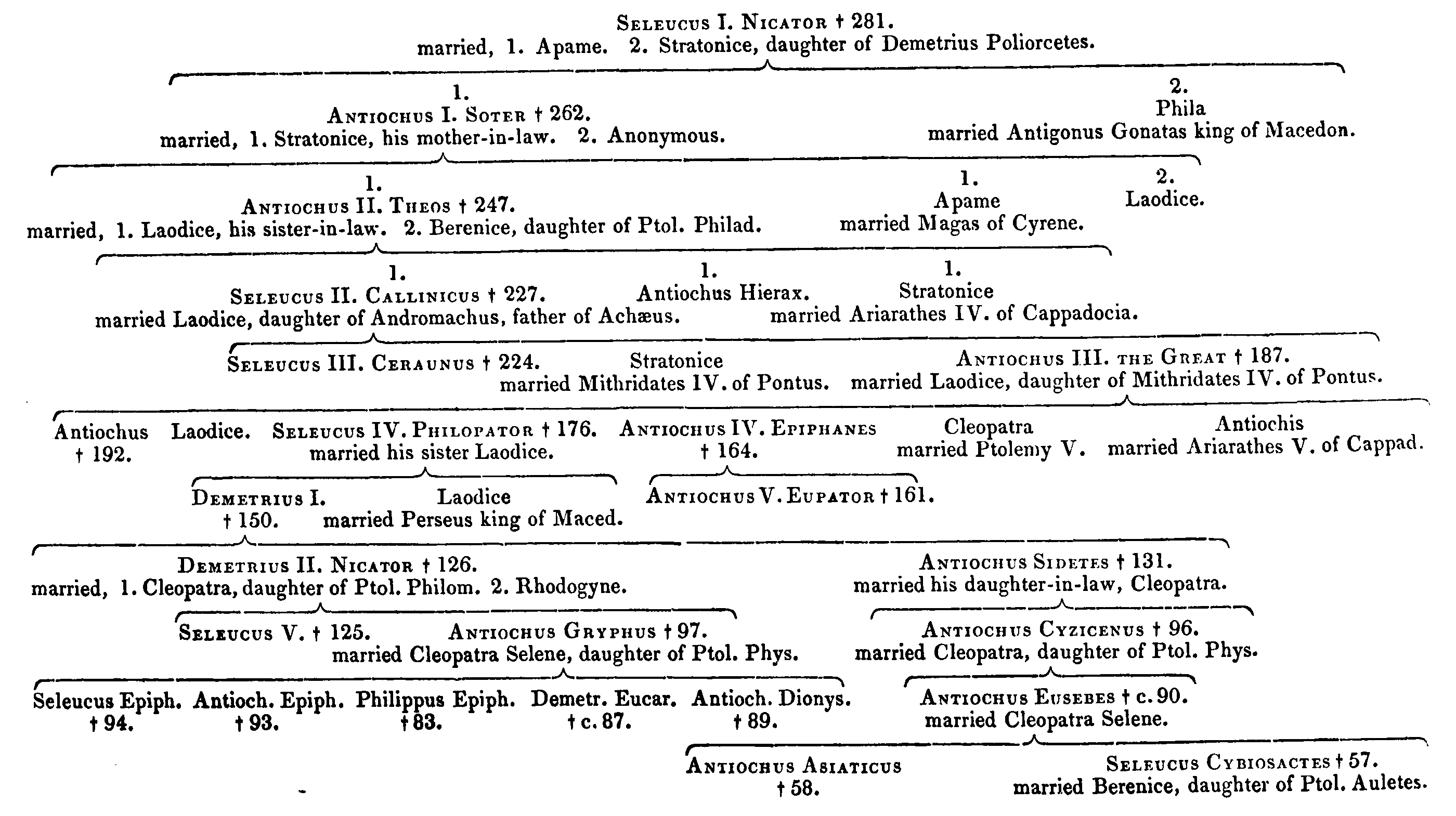
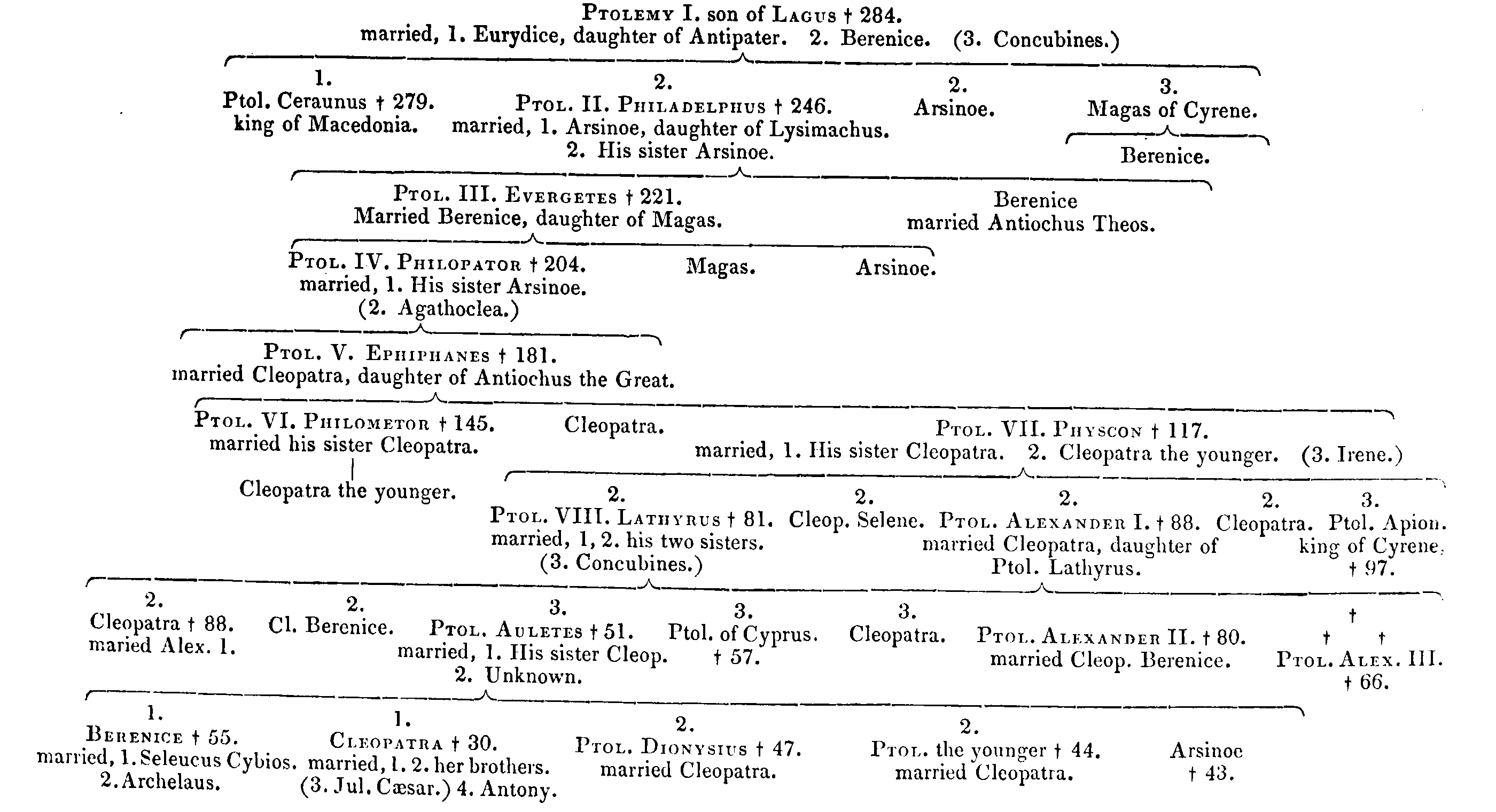
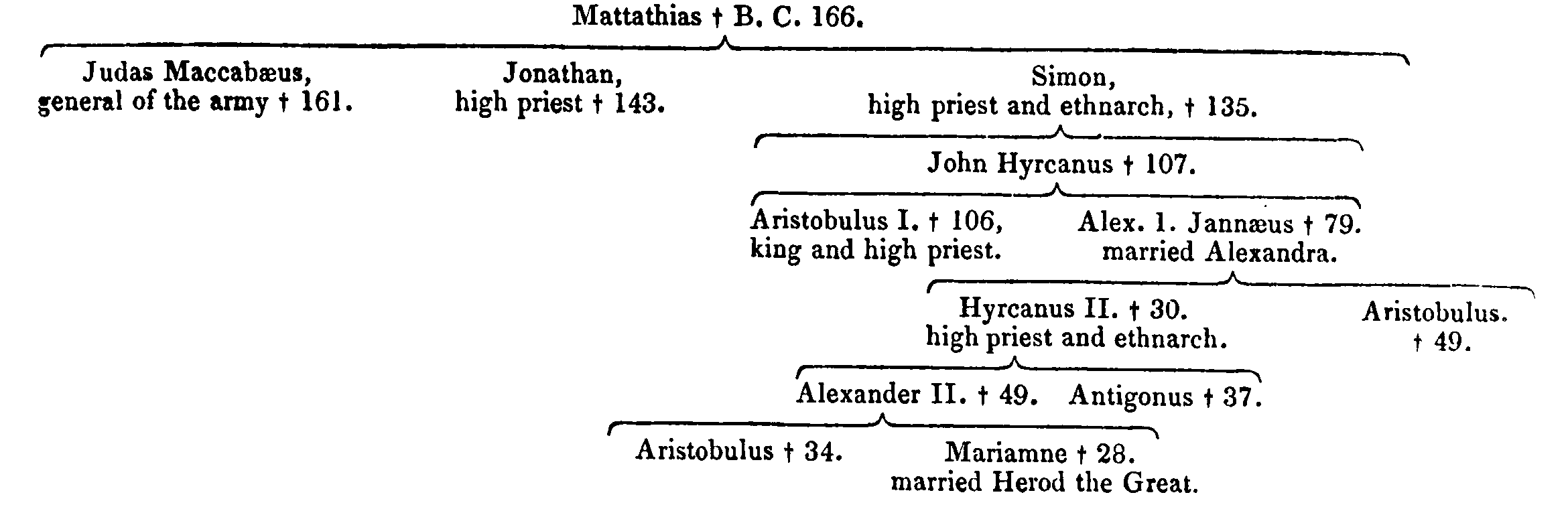
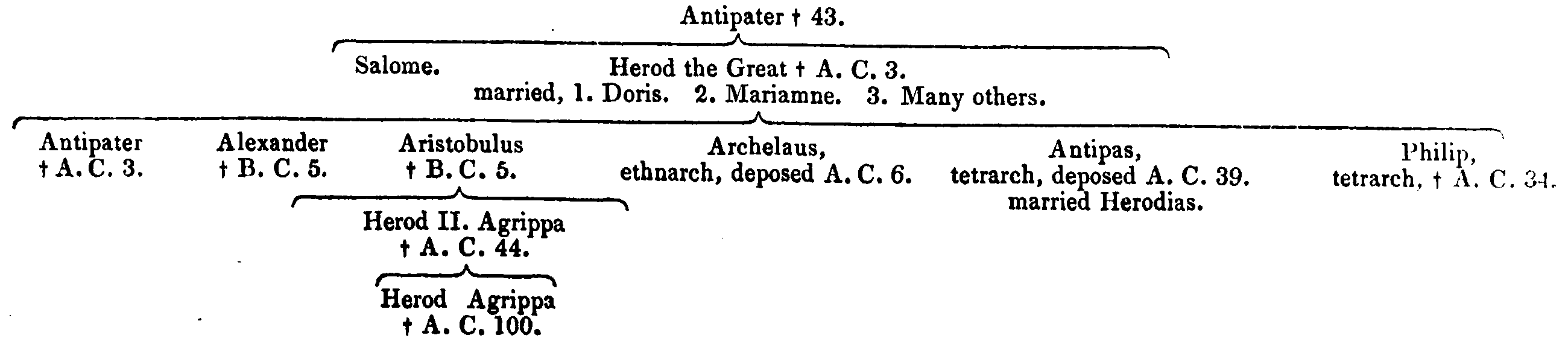
History of the kingdoms and states which arose upon the
dismemberment of the
Macedonian Monarchy after the battle of Ipsus.
I. History of the Syrian empire under the Seleucidæ,
B. C. 312—64.
Sources. Neither for the history of the Syrian, nor for that
of the Egyptian and Macedonian kingdoms, has any eminent
writer been preserved. The fragments of the lost books of Diodorus,
and, from the time that these kingdoms became allies of
Rome, those of Polybius, several narratives of Livy, the Syriaca
of Appian, and a few of Plutarch's Lives, are the principal authorities;
too frequently we are obliged to rely upon the extracts
of Justin. For the history of the Seleucidæ, in consequence of
the political connection between these princes and the Jews, the
Antiquities of Josephus and the book of Maccabees become of
importance. Besides these authorities, the many coins that have
been preserved of these kings, afford much information respecting
their genealogy and chronology.
Of modern publications on the subject, the principal work is
Vaillant, Imperium Seleucidarum sive historia regum Syriæ,
1681, 4to. The enquiry is principally grounded on coins, as is
the case with
Froelich, Annales rerum et regum Syriæ. Viennæ, 1754.
Seleucus
Nicator,
1. The kingdom of the Seleucidæ was founded
in Upper Asia by Seleucus Nicator. It was an
extensive empire; but, being composed of various
countries united only by conquest, it could possess
but little internal stability except what it derived
from the power of its rulers. That power fell
with the founder; and the transfer of the seat of
empire from the banks of the Tigris to Syria, entangled
the Seleucidæ in all the political disputes
of the western world, and facilitated the insurrection
of the upper provinces. The history of this
kingdom divides itself into the periods before and
after the war with Rome; although at the breaking
out of this war the seeds of its decline and
fall had already been sown.
Seleucus received, 321, Babylon as his province; but after the
defeat of Eumenes was obliged to take to flight, 315, in order to
avoid subjection to the conqueror Antigonus. But his moderate
government had rendered him so popular, that after the victory
won by Ptolemy over Demetrius at Gaza, 312, he could safely
venture to return with only a few adherents to Babylon. In this
year commences the kingdom of the Seleucidæ.
founds the kingdom of the Seleucidæ.
B. C. 313.
311.
2. In the ten following years, and while Antigonus
was busied in Asia Minor, Seleucus laid
the foundation of his power over all Upper Asia,
with a facility to which the detestation excited
by the rigid government of Antigonus mainly contributed.
After his victory over Nicanor of
Media, all in that quarter declared spontaneously
for him; and the unsuccessful expedition of Demetrius
taught Antigonus himself, that it would
no longer be prudent to assert his claims. As
early as 307, Seleucus was in possession of all
the countries between the Euphrates, Indus, and
Oxus.
Campaign
against
India,
305.
3. Great campaign in India undertaken by Seleucus
against king Sandracottus. He penetrated
as far as the Ganges, and the close alliance he
formed with the Indian sovereign lasted a long
time after, and was kept up by embassies. The
great number of elephants which he brought back
with him was not the only advantage accruing
from this expedition; the intercourse with the
east seems to have been permanently reestablished.
Seat of government
removed
into Syria,
301.
4. By the battle of Ipsus Seleucus added to
his dominions the greater part of the territories
of Antigonus;—Syria, Cappadocia, Mesopotamia,
and Armenia. Unfortunately Syria now became
the head province, notwithstanding Cœle-Syria
and Phœnicia were left in the hands of Ptolemy.
How widely different would have been the course
of historic events, had the seat of empire remained
at Seleucia on the Tigris, and the Euphrates
continued to be the western boundary of
the Seleucidæ!
5. Reciprocal relations between the several
kings, who now combine in forming a kind of political
system, in which continued exertions to
maintain a balance of power by alliance and marriage
are plainly discernible.
Connection between Seleucus and Demetrius Poliorcetes, by
the marriage of the former with the beautiful Stratonice, daughter
of the latter; made with the view of counterbalancing a
similar connection between Ptolemy and Lysimachus; Lysimachus
and his son Agathocles having united themselves with two
daughters of Ptolemy.
Long peace
in Asia,
301—283.
6. The eighteen years of tranquillity enjoyed
by Asia after the battle of Ipsus, prove that Seleucus
was one of the few followers of Alexander
who had any genius for the arts of peace. He
either founded or embellished a vast number of
cities, the most important of which were the
capital, Antiochia in Syria, and the two Seleucias,
one on the Tigris, the other on the Orontes: the
flourishing prosperity of several of these places
was the result of the restoration of eastern trade;
new channels for which appear to have been
opened at this period on the main streams of Asia,
and more particularly on the Oxus.
The empire
divided into
satrapies.
7. The home department of his empire was
organized into satrapies, of which there were
seventy-two. But Alexander's maxim, "to give
the satrapies to natives," was wholly forgotten by
his followers; and the Seleucidæ were not long
before they experienced the evil consequences of
swerving from that practice. Under such a prince
as Seleucus scarce any kingdom could of itself
fall to pieces; but the king himself paved the way
for the dismemberment of his empire, by ceding
293.
Upper Asia, together with his consort Stratonice,
to his son Antiochus; not, however, without the
previous approbation of the army.
Conquest of Asia Minor.
282.
281.
8. War with Lysimachus, kindled by ancient
jealousy, and now fomented by family feuds. The
battle of Curopedion cost Lysimachus his throne
and his life; and Asia Minor became a part of the
Syrian realm. But as Seleucus was crossing over
to Europe, to add Macedonia to his dominions, he
fell by the hand of an assassin, Ptolemy Ceraunus,
and with him the splendour of his kingdom was
extinguished.
Antiochus
Soter,
281—262.
9. The reign of his son, Antiochus I. surnamed
Soter, seemed not unprosperous, inasmuch as the
empire preserved its former extension; but in
any state founded upon conquest, the failure of
new attempts at an increase of territory is a sure
token of approaching ruin; and this was the case
here.—In such a state, the more immediately all
depends on the person of the ruler, the more
rapid and sensible are the effects of degeneration
in a family like that of the Seleucidæ.
The late conquests of his father in Asia Minor entangled Antiochus
in new wars; although, by the marriage of his stepdaughter
Phila with Antigonus Gonatas, he ceded his claims on
Macedonia, 277.—Fruitless attempt at subjecting Bithynia,
279; the king of that country, Nicomedes, calls in the Gauls,
who had invaded Macedonia, and gives them a settlement in Galatia,
277, where they keep their footing, even after the victory
won over them by Antiochus, 275, and by their participation in
the wars, as mercenaries, become of importance.—The newly
risen state of Pergamus likewise thrives, at the expense of the
Syrian empire, in spite of Antiochus's attack, 263; and the inroad
into Egypt, for the purpose of supporting the rebel Magas,
is anticipated by Ptolemy II. 264.
Antiochus Theus,
262—247.
Rise of the Parthian and Bactrian kingdoms.
10. Antiochus II. surnamed Θεός. During his
reign the sway was in the hands of women; and
the diseased state of the interior of the empire
became palpable by the secession of various eastern
provinces, out of which arose the Parthian
and Bactrian kingdoms. The boundless luxury
of the court hurried on the decline of the ruling
family; having once begun to sink, it could not
without difficulty have retrieved its virtue independently
of the matrimonial connections now
constantly formed from within itself.
Ascendancy of his stepsister and wife Laodice, and of his sister
Apame, relict of Magas; the latter involves him in war with
Ptolemy II. to vindicate her claims upon Cyrene; it ends by
Antiochus's marriage with Berenice, daughter of Ptolemy, and
his repudiation of Laodice, 260—252. Having, after the death
of Ptolemy, 247, put away Berenice and taken back Laodice; the
latter, distrusting his motives, cuts him off by poison.—The secession
of Parthia happened in consequence of the expulsion of
the Macedonian governor by Arsaces, founder of the house of the
Arsacidæ: that of Bactria, on the other hand, was brought about
by the Macedonian governor himself, Theodotus, who asserted
his independence. (Concerning these two kingdoms, see below,
book iv. period iii. Dist. Kingdoms iv. parag. 4, 5.) At first, the
former of these kingdoms comprised but a part of Parthia; the
latter only Bactria, and, perhaps, Sogdiana; both, however, were
soon enlarged at the expense of the Seleucidæ.
Seleucus
Callinicus,
247—227.
11. Seleucus II. surnamed Callinicus. His
reign, twenty years in duration, is one unbroken
series of wars; in which the kingdom, already
enfeebled, was subverted, partly by the struggle
with Egypt, caused by the hatred between Laodice
and Berenice; partly by the jealousy of his
brother Antiochus Hierax; and partly by vain
attempts at recovering the upper provinces.
Assassination of Berenice, and most unfortunate war thereby
kindled with Ptolemy Evergetes of Egypt, 247—244. The assistance
which Seleucus obtains from his junior brother, Antiochus,
governor of Asia Minor, induces Ptolemy to a truce, 243;
but another war ensues between the two brothers, in which Antiochus,
at first conqueror, is himself soon afterwards conquered
in his turn, 243—240; and during this contest, Eumenes of
Pergamus greatly increases his territory at the expense of Syria,
242.—His first campaign against Arsaces, who had formed an
alliance with the Bactrian king, ended in a defeat, 238, regarded
by the Parthians as the real epoch of the foundation of their
kingdom. In the second campaign, 236, he himself fell into the
hands of the Parthians, and remained a prisoner till the day of his
death, 227.
Seleucus
Ceraunus,
227.
224.
12. His elder son Seleucus III. surnamed Ceraunus,
on the point of taking the field against
Attalus king of Pergamus, was removed by poison.
But the dominion of the Seleucidæ was
reestablished in Asia Minor by his mother's fraternal
nephew, Achæus; and the crown ensured
to the younger brother Antiochus, governor of
Babylon.
Antiochus
the Great,
224—187.
13. The long reign of Antiochus III. surnamed
the Great, is not only the most eventful in Syrian
history, but likewise marks an epoch, by the
relations now commencing between Syria and
Rome.—To earn the title of great was a task of
no extreme difficulty in such a line of princes.
Insurrection
in Media
and
Persia.
218.
220.
14. Great power of Hermias the Carian, who
soon became so formidable to the young monarch,
that he was obliged to rid himself of him by murder.
The great stand made by the brothers,
Molo and Alexander, satraps of Media and Persia,
who probably had an understanding with
Hermias, threatened the king with the loss of all
the upper provinces: it ended in the defeat of
Molo, Hermias being at last no longer able to
hinder the king from marching against him in
person.
War with
the Ptolemies:
insurrection
of Asia
Minor, 220.
219.
217.
216.
15. The intrigues of Hermias excited Achæus
to rebellion in Asia Minor: but Antiochus held
more important, first to execute the plan he
had previously traced, of ejecting the Ptolemies
from their possessions in Syria; great as the success
which at first attended this expedition, it
was completely traversed by the battle of Raphia.—Combining
with Attalus of Pergamus, Antiochus
then defeated Achæus, who, being shut up
in the citadel of Sardes, was treacherously delivered
into his hands.
Campaign
in the upper
provinces,
214—205.
210.
206.
16. Great campaign of Antiochus in the upper
provinces, in consequence of the seizure of Media
by Arsaces III.—Hostilities ended in a compact,
by which Antiochus agreed formerly to cede Parthia
and Hyrcania; Arsaces, on his side, pledging
himself to furnish assistance against Bactria.—But
the war with Bactria was also followed by a
peace, leaving the king, Euthydemus, in possession
of his crown and dominions.—The expedition
now undertaken by Antiochus, in company with
Demetrius of Bactriana, against India, extended,
probably far up the country, and was attended
with important consequences to Bactriana. (See
below, history of Bactria, book iv. per. iii. Dist.
Kingdoms iv. parag. 5.)
The result of these great expeditions was the
establishment of the supremacy of the Seleucidæ
in Upper Asia; those countries excepted which
had been formally resigned.
On his return through Arachotus and Carmania, where he wintered,
he likewise undertook a naval expedition on the Persian
gulf: here Gerrha, in possession of its freedom, appears a flourishing
place of trade.
War with Egypt,
203.
17. Resumption of the plan against Egypt,
after the death of Ptolemy Philopator; and alliance
with Philip of Macedonia, then carrying on
war in Asia. Antiochus, it is true, attained his
end in the expulsion of the Ptolemies from their
possessions in Syria, Cœle-Syria, and Phœnicia;
but then, his success brought him in contact with
203—198.
Rome, an event of decisive importance to himself
and his successors.
War with Rome.
197.
195.
18. Growth of the disputes between the king
and Rome, proceeding from the conquest of the
major part of Asia Minor and the Thracian Chersonesus;
meanwhile Hannibal had taken refuge
at the Syrian court, and the probability daily increased
of a great league being formed against
Rome, although that power, after conquering Carthage,
201, and Macedonia, 197, had succeeded
in winning over Greece even, by the magic spell
of freedom. But Antiochus ruined all: instead of
following Hannibal's advice, and attacking the
Romans on their own ground, he stood on the defensive,
and suffered himself to be invaded by
them in Asia. His defeat at Magnesia near
Mount Sipylus compelled him to accede to such
190.
conditions as Rome chose to dictate, and the
power of the Syrian empire was for ever broken.
For the history of this war, see below in the Roman history.
Book v. per. ii. parag. 10, 11.
Conditions
of peace
with Rome.
19. The conditions of the peace were: 1st.
That Antiochus should evacuate Asia Minor;
(Asia cis Taurum.) 2nd. That he should pay
down 15,000 talents; and to Eumenes of Pergamus
four hundred. 3rd. That Hannibal and some
others should be delivered up, and the king's
younger son Antiochus, be given as an hostage.—The
loss of the surrendered countries was a consequence
of this peace, less disadvantageous to
the Syrian kings, than the use made of it by the
conquerors. By adding the greatest part of the
ceded territories to those of the kings of Pergamus,
the Romans raised up alongside of their enemy a
rival, whom they might at their own will use as a
political engine against him.—Rome took care
likewise that the stipulated sum should be paid
by instalments in twelve years, to the end that
Syria might be kept in a permanent state of dependence.
Seleucus
Philopator,
187—176.
20. Murder of the king, 187. The reign of his
elder son, Seleucus IV. surnamed Philopator, was
a period of tranquillity; peace arising from weakness.—Though
once he unsheathed his sword in
defence of Pharnaces king of Pontus, against Eumenes,
his fear of Rome soon compelled him to
restore it to the scabbard. He exchanged his son
for his brother at Rome; but fell a victim to the
ambition of his minister Heliodorus.
Antiochus
Epiphanes,
176—164.
21. Antiochus IV. surnamed Epiphanes. Educated
at Rome, he sought to combine the popular
manners of a Roman with the ostentatious luxury
of a Syrian; and thereby became an object of
universal hatred and contempt. Our information
respecting his history is too meagre to allow of our
deciding whether most of the evil reported of him,
in the Jewish accounts especially, may not be
exaggerated. At any rate, among all his faults,
we may still discern in him the germs of good
qualities.
His war
against
Egypt,
172—168:
22. War with Egypt, springing out of Ptolemy
Philometor's claims upon Cœle-Syria and Palestine.
Obscure as many parts are in the history
of this war yet it is evident that success attended
the arms of Antiochus, and that he would have
become master of Egypt had not Rome interfered.
The pretext for war, on the Egyptian side, was, that those
provinces had by Antiochus III. been promised as a dowry to
Cleopatra, sister of Antiochus and the mother of Philometor:
Antiochus Epiphanes, on his side, laid claim to the regency of
Egypt, as uncle to the young king, who, however, was soon declared
of age.—Opening of the war, and victory won by Antiochus
at Pelusium, 171; in consequence of which Cyprus is betrayed
into his hands.—Pelusium is fortified with a view of insuring
the possession of Cœle-Syria, and of facilitating an irruption
into Egypt.—Another victory, 170, and Egypt subdued as
far as Alexandria. Philometor driven by a sedition out of Alexandria,
where his brother Physcon is seated on the throne, falls
into the hands of Antiochus, who concludes with him a most advantageous
peace, and takes his part against Physcon. Hence
siege is laid to Alexandria, 169; attended with no success.
Upon the retreat of Antiochus, Philometor, concluding a separate
peace with his brother, according to which both are to rule in
conjunction, is admitted into Alexandria. Antiochus, bitterly
enraged, now declares war against both brothers, who crave assistance
from Rome: he once more penetrates into Egypt, 168;
where the Roman ambassador, Popillius, assumes so lofty a tone,
that the Syrian king is glad to purchase peace by the surrender
of Cyprus and Pelusium.
his intolerance:
23. The religious intolerance of Epiphanes,
exhibited in his wish to introduce the Grecian
worship everywhere among the subjects of his
empire, is the more remarkable, as such instances
were less frequent in those times. This intolerance
seems to have taken its rise, not only in the
love of pomp, but in the cupidity of the king, who
by that means was enabled to appropriate to himself
the treasures of the temples, no longer inviolate,
since the defeat of his father by Rome. The
167.
consequent sedition of the Jews, under the Maccabees,
laid the foundation of the future independence
of that people, and contributed not a
little to weaken the Syrian kingdom.
See below; History of the Jews, book iv. per. iv; Small
states Jews, parag. 6. The deep decay of the finances of the
Seleucidæ, palpable from the latter days of Antiochus the Great,
may be accounted for well enough, by the falling off of the revenue,
accompanied with increased luxury in the kings, (an instance
of which is furnished in the festivals celebrated by Antiochus
Epiphanes at Daphne, 166,) and in the vast presents constantly
sent to Rome, in addition to the tribute, for the purpose
of keeping up a party there.
his death,
165.
24. His expedition also into Upper Asia, Persis
especially, where great disorders were likewise
excited by the introduction of the Grecian religion,
had for its object not only the recovery of
Armenia, but the rifling of the temples. He died,
however, on his way to Babylon.
Antiochus Eupator.
164—161.
25. The real heir to the throne, Demetrius,
being detained at Rome as an hostage, Epiphanes
was first succeeded by his son Antiochus V. surnamed
Eupator, a child nine years old. During
his short reign, the quarrels of his guardians, the
despotism of the Romans, the protracted war with
the Jews, and the commencing conquests of the
Parthians, reduced the kingdom of the Seleucidæ
to a powerless state.
Contest between Lysias, regent in the absence of Epiphanes,
and Philip, appointed by the king, previously to his death, as
guardian of the young prince, terminated by the defeat of Philip,
162.—Eupator's right acknowledged at Rome, in order that the
guardianship might fall into the hands of the senate, who administer
the government by means of a commission sent over into
Syria, and completely deprive the king of all power of resistance.
Octavius, head of the commission, put to death, probably at the
instigation of Lysias.—While the Parthian king, Mithridates I.
is prosecuting his conquests at the expense of the Syrian kingdom
in Upper Asia, Demetrius secretly escapes out of Rome,
takes possession of the throne, and causes Eupator and Lysias to
be put to death, 161.
Demetrius
Soter,
161—150.
26. Demetrius I. surnamed Soter. He succeeded
in getting himself acknowledged at Rome,
on which all now depended. The attempts to
extend his power, by supporting Orofernes, the
pretender to the crown of Cappadocia, against
the king Ariarathes, had their origin partly in
family relations, but still more, as was the case
with almost all political transactions of those
times, in bribery. By this act he only drew upon
himself the enmity of the kings of Egypt and
Pergamus; as, moreover, he was hated by his subjects
on account of his intemperance, the chances
of success were greatly in favour of the shameful
154.
usurpation of Alexander Balas, brought about
by Heraclidas the expelled governor of Babylon,
and backed by the yet more shameful conduct of
the Roman senate, who acknowledged his title to
the throne. The Syrian kingdom was now fallen
so low, that both king and usurper were obliged
to court the favour of the Jews under Jonathan,
hitherto regarded as rebels. In the second battle
Demetrius lost his life.
Alexander
Balas,
150—145.
27. The usurper Alexander Balas endeavoured
to confirm his power by a marriage with Cleopatra,
daughter of Ptolemy Philometor: but he
soon evinced himself more unworthy even than
his predecessor of wielding the sceptre. While
he abandoned the government to his favourite,
the detested Ammonius, the eldest remaining son
of Demetrius succeeds not only in raising a party
against the usurper, but even in prevailing on
Philometor to side with himself, and give him in
marriage Cleopatra, whom he takes away from
Balas. The consequence of this alliance with
145.
Egypt was the defeat and downfal of Balas, although
it cost Philometor his life.
The account, that Philometor wished to conquer Syria for
himself, must probably be understood as meaning that he had
formed the design of recovering the ancient Egyptian possessions,
Cœle-Syria and Phœnicia. Otherwise, why should he
have given his daughter to a second pretender to the throne?
Demetrius Nicator, 145—126.
145.
144.
143.
142.
140—130.
28. Demetrius II. surnamed Nicator, 145—141,
and for the second time, 130—126. The disbanding
of his father's mercenaries having roused
the indignation of the army, the cruelty of his
favourite Lasthenes kindled a sedition in the capital,
which could not be quenched without the
assistance of the Jews, under their high priest and
military chieftain, Jonathan.—While affairs were
in this posture, Diodotus, subsequently called
Tryphon, a dependent of Balas, excited an insurrection,
by bringing forward Antiochus, the latter's
son, and even, with the help of Jonathan,
seating him on the throne of Antioch: soon after,
Tryphon, having by treachery got Jonathan into
his power, removed Antiochus by murder, and
assumed the diadem himself.—Notwithstanding
Demetrius kept his footing only in a part of Syria,
he was enabled to obey the call of the Grecian
colonists in Upper Asia, and support them against
the Parthians, who had overrun the country as
far as the Euphrates.—Although victorious in the
commencement of the contest, he was soon after
taken by the Parthians, and remained ten years
a prisoner, though treated meanwhile as a king.
Antiochus of Sida.
139.
132.
131.
29. In order to maintain herself against Tryphon,
Cleopatra marries the younger, and better
brother, Antiochus of Sida, (Sidetes); he being
at first in alliance with the Jews,—who, however,
were soon after subdued—defeats and overthrows
Tryphon. Being now lord and master of Syria,
he undertakes a campaign against the Parthians;
at the commencement, befriended by the subjects
of the Parthians, he is successful, but soon afterwards
is attacked in winter quarters by those
very friends, and cut to pieces, together with all
his army.
If the accounts of the wanton licentiousness of his army are
not exaggerations, they furnish the clearest proof of the military
despotism of those times. By continued pillage and extortion,
the wealth of the country had been collected in the hands of the
soldiers; and the condition of Syria must have been pretty nearly
the same as that of Egypt under the Mamluk sultans.
Demetrius Nicator restored,
130—126.
126.
30. Meanwhile Demetrius II. having escaped
from prison, again seated himself on the throne.
But being now still more overbearing than before,
and meddling in the Egyptian affairs, Ptolemy
Physcon set up against him a rival in the
person of Alexander Zebinas a pretended son of
Alexander Balas; by him he was defeated and
slain.
The Parthian king Phraates II. had, at first, liberated Demetrius,
to whom his sister Rhodogune was united by marriage, in
order that, by appearing in Syria, he might oblige Antiochus to
retreat. Antiochus having fallen, Phraates would fain have recaptured
Demetrius, but he escaped.
126—85.
31. The ensuing history of the Seleucidæ is a
picture of civil wars, family feuds, and deeds of
horror, such as are scarcely to be paralleled. The
utmost verge of the empire was now the Euphrates;
all Upper Asia acknowledging the dominion
of the Parthians. The Jews, moreover,
having completely vindicated their independence,
the kingdom was consequently confined to Syria
and Phœnicia. So thoroughly decayed was the
state, that even the Romans—whether because
there was no longer anything to plunder, or because
they conceived it more prudent to suffer
the Seleucidæ to wear themselves out in mutual
quarrels—do not seem to have taken any account
Syria becomes a Roman province, 64.
of it, until, at the conclusion of the last war with
Mithridates, they thought proper formally to annex
it to their empire as a province.
War between Alexander Zebinas and the ambitious relict of
Demetrius, Cleopatra, who with her own hand murders her eldest
son Seleucus, B. C. 125, for pretending to the crown, which she
now gives to her younger son, Antiochus Gryphus; the new
king, however, soon saw himself compelled to secure his own life
by the murder of his mother, 122; Alexander Zebinas having
been the year before, 123, defeated and put to death. After a
peaceful rule of eight years, 122—114, Antiochus Gryphus is involved
in war with his half-brother Antiochus Cyzicenus, son of
Cleopatra by Antiochus Sidetes: it ends, 111, in a partition of
territory. But the war between the brothers soon burst out
anew, and just as this hapless kingdom seemed about to crumble
into pieces, Gryphus was murdered, 97.—Seleucus, the eldest of
his five sons, having beaten and slain Cyzicenus, 96; the eldest
son of the latter, Antiochus Eusebes, prosecuted the war against
the sons of Gryphus; Eusebes being at last defeated, 90, the
surviving sons of Gryphus fell to war among themselves, and the
struggle continued until the Syrians, weary of bloodshed, did
what they ought to have done long before, viz. made over the
sovereign power to Tigranes the king of Armenia, 85. Yet
Eusebes's widow, Selene, retained Ptolemais till 70; and her elder
son Antiochus Asiaticus, at the time that Tigranes was beaten
by Lucullus, in the Mithridatic war, took possession of some
provinces in Syria, 68; these were wrested from him after the
total defeat of Mithridates by Pompey, when Tigranes was
obliged to give up his claim, and Syria became a province of the
Roman empire, 64. Antiochus Asiaticus died 58; his brother
Seleucus Cybiosactes, having married Berenice, was raised to
the Egyptian throne, but murdered at her command, 57; and
thus the family of the Seleucidæ was completely swept away.
II. History of the Egyptian kingdom under the Ptolemies,
323—30.
The sources of this history are for the most part the same as
in the foregoing section; see above, p. 232; but unfortunately
still more scanty; for in the first place, less information can here
be derived from the Jewish writers; secondly, as on the coins
struck under the Ptolemies no continuous series of time is
marked, but only the year of the king's reign, they are by no
means such safeguards to the chronology as those of the Seleucidæ.
With respect to some few events, important illustrations
are supplied by inscriptions.
By modern writers, the history of the Ptolemies has been
composed under a form almost entirely chronological, and by no
means treated of in the spirit which it deserves.
Vaillant, Historia Ptolemæorum, fol. Amstelodam. 1701.
Illustration by the aid of coins.
Champolion Figeac, Annales des Lagides, ou Chronologie
des Rois d'Egypte, successeurs d'Alexandre le Grand. Paris,
1819, 2 vols. This treatise, which was honoured with a prize
by the Académie des Inscriptions, has by no means exhausted
the whole of the subject. See
J. Saint-Martin, Examen Critique de l'ouvrage de M. Ch.
F. intitulé Annales des Lagides. Paris, 1820.
Letronne, Recherches pour servir à l'histoire de l'Egypte
pendant la domination des Grecs et des Romains, tirées des inscriptions
Grecques et Latines, relatives à la chronologie, à l'etat
des arts aux usages civils et religieux de ce pays. Paris, 1828.
It cannot be denied that the author has thrown a much clearer
light on the subjects mentioned in his title.
Flourishing
state of
Egypt
under the
Ptolemies.
1. Egypt, under the Ptolemies, fulfilled, and
perhaps more than fulfilled, the designs projected
by Alexander; it became not only a mighty
kingdom, but likewise the centre of trade, and of
science. The history of Egypt, however, confines
itself, almost solely, to that of the new capital,
Alexandria; the foundation of that city produced,
imperceptibly, a change in the national character,
which never could have been wrought by main
force. In the enjoyment of civil welfare and religious
freedom, the nation sunk into a state of
political drowsiness, such as could scarce have
been expected in a people who so often rose up
against the Persians.
Alexandria, originally, was no doubt a military colony; it was
not long, however, before it became a general place of resort for
all nations, such as was scarcely to be met with in any other town
of that day. The inhabitants were divided into three classes;
Alexandrines, (that is to say, foreigners of all nations, who had
settled in the place; next to the Greeks, the Jews were, it appears,
the most numerous,) Egyptians, and Mercenaries in the
king's service. The Greeks and Macedonians divided into wards
(φυλας), constituted the citizens; they were under municipal
government; the others, such as the Jews, formed bodies corporate
according to their respective nations. The more important,
in so many respects, that Alexandria is for history, the more it
is to be regretted that the accounts respecting it, which have
reached us, are so far from satisfactory!—Concerning the topography
of ancient Alexandria:
Bonamy, Description de la ville d'Alexandrie in the Mém. de
l'Académie des Inscript. vol. ix. Compare:
† J. L. F. Manso, Letters upon ancient Alexandria, in his
Vermischte Schriften, vol. i.
Ptolemy
Soter,
B. C. 323—284.
321.
307.
2. Ptolemy I. surnamed Soter, the son of
Lagus, received Egypt for his share, at the first
division after the death of Alexander. Aware of
the value of his lot, he was the only one of
Alexander's successors that had the moderation
not to aim at grasping all. No doubt he was, by
the ambition of the other princes, entangled in
their quarrels, but his conduct was so cautious,
that Egypt itself was never endangered. Twice
attacked in that country, first by Perdiccas, afterwards
by Antigonus and Demetrius, he availed
himself successfully of his advantageous position,
and moreover, in this period, added to his dominion
several countries without Africa, such as
Phœnicia, Judæa, Cœle-Syria, and Cyprus.
The possession of Phœnicia and Cœle-Syria, by reason of their
forests, was of indispensable necessity to Egypt as a naval power.
They frequently changed masters. The first occupation of those
provinces by the Egyptian government, occurred in 320, soon
after the rout of Perdiccas by Ptolemy's general Nicanor, who
took the Syrian satrap Laomedon prisoner, established his footing
in the whole of Syria, and placed garrisons in the Phœnician
cities. In 314 it was again lost to Antigonus, after his return
out of Upper Asia, and the siege of Tyre. Ptolemy having
defeated Demetrius at Gaza, 312, repossessed himself of those
countries, but soon after evacuated them on the appearance of
Antigonus, to whom they were ceded by the peace of 311. At
the conclusion of the last grand league against Antigonus, 303,
Ptolemy once more occupied them: but alarmed at a false report,
that Antigonus had gained a victory, he retreated into Egypt,
leaving nevertheless troops in the cities. After the battle of
Ipsus, 301, those countries were made over to him, and continued
in the hands of the Ptolemies until they were lost at the
second invasion of Antiochus the Great, 203.
Cyprus, (see p. 154) like most other islands, acknowledged
submission to those who possessed the sovereignty of the sea, and
therefore could not escape the dominion of the Ptolemies. It
was taken possession of by Ptolemy as early as 313. Still the
separate cities of the islands preserved their kings, among whom
Nicocles of Paphos, having entered into a secret league with
Antigonus, was put to death, 310. After the great seafight,
307, Cyprus fell into the hands of Antigonus and Demetrius.
Subsequently to the battle of Ipsus, 301, it remained indeed at
first in the power of Demetrius; but that prince being gone over
to Macedonia, Ptolemy, 294, seized an opportunity of recovering
it, and the island from that time remained under the dominion
of Egypt. Availing themselves of their naval strength, the
Egyptian kings frequently exerted sovereign power over the
coasts of Asia Minor, especially Cilicia, Caria, and Pamphylia,
which appear to have absolutely formed a part of their territory
under the second Ptolemy. It is, however, hardly possible to
define with accuracy what were their real possessions in those
quarters.
Cyrene and
Libya annexed
to
Egypt.
3. Ptolemy likewise extends his territory within
Africa, by the capture of Cyrene; in consequence
of which Libya, or the neighbouring
countries betwixt Cyrene and Egypt, fell under
his dominion. It is probable, also, that even in
his reign the frontier of the Egyptian empire was
advanced into Æthiopia; but for this assertion we
have no positive authority.
The fall of Cyrene was brought about by domestic broils: at
the time the place was besieged by Thimbron, a portion of the
exiled nobles fled to Ptolemy; the Egyptian prince commanded
that they should be reinstated by his general Ophellas, who took
possession of the town itself, 321. An insurrection in 312 was
quelled by Agis, Ptolemy's general: nevertheless it would appear
that Ophellas had almost established his independence, when,
by the treachery of Agathocles, with whom he had entered into a
league against Carthage, he perished, about 308. Cyrene was
now seized by Ptolemy, and given to his son Magas, who ruled
over it fifty years.
Constitution
of the
government.
4. With respect to the internal government of
Egypt, our information is far from complete. The
division into districts or nomes was continued;
subject perhaps, in some cases, to alterations.
The power of the king appears to have been unlimited;
the extreme provinces were administered
by governors, appointed by the sovereign;
similar officers were probably placed at the head
of the various districts of Egypt itself; but hardly
any document relative to the home department of
that country has reached our time. High public
situations, at least in the capital, appear exclusively
reserved to Macedonians or Greeks; no
Egyptian is ever mentioned as holding office.
There were four magistrates at Alexandria: the Exegetes,
whose office was to provide for the wants of the city; the Chief
Judge; the Hypomnematographus—(Registrar of the archives?)—and the
Στρατηγὸς νυκτερινὸς,
no doubt, the supervisor of the
police, whose duty it was to watch over the peace of the city at
night. We have the express testimony of Strabo, that these
offices, which continued under the Romans, had already existed
under the kings; whether their establishment can be dated as
far back as the time of Ptolemy I. is a question that does not
admit of a solution.—The number of the districts or nomes appears
to have been augmented; probably with a political view,
in order that no governor or monarch should be invested with too
great a share of power.
The priest-caste
and
religion remain.
5. Be that as it may, it is an undoubted fact,
that the ancient national constitution and administration
were not entirely obliterated. The
caste of priests, together with the national religion,
continued to exist; and though the influence
of the former was considerably diminished,
it did not entirely cease. A certain sort of
worship was, by appointed priests, paid to the
kings, both in their lifetime and after their death.
Memphis, though not the usual residence of the
court, remained the capital of the kingdom; there
the ceremony of coronation was performed; and
its temple of Phtha was still the head sanctuary.
What influence had not the religion of the Egyptians
upon that of the Greeks! It were difficult
to say which nation borrowed most from the
other.
Character
of the first
of the Ptolemies.
6. The regeneration of Egypt from the state of
general ruin into which she had been plunged,
and the permanent tranquillity she enjoyed during
nearly thirty years, the duration of the reign of
Ptolemy I.—at a time when the rest of the world
was harassed by continual wars,—must have
heightened her prosperity under so mild and beneficent
a ruler. But Ptolemy was certainly the
only prince who could have taken advantage of
these favourable circumstances. Though a soldier
by profession he was highly accomplished,
was himself a writer, and had a genius for all the
arts of peace, which he fostered with the open-handed
liberality of a king: while amidst all the
brilliant splendour of his court, he led himself the
life of a private individual.
Increase of Alexandria by the importation of vast numbers of
colonists; especially Jews.—Erection of several superb buildings,
more particularly the Serapeum.—Measures taken for the extension
of trade and navigation.—The twofold harbour on the
sea, and on the lake Mareotis.—The Pharus built.
Literature
encouraged.
7. But what more than any thing else distinguished
Ptolemy from his contemporaries was his
regard for the interests of science. The idea of
founding the Museum sprung out of the necessities
of the age, and was suited to the monarchical
form of government now prevalent. Where
in those days of destruction and revolution could
the sciences have found a shelter, if not under
the protection of a prince? But under Ptolemy
they found more than a shelter, they found a rallying
point. Here accordingly the exact sciences
were perfected: and although the critic's art
which now grew up could not form a Homer or a
Sophocles, should we, had it not been for the
Alexandrines, be at present able to read either
Homer or Sophocles?
Foundation of the Museum, (Society of the learned,) and of
the first library in Bruchium, (afterwards removed to the Serapeum;)
probably under the direction of Demetrius Phalereus.
A proper estimation of the services rendered by the Museum is
yet wanting: what academy in modern Europe, however, has
done so much?
Heyne, De genio Sæculi Ptolemæorum. In Opuscul. t. i.
Matter, Essai historique sur l'école d'Alexandrie, 1820.
Ptolemy
Philadelphus,
284—246.
8. Ptolemy II. surnamed Philadelphus, son of
Berenice, the second wife of his father, had
ascended the throne in 286 as joint king. His
reign, which lasted thirty-eight years, was more
peaceful even than that of his predecessor, whose
spirit seemed to inspire him in every thing, save
that he was not a warrior: but, by that very
reason, the arts of peace, trade, and science were
promoted with the greater energy. In his reign
Egypt was the first power by sea, and one of the
first by land, in the world; and even though the
account given by Theocritus of its thirty-three
thousand cities may be regarded as the exaggeration
of a poet, it is very certain that Egypt
was in those days the most flourishing country in
existence.
The commerce of Alexandria was divided into three main
branches: 1. The land-trade over Asia and Africa. 2. The sea-trade
on the Mediterranean. 3. The sea-trade on the Arabian
gulf, and Indian ocean.—With regard to the land-trade of Asia,
especially that of India carried on by caravans, Alexandria was
obliged to share it with various cities and countries: since one of
its chief routes traversed the Oxus, and Caspian, to the Black
sea; while the caravans, travelling through Syria and Mesopotamia,
spread for the most part among the seaports of Phœnicia
and Asia Minor.—The trade over Africa extended far west, and
still farther south. Westward it was secured by the close connection
between Cyrene and Alexandria; and no doubt followed
the same roads as in earlier times: of far greater importance was
that carried on with the southern countries, or Æthiopia, into the
interior of which they now penetrated, principally for the purpose
of procuring elephants. The navigation on the Arabian and
Indian seas had likewise for its immediate object the Æthiopian
trade, rather than the Indian.—The measures taken by Ptolemy
with this view, consisted partly in the building of harbours
(Berenice, Myos Hormos) on the Arabian gulf; partly in establishing
a caravan from Berenice to Coptos on the Nile, down
which latter the goods were further transmitted to their destination;
for the canal connecting the Red sea with the Nile, although,
perhaps, completed at this time, was nevertheless but
little used. The grand deposit for these wares was the lesser
harbour of Alexandria, united by a canal with the lake Mareotis,
which in its turn communicated by another canal with the Nile;
so that the account we receive of the lesser harbour being more
thronged and full of bustle than the larger one, need not excite
our surprise. With regard to the trade on the Mediterranean, it
was shared between Alexandria, Rhodes, Corinth, and Carthage.
The chief manufactories appear to have been those of cotton
stuffs, established in or near the temples.
The best inquiry into the trade of Alexandria will be found in
J. C. D. De Schmidt, Opuscula, res maxime Aegyptiorum illustrantia,
1765, 8vo.
Revenue
of Egypt.
9. It would be important to know what, in a
state like Egypt, was the system of imposts,
which under Philadelphus produced 14,800 silver
talents, (four millions sterling,) without taking into
account the toll paid in grain. In the extreme
provinces, such as Palestine, the taxes were annually
farmed to the highest bidder, a mode of
levy attended with great oppression to the people.
The case appears to have been very different with
regard to Egypt itself; the customs, however,
constituted the main branch of the revenue.
Events of
the reign
of Philadelphus.
10. The wars waged by Ptolemy II. were
limited to those against Antiochus II. of Syria,
and Magas of Cyrene, half-brother to the Egyptian
king; the former sprung out of the latter.
Luckily for Egypt, Ptolemy II. was of a weak
constitution, and by his state of health was incapacitated
from commanding his armies in person.—Under
his reign the first foundation was laid,
by means of reciprocal embassies, of that connection
with Rome which afterwards decided the fate
of Egypt.
Magas had, after the defeat of Ophellas, received Cyrene, 308.
He had married Apame, daughter of Antiochus I., and in 266
had raised the standard of rebellion with the intention of invading
Egypt itself, when an insurrection in Marmarica compelled him
to retreat; he contrived, notwithstanding, to prevail upon his
father-in-law to undertake an expedition against Egypt, which,
however, was frustrated by Philadelphus, 264. To terminate this
contest, Magas was about to unite his daughter Berenice with
the eldest son of Philadelphus; Apame, wishing to thwart the
negotiation, fled over to her brother, Antiochus II. whom, after
her husband's death, 258, she excited to a war against Egypt,
which closed in 252.—The embassy to Rome originated in the
victory won by the Romans over Pyrrhus, 273; it was answered
by another from the Romans, 272.
Character
of Ptolemy
Philadelphus.
11. The son inherited from his father all but
the simplicity of domestic life: under the reign of
Philadelphus, the court was first thrown open to
that effeminate luxury, which soon wrought the
destruction of the Ptolemies as it had previously
done that of the Seleucidæ; at the same time was
introduced the pernicious practice of intermarriages
in the same family, by which the royal
blood was more foully contaminated here even
than in Syria. Philadelphus set the first example,
by repudiating Arsinoe the daughter of Lysimachus,
and then marrying his own sister, likewise
named Arsinoe; this princess preserved her influence
over the king as long as she lived, although
she did not bring him an heir, but adopted the
children of her predecessor.
Ptolemy
Evergetes,
246—221.
12. Ptolemy III. surnamed Evergetes. Under
him, Egypt, from being merely mercantile, assumed
the character of a conquering state; notwithstanding
his warlike spirit, he was not uninspired
with that genius for the arts of peace peculiar
to his family. His conquests were directed
partly against Asia in the war with Seleucus II.
and extended as far as the borders of Bactria; and
partly, it is probable, against the interior of Ethiopia,
and the western coast of Arabia. Countries
so wealthy, and with which commerce had made
men so well acquainted, could hardly escape the
arms of such a formidable power as Egypt; yet
she seems to have made scarcely any other use
of this extension of territory, than to insure the
safety of her commercial routes.
The main source of the history of Ptolemy Evergetes, is the
inscription on the monument erected by that prince at Adule
in Ethiopia: it contains a chronological list of his conquests,
a copy of which has been preserved to us by Cosmas Indicopleustes;
modern researches, however, have shown the probability
of its having consisted of two inscriptions, one referring
to Evergetes, the other to a later king of Abyssinia.—According
to this monument, Ptolemy inherited from his father, besides
Egypt itself, Libya, that is to say, western Africa as far as
Cyrene, Cœle-Syria, Phœnicia, Lycia, Caria, Cyprus, and the
Cyclades.—War with Seleucus Callinicus caused by the murder
of Berenice (see above, p. 237.); lasted until the ten years' truce,
246—240. During this war, he conquered the whole of Syria as
far as the Euphrates, and most of the maritime countries in Asia
Minor, from Cilicia to the Hellespont: an easy prey to a naval
power. Whether the conquest of the countries beyond the Euphrates,
Mesopotamia, Babylonia, Persis, Susiana, and Media
as far as Bactria, was effected in these four years, or not till between
240 and 230, is a question which cannot be determined
with certainty. If we may judge by the booty brought back,
this campaign was rather a foray than a regular expedition for
conquest, though Ptolemy, indeed, appointed governors in Cilicia
and Babylonia; yet the peculiar situation of affairs in Asia
at the time, Seleucus being at war with his brother Antiochus
Hierax, and the Parthian and Bactrian kingdoms being also in a
state of infant feebleness, afforded unusual opportunities for an
expedition of this sort.
The southern conquests, so far as they may be referred to
Evergetes, were effected during the last period of his reign, in a
separate war. They comprised: 1st. The greatest part of modern
Abyssinia,—for as the catalogue of nations commences with
that of Abyssinia, it necessarily follows that Nubia had already
been subjected to Egypt.—The mountain range along the Arabian
gulf, the plain of Sennaar as far as modern Darfur, the lofty
chain of mountains to the south, beyond the fountains of the
Nile. All these conquests were made by the king in person;
and from those distant lands to Egypt, commercial roads were
opened. 2nd. The western coast of Arabia, from Leuke Kome
to the southern point of Arabia Felix, was conquered by his
generals and admirals: here, likewise, the security of the commercial
roads was established.
Monumentum Adulitanum, published in Fabricius, B. Græc.
t. ii.
Montfaucon, Coll. Patr. t. i. and in Chishull, Antiquit.
Asiaticæ.
The assertion that the monument bears two different inscriptions
is made by Salt, in the narrative of his travels contained
in the Travels of Lord Valentia.
13. Egypt was singularly blessed in having
three great kings, whose reigns filled one whole
century. A change now ensued; but that change
was brought about by the natural course of
events; in fact, it could scarcely be expected that
the court should remain untainted by such luxury
as must have prevailed in a city, which was the
main seat of trade, and the deposit of the treasures
of the richest countries.
Ptolemy
Philopator,
221—234.
14. Ptolemy IV. surnamed Philopator. A debauchee
and a tyrant, who, during the greater
portion of his reign, remained under the tutelage
of the crafty Sosibius, and, after the decease of
that individual, fell into the yet more infamous
hands of Agathocles and his sister Agathoclea.
Philopator being contemporary with Antiochus
the Great, the dangers that threatened Egypt
under such a reign seemed to be doubled; they
were, however, averted by the ill-deserved victory
of Raphia (see above, p. 238).
Ptolemy
Epiphanes,
204—181.
203.
202.
15. Agathocles and his sister would fain have
taken into their own hands the guardianship of
his son Ptolemy V. surnamed Epiphanes, a child
only five years old; but the people having risen
up and made a terrible example of them, the
office of guardian was confided to the younger
Sosibius and to Tlepolemus. The reckless prodigality
of the former soon gave rise to a feud between
him and his colleague, who was at least
cunning enough to keep up appearances. Meanwhile
the critical posture in which the kingdom
was placed, by the attack of the enleagued kings
of Syria and Macedonia, compelled the nation to
defer the regency to Rome and the senate, who
had hitherto carefully cherished an amicable connection
with Egypt.
The regency confided to M. Lepidus, 201, who hands over the
administration to Aristomenes of Acarnania. The sequel will
show how decidedly important this step was for the ulterior destinies
of Egypt. By the war of the Romans against Philip, and
their differences with Antiochus, Egypt was, no doubt, for the
present extricated from her embarrassment; but nevertheless in
198 she lost her Syrian possessions, notwithstanding Antiochus
III. had promised to give them as a dowry to Cleopatra, the affianced
bride, and subsequently the consort of the young king of
Egypt.
To this time, or about 197, belongs the celebrated inscription
on the Rosetta stone, erected by the caste of priests as a tribute of
gratitude for past benefits, after the consecration of the king at
Memphis upon his coming of age: a monument important alike
for palæography, and for the knowledge of Egyptian administration.
Ameilhon, Eclaircissemens sur l'inscription Grecque du monument
trouvé à Rosette. Paris, 1803.
Heyne, Commentatio de inscriptione Græca ex Aegypto Londinum
apportata, in the Commentat. Societ. Gotting. vol. xv.
Character
of Epiphanes.
184.
183.
16. The hopes conceived of Epiphanes, were
grievously disappointed as he grew up to manhood.
His guardian Aristomenes fell a victim to
his tyranny; nay, his cruelty drove even the patient
Egyptians to rebel, although the insurrections
were stilled by his counsellor and general
Polycrates. His reign happened during the period
in which Rome crushed the power of Macedonia
and Syria; and notwithstanding the close alliance
between Epiphanes and Antiochus III. the Romans
succeeded in holding the Egyptian king in
dependence; he was, however, in the twenty-eighth
year of his age, brought to an early grave
by intemperance and debauchery.
Ptolemy
Philometor,
181—145.
17. Of his two sons, the elder, a child five years
old, was his immediate successor; this prince, by
the title of Ptolemy VI. surnamed Philometor, ascended
the throne under the guardianship of his
mother Cleopatra, who fulfilled the duties of her
office to the satisfaction of all, until 173. But,
after her death, the regency having fallen into the
hands of Eulæus an eunuch, and Lenæus, these
individuals, asserting their claims to Cœle-Syria
and Phœnicia, engaged with Antiochus Epiphanes
in a war exceedingly detrimental to Egypt, until
Rome commanded peace to be made.
Antiochus, after the victory of Pelusium, B. C. 171, and the
treacherous surrender of Cyprus, having possessed himself of
Egypt as far as Alexandria, a faction arose in the city; Philometor
was expelled, and his younger brother Physcon seated on
the throne, 170.—The exile Philometor fell into the power of
Antiochus, who compelled the fugitive to sign a separate peace,
highly injurious to the interests of Egypt. The articles were
not, however, ratified; Philometor secretly entering into an
agreement with his brother that they should both rule in common,
169. Antiochus having in consequence again made an inroad
into Egypt, the two kings addressed themselves for assistance
to the Achæans and to the Romans: the latter forthwith
despatched an embassy to Antiochus, commanding him to
evacuate the territory of their allies, which happened accordingly,
168.
Disputes
between the
sons of
Epiphanes.
18. In the contest, which soon afterwards ensued
between the two brothers, the younger was
driven out and sought a refuge at Rome; when a
partition of the kingdom between the princes was
determined upon: the senate, however, after due
consideration, refused to confirm the decision, so
that the disputes between the two kings were rekindled
and protracted, until the younger fell into
the power of the elder.
In the first division, 164, Philometor received Egypt and
Cyprus; and the infamous Physcon had for his share Cyrene
and Libya. But, during his stay at Rome, Physcon, contrary to
all justice, obtained the promise of Cyprus; Philometor refusing
to give up that portion of his share, and Cyrene having risen up
against its king, Physcon ran the risk of losing the whole of his
dominions. In the war which, supported by Rome, he waged
against his brother, Physcon fell, 159, into the hands of Philometor,
who not only forgave him, but, leaving him in possession
of Cyrene and Libya, added some cities in the place of Cyprus,
and promised him his daughter in marriage.
Philometor
interferes
in the affairs
of Syria.
19. During the last period of his reign, Philometor
was almost exclusively busied with Syrian
affairs. He supported Alexander Balas against
Demetrius, and even gave him his daughter Cleopatra.
Nevertheless, he afterwards passed over
to the side of Demetrius, seated him on the
throne, gave him in marriage this same Cleopatra,
who had been taken away from Balas. But in
the battle in which Balas was overthrown, the
Egyptian king also received his death wound.
145.
He may be regarded as one of the good princes
of the Ptolemaic dynasty, especially if compared
with his brother.
Ptolemy
Physcon,
145—117.
20. His younger brother Ptolemy VIII. surnamed
Physcon, and likewise Evergetes II. a
monster both in a moral and a physical sense,
who had hitherto been king of Cyrene, now possessed
himself of the throne of Egypt by marrying
his predecessor's widow and sister, Cleopatra,
whom, however, after having murdered her son,
he repudiated for her daughter of the same name.
This prince accordingly, once more united the divided
kingdom; but at the same time that he was
purchasing the sanction of Rome by vile adulation,
he maintained himself at Alexandria by
means of military law, which soon converted the
city into a desert, and obliged him to attract
foreign colonists by large promises. Another
130.
bloody massacre, however, produced an insurrection
in the town, which compelled the king to flee
to Cyprus, the Alexandrines, meanwhile, raising
to the throne his repudiated wife Cleopatra.
Physcon, nevertheless, with the assistance of his
mercenaries, recovered the sceptre, and wielded
it to the day of his death.
That a prince of such a character should nevertheless be a
friend to science, and himself an author, must ever be regarded
as a singular phenomenon; yet his exaction of manuscripts, and
his treatment of the learned, whole crowds of whom he expelled,
betray the despot.
Ptolemy
Lathyrus,
116—81.
116.
107.
89.
88.
21. His widow, the younger Cleopatra, to gratify
the Alexandrines, was obliged to place on the throne
the elder of her two sons, Ptolemy IX. surnamed
Lathyrus, who was living in a sort of banishment
at Cyprus: to the younger, Ptolemy Alexander
I. who was her favourite, she accordingly gave the
island of Cyprus. But Lathyrus not choosing to
obey her in everything, she compelled him to exchange
Egypt for Cyprus, and gave the former to
her younger son. But neither was the new king
able to brook the tyranny of his mother: as she
threatened even his life, he saw no other means
of escape than to anticipate her design; but failing
in his project, he was obliged to take to flight,
and, after a vain attempt to recover the throne,
perished. The Alexandrines then reinstated in
the government his elder brother Lathyrus, who
ruled till the year 81, possessing both Egypt and
Cyprus.
Revolt and three years' siege of Thebes in Upper Egypt, still
one of the most wealthy cities even in those days, but after its
capture almost levelled to the earth; about 86.—Complete separation
of Cyrenaica from Egypt: this province had been bequeathed
by Physcon as a separate branch-state to his illegitimate
son, Apion, 117; that prince, after a tranquil reign, bequeathed
it, in his turn, to the Romans, 96, who at first allowed it to retain
its independence.
Obscure
period of
the history.
81—66.
22. Lathyrus left one daughter born in wedlock,
Berenice, and two illegitimate sons, Ptolemy
of Cyprus and Ptolemy Auletes. Besides the
above, there was a lawful son of Alexander I. of
the same name as his father, and at that time residing
at Rome with the dictator Sylla. The following
history is obscured by clouds, which,
amid the contradiction of accounts, cannot be entirely
dispelled. Generally speaking, Egypt was
now a tool in the hands of powerful individuals at
Rome, who regarded it but as a financial speculation
whether they actually supported a pretender
to the Egyptian crown, or fed him with
vain hopes. All now saw that Egypt presented
a ripe harvest; but they could not yet agree by
whom that harvest should be reaped.
The first successor of Lathyrus in Egypt was his legitimate
daughter Cleopatra Berenice, 81: at the end of six months, however,
Sylla, then dictator at Rome, sent his client Alexander II.
to Egypt, 80; that prince married Berenice, and with her ascended
the throne. Nineteen days after Alexander murdered his consort,
and, according to Appian, was himself about the same time cut
off by the Alexandrines, on account of his tyranny. We afterwards
hear, notwithstanding, of a king Alexander, who reigned
until 73, or, according to others, until 66; when, being driven
out of Egypt, he fled to Tyre, and called upon the Romans for
that aid, which probably through Cæsar's intercession, would
have been granted, had not the supplicant soon after died at the
place of his refuge. He is said to have bequeathed by will his
kingdom to Rome; and although the senate did not accept the
legacy, it does not appear to have formally rejected the offer; in
consequence of which, frequent attempts were made at Rome for
effecting the occupation.—Either, therefore, Appian's account
must be false, and this person was the same Alexander II. or he
was some other person bearing that name, and belonging to the
royal house.—Be this as it may, after the death of Lathyrus the
kingdom was dismembered: and one of his illegitimate sons,
Ptolemy, had received Cyprus, but that island was taken from
him, 57, and converted into a Roman province: the other, Ptolemy
Auletes, seems to have kept his footing either in a part of
Egypt, or in Cyrene, and was probably the cause of Alexander's
expulsion, at whose decease he ascended the throne; although
the Syrian queen Selene, sister to Lathyrus, asserted her son's
claims at Rome, as legitimate heir to the throne of Egypt. With
Cæsar's assistance, Auletes, however, succeeded in obtaining the
formal acknowledgment of his right at Rome, 59. But the measures
taken by the Romans with regard to Cyprus, gave rise to
a sedition at Alexandria, 57, in consequence of which Auletes,
being compelled to flee, passed over into Italy: or, perhaps, he
was ordered to take this step by the intrigues of some Roman
grandees, anxious of an opportunity to reinstate him. Pompey's
attempts, with this view, are thwarted by Cato, 56. Meanwhile
the Alexandrines placed Berenice, the eldest daughter of Auletes,
on the throne; she married first Seleucus Cybiosactes, as
being the lawful heir; and after putting that prince to death,
united herself to Archelaus, 57.—Actual restoration of Auletes
by the purchased assistance of Gabinius, the Roman governor of
Syria; and execution of Berenice, whose husband had fallen in
the war, 54. Not long after, this miserable prince, no less
effeminate than tyrannical, died, 51.
J. R. Forster, Commentatio de successoribus Ptolemæi VII.
Inserted in Comment. Soc. Gotting. vol. iii.
Cleopatra,
51—31.
23. Auletes endeavoured by his last testament
to insure the kingdom to his posterity, nominating
as his successor, under the superintendence of the
Roman nation, his two elder children. Ptolemy
Dionysos, then thirteen years old, and Cleopatra,
seventeen, who were to be united in wedlock:
his two younger children, Ptolemy Neoteros and
Arsinoe, he recommended to the Roman senate.
Notwithstanding these measures, Egypt would
not have escaped her fate upwards of twenty
years longer, had not the impending calamities
been diverted by the internal posture of affairs
at Rome, and still more by the charms and policy
of Cleopatra, who through her alliance with Cæsar
and Antony not only preserved but even aggrandized
her kingdom. From this time, however,
the history of Egypt is most closely implicated
with that of Rome.
Feuds between Cleopatra and her brother, excited and fomented
by the eunuch Pothinus, in whose hands the administration
was: they lead to open war: Cleopatra, driven out, flees to
Syria, where she levies troops: Cæsar in pursuit of the conquered
Pompey arrives at Alexandria, and in the name of Rome, assumes
the part of arbitrator between the king and queen, but
suffers himself to be guided by the artifices of Cleopatra, 48.
Violent sedition in Alexandria, and Cæsar besieged in Bruchium,
the malcontent Pothinus having brought Achillas, the commander
of the royal troops into the city. The hard struggle in
which Cæsar was now engaged, demonstrates not only the bitterness
of the long rankling grudge of the Alexandrines against
Rome, but shows also how decisive, to the whole of Egypt, were
the revolutions of the capital. Ptolemy Dionysos having fallen
in the war, and Cæsar being victorious, the crown fell to Cleopatra,
47, upon condition of marrying her brother, when he
should be of age: but as soon as the prince grew to manhood,
and had been crowned at Memphis, she removed him by
poison, 44.
Egypt becomes
a
Roman
province.
24. During the life of Cæsar, Cleopatra remained
under his protection, and consequently in
a state of dependence. Not only was a Roman garrison
stationed in the capital city, but the queen
herself, together with her brother, were obliged to
visit him at Rome. After the assassination of
Cæsar, she took the side of the triumviri, not
without endangering Egypt, threatened by Cassius
who commanded in Syria; and after the
death of her brother, succeeded in getting them
to acknowledge as king, Ptolemy Cæsarion, a
son whom she pretended to have had by Cæsar.—But
the ardent passion conceived by Antony
for her person, soon after the discomfiture of the
republican party, now attached her inseparably
to his fortunes; which, after vainly attempting
to win over the victorious Octavius, she at last
shared.
The chronology of the ten years in which Cleopatra lived, for
the most part, with Antony, is not without difficulty, but, according
to the most probable authorities, may be arranged in the
following manner. Summoned before his tribunal, on account of
the pretended support afforded by some of her generals to Cassius,
she appears in his presence at Tarsus, in the attire, and
with the parade, of Venus, 41; he follows her into Egypt. In
the year 40, Antony, called back to Italy by the breaking out of
the Perusine war, is there induced, by political motives, to
espouse Octavia; meanwhile Cleopatra abides in Egypt. In the
autumn of 37, she goes to meet him in Syria, where he was
making ready for the war against the Parthians, until then prosecuted
by his lieutenants; here she obtained at his hands Phœnicia—Tyre
and Sidon excepted,—together with Cyrene and
Cyprus; and in 36 went back to Alexandria, where she remained
during the campaign. The expedition ended, Antony
returned into Egypt and resided at Alexandria. From thence
it was his intention to attack Armenia in 35; this design, however,
he did not effect until 34, when, after taking the king prisoner,
he returned in triumph to Alexandria, and presented to
Cleopatra, or to his three children by her, all the countries of
Asia from the Mediterranean to the Indus, already conquered
or to be conquered. Preparing then to renew, in conjunction
with the king of Media, his attack on the Parthians, he is prevailed
upon by Cleopatra to break with Octavia, who was to
bring over troops to him, 38. A war between him and Octavius
being now unavoidable, the Parthian campaign already opened
is suspended, and Cleopatra accompanies Antony to Samos, 32,
where he formally repudiated Octavia. From hence she followed
him in his expedition against Octavius, which was decided
by the battle of Actium, fought September 2, 31.—Octavius
having pursued his enemy into Egypt, Alexandria was besieged,
30, and after Antony had laid violent hands on himself,
the place surrendered; and Cleopatra, not brooking to be dragged
a prisoner to Rome, followed the example of her lover, and procured
her own death.
Flourishing
state of
Egypt.
25. Even in this last period, Egypt appears to
have been the seat of unbounded wealth and effeminacy.
The line of infamous princes who had
succeeded to the third Ptolemy were unable to
destroy her prosperity. Strange, however, as this
seems, it may be easily accounted for when we
consider that the political revolutions scarcely
ever overstepped the walls of the capital, and that
an almost perpetual peace ruled in the country:
that Egypt was the only great theatre of trade;
and that that trade must have increased in the
same proportion as the spirit of luxury increased
in Rome, and in the Roman empire. The powerful
effects wrought on Egypt by the growth of
Roman luxury, are most convincingly demonstrated
by the state of that country when it had
become a Roman province; so far from the trade
of Alexandria decreasing in that period,—though
the city suffered in the first days after the conquest—it
subsequently attained an extraordinary
and gigantic bulk.
III. History of Macedonia and of Greece in general, from
the death of Alexander to the Roman conquest, B. C.
323—146.
The sources for this history are the same as have been quoted
above: see p. 232. Until the battle of Ipsus, 301, Diodorus is
still our grand authority. But in the period extending from 301
to 224, we meet with some chasms: here almost our only sources
are the fragments of Diodorus, a few of Plutarch's lives, and the
inaccurate accounts of Justin. From the year 224, our main
historian is Polybius; and even in those parts where we do not
possess his work in its complete form, the fragments that have
been preserved must always be the first authorities consulted.
Livy, and other writers on Roman history, should accompany
Polybius.
Among modern books, besides the general works mentioned
above p. 1. we may here in particular quote:
John Gast, D. D. The History of Greece, from the accession
of Alexander of Macedon, till the final subjection to the
Roman power, in eight books. London, 1782, 4to. Although
not a master-piece of composition, yet too important to be passed
over in silence.
Extent of
Macedonia.
1. Of the three main kingdoms that arose out
of Alexander's monarchy, Macedonia was the most
insignificant, not only in extent,—particularly as
till B. C. 286 Thrace remained a separate and
independent province,—but likewise in population
and wealth. Yet, being, as it were, the
head country of the monarchy, it was considered
to hold the first rank; and here at first resided
the power which, nominally at least, extended
over the whole. As early, however, as the year
311, upon the total extermination of Alexander's
family, it became a completely separate kingdom.
From that time its sphere of external operation
was for the most part confined to Greece, the history
of which, consequently, is closely interwoven
with that of Macedonia.
Posture of affairs in Greece at Alexander's decease: Thebes
in ruins: Corinth occupied by a Macedonian garrison: Sparta
humiliated by the defeat she had suffered at the hands of Antipater
in her attempt at a revolt against Macedonia, under Agis
II. 333—331: Athens on the other hand flourishing, and although
confined to her own boundaries, still by her fame, and
her naval power, the first state in Greece.
Antipater.
Lamian war,
B. C. 323.
2. Although at the first division of the provinces,
Craterus, as civil governor, was united
with Antipater, the latter had the management of
affairs. And the termination, as arduous as it
was successful, of the Lamian war,—kindled immediately
after the death of Alexander, by the
Greeks, enthusiastic in the cause of freedom,—enabled
him to rivet the chains of Greece more
firmly than they had ever been before.
The Lamian war—the sparks of which had been kindled by
Alexander's edict, granting leave to all the Grecian emigrants,
twenty thousand in number, nearly the whole of whom were in
the Macedonian interest, to return to their native countries,—was
fanned to a flame by the democratic party at Athens. Urged
by Demosthenes and Hyperides, almost all the states of central
and northern Greece, Bœotia excepted, took up arms in the cause;
and their example was quickly followed by most of those in Peloponnesus,
with the exception of Sparta, Argos, Corinth, and
the Achæans. Not even the Persian war produced such general
unanimity! The gallant Leosthenes headed the league.—Defeat
of Antipater, who is shut up in Lamia; Leosthenes, however,
falls in the siege of that place, B. C. 323, and although Leonatus—who
with the view of ascending the throne by his marriage
with Cleopatra, had come to the assistance of the Macedonians—was
beaten and slain, 322, the Greeks were finally overwhelmed
by the reinforcements, brought to Antipater out of Asia, by
Craterus. And Antipater having fully succeeded in breaking
the league, and negotiating with each separate nation, was enabled
to dictate the terms. Most of the cities opened their gates
to Macedonian troops; besides this, Athens was obliged to purchase
peace through the mediation of Phocion and Demades, by
an alteration in her constitution,—the poorer citizens being excluded
from all share in the government, and for the most part
translated into Thrace—and by a pledge to deliver up Demosthenes
and Hyperides; whose place Phocion occupied at the
head of the state.—The Ætolians, the last against whom the
Macedonian wars were directed, obtained better terms than they
had ventured to expect, Antipater and Craterus being obliged to
hurry over to Asia in order to oppose Perdiccas.
Olympias
retires to Epirus.
Antipater dies, and
names Polysperchon
his successor,
320—316.
3. That hatred which, even in the lifetime of
Alexander, had sprung up between Antipater and
Olympias, in consequence of his not permitting
the dowager queen to rule, induced her to withdraw
to Epirus; her rankling envy being still
more embittered by the influence of the young
queen Eurydice. See above, p. 224. Antipater,
dying shortly after his expedition against Perdiccas,
in which his colleague Craterus had fallen,
and he himself had been appointed regent, nominates
his friend, the aged Polysperchon, to succeed
him as regent and head guardian, to the exclusion
of his own son Cassander. Hence arose
a series of quarrels between the two, in which,
unfortunately for themselves, the royal family
were implicated and finally exterminated, Cassander
obtaining the sovereignty of Macedonia.
Cassander having secured the interest of Antigonus and Ptolemy,
makes his escape to the former, 319: he had previously endeavoured
also to raise a party in Macedonia and Greece, particularly
by getting his friend Nicanor to be commander at Athens.—Measures
taken by Polysperchon to oppose him; in the first
place, he recalls Olympias out of Epirus, but the princess dares
not come without an army; in the next place, he nominates Eumenes
commander of the royal troops in Asia (see above, p. 225);
he likewise endeavours to gain the Grecian cities, by recalling
the Macedonian garrisons, and changing the governors set over
them by Antipater. These latter, however, were in most of the
cities too firmly established to suffer themselves thus to be deposed;
and even the expedition into Peloponnesus, undertaken
by Polysperchon to enforce his injunctions was attended but with
partial success.—In the same year occurs a twofold revolution in
Athens, whither Polysperchon had sent his son Alexander, nominally
for the purpose of driving out Nicanor, but virtually to
get possession of that important city. In the first place, Alexander
and Nicanor appearing to unite both for the attainment of
one and the same object, the democratic party rise up, and overthrow
the rulers, hitherto taken from Antipater's party, and
headed by Phocion, who is compelled to swallow poison: soon
after, however, Cassander occupies the city, excludes from the
administration all that possess less than ten mines, and places at
the head of affairs Demetrius Phalereus, who, from 318 to 307,
ruled with great prudence.—Not long after, Olympias returns
with an army from Epirus; the Macedonian troops of Philip
and Eurydice having passed over to her side, she wreaks her revenge
on the royal couple, and on the brother of Cassander, all of
whom she puts to death, 317. Cassander, nevertheless, having
obtained reinforcements in Peloponnesus, takes the field against
her; she is besieged in Pydna, where, disappointed in the hope
of being relieved either by Polysperchon or by Æacidas of Epirus,
both of whom were forsaken by their men, she is obliged to surrender,
316. Cassander, having caused her to be condemned by
the Macedonian people, has her put to death.
Cassander.
4. Cassander being now master, and, from
302, king of Macedonia, confirmed his dominion
by a marriage with Thessalonice, half-sister to
Alexander, and at the same time endeavoured to
corroborate as far as possible his authority in
Greece. Polysperchon and his son Alexander,
it is true, still made head in Peloponnesus; but
the states without the peninsula, Ætolia excepted,
were all either allies of Cassander, or occupied
by Macedonian troops.
314.
After the defeat of the
league against Antigonus, in which Cassander
had borne a part, general peace was concluded,
with the proviso, that the Grecian cities should
be free, and that the young Alexander, when of
age, should be raised to the throne of Macedonia:
311.
this induced Cassander to rid himself both of the
young prince and his mother Roxana by murder:
but he thereby exposed himself to an attack from
Polysperchon, who, availing himself of the discontent
of the Macedonians, brought back Hercules,
the only remaining illegitimate son of Alexander.
Cassander diverted the storm by a new crime,
instigating Polysperchon to murder the young
Hercules, under promise of sharing the government:
Polysperchon, however, unable to possess
himself of the Peloponnesus which had been promised
him, appears to have preserved but little
influence. Cassander met likewise with formidable
opponents in the persons of Antigonus and
his son; and although delivered by the breaking
308.
out of the war with Ptolemy from the danger of
the first invasion of Greece by Demetrius, his
situation was more embarrassing at the second
irruption; from which, however, he was extricated
by the circumstance of Antigonus being obliged
307.
to recall his son, on account of the newly formed
league (see above, p. 230).
Antigonus, on his return from Upper Asia, declares loudly
against Cassander, B. C. 314; despatches his general Aristodemus
to Peloponnesus, and frames a league with Polysperchon
and his son Alexander; the latter, however, Cassander succeeds
in winning over by a promise of the command in Peloponnesus.
Alexander was soon after murdered, but his wife Cratesipolis
succeeded him, and commanded with the spirit of a man. Meanwhile,
Cassander carried war against the Ætolians, who sided
with Antigonus, 313; but Antigonus, 312, having sent his general
Ptolemy into Greece with a fleet and army, Cassander lost
his supremacy. In the peace of 311, the freedom of all the
Grecian cities was stipulated; but this very condition became
the pretext of various and permanent feuds; and Cassander having
murdered the young king, together with his mother, drew
upon himself the arms of Polysperchon, who wished to place
Hercules on the throne, 310; but the pretender was removed in
the manner above described, 309.—Cassander now endeavouring
to reestablish his power over Greece, Demetrius Poliorcetes was
by his father sent into that country in order to anticipate Ptolemy
of Egypt, in the enforcement of the decree for the freedom
of the Greeks, 308; the result at Athens was the restoration of
democracy, and the expulsion of Demetrius Phalereus.—From
any further attack of Demetrius, Cassander was delivered by the
war which broke out between Antigonus and Ptolemy, (see
above, p. 229.) and had the leisure, once more, to strengthen his
power in Greece, until 302, when Demetrius arrived a second
time, and, as generalissimo of liberated Greece, pressed forward
to the borders of Macedonia; Demetrius was, however, recalled
by his father into Asia, and at the battle of Ipsus, 301, lost all
his dominions in that quarter of the world. Yet although Athens
closed her harbours against him, he still maintained his possessions
in Peloponnesus, and even endeavoured to extend them;
from thence, in 297, he sallied forth, and once more took possession
of his beloved Athens, and after driving out the usurper
Lachares, forgave her ingratitude.
Cassander
dies, and
leaves the
throne to
his sons;
5. Cassander survived the establishment of his
throne by the battle of Ipsus only three years:
and bequeathed Macedonia as an inheritance to
his three sons, the eldest of whom, Philip, shortly
after followed his father to the grave.
Antipater
and Alexander.
6. The two remaining sons, Antipater and
Alexander, soon worked their own destruction.
Antipater having murdered his own mother Thessalonice,
on account of the favour she showed his
brother, was obliged to flee; he applied for help
to his father-in-law Lysimachus of Thrace, where
he soon after died. Meanwhile Alexander, fancying
that he likewise stood in need of foreign assistance,
addressed himself to Pyrrhus, king of
Macedonia, and to Demetrius Poliorcetes, both of
whom obeyed the call only with the expectation
of being paid. After various snares reciprocally
laid for each other, the king of Macedonia was
murdered by Demetrius, and with him the race
295.
of Antipater became extinct.
Demetrius,
294—287.
7. The army proclaimed Demetrius king; and
in his person the house of Antigonus ascended
the throne of Macedonia, and, after many vicissitudes,
established their power. His seven years'
reign, in which one project succeeded the other,
was a constant series of wars; and as he never
could learn how to bear with good fortune, his
ambition was at last his ruin.
The kingdom of Demetrius comprised Macedonia, Thessaly,
and the greatest part of the Peloponnesus; he was also master
of Megara and Athens.—Twofold capture of Thebes, which had
been rebuilt by Cassander, 293, and 291; unsuccessful attempt
upon Thrace, 292. His war with Pyrrhus, 290, in whom men
fancied they beheld another Alexander, had already alienated
the affections of the Macedonians; but his grand project for the
recovery of Asia induced his enemies to get the start of him;
and the hatred of his subjects compelled him secretly to escape
to Peloponnesus, to his son Antigonus, 287. Athens, taking advantage
of his misfortunes, drove out the Macedonian garrison,
and, by the election of archons, reestablished her ancient constitution;
although Demetrius laid siege to the town, he allowed
himself to be pacified by Crates. Having once more attempted
to prosecute his plans against Asia, he was obliged, 286, to surrender
to Seleucus his father-in-law, who, out of charity, kept
him till the day of his death, 284.
Pyrrhus of
Epirus,
287,
286.
8. Two claimants to the vacant throne now
arose, viz. Pyrrhus of Epirus and Lysimachus of
Thrace; but although Pyrrhus was first proclaimed
king, with the cession of half the dominions,
he could not, being a foreigner, support his
power any longer than the year 286, when he was
deposed by Lysimachus.
The sovereigns of Epirus, belonging to the family of the
Æacidæ, were properly kings of the Molossi. See above, p. 150.
They did not become lords of all Epirus, nor consequently of any
historical importance, until the time of the Peloponnesian war.
After that period Epirus was governed by Alcetas I. about 384,
who pretended to be the sixteenth descendant from Pyrrhus, the
son of Achilles; Neoptolemus, father to Olympias, by whose
marriage with Philip, 358, the kings of Epirus became intimately
connected with Macedonia, d. 352; Arymbas, his brother, d.
342; Alexander I. son of Neoptolemus, and brother-in-law to
Alexander the Great; he was ambitious to be as great a conqueror
in the west as his kinsman was in the east, but he fell in
Lucania, 332. Æacides, son of Arymbas, d. 312. Pyrrhus II.
his son, the Ajax of his time, and, we might almost say, rather an
adventurer than a king. After uninterrupted wars waged in
Macedonia, Greece, Italy, and Sicily, he fell at last at the
storming of Argos, 272. He was followed by his son Alexander
II. in the person of whose successor, Pyrrhus III. 219, the
male line became extinct. Although the daughter of this last
prince, Deidamia, succeeded to the throne, the Epirots were not
long before they established a democratic government, which endured
till such time as they were, together with Macedonia and
the rest of Greece, brought under the Roman yoke, 146.
Lysimachus.
282.
9. In consequence of the accession of Lysimachus,
Thrace, and for a short time even Asia
Minor, were annexed to the Macedonian kingdom.
But rankling hatred and family relations soon
afterwards involved Lysimachus in a war with
Seleucus Nicator, in which, at battle of Curopedion,
he lost both his throne and his life.
Execution of the gallant Agathocles, eldest son of Lysimachus,
at the instigation of his step-mother Arsinoe: his widow Lysandra
and her brother Ptolemy Ceraunus, who had already been
driven out of Egypt by his step-mother Berenice, go over, followed
by a large party, to Seleucus, whom they excite to war.
Seleucus.
10. The victorious Seleucus, already lord of
Asia, now causing himself to be proclaimed likewise
king of Macedonia, it seemed as if that
country was again about to become the head seat
of the whole monarchy. But shortly after he
had crossed over into Europe, Seleucus fell by
the murderous hand of Ptolemy Ceraunus, who,
281.
availing himself of the treasures of his victim, and
of the yet remaining troops of Lysimachus, took
possession of the throne; by another act of treachery
he avenged himself of Arsinoe, his half-sister;
but just as he conceived himself securely
established, he lost both his crown and his life
by the irruption of the Gauls into Macedonia.
The irruption of the Gauls, threatening desolation not only to
Macedonia but to the whole of Greece, took place in three successive
expeditions. The first under Cambaules, (probably 280,)
advanced no further than Thrace, the invaders not being sufficiently
numerous. The second in three bodies; against Thrace
under Ceretrius; against Pæonia under Brennus and Acichorius;
against Macedonia and Illyria under Belgius, 279. By the last-mentioned
chieftain Ptolemy was defeated; he fell in the contest.
In consequence, Meleager first, and Antipater subsequently,
were appointed kings of Macedonia; but both, on account
of incapacity, being soon afterwards deposed, a Macedonian
noble, Sosthenes, assumed the command, and this time liberated
his country. But the year 278 brought with it the main storm,
which spent its fury principally on Greece: Sosthenes was defeated
and slain: and although the Greeks brought all their
united forces into the field, Brennus and Acichorius burst into
Greece on two different sides, and pushed on to Delphi, the object
of their expedition; from hence, however, they were compelled
to retreat; and most of them were cut off by hunger, cold,
or the sword. Nevertheless a portion of those barbarians stood
their ground in the interior of Thrace, which, consequently, was
for the most part lost to Macedonia: another portion, consisting
of various hordes, the Tectosagæ, Tolistobii, and Trocmi, crossed
over to Asia Minor, where they established themselves in the
country called after them Galatia (see above, p. 236). Although
there can be no doubt that the Tectosagæ must have come from
the innermost parts of Gaul, the mode of attack demonstrates
that the main tide of invaders consisted of the neighbouring
races; and, in fact, in those days the countries from the Danube
to the Mediterranean and Adriatic were mostly occupied by
Gauls.—Greece, though she strained every nerve, and with the
exception of Peloponnesus, was united in one league, could scarcely
bring forward more than 20,000 men to stem the torrent.
Antigonus
Gonnatas.
11. Antigonus of Gonni, son to Demetrius, now
seated himself on the vacant throne of desolated
Macedon; he bought off his competitor, Antiochus
I. named Soter, by treaty and marriage.
Successfully as he opposed the new irruption of
the Gauls, he was dethroned by Pyrrhus, who,
274.
on his return from Italy, was a second time proclaimed
king of Macedonia. That prince, however,
having formed the design of conquering the
Peloponnesus, and, after an ineffectual attack on
Sparta, which was repelled with heroic gallantry,
wishing to take possession of Argos, fell at the
272.
storming of the latter place.
Extraordinary as these frequent revolutions appear, they may
be easily accounted for by the mode of warfare in those days.
Every thing depended on the armies; and these were composed
of mercenaries, ever willing to fight against him they had defended
the day before, if they fancied his rival to be a more
valiant or fortunate leader. Since the death of Alexander, the
Macedonian phalanx was no longer dependent on its captains,
but they on their men. The impoverishment of the countries, in
consequence of war, was such, that the soldier's was almost the
only profitable trade; and none prosecuted that trade more ardently
than the Gauls, whose services were ever ready for any
one who chose to pay for them.
12. After the death of Pyrrhus, Antigonus
Gonnatas recovered the Macedonian throne, of
which he and his descendants kept uninterrupted
possession, yet not till after a violent contest with
Alexander, the son and successor of Pyrrhus.
But no sooner were they secure from foreign
rivals, than the Macedonian policy was again
directed against Greece, and the capture of
Corinth seemed to insure the dependence of the
whole country, when the formation of the Ætolian,
and the yet more important Achæan, league,
gave rise to relations entirely new, and of the
highest interest, even for the universal history of
the world. After so many storms, the sun of
Greece was about to set in all his splendour!
The ancient confederacy of the twelve Achæan cities (see
above, p. 145.) had subsisted until the death of Alexander, but
was dissolved in the subsequent commotions; particularly when,
after the battle of Ipsus, 301, Demetrius and his son made Peloponnesus
the principal seat of their power. Some of these cities
were now garrisoned by those princes, while in others arose
tyrants, generally favourable to their interests. In 281, four
asserted their freedom and renewed the ancient federation;
which, five years afterwards, was gradually joined by the rest,
Antigonus being busied elsewhere, in consequence of his occupation
of the Macedonian throne. But the league did not become
formidable till the accession of foreign states. This took place,
in the first instance, with Sicyon, through the exertions of the
liberator of that town, Aratus, who now became the animating
spirit of the federation; and in 243 brought over Corinth, after
the expulsion of the Macedonian garrison, and Megara. Afterwards
the league gradually acquired strength, by the junction of
several Grecian cities, Athens among others, 229; and thereby
excited the jealousy of the rest. And as Aratus, who was more
of a statesman than a general, and possessed but little independence,
had in the very outset joined the party of Ptolemy II. the
league soon became involved in the disputes of the great powers,
and was too often but a mere tool in their hands. The main
principles on which it was founded were the following: 1. Complete
political equality of all the federate cities; in this respect
it essentially differed from all the earlier federations in Greece.
2. Unconditional preservation of the domestic government in
every one of the cities. 3. The meeting twice a year of deputies
from all the cities, at Ægium, and afterwards at Corinth; for
transacting all business of common interest, particularly foreign
affairs, and also for the purpose of electing the strategus, or military
leader and head of the union, and the ten demiurgi, or supreme
magistrates.—But what more than all contributed to exalt this
league, founded on pure liberty, was the virtue of Aratus, 213,
Philopœmen, 183, and Lycortas, 170; men who breathed into
it the spirit of union, until, enfeebled by Roman policy, it was
overthrown.
† Breitenbauch, History of the Achæans and their league,
1782.
The Ætolian league was formed about 284, in consequence of
the oppressions of the Macedonian kings. The Ætolians had
likewise a yearly congress, panætolium, at Thermus; where they
chose a strategus and the apocleti, who constituted the state
council. They had, besides, their secretary,
γραμματεύς;
and supervisors, ἔφοροι,
whose particular functions are, however, matter
of doubt. This federation did not increase like the Achæan,
none but Ætolians being admitted. The more unpolished this
piratical nation remained, the more frequently it was used as the
tool of foreign, and particularly of Roman, policy.
Demetrius
II.
243—233.
13. Antigonus, in the latter part of his reign,
had recourse to various means, and more especially
to an alliance with the Ætolians, for the
purpose of counterpoising the Achæans. He died
in his eightieth year, and was succeeded by his
son, Demetrius II. who waged war upon the
Ætolians, now, however, supported by the Achæans;
and endeavoured to repress the growth of
the latter, by favouring the tyrants of particular
cities. The remainder of the reign of this prince
is little more than a chasm in history.
The vulgar assertion that this prince conquered Cyrene and
Libya, originates in a confusion of names; his uncle Demetrius,
son of Poliorcetes of Ptolemais, being mentioned by Plutarch as
king of Cyrene. The history of that town, from 258 to 142, is
enveloped in almost total darkness: cf. Prolog. Trogi, l. xxvi. ad
calcem Justini.
Antigonus
Doson,
233—221.
14. Demetrius's son Philip was passed over;
his brother's son, Antigonus II. surnamed Doson,
being raised to the throne. This king was occupied
the most of his time by the events in Greece,
where a very remarkable revolution at Sparta,
as we learn from Plutarch, had raised up a formidable
enemy against the Achæans; and so
completely altered the relative position of affairs,
that the Macedonians, from having been opponents,
became allies of the Achæans.
Sketch of the situation of Spartan affairs at this period: the
ancient constitution still continued to exist in form; but the
plunder of foreign countries, and particularly the permission to
transfer landed estates, obtained by Epitadeus, had produced
great inequality of property. The restoration of Lycurgus's constitution
had, therefore, a twofold object; to favour the poor by
a new agrarian law and release from debts, and to increase the
power of the kings by repressing that of the ephori.—First attempt
at reform 244, by king Agis III; attended in the beginning
with partial success, but eventually frustrated by the
other king, Leonidas, and terminating in the extinction of Agis
and his family, 241. Leonidas, however, was succeeded, 236,
by his son Cleomenes, who victoriously defeated the plans of
Aratus to force Sparta to accede to the Achæan league, 227;
this king, by a forcible revolution, overthrew the ephori, and
accomplished the project of Agis, at the same time increasing
the Spartans by the admission of a number of periæci; and enforcing
the laws of Lycurgus referring to private life; but as in
a small republic a revolution cannot be confirmed without some
external war, he attacked the Achæans as early as 224; these
being defeated, implored, through Aratus, the help of Antigonus;
Cleomenes in consequence was, at the battle of Sellasia, 222,
obliged to yield to superior force, and with difficulty escaped
over to Egypt; while Sparta was compelled to acknowledge her
independence as a gift at the hands of Antigonus. Such was
the miserable success of this attempt made by a few great men
on a nation already degenerate. The quarrels between the ephori
and king Lycurgus and his successor Machanidas, placed Sparta
in a state of anarchy, which ended, 207, in the usurpation of the
sovereign power by one Nabis, who destroyed the ancient form
of government. Let him who would study great revolutions
commence with that just described; insignificant as it is, none
perhaps furnishes more instructive lessons.
Plutarchi Agis et Cleomenes. The information in which
is principally drawn from the Commentaries of Aratus.
Philip II.
221—179.
15. Philip II. son of Demetrius. He ascended
the throne at the early age of sixteen, endowed
with many qualities, such as might, under favourable
circumstances, have formed a great prince.
Macedonia had recruited her strength during a
long peace; and her grand political aim, the supremacy
of Greece, secured by the connection of
Antigonus with the Achæans, and by the victory
of Sellasia, seemed to be already within her grasp.
But Philip lived in a time when Rome was pursuing
her formidable plans of aggrandizement:
the more vigorous and prompt his efforts were to
withstand that power, the more deeply was he
entangled in the new maze of events, which embittered
the rest of his life, and at last brought
him to the grave with a broken heart, converted
by misfortune into a despot.
War of the
two leagues,
221—217.
16. The first five years of Philip were occupied
by his participation in the war between the
Achæans and Ætolians, called the war of the two
leagues; notwithstanding the treachery of his
minister Apellas and his dependents, the prince
was enabled to dictate the conditions of peace,
according to which both parties were to remain
in possession of what they then had. The conclusion
of this peace was hastened by the news
of Hannibal's victory at Thrasymenus, Philip being
then instigated to form more extensive projects
by Demetrius of Pharus, who had fled before the
Romans, and soon acquired unlimited influence
with the Macedonian king.
The war of the two leagues arose out of the piracies of the
Ætolians on the Messenians, the latter of whom the Achæans
undertook to protect, 221. The errors committed by Aratus
compelled the Achæans to have recourse to Philip, 220; whose
progress, however, was for a long time impeded by the artifices
of Apellas's faction, who wished to overthrow Aratus. The
Acarnanians, Epirots, Messenians, and Scerdilaidas of Illyria,
(who, however, soon after declared against Macedonia,) combined
with Philip and the Achæans; the Ætolians, on the other
hand, commanded by their own general, Scopas, had for their
allies the Spartans and Eleans.—The most important consequence
of this war for Macedonia was, that she began again to
be a naval power.—About the same time a war broke out between
the two trading republics of Byzantium and Rhodes (the
latter supported by Prusias I. of Bithynia) insignificant in itself,
but which, as a commercial war, originating in the duties imposed
by the Byzantines, was the only one of its kind in this
age, 222. The Rhodians, so powerful in those days by sea, compelled
their adversaries to submit.
Negotiations
between
Philip
and
Hannibal,
214.
17. The negotiations between Philip and Hannibal
concluded with an alliance, in which reciprocal
help was promised towards annihilating
Rome. But Rome contrived to excite so many
foes against Philip on the borders of his own
kingdom, and availed herself so skilfully of her
naval power, that the execution of this plan was
prevented until it became possible to attack the
Macedonian king in Greece; where he had made
himself many enemies, by the domineering tone
he had assumed towards his allies at the time
that, sensible of his power, he was about to enter
upon a wider sphere of action.
Commencement of hostilities by Rome, against Philip: immediately
that the alliance of Philip and Hannibal was known, a
squadron with troops on board was stationed off the coast of
Macedonia, by which the king himself was defeated at Apollonia,
214.—Alliance of Rome with the Ætolians, joined likewise
by Sparta and Elis, Attalus king of Pergamus, and Scerdilaidas
and Pleuratus, kings of Illyria, 211. On Philip's side were the
Achæans, with whom Philopœmen more than supplied the loss
of Aratus, occasioned, 213, by the Macedonian king; to them
were joined the Acarnanians and Bæotians.—Attacked on every
side, Philip successfully extricated himself from his difficulties;
in the first place, he compelled the Ætolians, who had been
abandoned by Attalus and Rome, to accept separate terms,
which, shortly after, Rome, consulting her own convenience,
converted into a general peace, inclusive of the allies on either
side, 204.
War with
Attalus,
203—200.
18. New war of Philip against Attalus and the
Rhodians, carried on for the most part in Asia
Minor; and his impolitic alliance with Antiochus
III. to attack Egypt. But can Philip be blamed
for his endeavours to disarm the military servants
of the Romans? Rome, however, did not grant
him time to effect his designs; the Macedonian
king was taught at Chios, by woeful experience,
202.
that his navy had not increased proportionably
with that of the Rhodians.
War with
Rome,
200—197.
19. The war with Rome suddenly hurled the
Macedonian power from its lofty pitch; and by
laying the foundation of Roman dominion in the
east, wrought a change in almost all the political
relations of that quarter. The first two years of
the war showed pretty evidently, that mere force
198.
could scarcely overturn the Macedonian throne.
But T. Quintius Flaminius stepped forward; with
the magic spell of freedom he intoxicated the
Greeks; Philip was stripped of his allies; and
the battle of Cynoscephalæ decided everything.
197.
The articles of the peace were: 1. That all Grecian
cities in Europe and Asia should be independent,
and Philip should withdraw his garrisons.
2. That he should surrender the whole of
his navy, and never afterwards keep more than
500 armed men on foot. 3. That he should not,
without previously informing Rome, undertake
any war out of Macedonia. 4. That he should
pay 1,000 talents by instalments, and deliver up
his younger son Demetrius as an hostage.
The Roman allies in this war were: the Ætolians, Athenians,
Rhodians, the kings of the Athamanes, Dardanians, and Pergamus.—The
Achæans at the beginning sided with Philip, but
were subsequently gained over by Flaminius. See below, in the
Roman History.
196.
20. Soon after, the freedom of Greece was
solemnly proclaimed at the Isthmian games by
Flaminius: but loud as the Greeks were in their
exultations, this measure served merely to transfer
the supremacy of their country from Macedonia
to Rome: and Grecian history, as well as the
Macedonian, is now interwoven with that of the
Romans. To foster quarrels between the Greek
states, with the especial view of hindering the
Achæans from growing too formidable, now became
a fundamental principle at Rome; and
Roman and anti-Roman parties having quickly
arisen in every city, this political game was easily
played.
Flaminius even took care that the Achæans should have an
opponent in the person of Nabis, although under the necessity of
waging war against him previous to his return into Italy, 194.—In
192, war between Nabis and the Achæans; followed after
the murder of Nabis, at the hands of the Ætolians, by the accession
of Sparta to the Achæan league.—But about the same time
Greece once more became the theatre of foreign war; Antiochus
having firmly seated himself in the country, and enleagued
himself with several tribes, but more particularly the Ætolians,
inspired with bitter and long-standing hatred against the
Romans. These last, however, after the expulsion of Antiochus
from Greece, 191, paid dearly for their secession; nor was peace
granted them by Rome till after long and unsuccessful supplications,
189.
Fate of
Philip.
21. While war was pending between the Romans
and Antiochus, Philip, in the character of
one of the numerous allies of Rome, ventured to
increase his territory at the expense of the Athamanes,
Thracians, and Thessalians. To keep
him in good humour he was permitted to effect
those conquests; but after the termination of
the war the oppression of Rome became so galling,
190.
that it could not be otherwise than that all
his thoughts should centre in revenge, and all his
exertions be directed towards the recovery of
power. Meanwhile the violent measures adopted
for repeopling his exhausted kingdom—such is
the punishment of ambition which usually awaits
even the victorious!—the transplantation of the
inhabitants of whole cities and countries, and the
consequent and unavoidable oppression of several
of his neighbours, excited universal complaints;
and where was the accuser of Philip to whom
Rome would not now lend a ready ear?—His
younger son, Demetrius, the pupil of Rome, and
183.
by her intended, it is probable, to succeed to the
crown, alone diverted the impending fate of Macedonia.
But after the return of that prince from
his embassy, the envy of his elder and bastard
brother, Perseus, grew into an inveterate rancour,
such as could not be quenched but by the death
181.
of the younger. The lot of Philip was indeed
hard, compelled as a father to judge between his
two sons; but the measure of human woe was
filled, when after the death of his favourite child
he discovered that he was innocent; are we to
wonder that sorrow should soon have hurried him
179.
to a premature grave!
Roman policy
against
the Achæan
league.
189.
183.
22. The same policy which was observed by
the Romans towards Philip, they pursued towards
the Achæans, with whom, since the termination
of the war with Antiochus, they had assumed a
loftier tone; and this artful game was facilitated
by the continual quarrels among the Greeks themselves.
Yet the great Philopœmen, worthy of a
better age, maintained the dignity of the league
at the very time that the Romans presumed to
speak as arbitrators. After his decease they
found it easy to raise a party among the Achæans
themselves, the venal Callicrates offering his services
for that purpose.
The Achæans was continually embroiled either with Sparta or
with Messene: the grounds of difference were, that in both of
those states there were factions headed by persons who, out of
personal motives, and for the most part hatred to Philopœmen,
wished to secede from the league; on the other hand, the prevailing
idea among the Achæans was, that this league ought to
comprise the whole of the Peloponnesus. In the war against the
Messenians, 183, Philopœmen, at the age of seventy, was taken
prisoner by the enemy and put to death.
Plutarchi, Philopœmen. Nearly the whole of which is compiled
from the lost biography of Polybius.
Perseus,
179—168.
23. The last Macedonian king, Perseus, had
inherited his father's perfect hatred of the Romans,
together with talents, if not equal, at least
but little inferior. He entered into the speculations
of his predecessor, and the first seven years
of his reign was occupied in constant exertions
to muster forces against Rome; with this view
he called the Bastarnæ out of the north, in order
to settle them in the territories of his enemies the
Dardanians; he endeavoured to form alliances
with the kings of Illyria, Thrace, Syria, and Bithynia;
above all, he strove by negotiations and
promises to reestablish the ancient influence of
Macedonia in Greece.
The settlement of the Bastarnæ (probably a German race, resident
beyond the Danube) in Thrace and Dardania, in order
with them to carry war against the Romans, was one of the plans
traced out by Philip, and now partially executed by Perseus.—In
Greece the Macedonian party, which Perseus formed chiefly
out of the great number of impoverished citizens in the country,
would probably have gained the upper hand, had not the fear inspired
by Rome, and the active vigilance of that power, interposed
an effectual bar. Hence the Achæans, apparently at least,
remained on the Roman side; the Ætolians, by domestic factions,
had worked their own destruction; the case was the same
with the Acarnanians; and the federation of the Bœotians had
been completely dissolved by the Romans, 171. On the other
hand, in Epirus the Macedonian party was superior; Thessaly
was occupied by Perseus; several of the Thracian tribes were
friendly to him; and in king Gentius he found an ally who
might have been highly useful, had not the Macedonian prince,
by an ill-timed avarice, deprived himself of his assistance.
Defeat at Perseus at
Pidna.
24. The commencement of open hostilities was
hastened by the bitter hatred existing between
Perseus and Eumenes, and by the intrigues of
the latter at Rome. Neglect of the favourable
moment for taking the field, and the defensive
system, skilfully in other respects as it was
planned, caused the ruin of Perseus, as it had
done that of Antiochus. Nevertheless he protracted
172—168.
the war to the fourth year, when the battle
of Pidna decided the fate both of himself and
his kingdom.
Miserable condition of Perseus until his capture at Samothrace;
and afterwards until his death at Rome, 166.
25. According to the system at that period followed
by Rome, the conquered kingdom of Macedonia
was not immediately converted into a province;
it was first deprived of all offensive power,
by being republicanized and divided into four
districts, wholly distinct from one another, and
bound to pay Rome half the tribute they were
before wont to furnish to their kings.
Fall of the
Achæan
league.
26. It was in the natural order of things that
the independence of Greece, and more especially
that of the Achæan league, should fall with Perseus.
The political inquisition of the Roman commissaries
not only visited with punishment the declared
partizans of Macedonia; but even to have
stood neutral was a crime that incurred suspicion.
Rome, however, amid the rising hatred, did not
deem herself secure until by one blow she had
rid herself of all opponents of any importance.
Above a thousand of the most eminent of the
Achæans were summoned to Rome to justify
themselves, and there detained seventeen years
Callicrates, 167—150.
in prison without a hearing. While at the head
of the league, stood the man who had delivered
them up, Callicrates, (d. 150.) a wretch who could,
unmoved, hear "the very boys in the streets taunt
him with treachery."—A more tranquil period, it
is true, now ensued for Greece, but it was the
result of very obvious causes.
Greece becomes
a
Roman
province,
150—148.
27. The ultimate lot both of Macedon and
was decided by the system now adopted
at Rome, that of converting the previous dependence
of nations into formal subjection. The insurrection
of Andriscus in Macedonia, an individual
who pretended to be the son of Perseus, was
quelled by Metellus, the country being constituted
a Roman province; two years afterwards, at
the sack of Corinth, vanished the last glimmer of
Grecian freedom.
The last war of the Achæans arose out of certain quarrels with
Sparta, 150, fomented by Diæus, Critolaus, and Damocritus, who
had returned bitterly enraged from the Roman prison; in these
disputes Rome interfered, with the design of wholly dissolving
the Achæan league. The first pretext that offered for executing
this scheme was the ill-treatment of the Roman ambassadors at
Corinth, 148; war, however, still raging with Carthage and
Andriscus, the Romans preserved for the present a peaceful tone.
But the party of Diæus and Critolaus would have war; the
plenipotentiaries of Metellus were again insulted, and the
Achæans declared war against Sparta and Rome. In the very
same year they were routed by Metellus, and their leader Critolaus
fell in the engagement; Metellus was replaced in the
command by Mummius, who defeated Diæus the successor of
Critolaus, took Corinth and razed it to the ground, 146. The
consequence was, that Greece, under the name of Achaia, became
a Roman province, although to a few cities, such as Athens, for
instance, some shadow of freedom was still left.
IV. History of some smaller or more distant Kingdoms
and States erected out of the Macedonian monarchy.
Sources. Besides the writers enumerated above, (see p. 232.)
Memnon, an historian of Heraclea in Pontus, deserves particular
mention in this place, (see p. 162): some extracts from his work
have been preserved to us by Photius, Cod. 224. In some individual
portions, as, for instance, in the Parthian history, Justin[a]
is our main authority; as are likewise Ammianus Marcellinus,
and the extracts from Arrian's Parthica, found in Photius. The
coins of the kings are also of great importance; but unfortunately
Vaillant's Essay shows, that even with their assistance the chronology
still remains in a very unsettled state. For the Jewish
history, Josephus (see p. 35.) is the grand writer: of the Books
of the Old Testament, those of Ezra and Nehemiah, together
with the Maccabees, although the last are not always to be depended
upon.
The modern writers are enumerated below, under the heads of
the different kingdoms. Much information is likewise scattered
about in the works on ancient numismatics.
Smaller
states rising
out of Alexander's
empire.
1. Besides the three main empires into which
the monarchy of Alexander was divided, there
likewise arose in those extensive regions several
branch kingdoms, one of which even grew in time
to be among the most powerful in the world. To
these belong the kingdoms of, 1. Pergamus.
2. Bithynia. 3. Paphlagonia. 4. Pontus. 5. Cappadocia.
6. Great Armenia. 7. Little Armenia.
8. Parthia. 9. Bactria. 10. Jewish state subsequent
to the Maccabees.
We are acquainted with the history of these kingdoms, the
Jewish state alone excepted, only so far forth as they were implicated
in the concerns of the greater empires; of their internal
history we know little, often nothing. With respect to many of
them, therefore, little more can be produced than a series of
chronological data, indispensable, notwithstanding, to the general
historian.
Kingdom of
Pergamus,
B. C. 283—133.
2. The kingdom of Pergamus, in Mysia, arose
during the war between Seleucus and Lysimachus.
It owed its origin on the one hand to the
prudence of its rulers, the wisest of whom luckily
reigned the longest; and, on the other, to the
weakness of the Seleucidæ: for its progressive
increase it was indebted to the Romans, who in
aggrandizing the power of Pergamus acted with a
view to their own interest. History exhibits
scarcely one subordinate kingdom whose princes
took such skilful advantage of the political circumstances
of the times; and yet they earned
still greater renown by the anxiety they showed,
in rivalling the Ptolemies, to foster the arts of
peace, industry, science, architecture, sculpture,
and painting. How dazzling the splendour with
which the small state of Pergamus outshines
many a mighty empire!
Philetærus, lieutenant of Lysimachus, in Pergamus, asserts
his independence; and maintains possession of the citadel and
town, 283—263. His nephew, Eumenes I. 263—241, defeats
Antiochus I. at Sardes, 263, and becomes master of Æolis and
the circumjacent country. His nephew, Attalus I. 241—197,
after his victory over the Galatians, 239, becomes king of Pergamus:
a noble prince, and one whose genius and activity embraced
everything. His wars against Achæus brought him in
alliance with Antiochus III. 216. Commencement of an alliance
with Rome, arising out of his participation in the Ætolian league
against Macedon, 211, in order to thwart Philip's project of conquest.
Hence, after Philip's irruption into Asia, 203, participation
on the side of Rome, in the Macedonian war. His son Eumenes
II. the inheritor of all his father's great qualities succeeds
him, 197—158. As a reward for his assistance against Antiochus
the Great, the Romans presented him with almost all the
territories possessed by the vanquished king in Asia Minor,
(Phrygia, Mysia, Lycaonia, Lydia, Ionia, and a part of Caria,)
which thereafter constituted the kingdom of Pergamus; this
prince extended his frontiers, but lost his independence. In the
war with Perseus he was scarce able to preserve the good will of
the senate, and therewith his kingdom. His brother, Attalus II.
158—138, a more faithful dependent of Rome, took part in
nearly all the concerns of Asia Minor, more especially Bithynia.
His nephew, Attalus III. 138—133, a prince of unsound mind,
bequeathed his kingdom to the Romans, who, after vanquishing
the lawful heir, Aristonicus, 130, took possession of it, annexing
it to their empire, under the shape of a province called Asia.—Great
discoveries and vast establishments made at Pergamus.
Rich library; subsequently transferred by Antony to Alexandria,
as a present for Cleopatra. Museum. Discovery of parchment,
an invaluable auxiliary to the preservation of works of literature.
Choiseuil Gouffier, Voyage pittoresque de la Grèce, vol.
ii. 1809. Containing excellent observations, both on the monuments
and history of Pergamus, as well as on those of all the
neighbouring coasts and islands.
Sevin, Recherches sur les rois de Pergame, inserted in the
Mém. de l'Acad. des Inscript. vol. xii.
From the fall of Tyre and the unsuccessful attempt of Demetrius,
B. C. 307, to the establishment of Roman dominion in the
east, 300—200, was the brilliant period of Rhodes; alike important
for political wisdom, naval power, and extensive trade.
At the head of the senate (βουλὴ) were presidents,
(πρυτανεῖς,)
who went out of office every half year, and were honoured with
precedence in the meetings of the commons. Friendship with
all, alliance with none, was the fundamental maxim of Rhodian
policy, until subverted by Rome. Thus was preserved the dignity
of the state, together with its independence and political
activity—where do we not meet with Rhodian embassies?—and
permanent splendour, resulting from the cultivation of arts and
sciences. What proofs of general commiseration did not Rhodes
enjoy after that dreadful earthquake, which threw down even the
famous colossus, 227! Long did her squadrons command the
Ægæan; over that sea, the Euxine, and the western parts of the
Mediterranean as far as Sicily, her commerce extended, consisting
in the rich exchange of commodities between three quarters
of the globe. Her revenue proceeded from the customs, and was
abundant; until, blinded by avarice, she sought to obtain at
Peræa a territory on the mainland; an ambition of which the
Romans availed themselves to her detriment, by presenting her
with Lycia and Caria, 190. And yet did this republic outlive that
of Rome! Great, indeed, is the chasm left in general history by
the loss of the internal history of this island!
P. D. Ch. Paulsen, Commentatio exhibens Rhodi descriptionem
Macedonica ætate, Gottingæ, 1818. A prize essay.
3. The other small kingdoms of Asia Minor are
fragments rather of the Persian than of the Macedonian
monarchy; for Alexander's march following
another direction, they were not formally
subjugated by that conqueror. The lines of their
kings are generally traced back to an early period
of the Persian age; but, properly speaking, their
rulers in those days were nothing more than viceroys:
selected indeed, for the most part, from the
royal family, they bore the title of princes, and,
in the gradual decline of the empire, not unfrequently
threw up their allegiance. Nevertheless
these kingdoms do not appear as really independent
until after the time of Alexander. Connected
with the Grecian republics Heraclea, Sinope,
Byzantium, etc. they formed, both in the
Macedonian and Roman ages, a system of small
states, often distracted by internal wars, and still
oftener mere tools in the hands of the more
powerful.
1. Bithynia. As early as the Persian period, mention is made
of two kings in Bithynia, Dydalsus and Botyras. The son of
the latter, Bias, B. C. 378—328, made head against Caranus,
one of Alexander's generals; as did also his son Zipœtas, d. 281,
against Lysimachus.—Lycomedes I. d. 248. He called the Gauls
over from Thrace, 278, and with their assistance deposed his
brother Zipœtas; the Gauls in consequence kept their footing in
Galatia, and were for a long time an object of terror to Asia
Minor. Zelas, d. about 232; established his dominion after a
war with his half-brothers. Prusias I. son-in-law and ally of
Philip II. of Macedon, d. 192. He sided with the Rhodians
in the commercial war against Byzantium, 222, (see above,
p. 282.) and directed his arms, 196, against Heraclea, a Grecian
city in Bithynia, with a respectable territory along shore. Prusias
II. waged war against Eumenes II. at the instigation of
Hannibal, who had fled to his court, 184; he was subsequently
about to deliver up the fugitive to the Romans; had not Hannibal
put a period to his existence, 183: this king likewise waged
war against Attalus II. 153; in both these contests Rome acted
as mediator. Prusias, who had the meanness to style himself a
freedman of the Romans, was dethroned by his own son, Nicomedes
II. d. 92; a confederate of Mithridates the Great, with
whom, nevertheless, he afterwards fell out concerning the appropriation
of Paphlagonia and Cappadocia. Nicomedes was murdered
by his son Socrates, who was, however, compelled to flee;
in consequence of which Nicomedes III. succeeded to the crown.
Deposed by Mithridates, who supported his half-brother Socrates,
he was reinstated by Rome, 90. Having, however, at the instigation
of the Romans, 89, attacked Mithridates, he was defeated
and expelled in the first Mithridatic war, now kindled; but in
the peace of 85, he was again reinstated by Sulla. At his death,
75, he bequeathed Bithynia to the Romans; and this legacy gave
rise to the third Mithridatic war.
Vaillant, Imperium Arsacidarum, vol. ii. See below.
Sevin, Recherches sur les rois de Bithynie; inserted in the
Mém. de l'Académie des Inscript. vol. xii.
2. Paphlagonia. Even in the Persian age, the rulers of this
country were but nominally subject. After Alexander's death,
B. C. 323, it fell into the hands of the kings of Pontus; it was,
however, subsequently, again ruled by its own monarchs; among
whom we hear of Morzes, about 179; Pylæmenes I. about 131:
who assisted the Romans in the war against Aristonicus of Pergamus.—Pylæmenes
II. d. before 121; who is said to have bequeathed
his kingdom to Mithridates V. of Pontus. Hence
Paphlagonia came to be implicated in the fortunes of Pontus,
(see just below,) until after the fall of Mithridates the Great, 63,
that kingdom was converted into a province, with the exception
of one of the southern districts, to which the Romans left some
shadow of freedom.
3. Pontus. The later kings of this country derived their origin
from the family of the Achæmenidæ, or house of Persia. In the
Persian age they remained dependent or tributary princes: and
as such we must consider Artabazes, son of Hystaspes, d. 480,
Mithridates I. d. 368, and Ariobarzanes, d. 337, mentioned as
the earliest kings of Pontus. Mithridates II. surnamed Ctistes,
d. 302, was one of the first to acknowledge subjection to Alexander;
after the death of the conqueror he sided with Antigonus,
who treacherously caused him to be murdered. His son, Mithridates
III. d. 266, (the Ariobarzanes of Memnon,) not only maintained
himself after the battle of Ipsus against Lysimachus, but
likewise possessed himself of Cappadocia and Paphlagonia. Mithridates
IV. father-in-law to Antiochus the Great, waged an unsuccessful
war against Sinope. The year of his death is undetermined,
Pharnaces, d. about 156. He conquered Sinope 183;
and that town then became the royal residence. War with Eumenes
II. whom Rome had made so powerful, and with his allies;
terminated by a treaty, according to which Pharnaces ceded
Paphlagonia, B. C. 179. Mithridates V. d. about 121. He was
an ally of the Romans, from whom, after the defeat of Aristonicus
of Phrygia, he contrived to obtain Great Phrygia. Mithridates
VI. surnamed Eupator, about 121—64. He bore the title of
Great, an epithet to which he was as fully entitled as Peter I. in
modern history; indeed he resembled the Russian prince in
almost everything except in good fortune. His reign, although
of the highest importance to general history, is, particularly in
the portion previous to the wars with Rome, replete with chronological
difficulties.—At the age of twelve years he inherits from
his father not only Pontus, but likewise Phrygia, and a reversionary
title to the throne of Paphlagonia, vacated by the death
of Pylæmenes II.—During his nonage, 121—112, while by
voluntarily inuring himself to hardships, he contrived to elude
the treacherous hostility of his guardians, Rome deprived him of
Phrygia. His conquests in Colchis and on the eastern side of
the Black sea, 112—110.—Commencement of the Scythian wars.
Called by the Greeks of Crimea to their assistance, he expelled
the Scythians; subjected several insignificant Scythian princes
on the mainland; and entered into alliances with the Sarmatic
and even Germanic races as far as the Danube, 108—105, having
already a view to the invasion of Italy from the north.—This war
ended, he travels over Asia, (Asia Minor?) about 104—103.—At
his return, after punishing with death his faithless sister and wife,
Laodice, he makes good his pretensions to Paphlagonia, which he
divides with Nicomedes II. 102. The Roman senate demanding
the restoration of that province, Mithridates not only refuses to
accede, but likewise takes possession of Galatia; meanwhile Nicomedes
places on the throne of Paphlagonia one of his own sons,
whom he gives out to be a son of Pylæmenes II. and denominates
Pylæmenes III.—Rupture with Nicomedes II. 101; the
subject of dispute, Cappadocia, which, after removing the king,
Ariarathes VII. his brother-in-law, with the assistance of Gordius,
Mithridates himself now wished to possess; he is anticipated,
however, by Nicomedes II. who marries Laodice, Ariarathes's
widow.—Mithridates, notwithstanding, expels his rival, under
pretence of holding the kingdom for his sister's son, Ariarathes
VIII. whom at the end of a few months he puts to death at a
private conference, 94; he defeats the brother of the murdered
prince, Ariarathes IX. and then places on the throne, under the
name of Ariarathes X. his own son, who is given out to be a third
son of Ariarathes VII; in opposition to whom Nicomedes sets up
another pretended Ariarathes. The Roman senate, meanwhile,
declare both Paphlagonia and Cappadocia free, B. C. 92; attending,
however, to the desires of the Cappadocians, they sanction
the election of Ariobarzanes to the crown; and he is put in possession
of the kingdom by Sylla, as proprætor of Cilicia, likewise
in 92.—Mithridates, on the other hand, forms an alliance with
the king of Armenia, Tigranes, to whom he gives his daughter in
marriage; and employs him in expelling Ariobarzanes.—He
himself, after the death of Nicomedes II. 92, supports the claims
of the deceased king's exiled son, Socrates Chrestus, against the
bastard Nicomedes III. and in the mean time takes possession of
Paphlagonia. Nicomedes and Ariobarzanes are reinstated by a
Roman embassy, 90, Mithridates, in order to gain time against
Rome, causing Socrates to be put to death. The hostilities of
Nicomedes, instituted by Rome, gave rise to the first Roman war,
89—85, carried on in Asia and Greece, and brought to a conclusion
by Sylla. By the peace of 85, Mithridates restores Bithynia,
Cappadocia, and Paphlagonia.—War with the revolted
Colchians and Bosporans, 84.—Second war with Rome brought
about by the Roman governor, Murena, 83—81. Mithridates
hereupon appoints his son, Machares, king of Bosporus, (Crimea,)
whom he afterwards himself causes to be put to death, 66; he
was likewise, in all probability, the instigator of the migration of
the Sarmatæ out of Asia into Europe, in order to maintain his
conquests in that quarter, about 80. Fresh disputes with Rome
about Cappadocia, of which Tigranes takes possession, and third
war with Rome, 75—64. The contest ended in the downfal of
Mithridates, caused by the treachery of his son Pharnaces;
Pontus became a Roman province; although the Romans, in the
sequel, appointed over a portion of the country princes from the
royal house, Darius, Polemo I. Polemo II. until Nero reduced
it again wholly to the state of a province.
Vaillant, Imperium Achæmenidarum in his Imperium Arsacidarum,
tom. ii. With the assistance of the coins.
For the history of Mithridates the Great, previously treated
without sufficient chronological accuracy, see De Brosses, Histoire
de la Rép. Romaine, and more especially
Joan. Ernst. Woltersdorf, Commentatio vitam Mithridatis
Magni, per annos digestam, sistens; præmio ornata ab A. Phil.
Ord. Gottingæ:, A. 1812.
4. Cappadocia. Until the time of Alexander this country
remained a province of the Persian empire, although the governors
occasionally made attempts at insurrection. The ruling family
was here likewise a branch of the royal house; Ariarathes I. was
particularly distinguished about B. C. 354. The prince contemporary
with Alexander was Ariarathes II. who, being attacked
by Perdiccas and Eumenes, fell in the contest, 322. Nevertheless,
his son, Ariarathes III. supported by the Armenians, recovered
the sceptre about 312. The son of this king, Ariaramnes,
formed a matrimonial connection with the Seleucidæ, uniting his
son Ariarathes IV. with the daughter of Antiochus Θεός. Ariarathes
IV. during his lifetime, associated in the government his son
Ariarathes V. d. 162. who married Antiochis, daughter to Antiochus
the Great: this princess, finding herself at first barren,
procured two supposititious sons, one of whom, Orophernes, subsequently
wrested the sceptre from the legitimate and later born
son, Ariarathes VI. but was afterwards expelled by the rightful
heir, 157. In the war against Aristonicus of Pergamus, 131, he
fell, as an ally of the Romans, leaving behind him six sons; five of
whom were cut off by his ambitious relict Laodice; the sixth
however, Ariarathes VII. ascended the throne, and was married
to Laodice, sister of Mithridates the Great, at whose instigation
he was murdered by Gordius, under pretence of placing on the
throne his sister's son, Ariarathes VIII; this last prince was soon
after treacherously put to death by Mithridates, 94, and his brother
Ariarathes IX. defeated 93, died of a broken heart; Mithridates
then placed on the throne his own son, Ariarathes X. a lad
eight years old. The independence of Cappadocia having meanwhile
been proclaimed at Rome, the inhabitants of the country,
in order to preclude domestic broils, themselves elect a king, appointing
to that dignity Ariobarzanes I. who was installed by
Sylla, 92, and, backed by the Romans, kept his footing in the
Mithridatic wars. In 63 he made the crown over to his son,
Ariobarzanes II. who was slain by the army of Brutus and Cassius,
43, as was his brother, Ariobarzanes III. 34, by Mark
Antony; Antony then appointed Archelaus to be king, who enticed
to Rome by Tiberius, A. D. 17, was there assassinated;
and Cappadocia then became a Roman province.
5. Armenia was a province of the Syrian empire until the defeat
of Antiochus the Great by Rome, 190. That defeat was
followed by the accession of Antiochus's lieutenants, Artaxias
and Zariadras; and now arose the two kingdoms of Armenia
Major and Armenia Minor (the latter on the west bank of the
Upper Euphrates). In Armenia Major the family of Artaxias
kept possession of the throne, under eight (according to others
ten) consecutive kings, until B. C. 5.—The only remarkable
prince of this line was Tigranes I. 95—60, son-in-law and ally
of Mithridates the Great, and lord of Asia Minor, Cappadocia,
and Syria. He was, however, at the peace of 63, obliged to give
up all, so that Armenia was dependent on the Romans, and remained
so until B. C. 5, when it became the object of contention
between the Romans and Parthians, being ruled at intervals by
kings appointed by both parties, who endeavoured thereby to
protect their own provinces. Finally, in A. D. 412, Armenia became
a province of the new Persian empire.—In Asia Minor the
descendants of Zariadras ruled dependently on Rome; after its
defection under Mithridates the Great it usually formed part of
some one of the neighbouring kingdoms, until in the reign of
Vespasian it was converted into a province of the Roman empire.
Vaillant, Elenchus regum Armeniæ Majoris, in his Hist.
Imp. Arsacidarum.
Bactrian
and Parthian
empires.
4. Besides the above small kingdoms, two
mighty empires arose in Inner Asia, both out
of Alexander's monarchy, and at the same time:
these were the Parthian and the Bactrian; each
having previously constituted a part of the empire
of the Seleucidæ, from which they seceded under
Antiochus II. The Parthian kingdom, or that of
the Arsacidæ, B. C. 256—A. D. 226, at the maximum
of its extension, comprised the countries
between the Euphrates and Indus. Its history,
so far as we are acquainted with it, is divided
into four periods (see below); but unfortunately
our information is so imperfect respecting all that
relates to the Parthians, except their wars, that
even the most important particulars are beyond
the reach of conjecture.
Main facts in the history and constitution of the Parthian kingdom.
a. Like the ancient Persian empire, the Parthian arose out
of the conquests made by a rude mountain race of Central Asia,
whose Scythian (probably Tatarian) origin, betrayed itself even in
later times by their speech and mode of life: their conquests,
however, were not effected with the same rapidity as those of the
Persians. b. This empire increased at the expense of the Syrian
in the west, and of the Bactrian in the east; but its dominion was
never permanently established beyond the Euphrates, Indus, and
Oxus. c. The wars with Rome, commencing in B. C. 53, and
springing out of disputes for the possession of the Armenian
throne, were for a long time unfortunate for the Romans. Success
did not accompany the arms of Rome until she had discovered the
art of raising her own parties within the kingdom itself, by lending
her support to pretenders, an art rendered comparatively easy,
by the unfavourable situation of the Parthian capital Seleucia
and the neighbouring town of Ctesiphon, the real head quarters
of the court. d. The empire was indeed divided into satrapies,
eighteen of which are enumerated; nevertheless it comprised
likewise several small kingdoms, which preserved their own
rulers, only that they were tributary, such, for instance, as Persis,
etc. The Græco-Macedonian settlements were also in possession
of great privileges, and of their own civic governments;
Seleucia more especially, where the coins of the Parthian sovereigns
were struck. e. The constitution was monarchal-aristocratic,
something like that of the Poles, in the period of the
Jagellons. At the king's side sat a supreme state council, (senatus,
in all probability what was called the megistanes,) who had
the power of deposing the king, and the privilege, it is supposed,
of confirming his accession previous to the ceremony of coronation,
performed by the field-marshals (surenas). The right of
succession was only so far determined as belonging to the house
of the Arsacidæ; the many pretenders to which this uncertainty
gave rise, produced factions and domestic wars, doubly injurious
to the empire when fomented and shared by foreigners. f. With
regard to Asiatic commerce, the Parthian supremacy was of importance,
inasmuch as it interrupted the direct intercourse between
the western and eastern countries: it being a maxim of
the Parthians not to grant a passage through their country to any
stranger. This destruction of the trade occurs in the third period
of the empire, being a natural result of the many wars with
Rome, and the distrust thence ensuing. The East India trade,
in consequence, took another road through Palmyra and Alexandria,
which were indebted to it for their splendour and prosperity.
g. It is probable that this was the reason why excessive
luxury took a less hold on the Parthians than on the other ruling
nations of Asia, notwithstanding their predilection for Grecian
manners and literature, at that time generally prevalent throughout
the east.
Line of the kings. I. Syrian period; that of reiterated wars
with the Seleucidæ, until 130. Arsaces I. 256—253, founder of
the Parthian independence, by procuring the death of the Syrian
viceroy, Agathocles, to which he was instigated by the insult
offered to his brother Tiridates. Arsaces II. (Tiridates I.) brother
of the foregoing, d. 216. He possessed himself of Hyrcania,
about 244, confirmed the Parthian power by a victory on Seleucus
Callinicus, 238, whom he took prisoner, 236. Arsaces III.
(Artabanus I.) d. 196. In his reign occurred the unsuccessful
attempt of Antiochus III. who, in the treaty of 210, was obliged
to renounce all claims on Parthia and Hyrcania, in return for
which Arsaces lent his assistance to Antiochus in the war against
Bactria. Arsaces IV. (Priapatius,) d. about 181. Arsaces V.
(Phraates I.) d. about 144; he conquered the Mardians on the
Caspian. His brother, Arsaces VI. (Mithridates I.) d. 136. He
raised the hitherto confined kingdom of Parthia to the rank of a
mighty empire, having, after the decease of Antiochus Epiphanes,
164, by the capture of Media, Persis, Babylonia, and other
countries, extended the frontiers westward to the Euphrates, and
eastward to the Hydaspes, beyond the Indus. The invasion of
Demetrius II. of Syria, supported by an insurrection of the conquered
races, ended, 140, in the capture of the aggressor. Arsaces
VII. (Phraates II.) d. about 127. Invasion of Antiochus
Sidetes, 132, who was at first successful, but being soon afterwards
cut off together with his whole army, 131, the Parthian
empire was for ever freed from the attacks of the Syrian kings.
II. Period of the eastern nomad wars; from 130—53. After
the fall of the Bactrian empire, which had hitherto formed the
eastern rampart of the Parthians, violent wars took place with
the nomad tribes of Central Asia (Scythæ, Dahæ, Tochari, etc.)
in which Arsaces VII. was slain. Arsaces VIII. (Artabanus II.)
shared the same fate about 124. Arsaces IX. (Mithridates II.)
d. 87. This prince appears to have restored tranquillity to the
east after bloody wars; he met, however, with a powerful rival
in Tigranes I. of Armenia. In his reign occurred the first transactions
between the Parthians and Romans, 92, Sylla being proprætor
of Cilicia. Arsaces X. (Mnasciras,) d. about 76, waged
a long war for the succession with his follower on the throne, the
septuagenarian, Arsaces XI. (Sinatroces,) d. about 68. Unsuccessful
war with Tigranes I. In consequence of civil wars, and of
that with Tigranes, together with the formidable power of Mithridates
the Great, the Parthian empire was now greatly weakened.
Arsaces XII. (Phraates III.) d. 60, contemporary with the third
Mithridatic war. Although both parties eagerly courted his alliance,
and he himself was engaged in the contest with Tigranes,
he, notwithstanding, observed an armed neutrality, and made the
Parthian empire continue to be respected as far as the Euphrates.
Neither Lucullus nor Pompey durst attack him. The fall of
Mithridates and of his empire, 64, constitutes, however, an epoch
in the Parthian history, the Romans and Parthians having now
become immediate neighbours.—Arsaces XIII. (Mithridates II.)
d. 54, deposed after several wars, by his younger brother Orodes,
and at last put to death, after the capture of Babylonia, where
he had taken refuge.
III. Roman period; from B. C. 53, to A. D. 226; comprising
the wars with Rome. Arsaces XIV. (Orodes I.) d. 36. In his
reign the first war with Rome, caused by the invasion of Crassus;
it ends in the annihilation of the invading army and general,
53. In consequence of this victory the Parthians acquired such
preponderance, that during the civil wars they were frequently
masters on this side of the Euphrates, and in 52—51 proceeded
to attack Syria.—In the war between Pompey and Cæsar they
sided with the former, and thus furnished the latter with a pretext
for his Parthian expedition, which, however, was prevented
by his murder in 44; again in the war between the triumviri
and Brutus and Cassius, 42, they took the republican side. After
the defeat of Brutus and Cassius, the Parthians, at the instigation
of the Roman general and ambassador Labienus, and commanded
by him and Pacorus, (eldest son to Arsaces,) spread over the
whole of Syria and Asia Minor, 40; but, after violent exertions,
were driven back by Ventidius, Antony's general, 39, 38; Pacorus
lost his life, and his father died of grief. Arsaces XV.
(Phraates IV.) d. A. D. 4, contemporary of Augustus. He confirmed
his power by murdering his brothers and their dependents;
his views were likewise furthered by the failure of Antony's
expedition, B. C. 36, which ended pretty nearly in the
same manner as that of Crassus. The remainder of his reign
was disturbed by a pretender to the throne, Tiridates, who, after
his defeat, 25, found an asylum at the court of Augustus. The
threatened attack of Augustus was diverted by Phraates's restoration
of the standards taken from Crassus, 20; a dispute,
however, subsequently arose respecting the possession of the Armenian
throne, A. D. 2, on which account Caius Cæsar was despatched
into Asia, and accommodated matters by a treaty. The
ultimate fate both of the king and the empire was principally
decided by a female slave, Thermusa, sent as a present from Augustus;
this woman, wishing to ensure the succession to her own
son, prevailed upon the king to send his four sons to Rome as
hostages, under the pretext of anticipating domestic troubles, 18.—A
practice which from that time became frequent, the Parthian
kings thinking it a convenient mode of ridding themselves of
dangerous competitors, while the Romans knew how to make the
proper use of them.—Thermusa's son having grown up, she removed
the king, and seated Phraataces on the throne, under the
name of Arsaces XVI; he was, however, put to death by the
Parthians, A. D. 4; and the crown given to one of the Arsacidæ,
Orodes II, (Arsaces XVII.) who was, however, immediately afterwards
slain by reason of his cruelty. In consequence, Vonones
I. the eldest of the sons of Phraates sent to Rome, was
called back and placed on the throne (Arsaces XVIII.); but
that prince having brought with him Roman customs and luxury,
was expelled, A. D. 14, with the assistance of the northern nomads,
by Artabanes III. (Arsaces XIX.) d. 44, a distant relation:
the fugitive took possession of the vacant throne of Armenia,
but was soon after driven from thence likewise by his rival.
Tiberius took advantage of the consequent disorders to send Germanicus
into the east, A. D. 17, from whence he was never to return.
The remainder of the reign of Artabanus was very stormy,
Tiberius on the one hand taking advantage of the factions
between the nobles to support pretenders to the crown; the
revolts of the satraps, on the other hand, giving proof of the declension
of the Parthian power. After his death war raged between
his sons; the second, Vardanes, (Arsaces XX.) d. 47,
made good his pretensions to the crown, and took North Media,
(Atropatene;) he was succeeded by his elder brother Gotarzes,
(Arsaces XXI.) d. 50, to whom Claudius unsuccessfully opposed
Meherdates, educated as an hostage at Rome. Arsaces XXII.
(Vonones II.) succeeded, after a reign of a few months, by Arsaces
XXIII. (Vologeses I.) d. 90. The possession of the Armenian
throne, given by this prince to his brother Tiridates, by the
Romans to Tigranes, grandson of Herod the Great, excited a
series of disputes, which began so early as the reign of Claudius,
A. D. 52, and under Nero broke out into open war, waged with
some success on the Roman side by Corbulo, 56—64, and closed
by Tiridates going, after the death of Tigranes, to Rome, and
there accepting the crown of Armenia as a gift at the hands of
Nero, 65. Arsaces XXIV. (Pacorus,) d. 107, contemporary with
Domitian. All that we know of him is, that he embellished the
city of Ctesiphon. Arsaces XXV. (Cosroes,) d. about 121. The
claims to the throne of Armenia implicated him in a war with
Trajan, 114, during which Armenia, together with Mesopotamia
and Assyria, were converted into Roman provinces. Trajan's
consequent and successful inroad into the interior parts of the
Parthian dominions, 115—116, followed by the capture of Ctesiphon,
and the appointment of Parthamaspates as king, appears
to have been facilitated by the domestic commotions and civil
wars which had for a long time harassed the empire. Nevertheless,
in the following year, 117, Hadrian was compelled to give
up all the conquered country; the Euphrates was again acknowledged
as the boundary; Parthamaspates was appointed king of
Armenia; and Cosroes, who had taken refuge in the upper satrapies,
was reinstated on the throne, of which he seems ever after
to have kept quiet possession. Arsaces XXVI. (Vologeses II.)
d. 149. Parthia under his reign, and Rome under that of Antoninus
Pius, remained on good terms. Arsaces XXVII. (Vologeses
III.) d. 191. Under the reign of this king, the contemporary
of Marcus Aurelius and L. Verus, the war with Rome was
again kindled, 161, by Verus, and carried on in Armenia and
Syria; Cassius, the legate of Verus, at last got possession of
Seleucia, and demolished that city, 165.—Arsaces XXVIII.
(Ardawan or Vologeses IV.) d. 207. This king having taken
the part of Pescenninus Niger, in the war between him and Septimius
Severus, was, after the defeat of his friend, 194, routed in
a war with Septimius Severus, 197, and the chief towns of Parthia
were sacked by the invaders. He is, without authority, represented
as succeeded by a Pacorus, who took the name of Arsaces
XXIX.: his real successor, however, appears to have been Arsaces
XXIX. (Vologeses V.) d. 216. Domestic wars among his
sons, fomented by Caracalla. Arsaces XXX. (Artabanus IV.)
At the beginning of his reign, this prince likewise was contemporary
with Caracalla, who, in order to pick a quarrel, demanded
his daughter in marriage; according to some, Arsaces refused
her, in consequence of which the Roman emperor undertook a
campaign into Armenia; according to others, Arsaces having assented,
and escorted his daughter to Caracalla, was, by an abominable
stroke of treachery, cut off, together with all his train,
A. D. 216. Caracalla having been murdered, 217, his successor,
Macrinus, signed a peace with the Parthians. But Arsaces subsequently
raised his brother Tiridates to the throne of Armenia;
this act spurred the Persian Artaxerxes, son of Sassan, to rebellion;
the Parthian king, defeated in three battles, fell in the last,
thus putting a period to the family and dominion of the Arsacidæ,
226, and Artaxerxes became the founder of the New Persian
kingdom, or that of the Sassanidæ. The revolution was
accompanied not only with a change of dynasty, but with a total
subversion of the constitution.
Vaillant, Imperium Arsacidarum et Achæmenidarum, Paris,
1725, 2 vols. 4to. The first part comprises the Arsacidæ; the
second the kings of Bithynia, Pontus, and Bosporus. It is an
attempt, not altogether faultless, to arrange the series of kings,
by the assistance of coins.
† C. F. Richter, Historico-critical essay upon the dynasties
of the Arsacidæ and Sassanidæ, according to the Persian, Grecian,
and Roman authorities. A prize essay. Leipzic, 1804.
A comparative research into the eastern and western sources.
The chronology in the above sketch has been corrected by this
work, in conjunction with
Th. Chr. Tychsen, Commentationes de Nummis Persarum et
Arsacidarum; inserted in Commentat. Nov. Soc. Sc. Gotting.
vol. i. iii.
Bactria.
5. The Bactrian kingdom arose nearly at the
same time as the Parthian, 254; its origin, however,
was of a different nature,—the independence
of this state being asserted by the Grecian
governor, who was consequently succeeded by
Greeks;—its duration likewise was much shorter,
extending only from B. C. 254 to B. C. 126.
Scarce any fragments have been preserved of the
history of this empire, the borders of which appear
at one time to have extended to the banks
of the Ganges, and the frontiers of China.
Founder of the empire, Diodatus or Theodotus I. B. C. 254;
he threw off his allegiance to the Syrian king, under Antiochus
II. He appears to have been master not only of Bactria, but
also of Sogdiana. He likewise threatened the Parthians; after
his decease, 243, his son and successor, Theodotus II. signed a
treaty and alliance with Arsaces II. but was nevertheless deprived
of his crown by Euthydemus of Magnesia, about 221. Antiochus
the Great, at the conclusion of the Parthian war, directed his
arms against Euthydemus, 209—206; the contest ended in a
peace, by which Euthydemus, after delivering up his elephants,
was not only left in possession of the crown, but was allied to the
Syrian family by the marriage of his son Demetrius with a
daughter of Antiochus. Demetrius, though a great conqueror,
does not seem to have been king of Bactria; his dominions comprised,
it is probable, North India and Malabar, whose history
now becomes closely connected with that of Bactria, although
consisting only of mere fragments. The throne of Bactria fell to
Apollodotus, and after him to Menander, who extended his conquests
as far as Serica, while Demetrius was establishing his dominion
in India, [as sovereign of which country he is represented
in a medal lately discovered,] and where, about this time, several
Greek states appear to have existed, perhaps ever since the expedition
of Antiochus III. 205. Menander was succeeded, about
181, by Eucratidas, under whose reign the Bactrian empire attained
its greatest extension; after defeating the Indian king,
Demetrius, who had been the aggressor, he, with the assistance
of the Parthian conqueror, Mithridates, (Arsaces VI.) annexed
India to his own empire, 148. On his return, he was murdered
by his son; the same, probably, that is mentioned afterwards by
the name of Eucratidas II. He was the ally of Demetrius II. of
Syria, and the main instigator of his expedition against the Parthians,
142; Demetrius being defeated by Arsaces VI. Eucratidas
was, in consequence, deprived of a portion of his territory;
overpowered soon after by the nomad races of Central Asia, the
Bactrian empire fell to the ground, and Bactria itself, together
with the other countries on this side of the Oxus, became a prey
to the Parthians.
Th. Sieg. Bayer, Historia regni Græcorum Bactriani. Petropol.
1738, 4to. The few remaining fragments are in this work
collected with industry and arranged with skill.
[Tod, Account of Greek, Parthian, and Hindu Medals, in
Transactions of the R. Asiatic Society, vol. i. part ii, p. 316.
Tychsen, De Nummis Græcis et Barbaris in Bochara nuper
retectis, in Comment. Nov. Soc. Sc. Gotting. vol. vi.]
Kingdom of
the Jews.
6. The restored kingdom of the Jews was likewise
a fragment of the Macedonian monarchy;
and although it ranked only with the smaller
states, its history in various respects deserves our
attention, few nations having had so powerful an
influence on the progress of human civilization.
The foundation of the independence of the Jews
was not, it is true, laid before the year 167;
yet their domestic constitution had previously
assumed its main features, and their history,
reckoning from the return of the Babylonian captivity,
accordingly divides itself into four periods:
1. Under the Persian supremacy, 536—323. 2.
Under the Ptolemies and Seleucidæ, 323—167.
3. Under the Maccabees, 167—39. 4. Under
the Herodians and Romans, B. C. 39. to A. D. 70.
First period under the Persians. By permission from Cyrus,
a colony of Jews belonging to the tribes of Benjamin, Judah, and
Levi, returned to the land of their forefathers, 536: this colony,
headed by Zorobabel, of the ancient royal family, and the high
priest Joshua, consisted of about 42,000 souls; the far more important
and wealthy portion of the nation preferred to remain on
the other side of the Euphrates, where they had been settled for
seventy years, and continued to be a numerous people. The new
settlers found it difficult to keep their footing, principally in consequence
of differences, produced by the intolerance they themselves
evinced at the building of the temple, with their neighbours
and kinsmen the Samaritans, to whom the colony was only a
cause of expense. The Samaritans, subsequently, having erected
a separate temple at Garizim, near Sichem, about 336, not only
separated completely, but laid the foundation of an inveterate
hatred between the two nations. Hence the prohibition to rebuild
the city and temple, brought about by their means, under
Cambyses, 529, and Smerdis, 522, and not taken off until 520,
in the reign of Darius Hystaspes. The new colony did not receive
a permanent internal constitution till the time of Ezra and
Nehemiah; both brought in fresh colonists, the former in 478,
the latter in 445. The country was under the dominion of the
satraps of Syria; but in the increasing domestic declension of the
Persian empire, the high priests gradually became the virtual
rulers of the nation. Nevertheless, even at the time of Alexander's
conquest, 332, the Jews seem to have manifested proofs of
fidelity to the Persians.
Second period under the Ptolemies and Seleucidæ, 323—167.
After the death of Alexander, Palestine, in consequence of its
situation, generally shared the fate of Phœnicia and Cœle-Syria,
(see above, p. 249.) being annexed to Syria.—Capture of Jerusalem,
and transplantation of a vast colony of Jews to Alexandria
by Ptolemy I. 312; from thence they spread to Cyrene, and
gradually over the whole of North Africa, and even into Æthiopia.
From 311—301 the Jews remained, however, subject to
Antigonus. After the overthrow of his empire, they remained,
301—203, under the dominion of the Ptolemies; the most conspicuous
of their high priests during this interval were Simon the
Just, d. 291, and afterwards his son, Onias I. d. 218, who, by
withholding the tribute due to Ptolemy III. exposed Judæa to
imminent danger.—In the second war of Antiochus the Great
against Egypt, 203, the Jews, of their own free will, acknowledged
themselves his subjects, and assisted in driving out the
Egyptian troops, who, under their general, Scopas, had again
possessed themselves of the country, and the citadel of Jerusalem,
198. Antiochus confirmed the Jews in the possession of all their
privileges; and although he promised their country, together
with Cœle-Syria and Phœnicia, to Ptolemy Epiphanes, as the
future dowry of his daughter, Judæa still remained under the
Syrian supremacy; except that the revenue was for a time divided
between the Syrian and Egyptian kings.—The high priests
and self-chosen ethnarchs or alabarchs were at the head of the
people; and we now find mention made for the first time of a
senate, or the sanhedrim. But the rout of Antiochus the Great
by the Romans was also the remote cause of the subsequent misfortunes
of the Jews. The consequent dearth of money in which
the Syrian kings found themselves, and the riches of the temple
treasures, the accumulation of the sacred income and gifts, made
the office of high priest an object of purchase under Antiochus
Epiphanes: hence arose quarrels between the pontifical families,
and out of those sprung factions, which Antiochus Epiphanes was
desirous to turn to his own account, by the introduction of Grecian
institutions among the Jews, in order thereby to promote the
subjection of that people, now raised by its privileges almost to
the rank of a state within that of Syria. Deposition of the high
priest, Onias III. 175; his brother Jason having obtained the
mitre by purchase, and the introduction of Grecian customs:
Jason, however, was in his turn supplanted by his brother Menelaus,
172. During the civil war arising out of these events, Antiochus
Epiphanes, at that time conqueror in Egypt, (see above,
p. 241.) takes possession of Jerusalem, 170, being provoked by
the behaviour of the Jews to Menelaus, the high priest of his own
appointment: the consequent oppression of the Jews, who now
were to be Hellenized by main force, soon occasioned the rise
under the Maccabees.
Third period under the Maccabees, 167—39. Commencement
of the rebellion against Antiochus IV. brought about by the
priest Mattathias, 167, who was almost immediately succeeded,
166—161, by his son Judas Maccabæus. Supported by the
fanaticism of his party, Judas defeats in several battles the generals
of Antiochus, who was absent in Upper Asia, where he died,
164; the Jewish leader is even said to have been favoured by
Rome. The primary object of the insurrection was not, however,
political independence; they fought only for religious freedom.
Under Antiochus V. the sedition continued successful, both
against the Syrian king and the high priest Alcimus, his creature,
163; Judas having died soon after his defeat by Demetrius I.
was succeeded by his brother Jonathan, 161—143. The death
of the high priest, Alcimus, 160, opened the path of Jonathan to
that office, which he received in the ensuing war between Demetrius
I. and Alexander Balas, 143, (see above, p. 244, 245.) both
rivals courting his alliance: Jonathan sided with Balas, and consequently,
from being merely the leader of a party, came to be
head of the nation, which still, nevertheless, continued to pay
tribute to the kings. Notwithstanding the favour he had shown
to Balas, after the overthrow of that pretender, he was confirmed
in his dignity by Demetrius I. 145; to whose assistance he
marched at the subsequent great revolt in Antioch. Jonathan
however, in 144, passed over to the side of the usurper, Antiochus,
the son of Balas, (see above, p. 245.) and was by embassy
presented with the friendship of the Romans in the same year,
but by the treachery of Tryphon was taken and put to death,
143. His brother and successor, Simon, 143—135, having declared
against Tryphon, was by Demetrius II. not only confirmed
in his dignity, but excused from paying tribute; he likewise received
the title of prince, (ethnarch;) and appears to have struck
coins. After the capture of Demetrius, Antiochus Sidetes allowed
Simon to remain in possession of those privileges so long as he
stood in need of his assistance against Tryphon; but after the
death of that usurper, he caused him, 130, to be attacked by
Cendebæus, who was defeated by the sons of Simon. Simon
having been murdered by his son-in-law, Ptolemæus, who aspired
to the government, 135, was succeeded by his son, John Hyrcanus,
135—107, who was compelled again to acknowledge submission
to Antiochus Sidetes; but after the defeat and death of
that prince by the Parthians, 130, he asserted his entire independence.
The deep decline of the Syrian kingdom, the constant
civil wars by which it was distracted, and the renewed league
with the Romans, not only enabled Hyrcanus easily to maintain
his independence, but likewise to increase his territory, by the
conquest of the Samaritans and Idumæans. But with him ended
the heroic line. Scarcely was he delivered from foreign oppression,
when domestic broils arose; the Pharisees and Sadducees
had hitherto been mere religious sects, but were converted into
political factions by Hyrcanus, who, offended with the Pharisees,
probably in consequence of their wish to separate the pontifical
and princely offices, went over to the Sadducees; the former sect,
the orthodox, were as usual supported by the many; the latter,
the innovators, in consequence of the laxity of their principles,
were favoured by the wealthy. Hyrcanus's eldest son, the cruel
Aristobulus, 107, assumed the royal title, but soon after dying,
106, was succeeded by his younger brother, Alexander Jannæus,
106—79. His reign was an almost unbroken series of insignificant
wars with his neighbours, this prince wishing to play the
conqueror; and having likewise had the imprudence to irritate
the powerful party of the Pharisees, these made him the object
of public insult, and excited a tumult, 92, which was followed
by a bloody civil war which lasted six years. Jannæus, it is
true, maintained himself during the struggle; but the opposite
party was so far from being annihilated, that, at his death, when
passing over his sons, the feeble Hyrcanus (who possessed the
pontifical dignity) and the ambitious Aristobulus, he bequeathed
the crown to his widow Alexandra, it was with the understanding
that she should join the party of the Pharisees: during her reign,
therefore, 79—71, the Pharisees held the reins of government,
and left her only the name. Provoked at this, Aristobulus,
shortly before the death of the queen, endeavoured to obtain
possession of the throne, and ultimately obtained his ends, notwithstanding
Alexandra nominated Hyrcanus to be her successor.
Hyrcanus, at the instigation of his confidant, the Idumæan Antipater,
who was the progenitor of the Herodians, and assisted by
the Arabian prince Aretas, waged war against his brother, 65, and
shut him up in Jerusalem: but the Romans were arbitrators,
and Pompey, then all-powerful in Asia, decided for Hyrcanus,
64; the party of Aristobulus, however, refusing to accede, the
Roman general took possession of Jerusalem; made Hyrcanus
high priest and prince, under condition that he should pay tribute;
and took as prisoners to Rome Aristobulus and his sons,
who, however, subsequently escaped and caused great disturbances.
The Jewish state being now dependent on Rome, remained
so, and the yoke was confirmed by the policy of Antipater
and his sons, who followed the general maxim of entire devotion
to Rome, in order thereby to succeed in wholly removing the
reigning family. As early as 48, Antipater was appointed procurator
of Judea by Cæsar, whom he had supported at Alexandria,
and his second son Herod, governor in Galilee, soon became sufficiently
powerful to threaten Hyrcanus and the sanhedrim, 45.
He gained the favour of Antony, and thus maintained himself
amid the tempests which, after the assassination of Cæsar, 44,
shook the Roman world, powerful as the party opposed to him
were: that party, however, at last, in lieu of the ill-fated Hyrcanus,
the only surviving son of Aristobulus, placed Antigonus at
their head, and, assisted by the Parthians, then flourishing in
power, seated him on the throne, 39. Herod having fled to
Rome, not only met with a gracious reception at the hands of the
triumviri, but was by them appointed king.
Fourth period under the Herodians, B. C. 39 to A. D. 70.
Herod the Great, B. C. 39 to A. D. 1. put himself in possession
of Jerusalem and all Judæa, B. C. 37, and confirmed his power
by marrying Mariamne of the house of the Maccabees. Notwithstanding
his severity shown to the party of Antigonus, and
the house of the Maccabees, the total extinction of which Herod
deemed necessary for his own safety; yet so greatly did the
wasted country stand in need of peace, that for that very reason
his reign may be said to have been a happy one. Availing himself
of the liberality of Augustus, whose favour he contrived to
obtain after the defeat of Anthony, B. C. 31, Herod gradually
increased the extent of his kingdom, which at last comprised
Judæa, Samaria, Galilee, and beyond the Jordan, Peræa, Ituræa,
and Trachonitis, (that is to say, the whole of Palestine,) together
with Idumæa; from these countries he derived his income without
being obliged to pay any tribute. The deference consequently
shown by Herod to Rome, was but the effect of a natural policy,
and his conduct in that respect could be objected to him only by
bigoted Jews. To his whole family, rather than to himself individually,
are to be attributed the executions which took place
among its members; happy had it been if the sword had smitten
none but the guilty and spared the innocent. In the last year
but one of his reign is placed the birth of Christ (according to
the usually adopted computation, made in the sixth century by
Dionysius Exiguus. But the more accurate calculations of modern
chronologists show that the real date of the Saviour's birth was
probably four years earlier).—According to his will, with some
few alterations made by Augustus, his kingdom was divided
among his three surviving sons; Archelaus, as ethnarch, receiving
the greater moiety, Judæa, Samaria, and Idumæa; the two
others, as tetrarchs, Philip a part of Galilee and Trachonitis, Antipas
the other part of Galilee, and Peræa, together with Ituræa;
subsequently to which division, the various parts did not, in consequence,
all share the same fate.—Archelaus, by misgovernment,
soon lost his portion, A. D. 6; Judæa and Samaria were
consequently annexed as a Roman province to Syria, and placed
under procurators subordinate to the Syrian governors: among
these procurators, the most famous is Pontius Pilate, about A. D.
27—36, under whom the founder of our religion appeared and
suffered, not as a political—although accused of being so—but as
a moral reformer. On the other hand, Philip retained his tetrarchy
until the day of his death, A. D. 34, when his country
had the same lot with Judæa and Samaria. Soon after, that is
to say, in A. D. 37, it was, however, given by Caligula, with the
title of king, to Agrippa, (grandson of Herod by Aristobulus,) as
a recompense for his attachment to the family of Germanicus;
and when Antipas, who wished to procure a similar favour for
himself but instead of it, was deposed, 39, Agrippa received his
tetrarchy also, 40, and soon afterwards, by the possession of the
territory which had belonged to Archelaus, became master of the
whole of Palestine. Agrippa having died in A. D. 44, the whole
country being appended to Syria, became a Roman province, and
received procurators, although Chalcis, 49, and subsequently also,
53, Philip's tetrarchy, were restored as a kingdom to his son
Agrippa II. d. 90. The oppression of the procurators, and of
Gessius Florus in particular, who obtained the office, A. D. 64,
excited the Jews to rebellion, which, 70, ended in the capture
and destruction of their city and temple by Titus. The spread
of the Jews over the whole civilized world of that time, although
previously commenced, was by this event still further increased;
and at the same time the extension of Christianity was prepared
and facilitated. Even after the conquest, Jerusalem not only
continued to exist as a city, but was also still considered by the
nation as a point of union; and the attempt, under Adrian, to
establish a Roman colony there, produced a fearful sedition.
Basnage, Histoire des Juifs depuis J. C. jusqu' à present.
La Haye, 1716, 15 vols. 12mo. The first two parts only, properly
speaking, belong to this period; but the others likewise
contain several very valuable historical researches.
Prideaux, The Old and New Testament connected in the
history of the Jews and their neighbouring nations. Lond. 1714,
2 vols. This work, together with that above quoted, have always
been esteemed the grand books on the subject. The French
translation of Prideaux's Connection is, by its arrangement, more
convenient for use than the original: this translation was published
at Amsterdam, 1722, 5 vols. 8vo. under the title of Prideaux,
Histoire des Juifs et des peuples voisins depuis la décadence
des Royaumes d'Israel et de Juda, jusqu' à la mort de J. C.
† J. D. Michaelis, Translation of the Books of Esdras, Nehemiah,
and Maccabees, contains in the observations several historic
discussions of high importance.
† J. Remond, Essay towards a history of the spread of Judaism,
from Cyrus to the total decline of the Jewish state.
Leipzig, 1789. The industrious work of a young scholar.
To the works enumerated p. 34, 35, must be added, for the
more ancient history of the Jews:
J. L. Bauer, Manual of the history of the Hebrew nation,
from its rise to the destruction of its state. Nuremberg, 1800,
2 parts, 8vo. As yet the best critical introduction, not only to
the history, but also to the antiquities of the nation.
† In the works of J. J. Hess, belonging to this subject, namely,
History of Moses; History of Joshua; History of the Rulers
of Judah, 2 parts; History of the Kings of Judah and Israel:
the history is throughout considered in a theocratic point of
view.
Introductory remarks on the Geography of Ancient Italy.
General
outline of
Italy.
Italy constitutes a peninsula, bounded on the
north by the Alps, on the west and south by the
Mediterranean, and on the east by the Adriatic
sea. Its greatest length from north to south is
600 geogr. miles; its greatest breadth, taken at
the foot of the Alps, is 320 geogr. miles; but that
of the peninsula, properly so called, is not more
than 120 geogr. miles. Superficial contents,
81,920 sq. geogr. miles. The principal mountain
range is that of the Apennines, which, diverging
occasionally to the west, or east, stretch
from north to south through Central and Lower
Italy. In the earlier times of Rome, these mountains
were covered with thick forests. Main
streams: the Padus (Po) and the Athesis, (Adige,)
both of which discharge their waters in the Adriatic;
and the Tiberis, (Tiber,) which falls into
the Mediterranean. The soil, particularly in the
plains, is one of the most fertile in Europe; on
the other hand, many of the mountain tracts
admit but of little cultivation. In that period
when the Mediterranean was the grand theatre
of trade, Italy, by her situation, seemed destined
to become the principal mart of Europe; but she
never in ancient times availed herself sufficiently
of this advantage.
Divisions
of Italy.
It is divided into Upper Italy, from the Alps to
the small rivers of Rubicon and Macra; (this
part, however, of Italy, until presented with the
right of citizenship under Cæsar, was, according
to the Roman political geography, considered as
a province;) into Central Italy, from the Rubicon
and the Macra down to the Silarus and Frento;
and into Lower Italy from those rivers to the
southern land's end.
I. Upper Italy comprises the two countries, Gallia Cisalpina
and Liguria.
Cisalpine
Gaul.
1. Gallia Cisalpina, or Togata, in contradistinction
to Gallia Transalpina. It bears the name
of Gallia, in consequence of being for the most
part occupied by Gallic races. This country is
one continuous plain, divided by the Padus into
two parts, the northernmost of which is therefore
denominated Gallia Transpadana, (inhabited by
the Taurini, Insubres, and Cenomani,) while the
southern part (inhabited by the Boii, Senones,
and Lingones) is known by the name of Gallia
Cispadana. Various streams contribute to swell
the Padus; from the north the Duria, (Durance,)
the Ticinus, (Tessino,) the Addua, (Adda,) the
Ollius, (Oglio,) the Mintius, (Minzio,) and several
less important rivers; from the south, the Tanarus,
(Tanaro,) the Trebia, etc. The Athesis,
(Adige,) the Plavis, (Piave,) and a number of
smaller mountain streams, roll their waters directly
into the Adriatic.
The cities in Gallia Cisalpina were, generally
speaking, Roman colonies; and most of them
have preserved to this day their ancient names.
Among these are reckoned in Gallia Transpadana,
principally, Tergeste, Aquileia, Patavium, (Padua,)
Vincentia, Verona, all east of the Athesis;
Mantua, Cremona, Brixia, (Brescia,) Mediolanum,
(Milan,) Ticinum, (Pavia,) and Augusta
Taurinorum, (Turin,) all west of the Athesis. In
Gallia Cispadana we meet with Ravenna, Bononia,
(Bologna,) Mutina, (Modena,) Parma, Placentia,
(Piacenza). Several of the above places
received municipal rights from the Romans.
Liguria.
2. Liguria. This country deduced its name
from the Ligures, one of the old Italic tribes: it
extended from the river Varus, by which it was
divided from Gallia Transalpina, down to the
river Macra; northward it extended to the Padus,
and comprised the modern territory of Genoa.—Cities:
Genua, an extremely ancient place; Nicæa,
(Nice,) a colony of Massilia; and Asta,
(Asti.)
II. Central Italy comprises six countries; Etruria, Latium,
and Campania on the west; Umbria, Picenum,
and Samnium on the east.
Etruria.
1. Etruria, Tuscia, or Tyrrhenia, was bounded
north by the Macra, which divided it from Liguria;
south and east by the Tiberis, which separated
it from Latium and Umbria. Main river,
the Arnus, (Arno). It is for the most part a
mountainous country; the seashore only is level.
This country derives its name from the Etrusci,
a very ancient people, composed, it is probable,
of an amalgamation of several races, and even
some early Grecian colonies, to which latter they
were indebted, not indeed for all their arts, but
for that of writing; to commerce and navigation
the Etrusci were indebted for their opulence
and consequent splendour. Cities: between the
Macra and Arnus, Pisæ, (Pisa,) Florentia, Fæsulæ;
between the Arnus and Tiberis, Volaterræ,
(Volterra,) Volsinii, (Bolsena,) on the Lacus Volsiniensis,
(Lago di Bolsena,) Clusium, (Chiusi,)
Arretium, (Arrezzo,) Cortona, Perusia, (Perugia,)
in the neighbourhood of which is the Lacus Thrasimenus,
(Lago di Perugia,) Falerii, (Falari,) and
the wealthy city of Veii. Each of the above
twelve cities had its own individual ruler, lucumo;
although frequent associations were formed among
them, yet no firm and lasting bond seems to have
united the nation into one.
Latium.
2. Latium, properly the residence of the Latini,
from the Tiberis north, to the promontory of Circeii,
south; hence that country was likewise denominated
Latium Vetus. Subsequently, under
the name of Latium was likewise reckoned the
country from Circeii, down to the river Liris,
(Latium Novum;) so that the boundaries came to
be, north, the Tiberis, south, the Liris: the seat
of the Latins, properly speaking, was in the fruitful
plain extending from the Tiber to Circeii;
around them, however, dwelt various small tribes,
some eastward, in the Apennines, such as the
Hernici, Sabini, Æqui, and Marsi; others southward,
such as the Volsci, Rutuli, and Aurunci.—Rivers:
the Anio (Teverone) and Allia, which
fall into the Tiber, and the Liris, (Garigliano,)
which empties itself into the Mediterranean. Cities
in Latium Vetus: Rome, Tibur, Tusculum,
Alba Longa, Ostia, Lavinium, Antium, Gabii, Velitræ,
the capital of the Volsci, and several smaller
places. In Latium Novum: Fundi, Terracina,
or Anxur, Arpinum, Minturnæ, Formiæ.
Campania.
3. Campania. The country lying between the
Liris, north, and the Silarus, south. One of the
most fruitful plains in the world, but at the same
time greatly exposed to volcanic eruptions. Rivers:
the Liris, the Vulturnus, (Voltorno,) the
Silarus, (Selo). Mountain: Vesuvius. Campania
derived its name from the race of the Campani.
Cities: Capua the principal one; and also Linternum,
Cumæ, Neapolis, Herculaneum, Pompeii,
Stabiæ, Nola, Surrentum, Salernum, etc.
The three eastern countries of Central Italy are as follows:
Umbria.
1. Umbria. It is bounded, north, by the river
Rubico, south, by the river Æsis, (Gesano,) dividing
it from Picenum, and by the Nar, (Nera,) dividing
it from the Sabine territory. It is for the
most part plain. The Umbrian race had in early
times spread over a much larger portion of Italy.
Cities: Ariminium, (Rimini,) Spoletium, (Spoleto,)
Narnia, (Narni,) and Ocriculum, (Otriculi.)
Picenum.
2. Picenum. Bounded, north, by the Æsis,
south, by the Atarnus, (Pescara.) The people are
called Picentes. This country consists in a fertile
plain. Cities: Ancona and Asculum Picenum,
(Ascoli.)
Samnium.
3. Samnium, the name of a mountain tract extending
from the Atarnus, north, to the Frento,
south; although that country reckoned among its
inhabitants, not only the rude and powerful Samnites,
but also several less numerous races; for
instance, the Marrucini and Peligni in the north,
the Frentani in the east, and the Hirpini in the
south. Rivers: the Sagrus and the Tifernus.
Cities: Allifæ, Beneventum, and Caudium.
III. Lower Italy, or Magna Grecia, comprised four countries;
Lucania and Bruttium on the western side, Apulia
and Calabria on the eastern.
Lucania.
1. Lucania. Boundaries: north, the Silarus,
south, the Laus. For the most part a mountain
tract. It derived its name from the race of the
Lucani, a branch of the Ausones, or chief nation
of Lower Italy. Cities: Pæstum, or Posidonia,
still renowned for its ruins, and Helia, or Velia.
Bruttium.
2. Bruttium, (the modern Calabria,) or the
western tongue of land from the river Laus to the
southern land's end at Rhegium. The river
Brandanus constitutes the eastern frontier. A
mountainous country, deriving its name from the
Bruttii, (a half savage branch of the Ausones,)
who dwelt in the mountains, while the seashores
were occupied by Grecian settlements. Cities:
Consentia, (Cosenza,) Pandosia, Mamertum, and
Petilia. (Concerning the Greek colonies see
above p. 155.)
Apulia.
3. Apulia. The country ranging along the
eastern coast, from the river Frento to the commencement
of the eastern tongue of land; an extremely
fertile plain, and particularly adapted to
grazing cattle. Rivers: the Aufidus (Ofanto) and
the Cerbalus. This country is divided into two
parts by the Aufidus, the northern called Apulia
Daunia, the southern called Apulia Peucetia. Cities:
in Apulia Daunia; Sipontum and Luceria:
in Apulia Peucetia; Barium, Cannæ, and Venusia.
Calabria.
4. Calabria or Messapia, the smaller eastern
tongue of land, which terminates in the promontory
of Iapygium. Cities: Brundusium (Brindisi)
and Callipolis (Gallipoli). Concerning Tarentum
and other Grecian colonies, see above, p. 155.
Three large islands are likewise reckoned as
appertaining to Italy: they are Sicily, Sardinia,
and Corsica. According to the political geography
of the Romans they were, however, considered
as provinces. Although the above islands
were, along the coast, occupied by aliens, the aboriginals,
under their own kings, maintained a
footing in the inland parts; among these the Siculi,
said to have migrated from Italy, were the
most celebrated; they remained in Sicily, and
gave their name to the whole island. Concerning
the cities, the more important of which were,
some of Phœnician, but the most part of Grecian,
origin, see above, p. 30, and p. 155, sqq.