1. Italy, bounded by the Alps, and the Adriatic, Ionian, and Tyrrhe´nian
seas, is the smallest of the three peninsulas of southern Europe. It
is inferior to Greece in the number of its harbors and littoral islands, but
excels it in the richness and extent of its plains and fertile mountain-sides,
being thus better fitted for agriculture and the rearing of cattle than
for maritime interests. Still, from its long and narrow shape, Italy has
an extended coast-line; the slopes of the Apennines abounded, in ancient
times, with forests of oak suitable for ship-timber; and the people, especially
of Etru´ria, were early attracted to the sea.
2. The Alps, which separate Italy from the rest of Europe, have had an
important effect upon her history. At present they are traversed securely
by less than a dozen roads, which are among the wonders of modern engineering.
In early times they formed a usually effectual barrier against
the barbarous nations on the north and west. The Apennines leave the
Alpine range near the present boundary between Italy and France, and
extend in a south-easterly and southerly direction to the end of the peninsula,
throwing off lateral ridges on both sides to the sea, and forming that
great variety of surface and climate which is the peculiar charm of the
country. A multitude of rivers contribute vastly to the fertility of the soil,
though, from their short and rapid course, they are of little value for navigation.
Varro preferred the climate of Italy to that of Greece, as producing
in perfection every thing good for the use of man. No barley
could be compared with the Campa´nian, no wheat with the Apu´lian, no
rye with the Faler´nian, no oil with the Vena´fran.
3. Northern Italy lies between the Swiss Alps and the Upper
Apennines, and is almost covered by the great plain of the Po, which is
one of the most fertile regions of Europe. It comprised, in the most
ancient times, the three countries of Ligu´ria, Upper Etruria, and Vene´tia.
The second of these divisions, together with some portions of the Ligurian
and Venetian territories, was conquered, in the sixth century before Christ,
by a Celtic population from the north and west, and was thenceforth known
as Cisalpine Gaul. The region north of the Apennines does not belong to
Roman or even Italian history until about the time of the Christian Era,
when it became incorporated in the territories of Rome.
4. The peninsula proper is divided into the two regions of central and
southern Italy, by a line drawn from the mouth of the Tifer´nus, on the
Adriatic, to that of the Sil´arus, on the western coast. Central Italy
comprised six countries, of which three, Etruria, La´tium, and Campania,
were on the Tyrrhenian Sea, and three others, Um´bria, Pice´num, and the
Sabine country, on the Adriatic. Etruria was, in the earliest times, the
most important division of Italy proper. It was separated from Liguria
by the river Macra; from Cisalpine Gaul, by the Apennines; and from
Umbria, the Sabine territory, and Latium, by the Tiber.
Latium, lying south of Etruria, was chiefly a low plain; but its surface
was varied by spurs of the Apennines on the north, and by the Vol´scian
and Alban ranges of volcanic origin in the center and south. It included
the Roman Campagna, now a solitary and almost treeless expanse, considered
uninhabitable from the noxious exhalations of the soil, but during
and before the flourishing period of Rome, the site of many populous cities.
Several foreign tribes occupied portions of the Latin territory, among
whom the Volsci, on the mountains which bear their name, and the
Æqui, north of Prænes´te, were best worthy of mention. In the view of
history, a cluster of low hills—seven east and three west of the Tiber—which
constitute in later ages the site of Rome, is not only the most important
part of Latium, but that which gives its significance to all the
rest.
5. Campania was a fertile and delightful region, extending from the
Liris to the Silarus, and from the Apennines to the sea. Greek and
Roman writers never wearied of celebrating the excellence of its harbors,
the beauty of its landscape, the exuberant richness of its soil, and the enchanting
softness of its air. The coast is varied by the isolated cone of
Vesu´vius and a range of volcanic hills, including the now extinct crater
of Solfata´ra. Umbria was a mountainous country east of Etruria. Before
the coming of the Gauls, it extended northward to the Ru´bicon and eastward
to the Adriatic; but its coast was wholly conquered by that people,
who drove the Umbrians beyond the mountains.
Picenum consisted of a flat, fertile plain along the Adriatic, and a hilly
region, consisting of twisted spurs of the Apennines, in the interior. Poets
praised the apples of Picenum, and its olives were among the choicest in
Italy. The Sabine territory, at its greatest extension, was 200 miles in
length, and reached nearly from sea to sea. It was inhabited by many
tribes, probably of common origin. Beside the Sabines proper, were the
Sam´nites, the Frenta´ni, and the Marsi, Mar´ruci´ni, Pelig´ni, and Vesti´ni,
who formed the League of the Four Cantons. The Sabine country,
though rough, was fertile, and its wine and oil chiefly supplied the common
people of Rome.
6. Southern Italy included four countries: Luca´nia and Brut´tium
on the west, Apulia and Cala´bria on the east. Lucania is a picturesque
and fertile country, watered by many rivers. Bruttium is of similar character,
and was especially valued in old times for its pine forests, which,
from their timber and pitch, yielded an important revenue to the Roman
government. Both countries attracted multitudes of Greek colonists, whose
cities early rose to a high degree of wealth and civilization. (See Book
III, §§ 87, 90.) Apulia, unlike any other division of central or southern
Italy, consists chiefly of a rich, unbroken plain, from twenty to forty miles
in width, gently sloping from the mountains to the sea. In ancient times
it maintained great numbers of horses and sheep, the latter of which were
famed for the fineness of their wool. When the plain became parched by
summer heats, the flocks were driven to the neighboring mountains of
Samnium; while, in winter, the Samnite flocks forsook their bleak and
snowy heights to find pasturage in the rich meadows of Apulia. The
northern portion of Apulia is mountainous, being traversed by two strong
spurs of the Apennines, one of which projects into the sea and forms the
rocky headland of Mount Garga´nus.
Calabria,[62] called by the Greeks Iapyg´ia or Messa´pia, occupied the
long peninsula which is commonly called the heel of Italy. Its soft limestone
soil quickly absorbs moisture, rendering the country arid, and the
heats of summer intense. The products of the soil were, however, in
ancient times, abundant and of great value. Its oil, wine, and honey were
widely celebrated, the wool afforded by its flocks was of the finest quality,
and the horses which recruited the Tarentine cavalry were among the most
excellent in the world.
7. Italy possessed three islands of great importance: Sicily, noted for
its excellent harbors and inexhaustible soil; Sardin´ia, for its silver mines
and harvests of grain; and Cor´sica, for its dense forests of pine and fir.
The position as well as the valuable productions of these islands, early
tempted the enterprise of both Greeks and Carthaginians; and rivalry in
their possession first drew these nations into hostility with each other, and
with the ultimately victorious power of Rome.
8. Our history in this Book falls naturally into three divisions:
| I. |
The Roman Kingdom, |
B. C. |
753-510. |
| II. |
The Roman Republic, |
” |
510-30. |
| III. |
The Roman Empire, |
” |
30-A. D. 476. |
The records of the First Period, so far as they relate to persons, are
largely mixed with fable, and it is impossible to separate the fanciful
from the real. The student is recommended to read the stories of the
kings, in their earliest and most attractive form, in Dr. Arnold’s History
of Rome. Under their beautiful mythical guise, these legends present,
doubtless, a considerable amount of truth. Our limits only admit a statement
of the popular ancient belief concerning the rise of Rome, among the
other and older nations which inhabited Italy.
9. Central and southern Italy were occupied, from the earliest known
times, by three races, the Etrus´cans, Italians, and Iapygians. The
latter were nearly related to the Greeks, as has been proved by their
language and the identity of their objects of worship. They therefore
mingled readily with the Hellenic settlers (see § 6), and Greek civilization
quickly took root and flourished throughout southern Italy. The Italians
proper—so called because, when united, they became the ruling race in
Italy—arrived later in the peninsula than the Iapygians. They came
from the north, and crowded into closer quarters the half-Hellenic inhabitants
of the south. They consisted of four principal races: the Umbrians,
Sabines, Oscans, and Latins. Of these the first three were closely connected,
while the Latins were distinct. The latter formed a confederacy
of thirty cities, or cantons, and met every year on the Alban Mount to
offer a united sacrifice to Jupiter Latia´ris, the protecting deity of the
Latin race. During this festival wars were suspended, as in Elis during
the Olympic Games.
10. The Etruscans, or Tuscans, were wholly different in language,
appearance, and character from the other nations of Italy. Their origin
is wrapped in mystery. Some suppose them to have been Turanian, and
thus allied to the Lapps, Finns, and Estho´nians of northern Europe,
and the Basques of Spain; others, and the greater number, believe the
mass of the people to have been Pelasgi—that race which overspread
Greece and Italy at a remoter period than history can reach—but to
have been absorbed and enslaved by a more powerful people from the
north, who called themselves Ras´ena, while they were named by others
Etruscans. History first finds these invaders in Rhæ´tia, the country about
the head-waters of the Ad´ige, the Danube, and the Rhine; then traces
them to the plain of the Po, where, at a very early period, they formed
a league of twelve cities; and thence south of the Apennines into Tus´cany,
which, reduced in limits, still bears their name.
Here they formed a similar but quite distinct confederacy of the same
number of cities. For a time their dominion extended across the peninsula,
and their fleets commanded both the “Upper” and the “Lower
Sea,” the latter of which derived from them its ancient name, Tyrrhenian.
They conquered Campania, and built there a third cluster of twelve
cities, of which Cap´ua was the chief; but they lost this portion of their
territory in wars with the Samnites. Many relics of Etruscan art exist,
in the massive walls of their cities, their castings in bronze, figures in
terra-cotta, and golden chains, bracelets, and other ornaments, which
prove them to have been a luxurious and wealthy people. Their religion
was of a gloomy and superstitious character. They sought to know the
will of their gods by auguries drawn from thunder and lightning, from
the flight of birds, or from the entrails of slain beasts; and to avert their
wrath by sacrifices prescribed and regulated by an elaborate ritual. To
learn these rites formed a large part of the education of a young Tuscan
noble.
11. The Romans, who were destined to be for nearly twelve centuries
the dominant race of Italy and the world, belonged to the Latin branch
of the Italian family. A Greek tradition celebrated by Virgil, and believed
by most Romans in the days of the empire, traced their origin
to a company of Trojan emigrants, led to the shores of Italy by Æne´as,
son of Anchises, after the fall of Troy. (See Book III, § 14.) But the
Latin coast was at that time densely populated, and the new comers, if
any such there were, must soon have been absorbed and lost among the
older inhabitants.
12. The common legends assigned the building of Rome to Rom´ulus,
grandson of Nu´mitor, an Alban prince. Numitor had been deprived
of his crown by his brother Amu´lius, who also killed the son of the
deposed king, and compelled his daughter Silvia to become a vestal.
Beloved of Mars, she became, however, the mother of Romulus and
Remus, whereupon her uncle caused her to be thrown, with her twin
sons, into the Anio, a tributary of the Tiber. The rivers had overflowed
their banks; when they subsided, the cradle containing the infant princes
was overturned at the foot of the Palatine Mount. Nourished by a wolf,
and fed by a woodpecker sacred to Mars, they grew to be hardy young
shepherds, and distinguished themselves in combats with wild beasts and
robbers.
At the age of twenty they became aware of their royal birth, and
having conquered Amulius, restored their grandfather to his throne.
But they still loved the home of their youth, and resolved to build a
new city on the banks of the Tiber. The brothers, differing in their
choice of a site, consulted the auspices. After watching all night,
Remus, at dawn, saw six vultures; but Romulus, at sunrise, saw twelve.
The majority of the shepherds voted the decision to Romulus, and it was
ever after believed that the twelve vultures denoted twelve centuries,
during which the dominion of the city should endure.
13. His shepherd comrades being too few to satisfy his ambition,
Romulus offered asylum on the Cap´itoline to homicides and runaway
slaves, thus enrolling among his subjects the refuse of the neighboring
tribes. To obtain wives for these adventurers, he invited the Latins and
Sabines to witness games in honor of Neptune; and when not only men,
but women and children were assembled, the runners and wrestlers
rushed into the crowd and carried away whom they would. War followed,
in which the Latins were thrice defeated. The Sabine king,
Titus Tatius, marched with a powerful army upon Rome, obtained possession
of the Capitoline fortress through the treachery of the maiden
Tarpe´ia, the daughter of its commander, and nearly defeated the forces
of Romulus in a long and obstinate battle.
The Sabine women, however, now reconciled to their fate, came between
their fathers and husbands, beseeching them with tears to be reconciled,
since, whoever should be conquered, the grief and loss must be their own.
A lasting peace was made, and the two kings agreed to reign jointly
over the united nations, Romulus holding his court on the Palatine, and
Titus Tatius on the Capitoline and Quirinal hills. After the death of
Tatius, Romulus ruled alone. At the end of a prosperous reign of thirty-seven
years, he was reviewing his troops one day in the Field of Mars,
when the sun became suddenly darkened, a tempest agitated earth and
air, and Romulus disappeared. The people mourned him as dead, but
they were comforted by his appearing in a glorified form to one of their
number, assuring him that the Romans should become lords of the world,
and that he himself, under the name of Quiri´nus, would be their
guardian.
14. After a year’s interregnum, Numa, a Sabine of wise and peaceful
character, was chosen king. He was revered in after ages as the religious
founder of Rome, no less than Romulus as the author of its civil
and military institutions. The wisdom and piety of his laws were
attributed to the nymph Ege´ria, who met him by a fountain in a grove,
and dictated to him the principles of good government. The few records
of this king and his predecessor belong rather to mythology than
to history.
15. Tullus Hostil´ius, the third king of Rome, is the first of whose
deeds we have any trustworthy account. He conquered Alba Longa, and
transferred its citizens to the Cæ´lian Hill in Rome. This new city then
became the protectress of the Latin League, with the right of presiding
at the annual festival, though it was never, like Alba, a member of the
League, but a distinct power in alliance with it. The federal army was
commanded alternately by a Roman and a Latin general; and the lands
acquired in the wars of the League were equally divided between the
two contracting parties, thus giving to Rome, it is evident, a far greater
share than to any other city.
16. The citizens of consolidated Rome now constituted three tribes:
the Ram´nes, or original Romans, on the Palatine; the Tit´ies, or Sabines,
on the Capitoline and Quirinal; and the Lu´ceres, on the Cælian. Each
tribe consisted of ten cu´riæ, or wards, and each curia of ten houses, or
clans (gentes). The patrician, or noble, houses, which alone enjoyed the
rights of citizenship, thus numbered three hundred. The heads of all the
houses constituted the Senate, while the Comit´ia Curia´ta, or public
assembly, included all citizens of full age.
Rome, at this period, contained only two classes beside the Patricians.
These were the clients and slaves. The former were the poorer people
who belonged to no gens, and therefore, though free, had no civil rights.
They were permitted to choose a patron in the person of some noble,
who was bound to protect their interests, if need were, in courts of law.
The client, on the other hand, followed his patron to war as a vassal;
contributed to his ransom, or that of his children, if taken prisoners;
and paid part of the costs of any lawsuit in which the patron might be
engaged, or of his expenses in discharging honorable offices in the state.
The relation on either side descended from father to son. It was esteemed
a glory to a noble family to have a numerous clientage, and to
increase that which it had inherited from its ancestors. The clients bore
the clan-name[63] of their patron. Slaves were not numerous in the days
of the kings. During the Republic, multitudes of captives were brought
into the market by foreign wars; and at the close of that period, at
least half the inhabitants of Roman territory were bondsmen.
17. Ancus Mar´tius conquered many Latin towns, and transported
their citizens to Rome, where he assigned them the Aventine Hill as a
residence. Of these new settlers some became clients of the nobility,
but the wealthier class scorned this dependent condition, and relied upon
the protection of the king. Hence arose a new order in the state, the
Plebs, or commonalty, which was destined to become, in later times,
equally important with the nobility. It included, beside the conquered
people, foreign settlers who came for trade, for refuge, or for employment
in the army; clients whose protecting families had become extinct; and
sons of patricians who had married wives of inferior rank. Ancus extended
the Roman territory to the sea; built the port-town of Os´tia,
and established salt-works in its vicinity; fortified the Janiculan Hill,
opposite Rome, for a defense against the Etruscans; and constructed the
Mamertine, the first Roman prison.
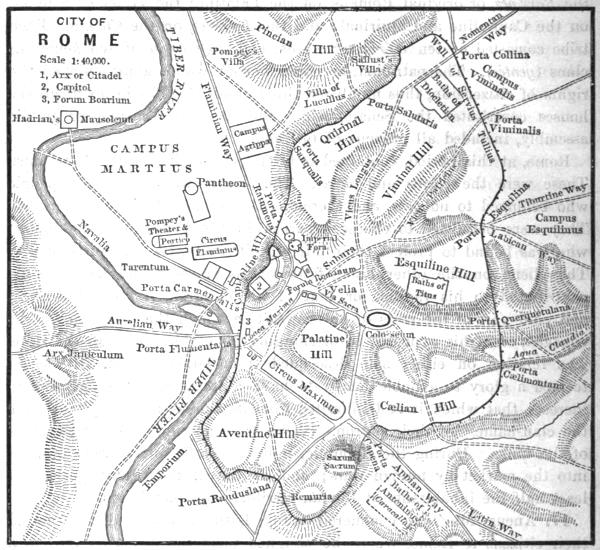
CITY OF ROME.
18. Lucius Tarquin´ius Priscus was of Greek origin, though he took
his name from the Etruscan town Tarquinii, where he was born. The
characteristics of his race were shown in the magnificent works with
which he embellished Rome. He drained the lower parts of the city by
a great system of sewers, and restrained the overflow of the Tiber by a
wall of massive masonry, at the place where the Cloa´ca Maxima entered
the river. In the valley thus redeemed from inundation he built
the Forum, with its surrounding rows of porticos and shops; and constructed
the Circus Maximus for the celebration of the Great Games,
which had been founded by Romulus, and resembled in most of their
features the athletic contests of the Greeks.
As a native of Etruria, Tarquin vowed the erection, upon the Capitoline,
of a temple to Jupiter, Juno, and Minerva, the three deities who
were worshiped together in every Etruscan city, and for this purpose he
cleared away from that mountain all the holy places of the Sabine gods.
The temple was built by his son. The wars of Tarquin against the
Sabines, Latins, and Etruscans were usually victorious, and added largely
to the population of Rome. From the noblest of the conquered peoples
he formed three new half-tribes of fifty “houses” each, which he joined
to the three old tribes of Ramnes, Tities, and Luceres, while he increased
the number of Vestal Virgins from four to six, that each race might be
equally represented. Tarquin was murdered by hired agents of the sons
of Ancus Martius, who hoped thus to secure for themselves the throne
of their father. But the Roman monarchy was strictly elective, not
hereditary; their crime failed of its purpose, and Servius Tul´lius, an
Etruscan general, and son-in-law of the murdered king, obtained the
crown.
19. He made radical changes in the constitution, by giving to every
free Roman the right of suffrage, though all offices in the government
were still held by the nobles. The Greek cities of southern Italy were,
at the same time, changing from aristocratic to popular forms of government,
and there are many signs of Greek influence in Latium and
Rome. The new popular assembly, Comitia Centuria´ta, was so called
from the “centuries” in which the entire citizen-soldiery was enrolled.
Wealth now acquired in Rome something of the power which had hitherto
been reserved for rank. Every man who held property was bound
to serve in the armies, and his military position was accurately graded
by the amount of his possessions. Highest of all were the Eq´uites, or
horsemen. These were divided into eighteen centuries, of which the first
six—two for each original tribe—were wholly patrician, while the remaining
twelve were wealthy and powerful plebeians.
The mass of the people enrolled for service on foot was divided into
five classes. Those who were able to equip themselves in complete
brazen armor fought in the front rank of the phalanx. Of this class
there were eighty centuries: forty of younger men, from seventeen to forty-five
years of age, who were the choicest of Roman infantry in the field;
and forty of their elders, from forty-six to sixty, who were usually retained
for the defense of the city. The second class were placed behind
the first; they wore no coat of mail, and their shields were of wood
instead of brass. The third class wore no greaves, and the fourth carried
no shields. These three classes consisted of only twenty centuries each.
The fifth and lowest military class did not serve in the phalanx, but
formed the light-armed infantry, and provided themselves only with darts
and slings. Below all the classes were a few centuries of the poorest
people, who were not required to equip themselves for war. They were
sometimes armed, at the public expense, on occasions of great loss or
danger to the state; or they followed the army as supernumeraries, and
were ready to take the weapons and places of those who fell.
20. Beside the patrician tribes of Ramnes, Tities, and Luceres, Servius
made four tribes in the city and twenty-six in the country, consisting
of land-owners without respect to rank. The meeting-place for the whole
thirty was the Forum at Rome, while the centuries met without the city
on the Field of Mars. The people assembled in the Forum had all the
powers of self-government. They elected magistrates and levied taxes for
the support of the state, duties which hitherto had belonged to the
Comitia Curiata. Of the public lands on the Etruscan side of the Tiber,
gained in his early wars, Servius assigned a certain portion to the plebeians,
in full ownership. The patricians had leased these lands from the
state for the pasturage of their flocks, and they were much exasperated
by the new allotment.
21. Servius extended the bounds of the city far beyond the Roma
Quadra´ta of the Palatine. The Esquiline, Cælian, and Aventine hills
had already been occupied by surburban settlements, while the Capitoline,
Quirinal, and Vim´inal were held by the Sabine tribes. These
Seven Hills,[64] with a large space between and around them, were inclosed
by Servius in a new wall, which lasted more than eight hundred
years, until the time of the emperor Aurelian. Servius reigned forty-four
years, B. C. 578-534. Desirous above all things for the continuance
of his reformed institutions, he had determined to abdicate the throne,
after causing the people, by a free and universal vote, to elect two magistrates
who should rule but one year. Before the end of their term
they were to provide, in like manner, for the peaceful choice of their
successors; and thus Rome would have passed, by a bloodless revolution,
to a popular government. The nobles, however, revolted against this
infringement of their exclusive rights. Led by Tarquin, son of the first
monarch of that name, and husband of the wicked Tullia, daughter of
Servius, they murdered the beneficent king and placed their leader on
the throne.
22. Tarquin, called “the Proud,” set aside all the popular laws of
Servius, and restored the privileges of the “houses”; but as soon as he felt
secure in his power, he oppressed nobles and people alike. He compelled
the poorer classes to toil upon the public works which his father had
begun, and upon others which he himself originated. Such were the
permanent stone seats of the Circus Maximus, a new system of sewers,
and the great Temple of Jupiter on the Capitoline Hill. By wars or
intrigues, Tarquin made himself supreme throughout Latium. But his
insolence disgusted the patricians; he took away the property or lives
of citizens without consulting the Senate, while he imposed upon them
civil and military burdens beyond what the law permitted. The vile
misconduct of his son Sextus led at last to a revolt, in which kingly
government was overthrown. The Tarquins and all their clan were
banished. The very name of king was thenceforth held in especial
abhorrence at Rome. Only in one case was it tolerated. A “king for
offering sacrifices” was appointed, that the gods might not miss their
usual mediator with men; but this sacerdotal king was forbidden to hold
any civil office.
Early history of Rome is largely fabulous. Three races in Italy, of whom the
Etruscans, before the rise of Rome, were most powerful. Their cities, art, and
religion. Rome was founded by Latins, but embraced a mixed population of
Sabines, Etruscans, and others, which gave rise to the three tribes. Three
hundred noble “houses” constituted the Senate and Comitia Curiata. Clientage.
Formation of a commonalty under Ancus Martius. Buildings of Tarquinius
Priscus. Free constitution of Servius Tullius. Division of the people into centuries,
both as soldiers and citizens. Thirty tribes assemble in the Forum. Inclosure
of the Seven Hills by the Tullian Wall. Tyranny of Tarquin the Proud.
Royalty abolished at Rome. Supposed Chronology of the Kings: Romulus, B. C.
753-716; Numa, 716-673; Tullius Hostilius, 673-641; Ancus Martius, 641-616; L. Tarquinius
Priscus, 616-578; Servius Tullius, 578-534; Tarquinius Superbus, 534-510.
23. Before passing to the history of the Republic, we glance at the
religion of Rome. For the first 170 years from the foundation of the
city, the Romans had no images of their gods. Idolatry has probably
been, in every nation, a later corruption of an earlier and more spiritual
worship. Roman religion was far less beautiful and varied in its conceptions
than that of the Greeks.[65] It afforded but little inspiration to
poetry or art, but it kept alive the homely household virtues, and regulated
the transactions of the farm, the forum, and the shop, by principles
drawn from a higher range of being.
The chief gods of the Romans were Jupiter and Mars. The former
was supreme; but the latter was, throughout the early history of this
warlike people, the central object of worship. March, the first month
of their year, was consecrated to him, and, in almost all European languages,
still bears his name. The great war festival occupied a large
portion of the month. During its first few days the twelve Salii, or
leapers, priests of Mars, who were chosen from the noblest families,
passed through the streets singing, dancing, and beating their rods upon
their brazen shields. Quirinus, under whose name Romulus was worshiped,
was only a duplicate Mars, arising from the union of the two
mythologies of the Romans and Sabines. He had, also, his twelve
leapers, and was honored, in February, with similar ceremonies.
24. The celebrations of the several periods of the farmer’s year were
next in order to the war festival. The month of April was marked by
days of sacrifice to the nourishing earth; to Ceres, the goddess of growth;
to the patroness of flocks; and to Jupiter, the protector of vines; while
a deprecatory offering was made to Rust, the enemy of crops. In May
the Arval Brothers, a company of twelve priests, held their three days’
festival in honor of Dea Dia, invoking her blessing in maintaining the
fertility of the earth, and granting prosperity to the whole territory of
Rome. August had its harvest festivals; October, its wine celebration
in honor of Jupiter; December, its two thanksgivings for the treasures
of the granary, its Saturnalia or seed-sowing on the 17th, and its celebration
of the shortest day, which brought back the new sun. Sailors
had their festivals in honor, respectively, of the gods of the river, the
harbor, and the sea. The ceremonial year was closed with the singular
Lu´perca´lia, or wolf festival, in which a certain order of priests, girdled
with goat-skins, leaped about like wolves, or ran through the city scourging
the spectators with knotted thongs; and by the Ter´mina´lia, or
boundary-stone festival in honor of Ter´minus, the god of landmarks.
Janus, the double-faced god of beginnings, was a peculiarly Roman
divinity. To him all gates and doors were sacred, as well as the morning,
the opening of all solemnities, and the month (January) in which
the labors of the husbandman began anew in southern Italy. Sacrifices
were offered to him on twelve altars, and prayers at the beginning of
every day. New-year’s day was especially sacred to him, and was
supposed to impart its character to the whole year. People were
careful, therefore, to have their thoughts, words, and acts, on that day
pure, beneficent, and just. They greeted each other with gifts and good
wishes, and performed some part of whatever work they had planned
for the year; while they were much dispirited if any trifling accident
occurred. A covered passage between the Palatine and Quirinal hills,
i. e., between the original Roman and Sabine cities, was known by the
name of Janus. Armies going out or returning passed through it, and
hence it was always open in time of war and closed in peace. The
same ceremony was continued after the passage had ceased to be used,
the triumphal gate having been constructed in the walls of Servius.
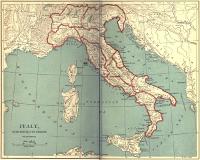
ITALY, WITH THE ELEVEN REGIONS OF AUGUSTUS.
25. Vulcan, the god of fire and the forge, was honored by two festivals,
the consecration of trumpets in May, and the Vol´cana´lia in
August. Though of inferior rank to the divinities already mentioned,
yet dearest of all to the Romans, were the gods of the hearth, the
household, and store-room, and of the forest and field. Every house
was a temple, and every meal a sacrifice to Vesta, the goddess of the
hearth. Her temple was the hearth-stone of the city. There six chosen
maidens, daughters of the most illustrious families, guarded the sacred
fire, which was the symbol of the goddess, by night and day. Every
house had over its main entrance a little chapel of the La´res, where
the father of the family performed his devotions immediately on returning
from any journey. The Lares were supposed to be the spirits of
good men, especially the deceased ancestors of the family. Public Lares
were the protecting spirits of the city; they were worshiped in a temple
and numerous chapels, the latter being placed at the crossings of streets.
There were also rural Lares, and Lares Via´les, who were worshiped by
travelers.
26. Like all people in any degree affected by Greek culture, the
Romans consulted the Delphic oracle. After the capture of Ve´ii (see
§ 57), they presented that shrine with a tenth of the spoils. Rome
itself possessed only one oracle, that of Faunus (the favoring god), on
the Aventine Hill. Several oracles of Fortune, Faunus, and Mars existed
in Latium, but in none of them were audible responses given, by the
mouth of inspired persons, as at Delphi. At Albu´nea, near Tibur,
Faunus was consulted by the sacrifice of a sheep. The skin of the
animal was spread upon the ground; the person seeking direction slept
upon it, and believed that he learned the will of the god by visions and
dreams. The Romans frequently resorted to the Greek oracles in southern
Italy; and the most acceptable gift which the inhabitants of Magna
Græcia could offer to their friends in Rome, was a palm-leaf inscribed
with some utterance of the Cumæan sibyl, a priestess of Apollo at
Cumæ, near Naples.
27. The Sibylline Books were believed to have been purchased by one
of the Tarquins from a mysterious woman, who appeared at Rome offering
nine volumes at an exorbitant price. The king refusing to purchase,
the sibyl went away and destroyed three of the books; then brought
back the remaining six, for which she asked the same amount of money.
The king again sent her away; she destroyed three more books, and demanded
the whole price for the remaining three. The curiosity of Tarquin
was aroused, and he bought the books, which were found to contain important
revelations concerning the fate of Rome. They were kept in a stone
chest under the temple of Jupiter Cap´itoli´nus. One of the four sacred
colleges was charged with the care of them, and they were only consulted,
by order of the Senate, on occasions of great public calamity.
28. The Romans probably learned from the Etruscans their various
methods of divination—the interpretation of signs in the heavens, of
thunder and lightning, of the flight or voice of birds, of the appearance
of sacrifices, and of dreams. The legends ascribed to Tarquinius Priscus
the introduction of Etruscan divinities and modes of worship into Rome.
At a later time, the Senate provided by special decree for the cultivation
of “Etruscan discipline” by young men of the highest birth, lest a
science so important to the commonwealth should be corrupted by falling
into the hands of low and mercenary persons.
The Augurs constituted the second of the sacred colleges; their number
was gradually increased from three to sixteen; they were distinguished
by a sacred dress and a curved staff, and were held in the highest honor.
No public act of any kind could be performed without “taking the auguries”—no
election held, no law passed, no war declared; for, by
theory, the gods were the rulers of the state, and the magistrates merely
their deputies. If, in the midst of the comitia, an augur, however
falsely, declared that it thundered, the Assembly broke up at once. It
must be admitted that the augurs often used their great power unfairly
in the political strife between patricians and plebeians. The latter, as
originally foreigners (see § 17), were held to have no share in the gods
of Rome, who thus became the exclusive patrons of the privileged class.
When, by a change in the constitution, plebeians were at length elected
to high offices, the augurs in several cases declared the election null, on
the pretext that the auspices had been irregular; and as no one could
appeal from their decision, their veto was absolute.
29. The College of Pontiffs was the most illustrious of the religious
institutions attributed to the good king Numa. The pontiffs superintended
all public worship according to their sacred books, and were required
to give instruction to all who asked it, concerning the ceremonies
with which the gods might be approached. Whenever sacred officers
were to be appointed, or wills read, they convoked the Assembly. Certain
cases of sacrilegious crime could only be judged by them; and in
very early times, like the Hebrew scribes, they were the sole possessors
of both civil and religious law. The highest magistrate, equally with
private persons, submitted to their decrees, provided three members of
the college agreed in the decision. They alone knew what days and
hours might be used for the transaction of public business. The calendar
was in their keeping, and—since these august and reverend dignitaries
were only men—it is well known that they sometimes used their
power to lengthen the year’s office of a favorite consul, or to shorten
that of one whom they disapproved. The title of Pon´tifex Maximus,
or Supreme Pontiff, was adopted by the Roman emperors, and passed
from them to the popes or bishops of modern Rome.
30. The fourth of the sacred colleges consisted of the Fetia´les, or
heralds, who were the guardians of the public faith in all dealings with
foreign nations. If war was to be declared, it was the duty of a herald
to enter the enemy’s country, and four times—once on either side of
the Roman boundary, then to the first citizen whom he chanced to meet,
and, finally, to the magistrates at the seat of government—to set forth
the causes of complaint, and with great solemnity to call on Jupiter to
give victory to those whose cause was just.
The priests of particular gods were called Flamens, or kindlers, because
one of their principal duties was the offering of sacrifices by fire. Chief
of them all was the Flamen Dialis, or priest of Jupiter; and next to
him were the priests of Mars and Quirinus. Though the purity and
dignity of the priestly life were guarded by many curious laws, the
priest was not forbidden to hold civil offices. He was not allowed, however,
to mount a horse, to look upon an army outside the walls, or, in
early times, to leave the city for even a single night.
31. After the good king Servius Tullius had completed his census, he
performed a solemn purification of the city and people. During the
Republic, the same ceremony was repeated after every general registration,
which took place once in five years. Sacrifices of a pig, a sheep,
and an ox were offered; water was sprinkled from olive-branches, and
certain substances were burned, whose smoke was supposed to have a
cleansing effect. In like manner, farmers purified their fields, and shepherds
their flocks. An army or a fleet always underwent lustration
before setting out on any enterprise. In the case of the latter, altars
were erected on the shore near which the ships were moored. The sacrifices
were carried three times around the fleet, in a small boat, by the
generals and priests, while prayers were offered aloud for the success of
the expedition.
RECAPITULATION.
Roman religion less imaginative and more practical than the Greek. Jupiter,
Mars, and Quirinus its chief divinities. Yearly festivals had reference chiefly to
war and husbandry. Worship of Janus. Household gods. The Romans shared
their belief in oracles with the Greeks; their arts of divination, with the Etruscans.
Four Sacred Colleges: Pontiffs, Augurs, Heralds, and Keepers of the Sibylline
Books. Priests might hold civil offices. Ceremonial cleansing of the city after
every census; of armies and fleets before every expedition.
32. The 480 years’ history of the Roman Republic will be best understood
if divided into four periods:
| I. |
The Growth of the Constitution, |
B. C. 510-343. |
| II. |
Wars for the possession of Italy, |
B. C. 343-264. |
| III. |
Foreign Wars, by which Rome became the ruling power in the world, |
B. C. 264-133. |
| IV. |
Internal Commotions and Civil Wars, |
B. C. 133-31. |
The leaders of the revolution which expelled the Tarquins, restored the
laws of Servius and carried forward his plans, by causing the election
of two chief magistrates, of whom one was probably a plebeian. The
consuls, during their year of office, had all the power and dignity of kings.
They were preceded in public by their guard of twelve lictors, bearing
the fasces, or bundles of rods. Out of the city, when the consul was
engaged in military command, an ax was bound up with the rods, in
token of his absolute power over life and death.
33. For 150 years the Republic was involved in a struggle for existence,
during which its power was much less than that of regal Rome.
The Latins threw off their supremacy, and Lars Por´sena, the Etruscan
king of Clu´sium, actually conquered the city, and received from the
Senate an ivory throne, a golden crown, a scepter, and triumphal robe,
in token of homage. In their further attempts upon Latium, the Etruscans
were defeated, and Rome became independent, but with the loss of
all her territories west of the Tiber. The Latins were defeated at the
Lake Regillus, by the aid—so Roman minstrels related—of the twin
deities, Castor and Pollux, who appeared at the head of the legions, in
the form of two beautiful youths of more than mortal stature, mounted
on white horses, and who were the first to break through into the
enemy’s camp. A temple was consequently built to them in the Forum,
and they were regarded as the especial patrons of the Roman knights.
34. External dangers over, the patricians again made their power felt
in the oppression of the common people. The first period of the Republic
was absorbed in conflicts between the two great orders in the state—less
attractive, certainly, than the romantic stories of the kingly age, or
the stirring incidents of the later period of conquest. But the steps by
which a great people has gained and established its freedom can never
be without importance, especially to the only republic which has rivaled
Rome in grandeur, in variety of interests, or in the multitude of races
and languages included eventually within its limits.
35. The wealth of Rome hitherto had been chiefly derived from the
products of the soil. The lands west of the Tiber were now lost, and all
the rural district was open to invasion. Crops were ruined, farm buildings
destroyed, cattle driven away. At the same time, through the losses
and necessities of the government, taxes were greatly increased; and these
were levied, not upon the reduced value of the property, but upon the
scale of former assessments. To meet their dues, the poor were obliged
to borrow money, at enormous rates of interest, from the rich. The
nobles seized the opportunity to enforce to their full extent the cruel laws
concerning debt, and the sufferings of the insolvent grew too grievous to
be borne. Many sold themselves as slaves to discharge their obligations.
Those who refused thus to sign away their own and their children’s liberty
were often imprisoned, loaded with chains, and starved or tortured by the
cruelty of their creditors. The patrician castles, which commanded the
hills of Rome, contained gloomy dungeons, which were the scenes of untold
atrocities toward such as had the misfortune to incur the wrath of
their owners.
36. Fifteen years after the expulsion of the kings, the plebeians, wearied
out with a government which existed only for the rich, and imposed all
its burdens on the poor, withdrew in a body to a hill beyond the Anio,
and declared their intention of founding a new city, where they might
govern themselves by more just and equal laws, B. C. 494. The patricians
now perceived that they had gone too far. However much they hated the
people, they had no idea of losing their services. They yielded, therefore,
and received back the seceded plebeians on their own conditions. These
were: (1.) Cancellation of claims against insolvent debtors; (2.) Liberation
of all such who had been imprisoned or enslaved; (3.) Annual election of
two Tribunes, whose duty it should be to defend the interests of the commons.
The number of these officers was soon raised to five, and eventually
to ten. Two plebeian Æ´diles were at the same time appointed, and charged
with the superintendence of streets, buildings, markets, and public lands; of
the public games and festivals, and of the general order of the city. They
were judges in cases of small importance, like those of modern police
courts; and they were eventually intrusted with the keeping of the decrees
of the Senate, which had sometimes been tampered with by the patrician
magistrates.
37. The scene of this first decisive battle of the people for their rights,
was consecrated to Jupiter, and known in later years as the Sacred Mount
(Mons Sacer). The Roman commons had thenceforth an important part
in public affairs. To prevent suffering in future, Spurius Cassius, consul
in the year following the secession, proposed a division among the plebeians
of a certain part of the public lands, while the tithe of produce levied by
the state upon the lands leased by the patricians, should be strictly collected
and applied to the payment of the common people when they served
as soldiers. Hitherto the troops had received no pay, while their burden
of war expenses was great. The other consul opposed the law, and charged
Cassius with seeking popularity that he might make himself a king. The
law—the first of a long series of “Agrarian” enactments—was passed;
but when the year of his consulship had expired, Cassius was brought to
trial by his enemies, and condemned as a traitor. He was scourged and
beheaded, and his house was razed to the ground, B. C. 485.
38. Having destroyed the leader, the patricians went on to rob the
people of all the advantage of the law. They insisted on electing both
consuls themselves, only requiring their confirmation by the popular assemblies;
and with or without this confirmation, their candidates held
supreme power, and refused to divide the public lands. The only resource
of the commons was to withhold themselves from military service, and the
tribunes now made their power felt by protecting them in refusing to enlist.
The consuls defeated this measure by holding their recruiting stations outside
of the city, while the jurisdiction of the tribunes was wholly within
the walls. Though a man might keep himself safe within the protection
of the tribunes, yet his lands were laid waste, his buildings burnt, and his
cattle confiscated by order of the government. One last expedient remained.
Though compelled to enlist, the soldiers could not be made to
gain a battle; and considering the consul who led them, and the class to
which he belonged, worse enemies than those whom they met in the field,
they allowed themselves to be defeated by the Veientians.
39. The noble house of the Fa´bii, as champions of the nobility, had
been for six successive years in possession of the consulship. They now
saw the danger to Rome of longer opposition to the will of the people;
and when Kæso Fabius, in the year 479 B. C., came into power, he insisted
upon the execution of the Cassian law. The patricians refused
with scorn, and the Fabii resolved to quit Rome. With their hundreds
of clients, their families, and a few burghers who were attached to them
by friendship and sympathy, they established a colony in Etruria, on the
little river Crem´era, a few miles from the city. They promised to be no
less loyal and valiant defenders of Roman interests, and to maintain with
their own resources this advanced post, in the war then in progress against
Veii. Two years from their migration, the settlement was surprised by the
Veientians, and every man was put to death, B. C. 477.
40. The consuls still refused to comply with the Agrarian law, and at
the expiration of their term were impeached by Genu´cius, one of the
tribunes of the people. On the morning of the day appointed for the trial,
Genucius was found murdered in his bed, B. C. 473. This treacherous act
paralyzed the people for the moment, and the consuls proceeded with the
enlistment of soldiers. Vo´lero Publi´lius, a strong and active commoner,
refused to be enrolled; and in the tumult which ensued, the consuls with
all their retinue were driven from the Forum.
The next year Volero was chosen tribune, and brought forward a law
that the tribunes should thenceforth be elected by the commons alone in
their tribes, instead of by the entire people in the centuries. This was
designed to avoid the overwhelming vote of the clients of the great houses,
who were obliged to obey the decrees of their patrons, and who often controlled
the action of the general assembly. For a whole year the patricians
contrived, by various delays, to prevent the passage of the bill. Ap´pius
Clau´dius, one of the consuls, stationed himself with an armed force in the
Forum to oppose it; and it was not until the plebeians, resorting in their
turn to force, had seized the Capitol, and held it for some time under military
guard, that the Publilian law was passed. This “second Great
Charter of Roman liberties” gave the tribes not only the power of electing
tribunes and ædiles, but of first discussing all questions which concerned
the entire nation. It was a long step toward the gaining of equal rights
by the commons, B. C. 471.
41. In the meanwhile, the Romans were carrying on wars with the
Æqui and Volsci, two Oscan nations which had taken advantage of the
changes in the Latin League, to extend their power to the cities on the
Alban Mount and over the southern plain of Latium. Their forays extended
to the very gates of Rome, driving the country people to take
refuge, with their cattle, within the walls, where a plague then raging
added the horrors of pestilence to those of war. It is probable that the
civil conflicts in Rome had caused the exile of many citizens; and these,
in most instances, joined the hostile nations. Rome was the champion
of oligarchy among the cities of Italy, as Sparta was among those of Greece.
The spirit of party was often stronger than patriotism; the sympathy between
Roman and foreign aristocrats was greater than between patrician
and plebeian at home; and thus an exiled noble was willing to become
the destroyer of his country.
42. The story of Coriola´nus may be partly fictitious, but it truly illustrates
the condition of the Republic at that period. Caius Marcius, a descendant
of the fourth king of Rome, was the pride of the patricians for
his warlike virtues, and had won his surname Coriolanus by capturing the
Volscian town of Cori´oli by his individual gallantry. But he was bitterly
opposed to the common people, and when he was about to be tried before
the comitia for having opposed a distribution of corn, he fled and took
refuge among the Volscians, whom he had formerly conquered. The king
warmly welcomed him, and seized the first opportunity to stir up a new
war with the Romans, that he might turn against them the arms of their
best leader. When the Volscian army approached Rome, the Senate sent
deputies to demand peace, but Caius refused all terms except such as were
impossible for the Republic to grant. The priests and augurs next went
to plead with him, but without effect.
At last the noble ladies of Rome, headed by Volum´nia, the mother of
Caius, and his wife, Vergil´ia, with her young children, went out in a sad
and solemn procession to plead for their sacred city. Coriolanus honored,
above all, the mother to whose wise and faithful care he owed his greatness.
He sprang to meet her with fitting reverence, but before she would receive
his greeting, Volumnia exclaimed: “Let me know whether I stand, in thy
camp, thy prisoner or thy mother; whether I am speaking to an enemy or
to my son!” Her reproaches silenced Caius; the entreaties of his wife
and children, and the tears of the noble ladies, moved him from his purpose.
He exclaimed, “Mother, thine is the victory; thou hast saved Rome,
but thou hast lost thy son!” He led away the Volscian army. Some say
he fell a victim to their revenge; but others, that he lived on among them
to extreme old age, and lamented, in the desolateness of his years of infirmity,
the factious pride that had exiled him from wife, children, and
native land.
43. In the meantime, Rome suffered another visitation of pestilence, in
which thousands of people died daily in the streets. The Æquians and
Volscians ravaged the country up to the walls of Rome; and in addition to
their other miseries, the crowded multitude were threatened with starvation.
Their civil grievances were not to be redressed by anything less than a
thorough and radical reform. In the year 462 B. C., the tribune Terenti´lius
Harsa proposed the appointment of a board of ten commissioners,
half patrician and half plebeian, to revise the constitution, define the
duties of consuls and tribunes, and frame a code of laws from the mass of
decisions and precedents. This movement was the occasion for ten years
of violent contention, during which Rome was several times near falling
into the hands of the Volscians, and was once actually occupied by a band
of exiles and slaves under a Sabine leader, Herdo´nius, who seized the
Capitol and demanded the restoration of all banished citizens to their
rights in Rome.
44. Chief of the exiles was Kæso Quinc´tius, son of the great Cincinna´tus,
who had been expelled for raising riots in the Forum, to prevent
any action of the people upon the Terentilian law. The invading party
was defeated, and every man slain. The father of Kæso was then consul.
In revenge for the fate of his son, he declared that the law should never
pass while he was in office; and that he would immediately lead the entire
citizen-soldiery out to war, thus preventing a meeting of the tribes. Nay
more, the augurs were to accompany him, and so consecrate the ground of
the encampment, that a lawful assembly could be held under the absolute
power of the consuls, and repeal all the laws which had ever been enacted
at Rome under the authority of the tribunes. At the close of his term,
Cincinnatus declared that he would appoint a dictator, whose authority
would supersede that of all other officers, patrician or plebeian. All these
things could be done under the strict forms of the Roman constitution;
but the Senate and the wiser patricians saw that the patience of the commons
might be taxed too far, and persuaded Cincinnatus to forego so
extreme an exercise of his power.
45. War with the Æquians went on, and treaties were only made to be
broken. In the year 458 B. C., the entire Roman army was entrapped in
a pass of the Alban Hills, surrounded by the enemy, and in imminent
danger of destruction. In this crisis, Cincinnatus, who had retired from
the consulship to resume his favorite toil of farming, was called to be
dictator, with absolute power. The messengers of the Senate found him at
his plow, in his little garden-plot across the Tiber. He left the plow in the
furrow, hastened to Rome, levied a new army in a single day, went out and
defeated the Æquians, and returned the next evening in triumph.
Consuls are appointed with kingly power, but for a limited time. Rome
subject to Porsena. The Latins are defeated at the Lake Regillus. Roman
nobles oppress their debtors, and the poor secede. Tribunes of the people and
ædiles are appointed. The first Agrarian Law is proposed by Cassius, B. C. 486.
To avenge the tyranny of their consuls, the common soldiers refuse to fight.
The Fabii take sides with the people, and are destroyed in their colony on the
Cremera. The Publilian Laws give the election of officers to the people in their
tribes, B. C. 471. War and pestilence. Ten years’ debate upon the Terentilian
Laws, which propose a revision of the constitution, B. C. 462-452. The Capitol
seized by exiles and Sabines. Cincinnatus, as a noble, opposes the commons,
but, as a general, saves Rome.
46. The passage of the Terentilian law was delayed six years, but at
length the nobles yielded the main point, and the decemviri were chosen.
Though wholly patrician, they were men who enjoyed the confidence of
both orders for their proved integrity. Both consuls and tribunes were
superseded for the time, and full powers, constituent, legislative, and
executive, were intrusted to the Ten. The laws of the Twelve Tables,
which were the result of their labors, became the “source of all public
and private right” at Rome for many centuries. During the debate upon
the bill, commissioners had already been sent to Greece, to study the laws
and constitution of the Hellenic states. They returned with an Ionian
sophist, Hermodo´rus of Ephesus, who aided in explaining to the lawmakers
whatever was obscure in the notes of the commissioners; and so
valuable were his services, that he was honored with a statue in the
Roman comitium.
47. Only a few points in this celebrated work of legislation can here be
noticed. The laws of Rome gave to a father absolute right of property in
his family. He might sell his son, his daughter, or even his wife. The
latter act, indeed, was denounced as impious by the religious law, but no
penalty was attached to it; the curse of the chief pontiff merely marked
the guilty person for the wrathful judgments of Heaven. If a father desired
to make his son free, the process was more difficult than the emancipation
of a slave. The latter, if sold to another master, could be liberated
at once, but a son thus sold and liberated returned to the possession of his
father. This subjection could only end with the death of the parent, though
the son himself might then be an old man. The Twelve Tables enacted
that, if a father had three times sold his son, he lost all further control
over him; but a son thus emancipated was considered as severed from all
relationship with his father, and could no longer inherit his property.
Women were all their lives considered as minors and wards. If their
father died, they passed under the control of their brothers; or, if they
married, they became the absolute property of their husbands. A widow
might become the ward of her own son. Marriages between patricians and
plebeians were declared unlawful, and children born in such had no claim
upon their fathers’ possessions.
48. The ten Law-givers visited with their heaviest penalties the defamation
of character; and so stringent was their definition of libel, that neither
poets nor historians dared even name the living except in terms of praise.
It is much more difficult, therefore, to gain a true idea of public men in
the history of Rome than of Greece, whose historians spoke with grand
impartiality of men and measures, and the license of whose comic poets,
though often used with insolent injustice, yet shows us all the weak points
of character, and reveals the man as his contemporaries really saw him.
The Roman historians, even when writing of the past, could often draw
their materials only from funeral orations, or from the flattering verses of
dependent poets, laid up among the records of great families.
49. The decemvirs, during their appointed year of office, completed ten
tables of laws; and these, according to Roman ideas, were so just and so
acceptable, that the assemblies willingly consented to renew the same form
of government for another term, especially as the work of legislation was
not quite complete. In the new decemvirate, Appius Claudius was re-elected,
and his unscrupulous character now made itself felt in the tyrannical
nature of the government. The people found that they had ten
consuls instead of two, and the power of the Ten was unchecked by any
popular tribune.
50. The domestic rights of the plebeians were rudely invaded. A fair
maiden, Virginia, caught the eye of Appius as she went daily to school in
the Forum, attended by her nurse. He declared that she was the slave of
one of his clients, having been born of a slave-woman in his house, and
sold to the wife of Virginius, who had no children of her own. The friends
of Virginia and of the people resented this insolent falsehood with such
indignation, that the consul’s officers were compelled to release the maiden
under bonds to appear the next day before his judgment-seat, where her
lineage might be proved.
Virginius, her father, was with the army before Tus´culum. He was
hastily summoned, and, riding all night, reached the city early in the
morning. In the garb of a suppliant, he appeared in the Forum with his
daughter and a great company of matrons and friends. But his plea was
not heard. Appius judged the maiden to be, at least, considered a slave
until her freedom could be proved, in direct violation of the law which he
had himself enacted the year before, that every one should be regarded as
free until proved a slave. Virginius perceived that no justice could be
expected before such a tribunal. He only demanded one last word with
his daughter; and having drawn her aside with her nurse into one of the
stalls of the Forum, he seized a butcher’s knife and plunged it into her
heart, crying aloud, “Thus only, my child, can I keep thee free!” Then
turning to the decemvir, he exclaimed, “On thy head be the curse of this
innocent blood!” No one obeyed the consul’s order to seize him. With
the bloody knife in his hand, he rushed through the crowd, mounted his
horse at the gate of the city, and rode to the camp.
51. The army of plebeians arose at his call and marched upon Rome.
They entered and passed through the streets to the Aventine, calling upon
the people, as they went, to elect ten tribunes and defend their rights.
The other army, near Fide´næ, was aroused in the same manner by Icil´ius,
the betrothed lover of Virginia. The common soldiers put aside those
of the decemvirs who were with them, chose, likewise, ten tribunes, and
marched to the city. The twenty tribunes appointed two of their number
to act for the rest, and then leaving the Aventine guarded by a garrison,
they passed out of the walls followed by the army, and as many of the
people as could remove, and established themselves again on the Sacred
Mount beyond the Anio.
52. The Senate, which had wavered, was now compelled to act. The
seceders had declared that they would treat with no one but Valerius and
Hora´tius, men whom they could trust. These were sent to hear their
demands. The people required that the power of the tribunes should be
restored, a right of appeal from the decision of the magistrates to the popular
assembly established, and the decemvirs given up to be burnt, as nine
friends of the commons had been, within the memory of men still living.
This latter demand, caused only by the exasperation of the moment, was
withdrawn upon maturer council; the others were granted, the decemvirs
resigned, and the people returned to Rome, B. C. 449. A popular assembly
was held, in which ten tribunes were elected, Virginius and Icilius being
of the number. Two supreme magistrates were chosen by a free vote of
the people; in the place of the decemvirate, and they were now first called
consuls. Their powers were the same with those of the prætors, or generals,
who had ruled from the expulsion of the kings to the appointment of the
first decemvirate, except that an appeal might be made from their sentence
to that of the comitia.
The first consuls under this new act were Valerius and Horatius. They
went forth and gained so signal a victory over the Sabines, that Rome
suffered no more incursions from that people for 150 years. Ancient
custom and even law among the Romans honored victorious generals with
a triumphal entry into the city on their return; but the Senate, whose duty
it was to decree the triumph, regarding the consuls as false to the interests
of their order, forbade any such honor to be paid them. Hereupon the
people exerted their supreme authority, and commanded the consuls to
“triumph” in spite of the Senate. (See §§ 109-111.) Appius Claudius
and one of his colleagues were impeached and died in prison; the rest fled
from Rome, and their property was confiscated.
53. A strong reaction now set in, in favor of the patricians; and so determined
was their opposition to the new laws, that the people seceded
again, but this time only to the Janiculum, west of the Tiber and opposite
Rome. At last a law was passed legalizing marriage between the two
orders. Instead of throwing open the consulship freely to the plebeians,
it was agreed (B. C. 444) to divide its duties and dignities among five
officers, of whom two, the censors, should be chosen only from the nobles,
though by a free vote of the tribes, while the three military tribunes might
be either patricians or plebeians. The censors were to hold office five years,
the tribunes only one.
For some alleged defect in the auspices (see § 28), the first three tribunes
were set aside, and for six years consuls were regularly appointed as before.
In 438 B. C., tribunes were elected, and for three following years consuls
again, showing the extreme difficulty with which the people gained their
rights, even when conceded by law. In 433 B. C., an important law of
Æmilius, the dictator, limited the duration of the censor’s office to eighteen
months, though he was still appointed only once in five years, thus leaving
the place vacant a much greater time than it was filled.
54. The censors were invested with truly kingly splendor and extraordinary
powers. They registered the citizens and their property, administered
the revenues of the state, kept the rolls of the Senate, from which
they erased all unworthy names, and added such as they considered fit.
In this judgment of character they were guided solely by their own sense
of duty. If a man was tyrannical to his wife and children, or cruel to his
slaves, if he neglected his land, or wasted his fortune, or followed any dishonorable
calling, he was degraded from his rank, whatever that might be.
If a senator or a knight, he was deprived of his gold ring and purple-striped
tunic; if a private citizen, he was expelled from the tribes and lost
his vote. The censors were thus the guardians of morals, and their power
extended to many matters which could hardly be reached by the general
action of the law. The taking of every census was followed by a lustration,
or ceremonial purifying of the people (see § 31). Hence, the five years
which intervened between two elections of censors were called a lustrum,
or greater year.
55. The Romans must have watched with interest, during the years 415
and 414 B. C., the movements of the great Athenian expedition against
Syracuse. Had the brilliant schemes of Alcibiades been carried into effect,
the Greeks would doubtless have become the leading power in western
Europe; “Greece, and not Rome, might have conquered Carthage; Greek,
instead of Latin, might have been at this day the principal element of the
languages of Spain, of France, and of Italy; and the laws of Athens, rather
than of Rome, might be the foundation of the law of the civilized world.”
RECAPITULATION.
Decemviri chosen to make new laws for Rome. Absolute power of the paterfamilias.
Laws against libel make Roman history mere eulogium. Tyranny of
the second decemvirate. Appius Claudius unjustly claims Virginia for a slave.
The people secede, overthrow the decemvirate, and restore consuls and tribunes.
The new consuls defeat the Sabines, and triumph in spite of the Senate. By
another change of constitution, censors and military tribunes are chosen, instead
of consuls. The censors have absolute power to correct public morals. The
Athenians fail in their Sicilian expedition, B. C. 415, 414, and leave room for the
supremacy of Rome.
56. The Gauls were now beginning their terrible incursions from the
north into the valley of the Po, thus absorbing the attention of the Etruscans;
and the time favored a fresh attack of the Romans upon Veii, the
nearest state across the Tiber. The war began B. C. 405, and lasted ten
years. The necessity of keeping an armed force continually in the field,
gave rise to the standing army, which ultimately made so essential a part
of Roman power; and, at the same time, obliged the patricians to study
the interests of the people. It was now agreed that the soldiers should be
regularly paid, and money secured for this purpose by a careful collection
of the rents for public lands. The number of military tribunes was doubled.
Their chief, the præfect of the city, was a patrician, and chosen by that
order, but the remaining five were elected from either or both classes, by
a free vote of the popular assembly.
57. After ten years’ warfare with varying success, Veii was taken (B. C.
396) by the dictator Camillus. It is said that on the very day of its surrender,
Melpum, the Etruscan stronghold in the north, fell before the
Gauls. The loss of these two frontier fortresses began the rapid decline
of Etrurian power. The joy of the Romans was commemorated by the
whimsical custom, long continued, of concluding every festal game with a
mock auction called the “Sale of Veientes.” Cape´na, Fale´rii, Nep´ete,
and Sunium were likewise conquered, and with their lands became possessions
of Rome. Within half a century, the Etruscans lost to the Gauls
all their possessions in Campania and north of the Apennines, and to the
Romans, all between the Cimin´ian forests and the Tiber. The nation had
already lost its force through unbounded excess in luxury. The nobles
were enormously rich, while the people were poor and enslaved.
58. The war of the Romans against Volsin´ii was equally successful;
but, by a sudden and terrible reverse, Rome was now doomed to suffer the
fate which she too often inflicted. The Gauls, after conquering northern
Etruria, overflowed the barrier of the Apennines and spread over central
Italy. They met the entire Roman force near the little river Al´lia, and
defeated it with great slaughter; then pushing on with irresistible power,
they captured and burned the city. So overwhelming was the disaster,
that the 16th of July, the date of the battle of the Allia, was pronounced
a “black day” of ill-omen, on which no business could be safely transacted
and no sacrifices acceptably offered.
59. The vestal virgins withdrew with the sacred fire to Cære, in Etruria;
the mass of the people, with the fugitives from the conquered army, had
taken refuge in Veii and other Etruscan towns; but the noblest of the
patricians resolved to hold the Capitol. Those who were too old to fight,
hoped to serve their country equally well by an heroic death. They repeated,
after the pontifex maximus, a solemn imprecation,[66] devoting
themselves and the army of the Gauls to death for the deliverance of
Rome. Then, arrayed in their most magnificent apparel, holding their
ivory scepters, and seated each upon his ivory throne at the door of his
own house, they sat motionless while the tumult of plunder and pillage
was going on around. The barbarians were struck with admiration of
these venerable figures, and one of them began reverently to stroke the
long white beard of Papir´ius. Enraged by this profaning touch, the old
senator struck him with his ivory scepter. It was the signal for slaughter.
The Gauls, recovering from their momentary awe, massacred the noble old
men without delay.
60. The siege of the Capitol continued six or eight months. At one
time it was nearly taken, by the enemy scaling the steep cliff by night.
The garrison were asleep, but some geese sacred to Juno gave a timely
alarm, and the citadel was saved. Marcus Manlius, who was the first to
awaken, succeeded in throwing several of the first assailants down the cliff,
and thus maintained the fortress until his comrades could come to his aid.
At length, though the garrison were nearly exhausted by hunger, the
Gauls were equally ready to make terms, for they had heard that the
Venetians were invading their northern possessions. A thousand pounds
of gold were paid for the ransom of the city, and the barbarians retired.
They were followed by Camillus, the conqueror of Veii and Falerii, who
was now again dictator, and who, by cutting off straggling parties of the
enemy, regained some portion of the rich booty which they were carrying
away; but it is probably not true that he gained any important success
over them, as was formerly believed.
61. A period of great distress followed the retreat of the Gauls. The
farms, upon which the livelihood of so many people depended, had been
laid waste; their fruit-trees, buildings, implements, stock and stores, even
to the seed-corn needed for next year’s sowing, had been burnt. Rome
was a mass of rubbish, in which even the direction of the former streets
could no longer be discerned. The government furnished roofing materials,
and allowed wood and stone to be taken from the public forests and quarries,
on condition that every person so aided would give security to complete
his building within the year. But these pledges were often forfeited;
and to meet the expense of rebuilding, as well as to pay the extraordinary
taxes for restoring the fortress and the temples, money had to be borrowed,
and the poor were again at the mercy of the rich. Innocent
debtors were dragged from their homes, to toil as slaves in the shops or
fields of their creditors.
Many chose to remain in the Etruscan towns where they had taken
refuge, and even to make of Veii a new Rome for the plebeians, where
they might live free from the overbearing rule of the patricians, and be
themselves a privileged class. Though this wholesale secession was prevented,
yet the numbers in Rome were so greatly diminished, that a
mass of the conquered Etruscans were brought in to fill the vacant
places. These were provided with Roman lands, were organized into
four new tribes, and admitted to full civil rights. The “new people”
formed more than a sixth part of the whole population of the reconstructed
city.
62. No one could see without pity the distress of the people; but
Marcus Manlius, the same whose alertness and presence of mind had
saved the Capitol, had also reasons of his own for trying to relieve them.
He was jealous of Camillus, and thought that his own services had not
been duly rewarded. He sold at auction the best portion of his lands,
and applied the proceeds to paying the debts of needy persons, thus
delivering them from imprisonment and torture. He was rewarded by
the unbounded gratitude of the poor; his house was continually thronged
with partisans, to whom he spoke of the selfish cruelty of the nobles,
in throwing the whole burden of the public calamity on others, and
even accused them of embezzling the immense sums raised to replace
the treasures of the temples, which had been borrowed to purchase the
retreat of the Gauls.
63. For this charge Manlius was thrown into prison, and the people
began to regard him as a martyr to their cause. On his release, he renewed
his attacks upon the government. He fortified his house on the
Capitoline, and with his party held the whole height in defiance of the
authorities. His treason was so evident, that even the tribunes of the
people took part with the patricians against him, and he was brought
to trial before the popular assembly.
He appeared, followed by several comrades whose lives he had saved
in battle, and by four hundred debtors whom he had rescued from the
dungeon. He exhibited the spoils of thirty enemies slain with his own
hand, and forty crowns or other honorary rewards received from his
generals. He appealed to the gods, whose temples he had saved from
pollution, and he bade the people look at the Capitol before they pronounced
judgment. It was impossible to convict such a criminal in such
a presence, for the very spot on the Capitol where Manlius had stood
alone against the Gauls, was visible from the Forum. He was afterward
condemned for treason and thrown from the Tarpeian Rock, the precipitous
side of the Capitoline Hill, looking toward the Tiber.
64. The power of the patricians was only confirmed by this rash and
selfish attempt to overthrow it. For seven years the distress of the people
went on increasing; the commons lost heart, and their eldest men refused
any longer to accept public office. Two younger men now came forward,
who were destined, by their firm and wise procedure, to relieve in great
measure the miseries of their class.
C. Licinius Stolo was of one of the oldest and wealthiest plebeian
families, connected by many marriages with the nobles. Becoming tribune
(B. C. 376), together with his friend, L. Sextius, he proposed a new set
of laws, designed to remove both the poverty and the political wrongs
under which the commons were suffering. (1.) To relieve immediate
distress, it was proposed that the enormous interest already paid upon
debts should be reckoned as so much defrayed of the principal, and
should, therefore, be deducted from the sum still due. (2.) To prevent
future poverty, the public lands, hitherto absorbed in great measure by
the patricians, were to be thrown open equally to the plebeians, and no
man was to be allowed to hold more than 500 jugera,[67] or to pasture more
than 100 oxen and 500 sheep on the undivided portion. Further, to secure
employment to the poor, a certain amount of free labor was required upon
every farm. (3.) Two consuls were to be elected, of whom one every
year should be a plebeian.
65. The strongest objection to a plebeian consulship was on religious
grounds; for high patricians held it an impiety to place in the supreme
magistracy one who had no right to take the auspices, and whom they
regarded as no true Roman. To attack this prejudice in the boldest
manner, Licinius proposed to increase the number of keepers of the
Sibylline Books from two to ten, and to appoint five of these from the
plebeians. These laws were not passed without many years’ violent opposition.
At length they were ratified by the Senate and the Comitia Curiata
(B. C. 367); and to celebrate this happy agreement between the two orders,
a Temple of Concord was built upon the Capitoline Hill. At the same
time, a new office, the prætorship, was instituted and confined to the patricians,
comprising most of the civil and judicial duties which had hitherto
belonged to the consuls, while the latter kept their absolute military power.
The first plebeian consul under this arrangement was L. Sextius.
66. The restless and turbulent Gauls re-appeared in Latium, during the
same year with the passing of the Licinian laws. They were defeated by
the aged general Camillus, who had been six times military tribune and
five times dictator. On their second invasion they encamped within five
miles of the city, and struck terror, we may well believe, into the hearts
of those who remembered the desolations of thirty years before; but, at
length, they broke up their camp without fighting, and passed into Campania.
On their return through Latium they were signally defeated. In
350 B. C., they spent the winter upon the Alban Mount, and joined the
Greek pirates on the coast in ravaging the country, until they were dislodged
by L. Furius Camillus, a son of the general.
They made a treaty B. C. 346, after which they never again appeared in
Latium. They continued to be the ruling race between the Alps and the
northern Apennines, and along the Adriatic as far south as the Abruz´zi.
Many towns, like Milan, were held, however, by the Etruscans in a sort
of independence, while the Gauls lived in unwalled villages. From their
Tuscan subjects, the Gauls learned letters and the arts of civilized life,
which spread from them, in a greater or less degree, to all the Alpine
populations.
RECAPITULATION.
Veii taken B. C. 396, after a ten years’ siege. Defeat of the Romans on the
Allia, and capture of their city by the Gauls, B. C. 390. Massacre of the senators.
Manlius saves the Capitol, during a seven months’ siege. Rome in ruins. Distress
of the poor. Treason of Manlius. The Licinian laws, passed after nine years’
contest, relieve debtors and divide the public lands among the common people.
The Gauls overrun central Italy, B. C. 361-346, but at length retire north of the
Apennines.
67. From the political struggles which developed the Roman constitution,
we turn to the series of foreign wars between Rome and her most
powerful rival for the supremacy of southern Italy. The Samnites were a
Sabine race, settled as conquerors in the Oscan country. Their possessions
were mostly inland, comprising the snow-covered mountain range which
separates the Apulian from the Campanian plains, but they extended to
the coast between Naples and Pæstum, where they included the once
famous cities of Herculaneum and Pompeii.
The Samnites ranked with the Latins, as the most warlike races of Italy;
but the conquests of the former, at the period to which we have now come,
had been by far the more brilliant and extensive. In the decline both of
Greek and Etruscan power in southern Italy (see Book III, § 90), they
had gained control of the whole lower portion of the peninsula, except a
few Greek colonies like Tarentum and Neapolis. But Latium, under the
leadership of Rome, had advanced surely though slowly, securing each
advantage by the formation of Roman colonies, bound by the strongest
ties of obedience to the mother city, while the Samnite nation had no
settled policy and no regularly constituted head. Each new settlement,
therefore, divided and diminished their strength.
68. The conquerors of Cumæ and Capua adopted the luxurious habits
of the Greeks and Etruscans, whom they had supplanted, but with whom
they continued to live on friendly terms. The Greek-loving inhabitants
of the coast dreaded their rude countrymen of the hills, almost as much
as did the refined Hellenes themselves, and thus a great division took
place in the Samnite stock. The civilized and Hellenized Samnites besought
the aid of the Romans against the predatory hordes of their own
race, who were constantly swooping down from the Samnian hills to
ravage their fields. The Romans consented, on condition of their own
supremacy being acknowledged throughout Campania, and their former
treaty with Samnium was broken.
69. The First Samnite War began with the march of two Roman armies
into Campania, while the Latin allies invaded the Pelignian country on
the north. The Roman armies were victorious, and both consuls obtained
a triumph. A large force was left, at the request of the Campanians, to
guard their cities during the winter. The common soldiers were still burdened
with poverty, and the prolonged absence from their farms occasioned
serious suffering to their families.
In the second year of the war, mutinous plots were discovered, and a
large body of the troops were sent home. On their way they released all
the bondmen for debt whom they found working in the fields of their
creditors, fortified a regular camp on the slope of the Alban Hills, and
were joined by a large body of oppressed common people from the city.
But when they met the army hastily raised by the patricians, and sent
forth under Valerius the dictator—whose family had always been faithful
friends to the people, and who was himself greatly beloved by all classes
for his generous character, no less than his military glory—these men,
whose revolt had been occasioned by real distress, and not by defect of
loyalty, could not bring themselves to fight their fellow-citizens and the
defenders of their common country. The two armies stood facing each
other, until remorse on one side and pity on the other had overcome all
mutual resentment; then, both pressing forward, they grasped hands or
rushed into each others’ arms with tears and demands for pardon. The
just requirements of the soldiers were granted by the Senate, together
with amnesty for their irregular proceedings, and this singular rebellion
ended in a lasting peace.
70. The Latins, meanwhile, had been left to carry on the Samnite war
by themselves, and their repeated successes encouraged them to assert
their independence of Rome. The Romans now (B. C. 341) made peace
with the Samnites, and, two years later, turned their arms against the
Latins, who were strengthened by alliance with their late opponents, the
Campanians and Volscians. The two consuls with their forces moved
into Campania, and encamped in the plain of Capua, opposite the army
of the three allies. Strict orders were issued against skirmishing or personal
encounters, and disobedience was to be punished with death.
Ignorant or heedless of the command, Titus Manlius, the consul’s son,
accepted a challenge from a Latin warrior, killed his opponent, and
brought the spoils in triumph to lay at his father’s feet. The consul
turned away his face, and summoning his guards, ordered them to behead
the young man before his tent, in the presence of all the soldiers. Roman
discipline knew no ties of affection. Manlius, the father, was forever regarded
with horror, but Manlius, the consul and general, was strictly
obeyed as long as he commanded the armies of Rome.
71. The decisive battle in the Latin war took place at the foot of Vesuvius.
The augurs, having taken the auspices as usual, declared that fate
demanded the sacrifice of a general on one side and an army on the other.
It was therefore made known to the Roman officers that, whichever portion
of the army should begin to yield, the consul commanding in that quarter
would devote himself to the gods of death and the grave, in order that the
army which must perish might be that of the Latins.
Manlius led the Roman right; Publius Decius, the people’s consul, the
left. The battle was severe, and bravely fought on both sides; but, at
length, the Latin right wing prevailed, and the Roman left began to give
way. Decius instantly called the chief pontiff—for, as a plebeian, he himself
was ignorant of the ceremonies by which the gods must be addressed—and
bade him dictate the form of words in which he was to devote himself
to death. By the direction of the pontiff, he wrapped his toga around his
face, set his feet upon a javelin, and repeated the imprecation.[68] Then
sending his guard of lictors to the other consul to announce his fate, he
mounted his horse, plunged into the host of the enemy, and was quickly
slain. The Latins saw and understood the act, but they still fought
fiercely, like men who struggled against fate. So equally matched were
the main forces, that Manlius gained the day at last only by bringing on
the poorer supernumeraries, whom he had armed to constitute a double
reserve.
72. A second battle was much more easily won, and the Latins had no
strength to rally for a third. The Latin League was wholly broken up,
Roman law every-where took the place of local constitutions, and some
cities even became Roman colonies. The Latins were one in race and
language with Rome, and their transient hostility was exchanged for a
close and permanent alliance. The battle under Mount Vesuvius was one
of the most important in the history of Rome, for by securing the sovereignty
of Latium, it opened the way to the conquest of the world.
73. For the next twelve years the Romans were unable to undertake
any great foreign war. Italy was invaded by Alexander of Epirus, uncle
of the great Macedonian conqueror, B. C. 332. His quarrel was with the
Samnites, but if his success had been equal to his ambition, no engagements
with the Romans would have prevented his overrunning the whole
peninsula. He was defeated and slain, however, in 326 B. C., and the
Romans immediately prepared for a renewed contest with the Samnites,
which was to last twenty-two years, B. C. 326-304. The two chief states
of Italy fought for sovereignty, and their allies included almost all the
other nations in the peninsula.
The events of the first five years were too indecisive to be worth recording.
The advantage was generally with the Romans, but the Samnite
power was still unbroken, and was able, in 321 B. C., to inflict one of the
most severe and disgraceful defeats that Roman arms had ever sustained.
The combined forces of Rome, led by the two consuls, were entrapped in
a mountain-pass between Naples and Ben´even´tum, known as the “Caudine
Forks.” Half the soldiers fell in the fight which ensued; the rest
surrendered, but were generously spared by Pontius, the Samnite general,
on condition of an honorable peace being signed by the two consuls and by
two tribunes of the people, who were present with the troops. The soldiers
were then made to “pass under the yoke,”[69] in token of surrender, and
were permitted to march away, without their arms, toward Rome. But
the Senate, having got back its forces, refused to be bound by the
agreement of the consuls. The signers of the treaty, stripped and bound,
were given up to the vengeance of the Samnites, but Pontius refused to
receive them. He did not choose to punish the innocent for the guilty,
nor to justify the Roman government in taking all the advantage of the
agreement, and refusing all the sacrifices.
74. The war went on six years without any very important event,
until, in 315 B. C., the Samnites gained another great success at Lau´tulæ.
Almost all the allies of Rome now deserted what seemed the
losing cause. Campania revolted; the Ausonians and Volscians joined
the Samnite alliance. But, in the following year, a still more severe
and decisive battle gave victory to the Romans. The Samnites were
crushed beyond all power of recovery. The war was continued, however,
ten years longer, chiefly by the efforts of the Etruscans, Oscans,
and Umbrians, to preserve the balance of power in Italy. But these
efforts were never united, and the Romans were able to defeat them,
one by one, until, in 304 B. C., the Samnites became subject to Rome,
and all the other parties concluded a peace. Rome was now, without
question, the first nation in Italy; and, considering the disputes which
weakened the fragments of Alexander’s empire, might almost be considered
the greatest in the world. In intellectual culture, the Romans were
still inferior to the conquered Samnites. Pontius, the Samnite general,
was well versed in Greek philosophy, and in the elevation of his character
far surpassed the proudest Romans of his time.
75. Near the close of the Second Samnite War, the Æqui, who had
been for eighty years in a state of neutrality, took up arms against
Rome; and immediately after the treaty of B. C. 304, the consuls marched
40,000 men into their territory. A sharp and severe struggle of fifty
days resulted in the capture and destruction of forty-one towns. A large
portion of the people were sold into slavery, and the rest became subjects
of Rome. A few years later, however, they received the rights of citizens,
were enrolled in the tribes, and served in the wars against the
Samnites.
76. The latter people busily employed the six years’ interval between
their second and third great struggle with Rome, in forming and strengthening
the “Italian League.” Etruscans, Umbrians, and Gauls, on the
north, were allied with Lucanians, Apulians, most of the Greek cities,
and the Samnites, on the south. Rome had the advantage in compactness,
numbers, and wealth; her own or her allies’ territory extended
across Italy from the Mediterranean to the Adriatic, and divided the
states of her enemies.
The war broke out in 298 B. C., but no important movement was
made until, in 295 B. C., the combined armies of the four northern
nations advanced toward Rome. The plan of the consuls was at once
bold and sagacious. One army awaited the invaders, while another
marched directly into Etruria. This movement exposed the weakness of
the league, for the Etruscans and Umbrians, deserting their allies, drew
off to defend their own territories. The Samnites and Gauls crossed the
Apennines to Senti´num, where they were overtaken by the first Roman
army. In the battle which followed, the Gallic war-chariots had nearly
driven from the field the legions of Decius, the consul, when, remembering
the example of his father at Vesuvius, he, likewise, devoted himself
to the powers of death for the deliverance of Rome. The legions were
at length triumphant; 25,000 of the enemy lay dead upon the field.
77. The Gauls now withdrew from the league, but the Samnites continued
the war with unabated resolution. Twenty-eight years after his
great victory at the Caudine Forks, Pontius again defeated a Roman
army under Fabius Gur´ges. The Romans were so exasperated by this
defeat where they were confident of victory, that they would have deprived
the consul of his command, had not his old father, Fabius Maximus,
offered to serve as his lieutenant.
A great victory was now gained, in which Pontius was captured, and
made to walk, loaded with chains, in the triumph of the consul. When
the procession reached the ascent to the Capitol, he was led aside and
beheaded in the Mamertine prison—he who, thirty years before, had
spared the lives and liberty of two Roman armies, and even generously
released the officers when given over to his vengeance! This base treatment
of a brave foe has been called the greatest stain in the Roman
annals. The war was ended with the complete submission of Samnium,
and the Romans established a colony of 20,000 people at Venu´sia, to
hold the conquered territory in awe, B. C. 290.
78. In the same year, the consul, Curius Denta´tus, began and ended
another war against the Sabines, who had come to the aid of their
Samnite kinsmen. They were subdued, and their extensive country, rich
in oil, wine, and forests of oak, fell into the possession of the Romans.
The commons at Rome suffered greatly, nevertheless, from the burdens
of the war. Their farms had been neglected during their absence with
the army, and those who had the misfortune to have been taken prisoners,
had to be ransomed at a cost ruinous to small fortunes.
Curius, the conqueror of the Sabines, proposed a new Agrarian law for
the division of their lands among the poor of Rome. A political contest
of several years ensued, during which the mass of the people seceded
again to the Janiculum. A rumor of foreign invasion induced the Senate
to yield and appoint Hortensius, a plebeian of ancient family, to be dictator.
By his wise and conciliatory counsels, peace was restored. He
convened all the people in a grove of oaks without the walls, and by
the solemn oaths of the whole assembly passed the Hortensian laws,
which ended the civil strife of Rome for 150 years. Every citizen received
an allotment of land, and certain invidious marks of distinction
between patricians and plebeians were effaced, B. C. 286.
RECAPITULATION.
The Hellenized Samnites ask the aid of Rome against their highland countrymen.
The First Samnite War, B. C. 343-341, opens with success to the Romans.
Sedition of troops in Campania. The Latins revolt against Rome and join the
Campanians and Volscians. The Romans make peace and alliance with the
Samnites for the Latin War, B. C. 340-338. In the battle of Vesuvius, Decius, the
consul, devotes himself to death, and the Romans are victorious. The Latin
League suppressed, and the supremacy of Rome established. An invasion of
Italy by Alexander of Epirus, is followed by the Second Samnite War, B. C.
326-304. The Romans defeated at the Caudine Forks, B. C. 321, but at last completely
victorious. They conquer the Æqui, B. C. 304. Third Samnite War, and
Italian League against Rome, B. C. 298-290. Great victory at Sentinum over
Gauls, Samnites, Etruscans, and Umbrians. Capture of Pontius, B. C. 292, and
end of the Samnite wars. Sabine territories conquered and divided among the
people, by Hortensian laws.
War with Pyrrhus.
79. Within three years (B. C. 283), the Romans were menaced by a
new danger, in a powerful coalition formed by the Tarentines, and including
nearly all the nations of Italy. The storm gathered swiftly and
burst from all quarters at once. In the south, the Samnites, Lucanians,
and Bruttians were in arms; in the north, the Etruscans and Umbrians,
with hordes of Gallic mercenaries, were pouring into the field. Arre´tium
alone stood firmly by the Roman alliance, and was besieged by an army
of Etruscans and Gauls. The consul, Metel´lus, marching to its relief,
was defeated with the total loss of his army. Embassadors, sent to remonstrate
with the Seno´nian Gauls for the infringement of their treaty
with Rome, were murdered, and their bodies hewed to pieces and cast
out without burial. This outrage, which the laws of the rudest savages
pronounced sacrilege, provoked a speedy vengeance. Dolabel´la, the
consul, marched into the Gallic territory with his army, killed every
man who was found, carried off the women and children as slaves, and
reduced every village to a heap of ashes and rubbish.
80. The Boian Gauls took up arms to avenge their brethren, and,
joining the Etruscans, met the Roman forces in the valley of the Tiber,
near the little lake Vad´imon. They were defeated so thoroughly that
very few escaped from the field. The consul Fabric´ius, the following
year, defeated the Samnites, Lucanians, and Bruttians in several great
battles, broke up the coalition in the south, and collected an amount of
spoils which enabled him to pay all the war expenses of the year, and,
beside allowing a liberal share to every soldier, to leave half a million
of dollars in the treasury. Tarentum, the prime mover of the war, had
never drawn a sword, but had left all its burdens and losses to her
allies. To punish this passive but mischievous policy, a Roman fleet
was now sent to cruise around the eastern and southern coasts of Italy.
It was defeated and sunk by the Tarentines in their own harbor. They
then seized Thurii, expelled the Roman garrison, and, in the name of
all the Italian Greeks, sent to Pyrrhus, king of Epirus, for aid.
81. This accomplished and ambitious prince was glad of a new field
of enterprise. He hastened into Italy with a well-appointed army of
25,500 men, drilled and equipped in the Macedonian fashion, and supplied
with twenty elephants. The gay and self-indulgent Tarentines,
quite willing that another should fight their battles for them, forgot their
promises of service and subsidies; but Pyrrhus showed them that he was
master by stopping the sports of the circus and theaters, and the banquets
of the clubs, and keeping the citizens under arms from morning
to night. Even with inferior forces he was able to defeat the Roman
legions at Heracle´a, on the Siris. Seven times the Epirotes and Greeks
were driven from the field, and seven times regained it; but when the
last Italian reserve was engaged, Pyrrhus brought on his elephants, till
then unknown in Italy, and they put to flight the Roman horse. The
rout was complete; the Romans did not stay to defend their camp, but
fled to Venu´sia, leaving Pyrrhus master of the field.
82. He was now joined by many allies, some of whom had even been
subjects or friends of Rome; but the advantage of his victory was not
sufficient to balance his loss in officers and men—losses the more serious
as Greece was now overrun by the Gauls, and there was little hope of
recruits. In these circumstances, Pyrrhus sent to Rome his embassador,
Cin´eas, an orator of such brilliant talent, that he was said to have won
more cities by his tongue than Pyrrhus by his sword. A large party was
inclined to listen to his proposals of “peace, friendship, and alliance.”
But Appius Claudius—thirty years ago censor, now a blind old man—heard
in his house that Rome was making peace, with a victorious enemy
still upon Italian soil. He caused himself to be carried in a litter
through the Forum to the Senate-house. When he arrived, all his sons
and sons-in-law went out to meet him and lead him to his ancient place.
All the Senate listened in breathless silence as the old man rose to speak,
protesting against the dishonor of his country. When he ceased, it was
voted that no peace should be made while any foreign foe was in Italy,
and that the orator who had so nearly persuaded them should leave the
city that very day.
83. The war went on between the consummate genius of Pyrrhus and
the unconquerable will of the Roman people. They were fighting for
existence, while Pyrrhus fought for glory; and though in every pitched
battle he was victorious, fresh armies were always ready to oppose him.
Still hoping to make peace with Rome, he refused to ransom or exchange
the multitude of prisoners whom he had taken, but he allowed them all
to return to Rome for the winter holidays—the Saturna´lia—on their
simple promise to return if the Senate refused a treaty. The Senate
refused, and every man returned. In his second campaign, Pyrrhus
gained another brilliant victory, at As´culum, over the Romans and their
allies. But his restless ambition now turned to a new field, and he departed
into Sicily, where the Greek cities had implored his aid against
the Carthaginians. Once master of that fertile island, he believed that
he could attempt the conquest of Italy with better resources, and he left
troops to hold Tarentum and Locri for his base of future operations in
the peninsula.
84. In Sicily his genius and valor for a time drove all before him.
The strong town of Eryx was taken, Pyrrhus himself being the first to
mount the scaling-ladders. The Carthaginians implored peace, offering
ships and money as the conditions of an alliance. Pyrrhus haughtily
refused; but a reverse which he afterward suffered at Lilybæ´um, encouraged
his enemies and alienated his allies. After two years he returned
into Italy, pursued by a Carthaginian fleet, which defeated him
with a loss of seventy ships. On landing, he was met by a body of
Mamertines,[70] who had crossed the straits from Sicily, and whom he
defeated only by a sharp and costly battle. He arrived at Tarentum
with an army equal in numbers, but far inferior in character, to that
with which he had come from Epirus four years earlier. His faithful
Epirotes were slain, and in their places were ill-trained Italian mercenaries,
who would serve only as long as pay and plunder abounded.
85. Being in great want of money to satisfy these unruly followers,
Pyrrhus yielded to the advice of his Epicure´an courtiers, and appropriated
the treasures of the temple of Proser´pina, at Locri. The money was
embarked by sea for Tarentum, but a storm drove the sacrilegious vessel
back upon the coasts of Locri; and Pyrrhus was so affected by remorse,
that he restored the gold and put to death the counselors. He believed
that he was ever after haunted by the wrath of Proserpina, which dragged
him down to ruin. The following year he was totally defeated near
Beneventum, by Curius Dentatus, the consul. Toward the end of the
year he passed over into Greece, still leaving a garrison at Tarentum,
in token of his unconquered resolution to return.
During the first invasion by Pyrrhus, the Eighth Legion, stationed at
Rhegium, and composed chiefly of Campanian mercenaries, had, like the
Mamertines in Sicily, thrown off their allegiance, slaughtered the Greek
inhabitants, and held the town as an independent military post. They
were now reduced, and most of the garrison put to the sword; the rest,
consisting of the original soldiers of the legion, were tried at Rome,
scourged, and beheaded.
86. Roman supremacy was now speedily established both in northern
and southern Italy. Picenum was conquered, and half her inhabitants
were forcibly removed to the shores of the Gulf of Salerno. Umbria
submitted B. C. 266, the chief cities of Etruria followed, and the entire
peninsula south of the Macra and Rubicon became subject to Rome.
Hitherto the Romans, like the Spartans, had prided themselves upon
the homeliness of their manners. When the Samnites sent envoys to
M. Curius to bespeak his kind offices with the Senate, and offer him a
present of gold, they found the ex-consul seated by his fire and roasting
turnips in the ashes, with a wooden platter before him. To their proffered
gift he replied, “I count it my glory not to possess gold myself,
but to have power over those who do.”
The eleven years following the departure of Pyrrhus were a period of
the greatest prosperity ever enjoyed by the common people of Rome,
and the wealth arising from the conquest of Italy materially changed
their manner of living. Every freeman received a fresh grant of seven
jugera of land or a portion of money. The property of the displaced
governments went, of course, to the Roman state, and thus valuable possessions
of mines, quarries, forests, fisheries, and public lands were added
to its domains. The administration of the public revenues demanded a
greatly increased number of officials, and the rich, as well as the poor,
profited by the results of war.
87. The new territories were secured by that system of colonies which,
in later times, served to establish the Roman power from the Atlantic
to the Euphrates. The colonies were of two kinds. Most favored were
those composed of “Roman citizens,” who retained all their rights as
such, voting in the assembly, and being eligible to any office which they
could have filled if remaining at Rome. Those who joined a “Latin
colony,” on the other hand, lost their civil rights in Rome, but they had
privileges which attached them both by interest and affection to the
mother city. Ostia, and the maritime colonies generally, were of the
former and higher class. The great system of Roman roads, which ultimately
intersected all western Europe, and may be seen to-day in their
massive remains, owed its origin to Appius Claudius “the Blind,” who
when censor, in 312 B. C., constructed the Appian Way to connect Rome
with her new dependency, Campania. He also built the first of the Roman
aqueducts, to supply the poorer portion of the city with water.
88. The free-born plebeians of Rome now possessed half the high offices
in the state, and even in the sacred colleges of pontiffs and augurs. They
were admitted to the Senate when they had served as consuls, or had
been appointed to be either prætors or ædiles. Appius Claudius, in his
censorship, went still further, and placed upon the rolls of the Senate
the names of some who had been born slaves, or who possessed no lands.
He enrolled these two very numerous classes in the tribes as voters; and
instead of assigning them to those of the city, where they almost exclusively
belonged, he distributed them over all the districts, so that they
might control all elections. To rescue Rome from the inevitable rule
of the mob, his successors in the censorship confined these new votes to
the city, thus giving them the control only of four tribes out of thirty-one,
and so the danger was averted.
RECAPITULATION.
Coalitions in the north and south against the Romans. Siege of Arretium,
and defeat of Metellus. War with the Senonian and Boian Gauls. Victories of
Fabricius in the south. Pyrrhus comes to the aid of the Tarentines; defeats the
Romans at Heraclea, Asculum, etc.; sends Cineas to Rome, whose persuasions
are thwarted by Appius Claudius the Blind; passes into Sicily, and after two
years returns to Epirus. All Italy subject to Rome. Increased wealth and luxury
of the people. Many new colonies upon the conquered lands. Roads and aqueducts
are constructed. Freedmen and non-possessors of land admitted to the
suffrage by Appius Claudius.
89. The great commercial Republic of Carthage, though allied with
Rome during the wars with Pyrrhus, had regarded with jealousy the
steadily increasing power of the Italian state. The Roman people, on
the other hand, had been so enriched by their recent wars, that they
were eager for fresh plunder and a new allotment of conquered lands.
A slight and doubtful pretext was, therefore, sufficient to plunge the two
nations into war. The Carthaginians had seized the citadel of Messana,
under pretense of aiding the Mamertines against Hi´ero of Syracuse.
The Romans had recently punished the buccaneers of Rhegium for precisely
the same crime which the “Sons of Mara” had committed at
Messana, but when the latter sought their aid against both Syracusans
and Carthaginians, the temptation was too great; they accepted the disreputable
alliance, and invaded Sicily with 20,000 men.
90. Having gained possession of Messana, they kept it for their own.
The combined forces of Syracuse and Carthage, besieging the place, were
defeated by Claudius, the consul; and Hiero, being distrustful of his
African allies, returned home. The next year he made peace with the
Romans, and continued until his death, nearly half a century later, their
faithful friend and ally. Most of the Greek cities in Sicily followed his
example. Hannibal,[71] son of Gisco, the Carthaginian general, could no
longer meet the Romans in the field, but shut himself up in Agrigentum
and was besieged. Hanno, attempting to relieve him, was decisively defeated;
the city was taken, and its people were sold as slaves.
Hannibal, who escaped to Panor´mus (Palermo) with most of his
troops, now carried the war upon the sea, and ravaged the defenseless
coasts of Italy with a fleet of sixty vessels. The next year his lieutenant,
Boö´des, with a naval detachment, met the consul, Scipio, at Lip´ara,
and captured his whole squadron. Hannibal then set out with fifty ships
to ravage the coasts of Italy again. But the Romans, wisely learning
from their enemies, were now prepared to meet them on their own element.
A Carthaginian quin´quereme (a vessel with five rows of oars)
had been cast ashore on the coast of Bruttium. It was used as a model,
and the Romans, who previously had had nothing greater than triremes,
possessed, within two months, one hundred first-class war vessels. While
the ships were building, the crews were trained on shore to their peculiar
and complicated motions. In the very first encounter, Hannibal was
defeated; in the second, off Mylæ, he lost fifty vessels, among them his
magnificent flag-ship, which had formerly belonged to Pyrrhus.
91. In 259 B. C., Sardinia and Corsica were attacked, and the town
of Ale´ria taken by the Romans. The following year, another great naval
victory was gained off Ec´nomus, in Sicily; and the consuls, Manlius and
Regulus, invaded Africa. They captured and fortified the town of Cly´pea,
which they made their headquarters, and then proceeded to lay waste the
lands of Carthage with fire and sword. The beautiful villas of the nobles
and merchants afforded inestimable spoils; and 20,000 persons, many of
whom were of exalted rank, and accustomed to all the refinements of
wealth, were dragged away as slaves.
In the winter, Manlius returned to Rome with half the army and all
the plunder, while Regulus remained to prosecute the war. He defeated
the Carthaginian generals, captured their camp, and overran the country
at pleasure. More than three hundred walled villages or towns were
taken. In vain the judges and nobles of Carthage cast their children
into the brazen arms of Moloch, whence they rolled into the fiery furnace
burning always before him. The hideous idol was not appeased,
and the Roman general was equally implacable. To all embassies he
refused peace, except on such intolerable terms that even disastrous war
seemed better.
92. At the darkest moment, relief arrived in the person of a Spartan
general, Xanthippus, who came with a body of Greek mercenaries. His
military fame and the evident wisdom of his counsels inspired such confidence,
that he was put in the place of the incompetent Punic commanders.
With his 4,000 Greeks, added to the Carthaginian infantry
and 100 elephants, he defeated and captured Regulus, and wholly destroyed
the Roman army. A still more terrible disaster befell the fleet
which had been sent to bring away the shattered remnants of the forces
from Africa. A violent storm came on, and the southern coast of Sicily
was strewn with the remains of 260 vessels and 100,000 men, B. C. 255.
The Romans, though nearly driven to despair of the republic, never
relaxed their exertions, but equipped a new fleet, with which, the following
year, they captured the important town of Panormus. This fleet
was wrecked, B. C. 253, and the next two years were full of discouragements;
but, in 250 B. C., a brilliant victory, won at Panormus by the
proconsul Metellus, tended to restore the balance of the opposing forces.
A hundred elephants, taken alive, were exhibited in the triumph of
Metellus.
93. For the next eight years, the advantage was usually with the
Carthaginians. Hamilcar Barca, the father of the great Hannibal, ravaged
the coasts of Italy, and the Romans had no leader of equal genius
to oppose to him. At last they rallied all their forces to put an end to
the war. The wealthier citizens at their own expense fitted out a fleet
of 200 ships, and the consul Luta´tius gained a decisive victory among
the islands west of Sicily. This reverse, following twenty-three years of
exhausting war, so disheartened the Carthaginians, that they agreed to
abandon Sicily and all the neighboring islands, to pay 2,000 talents,
and release all the Roman prisoners without ransom.
94. The First Punic War had lasted nearly twenty-four years, B. C.
264-241 inclusive. Rome emerged from it a great naval power, able to
meet on equal terms the well-trained mariners who had hitherto ruled
the western Mediterranean. Foreseeing that the struggle must be renewed,
both parties spent the twenty-three years which followed in
strenuous preparations. Rome seized upon Sardinia and Corsica; and
Carthage, absorbed and weakened by a revolt of her mercenary troops,
was compelled to submit, and even to pay a heavy fine for having presumed
to remonstrate.
These islands, with Sicily, were placed under proconsular government,
the system by which Rome afterward managed all her vast foreign possessions.
The two consuls, on completing their year of office, divided
the “provinces” between them by lot or agreement, and each held in
his own, both military and civil control, while the finances were managed
by quæstors responsible only to the Senate. When the provinces
became numerous, the greater number were governed by pro-prætors.
One-tenth of the whole produce of these conquered countries was claimed
by Rome, beside a duty of five per cent on all imports and exports.
95. By the request of the western Greeks, Rome exerted her new naval
power in clearing the Adriatic of the Illyrian pirates, who were ravaging
its coasts and destroying its commerce. Their queen, Teuta, seized the
Roman embassadors who were first sent into her country, killed two and
imprisoned the third. In the war which immediately followed, she lost
the greater part of her dominions, and was compelled to keep her corsairs
within stricter limits for the future, beside paying a yearly tribute to her
conquerors. In gratitude for this important service, the Romans were
admitted to equal rights with the Hellenic race in the Isthmian Games
and the Eleusinian Mysteries, B. C. 228.
96. While thus asserting her power in the Greek peninsula, Rome
desired to extend her Italian dominion to its natural limit in the Alpine
range. The Gauls were not slow in taking the alarm. Obtaining fresh
forces from their kinsmen beyond the mountains, they advanced into
central Italy, and, overrunning Etruria, threatened Rome again as in the
days of Brennus. Three armies were quickly in the field to oppose them;
and though one was routed, another, under the consul Æmil´ius, aided
by Regulus,[72] who had unexpectedly arrived from Sardinia, gained a
decisive victory which nearly destroyed the Gallic host. Within three
years all Cisalpine Gaul submitted to Rome, B. C. 222. Mediola´num
and Comum (Milan and Como), as well as Placen´tia, Parma, Mode´na,
Man´tua, Vero´na, and Brix´ia, were occupied by Roman colonies, connected
with the capital by the great military road called the Flaminian
Way, and its continuations.
97. Carthage, meanwhile, had yielded only from necessity, and for a
time, to the superior power of Rome. A large majority of her citizens
were for renewing the war at the earliest possible moment; and to recruit
her power and wealth, Hamilcar had devoted all his energies to the conquest
of the Spanish peninsula, B. C. 236-228. After his death, his
son-in-law, Has´drubal, organized and developed the resources of the
country by building towns, encouraging trade and tillage, training the
native tribes into efficient soldiers, and working the newly discovered
silver mines, which, beside paying all the expenses of the province, were
rapidly filling up the home treasury. Rome, with her command of the
sea, secured from fear of invasion, saw without uneasiness the prosperity
of her rival. But an item which no one could have foreseen, the genius
of Hannibal, was now to be added to the resources of Carthage.
98. At nine years of age he had accompanied his father into Spain,
and before the altar of his country’s gods had taken a solemn oath of
eternal and unrelenting enmity to Rome. The oath of the child had not
been forgotten by the youth. At the age of eighteen he fought by his
father’s side in the battle where Hamilcar was slain; and during the
following eight years of Hasdrubal’s administration, that general intrusted
his young brother-in-law with the command of most of his military enterprises.
Upon the death of Hasdrubal, the army by acclamation placed
Hannibal at its head, and the government at home neither could nor
would annul the appointment.
Having confirmed his power in Spain by two years’ war against the
native tribes, Hannibal deliberately sought the quarrel with Rome to
which he had devoted his life. The Greek city of Saguntum had placed
itself under the protection of Rome. It was attacked by Hannibal, and
taken after an obstinate defense of eight months. The Romans sent to
Carthage to demand the surrender of the young general for this breach
of the treaty. The reply was a declaration of war.
99. Leaving his brother Hasdrubal in charge of Spain, Hannibal prepared
for a bolder movement than the Romans had foreseen. He knew
that the great mountain-barrier of the Alps had already often been traversed
by the Gauls, and he relied upon finding able guides among this people,
who were mostly friendly to Carthage. He resolved, therefore, on the
hitherto unprecedented feat of leading an army from Spain into Italy by
land. Having offered, during the winter, solemn sacrifices and prayers for
success, at the distant shrine of the Tyrian Hercules at Gades, he set forth
from Carthagena, in the spring of 218 B. C., with an army of 90,000 foot,
12,000 horse, and a considerable number of elephants. The Spanish tribes
between the Ebro and the Pyrenees were yet to be overcome. They resisted
bravely, but were subdued, and a force of 11,000 men was left to
hold them in subjection.
100. Having passed the Pyrenees, Hannibal advanced through friendly
tribes of Gauls to the Rhone, which he crossed near the modern town of
Orange, gaining an advance of three days upon the army of Scipio, the
consul, who had intended to stop him. The passage of the Alps, with such
a force, was one of the greatest military achievements of ancient times.
The higher mountains were already obstructed by the snows of early
autumn; hostile tribes contested his passage in narrow and dangerous
defiles; and in two fierce battles, the army of Hannibal narrowly escaped
total destruction. When, after fifteen days of toilsome and dangerous
marching, he emerged into the plain of the Po, it was with scarcely more
than one-fourth of the great army which had accompanied him from
Carthagena.
101. The Insubrian Gauls welcomed Hannibal as their deliverer from
the hated power of Rome. After a short period of rest in their hospitable
country, he sought Scipio, and totally routed his forces in a battle on the
Tici´nus. By a still greater victory on the Tre´bia, over the forces of the
two consuls (Dec., 218 B. C.), Hannibal became master of northern Italy.
All the Gauls who had wavered now hastened to join his standard; but
the gain from this quarter was balanced by the irreparable loss of his
elephants, and the severe suffering of his African and Spanish troops from
the unwonted coldness of the winter.
In the spring of 217 B. C., he crossed the Apennines, and traversed the
marshes of the Arno, a passage of tremendous difficulty, in which many
of his beasts of burden perished. Again seeking battle, Hannibal passed
the army of Flaminius at Arretium, and laid waste the country toward
Peru´sia, thus provoking the consul to follow. When he had drawn the
Roman army into a most perilous position, between precipitous cliffs and
the Lake Thrasymene, he let loose his Gauls and Numidians to the attack.
The defeat of the Romans was overwhelming: thousands were forced into
the lake; thousands fell by the sword, among whom was Flaminius himself;
and 15,000 prisoners remained in the hands of the enemy.
102. A panic seized Rome; the conqueror was instantly expected at her
gates, and Fabius was elected dictator with unlimited powers. But Hannibal
had sought to detach the Italian allies from Rome, by releasing
without ransom all their prisoners whom he had taken. Wishing to give
time for the disunion to take effect, he turned aside into Apulia, where he
rested and recruited his troops worn by so many hardships.
It was already proved in three battles that the Carthaginian was irresistible
in the field. The policy of Fabius, therefore, was to avoid a
general engagement, while he annoyed and weakened his enemy by cutting
off his foraging parties, and otherwise harassing his march. In vain Hannibal
crossed the Apennines into the rich Campanian fields, plundering
and destroying the crops; he could neither capture a town nor entice
Fabius into a battle. The latter fortified the Samnian mountain-passes,
thinking to catch his enemy in a trap; but Hannibal eluded the snare and
retired safe into Apulia, laden with abundant provision for the comfort of
his winter-quarters.
103. Great discontent was felt at Rome with the cautious policy of the
dictator, and, in the spring of 216 B. C., an army of nearly 90,000 men was
led into Apulia by the two consuls Æmilius Paulus and Terentius Varro.
They were met by Hannibal on the plain of the Aufidus, near the little
town of Cannæ. The Carthaginians were inferior in numbers but superior
in discipline, especially in the Numidian horsemen, who had always been
victorious in an open field. Never had the Romans suffered so overwhelming
a defeat. Their army was annihilated. From 40,000 to 50,000 men
lay dead upon the plain, among whom were Æmilius the consul, eighty
senators, and the flower of Roman knighthood. Varro, the other consul,
with a small but resolute band, made his way in good order from the
battle-field; the rest of the survivors were either dispersed or taken
prisoners.
104. Southern Italy was now lost to Rome. Except the Roman colonies
and the Greek cities held by Roman garrisons, all submitted to Hannibal.
Capua opened her gates and became the winter-quarters of the
African army. Philip of Macedon and Hieron´ymus of Syracuse made
alliance with Carthage, and wars with these two powers divided the attention
of the Romans. Still, beside keeping two armies in the foreign fields,
they occupied every province of Italy with a separate force; and though
too wise to meet Hannibal again in a general engagement, hemmed him in
closely and cut off his supplies. The great general was now but faintly
supported at home, and the ungenerous policy of Carthage probably deprived
her of the conquest of Italy.
105. Three years, therefore, passed with no decisive events. In 212 B. C.,
Syracuse was taken by Marcellus after two years’ siege. The attacks of the
Romans had been long foiled by the skill of Archimedes, the philosopher,
who is said to have burnt their ships at the distance of a bow-shot from
the walls, by means of a combination of mirrors which concentrated the
sun’s rays. He constructed powerful engines, which, when attached to the
walls, grappled the Roman ships and lifted them out of the water; and,
in short, the brain of Archimedes was a better defense to Syracuse than
the arms of all her soldiers. In the taking of the city, the philosopher
was slain by some ignorant troopers; but Marcellus deeply regretted the
event. He ordered him to be buried with high honors, and distinguished
his family by many marks of friendship.
106. Hannibal had been long anxiously awaiting the arrival of his
brother from Spain; but the generalship of the two Scipios, Cneius and
Publius, who conducted the war in that country, and more especially the
brilliant genius of the son of the latter, afterward known as Africanus, had
detained Hasdrubal and involved him in many disasters, even the loss of
his capital, Carthagena. At last, in 208 B. C., Hasdrubal left Spain to the
care of two other generals, and striking out a new path, as his brother’s
route of eleven years before was now guarded by the Romans, he crossed
the Pyrenees at their western extremity and plunged into the heart of
Gaul. Many of the restless people flocked to his standard, and he “descended
from the Alps like a rolling snow-ball, far greater than he came
over the Pyrenees.”
He found some of Hannibal’s roads uninjured; the mountaineers made
no effort to dispute his passage, and he arrived in Italy before he was expected,
so that no Roman army was ready to receive him. He might,
perhaps, have settled once for all the supremacy of Carthage by marching
directly on Rome, for the resources of the Republic, both in men and
money, had been drained to the utmost, and another Thrasymene or
Cannæ would have ended her existence.
107. Hasdrubal lost time in the siege of Placentia, and his letter, describing
to Hannibal his plan of operations, fell into the hands of Nero,
the consul, who, by a rapid and secret march, joined his colleague at Sena
with 7,000 men, leaving the main part of his army still facing Hannibal in
the south. Hasdrubal was uninformed of the reinforcement of his enemy,
but his quick ear caught one more trumpet-note than usual, at sunrise, in
the Roman camp; and as he rode forth to reconnoiter, he discovered that
the horses appeared over-driven, and the armor of the men stained. He
therefore delayed until night-fall, and then moved to cross the river Metau´rus
in search of a stronger position. But his guides betrayed him, and
when morning dawned his worn and weary troops were still on the nearer
side of the river, where they were soon overtaken by the foe. He made
the best arrangement of his men which the crisis would admit, placing
the ten elephants in front “like a line of moving fortresses,” his veteran
Spanish infantry on the right, the Ligurians in the center, and the Gauls
on the left.
The battle was fiercely contested, for both armies felt that the decision
of the day would be final, and that there was no hope for the vanquished.
At last Nero, by a circuitous movement, fell upon the Spanish infantry,
which had already borne the brunt of the fighting. Hasdrubal saw that
the day was lost, and scorning to survive his men or to adorn a Roman
triumph, he spurred his horse into the midst of a cohort, and died, sword
in hand, B. C. 207.
108. The consul Nero returned to his camp before Hannibal had even
discovered his absence. Hasdrubal’s arrival in Italy, the battle and its
result were first made known to the great general by seeing the ghastly
head of his brother, which Nero had brutally ordered to be thrown within
his lines. Hannibal read the tale of disaster in the terrible message, and
groaned aloud that he recognized the fate of Carthage. Though he remained
four years strongly posted in the mountain fastnesses of Bruttium,
the issue of the war was already decided. In 204 B. C., the younger Scipio
crossed into Africa, and the Carthaginians were compelled to recall Hannibal.
The final battle was fought at Zama, B. C. 202. The great Carthaginian
displayed again his perfect generalship, but he had no longer his invincible
cavalry, and his elephants were rendered useless by the skillful tactics of
Scipio. He was defeated with the loss of 20,000 men slain, and an equal
number of prisoners. The peace, concluded in the following year, took
from Carthage all her possessions beyond the limits of Africa, and all the
lands conquered from Numidia, whose king, Mas´sinis´sa, had rendered
important aid to Scipio in the recent war. She surrendered, also, her fleet
and elephants, promised a yearly tribute of 200 talents, and engaged to
make no war without permission from Rome.
RECAPITULATION.
The First Punic War (B. C. 264-241) begins with the invasion of Sicily by the
Romans, who are joined by many Greek cities, capture Messana and Agrigentum,
equip a fleet upon a Carthaginian model, and gain many naval victories. They
invade Africa, and ravage the lands of Carthage almost without opposition; but
Xanthippus arrives with auxiliaries, defeats and captures Regulus. Five years of
disaster to the Romans are followed by the great victory of Metellus at Palermo;
and after eight years of again unsuccessful warfare, the victory of Lutatius among
the Ægates ends the contest. During the peace which follows, Sardinia and Corsica
are seized by the Romans, and placed under proconsular government; the
Illyrian pirates are subdued, B. C. 229, 228; Cisalpine Gaul conquered, B. C. 225-222.
The Second Punic War is begun, B. C. 218, by Hannibal. He crosses the Pyrenees
and Alps, defeats the Romans on the Ticinus and the Trebia, and still more disastrously
near the Lake Thrasymene and at Cannæ. Syracuse, though defended
by the science of Archimedes, is captured by Marcellus. The three Scipios make
successful war in Spain. Hasdrubal comes at last to the relief of his brother,
but is defeated and slain on the Metaurus, B. C. 207. Hannibal is recalled to Africa,
and finally defeated at Zama by Scipio Africanus, B. C. 202.
Extension of Roman Power.
109. A triumph was awarded to Scipio, who was received at Rome with
unbounded enthusiasm. The Triumph, which was the highest reward a
Roman general could attain, may here be described once for all. The
victorious chief waited without the walls until the Senate had decided
upon his claim to the honor. Several conditions were to be observed:
the victory must have been over foreign and not domestic foes; it must
have been, not the recovery of something lost, but an actual extension of
Roman territory; the war must be completed and the army withdrawn
from the field, for the soldiers were entitled to a share in the triumph of
their general. The honor was limited to persons of consular or, at least,
prætorian rank; an officer of lower grade might receive an ovation, in
which he entered the city on foot, but the chariot was a mark of kingly
state which could only be permitted to the highest.
110. If a triumph was decreed, a special vote of the people continued
to the general his military command for the day within the walls, for
without a suspension of the law, he must have laid it down on entering
the gates. On the appointed day, he was met at the Triumphal Gate by
the Senate and all the magistrates, in splendid apparel. Taking the lead
of the procession, they were followed by a band of trumpeters, and a train
of wagons laden with the spoils of the conquered countries, which were
indicated by tablets inscribed in large letters with their names. Models in
wood or ivory of the captured cities; pictures of mountains, rivers, or other
natural features of the regions subdued; loads of gold, silver, precious
stones, vases, statues, and whatever was most rich, curious, or admirable
in the spoils of temples and palaces, made an important part of the display.
Then came a band of flute players, preceding the white oxen destined for
sacrifice, their horns gilded and adorned with wreaths of flowers and fillets
of wool. Elephants and other strange animals from the conquered countries,
were followed by a train of captive princes or leaders with their
families, and a crowd of captives of inferior rank, loaded with fetters.
Then came the twelve lictors of the imperator in single file, their fasces
wreathed in laurel; and, lastly, the triumphant general himself, in his circular
chariot drawn by four horses. His robes glistened with golden embroidery;
he bore a scepter, and upon his head was a wreath of Delphic
laurel. A slave standing behind him held a crown of Etruscan gold; he
was instructed to whisper from time to time in his master’s ear, “Remember
that thou art but a man.” Behind the general rode his sons and lieutenants,
and then came the entire army, their spears adorned with laurels—who
either sang hymns of praise, or amused themselves and the by-standers
with coarse jokes and doggerel verses at their general’s expense. This rude
license of speech was thought to neutralize the effect of overmuch flattery,
which the Romans, like the modern Italians, were taught especially to
dread. All the people, in gala dress, thronged the streets, and every
temple and shrine were adorned with flowers.
111. As a terrible contrast to the joy of the day, just as the procession
had nearly finished its course to the Capitol, some of the captured chiefs
were led aside and put to death. When their execution was announced,
the sacrifices were offered in the temple of the Capitoline Jupiter; the
laurel crown of the general was placed in the lap of the image; a magnificent
banquet was served, and the “triumphator” was escorted home, late
in the evening, by a crowd of citizens bearing torches and pipes. The state
presented him a site for a house, and at the entrance to this triumphal
mansion, a laurel-wreathed statue of its founder perpetuated the memory
of his glory to his latest descendants.
112. Carthage being stripped of her power and possessions, Rome became
supreme in the western Mediterranean and the greater part of Spain.
The confiscated lands of the Italian nations which had taken sides with
Hannibal, afforded settlements for large bodies of veteran soldiers. The
Cisalpine Gauls were still in revolt, under the lead of a Carthaginian
general; but they were reduced by a ten years’ war (B. C. 201-191), and
afterward became Latinized with that wonderful facility which distinguishes
their race.
113. The Alexandrine kingdoms in the East were all prematurely old
and falling into decay. The campaigns of Flamininus against Philip of
Macedon, B. C. 198, 197, have been already described. (See Book IV,
§§ 81-83.) A new war for the protectorate of Greece was occasioned by the
movements of Antiochus the Great. This ambitious and restless monarch
not only welcomed to his court the now exiled Hannibal, but allied himself
with the Ætolians and led an army to their aid. He had miscalculated
the power of Rome, which met him promptly with much more than twice
his numbers, defeated him once by land and twice by sea, and finally, in
the great battle of Magnesia, in Lydia, shattered his forces, while beginning
her own long career of Asiatic conquest. The lands conquered from Antiochus
were divided between the friendly powers of Pergamus and Rhodes,
and the example of their good fortune led many other nations to seek the
Roman alliance.
114. For more than twenty years, Rome was occupied with continual
wars in the west, against the brave and freedom-loving tribes of Spain and
the Ligurian Alps, as well as with the natives of Corsica and Sardinia.
The latter island was conquered, B. C. 176, by Sempronius Gracchus, who
brought away so great a multitude of captives, that “Sardinians for sale”
became a proverbial phrase in Rome for anything cheap and worthless.
Meanwhile, Philip V. had died in Macedon, and Perseus had succeeded
to the throne. The final struggle of this prince with Rome, and its result
in the battle of Pydna (B. C. 168), have been described in Book IV.
Rome became for six centuries what Macedon had been only during one
man’s short career, the undisputed ruler of the civilized world. None
except barbarians any longer hoped to resist her ascendency; and but for
a few revolts, like those of the Achæans, the Carthaginians, and the Jews,
her progress in absorbing the old states of Asia, Africa, and Europe was
both peaceful and rapid.
115. After eighteen years of comparative tranquillity, it was resolved
that the time had come for the complete extinction of Carthage. Cato,
the censor, now eighty-four years of age, and the sternest of Roman legislators,
declared that Rome could never be safe while her former rival was
so near, so hostile, and so strong; and whenever he was called upon for
his vote in the Senate, whatever might be the subject of debate, his unvarying
reply was, “I vote that Carthage no longer be.” The doomed
city had more than fulfilled every condition of the treaty which closed the
First Punic War, and still made many sacrifices for the sake of peace.
But the last command of Rome was not intended to be obeyed. The Carthaginians
were ordered to destroy their city, and remove to a situation
farther from the sea. They refused, and a war began, in which, for four
years, the brave spirit of the people sustained them without the faintest
hope of victory.
116. Their fleet, their weapons, and their mines in Spain, Sardinia, and
Elba had all been surrendered to the enemy. In two months 120 ships
were built in the blockaded port, and a passage cut through the land to
enable them to reach the sea. Public buildings were torn down to furnish
timber and metal. Every living being toiled night and day at the defenses.
An arsenal was established which daily produced 2,000 shields or weapons,
and even the women contributed their long hair to make strings for the
engines which hurled stones or arrows from the walls.
At length the Romans, under the consul Scipio Æmilia´nus, forced their
way into the city. The people defended it house by house, and street by
street, and days of carnage were still required to quench the pride of Carthage
in ashes and blood. The city was fired in all directions, and when,
after seventeen days, the flames were at last extinguished, nothing remained
but shapeless heaps of rubbish. The territories of the Punic state became
the “Province of Africa,” whose capital was fixed at Utica. Roman traders
flocked to the latter city, and took into their own hands the flourishing
commerce of the coast.
117. In the same year, B. C. 146, L. Mum´mius, the consul, plundered
and destroyed Corinth. Its walls and houses were leveled with the ground,
and a curse was pronounced on whomsoever should build on its desolate site.
Its commerce passed to Argos and Delos, while the care of the Isthmian
Games was intrusted to Sicyon. The policy of Rome toward the Greeks
was far more liberal than toward any other conquered people. Her firm
and settled government was, indeed, preferable to the dissension and misrule
which disfigured the later ages of Greece; and the Greeks themselves
declared, in the words of Themistocles, that “ruin had averted ruin.”
118. The natives of western Spain, intrenched among their mountains,
still maintained a brave resistance to the power of Rome. The Lusitanians,
who had never yet been conquered, were basely deceived by Serto´rius
Galba, who enticed 7,000 of them from their strongholds by promising
grants of fertile lands; and when, trusting the word of a Roman general,
they had descended into the plain, he caused them to be treacherously
surrounded, disarmed, and either massacred or enslaved.
Among the few who escaped was a youth named Viria´thus, who lived
to become the leader and avenger of his people. The career of this guerrilla
chief is full of stirring events. Issuing suddenly from a cleft in the
mountains, he seven times defeated a Roman army with tremendous
slaughter. In the last of these victories, the forces of Servilia´nus were
entrapped in a narrow pass and completely surrounded. Absolute surrender
was their only choice. Viriathus, however, preferring peace to
vengeance, used his advantage with great moderation. He allowed his
enemy to depart unhurt, on his solemn engagement to leave the Lusitanians
henceforth unmolested in their own territories, and to recognize
him, their chief, as a friend and ally of the Roman people.
119. The terms were ratified by the Senate, but only to be violated.
On the renewal of the war, Viriathus sent three of his most trusted friends
to remonstrate, and offer renewed terms of peace. The consul bribed these
messengers, by promises of large rewards, to murder their chief. The crime
was committed, and within a year Lusita´nia (Portugal) was added to
the Roman dominions. Numantia, in the north, still held out against the
besieging army of Qu. Pompe´ius. A severe winter caused great sickness
and suffering in the legions, and Pompey offered peace on terms favorable
to the Spaniards, but, according to Roman ideas, disgraceful to the besiegers.
These were accepted, and the last payment but one had been
made by the Numantines, when Pompey’s successor in the consulship
arrived at the camp. Being thus relieved from command, he denied that
he had ever made the treaty, and persisted in his falsehood before the
Senate.
The war went on six years, with no credit and frequent disgrace to the
Romans, until Scipio Æmilianus, the greatest general of his own time,
starved the city at last into surrender. Many of the Numantines, rather
than fall into the hands of an enemy whose perfidy they had too often
proved, set fire to their houses and perished among the burning ruins.
The whole peninsula, except its northern coast, was now subject to Rome.
It was divided into three provinces—Hither and Farther Spain, and Lusitania—and
became eventually the most prosperous and best governed
part of the Roman foreign possessions. The Lusitanian mountains were
still haunted by brigands, and isolated country houses in that region had
to be built like fortresses; yet the country was rich in corn and cattle,
and occupied by a thriving and industrious people.
RECAPITULATION.
Rome, supreme in the western Mediterranean, makes war upon Philip V., of
Macedon, and Antiochus the Great, of Syria. The battle of Magnesia, B. C. 190,
lays the foundation of her power in Asia, and the battle of Pydna makes her
the head of the civilized world. In the meanwhile, Sardinia is conquered, and
wars carried on in Spain and Liguria. The third and last Punic War ends,
B. C. 146, with the destruction of Carthage. The same year, Corinth is destroyed
by Mummius. Viriathus holds out nine years in western Spain; he is assassinated
B. C. 140; Numantia is captured B. C. 133; and Spain divided into three
Roman provinces.
120. The possessions of Rome now extended from the Atlantic to the
Ægean, and from the Atlas Mountains to the Pyrenees and Alps. But
changes in the relations of rich and poor, governing and governed classes,
in her own capital, now withdrew her attention for a while from foreign
conquests, and led to important civil controversies. The old strife between
patricians and plebeians was long ago at an end. Many plebeian houses
had become noble through their members having held high offices in the
state; and they had their clientage, their share in the public lands, their
seat in the Senate, and their right of displaying waxen images of their
ancestors in their houses or in funeral processions, equally with the oldest
burghers of all. Freedmen were constantly admitted to the franchise.
121. The real cause of trouble was in the sufferings of the poor, who,
since the formation of the last colony, in 177 B. C., had had no new allotment
of lands. Rome was a “commonwealth of millionaires and beggars.”
The Licinian laws (see § 64) were practically set aside. Many rich proprietors
held four times the amount of public land to which they were
entitled; and instead of employing the required proportion of free labor,
preferred to cultivate by means of gangs of slaves. The foreign wars,
which formerly so frightfully reduced[73] the numbers of the common
people, had now ceased; the labor market became over-stocked, and a
mass of paupers, hungry, helpless, and hopeless, began to threaten serious
danger to the state. The multitude of slaves, chiefly taken in war, more
or less trained for fighting, and conscious of their strength, were a not less
dangerous class. The best and wisest of the Romans saw the danger, and
sought means to avert it. But among those who most deeply deplored the
miseries of the people, a large party believed that nothing could be done.
122. In 133 B. C., the tribune Tiberius Gracchus, a son of the conqueror
of Sardinia, and grandson of Scipio Africanus, brought forward a
bill for reviving the provisions of the Licinian laws. The great amount
of state lands which would thus become vacant, he proposed to divide
among the poor; and to compensate the former occupants for their losses,
by making them absolute owners of the 500 jugera of land which they
could legally retain. This movement, apparently so just, was violently
opposed. The leased lands had been, in some instances, three hundred
years in the same family. Buildings had been erected at great expense,
and the property had been held or transferred as if in real ownership.
The strong influence of the wealthy class was therefore made to bear
against the bill; and when it was brought before the popular assembly,
Octa´vius, a colleague of Gracchus in the tribuneship, interposed his veto
and prevented the vote from being taken. But Gracchus moved the
people to depose Octavius, and so carried the bill. Three commissioners,
Tiberius Gracchus himself, his brother Caius, and his father-in-law, Appius
Claudius, were appointed to examine into the extent of the abuse, and
enforce the Agrarian laws.
123. Their task was difficult, and Tiberius had to content the people by
continually bringing forward more and more popular measures. The
kingdom of Pergamus, with its treasury, had just become the inheritance
of the Romans. Gracchus proposed that the money should be distributed
among the new land-holders, to provide implements and stock for their
farms. Other proposals were for shortening the term of military service,
for extending the privilege of jury to the common people, and for admitting
the Italian allies to the rights of Roman citizens. The aristocratic
party had declared from the beginning that this bold innovator should not
escape their vengeance. His candidacy for a second tribuneship brought
the opposition to a crisis. Tiberius was slain upon the steps of the Capitol,
and his body thrown into the Tiber.
124. Though the reformer was dead, his reform went on. The party in
power earnestly desired to relieve the public danger and distress, and, by
order of the Senate, the commission continued the distribution of lands.
A law proposed by Scipio Æmilianus, B. C. 129, withdrew the work from
the hands of the commissioners, and placed it permanently in those of the
consuls. The lands which were really public property were by this time
distributed, and questions had arisen concerning territories which had
been granted to Italian allies. “The greatest general and the greatest
statesman of his age,” Scipio saw as clearly and lamented as deeply as the
Gracchi the needs of his country, and, with unselfishness equal to theirs,
he sought to check the reform, when convinced that it had gone as far as
justice would permit. But he, too, became a martyr to his efforts. Soon
after the passage of his bill, and on the morning of the day appointed for
his oration upon popular rights, he was found murdered in his bed.
125. Caius Gracchus returned from his quæstorship in Sardinia, B. C.
124, and became tribune of the people. His plans for relieving the poorer
classes were more revolutionary than those of his brother, but many of
them were most beneficent and widely reaching in their results. Colonies
were formed, both in Italy and beyond the sea, to afford an outlet to the
crowded and distressed population of Rome. Six thousand colonists were
sent to the deserted site of Carthage; another company to Aquæ Sextiæ
(Aix), in southern Gaul; and a third, with the full “Roman right,” to
Narbo Martius (Narbonne´). The latter colony, though not founded
until after the death of Caius, was equally a fruit of his policy. It was
fostered by the commercial class, for the sake of its lucrative trade with
Gaul and Britain.
A less beneficent though doubtless needed law, provided for the distribution
of grain from the public stores, at less than half price, to all residents
in the city who chose to apply for it. An extensive range of
buildings, the Sempronian granaries, were erected to supply this demand.
The result was the crowding within the walls of Rome of the whole mass
of poor and inefficient people from the surrounding country, thus giving to
the popular leaders a majority in the assembly, and the absolute control
of the elections; creating, at the same time, that lazy, hungry, and disorderly
mob which for five hundred years constituted the chief danger of the
imperial city.
126. The lowest age for military service was fixed at seventeen years,
and the cost of the soldier’s equipment, which formerly had been deducted
from his wages, was now defrayed by the government. Having thus won
the poorer people, Caius drew to his side the plebeian aristocracy, by
placing in their hands the collection of revenues in the provinces, thus
creating the class of great merchants and bankers, hitherto scarcely known
in Rome. The new “province of Asia” had been formed from the kingdom
of Pergamus, and its name, like that of “Africa” given to the Carthaginian
territory, doubtless implied that its limits were not considered as
fixed. In accordance with the despotic principle that conquered or inherited
lands were the private property of the state, the province was now
loaded with taxes, and the privilege of collection was publicly sold at
Rome to the highest bidder. The “publicans” amassed great fortunes,
but the unhappy provincials were reduced to extreme distress.
127. Gracchus would have gone a step farther, and extended the full
rights of Roman citizenship to all free Italians. But this liberal policy
was equally hateful to the Senate and the commons. The former gained
over his colleague, Liv´ius Drusus, who outbade Gracchus by proposing
still more popular measures, which, however, were never meant to be fulfilled.
Instead of two Italian colonies, composed only of citizens of good
character, which had been planned by Gracchus, Drusus proposed twelve,
to contain 3,000 settlers each. Caius had left the domain lands subject,
as of old, to a yearly rent. Drusus abolished this, and left the lessees in
absolute possession of their farms.
At the end of the second year, Caius lost his tribuneship, and the new
consuls were opposed to him. His policy was now violently attacked, and
especially the formation of the transmarine colonies. It was reported that
African hyenas had dug up the newly placed boundary stones of Juno´nia,
the successor of Carthage; and the priests declared that the gods in this
way signified their displeasure at the attempt to rebuild an accursed city.
The auguries were taken anew; a popular tumult arose, in which an
attendant of the priests was killed. The next day the Forum was occupied
by an armed force, and all the aristocratic party appeared with
swords and shields. Caius and his former colleague, Ful´vius Flaccus,
retired with their followers to the Aventine, the old stronghold of the
commons. The nobility, with their Cretan mercenaries, stormed the
mount; 250 persons of humble rank were slain, and the two leaders
were pursued and put to death. Three thousand of their adherents
were strangled in prison, by order of the Senate. Cornelia,[74] the mother
of the Gracchi, was not permitted to wear mourning for the last and
noblest of her sons; but the people honored their memory with statues,
and on the sacred ground where they had fallen, sacrifices were offered as
in temples of the gods.
128. Next to Egypt, the most important client-state of Rome was
Numidia, which occupied nearly the same space with the modern province
of Algeria. Massinissa, the Numidian king, had been rewarded for his
faithful service in the Second Punic War, by a grant of the greater part
of the Carthaginian territories. Micip´sa, his son, was now a feeble old
man, who cared more for Greek philosophy than for affairs of state, and
had dropped the control of his kingdom into the hands of his nephew,
Jugur´tha, whom he raised by adoption to a level with his own sons. In
his will he divided the civil, military, and judicial offices of the kingdom
between the three princes.
After the old king’s death, his sons, Adher´bal and Hiemp´sal, disputed
the will, while Jugurtha boldly claimed the supreme and sole authority.
Hiempsal was murdered by hired ruffians. Adherbal appealed in person to
the Roman Senate, which had undertaken to guarantee his father’s bequests.
But Jugurtha had learned in the camps that every senator had his price;
and his emissaries worked so skillfully, that the whole blame of the dispute
and the murder was thrown upon the suppliant prince. A new division
of the kingdom was ordered to be made, by Roman commissioners sent
over for the purpose. Jugurtha received the fertile and populous region
which was afterward known as Mauritania; Adherbal, with Cirta, the
capital, had only a tract of sandy desert toward the east.
129. Jugurtha, however, was not satisfied; and failing by many insults
to provoke his cousin to war, he at last besieged him in his capital, and
in spite of lame remonstrances from Rome, captured and put him to death
with cruel tortures, and ordered an indiscriminate massacre of all the inhabitants
of the town. Of these, many were Italians. Even the base
venality of the Roman government could no longer withstand the righteous
indignation of the people. War was declared and an army promptly sent
forward, which received the submission of many Numidian towns. But
again the wily usurper was able to buy peace with African gold. He pretended
to submit at discretion, but was re-instated in his kingdom upon
paying a moderate fine and surrendering his war elephants, which he was
soon permitted to redeem. Public indignation again broke out at Rome.
Jugurtha was summoned to the city, to answer concerning the means by
which he had obtained the peace. His cousin, Massi´va, took this opportunity
to prefer his own claim to the kingdom of Massinissa; but he was
assassinated by a confidant of Jugurtha, who immediately, with the aid
of his master, escaped from Rome.
130. This new insult enraged the people beyond endurance. The Senate
canceled the peace and dismissed Jugurtha from the city. His sarcastic
remark in leaving expressed a melancholy truth: “If I had gold enough,
I would buy the city itself.” The war was renewed, but the army, equally
demoralized with its chiefs, was wholly unfit for service. In attempting
to besiege the treasure-town of Suthul, the incompetent commander suffered
himself to be drawn off into the desert, where his whole army was
routed and made to pass under the yoke. By the terms of surrender,
Numidia was evacuated and the canceled peace renewed. The generals
whose misconduct had led to this disgrace were tried at Rome and exiled,
and with them Opim´ius, the head of the Numidian commission, and the
real executioner of Caius Gracchus.
In token of the earnestness with which the war was now to be carried
on, Qu. Metellus, a stern and upright patrician of the old school, was
elected consul for the African campaign. Among his lieutenants was
Caius Marius, the son of a Latin farmer, who had risen from the ranks
by his sterling ability. He won the hearts of the soldiers by voluntarily
sharing all their toils and privations; and through their reports to friends
at home, his praise was in every mouth.
131. The wild tribes of the desert flocked to the standard of Jugurtha,
whom they hailed as their deliverer from Roman domination; and with
his swarms of fleet horsemen, he was able either to dictate the battle-field,
or to vanish out of sight at any moment, when the combat seemed to
be going against him. The Romans gained one or two victories, but no
real advantage. An impression, doubtless false and unjust, sprang up at
Rome, that the inaction of Metellus, like the reverses of his predecessors,
was owing to a secret understanding with Jugurtha—or, at least, that he
was prolonging the war to gratify his own love of power.
Availing himself of this prejudice, Marius returned to Rome, and was
elected consul for the year 107 B. C. Instead of having his province
allotted by the Senate, he was appointed by the people to the command
in Africa. His election was really a revolution which gave power in the
state to military talent, rather than to great wealth or noble birth. His
quæstor in this expedition was L. Cornelius Sulla, a young nobleman distinguished
chiefly hitherto by his unbounded licentiousness, but who, by
energetic application to his duties, soon won the entire confidence and approbation
of his commander. These two men stood, a few years later, in
very different relations to each other, as alternate masters of the Roman
world.
132. In spite of some daring adventures and the capture of several
towns, the administration of Marius was not much more successful than
that of Metellus. He continued in command as proconsul for the year
106 B. C.; and during the second winter, the real victory was gained by
Sulla, who passed through the enemy’s camp at great personal risk, and
with consummate skill conducted a negotiation with King Bocchus, of
Mauritania, for the surrender of Jugurtha. This notorious criminal was
brought in chains to Rome, where, with his two sons, he adorned the
triumph of Marius, Jan. 1, B. C. 104. A few days later, he perished with
hunger in the lower dungeon of the Mamertine prison. A new peril now
threatened Rome, and demanded unusual measures. In spite of a law to
the contrary, Marius was reëlected to the consulship, and continued to
hold that office five successive years, B. C. 104-100.
133. The Cimbri, a mingled horde of Celtic and Germanic tribes, had
been dislodged in some unknown manner from their seats beyond the
Danube, and were pressing upon the Roman frontier. Before the close
of the Jugurthine War, they had four times defeated consular armies in
Gaul and the Alpine regions. In the last of these defeats, at Orange, on
the Rhone (B. C. 105), an army of 80,000 men had been destroyed, and
all Italy was filled with terror. A new army was now on foot, and Marius,
with his legate, Sulla, and many other able officers, hastened into Gaul.
The Cimbri had turned aside into Spain, where, however, they met a
brave resistance, and were soon driven back across the Pyrenees. In
western Gaul nothing was able to resist their rapid course of conquest,
until they arrived at the Belgian territory beyond the Seine. They
were joined by a kindred tribe of Teuto´nes from the shores of the
Baltic, and by three cantons of Helve´tii from the mountains of Switzerland.
They now arranged a combined invasion of Italy, the Teutones to
enter that country from Roman Gaul by the western passes of the Alps,
while the Cimbri were to traverse the eastern passes from Switzerland.
134. It was the object of the consuls to prevent their junction, and
for this purpose Marius awaited the Teutones on the Rhone, near its confluence
with the Is´ara, while Catulus marched into northern Italy to
meet the Cimbri. One of the greatest victories ever won by Roman
arms was gained by the former, near Aix, B. C. 102. Three successive
days the barbarians had assaulted the Roman camp, when, despairing
of success, they resolved to leave it behind and continue their march
into Italy.
Distrusting his new recruits, Marius would not suffer his men to be
drawn from their intrenchments until the entire host had departed; and
so great were the numbers, and so cumbrous the baggage of the barbarians,
that they were six days in passing the Roman works. When
they were gone, Marius broke up his camp and started in pursuit, still
maintaining perfect order, and intrenching himself carefully every night.
In the neighborhood of Aix he overtook the Teutones, and the pitched
battle which was then fought ended in the complete destruction of the
nation. The warriors who survived the combat put an end to their own
lives; and their wives, preferring death to slavery, followed their example.
135. Meanwhile, the other division, less ably resisted, had advanced
through the Brenner Pass and routed the army of Catulus near Trent.
But the comfort and plenty of the Lombard plain were, for the moment,
a better protection to Rome than the wisdom of her generals. The
Cimbri went into winter-quarters, and Marius had time to recruit his
army and hasten to join his colleague in the spring of 101 B. C. When
the Cimbri ascended the valley of the Po, hoping to effect the proposed
junction with their Teutonic comrades, they met, instead, the combined
armies of Marius and Lutatius. The battle was fought at Vercel´læ,
westward of Milan, July 30, 101 B. C. The barbarians were wholly defeated,
and either slaughtered or enslaved; 14,000 were left dead upon
the battle-field, and 60,000 were transferred to the slave-markets of
Rome.
136. Marius was received at Rome with a brilliant triumph, in which
he was hailed as a third Romulus and a second Camillus, and his name
in libations was coupled with those of the gods. The common people
rejoiced scarcely more for the victory over the barbarians than for that
over the government. The triumph of their chosen general, the farmer’s
boy of Arpi´num, seemed to them a triumph of the untitled and unprivileged
masses over the rich and favored few. Marius was elected to
his sixth consulate, and if he had been as great a statesman as general,
the Republic might even then have been exchanged for a monarchy.
But he had no matured policy, and no skill in adapting means to ends.
He allied himself with two unprincipled demagogues, Saturni´nus and
Glau´cia, to secure his election, and then abandoned them to the vengeance
of the Senate, when their crimes had become too bold for
endurance.
The government candidate for the consulship was assailed and beaten
to death; and the party which procured the murder, proclaiming Saturninus
its chief, broke open the prison doors and gave freedom and arms
to both prisoners and slaves. This armed rabble fought the guards of
Marius in the very market-place of the city; but it was driven at length
to the Capitol, cut off from water, and forced to surrender. Without
waiting the forms of trial, some young nobles climbed to the roof of the
building where the rioters were imprisoned, tore off the tiles, and stoned
them to death. In this disgraceful manner perished four high officers
of the Roman people: a prætor, a quæstor, and two tribunes.
137. The beautiful island of Sicily was a second time the scene of a
servile war, B. C. 102-99. Its fertility and importance as a grain market
to Rome had attracted speculators, who farmed their vast estates by
means of multitudes of slaves. In the First Servile War (B. C. 134-132),
200,000 rebels were in arms; the second taxed the best exertions of
three successive consuls, and though it was ended, B. C. 99, in victory
to Rome, the terror it had excited did not soon die away. The slaves
not only outnumbered the ruling class, but surpassed it in strength, and
even, in some rare instances, in military talent. They were treated with
such inhuman cruelty, that they never lacked a motive for revolt, and
thus the rural districts were always liable to outbreaks when the governing
force was removed.
The Roman slave-code, it may be hoped, has never been equaled in
barbarity by that of any civilized state. The slave was “nothing” in
law; his master might torture or kill him with no other punishment
than the loss of his property; and when, after such a victory as that of
Vercellæ, captives could be bought, as we are told, for less than a dollar
a head, that motive could have had no weight against the passion of
revenge. Happily, society is sometimes better than its laws. Household
servants commonly enjoyed the confidence and affection of their masters;
physicians and teachers were usually Greek slaves, and their learning
and talents caused them to be respected in spite of the misfortune of
their condition.
RECAPITULATION.
Though plebeians enjoy political equality, the poor suffer for want of land
and employment. Tiberius Gracchus passes the Agrarian laws, but becomes a
martyr to his zeal for reform. Scipio Æmilianus, trying to moderate the Agrarian
movement, is also murdered. Caius Gracchus founds colonies in Italy and
abroad; provides for the poor by a public distribution of grain; gives to the rich
plebeians the collection of provincial revenues, and thus creates a class of great
bankers and publicans. He is opposed with armed violence and slain, B. C. 121.
The crimes of Jugurtha occasion the Numidian war, B. C. 111-106. Metellus is
succeeded in command by Marius, who becomes consul, B. C. 107. Jugurtha is
captured by the address of Sulla; Marius defeats the Teutones in a great battle
near Aix, B. C. 102; and the Cimbri, the next year, at Vercellæ. A sedition at
Rome is followed by the death of several magistrates. Sicily is twice devastated
by servile insurrections, B. C. 134-132, and B. C. 102-99.
The Social War.
138. Meanwhile, Rome was shaken by the efforts and death of another
reformer, M. Livius Drusus, son of the opponent of Gracchus. As a
noble, he was filled with shame for the corruptions of his order, and
sought to revive the safest and best of the laws of the Gracchi, by
giving the franchise to all Italians, and by taking the judicial power
from the knights, who had greatly abused it. He was murdered at his
own door by an unknown assassin, B. C. 91, and both of his laws repealed.
The allies in the south and center of Italy, disappointed in all
their hopes by the death of their champion, now flew to arms. Eight
nations, the Marsi, Marrucini, Peligni, Vestini, Picenti´ni, Samnites,
Apu´li, and Lucani, formed a federal republic under the name of Italia,
chose two consuls, and fixed their capital at Corfin´ium, in the Apennines.
The first movements in the “Social War” were disastrous to Rome.
L. Cæsar, the consul, Perper´na, his legate, and Postu´mius, a prætor,
were defeated. A consular army under Cæpio was destroyed; Campania
was overrun, and the northern Italians were almost ready to join the
league. But a late concession saved Rome. The coveted rights of citizenship
were conferred on all who had taken no part in the war, and
on all who would now withdraw from it. The confederate ranks were
thus divided; and, at length, even the Samnites and Lucanians, who
were the last to submit, were won by a promise of all that they had
asked.
139. The slow and cautious conduct of Marius in this war had been
eclipsed by the brilliant activity of Sulla, who was now consul; and the
Senate, choosing to consider the old general unequal to the hardships
of a campaign, conferred the command against Mithridates upon the
young patrician officer. The jealousy which had long ago supplanted
the ancient confidence between Marius and Sulla, now broke out into
violent opposition. To defeat his rival, Marius persuaded Rufus, the
tribune, to propose a law for distributing the newly enfranchised Italians
among all the tribes. The old citizens would thus be greatly outnumbered,
and the appointment of Sulla reversed, for all the new voters
regarded Marius as their friend and benefactor. The consuls interfered,
but Marius and his ally occupied the Forum with an armed force, compelled
the consuls to withdraw their interdict, passed the law by intimidation,
and easily obtained a vote of the tribes appointing Marius to
the command of the Pontic War.
MAP of the ROMAN EMPIRE.
140. This brutal interference with the forms of law was naturally met
by an opposing force. The military tribunes sent by Marius to take
command, in his name, of the army at Nola, were stoned to death by
the soldiers of Sulla, who instantly marched upon Rome at the head of
six legions. The city was unprepared for resistance; Sulla became its
master, and Marius, with his son and partisans, fled. He wandered, a
fugitive and outlaw, along the coast of southern Italy; now half starved
in a wood, now buried all night to his chin in a swamp; again indebted
for a few hours’ sleep to the charity of a ship-master or to a peasant, who
refused the reward offered by Sulla for the head of the outlaw, and enabled
him to elude his pursuers.
At Mintur´næ he was sheltered by a woman to whom he had formerly
rendered some kindness; but the officers of the town resolved to comply
with the orders of the government at Rome, and with difficulty prevailed
upon a Gallic or Cimbrian soldier to undertake the work of despatching
him. But no sooner had the barbarian entered the room where the old
general, unarmed and defenseless, lay upon a bed, than his courage failed,
his drawn sword fell from his hand, and he rushed from the house, exclaiming,
“I can not kill Caius Marius!”
141. The people of Minturnæ now took more generous counsel, and
resolved not to destroy the deliverer of Italy. They provided him with a
ship, and conducted him with good wishes to the sea, where he embarked
for Africa. Here, too, he was warned by the governor to leave the country,
or be treated as an enemy of Rome. But a revolution had by this time
taken place in Rome itself, which favored the return of Marius. Cinna,
one of the new consuls, was of the Marian party, and wished to enforce
the laws of Rufus. The aristocrats armed, under the command of the
other consul, Octavius, and a battle was fought in the Forum, in which
Cinna was defeated and expelled from the city. Like Sulla, he appealed
to the army; and as the army was now composed of Italians, who could
not but favor that party which promised them supreme power in the
Roman elections, the tide was turned against the aristocrats.
Marius returned, seized upon Ostia and other ports on the Latin coast,
captured the corn ships, and thus starved Rome into surrender. This
time the captured city was given up to a reign of terror. As Marius
walked through the streets, his guards stabbed all persons whom he did
not salute. Fresh lists were made out every day of those whom he
either feared or hated, as victims for the dagger. Marius and Cinna
declared themselves consuls for B. C. 86, in contempt of the usual form
of election. But the unrelenting master of Rome did not long enjoy his
seventh consulship, which he had all his life superstitiously expected, and
now so unscrupulously obtained. He died on the eighteenth day of his
magistracy, and in the seventy-first year of his age.
142. Sulla had brought the Mithridatic War to a victorious conclusion,
having conducted five difficult and costly campaigns at his own
expense, and recovered for Rome the revolted territories of Greece, Macedonia,
and Asia Minor. But he never forgot that the Republic which he
was serving had declared him a public enemy, confiscated his wealth,
and murdered his best friends for their adherence to him. If his vengeance
was delayed, it was only the more bitter and effectual. He now
returned with a powerful army devotedly attached to his person, and
laden with treasure collected from the conquered cities of Asia.
To disarm the enmity of the Italians, who formed the most valuable
part of his opponents’ forces, he proclaimed that he would not interfere
with the rights of any citizen, old or new. He suffered no injury to be
done to either the towns or fields of the Italians, and he made separate
treaties with many of their cities, by which he guaranteed their full
enjoyment of Roman privileges so long as they should favor his interests.
The Samnites alone held out against Sulla, and in concert with the
Marian party renewed their old hostilities. Cinna was murdered by his
own troops, on his way to meet Sulla in Dalma´tia.
143. Landing at Brundis´ium, Sulla marched without opposition through
Calabria, Apulia, and Campania; defeated one consul near Capua, and won
over the entire army of the other by means of emissaries well supplied
with gold. He was reinforced by three legions, under Cneius Pompey,
and by the adherence of many distinguished citizens, among whom were
Metellus Pius, Crassus, and Lucullus. He was still outnumbered by the
Marians, who, in 82 B. C., brought into the field an army of 200,000 men,
under the two consuls Papir´ius Carbo and the younger Marius. The
latter was defeated, however, with great loss at Sacripor´tus, and took
refuge in Præneste, where he had deposited his military chest, enriched
by the treasures of the Capitoline temples. This town was blockaded,
while Sulla marched upon Rome. Marius had secretly ordered his partisans
in the city to put to death the most illustrious of the Cornelian
faction; and thus perished the pontifex maximus, and many others whose
sacred office or exalted character would, in more virtuous times, have
made them secure from violence.
144. The army of Samnites and Lucanians, by the request of Marius,
moved toward Rome, Telesi´nus, their leader, declaring that he would
raze the city to the ground. A furious battle was fought near the Colline
Gate, in which Sulla was victorious; and, with a cold-blooded
ferocity too common in those fearful times, ordered 6,000 prisoners to be
cut to pieces in the Campus Martius. Sulla was now master of Rome
and of Italy, and his vengeance had begun. A “proscription list” of
his enemies was exhibited in the Forum, and a reward of two talents
was offered to all who would kill these outlawed persons, or even show
the place of their concealment. As usual, private hatred and even the
meanest avarice found indulgence under the name of political enmity.
Any friend of Sulla was permitted to add names to the list; and as the
property of the proscribed usually went to his accuser, the possession of
a house, a field, or even a piece of silver plate was often enough to
mark a man as a public enemy.
Sulla was appointed dictator, with unlimited power to “restore order
to the Republic.” The constitutional changes which he made, were designed
to re-instate the Senate and nobles in the preëminence which they
had enjoyed in the earliest years after the expulsion of the kings. He
limited the sway of the tribunes of the people, and lowered the dignity of
their office by prohibiting those who had held it from becoming consuls.
Though himself a man of dissolute morals, Sulla clearly saw that the
worst miseries of the Roman people proceeded from their own corruption,
and he tried to check luxury and crime by the most stringent enactments.
But the attempt was hopeless; the character of the nation was so far degraded
that no rank or class was fit to rule, and its subjection to the will
of a tyrant had become a necessity.
145. Sulla increased the number of the Senate by 300 new members
chosen from the knights, all, of course, adherents of his own. He gained,
also, a sort of body-guard, by giving the rights of citizenship to 10,000
slaves of those whom he had proscribed. These freedmen all received
his own clan-name, Cornelius, and became his clients. He rewarded his
veterans with the confiscated lands of the Marian party, thus replacing
honest and industrious farmers with too often lawless and thriftless military
communities. When Sulla had held the dictatorship three years,
he surprised the world by suddenly resigning it, and retiring to his
country-seat at Pute´oli. Here he devoted his days to the amusements
of literature, mingled, unhappily, with less ennobling pleasures. He died
B. C. 78, the year following his abdication. Two days before his death
he completed the history of his own life and times, in twenty-two
volumes, in which he recorded the prediction of a Chaldæan soothsayer,
that he should die, after a happy life, at the very height of his
prosperity.
146. A remnant of the Marian faction still held out in the west
of Spain. Sertorius had been sent to command that province, chiefly
because, as the most honest and keen-sighted of the Marians, he was
troublesome to his brother officers. During the proscription by Sulla,
he was joined by many exiles, who aided him in drilling the native
troops. Though driven for a time into Africa by the proconsul An´nius,
he returned, upon the invitation of the Lusitanians, with a Libyan and
Moorish army, which defeated the fleet of Sulla in the Straits of Gibraltar,
and his land forces near the Guadalquivir. All Roman Spain
became subject to Sertorius. With the aid of Cilician pirates, he captured
the islands of Ivi´ca and Formente´ra. He formed a government,
in which the senate was composed only of Romans; but he distinguished
the native Spaniards by many marks of favor, and won their confidence
not only by his brilliant genius, but by his perfect justice in the administration
of their affairs.
147. Metellus, Sulla’s colleague in the consulship, who commanded
his armies in Spain, was completely baffled by the unwearied activity
and superior knowledge of the country displayed by Sertorius. At length
Cneius Pompey, who had already, in his thirtieth year, gained the title
of Great, and the honor of a triumph for his victories over the allies of
the Marians in Africa, was sent into Spain with the title of proconsul,
to share the command with Metellus. His military skill far surpassed
that of his predecessors, but for five years the war was still dragged out
with more loss and vexation than success.
At last, Sertorius was murdered by one of his own officers, a man of
high birth, who envied the ascendency of genius and integrity, and
hoped by removing his general to open the way to his own advancement.
He was totally defeated and captured by Pompey in the first battle which
he fought as commander-in-chief; and though he tried to save his life
by giving up the papers of Sertorius, and thus betraying the secrets of
his party in Rome, he was ordered to instant execution, B. C. 72.
148. The Spanish war was now ended, but a nearer and greater danger
threatened Rome. The pride and luxury fed by foreign conquest had
brought no increase of refinement to the common people; and their
favorite amusement for festal days was to see the bravest captives, taken
in war and trained for the purpose, slaughter each other in the amphitheater.
The ædiles, who provided the public shows, vied with each
other in the numbers and training of the gladiators, whom they either
bought or hired from their owners for exhibition. Among the unhappy
men who were under training in the school at Capua, was a Thracian
peasant named Spar´tacus. His soul revolted against the beastly fate to
which he was doomed, and he communicated his spirit to seventy of his
comrades. Forcibly breaking bounds, they passed out at the gates of
Capua, seized upon the road some wagon-loads of gladiators’ weapons, and
took refuge in an extinct crater of Vesuvius. They defeated 3,000 soldiers
who besieged them, and armed themselves more effectively with the spoils
of the slain.
Spartacus proclaimed freedom to all slaves who would join him. The
half-savage herdsmen of the Bruttian and Lucanian mountains sprang to
arms at his call, and the number of insurgents quickly rose to 40,000.
They defeated two legions under the prætor Varinius, stormed and plundered
Thurii and Metapon´tum, Nola and Nuce´ria, and many other
towns of southern Italy. In the second year their forces were increased
to 100,000 men, and they defeated successively two consuls, two prætors,
and the governor of Cisalpine Gaul. All Italy, from the Alps to the
Straits of Messana, quaked at the name of Spartacus, as it had done, more
than a hundred years before, at that of Hannibal; but it only proved the
decay of Roman character, that a mere bandit chief could accomplish what
had once taxed the genius of the greatest general whom the world had yet
produced.
149. Spartacus, however, saw clearly that in the end the organized
power and resources of Rome must be superior to his own, and he only
proposed to his followers to fight their way to and beyond the Alps, and
then disperse to their homes; but the insurgents, spoiled with success, refused
to leave Italy, and turned again to the south. Their winter-quarters,
near Thurii, were like an immense fair crowded with the plunder of the
whole peninsula, which merchants from far and near assembled to buy.
Spartacus refused gold or silver, and took in exchange only iron or brass,
which he converted into weapons of war by means of foundries established
in his camp. In the panic which pervaded Rome, no one was willing to
offer himself for the office of prætor. At length, Licinius Crassus accepted
the appointment, and led eight legions into the field.
150. Spartacus was twice defeated, and driven to the southern point of
Bruttium. Thence he tried to escape into Sicily, where the servile war
was still smoldering and ready to be rekindled, and where, by holding
the grain fields, he could soon have raised a bread-riot among the hungry
mob of Rome. But the Cilician pirates, who had engaged to transport
him, proved treacherous; and his attempt to convey his army across the
straits on rafts and wicker boats was ineffectual. He then, in despair,
broke the lines of Crassus, and once more threw Rome into great consternation.
But the same jealousies which had scattered the forces of Greeks and
Romans, doomed the barbarians, also, to destruction. Thirty thousand
Gauls separated themselves from Spartacus and his Thracians, and were
totally destroyed near Crotona. The final encounter took place on the
head-waters of the Silarus. Spartacus fell desperately fighting, and his
army was destroyed. Only 5,000 of his men made their way to the north
of Italy, where they were met by Pompey on his return from Spain, and
all put to the sword. The 6,000 prisoners taken by Crassus were crucified
along the Appian Way.
151. The two triumphant generals, Pompey and Crassus, demanded the
consulship as their reward. To attain this, it was needful to set aside
some of the Sullæan laws, for Pompey had neither reached the required
age nor passed through the preliminary offices. But the deliverers of Rome
could not ask in vain. On Dec. 31, B. C. 71, Pompey triumphed a second
time for his victories in Spain; the next day, Jan. 1, B. C. 70, he entered
on the duties of his consulship with Licinius Crassus. Though formerly
a chief instrument of the oligarchy under Sulla, Pompey now attached
himself to the democratic party, more especially to the wealthy middle
class. He restored to the tribunes of the people the power which Sulla
had taken away, and caused judges to be chosen no longer exclusively
from the Senate, but in equal proportions from the Senate, the knights,
and the tribunes of the treasury—a class of moneyed men who collected
and paid the revenues due to the soldiers.
Reform in the government of the provinces was a rallying cry of the
new party, and the year of Pompey’s consulate was marked by the prosecution
of Verres, ex-prætor of Syracuse, for his shameless robbery of
the province of Sicily. The impeachment was conducted by Marcus
Tullius Cicero, the great lawyer and orator, whose wonderful learning
and eloquence had already made him illustrious. Cicero was allowed
one hundred and ten days to collect evidence of Verres’s guilt. In less
than half the time he returned from Sicily, followed by a long train of
witnesses, whose fortunes had been ruined by the fraud and inhumanity
of the prætor. Verres himself had been heard to boast that he had
amassed wealth enough to support a life-time of luxury, even if he should
spend two-thirds of his ill-gotten gains in hushing inquiry or in buying
a pardon; and the unhappy provincials plainly declared that, if he were
acquitted, they would petition the Senate to repeal all the laws against
official injustice, that in future their governors might, at least, only
plunder to enrich themselves, and not to bribe their judges. But Verres
was condemned, and not even awaiting his sentence, escaped with his
treasures to Massilia.
152. At the end of his consulship, Pompey did not accept a province,
but remained quietly in Rome, taking no part in public affairs. An increasing
danger soon demanded the exercise of his talents. Since the
destruction of the naval power of Carthage, Syria, and Egypt, the pirates
of the Cilician coast had cruised unchecked throughout the Mediterranean,
and had even been encouraged by Mithridates and Sertorius in
their enmity against Rome. They captured the corn-ships, plundered
the wealthiest cities, and even attacked Roman dignity in its most imposing
form, by carrying off great magistrates, with their trains of attendants,
from the Appian Way.
The crisis demanded extraordinary measures, and, in B. C. 67, Pompey
was intrusted with absolute and irresponsible control of the Mediterranean,
with a district extending fifty miles inland from its coasts, and
with unlimited command of ships, money, and men. The price of provisions
fell instantly upon his appointment, showing the confidence which
his great ability had inspired. In forty days he had swept the western
sea, and restored the broken communication between Italy, Africa, and
Spain. Then sailing from Brundisium, he cleared the sea to the eastward,
hunting the corsairs from all their inlets by means of the several
squadrons under his fifteen lieutenants, and winning many to voluntary
submission by his merciful treatment of the prisoners who fell into his
hands.
The final battle took place near the Cilician coast, above which, on
the heights of Mount Taurus, the pirates had placed their families and
their plunder. They were defeated; 10,000 men were slain, their arsenals,
magazines, and 1,300 vessels destroyed, while 400 ships and 20,000 prisoners
were taken. Pompey showed no less wisdom in disposing of his
captives than energy in defeating them. They were settled in isolated
towns, and provided with honest employment; and as a result of the
short and decisive conflict of three months, the Mediterranean remained
safe and open to peaceful traffic for many years.
153. The Mithridatic War, though conducted with great ability by
Lucullus, had become disastrous to the Romans; and a new law, proposed
by Manil´ius, now extended Pompey’s jurisdiction over all the
forces in Asia, with power to make war, peace, or alliance with the
several kings at his own discretion. Within a year, B. C. 66, he received
the submission of the king of Armenia, and drove Mithridates beyond
the Cau´casus. He deposed the last of the Seleucidæ, and placed Syria,
as well as Pontus and Bithynia, under provincial management.
As centers of Roman or Greek civilization, he founded thirty-nine new
cities, beside rebuilding or reviving many old ones. Among the former
was Nicop´olis—“the city of victory”—which he caused to be built as
a home for his veteran soldiers, on the site of the decisive overthrow of
Mithridates. He subdued Phœnicia and Palestine, B. C. 63, captured
the temple-fortress of Jerusalem by a siege of three months, and established
Hyrcanus as “high priest and ruler of the people.” The next
year he returned to Italy in a long triumphal procession.
RECAPITULATION.
Death of Drusus is followed by the Social War, in the victorious ending of
which Sulla gains great glory. Marius interferes by violence with his appointment
to command in the war against Pontus. Sulla overpowers the city by his
legions, and Marius becomes an exile. After Sulla’s departure he returns, captures
Rome, and massacres his opponents, but dies soon after the beginning of
his seventh consulship. Sulla, returning triumphant from the East, defeats the
new consuls and their allies, and by his proscriptions makes havoc with life
and property at Rome. As dictator, he restores the aristocratic government of
the early Republic. He dies in retirement, B. C. 78. Sertorius, ten years sovereign
in Spain, is opposed by Pompey, and murdered, B. C. 72. War of the gladiators,
under Spartacus, fills all Italy with terror, B. C. 73-71. It is ended by Crassus,
who, with Pompey the Great, becomes consul for B. C. 70. Cicero impeaches
Verres for extortion in Sicily. Pompey, intrusted with extraordinary powers by
the Gabinian law, destroys the Cilician pirates; then completes the Pontic War,
and establishes Roman dominion in western Asia.
Conquests of Julius Cæsar.
154. Rome, meanwhile, had narrowly escaped ruin from the iniquitous
schemes of one of her own nobles. L. Ser´gius Catili´na, a man of
ancient family, but worthless character and ruined fortunes, seized the
time when all the troops were absent from Italy, to plot with other
nobles, as wicked and turbulent as himself, for the overthrow of the
government. The new consuls were to be murdered on the day of their
inauguration. Catiline and Autro´nius were to take the supreme command
in Italy, and Piso was to lead an army into Spain. The first plot
failed through the imprudence of its leader; but a second, of still bolder
and more comprehensive character, was formed. Eleven senators were
drawn into the conspiracy; magazines of arms were formed, and troops
levied in various parts of the peninsula. The wide-spread discontent of
the people with the existing government aided the success of the movement;
and, in the end, slaves, gladiators, and even criminals from the
common prisons, were to be liberated and armed.
The secret was kept by a vast number of persons for eighteen months,
but the main features of the plot were at length made known to Cicero,
then consul, and by his vigilance and prudence it was completely foiled.
He confronted Catiline in the Senate—where the arch conspirator had
the boldness to take his usual place—with an oration, in which he laid
open with unsparing vehemence the minutest circumstances of the plot.
The convicted ringleader fled from Rome in the night, and placed himself
at the head of his two legions, hoping yet to strike an effective blow
before the levies ordered by the Senate could be fit for service. His
chief accomplices were seized and strangled in prison, by order of the
Senate, while he himself was followed and defeated in Etruria by the
proconsul Antonius. The battle was decisive. Catiline fell fighting far
in advance of his troops, and 3,000 of his followers perished with him.
No free Roman was taken alive. B. C. 62.
155. Though this daring conspiracy was thus happily crushed, the
weakness and disorder of society alarmed the best and wisest citizens.
It was feared that some man of commanding talent might yet succeed
where Catiline had failed, and overthrow the liberties of Rome. Pompey,
now returning with his victorious legions from the East, was the immediate
object of dread to the Senate and aristocratic party. But he quieted
apprehension by disbanding his army as soon as he touched the soil of
Italy, and proceeded slowly to Rome accompanied by only a few friends.
They could not refuse his claim to a triumph, and from the number and
extent of his victories, this pageant was the most imposing that Rome
had ever seen. Although there was no army to lengthen the procession,
it occupied two days in passing through the city. The inscriptions
enumerated 22 kings and 12,000,000 of people as conquered; 800 ships,
nearly 900 towns, and 1,000 fortresses taken; and the Roman revenues
nearly doubled.
By an unusual act of clemency, Pompey spared the lives of all his
captives, and dismissed to their homes all except Aristobulus, of Judæa,
and the young Tigranes, of Armenia, who were detained lest they should
stir up revolts in their respective countries. But though the aristocrats
of the Senate had taken part in the public honors paid to Pompey, they
could not forget that his appointment in the East had been in defiance
of their opposition. His demands of allotments of land to his veterans,
and for himself a second consulship and the ratification of his official
acts, were refused; and Pompey, to redeem his pledges to his soldiers,
now made an alliance with an abler man, and one far more dangerous
to the old order of things—if the Senate could but have foreseen it—than
himself. B. C. 60.
156. Caius Julius Cæsar had been proscribed in his eighteenth year,
because he had refused to put away his young wife, Cornelia, the daughter
of Cinna, at the command of Sulla. He was for a time a fugitive in
danger of death, but his friends at length, with great difficulty, procured
his pardon from the dictator, on the plea of his youth and insignificance.
Sulla was more discerning; he remarked, “That boy will some day be
the ruin of the aristocracy, for there are many Marii in him.”
Upon the death of his aunt Julia, the widow of Marius, Cæsar defied
the law which had pronounced her husband an enemy of the state, by
causing his waxen image to be carried in the funeral procession. It was
welcomed by the people with loud acclamations. In his ædileship, three
years later—which, in the magnificence of the games celebrated, and the
buildings erected at his own expense, surpassed all that had preceded
it—Cæsar ventured upon a bolder step. He replaced in the Capitol,
during one night, the statues of Marius, and the representations of his
victories in Africa and Gaul, which had been removed by Sulla. When
morning dawned, the common people and the veterans of Marius wept
and shouted for joy at the re-appearance of the well-known features,
and greeted Cæsar with rapturous applause. Though formally accused
in the Senate of violating a law, he could not be condemned against
the voice of the people.
157. Dignities and honors followed in rapid succession. He became
pontifex maximus in 63 B. C.; prætor, in 62; and at the end of his
prætorship he obtained the government of Farther Spain. In this first
military command he acquired not only wealth for himself and his
soldiers, but great reputation by subduing the Lusitanian mountaineers.
On his return, he desired both a triumph and the consulship; but he
could not obtain the one if he entered the city before it was decreed,
nor the other without being personally present at the approaching election;
so he abandoned the showy for the solid advantage, and was duly
chosen consul, with Bib´ulus, a tool of the Senate, for his colleague.
158. He now managed to detach Pompey from the senatorial party,
and form with him and Crassus a triumvirate, which, though only a secret
agreement, not a public magistracy, ruled the Roman world for several
years. The power of Crassus was due to his enormous wealth; that of
Pompey, to his great military services; and that of Cæsar, to his unequaled
genius and unbounded popularity. Their combined influence
was soon felt in the official acts of Cæsar. He brought forward an
Agrarian law for dividing the rich public lands of Campania among the
poorest citizens. It was passed against the violent opposition of Bibulus
and all the aristocratic party; a commission of twenty, with Pompey
and Crassus at its head, was appointed to divide the lands, and the
veterans thus obtained most of their claims.
The defeated consul, who had declared that he would rather die than
yield, now shut himself up in his house, and never re-appeared in public
until his year of office had expired. Cæsar obtained a ratification of all
Pompey’s acts in Asia, and, at the same time, attached the equites to his
party, by giving them more favorable terms in farming the provincial
revenues. At the close of his consulship he obtained the government
of Illyricum and Gaul, on both sides of the Alps, for a term of five years,
with a general commission to “protect the friends and allies of the
Roman people.”
159. The religious and national bond between the many Celtic tribes
which inhabited the ancient territories of Britain, Belgium, France, Switzerland,
and a part of Spain, was strong enough to unite them, now and
then, in resistance to their common enemies, the Germans on the north
and the Romans on the south, but not strong enough to prevent rivalries
among themselves, which often gave the foreign power room to interfere
in their affairs. The Roman province, founded B. C. 121, now extended
northward along the Rhone as far as Geneva; and a great emigration of
Germans had occupied territories west of the Rhine, from the neighborhood
of the modern Strasbourg to the German Ocean.
160. During his first summer in Gaul, Cæsar, by the extraordinary swiftness
and decision of his movements, subdued two nations and established
Roman supremacy in the center of the country. The Helvetii, who lived
between Lake Geneva and the Jura, finding themselves in too narrow
quarters, had resolved to emigrate and conquer new habitations to the
westward. They burned their twelve towns and four hundred villages,
and assembled at Geneva to the number of 368,000 persons, men, women,
and children, intending to pass through the Roman province into western
Gaul. Cæsar prevented this move by a wall nineteen miles in length,
which he extended along the left bank of the Rhone; and bringing up
three legions from Italy, he followed the Helvetians along their second
route, and defeated them near Bibrac´te. The remnant of the nation—less
than one-third of the number on their muster-rolls when the migration
began—were ordered back to their native hills.
The Seq´uani, a Celtic tribe north of the Helvetii, had called in Ariovis´tus,
the most powerful of the German chiefs, against their rivals the
Ædui, who were styled allies and kinsmen of the Romans. Having subdued
the Ædui, Ariovistus turned upon his late allies, and demanded two-thirds
of their lands in payment for his services. All the Gauls begged
aid of Cæsar, who met the German prince near the Rhine, in what is now
Alsace. So great was the fame of Ariovistus and his gigantic barbarians,
who for fourteen years had not slept under a roof, that the Roman soldiers
were afraid to fight; and though shamed out of their cowardice by the
stirring appeal of their general, every man made his will before going into
battle. The result of the combat was the complete destruction of the German
host, only Ariovistus and a few followers escaping across the Rhine.
161. The second year, Cæsar conquered the Belgians north of the Seine,
and the Senate decreed a public thanksgiving of fifteen days for the subjugation
of Gaul. His lieutenant, Decimus Brutus, fought the first naval
battle on the Atlantic, with the high-built sailing vessels of the Celts.
The maritime tribes revolting the following winter, were subdued; and
but for a few brief rebellions, the territories of France and Belgium remained
under Roman dominion. Cæsar repaired each winter to his
province of Cisalpine Gaul, to watch affairs in Italy. In 56 B. C., he
had to reconcile Pompey with Crassus, and re-arrange, in his camp at
Luca, the affairs of the triumvirate.
It was agreed that Pompey and Crassus should be consuls the next year,
and that, after their term had expired, the former should govern Spain,
and the latter Asia, while the proconsular government of Cæsar in Gaul
should be prolonged to a second term of five years. In choosing the
most arduous and least lucrative province for himself, Cæsar wished to
begin the execution of his great scheme for civilizing the West, and organizing
the whole Roman dominion into one compact state. The revolution
begun by the Gracchi was not yet completed, and it was easy to see that
the strife of parties must come again to the sword, as it had in the time
of Marius and Sulla. In such a case, Cæsar desired to be near Italy, and
to have an army trained to perfect discipline and devotion to himself.
162. In the fourth year, B. C. 55, he threw a bridge across the Rhine
and invaded Germany. Late in the autumn, he made a reconnoitering
expedition to Britain, and received hostages from the tribes. This time
the Senate decreed twenty days’ thanksgiving, though Cato stoutly insisted
that Cæsar ought, rather, to be given up to the vengeance of the barbarians,
to avert the anger of the gods for his having seized the German embassadors.
The next year, B. C. 54, Cæsar again invaded Britain with five
legions. Notwithstanding the brave resistance of a native chief, Cas´sivelau´nus,
he penetrated north of the Thames, took hostages, and imposed
tribute; but he left no military posts to hold the island in subjection.
A formidable revolt of the Gauls, the following winter, destroyed one
of the six divisions of the Roman army, and imperiled another, commanded
by Quintus Cicero, brother of the orator. Cæsar came to its relief, defeated
60,000 of the enemy, and restored quietness to the north. The Germans
having aided in this revolt, he again crossed the Rhine near Coblentz, in
the summer of 53 B. C. He fought no battles, for the people took refuge
among their wooded hills; but the invasion served, as before, to make an
imposing display of Roman power.
163. The following year, Gaul was every-where in a blaze of revolt, and
the campaign was the most difficult and brilliant of all Cæsar’s operations.
Ver´cinget´orix, king of the Arver´ni, and the ablest of the Gallic chieftains,
stirred up all the tribes, and nearly wrested the country from Roman
control. While Cæsar was besieging him in Ale´sia, a Gallic army of more
than a quarter of a million of men encamped around the Romans and besieged
them in turn. But the genius of the proconsul surmounted even
this crisis. He kept down all attempts at sortie, while he defeated the
outer army; then forced the town to surrender, and captured Vercingetorix
himself. Six years later, the Gallic chief adorned the triumph of Cæsar,
and was then executed in the Mamertine prison at the foot of the Capitol.
The Gauls now saw that resistance was hopeless. The firm and skillful
management of Cæsar in pacifying the country and organizing the Roman
rule, completed the work that his brilliant victories had prepared; and by
the year 50 B. C., Gaul was at peace.
164. Meanwhile, Crassus, fearing that his colleagues would reap all the
warlike glory of the league, undertook, after plundering the temples of the
East, to make war against Parthia—a war unprovoked by the enemy, unauthorized
by the Senate, and unwarranted by his own abilities. Contrary
to advice, he plunged into the hot and sandy desert east of the Euphrates,
lost the greater part of his army in a battle near Carrhæ (the Haran of
Abraham), and was himself slain, soon after, by the treachery of the Parthian
general, B. C. 53.
Pompey, now sole consul, no longer pretended any friendship for Cæsar.
The conqueror of Mithridates and the Cilician pirates did not fancy that
he could be eclipsed by any man; and the relationship between them was
lately dissolved by the death of Julia, the daughter of Cæsar, who had been
the wife of Pompey. The enemies of the former obtained a decree of the
Senate requiring him to surrender his proconsular power, and return to
Rome before becoming candidate for a second consulship. Cato had declared
that he would prosecute Cæsar for capital offenses as soon as he
should resign his command.
It could hardly have been expected that the governor of Gaul would quit
his devoted legions, and all the treasures of the conquered province, to place
himself unarmed at the mercy of his enemies. Such virtue had been known
in the days of Curtius, but self-surrender for the public good had ceased
to be fashionable at Rome. Moreover, Cæsar may well have doubted
whether the sacrifice of his life would promote the public interests. The
Romans required a master; and his own plans for building up a great
empire from the scattered fragments of provinces, by extending equal
rights to all the conquered peoples, were doubtless the most enlarged and
beneficent that had yet been formed. He believed that the great interests
of Rome were consistent with his own.
165. His enemies lost no opportunity to deprive him of resources.
Under pretext of a war with Parthia, the two former colleagues of Crassus
were required to furnish each one legion to be sent to Asia. Pompey had
formerly lent a legion to Cæsar, and now demanded its return. Cæsar dismissed
the two legions, giving to each man his share of the treasure which
was to be distributed at his approaching triumph. He wrote at the same
time to the Senate, offering to resign his command if Pompey would do
the same, but not otherwise. The two legions were kept in Italy. After
a violent debate, it was enacted that Cæsar should, without conditions,
disband his army on a certain day, under penalty of being declared an
enemy of the state. The tribunes, Antonius and Cassius, vetoed the
motion, but their veto was set aside; and believing their lives in danger,
they fled to Cæsar’s camp at Raven´na.
RECAPITULATION.
Catiline’s deep-laid conspiracy is defeated by Cicero, and its lender slain in
battle. Pompey disbands his army and triumphs for his conquests in Asia. He
forms with Cæsar, now consul, and Crassus, the first triumvirate. The next
year, B. C. 58, Cæsar, as proconsul, assumes the command in Gaul; subdues the
Helvetii and the Germans, under Ariovistus, in one campaign; afterward conquers
the Belgæ; twice bridges the Rhine and ravages Germany; twice invades
Britain; suppresses revolts in Gaul, and organizes the whole country into a
peaceful and permanent part of the Roman dominion. Crassus, in Asia, is overwhelmingly
defeated, with the loss of his army and his life, B. C. 53. Pompey
breaks with Cæsar, and becomes the champion of the Senate.
Cæsar Master of Rome.
166. It was time for decisive action. Cæsar crossed the Rubicon, a little
river which separated his province from Roman Italy, and advanced with
one legion, the troops in Gaul having received orders to follow without
delay. To enter the country without resigning his command was itself a
declaration of war. Panic seized Rome, and the Senate fled, leaving the
public treasures behind. Fifteen thousand recruits, destined for Pompey’s
army, seized their officers and handed them over, with themselves and the
town Corfin´ium, where they were quartered, to Cæsar. Other bodies of
recruits followed their example. Pompey, having lost more than half his
ten legions, retired to Brundisium; and though besieged by Cæsar, succeeded
in escaping with 25,000 men to Greece.
The Roman world was now really divided between the two generals.
Pompey controlled Spain, Africa, and the East, and hoped, by commanding
the sea and the corn islands, to starve Italy into surrender. Cæsar had
only Italy, Illyricum, and Gaul. If Pompey had acted with energy, he
might speedily have created an army in the East and regained Rome, but
by delay he allowed Cæsar to attack his provinces in detail, and wrest the
entire empire from his grasp. The emigrated nobles assembled themselves
at Thessalonica and re-organized a senate, in which they made a vain show
of keeping up the constitutional forms, while, by their petty jealousies, they
hampered every movement of their general-in-chief.
167. Cu´rio, the ablest of Cæsar’s lieutenants, captured Sicily, and thus
averted famine from Rome. In Africa he was less fortunate. Drawn into
an unexpected combat with the whole army of King Juba, he was defeated,
and chose to be slain rather than meet his general in disgrace. Instead
of the anarchy and general proscription which his enemies had predicted,
Cæsar soon restored order in Italy, and universal confidence, by the moderation
and forbearance of his conduct. Friends and foes were equally
protected. The moneyed class, which had most to gain from a settled
government, came over to the side of Cæsar, and the “rich lords resumed
their daily task of writing their rent-rolls.”
His first foreign enterprise was against Spain, where Pompey had seven
legions. It was conquered by a severe and toilsome campaign of forty
days. Returning through Gaul, Cæsar received the surrender of Massilia,
and learned of his appointment to the dictatorship at Rome. He held this
high office only eleven days, but long enough to preside at the election of
consuls, in which he himself, of course, received the greatest number of
votes; to pass laws relieving debtors, and restoring to the enjoyment of their
estates the descendants of those whom Sulla had proscribed; and to begin
his scheme of consolidating the provinces, by granting the full rights of
Roman citizenship to the Gauls.
168. As consul, he then led his army to Brundisium and crossed into
Greece. Pompey had assembled from the eastern countries a great army
and fleet, the latter of which commanded the sea, and seemed to forbid
the passage of Cæsar. But Bibulus, the admiral, confiding in his superior
numbers and the wintry season, was off his guard until seven legions were
landed in Epirus. The attempt to capture Pompey’s camp and treasures,
at Dyrra´chium, failed; but the vain confidence inspired by their partial
success, in the proud and frivolous young nobles of the refugee party,
eventually proved their ruin.
Cæsar was, indeed, in a perilous position; his fleet was destroyed, and
he was cut off in a hostile country where food must soon fail. Nevertheless,
with his usual good fortune or consummate skill, he contrived to
draw his victorious enemy after him to the interior of the country, where
Pompey’s fleet gave him no advantage, and then to choose his own battle-field
at Pharsa´lia, in Thessaly. The army of Pompey, in horse and foot,
numbered 54,000 men; that of Cæsar, scarcely more than 22,000. The
former was abundantly supplied both with provisions and military materials,
while the latter was near the point of starvation, and compelled to
stake its existence on one desperate venture. So certain did the result
appear, that the patricians in Pompey’s camp were already disputing
among themselves the succession to Cæsar’s pontificate.
169. On the 9th of August, B. C. 48, the Pompeians crossed the river
which separated the two camps, and with their cavalry commenced the
attack. Cæsar’s horsemen were driven in, but a picked troop of his legionaries,
tried on a hundred Gallic fields, unexpectedly charged the assailants.
Their orders were to aim their javelins at the enemies’ faces. Confused by
this novel attack, the cavalry turned and fled; and Pompey, who had been
urged by the reproaches of his self-appointed counselors to give battle,
contrary to his better judgment, and who had never shared their confidence,
did not wait to see the general attack, but galloped away to his
camp.
His army was completely routed; 15,000 lay dead upon the field, and
20,000 surrendered on the morning after the battle. Many of the aristocracy
hastened to make their peace with the conqueror; the “irreconcilables”
either betook themselves to the mountains or the sea, to carry on
for years a predatory warfare; or to Africa, where King Juba, of Numidia,
perceiving that Cæsar’s consolidating policy would deprive him of his
kingdom, still stood firmly on the Pompeian side. The other client-states
withdrew their quotas of ships and men as soon as they saw that Pompey’s
cause was lost.
170. Pompey fled to Egypt. The young queen, Cleopatra, was now in
Syria, having been driven from her kingdom by her brother’s guardian,
Pothi´nus, who was with an army holding the eastern frontier against her.
The perfidious statesmen who surrounded the king, sent out a boat
inviting the illustrious fugitive to land; but just as he had reached the
shore, he was stabbed by a former centurion of his own, who was now in
the service of Ptolemy. Pompey perceived his fate; without a word, he
covered his face with his toga, and submitted to the swords of his executioners.
His head was cut off, and his body cast out upon the sand, where
it was buried by one of his own attendants.
Cæsar soon arrived in pursuit; but when the ghastly head was presented
to him, he turned away weeping, and ordered the murderers to be put to
death. He remained five mouths at Alexandria, regulating the affairs of
the kingdom, which he secured to Cleopatra jointly with her brother.
He thus became involved in war with the people, and in a naval battle
was once compelled to save his life by swimming from ship to ship,
holding his sword in his teeth, and the manuscript of his Commentaries
upon the Gallic Wars in one hand over his head. He was victorious at
last, and Ptolemy was drowned in the Nile.
171. Cæsar then turned rapidly toward Asia Minor, where Pharnaces
of Pontus was trying to regain his father’s lost dominions. The Roman
army had been defeated at Nicopolis with great loss, but Cæsar won a decisive
victory at Zie´la, and finished the campaign in five days. It was on
this occasion that he sent to the Senate his memorable dispatch, “Veni,
vidi, vici.”[75] The presence of the chief made a similar transformation of
the war in Africa. The Pompeian party had re-established its senate at
Utica, and during Cæsar’s long delay in Egypt had raised an army fully
equal to that which had been conquered at Pharsalia.
In attempting to carry the war into Africa, Cæsar met an unexpected
obstacle in a mutiny of his veterans in southern Italy. Wearied
out with the unusual hardships of their last campaigns, and imagining
that their general could do nothing without them, they refused to embark
for Sicily, and commenced their march toward Rome. Having provided
for the security of the city, Cæsar suddenly appeared among the legions,
and demanded to know what they wanted. Cries of “discharge!” were
heard on every hand. He took them instantly at their word; and then
addressing them as “citizens,” not as “soldiers,” promised them, at his
approaching triumph, their full share in the treasure and lands which he
had destined for his faithful followers, though in the triumph itself they
could, of course, have no part.
His presence and his voice revived their old affection; they stood mute
and ashamed at the sudden severing of the bond which had been their
only glory in the past. At length they began to beg, even with tears, that
they might be restored to favor, and honored again with the name of
“Cæsar’s soldiers.” After some delay their prayer was granted; the ring-leaders
were only punished by a reduction of one-third in their triumphal
presents, and the revolt was at an end.
172. The campaign in Africa was not less difficult than the one in
Greece. The Pompeians were well supplied with cavalry and elephants,
and were able to fight on fields of their own choosing. They gained a
battle near Rus´pina, but in the more decisive conflict at Thapsus, they
were completely overthrown. The soldiers of Cæsar disregarded his orders
to spare their fellow-citizens; they were determined to obtain rest from
war at any cost of Roman blood, and 50,000 Pompeians were left dead
upon the battle-field. Cæsar was now master of all Africa. Cato, commanding
at Utica, provided for the safety of his friends either by flight or
surrender; then shutting himself in his room, read all night the treatise
of Plato on the Immortality of the Soul, and toward morning killed himself
with his own sword.
Coin of Cæsar, enlarged twice the size.
173. Cæsar returned to Rome in possession of absolute power. Instead
of the proscriptions, which, in similar circumstances, had marked the return
of Marius and Sulla, he proclaimed amnesty to all, and sought to avail
himself of the wisdom of all parties in reorganizing
civil affairs. As he had never
triumphed, he now celebrated four days for
his victories in Gaul, Egypt, Pontus, and
Numidia; but the rejoicings were only for
the conquest of foreign foes, for it was regarded
as unseemly to triumph over Roman
citizens. Twenty thousand tables were spread
in the streets and public squares, gifts of grain
and money were distributed among soldiers
and people, and the games were celebrated
with a splendor never before approached.
Cæsar now applied himself with diligence
to regulate the disorders of the state; and the
benefit of one, at least, of his provisions is felt
even to the present day. The reckoning of
time, through the carelessness or corruption
of the pontiffs (see § 29), had fallen into hopeless
confusion: harvest festivals took place in
spring, and those of the late vintage at midsummer.
Cæsar, as chief pontiff, reformed the
calendar, by adding ninety days to the current
year, and then, with the aid of an Alexandrian astronomer, adapted the
reckoning to the sun’s course. He made the Roman year consist of 365
days, and added a day every fourth year. The Julian Calendar, with only
one emendation,[76] is that which we now follow. In acknowledgment of his
service in this matter, the Senate ordered the month of Cæsar’s birth to be
called henceforth from his clan-name, July. His successor, Augustus, on
occasion of some trifling improvement in the calendar, gave his own surname
to the following month.
174. The Pompeians made one more rally in Spain, but they were defeated
and overthrown by Cæsar, in the severe and decisive battle of
Munda, March 17, B. C. 45. Cneius Pompey, the younger, was slain;
his brother Sextus soon submitted, and received the family estates. He
was proscribed during the disorders which followed the death of Cæsar,
and for eight years kept up a piratical warfare upon the sea. Having
settled the affairs of Spain, Cæsar celebrated a fifth triumph, and was
loaded by the servile Senate with unlimited powers and dignities. He
became dictator and censor for life, the latter office now receiving its new
title, præfecture of morals. He was permitted to make peace or war without
consulting either Senate or people. In his highest and most distinctive
power, that of perpetual imperator, he was to name his successor. His
person was declared sacred, and all the senators bound themselves by oath
to watch over his safety. His statues were ordered to be placed in all the
temples, and his name in civil oaths was associated with those of the gods.
175. Cæsar availed himself of his unprecedented power to plan many
great works of general utility. He projected a much-needed digest of
Roman laws, and the founding of a Latin and Greek library on the model
of that of Alexandria, which had been almost destroyed by fire during the
recent siege. He proposed to turn the course of the Tiber, so as at once
to drain the Pontine marshes, to add to the city an extensive tract of land
available for building, and to connect with Rome the large and convenient
port of Terraci´na, instead of the inferior one of Ostia.
Above all, he desired to substitute a great Mediterranean empire for the
mere city government which, for more than a hundred years, had ruled
Italy and the world. To atone for the narrow policy of municipal Rome,
he rebuilt the two great commercial cities, Carthage and Corinth, which
Roman jealousy had demolished; and he effaced, as far as possible, the
distinctions between Italy and the provinces. In the many colonies which
he founded in Europe, Asia, and Africa, he provided homes for 80,000
emigrants, mostly from the crowded tenement houses of Rome itself. His
plans embraced the varied interests of every class and nation within the
empire, and aimed to reach, by the union of all, a higher civilization than
either had attained alone. In the wildest regions of Germany, Dalmatia,
or Spain, the Roman soldier was followed by the Greek school-master and
the Jewish trader.
176. Though occupying the highest rank as a general, Cæsar was more
a statesman than a warrior, and desired to base his government, not upon
military power, but upon the confidence of the people. He was already
in his fortieth year when he first assumed the command of an army. Still,
his great works as a ruler had all to be executed in the brief intervals of
military affairs. The five and a half years which followed his accession to
supreme power were occupied by seven important campaigns; and he was
about undertaking an expedition against Parthia, to avenge the overthrow
of Crassus, when a violent death ended his career. It is said that he desired,
before his departure, to receive the title of king.
A conspiracy had already been formed among his personal enemies. It
was now strengthened by the accession of several honest republicans, who
dreamed that the death of the dictator would restore freedom to the state.
At the festival of the Lupercalia, Feb. 15, B. C. 44, the crown was offered
to Cæsar, by Antony, his colleague in the consulship; but, perceiving the
consternation of the people, he declined it. On the 15th of the following
month, in spite of many warnings, Cæsar repaired to the Senate-house.
He had just taken his seat, when one of the conspirators stooped and
touched his robe. At this signal, Casca stabbed him in the shoulder; the
others thronged around with their drawn swords or daggers.
Instead of the flattering crowd, nothing but murderous faces and the
gleam of steel met his eye on every side. Still he stood at bay, wounding
one assailant with his stylus, throwing back another, and disarming a third,
until he received a wound from the hand of Brutus, whom, though an adherent
of Pompey, he had honored with his confidence and loaded with
benefits. Then drawing his mantle about him, with the reproachful exclamation,
“And thou, Brutus!” he fell at the base of Pompey’s statue
and expired.
177. Brutus, raising aloft his bloody dagger, cried aloud to Cicero,
“Rejoice, father of our country, for Rome is free!” Never was rejoicing
more unfounded. If Brutus and his accomplices could have restored to
the Roman people the simple and self-denying virtues of the olden time,
Rome would indeed have been free. But Cæsar understood the times
better than his assassins. In cutting off the only man who was capable
of ruling with clear insight, firmness, and beneficence, they had plunged
the state again into the horrors of civil war, and made it the easy prey of
a less able and less liberal despot. Senate and people were at first paralyzed
by the suddenness of the change, and by fear of a return to the
old scenes of proscription. Antony, now sole consul, had time to possess
himself of Cæsar’s papers and treasures; and by his funeral oration over
the body of the dictator—especially by reading his will, in which all the
Roman people were remembered with great liberality—he roused the
indignant passions of the crowd against the murderers.
Antony was for a time the most popular man in Rome, but a rival soon
appeared in the person of Octavia´nus, the grand-nephew and adopted son
of Julius Cæsar. This young man, who had been educated with great care
under the eye of his adoptive father, arrived from the camp at Apollonia
and claimed his inheritance, out of which he carefully distributed the
legacies to soldiers and people. Cicero was led to look upon him as the
hope of the state, and in his third great series of orations, called the
Philip´pics, he destroyed the popularity of Antony and his influence with
the Senate. Two of Antony’s legions deserted to Octavian, and Antony
himself, in two battles, was routed and driven across the Alps.
178. The two consuls for the year 43 B. C. were slain in the battle
before Mu´tina. Octavian, returning to Rome, compelled the popular
assembly to elect him to that office, though he was only nineteen years
of age. He was appointed to carry on the war against Antony, who had
now been joined by Lepidus—formerly master of the horse to Julius
Cæsar—and was now descending from the Alps with a formidable army
of seventeen legions. But the Senate, almost equally afraid of Antony
and Octavian, revoked the outlawry of the former; and the latter, disgusted
with its vacillations, resolved upon a league with the two commanders,
whose forces alone could give him victory over the assassins.
On a small island in the Reno, near Bono´nia (Bologna), the three met,
and the Second Triumvirate, of Antony, Cæsar Octavianus, and Lepidus,
was then formed, B. C. 43, proposing to share between them for five years
the government of the Roman world. A proscription followed, in which
Cicero, though the friend of Cæsar, was sacrificed to the hatred of Antony.
The illustrious orator was murdered near his own villa at For´miæ, and his
head and right hand were nailed to the rostrum at Rome, from which he
had so often discoursed of the sacred rights of citizens. Two thousand
knights and three hundred senators perished in this proscription. Those
who could escape took refuge with Sextus Pompey in Sicily, or with
Brutus and Cassius in Greece.
179. Antony and Octavian crossed the Adriatic, and defeated the last
of the conspirators in two battles at Philippi, in the autumn of 42 B. C.
Both Brutus and Cassius ended their lives by suicide. Cæsar returned to
Italy, where a new civil war was stirred up by Fulvia, the wife of Antony,
and Lucius, his brother. Lucius Antonius threw himself into Perusia, where
he was besieged and taken by Octavian. The common citizens were spared,
but 300 or 400 nobles were slain at the altar of Julius Cæsar, on the anniversary
of his death, March 15, B. C. 40. Fulvia died in Greece, and a new
agreement between the triumvirs, called the Peace of Brundisium, was sealed
by the marriage of Antony with Octavia, the sister of the younger Cæsar.
In the new division of the civilized world, Antony received the East;
Octavian, Italy and Spain; and Lepidus, Africa. Sextus Pompey, whose
fleets, commanding the sea, threatened the capital with famine, was admitted,
next year, to a sort of partnership with the triumvirate, in which
he received the islands of the western Mediterranean, on condition of his
supplying Rome with grain. The conditions of this treaty were never fulfilled,
and a two years’ war between Pompey and Octavian was the result.
It was ended B. C. 36, by a great sea-fight off Nau´lochus. Agrippa, the
intimate friend of Cæsar, routed the forces of Pompey, who fled in despair
to Asia, and the following year was captured and put to death. His land
forces, deserted by their leader, prevailed upon Lepidus to become their
general, and declare war against Octavian. But the young Cæsar acted
with an intrepidity worthy of his name. He went unarmed and almost
alone into the camp of Lepidus, and by his eloquence persuaded them to
desert their unworthy commander and be faithful to himself.
180. Lepidus being degraded, the two remaining members of the triumvirate
continued three years at the head of affairs. But an alliance so
purely selfish could not be permanent. Antony neglected his noble wife
for the enchantments of the Egyptian queen, on whom he bestowed Phœnicia,
Cœle-Syria, and other dominions of Rome. He wasted the forces
committed to him in expeditions which resulted only in loss and disgrace;
and he laid aside the simple dignity of a Roman citizen for the arrogant
ceremony of an Eastern monarch.
In 32 B. C., war was declared against Cleopatra, and in September of the
following year the forces of the two triumvirs met off Actium, in Acarnania.
Antony had collected a vast fleet and army; but his officers, disgusted
by his weak self-indulgence, were ready to be drawn over to the side of
Octavian. Disheartened by many desertions, Antony took no active part
in the battle, but while those of his forces who still faithfully adhered to
him were fighting bravely in his defense, he drew off with a portion of his
fleet, and followed Cleopatra to Egypt. His land army, after waiting a
week for its fugitive commander, surrendered to Octavian.
From this moment Cæsar was master of the Roman world. The final
blow was given the next year in Egypt, where Antony was defeated before
Alexandria, and deserted by his fleet and army. Cleopatra negotiated to
betray him, but when she found that Octavian wanted to capture her, that
she might adorn his triumph, she ended her life by the poison of an asp.
Antony, in despair, had already killed himself, and Egypt became a Roman
province. Octavian, returning to Rome the following year, celebrated a
three-fold triumph, and the gates of Janus were closed the third time, in
token of universal peace, B. C. 29.
RECAPITULATION.
Cæsar crosses the Rubicon, and in three months becomes master of Italy. He
subdues the Pompeians in Spain, becomes dictator, and afterward consul; pursues
Pompey into Greece; is defeated at Dyrrhachium, but victorious at Pharsalia,
B. C. 48. Pompey is slain in Egypt. Cæsar re-establishes Cleopatra under the
Roman protectorate; re-conquers Pontus; quells a mutiny in his Gallic legions,
and overthrows the Pompeians at Thapsus, in Africa. He celebrates four triumphs
at Rome; reforms the calendar; finally crushes the Pompeians in Spain;
is invested with sovereign powers, and organizes a cosmopolitan empire. On the
eve of departure for Asia, he is murdered in the Senate-house by sixty conspirators.
Antony aims to succeed him, but Octavian receives his inheritance. Antony,
Octavian, and Lepidus form the Second Triumvirate, B. C. 43. In the proscription
which follows, Cicero is killed. Brutus and Cassius are defeated at
Philippi, B. C. 42. A dispute in the triumvirate is ended by the Peace of Brundisium,
and the marriage of Antony and Octavia. Lepidus is degraded from the
triumvirate, B. C. 35; the two remaining colleagues quarrel, and the battle of
Actium makes Octavian supreme ruler of the empire, B. C. 31.
181. First Period, B. C. 31-A. D. 192. The empire founded by Cæsar
Octavianus was an absolute monarchy under the form of a republic.
Many of the high offices, which had been borne by different persons, were
now concentrated in one; but he declined the name dictator, which had
been abused by Marius and Sulla, and was careful to be elected only for
limited periods, and in the regular manner. The title Imperator, which he
bore for life, had always belonged to generals of consular rank during the
time of their command. The name Augustus, by which he is henceforth
to be known, was a title of honor bestowed by the Senate, and made hereditary
in his family. As chief, or “Prince of the Senate,” he had the right
to introduce subjects for discussion; and as pontifex maximus, or high
priest of the state, he had a controlling influence in all sacred affairs.
He lived in the style of a wealthy senator in his house on the Palatine,
walked abroad without retinue, and carefully avoided kingly pomp. The
popular assemblies still appointed consuls, prætors, quæstors, ædiles, and
tribunes, but the successful candidate was always recommended by the
emperor, if he did not himself accept the appointment. These old-fashioned
dignities were now little more than empty names, the real power
having passed, under Augustus himself, to new officers, especially to the
præfect of the city and the commander of the Prætorian Guard.[77] The
people, meanwhile, were satisfied with liberal distributions of corn, wine,
and oil, and amused by a constant succession of games.
182. In seven centuries the Roman dominion had grown from the few
acres on the Palatine Hill, to embrace the Mediterranean with all its
coasts, from the Atlantic to the Euphrates, and from the African Desert
to the Rhine, the Danube, and the Euxine. The twenty-seven provinces,
reorganized by Augustus, were divided between himself and the Senate
according to their condition. Those which were securely at peace were
called Senatorial Provinces, and governed by proconsuls appointed by the
legislative body; those which demanded the presence of an army were
Imperial Provinces, and were managed either by the emperor in person or
by his legates.
The standing army, which maintained order in the entire empire, consisted,
in the time of Augustus, of twenty-five legions, each legion numbering,
in horse, foot, and artillery, a little less than 7,000 men. This force
of 175,000 was distributed along the Rhine, the Danube, and the Euphrates,
or in Britain, Spain, and Africa, according to the danger from the
outer barbarians. While internal peace was maintained by the wise management
of Augustus, the natural boundaries of the empire above mentioned
were only gained and kept by active war. Northern and north-western
Spain, the Alpine provinces of Rhætia and Vindelic´ia, and the
Danubian countries Nor´icum, Panno´nia, and Mœ´sia, required almost
unremitted warfare of more than twenty years, B. C. 12-A. D. 9.
183. The Germans, east of the Rhine and
north of the Danube, though often defeated,
were never subdued. Drusus, a step-son of
Augustus, was the first Roman general who
descended the Rhine to the German Ocean.
He built two bridges and more than fifty
fortresses along the river, and imposed a
tribute upon the Frisians north of its mouth.
Drusus died in his third campaign, B. C. 9,
and was succeeded by his brother Tiberius,
who after many years, A. D. 4, seemed to
have subdued the tribes between the Rhine
and the Elbe.
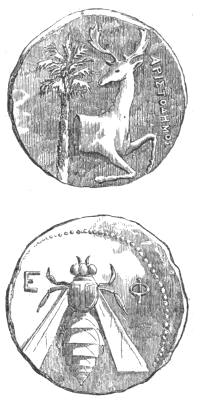
Coin of Drusus, twice the size of the original.
But his successor, Qu. Varus, attempted
to establish the same arrogant and arbitrary
rule which he had exercised over the slavish
Syrians—a people crushed by nearly two
thousand years of despotism, Assyrian, Egyptian,
Persian, and Macedonian. The free-spirited
Germans rose in revolt, under their
princely leader, Armin´ius (Herman). Arminius
had been educated at Rome, and had
thoroughly learned the tactics of the legions; but Roman refinement never
weakened his German fidelity to fatherland. Private wrong was now added
to national oppression, and he deeply laid and firmly executed his plan for
the destruction of the Roman army and the deliverance of Germany.
184. Varus was enticed into the broken and difficult country of the
Teutoberg´er Wald, at a season when heavy rains had increased the
marshiness of the ground. Barricades of fallen trees blocked his way,
and, in a narrow valley, a hail-storm of javelins burst upon his legions
from the hosts of Arminius. On the next day the battle was renewed,
and the Romans were literally destroyed, for all the captives were sacrificed
upon the altars of the old German divinities. The garrisons throughout
the country were put to the sword, and within a few weeks not a
Roman foot remained on German soil.
The news of the disaster struck Rome with terror. The superstitious
believed that supernatural portents had accompanied the event. The
temple of Mars was struck by a thunderbolt, comets blazed in the sky,
and spears of fire darted from the northward into the prætorian camp.
A statue of Victory, which had stood on the Italian frontier looking
toward Germany, turned of its own accord and faced toward Rome.
Augustus, in his grief, heightened by the weakness of old age, used for
months to beat his head against the wall, exclaiming, “Quintilius Varus,
give me back my legions!”
By the revolt of Arminius, Germany was once and forever freed. Roman
armies were led thither by Germanicus and the younger Drusus, but they
gained no permanent advantages; and by the will of Augustus and the
policy of his successors, the Rhine continued to be regarded as the frontier
until, five centuries later, the tide of conquest turned in the other direction,
and the Teutonic races divided the Roman Empire into the kingdoms of
modern Europe.
185. The reign of Augustus was a refreshing contrast to the century of
revolution which had preceded it, for the security and prosperity that were
felt throughout the empire. Commerce revived, agriculture was greatly
improved, and the imperial city was adorned with temples, porticos, and
other new and magnificent buildings. Augustus could truly boast that he
“found Rome of brick and left it of marble.” A more lasting glory surrounds
his name from the literary brilliancy of his court. Livy, the historian,
and Virgil, Horace, Ovid, Tibul´lus, with other poets, enjoyed his
patronage and celebrated his achievements; and in allusion to this, the
brightest period of every nation’s literature is commonly called its “Augustan
Age.” Augustus had no son, and his choice of an heir fell upon
Tiberius, the son of his wife, Livia, by a former marriage. By the same
arrangement, Germanicus, the son of Drusus, was adopted by Tiberius,
and married to Agrippi´na, granddaughter of Augustus.
186. In the 77th year of his age, Augustus closed his long and wonderfully
prosperous reign of forty-five years, A. D. 14. The Senate and people
submitted to his appointed successor. The army would more willingly
have proclaimed its idolized general Germanicus, but the younger prince
absolutely refused to sanction the act. Tiberius, so far from prizing his
fidelity, never forgave his popularity; and the court soon understood
that the surest way to gain the favor of the emperor was to ill-treat his
adopted son.
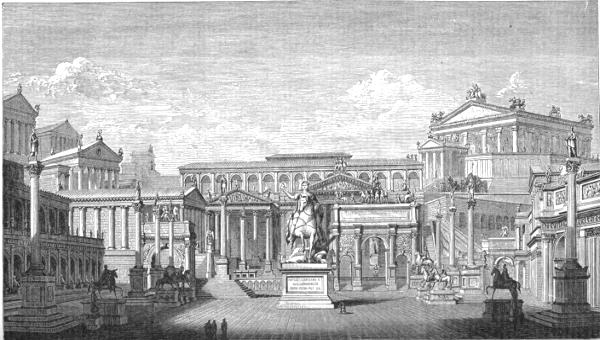
ROMAN FORUM, UNDER THE EMPERORS.
Temple of Juno Moneta. Tabularium, or Hall of Records. Temple of Concord.
Temple of Jupiter Tonans. Temple of Saturn. Temple of Vespasian.
Arch of Septimius Severus. Temple of Jupiter Capitolinus. Julian Basilica.
Arch of Tiberius. Milliarium and Rostra. Statue of Domitian. Mamertine Prison.
The policy of Tiberius was that of many another cowardly and suspicious
tyrant. Conscious of his own unworthiness, either by birth or
genius, of the high place he filled, he saw a rival in every possessor of
great talent or even exalted virtue. He was afraid to call to his assistance
the great patricians or the princes of the Julian house, and he
regarded his own relations with unmingled jealousy. As he found it
impossible, however, to administer alone all the world-embracing affairs
of such an empire, he raised to the post of prætorian præfect a Volsinian
knight, Seja´nus, whom he fancied too mean to be dangerous, but who
became, in fact, the master of the whole dominion.
187. Germanicus, meanwhile, conducted three campaigns, A. D. 14-17;
and, after several disasters, gained some important victories over Arminius,
between the Rhine and the Elbe. He was recalled A. D. 17, to
receive the honor of a triumph, and was met, twenty miles from Rome,
by an enthusiastic multitude which had poured forth to welcome him.
He was, indeed, dangerously dear both to his legions and to the common
people; and though he believed that in one year more he could complete
the conquest of Germany, he was now transferred to another army and
to the eastern wars. In his new command he settled the affairs of Armenia,
and organized Cappadocia as a province; but he died A. D. 19,
near Antioch in Syria, believing himself poisoned by Piso, a subordinate,
who had been sent by the emperor with express orders to thwart and
injure his chief.
188. Drusus, the son of Tiberius, was poisoned by order of Sejanus,
who had the boldness to request permission of the emperor to marry the
widow of his victim. This was refused; but Tiberius, still blinded to
the marvelous ambition of the wretch who ruled him, consented to retire
to Capreæ, and leave Rome in the hands of Sejanus. His time was now
given up to swinish excesses, while his worthless lieutenant maintained for
five years a riot of misrule. His wicked schemes did not spare the best
or noblest of the imperial family; but, at length, he perceived his master’s
suspicion directed toward him, and prepared to anticipate the blow by
assassinating Tiberius himself. His plot was discovered, and he was
suddenly seized and executed, A. D. 31.
The fall of this unworthy favorite took from Tiberius the only man
whom he had ever trusted, and henceforth all were equally the objects
of his fierce and cruel jealousy. Agrippina, the noble wife, as well as
Nero, Drusus, and Livil´la, the unworthy sons and daughter of Germanicus,
were put to death by his orders. Unlike Augustus, who scrupulously
kept within the forms of law, he usurped the right to condemn
without trial all who were obnoxious to him; and he extended the definition
of treason to words and even thoughts. From his island retreat
in the beautiful Bay of Naples, he issued destruction to men, women, and
even innocent children who had the misfortune to be of sufficiently noble
birth to attract his attention. It was a relief to the world when he died
from illness, A. D. 37, at the age of seventy-eight.
189. Tiberius had appointed no successor, but Senate, soldiers, and
people united in the choice of Caius Cæsar, the only surviving son of
Germanicus and Agrippina. In his childhood he had been the pet of
the legions in Germany, and from the little military boots (caligæ)
which he wore to please them, he acquired the nickname Caligula. This
childish appellation is the name by which he is commonly known in
history. Caligula was now twenty-six years of age, and was considered
to be of a mild and generous disposition. The first months of his reign
justified the impression. He released the prisoners and recalled the exiles
of Tiberius, and he restored power to the regular magistrates and the
popular assemblies. But his weak head was turned by the possession of
absolute power, and of the enormous wealth hoarded by Tiberius. In
unbounded self-indulgence, he extinguished the last spark of reason, and
exerted his tremendous power only for mischief, and in the most wild
and reckless manner. Choosing to be considered as a god, he built a
temple to himself, under the name of Jupiter Latiaris; and so servile
was Rome now become, that her noblest citizens purchased the honor
of officiating as priests to this worthless divinity.
The worst abuse of absolute power was shown in contempt for human
life. When the supply of criminals for the public games was exhausted,
the emperor ordered spectators, taken at random from the crowd, to be
thrown to the beasts; and lest they should curse him in their last
agonies, their tongues were first cut out. But this mad career of despotism
worked its own destruction; for, in the fourth year of his reign,
and the thirtieth of his age, Caius Cæsar was murdered by two of his
guards.
190. The Roman world being thus suddenly without a master, the
prætorians took upon themselves to decide its fate. Finding Claudius,
the uncle of Caligula, a weak and timid old man, hiding himself in the
palace, they saluted him as emperor, and hurried him away to their
camp, where he received the oaths of allegiance. Considered from childhood
as lacking in intellect, Claudius had been treated by his relatives
with a contempt, and by his servants with a harshness and cruelty, which
only increased the natural irresoluteness of his character. Yet, though
feeble, he was a good and honest man, and the evil wrought in his
reign was the work of others. His infamous wife, Messali´na, gratified
her jealousy and revenge at the expense of the noblest in the
state, especially the imperial princesses, without even a show of legal
formality. At last she was executed for her crimes, and the emperor
procured a law from the Senate which enabled him to marry his niece,
Agrippina.
This princess appears to advantage only when compared with her
predecessor. She recalled Seneca, the philosopher, from exile, and made
him the tutor of her son, Nero. She protected many who were unjustly
accused, and she advanced to power the faithful Burrhus, who proved a
better servant, both to herself and her son, than either deserved. At
the same time, Agrippina persuaded her husband to set aside his own
son, Britan´nicus, in favor of her son by a former marriage. This youth
bore his father’s name, L. Domitius Ahenobar´bus, but by the emperor’s
adoption he became Nero Claudius Cæsar Drusus Germanicus. By the
first of these names he is known in history as one of the most wicked
of tyrants. Having gained all that she hoped from the weak compliance
of Claudius, Agrippina poisoned him, and presented her son to the prætorian
guards as their imperator. Some, it is said, cried out, “Where is
Britannicus?” but there was no serious resistance, and the new emperor
was accepted by the Senate, the people, and the provinces.
191. For the first five years, under the wise and honest administration
of Seneca and Burrhus, the Romans believed that the golden age had
returned. Taxes were remitted; lands were allotted to the needy and
deserving. The delators, that infamous class of people who made their
living by accusing others of crime, were suppressed or banished. The
Roman arms prospered in Armenia, under the able command of Cor´bulo,
who captured the two capitals, Artax´ata and Tigranocerta, and completely
subdued the kingdom. In Germany all was quiet, and the legions
on the lower Rhine had leisure to complete the embankments which
protected the land from inundation.
None of this prosperity was due, however, to the character of Nero,
who was a sensual and cruel tyrant even from his youth. In the second
year of his reign he poisoned his foster-brother, Britannicus. A few
years later, he murdered his mother, his wife, and the too faithful
Burrhus, cast off the influence of Seneca, and thenceforth gave free
course to his tyrannical caprices. He encouraged the informants again,
and filled his treasury with the confiscated property of their victims.
192. He persecuted both Jews and Christians, charging upon the latter
the great fire at Rome, which he was more than suspected of having
himself caused to be kindled. By this terrible conflagration, ten of the
fourteen wards, or “regions,” of the city were made uninhabitable.
Nero watched the burning from a tower on the Esquiline, while, in the
dress of an actor, he chanted the “Sack of Troy.” Whether or not he
had ordered the destruction of Rome in consequence of his disgust with
its narrow and winding streets, he wisely availed himself of the opportunity
to rebuild it in more regular and spacious proportions. The
houses were constructed of stone, and rendered fire-proof; each was surrounded
with balconies, and separated from other houses by lanes of considerable
width, while a plentiful supply of water was introduced into
every tenement.
The palace of Nero having been destroyed, he built his Golden House
on a scale of magnitude and splendor which Rome had never seen.
The porticos which surrounded it were three miles in length; within
their bounds were parks, gardens, and a lake which filled the valley
afterward occupied by the Flavian Amphitheater. The chambers of this
imperial mansion were gilded and inlaid with gems. The least of its
ornaments, though probably the greatest of its objects, was a colossal
statue of Nero himself, 120 feet in height.
193. Nero desired to be praised as a musician and a charioteer, and
so far forgot his imperial dignity as to appear as an actor in the theaters.
He gained prizes at the Olympic Games, A. D. 67, which had
been delayed two years that he might be present. He took part, also,
in the vocal performances at the Isthmian Games, on which occasion he
ordered the death of a singer whose voice drowned his own. On his
return, he entered Rome through a breach in the walls, after the ancient
Hellenic custom; but the 1,800 garlands with which he had been laden
by the servile Greeks, showed the decline of the old heroic spirit, rather
than the glory of the victor.
194. The impositions of Nero caused revolts in the provinces, and,
among others, Vespasian, the future emperor, was sent to pacify Judæa.
But Nero was jealous of his most able and faithful officers. Cor´bulo,
the conqueror of Armenia, Rufus and Scribo´nius, the commanders in
Germany, were recalled, and avoided public execution only by putting
themselves to death. All the generals on the frontier perceived that
they could escape a similar fate only by timely revolt, and insurrections
broke out at once in Germany, Gaul, Africa, and Spain. The conspirators
agreed, at length, in the choice of Galba, the governor of Hither
Spain, as their leader and emperor.
Nero perceived that resistance was hopeless. Deserted by the prætorians
and all his courtiers, he fled from his Golden House and hid
himself in the cottage of Phaon, his former slave, a few miles from the
city. After spending a night and part of a day in an agony of terror,
he summoned courage to end his own life, just as he heard the tramp
of the horsemen who were coming to take him. He was but thirty
years of age, and had reigned nearly fourteen years. With him expired
the line of Augustus. The imperial power never again remained so long
in any one family as it had among the members, by adoption or otherwise,
of the Julian house.
Augustus (B. C. 30-A. D. 14) combines in himself all the dignities of the Republic,
but carefully avoids the appearance of royalty. He leaves the peaceful
provinces to the Senate, but assumes the command of those which are at war.
The Germans, under Arminius, revolt and destroy the legions of Varus. The
“Augustan Age” is distinguished for prosperity and enlightenment. Tiberius
(A. D. 14-37) succeeds Augustus, but Sejanus rules the empire. Germanicus and
many others are persecuted and put to death. Caius Cæsar (Caligula, A. D. 37-41)
begins well, but, soon spoiled by power, exhibits “the awful spectacle of a madman,
master of the civilized world.” He is succeeded by his uncle Claudius
(A. D. 41-54), a weak but honest man. Agrippina, having poisoned him, makes
her son Nero emperor (A. D. 54-68). Upon the death of his instructors, he proves
a reckless and cruel tyrant. He rebuilds Rome with unprecedented magnificence
after the great fire. Having caused the death of his best generals, he kills
himself only in time to escape the vengeance of his people.
195. Galba, the most distinguished general of his time, had gained
the favor of the emperor Claudius by refusing to assume the crown upon
the death of Caligula. He had proved his ability and worth by his wise
and just administration of the province of Africa, and had been honored
at Rome with the highest dignities to which his patrician birth and
eminent services entitled him. He was now more than seventy years
of age, but learning that Nero had sent orders for his death, he resolved
to rid the world of a tyrant by accepting the crown. He was a Roman
of the ancient style, and the luxurious prætorians were equally disgusted
with his strict discipline and his sparing distribution of money. By
adopting Piso as his successor, he disappointed Otho, who easily raised
a revolt against him, and the aged emperor and his adopted son were
slain in the Forum, Jan. 15, A. D. 69.
196. Otho, the early favorite of Nero, had for ten years been governor
of Lusitania. He was acknowledged, on the death of Galba, by the
Senate and most of the provinces, but the legions in Germany had
already (Jan. 3, 69) proclaimed their own general, Vitel´lius. The armies
of the two generals met near the confluence of the Adda and the Po.
Otho was defeated, and died by his own hand. Vitellius, having gained
a crown by the skill and energy of his officers, lost it by his own unworthiness.
Without the courage or ability of his predecessors, he surpassed
them in contemptible self-indulgence. Vespasian, commander in
Judæa, in revolting against this monster, was hailed by the acclamations
of all good people, and supported by all the legions of the East. He
took possession of Egypt, the grain-market of Rome, and sent his lieutenants
into Italy. This time the generals of Vitellius were defeated on
the Po, the capital was taken by assault, and the disgraced emperor put
to death.
197. During the reign of Vespasian, order and prosperity succeeded
to the storms which had convulsed the empire. The old discipline was
revived, the revenues were re-organized, the capital was beautified, and
the people employed by the construction of such great works as the
Coliseum and the Temple of Peace. The space inclosed by Nero for his
own enjoyment, was thrown open by Vespasian to the use of the people;
and the materials of the Golden House served to enrich many public
buildings. The revolt of the Batavians and other tribes on the lower
Rhine was suppressed, A. D. 70; the Jewish War of Independence was
finally subdued, the Holy City taken, and the people dispersed. Agric´ola
completed the subjugation of Britain as far as the Tyne and the Solway,
which he connected by earthworks and a chain of forts.
198. Titus, the son of Vespasian, having proved his military talent
during the reign of his father, by the capture of Jerusalem, had been
rewarded by a triumph, and by the title of Cæsar, which implied his
association in the government. At the death of Vespasian, he became
sole emperor without opposition. Whatever may have been his personal
faults, Titus distinguished himself as a ruler by sincere and constant
efforts to promote the happiness of his people. Recollecting, one evening,
that he had performed no act of kindness, he exclaimed that he had lost
a day.
The circumstances of his reign made peculiar demands upon the emperor’s
benevolence. The beautiful Campanian towns, Hercula´neum and
Pompe´ii, were destroyed by a sudden eruption of Vesuvius. A fire raged
again three days and nights at Rome, followed by a general and fatal
pestilence. Titus assumed the pecuniary loss as his own, and even sold
the ornaments of his palace to defray the expense of rebuilding the
ruined houses. He established public baths on the site of Nero’s gardens
on the Esquiline, and completed the Coliseum, or Flavian Amphitheater,
which he dedicated by a festival of a hundred days, including combats
of 5,000 wild beasts. After a reign of but little more than two years,
Titus died of a fever, having named his brother as his successor, A. D. 81.
199. Domitian was regarded by the people with more favor than he
deserved, on account of the virtues of his father and brother. His nature
was morose and jealous; and when his ill-success in military matters
began to be contrasted with the victories of his predecessors, he became
cruel and tyrannical, reviving the false accusations, forfeitures, and
death-penalties of the reign of Nero. He was partially successful in his
wars in Germany, but he was defeated on the Danube with great disaster,
and even consented to pay an annual tribute to the Dacians, to keep
them from invading Mœsia. When the cruelties of Domitian began to
excite the fears of his servants, he was murdered, Sept. 18, A. D. 96.
200. The Senate now asserted a power which it had failed to exercise
since the days of Augustus, by naming Nerva as sovereign. He was a
childless old man, but he chose for his successor M. Ul´pius Traja´nus,
a general whose vigor and ability, already shown in war, promised well
for the interests of the state. It was henceforth considered the duty of
the emperor to select from all his subjects the man most fit to rule,
without reference to his own family, and the heir thus adopted bore the
name of Cæsar. The mild, beneficent, and economical government of
Nerva afforded a pleasing contrast to the severe and sanguinary rule of
Domitian. Upon his death, which occurred A. D. 98, his adopted heir
was immediately recognized as emperor.
201. Trajan was born in Spain, and his youth had been passed in
military service. The Romans regarded him as the best of all their
emperors. In personal character he was brave and generous, diligent
and modest; in his policy as a ruler he was both wise and liberal. He
scrupulously regarded the rights and dignities of the Senate, and treated
its members as his equals. He was most diligent in hearing causes that
were presented for his judgment, and in corresponding with the governors
of provinces, who consulted him on all important affairs in their administration.
He managed the finances so well, that, without oppressive taxes or
unjust confiscations, he always had means for the construction of roads,
bridges, and aqueducts; for loans to persons whose estates had been injured
by earthquakes or tempests; and for public buildings in Rome and
all the provinces. The Ulpian Library and the great “Forum of Trajan,”
for the better transaction of public business, among many other useful
and elegant works, bore witness to his liberality. The reign of Trajan
was a literary epoch only second to that of Augustus. The great historian
Tacitus, the younger Pliny, Plutarch, Sueto´nius, and Epicte´tus, the
slave-philosopher, were all living at this time.
202. Augustus had enjoined his heirs to regard the Rhine, the Danube,
and the Euphrates as the limits of their dominion. Trajan, however,
desiring to throw off the disgraceful tribute which Domitian had promised
to the Dacians, made war twice against their king, Deceb´alus. He was
completely victorious; the king was slain, and his country became a
Roman province guarded by colonies and forts. On his return, A. D. 105,
Trajan celebrated a triumph, and exhibited games during 123 days. It
is said that 11,000 wild beasts were slaughtered in these spectacles, and
that 10,000 gladiators, mostly Dacian prisoners, killed each other “to
make a Roman holiday.”
In the later years of this reign, the Roman and the Parthian empires
came into conflict for the control of Armenia. Trajan quickly reduced
the latter country to a Roman province, and, in subsequent campaigns,
he wrested from the Parthians the ancient countries of Mesopotamia and
Assyria. Trajan died in Cilicia, A. D. 117. His ashes were conveyed
to Rome in a golden urn, and placed under the column which bears his
name.
203. Ha´drian began his reign by surrendering the Asiatic conquests
of Trajan. During the twenty years of almost unbroken peace which
marked his administration, Hadrian visited the remotest corners of his
empire, studied the wants and interests of his people, and tried impartially
to secure the best good of all. York in England, Athens, Antioch,
and Alexandria shared with Rome the honors of an imperial capital;
and each had its part of those great architectural works which, in some
cases, still exist to commemorate the glory of Hadrian. A revolt of the
Jews, A. D. 131-135, was ended with the banishment from Palestine of
the last remnants of their race. A Roman colony, Æ´lia Capitolina,
was founded upon the site of Jerusalem, to which the Christians, expelled
by Titus, were freely admitted with the first of their Gentile bishops.
Of all the benefits which Hadrian conferred upon the empire, the greatest,
perhaps, was his choice of a successor.
204. T. Aurelius Antoni´nus came to the throne A. D. 138. His uneventful
reign presents the rare example in Roman annals of twenty-three
years’ undisturbed tranquillity, and is a striking example of the
truth of the saying, “Happy is the people that has no history.” The
happiness of his great family, for so he regarded his subjects, was the
ruling purpose of his life. In Britain, the Roman boundary was pushed
to its farthest northern limit during this reign, and guarded by the
“Wall of Antoninus,” extending from the Frith of Forth to the Clyde.
Marcus Aurelius, the nephew of Hadrian, who, together with L. Verus,
had been adopted by Antoninus, assumed the latter’s name[78] with his crown.
He resembled his adoptive father in his love of religion, justice, and peace;
but his reign was far less happy, owing to calamities which were beyond
his power to avert. The barbarians north of the Danube began to be
crowded by a new and great immigration from the steppes of Asia. The
Scythic hordes, broken up from their ancient seats, we know not by what
impulse or necessity, had thrown themselves upon the Germans, and these
were driven across the Roman frontier, even into Italy, which they ravaged
as far as Aquilei´a, on the Adriatic. The two emperors proceeded
against them. Verus died in the Venetian country A. D. 169, but Aurelius
remained at his post on the Danube, summer and winter, for three
years. He gained a great victory over the Quadi, A. D. 174. A sudden
storm, occurring during the battle, decided the result. The pagans attributed
it to an intervention of Jupiter Pluvius; but the Christians, to the
prayers of Christian soldiers in the “Thundering Legion.”
During the first years of the reign of Aurelius, the Parthians made a
formidable attack upon the eastern provinces, destroyed an entire legion,
and ravaged all Syria. The general Avidius Cassius, being sent against
them as the lieutenant of Verus, more than made good the Roman losses,
for he extended the boundary of the empire again to the Tigris. But
after the death of Verus, Cassius was led to proclaim himself emperor,
and gained possession of most of the Asiatic provinces. Before Aurelius
could arrive in the East, the rebel chief was slain by his own officers,
after a reign of three months. Aurelius caused his papers to be burnt
without reading them, and suffered no man to be punished for his part
in the rebellion.
The elevation and self-control which distinguished the emperor were
owing, in great measure, to the Stoic philosophy which he studied from
his twelfth year. The only blot on his character is the persecution of
the Christians, which was doubtless instigated by the harsh and arrogant
Stoics who surrounded him. Justin Martyr at Rome, the venerable Polycarp
at Smyrna, and multitudes of less illustrious disciples at Vienna and
Lyons, suffered death for their fidelity to their religion, A. D. 167-177.
Marcus Aurelius died in Pannonia, A. D. 180.
205. Deceived by the youthful promise of his only son, Aurelius had
associated Com´modus with him in the government at the age of fifteen.
If the young prince could have enjoyed many years of training under
the wise and virtuous care of his father, he might indeed have become
all that was hoped of him. But the untimely death of the good Aurelius
left his son at seventeen a weak, self-indulgent youth, easily controled
by worthless associates. For three years the government continued in
the course which Aurelius had marked out for it. But, A. D. 183, a
plot for the murder of Commodus was detected, and many senators were
believed to be involved. His revengeful nature, stimulated by fear, now
made him a monster of tyranny. His only use of imperial power was
to issue warrants for the death of all whom he suspected. Vain of his
strength and skill, he assumed the name of the Roman Hercules, and
exhibited himself in the amphitheater as a marksman and gladiator.
At last, some of the intended victims of his proscriptions avoided their
own destruction by strangling him in his bed-chamber, after he had
reigned twelve years and nine months, A. D. 192.
206. The decline of the empire, which had been delayed by the Five
Good Emperors—Nerva, Trajan, Hadrian, and the two Antonines—proceeded
with frightful rapidity under Commodus. The armies in the
provinces, tired of discipline, broke up into petty bands which robbed
and murdered on their own account. One historian tells us that Peren´nis,
the prætorian præfect, was deposed and slain, with his wife and
children, upon the demand of 1,500 insurgent soldiers who had marched
unresisted from Britain to Rome. Society was as thoroughly demoralized
as the army. Except among the despised and persecuted Christians,
purity of life was scarcely to be found. Poverty was creeping upon the
nations through the decline of industry, but luxury and self-indulgence
were more wildly excessive than ever.
RECAPITULATION.
Galba (A. D. 68, 69) offends his guards by his strict economy, and is murdered
after seven months. Otho, three months emperor, is defeated by Vitellius, who
reigns from April to December, A. D. 69. Vespasian (A. D. 69-79) restores peace,
order, and prosperity. In his reign Jerusalem is destroyed. The short but beneficent
reign of Titus (A. D. 79-81) is disturbed by great calamities—earthquake, fire,
and pestilence. Domitian (A. D. 81-96) is a gloomy tyrant, disgraced abroad and
detested at home. Nerva (A. D. 96-98) restores confidence, and chooses for his
successor Trajan (A. D. 98-117), who is called the best and ablest of all the emperors.
He gains victories north of the Danube and east of the Euphrates, thus
extending the empire to the utmost limits which it ever attains. Hadrian
(A. D. 117-138) visits every portion of his dominions, and diffuses every-where the
blessings of peace and good government. Antoninus Pius (A. D. 138-161) enjoys
a reign of unexampled tranquillity. Marcus Aurelius (A. D. 161-180), though a
peaceful philosopher by choice, is involved by necessity in many wars. He generously
forgives the rebellion led by Cassius, but permits a persecution of the
Christians, at the instance of the Stoics. Commodus (A. D. 180-193), exasperated
by a plot against his life, becomes a revengeful tyrant, and under his reckless
misrule all order, industry, and safety vanish from the empire.
207. By their unchecked disorders, the soldiers had learned their power,
and now assumed to set up and put down emperors at their will. The
murderers of Commodus proceeded to the house of Per´tinax, præfect of
the city, and offered him the crown. He was a good old man, one of
the few surviving friends of Marcus Antoninus, and one to whose care
the young prince Commodus had been committed. He reluctantly accepted
the dangerous honor, and the result justified his fears. The
economy and order which he attempted to introduce, disgusted equally
the amusement-loving citizens and the turbulent and grasping soldiers.
Pertinax was murdered in his own palace by the prætorians, March 28,
A. D. 193, after a reign of less than three months. The guards now put
up the imperial crown at public auction, and sold it to Did´ius Julia´nus,
a wealthy senator, for $15,000,000. The Senate acknowledged him, and
he reigned more than two months at Rome. But the armies in Britain,
Pannonia, and Syria, not so much offended by the scandalous insolence
as encouraged by the example of their comrades at the capital, set up
their own leaders, Albi´nus, Seve´rus, and Niger, as emperors.
208. Severus arrived first at Rome, gained over the prætorians by
promises of donatives, and was acknowledged by the Senate. Julianus
was deserted and slain in his palace. The first imperial act of Severus
was to disarm the prætorians, and to banish them to a distance of 100
miles from the capital. He defeated his two rivals, the one at Cyzicus
and Issus, and the other near Lyons (Lugdu´num), in Gaul; and by their
death became undisputed master of the empire. Instead of the old
prætorians, he garrisoned Rome with 40,000 troops chosen from the
legions, and their chief, the prætorian præfect, became, next the sovereign,
the most powerful person in the world; for, beside his military
command, he had control of the public treasury, and great influence in
the making and enforcing of the laws. Severus was an able and successful
general. He extended the empire eastward by the capture of the
Parthian capital, and the conquest of Adiabe´ne; and northward, by his
wars against the Caledonians. He died at York, the Roman capital of
Britain, A. D. 211, having reigned eighteen years.
209. The two sons of Severus, Caracal´la and Geta, had been associated
by their father in his imperial dignity, and reigned together a year after
his death. Then their mutual hatred broke out afresh, and after a vain
attempt to divide the empire between them, Caracalla murdered Geta in
the arms of their mother. In the five years of his sole reign, he proved
one of the worst tyrants that Rome had known. Under the pretext of
exterminating the “friends of Geta,” he massacred 20,000 persons, some
of whom were the most virtuous and illustrious in the empire. Goaded
by his restless conscience, Caracalla then quitted Rome, and wandered
through all the eastern and northern provinces, followed every-where by
a track of poverty, desolation, and death. At last he plunged into a war
with Parthia, in which he had some success; but before his second campaign
he was murdered by Macri´nus, his prætorian præfect, whom the
guards proclaimed emperor.
210. Macrinus bestowed the title of Cæsar upon his son, and then
hastened to follow up Caracalla’s victories over the Parthians. He encountered
the Eastern monarch near Nis´ibis, and suffered a shameful
defeat, which forced him to retire into Syria. The soldiers were now
tired of their chosen imperator, whose severity of discipline was an unwelcome
change from the reckless liberality of Caracalla. Julia Mæsa,
sister-in-law of Severus, persuaded one division of the army to accept as
their prince her grandson, Bassia´nus, whom she declared to be a son
of Caracalla. He is more commonly called Elagab´alus, from the Syrian
sun-god to whose priesthood he had been dedicated as a child. The
wealth which Mæsa had hoarded during her residence at her sister’s
court materially aided to convince the soldiers. A body of troops, sent
to quell the insurrection, were also, in great measure, gained over to her
wishes. A battle was fought near Antioch, in which Macrinus was defeated,
and eventually slain, after a reign of fourteen months.
211. Elagabalus, or his ministers, hastened to send a letter to the Senate,
in which he loaded himself with all the high-sounding titles of Cæsar,
Imperator, son of Antoninus, grandson of Severus, Pius, Felix, Augustus,
etc. The Romans passively admitted his claims, and the Arval Brothers
offered their annual vows for his health and safety under all these names.
The Syrian boy, who, at the age of fourteen, found himself thus clothed
with imperial honors, was the most contemptible of all the tyrants that
ever afflicted the Roman world. His days and nights were given up to
gluttonous feasting and loathsome excesses.
The decorous and solemn rites of Roman religion were replaced by
degrading sorceries, which were believed to be accompanied in secret by
human sacrifices. The Syrian sun-god was placed above Jupiter Capitolinus
himself, and all that was sacred or honorable in the eyes of the people
became the object of insult and profanation. The emperor had been persuaded
to confer the title of Cæsar on his cousin, Alexander Severus; but
perceiving that this good prince soon surpassed him in the respect of the
army, he sought to procure his death. A second attempt was fatal to
Elagabalus. The prætorians murdered him and cast him into the Tiber.
212. Alexander Severus, now in his seventeenth year, was acknowledged
with joy by the soldiers and the Senate. His blameless life and lofty and
beneficent aims present a bright, refreshing contrast to the long annals of
Roman degradation. Purity and economy returned to public affairs; wise
and virtuous men received the highest offices; the Senate was treated with
a deference which belonged to its ancient dignity, rather than to its recent
base compliance with the whims of the army. If the power of Alexander
had been as great as his designs were pure, the world might have been
benefited.
A great revolution, about this time, changed the condition of Asia. The
new Persian monarchy, under Artaxerxes, the grandson of Sassan, had
overthrown the Parthian empire, and now aimed at the recovery of all
the dominions of Darius Hystaspes. Artaxerxes actually sent an embassy
to Alexander Severus, demanding the restitution to Persia of her ancient
provinces between the Ægean and the Euphrates. The reply was a
declaration of war. Alexander in person met the forces of Artaxerxes in
the plain east of the Euphrates, and defeated them in a great battle,
A. D. 232.
Hearing that the Germans were plundering Gaul, he hastened to make
peace and returned to Rome. The next year he set out for Germany; but
before he could begin his military operations there, he was murdered by a
small band of mutinous soldiers. The virtues of Alexander were largely
owing to the watchful care of his mother, in guarding his childhood from
the wickedness with which he was surrounded. The prince repaid her
vigilance by the most dutiful and tender regard; and it is said that her
over-cautious and economical policy, which led him to withhold gifts of
money demanded by the army, occasioned his death.
213. The ringleader of the mutiny was Max´imin, a Thracian peasant—a
brutal and illiterate ruffian, yet with enough natural ability to cause him
to be chosen emperor by his comrades. Three years this savage ruled the
world, his only policy being hatred toward the noble and covetousness
toward the rich; until the people of Africa, roused to fury by the extortions
of his agents, revolted and crowned their proconsul, Gor´dian, and
his son. The two Gordians were slain within a month; but the Senate
supplied their place by two of its own number, and with unwonted spirit
prepared for the defense of Italy. Maximin marched from his winter-quarters
on the Danube, but he had advanced no farther than Aquileia
when he was murdered in his tent by his own soldiers.
214. Though the legions had destroyed the emperor of their choice,
they had no intention of yielding to that of the Senate. They murdered
Pupie´nus and Balbi´nus within six weeks of their triumph over Maximin,
and bestowed the imperial robes upon a younger Gordian, the grandson
of the former proconsul of Africa. This boy of twelve years was intended,
of course, to be a mere tool of his ministers. Timesith´eus, the prætorian
præfect, was an able officer, and, so long as he lived, vigorously upheld the
imperial power against Persian assaults and African insurrections. He
was succeeded in command by Philip the Arabian, who artfully procured
the death of the young emperor, and assumed the purple himself. He
wrote to the Senate that Gordian had died of disease, and requested that
divine honors should be paid to his memory.
215. Among the few events recorded of the five years (A. D. 244-249)
of Philip’s reign, is the celebration of the “Secular Games” at Rome,
upon the completion of a thousand years from the building of the city,
April 21, A. D. 248. Rival emperors were set up by the Syrians, and by
the army in Mœsia and Pannonia. Decius, a senator, was sent by Philip to
appease the latter. Their mock-emperor was already dead, but the soldiers,
believing their guilt too great to be forgiven by Philip, thronged around
Decius with tumultuous cries of “Death or the purple!” The loyal officer,
with a hundred swords at his throat, was compelled to be crowned, and to
consent to lead his rebellious army into Italy. He wrote to assure his
master that he was only acting a part, and would resign his mock-sovereignty
as soon as he could escape his troublesome subjects. But Philip
did not believe these professions of loyalty. He marched to meet the insurgents
at Verona, was defeated and slain, Sept., A. D. 249.
216. The two years’ reign of Decius (A. D. 249-251) was marked by two
widely different attempts to restore the ancient religion and morality of
Rome—the revival of the censorship and the persecution of the Christians.
It was deeply felt that the calamities of the empire were due to the corruption
of its people. But the first measure produced no effect, while the
second only aroused the evil passions of men, and occasioned untold misery.
The bishops of Antioch, Jerusalem, and Rome became martyrs, and Alexandria
was the scene of a frightful massacre. Another calamity, for which
Decius was not responsible, was the first great incursion of the Goths, who
ravaged the provinces of Mœsia and Thrace south of the Danube. Decius
was defeated by them in A. D. 250; and the next year, in attempting to
cut off their retreat, he lost his life in a great battle.
217. Gallus, an able general, was crowned by the Senate, Hostilia´nus,
the son of Decius, being associated with him in the imperial dignity.
Calamities thickened; pestilence raged in Rome, and fresh swarms of
barbarians, only encouraged by the successes of the Goths, and the sums
of money which had been paid them as the price of peace, ravaged the
Danubian provinces. Hostilianus died of the plague, and the distress of
the people led them to unjust accusations of the emperor. Æmilianus
having defeated an army of the invaders, was proclaimed as sovereign by
his troops, and, marching into Italy, defeated Gallus and his son at Interam´na.
Æmilian was acknowledged by the Senate, but his reign was short.
Valerian, a noble and virtuous officer, had been sent by Gallus to bring
the Gallic and German legions to his aid. He arrived too late to save his
master, but he defeated Æmilian near the scene of his former victory, and
himself received the allegiance of Senate and people.
It was no enviable distinction, for the causes that were tending to the
destruction of the empire were more numerous and fiercely active than
ever. The Franks from the lower Rhine, the Aleman´ni from southern
Germany, ravaged Italy, Gaul, and Spain, and even crossed the straits into
Africa. The Goths had made themselves fleets from the forests of the
Euxine, with which they devastated the coasts of Asia Minor and Greece,
capturing and burning innumerable cities, among which were Cyzicus,
Chalcedon, Ephesus, and even Corinth and Athens. The new Persian
kingdom of the Sassanidæ had increased in power. Its second monarch,
Sapor, conquered Armenia, and overran the Roman provinces in the East.
He defeated and captured Valerian in a battle near the Euphrates, and
gratified his pride by a spectacle which no monarch before had ever been
able to exhibit—a Roman emperor, loaded with chains but clothed in
purple, a perpetual captive at his court.
The government being thus overwhelmed with calamities, various pretenders
claimed the sovereignty of the several fragments of the empire.
These adventurers were known in general as the “Thirty Tyrants.” Their
reigns were usually too short or too insignificant to be worthy of mention.
Palmyra continued to be the royal seat of Odena´tus, and after his death,
of his widow, Zenob´ia, for ten years, A. D. 264-273, inclusive. Pos´thumus
established a kingdom in Gaul, which lasted seventeen years. Valerian,
before his disasters in the East, had associated with him, in the cares of
empire, his son Gallie´nus; but that prince could attempt little more than
the defense of Italy. Aure´olus, commanding on the upper Danube, assumed
the imperial title and crossed the Alps. He was defeated by Gallienus,
and besieged in Milan. Through his arts, Gallienus was slain by
his own soldiers; but they conferred the purple on a more honest man
and better general, whom the murdered prince had named in his dying
moments. Milan was taken and Aureolus put to death.
218. Though the Roman Empire seemed to be doomed to destruction,
equally by disunion within and the attacks of barbarians from without,
its final disruption was delayed by a succession of able emperors.
Claudius, who succeeded Gallienus, A. D. 268, vanquished the Alemanni
in Italy, and the Goths in Mœsia. Aurelian (A. D. 270-275) again routed
the Goths in Pannonia; and then recalling the advice of Augustus, he
ceded to the barbarians the provinces north of the Danube, removing the
Roman inhabitants to Mœsia. He made a war against Zenobia, which
ended in the capture of the “Queen of the East,” and the overthrow
of her kingdom. A still more difficult enterprise awaited Aurelian in the
west, where Tet´ricus, the last successor of Posthumus, had united Gaul,
Spain, and Britain into one powerful monarchy. But he was conquered,
and the empire was again established on the borders of the Atlantic,
A. D. 274.
Aurelian was about to turn his victorious arms against the Persians,
when he was assassinated by several of his officers, owing to a plot formed
by his secretary, Mnes´theus. The army, indignant at the crime, applied
to the Senate for a new emperor, instead of permitting any general to
seize the crown. The Senate, after six months’ hesitation, during which
the soldiers respectfully waited, named M. Claudius Tac´itus, a senator of
vast wealth and blameless character. He would gladly have declined the
laborious and perilous position, on account of his age and infirmities; but
the Senate insisted, and Tacitus was crowned. All the acts of his short
reign were directed to the improvement of morals, and the establishment
of law and order throughout the empire. He was called away to Asia
Minor, where a troop of Goths, engaged by Aurelian to serve in his
Eastern expedition, were committing disorders for want of pay. They
were expelled; but Tacitus, enfeebled by old age, sank under the exertion,
and he died two hundred days from his accession to the throne, A. D. 276.
219. Florian, brother of Tacitus, assumed the purple at Rome, while
the army in the East proclaimed Probus, their general. The soldiers of
Florian, however, refused to fight their comrades, and, after three months,
put their leader to death. Probus, thus undisputed master of the Roman
world, was an able general and a wise and beneficent sovereign. He not
only drove the Germans out of Gaul, subdued the Sarmatians, and terrified
the Goths into peaceable behavior, but he provided for the security of his
extended frontier by settling the border provinces with numerous colonies
of barbarians, who, becoming civilized, made a barrier against further incursions
of their countrymen. He wished, also, to improve waste lands
by the draining of marshes and the planting of vines, and to employ in
these works the dangerous leisure of his soldiers. But the legionaries did
not share the thrifty policy of their emperor. They mutinied at Sir´mium,
and by another murder ended the beneficent reign of Probus, A. D. 282.
220. Carus, the prætorian præfect, was hailed as emperor by the army,
and conferred the title of Cæsar on his two sons, Cari´nus and Nume´rian.
Leaving the former to govern the West, Carus, with Numerian, turned
toward the East; first gained a great victory over the Sarmatians in Illyricum,
and then proceeded to overrun Mesopotamia, and capture the two
great cities of Seleucia and Ctes´iphon. He had advanced beyond the
Tigris, and seemed about to overthrow the
Persian kingdom, when he suddenly died,
whether by lightning, by disease, or by the
dagger, historians are not agreed.
His son Numerian yielded to the superstitious
fears of his soldiers, and withdrew
within the Roman boundaries. On the retreat
he was murdered by his father-in-law,
who was also prætorian præfect, and who
hoped to conceal the crime until he could
reap the fruits of it. But the army discovered
the death of their beloved emperor, and
set up Diocle´tian, the captain of the bodyguards,
to avenge and succeed him.
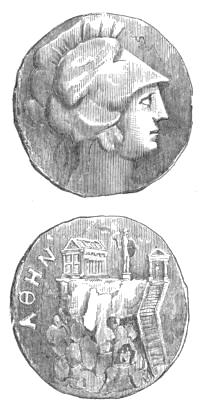
Coin of Diocletian, enlarged twice the size.
Carinus, meanwhile, reigning in the West,
was dazzling the Roman world by expensive
games, and insulting it by his profligacy.
Hearing of the murder and usurpation, he
marched with a large and well-disciplined
army to meet Diocletian, and joined battle
near Margus, in upper Mœsia. The Western
troops were victorious, but Carinus, while
leading the pursuit, was slain by one of his own officers. His followers
came to an agreement with those of Diocletian, who was universally
hailed as emperor.
221. His accession began a new period in the empire, when the power
of the sovereigns became more absolute, ceasing to be checked either by
the lawful authority of the Senate or the insolence of the soldiers.
During the ninety-two years which had elapsed since the death of Commodus,
the legions had claimed the privilege, not only of raising to the
imperial power whomsoever they might choose, but of removing the object
of their choice whenever he ceased to content them. No general who desired
to be emperor dared stint his donatives, or enforce the needful
severity of discipline. But for the almost constant danger from barbarians
without, the army, which was the real tyrant of the Roman world,
might have already put an end to all order, peace, and civil government.
RECAPITULATION.
Pertinax (A. D. 193) is crowned and murdered by the prætorians, who then
sell the throne to Julianus. Severus (A. D. 193-211) buys the adhesion of the
guards, and having gained the imperial power, disarms and expels them. He
enlarges his dominions by conquests both in the east and west. Caracalla murders
his brother, and misgoverns the empire six years, A. D. 211-217. Macrinus
(A. D. 217, 218) gains and loses his crown by violence. Elagabalus (A. D. 218-222)
introduces Syrian manners and worship into Rome. He is succeeded by his
cousin, Alexander Severus (A. D. 222-235), who gains a great victory over the
new Persian empire of the Sassanidæ, but is afterward slain in Germany during
a mutiny of his troops. Maximin (A. D. 235-238), a Thracian, is set up, and in
three years put down, by his comrades in the army. The two Gordians reign
less than a month, Pupienus and Balbinus about six weeks, when a younger
Gordian (A. D. 238-244) is invested with the purple at the age of twelve. He loses
his life through the arts of Philip the Arab, who becomes emperor, and celebrates,
A. D. 248, the thousandth year of the existence of Rome. Decius, being
sent to quell a revolt in Pannonia, is crowned by the soldiers, A. D. 249, and
Philip is slain. Two great calamities mark the reign of Decius: a persecution
of Christians and an incursion of Goths. Gallus (A. D. 251-253) is deposed by
Æmilianus, who is soon superseded by Valerian (A. D. 254-260). The whole
empire is overrun by Gothic and German invaders. Valerian, in his wars in
the East, is captured, and spends the last seven years of his life at Sapor’s court.
“Thirty Tyrants” spring up in various parts of the empire. Gallienus reigns in
Italy, first with his father, Valerian, and afterward alone, A. D. 254-268. He is
slain through the management of a pretender, Aureolus, but is succeeded by
Claudius (A. D. 268-270), who defeats the barbarians. Aurelian (A. D. 270-275)
makes the Danube again the northern boundary of the empire; subdues Zenobia
in the east and Tetricus in the west; is murdered on his way to Persia. Tacitus
(A. D. 275, 276), being appointed by the Senate, reigns two hundred days. Florian,
his brother, is deposed by his own troops. Probus (A. D. 276-282) restores security
by a wise and energetic reign. Carus gains great victories in the East; but after
his sudden death, his son Numerian abandons his conquests. Numerian is slain
in the East, Carinus in the West, and Diocletian becomes emperor.
222. Under the firm and wise policy of Diocletian, the Roman world
entered upon a century of greater vigor and security. The empire being
too large to be administered by a single head, Diocletian conferred equal
power upon his friend and comrade Maxim´ian, with the title of Augustus.
A few years later, two Cæsars, Gale´rius and Constan´tius, were added to
the imperial college, each being associated, as adopted son and successor,
with one of the emperors. To the Cæsars were assigned the more exposed
provinces, which needed an active and vigilant administration, while the
Augusti kept to themselves the old and settled portions of the empire.
Constantius had Gaul, Spain, Britain, and the whole frontier of the Rhine;
Galerius had Noricum, Pannonia, and Mœsia, with the defenses of the
Danube; while Maximian governed Italy and Africa, and Diocletian retained
for himself Thrace, Macedonia, Egypt, and the East. Though
allotted thus to its several rulers, the empire was not divided. The four
princes governed in consultation, and were equally honored in all parts
of the realm.
223. In A. D. 286, a naval chief, Carau´sius, being intrusted with a
powerful fleet for the defense of the British and Gallic coasts against the
Franks, gained over the troops in Britain, seized the island, and set up an
independent government. He built new ships, and soon became master of
the Western seas. Diocletian and Maximian, after vain attempts to break
his power, were compelled to acknowledge him as their colleague in the
empire, A. D. 287. Constantius, upon becoming Cæsar, made war, A. D.
292, upon this new Augustus; captured Boulogne after a long and severe
siege, and was preparing to invade Britain, when Carausius was killed by
his chief officer, Allec´tus.
Constantius landed, three years later, in Britain, and by a battle near
London recovered the island. He afterward drove the Alemanni out of
Gaul, and settled his captives in colonies upon the lands depopulated by
their ravages. At the same time, Maximian quelled a formidable revolt
of the Moors in Africa; and Diocletian, by a siege of eight months, captured
Alexandria, where a rival emperor had usurped the throne, and
punished the rebellious city by a massacre in which many thousands
perished. The Cæsar Galerius made war against the Persians for the
recovery of Armenia, which they had taken from Tirida´tes, the vassal of
Rome. He was defeated near Carrhæ, on the very scene of the overthrow
of Crassus, more than three centuries before; but he retrieved this misfortune
by a great victory over King Narses, followed by an advantageous
peace.
224. The system of Diocletian was thus effective and prosperous, as far
as it concerned the foreign enemies of the state; but the expenses of four
imperial courts, with the immense number of soldiers and officials, imposed
heavy burdens upon the people. The wretched tax-payers were often tortured
to enforce payments which they were unable to make. The civil wars
of the preceding centuries had deprived extensive districts of inhabitants;
and the productions of the earth and of human industry had ceased.
225. The greatest blot upon the memory of Diocletian is the persecution
of Christians in the last year of his reign. Every province and every
great city of the empire had now heard the doctrines of Christ, and the
church in Rome numbered 50,000 members. In an age of turbulence and
corruption, Christians were every-where distinguished as the most orderly,
industrious, loyal, and honest members of the community. Their refusal
to worship the image of the emperor, which was an essential part of the
Roman religion, had brought upon them several local persecutions, but
none so widely extended and severe as that of Diocletian. The edict requiring
uniformity of worship was issued A. D. 303. Instantly the cruel
passions of the pagans were let loose from restraint. Innocent blood flowed
in every province. Whoever had either malice or covetousness to indulge,
had only to accuse his enemy of being a Christian, and to be rewarded
with half the confiscated goods. In the extreme west, Constantius protected
those of the “new religion,” but elsewhere there was no appeal
from the atrocious cruelties sanctioned by courts of law.
226. Of the many acts by which Diocletian abased the authority of the
Senate, the most effective was the removal of the center of government
from the ancient city on the Tiber. His own official residence was at
Nicomedia; that of Maximian, at Milan; while Constantius held a provincial
court at York, and Galerius at Sirmium, on the Savus. The Senate
thus became the mere council of a provincial town. Imperial edicts took
the place of the laws which had formerly received its sanction. The insolent
prætorians were, at the same time, replaced by the “Jovian” and
“Herculean Guards”; and their præfect, who had been a rival of the
emperor, became merely an officer of the palace. Diocletian, however,
celebrated the twentieth year of his reign, and his numerous victories, by
a triumphal entry into Rome; and this was the last “triumph” which the
ancient capital ever beheld.
227. The next year, A. D. 305, Diocletian, worn out with the cares of
empire, formally abdicated his power, and compelled Maximian to do the
same. The two Cæsars now became Augusti, and two new candidates,
Maximin and Severus, were appointed by Galerius to the former title.
The legions in Britain were dissatisfied, however, by seeing the choice of a
successor taken away from their own imperator; and upon the death of
Constantius, A. D. 306, they immediately proclaimed Con´stantine, his son.
He was acknowledged as Cæsar by Galerius, who conferred the rank of
Augustus on Severus.
But, the next year, Maxen´tius, son of Maximian, was declared emperor
by the Senate and people of Rome, and his father resumed the purple,
which he had unwillingly laid aside at the command of Diocletian.
Severus, attempting to crush this insurrection, was taken captive at
Ravenna, and privately put to death. Galerius now conferred the imperial
dignity on Licinius, and for two years the Roman world was peaceably
governed by six masters: Constantine, Maximian, and Maxentius in the
West; Galerius, Maximin, and Licinius in the East.
228. The peace was first broken by the dissensions of Maximian and his
son. The elder emperor fled from Rome, and was well received by Constantine,
who had married his daughter. Before long, however, Maximian
entered again into plots with Maxentius for the ruin of Constantine;
which becoming known to their intended victim, he returned promptly
from his campaign on the Rhine, besieged his father-in-law in Massilia,
and put him to death, A. D. 310. Galerius died the next year at Nicomedia,
and the empire was again divided into four parts, of which Constantine
ruled the extreme west; Maxentius, Italy and Africa; Licinius,
Illyricum and Thrace; Maximin, Egypt and Asia.
The cruel and rapacious character of Maxentius wearied out his subjects,
who sent deputies from Rome, beseeching Constantine to come and be their
sovereign. This great general had won the love of his followers, not less
by his firm and successful dealings with the barbarians, than by his liberal
protection of the Christians, whose virtues he esteemed, and whose rights
of conscience he respected. On his march toward Italy, it is said that he
beheld a vision. A flaming cross appeared in the heavens, bearing in Greek
the inscription, “By this, conquer!” Thenceforth, the cross replaced the
pagan symbols which had been carried at the head of the legions; and the
omen, if such it was, was amply fulfilled.
229. Constantine passed the Alps, A. D. 312, defeated the troops of
Maxentius near Turin, captured Verona after an obstinate siege and battle,
and encountered his rival in a final combat before the gates of Rome. In
the battle of the Mil´vian Bridge, Maxentius was defeated and drowned.
The following year, Maximin was defeated by Licinius, in a great battle
at Heraclea, on the Propontis, and put an end to his life at Tarsus, in
Cilicia. Constantine and Licinius, in a series of battles, divided the world
between them. The river Strymon and the Ægean became the boundaries
between the Eastern and Western empires. Two sons of Constantine and
one of Licinius received the title of Cæsar. Crispus, on the Rhine, gained
a victory over the Franks and Alemanni; and Constantine, on the Danube,
executed a terrible vengeance upon the Goths, who had invaded the Roman
territory.
230. After seven years’ peace, war broke out between the emperors, in
A. D. 322. Licinius was defeated near Hadriano´ple, besieged in Byzantium,
and finally overthrown upon the Heights of Scuta´ri, overlooking
the latter city. His death made Constantine the sole ruler of the civilized
world. His great dominion received a new constitution suitable to its
magnitude. The seat of government was fixed upon the confines of
Europe and Asia, in the new and magnificent city bearing the emperor’s
name, which he built upon the ruins of the Greek Byzantium. The whole
empire was divided into four præfectures, which nearly corresponded to the
dominions of the four emperors, A. D. 311. (§ 228.) Each præfecture
was divided into dioceses, and each diocese into proconsular governments,
or presidencies.
This subdivision of the empire gave rise to three ranks of officials,
somewhat resembling the nobility of modern Europe. The republican
form of government, so ostentatiously cherished by Augustus, had now
disappeared, and in its place was the elaborate ceremony of an Oriental
court. Even the 10,000 spies, known as the “King’s Eyes,” were maintained
as of old by Xerxes and Darius. A standing army of 645,000 men
was kept upon the frontier; but as Roman citizens were now averse to
military service, the legions were largely composed of barbarian mercenaries.
The Franks, especially, had great importance, both in the court and
camp of Constantine.
231. The great event of this reign was the admission of Christianity as,
in a certain sense, the religion of the state. The Edict of Milan, A. D. 313,
guaranteed to the hitherto persecuted people perfect security and respect;
that of A. D. 324 exhorted all subjects of the empire to follow the example
of their sovereign, and become Christians. Heathenism was not yet proscribed.
Constantine was pontifex maximus, and must, on certain occasions,
have offered sacrifices to the fabulous gods of Rome. It was only in
his last days that he received Christian baptism; but he presided in the
first General Council of the Church at Nice, in Bithynia, A. D. 325, to
which he had convened bishops from all parts of the empire, to decide
certain disputed matters of faith. Though he treated the assembled fathers
with every mark of reverence, he refused to persecute Arius and his followers,
the Alexandrian heretics, whom the Council condemned.
232. Crispus, the eldest son of Constantine, who had been named Cæsar
at the age of seventeen, was the idol of the people, but an object of jealousy
to his father, who suspected him of treasonable designs. Whether the
charges against him were true, we have no means of knowing. He was
seized during the festivities in Rome, in honor of the twentieth year of his
father’s reign, tried secretly, and put to death. The last years of Constantine
were disturbed by fresh movements of the barbarians north of the
Danube. The Sarmatians, being attacked by the Goths, implored the aid
of the Romans. Constantine was defeated in one battle with the invaders,
but in the next he was victorious, and 100,000 Goths, driven into the
mountains, perished with cold and hunger. In the division of spoils, the
Sarmatians were dissatisfied, and revenged themselves by making inroads
upon the Roman dominions. In succeeding wars they were defeated and
scattered; 300,000 were received as vassals of the empire, and settled in
military colonies in Pannonia, Thrace, Macedonia, and Italy.
233. Hoping to secure peace to the empire after his death, Constantine
assigned its different parts to his three sons and two nephews, whom he
had carefully educated for their great responsibilities. But his care was
unavailing. Immediately upon his decease, A. D. 337, Constantius, his
second son, being nearest, seized the capital, and ordered a massacre of
all whose birth or power could give them any hopes of obtaining the sovereignty.
Of his own relatives, only two cousins, Gallus and Julian, escaped.
The three sons of Constantine then divided the empire between
them. Constantine II., the eldest, received the capital, together with
Gaul, Spain, and Britain; Constantius had Thrace and the East; Constans,
Italy, Africa, and western Illyricum.
The reign of Constantius was occupied by a disastrous war with Persia.
The pagan Armenians revolted upon the death of their king, Tiridates—a
“friend of the Romans,” who had established Christian worship in his
dominions—and opened their gates to the Persians. The son of Tiridates
sought the aid of Constantius, who succeeded in restoring the prince Chos´roes
to his dominions. The fortress of Nisibis, which was esteemed the
bulwark of the East, withstood three memorable sieges by the Persians;
but the Roman armies were defeated in nine pitched battles, and the raids
of the Persian cavalry extended even to the Mediterranean, where they
captured and plundered Antioch.
234. In the meanwhile, discord had broken out between the emperors
in the West, and Constantine II., invading the dominions of his brother
Constans, was defeated and slain near Aquileia. Constans seized his provinces,
and reigned ten years (A. D. 340-350) over two-thirds of his father’s
empire. Magnentius, an officer in Gaul, then assumed the purple, and
Constans was slain. Constantius, recalled from his Persian wars, defeated
Magnentius in a toilsome campaign on the Danube; received the submission
of Rome and the Italian cities; and finally, by a great battle among
the Cottian Alps, ended the rebellion with the life of the usurper, A. D.
353. Sixteen years after the death of the great Constantine, the empire
was thus reunited under one sovereign. Gallus, the cousin of Constantius,
had been taken from prison to receive the title of Cæsar and the government
of the East. But he proved wholly unfit to rule; he treated with
insult the embassador of his cousin, and even caused him to be murdered
by the mob of Antioch. Gallus was thereupon recalled, and put to death
at Pola, in Is´tria.
RECAPITULATION.
Diocletian (A. D. 284-305) associates Maximian as “Augustus,” and Galerius
and Constantius as “Cæsars,” with himself in the management of the empire.
Constantius overthrows the sovereignty of Carausius in Britain and northern
Gaul. Galerius gains victories in Asia; Diocletian, in Egypt; and Maximian, in
Africa. The new system is efficient abroad, but oppressive at home. Christians
are severely persecuted. Seat of government removed from Rome. Diocletian
and Maximian resign, A. D. 305. Galerius (A. D. 305-311) and Constantius (A. D.
305, 306) become emperors; Severus and Maximin, Cæsars. Constantine the Great
(A. D. 306-337), succeeding his father, Constantius, eventually conquers Maximian,
who has resumed the purple, and Maxentius (A. D. 312), who has been proclaimed
at Rome, and reigns over the Western empire. Licinius (A. D. 307-323), after the
death of Galerius, conquers Maximin, and reigns east of the Ægean. Constantine
conquers Licinius, A. D. 323, and becomes sole emperor. Fixes his court at Constantinople;
reorganizes the government; makes Christianity the religion of the
state; has wars with the Goths; and establishes military colonies of Sarmatians
within the bounds of the empire. After his death, his three sons destroy their
kinsmen, and divide the dominion between them. While Constantius II. is at
war with Persia, his brother, Constantine II., is slain by Constans, who is himself
deposed, after ten years, by Magnentius. Constantius, returning from the
East, A. D. 350, defeats Magnentius, and reigns over his father’s entire dominion,
A. D. 353-361.
235. Julian, the younger brother of Gallus, was permitted to pursue his
favorite studies at Athens, until, A. D. 355, he was called to the court of
Milan, dignified with the title of Cæsar, and intrusted with the government
of Gaul. His conduct displayed great energy and talent. He severely defeated
the Alemanni, in the battle of Strasbourg; drove the Franks from
their castles on the Meuse; and in three invasions of Germany, liberated
20,000 Roman captives. He rebuilt the cities of Gaul which the barbarians
had destroyed; adorned Paris, his winter residence, with a palace, theater,
and baths; imported grain from Britain for the sustenance of the people;
and protected agriculture, manufactures, and commerce.
Constantius became jealous of his cousin’s fame, and sought to disarm
and disgrace him, by ordering the greater part of the Gallic army to the
East. Julian was preparing to send away his devoted followers, but the
soldiers mutinied, proclaimed him emperor, and forced him to assume the
purple robe. An embassy to Constantius was contemptuously dismissed;
and Julian, after again chastising the Franks, and improving the defenses
of the German frontier, set forth to decide the question by actual war.
Penetrating the Black Forest as far as the Danube, he descended that river
with a captured fleet, surprised Sirmium, and was received with acclamations
by the people. He sent letters justifying his conduct to the principal
cities of the empire, especially to the senates of Athens and Rome; and he
was invested by the latter with the imperial titles which it alone could
legally bestow. The sudden death of Constantius, at Tarsus, Nov., A. D.
361, ended the uncertainty. All Constantinople poured forth to welcome
Julian, at a distance of sixty miles from the capital, and soldiers and
people throughout the empire accepted him as their head.
236. His first acts were to retrench the Oriental luxury of the palace,
to punish the officers of Constantius who had oppressed the people, and to
dismiss the 10,000 spies. A philosopher by choice, and an emperor only
by compulsion, Julian prided himself upon the frugal simplicity of his
habits, and professed himself merely the “servant of the Republic.” He
is known in history by the unhappy name of “Julian the Apostate.” Incensed
against the Christian cousins who had murdered his entire family,
he extended his hatred to the faith which they so unworthily professed.
He publicly renounced Christianity, and placed himself and his empire
under the protection of the “Immortal Gods.”
To spite the Christians, he patronized the Jews, and attempted to rebuild
their Temple at Jerusalem; but he was thwarted by balls of fire breaking
out near the foundation, which made it impossible for the workmen to
approach.[79] He excluded all Christians from the schools of grammar and
rhetoric, hoping thus to degrade them in intellectual rank, and weaken
them in controversy. He, however, disappointed the pagan zealots by
proclaiming toleration to all parties. In the spring of A. D. 363, Julian
departed with a great army for the East, where the ravages of the Persian
king had for four years met with little resistance. He gained an important
victory over the Persians at Ctesiphon, but in a subsequent skirmish he
was mortally wounded, and died, June, A. D. 363, after a reign of only
sixteen months.
237. Jovian, the captain of the life-guards, was saluted as Augustus by
the generals of Julian. He obtained peace with the Persian king by ceding
the five provinces east of the Tigris, and then conducted a difficult retreat
to the capital. The principal act of his reign was the re-establishment of
Christian worship and of universal tolerance. He died, Feb., A. D. 364,
after a reign of eight months. The civil and military officers of the empire
met at Nicæa, and chose for their sovereign Valentin´ian, a Christian and
a brave soldier, who had distinguished himself by service both on the
Tigris and the Rhine. His brother Valens was made his colleague, with
the command of the East, extending from the lower Danube to the
boundaries of Persia.
238. Valentinian fixed his capital at Milan, which alternated with
Rheims and Treves as his headquarters. He signally defeated the Alemanni,
and guarded the Rhine by a new series of forts. The coasts of
western Europe now began to be overrun by piratical Saxons, while the
Picts and Scots swept over all the cultivated fields of southern Britain,
from the Wall of Antoninus to the coast of Kent. Theodo´sius, father of
the future emperor of that name, led a veteran army to the relief of the
Britons, and afterward gained among the Orkneys a great naval victory
over the Saxons.
Having defeated the Alemanni on the upper Danube, Theodosius was
next sent into Africa to quell a revolt of the Moors and provincials, provoked
by the extortions of Count Roma´nus. Firmus, the chief of the
Moors, was as wily as Jugurtha, but Theodosius showed all the skill of
Metellus or of Scipio. He imprisoned Romanus and restored order to the
province; but he was rewarded only by unjust suspicions and a military
execution, A. D. 376. Valentinian was already dead (Nov., A. D. 375),
and the ministers who surrounded his son disguised the truth to suit their
own purposes.
239. Valens, meanwhile reigning in the East, was far inferior to his
brother in firmness and beneficence of character. At the beginning of his
reign, Proco´pius, a kinsman of Julian, gained possession of Constantinople,
and kept it several months as nominal emperor. He was captured at
last, and suffered a cruel death in the camp of Valens. The great event
of this period was the irruption of a new and terrible race of savages from
northern Asia. The Huns were more hideous, cruel, and implacable than
even the fiercest of the barbarians hitherto known to the Romans. The
Great Wall, which still divides China from Mongolia, had been erected as
a barrier against their inroads; but their attention was now turned to the
westward, where the Goths, north of the Black Sea, were the first to feel
their power.
The great Gothic kingdom of Her´manric extended from the Danube
and Euxine to the Baltic, and embraced many kindred tribes, of which
the eastern or Ostro-Goths, and the western or Visi-Goths were most
important. The former were conquered by the Huns; the latter besought
permission from Valens to settle on the waste lands south of the Danube,
and become subjects of the empire. Their request was granted, and a
million of men, women, and children crossed the river. But the Roman
commissioners who were charged with receiving and feeding this starving
multitude, seized the opportunity to make their own fortunes, at the expense
of their honor and of the safety of the empire.
The Goths had been required to give up their arms, but they purchased
of these officers permission to retain them. The food which was served to
them was of the vilest quality and most extravagant price. Discontent
broke out among the turbulent and armed host. The Gothic warriors
marched upon Marcianop´olis, defeated the army which was sent to defend
it, and laid waste all Thrace with fire and sword. Instead of pacifying the
Goths by a just punishment of the offenders, and by pledges of justice for
the future, Valens sent for aid to his nephew Gratian, and advanced with
his army to fight with the barbarians. In a battle near Hadrianople he
was slain, and two-thirds of his army perished, A. D. 378.
240. Gratian, the son of Valentinian, had been three years emperor of
the West, and now became sole sovereign of the dominions of Augustus.
He chose, however, for a colleague, the general Theodosius, to whom he
committed the empire of Valens, with the addition of the province of
Illyricum. The youth of Gratian was adorned by a fair promise of all the
virtues; but as soon as his excellent instructors left him, he proved himself
weak and wholly unfit for command. Bad men gained and abused
his confidence.
Maximus, in Britain, revolted, and passed over into Gaul with an army.
Instead of fighting, Gratian fled from Paris; his armies deserted to the
enemy, and the fugitive emperor was overtaken and slain at Lyons,
A. D. 383. He had already, on his accession, shared the imperial dignity
with his brother, Valentinian II., then only five years of age. Maximus,
being in actual possession of the countries west of the Alps, was acknowledged
by Theodosius, on condition of the young Valentinian being
left in secure possession of Italy and Africa. The sovereign of Gaul,
Spain, and Britain soon became strong enough to break his word. He
invaded Italy, and the young emperor, with Justi´na his mother, fled to
the court of Theodosius for protection. The emperor of the East marched
to attack Maximus, whom he defeated and caused to be executed as a
traitor, and established Valentinian II. in the sovereignty of the whole
Western empire.
241. The young sovereign of the West proved as weak as his brother.
He fell under the control of an officer of his own, a Frank named Arbogas´tes;
and when he attempted to shake off the yoke, the too powerful
servant murdered his master and set up an emperor of his own
choosing. Euge´nius reigned two years (A. D. 392-394), as the tool of
Arbogastes; but Theodosius at length defeated his army near Aquileia,
and put him to death.
For four months the Roman world was united, for the last time,
under one sovereign. Theodosius the Great well deserved the title by
which he is known in history. His vigorous and prudent management
changed the Goths from dangerous enemies into powerful friends. Great
colonies of Visi-Goths were formed in Thrace, and of Ostro-Goths in
Asia Minor; and 40,000 of their warriors were employed in the armies
of the emperor. If later monarchs had acted with the wisdom and
firmness of Theodosius, these recruits might have added great strength
to the then declining empire. They were, in fact, a chief occasion of its
fall.
242. This reign is marked by the extinction of the old pagan worship.
The temples were destroyed, and all sacrifices or divinations forbidden.
The Egyptians believed that Serapis would avenge any profanation of
his temple at Alexandria; but when a soldier, climbing to the head of
the colossal idol, smote its cheek with his battle-ax, the popular faith
was shaken, and it was admitted that a god who could not defend
himself was no longer to be worshiped. Arians and other Christian
heretics were persecuted with scarcely less rigor than the pagans; for
they were forbidden to preach, ordain ministers, or hold meetings for
public worship. The penalties inflicted by Theodosius were nothing
more than fines and civil disabilities; but his contemporary, Maximus,
is said to have been the “first Christian prince who shed the blood of
his Christian subjects for their religious opinions.”
The power and dignity of the Church at this time is shown by the
conduct of Ambro´sius, Archbishop of Milan. Theodosius had ordered a
general massacre of the people of Thessalonica, as a punishment for a
wanton tumult which had arisen in their circus, during which a Gothic
general and several of his officers had been killed. Several thousands
of persons, the innocent with the guilty, were slaughtered by barbarian
troops sent thither for the purpose. When the emperor, who was then
at Milan, went as usual to church, Ambrosius met him at the door, and
refused to admit him to any of the offices of religion until he should
publicly confess his guilt. The interdict continued eight months; but,
at length, the master of the civilized world, in the garb of the humblest
suppliant, implored pardon in the presence of all the congregation,
and was restored, at Christmas, A. D. 390, to the communion of the
Church.
Before his death, Theodosius divided his great dominions between his
two sons, giving the East to Arcadius, and the West to Hono´rius.
The latter, who was only eleven years of age, was placed under the
guardianship of the Vandal general Stil´icho, who had married a niece
of the great emperor. Theodosius died at Milan, Jan. 17, A. D. 395.
RECAPITULATION.
Julian administers Gaul and invades Germany with great energy and success.
He incurs the jealousy of his cousin, and is declared emperor by his troops.
Constantius dies, and Julian (A. D. 361-363), now universally acknowledged,
restores paganism. He is killed in an Eastern campaign, and is succeeded by
Jovian, who withdraws west of the Tigris. On the death of Jovian, A. D. 364,
Valentinian (A. D. 364-375) is chosen by the court and army, and assigns the
Eastern empire to his brother Valens. The general Theodosius gains important
victories over Saxons, Picts, Scots, and Moors. Procopius usurps for a time the
Eastern capital, and the empire is threatened by both Huns and Goths. In war
with the latter, Valens is slain. Gratian (A. D. 375-383), son of Valentinian, confers
the Eastern empire upon the younger Theodosius (A. D. 379-395). He is himself
dethroned by Maximus, who becomes sovereign of Gaul, Spain, and Britain, and
even expels the brother of Gratian (A. D. 387) from Italy. Theodosius destroys
Maximus, and restores Valentinian II. as emperor of the West; but this young
monarch is soon murdered by Arbogastes. Eugenius reigns two years, A. D. 392-394.
Theodosius defeats him, and rules the united empire four months. He conciliates
the Goths; abolishes pagan rites; persecutes heretics; does penance at Milan;
divides the empire between Arcadius and Honorius.
243. The empire east of the Adriatic continued more than a thousand
years from the accession of Arcadius, and its records belong to Mediæval
History. From the death of the great Theodosius, the division of the
two empires was complete. Rufi´nus, the minister of Arcadius, bore a
mortal enmity to Stilicho, the guardian of Honorius; and for the sake
of revenge, he let loose the Goths upon the Western empire. Al´aric,
the Visi-Goth, was made master-general of the Eastern armies in Illyricum.
At the same time, he was elected to be king of his own countrymen,
and it is uncertain in which character he invaded Italy, A. D.
400-403. Honorius was driven from Milan, but Stilicho defeated the
invader at Pollen´tia, and afterward at Verona, and persuaded him, by
promises of lands for his followers, to withdraw from Italy.
During the rejoicings at Rome on account of his retreat, an incident
occurred which marks the progress of Christianity in the declining empire.
Telem´achus, a monk, entered the arena of the Coliseum and
attempted to separate the gladiators, protesting, in the name of Christ,
against their inhuman combat. He was stoned to death by the crowd;
but their remorse bestowed upon him the honors of a martyr; and the
emperor, who was present, made a law abolishing forever the shedding
of human blood for public sport.
244. Honorius transferred his capital from Milan to the impregnable
fortress among the marshes of Ravenna, which continued three centuries
to be the seat of government for Italy. A fresh invasion from Germany,
led by the pagan Radagai´sus, devastated western Italy. Gaul was, at
the same time, overrun by a mingled horde of Vandals, Suevi, Alani,
and Burgundians; and from that moment the Roman Empire may be
said to have fallen in the countries beyond the Alps. The army in
Britain revolted; and after electing and murdering two emperors, set up
Constantine, who led them into Gaul, defeated the German invaders,
passed into Spain, and established a kind of sovereignty over the three
western countries of Europe.
Meanwhile, Stilicho was disgraced and slain, through the intrigues of
his enemy, Olympius. While the barbarian auxiliaries in his army were
lamenting his death, they were enraged by a massacre of their wives and
children, who had been kept as hostages in the various cities of Italy.
This insane act of cruelty sealed the fate of Rome. The barbarians,
freed from either the duty or necessity of obeying Honorius, flocked to
the camp of Alaric, in Illyricum, and urged him to invade Italy. The
Visi-Goth had injuries of his own to avenge. He passed the Alps and
the Po, and, after a rapid march, pitched his camp upon the Tiber.
Rome was reduced to starvation. Thousands died of famine, and thousands
more from the pestilence which it occasioned. At length, Alaric
accepted the terms offered by the Senate, and retired, upon the payment
of an enormous ransom, A. D. 408.
245. His brother-in-law, Adolphus, now joined him with a troop of
Huns and Goths. Alaric offered peace to the court of Ravenna, on
condition of receiving lands for his followers, between the Danube and
the Adriatic. His demands being refused, he again marched upon Rome,
and set up an emperor of his own choosing, in At´talus, præfect of the
city. Ravenna was only saved from his attack by a reinforcement from
Theodosius II., now emperor of the East. Africa was likewise delivered
by the vigilance of Count Herac´lian. But Alaric was soon tired of his
puppet-king. He deposed him, and again sought peace with Honorius.
The treaty failed through the ill-will of Sarus, a Goth in the imperial
service, who was a bitter enemy and rival of Alaric.
The king of the Visi-Goths now turned a third time, and with relentless
rage, upon Rome. The Eternal City was taken, Aug. 10, A. D. 410,
and for six days was given up to the horrible scenes of murder and
pillage. Though greatly reduced in power, Rome had never lost her
dignity, or the wealth of her old patrician houses. These were now
ransacked; gold, jewels, and silken garments, Grecian sculptures and
paintings, and the choicest spoils of conquered countries, brought home
in triumph by ancestors of the present families, went to enrich the
Gothic and Scythic hordes, who were so ignorant of the value of their
plunder, that exquisite vases were often divided by a stroke of a battle-ax,
and their fragments distributed among the common soldiers. Only
the churches and their property were respected, for Alaric declared that
he waged war with the Romans, and not with the apostles.
246. At length the king of the Goths withdrew, laden with spoils,
along the Appian Way, meditating the conquest of Sicily and Africa.
Storms, however, destroyed his hastily constructed fleet, and a sudden
death terminated his career of conquest. He was buried in the channel
of the little river Busenti´nus, and his sepulcher was adorned by his
followers with the treasures of Rome. Adolphus, his successor, made
peace with Honorius, and received the hand of the imperial princess
Placid´ia, who had been taken prisoner during the siege. Her bridal
gifts consisted of the spoils of her country. Adolphus retired into Gaul,
and then into Spain, where he founded the kingdom of the Visi-Goths,
as a dependency upon the Western empire.
Constantine was driven out of Spain, and captured at Arles, by Constantius,
who was rewarded for his distinguished services by a marriage
with Placidia, after the death of her Gothic husband, and by the imperial
titles which he bore as the colleague of her brother. He reigned
but seven months, and after his death Placidia quarreled with Honorius,
and took refuge with her nephew at Constantinople. In a few months
the emperor of the West ended a disgraceful reign of twenty-eight years,
A. D. 423. John, his secretary, usurped the throne; but Theodosius II.
sent a fleet and army to enforce the claims of his cousin, the son of
Placidia, and the troops in Ravenna were easily persuaded to surrender
their upstart emperor. John was beheaded at Aquileia, A. D. 425.
247. Valentinian III. was a child of six years. The Western empire
was therefore placed under the regency of his mother, Placidia, who
continued to rule it for a quarter of a century, while the military command
was held by Aë´tius and Boniface. Unhappily, these two generals
were enemies. The malicious falsehoods of Aëtius led Boniface into rebellion,
and lost Africa to the empire. Gen´seric, king of the Vandals in
Spain, willingly accepted the invitation of Boniface, and crossed the
straits with 50,000 men. The Moors immediately joined his army; the
Donatists[80] hailed him as their deliverer from persecution.
Too late, Boniface discovered his mistake, and returned to his allegiance.
All Roman Africa, except Carthage, Cirta, and Hippo Regius,
had passed over to the Vandals. Forces were sent from Constantinople
to aid those of Italy; but the combined armies were defeated, and Boniface
was compelled to abandon Africa, taking with him all the Roman
inhabitants who were able to leave. The countries on the Danube had
been ceded to the Eastern empire, in return for the aid of Theodosius II.,
in placing Valentinian III. upon his throne. Britain, unprotected by the
Roman armies, had thrown off her allegiance, and had for forty years no
government except that of the clergy, the nobles, and the magistrates
of the towns. The Goths were settled permanently in south-western
Gaul; the Burgundians in the east, and the Franks in the north of the
same country; and except a small tract in southern Gaul, the Western
empire now included only Italy and the region of the western Alps.
248. Aëtius defended the Gallic province against the Visi-Goths on
one side, and the Franks on the other, until the latter called in a new
and more terrible ally than all previous invaders, in At´tila, king of the
Huns. This savage chief was known to the terror-stricken world of his
time, as the Scourge of God. He had subdued to his authority all the
barbarians between the Baltic and the Euxine, the Rhine and the Volga,
and his army of 700,000 men was officered by a host of subject kings.
He had been for nine years ravaging the Eastern empire to the very
walls of Constantinople, and had only retired upon the promise of an
enormous annual tribute, and the immediate payment of 6,000 pounds
of gold. He now invaded Gaul, in behalf of a Frankish king who had
been driven beyond the Rhine, and had sought his aid.
Theod´oric, the son of Alaric, now king of the Visi-Goths, had allied
himself with the Romans, and their united armies came up with Attila,
just as he had effected the capture of Orleans by battering down its
walls. The Hun instantly drew off his hordes from the plunder of the
city, and retreated across the Seine to the plains about Chalons´, where
his Scythian cavalry could operate to better advantage. Then followed
one of the most memorable battles in the history of the world. The
aged king Theodoric was slain, but the victory was gained by the valor
of his subjects. Attila was driven to his circle of wagons, and only the
darkness of night prevented the total destruction of his hosts.
This was the last victory ever achieved in the name of the Western
empire. It settled the great question, whether modern Europe should be
Teuton or Tartar. The Goths were already Christian; their rude energy
was well adapted to the laws and institutions of civilized life. The
Huns were savage, heathen, destructive; mighty to ravage and desolate,
but never, in their greatest power and wealth, known to build and organize
a state. Most of what is admirable in European history would
have been reversed by a different result of the battle of Chalons.
249. Attila retreated beyond the Rhine. Two years later, he descended
into north-eastern Italy, reduced Aquileia, Alti´num, Concordia, and Padua
to heaps of ashes, and plundered Pavia and Milan. The fugitives from
the old territory of the Veneti took refuge upon the hundred low islets
at the head of the Adriatic, and laid, in poverty and industry, the foundations
of the Republic of Venice. While he was diverted from his threatened
march upon Rome, by the intercessions of Pope Leo, Attila suddenly
died, and his kingdom fell to pieces even more rapidly than it had been
built up. Two of his sons perished in battle. Irnac, the youngest,
retired into Scythia. Valentinian showed his relief from apprehension
by murdering Aëtius with his own hand. Having in many ways disgusted
and offended his subjects, he was himself assassinated in March,
A. D. 455.
Maximus, his murderer, assumed the purple, but he continued in
power less than three months. Eudox´ia, the widow of Valentinian,
called in the aid of Genseric, the Vandal king of Africa, who, commanding
the Mediterranean with his fleets, was only too eager for the
spoils of Italy. The Romans, as soon as he had landed in Ostia, put to
death their unworthy emperor; but this execution failed to appease the
barbarian. Fourteen days the Eternal City was again given up to a
pillage more unscrupulous than that of Alaric. The Vandal fleet, waiting
at Ostia, was laden with all the wealth which the Goths had spared, and
receiving on board the empress Eudoxia and her daughter, made a safe
return to Carthage.
250. The Romans were too much paralyzed to appoint a new sovereign.
When the news reached Gaul, Avi´tus, the general of the armies there,
was proclaimed, through the influence of Theodoric II., and was acknowledged
for more than a year throughout the Western empire. But,
A. D. 456, Count Ric´imer, a Goth commanding the foreign auxiliaries
in Italy, rebelled, and captured Avitus in a battle near Placentia. He
set up Marjo´rian, whose talents and virtues revived some appearance
of justice and energy in the government. A fleet was now prepared for
the invasion of Africa, in the hope not only of retaliating upon Genseric
for his plunder of Rome, but of stopping the ravages of the Vandal
pirates upon the coasts of Italy. It was betrayed to the emissaries of
Genseric, in the Spanish port of Carthagena.
Ricimer, by this time, was jealous of his protégé, and, forcing him to
resign, set up a new puppet in the person of Lib´ius Severus, in whose
name he hoped to exercise the real power. But the nominal rule of
Severus was confined to Italy, while, beyond the Alps, two Roman generals—Marcellinus
in Dalmatia, and Ægid´ius in Gaul—possessed the
real sovereignty, though without the imperial titles. The coasts of Italy,
Spain, and Greece were continually harassed by the Vandals, and Ricimer,
two years after the death of Severus (A. D. 467), appealed to the
court of Constantinople for aid against the common enemy, promising to
accept any sovereign whom the emperor would appoint.
251. Anthe´mius, a Byzantine nobleman, was designated as emperor
of the West, and received the allegiance of the Senate, the people, and
the barbarian troops. The fidelity of Count Ricimer was thought to be
secured by his marriage with the daughter of the new emperor. A formidable
attack upon the Vandals was made by the combined forces of
the East and the West; but it failed through the weakness or treachery
of Bas´ilis´cus, the Greek commander, who lost his immense fleet through
the secret management of Genseric. The Vandals recovered Sardinia and
became possessed of Sicily, whence they could ravage Italy more constantly
than ever.
The Goths, meanwhile, became dissatisfied with the foreign rule.
Ricimer retired to Milan, where, in concert with his people, he openly
revolted, marched with a Burgundian army to Rome, and forced the
Senate to accept a new emperor in the person of Olyb´rius, A. D. 472.
Anthemius was slain in the attack upon the city. Ricimer died forty
days after his victory, bequeathing his power to his nephew, Gund´obald,
a Burgundian. Olybrius died a month or two later, and Gundobald raised
a soldier named Glyce´rius to the vacant throne. The emperor of the
East interfered again, and appointed Julius Nepos—a nephew of Marcellinus
of Dalmatia—who was accepted by the Romans and Gauls,
Glycerius being consoled for the loss of his imperial titles by the safer
and more peaceful dignity of Bishop of Salo´na.
252. Scarcely was Julius invested with the insignia of his rank, when
he was driven from the country by a new sedition led by Ores´tes,
master-general of the armies, who placed upon the throne his own son,
Romulus Augustus. This last of the Western emperors, who bore, by a
curious coincidence, the names of the two founders of Rome and the
empire, was more commonly called Augus´tulus, in burlesque of the imperial
grandeur which mocked his youth and insignificance.
The mercenaries demanded one-third of the lands of Italy as the
reward of their services; and being refused, they sprang to arms again,
slew Orestes, deposed Augustulus, and made their own chief, Odo´acer,
king of Italy. The Roman Senate, in a letter to Zeno, emperor of the
East, surrendered the claim of their country to imperial rank, consented
to acknowledge Constantinople as the seat of government for the world,
but requested that Odoacer, with the title of “Patrician,” should be intrusted
with the diocese of Italy.
With the fall of the Western empire, Ancient History ends. But the
establishment of kingdoms by the northern nations marks the rise of a
new era, which, through centuries of turbulence, will open into the
varied and brilliant scenes of Modern History.
RECAPITULATION.
Alaric, invading Italy, is defeated by Stilicho. Gladiatorial combats are forever
abolished at Rome. Honorius fixes his capital at Ravenna. Italy and Gaul
are overrun by a pagan host. Constantine becomes emperor in the extreme West,
A. D. 407-411. Death of Stilicho and massacre of Gothic women and children lead
Alaric to a second invasion of Italy, A. D. 408-410. Rome is three times besieged,
and finally given up to plunder for six days. Alaric dies, A. D. 410, and is succeeded
by Adolphus, who marries the sister of Honorius, and founds a Gothic
kingdom in Spain and southern Gaul. Constantius, second husband of Placidia,
reigns as colleague of Honorius, A. D. 421; and his son, Valentinian III., succeeds
to the whole Western empire, A. D. 425-455. During the regency of Placidia, the
general Boniface, deceived by Aëtius, betrays Africa to the Vandals. Gaul is invaded
by Attila, king of the Huns, who is defeated by Goths and Romans near
Chalons, A. D. 451. He ravages northern Italy; and fugitives from cities which
he destroys, found Venice on the Adriatic, A. D. 452. Valentinian III. is assassinated;
and his widow, to avenge his death, calls in the Vandals, who plunder
Rome fourteen days. Avitus (A. D. 455, 456) is proclaimed emperor in Gaul.
Count Ricimer rebels, and sets up first Marjorian (A. D. 457-461), then Severus
(A. D. 461-465), and finally applies for an emperor to the Eastern court, which
appoints Anthemius (A. D. 467-472). Ricimer revolts again, and crowns Olybrius,
who dies in a few months. Glycerius (A. D. 473, 474) soon exchanges the crown
for a miter, and Julius Nepos is installed as sovereign. Orestes sets up his own
son, Romulus Augustus (A. D. 475, 476), the last Roman emperor of the West.
Odoacer becomes king of Italy, and the Western empire is overthrown.
| 1. |
What three successive forms of government in ancient Rome? |
§ 8. |
| 2. |
What races inhabited Italy? |
9-11. |
| 3. |
Describe, severally, their origin, character, and institutions. |
|
| 4. |
Relate the traditions concerning the origin of Rome. |
12, 13. |
| 5. |
Describe the acts and characters of the first three kings. |
13-16. |
| 6. |
What tribes and classes made up the Roman population under Tullus Hostilius? |
16. |
| 7. |
What changes were made by Ancus Martius and Tarquinius Priscus? |
17, 18. |
| 8. |
Describe the constitution under Servius Tullius. |
19-21. |
| 9. |
The reign of Tarquin the Proud. |
22. |
| 10. |
The chief divinities and religious festivals of the Romans. |
23-25. |
| 11. |
The oracles and modes of divination. |
26-28. |
| 12. |
The four sacred colleges. |
28-30. |
| 13. |
The ceremony of lustration. |
31. |
| 14. |
The government and condition of Rome after the expulsion of the kings. |
32-34. |
| 15. |
The causes and effects of the first secession. |
35, 36. |
| 16. |
The Cassian, Publilian, Terentilian, and Hortensian laws. |
37, 40, 43,
46, 78. |
| 17. |
Tell the story of Coriolanus. |
42. |
| 18. |
Of Cincinnatus and his son. |
44, 45. |
| 19. |
Describe the Laws of the Twelve Tables. |
46-48. |
| 20. |
What occasioned the second secession? |
49-51. |
| 21. |
What changes in government resulted from it? |
51-54. |
| 22. |
Describe the Veientine War and its consequences. |
56, 57. |
| 23. |
The invasion of Italy by the Gauls. |
57, 58. |
| 24. |
The sack and siege of Rome. |
59, 60. |
| 25. |
The condition of the Romans after the departure of the Gauls. |
61. |
| 26. |
The treason of Marcus Manlius. |
62, 63. |
| 27. |
The Licinian laws. |
64, 65. |
| 28. |
The final expulsion of the Gauls. |
66. |
| 29. |
The character of the Samnites. |
67, 68. |
| 30. |
The First Samnite War. |
69. |
| 31. |
Relate the incidents of the Latin War. |
70-72. |
| 32. |
Describe the Second Samnite War, and the reduction of the Æqui. |
73-75. |
| 33. |
The Third Samnite War, and the conquest of the Sabines. |
76-78. |
| 34. |
What nations were allied against Rome, B. C. 283? |
79, 80. |
| 35. |
Describe the campaigns of Pyrrhus In Italy and Sicily. |
81-85. |
| 36. |
What changes among the Romans followed their conquest of Italy? |
86, 87. |
| 37. |
Describe the origin and events of the First Punic War. |
89-94. |
| 38. |
What part was taken by Rome in the affairs of Greece? |
95. |
| 39. |
Describe the conquest of the Gauls in northern Italy. |
96, 112. |
| 40. |
The preparations by Carthage for the Second Punic War. |
97-99. |
| 41. |
The invasion of Italy by Hannibal. |
100-108. |
| 42. |
The fate of Hasdrubal. |
108, 107. |
| 43. |
A Roman triumph. |
109-111. |
| 44. |
The wars of Rome in the East and West. |
113, 114, 117. |
| 45. |
The last Punic War. |
115, 116. |
| 46. |
Describe the conquest of Spain. |
118, 119. |
| 47. |
The condition of Rome after the foreign wars. |
120, 121. |
| 48. |
The policy and death of Tiberius Gracchus. |
122, 123. |
| 49. |
Of Scipio Æmilianus. Of Caius Gracchus. |
124-127. |
| 50. |
The Jugurthine Wars. |
128-132. |
| 51. |
Tell the history of Marius. |
130-136, 139-141. |
| 52. |
Describe the Roman slave-code, and its effects in Sicily. |
137. |
| 53. |
The dictatorship of Sulla. |
142-145. |
| 54. |
The rebellion of Sertorius. |
146, 147. |
| 55. |
The War of the Gladiators. |
148-150. |
| 56. |
Relate the history of Pompey. |
151-153, 155,
166-170. |
| 57. |
Describe the conspiracy of Catiline. |
154. |
| 58. |
Relate the history and designs of Cæsar. |
156-177. |
| 59. |
Of the second triumvirate. |
177-180. |
| 60. |
Describe the three decisive battles of Pharsalia, Philippi, and Actium. |
169, 179, 180. |
| 61. |
The city and empire of Rome under Augustus. |
181, 182, 185. |
| 62. |
The Roman operations in Germany. |
183, 184. |
| 63. |
The reign of Tiberius. |
186-188. |
| 64. |
Caligula. |
189. |
| 65. |
Claudius. |
190. |
| 66. |
Nero. |
191-194. |
| 67. |
How many emperors during A. D. 69? |
195, 196. |
| 68. |
Describe the reigns of Vespasian and his two sons. |
197-199. |
| 69. |
The five good emperors. |
200-206. |
| 70. |
The reign of the prætorians. |
207. |
| 71. |
The history of Severus and his sons. |
208, 209. |
| 72. |
The contrasted characters of the two grandsons of Julia Mæsa. |
210-212. |
| 73. |
How many emperors in A. D. 238? |
213, 214. |
| 74. |
Describe the reigns of Philip and Decius. |
215, 216. |
| 75. |
The condition of Rome under Gallus. |
217. |
| 76. |
What foreign invaders under Valerian? |
217. |
| 77. |
Describe the reign of the Thirty Tyrants. |
217. |
| 78. |
What able rulers delayed the fall of the empire? |
218, 219. |
| 79. |
Describe the reigns of Carus and his sons. |
220. |
| 80. |
The new arrangement of the empire under Diocletian and his colleagues. |
221-227. |
| 81. |
The revolt of Carausius. |
223. |
| 82. |
The changes in the empire, from Diocletian’s abdication to the sole reign of Constantine. |
227-230. |
| 83. |
The reorganization of the Roman world by Constantine. |
230. |
| 84. |
What change of religion marked this reign? |
231. |
| 85. |
What foreign nations obtained settlements within Roman boundaries? |
232. |
| 86. |
Tell the history of the sons of Constantine. |
234. |
| 87. |
Describe the character and career of Julian. |
235, 236. |
| 88. |
Who succeeded Jovian? |
237. |
| 89. |
Describe the reign of Valentinian. Of Valens. |
238, 239. |
| 90. |
The reign of Gratian and his brother. |
240, 241. |
| 91. |
The character and reign of Theodosius the Great. |
241, 242. |
| 92. |
What was the comparative duration of the Eastern and Western empires? |
243. |
| 93. |
What barbarians invaded Italy during the reign of Honorius? |
243-246. |
| 94. |
Tell the history of Placidia. |
246, 247. |
| 95. |
The extent of the Western empire under Valentinian III. |
247. |
| 96. |
Describe the career of Alaric, and the battle of Chalons. |
248, 249. |
| 97. |
The successive captures of Rome by Goths and Vandals. |
245, 249. |
| 98. |
How many sovereigns appointed by Count Ricimer? |
250, 251. |
| 99. |
How many by the court at Constantinople? |
251. |
| 100. |
Who was the last Roman emperor of the West? |
252. |
| 101. |
How many centuries had Rome existed from its foundation? |
|