DEPUTATIONS—WITH A DIFFERENCE
Hughie let himself into his chambers in Jermyn
Street, and rang the bell of his sitting-room.
It was a comfortable bachelor apartment, with
sporting trophies on the walls, cavernous arm-chairs
round the fireplace, and plenty of pipes
dotted about the mantelpiece.
It was eleven o'clock on a fine morning in
March, and Hughie had been to Putney to stroke
a scratch eight against the Cambridge crew, who
had rowed a full trial on the early flood and
required a little pacing between bridges.
Presently the sitting-room door opened, and
John Alexander Goble presented himself upon
the threshold. Since his unregenerate days on
board the Orinoco a new and awful respectability
had descended upon him, and in his sober menial
attire he looked more like a Calvinistic divine
than ever. He regarded his employer with some
displeasure.
"Your breakfast has been sitting in the fender
these twa hours," he observed bitterly.
"Sorry, John. Afraid I forgot to countermand
it. I had some at Putney."
"At what hour?" inquired the inexorable Mr.
Goble.
"Half-past seven, about, with the crew."
"It's eleven the noo. You'll be able for some
mair, I doot. Forbye it's a pity to waste good
food. Bide you, while I'll get it."
Hughie, who was as wax in the hands of his
retainer, presently found himself partaking of a
lukewarm collation and opening his letters.
He glanced through the first.
"John!" he called.
Mr. Goble appeared from the bedroom.
"Were you cryin' on me?" he inquired.
"Yes. Did two gentlemen call here at ten?"
"Aye."
"Who were they?"
"Yon felly Gaymer, and anither."
"Who was he?"
"I couldna say."
"What was he like?"
Mr. Goble cast about him for a suitable comparison.
"He was just a long drink o' watter," he announced
at last, with an air of finality.
"Did he look—like an actor?" inquired
Hughie, with a flash of intuition.
"Worse than that," replied Goble.
"Um—I think I know him. Thank you, that
will do. By the way, I'm expecting some friends
to lunch. Captain and Mrs. Leroy—and Mr.
D'Arcy. You know him, don't you?"
"D'Arcy? Aye, I mind him fine. A fat yin,
wi' a lum hat tied up wi' string. A popish-lookin'
body," commented Mr. Goble sorrowfully.
He retired downstairs, to ponder upon the
dubiety of the company into which his employer
appeared to be drifting, and Hughie returned to
his letters.
The sight of the next caused him to glow suddenly,
for on the back of the envelope he observed
the address of Joan's flat. But he cooled when he
turned it round and read the superscription. It
was in the handwriting of the lady with whom
Joan shared the flat.
"Dear Mr. Marrable [it said],—
"Joan and I are coming to call on you to-morrow
about twelve—"
"They'd better stay to lunch." Hughie touched
the bell and continued,—
"Dear Joan is very young in some ways, and
she has no idea of the value of money; but since
talking the matter over with me recently, she
would like to have a few words with you about
her financial position.
"How delightful to see the leaves coming out
again!—Believe me, yours sincerely,
"Ursula Harbord."
"'Dear Joan would like'—would she?" commented
Hughie. "I'm afraid it's Ursula Harbord
I'm going to have the few words with, though.
Hades!"
He rose and crossed the room to the fireplace,
where he kicked the coals with unnecessary
violence. Then he sighed heavily, and picked up
a photograph which stood upon the mantelpiece.
Joan had spoken nothing but the truth when
she told Hughie that he would discover his true
feelings as soon as he found himself away from
her. For six or eight months he had gone about
his day's work with the thoroughness and determination
of his nature. He had administered the
little estate of Manors, was beginning to dabble
in politics, had taken up rowing again, and was
trying to interest himself generally in the course
of life to which he had looked forward so eagerly
on his travels. He had even tried conclusions
with a few débutantes who had been introduced to
his notice by business-like Mammas. But whatever
his course of life, his thoughts and desires
persisted in centring round a single object,—a
very disturbing and elusive object,—and try as
he would, he failed to derive either pleasure or
profit from his present existence.
In other words, he had made a mess of a love-affair.
Most men—and most women too, for that
matter—undergo this experience at least once in
their lives, and no two ever endure it in the same
way. One rants, another mopes, a third forgets,
a fourth bides his time, a fifth seeks consolation
elsewhere, a sixth buries himself in work or
dissipation. Hughie, who cherished a theory that
everything ultimately comes right in this world
provided you hold on long enough, and that
when in doubt a man should "stand by the Day's
Work and await instructions," like Kipling's
Bridge-Builders, had gone steadily on, because it
was his nature so to do. It was uphill work at
present,—a mechanical perfunctory business,
with no reward or alleviation in sight,—but he
was determined to go on doing his duty by Joan
to the best of his ability, and combine so far as he
was able the incompatible rôles of stern guardian,
undesired suitor, and—to him most paradoxical
of all—familiar friend.
For there was no doubt that Joan liked him.
She trusted him, consulted him,—yea, obeyed
him, even when he contradicted her most preposterous
utterances and put down a heavy foot on
her most cherished enterprises. For this he did
without flinching. The fact that he was a failure
as a lover seemed to be no reason why he should
fail as a guardian.
Not that Joan submitted readily to his régime.
To Hughie's essentially masculine mind her
changes of attitude were a complete mystery.
They seemed to have no logical sequence or connection.
She would avoid him or seek him out
with equal unexpectedness. She might be hopelessly
obstinate or disarmingly docile. One day
she would behave like a spoilt child; on another
she would be a very grandmother to him. Sometimes
she would blaze up and rail against her
much-enduring guardian for a tyrant and a
monster; at others she would take him under a
most maternal wing, and steer him through a
garden-party or a reception in a manner which
made him feel like a lost child in the hands of a
benevolent policeman. On one occasion, which
he particularly remembered, she had rounded on
him and scolded him for a full half-hour for his
stolid immobility and lack of finesse; the self-same
afternoon he had overheard her hotly defending
him against a charge of dulness brought by two
frivolous damsels over the tea-table.
All this was very perplexing to a man who
hated subtlety and liked his friends and foes
marked in plain figures. It unsettled his own
opinions, too. Joey's variegated behaviour prevented
him from deciding in his own mind
whether he really liked her or not. At present
all he was certain of was that he loved her.
Meanwhile she was coming to see him—about
her financial position. That did not promise
romance. And Ursula Harbord was coming too.
Help! Certainly life was a rotten business at
present. And it had been so full and glorious
before he had forsaken the wide world and taken
to this sort of thing. It might have been so different
too, if only—
Poor Hughie replaced Joan's photograph,
sighed again—and coughed confusedly. A funereal
image appeared over his shoulder in the
chimney-glass.
"Were you ringin'?" inquired a sepulchral
voice.
"Yes, John. Miss Gaymer and a friend of hers
are coming to see me this morning. They'll probably
stay to lunch. You can clear away that food
over there."
He returned to his letters. Only one remained
unopened, and proved to be from a man with
whom he had arranged to shoot in the autumn.
"This seems to promise a little relief from the
present cheery state of affairs," he mused. "Four
men on a nice bleak moor, with no women about!
Thank God! A hundred pounds a share. Well,
Lord knows, trusteeing is an unprofitable business,
but I think I can just do it. I'll accept at
once."
He began to write a telegram. Bachelors have
a habit of conducting their correspondence in this
manner.
"Here's they twa whigmalearies," announced
Mr. Goble dispassionately.
He ushered in Lance Gaymer and the histrionic
Mr. Haliburton.
"After compliments," as they say in official
circles, Lance came to the point.
"Marrable," he said, after an almost imperceptible
exchange of glances with Haliburton,
"aren't you keeping my sister rather short of
money?"
Hughie turned and stared at him in blank
astonishment.
Mr. Haliburton, exuding gentlemanly tact at
every pore, rose instantly.
"You two fellows would like to be alone, no
doubt," he said. "I must not intrude into family
matters. I'll call for you in half an hour, Lance."
Hughie had risen too.
"You need not trouble, Mr. Haliburton," he
said. "Lance is coming with you."
Mr. Gaymer was obviously unprepared for such
prompt measures as these.
"But look here—I say—what the devil do
you mean?" he spluttered.
"I mean," replied Hughie deliberately,—he
had realised, almost exultantly, that here once
more was a situation which need not be handled
with kid gloves,—"that I am your sister's sole
trustee and guardian, and that you have nothing
whatever to do with the disposition of her property,
and—"
"I think you forget," said Lance truculently,
"that I am her brother."
"I do not forget it," said Hughie. "Neither
did Jimmy Marrable. It was no oversight on his
part which left Joan's inheritance and yours
locked up in separate compartments, so to speak.
He gave you an independent income long ago,
Lance, because he was particularly anxious to
give you no opportunity of interfering with Joan's
affairs when the time came. For some reason
he had chosen me for the job, and he preferred
that I should have a free hand. Therefore I am
not going to allow you to cut into my department.
I am sorry to have to put it so brutally, but,
really, you have been infernally officious of late.
This is the fourth reference which you have made
to the subject during the past six weeks. I don't
know whether your enterprise is inspired by
brotherly love or the desire to make a bit, but
whichever it is I don't think you'll get much
change out of me. I also object to your latest
move—bringing in Mr. Haliburton, presumably
as an accomplice, or a witness, or whatever you
like to call him."
"Really, Mr. Marrable!" Mr. Haliburton's
voice quivered with gentlemanly indignation.
Hughie rang the bell.
"Look here, Marrable," burst out Lance furiously,
"you are getting yourself in a hole, I can
tell you! We—I happen to know that Jimmy
Marrable left thirty or forty thousand pounds
at least for Joey's immediate use; and I am
pretty certain he left something for mine too.
Now—"
"I'm sorry I can't ask you to stay to lunch,"
said Hughie, "but I have some friends coming.
Show these gentlemen out, John."
The deputation was ruthlessly shepherded
downstairs by the impassive Mr. Goble, and
Hughie was left to his own reflections. He filled
a pipe meditatively.
"I wonder," he said, lighting a spill and puffing,
"where young Lance got his figures from. I
also wonder what the game is. He was obviously
a bit worked up, and I should say he had
been fortifying himself for the interview before
he arrived. I knew, of course, that he had never
forgiven me for being put in charge of Joey's
affairs: he has always made things as difficult
for me as possible. Perhaps he wants a trifle for
himself: his closing remarks rather pointed that
way. But what on earth is friend Haliburton
doing in that galley? I fancy he has been at the
back of things all along. What interest has he in
the amount of Joey's fortune? I don't know
much about him, but I wouldn't trust him a yard.
Perhaps Lance owes him money. Have they
gone, John?"
"Aye," replied Mr. Goble. "They went quite
quietly," he added regretfully.
He began to lay the table for luncheon.
"I say, John," began Hughie awkwardly.
"Aye?"
"There's a thing I want to speak to you about.
I have been losing money lately, and I have to
give up some luxuries I can't afford. I—I am
afraid you are one of them. I have always regarded
a man-servant as an extravagance," he
went on with a rush, "and I must ask you to
look about for another place. Take your time,
of course, and don't leave me till you are suited.
I shall be glad to give you a character, and all
that. You understand?"
There was a silence, while Mr. Goble folded a
napkin. Then he replied: "Fine!" Then he
added, after a pause, "So you've been lossin'
your money? Aye! Aha! Mphm!"
"Yes. I'm desperately sorry," said Hughie
penitently. "I don't want to lose you. Perhaps
it will only be tempor—"
"You'll no be daen' that yet a while," remarked
Mr. Goble morosely. "I'm an ill body
tae move."
"But, John, you don't understand. I can't
afford to keep you for more than—"
"There a cab!" observed Mr. Goble.
Hughie looked down out of the window.
"So it is," he said hastily. "I'll show them up,
John. You go on with your work."
He was across and out of the room in three
strides, and could be heard descending the stairs
kangaroo fashion.
Mr. John Goble breathed heavily into a spoon
and rubbed it with the point of his elbow.
"I wunner wha his visitors is," he mused caustically.
"Of course he always opens the door
himsel' tae all his visitors! Of course I dinna ken
wha she is! Oh, no!"
He wagged his head in a broken-hearted manner,
and gave vent to a depressing sound which a
brother Scot would have recognised as a chuckle
of intense amusement.
To him entered Miss Ursula Harbord. She
wore pince-nez and a sage-green costume of some
art fabric—one of the numerous crimes committed
in the name of Liberty. She was Joan
Gaymer's latest fad; and under her persuasive
tutelage Joan was beginning to learn that the men
who all her life had served her slightest whim were
at once monsters of duplicity and brainless idiots;
and that, given a few more fervid and ungrammatical
articles in "The New Woman," women
would shortly come to their own and march in
the van of civilisation, and that people like
Ursula Harbord would march in the van of the
women.
Pending this glorious destiny, Miss Harbord
acted as unsettler-in-general of Joan's domestic
instincts, and worried Hughie considerably.
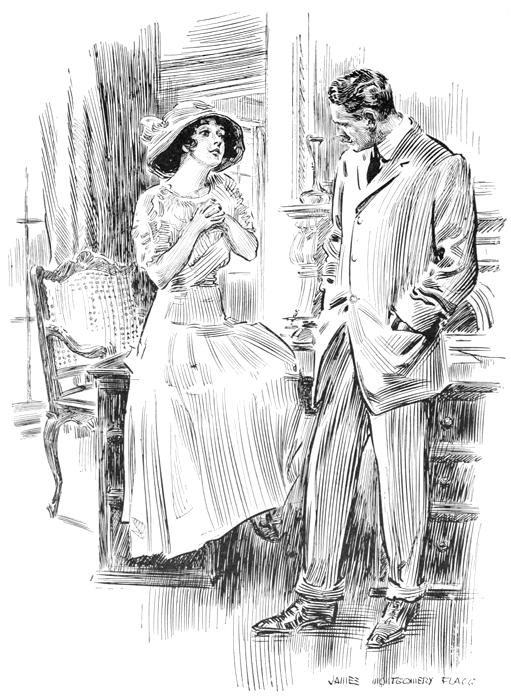
She was followed into the room by Joan; very
much the Joan of last summer, if we make allowances
for the distressing appearance presented by
a young woman of considerable personal attractions
who is compelled by Fashion's decree, for
this season at any rate, to obscure her features
under a hat which looks like an unsuccessful
compromise between a waste-paper basket and a
dish-cover.
"Well, John," she inquired in her friendly fashion,
"have you quite settled down in London?"
"Aye, mem."
"Not missing Scotland?" continued Joan,
peeling off her white gloves and sitting down in an
arm-chair.
"Naething to speak of," said John.
"I thought," continued Miss Gaymer, surveying
Mr. Goble's Cimmerian features, "that you
had perhaps left your heart there."
"Ma hairt? What for would I dae a thing like
that?" enquired the literal Mr. Goble. "A hairt
is no a thing a body can dae wi'oot," he explained.
"It's no like a rib. Ye jist get the ane, so ye
canna afford tae get leavin' it ony place."
Miss Gaymer smilingly abandoned the topic,
and in all probability the ghost of Sydney Smith
chuckled.
"When are you going to pay us another visit
at Manors?" was Joan's next question.
"I'm no sure," said Mr. Goble. "Mr. Marrable
has jist given me notice."
"Oh, John!" said Joan, "what have you been
doing? Breaking his china?"
"Drinking his wine?" suggested Miss Harbord,
turning from a scornful inspection of Hughie's
stock of current literature.
"I doot I'm no givin' satisfaction," said
John.
"But, John, I am sure you are!" said Joan.
"Was that the reason he gave?"
"He said he was givin' up keepin' a man-servant."
Miss Harbord, who had been craning her neck
to see something in the street, turned round
sharply.
"Why? Has he been losing money?"
"I couldna say, mem," said Mr. Goble woodenly.
He shared his master's antipathy to Miss
Harbord.
That lady shook her head resignedly.
"I thought so!" she said. "Joan, dear—"
At this moment Hughie entered, and Miss Harbord's
fire was diverted.
"Mr. Marrable, have you got rid of that cabman?"
she enquired with truculence.
"Rather!" said Hughie. "He went like a
lamb."
"He was intoxicated," remarked Miss Harbord
freezingly.
"I didn't notice it," said Hughie. "He was
quite tractable. Apparently you engaged him at
Hyde Park Terrace and stopped at two shops on
the way."
"That is correct."
"And you gave him one and threepence for a
drive of over two miles and a stop of about ten
minutes."
"His legal fare. We employed him for exactly
half an hour."
"But did you tell him that you were engaging
him by the hour?"
"Of course not! They simply crawl if you do.
You might have known that, Mr. Marrable."
"Well, it's all right now," interposed Joan
cheerfully.
"Mr. Marrable," persisted Miss Harbord, "I
fear you were weak with him. How much did you
give him?"
"Nothing out of the way," said Hughie uneasily.
"You'll stay to lunch, won't you? I am
expecting the Leroys and D'Arcy. We can all go
on to a matinée afterwards."
Miss Harbord assumed the expression of one
who is not to be won over by fair words, and
endeavoured to catch Miss Gaymer's eye—an
enterprise which failed signally, as the latter
lady rose from her seat and strolled to the
window.
"Mr. Marrable," began Miss Harbord, taking
up her parable single-handed, "Joan wishes to
have a chat with you about money-matters."
"No I don't, Hughie," said Miss Gaymer
promptly, over her shoulder.
"Well then, dear," said Miss Harbord calmly,
"you ought to. Women leave these things to
men far too much as it is. Joan has an old-fashioned
notion," she added to Hughie, "that
it is not quite nice for girls to know anything
about money-matters: hence her reluctance.
However, I will conduct her case for her."
Miss Harbord crossed her legs, threw herself
back in her chair in a manner which demonstrated
most conclusively her contempt for appearances
and feminine ideas of decorum, and
began:
"Tell me, Mr. Marrable, what interest does
Joan get on her money?"
Hughie gaped feebly. Half an hour ago he
had put Mr. Lance Gaymer to the door for an
almost precisely similar question. But Lance
Gaymer was a man, and Miss Harbord, conceal
the fact as she might, was a woman; and Hughie's
old helplessness paralysed him once more.
"The usual rate of interest," he said lamely,
"is about four per cent."
Ursula Harbord nodded her head, as who
should say, "I expected that!" and produced a
crumpled newspaper from her muff.
"That," she said almost indulgently, "reveals
your ignorance of the world, Mr. Marrable. If
you mixed a little more in affairs, and followed
some regular occupation, you would have more
opportunities of discovering things for yourself,
and so be spared the indignity—I suppose you
consider it an indignity?—of having to be advised
by a woman."
The afflicted Hughie murmured something
about it being a pleasure.
"Now here," continued Miss Harbord, slapping
the newspaper as an East-End butcher slaps
the last beef-steak at his Saturday night auction,
"I have the report of the half-yearly meeting
of the International Trading Company, Limited,
where a dividend of seven per cent was declared,
making a dividend on the whole year of fourteen
per cent. Now do you see what I—what Joan
wants?"
"Hughie," said Joan, who was making a tour
of inspection of the room, "where did you get this
lovely leopard-skin? Have I seen it before?"
"Shot it, Joey. I beg your pardon, Miss Harbord?"
"Do you see what Joan wants you to do?"
repeated that financial Amazon.
"Afraid I don't, quite. I'll get on to it in a
minute, though," replied the docile Hughie.
"Surely, the whole thing is quite clear! You
must take Joan's capital out of whatever it is
in and buy shares in The International Trading
Company with it. And be sure you order preference
shares, Mr. Marrable. They are the best
sort to get. That is all; but I ought not to have
to point these things out to you."
Hughie surveyed his preceptress in an undecided
fashion. Was it worth while endeavouring
to explain to her a few of the first principles
of finance, or would it be simpler to grin and
bear it? He decided on the latter alternative.
"The shares," continued Miss Harbord, having
evidently decided to follow up her whips
with a few selected scorpions, "should be bought
as cheap as possible. They go up and down, you
know, like—a—"
"Monkey on a stick?" suggested Hughie, with
the air of one anxious to help.
Miss Harbord smiled indulgently.
"No, no! Like a—a barometer, let us say;
and you have to watch your opportunity. There
is a thing called 'par' which they go to,—anybody
will tell you what it is,—and that is a very
good time to buy them."
Hughie, fighting for breath, rose and joined
Joan in the window recess, while Miss Harbord,
with much ostentatious crackling, folded up the
newspaper and put it away.
"Hughie," said Joan, under cover of the noise,
"you are angry."
"Not at all," replied Hughie, wiping his eyes
furtively. "A bit flummoxed—that's all. No
idea your friend was so up in these things."
"She is clever, isn't she?" said Joan, with unaffected
sincerity. "But, Hughie dear, don't
bother about it if it worries you. My affairs must
be a fearful nuisance to you, but Ursula was so
keen that I should come—"
"I'm glad you did, Joey. It was worth it,"
said Hughie simply.
"Of course," continued the unlearned Miss
Gaymer, "to people like Ursula these things are
as easy as falling off a log, but for you and me,
who know nothing about business, they're pretty
stiff to tackle, aren't they?"
"Quite so," agreed Hughie meekly. "But look
here, Joey," he continued, "are you really in
want of money?"
"Of course she is!" said Miss Harbord, overhearing
and resuming the offensive.
"I could do with a few more frocks, Hughie,"
said Miss Gaymer wistfully, "if it wouldn't be
a bother to change those investments about a bit,
as Ursula advises. Still, if it can't be done, we'll
say no more about it."
"Will another hundred a-year be any use to
you?" said Hughie suddenly.
"Oh, Hughie, I should think so! Can it be
managed without a fearful upset?" cried Miss
Gaymer, her eyes already brightening over a
vista of blouse-lengths and double-widths.
"Yes," said Hughie shortly. "I'll—I'll make
the necessary changes and see that the cash is
paid into your banking account."
"You dear!" said Miss Gaymer, with sincerity.
"A hundred pounds? It might be more!"
observed the daughter of the horse-leech on the
sofa. Fourteen per cent still rankled in her
Napoleonic brain.
Hughie crossed to the writing-table and tore
up a telegraph-form.
"Capt'n Leroy!" announced Mr. Goble's
voice in the doorway.
That easy-going paladin entered the room,
and intimated that his wife had sent him along
to say that she would arrive in ten minutes.
"That means twenty," said Joan. "Ursula,
we have just time to run round and see that hat
we thought we'd better not decide about until
we had heard from Hughie about the thing we
came to see him about. Now I can try it on with
a clear conscience. Back directly, Hughie!"
She flitted out, the prospective hundred pounds
obviously burning a hole in her pocket (or wherever
woman in the present era of fashion keeps
her money), followed by Miss Harbord.
Hughie turned to Leroy.
"Take a cigarette, old man," he said, "and sit
down with a glass of sherry while I do myself up
for lunch. Been down at Putney."
Leroy obeyed. When Hughie returned from
his bedroom a quarter of an hour later, he found
that Mrs. Leroy had arrived. She and her husband
were engaged in a low-toned conversation,
which they broke off rather abruptly on their
host's entrance.
Hughie shook hands, and sweeping some newspapers
off the sofa, offered his latest-arrived
guest a seat.
"No, thanks, Hughie," said Mrs. Leroy; "I
prefer to look out of the window."
She walked across the room and began to gaze
down into the street with her back to Hughie.
Her husband, evidently struck with the suitability
of this attitude, rose and joined her.
"The fact is, Hughie," began Mrs. Leroy, staring
resolutely at the house opposite, "Jack and I
want to talk to you like a father and mother, and
I can do it more easily if I look the other way."
"Same here," corroborated Leroy gruffly.
Hughie started, and surveyed the guilty-looking
pair of backs before him with an uneasy suspicion.
Surely he was not going to be treated to a third
variation on the same theme!
"Go on, Jack!" was Mrs. Leroy's next remark.
"Can't be done, m'dear," replied the gentleman,
after an obvious effort.
"Well, Hughie," continued Mrs. Leroy briskly,
"as this coward has failed me, I must say it
myself. I want to tell you that people are talking."
"Ursula Harbord, for instance," said Hughie
drily.
"Yes. How did you know?"
"She delivered a lecture to me this morning.
Gave me to understand that she darkly suspects
me of being a knave, and made no attempt to
conceal her conviction that I am a fool."
"Well, of course that's all nonsense," said Mrs.
Leroy to a fly on the window-pane; "but really,
Hughie, with all the money that her Uncle
Jimmy left her, you ought to be able to give Joey
more than you do, shouldn't you? The child has
to live in quite a small way—not really poor,
you know, but hardly as an heiress ought to live.
You give her surprisingly small interest on her
money, Jack says—didn't you, Jack?"
Captain Leroy made no reply, but the deep
shade of carmine on the back of his neck said
"Sneak!" as plainly as possible.
"And you know he would be the last to say
anything against you—wouldn't you, Jack?"
"Rather!" said Leroy, in a voice of thunder.
"Hughie," said Mrs. Leroy, turning impulsively,
"won't you confide in me?"
Hughie kicked a coal in the grate in his usual
fashion, and sighed.
"I can't, really," he said.
"Fact is, old man," broke in Leroy, in response
to his wife's appealing glances, "we didn't want
to say anything at all, but the missis thought it
best—considerin' the way people are talkin',
and all that. Can I be of any use? Been speculatin',
or anything?"
"No, Jack, I haven't," said Hughie shortly.
Mrs. Leroy gave a helpless look at her husband,
and said desperately:
"But, Hughie, we can't leave things like this!
You simply don't know what stories are going
about. It is ruining your chances with Joey, too.
She thinks you are a noodle."
"I know it," said Hughie.
"Well, look here," said Leroy, "can't you give
us some sort of explanation—some yarn we
could put about the place to account for this
state of things—"
"What state of things?" said Hughie doggedly.
He was in an unpleasant temper.
"Well, Hughie," said Mrs. Leroy, keeping hers,
"here is Joan, known to have been left a lot of
money for her immediate use,—she admits it
herself,—living quite humbly and cheaply, and
obviously not well off. People are asking why.
There are two explanations given. One, the more
popular, is that you have embezzled or speculated
the money all away. The other, which prevails
among the élite—"
"The people who are really in the know, you
know," explained Leroy.
"Yes: they say," continued his wife, "that
Joan won't marry you, so you have retaliated
by—by—"
"By cutting off supplies," suggested Hughie.
"Yes, until—"
"Until she is starved into submission—eh?"
"That's about the size of it, old son," said
Leroy.
There was a long pause. Finally Hughie
said:—
"Well, it's a pretty story; but, honestly, I'm
not in a position to contradict it at present."
Mrs. Leroy desisted from plaiting the window-cord,
swung round, walked deliberately to the
fireplace, and laid a hand on Hughie's arm.
"Hughie," she said, in tones which her husband
subsequently affirmed would have drawn
ducks off a pond, "what have you done? Tell
us!"
Leroy followed his wife across the room. "Get
it off your chest, old man," he said, with the air
of a father confessor.
Hughie smiled gratefully. He took Mrs. Leroy's
two hands into one of his own, and laid the
other on Jack Leroy's shoulder.
"Jack and Milly," he said earnestly, "my two
pals!—I would rather tell you than anybody else;
but—I simply can't! It's not my secret! You'll
probably find out all about it some day. At present
I must ask you to accept my assurance that
I'm not so black as I'm painted."
"Hughie," said Mrs. Leroy, "you are simply
stupid! We have not come to you out of idle
curiosity—"
"I know that," said Hughie heartily.
"And I think you might give us some sort of
an inkling—a sort of favourable bulletin—that
I could pass on to Joey, at any rate—"
"Joey!" said Hughie involuntarily; "Lord
forbid!"
Mrs. Leroy, startled by the vehemence of his
tone, paused; and her husband added dejectedly,—
"All right, old man! Let's drop it! Sorry you
couldn't see your way to confide in us. Wouldn't
have gone any further. Rather sick about the
whole business—eh? No wonder! Money is
the devil, anyway."
Somehow Leroy's words hit Hughie harder
than anything that had been said yet. He wavered.
After all,—
"We've bought the hat, and I'm perfectly
ravenous," announced Joan, appearing in the
doorway. "And we've brought Mr. D'Arcy.
Hughie, are those plover's eggs? Ooh!"
This was no atmosphere for the breathing of
confidential secrets. The party resumed its usual
demeanour of off-hand British insouciance, and
began to gather round the luncheon-table. Only
Mr. D'Arcy's right eyebrow asked a question of
Mrs. Leroy, which was answered by a slight but
regretful shrug of the shoulders.
Hughie's apartment was L-shaped, and the
feast was spread in the smaller arm, out of the
way of draughts and doorways. Consequently
any one entering the room would fail to see the
luncheon table unless he turned to his left and
walked round a corner.
Hughie was helping the plover's eggs,—it is
to be feared that Miss Gaymer received a Benjamin's
portion of the same,—when Mr. Goble
suddenly appeared at his elbow and whispered
in his ear,—
"Him again!"
Muttering an apology, Hughie left the table
and walked round the corner to the other arm of
the room. Lance Gaymer had just entered. His
face was flushed and his eyes glittered, and
Hughie's half-uttered invitation to him to come
in and have some lunch died away upon his lips.
"Hallo, Lance!" he said lamely.
Mr. Gaymer replied, in the deliberate and portentously
solemn tones of a man who is three
parts drunk,—
"I understand you have got a party on here."
"Yes," said Hughie, endeavouring to edge his
visitor through the doorway.
"What I want to say," continued Mr. Gaymer
in rising tones, "is that I accuse you of embezzling
my sister's property, and I'm going to make
things damned hot for you. Yes—you! Go and
tell that to your luncheon-party round the corner!"
he concluded with a snort. "And—glug—glug-glug!"
By this time he had been judiciously backed
into the passage, almost out of ear-shot of those
in the room. Simultaneously Mr. Goble's large
hand closed upon his mouth from behind, and
having thus acquired a good purchase, turned
its owner deftly round and conducted him downstairs.
Death-like silence reigned at the luncheon-table.
Hughie wondered how much they had
heard. Not that it mattered greatly, for Master
Lance's accusations, making allowances for alcoholic
directness, partook very largely of the nature
of those already levelled at Hughie by more conventional
deputations.
Before returning to his seat, Hughie crossed
to the window and looked down into the street.
Mr. Lance Gaymer was being assisted into a
waiting hansom by the kindly hands of Mr. Guy
Haliburton.
Hughie, having seen all he expected to see,
returned with faltering steps to his duties as a
host.
It was a delicate moment, calling for the exercise
of much tact. Even Mildred Leroy hesitated.
Joan had flushed red, whether with shame, or
anger, or sympathy, it was hard to say. Mr.
D'Arcy regarded her curiously.
But heavy-footed husbands sometimes rush in,
with success, where the most wary and diplomatic
wives fear to tread. Jack Leroy cleared his
throat.
"Now, Hughie, my son," he observed, "when
you've quite done interviewin' all your pals on the
door-mat, perhaps you'll give your guests a
chance. With so many old friends collected round
your table like this, we want to drink your health,
young-fellow-my-lad! Fill up your glass, Miss
Harbord! No heel-taps, Milly!"
There was an irrelevant bonhomie about this
whole speech which struck exactly the right note.
Mrs. Leroy glanced gratefully at her husband,
and lifted her glass. The others did the same.
But it was Joan who spoke first.
"Hughie!" she cried, with glowing eyes.
"Hughie!" cried every one. "Good health!"
In the times of our prosperity our friends are
always critical, frequently unjust, generally a
nuisance, and sometimes utterly detestable. But
there is no blinking the fact that they are a very
present help in trouble.
Hughie suddenly felt himself unable to speak.
He bowed his head dumbly, and made a furious
onslaught upon a plover's egg.