"What constitutes a state?
. . . .
Men who their duty know."
Philip Danvers, cattleman, nearing Fort Benton on his return from a
round-up, found his thoughts reverting to the past. The spring day was
like another that he remembered when he first caught sight of the
frontier town more than a dozen years before. He noted the smoke of a
railroad locomotive as it trailed into nothingness, and involuntarily he
looked toward the Missouri River; but there was no boat steaming up the
river, and the unfurrowed water brought a sadness to his face.
He recalled the doctor's vigorous opposition a few years previous, when
the question of a railroad came before the residents of Fort Benton.
Perhaps the doctor had been right in thinking that the river traffic
would be destroyed, and with it the future of the town. Certainly his
derided prophecy had been most literally fulfilled. Instead of becoming
a second St. Louis, the village lay in undisturbed tranquillity, but
little larger than when the Far West had brought the first recruits of
the North West Mounted Police to its levees. To those who loved the
place, who believed in it, the result caused by the changing conditions
of Western life was well-nigh heartbreaking.
Instead of the terminus of a great waterway—the port where gold was
brought by the ton to be shipped East from the territorial diggings; the
stage where moved explorer, trader, miner and soldier—instead of being
the logical metropolis of the entire Northwest, Fort Benton lay a drowsy
little village, embowered in cottonwoods and dependent upon the
cattlemen who made it their headquarters for shipping.
The lusty bull-whacker's yell, the mule-skinner's cry and the pop of
long, biting whips were heard no more in the broad, sweeping curve of
the Missouri. The levees were no longer crowded with bales of
merchandise, piles of buffalo hides and boxes of gold. No steamers tied
up to the rotting snubbing-posts; the bustle of the roustabouts, the
oaths of the mates, the trader's activity had vanished forever, as
irrevocably as the buffalo on the plains. Nothing in the prospect
before him suggested to Danvers the well-remembered past except the old
adobe fort on the water's edge. One bastion and a part of a wall
recalled to the Anglo-American his first homesick night in the
Northwest. Even the trading-posts on the river between Bismarck and Fort
Benton were abandoned.
The man had altered as well. It was evident that the shy reserve of the
Kentish youth had changed to the dignity of the reticent man. The
military bearing remained; the eyes were steady and observant, as of
old; but the youthful red and white of his face had been replaced by a
clear tan, marked by lines of thought. In a country of bearded and
seldom-shaved men, Philip's clean face added not a little to that look
of distinction which had impressed the passengers on the Far West and
gained the first enmity of Robert Burroughs.
Danvers was still unmarried. At rare intervals he read the old clipping
of the two souls separated and seeking each other, but the legend had
grown dim. The romantic dreams of boyhood were gone. He doubted that his
heart would ever be roused again; that the ph[oe]nix flame of love would
rise from the ashes of what he knew had been but the stirring of
adolescent blood when he fancied that he loved Eva Thornhill. The home
life of others had not impressed him as a dream fulfilled. The gradual
disillusionment of the many was disheartening, and Latimer's worn,
unhappy face was a constant reminder. Arthur Latimer! That blithe
Southerner—believer in men—and women! Philip knew what had made him
seek forgetfulness in the law and politics. The success of his friend,
who had reached his goal, on the supreme bench, had gratified Danvers,
and Latimer's enthusiasm and persistent belief in the ultimate good,
when the builders and founders of the newly formed State should merge
personal desires into one—one that had the best good of all for its
incentive, tempered his dislike for American politics.
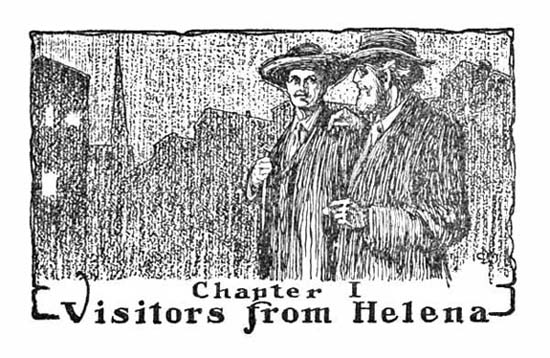
Not long after the round-up, Philip Danvers received a call from Wild
Cat Bill, now known in Montana as the Honorable William Moore. His
ability to promote big enterprises, whether floating a mining company or
electing a friend to the legislature, was publicly known, and Danvers
wondered silently what had brought the politician from Helena to the
semi-deserted town of Fort Benton, and induced him to favor him with a
call.
"Yes, Danvers," volunteered the affable Moore, "I just thought I'd take
a few days off and see what the old place looked like."
Danvers noticed that he had dropped the vernacular, though his speech
was characteristic of the West.
"It's always a pleasure to go back to the early days, when we roughed it
together," Bill went on.
Philip doubted the pleasure. He recognized this sentiment as a very
recent acquisition in the Honorable William Moore, and waited for
further enlightenment as to the real purpose of the visit.
"The old bunch turned out pretty well, after all," Moore commented.
"Robert Burroughs is a millionaire! Your sister was in luck, all right!
And Bob was tickled to death when a baby came. A big girl by this time!"
A dangerous look—a look that made Wild Cat Bill remember the night of
the dance at the trading-post—warned the Honorable William to drop
personalities. The one fact that made the position of his sister
tolerable to Danvers was the knowledge that Burroughs took pride in his
wife and child and lavished his wealth upon them.
"And you and the doctor still cling to Fort Benton!" The next remark of
the caller was spoken with commiseration. "Is the doctor still preaching
its future?"
Danvers winced at what seemed a thrust at an old friend. "My cattle make
it necessary for me to ship from Fort Benton and—I like the place," he
acknowledged without apology.
"And Joe Hall—you recall Toe String Joe?"
There was ample reason why Philip Danvers should remember the disloyal
trooper, dishonorably discharged.
"Queer idea of Joe's to enlist in the first place," continued Moore. "He
made a much better miner. You're following his case in court, I
suppose?"
A subtle change in expression made the cattleman aware that all his
visitor's remarks had been preliminary to this one. It was, then, the
famous case of Hall vs. Burroughs that for some reason Bill Moore
thought worth a trip from Helena to discuss.
"Burroughs can't afford to lose that case," declared Moore.
"He'll lose it if Joe has fair play!" cried Danvers.
Philip felt no love for the recruit of early days, but his sense of
justice asserted itself when he recalled the years that Burroughs had
made a tool of Toe String Joe at Fort Macleod, and later robbed him of
his mining claim at Helena. Burroughs had grub-staked him and secured a
half interest. At a time when Joe was down sick, and hard pressed with
debts, Burroughs rushed a sale with Eastern capitalists and forced Joe
Hall to relinquish the claim for $25,000. When Joe discovered that it
had brought $125,000, and that Burroughs had pocketed the difference,
he went to law and won his suit. Burroughs had appealed, and now the
case was before the Supreme Court.
"There are politics in the Supreme Court as well as elsewhere," ventured
Moore, with a meaning look.
"It is usually thought otherwise, I believe."
"I don't know what's usually thought. I know it's a fact."
"Perhaps corruption can be found——"
"Perhaps!" sneered the caller. "I tell you politics is a matter of
a-gittin' plenty while you're gittin'."
"I was not speaking of politics, but of corruption."
"What's the difference?" cynically. "Now, I say that Judge Latimer can
be influenced."
"Indeed!"
"I'm thinking that it would be safe to approach him in this case of
Bob's."
"Are you going to try it?" Danvers' tone continued impersonal.
The Honorable William Moore hurried on. He breathed as one having put
forth more strength than was required—breathed as he had breathed when
the detachment of Mounted Police rode up to the small trading-post where
he had barely succeeded in concealing his smuggled whiskey. He laughed
a little, threw his cigar away and put his thumbs firmly together with
fingers clasped—a familiar mannerism.
"See here, Danvers! This case mustn't go against Burroughs. Bob's a good
fellow. He did what any one else would have done. He wasn't looking out
for Joe Hall. He did all the head-work, and at the time Joe was
satisfied with the price. Of course you know that Bob's going to run for
United States Senator next winter. And he's not over popular in Montana;
you know how it is, moneyed interest against labor (so the common herd
think), and this case has made more talk than everything else put
together that Bob ever did."
"Well?" Philip's eyes had a gleam that Moore did not care to meet.
Perhaps he had been too confidential. He walked about the room,
nervously, his right hand grasping the rear of his coat. At last he
forced himself to say bluntly:
"If you'll go to Judge Latimer and tell him how you feel—that Burroughs
is your brother-in-law—that sort of talk, and that if the case goes
against Bob, Latimer'll never get re-elected to the supreme bench—oh,
you know what to say. Anyway, if you'll do this you'll be twenty-five
thousand dollars better off—that's all; and I tell you, you'll need the
money before next winter is over if this drouth continues. Your cattle
must be in bad shape now. Just tell Latimer how you feel."
"How do you know how I feel about this case?" Danvers kept himself well
under control, though he felt his blood pounding.
"It isn't so much what you feel as what you say."
Philip looked at the man.
"You haven't got the money, Bill."
"Haven't I?" boasted Moore. "Look at this!" He made a quick dive inside
his coat. "Three packages of twenty-five thousand each!" He exulted as
he displayed the bills. "They were handed to me just before I took the
train, and——"
"Bill Moore," said the cattleman curiously, "did you think for a moment
that I could be purchased?"
The Honorable Mr. Moore sparred.
"Or Arthur Latimer?" continued Danvers.
"What else am I here for?" cried Moore in a rage. "Every man's got his
price. Latimer's poor as a church mouse. He's got a wife like a vampire.
And as for you—I know cattle raising isn't all profit!"
"The trouble with you, Bill," said Danvers, dispassionately, "is that
you judge every man by yourself. You can't understand a man like Judge
Latimer—the thing would be impossible!"
"It's you who are judging by yourself! We all know you're a fanatic—or
used to be. I thought perhaps you'd gotten over some of those notions. I
know Judge Latimer as well as you do. If we don't get him one way, we'll
take another. We're goin' to win!"
Danvers made no reply. The Honorable William waited for a moment, and
then put back the packages he had flung on the table. He looked his
surprise; he could not understand how he had been foiled with no anger.
"You say you know my standards," began Danvers, slowly. "Then why did
you come to me?"
"We had to make the try; nobody could influence Judge Latimer like you."
"But what good would the money do him?" questioned Danvers, unable to
follow the reasoning of the politician. "It would be found out and
Latimer would be ruined."
"Oh, no, it wouldn't." Moore was hopeful again.
"Why didn't you approach him yourself?" It was an afterthought.
"It looks more natural for you to be interested in your brother-in-law.
Bob said to see you."
"So this is his method of beginning a campaign for a seat in the United
States Senate!"
"We knew we could trust you!" replied Moore.
And Danvers knew that the man believed he was paying a sincere tribute.
More than a month after this conversation Judge Latimer also paid a
visit to Fort Benton and straightway sought his dearest friend.
"I wanted to get away from business, from—everything that distracts
one," he explained, "and I wanted to see you, Phil, and the doctor, and
dear old sleepy Fort Benton again."
He looked worn and distracted—thinner than Philip remembered him, and
in need of something more than physical relaxation.
"Are you quite well, Arthur?" asked Danvers solicitously. "I'm going to
have the doctor over to give you a thorough examination, and I'll see
that you carry out all his directions. You don't take a bit of care of
yourself!"
But in the evening, after a day in the open air, he brightened, and
under the old spell of comradeship he took on the boyish manner that had
been so marked a characteristic.
"And how are all our friends at Helena?" inquired the doctor, after he
had secured a favorable report of Eva and the baby. "All well, of
course, or I should have heard from them!" he went on, with the
geniality that Latimer remembered so well. "And little Arthur—he must
be quite a lad now——"
"Six—and so proud of his new sister," replied the father, with a note
of pride that Danvers marked with thankfulness. The tenderness in the
man's eyes told him that this little son was the sole balm of a
harrassed life, and he wondered if even this great compensation was
adequate for all the man had given—and lost.
"Why didn't you bring the little chap with you?" questioned the doctor.
"I did think of it," confessed Latimer, "but this is a business trip
chiefly, if I must own up to it. I want to talk over the situation with
someone I know—someone I can trust."
"Anything special?" asked the doctor.
"Politics!" replied the judge. "The political pot is beginning to get a
scum on the top, preparatory to boiling."
"How domestic a simile!" jeered the doctor.
Latimer laughed. "We've been without a maid lately, and I've had a
chance to see the inside workings of a kitchen. Not that it's Eva's
fault," he added hastily. "Maids are hard to get."
"H-m-m," assented the doctor, judicially, and soon the three were deep
in Montana politics.
The probable nominees for state officials were gone over, and Danvers
remarked:
"You are sure of re-election, Arthur."
"No, I'm not; not even of nomination," objected the judge. "The
Honorable William Moore has been to see me——"
Danvers shot him a keen glance, and the doctor listened curiously.
"He was interested in the Hall and Burroughs case." Latimer hesitated,
and a spot of color suddenly burned in his cheeks. "Moore evidently
thought it necessary to come to me and ask that Burroughs have fair
play!"
The doctor laughed. It was an opportunity to tease the boy he loved; not
a serious impeachment of the character of the judge of the Supreme
Court.
"He offered me a hundred thousand dollars if I'd take a rest! Suggested
Europe!" The judge's voice trembled.
"The devil he did!" burst from the physician.
"He raised his price by the time he got to you," commented Danvers.
"What?" Latimer whirled, amazed, toward the speaker.
"When Moore asked me to intercede with you for Burroughs he had only
twenty-five thousand for each of us."
"What does Burroughs think I am?" groaned the judge. "He should know me
better than to send Moore on his dirty business, but nothing I could say
made any impression. He left, telling me to think it over."
"Do you know if he tried the others?"
"No. I've not mentioned the matter to anyone—except Eva. I was so
outraged that I had to speak to someone. And she—she doesn't
understand. She would enjoy a trip to Europe, and I—I can't give it to
her."
His two friends were silent, and presently Latimer went on.
"And all this means that when it comes time to go before the convention
this fall I shall have Burroughs and his cohorts against me."
"You seem sure of his opposition," remarked Danvers. "The case isn't
decided yet. If it is in favor of Burroughs——"
"The decision was handed down this morning. It was in favor of Hall."
"Good!" chorused Danvers and the doctor.
"The election will turn out all right for you, too," prophesied the
doctor, "and especially with Danvers to help. The judge and I have been
plotting against you for some time, Phil," he explained. "We want you to
go into politics."
Danvers shook his head.
"Wait a minute," urged the doctor. "It's like this, Danvers. You're an
American, as much as we are. You have taken out your naturalization
papers. You never think of leaving Montana. You have a splendid cattle
business, and you love Fort Benton almost as much as I do."
The cattleman smiled as the doctor outlined his position, and owned that
he did love the country of his adoption.
"And here's poor Latimer struggling on alone up there at Helena, while
you and I devote our time to making a fortune——"
"What are you offered for lots in Fort Benton now, Doctor?" teased
Latimer, with a flash of his old humor. "Let me explain, Phil," he said.
"I know it would be a sacrifice for you to leave your business here;
you've made a success with your cattle, and I envy you the independent,
care-free existence."
"You don't appreciate the difficulties with drouths and blizzards," put
in Danvers, "to say nothing of competition and low prices."
"Nothing!" exclaimed Latimer, with a gesture of his hand that swept away
such trivialities like mere cobwebs that annoy but do not obstruct the
vision. "All this is nothing! It is the complications with men—the
relations with people—that weary and sicken and break the heart! I've
tried to put up a clean record, a straight fight; I've tried to give
honest service, and it seems as if the odds were all against me!"
"What do you want?" asked Danvers, more moved at the sight of his
friend's distress than the need of his country.
"We want to put you in the Legislature as the senator from Chouteau
County!" cried Latimer, flushed and eager. "If only a better class of
men would go into politics! I can't blame them for wanting to keep out,
and yet what is our country coming to? What can one man do alone? If you
or the doctor or men of that character were in office, it wouldn't be so
hard a fight. And with you in Helena, Phil——"
The familiar name, in the soft voice of the Southerner, stirred the
heart of Danvers like a caress. He was lonely, too—he had not realized
how much so, till the hand of his friend was stretched out to him, not
only for aid, but for companionship. His heart throbbed as it had not
done since a woman fired his boyish imagination. In the long years on
the range he had grown indifferent, and rejoiced in his lack of feeling.
Now he was waking, he was ready to take up his work in the world of men,
ready to open his heart at the call of one who would be his mate.
"I might be induced to run, since you put it so strongly," said Danvers,
with a lightness that did not conceal from either of his friends the
depth of his feeling.
"Thank you, Phil."
Danvers took the thin, nervous hand extended to him, and held it with a
grasp that sent courage into the heart of Judge Latimer. It was a hand
that had guided bucking bronchos and held lassoed steers, and the man
weary with life's battles knew that a friend had come to his aid who
would blench at no enemy.
"Do you need any more men?" inquired Danvers, with a tone of assurance
and natural leadership that amazed them both.
"Do we need them? Can you produce any more? That is the question,"
said Latimer.
"There's always O'Dwyer, of course!" laughed Danvers.
"Is he as devoted as ever?" inquired Latimer.
"The same old worshipper," declared the doctor. "And, by George! now you
speak of it, he wouldn't make a bad representative!"
The three men talked over the situation and planned a brief campaign,
sending Arthur Latimer home, cheered and strengthened. Nevertheless,
after they had said good-bye at the station, the doctor turned to
Danvers with a heavy sigh.
"Latimer's heart is in bad condition. He's going to have trouble with
it. And the nervous strain he lives under so constantly is more than I
can reckon with. If he could rest at home—but I know how it was when
they lived at Fort Benton!"
"Arthur has changed," said Danvers, sadly.
"I'll never forget," said the doctor, speaking more freely than ever
before, "the time when Latimer first discovered that Eva did not care
for him. He took it all to himself, and was broken-hearted because he
had failed to keep her affections. Think of it!"
"Did she ever care for him?" Danvers could not resist asking.
"I hardly think so. I always had an idea that her heart—what there is
of it—was captured by an army officer." He looked slyly at his
companion as they walked through the gloom.
"Nothing so low in rank as a second lieutenant!" evaded Danvers.
"You were fortunate, after all, Philip, though it would have been better
for Eva. She needed a master—and she took our gentle, sensitive,
chivalrous Arthur! He will break; break like fine tempered steel when
the strain becomes too great."
The summer sped hot and with but little rain. Some ten days before the
state convention, the Doctor and Danvers went to Helena. A strong
opposition to Judge Latimer's renomination had developed, which was not
traceable to any definite source. Although Danvers avowed a dislike for
politics, in reality he had the inherent instinct for political life
characteristic of the upper-class Englishman, and he threw himself into
the maelstrom with all his forces well in hand. Office-seeking was
disgusting to him, but the fight for his friend seemed worth the effort.
In the midst of the political excitement, Mrs. Latimer gave a
dinner-party, and Philip Danvers could not refuse his invitation
without causing comment, and, what was of more consequence to his
independent nature, wounding his friend Arthur. He had met Eva Latimer
occasionally when they lived at Fort Benton, but had preferred to lure
Arthur to his own quarters, or the doctor's office, for an old-time
visit, rather than invade the formalities of the Latimer residence.
Since his friend had been on the supreme bench Danvers had not often
seen Eva, and now the great house in the suburbs of Helena—so much more
elaborate than Latimer could afford, impressed him, as it had on
previous calls, unpleasantly. It was not a home for Arthur; it was an
establishment for social functions, and a burden of expense; yet Danvers
knew it was the goal of Arthur's thoughts, where his little son awaited
him at the close of the day.
Danvers rang the bell, not a moment too early; nevertheless he found the
Western men standing self-conscious and ill at ease, waiting for the
announcement of dinner. Arthur greeted him warmly, and Eva sparkled,
smiled and chatted, moving among her guests and tactfully putting each
at his best, while they waited for the last arrival—a Miss Blair, who
was to be, so Philip learned, his own partner at dinner.
Presently the tardy one arrived, beautiful in her serene,
straightforward gaze from under fine brows and a wealth of dark hair
that caught threads of light even under the gas-jets, and made hurriedly
breathless excuses to her hostess. Danvers was introduced to her
immediately, and the dining-room was invaded.
"So awkward of me," she explained in an undertone. "I turned my ankle as
I came across the lawn, and had to wait quite a bit before I could move.
I was afraid at first I couldn't come to dinner, but I hated to
disappoint Eva. Little Arthur must have left his hoop on the lawn, and I
tripped on it. We live in the next house, and always come across lots.
Doesn't that sound New England-y?" She laughed softly. "My brother says
I'll never drop our Yankee phrases. I say pail for bucket, and path for
trail, and the other day I said farm for ranch."
"Your voice has more of Old England than of New England," said
Danvers, appreciatively. He had not spoken before except to acknowledge
Mrs. Latimer's hurried introduction.
"Oh, thank you!" Miss Blair smiled, frankly pleased. "Not that I'm a bit
of an Anglo-maniac," she hastened to affirm, "but, do you know," she
leaned toward Danvers in an amusingly confidential way, "I've always
felt mortified over my throaty voice—that is, I used to be."
Philip smiled, a smile that but few had ever seen. He listened with
enjoyment. Something in his companion's tacit belief that he would
understand her feeling was wonderfully pleasing. He seemed taken into
her confidence at once as being worthy, and it did not lessen his
pleasure to observe that the Honorable William Moore, who sat at the
left of Miss Blair, received only the most formal recognition, despite
his effort at conversation, to the neglect of his own dinner partner.
Wit and merriment flashed from one to another, and all but the host
seemed overflowing with animation. Although Latimer looked after the
needs of his guests, he was often preoccupied.
"Why so silent, judge?" asked the doctor in a lull of conversation.
"I beg your pardon," Arthur apologized. "I fear I was rude. Perhaps I
was trying to work out the salvation of my country—from my own point of
view."
"Planning for re-nomination?" asked Moore, innocently.
"And your ankle?" asked Danvers of Miss Blair, under cover of the laugh
that followed Moore's attempt at wit. "I hope that you are not suffering
from it." His observant eye had noted the smooth contour of the girl's
face, but as the moments passed the natural lack of high coloring seemed
to grow more colorless.
"It hurts—a little," confessed the girl. "But it is of no consequence.
Mrs. Latimer's dinner must not be marred by my blundering in the dark. I
should have come by the walk."
"You are thoughtful." Danvers looked again at the girl, and wished for
the first time that he could use the small talk of society. Politics was
debarred from the table conversation, but when they were again in the
parlors Miss Blair turned to Danvers.
"Aren't you the senator from Chouteau?"
"Not yet," smiled Philip.
"Oh, but you will be. My brother says so."
"I'm glad some one is optimistic. I'm afraid I shall not be the deciding
party."
"Who will be our United States senator?"
"That is hard to tell. So many straws sticking out of the tangle make it
difficult to prophesy which will be pulled out."
"Your party is so split up this year," said the girl. "Which wing are
you affiliated with?"
This was not "small talk," as Danvers recognized with an amused feeling
that he had not expected a lady to know anything outside his
preconceived idea of feminine chat.
"Montana politics have no wings," he quibbled.
Miss Blair laughed. "Really, haven't you decided which of the candidates
you'll support for United States senator?" She ran over the names.
"That's rather a leading question, isn't it?" evaded Philip. "If a man
asked me, I'd give him no satisfaction. I will say to you, though, that
I am going to do my best to send some one to Washington who is pledged
to place community interests before his own."
"I did not mean to ask impertinent questions, or to cross-examine,"
quavered Miss Blair. "One who finds out anything from you must have
taken his thirty-third degree in Masonry. I am not trying my hand at
lobbying," she added as an afterthought. "You mustn't think that. I'm
just interested in the political situation. And brother Charlie won't
talk politics with me any more than he'll recount his experiences as a
freighter."
"Charlie? Brother Charlie?" A dim memory revived. "I beg your pardon! Is
Scar Faced Charlie your brother?"
"Yes. Didn't you know?"
"Then you are the little girl——"
"Winifred. I thought you didn't recognize me, though I knew you at once.
But you would scarcely remember me, while I—you know you saved my
life."
"And to think that you have so changed—grown up! And that you are here!
I remember asking for you when Charlie was in Fort Benton, shortly after
I went there to live; but you were away at school. I don't recall ever
hearing your brother called Blair, though as a matter of fact I wasn't
thinking of your name. I was thinking of you!"
"What a pretty speech! And Mrs. Latimer is always telling what a
woman-hater you are!"
"I was not aware that I was of enough importance to be the subject of
Mrs. Latimer's strictures," replied Danvers, his brow contracting. "But
I believe I do have that reputation," he added, and smiled into her
unbelieving brown eyes.
"Moore is not running for office this year," said Danvers presently,
finding it easier to talk of matters politic.
"No. Charlie wants a place in the Senate—perhaps you know." She changed
the subject by asking, "Do you think that a man should ever vote for a
candidate not in his own party?"
"If he votes for the better man—especially in local politics—yes. Is
it a political crime in your eyes?"
"I believe most politicians think so." Miss Blair also resorted to
evasion.
They were joined by other guests, and the conversation became general.
The Honorable Mr. Moore, resplendent in a new dress suit, was saying
pleasant things to his hostess.
"What a lucky dog the judge is, my dear Mrs. Latimer! You would carry
off any situation. You deserve a wider field than this small Western
city."
"Really?" cooed the flattered lady.
As she moved away, Moore's glance followed her, and a look of sudden
inspiration illumined his shiny face. Wild Cat Bill, with his rotund
form, resembled a domesticated house cat far more than the agile
creature which had given him his frontier title. The incongruity struck
Danvers, and he smiled at Winifred Blair as she drifted to another part
of the room—a smile that she returned with a friendly nod of farewell.
He did not see her again that evening, and not long afterward he and the
doctor bade their hostess good-night.
"Not sorry you went, are you, Phil?" asked the doctor, as they walked to
their hotel. "Goodness knows, Arthur and I labored hard enough to get
you there."
"I have always disliked dinner parties." The observant doctor noticed
the wording of the reply and drew his own conclusions.
"Come in and have a smoke with me," said the doctor, as they reached his
room, and he bent over to insert the key. For years it had been Danvers'
habit to drop into the physician's office during the late afternoon or
evening, to talk or smoke in silence, as the case may be. To-night he
followed the doctor, and sat down for a half-hour's chat.
"That was a fetching gown that Mrs. Latimer wore; I don't envy Arthur
the bills!" remarked the astute doctor, as he filled his pipe.
"I didn't notice," was Philip's indifferent reply. "I never know what
women have on."
"And how lovely Miss Blair looked in blue!"
"Soft rose!" came the correction from the man who never noticed.
The doctor's mouth twitched, but he smoked on in silence, and when he
bade Philip good-night he gave him a God-bless-you pat on the shoulder,
which the coming senator from Chouteau interpreted solely as due to his
long friendship.
Danvers was wakeful that night, and a name sang through his drowsy brain
until he roused, impatient.
"It was only her voice that interested me!" he exclaimed aloud. "She's
probably like the rest of them." The nettle of one woman's fickleness
had stung so deeply when he first took to the primrose path of love that
he had never gone farther along the road leading to the solving of
life's enigma, and now the overgrowth of other interests had almost
obliterated the trail.
Although the days at Helena were busy ones for Philip Danvers, he found
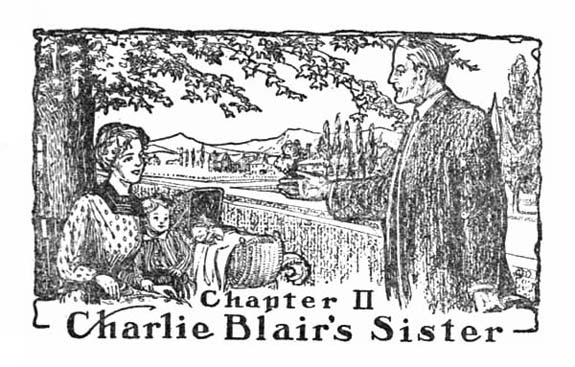
time before the convention to make his dinner call at the Latimer's. On
the shaded lawn before the house he found Miss Blair entertaining little
Arthur while she kept watch over the baby asleep in its carriage.
"Mrs. Latimer is away for the afternoon. She will be sorry to have
missed you," exclaimed the girl, as Arthur ran to greet the visitor,
always a favorite.
"You called on Aunt Winnie and me! Didn't you? Didn't you?" chanted the
boy, tugging at the hand of the visitor.
"May I stay?" asked Danvers, smiling at the eager little man. "And how
is the sprain?"
"Of course you may," assented Winifred brightly. "And as for the
sprained ankle, wicked and deceitful creature that I am, I made it the
excuse for not going with Mrs. Latimer. Good people, really good people,
would think that I merited punishment for not doing my duty in my small
sphere of life. Yet see! Instead of that I'm rewarded—here you come
to entertain Arthur and me!"
"It is a bad example!" decided Danvers, with a stern eye that did not
deceive anyone. He was amused at her naïveté, and had no wish to decry
such open good-will.
"But I do limp! Don't I, Arthur?" Miss Blair appealed to the child,
gravely.
He nodded and stooped to examine the low, narrow shoe, peeping from her
sheer summer gown. Winifred pulled the foot back with a sudden flush. "I
am, perhaps, helping along in this world as much as though I were
playing cards, by staying with the children instead of their being with
the maid," she said hastily.
Philip leaned over to look at the baby. Arthur pulled the parasol to one
side proudly.
"Her name is Winifred," he announced.
"I believe I never saw a really little baby before," said Danvers,
looking with awe at the tiny sleeper. "My sister and I were near of an
age; we grew up together. How little babies are!"
Miss Blair laughed. "Winifred is a very nice baby—big for her few
months of life. I'm very proud to be her godmother." Danvers watched as
she pulled the fleecy covering around the sleeping child. With the act a
maternal look came into her lovely face, unconscious as she was of
scrutiny, and a thrill of manhood shook him deeply.
"So you did not care for the party?" inquired the caller, presently. "I
thought all ladies adored card parties and enjoyed fighting for the
prizes."
"Play cards when the mountains look like that?" Winifred rejoined. "It
would be a sacrilege!"
"I do not care for cards myself," agreed Danvers.
"Wouldn't you like to be out there?" Winifred seemed scarcely to have
heard him.
Following the direction of her gaze, he thought her wide-flung gesture a
deserved tribute to the view. The Prickly Pear Valley lay before them,
checkered in vivid green or sage-drab as water had been given or
withheld. The Scratch Gravel Hills jutted impertinently into the middle
distance; while on the far western side of the plain the Jefferson Range
rose, tier on tier, the distances shading the climbing foothills, until
the Bear's Tooth, a prominent, jagged peak, cleft the azure sky. A
stretch of darker blue showed where the Missouri River, itself unseen,
broke through the Gate of the Mountains. The view took one away from the
affairs of men. On their side of the valley towered Mount Helena and
Mount Ascension with auriferous gulches separating and leading up to the
main range of the Rockies. As the foothills sank into the valley the
gulches, washed of their golden treasure, were transformed into the
streets of Helena—irregular, uneven, unpaved often; in the residence
part of the town young trees ambitiously spread their slender branches;
the main street and intersecting steeper ones were bordered with
business blocks as ambitious, in their way, as the transplanted trees.
"'I will lift up mine eyes unto the hills,'" quoted Winifred, softly.
"What a singer David was. But these mountains seem worthy of the grand
old psalms."
"Yes," assented Danvers, simply; and he liked her better on this second
meeting than he had at the dinner party—a crucial test where a woman is
concerned.
"I never weary of looking," she breathed.
"I think—I never should, either," he declared, and looked—at her!
Unconscious of his gaze, she absently jogged the carriage while the baby
slept, and Arthur, holding Danvers' hand, waited his turn.
"Mamma hates Helena," was his contribution.
"Sh-h-h!" warned Winifred.
"Then if I can't talk, make Uncle Phil show us a good time." The lad
turned appealing, beautiful eyes toward Danvers, so like his father's
that Philip drew him closer. "Tell us about the Crow Indians stealing
the Blackfeet ponies." This was a favorite story.
"Not to-day, laddie," refused Philip, gently. "Miss Blair would not——"
"Yes, I should," contradicted Winifred.
"Aunt Winnie will just love to hear that story," affirmed Arthur. "I
do! She tells me lots of stories. She was telling one when you came—the
one I like the best of all. It had a be-u-ti-ful trooper in it who
rescued her from a water-y grave!" The child's recital was as
melodramatic as his words. "He held her just so!" Arthur illustrated by
a tight clasp of the embarrassed girl. "Now, you tell one."
Philip saw that Winifred had a real interest in the old days, and while
relieving her embarrassment by gratifying the little story-teller, he
spoke of the Whoop Up Country.
Winifred had the rare gift of bringing out the best in people. Danvers
needed such incentive; although denying it, he was a good
conversationalist. Now his whole being responded to this clear-eyed,
pleasant-voiced girl who sat in the low rocker beside him. She would
understand. The few times he had essayed to speak to others of his
service in the Mounted Police, he had met with such indifference that
the words were killed; and with the exception of the Doctor, Danvers had
never shared his experiences with any one. To the women he had met in
Helena and Fort Benton that lonely life had brought a shudder, and to
the men unpleasant reminiscences. So far as his associates of the early
days were concerned it was a closed chapter.
To the child Winifred, Danvers had been a hero—handsome, debonair; to
the woman Winifred, he found himself talking as easily as to the little
girl who listened years before. The life at Fort Macleod was the one
subject that would win Danvers from his silence, and in the next hour
Miss Blair had good reason to think that she would not exchange this
call for all the card parties in the world.
Presently he challenged, "You are bored?"
"I've been delightfully entertained. It is all fascinating to me.
Charlie will seldom speak of the freighting days, and I remember very
little of Fort Benton."
"The old place isn't big enough for most of us. The Macleod men are
scattered, too."
"Have you ever been back?"
"Never! I could not bear to see the country fenced in, the old
cottonwood barracks replaced, the railroad screaming in the silence, and
Colonel Macleod dead. No, I shall never go back."
The baby awoke and diverted them, and soon the maid came for both
children. Half-way to the house little Arthur ran back.
"I'm going to be a Police when I grow up," he announced. "I prayed about
it last night. I know God'll fix it. I put it right to Him. It was
peachy!"
"Arthur is always saying the drollest things," remarked Miss Blair as
the child ran out of hearing distance. "Yesterday he told me that when
he went fishing with his papa his fish wouldn't hook on tight."
"I'm afraid he'll find the same difficulty later in life," laughed
Philip, and rose to say good-afternoon.
"I will not wait longer for Mrs. Latimer, but leave my card," he
decided. "The doctor will be wondering what has become of me."
But the doctor found him very silent over his pipe that evening. The
sight of Arthur Latimer's little son had wakened the old longing, the
inborn desire of every Englishman to bestow the ancestral name upon the
heir of his house. Philip Danvers! For eight generations a son had borne
the name. Would he be the last to inherit it in this far country that
had come to be his own?
On the Sunday spent in Helena the doctor proposed to Danvers that they
give over politics and call at the Blairs. "They won't stand on
formalities, and we both need to get our minds out of this political
struggle. I'll be glad when I can go home to Fort Benton!"
"Charlie seems to be doing well in Helena," remarked Philip, as they
approached the house next Judge Latimer's.
"He's up, then down. He isn't much of a business man, and hasn't head
enough to keep in the swim. He worships that sister of his, and just now
he's doing pretty well. I fancy that she knows nothing of his financial
standing."
"I imagine Miss Blair knows more about Charlie's difficulties than
either you or he give her credit for. She sees more than she tells."
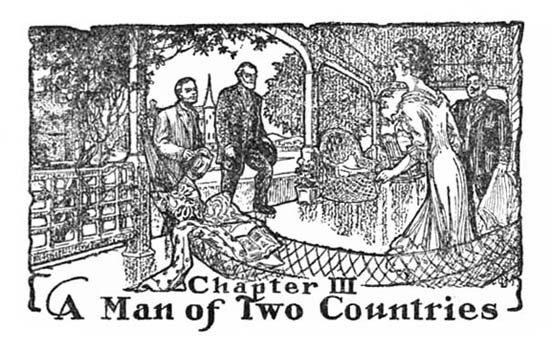
The callers found brother and sister on the wide porch, and after the
greetings and a half-hour of general conversation, Charlie Blair asked
the doctor if he would come inside and give a little advice on a private
matter.
"Good," cried Winifred. "For once I'm glad that Charlie can think of
nothing but business. Now I can talk to Mr. Danvers."
"See that you do!" commanded Philip. "Yesterday I went away feeling like
a garrulous dame; it is your turn to-day."
Winifred affected to reflect. "What shall be my theme—art, music,
literature or our mutual friends?"
"Tell me of yourself."
"As a subject of conversation, that would be soon exhausted. Women, you
know, are too idle to be good; too conventional to be bad."
"Indeed!" returned the cattleman, catching her mood. "I have known many
women of that description. Pardon me, but I had imagined you were a
different type."
"You say the nicest things! I feel that we are going to be very good
friends."
Danvers bowed. "Thank you. I think we are."
She returned his frank gaze, and settled herself comfortably for an
afternoon's enjoyment.
"Now talk!" she in turn commanded, with the sweeping imperialism she
sometimes manifested toward a chance companion.
"I refuse. It is your turn."
"How you like to put on the mask of silence! Do you bolt the door to
everyone but the doctor and Judge Latimer?"
"Thoughts are hard things to express, unless one forgets himself, and
they come spontaneously."
"Go ahead and forget yourself, then!"
"You are inexorable," laughing. "Your demand makes me think of an Indian
Council. Of course, you know that when they meet to discuss problems,
they sit silent for hours. The avowed purpose of conferring paralyzes
their tongues, apparently, as you have paralyzed mine. If I ever had an
idea I could not produce it now."
"The Quakers have a prettier custom. They sit in silence till the spirit
moves. I will be the spirit that moves you;" and so adroitly did she
continue that unconsciously the man spoke of more serious things—his
likings, his beliefs.
"Why did you become an American?" she asked at length, the question that
had often puzzled her.
"My mother was an American." His voice took a note of tenderness which
Winifred remembered long. "But when I left the service it was with no
thought of choosing this as my country. I had no desire to return to
England, however, and the chances for business seemed greater on this
side of the line."
The girl's deep eyes gazed directly into his with flattering intentness.
"And so the years slipped by until I found that my interests were all
here, and I could not leave, even if I had cared to. Isn't that true,
judge?" he remarked, as Arthur Latimer came across the lawn. "You wanted
to make a voter of me, for your own dark purposes——"
"Philip always hits the bull's-eye," admitted the judge, interrupting
with a menacing gesture of affection at the implication. "You would not
leave the State. That's just it. The most of us came into the Northwest,
as we thought, to make a fortune and go back East or South to enjoy it.
But whether we have made money or not, we discovered that we are here to
stay. The old ties in other communities are gone. Old friends are dead.
Old memories faded. We aren't all such enthusiasts as the doctor, who
lives at Fort Benton for sheer love of the place, but——"
"I know just how he feels," cried Winifred, quick to defend her old
friend. "I could go back there myself to live. We have a love-feast
every time we speak of the dear old town, and that's every time I see
him."
"I think," said Danvers, slowly, making sure of his words, "that I have
come to love Montana more than my native land, though that was certainly
very far from my feeling when I came back to Fort Benton as a civilian,
and asked for work. I told the man that I was an Englishman, but I made
a mistake. There was a long list of applicants ahead of
me—Americans—to whom preference would be given. I thanked the manager,
but from that day I determined to succeed without being forced into
citizenship. I did succeed, and of my own choice I became an American!"
"Words, words! What are you talking about?" the doctor asked, breezily,
as he appeared with Blair. "Let us into your charmed circle. I, for one,
promise to be silent. Any occasion gains dignity by having an audience,
and I'll promise not to be critical. I will consider your youth."
After a general laugh, the judge gave the trend of the conversation, and
the doctor quite forgot his promise. The discussion of good citizenship
became general, and presently Philip was appealed to for testimony on
the subject of foreigners becoming naturalized.
"I hardly think I can tell you much that you do not already know," he
said, "concerning Englishmen becoming American citizens. We must give
the inhabitants of every great European country the credit for believing
their own country to be the greatest. With the possible exception of
Russia and Turkey, I am inclined to the opinion that they think their
liberty is not infringed upon, any more than it should be; and they are,
I suppose, contented with their lot. John Bull has every reason to think
himself a favored being. He is proud of the institutions of his
country—royalty, aristocracy. The knight, the 'squire, the merchant,
manufacturer, skilled workman and laborer—each has his place. The
laborer, cap in hand, bows to his master. So, too, aristocracy bends the
knee to royalty—being taught to keep allotted rank in society, and to
defer to those above. What is more, all have a supreme regard for the
law itself, as well as for those who administer it."
Winifred listened. Her bright, upturned face was an incentive for
Danvers to continue.
"When we Englishmen come to this country," he said, "knowing but little
of the government, we care nothing for it. We generally come to better
our condition financially, not politically. When we see the actions of
political heelers at elections we are often astounded. We hear of Tweed,
of Tammany, and it is not surprising that we have a certain contempt for
American politics. If we watch very closely we see men elected to
office who are entirely incompetent, and we even have suspicions of
their honesty."
The girl laughed lightly.
"You choose to be very sarcastic," she commented. But Danvers had more
to say.
"As time goes on we watch events, comparing the government of this
country with that of our own. Little by little we are brought to feel
that these States are being fairly well governed, after all. In my own
case, when Judge Latimer asked me to take an active part in politics, I
hesitated. But I had cast my lot in Fort Benton, and it seemed wrong to
accept all that America had to give with no return from myself."
The Anglo-American looked around his circle of friends. Never before had
he expressed himself so fully. He could not understand how he had been
beguiled. But never before had he felt that a woman's brain would grasp
every reason adduced, and understand—that was it; he felt that he was
understood!
"Montana politics are like an Englishman's game—high. They smell to
heaven," said Charlie Blair, after the men had further discussed the
political situation.
"I don't believe that Montana is any worse than many other States,"
defended Winifred, quickly.
"We are building history," said the doctor, dreamily, "and history
repeats itself. As the powerful nobles of Greece and Rome dictated harsh
terms to the common people and ruined their nations, so it will be with
us. Machine politics, money and whiskey, millionaires and
monopolies—truly the outlook is depressing."
"You are not usually so pessimistic, doctor," reproached Winifred.
"Well"—Blair's contented philosophy was refreshing—"politicians seldom
get more than one-fourth their money's worth, when they use it
unlawfully. Three-quarters of it is wasted by giving it to hangers-on."
"Public men should be unhampered by demands for spoils."
"They invite the demands, Phil," replied the doctor, dryly. "If it were
not openly known that a man could get a position as a corporation
lawyer, or timekeeper in a big mine, or some other inducement, do you
think any would-be senator, for instance, would be troubled by
distributing 'spoils of office'?"
"He would not be troubled with superfluous votes, either," remarked the
judge, caustically.
"Oh," cried Winifred, with a vision of what might be, "if only the
candidates and the voters could be brought to see that public office is
a public trust; that the honor of election is enough!"
"That is the way it is in England," answered Danvers. "There, for
instance, a man is elected to a city council for his personal fitness
and ability to hold office. No questioning of his political
affiliations. No perquisites—no privileges. Only the honor of his
fellow citizens, which is enough. It is the same in other positions,
even in Parliament."
"Here comes Mrs. Latimer." Miss Blair rose and advanced to meet her
friend. "I see by your eyes, Eva," she said gaily, "that I have to
placate you for monopolizing all the men in sight."
Mrs. Latimer laughed, and the circle widened to admit her.
"You are talking of politics," she accused, lazily. "Either that or of
Fort Macleod."
"Madam," the doctor affected remorse, "we were talking of politics. But
when you burst upon our enchanted vision, as beautiful as when you
dazzled us sixteen——"
"Oh, don't!" shuddered Eva. "Why—why will men be so exact as to dates?
Why not say 'some years ago'?" She looked around rebelliously. "I will
not grow old, even if you, dear doctor, have silvery hair, and Arthur's
is growing thin, and Mr. Blair—well, I'll admit the years have dealt
kindly with Charlie and Mr. Danvers."
"And with you, dear," added her husband, loyally.
"How do you like my gown?" asked Eva, turning to Miss Blair as the men
began to talk of other subjects.
"It's lovely! You are so artistic! It must please your husband to have
you so perfectly gowned."
"Oh, Arthur—as for one's husband, I simply can't imagine dressing for
one man."
"I can," breathed the girl, her thoughts afield. But the sentiment was
lost upon Eva.
"If I lived nine miles from nowhere I would dress and walk among the cow
corrals or on the range for the cowboys—if there were no other men to
admire me!"
"You say such dreadful things," Winifred answered, gently, "but I know
you do not mean them."
"But I do!" wilfully.
"I have grown away from the East," the doctor was saying, when the
ladies again listened. "I want more room than the crowded cities can
give.
"'Room, room to turn 'round in,
To breathe and be free.'
"I fancy the Puritans wanted physical as well as religious freedom, if
the truth were known." He mused; then suddenly:
"How can you make one who has never experienced it feel the West?"
"You can't," laughed Latimer. "I tried once, but my companion looked
bored, and I stopped. 'Oh, go on,' he said, politely; 'you are
interested!'"
When the merriment had subsided, Eva exclaimed:
"I'm sick and tired of the West! I want to live in New York, Washington,
abroad—anywhere but Montana!"
"I wish that we might, dear," said the judge, patiently; "perhaps we can
some day."
"By the way," remarked Eva, her thoughts flying inconsequently to
another subject, "I've promised to read a paper on 'The Judiciary of
Montana' before our club to-morrow. Tell me all about it, Arthur, and
I'll write the essay this evening." She looked at the group in surprise.
What had she said to raise such shouts?
As soon as her husband could speak he wiped his eyes.
"It's a pretty big subject for me to discuss now," he said; "but I'll
write something. That will be better than confusing your mind with it.
These club-women," he went on indulgently, addressing the others, "are
so fervid—so much in earnest."
"Are you a club-woman, too?" the doctor asked Winifred, and Danvers
waited her reply.
"I used to be," dolefully. "But I am a renegade, or a degenerate. I was
allowed to join the classic circle of a Dante Club, and for two years
we (perhaps I'd better say I) agonized over the prescribed study—the
course was sent out by the university. But when the third year arrived I
wearied of well-doing. I was horrid, I know; but the subject was remote
as to time, and dead as to issues. I like live topics, real
issues—Montana politics, for instance."
"You might have joined the Current Events Club," reproached Mrs.
Latimer. "To be sure, it's sometimes hard to find topics for the next
meeting, but we get along. Club work broadens our minds and widens our
sphere," she concluded, with a pretty air of triumph.
"And when topics fail—to write about," put in Blair, "you can talk. You
ladies always find enough to talk about!"
"Why, Charlie Blair! You're just as horrid as you used to be!" responded
Eva, hotly.
"Didn't I hear something about one lady's stabbing to death another
lady's imported hat, just on account of too much talk at one of the club
meetings?" Blair was persistent.
"That story about the hat has been grossly exaggerated! It is nothing
but gossip."
"'Current Events,' too," murmured Charlie, properly deprecatory.
Not long afterwards Danvers made the first move toward breaking up the
group.
"Must you be going?" Winifred rose also. "I suppose I shall not see you
again before the Assembly meets. You'll be sure to be here then, as
senator from Chouteau."
"Thank you for your optimism. May I call?"
"Certainly. I should feel hurt if you didn't. We are friends of many
years' standing, you know."
Never before had he asked to call upon a lady. The importunity had
always been on the other side.
Late in the evening the doctor came to Danvers' room for the good-night
call; but the talk was wholly of Judge Latimer's interests.
"I'm afraid that Arthur will have a hard pull," regretted the old
friend, "but we will do all we can for him. I've had a telegram calling
me back to Fort Benton, and must leave on the midnight train."
Danvers walked to the little depot, a mile from the city proper, with
his friend, and after the train pulled out he again thought of Winifred.
As he passed, on his way back to town, the huge piles of loose rock that
the miners had left in their sluicing for gold in bygone days, his
thoughts followed the girl back into the long years since he had first
met her on the Far West—a child eager for sympathy. It was odd that
he had never seen her in all that time—the years when he had
unconsciously longed for friendship, and the sight of a woman's face—a
white face. The rings from his cigar melted around him, softening his
face until it took on the boyish fairness of youth.
The evening before the convention found Judge Latimer at the club in
conference with his friends. His nomination seemed doubtful, yet there
was a possibility that he might win, and Danvers was working hard and
hopefully.
The Honorable William Moore had arrived from Butte that day, and as he
greeted various members of the club, watched for a chance to approach
Judge Latimer.
"What are the prospects?" he inquired, after a chat on politics in
general. "I calculate you'll need the support of Silver Bow County, and
we'd like to help you out."
"Of course, I shall be glad of your support," responded Latimer, who
knew it would be impossible to win without this important section of
Montana.
"Very well. What can you do for us—that is, for Burroughs?"
The judge moved uneasily. "It doesn't seem to me that I can do very much
for a man who has practically the whole State at his command."
"You know what we want!" scowlingly.
"I shall have no influence."
"Bah! What's the use talking? He'll make it worth your while. Get
Danvers to vote for Burroughs when it comes time to elect United States
senator. He never will unless you can persuade him. You know his feeling
toward Burroughs, although Bob's been a good husband and father. And
there's Charlie Blair, get him pledged and he'll be elected; and——"
"Hold on, Moore!" Latimer's voice trembled with anger. "Why should you
oppose me? Haven't my decisions always been just and——"
"I'm not saying anything about your decisions," broke in Moore,
"although it would have paid you to be amenable. I knew the time would
come when you'd want our political help."
"I don't want your help!" cried the judge, passionately. "If I should
be elected through your instrumentality I should feel as though every
man in the State believed that a decision handed down by the Supreme
Court was tainted with your money. As yet the Supreme Court of Montana
has been above suspicion, and so far as it is in my power, it shall
remain so!" He struck out, his slight form quivering righteously.
Across the room Danvers saw him, and walked quickly toward the men.
"I want to speak to you, Arthur," he said, and drew the judge into the
street.
"The elephant and the gazelle are trotting together," said Latimer,
presently, trying to be facetious in an effort to regain control of
himself. He looked up at his stalwart companion.
"Yes, and the gazelle is always looking for trouble when the elephant is
around, so he can be pulled out!" returned Danvers, in the same strain;
yet with the undercurrent of affection that always crept into his tone
when speaking to Latimer.
Words failed the harassed judge as he attempted to reply. This friend of
his! This dear friend!
"It is just as I thought, Phil," he remarked, after they had walked for
a time in silence. "Burroughs will block me."
"That's bad; but it might be worse. Let me see. Who are the delegates
from Silver Bow?"
"Bill Moore is the chairman. No need to specify the individual men, for
every one of them will vote as instructed. Oh, Burroughs has that
county well organized!"
"H-m-m!" mused Danvers, nodding affirmation. "Silver Bow is not the only
county, and Moore is not the only chairman. I am chairman of the
Chouteau County delegation, and we are solid for you. I have more or
less influence in other counties," modestly. As they walked they
canvassed the situation. Without Silver Bow it did look dubious.
Turning a corner they met O'Dwyer, ruddy and smiling as ever.
"Here's O'Dwyer!" cried Danvers. "He is always good in an emergency. His
fertile brain will contrive some method of procedure that will land you
safely on the bench for a second term."
A conference ensued. O'Dwyer shook his head doubtfully when he learned
of Burroughs' strong following, but said nothing until the three were in
Danvers' room.
"I heard Wild Cat Bill talking to yeh," he acknowledged, "and I think
I've got something up my sleeve." But he refused to disclose his plans,
only warning Danvers not to be surprised if he was late to the
convention, and they separated.
The convention was called to order. Campaign issues did not appear to be
of great moment; but when the chairman announced that the candidates
for chief justice would now be considered, there suddenly arose so much
controversy and ill-feeling that the meeting was adjourned until
evening. An active canvass was begun by Danvers for Judge Latimer, and
by Moore for his candidate. O'Dwyer of Chouteau County, seemingly not so
much interested in the business in hand as in looking up old friends
whom he had known at Fort Macleod, circulated joyously among the men. It
was not long before he was cheek by jowl at the hotel bar with Wild Cat
Bill (Moore never objected to the old nickname), and after sundry
refreshments and their accompanying chasers, he proposed that they dine
together. Mr. Moore was agreeable, and suggested a private room for the
meal, being under the impression that O'Dwyer would look favorably on an
effort to turn his allegiance from Latimer's candidacy.
As the dinner progressed he told O'Dwyer that he had in mind a lucrative
position which Mr. Burroughs would gladly bestow on an old friend, if
the Irishman saw fit to accept. Moore carefully explained, as the
glasses were filled and emptied, that he had no ulterior motive. Oh,
certainly not! O'Dwyer must not think that Burroughs ever offered a
bribe, even in so small a matter as this of defeating Judge Latimer in
state convention!
"Of course not!" agreed O'Dwyer, and surreptitiously glanced at his
watch. He redoubled his efforts to be the good fellow, and apparently
coincided with Moore's views on politics.
The clock in the court house struck half after eight. The convention was
called to order, and Mrs. Latimer, thrilling with the sense of unknown
possibilities, sat in the crowded gallery, and settled expectantly to
the excitement of the balloting. Strong and spicy speeches were
anticipated. Silver Bow, notoriously the hotbed of political agitation
in the State, possessed in Mr. Moore a star speaker. He always had
something to say, and was the chief factor in filling the ladies'
gallery. His fiery remarks and impassioned appeals were as exhilarating
as cocktails. Full well did Mr. Burroughs know the value of his trusted
henchman, both in caucus and on the floor, and he had left his cause
against Judge Latimer wholly in Moore's hands, with no understudy. He
had made the trip over from Butte the day before, and now expectantly
awaited the appearance of the Honorable William.
As the delegates and spectators listened to the blaring band they
watched the rapidly filling seats and noted the tall staffs and placards
indicating the various counties. Danvers looked in vain for Latimer;
Burroughs for Moore.
O'Dwyer had not appeared, and the chairman of the Chouteau County
delegation smiled as he thought of the Irishman's devotion to his
friends, and the possible discomfiture of their common enemy. But
Latimer's absence was disquieting. He had said something about little
Arthur's having a cold, but surely that would not keep him from so
important an occasion.
Nine o'clock. The chairman declared the convention ready to proceed.
Burroughs, hovering near the doors of the auditorium, looked anxious as
he saw Danvers rise to make his nomination speech for Judge Latimer.
Moore—the invaluable Moore—was not in the hall. The moments were
slipping by, and Burroughs hastily dispatched a messenger to his hotel
and to the club.
As Danvers gave a simple, earnest recital of Judge Latimer's
qualifications and the need for such men in the State of Montana, he saw
the judge enter. He spoke of his devotion to his family, his business
integrity, his high ideals; and ended with the plea that in this day of
corruption in high places, his own State preserve her prestige by
maintaining in office one who had been found able and incorruptible in
discharging his duties as judge of the Supreme Court of the State of
Montana.
As Danvers returned to his seat he was met by the recalcitrant Moore,
walking carefully, and blandly indifferent to Burroughs' angry oath with
which he had been greeted at the door.
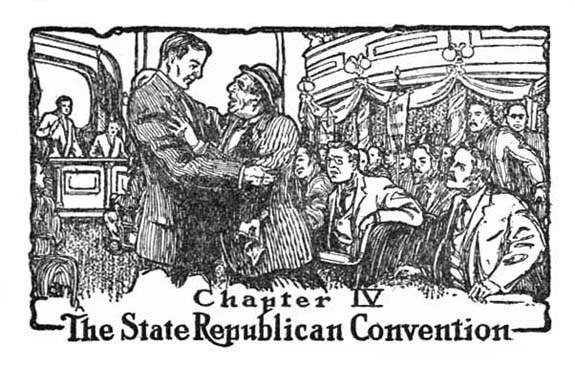
Danvers tried to avoid the wavering path, but the Honorable William had
a set purpose in his muddled brain. He fell upon the neck of the
delegate from Chouteau, and his arms met around Danvers' neck.
"I d'know yer name," he hiccoughed, enthusiastically, "but I know yeh're
a gen'lmun." The unexpected followed. Holding himself upright by the
embarrassed Danvers, he bellowed: "Mishter Chairman! I seconsh the
nomination!"
Pandemonium ensued—laughter in the galleries, drowned by the roar of
disapproval from Burroughs' candidate and his following. O'Dwyer hastily
gained the recognition of the chairman and again seconded the nomination
of Latimer, and the balloting began.
Burroughs, not being a delegate, had no place on the floor, and was
powerless. The leaderless flock from Silver Bow made weak efforts to
assert themselves, but O'Dwyer saw to it that Moore did not get to them
until affairs were well settled. The first ballot was taken, and Latimer
had a majority. He had received the nomination!
There were cheers and loud calls for Latimer, and he responded briefly.
In the excitement Burroughs succeeded in enticing the torpid Bill into
the lobby, and so effective were his words, emphasized by his fists,
that Moore returned to the hall a chastened man, and demanded that the
nomination be set aside. In the uproar Burroughs ventured onto the floor
and yelled to the cheering delegation from Chouteau County, "Howl, ye
hirelings!" He violently accused Danvers of collusion with O'Dwyer in
detaining Mr. Moore.
O'Dwyer was in no mood to permit this. For years he had idolized the
Englishman. In a moment he placed himself in front of the ex-trader, and
reaching, grabbed for Burroughs' nose.
"Do I understand yeh're talkin' agin me friend, Philip Danvers?" he
shouted, with a twist of the olfactory member. "If I hear anither
whimper out of yez, I'll smash yeh one! I got Bill Moore drunk—I! Yeh
can settle wid mesilf!"
In the tumult the meeting adjourned, and Danvers was glad to get out of
the hall and have a word with his friend.
"Why were you so late, Arthur?" questioned Danvers, as soon as they had
a moment together.
"My boy is not well," Arthur explained, as his eye roved anxiously
around the circling balcony. "Eva had set her heart on hearing the
nomination speeches, and so I stayed with the laddie until the last
minute. I couldn't bear to leave him alone with the nurse-girl."
"Let me go for a doctor!" begged Danvers, anxious to be of some help.
"No, he isn't sick enough for that—I did call a physician about dinner
time. Perhaps I'm foolish," he smiled wanly, "but if anything should
happen——"
"Tut! tut!" Danvers put his hand on the stooping shoulders. "I'm going
home on the midnight train, and I'll send the old doctor up to see the
lad; or," with a sudden thought, "why not wire him? I will do it as I go
to the station."
"Perhaps you'd better," agreed Latimer. "I wish he had remained here for
the convention; but I know he will be glad to make the trip for the sake
of the boy, and the sight of his face will do me good."
"You've been working too hard. Take it easy now and don't worry,"
counseled Danvers. "I shall be up again in a few weeks, and in the
meantime write to me, Arthur."
He stood a moment as Judge Latimer waited for Eva. He felt, somehow,
that his friend needed him. But his train would soon be due, and with a
hearty hand-clasp he said good-night and hurried away for the Fort
Benton express.
The days that followed the convention were like a dream to Danvers when
he remembered them afterwards. He had scarcely picked up the old life at
Fort Benton—looked over his cattle and gone over his neglected
correspondence, when a telegram from the old doctor recalled him to
Helena.
Arthur Latimer's tragedy had come, and Danvers, unfamiliar with death,
knew no words of consolation for the father bereft of his firstborn. A
numbness mercifully comes during those first hours, which makes it
possible to move about and go through strange, meaningless ceremonies
with a calm that surprises those who have not known the searing touch of
the death angel.
A few days later he and the doctor were back at Fort Benton again, and
life moved on as before. Only there was always the memory of Latimer's
drawn face that no laddie's voice would lighten, no little hand caress.
The doctor hoped that the political campaign would occupy his thoughts
for the present, but when the election went against Latimer he shook his
head.
"Read this letter," he said to Danvers one evening. "It came to-day, and
I should have sent for you if I hadn't felt so certain you would drop
in. You're the one to go."
It was a letter from Winifred, and Danvers felt a peculiar sensation of
satisfaction in seeing her handwriting, as if it gave him an added bond
to their friendship.
But he forgot Winifred in his anxiety over the message her letter
conveyed.
"I wish that you or Mr. Danvers could come to Helena," she wrote.
"Judge Latimer is so changed since little Arthur's death that we
sometimes fear for his reason. Since the election has gone against
him there is no direct interest to take his attention and he has
sunk into a deep melancholy. You could rouse him as no one else
could. Please come—one or both of you."
Danvers read no further, but looked up to catch the doctor's eye. He
nodded. "All right, doctor. I'll go to-night."
His heart was drawn still more closely to the stricken man. He longed to
bring back to that sad face the smile that he remembered on the Far
West, when Latimer's buoyancy had been like wine to his lonely heart.
He felt confident that the friendship of one man for another could reach
the heart of his friend, now closing against all human sympathy.
It was noon before Danvers reached Helena and made his way to Judge
Latimer's residence. He was startled by the absence of life, the silence
and drawn shades. Turning, he saw Miss Blair entering her own gate.
"I'm so glad you've come!" cried the girl, with unaffected pleasure, as
he hastened towards her. "But didn't you know that the Latimers had gone
to the hotel for the winter?"
Danvers had not known.
"Come in and have lunch with Charlie and me," she urged; "it will be
ready in just a minute. Charlie will be here soon and will want to
congratulate you on your majority."
"But Arthur—I feel I must get to him."
"Come in and telephone. He has opened offices down town and you may find
him there. I call up Eva every morning, but Judge Latimer is out a
great deal."
While she was speaking Danvers had followed her into the house. It was a
homelike room; a canary's trill greeted them, and a glimpse of
old-fashioned plants in the bay-window wakened memories of English
homes. How different it was from his rooms at Fort Benton!
Winifred smiled brightly as she made him at home, and excused herself
for a moment.
"And how is Judge Latimer?" questioned Danvers, as she reappeared from
the dining-room with a big apron, which she fastened about her waist in
a most businesslike manner.
"He needs cheering—needs loving! With the old routine of office
suddenly lacking, and little Arthur gone, the man is lost—aimless.
There seems to be nothing worth while—nothing to keep him with us! And
there are other troubles—I don't understand them myself, but you will
know how to help him. I'm so glad you have come!" she repeated, with a
warmth that made his heart beat faster. What would it be like to find
such a welcome for his own sake—and every night when he came home!
"Did you 'phone the office?" The words recalled him.
"Yes. He is down in the valley; the clerk didn't know when he would
return."
"We won't wait for Charlie. He's often late, and I know you are anxious
to find the judge."
After a few minutes' absence Winifred announced that luncheon was ready.
As Philip held the curtains for her to precede him to the dining-room he
looked longingly at the sweet-scented blossoms in the window.
"I have seen nothing more delightful in years," he explained. "I am
old-fashioned enough not to care for palms or rubber plants."
"Another bond of friendship," smiled Winifred, lightly. "Shall I make
the salad dressing, or would you prefer to mix it yourself?" she asked,
after she had persuaded him to take the head of the table.
"I make a dressing that is the despair of my friends," she continued.
"So I make them shut their eyes when I mix it, else my one
accomplishment would be mine no longer."
Philip promised, with a smile, to "play fair." He delighted in the
housewifely nonsense, and ate the salad, though he hated olive oil.
"Salads are a woman's folly," he had once said. But he did not repeat
it.
"How do you like it?" Her mood suited the visitor. The light
conversation took his mind from the more serious purpose of his visit,
and Winifred's accent implied accepted friendship. He needed this
relaxation.
"I never cared for salads, before," he replied truthfully.
"Why did you eat it?"
"I ate it, and I liked it because you made it for me. I am not used to
being waited upon, and I rather like the experience."
"You poor man!" Winifred sympathized without reflection. "It must be
horrid not to have anyone to do things for you. I should think—I
mean——" she colored as she met Philip's eyes, "I mean—Charlie says
that I have spoiled him completely."
The advent of Blair relieved the girl from her condition of fragmentary
speech, and they talked of the Latimers and the political outlook for
the coming winter.
Danvers took his leave with a feeling of regret at parting from
unexpectedly congenial friends. How little he had known of Blair—the
good fellow. How cheery and unaffected Winifred was! The years were
bridged which had separated him from his kind, and as he walked down the
street he felt a glow of kindness toward all the world.
He called at the hotel, thinking Latimer might have returned, but Mrs.
Latimer pettishly denied any knowledge of his whereabouts. He often went
for long walks, she said, and seldom returned until late. "Won't you
stay until he returns?" she invited, but Danvers pleaded business.
Twice during the afternoon Danvers ran up to the judge's office, but
failed to find him until evening. Seeing a light in the inner office, he
opened the door and entered.
The judge did not look up. He sat with his back to the door, and gazed
intently at a revolver, while his hand played idly with the trigger.
Danvers stepped forward and silently reached for the weapon.
"No, no, Arthur! Not that!"
"Phil! You?" Latimer sprang from his chair. "Why—why——"
Danvers was shocked at the haggard face.
"I ran up from Fort Benton, Arthur, just to see you. I've been looking
for you all the afternoon." He gently pushed the trembling man back into
his chair.
"Why—why did you stop me? It would have been over—now—if——"
"Life is not so bad as that, old friend."
"Isn't it?" bitterly. "If you——"
"I can understand—I know. But you must promise me that you will not
attempt this—again." Danvers spoke firmly, feeling that he could never
leave his friend if he were not given a pledge.
The broken man looked into the kind eyes opposite. "You think me a
coward, don't you? I promise."
"No," refuted Danvers, warmly. "You are worn out, mentally and
physically; that is all. Take a run to the coast with me for a month or
two——"
Latimer began to laugh, mirthlessly. "I couldn't take a run to Fort
Benton, Phil. I haven't a dollar—not a dollar. I'm a ruined man!"
"Arthur!"
Latimer took a paper-knife and checked off his sentence. His voice was
impersonal.
"You made a mistake, Phil, when you interrupted me. No, do not speak,"
he raised his hand. "I was in possession of what sanity I've had since
Arthur——" He did not complete the sentence. "I've deliberately decided
that a quick shot was the only solution of my problem. Boy gone; home
gone; my dearest ambition frustrated; hopelessly in debt——"
"I can help you in that."
"And disbarment proceedings about to be instituted," finished Latimer.
"What!" ejaculated Danvers. "Who will institute them? On what grounds?"
"Burroughs. He has trumped up some infamous charge. I got a hint of it
only this morning—a straight tip."
"He shall not do it! I shall have something to say to him—to the
papers. He would not like to have them get hold of Moore's interviews
with you and me on the matter of that Supreme Court decision. I——"
"Papers!" Latimer threw out his hands with a helpless gesture.
"Burroughs owns every paper in the State!"
"Well, then, I have another card to play. You leave this matter to me.
You are not going under, and you are not going to—die—not yet! Bob
will drop the disbarment proceedings, I promise you; and if he is not
amenable to reason—why—he does not own the Associated Press!" grimly.
"N-no. But I'm broke—ruined."
"What do you think a friend is for, Arthur?" said Danvers,
reproachfully. "If I had had any idea that financial matters were
troubling you, I would have fixed you out in short order!"
"I can't accept favors."
"Favors!" slightingly, to cover his feeling. "I shall be a
Shylock—never you fear!" Then a hand, heavy with love, fell on
Latimer's shoulder. "What is mine is yours, Arthur."
Within a week, not only were the judge's difficulties relieved, but the
proposed disbarment proceedings were dropped.
"I had means," said Danvers, sternly, when pressed for details by the
grateful judge, and none but Burroughs ever knew of the threatened
exposure.
Before Danvers returned to Fort Benton, he had the pleasure of seeing
Judge Latimer off for the East on legal work and knew that his low
mental condition was replaced by a more healthy one. Mrs. Latimer he
avoided. The gratitude of Winifred Blair came as a surprise, and
strengthened their sympathy in this common cause. He called to say
good-bye, but found her not at home, and he left Helena with a distinct
feeling of disappointment.
The state election in November gave Danvers a handsome majority, and it
was as the senator from Chouteau County that, early in the new year, he
attended the governor's reception to the legislators. He came in late,
and after paying his respects to the governor and his wife, wandered
rather helplessly toward the hall, seeing many whom he knew, but finding
little pleasure in their casual greetings.
Mr. and Mrs. Burroughs, as well as the Hon. William Moore, had come from
Butte to attend the brilliant society function. Other acquaintances who
now lived at the capital were among the guests whom Danvers recognized.
His sister he seldom saw, and the lack of any common interest between
them made it possible to meet her husband in only the most formal way.
Presently he saw Winifred Blair at the salad table, who, chancing to
look up from her task, smiled invitingly.
"May I not serve you with salad?" she asked, as he approached.
"If you will make the dressing," recalling their lunch of the late
summer.
"It is already dressed," laughed the girl.
"Then you will let me get you some punch; come with me for it."
She was perishing of thirst (by her own statement), and Danvers finding
some one to take her place for a time, discovered a quiet corner of the
library past which swept the tide of callers. Hither he enticed Miss
Blair, and soon brought the refreshing drink. She sank on the window
couch.
"How nice to be looked after," she said, gratefully. "I believe that you
knew I was tired of the silly things one must say to men whom one never
expects—or wants—to meet again."
"Never say silly things to me or I shall think I am in the category."
"Very well, I will not. I've always had to be to other people what they
wanted me to be—what they expected. Somehow, with you—I am myself."
"You could not pay me a higher compliment."
For some minutes they chatted of the coming assembly and then wandered
to the discussion of a book which denied love to be the greatest thing
in the world. By that instinct which prompts men and women to talk of
this one subject they enlarged on the topic, impersonally at first, as
if it were a matter of the price of cattle.
"Then you do believe in the great passion?"
"Certainly; don't you?"
"I used to think that I did—years ago. But one sees the counterfeit so
often."
"There could be no counterfeit unless the real existed."
"You are right. The real is so rare, then, that one despairs of knowing
it." The subject grew more personal. "But we all want the genuine."
"I don't care for paste diamonds myself, no matter how well they
imitate."
"You have had opportunity to discriminate?" tentatively.
"I—think so," Winifred replied, reflectively, as if he had asked
whether she liked cucumbers, and his face clouded, for no reason.
"Vicarious experience," she added, mischievously.
"Oh!"
"I have admired men; liked a few immensely," she admitted, frankly. "But
the mysterious glow which comes—it has never enveloped me," she ended
abruptly. "Since we are getting so personal, how about yourself?"
"I——" he hesitated.
"You needn't finish!" Winifred nodded, laughing. "Other men swear by the
little god that they have never loved—never—until——" Once more
Winifred found her facile tongue had led her into difficulties.
"Other men lie—I do not; yet you evidently do not believe me."
"Yes, I do! That is what I so like about you. People believe you, trust
you, know where you are to be found."
"I know no other way," replied the Senator. "It is no merit. I simply
find it awkward and inconvenient to prevaricate."
"You are to be congratulated," murmured the girl, ransacking her memory
for another man who could say as much.
An eddy of the flowing stream of guests brought Mrs. Burroughs towards
them. Mrs. Latimer, too, came into the deep window space, the ladies
talking animatedly.
"Am I not right, Winnie?" appealed Mrs. Latimer, after the felicitations
of the day had been exchanged. "I say that a woman has never had a love
affair worthy of the name who hasn't had a lover called 'Jack.'
Jack—the care-free; Jack—the debonair; Jack—the dare-devil! It's all
in the name, Jack."
"Alas!" moaned Winifred, entering into the gay spirit of the moment.
"Alack, woe is me! That I must confess my poverty before woman"—she
glanced at Danvers—"and man! I've had lovers of many names—Henry and
Jim and—and—Bi——" she seemed out of names—"and of many hues—Brown
and Green and Black; but never a Jack for me!"
"If you haven't had an adorer by that name," laughed Mrs. Latimer, "it's
because no man in the state answers to the name of Jack!" They all
joined in the merriment, to Winifred's confusion.
"'Thou, too, Brutus!'" she quoted reproachfully. "What will Senator
Danvers think of me, with such a reputation as you give."
"Suppose I have my name changed," suggested Danvers.
"Philip suits you very well," Miss Blair answered, sedately. "You
intimated a few minutes ago that you were rather inexperienced," she
went on daringly. "If this winter you will try for such a reputation as
Mrs. Latimer gave me, I'll agree to meet you on the field of battle." As
she concluded the doctor came up and the joke was explained to him. He
turned to the Senator.
"You're too old to have your name changed, or to affect the tender
passion, Phil. Leave that to younger men—to me! I'll have my name
changed to Jack, right away; and as for loving, I have always loved
thee!" bowing to Winifred.
A chorus of shrieks greeted the doctor's declaration.
"No," insisted Philip, when his voice could be heard, "I am going to
enter the lists, inexperienced as I am."
The challenge in his eyes was good to see, but Winifred could not meet
them. Delighted at the sight, the doctor changed the subject, and soon
the group broke up.
As Danvers greeted others, he noticed Eva Latimer in earnest
conversation with Mr. William Moore. He bowed in passing, but their
lowered voices paused only long enough for the conventional greeting.
After making the round of the parlors, Danvers found the doctor and soon
afterward they returned to their hotel.
The next morning Judge Latimer was surprised to find his wife taking a
sudden interest in politics.
"Why is there so much opposition to Mr. Burroughs for United States
senator?" she inquired.
"Several reasons," he answered, evasively, thinking she would not be
interested to pursue the subject.
"But he will be elected."
"That remains to be seen."
"He has thirty pledged out of the whole ninety-four, and several——"
"How do you know? Where did you get your information?" Latimer spoke
sharply.
"Mr. Moore—nobody talked of anything else, it seems to me," amended
Mrs. Latimer, with what carelessness she could assume. "Since the
legislators have been arriving I have heard nothing discussed so much as
Mr. Burroughs' chances of winning the election."
"That comes of living in a hotel," said the judge, bitterly. "Burroughs'
headquarters are on this floor, too, confound it! I wish we had not
given up our home."
"I don't," cried Eva. "Politics are lots of fun! I had no idea how much
until this winter. It's so exciting!"
She did not tell her husband that the Honorable William Moore had been
at considerable pains to interest her in the coming struggle, even
prolonging his frequent calls unduly, in giving her an insight (so far
as he thought necessary) into the workings of practical politics as
expounded and promulgated by Mr. Burroughs and himself. So delicately
had he broached what had been in his mind since the night of Eva's
dinner party that before she was aware she had promised that she would
do what she could to forward Burroughs' cause with recalcitrant members.
The political manager had assured her that his patron, in his gratitude,
would make the reward for her services magnificently great.
Mrs. Latimer had not been cajoled into this without some scruples, for
she well knew what her husband would think. She remembered, too,
certain interviews of her own with Burroughs, which she would have liked
to forget; but it was many years ago that he had made love to her, and
she succeeded in allaying the troublesome reproaches of conscience by
the justification of the urgent need of retrieving their fortunes. If
Arthur could be made minister to some foreign capital (her ambition had
vaulted to Berlin) he need never suspect her share in its offer.
Mr. Moore had told her that only a rich man could afford to be at the
head of one of the larger legations, and had most thoughtfully placed
certain mining shares in her name, whose value had already increased
gratifyingly. When Arthur should ask her how he could accept such a
position, she would triumphantly produce the fortune made from these
shares, and explain that she had judiciously invested the small
patrimony from her father's estate. It all seemed easy to the ambitious
woman. Only a little effort to interest certain men—could anything be
easier?
And the gold which she had found after Moore's last call! When she had
sent him word he told her that he had its duplicate; to use the money,
since she had found it. The temptation was great. Arthur was always
complaining of unpaid accounts. She settled certain debts with a light
heart. He would never think to inquire about them.
So now she merely looked misunderstood as she continued: "It is nothing
to us, of course, whether Mr. Burroughs is elected; but"—she hesitated,
not knowing how best to proceed—"I'm sure a word from you would have
great influence with the members."
Latimer was dumfounded. Then he began to laugh.
"You would make a first-class lobbyist!" he said lightly. "Have a care!
A word from you would be worth ten of mine." Then, more seriously:
"Don't talk too much of this, Eva. It is going to be a bad business
before a senator is elected. Ugly rumors are heard already. I know
of——" He changed his words. "Mr. Burroughs is not respected among men
of integrity. Not even among men of low standards. His wealth is his
only asset. Unscrupulous, defying investigation——" He pulled himself
up. Never before had he expressed so definite a judgment on the
millionaire.
But though he cautioned his wife, Latimer had no suspicion that it might
be necessary. She had lived purely on the surface, showing no interest
in anything but dress, society, herself. It did not occur to him that
ambition might render her something more than a butterfly. In this
respect Moore read the woman more accurately.
That week Helena was billed for Italian opera. The announcement of Il
Trovatore made Danvers' heart leap with desire to hear it once more. He
knew it was doubtful whether the company could sing, but it could not be
wholly bad.
When he first heard the opera, during a boyish holiday in London, it was
at the height of its popularity, and every evening of his vacation found
him enthralled in the boxes. The isolation of the frontier had but made
the old music more loved, and Philip decided to make up a box party of
his friends. Miss Blair had told him that she had never heard it in its
entirety. She should be the guest of honor. Judge and Mrs. Latimer,
Blair, the doctor from Fort Benton and O'Dwyer should complete the
party.
"The opera has been given for the last twenty years," said Senator
Danvers to Miss Blair, as she expressed herself delighted to accept his
invitation. "You could hardly get a corporal's guard to go across the
street to hear it in New York, I fancy; but it was the first opera I
ever heard, and I love the old airs."
The theater was filling fast as Danvers held the curtain aside for his
guests to enter the box. The distractions of the opposing forces at the
capitol were, for the time, dismissed, and he listened with amusement
to Miss Blair as he assisted to remove her light opera cloak.
"I've never been in a theater box before," she confessed. "It makes one
feel exclusive, doesn't it? And, oh, dear! dreadfully self-conscious.
Suppose I fall out—over the railing? I'm sure I shall bring disgrace
upon us!" She looked gaily at her host. "Suppose I should fall over?"
she repeated, her eyes wide with pretense.
"Somebody would catch you," said matter-of-fact Eva.
"If you think that you are growing dizzy from looking over that fearful,
two-foot precipice," said Danvers, adopting Winifred's tone, "I'm going
to be the one to save you from a tragic death! I'll go around now, and
get ready to be a hero!"
"Don't! A lady in an opera box is worth two in the orchestra seats,"
paraphrased Winifred, blithely. "I will not fall out."
As Danvers pulled her chair a little further from the low rail, Winifred
noticed his face change.
"What is it?" she asked, in quick response.
Philip smiled a little sadly. "'My heart is on the ground,'" he
answered, using an expressive Indian phrase. "I cannot be light and
witty. I am cursed with seriousness."
"Your friends like you just as you are." But in this frank avowal the
senator found no consolation.
Danvers' enjoyment of the familiar opera was augmented by the
appreciation shown on Winifred's earnest, mobile face. The company
proved to be exceptionally good, the voices above the average, the
acting intelligent and con amore. The passionate intensity of the
Italians soon enthused Miss Blair into forgetfulness of those around
her. While her brother and O'Dwyer sat stoically, the doctor
contentedly, and Mrs. Latimer indifferent in her secret musing, Arthur
and Philip followed, with her, the fortunes of Leonora. Not until the
curtain fell on act three did she readily join in the chatter of her
friends, and then only when Judge Latimer said to his wife: "You should
have heard Phil sing 'Di quella pira' when we were at Fort Macleod. He
reached that high note quite as easily as this Italian."
"Don't you believe him, Mrs. Latimer," besought Danvers. "Make allowance
for his well-known partiality."
"Certainly," responded Eva, trying to make her tone indifferent. She
never was quite sure of her voice when speaking directly to this man who
ignored the past.
"Do you sing?" Winifred turned with a quick motion which was
characteristic. "Do you, Senator Danvers?"
"I do not."
"But you did?"
"You bet he did!" blurted out O'Dwyer, ever ready to recite the good
qualities of Danvers. Thereupon he told of the Christmas supper, Colonel
Macleod's request, and the duet. "But they sang in English, so a
Christian could understand—not this Dago lingo," he concluded. The
Irishman's contempt for the soft Italian syllables was irresistible.
"Oh," sighed Winifred, after the laugh had died away, "I wish that I
could have been at Fort Macleod that Christmas night!" she included
Judge Latimer in her friendly glance.
"Mr. O'Dwyer did not tell you that he could sing!" chortled Latimer. But
O'Dwyer begged to be spared, and after some good-natured raillery the
judge acquiesced.
"Has that particular duet already been sung?" Winifred's eyes shone as
she leaned toward her host. "If it has I shall insist upon its being
repeated."
"You are so used to having people do as you ask that I believe you
would," volunteered Eva.
"Of course I would. Everybody does as I wish."
"Perhaps that is because you do not ask impossible things," put in
Senator Danvers. "But to relieve your anxiety, and to prevent your
rising and asking for something that might be refused, I hasten to
assure you that the duet has not been sung. Mr. O'Dwyer forgot to say
that it was the Miserere that we tried to sing for dear old Colonel
Macleod. I'm afraid we did it pretty poorly."
From this the conversation drifted to other matters.
"I don't see Mr. Burroughs, Senator Danvers, although your sister and
niece are in one of the opposite boxes," said Eva, sweeping the house
with her glasses. "Nor Mr. Moore, nor Senator Hall—although his wife is
here," she added.
"Politics are more exciting than Italian opera, I fancy," said Winifred.
"The politicians are pretty busy," confirmed the judge.
"Whom do you think I saw on the street to-day, Danvers?" asked Blair,
suddenly. "McDevitt!" he announced, waiting for no speculations.
"No!"
The men were surprised, for McDevitt, the missionary-trader, had long
since been forgotten.
"He says that he lives in Montana now, somewhere near the Canadian
line."
Just then a messenger boy brought a telegram for Danvers, who excused
himself to read and answer it. As he returned the opening bars of
Leonora's florid song sounded, and under cover of the music the doctor
whispered to O'Dwyer: "You did better to-night in your whole-souled
praise than when your elbow was sprained at Fort Macleod. This is the
girl!"
"Betcher life she is! An' what's more, she's on!" The Irishman reverted
to trooper slang in his ardor, and got a sharp nudge from the doctor in
consequence.
The beautiful melodies followed in swift succession. Miss Blair gave a
sigh of appreciation as the Miserere "Ah che la mort" was sung, and
unconsciously put out her hand. The sleeve of her soft evening gown
brushed Danvers' arm, and instantly his heart began to sing. Not so had
he been stirred by Eva's conscious touch, years before. Eva had not
struck the chord divine—this thrill revealed it.
"I want to live," breathed Winifred, "while there is such music and such
love in the world. I don't care if it is old—the opera. Music and love
never grow old."
As the duet ended, Winifred and Philip, each in the thrall of the divine
song, looked deep into each other's eyes. Confused, startled, the spell
was broken, and Winifred turned again to the stage.
When the Latimers were alone in their apartments the judge remarked on
Danvers' generosity. "I never knew a man who so delighted in giving
pleasure to other people. He sent tickets to a family of four to-night
because he heard me speak of their love for music; and they'll never
know their benefactor."
"You're always ready to sing the praises of Senator Danvers!" Mrs.
Latimer stifled a yawn. "I really get tired of hearing his good
qualities enumerated."
While Danvers and his friends were enjoying the opera Joseph Hall sat in
a hotel office in Helena, watching the crowd and grumbling at the
excitement and bustle of the politicians and hangers-on.
He was something of a power in the political affairs of the State, but
to-night the swarming activity of the candidates for the appointive
offices displeased him mightily. So did the well-organized methods of
one man who wanted to go to Congress—Robert Burroughs. Hall did not
belong to the party in power, although he had been elected from his
county. As he saw Burroughs' friends hobnobbing with the country
legislators he shut his eyes, cursing all men impartially. Like a thorn
in the flesh the memory of Burroughs' trick and the resultant lawsuit
pricked his anger into poisonous hate. Outwardly he showed no enmity,
but revenge would be sweet. To be sure, he had won his suit and
recovered his share of the proceeds from the sale of the mine, but the
cause rankled, and had become a mania, not the less dangerous because it
was nursed secretly.
In the jostling, good-natured throng of senators, representatives, boys
who wanted to be pages, and girls who boldly or coyly tried to interest
unintroduced men in their clerical abilities, Joe Hall saw no one with
whom he cared to speak. Montana was not yet populous enough to make its
leading men unknown to each other, especially the old-timers. As he rose
to go he heard his name spoken, and turned to face a man whom he could
not for the moment place.
"McDevitt!" he finally exclaimed.
"To command," was the fawning response. "May I speak to you for a
moment?"
Hall hesitated; he thought that the man would hardly be seeking an
office at the capital, and he motioned the Canadian to follow. They
passed into a small room reserved for semi-private conversations.
"What shall it be?" he asked as they took seats at a small table.
"Lemonade." McDevitt had never drunk openly. Joe smiled grimly at the
call-boy's amazement. Lemonade was not often called for at that hotel.
Hall's own order was gin.
"Well?"
McDevitt was disconcerted. He had thought to receive a cordial greeting,
forgetting that Joseph Hall had left the North West Mounted Police in
disgrace, and might wish to ignore his past. He hesitated; then, seeing
that there were to be no questionings, he began autobiographically:
"I've been living in Montana for some time. I run a little store. Say,
look here," his voice changed to anxiety as he breathed his desire, "I'm
here looking for a job. I'm no lobbyist, but I want a position at the
capital."
"Oh, you do?"
"Yes. I thought maybe you could give me a good word. I know you're a
leading light in Montana politics. I seen by the papers that you was
State senator."
"Oh, you did?" Little encouragement could be gathered from the
noncommittal responses. Hall's restless, drumming fingers and lowered
gaze threw the suppliant out of countenance. McDevitt, in turn, grew
silent and drank the last of his mild refreshment. Hall looked up, with
shifty eyes.
"Can you pray?"
"Now?" gasped the startled ex-preacher.
Joe relaxed in spite of himself. "Well, not just now. This is not a
church." The jingle of glasses in the adjoining bar corroborated his
statement. "When were you in Macleod last?" The question came suddenly,
with intent to surprise truth.
"Oh, some little time ago," evaded McDevitt, deftly. Why tell that he
had been caught smuggling whiskey, and after serving his sentence had
left Canada?
Hall looked at him, thoughtfully, with a curious cunning in his eyes.
"Then you don't happen to know where Bob Burroughs' squaw is?"
"Pine Coulee? Why—she's—that is—perhaps I could find out? What do you
want to know for?" The caution of a possible bargain appeared.
Hall did not answer immediately, but went back to McDevitt's request.
"So you want a job? Why don't you go to Burroughs? He isn't in the
Legislature, but he seems to be promising 'most everything to 'most
everybody these days." Joe spoke bitterly, and light dawned on the not
over acute McDevitt.
"H-m-m! Me asking Bob Burroughs for anything! I see myself!"
"Or him giving it!" supplemented Hall, remembering the rivalry of the
traders. Again he did deliberate thinking. If he should place McDevitt
it would be a small but irritating way to annoy Burroughs. He was not
above seeking even infinitesimal means of stinging, and this chance
encounter might lead to something more to his set purpose. So he went
on: "Get you a job, eh? Se-ve-ri-al others want sinecures." He grew
facetious as his thought took shape. "I'm out of it this year, Mac.
Still, I think I've influence enough to help an old friend if——" His
look suggested an exchange of favors.
McDevitt was shrewd enough to wait. Joe mused an appreciable time,
beating his tattoo on the table. "Yes," he finally said, "they've got to
give the minority something, and I know one of the members who can get
what I want. He's owing me a little favor—see? I needn't figure in the
deal at all, and Burroughs will be mad as thunder." Again he thrummed,
decisively this time. "If I get you on the pay-roll as chaplain at five
per (or whatever the legislators pay for prayers which, if answered,
would put 'em out of business), I'll expect you to find Pine Coulee and
Burroughs' half-breed brat. He must be a chunk of a youngster now, if
he's alive. And," impressively, "after that I'll expect you to keep your
mouth shut—see?"
"Oh, the 'breed's alive, all right," threw out the ex-preacher in the
expansion of his soul at the thought of a comfortable per diem. "The
hour I sign the pay-roll I'll tell yeh several surprisin' things. I'd
like to get even, too. And as for talking too much with my mouth, I
reckon selling whiskey in the Whoop Up Country after the Police came in
taught me the necessity of occasionally being a mute."
The rumors of vote-buying before the Legislature convened were forgotten
in the facts of the days following. The first ballot for United States
senator, as provided for by the Federal statutes, was cast in each
branch of the Assembly separately on the second Tuesday after
organization; and it was, as usual, scattered by honoring different men
of State repute. The next day, and the next, the ballot was taken in
joint session. The first test of each candidate's strength showed that
Robert Burroughs had but thirty of the entire ninety-four. Thereafter
began a systematized demoralization of the men of all parties who
constituted the legislative assembly. Sumptuous headquarters were
maintained at the leading hotel by Mr. Burroughs, and the Honorable
William Moore, past master in chicanery and rascality, extended a
well-filled hand to all who entered the spider's parlor. Burroughs was
seldom in evidence. In fact, he was not often in the city.
"My friends are working for me," he would explain, nonchalantly. "I have
placed myself in their hands completely. It is not necessary for me to
trouble about the minor details. They have urged me to allow my name to
be used; but, really, it is immaterial to me—I have other interests to
look after." Then, plaintively, "I am far from well."
This last statement was a self-evident fact. Years of crafty plotting
had seamed Burroughs' face with lines that come from secret
connivings—an offer here, a lure there; a sword of Damocles held low;
an iron hand and a velvet glove—all these things made for age in heavy
retribution. He complained of the heat, of the cold; of his breathing
and of his digestion. A sense of suffocating fullness oppressed him as
he climbed the steep incline of the streets of the capital. Yet he
retained his pride in the English girl whom he had married, as he
avowed, to vent malice on her brother. His family affection was the one
redeeming sentiment of his life. When he was away from Butte not a day
passed that he did not communicate with his wife, either by post or
telegraph. He took pains that no newspapers speaking ill of him should
gain admittance to his house—a superfluous task, since politics were of
no interest to his home-loving wife.
William Moore sometimes looked meditatively at his old friend as he
fumed over trifles. Invariably after such reflection he saw to it that
his own private exchequer was bettered from the flow of gold streaming
from the millionaire's store. It was well to be on the safe side,
thought the ex-wolfer, sagely. Yet on the whole his arduous work as
Burroughs' manager was conscientiously done. These men had worked
together too long for Moore not to feel a personal pride in his work of
debauching a Legislature.
Other candidates there were, too, who used illegal methods to obtain
votes. Not that no reputable man was a candidate; not that honest,
incorruptible men could not be found in the legislative halls of
Montana; but Moore's extravagance in behalf of his chief shattered all
precedents, defied integrity and exposure and eclipsed the good that
would not be submerged. In fact, his prodigality defeated its purpose;
when men found that they could get five thousand dollars for a vote as
easily as one thousand, they held their decision in abeyance until the
consideration was increased fourfold. This not once, nor twice; not by
one man, but by the indefinite many, until it was current talk that
certain men had received one, five, ten, even fifteen thousand dollars
for their votes. Why should legislators talk of "their duty," or "the
principle of the thing," when a lifetime of ordinary business methods
and dealings would bring but little more than might be obtained by
speaking a man's name in joint assembly? To listen to any group of men
discussing the political situation one unacquainted with the law would
never mistrust that bribery in legislatures was a state's prison
offense.
So wary did members become that Burroughs, possessing small faith in the
impeccability of his fellow men, grew peevish at the delay in securing
the requisite majority, while those who held Montana's best interests at
heart breasted the tidal wave of corruption with sinking hearts.
As in every contest of its kind, the full vote for Burroughs was not
cast at any joint assembly until Moore knew he had the number required
to elect. In this way no legislator was sure from day to day of the man
sitting beside him; some one known to be pledged to another candidate,
or professing himself under no obligations to any man, would
swaggeringly or shamefacedly, as the case might be, announce as his name
was called from the alphabetical list by the brazen-voiced reader in
front of the speaker's desk that his choice for a United States senator
was Robert Burroughs.
Days went by, with no decisive vote; there was less good-fellowship,
more caution; less talking, more secrecy; each member looking askance at
his neighbor, wondering if he was or would be bought. Lobbies and halls
of capitol, hotels, saloons and offices swarmed with men talking of
Burroughs.
O'Dwyer, member from Chouteau County, took to walking in the middle of
the streets to ward off Burroughs' emissaries—greatly to the amusement
of his friends, in days when amusement was seldom indulged in by the
small band of honest men in the Legislature. State Senator Danvers grew
more grave as time went on. The onus of his party's opposition had
fallen on him, for he was working for the governor's election as United
States senator as against Burroughs, also a Republican. He felt more
alone than at any time since he had lived in the Northwest, for the
doctor was back at Fort Benton, and Judge Latimer away on professional
matters.
Hall grew unctuous, and had many a sly wink with Chaplain McDevitt.
Senator Blair was moody, restless and irritable, except in the hours
which he spent with Mrs. Latimer. Winifred, in her anxiety, became a
stranger to sleep, but she made no complaint of her haunting fear. A
reserve, unnatural to her, became apparent.
With Eva Latimer it was different. She was intoxicated with the
excitement, and missed no noon hour when the senate marched in, two by
two, to the representatives' chamber for the daily balloting. With a
list of the members of both houses in hand, she sat watching the
proceedings and checking off each name on the roll-call. Her absorption
in the varying sum totals for Burroughs made her unconscious of the
glances in her direction; and Moore, secluded in his retreat, knew
nothing of her open interest in the capitol. Often Senator Blair was at
her side at the convening of the Legislature, or provided her a seat
near his own, and in the intervals of routine work they would chat in
low tones. She often cast furtive eyes at Danvers, eyes that revealed so
much that those who watched her smiled meaningly. But Danvers, absorbed
in his arduous duties, saw nothing personal in her self-revealing
glance; he resented only her carelessness in protecting her absent
husband's interests.
The contest was not without its amusing features. A nervous
representative shied violently at a piece of writing paper one night
which had been left on his floor by a careless chambermaid; for the
member rooming next him had the night before opened his innocent eyes on
a thousand-dollar bill miraculously floating through the transom. If
bills of such denomination materialized as cleverly as roses at a
medium's seance, what might not develop at any moment? It was
disquieting! Beds were feverishly ripped open instead of being slept in;
mattresses were overhauled and pillows uncased; chiffoniers were turned
upside down in hope that bills were tacked on the bottom; envelopes in
unfamiliar handwriting were opened cautiously, with no witnesses; papers
were signed making one legislator an Indian agent, another a doctor in a
coal camp, another a lawyer in a large corporation—all positions
contingent on Burroughs' election. The list of pledged men grew, yet
still Moore's outlay did not buy the United States senatorship for
Robert Burroughs.
"Yes, the whole number of ninety-four," confided Moore, patiently, as
Burroughs asked for the hundredth time how many members were in the
Assembly. They were sitting before a large desk in the inner room of
Burroughs' suite, and the Assembly had been in session nearly six weeks.
"I surely have forty-five of 'em now?" anxiously.
"That's the way I've got it figured," soothingly.
"Good men? Men who would vote for me anyway?" Burroughs had lately
developed an exasperating desire to believe that some man was his
friend with no thought of reward. Mr. Moore, knowing the aspirant's
record and reputation, thought that this portended senility.
"Yes—I suppose so. Thirty of 'em, anyway."
"And the others?"
"Oh, so-so," indifferently. What did it matter?
"How many are there who can't be approached?"
"It's pretty hard to tell who can and who can't," parried Moore,
cautiously, and lighted a cigar. "I fancy the lantern business would
experience a gigantic boom if one went hunting for an honest man in
politics."
"In Montana," supplemented Burroughs, smiling at his pleasantry.
"In Montana," acquiesced the arch-briber, suavely.
"How many more must I get?" This was a question that any child could
answer, but Burroughs had a nervous desire to talk which irritated his
companion almost beyond endurance. The day had been a trying one, and
Burroughs asked for repetitions of statements and figures unceasingly.
"Three or four, to make certain," answered Moore, with what urbanity he
could command at the moment.
"How much have you paid out already?" The change in subject was not so
unexpected as might appear. Like most millionaires, the magnate kept
closer account of his expenditures than many a working man.
"I haven't the exact figures. Men often come in and ask for money to
grease their gabbers with, and I give it to them without making a note
of the item."
"I wouldn't believe you under oath—unless I chose," Burroughs said,
equably.
Moore shrugged his shoulders. It was all a matter of a day's exigencies.
"Seems to me we've got a lot of bribe-brokers who are earning easy
money," continued the candidate for Congress.
"That's no dream. But the saloons must be worked, and the men who are
talking for you all the time seem to think it is worth cash money right
along. They've cultivated the politician's faculty of making themselves
indispensable."
"Oh, well, that's all right. I'll go to Congress if it costs me—no one
knows what it costs to buy a Legislature, but I'm going to find out this
winter." Burroughs looked thoughtfully at a slip of paper on the desk,
then raised his eyes.
"Haven't got O'Dwyer, I see."
"No."
"What do you think he'll do?"
"I'm no mind reader."
"Can't get Danvers?"
"What are you thinking of? Of course we can't get him. He's the head of
the opposition. We won't even try. I've had one experience with him in
that Hall case. That's enough for me, and," defiantly, "I rather admire
him." Burroughs lifted his eyebrows. "Besides——"
"How about Joe Hall?" Burroughs interrupted.
"Joe will be in this evening. First time I've been able to get him to
promise to come here. He's sore yet, Bob."
"That's all right. Better be liberal with him. I always liked Joe well
enough. But he's sold out so often in politics that he's a little risky,
after all. Weren't you out with him last night?"
Moore laughed admiringly. So Burroughs knew of a drive to a roadhouse
and a convivial night. His chief kept an omniscient eye on everybody
with whom he was dealing.
"Well, yes. I thought that I'd jolly him up a little without any hint of
trying to get his vote. I had half a mind to commit suicide this
morning, but my head was so sore that I hated to shoot a hole in it."
Burroughs grinned. "Joe's always telling of what he's done. According to
his talk he's developed the State from cattle to copper—from sheep to
sapphires. A man who's always telling what he's done isn't doing very
much now. I'll bet he'll be the easiest in the bunch if you tackle him
right."
"Don't be too sure. A man that's been everything from a Populist to a
justice of the peace is likely to be hard to convince. Queer how
McDevitt turned up this winter," Moore went on, after a drink. "Chaplain
of the House, too!"
"I don't much like that!"
"Oh, we must throw something overboard to the sharks," said Moore,
carelessly. "A member asked me to see that McDevitt got the job, and I
thought it an easy way to get the member—see? Quite a number of the old
Whoop Up crowd here this winter."
"Yes. Got Blair yet?"
"No. He'll be the toughest nut of all. He's hard up, but he's a pretty
decent sort of man these days, and his sister has considerable influence
over him. Besides, he feels in duty bound to stick to Danvers—the old
story of Danvers saving his sister's life, you know."
"I suppose so," admitted Burroughs. "Get a woman after him."
"I have. Mrs. Latimer is interesting him in your behalf. But the idiot
has lost his head over her, instead of taking her advice and voting for
you."
"He's a fool!" snarled Burroughs, remembering Eva's dismissal of
himself. "I thought the time would come when she'd be anxious to get my
help—in some way! But get Blair—get him!" he repeated. "He'll do to
take along as a political exhibit. I've never forgiven him for squealing
in the matter of that whiskey in the Whoop Up Country. Fix it so his
change of face will smirch Eva Latimer. That'll hurt her virtuous and
law-upholding husband more than anything I can do to get even with that
decision in re Hall. Offer him—anything in reason. He's probably
banking on a big haul. Give it to him, and I'll see that his sister
knows that he was bought like a steer in open market. Her scorn will be
like hell for him. I can see that Danvers is gone on her. She'll send
him flying if her brother gets bit—mark my words. Or, rather, Danvers
would hardly want to marry her—the sister of a bribe-taker!"
"I hate to touch Charlie, or to offer him more than any of the others,"
objected Moore. "I'll try to get you elected without him. I will if I
can, and in the meantime I don't give a hang if Mrs. Latimer's
reputation is scorched."
"I know why you don't want to touch Blair. That sister of his is what
you're after. Look out for Danvers if you undertake to stick your brand
on her! But my interests must come first—remember. And as for
Eva——" Bill let no smile indicate his mental amusement.
Mr. Burroughs had not been gone long before Senator Hall looked into the
hospitably open door of the outer room.
"You here, Bill?"
"Yes. Walk right in." Moore stepped forward and stood aside for Hall to
precede him to the inner room, closing and locking the door. "We'll not
be interrupted here. I've been wanting to see you for six weeks—never
made it until last night."
After a little talk of the weather and of the political outlook, Moore
thought best to approach his subject boldly.
"How are you feeling towards Burroughs, Joe?"
"Just like a kitten—a soft, purry kitten." Hall was heartily
metaphorical, as he opened his pocket knife mechanically. "If you want
to feel my claws, just ask me to vote for that damn thief! You'll think
that I live in four different atmospheres. You and Bob Burroughs may be
able to buy the rest of the Legislature, but you can't buy me—so don't
ask my price!" Senator Hall had thought long on what he should say when
solicited by the Honorable William, and he had his bluster volubly
perfect. "Any man but Burroughs may go to Congress, but he never
shall!" He continued to pare his nails.
Moore was not at all deceived. He had heard men talk before, and he
detected the false ring of Hall's words. Herein Joe miscalculated. He
thought to deceive a man steeped in conspiracy and deceit. Nevertheless,
Moore was politic, and made no haste.
"Why not forget bygones, Joe? You would have done the same thing
yourself in your deal with Burroughs if you had had the first chance at
those Easterners."
"Would I?" snorted Hall.
"Isn't there any inducement that we can offer you to support Burroughs?"
"None whatever. My constituents would hang me in effigy if I voted for
him. I was on the stump last fall and went on record."
"Your constituents! The voters! What are they? Cattle driven into a
chute! They don't know the true inwardness of State politics. There
aren't six men who do."
"Politics must be purified," Hall announced, solemnly.
"That's so," acquiesced Moore. "Every politician I know, nearly, is so
desirous of being purified that he steps right up here, as though this
was the disinfecting vat! Our legislators seem to think that Burroughs
is the Chief Purifier, and that I am the one who cares for the shorn
lambs!"
"Well, I can't change now."
"You're mighty conscientious. If you had been as much so at Fort Macleod
you probably wouldn't have been run out of the police for——"
"I'm as conscientious as most office-holders," Hall interrupted.
Something in the twist given the words inspired Moore with renewed
courage to press his point. After he had talked earnestly for several
moments, his guest interrupted: "Where is Bob to-night? You said last
night that he would be here."
"He's instructing the conscientious legislator."
Hall laughed, and it was not long before he allowed himself to say:
"Of course, if there's any money going, I want to get my share. I'd do
as much for Burroughs' money as anybody."
After a guarantee of good faith had passed from a safe to his pocket he
left. "What do I care whether Bob Burroughs goes to Congress or goes to
hell?" he muttered delightedly, as he felt the roll of bills in his
pocket. "I've got a pricker coming that will sting his rhinoceros hide!
This money ain't half what's coming to me from that mining deal; take it
all in all, I'll even up with him before the session closes. Just you
wait, Joe," he apostrophized, as he entered the elevator; "just you wait
until the time comes!"
"Good evening, Senator!" Danvers was waiting at the elevator door as
Hall stepped through it on the ground floor.
"Good evening, Senator," returned Joe, thinking how little Danvers had
changed in appearance since he first came to Fort Benton.
The Senator from Chouteau County took the lift to the third floor. He
went to the doctor's room, for he knew that his old friend from Fort
Benton, who had but just come to the capital, would be waiting for the
evening call and friendly smoke on the first day of his arrival.
To-night the younger man was unusually silent, and after the first
greetings nearly an hour passed before a word was spoken. But the
doctor felt the silence—pregnant with the heart-ache of his friend, and
at last he spoke.
"How goes it, Phil?"
"Pretty heavy luggage."
"He'll get it?" No need to be more specific.
"I'm afraid so," soberly. "I never dreamed it could be possible to mow
down an Assembly as Burroughs is doing."
"He would sell his soul for the senatorship," affirmed the doctor, "and
yet he pretends that he doesn't want the office. He would have people
think that he is in mortal fear of being politically ravished, and all
the while he, and every man that he can control, are actively engaged in
promoting a campaign of ravishment."
"And Bill Moore is his chief procurer," added Danvers.
"But the whole Legislature can't be bought."
"Every one!"
"You include yourself there, Phil," smiled the doctor. "But I know what
you mean. It's damnable!" The believer in mankind felt the foundations
of the State totter.
"I did not mean to be quite so bitter, but I am sick of the lack of
principle that I find in the men sent to Helena. Burroughs has a long
string of men who are now scattering their votes, on the pretext that
our Republican caucuses do not pledge them clearly to any one
candidate. This split in the party is bad for Burroughs, of course, and
he is not only trying to get my men away from the Governor, but is
angling for members of the Democratic party." After a moment he smiled.
"Of course we are sure of O'Dwyer!" He then named several others who
could be depended upon not to enter Burroughs' camp, either by reason of
their own integrity or the pledges they had given to other candidates.
"So many in the field scatters the vote," he continued, "and that gives
us a chance to work."
"How about Hall?" asked the doctor.
"Senator Hall seems safe. He is one enemy whom Bob cannot buy. I never
saw a man hold the idea of revenge as Hall does."
"If Joe Hall doesn't vote for Burroughs it is the first time that he
ever resisted easy money," quoth the doctor. "However, hate will make
even money seem of small account. But Hall will do some dirty trick, one
of these days, to get even on that mining deal. Those two are a good
pair to draw to."
"As politics now are it would not be hard to find three of a kind,"
added Danvers.
The old man took up the evening paper, containing the list of the
legislators and their city addresses. He checked off the names as he
read, and presently looked up.
"As far as we can tell Burroughs is shy several votes for a majority."
"Looks that way."
"We don't know who Moore's holding back—worse luck! But we do know who
are solid against Burroughs. By the way, what's Charlie Blair up to?"
"Politically or personally?"
"I think one means the other these days, according to all I hear."
"Possibly." After a moment Danvers added: "Blair has promised me on his
honor not to vote for Burroughs. I do not think that he will
deliberately go back on his word. As for—I can't speak of it, doctor!
Poor Arthur!"
"Eva's not a bad woman—she's only an ambitious fool," asserted the
doctor, touching one of the sore spots in Danvers' aching heart. "I can
overlook a woman's folly if it is the result of an overwhelming
passion—some women are as intense as men. But to play with fire—while
she is as cold as ice—as calculating as a machine——" The speaker made
a gesture of disgust. "Be sure that she is promised something she thinks
worth her while, by Bob or by Moore, for her sudden interest in politics
and—Charlie Blair. She is a good catspaw. I thought she was making eyes
at Charlie at the opera, but I couldn't believe my own. She and Moore
are working the members of this Legislature by concerted action, or I
am very much mistaken."
"You haven't heard any open talk of Mrs. Latimer—Arthur would—I should
fear for his reason—for his life—if scandal——"
"Well, I can't say there hasn't been any," compromised the doctor. "But
there'll be more if she doesn't turn Blair down pretty quick. He's
drinking, too; something he hasn't done since his sister came back from
school to live with him. He could always stand liquor in abnormal
quantities; but he can't stand"—abruptly he blurted it out—"first Eva
knows there will be hell to pay—and I doubt if her credit is good."
"She doesn't care for him, then?"
"Nah!" The negative was drawn out contemptuously. "All she wants of
Charlie is his vote for Burroughs. She never loved but one man in her
life." A glance went to the senator, but he did not apply the words.
"Poor Winifred!" sighed the young man. The doctor caught the baptismal
name.
"Winifred's a plucky woman. I'll wager she knows practically every move
being made in all this rotten business—all," the old man added
significantly. "Yet you would never mistrust it to see her. It is well
to put on the cheerful face and tone, yet when in trouble is it best? It
is deceiving to one's best friends, robbing them of the opportunity to
extend sympathy. Winifred Blair is worrying over Charlie, yet she keeps
her troubles to herself and cheats her friends of a just privilege."
"I wish," began Danvers, then closed his lips. No one should see his
heart.
"I wish she would give you the right to protect her," said the doctor,
heartily. "What has come between you two? I had thought——"
"I do not know," acknowledged the disconsolate lover. "She was friendly.
We've seen each other quite a good deal. I thought she was one to
understand. I cannot talk as most men do—I am aware of my failing."
His eyes were more eloquent than words, as he paused. "And now she
hardly speaks to me—makes some trivial excuse to leave me with Charlie
when I call; or if he is not there she pleads an engagement. You have
noticed how Moore has been paying her marked attention? It is for her to
choose——"
When Danvers began again it was of another phase of his trouble. "Miss
Blair has doubtless heard of my financial loss, caused by that early
snowstorm and later rain, which crusted the snow until my cattle were
almost wiped out. My foreman wired me the night of the opera, you
remember. Those that were not frozen were starved to death. My
political life here in Helena is costing me a fortune."
Danvers rose and paced the floor. "It gives me the jigs, even to think
of those cattle," he burst out. "Not the financial loss, you understand,
but the suffering of dumb animals!"
"You did all you could, Phil."
"Yes. But what with a three years' drouth and no hay in the country, and
the railroads blocked so that no feed could be shipped in, even if we
could have gotten to the cattle on the range—oh, well——" The
cattleman dropped to his chair with a sigh of helplessness.
The doctor took a new turn.
"I have known you for fifteen years or more, my boy, and I never knew
you to be jealous before, much less unjust."
"I—unjust!" Danvers was startled. Never before had he faced such
accusations.
"Yes, you. You should know Winifred Blair better than to think such
thoughts as you are harboring."
"My experience with women has been unfortunate, probably; I do not
pretend to understand them—they are too complex for me."
"Tut, tut!" The gentle friend tried to turn the tide. "Not Winnie. She
is a woman to trust."
"But how can she have anything to do with Bill Moore? That is what I
can't get over."
"You shouldn't speak so of Moore. It shows a spirit I'm sorry to see you
cultivate. Go in and win. You have probably told Winifred something of
your standards of public morality and the sacredness of the ballot, and
she fears that Charlie will disgrace both himself and her. She perhaps
fears your disgust if——"
"She is mistaken if she thinks so poorly of me. Her brother's conduct
could never change my feeling for her; rather, pity would come to plead
for love. Do you think she does care for me?"
"Do I? You had better ask her—not go tilting at political windmills
when more important matters should be——"
"If Charlie's foolishness is the only thing in my way, I'll force him to
be a man if I have to gag him in joint assembly!" cried the lover,
joyously.
"What transformations love will work!" sighed the matchmaker after he
had bidden the light-hearted Danvers good-night. "Standing practically
alone against the might of Burroughs' millions—holding his scant forces
by sheer force of character, yet downed by the mistaken attitude of a
mere slip of a girl!"
The next afternoon Winifred lay back in a low chair before a leaping
wood fire. She wanted to think, to puzzle out all that was taking place
around her. She recognized, yet refused to accept the verdict of her
common sense. She was no unsophisticated school girl; she was a woman of
the world. The social and political atmosphere in which she moved seemed
charged with dynamic possibilities. Her closed eyes suddenly brimmed
with tears. Winifred let them fall unheeded, feeling miserable
consolation in her self-pity, as women will.
Apart from the senatorial contest lay her personal interest in the game
being played by the scheming Burroughs, the unscrupulous Moore and the
ambitious Eva, on the one side, and her brother on the other. What
chance had Charlie against such a combination? Robert Burroughs had
judged truly; Blair's degradation would hurt Winifred inexpressibly. He
had chuckled as he had watched the growing attachment between his
brother-in-law and the girl, and thought of his vow. He realized that
here was a way to bring vicarious suffering upon the man whose
distinction had first roused his envy and whose rectitude had won his
hatred.
As Winifred groped in the tangle of State and private intrigues that
enmeshed her, the fire burned low and the snapping of an occasional
spark checked and soothed until her mind slipped into more peaceful
channels. She looked about the quiet room. The firelight threw her face
into relief and accentuated the faint lines of pain that had come during
the last few weeks; a pensive touch had been added to a countenance that
combined loveliness with strength. The yellow puff-ball in the gilded
cage by the window stirred drowsily, with a faint, comforting chirp. The
white and gold of blossoming narcissi, rising from their sheaths of
green, gleamed purely from a tabouret, and their incense filled the
room.
Presently she took up events of recent occurrence with clearer mind. She
had probably exaggerated the seeming coherence of disconnected
happenings. She longed to think so. Eva took great interest in the
senatorial contest. Should that be an indictment? She craved
excitement—expected to hold the stage in any episode; her position as
the wife of an eminent jurist gave her a certain prestige in the
political arena where pretty women were not unwelcome. The power they
wielded, whether consciously or not, was almost unlimited—Winifred had
seen enough of the average legislator to appreciate that fact.
In thinking it over, Winifred admitted that Mrs. Latimer had known for
many years Mr. Burroughs, Mr. Moore, Mr. Danvers and her brother
Charlie—four of the men who were playing their part in the drama fast
drawing to its climax. What cause for apprehension in this? Ever since
the Latimers' marriage their home had been a rendezvous for the
politicians of the State—at least, of Arthur's party. Surely Mrs.
Latimer could receive the same guests, even if the judge was away—even
if some among her satellites were men whose reputations excluded them
from all but the very smartest set. If she talked politics she did so in
the pursuit of her affirmed desire to learn of politics at first hand.
It could not be that she would descend to the plane of a lobbyist! But
what would Judge Latimer think of this surprising fervor? He would not
care to express himself as opposed to Burroughs. Did not Eva care for
her husband's opinions—for his reputation? Winifred did not feel called
upon to judge her friend; she was only trying to account for the
circumstantial evidence accumulating against Eva.
When the girl turned her thoughts to her brother, she was sucked into a
whirling maelstrom. The doctor's opinion of her had been correct. She
knew her brother and his fluctuating fortunes as only a sister of
infinite love and infinite tact could know. But she never had dreamed
that he could be enmeshed by the wiles of the wife of his friend. The
crux of the whole matter lay in the possibility of saving him, not only
from Eva's hypnotic charm, but from the less intricate and more thinly
concealed machinations of Mr. Moore. Winifred felt her first smart of
anger revive toward Mrs. Latimer as she recalled how ingenuously Charlie
had been led to the juggernaut of Burroughs' ambition.
It was horrible—horrible! Afresh came the intolerable loathing of it
all—this overshadowing political machine, that could scatter ruin in
its wake even if it did not obtain control.
Winifred knew that Danvers was studying every move and checkmating where
he could. She felt that if possible he would prevent this crime of
buying a United States senatorship. He would protect Charlie. Through
the doctor she learned how strong a bulwark of the State the senator
from Chouteau County was proving to be. She gloried in these recitals,
and longed to confide in her old friend, but always the woman's
reticence withheld her.
Presently a tap came at the door, and Mrs. Latimer appeared on
Winifred's invitation to enter.
"How fortunate," she said, "that you came to the hotel for the winter!
It's not only more convenient for you and Charlie, but for me. Would you
sit by baby for a half hour, Winnie, dear?" she entreated. "The nurse is
out, and I must run downtown before six."
"Yes, indeed! I'd love to."
They passed into the Latimers' apartments, and when Eva finally left,
Winifred sat down beside the crib where the child slept. Heavy portieres
hung behind her, evidently covering the double doors leading into other
rooms beyond. In the stillness she heard a voice.
"I tell you I don't want any paltry thousand dollars! I know of three
men who've got five thousand. You promised——" The rest was indistinct.
A soothing voice followed that Winifred recognized; then: "I don't care
a damn if everybody can hear. I want what you promised if I vote
for——" The speaker must have walked from the dividing wall, for the
girl heard no more. After a time an almost inaudible scratch, scratch
came from behind the draperies. Winifred rose in dismay, throwing down
the book she was reading. Who was seeking entrance through this private
door? It was evidently a preconcerted signal, for it came again,
impatiently; then cautious footsteps retreated. Winifred choked the
shudder that swept over her. Mr. Burroughs' headquarters took all the
rooms on that side of the hall except those occupied by Judge Latimer
and his family. She had heard the unmistakable voice of Mr. Moore. Had
he used that frontier knock—a scratch on the door as he might scratch
on the flap of a tent?
In a frenzy the girl walked through the suite.
"I will not believe—I will not!" she said to herself. "I do not
understand; but it is all right—I'm sure it is. I'll stand by Eva—she
shall not be talked about—shall not do foolish things. Oh, this
contest! And poor Judge Latimer!" Her thoughts raced on. "How much worse
if someone else had heard that signal! But it meant nothing—of course,
it meant nothing!"
She smiled, with a conscious effort, when Mrs. Latimer returned, with
apologies for delay; and resolved again not to abandon Eva to the
innuendos that were already circulating.
"Shall we go down to dinner together, Eva?" she asked, gently. "I'm
alone to-night; Charlie is dining at the club."
"Thank you, dear. I believe I'll have my dinner sent up. Thank you so
much!"
After her lonely meal Winifred remembered her unfinished book, and
thought to get it as she stepped from the elevator. She knocked lightly
at Mrs. Latimer's door. She heard a faint rustle inside, then all was
still. Again she gave a soft, playful battering of open palms on the
panels; then she fled to her own apartments, and flung herself face
downward on the pillowed couch, weeping as though her heart would
break.
On the other side of the closed door stood Eva Latimer, lips parted,
hands clasped on her breast in terror.
The Honorable William Moore came from between the portieres over the
door which he had used for entrance from Burroughs' apartments into the
Latimer suite.
"That's just like a woman!" he grumbled, as he returned to the Morris
chair. "Fly to open a door!"
"But I didn't open it!"
"No, but you meant to," severely.
"I was frightened," pleaded Eva.
"No, you were not," contradicted Moore. "You wanted to get that door
open. It wasn't necessary that it be opened at once. You should have
given me time to get out of here into those rooms that Burroughs
reserved for just such emergencies. It would never do for me to be found
here. But, no! That door must be opened! I've noticed that trait in
other women. They don't reason; they don't think. But they must have a
door opened the moment there is a knock."
"It might have been Winnie. After you told me that you gave our
signal—that you wanted to go over this list before dinner—I've been
sick with fear that she heard your scratch. But evidently she didn't,
for she asked no questions when I returned. I don't want her to suspect
anything. I never wanted you to come through those connecting doors,
anyway. Why not come openly, as everyone else does?"
"I tell you it would never do!" angrily. "Miss Blair had better
suspect—than know," grimly. "What people don't see they can't prove."
"It might have been Arthur," still seeking justification.
"Well, it wasn't," replied the political manager, coolly. "Besides, he
has a latch-key, and we should have heard its click. Now, let's get to
work. I've got a dinner engagement with Charlie Blair to-night at
eight-thirty. Here's the list. Let's check up."
The Honorable was very methodical, very systematic. He called off
senators and representatives in alphabetical order, and checked or drew
a line through their names as Eva told of her efforts in Burroughs'
behalf.
"How do you do it?" asked the man with admiration, as she reported that
one particularly obdurate senator, too rich to be influenced by money,
had promised his vote.
"I told him frankly that it was a personal affair," admitted the fair
lobbyist. "He knows women well enough to understand why I have never
been satisfied to live in this little hill city——"
"And he thought it his duty to see that your brilliancy lighted wider
domains—I see." Moore finished the sentence to suit himself.
"He was very nice about it," returned Eva, haughtily. "He thinks that
Arthur should have some recognition from the government for all that he
has done for the party; and he added that Arthur was too big a legal
light to be eclipsed by the shadow of Mount Helena." She paused,
evidently hesitating to speak further. "Can't you get the others on the
list yourself? I'm getting tired of——" She was shaken by the
unexpected knock; suddenly, but too late, she was afraid of what her
husband would think—would say. Her aspirations seemed of small account
after that tap that could not be answered.
"Get Charlie Blair's promise, and we'll be satisfied," said Moore, not
unkindly. "You have done very well."
"Will Mr. Burroughs keep his promise? He knows that I——" Eva could not
speak to Moore of her fear of the man whose money she would accept.
"Burroughs is all right. Words don't count, these days; it's money that
turns the trick."
"But I want more than money. I want that place for Arthur."
"My dear lady," urbane William rose and bowed. "If Robert Burroughs is
elected to the United States Senate, the judge shall be Minister to
Berlin. It is practically arranged already. Bob's a big man in his
party. What he asks for he'll get, never you fear. That is—in
Washington."
"I'm glad to be assured." Mrs. Latimer intimated by a look that the
interview was over, and rose. But Moore did not choose to go.
"When do you think that you can get Senator Blair? Heaven knows you've
spent more time on him than on all the rest put together."
"I begin to wish that I had never seen Charlie Blair," petulantly.
"Oh-h! It's that way, eh? He's getting a little—a lit——"
"Don't you dare!" flashed Mrs. Latimer. "You promised to ask no
questions."
"Pardon me. I said I didn't care what means you used," corrected Moore,
with delicate emphasis. He added, reflectively: "Blair has always been
something of a recluse; but I've noticed that when a Puritan once feels
a little of the warmth of the devil's presence that he's rather loath to
step out into the cold again." The look of anger from Mrs. Latimer made
him change both tone and words. "We have depended on you to get
Charlie," he said, reproachfully. "I never wanted to tackle him. You
know how it is? I've never had but one weakness——"
"Yes. She was here this afternoon when you signaled," interrupted Eva,
glad to repay him in ever so little for his insult. "What a pity that
you could not have known it. You might have come in."
"Thank God I didn't!"
"Winifred is too good for you. Senator Danvers is the sort she will
marry."
Not relishing the information, Moore turned to go. But he had one more
sting. "It'll be pretty hard for you to see Danvers married, won't it?"
Then, satisfied to see the quick flush on Eva's cheeks, he added
casually: "I'll talk with Blair to-night. You needn't bother with him
further." He knew how to frighten the woman. It was understood that she
must follow instructions or receive no pay.
"Give me one more chance," begged Eva, trembling.
As Mr. Moore walked briskly toward the club where he was to have dinner
with Blair he thought of all that underlay this winter's work, and it
seemed but a continuance of the days of fur and whiskey smuggling in the
Whoop Up Country. It was a series of wheels within wheels—this work of
electing a man to Congress; and the man's soul reveled in the intrigue
of it. He was quite content to be the one to superintend their
revolutions and to watch the havoc which they might cause. Burroughs'
vaulting ambition was the greatest need of all, but revolving around it
were the triple, lesser desires of the ex-trader; of wreaking vengeance
on Judge Latimer through his wife's folly; of causing Charlie Blair's
downfall, to repay the old grudge of the Queen's evidence; and of
wounding the hated Danvers through his friends, as well as separating
him from Winifred.
And now but one vote was needed to give Burroughs his heart's desire.
Moore had not told Eva this. But if Charlie could be secured to-night,
to-morrow or the next day he would give the signal, and the men, bought
but not yet delivered, would vote for Burroughs—and the battle be won!
Oh, it was glorious! Bob was lucky. How often he had said it of
himself. Yet sudden fear came. A certain Corsican had thought that he
was the darling of the gods, and confused his luck with destiny. Had
Burroughs made the same mistake? Certainly not. Moore's habitual
confidence returned manifold. The opposition was divided among too many
men to amount to anything more than to keep Burroughs in uncertainty,
and no stretching of his imagination could conceive any one man fusing
their warring elements. Moore already saw his winter's work crowned with
success.
Blair was waiting on the club steps for his host, and the dinner was
ready. They were unusually silent until the black coffee and the cigars
were brought. Then Moore leaned forward to reach the cognac for his
coffee and asked:
"How much does it cost you a year to live, Charlie? Expenses run pretty
high?"
The questions were unexpected. Blair knew the motive of his host in
giving a dinner, for Moore seldom entertained without an underlying
reason. Certainly he never spent his own or Burroughs' money without
expecting fair returns. But Charlie had thought the attack would be more
direct. Therefore he answered lightly:
"I might reply as a colored man did who was asked how little he could
live on. 'I live and work on three cents' worth of peanuts a day, but
I'm a little hungry sometimes.'"
Mr. Moore smiled perfunctorily. He had no sense of humor.
"What have you been doing all summer?"
"Prospecting."
"Prospecting is like trying to raise money without security. Neither
pans out."
"Precious little you know about either," retorted Blair.
"You're a poor man," said Moore, abruptly. The announcement struck the
senator as superfluous. He nodded.
"I am familiar with the fact."
The Honorable William resolved to strike. He had never thought to speak
to Charlie, but if Mrs. Latimer could not bring him to the point he
would have to do it himself. One more member must be secured, and Blair
was the only possible man. The other legislators who had not already
succumbed seemed impregnable.
Moore became impatient as he remembered how easy it had seemed at first
to secure enough votes to elect his chief.
"Charlie," he began, clearing his throat, "we want you in this fight we
are making, and we want you hard. We are going to win. We are going to
get the votes; if we don't get them one way, we're going to get them
another."
"So I've understood."
The host felt on unstable ground at the noncommittal answer, but he
boldly pushed ahead. No time to fear quicksands—the end of the session
was too near! He dwelt on the good that Burroughs could do the State if
he went to Congress, and finally repeated:
"Bob's going to be elected. He's gaining votes every day. But we need to
get the thing over with, and—it will be to your financial interest to
work with us." Moore played nervously with his teaspoon.
Senator Blair watched his smoke rings fade, and made no response. Both
men were silent for a time. Moore occupied himself by placing, with
infinite exactness, three cubes of sugar on his spoon and pouring brandy
over them. When the liquor was fired the blue flame lighted his face
weirdly. So might Mephistopheles have looked when tempting Faust. He
was thinking that Blair had always been a failure, and always would
be—slow, methodical, too dull to see his best interests. He was a
plodder, content with moderate means, when infinite opportunities in
Montana waited a man's grasp—if he was sharp enough.
But silent Charlie was thinking that his opportunity had come. During
the past weeks he had observed, with his usual calm, the trend of
events. He had been inclined to promise Mrs. Latimer the boon she asked,
for he would be glad to promote Judge Latimer's advancement
(remembering the fine that Latimer had paid at Fort Macleod), even if
in doing so he should aid the man he hated for stealing his squaw. But
Charlie was beginning to forget the judge's kindness in his passion for
the judge's wife. He realized that as soon as he cast his vote for
Burroughs all the advances and marks of favor which stamp a lobbyist of
the sex without a franchise would be a thing of the past—an episode to
be forgotten. He had quite lost sight of the commandment, "Thou shalt
not covet thy neighbor's wife." Instead, he was dreaming over the fact
of a possible possession.
Knowing too well the paucity of his bank account, he was tempted to play
both sides—to make a big strike with Moore, and to press his
half-repulsed, half-accepted passion until Eva Latimer should consent to
his plans for the future. To sum the matter up: He meant to get more
than anyone else from this business of electing a United States senator.
Never mind Winifred. The lure of inviting eyes had so completely
ensnared him that during these days of intrigue he had almost forgotten
the existence of his sister in the alternate intoxication of Eva's
companionship and the less dangerous one of liquor.
The host grew impatient as his guest made no effort to reopen the
conversation. He drank his coffee with a jerk and drew an envelope from
his pocket. It was stuffed with bills, and a torn corner showed the
figures "1000." Moore pulled it out and threw it across the table.
"There! That's what Burroughs and I do business with," he exclaimed.
"'Tisn't so heavy as gold, nor as pretty; but it's a pretty good
substitute. It's not intended to influence your vote," he hastened to
add, as he noted the senator's expression; "it just shows you that my
feelings are agreeable toward you—and that pretty sister of yours."
"Leave my sister out of it, please," commanded Blair, with dignity. "I
can't use a thousand-dollar bank note. I'm not in the habit of flashing
bills of that denomination."
"You will be if you tie to us," suggested the tempter. "Thousand-dollar
bills will be as common in Helena in a few days as nickels in a
contribution box. I'm about out of 'em myself, but the old man's
bringing in a stack to-night. They come in right handy for contingent
expenses."
"I suppose so," assented Blair, pocketing the money with a fine air of
preoccupation that made the Honorable William smile the smile of the
canary-nourished cat. "If there's any money going I'd like to get my
share of it, of course, if it could be done without my sister knowing
it. But I'll not vote for Burroughs until the last one. Perhaps then
I'll see about changing if you are sure that you have a majority."
Moore rapidly ran over a list of names. "Will that satisfy you?" he
demanded. "You see, I trust you. Every man I have named will vote for
Burroughs whenever I say so. I may never call on them all—I won't
unless I have to. But"—the pause was purposely impressive—"they are to
have their money whether they are called upon or not, and so will you,
provided that Burroughs is elected."
"You'll never make me believe that Joe Hall can be bought—not until I
hear him give his vote for Robert Burroughs. I notice you have him
listed. He hates Bob more than I do, and that's saying a good deal."
"He was the easiest one of the whole bunch. He was the cheapest, and
he's afraid he won't earn his money."
"Does Burroughs sanction all this?" Senator Blair was amazed, not so
much at the men bought as at the sum total that must have been expended.
Why was Burroughs so anxious to go to Congress? He did not need the
money that was popularly supposed to accrue to senators in Washington
from land grants, timber lands and other large steals; he had millions
already.
"Well, he's putting up the dough, but I don't trouble him with all the
minor details," admitted Moore.
"Bob's not the only one who's offering good money for votes," said
Blair.
"Who has approached you?"
"That's like asking who yelled fire at a theater. There are some seven
candidates, and a thousand workers—I can't name them all."
"We expect to pay every member who votes for Burroughs—of his own party
or not. The man who votes for him without being paid is a fool."
"Might as well have a red flag of auction placed on the speaker's desk."
Senator Blair was inclined to moralize.
"Money is a legitimate source of influence in a Legislature." Moore was
on the defensive.
"I judge that you think so, if no one else. But, see here! I can't vote
for Burroughs, any way I see it!" (Moore thought of his vanished
thousand-dollar bill!) "I've promised Danvers to vote for the Governor.
My friendship for Phil—you know he saved my sister's life——"
"Friendship be damned! What difference does it make when you can get
cash and get it easy? Say!" Moore leaned forward in his earnestness. "If
you've been approached before, let me get my work in." He held up ten
fingers as indicative of what he would pay.
"Ten thousand dollars doesn't make much of a stir in Montana," spoke
Blair, scornfully.
"Fifteen, then!" The senator's eyes narrowed. "Twenty? Come, now! How's
that? Burroughs will pay it. No one else has got that, Charlie."
"If Burroughs is good for twenty thousand, he's good for more."
"How much do you want? Spit it out!" The briber was disgusted. This was
not the Blair whom he had known in Fort Benton days.
"I'm not soliciting nor making a proposition. But if my vote is worth
anything it's worth twenty-five thousand—yes, thirty thousand dollars!"
Blair, for the first time, looked Burroughs' manager in the eye. If he
got that sum he could leave Montana—and not alone!
"Are you mad?" Moore was aghast. Even his own rapacity had not thought
to hold up Burroughs for such a sum. Thirty thousand dollars for
speaking a man's name in joint assembly! Thus he interpreted selling a
vote.
"No, I'm not mad. But that is my price." Blair also rose, unexpectedly
committed to a fixed statement.
"You'll never get it!" roared Moore. "I'll see you damned first! We'll
find others who aren't so high-priced! You have over-reached this time,
Charlie Blair!" And they parted in unfriendly fashion.
The next day the Honorable Mr. Moore notified Mrs. Latimer that all she
had done for Mr. Burroughs would avail nothing if she failed to secure
the vote of Senator Blair.
"Well, well, well! What does this mean?" The doctor looked in amazement
at Miss Blair as she opened the door to his rap, the same evening that
Moore gave his dinner to her brother. Traces of tears were to be seen;
indeed, more tears seemed ready to fall, despite her effort to restrain
them.
"Come right in, doctor!" Winifred made no pretense of answering his
question, but busily engaged herself in pulling the easiest chair to the
cheerful grate fire. "I believe that I am more glad to see you than
anyone else in the world," she added, affectionately, as she motioned
her caller to the comfortable corner. "Now we'll have a nice, long, cozy
evening."
"What does this mean?" repeated the doctor, with the privilege of
friendship, not to be put off.
"You should know better than to ask a woman why her eyes are red—it
isn't polite! Are mine very red?" she asked, ruefully. Before he could
answer: "Let us talk of Fort Benton, and of what good times we'll have
when we are there again to live happy ever after. Really, I mean it,"
she said, earnestly, seeing his questioning face. "I want to
forget—everything but Fort Benton."
Still her visitor looked at her keenly, until she sat silent under his
scrutiny. He was not deceived. Nevertheless he humored her for the
moment, knowing that she was no match for his astuteness when the time
came to probe her hurt.
"Fort Benton, eh? You know the weak spot of the old doctor, you
'rastical'," whimsically. Then, more seriously: "I, too, wish we were
there. Like you, I am sick of Helena. We were all happier, better off,
in the little old trading-post—before—the railroads came." He ascribed
all evils to the course of empire as exemplified in the steel rails of
commerce. "The Latimers, the Burroughs, the Halls, Bill Moore, you and
Charlie—every one of you moved away. Phil and I are the only ones left;
and since he is in the Legislature I spend almost as much time in Helena
as at Fort Benton."
"There's Mr. O'Dwyer."
"I forgot him. Yes, O'Dwyer stays near Danvers—he left the Police to go
to him, you know." As he looked around the room he asked, "Where's
Charlie to-night?"
"He's dining with Mr. Moore at the club."
"With Moore?" The doctor, surprised, repeated her words.
"Yes. I—didn't know—they weren't friends."
Something in her hesitation gave her visitor an opportunity to ask: "You
do not care very much for the Honorable William?"
"No, I do not!" came the quick response.
"Yet he is accounted quite a ladies' man; and," tentatively, "I can see
that he is quite infatuated."
"He can get un-infatuated," interrupted Winifred, with no pretense of
misunderstanding.
The doctor was pleased at this outburst. He had been an observer of
advances and repulses between these two. Now he was thinking of another
affair whose recent complications were giving him much concern.
"You wouldn't call him a gentleman?"
"Oh, no. He's a politician."
"That's rather hard on the rest of us who are dabbling in politics."
"You know what I mean!" Winifred made a pretty moue, her chin
upturned, showing clear against the leaping flame. As her companion
noted her sweetness he almost longed for his bygone youth.
"I sometimes think I have missed a good deal by not marrying," mused the
doctor, with seeming irrevelance. "But the rôle of husband was too
exacting a one for me!"
Miss Blair gave his hand a gentle pressure which conveyed her disbelief.
"We bachelors are rather a forlorn class, when the years begin to count
up; and as for the women who do not marry——" He left her to complete
the observation.
"They are not all forlorn," defended Winifred. "But I will admit that
the unsuspected longings of some of them are pathetic. Here is a case in
point. I had a caller this very afternoon—a woman of middle age who
used to work for us. She was in distress because she had received an
offer of marriage. From a worldly standpoint she is foolish not to
accept the man, for he is worthy of her, and could provide a home. When
I ventured to say as much she cried, and showed me this clipping from
some old paper. Shall I read it?"
The doctor assented, and Winifred rose and took a slip from the mantel.
"'There is an interesting old Chinese legend,'" she read,
"'which relates how an angel sits with a long pole which he dips
into the Sea of Love and lifts a drop of shining water. With an
expert motion he turns one-half of this drop to the right, where it
is immediately transformed into a soul; the other half to the
left—a male and a female; and these two souls go seeking each
other forever. The angel is so constantly occupied that he keeps no
track of the souls that he separates, and they must depend upon
their own intuition to recognize each other.'"
The old man reached for the paper as Winifred ceased. She was silent as
he glanced it over.
"That old legend did not seem trite to her; it does not to me," said the
girl, as the doctor looked up. "I asked her to leave it for me to copy."
"And the woman?" reminded the doctor.
"She stood before me, gaunt, unlovely, growing old. As I read her
clipping she clasped her hands tensely. 'Don't you see why I don't marry
him?' she cried, and all the romance and persistent hope of her lifetime
came to her faded eyes. 'Because I want to find my other half. Because I
want—Love.'"
"She is all right, and I respect her," said the doctor. "Too many women
sacrifice their personality in loveless marriages."
"I am in doubt," speculated Winifred, "whether the women who lead
colorless, unloved and unloving lives are not happier after all. They
have fewer troubles. Men are very interesting, but they can make a
woman's life so miserable, too."
More than a hint of pathos in this, thought the listener. "How about a
girl making a man miserable?" he inquired. "A girl who has love—deep,
sincere love waiting her recognition?" The surgeon took the knife
resolutely.
"I don't know what you—I was speaking in general——"
"Somewhere in the Bible, I think, somebody goes about seeking whom he
may devour. Nowadays women go about looking for trouble. I've known that
kind before, Winnie, but I never saw anyone fairly gallop after it as
you do."
"Why, doctor!"
"My dear," the friend put his hand caressingly on her own, "why do you
repulse Danvers' love? Do not be offended," he said gently, as she
pulled away.
She hid her face in her upturned hands. Suddenly it was sweet to feel
the solicitude of a love so like what she had dreamed a father's might
be.
"I can see, dear child. I know Philip as I know my own heart. I think I
know you (so far as a man can understand a woman)," he stroked her hair
fondly, "and you are making a mistake."
"No, I'm not," came in a whisper. "I—you don't
know—about—Charlie——" Tears fell fast, relieving the suppressed
anguish of weeks.
"Oh, yes, I do." His words fell like balm.
"Charlie has been so good to me all these years. I can't bear to see
him—drift. You know—I can't say it——"
"Don't say it," counseled the doctor. "I understand perfectly."
"And yet," with quivering voice, "you ask me why I turn Mr. Danvers
away! Can't you understand—knowing his love for Judge Latimer? Oh, what
shall I do? What shall I do?" she gasped; but soon controlled herself.
"And I'm afraid Charlie will vote for Mr. Burroughs because——"
"Exactly!" The doctor used the truth unsparingly. "Eva has secured many
votes for Burroughs. But we'll hope that Charlie can be held in line. He
has promised Danvers to vote for his candidate—the governor."
"Oh, but I'm afraid!" wailed the girl. "And if—oh, he would despise us
both—we are of the same blood! If it were not for this dreadful contest
I might be so happy!" Confession shone in her eyes.
"Thank God!" said the old man, reverently. "He has been good to
you—both." He kissed the hand that trembled in his. "You have made me
happy, too."
They sat in silent communion, the old man watching the play of emotion
on the girl's sensitive face, now free from the look of anxiety that had
been so apparent.
"Love is one long heartache," said the girl, plaintively. "Wouldn't you
think, doctor, that if a man cared——"
"If that isn't just like a woman!" interrupted her companion, thinking
he knew what Winifred was trying to say. "Women must have it in words.
You want Philip to chatter away like a society man. He will talk fast
enough when you quit your foolishness and give him a chance."
"I only wanted to say that he is undemonstrative," explained the girl,
flaming red. "I should think that if he—oh, but I am glad he does not
speak!" she interrupted herself, vehemently, remembering her brother's
peril. "He must not speak!"
"Don't allow any false pride to come between you," urged the doctor.
"Nothing kills a man's love so quickly as indifference, real or
feigned."
"Do you think so?" She was glad to be impersonal again. "I imagined a
little indifference piqued a man to further effort."
"The heat of propinquity feeds the flame of love," oracularly.
"I do not agree with you there, Doctor. I think men grow tired of
women's solicitude and company."
"Of their wives?"
Winifred nodded.
"Precious few have the experience! But I agree with you that most
married people see too much of each other. Men seem to realize the fact.
That is why they go on hunting and fishing trips. Do they hunt? A few of
the party, but the rest sit around and enjoy themselves, because they
are a party of men. Women will never understand this feeling—this
insulation, so to speak; it is the cause of much of the unhappiness we
see. Most men fall short of the standard a woman demands from her
husband. The first rapturous love, with its utterance and reciprocity,
is expected to last after years of intimacy. In love, as in a dinner,
comes the gradual relaxation, the ease of well-being, which is the
greatest compliment (if she but knew it) to a woman's power to evoke and
to hold love. She has not lost it; to reiterate what is a self-evident
fact seems to the man unnecessary. A happy married life is one of
content, comradeship, loyalty. Words are not needed where such
conditions exist."
"I'll remember all you have said," sighed the girl, "but I shall never
have an opportunity to prove it!"
"Nonsense, girl!" The comforter rose as he heard Charlie's voice in the
outer hall. "You are depressed to-night. Life will look brighter
to-morrow. These tangled trails are going to be straightened—I'm sure
of it! Love will crystallize that Chinese legend into reality—for you
and for Phil. Good-night! Good-night!"
For years Danvers had shunned women. Yet he had not spent his life in
melancholy over Eva's defection; known to many, but understood by few,
his real nature withdrew from the light. His intuitive attitude toward
strangers of either sex was a negative indifference that gave him time
to estimate their character or their motives—a habit desirable enough
in business, but unsatisfactory in social life.
The growth of his regard for Winifred had been so gradual that he had
not thought it might prove to be love. Her unaffected interest in the
only life he had enjoyed—the old days at Fort Macleod—had roused him
from apathy, and her comprehension of his motives and activities
exhilarated him. He delighted in her intelligent comradeship when
discussing the real world.
One subject, only, did she avoid, and that but recently. State politics
were never mentioned after her brother became the keystone to the
situation. Though she had no proof that Charlie's vote was the one vote
necessary to Burroughs' election, she had no doubt that it was a fact.
When this shadow of another's crime crept over the brightness of their
friendship, Danvers was bewildered—repulsed by her unusual reserve. The
doctor's explanation gave him somewhat of courage, and he had the fine
perseverance that conquers.
A few days after he had talked with the doctor Danvers saw Miss Blair
crossing the street just ahead of him. He hastened to overtake her—he
would put an end to her coldness and her repulses. As he dodged a car,
he noted in her walk the pride and courage that had recently been added
to her bearing. He thought he understood her attitude toward him—toward
the whole world; and a flood of loving pity swept over him. Reaching the
other side of the street, he found that she had disappeared. He looked
up and down in the dusk, but caught no further sight of the elusive Miss
Blair; and after lingering on the street for a half hour, he returned to
the hotel.
As he ascended the stairs to the first floor he caught a glimpse of
Charlie Blair, just entering the Latimers' apartments. His vexation at
Winifred's avoidance was a small matter to the anger that now flamed
within. Small wonder that Miss Blair wished to meet no one while this
folly was unchecked! Yet he felt that he must share her trouble, and
resolved to make one more attempt to see her that evening.
She opened the door in response to his firm knock after dinner,
hesitating perceptibly when she saw him. But Philip would not be denied,
and entered with a determined resolution.
The girl's heart rose high—fluttered, and almost ceased to beat. He was
going to speak; she must not allow it.
"Where did you go to-night?" he asked, as he put his hat and stick on
the table. "I saw you on Warren street and tried to overtake you, but
you disappeared. I prowled around hoping to find you again; and I had my
new shoes on, too, and they hurt me."
The whimsical gaiety of the complaint took away Winifred's reserve, and
without attempting to explain her disappearance, she smiled a welcome,
though she soon fell silent under the burden of her heart.
Philip had called with a set purpose, yet he found no words as he sat
before the smouldering fire. He had time, waiting for the moment of
speech, to note the pathetic droop of her shoulders and the weariness of
her beautiful eyes. Evidently the courage and strength of the day had
been exhausted.
She played idly with a book, but laid it aside while she roused the
half-burned wood into a shower of sparks.
Philip reached and took up the book abstractedly, and carelessly turned
the leaves, wondering how he should say what was in his heart. A loose
paper fluttered to the floor. He picked it up. It was the newspaper
cutting that Winifred had saved, but had forgotten to copy, in the
stress of her anxieties.
Danvers was about to replace it when something familiar made him scan it
eagerly. Radiant with joy, he glanced at his companion, but Winifred
stood at the mantel with averted face. He took out his note-book, found
a little, old, yellow scrap, and held both slips in his hand as he rose.
He drew the girl to him, startled, resisting.
"Haven't we found each other?" he asked, simply, showing her the twin
copies of the legend, old, yet ever new. "This little clipping has been
close to my heart for years—waiting for you, dear. Won't you take its
place?"
Winifred was silent. She had guarded against all ordinary appeals, but
this—how could she answer him? To refuse this tender sympathy, this
yearning love, when she most needed it—the thought was bitterness!
Still silent she drew away from him, and lifted a face so drawn with
suffering that Danvers was startled at the change.
"You do not love me?" he questioned, more to himself than to the
shrinking woman. "You do not understand?"
He stood before her struggling with his disappointment—that she should
fail to understand—she who had always felt his thought so subtly; it
was this, almost as much as her lack of response to his love, that hurt
him.
They stood before each other, separated by a thing which the woman would
not put into words, and the man dared not question.
"Mr. Danvers—Philip," said the girl, gently, "I am sorry——" She
hesitated at the trite words, her voice faltering as she looked up into
his sad face; it had grown thin and tired these last days. She longed to
go to him, to tell him that he should find rest at last. "No," she went
on, finally, "I am not sorry that you found the clipping," she altered
her words; "why should I not be honest with myself—and you?"
She spoke so simply, so easily, that Danvers almost believed that she
did not care.
"You saved my life once, dear friend," she said, "and that makes me
dare to ask you to be generous now. Do not judge me! Wait a little.
Forget this evening, and let us go back to the old days. Will you?"
She smiled into his face, so sad a little smile in its evident effort at
bravery, that he responded to her mood, eager to help her keep the
mastery over her heart, that she might fight her battle in her own proud
way. Almost, he was reconciled to her woman's judgment; and he sat down
and talked of Fort Benton days.
For that hour Winifred was grateful to Danvers all her life; and when he
rose to say good-night she was quite herself again.
"You will understand if I tell you that I must go now?" inquired
Danvers. "Judge Latimer was to come in on Number Four, and I must see
him to-night."
Winifred met his look with comprehension, and gave him her hand.
A faint sound reached them from the Latimer's apartment across the way
as Danvers opened the door. He listened, then ran across the hall.
"What's that?" cried Winifred, startled.
Fate, woman-like, cares not what means she employs to hurt. She takes
what comes first to hand. Sometimes the more unlikely the weapon, the
more effective is its use.
The same afternoon that Danvers tried to overtake Miss Blair, two
talkative drummers boarded the west-bound train at a small Montana
station, doubling back to Helena. As they entered the smoking
compartment of a sleeper they found it empty save for a slight,
weary-looking man who was gazing abstractedly at the wintry plains.
"Here, don't sit that side," said one; "the sun glares on the snow too
much."
As the drummer spoke to his friend he gave a passing glance at the
preoccupied stranger, and chanced to take the seat directly in front of
him. The other followed his advice, facing him.
"What's doing in Helena? I've been gone a week, but I see by the paper
you haven't elected a senator yet."
"Naw," returned his companion; "hadn't yesterday, when I took the
train."
"Pretty stiff contest."
"Pretty slick man bound to win out."
"Wish I was a member, with all the swag there is floating 'round."
"Wish I was a member with a right pretty woman coaxing for my vote!"
"What's that? I hadn't heard of that yet." The speaker leaned forward,
scenting scandal.
"Aw! It's no secret in Helena. It's the talk of the town."
"I never heard a word. I thought politics was free from petticoats out
here."
"They never are—anywhere. You know Charlie Blair?"
The drummer interrogated shook his head.
"Well, he's a Helena man, and one of the State senators. There's a woman
lobbyin' for Burroughs, so they say, and she's got Blair batty! Last man
in the world you'd expect to be caught by a woman. They say he's a great
friend of her husband's, too—Judge Latimer."
A stifled moan came from the seat behind the drummers.
"You don't say! Any talk about her before?"
"Search me!"
"Probably there's nothing in it," concluded the other, with unexpected
charity. "You know how people surmise the worst. She doesn't care for
him, I take it."
"Naw! At least, not if I size her up correct. She's a good-looker, all
right; she was pointed out to me one night in the hotel dining-room. It
was easy to see where she was stuck! She couldn't keep her eyes off a
tall, good-looking fellow, that I was told was the senator from Chouteau
County."
The other nodded. "I've heard of him. He's the head of the opposition to
Burroughs in the Republican party. Danvers, his name is—Englishman—in
the cattle business."
"I saw the situation right away. Bill Moore, Burroughs' political boss,
you know, says that years ago they had an affair over in the Whoop Up
Country—wherever that is, and——"
"Bozeman!" said the porter, interrupting the conversation.
"I got to see a man here," said one of the drummers. "Come along. It
won't take but a minute. He'll be waiting on the platform; I wired
him."
"That man looked bad," commented the other, jerking his thumb backward
as they stepped from the car. "Did you notice how ghastly his face was?
I thought for a moment he was going to speak to you."
They passed on, and the conductor, who followed a moment later, stopped
abruptly at sight of the limp figure, and hurried into the next coach.
"Is there a doctor on board?" he asked. "A man has fainted—or had a
stroke. It's Judge Latimer, of Helena."
And the instruments of fate never knew what a deadly blow they had
delivered.
That evening Mrs. Latimer, exquisitely gowned and radiating magnetism,
was again trying to persuade Senator Blair to vote for Mr. Burroughs.
"Burroughs is capable of more skulduggery than any man in the State,"
declared her caller, after they had talked somewhat of the senatorial
candidate. "I can't see why you keep on harping on his fitness for the
place."
"Do you know, I admire him," responded Mrs. Latimer, with apparent
frankness. "He may be unscrupulous; but he has been successful. The end
justifies the means, I think."
"I've promised Senator Danvers that I would not vote for Burroughs,"
affirmed Blair, stubbornly. Eva had treated him coolly for a few days,
and he had practically decided that he wanted neither Judge Latimer's
wife nor Burroughs' money. But as he gazed at the lady's ripe beauty he
became more infatuated than before. He changed the subject abruptly. "I
must go down to the valley to-morrow, after the session adjourns. Will
you come with me for a ride?"
"Are you crazy?" Mrs. Latimer spoke with scorn.
"No one will see us," he pleaded. "I can pick you up where you used to
live. You can wear a veil if you like. What do we care if we do meet
somebody we know? You belong to the smart set—you can do anything you
like." Charlie laughed loud.
"My dear friend," Eva began, cynically, believing that her position had
so far made her exempt from comment, "the world is too suspicious. No
man and woman can foregather without some pure soul interpreting that
companionship to its own satisfaction. Besides, I expect Arthur any day
now. He neither writes nor wires me just when he can come."
"You'll never do a thing to please me!" cried Blair, hotly. "I am the
one who must grant favors. I——"
"Aren't you a man, and therefore to be compliant?" returned Eva, her
smile tempering her insolence. Then, pleading, although her eyes grew
no softer: "Only one thing do I ask, Senator. Please, please grant me
that! Don't you care for me more than for Senator Danvers? Break your
promise to him—for me." She was very enticing as she bent towards him,
and he was conscious of the faint perfume about her.
"Mr. Burroughs needs your vote," she went on, persuasively; "and if you
give it to him—as I've told you a hundred times—he has promised that
he will provide for Arthur; and you like Arthur."
"And what do I get out of it?"
"You'll please me," was the caressing answer. "And—I never thought of
it before," she hastened to add, as the scar grew more conspicuous—a
sure register of his emotions—"why not ask Mr. Burroughs to get you to
Berlin, too—as first secretary or something, if we go there?" She must
throw him some encouragement. "I hate Helena. You do yourself. If we
were in Berlin, we'd be where life is—a whirl of——"
"Madness," Senator Blair finished her sentence for her, thickly. "I do
not have to go away from Helena for that sensation!" He lost control of
himself. "You drive me mad, Eva! You are more tempting than ever! Give
me one kiss—one—and I'll vote for Burroughs till hell freezes over!"
The language of the frontier returned, in his abandon.
"Not now!" The temptress was thoroughly alarmed. She had thought to
control any situation, but—Charlie's eyes—so near her own!
"Perhaps—when you have voted for——" She must secure this man's vote
for Burroughs, even if she bartered her self-respect.
"Now, by God! Now!"
"No! No!" In terror Eva gave a suppressed cry and turned to escape the
arms of the man she had maddened. With his hot lips brushing her own she
turned away her face in impotent writhing, and saw her husband standing
in the doorway.
"Pardon me," apologized Latimer, courteously, as though in a trance. He
stepped forward, closed the door and took off his coat and hat. He sat
down absently, as if he had returned after only a few hours' absence. He
took no notice of the presence of Senator Blair nor of his hasty exit.
The scene he had interrupted seemed to have no meaning for him. He could
not have told how he reached home, and his one thought was of
Danvers—his supposed Judas—and of the wife who had lived a lie even
while bearing his children.
But Eva could not know this, and strove hurriedly to form some excuse
for her predicament.
Latimer made no response to her explanations. Instead he said, quite
gently: "I'll go and see if little Arthur is asleep. I want to kiss him
good-night," and disappeared through the portieres.
Eva stood motionless, voiceless, in chill terror at her husband's
solicitude for the dead child! Had he forgotten—or was he going mad?
What had happened? What was to happen?
When Latimer returned, his eyes had lost their dazed expression. "My
name is a reproach—it is handed around by coarse gossips!" he said,
hoarsely. His look went beyond accusation.
Eva suddenly sank to her knees in mortal fear. The tones were not loud,
but she never could have believed that those mild, blue eyes would flash
at her such a menace of death.
"Arthur!" she wailed; "what have you heard? Why have you come home like
this? I have not been untrue? Who said so? I have not! I have lied to
you sometimes about little things—but not now!"
The silence was terrible! She began again, miserably: "I've been helping
Mr. Burroughs; but surely that's not—it was for your
advancement—Arthur!—speak to me!" She broke into gasping sobs.
The pale, emaciated face above her never softened; the eyes never
wavered. Yet a reasoning anguish crept into the insane glare. After all,
nothing mattered except this one great pain in his heart. What was it
he wanted to know? Yes—he remembered! The truth!—the truth!
"And Philip Danvers?"
The change in tone gave so great relief that Eva became hysterical, not
understanding the obscure connection.
"Oh, Senator Danvers? He has had nothing to do with the lobbying. You
know he is against Mr. Burroughs." She rose, again self-possessed,
feeling herself able to explain all untoward circumstances.
"Come, you are worn from your journey. Lie here on the couch and I'll
get you some wine."
But her husband resisted, dumbly, looking at her as a starving dog might
look at the hand that had enticed him by pretending to offer food. Words
came, at last, while he beat his hands together in agony.
"I cannot bear it—I cannot! They said you and Phil had an affair in the
Whoop Up Country——"
"What are you saying?" came from Eva, sharply. She went from fear to
fury. "You've been listening to some malicious gossip," she screamed;
"and now you come home to frighten me into spasms!" The rage covered her
fright. "There's not a word of truth in it!"
"Tell me the truth!" The God on high could not have been more
mandatory.
The woman dared not lie again. Her anger, rather than her self-respect,
brought the truth like a charge of dynamite from the muddy waters of her
soul.
"Well, then, it is the truth! I was engaged to Philip Danvers at Fort
Macleod. I threw him over afterwards, because he had no money and you
had. Now are you satisfied?" The cruel desire to hurt gave this added
thrust. "No? Then let me tell you that I have never loved you, never!
I've always loved Philip Danvers—always—always—always!" Her voice
rose in crescendo.
At last it was spoken. Eva stood at bay, her jewels glittering on bare
shoulders and arms as balefully as her eyes flashed hate.
"God!" Latimer reeled, and put his hand on his heart, but recovered
himself. "And Philip"—the words came in a chill whisper—"did he
love—you?"
"You'd better ask him!" Eva was wholly beside herself, in the reaction
of a weak woman's fear.
"Phil—my friend!" he choked, started and winced, putting his hand again
over his heart; then fell heavily.
The woman screamed in fright and knelt beside him.
"Arthur, he never cared—after I dismissed him. He despised me. He
despises me now—more than you ever can. Oh, God in heaven! What have I
done?" Remorse followed swiftly on her anger.
Latimer was conscious as his wife raised his head. He had understood her
confession, and although he could not speak he motioned for her to seek
assistance; but the effort was too much, and he again sank back,
moaning.
Eva laid him gently down, and flew to the door. As she opened it she
fell against Danvers, coming from Winifred's side.
"You've killed him, at last!" Philip flayed her with word and look as
she sped for other help; but he forgot her as he knelt and raised
Latimer's head to his knee. He would have carried him to a couch, but
Arthur motioned that he could not endure that pain. The look of trust
that greeted Danvers was returned with one of love and fidelity.
With a sigh of utter content Latimer, by a supreme effort, raised his
hands to Philip's shoulders.
"Arthur!" Danvers groaned, holding him close as he looked into the
glazing eyes.
"Did I doubt you?" whispered the judge. "Forgive me—my
dear—friend—Phil!"
When Senator Blair learned of Judge Latimer's death he thought himself
its prime cause and suffered as only a man can who is not wholly
heartless. How poorly he had rewarded the friendship which had relieved
him in his need at Fort Macleod! All his passion for Mrs. Latimer had
died in that fearful moment when he looked on the curiously passive
husband in the doorway; remorse bit like acid into the depths of his
heart. The meaning glances and the interrupted conversations that met
him everywhere the morning after the judge's death drove him to
solitude. He even avoided his sister, Danvers and the doctor; but most
of all he shunned the Honorable Mr. Moore. He had had enough of
temptation! He would not allow himself again to be approached!
His belief that in the sight of God he was a murderer made Blair
collapse during the day. He was confined to his room; and it was then
that he told the Fort Benton physician all that was haunting him, hour
by hour. Blair did not attempt to palliate his sin, and although the
doctor had known much and suspected more, he could hardly find it in his
heart to forgive either Winifred's brother or the woman who had led him
on. The only ray of mercy he felt was that matters were not so bad as he
had feared between these old friends of his; but in his bitterness at
Arthur's death, he would not give Blair the consolation of knowing that
it was only a question of a short time, at best, when the judge's weak
heart must have failed. Let him suffer! Arthur had! For the first time
the lenient doctor did not want to relieve pain. Neither he nor Blair
knew of what had taken place between Eva and her husband after Charlie
had left their rooms.
The doctor's bitterness, however, was as nothing to the inward storm
which shook Danvers when Eva, in the height of her hysterical remorse
and fear of exposure, told him the sorry tale of her first flutterings
around the arc-light of Mr. Burroughs' ambition; of her consent to aid
Mr. Moore in his efforts to influence uncertain legislators to vote for
Burroughs, and that gentleman's acceptance thereof; of the clandestine
meetings in her apartments with the Honorable William, and of the more
open but far less harmless friendship with Senator Blair, pursued until
she was singed with the flame of her own kindling and nearly consumed by
its fires. And lastly, her husband's reproaches; her miserable evasions
and the hurt that she had deliberately given him. When she told her
silent listener of that last half hour Danvers held himself forcibly in
his fear of doing the woman bodily harm. That she should have done this
cruel thing! Her indiscretions had been bad enough, but they had been
prompted by an ambition second only to Mr. Burroughs'. But to turn the
knife wantonly in Arthur's heart of gold!... How nearly his friend had
gone from him, believing that he was false!... And now he was dead!...
dead!
Philip's agony broke its restraint, and Mrs. Latimer never forgot his
scathing denunciation.
"You killed Arthur," he concluded, white to the lips, "as surely as if
you used a stiletto! So that was what Arthur meant." For a few moments
Danvers could not speak as the recollection of that look of love and
trust came surging back. "No one must ever know the truth," he went on,
huskily. "Let it be buried with poor Arthur. There will be more or less
gossip; but we will stand by you for the judge's sake—and for Miss
Blair's as well. She, of all persons, must know nothing of what you have
told me."
Mrs. Latimer's sobs only roused his wrath at all the misery she had
wrought. He knew her tears were for herself, not for her husband. As he
turned to leave the room she caught at his hand.
"I did not mean——" she began in weak defense. "You are too hard," she
protested, feeling him recoil.
"Hard!" Philip laughed harshly in his pain. "You did not expect me to
condole with you on the outcome of your folly? All that I can say is,
may God forgive you!" and he was gone.
So resolutely did Latimer's friends ignore all previous conditions that
the ready tongue of rumor was silenced immediately. Surely if Senator
Danvers and the doctor from Fort Benton, as well as Miss Blair, were
ever at Mrs. Latimer's side, there could have been no breath of wrong in
her sudden cultivation of Senator Blair.
Only three persons—Danvers, the doctor and Moore—knew of the hidden
octopus of Burroughs' insatiable vindictiveness, whose tentacles, first
fastening on Eva, had finally crushed Latimer. Moore knew, if the others
did not, that Blair was doomed if he once again came within its radius.
Then for the others! But he made no immediate move, and decorously gave
regard to the proprieties, both for himself and as a substitute for Mr.
Burroughs. His chief was almost as hysterical as Eva herself over the
judge's untimely death, for he thought his prospects endangered thereby.
His panic made him hasten to leave Helena for a few days.
Moore had tried to secure some other man to change to Burroughs, someone
who did not hold himself as high as Blair had done on the night of the
club dinner; but he had finally been obliged to report his non-success.
He suggested to Burroughs that he approach Senator Blair once more,
offering twenty thousand dollars. He felt sure that Charlie would take
less—now!
Just before Burroughs ordered a special train to hurry him away from the
prevailing gloom, the two conspirators had their final word on the
subject of Senator Blair.
"We've got to get this thing over," said Burroughs, savagely. "There's
too much talk. We'll be hung as high as Haman or sent to the pen for
twenty years if we don't get a move on. And there are but six days more
of the session. Give Charlie Blair his price—and be damned to him!"
"That's all right, Bob," retorted Moore, angrily. "I'll give him the
money if you say so. But I don't think the whole business of being a
United States senator is worth thirty thousand dollars. And if I do get
it to him (and the Lord knows how I can)—what then? He is sick in bed,
and who can tell when he can get to the capitol?"
"Get? We'll take him, alive or dying! Thirty thousand! It's my
money, isn't it? You are nothing out of pocket. Get it to him while the
rest of his folks are at the—the funeral!" The word chilled them both.
Were they responsible for this death? "Get it to him! He'll keep it!
Montana'll be too hot for him from now on, let me tell you! He'll take
the money, vote for me, and skip—all in the same day. There's been too
much talk to be agreeable to a man who's never before been mixed up with
a woman—except that squaw!" Burroughs walked nervously back and forth,
then: "You wire me when you've given the money to him and I'll come
back. It'll all be clear sailing then."
This delay! As Burroughs reviewed the results of his schemes he felt
that he had been hardly used. Not so had fortune treated him in the
past. Most of all he bewailed the inclusion of a woman in the necessary
chicanery of diverting votes. Catch him again being over-persuaded by
Bill Moore's sophistry!
In truth Senator Blair had begun to think that he should have to take
Burroughs' money. How could he ever face his sister, his world again?
He made sure that he was not only called a murderer, but that he was
one. He might as well be other things. No appellation could be so
terrible as that first. He would take the thirty thousand dollars if it
should be forthcoming, vote and take the first train west the same day.
In the Orient he could lose his identity as a bribe-taker and a
murderer. The torture never relaxed during the days preceding the
judge's funeral.
Late on the afternoon of the day of the burial of the man whom he had so
nearly wronged the senator's attention was drawn to a low rustle near
the door opening from his room to the hall outside. Something white and
long was being cautiously pushed under the door. Charlie was alone, and
he weakly pulled himself to that mysterious package. The soft feel of
it thrilled him like brandy. Burroughs had come to his terms! He could
get away! But he must previously acknowledge before all men that he had
been bought at a price. The odium.... A flirt of the devil's tail
brought a new thought to his fevered brain—fevered by remorse and the
effects of long-continued and unwonted alcoholic stimulants. Suppose
that he did not vote? Suppose that he kept this fortune (he counted it
over to assure himself of its reality), pleading his sickness until the
last day of the session, and go ... go.... The thought swung him to
uneasy sleep.
While he slept the doctor and the senator from Chouteau came into the
room as they returned from the cemetery. Blair had been too much
occupied in his dizzy thought to remember to hide his ill-gotten money,
and on the white counterpane lay those proofs of Burroughs' infamy.
"Thirty thousand dollars!" gasped the doctor, in undertones, counting
the large bills and sheafing them in one trembling hand. "What shall we
do?"
"Nothing," responded Danvers, very quietly. "When Charlie wakes I will
talk with him. I do not believe that he will keep that money or vote for
Burroughs."
"How fortunate that Winifred did not come in with us!" said the older
man. "You stay here, Phil, and I will keep her away for an hour. He will
not sleep long. He is too feverish." Danvers nodded acquiescence, and
the physician tiptoed away.
Before many minutes the sick man awoke. Danvers sat near the bed,
reading the evening paper. Blair looked around with the impersonal eyes
of the sick, then saw the pile of bank notes on the stand beside his
bed. He started and gave a furtive look at Philip. Their eyes met
squarely.
"You will send that money back, Charlie." The words were not so much
query as certainty. Blair, shamed, was long in replying.
"I can't afford to, Danvers," he said finally. "I'm not only a poor man,
but a ruined one as well. I may keep it and—get out of the State."
"And vote for Bob Burroughs?" The head of the opposition still kept his
calm acceptance of his discovery. Curiously enough it threshed the sick
senator, after a few words, into stubborn silence.
"Maybe I will and maybe I won't. I have the money, and Bob or Bill will
never dare to ask for it back. If you ever see me in the Assembly again
you'll know that I'm going to vote for Burroughs—curse him!"
"Let me have that money, Charlie," Danvers pleaded. "Think of your
sister. It will break her heart if you do this thing. And," he continued
huskily, for he suddenly found that he could not control his voice,
"hearts enough have been broken over this business of electing a United
States senator." He reached out his hand, persuasively, expectantly. "I
will see that it goes to the men who gave it to you."
But Senator Blair was obdurate; and when Philip left him he felt that
his long fight was to end in defeat, and that Robert Burroughs would be
elected by the high-priced vote of Winifred's brother. Senator Danvers
had kept in too close touch with the situation not to know that Moore
would never have paid such a sum to Senator Blair if he were not their
last hope for a majority of even one.
The next day of the Legislature Senator Blair was again reported not
present on account of sickness, and William Moore thought it best not to
show his full strength. The next, and the last day of the session, Blair
was still absent. Ballot after ballot was taken. One by one men
responded to the crack of Moore's whip and changed their votes to
Burroughs, while the spectators indulged in significant laughter. One by
one the several candidates withdrew their names as their former
adherents shamelessly went over the fast increasing list for Burroughs.
Still Senator Danvers held most of his men, and not until long after
nightfall did the ballots come within one of electing Burroughs. The
last man to change, amid hoots of derision, was Joseph Hall.
Mr. Burroughs and the Honorable William were both in the rear of the
House of Representatives, for the first time during the session.
"We must get Charlie Blair here!" hissed Burroughs, hearing Senator
Danvers make a motion for a ten minutes' recess. Senator Hall opposed
the motion. He did not know that Senator Blair's vote would elect
Burroughs, or he would not have tried to block Danvers' desire to speak
to some of the turncoats. But the motion prevailed and there was much
seeking of the various places where a man might refresh himself after
such arduous toil. "He shall come," continued the candidate for
Congress, "if he dies in the next hour!" Moore, feeling sure of the men
he had already lined up, consented to be the one to bring the sick
senator from the hotel, only five minutes away.
In the meantime Senator Danvers was vainly trying to stem the tide. The
doctor reported that Senator Blair was in bed and apparently sleeping,
so Philip was comparatively easy. All that remained for him to do was to
see that no other man went over to the enemy; and it had been agreed
that the Legislature should adjourn at two o'clock that night.
Senator Blair, meanwhile, had made up his mind to get away that very
hour. No matter if he were too sick to stand, he would get up and dress,
get a carriage and go.... It was better than staying and going mad. The
hotel was practically empty, he knew, for everybody who could be at the
capitol was there to witness the closing hours of the Assembly. Word had
spread that Robert Burroughs would surely be elected before midnight.
The whole city and most of the State's inhabitants of voting age and sex
were crowded into the capitol. Charlie knew that Winifred was with Mrs.
Latimer across the hall. Hurriedly he dressed, trembling with fear and
physical weakness, packed a suit case, felt to see if the thirty
thousand dollars was safe, and cautiously opening the outer door, peeped
into the hall to see if the way was clear. But it was not. There stood
the Honorable William, in the very act of putting his hand on the
door-knob!
"No, you don't, my beauty!" snarled Moore, pushing the sick man back and
seeing in a glance what was planned. "You'll not leave Helena until
you've earned that thirty thousand! Don't you ever think it! You're
coming over to the capitol right now, with me, and vote for Bob! We need
you in the business! And, if you don't, by God I'll make you sorry for
it! It's come to a show down. This business has killed Judge Latimer and
it may as well kill you—you miserable, white-livered——" Moore's
language and voice were raised to the highest power.
"Charlie!" At the disturbance, Winifred came from Eva's rooms. "You
up—and out in the hall! What is the trouble? You surely are not going
to the capitol in your condition?"
Blair was past all words in his rage, and Moore explained with what
grace he might that it was imperative for Charlie to cast his vote.
Winifred insisted that she accompany them if her brother must go, and
Moore did not dare to delay long enough to argue the matter. Every
moment counted now.
In the cab Winifred, knowing nothing of the blood-money in her
brother's pocket, begged him not to vote for Mr. Burroughs. She had
heard the last of Moore's tirade. But he would not answer, and she felt
Moore's foot seeking Blair's to freshen his resolve. Though her tears
wet the hand she held, it did not return her caress.
As the three entered the crowded chamber where the joint assembly had
been once more called to order, they passed Mr. Burroughs, his wife and
daughter. They had come from Butte to witness his triumph. Surely the
wife would congratulate, the daughter be proud of her father.
Moore was left at the rail which separated the legislators from the
spectators, but Senator Blair's sister went with him and found a seat at
his side. Charlie's face was ghastly, and the doctor, surprised beyond
measure at sight of him, kept guard with a watchful eye.
Blair's entrance into the chamber with its atmosphere of suspense drew
every nerve taut. Senator Danvers saw him and his heart sank. His
efforts had been in vain! He bowed to Winifred, though he had not seen
even his own sister, far in the rear of the hall—there were no
galleries for spectators.
It was a moment long remembered by that breathless crowd. Men, drowning,
see their whole lives as in a flashlight's glare. So did Danvers see his
past. He was again a boy, embarking on the Far West, and he breathed
the wet spring air, blowing over prairie and river. He was with the men
on the upper deck, and noted their glances of curiosity. Their youth
seemed never to have faded, as he remembered the delicate face of the
joyous Latimer, the kind glance of the doctor, the western breeziness of
Toe String Joe and the quieter manner of Scar Faced Charlie; while the
debonair arrogance of Sweet Oil Bob stirred his fighting blood afresh.
Eva Thornhill's beautiful face came, bewitching in its youth, and little
Winnie's trusting smile again reached his heart. Even Fort Benton, a
busy port of entry, as he first saw it, and Wild Cat Bill's drunken
animosity, leaped out as the searchlight of recollection swept the past.
Then Memory's moving picture brought the same faces, shaded or illumined
as each temperament exposed its impulse; changed and moulded by hidden
thoughts, unexploited forces of character and assimilated environment.
Came a sigh for Arthur Latimer, asleep after life's bright beginning and
shadowed close. A thought of Eva, broken and undone; of Winifred——
Every thought and act of his life led up to this moment. Could he let
this plot be consummated? Not while the blood so pounded in his veins.
He must speak—no one else would. Outraged decency demanded. The honor
of the state demanded.
He forgot that he was an alien by birth—that he must expose many of his
friends; it did not occur to him that he had never made a public speech,
that his denunciation would ruin his political future and would be
altogether futile. The disgraceful contest had killed his dearest
friend—driven the wife into retirement to avoid the glare of scandal,
and it was likely to lose him Winifred.
His hand went up, and the President of the Senate recognized him. He
rose.
"Mr. President: I rise to a point of personal privilege."
"The Senator from Chouteau," announced the presiding officer of the
joint assembly, surprised but courteous. Philip Danvers was not one to
be ignored, no matter how inopportune the time. As he stood there for
the moment silent, he conveyed the impression of perfect poise, and the
honesty and sincerity of his purpose was patent to all.
"Mr. President: In the struggle to elect a United States senator which
has lasted this entire session of our legislative assembly, the party
with which I have the honor to be affiliated, ever since I foreswore
allegiance to my native country, has, unfortunately, never been able to
fix on a caucus nominee; and I have been forced, unwillingly, to lead
the minority of my party against the man whose name led all others in
the last ballot. As a result of the division, the election of a senator
has descended to a contest of one individual, with the known antagonism
of not only the best element of his party, but the ill will of the whole
State, irrespective of party.
"The shameless condition that this has fostered is now familiar to every
man in the United States. When that politician, ravenous for his spoil,
could not get enough supporters from his own party, he went into the
highways and byways of Democrats, Populists and Laborites; he gathered
not only the poor and needy, but some few men hitherto possessing
apparent respectability, and good standing at home and abroad.
"Personal reasons have kept me silent on the floor of this house,
however much I may have worked in other ways against this crime. But the
time has come when I must put aside all thought of self in the greater
interest of the reputation of Montana.
"Gentlemen: A most outrageous crime is being committed upon this State!
I can keep my seat no longer while the very walls reek with bribery!
Yes, bribery! No one has dared to voice that sinister word in this
Assembly, but we all know that in every hotel corridor, on every street,
in every home in this State that damnable word is handed from mouth to
mouth as claim and counterclaim, that certain men have been purchased
like cattle in open market, and that they would deliver themselves to a
certain candidate when called upon. They have been called upon to-day!
That is why this room is filled to overflowing! The curious, the
sensation-seeker want to look upon those men, so lost to decency that
they will rise here, and with no blush of shame, tacitly admit that they
have been bought with a price. Even the open enemies of this candidate
have voted for him, as the last ballot shamelessly proclaimed. How one
senator, opposed to the candidate in every walk of life, has been
debauched, we can imagine as well as though we saw the thousands counted
out to him by the money-changer who has had charge of the bartering of
votes."
As Danvers looked straight at Senator Hall, the bribe-taker half rose,
then sank back in his degradation. One thought sustained him. His
revenge on Burroughs was nearing its hour, and he felt that the
mortification of this bold accusation could be endured, if that other
matter was never traced to him. He knew too well what the enmity of
Burroughs could compass to invite it openly, and he had become fearful
of the results of his long-delayed scheme of vengeance.
Meantime the voice of the senator from Chouteau County went on, clear
and distinct, creating consternation as might the voice from Sinai. In
his earnestness he stepped nearer the speaker's desk, and faced the
hushed audience, fearlessly. He made no pretence of oratory, but his
words were terribly effective.
"In olden times, bribers were branded on the cheek with the letter B. If
we had the time, I would suggest that we pass a law, before this session
is over, to brand not only the bribers, but the bribed with a white-hot
iron, so that the owner might identify his property. This brand should
be burned into the political mavericks who, since the convening of this
Assembly, have run with every herd, and openly sought the highest bidder
for their worthless carcasses. For these cattle of unknown pedigree I
have only words of contempt.
"Mr. President: The state in which we find ourselves on this, the last
night of the session, should make us pause. We are apt to be
dim-sighted to our own failings, and clear-sighted to the faults of
others; but I ask you in all candor, do the men who have so nearly
elected a United States senator believe that he is the choice of the
State for that high office, or that he would be considered by that
legislative body if it were not for the influence of his wealth? We
would better be unrepresented in Congress than misrepresented, and I ask
you, gentlemen," turning again to the legislators, "if you are going to
vote again as you did in the last ballot, and allow a sick man to cast
his vote for Robert Burroughs and thus elect him? I know," he added with
impressive slowness, "whereof I speak! That we are Democrats or
Republicans, Labor or Fusion, should not figure in this contest.
Instead, each man should consider whether we, a young State, shall enter
Washington tarred with the ineradicable pitch of bribery or shall we
send a man who will show the elder States that Montana is proud of her
newly acquired statehood, and that no star in the Northwest firmament
shines more pure?
"To those who have allowed themselves in this fiery ordeal to swerve
from their duty to their State, through the temptation of personal gain,
let me say that they will be branded and dishonored, despised at home
and abroad; that they will be political pariahs forever, unless they
reconsider their votes while yet there is time. They have been clay,
moulded on the potter's wheel of the political manipulator behind whom
the leading candidate has worked his nefarious will. Because a man is
rich shall we condone his base acts? A poor man is as likely to commit
crime as a rich one; but he would do so for very different reasons. The
rich man in politics, sins for his own self-gratification; the poor man,
to better himself or his family, often not comprehending the enormity of
his crime.
"So long as I possess the faculties of a man, I purpose to fight against
the election of Robert Burroughs to a seat in Congress. I do not want it
said that I was a State senator in a Legislature which seated a man so
notoriously lost to a sense of political decency as he. I would rather
go back to the Whoop Up Country to spend my days in toil and obscurity,
and be able to hold up my head and look the world in the face."
For a moment he paused. The awed, sullen, furious faces before him
seemed individually seared on his soul as he swept the crowded room.
Many a man sat in a cold sweat of fear, with haunted eyes and compressed
lips that proclaimed his guilt with deadly certainty.
For the first time Philip became aware that his sister was present, and
had heard his denunciation of her husband. But it was too late to
retract, and he would not if he could. Truth-telling, like
the
cauterizing of the snake's bite, must sometimes be done, no matter what
the immediate suffering. His eyes sought Winifred's, misty with
apprehension, admiration, love. And Charlie? His temple pulse beat
visibly in his effort to control his nerves. His face was fixed as the
face of one dead. Could any appeal snatch him from being the keystone of
that elaborate structure builded by Burroughs and Moore—so nearly
completed? If he refused to become that apex, even for this one ballot
to be called as soon as Danvers finished speaking, there was a faint
hope that the apparently inevitable could be averted. Stepping nearer
his colleagues in his vehemence, Senator Danvers brought his
unpremeditated speech to an end.
"For God's sake, are there not men enough in this body to help me to
drive out corruption and fraud and dishonor, and establish integrity and
justice? I ask in the name of women and children, wives and sweethearts,
pioneers and posterity! Let us not become a disgrace to the nations of
the world! We can clean these Augean stables by one concentrated effort,
even as England cleaned her corrupt borough elections of a century and a
half ago. Let us fix on one man who will stand for civic purity, virtue
and honor, no matter what his party. Let us elect a United States
senator who is above reproach, above the taint of gaining a victory by
the downfall of his fellow men! In the next ballot, let us each vote as
his conscience dictates!"
It was said. Senator Danvers stepped back to his seat amid a buzz of
blended approval and hisses, which came to his brain as the sound of
swarming bees. He felt sick and weak. His appeal seemed hopelessly
futile. But he sat erect, with no sign of discouragement, and looked
fixedly at Senator Blair in the hope of seeing some inkling of change
from his declaration that if he came to the capitol he should vote for
Burroughs. But Blair would not look his way.
Danvers did not hear the clerk of the Senate as he began the roll-call
of the senators after the presiding officer had rapped for order. The
first three men in the A's were irrevocably opposed to Burroughs and
Danvers concentrated his whole thought on Senator Blair's change of
heart.
While the men preceding Charlie were voting, Winifred whispered to her
brother. He did not seem to hear, and his dazed eyes were still fixed
straight ahead. The flaming red of the scar made his face look still
more ghastly, and at times his form swayed dizzily.
"Do not vote for Mr. Burroughs," Winifred entreated. "For my sake,
Charlie. You've always been willing to please me. Vote for any one
else. Philip expects your loyalty. Vote for him, even. Show him that
you, if no one else, appreciate his courage in facing these men and
denouncing them before the entire Assembly."
"Blair!" came the stentorian voice from the desk. Necks were craned and
men rose to whisper and to look as this man's name was called. How would
he vote? Burroughs' throat grew dry to suffocation. Moore's gaze was
imperturbable, but the muscles in his neck twitched perceptibly, while
sweat beaded his upper lip. Danvers still kept his eye on the miserably
shaken Blair, and still hoped.
Suddenly Charlie turned and threw him one look. Then he rose, slowly,
with painful effort, holding his sister's supporting arm. He showed the
effect of stormy weeks of passion as he stood a moment, silent.
"Vote for Philip, Charlie," whispered Winifred, under cover of assisting
him. Blair looked around the room.
"Mr. President," he began, in a trembling voice. "Before I cast my vote
in this ballot, I wish to say that I have listened to my honored
colleague from Chouteau County with mingled feelings of shame at my own
unworthiness and admiration for the courage which had dared to say what
every man of us should have said six weeks ago. Senator Danvers
beseeches us to send to Washington a man who will guard the fair name of
Montana, who will work for our best interests, and reflect honor on
every inhabitant of the State. He asks us to vote for one above
reproach, one who would accept no position at the expense of his
fellows. I am inclined to give his plea serious consideration. But
before I cast my ballot," his voice gained in strength and firmness, and
he stepped forward with a gesture of irrevocable decision and placed
upon the speaker's desk a long white envelope, "I will place here thirty
thousand dollars, to be redeemed by the party who shoved it under my
door two days ago.
"And now," turning to the gasping assembly, "as the senator from
Chouteau has unconsciously suggested the very man to represent our State
in Congress—the man on whom, I am sure, we can all agree—I take great
pleasure, Mr. President, in casting my vote, the first vote, for the
Honorable Philip Danvers of Fort Benton!"
Quick applause rang out as Blair took his seat, and Winifred kissed his
hand as it lay trembling on his desk.
Danvers gasped in dismay. Had Blair's sickness quite turned his head?
But, no! Never had his eye been clearer; never had he looked more the
man as he returned full and strong Philip's amazed gaze.
Danvers half rose to protest, but the doctor pulled him down. Winifred
began to cry behind her veil as the applause continued. A responsive
note had been struck. When quiet was somewhat restored, the automatic
clerk called the next name—the name of the senator who had promised Eva
his vote. Since Latimer's death he had heartily wished for some excuse
to be absolved from that promise. Here was his opportunity.
"Philip Danvers!" he called loudly, defiantly, perhaps. He owed
Burroughs nothing. But as a rolling stone gathers momentum, so did this
unexpected addition to the new name on the list of candidates give
impetus to a stampede which soon made itself understood, as much to the
surprise of Blair as Danvers.
"Never mind, Bob," whispered Moore, hoarsely. "It's only a spurt that
will die out. They often run like a flock of sheep. You'll get there on
the next ballot."
When Senator Hall's name was called, he rose airily. He not only wished
to hide his hand, but to get even with Danvers for many an upright act
unconsciously done while they two were troopers together at Fort
Macleod.
"I wish to explain my vote," began the lanky senator. "My esteemed
colleague from Chouteau County has made a very pretty speech, intended,
I take it, for the ladies who are honoring us with their fair presence,
and also to enhance his own reputation. His accusations can hardly be
proven. And while I voted for Burroughs for reasons which no man has a
right to question, I wish to state that even if I had not so voted in
the past, I should feel it incumbent on me as a native born American to
vote for him at this time. I do not approve of a foreigner, an
Englishman, a man who has been one of that force across our northern
border which has frequently done grave injustice not only to many of our
citizens, but, I dare say, to Burroughs himself, undertaking to teach us
anything in a political way."
O'Dwyer rose at this. His red face was redder than ever, and he shook
his fist at the speaker; but the doctor pulled him down, and he
reluctantly subsided. For Hall to speak thus of the North West Mounted
Police when he had been drummed out of the force!
"I may also say," went on Hall, "that I believe this thirty thousand
dollars (if there is such a sum of money in the envelope which Senator
Blair has just placed on the desk) was put up for the purpose of
stampeding the Assembly for this man who professes to be so honest and
so upright—Senator Danvers!"
Hisses came from all over the room, but Hall was impervious.
"Mr. President: I hereby make my protest against such spectacular
performances by casting my vote, altogether uninfluenced, for the
Honorable Robert Burroughs," he gave a quick glance to the rear of the
room where a new group had just crowded in, "and I defy anyone to detect
'a blush of shame' on my brow."
The speech and the bravado fell flat. The crowd was not with this
bribe-taker. The voting proceeded, and Danvers' name was spoken with
gusto by many who thought, on the next ballot, to return to their
respective candidates.
"Philip Danvers!" yelled Representative O'Dwyer, hardly waiting for his
name as the representatives were called. "Danvers! Danvers! Danvers!" he
repeated, in a frenzy of friendly fervor. Pounding feet and canes
accentuated the Irishman's cry.
"You've given him the deciding vote, O'Dwyer!" shouted the doctor,
forgetting decorum in the delirium of the moment. He had kept close
check on the various candidates while the angry Moore and Burroughs,
purple and speechless, stood aghast, not believing that this flurry
could abolish the results of their expensive campaign.
"Philip Danvers it is!" yelled O'Dwyer, overjoyed, leaping to the top
of his desk and jumping madly. "Danvers forever! Hooray!"
"Danvers! Danvers! Danvers!" The name was taken up as a slogan by the
cheering legislators and citizens—men and women alike. Shouts and
hisses, congratulations and curses, laughter and consternation mingled
over this unexpected denouement of the long-drawn-out contest.
The speaker's gavel came near to breaking, and the desk was cracked
before the tumult could be quieted sufficiently to proceed with the
balloting.
The remaining numbers, almost to a man, voted for Danvers; and when
O'Dwyer moved that the vote be made unanimous, the noise and enthusiasm
which had preceded was as silence to what followed when the motion was
put, seconded and carried, that Philip Danvers of Fort Benton be
declared unanimously elected as the United States senator from Montana
to fill the vacancy for the four years beginning March four, eighteen
hundred and ninety——.
Even Senator Hall joined the majority—for did he not already have his
money safely invested? Besides, he could be censured by Burroughs no
more than many others who had taken his money and betrayed him.
"Speech! speech!" yelled the crowd. But Danvers could not speak.
"Let us go," whispered Mrs. Burroughs, as the demonstration continued.
She looked half in scorn, half in pity, on her husband, frustrated in
the ambition of years by the man he most hated—her brother. "Let us go,
Robert," she repeated.
The young daughter crept nearer and clasped her father's icy hand. She
did not understand the accusations made against a father who had shown
her nothing but love.
"Better luck next time, Bob," consoled Moore. "Don't let everybody see
how hard hit you are. Danvers is elected only for the short term, you
know—four years."
Choking, Burroughs attempted to force his way through the cheering,
struggling mob, and to clear a path for his wife and daughter. But as
the crowd gave way, in deference to the women, a new obstruction
presented itself.
Robert Burroughs did not recognize the slouching, dirty buck blocking
his way as Me-Casto, the once haughty pride of the Blackfeet federation,
or the obese, filthy squaw as Pine Coulee. The work of civilization had
obviously been in vain. But this tall, strapping 'breed reaching out his
unwashed hand! Burroughs gazed at a replica of himself as he had been at
Fort Macleod.
"Him you father?" questioned the half-breed, addressing the frightened
daughter. He had been well coached by the grinning McDevitt, so close
behind him.
"She you mother?" He pointed to Kate Danvers, high bred and aristocratic
in her scorn.
"She my mother," the 'breed went on, fiendishly, indicating the
toothless, loathsome squaw, whose vindictive eyes never wavered from
Burroughs' craven face. "Him both our father!" The common parent was
given a fillip of a contemptuous thumb and finger.
Burroughs could not look at his wife, but he threw a furtive glance at
the flower-like face of his daughter. Her look of terror and of shame
was more than he could bear. Before all men he had been confounded;
before the wife whose love he had never won, his own passion proving his
torment; before his daughter, the idol of his heart.
As the surge of curious men pressed nearer he saw the malevolent joy of
Joseph Hall and of Chaplain McDevitt, and he knew who had planned his
disgrace. He saw Danvers, vainly striving to reach his sister.
"Let me out!" came in a thick gurgle from his swelling throat. Something
in his face made the throng give way and Moore quickly pushed him
outside into the midnight cold.
"Go back for my wife and daughter," Burroughs commanded. "Go back!"
The street was empty, for everybody had stayed within the capitol to
feast on the sensation of the Indians and the fainting women. Moore
hesitated.
"They'll be right out, Bob. Let me call a cab."
"Go!" The old, imperious fire came from the deep-set eyes.
Moore had no sooner turned his back to obey than a pistol shot broke the
stillness.
The rabble poured from the capitol at the sound of the shot. Moore, the
only friend that Burroughs ever had, raised his companion. The plotting
and planning was over. Robert Burroughs, having forced his way through
life's stockade, stepped out, alone, into the Dark Trail.
In the confusion of that midnight scene Danvers was conscious of but one
desire, held in abeyance by the tragic necessities of the moment. At
last the surging crowd dispersed, the officers of the law performed
their hasty duty, and Moore drove away in a closed carriage with Mrs.
Burroughs and her daughter.
Then Danvers turned wearily, eagerly, like a man famished and athirst,
to the woman who meant peace and rest and inspiration.
She stood in the dim light, clinging to her brother's arm, while the
doctor waited beside the carriage.
Charlie reached out a trembling hand and looked into Philip's face. Then
he bent and kissed his sister, and gently withdrawing his arm, gave her
to Danvers. The doctor hurried the sick man into the carriage, and it
drove into the night.
The lovers clung together like tired, frightened children, and walked
silently.
"It is all over," said Winifred, at last.
"No, dear one; it is just begun!"
Trails Through Western Woods
By HELEN FITZGERALD SANDERS
The author-artist gives us an idyl of forest trails, cloud-swept
mountains, glacier-born cascades, gentle Selish and heart-broken Indian
chiefs, born to learn their day is past. The book will widen the circles
of those who regret the passing of the brave, free life of the
wilderness.
"The author deserves the gratitude of the American nation for
capturing the nebulous star-mist of its beginnings—and that which
went before."—N. Y. Times.
Illustrated by the Author. Colored end sheets.
$2.00 net; postage 16 cents.
THE ALICE HARRIMAN COMPANY
| 542 FIFTH |
|
|
|
318 DENNY |
| AVENUE |
NEW YORK |
and |
SEATTLE |
BUILDING |
THE BRAND
A Story of the Flathead Reservation
By THERESE BRODERICK
This first novel by a new writer is worth reading. One feels, as they
read, as if he, too, were living the untrammeled life of Cattleland.
EXTRACTS
It is evident the author felt the fascination of the mountains and
the wide plains of the west, and most of the best pages of the book
are those in which she infuses the written word with their
charm.—N. Y. Times.
The descriptions are seldom equalled and the plot is well
developed. "The Brand" will rank as one of the best novels of
recent years.—Western News.
"The Brand" is instinct with the romantic spirit of the west. It
will be read with interest to the end.—Oregonian.
"The Brand" is splendidly written and is better than "The
Virginian."—Kalispell Bee.
"The Brand" is good, refreshing and wholesome. It takes me back to
God's country.—B. E. Wiley, M.D., London, Eng.
The Indian Agent who "hates Injuns," and the Scotch Blackfoot hero are
new in fiction but not in the West. Every review has been good.
Illustrated. $1.50; postage, 10 cents
THE ALICE HARRIMAN COMPANY
| 542 FIFTH |
|
|
|
318 DENNY |
| AVENUE |
NEW YORK |
and |
SEATTLE |
BUILDING |
The TEMPTATION OF ST. ANTHONY
By GUSTAVE FLAUBERT
| Translated by Lafcadio Hearn |
|
|
Introduction by Elizabeth Bisland |
This translation of the great French masterpiece, which has been called
"The Epic of the Human Soul's Search for Truth," was recently discovered
among Lafcadio Hearn's posthumous papers. The whole tendency of Hearn's
tastes fitted him especially of all writers to turn that masterpiece
into its true English equivalent.
The tortured Saint is whirled by vertiginous visions through cycles of
man's efforts to know why? whence? whither? He assists at the terrifying
rites of Mithra, the prostrations of serpent-worshippers of fire, of
light, of the Greek's deified forces of nature, of the Northern
enthronement of brute force and war. Plunges into every heresy and
philosophy, sees the orgies, the flagellations, the self-mutilations,
the battles and furies of sects, each convinced it has found the answer
to the Great Question. His experiences startlingly reproduce the
scientific and spiritual researches of the man of to-day.
$1.25 net; postage, 10 cents
THE ALICE HARRIMAN COMPANY
| 542 FIFTH |
|
|
|
318 DENNY |
| AVENUE |
NEW YORK |
and |
SEATTLE |
BUILDING |
MARCUS WHITMAN
PATHFINDER AND PATRIOT
By the late REV. MYRON EELLS, D.D.
A calm, judicious statement of facts proving that Whitman saved
Oregon.
The most valuable contribution to American Biography in the last
quarter of a century.—New York Times Book Review.
It is a marvellous book.—W. A. Mowry, Ph.D., LL.D.
Profusely illustrated by newly discovered photographs and drawings
$2.50 net; postage 25 cents
THE ALICE HARRIMAN COMPANY
| 542 FIFTH |
|
|
|
318 DENNY |
| AVENUE |
NEW YORK |
and |
SEATTLE |
BUILDING |
CHAPERONING ADRIENNE THROUGH the YELLOWSTONE
By ALICE HARRIMAN
Particularly appealing to any person who either has been, wants to,
or can't go through the famous Yellowstone Park. A gay comedy of
vacation happiness and nonsense interspersed with rare
descriptions.—Oregonian.
Marginal and full-page illustrations by Russell, the Cowboy Artist,
$1.00 net
SONGS O' THE SOUND. By Alice Harriman. Illustrated. Hand-painted
leather, $3.00 net; limp leather, $2.50.
The book appeals at once as a strikingly beautiful souvenir as well
as a remarkable contribution to the literature of the
Northwest.—Seattle Times.
SONGS 'O THE OLYMPICS. By Alice Harriman. Illustrated. Boards, artistic
Indian head design, $1.50; leather $2.00, net; limp leather, $2.50;
Japanese gold and silver art embroidery, $3.50.
You have here struck several new notes—the rarest thing in
American poetry.—Robert Underwood Johnson, Editor of Century
Magazine.
Mrs. Harriman bears the gift of real poetry in her
hand.—Post-Intelligencer.
THE ALICE HARRIMAN COMPANY
| 542 FIFTH |
|
|
|
318 DENNY |
| AVENUE |
NEW YORK |
and |
SEATTLE |
BUILDING |
Mrs. Featherweight's Musical Moments
By JOHN BRADY
Illustrated by the Author, .75 cents net Postage, 10 cents
A laughter-compelling take-off on musical New York. The unconscious
humour and egotism are delicious, and Mr. Brady's black-and-white
sketches are clever to the point of genius.
THE ALICE HARRIMAN COMPANY
| 542 FIFTH |
|
|
|
318 DENNY |
| AVENUE |
NEW YORK |
and |
SEATTLE |
BUILDING |
Lyrics of Fir and Foam
By ALICE ROLLIT COE
"How desolate it stands upon the slope
Of yonder hill."—The Deserted Cabin
THE ALICE HARRIMAN COMPANY
| 542 FIFTH |
|
|
|
318 DENNY |
| AVENUE |
NEW YORK |
and |
SEATTLE |
BUILDING |
Lyrics of Fir and Foam
By ALICE ROLLIT COE
A beautiful book in every sense of the word. A most attractive souvenir
of the Puget Sound country. The lyrics are destined to a high place in
the literature of the West.
THE DESERTED CABIN
How desolate it stands upon the slope
Of yonder hill; the vacant windows stare;
No curtain sways; no eager welcome waits
From smiling faces there.
The path is overgrown, and through the grass,
Self-sown, the pansies from their border stray;
And thick athwart the door the ivy shade
Grows deeper day by day.
And such my life since you have left; the rain
Unheeded falls, the sun shines as of old,
But lingers not in all the dreary rooms
To touch your hair to gold.
And yet, a little vine of memory
Clings round the doorway where your garments swept;—
Close to the threshold where your footfall passed,
Forget-me-nots have crept.
Decorated board, $1.25. Library edition, cloth, $1.50. Inlaid leather
and Japanese hand embroidery edition, $3.50. (Illustrated) Postage 10
cents
THE ALICE HARRIMAN COMPANY
| 542 FIFTH |
|
|
|
318 DENNY |
| AVENUE |
NEW YORK |
and |
SEATTLE |
BUILDING |
The Master Road
By CARLIN EASTWOOD
Gratia Drexler, wealthy, socially elect, obeys an impulse toward
expression leading her to active settlement work in the slums. Blindly
treading her sweet way, she set in motion forces whose action and
reaction on her and on Hartley Taine is herein told with a repression
admirable in its resultant heart-grip and dramatic tenseness.
The reader will live every hour of happiness and grief, pain and joy
portrayed with such sure touch.
T H E M A S T E R R O A D will be a
greater play than "Salvation Nell." Dramatic
rights secured by America's leading playwright and producer. Sure to
have a tremendous success.
Illustrated, $1.35 net; Postage 10 cents
THE ALICE HARRIMAN COMPANY
| 542 FIFTH |
|
|
|
318 DENNY |
| AVENUE |
NEW YORK |
and |
SEATTLE |
BUILDING |
The SUPERINTENDENT
By IRENE WELCH GRISSOM
New Characters, Scenes and Theme
A strong story of the Sawmill Country in Western Washington. Redolent of
fir, cedar, and hemlock as the whirring saws let loose the stored
perfume of the growth of centuries.
$1.35 net; postage 10 cents
THE ALICE HARRIMAN COMPANY
| 542 FIFTH |
|
|
|
318 DENNY |
| AVENUE |
NEW YORK |
and |
SEATTLE |
BUILDING |
PIONEER DAYS on PUGET SOUND
By ARTHUR A. DENNY (Father of Seattle)
The only book by one of Seattle's founders. Absolutely reliable as to
facts and dates.
Edition de luxe, deckle-edge, profusely illustrated with rare
photographs, drawings, maps, $2.00 net; postage, 10c. Limited edition.
CHRONICLES of OLDFIELDS
By THOMAS N. ALLEN
A delightfully sympathetic tale of four old ante-bellum Kentuckians.
Men's friendship has never before been portrayed with such literary
delicacy and charm.
We have printed this charming narrative in clear type, on good paper and
bound it artistically. Introduction by John H. McGraw, ex-Governor of
Washington. We have inserted an excellent likeness of Judge Allen, the
author.
You will read these CHRONICLES more than once. It is worthy of a second
reading.
Illustrated. $1.50 net; postage, 10 cents
T H E R O A D o f L I F E
A Dramatic Poem, by Marion Couthouy Smith. With shorter poems reprinted
by permission from the leading magazines. "Miss Smith's verse rings as
clear and true as a clarion call." $1.00 net; postage, 5 cents.
THE ALICE HARRIMAN COMPANY
| 542 FIFTH |
|
|
|
318 DENNY |
| AVENUE |
NEW YORK |
and |
SEATTLE |
BUILDING |
The following changes have been made to the text:
Page 89: "She clnug to him" changed to "She
clung to him".
Page 289 "like the the cauterizing" changed to "like
the cauterizing".