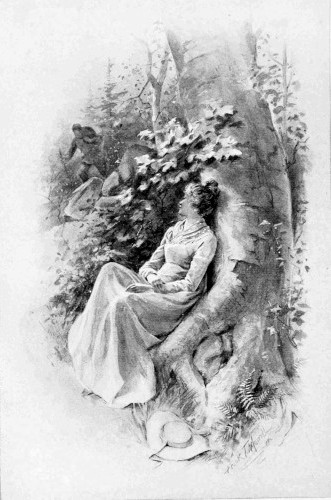
By the time the new home across the river was built there was peace
in the land. The battle of New Orleans had been fought, the last
engagement upon the high seas had taken place, the last prize had been
brought in. The roar of battle would never again reach those whose ears
were once more attuned to the rush of the mighty cataract of Niagara.
"Your Uncle Tom wanted me to sell out up here and settle down near
him," Captain Reyburn told his daughter, "but I have never seen a spot
that suits me so well in all my travels."
"There was never so lovely a country," returned Marianne,
enthusiastically. "Where is there anything so grand as our Falls, and
where will you see such color as in our river and lake? Who can show us
finer scenery? No, no, I am glad to live and die here."
They had taken a ride up to the Falls and were looking at the
marvellous greens and blues in the water below them. "I feel very much
as if I had been in the Whirlpool rapids myself," said Marianne. "Ah,
father dear, what a terrible, terrible time it has been. I think while
I live I never can blot out that day when our home was burned."
Her father looked grave. "I haven't paid my debt to that young man yet,
and I don't suppose I shall ever be able to do it. I wish you would
find out if there's anything in the world I can do for him. He was your
brother's friend, and so he has more than one claim on me. I suppose
you don't know what he intends to do with himself now that the war is
over."
A lovely color flushed Marianne's face. "He says his grandfather has
decided to remain in Montreal, and he wanted Jack to remain with him
there, but Jack didn't care to do it. He loves our Niagara country as
much as we do."
"I don't blame him, then, for wanting to stay. Will he go back to the
old place?"
"No, it is to be sold, or has been already, so Kate tells me. Major
Silverthorn owned half of it, and the rest goes to his son's children,
Kate and Sue and Jack."
Mr. Reyburn smiled. "I can't get over your letting Fred Lyle slip you,"
he said jokingly.
"Ah, but you see he would have taken me to Kentucky; and how would you
have liked that?"
"I didn't think of that part of it. Well, he is happy; he got the girl
he wanted, I reckon."
"Yes, I am sure of that."
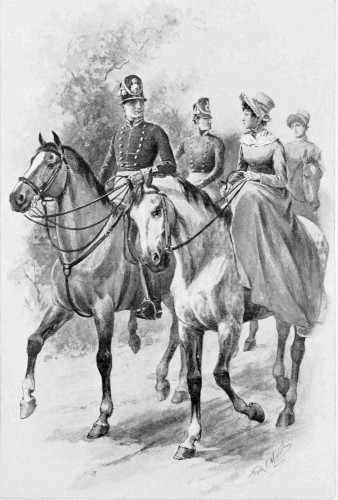
They mounted their horses and rode slowly back. This was their first
day in the new home, but before they had quite reached it they met Jack.
"I came over to see the new house," he announced. "I got back last
night. Kate said you would be in condition to receive callers to-day.
It is quite an affair. Shall you build a barn, Captain?"
"Yes, I shall have to, for I am going to work for a good crop, and I
hope I shall need it. Then we'll have to have another husking-bee,
Marianne."
"But alas, I fear we should have a slim attendance."
"That is a fact; the thing we are most in need of is neighbors."
"I was thinking of becoming a neighbor myself," said Jack. "I must
settle somewhere."
"You couldn't find a better place," said Captain Reyburn, heartily.
"We'll try to be neighborly. But then you'll have to become an American
citizen, if you're this side the river."
"I don't think that need matter now, sir. I did my duty when I was
called upon, and I don't think it makes any difference since the war
is over. Most of my friends have left the other side of the river, and
there are rather sad memories connected with the old place. I shouldn't
care to live there again, and I shouldn't care to live anywhere else,
if I must settle over there."
"Then come and make yourself a home next to us. I will sell you a good
piece of land at your own price. What do you say?"
"That's a very kind offer, Captain, and I appreciate it, I assure you,
but I'd like to think about it." He glanced quickly at Marianne as he
spoke. She had dismounted, and Jack was leading her horse while she
walked by his side.
"I owe you a debt I can never repay," Captain Reyburn continued. "You
saved my girl's life, and if there's anything in the world I can do for
you, Jack, you have but to tell me. But I must be getting along. If you
two like to take a slower way of getting home, just take your time.
Don't forget that's a standing offer about the land."
"But, Captain, the debt—" Jack began. But Captain Reyburn was already
too far ahead to hear.
"What were you going to say?" Marianne asked him.
They were standing still, the horse cropping the young grass at their
feet.
"I didn't want him to think that he was under such a weight of
obligation after what you did for me. I wanted him to know that the
debt is cancelled."
"Oh, you goose!" returned Marianne. And then Jack suddenly understood
why she did not want it known that she had lessened that debt.
He dropped the horse's bridle, and let the creature nibble at will.
"Marianne, Marianne," he said, seizing her hands, "is that why you did
not want it known? Did you think of it so long ago? What a stupid dolt
I am."
"Did I think of what? Did you hear father say that if you wanted
anything you were to tell him? What shall you ask for? I think he would
use his influence with Mr. Ashman if you are thinking of asking for
Minerva's hand. I hear the family have returned."
"Marianne, darling, will you let me ask for what I most want? Will
he give it to me, do you think?" Jack went on, paying no heed to her
teasing.
"If he wants to save my life, he will," Marianne answered, half
laughing, half crying.
"Are you joking? Do you mean it? Will you be glad to have me for a
neighbor? Ah, Marianne, Marianne, one day, long ago, I looked up at
your dear face watching me from the little cabin window, and I thought
then how gladly, how joyfully, I would make a home for you, and work
all my days for you if you would but love me a little, and now, how
dear such a home would be with you in it. May I build it for you,
Marianne?"
"Perhaps. Some day. Not yet, oh, no, not yet."
"Why not yet?"
"You will have to prove yourself a good American by a certain length
of residence; you will have to do—oh, many things. I believe it was
nothing in the world but my flag that induced you to consider settling
this side the river. You owe your life to it, as I told you, and you
cannot do less than acknowledge its power."
"You are a tease, Marianne."
"And so are you."
"I confess it. I have something else to confess. That day, when the
flag protected me, you know, I—wasn't altogether unconscious all the
time."
The color flamed up into Marianne's face. "Jack Silverthorn, all this
time! You mean—mean—cheating—"
Jack put his arms around her. "Forgive me, dear girl."
"Go away. I don't want to speak to you."
"I didn't hear everything, I am quite positive," Jack went on
apologetically, "only a very little; but that—oh, Marianne, are you so
ashamed of it? It has made me so happy, and has made me content to wait
till I could have a little hope that your father would consent to let
me marry you some day. If it was true what you said, you cannot mind
that it made me happy; and you said, a little while ago, that if your
father wanted to save your life, and all that—"
"I didn't mean it; I was only joking. I told you long ago we could only
be friends."
Jack looked very miserable. "Then I was dreaming. Very well, Marianne,
I am sorry I didn't understand that it was only a dream, or that in
your excitement you said what, in your calmer moments, you would deny.
You didn't really care, and that is all; or else, though you might have
cared for me a little then, you do not now. I cannot help loving you,
but I will go back to Montreal, I think."
Marianne turned swiftly. "No, no, you shall not. I am a horrid wretch,
and you are much too good for me—for a silly thing like me. I meant it
all, every word. There, is that enough, sir? Is it?"
"It is enough, dearest, best beloved. It is everything. Why were you so
cruel? How could you have the heart?"
"Because I am so very silly. You will think so when I tell you. I
didn't mean you should know. I wanted you to tell me all over again. It
has been a long time since you did, till to-day. I wanted to wait till
I thought my father would say just what he has said, and then I would
tell you to go and ask him; and some day I meant to tell you myself
about that dreadful day when I said those things, and thought you
didn't hear."
"I will tell you all over again, and I will ask your father very
properly. I love you as my life, Marianne. I love you with all my
heart. Some day will you say those words you said that day?"
"I forget what I said."
He drew her nearer to him, and whispered, "You said, 'Jack, my dearest,
my only love, don't die.'"
"Did I say all that?" she whispered back. "You must have heard every
word."
"Won't you say it over so you won't forget? Won't you, Marianne?"
She stood without speaking, suddenly shy. Then it came over her that
he had been so willing to give his love in full measure, he had never
withheld one tithe of it from her, and then he was no more her enemy
than she was his, and she whispered, half laughing, "Jack, my dearest,
my only love, don't die."
"I won't if I can help it," he returned, laughing, too, "I promise you
I'll try not. Do you know the apple trees are all in blossom again?
Have you forgotten a day—"
"How you do remind one of humiliating things."
"To me they are the joys of my life, the happiest memories I could
possess. There, we are in sight of your house. See the apple trees,
they are covered with blooms. For the sake of that parting, Marianne—"
"Oh, are you going? I didn't know it was good-by. I thought—"
"I am not going; I have to tell your father what I want before I can
think of going."
"Then, of course, since it isn't good-by—you know—I couldn't—"
"Let it be a parting from our old trials and tribulations, from all
uncertainty and despair. Marianne—"
She did not resist as his head bent lower, but, as before, it was the
fleetest kiss she gave him, and then she ran from him to the house
to seek—strange to say, not her mother, but Jerusha. "Oh, Jerusha,
Jerusha," she whispered, hiding her hot face on Jerusha's shoulder,
"Jack, you know—Jack—"
Jerusha patted her awkwardly, but a sly smile broke over her face. "Why
yes, Mary Anne, I know Jack. What about him?"
"He's going to build a house, and—"
"I don't see anything remarkable in that, that it should set you all of
a quiver."
"No, not that—but—there is something more remarkable."
"Well, out with it." Jerusha was merciless.
Down went the head again. "He's going to build it for me," she
whispered, and Jerusha laughed. But she gave a sigh a minute after
and bestowed a trembling kiss upon Marianne's cheek. "God bless you,
child," she said; "there ain't nawthing like honest love. I guess
you've airnt it. It's come to you at the right time, and I'm glad for
you. They say they ain't no marrying and giving in marriage in heaven,
but the' ain't a word said about the' being no loving." Marianne lifted
her head, and softly kissed the sunburnt face. Jerusha went to the
door, and looked out at the bloom-sweet orchard. "Asa Peaslee's taken a
shine to that little old cabin in the woods," she said, in an altered
tone. "He's bought it off the folks that owned it; they ain't coming
back."
"I am glad Asa is going to have it. I have an affection for that little
old cabin. Poor Asa, his lame leg will prevent him from going back to
his peddling, I am afraid. Is he going to live there alone?"
Jerusha did not answer for a moment, then she said, in a hard way, "He
wanted I should come and keep house for him."
"Oh, Jerusha, Jerusha! And are you going? Do you mean to leave us?"
"No, marm, I ain't. I'm nobody's fool. I had a real hankering arter
them leach pits and my old soap kittle, but when I considered what
went with 'em I give 'em up right willingly."
"Asa is very handy; I think he will get along without a wife."
"Can't say. Men's terrible onsartin critturs. You can't expect much of
'em, even the best among 'em. The heart of man is deceitful above all
things and desperately wicked."
"O, dear me, Jerusha, how discouraging. I shall not stay to listen to
such remarks."
"You'd better go," returned Jerusha, half maliciously; "here's your
father looking fur you; he's called you twicet."
Marianne started back, then she gave an embarrassed laugh and said to
herself, "There's no use putting it off; I might as well be over with
it." She ran out at once to meet her father, and they sat down together
upon a pile of logs left from the building.
"Look here, young woman," said Captain Reyburn. "How old are you?"
"I am almost twenty years old, sir."
He looked at her in surprise. "Goodness, child, I can't believe it. I
thought you were about seventeen."
"I was about that when the war broke out."
"That's it; the war made me forget. Why, you're two years older than
your mother was when I married her."
"Yes, sir."
"What about this young fellow, Jack? He's asked me for a pretty big
thing in payment of my debt of obligation."
"Not very big, sir, only five feet one and a half."
"You minx, I see you are in the game. You want to leave your old dad,
do you? Just as he has you back again?"
"Oh, no, I don't, not for a long, long while. And besides, you didn't
mind my going to Kentucky with Cousin Fred."
"You've got me there, haven't you. How about your grandmother's plan
for you and Victor? No entanglement there?"
"No, sir, that was over long ago. I think grand'mère has other plans
for Victor, and besides, I should be nearer you on this side the river."
"That's so. I've as good as sold Jack a hundred acres, at least—but
we'll talk about that later. I thought you were too good an American to
marry a man who'd fight against your country."
"I'd rather marry a man that was brave and honest and true to his own
country when he thought she needed him, than one like Victor, who
wouldn't fight at all. Besides, Jack is going to be an American. I
would never, never live anywhere but under the Stars and Stripes."
"That's right all around. He won't have to go far back to establish his
claim to being an American; his father was born in the States."
"Yes, and besides, his sister Sue has married a Kentuckian."
"Yes, I see. Well then, little girl, I reckon that hundred acres has
got to go for a wedding present, and we'll get Kate and the boy over
here to take your place, for I don't see but that we've got to let you
go; it won't do to keep the young man waiting too long for a home. I
like the boy; and because a man fought on the other side is no reason
he can't be honest and straightforward and manly. I learned that up in
Quebec, where I have some good friends this minute, for all they wore
the king's uniform while I was a prisoner at their mercy. We'll agree
to bury the hatchet, and I guess there will be no quarrelling over
politics. I think Jack will be good to my little girl, and it is worth
everything to have her close by. Come now, kiss your old dad, and run
along and tell mother."
Marianne was not slow to give him all the kisses he wanted, and he
watched her graceful figure as it disappeared into the house; then he
turned away with a sigh. "We'll have to get Kate and the baby over
here," he said.
But, as Marianne said, grand'mère had her own plans. To let that baby
go was something not to be thought of. She realized it, yes, of course
it was the right of the Reyburns to care for Kate and her child, but
she confided to Victor they would all be desolated without that baby.
She perceived that to a young man of Victor's sensibility the spectacle
of a young mother and her child was one of unusual beauty; and then
Kate was a superior woman, so sweet of soul, so good to have around
one. She did not wish to depreciate Marianne, whom she loved, she
idolized, but it would be cruel to deprive her parents of their only
child, and Victor had not seemed of late so charmed to consider the
old plan. It was not that Marianne had less charm, but that the young
mother and child had more,—so pathetic, so appealing to a young man of
good heart. "Yes, Victor, you see," she went on to say, "that it would
be of all things the most delightful. Royal's son is provided for at
the same time that you are. Victorine, our saint, has still her dot,
though she will not have her husband; she does not wish one, our poor
Victorine. She adores the child. Then how cruel to deprive her of this
joy. You see, Victor, my wish?"
"I see, maman; but you do not consider Kate. For me, I am more than
content. It is, as you say, a beautiful sight,—the mother and her
young child. It fills me with holy thoughts, but I do not know if she
would consent? Her heart is there buried in the grave of her husband."
"Patience, my son, patience. You have that rare virtue, which is not
that of every man. Already I see her depend upon you, look up to you,
confide in you. In good time, perhaps not the love she gave to Royal,
but affection, yes, affection. She is too sweet a nature not to make
happy the man she marries. Yes, yes, I see it will all come about in
time. She will not reject you after a while."
It was when Marianne came to tell Kate that she had decided upon her
wedding-day that she first perceived that it might be possible for
grand'mère's plan to come about. In her own heart Marianne had hoped
that it would. It seemed so good an arrangement, even Mr. Reyburn
agreed when his wife told him, and he entered into the conspiracy
by not demanding that Madame should give up Kate and the baby. Kate
herself was the only one who was oblivious of it all. She was relieved
that they did not insist upon her changing her home. She was very
content, even happy, where she was. They loved her dearly; they were
so good to her; they were less strangers than the Reyburns. It was now
over two years since she had become a widow, and in two years a home
can become much more a home.
She greeted Marianne's news joyfully. "I am so glad," she said. "Dear
old Jack, he is the happiest mortal alive. It does one good to see his
sunny face. And when is it to be?"
"On the Fourth of July," returned Marianne, triumphantly.
Kate laughed. "Oh, you most patriotic of maidens, you give poor Jack no
chance."
"No," Marianne laughed, "I don't intend to. I mean that he shall always
celebrate the day. There are more reasons than one why he is perfectly
contented to be married on the Fourth. Jack is very sentimental, if you
did but know it, and he has reason to remember more than one Fourth of
July, he says. There is an American flag which belongs to me. We shall
be married under that; he loves it and I love it, and we shall keep
it treasured always. I will tell you why, some day, when I am an old
married woman."
"You do love Jack very dearly, don't you?" said Kate, wistfully.
"I do love him very, very dearly," Marianne answered steadily. "He is
much too good for me, but I hope I shall grow better and wiser as I
grow older; there is room for it," she said lightly, to cover her real
earnestness. "You will all come in your best bibs and tuckers. You must
have a pretty new white gown, Kate. I want it to be a happy day for
everybody."
Kate sat thoughtful over her sewing. "Will it be a happy day for
Victor?" she asked hesitatingly.
"For Victor? Oh, Kate, you don't think—why, that was over long ago.
We were never lovers at the best; it was only make believe, because
grand'mère wanted it. Did you think—why, Kate, don't you know—" She
looked at her with an amused, half surprised expression, and then ran
out, saying, "I must tell my news to the others."
She found that Jack was before her so far as Victor was concerned, but
she drew the latter aside and said, "You might be as happy as we are if
you were not as blind as a mole, you slow old Victor."
"What do you mean?" asked Victor, showing more eagerness than was his
wont.
"There's such a thing as being too patient," Marianne returned, nodding
her head wisely. "There is Kate coming this way; go and meet her, and—"
But this time Victor was not dull of comprehension. He walked off with
a great leap at his heart, for she who was coming was the one woman in
the world to him at that moment.
Marianne turned to Jack. "There is a little tinkling brook over there
in the woods. I used to sail chips there when I was a little child."
Jack looked at her with appreciative eyes. It was not the memory of her
childhood which made hers so sweetly moist; the little brook had other
associations, he well knew. He took her hand in his, and together they
walked slowly down the path to the woods.
Victorine sat at the door; in her lap lay the sleeping boy, one chubby
hand clasping her fingers. She sang softly to him a quaint old French
lullaby. She saw Victor lead Kate down the orchard lane, to where stood
little Madame Desvouges in bright-eyed expectation. She saw Marianne
and Jack saunter off together, so engrossed in each other that the
world seemed to hold but the two. As in a vision the coming years
passed before her. For Victor and Kate, for Marianne and Jack, would be
hope and home and wedded love. She looked down at the child upon her
knees. To her God had given Royal's boy.
HISTORICAL BOOKS BY AMY E. BLANCHARD.
Each fully illustrated. 12mo. Price $1.50.
A GIRL OF '76.
A Story of the Early Period of the War for
Independence.
A REVOLUTIONARY MAID.
A Story of the Middle Period of the War for
Independence.
A DAUGHTER OF FREEDOM.
A Story of the Latter Period of the War for
Independence.
A HEROINE OF 1812.
A Maryland Romance.
A LOYAL LASS.
A Story of the Niagara Campaign of 1814.