with ninety-four illustrations by
LONDON
WILLIAM HEINEMANN
1900
Preface
The notes presented in this volume were gathered, as will easily be
perceived, a number of years ago and on an expectation not at that time
answered by the event, and were then published in the United States. The
expectation had been that they should accompany a series of drawings,
and they themselves were altogether governed by the pictorial spirit.
They made, and they make in appearing now, after a considerable interval
and for the first time, in England, no pretension to any other; they are
impressions, immediate, easy, and consciously limited; if the written
word may ever play the part of brush or pencil, they are sketches on
"drawing-paper" and nothing more. From the moment the principle of
selection and expression, with a tourist, is not the delight of the eyes
and the play of fancy, it should be an energy in every way much larger;
there is no happy mean, in other words, I hold, between the sense and
the quest of the picture, and the surrender to it, and the sense and
the quest of the constitution, the inner springs of the subject—springs
and connections social, economic, historic.
One must really choose, in other words, between the benefits of the
perception of surface—a perception, when fine, perhaps none of the most
frequent—and those of the perception of very complex underlying
matters. If these latter had had, for me, to be taken into account, my
pages would not have been collected. At the time of their original
appearance the series of illustrations to which it had been their policy
to cling for countenance and company failed them, after all, at the last
moment, through a circumstance not now on record; and they had suddenly
to begin to live their little life without assistance. That they have
seemed able in any degree still to prolong even so modest a career might
perhaps have served as a reason for leaving them undisturbed. In fact,
however, I have too much appreciated—for any renewal of
inconsistency—the opportunity of granting them at last, in an
association with Mr. Pennell's admirable drawings, the benefit they have
always lacked. The little book thus goes forth finally as the
picture-book it was designed to be. Text and illustrations are,
altogether and alike, things of the play of eye and hand and
fancy—views, head-pieces, tail-pieces; through the artist's work,
doubtless, in a much higher degree than the author's.
But these are words enough on a minor point. Many things come back to
me on reading my pages over—such a world of reflection and emotion as I
can neither leave unmentioned nor yet, in this place, weigh them down
with the full expression of. Difficult indeed would be any full
expression for one who, deeply devoted always to the revelations of
France, finds himself, late in life, making of the sentiment no more
substantial, no more direct record than this mere revival of an
accident. Not one of these small chapters but suggests to me a regret
that I might not, first or last, have gone farther, penetrated deeper,
spoken oftener—closed, in short, more intimately with the great general
subject; and I mean, of course, not in such a form as the present, but
in many another, possible and impossible. It all comes back, doubtless,
this vision of missed occasions and delays overdone, to the general
truth that the observer, the enjoyer, may, before he knows it, be
practically too far in for all that free testimony and pleasant, easy
talk that are incidental to the earlier or more detached stages of a
relation. There are relations that soon get beyond all merely showy
appearances of value for us. Their value becomes thus private and
practical, and is represented by the process—the quieter, mostly, the
better—of absorption and assimilation of what the relation has done for
us. For persons thus indebted to the genius of France—however, in its
innumerable ways, manifested—the profit to be gained, the lesson to be
learnt, is almost of itself occupation enough. They feel that they bear
witness by the intelligent use and application of their advantage, and
the consciousness of the artist is therefore readily a consciousness of
pious service. He may repeatedly have dreamt of some such happy
combination of mood and moment as shall launch him in a profession of
faith, a demonstration of the interesting business; he may have had
inner glimpses of an explicit statement, and vaguely have sketched it to
himself as one of the most candid and charming ever drawn up; but time,
meanwhile, has passed, interruptions have done their dismal work, the
indirect tribute, too, has perhaps, behind the altar, grown and grown;
and the reflection has at all events established itself that honour is
more rendered by seeing and doing one's work in the light than by
brandishing the torch on the house-tops. Curiosity and admiration have
operated continually, but with as little waste as they could. The
drawback is only that in this case, to be handsomely consequent, one
would perhaps rather not have appeared to celebrate any rites. The
moral of all of which is that those here embodied must pass, at the
best, but for what they are worth.
H. J.
August 9, 1900.
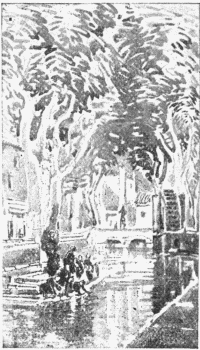
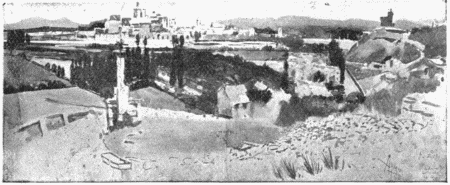
| Nîmes: the Garden (Photogravure) | Frontispiece | |
| Tours: the House of Balzac | To face page | 8 |
| Tours: the Cathedral (Photogravure) | " |
14 |
| Tours: the Towers of St. Martin | " | 18 |
| Blois (Photogravure) | " | 26 |
| Blois: the Château | " | 28 |
| Chambord | " | 38 |
| Amboise: the Château | " | 48 |
| Chenonceaux (Photogravure) | " | 56 |
| Azay-le-Rideau | " | 64 |
| Loches | " | 72 |
| Loches: the Church | " | 74 |
| Bourges: the House of Jacques Cœur (Photogravure) | " | 86 |
| Bourges: Doorway, House of Jacques Cœur | " | 90 |
| Bourges: the Cathedral (West Front) | " | 92 |
| Le Mans: the Cathedral | " | 98 |
| Angers: Old Timbered Houses | " | 104 |
| La Rochelle | " | 118 |
| La Rochelle: the Hôtel de Ville (Photogravure) | " | 120 |
| Poitiers: Church of St. Radegonde (Photogravure) | " | 126 |
| Bordeaux: the Quay (Photogravure) | " | 134 |
| Toulouse: St. Sernin (the Transept) | " | 146 |
| Toulouse: the Garonne (Photogravure) | " | 148 |
| Carcassonne | " | 158 |
| Carcassonne (another View) | " | 160 |
| Narbonne: the Washing Place | " | 166 |
| Narbonne: the Cathedral and Hôtel de Ville (Photogravure) | " | 168 |
| The Pont du Gard | " | 180 |
| Aigues-Mortes | " | 186 |
| Nîmes: the Cathedral | " | 190 |
| Nîmes: the Amphitheatre | " | 192 |
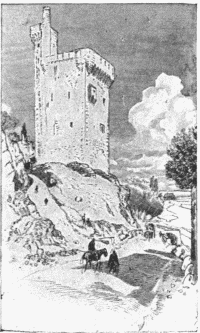
| Tarascon: the Castle | " | 198 |
| Arles: St. Trophimus | " | 204 |
| Arles: Ruins of the Roman Theatre | " | 206 |
| Arles: Door of St. Trophimus | " | 210 |
| Arles: the Cloisters (Photogravure) | " | 212 |
| Avignon: the Church | " | 226 |
| Vaucluse: Ruins of Castle | " | 240 |
| Orange: the Theatre | " | 246 |
| Lyons | " | 250 |
| Brou: the Church (Photogravure) | " | 256 |
| Beaune: the Hospital | " | 264 |
| Dijon | " | 266 |
| Dijon: the Park | " | 268 |
| |
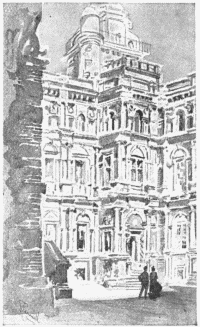
| Courtyard, House of Jacques Cœur | Half-title | |
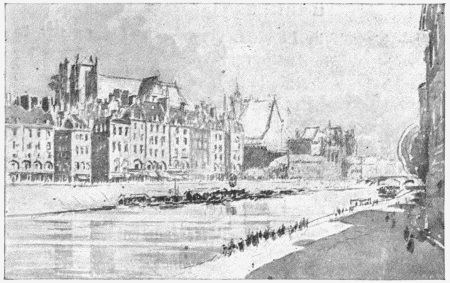
| Angers from the Bridge | Title-page | |
| Aigues-Mortes | v |
| Isle-sur-Sorgues | viii |
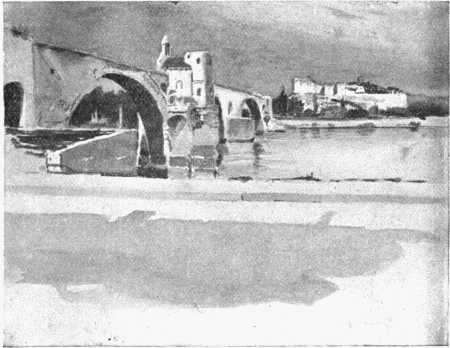
| Saint-Bénazet: the Broken Bridge | ix |
| Villeneuve-lès-Avignon | xi |
| Narbonne: the Fish Market | ix |
| Avignon from Villeneuve | xiii |
| Toulouse: Hôtel d'Assézat | xvi |
| Nantes | 1 |
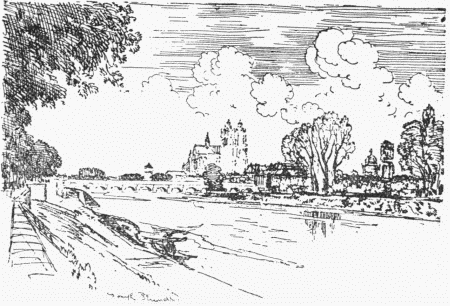
| Tours from the River | 3 |
| Langeais | 3 |
| Chaumont from the River | 17 |
| Blois | 26 |
| Chambord | 36 |
| Chaumont from the Bridge | 47 |
| Chenonceaux | 54 |
| Azay-le-Rideau | 64 |
| Langeais from the Loire | 68 |
| Loches | 72 |
| Bourges | 77 |
| Bourges: the Hôtel Lallemont | 86 |
| Le Mans | 94 |
| Angers: the Castle | 101 |
| Nantes: the Quay | 107 |
| La Rochelle: Tour de la Lanterne | 115 |
| Poitiers: the Cathedral | 122 |
| Bordeaux | 130 |
| Toulouse: the Cathedral | 136 |
| Toulouse: the Place de Capitol | 141 |
| Toulouse: Saint-Sernin | 145 |
| Carcassonne from the River | 150 |
| Carcassonne | 157 |
| Arles, Landscape near | 163 |
| Montpellier: the Aqueduct | 170 |
| The Pont du Gard | 178 |
| Aigues-Mortes | 183 |
| Nîmes: the Maison Carrée | 188 |
| Tarascon and Beaucaire | 195 |
| Provençal Landscape | 202 |
| Montmajeur | 209 |
| Les Baux | 213 |
| Villeneuve-lès-Avignon | 218 |
| Avignon | 223 |
| Vaucluse, Approach to | 235 |
| Orange: the Gateway | 243 |
| Valence | 249 |
| Macon | 254 |
| Macon: the Bridge | 262 |
| Beaune: the Hospital | 267 |
Introductory
Though the good city of Paris appears to be less in fashion than in
other days with those representatives of our race—not always, perhaps,
acknowledged as the soundest and stiffest—curious of foreign
opportunity and addicted to foreign sojourns, it probably none the less
remains true that such frequentations of France as may be said still to
flourish among us have as much as ever the wondrous capital, and the
wondrous capital alone, for their object. The taste for Paris, at all
events, is—or perhaps I should say was, alluding as I do, I fear, to a
vanished order—a taste by itself; singularly little bound up, of
necessity, with such an interest in the country at large as would be
implied by an equal devotion, in other countries, to other capitals.
Putting aside the economic inducement, which may always operate, and
limiting the matter to the question of free choice, it is sufficiently
striking that the free chooser would have to be very fond of England to
quarter himself in London, very fond of Germany to quarter himself in
Berlin, very fond of America to quarter himself in New York. It had, on
the other hand, been a common reflection for the author of these light
pages that the fondness for France (throughout the company of strangers
more or less qualified) was oddly apt to feed only on such grounds for
it as made shift to spread their surface between the Arc de Triomphe and
the Gymnase Theatre: as if there were no good things in the doux pays
that could not be harvested in that field. It matters little how the
assumption began to strike him as stupid, especially since he himself
had doubtless equally shared in the guilt of it. The light pages in
question are but the simple record of a small personal effort to shake
it off. He took, it must be confessed, no extraordinary measures; he
merely started, one rainy morning in mid-September, for the charming
little city of Tours, where he felt that he might as immediately as
anywhere else see it demonstrated that, though France might be Paris,
Paris was by no means France. The beauty of the demonstration—quite as
prompt as he could have desired—drew him considerably farther, and his
modest but eminently successful adventure begot, as aids to amused
remembrance, a few informal notes.
Tours
I AM ashamed to begin with saying that Touraine is the garden of France;
that remark has long ago lost its bloom. The town of Tours, however, has
something sweet and bright, which suggests that it is surrounded by a
land of fruits. It is a very agreeable little city; few towns of its
size are more ripe, more complete, or, I should suppose, in better
humour with themselves and less disposed to envy the responsibilities of
bigger places. It is truly the capital of its smiling province; a region
of easy abundance, of good living, of genial, comfortable, optimistic,
rather indolent opinions. Balzac says in one of his tales that the real
Tourangeau will not make an effort, or displace himself even, to go in
search of a pleasure; and it is not difficult to understand the sources
of this amiable cynicism. He must have a vague conviction that he can
only lose by almost any change. Fortune has been kind to him: he
lives in a temperate, reasonable, sociable climate, on the banks of a
river which, it is true, sometimes floods the country around it, but of
which the ravages appear to be so easily repaired that its aggressions
may perhaps be regarded (in a region where so many good things are
certain) merely as an occasion for healthy suspense. He is surrounded by
fine old traditions, religious, social, architectural, culinary; and he
may have the satisfaction of feeling that he is French to the core. No
part of his admirable country is more characteristically national.
Normandy is Normandy, Burgundy is Burgundy, Provence is Provence; but
Touraine is essentially France. It is the land of Rabelais, of
Descartes, of Balzac, of good books and good company, as well as good
dinners and good houses. George Sand has somewhere a charming passage
about the mildness, the convenient quality, of the physical conditions
of central France—"son climat souple et chaud, ses pluies abondantes et
courtes." In the autumn of 1882 the rains perhaps were less short than
abundant; but when the days were fine it was impossible that anything in
the way of weather could be more charming. The vineyards and orchards
looked rich in the fresh, gay light; cultivation was everywhere, but
everywhere it seemed to be easy. There was no visible poverty; thrift
and success presented themselves as matters of good taste. The white
caps of the women glittered in the sunshine, and their well-made sabots
clicked cheerfully on the hard, clean roads. Touraine is a land of old
châteaux,—a gallery of architectural specimens and of large hereditary
properties. The peasantry have less of the luxury of ownership than in
most other parts of France; though they have enough of it to give them
quite their share of that shrewdly conservative look which, in the
little
chaffering place of the market-town, the stranger observes so often in
the wrinkled brown masks that surmount the agricultural blouse. This is,
moreover, the heart of the old French monarchy; and as that monarchy was
splendid and picturesque, a reflection of the splendour still glitters
in the current of the Loire. Some of the most striking events of French
history have occurred on the banks of that river, and the soil it waters
bloomed for a while with the flowering of the Renaissance. The Loire
gives a great "style" to a landscape of which the features are not, as
the phrase is, prominent, and carries the eye to distances even more
poetic than the green horizons of Touraine. It is a very fitful stream,
and is sometimes observed to run thin and expose all the crudities of
its channel—a great defect certainly in a river which is so much
depended upon to give an air to the places it waters. But I speak of it
as I saw it last; full, tranquil, powerful, bending in large slow curves
and sending back half the light of the sky. Nothing can be finer than
the view of its course which you get from the battlements and terraces
of Amboise. As I looked down on it from that elevation one lovely Sunday
morning, through a mild glitter of autumn sunshine, it seemed the very
model of a generous, beneficent stream. The most charming part of Tours
is naturally the shaded quay that overlooks it, and looks across too at
the friendly faubourg of Saint Symphorien and at the terraced heights
which rise above this. Indeed, throughout Touraine it is half the charm
of the Loire that you can travel beside it. The great dyke which
protects it, or protects the country from it, from Blois to Angers, is
an admirable road; and on the other side as well the highway constantly
keeps it company. A wide river, as
Tours
you follow a wide road, is excellent company; it brightens and shortens
the way.
The inns at Tours are in another quarter, and one of them, which is
midway between the town and the station, is very good. It is worth
mentioning for the fact that every one belonging to it is
extraordinarily polite—so unnaturally polite as at first to excite your
suspicion that the hotel has some hidden vice, so that the waiters and
chambermaids are trying to pacify you in advance. There was one waiter
in especial who was the most accomplished social being I have ever
encountered; from morning till night he kept up an inarticulate murmur
of urbanity, like the hum of a spinning-top. I may add that I discovered
no dark secrets at the Hôtel de l'Univers; for it is not a secret to any
traveller to-day that the obligation to partake of a lukewarm dinner in
an overheated room is as imperative as it is detestable. For the rest,
at Tours there is a certain Rue Royale which has pretensions to the
monumental; it was constructed a hundred years ago, and the houses, all
alike, have on a moderate scale a pompous eighteenth-century look. It
connects the Palais de Justice, the most important secular building in
the town, with the long bridge which spans the Loire—the spacious,
solid bridge pronounced by Balzac, in "Le Curé de Tours," "one of the
finest monuments of French architecture." The Palais de Justice was the
seat of the Government of Léon Gambetta in the autumn of 1870, after the
dictator had been obliged to retire in his balloon from Paris and before
the Assembly was constituted at Bordeaux. The Germans occupied Tours
during that terrible winter: it is astonishing, the number of places
the Germans occupied. It is hardly too much to say that, wherever one goes in certain parts of France, one
encounters two great historic facts: one is the Revolution; the other is
the German invasion. The traces of the Revolution remain in a hundred
scars and bruises and mutilations, but the visible marks of the war of
1870 have passed away. The country is so rich, so living, that she has
been able to dress her wounds, to hold up her head, to smile again, so
that the shadow of that darkness has ceased to rest upon her. But what
you do not see you still may hear; and one remembers with a certain
shudder that only a few short years ago this province, so intimately
French, was under the heel of a foreign foe. To be intimately French was
apparently not a safeguard; for so successful an invader it could only
be a challenge. Peace and plenty, however, have succeeded that episode;
and among the gardens and vineyards of Touraine it seems only a legend
the more in a country of legends.
It was not, all the same, for the sake of this chequered story that I
mentioned the Palais de Justice and the Rue Royale. The most interesting
fact, to my mind, about the high-street of Tours was that as you walk
toward the bridge on the right hand trottoir you can look up at the
house, on the other side of the way, in which Honoré de Balzac first saw
the light. That violent and complicated genius was a child of the
good-humoured and succulent Touraine. There is something anomalous in
this fact, though, if one thinks about it a little, one may discover
certain correspondences between his character and that of his native
province. Strenuous, laborious, constantly infelicitous in spite of his
great successes, he suggests at times a very different set of
influences. But he had his jovial, full-feeding
side—the side that comes out in the "Contes Drolatiques," which are the
romantic and epicurean chronicle of the old manors and abbeys of this
region. And he was, moreover, the product of a soil into which a great
deal of history had been trodden. Balzac was genuinely as well as
affectedly monarchical, and he was saturated with a sense of the past.
Number 39 Rue Royale—of which the basement, like all the basements in
the Rue Royale, is occupied by a shop—is not shown to the public; and I
know not whether tradition designates the chamber in which the author of
"Le Lys dans la Vallée" opened his eyes into a world in which he was to
see and to imagine such extraordinary things. If this were the case I
would willingly have crossed its threshold; not for the sake of any
relic of the great novelist which it may possibly contain, nor even for
that of any mystic virtue which may be supposed to reside within its
walls, but simply because to look at those four modest walls can hardly
fail to give one a strong impression of the force of human endeavour.
Balzac, in the maturity of his vision, took in more of human life than
any one, since Shakspeare, who has attempted to tell us stories about
it; and the very small scene on which his consciousness dawned is one
end of the immense scale that he traversed. I confess it shocked me a
little to find that he was born in a house "in a row"—a house,
moreover, which at the date of his birth must have been only about
twenty years old. All that is contradictory. If the tenement selected
for this honour could not be ancient and embrowned, it should at least
have been detached.
There is a charming description in his little tale of "La Grenadière" of
the view of the opposite side of
Tours
the Loire as you have it from the square at the end of the Rue Royale—a
square that has some pretensions to grandeur, overlooked as it is by the
Hôtel de Ville and the Musée, a pair of edifices which directly
contemplate the river, and ornamented with marble images of François
Rabelais and René Descartes. The former, erected a few years since, is a
very honourable production; the pedestal of the latter could, as a
matter of course, only be inscribed with the Cogito ergo Sum. The two
statues mark the two opposite poles to which the wondrous French mind
has travelled; and if there were an effigy of Balzac at Tours it ought
to stand midway between them. Not that he by any means always struck the
happy mean between the sensible and the metaphysical; but one may say of
him that half of his genius looks in one direction and half in the
other. The side that turns toward François Rabelais would be, on the
whole, the side that takes the sun. But there is no statue of Balzac at
Tours; there is only in one of the chambers of the melancholy museum a
rather clever, coarse bust. The description in "La Grenadière" of which
I just spoke is too long to quote; neither have I space for anyone of
the brilliant attempts at landscape-painting which are woven into the
shimmering texture of "Le Lys dans la Vallée." The little manor of
Clochegourde, the residence of Madame de Mortsauf, the heroine of that
extraordinary work, was within a moderate walk of Tours, and the picture
in the novel is presumably a copy from an original which it would be
possible to-day to discover. I did not, however, even make the attempt.
There are so many châteaux in Touraine commemorated in history that it
would take one too far to look up those which have been commemorated in
fiction. The most I did
was to endeavour to identify the former residence of Mademoiselle
Gamard, the sinister old maid of "Le Curé de Tours." This terrible woman
occupied a small house in the rear of the cathedral, where I spent a
whole morning in wondering rather stupidly which house it could be. To
reach the cathedral from the little place where we stopped just now to
look across at the Grenadière, without, it must be confessed, very
vividly seeing it, you follow the quay to the right and pass out of
sight of the charming côteau which, from beyond the river, faces the
town—a soft agglomeration of gardens, vineyards, scattered villas,
gables and turrets of slate-roofed châteaux, terraces with grey
balustrades, moss-grown walls draped in scarlet Virginia-creeper. You
turn into the town again beside a great military barrack which is
ornamented with a rugged mediæval tower, a relic of the ancient
fortifications, known to the Tourangeaux of to-day as the Tour de Guise.
The young Prince of Joinville, son of that Duke of Guise who was
murdered by the order of Henry II. at Blois, was, after the death of his
father, confined here for more than two years, but made his escape one
summer evening in 1591, under the nose of his keepers, with a gallant
audacity which has attached the memory of the exploit to his
sullen-looking prison. Tours has a garrison of five regiments, and the
little red-legged soldiers light up the town. You see them stroll upon
the clean, uncommercial quay, where there are no signs of navigation,
not even by oar, no barrels nor bales, no loading nor unloading, no
masts against the sky nor booming of steam in the air. The most active
business that goes on there is that patient and fruitless angling in
which the French, as the votaries of art for art, excel
all other people. The little soldiers, weighed down by the contents of
their enormous pockets, pass with respect from one of these masters of
the rod to the other, as he sits soaking an indefinite bait in the
large, indifferent stream. After you turn your back to the quay you have
only to go a little way before you reach the cathedral.
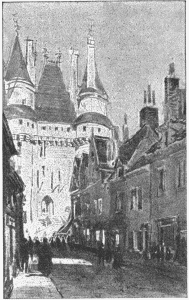
Tours: the Cathedral
IT IS a very beautiful church of the second order of importance, with a
charming mouse-coloured complexion and a pair of fantastic towers. There
is a commodious little square in front of it, from which you may look up
at its very ornamental face; but for purposes of frank admiration the
sides and the rear are perhaps not sufficiently detached. The cathedral
of Tours, which is dedicated to Saint Gatianus, took a long time to
build. Begun in 1170, it was finished only in the first half of the
sixteenth century;
but the ages and the weather have interfused so well the tone of the
different parts that it presents, at first at least, no striking
incongruities, and looks even exceptionally harmonious and complete.
There are many grander cathedrals, but there are probably few more
pleasing; and this effect of delicacy and grace is at its best towards
the close of a quiet afternoon, when the densely decorated towers,
rising above the little Place de l'Archevêché, lift their curious
lanterns into the slanting light and offer a multitudinous perch to
troops of circling pigeons. The whole front, at such a time, has an
appearance of great richness, although the niches which surround the
three high doors (with recesses deep enough for several circles of
sculpture) and indent the four great buttresses that ascend beside the
huge rose-window, carry no figures beneath their little chiselled
canopies. The blast of the great Revolution blew down most of the
statues in France, and the wind has never set very strongly towards
putting them up again. The embossed and crocketed cupolas which crown
the towers of Saint Gatien are not very pure in taste; but, like a good
many impurities, they have a certain character. The interior has a
stately slimness with which no fault is to be found and which in the
choir, rich in early glass and surrounded by a broad passage, becomes
very bold and noble. Its principal treasure perhaps is the charming
little tomb of the two children (who died young) of Charles VIII. and
Anne of Brittany, in white marble embossed with symbolic dolphins and
exquisite arabesques. The little boy and girl lie side by side on a slab
of black marble, and a pair of small kneeling angels, both at their head
and at their feet, watch over them. Nothing could be more elegant than
this monument, which is the work of
Tours: the Cathedral
Michel Colomb, one of the earlier glories of the French Renaissance; it
is really a lesson in good taste. Originally placed in the great
abbey-church of Saint Martin, which was for so many ages the holy place
of Tours, it happily survived the devastation to which that edifice,
already sadly shattered by the wars of religion and successive
profanations, finally succumbed in 1797. In 1815 the tomb found an
asylum in a quiet corner of the cathedral.
I ought perhaps to be ashamed to acknowledge that I found the profane
name of Balzac capable of adding an interest even to this venerable
sanctuary. Those who have read the terrible little story of "Le Curé de
Tours" will perhaps remember that, as I have already mentioned, the
simple and childlike old Abbé Birotteau, victim of the infernal
machinations of the Abbé Troubert and Mademoiselle Gamard, had his
quarters in the house of that lady (she had a specialty of letting
lodgings to priests), which stood on the north side of the cathedral, so
close under its walls that the supporting pillar of one of the great
flying buttresses was planted in the spinster's garden. If you wander
round behind the church in search of this more than historic habitation
you will have occasion to see that the side and rear of Saint Gatien
make a delectable and curious figure. A narrow lane passes beside the
high wall which conceals from sight the palace of the archbishop and
beneath the flying buttresses, the far-projecting gargoyles, and the
fine south porch of the church. It terminates in a little dead
grass-grown square entitled the Place Grégoire de Tours. All this part
of the exterior of the cathedral is very brown, ancient, Gothic,
grotesque; Balzac calls the whole place "a desert
Tours: the Cathedral
of stone." A battered and gabled wing or out-house (as it appears to be)
of the hidden palace, with a queer old stone pulpit jutting out from it,
looks down on this melancholy spot, on the other side of which is a
seminary for young priests, one of whom issues from a door in a quiet
corner, and, holding it open a moment behind him, shows a glimpse of a
sunny garden, where you may fancy other black young figures strolling up
and down. Mademoiselle Gamard's house, where she took her two abbés to
board, and basely conspired with one against the other, is still farther
round the cathedral. You cannot quite put your hand upon it to-day, for
the dwelling of which you say to yourself that it must have been
Mademoiselle Gamard's does not fulfil all the conditions mentioned in
Balzac's description. The edifice in question, however, fulfils
conditions enough; in particular, its little court offers hospitality to
the big buttress of the church. Another buttress, corresponding with
this (the two, between them, sustain the gable of the north transept),
is planted in the small cloister, of which the door on the farther side
of the little soundless Rue de la Psalette, where nothing seems ever to
pass, opens opposite to that of Mademoiselle Gamard. There is a very
genial old sacristan, who introduced me to this cloister from the
church. It is very small and solitary, and much mutilated; but it
nestles with a kind of wasted friendliness beneath the big walls of the
cathedral. Its lower arcades have been closed, and it has a small plot
of garden in the middle, with fruit-trees which I should imagine to be
too much overshadowed. In one corner is a remarkably picturesque turret,
the cage of a winding staircase which ascends (no great
distance) to an upper gallery, where an old priest, the
chanoine-gardien of the church, was walking to and fro with his
breviary. The turret, the gallery, and even the chanoine-gardien,
belonged, that sweet September morning, to the class of objects that are
dear to painters in water-colours.
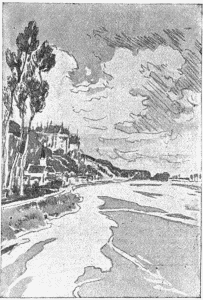
Tours: Saint Martin
I HAVE mentioned the church of Saint Martin, which was for many years
the sacred spot, the shrine of pilgrimage, of Tours. Originally the
simple burial-place of the great apostle who in the fourth century
Christianised Gaul and who, in his day a brilliant missionary and worker
of miracles, is chiefly known to modern fame as the worthy that cut his
cloak in two at the gate of Amiens to share it with a beggar (tradition
fails to say, I believe, what he did with the other half), the abbey of
Saint Martin, through the Middle Ages, waxed rich and powerful, till it
was known at last as one of the most luxurious religious houses in
Christendom, with kings for its titular abbots
(who, like Francis I., sometimes turned and despoiled it) and a great
treasure of precious things. It passed, however, through many
vicissitudes. Pillaged by the Normans in the ninth century and by the
Huguenots in the sixteenth, it received its death-blow from the
Revolution, which must have brought to bear upon it an energy of
destruction proportionate to its mighty bulk. At the end of the last
century a huge group of ruins alone remained, and what we see to-day may
be called the ruin of a ruin. It is difficult to understand how so vast
an edifice can have been so completely obliterated. Its site is given up
to several ugly streets, and a pair of tall towers, separated by a space
which speaks volumes as to the size of the church and looking across the
close-pressed roofs to the happier spires of the cathedral, preserve for
the modern world the memory of a great fortune, a great abuse, perhaps,
and at all events a great penalty. One may believe that to this day a
considerable part of the foundations of the great abbey is buried in the
soil of Tours. The two surviving towers, which are dissimilar in shape,
are enormous; with those of the cathedral they form the great landmarks
of the town. One of them bears the name of the Tour de l'Horloge; the
other, the so-called Tour Charlemagne, was erected (two centuries after
her death) over the tomb of Luitgarde, wife of the great Emperor, who
died at Tours in 800. I do not pretend to understand in what relation
these very mighty and effectually detached masses of masonry stood to
each other, but in their grey elevation and loneliness they are striking
and suggestive to-day; holding their hoary heads far above the modern
life of the town and looking sad and conscious, as they had outlived all
uses. I know not what is supposed to have become of the bones
Tours: Saint Martin
of the blessed saint during the various scenes of confusion in which
they may have got mislaid; but a mystic connection with his
wonder-working relics may be perceived in a strange little sanctuary on
the left of the street, which opens in front of the Tour
Charlemagne—whose immemorial base, by the way, inhabited like a cavern,
with a diminutive doorway where, as I passed, an old woman stood
cleaning a pot, and a little dark window decorated with homely flowers,
would be appreciated by a painter in search of "bits." The present
shrine of Saint Martin is enclosed (provisionally, I suppose) in a very
modern structure of timber, where in a dusky cellar, to which you
descend by a wooden staircase adorned with votive tablets and paper
roses, is placed a tabernacle surrounded by twinkling tapers and
prostrate worshippers. Even this crepuscular vault, however, fails, I
think, to attain solemnity; for the whole place is strangely vulgar and
garish. The Catholic Church, as churches go to-day, is certainly the
most spectacular; but it must feel that it has a great fund of
impressiveness to draw upon when it opens such sordid little shops of
sanctity as this. It is impossible not to be struck with the
grotesqueness of such an establishment as the last link in the chain of
a great ecclesiastical tradition.
In the same street, on the other side, a little below, is something
better worth your visit than the shrine of Saint Martin. Knock at a high
door in a white wall (there is a cross above it), and a fresh-faced
sister of the convent of the Petit Saint Martin will let you into the
charming little cloister, or rather fragment of cloister. Only one side
of this surpassing structure remains, but the whole place is effective.
In front of the beautiful arcade, which is terribly bruised and
obliterated, is one of those walks of interlaced tilleuls which are so
frequent in Touraine, and into which the green light filters so softly
through a lattice of clipped twigs. Beyond this is a garden, and beyond
the garden are the other buildings of the convent, where the placid
sisters keep a school—a test, doubtless, of placidity. The imperfect
arcade, which dates from the beginning of the sixteenth century (I know
nothing of it but what is related in Mrs. Pattison's "Renaissance in
France"), is a truly enchanting piece of work; the cornice and the
angles of the arches being covered with the daintiest sculpture of
arabesques, flowers, fruit, medallions, cherubs, griffins, all in the
finest and most attenuated relief. It is like the chasing of a bracelet
in stone. The taste, the fancy, the elegance, the refinement, are of the
order that straightens up again our drooping standard of distinction.
Such a piece of work is the purest flower of the French Renaissance;
there is nothing more delicate in all Touraine.
Tours: Saint Julian
There is another fine thing at Tours which is not particularly delicate,
but which makes a great impression—the very interesting old church of
Saint Julian, lurking in a crooked corner at the right of the Rue
Royale, near the point at which this indifferent thoroughfare emerges,
with its little cry of admiration, on the bank of the Loire. Saint
Julian stands to-day in a kind of neglected hollow, where it is much
shut in by houses; but in the year 1225, when the edifice was begun, the
site was doubtless, as the architects say, more eligible. At present
indeed, when once you have caught a glimpse of the stout, serious
Romanesque tower—which is not high, but strong—you feel that the
building has something to say and that you must stop to listen to it.
Within, it has a vast and splendid nave,
of immense height, the nave of a cathedral, with a shallow choir and
transepts and some admirable old glass. I spent half an hour there one
morning, listening to what the church had to say, in perfect solitude.
Not a worshipper entered, not even an old man with a broom. I have
always thought there be a sex in fine buildings; and Saint Julian, with
its noble nave, is of the gender of the name of its patron.
It was that same morning, I think, that I went in search of the old
houses of Tours; for the town contains several goodly specimens of the
domestic architecture of the past. The dwelling to which the average
Anglo-Saxon will most promptly direct his steps, and the only one I have
space to mention, is the so-called Maison de Tristan l'Hermite—a
gentleman whom the readers of "Quentin Durward" will not have
forgotten—the hangman-in-ordinary to that great and prompt chastener
Louis XI. Unfortunately the house of Tristan is not the house of Tristan
at all; this illusion has been cruelly dispelled. There are no illusions
left at all, in the good city of Tours, with regard to Louis XI. His
terrible castle of Plessis, the picture of which sends a shiver through
the youthful reader of Scott, has been reduced to suburban
insignificance; and the residence of his triste compère, on the front
of which a festooned rope figures as a motive for decoration, is
observed to have been erected in the succeeding century. The Maison de
Tristan may be visited for itself, however, if not for Sir Walter; it is
an exceedingly picturesque old façade, to which you pick your way
through a narrow and tortuous street—a street terminating, a little
beyond it, in the walk beside the river. An elegant Gothic doorway is
let into the rusty-red brickwork, and strange little beasts crouch at
the angles of the windows,
which are surmounted by a tall graduated gable, pierced with a small
orifice, where the large surface of brick, lifted out of the shadow of
the street, looks yellow and faded. The whole thing is disfigured and
decayed; but it is a capital subject for a sketch in colours. Only I
must wish the sketcher better luck—or a better temper—than my own. If
he ring the bell to be admitted to see the court, which I believe is
more sketchable still, let him have patience to wait till the bell is
answered. He can do the outside while they are coming.
Tours: Plessis-les-Tours
The Maison de Tristan, I say, may be visited for itself; but I hardly
know for what the remnants of Plessis-les-Tours may be investigated. To
reach them you wander through crooked suburban lanes, down the course of
the Loire, to a rough, undesirable, incongruous spot, where a small,
crude building of red brick is pointed out to you by your cabman (if you
happen to drive) as the legendary frame of the grim portrait, and where
a strong odour of pigsties and other unclean things so prostrates you
for the moment that you have no energy to protest against this obvious
fiction. You enter a yard encumbered with rubbish and a defiant dog, and
an old woman emerges from a shabby lodge and assures you that you stand
deep in historic dust. The red brick building, which looks like a small
factory, rises on the ruins of the favourite residence of the dreadful
Louis. It is now occupied by a company of night-scavengers, whose huge
carts are drawn up in a row before it. I know not whether this be what
is called the irony of fate; in any case, the effect of it is to
accentuate strongly the fact (and through the most susceptible of our
senses) that there is no honour for the authors of great wrongs. The
dreadful Louis is reduced
simply to an offence to the nostrils. The old woman shows you a few
fragments—several dark, damp, much-encumbered vaults, denominated
dungeons, and an old tower staircase in good condition. There are the
outlines of the old moat; there is also the outline of the old
guard-room, which is now a stable; and there are other silhouettes of
the undistinguishable, which I have forgotten. You need all your
imagination, and even then you cannot make out that Plessis was a castle
of large extent, though the old woman, as your eye wanders over the
neighbouring potagers, discourses much of the gardens and the park.
The place looks mean and flat; and as you drive away you scarcely know
whether to be glad or sorry that all those bristling horrors have been
reduced to the commonplace.
Tours: Marmoutier
A certain flatness of impression awaits you also, I think, at
Marmoutier, which is the other indispensable excursion in the near
neighbourhood of Tours. The remains of this famous abbey lie on the
other bank of the stream, about a mile and a half from the town. You
follow the edge of the big brown river; of a fine afternoon you will be
glad to go farther still. The abbey has gone the way of most abbeys; but
the place is a restoration as well as a ruin, inasmuch as the Sisters of
the Sacred Heart have erected a terribly modern convent here. A large
Gothic doorway, in a high fragment of ancient wall, admits you to a
garden-like enclosure, of great extent, from which you are further
introduced into an extraordinarily tidy little parlour, where two good
nuns sit at work. One of these came out with me and showed me over the
place—a very definite little woman, with pointed features, an intensely
distinct enunciation, and those pretty manners which (for whatever other
teachings it may be responsible)
the Catholic Church so often instils into its functionaries. I have
never seen a woman who had got her lesson better than this little
trotting, murmuring, edifying nun. The interest of Marmoutier to-day is
not so much an interest of vision, so to speak, as an interest of
reflection—that is, if you choose to reflect (for instance) upon the
wondrous legend of the seven sleepers (you may see where they lie in a
row), who lived together—they were brothers and cousins—in primitive
piety, in the sanctuary constructed by the blessed Saint Martin (emulous
of his precursor, Saint Gatianus), in the face of the hillside that
overhung the Loire, and who, twenty-five years after his death, yielded
up their seven souls at the same moment and enjoyed the rare convenience
of retaining in their faces, in spite of mortality, every aspect of
health. The abbey of Marmoutier, which sprang from the grottos in the
cliff to which Saint Gatianus and Saint Martin retired to pray, was
therefore the creation of the latter worthy, as the other great abbey,
in the town proper, was the monument of his repose. The cliff is still
there; and a winding staircase, in the latest taste, enables you
conveniently to explore its recesses. These sacred niches are scooped
out of the rock, and will give you an impression if you cannot do
without one. You will feel them to be sufficiently venerable when you
learn that the particular pigeon-hole of Saint Gatianus, the first
Christian missionary to Gaul, dates from the third century. They have
been dealt with as the Catholic Church deals with most of such places
to-day; polished and furbished up, labelled and ticketed—edited, with
notes, in short, like an old book. The process is a mistake—the early
editions had more sanctity. The modern buildings (of the Sacred Heart),
on which you look down from these points of vantage,
are in the vulgar taste which sets its so mechanical stamp on all new
Catholic work; but there was nevertheless a great sweetness in the
scene. The afternoon was lovely, and it was flushing to a close. The
large garden stretched beneath us, blooming with fruit and and wine and
succulent promise, and beyond it flowed the shining river. The air was
still, the shadows were long, and the place, after all, was full of
memories, most of which might pass for virtuous. It certainly was better
than Plessis-les-Tours.
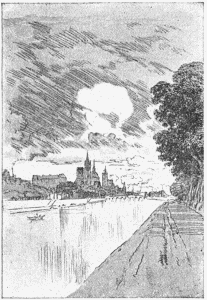
Blois
YOUR business at Tours is to make excursions; and if you make them all
you will be always under arms. The land is a rich reliquary, and an
hour's drive from the town in almost any direction will bring you to the
knowledge of some curious fragment of domestic or ecclesiastical
architecture, some turreted manor, some lonely tower, some gabled
village, some scene of something. Yet even if you do everything—which
was not my case—you cannot hope to tell everything, and, fortunately
for you, the excursions divide themselves into the greater and the less.
You may achieve most of the greater in a week or two; but a summer in
Touraine (which, by the way, must be a
delectable thing) would hold none too many days for the others. If you
come down to Tours from Paris your best economy is to spend a few days
at Blois, where a clumsy but rather attractive little inn on the edge of
the river will offer you a certain amount of that familiar and
intermittent hospitality which a few weeks spent in the French provinces
teaches you to regard as the highest attainable form of accommodation.
Such an economy I was unable to practise. I could only go to Blois (from
Tours) to spend the day; but this feat I accomplished twice over. It is
a very sympathetic little town, as we say nowadays, and a week there
would be sociable even without company. Seated on the north bank of the
Loire, it presents a bright, clean face to the sun and has that aspect
of cheerful leisure which belongs to all white towns that reflect
themselves in shining waters. It is the water-front only of Blois,
however, that exhibits this fresh complexion; the interior is of a
proper brownness, as old sallow books are bound in vellum. The only
disappointment is perforce the discovery that the castle, which is the
special object of one's pilgrimage, does not overhang the river, as I
had always allowed myself to understand. It overhangs the town, but is
scarcely visible from the stream. That peculiar good fortune is reserved
for Amboise and Chaumont.
The Château de Blois is one of the most beautiful and elaborate of all
the old royal residences of this part of France, and I suppose it should
have all the honours of my description. As you cross its threshold you
step straight into the sunshine and storm of the French Renaissance. But
it is too rich to describe—I can only pick out the high lights. It must
be premised that in speaking of it as we see it to-day we speak of a
monument unsparingly restored. The work of restoration has been as
ingenious as it is profuse, but it rather chills the imagination. This
is perhaps almost the first thing you feel as you approach the castle
from the streets of the town. These little streets, as they leave the
river, have pretensions to romantic steepness; one of them, indeed,
which resolves itself into a high staircase with divergent wings (the
escalier monumental), achieved this result so successfully as to
remind me vaguely—I hardly know why—of the great slope of the Capitol,
beside the Ara Cœli, at Rome. The view of that part of the castle
which figures to-day as the back (it is the only aspect I had seen
reproduced) exhibits the marks of restoration with the greatest
assurance. The long façade, consisting only of balconied windows deeply
recessed, erects itself on the summit of a considerable hill, which
gives a fine, plunging movement to its foundations. The deep niches of
the windows are all aglow with colour. They have been repainted with red
and blue, relieved with gold figures; and each of them looks more like
the royal box at a theatre than like the aperture of a palace dark with
memories. For all this, however, and in spite of the fact that, as in
some others of the châteaux of Touraine (always excepting the colossal
Chambord, which is not in Touraine), there is less vastness than one had
expected, the least hospitable aspect of Blois is abundantly impressive.
Here, as elsewhere, lightness and grace are the keynote; and the
recesses of the windows, with their happy proportions, their sculpture
and their colour, are the hollow sockets of the human ornament. They
need the figure of a Francis I. to complete them, or of a Diane de
Poitiers, or even of a Henry III. The stand of this empty gilt cage
emerges from a bed of light verdure which has been allowed to mass
itself there and which contributes
Blois
to the springing look of the walls; while on the right it joins the most
modern portion of the castle, the building erected, on foundations of
enormous height and solidity, in 1635, by Gaston d'Orléans. This fine
frigid mansion—the proper view of it is from the court within—is one
of the masterpieces of François Mansard, whom a kind providence did not
allow to make over the whole palace in the superior manner of his
superior age. That had been a part of Gaston's plan—he was a blunderer
born, and this precious project was worthy of him. This execution of it
would surely have been one of the great misdeeds of history. Partially
performed, the misdeed is not altogether to be regretted; for as one
stands in the court of the castle and lets one's eye wander from the
splendid wing of Francis I.—which is the last word of free and joyous
invention—to the ruled lines and blank spaces of the ponderous pavilion
of Mansard, one makes one's reflections upon the advantage, in even the
least personal of the arts, of having something to say, and upon the
stupidity of a taste which had ended by becoming an aggregation of
negatives. Gaston's wing, taken by itself, has much of the bel air
which was to belong to the architecture of Louis XIV.; but, taken in
contrast to its flowering, laughing, living neighbour, it marks the
difference between inspiration and calculation. We scarcely grudge it
its place, however, for it adds a price to the rest of the pile.
We have entered the court, by the way, by jumping over the walls. The
more orthodox method is to follow a modern terrace which leads to the
left, from the side of the edifice that I began by speaking of, and
passes round, ascending, to a little square on a considerably higher
level, a square not, like the rather prosaic space on which the back (as
I have called it) looks out,
a thoroughfare. This small empty place, oblong in form, at once bright
and quiet, and which ought to be grass-grown, offers an excellent
setting to the entrance-front of the palace—the wing of Louis XII. The
restoration here has been lavish; but it was perhaps but an inevitable
reaction against the injuries, still more lavish, by which the
unfortunate building had long been overwhelmed. It had fallen into a
state of ruinous neglect, relieved only by the misuse proceeding from
successive generations of soldiers, for whom its charming chambers
served as barrack-room. Whitewashed, mutilated, dishonoured, the castle
of Blois may be said to have escaped simply with its life. This is the
history of Amboise as well, and is to a certain extent the history of
Chambord. Delightful, at any rate, was the refreshed façade of Louis
XII. as I stood and looked at it one bright September morning. In that
soft, clear, merry light of Touraine, everything shows, everything
speaks. Charming are the taste, the happy proportions, the colour of
this beautiful front, to which the new feeling for a purely domestic
architecture—an architecture of security and tranquillity, in which art
could indulge itself—gave an air of youth and gladness. It is true that
for a long time to come the castle of Blois was neither very safe nor
very quiet; but its dangers came from within, from the evil passions of
its inhabitants, and not from siege or invasion. The front of Louis XII.
is of red brick, crossed here and there with purple; and the purple
slate of the high roof, relieved with chimneys beautifully treated and
with the embroidered caps of pinnacles and arches, with the porcupine of
Louis, the ermine and the festooned rope which formed the devices of
Anne of Brittany—the tone of this decorative roof carries out the mild
glow of the wall. The wide, fair
windows open as if they had expanded to let in the rosy dawn of the
Renaissance. Charming, for that matter, are the windows of all the
châteaux of Touraine, with their squareness corrected (as it is not in
the Tudor architecture) by the curve of the upper corners, which gives
this line the look, above the expressive aperture, of a pencilled
eyebrow. The low door of this front is crowned by a high, deep niche, in
which, under a splendid canopy, stiffly astride of a stiffly-draped
charger, sits in profile an image of the good King Louis. Good as he had
been—the father of his people, as he was called (I believe he remitted
various taxes)—he was not good enough to pass muster at the Revolution;
and the effigy I have just described is no more than a reproduction of
the primitive statue demolished at that period.
Pass beneath it into the court, and the sixteenth century closes round
you. It is a pardonable flight of fancy to say that the expressive faces
of an age in which human passions lay very near the surface seem to peep
out at you from the windows, from the balconies, from the thick foliage
of the sculpture. The portion of the wing of Louis XII. that fronts
toward the court is supported on a deep arcade. On your right is the
wing erected by Francis I., the reverse of the mass of building which
you see on approaching the castle. This exquisite, this extravagant,
this transcendent piece of architecture is the most joyous utterance of
the French Renaissance. It is covered with an embroidery of sculpture in
which every detail is worthy of the hand of a goldsmith. In the middle
of it, or rather a little to the left, rises the famous winding
staircase (plausibly, but I believe not religiously, restored), which
even the ages which most misused it must vaguely have admired. It forms
a kind of chiselled cylinder, with wide interstices, so that the
stairs are open to the air. Every inch of this structure, of its
balconies, its pillars, its great central columns, is wrought over with
lovely images, strange and ingenious devices, prime among which is the
great heraldic salamander of Francis I. The salamander is everywhere at
Blois—over the chimneys, over the doors, on the walls. This whole
quarter of the castle bears the stamp of that eminently pictorial
prince. The running cornice along the top of the front is like an
unfolded, an elongated bracelet. The windows of the attic are like
shrines for saints. The gargoyles, the medallions, the statuettes, the
festoons are like the elaboration of some precious cabinet rather than
the details of a building exposed to the weather and to the ages. In the
interior there is a profusion of restoration, and it is all restoration
in colour. This has been, evidently, a work of great energy and cost,
but it will easily strike you as overdone. The universal freshness is a
discord, a false note; it seems to light up the dusky past with an
unnatural glare. Begun in the reign of Louis Philippe, this terrible
process—the more terrible always the better case you conceive made out
for it—has been carried so far that there is now scarcely a square inch
of the interior that preserves the colour of the past. It is true that
the place had been so coated over with modern abuse that something was
needed to keep it alive; it is only perhaps a pity the clever doctors,
not content with saving its life, should have undertaken to restore its
bloom. The love of consistency, in such a business, is a dangerous lure.
All the old apartments have been rechristened, as it were; the geography
of the castle has been re-established. The guard-rooms, the bedrooms,
the closets, the oratories have recovered their identity. Every spot
connected with the murder of the
Blois
Duke of Guise is pointed out by a small, shrill boy, who takes you from
room to room and who has learned his lesson in perfection. The place is
full of Catherine de'Medici, of Henry III., of memories, of ghosts, of
echoes, of possible evocations and revivals. It is covered with crimson
and gold. The fireplaces and the ceilings are magnificent; they look
like expensive "sets" at the grand opera.
I should have mentioned that below, in the court, the front of the wing
of Gaston d'Orléans faces you as you enter, so that the place is a
course of French history. Inferior in beauty and grace to the other
portions of the castle, the wing is yet a nobler monument than the
memory of Gaston deserves. The second of the sons of Henry IV.—who was
no more fortunate as a father than as a husband—younger brother of
Louis XIII. and father of the great Mademoiselle, the most celebrated,
most ambitious, most self-complacent and most unsuccessful fille à
marier in French history, passed in enforced retirement at the castle
of Blois the close of a life of clumsy intrigues against Cardinal
Richelieu, in which his rashness was only equalled by his pusillanimity
and his ill-luck by his inaccessibility to correction, and which, after
so many follies and shames, was properly summed up in the
project—begun, but not completed—of demolishing the beautiful
habitation of his exile in order to erect a better one. With Gaston
d'Orléans, however, who lived there without dignity, the history of the
Château de Blois declines. Its interesting period is that of the wars of
religion. It was the chief residence of Henry III., and the scene of the
principal events of his depraved and dramatic rule. It has been restored
more than enough, as I have said, by architects and
decorators; the visitor, as he moves through its empty rooms, which are
at once brilliant and ill-lighted (they have not been refurnished),
undertakes a little restoration of his own. His imagination helps itself
from the things that remain; he tries to see the life of the sixteenth
century in its form and dress—its turbulence, its passions, its loves
and hates, its treacheries, falsities, sincerities, faith, its latitude
of personal development, its presentation of the whole nature, its
nobleness of costume, charm of speech, splendour of taste, unequalled
picturesqueness. The picture is full of movement, of contrasted light
and darkness, full altogether of abominations. Mixed up with them all is
the great theological motive, so that the drama wants little to make it
complete. What episode was ever more perfect—looked at as a dramatic
occurrence—than the murder of the Duke of Guise? The insolent
prosperity of the victim; the weakness, the vices, the terrors, of the
author of the deed; the perfect execution of the plot; the accumulation
of horror in what followed it—render it, as a crime, one of the classic
things.
But we must not take the Château de Blois too hard: I went there, after
all, by way of entertainment. If among these sinister memories your
visit should threaten to prove a tragedy, there is an excellent way of
removing the impression. You may treat yourself at Blois to a very
cheerful afterpiece. There is a charming industry practised there, and
practised in charming conditions. Follow the bright little quay down the
river till you get quite out of the town and reach the point where the
road beside the Loire becomes sinuous and attractive, turns the corner
of diminutive headlands and makes you wonder what is beyond. Let not
your curiosity induce you, however, to pass by a modest
white villa which overlooks the stream, enclosed in a fresh little
court; for here dwells an artist—an artist in faience. There is no sort
of sign, and the place looks peculiarly private. But if you ring at the
gate you will not be turned away. You will, on the contrary, be ushered
upstairs into a parlour—there is nothing resembling a shop—encumbered
with specimens of remarkably handsome pottery. The ware is of the best,
a careful reproduction of old forms, colours, devices; and the master of
the establishment is one of those completely artistic types that are
often found in France. His reception is as friendly as his work is
ingenious; and I think it is not too much to say that you like the work
better because he has produced it. His vases, cups and jars, lamps,
platters, plaques, with their brilliant glaze, their innumerable
figures, their family likeness and wide variations, are scattered
through his occupied rooms; they serve at once as his stock-in-trade and
as household ornament. As we all know, this is an age of prose, of
machinery, of wholesale production, of coarse and hasty processes. But
one brings away from the establishment of the very intelligent M. Ulysse
the sense of a less eager activity and a greater search for perfection.
He has but a few workmen and he gives them plenty of time. The place
makes a little vignette, leaves an impression—the quiet white house in
its garden on the road by the wide, clear river, without the smoke, the
bustle, the ugliness, of so much of our modern industry. It struck me as
an effort Mr. Ruskin might have inspired and Mr. William Morris—though
that be much to say—have forgiven.
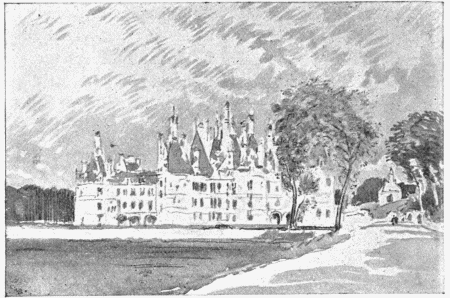
Chambord
THE second time I went to Blois I took a carriage for Chambord, and came
back by the Château de Cheverny and the forest of Russy—a charming
little expedition, to which the beauty of the afternoon (the finest in a
rainy season that was spotted with bright days) contributed not a
little. To go to Chambord you cross the Loire, leave it on one side and
strike away through a country in which salient features become less and
less numerous and which at last has no other quality than a look of
intense and peculiar rurality—the characteristic, even when it be not
the charm, of so much of the landscape of France. This is not the
appearance of wildness, for it goes with great cultivation; it is simply
the presence of the delving, drudging, economising peasant. But it is a
deep, unrelieved rusticity. It is a peasant's landscape; not, as in
England, a landlord's. On the way to Chambord
you enter the flat and sandy Sologne. The wide horizon opens out like a
great potager, without interruptions, without an eminence, with here
and there a long, low stretch of wood. There is an absence of hedges,
fences, signs of property; everything is absorbed in the general
flatness—the patches of vineyard, the scattered cottages, the villages,
the children (planted and staring and almost always pretty), the women
in the fields, the white caps, the faded blouses, the big sabots. At the
end of an hour's drive (they assure you at Blois that even with two
horses you will spend double that time), I passed through a sort of gap
in a wall which does duty as the gateway of the domain of a proscribed
pretender. I followed a straight avenue through a disfeatured park—the
park of Chambord has twenty-one miles of circumference; a very sandy,
scrubby, melancholy plantation, in which the timber must have been cut
many times over and is to-day a mere tangle of brushwood. Here, as in so
many spots in France, the traveller perceives that he is in a land of
revolutions. Nevertheless its great extent and the long perspective of
its avenues give this frugal shrubbery a certain state; just as its
shabbiness places it in agreement with one of the strongest impressions
awaiting you. You pursue one of these long perspectives a proportionate
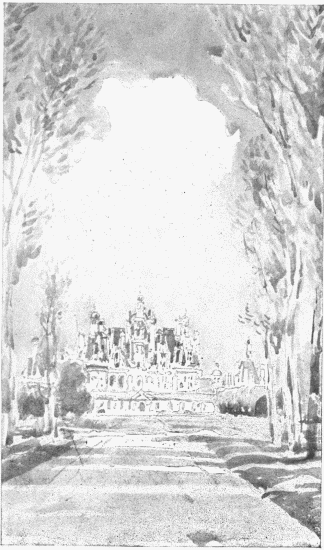
time, and at last you see the chimneys and pinnacles of Chambord rise
apparently out of the ground. The filling-in of the wide moats that
formerly surrounded it has, in vulgar parlance, let it down and given it
a monstrous over-crowned air that is at the same time a magnificent
Orientalism. The towers, the turrets, the cupolas, the gables, the
lanterns, the chimneys look more like the spires of a city than the
salient points of a single building. You
emerge from the avenue and find yourself at the foot of an enormous
fantastic mass. Chambord has a strange mixture of society and solitude.
A little village clusters within view of its liberal windows, and a
couple of inns near by offer entertainment to pilgrims. These things of
course are incidents of the political proscription which hangs its thick
veil over the place. Chambord is truly royal—royal in its great scale,
its grand air, its indifference to common considerations. If a cat may
look at a king, a tavern may look at a palace. I enjoyed my visit to
this extraordinary structure as much as if I had been a legitimist; and
indeed there is something interesting in any monument of a great system,
any bold presentation of a tradition.
You leave your vehicle at one of the inns, which are very decent and
tidy and in which every one is very civil, as if in this latter respect
the neighbourhood of a Court veritably set the fashion, and you proceed
across the grass and the gravel to a small door, a door infinitely
subordinate and conferring no title of any kind on those who enter it.
Here you ring a bell, which a highly respectable person answers (a
person perceptibly affiliated, again, to the old regime), after which
she ushers you over a vestibule into an inner court. Perhaps the
strongest impression I got at Chambord came to me as I stood in this
court. The woman who admitted me did not come with me; I was to find my
guide somewhere else. The specialty of Chambord is its prodigious round
towers. There are, I believe, no less than eight of them, placed at each
angle of the inner and outer square of buildings; for the castle is in
the form of a larger structure which encloses a smaller one. One of
these towers stood before me in the court; it seemed to fling its
shadow
Chambord
over the place; while above, as I looked up, the pinnacles and gables,
the enormous chimneys, soared into the bright blue air. The place was
empty and silent; shadows of gargoyles, of extraordinary projections,
were thrown across the clear grey surfaces. One felt that the whole
thing was monstrous. A cicerone appeared, a languid young man in a
rather shabby livery, and led me about with a mixture of the impatient
and the desultory, of condescension and humility. I do not profess to
understand the plan of Chambord, and I may add that I do not even desire
to do so; for it is much more entertaining to think of it, as you can so
easily, as an irresponsible, insoluble labyrinth. Within it is a
wilderness of empty chambers, a royal and romantic barrack. The exiled
prince to whom it gives its title has not the means to keep up four
hundred rooms; he contents himself with preserving the huge outside. The
repairs of the prodigious roof alone must absorb a large part of his
revenue. The great feature of the interior is the celebrated double
staircase, rising straight through the building, with two courses of
steps, so that people may ascend and descend without meeting. This
staircase is a truly majestic piece of humour; it gives you the note, as
it were, of Chambord. It opens on each landing to a vast guard-room, in
four arms, radiations of the winding shaft. My guide made me climb to
the great open-work lantern which, springing from the roof at the
termination of the rotund staircase (surmounted here by a smaller one),
forms the pinnacle of the bristling crown of the pile. This lantern is
tipped with a huge fleur-de-lis in stone—the only one, I believe,
that the Revolution did not succeed in pulling down. Here, from narrow
windows, you look over the wide, flat country and the tangled,
melancholy park, with the rotation of its straight avenues. Then you
walk about the roof in a complication of galleries, terraces, balconies,
through the multitude of chimneys and gables. This roof, which is in
itself a sort of castle in the air, has an extravagant, fabulous
quality, and with its profuse ornamentation—the salamander of Francis
I. is a constant motive—its lonely pavements, its sunny niches, the
balcony that looks down over the closed and grass-grown main entrance, a
strange, half-sad, half-brilliant charm. The stonework is covered with
fine mould. There are places that reminded me of some of those quiet
mildewed corners of courts and terraces into which the traveller who
wanders through the Vatican looks down from neglected windows. They show
you two or three furnished rooms, with Bourbon portraits, hideous
tapestries from the ladies of France, a collection of the toys of the
enfant du miracle, all military and of the finest make. "Tout cela
fonctionne," the guide said of these miniature weapons; and I wondered,
if he should take it into his head to fire off his little cannon, how
much harm the Comte de Chambord would do.
From below the castle would look crushed by the redundancy of its upper
protuberances if it were not for the enormous girth of its round towers,
which appear to give it a robust lateral development. These towers,
however, fine as they are in their way, struck me as a little stupid;
they are the exaggeration of an exaggeration. In a building erected
after the days of defence and proclaiming its peaceful character from
its hundred embroideries and cupolas, they seem to indicate a want of
invention. I shall risk the accusation of bad taste if I say that,
impressive as it is, the Château de Chambord seemed to me to have
altogether
a touch of that quality of stupidity. The trouble is that it stands for
nothing very momentous; it has not happened, in spite of sundry
vicissitudes, to have a strongly-marked career. Compared with that of
Blois and Amboise its past is rather vacant; and one feels to a certain
extent the contrast between its pompous appearance and its spacious but
somewhat colourless annals. It had indeed the good fortune to be erected
by Francis I., whose name by itself expresses a good deal of history.
Why he should have built a palace in those sandy plains will ever remain
an unanswered question, for kings have never been obliged to give
reasons. In addition to the fact that the country was rich in game and
that Francis was a passionate hunter, it is suggested by M. de la
Saussaye, the author of the very complete little account of the place
which you may buy at the bookseller's at Blois, that he was governed in
his choice of the site by the chance that a charming woman had
previously lived there. The Comtesse de Thoury had a manor in the
neighbourhood, and the Comtesse de Thoury had been the object of a
youthful passion on the part of the most susceptible of princes before
his accession to the throne. This great pile was reared, therefore,
according to M. de la Saussaye, as a souvenir de premières amours! It
is certainly a very massive memento; and if these tender passages were
proportionate to the building that commemorates them, the flame blazed
indeed. There has been much discussion as to the architect employed by
Francis I., and the honour of having designed this splendid residence
has been claimed for several of the Italian artists who early in the
sixteenth century came to seek patronage in France. It seems well
established to-day, however, that Chambord was the work neither of
Primaticcio, of
Chambord
Vignola, nor of Il Rosso, all of whom have left some trace of their
sojourn in France; but of an obscure yet very complete genius, Pierre
Nepveu, known as Pierre Trinqueau, who is designated in the papers which
preserve in some degree the history of the origin of the edifice, as the
maistre de l'œuvre de maçonnerie. Behind this modest title,
apparently, we must recognise one of the most original talents of the
French Renaissance; and it is a proof of the vigour of the artistic life
of that period that, brilliant production being everywhere abundant, an
artist of so high a value should not have been treated by his
contemporaries as a celebrity. We make our celebrities to-day at smaller
cost.
The immediate successors of Francis I. continued to visit Chambord; but
it was neglected by Henry IV. and was never afterwards a favourite
residence of any French king. Louis XIV. appeared there on several
occasions, and the apparition was characteristically brilliant; but
Chambord could not long detain a monarch who had gone to the expense of
creating a Versailles ten miles from Paris. With Versailles,
Fontainebleau, Saint-Germain and Saint-Cloud within easy reach of their
capital, the later French sovereigns had little reason to take the air
in the dreariest province of their kingdom. Chambord therefore suffered
from royal indifference, though in the last century a use was found for
its deserted halls. In 1725 it was occupied by the luckless Stanislaus
Leczynski, who spent the greater part of his life in being elected King
of Poland and being ousted from his throne, and who, at this time a
refugee in France, had found a compensation for some of his misfortunes
in marrying his daughter to Louis XV. He lived eight years at Chambord
and filled up the moats of the castle. In
1748 it found an illustrious tenant in the person of Maurice de Saxe,
the victor of Fontenoy, who, however, two years after he had taken
possession of it, terminated a life which would have been longer had he
been less determined to make it agreeable. The Revolution, of course,
was not kind to Chambord. It despoiled it in so far as possible of every
vestige of its royal origin, and swept like a whirlwind through
apartments to which upwards of two centuries had contributed a treasure
of decoration and furniture. In that wild blast these precious things
were destroyed or for ever scattered. In 1791 an odd proposal was made
to the French Government by a company of English Quakers, who had
conceived the bold idea of establishing in the palace a manufacture of
some peaceful commodity not to-day recorded. Napoleon allotted Chambord,
as a "dotation," to one of his marshals, Berthier, for whose benefit it
was converted, in Napoleonic fashion, into the so-called principality of
Wagram. By the Princess of Wagram, the marshal's widow, it was, after
the Restoration, sold to the trustees of a national subscription which
had been established for the purpose of presenting it to the infant Duke
of Bordeaux, then prospective King of France. The presentation was duly
made; but the Comte de Chambord, who had changed his title in
recognition of the gift, was despoiled of his property by the government
of Louis Philippe. He appealed for redress to the tribunals of his
country; and the consequence of his appeal was an interminable
litigation, by which, however, finally, after the lapse of twenty-five
years, he was established in his rights. In 1871 he paid his first visit
to the domain which had been offered him half a century before, a term
of which he had spent forty years in exile. It was from Chambord that
he
dated his famous letter of the 5th of July of that year—the letter,
directed to his so-called subjects, in which he waves aloft the white
flag of the Bourbons. This rare miscalculation—virtually an invitation
to the French people to repudiate, as their national ensign, that
immortal tricolour, the flag of the Revolution and the Empire, under
which they have won the glory which of all glories has hitherto been
dearest to them and which is associated with the most romantic, the most
heroic, the epic, the consolatory, period of their history—this
luckless manifesto, I say, appears to give the measure of the political
wisdom of the excellent Henry V. The proposal should have had less
simplicity or the people less irony.
OnChambord the whole Chambord makes a great impression; and the hour I was
there, while the yellow afternoon light slanted upon the September
woods, there was a dignity in its desolation. It spoke, with a muffled
but audible voice, of the vanished monarchy, which had been so strong,
so splendid, but to-day had become a vision almost as fantastic as the
cupolas and chimneys that rose before me. I thought, while I lingered
there, of all the fine things it takes to make up such a monarchy; and
how one of them is a superfluity of mouldering, empty palaces. Chambord
is touching—that is the best word for it; and if the hopes of another
restoration are in the follies of the Republic, a little reflection on
that eloquence of ruin ought to put the Republic on its guard. A
sentimental tourist may venture to remark that in presence of all the
haunted houses that appeal in this mystical manner to the retrospective
imagination it cannot afford to be foolish. I thought of all this as I
drove back to Blois by the way of the Château de Cheverny. The road took
us
out of the park of Chambord, but through a region of flat woodland,
where the trees were not mighty, and again into the prosy plain of the
Sologne—a thankless soil to sow, I believe, but lately much amended by
the magic of cheerful French industry and thrift. The light had already
begun to fade, and my drive reminded me of a passage in some rural novel
of Madame Sand. I passed a couple of timber and plaster churches, which
looked very old, black and crooked, and had lumpish wooden porches and
galleries encircling the base. By the time I reached Cheverny the clear
twilight had approached. It was late to ask to be allowed to visit an
inhabited house; but it was the hour at which I like best to visit
almost anything. My coachman drew up before a gateway, in a high wall,
which opened upon a short avenue, along which I took my way on foot; the
coachmen in those parts being, for reasons best known to themselves,
mortally averse to driving up to a house. I answered the challenge of a
very tidy little portress who sat, in company with a couple of children,
enjoying the evening air in front of her lodge, and who told me to walk
a little farther and turn to the right. I obeyed her to the letter, and
my turn brought me into sight of a house as charming as an old manor in
a fairy tale. I had but a rapid and partial view of Cheverny; but that
view was a glimpse of perfection. A light, sweet mansion stood looking
over a wide green lawn, over banks of flowers and groups of trees. It
had a striking character of elegance, produced partly by a series of
Renaissance busts let into circular niches in the façade. The place
looked so private, so reserved, that it seemed an act of violence to
ring, a stranger and foreigner, at the graceful door. But if I had not
rung I should be unable to express—as
it is such a pleasure to do—my sense of the exceeding courtesy with
which this admirable house is shown. It was near the dinner-hour—the
most sacred hour of the day; but I was freely conducted into the
inhabited apartments. They are extremely beautiful. What I chiefly
remember is the charming staircase of white embroidered stone, and the
great salle des gardes and chambre à coucher du roi on the second
floor. Cheverny, built in 1634, is of a much later date than the other
royal residences of this part of France; it belongs to the end of the
Renaissance and has a touch of the rococo. The guard-room is a superb
apartment; and as it contains little save its magnificent ceiling and
fireplace and certain dim tapestries on its walls, you the more easily
take the measure of its noble proportions. The servant opened the
shutters of a single window, and the last rays of the twilight slanted
into the rich brown gloom. It was in the same picturesque fashion that I
saw the bedroom (adjoining) of Henry IV., where a legendary-looking bed,
draped in folds long unaltered, defined itself in the haunted dusk.
Cheverny remains to me a very charming, a partly mysterious vision. I
drove back to Blois in the dark, some nine miles, through the forest of
Russy, which belongs to the State and which, though consisting
apparently of small timber, looked under the stars sufficiently vast and
primeval. There was a damp autumnal smell and the occasional sound of a
stirring thing; and as I moved through the evening air I thought of
Francis I. and Henry IV.
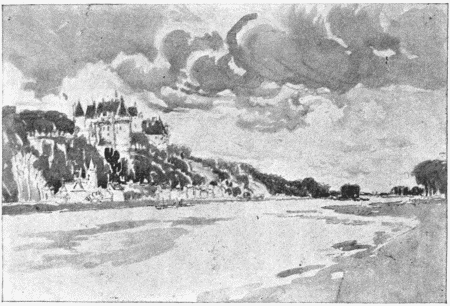
Amboise
YOU may go to Amboise either from Blois or from Tours; it is about
half-way between these towns. The great point is to go, especially if
you have put it off repeatedly; and to go, if possible, on a day when
the great view of the Loire, which you enjoy from the battlements and
terraces, presents itself under a friendly sky. Three persons, of whom
the author of these lines was one, spent the greater part of a perfect
Sunday morning in looking at it. It was astonishing, in the course of
the rainiest season in the memory of the oldest Tourangeau, how many
perfect days we found to our hand. The town of Amboise lies, like Tours,
on the left bank of the river—a little white-faced town staring across
an admirable bridge and leaning, behind, as it were, against the
pedestal of rock on which the dark castle masses itself. The town is so
small, the pedestal so big and the castle so high
and striking, that the clustered houses at the base of the rock are like
the crumbs that have fallen from a well-laden table. You pass among
them, however, to ascend by a circuit to the château, which you attack,
obliquely, from behind. It is the property of the Comte de Paris,
another pretender to the French throne; having come to him remotely, by
inheritance, from his ancestor, the Duc de Penthièvre, who toward the
close of the last century bought it from the Crown, which had recovered
it after a lapse. Like the castle of Blois, it has been injured and
defaced by base uses, but, unlike the castle of Blois, it has not been
completely restored. "It is very, very dirty, but very curious"—it is
in these terms that I heard it described by an English lady who was
generally to be found engaged upon a tattered Tauchnitz in the little
salon de lecture of the hotel at Tours. The description is not
inaccurate; but it should be said that if part of the dirtiness of
Amboise is the result of its having served for years as a barrack and as
a prison, part of it comes from the presence of restoring stonemasons,
who have woven over a considerable portion of it a mask of scaffolding.
There is a good deal of neatness as well, and the restoration of some of
the parts seems finished. This process, at Amboise, consists for the
most part simply of removing the vulgar excrescences of the last two
centuries.
The interior is virtually a blank, the old apartments having been
chopped up into small modern rooms; it will have to be completely
reconstructed. A worthy woman with a military profile and that sharp,
positive manner which the goodwives who show you through the châteaux of
Touraine are rather apt to have, and in whose high respectability, to
say nothing of the frill of
her cap and the cut of her thick brown dress, my companions and I
thought we discovered the particular note, or nuance, of Orleanism—a
competent, appreciative, peremptory person, I say—attended us through
the particularly delightful hour we spent upon the ramparts of Amboise.
Denuded and disfeatured within and bristling without with bricklayers'
ladders, the place was yet extraordinarily impressive and interesting. I
should mention that we spent a great deal of time in looking at the
view. Sweet was the view, and magnificent; we preferred it so much to
certain portions of the interior, and to occasional effusions of
historical information, that the old lady with the profile sometimes
lost patience with us. We laid ourselves open to the charge of
preferring it even to the little chapel of Saint Hubert, which stands on
the edge of the great terrace and has, over the portal, a wonderful
sculpture of the miraculous hunt of that holy man. In the way of plastic
art this elaborate scene is the gem of Amboise. It seemed to us that we
had never been in a place where there are so many points of vantage to
look down from. In the matter of position Amboise is certainly supreme
in the list of perched places; and I say this with a proper recollection
of the claims of Chaumont and of Loches—which latter, by the way (the
afterthought is due), is not on the Loire. The platforms, the bastions,
the terraces, the high-niched windows and balconies, the hanging gardens
and dizzy crenellations, of this complicated structure, keep you in
perpetual intercourse with an immense horizon. The great feature of the
place is the obligatory round tower which occupies the northern end of
it, and which has now been completely restored. It is of astounding
size, a fortress in itself, and contains, instead of a staircase, a
wonderful inclined
plane, so wide and gradual that a coach and four may be driven to the
top. This colossal cylinder has to-day no visible use; but it
corresponds, happily enough, with the great circle of the prospect. The
gardens of Amboise, lifted high aloft, covering the irregular remnants
of the platform on which the castle stands and making up in
picturesqueness what they lack in extent, constitute of course but a
scanty domain. But bathed, as we found them, in the autumn sunshine and
doubly private from their aerial site, they offered irresistible
opportunities for a stroll interrupted, as one leaned against their low
parapets, by long contemplative pauses. I remember in particular a
certain terrace planted with clipped limes upon which we looked down
from the summit of the big tower. It seemed from that point to be
absolutely necessary to one's happiness to go down and spend the rest of
the morning there; it was an ideal place to walk to and fro and talk.
Our venerable conductress, to whom our relation had gradually become
more filial, permitted us to gratify this innocent wish—to the extent,
that is, of taking a turn or two under the mossy tilleuls. At the end
of this terrace is the low door, in a wall, against the top of which, in
1498, Charles VIII., according to an accepted tradition, knocked his
head to such good purpose that he died. It was within the walls of
Amboise that his widow, Anne of Brittany, already in mourning for three
children, two of whom we have seen commemorated in sepulchral marble at
Tours, spent the first violence of that grief which was presently
dispelled by a union with her husband's cousin and successor, Louis XII.
Amboise was a frequent resort of the French Court during the sixteenth
century; it was here that the young Mary Stuart spent sundry
hours of her first marriage. The wars of religion have left here the
ineffaceable stain which they left wherever they passed. An imaginative
visitor at Amboise to-day may fancy that the traces of blood are mixed
with the red rust on the crossed iron bars of the grim-looking balcony
to which the heads of the Huguenots executed on the discovery of the
conspiracy of La Renaudie are rumoured to have been suspended. There was
room on the stout balustrade—an admirable piece of work—for a ghastly
array. The same rumour represents Catherine de'Medici and the young
queen as watching from this balcony the noyades of the captured
Huguenots in the Loire. The facts of history are bad enough; the
fictions are, if possible, worse; but there is little doubt that the
future Queen of Scots learnt the first lessons of life at a horrible
school. If in subsequent years she was a prodigy of innocence and
virtue, it was not the fault of her whilom mother-in-law, of her uncles
of the house of Guise, or of the examples presented to her either at the
windows of the castle of Amboise or in its more private recesses.
Chaumont
It was difficult to believe in these dark deeds, however, as we looked
through the golden morning at the placidity of the far-shining Loire.
The ultimate consequence of this spectacle was a desire to follow the
river as far as the castle of Chaumont. It is true that the cruelties
practised of old at Amboise might have seemed less phantasmal to persons
destined to suffer from a modern form of inhumanity. The mistress of the
little inn at the base of the castle-rock—it stands very pleasantly
beside the river, and we had breakfasted there—declared to us that the
Château de Chaumont, which is often during the autumn closed to
visitors, was at that particular moment standing so wide open to
receive us that it was our duty to hire one of her carriages and drive
thither with speed. This assurance was so satisfactory that we presently
found ourselves seated in this wily woman's most commodious vehicle and
rolling, neither too fast nor too slow, along the margin of the Loire.
The drive of about an hour, beneath constant clumps of chestnuts, was
charming enough to have been taken for itself; and indeed when we
reached Chaumont we saw that our reward was to be simply the usual
reward of virtue, the consciousness of having attempted the right. The
Château de Chaumont was inexorably closed; so we learned from a
talkative lodge-keeper, who gave what grace she could to her refusal.
This good woman's dilemma was almost touching; she wished to reconcile
two impossibles. The castle was not to be visited, for the family of its
master was staying there; and yet she was loath to turn away a party of
which she was good enough to say that it had a grand genre; for, as
she also remarked, she had her living to earn. She tried to arrange a
compromise, one of the elements of which was that we should descend from
our carriage and trudge up a hill which would bring us to a designated
point where, over the paling of the garden, we might obtain an oblique
and surreptitious view of a small portion of the castle walls. This
suggestion led us to inquire (of each other) to what degree of baseness
it is lawful for an enlightened lover of the picturesque to resort in
order not to have a blank page in his collection. One of our trio
decided characteristically against any form of derogation; so she sat in
the carriage and sketched some object that was public property while her
two companions, who were not so proud, trudged up a muddy ascent which
formed a kind of back-stairs. It
is perhaps no more than they deserved that they were disappointed.
Chaumont is feudal, if you please; but the modern spirit is in
possession. It forms a vast clean-scraped mass, with big round towers,
ungarnished with a leaf of ivy or a patch of moss, surrounded by gardens
of moderate extent (save where the muddy lane of which I speak passes
near it), and looking rather like an enormously magnified villa. The
great merit of Chaumont is its position, which almost exactly resembles
that of Amboise; it sweeps the river up and down and seems to look over
half the province. This, however, was better appreciated as, after
coming down the hill and re-entering the carriage, we drove across the
long suspension-bridge which crosses the Loire just beyond the village
and over which we made our way to the small station of Onzain, at the
farther end, to take the train back to Tours. Look back from the middle
of this bridge; the whole picture composes, as the painters say. The
towers, the pinnacles, the fair front of the château, perched above its
fringe of garden and the rusty roofs of the village and facing the
afternoon sky, which is reflected also in the great stream that sweeps
below, all this makes a contribution to your happiest memories of
Touraine.
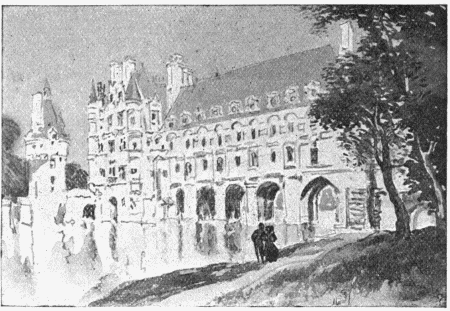
Chenonceaux
WE never went to Chinon; it was a fatality. We planned it a dozen times;
but the weather interfered, or the trains didn't suit, or one of the
party was fatigued with the adventures of the day before. This excursion
was so much postponed that it was finally postponed to everything.
Besides, we had to go to Chenonceaux, to Azay-le-Rideau, to Langeais, to
Loches. So I have not the memory of Chinon; I have only the regret. But
regret, as well as memory, has its visions; especially when, like
memory, it is assisted by photographs. The castle of Chinon in this form
appears to me as an enormous ruin, a mediæval fortress of the extent
almost of a city. It covers a hill above the Vienne, and after being
impregnable in its time is indestructible to-day. (I risk this phrase in
the face of the prosaic truth. Chinon, in the days when it was a prize,
more than once suffered capture, and at
present it is crumbling inch by inch. It is apparent, however, I
believe, that these inches encroach little upon acres of masonry.) It
was in the castle that Jeanne Dare had her first interview with Charles
VII., and it is in the town that François Rabelais is supposed to have
been born. To the castle, moreover, the lover of the picturesque is
earnestly recommended to direct his steps. But one always misses
something, and I would rather have missed Chinon than Chenonceaux.
Fortunate exceedingly were the few hours we passed on the spot on which
we missed nothing.
"In 1747," says Jean-Jacques Rousseau in his "Confessions," "we went to
spend the autumn in Touraine, at the Château of Chenonceaux, a royal
residence upon the Cher, built by Henry II. for Diana of Poitiers, whose
initials are still to be seen there, and now in possession of M. Dupin,
the farmer-general. We amused ourselves greatly at this fine place; the
living was of the best, and I became as fat as a monk. We made a great
deal of music and acted comedies."
This is the only description that Rousseau gives of one of the most
romantic houses in France and of an episode that must have counted as
one of the most agreeable in his uncomfortable career. The eighteenth
century contented itself with general epithets; and when Jean-Jacques
has said that Chenonceaux was a "beau lieu," he thinks himself absolved
from further characterisation. We later sons of time have, both for our
pleasure and our pain, invented the fashion of special terms, and I am
afraid that even common decency obliges me to pay some larger tribute
than this to the architectural gem of Touraine. Fortunately I can
discharge my debt with gratitude. In going from Tours you leave the
valley of the Loire and enter that
of the Cher, and at the end of about an hour you see the turrets of the
castle on your right, among the trees, down in the meadows, beside the
quiet little river. The station and the village are about ten minutes'
walk from the château, and the village contains a very tidy inn, where,
if you are not in too great a hurry to commune with the shades of the
royal favourite and the jealous queen, you will perhaps stop and order a
dinner to be ready for you in the evening. A straight, tall avenue leads
to the grounds of the castle; what I owe to exactitude compels me to add
that it is crossed by the railway-line. The place is so arranged,
however, that the château need know nothing of passing trains—which
pass, indeed, though the grounds are not large, at a very sufficient
distance. I may add that the trains throughout this part of France have
a noiseless, desultory, dawdling, almost stationary quality, which makes
them less of an offence than usual. It was a Sunday afternoon and the
light was yellow save under the trees of the avenue, where, in spite of
the waning of September, it was duskily green. Three or four peasants,
in festal attire, were strolling about. On a bench at the beginning of
the avenue sat a man with two women. As I advanced with my companions he
rose, after a sudden stare, and approached me with a smile in which (to
be Johnsonian for a moment) certitude was mitigated by modesty and
eagerness was embellished with respect. He came toward me with a
salutation that I had seen before, and I am happy to say that after an
instant I ceased to be guilty of the brutality of not knowing where.
There was only one place in the world where people smile like that, only
one place where the art of salutation has that perfect grace. This
excellent creature used to crook his arm,
in Venice, when I stepped into my gondola; and I now laid my hand on
that member with the familiarity of glad recognition; for it was only
surprise that had kept me even for a moment from accepting the genial
Francesco as an ornament of the landscape of Touraine. What on
earth—the phrase is the right one—was a Venetian gondolier doing at
Chenonceaux? He had been brought from Venice, gondola and all, by the
mistress of the charming house, to paddle about on the Cher. Our meeting
was affectionate, though there was a kind of violence in seeing him so
far from home. He was too well dressed, too well fed; he had grown
stout, and his nose had the tinge of good claret. He remarked that the
life of the household to which he had the honour to belong was that of a
casa regia; which must have been a great change for poor Checco, whose
habits in Venice were not regal. However, he was the sympathetic Checco
still; and for five minutes after I left him I thought less about the
little pleasure-house by the Cher than about the palaces of the
Adriatic.
But attention was not long in coming round to the charming structure
that presently rose before us. The pale yellow front of the château, the
small scale of which is at first a surprise, rises beyond a considerable
court, at the entrance of which a massive and detached round tower, with
a turret on its brow (a relic of the building that preceded the actual
villa), appears to keep guard. This court is not enclosed—or is
enclosed at least only by the gardens, portions of which are at present
in process of radical readjustment. Therefore, though Chenonceaux has no
great height, its delicate façade stands up boldly enough. This façade,
one of the most finished things in Touraine, consists of two storeys,
surmounted by an attic which, as so often in the
buildings of the French Renaissance, is the richest part of the house.
The high-pitched roof contains three windows of beautiful design,
covered with embroidered caps and flowering into crocketed spires. The
window above the door is deeply niched; it opens upon a balcony made in
the form of a double pulpit—one of the most charming features of the
front. Chenonceaux is not large, as I say, but into its delicate compass
is packed a great deal of history—history which differs from that of
Amboise and Blois in being of the private and sentimental kind. The
echoes of the place, faint and far as they are to-day, are not
political, but personal. Chenonceaux dates, as a residence, from the
year 1515, when the shrewd Thomas Bohier, a public functionary who had
grown rich in handling the finances of Normandy and had acquired the
estate from a family which, after giving it many feudal lords, had
fallen into poverty, erected the present structure on the foundations of
an old mill. The design is attributed, with I know not what justice, to
Pierre Nepveu, alias Trinqueau, the audacious architect of Chambord.
On the death of Bohier the house passed to his son, who, however, was
forced, under cruel pressure, to surrender it to the Crown in
compensation for a so-called deficit in the official accounts of this
rash parent and predecessor. Francis I. held the place till his death;
but Henry II., on ascending the throne, presented it out of hand to that
mature charmer, the admired of two generations, Diana of Poitiers. Diana
enjoyed it till the death of her protector; but when this event occurred
the widow of the monarch, who had been obliged to submit in silence, for
years, to the ascendency of a rival, took the most pardonable of all the
revenges with which the name of Catherine de'Medici is associated and
turned
her out of doors. Diana was not in want of refuges, Catherine went
through the form of giving her Chaumont in exchange; but there was only
one Chenonceaux. Catherine devoted herself to making the place more
completely unique. The feature that renders it sole of its kind is not
appreciated till you wander round to either side of the house. If a
certain springing lightness is the characteristic of Chenonceaux, if it
bears in every line the aspect of a place of recreation—a place
intended for delicate, chosen pleasures—nothing can confirm this
expression better than the strange, unexpected movement with which, from
behind, it carries itself across the river. The earlier building stands
in the water; it had inherited the foundations of the mill destroyed by
Thomas Bohier. The first step therefore had been taken upon solid piles
of masonry; and the ingenious Catherine—she was a raffinée—simply
proceeded to take the others. She continued the piles to the opposite
bank of the Cher, and over them she threw a long, straight gallery of
two tiers. This part of the château, which mainly resembles a house
built upon a bridge and occupying its entire length, is of course the
great curiosity of Chenonceaux. It forms on each floor a charming
corridor, which, within, is illuminated from either side by the
flickering river-light. The architecture of these galleries, seen from
without, is less elegant than that of the main building, but the aspect
of the whole thing is delightful. I have spoken of Chenonceaux as a
"villa," using the word advisedly, for the place is neither a castle nor
a palace. It is a very exceptional villa, but it has the
villa-quality—the look of being intended for life in common. This look
is not at all contradicted by the wing across the Cher, which only
suggests indoor perspectives and intimate pleasures—walks in pairs on
rainy days; games and dances on autumn nights; together with as much as
may be of moonlighted dialogue (or silence) in the course of evenings
more genial still, in the well-marked recesses of windows.
ItChenonceaux is safe to say that such things took place there in the last century,
during the kindly reign of Monsieur and Madame Dupin. This period
presents itself as the happiest in the annals of Chenonceaux. I know not
what festive train the great Diana may have led, and my imagination, I
am afraid, is only feebly kindled by the records of the luxurious
pastimes organised on the banks of the Cher by that terrible daughter of
the Medici whose appreciation of the good things of life was perfectly
consistent with a failure to perceive why others should live to enjoy
them. The best society that ever assembled there was collected at
Chenonceaux during the middle of the eighteenth century. This was
surely, in France at least, the age of good society, the period when the
"right people" made every haste to be born in time. Such people must of
course have belonged to the fortunate few—not to the miserable many;
for if a society be large enough to be good, it must also be small
enough. The sixty years that preceded the Revolution were the golden age
of fireside talk and of those amenities that proceed from the presence
of women in whom the social art is both instinctive and acquired. The
women of that period were, above all, good company; the fact is attested
in a thousand documents. Chenonceaux offered a perfect setting to free
conversation; and infinite joyous discourse must have mingled with the
liquid murmur of the Cher. Claude Dupin was not only a great man of
business, but a man
of honour and a patron of knowledge; and his wife was gracious, clever,
and wise. They had acquired this famous property by purchase (from one
of the Bourbons, as Chenonceaux, for two centuries after the death of
Catherine de'Medici, remained constantly in princely hands), and it was
transmitted to their son, Dupin de Francueil, grandfather of Madame
George Sand. This lady, in her Correspondence, lately published,
describes a visit that she paid more than thirty years ago to those
members of her family who were still in possession. The owner of
Chenonceaux to-day[a] is the daughter of an Englishman naturalised in
France. But I have wandered far from my story, which is simply a sketch
of the surface of the place. Seen obliquely, from either side, in
combination with its bridge and gallery, the structure is singular and
fantastic, a striking example of a wilful and capricious conception.
Unfortunately all caprices are not so graceful and successful, and I
grudge the honour of this one to the false and blood-polluted Catherine.
(To be exact, I believe the arches of the bridge were laid by the
elderly Diana. It was Catherine, however, who completed the monument.)
Within, the house has been, as usual, restored. The staircases and
ceilings, in all the old royal residences of this part of France, are
the parts that have suffered least; many of them have still much of the
life of the old time about them. Some of the chambers of Chenonceaux,
however, encumbered as they are with modern detail, derive a
sufficiently haunted and suggestive look from the deep setting of their
beautiful windows, which thickens the shadows and makes dark corners.
There is a charming little Gothic chapel, with its apse hanging over the
water, fastened to the left flank of the house. Some of the
upper balconies, which look along the outer face of the gallery and
either up or down the river, are delightful protected nooks. We walked
through the lower gallery to the other bank of the Cher; this fine
apartment appeared to be for the moment a purgatory of ancient
furniture. It terminates rather abruptly; it simply stops, with a blank
wall. There ought, of course, to have been a pavilion here, though I
prefer very much the old defect to any modern remedy. The wall is not so
blank, however, but that it contains a door which opens on a rusty
drawbridge. This drawbridge traverses the small gap which divides the
end of the gallery from the bank of the stream. The house, therefore,
does not literally rest on opposite edges of the Cher, but rests on one
and just fails to rest on the other. The pavilion would have made that
up; but after a moment we ceased to miss this imaginary feature. We
passed the little drawbridge, and wandered awhile beside the river. From
this opposite bank the mass of the château looked more charming than
ever; and the little peaceful, lazy Cher, where two or three men were
fishing in the eventide, flowed under the clear arches and between the
solid pedestals of the part that spanned it, with the softest, vaguest
light on its bosom. This was the right perspective; we were looking
across the river of time. The whole scene was deliciously mild. The moon
came up; we passed back through the gallery and strolled about a little
longer in the gardens. It was very still. I met my old gondolier in the
twilight. He showed me his gondola, but I hated, somehow, to see it
there. I don't like, as the French say, to mêler les genres. A gondola
in a little flat French river? The image was not less irritating, if
less injurious, than the spectacle of a steamer in the Grand Canal,
which had driven me away from
Chenonceaux
Venice a year and a half before. We took our way back to the Bon
Laboureur, and waited in the little inn-parlour for a late train to
Tours. We were not impatient, for we had an excellent dinner to occupy
us; and even after we had dined we were still content to sit awhile and
exchange remarks upon the superior civilisation of France. Where else,
at a village inn, should we have fared so well? Where else should we
have sat down to our refreshment without condescension? There were a
couple of countries in which it would not have been happy for us to
arrive hungry, on a Sunday evening, at so modest an hostelry. At the
little inn at Chenonceaux the cuisine was not only excellent, but the
service was graceful. We were waited on by mademoiselle and her mamma;
it was so that mademoiselle alluded to the elder lady as she uncorked
for us a bottle of Vouvray mousseux. We were very comfortable, very
genial; we even went so far as to say to each other that Vouvray
mousseux was a delightful wine. From this opinion indeed one of our trio
differed; but this member of the party had already exposed herself to
the charge of being too fastidious by declining to descend from the
carriage at Chaumont and take that back-stairs view of the castle.
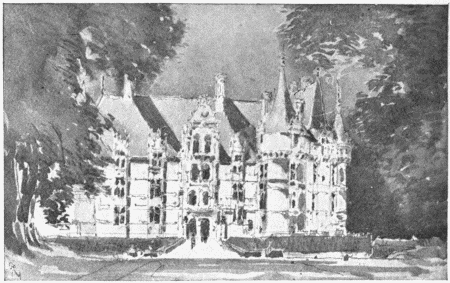
Azay-le-Rideau
WITHOUT fastidiousness it was fair to declare on the other hand that the
little inn at Azay-le-Rideau was very bad. It was terribly dirty and it
was in charge of a fat mégère whom the appearance of four trustful
travellers—we were four, with an illustrious fourth, on that
occasion—roused apparently to fury. I attached great importance to this
incongruous hostess, for she uttered the only uncivil words I heard
spoken (in connection with any business of my own) during a tour of some
six weeks in France. Breakfast not at Azay-le-Rideau therefore, too
trustful traveller; or if you do so, be either very meek or very bold.
Breakfast not, save under stress of circumstance; but let no
circumstance whatever prevent your going to see the great house of the
place, which is a fair rival to Chenonceaux. The village lies close to
the gates, though after you pass these gates you leave it well behind. A
little avenue, as at Chenonceaux, leads to the castle,
making a pretty vista as you approach the sculptured doorway. Azay is a
most perfect and beautiful thing; I should place it third in any list of
the great houses of this part of France in which these houses should be
ranked according to charm. For beauty of detail it comes after Blois and
Chenonceaux, but it comes before Amboise and Chambord. On the other
hand, of course it is inferior in majesty to either of these vast
structures. Like Chenonceaux, it is a watery place, though it is more
meagrely moated than the small château on the Cher. It consists of a
large square corps de logis, with a round tower at each angle, rising
out of a somewhat too slumberous pond. The water—the water of the
Indre—surrounds it, but it is only on one side that it bathes its feet
in the moat. On one of the others stretches a little terrace, treated as
a garden, and in front prevails a wide court formed by a wing which, on
the right, comes forward. This front, covered with sculptures, is of the
richest, stateliest effect. The court is approached by a bridge over the
pond, and the house would reflect itself in this wealth of water if the
water were a trifle less opaque. But there is a certain stagnation—it
affects more, senses than one—about the picturesque pools of Azay. On
the hither side of the bridge is a garden overshadowed by fine old
sycamores—a garden shut in by greenhouses and by a fine last-century
gateway flanked with twin lodges. Beyond the château and the standing
waters behind it is a so-called parc, which, however, it must be
confessed, has little of park-like beauty. The old houses—a large
number—remain in France; but the old timber does not remain, and the
denuded aspect of the few acres that surround the châteaux of Touraine
is pitiful to the traveller who has learned to take the measure of such
things from the
country of "stately homes." The garden-ground of the lordly Chaumont is
that of an English suburban villa; and in that and in other places there
is little suggestion, in the untended aspect of walk and lawns, of the
gardener the British Islands know. The manor as we see it dates from the
early part of the sixteenth century; and the industrious Abbé Chevalier,
in his very entertaining though slightly rose-coloured book on
Touraine,[b] speaks of it as "perhaps the purest expression of the
belle Renaissance françoise." "Its height," he goes on "is divided
between two storeys, terminating under the roof in a projecting
entablature which imitates a row of machicolations. Carven chimneys and
tall dormer windows, covered with imagery, rise from the roofs; turrets
on brackets, of elegant shape, hang with the greatest lightness from the
angles of the building. The soberness of the main lines, the harmony of
the empty spaces and those that are filled out, the prominence of the
crowning parts, the delicacy of all the details, constitute an
enchanting whole." And then the Abbé speaks of the admirable staircase
which adorns the north front and which, with its extension inside,
constitutes the principal treasure of Azay. The staircase passes beneath
one of the richest of porticos—a portico over which a monumental
salamander indulges in the most decorative contortions. The sculptured
vaults of stone which cover the windings of the staircase within, the
fruits, flowers, ciphers, heraldic signs, are of the noblest effect. The
interior of the château is rich, comfortable, extremely modern; but it
makes no picture that compares with its external face, about which, with
its charming proportions, its profuse yet not extravagant sculpture,
there is something very tranquil and pure.
Azay-le-Rideau
I took a particular fancy to the roof, high, steep, old, with its slope
of bluish slate, and the way the weather-worn chimneys seemed to grow
out of it—living things in a deep soil. The single defect of the house
is the blankness and bareness of its walls, which have none of that
delicate parasitic deposit that agrees so well—to the eye—with the
surface of old dwellings. It is true that this bareness results in a
kind of silvery whiteness of complexion which carries out the tone of
the quiet pools and even that of the scanty and shadeless park.
Langeais
I HARDLY know what to say about the tone of Langeais, which, though I
have left it to the end of my sketch, formed the objective point of the
first excursion I made from Tours. Langeais is rather dark and grey; it
is perhaps the simplest and most severe of all the castles of the Loire.
I don't know why I should have gone to see it before any other, unless
it be because I remembered that Duchesse de Langeais who figures in
several of Balzac's novels, and found this association very potent. The
Duchesse de Langeais is a somewhat transparent fiction; but the castle
from which Balzac borrowed the title of his heroine is an extremely
solid fact. My doubt just above as to whether I should pronounce it
exceptionally grey came from my having seen it under a sky which made
most things look dark. I have, however, a very kindly memory of that
moist and melancholy afternoon, which was much more autumnal than many
of the days that followed it.
Langeais lies down the Loire, near the river, on the opposite side from
Tours, and to go to it you will spend half an hour in the train. You
pass on the way the Château de Luynes, which, with its round towers
catching the afternoon light, looks uncommonly well on a hill at a
distance; you pass also the ruins of the castle of Cinq-Mars, the
ancestral dwelling of the young favourite of Louis XIII., the victim of
Richelieu, the hero of Alfred de Vigny's novel, which is usually
recommended to young ladies engaged in the study of French. Langeais is
very imposing and decidedly sombre; it marks the transition from the
architecture of defence to that of elegance. It rises, massive and
perpendicular, out of the centre of the village to which it gives its
name and which it entirely dominates; so that as you stand before it in
the crooked and empty street there is no resource for you but to stare
up at its heavy overhanging cornice and at the huge towers surmounted
with extinguishers of slate. If you follow this street to the end,
however, you encounter in abundance the usual embellishments of a French
village: little ponds or tanks, with women on their knees on the brink,
pounding and thumping a lump of saturated linen; brown old crones, the
tone of whose facial hide makes their nightcaps (worn by day) look
dazzling; little alleys perforating the thickness of a row of cottages
and showing you behind, as a glimpse, the vividness of a green garden.
In the rear of the castle rises a hill which must formerly have been
occupied by some of its appurtenances and which indeed is still partly
enclosed within its court. You may walk round this eminence, which, with
the small houses of the village at its base, shuts in the castle from
behind. The enclosure is not defiantly guarded, however; for a small,
rough path, which you presently reach, leads up to an
open gate. This gate admits you to a vague and rather limited parc,
which covers the crest of the hill and through which you may walk into
the gardens of the castle. These gardens, of small extent, confront the
dark walls with their brilliant parterres and, covering the gradual
slope of the hill, form, as it were, the fourth side of the court. This
is the stateliest view of the structure, which looks to you sufficiently
grim and grey as, after asking leave of a neat young woman who sallies
out to learn your errand, you sit there on a garden bench and take the
measure of the three tall towers attached to this inner front and
forming severally the cage of a staircase. The huge bracketed cornice
(one of the features of Langeais), which is merely ornamental, as it is
not machicolated, though it looks so, is continued on the inner face as
well. The whole thing has a fine feudal air, though it was erected on
the ruins of feudalism.
TheLangeais main event in the history of the castle is the marriage of Anne of
Brittany to her first husband, Charles VIII., which took place in its
great hall in 1491. Into this great hall we were introduced by the neat
young woman—into this great hall and into sundry other halls, winding
staircases, galleries, chambers. The cicerone of Langeais is in too
great a hurry; the fact is pointed out in the excellent Guide-Joanne.
This ill-dissimulated vice, however, is to be observed, in the country
of the Loire, in every one who carries a key. It is true that at
Langeais there is no great occasion to indulge in the tourist's weakness
of dawdling; for the apartments, though they contain many curious odds
and ends of antiquity, are not of first-rate interest. They are cold and
musty indeed, with that touching smell of old furniture, as all
apartments should be through which
the insatiate American wanders in the rear of a bored domestic, pausing
to stare at a faded tapestry or to read the name on the frame of some
simpering portrait.
To return to Tours my companion and I had counted on a train which (as
is not uncommon in France) existed only in the "Indicateur des Chemins
de Fer;" and instead of waiting for another we engaged a vehicle to take
us home. A sorry carriole or patache it proved to be, with the
accessories of a lumbering white mare and a little wizened, ancient
peasant, who had put on, in honour of the occasion, a new blouse of
extraordinary stiffness and blueness. We hired the trap of an energetic
woman, who put it "to" with her own hands; women in Touraine and the
Blésois appearing to have the best of it in the business of letting
vehicles, as well as in many other industries. There is, in fact, no
branch of human activity in which one is not liable, in France, to find
a woman engaged. Women, indeed, are not priests; but priests are, more
or less, women. They are not in the army, it may be said but then they
are the army. They are very formidable. In France one must count with
the women. The drive back from Langeais to Tours was long, slow, cold;
we had an occasional spatter of rain. But the road passes most of the
way close to the Loire, and there was something in our jog-trot through
the darkening land, beside the flowing river, which it was very possible
to enjoy.
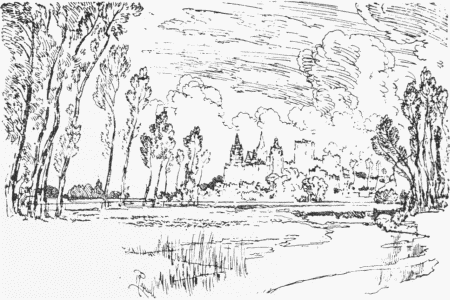
Loches
THE consequence of my leaving to the last my little mention of Loches is
that space and opportunity fail me; and yet a brief and hurried account
of that extraordinary spot would after all be in best agreement with my
visit. We snatched a fearful joy, my companion and I, the afternoon we
took the train for Loches. The weather this time had been terribly
against us: again and again a day that promised fair became hopelessly
foul after lunch. At last we determined that if we could not make this
excursion in the sunshine we would make it with the aid of our
umbrellas. We grasped them firmly and started for the station, where we
were detained an unconscionable time by the evolutions, outside, of
certain trains laden with liberated (and exhilarated) conscripts, who,
their term of service ended, were about to be restored to civil life.
The trains in Touraine are provoking; they
serve as little as possible for excursions. If they convey you one way
at the right hour, it is on the condition of bringing you back at the
wrong; they either allow you far too little time to examine the castle
or the ruin, or they leave you planted in front of it for periods that
outlast curiosity. They are perverse, capricious, exasperating. It was a
question of our having but an hour or two at Loches, and we could ill
afford to sacrifice to accidents. One of the accidents, however, was
that the rain stopped before we got there, leaving behind it a moist
mildness of temperature and a cool and lowering sky which were in
perfect agreement with the grey old city. Loches is certainly one of the
greatest impressions of the traveller in central France—the largest
cluster of curious things that presents itself to his sight. It rises
above the valley of the Indre, the charming stream set in meadows and
sedges, which wanders through the province of Berry and through many of
the novels of Madame George Sand; lifting from the summit of a hill,
which it covers to the base, a confusion of terraces, ramparts, towers,
and spires. Having but little time, as I say, we scaled the hill amain
and wandered briskly through this labyrinth of antiquities. The rain had
decidedly stopped and, save that we had our train on our minds, we saw
Loches to the best advantage. We enjoyed that sensation with which the
conscientious tourist is—or ought to be—well acquainted and for which,
at any rate, he has a formula in his rough-and-ready language. We
"experienced," as they say (most irregular of verbs), an "agreeable
disappointment." We were surprised and delighted; we had for some reason
suspected that Loches was scarce good.
I hardly know what is best there: the strange and
impressive little collegial church, with its romanesque atrium or
narthex, its doorways covered with primitive sculpture of the richest
kind, its treasure of a so-called pagan altar embossed with fighting
warriors, its three pyramidal domes, so unexpected, so sinister, which I
have not met elsewhere in church architecture; or the huge square keep
of the eleventh century—the most cliff-like tower I remember, whose
immeasurable thickness I did not penetrate; or the subterranean
mysteries of two other less striking but not less historic dungeons,
into which a terribly imperative little cicerone introduced us, with the
aid of downward ladders, ropes, torches, warnings, extended hands, and
many fearful anecdotes—all in impervious darkness. These horrible
prisons of Loches, at an incredible distance below daylight, enlivened
the consciousness of Louis XI. and were for the most part, I believe,
constructed by him. One of the towers of the castle is garnished with
the hooks or supports of the celebrated iron cage in which he confined
the Cardinal La Balue, who survived so much longer than might have been
expected this extraordinary mixture of seclusion and exposure. All these
things form part of the castle of Loches, whose enormous enceinte
covers the whole of the top of the hill and abounds in dismantled
gateways, in crooked passages, in winding lanes that lead to postern
doors, in long façades that look upon terraces interdicted to the
visitor, who perceives with irritation that they command magnificent
views. These views are the property of the sub-prefect of the
department, who resides at the Château de Loches and who has also the
enjoyment of a garden—a garden compressed and curtailed, as those of
old castles that perch on hill-tops are apt to be—containing a
horse-chestnut tree of fabulous size,
a tree of a circumference so vast and so perfect that the whole
population of Loches might sit in concentric rows beneath its boughs.
The gem of the place, however, is neither the big marronier, nor the
collegial church, nor the mighty dungeon, nor the hideous prisons of
Louis XI.; it is simply the tomb of Agnes Sorel, la belle des belles,
so many years the mistress of Charles VII. She was buried in 1450, in
the collegial church, whence, in the beginning of the present century,
her remains, with the monument that marks them, were transferred to one
of the towers of the castle. She has always, I know not with what
justice, enjoyed a fairer fame than most ladies who have occupied her
position, and this fairness is expressed in the delicate statue that
surmounts her tomb. It represents her lying there in lovely demureness,
her hands folded with the best modesty, a little kneeling angel at
either side of her head, and her feet, hidden in the folds of her decent
robe, resting upon a pair of couchant lambs, innocent reminders of her
name. Agnes, however, was not lamb-like, inasmuch as, according to
popular tradition at least, she exerted herself sharply in favour of the
expulsion of the English from France. It is one of the suggestions of
Loches that the young Charles VII., hard put to it as he was for a
treasury and a capital—"le roi de Bourges," he was called at Paris—was
yet a rather privileged mortal, to stand up as he does before posterity
between the noble Joan and the gentille Agnes; deriving, however, much
more honour from one of these companions than from the other. Almost as
delicate a relic of antiquity as this fascinating tomb is the exquisite
oratory of Anne of Brittany, among the apartments of the castle the only
chamber worthy of note. This small room, hardly larger than a closet,
and
forming part of the addition made to the edifice by Charles VIII., is
embroidered over with the curious and remarkably decorative device of
the ermine and festooned cord. The objects in themselves are not
especially graceful, but the constant repetition of the figure on the
walls and ceiling produces an effect of richness in spite of the modern
whitewash with which, if I remember rightly, they have been endued. The
little streets of Loches wander crookedly down the hill and are full of
charming pictorial "bits:" an old town-gate, passing under a medieval
tower, which is ornamented by Gothic windows and the empty niches of
statues; a meagre but delicate hotel de ville of the Renaissance
nestling close beside it; a curious chancellerie of the middle of the
sixteenth century, with mythological figures and a Latin inscription on
the front—both of these latter buildings being rather unexpected
features of the huddled and precipitous little town. Loches has a suburb
on the other side of the Indre, which we had contented ourselves with
looking down at from the heights while we wondered whether, even if it
had not been getting late and our train were more accommodating, we
should care to take our way across the bridge and look up that bust in
terra-cotta of Francis I. which is the principal ornament of the Château
de Sansac and the faubourg of Beaulieu. I think we decided that we
should not, that we had already often measured the longest nose in
history.
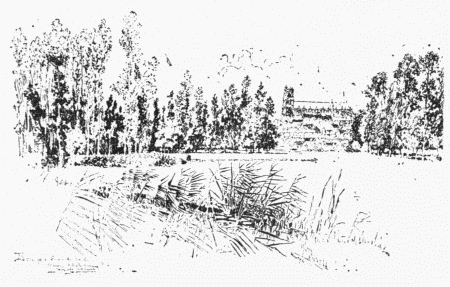
Bourges
I KNOW not whether the exact limits of an excursion as distinguished
from a journey have ever been fixed; at any rate, it seemed none of my
business at Tours to settle the question. Therefore, though the making
of excursions had been the purpose of my stay, I thought it vain, while
I started for Bourges, to determine to which category that little
expedition might belong. It was not till the third day that I returned
to Tours; and the distance, traversed for the most part after dark, was
even greater than I had supposed. That, however, was partly the fault of
a tiresome wait at Vierzon, where I had more than enough time to dine,
very badly, at the buffet and to observe the proceedings of a family
who had entered my railway carriage at Tours and had conversed
unreservedly, for my benefit, all the way from that station—a family
whom it entertained me to assign to the class of petite noblesse de
province. Their noble origin
was confirmed by the way they all "made maigre" in the
refreshment-room (it happened to be a Friday), as if it had been
possible to do anything else. They ate two or three omelets apiece and
ever so many little cakes, while the positive, talkative mother watched
her children as the waiter handed about the roast fowl. I was destined
to share the secrets of this family to the end; for while I took my
place in the empty train that was in waiting to convey us to Bourges the
same vigilant woman pushed them all on top of me into my compartment,
though the carriages on either side contained no travellers at all. It
was better, I found, to have dined (even on omelets and little cakes) at
the station at Vierzon than at the hotel at Bourges, which, when I
reached it at nine o'clock at night, did not strike me as the prince of
hotels. The inns in the smaller provincial towns in France are all, as
the term is, commercial, and the commis-voyageur is in triumphant
possession. I saw a great deal of him for several weeks after this; for
he was apparently the only traveller in the southern provinces, and it
was my daily fate to sit opposite to him at tables d'hôte and in railway
trains. He may be known by two infallible signs—his hands are fat and
he tucks his napkin into his shirt-collar. In spite of these
idiosyncrasies, he seemed to me a reserved and inoffensive person, with
singularly little of the demonstrative good-humour that he has been
described as possessing. I saw no one who reminded me of Balzac's
"illustre Gaudissart;" and indeed in the course of a month's journey
through a large part of France I heard so little desultory conversation
that I wondered whether a change had not come over the spirit of the
people. They seemed to me as silent as Americans when Americans have not
been "introduced,"
and infinitely less addicted to exchanging remarks in railway trains and
at tables d'hôte than the colloquial and cursory English; a fact perhaps
not worth mentioning were it not at variance with that reputation which
the French have long enjoyed of being a pre-eminently sociable nation.
The common report of the character of a people is, however, an
indefinable product, and is apt to strike the traveller who observes for
himself as very wide of the mark. The English, who have for ages been
described (mainly by the French) as the dumb stiff, unapproachable race,
present to-day a remarkable appearance of good-humour and garrulity and
are distinguished by their facility of intercourse. On the other hand,
any one who has seen half-a-dozen Frenchmen pass a whole day together in
a railway-carriage without breaking silence is forced to believe that
the traditional reputation of these gentlemen is simply the survival of
some primitive formula. It was true, doubtless, before the Revolution;
but there have been great changes since then. The question of which is
the better taste, to talk to strangers or to hold your tongue, is a
matter apart; I incline to believe that the French reserve is the result
of a more definite conception of social behaviour. I allude to it only
because it is at variance with the national fame and at the same time
compatible with a very easy view of life in certain other directions. On
some of these latter points the Boule d'Or at Bourges was full of
instruction; boasting as it did of a hall of reception in which, amid
old boots that had been brought to be cleaned, old linen that was being
sorted for the wash, and lamps of evil odour that were awaiting
replenishment, a strange, familiar, promiscuous household life went
forward. Small scullions in white caps and aprons slept
upon greasy benches; the Boots sat staring at you while you fumbled,
helpless, in a row of pigeon-holes, for your candlestick or your key;
and, amid the coming and going of the commis-voyageurs, a little
sempstress bent over the under-garments of the hostess—the latter being
a heavy, stern, silent woman, who looked at people very hard.
Bourges: the Cathedral
It was not to be looked at in that manner that one had come all the way
from Tours; so that within ten minutes after my arrival I sallied out
into the darkness to form somehow and somewhere a happier relation.
However late in the evening I may arrive at a place, I never go to bed
without my impression. The natural place at Bourges to look for it
seemed to be the cathedral; which, moreover, was the only thing that
could account for my presence dans cette galère. I turned out of a
small square in front of the hotel and walked up a narrow, sloping
street paved with big, rough stones and guiltless of a footway. It was a
splendid starlight night; the stillness of a sleeping ville de
province was over everything; I had the whole place to myself. I turned
to my right, at the top of the street, where presently a short, vague
lane brought me into sight of the cathedral. I approached it obliquely,
from behind; it loomed up in the darkness above me enormous and sublime.
It stands on the top of the large but not lofty eminence over which
Bourges is scattered—a very good position as French cathedrals go, for
they are not all so nobly situated as Chartres and Laon. On the side on
which I approached it (the south) it is tolerably well exposed, though
the precinct is shabby; in front, it is rather too much shut in. These
defects, however, it makes up for on the north side and behind, where it
presents
itself in the most admirable manner to the garden of the Archevêché,
which has been arranged as a public walk, with the usual formal alleys
of the jardin français. I must add that I appreciated these points
only on the following day. As I stood there in the light of the stars,
many of which had an autumnal sharpness, while others were shooting over
the heavens, the huge, rugged vessel of the church overhung me in very
much the same way as the black hull of a ship at sea would overhang a
solitary swimmer. It seemed colossal, stupendous, a dark leviathan.
The next morning, which was lovely, I lost no time in going back to it,
and found with satisfaction that the daylight did it no injury. The
cathedral of Bourges is indeed magnificently huge, and if it is a good
deal wanting in lightness and grace, it is perhaps only the more
imposing. I read in the excellent handbook of M. Joanne that it was
projected "dès 1172," but commenced only in the first years of the
thirteenth century. "The nave," the writer adds, "was finished tant
bien que mal, faute de ressources; the façade is of the thirteenth and
fourteenth centuries in its lower part, and of the fourteenth in its
upper." The allusion to the nave means the omission of the transepts.
The west front consists of two vast but imperfect towers; one of which
(the south) is immensely buttressed, so that its outline slopes forward
like that of a pyramid. This is the taller of the two. If they had
spires these towers would be prodigious; as it is, given the rest of the
church, they are wanting in elevation. There are five deeply recessed
portals, all in a row, each surmounted with a gable, the gable over the
central door being exceptionally high. Above the porches, which give the
measure of its width, the front rears itself,
piles itself, on a great scale, carried up by galleries, arches,
windows, sculptures, and supported by the extraordinarily thick
buttresses of which I have spoken and which, though they embellish it
with deep shadows thrown sidewise, do not improve its style. The
portals, especially the middle one, are extremely interesting; they are
covered with curious early sculptures. The middle one, however, I must
describe alone. It has no less than six rows of figures—the others have
four—some of which, notably the upper one, are still in their places.
The arch at the top has three tiers of elaborate imagery. The upper of
these is divided by the figure of Christ in judgment, of great size,
stiff and terrible, with outstretched arms. On either side of him are
ranged three or four angels, with the instruments of the Passion.
Beneath him in the second frieze stands the angel of justice with the
scales; and on either side of him is the vision of the last judgment.
The good prepare, with infinite titillation and complacency, to ascend
to the skies; while the bad are dragged, pushed, hurled, stuffed,
crammed, into pits and caldrons of fire. There is a charming detail in
this section. Beside the angel, on the right, where the wicked are the
prey of demons, stands a little female figure, that of a child, who,
with hands meekly folded and head gently raised, waits for the stern
angel to decide upon her fate. In this fate, however, a dreadful big
devil also takes a keen interest: he seems on the point of appropriating
the tender creature; he has a face like a goat and an enormous hooked
nose. But the angel gently lays a hand upon the shoulder of the little
girl—the movement is full of dignity—as if to say: "No; she belongs to
the other side." The frieze below represents the general resurrection,
with the good and the wicked
emerging from their sepulchres. Nothing can be more quaint and charming
than the difference shown in their way of responding to the final trump.
The good get out of their tombs with a certain modest gaiety, an
alacrity tempered by respect; one of them kneels to pray as soon as he
has disinterred himself. You may know the wicked, on the other hand, by
their extreme shyness; they crawl out slowly and fearfully; they hang
back, and seem to say "Oh, dear!" These elaborate sculptures, full of
ingenuous intention and of the reality of early faith, are in a
remarkable state of preservation; they bear no superficial signs of
restoration and appear scarcely to have suffered from the centuries.
They are delightfully expressive; the artist had the advantage of
knowing exactly the effect be wished to produce.
TheBourges: the Cathedral interior of the cathedral has a great simplicity and majesty and,
above all, a tremendous height. The nave is extraordinary in this
respect; it dwarfs everything else I know. I should add, however, that I
am in architecture always of the opinion of the last speaker. Any great
building seems to me while I look at it the ultimate expression. At any
rate, during the hour that I sat gazing along the high vista of Bourges
the interior of the great vessel corresponded to my vision of the
evening before. There is a tranquil largeness, a kind of infinitude,
about such an edifice; it soothes and purifies the spirit, it
illuminates the mind. There are two aisles, on either side, in addition
to the nave—five in all—and, as I have said, there are no transepts;
an omission which lengthens the vista, so that from my place near the
door the central jewelled window in the depths of the perpendicular
choir seemed a mile or two away. The second or outward of each
pair of aisles is too low and the first too high; without this
inequality the nave would appear to take an even more prodigious flight.
The double aisles pass all the way round the choir, the windows of which
are inordinately rich in magnificent old glass. I have seen glass as
fine in other churches, but I think I have never seen so much of it at
once.
Beside the cathedral, on the north, is a curious structure of the
fourteenth or fifteenth century, which looks like an enormous flying
buttress, with its support, sustaining the north tower. It makes a
massive arch, high in the air, and produces a romantic effect as people
pass under it to the open gardens of the Archevêché, which extend to a
considerable distance in the rear of the church. The structure
supporting the arch has the girth of a largeish house, and contains
chambers with whose uses I am unacquainted, but to which the deep
pulsations of the cathedral, the vibration of its mighty bells and the
roll of its organ-tones must be transmitted even through the great arm
of stone.
The archiepiscopal palace, not walled in as at Tours, is visible as a
stately habitation of the last century, at the time of my visit under
repair after a fire. From this side and from the gardens of the palace
the nave of the cathedral is visible in all its great length and height,
with its extraordinary multitude of supports. The gardens aforesaid,
accessible through tall iron gates, are the promenade—the Tuileries—of
the town, and, very pretty in themselves, are immensely set off by the
overhanging church. It was warm and sunny; the benches were empty; I sat
there a long time in that pleasant state of mind which visits the
traveller in foreign towns, when he is not too hurried,
while he wonders where he had better go next. The straight, unbroken
line of the roof of the cathedral was very noble; but I could see from
this point how much finer the effect would have been if the towers,
which had dropped almost out of sight, might have been carried still
higher. The archiepiscopal gardens look down at one end over a sort of
esplanade or suburban avenue lying on a lower level on which they open,
and where several detachments of soldiers (Bourges is full of soldiers)
had just been drawn up. The civil population was also collecting, and I
saw that something was going to happen. I learned that a private of the
Chasseurs was to be "broken" for stealing, and every one was eager to
behold the ceremony. Sundry other detachments arrived on the ground,
besides many of the military who had come as a matter of taste. One of
them described to me the process of degradation from the ranks, and I
felt for a moment a hideous curiosity to see it, under the influence of
which I lingered a little. But only a little; the hateful nature of the
spectacle hurried me away at the same that others were hurrying forward.
As I turned my back upon it I reflected that human beings are cruel
brutes, though I could not flatter myself that the ferocity of the thing
was exclusively French. In another country the concourse would have been
equally great, and the moral of it all seemed to be that military
penalties are as terrible as military honours are gratifying.
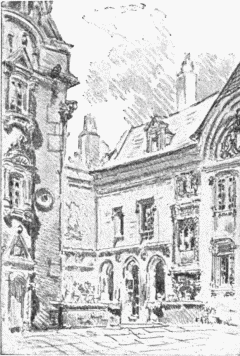
Bourges: Jacques Cœur
THE cathedral is not the only lion of Bourges; the house of Jacques
Cœur awaits you in posture scarcely less leonine. This remarkable man
had a very strange history, and he too was "broken" like the wretched
soldier whom I did not stay to see. He has been rehabilitated, however,
by an age which does not fear the imputation of paradox, and a marble
statue of him ornaments the street in front of his house. To interpret
him according to this image—a womanish figure in a long robe and a
turban, with big bare arms and a dramatic pose—would be to think of him
as a kind of truculent sultana. He wore the dress of his period, but his
spirit was very modern; he was a Vanderbilt or a Rothschild of the
fifteenth century. He supplied the ungrateful Charles VII. with money to
pay the troops who, under the heroic Maid,
drove the English from French soil. His house, which to-day is used as a
Palais de Justice, appears to have been regarded at the time it was
built very much as the residence of Mr. Vanderbilt is regarded in New
York to-day. It stands on the edge of the hill on which most of the town
is planted, so that, behind, it plunges down to a lower level, and, if
you approach it on that side, as I did, to come round to the front of it
you have to ascend a longish flight of steps. The back, of old, must
have formed a portion of the city wall; at any rate it offers to view
two big towers which Joanne says were formerly part of the defence of
Bourges. From the lower level of which I speak—the square in front of
the post-office—the palace of Jacques Cœur looks very big and strong
and feudal; from the upper street, in front of it, it looks very
handsome and delicate. To this street it presents two tiers and a
considerable length of façade; and it has both within and without a
great deal of curious and beautiful detail. Above the portal, in the
stonework, are two false windows, in which two figures, a man and a
woman, apparently household servants, are represented, in sculpture, as
looking down into the street. The effect is homely, yet grotesque, and
the figures are sufficiently living to make one commiserate them for
having been condemned, in so dull a town, to spend several centuries at
the window. They appear to be watching for the return of their master,
who left his beautiful house one morning and never came back.
TheBourges: Jacques Cœur history of Jacques Cœur, which has been written by M. Pierre
Clément in a volume crowned by the French Academy, is very wonderful and
interesting, but I have no space to go into it here. There is no more
curious example, and few more tragical, of a great fortune
crumbling from one day to the other, or of the antique superstition that
the gods grow jealous of human success. Merchant, millionaire, banker,
ship-owner, royal favourite and minister of finance, explorer of the
East and monopolist of the glittering trade between that quarter of the
globe and his own, great capitalist who had anticipated the brilliant
operations of the present time, he expiated his prosperity by poverty,
imprisonment, and torture. The obscure points in his career have been
elucidated by M. Clément, who has drawn, moreover, a very vivid picture
of the corrupt and exhausted state of France during the middle of the
fifteenth century. He has shown that the spoliation of the great
merchant was a deliberately calculated act, and that the king sacrificed
him without scruple or shame to the avidity of a singularly villanous
set of courtiers. The whole story is an extraordinary picture of
high-handed rapacity—the crudest possible assertion of the right of the
stronger. The victim was stripped of his property, but escaped with his
life, made his way out of France and, betaking himself to Italy, offered
his services to the Pope. It is proof of the consideration that he
enjoyed in Europe, and of the variety of his accomplishments, that
Calixtus III. should have appointed him to take command of a fleet which
his Holiness was fitting out against the Turks. Jacques Cœur,
however, was not destined to lead it to victory. He died shortly after
the expedition had started, in the island of Chios, in 1456. The house
at Bourges, his native place, testifies in some degree to his wealth and
splendour, though it has in parts that want of space which is striking
in many of the buildings of the Middle Ages. The court indeed is on a
large scale, ornamented with turrets and arcades, with several beautiful
windows and with sculptures
inserted in the walls, representing the various sources of the great
fortune of the owner. M. Pierre Clément describes this part of the house
as having been of an "incomparable richesse"—an estimate of its charms
which seems slightly exaggerated to-day. There is, however, something
delicate and familiar in the bas-reliefs of which I have spoken, little
scenes of agriculture and industry which show that the proprietor was
not ashamed of calling attention to his harvests and enterprises. To-day
we should question the taste of such allusions, even in plastic form, in
the house of a "merchant prince" however self-made. Why should it be,
accordingly, that these quaint little panels at Bourges do not displease
us? It is perhaps because things very ancient never, for some mysterious
reason, appear vulgar. This fifteenth-century millionaire, with his
palace, his "swagger" sculptures, may have produced that impression on
some critical spirits of his own day.
The portress who showed me into the building was a dear little old
woman, with the gentlest, sweetest, saddest face—a little white, aged
face, with dark, pretty eyes—and the most considerate manner. She took
me up into an upper hall, where there were a couple of curious
chimney-pieces and a fine old oaken roof, the latter representing the
hollow of a long boat. There is a certain oddity in a native of
Bourges—an inland town if ever there was one, without even a river (to
call a river) to encourage nautical ambitions—having found his end as
admiral of a fleet; but this boat-shaped roof, which is extremely
graceful and is repeated in another apartment, would suggest that the
imagination of Jacques Cœur was fond of riding the waves. Indeed, as
he trafficked in Oriental products and owned many galleons, it is
probable that he was personally as much
at home in certain Mediterranean ports as in the capital of the pastoral
Berry. If, when he looked at the ceilings of his mansion, he saw his
boats upside down, this was only a suggestion of the shortest way of
emptying them of their treasures. He is presented in person above one of
the great stone chimney-pieces, in company with his wife, Macée de
Léodepart—I like to write such an extraordinary name. Carved in white
stone, the two sit playing at chess at an open window, through which
they appear to give their attention much more to the passers-by than to
the game. They are also exhibited in other attitudes; though I do not
recognise them in the composition on top of one of the fireplaces which
represents the battlements of a castle, with the defenders (little
figures between the crenellations) hurling down missiles with a great
deal of fury and expression. It would have been hard to believe that the
man who surrounded himself with these friendly and humorous devices had
been guilty of such wrong-doing as to call down the heavy hand of
justice.
It is a curious fact, however, that Bourges contains legal associations
of a purer kind than the prosecution of Jacques Cœur, which, in spite
of the rehabilitations of history, can hardly be said yet to have
terminated, inasmuch as the law-courts of the city are installed in his
quondam residence. At a short distance from it stands the Hôtel Cujas,
one of the curiosities of Bourges and the habitation for many years of
the great jurisconsult who revived in the sixteenth century the study of
the Roman law and professed it during the close of his life in the
university of the capital of Berry. The learned Cujas had, in spite of
his sedentary pursuits, led a very wandering life; he died at Bourges in
the year 1590. Sedentary pursuits are perhaps not exactly
what I should call them, having read in the "Biographie Universelle"
(sole source of my knowledge of the renowned Cujacius) that his usual
manner of study was to spread himself on his belly on the floor. He did
not sit down, he lay down; and the "Biographie Universelle" has (for so
grave a work) an amusing picture of the short, fat, untidy scholar
dragging himself à plat ventre, across his room, from one pile of
books to the other. The house in which these singular gymnastics took
place, and which is now the headquarters of the gendarmerie, is one of
the most picturesque at Bourges. Dilapidated and discoloured, it has a
charming Renaissance front. A high wall separates it from the street,
and on this wall, which is divided by a large open gateway, are perched
two overhanging turrets. The open gateway admits you to the court,
beyond which the melancholy mansion erects itself, decorated also with
turrets, with fine old windows and with a beautiful tone of faded red
brick and rusty stone. It is a charming encounter for a provincial
by-street; one of those accidents in the hope of which the traveller
with a propensity for sketching (whether on a little paper block or on
the tablets of his brain) decides to turn a corner at a venture. A
brawny gendarme in his shirtsleeves was polishing his boots in the
court; an ancient, knotted vine, forlorn of its clusters, hung itself
over a doorway and dropped its shadow on the rough grain of the wall.
The place was very sketchable. I am sorry to say, however, that it was
almost the only "bit." Various other curious old houses are supposed to
exist at Bourges, and I wandered vaguely about in search of them. But I
had little success, and I ended by becoming sceptical. Bourges is a
ville de province in the full force of the term, especially as
applied
invidiously. The streets, narrow, tortuous, and dirty, have very wide
cobble-stones; the houses for the most part are shabby, without local
colour. The look of things is neither modern nor antique—a kind of
mediocrity of middle age. There is an enormous number of blank
walls—walls of gardens, of courts, of private houses—that avert
themselves from the street as if in natural chagrin at there being so
little to see. Round about is a dull, flat, featureless country, on
which the magnificent cathedral looks down. There is a peculiar dulness
and ugliness in a French town of this type, which, I must immediately
add, is not the most frequent one. In Italy everything has a charm, a
colour, a grace; even desolation and ennui. In England a cathedral city
may be sleepy, but it is pretty sure to be mellow. In the course of six
weeks spent en province, however, I saw few places that had not more
expression than Bourges.
IBourges: Jacques Cœur went back to the cathedral; that, after all, was a feature. Then I
returned to my hotel, where it was time to dine, and sat down, as usual,
with the commis-voyageurs, who cut their bread on their thumb and
partook of every course; and after this repast I repaired for a while to
the café, which occupied a part of the basement of the inn and opened
into its court. This café was a friendly, homely, sociable spot, where
it seemed the habit of the master of the establishment to tutoyer his
customers and the practice of the customers to tutoyer the waiter.
Under these circumstances the waiter of course felt justified in sitting
down at the same table with a gentleman who had come in and asked him
for writing materials. He served this gentleman with a horrible little
portfolio covered with shiny black cloth and accompanied with two sheets
of
thin paper, three wafers, and one of those instruments of torture which
pass in France for pens—these being the utensils invariably evoked by
such a request; and then, finding himself at leisure, he placed himself
opposite and began to write a letter of his own. This trifling incident
reminded me afresh that France is a democratic country. I think I
received an admonition to the same effect from the free, familiar way in
which the game of whist was going on just behind me. It was attended
with a great deal of noisy pleasantry, flavoured every now and then with
a dash of irritation. There was a young man of whom I made a note; he
was such a beautiful specimen of his class. Sometimes he was very
facetious, chattering, joking, punning, showing off; then, as the game
went on and he lost and had to pay the consommation, he dropped his
amiability, slanged his partner, declared he wouldn't play any more, and
went away in a fury. Nothing could be more perfect or more amusing than
the contrast. The manner of the whole affair was such as, I apprehend,
one would not have seen among our English-speaking people; both the
jauntiness of the first phase and the petulance of the second. To hold
the balance straight, however, I may remark that if the men were all
fearful "cads," they were, with their cigarettes and their
inconsistency, less heavy, less brutal, than our dear English-speaking
cad; just as the bright little café where a robust materfamilias, doling
out sugar and darning a stocking, sat in her place under the mirror
behind the comptoir, was a much more civilised spot than a British
public-house or a "commercial room," with pipes and whisky, or even than
an American saloon.
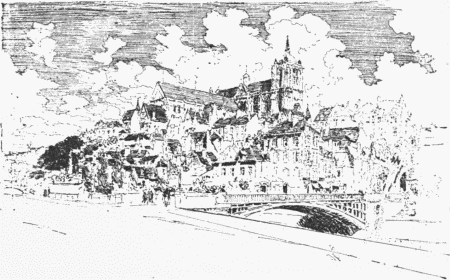
Le Mans
IT IS very certain that when I left Tours for Le Mans it was a journey
and not an excursion; for I had no intention of coming back. The
question indeed was to get away, no easy matter in France in the early
days of October, when the whole jeunesse of the country is returning
to school. It is accompanied, apparently, with parents and grandparents,
and it fills the trains with little pale-faced lycéens, who gaze out
of the windows with a longing, lingering air not unnatural on the part
of small members of a race in which life is intense, who are about to be
restored to those big educative barracks that do such violence to our
American appreciation of the opportunities of boyhood. The train stopped
every five minutes; but fortunately the country was charming—hilly and
bosky, eminently good-humoured, and dotted here and there with a smart
little château. The old capital of the province of the Maine, which has
given its name to a great American State, is a fairly interesting town,
but
I confess that I found in it less than I expected to admire. My
expectations had doubtless been my own fault; there is no particular
reason why Le Mans should fascinate. It stands upon a hill, indeed—a
much better hill than the gentle swell of Bourges. This hill, however,
is not steep in all directions; from the railway, as I arrived, it was
not even perceptible. Since I am making comparisons, I may remark that,
on the other hand, the Boule d'Or at Le Mans is an appreciably better
inn than the Boule d'Or at Bourges. It looks out upon a small
market-place which has a certain amount of character and seems to be
slipping down the slope on which it lies, though it has in the middle an
ugly halle, or circular market-house, to keep it in position. At Le
Mans, as at Bourges, my first business was with the cathedral, to which
I lost no time in directing my steps. It suffered by juxtaposition to
the great church I had seen a few days before; yet it has some noble
features. It stands on the edge of the eminence of the town, which falls
straight away on two sides of it, and makes a striking mass, bristling
behind, as you see it from below, with rather small but singularly
numerous flying buttresses. On my way to it I happened to walk through
the one street which contains a few ancient and curious houses, a very
crooked and untidy lane, of really mediæval aspect, honoured with the
denomination of the Grand Rue. Here is the house of Queen Berengaria—an
absurd name, as the building is of a date some three hundred years later
than the wife of Richard Cœur de Lion, who has a sepulchral monument
in the south aisle of the cathedral. The structure in question—very
sketchable, if the sketcher could get far enough away from it—is an
elaborate little dusky façade, overhanging the street,
ornamented with panels of stone, which are covered with delicate
Renaissance sculpture. A fat old woman standing in the door of a small
grocer's shop next to it—a most gracious old woman, with a bristling
moustache and a charming manner—told me what the house was, and also
indicated to me a rotten-looking brown wooden mansion in the same
street, nearer the cathedral, as the Maison Scarron. The author of the
"Roman Comique" and of a thousand facetious verses enjoyed for some
years, in the early part of his life, a benefice in the cathedral of Le
Mans, which gave him a right to reside in one of the canonical houses.
He was rather an odd canon, but his history is a combination of
oddities. He wooed the comic muse from the arm-chair of a cripple, and
in the same position—he was unable even to go down on his
knees—prosecuted that other suit which made him the first husband of a
lady of whom Louis XIV. was to be the second. There was little of comedy
in the future Madame de Maintenon; though, after all, there was
doubtless as much as there need have been in the wife of a poor man who
was moved to compose for his tomb such an epitaph as this, which I quote
from the "Biographie Universelle":
"Celui qui cy maintenant dort,
Fit plus de pitié que d'envie,
Et souffrit mille fois la mort,
Avant que de perdre la vie.
Passant, ne fais icy de bruit,
Et garde bien qu'il ne s'éveille.
Car voicy la première nuit,
Que le pauvre Scarron sommeille."
ThereLe Mans is rather a quiet, satisfactory place in front of the cathedral,
with some good "bits" in it; notably a turret at the angle of one of the
towers and a very fine steep-roofed dwelling, behind low walls, which
it
overlooks, with a tall iron gate. This house has two or three little
pointed towers, a big black, precipitous roof, and a general air of
having had a history. There are houses which are scenes, and there are
houses which are only houses. The trouble with the domestic architecture
of the United States is that it is not scenic, thank goodness, and the
characteristic of an old structure like the turreted mansion on the
hillside of Le Mans is that it is not simply a house. It is a person, as
it were, as well. It would be well, indeed, if it might have
communicated a little of its personality to the front of the cathedral,
which has none of its own. Shabby, rusty, unfinished, this front has a
romanesque portal, but nothing in the way of a tower. One sees from
without, at a glance, the peculiarity of the church—the disparity
between the romanesque nave, which is small and of the twelfth century,
and the immense and splendid transepts and choir, of a period a hundred
years later. Outside, this end of the church rises far above the nave,
which looks merely like a long porch leading to it, with a small and
curious romanesque porch in its own south flank. The transepts, shallow
but very lofty, display to the spectators in the place the reach of
their two clere-storey windows, which occupy, above, the whole expanse
of the wall. The south transept terminates in a sort of tower, which is
the only one of which the cathedral can boast. Within, the effect of the
choir is superb; it is a church in itself, with the nave simply for a
point of view. As I stood there I read in my Murray that it has the
stamp of the date of the perfection of pointed Gothic, and I found
nothing to object to the remark. It suffers little by confrontation with
Bourges and, taken in itself, seems to me quite as fine. A passage of
double aisles surrounds
it, with the arches that divide them supported on very thick round
columns, not clustered. There are twelve chapels in this passage, and a
charming little lady-chapel filled with gorgeous old glass. The
sustained height of this almost detached choir is very noble; its
lightness and grace, its soaring symmetry, carry the eye up to places in
the air from which it is slow to descend. Like Tours, like Chartres,
like Bourges (apparently like all the French cathedrals, and unlike
several English ones), Le Mans is rich in splendid glass. The beautiful
upper windows of the choir make, far aloft, a brave gallery of pictures,
blooming with vivid colour. It is the south transept that contains the
formless image—a clumsy stone woman lying on her back—which purports
to represent Queen Berengaria aforesaid.
TheLe Mans
view of the cathedral from the rear is, as usual, very fine. A small
garden behind it masks its base; but you descend the hill to a large
place de foire, adjacent to a fine old public promenade which is known
as Les Jacobins, a sort of miniature Tuileries, where I strolled for a
while in rectangular alleys destitute of herbage and received a deeper
impression of vanished things. The cathedral, on the pedestal of its
hill, looks considerably farther than the fair-ground and the Jacobins,
between the rather bare poles of whose straightly planted trees you may
admire it at a convenient distance. I admired it till I thought I should
remember it (better than the event has proved), and then I wandered away
and looked at another curious old church, Notre-Dame-de-la-Couture. This
sacred edifice made a picture for ten minutes, but the picture has faded
now. I reconstruct a yellowish-brown façade and a portal fretted with
early sculptures; but the
details have gone the way of all incomplete sensations. After you have
stood awhile, in the choir of the cathedral there is no sensation at Le
Mans that goes very far. For some reason not now to be traced I had
looked for more than this. I think the reason was to some extent simply
in the name of the place; for names, on the whole, whether they be good
reasons or not, are very active ones. Le Mans, if I am not mistaken, has
a sturdy, feudal sound; suggests something dark and square, a vision of
old ramparts and gates. Perhaps I had been unduly impressed by the fact,
accidentally revealed to me, that Henry II., first of the English
Plantagenets, was born there. Of course it is easy to assure one's self
in advance, but does it not often happen that one had rather not be
assured? There is a pleasure sometimes in running the risk of
disappointment. I took mine, such as it was, quietly enough, while I sat
before dinner at the door of one of the cafés in the market-place with a
bitter-et-curaçao (invaluable pretext at such an hour!) to keep me
company. I remember that in this situation there came over me an
impression which both included and excluded all possible
disappointments. The afternoon was warm and still; the air was admirably
soft. The good Manceaux, in little groups and pairs, were seated near
me; my ear was soothed by the fine shades of French enunciation, by the
detached syllables of that perfect tongue. There was nothing in
particular in the prospect to charm; it was an average French view. Yet
I felt a charm, a kind of sympathy, a sense of the completeness of
French life and of the lightness and brightness of the social air,
together with a desire to arrive at friendly judgments, to express a
positive interest. I know not why this transcendental mood
should have descended upon me then and there; but that idle half-hour in
front of the café, in the mild October afternoon suffused with human
sounds, is perhaps the most abiding thing I brought away from Le Mans.
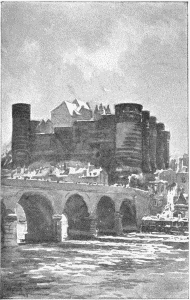
Angers
I AM shocked at finding, just after this noble declaration of
principles, that in a little note-book which at that time I carried
about with me the celebrated city of Angers is denominated a "sell."
I reproduce this vulgar word with the greatest hesitation, and only
because it brings me more quickly to my point. This point is that Angers
belongs to the disagreeable class of old towns that have been, as the
English say, "done up." Not the oldness, but the newness, of the place
is what strikes the sentimental tourist to-day, as he wanders with
irritation along second-rate boulevards, looking vaguely about him for
absent gables. "Black Angers," in short, is a victim of modern
improvements and quite unworthy of its admirable name—a name which,
like that of Le Mans, had always had, to my eyes, a highly picturesque
value. It looks particularly well on the Shakespearean page (in "King
John"), where we imagine it uttered (though such would not have been the
utterance of the period) with a fine grinding insular accent. Angers
figures with importance in early English history: it was the capital
city of the Plantagenet race, home of that Geoffrey of Anjou who
married, as second husband, the Empress Maud, daughter of Henry I. and
competitor of Stephen, and became father of Henry II., first of the
Plantagenet kings, born, as we have seen, at Le Mans. These facts create
a natural presumption that Angers will look historic; I turned them over
in my mind as I travelled in the train from Le Mans, through a country
that was really pretty and looked more like the usual English than like
the usual French scenery, with its fields cut up by hedges and a
considerable rotundity in its trees. On my way from the station to the
hotel, however, it became plain that I should lack a good pretext for
passing that night at the Cheval Blanc; I foresaw that I should have
contented myself before the end of the day. I remained at the White
Horse only long enough to discover that it was an exceptionally
good provincial inn, one of the best that I encountered during six weeks
spent in these establishments.
"Stupidly and vulgarly modernised"—that is another flower from my
note-book, and note-books are not obliged to be reasonable. "There are
some narrow and tortuous streets, with a few curious old houses," I
continue to quote; "there is a castle, of which the exterior is most
extraordinary, and there is a cathedral of moderate interest." It is
fair to say that the Château d'Angers is by itself worth a pilgrimage;
the only drawback is that you have seen it in a quarter of an hour. You
cannot do more than look at it, and one good look does your business. It
has no beauty, no grace, no detail, nothing that charms or detains you;
it is simply very old and very big—so big and so old that this simple
impression is enough, and it takes its place in your recollections as a
perfect specimen of a superannuated stronghold. It stands at one end of
the town, surrounded by a huge, deep moat, which originally contained
the waters of the Maine, now divided from it by a quay. The water-front
of Angers is poor—wanting in colour and in movement; and there is
always an effect of perversity in a town lying near a great river and
yet not upon it. The Loire is a few miles off; but Angers contents
itself with a meagre affluent of that stream. The effect was naturally
much better when the vast dark bulk of the castle, with its seventeen
prodigious towers, rose out of the protecting flood. These towers are of
tremendous girth and solidity; they are encircled with great bands, or
hoops, of white stone, and are much enlarged at the base. Between them
hang high curtains of infinitely old-looking masonry, apparently a dense
conglomeration of slate, the material of which the town was originally
built (thanks to rich quarries in
the neighbourhood), and to which it owed its appellation of the Black.
There are no windows, no apertures, and to-day no battlements nor roofs.
These accessories were removed by Henry III., so that, in spite of its
grimness and blackness, the place has not even the interest of looking
like a prison; it being, as I suppose, the essence of a prison not to be
open to the sky. The only features of the enormous structure are the
blank, sombre stretches and protrusions of wall, the effect of which, on
so large a scale, is strange and striking. Begun by Philip Augustus and
terminated by St. Louis, the Château d'Angers has of course a great deal
of history. The luckless Fouquet, the extravagant minister of finance of
Louis XIV., whose fall from the heights of grandeur was so sudden and
complete, was confined here in 1661, just after his arrest, which had
taken place at Nantes. Here also Huguenots and Vendeans suffered
effective captivity.
IAngers walked round the parapet which protects the outer edge of the moat (it
is all up-hill, and the moat deepens and deepens), till I came to the
entrance which faces the town, and which is as bare and strong as the
rest. The concierge took me into the court; but there was nothing to
see. The place is used as a magazine of ammunition, and the yard
contains a multitude of ugly buildings. The only thing to do is to walk
round the bastions for the view; but at the moment of my visit the
weather was thick, and the bastions began and ended with themselves. So
I came out and took another look at the big, black exterior, buttressed
with white-ribbed towers, and perceived that a desperate sketcher might
extract a picture from it, especially if he were to bring in, as they
say, the little black bronze statue of the good King René (a weak
production of
David d'Angers), which, standing within sight, ornaments the melancholy
faubourg. He would do much better, however, with the very striking old
timbered house (I suppose of the fifteenth century) which is called the
Maison d'Adam and is easily the first specimen at Angers of the domestic
architecture of the past. This admirable house, in the centre of the
town, gabled, elaborately timbered, and much restored, is a really
imposing monument. The basement is occupied by a linen-draper, who
flourishes under the auspicious sign of the Mère de Famille; and above
his shop the tall front rises in five overhanging storeys. As the house
occupies the angle of a little place, this front is double, and the
black beams and wooden supports, displayed over a large surface and
carved and interlaced, have a high picturesqueness. The Maison d'Adam is
quite in the grand style, and I am sorry to say I failed to learn what
history attaches to its name. If I spoke just above of the cathedral as
"moderate," I suppose I should beg its pardon; for this serious charge
was probably prompted by the fact that it consists only of a nave,
without side aisles. A little reflection now convinces me that such a
form is a distinction; and indeed I find it mentioned, rather
inconsistently, in my note-book, a little further on, as "extremely
simple and grand." The nave is spoken of in the same volume as "big,
serious, and Gothic," though the choir and transepts are noted as very
shallow. But it is not denied that the air of the whole thing is
original and striking; and it would therefore appear, after all, that
the cathedral of Angers, built during the twelfth and thirteenth
centuries, is a sufficiently honourable church; the more that its high
west front, adorned with a very primitive Gothic portal, supports two
elegant tapering
spires, between which, unfortunately, an ugly modern pavilion has been
inserted.
I remember nothing else at Angers but the curious old Café Serin, where,
after I had had my dinner at the inn, I went and waited for the train
which, at nine o'clock in the evening, was to convey me, in a couple of
hours, to Nantes—an establishment remarkable for its great size and its
air of tarnished splendour, its brown gilding and smoky frescoes, as
also for the fact that it was hidden away on the second floor of an
unassuming house in an unilluminated street. It hardly seemed a place
where you would drop in; but when once you had found it, it presented
itself, with the cathedral, the castle, and the Maison d'Adam, as one of
the historical monuments of Angers.
Nantes
IF I spent two nights at Nantes, it was for reasons of convenience
rather than of sentiment; though indeed I spent them in a big circular
room which had a stately, lofty, last-century look—a look that consoled
me a little for the whole place being dirty. The high, old-fashioned inn
(it had a huge windy porte-cochère, and you climbed a vast black stone
staircase to get to your room) looked out on a dull square, surrounded
with other tall houses and occupied on one side by the theatre, a
pompous building decorated with columns and statues of the muses. Nantes
belongs to the class of towns which are always spoken of as "fine," and
its position near the mouth of the Loire gives it, I believe, much
commercial movement. It is a spacious, rather regular city, looking, in
the parts that I traversed, neither very fresh nor very venerable. It
derives its principal character from the handsome quays on the Loire,
which are overhung with tall
eighteenth-century houses (very numerous too in the other
streets)—houses with big entresols marked by arched windows, classic
pediments, balcony-rails of fine old iron-work. These features exist in
still better form at Bordeaux; but, putting Bordeaux aside, Nantes is
quite architectural. The view up and down the quays has the cool,
neutral tone of colour that one finds so often in French water-side
places—the bright greyness which is the tone of French landscape art.
The whole city has rather a grand, or at least an eminently
well-established, air. During a day passed in it of course I had time to
go to the Musée; the more so that I have a weakness for provincial
museums—a sentiment that depends but little on the quality of the
collection. The pictures may be bad, but the place is often curious; and
indeed from bad pictures, in certain moods of the mind, there is a
degree of entertainment to be derived. If they are tolerably old they
are often touching; but they must have a relative antiquity, for I
confess I can do nothing with works of art of which the badness is of
recent origin. The cool, still, empty chambers in which indifferent
collections are apt to be preserved, the red brick tiles, the diffused
light, the musty odour, the mementos around you of dead fashions, the
snuffy custodian in a black skull-cap, who pulls aside a faded curtain
to show you the lustreless gem of the museum—these things have a mild
historical quality, and the sallow canvases after all illustrate
something. Many of those in the museum of Nantes illustrate the taste of
a successful warrior, having been bequeathed to the city by Napoleon's
marshal Clarke (created Duc de Feltre). In addition to these there is
the usual number of specimens of the contemporary
French school, culled from the annual Salons and presented to the museum
by the State. Wherever the traveller goes, in France, he is reminded of
this very honourable practice—the purchase by the Government of a
certain number of "pictures of the year," which are presently
distributed in the provinces. Governments succeed each other and bid for
success by different devices; but the "patronage of art" is a plank, as
we should say here, in every platform. The works of art are often
ill-selected—there is an official taste which you immediately
recognise—but the custom is essentially liberal, and a Government which
should neglect it would be felt to be painfully common. The only thing
in this particular Musée that I remember is a fine portrait of a woman
by Ingres—very flat and Chinese, but with an interest of line and a
great deal of style.
There is a castle at Nantes which resembles in some degree that of
Angers, but has, without, much less of the impressiveness of great size,
and, within, much more interest of detail. The court contains the
remains of a very fine piece of late Gothic—a tall elegant building of
the sixteenth century. The château is naturally not wanting in history.
It was the residence of the old Dukes of Brittany, and was brought, with
the rest of the province, by the Duchess Anne, the last representative
of that race, as her dowry, to Charles VIII. I read in the excellent
handbook of M. Joanne that it has been visited by almost every one of
the kings of France, from Louis XI. downward; and also that it has
served as a place of sojourn less voluntary on the part of various other
distinguished persons, from the horrible Maréchal de Retz, who in the
fifteenth century was executed at Nantes for
the murder of a couple of hundred young children, sacrificed in
abominable rites, to the ardent Duchess of Berry, mother of the Count of
Chambord, who was confined there for a few hours in 1832, just after her
arrest in a neighbouring house. I looked at the house in question—you
may see it from the platform in front of the château—and tried to
figure to myself that embarrassing scene. The Duchess, after having
unsuccessfully raised the standard of revolt (for the exiled Bourbons)
in the legitimist Bretagne, and being "wanted," as the phrase is, by the
police of Louis Philippe, had hidden herself in a small but loyal house
at Nantes, where, at the end of five months of seclusion, she was
betrayed, for gold, to the austere M. Guizot by one of her servants, an
Alsatian Jew named Deutz. For many hours before her capture she had been
compressed into an interstice behind a fireplace, and by the time she
was drawn forth into the light she had been ominously scorched. The man
who showed me the castle indicated also another historic spot, a house
with little tourelles on the Quai de la Fosse, in which Henry IV. is
said to have signed the Edict revoked by Louis XIV. I am, however, not
in a position to answer for this pedigree.
There is another point in the history of the fine old houses which
command the Loire, of which, I suppose, one may be tolerably sure; that
is their having, placid as they stand there to-day, looked down on the
horrors of the Terror of 1793, the bloody reign of the monster Carrier
and his infamous noyades. The most hideous episode of the Revolution
was enacted at Nantes, where hundreds of men and women, tied together in
couples, were set afloat upon rafts and sunk to the bottom of the Loire.
The tall
eighteenth-century house, full of the air noble, in France always
reminds me of those dreadful years—of the street-scenes of the
Revolution. Superficially, the association is incongruous, for nothing
could be more formal and decorous than the patent expression of these
eligible residences. But whenever I have a vision of prisoners bound on
tumbrels that jolt slowly to the scaffold, of heads carried on pikes, of
groups of heated citoyennes shaking their fists at closed
coach-windows, I see in the background the well-ordered features of the
architecture of the period—the clear grey stone, the high pilasters,
the arching lines of the entresol, the classic pediment, the
slate-covered attic. There is not much architecture at Nantes except the
domestic. The cathedral, with a rough west front and stunted towers,
makes no impression as you approach it. It is true that it does its best
to recover its reputation as soon as you have passed the threshold.
Begun in 1434 and finished about the end of the fifteenth century, as I
discover in Murray, it has a magnificent nave, not of great length, but
of extraordinary height and lightness. On the other hand, it has no
choir whatever. There is much entertainment in France in seeing what a
cathedral will take upon itself to possess or to lack; for it is only
the smaller number that have the full complement of features. Some have
a very fine nave and no choir; others a very fine choir and no nave.
Some have a rich outside and nothing within; others a very blank face
and a very glowing heart. There are a hundred possibilities of poverty
and wealth, and they make the most unexpected combinations.
TheNantes great treasure of Nantes is the two noble sepulchral monuments which
occupy either transept,
and one of which has (in its nobleness) the rare distinction of being a
production of our own time. On the south side stands the tomb of Francis
II., the last of the Dukes of Brittany, and of his second wife, Margaret
of Foix, erected in 1507 by their daughter Anne, whom we have
encountered already at the Château de Nantes, where she was born; at
Langeais, where she married her first husband; at Amboise, where she
lost him; at Blois, where she married her second, the "good" Louis XII.,
who divorced an impeccable spouse to make room for her, and where she
herself died. Transferred to the cathedral from a demolished convent,
this monument, the masterpiece of Michel Colomb, author of the charming
tomb of the children of Charles VIII. and the aforesaid Anne, which we
admired at Saint Gatien of Tours, is one of the most brilliant works of
the French Renaissance. It has a splendid effect and is in perfect
preservation. A great table of black marble supports the reclining
figures of the duke and duchess, who lie there peacefully and
majestically, in their robes and crowns, with their heads each on a
cushion, the pair of which are supported from behind by three charming
little kneeling angels; at the foot of the quiet couple are a lion and a
greyhound, with heraldic devices. At each of the angles of the table is
a large figure in white marble of a woman elaborately dressed, with a
symbolic meaning, and these figures, with their contemporary faces and
clothes, which give them the air of realistic portraits, are truthful
and living, if not remarkably beautiful. Round the sides of the tomb are
small images of the apostles. There is a kind of masculine completeness
in the work, and a certain robustness of taste.
In nothing were the sculptors of the Renaissance more fortunate than in
being in advance of us with their tombs: they have left us nothing to
say in regard to the great final contrast—the contrast between the
immobility of death and the trappings and honours that survive. They
expressed in every way in which it was possible to express it the
solemnity of their conviction that the marble image was a part of the
personal greatness of the defunct, and the protection, the redemption,
of his memory. A modern tomb, in comparison, is a sceptical affair; it
insists too little on the honours. I say this in the face of the fact
that one has only to step across the cathedral of Nantes to stand in the
presence of one of the purest and most touching of modern tombs.
Catholic Brittany has erected in the opposite transept a monument to one
of the most devoted of her sons, General de Lamoricière, the defender of
the Pope, the vanquished of Castelfidardo. This noble work, from the
hand of Paul Dubois, one of the most interesting of that new generation
of sculptors who have revived in France an art of which our over-dressed
century had begun to despair, has every merit but the absence of a
certain prime feeling. It is the echo of an earlier tune—an echo with a
beautiful cadence. Under a Renaissance canopy of white marble
elaborately worked with arabesques and cherubs, in a relief so low that
it gives the work a certain look of being softened and worn by time,
lies the body of the Breton soldier with a crucifix clasped to his
breast and a shroud thrown over his body. At each of the angles sits a
figure in bronze, the two best of which, representing Charity and
Military Courage, had given me extraordinary pleasure when they were
exhibited (in the clay) in the Salon of 1876. They are
admirably cast and not less admirably conceived: the one a serene,
robust young mother, beautiful in line and attitude; the other a lean
and vigilant young man, in a helmet that overshadows his serious eyes,
resting an outstretched arm, an admirable military member, upon the hilt
of a sword. These figures contain abundant assurance that M. Paul Dubois
has been attentive to Michael Angelo, whom we have all heard called a
splendid example and a bad model. The visor-shadowed face of his warrior
is more or less a reminiscence of the figure on the tomb of Lorenzo
de'Medici at Florence; but it is doubtless none the worse for that. The
interest of the work of Paul Dubois is its peculiar seriousness, a kind
of moral good faith which is not the commonest feature of French art,
and which, united as it is in this case with exceeding knowledge and a
remarkable sense of form, produces an impression of deep refinement. The
whole monument is a proof of exquisitely careful study; but I am not
sure that this impression on the part of the spectator is the happiest
possible. It explains much of the great beauty, and it also explains
perhaps a little of the slight pedantry. That word, however, is scarcely
in place; I only mean that M. Dubois has made a visible effort, which
has visibly triumphed. Simplicity is not always strength, and our
complicated modern genius contains treasures of intention. This
fathomless modern element is an immense charm on the part of M. Paul
Dubois. I am lost in admiration of the deep æsthetic experience, the
enlightenment of taste, revealed by such work. After that I only hope
that, Giuseppe Garibaldi may have somewhere or other some commemoration
as distinguished.
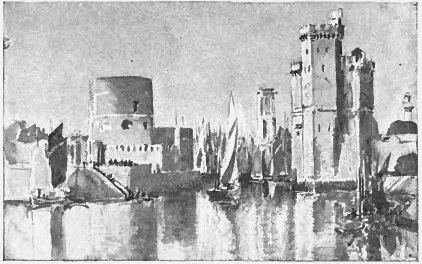
La Rochelle
TO go from Nantes to La Rochelle you travel straight southward across
the historic bocage of La Vendée, the home of royalist bush-fighting.
The country, which is exceedingly pretty, bristles with copses,
orchards, hedges, and with trees more spreading and sturdy than the
traveller is apt to find the feathery foliage of France. It is true that
as I proceeded it flattened out a good deal, so that for an hour there
was a vast featureless plain, which offered me little entertainment
beyond the general impression that I was approaching the Bay of Biscay
(from which, in reality, I was yet far distant). As we drew near La
Rochelle, however, the prospect brightened considerably, and the railway
kept its course beside a charming little canal, or canalised river,
bordered with trees and with small, neat, bright-coloured and yet
old-fashioned cottages and villas, which stood back, on the farther
side, behind small gardens, hedges, painted palings,
patches of turf. The whole effect was Dutch and delightful; and in being
delightful, though not in being Dutch, it prepared me for the charms of
La Rochelle, which from the moment I entered it I perceived to be a
fascinating little town, a quite original mixture of brightness and
dulness. Part of its brightness comes from its being extraordinarily
clean—in which, after all, it is Dutch; a virtue not particularly
noticeable at Bourges, Le Mans, and Angers. Whenever I go southward, if
it be only twenty miles, I begin to look out for the south, prepared as
I am to find the careless grace of those latitudes even in things of
which it may be said that they may be south of something, but are not
southern. To go from Boston to New York (in this state of mind) is
almost as soft a sensation as descending the Italian side of the Alps;
and to go from New York to Philadelphia is to enter a zone of tropical
luxuriance and warmth. Given this absurd disposition, I could not fail
to flatter myself, on reaching La Rochelle, that I was already in the
Midi, and to perceive in everything, in the language of the country, the
caractère méridional. Really a great many things had a hint of it. For
that matter it seems to me that to arrive in the south at a bound—to
wake up there, as it were—would be a very imperfect pleasure. The full
pleasure is to approach by stages and gradations; to observe the
successive shades of difference by which it ceases to be the north.
These shades are exceedingly fine, but your true south-lover has an eye
for them all. If he perceives them at New York and Philadelphia—we
imagine him boldly as liberated from Boston—how could he fail to
perceive them at La Rochelle? The streets of this dear little city are
lined with arcades—good, big, straddling arcades of stone,
such as befit a land of hot summers and which recalled to me, not to go
further, the dusky porticos of Bayonne. It contains, moreover, a great
wide place d'armes which looked for all the world like the piazza of
some dead Italian town, empty, sunny, grass-grown, with a row of yellow
houses overhanging it, an unfrequented café with a striped awning, a
tall, cold, florid, uninteresting cathedral of the eighteenth century on
one side, and on the other a shady walk which forms part of an old
rampart. I followed this walk for some time, under the stunted trees,
beside the grass-covered bastions; it is very charming, winding and
wandering, always with trees. Beneath the rampart is a tidal river, and
on the other side, for a long distance, the mossy walls of the immense
garden of a seminary. Three hundred years ago La Rochelle was the great
French stronghold of Protestantism, but to-day it appears to be a
nursery of Papists.
TheLa Rochelle walk upon the rampart led me round to one of the gates of the town,
where I found some small modern fortifications and sundry red-legged
soldiers, and, beyond the fortifications, another shady walk—a mail,
as the French say, as well as a champ de manœuvre—on which latter
expanse the poor little red-legs were doing their exercise. It was all
very quiet and very picturesque, rather in miniature; and at once very
tidy and a little out of repair. This, however, was but a meagre
back-view of La Rochelle, or poor side-view at best. There are other
gates than the small fortified aperture just mentioned; one of them, an
old grey arch beneath a fine clock-tower, I had passed through on my way
from the station. This substantial Tour de l'Horloge separates the town
proper from the port; for beyond the old grey arch the place presents
its bright, expressive little face to
the sea. I had a charming walk about the harbour and along the stone
piers and sea-walls that shut it in. This indeed, to take things in
their order, was after I had had my breakfast (which I took on arriving)
and after I had been to the hôtel de ville. The inn had a long narrow
garden behind it, with some very tall trees; and passing through this
garden to a dim and secluded salle à manger, buried in the heavy
shade, I had, while I sat at my repast, a feeling of seclusion which
amounted almost to a sense of incarceration. I lost this sense, however,
after I had paid my bill, and went out to look for traces of the famous
siege, which is the principal title of La Rochelle to renown. I had come
thither partly because I thought it would be interesting to stand for a
few moments in so gallant a spot, and partly because, I confess, I had a
curiosity to see what had been the starting-point of the Huguenot
emigrants who founded the town of New Rochelle in the State of New York,
a place in which I had passed sundry memorable hours. It was strange to
think, as I strolled through the peaceful little port, that these quiet
waters, during the wars of religion, had swelled with a formidable naval
power. The Rochelais had fleets and admirals, and their stout little
Protestant bottoms carried defiance up and down.
To say that I found any traces of the siege would be to misrepresent the
taste for vivid whitewash by which La Rochelle is distinguished to-day.
The only trace is the dent in the marble top of the table on which, in
the hôtel de ville, Jean Guiton, the mayor of the city, brought down
his dagger with an oath when in 1628 the vessels and regiments of
Richelieu closed about it on sea and land. This terrible functionary was
the soul of the resistance; he held out from February
to October in the midst of pestilence and famine. The whole episode has
a brilliant place among the sieges of history; it has been related a
hundred times, and I may only glance at it and pass. I limit my ambition
in these light pages to speaking of those things of which I have
personally received an impression, and I have no such impression of the
defence of La Rochelle. The hôtel de ville is a pretty little
building, in the style of the Renaissance of Francis I.; but it has left
much of its interest in the hands of the restorers. It has been "done
up" without mercy; its natural place would be at Rochelle the New. A
sort of battlemented curtain, flanked with turrets, divides it from the
street and contains a low door (a low door in a high wall is always
felicitous), which admits you to an inner court, where you discover the
face of the building. It has statues set into it and is raised upon a
very low and very deep arcade. The principal function of the deferential
old portress who conducts you over the place is to call your attention
to the indented table of Jean Guiton; but she shows you other objects of
interest besides. The interior is absolutely new and extremely
sumptuous, abounding in tapestries, upholstery, morocco, velvet, satin.
This is especially the case with a really beautiful grande salle,
where, surrounded with the most expensive upholstery, the mayor holds
his official receptions. (So at least said my worthy portress.) The
mayors of La Rochelle appear to have changed a good deal since the days
of the grim Guiton; but these evidences of municipal splendour are
interesting for the light they throw on French manners. Imagine the
mayor of an English or an American town of twenty thousand inhabitants
holding magisterial soirées in the town hall! The said
grande salle, which is unchanged in form and in its larger features,
is, I believe, the room in which the Rochelais debated as to whether
they should shut themselves up, and decided in the affirmative. The
table and chair of Jean Guiton have been restored, like everything else,
and are very elegant and coquettish pieces of furniture—incongruous
relics of a season of starvation and blood. I believe that Protestantism
is somewhat shrunken to-day at La Rochelle, and has taken refuge mainly
in the haute société and in a single place of worship. There was
nothing particular to remind me of its supposed austerity as, after
leaving the hôtel de ville, I walked along the empty porticos and out
of the Tour de l'Horloge, which I have already mentioned. If I stopped
and looked up at this venerable monument, it was not to ascertain the
hour, for I foresaw that I should have more time at La Rochelle than I
knew what to do with; but because its high, grey, weather-beaten face
was an obvious subject for a sketch.
TheLa Rochelle little port, which has two basins and is accessible only to vessels
of light tonnage, had a certain gaiety and as much local colour as you
please. Fisher-folk of picturesque type were strolling about, most of
them Bretons; several of the men with handsome, simple faces, not at all
brutal, and with a splendid brownness—the golden-brown colour on cheek
and beard that you see on an old Venetian sail. It was a squally,
showery day, with sudden drizzles of sunshine; rows of rich-toned
fishing-smacks were drawn up along the quays. The harbour is effective
to the eye by reason of three battered old towers which at different
points overhang it and look infinitely weather-washed and sea-silvered.
The most striking of these, the Tour de la Lanterne, is a big grey mass
of the fifteenth century, flanked with turrets and crowned with a Gothic
steeple. I found it was called by the people of the place the Tour des
Quatre Sergents, though I know not what connection it has with the
touching history of the four young sergeants of the garrison of La
Rochelle who were arrested in 1821 as conspirators against the
Government of the Bourbons, and executed, amid general indignation, in
Paris in the following year. The quaint little walk, with its label of
Rue sur les Murs, to which one ascends from beside the Grosse Horloge,
leads to this curious Tour de la Lanterne and passes under it. This walk
has the top of the old town-wall, towards the sea, for a parapet on one
side, and is bordered on the other with decent but irregular little
tenements of fishermen, where brown old women, whose caps are as white
as if they were painted, seem chiefly in possession. In this direction
there is a very pretty stretch of shore, out of the town, through the
fortifications (which are Vauban's, by the way); through, also, a
diminutive public garden or straggling shrubbery which edges the water
and carries its stunted verdure as far as a big Établissement des Bains.
It was too late in the year to bathe, and the Établissement had the
bankrupt aspect which belongs to such places out of the season; so I
turned my back upon it and gained, by a circuit in the course of which
there were sundry water-side items to observe, the other side of the
cheery little port, where there is a long breakwater and a still longer
sea-wall, on which I walked a while, to inhale the strong, salt breath
of the Bay of Biscay. La Rochelle serves, in the months of July and
August, as a station de bains for a modest provincial society; and,
putting aside the question of inns, it must be charming on summer
afternoons.
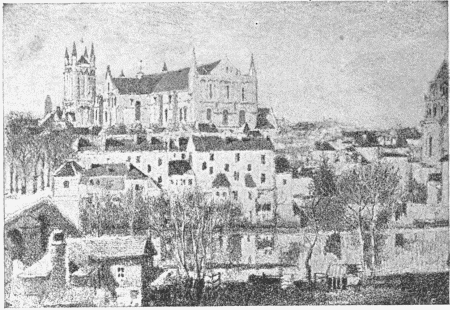
Poitiers
IT is an injustice to Poitiers to approach her by night, as I did some
three hours after leaving La Rochelle; for what Poitiers has of best, as
they would say at Poitiers, is the appearance she presents to the
arriving stranger who puts his head out of the window of the train. I
gazed into the gloom from such an aperture before we got into the
station, for I remembered the impression received on another occasion;
but I saw nothing save the universal night, spotted here and there with
an ugly railway lamp. It was only as I departed, the following day, that
I assured myself that Poitiers still makes something of the figure she
ought on the summit of her considerable hill. I have a kindness for any
little group of towers, any cluster of roofs and chimneys, that lift
themselves from an eminence over which a long road ascends in zigzags;
such a picture creates for the moment a presumption
that you are in Italy, and even leads you to believe that if you mount
the winding road you will come to an old town-wall, an expanse of
creviced brownness, and pass under a gateway surmounted by the arms of a
mediæval despot. Why I should find it a pleasure in France to imagine
myself in Italy, is more than I can say; the illusion has never lasted
long enough to be analysed. From the bottom of its perch Poitiers looks
large and high; and indeed, the evening I reached it, the interminable
climb of the omnibus of the hotel I had selected, which I found at the
station, gave me the measure of its commanding position. This hotel,
"magnifique construction ornée de statues," as the Guide-Joanne, usually
so reticent, takes the trouble to announce, has an omnibus, and, I
suppose, has statues, though I didn't perceive them; but it has very
little else save immemorial accumulations of dirt. It is magnificent, if
you will, but it is not even relatively proper; and a dirty inn has
always seemed to me the dirtiest of human things—it has so many
opportunities to betray itself.
Poitiers covers a large space, and is as crooked and straggling as you
please; but these advantages are not accompanied with any very salient
features or any great wealth of architecture. Although there are few
picturesque houses, however, there are two or three curious old
churches. Notre Dame la Grande, in the market-place, a small romanesque
structure of the twelfth century, has a most interesting and venerable
exterior. Composed, like all the churches of Poitiers, of a light brown
stone with a yellowish tinge, it is covered with primitive but ingenious
sculptures, and is really an impressive monument. Within, it has lately
been daubed over with the most hideous decorative painting
that was ever inflicted upon passive pillars and indifferent vaults.
This battered yet coherent little edifice has the touching look that
resides in everything supremely old; it has arrived at the age at which
such things cease to feel the years; the waves of time have worn its
edges to a kind of patient dulness; there is something mild and smooth,
like the stillness, the deafness, of an octogenarian, even in its
rudeness of ornament, and it has become insensible to differences of a
century or two. The cathedral interested me much less than Our Lady the
Great, and I have not the spirit to go into statistics about it. It is
not statistical to say that the cathedral stands half-way down the hill
of Poitiers, in a quiet and grass-grown place, with an approach of
crooked lanes and blank garden-walls, and that its most striking
dimension is the width of its façade. This width is extraordinary, but
it fails, somehow, to give nobleness to the edifice, which looks within
(Murray makes the remark) like a large public hall. There are a nave and
two aisles, the latter about as high as the nave; and there are some
very fearful modern pictures, which you may see much better than you
usually see those specimens of the old masters that lurk in glowing
side-chapels, there being no fine old glass to diffuse a kindly gloom.
The sacristan of the cathedral showed me something much better than all
this bright bareness; he led me a short distance out of it to the small
Temple de Saint-Jean, which is the most curious object at Poitiers. It
is an early Christian chapel, one of the earliest in France; originally,
it would seem—that is, in the sixth or seventh century—a baptistery,
but converted into a church while the Christian era was still
comparatively young. The Temple de Saint-Jean is
therefore a monument even more venerable than Notre Dame la Grande, and
that numbness of age which I imputed to Notre Dame ought to reside in
still larger measure in its crude and colourless little walls. I call
them crude, in spite of their having been baked through by the
centuries, only because, although certain rude arches and carvings are
let into them and they are surmounted at either end with a small gable,
they have (so far as I can remember) little fascination of surface.
Notre Dame is still expressive, still pretends to be alive; but the
temple has delivered its message and is completely at rest. It retains a
kind of atrium, on the level of the street, from which you descend to
the original floor, now uncovered, but buried for years under a false
bottom. A semicircular apse was, apparently at the time of its
conversion into a church, thrown out from the east wall. In the middle
is the cavity of the old baptismal font. The walls and vaults are
covered with traces of extremely archaic frescoes, attributed, I
believe, to the twelfth century. These vague, gaunt, staring fragments
of figures are, to a certain extent, a reminder of some of the early
Christian churches in Rome; they even faintly recalled to me the great
mosaics of Ravenna. The Temple de Saint-Jean has neither the antiquity
nor the completeness of those extraordinary monuments, nearly the most
impressive in Europe; but, as one may say, it is very well for Poitiers.
NotPoitiers far from it, in a lonely corner which was animated for the moment by
the vociferations of several old women who were selling tapers,
presumably for the occasion of a particular devotion, is the graceful
romanesque church erected in the twelfth century to Saint Radegonde—a
lady who found means to be a saint even
in the capacity of a Merovingian queen. It bears a general resemblance
to Notre Dame la Grande, and, as I remember it, is corrugated in
somewhat the same manner with porous-looking carvings; but I confess
that what I chiefly recollect is the row of old women sitting in front
of it, each with a tray of waxen tapers in her lap, and upbraiding me
for my neglect of the opportunity to offer such a tribute to the saint.
I know not whether this privilege is occasional or constant; within the
church there was no appearance of a festival, and I see that the
name-day of Saint Radegonde occurs in August, so that the importunate
old women sit there always perhaps and deprive of its propriety the
epithet I just applied to this provincial corner. In spite of the old
women, however, I suspect that the place is lonely; and indeed it is
perhaps the old women who have made the desolation.
The lion of Poitiers in the eyes of the natives is doubtless the Palais
de Justice, in the shadow of which the statue-guarded hotel, just
mentioned, erects itself; and the gem of the court-house, which has a
prosy modern front, with pillars and a high flight of steps, is the
curious salle des pas perdus, or central hall, out of which the
different tribunals open. This is a feature of every French court-house,
and seems the result of a conviction that a palace of justice—the
French deal in much finer names than we—should be in some degree
palatial. The great hall at Poitiers has a long pedigree, as its walls
date back to the twelfth century and its open wooden roof, as well as
the remarkable trio of chimney-pieces at the right end of the room as
you enter, to the fifteenth. The three tall fireplaces, side by side,
with a delicate gallery running along the top of them, constitute the
originality of this ancient
chamber, and make one think of the groups that must formerly have
gathered there—of all the wet boot-soles, the trickling doublets, the
stiffened fingers, the rheumatic shanks, that must have been presented
to such an incomparable focus of heat. To-day, I am afraid, these mighty
hearths are for ever cold; justice is probably administered with the aid
of a modern calorifère, and the walls of the palace are perforated
with regurgitating tubes. Behind and above the gallery that surmounts
the three fireplaces are high Gothic windows, the tracery of which
masks, in some sort, the chimneys; and in each angle of this and of the
room to the right and left of the trio of chimneys is an open-work
spiral staircase, ascending to—I forget where; perhaps to the roof of
the edifice. The whole side of the salle is very lordly, and seems to
express an unstinted hospitality, to extend the friendliest of all
invitations, to bid the whole world come and get warm. It was the
invention of John, Duke of Berry and Count of Poitou, about 1395. I give
this information on the authority of the Guide-Joanne, from which source
I gather much other curious learning; as, for instance, that it was in
this building, when it had surely a very different front, that Charles
VII. was proclaimed king in 1422; and that here Jeanne Darc was
subjected, in 1429, to the inquisition of sundry doctors and matrons.
ThePoitiers most charming thing at Poitiers is simply the Promenade de
Blossac—a small public garden at one end of the flat top of the hill.
It has a happy look of the last century (having been arranged at that
period), and a beautiful sweep of view over the surrounding country, and
especially of the course of the little river Clain, which winds about a
part of the base of the big mound of Poitiers. The limit of this dear
little garden
is formed, on the side that turns away from the town, by the rampart
erected in the fourteenth century and by its big semicircular bastions.
This rampart, of great length, has a low parapet; you look over it at
the charming little vegetable-gardens with which the base of the hill
appears exclusively to be garnished. The whole prospect is delightful,
especially the details of the part just under the walls, at the end of
the walk. Here the river makes a shining twist which a painter might
have invented, and the side of the hill is terraced into several
hedges—a sort of tangle of small blooming patches and little pavilions
with peaked roofs and green shutters. It is idle to attempt to reproduce
all this in words; it should be reproduced only in water-colours. The
reader, however, will already have remarked that disparity in these
ineffectual pages, which are pervaded by the attempt to sketch without a
palette or brushes. He will doubtless also be struck with the grovelling
vision which, on such a spot as the ramparts of Poitiers, peoples itself
with carrots and cabbages rather than with images of the Black Prince
and the captive king. I am not sure that in looking out from the
Promenade de Blossac you command the old battle-field; it is enough that
it was not far off, and that the great rout of Frenchmen poured into the
walls of Poitiers, leaving on the ground a number of the fallen equal to
the little army (eight thousand) of the invader. I did think of the
battle. I wondered, rather helplessly, where it had taken place; and I
came away (as the reader will see from the preceding sentence) without
finding out. This indifference, however, was a result rather of a
general dread of military topography than of a want of admiration of
this particular victory, which I have always supposed to be one of the
most brilliant on
record. Indeed, I should be almost ashamed, and very much at a loss, to
say what light it was that this glorious day seemed to me to have left
for ever on the horizon, and why the very name of the place had always
caused my blood gently to tingle. It is carrying the feeling of race to
quite inscrutable lengths when a vague American permits himself an
emotion because more than five centuries ago, on French soil, one
rapacious Frenchman got the better of another. Edward was a Frenchman as
well as John, and French were the cries that urged each of the hosts to
the fight. French is the beautiful motto graven round the image of the
Black Prince as he lies for ever at rest in the choir of Canterbury: à
la mort ne pensai-je mye. Nevertheless, the victory of Poitiers
declines to lose itself in these considerations; the sense of it is a
part of our heritage, the joy of it a part of our imagination, and it
filters down through centuries and migrations till it titillates a New
Yorker who forgets in his elation that he happens at that moment to be
enjoying the hospitality of France. It was something done, I know not
how justly, for England; and what was done in the fourteenth century for
England was done also for New York.
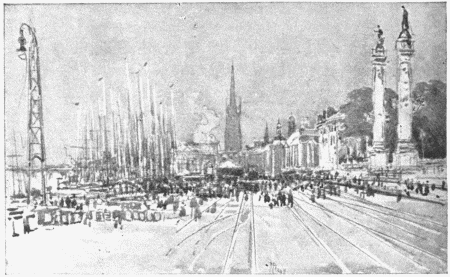
Angoulême
IF it was really for the sake of the Black Prince that I had stopped at
Poitiers (for my prevision of Notre Dame la Grande and of the little
temple of St. John was of the dimmest), I ought to have stopped at
Angoulême for the sake of David and Eve Séchard, of Lucien de Rubempré
and of Madame de Bargeton, who when she wore a toilette étudiée
sported a Jewish turban ornamented with an Eastern brooch, a scarf of
gauze, a necklace of cameos, and a robe of "painted muslin," whatever
that may be; treating herself to these luxuries out of an income of
twelve thousand francs. The persons I have mentioned have not that
vagueness of identity which is the misfortune of historical characters;
they are real, supremely real, thanks to their affiliation to the great
Balzac, who had invented an artificial reality which was as much better
than the vulgar article as mock-turtle soup is than the liquid it
emulates. The first time I read
"Les Illusions Perdues" I should have refused to believe that I was
capable of passing the old capital of Anjou without alighting to visit
the Houmeau. But we never know what we are capable of till we are
tested, as I reflected when I found myself looking back at Angoulême
from the window of the train just after we had emerged from the long
tunnel that passes under the town. This tunnel perforates the hill on
which, like Poitiers, Angoulême rears itself, and which gives it an
elevation still greater than that of Poitiers. You may have a tolerable
look at the cathedral without leaving the railway carriage, for it
stands just above the tunnel and is exposed, much foreshortened, to the
spectator below. There is evidently a charming walk round the plateau of
the town commanding those pretty views of which Balzac gives an account.
But the train whirled me away, and these are my only impressions. The
truth is that I had no need, just at that moment, of putting myself into
communication with Balzac, for opposite to me in the compartment were a
couple of figures almost as vivid as the actors in the "Comédie
Humaine." One of these was a very genial and dirty old priest, and the
other was a reserved and concentrated young monk—the latter (by which I
mean a monk of any kind) being a rare sight to-day in France. This young
man indeed was mitigatedly monastic. He had a big brown frock and cowl,
but he had also a shirt and a pair of shoes; he had, instead of a hempen
scourge round his waist, a stout leather thong, and he carried with him
a very profane little valise. He also read, from beginning to end, the
Figaro which the old priest, who had done the same, presented to him;
and he looked altogether as if, had he not been a monk, he would have
made a distinguished officer of engineers.
Angoulême
When he was not reading the Figaro he was conning his breviary or
answering, with rapid precision and with a deferential but discouraging
dryness, the frequent questions of his companion, who was of quite
another type. This worthy had a bored, good-natured, unbuttoned,
expansive look; was talkative, restless, almost disreputably human. He
was surrounded by a great deal of small luggage, and had scattered over
the carriage his books, his papers, and fragments of his lunch, and the
contents of an extraordinary bag which he kept beside him—a kind of
secular reliquary—and which appeared to contain the odds and ends of a
lifetime, as he took from it successively a pair of slippers, an old
padlock (which evidently did not belong to it), an opera-glass, a
collection of almanacs, and a large sea-shell, which he very carefully
examined. I think that if he had not been afraid of the young monk, who
was so much more serious than he, he would have held the shell to his
ear like a child. Indeed, he was a very childish and delightful old
priest, and his companion evidently thought him quite frivolous. But I
liked him the better of the two. He was not a country curé, but an
ecclesiastic of some rank, who had seen a good deal both of the church
and of the world; and if I too had not been afraid of his colleague, who
read the Figaro as seriously as if it had been an encyclical, I should
have entered into conversation with him.
All this while I was getting on to Bordeaux, where I permitted myself to
spend three days. I am afraid I have next to nothing to show for them,
and that there would be little profit in lingering on this episode,
which is the less to be justified as I had in former years examined
Bordeaux attentively enough. It contains a very good hotel—an hotel not
good enough, however,
to keep you there for its own sake. For the rest, Bordeaux is a big,
rich, handsome, imposing commercial town, with long rows of fine old
eighteenth-century houses which overlook the yellow Garonne. I have
spoken of the quays of Nantes as fine, but those of Bordeaux have a
wider sweep and a still more architectural air. The appearance of such a
port as this makes the Anglo-Saxon tourist blush for the sordid
water-fronts of Liverpool and New York, which, with their larger
activity, have so much more reason to be stately. Bordeaux gives a great
impression of prosperous industries, and suggests delightful ideas,
images of prune-boxes and bottled claret. As the focus of distribution
of the best wine in the world, it is indeed a sacred city—dedicated to
the worship of Bacchus in the most discreet form. The country all about
it is covered with precious vineyards, sources of fortune to their
owners and of satisfaction to distant consumers: and as you look over to
the hills beyond the Garonne you see them, in the autumn sunshine,
fretted with the rusty richness of this or that immortal clos. But the
principal picture, within the town, is that of the vast curving quays,
bordered with houses that look like the hôtels of farmers-general of
the last century, and of the wide, tawny river, crowded with shipping
and spanned by the largest of bridges. Some of the types on the
water-side are of the sort that arrest a sketcher—figures of stalwart,
brown-faced Basques, such as I had seen of old in great numbers at
Biarritz, with their loose circular caps, their white sandals, their air
of walking for a wager. Never was a tougher, a harder race. They are not
mariners nor watermen, but, putting questions of temper aside, they are
the best possible dock-porters. "Il s'y fait un commerce terrible," a
douanier said to
me, as he looked up and down the interminable docks; and such a place
has indeed much to say of the wealth, the capacity for production, of
France—the bright, cheerful, smokeless industry of the wonderful
country which produces, above all, the agreeable things of life, and
turns even its defeats and revolutions into gold. The whole town has an
air of almost depressing opulence, an appearance which culminates in the
great place which surrounds the Grand-Théatre—an establishment of the
highest style, encircled with columns, arcades, lamps, gilded cafés. One
feels it to be a monument to the virtue of the well-selected bottle. If
I had not forbidden myself to linger, I should venture to insist on this
and, at the risk of being called fantastic, trace an analogy between
good claret and the best qualities of the French mind; pretend that
there is a taste of sound Bordeaux in all the happiest manifestations of
that fine organ, and that, correspondingly, there is a touch of French
reason, French completeness, in a glass of Pontet-Canet. The danger of
such an excursion would lie mainly in its being so open to the reader to
take the ground from under my feet by saying that good claret doesn't
exist. To this I should have no reply whatever. I should be unable to
tell him where to find it. I certainly didn't find it at Bordeaux, where
I drank a most vulgar fluid; and it is of course notorious that a large
part of mankind is occupied in vainly looking for it. There was a great
pretence of putting it forward at the Exhibition which was going on at
Bordeaux at the time of my visit, an "exposition philomathique," lodged
in a collection of big temporary buildings in the Allées d'Orléans, and
regarded by the Bordelais for the moment as the most brilliant feature
of their city. Here were pyramids of bottles, mountains
of bottles, to say nothing of cases and cabinets of bottles. The
contemplation of these glittering tiers was of course not very
convincing; and indeed the whole arrangement struck me as a high
impertinence. Good wine is not an optical pleasure, it is an inward
emotion; and if there was a chamber of degustation on the premises, I
failed to discover it. It was not in the search for it, indeed, that I
spent half an hour in this bewildering bazaar. Like all "expositions,"
it seemed to me to be full of ugly things, and gave one a portentous
idea of the quantity of rubbish that man carries with him on his course
through the ages. Such an amount of luggage for a journey after all so
short! There were no individual objects; there was nothing but dozens
and hundreds, all machine-made and expressionless, in spite of the
repeated grimace, the conscious smartness, of "the last new thing," that
was stamped on all of them. The fatal facility of the French article
becomes at last as irritating as the refrain of a popular song. The poor
"Indiens Galibis" struck me as really more interesting—a group of
stunted savages who formed one of the attractions of the place and were
confined in a pen in the open air, with a rabble of people pushing and
squeezing, hanging over the barrier, to look at them. They had no
grimace, no pretension to be new, no desire to catch your eye. They
looked at their visitors no more than they looked at each other, and
seemed ancient, indifferent, terribly bored.
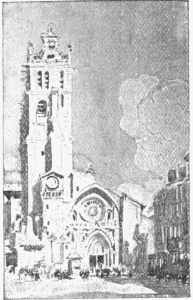
Toulouse
THERE is much entertainment in the journey through the wide, smiling
garden of Gascony; I speak of it as I took it in going from Bordeaux to
Toulouse. It is the south, quite the south, and had for the present
narrator its full measure of the charm he is always determined to find
in countries that may even by courtesy be said to appertain to the sun.
It was, moreover, the happy and genial view of these mild latitudes,
which, goodness knows, often have a dreariness of their own; a land
teeming with corn and wine and speaking everywhere (that is everywhere
the phylloxera had not laid it waste) of wealth and plenty. The road
runs constantly near the Garonne, touching now and then its slow, brown,
rather sullen stream, a
sullenness that encloses great dangers and disasters. The traces of the
horrible floods of 1875 have disappeared, and the land smiles placidly
enough while it waits for another immersion. Toulouse, at the period I
speak of, was up to its middle (and in places above it) in water, and
looks still as if it had been thoroughly soaked—as if it had faded and
shrivelled with a long steeping. The fields and copses, of course, are
more forgiving. The railway line follows as well the charming Canal du
Midi, which is as pretty as a river, barring the straightness, and here
and there occupies the foreground, beneath a screen of dense, tall
trees, while the Garonne takes a larger and more irregular course a
little way beyond it. People who are fond of canals—and, speaking from
the pictorial standpoint, I hold the taste to be most legitimate—will
delight in this admirable specimen of the class, which has a very
interesting history, not to be narrated here. On the other side of the
road (the left), all the way, runs a long, low line of hills, or rather
one continuous hill, or perpetual cliff, with a straight top, in the
shape of a ledge of rock, which might pass for a ruined wall. I am
afraid the reader will lose patience with my habit of constantly
referring to the landscape of Italy as if that were the measure of the
beauty of every other. Yet I am still more afraid that I cannot
apologise for it, and must leave it in its culpable nakedness. It is an
idle habit; but the reader will long since have discovered that this was
an idle journey and that I give my impressions as they came to me. It
came to me, then, that in all this view there was something transalpine,
with a greater smartness and freshness and much less elegance and
languor. This impression was occasionally deepened by the appearance, on
the long eminence of which I speak,
of a village, a church, a château, that seemed to look down at the plain
from over the ruined wall. The perpetual vines, the bright-faced
flat-roofed houses, covered with tiles, the softness and sweetness of
the light and air, recalled the prosier portions of the Lombard plain.
Toulouse itself has a little of this Italian expression, but not enough
to give a colour to its dark, dirty, crooked streets, which are
irregular without being eccentric, and which, if it were not for the
superb church of Saint-Sernin, would be quite destitute of monuments.
I have already alluded to the way in which the names of certain places
impose themselves on the mind, and I must add that of Toulouse to the
list of expressive appellations. It certainly evokes a vision—suggests
something highly méridional. But the city, it must be confessed, is
less pictorial than the word, in spite of the Place du Capitole, in
spite of the quay of the Garonne, in spite of the curious cloister of
the old museum. What justifies the images that are latent in the word is
not the aspect, but the history, of the town. The hotel to which the
well-advised traveller will repair stands in a corner of the Place du
Capitole, which is the heart and centre of Toulouse, and which bears a
vague and inexpensive resemblance to Piazza Castello at Turin. The
Capitol, with a wide modern face, occupies one side, and, like the
palace at Turin, looks across at a high arcade, under which the hotels,
the principal shops, and the lounging citizens are gathered. The shops,
are probably better than the Turinese, but the people are not so good.
Stunted, shabby, rather vitiated looking, they have none of the personal
richness of the sturdy Piedmontese; and I will take this occasion to
remark that in the course of a journey of several weeks
in the French provinces I rarely encountered a well-dressed male. Can it
be possible that republics are unfavourable to a certain attention to
one's boots and one's beard? I risk this somewhat futile inquiry because
the proportion of neat coats and trousers seemed to be about the same in
France and in my native land. It was notably lower than in England and
in Italy, and even warranted the supposition that most good provincials
have their chin shaven and their boots blacked but once a week. I hasten
to add, lest my observation should appear to be of a sadly superficial
character, that the manners and conversation of these gentlemen bore
(whenever I had occasion to appreciate them) no relation to the state of
their chin and their boots. They were almost always marked by an extreme
amenity. At Toulouse there was the strongest temptation to speak to
people simply for the entertainment of hearing them reply with that
curious, that fascinating accent of the Languedoc, which appears to
abound in final consonants and leads the Toulousians to say bien-g and
maison-g like Englishmen learning French. It is as if they talked with
their teeth rather than with their tongue. I find in my note-book a
phrase in regard to Toulouse which is perhaps a little ill-natured, but
which I will transcribe as it stands: "The oddity is that the place
should be both animated and dull. A big, brown-skinned population,
clattering about in a flat, tortuous town, which produces nothing
whatever that I can discover. Except the church of Saint-Sernin and the
fine old court of the Hôtel d'Assézat, Toulouse has no architecture; the
houses are for the most part of brick, of a greyish-red colour, and have
no particular style. The brickwork of the place is in fact very
poor—inferior to that of the North Italian towns and quite
wanting in the wealth of tone which this homely material takes on in
general in the climates of dampness and greenness." And then my
note-book goes on to narrate a little visit to the Capitol, which was
soon made, as the building was in course of repair and half the rooms
were closed.
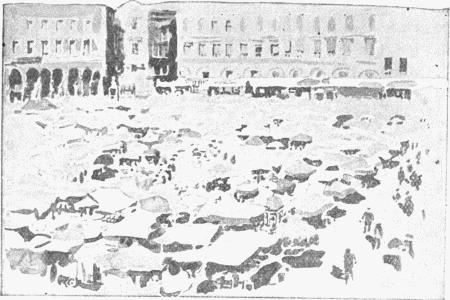
Toulouse: the Capitol
THE history of Toulouse is detestable, saturated with blood and perfidy;
and the ancient custom of the Floral Games, grafted upon all sorts of
internecine traditions, seems, with its false pastoralism, its mock
chivalry, its display of fine feelings, to set off rather than to
mitigate these horrors. The society was founded in the fourteenth
century, and it has held annual meetings ever since—meetings at which
poems in the fine old langue d'oc are declaimed and a blushing
laureate is chosen. This business takes place in the Capitol, before the
chief magistrate of the town, who is known as the capitoul, and of all
the pretty women as well—a class very numerous at Toulouse. It is
unusual to present a finer person than that of the portress who
pretended to show me the apartments in which the Floral Games are held;
a big, brown, expansive woman, still in the prime of life, with a
speaking eye, an extraordinary assurance, and a pair of magenta
stockings, which were inserted into the neatest and most polished little
black sabots, and which, as she clattered up the stairs before me,
lavishly displaying them, made her look like the heroine of an
opéra-bouffe. Her talk was all in n's, g's and d's, and in mute
e's strongly accented, as autré, théâtré, splendidé—the last
being an epithet she applied to everything the Capitol contained, and
especially to a horrible picture representing the famous Clémence
Isaure, the reputed foundress of the poetical contest, presiding on one
of these occasions. I wondered whether Clémence Isaure had been anything
like this terrible Toulousaine of to-day, who would have been a capital
figure-head for a floral game. The lady in whose honour the picture I
have just mentioned was painted is a somewhat mythical personage, and
she is not to be found in the "Biographie Universelle." She is, however,
a very graceful myth; and if she never existed, her statue at least
does—a shapeless effigy transferred to the Capitol from the so-called
tomb of Clémence in the old church of La Daurade. The great hall in
which the Floral Games are held was encumbered with scaffoldings, and I
was unable to admire the long series of busts of the bards who have won
prizes and the portraits of all the capitouls of Toulouse. As a
compensation I was introduced to a big bookcase filled with the poems
that have been crowned since the days of the troubadours (a portentous
collection), and the big butcher's knife with which, according to the
legend, Henry, Duke of Montmorency, who had conspired against the great
cardinal with Gaston of Orleans and Mary de'Medici, was, in 1632,
beheaded on this spot by the order of Richelieu. With these objects the
interest of the
Toulouse: the Capitol
Capitol was exhausted. The building indeed has not the grandeur of its
name, which is a sort of promise that the visitor will find some
sensible embodiment of the old Roman tradition that once nourished in
this part of France. It is inferior in impressiveness to the other three
famous Capitols of the modern world—that of Rome (if I may call the
present structure modern) and those of Washington and Albany!
The only Roman remains at Toulouse are to be found in the museum—a very
interesting establishment, which I was condemned to see as imperfectly
as I had seen the Capitol. It was being rearranged; and the gallery of
paintings, which is the least interesting feature, was the only part
that was not upside-down. The pictures are mainly of the modern French
school, and I remember nothing but a powerful though disagreeable
specimen of Henner, who paints the human body, and paints it so well,
with a brush dipped in blackness; and, placed among the paintings, a
bronze replica of the charming young David of Mercié. These things have
been set out in the church of an old monastery, long since suppressed,
and the rest of the collection occupies the cloisters. These are two in
number—a small one, which you enter first from the street, and a very
vast and elegant one beyond it, which, with its light gothic arches and
slim columns (of the fourteenth century), its broad walk, its little
garden with old tombs and statues in the centre, is by far the most
picturesque, the most sketchable, spot in Toulouse. It must be doubly so
when the Roman busts, inscriptions, slabs, and sarcophagi are ranged
along the walls; it must indeed (to compare small things with great, and
as the judicious Murray remarks) bear a certain resemblance to the Campo
Santo at Pisa. But these things are absent
now; the cloister is a litter of confusion, and its treasures have been
stowed away confusedly in sundry inaccessible rooms. The custodian
attempted to console me by telling me that when they are exhibited again
it will be on a scientific basis and with an order and regularity of
which they were formerly innocent. But I was not consoled. I wanted
simply the spectacle, the picture, and I didn't care in the least for
the classification. Old Roman fragments exposed to light in the open
air, under a southern sky, in a quadrangle round a garden, have an
immortal charm simply in their general effect; and the charm is all the
greater when the soil of the very place has yielded them up.
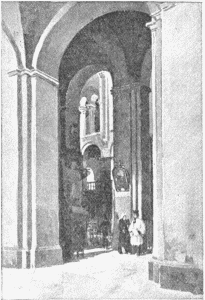
Toulouse: Saint-Sernin
MY real consolation was an hour I spent in Saint-Sernin, one of the
noblest churches in southern France, and easily the first among those of
Toulouse. This great structure, a masterpiece of twelfth-century
romanesque and dedicated to Saint Saturninus—the Toulousains have
abbreviated—is, I think, alone worth a journey to Toulouse. What makes
it so is the extraordinary seriousness of its interior; no other term
occurs to me as expressing so well the character of its clear grey nave.
As a general thing, I favour little the fashion of attributing moral
qualities to buildings; I shrink from talking about tender cornices and
sincere
campanili; but one feels that one can scarce get on without imputing
some sort of morality to Saint-Sernin. As it stands to-day, the church
has been completely restored by Viollet-le-Duc. The exterior is of
brick, and has little charm save that of a tower of four rows of arches,
narrowing together as they ascend. The nave is of great length and
height, the barrel-roof of stone, the effect of the round arches and
pillars in the triforium especially fine. There are two low aisles on
either side. The choir is very deep and narrow; it seems to close
together, and looks as if it were meant for intensely earnest rites. The
transepts are most noble, especially the arches of the second tier. The
whole church is narrow for its length and is singularly complete and
homogeneous. As I say all this I feel that I quite fail to give an
impression of its manly gravity, its strong proportions, or of the
lonesome look of its renovated stones as I sat there while the October
twilight gathered. It is a real work of art, a high conception. The
crypt, into which I was eventually led captive by an importunate
sacristan, is quite another affair, though indeed I suppose it may also
be spoken of as a work of art. It is a rich museum of relics, and
contains the head of Saint Thomas Aquinas wrapped up in a napkin and
exhibited in a glass case. The sacristan took a lamp and guided me
about, presenting me to one saintly remnant after another. The
impression was grotesque, but some of the objects were contained in
curious old cases of beaten silver and brass: these things at least,
which looked as if they had been transmitted from the early church, were
venerable. There was, however, a kind of wholesale sanctity about the
place which overshot the mark; it pretends to be one of the holiest
spots in the world. The effect is spoiled by the way
the sacristans hang about and offer to take you into it for ten sous—I
was accosted by two and escaped from another—and by the familiar manner
in which you pop in and out. This episode rather broke the charm of
Saint-Sernin, so that I took my departure and went in search of the
cathedral. It was scarcely worth finding, and struck me as an odd,
dislocated fragment. The front consists only of a portal beside which a
tall brick tower of a later period has been erected. The nave was
wrapped in dimness, with a few scattered lamps. I could only distinguish
an immense vault, like a high cavern, without aisles. Here and there in
the gloom was a kneeling figure; the whole place was mysterious and
lopsided. The choir was curtained off; it appeared not to correspond
with the nave—that is, not to have the same axis. The only other
ecclesiastical impression I gathered at Toulouse came to me in the
church of La Daurade, of which the front, on the quay by the Garonne,
was closed with scaffoldings; so that one entered it from behind, where
it is completely masked by houses, through a door which has at first no
traceable connection with it. It is a vast, high, modernised, heavily
decorated church, dimly lighted at all times, I should suppose, and
enriched by the shades of evening at the time I looked into it. I
perceived that it consisted mainly of a large square, beneath a dome, in
the centre of which a single person—a lady—was praying with the utmost
absorption. The manner of access to the church interposed such an
obstacle to the outer profanities that I had a sense of intruding and
presently withdrew, carrying with me a picture of the vast, still
interior, the gilded roof gleaming in the twilight, and the solitary
worshipper. What was she praying for, and was she not almost afraid to
remain there alone?
Toulouse
For the rest, the picturesque at Toulouse consists principally of the
walk beside the Garonne, which is spanned, to the faubourg of
Saint-Cyprien, by a stout brick bridge. This hapless suburb, the
baseness of whose site is noticeable, lay for days under the water at
the time of the last inundations. The Garonne had almost mounted to the
roofs of the houses, and the place continues to present a blighted,
frightened look. Two or three persons with whom I had some conversation
spoke of that time as a memory of horror. I have not done with my
Italian comparisons; I shall never have done with them. I am therefore
free to say that in the way in which Toulouse looks out on the Garonne
there was something that reminded me vaguely of the way in which Pisa
looks out on the Arno. The red-faced houses—all of brick—along the
quay have a mixture of brightness and shabbiness, as well as the fashion
of the open loggia in the top-storey. The river, with another bridge
or two, might be the Arno, and the buildings on the other side of it—a
hospital, a suppressed convent—dip their feet into it with real
southern cynicism. I have spoken of the old Hôtel d'Assézat as the best
house at Toulouse; with the exception of the cloister of the museum, it
is the only "bit" I remember. It has fallen from the state of a noble
residence of the sixteenth century to that of a warehouse and a set of
offices; but a certain dignity lingers in its melancholy court, which is
divided from the street by a gateway that is still imposing and in which
a clambering vine and a red Virginia-creeper were suspended to the rusty
walls of brick and stone.
The most interesting house at Toulouse is far from being the most
striking. At the door of No. 50 Rue des Filatiers, a featureless, solid
structure, was found
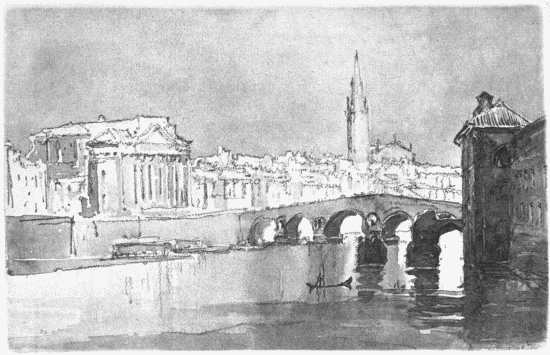 TOULOUSE—THE GARONNE
hanging, one autumn evening, the body of the young Marc-Antoine Calas,
whose ill-inspired suicide was to be the first act of a tragedy so
horrible. The fanaticism aroused in the townsfolk by this incident; the
execution by torture of Jean Calas, accused as a Protestant of having
hanged his son, who had gone over to the Church of Rome; the ruin of the
family; the claustration of the daughters; the flight of the widow to
Switzerland; her introduction to Voltaire; the excited zeal of that
incomparable partisan and the passionate persistence with which, from
year to year, he pursued a reversal of judgment till at last he obtained
it and devoted the tribunal of Toulouse to execration and the name of
the victims to lasting wonder and pity—these things form part of one of
the most interesting and touching episodes of the social history of the
eighteenth century. The story has the fatal progression, the dark
rigour, of one of the tragic dramas of the Greeks. Jean Calas, advanced
in life, blameless, bewildered, protesting his innocence, had been
broken on the wheel; and the sight of his decent dwelling, which brought
home to me all that had been suffered there, spoiled for me, for half an
hour, the impression of Toulouse.
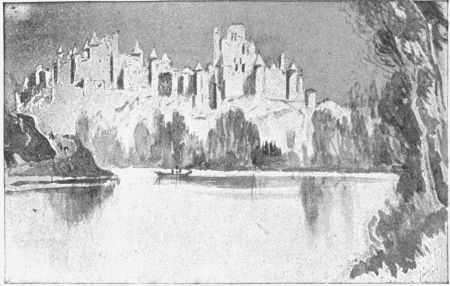
Carcassonne
I SPENT but a few hours at Carcassonne; but those hours had a rounded
felicity, and I cannot do better than transcribe from my note-book the
little record made at the moment. Vitiated as it may be by crudity and
incoherency, it has at any rate the freshness of a great emotion. This
is the best quality that a reader may hope to extract from a narrative
in which "useful information" and technical lore even of the most
general sort are completely absent. For Carcassonne is moving, beyond a
doubt; and the traveller who in the course of a little tour in France
may have felt himself urged, in melancholy moments, to say that on the
whole the disappointments are as numerous as the satisfactions, must
admit that there can be nothing better than this.
The country after you leave Toulouse continues to be charming; the more
so that it merges its flatness in the distant Cévennes on one side, and
on the other,
far away on your right, in the richer range of the Pyrenees. Olives and
cypresses, pergolas and vines, terraces on the roofs of houses, soft,
iridescent mountains, a warm yellow light—what more could the difficult
tourist want? He left his luggage at the station, warily determined to
look at the inn before committing himself to it. It was so evident (even
to a cursory glance) that it might easily have been much better, that he
simply took his way to the town, with the whole of a superb afternoon
before him. When I say the town, I mean the towns; there being two at
Carcassonne, perfectly distinct, and each with excellent claims to the
title. They have settled the matter between them, however, and the
elder, the shrine of pilgrimage, to which the other is but a
stepping-stone, or even, as I may say, a humble door-mat, takes the name
of the Cité. You see nothing of the Cité from the station; it is masked
by the agglomeration of the ville-basse, which is relatively (but only
relatively) new. A wonderful avenue of acacias leads to it from the
station—leads past it, rather, and conducts you to a little high-backed
bridge over the Aude, beyond which, detached and erect, a distinct
mediæval silhouette, the Cité presents itself. Like a rival shop on the
invidious side of a street, it has "no connection" with the
establishment across the way, although the two places are united (if old
Carcassonne may be said to be united to anything) by a vague little
rustic faubourg. Perched on its solid pedestal, the perfect detachment
of the Cité is what first strikes you. To take leave, without delay, of
the ville-basse, I may say that the splendid acacias I have mentioned
flung a summerish dusk over the place, in which a few scattered remains
of stout walls and big bastions looked venerable and picturesque.
Carcassonne
A little boulevard winds round the town, planted with trees and
garnished with more benches than I ever saw provided by a soft-hearted
municipality. This precinct had a warm, lazy, dusty, southern look, as
if the people sat out-of-doors a great deal and wandered about in the
stillness of summer nights. The figure of the elder town at these hours
must be ghostly enough on its neighbouring hill. Even by day it has the
air of a vignette of Gustave Doré, a couplet of Victor Hugo. It is
almost too perfect—as if it were an enormous model placed on a big
green table at a museum. A steep, paved way, grass-grown like all roads
where vehicles never pass, stretches up to it in the sun. It has a
double enceinte, complete outer walls and complete inner (these,
elaborately fortified, are the more curious); and this congregation of
ramparts, towers, bastions, battlements, barbicans, is as fantastic and
romantic as you please. The approach I mention here leads to the gate
that looks toward Toulouse—the Porte de l'Aude. There is a second, on
the other side, called, I believe, the Porte Narbonnaise, a magnificent
gate, flanked with towers thick and tall, defended by elaborate
outworks; and these two apertures alone admit you to the place—putting
aside a small sally-port, protected by a great bastion, on the quarter
that looks toward the Pyrenees.
As a votary, always, in the first instance, of a general impression, I
walked all round the outer enceinte—a process on the very face of it
entertaining. I took to the right of the Porte de l'Aude, without
entering it, where the old moat has been filled in. The filling-in of
the moat has created a grassy level at the foot of the big grey towers,
which, rising at frequent intervals, stretch their stiff curtain of
stone from point to point:
the curtain drops without a fold upon the quiet grass, which was dotted
here and there with a humble native dozing away the golden afternoon.
The natives of the elder Carcassonne are all humble; for the core of the
Cité has shrunken and decayed, and there is little life among the ruins.
A few tenacious labourers who work in the neighbouring fields or in the
ville-basse, and sundry octogenarians of both sexes, who are dying
where they have lived and contribute much to the pictorial effect—these
are the principal inhabitants. The process of converting the place from
an irresponsible old town into a conscious "specimen" has of course been
attended with eliminations; the population has, as a general thing, been
restored away. I should lose no time in saying that restoration is the
great mark of the Cité. M. Viollet-le-Duc has worked his will upon it,
put it into perfect order, revived the fortifications in every detail. I
do not pretend to judge the performance, carried out on a scale and in a
spirit which really impose themselves on the imagination. Few architects
have had such a chance, and M. Viollet-le-Duc must have been the envy of
the whole restoring fraternity. The image of a more crumbling
Carcassonne rises in the mind, and there is no doubt that forty years
ago the place was more affecting. On the other hand, as we see it to-day
it is a wonderful evocation; and if there is a great deal of new in the
old, there is plenty of old in the new. The repaired crenellations, the
inserted patches of the walls of the outer circle, sufficiently express
this commixture. My walk brought me into full view of the Pyrenees,
which, now that the sun had begun to sink and the shadows to grow long,
had a wonderful violet glow. The platform at the base of the walls has a
greater width on this side, and it
made the scene more complete. Two or three old crones had crawled out of
the Porte Narbonnaise to examine the advancing visitor; and a very
ancient peasant, lying there with his back against a tower, was tending
half a dozen lean sheep. A poor man in a very old blouse, crippled and
with crutches lying beside him, had been brought out and placed on a
stool, where he enjoyed the afternoon as best he might. He looked so ill
and so patient that I spoke to him; found that his legs were paralysed
and he was quite helpless. He had formerly been seven years in the army,
and had made the campaign of Mexico with Bazaine. Born in the old Cité,
he had come back there to end his days. It seemed strange, as he sat
there with those romantic walls behind him and the great picture of the
Pyrenees in front, to think that he had been across the seas to the
far-away new world, had made part of a famous expedition, and was now a
cripple at the gate of the mediæval city where he had played as a child.
All this struck me as a great deal of history for so modest a figure—a
poor little figure that could only just unclose its palm for a small
silver coin.
HeCarcassonne was not the only acquaintance I made at Carcassonne. I had not
pursued my circuit of the walls much farther when I encountered a person
of quite another type, of whom I asked some question which had just then
presented itself, and who proved to be the very genius of the spot. He
was a sociable son of the ville-basse, a gentleman, and, as I
afterwards learned, an employé at the prefecture—a person, in short,
much esteemed at Carcassonne. (I may say all this, as he will never read
these pages.) He had been ill for a month, and in the company of his
little dog was taking his first airing; in his own phrase, he
was amoureux-fou de la Cité—he could lose no time in coming back to
it. He talked of it indeed as a lover, and, giving me for half an hour
the advantage of his company, showed me all the points of the place. (I
speak here always of the outer enceinte; you penetrate to the
inner—which is the specialty of Carcassonne and the great
curiosity—only by application at the lodge of the regular custodian, a
remarkable functionary, who, half an hour later, when I had been
introduced to him by my friend the amateur, marched me over the
fortifications with a tremendous accompaniment of dates and technical
terms.) My companion pointed out to me in particular the traces of
different periods in the structure of the walls. There is a portentous
amount of history embedded in them, beginning with Romans and Visigoths;
here and there are marks of old breaches hastily repaired. We passed
into the town—into that part of it not included in the citadel. It is
the queerest and most fragmentary little place in the world, as
everything save the fortifications is being suffered to crumble away in
order that the spirit of M. Viollet-le-Duc alone may pervade it and it
may subsist simply as a magnificent shell. As the leases of the wretched
little houses fall in, the ground is cleared of them; and a mumbling old
woman approached me in the course of my circuit, inviting me to condole
with her on the disappearance of so many of the hovels which in the last
few hundred years (since the collapse of Carcassonne as a stronghold)
had attached themselves to the base of the walls, in the space between
the two circles. These habitations, constructed of materials taken from
the ruins, nestled there snugly enough. This intermediate space had
therefore become a kind of street, which has crumbled in turn, as the
fortress
has grown up again. There are other streets beside, very diminutive and
vague, where you pick your way over heaps of rubbish and become
conscious of unexpected faces looking at you out of windows as detached
as the cherubic heads. The most definite thing in the place was the
little café, where the waiters, I think, must be the ghosts of the old
Visigoths; the most definite, that is, after the little château and the
little cathedral. Everything in the Cité is little; you can walk round
the walls in twenty minutes. On the drawbridge of the château, which,
with a picturesque old face, flanking towers, and a dry moat, is to-day
simply a bare caserne, lounged half a dozen soldiers, unusually small.
Nothing could be more odd than to see these objects enclosed in a
receptacle which has much of the appearance of an enormous toy. The Cité
and its population vaguely reminded me of an immense Noah's ark.
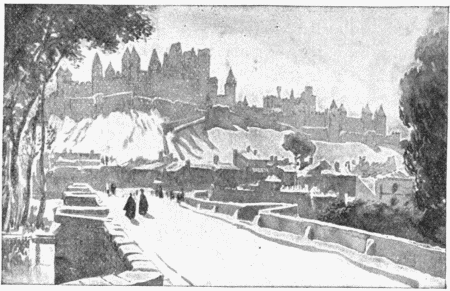
Carcassonne
CARCASSONE dates from the Roman occupation of Gaul. The place commanded
one of the great roads into Spain, and in the fourth century Romans and
Franks ousted each other from such a point of vantage. In the year 436
Theodoric King of the Visigoths superseded both these parties; and it
was during his occupation that the inner enceinte was raised upon the
ruins of the Roman fortifications. Most of the Visigoth towers that are
still erect are seated upon Roman substructions which appear to have
been formed hastily, probably at the moment of the Frankish invasion.
The authors of these solid defences, though occasionally disturbed, held
Carcassonne and the neighbouring country, in which they had established
their kingdom of Septimania, till the year 713, when they were expelled
by the Moors of Spain, who ushered in an unillumined period of four
centuries, of which no traces remain. These facts I derive from a
source
no more recondite than a pamphlet by M. Viollet-le-Duc—a very luminous
description of the fortifications, which you may buy from the
accomplished custodian. The writer makes a jump to the year 1209, when
Carcassonne, then forming part of the realm of the viscounts of Béziers
and infected by the Albigensian heresy, was besieged, in the name of the
Pope, by the terrible Simon de Montfort and his army of crusaders. Simon
was accustomed to success, and the town succumbed in the course of a
fortnight. Thirty-one years later, having passed into the hands of the
King of France, it was again besieged by the young Raymond de Trincavel,
the last of the viscounts of Béziers; and of this siege M.
Viollet-le-Duc gives a long and minute account, which the visitor who
has a head for such things may follow, with the brochure in hand, on the
fortifications themselves. The young Raymond de Trincavel, baffled and
repulsed, retired at the end of twenty-four days. Saint Louis and Philip
the Bold, in the thirteenth century, multiplied the defences of
Carcassonne, which was one of the bulwarks of their kingdom on the
Spanish quarter; and from this time forth, being regarded as
impregnable, the place had nothing to fear. It was not even attacked;
and when in 1355 Edward the Black Prince marched into it, the
inhabitants had opened the gates to the conqueror before whom all
Languedoc was prostrate. I am not one of those who, as I said just now,
have a head for such things, and having extracted these few facts, had
made all the use of M. Viollet-le-Duc's pamphlet of which I was capable.
I have mentioned that my obliging friend the amoureux-fou handed me
over to the doorkeeper of the citadel. I should add that I was at first
committed
to the wife of this functionary, a stout peasant-woman, who took a key
down from a nail, conducted me to a postern door, and ushered me into
the presence of her husband. Having just begun his rounds with a party
of four persons, he was not many steps in advance. I added myself
perforce to this party, which was not brilliantly composed, except that
two of its members were gendarmes in full toggery, who announced in the
course of our tour that they had been stationed for a year at
Carcassonne and had never before had the curiosity to come up to the
Cité. There was something brilliant certainly in that. The gardien was
an extraordinarily typical little Frenchman, who struck me even more
forcibly than the wonders of the inner enceinte; and as I am bound to
assume, at whatever cost to my literary vanity, that there is not the
slightest danger of his reading these remarks, I may treat him as public
property. With his diminutive stature and his perpendicular spirit, his
flushed face, expressive protuberant eyes, high peremptory voice,
extreme volubility, lucidity and neatness of utterance, he reminded me
of the gentry who figure in the revolutions of his native land. If he
was not a fierce little Jacobin, he ought to have been, for I am sure
there were many men of his pattern on the Committee of Public Safety. He
knew absolutely what he was about, understood the place thoroughly, and
constantly reminded his audience of what he himself had done in the way
of excavations and reparations. He described himself as the brother of
the architect of the work actually going forward (that which has been
done since the death of M. Viollet-le-Duc, I suppose he meant), and this
fact was more illustrative than all the others. It reminded me, as one
is reminded at
every turn, of the democratic conditions of French life: a man of the
people, with a wife en bonnet, extremely intelligent, full of special
knowledge, and yet remaining essentially of the people and showing his
intelligence with a kind of ferocity, of defiance. Such a personage
helps one to understand the red radicalism of France, the revolutions,
the barricades, the sinister passion for theories. (I do not, of course,
take upon myself to say that the individual I describe—who can know
nothing of the liberties I am taking with him—is actually devoted to
these ideals; I only mean that many such devotees must have his
qualities.) In just the nuance that I have tried to indicate here it
is a terrible pattern of man. Permeated in a high degree by
civilisation, it is yet untouched by the desire which one finds in the
Englishman, in proportion as he rises in the world, to approximate to
the figure of the gentleman. On the other hand, a netteté, a faculty
of exposition, such as the English gentleman is rarely either blessed or
cursed with.
ThisCarcassonne brilliant, this suggestive warden of Carcassonne marched us about
for an hour, haranguing, explaining, illustrating as he went; it was a
complete little lecture, such as might have been delivered at the Lowell
Institute, on the manner in which a first-rate place forte used to be
attacked and defended. Our peregrinations made it very clear that
Carcassonne was impregnable; it is impossible to imagine without having
seen them such refinements of immurement, such ingenuities of
resistance. We passed along the battlements and chemins de ronde,
ascended and descended towers, crawled under arches, peered out of
loopholes, lowered ourselves into dungeons, halted in all sorts of tight
places while the purpose of something or other was
described to us. It was very curious, very interesting; above all it was
very pictorial, and involved perpetual peeps into the little crooked,
crumbling, sunny, grassy, empty Cité. In places, as you stand upon it,
the great towered and embattled enceinte produces an illusion; it looks
as if it were still equipped and defended. One vivid challenge, at any
rate, it flings down before you; it calls upon you to make up your mind
on the matter of restoration. For myself I have no hesitation; I prefer
in every case the ruined, however ruined, to the reconstructed, however
splendid. What is left is more precious than what is added; the one is
history, the other is fiction; and I like the former the better of the
two—it is so much more romantic. One is positive, so far as it goes;
the other fills up the void with things more dead than the void itself,
inasmuch as they have never had life. After that I am free to say that
the restoration of Carcassonne is a splendid achievement. The little
custodian dismissed us at last, after having, as usual, inducted us into
the inevitable repository of photographs. These photographs are a great
nuisance all over the Midi. They are exceedingly bad for the most part;
and the worst—those in the form of the hideous little
album-panorama—are thrust upon you at every turn. They are a kind of
tax that you must pay; the best way is to pay to be let off. It was not
to be denied that there was a relief in separating from our accomplished
guide, whose manner of imparting information reminded me of the
energetic process by which I had seen mineral waters bottled. All this
while the afternoon had grown more lovely; the sunset had deepened, the
horizon of hills grown purple; the mass of the Canigou became more
delicate, yet more distinct. The day had so far faded that the interior
of
the little cathedral was wrapped in twilight, into which the glowing
windows projected something of their colour. This church has high beauty
and value, but I will spare the reader a presentation of details which I
myself had no opportunity to master. It consists of a romanesque nave,
of the end of the eleventh century, and a Gothic choir and transepts of
the beginning of the fourteenth; and, shut up in its citadel like a
precious casket in a cabinet, it seems—or seemed at that hour—to have
a sort of double sanctity. After leaving it and passing out of the two
circles of walls, I treated myself, in the most infatuated manner, to
another walk round the Cité. It is certainly this general impression
that is most striking—the impression from outside, where the whole
place detaches itself at once from the landscape. In the warm southern
dusk it looked more than ever like a city in a fairy tale. To make the
thing perfect, a white young moon, in its first quarter, came out and
hung just over the dark silhouette. It was hard to come away—to
incommode one's self for anything so vulgar as a railway train; I would
gladly have spent the evening in revolving round the walls of
Carcassonne. But I had in a measure engaged to proceed to Narbonne, and
there was a certain magic in that name which gave me strength—Narbonne,
the richest city in Roman Gaul.
Narbonne
AT Narbonne I took up my abode at the house of a serrurier mécanicien,
and was very thankful for the accommodation. It was my misfortune to
arrive at this ancient city late at night, on the eve of market-day; and
market-day at Narbonne is a very serious affair. The inns, on this
occasion, are stuffed with wine-dealers; for the country round about,
dedicated almost exclusively to Bacchus, has hitherto escaped the
phylloxera. This deadly enemy of the grape is encamped over the Midi in
a hundred places; blighted vineyards and ruined proprietors being quite
the order of the day. The signs of distress are more frequent as you
advance into Provence, many of the vines being laid under water in the
hope of washing the plague away. There are healthy regions still,
however, and the vintners find plenty to do at Narbonne.
Narbonne
The traffic in wine appeared to be the sole thought of the Narbonnais;
every one I spoke to had something to say about the harvest of gold that
bloomed under its influence. "C'est inoui, monsieur, l'argent qu'il y a
dans ce pays. Des gens à qui la vente de leur vin rapporte jusqu'à
500,000 francs par an." That little speech addressed to me by a
gentleman at the inn gives the note of these revelations. It must be
said that there was little in the appearance either of the town or of
its population to suggest the possession of such treasures. Narbonne is
a sale petite ville in all the force of the term, and my first
impression on arriving there was an extreme regret that I had not
remained for the night at the lovely Carcassonne. My journey from that
delectable spot lasted a couple of hours and was performed in
darkness—a darkness not so dense, however, but that I was able to make
out, as we passed it, the great figure of Béziers, whose ancient roofs
and towers, clustered on a goodly hill-top, looked as fantastic as you
please. I know not what appearance Béziers may present by day, but by
night it has quite the grand air. On issuing from the station at
Narbonne I found that the only vehicle in waiting was a kind of bastard
tramcar, a thing shaped as if it had been meant to go upon rails; that
is, equipped with small wheels, placed beneath it, and with a platform
at either end, but destined to rattle over the stones like the most
vulgar of omnibuses. To complete the oddity of this conveyance, it was
under the supervision, not of a conductor, but of a conductress. A fair
young woman with a pouch suspended from her girdle had command of the
platform; and as soon as the car was full she jolted us into the town
through clouds of the thickest dust I ever have swallowed. I have had
occasion to
speak of the activity of women in France—of the way they are always in
the ascendant; and here was a signal example of their general utility.
The young lady I have mentioned conveyed her whole company to the
wretched little Hôtel de France, where it is to be hoped that some of
them found a lodging. For myself, I was informed that the place was
crowded from cellar to attic, and that its inmates were sleeping three
or four in a room. At Carcassonne I should have had a bad bed, but at
Narbonne, apparently, I was to have no bed at all. I passed an hour or
two of flat suspense while fate settled the question of whether I should
go on to Perpignan, return to Béziers, or still discover a modest couch
at Narbonne. I shall not have suffered in vain, however, if my example
serves to deter other travellers from alighting unannounced at that city
on a Wednesday evening. The retreat to Béziers, not attempted in time,
proved impossible, and I was assured that at Perpignan, which I should
not reach till midnight, the affluence of wine-dealers was not less than
at Narbonne. I interviewed every hostess in the town, and got no
satisfaction but distracted shrugs. Finally, at an advanced hour, one of
the servants of the Hôtel de France, where I had attempted to dine, came
to me in triumph to proclaim that he had secured for me a charming
apartment in a maison bourgeoise. I took possession of it gratefully,
in spite of its having an entrance like a stable and being pervaded by
an odour compared with which that of a stable would have been delicious.
As I have mentioned, my landlord was a locksmith, and he had strange
machines which rumbled and whirred in the rooms below my own.
Nevertheless I slept, and I dreamed of Carcassonne. It was better to do
that than to dream of the Hôtel de France.
Narbonne
I was obliged to cultivate relations with the cuisine of this
establishment. Nothing could have been more méridional; indeed, both
the dirty little inn and Narbonne at large seemed to me to have the
infirmities of the south without its usual graces. Narrow, noisy,
shabby, belittered and encumbered, filled with clatter and chatter, the
Hôtel de France would have been described in perfection by Alphonse
Daudet. For what struck me above all in it was the note of the Midi as
he has represented it—the sound of universal talk. The landlord sat at
supper with sundry friends in a kind of glass cage, with a genial
indifference to arriving guests; the waiters tumbled over the loose
luggage in the hall; the travellers who had been turned away leaned
gloomily against door-posts; and the landlady, surrounded by confusion,
unconscious of responsibility, and animated only by the spirit of
conversation, bandied high-voiced compliments with the voyageurs de
commerce. At ten o'clock in the morning there was a table d'hôte for
breakfast—a wonderful repast, which overflowed into every room and
pervaded the whole establishment. I sat down with a hundred hungry
marketers, fat, brown, greasy men, with a good deal of the rich soil of
Languedoc adhering to their hands and their boots. I mention the latter
articles because they almost put them on the table. It was very hot, and
there were swarms of flies; the viands had the strongest odour; there
was in particular a horrible mixture known as gras-double, a light
grey, glutinous, nauseating mess, which my companions devoured in large
quantities. A man opposite to me had the dirtiest fingers I ever saw; a
collection of fingers which in England would have excluded him from a
farmers' ordinary. The conversation was mainly bucolic; though a part of
it, I
remember, at the table at which I sat, consisted of a discussion as to
whether or no the maid-servant were sage—a discussion which went on
under the nose of this young lady, as she carried about the dreadful
gras-double, and to which she contributed the most convincing blushes.
It was thoroughly méridional.
In going to Narbonne I had of course counted upon Roman remains; but
when I went forth in search of them I perceived that I had hoped too
fondly. There is really nothing in the place to speak of; that is, on
the day of my visit there was nothing but the market, which was in
complete possession. "This intricate, curious, but lifeless town,"
Murray calls it; yet to me it appeared overflowing with life. Its
streets are mere crooked, dirty lanes, bordered with perfectly
insignificant houses; but they were filled with the same clatter and
chatter that I had found at the hotel. The market was held partly in the
little square of the hôtel de ville, a structure which a flattering
woodcut in the Guide-Joanne had given me a desire to behold. The reality
was not impressive, the old colour of the front having been completely
restored away. Such interest as it superficially possesses it derives
from a fine mediæval tower which rises beside it with turrets at the
angles—always a picturesque thing. The rest of the market was held in
another place, still shabbier than the first, which lies beyond the
canal. The Canal du Midi flows through the town, and, spanned at this
point by a small suspension-bridge, presented a certain sketchability.
On the farther side were the vendors and chafferers—old women under
awnings and big umbrellas, rickety tables piled high with fruit, white
caps and brown faces, blouses, sabots, donkeys. Beneath this picture was
another—a long row of washerwomen, on their
knees on the edge of the canal, pounding and wringing the dirty linen of
Narbonne—no great quantity, to judge by the costume of the people.
Innumerable rusty men, scattered all over the place, were buying and
selling wine, straddling about in pairs, in groups, with their hands in
their pockets, and packed together at the doors of the cafés. They were
mostly fat and brown and unshaven; they ground their teeth as they
talked; they were very méridionaux.
TheNarbonne only two lions at Narbonne are the cathedral and the museum, the
latter of which is quartered in the hôtel de ville. The cathedral,
closely shut in by houses and with the west front undergoing repairs, is
singular in two respects. It consists exclusively of a choir, which is
of the end of the thirteenth century and the beginning of the next, and
of great magnificence. There is absolutely nothing else. This choir, of
extraordinary elevation, forms the whole church. I sat there a good
while; there was no other visitor. I had taken a great dislike to poor
little Narbonne, which struck me as sordid and overheated, and this
place seemed to extend to me, as in the Middle Ages, the privilege of
sanctuary. It is a very solemn corner. The other peculiarity of the
cathedral is that, externally, it bristles with battlements, having
anciently formed part of the defences of the archevêché, which is
beside it and which connects it with the hôtel de ville. This
combination of the church and the fortress is very curious, and during
the Middle Ages was not without its value. The palace of the former
archbishops of Narbonne (the hôtel de ville of to-day forms part of it)
was both an asylum and an arsenal during the hideous wars by which all
Languedoc was ravaged in the thirteenth century. The whole mass of
buildings
is jammed together in a manner that from certain points of view makes it
far from apparent which feature is which. The museum occupies several
chambers at the top of the hôtel de ville, and is not an imposing
collection. It was closed, but I induced the portress to let me in—a
silent, cadaverous person, in a black coif, like a béguine, who sat
knitting in one of the windows while I went the rounds. The number of
Roman fragments is small, and their quality is not the finest; I must
add that this impression was hastily gathered. There is, indeed, a work
of art in one of the rooms which creates a presumption in favour of the
place—the portrait (rather a good one) of a citizen of Narbonne, whose
name I forget, who is described as having devoted all his time and his
intelligence to collecting the objects by which the visitor is
surrounded. This excellent man was a connoisseur, and the visitor is
doubtless often an ignoramus.
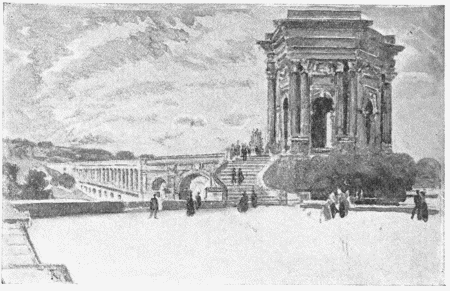
"Cette, with its glistening houses white,
Curves with the curving beach away
To where the lighthouse beacons bright,
Far in the bay."
Montpellier
THAT stanza of Matthew Arnold's, which I happened to remember, gave a
certain importance to the half-hour I spent in the buffet of the station
at Cette while I waited for the train to Montpellier. I had left
Narbonne in the afternoon, and by the time I reached Cette the darkness
had descended. I therefore missed the sight of the glistening houses,
and had to console myself with that of the beacon in the bay, as well as
with a bouillon of which I partook at the buffet aforesaid; for, since
the morning, I had not ventured to return to the table d'hôte at
Narbonne. The Hôtel Nevet at Montpellier, which I reached an hour later,
has an ancient renown all over the south of France—advertises itself, I
believe, as
le plus vastedu midi. It seemed to me the model of a good provincial
inn; a big rambling, creaking establishment, with brown, labyrinthine
corridors, a queer old open-air vestibule, into which the diligence, in
the bon temps, used to penetrate, and an hospitality more expressive
than that of the new caravansaries. It dates from the days when
Montpellier was still accounted a fine winter residence for people with
weak lungs; and this rather melancholy tradition, together with the
former celebrity of the school of medicine still existing there, but
from which the glory has departed, helps to account for its combination
of high antiquity and vast proportions. The old hotels were usually more
concentrated; but the school of medicine passed for one of the
attractions of Montpellier. Long before Mentone was discovered or
Colorado invented, British invalids travelled down through France in the
post-chaise or the public coach, to spend their winters in the wonderful
place which boasted both a climate and a faculty. The air is mild, no
doubt, but there are refinements of mildness which were not then
suspected, and which in a more analytic age have carried the annual wave
far beyond Montpellier. The place is charming, all the same; and it
served the purpose of John Locke, who made a long stay there, between
1675 and 1679, and became acquainted with a noble fellow-visitor, Lord
Pembroke, to whom he dedicated the famous Essay. There are places that
please without your being able to say wherefore, and Montpellier is one
of the number. It has some charming views, from the great promenade of
the Peyrou; but its position is not strikingly fine. Beyond this it
contains a good museum and the long façades of its school, but these are
its only definite treasures. Its cathedral
struck me as quite the weakest I had seen, and I remember no other
monument that made up for it. The place has neither the gaiety of a
modern nor the solemnity of an ancient town, and it is agreeable as
certain women are agreeable who are neither beautiful nor clever. An
Italian would remark that it is sympathetic; a German would admit that
it is gemüthlich. I spent two days there, mostly in the rain, and even
under these circumstances I carried away a kindly impression. I think
the Hôtel Nevet had something to do with it, and the sentiment of relief
with which, in a quiet, even a luxurious, room that looked out on a
garden, I reflected that I had washed my hands of Narbonne. The
phylloxera has destroyed the vines in the country that surrounds
Montpellier, and at that moment I was capable of rejoicing in the
thought that I should not breakfast with vintners.
The gem of the place is the Musée Fabre, one of the best collections of
paintings in a provincial city. François Fabre, a native of Montpellier,
died there in 1837, after having spent a considerable part of his life
in Italy, where he had collected a good many valuable pictures and some
very poor ones, the latter class including several from his own hand. He
was the hero of a remarkable episode, having succeeded no less a person
than Vittorio Alfieri in the affections of no less a person than Louise
de Stolberg, Countess of Albany, widow of no less a person than Charles
Edward Stuart, the second pretender to the British crown. Surely no
woman ever was associated sentimentally with three figures more
diverse—a disqualified sovereign, an Italian dramatist, and a bad
French painter. The productions of M. Fabre, who followed in the steps
of David, bear the stamp of a cold mediocrity; there is not much to
be said even for the portrait of the genial countess (her life has been
written by M. Saint-Réné-Taillandier, who depicts her as delightful),
which hangs in Florence, in the gallery of the Uffizzi, and makes a
pendant to a likeness of Alfieri by the same author. Stendhal, in his
"Mémoires d'un Touriste," says that this work of art represents her as a
cook who has pretty hands. I am delighted to having an opportunity of
quoting Stendhal, whose two volumes of the "Mémoires d'un Touriste"
every traveller in France should carry in his portmanteau. I have had
this opportunity more than once, for I have met him at Tours, at Nantes,
at Bourges; and everywhere he is suggestive. But he has the defect that
he is never pictorial, that he never by any chance makes an image, and
that his style is perversely colourless for a man so fond of
contemplation. His taste is often singularly false; it is the taste of
the early years of the present century, the period that produced clocks
surmounted with sentimental "subjects." Stendhal does not admire these
clocks, but he almost does. He admires Domenichino and Guercino, he
prizes the Bolognese school of painters because they "spoke to the
soul." He is a votary of the new classic, is fond of tall, square,
regular buildings, and thinks Nantes, for instance, full of the "air
noble." It was a pleasure to me to reflect that five-and-forty years ago
he had alighted in that city, at the very inn in which I spent a night
and which looks down on the Place Graslin and the theatre. The hotel
that was the best in 1837 appears to be the best to-day. On the subject
of Touraine Stendhal is extremely refreshing; he finds the scenery
meagre and much overrated, and proclaims his opinion with perfect
frankness. He does, however, scant justice to the banks of the Loire;
his
want of appreciation of the picturesque—want of the sketcher's
sense—causes him to miss half the charm of a landscape which is nothing
if not "quiet," as a painter would say, and of which the felicities
reveal themselves only to waiting eyes. He even despises the Indre, the
river of Madame Sand. The "Mémoires d'un Touriste" are written in the
character of a commercial traveller, and the author has nothing to say
about Chenonceaux or Chambord, or indeed about any of the châteaux of
that part of France; his system being to talk only of the large towns,
where he may be supposed to find a market for his goods. It was his
ambition to pass for an ironmonger. But in the large towns he is usually
excellent company, though as discursive as Sterne and strangely
indifferent, for a man of imagination, to those superficial aspects of
things which the poor pages now before the reader are mainly an attempt
to render. It is his conviction that Alfieri, at Florence, bored the
Countess of Albany terribly; and he adds that the famous Gallophobe died
of jealousy of the little painter from Montpellier. The Countess of
Albany left her property to Fabre; and I suppose some of the pieces in
the museum of his native town used to hang in the sunny saloons of that
fine old palace on the Arno which is still pointed out to the stranger
in Florence as the residence of Alfieri.
TheMontpellier institution has had other benefactors, notably a certain M. Bruyas,
who has enriched it with an extraordinary number of portraits of
himself. As these, however, are by different hands, some of them
distinguished, we may suppose that it was less the model than the
artists to whom M. Bruyas wished to give publicity. Easily first are two
large specimens of David Teniers, which are incomparable for brilliancy
and a glowing perfection of execution. I have a weakness for this
singular genius, who combined the delicate with the grovelling, and I
have rarely seen richer examples. Scarcely less valuable is a Gerard Dow
which hangs near them, though it must rank lower, as having kept less of
its freshness. This Gerard Dow did me good, for a master is a master,
whatever he may paint. It represents a woman paring carrots, while a boy
before her exhibits a mouse-trap in which he has caught a frightened
victim. The goodwife has spread a cloth on the top of a big barrel which
serves her as a table, and on this brown, greasy napkin, of which the
texture is wonderfully rendered, lie the raw vegetables she is preparing
for domestic consumption. Beside the barrel is a large caldron lined
with copper, with a rim of brass. The way these things are painted
brings tears to the eyes; but they give the measure, of the Musée Fabre,
where two specimens of Teniers and a Gerard Dow are the jewels. The
Italian pictures are of small value; but there is a work by Sir Joshua
Reynolds, said to be the only one in France—an infant Samuel in prayer,
apparently a repetition of the picture in England which inspired the
little plaster image, disseminated in Protestant lands, that we used to
admire in our childhood. Sir Joshua, somehow, was an eminently
Protestant painter; no one can forget that, who in the National Gallery
in London has looked at the picture in which he represents several young
ladies as nymphs, voluminously draped, hanging garlands over a statue—a
picture suffused indefinably with the Anglican spirit and exasperating
to a member of one of the Latin races. It is an odd chance therefore
that has led him into that part of France where Protestants have been
least bien vus. This is the
country of the dragonnades of Louis XIV. and of the pastors of the
desert. From the garden of the Peyrou, at Montpellier, you may see the
hills of the Cévennes, to which they of the religion fled for safety and
out of which they were hunted and harried.
I have only to add, in regard to the Musée Fabre, that it contains the
portrait of its founder—a little, pursy, fat-faced, elderly man, whose
countenance contains few indications of the power that makes
distinguished victims. He is, however, just such a personage as the
mind's eye sees walking on the terrace of the Peyrou of an October
afternoon in the early years of the century; a plump figure in a
chocolate-coloured coat and a culotte that exhibits a good leg—a
culotte provided with a watch-fob from which a heavy seal is suspended.
This Peyrou (to come to it at last) is a wonderful place, especially to
be found in a little provincial city. France is certainly the country of
towns that aim at completeness; more than in other lands they contain
stately features as a matter of course. We should never have ceased to
hear about the Peyrou if fortune had placed it at a Shrewsbury or a
Buffalo. It is true that the place enjoys a certain celebrity at home,
which it amply deserves, moreover; for nothing could be more impressive
and monumental. It consists of an "elevated platform," as Murray
says—an immense terrace laid out, in the highest part of the town, as a
garden, and commanding in all directions a view which in clear weather
must be of the finest. I strolled there in the intervals of showers, and
saw only the nearer beauties—a great pompous arch of triumph in honour
of Louis XIV. (which is not, properly speaking, in the garden, but faces
it, straddling across the place by which you approach it from the
town), an
equestrian statue of that monarch set aloft in the middle of the
terrace, and a very exalted and complicated fountain, which forms a
background to the picture. This fountain gushes from a kind of hydraulic
temple, or château d'eau, to which you ascend by broad flights of
steps, and which is fed by a splendid aqueduct, stretched in the most
ornamental and unexpected manner across the neighbouring valley. All
this work dates from the middle of the last century. The combination of
features—the triumphal arch, or gate; the wide fair terrace, with its
beautiful view; the statue of the grand monarch; the big architectural
fountain, which would not surprise one at Rome, but does surprise one at
Montpellier; and to complete the effect, the extraordinary aqueduct,
charmingly fore-shortened—all this is worthy of a capital, of a little
court-city. The whole place, with its repeated steps, its balustrades,
its massive and plentiful stonework, is full of the air of the last
century—sent bien son dix-huitième siècle; none the less so, I am
afraid, that, as I read in my faithful Murray, after the revocation of
the Edict of Nantes the block, the stake, the wheel had been erected
here for the benefit of the desperate Camisards.
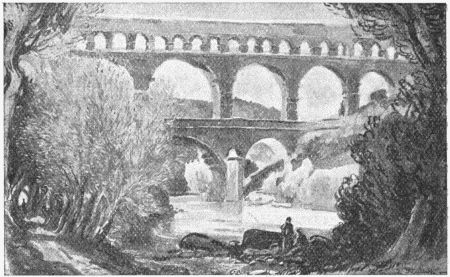
The Pont du Gard
IT was a pleasure to feel one's self in Provence again—the land where
the silver-grey earth is impregnated with the light of the sky. To
celebrate the event, as soon as I arrived at Nîmes I engaged a calèche
to convey me to the Pont du Gard. The day was yet young and was
exceptionally fair; it appeared well, for a longish drive, to take
advantage, without delay, of such security. After I had left the town I
became more intimate with that Provençal charm which I had already
enjoyed from the window of the train, and which glowed in the sweet
sunshine and the white rocks and lurked in the smoke puffs of the little
olives. The olive-trees in Provence are half the landscape. They are
neither so tall, so stout, nor so richly contorted as you have seen them
beyond the Alps; but this mild colourless bloom seems the very texture
of the country. The road from Nîmes, for a distance of fifteen miles, is
superb; broad enough for
an army and as white and firm as a dinner-table. It stretches away over
undulations which have a kind of rhythmic value, and in the curves it
makes through the wide, free country, where there is never a hedge or a
wall and the detail is always exquisite, there is something majestic,
almost processional. Some twenty minutes before I reached the little inn
that marks the termination of the drive my vehicle met with an accident
which just missed being serious, and which engaged the attention of a
gentleman who, followed by his groom and mounted on a strikingly
handsome horse, happened to ride up at the moment. This young man, who,
with his good looks and charming manner, might have stepped out of a
novel of Octave Feuillet, gave me some very intelligent advice in
reference to one of my horses that had been injured, and was so good as
to accompany me to the inn, with the resources of which he was
acquainted, to see that his recommendations were carried out. The result
of our interview was that he invited me to come and look at a small but
ancient château in the neighbourhood, which he had the happiness—not
the greatest in the world, he intimated—to inhabit, and at which I
engaged to present myself after I should have spent an hour at the Pont
du Gard. For the moment, when we separated, I gave all my attention to
that great structure. You are very near it before you see it; the ravine
it spans suddenly opens and exhibits the picture. The scene at this
point grows extremely beautiful. The ravine is the valley of the Garden,
which the road from Nîmes has followed some time without taking account
of it, but which, exactly at the right distance from the aqueduct,
deepens and expands and puts on those characteristics which are best
suited to give it effect.
The Pont du Gard
The gorge becomes romantic, still and solitary, and, with its white
rocks and wild shrubbery, hangs over the clear-coloured river, in whose
slow course there is, here and there, a deeper pool. Over the valley,
from side to side and ever so high in the air, stretch the three tiers
of the tremendous bridge. They are unspeakably imposing, and nothing
could well be more Roman. The hugeness, the solidity, the
unexpectedness, the monumental rectitude of the whole thing leave you
nothing to say—at the time—and make you stand gazing. You simply feel
that it is noble and perfect, that it has the quality of greatness. A
road, branching from the highway, descends to the level of the river and
passes under one of the arches. This road has a wide margin of grass and
loose stones, which slopes upward into the bank of the ravine. You may
sit here as long as you please, staring up at the light, strong piers;
the spot is sufficiently "wild," though two or three stone benches have
been erected on it. I remained there an hour and got a complete
impression; the place was perfectly soundless and, for the time at
least, lonely; the splendid afternoon had begun to fade, and there was a
fascination in the object I had come to see. It came to pass that at the
same time I discovered in it a certain stupidity, a vague brutality.
That element is rarely absent from great Roman work, which is wanting in
the nice adaptation of the means to the end. The means are always
exaggerated; the end is so much more than attained. The Roman rigour was
apt to overshoot the mark, and I suppose a race which could do nothing
small is as defective as a race that can do nothing great. Of this Roman
rigour the Pont du Gard is an admirable example. It would be a great
injustice, however, not to insist upon its
beauty—a kind of manly beauty, that of an object constructed not to
please but to serve, and impressive simply from the scale on which it
carries out this intention. The number of arches in each tier is
different; they are smaller and more numerous as they ascend. The
preservation of the thing is extraordinary; nothing has crumbled or
collapsed; every feature remains, and the huge blocks of stone, of a
brownish-yellow (as if they had been baked by the Provençal sun for
eighteen centuries), pile themselves, without mortar or cement, as
evenly as the day they were laid together. All this to carry the water
of a couple of springs to a little provincial city! The conduit on the
top has retained its shape and traces of the cement with which it was
lined. When the vague twilight began to gather, the lonely valley seemed
to fill itself with the shadow of the Roman name, as if the mighty
empire were still as erect as the supports of the aqueduct; and it was
open to a solitary tourist, sitting there sentimental, to believe that
no people has ever been, or will ever be, as great as that, measured, as
we measure the greatness of an individual, by the push they gave to what
they undertook. The Pont du Gard is one of the three or four deepest
impressions they have left; it speaks of them in a manner with which
they might have been satisfied.
I feel as if it were scarcely discreet to indicate the whereabouts of
the château of the obliging young man I had met on the way from Nîmes; I
must content myself with saying that it nestled in an enchanting
valley—dans le fond, as they say in France—and that I took my course
thither on foot after leaving the Pont du Gard. I find it noted in my
journal as "an adorable little corner." The principal feature of the
place is a
couple of very ancient towers, brownish-yellow in hue, and mantled in
scarlet Virginia-creeper. One of these towers, reputed to be of
Saracenic origin, is isolated, and is only the more effective; the other
is incorporated in the house, which is delightfully fragmentary and
irregular. It had got to be late by this time, and the lonely castel
looked crepuscular and mysterious. An old housekeeper was sent for, who
showed me the rambling interior; and then the young man took me into a
dim old drawing-room, which had no less than four chimney-pieces, all
unlighted, and gave me a refection of fruit and sweet wine. When I
praised the wine and asked him what it was, he said simply "C'est du vin
de ma mère!" Throughout my little journey I had never yet felt myself so
far from Paris; and this was a sensation I enjoyed more than my host,
who was an involuntary exile, consoling himself with laying out a
manège which he showed me as I walked away. His civility was great,
and I was greatly touched by it. On my way back to the little inn where
I had left my vehicle I passed the Pont du Gard and took another look at
it. Its great arches made windows for the evening sky, and the rocky
ravine, with its dusky cedars and shining river, was lonelier than
before. At the inn I swallowed, or tried to swallow, a glass of horrible
wine with my coachman; after which, with my reconstructed team, I drove
back to Nîmes in the moonlight. It only added a more solitary whiteness
to the constant sheen of the Provençal landscape.
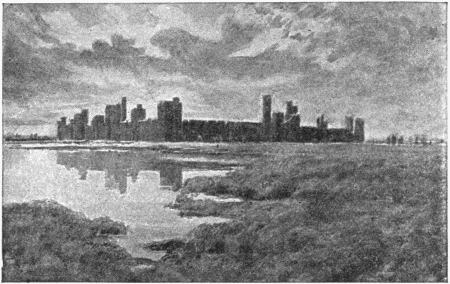
Aigues-Mortes
THE weather the next day was equally fair, so that it seemed an
imprudence not to make sure of Aigues-Mortes. Nîmes itself could wait;
at a pinch I could attend to Nîmes in the rain. It was my belief that
Aigues-Mortes was a little gem, and it is natural to desire that gems
should have an opportunity to sparkle. This is an excursion of but a few
hours, and there is a little friendly, familiar, dawdling train that
will convey you, in time for a noonday breakfast, to the small dead town
where the blessed Saint Louis twice embarked for the Crusades. You may
get back to Nîmes for dinner; the run—or rather the walk, for the train
doesn't run—is of about an hour. I found the little journey charming
and looked out of the carriage window, on my right, at the distant
Cévennes, covered with tones of amber and blue, and, all around, at
vineyards red with the touch of October. The grapes were gone, but the
plants had a colour of their own.
Within a certain distance of Aigues-Mortes they give place to wide
salt-marshes, traversed by two canals; and over this expanse the train
rumbles slowly upon a narrow causeway, failing for some time, though you
know you are near the object of your curiosity, to bring you to sight of
anything but the horizon. Suddenly it appears, the towered and embattled
mass, lying so low that the crest of its defences seems to rise straight
out of the ground; and it is not till the train stops close before them
that you are able to take the full measure of its walls.
Aigues-Mortes stands on the edge of a wide étang, or shallow inlet of
the sea, the farther side of which is divided by a narrow band of coast
from the Gulf of Lyons. Next after Carcassonne, to which it forms an
admirable pendant, it is the most perfect thing of the kind in France.
It has a rival in the person of Avignon, but the ramparts of Avignon are
much less effective. Like Carcassonne, it is completely surrounded with
its old fortifications; and if they are far simpler in character (there
is but one circle), they are quite as well preserved. The moat has been
filled up, and the site of the town might be figured by a billiard-table
without pockets. On this absolute level, covered with coarse grass,
Aigues-Mortes presents quite the appearance of the walled town that a
school-boy draws upon his slate or that we see in the background of
early Flemish pictures—a simple parallelogram, of a contour almost
absurdly bare, broken at intervals by angular towers and square holes.
Such, literally speaking, is this delightful little city, which needs to
be seen to tell its full story. It is extraordinarily pictorial, and if
it is a very small sister of Carcassonne, it has at least the essential
features of the family. Indeed, it is even
more like an image and less like a reality than Carcassonne; for by
position and prospect it seems even more detached from the life of the
present day. It is true that Aigues-Mortes does a little business; it
sees certain bags of salt piled into barges which stand in a canal
beside it, and which carry their cargo into actual places. But nothing
could well be more drowsy and desultory than this industry as I saw it
practised, with the aid of two or three brown peasants and under the eye
of a solitary douanier, who strolled on the little quay beneath the
western wall. "C'est bien plaisant, c'est bien paisible," said this
worthy man, with whom I had some conversation; and pleasant and peaceful
is the place indeed, though the former of these epithets may suggest an
element of gaiety in which Aigues-Mortes is deficient. The sand, the
salt, the dull sea-view, surround it with a bright, quiet melancholy.
There are fifteen towers and nine gates, five of which are on the
southern side, overlooking the water. I walked all round the place three
times (it doesn't take long), but lingered most under the southern wall,
where the afternoon light slept in the dreamiest, sweetest way. I sat
down on an old stone and looked away to the desolate salt-marshes and
the still, shining surface of the étang; and, as I did so, reflected
that this was a queer little out-of-the-world corner to have been
chosen, in the great dominions of either monarch, for that pompous
interview which took place, in 1538, between Francis I. and Charles V.
It was also not easy to perceive how Louis IX., when in 1248 and 1270 he
started for the Holy Land, set his army afloat in such very undeveloped
channels. An hour later I purchased in the town a little pamphlet by M.
Marius Topin, who undertakes to explain this latter anomaly and to show
that there
is water enough in the port, as we may call it by courtesy, to have
sustained a fleet of crusaders. I was unable to trace the channel that
he points out, but was glad to believe that, as he contends, the sea has
not retreated from the town since the thirteenth century. It was
comfortable to think that things are not so changed as that. M. Topin
indicates that the other French ports of the Mediterranean were not then
disponibles, and that Aigues-Mortes was the most eligible spot for an
embarkation.
Behind the straight walls and the quiet gates the little town has not
crumbled like the Cité of Carcassonne. It can hardly be said to be
alive; but if it is dead it has been very neatly embalmed. The hand of
the restorer rests on it constantly; but this artist has not, as at
Carcassonne, had miracles to accomplish. The interior is very still and
empty, with small stony, whitewashed streets tenanted by a stray dog, a
stray cat, a stray old woman. In the middle is a little place, with
two or three cafés decorated by wide awnings—a little place of which
the principal feature is a very bad bronze statue of Saint Louis by
Pradier. It is almost as bad as the breakfast I had at the inn that
bears the name of that pious monarch. You may walk round the enceinte of
Aigues-Mortes both outside and in; but you may not, as at Carcassonne,
make a portion of this circuit on the chemin de ronde, the little
projecting footway attached to the inner face of the battlements. This
footway, wide enough only for a single pedestrian, is in the best order,
and near each of the gates a flight of steps leads up to it; but a
locked gate at the top of the steps makes access impossible, or at least
unlawful. Aigues-Mortes, however, has its citadel, an immense tower,
larger than any of the others, a little detached
and standing at the north-west angle of the town. I called upon the
casernier—the custodian of the walls—and in his absence I was
conducted through this big Tour de Constance by his wife, a very mild,
meek woman, yellow with the traces of fever and ague—a scourge which,
as might be expected in a town whose name denotes "dead waters," enters
freely at the nine gates. The Tour de Constance is of extraordinary
girth and solidity, divided into three superposed circular chambers,
with very fine vaults, which are lighted by embrasures of prodigious
depth, converging to windows little larger than loopholes. The place
served for years as a prison to many of the Protestants of the south
whom the revocation of the Edict of Nantes had exposed to atrocious
penalties, and the annals of these dreadful chambers in the first half
of the last century were written in tears and blood. Some of the
recorded cases of long confinement there make one marvel afresh at what
man has inflicted and endured. In a country in which a policy of
extermination was to be put into practice this horrible tower was an
obvious resource. From the battlements at the top, which is surmounted
by an old disused lighthouse, you see the little compact rectangular
town, which looks hardly bigger than a garden-patch, mapped out beneath
you, and follow the plain configuration of its defences. You take
possession of it, and you feel that you will remember it always.
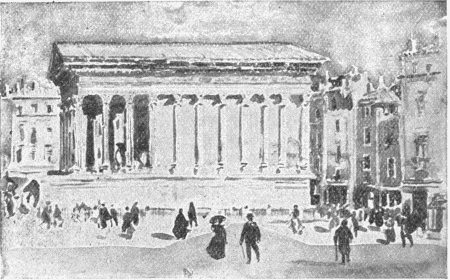
Nîmes
AFTER this I was free to look about me at Nîmes, and I did so with such
attention as the place appeared to require. At the risk of seeming too
easily and too frequently disappointed, I will say that it required
rather less than I had been prepared to give. It is a town of three or
four fine features rather than a town with, as I may say, a general
figure. In general Nîmes is poor; its only treasures are its Roman
remains, which are of the first order. The new French fashions prevail
in many of its streets; the old houses are paltry, and the good houses
are new; while beside my hotel rose a big spick-and-span church, which
had the oddest air of having been intended for Brooklyn or Cleveland. It
is true that this church looked out on a square completely French—a
square of a fine modern disposition, flanked on one side by a classical
palais de justice embellished with trees and parapets and occupied in
the centre with a group of allegorical statues such
as one encounters only in the cities of France, the chief of these being
a colossal figure by Pradier representing Nîmes. An English, an American
town which should have such a monument, such a square as this would be a
place of great pretensions; but, like so many little villes de
province in the country of which I write, Nîmes is easily ornamental.
What nobler element can there be than the Roman baths at the foot of
Mont Cavalier and the delightful old garden that surrounds them? All
that quarter of Nîmes has every reason to be proud of itself; it has
been revealed to the world at large by copious photography. A clear,
abundant stream gushes from the foot of a high hill (covered with trees
and laid out in paths), and is distributed into basins which
sufficiently refer themselves to the period that gave them birth—the
period that has left its stamp on that pompous Peyrou which we admired
at Montpellier. Here are the same terraces and steps and balustrades,
and a system of waterworks less impressive perhaps, but very ingenious
and charming. The whole place is a mixture of old Rome and of the French
eighteenth century; for the remains of the antique baths are in a
measure incorporated in the modern fountains. In a corner of this
umbrageous precinct stands a small Roman ruin, which is known as a
temple of Diana, but was more apparently a nymphæum, and appears to
have had a graceful connection with the adjacent baths. I learn from
Murray that this little temple, of the period of Augustus, "was reduced
to its present state of ruin in 1577;" the moment at which the
townspeople, threatened with a siege by the troops of the Crown, partly
demolished it lest it should serve as a cover to the enemy. The remains
are very fragmentary, but they serve to show
that the place was lovely. I spent half an hour in it on a perfect
Sunday morning (it is enclosed by a high grille, carefully tended, and
has a warden of its own), and with the help of my imagination tried to
reconstruct a little the aspect of things in the Gallo-Roman days. I do
wrong perhaps to say that I tried; from a flight so deliberate I
should have shrunk. But there was a certain contagion of antiquity in
the air; and among the ruins of baths and temples, in the very spot
where the aqueduct that crosses the Gardon in the wondrous manner I had
seen discharged itself, the picture of a splendid paganism seemed
vaguely to glow. Roman baths—Roman baths; those words alone were a
scene. Everything was changed: I was strolling in a jardin français;
the bosky slope of the Mont Cavalier (a very modest mountain), hanging
over the place, is crowned with a shapeless tower, which is as likely to
be of mediæval as of antique origin; and yet, as I leaned on the parapet
of one of the fountains, where a flight of curved steps (a hemicycle, as
the French say) descended into a basin full of dark, cool recesses,
where the slabs of the Roman foundations gleam through the clear green
water—as in this attitude I surrendered myself to contemplation and
reverie, it seemed to me that I touched for a moment the ancient world.
Such moments are illuminating, and the light of this one mingles, in my
memory, with the dusky greenness of the Jardin de la Fontaine.
TheNîmes fountain proper—the source of all these distributed waters—is the
prettiest thing in the world, a reduced copy of Vaucluse. It gushes up
at the foot of the Mont Cavalier, at a point where that eminence rises
with a certain cliff-like effect, and, like other springs in the same
circumstances, appears to issue
from the rock with a sort of quivering stillness. I trudged up the Mont
Cavalier—it is a matter of five minutes—and having committed this
cockneyism, enhanced it presently by another. I ascended the stupid Tour
Magne, the mysterious structure I mentioned a moment ago. The only
feature of this dateless tube, except the inevitable collection of
photographs to which you are introduced by the doorkeeper, is the view
you enjoy from its summit. This view is of course remarkably fine, but I
am ashamed to say I have not the smallest recollection of it; for while
I looked into the brilliant spaces of the air I seemed still to see only
what I saw in the depths of the Roman baths—the image, disastrously
confused and vague, of a vanished world. This world, however, has left
at Nîmes a far more considerable memento than a few old stones covered
with water-moss. The Roman arena is the rival of those of Verona and of
Arles; at a respectful distance it emulates the Colosseum. It is a small
Colosseum, if I may be allowed the expression, and is in much better
preservation than the great circus at Rome. This is especially true of
the external walls, with their arches, pillars, cornices. I must add
that one should not speak of preservation, in regard to the arena at
Nîmes, without speaking also of repair. After the great ruin ceased to
be despoiled it began to be protected, and most of its wounds have been
dressed with new material. These matters concern the archæologist; and I
felt here, as I felt afterwards at Arles, that one of the profane, in
the presence of such a monument, can only admire and hold his tongue.
The great impression, on the whole, is an impression of wonder that so
much should have survived. What remains at Nîmes, after all dilapidation
is estimated, is
astounding. I spent an hour in the Arènes on that same sweet Sunday
morning, as I came back from the Roman baths, and saw that the
corridors, the vaults, the staircases, the external casing, are still
virtually there. Many of these parts are wanting in the Colosseum, whose
sublimity of size, however, can afford to dispense with detail. The
seats at Nîmes, like those at Verona, have been largely renewed; not
that this mattered much, as I lounged on the cool surface of one of them
and admired the mighty concavity of the place and the elliptical
sky-line, broken by uneven blocks and forming the rim of the monstrous
cup—a cup that had been filled with horrors. And yet I made my
reflections: I said to myself that though a Roman arena is one of the
most impressive of the works of man, it has a touch of that same
stupidity which I ventured to discover in the Pont du Gard. It is
brutal; it is monotonous; it is not at all exquisite. The Arènes at
Nîmes were arranged for a bull-fight—a form of recreation that, as I
was informed, is much dans les habitudes Nîmoises, and very common
throughout Provence, where (still according to my information) it is the
usual pastime of a Sunday afternoon. At Arles and Nîmes it has a
characteristic setting, but in the villages the patrons of the game make
a circle of carts and barrels, on which the spectators perch themselves.
I was surprised at the prevalence in mild Provence of the Iberian vice,
and hardly know whether it makes the custom more respectable that at
Nîmes and Arles the thing is shabbily and imperfectly done. The bulls
are rarely killed, and indeed often are bulls only in the Irish sense of
the term—being domestic and motherly cows. Such an entertainment of
course does not supply to the arena that element of the exquisite which
I
spoke of as wanting. The exquisite at Nîmes is mainly represented by the
famous Maison Carrée. The first impression you receive from this
delicate little building, as you stand before it, is that you have
already seen it many times. Photographs, engravings, models, medals,
have placed it definitely in your eye, so that from the sentiment with
which you regard it curiosity and surprise are almost completely, and
perhaps deplorably, absent. Admiration remains, however—admiration of a
familiar and even slightly patronising kind. The Maison Carrée does not
overwhelm you; you can conceive it. It is not one of the great
sensations of antique art; but it is perfectly felicitous, and, in spite
of having been put to all sorts of incongruous uses, marvellously
preserved. Its slender columns, its delicate proportions, its charming
compactness, seem to bring one nearer to the century that built it than
the great superpositions of arenas and bridges, and give it the interest
that vibrates from one age to another when the note of taste is struck.
If anything were needed to make this little toy-temple a happy
production, the service would be rendered by the second-rate boulevard
that conducts to it, adorned with inferior cafés and tobacco-shops.
Here, in a respectable recess, surrounded by vulgar habitations and with
the theatre, of a classic pretension, opposite, stands the small "square
house," so called because it is much longer than it is broad. I saw it
first in the evening, in the vague moonlight, which made it look as if
it were cast in bronze. Stendhal says, justly, that it has the shape of
a playing-card, and he expresses his admiration for it by the singular
wish that an "exact copy" of it should be erected in Paris. He even goes
so far as to say that in the year 1880 this tribute will have been
rendered to its charms;
nothing would be more simple, to his mind, than to "have" in that city
"le Panthéon de Rome, quelques temples de Grèce." Stendhal found it
amusing to write in the character of a commis-voyageur, and sometimes
it occurs to his reader that he really was one.
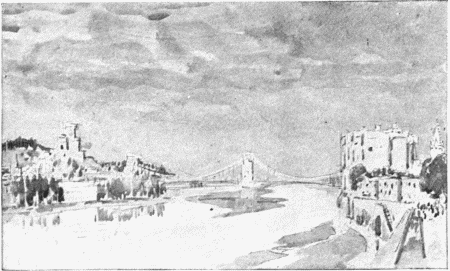
Tarascon
ON my way from Nîmes to Arles I spent three hours at Tarascon; chiefly
for the love of Alphonse Daudet, who has written nothing more genial
than "Les Aventures Prodigieuses de Tartarin," and the story of the
"siege" of the bright, dead little town (a mythic siege by the
Prussians) in the "Contes du Lundi." In the introduction which, for the
new edition of his works, he has lately supplied to "Tartarin," the
author of this extravagant but kindly satire gives some account of the
displeasure with which he has been visited by the ticklish Tarasconnais.
Daudet relates that in his attempt to shed a humorous light upon some of
the more vivid phases of the Provençal character he selected Tarascon at
a venture; not because the temperament of its natives is more
vainglorious than that of their neighbours, or their rebellion against
the "despotism of fact" more marked, but simply because he had to name a
particular Provençal
city. Tartarin is a hunter of lions and charmer of women, a true
"produit du midi," as Daudet says, a character of the most
extravagant, genial comedy. He is a minimised Don Quixote, with much
less dignity but with equal good faith; and the story of his exploits is
a little masterpiece of the free fantastic. The Tarasconnais, however,
declined to take the joke, and opened the vials of their wrath upon the
mocking child of Nîmes, who would have been better employed, they
doubtless thought, in showing up the infirmities of his own family. I am
bound to add that when I passed through Tarascon they did not appear to
be in the least out of humour. Nothing could have been brighter, easier,
more suggestive of amiable indifference, than the picture it presented
to my mind. It lies quietly beside the Rhone, looking across at
Beaucaire, which seems very distant and independent, and tacitly
consenting to let the castle of the good King René of Anjou, which
projects very boldly into the river, pass for its most interesting
feature. The other features are, primarily, a sort of vivid sleepiness
in the aspect of the place, as if the September noon (it had lingered on
into October) lasted longer there than elsewhere; certain low arcades
which make the streets look grey and exhibit empty vistas; and a very
curious and beautiful walk beside the Rhone, denominated the Chaussée—a
long and narrow causeway, densely shaded by two rows of magnificent old
trees planted in its embankment and rendered doubly effective at the
moment I passed over it by a little train of collegians who had been
taken out for mild exercise by a pair of young priests. Lastly one may
say that a striking element of Tarascon, as of any town that lies on the
Rhone, is simply the Rhone itself; the big brown flood, of uncertain
temper, which has
never taken time to forget that it is a child of the mountain and the
glacier, and that such an origin carries with it great privileges.
Later, at Avignon, I observed it in the exercise of these privileges,
chief among which was that of frightening the good people of the old
papal city half out of their wits.
TheTarascon château of King René serves to-day as the prison of a district, and
the traveller who wishes to look into it must obtain his permission at
the Mairie of Tarascon. If he have had a certain experience of French
manners, his application will be accompanied with the forms of a
considerable obsequiosity, and in this case his request will be granted
as civilly as it has been made. The castle has more of the air of a
severely feudal fortress than I should suppose the period of its
construction (the first half of the fifteenth century) would have
warranted; being tremendously bare and perpendicular, and constructed
for comfort only in the sense that it was arranged for defence. It is a
square and simple mass, composed of small yellow stones and perched on a
pedestal of rock which easily commands the river. The building has the
usual circular towers at the corners and a heavy cornice at the top, and
immense stretches of sun-scorched wall relieved at wide intervals by
small windows, heavily cross-barred. It has, above all, an extreme
steepness of aspect; I cannot express it otherwise. The walls are as
sheer and inhospitable as precipices. The castle has kept its large
moat, which is now a hollow filled with wild plants. To this tall
fortress the good René retired in the middle of the fifteenth century,
finding it apparently the most substantial thing left him in a dominion
which had included Naples and Sicily, Lorraine and Anjou. He had been a
much-tried monarch and the sport of a various fortune, fighting half
his life for thrones he didn't care for, and exalted only to be quickly
cast down. Provence was the country of his affection, and the memory of
his troubles did not prevent him from holding a joyous court at Tarascon
and at Aix. He finished the castle at Tarascon, which had been begun
earlier in the century—finished it, I suppose, for consistency's sake,
in the manner in which it had originally been designed rather than in
accordance with the artistic tastes that formed the consolation of his
old age. He was a painter, a writer, a dramatist, a modern dilettante,
addicted to private theatricals. There is something very attractive in
the image that he has imprinted on the page of history. He was both
clever and kind, and many reverses and much suffering had not embittered
him nor quenched his faculty of enjoyment. He was fond of his sweet
Provence, and his sweet Provence has been grateful; it has woven a light
tissue of legend around the memory of the good King René.
I strolled over his dusky habitation—it must have taken all his good
humour to light it up—at the heels of the custodian, who showed me the
usual number of castle-properties: a deep, well-like court; a collection
of winding staircases and vaulted chambers, the embrasures of whose
windows and the recesses of whose doorways reveal a tremendous thickness
of wall. These things constitute the general identity of old castles;
and when one has wandered through a good many, with due discretion of
step and protrusion of head, one ceases very much to distinguish and
remember, and contents one's self with consigning them to the honourable
limbo of the romantic. I must add that this reflection did not in the
least deter me from crossing the bridge which connects Tarascon with
Beaucaire, in
order to examine the old fortress whose ruins adorn the latter city. It
stands on a foundation of rock much higher than that of Tarascon, and
looks over with a melancholy expression at its better-conditioned
brother. Its position is magnificent and its outline very gallant. I was
well rewarded for my pilgrimage; for if the castle of Beaucaire is only
a fragment, the whole place, with its position and its views, is an
ineffaceable picture. It was the stronghold of the Montmorencys, and its
last tenant was that rash Duke François whom Richelieu, seizing every
occasion to trample on a great noble, caused to be beheaded at Toulouse,
where we saw, in the Capitol, the butcher's knife with which the
cardinal pruned the crown of France of its thorns. The castle, after the
death of this victim, was virtually demolished. Its site, which nature
to-day has taken again to herself, has an extraordinary charm. The mass
of rock that it formerly covered rises high above the town and is as
precipitous as the side of the Rhone. A tall, rusty iron gate admits you
from a quiet corner of Beaucaire to a wild tangled garden covering the
side of the hill—for the whole place forms the public promenade of the
townsfolk—a garden without flowers, with little steep, rough paths that
wind under a plantation of small, scrubby stone-pines. Above this is the
grassy platform of the castle, enclosed on one side only (toward the
river) by a large fragment of wall and a very massive dungeon. There are
benches placed in the lee of the wall, and others on the edge of the
platform, where one may enjoy a view, beyond the river, of certain
peeled and scorched undulations. A sweet desolation, an everlasting
peace, seemed to hang in the air. A very old man (a fragment, like the
castle itself) emerged from some crumbling corner to do me the
honours—a very gentle,
obsequious, tottering, toothless, grateful old man. He beguiled me into
an ascent of the solitary tower, from which you may look down on the big
sallow river and glance at diminished Tarascon and the barefaced,
bald-headed hills behind it. It may appear that I insist too much upon
the nudity of the Provençal horizon—too much considering that I have
spoken of the prospect from the heights of Beaucaire as lovely. But it
is an exquisite bareness; it seems to exist for the purpose of allowing
one to follow the delicate lines of the hills and touch with the eyes,
as it were, the smallest inflections of the landscape. It makes the
whole thing wonderfully bright and pure.
BeaucaireTarascon used to be the scene of a famous fair, the great fair of the
south of France. It has gone the way of most fairs, even in France,
where these delightful exhibitions hold their own much better than might
be supposed. It is still held in the month of July; but the bourgeoises
of Tarascon send to the Magasin du Louvre for their smart dresses, and
the principal glory of the scene is its long tradition. Even now,
however, it ought to be the prettiest of all fairs, for it takes place
in, a charming wood which lies just beneath the castle, beside the
Rhone. The booths, the barracks, the platforms of the mountebanks, the
bright-coloured crowd, diffused through this midsummer shade and spotted
here and there with the rich Provençal sunshine, must be of the most
pictorial effect. It is highly probable too that it offers a large
collection of pretty faces; for even in the few hours that I spent at
Tarascon I discovered symptoms of the purity of feature for which the
women of the pays d'Arles are renowned. The Arlesian head-dress was
visible in the streets; and this delightful coiffure is so associated
with a charming facial oval, a
dark mild eye, a straight Greek nose, and a mouth worthy of all the
rest, that it conveys a presumption of beauty which gives the wearer
time either to escape or to please you. I have read somewhere, however,
that Tarascon is supposed to produce handsome men, as Arles is known to
deal in handsome women. It may be that I should have found the
Tarasconnais very fine fellows if I had encountered enough specimens to
justify an induction. But there are very few males in the streets, and
the place presented no appearance of activity. Here and there the black
coif of an old woman or of a young girl was framed by a low doorway; but
for the rest, as I have said, Tarascon was mostly involved in a siesta.
There was not a creature in the little church of Saint Martha, which I
made a point of visiting before I returned to the station, and which,
with its fine romanesque side-portal and its pointed and crocketed
gothic spire, is as curious as it need be in view of its tradition. It
stands in a quiet corner where the grass grows between the small
cobble-stones, and you pass beneath a deep archway to reach it. The
tradition relates that Saint Martha tamed with her own hands and
attached to her girdle a dreadful dragon who was known as the Tarasque
and is reported to have given his name to the city on whose site (amid
the rocks which form the base of the château) he had his cavern. The
dragon perhaps is the symbol of a ravening paganism dispelled by the
eloquence of a sweet evangelist. The bones of the interesting saint, at
all events, were found, in the eleventh century, in a cave beneath the
spot on which her altar now stands. I know not what had become of the
bones of the dragon.
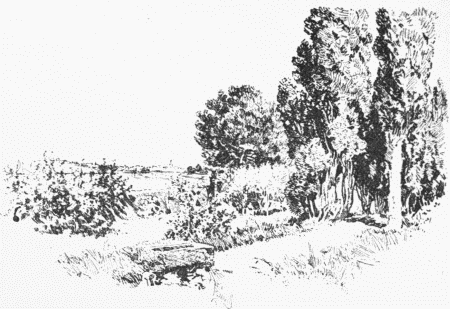
Arles
THERE are two shabby old inns at Arles which compete closely for your
custom. I mean by this that if you elect to go to the Hôtel du Forum,
the Hôtel du Nord, which is placed exactly beside it (at a right angle),
watches your arrival with ill-concealed disapproval; and if you take the
chances of its neighbour, the Hôtel du Forum seems to glare at you
invidiously from all its windows and doors. I forget which of these
establishments I selected; whichever it was, I wished very much that it
had been the other. The two stand together on the Place des Hommes, a
little public square of Arles which somehow quite misses its effect. As
a city, indeed, Arles quite misses its effect in every way; and if it is
a charming place, as I think it is, I can hardly tell the reason why.
The straight-nosed Arlésiennes account for it in some degree; and the
remainder may be charged to the ruins of the arena
and the theatre. Beyond this, I remember with affection the
ill-proportioned little Place des Hommes; not at all monumental, and
given over to puddles and to shabby cafés. I recall with tenderness the
tortuous and featureless streets, which looked liked the streets of a
village and were paved with villainous little sharp stones, making all
exercise penitential. Consecrated by association is even a tiresome walk
that I took the evening I arrived, with the purpose of obtaining a view
of the Rhone. I had been to Arles before, years ago, and it seemed to me
that I remembered finding on the banks of the stream some sort of
picture. I think that on the evening on which I speak there was a watery
moon, which it seemed to me would light up the past as well as the
present. But I found no picture, and I scarcely found the Rhone at all.
I lost my way, and there was not a creature in the streets to whom I
could appeal. Nothing could be more provincial than the situation of
Arles at ten o'clock at night. At last I arrived at a kind of embankment
where I could see the great mud-coloured stream slipping along in the
soundless darkness. It had come on to rain, I know not what had happened
to the moon, and the whole place was anything but gay. It was not what I
had looked for; what I had looked for was in the irrecoverable past. I
groped my way back to the inn over the infernal cailloux, feeling like
a discomfited Dogberry. I remember now that this hotel was the one
(whichever that may be) which has the fragment of a Gallo-Roman portico
inserted into one of its angles. I had chosen it for the sake of this
exceptional ornament. It was damp and dark, and the floors felt gritty
to the feet; it was an establishment at which the dreadful gras-double
might have appeared at the table d'hôte, as it had done
at Narbonne. Nevertheless I was glad to get back to it; and nevertheless
too—and this is the moral of my simple anecdote—my pointless little
walk (I don't speak of the pavement) suffuses itself, as I look back
upon it, with a romantic tone. And in relation to the inn I suppose I
had better mention that I am well aware of the inconsistency of a person
who dislikes the modern caravansary and yet grumbles when he finds a
hotel of the superannuated sort. One ought to choose, it would seem, and
make the best of either alternative. The two old taverns at Arles are
quite unimproved; such as they must have been in the infancy of the
modern world, when Stendhal passed that way and the lumbering diligence
deposited him in the Place des Hommes, such in every detail they are
to-day. Vieilles auberges de France, one ought to enjoy their gritty
floors and greasy window-panes. Let it be put on record therefore that I
have been, I won't say less comfortable, but at least less happy, at
better inns.
To be really historic, I should have mentioned that before going to look
for the Rhone I had spent part of the evening on the opposite side of
the little place, and that I indulged in this recreation for two
definite reasons. One of these was that I had an opportunity of
gossiping at a café with a conversable young Englishman whom I had met
in the afternoon at Tarascon and more remotely, in other years, in
London; the other was that there sat enthroned behind the counter a
splendid mature Arlésienne, whom my companion and I agreed that it was a
rare privilege to contemplate. There is no rule of good manners or
morals which makes it improper, at a café, to fix one's eyes upon the
dame de comptoir; the lady is, in the nature of things, a part of your
consummation. We were therefore free to
admire without restriction the handsomest person I had ever seen give
change for a five-franc piece. She was a large quiet woman, who would
never see forty again; of an intensely feminine type, yet wonderfully
rich and robust, and full of a certain physical nobleness. Though she
was not really old, she was antique; and she was very grave, even a
little sad. She had the dignity of a Roman empress, and she handled
coppers as if they had been stamped with the head of Cæsar. I have seen
washerwomen in the Trastevere who were perhaps as handsome as she; but
even the head-dress of the Roman contadina contributes less to the
dignity of the person born to wear it than the sweet and stately
Arlesian cap, which sits at once aloft and on the back of the head;
which is accompanied with a wide black bow covering a considerable part
of the crown; and which, finally, accommodates itself indescribably well
to the manner in which the tresses of the front are pushed behind the
ears.
Arles: the Theatre
This admirable dispenser of lumps of sugar has distracted me a little,
for I am still not sufficiently historical. Before going to the café I
had dined, and before dining I had found time to go and look at the
arena. Then it was that I discovered that Arles has no general
physiognomy and, except the delightful little church of Saint Trophimus,
no architecture, and that the rugosities of its dirty lanes affect the
feet like knife-blades. It was not then, on the other hand, that I saw
the arena best. The second day of my stay at Arles I devoted to a
pilgrimage to the strange old hill town of Les Baux, the mediæval
Pompeii, of which I shall give myself the pleasure of speaking. The
evening of that day, however (my friend and I returned in time for a
late dinner), I wandered among the Roman
remains of the place by the light of a magnificent moon and gathered an
impression which has lost little of its silvery glow. The moon of the
evening before had been aqueous and erratic; but if on the present
occasion it was guilty of any irregularity, the worst it did was only to
linger beyond its time in the heavens in order to let us look at things
comfortably. The effect was admirable; it brought back the impression of
the way, in Rome itself, on evenings like that, the moonshine rests upon
broken shafts and slabs of antique pavement. As we sat in the theatre
looking at the two lone columns that survive—part of the decoration of
the back of the stage—and at the fragments of ruin around them, we
might have been in the Roman Forum. The arena at Arles, with its great
magnitude, is less complete than that of Nîmes; it has suffered even
more the assaults of time and the children of time, and it has been less
repaired. The seats are almost wholly wanting; but the external walls,
minus the topmost tier of arches, are massively, ruggedly complete; and
the vaulted corridors seem as solid as the day they were built. The
whole thing is superbly vast and as monumental, for a place of light
amusement—what is called in America a "variety-show"—as it entered
only into the Roman mind to make such establishments. The podium is
much higher than at Nîmes, and many of the great white slabs that faced
it have been recovered and put into their places. The proconsular box
has been more or less reconstructed, and the great converging passages
of approach to it are still majestically distinct; so that, as I sat
there in the moon-charmed stillness, leaning my elbows on the battered
parapet of the ring, it was not impossible to listen to the murmurs and
shudders, the thick voice of the circus, that died away fifteen hundred years ago.
The theatre has a voice as well, but it lingers on the ear of time with
a different music. The Roman theatre at Arles seemed to me one of the
most charming and touching ruins I had ever beheld; I took a particular
fancy to it. It is less than a skeleton—the arena may be called a
skeleton—for it consists only of half a dozen bones. The traces of the
row of columns which formed the scene—the permanent back-scene—remain;
two marble pillars—I just mentioned them—are upright, with a fragment
of their entablature. Before them is the vacant space which was filled
by the stage, with the line of the proscenium distinct, marked by a deep
groove impressed upon slabs of stone, which looks as if the bottom of a
high screen had been intended to fit into it. The semicircle formed by
the seats—half a cup—rises opposite; some of the rows are distinctly
marked. The floor, from the bottom of the stage, in the shape of an arc
of which the chord is formed by the line of the orchestra, is covered by
slabs of coloured marble—red, yellow and green—which, though terribly
battered and cracked to-day, give one an idea of the elegance of the
interior. Everything shows that it was on a great scale: the large sweep
of its enclosing walls, the massive corridors that passed behind the
auditorium and of which we can still perfectly take the measure. The way
in which every seat commanded the stage is a lesson to the architects of
our epochs, as also the immense size of the place is a proof of
extraordinary power of voice on the part of the Roman actors. It was
after we had spent half an hour in the moonshine at the arena that we
came on to this more ghostly and more exquisite ruin. The principal
entrance was
locked, but we effected an easy escalade, scaled a low parapet, and
descended into the place behind the scenes. It was as light as day, and
the solitude was complete. The two slim columns, as we sat on the broken
benches, stood there like a pair of silent actors. What I called
touching just now was the thought that here the human voice, the
utterance of a great language, had been supreme. The air was full of
intonations and cadences; not of the echo of smashing blows, of riven
armour, of howling victims and roaring beasts. The spot is, in short,
one of the sweetest legacies of the ancient world; and there seems no
profanation in the fact that by day it is open to the good people of
Arles, who use it to pass, by no means in great numbers, from one part
of the town to the other; treading the old marble floor and brushing, if
need be, the empty benches. This familiarity does not kill the place
again; it makes it, on the contrary, live a little—makes the present
and the past touch each other.
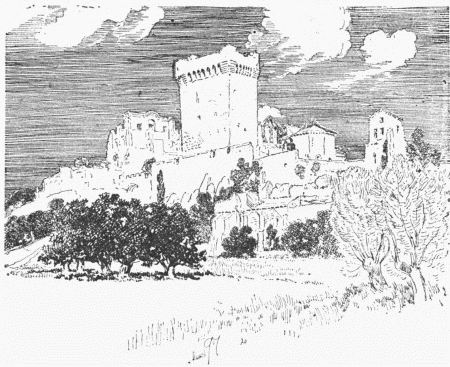
Arles: the Museum
THE third lion of Arles has nothing to do with the ancient world, but
only with the old one. The church of Saint Trophimus, whose wonderful
romanesque porch is the principal ornament of the principal place—a
place otherwise distinguished by the presence of a slim and tapering
obelisk in the middle, as well as by that of the hôtel de ville and the
museum—the interesting church of Saint Trophimus swears a little, as
the French say, with the peculiar character of Arles. It is very
remarkable, but I would rather it were in another place. Arles is
delightfully pagan, and Saint Trophimus, with its apostolic sculptures,
is rather a false note. These sculptures are equally remarkable for
their primitive vigour and for the perfect preservation in which they
have come down
to us. The deep recess of a round-arched porch of the twelfth century is
covered with quaint figures which have not lost a nose or a finger. An
angular Byzantine-looking Christ sits in a diamond-shaped frame at the
summit of the arch, surrounded by little angels, by great apostles, by
winged beasts, by a hundred sacred symbols and grotesque ornaments. It
is a dense embroidery of sculpture, black with time, but as uninjured as
if it had been kept under glass. One good mark for the French
Revolution! Of the interior of the church, which has a nave of the
twelfth century and a choir three hundred years more recent, I chiefly
remember the odd feature that the romanesque aisles are so narrow that
you literally—or almost—squeeze through them. You do so with some
eagerness, for your natural purpose is to pass out to the cloister. This
cloister, as distinguished and as perfect as the porch, has a great deal
of charm. Its four sides, which are not of the same period (the earliest
and best are of the twelfth century), have an elaborate arcade,
supported on delicate pairs of columns, the capitals of which show an
extraordinary variety of device and ornament. At the corners of the
quadrangle these columns take the form of curious human figures. The
whole thing is a gem of lightness and preservation and is often cited
for its beauty; but—if it doesn't sound too profane—I prefer,
especially at Arles, the ruins of the Roman theatre. The antique element
is too precious to be mingled with anything less rare. This truth was
very present to my mind during a ramble of a couple of hours that I took
just before leaving the place; and the glowing beauty of the morning
gave the last touch to the impression. I spent half an hour at the
Museum; then I took another look at the Roman
theatre; after which I walked a little out of the town to the Aliscamps,
the old Elysian Fields, the meagre remnant of the old pagan place of
sepulture, which was afterwards used by the Christians, but has been for
ages deserted and now consists only of a melancholy avenue of cypresses
lined with a succession of ancient sarcophagi, empty, mossy and
mutilated. An iron-foundry, or some horrible establishment which is
conditioned upon tall chimneys and a noise of hammering and banging, has
been established near at hand; but the cypresses shut it out well
enough, and this small patch of Elysium is a very romantic corner.
The door of the Museum stands ajar, and a vigilant custodian, with the
usual batch of photographs on his mind, peeps out at you disapprovingly
while you linger opposite, before the charming portal of Saint
Trophimus, which you may look at for nothing. When you succumb to the
silent influence of his eye and go over to visit his collection, you
find yourself in a desecrated church, in which a variety of ancient
objects disinterred in Arlesian soil have been arranged without any
pomp. The best of these, I believe, were found in the ruins of the
theatre. Some of the most curious of them are early Christian
sarcophagi, exactly on the pagan model, but covered with rude yet
vigorously wrought images of the apostles and with illustrations of
scriptural history. Beauty of the highest kind, either of conception or
of execution, is absent from most of the Roman fragments, which belong
to the taste of a late period and a provincial civilisation. But a gulf
divides them from the bristling little imagery of the Christian
sarcophagi, in which, at the same time, one detects a vague emulation of
the rich examples by which their authors were surrounded. There is a
certain element
of style in all the pagan things; there is not a hint of it in the early
Christian relics, among which, according to M. Joanne, of the Guide, are
to be found more fine sarcophagi than in any collection but that of St.
John Lateran. In two or three of the Roman fragments there is a
noticeable distinction; principally in a charming bust of a boy, quite
perfect, with those salient eyes that one sees in antique portraits, and
to which the absence of vision in the marble mask gives a look, often
very touching, as of a baffled effort to see; also in the head of a
woman, found in the ruins of the theatre, who, alas! has lost her nose
and whose noble, simple contour, barring this deficiency, recalls the
great manner of the Venus of Milo. There are various rich architectural
fragments which indicate that that edifice was a very splendid affair.
This little Museum at Arles, in short, is the most Roman thing I know of
out of Rome.
Les Baux
I FIND that I declared one evening, in a little journal I was keeping at
that time, that I was weary of writing (I was probably very sleepy), but
that it was essential I should make some note of my visit to Les Baux. I
must have gone to sleep as soon as I had recorded this necessity, for I
search my small diary in vain for any account of that enchanting spot. I
have nothing but my memory to consult—a memory which is fairly good in
regard to a general impression, but is terribly infirm in the matter of
details and items. We knew in advance, my companion and I, that Les Baux
was a pearl of picturesqueness; for had we not read as much in the
handbook of Murray, who has the testimony of an English nobleman as to
its attractions? We also knew that it lay some miles from Arles, on the
crest of the Alpilles, the craggy little mountains which, as I stood on
the breezy platform of Beaucaire, formed to my eye a charming, if
somewhat remote, background to Tarascon; this assurance
having been given us by the landlady of the inn at Arles, of whom we
hired a rather lumbering conveyance. The weather was not promising, but
it proved a good day for the mediæval Pompeii; a grey, melancholy,
moist, but rainless, or almost rainless day, with nothing in the sky to
flout, as the poet says, the dejected and pulverised past. The drive
itself was charming, for there is an inexhaustible sweetness in the
grey-green landscape of Provence. It is never absolutely flat and yet is
never really ambitious, and is full both of entertainment and repose. It
is in constant undulation, and the bareness of the soil lends itself
easily to outline and profile. When I say the bareness I mean the
absence of woods and hedges. It blooms with heath and scented shrubs and
stunted olive, and the white rock shining through the scattered herbage
has a brightness which answers to the brightness of the sky. Of course
it needs the sunshine, for all southern countries look a little false
under the ground-glass of incipient bad weather. This was the case on
the day of my pilgrimage to Les Baux. Nevertheless I was glad to keep
going, as I was to arrive; and as I went it seemed to me that true
happiness would consist in wandering through such a land on foot, on
September afternoons, when one might stretch one's self on the warm
ground in some shady hollow and listen to the hum of bees and the
whistle of melancholy shepherds; for in Provence the shepherds whistle
to their flocks. I saw two or three of them, in the course of this drive
to Les Baux, meandering about, looking behind and calling upon the sheep
in this way to follow, which the sheep always did, very promptly, with
ovine unanimity. Nothing is more picturesque than to see a slow shepherd
threading his way down one of the winding paths on a hillside, with
his flock close behind him, necessarily expanded, yet keeping just at
his heels, bending and twisting as it goes and looking rather like the
tail of a dingy comet.
AbouLes Bauxt four miles from Arles, as you drive northward towards the
Alpilles, of which Alphonse Daudet has spoken so often and, as he might
say, so intimately, stand on a hill that overlooks the road the very
considerable ruins of the abbey of Montmajour, one of the innumerable
remnants of a feudal and ecclesiastical (as well as an architectural)
past that one encounters in the south of France; remnants which, it must
be confessed, tend to introduce a certain confusion and satiety into the
passive mind of the tourist. Montmajour, however, is very impressive and
interesting; the only trouble with it is that, unless you have stopped
and returned to Arles, you see it in memory over the head of Les Baux,
which is a much more absorbing picture. A part of the mass of buildings
(the monastery) dates only from the last century; and the stiff
architecture of that period does not lend itself very gracefully to
desolation: it looks too much as if it had been burnt down the year
before. The monastery was demolished during the Revolution, and it
injures a little the effect of the very much more ancient fragments that
are connected with it. The whole place is on a great scale; it was a
rich and splendid abbey. The church, a vast basilica of the eleventh
century and of the noblest proportions, is virtually intact; I mean as
regards its essentials, for the details have completely vanished. The
huge solid shell is full of expression; it looks as if it had been
hollowed out by the sincerity of early faith, and it opens into a
cloister as impressive as itself. Wherever one goes, in France, one
meets, looking
backward a little, the spectre of the great Revolution; and one meets it
always in the shape of the destruction of something beautiful and
precious. To make us forgive it at all, how much it must also have
destroyed that was more hateful than itself! Beneath the church of
Montmajour is a most extraordinary crypt, almost as big as the edifice
above it and making a complete subterranean temple, surrounded with a
circular gallery, or deambulatory, which expands at intervals into five
square chapels. There are other things, of which I have but a confused
memory: a great fortified keep; a queer little primitive chapel hollowed
out of the rock beneath these later structures and recommended to the
visitor's attention as the confessional of Saint Trophimus, who shares
with so many worthies the glory of being the first apostle of the Gauls.
Then there is a strange, small church, of the dimmest antiquity,
standing at a distance from the other buildings. I remember that after
we had let ourselves down a good many steepish places to visit crypts
and confessionals, we walked across a field to this archaic cruciform
edifice and went thence to a point farther down the road, where our
carriage was awaiting us. The chapel of the Holy Cross, as it is called,
is classed among the historic monuments of France; and I read in a
queer, rambling, ill-written book which I picked at Avignon, and in
which the author, M. Louis de Laincel, has buried a great deal of
curious information on the subject of Provence under a style inspiring
little confidence, that the "délicieuse chapelle de Sainte-Croix" is a
"véritable bijou artistique." He speaks of "a piece of lace in stone"
which runs from one end of the building to the other, but of which I am
obliged to confess that I have no recollection. I retain, however, a
sufficiently clear
impression of the little superannuated temple, with its four apses and
its perceptible odour of antiquity—the odour of the eleventh century.
The ruins of Les Baux remain quite indistinguishable even when you are
directly beneath them, at the foot of the charming little Alpilles,
which mass themselves with a kind of delicate ruggedness. Rock and ruin
have been so welded together by the confusions of time that as you
approach it from behind—that is, from the direction of Arles—the place
presents simply a general air of cragginess. Nothing can be prettier
than the crags of Provence; they are beautifully modelled, as painters
say, and they have a delightful silvery colour. The road winds round the
foot of the hills on the top of which Les Baux is planted, and passes
into another valley, from which the approach to the town is many degrees
less precipitous and may be comfortably made in a carriage. Of course
the deeply inquiring traveller will alight as promptly as possible, for
the pleasure of climbing into this queerest of cities on foot is not the
least part of the entertainment of going there. Then you appreciate its
extraordinary position, its picturesqueness, its steepness, its
desolation and decay. It hangs—that is, what remains of it—to the
slanting summit of the mountain. Nothing would be more natural than for
the whole place to roll down into the valley. A part of it has done
so—for it is not unjust to suppose that in the process of decay the
crumbled particles have sought the lower level, while the remainder
still clings to its magnificent perch.
If I called Les Baux a city, just above, it was not that I was
stretching a point in favour of the small spot which to-day contains but
a few dozen inhabitants. The history of the place is as extraordinary as
its
situation. It was not only a city, but a state; not only a state, but an
empire; and on the crest of its little mountain called itself sovereign
of a territory, or at least of scattered towns and counties, with which
its present aspect is grotesquely out of relation. The lords of Les
Baux, in a word, were great feudal proprietors; and there was a time
during which the island of Sardinia, to say nothing of places nearer
home, such as Arles and Marseilles, paid them homage. The chronicle of
this old Provençal house has been written, in a style somewhat unctuous
and flowery, by M. Jules Canonge. I purchased the little book—a modest
pamphlet—at the establishment of the good sisters, just beside the
church, in one of the highest parts of Les Baux. The sisters have a
school for the hardy little Baussenques, whom I heard piping their
lessons while I waited in the cold parloir for one of the ladies to
come and speak to me. Nothing could have been more perfect than the
manner of this excellent woman when she arrived; yet her small religious
house seemed a very out-of-the-way corner of the world. It was
spotlessly neat, and the rooms looked as if they had lately been papered
and painted: in this respect, at the mediæval Pompeii, they were rather
a discord. They were, at any rate, the newest, freshest thing at Les
Baux. I remember going round to the church after I had left the good
sisters, and to a little quiet terrace which stands in front of it,
ornamented with a few small trees and bordered with a wall, breast-high,
over which you look down steep hillsides, off into the air and all about
the neighbouring country. I remember saying to myself that this little
terrace was one of those felicitous nooks which the tourist of taste
keeps in his mind as a picture. The church was small and brown and
dark, with a certain rustic richness. All this, however, is no general description of
Les Baux.
ILes Baux am unable to give any coherent account of the place, for the simple
reason that it is a mere confusion of ruin. It has not been preserved in
lava like Pompeii, and its streets and houses, its ramparts and castle,
have become fragmentary not through the sudden destruction, but through
the gradual withdrawal, of a population. It is not an extinguished, but
a deserted city; more deserted far than even Carcassonne and
Aigues-Mortes, where I found so much entertainment in the grass-grown
element. It is of very small extent, and even in the days of its
greatness, when its lords entitled themselves counts of Cephalonia and
Neophantis, kings of Arles and Vienne, princes of Achaia and emperors of
Constantinople—even at this flourishing period, when, as M. Jules
Canonge remarks, "they were able to depress the balance in which the
fate of peoples and kings is weighed," the plucky little city contained
at the most no more than thirty-six hundred souls. Yet its lords (who,
however, as I have said, were able to present a long list of subject
towns, most of them, though a few are renowned, unknown to fame) were
seneschals and captains-general of Piedmont and Lombardy, grand admirals
of the kingdom of Naples, and its ladies were sought in marriage by half
the first princes in Europe. A considerable part of the little narrative
of M. Canonge is taken up with the great alliances of the House of Baux,
whose fortunes, matrimonial and other, he traces from the eleventh
century down to the sixteenth. The empty shells of a considerable number
of old houses, many of which must have been superb, the lines of certain
steep little streets, the foundations of a castle, and ever so many
splendid
views, are all that remains to-day of these great titles. To such a list
I may add a dozen very polite and sympathetic people who emerged from
the interstices of the desultory little town to gaze at the two
foreigners who had driven over from Arles and whose horses were being
baited at the modest inn. The resources of this establishment we did not
venture otherwise to test, in spite of the seductive fact that the sign
over the door was in the Provençal tongue. This little group included
the baker, a rather melancholy young man, in high boots and a cloak,
with whom and his companions we had a good deal of conversation. The
Baussenques of to-day struck me as a very mild and agreeable race, with
a good deal of the natural amenity which, on occasions like this one,
the traveller who is waiting for his horses to be put in or his dinner
to be prepared observes in the charming people who lend themselves to
conversation in the hill-towns of Tuscany. The spot where our
entertainers at Les Baux congregated was naturally the most inhabited
portion of the town; as I say, there were at least a dozen human figures
within sight. Presently we wandered away from them, scaled the higher
places, seated ourselves among the ruins of the castle, and looked down
from the cliff overhanging that portion of the road which I have
mentioned as approaching Les Baux from behind. I was unable to trace the
configuration of the castle as plainly as the writers who have described
it in the guide-books, and I am ashamed to say that I did not even
perceive the three great figures of stone (the three Marys, as they are
called; the two Marys of Scripture, with Martha) which constitute one of
the curiosities of the place and of which M. Jules Canonge speaks with
almost
hyperbolical admiration. A brisk shower, lasting some ten minutes, led
us to take refuge in a cavity of mysterious origin, where the melancholy
baker presently discovered us, having had the bonne pensée of coming
up for us with an umbrella which certainly belonged, in former ages, to
one of the Stéphanettes or Berangères commemorated by M. Canonge. His
oven, I am afraid, was cold so long as our visit lasted. When the rain
was over we wandered down to the little disencumbered space before the
inn, through a small labyrinth of obliterated things. They took the form
of narrow, precipitous streets bordered by empty houses with gaping
windows and absent doors, through which we had glimpses of sculptured
chimney-pieces and fragments of stately arch and vault. Some of the
houses are still inhabited, but most of them are open to the air and
weather. Some of them have completely collapsed; others present to the
street a front which enables one to judge of the physiognomy of Les Baux
in the days of its importance. This importance had pretty well passed
away in the early part of the sixteenth century, when the place ceased
to be an independent principality. It became—by bequest of one of its
lords, Bernardin des Baux, a great captain of his time—part of the
appanage of the kings of France, by whom it was placed under the
protection of Arles, which had formerly occupied with regard to it a
different position. I know not whether the Arlesians neglected their
trust, but the extinction of the sturdy little stronghold is too
complete not to have begun long ago. Its memories are buried under its
ponderous stones. As we drove away from it in the gloaming my friend and
I agreed that the two or three hours we had spent there were among the
happiest impressions
of a pair of tourists very curious of the picturesque. We almost forgot
that we were bound to regret that the shortened day left us no time to
drive five miles farther, above a pass in the little mountains—it had
beckoned to us in the morning, when we came in sight of it, almost
irresistibly—to see the Roman arch and mausoleum of Saint Remy. To
compass this larger excursion (including the visit to Les Baux) you must
start from Arles very early in the morning; but I can imagine no more
delightful day.
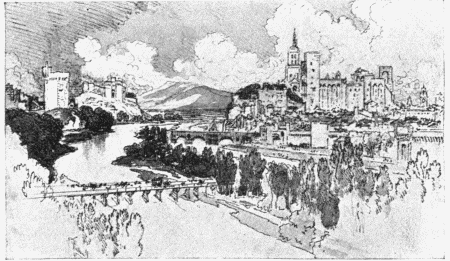
Avignon
I HAD been twice at Avignon before, and yet I was not satisfied. I
probably am satisfied now; nevertheless I enjoyed my third visit. I
shall not soon forget the first, on which a particular emotion set an
indelible stamp. I was creeping northward, in 1870, after four months
spent, for the first time, in Italy. It was the middle of January, and I
had found myself unexpectedly forced to return to England for the rest
of the winter. It was an insufferable disappointment; I was wretched and
broken-hearted. Italy appeared to me at that time so much better than
anything else in the world, that to rise from table in the middle of the
feast was a prospect of being hungry for the rest of my days. I had
heard a great deal of praise of the south of France; but the south of
France was a poor consolation. In this state of mind I arrived at
Avignon, which under a bright, hard winter sun was tingling—fairly
spinning—with the mistral. I find in my journal of the other day a
reference to the acuteness
of my reluctance in January 1870. France, after Italy, appeared in the
language of the latter country poco simpatica; and I thought it
necessary, for reasons now inconceivable, to read the Figaro, which
was filled with descriptions of the horrible Troppmann, the murderer of
the famille Kink. Troppmann, Kink, le crime de Pantin—the very
names that figured in this episode seemed to wave me back. Had I
abandoned the sonorous south to associate with vocables so base?
It was very cold the other day at Avignon, for though there was no
mistral, it was raining as it rains in Provence, and the dampness had a
terrible chill in it. As I sat by my fire late at night—for in genial
Avignon, in October, I had to have a fire—it came back to me that
eleven years before I had at that same hour sat by a fire in that same
room and, writing to a friend to whom I was not afraid to appear
extravagant, had made a vow that at some happier period of the future I
would avenge myself on the ci-devant city of the Popes by taking it in
a contrary sense. I suppose that I redeemed my vow on the occasion of my
second visit better than on my third; for then I was on my way to Italy,
and that vengeance, of course, was complete. The only drawback was that
I was in such a hurry to get to Ventimiglia (where the Italian
custom-house was to be the sign of my triumph), that I scarcely took
time to make it clear to myself at Avignon that this was better than
reading the Figaro. I hurried on almost too fast to enjoy the
consciousness of moving southward. On this last occasion I was
unfortunately destitute of that happy faith. Avignon was my southernmost
limit, after which I was to turn round and proceed back to England. But
in the interval I had been a great deal in Italy, and that made all the
difference.
Avignon
I had plenty of time to think of this, for the rain kept me practically
housed for the first twenty-four hours. It had been raining in these
regions for a month, and people had begun to look askance at the Rhone,
though as yet the volume of the river was not exorbitant. The only
excursion possible, while the torrent descended, was a kind of
horizontal dive, accompanied with infinite splashing, to the little
musée of the town, which is within a moderate walk of the hotel. I had
a memory of it from my first visit; it had appeared to me more pictorial
than its pictures. I found that recollection had flattered it a little,
and that it is neither better nor worse than most provincial museums. It
has the usual musty chill in the air, the usual grass-grown forecourt,
in which a few lumpish Roman fragments are disposed, the usual red tiles
on the floor and the usual specimens of the more livid schools on the
walls. I rang up the gardien, who arrived with a bunch of keys, wiping
his mouth; he unlocked doors for me, opened shutters, and while (to my
distress, as if the things had been worth lingering over) he shuffled
about after me, he announced the names of the pictures before which I
stopped in a voice that reverberated through the melancholy halls and
seemed to make the authorship shameful when it was obscure and grotesque
when it pretended to be great. Then there were intervals of silence,
while I stared absent-mindedly, at haphazard, at some indistinguishable
canvas and the only sound was the downpour of the rain on the skylights.
The museum of Avignon derives a certain dignity from its Roman
fragments. The town has no Roman monuments to show; in this respect,
beside its brilliant neighbours, Arles and Nîmes, it is a blank. But a
great many small objects have been found in its soil—pottery, glass,
bronzes,
lamps, vessels and ornaments of gold and silver. The glass is especially
charming—small vessels of the most delicate shape and substance, many
of them perfectly preserved. These diminutive, intimate things bring one
near to the old Roman life; they seems like pearls strung upon the
slender thread that swings across the gulf of time. A little glass cup
that Roman lips have touched says more to us than the great vessel of an
arena. There are two small silver casseroles, with chiselled handles,
in the museum of Avignon, that struck me as among the most charming
survivals of antiquity.
Avignon the Palace of the Popes
I did wrong, just above, to speak of my attack on this establishment as
the only recreation I took that first wet day; for I remember a terribly
moist visit to the former palace of the Popes, which could have taken
place only in the same tempestuous hours. It is true that I scarcely
know why I should have gone out to see the Papal palace in the rain, for
I had been over it twice before, and even then had not found the
interest of the place so complete as it ought to be; the fact
nevertheless remains that this last occasion is much associated with an
umbrella, which was not superfluous even in some of the chambers and
corridors of the gigantic pile. It had already seemed to me the
dreariest of all historical buildings, and my final visit confirmed the
impression. The place is as intricate as it is vast, and as desolate as
it is dirty. The imagination has, for some reason or other, to make more
than the effort usual in such cases to restore and repeople it. The fact
indeed is simply that the palace has been so incalculably abused and
altered. The alterations have been so numerous that, though I have duly
conned the enumerations, supplied in guide-books, of the principal
perversions, I do not pretend to carry any of them in my head. The huge
bare mass, without ornament, without grace, despoiled of its battlements
and defaced with sordid modern windows, covering the Rocher des Doms and
looking down over the Rhone and the broken bridge of Saint-Bénazet
(which stops in such a sketchable manner in mid-stream), and across at
the lonely tower of Philippe le Bel and the ruined wall of Villeneuve,
makes at a distance, in spite of its poverty, a great figure, the effect
of which is carried out by the tower of the church beside it (crowned
though the latter be, in a top-heavy fashion, with an immense modern
image of the Virgin) and by the thick, dark foliage of the garden laid
out on a still higher portion of the eminence. This garden recalls
faintly and a trifle perversely the grounds of the Pincian at Rome. I
know not whether it is the shadow of the Papal name, present in both
places, combined with a vague analogy between the churches—which,
approached in each case by a flight of steps, seemed to defend the
precinct—but each time I have seen the Promenade des Doms it has
carried my thoughts to the wider and loftier terrace from which you look
away at the Tiber and Saint Peter's.
AsAvignon: the Palace of the Popes you stand before the Papal palace, and especially as you enter it,
you are struck with its being a very dull monument. History enough was
enacted here: the great schism lasted from 1305 to 1370, during which
seven Popes, all Frenchmen, carried on the court of Avignon on
principles that have not commended themselves to the esteem of
posterity. But history has been whitewashed away, and the scandals of
that period have mingled with the dust of dilapidations and repairs. The
building has for many years been occupied as a
barrack for regiments of the line, and the main characteristics of a
barrack—an extreme nudity and a very queer smell—prevail throughout
its endless compartments. Nothing could have been more cruelly dismal
than the appearance it presented at the time of this third visit of
mine. A regiment, changing quarters, had departed the day before, and
another was expected to arrive (from Algeria) on the morrow. The place
had been left in the befouled and belittered condition which marks the
passage of the military after they have broken camp, and it would offer
but a melancholy welcome to the regiment that was about to take
possession. Enormous windows had been left carelessly open all over the
building, and the rain and wind were beating into empty rooms and
passages, making draughts which purified, perhaps, but which scarcely
cheered. For an arrival it was horrible. A handful of soldiers had
remained behind. In one of the big vaulted rooms several of them were
lying on their wretched beds, in the dim light, in the cold, in the
damp, with the bleak bare walls before them and their overcoats, spread
over them, pulled up to their noses. I pitied them immensely, though
they may have felt less wretched than they looked. I thought not of the
old profligacies and crimes, not of the funnel-shaped torture-chamber
(which, after exciting the shudder of generations, has been ascertained
now, I believe, to have been a mediæval bakehouse), not of the tower of
the glacière and the horrors perpetrated here in the Revolution, but
of the military burden of young France. One wonders how young France
endures it, and one is forced to believe that the French conscript has,
in addition to his notorious good-humour, greater toughness than is
commonly supposed by those who consider only the
more relaxing influences of French civilisation. I hope he finds
occasional compensation for such moments as I saw those damp young
peasants passing on the mattresses of their hideous barrack, without
anything around to remind them that they were in the most civilised of
countries. The only traces of former splendour now visible in the Papal
pile are the walls and vaults of two small chapels, painted in fresco,
so battered and effaced as to be scarcely distinguishable, by Simone
Memmi. It offers of course a peculiarly good field for restoration, and
I believe the Government intend to take it in hand. I mention this fact
without a sigh, for they cannot well make it less interesting than it is
at present.
Villeneuve-lès-Avignon
FORTUNATELY it did not rain every day (though I believe it was raining
everywhere else in the department); otherwise I should not have been
able to go to Villeneuve and to Vaucluse. The afternoon indeed was
lovely when I walked over the interminable bridge that spans the two
arms of the Rhone, divided here by a considerable island, and directed
my course, like a solitary horseman—on foot, to the lonely tower which
forms one of the outworks of Villeneuve-lès-Avignon. The picturesque,
half-deserted little town lies a couple of miles farther up the river.
The immense round towers of its old citadel and the long stretches of
ruined wall covering the slope on which it lies are the most striking
features of the nearer view, as you look from Avignon across the Rhone.
I spent a couple of hours in visiting these objects, and there was a
kind of pictorial sweetness in the episode; but I have not many details
to relate. The isolated tower I just mentioned has much in common with
the detached donjon of Montmajour, which I had looked at in going to Les
Baux and to which I
paid my respects in speaking of that excursion. Also the work of
Philippe le Bel (built in 1307), it is amazingly big and stubborn, and
formed the opposite limit of the broken bridge whose first arches (on
the side of Avignon) alone remain to give a measure of the occasional
volume of the Rhone. Half an hour's walk brought me to Villeneuve, which
lies away from the river, looking like a big village half depopulated
and occupied for the most part by dogs and cats, old women and small
children; these last, in general, remarkably pretty, in the manner of
the children of Provence. You pass through the place, which seems in a
singular degree vague and unconscious, and come to the rounded hill on
which the ruined abbey lifts its yellow walls—the Benedictine abbey of
Saint-André, at once a church, a monastery, and a fortress. A large part
of the crumbling enceinte disposes itself over the hill; but for the
rest, all that has preserved any traceable cohesion is a considerable
portion of the citadel. The defence of the place appears to have been
entrusted largely to the huge round towers that flank the old gate; one
of which, the more complete, the ancient warden (having first inducted
me into his own dusky little apartment and presented me with a great
bunch of lavender) enabled me to examine in detail. I would almost have
dispensed with the privilege, for I think I have already mentioned that
an acquaintance with many feudal interiors has wrought a sad confusion
in my mind. The image of the outside always remains distinct; I keep it
apart from other images of the same sort; it makes, a picture
sufficiently ineffaceable. But the guard-rooms, winding staircases,
loopholes, prisons, repeat themselves and intermingle; they have a
wearisome family likeness. There are always black passages and corners,
and walls twenty feet thick; and there is always some high place to
climb up to for the sake of a "magnificent" view. The views, too, are
apt to run together. These dense gate-towers of Philippe le Bel struck
me, however, as peculiarly wicked and grim. Their capacity is of the
largest, and they contain ever so many devilish little dungeons, lighted
by the narrowest slit in the prodigious wall, where it comes over one
with a good deal of vividness and still more horror that wretched human
beings once lay there rotting in the dark. The dungeons of Villeneuve
made a particular impression on me—greater than any except those of
Loches, which must surely be the most gruesome in Europe. I hasten to
add that every dark hole at Villeneuve is called a dungeon; and I
believe it is well established that in this manner, in almost all old
castles and towers, the sensibilities of the modern tourist are
unscrupulously played upon. There were plenty of black holes in the
Middle Ages that were not dungeons, but household receptacles of various
kinds; and many a tear dropped in pity for the groaning captive has
really been addressed to the spirits of the larder and the faggot-nook.
For all this, there are some very bad corners in the towers of
Villeneuve, so that I was not wide of the mark when I began to think
again, as I had often thought before, of the stoutness of the human
composition in the Middle Ages and the tranquillity of nerve of people
to whom the groaning captive and the blackness of a "living tomb" were
familiar ideas which did not at all interfere with their happiness or
their sanity. Our modern nerves, our irritable sympathies, our easy
discomforts and fears, make one think (in some relations) less
respectfully of human nature. Unless indeed it be true, as I have heard
it maintained, that in the
Villeneuve-lès-Avignon
Middle Ages every one did go mad—every one was mad. The theory that
this was a period of general dementia is not altogether untenable.
Within the old walls of its immense abbey the town of Villeneuve has
built itself a rough faubourg; the fragments with which the soil was
covered having been, i suppose, a quarry of material. There are no
streets; the small, shabby houses, almost hovels, straggle at random
over the uneven ground. The only important feature is a convent of
cloistered nuns, who have a large garden (always within the walls)
behind their house, and whose doleful establishment you look down into,
or down at simply, from the battlements of the citadel. One or two of
the nuns were passing in and out of the house; they wore grey robes with
a bright red cape. I thought their situation most provincial. I came
away and wandered a little over the base of the hill, outside the walls.
Small white stones cropped through the grass, over which low olive-trees
were scattered. The afternoon had a yellow brightness. I sat down under
one of the little trees, on the grass—the delicate grey branches were
not much above my head—and rested and looked at Avignon across the
Rhone. It was very soft, very still and pleasant, though I am not sure
it was all I once should have expected of that combination of elements:
an old city wall for a background, a canopy of olives, and for a couch
the soil of Provence.
WhenAvignon I came back to Avignon the twilight was already thick, but I walked
up to the Rocher des Doms. Here I again had the benefit of that amiable
moon which had already lighted up for me so many romantic scenes. She
was full, and she rose over the Rhone and made it look in the distance
like a silver serpent. I remember saying to myself at this moment
that it would be a beautiful evening to walk round the walls of
Avignon—the remarkable walls which challenge comparison with those of
Carcassonne and Aigues-Mortes, and which it was my duty, as an observer
of the picturesque, to examine with some attention. Presenting
themselves to that silver sheen, they could not fail to be impressive.
So, at least, I said to myself; but unfortunately I did not believe what
I said. It is a melancholy fact that the walls of Avignon had never
impressed me at all, and I had never taken the trouble to make the
circuit. They are continuous and complete, but for some mysterious
reason they fail of their effect. This is partly because they are very
low, in some places almost absurdly so, being buried in new
accumulations of soil and by the filling in of the moat up to their
middle. Then they have been too well tended; they not only look at
present very new, but look as if they had never been old. The fact that
their extent is very much greater makes them more of a curiosity than
those of Carcassonne; but this is exactly, at the same time, what is
fatal to their pictorial unity. With their thirty-seven towers and seven
gates, they lose themselves too much to make a picture that will compare
with the admirable little vignette of Carcassonne. I may mention, now
that I am speaking of the general mass of Avignon, that nothing is more
curious than the way in which, viewed from a distance, it is all reduced
to naught by the vast bulk of the palace of the Popes. From across the
Rhone, or from the train as you leave the place, this great grey block
is all Avignon; it seems to occupy the whole city, extensive, with its
shrunken population, as the city is.
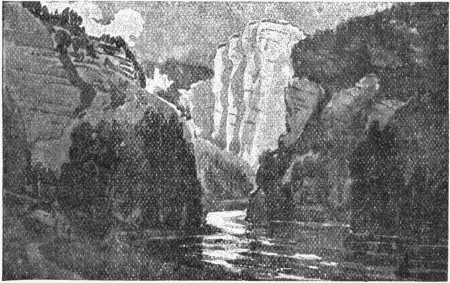
Vaucluse
IT was the morning after this, I think (a certain Saturday), that when I
came out of the Hôtel de l'Europe, which lies in shallow concavity just
within the city gate that opens on the Rhone—came out to look at the
sky from the little place before the inn and see how the weather
promised for the obligatory excursion to Vaucluse—I found the whole
town in a terrible taking. I say the whole town advisedly, for every
inhabitant appeared to have taken up a position on the bank of the
river, or on the uppermost parts of the promenade of the Doms, where a
view of its course was to be obtained. It had risen surprisingly in the
night, and the good people of Avignon had reason to know what a rise of
the Rhone might signify. The town, in its lower portions, is quite at
the mercy of the swollen waters; and it was mentioned to me that in 1856
the Hôtel de l'Europe, in its convenient hollow, was flooded up to
within a few
feet of the ceiling of the dining-room, where the long board which had
served for so many a table d'hôte floated disreputably, with its legs in
the air. On the present occasion the mountains of the Ardêche, where it
had been raining for a month, had sent down torrents which, all that
fine Friday night, by the light of the innocent-looking moon, poured
themselves into the Rhone and its tributary the Durance. The river was
enormous and continued to rise, and the sight was beautiful and
horrible. The water in many places was already at the base of the city
walls, the quay, with its parapet just emerging, being already covered.
The country, seen from the Plateau des Doms, resembled a vast lake, with
protrusions of trees, houses, bridges, gates. The people looked at it in
silence, as I had seen people before—on the occasion of a rise of the
Arno, at Pisa—appear to consider the prospect of an inundation. "Il
monte; il monte toujours"—there was not much said but that. It was a
general holiday, and there was an air of wishing to profit, for
sociability's sake, by any interruption of the commonplace (the popular
mind likes "a change," and the element of change mitigates the sense of
disaster); but the affair was not otherwise a holiday. Suspense and
anxiety were in the air, and it never is pleasant to be reminded of the
helplessness of man. In the presence of a loosened river, with its
ravaging, unconquerable volume, this impression is as strong as
possible; and as I looked at the deluge which threatened to make an
island of the Papal palace I perceived that the scourge of water is
greater than the scourge of fire. A blaze may be quenched, but where
could the flame be kindled that would arrest the quadrupled Rhone? For
the population of Avignon a good deal was at stake, and I am
almost ashamed to confess that in the midst of the public alarm I
considered the situation from the point of view of the little projects
of a sentimental tourist. Would the prospective inundation interfere
with my visit to Vaucluse, or make it imprudent to linger twenty-four
hours longer at Avignon? I must add that the tourist was not perhaps,
after all, so sentimental. I have spoken of the pilgrimage to the shrine
of Petrarch as obligatory, and that was, in fact, the light in which it
presented itself to me; all the more that I had been twice at Avignon
without undertaking it. This is why I was vexed at the Rhone.—if vexed
I was—for representing as impracticable an excursion which I cared
nothing about. How little I cared was manifest from my inaction on
former occasions. I had a prejudice against Vaucluse, against Petrarch,
even against the incomparable Laura. I was sure that the place was
cockneyfied and threadbare, and I had never been able to take an
interest in the poet and the lady. I was sure that I had known many
women as charming and as handsome as she, about whom much less noise had
been made; and I was convinced that her singer was factitious and
literary, and that there are half a dozen stanzas in Wordsworth that
speak more to the soul than the whole collection of his fioriture.
This was the crude state of mind in which I determined to go, at any
risk, to Vaucluse. Now that I think it over, I seem to remember that I
had hoped, after all, that the submersion of the roads would forbid it.
Since morning the clouds had gathered again, and by noon they were so
heavy that there was every prospect of a torrent. It appeared absurd to
choose such a time as this to visit a fountain—a fountain which would
be indistinguishable in the general cataract.
Vaucluse
Nevertheless I took a vow, that if at noon the rain should not have
begun to descend upon Avignon I would repair to the head-spring of the
Sorgues. When the critical moment arrived the clouds were hanging over
Avignon like distended water-bags, which only needed a prick to empty
themselves. The prick was not given, however; all nature was too much
occupied in following the aberrations of the Rhone to think of playing
tricks elsewhere. Accordingly I started for the station in a spirit
which, for a tourist who sometimes had prided himself on his unfailing
supply of sentiment, was shockingly perfunctory.
"For tasks in hours of insight willed
May be in hours of gloom fulfilled."
I remembered these lines of Matthew Arnold (written, apparently, in an
hour of gloom), and carried out the idea, as I went, by hoping that with
the return of insight I should be glad to have seen Vaucluse. Light has
descended upon me since then, and I declare that the excursion is in
every way to be recommended. The place makes a great impression, quite
apart from Petrarch and Laura.
There was no rain; there was only, all the afternoon, a mild, moist wind
and a sky magnificently black; which made a repoussoir for the paler
cliffs of the fountain. The road, by train, crosses a flat,
expressionless country, towards the range of arid hills which lie to the
east of Avignon, and which spring (says Murray) from the mass of the
Mont-Ventoux. At Isle-sur-Sorgues, at the end of about an hour, the
foreground becomes much more animated and the distance much more (or
perhaps I should say much less) actual. I descended from the train and
ascended to the top of an omnibus which was to convey me into the
recesses
of the hills. It had not been among my previsions that I should be
indebted to a vehicle of that kind for an opportunity to commune with
the spirit of Petrarch; and I had to borrow what consolation I could
from the fact that at least I had the omnibus to myself. I was the only
passenger; every one else was at Avignon watching the Rhone. I lost no
time in perceiving that I could not have come to Vaucluse at a better
moment. The Sorgues was almost as full as the Rhone, and of a colour
much more romantic. Rushing along its narrowed channel under an avenue
of fine platanes (it is confined between solid little embankments of
stone), with the good wives of the village, on the brink, washing their
linen in its contemptuous flood, it gave promise of high entertainment
farther on.
The drive to Vaucluse is of about three-quarters of an hour; and though
the river, as I say, was promising, the big pale hills, as the road
winds into them, did not look as if their slopes of stone and shrub were
a nestling-place for superior scenery. It is a part of the merit of
Vaucluse indeed that it is as much as possible a surprise. The place has
a right to its name, for the valley appears impenetrable until you get
fairly into it. One perverse twist follows another until the omnibus
suddenly deposits you in front of the "cabinet" of Petrarch. After that
you have only to walk along the left bank of the river. The cabinet of
Petrarch is to-day a hideous little café, bedizened, like a signboard,
with extracts from the ingenious "Rime." The poet and his lady are of
course the stock-in-trade of the little village, which has had for
several generations the privilege of attracting young couples engaged in
their wedding-tour and other votaries of the tender passion. The place
has long been familiar, on festal Sundays, to
the swains of Avignon and their attendant nymphs. The little fish of the
Sorgues are much esteemed, and, eaten on the spot, they constitute, for
the children of the once Papal city, the classic suburban dinner.
Vaucluse has been turned to account, however, not only by sentiment, but
by industry; the banks of the stream being disfigured by a pair of
hideous mills for the manufacture of paper and of wool. In an
enterprising and economical age the water-power of the Sorgues was too
obvious a motive; and I must say that, as the torrent rushed past them,
the wheels of the dirty little factories appeared to turn merrily
enough. The footpath on the left bank, of which I just spoke, carries
one fortunately quite out of sight of them, and out of sound as well,
inasmuch as on the day of my visit the stream itself, which was in
tremendous force, tended more and more, as one approached the fountain,
to fill the valley with its own echoes. Its colour was magnificent, and
the whole spectacle more like a corner of Switzerland than a nook in
Provence. The protrusions of the mountain shut it in, and you penetrate
to the bottom of the recess which they form. The Sorgues rushes and
rushes; it is almost like Niagara after the jump of the cataract. There
are dreadful little booths beside the path, for the sale of photographs
and immortelles—I don't know what one is to do with the
immortelles—where you are offered a brush dipped in tar to write your
name withal on the rocks. Thousands of vulgar persons, of both sexes,
and exclusively, it appeared, of the French nationality, had availed
themselves of this implement, for every square inch of accessible stone
was scored over with some human appellation. It is not only we in
America, therefore, who besmirch our scenery; the practice
exists, in a more organised form (like everything else in France), in
the country of good taste. You leave the little booths and stalls
behind; but the bescribbled crag, bristling with human vanity, keeps you
company even when you stand face to face with the fountain. This happens
when you find yourself at the foot of the enormous straight cliff out of
which the river gushes. It rears itself to an extraordinary height—a
huge forehead of bare stone—looking as if it were the half of a
tremendous mound split open by volcanic action. The little valley,
seeing it there, at a bend, stops suddenly and receives in its arms the
magical spring. I call it magical on account of the mysterious manner in
which it comes into the world, with the huge shoulder of the mountain
rising over it as if to protect the secret. From under the mountain it
silently rises, without visible movement, filling a small natural basin
with the stillest blue water. The contrast between the stillness of this
basin and the agitation of the water directly after it has overflowed,
constitutes half the charm of Vaucluse. The violence of the stream when
once it has been set loose on the rocks is as fascinating and
indescribable as that of other cataracts; and the rocks in the bed of
the Sorgues have been arranged by a master-hand. The setting of the
phenomenon struck me as so simple and so fine—the vast sad cliff,
covered with the afternoon light, still and solid for ever, while the
liquid element rages and roars at its base—that I had no difficulty in
understanding the celebrity of Vaucluse. I understood it, but I will not
say that I understood Petrarch. He must have been very self-supporting,
and Madonna Laura must indeed have been much to him.
The aridity of the hills that shut in the valley is
Vaucluse
complete, and the whole impression is best conveyed by that very
expressive French epithet morne. There are the very fragmentary ruins
of a castle (of one of the bishops of Cavaillon) on a high spur of the
mountain, above the river; and there is another remnant of a feudal
habitation on one of the more accessible ledges. Having half an hour to
spare before my omnibus was to leave (I must beg the reader's pardon for
this atrociously false note; call the vehicle a diligence, and for
some undiscoverable reason the offence is minimised), I clambered up to
this latter spot and sat among the rocks in the company of a few stunted
olives. The Sorgues, beneath me, reaching the plain, flung itself
crookedly across the meadows like an unrolled blue ribbon. I tried to
think of the amant de Laure, for literature's sake; but I had no great
success, and the most I could do was to say to myself that I must try
again. Several months have elapsed since then, and I am ashamed to
confess that the trial has not yet come off. The only very definite
conviction I arrived at was that Vaucluse is indeed cockneyfied, but
that I should have been a fool, all the same, not to come.
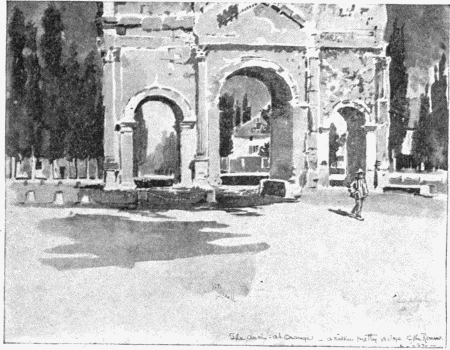
Orange
MOUNTED into my diligence at the door of the Hôtel de Pétrarque et de
Laure, and we made our way back to Isle-sur-Sorgues in the fading light.
This village, where at six o'clock every one appeared to have gone to
bed, was fairly darkened by its high, dense plane-trees, under which the
rushing river, on a level with its parapets, looked unnaturally, almost
wickedly, blue. It was a glimpse which has left a picture in my mind:
the little closed houses, the place empty and soundless in the autumn
dusk but for the noise of waters, and in the middle, amid the blackness
of the shade, the gleam of the swift, strange tide. At the station every
one was talking of the inundation being in many places an accomplished
fact, and, in particular, of the condition of the Durance at some
point that I have forgotten. At Avignon, an hour later, I found the
water in some of the streets. The sky cleared in the evening, the moon
lighted up the submerged suburbs, and the population again collected in
the high places to enjoy the spectacle. It exhibited a certain sameness,
however, and by nine o'clock there was considerable animation in the
Place Crillon, where there is nothing to be seen but the front of the
theatre and of several cafés—in addition indeed to a statue of this
celebrated brave, whose valour redeemed some of the numerous military
disasters of the reign of Louis XV. The next morning the lower quarters
of the town were in a pitiful state: the situation seemed to me odious.
To express my disapproval of it I lost no time in taking the train to
Orange, which, with its other attractions, had the merit of not being
seated on the Rhone. It was destiny to move northward; but even if I had
been at liberty to follow a less unnatural course I should not then have
undertaken it, inasmuch as the railway between Avignon and Marseilles
was credibly reported to be (in places) under water. This was the case
with almost everything but the line itself on the way to Orange. The day
proved splendid, and its brilliancy only lighted up the desolation.
Farmhouses and cottages were up to their middle in the yellow liquidity;
haystacks looked like dull little islands; windows and doors gaped open,
without faces; and interruption and flight were represented in the
scene. It was brought home to me that the populations rurales have
many different ways of suffering, and my heart glowed with a grateful
sense of cockneyism. It was under the influence of this emotion that I
alighted at Orange to visit a collection of eminently civil monuments.
Orange
The collection consists of but two objects, but these objects are so
fine that I will let the word pass. One of them is a triumphal arch,
supposedly of the period of Marcus Aurelius; the other is a fragment,
magnificent in its ruin, of a Roman theatre. But for these fine Roman
remains and for its name, Orange is a perfectly featureless little town,
without the Rhone—which, as I have mentioned, is several miles
distant—to help it to a physiognomy. It seems one of the oddest things
that this obscure French borough—obscure, I mean, in our modern era,
for the Gallo-Roman Arausio must have been, judging it by its arches and
theatre, a place of some importance—should have given its name to the
heirs-apparent of the throne of Holland and been borne by a king of
England who had sovereign rights over it. During the Middle Ages it
formed part of an independent principality; but in 1531 it fell, by the
marriage of one of its princesses, who had inherited it, into the family
of Nassau. I read in my indispensable Murray that it was made over to
France by the treaty of Utrecht. The arch of triumph, which stands a
little way out of the town, is rather a pretty than an imposing vestige
of the Romans. If it had greater purity of style one might say of it
that it belonged to the same family of monuments as the Maison Carrée at
Nîmes. It has three passages—the middle much higher than the
others—and a very elevated attic. The vaults of the passages are richly
sculptured, and the whole structure is covered with friezes and military
trophies. This sculpture is rather mixed; much of it is broken and
defaced, and the rest seemed to me ugly, though its workmanship is
praised. The arch is at once well preserved and much injured. Its
general mass is there, and as Roman monuments go it is remarkably
perfect; but
it has suffered, in patches, from the extremity of restoration. It is
not, on the whole, of absorbing interest. It has a charm, nevertheless,
which comes partly from its soft, bright yellow colour, partly from a
certain elegance of shape, of expression; and on that well-washed Sunday
morning, with its brilliant tone, surrounded by its circle of thin
poplars, with the green country lying beyond it and a low blue horizon
showing through its empty portals, it made, very sufficiently, a picture
that hangs itself to one of the lateral hooks of the memory. I can take
down the modest composition and place it before me as I write. I see the
shallow, shining puddles in the hard, fair French road; the pale blue
sky, diluted by days of rain; the disgarnished autumnal fields; the mild
sparkle of the low horizon; the solitary figure in sabots, with a bundle
under its arm, advancing along the chaussée; and in the middle I see
the little ochre-coloured trio of apertures, which, in spite of its
antiquity, looks bright and gay, as everything must look in France of a
fresh Sunday morning.
It is true that this was not exactly the appearance of the Roman
theatre, which lies on the other side of the town; a fact that did not
prevent me from making my way to it in less than five minutes, through a
succession of little streets concerning which I have no observations to
record. None of the Roman remains in the south of France are more
impressive than this stupendous fragment. An enormous mound rises above
the place, which was formerly occupied—I quote from Murray—first by a
citadel of the Romans, then by a castle of the princes of Nassau, razed
by Louis XIV. Facing this hill a mighty wall erects itself, thirty-six
metres high and composed of massive blocks of dark brown stone simply
laid one on the other; the whole naked, rugged
surface of which suggests a natural cliff (say of the Vaucluse order)
rather than an effort of human or even of Roman labour. It is the
biggest thing at Orange—it is bigger than all Orange put together—and
its permanent massiveness makes light of the shrunken city. The face it
presents to the town—the top of it garnished with two rows of brackets
perforated with holes to receive the staves of the velarium—bears the
traces of more than one tier of ornamental arches; though how these flat
arches were applied, or incrusted, upon the wall, I do not profess to
explain. You pass through a diminutive postern—which seems in
proportion about as high as the entrance of a rabbit-hutch—into the
lodge of the custodian, who introduces you to the interior of the
theatre. Here the mass of the hill affronts you, which the ingenious
Romans treated simply as the material of their auditorium. They inserted
their stone seats, in a semicircle, in the slope of the hill, and
planted their colossal wall opposite to it. This wall, from the inside,
is, if possible, even more imposing. It formed the back of the stage,
the permanent scene, and its enormous face was coated with marble. It
contains three doors, the middle one being the highest and having above
it, far aloft, a deep niche apparently intended for an imperial statue.
A few of the benches remain on the hillside, which, however, is mainly a
confusion of fragments. There is part of a corridor built into the hill,
high up, and on the crest are the remnants of the demolished castle. The
whole place is a kind of wilderness of ruin; there are scarcely any
details; the great feature is the overtopping wall. This wall being the
back of the scene, the space left between it and the chord of the
semicircle (of the auditorium) which formed the proscenium is rather
less
than one would have supposed. In other words, the stage was very
shallow, and appears to have been arranged for a number of performers
placed in a line like a company of soldiers. There stands the silent
skeleton, however, as impressive by what it leaves you to guess and
wonder about as by what it tells you. It has not the sweetness, the
softness of melancholy, of the theatre at Aries; but it is more
extraordinary, and one can imagine only tremendous tragedies being
enacted there—
"Presenting Thebes' or Pelops' line."
AtOrange either end of the stage, coming forward, is an immense wing—immense
in height, I mean, as it reaches to the top of the scenic wall; the
other dimensions are not remarkable. The division to the right, as you
face the stage, is pointed out as the green-room; its portentous
altitude and the open arches at the top give it the air of a well. The
compartment on the left is exactly similar, save that it opens into the
traces of other chambers, said to be those of a hippodrome adjacent to
the theatre. Various fragments are visible which refer themselves
plausibly to such an establishment; the greater axis of the hippodrome
would appear to have been on a line with the triumphal arch. This is all
I saw, and all there was to see, of Orange, which had a very rustic,
bucolic aspect, and where I was not even called upon to demand breakfast
at the hotel. The entrance of this resort might have been that of a
stable of the Roman days.
Macon
I HAVE been trying to remember whether I fasted all the way to Macon,
which I reached at an advanced hour of the evening, and think I must
have done so except for the purchase of a box of nougat at Montélimart
(the place is famous for the manufacture of this confection, which, at
the station, is hawked at the windows of the train) and for a bouillon,
very much later, at Lyons. The journey beside the Rhone—past Valence,
past Tournon, past Vienne—would have been charming, on that luminous
Sunday, but for two disagreeable accidents. The express from Marseilles,
which I took at Orange, was full to overflowing; and the only refuge I
could find was an inside angle in a carriage laden with Germans who had
command of the windows, which they occupied as strongly as they have
been known to occupy other strategical positions. I scarcely know,
however, why I linger on this particular discomfort, for it was but a
single item in a considerable list of grievances—grievances
dispersed through six weeks of constant railway-travel in France. I have
not touched upon them at an earlier stage of this chronicle, but my
reserve is not owing to any sweetness of association. This form of
locomotion, in the country of the amenities, is attended with a dozen
discomforts; almost all the conditions of the business are detestable.
They force the sentimental tourist again and again to ask himself
whether, in consideration of such mortal annoyances, the game is worth
the candle. Fortunately a railway journey is a good deal like a
sea-voyage; its miseries fade from the mind as soon as you arrive. That
is why I completed, to my great satisfaction, my little tour in France.
Let this small effusion of ill-nature be my first and last tribute to
the whole despotic gare: the deadly salle d'attente, the
insufferable delays over one's luggage, the porterless platform, the
overcrowded and illiberal train. How many a time did I permit myself the
secret reflection that it is in perfidious Albion that they order this
matter best! How many a time did the eager British mercenary, clad in
velveteen and clinging to the door of the carriage as it glides into the
station, revisit my invidious dreams! The paternal porter and the
responsive hansom are among the best gifts of the English genius to the
world. I hasten to add, faithful to my habit (so insufferable to some of
my friends) of ever and again readjusting the balance after I have given
it an honest tip, that the bouillon at Lyons, which I spoke of above,
was, though by no means an idea bouillon, much better than any I could
have obtained at an English railway-station. After I had imbibed it I
sat in the train (which waited a long time at Lyons) and, by the light
of one of the big lamps on the platform, read all sorts of disagreeable
things in certain
radical newspapers which I had bought at the bookstall. I gathered from
these sheets that Lyons was in extreme commotion. The Rhone and the
Saone, which form a girdle for the splendid town, were almost in the
streets, as I could easily believe from what I had seen of the country
after leaving Orange. The Rhone, all the way to Lyons, had been in all
sorts of places where it had no business to be, and matters were
naturally not improved by its confluence with the charming and copious
stream which, at Macon, is said once to have given such a happy
opportunity to the egotism of the capital. A visitor from Paris (the
anecdote is very old), being asked on the quay of that city whether he
didn't admire the Saone, replied good-naturedly that it was very pretty,
but that in Paris they spelled it with the ei. This moment of general
alarm at Lyons had been chosen by certain ingenious persons (I credit
them perhaps with too sure a prevision of the rise of the rivers) for
practising further upon the apprehensions of the public. A bombshell
filled with dynamite had been thrown into a café, and various votaries
of the comparatively innocuous petit verre had been wounded (I am not
sure whether any one had been killed) by the irruption. Of course there
had been arrests and incarcerations, and the Intransigeant and the
Rappel were filled with the echoes of the explosion. The tone of these
organs is rarely edifying, and it had never been less so than on this
occasion. I wondered as I looked through them whether I was losing all
my radicalism; and then I wondered whether, after all, I had any to
lose. Even in so long a wait as that tiresome delay at Lyons I failed to
settle the question, any more than I made up my mind as to the probable
future of the militant democracy, or the ultimate form of a
civilisation
which should have blown up everything else. A few days later the water
went down at Lyons; but the democracy has not gone down.
IMacon remember vividly the remainder of that evening which I spent at
Macon—remember it with a chattering of the teeth. I know not what had
got into the place; the temperature, for the last day of October, was
eccentric and incredible. These epithets may also be applied to the
hotel itself—an extraordinary structure, all façade, which exposes an
uncovered rear to the gaze of nature. There is a demonstrative, voluble
landlady, who is of course part of the façade; but everything behind her
is a trap for the winds, with chambers, corridors, staircases all
exhibited to the sky as if the outer wall of the house had been lifted
off. It would have been delightful for Florida, but it didn't do for
Burgundy even on the eve of November 1, so that I suffered absurdly from
the rigour of a season that had not yet begun. There was something in
the air; I felt it the next day, even on the sunny quay of the Saone,
where in spite of a fine southerly exposure I extracted little warmth
from the reflection that Alphonse de Lamartine had often trodden the
flags. Macon struck me, somehow, as suffering from a chronic numbness,
and there was nothing exceptionally cheerful in the remarkable extension
of the river. It was no longer a river—it had become a lake; and from
my window, in the painted face of the inn, I saw that the opposite bank
had been moved back, as it were, indefinitely. Unfortunately the various
objects with which it was furnished had not been moved as well, the
consequence of which was an extraordinary confusion in the relations of
things. There were always poplars to be seen, but the poplar had become
an aquatic plant. Such phenomena,
however, at Macon attract but little attention, as the Saone, at certain
seasons of the year, is nothing if not expansive. The people are as used
to it as they appeared to be to the bronze statue of Lamartine, which is
the principal monument of the place, and which, representing the poet
in a frogged overcoat and top-boots, improvising in a high wind, struck
me as even less casual in its attitude than monumental sculpture usually
succeeds in being. It is true that in its present position I thought
better of this work of art, which is from the hand of M. Falguière, than
when I had seen it through the factitious medium of the Salon of 1876. I
walked up the hill where the older part of Macon lies, in search of the
natal house of the amant d'Elvire, the Petrarch whose Vaucluse was the
bosom of the public. The Guide-Joanne quotes from "Les Confidences" a
description of the birthplace of the poet, whose treatment of the
locality is indeed poetical. It tallies strangely little with the
reality, either as regards position or other features; and it may be
said to be not an aid, but a direct obstacle, to a discovery of the
house. A very humble edifice, in a small back street, is designated by a
municipal tablet, set into its face, as the scene of Lamartine's advent
into the world. He himself speaks of a vast and lofty structure, at the
angle of a place, adorned with iron clamps, with a porte haute et
large and many other peculiarities. The house with the tablet has two
meagre storeys above the basement, and (at present, at least) an air of
extreme shabbiness; the place, moreover, never can have been vast.
Lamartine was accused of writing history incorrectly, and apparently he
started wrong at first; it had never become clear to him where he was
born. Or is the tablet wrong? If the house is small, the tablet is very
big.
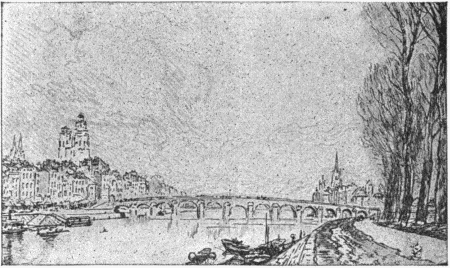
Bourg-en-Bresse
THE foregoing reflections occur, in a cruder form, as it were, in my
note-book, where I find this remark appended to them: "Don't take leave
of Lamartine on that contemptuous note; it will be easy to think of
something more sympathetic!" Those friends of mine, mentioned a little
while since, who accuse me of always tipping back the balance, could not
desire a paragraph more characteristic; but I wish to give no further
evidence of such infirmities, and will therefore hurry away from the
subject—hurry away in the train which, very early on a crisp, bright
morning, conveyed me, by way of an excursion, to the ancient city of
Bourg-en-Bresse. Shining in early light, the Saone was spread, like a
smooth white tablecloth, over a considerable part of the flat country
that I traversed. There is no provision made in this image for the long,
transparent screens of thin-twigged trees which rose at intervals out of
the watery plain; but as, in all the conditions, there seemed to be no
provision
for them in fact, I will let my metaphor go for what it is worth. My
journey was (as I remember it) of about an hour and a half; but I passed
no object of interest, as the phrase is, whatever. The phrase hardly
applies even to Bourg itself, which is simply a town quelconque, as M.
Zola would say. Small, peaceful, rustic, it stands in the midst of the
great dairy-feeding plains of Bresse, of which fat county, sometime
property of the house of Savoy, it was the modest capital. The blue
masses of the Jura give it a creditable horizon, but the only nearer
feature it can point to is its famous sepulchral church. This edifice
lies at a fortunate distance from the town, which, though inoffensive,
is of too common a stamp to consort with such a treasure. All I ever
knew of the church of Brou I had gathered, years ago
The Church of Brou
from Matthew Arnold's beautiful poem which bears its name. I remember
thinking, in those years, that it was impossible verses could be more
touching than these; and as I stood before the object of my pilgrimage,
in the gay French light (though the place was so dull), I recalled the
spot where I had first read them and where I had read them again and yet
again, wondering whether it would ever be my fortune to visit the church
of Brou. The spot in question was an armchair in a window which looked
out on some cows in a field; and whenever I glanced at the cows it came
over me—I scarcely know why—that I should probably never behold the
structure reared by the Duchess Margaret. Some of our visions never come
to pass; but we must be just—others do. "So sleep, for ever sleep, O
princely pair!" I remembered that line of Matthew Arnold's, and the
stanza about the Duchess Margaret coming to watch the builders on her
palfrey white. Then there came to me something in regard to
the moon shining on winter nights through the cold clere-storey. The
tone of the place at that hour was not at all lunar; it was cold and
bright, but with the chill of an autumn morning; yet this, even with the
fact of the unexpected remoteness of the church from the Jura added to
it, did not prevent me from feeling that I looked at a monument in the
production of which—or at least in the effect of which on the
tourist-mind of to-day—Matthew Arnold had been much concerned. By a
pardonable licence he has placed it a few miles nearer to the forests of
the Jura than it stands at present. It is very true that, though the
mountains in the sixteenth century can hardly have been in a different
position, the plain which separates the church from them may have been
bedecked with woods. The visitor to-day cannot help wondering why the
beautiful building, with its splendid works of art, is dropped down in
that particular spot, which looks so accidental and arbitrary. But there
are reasons for most things, and there were reasons why the church of
Brou should be at Brou, which is a vague little suburb of a vague little
town.
The responsibility rests, at any rate, upon the Duchess
Margaret—Margaret of Austria, daughter of the Emperor Maximilian and
his wife Mary of Burgundy, daughter of Charles the Bold. This lady has a
high name in history, having been regent of the Netherlands in behalf of
her nephew, the Emperor Charles V., of whose early education she had had
the care. She married in 1501 Philibert the Handsome, Duke of Savoy, to
whom the province of Bresse belonged, and who died two years later. She
had been betrothed, as a child, to Charles VIII. of France, and was kept
for some time at the French court—that of
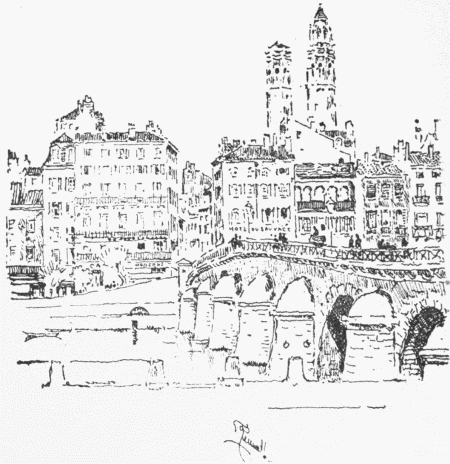 BROU—THE CHURCH.
her prospective father-in-law, Louis XI.; but she was eventually
repudiated, in order that her fiancé might marry Anne of Brittany—an
alliance so magnificently political that we almost condone the offence
to a sensitive princess. Margaret did not want for husbands, however,
inasmuch as before her marriage to Philibert she had been united to John
of Castile, son of Ferdinand V., King of Aragon—an episode terminated
by the death of the Spanish prince within a year. She was twenty-two
years regent of the Netherlands and died, at fifty-one, in 1530. She
might have been, had she chosen, the wife of Henry VII. of England. She
was one of the signers of the League of Cambray against the Venetian
Republic, and was a most politic, accomplished, and judicious princess.
She undertook to build the church of Brou as a mausoleum for her second
husband and herself, in fulfilment of a vow made by Margaret of Bourbon,
mother of Philibert, who died before she could redeem her pledge and who
bequeathed the duty to her son. He died shortly afterwards, and his
widow assumed the pious task. According to Murray, she entrusted the
erection of the church to "Maistre Loys von Berghem," and the sculpture
to "Maistre Conrad." The author of a superstitious but carefully
The Church of Brou
prepared little Notice which I bought at Bourg calls the architect and
sculptor (at once) Jehan de Paris, author (sic) of the tomb of Francis
II. of Brittany, to which we gave some attention at Nantes, and which
the writer of my pamphlet ascribes only subordinately to Michel Colomb.
The church, which is not of great size, is in the last and most
flamboyant phase of gothic and in admirable preservation; the west
front, before which a quaint old sun-dial is laid out on the ground—a
circle of
numbers marked in stone, like those on a clock-face, let into the
earth—is covered with delicate ornament. The great feature, however
(the nave is perfectly bare and wonderfully new-looking, though the
warden, a stolid yet sharp old peasant in a blouse, who looked more as
if his line were chaffering over turnips than showing off works of art,
told me that it has never been touched and that its freshness is simply
the quality of the stone)—the great feature is the admirable choir, in
the midst of which the three monuments have bloomed under the chisel
like exotic plants in a conservatory. I saw the place to small
advantage, for the stained glass of the windows, which are fine, was
under repair, and much of it was masked with planks.
In the centre lies Philibert-le-Bel, a figure of white marble on a great
slab of black, in his robes and his armour, with two boy-angels holding
a tablet at his head, and two more at his feet. On either side of him is
another cherub; one guarding his helmet, the other his stiff gauntlets.
The attitudes of these charming children, whose faces are all bent upon
him in pity, have the prettiest tenderness and respect. The table on
which he lies is supported by elaborate columns adorned with niches
containing little images and with every other imaginable elegance; and
beneath it he is represented in that other form so common in the tombs
of the Renaissance—a man naked and dying, with none of the state and
splendour of the image above. One of these figures embodies the duke,
the other simply the mortal; and there is something very strange and
striking in the effect of the latter, seen dimly and with difficulty
through the intervals of the rich supports of the upper slab. The
monument of Margaret herself is on the left, all in white marble
tormented into a multitude of exquisite patterns, the last extravagance
of a gothic which had gone so far that nothing was left it but to return
upon itself. Unlike her husband, who has only the high roof of the
church above him, she lies under a canopy supported and covered by a
wilderness of embroidery—flowers, devices, initials, arabesques,
statuettes. Watched over by cherubs, she is also in her robes and
ermine, with a greyhound sleeping at her feet (her husband, at his, has
a waking lion); and the artist has not, it is to be presumed,
represented her as more beautiful than she was. She looks indeed like
the regent of a turbulent realm. Beneath her couch is stretched another
figure—a less brilliant Margaret, wrapped in her shroud, with her long
hair over her shoulders. Round the tomb is the battered iron railing
placed there originally, with the mysterious motto of the duchess worked
into the top—fortune infortune fort une. The other two monuments are
protected by barriers of the same pattern. That of Margaret of Bourbon,
Philibert's mother, stands on the right of the choir; and I suppose its
greatest distinction is that it should have been erected to a
mother-in-law. It is but little less florid and sumptuous than the
others; it has, however, no second recumbent figure. On the other hand,
the statuettes that surround the base of the tomb are of even more
exquisite workmanship: they represent weeping women, in long mantles and
hoods, which latter hang forward over the small face of the figure,
giving the artist a chance to carve the features within this hollow of
drapery—an extraordinary play of skill. There is a high, white marble
shrine of the Virgin, as extraordinary as all the rest (a series of
compartments representing the various scenes of her life, with the
Assumption in the middle);
and there is a magnificent series of stalls, which are simply the
intricate embroidery of the tombs translated into polished oak. All
these things are splendid, ingenious, elaborate, precious; it is
goldsmith's work on a monumental scale, and the general effect is none
the less beautiful and solemn because it is so rich. But the monuments
of the church of Brou are not the noblest that one may see; the great
tombs of Verona are finer, and various other early Italian work. These
things are not insincere, as Ruskin would say; but they are pretentious,
and they are not positively naïfs. I should mention that the walls of
the choir are embroidered in places with Margaret's tantalising device,
which—partly perhaps because it is tantalising—is so very decorative,
as they say in London. I know not whether she was acquainted with this
epithet, but she had anticipated one of the fashions most characteristic
of our age.
OneThe Church of Brou asks one's self how all this decoration, this luxury of fair and
chiselled marble, survived the French Revolution. An hour of liberty in
the choir of Brou would have been a carnival for the image-breakers. The
well-fed Bressois are surely a good-natured people. I call them well-fed
both on general and on particular grounds. Their province has the most
savoury aroma, and I found an opportunity to test its reputation. I
walked back into the town from the church (there was really nothing to
be seen by the way), and as the hour of the midday breakfast had struck,
directed my steps to the inn. The table d'hôte was going on, and a
gracious, bustling, talkative landlady welcomed me. I had an excellent
repast—the best repast possible—which consisted simply of boiled eggs
and bread and butter. It was the quality of these simple ingredients
that made the occasion memorable. The eggs were so
good that I am ashamed to say how many of them I consumed. "La plus
belle fille du monde," as the French proverb says, "ne peut donner que
ce qu'elle a;" and it might seem that an egg which has succeeded in
being fresh has done all that can reasonably be expected of it. But
there was a bloom of punctuality, so to speak, about these eggs of
Bourg, as if it had been the intention of the very hens themselves that
they should be promptly served. "Nous sommes en Bresse, et le beurre
n'est pas mauvais," the landlady said with a sort of dry coquetry, as
she placed this article before me. It was the poetry of butter, and I
ate a pound or two of it; after which I came away with a strange mixture
of impressions of late gothic sculpture and thick tartines. I came
away through the town, where, on a little green promenade, facing the
hotel, is a bronze statue of Bichat the physiologist, who was a
Bressois. I mention it not on account of its merit (though, as statues
go, I don't remember that it is bad), but because I learned from it—my
ignorance, doubtless, did me little honour—that Bichat had died at
thirty years of age, and this revelation was almost agitating. To have
done so much in so short a life was to be truly great. This reflection,
which looks deplorably trite as I write it here, had the effect of
eloquence as I uttered it for my own benefit on the bare little mall at
Bourg.
Beaune
ON my return to Macon I found myself fairly face to face with the fact
that my tour was near its end. Dijon had been marked by fate as its
farthest limit, and Dijon was close at hand. After that I was to drop
the tourist and re-enter Paris as much as possible like a Parisian. Out
of Paris the Parisian never loiters, and therefore it would be
impossible for me to stop between Dijon and the capital. But I might be
a tourist a few hours longer by stopping somewhere between Macon and
Dijon. The question was where I should spend these hours. Where better,
I asked
myself (for reasons not now entirely clear to me), than at Beaune? On my
way to this town I passed the stretch of the Côte d'Or, which, covered
with a mellow autumn haze, with the sunshine shimmering through, looked
indeed like a golden slope. One regards with a kind of awe the region in
which the famous crûs of Burgundy (Vougeot, Chambertin, Nuits, Beaune)
are, I was going to say, manufactured. Adieu, paniers; vendanges sont
faites! The vintage was over; the shrunken russet fibres alone clung to
their ugly stick. The horizon on the left of the road had a charm,
however; there is something picturesque in the big, comfortable
shoulders of the Côte. That delicate critic M. Emile Montégut, in a
charming record of travel through this region published some years ago,
praises Shakespeare for having talked (in "Lear") of "waterish
Burgundy." Vinous Burgundy would surely be more to the point. I stopped
at Beaune in pursuit of the picturesque, but I might almost have seen
the little I discovered without stopping. It is a drowsy Burgundian
town, very old and ripe, with crooked streets, vistas always oblique,
and steep, moss covered roofs. The principal lion is the
Hôpital-Saint-Esprit, or the Hôtel-Dieu simply, as they call it there,
founded in 1443 by Nicholas Rollin, Chancellor of Burgundy. It is
administered by the sisterhood of the Holy Ghost, and is one of the most
venerable and stately of hospitals. The face it presents to the street
is simple, but striking—a plain, windowless wall, surmounted by a vast
slate roof, of almost mountainous steepness. Astride this roof sits a
tall, slate-covered spire, from which, as I arrived, the prettiest
chimes I ever heard (worse luck to them, as I will presently explain)
were ringing. Over the door is a high, quaint canopy, without supports,
with its vault painted blue and covered with gilded stars. (This, and
indeed the whole building, have lately been restored, and its antiquity
is quite of the spick-and-span order. But it is very delightful.) The
treasure of the place is a precious picture—a Last Judgment, attributed
equally to John van Eyck and Roger van der Weyden—given to the hospital
in the fifteenth century by Nicholas Rollin aforesaid.
I learned, however, to my dismay, from a sympathising but inexorable
concierge, that what remained to me of the time I had to spend at
Beaune, between trains—I had rashly wasted half an hour of it in
breakfasting at the station—was the one hour of the day (that of the
dinner of the nuns; the picture is in their refectory) during which the
treasure could not be shown. The purpose of the musical chimes to which
I had so artlessly listened was to usher in this fruitless interval. The
regulation was absolute, and my disappointment relative, as I have been
happy to reflect since I "looked up" the picture. Crowe and Cavalcaselle
assign it without hesitation to Roger van der Weyden, and give a weak
little drawing of it in their "Flemish Painters." I learn from them
also—what I was ignorant of—that Nicholas Rollin, Chancellor of
Burgundy and founder of the establishment at Beaune, was the original of
the worthy kneeling before the Virgin in the magnificent John van Eyck
of the Salon Carré. All I could see was the court of the hospital and
two or three rooms. The court, with its tall roofs, its pointed gables
and spires, its wooden galleries, its ancient well, with an elaborate
superstructure of wrought iron, is one of those places into which a
sketcher ought to be let loose. It looked Flemish or English rather than
French, and a splendid tidiness pervaded it. The porter took me into
two
rooms on the ground-floor, into which the sketcher should also be
allowed to penetrate, for they made irresistible pictures. One of them,
of great proportions, painted in elaborate "subjects" like a ball-room
of the seventeenth century, was filled with the beds of patients, all
draped in curtains of dark red cloth, the traditional uniform of these
eleemosynary couches. Among them the sisters moved about in their robes
of white flannel with big white linen hoods. The other room was a
strange, immense apartment, lately restored with much splendour. It was
of great length and height, had a painted and gilded barrel-roof, and
one end of it—the one I was introduced to—appeared to serve as a
chapel, as two white-robed sisters were on their knees before an altar.
This was divided by red curtains from the larger part; but the porter
lifted one of the curtains and showed me that the rest of it, a long,
imposing vista, served as a ward lined with little red-draped beds.
"C'est l'heure de la lecture," remarked my guide; and a group of
convalescents—all the patients I saw were women—were gathered in the
centre around a nun, the points of whose white hood nodded a little
above them and whose gentle voice came to us faintly, with a little
echo, down the high perspective. I know not what the good sister was
reading—a dull book, I am afraid—but there was so much colour and such
a fine, rich air of tradition about the whole place that it seemed to me
I would have risked listening to her. I turned away, however, with that
sense of defeat which is always irritating to the appreciative tourist,
and pottered about Beaune rather vaguely for the rest of my hour: looked
at the statue of Gaspard Monge, the mathematician, in the little place
(there is no place in France too little to contain an effigy to a
glorious son); at the fine old
porch—completely despoiled at the Revolution—of the principal church;
and even at the meagre treasures of a courageous but melancholy little
museum, which has been arranged—part of it being the gift of a local
collector—in a small hôtel de ville. I carried away from Beaune the
impression of something mildly autumnal—something rusty yet kindly,
like the taste of a sweet russet pear.
Dijon
IT was very well that my little tour was to terminate at Dijon, for I
found, rather to my chagrin, that there was not a great deal, from the
pictorial point of view, to be done with Dijon. It was no great matter,
for I held my proposition to have been by this time abundantly
demonstrated—the proposition with which I started: that if Paris is
France, France is by no means Paris. If Dijon was a good deal of a
disappointment, I felt therefore that I could afford it. It was time for
me to reflect, also, that for my disappointments,
as a general thing, I had only myself to thank. They had too often been
the consequence of arbitrary preconceptions produced by influences of
which I had lost the trace. At any rate, I will say plumply that the
ancient capital of Burgundy is wanting in character; it is not up to the
mark. It is old and narrow and crooked, and it has been left pretty well
to itself: but it is not high and overhanging; it is not, to the eye,
what the Burgundian capital should be. It has some tortuous vistas, some
mossy roofs, some bulging fronts, some grey-faced hotels, which look as
if in former centuries—in the last, for instance, during the time of
that delightful Président de Brosses whose Letters from Italy throw an
interesting sidelight on Dijon—they had witnessed a considerable amount
of good living. But there is nothing else. I speak as a man who, for
some reason which he doesn't remember now, did not pay a visit to the
celebrated Puits de Moïse, an ancient cistern embellished with a
sculptured figure of the Hebrew lawgiver.
The ancient palace of the dukes of Burgundy, long since converted into
an hôtel de ville, presents to a wide, clean court, paved with
washed-looking stones, and to a small semicircular place, opposite,
which looks as if it had tried to be symmetrical and had failed, a
façade and two wings characterised by the stiffness, but not by the
grand air, of the early part of the eighteenth century. It contains,
however, a large and rich museum—a museum really worthy of a capital.
The gem of this collection is the great banqueting hall of the old
palace, one of the few features of the place that has not been
essentially altered. Of great height, roofed with the old beams and
cornices, it exhibits,
filling one end, a colossal gothic chimney-piece with a fireplace large
enough to roast, not an ox, but a herd of oxen. In the middle of this
striking hall, the walls of which are covered with objects more or less
precious, have been placed the tombs of Philippe-le-Hardi and
Jean-sans-Peur. These monuments, very splendid in their general effect,
have a limited interest. The limitation comes from the fact that we see
them to-day in a transplanted and mutilated condition. Placed originally
in a church which has disappeared from the face of the earth, demolished
and dispersed at the Revolution, they have been reconstructed and
restored out of fragments recovered and pieced together. The piecing has
been beautifully done; it is covered with gilt and with brilliant paint;
the whole result is most artistic. But the spell of the old mortuary
figures is broken, and it will never work again. Meanwhile the monuments
are immensely decorative.
IDijon think the thing that pleased me best at Dijon was the little old Parc,
a charming public garden, about a mile from the town, to which I walked
by a long, straight autumnal avenue. It is a jardin français of the
last century—a dear old place, with little blue-green perspectives and
alleys and rond-points, in which everything balances. I went there
late in the afternoon, without meeting a creature, though I had hoped I
should meet the Président de Brosses. At the end of it was a little
river that looked like a canal, and on the farther bank was an
old-fashioned villa, close to the water, with a little French garden of
its own. On the hither side was a bench, on which I seated myself,
lingering a good while; for this was just the sort of place I like. It
was the farthermost point of my little
tour. I thought that over, as I sat there, on the eve of taking the
express to Paris; and as the light faded in the Parc the vision of some
of the things I had enjoyed became more distinct.
Printed by Ballantyne, Hanson & Co. London & Edinburgh
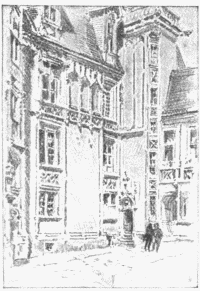
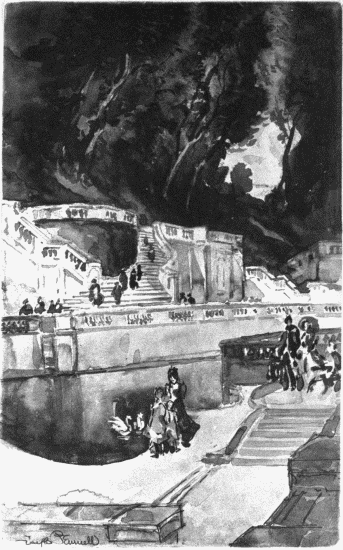
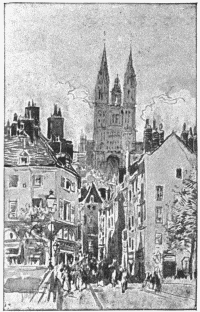
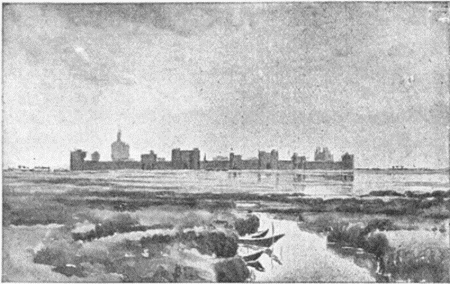
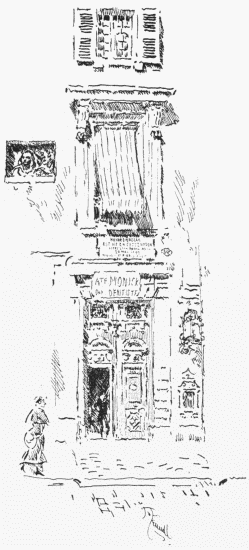
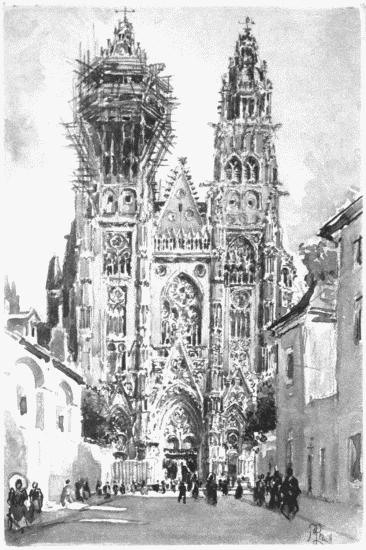
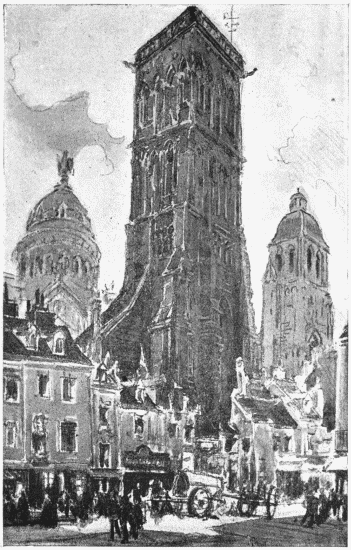
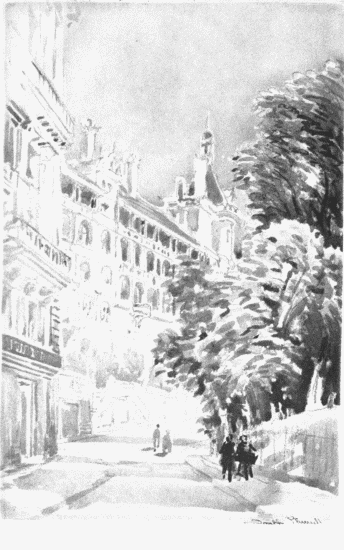
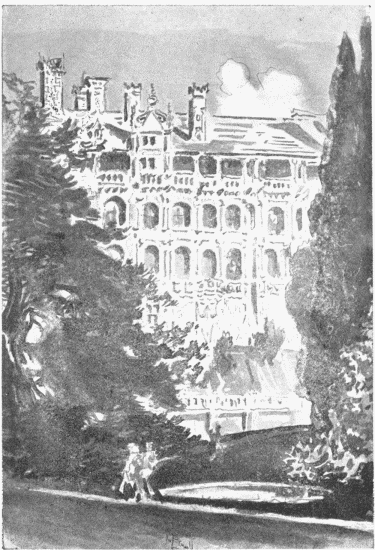
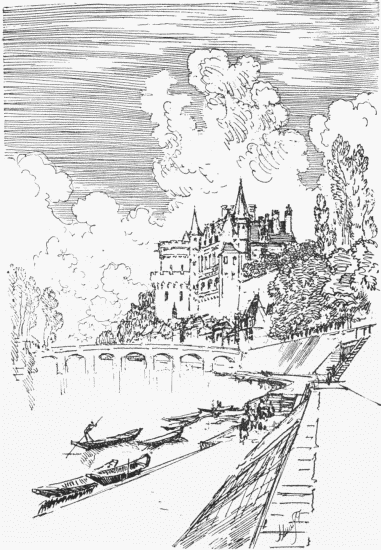
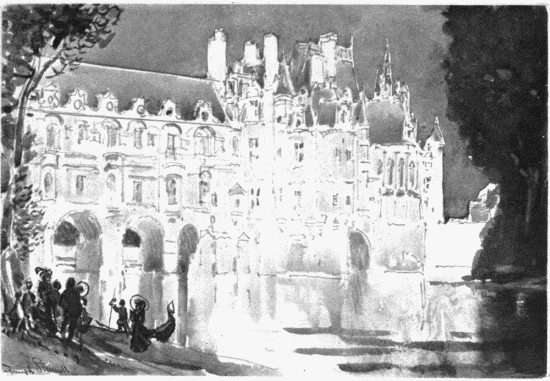
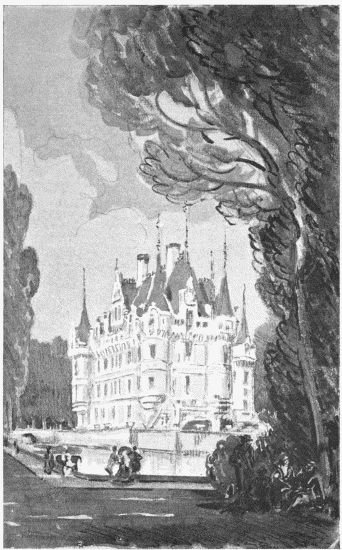
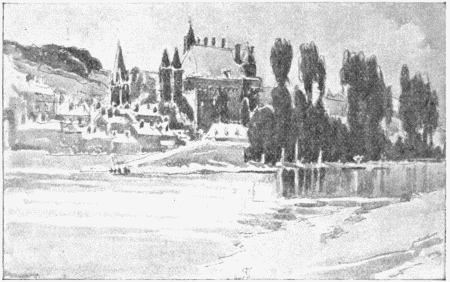
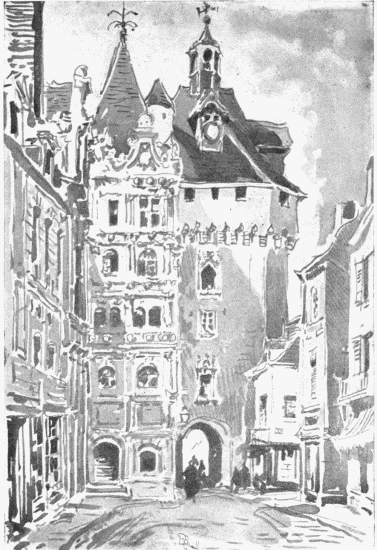
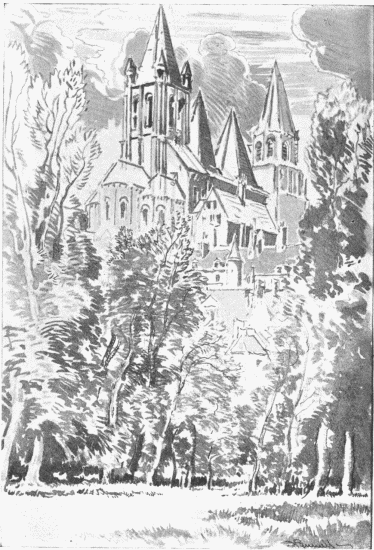
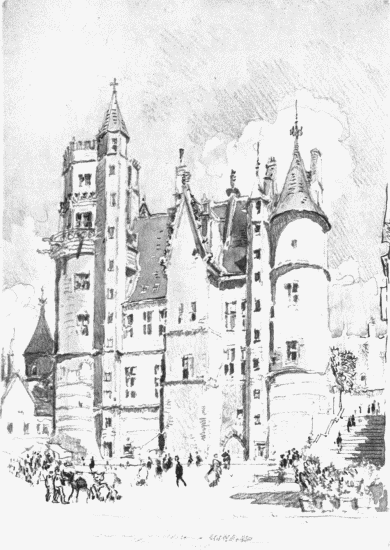
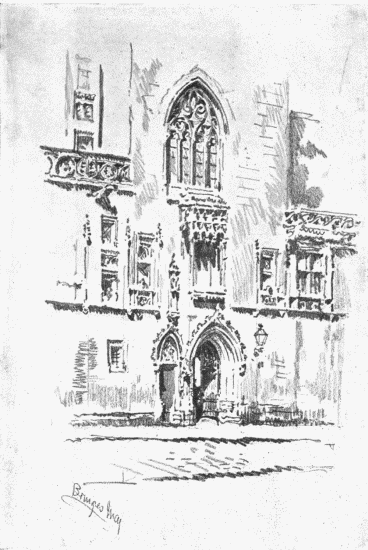
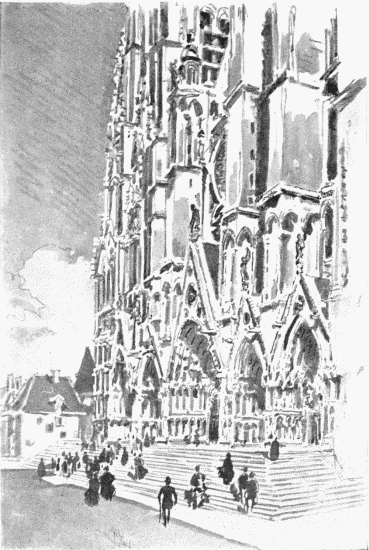
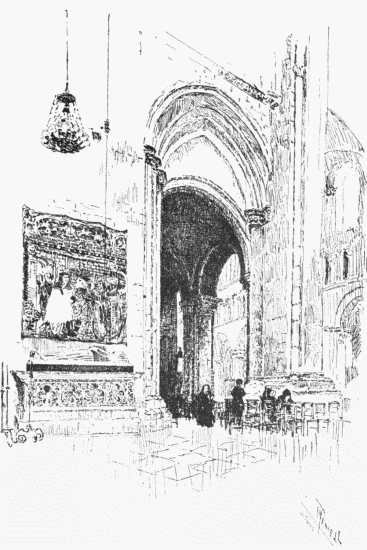
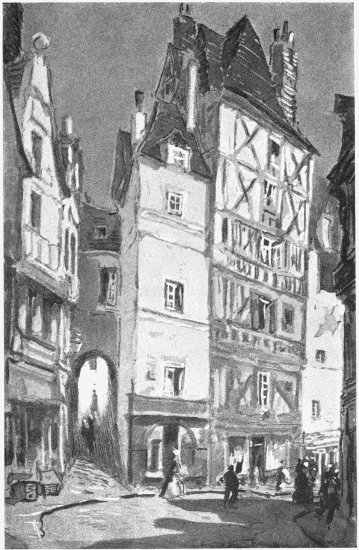
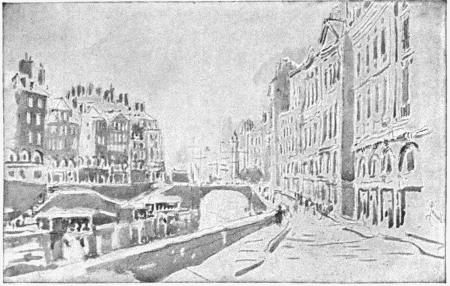
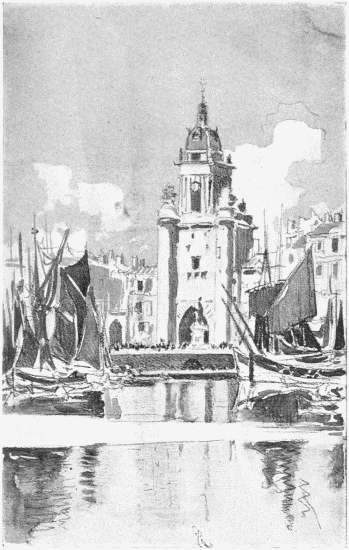
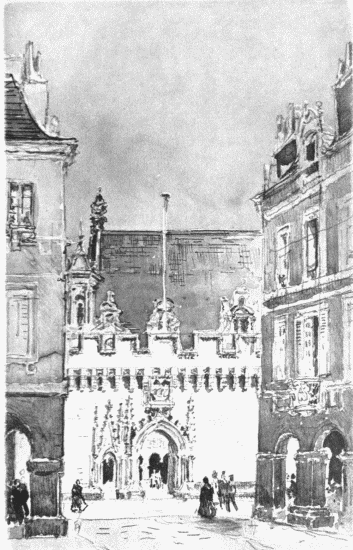
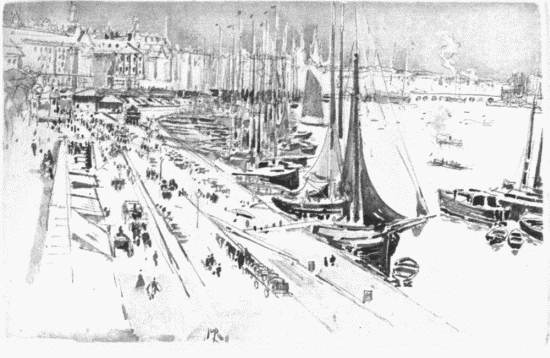
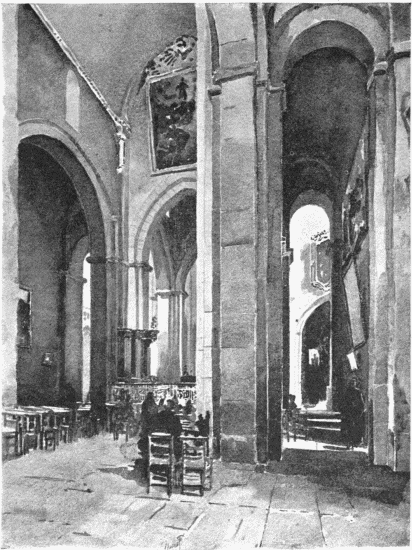
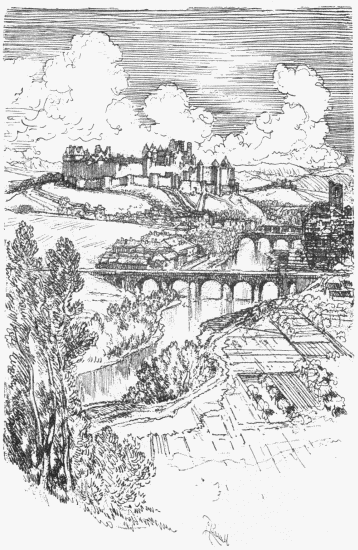
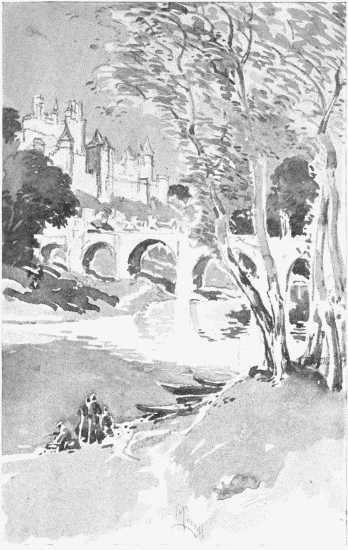
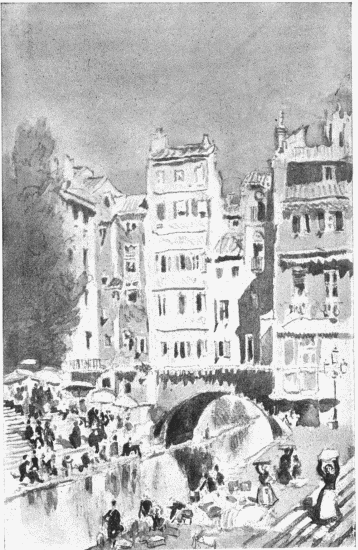
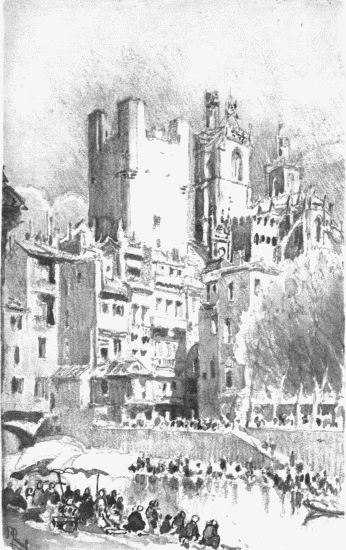
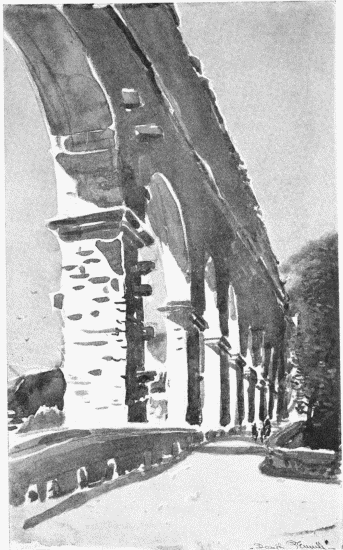
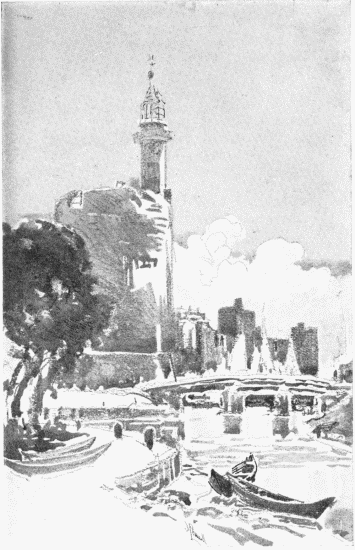
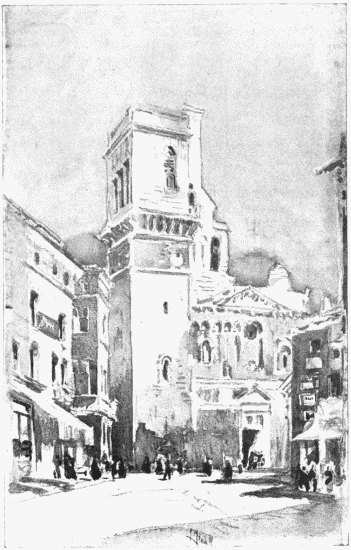
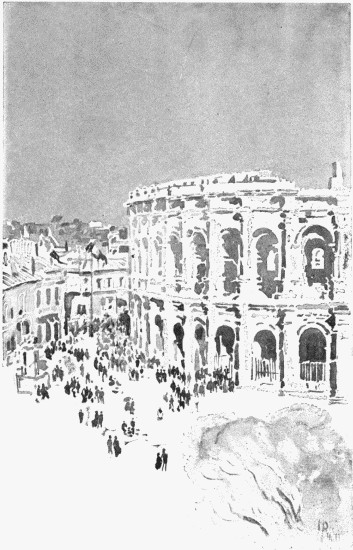
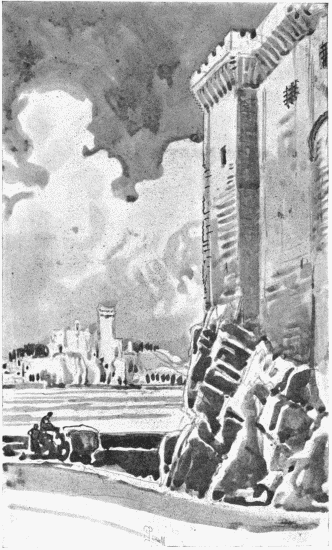
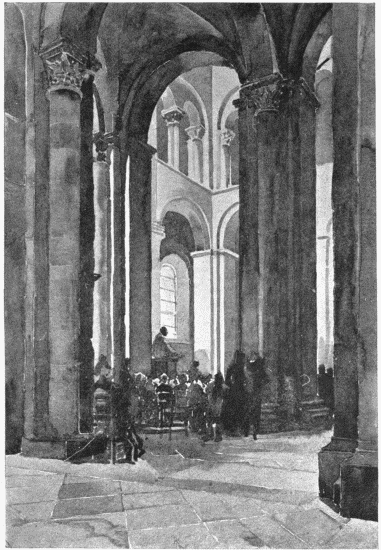
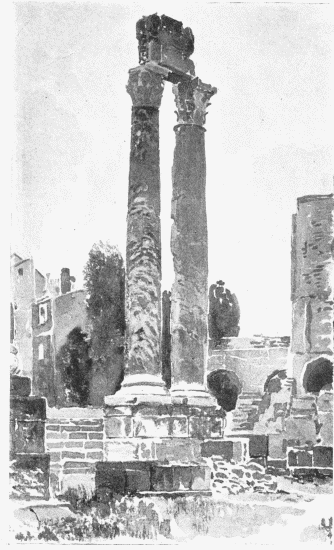
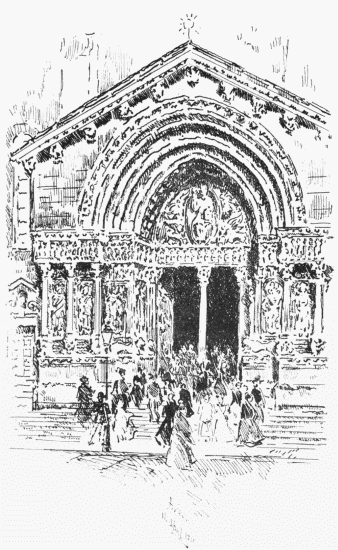
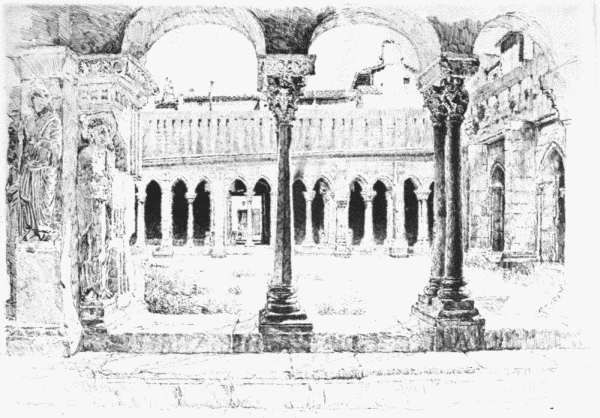
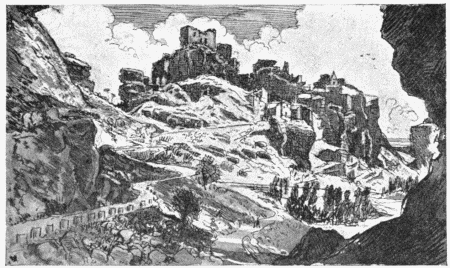
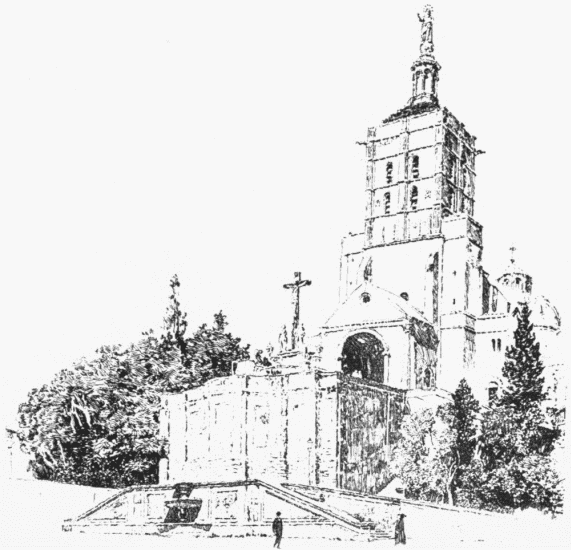
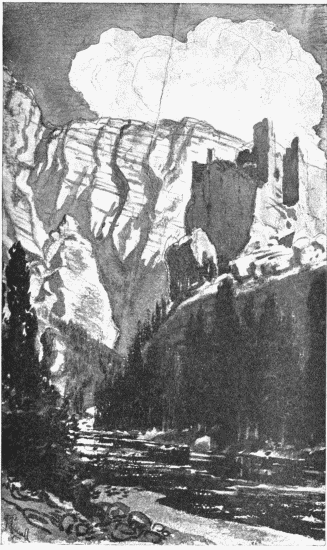
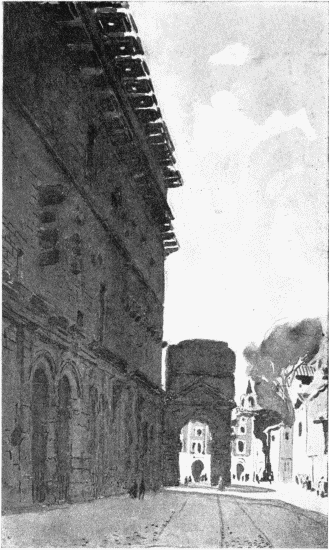
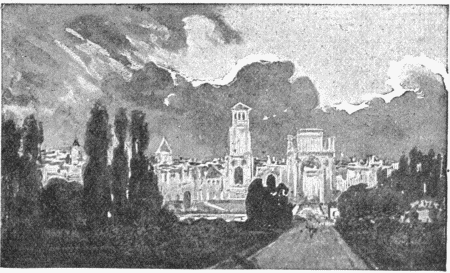
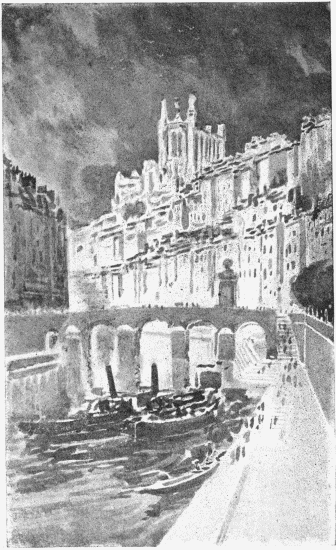
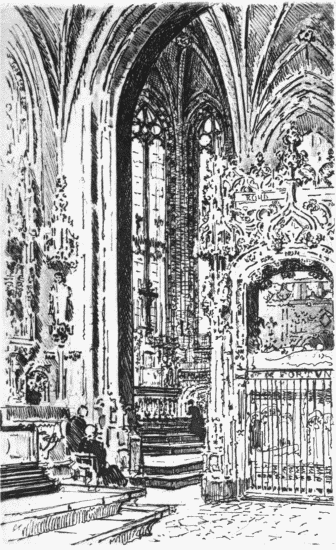
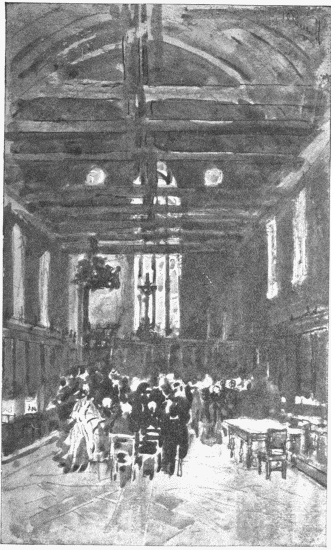
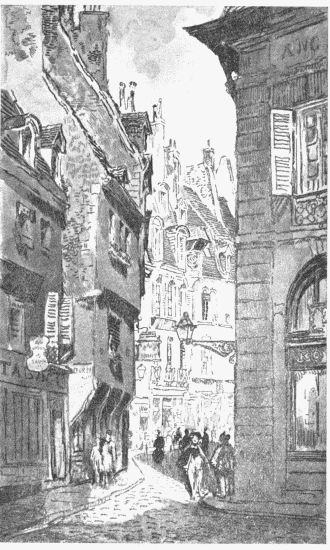
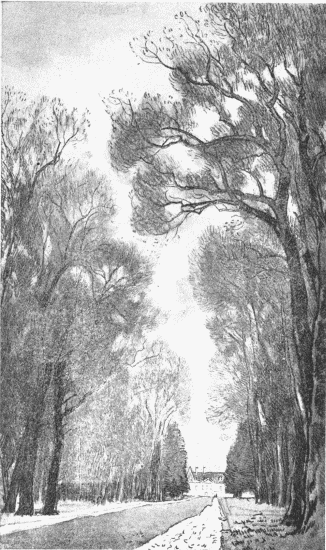
![[Click to view image enlarged.]](images/ill_002.png)
![[Click to view image enlarged.]](images/ill_013.png)
![[Click to view image enlarged.]](images/ill_015.png)
![[Click to view image enlarged.]](images/ill_017.png)
![[Click to view image enlarged.]](images/ill_019.png)
![[Click to view image enlarged.]](images/ill_020.png)
![[Click to view image enlarged.]](images/ill_024.png)
![[Click to view image enlarged.]](images/ill_026.png)
![[Click to view image enlarged.]](images/ill_028.png)
![[Click to view image enlarged.]](images/ill_031.png)
![[Click to view image enlarged.]](images/ill_032.png)
![[Click to view image enlarged.]](images/ill_035.png)
![[Click to view image enlarged.]](images/ill_036.png)
![[Click to view image enlarged.]](images/ill_037.png)
![[Click to view image enlarged.]](images/ill_039.png)
![[Click to view image enlarged.]](images/ill_041.png)
![[Click to view image enlarged.]](images/ill_043.png)
![[Click to view image enlarged.]](images/ill_044.png)
![[Click to view image enlarged.]](images/ill_047.png)
![[Click to view image enlarged.]](images/ill_051.png)
![[Click to view image enlarged.]](images/ill_055.png)
![[Click to view image enlarged.]](images/ill_056.png)
![[Click to view image enlarged.]](images/ill_058.png)
![[Click to view image enlarged.]](images/ill_059.png)
![[Click to view image enlarged.]](images/ill_062.png)
![[Click to view image enlarged.]](images/ill_064.png)
![[Click to view image enlarged.]](images/ill_066.png)
![[Click to view image enlarged.]](images/ill_067.png)
![[Click to view image enlarged.]](images/ill_069.png)
![[Click to view image enlarged.]](images/ill_071.png)
![[Click to view image enlarged.]](images/ill_072.png)
![[Click to view image enlarged.]](images/ill_074.png)
![[Click to view image enlarged.]](images/ill_075.png)
![[Click to view image enlarged.]](images/ill_078.png)
![[Click to view image enlarged.]](images/ill_081.png)
![[Click to view image enlarged.]](images/ill_083.png)
![[Click to view image enlarged.]](images/ill_085.png)
![[Click to view image enlarged.]](images/ill_088.png)
![[Click to view image enlarged.]](images/ill_089.png)
![[Click to view image enlarged.]](images/ill_090.png)
![[Click to view image enlarged.]](images/ill_092.png)