"Mother," questioned Adelaide, "what is
the difference between 'preserving' and 'canning'?"
"Well, dear, according to the cook books,
preserved fruits are cooked with from three-fourths
to an equal weight of sugar, while
canned fruits have only sufficient added to
sweeten. Some fruits are often canned without
sugar, as it is not the sugar that keeps the
fruit, but the perfect sterilization of fruit and
jars. Sterilizing, you remember, is the killing
of all germs by boiling."
"Some fruits I much prefer canning without
sugar, such as apples, peaches, blueberries and
rhubarb. When you open the jars in the winter
time and add the sugar as you need it the flavor
is almost like that of fresh fruit," answered
mother.
"Oh, I see, so that is why our peaches taste
so much better to me than anybody else's!"
exclaimed Adelaide.
Adelaide began with strawberries, but first
she read the "general rules" again that she had
written down in the beginning, because she did
not wish to make a single mistake.
| Strawberries, |
1 quart |
| Sugar |
Emptying the berries into the colander she
dipped it up and down several times in a pan of
clear cold water, then let them drain thoroughly.
The berries were hulled, weighed, and put into
the saucepan, which she placed over the fire,
heating the fruit through very gradually. It
was better, mother said, to let them stand at
the back of the range until the juice began to
run, before bringing the berries to the boiling
point. These boiled slowly five minutes, and
then Adelaide added one-third their weight in
sugar. The sugar had been standing in an
earthenware dish at the back of the range, to
heat through, but not brown.
While Adelaide added the sugar very gradually
she stirred the fruit gently with the wooden
spoon, and was very careful not to break the
berries.
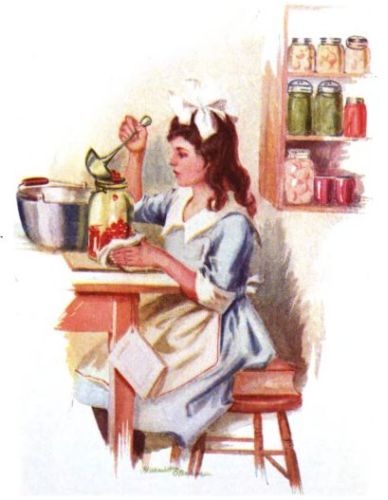
It did not take long for the fruit and sugar
to come to the boiling point, and then Adelaide
filled to overflowing the sterilized pint jar at
once, inserted the silver knife between the jar
and fruit to let the air bubbles rise and break,
put on the new rubber smoothly, sealed quickly
and stood the jar upside down out of the way
of any draft.
The next morning she inspected the jar
carefully, to be sure it did not leak, then wiped
away all stickiness with a damp cloth, pasted on
the label and stored it away in the preserve
closet.
| Raspberries, |
1 quart |
| Sugar |
Mother was delighted with this quart of raspberries,
they were just ripe enough, large, and
almost every one perfect. It did not take Adelaide
long to pick these over, and she could see
each center very easily. There wasn't a single
bug or worm.
She weighed the raspberries before putting
them in the colander to dip up and down several
times in a pan of clear cold water. When they
had drained, she emptied the berries into the
saucepan and stood it on the back of the range
to let the juice run. She also placed a third of
their weight of sugar in an earthenware dish
at the back of the range, to heat through, but
not brown.
When the juice had run sufficiently, Adelaide
moved the saucepan forward, the berries came
slowly to the boiling point, and continued to
boil very slowly for five minutes. It was then
time to add the warm sugar, stirring very gently
while it dissolved. Adelaide was very careful
not to break the fruit. As soon as the fruit
boiled again it was ready to pour into the sterilized
pint jar.
Adelaide filled the jar to overflowing, inserted
a silver knife between the jar and the
berries to let all air bubbles come to the top and
break, put on the new rubber smoothly, sealed
quickly, then stood the jar upside down out of
the way of any draft.
In the morning she made sure that the jar
had not leaked, then with a damp cloth she
wiped away all stickiness, pasted on the label
and stored the jar away in the preserve closet.
| Raspberries, |
1 quart |
| Currants, |
1 pint |
| Sugar, |
2 cups |
Adelaide picked over the raspberries and currants
very carefully, washed and drained them
in the usual manner, but kept them separate.
The currants she placed in the saucepan and
mashed with the wooden potato masher. Next
she cooked them very slowly until the currants
looked white, then she strained them through
two thicknesses of cheese cloth. Returning the
juice to the saucepan, she added the sugar,
stirring until it was all dissolved, and let it boil
slowly twenty minutes, then she poured in the
raspberries carefully and boiled them three
minutes.
The sterilized pint jar Adelaide filled to overflowing
at once, inserted the silver knife to force
the air bubbles to the top, placed the new rubber
on smoothly, sealed quickly and stood upside
down out of the way of any draft.
In the morning she wiped off all stickiness
with a damp cloth, made sure the jar did not
leak, pasted on the label and stored it away in
the preserve closet.
Mother liked to have her cherries cut in halves
and the stones taken out, though she told Adelaide
many people preferred them canned whole.
Adelaide followed mother's way, so the large
ripe cherries she placed in the colander, and
washed thoroughly by dipping it up and down
several times in a pan of clear cold water.
Next she removed the stems, and cut the
cherries in halves with a silver knife, taking out
the stones. Then she weighed the fruit. If
they were tart, she used one-half their weight
of sugar, but if they were of the sweet variety,
she needed only one-third of their weight of
sugar.
The cherries and sugar Adelaide put in the
saucepan together and stood at the back of the
range to heat gradually. As the sugar began
to melt and the juice to run, she removed the
saucepan forward and stirred the fruit gently
with the wooden spoon. Adelaide was careful
not to break the halves, and boiled the cherries
slowly twenty minutes.
She filled the sterilized pint jar to overflowing,
inserted the silver knife to bring the air
bubbles to the top, placed the new rubber on
smoothly, sealed quickly and stood the jar upside
down out of the way of any draft.
In the morning she wiped off all stickiness
with a damp cloth, inspected the jar carefully
to see that it did not leak, pasted on the label
and stored the jar away in the preserve closet.
| Blackberries, |
1 quart |
| Sugar |
These were great big blackberries, firm but
ripe, and Adelaide poured them into the colander.
She could not resist popping the biggest
one into her mouth, but mother told her
that that was a very bad practice to begin.
Adelaide sighed, but she realized mother was
right, so she stopped eating any more and proceeded
to wash the blackberries. She dipped
the colander up and down several times in a
pan of clear cold water, drained thoroughly,
then weighed the fruit. Weighing one-third
their weight of sugar, she put it in an earthenware
dish and placed it at the back of the range
to heat through, but not brown.
The saucepan containing the blackberries was
also stood toward the back of the range until
the juice began to run, when it was moved forward,
and Adelaide watched it while it came
slowly to the boiling point.
For five minutes the berries boiled very slowly,
then the warm sugar was added a little at a time,
and Adelaide stirred gently with the wooden
spoon, being careful not to break the blackberries.
They were ready to put in the sterilized pint
jar as soon as they boiled up again. Adelaide
filled the jar to overflowing, inserted a silver
knife to bring all bubbles to the top,
placed on the new rubber smoothly, sealed
quickly, and stood the jar upside down, out of
the way of any draft. The next morning she
examined the jar carefully to see that it did not
leak, wiped off the stickiness with a damp cloth,
pasted on the label, then stored the jar away in
the preserve closet.
| Blueberries, |
1 quart |
| Sugar |
The blueberries that mother bought were almost
as large as currants and they were firm
and dry.
Adelaide picked them over carefully, put
them into the colander, which she placed in a
pan of clear cold water, dipping it up and down
several times to cleanse the berries thoroughly,
then set aside to drain. The berries were then
weighed, put into the saucepan and heated
gradually.
To each pound of berries Adelaide added
one-third of a pound of sugar, setting it in an
earthenware dish at the back of the range to
heat through, but not brown. When the berries
had boiled slowly for five minutes, Adelaide
added the sugar very gradually, stirring gently
until it had all dissolved. The fruit was ready
to can as soon as it boiled up again, and at
once Adelaide filled to overflowing the sterilized
pint jar. She inserted a silver knife between
the fruit and the sides of the jar to bring
all air bubbles to the top, then placed the new
rubber on smoothly, sealed quickly and stood
the jar upside down out of the way of any draft.
In the morning Adelaide removed all stickiness
from the jar with a damp cloth, inspected
it thoroughly to see that it did not leak, pasted
on the label and stored the jar away in the preserve
closet.
| Blueberries, |
1 quart |
| Water, |
2 tablespoons |
Mother let Adelaide put up a jar of blueberries
without sugar. They made delicious
pies in the winter.
Adelaide picked over the berries carefully
into the colander, then she dipped it up and
down several times in a pan of clear cold water
to cleanse them from all dust. After they had
drained thoroughly, Adelaide poured them into
the saucepan, with two tablespoons of cold
water (this was to prevent burning), then she
placed the saucepan over the fire and let the
berries heat through very gradually. It was
necessary to stir occasionally with the wooden
spoon. They needed to boil but a minute or
two, as they had softened sufficiently while
heating through.
As soon as they were done, Adelaide filled the
sterilized pint jar to overflowing, inserted a
silver knife to let all air bubbles rise to the top,
then break, placed the new rubber on smoothly,
sealed quickly and stood it upside down out of
the way of any draft.
After inspecting the jar next morning to be
sure it did not leak, she wiped it carefully with
a damp cloth to remove all stickiness, pasted on
the label and stored the finished product away
in the preserve closet.
| Peaches, |
1 dozen |
| Sugar, |
1 cup |
| Water, |
2 cups |
There were three different ways mother told
Adelaide that she might put up peaches, two
ways with sugar and one without. Adelaide
put up a dozen peaches at a time.
The first dozen Adelaide placed in a pan and
covered with boiling water and let them stand
a few minutes. It was then easy for her to remove
the skins with a silver knife, cut in halves
and take out the stones. The peaches were
large, and mother said they should fill two pint
jars. So Adelaide washed and sterilized two jars.
Into a saucepan Adelaide measured two cups of
water and one cup of sugar, which she placed over
the fire and let boil ten minutes, then she dropped
the peaches in carefully and let them cook until
you could pierce them with a silver fork. When
they were done she lifted each half peach out
with great care and put twelve of them in one
pint jar, and the remaining twelve in the other
pint jar. Next she filled the jars to overflowing
with the syrup, inserted a silver knife between
the fruit and the sides of the jars, to let
the air bubbles rise to the top and break, placed
new rubbers on smoothly, sealed quickly and
stood both jars upside down out of the way of
any draft.
The next morning she inspected them carefully
to see that they did not leak; then Adelaide
wiped off all stickiness with a damp cloth,
pasted on the labels and stored the jars away
in the preserve closet.
| Peaches, |
1 dozen |
| Sugar |
| Water, |
2 cups |
The second dozen of peaches Adelaide prepared
in the same manner. She placed them in
a pan, covered them with boiling water, let
them stand a few minutes, removed their skins
with a silver knife, cut them in halves, took out
the stones, then weighed the peaches. Placing
them carefully in the saucepan, Adelaide
poured over the peaches one-third of their
weight of sugar, and let them stand over night.
In the morning she added two cups of cold
water and stood the saucepan over the fire,
letting it come slowly to the boiling point.
From then on the peaches simmered slowly,
until they could be pierced easily with a silver
fork, Adelaide stirring occasionally in a careful
manner with a wooden spoon so as not to
break the fruit.
When they were sufficiently cooked, she picked
out the fruit with the fork, putting twelve
halves in each pint jar, filled them to overflowing
with the syrup, then inserted a silver knife
between the fruit and the jars to let all air
bubbles rise to the top and break, placed the
new rubbers on smoothly, sealed quickly, and
stood the jars upside down out of the way of
any draft.
In the morning she examined each jar carefully
to be sure they did not leak, wiped off all
stickiness with a damp cloth, pasted on the labels,
then stored the peaches away in the preserve
closet.
| Peaches, |
1 dozen |
| Water, |
2 cups |
After Adelaide had covered the peaches with
boiling water and let them stand a few minutes,
she removed the skins with a silver knife, cut
them in halves, took out the stones and placed
them carefully in the saucepan.
To these she added two cups of cold water,
put the saucepan over the fire, let the peaches
heat through gradually, stirring occasionally
with the wooden spoon, and then boiled them
very gently for twenty minutes, or until they
could be pierced easily with a silver fork.
Lifting the peaches out carefully with a fork,
Adelaide put twelve halves in each sterilized
pint jar, and filled them to overflowing with the
juice.
Inserting a silver knife between the fruit and
the sides of the jars, she let the air bubbles rise
to the top and break. Next she placed the new
rubbers on smoothly, sealed quickly and stood
each jar upside down out of the way of any
draft.
Next morning Adelaide examined each jar
carefully to be sure they did not leak, wiped off
all stickiness with a damp cloth, pasted on the
labels and stored away the jars in the preserve
closet.
| Apricots, |
1½ dozen |
| Sugar |
| Water, |
1 cup |
The apricots are so much smaller than
peaches that one dozen, mother said, should
just fill a pint jar, but, to be on the safe side,
she would let Adelaide prepare eighteen.
Mother also said she was surprised that more
people did not can this fruit, it was of such a
rich and delicate flavor.
Adelaide washed and wiped each apricot
thoroughly, cut it in halves and removed the
stone. After weighing the apricots she put
them in the saucepan and added one-third their
weight in sugar and one cup of water.
Placing the saucepan over the fire, Adelaide
let the fruit come slowly to the boiling point,
stirring frequently with a wooden spoon to prevent
burning. After they had boiled gently
twenty minutes (Adelaide stirred all the time
being very careful not to break the apricots)
she filled the sterilized pint jar at once.
Adelaide picked the apricots out with a silver
fork and placed them in the jar first, then
she poured in the juice so that it overflowed.
Using a silver knife, she inserted it between the
fruit and the jar, to let all air bubbles rise to
the top and break. Next she placed a new
rubber, which had been dipped in boiling water,
on the jar smoothly, sealed quickly and stood
the jar upside down out of the way of any draft.
In the morning the jar was carefully inspected
to see that it did not leak, and Adelaide
used a damp cloth to wipe away all stickiness.
After pasting on the label she stored the jar
away in the preserve closet.
| Pears, |
1 dozen |
| Sugar |
| Water |
Adelaide prepared a dozen large pears, although
mother said eight were quite sufficient
(if large) to fill a pint jar. It was not a good
plan to crowd such fruit as peaches, pears, and
apricots in too closely, because you might break
the fruit.
With the little sharp knife Adelaide peeled
the pears very thinly and cut them in halves,
removing the cores. The stems she left on.
After weighing the fruit, she placed it in the
saucepan and measured one cup of water to
each pound of fruit. If the pears were tart,
she weighed one-half their weight of sugar; if
they were sweet she weighed only one-third their
weight of sugar.
The sugar was put in an earthenware dish at
the back of the range to heat through, but not
brown.
Placing the saucepan containing the pears
and water over the fire, Adelaide let them come
slowly to the boiling point. With the wooden
spoon she stirred them frequently, being careful
not to break the fruit. If, after twenty
minutes of gentle boiling, the pears were easily
pierced with a silver fork, Adelaide added the
warm sugar gradually and stirred carefully and
constantly until it boiled up again.
Into the sterilized pint jar Adelaide lifted
each half pear with a silver fork, then poured in
the juice until it overflowed. The inserting
of a silver knife between the fruit and the jar,
to let all the bubbles rise to the top and break,
was the next thing to be done, after which she
placed a new rubber smoothly on the jar, sealed
it quickly, then stood the jar upside down out
of the way of any draft.
In the morning Adelaide wiped off all stickiness
from the jar with a damp cloth, and examined
it carefully to be sure that it did not leak.
Next she pasted on the labels and stored the
fruit away in the preserve closet.
Mother told Adelaide that some people found
pears a little too flat for their taste, and in that
case a tablespoon of lemon juice was added with
each dozen pears.
| Crab Apples, |
1 dozen |
| Sugar |
| Water |
These crab apples made one of the prettiest
jars Adelaide put up. She did not have to peel
the crab apples, just wash and wipe the fruit
thoroughly and remove the blossom ends. The
crab apples, of course, needed to be absolutely
perfect.
They were weighed, placed in the saucepan,
and a cup of water poured over to each pound
of fruit. One-half their weight of sugar Adelaide
placed in an earthenware dish at the back
of the range to warm through, but not brown.
The saucepan she placed on the fire and let
the crab apples and water come slowly to the
boiling point, stirring frequently with the
wooden spoon.
When the crab apples could be pierced easily
with a silver fork Adelaide added the sugar
gradually and let the fruit boil up again. She
stirred constantly until they had boiled quietly
five minutes more, then she picked the crab
apples out with the silver fork and placed in
the sterilized pint jar.
With a silver knife, which she inserted between
fruit and jar, Adelaide let the air bubbles
rise to the top and break. The new rubber,
after being dipped in boiling water, was placed
on the jar smoothly, then she sealed it quickly
and stood it upside down out of the way of any
draft.
In the morning the jar was carefully inspected
for any possible leaks, and Adelaide
wiped off all stickiness with a damp cloth.
Next she pasted on the labels and stored the
canned fruit away in the preserve closet.
| Quinces, |
½ dozen |
| Sugar |
| Water |
Six large orange quinces (these are of the
best variety) Adelaide washed and wiped thoroughly,
peeled, cut into quarters, and removed
the cores. After weighing the quinces she measured
into the saucepan one and one-third cups
of water to each pound of fruit.
Placing the saucepan over the fire she let the
water just boil, and then poured in the quinces.
They boiled gently for about twenty minutes,
or until you could pierce them easily with a
silver fork. Adelaide lifted these out very carefully
on to a large plate.
To the water in which the quinces had been
cooked, she added one-half their weight in sugar.
This she stirred with the wooden spoon until it
was all dissolved and the syrup boiled. The
quinces were gently dropped into the boiling
syrup (Adelaide took particular care not to
break the quarters) and when they had cooked
slowly for five minutes she filled the sterilized
pint jar with the fruit and poured the syrup
over it until it overflowed. Next she inserted
a silver knife between the fruit and the jar, to
let all air bubbles rise to the top and break.
The new rubber, after being dipped in boiling
water, was placed smoothly around the top,
then she sealed the jar quickly and stood it upside
down out of the way of any draft.
In the morning the jar was carefully examined
to be sure that it did not leak, and Adelaide
wiped off all stickiness from the outside.
Pasting on the label she stored it away in the
preserve closet.
Mother had told Adelaide to save the peelings
and cores of the quinces, and put in a saucepan
with just enough water to cover. These
she let boil slowly for about one hour, then she
poured them into the jelly bag to drain off the
juice. This juice she used to cook her apples
in when she canned some the next day.
| Apples, |
1 dozen |
| Sugar |
| Quince juice |
After washing and peeling the apples, Adelaide
cut them into quarters and removed the
cores.
The quince juice was made from the peelings
and cores of the quinces she had canned
the day before, by just covering them with cold
water and boiling slowly for one hour. Then
she drained them through the jelly bag.
To each pound of apples Adelaide measured
one and one-third cups of quince juice into the
saucepan, and she put one-fourth of their
weight of sugar into an earthenware dish, which
she stood at the back of the stove to warm but
not brown.
The saucepan containing the apples and
quince juice was placed over the fire, and the
fruit came slowly to the boiling point. Adelaide
stirred quite frequently with the wooden
spoon, being careful not to break the fruit.
When you could easily pierce the apples with
a silver fork, they were ready to have the warm
sugar added. This Adelaide poured in very
carefully and stirred until dissolved.
Five more minutes they needed to boil, being
stirred constantly, then Adelaide filled the sterilized
pint jar at once. First the fruit (lifted
out with a silver fork), then the syrup poured
in to overflowing, then the silver knife inserted
between fruit and jar, to let the air bubbles
rise to the top and break, then the new rubber
placed around the top smoothly, and lastly the
quick sealing. Adelaide stood the jar upside
down out of the way of any draft. In the morning
she wiped off all stickiness with a damp
cloth, from the outside of the jar, examined it
carefully to be sure that it didn't leak, pasted
on the label, then stored the jar away in the
preserve closet beside her steadily growing line
of preserves.
The addition of the quince juice made the
flavor of the apples delicious.
Wiping the apples clean, Adelaide pared them
with the sharp knife, cut them into quarters
and removed the core. If the apples were very
juicy she did not need to cook them in very
much water, otherwise the water (which she
poured over the apples boiling) came nearly
to the top of the apples.
Placing the saucepan over the fire, the fruit
boiled slowly until tender, then Adelaide at once
filled to overflowing the sterilized pint jar. Inserting
a silver knife between the jar and the
fruit, she let the air bubbles rise to the top and
break.
The new rubber, dipped in boiling water,
was placed on smoothly, and the jar sealed
quickly, then Adelaide stood it upside down out
of the way of any draft. In the morning she
wiped off all stickiness with a damp cloth from
the outside of the jar, inspected it carefully for
any possible leaks, pasted on the label and stored
the apples in the preserve closet.
| Pineapples (large), |
One |
| Sugar, |
1 cup |
| Water, |
2 cups |
Mother had to show Adelaide how to remove
the skin and eyes from the pineapple. Adelaide
found it a rather prickly thing to handle,
but after it was ready, she cut it into slices
fairly thick, and removed the little hard core
with a sharp knife. Mother told her she could
leave the slices whole, or she could cut them
into cubes. Adelaide said that she preferred
cutting them into cubes.
The cup of sugar and two cups of water were
measured into the saucepan, which she placed
over the fire and let boil ten minutes, then the
pineapple was dropped in and cooked until
tender, or until you could pierce it easily with
a silver fork.
As soon as it had cooked sufficiently, Adelaide
filled the sterilized pint jar, first with the
fruit, and then poured in the syrup so that it
overflowed. Next she inserted a silver knife
between the pineapple and the jar, to let the
air bubbles rise to the top and break. The new
rubber, which had been dipped in boiling water,
was placed around the top smoothly, then Adelaide
sealed it quickly and stood the jar upside
down out of the way of any draft.
In the morning she wiped all stickiness off
the jar with a damp cloth, examined the jar
carefully to be sure there were no leaks, pasted
on the label and stored the canned fruit away
in the preserve closet.
Another way that mother liked to put up
pineapples is as follows:
| Pineapple (large), |
One |
| Sugar |
Adelaide, after removing the skin and eyes
from the pineapple, cut it into quarters lengthwise
and removed the cores. Then she weighed
it, after which she put the pineapple through
the meat chopper.
Into the saucepan she measured one-half its
weight of sugar and added the chopped pineapple.
Placing the saucepan over the fire, Adelaide
let the fruit and sugar come slowly to the boiling
point, stirring frequently with the wooden
spoon to keep from burning. After the boiling
point was reached, the fruit cooked slowly for
twenty minutes, and Adelaide put it into the
sterilized pint jar at once. The jar was filled
to overflowing and a silver knife inserted between
the fruit and the jar, to let all air bubbles
rise to the top and break.
Next she placed a new rubber around the top
smoothly, sealed it quickly and stood it upside
down out of the way of any draft.
In the morning she examined the jar carefully
to see that it did not leak, wiped off all
stickiness with a damp cloth, pasted on the label
and stored the finished product away in the
preserve closet.
Mother often used pineapple put up in this
manner for pineapple ice cream, or pineapple
sherbet. It made a delicious dessert.
| Plums (large), |
1½ dozen |
| Sugar |
| Water |
The large blue plums, the green-gage plums,
or the large red plums, were all put up in the
same manner.
Adelaide wiped each plum thoroughly with a
damp cloth, cut it in halves with a silver knife,
and removed the stone. Then she weighed them.
To each pound of fruit Adelaide measured one
cup of water and one cup of sugar. The plums
and the water she placed in the saucepan over
the fire and let them come slowly to the boiling
point, while the sugar was heating at the back
of the range in an earthenware dish.
Adelaide boiled the plums gently, stirring
occasionally with a wooden spoon, until they
were tender or until you could pierce them with
a silver fork easily. It usually took twenty
minutes. The sugar was then ready to add to
the fruit, and Adelaide stirred the mixture very
carefully until it was all dissolved. As soon as
the fruit boiled up Adelaide canned at once.
She lifted each plum carefully with a silver fork
into the sterilized pint jar, then poured in the
juice till it overflowed. Inserting a silver
knife between the fruit and the jar, Adelaide
let the air bubbles come to the top and break.
The new rubber, after being dipped in boiling
water, was fitted on smoothly, then she sealed
the jar quickly and stood it upside down out of
the way of any draft.
In the morning, with a damp cloth she wiped
off all stickiness from the outside of the jar,
inspected it carefully to be sure that it did not
leak, pasted on the label and stored the jar
away in the preserve closet.
If the rhubarb is pretty in color and young
and tender, mother told Adelaide that she did
not need to peel the stalks, but just wash and
wipe them clean and cut them in small pieces
with the little sharp knife. Then she weighed
the fruit and allowed one-half pound of sugar
to each pound of rhubarb. Both sugar and
rhubarb were put in the saucepan and placed
over the fire to come very slowly to the boiling
point. Adelaide stirred constantly with a
wooden spoon to prevent burning, and as soon
as it had boiled fifteen minutes she poured it
into the sterilized pint jar. The silver knife
she inserted between the jar and the fruit, to
let all air bubbles rise to the top and break.
After the new rubber was dipped in boiling water
and placed over the jar smoothly, Adelaide
sealed it quickly, then stood the jar upside down
out of the way of any draft. In the morning
she inspected the jar carefully to be sure that
there were no leaks, wiped off all stickiness with
a damp cloth, pasted on the label and stored
the jar away in the preserve closet.
Sometimes mother canned rhubarb without
sugar, so Adelaide tried a jar. Mother said
the flavor was much better and it was not so
juicy, also it was excellent for pies, shortcakes,
etc., adding the sugar when you used it.
| Rhubarb, |
2½ lbs. |
| Water, |
1 tablespoon |
Adelaide washed and wiped each stalk thoroughly,
then cut it into small pieces. These
she put in the saucepan with a tablespoon of
cold water to keep from burning, and stirred
with a wooden spoon. She let the fruit heat
very gradually and boiled slowly for fifteen
minutes. It was then ready to can, and Adelaide
poured the rhubarb into the sterilized pint
jar at once, after which she inserted a silver
knife between the jar and the fruit, to let all
air bubbles rise to the top and break. Next
came the new rubber, which she dipped in boiling
water, placed over the top smoothly, then
sealed quickly. Standing the jar upside down
she stood it out of the way of any draft. In the
morning Adelaide examined the jar carefully
to be sure that it did not leak, wiped off the outside
with a damp cloth, pasted on the label and
stored the jar away in the preserve closet.
| Damson Plums, |
1 quart |
| Sugar |
| Water |
The Damson plums Adelaide wiped thoroughly,
and pricked each one with a silver fork
twice. Then she weighed the fruit. To each
pound she measured three-quarters of a pound
of sugar. To each pound of sugar Adelaide
measured one cup of water. The sugar and
water she put in the saucepan and placed over
the fire. When the syrup boiled, Adelaide
skimmed it and added the plums. The plums
Adelaide cooked until they were tender, stirring
them carefully with a wooden spoon so as not
to break the fruit, then filled the sterilized pint
jar to overflowing. A silver knife was inserted
between the fruit and jar to let all air bubbles
rise to the top and break. The new rubber
was dipped in boiling water, placed over the top
smoothly and the jar sealed quickly. This
Adelaide stood upside down out of the way of
any draft. In the morning the jar was carefully
examined to see that it did not leak, all
stickiness was wiped off with a damp cloth, the
label was pasted on, and then Adelaide stored
the jar away in the preserve closet.
The currants Adelaide picked over carefully
and put into the colander. This she placed in
a pan of clear cold water and dipped up and
down several times until quite clean. After
they had drained well she weighed them, and
to each pound of fruit she measured a pound of
sugar. Half of the currants Adelaide put in
the saucepan and placed on the fire to heat
through. When they were thoroughly warmed
she removed the saucepan from the fire and
mashed the currants with the wooden potato
masher, then she strained the juice through the
jelly bag.
The juice and sugar Adelaide put into the
saucepan and boiled gently for fifteen minutes,
after which she added the other half of the currants.
It took the currants only five minutes
to just cook through and they remained whole
in the jelly.
This was poured into sterilized tumblers.
When cold the tumblers were wiped free from
all stickiness, and Adelaide sealed them by pouring
melted paraffin over the top, shaking it
gently from side to side to exclude all air.
Pasting on the labels she stored them away in
the preserve closet.
| Currants, |
1 pint |
| Raspberries, |
1 quart |
| Sugar |
The currants and raspberries Adelaide picked
over and kept separate. She did not forget to
look carefully in the center of each raspberry
to be sure that there were no little worms.
After washing the currants, placing them in
the colander and dipping it up and down several
times in a pan of clear cold water she poured
them into the saucepan and mashed them with
the wooden potato masher. Adelaide washed
the raspberries in the same manner, but stood
them aside to drain while the currants were cooking.
The currants simmered slowly for half
an hour (or until the currants looked white),
and then the juice was strained through the
jelly bag. Adelaide returned the juice to the
saucepan, and added the sugar. (The currants
and berries had been weighed after washing
them, and to each pound of fruit she measured
three-fourths of a pound of sugar.)
The juice and sugar boiled slowly for twenty
minutes, then Adelaide poured in the raspberries
carefully and cooked three minutes more.
Into the sterilized pint jar she skimmed the
raspberries, then added the juice to overflowing.
The silver knife was inserted between the jar
and the fruit, to let all air bubbles rise to the
top and break, the new rubber was placed on
smoothly and Adelaide sealed the jar quickly.
It was then placed upside down out of the way
of any draft. In the morning the jar was carefully
inspected for any leaks, wiped free from
all stickiness with a damp cloth and the label
pasted on. Adelaide then stored it away in
the preserve closet.
| Strawberries, |
1 quart |
| Sugar |
Before hulling the strawberries, Adelaide put
them into the colander and dipped it up and
down several times in a pan of clear cold water
to cleanse the berries thoroughly. After hulling
the fruit she weighed it, and for each pound
she weighed a pound of sugar.
The strawberries were put into the saucepan
and the sugar sprinkled over them and they
stood until the juice ran freely. Then the
saucepan was placed on the fire and the fruit
and sugar heated through. Adelaide stirred
with the wooden spoon, being careful not to
break the strawberries.
When the sugar was all dissolved and the
berries thoroughly heated, Adelaide skimmed
the berries out into a dish. The syrup then
boiled for ten minutes slowly, after which the
strawberries were dropped in carefully and
boiled two minutes. Into the sterilized pint
jar Adelaide skimmed all the berries, filled it
to overflowing with the syrup, inserted a silver
knife between the fruit and the jar to let all air
bubbles rise to the top and break, placed on the
new rubber smoothly, sealed the jar quickly and
stood it upside down out of the way of any
draft.
In the morning she examined the jar carefully
to see that it did not leak, wiped off all
stickiness with a damp cloth, pasted on the
label and stored the preserved berries away in
the preserve closet.
| Blackberries, |
1 quart |
| Sugar |
After picking over the blackberries Adelaide
placed them in the colander and dipped it up
and down in a pan of clear cold water several
times to remove all dust and dirt. After
weighing the berries she poured them into a
saucepan and sprinkled over them an equal
weight of sugar. These stood for an hour before
Adelaide put the saucepan over the fire
and let the berries and sugar come slowly to the
boiling point. Adelaide stirred them gently
with a wooden spoon, being careful not to break
the fruit.
When they boiled up she skimmed out the
blackberries into a dish and the syrup cooked
for five minutes.
Returning the blackberries to the syrup she
put the saucepan at the back of the range and
let the fruit slowly heat without stirring.
After they had stood fifteen minutes she poured
the berries at once into the sterilized pint jar,
filling it to overflowing. With a silver knife,
which she inserted between the jar and the fruit,
she let all air bubbles rise to the top and break.
Placing a new rubber over the top smoothly
she sealed quickly and stood the jar upside
down out of the way of any draft. In the
morning it was ready to be inspected carefully
for any leaks, and she wiped off all stickiness
with a damp cloth, pasted on the label and
stored the fruit away in the preserve closet.
Adelaide washed the cherries in the colander,
which she dipped up and down several times in
a pan of clear cold water. She took off the
stems and removed the stones, weighed the
cherries and added a pound of sugar to each
pound of fruit. Then she let them stand over
night, and the next morning put them into the
saucepan to cook slowly until clear and tender,
stirring carefully with a wooden spoon so as
not to break the fruit.
When they were done Adelaide picked out the
cherries first with the skimmer and dropped
them into the sterilized pint jar, then she filled
it to overflowing with the syrup, inserted a silver
knife between the fruit and the jar to let all
air bubbles rise to the top and break, placed on
a new rubber smoothly, sealed quickly and stood
the jar upside down out of the way of any draft.
In the morning she inspected the jar carefully
to be sure that it did not leak, wiped off all
stickiness with a damp cloth, pasted on the label
and stored the jar away in the preserve closet.
"Mother," said Adelaide one morning, "it
is not nearly as discouraging to preserve as it
is to just plain cook."
"Why, what do you mean, dear?" answered
mother.
"Well, I've been thinking how quickly we
eat up things you cook for us every day, while
my jams and jellies are still in the preserve
closet," mused Adelaide.
"Just wait until next winter, young lady,
then you'll see how quickly they will disappear,"
laughed mother.




 THE PAGE