Kashaqua was evidently delighted to see Faith safely at home once
more. She had brought a present for her little friend; and after Faith
had talked to her mother, and yet, as she declared, had “not begun to
tell her” all she had to tell, Kashaqua unrolled a soft bundle and
spread out the skin of a black bear cub. It was hardly larger than the
skin of a good-sized puppy; but the fur was so soft and glossy that
Faith and her mother exclaimed admiringly over its beauty, and Faith
said that she would take the greatest care of it. She questioned
Kashaqua about “Nooski,” the tame bear which had followed them on
their journey to Ticonderoga.
“Gone!” replied Kashaqua, and had no more to tell of the wild creature
that she had tamed, and, suddenly, Kashaqua disappeared in her usual
silent fashion without a sign or word of farewell.
Faith was tired, and quite satisfied to rest on the big settle and
talk to her mother, while “Bounce,” steady and well-behaved, curled up
on the hearth rug. Faith told her mother about Louise; about Caroline
and Catherine and their mischief, and of the quilting party. She told
her about Nathan Beaman, and of the skating on the lake, and how the
English soldiers had extinguished the fire and spoiled their fun. But
she did not tell her of the evening when she had guided Mr. Phelps up
the moonlit lake to the foot of the cliff, and told him how to make
his way into the fort. Some time, she resolved, her mother should know
all about it; but she still felt that she must keep it a secret.
Mrs. Carew asked many questions about the fort.
“There is more travel over the trails than ever before,” she told the
little girl, “and we hardly know who are our friends. The English are
sending their spies everywhere. Be very cautious, Faithie, and say
nothing to any stranger that you have ever been near Fort Ticonderoga.
This part of the country will not be safe until American soldiers take
the place of the English in the fort.”
“Oh, mother dear, I hope they will soon. I wish that I could help take
the fort.”
“Who knows but you may help in some way, when the right time comes,”
her mother responded, smiling at her little daughter’s eagerness.
“Now, I am going out to get something for you. Something that you will
like very much,” she added, and left Faith alone.
Faith closed her eyes, wondering happily what it was that her mother
would bring. She thought of the caraway cookies, of the little round
pies made of the dried pumpkin, and then a noise at the door made her
open her eyes. For an instant she believed that she must be asleep and
dreaming, for Esther Eldridge was standing in the door—Esther grown
taller and stronger, with red cheeks and shining eyes.
“Yes, it’s really Esther,” Mrs. Carew called over the little girl’s
shoulder, and Esther ran toward the settle as Faith started forward to
meet her.
“Isn’t this a fine surprise?” Esther exclaimed. “I was so afraid you
would hear about our living here before you got home.”
“Living here?” questioned Faith, looking so puzzled that both Mrs.
Carew and Esther laughed aloud.
“Yes! yes, indeed! My father and mother and I,” answered Esther
delightedly.
“But where? I have been up-stairs, and all over the house and I didn’t
see anybody, or anything,” said Faith.
“Oh, we live in our own house—a house just like this; or it will be
just like this when it is all finished,” and Esther told of her
father’s decision to bring his family to the Wilderness to live. He
had purchased a grant of land adjoining that held by Mr. Carew soon
after Esther’s visit in September. The timber for the cabin had been
cut early in the winter, and the cabin begun, and now it was nearly
finished. “We moved last week,” said Esther, “and you can see our
house from your back door.”
Faith forgot all about being tired and ran to the back door to look.
Yes, there it was; the big new cabin, near the path down which Ethan
Allen had led her home, when, angry at Esther, she had run off to the
woods.
“Isn’t it splendid! Oh, Esther, it is the very best thing that ever
happened,” Faith declared; “isn’t it, mother dear?”
Mrs. Carew was quite ready to agree with her little daughter. “Good
neighbors was the only thing we really lacked,” she agreed, “and
perhaps others will come when there is better protection for their
safety.”
The two little friends had much to tell each other, and when Esther
started for home Faith walked with her as far as the mill. From the
mill the new cabin could be clearly seen.
“Do you remember asking me if I listened to the brook?” Esther asked
laughingly, as they stood looking at the dancing waters of the stream.
“Well, I know now just what you meant. It’s company, isn’t it?”
Then Faith told her of the “Chiming Waters” of Ticonderoga, and of
some of the old tales of the lake that her aunt and Nathan had
related.
“Did you see the English soldiers?” questioned Esther.
“Oh, yes.” And Faith described the skating party on the lake that the
redcoats had interfered with. “I wish I could see Ethan Allen, as I
did that day in September, and tell him all about the fort and the
soldiers, and ask him to drive the English away. My father says that
Colonel Allen could drive them away,” said Faith.
“Of course he could! My father says so, too,” agreed Esther. “Would it
not be a fine thing for us to send him a letter, Faith, and ask him?”
“Oh, Esther! That’s just what I thought of. But we ought to do it
right away, for more soldiers are coming to the fort, Nathan Beaman
says, and then it won’t be so easy,” responded Faith.
The two little girls talked earnestly. They both knew of the cave on
the rocky slope near Lake Dunmore, and that messages were sometimes
left there for the settlers. But Lake Dunmore was a long distance
away.
“It would take all day to go and get back,” said Esther, “and our
mothers would never let us go; you know they wouldn’t.”
“One of us ought to go to-morrow,” answered Faith, “but how can we
plan it?”
“I know! I know!” declared Esther. “I’ll ask your mother if you may
come for a visit, and then you’ll go home at night. Some time you can
tell her all about it,” concluded Esther as she noticed Faith’s
serious and doubtful expression.
“And what will you do? Don’t you mean to go with me?” asked Faith.
“Oh, yes! I’ll tell my mother I am going to spend the day with you.
Then we’ll start off in good season, and we’ll get home before our
mothers miss us,” said Esther.
“Faith! Faith!” and Mrs. Carew’s voice sounded through the clear air.
“I must run back now. I’ll write the letter to-night and be over near
your house as early as I can in the morning,” said Faith.
“Hide behind the big pine,” said Esther, and the two friends, greatly
excited over their project, separated and ran toward their respective
homes.
It was not easy for Faith to write the letter, for she would have to
ask her mother for the quill pen, and the bottle of ink, made from the
juice of the pokeberry. But in the early evening, while her mother was
busy, Faith secured the quill and ink and a sheet of the treasured
paper and wrote her letter:
“Dear Mr. Colonel Ethan Allen,” she wrote. “Will you please send
the English soldiers away from Fort Ticonderoga? Nathan Beaman,
who lives at Shoreham, will show you how to get in. Please send
them soon, or more will come.
“Respectfully your friend,
“Faith Carew.”
She had time to fold and seal the letter with the big stick of red
wax, softening the wax before the sitting-room fire. A moment later
and her mother came in, saying she had best go to bed and get a good
night’s rest.
“May I spend to-morrow, all day, with Esther?” asked Faith, as her
mother went up-stairs with her, and feeling her face flush with the
consciousness of not telling her mother all the truth.
“Your very first day at home, dear child! Why, I should be running
over to Mrs. Eldridge’s every hour to make sure that you were really
within reach,” responded her mother.
“Oh, mother, you wouldn’t!” said Faith, so earnestly that Mrs. Carew
smiled reassuringly and said:
“Well, perhaps not every hour. But if you want to spend the day with
Esther you may. ’Tis not as if you were going back to Aunt Prissy in a
week.”
“And you won’t come to Mrs. Eldridge’s at all, will you, mother dear?”
pleaded Faith. “I’ll be safe, and I’ll come home early.”
“You shall do as you like, dear child. I know you will do nothing but
what will please me,” and Mrs. Carew leaned over to kiss Faith
good-night.
“Oh, dear,” Faith whispered to herself guiltily, as her mother went
down the stairs. “Here is another secret, the biggest of all. But I
can’t tell mother.”
The song of the brook seemed louder than ever before to the little
girl that night, as she lay watching the April stars shine through her
window. She remembered that her mother had said that perhaps a little
girl could help. “Mother dear is sure to be glad when she knows that
Colonel Allen had to be told about Nathan,” thought Faith; and then
the brook’s song grew softer and softer and she was fast asleep.
Faith was down-stairs the next morning almost as soon as her father
and mother. She had on her brown dress and her moccasins, and the
letter was safely hidden in her pocket. She could hardly keep still
long enough to eat her breakfast.
“Esther wanted me to come early, mother dear, and I promised,” she
urged; so her mother bade her be off, and stood in the door and
watched the little girl run down the slope, feeling a little
disappointed that Faith should be so eager to be with Esther instead
of remaining at home.
But early as it was Faith found Esther waiting for her.
“Did you bring anything to eat?” asked Esther.
“I never thought of it!” replied Faith, “and I don’t believe I could,
anyway.”
“Well, I thought of it. I have a fine square of corn cake, a piece of
cold venison, and a square of molasses cake,” said Esther, holding up
a small basket. “Now, creep along on the edge of the trail until we
are well up the ridge. Then we can walk as we please.”
Faith obeyed. She thought to herself how fortunate it was that Esther
had come to live in the Wilderness, and that she was ready to help
carry the message.
“Isn’t it lovely in the woods!” said Esther, as they reached the
summit of the ridge, and turned to look back down the winding trail.
“Father said this morning that the spring was early, and ’tis surely
warm as summer.”
As they rested for a little while on a bank of firm green moss Faith
told Esther of “Nooski’s” sudden appearance when she and Kashaqua
were on their journey to the lake.
“Goodness!” exclaimed Esther, peering anxiously into the underbrush.
“I hope we shan’t see any bears to-day, not even a tame one.”
The sun was high in the April skies when the two little girls came in
sight of Lake Dunmore. The trail led near the lake; and Esther was
very sure that she knew just where to look for the cave.
“It’s near a big pine tree, and you can only see rocks. Father showed
me when we came from Brandon,” she said.
The little girls were very tired and hungry, and Faith suggested that
they should eat their luncheon and rest before searching for the cave.
“I wish I had brought more corn bread,” said Esther, when they had
finished the last morsel of the food.
“It’s lucky you brought as much as you did,” responded Faith. “We’d
better begin looking for the cave now.”
It was hard work climbing up the rocky hillside, and it did not seem
such an easy matter to locate the cave as Esther had expected. They peered under rocks, and climbed over ledges, and were nearly
discouraged when a sudden noise made Faith grasp Esther’s arm with a
whispered “Hush”; for almost in front of them, apparently coming
directly out of the hillside, appeared the head and shoulders of a
man. But they were too near to conceal themselves or to try and run
away.
“Great Cæsar’s Ghost!” exclaimed the man, crawling out from the cave.
“Two little maids! Where did you come from?”
Faith’s hold on Esther’s arm tightened. “Don’t tell. Don’t answer his
questions,” she whispered, remembering her mother’s caution about
strangers, and thinking perhaps this might be an English spy who had
discovered the cave.
“Where are the others?” asked the man.
Esther looked questioningly at Faith, but neither of them spoke.
The man’s stern face softened as he looked at the two little figures.
He realized they must be the children of some settler in the
Wilderness—perhaps children who had wandered too far from home and
lost their way.
“You need not be afraid to speak,” he said smilingly. “Perhaps I know
your fathers. Tell me your names.”
Faith was quite sure that this was a question which could be safely
answered, so both the little girls spoke their names, and instantly
the man responded by saying:
“Then you,” and he nodded to Faith, “are Miller Carew’s daughter. I
know your father well. Tell him Seth Warner has been in Salisbury and
is now starting back to Bennington. But how come you this distance
from home?”
Both Faith and Esther knew that Seth Warner was a friend of the
settlers, and before he had finished speaking Faith was quite ready to
tell him their errand and to give the note for Colonel Allen into his
hands.
He listened in evident amazement to the story of their morning’s
journey, for he well knew the dangers of the wilderness trail.
“I will go with you to within sight of your homes,” insisted their new
friend, “and I shall not forget to tell Colonel Allen of your
courage.”
“Will he come soon and take the fort?” asked Faith.
“More quickly for your help than without it, little maid. But go not
so far from home again,” Mr. Warner answered, with a kindly smile.
It was sunset, and Mr. Carew was starting to bring Faith home from her
visit to Esther, when he saw his little daughter coming down the path.
She walked so slowly that her father hastened to meet her.
“I’m so tired, father,” she said. “Couldn’t you carry me home?”
“Of course I can,” and he lifted her in his arms and, anxious and
worried by her pale face and evident fatigue, hurried toward the
house.


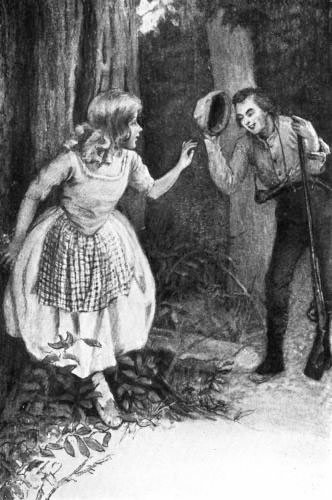 “MY NAME IS ETHAN ALLEN”