Not until the girls reached the beginning of the forest trail, where
their father had pointed out the dim path leading toward Chandler’s
River, did they feel really sure that their father would not follow
them. But as they stopped for a brief rest under the shadow of a
wide-spreading beach tree Rebby said:
“Father could have overtaken us by this time, Danna, if he did not think
it was right for us to go.”
Danna agreed cheerfully, and now both the girls felt a new courage for
this perilous undertaking that was sure to tax their strength to the
utmost. The fact that their father had not hastened after them made them
both realize how important it was that powder and shot should reach the
Machias settlement as soon as possible.
The faint path soon disappeared entirely, and had Rebby been alone she
would not have known which way to turn. But Anna went on confidently,
keeping a sharp outlook for the “blazed” trees of which her father had
told her as marking the way toward Chandler’s River.
They forced their way through dense masses of tangled underbrush, over
fallen trees, and through the shadowy stretches of thickly growing pine.
Now and then they came to some marshy stretch, which Anna would
carefully avoid, for she remembered how often her father had warned her
of the dangers of such places, with their unmarked quicksands that would
quickly swallow the heedless person who ventured upon them.
Notwithstanding Anna’s caution in regard to resting frequently they
pushed on steadily, with but one stop until the sound of water as it
dashed over a rocky bed warned them that they were near Whitneyville
Falls, and half-way to their destination.
The sun was now directly overhead, and as they came out from the shade
of the forest to the open space along the river’s bank Rebby sank down
on the grass with a long breath of relief.
“I never was so tired in all my life,” she declared.
“We will take a good rest and eat our corn-bread,” responded Anna. “I am
sure the remainder of the way will not be so hard, because we can follow
the river up to the settlement.”
Rebby was too tired to reply. She stretched herself out on the warm
grass and closed her eyes.
“Poor Rebby,” thought Danna, looking down at her elder sister and
remembering that Rebecca had never enjoyed woodland tramps, and
realizing that this undertaking was much harder for her sister than for
herself.
“She’s asleep,” Anna whispered to herself, with a little smile of
satisfaction. “Now I will have a fine surprise for her when she awakes,”
and the little girl tiptoed noiselessly back to the edge of the woods,
where she had noticed a quantity of checkerberry leaves. There were many
crimson berries still clinging to the vines, and Anna picked these
carefully, using her cap for a basket, and gathering a quantity of the
young checkerberry leaves. “Rebby is sure to like these,” she thought
happily.
Anna’s sharp glance moved about quickly and finally rested near an old
stump.
“Partridge eggs!” she exclaimed joyfully, and in a moment she was
beside the stump peering down at a circle of small brownish eggs. She
counted them, and before she had whispered “twenty!” a whirring,
scrambling noise close at hand told her that the partridge to whom the
eggs belonged was close at hand.
“You won’t miss a few eggs, Mistress Partridge,” said Anna soberly,
carefully selecting four from the outer edge of the circle, and then
going softly away, that she might not unnecessarily frighten the
woodland bird.
She now carried the cap with great care, as she looked about hoping to
discover some sign of a woodland spring. She kept along at the edge of
the woods, and very soon she heard the sound of a noisy little brook
hurrying along to the river. It was not far up the river from the place
where Rebby was so comfortably asleep, and Anna decided that it would be
just the place for their noonday luncheon.
She set the cap, with all its treasures, carefully under the shade of a
tiny fir tree near the side of the brook and then ran back to awaken
Rebby.
“Dinner is ready!” she called gaily as she ran; and the sound of her
voice made Rebecca sit up quickly, and exclaim:
“The British will shoot down our liberty pole!” For her dreams had been
of soldiers in red coats firing at the liberty pole, while Mr. Worden
Foster, with a big pitchfork, tried to drive them away.
“It is a truly dinner, with eggs,” declared Anna happily, as she led the
way back to the noisy little brook.
The raw eggs tasted good to the hungry girls, and the good corn-bread
and spicy berries and tender checkerberry leaves, with cool water to
drink, made them both feel refreshed and rested, and ready for the
remaining distance to Chandler’s River settlement.
They crossed the little brook and went sturdily on. Now and then a
partridge flew in front of them. Squirrels scolded and chattered among
the tree tops, and once or twice a rabbit leaped out from behind some
stump and ran ahead of them as if daring them to capture him.
Both the girls well knew that there were larger and more dangerous
animals in the forests. There were bears prowling somewhere in those dim
shadowy woods, eating the young buds and leaves, and capturing such
defenseless birds and rabbits as they could. Once or twice they heard
some heavy creature crashing through the underbrush, and looked at each
other with startled eyes; but no harm came near them, and by the middle
of the afternoon they reached the first house of the settlement, and had
told their errand.
“Every man in the settlement is on his way to Machias this very hour,”
declared the friendly woman who had welcomed the girls with amazed
admiration; and, when they told of the scarcity of powder and shot in
Machias, had said that the men of Chandler’s River settlement had
believed Machias well supplied with powder, and had taken but a small
quantity with them.
“One of our fishermen brought news of the British gunboat, and our men
started at once. They went by the lower trail,” explained the woman, as
she stirred the hot porridge she was cooking for the girls’ supper.
“’Tis well your parents had courage to let you come, and you must rest,
and get early to bed. I will go to the powder-house and bring back as
much as you can carry, and I will go with you a part of the way
to-morrow,” she added, and Rebecca and Danna thanked her gratefully.
After they had eaten their porridge they were quite ready to bathe
their tired feet in the hot water their hostess had ready, and go to
bed, although the sun was yet an hour above the horizon.
While the girls slept Mrs. Getchell hurried to the other houses of the
settlement, telling the story of the two courageous girls who had come
through the forest on their patriotic errand.
“’Tis hardly to be believed,” she declared. “These little maids are
brave as soldiers, and they will carry the powder and shot back in good
time to be of use. General Washington shall hear of them, and the
Province of Maine will not forget their names.”
The women and children listened eagerly, and all were anxious for a
sight of the little maids who had shown such courage and hardihood. But
Mrs. Getchell declared that they must not be disturbed, or they would
not be equal to the return journey on the next day.
“But you can all come in the morning and see them start for Machias,”
she said, and with the powder and shot, ten pounds of each, safely
packed, she returned home.
It was broad daylight when Rebecca and Anna awoke. Mrs. Getchell had
breakfast ready for them, and they enjoyed the hot batter cakes and
maple syrup and the rich milk. They had not finished eating when a
murmur of voices outside the door made them look up in surprise.
“’Tis the women and children,” explained Mrs. Getchell smilingly. “They
have come to wish you good fortune.”
Rebecca and Anna hardly knew what to say as the women of the settlement
entered the big kitchen, and with friendly smiles praised the two girls
for their courage and loyalty. Boys and girls of their own age gathered
about the doorway and looked at them admiringly; and when Mrs. Getchell
said it was time to start, and with Rebby and Anna led the way toward
the river, young and old followed them. One of the older women slipped a
slender gold chain around Anna’s neck, saying: “Wear it, dear little
maid, to remind you that there is no sacrifice too great to make for
America’s freedom.” And a little girl of about Rebecca’s age shyly
pressed a little purse into her hand. “’Tis a golden sovereign that my
mother bade me give you,” she said, “and my mother says that always the
children of Maine will remember what you have done for America’s cause.”
Rebby hardly knew what to reply. “If they knew that I set the liberty
tree afloat they would not praise me,” she thought unhappily.
A short distance beyond the settlement the women and children bade the
girls good-bye, with many good wishes for their safe return to Machias.
But Mrs. Getchell was to go on with them for a part of their journey.
As Rebby and Anna turned to wave their hands to these new friends a loud
cheer went up, the boys waving their caps and the girls calling: “Good
luck to the brave little maids from Machias.”
Mrs. Getchell went on with them for several miles, carrying the powder
and shot, and a flat package containing food for their journey. She told
them to follow the river down, as that trail was more traveled and over
smoother ground, although farther to travel than the forest trail; and
kissing the girls good-bye, after they had promised to visit her “as
soon as the English had been sent home,” she turned back toward the
settlement.
Rebby and Danna watched Mrs. Getchell’s stout figure until it was hidden
by the forest, and then, more serious and anxious than at any time
during their perilous undertaking, they picked up the heavy packages
that Mrs. Getchell had placed on the trunk of a fallen tree, and
prepared to continue their journey.
The shot was in two strong bags, while the powder, in order that it
might be kept perfectly dry and safe, was in two tin canisters, each one
carefully sewn up in stout sailcloth. Mrs. Getchell had fastened a stout
strap to each bag of powder and a bag of shot. These straps went over
the girls’ shoulders, and made them easier to carry than in any other
way. It was of course a tough job for each girl to carry ten pounds for
the long distance that lay before them, but they pushed on valiantly.
At first the river trail was fairly smooth, and they made good progress,
but after a few miles they encountered a long stretch of rocky ground.
Here they had to clamber over high ledges, or else go a long distance
out of their way. Before noonday Rebby declared that she could not go
another step, and sat down at the foot of a high mass of rocks over
which they must climb.
“You will have to go on and leave me, Danna,” she said. “My feet won’t
go, they are so tired: and my shoulders ache.”
The day had grown very warm; there was not a breath of air, and Anna
owned that she had never seen so difficult a trail. Mrs. Getchell had
warned them to be sure and keep in sight of the river and it would lead
them straight to Machias. As Anna looked at her sister she began to fear
that they might not be able to reach home before night, and she knew all
the danger and peril that a night spent in that lonely spot would mean.
They had not found a spring or brook since leaving Mrs. Getchell, and
they were both very thirsty as well as tired and hungry.
“We will take a good rest, Rebby, and eat our luncheon. I saw Mrs.
Getchell stirring up a molasses cake while we ate breakfast,” said Anna,
encouragingly, “and she put a tin dipper with the luncheon. See!” and
Anna held up the small cup-shaped dish. “I’ll fetch you a drink from the
river,” she added, and putting her burden of powder and shot on the
ground beside Rebby, she made her way down the steep bank of the river.
The bank was covered by a thick growth of alders, with here and there a
small spruce tree. Anna wondered how she would ever manage to bring a
cup filled with water up that bank; but she kept on, and was soon at the
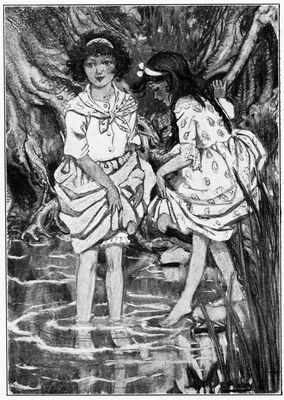
river’s edge. The rushing water was clear and cool, and Anna drank
thirstily. Then she bathed her face and hands, slipped off her moccasins
and stockings and dipped her feet in the cool stream. She felt rested
and refreshed, as with the tin cup filled with water, and covered with a
broad leaf of a water-lily, she made her careful way back to where she
had left her sister.
Rebby had taken off her hat and moccasins. She drank the water eagerly
before saying a word.
“I feel better already,” she said, “and by the time we have eaten our
lunch I know we can start. We must,” she added soberly, “for if we do
not get home before dark Father will surely start after us.”
Danna was opening the package of food and made no response, but she was
wondering if Rebby could really hold out until they reached the
settlement. “I couldn’t leave her alone,” the little girl thought a
little fearfully, wondering if their long journey was, after all, to end
in failure. For she knew that if they did not reach Machias by the early
evening their attempt to aid the settlement would have been in vain.
“Look, Rebby! White bread, spread with butter,” she said, as she
unfastened the package, “and here are slices of chicken, and big squares
of molasses cake,” and Rebby smiled at her little sister’s evident
delight. The two girls thoroughly enjoyed the excellent food, and when
the last crumb had been eaten Rebecca declared herself rested, and ready
to start on.
As she picked up her moccasins she exclaimed: “Oh, Danna!” in so tragic
a tone that her sister looked at her with frightened eyes.
“What is it, Rebby?” she whispered.
“A hole in my moccasin. Look!” and Rebby held up the moccasin, showing a
long narrow slit on the sole. “These awful rocks! I can never walk
without cutting my foot, and then I can’t walk at all.”
“I can fix it,” Danna declared instantly. “Give it to me, Rebby; quick!”
and the elder sister obeyed.
Danna reached into the pocket of her doeskin skirt and drew out her
sharp clasp-knife; very carefully she cut a broad strip from the top of
Rebby’s moccasin, and skilfully fitted it inside over the sole.
“I saw Father do this very thing once,” she said. “It will surely last
until we reach home.”
“I knew I could never make this trip without you, Danna,” Rebby said
gratefully. “You are as wise as a real little Indian girl.”
They went on now at a slower pace, for both girls realized that if Rebby
was again overcome by heat and fatigue that it might be impossible for
her to continue. Even Danna owned to herself that she had never been so
tired. The strap across her shoulders, supporting the heavy load,
pressed heavily and at times became almost unbearable; but not for a
moment did it occur to Danna to relinquish the burden.
They had left the rocky stretch behind them and come out to a
comparatively smooth pasture. The deep forest lay on their right; to the
left was the sloping bank leading to the river. Suddenly Anna stopped
short and grasped Rebby’s arm; a second later a deer leaped directly
across their path and plunged down the bank, followed by a leaping,
panting creature that hardly seemed to touch the ground.
“A bear!” whispered Rebby with frightened eyes.
“Hurry, Rebby,” responded Danna, and the girls, forgetting their tired
feet and lame shoulders, sped silently over the open pasture land.
Danna was the first to speak, but it was in a whisper: “We need not
fear, Rebby. He was after the deer.”
Rebby made no response. More fully than ever the elder girl realized the
peril into which she had led her younger sister. But nevertheless she
whispered to herself that it was the only way: the powder and shot were
all that could save the settlement from the hands of the enemy.
The girls did not stop again to rest, nor did they speak until they
reached the top of a rise of ground from which they could see the first
houses of the settlement. The sun was dropping behind the tall pines on
the western side of the river, and they could see the Polly and
Unity as they lay at anchor in the harbor.
“We are safe now, Danna,” said Rebby thankfully, and the sisters smiled
at each other happily.
“Can’t we leave the powder and shot here?” pleaded Danna, twisting the
uncomfortable strap into an easier position. “Father would come and get
it, and it’s so heavy.”
But Rebby shook her head. “It would not be safe. We must carry it
straight home,” she said; so, with a sigh of endurance, Danna started
on.
They were now in the broad trail that led straight to the little
settlement, and before they reached the first house they saw a tall
figure striding toward them. It was Mr. Weston, and in a moment their
load of powder and shot was swung over his shoulders, Rebby was clasping
one hand and Anna the other, and they were both talking at once, trying
to tell him the story of their journey.
Their mother came running down the path to meet them, and clasped them
in her thankful embrace. The Westons had not told their neighbors of the
girls’ undertaking, thinking it wiser to await their return; but as soon
as Rebby and Anna were safely indoors their father hastened away to tell
the men of the settlement that a supply of powder and shot had been
brought to Machias by his courageous daughters.
CHAPTER XVIII — TRIUMPH — Transcriber’s Notes
The day following the return of Rebecca and Anna Weston from their
perilous and difficult undertaking to bring the much needed powder and
shot to Machias was Sunday, the eleventh of June, 1775.
Very early that morning there was an air of unusual excitement about the
little settlement. It was known that the English officers from the
gunboat would attend service in the meeting-house that morning; and the
Machias men had decided, with the approval of Parson Lyon, to surround
the church and capture them before they had time to carry out their
plans against the settlement.
Rebby and Danna were eating their breakfast when Captain Benjamin Foster
appeared at the kitchen door, saying that he had come to thank them for
their courageous effort to aid the men in defending their rights. As he
entered the room the girls jumped up from their seats at the table and
curtseyed; and as he went on to praise their loyalty and valor, the two
little girls, hand in hand, stood before him with downcast eyes, flushed
and happy at his approving words.
In spite of anxious thoughts as to the result of the conflict between
the men of Machias and the English soldiers, Mrs. Weston was very proud
and happy that morning as she walked to church with Rebecca and Anna
beside her. Many neighbors stopped them to praise the little girls, and
all declared that the people of the settlement would always remember
what they had done.
Even Parson Lyon and his wife were waiting at the church door to speak
to the two little heroines; and Melvina and Luretta felt as if they
shared in their friends’ honors as they walked up the aisle of the
church beside them.
Before the English officers had landed from their boat a number of the
Machias men had quietly hidden their guns in the building; while Captain
Benjamin Foster, with men armed and ready for action, were concealed
among the tall pines close at hand, ready to surround the church and
seize the English officers; and had they taken London Atus into their
confidence this well-prepared scheme might have succeeded.
But London was entirely innocent of any trouble near at hand. From his
place in a side pew he kept a watchful eye upon Melvina, and perhaps
wondered a little at all the attention lavished on the little Weston
girls.
Rebby saw Captain and Mrs. Horton and Lucia, with Captain Jones, enter
the church. Lucia did not look toward the group of girls seated in the
Westons’ pew. The Hortons were no longer trusted by their neighbors, and
after that morning in church they vanished from the community and never
returned.
Rebby’s glance now rested on London. How queerly he looked, she thought
wonderingly. He was leaning sideways peering out of an open window. As
Rebecca watched him he rose to his feet with a loud cry, and before any
restraining word could reach him he had leaped through the open window.
In a moment all was confusion. There were loud cries of “Stop him!” Men
rushed from the church, but the English officers, followed by Captain
Jones and the Hortons, had scrambled through the open windows and were
well on their flight toward their boats, which they reached in safety,
although numerous shots were fired after them. The gunboat at once
turned her guns on the town. Shot after shot echoed across the quiet
waters of the harbor, but the range was too long, and no harm was done.
The women and children huddled in the pews of the church, until Parson
Lyon, musket in hand, came up from the shore to tell them that all was
quiet and to return to their homes.
Melvina and Anna left the church together, and Luretta and Rebby
followed with Mrs. Weston. Melvina said good-bye to her friends very
soberly, and clasped her father’s hand very closely as they walked
toward home.
“Will the English soldiers shoot down our liberty pole, Father?” she
asked.
“The English captain has sent us word that we are to take it down before
sunset, so that he may be saved that trouble,” replied Parson Lyon, his
tone indicating that he considered the English captain’s remark as an
amusing utterance, not to be seriously considered.
“But it will not be taken down,” said Melvina confidently.
“Indeed it will not. And had that scamp London but held his peace
instead of mistaking Captain Foster’s men for an armed enemy marching
upon us, the English would be our prisoners at this moment,” declared
her father. “But that is but postponed,” he added quietly, “and
to-morrow morning Machias men will give the English captain a lesson.”
There were many anxious hearts in the settlement that night, for it had
been determined that in the early dawn of the following morning the men
should seize the sloop Unity, and make the attempt to capture the
English gunboat. Neither Rebecca nor Anna knew of this plan; and, still
tired from their journey, as well as by the excitement that morning at
the church, they were glad to go early to bed and were soon sound
asleep. Mrs. Weston, unable to sleep, waited in the kitchen for her
husband’s return. For Mr. Weston and his neighbors were busy with their
preparations for the coming battle. It was decided that Captain O’Brien
should take command of the sloop, and before the sun rose the next
morning forty Machias men were on board the Unity. Half this number
were armed with broad-axes and pitchforks; the remainder had muskets.
It was just at sunrise when a warning shot from the gunboat reverberated
along the harbor, and Rebecca awakened suddenly. She realized at once
that the conflict had begun. In an instant she was out of bed, slipped
quickly into her clothing, and leaving Danna sound asleep, she sped down
the path and along the trail to the high bluff that commanded a view of
the harbor.
There was a favoring wind and the Unity, with her crew of untrained
men, was now in full chase of a vessel well-armed and equipped. On swept
the sloop, and a sudden volley of musketry from her deck astonished and
confused the enemy. The gunboat swerved, and the bowsprit of the Unity
plunged into her mainsail, holding the two vessels together for a brief
moment.
Rebecca, standing on the bluff, shouted aloud. She was sure that the
moment of triumph for the Machias men was close at hand. But victory was
not so easily achieved; the vessels suddenly parted, and now a storm of
bullets rained upon the Unity.
Captain O’Brien swung the sloop alongside the Margaretta and twenty of
his men armed with pitchforks sprang to the enemy’s deck. A hand-to-hand
conflict ensued. Surprised by the dauntless valor of the Machias men
the English were forced to yield. The English flag was pulled down amid
triumphant shouts of the Americans; the wounded were cared for, and
English officers and crew made prisoners of war.
When Rebecca saw the English flag vanish from the gunboat’s mast and
heard the resounding cheers, she knew that the Americans had conquered
their enemy, and that the liberty tree would stand unchallenged. But she
did not realize that she had been a witness to the first naval exploit
in America after the battle of Lexington.
All the women and children and such men as had been left behind, were
now hurrying toward the wharves. Cheer after cheer rang out across the
harbor as the Unity and the captured gunboat came slowly to their
anchorage.
Mrs. Weston and Anna came hurrying down the path and Rebby ran to meet
them.
“I saw the battle, Mother!” she exclaimed eagerly. “I was on the bluff
and saw it all.” But before Mrs. Weston could respond to this
astonishing statement a boat-load of men from the Unity had landed.
“Your father is safe,” whispered Mrs. Weston, “and now let me see of
what use I can be to the wounded men. Rebby, take Anna back to the house
and stay there until I come.”
The two little girls walked silently back to the house. The battle that
had been so feared was over; the enemy was conquered, and Rebecca and
Anna knew that by their bringing the powder from Chandler’s River they
had helped to win the conflict. But just then they did not think of
that. They could think only of the wounded men, who had been so
carefully brought on shore by their companions.
On the following day the inhabitants, such as were not caring for the
wounded English and American soldiers, gathered at the liberty pole. It
was a quiet and reverent gathering. Several men of the settlement had
been wounded, and two had given their lives for America’s cause. Parson
Lyon gave loving tribute to these heroes, as he offered thanks for the
triumph of loyalty.
And then, before all the people, he praised Rebecca and Anna Weston for
their courage in undertaking the difficult and dangerous journey through
the wilderness to bring aid to the settlement.
“Step forward, Rebecca and Anna Weston,” he said smilingly; and, a
little fearfully, the sisters, hand in hand, left their mother’s side
and approached the liberty pole. Taking each by the hand Parson Lyon
smiled down upon them.
There was a little murmur of approval among the people, and one by one
the older members of the congregation came forward and praised the
little girls.
“It is Rebby who should be praised, not me,” Anna insisted. “It is not
fair for me to be praised.” While Rebecca, in her turn, declared eagerly
that she could never have brought home the powder without Anna’s help.
There were many hard and troublous days ahead for the little settlement,
but their courage did not falter. The valor of the Machias men was
speedily recognized by the Provincial Congress of Massachusetts, who, on
June 26, 1775, passed a resolution extending to them the thanks of the
Congress for their courageous conduct. The news of the brilliant victory
was heralded throughout the land, stimulating the colonists everywhere
to emulate the example of the courageous settlers of Machias.
Rebecca often thought of her former friend, Lucia Horton; but she never
told the story of the night when, misled by Lucia’s plausible story,
she had tried to defeat the loyalty of the settlers by setting their
liberty tree adrift. As she looked up at the tall sapling, the emblem of
the loyalty of the settlement, she was proud indeed that she had been of
use in its protection.
Anna’s gold chain was her greatest treasure. It was shown to every
little girl in the settlement, and each one knew its story. The golden
sovereign given to Rebecca was no less highly prized.
“That sovereign has a value beyond money. It is a medal for valor,” her
father said; and on the year when peace was firmly established between
England and America Rebecca’s golden sovereign was smoothed, and upon it
these words were engraved:
“Presented
to
A Brave Little
Maid of Maine,
For Loyalty,
June, 1775.”
| The Stories In this Series are: |
A LITTLE MAID OF PROVINCE TOWN.
A LITTLE MAID OF MASSACHUSETTS COLONY.
A LITTLE MAID OF NARRAGANSETT BAY.
A LITTLE MAID OF BUNKER HILL.
A LITTLE MAID OF TICONDEROGA.
A LITTLE MAID OF OLD CONNECTICUT.
A LITTLE MAID OF OLD PHILADELPHIA.
A LITTLE MAID OF OLD MAINE.
A LITTLE MAID OF OLD NEW YORK.
A LITTLE MAID OF VIRGINIA. |
- Punctuation has been normalized to contemporary standards.
- Illustrations on pages 77 and 175 were not tipped in as verified in multiple copies of this book.
- On page 66, Rebecca's birthday is inconsistently reported as the 10th of May and the 10th of September.