BUT the boy Chops returned almost immediately. 'Which I told Skeleton,'
he said touching his forelock with his left hand by way of salute, 'to
bring yer a cup o' nice tea, sir, an' breakfus is at eight; an' I
brought ye these, as I doesn't like to see a gent in 'is stockin'-soles
like, an' mayblins ye 'asn't got another pair o' shoes to yer name.
These will fit, sir, I thinks, thinks I.'
Antony had been standing in the back-door of the caravan, looking out
upon the brightness of a beautiful morning and the sunlight on the sea.
As the boy spoke he deposited a pair of huge, ungainly yellow slippers
close beside the young man's dainty feet.
Antony glanced but once at them and stepped back, almost appalled.
'Goodness!' he cried. 'What are these? Take the horrid—er—take them
away, boy.'
'A pair o' slippers wot belongs to the boss, sir. Oh, I'm sure 'e
wouldn't mind yer awearin' of 'em. Boss ain't a bad sort—sometimes.'
'There, there, you're a thoughtful lad, I'm sure; but—er—if you don't
mind, I'll wait for my boots.'
'Gemman wants ter see ye, sir,' said Chops a minute after.
The 'gemman' was the porter from the station, carrying Frank Antony's
bag on his left shoulder. He was smiling and pleasant, quite in keeping
with the sunny morning.
'I thank you, porter. This is ever so kind of you.'
'First train no' due yet, captain, for an hour and mair. Thought ye
might be needin' something oot o' the bag, and so here it is. No, as
sure as death, I'll no' tak' a penny. Weel, captain, as you are so
pressin'. Thanks; and I'll drink your very good health as soon's the
train's oot o' the station.'
The porter had barely gone ere Skeleton hove in sight with a small tray
and the morning cup of tea.
Skeleton was very tall, very thin, and so sloping were his shoulders
that his jacket seemed slipping off him. His poor face was like that of
a snipe, and his eyes the eyes of an owl; two little spots of red were
on his high cheek-bones.
No need to be told that this was the Living Skeleton of Biffins Lee's
'Queerest Show on Earth.'
'Are you very ill, poor fellow?'
'What, me? No, sir, I'm first chop. Could get stout in three weeks.'
'Then, for pity's sake, take a three weeks' holiday and fill yourself
out.'
'What, me? And spoil the whole show, and lose my income?'
His voice was like that of some one speaking up from a vault.
'I know what you 're thinking, sir.'
'Well?'
'I could see your lips moving, and you seemed to be mumbling a morsel of
the Immortal William to yourself. Would you like to have a look at my
wife, sir?'
Antony was sitting on a camp-stool, enjoying his tea.
'No, I don't want to have a look at her. What should I want to have a
look at your wife for?'
'Oh, she would please you all to pieces.—Mary, my sweet little
darling,' he cried, 'flutter this way a moment that our newly come Gipsy
King may feast his optics on thy fairy form.'
And Mary did flutter in sight, and presently stood beside Skeleton,
smiling and comely.
And this fairy must have turned the scale at five-and-twenty stone! But,
so merry her smile and the twinkle in her eyes that, rude though he felt
it to be, Antony could not help bursting into a hearty laugh. And she
kept him company too.
'I'm really not laughing, you know; but—ha! ha! ha! I'——
'And I'm really not laughing,' cried Mary. 'But—he! he! he! I'——
'This isn't your wife, Skeleton? Now, really, is it, you know?'
'In course she is,' cried the Skeleton. 'You don't mean to go for to
think that I'——
'No, no, my good sir, I shouldn't think so for a moment.'
Mary now hit her memento mori of a husband a ringing slap on his bony
back.
'Go and do something,' she exclaimed.
Skeleton was evidently accustomed to obey, and bolted at once to do
something.
Mary looked after him with a satisfied sigh.
'I've taught my hubbie what man's chief duty is: to do what his missus
bids him. Beautiful morning, isn't it, sir,' she added.
Antony made no attempt to deny it.
'You seem very happy here, on the whole,' he remarked.
'Oh, very, sir. But, of course, we all look forward to something
better.'
'Beyond death and the grave, eh?'
'Who said anything about death and the grave? Who's going to talk about
graves on a day like this? No, sir; but hubbie and I, after a time, look
forward to retiring from the show-line and taking a little poultry and
milk farm. Then he'll grow fat and I'll grow lean, till we meet like,
and live happy ever after. But here comes Chops.'
And Mary floated away.
‘’Am an' heggs, sir; grilled salmon, sir; an' 'spatch-cock! An' w'ich
will yer 'ave?'
'What is 'spatch-cock, Master Chops?'
'First ye catches yer little cock, sir, no matter w'ere. Then, w'en 'e's
dead an' trussed, ye divides 'im down the back like a kippered 'erring,
an' does 'im over a clear fire—gipsy fashion.'
'I'll have 'spatch-cock, Chops.'
'An' please, sir, I was to take the boss's compliments, an' would ye
like to 'ave yer meals in the big marquee or in the caravan all by
yerself like?'
'My compliments to your master, and please say I'm too shy yet, and so
I'll feed where I am for a day or two.'
'Right ye be, sir, an' I was to 'tend on ye like. An' Mrs Pendlebury
will make yer bed an' tidy up, an' Lotty Biffins Lee 'erself will put in
the wild-flowers.'
'Capital! But who is Mrs Pendlebury?'
'Why, she as 'as just gone hoff—Skeleton's wife.'
'Oh, I see.'
After breakfast Antony was wondering what he should do with himself when
there came a rat-tat-tat to the little brass knocker, and, without
waiting for a 'come in,' enter Biffins Lee.
'Morning,' he nodded.
'Morning, Mr Lee. Take a seat.'
'That's what I came to do.'
He excavated a huge cigar and was just about to light up, when——
'Hold a moment,' said Antony. 'If ever I become master of this charming
palace-on-wheels I will not permit even a duke to smoke and spoil the
beautiful curtains.'
'Right ye are, Mr Blake. I desists. Now,' he added, 'I want you to do
just as you like in my camp.'
'Thanks, old man! But I should have done what I liked anyhow. Always
have done. Always will.'
One does meet men sometimes, and women too, that one feels it impossible
to take to at first. From Antony Blake's point of view, this Biffins
seemed to be one of these.
In his heart of hearts he trusted he was not wronging the camp-master.
Rudeness young Blake could understand and forgive, but offensiveness
never. He, Antony, could not forget that he was a gentleman and one of
high-caste compared to this showman, and so he was prepared to keep him
in his place. Skeleton was a king compared to Biffins, and Mary was a
queen.
The man began to whistle an operatic air to himself—more of his
ill-manners—and Antony felt he should like to pull him up off his seat
and give him one good kick that should land him on the grass among the
sea-pinks.
But at present the caravan really belonged to Biffins Lee, and one must
think twice before kicking a man out of his own caravan.
'Well, Mr Blake,' said the showman presently, 'whether you buy the
"Gipsy Queen" or not, you'll make yourself at home with us for a week or
so, won't you?'
This was more kindly spoken, and Antony began to think he was behaving
like a cad to Biffins.
'Certainly, certainly, Mr Lee. Excuse my horrid cantankerous bluntness.
But I'll buy the "Gipsy Queen." There! That's settled. Cheque when you
like.'
'Spoken like a man, young fellow,' and Biffins held out his hand to
shake.
Antony could not well refuse this, but the grasp was not a warm one on
either side.
'Morning, Mr Blake. Must be going.'
'Morning, Mr Lee. Pray don't mention it.' And, whistling again to
himself, Biffins tripped down the stair and walked off.
Antony opened all the windows.
'How that man,' he said to himself, 'can be the father of that sweet
lady little Lotty is past all comprehension. However, the caravan is
mine now.—Yes, Mrs Pendlebury, come up and do the rooms. I'll walk by
the shore for half an hour.'
The tide was running in upon the yellow sand, each tiny wavelet wetting
it higher and higher up the beach, its long wavy line showing the tide
was beginning to flow. Scarce a whisper from the sea to-day, and its
oily reflection almost pained the eyes that received it. Out yonder on
this glassy mirror a little boat was bobbing, but so indistinctly that
Antony could not at first tell whether it was on the horizon or nearer
hand. Presently, however, he could see an arm raised and something
flutter. A cry, too, or 'coo-ee!' came across the water, plaintive
almost as that of a sea-bird.
Antony waved his handkerchief in return, and almost immediately noticed
that the boat had changed its direction, and was putting back towards a
point of dark rocks that stood out into the sea about three hundred
yards to the west. Thither he bent his steps, the little craft appearing
suddenly to get very much larger and more distinct, and he could see now
that the single figure who sat therein was Lotty herself.
Next moment he was out on the point-end, the dingy's bows rasping on the
black, weed-covered boulder on which he was standing.
'Good-morning, dear. How well you row! Can I assist you up?'
'Oh no, Mr Blake, I am not landing yet. I have had breakfast ever so
long ago; and, look, I have caught all these fish! Mind you don't step
on them.'
'Am I to come on board, then, and take the oars?'
'You may come on board, but not take the oars. You are just to sit in
the stern-sheets and be good.'
'Be good?'
'Yes, Mr Blake; you must not wriggle about, because the Jenny Wren is
small, and you are big. If you wriggled much you might capsize.'
'I won't wriggle a bit, Lotty. You are so good!'
'Well,' she told him, 'sit right in the centre aft there, and lean
forward, so that your weight may be divided.'
'This way?'
'That way, Mr Blake. Thanks.'
'It isn't a very comfy way to sit, Lotty, and I can't see you without
bending back my head.'
'You needn't see me. Keep your face down if you like, and look at the
fish. Once,' she continued, 'I took Chops out; but he wobbled and
wriggled so much I had to tell him to go; and, of course, he went.'
'What! Jumped into the water?'
'Yes, Mr Blake; he could see I was cross. But Chops is the best swimmer
in the world, so he soon got back to shore.'
'I hope, Lotty, you won't tell me to go.'
'Not if you sit still. That's it. Now, you can raise your head and
shoulders just a little, so that I can see you talking. Speak!'
'I've nothing to say, Lotty.'
'If you don't speak you'll have to sing, and that will be worse for you,
perhaps.'
'Well, child, I'm sure you love the sea.'
'Oh,' she cried enthusiastically, 'I love it! I love it always! I love
all of it! It is always speaking to me and saying things in calm and in
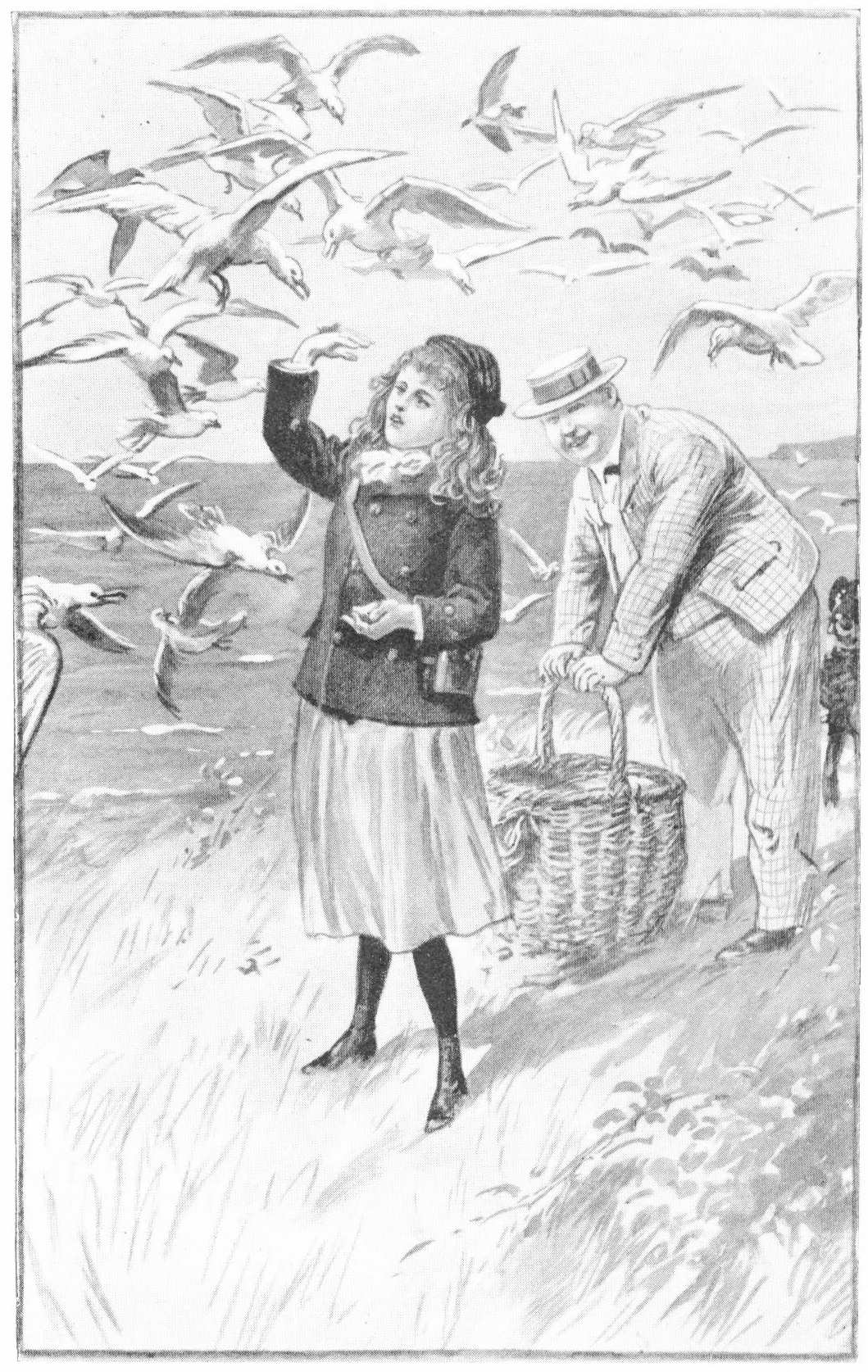
storm. And all the birds too; they are mine, you know. Watch that gull,
Mr Blake, with his clean, clean white wings. He knows me, you know,
because I feed him. He is coming nearer and nearer, tack and half-tack.
You hear his wings now, don't you? Whiff—whiff—whiff they say. Now,
look, but don't move.'
This little gipsy lass lay on her oars for a moment, put half a tiny
milk-biscuit between her red lips, and held up her face. It was a
sweetly pretty picture. Bare arms, feet, and neck; tiny red hands that
held the oars; hair like dark seaweed afloat on her shapely shoulders.
Whiff—whiff—whiff went the clean white wings—it was underneath they
were so radiantly white, and ever and anon turned the bird's graceful
head to gaze red-eyed at Antony. Next moment the biscuit was whisked
from the child's lips, and the bird was sailing for the rocks.
'You have been very good to sit so still, Mr Blake. The birds will know
you now. I may take you out some time again. Sometimes I hoist a
mainsail, but not a gaff. You know what the gaff is, don't you, Mr
Blake?'
'Oh, yes, a hook-thing you land salmon with when you'——
Lotty was laughing merrily. 'I see you've never been much to sea,' she
said. 'If I shipped the rudder and hoisted sail I suppose you couldn't
manage the tiller and the sheet of the main as well. You know in a
little bit of a skiff like this it wouldn't do to make fast the sheet,
else if an extra puff came, then, before you could ease off over she
would go.'
'Precisely, Lotty, precisely.' He didn't know what else to say.
Lotty was silent for a moment. 'You know so little about boats, Mr
Blake,' she said demurely; 'but I know what I can do with you if I take
you for a sail.'
'Yes?'
'I should make you lie down fore and aft right along the keelson, on
your back, head to the bows so as I could see you. But quite still you
know.'
'Certainly, quite still. I understand that.'
'Then I would have you for company, and you would do for ballast as
well.'
'Quite a charming arrangement, Lotty. But I wouldn't see much, would I?'
'You would see me managing the sail and holding the tiller as I tacked
or took her about.'
'But tell me this, Lotty. Aren't you afraid of catching cold without
shoes or stockings?'
'Oh no. Besides, you see, shoes and stockings are properties, and I
mustn't spoil properties with salt-water and fishy slime.'
'No, that would never do, dear.'
'You're not making fun of me, are you?'
'I shouldn't dream of such a thing.'
'Very well. Now you may sing. "Row, brothers, row" will do.'
Luckily, Antony knew this beautiful hymn-like song, and he had a
splendid soprano voice. Lotty joined him, and there were tears in her
eyes. She lay on the oars again to wipe them.
'I think I must have caught a cold,' said this queer little gipsy girl.
'I say, Mr Blake, have you ever been a freak?'
'A freak? Well, not at a show. My father called me a freak once, I
think.'
'I'm a freak now, Mr Blake, and have been for many, many long years.
Heigh-ho!'
'Where does the freak come in, child?'
'Oh, I am a violinist, you know. Father says I used to sit up and play
in my bassinette. Then I'm a freak telling fortunes; but father takes
the money.'
'No doubt.'
'Have you ever been an infant prodigy?'
'No, only an infant prodigal.'
'But when I was only four—ages and ages ago—I used to stand on one leg
on my father's hand when he was galloping round the ring on his Araby
steed. Then he would jerk his arm, and I would spring high in the air,
turn a somersault, and alight in the hand again with my arms turned up
and my eyes looking to heaven. And the people cheered, and I used to be
handed round for the ladies to kiss. I hated that part. Heigh-ho! We've
only a little show now, and if it wasn't for the merman we couldn't
live.'
'Have you a real merman?'
'Father must tell you all about that,' she answered hurriedly. 'But
mind, Mr Blake, you must never ask me anything about the show. You
promise?'
'I promise.'
'Never—never—never?'
'Never—never—never,' said Antony.
She quickly put about the boat. 'You see the flag half-mast, don't you?
Well, that is my recall. It will only be an hour's rehearsal to-day.
Then, if you please, Mr Blake, we'll go for a walk with Wallace.'