E-text prepared by Suzanne Shell, Jane Moss, and the Online Distributed Proofreading Team ( http://www.pgdp.net ) from page images generously made available by Internet Archive/American Libraries ( http://www.archive.org/details/americana ) — A LITTLE BOY LOST
THREE AND THE MOON
BY JACQUES DOREY DECORATED BY BORIS ARTZYBASHEFF
THE KINGDOM AND THE POWER AND THE GLORY
BIBLE STORIES SELECTED AND DECORATED BY JAMES DAUGHERTY
THE RUNAWAY SARDINE TOLD AND ILLUSTRATED BY EMMA L. BROCK
THE THREE MULLA-MULGARS
BY WALTER DE LA MARE ILLUSTRATED BY DOROTHY LATHROP
COME HITHER
BY WALTER DE LA MARE DECORATED BY ALEC BUCKELS
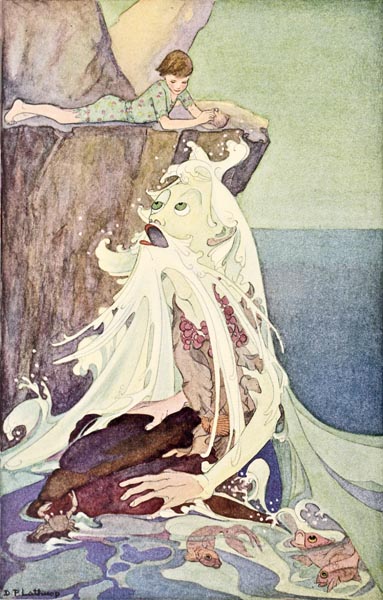
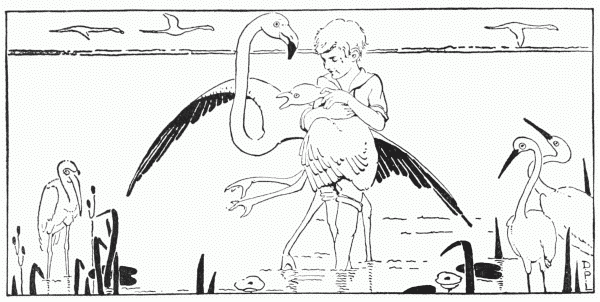
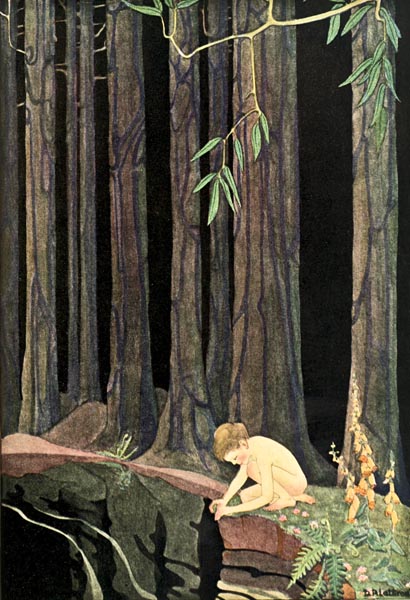
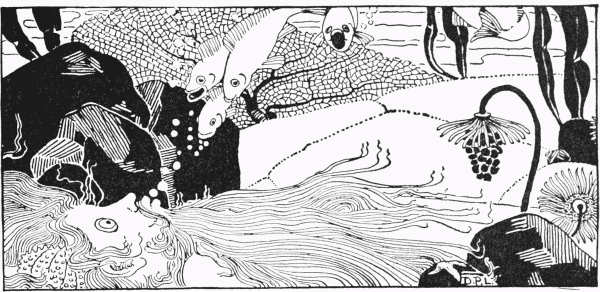
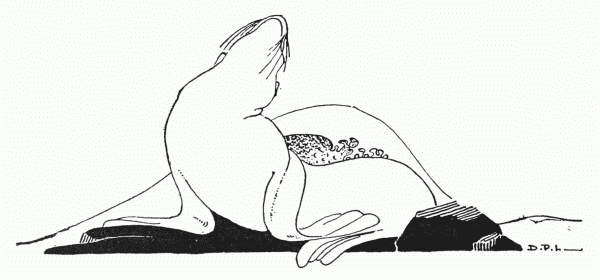
HE IN TURN, LEANING OVER THE ROCK
STARED BACK INTO MARTIN'S FACE WITH
HIS IMMENSE FISHY EYES.
BY W · H · HUDSON
Author of ''Green Mansions,'' Etc.
ILLUSTRATED BY
DOROTHY · P · LATHROP
NEW YORK
ALFRED · A · KNOPF
MCMXXXVI
Copyright 1920 by Alfred A. Knopf, Inc.
All rights reserved. No part of this book may be reproduced
in any form without permission in writing from the publisher,
except by a reviewer who may quote brief passages or reproduce
not more than three illustrations in a review to be printed
in a magazine or newspaper.
Some like to be one thing, some another. There is so
much to be done, so many different things to do,
so many trades! Shepherds, soldiers, sailors, ploughmen,
carters—one could go on all day naming without getting
to the end of them. For myself, boy and man, I have
been many things, working for a living, and sometimes doing
things just for pleasure; but somehow, whatever I did,
it never seemed quite the right and proper thing to do—it never
quite satisfied me. I always wanted to do something else—I
wanted to be a carpenter. It seemed to me that to stand among
wood-shavings and sawdust, making things at a bench with
bright beautiful tools out of nice-smelling wood, was the cleanest,
healthiest, prettiest work that any man can do. Now all
this has nothing, or very little, to do with my story: I only spoke
of it because I had to begin somehow, and it struck me that
would make a start that way. And for another reason, too.
His father was a carpenter. I mean Martin's father—Martin,
the Little Boy Lost. His father's name was John, and
he was a very good man and a good carpenter, and he loved
to do his carpentering better than anything else; in fact
as much as I should have loved it if I had been taught
that trade. He lived in a seaside town, named Southampton,
where there is a great harbour, where he saw
great ships coming and going to and from all parts of the
world. Now, no strong, brave man can live in a place like that,
seeing the ships and often talking to the people who voyaged
in them about the distant lands where they had been, without
wishing to go and see those distant countries for himself.
When it is winter in England, and it rains and rains, and the
east wind blows, and it is grey and cold and the trees are bare,
who does not think how nice it would be to fly away like the
summer birds to some distant country where the sky is always
blue and the sun shines bright and warm every day? And so
it came to pass that John, at last, when he was an old man, sold
his shop, and went abroad. They went to a country many
thousands of miles away—for you must know that Mrs. John
went too; and when the sea voyage ended, they travelled many
days and weeks in a wagon until they came to the place where
they wanted to live; and there, in that lonely country, they
built a house, and made a garden, and planted an orchard. It
was a desert, and they had no neighbours, but they were happy
enough because they had as much land as they wanted, and the
weather was always bright and beautiful; John, too, had his
carpenter's tools to work with when he felt inclined; and, best
of all, they had little Martin to love and think about.
But how about Martin himself? You might think that with
no other child to prattle to and play with or even to see, it was
too lonely a home for him. Not a bit of it! No child could
have been happier. He did not want for company; his play-fellows
were the dogs and cats and chickens, and any creature
in and about the house. But most of all he loved the little shy
creatures that lived in the sunshine among the flowers—the
small birds and butterflies, and little beasties and creeping
things he was accustomed to see outside the gate among the tall,
wild sunflowers. There were acres of these plants, and they
were taller than Martin, and covered with flowers no bigger
than marigolds, and here among the sunflowers he used to
spend most of the day, as happy as possible.
He had other amusements too. Whenever John went to
his carpenter's shop—for the old man still dearly loved his
carpentering—Martin would run in to keep him company.
One thing he loved to do was to pick up the longest wood-shavings,
to wind them round his neck and arms and legs, and then
he would laugh and dance with delight, happy as a young
Indian in his ornaments.
A wood-shaving may seem a poor plaything to a child with
all the toyshops in London to pick and choose from, but it is
really very curious and pretty. Bright and smooth to the
touch, pencilled with delicate wavy lines, while in its spiral
shape it reminds one of winding plants, and tendrils by means
of which vines and creepers support themselves, and flowers
with curling petals, and curled leaves and sea-shells and many
other pretty natural objects.
One day Martin ran into the house looking very flushed and
joyous, holding up his pinafore with something heavy in it.
"What have you got now?" cried his father and mother in a
breath, getting up to peep at his treasure, for Martin was always
fetching in the most curious out-of-the-way things to show them.
"My pretty shaving," said Martin proudly.
When they looked they were amazed and horrified to see a
spotted green snake coiled comfortably up in the pinafore. It
didn't appear to like being looked at by them, for it raised its
curious heart-shaped head and flicked its little red, forked
tongue at them.
His mother gave a great scream, and dropped the jug she
had in her hand upon the floor, while John rushed off to get a
big stick. "Drop it, Martin—drop the wicked snake before
it stings you, and I'll soon kill it."
Martin stared, surprised at the fuss they were making; then,
still tightly holding the ends of his pinafore, he turned and
ran out of the room and away as fast as he could go. Away
went his father after him, stick in hand, and out of the gate
into the thicket of tall wild sunflowers where Martin had vanished
from sight. After hunting about for some time, he found
the little run-away sitting on the ground among the weeds.
"Where's the snake?" he cried.
"Gone!" said Martin, waving his little hand around. "I
let it go and you mustn't look for it."
John picked the child up in his arms and marched back to
the room and popped him down on the floor, then gave him a
good scolding. "It's a mercy the poisonous thing didn't sting
you," he said. "You're a naughty little boy to play with
snakes, because they're dangerous bad things, and you die if
they bite you. And now you must go straight to bed; that's
the only punishment that has any effect on such a harebrained
little butterfly."
Martin, puckering up his face for a cry, crept away to his
little room. It was very hard to have to go to bed in the daytime
when he was not sleepy, and when the birds and butterflies
were out in the sunshine having such a good time.
"It's not a bit of use scolding him—I found that out long
ago," said Mrs. John, shaking her head. "Do you know, John,
I can't help thinking sometimes that he's not our child at all."
"Whose child do you think he is, then?" said John, who had
a cup of water in his hand, for the chase after Martin had made
him hot, and he wanted cooling.
"I don't know—but I once had a very curious dream."
"People often do have curious dreams," said wise old John.
"But this was a very curious one, and I remember saying to
myself, if this doesn't mean something that is going to happen,
then dreams don't count for much."
"No more they do," said John.
"It was in England, just when we were getting ready for
the voyage, and it was autumn, when the birds were leaving
us. I dreamed that I went out alone and walked by the sea,
and stood watching a great number of swallows flying by and
out over the sea—flying away to some distant land. By-and-by
I noticed one bird coming down lower and lower as if he
wanted to alight, and I watched it, and it came down straight
to me, and at last flew right into my bosom. I put my hand
on it, and looking close saw that it was a martin, all pure white
on its throat and breast, and with a white patch on its back.
Then I woke up, and it was because of that dream that I named
our child Martin instead of John as you wished to do. Now,
when I watch swallows flying about, coming and going round
the house, I sometimes think that Martin came to us like that
one in the dream, and that some day he will fly away from us.
When he gets bigger, I mean."
"When he gets littler, you mean," said John with a laugh.
"No, no, he's too big for a swallow—a Michaelmas goose would
be nothing to him for size. But here I am listening to your
silly dreams instead of watering the melons and cucumbers!"
And out he went to his garden, but in a minute he put his head
in at the door and said, "You may go and tell him to get up
if you like. Poor little fellow! Only make him promise not
to go chumming with spotted snakes any more, and not to bring
them into the house, because somehow they disagree with me."
Chapter Two — The Spoonbill and the Cloud
As Martin grew in years and strength, his age being
now about seven, his rambles began to extend beyond
the waste grounds outside of the fenced orchard and
gate. These waste grounds were a wilderness of weeds: here
were the sunflowers that Martin liked best; the wild cock's-comb,
flaunting great crimson tufts; the yellow flowering mustard,
taller than the tallest man; giant thistle, and wild pumpkin
with spotted leaves; the huge hairy fox-gloves with yellow
bells; feathery fennel, and the big grey-green thorn-apples,
with prickly burs full of bright red seed, and long white wax-like
flowers, that bloomed only in the evening. He could
never get high enough on anything to see over the tops of these
plants; but at last he found his way through them, and discovered
on their further side a wide grassy plain with scarcely a
tree on it, stretching away into the blue distance. On this vast
plain he gazed with wonderment and delight. Behind the
orchard and weedy waste the ground sloped down to a stream
of running water, full of tall rushes with dark green polished
stems, and yellow water-lilies. All along the moist banks grew
other flowers that were never seen in the dry ground above—the
blue star, and scarlet and white verbenas; and sweet-peas
of all colours; and the delicate red vinegar flower, and angel's
hair, and the small fragrant lilies called Mary's-tears, and tall
scattered flags, flaunting their yellow blossoms high above the
meadow grass.
Every day Martin ran down to the stream to gather flowers
and shells; for many curious water-snails were found there with
brown purple-striped shells; and he also liked to watch the
small birds that build their nests in the rushes.
There were three of these small birds that did not appear to
know that Martin loved them; for no sooner would he present
himself at the stream than forth they would flutter in a great
state of mind. One, the prettiest, was a tiny, green-backed
little creature, with a crimson crest and a velvet-black band
across a bright yellow breast: this one had a soft, low, complaining
voice, clear as a silver bell. The second was a brisk little
grey and black fellow, with a loud, indignant chuck, and a
broad tail which he incessantly opened and shut, like a Spanish
lady playing with her fan. The third was a shy, mysterious
little brown bird, peering out of the clustering leaves, and making
a sound like the soft ticking of a clock. They were like
three little men, an Italian, a Dutchman, and a Hindoo, talking
together, each in his own language, and yet well able to
understand each other. Martin could not make out what they
said, but suspected that they were talking about him; and
he feared that their remarks were not always of a friendly
nature.
At length he made the discovery that the water of the stream
was perpetually running away. If he dropped a leaf on the
surface it would hasten down stream, and toss about and fret
impatiently against anything that stood in its way, until, making
its escape, it would quickly hurry out of sight. Whither
did this rippling, running water go? He was anxious to find
out. At length, losing all fear and fired with the sight of many
new and pretty things he found while following it, he ran along
the banks until, miles from home, he came to a great lake he
could hardly see across, it was so broad. It was a wonderful
place, full of birds; not small, fretful creatures flitting in and
out of the rushes, but great majestic birds that took very little
notice of him. Far out on the blue surface of the water floated
numbers of wild fowl, and chief among them for grace and
beauty was a swan, pure white with black head and neck and
crimson bill. There also were stately flamingoes, stalking
along knee-deep in the water, which was shallow; and nearer
to the shore were flocks of rose-coloured spoonbills and solitary
big grey herons standing motionless; also groups of white egrets,
and a great multitude of glossy ibises, with dark green and purple
plumage and long sickle-like beaks.
The sight of this water with its beds of rushes and tall flowering
reeds, and its great company of birds, filled Martin with
delight; and other joys were soon to follow. Throwing off his
shoes, he dashed with a shout into the water, frightening a number
of ibises; up they flew, each bird uttering a cry repeated
many times, that sounded just like his old father's laugh when
he laughed loud and heartily. Then what was Martin's amazement
to hear his own shout and this chorus of bird ha, ha, ha's,
repeated by hundreds of voices all over the lake. At first he
thought that the other birds were mocking the ibises; but presently
he shouted again, and again his shouts were repeated by
dozens of voices. This delighted him so much that he spent
the whole day shouting himself hoarse at the waterside.
When he related his wonderful experience at home, and
heard from his father that the sounds he had heard were only
echoes from the beds of rushes, he was not a bit wiser than
before, so that the echoes remained to him a continual wonder
and source of never-failing pleasure.
Every day he would take some noisy instrument to the lake
to startle the echoes; a whistle his father made him served for
a time; after that he marched up and down the banks, rattling
a tin canister with pebbles in it; then he got a large frying-pan
from the kitchen, and beat on it with a stick every day for about
a fortnight. When he grew tired of all these sounds, and began
casting about for some new thing to wake the echoes with, he
all at once remembered his father's gun—just what he wanted,
for it was the noisiest thing in the world. Watching his opportunity,
he got secretly into the room where it was kept loaded,
and succeeded in carrying it out of the house without being
seen; then, full of joyful anticipations, he ran as fast as the
heavy gun would let him to his favourite haunt.
When he arrived at the lake three or four spoonbills—those
beautiful, tall, rose-coloured birds—were standing on the bank,
quietly dozing in the hot sunshine. They did not fly away at
his approach, for the birds were now so accustomed to Martin
and his harmless noises that they took very little notice of him.
He knelt on one knee and pointed the gun at them.
"Now, birdies, you don't know what a fright I'm going to
give you—off you go!" he cried, and pulled the trigger.
The roar of the loud report travelled all over the wide lake,
creating a great commotion among the feathered people, and
they rose up with a general scream into the air.
All this was of no benefit to Martin, the recoil of the gun
having sent him flying over, his heels in the air; and before he
recovered himself the echoes were silent, and all the frightened
birds were settling on the water again. But there, just before
him, lay one of the spoonbills, beating its great rose-coloured
wings against the ground.
Martin ran to it, full of keen distress, but was powerless to
help; its life's blood was fast running away from the shot
wounds it had received in its side, staining the grass with crimson.
Presently it closed its beautiful ruby-coloured eyes and
the quivering wings grew still.
Then Martin sat down on the grass by its side and began to
cry. Oh, that great bird, half as tall as himself, and so many
times more lovely and strong and beautiful in its life—he had
killed it, and it would never fly again! He raised it up very
tenderly in his arms and kissed it—kissed its pale green head
and rosy wings; then out of his arms it tumbled back again on
to the grass.
"Oh, poor bird," he cried suddenly, "open your wings and
fly away!"
But it was dead.
Then Martin got up and stared all round him at the wide
landscape, and everything looked strange and dim and sorrowful.
A shadow passed over the lake, and a murmur came up
out of the rushes that was like a voice saying something that he
could not understand. A great cry of pain rose from his heart
and died to a whisper on his lips; he was awed into silence.
Sinking down upon the grass again, he hid his face against the
rosy-breasted bird and began to sob. How warm the dead bird
felt against his cheek—oh, so warm—and it could not live and
fly about with the others.
At length he sat up and knew the reason of that change that
had come over the earth. A dark cloud had sprung up in the
south-west, far off as yet, and near the horizon; but its fringe
already touched and obscured the low-hanging sun, and a
shadow flew far and vast before it. Over the lake flew that
great shadow: the waters looked cold and still, reflecting as in
a polished glass the motionless rushes, the glassy bank, and
Martin, sitting on it, still clasping in his arms the dead rose-coloured
bird.
Swifter and vaster, following close upon the flying shadow,
came the mighty cloud, changing from black to slaty grey; and
then, as the sun broke forth again under its lower edge, it was
all flushed with a brilliant rose colour. But what a marvellous
thing it was, when the cloud covered a third of the wide heavens,
almost touching the horizon on either side with its wing-like
extremities; Martin, gazing steadily at it, saw that in its form
it was like an immense spoonbill flying through the air! He
would gladly have run away then to hide himself from its sight,
but he dared not stir, for it was now directly above him; so,
lying down on the grass and hiding his face against the dead
bird, he waited in fear and trembling.
He heard the rushing sound of the mighty wings: the wind
they created smote on the waters in a hurricane, so that the reeds
were beaten flat on the surface, and a great cry of terror went
up from all the wild birds. It passed, and when Martin raised
his bowed head and looked again, the sun, just about to touch
the horizon with its great red globe, shone out, shedding a rich
radiance over the earth and water; while far off, on the opposite
side of the heavens, the great cloud-bird was rapidly fading
out of sight.
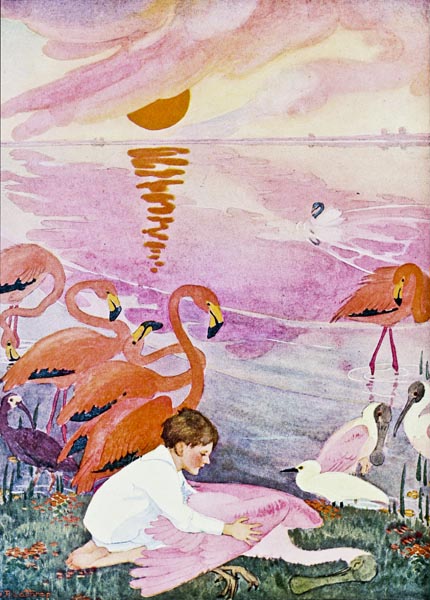
"OH, POOR BIRD," HE CRIED SUDDENLY,
"OPEN YOUR WINGS AND FLY AWAY!"
Chapter Three — Chasing a Flying Figure
After what had happened Martin could never visit
the waterside and look at the great birds wading and
swimming there without a feeling that was like a sudden
coldness in the blood of his veins. The rosy spoonbill he
had killed and cried over and the great bird-cloud that had
frightened him were never forgotten. He grew tired of shouting
to the echoes: he discovered that there were even more wonderful
things than the marsh echoes in the world, and that the
world was bigger than he had thought it. When spring with
its moist verdure and frail, sweet-smelling flowers had gone;
when the great plain began to turn to a rusty-brown colour, and
the dry hard earth was full of cracks, and the days grew longer
and the heat greater, there came an appearance of water that
quivered and glittered and danced before his wondering sight,
and would lead him miles from home every day in his vain
efforts to find out what it was. He could talk of nothing else,
and asked endless questions about it, and they told him that
this strange thing was nothing but the Mirage, but of course
that was not telling him enough, so that he was left to puzzle his
little boy-brains over this new mystery, just as they had puzzled
before over the mystery of the echoes. Now this Mirage was a
glittering whiteness that looked just like water, always shining
and dancing before him and all round him, on the dry level
plain where there was no water. It was never quiet, but perpetually
quivering and running into wavelets that threw up
crests and jets of sprays as from a fountain, and showers of
brilliant drops that flashed like molten silver in the sunlight
before they broke and vanished, only to be renewed again. It
appeared every day when the sun was high and the air hot, and
it was often called The False Water. And false it was, since
it always flew before him as he ran, so that although he often
seemed to be getting nearer to it he could never quite overtake
it. But Martin had a very determined spirit for a small boy,
and although this appearance of water mocked his efforts a hundred
times every day with its vanishing brightness and beauty,
he would not give up the pursuit.
Now one day when there was not a cloud on the great hot
whitey-blue sky, nor a breath of air stirring, when it was all
silent, for not even a grass-hopper creaked in the dead, yellow,
motionless grass, the whole level earth began to shine and
sparkle like a lake of silvery water, as Martin had never seen
it shine before. He had wandered far away from home—never
had he been so far—and still he ran and ran and ran, and still
that whiteness quivered and glittered and flew on before him;
and ever it looked more temptingly near, urging him to fresh
exertions. At length, tired out and overcome with heat, he
sat down to rest, and feeling very much hurt at the way he had
been deceived and led on, he shed one little tear. There was
no mistake about that tear; he felt it running like a small spider
down his cheek, and finally he saw it fall. It fell on to a blade
of yellow grass and ran down the blade, then stopped so as to
gather itself into a little round drop before touching the ground.
Just then, out of the roots of the grass beneath it, crept a tiny
dusty black beetle and began drinking the drop, waving its
little horns up and down like donkey's ears, apparently very
much pleased at its good fortune in finding water and having
a good drink in such a dry, thirsty place. Probably it took the
tear for a drop of rain just fallen out of the sky.
"You are a funny little thing!" exclaimed Martin, feeling
now less like crying than laughing.
The wee beetle, satisfied and refreshed, climbed up the grass-blade,
and when it reached the tip lifted its dusty black wing-cases
just enough to throw out a pair of fine gauzy wings that
had been neatly folded up beneath them, and flew away.
Martin, following its flight, had his eyes quite dazzled by
the intense glitter of the False Water, which now seemed to
be only a few yards from him: but the strangest thing was that
in it there appeared a form—a bright beautiful form that vanished
when he gazed steadily at it. Again he got up and began
running harder than ever after the flying mocking Mirage, and
every time he stopped he fancied that he could see the figure
again, sometimes like a pale blue shadow on the brightness;
sometimes shining with its own excessive light, and sometimes
only seen in outline, like a figure graved on glass, and always
vanishing when looked at steadily. Perhaps that white water-like
glitter of the Mirage was like a looking-glass, and he was
only chasing his own reflection. I cannot say, but there it was,
always before him, a face as of a beautiful boy, with tumbled
hair and laughing lips, its figure clothed in a fluttering dress of
lights and shadows. It also seemed to beckon to him with its
hand, and encourage him to run on after it with its bright merry
glances.
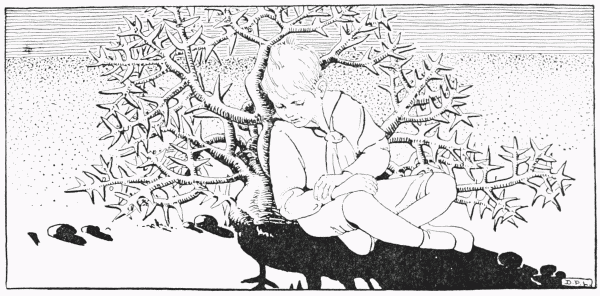
At length when it was past the hour of noon, Martin sat
down under a small bush that gave just shade enough to cover
him and none to spare. It was only a little spot of shade like
an island in a sea of heat and brightness. He was too hot and
tired to run more, too tired even to keep his eyes open, and so,
propping his back against the stem of the small bush, he closed
his tired hot eyes.
Chapter Four — Martin is Found by a Deaf Old Man
Martin kept his eyes shut for only about a minute,
as he thought; but he must have been asleep some
time, for when he opened them the False Water
had vanished, and the sun, looking very large and crimson, was
just about to set. He started up, feeling very thirsty and
hungry and bewildered; for he was far, far from home, and lost
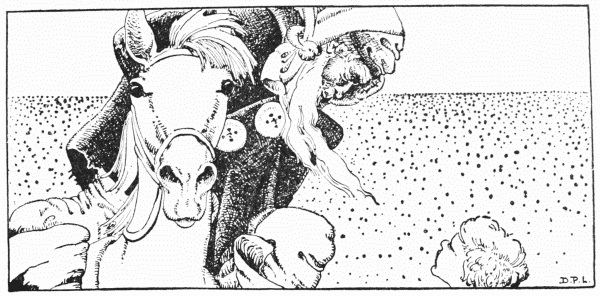
on the great plain. Presently he spied a man coming towards
him on horseback. A very funny-looking old man he proved
to be, with a face wrinkled and tanned by sun and wind, until
it resembled a piece of ancient shoe-leather left lying for years
on some neglected spot of ground. A Brazil nut is not darker
nor more wrinkled than was the old man's face. His long
matted beard and hair had once been white, but the sun out
of doors and the smoke in his smoky hut had given them a
yellowish tinge, so that they looked like dry dead grass. He
wore big jack-boots, patched all over, and full of cracks and
holes; and a great pea-jacket, rusty and ragged, fastened with
horn buttons big as saucers. His old brimless hat looked like
a dilapidated tea-cosy on his head, and to prevent it from being
carried off by the wind it was kept on with an old flannel shirt-sleeve
tied under his chin. His saddle, too, like his clothes,
was old and full of rents, with wisps of hair and straw-stuffing
sticking out in various places, and his feet were thrust into a
pair of big stirrups made of pieces of wood and rusty iron tied
together with string and wire.
"Boy, what may you being a doing of here?" bawled this old
man at the top of his voice: for he was as deaf as a post, and
like a good many deaf people thought it necessary to speak
very loud to make himself heard.
"Playing," answered Martin innocently. But he could not
make the old man hear until he stood up on tip-toe and shouted
out his answer as loud as he could.
"Playing," exclaimed the old man. "Well, I never in all my
life! When there ain't a house 'cepting my own for leagues
and leagues, and he says he's playing! What may you be
now?" he shouted again.
"A little boy," screamed Martin.
"I knowed that afore I axed," said the other. Then he
slapped his legs and held up his hand with astonishment, and
at last began to chuckle. "Will you come home along o' me?"
he shouted.
"Will you give me something to eat?" asked Martin in
return.
"Haw, haw, haw," guffawed the old fellow. It was a tremendous
laugh, so loud and hollow, it astonished and almost
frightened Martin to hear it. "Well I never!" he said. "He
ain't no fool, neither. Now, old Jacob, just you take your time
and think a bit afore you makes your answer to that."
This curious old man, whose name was Jacob, had lived so
long by himself that he always thought out loud—louder than
other people talk: for, being deaf, he could not hear himself,
and never had a suspicion that he could be heard by others.
"He's lost, that's what he is," continued old Jacob aloud to
himself. "And what's more, he's been and gone and forgot
all about his own home, and all he wants is summat to eat.
I'll take him and keep him, that's what I'll do: for he's a stray
lamb, and belongs to him that finds him, like any other lamb I
finds. I'll make him believe I'm his old dad; for he's little and
will believe most anything you tells him. I'll learn him to
do things about the house—to boil the kettle, and cook the
wittels, and gather the firewood, and mend the clothes, and do
the washing, and draw the water, and milk the cow, and dig
the potatoes, and mind the sheep and—and—and that's what
I'll learn him. Then, Jacob, you can sit down and smoke your
pipe, 'cos you'll have some one to do your work for you."
Martin stood quietly listening to all this, not quite understanding
the old man's kind intentions. Then old Jacob,
promising to give him something to eat, pulled him up on to
his horse, and started home at a gallop.
Soon they arrived at a mud hovel, thatched with rushes, the
roof sloping down so low that one could almost step on to it;
it was surrounded with a ditch, and had a potato patch and a
sheep enclosure; for old Jacob was a shepherd, and had a flock
of sheep. There were several big dogs, and when Martin got
down from the horse, they began jumping round him, barking
with delight, as if they knew him, half-smothering him with
their rough caresses. Jacob led him into the hut, which looked
extremely dirty and neglected, and had only one room. In the
corners against walls were piles of sheep-skins that had a strong
and rather unpleasant smell: the thatch above was covered with
dusty cobwebs, hanging like old rags, and the clay floor was
littered with bones, sticks, and other rubbish. The only nice
thing to see was a tea-kettle singing and steaming away merrily
on the fire in the grate. Old Jacob set about preparing the
evening meal; and soon they sat down at a small deal table to
a supper of cold mutton and potatoes, and tea which did not
taste very nice, as it was sweetened with moist black sugar.
Martin was too hungry to turn up his nose at anything, and
while he ate and drank the old man chuckled and talked aloud
to himself about his good fortune in finding the little boy to
do his work for him. After supper he cleared the table, and
put two mugs of tea on it, and then got out his clay pipe and
tobacco.
"Now, little boy," he cried, "let's have a jolly evening together.
Your very good health, little boy," and here he jingled
his mug against Martin's, and took a sip of tea.
"Would you like to hear a song, little boy?" he said, after
finishing his pipe.
"No," said Martin, who was getting sleepy; but Jacob took
no to mean yes, and so he stood up on his legs and sang this
song:—
"My name is Jacob, that's my name; And tho' I'm old, the old man's game— The air it is so good, d'ye see: And on the plain my flock I keep, And sing all day to please my sheep, And never lose them like Bo-Peep, Becos the ways of them are known to me.
"When winter comes and winds do blow, Unto my sheep so good I go— I'm always good to them, d'ye see— Ho, sheep, say I, both ram, both ewe, I've sung you songs all summer through, Now lend to me a skin or two, To keep the cold and wet from out o' me."
This song, accompanied with loud raps on the table, was
bellowed forth in a dreadfully discordant voice; and very soon
all the dogs rushed into the room and began to bark and howl
most dismally, which seemed to please the old man greatly,
for to him it was a kind of applause. But the noise was too
much for Martin; so he stopped up his ears, and only removed
his fingers from them when the performance was over. After
the song the old man offered to dance, for he had not yet had
amusement enough.
"Boy, can you play on this?" he shouted, holding up a frying-pan
and a big stick to beat it with.
Of course Martin could play on that instrument: he had
often enough played on one like it to startle the echoes on the
lake, in other days. And so, when he had been lifted on to
the table, he took the frying-pan by the handle, and began vigorously
beating on it with the stick. He did not mind the
noise now since he was helping to make it. Meanwhile old
Jacob began flinging his arms and legs about in all directions,
looking like a scarecrow made to tumble about by means of
springs and wires. He pounded the clay floor with his ponderous
old boots until the room was filled with a cloud of dust;
then in his excitement he kicked over chairs, pots, kettle, and
whatever came in his way, while he kept on revolving round the
table in a kind of crazy fandango. Martin thought it fine fun,
and screamed with laughter, and beat his gong louder than
ever; then to make matters worse old Jacob at intervals uttered
whoops and yells, which the dogs answered with long howls
from the door, until the din was something tremendous.
At length they both grew tired, and then after resting and
sipping some more cold tea, prepared to go to bed. Some
sheep-skins were piled up in a corner for Martin to sleep on,
and old Jacob covered him with a horse-rug, and tucked him
in very carefully. Then the kind old man withdrew to his
own bed on the opposite side of the room.
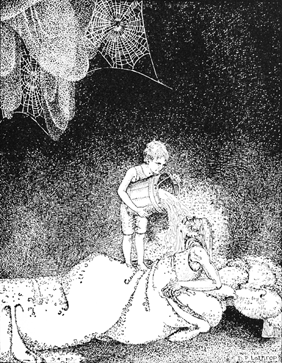
GROPING HIS WAY TO THE BUCKET OF
COLD WATER—HE MANAGED TO RAISE IT
UP IN HIS ARMS, AND POURED IT OVER
THE SLEEPER.
About midnight Martin was wakened by loud horrible noises
in the room, and started up on bed trembling with fear. The
sounds came from the old man's nose, and resembled a succession
of blasts on a ram's horn, which, on account of its roughness
and twisted shape, makes a very bad trumpet. As soon as
Martin discovered the cause of the noise he crept out of bed and
tried to waken the old snorer by shouting to him, tugging at
his arms and legs, and finally pulling his beard. He refused
to wake. Then Martin had a bright idea, and groping his way
to the bucket of cold water standing beside the fire-place, he
managed to raise it up in his arms, and poured it over the
sleeper.
The snoring changed to cries of loud choking snorts, then
ceased. Martin, well pleased at the success of his experiment,
was about to return to his bed when old Jacob struggled up to
a sitting posture.
"Hullo, wake up, little boy!" he shouted. "My bed's all
full o' water—goodness knows where it comes from."
"I poured it over you to wake you up. Don't you know
you were making a noise with your nose?" cried Martin at the
top of his voice.
"You—you—you throwed it over me! You—O you most
wicked little villain you! You throwed it over me did you!"
and here he poured out such a torrent of abusive words that
Martin was horrified and cried out, "O what a naughty, wicked,
bad old man you are!"
It was too dark for old Jacob to see him, but he knew his way
about the room, and taking up the wet rug that served him for
covering he groped his way to Martin's bed and began pounding
it with the rug, thinking the naughty little boy was there.
"You little rascal you—I hope you like that!—and that!—and
that!" he shouted, pounding away. "I'll learn you to
throw water over your poor old dad! And such a—a affectionate
father as I've been too, giving him sich nice wittles—and—and
singing and dancing to him to teach him music. Perhaps
you'd like a little more, you takes it so quietly? Well, then,
take that!—and that!—and that! Why, how's this—the
young warmint ain't here arter all! Well, I'm blowed if that
don't beat everythink! What did he go and chuck that water
over me for? What a walloping I'll give him in the morning
when it's light! and now, boy, you may go and sleep on my
bed, 'cos it's wet, d'ye see; and I'll sleep on yourn, 'cos it's dry."
Then he got into Martin's bed, and muttered and grumbled
himself to sleep. Martin came out from under the table, and
after dressing himself with great secrecy crept to the door to
make his escape. It was locked and the key taken away. But
he was determined to make his escape somehow, and not wait
to be whipped; so, by and by, he drew the little deal table close
against the wall, and getting on to it began picking the rushes
one by one out of the lower part of the thatch. After working
for half-an-hour, like a mouse eating his way out of a soft
wooden box, he began to see the light coming through the hole,
and in another half hour it was large enough for him to creep
through. When he had got out, he slipped down to the ground,
where the dogs were lying. They seemed very glad to see him,
and began pressing round to lick his face; but he pushed them
off, and ran away over the plain as fast as he could. The stars
were shining, but it was very dark and silent; only in moist
places, where the grass grew tall, he heard the crickets strumming
sadly on their little harps.
At length, tired with running, he coiled himself in a large
tussock of dry grass and went to sleep, just as if he had been accustomed
to sleep out of doors all his life.
Chapter Five — The People of the Mirage
In that remote land where Martin was born, with its bright
warm climate and rich soil, no person need go very long
hungry—not even a small boy alone and lost on that great
grassy plain. For there is a little useful plant in that place,
with small leaves like clover leaves and a pretty yellow flower,
which bears a wholesome sweet root, about as big as a pigeon's
egg and of a pearly white colour. It is so well known to the
settlers' children in that desert country that they are always
wandering off to the plain to look for it, just as the children in
a town are always running off with their halfpence to the sweet-stuff
shop. This pretty white root is watery, so that it satisfies
both hunger and thirst at the same time. Now when Martin
woke next morning, he found a great many of the little three-leaved
plants growing close to the spot where he had slept, and
they supplied him with a nice sweet breakfast. After he had
eaten enough and had amused himself by rolling over and over
several times on the grass, he started once more on his travels,
going towards the sunrise as fast as he could run. He could
run well for a small boy, but he got tired at last and sat down
to rest. Then he jumped up and went on again at a trot: this
pace he kept up very steadily, only pausing from time to time
to watch a flock of small white birds that followed him all the
morning out of curiosity. At length he began to feel so hot
and tired that he could only walk. Still he kept on; he could
see no flowers nor anything pretty in that place—why should
he stay in it? He would go on, and on, and on, in spite of the
heat, until he came to something. But it grew hotter as the
day advanced, and the ground about him more dry and barren
and desolate, until at last he came to ground where there was
scarcely a blade of grass: it was a great, barren, level plain, covered
with a slight crust of salt crystals that glittered in the sun
so brightly that it dazzled and pained his eyesight. Here were
no sweet watery roots for refreshment, and no berries; nor could
Martin find a bush to give him a little shade and protection
from the burning noonday sun. He saw one large dark object
in the distance, and mistaking it for a bush covered with thick
foliage he ran towards it; but suddenly it started up, when he
was near, and waving its great grey and white wings like sails,
fled across the plain. It was an ostrich!
Now this hot, shadeless plain seemed to be the very home and
dwelling-place of the False Water. It sparkled and danced
all round him so close that there only appeared to be a small
space of dry ground for him to walk on; only he was always
exactly in the centre of the dry spot; for as he advanced, the
glittering whiteness, that looked so like shiny water, flew mockingly
before his steps. But he hoped to get to it at last, as
every time he flagged in the chase the mysterious figure of the
day before appeared again to lure him still further on. At
length, unable to move another step, Martin sat right down
on the bare ground: it was like sitting on the floor of a heated
oven, but there was no help for it, he was so tired. The air
was so thick and heavy that he could hardly breathe, even with
his mouth wide open like a little gasping bird; and the sky
looked like metal, heated to a white heat, and so low down as
to make him fancy that if he were to throw up his hands he
would touch it and burn his fingers.
And the Mirage—oh, how it glistened and quivered here
where he had sat down, half blinding him with its brightness!
Now that he could no longer run after it, nor even walk, it
came to him, breaking round and over him in a thousand fantastic
shapes, filling the air with a million white flakes that
whirled about as if driven by a furious wind, although not a
breath was stirring. They looked like whitest snow-flakes, yet
stung his cheeks like sparks of fire. Not only did he see and
feel, he could even hear it now: his ears were filled with a humming
sound, growing louder and louder every minute, like the
noise made by a large colony of bumble-bees when a person
carelessly treads on their nest, and they are angered and thrown
into a great commotion and swarm out to defend their home.
Very soon out of this confused murmur louder, clearer sounds
began to rise; and these could be distinguished as the notes of
numberless musical instruments, and voices of people singing,
talking, and laughing. Then, all at once, there appeared
running and skipping over the ground towards him a great
company of girls—scores and hundreds of them scattered over
the plain, exceeding in loveliness all lovely things that he had
ever beheld. Their faces were whiter than lilies, and their
loose, fluttering hair looked like a mist of pale shining gold;
and their skirts, that rustled as they ran, were also shining like
the wings of dragon-flies, and were touched with brown reflections
and changing, beautiful tints, such as are seen on soap-bubbles.
Each of them carried a silver pitcher, and as they ran
and skipped along they dipped their fingers in and sprinkled
the desert with water. The bright drops they scattered fell
all around in a grateful shower, and flew up again from the
heated earth in the form of a white mist touched with rainbow
colours, filling the air with a refreshing coolness.
At Martin's side there grew a small plant, its grey-green
leaves lying wilted on the ground, and one of the girls paused
to water it, and as she sprinkled the drops on it she sang:—
"Little weed, little weed, In such need,Must you pain, ask in vain, Die for rain, Never bloom, never seed, Little weed? O, no, no, you shall not die, From the sky With my pitcher down I fly. Drink the rain, grow again, Bloom and seed, Little weed."
Martin held up his hot little hands to catch some of the falling
drops; then the girl, raising her pitcher, poured a stream of
cool water right into his face, and laughing at what she had
done, went away with a hop, skip, and jump after her companions.
The girls with pitchers had all gone, and were succeeded by
troops of boys, just as beautiful, many of them singing and
some playing on wind and stringed instruments; and some
were running, others quietly walking, and still others riding on
various animals—ostriches, sheep, goats, fawns, and small
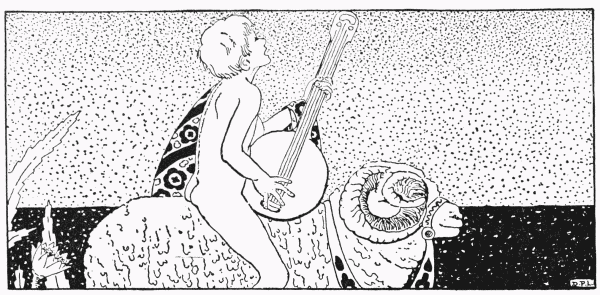
donkeys, all pure white. One boy was riding a ram, and as
he came by, strum-strumming on a little silver-stringed banjo,
he sang a very curious song, which made Martin prick up his
ears to listen. It was about a speckled snake that lived far
away on a piece of waste ground; how day after day he sought
for his lost playmate—the little boy that had left him; how he
glided this way and that on his smooth, bright belly, winding
in and out among the tall wild sunflowers; how he listened for
the dear footsteps—listened with his green leaf-shaped, little
head raised high among the leaves. But his playmate was
far away and came no more to feed him from his basin of bread
and milk, and caress his cold, smooth coils with his warm, soft,
little hand.
Close after the boy on the ram marched four other little boys
on foot, holding up long silver trumpets in readiness to blow.
One of them stopped, and putting his trumpet down close to
Martin's ear, puffed out his little, round cheeks, and blew a
blast that made him jump. Laughing at the joke, they passed
on, and were succeeded by others and still others, singing,
shouting, twanging their instruments, and some of them stopping
for a few moments to look at Martin or play some pretty
little trick on him.
But now all at once Martin ceased to listen or even look at
them, for something new and different was coming, something
strange which made him curious and afraid at the same time.
It was a sound, very deep and solemn, of men's voices singing
together a song that was like a dirge and coming nearer and
nearer, and it was like the coming of a storm with wind and
rain and thunder. Soon he could see them marching through
the great crowd of people—old men moving in a slow procession,
and they had pale dark faces and their hair and long
beards were whiter than snow, and their long flowing robes
were of the silvery dark colour of a rain-cloud. Then he saw
that the leaders of the procession were followed by others who
carried a couch of mother-o'-pearl resting on their shoulders,
that on the couch reposed a pale sweet-looking youth dressed
in silk clothes of a delicate rose-colour. He also wore crimson
shoes, and a tight-fitting apple-green skull cap, which
made his head look very small. His eyes were ruby-red, and
he had a long slender nose like a snipe's bill, only broad and
flattened at the tip. And then Martin saw that he was
wounded, for he had one white hand pressed to his side and it
was stained with blood, and drops of blood were trickling
through his fingers.
He was troubled at the sight, and he gazed at him, and
listened to the words of that solemn song the old men were
singing but could not understand them. Not because he was
a child, for no person, however aged and wise and filled with
all learning he might be, could have understood that strange
song about Wonderful Life and Wonderful Death. Yet there
was something in it too which any one who heard it, man or
child, could understand; and he understood it, and it went
into his heart to make it so heavy and sad that he could have
put his little face down on the ground and cried as he had never
cried before. But he did not put his face down and cry, for
just then the wounded youth looked down on him as they
carried him past and smiled a very sweet smile: then Martin
felt that he loved him above all the bright and beautiful beings
that had passed before him.
"THE QUEEN WISHES TO SPEAK TO
YOU—STAND UP, LITTLE BOY."
Then, when he was gone from sight; when the solemn sound
of the voices began to grow fainter in the distance like the
sound of a storm when it passes away, his heaviness of heart
and sorrow left him, and he began to listen to the shouts and
cries and clanging of noisy instruments of music swiftly coming
nearer and nearer; and then all around and past him came
a vast company of youths and maidens singing and playing
and shouting and dancing as they moved onwards. They were
the most beautiful beings he had ever seen in their shining
dresses, some all in white, others in amber-colour, others in sky-blue,
and some in still other lovely colours. "The Queen! the
Queen!" they were shouting. "Stand up, little boy, and bow
to the Queen."
"The Queen! Kneel to the Queen, little boy," cried others.
Then many others in the company began crying out together.
"The Queen! lie down flat on the ground, little boy."
"The Queen! Shut your eyes and open your mouth, little
boy."
"The Queen! Run away as fast as you can, little boy."
"Stand on your head to the Queen, little boy!"
"Crow like a cock and bark like a dog, little boy!"
Trying to obey all these conflicting commands at one and the
same time, poor Martin made strange noises and tumbled about
this way and that and set them all laughing at him.
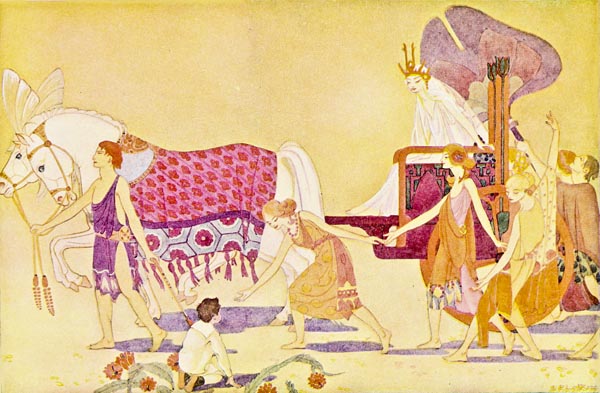
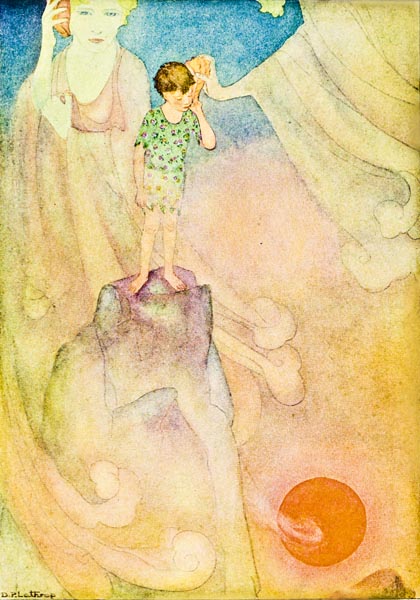
"The Queen wishes to speak to you—stand up, little boy,"
said one of the brightest beings, touching Martin on the cheek.
There before him, surrounded by all that beautiful company,
stood the horses that drew her—great milk-white horses
impatiently pawing the dusty ground with their hoofs and
proudly champing their gold bridles, tossing the white froth
from their mouths. But when he lifted his eyes timidly to
the majestic being seated in her chariot before him he was dazzled
and overcome with the sight. Her face had a brightness
that was like that of the Mirage at noon, and the eyes that
gazed on him were like two great opals; she appeared clothed
in a white shining mist, and her hair spread wide on her shoulders
looked white—whiter than a lamb's fleece, and powdered
with fine gold that sparkled and quivered and ran through it
like sparks of yellow fire: and on her head she wore a crown
that was like a diamond seen by candle-light, or like a dew-drop
in the sun, and every moment it changed its colour, and
by turns was a red flame, then a green, then a yellow, then a
violet.
"Child, you have followed me far," said the Queen, "and
now you are rewarded, for you have looked on my face and I
have refreshed you; and the Sun, my father, will never more
hurt you for my sake."
"He is a naughty boy and unworthy of your goodness,"
spoke one of the bright beings standing near. "He killed the
spoonbill."
"He cried for the poor slain bird," replied the Queen: "He
will never remember it without grief, and I forgive him."
"He went away from his home and thinks no more of his
poor old father and mother, who cry for him and are seeking
for him on the great plain," continued the voice.
"I forgive him," returned the Queen. "He is such a little
wanderer—he could not always rest at home."
"He emptied a bucketful of water over good old Jacob, who
found him and took him in and fed him, and sang to him, and
danced to him, and was a second father to him."
At that there was great laughter; even the Queen laughed
when she said that she forgave him that too. And Martin
when he remembered old Jacob, and saw that they only made
a joke of it, laughed with them. But the accusing voice still
went on:
"And when the good old shepherd went to sleep a second
time, then the naughty little boy climbed on the table and
picked a hole in the thatch and got out and ran away."
Another burst of laughter followed; then a youth in a shining,
violet-coloured dress suddenly began twanging on his instrument
and wildly capering about in imitation of old Jacob's
dancing, and while he played and danced he sang—
"Ho, sheep whose ways are known to me, Both ewe and lamb And horned ram Wherever can that Martin be? All day for him I ride Over the plains so wide, And on my horn I blow, Just to let him know That Jacob's on his track,And soon will have him back, I look and look all day, And when I'm home I say: He isn't like a mole To dig himself a hole; Them little legs he's got They can't go far, trot, trot, They can't go far, run run, Oh no, it is his fun; I'm sure he's near; He must be here A-skulking round the house Just like a little mouse. I'll get a mouse-trap in a minute, And bait with cheese that's smelly To bring him helter-skelly— That little empty belly, And then I'll have him in it. Where have he hid, That little kid, That good old Jacob was so kind to? And when a rest I am inclined to Who'll boil the cow and dig the kittles And milk the stockings, darn the wittles? Who mugs of tea Will drink with me? When round and round I pound the ground With boots of cowhide, boots of thunder, Who'll help to make the noise, I wonder? Who'll join the row Of loud bow-wow With din of tin and copper clatter With bang and whang of pan and platter? O when I find Him fast I'll bind And upside down I'll hold him;And when a-home I gallop late-o I'll give him no more cold potato, But cuff him, box him, bang him, scold him, And drench him with a pail of water, And fill his mouth with wool and mortar, Because he don't do things he oughter, But does the things he ought not to, Then tell me true, Both ram and ewe, Wherever have that Martin got to? For Jacob's old and deaf and dim And never knowed the ways of him."
"I forgive him everything," said the Queen very graciously,
when the song ended, at which they all laughed. "And now
let two of you speak and each bestow a gift on him. He deserves
to be rewarded for running so far after us."
Then one of those bright beautiful beings came forward and
cried out: "He loves wandering; let him have his will and be
a wanderer all his days on the face of the earth."
"Well spoken!" cried the Queen.
"A wanderer he is to be," said another: "let the sea do him
no harm—that is my gift."
"So be it," said the Queen; "and to your two gifts I shall add
a third. Let all men love him. Go now, Martin, you are well
equipped, and satisfy your heart with the sight of all the
strange and beautiful things the world contains."
"Kneel and thank the Queen for her gifts," said a voice to
Martin.
He dropped on to his knees, but could speak no word; when
he raised his eyes again the whole glorious company had vanished.
The air was cool and fragrant, the earth moist as if a shower
had just fallen. He got up and slowly walked onward until
near sunset, thinking of nothing but the beautiful people of
the Mirage. He had left the barren salt plain behind by now;
the earth was covered with yellow grass, and he found and ate
some sweet roots and berries. Then feeling very tired, he
stretched himself out on his back and began to wonder if what
he had seen was nothing but a dream. Yes, it was surely a
dream, but then—in his life dreams and realities were so mixed—how
was he always to know one from the other? Which
was most strange, the Mirage that glittered and quivered round
him and flew mockingly before him, or the people of the Mirage
he had seen?
If you are lying quite still with your eyes shut and some one
comes softly up and stands over you, somehow you know it,
and open your eyes to see who it is. Just in that way Martin
knew that some one had come and was standing over him.
Still he kept his eyes shut, feeling sure that it was one of those
bright and beautiful beings he had lately seen, perhaps the
Queen herself, and that the sight of her shining countenance
would dazzle his eyes. Then all at once he thought that it
might be old Jacob, who would punish him for running away.
He opened his eyes very quickly then. What do you think he
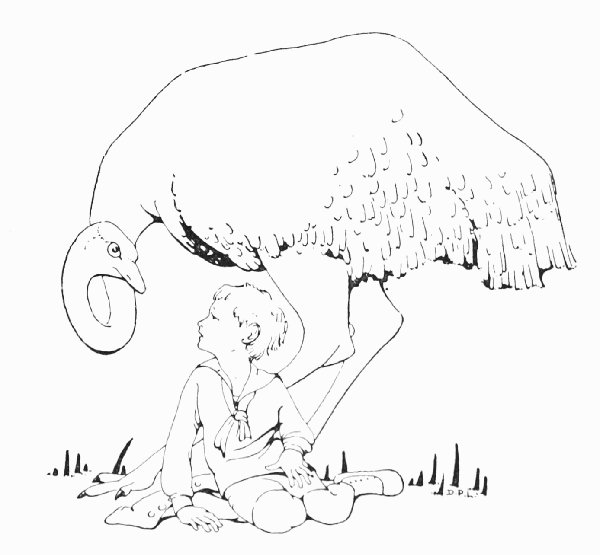
saw? An ostrich—that same big ostrich he had seen and startled
early in the day! It was standing over him, staring down
with its great vacant eyes. Gradually its head came lower
and lower down, until at last it made a sudden peck at a metal
button on his jacket, and gave such a vigorous tug at it that
Martin was almost lifted off the ground. He screamed and
gave a jump; but it was nothing to the jump the ostrich gave
when he discovered that the button belonged to a living boy.
He jumped six feet high into the air and came down with a
great flop; then feeling rather ashamed of himself for being
frightened at such an insignificant thing as Martin, he stalked
majestically away, glancing back, first over one shoulder then
the other, and kicking up his heels behind him in a somewhat
disdainful manner.
Martin laughed, and in the middle of his laugh he fell
asleep.
Chapter Six — Martin Meets With Savages
When, on waking next morning, Martin took his
first peep over the grass, there, directly before
him, loomed the great blue hills, or Sierras as
they are called in that country. He had often seen them, long
ago in his distant home on clear mornings, when they had appeared
like a blue cloud on the horizon. He had even wished
to get to them, to tread their beautiful blue summits that looked
as if they would be soft to his feet—softer than the moist
springy turf on the plain; but he wished it only as one wishes
to get to some far-off impossible place—a white cloud, for
instance, or the blue sky itself. Now all at once he unexpectedly
found himself near them, and the sight fired him with
a new desire. The level plain had nothing half so enchanting
as the cloud-like blue airy hills, and very soon he was up
on his feet and hurrying towards them. In spite of hurrying
he did not seem to get any nearer; still it was pleasant to be
always going on and on, knowing that he would get to them
at last. He had now left the drier plains behind; the earth
was clothed with green and yellow grass easy to the feet, and
during the day he found many sweet roots to refresh him. He
also found quantities of cam-berries, a round fruit a little less
than a cherry in size, bright yellow in colour, and each berry
inside a green case or sheath shaped like a heart. They were
very sweet. At night he slept once more in the long grass,
and when daylight returned he travelled on, feeling very happy
there alone—happy to think that he would get to the beautiful
hills at last. But only in the early morning would they look
distinct and near; later in the day, when the sun grew hot, they
would seem further off, like a cloud resting on the earth, which
made him think sometimes that they moved on as he went
towards them.
On the third day he came to a high piece of ground; and
when he got to the top and looked over to the other side he saw
a broad green valley with a stream of water running in it: on
one hand the valley with its gleaming water stretched away as
far as he could see, or until it lost itself in the distant haze; but
on the other hand, on looking up the valley, there appeared a
great forest, looking blue in the distance; and this was the first
forest Martin had ever seen. Close by, down in the green
valley before him, there was something else to attract his attention,
and this was a large group of men and horses. No sooner
had he caught sight of them than he set off at a run towards
them, greatly excited; and as he drew near they all rose up
from the grass where they had been sitting or lying to stare at
him, filled with wonder at the sight of that small boy alone in
the desert. There were about twenty men and women, and
several children; the men were very big and tall, and were
dressed only in robes made of the skins of some wild animal;
they had broad, flat faces, and dark copper-coloured skins, and
their long black hair hung down loose on their backs.
These strange, rude-looking people were savages, and are
supposed to be cruel and wicked, and to take pleasure in torturing
and killing any lost or stray person that falls into their
hands; but indeed it is not so, as you shall shortly find. Poor
ignorant, little Martin, who had never read a book in his
life, having always refused to learn his letters, knew nothing
about savages, and feared them no more than he had feared old
Jacob, or the small spotted snake, the very sight of which had
made grown-up people scream and run away. So he marched
boldly up and stared at them, and they in turn stared at him
out of their great, dark, savage eyes.
They had just been eating their supper of deer's flesh, roasted
on the coals, and after a time one of the savages, as an experiment,
took up a bone of meat and offered it to him. Being
very hungry he gladly took it, and began gnawing the meat
off the bone.
When he had satisfied his hunger, he began to look round
him, still stared at by the others. Then one of the women,
who had a good-humoured face, caught him up, and seating
him on her knees, tried to talk to him.
"Melu-melumia quiltahou papa shani cha silmata," she
spoke, gazing very earnestly into his face.
They had all been talking among themselves while he was
eating; but he did not know that savages had a language of
their own different from ours, and so thought that they had
only been amusing themselves with a kind of nonsense talk,
which meant nothing. Now when the woman addressed this
funny kind of talk to him, he answered her in her own way, as
he imagined, readily enough: "Hey diddle-diddle, the cat's in
the fiddle, fe fo fi fum, chumpty-chumpty-chum, with bings on
her ringers, and tells on her boes."
They all listened with grave attention, as if he had said
something very important. Then the woman continued:
"Huanatopa ana ana quiltahou."
To which Martin answered, "Theophilus Thistle, the thistle-sifter,
sifted a sieve of unsifted thistles; and if Theophilus—oh,
I won't say any more!"
Then she said, "Quira-holata silhoa mari changa changa."
"Cock-a-doodle-do!" cried Martin, getting tired and impatient.
"Baa, baa, black sheep, bow, wow, wow; goosey,
goosey gander; see-saw, Mary Daw; chick-a-dee-dee, will you
listen to me. And now let me go!"
But she held him fast and kept on talking her nonsense language
to him, until becoming vexed he caught hold of her hair
and pulled it. She only laughed and tossed him up into the
air and caught him again, just as he might have tossed and
caught a small kitten. At length she released him, for now
they were all beginning to lie down by the fire to sleep, as it
was getting dark; Martin being very tired settled himself down
among them, and as one of the women threw a skin over him
he slept very comfortably.
Next morning the hills looked nearer than ever just across
the river; but little he cared for hills now, and when the little
savage children went out to hunt for berries and sweet roots
he followed and spent the day agreeably enough in their company.
On the afternoon of the second day his new play-fellows all
threw off their little skin cloaks and plunged into the stream
to bathe; and Martin, seeing how much they seemed to enjoy
being in the water, undressed himself and went in after them.
The water was not too deep in that place, and it was rare fun
splashing about and trying to keep his legs in the swift current
and clambering over slippery rocks, he went out some distance
from the bank. All at once he discovered that the others had
left him, and looking back he saw that they were all scrambling
out on to the bank and fighting over his clothes. Back he
dashed in haste to rescue his property, but by the time he
reached the spot they had finished dividing the spoil, and jumping
up they ran away and scattered in all directions, one wearing
his jacket, another his knickerbockers, another his shirt
and one sock, another his cap and shoes, and the last the one
remaining sock only. In vain he pursued and called for them;
and at last he was compelled to follow them unclothed to the
camping ground, where he presented himself crying piteously;
but the women who had been so kind to him would not help him
now, and only laughed to see how white his skin looked by contrast
with the dark copper-coloured skins of the other children.
At length one of them compassionately gave him a small soft-furred
skin of some wild animal, and fastened it on him like a
cloak; and this he was compelled to wear with shame and grief,
feeling very strange and uncomfortable in it. But the feeling
of discomfort in that new savage dress was nothing to the
sense of injury that stung him, and in his secret heart he was
determined not to lose his own clothes.
When the children went out next day he followed them,
watching and waiting for a chance to recover anything that belonged
to him; and at last, seeing the little boy who wore his
cap off his guard, he made a sudden rush, and snatching it off
the young savage's head, put it firmly upon his own. But the
little savage now regarded that cap as his very own: he had
taken it by force or stratagem, and had worn it on his head
since the day before, and that made it his property; and so at
Martin he went, and they fought stoutly together, and being
nearly of a size, he could not conquer the little white boy.
Then he cried out to the others to help him, and they came and
overthrew Martin, and deprived him not only of his cap, but of
his little skin cloak as well, and then punished him until he
screamed aloud with pain. Leaving him crying on the ground,
they ran back to the camp. He followed shortly afterwards,
but got no sympathy, for, as a rule, grown-up savages do not
trouble themselves very much about these little matters: they
leave their children to settle their own disputes.
During the rest of that day Martin sulked by himself behind
a great tussock of grass, refusing to eat with the others, and
when one of the women went to him and offered him a piece
of meat he struck it vindictively out of her hand. She only
laughed a little and left him.
Now when the sun was setting, and he was beginning to feel
very cold and miserable in his nakedness, the men were seen
returning from the hunt; but instead of riding slowly to the
camp as on other days, they came riding furiously and shouting.
The moment they were seen and their shouts heard the
women jumped up and began hastily packing the skins and all
their belongings into bundles; and in less than ten minutes the
whole company was mounted on horseback and ready for flight.
One of the men picked Martin up and placed him on the horse's
back before him, and then they all started at a swift canter up
the valley towards that great blue forest in the distance.
In about an hour they came to it: it was then quite dark, the
sky powdered with numberless stars; but when they got among
the trees the blue, dusky sky and brilliant stars disappeared
from sight, as if a black cloud had come over them, so dark was
it in the forest. For the trees were very tall and mingled their
branches overhead; but they had got into a narrow path known
to them, and moving slowly in single file, they kept on for about
two hours longer, then stopped and dismounted under the great
trees, and lying down all close together, went to sleep. Martin,
lying among them, crept under the edge of one of the large
skin robes and, feeling warm, he soon fell fast asleep and did
not wake till daylight.
Chapter Seven — Alone in the Great Forest
Imagine to yourself one accustomed to live in the great
treeless plain, accustomed to open his eyes each morning
to the wide blue sky and the brilliant sunlight, now for
the first time opening them in that vast gloomy forest, where
neither wind nor sunlight came, and no sound was heard, and
twilight lasted all day long! All round him were trees with
straight, tall grey trunks, and behind and beyond them yet
other trees—trees everywhere that stood motionless like pillars
of stone supporting the dim green roof of foliage far above.
It was like a vast gloomy prison in which he had been shut, and
he longed to make his escape to where he could see the rising
sun and feel the fanning wind on his cheeks. He looked round
at the others: they were all stretched on the ground still in a
deep sleep, and it frightened him a little to look at their great,
broad, dark faces framed in masses of black hair. He felt that
he hated them, for they had treated him badly: the children
had taken his clothes, compelling him to go naked, and had
beaten and bruised him, and he had not been pitied and helped
by their elders. By and by, very quietly and cautiously he
crept away from among them, and made his escape into the
gloomy wood. On one side the forest shadows looked less
dark than the other, and on that side he went, for it was the
side on which the sun rose, and the direction he had been travelling
when he first met with the savages. On and on he went,
over the thick bed of dark decaying leaves, which made no
rustling sound, looking like a little white ghost of a boy in that
great gloomy wood. But he came to no open place, nor did
he find anything to eat when hunger pressed him; for there
were no sweet roots and berries there, nor any plant that he had
ever seen before. It was all strange and gloomy, and very
silent. Not a leaf trembled; for if one had trembled near him
he would have heard it whisper in that profound stillness that
made him hold his breath to listen. But sometimes at long
intervals the silence would be broken by a sound that made him
start and stand still and wonder what had caused it. For the
rare sounds in the forest were unlike any sounds he had heard
before. Three or four times during the day a burst of loud,
hollow, confused laughter sounded high up among the trees;
but he saw nothing, although most likely the creature that had
laughed saw him plainly enough from its hiding-place in the
deep shadows as it ran up the trunks of the trees.
At length he came to a river about thirty or forty yards wide;
and this was the same river that he had bathed in many leagues
further down in the open valley. It is called by the savages
Co-viota-co-chamanga, which means that it runs partly in the
dark and partly in the light. Here it was in the dark. The
trees grew thick and tall on its banks, and their wide branches
met and intermingled above its waters that flowed on without
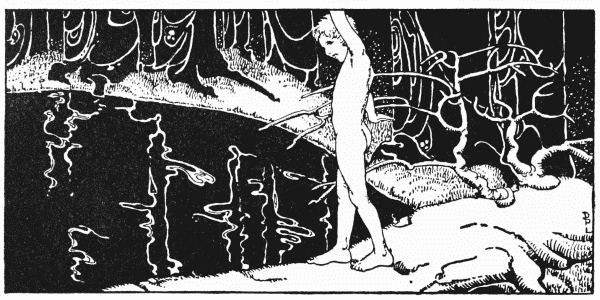
a ripple, black to the eye as a river of ink. How strange it
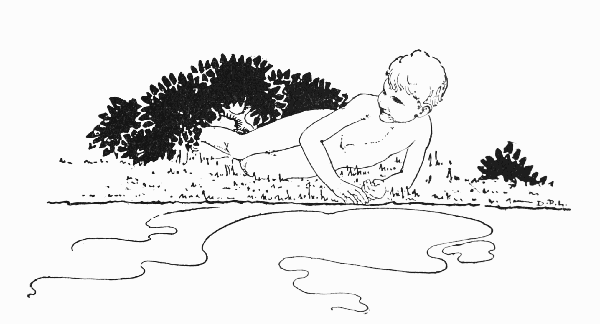
seemed when, holding on to a twig, he bent over and saw himself
reflected—a white, naked child with a scared face—in that
black mirror! Overcome by thirst, he ventured to creep down
and dip his hand in the stream, and was astonished to see that
the black water looked as clear as crystal in his hollow hand.
After quenching his thirst he went on, following the river now,
for it had made him turn aside; but after walking for an hour
or more he came to a great tree that had fallen across the stream,
and climbing on to the slippery trunk, he crept cautiously over
and then went gladly on in the old direction.
s
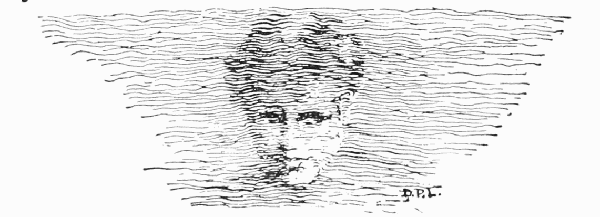
HOW STRANGE IT SEEMED WHEN, HOLDING
ON TO A TWIG, HE BENT OVER AND
SAW HIMSELF REFLECTED IN THAT
BLACK MIRROR.
Now, after he had crossed the river and walked a long distance,
he came to a more open part; but though it was nice to
feel the sunshine on him again, the underwood and grass and
creepers trailing over the ground made it difficult and tiring
to walk, and in this place a curious thing happened. Picking
his way through the tangled herbage, an animal his footsteps
had startled scuttled away in great fear, and as it went he
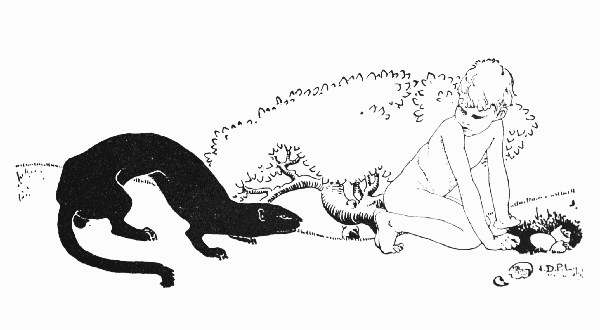
caught a glimpse of it. It was a kind of weasel, but very large—larger
than a big tom-cat, and all over as black as the blackest
cat. Looking down he discovered that this strange animal
had been feasting on eggs. The eggs were nearly as large as
fowls', of a deep green colour, with polished shells. There had
been about a dozen in the nest, which was only a small hollow
in the ground lined with dry grass, but most of them had been
broken, and the contents devoured by the weasel. Only two
remained entire, and these he took, and tempted by his hunger,
soon broke the shells at the small end and sucked them clean.
They were raw, but never had eggs, boiled, fried, or poached,
tasted so nice before! He had just finished his meal, and was
wishing that a third egg had remained in the ruined nest, when
a slight sound like the buzzing of an insect made him look
round, and there, within a few feet of him, was the big black
weasel once more, looking strangely bold and savage-tempered.
It kept staring fixedly at Martin out of its small, wicked, beady
black eyes, and snarling so as to show its white sharp teeth; and
very white they looked by contrast with the black lips, and
nose, and hair. Martin stared back at it, but it kept moving
and coming nearer, now sitting straight up, then dropping its
fore-feet and gathering its legs in a bunch as if about to spring,
and finally stretching itself straight out towards him again, its
round flat head and long smooth body making it look like a
great black snake crawling towards him. And all the time it
kept on snarling and clicking its sharp teeth and uttering its
low, buzzing growl. Martin grew more and more afraid, it
looked so strong and angry, so unspeakably fierce. The creature
looked as if he was speaking to Martin, saying something
very easy to understand, and very dreadful to hear. This is
what it seemed to be saying:—
"Ha, you came on me unawares, and startled me away from
the nest I found! You have eaten the last two eggs; and I
found them, and they were mine! Must I go hungry for you—starveling,
robber! A miserable little boy alone and lost in
the forest, naked, all scratched and bleeding with thorns, with
no courage in his heart, no strength in his hands! Look at me!
I am not weak, but strong and black and fierce; I live here—this
is my home; I fear nothing; I am like a serpent, and like
brass and tempered steel—nothing can bruise or break me: my
teeth are like fine daggers; when I strike them into the flesh
of any creature I never loose my hold till I have sucked out all
the blood in his heart. But you, weak little wretch, I hate you!
I thirst for your blood for stealing my food from me! What
can you do to save yourself? Down, down on the ground,
chicken-heart, where I can get hold of you! You shall pay me
for the eggs with your life! I shall hold you fast by the throat,
and drink and drink until I see your glassy eyes close, and your
cheeks turn whiter than ashes, and I feel your heart flutter like
a leaf in your bosom! Down, down!"
It was terrible to watch him and seem to hear such words.
He was nearer now—scarcely a yard away, still with his beady
glaring eyes fixed on Martin's face: and Martin was powerless
to fly from him—powerless even to stir a step or to lift a hand.
His heart jumped so that it choked him, his hair stood up on his
head, and he trembled so that he was ready to fall. And at
last, when about to fall to the ground, in the extremity of his
terror, he uttered a great scream of despair; and the sudden
scream so startled the weasel, that he jumped and scuttled away
as fast as he could through the creepers and bushes, making a
great rustling over the dead leaves and twigs; and Martin, recovering
his strength, listened to that retreating sound as it
passed away into the deep shadows, until it ceased altogether.
Chapter Eight — The Flower and the Serpent
His escape from the horrible black animal made Martin
quite happy, in spite of hunger and fatigue, and
he pushed on as bravely as ever. But it was slow
going and very difficult, even painful in places, on account of
the rough thorny undergrowth, where he had to push and crawl
through the close bushes, and tread on ground littered with
old dead prickly leaves and dead thorny twigs. After going
on for about an hour in this way, he came to a stream, a branch
of the river he had left, and much shallower, so that he could
easily cross from side to side, and he could also see the bright
pebbles under the clear swift current. The stream appeared
to run from the east, the way he wished to travel towards the
hills, so that he could keep by it, which he was glad enough to
do, as it was nice to get a drink of water whenever he felt
thirsty, and to refresh his tired and sore little feet in the stream.
Following this water he came before very long to a place in
the forest where there was little or no underwood, but only
low trees and bushes scattered about, and all the ground moist
and very green and fresh like a water-meadow. It was indeed
pleasant to feel his feet on the soft carpet of grass, and stooping,
he put his hands down on it, and finally lying down he
rolled on it so as to have the nice sensation of the warm soft
grass all over his body. So agreeable was it lying and rolling
about in that open green place with the sweet sunshine on him,
that he felt no inclination to get up and travel on. It was so
sweet to rest after all his strivings and sufferings in that great
dark forest! So sweet was it that he pretty soon fell asleep,
and no doubt slept a long time, for when he woke, the sun,
which had been over his head, was now far down in the west.
It was very still, and the air warm and fragrant at that hour,
with the sun shining through the higher branches of the trees
on the green turf where he was lying. How green it was—the
grass, the trees, every tiny blade and every leaf was like a
piece of emerald green glass with the sun shining through it!
So wonderful did it seem to him—the intense greenness, the
brilliant sunbeams that shone into his eyes, and seemed to fill
him with brightness, and the stillness of the forest, that he sat
up and stared about him. What did it mean—that brightness
and stillness?
Then, at a little distance away, he caught sight of something
on a tree of a shining golden yellow colour. Jumping up he
ran to the tree, and found that it was half overgrown with a
very beautiful climbing plant, with leaves divided like the
fingers of a hand, and large flowers and fruit, both green and
ripe. The ripe fruit was as big as a duck's egg, and the same
shape, and of a shining yellow colour. Reaching up his hand
he began to feel the smooth lovely fruit, when, being very ripe,
it came off its stem into his hand. It smelt very nice, and then,
in his hunger, he bit through the smooth rind with his teeth, and
it tasted as nice as it looked. He quickly ate it, and then
pulled another and ate that, and then another, and still others,
until he could eat no more. He had not had so delicious a
meal for many a long day.
Not until he had eaten his fill did Martin begin to look
closely at the flowers on the plant. It was the passion-flower,
and he had never seen it before, and now that he looked well
at it he thought it the loveliest and strangest flower he had
ever beheld; not brilliant and shining, jewel-like, in the sun,
like the scarlet verbena of the plains, or some yellow flower, but
pale and misty, the petals being of a dim greenish cream-colour,
with a large blue circle in the centre; and the blue, too, was
misty like the blue haze in the distance on a summer day. To
see and admire it better he reached out his hand and tried to
pluck one of the flowers; then in an instant he dropped his
hand, as if he had been pricked by a thorn. But there was no
thorn and nothing to hurt him; he dropped his hand only because
he felt that he had hurt the flower. Moving a step back
he stared at it, and the flower seemed like a thing alive that
looked back at him, and asked him why he had hurt it.
HE QUICKLY ATE IT, AND THEN PULLED
ANOTHER AND ATE THAT, AND THEN
ANOTHER, AND STILL OTHERS, UNTIL
HE COULD EAT NO MORE.
"O, poor flower!" said Martin, and, coming closer he touched
it gently with his finger-tips; and then, standing on tip-toe, he
touched its petals with his lips, just as his mother had often
and often kissed his little hand when he had bruised it or
pricked it with a thorn.
Then, while still standing by the plant, on bringing his eyes
down to the ground he spied a great snake lying coiled up on a
bed of moss on the sunny side of the same tree where the
plant was growing. He remembered the dear little snake he
had once made a friend of, and he did not feel afraid, for he
thought that all snakes must be friendly towards him, although
this was a very big one, thicker than his arm and of a different
colour. It was a pale olive-green, like the half-dry moss it was
lying on, with a pattern of black and brown mottling along its
back. It was lying coiled round and round, with its flat arrow-shaped
head resting on its coils, and its round bright eyes fixed
on Martin's face. The sun shining on its eyes made them
glint like polished jewels or pieces of glass, and when Martin
moved nearer and stood still, or when he drew back and went
to this side or that, those brilliant glinting eyes were still on his
face, and it began to trouble him, until at last he covered his
face with his hands. Then he opened his fingers enough to
peep through them, and still those glittering eyes were fixed
on him.
Martin wondered if the snake was vexed with him for coming
there, and why it watched him so steadily with those shining
eyes. "Will you please look some other way?" he said at last,
but the snake would not, and so he turned from it, and then
it seemed to him that everything was alive and watching him
in the same intent way—the passion-flowers, the green leaves,
the grass, the trees, the wide sky, the great shining sun. He
listened, and there was no sound in the wood, not even the
hum of a fly or a wild bee, and it was so still that not a leaf
moved. Finally he moved away from that spot, but treading
very softly, and holding his breath to listen, for it seemed to him
that the forest had something to tell him, and that if he listened
he would hear the leaves speaking to him. And by-and-by he
did hear a sound: it came from a spot about a hundred yards
away, and was like the sound of a person crying. Then came
low sobs which rose and fell and then ceased, and after a silent
interval began again. Perhaps it was a child, lost there in the
forest like himself. Going softly to the spot he discovered
that the sobbing sounds came from the other side of a low tree
with wide-spread branches, a kind of acacia with thin loose
foliage, but he could not see through it, and so he went round
the tree to look, and startled a dove which flew off with a loud
clatter of its wings.
When the dove had flown away it was again very silent.
What was he to do? He was too tired now to walk much farther,
and the sun was getting low, so that all the ground was
in shadow. He went on a little way looking for some nice
shelter where he could pass the night, but could not find one.
At length, when the sun had set and the dark was coming, he
came upon an old half-dead tree, where there was a hollow at
the roots, lined with half-dry moss, very soft to his foot, and it
seemed a nice place to sleep in. But he had no choice, for he
was afraid of going further in the dark among the trees; and
so, creeping into the hollow among the old roots, he curled
himself up as comfortably as he could, and soon began to get
very drowsy, in spite of having no covering to keep him warm.
But although very tired and sleepy, he did not go quite to sleep,
for he had never been all alone in a wood by night before, and
it was different from the open plain where he could see all
round, even at night, and where he had feared nothing. Here
the trees looked strange and made strange black shadows, and
he thought that the strange people of the wood were perhaps
now roaming about and would find him there. He did not
want them to find him fast asleep; it was better to be awake,
so that when they came he could jump up and run away and
hide himself from them. Once or twice a slight rustling sound
made him start and think that at last some one was coming to
him, stealing softly so as to catch him unawares, but he could
see nothing moving, and when he held his breath to listen there
was no sound.
Then all at once, just when he had almost dropped off, a
great cry sounded at a distance, and made him start up wide
awake again. "Oh look! look! look!" cried the voice in a tone
so deep and strange and powerful that no one could have heard
it without terror, for it seemed to be uttered by some forest
monster twenty times bigger than an ordinary man. In a
moment an answer came from another part of the wood.
"What's that?" cried the answering voice; and then another
voice cried, and then others far and near, all shouting "What's
that?" and for only answer the first voice shouted once more,
"O Look! Look! Look!"
Poor Martin, trembling with fright, crouched lower down in
his mossy bed, thinking that the awful people of the forest must
have seen him, and would be upon him in a few moments. But
though he stared with wide-open eyes into the gloom he could
see nothing but the trees, standing silent and motionless, and
no sound of approaching footsteps could he hear.
After that it was silent again for a while, and he began to
hope that they had given up looking for him; when suddenly,
close by, sounded a loud startling "Who's that?" and he gave
himself up for lost. For he was too terrified to jump up and
run away, as he had thought to do: he could only lie still, his
teeth chattering, his hair standing up on his head. "Who's
that?" exclaimed the terrible voice once more, and then he saw
a big black shape drop down from the tree above and settle on a
dead branch a few feet above his hiding-place. It was a bird—a
great owl, for now he could see it, sharply outlined against
the clear starry sky; and the bird had seen and was peering
curiously at him. And now all his fear was gone, for he could
not be afraid of an owl; he had been accustomed to see owls all
his life, only they were small, and this owl of the forest was as
big as an eagle, and had a round head and ears like a cat, and
great cat-like eyes that shone in the dark.
The owl kept staring at Martin for some time, swaying his
body this way and that, and lowering then raising his head so
as to get a better view. And Martin, on his side, stared back
at the owl, and at last he exclaimed, "O what a great big owl
you are! Please say Who's that? again."
But before the owl said anything Martin was fast asleep in
his mossy bed.
Chapter Nine — The Black People of the Sky
Whether or not the great owl went on shouting
O look! look! look! and asking What's that?
and Who's that? all night, Martin did not know.
He was fast asleep until the morning sun shone on his face and
woke him, and as he had no clothes and shoes to put on he was
soon up and out. First he took a drink of water, then, feeling
very hungry he went back to the place where he had found the
ripe fruit and made a very good breakfast. After that he set
out once more through the wood towards sunrise, still following
the stream. Before long the wood became still more open,
and at last to his great joy he found that he had got clear of it,
and was once more on the great open plain. And now the
hills were once more in sight—those great blue hills where he
wished to be, looking nearer and larger than before, but they
still looked blue like great banks of cloud and were a long distance
away. But he was determined to get to them, to climb
up their steep sides, and by and by when he found the stream
bent away to the south, he left it so as to go on straight as he
could to the hills. Away from the water-side the ground was
higher, and very flat and covered with dry yellow grass. Over
this yellow plain he walked for hours, resting at times, but finding
no water and no sweet roots to quench his thirst, until he
was too tired to walk any further, and so he sat down on the
dry grass under that wide blue sky. There was not a cloud on
it—nothing but the great globe of the sun above him; and there
was no wind and no motion in the yellow grass blades, and no
sight or sound of any living creature.
Martin lying on his back gazed up at the blue sky, keeping
his eyes from the sun, which was too bright for them, and after
a time he did see something moving—a small black spot no bigger
than a fly moving in a circle. But he knew it was something
big, but at so great a height from the earth as to look like
a fly. And then he caught sight of a second black speck, then
another and another, until he could make out a dozen or twenty,
or more, all moving in wide circles at that vast height.
Martin thought they must be the black people of the sky; he
wondered why they were black and not white, like white birds,
or blue, and of other brilliant colours like the people of the
Mirage.
Now it was impossible for Martin to lie like that, following
those small black spots on the hot blue sky as they wheeled
round and round continuously, without giving his eyes a little
rest by shutting them at intervals. By-and-by he kept them
shut a little too long; he fell asleep, and when he woke he didn't
wake fully in a moment; he remained lying motionless just as
before, with eyes still closed, but the lids just raised enough to
enable him to see about him. And the sight that met his eyes
was very curious. He was no longer alone in that solitary
place. There were people all round him, dozens and scores
of little black men about two feet in height, of a very singular
appearance. They had bald heads and thin hatchet faces,
wrinkled and warty, and long noses; and they all wore black
silk clothes—coat, waistcoat and knickerbockers, but without
shoes and stockings; their thin black legs and feet were bare;
nor did they have anything on their bald heads. They were
gathered round Martin in a circle, but a very wide circle quite
twenty to thirty feet away from him, and some were walking
about, others standing alone or in groups, talking together, and
all looking at Martin. Only one who appeared to be the most
important person of the company kept inside the circle, and
whenever one or more of the others came forward a few steps
he held up his hand and begged them to go back a little.
"We must not be in a hurry," he said. "We must wait."
"Wait for what?" asked one.
"For what may happen," said the important one. "I must
ask you again to leave it to me to decide when it is time to
begin." Then he strutted up and down in the open space,
turning now towards his fellows and again to Martin, moving
his head about to get a better sight of his face. Then, putting
his hand down between his coat and waistcoat he drew out a
knife with a long shining blade, and holding it from him looked
attentively at it. By and by he breathed gently on the bright
blade, then pulling out a black silk pocket handkerchief wiped
off the stain of his breath, and turning the blade about made it
glitter in the sun. Then he put it back under his coat and
resumed his walk up and down.
"We are getting very hungry," said one of the others at
length.
"Very hungry indeed!" cried another. "Some of us have
not tasted food these three days."
"It certainly does seem hard," said yet another, "to see our
dinner before us and not be allowed to touch it."
"Not so fast, my friends, I beg," exclaimed the man with the
knife. "I have already explained the case, and I do think you
are a little unfair in pressing me as you do."
Thus rebuked they consulted together, then one of them
spoke. "If, sir, you consider us unfair, or that we have not
full confidence in you, would it not be as well to get some other
person to take your place?"
"Yes, I am ready to do that," returned the important one
promptly; and here, drawing forth the knife once more, he held
it out towards them. But instead of coming forward to take it
they all recoiled some steps, showing considerable alarm. And
then they all began protesting that they were not complaining
of him, that they were satisfied with their choice, and could not
have put the matter in abler hands.
"I am pleased at your good opinion," said the important one.
"I may tell you that I am no chicken. I first saw the light in
September, 1739, and, as you know, we are now within seven
months and thirteen days of the end of the first decade of the
second half of the nineteenth century. You may infer from
this that I have had a pretty extensive experience, and I promise
you that when I come to cut the body up you will not be able
to say that I have made an unfair distribution, or that any one
has been left without his portion."
All murmured approval, and then one of the company asked
if he would be allowed to bespeak the liver for his share.
"No, sir, certainly not," replied the other. "Such matters
must be left to my discretion entirely, and I must also remind
you that there is such a thing as the carver's privilege, and it is
possible that in this instance he may think fit to retain the liver
for his own consumption."
After thus asserting himself he began to examine the blade
of his knife which he still held in his hand, and to breathe gently
on it, and wipe it with his handkerchief to make it shine brighter
in the sun. Finally, raising his arm, he flourished it and then
made two or three stabs and lunges in the air, then walking on
tip-toe he advanced to Martin lying so still on the yellow grass
in the midst of that black-robed company, the hot sun shining
on his naked white body.
The others all immediately pressed forward, craning their
necks and looking highly excited: they were expecting great
things; but when the man with a knife had got quite close to
Martin he was seized with fear and made two or three long
jumps back to where the others were; and then, recovering from
his alarm, he quietly put back the knife under his coat.
"We really thought you were going to begin," said one of
the crowd.
"Oh, no; no indeed; not just yet," said the other.
"It is very disappointing," remarked one.
The man with the knife turned on him and replied with dignity,
"I am really surprised at such a remark after all I have
said on the subject. I do wish you would consider the circumstances
of the case. They are peculiar, for this person—this
Martin—is not an ordinary person. We have been keeping
our eyes on him for some time past, and have witnessed some
remarkable actions on his part, to put it mildly. Let us
keep in mind the boldness, the resource, the dangerous violence
he has displayed on so many occasions since he took to his present
vagabond way of life."
"It appears to me," said one of the others, "that if Martin
is dead we need not concern ourselves about his character and
desperate deeds in the past."
"If he is dead!" exclaimed the other sharply. "That is the
very point,—is he dead? Can you confidently say that he is
not in a sound sleep, or in a dead faint, or shamming and ready
at the first touch of the knife to leap up and seize his assailant—I
mean his carver—by the throat and perhaps murder him as
he once murdered a spoonbill?"
"That would be very dreadful," said one.
"But surely," said another, "there are means of telling
whether a person is dead or not? One simple and effectual
method, which I have heard, is to place a hand over the heart
to feel if it still beats."
"Yes, I know, I have also heard of that plan. Very simple,
as you say; but who is to try it? I invite the person who makes
the suggestion to put it in practice."
"With pleasure," said the other, coming forward with a tripping
gait and an air of not being in the least afraid. But on
coming near the supposed corpse he paused to look round at the
others, then pulling out his black silk handkerchief he wiped
his black wrinkled forehead and bald head. "Whew!" he exclaimed,
"it's very hot today."
"I don't find it so," said the man with the knife. "It is
sometimes a matter of nerves."
It was not a very nice remark, but it had the effect of bracing
the other up, and moving forward a little more he began
anxiously scrutinizing Martin's face. The others now began
to press forward, but were warned by the man with a knife not
to come too near. Then the bold person who had undertaken
to feel Martin's heart doubled back the silk sleeve of his coat,
and after some further preparation extended his arm and made
two or three preliminary passes with his trembling hand at a
distance of a foot or so from the breast of the corpse. Then he
approached it a little nearer, but before it came to the touching
point a sudden fear made him start back.
"What is it? What did you see?" cried the others.
"I'm not sure there wasn't a twitch of the eyelid," he replied.
"Never mind the eyelid—feel his heart," said one.
"That's all very well," he returned, "but how would you like
it yourself? Will you come and do it?"
"No, no!" they all cried. "You have undertaken this, and
must go through with it."
Thus encouraged, he once more turned to the corpse, and
again anxiously began to examine the face. Now Martin had
been watching them through the slits of his not quite closed
eyes all the time, and listening to their talk. Being hungry
himself he could not help feeling for them, and not thinking
that it would hurt him to be cut up in pieces and devoured, he
had begun to wish that they would really begin on him. He
was both amused and annoyed at their nervousness, and at last
opening wide his eyes very suddenly he cried, "Feel my heart!"
It was as if a gun had been fired among them; for a moment
they were struck still with terror, and then all together turned
and fled, going away with three very long hops, and then opening
wide their great wings they launched themselves on the air.
For they were not little black men in black silk clothes as it
had seemed, but vultures—those great, high-soaring, black-plumaged
birds which he had watched circling in the sky, looking
no bigger than bees or flies at that vast distance above the
earth. And when he was watching them they were watching
him, and after he had fallen asleep they continued moving
round and round in the sky for hours, and seeing him lying so
still on the plain they at last imagined that he was dead, and
one by one they closed or half-closed their wings and dropped,
gliding downwards, growing larger in appearance as they
neared the ground, until the small black spots no bigger than
flies were seen to be great black birds as big as turkeys.
But you see Martin was not dead after all, and so they had
to go away without their dinner.
Chapter Ten — A Troop of Wild Horses
It seemed so lonely to Martin when the vultures had gone
up out of sight in the sky, so silent and solitary on that
immense level plain, that he could not help wishing them
back for the sake of company. They were an amusing people
when they were walking round him, conversing together, and
trying without coming too near to discover whether he was
dead or only sleeping.
All that day it was just as lonely, for though he went on as
far as he could before night, he was still on that great level
plain of dry yellow grass which appeared to have no end, and
the blue hills looked no nearer than when he had started in the
morning. He was hungry and thirsty that evening, and very
cold too when he nestled down on the ground with nothing to
cover him but the little heap of dry grass he had gathered for
his bed.
It was better next day, for after walking two or three hours
he came to the end of that yellow plain to higher ground, where
the earth was sandy and barren, with a few scattered bushes
growing on it—dark, prickly bushes like butcher's broom.
When he got to the highest part of this barren ground he saw
a green valley beyond, stretching away as far as he could see
on either hand. But it was nice to see a green place again, and
going down into the valley he managed to find some sweet roots
to stay his hunger and thirst; then, after a rest, he went on
again, and when he got to the top of the high ground beyond
the valley, he saw another valley before him, just like the one
he had left behind. Again he rested in that green place, and
then slowly went up the high land beyond, where it was barren
and sandy with the dark stiff prickly bushes growing here and
there, and when he got to the top he looked down, and behold!
there was yet another green valley stretching away to the right
and left as far as he could see.
Would they never end—these high barren ridges and the
long green valleys between!
When he toiled slowly up out of this last green resting-place
it was growing late in the day, and he was very tired.
Then he came to the top of another ridge like the others, only
higher and more barren, and when he could see the country
beyond, lo! another valley, greener and broader than those
he had left behind, and a river flowing in it, looking like a band
of silver lying along the green earth—a river too broad for him
to cross, stretching away north and south as far as he could see.
How then should he ever be able to get to the hills, still far, far
away beyond that water?
Martin stared at the scene before him for some time; then,
feeling very tired and weak, he sat down on the sandy ground
beside a scanty dark bush. Tears came to his eyes: he felt
them running down his cheeks; and all at once he remembered
how long before when his wandering began, he had dropped a
tear, and a small dusty beetle had refreshed himself by drinking
it. He bent down and let a tear drop, and watched it as it
sank into the ground, but no small beetle came out to drink it,
and he felt more lonely and miserable than ever. He began
to think of all the queer creatures and people he had met in
the desert, and to wish for them. Some of them had not been
very kind, but he did not remember that now, it was so sad to
be quite alone in the world without even a small beetle to visit
him. He remembered the beautiful people of the Mirage and
the black people of the sky; and the ostrich, and old Jacob, and
the savages, and the serpent, and the black weasel in the forest.
He stood up and stared all round to see if anything was coming,
but he could see nothing and hear nothing.
By-and-by, in that deep silence, there was a sound; it seemed
to come from a great distance, it was so faint. Then it grew
louder and nearer; and far away he saw a little cloud of dust,
and then, even through the dust, dark forms coming swiftly
towards him. The sound he heard was like a long halloo, a
cry like the cry of a man, but wild and shrill, like a bird's cry;
and whenever that cry was uttered, it was followed by a strange
confused noise as of the neighing of many horses. They were,
in truth, horses that were coming swiftly towards him—a herd
of sixty or seventy wild horses. He could see and hear them
only too plainly now, looking very terrible in their strength and
speed, and the flowing black manes that covered them like a
black cloud, as they came thundering on, intending perhaps to
sweep over him and trample him to death with their iron-hard
hoofs.
All at once, when they were within fifty yards of Martin, the
long, shrill, wild cry went up again, and the horses swerved to
one side, and went sweeping round him in a wide circle. Then,
as they galloped by, he caught sight of the strangest-looking
being he had ever seen, a man, on the back of one of the horses;
naked and hairy, he looked like a baboon as he crouched, doubled
up, gripping the shoulders and neck of the horse with his
knees, clinging with his hands to the mane, and craning his
neck like a flying bird. It was this strange rider who had uttered
the long piercing man-and-bird-like cries; and now changing
his voice to a whinnying sound the horses came to a stop,
and gathering together in a crowd they stood tossing their
manes and staring at Martin with their wild, startled eyes.
In another moment the wild rider came bounding out from
among them, and moving now erect, now on all fours, came
sideling up to Martin, flinging his arms and legs about, wagging
his head, grimacing and uttering whinnying and other
curious noises. Never had Martin looked upon so strange a
man! He was long and lean so that you could have counted
his ribs, and he was stark naked, except for the hair of his head
and face, which half covered him. His skin was of a yellowish
brown colour, and the hair the colour of old dead grass; and
it was coarse and tangled, falling over his shoulders and back
and covering his forehead like a thatch, his big brown nose
standing out beneath it like a beak. The face was covered
with the beard which was tangled too, and grew down to his
waist. After staring at Martin for some time with his big,
yellow, goat-like eyes, he pranced up to him and began to sniff
round him, then touched him with his nose on his face, arms,
and shoulders.
"Who are you?" said Martin in astonishment.
For only answer the other squealed and whinnied, grimacing
and kicking his legs up at the same time. Then the horses advanced
to them, and gathering round in a close crowd began
touching Martin with their noses. He liked it—the softness
of their sensitive skins, which were like velvet, and putting up
his hands he began to stroke their noses. Then one by one,
after smelling him, and being touched by his hand, they turned
away, and going down into the valley were soon scattered
about, most of them grazing, some rolling, others lying stretched
out on the grass as if to sleep; while the young foals in the
troop, leaving their dams, began playing about and challenging
one another to run a race.
Martin, following and watching them, almost wished that
he too could go on four legs to join them in their games. He
trusted those wild horses, but he was still puzzled by that
strange man, who had also left him now and was going quietly
round on all fours, smelling at the grass. By-and-by he found
something to his liking in a small patch of tender green clover,
which he began nosing and tearing it up with his teeth, then
turning his head round he stared back at Martin, his jaws working
vigorously all the time, the stems and leaves of the clover
he was eating sticking out from his mouth and hanging about
his beard. All at once he jumped up, and flying back at Martin,
snatched him up from the ground, carried him to the clover
patch, and set him upon it, face down, on all fours; then when
Martin sat up he grasped him by the head and forced it down
until his nose was on the grass so as to make him smell it and
know that it was good. But smell it he would not, and finally
the other seized him roughly again and opening his mouth,
forced a bunch of grass into it.
"It's grass, and I sha'n't eat it!" screamed Martin, crying
with anger at being so treated, and spewing the green stuff out
of his mouth.
Then the man released him, and withdrawing a space of two
or three yards, sat down on his haunches, and, planting his
bony elbows on his knees thrust his great brown fingers in his
tangled hair, and stared at Martin with his big yellow goat's
eyes for a long time.
Suddenly a wild excited look came into his eyes, and, leaping
up with a shrill cry, which caused all the horses to look
round at him, he once more snatched Martin up, and holding
him firmly gripped to his ribby side by his arm, bounded off to
where a mare was standing giving suck to her young foal.
With a vigorous kick he sent the foal away, and forced Martin
to take his place, and, to make it easier for him, pressed the
teat into his mouth. Martin was not accustomed to feed in
that way, and he not only refused to suck, but continued to
cry with indignation at such treatment, and to struggle with all
his little might to free himself. His striving was all in vain;
and by-and-by the man, seeing that he would not suck, had a
fresh idea, and, gripping Martin more firmly than ever, with
one hand forced and held his mouth open, and with the other
drew a stream of milk into it. After choking and spluttering
and crying more than ever for a while, Martin began to grow
quiet, and to swallow the milk with some satisfaction, for he
was very hungry and thirsty, and it tasted very good. By-and-by,
when no more milk could be drawn from the teats, he was
taken to a second mare, from which the foal was kicked away
with as little ceremony as the first one, and then he had as much
more milk as he wanted, and began to like being fed in this
amusing way.
Of what happened after that Martin did not know much,
except that the man seemed very happy after feeding him.
He set Martin on the back of a horse, then jumped and danced
round him, making funny chuckling noises, after which he
rolled horse-like on the grass, his arms and legs up in the air,
and finally, pulling Martin down, he made him roll too.
But the little fellow was too tired to keep his eyes any longer
open, and when he next opened them it was morning, and he
found himself lying wedged in between a mare and her young
foal lying side by side close together. There too was the wild
man, coiled up like a sleeping dog, his head pillowed on the
foal's neck, and the hair of his great shaggy beard thrown like
a blanket over Martin.
He very soon grew accustomed to the new strange manner
of life, and even liked it. Those big, noble-looking wild
horses, with their shining coats, brown and bay and black and
sorrel and chestnut, and their black manes and tails that swept
the grass when they moved, were so friendly to him that he
could not help loving them. As he went about among them
when they grazed, every horse he approached would raise his
head and touch his face and arms with his nose. "O you dear
horse!" Martin would exclaim, rubbing the warm, velvet-soft,
sensitive nose with his hand.
THEN THE WILD MAN, CATCHING MARTIN
UP, LEAPED UPON THE BACK OF ONE OF
THE HORSES.
He soon discovered that they were just as fond of play as he
was, and that he too was to take part in their games. Having
fed as long as they wanted that morning, they all at once began
to gather together, coming at a gallop, neighing shrilly; then
the wild man, catching Martin up, leaped upon the back of one
of the horses, and away went the whole troop at a furious pace
to the great open dry plain, where Martin had met with them
on the previous day. Now it was very terrifying for him at
first to be in the midst of that flying crowd, as the animals went
tearing over the plain, which seemed to shake beneath their
thundering hoofs, while their human leader cheered them on
with his shrill, repeated cries. But in a little while he too
caught the excitement, and, losing all his fear, was as wildly
happy as the others, crying out at the top of his voice in imitation
of the wild man.
After an hour's run they returned to the valley, and then
Martin, without being compelled to do so, rolled about on the
grass, and went after the young foals when they came out to
challenge one another to a game. He tried to do as they did,
prancing and throwing up his heels and snorting, but when they
ran from him they soon left him hopelessly behind. Meanwhile
the wild man kept watch over him, feeding him with
mare's milk, and inviting him from time to time to smell and
taste the tender grass. Best of all was, when they went for
another run in the evening, and when Martin was no longer
held with a tight grip against the man's side, but was taught or
allowed to hold on, clinging with his legs to the man's body and
clasping him round the neck with his arms, his fingers tightly
holding on to the great shaggy beard.
Three days passed in this way, and if his time had been
much longer with the wild horses he would have become one
of the troop, and would perhaps have eaten grass too, and forgotten
his human speech, or that he was a little boy born to a
very different kind of life. But it was not to be, and in the
end he was separated from the troop by accident.
At the end of the third day, when the sun was setting, and
all the horses were scattered about in the valley, quietly grazing,
something disturbed them. It might have been a sight or
sound of some feared object, or perhaps the wind had brought
the smell of their enemies and hunters from a great distance to
their nostrils. Suddenly they were all in a wild commotion,
galloping from all sides toward their leader, and he, picking
Martin up, was quickly on a horse, and off they went full speed,
but not towards the plain where they were accustomed to go
for their runs. Now they fled in the opposite direction down
to the river: into it they went, into that wide, deep, dangerous
current, leaping from the bank, each horse, as he fell into the
water with a tremendous splash, disappearing from sight; but
in another moment the head and upper part of the neck was
seen to rise above the surface, until the whole lot were in, and
appeared to Martin like a troop of horses' heads swimming
without bodies over the river. He, clinging to the neck and
beard of the wild man, had the upper half of his body out of
the cold, rushing water, and in this way they all got safely
across and up the opposite bank. No sooner were they out,
than, without even pausing to shake the water from their skins,
they set off at full speed across the valley towards the distant
hills. Now on this side, at a distance of a mile or so from the
river, there were vast reed-beds standing on low land, dried
to a hard crust by the summer heat, and right into the reeds the
horses rushed and struggled to force their way through. The
reeds were dead and dry, so tall that they rose high above the
horses' heads, and growing so close together that it was hard
to struggle through them. Then when they were in the midst
of this difficult place, the dry crust that covered the low ground
began to yield to the heavy hoofs, and the horses, sinking to
their knees, were thrown down and plunged about in the most
desperate way, and in the midst of this confusion Martin was
struck and thrown from his place, falling amongst the reeds.
Luckily he was not trampled upon, but he was left behind, and
then what a dreadful situation was his, when the whole troop
had at last succeeded in fighting their way through, and had
gone away leaving him in that dark, solitary place! He listened
until the sound of heavy hoofs and the long cries of the
man had died away in the distance; then the silence and darkness
terrified him, and he struggled to get out, but the reeds
grew so close together that before he had pushed a dozen yards
through them he sank down, unable to do more.
The air was hot and close and still down there on the ground,
but by leaning his head back, and staring straight up he could
see the pale night sky sprinkled with stars in the openings between
the dry leaves and spikes of the reeds. Poor Martin
could do nothing but gaze up at the little he could see of the
sky in that close, black place, until his neck ached with the
strain; but at last, to make him hope, he heard a sound—the
now familiar long shrill cry of the wild man. Then, as it came
nearer, the sound of tramping hoofs and neighing of the horses
was heard, and the cries and hoof-beats grew louder and then
fainter in turns, and sounded now on this side, now on that, and
he knew that they were looking for him. "I'm here, I'm here,"
he cried; "oh, dear horses, come and take me away!" But they
could not hear him, and at last the sound of their neighing and
the wild long cries died away altogether, and Martin was left
alone in that black silent place.
Chapter Eleven — The Lady of the Hills
No escape was possible for poor little Martin so long
as it was dark, and there he had to stay all night, but
morning brought him comfort; for now he could see
the reed-stems that hemmed him in all round, and by using his
hands to bend them from him on either side he could push
through them. By-and-by the sunlight touched the tops of the
tall plants, and working his way towards the side from which
the light came he soon made his escape from that prison, and
came into a place where he could walk without trouble, and
could see the earth and sky again. Further on, in a grassy part
of the valley, he found some sweet roots which greatly refreshed
him, and at last, leaving the valley, he came out on a high grassy
plain, and saw the hills before him looking very much nearer
than he had ever seen them look before. Up till now they
had appeared like masses of dark blue banked up cloud resting
on the earth, now he could see that they were indeed stone—blue
stone piled up in huge cliffs and crags high above the
green world; he could see the roughness of the heaped up rocks,
the fissures and crevices in the sides of the hills, and here and
there the patches of green colour where trees and bushes had
taken root. How wonderful it seemed to Martin that evening
standing there in the wide green plain, the level sun at his
back shining on his naked body, making him look like a statue
of a small boy carved in whitest marble or alabaster. Then,
to make the sight he gazed on still more enchanting, just as the
sun went down the colour of the hills changed from stone blue
to a purple that was like the purple of ripe plums and grapes,
only more beautiful and bright. In a few minutes the purple
colour faded away and the hills grew shadowy and dark. It
was too late in the day, and he was too tired to walk further.
He was very hungry and thirsty too, and so when he had found
a few small white partridge-berries and had made a poor supper
on them, he gathered some dry grass into a little heap, and
lying down in it, was soon in a sound sleep.
It was not until the late afternoon next day that Martin at
last got to the foot of the hill, or mountain, and looking up he
saw it like a great wall of stone above him, with trees and
bushes and trailing vines growing out of the crevices and on
the narrow ledges of the rock. Going some distance he came to
a place where he could ascend, and here he began slowly walking
upwards. At first he could hardly contain his delight
where everything looked new and strange, and here he found
some very beautiful flowers; but as he toiled on he grew more
tired and hungry at every step, and then, to make matters
worse, his legs began to pain so that he could hardly lift them.
It was a curious pain which he had never felt in his sturdy little
legs before in all his wanderings.
Then a cloud came over the sun, and a sharp wind sprang up
that made him shiver with cold: then followed a shower of rain;
and now Martin, feeling sore and miserable, crept into a cavity
beneath a pile of overhanging rocks for shelter. He was out
of the rain there, but the wind blew in on him until it made
his teeth chatter with cold. He began to think of his mother,
and of all the comforts of his lost home—the bread and milk
when he was hungry, the warm clothing, and the soft little
bed with its snowy white coverlid in which he had slept so
sweetly every night.
"O mother, mother!" he cried, but his mother was too far
off to hear his piteous cry.
When the shower was over he crept out of his shelter again,
and with his little feet already bleeding from the sharp rocks,
tried to climb on. In one spot he found some small, creeping,
myrtle plants covered with ripe white berries, and although
they had a very pungent taste he ate his fill of them, he was so
very hungry. Then feeling that he could climb no higher, he
began to look round for a dry, sheltered spot to pass the night
in. In a little while he came to a great, smooth, flat stone that
looked like a floor in a room, and was about forty yards wide:
nothing grew on it except some small tufts of grey lichen; but
on the further side, at the foot of a steep, rocky precipice, there
was a thick bed of tall green and yellow ferns, and among the
ferns he hoped to find a place to lie down in. Very slowly he
limped across the open space, crying with the pain he felt at
every step; but when he reached the bed of ferns he all at once
saw, sitting among the tall fronds on a stone, a strange-looking
woman in a green dress, who was gazing very steadily at him
with eyes full of love and compassion. At her side there
crouched a big yellow beast, covered all over with black, eye-like
spots, with a big round head, and looking just like a cat,
but a hundred times larger than the biggest cat he had ever
seen. The animal rose up with a low sound like a growl, and
glared at Martin with its wide, yellow, fiery eyes, which so
terrified him that he dared not move another step until the
woman, speaking very gently to him, told him not to fear.
She caressed the great beast, making him lie down again; then
coming forward and taking Martin by the hand, she drew him
up to her knees.
"What is your name, poor little suffering child?" she asked,
bending down to him, and speaking softly.
"Martin—what's yours?" he returned, still half sobbing,
and rubbing his eyes with his little fists.
"I am called the Lady of the Hills, and I live here alone in
the mountain. Tell me, why do you cry, Martin?"
"Because I'm so cold, and—and my legs hurt so, and—and
because I want to go back to my mother. She's over there,"
said he, with another sob, pointing vaguely to the great plain
beneath their feet, extending far, far away into the blue distance,
where the crimson sun was now setting.
"I will be your mother, and you shall live with me here on
the mountain," she said, caressing his little cold hands with
hers. "Will you call me mother?"
"You are not my mother," he returned warmly. "I don't
want to call you mother."
"When I love you so much, dear child?" she pleaded, bending
down until her lips were close to his averted face.
"How that great spotted cat stares at me!" he suddenly said.
"Do you think it will kill me?"
"No, no, he only wants to play with you. Will you not
even look at me, Martin?"
He still resisted her, but her hand felt very warm and comforting—it
was such a large, warm, protecting hand. So
pleasant did it feel that after a little while he began to move
his hand up her beautiful, soft, white arm until it touched her
hair. For her hair was unbound and loose; it was dark, and
finer than the finest spun silk, and fell all over her shoulders
and down her back to the stone she sat on. He let his fingers
stray in and out among it; and it felt like the soft, warm down
that lines a little bird's nest to his skin. Finally, he touched
her neck and allowed his hand to rest there, it was such a soft,
warm neck. At length, but reluctantly, for his little rebellious
heart was not yet wholly subdued, he raised his eyes to her face.
Oh, how beautiful she was! Her love and eager desire to win
him had flushed her clear olive skin with rich red colour; out
of her sweet red lips, half parted, came her warm breath on his
cheek, more fragrant than wild flowers; and her large dark eyes
were gazing down into his with such a tenderness in them that
Martin, seeing it, felt a strange little shudder pass through
him, and scarcely knew whether to think it pleasant or painful.
"Dear child, I love you so much," she spoke, "will you
not call me mother?"
Dropping his eyes and with trembling lips, feeling a little
ashamed at being conquered at last, he whispered "Mother."
She raised him in her arms and pressed him to her bosom,
wrapping her hair like a warm mantle round him; and in less
than one minute, overcome by fatigue, he fell fast asleep in
her arms.
SHE RAISED HIM IN HER ARMS AND
PRESSED HIM TO HER BOSOM, WRAPPING
HER HAIR LIKE A WARM MANTLE
AROUND HIM.
Chapter Twelve — The Little People Underground
When he awoke Martin found himself lying on
a soft downy bed in a dim stone chamber, and
feeling silky hair over his cheek and neck and
arms, he knew that he was still with his new strange mother,
the beautiful Lady of the Mountain. She, seeing him awake,
took him up in her arms, and holding him against her bosom,
carried him through a long winding stone passage, and out
into the bright morning sunlight. There by a small spring of
clearest water that gushed from the rock she washed his
scratched and bruised skin, and rubbed it with sweet-smelling
unguents, and gave him food and drink. The great spotted
beast sat by them all the time, purring like a cat, and at intervals
he tried to entice Martin to leave the woman's lap and
play with him. But she would not let him out of her arms: all
day she nursed and fondled him as if he had been a helpless
babe instead of the sturdy little run-away and adventurer he
had proved himself to be. She also made him tell her the
story of how he had got lost and of all the wonderful things
that had happened to him in his wanderings in the wilderness—the
people of the Mirage, and old Jacob and the savages, the
great forest, the serpent, the owl, the wild horses and wild man,
and the black people of the sky. But it was of the Mirage and
the procession of lovely beings about which he spoke most and
questioned her.
"Do you think it was all a dream?" he kept asking her, "the
Queen and all those people?"
She was vexed at the question, and turning her face away,
refused to answer him. For though at all other times, and
when he spoke of other things, she was gentle and loving in
her manner, the moment he spoke of the Queen of the Mirage
and the gifts she had bestowed on him, she became impatient,
and rebuked him for saying such foolish things.
At length she spoke and told him that it was a dream, a very
very idle dream, a dream that was not worth dreaming; that
he must never speak of it again, never think of it, but forget it,
just as he had forgotten all the other vain silly dreams he had
ever had. And having said this much a little sharply, she
smiled again and fondled him, and promised that when he next
slept he should have a good dream, one worth the dreaming,
and worth remembering and talking about.
She held him away from her, seating him on her knees, to
look at his face, and said, "For oh, dear little Martin, you are
lovely and sweet to look at, and you are mine, my own sweet
child, and so long as you live with me on the hills, and love
me and call me mother, you shall be happy, and everything you
see, sleeping and walking, shall seem strange and beautiful."
It was quite true that he was sweet to look at, very pretty
with his rosy-white skin deepening to red on his cheeks; and his
hair curling all over his head was of a bright golden chestnut
colour; and his eyes were a very bright blue, and looked keen
and straight at you just like a bird's eyes, that seem to be thinking
of nothing, and yet seeing everything.
After this Martin was eager to go to sleep at once and have
the promised dream, but his very eagerness kept him wide
awake all day, and even after going to bed in that dim chamber
in the heart of the hill, it was a long time before he dropped
off. But he did not know that he had fallen asleep: it seemed
to him that he was very wide awake, and that he heard a voice
speaking in the chamber, and that he started up to listen to it.
"Do you not know that there are things just as strange underground
as above it?" said the voice.
Martin could not see the speaker, but he answered quite
boldly: "No—there's nothing underground except earth and
worms and roots. I've seen it when they've been digging."
"Oh, but there is!" said the voice. "You can see for yourself.
All you've got to do is to find a path leading down, and
to follow it. There's a path over there just in front of you;
you can see the opening from where you are lying."
He looked, and sure enough there was an opening, and a dim
passage running down through the solid rock. Up he jumped,
fired at the prospect of seeing new and wonderful things, and
without looking any more to see who had spoken to him, he ran
over to it. The passage had a smooth floor of stone, and
sloped downward into the earth, and went round and round
in an immense spiral; but the circles were so wide that Martin
scarcely knew that he was not travelling in a straight line.
Have you by chance ever seen a buzzard, or stork, or vulture,
or some other great bird, soaring upwards into the sky in wide
circles, each circle taking it higher above the earth, until it
looked like a mere black speck in the vast blue heavens, and at
length disappeared altogether? Just in that way, going round
and round in just such wide circles, lightly running all the time,
with never a pause to rest, and without feeling in the least
tired, Martin went on, only down and down and further down,
instead of up and up like the soaring bird, until he was as far
under the mountain as ever any buzzard or crane or eagle
soared above it.
>
FOR A MOMENT OR TWO HE WAS
TEMPTED TO TURN AND RUN BACK INTO
THE PASSAGE THROUGH WHICH HE HAD
COME.
Thus running he came at last out of the passage to an open
room or space so wide that, look which way he would, he could
see no end to it. The stone roof of this place was held up by
huge stone pillars standing scattered about like groups of great
rough-barked trees, many times bigger round than hogsheads.
Here and there in the roof, or the stone overhead, were immense
black caverns which almost frightened him to gaze up at them,
they were so vast and black. And no light or sun or moon
came down into that deep part of the earth: the light was from
big fires, and they were fires of smithies burning all about him,
sending up great flames and clouds of black smoke, which rose
and floated upwards through those big black caverns in the
roof. Crowds of people were gathered around the smithies,
all very busy heating metal and hammering on anvils like blacksmiths.
Never had he seen so many people, nor ever had he
seen such busy men as these, rushing about here and there
shouting and colliding with one another, bringing and carrying
huge loads in baskets on their backs, and altogether the
sight of them, and the racket and the smoke and dust, and the
blazing fires, was almost too much for Martin; and for a moment
or two he was tempted to turn and run back into the
passage through which he had come. But the strangeness of
it all kept him there, and then he began to look more closely at
the people, for these were the little men that live under the
earth, and they were unlike anything he had seen on its surface.
They were very stout, strong-looking little men, dressed in
coarse dark clothes, covered with dust and grime, and they had
dark faces, and long hair, and rough, unkempt beards; they
had very long arms and big hands, like baboons, and there was
not one among them who looked taller than Martin himself.
After looking at them he did not feel at all afraid of them; he
only wanted very much to know who they were, and what
they were doing, and why they were so excited and noisy over
their work. So he thrust himself among them, going to the
smithies where they were in crowds, and peering curiously at
them. Then he began to notice that his coming among them
created a great commotion, for no sooner would he appear than
all work would be instantly suspended; down would go their
baskets and loads of wood, their hammers and implements of
all kinds, and they would stare and point at him, all jabbering
together, so that the noise was as if a thousand cockatoos and
parrots and paroquets were all screaming at once. What it
was all about he could not tell, as he could not make out what
they said; he could only see, and plainly enough, that his
presence astonished and upset them, for as he went about among
them they fell back before him, crowding together, and all
staring and pointing at him.
But at length he began to make out what they were saying;
they were all exclaiming and talking about him. "Look at
him! look at him!" they cried. "Who is he? What, Martin—this
Martin? Never. No, no, no! Yes, yes, yes! Martin
himself—Martin with nothing on! Not a shred—not a
thread! Impossible—it cannot be! Nothing so strange has
ever happened! Naked—do you say that Martin is naked?
Oh, dreadful—from the crown of his head to his toes, naked as
he was born! No clothes—no clothes—oh no, it can't be Martin.
It is, it is!" And so on and on, until Martin could not
endure it longer, for he had been naked for days and days, and
had ceased to think about it, and in fact did not know that he
was naked. And now hearing their remarks, and seeing how
they were disturbed, he looked down at himself and saw that
it was indeed so—that he had nothing on, and he grew
ashamed and frightened, and thought he would run and hide
himself from them in some hole in the ground. But there was
no place to hide in, for now they had gathered all round him
in a vast crowd, so that whichever way he turned there before
him they appeared—hundreds and hundreds of dark, excited
faces, hundreds of grimy hands all pointing at him. Then,
all at once, he caught sight of an old rag of a garment lying on
the ground among the ashes and cinders, and he thought he
would cover himself with it, and picking it hastily up was just
going to put it round him when a great roar of "No!" burst
out from the crowd; he was almost deafened with the sound,
so that he stood trembling with the old dirty rag of cloth in his
hand. Then one of the little men came up to him, and snatching
the rag from his hand, flung it angrily down upon the floor;
then as if afraid of remaining so near Martin, he backed away
into the crowd again.
Just then Martin heard a very low voice close to his ear
speaking to him, but when he looked round he could see no
person near him. He knew it was the same voice which had
spoken to him in the cave where he slept, and had told him to
go down into that place underground.
"Do not fear," said the gentle voice to Martin. "Say to the
little men that you have lost your clothes, and ask them for
something to put on."
Then Martin, who had covered his face with his hands to
shut out the sight of the angry crowd, took courage, and looking
at them, said, half sobbing, "O, Little Men, I've lost my
clothes—won't you give me something to put on?"
This speech had a wonderful effect: instantly there was a
mighty rush, all the Little Men hurrying away in all directions,
shouting and tumbling over each other in their haste to get
away, and by-and-by it looked to Martin as if they were having
a great struggle or contest over something. They were all
struggling to get possession of a small closed basket, and it was
like a game of football with hundreds of persons all playing,
all fighting for possession of the ball. At length one of them
succeeded in getting hold of the basket and escaping from all
the others who opposed him, and running to Martin he threw
it down at his feet, and lifting the lid displayed to his sight a
bundle of the most beautiful clothes ever seen by child or man.
With a glad cry Martin pulled them out, but the next moment
a very important-looking Little Man, with a great white beard,
sprang forward and snatched them out of his hand.
"No, no," he shouted. "These are not fit for Martin to
wear! They will soil!" Saying which, he flung them down
on that dusty floor with its litter of cinders and dirt, and began
to trample on them as if in a great passion. Then he snatched
them up again and shook them, and all could see that they
were unsoiled and just as bright and beautiful as before. Then
Martin tried to take them from him, but the other would not
let him.
"Never shall Martin wear such poor clothes," shouted the
old man. "They will not even keep out the wet," and with
that he thrust them into a great tub of water, and jumping in
began treading them down with his feet. But when he pulled
them out again and shook them before their faces, all saw that
they were as dry and bright as before.
"Give them to me!" cried Martin, thinking that it was all
right now.
"Never shall Martin wear such poor clothes—they will not
resist fire," cried the old man, and into the flames he flung them.
Martin now gave up all hopes of possessing them, and was
ready to burst into tears at their loss, when out of the fire they
were pulled again, and it was seen that the flames had not
injured or tarnished them in the least. Once more Martin put
out his arms and this time he was allowed to take those beautiful
clothes, and then just as he clasped them to him with a cry
of delight he woke!
His head was lying on his new mother's arm, and she was
awake watching him.
"O, mother, what a nice dream I had! O such pretty clothes—why
did I wake so soon?"
She laughed and touched his arms, showing him that they
were still clasping that beautiful suit of clothes to his breast—the
very clothes of his wonderful dream!
Chapter Thirteen — The Great Blue Water
There was not in all that land, nor perhaps in all the
wide world, a happier little boy than Martin, when
after waking from his sleep and dream he dressed himself
for the first time in that new suit, and went out from the
cave into the morning sunlight. He then felt the comfort of
such clothes, for they were softer than the finest, softest down
or silk to his skin, and kept him warm when it was cold, and
cool when it was hot, and dry when it rained on him, and the
earth could not soil them, nor the thorns tear them; and above
everything they were the most beautiful clothes ever seen.
Their colour was a deep moss green, or so it looked at a little
distance, or when seen in the shade, but in the sunshine it
sparkled as if small, shining, many-coloured beads had been sewn
in the cloth; only there were no beads; it was only the shining
threads that made it sparkle so, like clean sand in the sun.
When you looked closely at the cloth, you could see the lovely
pattern woven in it—small leaf and flower, the leaves like moss
leaves, and the flowers like the pimpernel, but not half so big,
and they were yellow and red and blue and violet in colour.
But there were many, many things besides the lovely clothes
to make him contented and happy. First, the beautiful
woman of the hills who loved and cherished him and made him
call her by the sweet name of "mother" so many times every
day that he well nigh forgot she was not his real mother. Then
there was the great stony hillside on which he now lived for a
playground, where he could wander all day among the rocks,
overgrown with creepers and strange sweet-smelling flowers he
had never seen on the plain below. The birds and butterflies
he saw there were different from those he had always seen; so
were the snakes which he often found sleepily coiled up on the
rocks, and the little swift lizards. Even the water looked
strange and more beautiful than the water in the plain, for
here it gushed out of the living rock, sparkling like crystal in
the sun, and was always cold when he dipped his hands in it
even on the hottest days. Perhaps the most wonderful thing
was the immense distance he could see, when he looked away
from the hillside across the plain and saw the great dark forest
where he had been, and the earth stretching far, far away beyond.
Then there was his playmate, the great yellow-spotted cat,
who followed him about and was always ready for a frolic,
playing in a very curious way. Whenever Martin would prepare
to take a running leap, or a swift run down a slope, the
animal, stealing quietly up behind, would put out a claw from
his big soft foot—a great white claw as big as an owl's beak—and
pull him suddenly back. At last Martin would lose his
temper, and picking up a stick would turn on his playmate;
and away the animal would fly, pretending to be afraid, and
going over bushes and big stones with tremendous leaps to disappear
from sight on the mountain side. But very soon he
would steal secretly back by some other way to spring upon
Martin unawares and roll him over and over on the ground,
growling as if angry, and making believe to worry him with
his great white teeth, although never really hurting him in the
least. He played with Martin just as a cat plays with its
kitten when it pretends to punish it.
When ever Martin began to show the least sign of weariness
the Lady of the Hills would call him to her. Then, lying back
among the ferns, she would unbind her long silky tresses to let
him play with them, for this was always a delight to him.
Then she would gather her hair up again and dress it with yellow
flowers and glossy dark green leaves to make herself look
more lovely than ever. At other times, taking him on her
shoulders, she would bound nimbly as a wild goat up the steepest
places, springing from crag to crag, and dancing gaily along
the narrow ledges of rock, where it made him dizzy to look
down. Then when the sun was near setting, when long shadows
from rocks and trees began to creep over the mountain, and
he had eaten the fruits and honey and other wild delicacies she
provided, she would make him lie on her bosom. Playing with
her loose hair and listening to her singing as she rocked herself
on a stone, he would presently fall asleep.
In the morning on waking he would always find himself
lying still clasped to her breast in that great dim cavern; and
almost always when he woke he would find her crying. Sometimes
on opening his eyes he would find her asleep, but with
traces of tears on her face, showing that she had been awake
and crying.
One afternoon, seeing him tired of play and hard to amuse,
she took him in her arms and carried him right up the side of
the mountain, where it grew so steep that even the big cat could
not follow them. Finally she brought him out on the extreme
summit, and looking round he seemed to see the whole world
spread out beneath him. Below, half-way down, there were
some wild cattle feeding on the mountain side, and they looked
at that distance no bigger than mice. Looking eastwards he
beheld just beyond the plain a vast expanse of blue water
extending leagues and leagues away until it faded into the
blue sky. He shouted with joy when he saw it, and could not
take his eyes from this wonderful world of water.
"Take me there—take me there!" he cried.
She only shook her head and tried to laugh him out of such
a wish; but by-and-by when she attempted to carry him back
down the mountain he refused to move from the spot; nor
would he speak to her nor look up into her pleading face, but
kept his eyes fixed on that distant blue ocean which had so
enchanted him. For it seemed to Martin the most wonderful
thing he had ever beheld.
At length it began to grow cold on the summit; then with
gentle caressing words she made him turn and look to the opposite
side of the heavens, where the sun was just setting behind
a great mass of clouds—dark purple and crimson, rising
into peaks that were like hills of rose-coloured pearl, and all
the heavens beyond them a pale primrose-coloured flame.
Filled with wonder at all this rich and varied colour he forgot
the ocean for a moment, and uttered an exclamation of delight.
"Do you know, dear Martin," said she, "what we should
find there, where it all looks so bright and beautiful, if I had
wings and could fly with you, clinging to my bosom like a little
bat clinging to its mother when she flies abroad in the twilight?"
"What?" asked Martin.
"Only dark dark clouds full of rain and cutting hail and
thunder and lightning. That is how it is with the sea, Martin:
it makes you love it when you see it at a distance; but oh, it is
cruel and treacherous, and when it has once got you in its power
then it is more terrible than the thunder and lightning in the
cloud. Do you remember, when you first came to me, naked,
shivering with cold, with your little bare feet blistered and
bleeding from the sharp stones, how I comforted you with my
love, and you found it warm and pleasant lying on my breast?
The sea will not comfort you in that way; it will clasp you to
a cold, cold breast, and kiss you with bitter salt lips, and carry
you down where it is always dark, where you will never never
see the blue sky and sunshine and flowers again."
Martin shivered and nestled closer to her; and then while the
shadows of evening were gathering round them, she sat rocking
herself to and fro on a stone, murmuring many tender, sweet
words to him, until the music of her voice and the warmth of
her bosom made him sleep.
Chapter Fourteen — The Wonders of the Hills
Now, although Martin had gone very comfortably to
sleep in her arms and found it sweet to be watched
over so tenderly, he was not the happy little boy he
had been before the sight of the distant ocean. And she knew
it, and was troubled in her mind, and anxious to do something
to make him forget that great blue water. She could do many
things, and above all she could show him new and wonderful
things in the hills where she wished to keep him always with
her. To caress him, to feed and watch over him by day, and
hold him in her arms when he slept at night—all that was less
to him than the sight of something new and strange; she knew
this well, and therefore determined to satisfy his desire and
make his life so full that he would always be more than contented
with it.
In the morning he went out on the hillside, wandering listlessly
among the rocks, and when the big cat found him there
and tried to tempt him to a game he refused to play, for he had
not yet got over his disappointment, and could think of nothing
but the sea. But the cat did not know that anything was the
matter with him, and was more determined to play than ever;
crouching now here, now there among the stones and bushes,
he would spring out upon Martin and pull him down with its
big paws, and this so enraged him that picking up a stick he
struck furiously at his tormentor. But the cat was too quick
for him; he dodged the blows, then knocked the stick out of his
hand, and finally Martin, to escape from him, crept into a
crevice in a rock where the cat could not reach him, and refused
to come out even when the Lady of the Hills came to
look for him and begged him to come to her. When at last,
compelled by hunger, he returned to her, he was silent and sullen
and would not be caressed.
He saw no more of the cat, and when next day he asked her
where it was, she said that it had gone from them and would
return no more—that she had sent it away because it had vexed
him. This made Martin sulk, and he would have gone away
and hidden himself from her had she not caught him up in her
arms. He struggled to free himself, but could not, and she
then carried him away a long distance down the mountainside
until they came to a small dell, green with creepers and
bushes, with a deep carpet of dry moss on the ground, and here
she sat down and began to talk to him.
"The cat was a very beautiful beast with his spotted hide,"
she said; "and you liked to play with him sometimes, but in a
little while you will be glad that he has gone from you."
He asked her why.
"Because though he was fond of you and liked to follow you
about and play with you, he is very fierce and powerful, and all
the other beasts are afraid of him. So long as he was with us
they would not come, but now he has gone they will come to
you and let you go to them."
"Where are they?" said Martin, his curiosity greatly excited.
"Let us wait here," she said, "and perhaps we shall see one
by-and-by."
So they waited and were silent, and as nothing came and
nothing happened, Martin sitting on the mossy ground began
to feel a strange drowsiness stealing over him. He rubbed his
eyes and looked round; he wanted to keep very wide awake and
alert, so as not to miss the sight of anything that might come.
He was vexed with himself for feeling drowsy, and wondered
why it was; then listening to the low continuous hum of the
bees, he concluded that it was that low, soft, humming sound
that made him sleepy. He began to look at the bees, and saw
that they were unlike other wild bees he knew, that they were
like bumble-bees in shape but much smaller, and were all of a
golden brown colour: they were in scores and hundreds coming
and going, and had their home or nest in the rock a few feet
above his head. He got up, and climbing from his mother's
knee to her shoulder, and standing on it, he looked into the
crevice into which the bees were streaming, and saw their nest
full of clusters of small round objects that looked like white
berries.
Then he came down and told her what he had seen, and
wanted to know all about it, and when she answered that the
little round fruit-like objects he had seen were cells full of
purple honey that tasted sweet and salt, he wanted her to get
him some.
"Not now—not today," she replied, "for now you love me
and are contented to be with me, and you are my own darling
child. When you are naughty, and try to grieve me all you
can, and would like to go away and never see me more, you
shall taste the purple honey."
He looked up into her face wondering and troubled at her
words, and she smiled down so sweetly on his upturned face,
looking very beautiful and tender, that it almost made him
cry to think how wilful and passionate he had been, and climbing>
on to her knees he put his little face against her cheek.
THE DOE—TIMIDLY SMELT AT HIS HAND,
THEN LICKED IT WITH HER LONG PINK
TONGUE.
Then, while he was still caressing her, light tripping steps
were heard over the stony path, and through the bushes came
two beautiful wild animals—a doe with her fawn! Martin
had often seen the wild deer on the plains, but always at a
great distance and running; now that he had them standing
before him he could see just what they were like, and of all the
four-footed creatures he had ever looked on they were
undoubtedly the most lovely. They were of a slim shape, and
of a very bright reddish fawn-colour, the young one with
dappled sides; and both had large trumpet-like ears, which they
held up as if listening, while they gazed fixedly at Martin's
face with their large, dark, soft eyes. Enchanted with the
sight of them, he slipped down from his mother's lap, and
stretched out his arms towards them, and the doe, coming a little
nearer, timidly smelt at his hand, then licked it with her
long, pink tongue.
In a few minutes the doe and fawn went away and they saw
them no more; but they left Martin with a heart filled with
happy excitement; and they were but the first of many strange
and beautiful wild animals he was now made acquainted with,
so that for days he could think of nothing else and wished for
nothing better.
But one day when she had taken him a good way up on the
hillside, Martin suddenly recognized a huge rocky precipice
before him as the one up which she had taken him, and from the
top of which he had seen the great blue water. Instantly he
demanded to be taken up again, and when she refused he rebelled
against her, and was first passionate and then sullen.
Finding that he would not listen to anything she could say,
she sat down on a rock and left him to himself. He could not
climb up that precipice, and so he rambled away to some distance,
thinking to hide himself from her, because he thought
her unreasonable and unkind not to allow him to see the blue
water once more. But presently he caught sight of a snake
lying motionless on a bed of moss at the foot of a rock, with
the sun on it, lighting up its polished scales so that they shone
like gems or coloured glass. Resting his elbows on the stone
and holding his face between his hands he fell to watching the
snake, for though it seemed fast asleep in the sun its gem-like
eyes were wide open.
All at once he felt his mother's hand on his head: "Martin,"
she said, "would you like to know what the snake feels when it
lies with eyes open in the bright hot sun? Shall I make you
feel just how he feels?"
"Yes," said Martin eagerly, forgetting his quarrel with her;
then taking him up in her strong arms she walked rapidly away,
and brought him to that very spot where he had seen the doe
and fawn.
She sat him down, and instantly his ears were filled with the
murmur of the bees; and in a moment she put her hand in the
crevice and pulled out a cluster of white cells, and gave them
to Martin. Breaking one of the cells he saw that it was full
of thick honey, of a violet colour, and tasting it he found it was
like very sweet honey in which a little salt had been mixed.
He liked it and he didn't like it; still, it was not the same in
all the cells; in some it was scarcely salt at all; and he began
to suck the honey of cell after cell, trying to find one that was
not salt; and by-and-by he dropped the cluster of cells from
his hand, and stooping to pick it up forgot to do so, and laying
his head down and stretching himself out on the mossy ground
looked up into his mother's face with drowsy, happy eyes.
How sweet it seemed, lying there in the sun, with the sun shining
right into his eyes, and filling his whole being with its delicious
heat! He wished for nothing now—not even for the
sight of new wonderful things; he forgot the blue water, the
strange, beautiful wild animals, and his only thought, if he
had a thought, was that it was very nice to lie there, not sleeping,
but feeling the sun in him, and seeing it above him; and
seeing all things—the blue sky, the grey rocks and green bushes
and moss, and the woman in her green dress and her loose black
hair—and hearing, too, the soft, low, continuous murmur of
the yellow bees.
For hours he lay there in that drowsy condition, his mother
keeping watch over him, and when it passed off, and he got up
again, his temper appeared changed; he was more gentle and
affectionate with his mother, and obeyed her every wish. And
when in his rambles on the hill he found a snake lying in the
sun he would steal softly near it and watch it steadily for a long
time, half wishing to taste that strange purple honey again, so
that he might lie in the sun, feeling what the snake feels. But
there were more wonderful things yet for Martin to see and
know in the hills, so that in a little while he ceased to have that
desire.
Chapter Fifteen — Martin's Eyes Are Opened
One morning when they went up into a wild rocky place
very high up on the hillside a number of big birds were
seen coming over the mountain at a great height in
the air, travelling in a northerly direction. They were big
hawks almost as big as eagles, with very broad rounded wings,
and instead of travelling straight like other birds they moved in
wide circles, so that they progressed very slowly.
THROWING UP HER ARMS, SHE CRIED
A LONG CALL, AND THE BIRDS BEGAN TO
COME LOWER AND LOWER DOWN.
They sat down on a stone to watch the birds, and whenever
one flying lower than the others came pretty near them Martin
gazed delightedly at it, and wished it would come still nearer
so that he might see it better. Then the woman stood up on
the stone, and, gazing skywards and throwing up her arms, she
uttered a long call, and the birds began to come lower and
lower down, still sweeping round in wide circles, and by-and-by
one came quite down and pitched on a stone a few yards from
them. Then another came and lighted on another stone, then
another, and others followed, until they were all round him in
scores, sitting on the rocks, great brown birds with black bars
on their wings and tails, and buff-coloured breasts with rust-red
spots and stripes. It was a wonderful sight, those eagle-like
hawks, with their blue hooked beaks and deep-set dark
piercing eyes, sitting in numbers on the rocks, and others and
still others dropping down from the sky to increase the gathering.
Then the woman sat down by Martin's side, and after a
while one of the hawks spread his great wings and rose up into
the air to resume his flight. After an interval of a minute or
so another rose, then another, but it was an hour before they
were all gone.
"O the dear birds—they are all gone!" cried Martin.
"Mother, where are they going?"
She told him of a far-away land in the south, from which,
when autumn comes, the birds migrate north to a warmer country
hundreds of leagues away, and that birds of all kinds were
now travelling north, and would be travelling through the sky
above them for many days to come.
Martin looked up at the sky, and said he could see no birds
now that the buzzards were all gone.
"I can see them," she returned, looking up and glancing
about the sky.
"O mother, I wish I could see them!" he cried. "Why can't
I see them when you can?"
"Because your eyes are not like mine. Look, can you see
this?" and she held up a small stone phial which she took from
her bosom.
He took it in his hand and unstopped and smelt at it. "Is it
honey? Can I taste it?" he asked.
She laughed. "It is better than honey, but you can't eat
it!" she said. "Do you remember how the honey made you
feel like a snake? This would make you see what I see if I
put some of it on your eyes."
He begged her to do so, and she consenting poured a little
into the palm of her hand. It was thick and white as milk;
then taking some on her finger tip, she made him hold his eyes
wide open while she rubbed it on the eye-balls. It made his
eyes smart, and everything at first looked like a blue mist when
he tried to see; then slowly the mist faded away and the air
had a new marvellous clearness, and when he looked away over
the plain beneath them he shouted for joy, so far could he see
and so distinct did distant objects appear. At one point where
nothing but the grey haze that obscured the distance had been
visible, a herd of wild cattle now appeared, scattered about,
some grazing, others lying down ruminating, and in the midst
of the herd a very noble-looking, tawny-coloured bull was
standing.
"O mother, do you see that bull?" cried Martin in delight.
"Yes, I see him," she returned. "Sometimes he brings his
herd to feed on the hillside, and when I see him here another
time I shall take you to him, and put you on his back. But
look now at the sky, Martin."
He looked up, and was astonished to see numbers of great
birds flying north, where no birds had appeared before. They
were miles high, and invisible to ordinary sight, but he could
see them so distinctly, their shape and colours, that all the
birds he knew were easily recognized. There were swans,
shining white, with black heads and necks, flying in wedge-shaped
flocks, and rose-coloured spoonbills, and flamingoes
with scarlet wings tipped with black, and ibises, and ducks of
different colours, and many other birds, both water and land,
appeared, flock after flock, all flying as fast as their wings
could bear them towards the north.
He continued watching them until it was past noon, and
then he saw fewer and fewer, only very big birds, appearing;
and then these were seen less and less until there were none.
Then he turned his eyes on the plain and tried to find the herd
of wild cattle, but they were no longer visible; it was as he had
seen it in the morning with the pale blue haze over all the distant
earth. He was told that the power to see all distant
things with a vision equal to his mother's was now exhausted,
and when he grieved at the loss she comforted him with the
promise that it would be renewed at some other time.
Now one day when they were out together Martin was
greatly surprised and disturbed at a change in his mother.
When he spoke to her she was silent; and by-and-by, drawing
a little away, he looked at her with a fear which increased to a
kind of terror, so strangely altered did she seem, standing motionless,
gazing fixedly with wide-open eyes at the plain beneath
them, her whole face white and drawn with a look of
rage. He had an impulse to fly from her and hide himself in
some hole in the rocks from the sight of that pale, wrathful
face, but when he looked round him he was afraid to move from
her, for the hill itself seemed changed, and now looked black
and angry even as she did. The ground he stood on, the grey
old stones covered with silvery-white and yellow lichen and
pretty flowery, creeping plants, so beautiful to look at in the
bright sunlight a few moments ago, now were covered with a
dull mist which appeared to be rising from them, making the
air around them dark and strange. And the air, too, had become
sultry and close, and the sky was growing dark above
them. Then suddenly remembering all her love and kindness
he flew to her, and clinging to her dress sobbed out, "O mother,
mother, what is it?"
She put her hand on him, then drew him up to her side, with
his feet on the stone she was standing by. "Would you like
to see what I see, Martin?" she asked, and taking the phial
from her bosom she rubbed the white thick liquid on his eye-balls,
and in a little while, when the mistiness passed off, she
pointed with her hand and told him to look there.
He looked, and as on the former occasion, all distant things
were clearly visible, for although that mist and blackness given
off by the hill had wrapped them round so that they seemed to
be standing in the midst of a black cloud, yet away on the plain
beneath the sun was shining brightly, and all that was there
could be seen by him. Where he had once seen a herd of wild
cattle he now saw mounted men, to the number of about a
dozen, slowly riding towards the hill, and though they were
miles away he could see them very distinctly. They were
dark, black-bearded men, strangely dressed, some with fawn-coloured
cloaks with broad stripes, others in a scarlet uniform,
and they wore cone-shaped scarlet caps. Some carried lances,
others carbines; and they all wore swords—he could see the
steel scabbards shining in the sun. As he watched them they
drew rein and some of them got off their horses, and they stood
for some time as if talking excitedly, pointing towards the hill
and using emphatic gestures.
What were they talking about so excitedly? thought Martin.
He wanted to know, and he would have asked her, but
when he looked up at her she was still gazing fixedly at them
with the same pale face and terrible stern expression, and he
could but dimly see her face in that black cloud which had
closed around them. He trembled with fear and could only
murmur, "Mother! mother!" Then her arm was put round
him, and she drew him close against her side, and at that moment—O
how terrible it was!—the black cloud and the whole
universe was lit up with a sudden flash that seemed to blind
and scorch him, and the hill and the world was shaken and
seemed to be shattered by an awful thunder crash. It was
more than he could endure: he ceased to feel or know anything,
and was like one dead, and when he came to himself and opened
his eyes he was lying in her lap with her face smiling very
tenderly, bending over him.
"O poor little Martin," she said, "what a poor weak little
boy you are to lose your senses at the lightning and thunder!
I was angry when I saw them coming to the hill, for they are
wicked, cruel men, stained with blood, and I made the storm
to drive them away. They are gone, and the storm is over now,
and it is late—come, let us go to our cave;" and she took him
up and carried him in her arms.
Chapter Sixteen — The People of the Mist
When Martin first came to the hills it was at the
end of the long, hot, dry summer of that distant
land: it was autumn now, and the autumn
was like a second summer, only not so hot and dry as the first.
But sometimes at this season a wet mist came up from the sea
by night and spread over all the country, covering it like a
cloud; to a soaring bird looking down from the sky it must
have appeared like another sea of a pale or pearly grey colour,
with the hills rising like islands from it. When the sun rose
in the morning, if the sky was clear so that it could shine, then
the sea-fog would drift and break up and melt away or float
up in the form of thin white clouds. Now, whenever this sea-mist
was out over the world the Lady of the Hills, without
coming out of her chamber, knew of it, and she would prevent
Martin from leaving the bed and going out. He loved to be
out on the hillside, to watch the sun come up, and she would
say to him, "You cannot see the sun because of the mist; and
it is cold and wet on the hill; wait until the mist has gone and
then you shall go out."
But now a new idea came into her mind. She had succeeded
in making him happy during the last few days; but
she wished to do more—she wished to make him fear and hate
the sea so that he would never grow discontented with his life
on the hills nor wish to leave her. So now, one morning, when
the mist was out over the land, she said to Martin when he
woke, "Get up and go out on to the hill and see the mist; and
when you feel its coldness and taste its salt on your lips, and
see how it dims and saddens the earth, you will know better
than to wish for that great water it comes from."
So Martin got up and went out on the hill, and it was as
she had said: there was no blue sky above, no wide green earth
before him: the mist had blotted all out; he could hardly see
the rocks and bushes a dozen yards from him; the leaves and
flowers were heavy laden with the grey wet; and it felt clammy
and cold on his face, and he tasted its salt on his lips. It
seemed thickest and darkest when he looked down and lightest
when he looked up, and the lightness led him to climb up
among the dripping, slippery rocks; and slipping and stumbling
he went on and on, the light increasing as he went, until
at last to his delight he got above the mist. There was an
immense crag there which stood boldly up on the hillside, and
on to this he managed to climb, and standing on it he looked
down upon that vast moving sea of grey mist that covered the
earth, and saw the sun, a large crimson disc, rising from it.
ONE OF THE MIST PEOPLE—HELD THE
SHELL TO MARTIN'S EAR—AND MARTIN
KNEW—THAT IT WAS THE VOICE OF
THE SEA.
It was a great thing to see, and made him cry out aloud for
joy: and then as the sun rose higher into the pure, blue sky
the grey mist changed to silvery white, and the white changed
in places to shining gold: and it drifted faster and faster away
before the sun, and began to break up, and when a cloud of
mist swept by the rock on which he stood it beat like a fine rain
upon his face, and covered his bright clothes with a grey beady
moisture.
Now, looking abroad over the earth, it appeared to Martin
that the thousands and tens and hundreds of thousands of
fragments of mist, had the shapes of men, and were like an
innumerable multitude of gigantic men with shining white
faces and shining golden hair and long cloud-like robes of a
pearly grey colour, that trailed on the earth as they moved.
They were like a vast army covering the whole earth, all with
their faces set towards the west, all moving swiftly and
smoothly on towards the west. And he saw that every one
held his robes to his breast with his left hand, and that in his
right hand, raised to the level of his head, he carried a strange
object. This object was a shell—a big sea-shell of a golden
yellow colour with curved pink lips; and very soon one of the
mist people came near him, and as he passed by the rock he
held the shell to Martin's ear, and it sounded in his ear—a low,
deep murmur as of waves breaking on a long shingled beach,
and Martin knew, though no word was spoken to him, that it
was the sound of the sea, and tears of delight came to his eyes,
and at the same time his heart was sick and sad with longing
for the sea.
Again and again, until the whole vast multitude of the mist
people had gone by, a shell was held to his ear; and when they
were all gone, when he had watched them fade like a white
cloud over the plain, and float away and disappear in the blue
sky, he sat down on the rock and cried with the desire that was
in him.
When his mother found him with traces of tears on his
cheeks; and he was silent when she spoke to him, and had a
strange look in his eyes as if they were gazing at some distant
object, she was angrier than ever with the sea, for she knew
that the thought of it had returned to him and that it would
be harder than ever to keep him.
One morning on waking he found her still asleep, although
the traces of tears on her cheeks showed that she had been
awake and crying during the night.
"Ah, now I know why she cries every morning," thought
Martin; "it is because I must go away and leave her alone on
the hills."
He was out of her arms and dressed in a very few moments,
moving very softly lest she should wake; but though he knew
that if she awoke she would not let him go, he could not leave
her without saying good-bye. And so coming near he stooped
over her and very gently kissed her soft cheek and sweet mouth
and murmured, "Good-bye, sweet mother." Then, very cautiously,
like a shy, little wild animal he stole out of the cavern.
Once outside, in the early morning light, he started running as
fast as he could, jumping from stone to stone in the rough
places, and scrambling through the dew-laden bushes and
creepers, until, hot and panting, he arrived down at the very
foot of the hill.
Then it was easier walking, and he went on a little until he
heard a voice crying, "Martin! Martin!" and, looking back,
he saw the Lady of the Hills standing on a great stone near the
foot of the mountain, gazing sadly after him. "Martin, oh, my
child, come back to me," she called, stretching out her arms
towards him. "Oh, Martin, I cannot leave the hills to follow
you and shield you from harm and save you from death.
Where will you go? Oh, me, what shall I do without you?"
For a little while he stood still, listening with tears in his
eyes to her words, and wavering in his mind; but very soon he
thought of the great blue water once more and could not go
back, but began to run again, and went on and on for a long
distance before stopping to rest. Then he looked back, but he
could no longer see her form standing there on the stone.
All that day he journeyed on towards the ocean over a great
plain. There were no trees and no rocks nor hills, only grass
on the level earth, in some places so tall that the spikes, looking
like great white ostrich plumes, waved high above his head.
But it was easy walking, as the grass grew in tussocks or
bunches, and underneath the ground was bare and smooth so
that he could walk easily between the bunches.
He wondered that he did not get to the sea, but it was still
far off, and so the long summer day wore to an end, and he was
so tired that he could scarcely lift his legs to walk. Then, as
he went slowly on in the fading light, where the grass was short
and the evening primroses were opening and filling the desert
air with their sweet perfume, he all at once saw a little grey
old man not above six inches in height standing on the ground
right before him, and staring fixedly at him with great, round,
yellow eyes.
"You bad boy!" exclaimed this curious little, old man;
whereupon Martin stopped in his walk and stood still, gazing
in the greatest surprise at him.
"You bad boy!" repeated the strange little man.
The more Martin stared at him the harder he stared back at
Martin, always with the same unbending severity in his small,
round, grey face. He began to feel a little afraid, and was
almost inclined to run away; then he thought it would be funny
to run from such a very small man as this, so he stared bravely
back once more and cried out, "Go away!"
"You bad boy!" answered the little grey man without
moving.
"Perhaps he's deaf, just like that other old man," said Martin
to himself, and throwing out his arms he shouted at the top
of his voice, "Go away!"
And away with a scream he went, for it was only a little
grey burrowing owl after all! Martin laughed a little at his
own foolishness in mistaking that common bird he was accustomed
to see every day for a little old man.
By-and-by, feeling very tired, he sat down to rest, and just
where he sat grew a plant with long white flowers like tall thin
goblets in shape. Sitting on the grass he could see right into
one of the flower-tubes, and presently he noticed a little, old,
grey, shrivelled woman in it, very, very small, for she was not
longer than the nail of his little finger. She wore a grey shawl
that dragged behind her, and kept getting under her feet and
tripping her up. She was most active, whisking about this way
and that inside the flower; and at intervals she turned to stare
at Martin, who kept getting nearer and nearer to watch her
until his face nearly touched the flower; and whenever she
looked at him she wore an exceedingly severe expression on her
small dried-up countenance. It seemed to Martin that she
was very angry with him for some reason. Then she would
turn her back on him, and tumble about in the tube of the
flower, and gathering up the ends of her shawl in her arms begin
dusting with great energy; then hurrying out once more she
would shake the dust from her big, funny shawl in his eyes.
At last he carefully raised a hand and was just going to take
hold of the queer, little, old dame with his forefinger and thumb
when up she flew. It was only a small, grey, twilight moth!
Very much puzzled and confused, and perhaps a little
frightened at these curious deceptions, he laid himself down
on the grass and shut his eyes so as to go to sleep; but no sooner
had he shut his eyes than he heard a soft, soft little voice calling,
"Martin! Martin!"
He started up and listened. It was only a field cricket
singing in the grass. But often as he lay down and closed
his eyes the small voice called again, plainly as possible, and
oh, so sadly, "Martin! Martin!"
It made him remember his beautiful mother, now perhaps
crying alone in the cave on the mountain, no little Martin resting
on her bosom, and he cried to think of it. And still the
small voice went on, calling, "Martin! Martin!" sadder than
ever, until, unable to endure it longer, he jumped up and ran
away a good distance, and at last, too tired to go any further,
he crept into a tussock of tall grass and went to sleep.
Chapter Seventeen — The Old Man of the Sea
Next day Martin journeyed on in the old way, jumping
up and taking a good long run, then dropping
into a trot, then a walk, and finally sitting down to
rest. Then up again and another run, and so on. But although
feeling hungry and thirsty, he was so full of the thought
of the great blue water he was going to see, so eager to look
upon it at last after wishing for it so long, that he hardly gave
himself any time to hunt for food. Nor did he think of his
mother of the hills, alone today, and grieving at his loss, so
excited was he at the prospect of what lay before him.
A little past noon he began to hear a low murmuring sound
that seemed in the earth beneath him, and all about him, and
in the air above him; but he did not know that it was the sound
of the sea. At length he came to a place where the earth rose
up in long ridges of yellow sand, on which nothing grew but
scattered tufts of stiff, yellow grass. As he toiled over the
loose sand, sometimes sinking ankle-deep in it, the curious
deep murmuring sound he had heard for so long grew louder
and louder, until it was like the sound of a mighty wind in a
wood, but deeper and hoarser, rising and falling, and at intervals
broken by great throbs, as of thunder echoed and re-echoed
among the distant hills. At length he had toiled over the last
ridge of sand; and then all at once the world—his world of
solid earth at all events—came to an abrupt end; for no more
ground on which to set a foot was before him, but only the
ocean—that ocean which he had wanted so badly, and had
loved at a distance more than the plains and hills, and all they
contained to delight him! How wide, how vast it was, stretching
away to where it melted into the low sky, its immense grey-blue
surface broken into ten thousand thousand waves, lit with
white crests that came in sight and vanished like lightning
flashes! How tremendous, how terrible it was in its agitation—O
the world had nothing to compare with it, nothing to hold
his heart after it; and it was well that the earth was silent, that
it only gazed upon it with the sun and moon and stars, listening
day and night for ever to the great voice of the sea!
Only by lying flat on his chest could Martin look down over
the edge of the awful cliff, which is one of the highest in the
world; and then the sight of the sea swirling and beating at the
foot of that stupendous black precipice, sending up great clouds
of spray in its fury, made him shudder, it was so awful to look
upon. But he could not stir from that spot; there he stayed
lying flat on his chest, gazing and gazing, feeling neither hunger
nor thirst, forgetful of the beautiful woman he had called
mother, and of everything besides. And as he gazed, little by
little, that great tumult of the waves grew less; they no longer
lifted themselves up, wave following wave, to beat upon the
cliff, and make it tremble; but sank lower and lower; and at
last drew off from the precipice, leaving at its foot a long narrow
strip of sand and shingle exposed to sight. A solemn calm
fell upon the waste of waters; only near the shore it continued
to move a little, rising and falling like the chest of a sleeping
giant, while along the margin small waves continued to form
and break in white foam on the shingle with a perpetual low,
moaning sound. Further out it was quite calm, its surface
everywhere flushed with changing violet, green, and rosy tints:
in a little while these lovely colours faded as from a sunset
cloud, and it was all deep dark blue: for the sun had gone, and
the shadows of evening were over land and sea. Then Martin,
his little heart filled with a great awe and a great joy, crept
away a few yards from the edge of the cliff and coiled himself
up to sleep in a hollow in the soft warm sand.
On the following morning, after satisfying his hunger and
thirst with some roots which he had not to go very far to find,
he returned to watch the sea once more, and there he remained,
never removing his eyes from the wonderful scene until the
sun was directly over his head; then, when the sea was calm
once more, he got up and started to walk along the cliff.
Keeping close to the edge, occasionally stopping to lie down
on his chest and peer over, he went on and on for hours, until
the afternoon tide once more covered the strip of shingled
beach, and the waves rising high began to beat with a sound
like thunder against the tremendous cliff, making the earth
tremble under him. At length he came to a spot where there
was a great gap in the line of the cliff, where in past times a
portion of it had tumbled down, and the stupendous masses of
rock had rolled far out into the sea, and now formed islands
of black jagged rock, standing high above the water. Here
among the rocks the sea boiled and roared its loudest, churning
its waters into masses of white froth. Here a fresh wonder
met his sight: a number of big animals unlike any creature he
had ever seen before were lying prone on the rocks just out of
reach of the waves that beat round them. At first they looked
like cows, then he saw that they had neither horns nor legs,
that their heads were like dog's but without ears, and that they
had two great flapper-shaped feet on their chests with which
they walked or crawled upon the rocks whenever a wave broke
on them, causing them to move a little higher.
They were sea-lions, a very big sort of seal, but Martin had
never heard of such a creature, and being anxious to look more
closely at them he went into the gap, and began cautiously
climbing down over the broken masses of rock and clay until
he got quite near the sea. Lying there on a flat rock he became
absorbed in watching these strange dog-headed legless
cattle of the sea; for he now had them near, and they could see
him, and occasionally one would lift his head and gaze earnestly
at him out of large dark eyes that were soft and beautiful
like the eyes of the doe that came to him on the hills. O
how glad he was to know that the sea, the mighty waters roaring
so loud as if in wrath, had its big beasts too for him to love,
like the hills and plains with their cattle and deer and horses!
But the tide was still rising, and very soon the biggest waves
began to come quite over the rocks, rolling the big beasts over
and even washing them off, and it angered them when the
waves struck them, and they roared aloud, and by-and-by they
began to go away, some disappearing beneath the water, others
with heads above the surface swimming away out into the open
sea, until all were gone. Martin was sorry to lose them, but
the sight of the sea tumbling and foaming on the rocks still
held him there, until all the rocks but one had been covered
by the waters, and this one was a great black jagged rock close
to the shore, not above twenty or thirty yards from him.
Against this mass of rock the waves continued to dash themselves
with a mighty noise, sending up a cloud of white foam
and spray at every blow. The sight and sound fascinated him.
The sea appeared to be talking, whispering, and murmuring,
and crying out aloud to him in such a manner that he actually
began trying to make out what it was saying. Then up would
come a great green wave rushing and moaning, to dash itself
to pieces right before his face; and each time it broke against
the rock, and rose high up it took a fantastic shape that began
to look more and more the shape of a man. Yes, it was unmistakably
like a monstrous grey old man, with a vast snow-white
beard, and a world of disordered white hair floating over
and around its head. At all events it was white for a moment,
then it looked green—a great green beard which the old man
took with his two hands and twisted just as a washerwoman
twists a blanket or counterpane, so as to wring the water out
of it.
Martin stared at this strange uncouth visitor from the sea;
while he in turn, leaning over the rock, stared back into Martin's
face with his immense fishy eyes. Every time a fresh
wave broke over him, lifting up his hair and garments, which
were of brown seaweed and all rags and tatters, it seemed to
annoy him somewhat; but he never stirred; and when the wave
retired he would wring the water out once more and blow a
cloud of sea-spray from his beard. At length, holding out his
mighty arms towards Martin, he opened his great, cod-fish
mouth, and burst into a hoarse laugh, which sounded like the
deep laughter-like cries of the big, black-backed gulls. Still,
Martin did not feel at all afraid of him, for he looked good-natured
and friendly.
"Who are you?" shouted Martin at last.
"Who be I?" returned the man-shaped monster in a hoarse,
sea-like voice. "Ho, ho, ho,—now I calls that a good un!
Why, little Martin, that I've knowed all along, I be Bill.
Leastways, that's what they called me afore: but I got promotion,
and in consekence I'm called the Old Man of the Sea."
"And how did you know I was Martin?"
"How did I know as you was Martin? Why, bless your
innocent heart, I knowed it all along of course. How d'ye
think I wouldn't know that? Why, I no sooner saw you there
among them rocks than I says to myself, 'Hullo,' says I, bless
my eyes if that ain't Martin looking at my cows, as I calls 'em.
Of course I knowed as you was Martin."
"And what made you go and live in the sea, Old—Bill?"
questioned Martin, "and why did you grow so big?"
"Ho, ho, ho!" laughed the giant, blowing a great cloud of
spray from his lips. "I don't mind telling you that. You
see, Martin, I ain't pressed for time. Them blessed bells is
nothing to me now, not being in the foc'sle trying to git a bit of
a snooze. Well, to begin, I were born longer ago than I can
tell in a old town by the sea, and my father he were a sailor
man, and was drowned when I were very small; then my
mother she died just becoz every man that belonged to her was
drowned. For those as lives by the sea, Martin, mostly dies
in the sea. Being a orphan I were brought up by Granny. I
were very small then, and used to go and play all day in the
marshes, and I loved the cows and water-rats and all the little
beasties, same as you, Martin. When I were a bit growed
Granny says to me one day, 'Bill, you go to sea and be a sailor-boy,'
she says, 'becoz I've had a dream,' she says, 'and it's wrote
that you'll never git drowned.' For you see, Martin, my
Granny were a wise woman. So to the sea I goes, and boy
and man, I was on a many voyages to Turkey and Injy and the
Cape and the West Coast and Ameriky, and all round the world
forty times over. Many and many's the time I was ship-wrecked
and overboard, but I never got drowned. At last,
when I were gitting a old man, and not much use by reason of
the rheumatiz and stiffness in the jints, there was a mutiny
in our ship when we was off the Cape; and the captain and
mate they was killed. Then comes my turn, becoz I went
again the men, d'ye see, and they wasn't a-going for to pardon
me that. So out they had me on deck and began to talk about
how they'd finish me—rope, knife, or bullet. 'Mates,' says I,
'shoot me if you like and I'll dies comfortably; or run a knife
into me, which is better still; or string me up to the yard-arm,
which is the most comforble thing I know. But don't you go
and put me into the sea,' says I, 'becoz it's wrote that I ain't
never going to git drowned, and you'll have all your trouble
for nothing,' says I. That made 'em larf a most tremenjous
larf. 'Old Bill,' says they, 'will have his little joke.' Then
they brings up some iron stowed in the hold, and with ropes
and chains they ties well-nigh half a ton of it to my legs and
arms, then lowers me over the side. Down I went, in course,
which made 'em larf louder than afore; and I were fathoms and
fathoms under water afore I stopped hearing them larf. At
last I comes down to the bottom of the sea, and glad I were to
git there, becoz now I couldn't go no further. There I lies
doubled up like a old sea-sarpint along of the rocks, but warm
and comfortable like. Last of all, the ropes and chains they
got busted off becoz of my growing so big and strong down
there, and up I comes to blow like a grampus, for I were full of
water by reason that it had soaked into me. So that's how I
got to be the Old Man of the Sea, hundreds and hundreds of
years ago."
"And do you like to be always in the sea, Old Bill?" asked
Martin.
"Ho, ho, ho!" laughed the monster. "That's a good un,
little Martin! Do I like it? Well, it's better than being a
sailor man in a ship, I can tell 'ee. That were a hard life, with
nothing good except perhaps the baccy. I were very fond of
baccy once before the sea put out my pipe. Likewise of rum.
Many's the time I've been picked up on shore that drunk, Martin,
you wouldn't believe it, I were that fond of rum. Sometimes,
down here, when I remember how good it tasted, I open
my mouth wide and takes down a big gulp of sea water, enough
to fill a hogshead; then I comes up and blows it all out again
just like a old grampus."
And having said this, he opened his vast cavernous mouth
and roared out his hoarse ho, ho, ho! louder than before, and at
the same time he rose up higher above the water and the black
rock he had been leaning on, until he stood like a stupendous
tower above Martin—a man-shaped tower of water and spray,
and white froth and brown seaweed. Then he slowly fell
backwards out upon the sea, and falling upon the sea caused
so mighty a wave that it went high over the black rock and
washed the face of the cliff, sweeping Martin back among the
rocks.
When the great wave retired, and Martin, half-choked with
water and half-dazed, struggled on to his feet, he saw that it
was night, and a cloudy, black sky was above, and the black
sea beneath him. He had not seen the light fade, and had perhaps
fallen asleep and seen and talked with that old sea monster
in a dream. But now he could not escape from his position
down in the gap, just above the roaring waves. There he had
to stay, sheltered in a cavity in the rock, and lying there, half
sleeping and half waking, he had that great voice of the sea in
his ears all night.
Chapter Eighteen — Martin Plays With the Waves
After a night spent in the roar of the sea, a drenched
and bruised prisoner among the rocks, it was nice to
see the dawn again. No sooner was it light than
Martin set about trying to make his escape. He had been
washed by that big wave into a deep cleft among the rocks and
masses of hard clay, and shut in there he could not see the water
nor anything excepting a patch of sky above him. Now he
began climbing over the stones and crawling and forcing himself
through crevices and other small openings, making a little
progress, for he was sore from his bruises and very weak from
his long fast, and at intervals, tired and beaten, he would drop
down crying with pain and misery. But Martin was by nature
a very resolute little boy, and after two or three minutes' rest
his tears would cease, and he would be up struggling on determinedly
as before. He was like some little wild animal
when it finds itself captive in a cage or box or room, who tries
without ceasing to find a way out. There may be no way, but
it will not give up trying to find one. And at last, after so
trying, Martin's efforts were rewarded: he succeeded in getting
into the steep passage by which he had come down to the sea
on the previous day, and in the end got to the top of the cliff
once more. It was a great relief, and after resting a little
while he began to feel glad and happy at the sight before him:
there was the glorious sea again, not as he had seen it before,
its wide surface roughened by the wind and flecked with foam;
for now the water was smooth, but not still; it rose and fell in
vast rollers, or long waves that were like ridges, wave following
wave in a very grand and ordered manner. And as he
gazed, the clouds broke and floated away, and the sky grew
clear and bright, and then all at once the great red sun came
up out of the waters!
But it was impossible for him to stay there longer when there
was nothing to eat; his extreme hunger compelled him to get
up and leave the cliff and the sandy hills behind it; and then
for an hour or two he walked feebly about searching for sweet
roots, but finding none. It would have gone hard with him
then if he had not seen some low, dark-looking bushes at a
distance on the dry, yellow plain, and gone to them. They
looked like yew-bushes, and when he got to them he found
that they were thickly covered with small berries; on some
bushes they were purple-black, on others crimson, but all were
ripe, and many small birds were there feasting on them. The
berries were pleasant to the taste, and he feasted with the little
birds on them until his hunger was satisfied; and then, with his
mouth and fingers stained purple with the juice, he went to
sleep in the shade of one of the bushes. There, too, he spent
the whole of that day and the night, hearing the low murmur
of the sea when waking, and when morning came he was strong
and happy once more, and, after filling himself with the fruit,
set off to the sea again.
Arrived at the cliff, he began walking along the edge, and in
about an hour's time came to the end of it, for there it sloped
down to the water, and before him, far as he could see, there
was a wide, shingled beach with low sand-hills behind it.
With a shout of joy he ran down to the margin, and the rest of
that day he spent dabbling in the water, gathering beautiful
shells and seaweed and strangely-painted pebbles into heaps,
then going on and on again, still picking up more beautiful
riffraff on the margin, only to leave it all behind him at last.
Never had he spent a happier day, and when it came to an end
he found a sheltered spot not far from the sea, so that when he
woke in the night he would still hear the deep, low murmur of
the waves on the beach.
Many happy days he spent in the same way, with no living
thing to keep him company, except the little white and grey
sanderlings that piped so shrill and clear as they flitted along
the margin before him; and the great sea-gulls that uttered
hoarse, laughter-like cries as they soared and hovered above his
head. "Oh, happy birds!" exclaimed Martin, clapping his
hands, and shouting in answer to their cries.
Every day Martin grew more familiar with the sea, and
loved it more, and it was his companion and playmate. He
was bolder than the little restless sanderlings that ran and
flitted before the advancing waves, and so never got their
pretty white and grey plumage wet: often he would turn to
meet the coming wave, and let it break round and rush past
him, and then in a moment he would be standing knee-deep in
the midst of a great sheet of dazzling white foam, until with
a long hiss as it fled back, drawing the round pebbles with it, it
would be gone, and he would laugh and shout with glee.
What a grand old play-fellow the sea was! And it loved him,
like the big spotted cat of the hills, and only pretended to be
angry with him when it wanted to play, and would do him no
harm. And still he was not satisfied, but grew bolder and
bolder, putting himself in its power and trusting to its mercy.
He could play better with his clothes off; and one day, chasing
a great receding wave as far as it would go, he stood up bravely
to encounter the succeeding wave, but it was greater than the
last, and lifting him in its great green arms it carried him high
up till it broke with a mighty roar on the beach; then instead of
leaving him stranded there it rushed back still bearing him in
its arms out into the deep. Further and further from the shore
it carried him, until he became terrified, and throwing out his
little arms towards the land, he cried aloud, "Mother! Mother!"
He was not calling to his own mother far away on the great
plain; he had forgotten her. Now he only thought of the
beautiful woman of the Hills, who was so strong, and loved
him and made him call her "Mother"; and to her he cried in
his need for help. Now he remembered her warm, protecting
bosom, and how she had cried every night at the fear of losing
him; how when he ran from her she followed him, calling to
him to return. Ah, how cold was the sea's bosom, how bitter
its lips!
Struggling still with the great wave, struggling in vain,
blinded and half-choked with salt water, he was driven violently
against a great black object tumbling about in the surf,
and with all the strength of his little hands he clung to it. The
water rolled over him, and beat against him, but he would not
lose his hold; and at last there came a bigger wave and lifted
him up and cast him right on to the object he was clinging to.
It was as if some enormous monster of the sea had caught him
up and put him in that place, just as the Lady of the Hills
had often snatched him up from the edge of some perilous
precipice to set him down in a safe place.
There he lay exhausted, stretched out at full length, so
tossed about on the billows that he had a sensation of being in
a swing; but the sea grew quiet at last, and when he looked up
it was dark, the stars glittering in the dim blue vault above,
and the smooth, black water reflecting them all round him, so
that he seemed to be floating suspended between two vast,
starry skies, one immeasurably far above, the other below him.
All night, with only the twinkling, trembling stars for company,
he lay there, naked, wet, and cold, thirsty with the bitter
taste of sea-salt in his mouth, never daring to stir, listening
to the continual lapping sound of the water.
Morning dawned at last; the sea was green once more, the
sky blue, and beautiful with the young fresh light. He was
lying on an old raft of black, water-logged spars and planks
lashed together with chains and rotting ropes. But alas! there
was no shore in sight, for all night long he had been drifting,
drifting further and further away from land.
A strange habitation for Martin, the child of the plain, was
that old raft! It had been made by ship-wrecked mariners,
long, long ago, and had floated about the sea until it had become
of the sea, like a half-submerged floating island; brown
and many-coloured seaweeds had attached themselves to it;
strange creatures, half plant and half animal, grew on it; and
little shell-fish and numberless slimy, creeping things of the
sea made it their dwelling-place. It was about as big as the
floor of a large room, all rough, black and slippery, with the seaweed
floating like ragged hair many yards long around it, and
right in the middle of the raft there was a large hole where the
wood had rotted away. Now, it was very curious that when
Martin looked over the side of the raft he could see down into
the clear, green water a few fathoms only; but when he crept
to the edge of the hole and looked into the water there, he was
able to see ten times further down. Looking in this hole, he
saw far down a strange, fish-shaped creature, striped like a
zebra, with long spines on its back, moving about to and fro.
It disappeared, and then, very much further down, something
moved, first like a shadow, then like a great, dark form; and as
it came up higher it took the shape of a man, but dim and vast
like a man-shaped cloud or shadow that floated in the green
translucent water. The shoulders and head appeared; then it
changed its position and the face was towards him with the vast
eyes, that had a dim, greyish light in them, gazing up into his.
Martin trembled as he gazed, not exactly with fear, but with
excitement, because he recognized in this huge water-monster
under him that Old Man of the Sea who had appeared and
talked to him in his dream when he fell asleep among the rocks.
Could it be, although he was asleep at the time, that the Old
Man really had appeared before him, and that his eyes had
been open just enough to see him?
By-and-by the cloud-like face disappeared, and did not return
though he watched for it a long time. Then sitting on
the black, rotten wood and brown seaweed he gazed over the
ocean, a vast green, sunlit expanse with no shore and no living
thing upon it. But after a while he began to think that there
was some living thing in it, which was always near him though
he could not see what it was. From time to time the surface
of the sea was broken just as if some huge fish had risen to the
surface and then sunk again without showing itself. It was
something very big, judging from the commotion it made in the
water; and at last he did see it or a part of it—a vast brown
object which looked like a gigantic man's shoulder, but it might
have been the back of a whale. It was no sooner seen than
gone, but in a very short time after its appearance cries as of
birds were heard at a great distance. The cries came from
various directions, growing louder and louder, and before long
Martin saw many birds flying towards him.
On arrival they began to soar and circle round above him,
all screaming excitedly. They were white birds with long
wings and long sharp beaks, and were very much like gulls,
except that they had an easier and swifter flight.
Martin rejoiced at seeing them, for he had been in the greatest
terror at the strangeness and loneliness of the sea now that
there was no land in sight. Sitting on the black raft he was
constantly thinking of the warning words his mother of the
hills had spoken—that the sea would kiss him with cold salt
lips and take him down into the depths where he would never
see the light again. O how strange the sea was to him now,
how lonely, how terrible! But birds that with their wings
could range over the whole world were of the land, and now
seemed to bring the land near him with their white forms and
wild cries. How could they help him? He did not know, he
did not ask; but he was not alone now that they had come to
him, and his terror was less.
And still more birds kept coming; and as the morning wore
on the crowd of birds increased until they were in hundreds,
then in thousands, perpetually wheeling and swooping and
rising and hovering over him in a great white cloud. And
they were of many kinds, mostly white, some grey, others sooty
brown or mottled, and some wholly black. Then in the midst
of the crowd of birds he saw one of great size wheeling about
like a king or giant among the others, with wings of amazing
length, wild eyes of a glittering yellow, and a yellow beak half
as long as Martin's arm, with a huge vulture-like hook at the
end. Now when this mighty bird swooped close down over
his head, fanning him with its immense wings, Martin again
began to be alarmed at its formidable appearance; and as more
and more birds came, with more of the big kind, and the wild
outcry they made increased, his fear and astonishment grew;
then all at once these feelings rose to extreme terror and amazement
at the sight of a new bird-like creature a thousand times
bigger than the largest one in the circling crowd above, coming
swiftly towards him. He saw that it was not flying but
swimming or gliding over the surface of the sea; and its body
was black, and above the body were many immense white wings
of various shapes, which stood up like a white cloud.
Overcome with terror he fell flat on the raft, hiding his face
in the brown seaweed that covered it; then in a few minutes
the sea became agitated and rocked him in his raft, and a wave
came over him which almost swept him into the sea. At the
same time the outcry of the birds were redoubled until he was
nearly deafened by their screams, and the screams seemed to
shape themselves into words. "Martin! Martin!" the birds
seemed to be screaming. "Look up, Martin, look up, look
up!" The whole air above and about him seemed to be full of
the cries, and every cry said to him, "Martin! Martin! look up!
look up!"
Although dazed with the awful din and almost fainting with
terror and weakness, he could not resist the command. Pressing
his hands on the raft he at last struggled up to his knees,
and saw that the feared bird-like monster had passed him by:
he saw that it was a ship with a black hull, its white sails
spread, and that the motion of the water and the wave that
swept over him had been created by the ship as it came close to
the raft. It was now rapidly gliding from him, but still very
near, and he saw a crowd of strange-looking rough men, with
sun-browned faces and long hair and shaggy beards, leaning
over the bulwarks staring at him. They had seen with astonishment
the corpse, as they thought, of a little naked white boy
lying on the old black raft, with a multitude of sea-birds gathered
to feed on him; now when they saw him get up on his
knees and look at them, they uttered a great cry, and began
rushing excitedly hither and thither, to pull at ropes and lower
a boat. Martin did not know what they were doing; he only
knew that they were men in a ship, but he was now too weak
and worn-out to look at or think of more than one thing at a
time, and what he was looking at now was the birds. For no
sooner had he looked up and seen the ship than their wild cries
ceased, and they rose up and up like a white cloud to scatter
far and wide over sky and sea. For some moments he continued
watching them, listening to their changed voices, which
now had a very soft and pleasant sound, as if they were satisfied
and happy. It made him happy to hear them, and he
lifted his hands up and smiled; then, relieved of his terror and
overcome with weariness, he closed his eyes and dropped once
more full length upon his bed of wet seaweed. At that the
men stared into each other's face, a very strange startled look
coming into their eyes. And no wonder! For long, long
months, running to years, they had been cruising in those lonely
desolate seas, thousands of miles from home, seeing no land nor
any green thing, nor dear face of woman or child: and now by
some strange chance a child had come to them, and even while
they were making all haste to rescue it, putting their arms out to
take it from the sea, its life had seemingly been snatched from
them!
But he was only sleeping.
Note
When I arranged with Mr. Hudson for the publication of an
American Edition of A Little Boy Lost, I asked him to write a
special foreword to his American readers. He replied with a
characteristic letter, and, taking him at his word I am printing
it on the following pages.
Alfred A. Knopf.
Dear Mr. Knopf:
Your request for a Foreword to insert in the American reprint
of the little book worries me. A critic on this side has
said that my Prefaces to reprints of my earlier works are of the
nature of parting kicks, and I have no desire just now to kick
this poor innocent. That evil-tempered old woman, Mother
Nature, in one of her worst tantrums, has been inflicting so
many cuffs and blows on me that she has left me no energy or
disposition to kick anything—even myself.
The trouble is that I know so little about it. Did I write
this book? What then made me do it?
In reading a volume of Fors Clavigera I once came upon a
passage which sounded well but left me in a mist, and it relieved
me to find a footnote to it in which the author says:
"This passage was written many years ago and what I was
thinking about at the time has quite escaped my memory. At
all events, though I let it stand, I can find no meaning in it
now."
Little men may admire but must not try to imitate these
gestures of the giants. And as a result of a little quiet thinking
it over I seem able to recover the idea I had in my mind
when I composed this child's story and found a title for it in
Blake. Something too of the semi-wild spirit of the child hero
in the lines:
"Naught loves another as itself.... And, father, how can I love you Or any of my brothers more? I love you like the little birds That pick up crumbs about the door."
There nature is, after picking up the crumbs to fly away.
A long time ago I formed a small collection of children's
books of the early years of the nineteenth century; and looking
through them, wishing that some of them had fallen into my
hands when I was a child I recalled the books I had read at that
time—especially two or three. Like any normal child I delighted
in such stories as the Swiss Family Robinson, but they
were not the books I prized most; they omitted the very quality
I liked best—the little thrills that nature itself gave me,
which half frightened and fascinated at the same time, the
wonder and mystery of it all. Once in a while I got a book
with something of this rare element in it, contained perhaps in
some perfectly absurd narrative of animals taking human shape
or using human speech, with such like transformations and
vagaries; they could never be too extravagant, fantastic and incredible,
so long as they expressed anything of the feeling I myself
experienced when out of sight and sound of my fellow
beings, whether out on the great level plain, with a glitter of
illusory water all round me, or among the shadowy trees with
their bird and insect sounds, or by the waterside and bed of tall
dark bull-rushes murmuring in the wind.
These ancient memories put it in my mind to write a book
which, I imagined, would have suited my peculiar taste of that
early period, the impossible story to be founded on my own
childish impressions and adventures, with a few dreams and
fancies thrown in and two or three native legends and myths,
such as the one of the Lady of the Hills, the incarnate spirit
of the rocky Sierras on the great plains, about which I heard
from my gaucho comrades when on the spot—the strange
woman seldom viewed by human eyes who is jealous of man's
presence and is able to create sudden violent tempests to
frighten them from her sacred haunts.
That's the story of my story, and to the question in your
publisher's practical mind, I'm sorry to have to say I don't
know. I have no way of finding out, since children are not
accustomed to write to authors to tell them what they think of
their books. And after all these excuses it just occurs to me
that children do not read forewords and introductions; they
have to be addressed to adults who do not read children's books,
so that in any case it would be thrown away. Still if a foreword
you must have, and from me, I think you will have to
get it out of this letter.
I remain,
Yours cordially,
W. H. Hudson
November 14, 1917.
Transcriber's note
Obvious punctuation and typographical errors have been corrected.