BY
PUBLISHED BY
THE SYNDICS OF THE CAMBRIDGE UNIVERSITY PRESS
Bentley House, 200 Euston Road, London, N.W. 1
American Branch: 32 East 57th Street, New York N.Y. 10022,
West African Office: P.O. Box 33, Ibadan, Nigeria
First edition (T. Fisher Unwin) 1907, reprinted 1914, 1923
Reprinted (Cambridge University Press) 1930, 1941, 1953,
1962, 1966
First printed in Great Britain at the University Press, Cambridge
Reprinted by offset-litho by Latimer Trend & Co. Ltd, Whitstable
A Literary History of the Arabs, published by T. Fisher Unwin
in 1907 and twice re-issued without alteration, now appears
under new auspices, and I wish to thank the Syndics of the
Cambridge University Press for the opportunity they have given
me of making it in some respects more accurate and useful than
it has hitherto been. Since the present edition is printed from
the original plates, there could be no question of revising the
book throughout and recasting it where necessary; but while
only a few pages have been rewritten, the Bibliography has been
brought up to date and I have removed several mistakes from
the text and corrected others in an appendix which includes a
certain amount of supplementary matter. As stated in the
preface to the first edition, I hoped "to compile a work which
should serve as a general introduction to the subject, and which
should be neither too popular for students nor too scientific for
ordinary readers. It has been my chief aim to sketch in broad
outlines what the Arabs thought, and to indicate as far as possible
the influences which moulded their thought.... Experience has
convinced me that young students of Arabic, to whom this
volume is principally addressed, often find difficulty in understanding
what they read, since they are not in touch with the
political, intellectual, and religious notions which are presented
to them. The pages of almost every Arabic book abound in
allusions to names, events, movements, and ideas of which
Moslems require no explanation, but which puzzle the Western
reader unless he have some general knowledge of Arabian
history in the widest meaning of the word. Such a survey is
not to be found, I believe, in any single European book; and if
mine supply the want, however partially and inadequately, I
shall feel that my labour has been amply rewarded.... As regards
the choice of topics, I agree with the author of a famous
anthology who declares that it is harder to select than compose
(ikhtiyáru ’l-kalám aṣ‘abu min ta’lífihi). Perhaps an epitomist
may be excused for not doing equal justice all round. To me
the literary side of the subject appeals more than the historical,
and I have followed my bent without hesitation; for in order to
interest others a writer must first be interested himself.... Considering
the importance of Arabic poetry as, in the main,
a true mirror of Arabian life, I do not think the space devoted
to it is excessive. Other branches of literature could not receive
the same attention. Many an eminent writer has been dismissed
in a few lines, many well-known names have been passed over.
But, as before said, this work is a sketch of ideas in their historical
environment rather than a record of authors, books, and dates.
The exact transliteration of Arabic words, though superfluous for
scholars and for persons entirely ignorant of the language, is an
almost indispensable aid to the class of readers whom I have
especially in view. My system is that recommended by the
Royal Asiatic Society and adopted by Professor Browne in his
Literary History of Persia; but I use ẓ for the letter which he
denotes by dh. The definite article al, which is frequently
omitted at the beginning of proper names, has been restored in
the Index. It may save trouble if I mention here the abbreviations
'b.' for 'ibn' (son of); J.R.A.S. for Journal of the Royal
Asiatic Society; Z.D.M.G. for Zeitschrift der Deutschen Morgenländischen
Gesellschaft; and S.B.W.A. for Sitzungsberichte der
Wiener Akademie. Finally, it behoves me to make full acknowledgment
of my debt to the learned Orientalists whose works
I have studied and freely 'conveyed' into these pages. References
could not be given in every case, but the reader will see for
himself how much is derived from Von Kremer, Goldziher,
Nöldeke, and Wellhausen, to mention only a few of the leading
authorities. At the same time I have constantly gone back to
the native sources of information."
There remains an acknowledgment of a more personal kind.
Twenty-two years ago I wrote—"my warmest thanks are
due to my friend and colleague, Professor A. A. Bevan, who
read the proofs throughout and made a number of valuable
remarks which will be found in the footnotes." Happily the
present occasion permits me to renew those ties between us;
and the book which he helped into the world now celebrates
its majority by associating itself with his name.
REYNOLD A. NICHOLSON
November 1, 1929
| |
|
PAGE |
| Preface |
ix |
| Introduction |
xv |
| CHAPTER |
|
| I. |
Saba and Ḥimyar |
1 |
| II. |
The History and Legends of the Pagan Arabs |
30 |
| III. |
Pre-islamic Poetry, Manners, and Religion |
71 |
| IV. |
The Prophet and the Koran |
141 |
| V. |
The Orthodox Caliphate and the Umayyad Dynasty |
181 |
| VI. |
The Caliphs of Baghdád |
254 |
| VII. |
Poetry, Literature, and Science in the ‘Abbásid Period |
285 |
| VIII. |
Orthodoxy, Free-thought, and Mysticism |
365 |
| IX. |
The Arabs in Europe |
405 |
| X. |
From the Mongol Invasion to the Present Day |
442 |
| Appendix |
471 |
| Bibliography |
477 |
| Index |
487 |
The Arabs belong to the great family of nations which on
account of their supposed descent from Shem, the son of
Noah, are commonly known as the 'Semites.' The Semites.
This term includes the Babylonians and Assyrians,
the Hebrews, the Phœnicians, the Aramæans, the Abyssinians,
the Sabæans, and the Arabs, and although based on a classification
that is not ethnologically precise—the Phœnicians and
Sabæans, for example, being reckoned in Genesis, chap. x,
among the descendants of Ham—it was well chosen by Eichhorn
(† 1827) to comprehend the closely allied peoples which
have been named. Whether the original home of the undivided
Semitic race was some part of Asia (Arabia, Armenia, or the
district of the Lower Euphrates), or whether, according to a
view which has lately found favour, the Semites crossed
into Asia from Africa,1 is still uncertain. Long before the
epoch when they first appear in history they had branched
off from the parent stock and formed separate nationalities.
The relation of the Semitic languages to each other cannot
be discussed here, but we may arrange them in the chronological
order of the extant literature as follows:—2
1. Babylonian or Assyrian (3000-500 b.c.).
2. Hebrew (from 1500 b.c.).
3. South Arabic, otherwise called Sabæan or Ḥimyarite
(inscriptions from 800 b.c.).
4. Aramaic (inscriptions from 800 b.c.).
5. Phœnician (inscriptions from 700 b.c.).
6. Æthiopic (inscriptions from 350 a.d.).
7. Arabic (from 500 a.d.).
Notwithstanding that Arabic is thus, in a sense, the youngest
of the Semitic languages, it is generally allowed to be nearer
akin than any of them to the original archetype, the
'Ursemitisch,' from which they all are derived, just as
the Arabs, by reason of their geographical situation and the
monotonous uniformity of desert life, have in some respects
preserved the Semitic character more purely and exhibited it
more distinctly than any people of the same family. From
the period of the great Moslem conquests (700 a.d.) to the
present day they have extended their language, The Arabs as
representatives
of the
Semitic Race.
religion, and culture over an enormous expanse
of territory, far surpassing that of all the ancient
Semitic empires added together. It is true that
the Arabs are no longer what they were in the Middle Ages,
the ruling nation of the world, but loss of temporal power
has only strengthened their spiritual dominion. Islam still
reigns supreme in Western Asia; in Africa it has steadily
advanced; even on European soil it has found in Turkey
compensation for its banishment from Spain and Sicily.
While most of the Semitic peoples have vanished, leaving but
a meagre and ambiguous record, so that we cannot hope to
become intimately acquainted with them, we possess in the
case of the Arabs ample materials for studying almost every
phase of their development since the sixth century of the
Christian era, and for writing the whole history of their
national life and thought. This book, I need hardly say,
makes no such pretensions. Even were the space at
my disposal unlimited, a long time must elapse before
the vast and various field of Arabic literature can be
thoroughly explored and the results rendered accessible to
the historian.
From time immemorial Arabia was divided into North and
South, not only by the trackless desert (al-Rub‘ al-Khálí, the
'Solitary Quarter') which stretches across the Arabs of the
North and South.
peninsula and forms a natural barrier to intercourse,
but also by the opposition of two kindred
races widely differing in their character and way of life.
Whilst the inhabitants of the northern province (the Ḥijáz
and the great central highland of Najd) were rude nomads
sheltering in 'houses of hair,' and ever shifting to and fro
in search of pasture for their camels, the people of Yemen
or Arabia Felix are first mentioned in history as the inheritors
of an ancient civilisation and as the owners of fabulous wealth—spices,
gold and precious stones—which ministered to the
luxury of King Solomon. The Bedouins of the North spoke
Arabic—that is to say, the language of the Pre-islamic poems
and of the Koran—whereas the southerners used a dialect
called by Muḥammadans 'Ḥimyarite' and a peculiar script
of which the examples known to us have been discovered and
deciphered in comparatively recent times. Of these Sabæans—to
adopt the designation given to them by Greek and
Roman geographers—more will be said presently. The
period of their bloom was drawing to a close in the early
centuries of our era, and they have faded out of history
before 600 a.d., when their northern neighbours first rise
into prominence.
It was, no doubt, the consciousness of this racial distinction
Ishmaelites and Yoqṭánids.
that caused the view to prevail among Moslem genealogists
that the Arabs followed two separate lines of descent from
their common ancestor, Sám b. Núḥ (Shem,
the son of Noah). As regards those of the
North, their derivation from ‘Adnán, a descendant
of Ismá‘íl (Ishmael) was universally recognised; those
of the South were traced back to Qaḥṭán, whom most
genealogists identified with Yoqṭán (Joktan), the son of ‘Ábir
(Eber). Under the Yoqṭánids, who are the elder line, we
find, together with the Sabæans and Ḥimyarites, several large
and powerful tribes—e.g., Ṭayyi’, Kinda, and Tanúkh—which
had settled in North and Central Arabia long before
Islam, and were in no respect distinguishable from the
Bedouins of Ishmaelite origin. As to ‘Adnán, his exact
genealogy is disputed, but all agree that he was of the
posterity of Ismá‘íl (Ishmael), the son of Ibráhím (Abraham)
by Hájar (Hagar). The story runs that on the birth of
Ismá‘íl God commanded Abraham to journey to Mecca with
Hagar and her son and to leave them there. They were seen
by some Jurhumites, descendants of Yoqṭán, who took pity
on them and resolved to settle beside them. Ismá‘íl grew up
with the sons of the strangers, learned to shoot the bow, and
spoke their tongue. Then he asked of them in marriage,
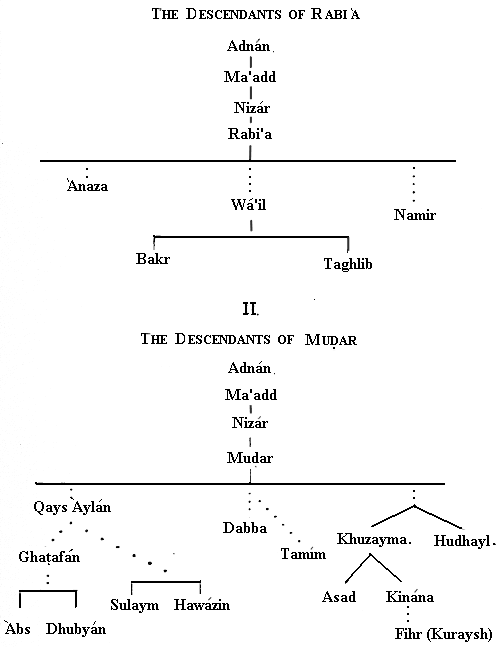
and they married him to one of their women.3 The tables
on the opposite page show the principal branches of the
younger but by far the more important family of the Arabs
which traced its pedigree through ‘Adnán to Ismá‘íl. A
dotted line indicates the omission of one or more links in
the genealogical chain.4
It is undeniable that these lineages are to some extent
fictitious. There was no Pre-islamic science of genealogy,
so that the first Muḥammadan investigators had only confused
and scanty traditions to work on. They were biassed,
moreover, by political, religious, and other considerations.6
Thus their study of the Koran Character of
Muḥammadan
genealogy.
and of Biblical history led to the introduction
of the patriarchs who stand at the head of their lists. Nor
can we accept the national genealogy beginning with ‘Adnán
as entirely historical, though a great deal of it was actually
stored in the memories of the Arabs at the time when Islam
arose, and is corroborated by the testimony of the Pre-islamic
poets.7 On the other hand, the alleged descent of every
tribe from an eponymous ancestor is inconsistent with facts
established by modern research.8 It is probable that many
names represent merely a local or accidental union; and
many more, e.g., Ma‘add, seem originally to have denoted
large groups or confederations of tribes. The theory of
a radical difference between the Northern Arabs and those
of the South, corresponding to the fierce hostility which
has always divided them since the earliest days of Islam,9
may hold good if we restrict the term 'Yemenite'
(Southern) to the civilised Sabæans, Ḥimyarites, &c., who
dwelt in Yemen and spoke their own dialect, but
can hardly apply to the Arabic-speaking 'Yemenite'
Bedouins scattered all over the peninsula. Such criticism,
however, does not affect the value of the genealogical
documents regarded as an index of the popular mind. From
this point of view legend is often superior to fact, and it
must be our aim in the following chapters to set forth what
the Arabs believed rather than to examine whether or no
they were justified in believing it.
'Arabic,' in its widest signification, has two principal
dialects:—
1. South Arabic, spoken in Yemen and including Sabæan,
Ḥimyarite, Minæan, with the kindred dialects of Mahra
and Shiḥr.
2. Arabic proper, spoken in Arabia generally, exclusive
of Yemen.
Of the former language, leaving Mahrí, Socotrí, and other
living dialects out of account, we possess nothing beyond the
numerous inscriptions which have been collected South Arabic.
by European travellers and which it will be convenient
to discuss in the next chapter, where I shall give
a brief sketch of the legendary history of the Sabæans and
Ḥimyarites. South Arabic resembles Arabic in its grammatical
forms, e.g., the broken plural, the sign of the dual, and
the manner of denoting indefiniteness by an affixed m (for
which Arabic substitutes n) as well as in its vocabulary; its
alphabet, which consists of twenty-nine letters, Sin and Samech
being distinguished as in Hebrew, is more nearly akin to the
Æthiopic. The Ḥimyarite Empire was overthrown by the
Abyssinians in the sixth century after Christ, and by 600 a.d.
South Arabic had become a dead language. From this time
forward the dialect of the North established an almost
universal supremacy and won for itself the title of 'Arabic'
par excellence.10
The oldest monuments of written Arabic are modern in
date compared with the Sabæan inscriptions, some of which
take us back 2,500 years or thereabout. Apart The oldest
specimens of
Arabic writing.
from the inscriptions of Ḥijr in the northern
Ḥijáz, and those of Ṣafá in the neighbourhood of
Damascus (which, although written by northern Arabs before
the Christian era, exhibit a peculiar character not unlike the
Sabæan and cannot be called Arabic in the usual acceptation
of the term), the most ancient examples of Arabic writing
which have hitherto been discovered appear in the trilingual
(Syriac, Greek, and Arabic) inscription of Zabad,11 south-east of
Aleppo, dated 512 or 513 a.d., and the bilingual (Greek and
Arabic) of Ḥarrán,12 dated 568 a.d. With these documents we
need not concern ourselves further, especially as their
interpretation presents great difficulties. Very few among
the Pre-islamic Arabs were able to read or write.13 Those who
could generally owed their skill to Jewish and Christian
teachers, or to the influence of foreign culture radiating
from Ḥíra and Ghassán. But although the Koran, which
was first collected soon after the battle of Yamáma (633
a.d.), is the oldest Arabic book, the beginnings of literary
composition in the Arabic language can be traced back to
an earlier period. Probably all the Pre-islamic poems which
have come down to us belong to the century preceding
Islam (500-622 a.d.), but their elaborate form and technical
perfection forbid the hypothesis that in them we have "the
first sprightly runnings" of Arabian song. It may be said of
these magnificent odes, as of the Iliad and The Pre-islamic
poems.
Odyssey, that "they are works of highly finished
art, which could not possibly have been produced
until the poetical art had been practised for a long time."
They were preserved during hundreds of years by oral tradition,
as we shall explain elsewhere, and were committed to writing,
for the most part, by the Moslem scholars of the early
‘Abbásid age, i.e., between 750 and 900 a.d. It is a noteworthy
fact that the language of these poems, the authors of
which represent many different tribes and districts of the
peninsula, is one and the same. The dialectical variations
are too trivial to be taken into account. We might conclude
that the poets used an artificial dialect, not such as was
commonly spoken but resembling the epic dialect of Ionia
which was borrowed by Dorian and Æolian bards. When
we find, however, that the language in question is employed
not only by the wandering troubadours, who were often men
of some culture, and the Christian Arabs of Ḥíra on the
Euphrates, but also by goat-herds, brigands, and illiterate
Bedouins of every description, there can be no room for doubt
that in the poetry of the sixth century we hear the Arabic
language as it was then spoken throughout the length and
breadth of Arabia. The success of Muḥammad and the
conquests made by Islam under the Orthodox Caliphs gave
an entirely new importance to this classical idiom. Arabic
became the sacred language of the whole Moslem world.
This was certainly due to the Koran; but, on The Koran.
the other hand, to regard the dialect of Mecca,
in which the Koran is written, as the source and prototype
of the Arabic language, and to call Arabic 'the dialect of
Quraysh,' is utterly to reverse the true facts of the case.
Muḥammad, as Nöldeke has observed, took the ancient poetry
for a model; and in the early age of Islam it was the authority
of the heathen poets (of whom Quraysh had singularly few)
that determined the classical usage and set the standard of
correct speech. Moslems, who held the Koran to be the
Word of God and inimitable in point of style, naturally
exalted the dialect of the Prophet's tribe above all others, even
laying down the rule that every tribe spoke less purely in
proportion to its distance from Mecca, but this view will not
commend itself to the unprejudiced student. The Koran,
however, exercised a unique influence on the history of the
Arabic language and literature. We shall see in a subsequent
chapter that the necessity of preserving the text of the Holy
Book uncorrupted, and of elucidating its obscurities, caused
the Moslems to invent a science of grammar and lexicography,
and to collect the old Pre-Muḥammadan poetry and traditions
which must otherwise have perished. When the Arabs
settled as conquerors in Syria and Persia and mixed with
foreign peoples, the purity of the classical language could no
longer be maintained. While in Arabia itself, especially
among the nomads of the desert, little difference was felt,
in the provincial garrison towns and great centres of industry
like Baṣra and Kúfa, where the population largely consisted
of aliens who had embraced Islam and were rapidly being
Arabicised, the door stood open for all sorts of depravation
to creep in. Against this vulgar Arabic the Arabic in the
Muḥammadan
Empire.
philologists waged unrelenting war, and it was
mainly through their exertions that the classical
idiom triumphed over the dangers to which it was exposed.
Although the language of the pagan Bedouins did not survive
intact—or survived, at any rate, only in the mouths of pedants
and poets—it became, in a modified form, the universal
medium of expression among the upper classes of Muḥammadan
society. During the early Middle Ages it was spoken
and written by all cultivated Moslems, of whatever nationality
they might be, from the Indus to the Atlantic; it was the
language of the Court and the Church, of Law and
Commerce, of Diplomacy and Literature and Science. When
the Mongol invasion in the thirteenth century swept away the
‘Abbásid Caliphate, and therewith the last vestige of political
unity in Islam, classical Arabic ceased to be the κοινή or
'common dialect' of the Moslem world, and was supplanted
in Arabia, Syria, Egypt, and other Arabic-speaking countries
by a vulgar colloquial idiom. In these countries, however, it
is still the language of business, literature, and education, and
we are told on high authority that even now it "is undergoing
a renaissance, and there is every likelihood of its again
becoming a great literary vehicle."14 And if, for those
Moslems who are not Arabs, it occupies relatively much
the same position as Latin and Greek in modern European
culture, we must not forget that the Koran, its most
renowned masterpiece, is learned by every Moslem when
he first goes to school, is repeated in his daily prayers, and
influences the whole course of his life to an extent which the
ordinary Christian can hardly realise.
I hope that I may be excused for ignoring in a work
such as this the information regarding Ancient Arabian history
which it is possible to glean from the Babylonian and Assyrian
monuments. Any sketch that might be drawn of the Arabs, say
from 2500 b.c. to the beginning of our era, would resemble a
map of Cathay delineated by Sir John Mandeville. But amongst
the shadowy peoples of the peninsula one, besides Saba and
Ḥimyar, makes something more than a transient impression.
The Nabaṭæans (Nabaṭ, pl. Anbáṭ) dwelt in towns, drove a
flourishing trade long before the birth of Christ, and founded
the kingdom of Petra, which attained a high The Nabaṭæans.
degree of prosperity and culture until it was
annexed by Trajan in 105 a.d. These Nabaṭæans were
Arabs and spoke Arabic, although in default of a script of their
own they used Aramaic for writing.15 Muḥammadan authors
identify them with the Aramæans, but careful study of their
inscriptions has shown that this view, which was accepted by
Quatremère,16 is erroneous. 'The Book of Nabaṭæan Agriculture'
(Kitábu ’l-Faláḥat al-Nahaṭiyya), composed in 904 a.d.
by the Moslem Ibnu ’l-Waḥshiyya, who professed to have
translated it from the Chaldæan, is now known to be a forgery.
I only mention it here as an instance of the way in which
Moslems apply the term 'Nabaṭæan'; for the title in question
does not, of course, refer to Petra but to Babylon.
From what has been said the reader will perceive that the
Three periods of
Arabian history.history of the Arabs, so far as our knowledge of it
is derived from Arabic sources, may be divided
into the following periods:—
| I. |
The Sabæan and Ḥimyarite period, from 800 b.c.,
the date of the oldest South Arabic inscriptions, to
500 a.d. |
| II. |
The Pre-islamic period (500-622 a.d.). |
| III. |
The Muḥammadan period, beginning with the Migration
(Hijra, or Hegira, as the word is generally written)
of the Prophet from Mecca to Medína in 622 a.d.
and extending to the present day. |
For the first period, which is confined to the history of Yemen
or South Arabia, we have no contemporary Arabic sources except
the inscriptions. The valuable but imperfect The Sabæans and
Ḥimyarites.
information which these supply is appreciably
increased by the traditions preserved in the Pre-islamic
poems, in the Koran, and particularly in the later
Muḥammadan literature. It is true that most of this material
is legendary and would justly be ignored by any one engaged
in historical research, but I shall nevertheless devote a
good deal of space to it, since my principal object is to make
known the beliefs and opinions of the Arabs themselves.
The second period is called by Muḥammadan writers the
Jáhiliyya, i.e., the Age of Ignorance or Barbarism.17 Its
characteristics are faithfully and vividly reflected
in the songs and odes of the heathen poets which The pagan
Arabs.
have come down to us. There was no prose
literature at that time: it was the poet's privilege to sing the
history of his own people, to record their genealogies, to celebrate
their feats of arms, and to extol their virtues. Although
an immense quantity of Pre-islamic verse has been lost for ever,
we still possess a considerable remnant, which, together with
the prose narratives compiled by Moslem philologists and
antiquaries, enables us to picture the life of those wild days,
in its larger aspects, accurately enough.
The last and by far the most important of the three periods
comprises the history of the Arabs under Islam. It falls
naturally into the following sections, which are The Moslem
Arabs.
enumerated in this place in order that the reader
may see at a glance the broad political outlines
of the complex and difficult epoch which lies before him.
A. The Life of Muḥammad.
About the beginning of the seventh century of the Christian
era a man named Muḥammad, son of ‘Abdulláh, of the tribe
Quraysh, appeared in Mecca with a Divine Life of
Muḥammad.
revelation (Koran). He called on his fellow-townsmen
to renounce idolatry and worship the
One God. In spite of ridicule and persecution he continued
for several years to preach the religion of Islam in Mecca, but,
making little progress there, he fled in 622 a.d. to the neighbouring
city of Medína. From this date his cause prospered
exceedingly. During the next decade the whole of Arabia
submitted to his rule and did lip-service at least to the new
Faith.
B. The Orthodox Caliphate (632-661 a.d.).
On the death of the Prophet the Moslems were governed
in turn by four of the most eminent among his Companions—Abú
Bakr, ‘Umar, ‘Uthmán, and ‘Alí—who bore The Orthodox
Caliphs.
the title of Khalífa (Caliph), i.e., Vicegerent, and
are commonly described as the Orthodox Caliphs
(al-Khulafá al-Ráshidún). Under their guidance Islam was
firmly established in the peninsula and was spread far beyond
its borders. Hosts of Bedouins settled as military colonists in
the fertile plains of Syria and Persia. Soon, however, the
recently founded empire was plunged into civil war. The
murder of ‘Uthmán gave the signal for a bloody strife between
rival claimants of the Caliphate. ‘Alí, the son-in-law of the
Prophet, assumed the title, but his election was contested by
the powerful governor of Syria, Mu‘áwiya b. Abí Sufyán.
C. The Umayyad Dynasty (661-750 a.d.).
‘Alí fell by an assassin's dagger, and Mu‘áwiya succeeded to
the Caliphate, which remained in his family for ninety years.
The Umayyads, with a single exception, were The Umayyad
dynasty.
Arabs first and Moslems afterwards. Religion
sat very lightly on them, but they produced some
able and energetic princes, worthy leaders of an imperial race.
By 732 a.d. the Moslem conquests had reached the utmost
limit which they ever attained. The Caliph in Damascus had
his lieutenants beyond the Oxus and the Pyrenees, on the shores
of the Caspian and in the valley of the Nile. Meantime the
strength of the dynasty was being sapped by political and
religious dissensions nearer home. The Shí‘ites, who held that
the Caliphate belonged by Divine right to ‘Alí and his descendants,
rose in revolt again and again. They were joined
by the Persian Moslems, who loathed the Arabs and the
oppressive Umayyad government. The ‘Abbásids, a family
closely related to the Prophet, put themselves at the head of
the agitation. It ended in the complete overthrow of the
reigning house, which was almost exterminated.
D. The ‘Abbásid Dynasty (750-1258 a.d.).
Hitherto the Arabs had played a dominant rôle in the
Moslem community, and had treated the non-Arab Moslems
with exasperating contempt. Now the tables were The ‘Abbásid
dynasty.turned. We pass from the period of Arabian
nationalism to one of Persian ascendancy and
cosmopolitan culture. The flower of the ‘Abbásid troops
were Persians from Khurásán; Baghdád, the wonderful
‘Abbásid capital, was built on Persian soil; and Persian nobles
filled the highest offices of state at the ‘Abbásid court. The
new dynasty, if not religious, was at least favourable to
religion, and took care to live in the odour of sanctity. For a
time Arabs and Persians forgot their differences and worked
together as good Moslems ought. Piety was no longer its
own reward. Learning enjoyed munificent patronage. This
was the Golden Age of Islam, which culminated in the glorious
reign of Hárún al-Rashíd (786-809 a.d.). On his death
peace was broken once more, and the mighty empire began
slowly to collapse. As province after province cut itself loose
from the Caliphate, numerous independent dynasties sprang up,
while the Caliphs became helpless puppets in the hands of
Turkish mercenaries. Their authority was still formally
recognised in most Muḥammadan countries, but since the
middle of the ninth century they had little or no real
power.
E. From the Mongol invasion to the present day (1258
a.d.—).
The Mongol hordes under Húlágú captured Baghdád in
1258 a.d. and made an end of the Caliphate. Sweeping
onward, they were checked by the Egyptian The Post-Mongolian
period.
Mamelukes and retired into Persia, where, some
fifty years afterwards, they embraced Islam. The
successors of Húlágú, the Íl-kháns, reigned in Persia until a
second wave of barbarians under Tímúr spread devastation and
anarchy through Western Asia (1380-1405 a.d.). The unity
of Islam, in a political sense, was now destroyed. Out of the
chaos three Muḥammadan empires gradually took shape. In
1358 the Ottoman Turks crossed the Hellespont, in 1453
they entered Constantinople, and in 1517 Syria, Egypt, and
Arabia were added to their dominions. Persia became an
independent kingdom under the Ṣafawids (1502-1736); while
in India the empire of the Great Moguls was founded by Bábur,
a descendant of Tímúr, and gloriously maintained by his
successors, Akbar and Awrangzíb (1525-1707).
Some of the political events which have been summarised
above will be treated more fully in the body of this work;
others will receive no more than a passing notice.
The ideas which reveal themselves in Arabic Arabian literary
history.
literature are so intimately connected with the
history of the people, and so incomprehensible apart from the
external circumstances in which they arose, that I have found
myself obliged to dwell at considerable length on various
matters of historical interest, in order to bring out what is really
characteristic and important from our special point of view.
The space devoted to the early periods (500-750 a.d.) will not
appear excessive if they are seen in their true light as the
centre and heart of Arabian history. During the next hundred
years Moslem civilisation reaches its zenith, but the Arabs
recede more and more into the background. The Mongol
invasion virtually obliterated their national life, though in
Syria and Egypt they maintained their traditions of culture
under Turkish rule, and in Spain we meet them struggling
desperately against Christendom. Many centuries earlier, in
the palmy days of the ‘Abbásid Empire, the Arabs pur sang contributed
only a comparatively small share to the literature
which bears their name. I have not, however, enforced the
test of nationality so strictly as to exclude all foreigners or
men of mixed origin who wrote in Arabic. It may be said
that the work of Persians (who even nowadays Writers who are
wholly or partly
of foreign extraction.
are accustomed to use Arabic when writing on
theological and philosophical subjects) cannot
illustrate the history of Arabian thought, but
only the influence exerted upon Arabian thought by Persian
ideas, and that consequently it must stand aside unless admitted
for this definite purpose. But what shall we do in the case of
those numerous and celebrated authors who are neither wholly
Arab nor wholly Persian, but unite the blood of both races?
Must we scrutinise their genealogies and try to discover which
strain preponderates? That would be a tedious and unprofitable
task. The truth is that after the Umayyad period no
hard-and-fast line can be drawn between the native and foreign
elements in Arabic literature. Each reacted on the other, and
often both are combined indissolubly. Although they must be
distinguished as far as possible, we should be taking a narrow
and pedantic view of literary history if we insisted on regarding
them as mutually exclusive.
SABA AND ḤIMYAR
With the Sabæans Arabian history in the proper sense may
be said to begin, but as a preliminary step we must take
account of certain races which figure more or less Primitive
races.
prominently in legend, and are considered by
Moslem chroniclers to have been the original
inhabitants of the country. Among these are the peoples of
‘Ád and Thamúd, which are constantly held up in the Koran
as terrible examples of the pride that goeth before destruction.
The home of the ‘Ádites was in Ḥaḍramawt, the province
adjoining Yemen, on the borders of the desert named Aḥqáfu
’l'Raml. It is doubtful whether they were Semites, possibly
of Aramaic descent, who were subdued and exterminated by
invaders from the north, or, as Hommel maintains,18 the
representatives of an imposing non-Semitic Legend of ‘Ad.culture which survives in the tradition of
'Many-columned Iram,'19 the Earthly Paradise built by
Shaddád, one of their kings. The story of their destruction
is related as follows:20 They were a people of gigantic
strength and stature, worshipping idols and committing all
2
manner of wrong; and when God sent to them a prophet,
Húd by name, who should warn them to repent, they
answered: "O Húd, thou hast brought us no evidence,
and we will not abandon our gods for thy saying, nor will we
believe in thee. We say one of our gods hath afflicted thee
with madness."21 Then a fearful drought fell upon the land
of ‘Ád, so that they sent a number of their chief men to
Mecca to pray for rain. On arriving at Mecca the envoys
were hospitably received by the Amalekite prince, Mu‘áwiya
b. Bakr, who entertained them with wine and music—for he
had two famous singing-girls known as al-Jarádatán; which
induced them to neglect their mission for the space of a whole
month. At last, however, they got to business, and their
spokesman had scarce finished his prayer when three clouds
appeared, of different colours—white, red, and black—and a
voice cried from heaven, "Choose for thyself and for thy
people!" He chose the black cloud, deeming that it had the
greatest store of rain, whereupon the voice chanted—
"Thou hast chosen embers dun | that will spare of ‘Ád not one |
that will leave nor father nor son | ere him to death they shall have
done."
Then God drove the cloud until it stood over the land of ‘Ád,
and there issued from it a roaring wind that consumed the
whole people except a few who had taken the prophet's
warning to heart and had renounced idolatry.
From these, in course of time, a new people arose, who are
called 'the second ‘Ád.' They had their settlements in
Yemen, in the region of Saba. The building of the great
Dyke of Ma’rib is commonly attributed to their king,
Luqmán b. ‘Ád, about whom many fables are told. He was
surnamed 'The Man of the Vultures' (Dhu ’l-Nusúr),
because it had been granted to him that he should live as
long as seven vultures, one after the other.
3
In North Arabia, between the Ḥijáz and Syria, dwelt the
kindred race of Thamúd, described in the Koran (vii, 72) as
inhabiting houses which they cut for themselves Legend of
Thamúd.
in the rocks. Evidently Muḥammad did not
know the true nature of the hewn chambers
which are still to be seen at Ḥijr (Madá’in Ṣáliḥ), a week's
journey northward from Medína, and which are proved by
the Nabaṭæan inscriptions engraved on them to have been
sepulchral monuments.22 Thamúd sinned in the same way
as ‘Ád, and suffered a like fate. They scouted the prophet
Ṣáliḥ, refusing to believe in him unless he should work a
miracle. Ṣáliḥ then caused a she-camel big with young to come
forth from a rock, and bade them do her no hurt, but one of
the miscreants, Qudár the Red (al-Aḥmar), hamstrung and
killed her. "Whereupon a great earthquake overtook them
with a noise of thunder, and in the morning they lay dead in
their houses, flat upon their breasts."23 The author of this
catastrophe became a byword: Arabs say, "More unlucky
than the hamstringer of the she-camel," or "than Aḥmar of
Thamúd." It should be pointed out that, unlike the ‘Ádites,
of whom we find no trace in historical times, the Thamúdites
are mentioned as still existing by Diodorus Siculus and
Ptolemy; and they survived down to the fifth century a.d.
in the corps of equites Thamudeni attached to the army of the
Byzantine emperors.
Besides ‘Ád and Thamúd, the list of primitive races
includes the ‘Amálíq (Amalekites)—a purely fictitious term
under which the Moslem antiquaries lumped ‘Amálíq.together several peoples of an age long past,
e.g., the Canaanites and the Philistines. We hear of Amalekite
settlements in the Tiháma (Netherland) of Mecca and
in other parts of the peninsula. Finally, mention should
4be made of Ṭasm and Jadís, sister tribes of which nothing
is recorded except the fact of their destruction and the
events that brought it about. The legendary Ṭasm and Jadís.
narrative in which these are embodied has some
archæological interest as showing the existence in early
Arabian society of a barbarous feudal custom, 'le droit du
seigneur,' but it is time to pass on to the main subject of
this chapter.
The Pre-islamic history of the Yoqṭánids, or Southern
Arabs, on which we now enter, is virtually the history of History of the
Yoqṭánids.
two peoples, the Sabæans and the Ḥimyarites,
who formed the successive heads of a South
Arabian empire extending from the Red Sea to
the Persian Gulf.
Saba24 (Sheba of the Old Testament) is often incorrectly
used to denote the whole of Arabia Felix, whereas it was only
one, though doubtless the first in power and The Sabæans.
importance, of several kingdoms, the names and
capitals of which are set down in the works of Greek
and Roman geographers. However exaggerated may be the
glowing accounts that we find there of Sabæan wealth and
magnificence, it is certain that Saba was a flourishing commercial
state many centuries before the birth of Christ.25
"Sea-traffic between the ports of East Arabia and India was
very early established, and Indian products, especially spices
and rare animals (apes and peacocks) were conveyed to the
coast of ‘Umán. Thence, apparently even in the tenth century
b.c., they went overland to the Arabian Gulf, where they
5
were shipped to Egypt for the use of the Pharaohs and
grandees.... The difficulty of navigating the Red Sea
caused the land route to be preferred for the traffic between
Yemen and Syria. From Shabwat (Sabota) in Ḥaḍramawt
the caravan road went to Ma’rib (Mariaba), the Sabæan
capital, then northward to Macoraba (the later Mecca), and
by way of Petra to Gaza on the Mediterranean."26 The
prosperity of the Sabæans lasted until the Indian trade,
instead of going overland, began to go by sea along the coast
of Ḥaḍramawt and through the straits of Báb al-Mandab. In
consequence of this change, which seems to have taken place
in the first century a.d., their power gradually declined, a
great part of the population was forced to seek new homes in
the north, their cities became desolate, and their massive
aqueducts crumbled to pieces. We shall see presently that
Arabian legend has crystallised the results of a long period of
decay into a single fact—the bursting of the Dyke of Ma’rib.
The disappearance of the Sabæans left the way open for a
younger branch of the same stock, namely, the Ḥimyarites,
or, as they are called by classical authors, The Ḥimyarites.
Homeritæ, whose country lay between Saba and
the sea. Under their kings, known as Tubba‘s, they soon
became the dominant power in South Arabia and exercised
sway, at least ostensibly, over the northern tribes down to the
end of the fifth century a.d., when the latter revolted and, led
by Kulayb b. Rabí‘a, shook off the suzerainty of Yemen in a
great battle at Khazázá.27 The Ḥimyarites never flourished like
the Sabæans. Their maritime situation exposed them more to
attack, while the depopulation of the country had seriously
weakened their military strength. The Abyssinians—originally
colonists from Yemen—made repeated attempts to gain a
6foothold, and frequently managed to instal governors who
were in turn expelled by native princes. Of these Abyssinian
viceroys the most famous is Abraha, whose unfortunate expedition
against Mecca will be related in due course. Ultimately
the Ḥimyarite Empire was reduced to a Persian dependency.
It had ceased to exist as a political power about a hundred
years before the rise of Islam.
The chief Arabian sources of information concerning Saba
and Ḥimyar are (1) the so-called 'Ḥimyarite' inscriptions, Sources of
information.
and (2) the traditions, almost entirely of a legendary
kind, which are preserved in Muḥammadan
literature.
Although the South Arabic language may have maintained
itself sporadically in certain remote districts down to the
Prophet's time or even later, it had long ago been
superseded as a medium of daily intercourse by The South
Arabic or
Sabæan
inscriptions.
the language of the North, the Arabic par
excellence, which henceforth reigns without a rival
throughout the peninsula. The dead language, however, did
not wholly perish. Already in the sixth century a.d. the
Bedouin rider made his camel kneel down while he stopped
to gaze wonderingly at inscriptions in a strange character
engraved on walls of rock or fragments of hewn stone, and
compared the mysterious, half-obliterated markings to the
almost unrecognisable traces of the camping-ground which
for him was fraught with tender memories. These inscriptions
are often mentioned by Muḥammadan authors, who
included them in the term Musnad. That some Moslems—probably
very few—could not only read the South Arabic
alphabet, but were also acquainted with the elementary rules
of orthography, appears from a passage in the eighth book of
Hamdání's Iklíl; but though they might decipher proper
names and make out the sense of words here and there, they
had no real knowledge of the language. How the inscriptions
were discovered anew by the enterprise of European travellers,
7
gradually deciphered and interpreted until they became capable
of serving as a basis for historical research, and what results
the study of them has produced, this I shall now set forth as
briefly as possible. Before doing so it is necessary to explain
why instead of 'Ḥimyarite inscriptions' and 'Ḥimyarite
language' I have adopted the less familiar designations 'South
Arabic' or 'Sabæan.' 'Ḥimyarite' is equally misleading,
whether applied to the language of the inscriptions or to the
inscriptions themselves. As regards the language, it was
spoken in one form or another not by the Objections to
the term
'Ḥimyarite.'
Ḥimyarites alone, but also by the Sabæans, the
Minæans, and all the different peoples of Yemen.
Muḥammadans gave the name of 'Ḥimyarite' to the ancient
language of Yemen for the simple reason that the Ḥimyarites
were the most powerful race in that country during the last
centuries preceding Islam. Had all the inscriptions belonged
to the period of Ḥimyarite supremacy, they might with some
justice have been named after the ruling people; but the fact
is that many date from a far earlier age, some going back to
the eighth century b.c., perhaps nearly a thousand years before
the Ḥimyarite Empire was established. The term 'Sabæan'
is less open to objection, for it may fairly be regarded as a
national rather than a political denomination. On the whole,
however, I prefer 'South Arabic' to either.
Among the pioneers of exploration in Yemen the first to
interest himself in the discovery of inscriptions was Carsten
Niebuhr, whose Beschreibung von Arabien, published
in 1772, conveyed to Europe the report Discovery and
decipherment
of the South
Arabic
inscriptions.
that inscriptions which, though he had not seen
them, he conjectured to be 'Ḥimyarite,' existed
in the ruins of the once famous city of Ẓafár. On one
occasion a Dutchman who had turned Muḥammadan showed
him the copy of an inscription in a completely unknown
alphabet, but "at that time (he says) being very ill with a
violent fever, I had more reason to prepare myself for death
8
than to collect old inscriptions."28 Thus the opportunity was
lost, but curiosity had been awakened, and in 1810 Ulrich
Jasper Seetzen discovered and copied several inscriptions in the
neighbourhood of Ẓafár. Unfortunately these copies, which
had to be made hastily, were very inexact. He also purchased
an inscription, which he took away with him and copied at
leisure, but his ignorance of the characters led him to mistake
the depressions in the stone for letters, so that the conclusions
he came to were naturally of no value.29 The first serviceable
copies of South Arabic inscriptions were brought to Europe by
English officers employed on the survey of the southern and
western coasts of Arabia. Lieutenant J. R. Wellsted published
the inscriptions of Ḥiṣn Ghuráb and Naqb al-Ḥajar in his
Travels in Arabia (1838).
Meanwhile Emil Rödiger, Professor of Oriental Languages
at Halle, with the help of two manuscripts of the Berlin Royal
Library containing 'Ḥimyarite' alphabets, took the first step
towards a correct decipherment by refuting the idea, for which
De Sacy's authority had gained general acceptance, that the
South Arabic script ran from left to right30; he showed, moreover,
that the end of every word was marked by a straight perpendicular
line.31 Wellsted's inscriptions, together with those which
Hulton and Cruttenden brought to light at Ṣan‘á, were deciphered
by Gesenius and Rödiger working independently
(1841). Hitherto England and Germany had shared the
9
credit of discovery, but a few years later France joined
hands with them and was soon leading the way with
characteristic brilliance. In 1843 Th. Arnaud, starting from
Ṣan‘á, succeeded in discovering the ruins of Ma’rib, the ancient
Sabæan metropolis, and in copying at the risk of his life
between fifty and sixty inscriptions, which were afterwards
published in the Journal Asiatique and found an able interpreter
in Osiander.32 Still more important were the results of the
expedition undertaken in 1870 by the Jewish scholar, Joseph
Halévy, who penetrated into the Jawf, or country lying east
of Ṣan‘á, which no European had traversed before him since
24 b.c., when Ælius Gallus led a Roman army by the same
route. After enduring great fatigues and meeting with many
perilous adventures, Halévy brought back copies of nearly seven
hundred inscriptions.33 During the last twenty-five years much
fresh material has been collected by E. Glaser and Julius
Euting, while study of that already existing by Prætorius,
Halévy, D. H. Müller, Mordtmann, and other scholars has
substantially enlarged our knowledge of the language, history,
and religion of South Arabia in the Pre-islamic age.
Neither the names of the Ḥimyarite monarchs, as they
appear in the lists drawn up by Muḥammadan historians, nor
the order in which these names are arranged can pretend to
accuracy. If they are historical persons at all they must have
reigned in fairly recent times, perhaps a short while before the
rise of Islam, and probably they were unimportant princes
whom the legend has thrown back into the ancient epoch, and
has invested with heroic attributes. Any one who doubts this
has only to compare the modern lists with those which have
been made from the material in the inscriptions.34 D. H.
10
Müller has collected the names of thirty-three Minæan kings.
Certain names are often repeated—a proof of the existence of
ruling dynasties—and ornamental epithets are The historical
value of
the inscriptions.
usually attached to them. Thus we find Dhamar‘alí
Dhirríḥ (Glorious), Yatha‘amar Bayyin (Distinguished),
Kariba’íl Watár Yuhan‘im (Great, Beneficent),
Samah‘alí Yanúf (Exalted). Moreover, the kings bear
different titles corresponding to three distinct periods of South
Arabian history, viz., 'Priest-king of Saba' (Mukarrib Saba),35
'King of Saba' (Malk Saba), and 'King of Saba and Raydán.'
In this way it is possible to determine approximately the age of
the various buildings and inscriptions, and to show that they
do not belong, as had hitherto been generally supposed, to the
time of Christ, but that in some cases they are at least eight
hundred years older.
How widely the peaceful, commerce-loving people of Saba
and Ḥimyar differed in character from the wild Arabs to
whom Muḥammad was sent appears most strikingly Votive
inscriptions.
in their submissive attitude towards their gods,
which forms, as Goldziher has remarked, the keynote
of the South Arabian monuments.36 The prince erects
a thank-offering to the gods who gave him victory over his
enemies; the priest dedicates his children and all his possessions;
the warrior who has been blessed with "due man-slayings,"
or booty, or escape from death records his gratitude,
and piously hopes for a continuance of favour. The dead are
conceived as living happily under divine protection; they are
venerated and sometimes deified.37 The following inscription,
11
translated by Lieut.-Col. W. F. Prideaux, is a typical example
of its class:—
"Sa‘d-iláh and his sons, Benú Marthadim, have endowed Il-Maḳah
of Hirrán with this tablet, because Il-Maḳah, lord of Awwám Dhú-‘Irán
Alú, has favourably heard the prayer addressed to him, and has
consequently heard the Benú Marthadim when they offered the first-fruits
of their fertile lands of Arhaḳim in the presence of Il-Maḳah
of Hirrán, and Il-Maḳah of Hirrán has favourably heard the prayer
addressed to him that he would protect the plains and meadows and
this tribe in their habitations, in consideration of the frequent gifts
throughout the year; and truly his (Sa‘d-iláh's) sons will descend to
Arhaḳim, and they will indeed sacrifice in the two shrines of ‘Athtor
and Shamsim, and there shall be a sacrifice in Hirrán—both in order
that Il-Maḳah may afford protection to those fields of Bin Marthadim
as well as that he may favourably listen—and in the sanctuary of
Il-Maḳah of Ḥarwat, and therefore may he keep them in safety
according to the sign in which Sa‘d-iláh was instructed, the sign
which he saw in the sanctuary of Il-Maḳah of Na‘mán; and as for
Il-Maḳah of Hirrán, he has protected those fertile lands of Arhaḳim
from hail and from all misfortune (or, from cold and from all
extreme heat)."38
In concluding this very inadequate account of the South
Arabic inscriptions I must claim the indulgence of my readers,
who are aware how difficult it is to write clearly and accurately
upon any subject without first-hand knowledge, in particular
when the results of previous research are continually being
transformed by new workers in the same field.
Fortunately we possess a considerable literary supplement to
these somewhat austere and meagre remains. Our knowledge
of South Arabian geography, antiquities, and Literary
sources.
legendary history is largely derived from the
works of two natives of Yemen, who were filled
with enthusiasm for its ancient glories, and whose writings,
though different as fact and fable, are from the present point
of view equally instructive—Ḥasan b. Aḥmad al-Hamdání and
12
Nashwán b. Sa‘íd al-Ḥimyarí. Besides an excellent geography
of Arabia (Ṣifatu Jazírat al-‘Arab), which has been edited by
Hamdání
(† 945 a.d.).D. H. Müller, Hamdání left a great work on history and antiquities of Yemen, entitled
al-Iklíl ('The Crown'), and divided into ten
books under the following heads:—39
Book I. Compendium of the beginning and origins of genealogy.
Book II. Genealogy of the descendants of al-Hamaysa‘ b. Ḥimyar.
Book III. Concerning the pre-eminent qualities of Qaḥṭán.
Book IV. Concerning the first period of history down to the reign of
Tubba‘ Abú Karib.
Book V. Concerning the middle period from the accession of As‘ad
Tubba‘ to the reign of Dhú Nuwás.
Book VI. Concerning the last period down to the rise of Islam.
Book VII. Criticism of false traditions and absurd legends.
Book VIII. Concerning the castles, cities, and tombs of the Ḥimyarites;
the extant poetry of ‘Alqama,40 the elegies, the inscriptions,
and other matters.
Book IX. Concerning the proverbs and wisdom of the Ḥimyarites in the
Ḥimyarite language, and concerning the alphabet of the
inscriptions.
Book X. Concerning the genealogy of Ḥáshid and Bakíl (the two
principal tribes of Hamdán).
The same intense patriotism which caused Hamdání to devote
himself to scientific research inspired Nashwán b. Sa‘íd, who
descended on the father's side from one of the Nashwán b.
Sa‘íd
al-Ḥimyarí
(† 1177 a.d.).
ancient princely families of Yemen, to recall the
legendary past and become the laureate of a
long vanished and well-nigh forgotten empire.
In 'The Ḥimyarite Ode' (al-Qaṣídatu ’l-Ḥimyariyya) he sings
the might and grandeur of the monarchs who ruled over his
people, and moralises in true Muḥammadan spirit upon the
13
fleetingness of life and the futility of human ambition.41
Accompanying the Ode, which has little value except as a
comparatively unfalsified record of royal names,42 is a copious
historical commentary either by Nashwán himself, as Von
Kremer thinks highly probable, or by some one who lived
about the same time. Those for whom history represents an
aggregate of naked facts would find nothing to the purpose in
this commentary, where threads of truth are almost inextricably
interwoven with fantastic and fabulous embroideries. A
literary form was first given to such legends by the professional
story-tellers of early Islam. One of these, the South Arabian
‘Abíd b. Sharya, visited Damascus by command of the Caliph
Mu‘áwiya I, who questioned him "concerning ‘Abíd b. Sharya.
the ancient traditions, the kings of the Arabs and
other races, the cause of the confusion of tongues, and the
history of the dispersion of mankind in the various countries of
the world,"43 and gave orders that his answers should be put
together in writing and published under his name. This work,
of which unfortunately no copy has come down to us, was
entitled 'The Book of the Kings and the History of the
Ancients' (Kitábu ’l-Mulúk wa-akhbáru ’l-Máḍín). Mas‘údí
(† 956 a.d.) speaks of it as a well-known book, enjoying a wide
circulation.44 It was used by the commentator of the Ḥimyarite
Ode, either at first hand or through the medium of Hamdání's
Iklíl. We may regard it, like the commentary itself, as a
historical romance in which most of the characters and some of
the events are real, adorned with fairy-tales, fictitious verses,
14
and such entertaining matter as a man of learning and story-teller
by trade might naturally be expected to introduce.
Among the few remaining Muḥammadan authors who Ḥamza of Iṣfahán.
bestowed special attention on the Pre-islamic period of
South Arabian history, I shall mention here only
Ḥamza of Iṣfahán, the eighth book of whose
Annals (finished in 961 a.d.) provides a useful
sketch, with brief chronological details, of the Tubba‘s or
Ḥimyarite kings of Yemen.
Qaḥṭán, the ancestor of the Southern Arabs, was succeeded
by his son Ya‘rub, who is said to have been the first to use the
Arabic language, and the first to receive the salutations
with which the Arabs were accustomed Ya‘rub.
to address their kings, viz., "In‘im ṣabáḥan" ("Good morning!")
and "Abayta ’l-la‘na" ("Mayst thou avoid malediction!").
His grandson, ‘Abd Shams Saba, is named as the
founder of Ma’rib and the builder of the famous Dyke, which,
according to others, was constructed by Luqmán b. ‘Ád.
Saba had two sons, Ḥimyar and Kahlán. Before his
death he deputed the sovereign authority to Ḥimyar,
and the task of protecting the frontiers and making
war upon the enemy to Kahlán. Thus Ḥimyar Ḥimyar and Kahlán.
obtained the lordship, assumed the title Abú
Ayman, and abode in the capital city of the
realm, while Kahlán took over the defence of the borders
and the conduct of war.45 Omitting the long series of mythical
Sabæan kings, of whom the legend has little or nothing to
relate, we now come to an event which fixed itself ineffaceably
in the memory of the Arabs, and which is known in their
traditions as Saylu ’l-‘Arim, or the Flood of the Dyke.
15
Some few miles south-west of Ma’rib the mountains draw
together leaving a gap, through which flows the River Adana.
During the summer its bed is often dry, but in the
rainy season the water rushes down with such The Dam of
Ma’rib.
violence that it becomes impassable. In order to
protect the city from floods, and partly also for purposes of
irrigation, the inhabitants built a dam of solid masonry, which,
long after it had fallen into ruin, struck the imagination of
Muḥammad, and was reckoned by Moslems among the wonders
of the world.46 That their historians have clothed the bare fact
of its destruction in ample robes of legendary circumstance is
not surprising, but renders abridgment necessary.47
Towards the end of the third century of our era, or possibly
at an earlier epoch,48 the throne of Ma’rib was temporarily
occupied by ‘Amr b. ‘Ámir Má’ al-Samá, surnamed Its destruction
announced by
portents.
Muzayqiyá.49 His wife, Ẓarífa, was skilled
in the art of divination. She dreamed dreams and
saw visions which announced the impending calamity. "Go
to the Dyke," she said to her husband, who doubted her clairvoyance,
"and if thou see a rat digging holes in the Dyke
with its paws and moving huge boulders with its hind-legs, be
assured that the woe hath come upon us." So ‘Amr went to
16
the Dyke and looked carefully, and lo, there was a rat moving
an enormous rock which fifty men could not have rolled from
its place. Convinced by this and other prodigies that the
Dyke would soon burst and the land be laid waste, he resolved
to sell his possessions and depart with his family; and, lest
conduct so extraordinary should arouse suspicion, he had recourse
to the following stratagem. He invited the chief men
of the city to a splendid feast, which, in accordance with a
preconcerted plan, was interrupted by a violent altercation
between himself and his son (or, as others relate, an orphan
who had been brought up in his house). Blows were exchanged,
and ‘Amr cried out, "O shame! on the day of my
glory a stripling has insulted me and struck my face." He
swore that he would put his son to death, but the guests
entreated him to show mercy, until at last he gave way.
"But by God," he exclaimed, "I will no longer remain in
a city where I have suffered this indignity. I will sell my
lands and my stock." Having successfully got rid of his
encumbrances—for there was no lack of buyers eager to take
him at his word—‘Amr informed the people of the danger with
which they were threatened, and set out from Ma’rib at the
head of a great multitude. Gradually the waters made a
breach in the Dyke and swept over the country, spreading
devastation far and wide. Hence the proverb Dhahabú (or
tafarraqú) aydí Saba, "They departed" (or "dispersed") "like
the people of Saba."50
This deluge marks an epoch in the history of South Arabia.
The waters subside, the land returns to cultivation Fall of the
Sabæan
Empire.
and prosperity, but Ma’rib lies desolate, and the
Sabæans have disappeared for ever, except "to
point a moral or adorn a tale." Al-A‘shá sang:—
Metre Mutaqárib: 
17
"Let this warn whoever a warning will take—
And Ma’rib withal, which the Dam fortified.
Of marble did Ḥimyar construct it, so high,
The waters recoiled when to reach it they tried.
It watered their acres and vineyards, and hour
By hour, did a portion among them divide.
So lived they in fortune and plenty until
Therefrom turned away by a ravaging tide.
Then wandered their princes and noblemen through
Mirage-shrouded deserts that baffle the guide."51
The poet's reference to Ḥimyar is not historically accurate.
It was only after the destruction of the Dyke and the dispersion
of the Sabæans who built it52 that the Ḥimyarites, with their
capital Ẓafár (at a later period, Ṣan‘á) became the rulers of Yemen.
The first Tubba‘, by which name the Ḥimyarite kings are
known to Muḥammadan writers, was Ḥárith, called al-Rá’ish, The Tubba‘s.
i.e., the Featherer, because he 'feathered' his
people's nest with the booty which he brought
home as a conqueror from India and Ádharbayján.53 Of the
Tubba‘s who come after him some obviously owe their place
in the line of Ḥimyar to genealogists whose respect for the
Koran was greater than their critical acumen. Such a man of
straw is Ṣa‘b Dhu ’l-Qarnayn (Ṣa‘b the Two-horned).
The following verses show Dhu ’l-Qarnayn. that he is a double of the mysterious Dhu
’l-Qarnayn of Koranic legend, supposed by
most commentators to be identical with Alexander the Great54:—
18
"Ours the realm of Dhu ’l-Qarnayn the glorious,
Realm like his was never won by mortal king.
Followed he the Sun to view its setting
When it sank into the sombre ocean-spring;
Up he clomb to see it rise at morning,
From within its mansion when the East it fired;
All day long the horizons led him onward,55
All night through he watched the stars and never tired.
Then of iron and of liquid metal
He prepared a rampart not to be o'erpassed,
Gog and Magog there he threw in prison
Till on Judgment Day they shall awake at last."56
Similarly, among the Tubba‘s we find the Queen of Sheba,
whose adventures with Bilqís.Solomon are related in the twenty-seventh
chapter of the Koran. Although Muḥammad
himself did not mention her name or
lineage, his interpreters were equal to the occasion and revealed
her as Bilqís, the daughter of Sharáḥíl (Sharaḥbíl).
The national hero of South Arabian legend is the Tubba‘
19
As‘ad Kámil, or, as he is sometimes called, Abú Karib. Even
at the present day, says Von Kremer, his memory is kept alive,
and still haunts the ruins of his palace at Ẓafár. As‘ad Kámil.
"No one who reads the Ballad of his Adventures
or the words of exhortation which he addressed on his
deathbed to his son Ḥassán can escape from the conviction that
here we have to do with genuine folk-poetry—fragments of a
South Arabian legendary cycle, the beginnings of which undoubtedly
reach back to a high antiquity."57 I translate here
the former of these pieces, which may be entitled
THE BALLAD OF THE THREE WITCHES.58
"Time brings to pass full many a wonder
Whereof the lesson thou must ponder.
Whilst all to thee seems ordered fair,
Lo, Fate hath wrought confusion there.
Against a thing foredoomed to be
Nor cunning nor caution helpeth thee.
Now a marvellous tale will I recite;
Trust me to know and tell it aright!
Once on a time was a boy of Asd
Who became the king of the land at last,
Born in Hamdán, a villager;
The name of that village was Khamir.
This lad in the pride of youth defied
His friends, and they with scorn replied.
None guessed his worth till he was grown
Ready to spring.
20
One morn, alone
On Hinwam hill he was sore afraid.59
(His people knew not where he strayed;
They had seen him only yesternight,
For his youth and wildness they held him light.
The wretches! Him they never missed
Who had been their glory had they wist).
O the fear that fell on his heart when he
Saw beside him the witches three!
The eldest came with many a brew—
In some was blood, blood-dark their hue.
'Give me the cup!' he shouted bold;
'Hold, hold!' cried she, but he would not hold.
She gave him the cup, nor he did shrink
Tho' he reeled as he drained the magic drink.
Then the second yelled at him. Her he faced
Like a lion with anger in his breast.
'These be our steeds, come mount,' she cried,
'For asses are worst of steeds to ride.'
''Tis sooth,' he answered, and slipped his flank
O'er a hyena lean and lank,
But the brute so fiercely flung him away,
With deep, deep wounds on the earth he lay.
Then came the youngest and tended him
On a soft bed, while her eyes did swim
In tears; but he averted his face
And sought a rougher resting-place:
Such paramour he deemed too base.
And himthought, in anguish lying there,
That needles underneath him were.60
Now when they had marked his mien so bold,
Victory in all things they foretold.
'The wars, O As‘ad, waged by thee
Shall heal mankind of misery.
21
Thy sword and spear the foe shall rue
When his gashes let the daylight through;
And blood shall flow on every hand
What time thou marchest from land to land.
By us be counselled: stay not within
Khamir, but go to Ẓafár and win!
To thee shall dalliance ne'er be dear,
Thy foes shall see thee before they hear.
Desire moved to encounter thee,
Noble prince, us witches three.
Not jest, but earnest on thee we tried,
And well didst thou the proof abide.'
As‘ad went home and told his folk
What he had seen, but no heed they took.
On the tenth day he set out again
And fared to Ẓafár with thoughts in his brain.
There fortune raised him to high renown:
None swifter to strike ever wore a crown.61
* * *
* *
Thus found we the tale in memory stored,
And Almighty is the Lord.
Praise be to God who liveth aye,
The Glorious to whom all men pray!"
Legend makes As‘ad the hero of a brilliant expedition to
Persia, where he defeated the general sent against him by the
Arsacids, and penetrated to the Caspian Sea. On his way
home he marched through the Ḥijáz, and having learned that
his son, whom he left behind in Medína, had been treacherously
murdered, he resolved to take a terrible vengeance on the
people of that city.
"Now while the Tubba‘ was carrying on war against them, there
came to him two Jewish Rabbins of the Banú Qurayẓa, men deep in
knowledge, who when they heard that he wished to destroy the
22
city and its people, said to him: 'O King, forbear! Verily, if thou
wilt accept nothing save that which thou desirest, an intervention
will be made betwixt thee and the city, and we are As‘ad Kámil
and the
two Rabbins
of Medína.
not sure but that sudden chastisement may befall
thee.' 'Why so?' he asked. They answered: ''Tis
the place of refuge of a prophet who in the after
time shall go forth from the sacred territory of Quraysh: it shall be
his abode and his home.' So the king refrained himself, for he saw
that those two had a particular knowledge, and he was pleased with
what they told him. On departing from Medína he followed them
in their religion.62 ... And he turned his face towards Mecca, that
being his way to Yemen, and when he was between As‘ad Kámil
at Mecca.
‘Usfán and Amaj some Hudhalites came to him and
said: 'O King, shall we not guide thee to a house of
ancient treasure which the kings before thee neglected, wherein
are pearls and emeralds and chrysolites and gold and silver?' He
said, 'Yea.' They said: 'It is a temple at Mecca which those who
belong to it worship and in which they pray.' Now the Hudhalites
wished to destroy him thereby, knowing that destruction awaited
the king who should seek to violate its precinct. So on comprehending
what they proposed, he sent to the two Rabbins to ask
them about the affair. They replied: 'These folk intend naught
but to destroy thee and thine army; we wot not of any house in the
world that God hath chosen for Himself, save this. If thou do that
to which they invite thee, thou and those with thee will surely
perish together.' He said: 'What then is it ye bid me do when I
come there?' They said: 'Thou wilt do as its people do—make
the circuit thereof, and magnify and honour it, and shave thy head,
and humble thyself before it, until thou go forth from its precinct.'
He said: 'And what hinders you from doing that yourselves?'
'By God,' said they, 'it is the temple of our father Abraham, and
verily it is even as we told thee, but we are debarred therefrom by
the idols which its people have set up around it and by the blood-offerings
which they make beside it; for they are vile polytheists,'
or words to the same effect. The king perceived that their advice
was good and their tale true. He ordered the Hudhalites to
approach, and cut off their hands and feet. Then he continued his
march to Mecca, where he made the circuit of the temple, sacrificed
camels, and shaved his head. According to what is told, he stayed
six days at Mecca, feasting the inhabitants with the flesh of camels
23
and letting them drink honey.63... Then he moved out with his
troops in the direction of Yemen, the two Rabbins accompanying
him; and on entering Yemen he called on his subjects He seeks to
establish
Judaism in
Yemen.
to adopt the religion which he himself had embraced,
but they refused unless the question were submitted
to the ordeal of fire which at that time existed in
Yemen; for as the Yemenites say, there was in their country a
fire that gave judgment between them in their disputes: it devoured
the wrong-doer but left the injured person unscathed.
The Yemenites therefore came forward with their The ordeal of
fire.
idols and whatever else they used as a means of
drawing nigh unto God, and the two Rabbins came forward with
their scriptures hung on their necks like necklaces, and both parties
seated themselves at the place from which the fire was wont to
issue. And the fire blazed up, and the Yemenites shrank back from
it as it approached them, and were afraid, but the bystanders urged
them on and bade them take courage. So they held out until the
fire enveloped them and consumed the idols and images and the
men of Ḥimyar, the bearers thereof; but the Rabbins came forth
safe and sound, their brows moist with sweat, and the scriptures
were still hanging on their necks. Thereupon the Ḥimyarites consented
to adopt the king's religion, and this was the cause of
Judaism being established in Yemen."64
The poem addressed to his son and successor, Ḥassán, which
tradition has put into his mouth, is a sort of last will and
testament, of which the greater part is taken As‘ad's farewell
to his son.
up with an account of his conquests and with
glorification of his family and himself.65 Nearly
all that we find in the way of maxims or injunctions suitable
to the solemn occasion is contained in the following verses:—
"O Ḥassán, the hour of thy father's death has arrived at last:
Look to thyself ere yet the time for looking is past.
Oft indeed are the mighty abased, and often likewise
Are the base exalted: such is Man who is born and dies.
24
Bid ye Ḥimyar know that standing erect would I buried be,
And have my wine-skins and Yemen robes in the tomb with me.66
And hearken thou to my Sibyl, for surely can she foresay
The truth, and safe in her keeping is castle Ghaymán aye.67
In connection with Ghaymán a few words may be added
respecting the castles in Yemen, of which the ruined skeletons
rising from solitary heights seem still to frown The castles
of Yemen.
defiance upon the passing traveller. Two thousand
years ago, and probably long before, they
were occupied by powerful barons, more or less independent,
who in later times, when the Ḥimyarite Empire had begun to
decline, always elected, and occasionally deposed, their royal
master. Of these castles the geographer Hamdání has given a
detailed account in the eighth book of his great work on the
history and antiquities of Yemen entitled the Iklíl, or
'Crown.'68 The oldest and most celebrated was Ghumdán,
the citadel of Ṣan‘á. It is described as a huge edifice of
twenty stories, each story ten cubits high. The Ghumdán.
four façades were built with stone of different
colours, white, black, green, and red. On the top story was
a chamber which had windows of marble framed with ebony
and planewood. Its roof was a slab of pellucid marble, so
that when the lord of Ghumdán lay on his couch he saw the
birds fly overhead, and could distinguish a raven from a kite.
At each corner stood a brazen lion, and when the wind blew
25
it entered the hollow interior of the effigies and made a sound
like the roaring of lions.
The adventure of As‘ad Kámil with the three witches must
have recalled to every reader certain scenes in Macbeth.
Curiously enough, in the history of his son Ḥassán an incident
is related which offers a striking parallel to the march of
Birnam Wood. Ṭasm and Jadís have already been mentioned.
On the massacre of the former tribe by the latter, a
single Ṭasmite named Ribáḥ b. Murra made his escape and
took refuge with the Tubba‘ Ḥassán, whom he persuaded to
lead an expedition against the murderers. Now Ribáḥ's sister
had married a man of Jadís. Her name was Zarqá’u
’l-Yamáma.
Zarqá’u ’l-Yamáma—i.e., the Blue-eyed Woman
of Yamáma—and she had such piercing sight that
she was able to descry an army thirty miles away. Ḥassán
therefore bade his horsemen hold in front of them leafy
branches which they tore down from the trees. They
advanced thus hidden, and towards evening, when they had
come within a day's journey, Zarqá said to her people: "I
see trees marching." No one believed her until it was too
late. Next morning Ḥassán fell upon them and put the whole
tribe to the sword.
The warlike expeditions to which Ḥassán devoted all his
energy were felt as an intolerable burden by the chiefs of
Ḥimyar, who formed a plot to slay him and set Ḥassán
murdered by
his brother.
his brother ‘Amr on the throne. ‘Amr was at
first unwilling to lend himself to their designs,
but ultimately his scruples were overcome, and he
stabbed the Tubba‘ with his own hand. The assassin
suffered a terrible punishment. Sleep deserted him, and in his
remorse he began to execute the conspirators one after another.
There was, however, a single chief called Dhú Dhú Ru‘ayn.
Ru‘ayn, who had remained loyal and had done his
best to save ‘Amr from the guilt of fratricide. Finding his
efforts fruitless, he requested ‘Amr to take charge of a sealed
26
paper which he brought with him, and to keep it in a safe
place until he should ask for it. ‘Amr consented and thought
no more of the matter. Afterwards, imagining that Dhú
Ru‘ayn had joined in the fatal plot, he gave orders for his
execution. "How!" exclaimed Dhú Ru‘ayn, "did not I tell
thee what the crime involved?" and he asked for the sealed
writing, which was found to contain these verses—
"O fool to barter sleep for waking! Blest
Is he alone whose eyelids close in rest.
Hath Ḥimyar practised treason, yet 'tis plain
That God forgiveness owes to Dhú Ru‘ayn.69"
On reading this, ‘Amr recognised that Dhú Ru‘ayn had
spoken the truth, and he spared his life.
With ‘Amr the Tubba‘ dynasty comes to an end. The
succeeding kings were elected by eight of the most powerful
barons, who in reality were independent princes, each ruling in
his strong castle over as many vassals and retainers as he could
bring into subjection. During this period the Abyssinians
conquered at least some part of the country, and Christian
viceroys were sent by the Najáshí (Negus) to govern it in his
name. At last Dhú Nuwás, a descendant of the Tubba‘
As‘ad Kámil, crushed the rebellious barons and made himself
unquestioned monarch of Yemen. A fanatical adherent of
Judaism, he resolved to stamp out Christianity in Dhú Nuwás.
Najrán, where it is said to have been introduced
from Syria by a holy man called Faymiyún (Phemion). The
Ḥimyarites flocked to his standard, not so much from religious
motives as from hatred of the Abyssinians. The pretended
murder of two Jewish children gave Dhú Nuwás a plausible
casus belli. He marched against Najrán with an overwhelming
force, entered the city, and bade the inhabitants Massacre of the
Christians in
Najrán (523 a.d.).
choose between Judaism and death. Many
perished by the sword; the rest were thrown into
a trench which the king ordered to be dug and filled with
27
blazing fire. Nearly a hundred years later, when Muḥammad
was being sorely persecuted, he consoled and encouraged his
followers by the example of the Christians of Najrán, who
suffered "for no other reason but that they believed in the mighty,
the glorious God."70 Dhú Nuwás paid dearly for his triumph.
Daws Dhú Tha‘labán, one of those who escaped from the
massacre, fled to the Byzantine emperor and implored him, as
the head of Christendom, to assist them in obtaining vengeance.
Justinus accordingly wrote a letter to the Najáshí, desiring him
to take action, and ere long an Abyssinian army, 70,000
strong, under the command of Aryáṭ, disembarked in Yemen.
Dhú Nuwás could not count on the loyalty of the Ḥimyarite
nobles; his troops melted away. "When he saw Death of
Dhú Nuwás.
the fate that had befallen himself and his people,
he turned to the sea and setting spurs to his horse,
rode through the shallows until he reached the deep water.
Then he plunged into the waves and nothing more of him
was seen."71
Thus died, or thus at any rate should have died, the last
representative of the long line of Ḥimyarite kings. Henceforth
Yemen appears in Pre-islamic history only as an Abyssinian
dependency or as a Persian protectorate. The events
now to be related form the prologue to a new drama in which
South Arabia, so far from being the centre of interest, plays an
almost insignificant rôle.72
On the death of Dhú Nuwás, the Abyssinian general Aryáṭ
continued his march through Yemen. He slaughtered a third part
of the males, laid waste a third part of the land, and
sent a third part of the women and children to the Yemen under
Abyssinian rule.
Najáshí as slaves. Having reduced the Yemenites to
submission and re-established order, he held the position of viceroy
28
for several years. Then mutiny broke out in the Abyssinian army
of occupation, and his authority was disputed by an officer, named
Abraha. When the rivals faced each other, Abraha said to Aryáṭ:
"What will it avail you to engage the Abyssinians in a civil war that
will leave none of them alive? Fight it out with me, and let the
troops follow the victor." His challenge being accepted, Abraha
stepped forth. He was a short, fleshy man, compactly built, a
devout Christian, while Aryáṭ was big, tall, and handsome.
When the duel began, Aryáṭ thrust his spear Abraha and
Aryáṭ.
with the intention of piercing Abraha's brain, but it
glanced off his forehead, slitting his eyelid, nose, and lip—hence the
name, al-Ashram, by which Abraha was afterwards known; and ere
he could repeat the blow, a youth in Abraha's service, called
‘Atwada, who was seated on a hillock behind his master, sprang
forward and dealt him a mortal wound. Thus Abraha found
himself commander-in-chief of the Abyssinian army, but the Najáshí
was enraged and swore not to rest until he set foot on the soil of
Yemen and cut off the rebel's forelock. On hearing this, Abraha
wrote to the Najáshí: "O King, Aryáṭ was thy servant even as I am.
We quarrelled over thy command, both of us owing allegiance to
thee, but I had more strength than he to command the Abyssinians
and keep discipline and exert authority. When I heard of the
king's oath, I shore my head, and now I send him a sack of the
earth of Yemen that he may put it under his feet and fulfil his oath."
The Najáshí answered this act of submission by appointing Abraha
to be his viceroy.... Then Abraha built the church
(al-Qalís) at San‘á, the like of which was not to be seen
at that time in the whole world, and wrote to the
Najáshí that he would not be content until he had diverted thither
every pilgrim in Arabia. This letter made much talk, and a man of
the Banú Fuqaym, one of those who arranged the calendar, was
angered by what he learned of Abraha's purpose; so he went into
the church and defiled it. When Abraha heard that the author of
the outrage belonged to the people of the Temple in Mecca, and
that he meant to show thereby his scorn and contempt for the new
foundation, he waxed wroth and swore that he would march against
the Temple and lay it in ruins.
The disastrous failure of this expedition, which took place
in the year of the Elephant (570 a.d.), did not at once free
Yemen from the Abyssinian yoke. The sons of Abraha,
Yaksum and Masrúq, bore heavily on the Arabs. Seeing no
29
help among his own people, a noble Ḥimyarite named Sayf b.
Dhí Yazan resolved to seek foreign intervention. His choice
lay between the Byzantine and Persian empires, Sayf b. Dhí
Yazan.
and he first betook himself to Constantinople.
Disappointed there, he induced the Arab king of
Ḥíra, who was under Persian suzerainty, to present him at the
court of Madá’in (Ctesiphon). How he won audience of the
Sásánian monarch, Núshírwán, surnamed the Just, and tempted
him by an ingenious trick to raise a force of eight hundred
condemned felons, who were set free and shipped to Yemen
under the command of an aged general; how they literally
'burned their boats' and, drawing courage from despair, routed
the Abyssinian host and made Yemen a satrapy The Persians in
Yemen
(circa 572 a.d.).
of Persia73—this forms an almost epic narrative,
which I have omitted here (apart from considerations
of space) because it belongs to Persian rather than to
Arabian literary history, being probably based, as Nöldeke has
suggested, on traditions handed down by the Persian conquerors
who settled in Yemen to their aristocratic descendants
whom the Arabs called al-Abná (the Sons) or Banu ’l-Aḥrár
(Sons of the Noble).
Leaving the once mighty kingdom of Yemen thus pitiably
and for ever fallen from its high estate, we turn northward
into the main stream of Arabian history.
THE HISTORY AND LEGENDS OF THE PAGAN ARABS
Muḥammadans include the whole period of Arabian history
from the earliest times down to the establishment of Islam
in the term al-Jáhiliyya, which was used by The Age of
Barbarism
(al-Jáhiliyya).
Muḥammad in four passages of the Koran and is
generally translated 'the state or ignorance' or
simply 'the Ignorance.' Goldziher, however, has shown conclusively
that the meaning attached to jahl (whence Jáhiliyya
is derived) by the Pre-islamic poets is not so much 'ignorance'
as 'wildness,' 'savagery,' and that its true antithesis is not
‘ilm (knowledge), but rather ḥilm, which denotes the moral
reasonableness of a civilised man. "When Muḥammadans say
that Islam put an end to the manners and customs of the
Jáhiliyya, they have in view those barbarous practices, that
savage temper, by which Arabian heathendom is distinguished
from Islam and by the abolition of which Muḥammad sought
to work a moral reformation in his countrymen: the haughty
spirit of the Jáhiliyya (ḥamiyyatu ’l-Jáhiliyya), the tribal pride
and the endless tribal feuds, the cult of revenge, the implacability
and all the other pagan characteristics which Islam was
destined to overcome."74
Our sources of information regarding this period may be
classified as follows:—
(1) Poems and fragments of verse, which though not written
31
down at the time were preserved by oral tradition and committed
to writing, for the most part, two or three hundred
years afterwards. The importance of this, virtually Sources of
information
concerning the
Jáhiliyya.
the sole contemporary record of Pre-islamic
history, is recognised in the well-known saying,
"Poetry is the public register of the Arabs (al-shi‘ru
díwánu ’l-‘Arab); thereby genealogies are kept in mind
and famous actions are made familiar." Some account of the
chief collections of old Arabian poetry will be given in the
next chapter.
(2) Proverbs. These are of less value, as they seldom
explain themselves, while the commentary attached to them is
the work of scholars bent on explaining them at all costs,
though in many cases their true meaning could only be conjectured
and the circumstances of their origin had been entirely
forgotten. Notwithstanding this very pardonable excess of
zeal, we could ill afford to lose the celebrated collections
of Mufaḍḍal b. Salama († circa 900 a.d.) and Maydání († 1124
a.d.),75 which contain so much curious information throwing
light on every aspect of Pre-islamic life.
(3) Traditions and legends. Since the art of writing was
neither understood nor practised by the heathen Arabs in
general, it was impossible that Prose, as a literary form, should
exist among them. The germs of Arabic Prose, however, may
be traced back to the Jáhiliyya. Besides the proverb (mathal) and
the oration (khuṭba) we find elements of history and romance
in the prose narratives used by the rhapsodists to introduce and
set forth plainly the matter of their songs, and in the legends
which recounted the glorious deeds of tribes and individuals.
A vast number of such stories—some unmistakably genuine,
others bearing the stamp of fiction—are preserved in various
literary, historical, and geographical works composed under the
‘Abbásid Caliphate, especially in the Kitábu ’l-Aghání (Book
32
of Songs) by Abu ’l-Faraj of Iṣfahán († 967 a.d.), an invaluable
compilation based on the researches of the great Humanists
as they have been well named by Sir Charles Lyall, of the
second and third centuries after the Hijra.76 The original
writings of these early critics and scholars have The Book of
Songs.
perished almost without exception, and beyond the
copious citations in the Aghání we possess hardly
any specimens of their work. "The Book of Songs," says Ibn
Khaldún, "is the Register of the Arabs. It comprises all that
they had achieved in the past of excellence in every kind of
poetry, history, music, et cetera. So far as I am aware, no other
book can be put on a level with it in this respect. It is the
final resource of the student of belles-lettres, and leaves him
nothing further to desire."77
In the following pages I shall not attempt to set in due
order and connection the confused mass of poetry and legend
in which all that we know of Pre-islamic Arabia Scope of
this chapter.
lies deeply embedded. This task has already been
performed with admirable skill by Caussin de
Perceval in his Essai sur l'histoire des Arabes avant l'Islamisme,78
and it could serve no useful purpose to inflict a dry summary
of that famous work upon the reader. The better course, I
think, will be to select a few typical and outstanding features
of the time and to present them, wherever possible, as they
have been drawn—largely from imagination—by the Arabs
themselves. If the Arabian traditions are wanting in historical
accuracy they are nevertheless, taken as a whole, true in spirit
to the Dark Age which they call up from the dead and
reverently unfold beneath our eyes.
33
About the middle of the third century of our era Arabia
was enclosed on the north and north-east by the rival empires
of Rome and Persia, to which the Syrian desert, stretching
right across the peninsula, formed a natural termination. In
order to protect themselves from Bedouin raiders, who poured
over the frontier-provinces, and after laying hands on all the
booty within reach vanished as suddenly as they came, both
Powers found it necessary to plant a line of garrisons along
the edge of the wilderness. Thus the tribesmen were partially
held in check, but as force alone seemed an expensive and
inefficient remedy it was decided, in accordance with the well-proved
maxim, divide et impera, to enlist a number of the
offending tribes in the Imperial service. Regular pay and the
prospect of unlimited plunder—for in those days Rome and
Persia were almost perpetually at war—were inducements that
no true Bedouin could resist. They fought, however,
as free allies under their own chiefs or The Arab
dynasties of Ḥíra
and Ghassán.
phylarchs. In this way two Arabian dynasties
sprang up—the Ghassánids in Syria and the Lakhmites at
Ḥíra, west of the Euphrates—military buffer-states, always
ready to collide even when they were not urged on by the
suzerain powers behind them. The Arabs soon showed what
they were capable of when trained and disciplined in arms.
On the defeat of Valerian by the Chosroes Sábúr I, an Arab
chieftain in Palmyra, named Udhayna (Odenathus), marched
at the head of a strong force against the conqueror, drove him
out of Syria, and pursued him up to the very walls of Madá’in,
the Persian capital (265 a.d.). His brilliant exploits were
duly rewarded by the Emperor Gallienus, who bestowed on
him the title of Augustus. He was, in fact, the Odenathus and
Zenobia.
acknowledged master of the Roman legions in the
East when, a year later, he was treacherously
murdered. He found a worthy successor in his wife, the
noble and ambitious Zenobia, who set herself the task of
building up a great Oriental Empire. She fared, however, no
34
better than did Cleopatra in a like enterprise. For a moment
the issue was doubtful, but Aurelian triumphed and the proud
'Queen of the East' was led a captive before his chariot
through the streets of Rome (274 a.d.).
These events were not forgotten by the Arabs. It flattered
their national pride to recall that once, at any rate, Roman
armies had marched under the flag of an Arabian princess.
But the legend, as told in their traditions, has little in common
with reality. Not only are names and places freely altered—Zenobia
herself being confused with her Syrian general, Zabdai—but
the historical setting, though dimly visible in the background,
has been distorted almost beyond recognition: what
remains is one of those romantic adventures which delighted
the Arabs of the Jáhiliyya, just as their modern descendants
are never tired of listening to the Story of ‘Antar or to the
Thousand Nights and a Night.
The first king of the Arab settlers in ‘Iráq (Babylonia)79
is said to have been Málik the Azdite, Málik the Azdite. who was accidentally
shot with an arrow by his son, Sulayma. Before
he expired he uttered a verse which has become
proverbial:—
U‘allimuhu ’l-rimáyata kulla yawmin
falamma ’stadda sá‘iduhú ramání.
"I taught him every day the bowman's art,
And when his arm took aim, he pierced my heart."
Málik's kingdom, if it can properly be described as such, was
consolidated and organised by his son, Jadhíma, surnamed
al-Abrash (the Speckled)—a polite euphemism for Jadhíma
al-Abrash.
al-Abraṣ (the Leprous). He reigned as the vassal
of Ardashír Bábakán, the founder (226 a.d.) of
the Sásánian dynasty in Persia, which thereafter continued to
dominate the Arabs of ‘Iráq during the whole Pre-islamic
35
period. Jadhíma is the hero of many fables and proverbs.
His pride, it is said, was so overweening that he would suffer
no boon-companions except two stars called al-Farqadán, and
when he drank wine he used to pour out a cup for each of
them. He had a page, ‘Adí b. Naṣr, with whom his sister fell
in love; and in a moment of intoxication he gave his consent
to their marriage. Next morning, furious at the trick which
had been played upon him, he beheaded the unlucky bridegroom
and reviled his sister for having married a slave.
Nevertheless, when a son was born, Jadhíma adopted the boy,
and as he grew up regarded him with the utmost affection.
One day the youthful ‘Amr suddenly disappeared. For a long
time no trace of him could be found, but at last he was discovered,
running wild and naked, by two brothers, Málik and
‘Aqíl, who cared for him and clothed him and presented him
to the king. Overjoyed at the sight, Jadhíma promised to
grant them whatever they asked. They chose the honour,
which no mortal had hitherto obtained, of being his boon-companions,
and by this title (nadmáná Jadhíma) they are
known to fame.
Jadhíma was a wise and warlike prince. In one of his
expeditions he defeated and slew ‘Amr b. Ẓarib b. Ḥassán b.
Udhayna, an Arab chieftain who had brought part of Eastern
Syria and Mesopotamia under his sway, and who, as the name
Udhayna indicates, is probably identical with Odenathus, the
husband of Zenobia. This opinion is confirmed by the statement
of Ibn Qutayba that "Jadhíma sought in marriage The story of
Zabbá.
Zabbá, the daughter of the King of Mesopotamia,
who became queen after her husband."80—According
to the view generally held by Muḥammadan
authors Zabbá81 was the daughter of ‘Amr b. Ẓarib and was
36
elected to succeed him when he fell in battle. However this
may be, she proved herself a woman of extraordinary courage
and resolution. As a safeguard against attack she built two
strong castles on either bank of the Euphrates and connected
them by a subterranean tunnel; she made one fortress her
own residence, while her sister, Zaynab, occupied the other.
Having thus secured her position she determined to take
vengeance on Jadhíma. She wrote to him that the sceptre was
slipping from her feeble grasp, that she found no man worthy of
her except himself, that she desired to unite her kingdom with his
by marriage, and begged him to come and see her. Jadhíma needed
no urging. Deaf to the warnings of his friend and counsellor,
Qaṣír, he started from Baqqa, a castle on the Euphrates. When
they had travelled some distance, Qaṣír implored him to return.
"No," said Jadhíma, "the affair was decided at Baqqa"—words
which passed into a proverb. On approaching their destination the
king saw with alarm squadrons of cavalry between him and the city,
and said to Qaṣír, "What is the prudent course?" "You left
prudence at Baqqa," he replied; "if the cavalry advance and salute
you as king and then retire in front of you, the woman is sincere,
but if they cover your flanks and encompass you, they mean
treachery. Mount al-‘Aṣá"—Jadhíma's favourite mare—"for she
cannot be overtaken or outpaced, and rejoin your troops while
there is yet time." Jadhíma refused to follow this advice. Presently
he was surrounded by the cavalry and captured. Qaṣír, however,
sprang on the mare's back and galloped thirty miles without drawing
rein.
When Jadhíma was brought to Zabbá she seated him on a skin of
leather and ordered her maidens to open the veins in his arm, so
that his blood should flow into a golden bowl. "O Jadhíma," said
she, "let not a single drop be lost. I want it as a cure for madness."
The dying man suddenly moved his arm and sprinkled with his
blood one of the marble pillars of the hall—an evil portent for
Zabbá, inasmuch as it had been prophesied by a certain soothsayer
that unless every drop of the king's blood entered the bowl, his
murder would be avenged.
Now Qaṣír came to ‘Amr b. ‘Adí, Jadhíma's nephew and son by adoption,
who has been mentioned above, and engaged to win over the
army to his side if he would take vengeance on Zabbá. "But how?"
cried ‘Amr; " for she is more inaccessible than the eagle of the air."
"Only help me," said Qaṣír, "and you will be clear of blame." He
37
cut off his nose and ears and betook himself to Zabbá, pretending
that he had been mutilated by ‘Amr. The queen believed what she
saw, welcomed him, and gave him money to trade on her behalf.
Qaṣír hastened to the palace of ‘Amr at Ḥíra, and, having obtained
permission to ransack the royal treasury, he returned laden with
riches. Thus he gradually crept into the confidence of Zabbá, until
one day he said to her: "It behoves every king and queen to provide
themselves with a secret passage wherein to take refuge in
case of danger." Zabbá answered: "I have already done so," and
showed him the tunnel which she had constructed underneath the
Euphrates. His project was now ripe for execution. With the
help of ‘Amr he fitted out a caravan of a thousand camels, each
carrying two armed men concealed in sacks. When they drew near
the city of Zabbá, Qaṣír left them and rode forward to announce
their arrival to the queen, who from the walls of her capital viewed
the long train of heavily burdened camels and marvelled at the slow
pace with which they advanced. As the last camel passed through
the gates of the city the janitor pricked one of the sacks with an
ox-goad which he had with him, and hearing a cry of pain, exclaimed,
"By God, there's mischief in the sacks!" But it was too late.
‘Amr and his men threw themselves upon the garrison and put them
to the sword. Zabbá sought to escape by the tunnel, but Qaṣír stood
barring the exit on the further side of the stream. She hurried back,
and there was ‘Amr facing her. Resolved that her enemy should
not taste the sweetness of vengeance, she sucked her seal-ring,
which contained a deadly poison, crying, "By my own hand, not
by ‘Amr's!"82
In the kingdoms of Ḥíra and Ghassán Pre-islamic culture
attained its highest development, and from these centres it
diffused itself and made its influence felt throughout Arabia.
Some account, therefore, of their history and of the circumstances
which enabled them to assume a civilising rôle will
not be superfluous.83
38
About the beginning of the third century after Christ a
number of Bedouin tribes, wholly or partly of Yemenite origin,
who had formed a confederacy and called themselves The foundation
of Ḥíra.
collectively Tanúkh, took advantage of the
disorder then prevailing in the Arsacid Empire to
invade ‘Iráq (Babylonia) and plant their settlements in the
fertile country west of the Euphrates. While part of the
intruders continued to lead a nomad life, others engaged in
agriculture, and in course of time villages and towns grew up.
The most important of these was Ḥíra (properly, al-Ḥíra,
i.e., the Camp), which occupied a favourable and healthy
situation a few miles to the south of Kúfa, in the neighbourhood
of ancient Babylon.84 According to Hishám b.
Muḥammad al-Kalbí († 819 or 821 a.d.), an excellent
authority for the history of the Pre-islamic period, the
inhabitants of Ḥíra during the reign of Ardashír Bábakán,
the first Sásánian king of Persia (226-241 a.d.), consisted of
three classes, viz.:—
(1) The Tanúkh, who dwelt west of the Euphrates between
Ḥíra and Anbár in tents of camel's hair.
(2) The ‘Ibád, who lived in houses in Ḥíra.
(3) The Aḥláf (Clients), who did not belong to either of
the above-mentioned classes, but attached themselves to the
people of Ḥíra and lived among them—blood-guilty fugitives
39
pursued by the vengeance of their own kin, or needy emigrants
seeking to mend their fortunes.
Naturally the townsmen proper formed by far the most
influential element in the population. Hishám, as we have
seen, calls them 'the ‘Ibád.' His use of this The ‘Ibád.
term, however, is not strictly accurate. The
‘Ibád are exclusively the Christian Arabs of Ḥíra, and are
so called in virtue of their Christianity; the pagan Arabs,
who at the time when Ḥíra was founded and for long
afterwards constituted the bulk of the citizens, were never
comprised in a designation which expresses the very opposite
of paganism. ‘Ibád means 'servants,' i.e., those who serve
God or Christ. It cannot be determined at what epoch the
name was first used to distinguish the religious community,
composed of members of different tribes, which was dominant
in Ḥíra during the sixth century. Dates are comparatively
of little importance; what is really remarkable is the
existence in Pre-islamic times of an Arabian community
that was not based on blood-relationship or descent from a
common ancestor, but on a spiritual principle, namely, the
profession of a common faith. The religion and culture of
the ‘Ibád were conveyed by various channels to the inmost
recesses of the peninsula, as will be shown more fully in a
subsequent chapter. They were the schoolmasters of the
heathen Arabs, who could seldom read or write, and who, it
must be owned, so far from desiring to receive instruction,
rather gloried in their ignorance of accomplishments which
they regarded as servile. Nevertheless, the best minds among
the Bedouins were irresistibly attracted to Ḥíra. Poets in
those days found favour with princes. A great number of
Pre-islamic bards visited the Lakhmite court, while some,
like Nábigha and ‘Abíd b. al-Abraṣ, made it their permanent
residence.
It is unnecessary to enter into the vexed question as to the
origin and rise of the Lakhmite dynasty at Ḥíra. According
40
to Hishám b. Muḥammad al-Kalbi, who gives a list of twenty
kings, covering a period of 522 years and eight months, the
first Lakhmite ruler was ‘Amr b. ‘Adí b. Naṣr The Lakhmites.
b. Rabí‘a b. Lakhm, the same who was adopted
by Jadhíma, and afterwards avenged his death on Queen
Zabbá. Almost nothing is known of his successors until we
come to Nu‘mán I, surnamed al-A‘war (the One-eyed), Nu‘mán I.
(circa 400 a.d.).
whose reign falls in the first quarter of the fifth
century. Nu‘mán is renowned in legend as the
builder of Khawarnaq, a famous castle near Ḥíra.
It was built at the instance of the Sásánian king, Yazdigird I,
who desired a salubrious residence for his son, Prince Bahrám
Gór. On its completion, Nu‘mán ordered the architect, a
'Roman' (i.e., Byzantine subject) named Sinimmár, to be
cast headlong from the battlements, either on account of his
boast that he could have constructed a yet more The Castle of
Khawarnaq.
wonderful edifice "which should turn round
with the sun," or for fear that he might reveal
the position of a certain stone, the removal of which would
cause the whole building to collapse. One spring day (so the
story is told) Nu‘mán sat with his Vizier in Khawarnaq, which
overlooked the Fen-land (al-Najaf), with its neighbouring
gardens and plantations of palm-trees and canals, to the west,
and the Euphrates to the east. Charmed by the beauty of the
prospect, he exclaimed, "Hast thou ever seen the like of
this?" "No," replied the Vizier, "if it would Nu‘mán
becomes an
anchorite.
but last." "And what is lasting?" asked
Nu‘mán. "That which is with God in heaven."
"How can one attain to it?" "By renouncing the world
and serving God, and striving after that which He hath."
Nu‘mán, it is said, immediately resolved to abandon his
kingdom; on the same night he clad himself in sackcloth,
stole away unperceived, and became a wandering devotee
(sá’iḥ). This legend seems to have grown out of the
following verses by ‘Adí b. Zayd, the ‘Ibádite:—
41
"Consider thou Khawarnaq's lord—and oft
Of heavenly guidance cometh vision clear—
Who once, rejoicing in his ample realm,
Surveyed the broad Euphrates, and Sadír;85
Then sudden terror struck his heart: he cried,
'Shall Man, who deathward goes, find pleasure here?'
They reigned, they prospered; yet, their glory past,
In yonder tombs they lie this many a year.
At last they were like unto withered leaves
Whirled by the winds away in wild career."86
The opinion of most Arabian authors, that Nu‘mán embraced
Christianity, is probably unfounded, but there is reason to
believe that he was well disposed towards it, and that his
Christian subjects—a Bishop of Ḥíra is mentioned as early as
410 a.d.—enjoyed complete religious liberty.
Nu‘mán's place was filled by his son Mundhir, an able and
energetic prince. The power of the Lakhmites at this time
may be inferred from the fact that on the death Mundhir I.
of Yazdigird I Mundhir forcibly intervened in
the dispute as to the Persian succession and procured the
election of Bahrám Gór, whose claims had previously been
rejected by the priesthood.87 In the war which broke out
shortly afterwards between Persia and Rome, Mundhir proved
himself a loyal vassal, but was defeated by the Romans with
great loss (421 a.d.). Passing over several obscure reigns, we
arrive at the beginning of the sixth century, when another
Mundhir, the third and most illustrious of his Mundhir III,
b. Má’ al-samá.
name, ascended the throne. This is he whom the
Arabs called Mundhir b. Má’ al-samá.88 He had
a long and brilliant reign, which, however, was temporarily
42
clouded by an event that cannot be understood without some
reference to the general history of the period. About 480 a.d.
the powerful tribe of Kinda, whose princes appear to have held
much the same position under the Tubba‘s of Yemen as the
Lakhmites under the Persian monarchs, had extended their
sway over the greater part of Central and Northern Arabia.
The moving spirit in this conquest was Ḥujr, Rise of Kinda.
surnamed Akilu ’l-Murár, an ancestor of the
poet Imru’u ’l-Qays. On his death the Kindite confederacy
was broken up, but towards the year 500 it was re-established
for a brief space by his grandson, Ḥárith b. ‘Amr, and became
a formidable rival to the kingdoms of Ghassán and Ḥíra.
Meanwhile, in Persia, the communistic doctrines of Mazdak
had obtained wide popularity among the lower Mazdak.
classes, and were finally adopted by King Kawádh
himself.89 Now, it is certain that at some date between 505
and 529 Ḥárith b. ‘Amr, the Kindite, invaded ‘Iráq, and drove
Mundhir out of his kingdom; and it seems not impossible
that, as many historians assert, the latter's downfall
was due to his anti-Mazdakite opinions, which Mundhir
expelled from
Ḥíra by Ḥárith
of Kinda.
would naturally excite the displeasure of his
suzerain. At any rate, whatever the causes may
have been, Mundhir was temporarily supplanted by Ḥárith,
and although he was restored after a short interval, before the
accession of Anúshirwán, who, as Crown Prince, carried out
a wholesale massacre of the followers of Mazdak (528 a.d.),
the humiliation which he had suffered and cruelly avenged was
not soon forgotten;90 the life and poems of Imru’u ’l-Qays
43
bear witness to the hereditary hatred subsisting between
Lakhm and Kinda. Mundhir's operations against the
Romans were conducted with extraordinary vigour; he
devastated Syria as far as Antioch, and Justinian saw himself
obliged to entrust the defence of these provinces to the
Ghassánid Ḥárith b. Jabala (Ḥárith al-A‘raj), in whom
Mundhir at last found more than his match. From this time
onward the kings of Ḥíra and Ghassán are continually raiding
and plundering each other's territory. In one of his expeditions
Mundhir captured a son of Ḥárith, and "immediately
sacrificed him to Aphrodite"—i.e., to the Arabian goddess
al-‘Uzzá;91—but on taking the field again in 554 he was
surprised and slain by stratagem in a battle which Death of
Mundhir III.
is known proverbially as 'The Day of Ḥalíma.'92
On the whole, the Lakhmites were a heathen and
barbarous race, and these epithets are richly deserved by
Mundhir III. It is related in the Aghání that he had two
boon-companions, Khálid b. al-Muḍallil and ‘Amr b. Mas‘úd,
with whom he used to carouse; and once, being irritated by
words spoken in wine, he gave orders that they should be
buried alive. Next morning he did not recollect what had
passed and inquired as usual for his friends. On learning
the truth he was filled with remorse. He caused two
obelisks to be erected over their graves, and two
days in every year he would come and sit beside Mundhir's
"Good Day and
Evil Day."
these obelisks, which were called al-Ghariyyán—i.e.,
the Blood-smeared. One day was the Day of Good
(yawmu na‘imin), and whoever first encountered him on that
day received a hundred black camels. The other day was the
Day of Evil (yawmu bu’sin), on which he would present the
first-comer with the head of a black polecat (ẓaribán), then
sacrifice him and smear the obelisks with his blood.93 The
44
poet ‘Abíd b. al-Abraṣ is said to have fallen a victim to this
horrible rite. It continued until the doom fell upon a certain
Ḥanẓala of Ṭayyi’, who was granted a year's grace in order to
regulate his affairs, on condition that he should find a surety.
He appealed to one of Mundhir's suite, Sharík b. ‘Amr, who
straightway rose and said to the king, "My hand Ḥanẓala and
Sharík.
for his and my blood for his if he fail to return
at the time appointed." When the day came
Ḥanẓala did not appear, and Mundhir was about to sacrifice
Sharík, whose mourning-woman had already begun to chant
the dirge. Suddenly a rider was seen approaching, wrapped
in a shroud and perfumed for burial. A mourning-woman
accompanied him. It was Ḥanẓala. Mundhir marvelled at
their loyalty, dismissed them with marks of honour, and
abolished the custom which he had instituted.94
He was succeeded by his son ‘Amr, who is known to
contemporary poets and later historians as ‘Amr, son of Hind.95
During his reign Ḥíra became an important literary
centre. Most of the famous poets then living ‘Amr B. Hind
(554-569 a.d.).
visited his court; we shall see in the next chapter
what relations he had with Ṭarafa, ‘Amr b. Kulthúm,
and Ḥárith b. Ḥilliza. He was a morose, passionate, and
tyrannical man. The Arabs stood in great awe of him, but
vented their spite none the less. "At Ḥíra," said Daháb
al-‘Ijlí, "there are mosquitoes and fever and lions and ‘Amr b.
Hind, who acts unjustly and wrongfully."96 He was slain by
the chief of Taghlib, ‘Amr b. Kulthúm, in vengeance for an
insult offered to his mother, Laylá.
It is sufficient to mention the names of Qábús and
45
Mundhir IV, both of whom were sons of Hind, and occupied
the throne for short periods. We now come to the
last Lakhmite king of Ḥíra, and by far the Nu‘mán Abú
Qábús.
most celebrated in tradition, Nu‘mán III, son of
Mundhir IV, with the kunya (name of honour) Abú
Qábús, who reigned from 580 to 602 or from 585 to 607.
He was brought up and educated by a noble Christian family
in Ḥíra, the head of which was Zayd b. Ḥammád, father of the
poet ‘Adí b. Zayd. ‘Adí is such an interesting figure, and his
fortunes were so closely and tragically linked with those of
Nu‘mán, that some account of his life and character will be
acceptable. Both his father and grandfather were men of
unusual culture, who held high posts in the civil administration
under Mundhir III and his successors. Zayd, moreover,
through the good offices of a dihqán, or Persian
landed proprietor, Farrukh-máhán by name, ‘Adí b. Zayd.
obtained from Khusraw Anúshirwán an important and confidential
appointment—that of Postmaster—ordinarily reserved
for the sons of satraps.97 When ‘Adí grew up, his father sent
him to be educated with the son of the dihqán. He learned
to write and speak Persian with complete facility and Arabic
with the utmost elegance; he versified, and his accomplishments
included archery, horsemanship, and polo. At the
Persian court his personal beauty, wit, and readiness in reply
so impressed Anúshirwán that he took him into his service
as secretary and interpreter—Arabic had never before been
written in the Imperial Chancery—and accorded him all the
privileges of a favourite. He was entrusted with a mission to
Constantinople, where he was honourably received; and on his
departure the Qayṣar,98 following an excellent custom, instructed
the officials in charge of the post-routes to provide horses and
46
every convenience in order that the ambassador might see for
himself the extent and resources of the Byzantine Empire.
‘Adí passed some time in Syria, especially at Damascus, where
his first poem is said to have appeared. On his father's death,
which happened about this time, he renounced the splendid
position at Ḥíra which he might have had for the asking, and
gave himself up to hunting and to all kinds of amusement
and pleasure, only visiting Madá’in (Ctesiphon) at intervals to
perform his secretarial duties. While staying at Ḥíra he fell
in love with Nu‘mán's daughter Hind, who was then eleven
years old. The story as told in the Book of Songs is too curious
to be entirely omitted, though want of space prevents me from
giving it in full.99
It is related that Hind, who was one of the fairest women of her
time, went to church on Thursday of Holy Week, three days after
Palm Sunday, to receive the sacrament. ‘Adí had ‘Adí meets the
Princess Hind
in church.
entered the church for the same purpose. He espied
her—she was a big, tall girl—while she was off her
guard, and fixed his gaze upon her before she became
aware of him. Her maidens, who had seen him approaching, said
nothing to their mistress, because one of them called Máriya was
enamoured of ‘Adí and knew no other way of making his acquaintance.
When Hind saw him looking at herself, she was highly
displeased and scolded her handmaidens and beat some of them.
‘Adí had fallen in love with her, but he kept the matter secret for a
whole year. At the end of that time Máriya, thinking that Hind had
forgotten what passed, described the church of Thómá (St. Thomas)
and the nuns there and the girls who frequented it, and the beauty
of the building and of the lamps, and said to her, "Ask thy mother's
leave to go." As soon as leave was granted, Máriya conveyed the
intelligence to ‘Adí, who immediately dressed himself in a magnificent
47
gold-embroidered Persian tunic (yalmaq) and hastened to the
rendezvous, accompanied by several young men of Ḥíra. When
Máriya perceived him, she cried to Hind, "Look at this youth: by
God, he is fairer than the lamps and all things else that thou seest."
"Who is he?" she asked. "‘Adí, son of Zayd." "Do you think,"
said Hind, "that he will recognise me if I come nearer?" Then
she advanced and watched him as he conversed with his friends,
outshining them all by the beauty of his person, the elegance of his
language, and the splendour of his dress. "Speak to him," said
Máriya to her young mistress, whose countenance betrayed her
feelings. After exchanging a few words the lovers parted. Máriya
went to ‘Adí and promised, if he would first gratify her wishes, to
bring about his union with Hind. She lost no time in warning
Nu‘mán that his daughter was desperately in love with ‘Adí and
would either disgrace herself or die of grief unless he gave her to
him. Nu‘mán, however, was too proud to make overtures to ‘Adí,
who on his part feared to anger the prince by proposing an alliance.
The ingenious Máriya found a way out of the difficulty. She suggested
that ‘Adí should invite Nu‘mán and his suite to a banquet, His marriage to
Hind.
and having well plied him with wine should ask for the hand of his
daughter, which would not then be refused. So it
came to pass. Nu‘mán gave his consent to the marriage,
and after three days Hind was brought home
to her husband.100
On the death of Mundhir IV ‘Adí warmly supported the
claims of Nu‘mán, who had formerly been his pupil and was ‘Adí secures the
election of
Nu‘mán as King
of Ḥíra.
now his father-in-law, to the throne of Ḥíra.
The ruse which he employed on this occasion
was completely successful, but it cost him his
life.101 The partisans of Aswad b. Mundhir, one of the defeated
candidates, resolved on vengeance. Their intrigues awakened
48
He is imprisoned
and put to death
by Nu‘mán.the suspicions of Nu‘mán against the 'King-maker.' ‘Adí
was cast into prison, where he languished for a
long time and was finally murdered by Nu‘mán
when the Chosroes (Parwéz, son of Hurmuz) had
already intervened to procure his release.102
‘Adí left a son named Zayd, who, on the recommendation
of Nu‘mán, was appointed by Khusraw Parwéz to succeed his The vengeance
of Zayd b. ‘Adí.
father as Secretary for Arabian Affairs at the court
of Ctesiphon. Apparently reconciled to Nu‘mán,
he was none the less bent on vengeance, and only waited for
an opportunity. The kings of Persia were connoisseurs in
female beauty, and when they desired to replenish their harems
they used to circulate an advertisement describing with extreme
particularity the physical and moral qualities which were to be
sought after;103 but hitherto they had neglected Arabia, which,
as they supposed, could not furnish any woman possessed of
these perfections. Zayd therefore approached the Chosroes
and said: "I know that Nu‘mán has in his family a number
of women answering to the description. Let me go to him,
and send with me one of thy guardsmen who understands
Arabic." The Chosroes complied, and Zayd set out for Ḥíra.
On learning the object of his mission, Nu‘mán exclaimed with
indignation: "What! are not the gazelles of Persia sufficient
for your needs?" The comparison of a beautiful woman to a
gazelle is a commonplace in Arabian poetry, but the officer
accompanying Zayd was ill acquainted with Arabic, and asked
the meaning of the word (‘ín or mahá) which Nu‘mán had
employed. "Cows," said Zayd. When Parwéz heard from Death of
Nu‘mán III.
his guardsman that Nu‘mán had said, "Do not the
cows of Persia content him?" he could scarcely
suppress his rage. Soon afterwards he sent for Nu‘mán,
49
threw him into chains, and caused him to be trampled to
pieces by elephants.104
Nu‘mán III appears in tradition as a tyrannical prince,
devoted to wine, women, and song. He was the patron of
many celebrated poets, and especially of Nábigha Character of
Nu‘mán III.
Dhubyání, who was driven from Ḥíra in consequence
of a false accusation. This episode, as well as
another in which the poet Munakhkhal was concerned, gives
us a glimpse into the private life of Nu‘mán. He had married
his step-mother, Mutajarrida, a great beauty in her time; but
though he loved her passionately, she bestowed her affections
elsewhere. Nábigha was suspected on account of a poem in
which he described the charms of the queen with the utmost
minuteness, but Munakhkhal was the real culprit. The lovers
were surprised by Nu‘mán, and from that day Munakhkhal
was never seen again. Hence the proverb, "Until Munakhkhal
shall return," or, as we might say, "Until the coming of
the Coqcigrues."
Although several of the kings of Ḥíra are said to have been
Christians, it is very doubtful whether any except Nu‘mán III
deserved even the name; the Lakhmites, unlike Nu‘mán's
conversion to
Christianity.
the majority of their subjects, were thoroughly
pagan. Nu‘mán's education would naturally predispose
him to Christianity, and his conversion may have been
wrought, as the legend asserts, by his mentor ‘Adí b. Zayd.
According to Muḥammadan genealogists, the Ghassánids,
both those settled in Medína and those to whom the name
is consecrated by popular usage—the Ghassánids The Ghassánids
or Jafnites.
of Syria—are descended from ‘Amr b. ‘Ámir
al-Muzayqiyá, who, as was related in the last chapter, sold his
possessions in Yemen and quitted the country, taking with him
a great number of its inhabitants, shortly before the Bursting of
50
the Dyke of Ma’rib. His son Jafna is generally regarded as
the founder of the dynasty. Of their early history very few
authentic facts have been preserved. At first, we are told,
they paid tribute to the Ḍajá‘ima, a family of the stock of
Salíḥ, who ruled the Syrian borderlands under Roman protection.
A struggle ensued, from which the Ghassánids
emerged victorious, and henceforth we find them established
in these regions as the representatives of Roman authority
with the official titles of Patricius and Phylarch, which they
and the Arabs around them rendered after the simple Oriental
fashion by 'King' (malik).
The first (says Ibn Qutayba) that reigned in Syria of the family
of Jafna was Ḥárith b. ‘Amr Muḥarriq, who was so called because Ibn Qutayba's
account of the
Ghassánids.
he burnt (ḥarraqa) the Arabs in their houses. He is
Ḥárith the Elder (al-Akbar), and his name of honour
(kunya) is Abú Shamir. After him reigned Ḥárith b.
Abí Shamir, known as Ḥárith the Lame (al-A‘raj),
whose mother was Máriya of the Ear-rings. He was the best of
their kings, and the most fortunate, and the craftiest; and in his
raids he went the farthest afield. He led an expedition against
Khaybar105 and carried off a number of prisoners, but set them free
after his return to Syria. When Mundhir b. Má’ al-samá marched
against him with an army 100,000 strong, Ḥárith sent Ḥárith the Lame.
a hundred men to meet him—among them the poet
Labíd, who was then a youth—ostensibly to make peace. They
surrounded Mundhir's tent and slew the king and his companions;
then they took horse, and some escaped, while others were slain.
The Ghassánid cavalry attacked the army of Mundhir and put them
to flight. Ḥárith had a daughter named Ḥalíma, who perfumed the
hundred champions on that day and clad them in shrouds of white
linen and coats of mail. She is the heroine of the proverb, "The
day of Ḥalíma is no secret."106 Ḥárith was succeeded by his son,
Ḥárith the Younger. Among his other sons were ‘Amr b. Ḥárith
(called Abú Shamir the Younger), to whom Nábigha came on leaving
Nu‘mán b. Mundhir; Mundhir b. Ḥárith; and al-Ayham b. Ḥárith.
Jabala, the son of al-Ayham, was the last of the kings of Ghassán.
51
He was twelve spans in height, and his feet brushed the ground
when he rode on horseback. He reached the Islamic period and became
a Moslem in the Caliphate of ‘Umar b. al-Khaṭṭáb, Jabala b. al-Ayham.
but afterwards he turned Christian and went to live in
the Byzantine Empire. The occasion of his turning
Christian was this: In passing through the bazaar of Damascus he
let his horse tread upon one of the bystanders, who sprang up and
struck Jabala a blow on the face. The Ghassánís seized the fellow
and brought him before Abú ‘Ubayda b. al-Jarráḥ,107 complaining that
he had struck their master. Abú ‘Ubayda demanded proof. "What
use wilt thou make of the proof?" said Jabala. He answered: "If
he has struck thee, thou wilt strike him a blow in return." "And
shall not he be slain?" "No." "Shall not his hand be cut off?"
"No," said Abú ‘Ubayda; "God has ordained retaliation only—blow
for blow." Then Jabala went forth and betook himself to
Roman territory and became a Christian; and he stayed there all
the rest of his life.108
The Arabian traditions respecting the dynasty of Ghassán
are hopelessly confused and supply hardly any material even for Ḥárith the Lame.
the rough historical sketch which may be pieced
together from the scattered notices in Byzantine
authors.109 It would seem that the first unquestionable Ghassánid
prince was Ḥárith b. Jabala (Ἀρέθας τοῦ Γαβάλα), who
figures in Arabian chronicles as 'Ḥárith the Lame,' and who
was appointed by Justinian (about 529 a.d.) to balance, on the
Roman side, the active and enterprising King of Ḥíra, Mundhir
b. Má’ al-samá. During the greater part of his long reign
(529-569 a.d.) he was engaged in war with this dangerous
rival, to whose defeat and death in the decisive battle of
Ḥalíma we have already referred. Like all his line, Ḥárith
was a Christian of the Monophysite Church, which he defended
with equal zeal and success at a time when its very existence
52
was at stake. The following story illustrates his formidable
character. Towards the end of his life he visited Constantinople
to arrange with the Imperial Government which of his
sons should succeed him, and made a powerful impression on
the people of that city, especially on the Emperor's nephew,
Justinus. Many years afterwards, when Justinus had fallen
into dotage, the chamberlains would frighten him, when he
began to rave, with "Hush! Arethas will come and take you."110
Ḥárith was succeeded by his son, Mundhir, who vanquished
the new King of Ḥíra, Qábús b. Hind, on Ascension Day,
Mundhir b.
Ḥárith.570 a.d., in a battle which is perhaps identical
with that celebrated by the Arabs as the Battle of
‘Ayn Ubágh. The refusal of the Emperor Justinus to furnish
him with money may have prevented Mundhir from pursuing
his advantage, and was the beginning of open hostility between
them, which culminated about eleven years later in his being
carried off to Constantinople and forced to reside in Sicily.
From this time to the Persian conquest of Palestine
(614 a.d.) anarchy prevailed throughout the Ghassánid
kingdom. The various tribes elected their own princes, who
sometimes, no doubt, were Jafnites; but the dynasty had
virtually broken up. Possibly it was restored by Heraclius
when he drove the Persians out of Syria (629 a.d.), as the
Ghassánians are repeatedly found fighting for Rome against
the Moslems, and according to the unanimous testimony of
Arabian writers, the Jafnite Jabala b. al-Ayham, who took an
active part in the struggle, was the last king of Ghassán.
His accession may be placed about 635 a.d. The poet
Ḥassán b. Thábit, who as a native of Medína could claim
kinship with the Ghassánids, and visited their court in his
youth, gives a glowing description of its luxury and magnificence.
53
"I have seen ten singing-girls, five of them Greeks, singing Greek
songs to the music of lutes, and five from Ḥíra who had been presented
to King Jabala by Iyás b. Qabíṣa,111 chanting Ḥassán b.
Thábit's picture
of the
Ghassánid
court.
Babylonian airs. Arab singers used to come from
Mecca and elsewhere for his delight; and when he
would drink wine he sat on a couch of myrtle and
jasmine and all sorts of sweet-smelling flowers, surrounded
by gold and silver vessels full of ambergris and musk.
During winter aloes-wood was burned in his apartments, while in
summer he cooled himself with snow. Both he and his courtiers
wore light robes, arranged with more regard to comfort than ceremony,112
in the hot weather, and white furs, called fanak,113 or the like,
in the cold season; and, by God, I was never in his company but
he gave me the robe which he was wearing on that day, and many
of his friends were thus honoured. He treated the rude with forbearance;
he laughed without reserve and lavished his gifts before
they were sought. He was handsome, and agreeable in conversation:
I never knew him offend in speech or act."114
Unlike the rival dynasty on the Euphrates, the Ghassánids
had no fixed residence. They ruled the country round
Damascus and Palmyra, but these places were never in their
possession. The capital of their nomad kingdom was the
temporary camp (in Aramaic, ḥértá) which followed them to
and fro, but was generally to be found in the Gaulonitis
54
(al-Jawlán), south of Damascus. Thus under the quickening
impulse of Hellenistic culture the Ghassánids developed a civilisation
far superior to that of the Lakhmites, who, Ghassánid
civilisation.
just because of their half-barbarian character,
were more closely in touch with the heathen
Arabs, and exercised a deeper influence upon them. Some
aspects of this civilisation have been indicated in the description
of Jabala b. al-Ayham's court, attributed to the poet
Ḥassán. An earlier bard, the famous Nábigha, having fallen
out of favour with Nu‘mán III of Híra, fled to Syria, where
he composed a splendid eulogy of the Ghassánids Nábigha's
encomium.
in honour of his patron, King ‘Amr, son of Ḥárith
the Lame. After celebrating their warlike
prowess, which he has immortalised in the oft-quoted verse—
"One fault they have: their swords are blunt of edge
Through constant beating on their foemen's mail,"
he concludes in a softer strain:
"Theirs is a liberal nature that God gave
To no men else; their virtues never fail.
Their home the Holy Land: their faith upright:
They hope to prosper if good deeds avail.
Zoned in fair wise and delicately shod,
They keep the Feast of Palms, when maidens pale,
Whose scarlet silken robes on trestles hang,
Greet them with odorous boughs and bid them hail.
Long lapped in ease tho' bred to war, their limbs
Green-shouldered vestments, white-sleeved, richly veil."115
The Pre-islamic history of the Bedouins is mainly a record
of wars, or rather guerillas, in which a great deal of raiding
and plundering was accomplished, as a rule without serious
bloodshed. There was no lack of shouting; volleys of vaunts
55
and satires were exchanged; camels and women were carried
off; many skirmishes took place but few pitched battles: it
was an Homeric kind of warfare that called forth individual
exertion in the highest degree, and gave ample opportunity for
single-handed deeds of heroism. "To write a true history of
such Bedouin feuds is well-nigh impossible. As comparatively
trustworthy sources of information we have only the Character of
Bedouin
history.
poems and fragments of verse which have been preserved.
According to Suyúṭí, the Arabian traditionists
used to demand from any Bedouin who related
an historical event the citation of some verses in
its support; and, in effect, all such stories that have come
down to us are crystallised round the poems. Unfortunately
these crystals are seldom pure. It appears only too often that
the narratives have been invented, with abundant fancy and
with more or less skill, to suit the contents of the verses."116
But although what is traditionally related concerning the
Battle-days of the Arabs (Ayyámu ’l-‘Arab) is to a large extent
legendary, it describes with sufficient fidelity how tribal hostilities
generally arose and the way in which they were conducted.
The following account of the War of Basús—the
most famous of those waged in Pre-islamic times—will serve
to illustrate this important phase of Bedouin life.117
Towards the end of the fifth century a.d. Kulayb, son of Rabí‘a,
was chieftain of the Banú Taghlib, a powerful tribe which divided
with their kinsmen, the Banú Bakr, a vast tract in War of
Basús.
north-eastern Arabia, extending from the central
highlands to the Syrian desert. His victory at the
head of a confederacy formed by these tribes and others over the
Yemenite Arabs made him the first man in the peninsula, and soon
his pride became no less proverbial than his power.118 He was
56
married to Ḥalíla, daughter of Murra, of the Banú Bakr, and dwelt
in a 'preserve' (ḥimá), where he claimed the sole right of pasturage
for himself and the sons of Murra. His brother-in-law, Jassás, had
an aunt named Basús. While living under her nephew's protection
she was joined by a certain Sa‘d, a client of her own people, who
brought with him a she-camel called Sarábi.
Now it happened that Kulayb, seeing a lark's nest as he walked
on his land, said to the bird, which was screaming and fluttering Kulayb b.
Rabí‘a and
Jassás b. Murra.
distressfully over her eggs, "Have no fear! I will
protect thee." But a short time afterwards he
observed in that place the track of a strange camel
and found the eggs trodden to pieces. Next morning
when he and Jassás visited the pasture ground, Kulayb noticed the
she-camel of Sa‘d among his brother-in-law's herd, and conjecturing
that she had destroyed the eggs, cried out to Jassás, "Take heed
thou! Take heed! I have pondered something, and were I sure,
I would have done it! May this she-camel never come here again
with this herd!" "By God," exclaimed Jassás, "but she shall
come!" and when Kulayb threatened to pierce her udder with an
arrow, Jassás retorted, "By the stones of Wá’il,119 fix thine arrow in
her udder and I will fix my lance in thy backbone!" Then he
drove his camels forth from the ḥimá. Kulayb went home in a
passion, and said to his wife, who sought to discover what ailed
him, "Knowest thou any one who durst defend his client against
me?" She answered, "No one except my brother Jassás, if he has
given his word." She did what she could to prevent the quarrel
going further, and for a time nothing worse than taunts passed
between them, until one day Kulayb went to look after his camels
which were being taken to water, and were followed by those of
Jassás. While the latter were waiting their turn to The wounding
of Sa‘d's
she-camel.
drink, Sa‘d's she-camel broke loose and ran towards
the water. Kulayb imagined that Jassás had let her
go deliberately, and resenting the supposed insult, he
seized his bow and shot her through the udder. The beast lay
down, moaning loudly, before the tent of Basús, who in vehement
indignation at the wrong suffered by her friend, Sa‘d, tore the veil
from her head, beating her face and crying, "O shame, shame!"
Then, addressing Sa‘d, but raising her voice so that Jassás might
57
hear, she spoke these verses, which are known as 'The Instigators'
(al-Muwaththibát):—
"O Sa‘d, be not deceived! Protect thyself!
This people for their clients have no care.
Verses spoken by Basús.
Look to my herds, I charge thee, for I doubt
Even my little daughters ill may fare.
By thy life, had I been in Minqar's house,
Thou would'st not have been wronged, my client, there!
But now such folk I dwell among that when
The wolf comes, 'tis my sheep he comes to tear!"120
Jassás was stung to the quick by the imputation, which no Arab
can endure, that injury and insult might be inflicted upon his guest-friend
with impunity. Some days afterwards, having ascertained
that Kulayb had gone out unarmed, he followed and slew him, and
fled in haste to his own people. Murra, when he heard the news,
said to his son, "Thou alone must answer for thy deed: thou shalt
be put in chains that his kinsmen may slay thee. By the stones of
Wá’il, never will Bakr and Taghlib be joined together Kulayb
murdered by
Jassás.
in welfare after the death of Kulayb. Verily, an evil
thing hast thou brought upon thy people, O Jassás!
Thou hast slain their chief and severed their union
and cast war into their midst." So he put Jassás in chains and confined
him in a tent; then he summoned the elders of the families
and asked them, "What do ye say concerning Jassás? Here he is,
a prisoner, until the avengers demand him and we deliver him unto
them." "No, by God," cried Sa‘d b. Málik b. Ḍubay‘a b. Qays, "we
will not give him up, but will fight for him to the last man!" With
these words he called for a camel to be sacrificed, and when its
throat was cut they swore to one another over the blood. Thereupon
Murra said to Jassás:—
"If war thou hast wrought and brought on me,
No laggard I with arms outworn.
Verses of Murra, the father of Jassás.
Whate'er befall, I make to flow
The baneful cups of death at morn.
When spear-points clash, my wounded man
Is forced to drag the spear he stained.
Never I reck, if war must be,
What Destiny hath preordained.
58
Donning war's harness, I will strive
To fend from me the shame that sears.
Already I thrill and my lust is roused
For the shock of the horsemen against the spears!"121
Thus began the War of Basús between Taghlib on the one side
and the clan of Shaybán, to which Murra belonged, on the other; Outbreak of
war between
Taghlib and
Bakr.
for at first the remaining divisions of Bakr held aloof
from the struggle, considering Shaybán to be clearly
in the wrong. The latter were reduced to dire straits,
when an event occurred which caused the Bakrites
to rise as one man on behalf of their fellows. Ḥárith b.‘Ubád,
a famous knight of Bakr, had refused to take part in the contest,
saying in words which became proverbial, "I have neither camel
nor she-camel in it," i.e., "it is no affair of mine." One day his
nephew, Bujayr, encountered Kulayb's brother, Muhalhil, on whom
the mantle of the murdered chief had fallen; and Muhalhil, struck
with admiration for the youth's comeliness, asked him who he was.
"Bujayr," said he, "the son of ‘Amr, the son of ‘Ubád." "And
who is thy uncle on the mother's side?" "My mother is a captive"
(for he would not name an uncle of whom he had no honour).
Then Muhalhil slew him, crying, "Pay for Kulayb's shoe-latchet!"
On hearing this, Ḥárith sent a message to Muhalhil in which he
declared that if vengeance were satisfied by the death of Bujayr,
he for his part would gladly acquiesce. But Muhalhil replied, "I
have taken satisfaction only for Kulayb's shoe-latchet." Thereupon
Ḥárith sprang up in wrath and cried:—
"God knows, I kindled not this fire, altho'
I am burned in it to-day.
A lord for a shoe-latchet is too dear:
To horse! To horse! Away!"122
And al-Find, of the Banú Bakr, said on this occasion:—
"We spared the Banú Hind123
and said, 'Our brothers they remain:
It may be Time will make of us one people yet again.'"
59
But when the wrong grew manifest, and naked Ill stood plain,
Verses by
al-Find.
And naught was left but ruthless hate, we paid them bane with bane!
As lions marched we forth to war in wrath and high disdain:
Our swords brought widowhood and tears and wailing in their train,
Our spears dealt gashes wide whence blood like water spilled amain.
No way but Force to weaken Force and mastery obtain;
'Tis wooing contumely to meet wild actions with humane:
By evil thou may'st win to peace when good is tried in vain."124
The Banú Bakr now prepared for a decisive battle. As their
enemy had the advantage in numbers, they adopted a stratagem
devised by Ḥárith. "Fight them," said he, "with your women.
Equip every woman with a small waterskin and give her a club.
Place the whole body of them behind you—this will make you more
resolved in battle—and wear some distinguishing mark which they
will recognise, so that when a woman passes by one of your
wounded she may know him by his mark and give him water to
drink, and raise him from the ground; but when she passes by one
of your foes she will smite him with her club and slay him." So the
Bakrites shaved their heads, devoting themselves to The Day of
Shearing.
death, and made this a mark of recognition between
themselves and their women, and this day was called
the Day of Shearing. Now Jaḥdar b. Ḍubay‘a was an ill-favoured,
dwarfish man, with fair flowing love-locks, and he said, "O my
people, if ye shave my head ye will disfigure me, so leave my locks
for the first horseman of Taghlib that shall emerge from the hill-pass
on the morrow" (meaning "I will answer for him, if my locks are
spared"). On his request being granted, he exclaimed:—
"To wife and daughter
Henceforth I am dead:
Dust for ointment
On my hair is shed.
The vow of Jaḥdar b. Ḍubay‘a.
Let me close with the horsemen
Who hither ride,
Cut my locks from me
If I stand aside!
60
Well wots a mother
If the son she bore
And swaddled on her bosom
And smelt him o'er,
Whenever warriors
In the mellay meet,
Is a puny weakling
Or a man complete!"125
He kept his promise but in the course of the fight he fell, severely
wounded. When the women came to him, they saw his love-locks
and imagining that he was an enemy despatched him with their
clubs.
The presence of women on the field and the active share they
Women as
combatants.took in the combat naturally provoked the bitterest feelings. If
they were not engaged in finishing the bloody work of
the men, their tongues were busy inciting them. We
are told that a daughter of al-Find bared herself
recklessly and chanted:—
"War! War! War! War!
It has blazed up and scorched us sore.
The highlands are filled with its roar.
Well done, the morning when your heads ye shore!"126
The mothers were accompanied by their children, whose tender
age did not always protect them from an exasperated foe. It is
related that a horseman of the Banú Taghlib transfixed a young boy
and lifted him up on the point of his spear. He is said to have been
urged to this act of savagery by one al-Bazbáz, who was riding
behind him on the crupper. Their triumph was short; al-Find saw
them, and with a single spear-thrust pinned them to each other—an
exploit which his own verses record.
On this day the Banú Bakr gained a great victory, and broke the
power of Taghlib. It was the last battle of note in the Forty
Years' War, which was carried on, by raiding and plundering, until
the exhaustion of both tribes and the influence of King Mundhir III
of Ḥíra brought it to an end.
Not many years after the conclusion of peace between
61
Bakr and Taghlib, another war, hardly less famous in tradition The War of
Dáḥis and
Ghabrá.
than the War of Basús, broke out in Central Arabia. The
combatants were the tribes of ‘Abs and Dhubyán,
the principal stocks of the Banú Ghaṭafán,
and the occasion of their coming to blows is
related as follows:—
Qays, son of Zuhayr, was chieftain of ‘Abs. He had a horse
called Dáḥis, renowned for its speed, which he matched against
Ghabrá, a mare belonging to Ḥudhayfa b. Badr, the chief of
Dhubyán. It was agreed that the course should be a hundred
bow-shots in length, and that the victor should receive a hundred
camels. When the race began Ghabrá took the lead, but as they
left the firm ground and entered upon the sand, where the 'going'
was heavy, Dáḥis gradually drew level and passed his antagonist.
He was nearing the goal when some Dhubyánites sprang from an
ambuscade prepared beforehand, and drove him out of his course,
thus enabling Ghabrá to defeat him. On being informed of this
foul play Qays naturally claimed that he had won the wager, but
the men of Dhubyán refused to pay even a single camel. Bitterly
resenting their treachery, he waylaid and slew one of Ḥudhayfa's
brothers. Ḥudhayfa sought vengeance, and the murder of Málik,
a brother of Qays, by his horsemen gave the signal for war. In the
fighting which ensued Dhubyán more than held their own, but
neither party could obtain a decisive advantage. Qays slew the
brothers Ḥudhayfa and Ḥamal—
"Ḥamal I slew and eased my heart thereby,
Ḥudhayfa glutted my avenging brand;
But though I slaked my thirst by slaying them,
I would as lief have lost my own right hand."127
After a long period—forty years according to the traditional
computation—‘Abs and Dhubyán were reconciled by the exertions
of two chieftains of the latter tribe, Ḥárith b. ‘Awf and Harim b.
62
Sinán, whose generous and patriotic intervention the poet Zuhayr
has celebrated. Qays went into exile. "I will not look," he said,
"on the face of any woman of Dhubyán whose father or brother or
husband or son I have killed." If we may believe the legend, he
became a Christian monk and ended his days in ‘Umán.
Descending westward from the highlands of Najd the
traveller gradually approaches the Red Sea, which is separated
from the mountains running parallel to it by a The Ḥijáz.
narrow strip of coast-land, called the Tiháma
(Netherland). The rugged plateau between Najd and the
coast forms the Ḥijáz (Barrier), through which in ancient
times the Sabæan caravans laden with costly merchandise
passed on their way to the Mediterranean ports. Long before
the beginning of our era two considerable trading settlements
had sprung up in this region, viz., Macoraba (Mecca) and,
some distance farther north, Yathrippa (Yathrib, the Pre-islamic
name of Medína). Of their early inhabitants and
history we know nothing except what is related by Muḥammadan
writers, whose information reaches back to the days of
Adam and Abraham. Mecca was the cradle of Islam, and
Islam, according to Muḥammad, is the religion of Abraham,
which was corrupted by succeeding generations until he himself
was sent to purify it and to preach it anew. Consequently
the Pre-islamic history of Mecca has all been, so to speak,
'Islamised.' The Holy City of Islam is made to appear in
the same light thousands of years before the Prophet's time:
here, it is said, the Arabs were united in worship of Allah,
hence they scattered and fell into idolatry, hither they return
annually as pilgrims to a shrine which had been originally
dedicated to the One Supreme Being, but which afterwards
became a Pantheon of tribal deities. This theory lies at the
root of the Muḥammadan legend which I shall now recount
as briefly as possible, only touching on the salient points of
interest.
In the Meccan valley—the primitive home of that portion
63
of the Arab race which claims descent from Ismá‘íl (Ishmael),
the son of Ibráhím (Abraham) by Hájar (Hagar)—stands an
irregular, cube-shaped building of small dimensions—the
Ka‘ba. Legend attributes its foundation Foundation of
the Ka‘ba.
to Adam, who built it by Divine command after
a celestial archetype. At the Deluge it was taken up into
heaven, but was rebuilt on its former site by Abraham and
Ishmael. While they were occupied in this work Gabriel
brought the celebrated Black Stone, which is set in the south-east
corner of the building, and he also instructed them in the
ceremonies of the Pilgrimage. When all was finished Abraham
stood on a rock known to later ages as the Maqámu Ibráhím,
and, turning to the four quarters of the sky, made proclamation:
"O ye people! The Pilgrimage to the Ancient House
is prescribed unto you. Hearken to your Lord!" And
from every part of the world came the answer: "Labbayka
’lláhumma, labbayka"—i.e., "We obey, O God, we obey."
The descendants of Ishmael multiplied exceedingly, so that
the barren valley could no longer support them, and a great
number wandered forth to other lands. They were succeeded
as rulers of the sacred territory by the tribe of Jurhum, who
waxed in pride and evil-doing until the vengeance of God fell
upon them. Mention has frequently been made of the Bursting
of the Dyke of Ma’rib, which caused an extensive movement
of Yemenite stocks to the north. The invaders halted
in the Ḥijáz and, having almost exterminated the Jurhumites,
resumed their journey. One group, however—the Banú
Khuzá‘a, led by their chief Luḥayy—settled in the neighbourhood
of Mecca. ‘Amr, son of Luḥayy, was renowned
among the Arabs for his wealth and generosity. Ibn Hishám
says: 'I have been told by a learned man that ‘Amr b. Luḥayy
went from Mecca to Syria on some business Idolatry introduced
at Mecca.
and when he arrived at Má’ab, in the land
of al-Balqá, he found the inhabitants, who were
‘Amálíq, worshipping idols. "What are these idols?" he inquired.
64
"They are idols that send us rain when we ask them
for rain, and help us when we ask them for help." "Will ye
not give me one of them," said ‘Amr, "that I may take it to
Arabia to be worshipped there?" So they gave him an idol
called Hubal, which he brought to Mecca and set it up and
bade the people worship and venerate it.'128 Following his
example, the Arabs brought their idols and installed them
round the sanctuary. The triumph of Paganism was complete.
We are told that hundreds of idols were destroyed by
Muḥammad when he entered Mecca at the head of a Moslem
army in 8 a.h. = 629 a.d.
To return to the posterity of Ismá‘íl through ‘Adnán: the
principal of their descendants who remained in the Ḥijáz were The Quraysh.
the Hudhayl, the Kinána, and the Quraysh. The
last-named tribe must now engage our attention
almost exclusively. During the century before Muḥammad
we find them in undisputed possession of Mecca and acknowledged
guardians of the Ka‘ba—an office which they administered
with a shrewd appreciation of its commercial value.
Their rise to power is related as follows:—
Kiláb b. Murra, a man of Quraysh, had two sons, Zuhra and Zayd.
The latter was still a young child when his father died, and soon
afterwards his mother, Fáṭima, who had married again, The story of
Quṣayy.
left Mecca, taking Zayd with her, and went to live in
her new husband's home beside the Syrian borders.
Zayd grew up far from his native land, and for this reason he got
the name of Quṣayy—i.e., 'Little Far-away.' When he reached
man's estate and discovered his true origin he returned to Mecca,
where the hegemony was wholly in the hands of the Khuzá‘ites
under their chieftain, Ḥulayl b. Ḥubshiyya, with the determination
to procure the superintendence of the Ka‘ba for his own people, the
Quraysh, who as pure-blooded descendants of Ismá‘íl had the best
right to that honour. By his marriage with Ḥubbá, the daughter of
Ḥulayl, he hoped to inherit the privileges vested in his father-in-law,
but Ḥulayl on his deathbed committed the keys of the Ka‘ba to a
65
kinsman named Abú Ghubshán. Not to be baffled, Quṣayy made
the keeper drunk and persuaded him to sell the keys for a skin of
wine—hence the proverbs "A greater fool than Abú Ghubshán"
and "Abú Ghubshán's bargain," denoting a miserable fraud.
Naturally the Khuza‘ites did not acquiesce in the results of this
transaction; they took up arms, but Quṣayy was prepared for the
struggle and won a decisive victory. He was now master of Temple
and Town and could proceed to the work of organisation. His first
step was to bring together the Quraysh, who had Quṣayy master
of Mecca.
previously been dispersed over a wide area, into the
Meccan valley—this earned for him the title of al-Mujammi‘
(the Congregator)—so that each family had its allotted
quarter. He built a House of Assembly (Dáru ’l-Nadwa), where
matters affecting the common weal were discussed by the Elders of
the tribe. He also instituted and centred in himself a number of
dignities in connection with the government of the Ka‘ba and the
administration of the Pilgrimage, besides others of a political and
military character. Such was his authority that after his death, no
less than during his life, all these ordinances were regarded by the
Quraysh as sacred and inviolable.
The death of Quṣayy may be placed in the latter half of the
fifth century. His descendant, the Prophet Muḥammad, was Mecca in the
sixth century
after Christ.
born about a hundred years afterwards, in 570 or
571 a.d. With one notable exception, to be
mentioned immediately, the history of Mecca
during the period thus defined is a record of petty factions
unbroken by any event of importance. The Prophet's
ancestors fill the stage and assume a commanding position,
which in all likelihood they never possessed; the historical
rivalry of the Umayyads and ‘Abbásids appears in the persons
of their founders, Umayya and Háshim—and so forth. Meanwhile
the influence of the Quraysh was steadily maintained
and extended. The Ka‘ba had become a great national
rendezvous, and the crowds of pilgrims which it attracted
from almost every Arabian clan not only raised the credit of
the Quraysh, but also materially contributed to their commercial
prosperity. It has already been related how Abraha,
the Abyssinian viceroy of Yemen, resolved to march against
66
Mecca with the avowed purpose of avenging upon the Ka‘ba
a sacrilege committed by one of the Quraysh in the church
at Ṣan‘á. Something of that kind may have served as a
pretext, but no doubt his real aim was to conquer Mecca and
to gain control of her trade.
This memorable expedition129 is said by Moslem historians
to have taken place in the year of Muḥammad's birth (about The Year of
the Elephant.
570 a.d.), usually known as the Year of the
Elephant—a proof that the Arabs were deeply
impressed by the extraordinary spectacle of these
huge animals, one or more of which accompanied the
Abyssinian force. The report of Abraha's preparations filled
the tribesmen with dismay. At first they endeavoured to
oppose his march, regarding the defence of the Ka‘ba as a
sacred duty, but they soon lost heart, and Abraha, after
defeating Dhú Nafar, a Ḥimyarite chieftain, encamped in the
neighbourhood of Mecca without further resistance. He sent
the following message to ‘Abdu ’l-Muṭṭalib, the The Abyssinians
at Mecca.
Prophet's grandfather, who was at that time the
most influential personage in Mecca: "I have
not come to wage war on you, but only to destroy the
Temple. Unless you take up arms in its defence, I have
no wish to shed your blood." ‘Abdu ’l-Muṭṭalib replied:
"By God, we seek not war, for which we are unable. This
is God's holy House and the House of Abraham, His Friend;
it is for Him to protect His House and Sanctuary; if He
abandons it, we cannot defend it."
Then ‘Abdu ’l-Muṭṭalib was conducted by the envoy to the
Abyssinian camp, as Abraha had ordered. There he inquired after
Dhú Nafar, who was his friend, and found him a ‘Abdu ’l-Muṭṭalib's
interview
with Abraha.
prisoner. "O Dhú Nafar," said he, "can you do
aught in that which has befallen us?" Dhú Nafar
answered, "What can a man do who is a captive in the hands of a
67
king, expecting day and night to be put to death? I can do nothing
at all in the matter, but Unays, the elephant-driver, is my friend; I
will send to him and press your claims on his consideration and ask
him to procure you an audience with the king. Tell Unays what
you wish: he will plead with the king in your favour if he can."
So Dhú Nafar sent for Unays and said to him, "O Unays, ‘Abdu
’l-Muṭṭalib is lord of Quraysh and master of the caravans of Mecca.
He feeds the people in the plain and the wild creatures on the
mountain-tops. The king has seized two hundred of his camels.
Now get him admitted to the king's presence and help him to the
best of your power." Unays consented, and soon ‘Abdu ’l-Muṭṭalib
stood before the king. When Abraha saw him he held him in too
high respect to let him sit in an inferior place, but was unwilling
that the Abyssinians should see the Arab chief, who was a large
man and a comely, seated on a level with himself; he therefore
descended from his throne and sat on his carpet and bade ‘Abdu
’l-Muṭṭalib sit beside him. Then he said to his dragoman, "Ask
him what he wants of me." ‘Abdu ’l-Muṭṭalib replied, "I want the
king to restore to me two hundred camels of mine which he has
taken away." Abraha said to the dragoman, "Tell him: You
pleased me when I first saw you, but now that you have spoken to
me I hold you cheap. What! do you speak to me of two hundred
camels which I have taken, and omit to speak of a temple venerated
by you and your fathers which I have come to destroy?" Then said
‘Abdu ’l-Muṭṭalib: "The camels are mine, but the Temple belongs
to another, who will defend it," and on the king exclaiming, "He
cannot defend it from me," he said, "That is your affair; only give
me back my camels."
As it is related in a more credible version, the tribes settled round
Mecca sent ambassadors, of whom ‘Abdu ’l-Muṭṭalib was one, offering
to surrender a third part of their possessions to Abraha on condition
that he should spare the Temple, but he refused. Having
recovered his camels, ‘Abdu ’l-Muṭṭalib returned to the Quraysh,
told them what had happened, and bade them leave the city and
take shelter in the mountains. Then he went to the Ka‘ba, accompanied
by several of the Quraysh, to pray for help against Abraha
and his army. Grasping the ring of the door, he cried:—
"O God, defend Thy neighbouring folk even as a man his gear130 defendeth!
Let not their Cross and guileful plans defeat the plans Thyself intendeth!
But if Thou make it so, 'tis well: according to Thy will it endeth."131
68Next morning, when Abraha prepared to enter Mecca, his
elephant knelt down and would not budge, though they beat its
head with an axe and thrust sharp stakes into its flanks; but when
they turned it in the direction of Yemen, it rose up and trotted with
alacrity. Then God sent from the sea a flock of birds like swallows
every one of which carried three stones as large as a Rout of the
Abyssinians.
chick-pea or a lentil, one in its bill and one in each
claw, and all who were struck by those stones perished.132
The rest fled in disorder, dropping down as they ran or wherever
they halted to quench their thirst. Abraha himself was smitten
with a plague so that his limbs rotted off piecemeal.133
These details are founded on the 105th chapter of the
Koran, entitled 'The Súra of the Elephant,' which may be
freely rendered as follows:—
"Hast not thou seen the people of the Elephant, how dealt with them the Lord?
Did not He make their plot to end in ruin abhorred?—
When He sent against them birds, horde on horde,
And stones of baked clay upon them poured,
And made them as leaves of corn devoured."
The part played by ‘Abdu ’l-Muṭṭalib in the story is, of
course, a pious fiction designed to glorify the Holy City and
to claim for the Prophet's family fifty years before Islam a
predominance which they did not obtain until long afterwards;
but equally of course the legend reflects Muḥammadan belief,
and may be studied with advantage as a characteristic specimen
of its class.
"When God repulsed the Abyssinians from Mecca and
smote them with His vengeance, the Arabs held the Quraysh
69
in high respect and said, 'They are God's people: God hath
fought for them and hath defended them against their enemy;'
and made poems on this matter."134 The following verses,
according to Ibn Isḥáq, are by Abu ’l-Ṣalt b. Abí Rabí‘a of
Thaqíf; others more reasonably ascribe them to his son
Umayya, a well-known poet and monotheist (Ḥaníf) contemporary
with Muḥammad:—
"Lo, the signs of our Lord are everlasting,
None disputes them except the unbeliever.
He created Day and Night: unto all men
Is their Reckoning ordained, clear and certain.
Gracious Lord! He illumines the daytime
Verses by Umayya b. Abi ’l-Ṣalt.
With a sun widely scattering radiance.
He the Elephant stayed at Mughammas
So that sore it limped as though it were hamstrung,
Cleaving close to its halter, and down dropped,
As one falls from the crag of a mountain.
Gathered round it were princes of Kinda,
Noble heroes, fierce hawks in the mellay.
There they left it: they all fled together,
Every man with his shank-bone broken.
Vain before God is every religion,
When the dead rise, except the Ḥanífite.135"
The patriotic feelings aroused in the Arabs of the Ḥijáz
by the Abyssinian invasion—feelings which must have been
shared to some extent by the Bedouins generally—received a
fresh stimulus through events which occurred about forty years
after this time on the other side of the peninsula. It will be
remembered that the Lakhmite dynasty at Ḥíra came to an
end with Nu‘mán III, who was cruelly executed by Khusraw
Parwéz (602 or 607 a.d.).136 Before his death he had deposited
his arms and other property with Háni’, a chieftain of the
Banú Bakr. These were claimed by Khusraw, and as Háni’
refused to give them up, a Persian army was sent to Dhú Qár,
70
a place near Kúfa abounding in water and consequently a
favourite resort of the Bakrites during the dry season. A
desperate conflict ensued, in which the Persians Battle of Dhú
Qár (circa 610
a.d.).
were completely routed.137 Although the forces
engaged were comparatively small,138 this victory
was justly regarded by the Arabs as marking the commencement
of a new order of things; e.g., it is related that
Muḥammad said when the tidings reached him: "This is the
first day on which the Arabs have obtained satisfaction from
the Persians." The desert tribes, hitherto overshadowed by
the Sásánian Empire and held in check by the powerful
dynasty of Ḥíra, were now confident and aggressive. They
began to hate and despise the Colossus which they no longer
feared, and which, before many years had elapsed, they trampled
in the dust.
PRE-ISLAMIC POETRY, MANNERS, AND RELIGION
"When there appeared a poet in a family of the Arabs, the
other tribes round about would gather together to that family
and wish them joy of their good luck. Feasts would be got
ready, the women of the tribe would join together in bands,
playing upon lutes, as they were wont to do at bridals, and the
men and boys would congratulate one another; for a poet was
a defence to the honour of them all, a weapon to ward off
insult from their good name, and a means of perpetuating their
glorious deeds and of establishing their fame for ever. And
they used not to wish one another joy but for three things—the
birth of a boy, the coming to light of a poet, and the
foaling of a noble mare."139
As far as extant literature is concerned—and at this time
there was only a spoken literature, which was preserved by
oral tradition, and first committed to writing long afterwards—the
Jáhiliyya or Pre-islamic Age covers scarcely more than
a century, from about 500 a.d., when the oldest poems of
which we have any record were composed, to the year of
Muḥammad's Flight to Medína (622 a.d.), which is the
starting-point of a new era in Arabian history. The influence
of these hundred and twenty years was great and lasting.
72
They saw the rise and incipient decline of a poetry which
most Arabic-speaking Moslems have always regarded as a
model of unapproachable excellence; a poetry rooted in the
life of the people, that insensibly moulded their minds and
fixed their character and made them morally and spiritually a
nation long before Muḥammad welded the various conflicting
groups into a single organism, animated, for some time at
least, by a common purpose. In those days poetry was no
luxury for the cultured few, but the sole medium of literary
expression. Every tribe had its poets, who freely uttered what
they felt and thought. Their unwritten words "flew across
the desert faster than arrows," and came home to the hearts
and bosoms of all who heard them. Thus in the midst of
outward strife and disintegration a unifying principle was at
work. Poetry gave life and currency to an ideal of Arabian
virtue (muruwwa), which, though based on tribal community
of blood and insisting that only ties of blood were sacred,
nevertheless became an invisible bond between diverse clans,
and formed, whether consciously or not, the basis of a national
community of sentiment.
In the following pages I propose to trace the origins of
Origins of Arabian PoetryArabian poetry, to describe its form, contents, and general
features, to give some account of the most celebrated
Pre-islamic poets and collections of Pre-islamic
verse, and finally to show in what manner
it was preserved and handed down.
By the ancient Arabs the poet (shá‘ir, plural shu‘ará), as his
name implies, was held to be a person endowed with supernatural
knowledge, a wizard in league with spirits (jinn) or
satans (shayáṭín) and dependent on them for the magical
powers which he displayed. This view of his personality,
as well as the influential position which he occupied, are curiously
indicated by the story of a certain youth who was refused
the hand of his beloved on the ground that he was neither a poet
73
nor a soothsayer nor a water-diviner.140 The idea of poetry as
an art was developed afterwards; the pagan shá‘ir is the oracle
of his tribe, their guide in peace and their champion in war.
It was to him they turned for counsel when they sought new
pastures, only at his word would they pitch or strike their 'houses
of hair,' and when the tired and thirsty wanderers found a well
and drank of its water and washed themselves, led by him they
may have raised their voices together and sung, like Israel—
"Spring up, O well, sing ye unto it."141
Besides fountain-songs, war-songs, and hymns to idols,
other kinds of poetry must have existed in the earliest times—e.g.,
the love-song and the dirge. The powers of the shá‘ir,
however, were chiefly exhibited in Satire (hijá), which in the Satire.
oldest known form "introduces and accompanies the tribal
feud, and is an element of war just as important
as the actual fighting."142 The menaces which he
hurled against the foe were believed to be inevitably fatal.
His rhymes, often compared to arrows, had all the effect of a
solemn curse spoken by a divinely inspired prophet or priest,143
and their pronunciation was attended with peculiar ceremonies
of a symbolic character, such as anointing the hair on one side
of the head, letting the mantle hang down loosely, and wearing
only one sandal.144 Satire retained something of these
ominous associations at a much later period when the magic
utterance of the shá‘ir had long given place to the lampoon
74
by which the poet reviles his enemies and holds them up to
shame.
The obscure beginnings of Arabian poetry, presided over
by the magician and his familiar spirits, have left not a Saj‘.
rack behind in the shape of literature, but the task
of reconstruction is comparatively easy where we
are dealing with a people so conservative and tenacious of
antiquity as the Arabs. Thus it may be taken for certain
that the oldest form of poetical speech in Arabia was rhyme
without metre (Saj‘), or, as we should say, 'rhymed prose,'
although the fact of Muḥammad's adversaries calling him a
poet because he used it in the Koran shows the light in which
it was regarded even after the invention and elaboration of
metre. Later on, as we shall see, Saj‘ became a merely
rhetorical ornament, the distinguishing mark of all eloquence
whether spoken or written, but originally it had a deeper,
almost religious, significance as the special form adopted by
poets, soothsayers, and the like in their supernatural revelations
and for conveying to the vulgar every kind of mysterious and
esoteric lore.
Out of Saj‘ was evolved the most ancient of the Arabian
metres, which is known by the name of Rajaz.145 This is an
irregular iambic metre usually consisting of four Rajaz.
or six—an Arab would write 'two or three'—feet
to the line; and it is a peculiarity of Rajaz, marking its
affinity to Saj‘, that all the lines rhyme with each other,
whereas in the more artificial metres only the opening verse146
75
is doubly rhymed. A further characteristic of Rajaz is that
it should be uttered extempore, a few verses at a time—commonly
verses expressing some personal feeling, emotion, or
experience, like those of the aged warrior Durayd b. Zayd b.
Nahd when he lay dying:—
"The house of death147 is builded for Durayd to-day.
Could Time be worn out, sure had I worn Time away.
No single foe but I had faced and brought to bay.
The spoils I gathered in, how excellent were they!
The women that I loved, how fine was their array!"148
Here would have been the proper place to give an account
of the principal Arabian metres—the 'Perfect' (Kámil), the
'Ample' (Wáfir) the 'Long' (Ṭawíl), the Other metres.
'Wide' (Basiṭ), the 'Light' (Khafíf), and
several more—but in order to save valuable space I must
content myself with referring the reader to the extremely
lucid treatment of this subject by Sir Charles Lyall in the
Introduction to his Ancient Arabian Poetry, pp. xlv-lii. All
the metres are quantitative, as in Greek and Latin. Their
names and laws were unknown to the Pre-islamic bards: the
rules of prosody were first deduced from the ancient poems and
systematised by the grammarian, Khalíl b. Ahmad († 791 a.d.),
to whom the idea is said to have occurred as he watched a
coppersmith beating time on the anvil with his hammer.
We have now to consider the form and matter of the oldest
extant poems in the Arabic language. Between these highly The oldest
extant poems.
developed productions and the rude doggerel of
Saj‘ or Rajaz there lies an interval, the length of
which it is impossible even to conjecture. The
first poets are already consummate masters of the craft. "The
number and complexity of the measures which they use, their
established laws of quantity and rhyme, and the uniform
76
manner in which they introduce the subject of their poems,149
notwithstanding the distance which often separated one composer
from another, all point to a long previous study and
cultivation of the art of expression and the capacities of their
language, a study of which no record now remains."150
It is not improbable that the dawn of the Golden Age of
Arabian Poetry coincided with the first decade of the sixth Their date.
century after Christ. About that time the War
of Basús, the chronicle of which has preserved a
considerable amount of contemporary verse, was in full
blaze; and the first Arabian ode was composed, according
to tradition, by Muhalhil b. Rabí‘a the Taghlibite on the
death of his brother, the chieftain Kulayb, which caused war
to break out between Bakr and Taghlib. At any rate, during
the next hundred years in almost every part of the peninsula
we meet with a brilliant succession of singers, all using the
same poetical dialect and strictly adhering to the same rules of
composition. The fashion which they set maintained itself
virtually unaltered down to the end of the Umayyad period
(750 a.d.), and though challenged by some daring spirits under
the ‘Abbásid Caliphate, speedily reasserted its supremacy, which
at the present day is almost as absolute as ever.
This fashion centres in the Qaṣída,151 or Ode, the only
form, or rather the only finished type of poetry that existed
77
in what, for want of a better word, may be called the classical
period of Arabic literature. The verses (abyát, singular bayt)
of which it is built vary in number, but are seldom The Qaṣída.
less than twenty-five or more than a hundred;
and the arrangement of the rhymes is such that, while the two
halves of the first verse rhyme together, the same rhyme is
repeated once in the second, third, and every following verse
to the end of the poem. Blank-verse is alien to the Arabs,
who regard rhyme not as a pleasing ornament or a "troublesome
bondage," but as a vital organ of poetry. The rhymes
are usually feminine, e.g., sakhíná, tulíná, muhíná; mukhlidí,
yadí, ‘uwwadí; rijámuhá, silámuhá, ḥarámuhá. To surmount
the difficulties of the monorhyme demands great technical
skill even in a language of which the peculiar formation
renders the supply of rhymes extraordinarily abundant. The
longest of the Mu‘allaqát, the so-called 'Long Poems,' is
considerably shorter than Gray's Elegy. An Arabian Homer
or Chaucer must have condescended to prose. With respect
to metre the poet may choose any except Rajaz, which is
deemed beneath the dignity of the Ode, but his liberty does
not extend either to the choice of subjects or to the method of
handling them: on the contrary, the course of his ideas is
determined by rigid conventions which he durst not overstep.
"I have heard," says Ibn Qutayba, "from a man of learning that
the composer of Odes began by mentioning the deserted dwelling-places
and the relics and traces of habitation. Then Ibn Qutayba's
account of the
contents and
divisions of the
Ode.
he wept and complained and addressed the desolate
encampment, and begged his companion to make a
halt, in order that he might have occasion to speak
of those who had once lived there and afterwards
departed; for the dwellers in tents were different from townsmen or
villagers in respect of coming and going, because they moved from
one water-spring to another, seeking pasture and searching out the
places where rain had fallen. Then to this he linked the erotic
prelude (nasíb), and bewailed the violence of his love and the
anguish of separation from his mistress and the extremity of his
passion and desire, so as to win the hearts of his hearers and divert
78
their eyes towards him and invite their ears to listen to him, since
the song of love touches men's souls and takes hold of their hearts,
God having put it in the constitution of His creatures to love dalliance
and the society of women, in such wise that we find very few but
are attached thereto by some tie or have some share therein, whether
lawful or unpermitted. Now, when the poet had assured himself of
an attentive hearing, he followed up his advantage and set forth his
claim: thus he went on to complain of fatigue and want of sleep
and travelling by night and of the noonday heat, and how his camel
had been reduced to leanness. And when, after representing all the
discomfort and danger of his journey, he knew that he had fully
justified his hope and expectation of receiving his due meed from
the person to whom the poem was addressed, he entered upon the
panegyric (madíḥ), and incited him to reward, and kindled his
generosity by exalting him above his peers and pronouncing the
greatest dignity, in comparison with his, to be little."152
Hundreds of Odes answer exactly to this description, which
must not, however, be regarded as the invariable model. The
erotic prelude is often omitted, especially in elegies; or if it
does not lead directly to the main subject, it may be followed
by a faithful and minute delineation of the poet's horse or
camel which bears him through the wilderness with a speed
like that of the antelope, the wild ass, or the ostrich: Bedouin
poetry abounds in fine studies of animal life.153 The choice of
a motive is left open. Panegyric, no doubt, paid better than
any other, and was therefore the favourite; but in Pre-islamic
times the poet could generally please himself. The qaṣída
is no organic whole: rather its unity resembles that of a series
of pictures by the same hand or, to employ an Eastern trope,
of pearls various in size and quality threaded on a necklace.
The ancient poetry may be defined as an illustrative criticism
79
of Pre-islamic life and thought. Here the Arab has
drawn himself at full length without embellishment or extenuation.
It is not mere chance that Abú Tammám's famous
anthology is called the Ḥamása, i.e., 'Fortitude,' from the
title of its first chapter, which occupies nearly a half of the
book. 'Ḥamása' denotes the virtues most highly prized by
the Arabs—bravery in battle, patience in misfortune, persistence
in revenge, protection of the weak and defiance of the
strong; the will, as Tennyson has said,
"To strive, to seek, to find, and not to yield."
As types of the ideal Arab hero we may take Shanfará of
The Ideal Arab
hero.Azd and his comrade in foray, Ta’abbaṭa Sharran.
Both were brigands, outlaws, swift runners, and
excellent poets. Of the former
"it is said that he was captured when a child from his tribe by the
Banú Salámán, and brought up among them: he did not learn his
origin until he had grown up, when he vowed vengeance against
his captors, and returned to his own tribe. His oath was that he
would slay a hundred men of Salámán; he slew ninety-eight, when
an ambush of his enemies succeeded in taking him prisoner. In Shanfará.
the struggle one of his hands was hewn off by a sword
stroke, and, taking it in the other, he flung it in the
face of a man of Salámán and killed him, thus making ninety-nine.
Then he was overpowered and slain, with one still wanting to make
up his number. As his skull lay bleaching on the ground, a man
of his enemies passed by that way and kicked it with his foot; a
splinter of bone entered his foot, the wound mortified, and he died,
thus completing the hundred."154
The following passage is translated from Shanfará's splendid
Ode named Lámiyyatu ’l-‘Arab (the poem rhymed in l of the
80
Arabs), in which he describes his own heroic character and
the hardships of a predatory life:—155
"And somewhere the noble find a refuge afar from scathe,
The outlaw a lonely spot where no kin with hatred burn.
Oh, never a prudent man, night-faring in hope or fear,
Hard pressed on the face of earth, but still he hath room to turn.
To me now, in your default, are comrades a wolf untired,
A sleek leopard, and a fell hyena with shaggy mane:156
True comrades: they ne'er let out the secret in trust with them,
Nor basely forsake their friend because that he brought them bane.
And each is a gallant heart and ready at honour's call,
Yet I, when the foremost charge, am bravest of all the brave;
But if they with hands outstretched are seizing the booty won,
The slowest am I whenas most quick is the greedy knave.
By naught save my generous will I reach to the height of worth
Above them, and sure the best is he with the will to give.
Yea, well I am rid of those who pay not a kindness back,
Of whom I have no delight though neighbours to me they live.
Enow are companions three at last: an intrepid soul,
A glittering trenchant blade, a tough bow of ample size,
Loud-twanging, the sides thereof smooth-polished, a handsome bow
Hung down from the shoulder-belt by thongs in a comely wise,
That groans, when the arrow slips away, like a woman crushed
By losses, bereaved of all her children, who wails and cries."
81
On quitting his tribe, who cast him out when they were
threatened on all sides by enemies seeking vengeance for the
blood that he had spilt, Shanfará said:—
"Bury me not! Me you are forbidden to bury,
But thou, O hyena, soon wilt feast and make merry,
When foes bear away mine head, wherein is the best of me,
And leave on the battle-field for thee all the rest of me.
Here nevermore I hope to live glad—a stranger
Accurst, whose wild deeds have brought his people in danger."157
Thábit b. Jábir b. Sufyán of Fahm is said to have got his
nickname, Ta’abbaṭa Sharran, because one day his mother, who
had seen him go forth from his tent with a sword Ta’abbaṭa
Sharran.
under his arm, on being asked, "Where is
Thábit?" replied, "I know not: he put a
mischief under his arm-pit (ta’abbaṭa sharran) and departed."
According to another version of the story, the 'mischief'
was a Ghoul whom he vanquished and slew and carried home
in this manner. The following lines, which he addressed to
his cousin, Shams b. Málik, may be applied with equal justice
to the poet himself:—
"Little he complains of labour that befalls him; much he wills;
Diverse ways attempting, mightily his purpose he fulfils.
Through one desert in the sun's heat, through another in starlight,
Lonely as the wild ass, rides he bare-backed Danger noon and night.
He the foremost wind outpaceth, while in broken gusts it blows,
Speeding onward, never slackening, never staying for repose.
Prompt to dash upon the foeman, every minute watching well—
Are his eyes in slumber lightly sealed, his heart stands sentinel.
When the first advancing troopers rise to sight, he sets his hand
From the scabbard forth to draw his sharp-edged, finely-mettled brand.
82
When he shakes it in the breast-bone of a champion of the foe,
How the grinning Fates in open glee their flashing side-teeth show!
Solitude his chosen comrade, on he fares while overhead
By the Mother of the mazy constellations he is led."158
These verses admirably describe the rudimentary Arabian
virtues of courage, hardness, and strength. We must now
take a wider survey of the moral ideas on which pagan society
was built, and of which Pre-islamic poetry is at once the promulgation
and the record. There was no written code, no The old Arabian
points of
honour.
legal or religious sanction—nothing, in effect, save the binding
force of traditional sentiment and opinion, i.e.,
Honour. What, then, are the salient points of
honour in which Virtue (Muruwwa), as it was
understood by the heathen Arabs, consists?
Courage has been already mentioned. Arab courage is like
that of the ancient Greeks, "dependent upon excitement and
vanishing quickly before depression and delay."159 Courage.
Hence the Arab hero is defiant and boastful, as
he appears, e.g., in the Mu‘allaqa of ‘Amr b. Kulthúm.
When there is little to lose by flight he will ride off unashamed;
but he will fight to the death for his womenfolk,
who in serious warfare often accompanied the tribe and
were stationed behind the line of battle.160
"When I saw the hard earth hollowed
By our women's flying footprints,
And Lamís her face uncovered
Like the full moon of the skies,
Showing forth her hidden beauties—
Then the matter was grim earnest:
I engaged their chief in combat,
Seeing help no other wise."161
83
The tribal constitution was a democracy guided by its chief
men, who derived their authority from noble blood, noble
character, wealth, wisdom, and experience. As a Bedouin
poet has said in homely language—
"A folk that hath no chiefs must soon decay,
And chiefs it hath not when the vulgar sway.
Only with poles the tent is reared at last,
And poles it hath not save the pegs hold fast
But when the pegs and poles are once combined,
Then stands accomplished that which was designed."162
The chiefs, however, durst not lay commands or penalties on
their fellow-tribesmen. Every man ruled himself, and was
free to rebuke presumption in others. "If you are our lord"
(i.e., if you act discreetly as a sayyid should), "you will lord
over us, but if you are a prey to pride, go and be proud!" (i.e., we
will have nothing to do with you).163 Loyalty in the mouth of
a pagan Arab did not mean allegiance to his superiors, but
faithful devotion to his equals; and it was closely Loyalty.
connected with the idea of kinship. The family
and the tribe, which included strangers living in the tribe
under a covenant of protection—to defend these, individually
and collectively, was a sacred duty. Honour required that
a man should stand by his own people through thick and
thin.
"I am of Ghaziyya: if she be in error, then I will err;
And if Ghaziyya be guided right, I go right with her!"
sang Durayd b. Ṣimma, who had followed his kin, against his
better judgment, in a foray which cost the life of his brother
‘Abdulláh.164 If kinsmen seek help it should be given promptly,
without respect to the merits of the case; if they do wrong
84
it should be suffered as long as possible before resorting to
violence.165 The utilitarian view of friendship is often emphasised,
as in these verses:—
Take for thy brother whom thou wilt in the days of peace,
But know that when fighting comes thy kinsman alone is near.
Thy true friend thy kinsman is, who answers thy call for aid
With good will, when deeply drenched in bloodshed are sword and spear.
Oh, never forsake thy kinsman e'en tho' he do thee wrong,
For what he hath marred he mends thereafter and makes sincere."166
At the same time, notwithstanding their shrewd common
sense, nothing is more characteristic of the Arabs—heathen
and Muḥammadan alike—than the chivalrous devotion and
disinterested self-sacrifice of which they are capable on behalf
of their friends. In particular, the ancient poetry affords
proof that they regarded with horror any breach of the solemn
covenant plighted between patron and client or host and guest.
This topic might be illustrated by many striking examples, but
one will suffice:—
The Arabs say: "Awfá mina ’l-Samaw’ali"—"More loyal than
al-Samaw’al"; or Wafáun ka-wafá’i ’l-Samaw’ali"—" A loyalty like
that of al-Samaw’al." These proverbs refer to The story of
Samaw’al b.
‘Adiyá.
Samaw’al b. ‘Adiyá, an Arab of Jewish descent and
Jew by religion, who lived in his castle, called al-Ablaq
(The Piebald), at Taymá, some distance north of
Medína. There he dug a well of sweet water, and would entertain
the Arabs who used to alight beside it; and they supplied themselves
with provisions from his castle and set up a market. It is
related that the poet Imru’u ’l-Qays, while fleeing, hotly pursued by
his enemies, towards Syria, took refuge with Samaw’al, and before
proceeding on his way left in charge of his host five coats of mail
which had been handed down as heirlooms by the princes of his
family. Then he departed, and in due course arrived at Constantinople,
where he besought the Byzantine emperor to help him to
85
recover his lost kingdom. His appeal was not unsuccessful, but he
died on the way home. Meanwhile his old enemy, the King of Ḥíra,
sent an army under Ḥárith b. Ẓálim against Samaw’al, demanding
that he should surrender the coats of mail. Samaw’al refused to
betray the trust committed to him, and defended himself in his
castle. The besiegers, however, captured his son, who had gone
out to hunt. Ḥárith asked Samaw’al: "Dost thou know this
lad?" "Yes, he is my son." "Then wilt thou deliver what is
in thy possession, or shall I slay him?" Samaw’al answered: "Do
with him as thou wilt. I will never break my pledge nor give up
the property of my guest-friend." So Ḥárith smote the lad with his
sword and clove him through the middle. Then he raised the siege.
And Samaw’al said thereupon:—
"I was true with the mail-coats of the Kindite,167
I am true though many a one is blamed for treason.
Once did ‘Ádiyá, my father, exhort me:
'O Samaw’al, ne'er destroy what I have builded.'
For me built ‘Ádiyá a strong-walled castle
With a well where I draw water at pleasure;
So high, the eagle slipping back is baffled.
When wrong befalls me I endure not tamely."168
The Bedouin ideal of generosity and hospitality is personified
in Ḥátim of Ṭayyi’, of whom many anecdotes are told. We
may learn from the following one how extravagant are an
Arab's notions on this subject:—
When Ḥátim's mother was pregnant she dreamed that she was
asked, "Which dost thou prefer?—a generous son called Ḥátim, or
ten like those of other folk, lions in the hour of battle, Ḥátim of Ṭayyi’.
brave lads and strong of limb?" and that she answered,
"Ḥátim." Now, when Ḥátim grew up he was wont
to take out his food, and if he found any one to share it he
would eat, otherwise he threw it away. His father, seeing that
86
he wasted his food, gave him a slave-girl and a mare with her
foal and sent him to herd the camels. On reaching the pasture,
Ḥátim began to search for his fellows, but none was in sight;
then he came to the road, but found no one there. While he
was thus engaged he descried a party of riders on the road and
went to meet them. "O youth," said they, "hast thou aught to
entertain us withal?" He answered: "Do ye ask me of entertainment
when ye see the camels?" Now, these riders were
‘Abíd b. al-Abras and Bishr b. Abí Kházim and Nábigha al-Dhubyání,
and they were on their way to King Nu‘mán.169 Ḥátim
slaughtered three camels for them, whereupon ‘Abíd said: "We
desired no entertainment save milk, but if thou must needs charge
thyself with something more, a single young she-camel would have
sufficed us." Ḥátim replied: "That I know, but seeing different
faces and diverse fashions I thought ye were not of the same
country, and I wished that each of you should mention what ye
saw, on returning home." So they spoke verses in praise of him
and celebrated his generosity, and Ḥátim said: "I wished to bestow
a kindness upon you, but your bounty is greater than mine. I
swear to God that I will hamstring every camel in the herd unless
ye come forward and divide them among yourselves." The poets
did as he desired, and each man received ninety-nine camels; then
they proceeded on their journey to Nu‘mán. When Ḥátim's father
heard of this he came to him and asked, "Where are the camels?"
"O my father," replied Ḥátim, "by means of them I have conferred
on thee everlasting fame and honour that will cleave to thee like the
ring of the ringdove, and men will always bear in mind some verse
of poetry in which we are praised. This is thy recompense for the
camels." On hearing these words his father said, "Didst thou with
my camels thus?" "Yes." "By God, I will never dwell with thee
again." So he went forth with his family, and Ḥátim was left alone
with his slave-girl and his mare and the mare's foal.170
We are told that Ḥátim's daughter was led as a captive
before the Prophet and thus addressed him: "'O Muḥammad,
my sire is dead, and he who would have come to plead for me
is gone. Release me, if it seem good to thee, and do not let the
Arabs rejoice at my misfortune; for I am the daughter of
the chieftain of my people. My father was wont to free the
captive, and protect those near and dear to him, and entertain
87
the guest, and satisfy the hungry, and console the afflicted, and
give food and greeting to all; and never did he turn away
any who sought a boon. I am Ḥátim's daughter.' Ḥátim's
daughter before
the Prophet.
The Prophet (on whom be the blessing
and peace of God) answered her: 'O maiden,
the true believer is such as thou hast described. Had thy
father been an Islamite, verily we should have said, "God have
mercy upon him!" Let her go,' he continued, 'for her sire
loved noble manners, and God loves them likewise.'"171
Ḥátim was a poet of some repute.172 The following lines are
addressed to his wife, Máwiyya:—
"O daughter of ‘Abdulláh and Málik and him who wore
The two robes of Yemen stuff—the hero that rode the roan,
When thou hast prepared the meal, entreat to partake thereof
A guest—I am not the man to eat, like a churl, alone—:
Some traveller thro' the night, or house-neighbour; for in sooth
I fear the reproachful talk of men after I am gone.
The guest's slave am I, 'tis true, as long as he bides with me,
Although in my nature else no trait of the slave is shown."173
Here it will be convenient to make a short digression in
order that the reader may obtain, if not a complete view, at
least some glimpses of the position and influence Position of
women.
of women in Pre-islamic society. On the whole,
their position was high and their influence great.
They were free to choose their husbands, and could return, if
ill-treated or displeased, to their own people; in some cases
88
they even offered themselves in marriage and had the right of
divorce. They were regarded not as slaves and chattels, but as
equals and companions. They inspired the poet to sing and
the warrior to fight. The chivalry of the Middle Ages is,
perhaps, ultimately traceable to heathen Arabia. "Knight-errantry,
the riding forth on horseback in search of adventures,
the rescue of captive maidens, the succour rendered everywhere
to women in adversity—all these were essentially Arabian
ideas, as was the very name of chivalry, the connection of
honourable conduct with the horse-rider, the man of noble
blood, the cavalier."174 But the nobility of the women is not
only reflected in the heroism and devotion of the men; it
stands recorded in song, in legend, and in history. Fáṭima,
the daughter of Khurshub, was one of three noble matrons
who bore the title al-Munjibát, 'the Mothers Arabian
heroines.
of Heroes.' She had seven sons, three of whom,
viz., Rabí‘ and ‘Umára and Anas, were called
'the Perfect' (al-Kamala). One day Ḥamal b. Badr the
Fazárite raided the Banú ‘Abs, the tribe to which Fáṭima
belonged, and made her his prisoner. As he led away the
camel on which she was mounted at the time, she cried:
"Man, thy wits are wandering. By God, if thou take me
captive, and if we leave behind us this hill which is now
in front of us, surely there will never be peace Fáṭima
daughter of
Khurshub.
between thee and the sons of Ziyád" (Ziyád was
the name of her husband), "because people will
say what they please, and the mere suspicion of evil is
enough." "I will carry thee off," said he, "that thou mayest
herd my camels." When Fáṭima knew that she was certainly
his prisoner she threw herself headlong from her camel and
died; so did she fear to bring dishonour on her sons.175 Among
the names which have become proverbial for loyalty we find
89
those of two women, Fukayha and Umm Jamíl. As to
Fukayha, it is related that her clansmen, having been raided by
the brigand Sulayk b. Sulaka, resolved to attack Fukayha.
him; but since he was a famous runner, on the
advice of one of their shaykhs they waited until he had gone
down to the water and quenched his thirst, for they knew that
he would then be unable to run. Sulayk, however, seeing
himself caught, made for the nearest tents and sought refuge
with Fukayha. She threw her smock over him, and stood
with drawn sword between him and his pursuers; and as they
still pressed on, she tore the veil from her hair and shouted for
help. Then her brothers came and defended Sulayk, so that
his life was saved.176 Had space allowed, it would have been a
pleasant task to make some further extracts from the long
Legend of Noble Women. I have illustrated their keen
sense of honour and loyalty, but I might equally well have
chosen examples of gracious dignity and quick intelligence and
passionate affection. Many among them had the gift of
poetry, which they bestowed especially on the dead; it is
a final proof of the high character and position of women in
Pre-islamic Arabia that the hero's mother and sisters were
deemed most worthy to mourn and praise him. The praise of
living women by their lovers necessarily takes a different tone;
the physical charms of the heroine are fully described, but we
seldom find any appreciation of moral beauty. One notable
exception to this rule occurs at the beginning of an ode by
Shanfará. The passage defies translation. It is, to quote Sir
Charles Lyall, with whose faithful and sympathetic rendering
of the ancient poetry every student of Arabic literature should
be acquainted, "the most lovely picture of womanhood which
heathen Arabia has left us, drawn by the same hand that has
given us, in the unrivalled Lâmîyah, its highest ideal of heroic
hardness and virile strength."177
90
UMAYMA.
"She charmed me, veiling bashfully her face,
Keeping with quiet looks an even pace;
Some lost thing seem to seek her downcast eyes:
Aside she bends not—softly she replies.
Ere dawn she carries forth her meal—a gift
To hungry wives in days of dearth and thrift.
No breath of blame up to her tent is borne,
While many a neighbour's is the house of scorn.
Her husband fears no gossip fraught with shame,
For pure and holy is Umayma's name.
Joy of his heart, to her he need not say
When evening brings him home—'Where passed the day?'
Slender and full in turn, of perfect height,
A very fay were she, if beauty might
Transform a child of earth into a fairy sprite!"178
Only in the freedom of the desert could the character thus
exquisitely delineated bloom and ripen. These verses, taken
by themselves, are a sufficient answer to any one who would
maintain that Islam has increased the social influence of
Arabian women, although in some respects it may have raised
them to a higher level of civilisation.179
There is, of course, another side to all this. In a land
where might was generally right, and where
"the simple plan
That he should take who has the power
And he should keep who can,"
was all but universally adopted, it would have been strange if
the weaker sex had not often gone to the wall. The custom
which prevailed in the Jáhiliyya of burying female infants
alive, revolting as it appears to us, was due partly to the
frequent famines with which Arabia is afflicted through lack
of rain, and partly to a perverted sense of honour. Fathers
91
feared lest they should have useless mouths to feed, or lest
they should incur disgrace in consequence of their daughters
being made prisoners of war. Hence the birth of Infanticide.
a daughter was reckoned calamitous, as we read
in the Koran: "They attribute daughters unto God—far be
it from Him!—and for themselves they desire them not. When
a female child is announced to one of them, his face darkens
wrathfully: he hides himself from his people because of the bad
news, thinking—'Shall I keep the child to my disgrace or cover
it away in the dust?'"180 It was said proverbially, "The
despatch of daughters is a kindness" and "The burial of
daughters is a noble deed."181 Islam put an end to this
barbarity, which is expressly forbidden by the Koran: "Kill
not your children in fear of impoverishment: we will provide for
them and for you: verily their killing was a great sin."182 Perhaps
the most touching lines in Arabian poetry are those in which a
father struggling with poverty wishes that his daughter may
die before him and thus be saved from the hard mercies of
her relatives:—
THE POOR MAN'S DAUGHTER
"But for Umayma's sake I ne'er had grieved to want nor braved
Night's blackest horror to bring home the morsel that she craved.
Now my desire is length of days because I know too well
The orphan girl's hard lot, with kin unkind enforced to dwell.
I dread that some day poverty will overtake my child,
And shame befall her when exposed to every passion wild.183
92
She wishes me to live, but I must wish her dead, woe's me:
Death is the noblest wooer a helpless maid can see.
I fear an uncle may be harsh, a brother be unkind,
When I would never speak a word that rankled in her mind."184
And another says:—
"Were not my little daughters
Like soft chicks huddling by me,
Through earth and all its waters
To win bread would I roam free.
Our children among us going,
Our very hearts they be;
The wind upon them blowing
Would banish sleep from me."185
"Odi et amo": these words of the poet might serve as an
epitome of Bedouin ethics. For, if the heathen Arab was, as
we have seen, a good friend to his friends, he had
in the same degree an intense and deadly feeling Treatment of
enemies.
of hatred towards his enemies. He who did not
strike back when struck was regarded as a coward. No
honourable man could forgive an injury or fail to avenge
it. An Arab, smarting under the loss of some camels driven
off by raiders, said of his kin who refused to help him:—
"For all their numbers, they are good for naught,
My people, against harm however light:
They pardon wrong by evildoers wrought,
Malice with lovingkindness they requite."186
The last verse, which would have been high praise in the
93
mouth of a Christian or Muḥammadan moralist, conveyed
to those who heard it a shameful reproach. The approved
method of dealing with an enemy is set forth plainly enough
in the following lines:—
"Humble him who humbles thee, close tho' be your kindredship:
If thou canst not humble him, wait till he is in thy grip.
Friend him while thou must; strike hard when thou hast him on the hip."187
Above all, blood called for blood. This obligation lay
heavy on the conscience of the pagan Arabs. Vengeance,
with them, was "almost a physical necessity, Blood-revenge.
which if it be not obeyed will deprive its
subject of sleep, of appetite, of health." It was a tormenting
thirst which nothing would quench except blood, a disease
of honour which might be described as madness, although
it rarely prevented the sufferer from going to work with
coolness and circumspection. Vengeance was taken upon
the murderer, if possible, or else upon one of his fellow-tribesmen.
Usually this ended the matter, but in some cases
it was the beginning of a regular blood-feud in which the
entire kin of both parties were involved; as, e.g., the murder of
Kulayb led to the Forty Years' War between Bakr and
Taghlib.188 The slain man's next of kin might accept a
blood-wit (diya), commonly paid in camels—the coin of
the country—as atonement for him. If they did so, however,
it was apt to be cast in their teeth that they preferred milk
(i.e., she-camels) to blood.189 The true Arab feeling is
expressed in verses like these:—
"With the sword will I wash my shame away,
Let God's doom bring on me what it may!"190
94
It was believed that until vengeance had been taken for
the dead man, his spirit appeared above his tomb in the
shape of an owl (háma or ṣadá), crying "Isqúní" ("Give
me to drink"). But pagan ideas of vengeance were bound up
with the Past far more than with the Future. The shadowy
after-life counted for little or nothing beside the deeply-rooted
memories of fatherly affection, filial piety, and brotherhood
in arms.
Though liable to abuse, the rough-and-ready justice of
the vendetta had a salutary effect in restraining those who
would otherwise have indulged their lawless instincts without
fear of punishment. From our point of view, however, its
interest is not so much that of a primitive institution as of a
pervading element in old Arabian life and literature. Full, or
even adequate, illustration of this topic would carry me far
beyond the limits of my plan. I have therefore selected from
the copious material preserved in the Book of Songs a characteristic
story which tells how Qays b. al-Khaṭím took vengeance
on the murderers of his father and his grandfather.191
It is related on the authority of Abú ‘Ubayda that ‘Adí b. ‘Amr,
the grandfather of Qays, was slain by a man named Málik belonging
to the Banú ‘Amr b. ‘Ámir b. Rabí‘a b. ‘Ámir b. The story of the
vengeance of
Qays b. al-Khaṭím.
Ṣa‘ṣa‘a; and his father, Khaṭím b. ‘Adí, by one of
the Banú ‘Abd al-Qays who were settled in Hajar.
Khaṭím died before avenging his father, ‘Adí, when
Qays was but a young lad. The mother of Qays, fearing that he
would sally forth to seek vengeance for the blood of his father and
his grandfather and perish, went to a mound of dust beside the
door of their dwelling and laid stones on it, and began to say to
Qays, "This is the grave of thy father and thy grandfather;" and
Qays never doubted but that it was so. He grew up strong in
the arms, and one day he had a tussle with a youth of the Banú
Ẓafar, who said to him: "By God, thou would'st do better to
turn the strength of thine arms against the slayers of thy father and
grandfather instead of putting it forth upon me." "And who are
their slayers?" "Ask thy mother, she will tell thee." So Qays
95
took his sword and set its hilt on the ground and its edge between
his two breasts, and said to his mother: "Who killed my father and
my grandfather?" "They died as people die, and these are their
graves in the camping-ground." "By God, verily thou wilt tell me
who slew them or I will bear with my whole weight upon this sword
until it cleaves through my back." Then she told him, and Qays
swore that he would never rest until he had slain their slayers. "O
my son," said she, "Málik, who killed thy grandfather, is of the
same folk as Khidásh b. Zuhayr, and thy father once bestowed
a kindness on Khidásh, for which he is grateful. Go, then, to him
and take counsel with him touching thine affair and ask him to help
thee." So Qays set out immediately, and when he came to the
garden where his water-camel was watering his date-palms, he
smote the cord (of the bucket) with his sword and cut it, so that the
bucket dropped into the well. Then he took hold of the camel's
head, and loaded the beast with two sacks of dates, and said:
"Who will care for this old woman" (meaning his mother) "in my
absence? If I die, let him pay her expenses out of this garden, and
on her death it shall be his own; but if I live, my property will
return to me, and he shall have as many of its dates as he wishes to
eat." One of his folk cried, "I am for it," so Qays gave him the
garden and set forth to inquire concerning Khidásh. He was told
to look for him at Marr al-Ẓahrán, but not finding him in his tent, he
alighted beneath a tree, in the shade of which the guests of Khidásh
used to shelter, and called to the wife of Khidásh, "Is there any
food?" Now, when she came up to him, she admired his comeliness—for
he was exceeding fair of countenance—and said: "By
God, we have no fit entertainment for thee, but only dates." He
replied, "I care not, bring out what thou hast." So she sent to him
dates in a large measure (qubá‘), and Qays took a single date and
ate half of it and put back the other half in the qubá‘, and gave
orders that the qubá‘ should be brought in to the wife of Khidásh;
then he departed on some business. When Khidásh returned and
his wife told him the news of Qays, he said, "This is a man who
would render his person sacred."192 While he sat there with his wife
eating fresh ripe dates, Qays returned on camel-back; and Khidásh,
when he saw the foot of the approaching rider, said to his wife, "Is
this thy guest?" "Yes." "'Tis as though his foot were the foot of
96
my good friend, Khaṭím the Yathribite." Qays drew nigh, and struck
the tent-rope with the point of his spear, and begged leave to come
in. Having obtained permission, he entered to Khidásh and told
his lineage and informed him of what had passed, and asked him to
help and advise him in his affair. Khidásh bade him welcome, and
recalled the kindness which he had of his father, and said, "As to
this affair, truly I have been expecting it of thee for some time.
The slayer of thy grandfather is a cousin of mine, and I will
aid thee against him. When we are assembled in our meeting-place,
I will sit beside him and talk with him, and when I strike his
thigh, do thou spring on him and slay him." Qays himself relates:
"Accompanied by Khidásh, I approached him until I stood over his
head when Khidásh sat with him, and as soon as he struck the man's
thigh I smote his head with a sword named Dhu ’l-Khurṣayn" (the
Two-ringed). "His folk rushed on me to slay me, but Khidásh came
between us, crying, 'Let him alone, for, by God, he has slain none
but the slayer of his grandfather.'" Then Khidásh called for one of
his camels and mounted it, and started with Qays to find the
‘Abdite who killed his father. And when they were near Hajar
Khidásh advised him to go and inquire after this man, and to say to
him when he discovered him: "I encountered a brigand of thy
people who robbed me of some articles, and on asking who was the
chieftain of his people I was directed to thee. Go with me, then,
that thou mayest take from him my property. If," Khidásh
continued, "he follow thee unattended, thou wilt gain thy desire of
him; but should he bid the others go with thee, laugh, and if he
ask why thou laughest, say, 'With us, the noble does not as thou
dost, but when he is called to a brigand of his people, he goes forth
alone with his whip, not with his sword; and the brigand when he
sees him gives him everything that he took, in awe of him.' If he
shall dismiss his friends, thy course is clear; but if he shall refuse
to go without them, bring him to me nevertheless, for I hope that
thou wilt slay both him and them." So Khidásh stationed himself
under the shade of a tree, while Qays went to the ‘Abdite and
addressed him as Khidásh had prompted; and the man's sense of
honour was touched to the quick, so that he sent away his friends
and went with Qays. And when Qays came back to Khidásh, the
latter said to him, "Choose, O Qays! Shall I help thee or shall I
take thy place?" Qays answered, "I desire neither of these
alternatives, but if he slay me, let him not slay thee!" Then he
rushed upon him and wounded him in the flank and drove his lance
through the other side, and he fell dead on the spot. When Qays
had finished with him, Khidásh said, "If we flee just now, his folk
97
will pursue us; but let us go somewhere not far off, for they will
never think that thou hast slain him and stayed in the neighbourhood.
No; they will miss him and follow his track, and when they
find him slain they will start to pursue us in every direction, and will
only return when they have lost hope." So those two entered some
hollows of the sand, and after staying there several days (for it
happened exactly as Khidásh had foretold), they came forth when
the pursuit was over, and did not exchange a word until they
reached the abode of Khidásh. There Qays parted from him and
returned to his own people.
The poems relating to blood-revenge show all that is best and
much that is less admirable in the heathen Arab—on the one
hand, his courage and resolution, his contempt of death and
fear of dishonour, his single-minded devotion to the dead as to
the living, his deep regard and tender affection for the men of
his own flesh and blood; on the other hand, his implacable
temper, his perfidious cruelty and reckless ferocity in hunting
down the slayers, and his savage, well-nigh inhuman exultation
over the slain. The famous Song or Ballad of Vengeance that
I shall now attempt to render in English verse is usually attributed
to Ta’abbaṭa Sharran,193 although some pronounce Song of
Vengeance
by Ta’abbaṭa
Sharran.
it to be a forgery by Khalaf al-Aḥmar,
the reputed author of Shanfará's masterpiece, and
beyond doubt a marvellously skilful imitator of
the ancient bards. Be that as it may, the ballad is utterly
pagan in tone and feeling. Its extraordinary merit was detected
by Goethe, who, after reading it in a Latin translation,
published a German rendering, with some fine criticism of the
poetry, in his West-oestlicher Divan.194 I have endeavoured to
suggest as far as possible the metre and rhythm of the original,
98
since to these, in my opinion, its peculiar effect is largely due.
The metre is that known as the 'Tall' (Madíd), viz.:—

Thus the first verse runs in Arabic:—
Inna bi’l-shi‘ | bi ’lladhi |‘inda Sal‘in
la-qatílan | damuhú | má yuṭallu.
Of course, Arabic prosody differs radically from English,
but mutatis mutandis several couplets in the following version
(e.g. the third, eighth, and ninth) will be found to correspond
exactly with their model. As has been said, however, my
object was merely to suggest the abrupt metre and the heavy,
emphatic cadences, so that I have been able to give variety to
the verse, and at the same time to retain that artistic freedom
without which the translator of poetry cannot hope to satisfy
either himself or any one else.
The poet tells how he was summoned to avenge his uncle,
slain by the tribesmen of Hudhayl: he describes the dead
man's heroic character, the foray in which he fell, his former
triumphs over the same enemy, and finally the terrible vengeance
taken for him.195
"In the glen there a murdered man is lying—
Not in vain for vengeance his blood is crying.
He hath left me the load to bear and departed;
I take up the load and bear it true-hearted.
I, his sister's son, the bloodshed inherit,
I whose knot none looses, stubborn of spirit;196
Glowering darkly, shame's deadly out-wiper,
Like the serpent spitting venom, the viper.
99
Hard the tidings that befell us, heart-breaking;
Little seemed thereby the anguish most aching.
Fate hath robbed me—still is Fate fierce and froward—
Of a hero whose friend ne'er called him coward:
As the warm sun was he in wintry weather,
'Neath the Dog-star shade and coolness together:
Spare of flank—yet this in him showed not meanness;
Open-handed, full of boldness and keenness:
Firm of purpose, cavalier unaffrighted—
Courage rode with him and with him alighted:
In his bounty, a bursting cloud of rain-water;
Lion grim when he leaped to the slaughter.
Flowing hair, long robe his folk saw aforetime,
But a lean-haunched wolf was he in war-time.
Savours two he had, untasted by no men:
Honey to his friends and gall to his foemen.
Fear he rode nor recked what should betide him:
Save his deep-notched Yemen blade, none beside him.
Oh, the warriors girt with swords good for slashing,
Like the levin, when they drew them, outflashing!
Through the noonday heat they fared: then, benighted,
Farther fared, till at dawning they alighted.197
Breaths of sleep they sipped; and then, while they nodded,
Thou didst scare them: lo, they scattered and scudded.
Vengeance wreaked we upon them, unforgiving:
Of the two clans scarce was left a soul living.198
Ay, if they bruised his glaive's edge 'twas in token
That by him many a time their own was broken.
Oft he made them kneel down by force and cunning—
Kneel on jags where the foot is torn with running.
Many a morn in shelter he took them napping;
After killing was the rieving and rapine.
They have gotten of me a roasting—I tire not
Of desiring them till me they desire not.
First, of foemen's blood my spear deeply drinketh,
Then a second time, deep in, it sinketh.
100
Lawful now to me is wine, long forbidden:
Sore my struggle ere the ban was o'erridden.199
Pour me wine, O son of ‘Amr! I would taste it,
Since with grief for mine uncle I am wasted.
O'er the fallen of Hudhayl stands screaming
The hyena; see the wolf's teeth gleaming!
Dawn will hear the flap of wings, will discover
Vultures treading corpses, too gorged to hover."
All the virtues which enter into the Arabian conception
of Honour were regarded not as personal qualities inherent
or acquired, but as hereditary possessions which a Honour conferred
by
noble ancestry.
man derived from his ancestors, and held in trust
that he might transmit them untarnished to his
descendants. It is the desire to uphold and emulate the
fame of his forbears, rather than the hope of winning
immortality for himself, that causes the Arab "to say the
say and do the deeds of the noble." Far from sharing the
sentiment of the Scots peasant—"a man's a man for a' that"—he
looks askance at merit and renown unconsecrated by
tradition.
"The glories that have grown up with the grass
Can match not those inherited of old."200
Ancestral renown (ḥasab) is sometimes likened to a strong
castle built by sires for their sons, or to a lofty mountain
which defies attack.201 The poets are full of boastings
(mafákhir) and revilings (mathálib) in which they loudly proclaim
the nobility of their own ancestors, and try to blacken
those of their enemy without any regard to decorum.
It was my intention to add here some general remarks on
Arabian poetry as compared with that of the Hebrews, the
101
Persians, and our own, but since example is better than precept
I will now turn directly to those celebrated odes which are
well known by the title of Mu‘-allaqát, or 'Suspended Poems,'
to all who take the slightest interest in Arabic literature.202
Mu‘allaqa (plural, Mu‘allaqát) "is most likely derived from
the word ‘ilq, meaning 'a precious thing or a thing held in
high estimation,' either because one 'hangs on' tenaciously to
it, or because it is 'hung up' in a place of honour, or in a
conspicuous place, in a treasury or storehouse."203 In course
of time the exact signification of Mu‘allaqa was forgotten, and
it became necessary to find a plausible explanation. The Mu‘allaqát,
or 'Suspended
Poems.'
Hence arose the legend, which frequent repetition
has made familiar, that the 'Suspended Poems'
were so called from having been hung up in the Ka‘ba on
account of their merit; that this distinction was awarded
by the judges at the fair of ‘Ukáẓ, near Mecca, where
poets met in rivalry and recited their choicest productions;
and that the successful compositions, before being affixed
to the door of the Ka‘ba, were transcribed in letters of
gold upon pieces of fine Egyptian linen.204 Were these statements
102
true, we should expect them to be confirmed by some
allusion in the early literature. But as a matter of fact nothing
of the kind is mentioned in the Koran or in religious tradition,
in the ancient histories of Mecca, or in such works as the
Kitábu ’l-Aghání, which draw their information from old and
trustworthy sources.205 Almost the first authority who refers to
the legend is the grammarian Aḥmad al-Naḥḥás; († 949 a.d.),
and by him it is stigmatised as entirely groundless. Moreover,
although it was accepted by scholars like Reiske, Sir W. Jones,
and even De Sacy, it is incredible in itself. Hengstenberg, in
the Prolegomena to his edition of the Mu‘-allaqa of Imru’u
’l-Qays (Bonn, 1823) asked some pertinent questions: Who
were the judges, and how were they appointed? Why were
only these seven poems thus distinguished? His further
objection, that the art of writing was at that time a rare accomplishment,
does not carry so much weight as he attached to
it, but the story is sufficiently refuted by what we know of
the character and customs of the Arabs in the sixth century
and afterwards. Is it conceivable that the proud sons of the
desert could have submitted a matter so nearly touching their
tribal honour, of which they were jealous above all things, to
external arbitration, or meekly acquiesced in the partial verdict
of a court sitting in the neighbourhood of Mecca, which would
certainly have shown scant consideration for competitors
belonging to distant clans?206
However Mu‘allaqa is to be explained, the name is not
contemporary with the poems themselves. In all probability
they were so entitled by the person who first chose them
103
out of innumerable others and embodied them in a separate
collection. This is generally allowed to have been Ḥammád
al-Ráwiya, a famous rhapsodist who flourished in Origin of the
collection.
the latter days of the Umayyad dynasty, and
died about 772 a.d., in the reign of the ‘Abbásid
Caliph Mahdí. What principle guided Ḥammád in his choice
we do not know. Nöldeke conjectures that he was influenced
by the fact that all the Mu‘allaqát are long poems—they are
sometimes called 'The Seven Long Poems' (al-Sab‘ al-Ṭiwál)—for
in Ḥammád's time little of the ancient Arabian poetry
survived in a state even of relative completeness.
It must be confessed that no rendering of the Mu‘allaqát
can furnish European readers with a just idea of the originals,
a literal version least of all. They contain much Difficulty of
translating
the Mu‘allaqát.
that only a full commentary can make intelligible,
much that to modern taste is absolutely incongruous
with the poetic style. Their finest pictures of Bedouin
life and manners often appear uncouth or grotesque, because
without an intimate knowledge of the land and people it is
impossible for us to see what the poet intended to convey, or
to appreciate the truth and beauty of its expression; while the
artificial framework, the narrow range of subject as well as
treatment, and the frank realism of the whole strike us at
once. In the following pages I shall give some account of
the Mu‘allaqát and their authors, and endeavour to bring out
the characteristic qualities of each poem by selecting suitable
passages for translation.207
The oldest and most famous of the Mu‘allaqát is that of
Imru’u ’l-Qays, who was descended from the ancient kings of
Yemen. His grandfather was King Ḥárith of Kinda, the
antagonist of Mundhir III, King of Ḥíra, by whom he was
104
defeated and slain.208 On Ḥárith's death, the confederacy
which he had built up split asunder, and his sons divided among
themselves the different tribes of which it was Imru’u
’l-Qays.
composed. Ḥujr, the poet's father, ruled for some
time over the Banú Asad in Central Arabia, but
finally they revolted and put him to death. "The duty of
avenging his murder fell upon Imru’u ’l-Qays, who is represented
as the only capable prince of his family; and the
few historical data which we have regarding him relate to his
adventures while bent upon this vengeance."209 They are told
at considerable length in the Kitábu ’l-Aghání, but need not
detain us here. Suffice it to say that his efforts to punish the
rebels, who were aided by Mundhir, the hereditary foe of his
house, met with little success. He then set out for Constantinople,
where he was favourably received by the Emperor
Justinian, who desired to see the power of Kinda re-established
as a thorn in the side of his Persian rivals. The emperor
appointed him Phylarch of Palestine, but on his way thither he
died at Angora (about 540 a.d.). He is said to have perished,
like Nessus, from putting on a poisoned robe sent to him as a
gift by Justinian, with whose daughter he had an intrigue.
Hence he is sometimes called 'The Man of the Ulcers'
(Dhu ’l-Qurúḥ).
Many fabulous traditions surround the romantic figure of
Imru’u ’l-Qays.210 According to one story, he was banished by
his father, who despised him for being a poet and was enraged
by the scandals to which his love adventures gave rise.
Imru’u ’l-Qays left his home and wandered from tribe to tribe
with a company of outcasts like himself, leading a wild life,
which caused him to be known as 'The Vagabond Prince'
(al-Malik al-Ḍillíl). When the news of his father's death
105
reached him he cried, "My father wasted my youth, and now
that I am old he has laid upon me the burden of blood-revenge.
Wine to-day, business to-morrow!" Seven nights he continued
the carouse; then he swore not to eat flesh, nor drink
wine, nor use ointment, nor touch woman, nor wash his
head until his vengeance was accomplished. In the valley
of Tabála, north of Najrán, there was an idol called Dhu
’l-Khalaṣa much reverenced by the heathen Arabs. Imru’u
’l-Qays visited this oracle and consulted it in the ordinary way,
by drawing one of three arrows entitled 'the Commanding,'
'the Forbidding,' and 'the Waiting.' He drew the second,
whereupon he broke the arrows and dashed them on the face
of the idol, exclaiming with a gross imprecation, "If thy
father had been slain, thou would'st not have hindered me!"
Imru’u ’l-Qays is almost universally reckoned the greatest
of the Pre-islamic poets. Muḥammad described him as 'their
leader to Hell-fire,' while the Caliphs ‘Umar and ‘Alí,
odium theologicum notwithstanding, extolled his genius and originality.211
Coming to the Mu‘allaqa itself, European critics have
vied with each other in praising its exquisite diction and
splendid images, the sweet flow of the verse, the charm and
variety of the painting, and, above all, the feeling by which it
is inspired of the joy and glory of youth. The passage translated
below is taken from the first half of the poem, in which
love is the prevailing theme:—212
"Once, on the hill, she mocked at me and swore,
'This hour I leave thee to return no more,'
106
Soft! if farewell is planted in thy mind,
Yet spare me, Fáṭima, disdain unkind.
Because my passion slays me, wilt thou part?
Because thy wish is law unto mine heart?
Nay, if thou so mislikest aught in me,
Shake loose my robe and let it fall down free.
But ah, the deadly pair, thy streaming eyes!
They pierce a heart that all in ruin lies.
How many a noble tent hath oped its treasure
To me, and I have ta'en my fill of pleasure,
Passing the warders who with eager speed
Had slain me, if they might but hush the deed,
What time in heaven the Pleiades unfold
A belt of orient gems distinct with gold.
I entered. By the curtain there stood she,
Clad lightly as for sleep, and looked on me.
'By God,' she cried, 'what recks thee of the cost?
I see thine ancient madness is not lost.'
I led her forth—she trailing as we go
Her broidered skirt, lest any footprint show—
Until beyond the tents the valley sank
With curving dunes and many a pilèd bank,
Then with both hands I drew her head to mine,
And lovingly the damsel did incline
Her slender waist and legs more plump than fine;—
A graceful figure, a complexion bright,
A bosom like a mirror in the light;
A white pale virgin pearl such lustre keeps,
Fed with clear water in untrodden deeps.
Now she bends half away: two cheeks appear,
And such an eye as marks the frighted deer
Beside her fawn; and lo, the shapely neck
Not bare of ornament, else without a fleck;
While from her shoulders in profusion fair,
Like clusters on the palm, hangs down her coal-dark hair."
In strange contrast with this tender and delicate idyll are
the wild, hard verses almost immediately following, in which
the poet roaming through the barren waste hears the howl of a
starved wolf and hails him as a comrade:—
107
"Each one of us what thing he finds devours:
Lean is the wretch whose living is like ours."213
The noble qualities of his horse and its prowess in the
chase are described, and the poem ends with a magnificent
picture of a thunder-storm among the hills of Najd.
Ṭarafa b. al-‘Abd was a member of the great tribe of Bakr.
The particular clan to which he belonged was settled in
Baḥrayn on the Persian Gulf. He early developed Ṭarafa.
a talent for satire, which he exercised upon friend
and foe indifferently; and after he had squandered his
patrimony in dissolute pleasures, his family chased him away
as though he were 'a mangy camel.' At length a reconciliation
was effected. He promised to mend his ways, returned
to his people, and took part, it is said, in the War of
Basús. In a little while his means were dissipated once more
and he was reduced to tend his brother's herds. His Mu‘allaqa
composed at this time won for him the favour of a rich kinsman
and restored him to temporary independence. On the
conclusion of peace between Bakr and Taghlib the youthful
poet turned his eyes in the direction of Ḥíra, where ‘Amr b.
Hind had lately succeeded to the throne (554 a.d.). He was
well received by the king, who attached him, along with his
uncle, the poet Mutalammis, to the service of the heir-apparent.
But Ṭarafa's bitter tongue was destined to cost him dear.
Fatigued and disgusted by the rigid ceremony of the court, he
improvised a satire in which he said—
"Would that we had instead of ‘Amr
A milch-ewe bleating round our tent!"
Shortly afterwards he happened to be seated at table opposite
the king's sister. Struck with her beauty, he exclaimed—
108
"Behold, she has come back to me,
My fair gazelle whose ear-rings shine;
Had not the king been sitting here,
I would have pressed her lips to mine!"
‘Amr b. Hind was a man of violent and implacable temper.
Ṭarafa's satire had already been reported to him, and this new
impertinence added fuel to his wrath. Sending for Ṭarafa and
Mutalammis, he granted them leave to visit their homes, and
gave to each of them a sealed letter addressed to the governor
of Baḥrayn. When they had passed outside the city the
suspicions of Mutalammis were aroused. As neither he nor
his companion could read, he handed his own letter to a boy
of Ḥíra214 and learned that it contained orders to bury him
alive. Thereupon he flung the treacherous missive into the
stream and implored Ṭarafa to do likewise. Ṭarafa refused
to break the royal seal. He continued his journey to Baḥrayn,
where he was thrown into prison and executed.
Thus perished miserably in the flower of his youth—according
to some accounts he was not yet twenty—the passionate
and eloquent Ṭarafa. In his Mu‘allaqa he has drawn a
spirited portrait of himself. The most striking feature of
the poem, apart from a long and, to us who are not Bedouins,
painfully tedious description of the camel, is its insistence on
sensual enjoyment as the sole business of life:—
"Canst thou make me immortal, O thou that blamest me so
For haunting the battle and loving the pleasures that fly?
If thou hast not the power to ward me from Death, let me go
To meet him and scatter the wealth in my hand, ere I die.
Save only for three things in which noble youth take delight,
I care not how soon rises o'er me the coronach loud:
Wine that foams when the water is poured on it, ruddy, not bright.
Dark wine that I quaff stol'n away from the cavilling crowd;
109
"And second, my charge at the cry of distress on a steed
Bow-legged like the wolf you have startled when thirsty he cowers;
And third, the day-long with a lass in her tent of goat's hair
To hear the wild rain and beguile of their slowness the hours."215
Keeping, as far as possible, the chronological order, we have
now to mention two Mu‘allaqas which, though not directly
related to each other,216 are of the same period—the reign of
‘Amr b. Hind, King of Ḥíra (554-568 a.d.). Moreover,
their strong mutual resemblance and their difference from the
other Mu‘allaqas, especially from typical qaṣídas like those of
‘Antara and Labíd, is a further reason for linking them
together. Their distinguishing mark is the abnormal space
devoted to the main subject, which leaves little room for
the subsidiary motives.
‘Amr b. Kulthúm belonged to the tribe of Taghlib. His
mother was Laylá, a daughter of the famous poet and warrior
Muhalhil. That she was a woman of heroic ‘Amr b.
Kulthúm.
mould appears from the following anecdote, which
records a deed of prompt vengeance on the part
of ‘Amr that gave rise to the proverb, "Bolder in onset than
‘Amr b. Kulthúm"217:—
One day ‘Amr. b. Hind, the King of Ḥíra, said to his boon-companions,
"Do ye know any Arab whose mother would disdain to
serve mine?" They answered, "Yes, the mother of ‘Amr b.
110
Kulthúm." "Why so?" asked the king. "Because," said they, "her
father is Muhalhil b. Rabí‘a and her uncle is Kulayb b. Wá’il, the
most puissant of the Arabs, and her husband is How ’Amr
avenged an
insult to his
mother.
Kulthúm b. Málik, the knightliest, and her son is ‘Amr,
the chieftain of his tribe." Then the king sent to ‘Amr
b. Kulthúm, inviting him to pay a visit to himself, and
asking him to bring his mother, Laylá, to visit his own mother,
Hind. So ‘Amr came to Ḥíra with some men of Taghlib, and
Laylá came attended by a number of their women; and while
the king entertained ‘Amr and his friends in a pavilion which he
had caused to be erected between Ḥíra and the Euphrates, Laylá
found quarters with Hind in a tent adjoining. Now, the king had
ordered his mother, as soon as he should call for dessert, to dismiss
the servants, and cause Laylá to wait upon her. At the pre-arranged
signal she desired to be left alone with her guest, and said, "O Laylá,
hand me that dish." Laylá answered, "Let those who want anything
rise up and serve themselves." Hind repeated her demand, and
would take no denial. "O shame!" cried Laylá. "Help! Taghlib,
help!" When ‘Amr heard his mother's cry the blood flew to his
cheeks. He seized a sword hanging on the wall of the pavilion—the
only weapon there—and with a single blow smote the king
dead.218
‘Amr's Mu‘allaqa is the work of a man who united in
himself the ideal qualities of manhood as these were understood
by a race which has never failed to value, even too
highly, the display of self-reliant action and decisive energy.
And if in ‘Amr's poem these virtues are displayed with an
exaggerated boastfulness which offends our sense of decency
and proper reserve, it would be a grave error to conclude that
all this sound and fury signifies nothing. The Bedouin poet
deems it his bounden duty to glorify to the utmost himself, his
family, and his tribe; the Bedouin warrior is never tired of
proclaiming his unshakable valour and recounting his brilliant
feats of arms: he hurls menaces and vaunts in the same breath,
but it does not follow that he is a Miles Gloriosus. ‘Amr
certainly was not: his Mu‘allaqa leaves a vivid impression of
conscious and exultant strength. The first eight verses seem
111
to have been added to the poem at a very early date, for out of
them arose the legend that ‘Amr drank himself to death with
unmixed wine. It is likely that they were included in the
original collection of the Mu‘allaqát, and they are worth
translating for their own sake:—-
"Up, maiden! Fetch the morning-drink and spare not
The wine of Andarín,
Clear wine that takes a saffron hue when water
Is mingled warm therein.
The lover tasting it forgets his passion,
His heart is eased of pain;
The stingy miser, as he lifts the goblet,
Regardeth not his gain.
Pass round from left to right! Why let'st thou, maiden,
Me and my comrades thirst?
Yet am I, whom thou wilt not serve this morning,
Of us three not the worst!
Many a cup in Baalbec and Damascus
And Qáṣirín I drained,
Howbeit we, ordained to death, shall one day
Meet death, to us ordained."219
In the next passage he describes his grief at the departure
of his beloved, whom he sees in imagination arriving at her
journey's end in distant Yamáma:—
"And oh, my love and yearning when at nightfall
I saw her camels haste,
Until sharp peaks uptowered like serried sword-blades,
And me Yamáma faced!
Such grief no mother-camel feels, bemoaning
Her young one lost, nor she,
The grey-haired woman whose hard fate hath left her
Of nine sons graves thrice three."220
Now the poet turns abruptly to his main theme. He
112
addresses the King of Ḥíra, ‘Amr b. Hind, in terms of defiance,
and warns the foes of Taghlib that they will meet more than
their match:—
"Father of Hind,221 take heed and ere thou movest
Rashly against us, learn
That still our banners go down white to battle
And home blood-red return.
And many a chief bediademed, the champion
Of the outlaws of the land,
Have we o'erthrown and stripped him, while around him
Fast-reined the horses stand.
Our neighbours lopped like thorn-trees, snarls in terror
Of us the demon-hound;222
Never we try our hand-mill on the foemen
But surely they are ground.
We are the heirs of glory, all Ma‘add knows,223
Our lances it defend,
And when the tent-pole tumbles in the foray,
Trust us to save our friend!224
O ‘Amr, what mean'st thou? Are we, we of Taghlib,
Thy princeling's retinue?
O ‘Amr, what mean'st thou, rating us and hearkening
To tale-bearers untrue?
O ‘Amr, ere thee full many a time our spear-shaft
Has baffled foes to bow;225
Nipped in the vice it kicks like a wild camel
That will no touch allow—
Like a wild camel, so it creaks in bending
And splits the bender's brow!"226
The Mu‘allaqa ends with a eulogy, superb in its extravagance,
of the poet's tribe:—
113
"Well wot, when our tents rise along their valleys,
The men of every clan
That we give death to them that durst attempt us,
To friends what food we can;
That staunchly we maintain a cause we cherish,
Camp where we choose to ride,
Nor will we aught of peace, when we are angered,
Till we be satisfied.
We keep our vassals safe and sound, but rebels
We soon force to their knees;
And if we reach a well, we drink pure water,
Others the muddy lees.
Ours is the earth and all thereon: when we strike,
There needs no second blow;
Kings lay before the new-weaned boy of Taghlib
Their heads in homage low.
We are called oppressors, being none, but shortly
A true name shall it be!227
We have so filled the earth 'tis narrow for us,
And with our ships the sea!228
Less interesting is the Mu‘allaqa of Ḥárith b. Ḥilliza of
Bakr. Its inclusion among the Mu‘allaqát is probably due, as
Nöldeke suggested, to the fact that Ḥammád, Ḥárith b. Ḥilliza.
himself a client of Bakr, wished to flatter his
patrons by selecting a counterpart to the Mu‘allaqa of ‘Amr
b. Kulthúm, which immortalised their great rivals, the Banú
Taghlib. Ḥárith's poem, however, has some historical importance,
as it throws light on feuds in Northern Arabia
connected with the antagonism of the Roman and Persian
Empires. Its purpose is to complain of unjust accusations
made against the Banú Bakr by a certain group of the Banú
Taghlib known as the Aráqim:—
114
"Our brothers the Aráqim let their tongues
Against us rail unmeasuredly.
The innocent with the guilty they confound:
Of guilt what boots it to be free?
They brand us patrons of the vilest deed,
Our clients in each miscreant see."229
A person whom Ḥárith does not name was 'blackening'
the Banú Bakr before the King of Ḥíra. The poet tells him
not to imagine that his calumnies will have any lasting effect:
often had Bakr been slandered by their foes, but (he finely
adds):—
"Maugre their hate we stand, by firm-based might
Exalted and by ancestry—
Might which ere now hath dazzled men's eyes: thence scorn
To yield and haughty spirit have we.
On us the Days beat as on mountain dark
That soars in cloudless majesty,
Compact against the hard calamitous shocks
And buffetings of Destiny."230
He appeals to the offenders not wantonly to break the peace
which ended the War of Basús:—
"Leave folly and error! If ye blind yourselves,
Just therein lies the malady.
Recall the oaths of Dhu ’l-Majáz231 for which
Hostages gave security,
Lest force or guile should break them: can caprice
Annul the parchments utterly?232
‘Antara b. Shaddád, whose father belonged to the tribe of
‘Abs, distinguished himself in the War of Dáḥis.233 In modern
times it is not as a poet that he is chiefly remembered,
but as a hero of romance—the Bedouin ‘Antara.
Achilles. Goddess-born, however, he could not be called by
115
any stretch of imagination. His mother was a black slave,
and he must often have been taunted with his African blood,
which showed itself in a fiery courage that gained the respect
of the pure-bred but generally less valorous Arabs. ‘Antara
loved his cousin ‘Abla, and following the Arabian custom by
which cousins have the first right to a girl's hand, he asked
her in marriage. His suit was vain—the son of a slave mother
being regarded as a slave unless acknowledged by his father—until
on one occasion, while the ‘Absites were hotly engaged
with some raiders who had driven off their camels, ‘Antara
refused to join in the mêlée, saying, "A slave does not understand
how to fight; his work is to milk the camels and bind
their udders." "Charge!" cried his father, "thou art free."
Though ‘Antara uttered no idle boast when he sang—
"On one side nobly born and of the best
Of ‘Abs am I: my sword makes good the rest!"
his contemptuous references to 'jabbering barbarians,' and to
'slaves with their ears cut off, clad in sheepskins,' are characteristic
of the man who had risen to eminence in spite of the
stain on his scutcheon. He died at a great age in a foray
against the neighbouring tribe of Ṭayyi’. His Mu‘allaqa is
famous for its stirring battle-scenes, one of which is translated
here:—234
"Learn, Málik's daughter, how
I rush into the fray,
And how I draw back only
At sharing of the prey.
I never quit the saddle,
My strong steed nimbly bounds;
Warrior after warrior
Have covered him with wounds.
116
Full-armed against me stood
One feared of fighting men:
He fled not oversoon
Nor let himself be ta'en.
With straight hard-shafted spear
I dealt him in his side
A sudden thrust which opened
Two streaming gashes wide,
Two gashes whence outgurgled
His life-blood: at the sound
Night-roaming ravenous wolves
Flock eagerly around.
So with my doughty spear
I trussed his coat of mail—
For truly, when the spear strikes,
The noblest man is frail—
And left him low to banquet
The wild beasts gathering there;
They have torn off his fingers,
His wrist and fingers fair!"
While ‘Antara's poem belongs to the final stages of the
War of Dáḥis, the Mu‘allaqa of his contemporary, Zuhayr b.
Abí Sulmá, of the tribe of Muzayna, celebrates Zuhayr.
an act of private munificence which brought
about the conclusion of peace. By the self-sacrificing intervention
of two chiefs of Dhubyán, Harim b. Sinán and
Ḥárith b. ‘Awf, the whole sum of blood-money to which
the ‘Absites were entitled on account of the greater number
of those who had fallen on their side, was paid over to them.
Such an example of generous and disinterested patriotism—for
Harim and Ḥárith had shed no blood themselves—was a fit
subject for one of whom it was said that he never praised men
but as they deserved:—
117
Noble pair of Ghayẓ ibn Murra,235 well ye laboured to restore
Ties of kindred hewn asunder by the bloody strokes of war.
Witness now mine oath the ancient House in Mecca's hallowed bound,236
Which its builders of Quraysh and Jurhum solemnly went round,237
That in hard or easy issue never wanting were ye found!
Peace ye gave to ‘Abs and Dhubyán when each fell by other's hand
And the evil fumes they pestled up between them filled the land."238
At the end of his panegyric the poet, turning to the lately
reconciled tribesmen and their confederates, earnestly warns
them against nursing thoughts of vengeance:—
"Will ye hide from God the guilt ye dare not unto Him disclose?
Verily, what thing soever ye would hide from God, He knows.
Either it is laid up meantime in a scroll and treasured there
For the day of retribution, or avenged all unaware.239
War ye have known and war have tasted: not by hearsay are ye wise.
Raise no more the hideous monster! If ye let her raven, she cries
Ravenously for blood and crushes, like a mill-stone, all below,
And from her twin-conceiving womb she brings forth woe on woe."240
After a somewhat obscure passage concerning the lawless
deeds of a certain Ḥusayn b. Ḍamḍam, which had well-nigh
118
caused a fresh outbreak of hostilities, Zuhayr proceeds, with a
natural and touching allusion to his venerable age, to enforce
the lessons of conduct and morality suggested by the
situation:—
"I am weary of life's burden: well a man may weary be
After eighty years, and this much now is manifest to me:
Death is like a night-blind camel stumbling on:—the smitten die
But the others age and wax in weakness whom he passes by.
He that often deals with folk in unkind fashion, underneath
They will trample him and make him feel the sharpness of their teeth.
He that hath enough and over and is niggard with his pelf
Will be hated of his people and left free to praise himself.
He alone who with fair actions ever fortifies his fame
Wins it fully: blame will find him out unless he shrinks from blame.
He that for his cistern's guarding trusts not in his own stout arm
Sees it ruined: he must harm his foe or he must suffer harm.
He that fears the bridge of Death across it finally is driven,
Though he span as with a ladder all the space 'twixt earth and heaven.
He that will not take the lance's butt-end while he has the chance
Must thereafter be contented with the spike-end of the lance.
He that keeps his word is blamed not; he whose heart repaireth straight
To the sanctuary of duty never needs to hesitate.
He that hies abroad to strangers doth account his friends his foes;
He that honours not himself lacks honour wheresoe'er he goes.
Be a man's true nature what it will, that nature is revealed
To his neighbours, let him fancy as he may that 'tis concealed."241
The ripe sententious wisdom and moral earnestness of
Zuhayr's poetry are in keeping with what has been said
119
above concerning his religious ideas and, from another point
of view, with the tradition that he used to compose a qaṣída
in four months, correct it for four months, submit it to the
poets of his acquaintance during a like period, and not
make it public until a year had expired.
Of his life there is little to tell. Probably he died before
Islam, though it is related that when he was a centenarian he
met the Prophet, who cried out on seeing him, "O God,
preserve me from his demon!"242 The poetical gifts which
he inherited from his uncle Basháma he bequeathed to his
son Ka‘b, author of the famous ode, Bánat Su‘ád.
Labíd b. Rabí‘a, of the Banú ‘Ámir b. Ṣa‘ṣa‘a, was born in the
latter half of the sixth century, and is said to have died soon
after Mu‘áwiya's accession to the Caliphate, which Labíd.
took place in a.d. 661. He is thus the youngest
of the Seven Poets. On accepting Islam he abjured poetry,
saying, "God has given me the Koran in exchange for it."
Like Zuhayr, he had, even in his heathen days, a strong vein
of religious feeling, as is shown by many passages in his
Díwán.
Labíd was a true Bedouin, and his Mu‘allaqa, with its
charmingly fresh pictures of desert life and scenery, must be
considered one of the finest examples of the Pre-islamic qaṣída
that have come down to us. The poet owes something to his
predecessors, but the greater part seems to be drawn from his
own observation. He begins in the conventional manner by
describing the almost unrecognisable vestiges of the camping-ground
of the clan to which his mistress belonged:—
"Waste lies the land where once alighted and did wone
The people of Miná: Rijám and Ghawl are lone.
120
The camp in Rayyán's vale is marked by relics dim
Like weather-beaten script engraved on ancient stone.
Over this ruined scene, since it was desolate,
Whole years with secular and sacred months had flown.
In spring 'twas blest by showers 'neath starry influence shed,
And thunder-clouds bestowed a scant or copious boon.
Pale herbs had shot up, ostriches on either slope
Their chicks had gotten and gazelles their young had thrown;
And large-eyed wild-cows there beside the new-born calves
Reclined, while round them formed a troop the calves half-grown.
Torrents of rain had swept the dusty ruins bare,
Until, as writing freshly charactered, they shone,
Or like to curved tattoo-lines on a woman's arm,
With soot besprinkled so that every line is shown.
I stopped and asked, but what avails it that we ask
Dumb changeless things that speak a language all unknown?"243
After lamenting the departure of his beloved the poet bids
himself think no more about her: he will ride swiftly away
from the spot. Naturally, he must praise his camel, and he
introduces by way of comparison two wonderful pictures of
animal life. In the former the onager is described racing at
full speed over the backs of the hills when thirst and hunger
drive him with his mate far from the barren solitudes into
which they usually retire. The second paints a wild-cow,
whose young calf has been devoured by wolves, sleeping
among the sand-dunes through a night of incessant rain. At
daybreak "her feet glide over the firm wet soil." For a
whole week she runs to and fro, anxiously seeking her calf,
when suddenly she hears the sound of hunters approaching and
makes off in alarm. Being unable to get within bowshot, the
hunters loose their dogs, but she turns desperately upon them,
wounding one with her needle-like horn and killing another.
Then, once more addressing his beloved, the poet speaks
complacently of his share in the feasting and revelling, on
which a noble Arab plumes himself hardly less than on his
bravery:—
121
"Know'st thou not, O Nawár, that I am wont to tie
The cords of love, yet also snap them without fear?
That I abandon places when I like them not,
Unless Death chain the soul and straiten her career?
Nay, surely, but thou know'st not I have passed in talk
Many a cool night of pleasure and convivial cheer,
And often to a booth, above which hung for sign
A banner, have resorted when old wine was dear.
For no light price I purchased many a dusky skin
Or black clay jar, and broached it that the juice ran clear;
And many a song of shrill-voiced singing-girl I paid,
And her whose fingers made sweet music to mine ear."244
Continuing, he boasts of dangerous service as a spy in the
enemy's country, when he watched all day on the top of
a steep crag; of his fearless demeanour and dignified assertion
of his rights in an assembly at Ḥíra, to which he came as
a delegate, and of his liberality to the poor. The closing
verses are devoted, in accordance with custom, to matters
of immediate interest and to a panegyric on the virtues of the
poet's kin.
Besides the authors of the Mu‘allaqát three poets may be
mentioned, of whom the two first-named are universally
acknowledged to rank with the greatest that Arabia has
produced—Nábigha, A‘shá, and ‘Alqama.
Nábigha245—his proper name is Ziyád b. Mu‘áwiya, of the
tribe Dhubyán—lived at the courts of Ghassán and Ḥíra Nábigha of
Dhubyán.
during the latter half of the century before
Islam. His chief patron was King Nu‘mán b.
Mundhir Abú Qábús of Ḥíra. For many years
he basked in the sunshine of royal favour, enjoying every
privilege that Nu‘mán bestowed on his most intimate friends.
The occasion of their falling out is differently related.
According to one story, the poet described the charms of
122
Queen Mutajarrida, which Nu‘mán had asked him to
celebrate, with such charm and liveliness as to excite her
husband's suspicion; but it is said—and Nábigha's own words
make it probable—that his enemies denounced him as the
author of a scurrilous satire against Nu‘mán which had been
forged by themselves. At any rate he had no choice but to
quit Ḥíra with all speed, and ere long we find him in Ghassán,
welcomed and honoured, as the panegyrist of King ‘Amr b.
Ḥárith and the noble house of Jafna. But his heart was in
Ḥíra still. Deeply wounded by the calumnies of which he
was the victim, he never ceased to affirm his innocence and to
lament the misery of exile. The following poem, which he
addressed to Nu‘mán, is at once a justification and an appeal
for mercy246:—
"They brought me word, O King, thou blamedst me;
For this am I o'erwhelmed with grief and care.
I passed a sick man's night: the nurses seemed,
Spreading my couch, to have heaped up briars there.
Now (lest thou cherish in thy mind a doubt)
Invoking our last refuge, God, I swear
That he, whoever told thee I was false,
Is the more lying and faithless of the pair.
Exiled perforce, I found a strip of land
Where I could live and safely take the air:
Kings made me arbiter of their possessions,
And called me to their side and spoke me fair—
Even as thou dost grace thy favourites
Nor deem'st a fault the gratitude they bear.247
O leave thine anger! Else, in view of men
A mangy camel, smeared with pitch, I were.
Seest thou not God hath given thee eminence
Before which monarchs tremble and despair?
123
All other kings are stars and thou a sun:
When the sun rises, lo, the heavens are bare!
A friend in trouble thou wilt not forsake;
I may have sinned: in sinning all men share.
If I am wronged, thou hast but wronged a slave,
And if thou spar'st, 'tis like thyself to spare."
It is pleasant to record that Nábigha was finally reconciled
to the prince whom he loved, and that Ḥíra again became his
home. The date of his death is unknown, but it certainly
took place before Islam was promulgated. Had the opportunity
been granted to him he might have died a Moslem: he
calls himself 'a religious man' (dhú ummatin),248 and although
the tradition that he was actually a Christian lacks authority,
his long residence in Syria and ‘Iráq must have made him
acquainted with the externals of Christianity and with some,
at least, of its leading ideas.
The grave and earnest tone characteristic of Nábigha's poetry
seldom prevails in that of his younger contemporary, Maymún A‘shá.
b. Qays, who is generally known by his surname,
al-A‘shá—that is, 'the man of weak sight.' A
professional troubadour, he roamed from one end of Arabia to
the other, harp in hand, singing the praises of those who
rewarded him; and such was his fame as a satirist that few
ventured to withhold the bounty which he asked. By common
consent he stands in the very first rank of Arabian poets.
Abu ’l-Faraj, the author of the Kitábu ’l-Aghání, declares him
to be superior to all the rest, adding, however, "this opinion is
not held unanimously as regards A‘shá or any other." His
124
wandering life brought him into contact with every kind of
culture then existing in Arabia. Although he was not an
avowed Christian, his poetry shows to what an extent he was
influenced by the Bishops of Najrán, with whom he was
intimately connected, and by the Christian merchants of
Ḥíra who sold him their wine. He did not rise above
the pagan level of morality.
It is related that he set out to visit Muḥammad for the purpose
of reciting to him an ode which he had composed in his honour.
When the Quraysh heard of this, they feared lest their adversary's
reputation should be increased by the panegyric of a bard so famous
and popular. Accordingly, they intercepted him on his way, and
asked whither he was bound. "To your kinsman," said he, "that I
may accept Islam." "He will forbid and make unlawful to thee
certain practices of which thou art fond." "What are these?" said
A‘shá. "Fornication," said Abú Sufyán, "I have not abandoned it,"
he replied, "but it has abandoned me. What else?" "Gambling."
"Perhaps I shall obtain from him something to compensate me for
the loss of gambling. What else?" "Usury." "I have never
borrowed nor lent. What else?" "Wine." "Oh, in that case I will
drink the water I have left stored at al-Mihrás." Seeing that A‘shá
was not to be deterred, Abú Sufyán offered him a hundred camels
on condition that he should return to his home in Yamáma
and await the issue of the struggle between Muḥammad and
the Quraysh. "I agree," said A‘shá. "O ye Quraysh," cried Abú
Sufyán, "this is A‘shá, and by God, if he becomes a follower of
Muḥammad, he will inflame the Arabs against you by his poetry.
Collect, therefore, a hundred camels for him."249
A‘shá excels in the description of wine and wine-parties.
One who visited Manfúḥa in Yamáma, where the poet was
buried, relates that revellers used to meet at his grave and pour
out beside it the last drops that remained in their cups. As an
example of his style in this genre I translate a few lines from
the most celebrated of his poems, which is included by some
critics among the Mu‘allaqát:—
125
"Many a time I hastened early to the tavern—while there ran
At my heels a ready cook, a nimble, active serving-man—
'Midst a gallant troop, like Indian scimitars, of mettle high;
Well they know that every mortal, shod and bare alike, must die.
Propped at ease I greet them gaily, them with myrtle-boughs I greet,
Pass among them wine that gushes from the jar's mouth bittersweet.
Emptying goblet after goblet—but the source may no man drain—
Never cease they from carousing save to cry, 'Fill up again!'
Briskly runs the page to serve them: on his ears hang pearls: below,
Tight the girdle draws his doublet as he bustles to and fro.
'Twas the harp, thou mightest fancy, waked the lute's responsive note,
When the loose-robed chantress touched it and sang shrill with quavering throat.
Here and there among the party damsels fair superbly glide:
Each her long white skirt lets trail and swings a wine-skin at her side."250
Very little is known of the life of ‘Alqama b. ‘Abada, who
was surnamed al-Faḥl (the Stallion). His most famous poem ‘Alqama.
is that which he addressed to the Ghassánid Ḥárith
al-A‘raj after the Battle of Ḥalíma, imploring him
to set free some prisoners of Tamím—the poet's tribe—among
whom was his own brother or nephew, Shás. The
following lines have almost become proverbial:—
"Of women do ye ask me? I can spy
Their ailments with a shrewd physician's eye.
The man whose head is grey or small his herds
No favour wins of them but mocking words.
Are riches known, to riches they aspire,
And youthful bloom is still their heart's desire."251
126
In view of these slighting verses it is proper to observe that
the poetry of Arabian women of the Pre-islamic period is distinctly Elegiac poetry.
masculine in character. Their songs are
seldom of Love, but often of Death. Elegy
(rithá or marthiya) was regarded as their special province.
The oldest form of elegy appears in the verses chanted on
the death of Ta’abbaṭa Sharran by his sister:—
"O the good knight ye left low at Rakhmán,
Thábit son of Jábir son of Sufyán!
He filled the cup for friends and ever slew his man."252
"As a rule the Arabian dirge is very simple. The poetess
begins with a description of her grief, of the tears that she
cannot quench, and then she shows how worthy to be deeply
mourned was he whom death has taken away. He is described
as a pattern of the two principal Arabian virtues, bravery and
liberality, and the question is anxiously asked, 'Who will now
make high resolves, overthrow the enemy, and in time of want
feed the poor and entertain the stranger?' If the hero of the
dirge died a violent death we find in addition a burning lust of
revenge, a thirst for the slayer's blood, expressed with an
intensity of feeling of which only women are capable."253
Among Arabian women who have excelled in poetry the
place of honour is due to Khansá—her real name was Khansá.
Tumáḍir—who flourished in the last years before
Islam. By far the most famous of her elegies
are those in which she bewailed her valiant brothers, Mu‘áwiya
and Ṣakhr, both of whom were struck down by sword or
spear. It is impossible to translate the poignant and vivid
emotion, the energy of passion and noble simplicity of style
which distinguish the poetry of Khansá, but here are a
few verses:—
127
Death's messenger cried aloud the loss of the generous one,
So loud cried he, by my life, that far he was heard and wide.
Then rose I, and scarce my soul could follow to meet the news,
For anguish and sore dismay and horror that Ṣakhr had died.
In my misery and despair I seemed as a drunken man,
Upstanding awhile—then soon his tottering limbs subside."254
Yudhakkiruní ṭulú‘u ’l-shamsi Ṣakhran
wa-adhkuruhú likulli ghurúbi shamsi.
"Sunrise awakes in me the sad remembrance
Of Ṣakhr, and I recall him at every sunset."
To the poets who have been enumerated many might be
added—e.g., Ḥassán b. Thábit, who was 'retained' by the The last poets
born in the Age
of Paganism.
Prophet and did useful work on his behalf; Ka‘b
b. Zuhayr, author or the famous panegyric on
Muḥammad beginning "Bánat Su‘ád" (Su‘ád has
departed); Mutammim b. Nuwayra, who, like Khansá,
mourned the loss of a brother; Abú Miḥjan, the singer of
wine, whose devotion to the forbidden beverage was punished
by the Caliph ‘Umar with imprisonment and exile; and
al-Ḥuṭay’a (the Dwarf), who was unrivalled in satire. All
these belonged to the class of Mukhaḍramún, i.e., they were
born in the Pagan Age but died, if not Moslems, at any rate
after the proclamation of Islam.
The grammarians of Baṣra and Kúfa, by whom the remains
of ancient Arabian poetry were rescued from oblivion, arranged Collections of
ancient poetry.
and collected their material according to various
principles. Either the poems of an individual or
those of a number of individuals belonging to the
same tribe or class were brought together—such a collection
was called Díwán, plural Dawáwín; or, again, the compiler
edited a certain number of qaṣídas chosen for their fame or
128
excellence or on other grounds, or he formed an anthology of
shorter pieces or fragments, which were arranged under different
heads according to their subject-matter.
Among Díwáns mention may be made of The Díwáns of
the Six Poets, viz. Nábigha, ‘Antara, Ṭarafa, Zuhayr, ‘Alqama, Díwáns.
and Imru’u ’l-Qays, edited with a full commentary
by the Spanish philologist al-A‘lam
(† 1083 a.d.) and published in 1870 by Ahlwardt; and of
The Poems of the Hudhaylites (Ash‘áru ’l-Hudhaliyyín) collected
by al-Sukkarí († 888 a.d.), which have been published by
Kosegarten and Wellhausen.
The chief Anthologies, taken in the order of their composition,
are:—
1. The Mu‘allaqát, which is the title given to a collection
of seven odes by Imru’u ’l-Qays, Ṭarafa, Zuhayr, Labíd, Anthologies.
1. The Mu‘allaqát.
‘Antara, ‘Amr b. Kulthúm, and Ḥárith b. Ḥilliza;
to these two odes by Nábigha and A‘shá are
sometimes added. The compiler was probably
Ḥammád al-Ráwiya, a famous rhapsodist of Persian descent,
who flourished under the Umayyads and died in the second
half of the eighth century of our era. As the Mu‘allaqát have
been discussed above, we may pass on directly to a much
larger, though less celebrated, collection dating from the same
period, viz.:—
2. The Mufaḍḍaliyyát,255 by which title it is generally known
after its compiler, Mufaḍḍal al-Ḍabbí († circa 786 a.d.), who 2. The Mufaḍḍaliyyát.
made it at the instance of the Caliph Manṣúr for
the instruction of his son and successor, Mahdí.
It comprises 128 odes and is extant in two
recensions, that of Anbárí († 916 a.d.), which derives from
Ibnu ’l-A‘rábí, the stepson of Mufaḍḍal, and that of Marzúqí
(† 1030 a.d.). About a third of the Mufaḍḍaliyyát was published
129
in 1885 by Thorbecke, and Sir Charles Lyall has recently
edited the complete text with Arabic commentary and English
translation and notes.256
All students of Arabian poetry are familiar with—
3. The Ḥamása of Abú Tammám Ḥabíb b. Aws, himself a
distinguished poet, who flourished under the Caliphs Ma’mún 3. The Ḥamása
of Abú Tammám.
and Mu‘taṣim, and died about 850 a.d. Towards
the end of his life he visited ‘Abdulláh b. Ṭáhir, the
powerful governor of Khurásán, who was virtually
an independent sovereign. It was on this journey, as Ibn
Khallikán relates, that Abú Tammám composed the Ḥamása;
for on arriving at Hamadhán (Ecbatana) the winter had set in,
and as the cold was excessively severe in that country, the
snow blocked up the road and obliged him to stop and await
the thaw. During his stay he resided with one of the most
eminent men of the place, who possessed a library in which
were some collections of poems composed by the Arabs of the
desert and other authors. Having then sufficient leisure, he
perused those works and selected from them the passages out of
which he formed his Ḥamása.257 The work is divided into ten
sections of unequal length, the first, from which it received its
name, occupying (together with the commentary) 360 pages
in Freytag's edition, while the seventh and eighth require only
thirteen pages between them. These sections or chapters
bear the following titles:—
| I. | The Chapter of Fortitude (Bábu ’l-Ḥamása). |
| II. | The Chapter of Dirges (Bábu ’l-Maráthí). |
| III. | The Chapter of Good Manners (Bábu ’l-Adab). |
| IV. | The Chapter of Love-Songs (Bábu ’l-Nasíb). |
| V. | The Chapter of Satire (Bábu ’l-Hijá). |
| VI. | The Chapter of Guests (Hospitality) and Panegyric (Bábu
’l-Aḍyáf wa ’l-Madíh). |
| 130
VII. | The Chapter of Descriptions (Bábu ’l-Ṣifát). |
| VIII. | The Chapter of Travel and Repose (Bábu ’l-Sayr wa ’l-Nu‘ás. |
| IX. | The Chapter of Facetiæ (Bábu ’l-Mulaḥ). |
| X. | The Chapter of Vituperation of Women (Bábu Madhammati ’l-Nisá). |
The contents of the Ḥamása include short poems complete
in themselves as well as passages extracted from longer poems;
of the poets represented, some of whom belong to the Pre-islamic
and others to the early Islamic period, comparatively
few are celebrated, while many are anonymous or only known
by the verses attached to their names. If the high level of
excellence attained by these obscure singers shows, on the one
hand, that a natural genius for poetry was widely diffused and
that the art was successfully cultivated among all ranks of
Arabian society, we must not forget how much is due to the
fine taste of Abú Tammám, who, as the commentator
Tibrízí has remarked, "is a better poet in his Ḥamása than
in his poetry."
4. The Ḥamása of Buḥturí († 897 a.d.), a younger contemporary
4. The Ḥamása
of Buḥturí.
of Abú Tammám, is inferior to its model.258 However
convenient from a practical standpoint, the
division into a great number of sections, each
illustrating a narrowly defined topic, seriously
impairs the artistic value of the work; moreover, Buḥturí
seems to have had a less catholic appreciation of the beauties
of poetry—he admired, it is said, only what was in harmony
with his own style and ideas.
5. The Jamharatu Ash‘ári ’l-‘Arab, a collection of forty-nine
5. The Jamhara.
odes, was put together probably about
1000 a.d. by Abú Zayd Muḥammad al-Qurashí,
of whom we find no mention elsewhere.
131
Apart from the Díwáns and anthologies, numerous Pre-islamic
Prose sources.
verses are cited in biographical, philological, and other
works, e.g., the Kitábu ’l-Aghání by Abu ’l-Faraj
of Iṣfahán († 967 a.d.), the Kitábu ’l-Amálí by
Abú ‘Alí al-Qálí († 967 a.d.), the Kámil of Mubarrad († 898
a.d.), and the Khizánatu ’l-Adab of ‘Abdu ’l-Qádir of Baghdád
(† 1682 a.d.).
We have seen that the oldest existing poems date from the
beginning of the sixth century of our era, whereas the art of
writing did not come into general use among the The tradition
of Pre-islamic
poetry.
Arabs until some two hundred years afterwards.
Pre-islamic poetry, therefore, was preserved by
oral tradition alone, and the question arises, How was this
possible? What guarantee have we that songs living on
men's lips for so long a period have retained their original
form, even approximately? No doubt many verses, e.g., those
which glorified the poet's tribe or satirised their enemies,
were constantly being recited by his kin, and in this way
short occasional poems or fragments of longer ones might be
perpetuated. Of whole qaṣídas like the Mu‘allaqát, however,
none or very few would have reached us if their survival
had depended solely on their popularity. What actually saved
them in the first place was an institution resembling that of
the Rhapsodists in Greece. Every professed poet The Ráwís.
had his Ráwí (reciter), who accompanied him
everywhere, committed his poems to memory, and handed
them down, as well as the circumstances connected with
them, to others. The characters of poet and ráwí were
often combined; thus Zuhayr was the ráwí of his stepfather,
Aws b. Ḥajar, while his own ráwí was al-Ḥuṭay’a.
If the tradition of poetry was at first a labour of love, it
afterwards became a lucrative business, and the Ráwís,
instead of being attached to individual poets, began to form
an independent class, carrying in their memories a prodigious
132
stock of ancient verse and miscellaneous learning. It is
related, for example, that Ḥammád once said to the Caliph
Walíd b. Yazíd: "I can recite to you, for each letter of
the alphabet, one hundred long poems rhyming in that
letter, without taking into count the short pieces, and all
that composed exclusively by poets who lived before the
promulgation of Islamism." He commenced and continued
until the Caliph, having grown fatigued, withdrew, after
leaving a person in his place to verify the assertion and
hear him to the last. In that sitting he recited two
thousand nine hundred qaṣídas by poets who flourished
before Muḥammad. Walíd, on being informed of the fact,
ordered him a present of one hundred thousand dirhems.259
Thus, towards the end of the first century after the Hijra,
i.e., about 700 a.d., when the custom of writing poetry
began, there was much of Pre-islamic origin still in circulation,
although it is probable that far more had already been
irretrievably lost. Numbers of Ráwís perished in the wars,
or passed away in the course of nature, without leaving any
one to continue their tradition. New times had brought
new interests and other ways of life. The great majority
of Moslems had no sympathy whatever with the ancient
poetry, which represented in their eyes the unregenerate
spirit of heathendom. They wanted nothing beyond the
Koran and the Ḥadíth. But for reasons which will be
stated in another chapter the language of the Koran and
the Ḥadíth was rapidly becoming obsolete as a spoken
idiom outside of the Arabian peninsula: the 'perspicuous
Arabic' on which Muḥammad prided himself had ceased
to be fully intelligible to the Moslems settled in ‘Iráq
and Khurásán, in Syria, and in Egypt. It was essential
that the Sacred Text should be explained, and this
necessity gave birth to the sciences of Grammar and Lexicography.
133
The Philologists, or, as they have been aptly
designated, the Humanists of Baṣra and Kúfa, where these
studies were prosecuted with peculiar zeal, naturally
found their best material in the Pre-islamic The Humanists.
poems—a well of Arabic undefiled. At first the ancient
poetry merely formed a basis for philological research, but
in process of time a literary enthusiasm was awakened. The
surviving Ráwís were eagerly sought out and induced to
yield up their stores, the compositions of famous poets were
collected, arranged, and committed to writing, and as the
demand increased, so did the supply.260
In these circumstances a certain amount of error was inevitable.
Apart from unconscious failings of memory, there Corrupt
tradition of the
old poetry.
can be no doubt that in many cases the Ráwís
acted with intent to deceive. The temptation
to father their own verses, or centos which
they pieced together from sources known only to themselves,
upon some poet of antiquity was all the stronger
because they ran little risk of detection. In knowledge of
poetry and in poetical talent they were generally far more
than a match for the philologists, who seldom possessed any
critical ability, but readily took whatever came to hand. The
stories which are told of Ḥammád al-Ráwiya, Ḥammád
al-Ráwiya.
clearly show how unscrupulous he was in his
methods, though we have reason to suppose that
he was not a typical example of his class. His contemporary,
Mufaḍḍal al-Ḍabbí, is reported to have said that the corruption
which poetry suffered through Ḥammád could never be
repaired, "for," he added, "Ḥammád is a man skilled in the
language and poesy of the Arabs and in the styles and ideas of
the poets, and he is always making verses in imitation of some
134
one and introducing them into genuine compositions by the
same author, so that the copy passes everywhere for part of the
original, and cannot be distinguished from it except by critical
scholars—and where are such to be found?"261 This art
of forgery was brought to perfection by Khalaf Khalaf
al-Aḥmar.
al-Aḥmar († about 800 a.d.), who learned it in
the school of Ḥammád. If he really composed
the famous Lámiyya ascribed to Shanfará, his own poetical
endowments must have been of the highest order. In his
old age he repented and confessed that he was the author
of several poems which the scholars of Baṣra and Kúfa had
accepted as genuine, but they laughed him to scorn, saying,
"What you said then seems to us more trustworthy than
your present assertion."
Besides the corruptions due to the Ráwís, others have been
accumulated by the philologists themselves. As the Koran
and the Ḥadíth were, of course, spoken and Other causes of
corruption.
afterwards written in the dialect of Quraysh, to
whom Muḥammad belonged, this dialect was
regarded as the classical standard;262 consequently the variations
therefrom which occurred in the ancient poems were,
for the most part, 'emended' and harmonised with it.
Many changes were made under the influence of Islam,
e.g., 'Allah' was probably often substituted for the pagan
goddess 'al-Lát.' Moreover, the structure of the qaṣída,
its disconnectedness and want of logical cohesion, favoured
the omission and transposition of whole passages or single
verses. All these modes of depravation might be illustrated
in detail, but from what has been said the reader
can judge for himself how far the poems, as they now
stand, are likely to have retained the form in which they
were first uttered to the wild Arabs of the Pre-islamic Age.
135
Religion had so little influence on the lives of the Pre-islamic
Arabs that we cannot expect to find much trace Religion.
of it in their poetry. They believed vaguely
in a supreme God, Allah, and more definitely
in his three daughters—al-Lát, Manát, and al-‘Uzzá—who
were venerated all over Arabia and whose intercession was
graciously accepted by Allah. There were also numerous
idols enjoying high favour while they continued to bring
good luck to their worshippers. Of real piety the ordinary
Bedouin knew nothing. He felt no call to pray to his
gods, although he often found them convenient to swear
by. He might invoke Allah in the hour of need, as a
drowning man will clutch at a straw; but his faith in
superstitious ceremonies was stronger. He did not take his
religion too seriously. Its practical advantages he was quick
to appreciate. Not to mention baser pleasures, it gave him
rest and security during the four sacred months, in which
war was forbidden, while the institution of the Meccan
Pilgrimage enabled him to take part in a national fête.
The Fair of
‘Ukáẓ.Commerce went hand in hand with religion.
Great fairs were held, the most famous being
that of ‘Ukáẓ, which lasted for twenty days.
These fairs were in some sort the centre of old Arabian
social, political, and literary life. It was the only occasion
on which free and fearless intercourse was possible between
the members of different clans.263
Plenty of excitement was provided by poetical and oratorical
displays—not by athletic sports, as in ancient Greece and
modern England. Here rival poets declaimed their verses
and submitted them to the judgment of an acknowledged
master. Nowhere else had rising talents such an opportunity
of gaining wide reputation: what ‘Ukáẓ said to-day
all Arabia would repeat to-morrow. At ‘Ukáẓ, we are told,
the youthful Muḥammad listened, as though spellbound, to
136
the persuasive eloquence of Quss b. Sá‘ida, Bishop of Najrán;
and he may have contrasted the discourse of the Christian
preacher with the brilliant odes chanted by heathen bards.
The Bedouin view of life was thoroughly hedonistic. Love,
wine, gambling, hunting, the pleasures of song and romance,
the brief, pointed, and elegant expression of wit and wisdom—these
things he knew to be good. Beyond them he saw only
the grave.
"Roast meat and wine: the swinging ride
On a camel sure and tried,
Which her master speeds amain
O'er low dale and level plain:
Women marble-white and fair
Trailing gold-fringed raiment rare:
Opulence, luxurious ease,
With the lute's soft melodies—
Such delights hath our brief span;
Time is Change, Time's fool is Man.
Wealth or want, great store or small,
All is one since Death's are all."264
It would be a mistake to suppose that these men always,
or even generally, passed their lives in the aimless pursuit
of pleasure. Some goal they had—earthly, no doubt—such as
the accumulation of wealth or the winning of glory or the fulfilment
of blood-revenge. "God forbid" says one, "that I
should die while a grievous longing, as it were a mountain,
weighs on my breast!"265 A deeper chord is touched by
Imru’u ’l-Qays: "If I strove for a bare livelihood, scanty
means would suffice me and I would seek no more. But I
strive for lasting renown, and 'tis men like me that sometimes
attain lasting renown. Never, while life endures, does
a man reach the summit of his ambition or cease from toil."266
137
These are noble sentiments nobly expressed. Yet one hears
the sigh of weariness, as if the speaker were struggling against
the conviction that his cause is already lost, and would welcome
the final stroke of destiny. It was a time of wild uproar and
confusion. Tribal and family feuds filled the land, as Zuhayr
says, with evil fumes. No wonder that earnest and thoughtful
minds asked themselves—What worth has our life, what meaning?
Whither does it lead? Such questions paganism could
not answer, but Arabia in the century before Muḥammad was
not wholly abandoned to paganism. Jewish colonists had long
been settled in the Ḥijáz. Probably the earliest settlements
date from the conquest of Palestine by Titus or Hadrian. In
their new home the refugees, through contact Judaism and
Christianity in
Arabia.
with a people nearly akin to themselves, became
fully Arabicised, as the few extant specimens of
their poetry bear witness. They remained Jews, however,
not only in their cultivation of trade and various industries, but
also in the most vital particular—their religion. This, and
the fact that they lived in isolated communities among the
surrounding population, marked them out as the salt of the
desert. In the Ḥijáz their spiritual predominance was not
seriously challenged. It was otherwise in Yemen. We may
leave out of account the legend according to which Judaism
was introduced into that country from the Ḥijáz by the
Tubba‘ As‘ad Kámil. What is certain is that towards the
beginning of the sixth century it was firmly planted there
side by side with Christianity, and that in the person of
the Ḥimyarite monarch Dhú Nuwás, who adopted the Jewish
faith, it won a short-lived but sanguinary triumph over its
rival. But in Yemen, except among the highlanders of
Najrán, Christianity does not appear to have flourished as it
did in the extreme north and north-east, where the Roman and
138
Persian frontiers were guarded by the Arab levies of Ghassán
and Ḥíra. We have seen that the latter city contained a large
Christian population who were called distinctively The ‘Ibád
of Ḥíra.
‘Ibád, i.e., Servants (of God). Through them
the Aramaic culture of Babylonia was transmitted
to all parts of the peninsula. They had learned the art of
writing long before it was generally practised in Arabia, as is
shown by the story of Ṭarafa and Mutalammis, and they produced
the oldest written poetry in the Arabic language—a
poetry very different in character from that which forms
the main subject of this chapter. Unfortunately the bulk
of it has perished, since the rhapsodists, to whom we owe
the preservation of so much Pre-islamic verse, were devoted to
the traditional models and would not burden their memories
with anything new-fashioned. The most famous of the ‘Ibádí
poets is ‘Adí b. Zayd, whose adventurous career as a politician
has been sketched above. He is not reckoned by Muḥammadan
critics among the Fuḥúl or poets of the first rank, because
he was a townsman (qarawí). In this connection ‘Adí b. Zayd.
the following anecdote is instructive. The
poet al-‘Ajjáj († about 709 a.d.) said of his contemporaries
al-Ṭirimmáḥ and al-Kumayt: "They used to ask me concerning
rare expressions in the language of poetry, and I informed
them, but afterwards I found the same expressions wrongly
applied in their poems, the reason being that they were
townsmen who described what they had not seen and misapplied
it, whereas I who am a Bedouin describe what I
have seen and apply it properly."267 ‘Adí is chiefly remembered
for his wine-songs. Oriental Christianity has always been
associated with the drinking and selling of wine. Christian
ideas were carried into the heart of Arabia by ‘Ibádí wine
merchants, who are said to have taught their religion to the
celebrated A‘shá. ‘Adí drank and was merry like the rest, but
the underlying thought, 'for to-morrow we die,' repeatedly
139
makes itself heard. He walks beside a cemetery, and the
voices of the dead call to him—268
"Thou who seest us unto thyself shalt say,
'Soon upon me comes the season of decay.'
Can the solid mountains evermore sustain
Time's vicissitudes and all they bring in train?
Many a traveller lighted near us and abode,
Quaffing wine wherein the purest water flowed—
Strainers on each flagon's mouth to clear the wine,
Noble steeds that paw the earth in trappings fine!
For a while they lived in lap of luxury,
Fearing no misfortune, dallying lazily.
Then, behold, Time swept them all, like chaff, away:
Thus it is men fall to whirling Time a prey.
Thus it is Time keeps the bravest and the best
Night and day still plunged in Pleasure's fatal quest."
It is said that the recitation of these verses induced Nu‘mán
al-Akbar, one of the mythical pagan kings of Ḥíra, to accept
Christianity and become an anchorite. Although the story
involves an absurd anachronism, it is ben trovato in so far as it
records the impression which the graver sort of Christian
poetry was likely to make on heathen minds.
The courts of Ḥíra and Ghassán were well known to the
wandering minstrels of the time before Muḥammad, who
flocked thither in eager search of patronage and remuneration.
We may be sure that men like Nábigha, Labíd, and A‘shá did
not remain unaffected by the culture around them, even if it
seldom entered very deeply into their lives. That considerable
traces of religious feeling are to be found in Pre-islamic poetry
admits of no denial, but the passages in question were formerly
explained as due to interpolation. This view no longer prevails.
Thanks mainly to the arguments of Von Pre-Islamic
poetry not exclusively
pagan
in sentiment.
Kremer, Sir Charles Lyall, and Wellhausen, it
has come to be recognised (1) that in many cases
the above-mentioned religious feeling is not
Islamic in tone; (2) that the passages in which it occurs
140
are not of Islamic origin; and (3) that it is the natural and
necessary result of the widely spread, though on the whole
superficial, influence of Judaism, and especially of Christianity.269
It shows itself not only in frequent allusions, e.g., to the monk
in his solitary cell, whose lamp serves to light belated travellers
on their way, and in more significant references, such as that
of Zuhayr already quoted, to the Heavenly Book in which evil
actions are enscrolled for the Day of Reckoning, but also in
the tendency to moralise, to look within, to meditate on death,
and to value the life of the individual rather than the continued
existence of the family. These things are not characteristic
of old Arabian poetry, but the fact that they do appear at
times is quite in accord with the other facts which have been
stated, and justifies the conclusion that during the sixth century
religion and culture were imperceptibly extending their sphere
of influence in Arabia, leavening the pagan masses, and
gradually preparing the way for Islam.
THE PROPHET AND THE KORAN
With the appearance of Muḥammad the almost impenetrable
veil thrown over the preceding age is suddenly lifted and we
find ourselves on the solid ground of historical tradition. In
order that the reasons for this change may be understood, it is
necessary to give some account of the principal sources from
which our knowledge of the Prophet's life and teaching is
derived.
There is first, of course, the Koran,270 consisting "exclusively
Sources of information:
I. The
Koran.
of the revelations or commands which Muḥammad professed,
from time to time, to receive through Gabriel as
a message direct from God; and which, under an
alleged Divine direction, he delivered to those
about him. At the time of pretended inspiration, or shortly
after, each passage was recited by Muḥammad before the
Companions or followers who happened to be present, and was
generally committed to writing by some one amongst them
upon palm-leaves, leather, stones, or such other rude material
as conveniently came to hand. These Divine messages continued
throughout the three-and-twenty years of his prophetical
life, so that the last portion did not appear till the year of his
death. The canon was then closed; but the contents were
142
never, during the Prophet's lifetime, systematically arranged,
or even collected together."271 They were preserved, however,
in fragmentary copies and, especially, by oral How it was
preserved.
recitation until the sanguinary wars which followed
Muḥammad's death had greatly diminished
the number of those who could repeat them by heart.
Accordingly, after the battle of Yamáma (633 a.d.) ‘Umar
b. al-Khaṭṭáb came to Abú Bakr, who was then Caliph, and
said: "I fear that slaughter may wax hot among the
Reciters on other battle-fields, and that much of the Koran
may be lost; so in my opinion it should be collected without
delay." Abú Bakr agreed, and entrusted the task to Zayd
b. Thábit, one of the Prophet's amanuenses, who collected
the fragments with great difficulty "from bits of parchment,
thin white stones, leafless palm-branches, and the bosoms of
men." The manuscript thus compiled was deposited with
Abú Bakr during the remainder of his life, then with ‘Umar,
on whose death it passed to his daughter Ḥafṣa. Afterwards,
in the Caliphate of ‘Uthmán, Ḥudhayfa b. al-Yamán, observing
that the Koran as read in Syria was seriously at variance
with the text current in ‘Iráq, warned the Caliph to interfere,
lest the Sacred Book of the Moslems should become a subject
of dispute, like the Jewish and Christian scriptures. In the
year 651 a.d. ‘Uthmán ordered Zayd b. Thábit to prepare a
Revised Version with the assistance of three Qurayshites,
saying to the latter, "If ye differ from Zayd regarding any
word of the Koran, write it in the dialect of Quraysh; for it
was revealed in their dialect."272 This has ever since remained
the final and standard recension of the Koran. "Transcripts
were multiplied and forwarded to the chief cities in the empire,
and all previously existing copies were, by the Caliph's command,
143
committed to the flames."273 In the text as it has come
down to us the various readings are few and unimportant, and
its genuineness is above suspicion. We shall see, Value of the
Koran as an
authority.
moreover, that the Koran is an exceedingly
human document, reflecting every phase of
Muḥammad's personality and standing in close relation to the
outward events of his life, so that here we have materials of
unique and incontestable authority for tracing the origin and
early development of Islam—such materials as do not exist in
the case of Buddhism or Christianity or any other ancient
religion. Unfortunately the arrangement of the Koran can
only be described as chaotic. No chronological sequence is
observed in the order of the Súras (chapters), which is determined
simply by their length, the longest being placed first.274
Again, the chapters themselves are sometimes made up of
disconnected fragments having nothing in common except the
rhyme; whence it is often impossible to discover the original
context of the words actually spoken by the Prophet, the
occasion on which they were revealed, or the period to which
they belong. In these circumstances the Koran must be
supplemented by reference to our second main source of information,
namely, Tradition.
Already in the last years of Muḥammad's life (writes Dr.
Sprenger) it was a pious custom that when two Moslems met,
2. Tradition
(Ḥadíth).
one should ask for news (ḥadíth) and the other
should relate a saying or anecdote of the Prophet.
After his death this custom continued, and the
name Ḥadíth was still applied to sayings and stories which
were no longer new.275 In the course of time an elaborate
system of Tradition was built up, as the Koran—originally the
sole criterion by which Moslems were guided alike in the
144
greatest and smallest matters of public and private interest—was
found insufficient for the complicated needs of a rapidly
extending empire. Appeal was made to the sayings and
practice (sunna) of Muḥammad, which now acquired "the
force of law and some of the authority of inspiration." The
Prophet had no Boswell, but almost as soon as he began to
preach he was a marked man whose obiter dicta could not fail
to be treasured by his Companions, and whose actions were
attentively watched. Thus, during the first century of Islam
there was a multitude of living witnesses from whom traditions
were collected, committed to memory, and orally handed down.
Every tradition consists of two parts: the text (matn) and the
authority (sanad, or isnád), e.g., the relater says, "I was told
by A, who was informed by B, who had it from C, that the
Prophet (God bless him!) and Abú Bakr and ‘Umar used to General collections.
open prayer with the words 'Praise to God, the Lord of all
creatures.'" Written records and compilations were comparatively
rare in the early period. Ibn Isḥáq († 768 a.d.)
composed the oldest extant Biography of the Prophet, which
we do not possess, however, in its original shape Biographies of
Muḥammad.
but only in the recension of Ibn Hishám
(† 833 a.d.). Two important and excellent
works of the same kind are the Kitábu ’l-Maghází ('Book of
the Wars') by Wáqidí († 822 a.d.) and the Kitábu ’l-Ṭabaqát
al-Kabír ('The Great Book of the Classes,' i.e., the different
classes of Muḥammad's Companions and those who came after
them) by Ibn Sa‘d († 844 a.d.). Of miscellaneous traditions
intended to serve the Faithful as a model and rule of life in
every particular, and arranged in chapters according to the
subject-matter, the most ancient and authoritative
collections are those of Bukhárí († 870 a.d.) and
Muslim († 874 a.d.), both of which bear the
same title, viz., al-Ṣaḥíḥ, 'The Genuine.' It only remains to
speak of Commentaries on the Koran. Some passages were
explained by Muḥammad himself, but the real founder of
145
Koranic Exegesis was ‘Abdulláh b. ‘Abbás, the Prophet's
cousin. Although the writings of the early interpreters have
entirely perished, the gist of their researches is Commentaries
on the Koran.
embodied in the great commentary of Ṭabarí († 922
a.d.), a man of encyclopædic learning who
absorbed the whole mass of tradition existing in his time.
Subsequent commentaries are largely based on this colossal
work, which has recently been published at Cairo in thirty
volumes. That of Zamakhsharí († 1143 a.d.), which is
entitled the Kashsháf, and that of Bayḍáwí († 1286 a.d.) are
the best known and most highly esteemed in the Muḥammadan
East. A work of wider scope is the Itqán of Suyúṭí († 1505
a.d.), which takes a general survey of the Koranic sciences,
and may be regarded as an introduction to the critical study
of the Koran.
While every impartial student will admit the justice of
Ibn Qutayba's claim that no religion has such historical attestations
Character of
Moslem tradition.
as Islam—laysa li-ummatin mina ’l-umami
asnádun ka-asnádihim276—he must at the same
time cordially assent to the observation made by
another Muḥammadan: "In nothing do we see pious men
more given to falsehood than in Tradition" (lam nara
’l-ṣáliḥína fí shay’in akdhaba minhum fi ’l-ḥadíth).277 Of this
severe judgment the reader will find ample confirmation in the
Second Part of Goldziher's Muhammedanische Studien.278 During
the first century of Islam the forging of Traditions became a
recognised political and religious weapon, of which all parties
availed themselves. Even men of the strictest piety practised
this species of fraud (tadlís), and maintained that the end
justified the means. Their point of view is well expressed in
the following words which are supposed to have been spoken
by the Prophet: "You must compare the sayings attributed
146
to me with the Koran; what agrees therewith is from me,
whether I actually said it or no;" and again, " Whatever
good saying has been said, I myself have said it."279 As the
result of such principles every new doctrine took the form of
an Apostolic Ḥadíth; every sect and every system defended
itself by an appeal to the authority of Muḥammad. We may
see how enormous was the number of false Traditions in circulation
from the fact that when Bukhárí († 870 a.d.) drew up
his collection entitled 'The Genuine' (al-Ṣaḥíḥ), he limited
it to some 7,000, which he picked out of 600,000.
The credibility of Tradition, so far as it concerns the life of
the Prophet, cannot be discussed in this place.280 The oldest
and best biography, that of Ibn Isḥáq, undoubtedly contains a
great deal of fabulous matter, but his narrative appears to be
honest and fairly authentic on the whole.
If we accept the traditional chronology, Muḥammad, son of
‘Abdulláh and Ámina, of the tribe of Quraysh, was born at
Mecca on the 12th of Rabí‘ al-Awwal, in the Birth of
Muḥammad.
Year of the Elephant (570-571 a.d.). His
descent from Quṣayy is shown by the following
table:—
147
Shortly after his birth he was handed over to a Bedouin
nurse—Ḥalíma, a woman of the Banú Sa‘d—so that until he
His childhood.
was five years old he breathed the pure air and
learned to speak the unadulterated language of
the desert. One marvellous event which is said to have
happened to him at this time may perhaps be founded on
fact:—
"He and his foster-brother" (so Ḥalíma relates) "were among the
cattle behind our encampment when my son came running to us
and cried, 'My brother, the Qurayshite! two men clad Muḥammad
and the
two angels.
in white took him and laid him on his side and cleft
his belly; and they were stirring their hands in it.'
When my husband and I went out to him we found him standing
with his face turned pale, and on our asking, 'What ails thee, child?'
he answered, 'Two men wearing white garments came to me and
laid me on my side and cleft my belly and groped for something,
I know not what.' We brought him back to our tent, and my
husband said to me, 'O Ḥalíma, I fear this lad has been smitten
(uṣíba); so take him home to his family before it becomes evident.'
When we restored him to his mother she said, 'What has brought
thee, nurse? Thou wert so fond of him and anxious that he should
stay with thee.' I said, 'God has made him grow up, and I have
done my part. I feared that some mischance would befall him, so
I brought him back to thee as thou wishest.' 'Thy case is not thus,'
said she; 'tell me the truth,' and she gave me no peace until I told
her. Then she said, 'Art thou afraid that he is possessed by the
Devil?' I said, 'Yes.' 'Nay, by God,' she replied, 'the Devil
cannot reach him; my son hath a high destiny.'"281
Other versions of the story are more explicit. The angels,
it is said, drew forth Muḥammad's heart, cleansed it, and
removed the black clot—i.e., the taint of original sin.282 If
these inventions have any basis at all beyond the desire to
glorify the future Prophet, we must suppose that they refer
148
to some kind of epileptic fit. At a later period he was
subject to such attacks, which, according to the unanimous
voice of Tradition, often coincided with the revelations sent
down from heaven.
‘Abdulláh had died before the birth of his son, and when, in
his sixth year, Muḥammad lost his mother also, the charge of
the orphan was undertaken first by his grandfather, the aged
‘Abdu ’l-Muṭṭalib, and then by his uncle, Abú Ṭálib, a poor
but honourable man, who nobly fulfilled the duties of a
guardian to the last hour of his life. Muḥammad's small
patrimony was soon spent, and he was reduced to herding
sheep—a despised employment which usually fell to the lot
of women or slaves. In his twelfth year he accompanied
Abú Ṭálib on a trading expedition to Syria, in the course of
which he is said to have encountered a Christian His meeting
with the
monk Baḥírá.
monk called Baḥírá, who discovered the Seal of
Prophecy between the boy's shoulders, and hailed
him as the promised apostle. Such anticipations deserve no
credit whatever. The truth is that until Muḥammad assumed
the prophetic rôle he was merely an obscure Qurayshite; and
scarcely anything related of him anterior to that event can be
deemed historical except his marriage to Khadíja, an elderly
widow of considerable fortune, which took place when he was
about twenty-five years of age.
During the next fifteen years of his life Muḥammad was
externally a prosperous citizen, only distinguished from those
around him by an habitual expression of thoughtful melancholy.
What was passing in his mind may be conjectured
with some probability from his first utterances when he came
forward as a preacher. It is certain, and he himself has
acknowledged, that he formerly shared the idolatry of his
countrymen. "Did not He find thee astray and lead thee
aright?" (Kor. xciii, 7). When and how did the process of
conversion begin? These questions cannot be answered, but
it is natural to suppose that the all-important result, on which
149
Muḥammad's biographers concentrate their attention, was preceded
by a long period of ferment and immaturity. The
idea of monotheism was represented in Arabia by the Jews,
who were particularly numerous in the Ḥijáz, and by several
gnostic sects of an ascetic character—e.g., the Ṣábians283 and
the Rakúsians. Furthermore, "Islamic tradition knows of
a number of religious thinkers before Muḥammad who are
described as Ḥanífs,"284 and of whom the best known are
Waraqa b. Nawfal of Quraysh; Zayd b. ‘Amr The Ḥanífs.
b. Nufayl, also of Quraysh; and Umayya b. Abi
’l-Ṣalt of Thaqíf. They formed no sect, as Sprenger imagined;
and more recent research has demonstrated the baselessness of
the same scholar's theory that there was in Pre-islamic times a
widely-spread religious movement which Muḥammad organised,
directed, and employed for his own ends. His Arabian precursors,
if they may be so called, were merely a few isolated
individuals. We are told by Ibn Isḥáq that Waraqa and
Zayd, together with two other Qurayshites, rejected idolatry
and left their homes in order to seek the true religion of
Abraham, but whereas Waraqa is said to have become a Christian,
Zayd remained a pious dissenter unattached either to Christianity
or to Judaism; he abstained from idol-worship, from eating
that which had died of itself, from blood, and from the flesh
of animals offered in sacrifice to idols; he condemned the
barbarous custom of burying female infants alive, and said,
150
"I worship the Lord of Abraham."285 As regards Umayya b.
Abi ’l-Ṣalt, according to the notice of him in the Aghání, he
had inspected and read the Holy Scriptures; he wore sackcloth
as a mark of devotion, held wine to be unlawful, was
inclined to disbelieve in idols, and earnestly sought the true
religion. It is said that he hoped to be sent as a prophet to
the Arabs, and therefore when Muḥammad appeared he
envied and bitterly opposed him.286 Umayya's verses, some
of which have been translated in a former chapter,287 are
chiefly on religious topics, and show many points of resemblance
with the doctrines set forth in the early Súras of the
Koran. With one exception, all the Ḥanífs whose names are
recorded belonged to the Ḥijáz and the west of the Arabian
peninsula. No doubt Muḥammad, with whom most of them
were contemporary, came under their influence, and he may
have received his first stimulus from this quarter.288 While
they, however, were concerned only about their own salvation,
Muḥammad, starting from the same position, advanced far
beyond it. His greatness lies not so much in the sublime ideas
by which he was animated as in the tremendous force and
enthusiasm of his appeal to the universal conscience of mankind.
In his fortieth year, it is said, Muḥammad began to dream
dreams and see visions, and desire solitude above all things else.
He withdrew to a cave on Mount Ḥirá, near Muḥammad's
vision.
Mecca, and engaged in religious austerities (taḥannuth).
One night in the month of Ramaḍán289
the Angel290 appeared to him and said, "Read!" (iqra’). He
151
answered, "I am no reader" (má ana bi-qári’in).291 Then the
Angel seized him with a strong grasp, saying, "Read!" and,
as Muḥammad still refused to obey, gripped him once more
and spoke as follows:—
THE SÚRA OF COAGULATED BLOOD (XCVI).
(1) Read in the name of thy Lord292 who created,
(2) Who created Man of blood coagulated.
(3) Read! Thy Lord is the most beneficent,
(4) Who taught by the Pen,293
(5) Taught that which they knew not unto men.
On hearing these words Muḥammad returned, trembling,
to Khadíja and cried, "Wrap me up! wrap me up!" and
remained covered until the terror passed away from him.294
Another tradition relating to the same event makes it clear
152
that the revelation occurred in a dream.295 "I awoke," said
the Prophet, "and methought it was written in my heart."
If we take into account the notions prevalent among the
Arabs of that time on the subject of inspiration,296 it will not
appear surprising that Muḥammad at first believed himself to
be possessed, like a poet or soothsayer, by one of the spirits
called collectively Jinn. Such was his anguish of mind that
he even meditated suicide, but Khadíja comforted and
reassured him, and finally he gained the unalterable conviction
that he was not a prey to demoniacal influences, but a
prophet divinely inspired. For some time he received no
further revelation.297 Then suddenly, as he afterwards related,
he saw the Angel seated on a throne between earth and
heaven. Awe-stricken, he ran into his house and bade them
wrap his limbs in a warm garment (dithár). While he lay
thus the following verses were revealed:—
THE SÚRA OF THE ENWRAPPED (LXXIV).
(1) O thou who enwrapped dost lie!
(2) Arise and prophesy,298
(3) And thy Lord magnify,
(4) And thy raiment purify,
(5) And the abomination fly!299
Muḥammad no longer doubted that he had a divinely
ordained mission to preach in public. His feelings of relief
and thankfulness are expressed in several Súras of this period,
e.g.—
THE SÚRA OF THE MORNING (XCIII).
(1) By the Morning bright
(2) And the softly falling Night,
(3) Thy Lord hath not forsaken thee, neither art thou hateful in His sight.
153
(4) Verily, the Beginning is hard unto thee, but the End shall be light.300
(5) Thou shalt be satisfied, the Lord shall thee requite.
(6) Did not He shelter thee when He found thee in orphan's plight?
(7) Did not He find thee astray and lead thee aright?
(8) Did not He find thee poor and make thee rich by His might?
(9) Wherefore, the orphan betray not,
(10) And the beggar turn away not,
(11) And tell of the bounty of thy Lord.
According to his biographers, an interval of three years
elapsed between the sending of Muḥammad and his appearance
as a public preacher of the faith that was in him. Naturally,
he would first turn to his own family and friends, but it is
difficult to accept the statement that he made no proselytes
openly during so long a period. The contrary is asserted in an
ancient tradition related by al-Zuhrí († 742 a.d.), where
we read that the Prophet summoned the people to embrace
Islam301 both in private and public; and that those who
responded to his appeal were, for the most part, young men
belonging to the poorer class.302 He found, however, some
influential adherents. Besides Khadíja, who was The first
Moslems.
the first to believe, there were his cousin ‘Alí,
his adopted son, Zayd b. Ḥáritha, and, most important
of all, Abú Bakr b. Abí Quháfa, a leading merchant of
the Quraysh, universally respected and beloved for his integrity,
wisdom, and kindly disposition. At the outset Muḥammad
seems to have avoided everything calculated to offend the
heathens, confining himself to moral and religious generalities,
154
so that many believed, and the Meccan aristocrats themselves
regarded him with good-humoured toleration as a harmless
oracle-monger. "Look!" they said as he passed by, "there
goes the man of the Banú ‘Abd al-Muṭṭalib who tells of
heaven." But no sooner did he begin to emphasise the Unity
of God, to fulminate against idolatry, and to preach Hostility of the
Quraysh.
the Resurrection of the dead, than his followers
melted away in face of the bitter antagonism
which these doctrines excited amongst the Quraysh, who saw
in the Ka‘ba and its venerable cult the mainspring of their
commercial prosperity, and were irritated by the Prophet's
declaration that their ancestors were burning in hell-fire.
The authority of Abú Ṭálib secured the personal safety of
Muḥammad; of the little band who remained faithful some
were protected by the strong family feeling characteristic of old
Arabian society, but many were poor and friendless; and these,
especially the slaves, whom the levelling ideas of Islam had
attracted in large numbers, were subjected to cruel persecution.303
Nevertheless Muḥammad continued to preach. "I will not
forsake this cause" (thus he is said to have answered Abú
Ṭálib, who informed him of the threatening attitude of the
Quraysh and begged him not to lay on him a greater burden
than he could bear) "until God shall make it prevail or until
I shall perish therein—not though they should set the sun on
my right hand and the moon on my left!"304 But progress
155
was slow and painful: the Meccans stood obstinately aloof,
deriding both his prophetic authority and the Divine chastisement
with which he sought to terrify them. Moreover, they
used every kind of pressure short of actual violence in order to
seduce his followers, so that many recanted, and in the fifth
year of his mission he saw himself driven to the necessity of
commanding a general emigration to the Christian Emigration to
Abyssinia.
kingdom of Abyssinia, where the Moslems would
be received with open arms305 and would be withdrawn
from temptation.306 About a hundred men and women
went into exile, leaving their Prophet with a small party of
staunch and devoted comrades to persevere in a struggle that
was daily becoming more difficult. In a moment of weakness
Muḥammad resolved to attempt a compromise Temporary
reconciliation
with the
Quraysh.
with his countrymen. One day, it is said, the
chief men of Mecca, assembled in a group beside
the Ka‘ba, discussed as was their wont the affairs of the city,
when Muḥammad appeared and, seating himself by them in
a friendly manner, began to recite in their hearing the 53rd
Súra of the Koran. When he came to the verses (19-20)—
"Do ye see Al-Lát and Al-‘Uzzá, and Manát, the third and last?"
Satan prompted him to add:—
"These are the most exalted Cranes (or Swans),
And verily their intercession is to be hoped for."
The Quraysh were surprised and delighted with this
acknowledgment of their deities; and as Muḥammad wound
up the Súra with the closing words—
"Wherefore bow down before God and serve Him,"
156
the whole assembly prostrated themselves with one accord
on the ground and worshipped.307 But scarcely had Muḥammad
returned to his house when he repented of the sin into
which he had fallen. He cancelled the idolatrous verses
and revealed in their place those which now stand in the
Koran—
"Shall yours be the male and his the female?308
This were then an unjust division!
They are naught but names which ye and your fathers have named."
We can easily comprehend why Ibn Hishám omits all
mention of this episode from his Biography, and why the fact
Muḥammad's
concession to
the idolaters.
itself is denied by many Moslem theologians.309
The Prophet's friends were scandalised, his
enemies laughed him to scorn. It was probably
no sudden lapse, as tradition represents, but a calculated
endeavour to come to terms with the Quraysh; and so far
from being immediately annulled, the reconciliation seems
to have lasted long enough for the news of it to reach the
emigrants in Abyssinia and induce some of them to return to
Mecca. While putting the best face on the matter,
Muḥammad felt keenly both his own disgrace and the public
discredit. It speaks well for his sincerity that, as soon as
he perceived any compromise with idolatry to be impossible—to
be, in fact, a surrender of the great principle by which he
was inspired—he frankly confessed his error and delusion.
157
Henceforth he "wages mortal strife with images in every
shape"—there is no god but Allah.
The further course of events which culminated in
Muḥammad's Flight to Medína may be sketched in a few
words. Persecution now waxed hotter than ever, as the
Prophet, rising from his temporary vacillation like a giant
refreshed, threw his whole force into the denunciation of
idolatry. The conversion of ‘Umar b. al-Khaṭṭáb, the future
Caliph, a man of 'blood and iron,' gave the signal for open
revolt. "The Moslems no longer concealed their worship
within their own dwellings, but with conscious strength and
defiant attitude assembled in companies about the Ka‘ba, performed
their rites of prayer and compassed the Holy House.
Their courage rose. Dread and uneasiness seized the
Quraysh." The latter retaliated by cutting off all relations
with the Háshimites, who were pledged to defend their kinsman,
whether they recognised him as a prophet or no. This
ban or boycott secluded them in an outlying quarter of the city,
where for more than two years they endured the utmost
privations, but it only cemented their loyalty to Muḥammad,
and ultimately dissensions among the Quraysh themselves caused
it to be removed. Shortly afterwards the Prophet suffered
a double bereavement—the death of his wife, Death of
of Khadíja and
Abú Ṭálib.
Khadíja, was followed by that of the noble Abú
Ṭálib, who, though he never accepted Islam,
stood firm to the last in defence of his brother's son. Left
alone to protect himself, Muḥammad realised that he must take
some decisive step. The situation was critical. Events had
shown that he had nothing to hope and everything to fear from
the Meccan aristocracy. He had warned them again and
again of the wrath to come, yet they gave no heed. He was
now convinced that they would not and could not believe,
since God in His inscrutable wisdom had predestined them to
eternal damnation. Consequently he resolved on a bold and,
according to Arab ways of thinking, abominable expedient,
158
namely, to abandon his fellow-tribesmen and seek aid from
strangers.310 Having vainly appealed to the inhabitants of
Ṭá’if, he turned to Medína, where, among a population
largely composed of Jews, the revolutionary ideas of Islam
might more readily take root and flourish than in the
Holy City of Arabian heathendom. This time he was not
disappointed. A strong party in Medína hailed him as the
true Prophet, eagerly embraced his creed, and swore to defend
him at all hazards. In the spring of the year 622 a.d. the
Moslems of Mecca quietly left their homes and journeyed
northward. A few months later (September, 622) Muḥammad
himself, eluding the vigilance of the Quraysh, entered Medína
in triumph amidst the crowds and acclamations due to a
conqueror.
This is the celebrated Migration or Hegira (properly Hijra)
which marks the end of the Barbaric Age (al-Jáhiliyya) and
The Hijra or
Migration to
Medina
(622 a.d.).
the beginning of the Muḥammadan Era. It also
marks a new epoch in the Prophet's history; but
before attempting to indicate the nature of the
change it will be convenient, in order that we may form
a juster conception of his character, to give some account of
his early teaching and preaching as set forth in that portion of
the Koran which was revealed at Mecca.
159
Koran (Qur’án) is derived from the Arabic root qara’a,
'to read,' and means 'reading aloud' or 'chanting.' This
The Koran.
term may be applied either to a single Revelation
or to several recited together or, in its usual acceptation,
to the whole body of Revelations which are thought
by Moslems to be, actually and literally, the Word of God; so
that in quoting from the Koran they say qála ’lláhu, i.e.,
'God said.' Each Revelation forms a separate Súra
(chapter)311 composed of verses of varying length which have
no metre but are generally rhymed. Thus, as regards its
external features, the style of the Koran is modelled upon the
Saj‘,312 or rhymed prose, of the pagan soothsayers, but with such
freedom that it may fairly be described as original. Since it
was not in Muḥammad's power to create a form that should
be absolutely new, his choice lay between Saj‘ and poetry, the
only forms of elevated style then known to the Arabs. He
himself declared that he was no poet,313 and this is true in the
sense that he may have lacked the technical accomplishment of
verse-making. It must, however, be borne in Was Muḥammad
poet?
mind that his disavowal does not refer primarily
to the poetic art, but rather to the person and
character of the poets themselves. He, the divinely inspired
Prophet, could have nothing to do with men who owed their
inspiration to demons and gloried in the ideals of paganism
which he was striving to overthrow. "And the poets do
those follow who go astray! Dost thou not see that they
wander distraught in every vale? and that they say that which
they do not?" (Kor. xxvi, 224-226). Muḥammad was not
of these; although he was not so unlike them as he pretended.
His kinship with the pagan Shá‘ir is clearly shown, for example,
in the 113th and 114th Súras, which are charms against magic
and diablerie, as well as in the solemn imprecation calling down
destruction upon the head of his uncle, ‘Abdu ’l-‘Uzzá, nicknamed
Abú Lahab (Father of Flame).
160
THE SÚRA OF ABÚ LAHAB (CXI).
(1) Perish the hands of Abú Lahab and perish he!
(2) His wealth shall not avail him nor all he hath gotten in fee.
(3) Burned in blazing fire he shall be!
(4) And his wife, the faggot-bearer, also she.
(5) Upon her neck a cord of fibres of the palm-tree.
If, then, we must allow that Muḥammad's contemporaries had
some justification for bestowing upon him the title of poet
against which he protested so vehemently, still less can his plea
be accepted by the modern critic, whose verdict will be that
the Koran is not poetical as a whole; that it contains many
pages of rhetoric and much undeniable prose; but that,
although Muḥammad needed "heaven-sent moments for this
skill," in the early Meccan Súras frequently, and fitfully elsewhere,
his genius proclaims itself by grand lyrical outbursts
which could never have been the work of a mere rhetorician.
"Muḥammad's single aim in the Meccan Súras," says Nöldeke, "is to
convert the people, by means of persuasion, from their false gods to
The Meccan
Súras.
the One God. To whatever point the discourse is
directed, this always remains the ground-thought; but
instead of seeking to convince the reason of his
hearers by logical proofs, he employs the arts of rhetoric to
work upon their minds through the imagination. Thus he glorifies
God, describes His working in Nature and History, and ridicules
on the other hand the impotence of the idols. Especially
important are the descriptions of the everlasting bliss of the pious
and the torments of the wicked: these, particularly the latter, must
be regarded as one of the mightiest factors in the propagation of
Islam, through the impression which they make on the imagination
of simple men who have not been hardened, from their youth up, by
similar theological ideas. The Prophet often attacks his heathen
adversaries personally and threatens them with eternal punishment;
but while he is living among heathens alone, he seldom assails the
Jews who stand much nearer to him, and the Christians scarcely
ever."314
161
The preposterous arrangement of the Koran, to which I have
already adverted, is mainly responsible for the opinion almost
unanimously held by European readers that it is obscure, tiresome,
uninteresting; a farrago of long-winded narratives and
prosaic exhortations, quite unworthy to be named in the same
breath with the Prophetical Books of the Old Testament.
One may, indeed, peruse the greater part of the volume,
beginning with the first chapter, and find but a few passages of
genuine enthusiasm to relieve the prevailing dulness. It is in
the short Súras placed at the end of the Koran that we must
look for evidence of Muḥammad's prophetic gift. These are the
earliest of all; in these the flame of inspiration burns purely
and its natural force is not abated. The following versions,
like those which have preceded, imitate the original form as
closely, I think, as is possible in English. They cannot, of
course, do more than faintly suggest the striking effect of the
sonorous Arabic when read aloud. The Koran was designed
for oral recitation, and it must be heard in order to be justly
appraised.
THE SÚRA OF THE SEVERING (LXXXII).
(1) When the Sky shall be severèd,
(2) And when the Stars shall be shiverèd,
(3) And when the Seas to mingle shall be sufferèd,
(4) And when the Graves shall be uncoverèd—
(5) A soul shall know that which it hath deferred or deliverèd.315
(6) O Man, what beguiled thee against thy gracious Master to rebel,
(7) Who created thee and fashioned thee right and thy frame did fairly build?
(8) He composed thee in whatever form He willed.
(9) Nay, but ye disbelieve in the Ordeal!316
(10) Verily over you are Recorders honourable,
(11) Your deeds inscribing without fail:317
162
(12) What ye do they know well.
(13) Surely the pious in delight shall dwell,
(14) And surely the wicked shall be in Hell,
(15) Burning there on the Day of Ordeal;
(16) And evermore Hell-fire they shall feel!
(17) What shall make thee to understand what is the Day of Ordeal?
(18) Again, what shall make thee to understand what is the Day of Ordeal?—
(19) A Day when one soul shall not obtain anything for another
soul, but the command on that Day shall be with God
alone.
THE SÚRA OF THE SIGNS (LXXXV).
(1) By the Heaven in which Signs are set,
(2) By the Day that is promisèd,
(3) By the Witness and the Witnessèd:—
(4) Cursèd be the Fellows of the Pit, they that spread
(5) The fire with fuel fed,
(6) When they sate by its head
(7) And saw how their contrivance against the Believers sped;318
(8) And they punished them not save that they believed on God,
the Almighty, the Glorified,
(9) To whom is the Kingdom of Heaven and Earth, and He
seeth every thing beside.
(10) Verily, for those who afflict believing men and women and
repent not, the torment of Gehenna and the torment of
burning is prepared.
(11) Verily, for those who believe and work righteousness are
Gardens beneath which rivers flow: this is the great
Reward.
(12) Stern is the vengeance of thy Lord.
(13) He createth the living and reviveth the dead:
(14) He doth pardon and kindly entreat:
(15) The majestic Throne is His seat:
(16) That he willeth He doeth indeed.
(17) Hath not word come to thee of the multitude
(18) Of Pharaoh, and of Thamúd?319
163
(19) Nay, the infidels cease not from falsehood,
(20) But God encompasseth them about.
(21) Surely, it is a Sublime Koran that ye read,
(22) On a Table inviolate.320
THE SÚRA OF THE SMITING (CI).
(1) The Smiting! What is the Smiting?
(2) And how shalt thou be made to understand what is the Smiting?
(3) The Day when Men shall be as flies scatterèd,
(4) And the Mountains shall be as shreds of wool tatterèd.
(5) One whose Scales are heavy, a pleasing life he shall spend,
(6) But one whose Scales are light, to the Abyss he shall descend.
(7) What that is, how shalt thou be made to comprehend?
(8) Scorching Fire without end!
THE SÚRA OF THE UNBELIEVERS (CIX).
(1) Say: 'O Unbelievers,
(2) I worship not that which ye worship,
(3) And ye worship not that which I worship.
(4) Neither will I worship that which ye worship,
(5) Nor will ye worship that which I worship.
(6) Ye have your religion and I have my religion.'
To summarise the cardinal doctrines preached by Muḥammad
The teaching of
Muḥammad at
Mecca.
during the Meccan period:—
1. There is no god but God.
2. Muḥammad is the Apostle of God, and the
Koran is the Word of God revealed to His Apostle.
3. The dead shall be raised to life at the Last Judgment,
when every one shall be judged by his actions in the present life.
4. The pious shall enter Paradise and the wicked shall go
down to Hell.
Taking these doctrines separately, let us consider a little
more in detail how each of them is stated and by what arguments
it is enforced. The time had not yet come for drawing
164
the sword: Muḥammad repeats again and again that he is only
a warner (nadhír) invested with no authority to compel where
he cannot persuade.
1. The Meccans acknowledged the supreme position of
Allah, but in ordinary circumstances neglected him in favour
The Unity of
God.
of their idols, so that, as Muḥammad complains,
"When danger befalls you on the sea, the gods
whom ye invoke are forgotten except Him alone;
yet when He brought you safe to land, ye turned your backs on
Him, for Man is ungrateful."321 They were strongly attached
to the cult of the Ka‘ba, not only by self-interest, but also by
the more respectable motives of piety towards their ancestors
and pride in their traditions. Muḥammad himself regarded
Allah as Lord of the Ka‘ba, and called upon the Quraysh
to worship him as such (Kor. cvi, 3). When they refused to
do so on the ground that they were afraid lest the Arabs should
rise against them and drive them forth from the land, he
assured them that Allah was the author of all their prosperity
(Kor. xxviii, 57). His main argument, however, is drawn
from the weakness of the idols, which cannot create even a
fly, contrasted with the wondrous manifestations of Divine
power and providence in the creation of the heavens and the
earth and all living things.322
It was probably towards the close of the Meccan period that
Muḥammad summarised his Unitarian ideas in the following
emphatic formula:—
THE SÚRA OF PURIFICATION (CXII).323
(1) Say: 'God is One;
(2) God who liveth on;
(3) Without father and without son;
(4) And like to Him there is none!'
165
2. We have seen that when Muḥammad first appeared as
a prophet he was thought by all except a very few to
Muḥammad, the
Apostle of
God.
be majnún, i.e., possessed by a jinní, or genie,
if I may use a word which will send the reader
back to his Arabian Nights. The heathen Arabs
regarded such persons—soothsayers, diviners, and poets—with
a certain respect; and if Muḥammad's 'madness' had taken a
normal course, his claim to inspiration would have passed
unchallenged. What moved the Quraysh to oppose him was
not disbelief in his inspiration—it mattered little to them
whether he was under the spell of Allah or one of the Jinn—but
the fact that he preached doctrines which wounded their
sentiments, threatened their institutions, and subverted the
most cherished traditions of old Arabian life. But in order
successfully to resist the propaganda for which he alleged a
Divine warrant, they were obliged to meet him on his own
ground and to maintain that he was no prophet at all, no
Apostle of Allah, as he asserted, but "an insolent liar," "a
schooled madman," "an infatuated poet," and so forth; and
that his Koran, which he gave out to be the Word of Allah,
was merely "old folks' tales" (asáṭíru ’l-awwalín), or the
invention of a poet or a sorcerer. "Is not he," they cried, "a
man like ourselves, who wishes to domineer over us? Let
him show us a miracle, that we may believe." Muḥammad
could only reiterate his former assertions and warn the infidels
that a terrible punishment was in store for them either in this
world or the next. Time after time he compares himself to
the ancient prophets—Noah, Abraham, Moses, and their
successors—who are represented as employing exactly the
same arguments and receiving the same answers as Muḥammad;
and bids his people hearken to him lest they utterly
perish like the ungodly before them. The truth of the Koran
is proved, he says, by the Pentateuch and the Gospel, all being
Revelations of the One God, and therefore identical in
substance. He is no mercenary soothsayer, he seeks no
166
personal advantage: his mission is solely to preach. The
demand for a miracle he could not satisfy except by pointing
to his visions of the Angel and especially to the Koran itself,
every verse of which was a distinct sign or miracle (áyat).324 If
he has forged it, why are his adversaries unable to produce anything
similar? "Say: 'If men and genies united to bring the
like of this Koran, they could not bring the like although they
should back each other up'" (Kor. xvii, 90).
3. Such notions of a future life as were current in Pre-islamic
Arabia never rose beyond vague and barbarous superstition,
Resurrection
and
Retribution.
e.g., the fancy that the dead man's tomb
was haunted by his spirit in the shape of a
screeching owl.325 No wonder, then, that the
ideas of Resurrection and Retribution, which are enforced by
threats and arguments on almost every page of the Koran,
appeared to the Meccan idolaters absurdly ridiculous and
incredible. "Does Ibn Kabsha promise us that we shall live?"
said one of their poets. "How can there be life for the ṣadá
and the háma? Dost thou omit to ward me from death, and wilt
thou revive me when my bones are rotten?"326 God provided His
Apostle with a ready answer to these gibes: "Say: 'He shall
revive them who produced them at first, for He knoweth every
167
creation" (Kor. xxxvi, 79). This topic is eloquently illustrated,
but Muḥammad's hearers were probably less impressed by the
creative power of God as exhibited in Nature and in Man
than by the awful examples, to which reference has been
made, of His destructive power as manifested in History. To
Muḥammad himself, at the outset of his mission, it seemed an
appalling certainty that he must one day stand before God and
render an account; the overmastering sense of his own responsibility
goaded him to preach in the hope of saving his
countrymen, and supplied him, weak and timorous as he was,
with strength to endure calumny and persecution. As Nöldeke
has remarked, the grandest Súras of the whole Koran are those
in which Muḥammad describes how all Nature trembles and
quakes at the approach of the Last Judgment. "It is as
though one actually saw the earth heaving, the mountains
crumbling to dust, and the stars hurled hither and thither in
wild confusion."327 Súras lxxxii and ci, which have been
translated above, are specimens of the true prophetic style.328
4. There is nothing spiritual in Muḥammad's pictures of
Heaven and Hell. His Paradise is simply a glorified pleasure-garden,
The
Muḥammadan
Paradise.
where the pious repose in cool shades,
quaffing spicy wine and diverting themselves with
the Houris (Ḥúr), lovely dark-eyed damsels like
pearls hidden in their shells.329 This was admirably calculated
to allure his hearers by reminding them of one of their chief
enjoyments—the gay drinking parties which occasionally
broke the monotony of Arabian life, and which are often
described in Pre-islamic poetry; indeed, it is highly probable
that Muḥammad drew a good deal of his Paradise from this
source. The gross and sensual character of the Muḥammadan
Afterworld is commonly thought to betray a particular weakness
168
of the Prophet or is charged to the Arabs in general, but
as Professor Bevan has pointed out, "the real explanation
seems to be that at first the idea of a future retribution was
absolutely new both to Muḥammad himself and to the public
which he addressed. Paradise and Hell had no traditional
associations, and the Arabic language furnished no religious
terminology for the expression of such ideas; if they were to
be made comprehensible at all, it could only be done by means
of precise descriptions, of imagery borrowed from earthly
affairs."330
Muḥammad was no mere visionary. Ritual observances,
vigils, and other austerities entered largely into his religion,
Prayer.
endowing it with the formal and ascetic character
which it retains to the present day. Prayer was
introduced soon after the first Revelations: in one of the oldest
(Súra lxxxvii, 14-15) we read, "Prosperous is he who purifies
himself (or gives alms) and repeats the name of his Lord and
prays." Although the five daily prayers obligatory upon every
true believer are nowhere mentioned in the Koran, the opening
chapter (Súratu ’l-Fátiḥa), which answers to our Lord's
Prayer, is constantly recited on these occasions, and is seldom
omitted from any act of public or private devotion. Since the
Fátiḥa probably belongs to the latest Meccan period, it may
find a place here.
THE OPENING SÚRA (I).
(1) In the name of God, the Merciful, who forgiveth aye!
(2) Praise to God, the Lord of all that be,
(3) The Merciful, who forgiveth aye,
(4) The King of Judgment Day!
(5) Thee we worship and for Thine aid we pray.
(6) Lead us in the right way,
(7) The way of those to whom thou hast been gracious, against
whom thou hast not waxed wroth, and who go not
astray!
169
About the same time, shortly before the Migration, Muḥammad
dreamed that he was transported from the Ka‘ba to the
The Night
journey and
Ascension
of Muḥammad.
Temple at Jerusalem, and thence up to the seventh
heaven. The former part of the vision is indicated
in the Koran (xvii, 1): "Glory to him who took His
servant a journey by night from the Sacred Mosque
to the Farthest Mosque, the precinct whereof we have blessed,
to show him of our signs!" Tradition has wondrously embellished
the Mi‘ráj, by which name the Ascension of the
Prophet is generally known throughout the East; while in
Persia and Turkey it has long been a favourite theme for the
mystic and the poet. According to the popular belief, which
is also held by the majority of Moslem divines, Muḥammad
was transported in the body to his journey's end, but he
himself never countenanced this literal interpretation, though
it seems to have been current in Mecca, and we are told that
it caused some of his incredulous followers to abandon their
faith.
Possessed and inspired by the highest idea of which man
is capable, fearlessly preaching the truth revealed to him,
leading almost alone what long seemed to be a forlorn hope
against the impregnable stronghold of superstition, yet facing
these tremendous odds with a calm resolution which yielded
nothing to ridicule or danger, but defied his enemies to do their
worst—Muḥammad in the early part of his career presents a
spectacle of grandeur which cannot fail to win our sympathy
and admiration. At Medína, whither we must Muḥammad at
Medína.
now return, he appears in a less favourable light:
the days of pure religious enthusiasm have passed
away for ever, and the Prophet is overshadowed by the
Statesman. The Migration was undoubtedly essential to the
establishment of Islam. It was necessary that Muḥammad
should cut himself off from his own people in order that he
might found a community in which not blood but religion
formed the sole bond that was recognised. This task he
170
accomplished with consummate sagacity and skill, though some
of the methods which he employed can only be excused by his
conviction that whatever he did was done in the name of Allah.
As the supreme head of the Moslem theocracy both in spiritual
and temporal matters—for Islam allows no distinction between
Church and State—he exercised absolute authority, and he did
not hesitate to justify by Divine mandate acts of which the
heathen Arabs, cruel and treacherous as they were, might have
been ashamed to be guilty. We need not inquire how much
was due to belief in his inspiration and how much to deliberate
policy. If it revolts us to see God Almighty introduced in the
rôle of special pleader, we ought to remember that Muḥammad,
being what he was, could scarcely have considered the question
from that point of view.
The conditions prevailing at Medína were singularly adapted
to his design. Ever since the famous battle of Bu‘áth (about
Medína
predisposed to
welcome
Muḥammad as
Legislator and
Prophet.
615 a.d.), in which the Banú Aws, with the help
of their Jewish allies, the Banú Qurayẓa and the
Banú Naḍír, inflicted a crushing defeat upon the
Banú Khazraj, the city had been divided into two
hostile camps; and if peace had hitherto been
preserved, it was only because both factions were too exhausted
to renew the struggle. Wearied and distracted by earthly
calamities, men's minds willingly admit the consolations of
religion. We find examples of this tendency at Medína even
before the Migration. Abú ‘Ámir, whose ascetic life gained for
him the title of 'The Monk' (al-Ráhib), is numbered among
the Ḥanífs.331 He fought in the ranks of the Quraysh at Uḥud,
and finally went to Syria, where he died an outlaw. Another
Pre-islamic monotheist of Medína, Abú Qays b. Abí Anas, is
said to have turned Moslem in his old age.332
"The inhabitants of Medína had no material interest in idol-worship
and no sanctuary to guard. Through uninterrupted
contact with the Jews of the city and neighbourhood, as also
with the Christian tribes settled in the extreme north of Arabia on
171
the confines of the Byzantine Empire, they had learned, as it were
instinctively, to despise their inherited belief in idols and to respect
the far nobler and purer faith in a single God; and lastly, they had
become accustomed to the idea of a Divine revelation by means of a
special scripture of supernatural origin, like the Pentateuch and the
Gospel. From a religious standpoint paganism in Medína offered
no resistance to Islam: as a faith, it was dead before it was attacked;
none defended it, none mourned its disappearance. The pagan
opposition to Muḥammad's work as a reformer was entirely political,
and proceeded from those who wished to preserve the anarchy of
the old heathen life, and who disliked the dictatorial rule of
Muḥammad."333
There were in Medína four principal parties, consisting of
those who either warmly supported or actively opposed the
Parties in
Medína.
Prophet, or who adopted a relatively neutral
attitude, viz., the Emigrants (Muhájirún), the
Helpers (Anṣár), the Hypocrites (Munáfiqún),
and the Jews (Yahúd).
The Emigrants were those Moslems who left their homes
at Mecca and accompanied the Prophet in his Migration (Hijra)—whence
The Emigrants.
their name, Muhájirún—to Medína in
the year 622. Inasmuch as they had lost everything
except the hope of victory and vengeance, he could
count upon their fanatical devotion to himself.
The Helpers were those inhabitants of Medína who had
accepted Islam and pledged themselves to protect Muḥammad
The Helpers.
in case of attack. Together with the Emigrants
they constituted a formidable and ever-increasing
body of true believers, the first champions of the Church
militant.
"Many citizens of Medína, however, were not so well disposed
towards Muḥammad, and neither acknowledged him as a Prophet
The Hypocrites.
nor would submit to him as their Ruler; but since
they durst not come forward against him openly on
account of the multitude of his enthusiastic adherents, they met him
with a passive resistance which more than once thwarted his plans,
172
their influence was so great that he, on his part, did not venture to
take decisive measures against them, and sometimes even found it
necessary to give way."334
These are the Hypocrites whom Muḥammad describes in
the following verses of the Koran:—
THE SÚRA OF THE HEIFER (II).
(7) And there are those among men who say, 'We believe in God
and in the Last Day'; but they do not believe.
(8) They would deceive God and those who do believe; but they
deceive only themselves and they do not perceive.
(9) In their hearts is a sickness, and God has made them still more
sick, and for them is grievous woe because they lied.335
Their leader, ‘Abdulláh b. Ubayy, an able man but of weak
character, was no match for Muḥammad, whom he and his
partisans only irritated, without ever becoming really
dangerous.
The Jews, on the other hand, gave the Prophet serious
trouble. At first he cherished high hopes that they would
The Jews.
accept the new Revelation which he brought to
them, and which he maintained to be the original
Word of God as it was formerly revealed to Abraham and
Moses; but when the Jews, perceiving the absurdity of this
idea, plied him with all sorts of questions and made merry
over his ignorance, Muḥammad, keenly alive to the damaging
effect of the criticism to which he had exposed himself, turned
upon his tormentors, and roundly accused them of having
falsified and corrupted their Holy Books. Henceforth he
pursued them with a deadly hatred against which their
political disunion rendered them helpless. A few sought
refuge in Islam; the rest were either slaughtered or driven
into exile.
It is impossible to detail here the successive steps by which
173
Muḥammad in the course of a few years overcame all
opposition and established the supremacy of Islam from
one end of Arabia to the other. I shall notice the outstanding
events very briefly in order to make room for
matters which are more nearly connected with the subject
of this History.
Muḥammad's first care was to reconcile the desperate
factions within the city and to introduce law and order
Beginnings of
the Moslem
State.
among the heterogeneous elements which have
been described. "He drew up in writing a
charter between the Emigrants and the Helpers,
in which charter he embodied a covenant with the Jews,
confirming them in the exercise of their religion and in the
possession of their properties, imposing upon them certain
obligations, and granting to them certain rights."336 This
remarkable document is extant in Ibn Hishám's Biography of
Muḥammad, pp. 341-344. Its contents have been analysed
in masterly fashion by Wellhausen,337 who observes with justice
that it was no solemn covenant, accepted and duly ratified by
representatives of the parties concerned, but merely a decree
of Muḥammad based upon conditions already existing which
had developed since his arrival in Medína. At the same time
no one can study it without being impressed by the political
genius of its author. Ostensibly a cautious and tactful reform,
it was in reality a revolution. Muḥammad durst not strike
openly at the independence of the tribes, but he destroyed it,
in effect, by shifting the centre of power from the tribe to the
community; and although the community included Jews and
pagans as well as Moslems, he fully recognised, what his
opponents failed to foresee, that the Moslems were the active,
and must soon be the predominant, partners in the newly
founded State.
174
All was now ripe for the inevitable struggle with the
Quraysh, and God revealed to His Apostle several verses of
the Koran in which the Faithful are commanded to wage a
Holy War against them: "Permission is given to those who
fight because they have been wronged,—and verily God to help
them has the might,—who have been driven forth from their
homes undeservedly, only for that they said, 'Our Lord is
God'" (xxii, 40-41). "Kill them wherever ye find them,
and drive them out from whence they drive you out" (ii, 187).
"Fight them that there be no sedition and that the religion
may be God's" (ii, 189). In January, 624 a.d., the Moslems,
some three hundred strong, won a glorious victory at Badr
over a greatly superior force which had marched Battle of Badr,
January, 624 a.d.
out from Mecca to relieve a rich caravan that
Muḥammad threatened to cut off. The Quraysh
fought bravely, but were borne down by the irresistible onset
of men who had learned discipline in the mosque and looked
upon death as a sure passport to Paradise. Of the Moslems
only fourteen fell; the Quraysh lost forty-nine killed and
about the same number of prisoners. But the importance of
Muḥammad's success cannot be measured by the material
damage which he inflicted. Considering the momentous issues
involved, we must allow that Badr, like Marathon, is one of
the greatest and most memorable battles in all history. Here,
at last, was the miracle which the Prophet's enemies demanded
of him: "Ye have had a sign in the two parties who met;
one party fighting in the way of God, the other misbelieving;
these saw twice the same number as themselves to the eyesight,
for God aids with His help those whom He pleases.
Verily in that is a lesson for those who have perception"
(Kor. iii, 11). And again, "Ye slew them not, but God slew
them" (Kor. viii, 17). The victory of Badr turned all eyes
upon Muḥammad. However little the Arabs cared for his
religion, they could not but respect the man who had humbled
the lords of Mecca. He was now a power in the land—
175
"Muḥammad, King of the Ḥijáz."338 In Medína his cause
flourished mightily. The zealots were confirmed in their
faith, the waverers convinced, the disaffected overawed. He
sustained a serious, though temporary, check in the following
year at Uḥud, where a Moslem army was routed Battle of Uḥud,
625 a.d.
by the Quraysh under Abú Sufyán, but the
victors were satisfied with having taken vengeance
for Badr and made no attempt to follow up their advantage;
while Muḥammad, never resting on his laurels, never losing
sight of the goal, proceeded with remorseless calculation to
crush his adversaries one after the other, until in January,
630 a.d., the Meccans themselves, seeing the futility of
further resistance, opened their gates to the Submission of
Mecca, 630 a.d.
Prophet and acknowledged the omnipotence of
Allah. The submission of the Holy City left
Muḥammad without a rival in Arabia. His work was almost
done. Deputations from the Bedouin tribes poured into
Medína, offering allegiance to the conqueror of the Quraysh,
and reluctantly subscribing to a religion in which they saw
nothing so agreeable as the prospect of plundering its enemies.
Muḥammad died, after a brief illness, on the 8th of June,
632 a.d. He was succeeded as head of the Moslem community
Death of
Muḥammad,
632 a.d.
by his old friend and ever-loyal supporter,
Abú Bakr, who thus became the first Khalífa, or
Caliph. It only remains to take up our survey of
the Koran, which we have carried down to the close of the
Meccan period, and to indicate the character and contents of
the Revelation during the subsequent decade.
The Medína Súras faithfully reflect the marvellous change
in Muḥammad's fortunes, which began with his flight from
Mecca. He was now recognised as the Prophet and Apostle
of God, but this recognition made him an earthly potentate
and turned his religious activity into secular channels. One
176
who united in himself the parts of prince, legislator, politician,
diplomatist, and general may be excused if he sometimes neglected
the Divine injunction to arise and preach, The Medína
Súras.
or at any rate interpreted it in a sense very different
from that which he formerly attached to it.
The Revelations of this time deal, to a large extent, with
matters of legal, social, and political interest; they promulgate
religious ordinances—e.g., fasting, alms-giving, and pilgrimage—expound
the laws of marriage and divorce, and comment upon
the news of the day; often they serve as bulletins or manifestoes
in which Muḥammad justifies what he has done, urges
the Moslems to fight and rebukes the laggards, moralises on a
victory or defeat, proclaims a truce, and says, in short, whatever
the occasion seems to require. Instead of the Meccan idolaters,
his opponents in Medína—the Jews and Hypocrites—have
become the great rocks of offence; the Jews especially are
denounced in long passages as a stiff-necked generation who
never hearkened to their own prophets of old. However
valuable historically, the Medína Súras do not attract the
literary reader. In their flat and tedious style they resemble
those of the later Meccan period. Now and again the ashes
burst into flame, though such moments of splendour are
increasingly rare, as in the famous 'Throne-verse' (Áyatu
’l-Kursí):—
"God, there is no god but He, the living, the self-subsistent.
Slumber takes Him not, nor sleep. His is what is in the heavens
The 'Throne-verse.'
and what is in the earth. Who is it that intercedes
with Him save by His permission? He knows what
is before them and what behind them, and they comprehend
not aught of His knowledge but of what He pleases. His
throne extends over the heavens and the earth, and it tires Him not
to guard them both, for He is high and grand."339
The Islam which Muḥammad brought with him to Medína
was almost entirely derived by oral tradition from Christianity
177
and Judaism, and just for this reason it made little impression
on the heathen Arabs, whose religious ideas were generally
of the most primitive kind. Notwithstanding its foreign
character and the absence of anything which appealed to
Arabian national sentiment, it spread rapidly in Medína,
where, as we have seen, the soil was already prepared for it;
but one may well doubt whether it could have extended its
sway over the peninsula unless the course of events had determined
Muḥammad to associate the strange doctrines of Islam
with the ancient heathen sanctuary at Mecca, the Ka‘ba,
which was held in universal veneration by the Arabs and
formed the centre of a worship that raised no difficulties in
their minds. Before he had lived many months The nationalisation
of Islam.
in Medína the Prophet realised that his hope of
converting the Jews was doomed to disappointment.
Accordingly he instructed his followers that they
should no longer turn their faces in prayer towards the
Temple at Jerusalem, as they had been accustomed to do
since the Flight, but towards the Ka‘ba; while, a year or two
later, he incorporated in Islam the superstitious ceremonies of
the pilgrimage, which were represented as having been originally
prescribed to Abraham, the legendary founder of the
Ka‘ba, whose religion he professed to restore.
These concessions, however, were far from sufficient to
reconcile the free-living and freethinking people of the
desert to a religion which restrained their pleasures, forced
them to pay taxes and perform prayers, and stamped with the
name of barbarism all the virtues they held most dear. The
teaching of Islam ran directly counter to the ideals and
traditions of heathendom, and, as Goldziher has remarked,
its originality lies not in its doctrines, which are Jewish and
Christian, but in the fact that it was Muḥammad who first
maintained these doctrines with persistent energy against the
Arabian view of life.340 While we must refer the reader to Dr.
178
Goldziher's illuminating pages for a full discussion of the conflict
between the new Religion (Dín) and the old Virtue
(Muruwwa), it will not be amiss to summarise the
chief points at which they clashed with each Antagonism of
Islamic and
Arabian ideals.
other.341 In the first place, the fundamental idea of
Islam was foreign and unintelligible to the Bedouins. "It
was not the destruction of their idols that they opposed so
much as the spirit of devotion which it was sought to implant
in them: the determination of their whole lives by the
thought of God and of His pre-ordaining and retributive
omnipotence, the prayers and fasts, the renouncement of
coveted pleasures, and the sacrifice of money and property
which was demanded of them in God's name." In spite of
the saying, Lá dína illá bi ’l-muruwwati ("There is no
religion without virtue"), the Bedouin who accepted Islam
had to unlearn the greater part of his unwritten moral code.
As a pious Moslem he must return good for evil, forgive his
enemy, and find balm for his wounded feelings in the assurance
of being admitted to Paradise (Kor. iii, 128). Again, the
social organisation of the heathen Arabs was based on the
tribe, whereas that of Islam rested on the equality and
fraternity of all believers. The religious bond cancelled all
distinctions of rank and pedigree; it did away, theoretically,
with clannish feuds, contests for honour, pride of race—things
that lay at the very root of Arabian chivalry. "Lo," cried
Muḥammad, "the noblest of you in the sight of God is he who
most doth fear Him" (Kor. xlix, 13). Against such doctrine
the conservative and material instincts of the desert people
rose in revolt; and although they became Moslems en masse,
the majority of them neither believed in Islam nor knew what
it meant. Often their motives were frankly utilitarian: they
expected that Islam would bring them luck; and so long as
they were sound in body, and their mares had fine foals, and
179
their wives bore well-formed sons, and their wealth and herds
multiplied, they said, "We have been blessed ever since we
adopted this religion," and were content; but if things
went ill they blamed Islam and turned their backs on it.342
That these men were capable of religious zeal is amply
proved by the triumphs which they won a short time afterwards
over the disciplined armies of two mighty empires; but
what chiefly inspired them, apart from love of booty, was
the conviction, born of success, that Allah was fighting on
their side.
We have sketched, however barely and imperfectly, the
progress of Islam from Muḥammad's first appearance as a
preacher to the day of his death. In these twenty years the
seeds were sown of almost every development which occurs
in the political and intellectual history of the Arabs during the
ages to come. More than any man that has ever lived,
Muḥammad shaped the destinies of his people; and though
they left him far behind as they moved along the path of civilisation,
they still looked back to him for guidance and authority
at each step. This is not the place to attempt an estimate
of his character, which has been so diversely judged. Personally,
I feel convinced that he was neither a shameless
impostor nor a neurotic degenerate nor a socialistic reformer,
but in the beginning, at all events, a sincere religious enthusiast,
as truly inspired as any prophet of the Old Testament.
"We find in him," writes De Goeje, "that sober understanding
which distinguished his fellow-tribesmen: dignity, tact, and equilibrium;
Character of
Muḥammad.
qualities which are seldom found in people
of morbid constitution: self-control in no small
degree. Circumstances changed him from a Prophet
to a Legislator and a Ruler, but for himself he sought nothing beyond
the acknowledgment that he was Allah's Apostle, since this acknowledgment
180
includes the whole of Islam. He was excitable, like
every true Arab, and in the spiritual struggle which preceded his
call this quality was stimulated to an extent that alarmed even himself;
but that does not make him a visionary. He defends himself,
by the most solemn asseveration, against the charge that what
he had seen was an illusion of the senses. Why should not we
believe him?"343
THE ORTHODOX CALIPHATE AND THE UMAYYAD DYNASTY
The Caliphate—i.e., the period of the Caliphs or Successors of
Muḥammad—extends over six centuries and a quarter (632-1258
a.d.), and falls into three clearly-marked divisions of
very unequal length and diverse character.
The first division begins with the election of Abú Bakr, the
first Caliph, in 632, and comes to an end with the assassination
The Orthodox
Caliphate (632-661
a.d.).
of ‘Alí, the Prophet's son-in-law and fourth
successor, in 661. These four Caliphs are known
as the Orthodox (al-Ráshidún), because they trod
faithfully in the footsteps of the Prophet and ruled after his
example in the holy city of Medína, with the assistance of his
leading Companions, who constituted an informal Senate.
The second division includes the Caliphs of the family of
Umayya, from the accession of Mu‘áwiya in 661 to the great
The Ummayyad
Caliphate (661-750
a.d.).
battle of the Záb in 750, when Marwán II, the
last of his line, was defeated by the ‘Abbásids,
who claimed the Caliphate as next of kin to the
Prophet. According to Moslem notions the Umayyads were
kings by right, Caliphs only by courtesy. They had, as we
shall see, no spiritual title, and little enough religion of any
sort. This dynasty, which had been raised and was upheld by
the Syrian Arabs, transferred the seat of government from
Medína to Damascus.
182
The third division is by far the longest and most important.
Starting in 750 with the accession of Abu ’l-‘Abbás al-Saffáh,
The ‘Abbásid
Caliphate (750-1258
a.d.).
it presents an unbroken series of thirty-seven
Caliphs of the same House, and culminates, after
the lapse of half a millennium, in the sack of
Baghdád, their magnificent capital, by the Mongol Húlágú
(January, 1258). The ‘Abbásids were no less despotic than
the Umayyads, but in a more enlightened fashion; for, while
the latter had been purely Arab in feeling, the ‘Abbásids
owed their throne to the Persian nationalists, and were
imbued with Persian ideas, which introduced a new and
fruitful element into Moslem civilisation.
From our special point of view the Orthodox and Umayyad
Caliphates, which form the subject of the present chapter, are
somewhat barren. The simple life of the pagan Arabs found
full expression in their poetry. The many-sided life of the
Moslems under ‘Abbásid rule may be studied in a copious
literature which exhibits all the characteristics of the age; but
of contemporary documents illustrating the intellectual
history of the early Islamic period comparatively Early Islamic
literature.
little has been preserved, and that little,
being for the most part anti-Islamic in tendency, gives only
meagre information concerning what excites interest beyond
anything else—the religious movement, the rise of theology,
and the origin of those great parties and sects which emerge,
at various stages of development, in later literature.
Since the Moslem Church and State are essentially one,
it is impossible to treat of politics apart from religion, nor can
Unity of Church
and State.
religious phenomena be understood without continual
reference to political events. The following
brief sketch of the Orthodox Caliphate will
show how completely this unity was realised, and what far-reaching
consequences it had.
That Muḥammad left no son was perhaps of less moment
than his neglect or refusal to nominate a successor. The
183
Arabs were unfamiliar with the hereditary descent of kingly
power, while the idea had not yet dawned of a Divine right
resident in the Prophet's family. It was thoroughly in accord
with Arabian practice that the Moslem community should
elect its own leader, just as in heathen days the tribe chose its
own chief. The likeliest men—all three belonged to Quraysh—were
Abú Bakr, whose daughter ‘Á’isha
had been Muḥammad's
favourite wife, ‘Umar b. al-Khaṭṭáb, and ‘Alí, Abú
Ṭálib's son and Fáṭima's husband, who was thus connected
with the Prophet by blood as well as by marriage. Abú Bakr
was the eldest, he was supported by ‘Umar, and Abú Bakr
elected Caliph
(June, 632 a.d.).
on him the choice ultimately fell, though not
without an ominous ebullition of party strife. A
man of simple tastes and unassuming demeanour, he had earned
the name al-Ṣiddíq, i.e., the True, by his unquestioning faith
in the Prophet; naturally gentle and merciful, he stood firm
when the cause of Islam was at stake, and crushed with iron
hand the revolt which on the news of Muḥammad's death
spread like wildfire through Arabia. False prophets arose, and
the Bedouins rallied round them, eager to throw off the burden
of tithes and prayers. In the centre of the peninsula,
the Banú Ḥanífa were led to battle by Musaylima the
Liar.
Musaylima, who imitated the early style of the
Koran with ludicrous effect, if we may judge from the sayings
ascribed to him, e.g., "The elephant, what is the elephant, and
who shall tell you what is the elephant? He has a poor tail,
and a long trunk: and is a trifling part of the creations of thy
God." Moslem tradition calls him the Liar (al-Kadhdháb), and
represents him as an obscene miracle-monger, which can hardly
be the whole truth. It is possible that he got some of his
doctrines from Christianity, as Professor Margoliouth has suggested,344
but we know too little about them to arrive at any
conclusion. After a desperate struggle Musaylima was defeated
184
and slain by 'the Sword of Allah,' Khálid b. Walíd. The
Moslem arms were everywhere victorious. Arabia bowed
in sullen submission.
Although Muir and other biographers of Muḥammad have
argued that Islam was originally designed for the Arabs alone,
Islam a world-religion.
and made no claim to universal acceptance, their
assertion is contradicted by the unequivocal testimony
of the Koran itself. In one of the oldest
Revelations (lxviii, 51-52), we read: "It wanteth little but that
the unbelievers dash thee to the ground with their looks (of anger)
when they hear the Warning (i.e., the Koran); and they say,
'He is assuredly mad': but it (the Koran) is no other than a
Warning unto all creatures" (dhikrun li ’l-‘álamín).345 The
time had now come when this splendid dream was to be, in
large measure, fulfilled. The great wars of Conquest of
Persia and Syria
(633-643 a.d.).
conquest were inspired by the Prophet's missionary
zeal and justified by his example. Pious
duty coincided with reasons of state. "It was certainly good
policy to turn the recently subdued tribes of the wilderness
towards an external aim in which they might at once satisfy
their lust for booty on a grand scale, maintain their warlike
feeling, and strengthen themselves in their attachment to the
new faith."346 The story of their achievements cannot be set
down here. Suffice it to say that within twelve years after
the Prophet's death the Persian Empire had been reduced to a
tributary province, and Syria, together with Egypt, torn away
from Byzantine rule. It must not be supposed that the followers
of Zoroaster and Christ in these countries Moslem toleration.
were forcibly converted to Islam. Thousands
embraced it of free will, impelled by various
motives which we have no space to enumerate; those who
clung to the religion in which they had been brought up
185
secured protection and toleration by payment of a capitation-tax
(jizya).347
The tide of foreign conquest, which had scarce begun to
flow before the death of Abú Bakr, swept with amazing
The Caliph
‘Umar (634-644
a.d.).
rapidity over Syria and Persia in the Caliphate of
‘Umar b. al-Khaṭṭáb (634-644), and continued to
advance, though with diminished fury, under the
Prophet's third successor, ‘Uthmán. We may dwell for a little
on the noble figure of ‘Umar, who was regarded by good
Moslems in after times as an embodiment of all the virtues
which a Caliph ought to possess. Probably his character has
been idealised, but in any case the anecdotes related of him
give an admirable picture of the man and his age. Here are
a few, taken almost at random from the pages of Ṭabarí.
One said: "I saw ‘Umar coming to the Festival. He walked
with bare feet, using both hands (for he was ambidextrous) to draw
round him a red embroidered cloth. He towered above the people,
as though he were on horseback."348 A client of (the Caliph)
‘Uthmán b. ‘Affán relates that he mounted behind his patron and
they rode together to the enclosure for the beasts which were
delivered in payment of the poor-tax. It was an His simple
manners.
exceedingly hot day and the simoom was blowing
fiercely. They saw a man clad only in a loin-cloth
and a short cloak (ridá), in which he had wrapped his head,
driving the camels into the enclosure. ‘Uthmán said to his
companion, "Who is this, think you?" When they came up
to him, behold, it was ‘Umar b. al-Khaṭṭáb. "By God," said
‘Uthmán, "this is the strong, the trusty."349—‘Umar used to go
round the markets and recite the Koran and judge between
disputants wherever he found them.—When Ka‘bu ’l-Aḥbár, a
well-known Rabbin of Medína, asked how he could obtain access
to the Commander of the Faithful,350 he received this answer: "There
186
is no door nor curtain to be passed; he performs the rites of prayer,
then he takes his seat, and any one that wishes may speak to him."351
‘Umar said in one of his public orations, "By Him who sent
Muḥammad with the truth, were a single camel to die His sense of
personal
responsibility.
of neglect on the bank of the Euphrates, I should fear
lest God should call the family of al-Khaṭṭáb" (meaning
himself) "to account therefor."352—"If I live," he is reported to have
said on another occasion, "please God, I will assuredly spend a
whole year in travelling among my subjects, for I know they have
wants which are cut short ere they reach my ears: the governors
do not bring the wants of the people before me, while the
people themselves do not attain to me. So I will journey
to Syria and remain there two months, then to Mesopotamia and
remain there two months, then to Egypt and remain there two
months, then to Baḥrayn and remain there two months, then to
Kúfa and remain there two months, then to Baṣra and remain there
two months; and by God, it will be a year well spent!"353—One
night he came to the house of ‘Abdu ’l-Raḥmán b. ‘Awf and knocked
at the door, which was opened by ‘Abdu ’l-Raḥmán's wife. "Do
not enter," said she, "until I go back and sit in my place;" so he
waited. Then she bade him come in, and on his asking, "Have
you anything in the house?" she fetched him some food. Meanwhile
‘Abdu ’l-Raḥmán was standing by, engaged in prayer. "Be
quick, man!" cried ‘Umar. ‘Abdu ’l-Raḥmán immediately pronounced
the final salaam, and turning to the Caliph said: "O Commander
of the Faithful, what has brought you here at this hour?"
‘Umar replied: "A party of travellers who alighted in the neighbourhood
of the market: I was afraid that the thieves The Caliph as a
policeman.
of Medína might fall upon them. Let us go and keep
watch." So he set off with ‘Abdu ’l-Raḥmán, and
when they reached the market-place they seated themselves on
some high ground and began to converse. Presently they descried,
far away, the light of a lamp. "Have not I forbidden lamps after
bedtime?"354 exclaimed the Caliph. They went to the spot and
found a company drinking wine. "Begone," said ‘Umar to ‘Abdu
’l-Raḥmán; "I know him." Next morning he sent for the culprit
and said, addressing him by name, "Last night you were drinking
wine with your friends." "O Commander of the Faithful, how did
187
you ascertain that?" "I saw it with my own eyes." "Has not God
forbidden you to play the spy?" ‘Umar made no answer and
pardoned his offence.355—When ‘Umar ascended the pulpit for the
purpose of warning the people that they must not do something, he
gathered his family and said to them: "I have forbidden Instructions to
his governors.
the people to do so-and-so. Now, the people
look at you as birds look at flesh, and I swear
by God that if I find any one of you doing this thing, I will
double the penalty against him."356—Whenever he appointed a
governor he used to draw up in writing a certificate of investiture,
which he caused to be witnessed by some of the His strictness
towards his own
family.
Emigrants or Helpers. It contained the following
instructions: That he must not ride on horseback, nor
eat white bread, nor wear fine clothes, nor set up a door between
himself and those who had aught to ask of him.357—It was ‘Umar's
custom to go forth with his governors, on their appointment, to bid
them farewell. "I have not appointed you," he would say, "over
the people of Muḥammad (God bless him and grant him peace!)
that you may drag them by their hair and scourge their skins, but
in order that you may lead them in prayer and judge between them
with right and divide (the public money) amongst them with equity.
I have not made you lords of their skin and hair. Do not flog the
Arabs lest you humiliate them, and do not keep them long on foreign
service lest you tempt them to sedition, and do not neglect them
lest you render them desperate. Confine yourselves to the Koran,
write few Traditions of Muḥammad (God bless him and grant him
peace!), and I am your ally." He used to permit retaliation against
his governors. On receiving a complaint about any one of them he
confronted him with the accuser, and punished him if his guilt were
proved.358
It was ‘Umar who first made a Register (Díwán) of the
The Register of
‘Umar.
Arabs in Islam and entered them therein according
to their tribes and assigned to them their
stipends. The following account of its institution is extracted
from the charming history entitled al-Fakhrí:—
In the fifteenth year of the Hijra (636 a.d.) ‘Umar, who was then
Caliph, seeing that the conquests proceeded without interruption
188
and that the treasures of the Persian monarchs had been taken as
spoil, and that load after load was being accumulated of gold and
silver and precious jewels and splendid raiment, resolved to enrich
the Moslems by distributing all this wealth amongst them; but he
did not know how he should manage it. Now there was a Persian
satrap (marzubán) at Medína who, when he saw ‘Umar's bewilderment,
said to him, "O Commander of the Faithful, the Persian kings
have a thing they call a Díwán, in which is kept the whole of their
revenues and expenditures without exception; and therein those
who receive stipends are arranged in classes, so that no confusion
occurs." ‘Umar's attention was aroused. He bade the satrap
describe it, and on comprehending its nature, he drew up the
registers and assigned the stipends, appointing a specified allowance
for every Moslem; and he allotted fixed sums to the wives of
the Apostle (on whom be God's blessing and peace!) and to his
concubines and next-of-kin, until he exhausted the money in hand.
He did not lay up a store in the treasury. Some one came to him
and said: "O Commander of the Faithful, you should have left
something to provide for contingencies." ‘Umar rebuked him, saying,
"The devil has put these words into your mouth. May God
preserve me from their mischief! for it were a temptation to my
successors. Come what may, I will provide naught except obedience
to God and His Apostle. That is our provision, whereby we have
gained that which we have gained." Then, in respect of the
stipends, he deemed it right that precedence should be according
to priority of conversion to Islam and of service rendered to the
Apostle on his fields of battle.359
Affinity to Muḥammad was also considered. "By God,"
exclaimed ‘Umar, "we have not won superiority in this world,
The aristocracy
of Islam.
nor do we hope for recompense for our works from
God hereafter, save through Muḥammad (God bless
him and grant him peace!). He is our title to
nobility, his tribe are the noblest of the Arabs, and after them
those are the nobler that are nearer to him in blood. Truly,
the Arabs are ennobled by God's Apostle. Peradventure some
of them have many ancestors in common with him, and we
ourselves are only removed by a few forbears from his line of
descent, in which we accompany him back to Adam. Notwithstanding
"'Tis only noble
to be good."
this, if the foreigners bring good works and
we bring none, by God, they are nearer to Muḥammad
on the day of Resurrection than we. Therefore let no
man regard affinity, but let him work for that which is in God's
189
hands to bestow. He that is retarded by his works will not be sped
by his lineage."360
It may be said of ‘Umar, not less appropriately than of
Cromwell, that he
"cast the kingdoms old
Into another mould;"
and he too justified the poet's maxim—
"The same arts that did gain
A power, must it maintain."
Under the system which he organised Arabia, purged of
infidels, became a vast recruiting-ground for the standing
armies of Islam: the Arabs in the conquered territories formed
an exclusive military class, living in great camps and supported
by revenues derived from the non-Muḥammadan population.
Out of such camps arose two cities destined to make their
Foundation of
Baṣra and Kúfa
(638 a.d.).
mark in literary history—Baṣra (Bassora) on the
delta of the Tigris and Euphrates, and Kúfa,
which was founded about the same time on the
western branch of the latter stream, not far from Ḥíra.
‘Umar was murdered by a Persian slave named Fírúz while
leading the prayers in the Great Mosque. With Death of ‘Umar
(644 a.d.).
his death the military theocracy and the palmy
days of the Patriarchal Caliphate draw to a close. The broad
lines of his character appear in the anecdotes translated above,
though many details might be added to complete the picture.
Simple and frugal; doing his duty without fear or favour;
energetic even to harshness, yet capable of tenderness towards
the weak; a severe judge of others and especially of himself,
he was a born ruler and every inch a man. Looking back on
190
the turmoils which followed his death one is inclined to agree
with the opinion of a saintly doctor who said, five centuries
afterwards, that "the good fortune of Islam was shrouded in
the grave-clothes of ‘Umar b. al-Khaṭṭáb."361
When the Meccan aristocrats accepted Islam, they only
yielded to the inevitable. They were now to have an opportunity
‘Uthmán elected
Caliph (644 a.d.).
of revenging themselves. ‘Uthmán b.
‘Affán, who succeeded ‘Umar as Caliph, belonged
to a distinguished Meccan family, the Umayyads or
descendants of Umayya, which had always taken a leading part
in the opposition to Muḥammad, though ‘Uthmán himself was
among the Prophet's first disciples. He was a pious, well-meaning
old man—an easy tool in the hands of his ambitious
kinsfolk. They soon climbed into all the most lucrative and
important offices and lived on the fat of the land, while too
often their ungodly behaviour gave point to the question whether
these converts of the eleventh hour were not still heathens at
heart. Other causes contributed to excite a general General disaffection.
discontent. The rapid growth of luxury and
immorality in the Holy Cities as well as in the
new settlements was an eyesore to devout Moslems. The
true Islamic aristocracy, the Companions of the Prophet, headed
by ‘Alí, Ṭalḥa, and Zubayr, strove to undermine the rival
nobility which threatened them with destruction. The
factious soldiery were ripe for revolt against Umayyad arrogance
‘Uthmán murdered
(656 a.d.).
and greed. Rebellion broke out, and finally the
aged Caliph, after enduring a siege of several
weeks, was murdered in his own house. This event marks an
epoch in the history of the Arabs. The ensuing civil wars
rent the unity of Islam from top to bottom, and the wound
has never healed.
‘Alí, the Prophet's cousin and son-in-law, who had hitherto
191
remained in the background, was now made Caliph. Although
‘Alí elected
Caliph (656 a.d.).
the suspicion that he was in league with the
murderers may be put aside, he showed culpable
weakness in leaving ‘Uthmán to his fate
without an effort to save him. But ‘Alí had
almost every virtue except those of the ruler: energy,
decision, and foresight. He was a gallant warrior, a wise
counsellor, a true friend, and a generous foe. Character of
‘Alí.
He excelled in poetry and in eloquence; his
verses and sayings are famous throughout the
Muḥammadan East, though few of them can be considered
authentic. A fine spirit worthy to be compared with
Montrose and Bayard, he had no talent for the stern
realities of statecraft, and was overmatched by unscrupulous
rivals who knew that "war is a game of deceit." Thus
his career was in one sense a failure: his authority as
Caliph was never admitted, while he lived, by the whole
community. On the other hand, he has exerted, down to
the present day, a posthumous influence only His apotheosis.
second to that of Muḥammad himself. Within
a century of his death he came to be regarded as the
Prophet's successor jure divino; as a blessed martyr, sinless
and infallible; and by some even as an incarnation of God.
The ‘Alí of Shí‘ite legend is not an historical figure glorified:
rather does he symbolise, in purely mythical fashion,
the religious aspirations and political aims of a large section
of the Moslem world.
To return to our narrative. No sooner was ‘Alí proclaimed
Caliph by the victorious rebels than Mu‘áwiya b.
‘Alí against
Mu‘áwiya.
Abí Sufyán, the governor of Syria, raised the
cry of vengeance for ‘Uthmán and refused to
take the oath of allegiance. As head of the
Umayyad family, Mu‘áwiya might justly demand that the
murderers of his kinsman should be punished, but the contest
192
between him and ‘Alí was virtually for the Caliphate.
A great battle was fought at Ṣiffín, a village on the
Euphrates. ‘Alí had well-nigh gained the day Battle of Ṣiffín
(657 a.d.).
when Mu‘áwiya bethought him of a stratagem.
He ordered his troops to fix Korans on the
points of their lances and to shout, "Here is the Book of
God: let it decide between us!" The miserable trick
succeeded. In ‘Alí's army there were many pious fanatics
to whom the proposed arbitration by the Koran appealed
with irresistible force. They now sprang forward
clamorously, threatening to betray their leader unless he
would submit his cause to the Book. Vainly did ‘Alí
remonstrate with the mutineers, and warn them of the
trap into which they were driving him, and this too at
the moment when victory was within their grasp. He Arbitration.
had no choice but to yield and name as his
umpire a man of doubtful loyalty, Abú Músá
al-Ash‘arí, one of the oldest surviving Companions of the
Prophet. Mu‘áwiya on his part named ‘Amr b. al-‘Áṣ,
whose cunning had prompted the decisive manœuvre.
When the umpires came forth to give judgment, Abú
Músá rose and in accordance with what had been arranged
at the preliminary conference pronounced that both ‘Alí
and Mu‘áwiya should be deposed and that the The award.
people should elect a proper Caliph in their
stead. "Lo," said he, laying down his sword, "even thus
do I depose ‘Alí b. Abí Ṭálib." Then ‘Amr advanced and
spoke as follows: "O people! ye have heard the judgment
of my colleague. He has called you to witness that he
deposes ‘Alí. Now I call you to witness that I confirm
Mu‘áwiya, even as I make fast this sword of mine," and
suiting the action to the word, he returned it to its sheath.
It is characteristic of Arabian notions of morality that this
impudent fraud was hailed by Mu‘áwiya's adherents as a
diplomatic triumph which gave him a colourable pretext
193
for assuming the title of Caliph. Both sides prepared to
renew the struggle, but in the meanwhile ‘Alí found his
hands full nearer home. A numerous party among his
troops, including the same zealots who had forced arbitration
upon him, now cast him off because he had accepted The Khárijites
revolt against
‘Alí.
it, fell out from the ranks, and raised the
standard of revolt. These 'Outgoers,' or
Khárijites, as they were called, maintained
their theocratic principles with desperate courage, and
though often defeated took the field again and again.
‘Alí's plans for recovering Syria were finally abandoned
Alí assassinated
(661 a.d.).
in 660, when he concluded peace with
Mu‘áwiya, and shortly afterwards he was struck
down in the Mosque at Kúfa, which he had
made his capital, by Ibn Muljam, a Khárijite conspirator.
With ‘Alí's fall our sketch of the Orthodox Caliphate
may fitly end. It was necessary to give some account of
these years so vital in the history of Islam, even at the
risk of wearying the reader, who will perhaps wish that
less space were devoted to political affairs.
The Umayyads came into power, but, except in Syria and
Egypt, they ruled solely by the sword. As descendants and
representatives of the pagan aristocracy, which The Umayyad
dynasty.
strove with all its might to defeat Muḥammad,
they were usurpers in the eyes of the Moslem
community which they claimed to lead as his successors.362
We shall see, a little further on, how this opposition expressed
itself in two great parties: the Shí‘ites or followers
of ‘Alí, and the radical sect of the Khárijites, who have
been mentioned above; and how it was gradually reinforced
by the non-Arabian Moslems until it overwhelmed
194
the Umayyad Government and set up the ‘Abbásids in their
place. In estimating the character of the Umayyads one
must bear in mind that the epitaph on the fallen Moslem tradition
hostile to
the Umayyads.
dynasty was composed by their enemies, and can
no more be considered historically truthful than
the lurid picture which Tacitus has drawn of the Emperor
Tiberius. Because they kept the revolutionary forces in
check with ruthless severity, the Umayyads pass for bloodthirsty
tyrants; whereas the best of them at any rate were
strong and singularly capable rulers, bad Moslems and good
men of the world, seldom cruel, plain livers if not high
thinkers; who upon the whole stand as much above the
‘Abbásids in morality as below them in culture and intellect.
Mu‘áwiya's clemency was proverbial, though he too
could be stern on occasion. When members of the house
of ‘Alí came to visit him at Damascus, which was now
the capital of the Muḥammadan Empire, he gave them
honourable lodging and entertainment and was anxious to
do what they asked; but they (relates the historian Mu‘áwiya's
clemency.
approvingly) used to address him in the
rudest terms and affront him in the vilest
manner: sometimes he would answer them with a jest, and
another time he would feign not to hear, and he always
dismissed them with splendid presents and ample donations.363
"I do not employ my sword," he said, "when my whip
suffices me, nor my whip when my tongue suffices me; and
were there but a single hair (of friendship) between me and
my subjects, I would not let it be snapped."364 After the
business of the day he sought relaxation in books. His hours of
study.
"He consecrated a third part of every night to
the history of the Arabs and their famous battles;
the history of foreign peoples, their kings, and their government;
the biographies of monarchs, including their wars
195
and stratagems and methods of rule; and other matters
connected with Ancient History."365
Mu‘áwiya's chief henchman was Ziyád, the son of Sumayya
(Sumayya being the name of his mother), or, as he is generally
Ziyád ibn
Abíhi.
called, Ziyád ibn Abíhi, i.e., 'Ziyád his father's
son,' for none knew who was his sire, though
rumour pointed to Abú Sufyán; in which case
Ziyád would have been Mu‘áwiya's half-brother. Mu‘áwiya,
instead of disavowing the scandalous imputation, acknowledged
him as such, and made him governor of Baṣra, where he ruled
the Eastern provinces with a rod of iron.
Mu‘áwiya was a crafty diplomatist—he has been well compared
to Richelieu—whose profound knowledge of human
nature enabled him to gain over men of moderate opinions in
all the parties opposed to him. Events were soon to prove the
hollowness of this outward reconciliation. Yazíd, who succeeded
his father, was the son of Maysún, a Yazíd
(680-683 a.d.).
Bedouin woman whom Mu‘áwiya married before he
rose to be Caliph. The luxury of Damascus had
no charm for her wild spirit, and she gave utterance to her
feeling of homesickness in melancholy verse:—
"A tent with rustling breezes cool
Delights me more than palace high,
And more the cloak of simple wool
Than robes in which I learned to sigh.
The crust I ate beside my tent
Was more than this fine bread to me;
The wind's voice where the hill-path went
Was more than tambourine can be.
And more than purr of friendly cat
I love the watch-dog's bark to hear;
And more than any lubbard fat
I love a Bedouin cavalier."366
196
Mu‘áwiya, annoyed by the contemptuous allusion to himself,
took the dame at her word. She returned to her own
family, and Yazíd grew up as a Bedouin, with the instincts
and tastes which belong to the Bedouins—love of pleasure,
hatred of piety, and reckless disregard for the laws of religion.
The beginning of his reign was marked by an event of
which even now few Moslems can speak without a thrill
of horror and dismay. The facts are briefly these: In the
autumn of the year 680 Ḥusayn, the son of ‘Alí, claiming
to be the rightful Caliph in virtue of his descent from the
Prophet, quitted Mecca with his whole family and a number
of devoted friends, and set out for Kúfa, where he expected
the population, which was almost entirely Shí‘ite, to rally
to his cause. It was a foolhardy adventure. Ḥusayn
marches on
Kúfa.
The poet Farazdaq, who knew the fickle temper
of his fellow-townsmen, told Ḥusayn that
although their hearts were with him, their swords would be
with the Umayyads; but his warning was given in vain.
Meanwhile ‘Ubaydulláh b. Ziyád, the governor of Kúfa,
having overawed the insurgents in the city and beheaded
their leader, Muslim b. ‘Aqíl, who was a cousin of Ḥusayn,
sent a force of cavalry with orders to bring the arch-rebel
to a stand. Retreat was still open to him. But his followers
cried out that the blood of Muslim must be avenged, and
Ḥusayn could not hesitate. Turning northward along the
Euphrates, he encamped at Karbalá with his little band,
which, including the women and children, amounted to
some two hundred souls. In this hopeless situation he
offered terms which might have been accepted if Shamir b.
Dhi ’l-Jawshan, a name for ever infamous and accursed, had
not persuaded ‘Ubaydulláh to insist on unconditional surrender.
The demand was refused, and Ḥusayn drew up
his comrades—a handful of men and boys—for battle
against the host which surrounded them. All the harrowing
details invented by grief and passion can scarcely
197
Massacre of
Ḥusayn and his
followers at
Karbalá (10th
Muḥarram,
61 a.h. = 10th
October, 680
a.d.).
heighten the tragedy of the closing scene. It would appear
that the Umayyad officers themselves shrank from the
odium of a general massacre, and hoped to
take the Prophet's grandson alive. Shamir,
however, had no such scruples. Chafing at
delay, he urged his soldiers to the assault. The
unequal struggle was soon over. Ḥusayn fell,
pierced by an arrow, and his brave followers
were cut down beside him to the last man.
Muḥammadan tradition, which with rare exceptions is
uniformly hostile to the Umayyad dynasty, regards Ḥusayn
Differing views
of Muḥammadan
and European
writers.
as a martyr and Yazíd as his murderer; while
modern historians, for the most part, agree with
Sir W. Muir, who points out that Ḥusayn,
"having yielded himself to a treasonable, though
impotent design upon the throne, was committing an
offence that endangered society and demanded swift suppression."
This was naturally the view of the party in power,
and the reader must form his own conclusion as to how
far it justifies the action which they took. For Moslems
the question is decided by the relation of the Umayyads to
Islam. Violators of its laws and spurners of its The Umayyads
judged
by Islam.
ideals, they could never be anything but tyrants;
and being tyrants, they had no right to slay
believers who rose in arms against their usurped authority.
The so-called verdict of history, when we come to examine
it, is seen to be the verdict of religion, the judgment of
theocratic Islam on Arabian Imperialism. On this ground
the Umayyads are justly condemned, but it is well to remember
that in Moslem eyes the distinction between Character of
Yazíd.
Church and State does not exist. Yazíd was a
bad Churchman: therefore he was a wicked
tyrant; the one thing involves the other.
From our unprejudiced standpoint, he was an amiable
prince who inherited his mother's poetic talent, and infinitely
198
preferred wine, music, and sport to the drudgery
of public affairs. The Syrian Arabs, who recognised the
Umayyads as legitimate, thought highly of him: "Jucundissimus,"
says a Christian writer, "et cunctis nationibus
regni ejus subditis vir gratissime habitus, qui nullam unquam,
ut omnibus moris est, sibi regalis fastigii causa gloriam
appetivit, sed communis cum omnibus civiliter vixit."367 He
deplored the fate of the women and children of Ḥusayn's
family, treated them with every mark of respect, and sent
them to Medína, where their account of the tragedy added
fresh fuel to the hatred and indignation with which its
authors were generally regarded.
The Umayyads had indeed ample cause to rue the day
of Karbalá. It gave the Shí‘ite faction a rallying-cry—"Vengeance
for Ḥusayn!"—which was taken up on all
sides, and especially by the Persian Mawálí, or Clients, who
longed for deliverance from the Arab yoke. Their amalgamation
with the Shí‘a—a few years later they flocked in
thousands to the standard of Mukhtár—was an event of
the utmost historical importance, which will be discussed
when we come to speak of the Shí‘ites in particular.
The slaughter of Ḥusayn does not complete the tale of
Yazíd's enormities. Medína, the Prophet's city, having
Medína and
Mecca
desecrated
(682-3 a.d.).
expelled its Umayyad governor, was sacked by
a Syrian army, while Mecca itself, where
‘Abdulláh b. Zubayr had set up as rival Caliph,
was besieged, and the Ka‘ba laid in ruins. These
outrages, shocking to Moslem sentiment, kindled a flame of
rebellion. Ḥusayn was avenged by Mukhtár, Rebellion of
Mukhtár
(685-6 a.d.).
who seized Kúfa and executed some three hundred
of the guilty citizens, including the miscreant
Shamir. His troops defeated and slew ‘Ubaydulláh b.
Ziyád, but he himself was slain, not long afterwards, by
199
Mus‘ab, the brother of Ibn Zubayr, and seven thousand of
his followers were massacred in cold blood. On Yazíd's
death (683) the Umayyad Empire threatened to fall to
pieces. As a contemporary poet sang—
"Now loathed of all men is the Fury blind
Which blazeth as a fire blown by the wind.
They are split in sects: each province hath its own
Commander of the Faithful, each its throne."368
Fierce dissensions broke out among the Syrian Arabs, the
backbone of the dynasty. The great tribal groups of Kalb and
Civil war
renewed.
Qays, whose coalition had hitherto maintained
the Umayyads in power, fought on opposite sides
at Marj Ráhiṭ (684), the former for Marwán and
the latter for Ibn Zubayr. Marwán's victory secured the
allegiance of Syria, but henceforth Qays and Kalb were
always at daggers drawn.369 This was essentially a feud between
the Northern and the Southern Arabs—a feud which rapidly
extended and developed into a permanent racial enmity.
They carried it with them to the farthest ends Rivalry of
Northern and
Southern Arabs.
of the world, so that, for example, after the
conquest of Spain precautions had to be taken
against civil war by providing that Northerners and Southerners
should not settle in the same districts. The literary history of
this antagonism has been sketched by Dr. Goldziher with his
wonted erudition and acumen.370 Satire was, of course, the
200
principal weapon of both sides. Here is a fragment by a
Northern poet which belongs to the Umayyad period:—
"Negroes are better, when they name their sires,
Than Qaḥṭán's sons,371 the uncircumcisèd cowards:
A folk whom thou mayst see, at war's outflame,
More abject than a shoe to tread in baseness;
Their women free to every lecher's lust,
Their clients spoil for cavaliers and footmen."372
Thus the Arab nation was again torn asunder by the old
tribal pretensions which Muḥammad sought to abolish. That
they ultimately proved fatal to the Umayyads is no matter for
surprise; the sorely pressed dynasty was already tottering, its
enemies were at its gates. By good fortune it produced at
this crisis an exceptionally able and vigorous ruler, ‘Abdu
’l-Malik b. Marwán, who not only saved his house from
destruction, but re-established its supremacy and inaugurated
a more brilliant epoch than any that had gone before.
‘Abdu ’l-Malik succeeded his father in 685, but required
seven years of hard fighting to make good his claim to the
‘Abdu ’l-Malik
and his
successors.
Caliphate. When his most formidable rival, Ibn
Zubayr, had fallen in battle (692), the eastern
provinces were still overrun by rebels, who offered
a desperate resistance to the governor of ‘Iráq, the iron-handed
Ḥajjáj. But enough of bloodshed. Peace also had
her victories during the troubled reign of ‘Abdu ’l-Malik and
the calmer sway of his successors. Four of the next five
Caliphs were his own sons—Walíd (705-715), Sulaymán
(715-717), Yazíd II (720-724), and Hishám (724-743);
the fifth, ‘Umar II, was the son of his brother, ‘Abdu ’l-‘Azíz.
For the greater part of this time the Moslem lands enjoyed a
well-earned interval of repose and prosperity, which mitigated,
though it could not undo, the frightful devastation wrought by
201
twenty years of almost continuous civil war. Many reforms
were introduced, some wholly political in character, while
others inspired by the same motives have, none the less, a
direct bearing on literary history. ‘Abdu ’l-Malik Reforms of
‘Abdu ’l-Malik.
organised an excellent postal service, by means of
relays of horses, for the conveyance of despatches
and travellers; he substituted for the Byzantine and Persian
coins, which had hitherto been in general use, new gold and
silver pieces, on which be caused sentences from the Koran
to be engraved; and he made Arabic, instead of Greek or
Persian, the official language of financial administration.
Steps were taken, moreover, to improve the extremely
defective Arabic script, and in this way to provide a sound
basis for the study and interpretation of the Koran as well
as for the collection of ḥadíths or sayings of the Prophet,
which form an indispensable supplement thereto. The Arabic
alphabet, as it was then written, consisted entirely The writing of
Arabic.
of consonants, so that, to give an illustration from
English, bnd might denote band, bend, bind, or
bond; crt might stand for cart, carat, curt, and so on. To
an Arab this ambiguity mattered little; far worse confusion
arose from the circumstance that many of the consonants
themselves were exactly alike: thus, e.g., it was possible to
read the same combination of three letters as bnt, nbt, byt, tnb,
ntb, nyb, and in various other ways. Considering the difficulties
of the Arabic language, which are so great that a European
aided by scientific grammars and unequivocal texts will often
find himself puzzled even when he has become tolerably
familiar with it, one may imagine that the Koran was virtually
a sealed book to all but a few among the crowds of foreigners
who accepted Islam after the early conquests. ‘Abdu’l-Malik's
viceroy in ‘Iráq, the famous Ḥajjáj, who began life as a schoolmaster,
exerted himself to promote the use of vowel-marks
(borrowed from the Syriac) and of the diacritical points placed
above or below similar consonants. This extraordinary man
202
deserves more than a passing mention. A stern disciplinarian,
who could be counted upon to do his duty without any regard
to public opinion, he was chosen by ‘Abdu ’l-Malik
to besiege Mecca, which Ibn Zubayr was holding Ḥajjáj b. Yúsuf
(† 714 a.d.).
as anti-Caliph. Ḥajjáj bombarded the city, defeated
the Pretender, and sent his head to Damascus. Two years
afterwards he became governor of ‘Iráq. Entering the
Mosque at Kúfa, he mounted the pulpit and introduced
himself to the assembled townsmen in these memorable
words:—
"I am he who scattereth the darkness and climbeth o'er the summits.
When I lift the turban from my face, ye will know me.373
"O people of Kúfa! I see heads that are ripe for cutting,
and I am the man to do it; and methinks, I see blood between
the turbans and beards."374 The rest of his speech was in
keeping with the commencement. He used no idle threats,
as the malcontents soon found out. Rebellion, which had
been rampant before his arrival, was rapidly extinguished.
"He restored order in ‘Iráq and subdued its people."375 For
twenty years his despotic rule gave peace and security to
the Eastern world. Cruel he may have been, though the
tales of his bloodthirstiness are beyond doubt grossly exaggerated,
but it should be put to his credit that he established
and maintained the settled conditions which His service to
literature.
afford leisure for the cultivation of learning.
Under his protection the Koran and Traditions were diligently
studied both in Kúfa and Baṣra, where many Companions of
the Prophet had made their home: hence arose in Baṣra the
science of Grammar, with which, as we shall see in a subsequent
page, the name of that city is peculiarly associated.
203
Ḥajjáj shared the literary tastes of his sovereign; he admired
the old poets and patronised the new; he was a master of
terse eloquence and plumed himself on his elegant Arabic
style. The most hated man of his time, he lives in history as
the savage oppressor and butcher of God-fearing Moslems.
He served the Umayyads well and faithfully, and when he
died in 714 a.d. he left behind him nothing but his Koran, his
arms, and a few hundred pieces of silver.
It was a common saying at Damascus that under Walíd
people talked of fine buildings, under Sulaymán of cookery
Walíd
(705-715 a.d.).
and the fair sex, while in the reign of ‘Umar b.
‘Abd al-‘Azíz the Koran and religion formed
favourite topics of conversation.376 Of Walíd's
passion for architecture we have a splendid monument in the
Great Mosque of Damascus (originally the Cathedral of
St. John), which is the principal sight of the city to this
day. He spoke Arabic very incorrectly, and though his
father rebuked him, observing that "in order to rule the
Arabs one must be proficient in their language," he could
never learn to express himself with propriety.377 The unbroken
peace which now prevailed within the Empire enabled Walíd
to resume the work of conquest. In the East his armies
invaded Transoxania, captured Bokhárá and Samarcand, and
pushed forward to the Chinese frontier. Another Moslem
conquests in the
East.
force crossed the Indus and penetrated as far as
Múltán, a renowned centre of pilgrimage in the
Southern Punjaub, which fell into the hands of the Moslems
after a prolonged siege. But the most brilliant advance, and
the richest in its results, was that in the extreme West, which
decided the fate of Spain. Although the Moslems had obtained
a footing in Northern Africa some thirty years before this
time, their position was always precarious, until in 709 Músá
204
b. Nuṣayr completely subjugated the Berbers, and extended not
only the dominion but also the faith of Islam to the Atlantic
Ocean. Two years later his freedman Ṭáriq Conquest of
Spain
(711-713 a.d.).
crossed the straits and took possession of the
commanding height, called by the ancients Calpe,
but henceforth known as Jabal Ṭáriq (Gibraltar). Roderic,
the last of the West Gothic dynasty, gathered an army in
defence of his kingdom, but there were traitors in the camp,
and, though he himself fought valiantly, their defection turned
the fortunes of the day. The king fled, and it was never
ascertained what became of him. Ṭáriq, meeting with feeble
resistance, marched rapidly on Toledo, while Músá, whose
jealousy was excited by the triumphal progress of his lieutenant,
now joined in the campaign, and, storming city after
city, reached the Pyrenees. The conquest of Spain, which is
told by Moslem historians with many romantic circumstances,
marks the nearest approach that the Arabs ever made to
World-Empire. Their advance on French soil was finally
hurled back by Charles the Hammer's great victory at Tours
(732 a.d.).
Before taking leave of the Umayyads we must not forget to
mention ‘Umar b. ‘Abd al-‘Azíz, a ruler who stands out in
‘Umar b. ‘Abd
al-‘Azíz
(717-720 a.d.).
singular contrast with his predecessors, and whose
brief reign is regarded by many Moslems as the
sole bright spot in a century of godless and bloodstained
tyranny. There had been nothing like it since the
days of his illustrious namesake and kinsman,378 ‘Umar b.
al-Khaṭṭáb, and we shall find nothing like it in the future
history of the Caliphate. Plato desired that every king should
be a philosopher: according to Muḥammadan theory every
Caliph ought to be a saint. ‘Umar satisfied these aspirations.
When he came to the throne the following dialogue is said to
have occurred between him and one of his favourites, Sálim
al-Suddí:—
205
‘Umar: "Are you glad on account of my accession, or sorry?"
Sálim: "I am glad for the people's sake, but sorry for yours."
‘Umar: "I fear that I have brought perdition upon my soul."
Sálim: "If you are afraid, very good. I only fear that you may
cease to be afraid."
‘Umar: "Give me a word of counsel."
Sálim: "Our father Adam was driven forth from Paradise because
of one sin."379
Poets and orators found no favour at his court, which was
thronged by divines and men of ascetic life.380 He warned his
governors that they must either deal justly or go. He would
not allow political considerations to interfere with his ideal of
righteousness, but, as Wellhausen points out, he had practical
ends in view: his piety made him anxious for the common
weal no less than for his own salvation. Whether he
administered the State successfully is a matter of dispute.
It has been generally supposed that his financial reforms
were Utopian in character and disastrous to the Exchequer.381
However this may be, he showed wisdom in seeking to bridge
the menacing chasm between Islam and the Imperial house.
Thus, e.g., he did away with the custom which had long
prevailed of cursing ‘Alí from the pulpit at Friday prayers.
The policy of conciliation was tried too late, and for too short
a space, to be effective; but it was not entirely fruitless.
When, on the overthrow of the Umayyad dynasty, the tombs
of the hated 'tyrants' were defiled and their bodies disinterred,
‘Umar's grave alone was respected, and Mas‘údí
206
(† 956 a.d.) tells us that in his time it was visited by
crowds of pilgrims.
The remaining Umayyads do not call for particular notice.
Hishám ranks as a statesman with Mu‘áwiya and ‘Abdu
Hishám and
Walíd II.
’l-Malik: the great ‘Abbásid Caliph, Manṣúr, is
said to have admired and imitated his methods
of government.382 Walíd II was an incorrigible
libertine, whose songs celebrating the forbidden delights of
wine have much merit. The eminent poet and freethinker,
Abu ’l-‘Alá al-Ma‘arrí, quotes these verses by him383:—
"The Imám Walíd am I! In all my glory
Verses by Walíd II (743-4 a.d.).
Of trailing robes I listen to soft lays.
When proudly I sweep on towards her chamber,
I care not who inveighs.
There's no true joy but lending ear to music,
Or wine that leaves one sunk in stupor dense.
Houris in Paradise I do not look for:
Does any man of sense?"
Let us now turn from the monarchs to their subjects.
In the first place we shall speak of the political and religious
parties, whose opposition to the Umayyad House gradually
Political and
religious movements
of the
period.
undermined its influence and in the end brought
about its fall. Some account will be given of the
ideas for which these parties fought and of the
causes of their discontent with the existing
régime. Secondly, a few words must be said of the theological
and more purely religious sects—the Mu‘tazilites, Murjites, and
Ṣúfís; and, lastly, of the extant literature, which is almost
exclusively poetical, and its leading representatives.
207
The opposition to the Umayyads was at first mainly a
question of politics. Mu‘áwiya's accession announced the
The Arabs of
‘Iráq.
triumph of Syria over ‘Iráq, and Damascus,
instead of Kúfa, became the capital of the
Empire. As Wellhausen observes, "the most
powerful risings against the Umayyads proceeded from
‘Iráq, not from any special party, but from the whole mass
of the Arabs settled there, who were united in resenting the
loss of their independence (Selbstherrlichkeit) and in hating
those into whose hands it had passed."384 At the same time
these feelings took a religious colour and identified themselves
with the cause of Islam. The new government fell
lamentably short of the theocratic standard by which it was
judged. Therefore it was evil, and (according to the
Moslem's conception of duty) every right-thinking man
must work for its destruction.
Among the myriads striving for this consummation, and so
far making common cause with each other, we can distinguish
Parties opposed
to the Umayyad
government.
four principal classes.
(1) The religious Moslems, or Pietists, in
general, who formed a wing of the Orthodox
Party.385
(2) The Khárijites, who may be described as the Puritans
and extreme Radicals of theocracy.
(3) The Shí‘ites, or partisans of ‘Alí and his House.
(4) The Non-Arabian Moslems, who were called Mawálí
(Clients).
It is clear that the Pietists—including divines learned in the
law, reciters of the Koran, Companions of the Prophet and
208
their descendants—could not but abominate the secular authority
which they were now compelled to obey. The conviction
The Pietists.
that Might, in the shape of the tyrant and
his minions, trampled on Right as represented by
the Koran and the Sunna (custom of Muḥammad) drove many
into active rebellion: five thousand are said to have perished
in the sack of Medína alone. Others again, like Ḥasan of
Baṣra, filled with profound despair, shut their eyes on the
world, and gave themselves up to asceticism, a tendency
which had important consequences, as we shall see.
When ‘Alí, on the field of Ṣiffin, consented that the claims
of Mu‘áwiya and himself to the Caliphate should be decided
The Khárijites.
by arbitration, a large section of his army accused
him of having betrayed his trust. He, the duly
elected Caliph—so they argued—should have maintained the
dignity of his high office inviolate at all costs. On the homeward
march the malcontents, some twelve thousand in number,
broke away and encamped by themselves at Ḥarúrá, a village
near Kúfa. Their cry was, "God alone can decide" (lá
ḥukma illá lilláhi): in these terms they protested against the
arbitration. ‘Alí endeavoured to win them back, but without
any lasting success. They elected a Caliph from among themselves,
and gathered at Nahrawán, four thousand Battle of Nahrawán
(658 a.d.).
strong. On the appearance of ‘Alí with a vastly
superior force many of the rebels dispersed, but
the remainder—about half—preferred to die for their faith.
Nahrawán was to the Khárijites what Karbalá afterwards
became to the Shí‘ites, who from this day were regarded by
the former as their chief enemies. Frequent Khárijite risings
took place during the early Umayyad period, but Khárijite risings.
the movement reached its zenith in the years of
confusion which followed Yazíd's death. The Azraqites, so
called after their leader, Náfi‘ b. al-Azraq, overran ‘Iráq and
Southern Persia, while another sect, the Najdites, led by
209
Najda b. ‘Ámir, reduced the greater part of Arabia to submission.
The insurgents held their ground for a long time
against ‘Abdu ’l-Malik, and did not cease from troubling until
the rebellion headed by Shabíb was at last stamped out by
Ḥajjáj in 697.
It has been suggested that the name Khárijí (plural, Khawárij)
refers to a passage in the Koran (iv, 101) where mention is made
Meaning of
'Khárijite.'
of "those who go forth (yakhruj) from their homes
as emigrants (muhájiran) to God and His Messenger";
so that 'Khárijite' means 'one who
leaves his home among the unbelievers for God's sake,' and
corresponds to the term Muhájir, which was applied to the
Meccan converts who accompanied the Prophet in his migration
to Medína.386 Another name by which they are often designated
is likewise Koranic in origin, viz., Shurát (plural of
Shárin): literally 'Sellers'—that is to say, those who sell
their lives and goods in return for Paradise.387 The Khárijites
were mostly drawn from the Bedouin soldiery who settled in
Baṣra and Kúfa after the Persian wars. Civil life wrought
little change in their unruly temper. Far from Their political
theories.
acknowledging the peculiar sanctity of a
Qurayshite, they desired a chief of their own
blood whom they might obey, in Bedouin fashion, as long
as he did not abuse or exceed the powers conferred upon
him.388 The mainspring of the movement, however, was
pietistic, and can be traced, as Wellhausen has shown, to
the Koran-readers who made it a matter of conscience
that ‘Alí should avow his contrition for the fatal error
which their own temporary and deeply regretted infatuation
had forced him to commit. They cast off ‘Alí for the same
210
reason which led them to strike at ‘Uthman: in both cases
they were maintaining the cause of God against an unjust
Caliph.389 It is important to remember these facts in view of
the cardinal Khárijite doctrines (1) that every free Arab was
eligible as Caliph,390 and (2) that an evil-doing Caliph must be
deposed and, if necessary, put to death. Mustawrid b. ‘Ullifa,
the Khárijite 'Commander of the Faithful,' wrote to Simák
b. ‘Ubayd, the governor of Ctesiphon, as follows: "We call
you to the Book of God Almighty and Glorious, and to the
Sunna (custom) of the Prophet—on whom be peace!—and to
the administration of Abú Bakr and ‘Umar—may God be
well pleased with them!—and to renounce ‘Uthmán and
‘Alí because they corrupted the true religion and abandoned
the authority of the Book."391 From this it appears that the
Khárijite programme was simply the old Islam of equality and
fraternity, which had never been fully realised and was now
irretrievably ruined. Theoretically, all devout Moslems shared
in the desire for its restoration and condemned the existing
Government no less cordially than did the Khárijites. What
distinguished the latter party was the remorseless severity with
which they carried their principles into action. To them it
was absolutely vital that the Imám, or head of the community,
211
should rule in the name and according to the will
of God: those who followed any other sealed their doom in
the next world: eternal salvation hung upon the choice of
a successor to the Prophet. Moslems who refused to execrate
‘Uthmán and ‘Alí were the worst of infidels; it was the duty
of every true believer to take part in the Holy War against
such, and to kill them, together with their wives and children.
These atrocities recoiled upon the insurgents, who soon found
themselves in danger of extermination. Milder counsels began
to prevail. Thus the Ibáḍites (followers of ‘Abdulláh b. Ibáḍ)
held it lawful to live amongst the Moslems and mix with
them on terms of mutual tolerance. But compromise was
in truth incompatible with the raison d'être of the Khárijites,
namely, to establish the kingdom of God upon the earth.
This meant virtual anarchy: "their unbending logic shattered
every constitution which it set up." As ‘Alí remarked, "they
say, 'No government' (lá imára), but there must be a government,
good or bad."392 Nevertheless, it was a noble ideal for
which they fought in pure devotion, having, unlike the other
political parties, no worldly interests to serve.
The same fierce spirit of fanaticism moulded their religious
views, which were gloomy and austere, as befitted the chosen
Their religion.
few in an ungodly world. Shahrastání, speaking
of the original twelve thousand who rebelled
against ‘Alí, describes them as 'people of fasting and
prayer' (ahlu ṣiyámin wa-ṣalátin).393 The Koran ruled their
lives and possessed their imaginations, so that the history
of the early Church, the persecutions, martyrdoms, and
triumphs of the Faith became a veritable drama which was
being enacted by themselves. The fear of hell kindled in
them an inquisitorial zeal for righteousness. They scrupulously
examined their own belief as well as that of their
neighbours, and woe to him that was found wanting! A
212
single false step involved excommunication from the pale of
Islam, and though the slip might be condoned on proof of
sincere repentance, any Moslem who had once committed a
mortal sin (kabíra) was held, by the stricter Khárijites at
least, to be inevitably damned with the infidels in everlasting
fire.
Much might be written, if space allowed, concerning the
wars of the Khárijites, their most famous chiefs, the points on
which they quarrelled, and the sects into which they split.
Here we can only attempt to illustrate the general character of
the movement. We have touched on its political and religious
aspects, and shall now conclude with some reference to its
literary side. The Khárijites did not produce a Milton or
a Bunyan, but as Arabs of Bedouin stock they had a natural
gift of song, from which they could not be Khárijite
poetry.
weaned; although, according to the strict letter
of the Koran, poetry is a devilish invention
improper for the pious Moslem to meddle with. But these
are poems of a different order from the pagan odes, and
breathe a stern religious enthusiasm that would have
gladdened the Prophet's heart. Take, for example, the following
verses, which were made by a Khárijite in prison:—394
"'Tis time, O ye Sellers, for one who hath sold himself
To God, that he should arise and saddle amain.
Fools! in the land of miscreants will ye abide,
To be hunted down, every man of you, and to be slain?
O would that I were among you, armèd in mail,
On the back of my stout-ribbed galloping war-horse again!
And would that I were among you, fighting your foes,
That me, first of all, they might give death's beaker to drain!
It grieves me sore that ye are startled and chased
Like beasts, while I cannot draw on the wretches profane
My sword, nor see them scattered by noble knights
Who never yield an inch of the ground they gain,
213
But where the struggle is hottest, with keen blades hew
Their strenuous way and deem 'twere base to refrain.
Ay, it grieves me sore that ye are oppressed and wronged,
While I must drag in anguish a captive's chain."
Qaṭarí b. al-Fujá’a, the intrepid Khárijite leader who routed
army after army sent against him by Ḥajjáj, sang almost as
Qaṭarí b.
al-Fujá’a.
well as he fought. The verses rendered below
are included in the Ḥamása395 and cited by Ibn
Khallikán, who declares that they would make
a brave man of the greatest coward in the world. "I
know of nothing on the subject to be compared with them;
they could only have proceeded from a spirit that scorned
disgrace and from a truly Arabian sentiment of valour."396
"I say to my soul dismayed—
'Courage! Thou canst not achieve,
With praying, an hour of life
Beyond the appointed term.
Then courage on death's dark field,
Courage! Impossible 'tis
To live for ever and aye.
Life is no hero's robe
Of honour: the dastard vile
Also doffs it at last.'"
The murder of ‘Uthmán broke the Moslem community,
which had hitherto been undivided, into two shí‘as, or parties—one
The Shí‘ites.
for ‘Alí and the other for Mu‘áwiya. When
the latter became Caliph he was no longer a party
leader, but head of the State, and his shí‘a ceased to exist.
Henceforth 'the Shí‘a' par excellence was the party of ‘Alí,
which regarded the House of the Prophet as the legitimate
heirs to the succession. Not content, however, with upholding
214
‘Alí, as the worthiest of the Prophet's Companions and the
duly elected Caliph, against his rival, Mu‘áwiya, the bolder
spirits took up an idea, which emerged about The theory of
Divine Right.
this time, that the Caliphate belonged to ‘Alí
and his descendants by Divine right. Such is
the distinctive doctrine of the Shí‘ites to the present day. It
is generally thought to have originated in Persia, where the
Sásánian kings used to assume the title of 'god' (Pahlaví
bagh) and were looked upon as successive incarnations of the
Divine majesty.
"Although the Shí‘ites," says Dozy, "often found themselves
under the direction of Arab leaders, who utilised them in order
Dozy's account
of its origin.
to gain some personal end, they were nevertheless a
Persian sect at bottom; and it is precisely here that
the difference most clearly showed itself between the
Arab race, which loves liberty, and the Persian race, accustomed
to slavish submission. For the Persians, the principle of electing
the Prophet's successor was something unheard of and incomprehensible.
The only principle which they recognised was that of
inheritance, and since Muḥammad left no sons, they thought that
his son-in-law ‘Alí should have succeeded him, and that the
sovereignty was hereditary in his family. Consequently, all the
Caliphs except ‘Alí—i.e., Abú Bakr, ‘Umar, and ‘Uthmán, as well
as the Umayyads—were in their eyes usurpers to whom no
obedience was due. The hatred which they felt for the Government
and for Arab rule confirmed them in this opinion; at the
same time they cast covetous looks on the wealth of their masters.
Habituated, moreover, to see in their kings the descendants of the
inferior divinities, they transferred this idolatrous veneration to ‘Alí
and his posterity. Absolute obedience to the Imám of ‘Alí's House
was in their eyes the most important duty; if that were fulfilled all
the rest might be interpreted allegorically and violated without
scruple. For them the Imám was everything; he was God made
man. A servile submission accompanied by immorality was the
basis of their system."397
215
Now, the Shí‘ite theory of Divine Right certainly harmonised
with Persian ideas, but was it also of Persian The Saba’ites.
origin? On the contrary, it seems first to have
arisen among an obscure Arabian sect, the
Saba’ites, whose founder, ‘Abdulláh b. Sabá (properly, Saba’),
was a native of Ṣan‘á in Yemen, and is said to have been a
Jew.398 In ‘Uthmán's time he turned Moslem and became,
apparently, a travelling missionary. "He went from place to
place," says the historian, "seeking to lead the Moslems into
error."399 We hear of him in the Ḥijáz, then in Baṣra and Kúfa,
then in Syria. Finally he settled in Egypt, where he preached
the doctrine of palingenesis (raj‘a). "It is strange indeed," he
exclaimed, "that any one should believe in the Doctrine of
Ibn Sabá.
return of Jesus (as Messias), and deny the return
of Muḥammad, which God has announced
(Kor. xxviii, 85).400 Furthermore, there are a thousand
Prophets, every one of whom has an executor (waṣí), and
the executor of Muḥammad is ‘Alí.401 Muḥammad is the last
of the Prophets, and ‘Alí is the last of the executors." Ibn
Sabá, therefore, regarded Abú Bakr, ‘Umar, and ‘Uthmán as
usurpers. He set on foot a widespread conspiracy in favour
of ‘Alí, and carried on a secret correspondence with the
disaffected in various provinces of the Empire.402 According
216
to Shahrastání, he was banished by ‘Alí for saying, "Thou
art thou" (anta anta), i.e., "Thou art God."403 This refers
to the doctrine taught by Ibn Sabá and the extreme Shí‘ites
(Ghulát) who derive from him, that the Divine Spirit which
dwells in every prophet and passes successively from one to
another was transfused, at Muḥammad's death, into ‘Alí, and
from ‘Alí into his descendants who succeeded him in the
Imámate. The Saba’ites also held that the Imám might suffer
a temporary occultation (ghayba), but that one day he would
return and fill the earth with justice. They believed the
millennium to be near at hand, so that the number of Imáms
was at first limited to four. Thus the poet Kuthayyir
(† 723 a.d.) says:—
"Four complete are the Imáms
of Quraysh, the lords of Right:
‘Alí and his three good sons,
each of them a shining light.
One was faithful and devout;
Karbalá hid one from sight;
One, until with waving flags
his horsemen he shall lead to fight,
Dwells on Mount Raḍwá, concealed:
honey he drinks and water bright."404
The Messianic idea is not peculiar to the Shí‘ites, but was
brought into Islam at an early period by Jewish and Christian
converts, and soon established itself as a part of Muḥammadan
belief. Traditions ascribed to the Prophet began to circulate,
declaring that the approach of the Last Judgment would be
heralded by a time of tumult and confusion, by the return of
Jesus, who would slay the Antichrist (al-Dajjál), The Mahdí
or Messiah.
and finally by the coming of the Mahdí, i.e.,
'the God-guided one,' who would fill the earth
with justice even as it was then filled with violence and
iniquity. This expectation of a Deliverer descended from the
217
Prophet runs through the whole history of the Shí‘a. As
we have seen, their supreme religious chiefs were the Imáms of
‘Alí's House, each of whom transmitted his authority to his
successor. In the course of time disputes arose as to the
succession. One sect acknowledged only seven legitimate
Imáms, while another carried the number to twelve. The
last Imám of the 'Seveners' (al-Sab‘iyya), who are commonly
called Ismá‘ílís, was Muḥammad b. Ismá‘íl, and of the
'Twelvers' (al-Ithná-‘ashariyya) Muḥammad b. al-Ḥasan.405
Both those personages vanished mysteriously about 770 and
870 a.d., and their respective followers, refusing to believe
that they were dead, asserted that their Imám had withdrawn
himself for a season from mortal sight, but that he would
surely return at last as the promised Mahdí. It would take a
long while to enumerate all the pretenders and fanatics who
have claimed this title.406 Two of them founded the Fáṭimid
and Almohade dynasties, which we shall mention elsewhere,
but they generally died on the gibbet or the battle-field. The
ideal which they, so to speak, incarnated did not perish with
them. Mahdiism, the faith in a divinely appointed revolution
which will sweep away the powers of evil and usher in a
Golden Age of justice and truth such as the world has never
known, is a present and inspiring fact which deserves to be well
weighed by those who doubt the possibility of an Islamic
Reformation.
The Shí‘a began as a political faction, but it could not
remain so for any length of time, because in Islam politics
always tend to take religious ground, just as the successful
religious reformer invariably becomes a ruler. The Saba’ites
furnished the Shí‘ite movement with a theological basis; and
218
the massacre of Ḥusayn, followed by Mukhtár's rebellion,
supplied the indispensable element of enthusiasm. Within a
few years after the death of Ḥusayn his grave at Shí‘ite
gatherings at
Karbalá.
Karbalá was already a place of pilgrimage for the
Shí‘ites. When the 'Penitents' (al-Tawwábún)
revolted in 684 they repaired thither and lifted their voices
simultaneously in a loud wail, and wept, and prayed God that
He would forgive them for having deserted the Prophet's
grandson in his hour of need. "O God!" exclaimed their
chief, "have mercy on Ḥusayn, the Martyr and the son of a
Martyr, the Mahdí and the son of a Mahdí, the Ṣiddíq and
the son of a Ṣiddíq!407 O God! we bear witness that we follow
their religion and their path, and that we are the foes of their
slayers and the friends of those who love them."408 Here is the
germ of the ta‘ziyas, or Passion Plays, which are acted every
year on the 10th of Muḥarram, wherever Shí‘ites are to be
found.
But the Moses of the Shí‘a, the man who showed them the
way to victory although he did not lead them to it, is undoubtedly
Mukhtár.
Mukhtár. He came forward in the
name of ‘Alí's son, Muḥammad, generally known
as Ibnu ’l-Ḥanafiyya after his mother. Thus he gained the
support of the Arabian Shí‘ites, properly so called, who were
devoted to ‘Alí and his House, and laid no stress upon the
circumstance of descent from the Prophet, whereas the
Persian adherents of the Shí‘a made it a vital matter, and held
accordingly that only the sons of ‘Alí by his wife Fáṭima were
fully qualified Imáms. Raising the cry of vengeance for
Ḥusayn, Mukhtár carried this party also along with him. In
686 he found himself master of Kúfa. Neither the result of
his triumph nor the rapid overthrow of his power concerns us
219
here, but something must be said about the aims and character
of the movement which he headed.
"More than half the population of Kúfa was composed of Mawálí
(Clients), who monopolised handicraft, trade, and commerce. They
The Mawálí
of Kúfa.
were mostly Persians in race and language; they
had come to Kúfa as prisoners of war and had there
passed over to Islam: then they were manumitted by
their owners and received as clients into the Arab tribes, so that
they now occupied an ambiguous position (Zwitterstellung), being
no longer slaves, but still very dependent on their patrons; needing
their protection, bound to their service, and forming their retinue in
peace and war. In these Mawálí, who were entitled by virtue of
Islam to more than the 'dominant Arabism' allowed them, the hope
now dawned of freeing themselves from clientship and of rising to
full and direct participation in the Moslem state."409
Mukhtár, though himself an Arab of noble family, trusted
the Mawálí and treated them as equals, a proceeding which
Mukhtár and
the Mawálí.
was bitterly resented by the privileged class.
"You have taken away our clients who are the
booty which God bestowed upon us together with
this country. We emancipated them, hoping to receive the
Divine recompense and reward, but you would not rest until
you made them sharers in our booty."410 Mukhtár was only
giving the Mawálí their due—they were Moslems and had
the right, as such, to a share in the revenues. To the haughty
Arabs, however, it appeared a monstrous thing that the
despised foreigners should be placed on the same level with
themselves. Thus Mukhtár was thrown into the arms of the
Mawálí, and the movement now became not so Persian influence
on the Shí‘a.
much anti-Umayyad as anti-Arabian. Here is
the turning-point in the history of the Shí‘a. Its
ranks were swelled by thousands of Persians imbued with
the extreme doctrines of the Saba’ites which have been
220
sketched above, and animated by the intense hatred of a downtrodden
people towards their conquerors and oppressors.
Consequently the Shí‘a assumed a religious and enthusiastic
character, and struck out a new path which led it farther and
farther from the orthodox creed. The doctrine of 'Interpretation'
(Ta’wíl) opened the door to all sorts of extravagant
ideas. One of the principal Shí‘ite sects, the Háshimiyya, held
that "there is an esoteric side to everything external, a spirit
to every form, a hidden meaning (ta’wíl) to every revelation,
and to every similitude in this world a corresponding reality in
the other world; that ‘Alí united in his own person the
knowledge of all mysteries and communicated it to his son
Muḥammad Ibnu ’l-Ḥanafiyya, who passed it on to his son
Abú Háshim; and that the possessor of this universal knowledge
is the true Imám."411 So, without ceasing to be Moslems
in name, the Shí‘ites transmuted Islam into whatever shape
they pleased by virtue of a mystical interpretation based on the
infallible authority of the House of Muḥammad, and out of the
ruins of a political party there gradually arose a great religious
organisation in which men of the most diverse opinions could
work together for deliverance from the Umayyad yoke. The
first step towards this development was made by Mukhtár, a
versatile genius who seems to have combined the parts of
political adventurer, social reformer, prophet, and charlatan.
He was crushed and his Persian allies were decimated, but the
seed which he had sown bore an abundant harvest when, sixty
years later, Abú Muslim unfurled the black standard of the
‘Abbásids in Khurásán.
Concerning the origin of the oldest theological sects in
Islam, the Murjites and the Mu‘tazilites, we possess too little
contemporary evidence to make a positive statement. It is
probable that the latter at any rate arose, as Von Kremer
has suggested, under the influence of Greek theologians,
221
especially John of Damascus and his pupil, Theodore Abucara
(Abú Qurra), the Bishop of Ḥarrán.412 Christians were freely
admitted to the Umayyad court. The Christian The oldest
theological sects.
al-Akhṭal was poet-laureate, while many of his
co-religionists held high offices in the Government.
Moslems and Christians exchanged ideas in friendly discussion
or controversially. Armed with the hair-splitting weapons of
Byzantine theology, which they soon learned to use only too
well, the Arabs proceeded to try their edge on the dogmas of
Islam.
The leading article of the Murjite creed was this, that no
one who professed to believe in the One God could be
The Murjites.
declared an infidel, whatever sins he might
commit, until God Himself had given judgment
against him.413 The Murjites were so called because they
deferred (arja’a = to defer) their decision in such cases and
left the sinner's fate in suspense, so long as it was doubtful.414
This principle they applied in different ways. For example,
they refused to condemn ‘Alí and ‘Uthmán outright, as the
Khárijites did. "Both ‘Alí and ‘Uthmán," they said, "were
servants of God, and by God alone must they be judged; it is
not for us to pronounce either of them an infidel, notwithstanding
that they rent the Moslem people asunder."415 On
the other hand, the Murjites equally rejected the pretensions
222
made by the Shí‘ites on behalf of ‘Alí and by the Umayyads
on behalf of Mu‘áwiya. For the most part they maintained
a neutral attitude towards the Umayyad Government: they
were passive resisters, content, as Wellhausen puts it, "to
stand up for the impersonal Law." Sometimes, however, they
turned the principle of toleration against their rulers. Thus
Ḥárith b. Surayj and other Arabian Murjites joined the
oppressed Mawálí of Khurásán to whom the Government
denied those rights which they had acquired by conversion.416
According to the Murjite view, these Persians,
having professed Islam, should no longer be treated as tax-paying
infidels. The Murjites brought the same tolerant
spirit into religion. They set faith above works, emphasised
the love and goodness of God, and held that no Moslem would
be damned everlastingly. Some, like Jahm b. Ṣafwán, went so
far as to declare that faith (ímán) was merely an inward conviction:
a man might openly profess Christianity or Judaism
or any form of unbelief without ceasing to be a good Moslem,
provided only that he acknowledged Allah with his heart.417
The moderate school found their most illustrious representative
in Abú Ḥanífa († 767 a.d.), and through this great divine—whose
followers to-day are counted by millions—their liberal
doctrines were diffused and perpetuated.
During the Umayyad period Baṣra was the intellectual
capital of Islam, and in that city we find the first traces of a
The Mu‘tazilites.
sect which maintained the principle that thought
must be free in the search for truth. The origin
of the Mu‘tazilites (al-Mu‘tazila), as they are generally called,
takes us back to the famous divine and ascetic, Ḥasan of
Baṣra (†728 a.d.). One day he was asked to give his opinion
on a point regarding which the Murjites and the Khárijites
held opposite views, namely, whether those who had committed
223
a great sin should be deemed believers or unbelievers. While
Ḥasan was considering the question, one of his pupils, Wáṣil b.
‘Aṭá (according to another tradition, ‘Amr b. ‘Ubayd) replied
that such persons were neither believers nor unbelievers, but
should be ranked in an intermediate state. He then turned
aside and began to explain the grounds of his assertion to a
group which gathered about him in a different part of the
mosque. Ḥasan said: "Wáṣil has separated himself from us"
(i‘tazala ‘anná); and on this account the followers of Wáṣil
were named 'Mu‘tazilites,' i.e., Schismatics. Although the
story may not be literally true, it is probably safe to assume
that the new sect originated in Baṣra among the pupils of
Ḥasan,418 who was the life and soul of the religious movement
of the first century a.h. The Mu‘tazilite heresy, in its
earliest form, is connected with the doctrine of Predestination.
On this subject the Koran speaks with two voices. Muḥammad
was anything but a logically exact and consistent thinker.
He was guided by the impulse of the moment, and neither he
nor his hearers perceived, as later Moslems did, that the language
of the Koran is often contradictory. Thus in the
present instance texts which imply the moral responsibility of
man for his actions—e.g., "Every soul is in pledge (with
God) for what it hath wrought"419; "Whoso does good
benefits himself, and whoso does evil does it against himself"420—stand
side by side with others which declare that God leads men
aright or astray, as He pleases; that the hearts of the wicked
are sealed and their ears made deaf to the truth; and that
they are certainly doomed to perdition. This fatalistic view
prevailed in the first century of Islam, and the dogma of Predestination
was almost universally accepted. Ibn Qutayba,
224
however, mentions the names of twenty-seven persons who held
the opinion that men's actions are free.421 Two among them,
Ma‘bad al-Juhaní and Abú Marwán Ghaylán, who were put to
death by ‘Abdu ’l-Malik and his son Hishám, do not appear to
have been condemned as heretics, but rather as enemies of the
Umayyad Government.422 The real founder of the Mu‘tazilites
was Wáṣil b. ‘Aṭá († 748 a.d.),423 who added a second cardinal
doctrine to that of free-will. He denied the existence of the
Divine attributes—Power, Wisdom, Life, &c.—on the ground
that such qualities, if conceived as eternal, would destroy the
Unity of God. Hence the Mu‘tazilites called themselves
'the partisans of Unity and Justice' (Ahlu’l-tawḥíd wa-’l-‘adl):
of Unity for the reason which has been explained, and of
Justice, because they held that God was not the author of evil
and that He would not punish His creatures except for actions
within their control. The further development of these
Rationalistic ideas belongs to the ‘Abbásid period and will be
discussed in a subsequent chapter.
The founder of Islam had too much human nature and
common sense to demand of his countrymen such mortifying
Growth of
asceticism.
austerities as were practised by the Jewish Essenes
and the Christian monks. His religion was not
without ascetic features, e.g., the Fast of Ramaḍán,
the prohibition of wine, and the ordinance of the pilgrimage,
but these can scarcely be called unreasonable. On the other
hand Muḥammad condemned celibacy not only by his personal
225
example but also by precept. "There is no monkery in
Islam," he is reported to have said, and there was in fact
nothing of the kind for more than a century after his death.
During this time, however, asceticism made great strides. It
was the inevitable outcome of the Muḥammadan conception
of Allah, in which the attributes of mercy and love are overshadowed
by those of majesty, awe, and vengeance. The
terrors of Judgment Day so powerfully described in the Koran
were realised with an intensity of conviction which it is
difficult for us to imagine. As Goldziher has observed, an
exaggerated consciousness of sin and the dread of Divine punishment
gave the first impulse to Moslem asceticism. Thus we
read that Tamím al-Dárí, one of the Prophet's Companions,
who was formerly a Christian, passed the whole night until
daybreak, repeating a single verse of the Koran (xlv, 20)—"Do
those who work evil think that We shall make them even
as those who believe and do good, so that their life and death
shall be equal? Ill do they judge!"424 Abu ’l-Dardá, another
of the Companions, used to say: "If ye knew what ye shall
see after death, ye would not eat food nor drink water from
appetite, and I wish that I were a tree which is lopped and
then devoured."425 There were many who shared these views,
and their determination to renounce the world and to live
solely for God was strengthened by their disgust with a
tyrannical and impious Government, and by the almost uninterrupted
spectacle of bloodshed, rapine, and civil war. Ḥasan Ḥasan of Baṣra.
of Baṣra († 728)—we have already met him in
connection with the Mu‘tazilites—is an outstanding
figure in this early ascetic movement, which
proceeded on orthodox lines.426 Fear of God seized on him
so mightily that, in the words of his biographer, "it seemed
226
as though Hell-fire had been created for him alone."427 All who
looked on his face thought that he must have been recently
overtaken by some great calamity.428 One day a friend saw him
weeping and asked him the cause. "I weep," he replied,
"for fear that I have done something unwittingly and
unintentionally, or committed some fault, or spoken some
word which is unpleasing to God: then He may have said,
'Begone, for now thou hast no more honour in My court,
and henceforth I will not receive anything from thee.'"429
Al-Mubarrad relates that two monks, coming from Syria,
entered Baṣra and looked at Ḥasan, whereupon one said to the
other, "Let us turn aside to visit this man, whose way of life
appears like that of the Messiah." So they went, and they
found him supporting his chin on the palm of his hand, while
he was saying—"How I marvel at those who have been
ordered to lay in a stock of provisions and have been
summoned to set out on a journey, and yet the foremost of
them stays for the hindermost! Would that I knew what
they are waiting for!"430 The following utterances are
characteristic:—
"God hath made fasting a hippodrome (place or time of training)
for His servants, that they may race towards obedience to Him.431
Some come in first and win the prize, while others are left behind
and return disappointed; and by my life, if the lid were removed,
the well-doer would be diverted by his well-doing, and the evildoer
by his evil-doing, from wearing new garments or from anointing
his hair."432
227
"You meet one of them with white skin and delicate complexion,
speeding along the path of vanity: he shaketh his hips and clappeth
his sides and saith, 'Here am I, recognise me!' Yes, we recognise
thee, and thou art hateful to God and hateful to good men."433
"The bounties of God are too numerous to be acknowledged
unless with His help, and the sins of Man are too numerous for him
to escape therefrom unless God pardon them."434
"The wonder is not how the lost were lost, but how the saved
were saved."435
"Cleanse ye these hearts (by meditation and remembrance of
God), for they are quick to rust; and restrain ye these souls, for
they desire eagerly, and if ye restrain them not, they will drag you
to an evil end."436
The Ṣúfís, concerning whom we shall say a few words
presently, claim Ḥasan as one of themselves, and with justice
Ḥasan of Baṣra
not a genuine
Ṣúfí.
in so far as he attached importance to spiritual
righteousness, and was not satisfied with merely
external acts of devotion. "A grain of genuine
piety," he declared, "is better than a thousandfold weight of
fasting and prayer."437 But although some of his sayings which
are recorded in the later biographies lend colour to the fiction
that he was a full-blown Ṣúfí, there can be no doubt that his
mysticism—if it deserves that name—was of the most moderate
type, entirely lacking the glow and exaltation which we find
in the saintly woman, Rábi‘a al-‘Adawiyya, with whom legend
associates him.438
The origin of the name 'Ṣúfí' is explained by the Ṣúfís
themselves in many different ways, but of the derivations
228
which have been proposed only three possess any claim to consideration,
viz., those which connect it with σοφός (wise) or
with ṣafá (purity) or with ṣúf (wool).439 The
first two are inadmissible on linguistic grounds, The derivation
of 'Ṣúfí.'
into which we need not enter, though it may be
remarked that the derivation from ṣafá is consecrated by the
authority of the Ṣúfí Saints, and is generally accepted in the
East.440 The reason for this preference appears in such definitions
as "The Ṣúfí is he who keeps his heart pure (ṣáfí) with
God,"441 "Ṣúfiism is 'the being chosen for purity' (iṣṭifá):
whoever is thus chosen and made pure from all except God
is the true Ṣúfí."442 Understood in this sense, the word had a
lofty significance which commended it to the elect. Nevertheless
it can be tracked to a quite humble source. Woollen
garments were frequently worn by men of ascetic life in the
early times of Islam in order (as Ibn Khaldún says) that they
might distinguish themselves from those who affected a more
luxurious fashion of dress. Hence the name 'Ṣúfí,' which
denotes in the first instance an ascetic clad in wool (ṣúf), just
as the Capuchins owed their designation to the hood (cappuccio)
which they wore. According to Qushayrí, the term came
into common use before the end of the second century of the
Hijra ( = 815 a.d.). By this time, however, the ascetic movement
in Islam had to some extent assumed a new character,
and the meaning of 'Ṣúfí,' if the word already existed, must
have undergone a corresponding change. It seems to me not
unlikely that the epithet in question marks the point of
229
departure from orthodox asceticism and that, as Jámí states,
it was first applied to Abú Háshim of Kúfa (ob. before 800 a.d.),
who founded a monastery (khánaqáh) for Ṣúfís at The beginnings
of Ṣúfiism.
Ramla in Palestine. Be that as it may, the distinction
between asceticism (zuhd) and Ṣúfiism—a
distinction which answers, broadly speaking, to the via purgativa
and the via illuminativa of Western mediæval mysticism—begins
to show itself before the close of the Umayyad period, and
rapidly develops in the early ‘Abbásid age under the influence of
foreign ideas and, in particular, of Greek philosophy. Leaving
this later development to be discussed in a subsequent chapter,
we shall now briefly consider the origin of Ṣúfiism properly so
called and the first manifestation of the peculiar tendencies on
which it is based.
As regards its origin, we cannot do better than quote the
observations with which Ibn Khaldún († 1406 a.d.) introduces
the chapter on Ṣúfiism in the Prolegomena to his great
historical work:—
"This is one of the religious sciences which were born in Islam.
The way of the Ṣúfís was regarded by the ancient Moslems and
Ibn Khaldún's
account of the
origin of Ṣúfiism.
their illustrious men—the Companions of the Prophet
(al-Ṣaḥába), the Successors (al-Tábi‘ún), and the
generation which came after them—as the way of
Truth and Salvation. To be assiduous in piety, to give up all else
for God's sake, to turn away from worldly gauds and vanities, to
renounce pleasure, wealth, and power, which are the general
objects of human ambition, to abandon society and to lead in
seclusion a life devoted solely to the service of God—these were the
fundamental principles of Ṣúfiism which prevailed among the
Companions and the Moslems of old time. When, however, in
the second generation and afterwards worldly tastes became widely
spread, and men no longer shrank from such contamination, those
who made piety their aim were distinguished by the title of Ṣúfís
or Mutaṣawwifa (aspirants to Ṣúfiism).443
230
From this it is clear that Ṣúfiism, if not originally identical
with the ascetic revolt of which, as we have seen, Ḥasan of
The earliest form
of Ṣúfiism.
Baṣra was the most conspicuous representative,
at any rate arose out of that movement. It was
not a speculative system, like the Mu‘tazilite
heresy, but a practical religion and rule of life. "We derived
Ṣúfiism," said Junayd, "from fasting and taking leave of the
world and breaking familiar ties and renouncing what men
deem good; not from disputation" (qíl wa-qál).444 The oldest
Ṣúfís were ascetics and hermits, but they were also something
more. They brought out the spiritual and mystical element in
Islam, or brought it in, if they did not find it there already.
"Ṣúfiism," says Suhrawardí,445 "is neither 'poverty' (faqr)
nor asceticism (zuhd), but a term which comprehends the ideas
The difference
between
asceticism
and Ṣúfiism.
of both, together with something besides. Without
these superadded qualities a man is not a Ṣúfí,
though he may be an ascetic (záhid) or a fakír
(faqír). It is said that, notwithstanding the excellence
of 'poverty,' the end thereof is only the beginning
of Ṣúfiism." A little further on he explains the difference
thus:—
"The fakír holds fast to his 'poverty' and is profoundly convinced
of its superior merit. He prefers it to riches because he
longs for the Divine recompense of which his faith assures him ...
and whenever he contemplates the everlasting reward, he abstains
from the fleeting joys of this world and embraces poverty and
indigence and fears that if he should cease to be 'poor' he will lose
both the merit and the prize. Now this is absolutely unsound
according to the doctrine of the Ṣúfís, because he hopes for recompense
and renounces the world on that account, whereas the Ṣúfí does
not renounce it for the sake of promised rewards but, on the contrary,
231
for the sake of present 'states,' for he is the 'son of his time.'...446
The theory that 'poverty' is the foundation of Ṣúfiism signifies that
the diverse stages of Ṣúfiism are reached by the road of 'poverty';
it does not imply that the Ṣúfí is essentially a fakír."
The keynote of Ṣúfiism is disinterested, selfless devotion,
in a word, Love. Though not wholly strange, this idea
was very far from being familiar to pious Muḥammadans,
who were more deeply impressed by the power and vengeance
of God than by His goodness and mercy. The
Koran generally represents Allah as a stern, unapproachable
despot, requiring utter submission to His arbitrary will,
but infinitely unconcerned with human feelings and aspirations.
Such a Being could not satisfy the religious instinct,
and the whole history of Ṣúfiism is a protest against the
unnatural divorce between God and Man which this conception
involves. Accordingly, I do not think that we need look
beyond Islam for the origin of the Ṣúfí doctrines, although it
would be a mistake not to recognise the part which Christian
influence must have had in shaping their early development.
The speculative character with which they gradually became
imbued, and which in the course of time completely transformed
them, was more or less latent during the Umayyad period
and for nearly a century after the accession of the House of
‘Abbás. The early Ṣúfís are still on orthodox ground: their
relation to Islam is not unlike that of the The early Ṣúfís.
mediæval Spanish mystics to the Roman Catholic
Church. They attach extraordinary value to certain points
in Muḥammad's teaching and emphasise them so as to leave
the others almost a dead letter. They do not indulge in
profound dialectic, but confine themselves to matters bearing
on practical theology. Self-abandonment, rigorous self-mortification,
fervid piety, and quietism carried to the verge of apathy
form the main features of their creed.
232
A full and vivid picture of early Ṣúfiism might be drawn
from the numerous biographies in Arabic and Persian, which
Ibráhím b.
Adham.
supply abundant details concerning the manner
of life of these Muḥammadan Saints, and faithfully
record their austerities, visions, miracles,
and sayings. Here we have only space to add a few lines
about the most important members of the group—Ibráhím
b. Adham, Abú ‘Alí Shaqíq, Fuḍayl b. ‘Iyáḍ, and Rábi‘a—all
of whom died between the middle and end of the second
century after the Hijra (767-815 a.d.). Ibráhím belonged
to the royal family of Balkh. Forty scimitars of gold and
forty maces of gold were borne in front of him and behind.
One day, while hunting, he heard a voice which cried,
"Awake! wert thou created for this?" He exchanged
his splendid robes for the humble garb and felt cap of a
shepherd, bade farewell to his kingdom, and lived for nine
years in a cave near Naysábúr.447 His customary prayer
was, "O God, uplift me from the shame of disobedience
to the glory of submission unto Thee!"
"O God!" he said, "Thou knowest that the Eight Paradises are
little beside the honour which Thou hast done unto me, and beside
Thy love, and beside Thy giving me intimacy with the praise of Thy
name, and beside the peace of mind which Thou hast given me
when I meditate on Thy majesty." And again: "You will not
attain to righteousness until you traverse six passes (‘aqabát): the
first is that you shut the door of pleasure and open the door of
hardship; the second, that you shut the door of eminence and open
the door of abasement; the third, that you shut the door of ease and
open the door of affliction; the fourth, that you shut the door of
sleep and open the door of wakefulness; the fifth, that you shut the
door of riches and open the door of poverty; and the sixth, that
you shut the door of expectation and open the door of making yourself
ready for death."
233
Shaqíq, also of Balkh, laid particular stress on the duty
of leaving one's self entirely in God's hands (tawakkul), a
Shaqíq
of Balkh.
term which is practically synonymous with
passivity; e.g., the mutawakkil must make no
effort to obtain even the barest livelihood, he
must not ask for anything, nor engage in any trade: his
business is with God alone. One of Shaqíq's sayings was,
"Nine-tenths of devotion consist in flight from mankind,
the remaining tenth in silence." Similarly, Fuḍayl b. ‘Iyáḍ.
Fuḍayl b. ‘Iyáḍ, a converted captain of banditti,
declared that "to abstain for men's sake from doing anything
is hypocrisy, while to do anything for men's sake
is idolatry." It may be noticed as an argument against
the Indian origin of Ṣúfiism that although the three
Ṣúfís who have been mentioned were natives of Khurásán
or Transoxania, and therefore presumably in touch with
Buddhistic ideas, no trace can be found in their sayings of
the doctrine of dying to self (faná), which plays a great part
in subsequent Ṣúfiism, and which Von Kremer and others
have identified with Nirvána. We now come to a more
interesting personality, in whom the ascetic and quietistic
type of Ṣúfiism is transfigured by emotion and begins clearly
to reveal the direction of its next advance. Every one
knows that women have borne a distinguished part in the
annals of European mysticism: St. Teresa, Madame Guyon,
Catharine of Siena, and Juliana of Norwich, to mention
but a few names at random. And notwithstanding
the intellectual death to which the majority of Moslem
women are condemned by their Prophet's ordinance, the
Ṣúfís, like the Roman Catholics, can boast a goodly number
of female saints. The oldest of these, and by Rábi‘a
al-‘Adawiyya.
far the most renowned, is Rábi‘a, who belonged
to the tribe of ‘Adí, whence she is generally
called Rábi‘a al-‘Adawiyya. She was a native of Baṣra
and died at Jerusalem, probably towards the end of the
234
second century of Islam: her tomb was an object of
pilgrimage in the Middle Ages, as we learn from Ibn
Khallikán († 1282 a.d.). Although the sayings and verses
attributed to her by Ṣúfí writers may be of doubtful
authenticity, there is every reason to suppose that they
fairly represent the actual character of her devotion, which
resembled that of all feminine mystics in being inspired by
tender and ardent feeling. She was asked: "Do you love
God Almighty?" "Yes." "Do you hate the Devil?"
"My love of God," she replied, "leaves me no leisure to
hate the Devil. I saw the Prophet in a dream. He said,
'O Rábi‘a, do you love me?' I said, 'O Apostle of God,
who does not love thee?—but love of God hath so absorbed
me that neither love nor hate of any other thing remains
in my heart.'" Rábi‘a is said to have spoken the following
verses:—
"Two ways I love Thee: selfishly,
And next, as worthy is of Thee.
'Tis selfish love that I do naught
Save think on Thee with every thought;
'Tis purest love when Thou dost raise
The veil to my adoring gaze.
Not mine the praise in that or this,
Thine is the praise in both, I wis."448
Whether genuine or not, these lines, with their mixture
of devotion and speculation—the author distinguishes the
illuminative from the contemplative life and manifestly
regards the latter as the more excellent way—serve to
mark the end of the ascetic school of Ṣúfiism and the rise of
a new theosophy which, under the same name and still
professing to be in full accord with the Koran and the
Sunna, was founded to some extent upon ideas of extraneous
origin—ideas irreconcilable with any revealed religion, and
235
directly opposed to the severe and majestic simplicity of the
Muḥammadan articles of faith.
The opening century of Islam was not favourable to literature.
At first conquest, expansion, and organisation, then
Umayyad
literature.
civil strife absorbed the nation's energies; then,
under the Umayyads, the old pagan spirit
asserted itself once more. Consequently the
literature of this period consists almost exclusively of poetry,
which bears few marks of Islamic influence. I need scarcely
refer to the view which long prevailed in Europe that
Muḥammad corrupted the taste of his countrymen by setting
up the Koran as an incomparable model of poetic style,
and by condemning the admired productions of the heathen
bards and the art of poetry itself; nor remind my readers
that in the first place the Koran is not poetical in form (so
that it could not serve as a model of this The decline of
Arabian poetry
not due to
Muḥammad.
kind), and secondly, according to Muḥammadan
belief, is the actual Word of God, therefore sui
generis and beyond imitation. Again, the poets
whom the Prophet condemned were his most dangerous
opponents: he hated them not as poets but as propagators
and defenders of false ideals, and because they ridiculed his
teaching, while on the contrary he honoured and rewarded
those who employed their talents in the right way. If the
nomad minstrels and cavaliers who lived, as they sang, the
free life of the desert were never equalled by the brilliant
laureates of imperial Damascus and Baghdád, the causes of
the decline cannot be traced to Muḥammad's personal attitude,
but are due to various circumstances for which he is
only responsible in so far as he founded a religious and
political system that revolutionised Arabian society. The
poets of the period with which we are now dealing follow
slavishly in the footsteps of the ancients, as though Islam
had never been. Instead of celebrating the splendid victories
236
and heroic deeds of Moslem warriors, the bard living in a
great city still weeps over the relics of his beloved's encampment
in the wilderness, still rides away through The Umayyad
poets.
the sandy waste on the peerless camel, whose
fine points he particularly describes; and if he
should happen to be addressing the Caliph, it is ten to
one that he will credit that august personage with all the
virtues of a Bedouin Shaykh. "Fortunately the imitation
of the antique qaṣída, at any rate with the greatest Umayyad
poets, is to some extent only accessory to another form
of art that excites our historical interest in a high degree:
namely, the occasional poems (very numerous in almost
all these writers), which are suggested by the mood of
the moment and can shed a vivid light on contemporary
history."449
The conquests made by the successors of the Prophet
brought enormous wealth into Mecca and Medína, and
Music and song
in the
Holy Cities.
when the Umayyad aristocracy gained the
upper hand in ‘Uthmán's Caliphate, these towns
developed a voluptuous and dissolute life which
broke through every restriction that Islam had imposed.
The increase of luxury produced a corresponding refinement
of the poetic art. Although music was not unknown
to the pagan Arabs, it had hitherto been cultivated chiefly
by foreigners, especially Greek and Persian singing-girls.
But in the first century after the Hijra we hear of several
Arab singers,450 natives of Mecca and Medína, who set favourite
passages to music: henceforth the words and the melody
are inseparably united, as we learn from the Kitábu ’l-Aghání
or 'Book of Songs,' where hundreds of examples are to be
found. Amidst the gay throng of pleasure-seekers women
naturally played a prominent part, and love, which had
237
hitherto formed in most cases merely the conventional prelude
to an ode, now began to be sung for its own sake.
In this Peninsular school, as it may be named in contrast
with the bold and masculine strain of the great Provincial
poets whom we are about to mention, the palm unquestionably
belongs to ‘Umar b. Abí Rabí‘a († 719 a.d.), ‘Umar b. Abí
Rabí‘a.
the son of a rich Meccan merchant. He passed
the best part of his life in the pursuit of noble
dames, who alone inspired him to sing. His poetry was so
seductive that it was regarded by devout Moslems as "the
greatest crime ever committed against God," and so charming
withal that ‘Abdulláh b. ‘Abbás, the Prophet's cousin and
a famous authority on the Koran and the Traditions, could
not refrain from getting by heart some erotic verses which
‘Umar recited to him.451 The Arabs said, with truth, that
the tribe of Quraysh had won distinction in every field
save poetry, but we must allow that ‘Umar b. Abí Rabí‘a
is a clear exception to this rule. His diction, like that of
Catullus, has all the unaffected ease of refined conversation.
Here are a few lines:—
"Blame me no more, O comrades! but to-day
Quietly with me beside the howdahs stay.
Blame not my love for Zaynab, for to her
And hers my heart is pledged a prisoner.
Ah, can I ever think of how we met
Once at al-Khayf, and feel no fond regret?
My song of other women was but jest:
She reigns alone, eclipsing all the rest.
Hers is my love sincere, 'tis she the flame
Of passion kindles—so, a truce to blame!"452
We have no space to dwell on the minor poets of the same
school, al-‘Arjí (a kinsman of the Umayyads), al-Aḥwaṣ, and
many others. It has been pointed out by Dr. C. Brockelmann
238
that the love-poetry of this epoch is largely of popular origin;
e.g., the songs attributed to Jamíl, in which Buthayna is
addressed, and to Majnún—the hero of countless Love-ballads.
Persian and Turkish romances which celebrate
his love for Laylá—are true folk-songs such as occur in the
Arabian Nights, and may be heard in the streets of Beyrout
or on the banks of the Tigris at the present day. Many
of them are extremely beautiful. I take the following
verses from a poem which is said to have been composed
by Jamíl:—
"Oh, might it flower anew, that youthful prime,
And restore to us, Buthayna, the bygone time!
And might we again be blest as we wont to be,
When thy folk were nigh and grudged what thou gavest me!
Shall I ever meet Buthayna alone again,
Each of us full of love as a cloud of rain?
Fast in her net was I when a lad, and till
This day my love is growing and waxing still.
I have spent my lifetime, waiting for her to speak,
And the bloom of youth is faded from off my cheek;
But I will not suffer that she my suit deny,
My love remains undying, though all things die!"453
The names of al-Akhṭal, al-Farazdaq, and Jarír stand out
pre-eminently in the list of Umayyad poets. They were men
Poetry in the
provinces.
of a very different stamp from the languishing
Minnesingers and carpet-knights who, like Jamíl,
refused to battle except on the field of love. It is
noteworthy that all three were born and bred in Mesopotamia.
The motherland was exhausted; her ambitious and enterprising
youth poured into the provinces, which now become
the main centres of intellectual activity.
Farazdaq and Jarír are intimately connected by a peculiar
rivalry—"Arcades ambo—id est, blackguards both." For many
years they engaged in a public scolding-match (muháját), and
239
as neither had any scruples on the score of decency, the foulest
abuse was bandied to and fro between them—abuse, however,
which is redeemed from vulgarity by its literary excellence,
and by the marvellous skill which the satirists display in
manipulating all the vituperative resources of the Arabic
language. Soon these 'Flytings' (Naqá’iḍ) The Naqá’iḍ of
Jarír and
Farazdaq.
were recited everywhere, and each poet had
thousands of enthusiastic partisans who maintained
that he was superior to his rival.454 One day
Muhallab b. Abí Sufra, the governor of Khurásán, who
was marching against the Azáriqa, a sect of the Khárijites,
heard a great clamour and tumult in the camp. On
inquiring its cause, he found that the soldiers had been
fiercely disputing as to the comparative merits of Jarír and
Farazdaq, and desired to submit the question to his decision.
"Would you expose me," said Muhallab, "to be torn in
pieces by these two dogs? I will not decide between them,
but I will point out to you those who care not a whit for
either of them. Go to the Azáriqa! They are Arabs General interest
in poetry.
who understand poetry and judge it aright."
Next day, when the armies faced each other,
an Azraqite named ‘Abída b. Hilál stepped
forth from the ranks and offered single combat. One of
Muhallab's men accepted the challenge, but before fighting
he begged his adversary to inform him which was the
better poet—Farazdaq or Jarír? "God confound you!"
cried ‘Abída, "do you ask me about poetry instead of
studying the Koran and the Sacred Law?" Then he
quoted a verse by Jarír and gave judgment in his favour.455
This incident affords a striking proof that the taste for
poetry, far from being confined to literary circles, was
diffused throughout the whole nation, and was cultivated
240
even amidst the fatigues and dangers of war. Parallel
instances occur in the history of the Athenians, the most
gifted people of the West, and possibly elsewhere, but imagine
British soldiers discussing questions of that kind over the
camp-fires!
Akhṭal joined in the fray. His sympathies were with
Farazdaq, and the naqá’iḍ which he and Jarír composed
against each other have come down to us. All these poets,
like their Post-islamic brethren generally, were professional
encomiasts, greedy, venal, and ready to revile any one who
would not purchase their praise. Some further account of
them may be interesting to the reader, especially as the
anecdotes related by their biographers throw many curious
sidelights on the manners of the time.
The oldest of the trio, Akhṭal (Ghiyáth b. Ghawth) of
Taghlib, was a Christian, like most of his tribe—they had
Akhṭal.
long been settled in Mesopotamia—and remained
in that faith to the end of his life, though the
Caliph ‘Abdu ’l-Malik is said to have offered him a pension
and 10,000 dirhems in cash if he would turn Moslem. His
religion, however, was less a matter of principle than of
convenience, and to him the supreme virtue of Christianity
lay in the licence which it gave him to drink wine as often
as he pleased. The stories told of him suggest grovelling
devoutness combined with very easy morals, a phenomenon
familiar to the student of mediæval Catholicism. It is
related by one who was touring in Syria that he found
Akhṭal confined in a church at Damascus, and pleaded his
cause with the priest. The latter stopped beside Akhṭal and
raising the staff on which he leaned—for he was an aged man—exclaimed:
"O enemy of God, will you again defame
people and satirise them and caluminate chaste women?"
while the poet humbled himself and promised never to repeat
the offence. When asked how it was that he, who was
honoured by the Caliph and feared by all, behaved so
241
submissively to this priest, he answered, "It is religion, it
is religion."456 On another occasion, seeing the Bishop pass,
he cried to his wife who was then pregnant, "Run after
him and touch his robe." The poor woman only succeeded
in touching the tail of the Bishop's ass, but Akhṭal consoled
her with the remark, "He and the tail of his ass, there's
no difference!"457 It is characteristic of the anti-Islamic
spirit which appears so strongly in the Umayyads that their
chosen laureate and champion should have been a Christian
who was in truth a lineal descendant of the pagan bards.
Pious Moslems might well be scandalised when he burst
unannounced into the Caliph's presence, sumptuously attired
in silk and wearing a cross of gold which was suspended
from his neck by a golden chain, while drops of
wine trickled from his beard,458 but their protests went
unheeded at the court of Damascus, where nobody cared
whether the author of a fine verse was a Moslem or a
Christian, and where a poet was doubly welcome whose
religion enabled him to serve his masters without any
regard to Muḥammadan sentiment; so that, for example,
when Yazíd I wished to take revenge on the people of
Medína because one of their poets had addressed amatory
verses to his sister, he turned to Akhṭal, who branded the
Anṣár, the men who had brought about the triumph of
Islam, in the famous lines—
"Quraysh have borne away all the honour and glory,
And baseness alone is beneath the turbans of the Anṣár."459
We must remember that the poets were leaders of public
opinion; their utterances took the place of political pamphlets
or of party oratory for or against the Government of the day.
242
On hearing Akhṭal's ode in praise of the Umayyad dynasty,460
‘Abdu ’l-Malik ordered one of his clients to conduct the
author through the streets of Damascus and to cry out,
"Here is the poet of the Commander of the Faithful! Here
is the best poet of the Arabs!"461 No wonder that he was
a favourite at court and such an eminent personage that
the great tribe of Bakr used to invite him to act as arbitrator
whenever any controversy arose among them.462 Despite the
luxury in which he lived, his wild Bedouin nature pined
for freedom, and he frequently left the capital to visit his
home in the desert, where he not only married and divorced
several wives, but also threw himself with ardour into the
feuds of his clan. We have already noticed the part which
he played in the literary duel between Jarír and Farazdaq.
From his deathbed he sent a final injunction to Farazdaq
not to spare their common enemy.
Akhṭal is commended by Arabian critics for the number and
excellence of his long poems, as well as for the purity, polish,
and correctness of his style. Abú ‘Ubayda put him first among
the poets of Islam, while the celebrated collector of Pre-islamic
poetry, Abú ‘Amr b. al-‘Alá, declared that if Akhṭal
had lived a single day in the Pagan Age he would not have
preferred any one to him. His supremacy in panegyric was
acknowledged by Farazdaq, and he himself claims to have
surpassed all competitors in three styles, viz., panegyric,
satire, and erotic poetry; but there is more justification for
the boast that his satires might be recited virginibus—he
does not add puerisque—without causing a blush.463
Hammám b. Ghálib, generally known as Farazdaq, belonged
to the tribe of Tamím, and was born at Baṣra towards the end
of ‘Umar's Caliphate, His grandfather, Ṣa‘ṣa‘a, won renown
243
in Pre-islamic times by ransoming the lives of female infants
whom their parents had condemned to die (on account of Farazdaq.
which he received the title, Muḥyi ’l-Maw’údát,
'He who brings the buried girls to life'), and
his father was likewise imbued with the old Bedouin traditions
of liberality and honour, which were rapidly growing obsolete
among the demoralised populace of ‘Iráq. Farazdaq was a
mauvais sujet of the type represented by François Villon,
reckless, dissolute, and thoroughly unprincipled: apart from
his gift of vituperation, we find nothing in him to admire
save his respect for his father's memory and his constant
devotion to the House of ‘Alí, a devotion which he scorned
to conceal; so that he was cast into prison by the Caliph
Hishám for reciting in his presence a glowing panegyric on
‘Alí's grandson, Zaynu ’l-‘Ábidín. The tragic fate of Ḥusayn
at Karbalá affected him deeply, and he called on his compatriots
to acquit themselves like men—
"If ye avenge not him, the son of the best of you,
Then fling, fling the sword away and naught but the spindle ply."464
While still a young man, he was expelled from his native
city in consequence of the lampoons which he directed against
a noble family of Baṣra, the Banú Nahshal. Thereupon he
fled to Medína, where he plunged into gallantry and dissipation
until a shameless description of one of his intrigues
again drew upon him the sentence of banishment. His
poems contain many references to his cousin Nawár, whom,
by means of a discreditable trick, he forced to marry him
when she was on the point of giving her hand to another.
The pair were ever quarrelling, and at last Farazdaq consented
to an irrevocable divorce, which was witnessed by
Ḥasan of Baṣra, the famous theologian. No sooner was
244
the act complete than Farazdaq began to wish it undone,
and he spoke the following verses:—465
"I feel repentance like al-Kusa‘í,466
Now that Nawár has been divorced by me.
She was my Paradise which I have lost,
Like Adam when the Lord's command he crossed.
I am one who wilfully puts out his eyes,
Then dark to him the shining day doth rise!"
'The repentance of Farazdaq,' signifying bitter regret or
disappointment, passed into a proverb. He died a few
months before Jarír in 728 a.d., a year also made notable
by the deaths of two illustrious divines, Ḥasan of Baṣra and
Ibn Sírín.
Jarír b. ‘Atiyya belonged to Kulayb, a branch of the same
tribe, Tamím, which produced Farazdaq. He was the court-poet
Jarír.
of Ḥajjáj, the dreaded governor of ‘Iráq, and
eulogised his patron in such extravagant terms as
to arouse the jealousy of the Caliph ‘Abdu ’l-Malik, who
consequently received him, on his appearance at Damascus,
with marked coldness and hauteur. But when, after several
repulses, he at length obtained permission to recite a poem
which he had composed in honour of the prince, and came
to the verse—
"Are not ye the best of those who on camel ride,
More open-handed than all in the world beside?"—
the Caliph sat up erect on his throne and exclaimed: "Let
245
us be praised like this or in silence!"467 Jarír's fame as a
satirist stood so high that to be worsted by him was reckoned
a greater distinction than to vanquish any one else. The
blind poet, Bashshár b. Burd († 783 a.d.), said: "I satirised
Jarír, but he considered me too young for him to notice.
Had he answered me, I should have been the finest poet
in the world."468 The following anecdote shows that
vituperation launched by a master like Jarír was a deadly
and far-reaching weapon which degraded its victim in the
eyes of his contemporaries, however he might deserve their
esteem, and covered his family and tribe with lasting
disgrace.
There was a poet of repute, well known by the name of Rá‘i ’l-ibil
(Camel-herd), who loudly published his opinion that Farazdaq was
superior to Jarír, although the latter had lauded his tribe, the Banú
Numayr, whereas Farazdaq had made verses against them. One
day Jarír met him and expostulated with him but got no reply.
Rá‘í was riding a mule and was accompanied by his son, Jandal,
who said to his father: "Why do you halt before this dog of the
Banú Kulayb, as though you had anything to hope or fear from
him?" At the same time he gave the mule a lash with his whip.
The animal started violently and kicked Jarír, who was standing by,
so that his cap fell to the ground. Rá‘í took no heed and went on
his way. Jarír picked up the cap, brushed it, and replaced it on his
head. Then he exclaimed in verse:—
"O Jandal! what will say Numayr of you
When my dishonouring shaft has pierced thy sire?"
He returned home full of indignation, and after the evening prayer,
having called for a jar of date-wine and a lamp, he set about his
work. An old woman in the house heard him muttering, and
mounted the stairs to see what ailed him. She found him crawling
naked on his bed, by reason of that which was within him; so she
ran down, crying "He is mad," and described what she had seen to
the people of the house. "Get thee gone," they said, "we know
246
what he is at." By daybreak Jarír had composed a satire of eighty
verses against the Banú Numayr. When he finished the poem, he
shouted triumphantly, "Allah Akbar!" and rode away to the place
where he expected to find Rá‘í ’l-ibil and Farazdaq and their friends.
He did not salute Rá‘í but immediately began to recite. While he
was speaking Farazdaq and Rá‘í bowed their heads, and the rest of
the company sat listening in silent mortification. When Jarír uttered
the final words—
"Cast down thine eyes for shame! for thou art of
Numayr—no peer of Ka‘b nor yet Kiláb"—
Rá‘í rose and hastened to his lodging as fast as his mule could carry
him. "Saddle! Saddle!" he cried to his comrades; "you cannot
stay here longer, Jarír has disgraced you all." They left Baṣra without
delay to rejoin their tribe, who bitterly reproached Rá‘í for the
ignominy which he had brought upon Numayr; and hundreds of
years afterwards his name was still a byword among his people.469
Next, but next at a long interval, to the three great poets of
this epoch comes Dhu ’l-Rumma (Ghaylán b. ‘Uqba), who
Dhu ’l-Rumma.
imitated the odes of the desert Arabs with tiresome
and monotonous fidelity. The philologists
of the following age delighted in his antique and difficult
style, and praised him far above his merits. It was said
that poetry began with Imru’u ’l-Qays and ended with
Dhu ’l-Rumma; which is true in the sense that he is the
last important representative of the pure Bedouin school.
Concerning the prose writers of the period we can make
only a few general observations, inasmuch as their works
Prose writers of
the Umayyad
period.
have almost entirely perished.470 In this branch
of literature the same secular, non-Muḥammadan
spirit prevailed which has been mentioned as
characteristic of the poets who flourished under the Umayyad
dynasty, and of the dynasty itself. Historical studies
247
were encouraged and promoted by the court of Damascus.
We have referred elsewhere to ‘Abíd b. Sharya, a native of
Yemen, whose business it was to dress up the old legends
and purvey them in a readable form to the public. Another
Yemenite of Persian descent, Wahb b. Munabbih, is responsible
for a great deal of the fabulous lore belonging to the
domain of Awá’il (Origins) which Moslem chroniclers
commonly prefix to their historical works. There seems to
have been an eager demand for narratives of the Early
Wars of Islam (maghází). It is related that the Caliph
‘Abdu ’l-Malik, seeing one of these books in the hands of
his son, ordered it to be burnt, and enjoined him to study
the Koran instead. This anecdote shows on the part of
‘Abdu ’l-Malik a pious feeling with which he is seldom
credited,471 but it shows also that histories of a legendary
and popular character preceded those which were based,
like the Maghází of Músá b. ‘Uqba († 758 a.d.) and Ibn
Isḥáq's Biography of the Prophet, upon religious tradition.
No work of the former class has been preserved. The
strong theological influence which asserted itself in the
second century of the Hijra was unfavourable to the development
of an Arabian prose literature on national lines. In
the meantime, however, learned doctors of divinity began
to collect and write down the Ḥadíths. We have a solitary
relic of this sort in the Kitábu ’l-Zuhd (Book of Asceticism)
by Asad b. Músá († 749 a.d.). The most renowned
traditionist of the Umayyad age is Muḥammad b. Muslim
b. Shiháb al-Zuhrí († 742 a.d.), who distinguished himself by
accepting judicial office under the tyrants; an act of complaisance
to which his more stiff-necked and conscientious
brethren declined to stoop.
It was the lust of conquest even more than missionary zeal
that caused the Arabs to invade Syria and Persia and to settle
248
on foreign soil, where they lived as soldiers at the expense of
the native population whom they inevitably regarded as
an inferior race. If the latter thought to win The non-Arabian
Moslems.
respect by embracing the religion of their conquerors,
they found themselves sadly mistaken.
The new converts were attached as clients (Mawálí, sing.
Mawlá) to an Arab tribe: they could not become Moslems
on any other footing. Far from obtaining the equal rights
which they coveted, and which, according to the principles
of Islam, they should have enjoyed, the Mawálí were treated
by their aristocratic patrons with contempt, and had to submit
to every kind of social degradation, while instead of being
exempted from the capitation-tax paid by non-Moslems,
they still remained liable to the ever-increasing exactions of
Government officials. And these 'Clients,' be it remembered,
were not ignorant serfs, but men whose culture was
acknowledged by the Arabs themselves—men who formed
the backbone of the influential learned class and ardently
prosecuted those studies, Divinity and Jurisprudence, which
were then held in highest esteem. Here was a situation
full of danger. Against Shí‘ites and Khárijites the Umayyads
might claim with some show of reason to represent the cause
of law and order, if not of Islam; against the bitter cry of the
oppressed Mawálí they had no argument save the sword.
We have referred above to the universal belief of Moslems
in a Messiah and to the extraordinary influence of that belief
on their religious and political history. No Presages of the
Revolution.
wonder that in this unhappy epoch thousands
of people, utterly disgusted with life as they
found it, should have indulged in visions of 'a good time
coming,' which was expected to coincide with the end of
the first century of the Hijra. Mysterious predictions, dark
sayings attributed to Muḥammad himself, prophecies of war
and deliverance floated to and fro. Men pored over apocryphal
249
books, and asked whether the days of confusion and
slaughter (al-harj), which, it is known, shall herald the
appearance of the Mahdí, had not actually begun.
The final struggle was short and decisive. When it closed,
the Umayyads and with them the dominion of the Arabs
had passed away. Alike in politics and literature, the Persian
race asserted its supremacy. We shall now relate the story
of this Revolution as briefly as possible, leaving the results
to be considered in a new chapter.
While the Shí‘ite missionaries (du‘át, sing. dá‘í) were
actively engaged in canvassing for their party, which, as we
The ‘Abbásids.
have seen, recognised in ‘Alí and his descendants
the only legitimate successors to Muḥammad,
another branch of the Prophet's family—the ‘Abbásids—had
entered the field with the secret intention of turning the
labours of the ‘Alids to their own advantage. From their
ancestor, ‘Abbás, the Prophet's uncle, they inherited those
qualities of caution, duplicity, and worldly wisdom which
ensure success in political intrigue. ‘Abdulláh, the son of
‘Abbás, devoted his talents to theology and interpretation
of the Koran. He "passes for one of the strongest pillars
of religious tradition; but, in the eyes of unprejudiced
European research, he is only a crafty liar." His descendants
"lived in deep retirement in Ḥumayma, a little place
to the south of the Dead Sea, seemingly far withdrawn
from the world, but which, on account of its proximity to
the route by which Syrian pilgrims went to Mecca, afforded
opportunities for communication with the remotest lands
of Islam. From this centre they carried on ‘Abbásid
propaganda in
Khurásán.
the propaganda in their own behalf with the
utmost skill. They had genius enough to see
that the best soil for their efforts was the distant Khurásán—that
is, the extensive north-eastern provinces of the old
Persian Empire."472 These countries were inhabited by a
250
brave and high-spirited people who in consequence of their
intolerable sufferings under the Umayyad tyranny, the
devastation of their homes and the almost servile condition
to which they had been reduced, were eager to join in any
desperate enterprise that gave them hope of relief. Moreover,
the Arabs in Khurásán were already to a large extent
Persianised: they had Persian wives, wore trousers, drank
wine, and kept the festivals of Nawrúz and Mihrgán;
while the Persian language was generally understood and
even spoken among them.473 Many interesting details as to
the methods of the ‘Abbásid emissaries will be found in
Van Vloten's admirable work.474 Starting from Kúfa, the
residence of the Grand Master who directed the whole
agitation, they went to and fro in the guise of merchants
or pilgrims, cunningly adapting their doctrine to the intelligence
of those whom they sought to enlist. Like the
Shí‘ites, they canvassed for 'the House of the Prophet,' an
ambiguous expression which might equally well be applied
to the descendants of ‘Alí or of ‘Abbás, as is shown by the
following table:—
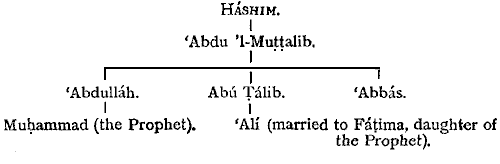
It was, of course, absolutely essential to the ‘Abbásids that
they should be able to count on the support of the powerful
Shí‘ite organisation, which, ever since the abortive The Shí‘ites
join hands with
the ‘Abbásids.
rebellion headed by Mukhtár (see p. 218 supra)
had drawn vast numbers of Persian Mawálí
into its ranks. Now, of the two main parties of the Shí‘a,
251
viz., the Háshimites or followers of Muḥammad Ibnu
’l-Ḥanafiyya, and the Imámites, who pinned their faith to
the descendants of the Prophet through his daughter Fáṭima,
the former had virtually identified themselves with the
‘Abbásids, inasmuch as the Imám Abú Háshim, who died
in 716 a.d., bequeathed his hereditary rights to Muḥammad
b. ‘Alí, the head of the House of ‘Abbás. It only remained
to hoodwink the Imámites. Accordingly the ‘Abbásid
emissaries were instructed to carry on their propaganda in
the name of Háshim, the common ancestor of ‘Abbás and
‘Alí. By means of this ruse they obtained a free hand in
Khurásán, and made such progress that the governor of that
province, Naṣr b. Sayyár, wrote to the Umayyad Caliph,
Marwán, asking for reinforcements, and informing him that
two hundred thousand men had sworn allegiance to Abú
Muslim, the principal ‘Abbásid agent. At the foot of his
letter he added these lines:—
"I see the coal's red glow beneath the embers,
And 'tis about to blaze!
The rubbing of two sticks enkindles fire,
And out of words come frays.
'Oh! is Umayya's House awake or sleeping?'
I cry in sore amaze."475
We have other verses by this gallant and loyal officer in
which he implores the Arab troops stationed in Khurásán, who
were paralysed by tribal dissensions, to turn their swords
against "a mixed rabble without religion or nobility":—
"'Death to the Arabs'—that is all their creed."476
These warnings, however, were of no avail, and on
June 9th, a.d. 747, Abú Muslim displayed the black banner
252
of the ‘Abbásids at Siqadanj, near Merv, which city he
occupied a few months later. The triumphant advance
of the armies of the Revolution towards Declaration of
war.
Damascus recalls the celebrated campaign of
Cæsar, when after crossing the Rubicon he
marched on Rome. Nor is Abú Muslim, though a freedman
of obscure parentage—he was certainly no Arab—unworthy
to be compared with the great patrician. "He
united," says Nöldeke, "with an agitator's adroitness and
perfect unscrupulosity in the choice of means the energy
and clear outlook of a general and statesman, Abú Muslim.
and even of a monarch."477 Grim, ruthless,
disdaining the pleasures of ordinary men, he possessed the
faculty in which Cæsar excelled of inspiring blind obedience
and enthusiastic devotion. To complete the parallel, we may
mention here that Abú Muslim was treacherously murdered
by Manṣúr, the second Caliph of the House which he had
raised to the throne, from motives exactly resembling those
which Shakespeare has put in the mouth of Brutus—
"So Caesar may:
Then, lest he may, prevent. And since the quarrel
Will bear no colour for the thing he is,
Fashion it thus: that what he is, augmented,
Would run to these and these extremities;
And therefore think him as a serpent's egg
Which, hatched, would as his kind grow mischievous,
And kill him in the shell."
The downfall of the Umayyads was hastened by the perfidy
and selfishness of the Arabs on whom they relied: the old
feud between Muḍar and Yemen broke out afresh, and while
the Northern group remained loyal to the dynasty, those of
Yemenite stock more or less openly threw in their lot with
the Revolution. We need not attempt to trace the course
253
of the unequal contest. Everywhere the Arabs, disheartened
and divided, fell an easy prey to their adversaries, and all was
lost when Marwán, the last Umayyad Caliph, sustained a
crushing defeat on the River Záb in Babylonia (January,
a.d. 750). Meanwhile Abu ’l-‘Abbás, the head of the
rival House, had already received homage as Caliph
(November, 749 a.d.). In the inaugural address which he
delivered in the great Mosque of Kúfa, he called Accession of
Abu ’l-‘Abbás
al-Saffáḥ.
himself al-Saffáḥ, i.e., 'the Blood-shedder,'478 and
this title has deservedly stuck to him, though
it might have been assumed with no less justice by his
brother Mansúr and other members of his family. All
Umayyads were remorselessly hunted down and massacred
in cold blood—even those who surrendered only on the
strength of the most solemn pledges that they had nothing
to fear. A small remnant made their escape, or managed
to find shelter until the storm of fury and vengeance,
which spared neither the dead nor the living,479 had blown
over. One stripling, named ‘Abdu ’l-Raḥmán, fled to North
Africa, and after meeting with many perilous adventures
founded a new Umayyad dynasty in Spain.
THE CALIPHS OF BAGHDÁD
The annals of the ‘Abbásid dynasty from the accession of
Saffáḥ (a.d. 749) to the death of Musta‘ṣim, and the destruction
of Baghdád by the Mongols (a.d. 1258) make a round
sum of five centuries. I propose to sketch the history of this
long period in three chapters, of which the first will offer a
general view of the more important literary and political
developments so far as is possible in the limited space at my
command; the second will be devoted to the great poets,
scholars, historians, philosophers, and scientists who flourished
in this, the Golden Age of Muḥammadan literature; while in
the third some account will be given of the chief religious
movements and of the trend of religious thought.
The empire founded by the Caliph ‘Umar and administered
by the Umayyads was essentially, as the reader will have
gathered, a military organisation for the benefit of the
paramount race. In theory, no doubt, all Moslems were
equal, but in fact the Arabs alone ruled—a privilege which
national pride conspired with personal interest to maintain.
We have seen how the Persian Moslems asserted their right
to a share in the government. The Revolution Political results
of the
Revolution.
which enthroned the ‘Abbásids marks the beginning
of a Moslem, as opposed to an Arabian,
Empire. The new dynasty, owing its rise to the people of
Persia, and especially of Khurásán, could exist only by
255
establishing a balance of power between Persians and Arabs.
That this policy was not permanently successful will surprise
no one who considers the widely diverse characteristics of the
two races, but for the next fifty years the rivals worked
together in tolerable harmony, thanks to the genius of
Manṣúr and the conciliatory influence of the Barmecides,
by whose overthrow the alliance was virtually dissolved. In
the ensuing civil war between the sons of Hárún al-Rashíd
the Arabs fought on the side of Amín while the Persians
supported Ma’mún, and henceforth each race began to follow
an independent path. The process of separation, however,
was very gradual, and long before it was completed the
religious and intellectual life of both nationalities had
become inseparably mingled in the full stream of Moslem
civilisation.
The centre of this civilisation was the province of ‘Iráq
(Babylonia), with its renowned metropolis, Baghdád, 'the
The choice of a
new capital.
City of Peace' (Madínatu ’l-Salám). Only here
could the ‘Abbásids feel themselves at home.
"Damascus, peopled by the dependants of the
Omayyads, was out of the question. On the one hand it
was too far from Persia, whence the power of the ‘Abbásids
was chiefly derived; on the other hand it was dangerously
near the Greek frontier, and from here, during the troublous
reigns of the last Omayyads, hostile incursions on the part of
the Christians had begun to avenge former defeats. It was
also beginning to be evident that the conquests of Islam
would, in the future, lie to the eastward towards Central
Asia, rather than to the westward at the further expense of
the Byzantines. Damascus, on the highland of Syria, lay, so
to speak, dominating the Mediterranean and looking westward,
but the new capital that was to supplant it must face
east, be near Persia, and for the needs of commerce have water
communication with the sea. Hence everything pointed to a
256
site on either the Euphrates or the Tigris, and the ‘Abbásids
were not slow to make their choice."480 After carefully
examining various sites, the Caliph Manṣúr fixed on a little
Persian village, on the west bank of the Tigris, called
Baghdád, which, being interpreted, means Foundation of
Baghdád.
'given (or 'founded') by God'; and in
a.d. 762 the walls of the new city began to
rise. Manṣúr laid the first brick with his own hand, and
the work was pushed forward with astonishing rapidity under
his personal direction by masons, architects, and surveyors,
whom he gathered out of different countries, so that 'the
Round City,' as he planned it, was actually finished within
the short space of four years.
The same circumstances which caused the seat of empire
to be transferred to Baghdád brought about a corresponding
change in the whole system of government. Whereas the
Umayyads had been little more than heads of a turbulent
Arabian aristocracy, their successors reverted to the old type
of Oriental despotism with which the Persians had been
familiar since the days of Darius and Xerxes. Surrounded
by a strong bodyguard of troops from Khurásán, on whose
devotion they could rely, the ‘Abbásids ruled Despotic
character of
‘Abbásid rule.
with absolute authority over the lives and properties
or their subjects, even as the Sásánian
monarchs had ruled before them. Persian fashions were
imitated at the court, which was thronged with the Caliph's
relatives and freedmen (not to mention his womenfolk), besides
a vast array of uniformed and decorated officials. Chief amongst
these latter stood two personages who figure prominently in
the Arabian Nights—the Vizier and the Executioner. The
office of Vizier is probably of Persian origin, although in Professor
De Goeje's opinion the word itself is Arabic.481 The first
257
who bore this title in ‘Abbásid times was Abú Salama, the
minister of Saffáḥ: he was called Wazíru Áli Muḥammadin,
'the Vizier of Muḥammad's Family.' It The Vizier.
was the duty of the Vizier to act as intermediary
between the omnipotent sovereign and his people,
to counsel him in affairs of State, and, above all, to keep His
Majesty in good humour. He wielded enormous power, but
was exposed to every sort of intrigue, and never knew when
he might be interned in a dungeon or despatched in the
twinkling of an eye by the grim functionary presiding over
the naṭ‘, or circular carpet of leather, which lay beside the
throne and served as a scaffold.
We can distinguish two periods in the history of the
‘Abbásid House: one of brilliant prosperity inaugurated by
Two periods
of ‘Abbásid
history.
Manṣúr and including the reigns of Mahdí,
Hárún al-Rashíd, Ma’mún, Mu‘tasim, and
Wáthiq—that is to say, nearly a hundred years
in all (754-847 a.d.); the other, more than four times
as long, commencing with Mutawakkil (847-861 a.d.)—a
period of decline rapidly sinking, after a brief interval
which gave promise of better things, into irremediable
decay.482
258
Cruel and treacherous, like most of his family, Abú Ja‘far
Manṣúr was perhaps the greatest ruler whom the ‘Abbásids
Reign of Manṣúr
(754-775 a.d.).
produced.483 He had to fight hard for his throne.
The ‘Alids, who deemed themselves the true
heirs of the Prophet in virtue of their descent
from Fáṭima, rose in rebellion against the usurper, surprised
him in an unguarded moment, and drove him to such straits
that during seven weeks he never changed his dress except for
public prayers. But once more the ‘Alids proved incapable
of grasping their opportunity. The leaders, Muḥammad, who
was known as 'The Pure Soul' (al-Nafs al-zakiyya), and his
brother Ibráhím, fell on the battle-field. Under Mahdí Outbreaks in
Persia.
and Hárún members of the House of ‘Alí continued to
'come out,' but with no better success. In Eastern Persia,
where strong national feelings interwove themselves with
Pre-Muḥammadan religious ideas, those of Mazdak and
Zoroaster in particular, the ‘Abbásids encountered a formidable
opposition which proclaimed its vigour
and tenacity by the successive revolts of Sinbádh
the Magian (755-756 a.d.), Ustádhsís (766-768),
Muqanna‘, the 'Veiled Prophet of Khurásán' (780-786),
and Bábak the Khurramite (816-838).484
Manṣúr said to his son Mahdi, "O Abú ‘Abdalláh, when
you sit in company, always have divines to converse with you;
Manṣúr's advice
to Mahdí.
for Muḥammad b. Shiháb al-Zuhrí said, 'The
word ḥadíth (Apostolic Tradition) is masculine:
only virile men love it, and only effeminate men
dislike it'; and he spoke the truth."485
On one occasion a poet came to Mahdí, who was then
heir-apparent, at Rayy, and recited a panegyric in his honour.
259
The prince gave him 20,000 dirhems. Thereupon the
postmaster of Rayy informed Manṣúr, who wrote to his son
Manṣúr and
the poet.
reproaching him for such extravagance. "What
you should have done," he said, "was to let him
wait a year at your door, and after that time
bestow on him 4,000 dirhems." He then caused the poet
to be arrested and brought into his presence. "You went
to a heedless youth and cajoled him?" "Yes, God save
the Commander of the Faithful, I went to a heedless,
generous youth and cajoled him, and he suffered himself to
be cajoled." "Recite your eulogy of him." The poet
obeyed, not forgetting to conclude his verses with a compliment
to Manṣúr. "Bravo!" cried the Caliph, "but they
are not worth 20,000 dirhems. Where is the money?" On
its being produced he made him a gift of 4,000 dirhems and
confiscated the remainder.486
Notwithstanding irreconcilable parties—‘Alids, Persian
extremists, and (we may add) Khárijites—the policy of
The Barmecides.
rapprochement was on the whole extraordinarily
effective. In carrying it out the Caliphs received
powerful assistance from a noble and ancient Persian
family, the celebrated Barmakites or Barmecides. According
to Mas‘údí,487 Barmak was originally a title borne by the High
Priest (sádin) of the great Magian fire-temple at Balkh.
Khálid, the son of one of these dignitaries—whence he and
his descendants were called Barmakites (Barámika)—held the
most important offices of state under Saffáḥ and Manṣúr.
Yaḥyá, the son of Khálid, was entrusted with the education
of Hárún al-Rashíd, and on the accession of the young
prince he was appointed Grand Vizier. "My Yaḥyá b. Khálid.
dear father!" said the Caliph, "it is through
the blessings and the good fortune which attend you, and
through your excellent management, that I am seated on the
260
throne;488 so I commit to you the direction of affairs." He then
handed to him his signet-ring. Yaḥyá was distinguished (says
the biographer) for wisdom, nobleness of mind, and elegance of
language.489 Although he took a truly Persian delight in philosophical
discussion, for which purpose freethinking scholars
and eminent heretics used often to meet in his house, he was
careful to observe the outward forms of piety. It may be said
of the ‘Abbásids generally that, whatever they might do or
think in private, they wore the official badge of Islam ostentatiously
on their sleeves. The following verses which Yaḥyá
addressed to his son Faḍl are very characteristic:—490
"Seek glory while 'tis day, no effort spare,
And patiently the loved one's absence bear;
But when the shades of night advancing slow
O'er every vice a veil of darkness throw,
Beguile the hours with all thy heart's delight:
The day of prudent men begins at night.
Many there be, esteemed of life austere,
Who nightly enter on a strange career.
Night o'er them keeps her sable curtain drawn,
And merrily they pass from eve to dawn.
Who but a fool his pleasures would expose
To spying rivals and censorious foes?"
For seventeen years Yaḥyá and his two sons, Faḍl and
Ja‘far, remained deep in Hárún's confidence and virtual rulers
Fall of the
Barmecides
(803 a.d.).
of the State until, from motives which have been
variously explained, the Caliph resolved to rid
himself of the whole family. The story is too
well known to need repetition.491 Ja‘far alone was put to
death: we may conclude, therefore, that he had specially
261
excited the Caliph's anger; and those who ascribe the
catastrophe to his romantic love-affair with Hárún's sister,
‘Abbása, are probably in the right.492 Hárún himself seems
to have recognised, when it was too late, how much he
owed to these great Persian barons whose tactful administration,
unbounded generosity, and munificent patronage of
literature have shed immortal lustre on his reign. Afterwards,
if any persons spoke ill of the Barmecides in his presence, he
would say (quoting the verse of Ḥuṭay’a):—493
"O slanderers, be your sire of sire bereft!494
Give o'er, or fill the gap which they have left."
Hárún's orthodoxy, his liberality, his victories over the
Byzantine Emperor Nicephorus, and last but not least the
literary brilliance of his reign have raised him in popular
estimation far above all the other Caliphs: he is the Charlemagne
of the East, while the entrancing pages of the Thousand
and One Nights have made his name a household word in every
country of Europe. Students of Moslem history will soon
discover that "the good Haroun Alraschid" was Hárún al-Rashíd
(786-809 a.d.).
in fact a perfidious and irascible tyrant, whose
fitful amiability and real taste for music and
letters hardly entitle him to be described either as a great
monarch or a good man. We must grant, however, that he
thoroughly understood the noble art of patronage. The
poets Abú Nuwás, Abu ’l-‘Atáhiya, Di‘bil, Muslim b. Walíd,
and ‘Abbás b. Aḥnaf; the musician Ibráhím of Mosul and
his son Isḥáq; the philologists Abú ‘Ubayda, Aṣma‘í, and
Kisá’í; the preacher Ibnu ’l-Sammák; and the historian
Wáqidí—these are but a few names in the galaxy of talent
which he gathered around him at Baghdád.
262
The fall of the Barmecides revived the spirit of racial
antagonism which they had done their best to lay, and an
Amín and
Ma’mún
(809-833 a.d.).
open rupture was rendered inevitable by the
short-sighted policy of Hárún with regard to
the succession. He had two grown-up sons,
Amín, by his wife and cousin Zubayda, and Ma’mún, whose
mother was a Persian slave. It was arranged that the
Caliphate should pass to Amín and after him to his brother,
but that the Empire should be divided between them. Amín
was to receive ‘Iráq and Syria, Ma’mún the eastern provinces,
where the people would gladly welcome a ruler of
their own blood. The struggle for supremacy which began
almost immediately on the death of Hárún was in the main
one of Persians against Arabs, and by Ma’mún's triumph the
Barmecides were amply avenged.
The new Caliph was anything but orthodox. He favoured
the Shí‘ite party to such an extent that he even nominated
the ‘Alid, ‘Alí b. Músá b. Ja‘far al-Riḍá, as heir-apparent—a
step which alienated the members of Ma’mún's
heresies.
his own family and led to his being temporarily
deposed. He also adopted the opinions of the Mu‘tazilite sect
and established an Inquisition to enforce them. Hence the
Sunnite historian, Abu ’l-Maḥásin, enumerates three principal
heresies of which Ma’mún was guilty: (1) His wearing of the
Green (labsu ’l-Khuḍra)495 and courting the ‘Alids and repulsing
the ‘Abbásids; (2) his affirming that the Koran was created
(al-qawl bi-Khalqi ’l-Qur’án); and (3) his legalisation of the
mut‘a, a loose form of marriage prevailing amongst the
Shí‘ites.496 We shall see in due course how keenly and with
what fruitful results Ma’mún interested himself in literature
and science. Nevertheless, it cannot escape our attention
that in this splendid reign there appear ominous signs of political
decay. In 822 a.d. Ṭáhir, one of Ma’mún's generals, who
263
had been appointed governor of Khurásán, omitted the
customary mention of the Caliph's name from the Friday
sermon (khuṭba), thus founding the Ṭahirid Rise of
independent
dynasties.
dynasty, which, though professing allegiance to
the Caliphs, was practically independent. Ṭáhir
was only the first of a long series of ambitious governors and
bold adventurers who profited by the weakening authority of
the Caliphs to carve out kingdoms for themselves. Moreover,
the Moslems of ‘Iráq had lost their old warlike spirit: they
were fine scholars and merchants, but poor soldiers. So it
came about that Ma’mún's successor, the Caliph Mu‘taṣim
(833-842 a.d.), took the fatal step of surrounding
himself with a Prætorian Guard chiefly Turkish
mercenaries
introduced.
composed of Turkish recruits from Transoxania.
At the same time he removed his court from Baghdád sixty
miles further up the Tigris to Sámarrá, which suddenly grew
into a superb city of palaces and barracks—an Oriental Versailles.497
Here we may close our brief review of the first and
flourishing period of the ‘Abbásid Caliphate. During the
next four centuries the Caliphs come and go faster than
ever, but for the most part their authority is precarious, if
not purely nominal. Meanwhile, in the provinces of the
Empire petty dynasties arise, only to eke out Decline of the
Caliphate.
an obscure and troubled existence, or powerful
states are formed, which carry on the traditions
of Muḥammadan culture, it may be through many generations,
and in some measure restore the blessings of peace and
settled government to an age surfeited with anarchy and
bloodshed. Of these provincial empires we have now principally
to speak, confining our view, for the most part, to the
political outlines, and reserving the literary and religious
aspects of the period for fuller consideration elsewhere.
264
The reigns of Mutawakkil (847-861 a.d.) and his immediate
successors exhibit all the well-known features of Prætorian rule.
The Second
‘Abbásid Period
(847-1258 a.d.).
Enormous sums were lavished on the Turkish
soldiery, who elected and deposed the Caliph just
as they pleased, and enforced their insatiable
demands by mutiny and assassination. For a short time
(869-907 a.d.) matters improved under the able and energetic
Muhtadí and the four Caliphs who followed him; but the
Turks soon regained the upper hand. From this date every
vestige of real power is centred in the Generalissimo (Amíru
’l-Umará) who stands at the head of the army, while the
once omnipotent Caliph must needs be satisfied with the
empty honour of having his name stamped on the coinage
and celebrated in the public prayers. The terrorism of the
Turkish bodyguard was broken by the Buwayhids, a Persian
dynasty, who ruled in Baghdád from 945 to 1055 a.d. Then
the Seljúq supremacy began with Ṭughril Beg's entry into the
capital and lasted a full century until the death of Sanjar
(1157 a.d.). The Mongols who captured Baghdád in
1258 a.d. brought the pitiable farce of the Caliphate to
an end.
"The empire of the Caliphs at its widest," as Stanley Lane-Poole
observes in his excellent account of the Muḥammadan dynasties,
Dynasties of the
early ‘Abbásid
Age.
"extended from the Atlantic to the Indus, and from
the Caspian to the cataracts of the Nile. So vast a
dominion could not long be held together. The first
step towards its disintegration began in Spain, where ‘Abdu ’l-Raḥmán,
a member of the suppressed Umayyad family, was acknowledged
as an independent sovereign in a.d. 755, and the ‘Abbásid
Caliphate was renounced for ever. Thirty years later Idrís, a
great-grandson of the Caliph ‘Alí, and therefore equally at variance
with ‘Abbásids and Umayyads, founded an ‘Alid dynasty in
Morocco. The rest of the North African coast was practically lost
to the Caliphate when the Aghlabid governor established his
authority at Qayrawán in a.d. 800."
Amongst the innumerable kingdoms which supplanted the
265
decaying Caliphate only a few of the most important can be
singled out for special notice on account of their literary or
religious interest.498 To begin with Persia: in
Dynasties of the Second Period. 872 a.d.
Khurásán, which was then held by the
Ṭáhirids, fell into the hands of Ya‘qúb b. Layth
the Coppersmith (al-Ṣaffár), founder of the Ṣaffárids, who for
thirty years stretched their sway over a great part of Persia,
until they were dispossessed by the Sámánids.
The latter dynasty had the seat of its power in
Transoxania, but during the first half of theThe Sámánids
(874-999 a.d.).
tenth century practically the whole of Persia submitted to the
authority of Ismá‘íl and his famous successors, Naṣr II and
Núḥ I. Not only did these princes warmly encourage and
foster the development, which had already begun, of a national
literature in the Persian language—it is enough to recall here
the names of Rúdagí, the blind minstrel and poet; Daqíqí,
whose fragment of a Persian Epic was afterwards incorporated
by Firdawsí in his Sháhnáma; and Bal‘amí, the Vizier of
Manṣúr I, who composed an abridgment of Ṭabarí's great
history, which is one of the oldest prose works in Persian that
have come down to us—but they extended the same favour to
poets and men of learning who (though, for the most part, of
Persian extraction) preferred to use the Arabic language.
Thus the celebrated Rhazes (Abú Bakr al-Rází) dedicated to
the Sámánid prince Abú Ṣáliḥ Manṣúr b. Isháq a treatise on
medicine, which he entitled al-Kitáb al-Manṣúrí (the Book of
Manṣúr) in honour of his patron. The great physician and
philosopher, Abú ‘Alí b. Síná (Avicenna) relates that, having
been summoned to Bukhárá by King Núḥ, the second of that
name (976-997 a.d.), he obtained permission to visit the
266
royal library. "I found there," he says, "many rooms filled
with books which were arranged in cases row upon row. One
room was allotted to works on Arabic philology and poetry;
another to jurisprudence, and so forth, the books on each particular
science having a room to themselves. I inspected the
catalogue of ancient Greek authors and looked for the books
which I required: I saw in this collection books of which few
people have heard even the names, and which I myself have
never seen either before or since."499
The power of the Sámánids quickly reached its zenith, and
about the middle of the tenth century they were confined to
The Buwayhids
(932-1055 a.d.).
Khurásán and Transoxania, while in Western
Persia their place was taken by the Buwayhids.
Abú Shujá‘ Buwayh, a chieftain of Daylam, the
mountainous province lying along the southern shores of the
Caspian Sea, was one of those soldiers of fortune whom we
meet with so frequently in the history of this period. His three
sons, ‘Alí, Aḥmad, and Ḥasan, embarked on the same adventurous
career with such energy and success, that in the course
of thirteen years they not only subdued the provinces of Fárs
and Khúzistán, but in 945 a.d. entered Baghdád at the head
of their Daylamite troops and assumed the supreme command,
receiving from the Caliph Mustakfí the honorary titles of
‘Imádu ’l-Dawla, Mu‘izzu ’l-Dawla, and Ruknu ’l-Dawla.
Among the princes of this House, who reigned over Persia and
‘Iráq during the next hundred years, the most eminent was
‘Aḍudu ’l-Dawla, of whom it is said by Ibn Khallikán that
none of the Buwayhids, notwithstanding their great power
and authority, possessed so extensive an empire and held sway
over so many kings and kingdoms as he. The chief poets
of the day, including Mutanabbí, visited his court at Shíráz
and celebrated his praises in magnificent odes. He also built
a great hospital in Baghdád, the Bímáristán al-‘Aḍudí, which
267
was long famous as a school of medicine. The Viziers of the
Buwayhid family contributed in a quite unusual degree to its
literary renown. Ibnu ’l-‘Amíd, the Vizier of Ruknu ’l-Dawla,
surpassed in philology and epistolary composition all his
contemporaries; hence he was called 'the second Jáḥiẓ,' and
it was a common saying that "the art of letter-writing began
with ‘Abdu ’l-Ḥamíd and ended with Ibnu ’l-‘Amíd."500
His friend, the Ṣáḥib Ismá‘íl b. ‘Abbád, Vizier to Mu’ayyidu
’l-Dawla and Fakhru ’l-Dawla, was a distinguished savant,
whose learning was only eclipsed by the liberality of his
patronage. In the latter respect Sábúr b. Ardashír, the prime
minister of Abú Naṣr Bahá’u ’l-Dawla, vied with the illustrious
Ṣáḥib. He had so many encomiasts that Tha‘álibí devotes to
them a whole chapter of the Yatíma. The Academy which
he founded at Baghdád, in the Karkh quarter, and generously
endowed, was a favourite haunt of literary men, and its
members seem to have enjoyed pretty much the same privileges
as belong to the Fellows of an Oxford or Cambridge
College.501
Like most of their countrymen, the Buwayhids were
Shí‘ites in religion. We read in the Annals of Abu ’l-Maḥásin
under the year 341 a.h. = 952 a.d.:—
"In this year the Vizier al-Muhallabí arrested some persons
who held the doctrine of metempsychosis (tanásukh). Among
Zeal of the
Buwayhids for
Shí‘ite principles.
them were a youth who declared that the spirit of
‘Alí b. Abí Ṭálib had passed into his body, and a
woman who claimed that the spirit of Fáṭima was
dwelling in her; while another man pretended to be Gabriel. On
being flogged, they excused themselves by alleging their relationship
to the Family of the Prophet, whereupon Mu‘izzu ’l-Dawla ordered
them to be set free. This he did because of his attachment to
268
Shí‘ism. It is well known," says the author in conclusion, "that the
Buwayhids were Shí‘ites and Ráfiḍites."502
Three dynasties contemporary with the Buwayhids have
still to be mentioned: the Ghaznevids in Afghanistan, the
The Ghaznevids
(976-1186 a.d.).
Ḥamdánids in Syria, and the Fáṭimids in Egypt.
Sabuktagín, the founder of the first-named
dynasty, was a Turkish slave. His son, Maḥmúd,
who succeeded to the throne of Ghazna in 998 a.d., made
short work of the already tottering Sámánids, and then sweeping
far and wide over Northern India, began a series of conquests
which, before his death in 1030 a.d., reached from
Lahore to Samarcand and Iṣfahán. Although the Persian and
Transoxanian provinces of his huge empire were soon torn
away by the Seljúqs, Maḥmúd's invasion of India, which was
undertaken with the object of winning that country for Islam,
permanently established Muḥammadan influence, at any rate
in the Panjáb. As regards their religious views, the Turkish
Ghaznevids stand in sharp contrast with the Persian houses of
Sámán and Buwayh. It has been well said that the true
genius of the Turks lies in action, not in speculation. When
Islam came across their path, they saw that it was a simple
and practical creed such as the soldier requires; so they
accepted it without further parley. The Turks have always
remained loyal to Islam, the Islam of Abú Bakr and ‘Umar,
which is a very different thing from the Islam of Shí‘ite
Persia. Maḥmúd proved his orthodoxy by banishing the
Mu‘tazilites of Rayy and burning their books together with
the philosophical and astronomical works that fell into his
hands; but on the same occasion he carried off a hundred
camel-loads of presumably harmless literature to his capital.
That he had no deep enthusiasm for letters is shown, for
269
example, by his shabby treatment of the poet Firdawsí.
Nevertheless, he ardently desired the glory and prestige
accruing to a sovereign whose court formed the rallying-point
of all that was best in the literary and scientific culture of the
day, and such was Ghazna in the eleventh century. Besides
the brilliant group of Persian poets, with Firdawsí at their
head, we may mention among the Arabic-writing authors
who flourished under this dynasty the historians al-‘Utbí and
al-Bírúní.
While the Eastern Empire of Islam was passing into the
hands of Persians and Turks, we find the Arabs still holding
The Ḥamdánids
(929-1003 a.d.).
their own in Syria and Mesopotamia down to
the end of the tenth century. These Arab and
generally nomadic dynasties were seldom of much
account. The Ḥamdánids of Aleppo alone deserve to be
noticed here, and that chiefly for the sake of the peerless
Sayfu ’l-Dawla, a worthy descendant of the tribe of Taghlib,
which in the days of heathendom produced the poet-warrior,
‘Amr b. Kulthúm. ‘Abdulláh b. Ḥamdán was appointed
governor of Mosul and its dependencies by the Caliph
Muktafí in 905 a.d., and in 942 his sons Ḥasan and ‘Alí
received the complimentary titles of Náṣiru ’l-Dawla (Defender
of the State) and Sayfu ’l-Dawla (Sword of the State).
Two years later Sayfu ’l-Dawla captured Aleppo and brought
the whole of Northern Syria under his dominion. During a
reign of twenty-three years he was continuously engaged in
harrying the Byzantines on the frontiers of Asia Minor, but
although he gained some glorious victories, which his laureate
Mutanabbí has immortalised, the fortune of war went in the
long run steadily against him, and his successors were unable
to preserve their little kingdom from being crushed between the
Byzantines in the north and the Fáṭtimids in the south. The
Ḥamdánids have an especial claim on our sympathy, because
they revived for a time the fast-decaying and already almost
broken spirit of Arabian nationalism. It is this spirit that
270
speaks with a powerful voice in Mutanabbí and declares itself,
for example, in such verses as these:—503
"Men from their kings alone their worth derive,
But Arabs ruled by aliens cannot thrive:
Boors without culture, without noble fame,
Who know not loyalty and honour's name.
Go where thou wilt, thou seest in every land
Folk driven like cattle by a servile band."
The reputation which Sayfu ’l-Dawla's martial exploits and
his repeated triumphs over the enemies of Islam richly earned
The circle of
Sayfu ’l-Dawla.
for him in the eyes of his contemporaries was
enhanced by the conspicuous energy and munificence
with which he cultivated the arts of peace.
Considering the brevity of his reign and the relatively small
extent of his resources, we may well be astonished to contemplate
the unique assemblage of literary talent then
mustered in Aleppo. There was, first of all, Mutanabbí, in
the opinion of his countrymen the greatest of Moslem poets;
there was Sayfu ’l-Dawla's cousin, the chivalrous Abú Firás,
whose war-songs are relieved by many a touch of tender and
true feeling; there was Abu ’l-Faraj of Iṣfahán, who on
presenting to Sayfu ’l-Dawla his Kitábu ’l-Aghání, one of the
most celebrated and important works in all Arabic literature,
received one thousand pieces of gold accompanied with an
expression of regret that the prince was obliged to remunerate
him so inadequately; there was also the great philosopher,
Abú Naṣr al-Fárábí, whose modest wants were satisfied by a
daily pension of four dirhems (about two shillings) from the
public treasury. Surely this is a record not easily surpassed
even in the heyday of ‘Abbásid patronage. As for the writers
of less note whom Sayfu ’l-Dawla attracted to Aleppo, their
name is legion. Space must be found for the poets Sarí al-Raffá,
Abu ’l-‘Abbás al-Námí, and Abu ’l-Faraj al-Babbaghá
271
for the preacher (khaṭíb) Ibn Nubáta, who would often rouse
the enthusiasm of his audience while he urged the duty of
zealously prosecuting the Holy War against Christian Byzantium;
and for the philologist Ibn Khálawayh, whose lectures
were attended by students from all parts of the Muḥammadan
world. The literary renaissance which began at this time
in Syria was still making its influence felt when Tha‘álibí
wrote his Yatíma, about thirty years after the death of Sayfu
’l-Dawla, and it produced in Abu ’l-‘Alá al-Ma‘arrí (born
973 a.d.) an original and highly interesting personality, to
whom we shall return on another occasion.
The dynasties hitherto described were political in their
origin, having generally been founded by ambitious governors
The Fáṭimids
(909-1171 a.d.).
or vassals. These upstarts made no pretensions
to the nominal authority, which they left in
the hands of the Caliph even while they forced
him at the sword's point to recognise their political independence.
The Sámánids and Buwayhids, Shí‘ites as they
were, paid the same homage to the Caliph in Baghdád as
did the Sunnite Ghaznevids. But in the beginning of the
tenth century there arose in Africa a great Shí‘ite power,
that of the Fáṭimids, who took for themselves the title
and prerogatives of the Caliphate, which they asserted to
be theirs by right Divine. This event was only the
climax of a deep-laid and skilfully organised plot—one of
the most extraordinary in all history. It had been put in
train half a century earlier by a certain ‘Abdulláh the son
of Maymún, a Persian oculist (qaddáḥ) belonging to Aḥwáz.
Filled with a fierce hatred of the Arabs and with a freethinker's
contempt for Islam, ‘Abdulláh b. Maymún conceived
the idea of a vast secret society which should be all
things to all men, and which, by playing on the strongest
passions and tempting the inmost weaknesses of human
nature, should unite malcontents of every description in a
272
conspiracy to overthrow the existing régime. Modern
readers may find a parallel for this romantic project in the
pages of Dumas, although the Aramis of Twenty Years After
is a simpleton beside ‘Abdulláh. He saw that the movement,
in order to succeed, must be started on a religious basis, and
he therefore identified himself with an obscure The Ismá‘ílite
propaganda.
Shí‘ite sect, the Ismá‘ílís, who were so called
because they regarded Muḥammad, son of Ismá‘íl,
son of Ja‘far al-Ṣádiq, as the Seventh Imám. Under ‘Abdulláh
the Ismá‘ílís developed their mystical and antinomian doctrines,
of which an excellent account has been given by
Professor Browne in the first volume of his Literary History of
Persia (p. 405 sqq.). Here we can only refer to the ingenious
and fatally insidious methods which he devised for gaining
proselytes on a gigantic scale, and with such amazing success
that from this time until the Mongol invasion—a period of
almost four centuries—the Ismá‘ílites (Fáṭimids, Carmathians,
and Assassins) either ruled or ravaged a great part of the
Muḥammadan Empire. It is unnecessary to discuss the
question whether ‘Abdulláh b. Maymún was, as Professor
Browne thinks, primarily a religious enthusiast, or whether,
according to the view commonly held, his real motives were
patriotism and personal ambition. The history of Islam
shows clearly enough that the revolutionist is nearly always
disguised as a religious leader, while, on the other hand,
every founder of a militant sect is potentially the head of a
state. ‘Abdulláh may have been a fanatic first and a politician
afterwards; more probably he was both at once from the
beginning. His plan of operations was briefly as follows:—
The dá‘í or missionary charged with the task of gaining adherents
for the Hidden Imám (see p. 216 seq.), in whose name allegiance was
demanded, would settle in some place, representing himself to be a
merchant, Ṣúfí, or the like. By renouncing worldly pleasures,
making a show of strict piety, and performing apparent miracles, it
was easy for him to pass as a saint with the common folk. As soon
273
as he was assured of his neighbours' confidence and respect, he
began to raise doubts in their minds. He would suggest difficult
problems of theology or dwell on the mysterious significance
of certain passages of the Koran. May there not be (he would ask)
in religion itself a deeper meaning than appears on the surface?
Then, having excited the curiosity of his hearers, he suddenly breaks
off. When pressed to continue his explanation, he declares that
such mysteries cannot be communicated save to those who take a
binding oath of secrecy and obedience and consent to pay a fixed
sum of money in token of their good faith. If these conditions
were accepted, the neophyte entered upon the second of the nine
degrees of initiation. He was taught that mere observance of the
laws of Islam is not pleasing to God, unless the true doctrine be
received through the Imáms who have it in keeping. These Imáms
(as he next learned) are seven in number, beginning with ‘Alí; the
seventh and last is Muḥammad, son of Ismá‘íl. On reaching the
fourth degree he definitely ceased to be a Moslem, for here he was
taught the Ismá‘ílite system of theology in which Muḥammad b.
Ismá‘íl supersedes the founder of Islam as the greatest and last of
all the Prophets. Comparatively few initiates advanced beyond
this grade to a point where every form of positive religion was
allegorised away, and only philosophy was left. "It is clear what
a tremendous weapon, or rather machine, was thus created. Each
man was given the amount of light which he could bear and which
was suited to his prejudices, and he was made to believe that the
end of the whole work would be the attaining of what he regarded
as most desirable."504 Moreover, the Imám Muḥammad b. Ismá‘íl
having disappeared long ago, the veneration which sought a visible
object was naturally transferred to his successor and representative
on earth, viz., ‘Abdulláh b. Maymún, who filled the same office in
relation to him as Aaron to Moses and ‘Alí to Muḥammad.
About the middle of the ninth century the state of the
Moslem Empire was worse, if possible, than it had been in the
latter days of Umayyad rule. The peasantry of ‘Iráq were
impoverished by the desolation into which that flourishing
province was beginning to fall in consequence of the frequent
and prolonged civil wars. In 869 a.d. the negro slaves (Zanj)
employed in the saltpetre industry, for which Baṣra was
famous, took up arms at the call of an ‘Alid Messiah, and
274
during fourteen years carried fire and sword through Khúzistán
and the adjacent territory. We can imagine that all this
misery and discontent was a godsend to the Ismá‘ílites. The
old cry, "A deliverer of the Prophet's House," which served
the ‘Abbásids so well against the Umayyads, was now raised
with no less effect against the ‘Abbásids themselves.
‘Abdulláh b. Maymún died in 875 a.d., but the agitation
went on, and rapidly gathered force. One of the leading
spirits was Ḥamdán Qarmaṭ, who gave his name to the Carmathian
branch of the Ismá‘ílís. These Carmathians (Qarámiṭa,
sing. Qirmiṭí) spread over Southern Persia and Yemen, and
in the tenth century they threatened Baghdád, repeatedly
waylaid the pilgrim-caravans, sacked Mecca and bore away
the Black Stone as a trophy; in short, established a veritable
reign of terror. We must return, however, to the main
Ismá‘ílite faction headed by the descendants of ‘Abdulláh b.
Maymún. Their emissaries discovered a promising field of
work in North Africa among the credulous and fanatical
Berbers. When all was ripe, Sa‘íd b. Ḥusayn, the grandson of
‘Abdulláh b. Maymún, left Salamya in Syria, the centre
from which the wires had hitherto been pulled, and The Fáṭimid
dynasty founded
by the Mahdí
‘Ubaydu’lláh
(909 a.d.).
crossing over to Africa appeared as the long-expected
Mahdí under the name of ‘Ubaydu’lláh. He
gave himself out to be a great-grandson of the
Imám Muḥammad b. Ismá‘íl and therefore in the
direct line of descent from ‘Alí b. Abí Ṭálib and
Fáṭima the daughter of the Prophet. We need not stop to
discuss this highly questionable genealogy from which the
Fáṭimid dynasty derives its name. In 910 a.d. ‘Ubaydu’lláh
entered Raqqáda in triumph and assumed the title of Commander
of the Faithful. Tunis, where the Aghlabites had
ruled since 800 a.d., was the cradle of Fáṭimid power, and
here they built their capital, Mahdiyya, near the ancient
Thapsus. Gradually advancing eastward, they conquered
Egypt and Syria as far as Damascus (969-970 a.d.). At this
275
time the seat of government was removed to the newly-founded
city of Cairo (al-Qáhira), which remained for two centuries
the metropolis of the Fáṭimid Empire.505
The Shí‘ite Anti-Caliphs maintained themselves in Egypt
until 1171 a.d., when the famous Saladin (Ṣaláḥu ’l-Dín b.
The Ayyúbids
(1171-1250 a.d.).
Ayyúb) took possession of that country and
restored the Sunnite faith. He soon added Syria
to his dominions, and "the fall of Jerusalem (in
1187) roused Europe to undertake the Third Crusade." The
Ayyúbids were strictly orthodox, as behoved the champions of
Islam against Christianity. They built and endowed many
theological colleges. The Ṣúfí pantheist, Shihábu ’l-Dín Yaḥyá
al-Suhrawardí, was executed at Aleppo by order of Saladin's
son, Malik al-Ẓáhir, in 1191 a.d.
The two centuries preceding the extinction of the ‘Abbásid
Caliphate by the Mongols witnessed the rise and decline of
The Seljúqs
(1037-1300 a.d.).
the Seljúq Turks, who "once more re-united
Muḥammadan Asia from the western frontier
of Afghanistan to the Mediterranean under one
sovereign." Seljúq b. Tuqáq was a Turcoman chief.
Entering Transoxania, he settled near Bukhárá and went
over with his whole people to Islam. His descendants,
Ṭughril Beg and Chagar Beg, invaded Khurásán, annexed
the western provinces of the Ghaznevid Empire, and finally
absorbed the remaining dominions of the Buwayhids.
Baghdád was occupied by Ṭughril Beg in 1055 a.d. It
has been said that the Seljúqs contributed almost nothing to
culture, but this perhaps needs some qualification. Although
Alp Arslán, who succeeded Ṭughril, and his son Malik Sháh
devoted their energies in the first place to military affairs, the
276
latter at least was an accomplished and enlightened monarch.
"He exerted himself to spread the benefits of civilisation: he
dug numerous canals, walled a great number of cities, built
bridges, and constructed ribáṭs in the desert places."506 He
was deeply interested in astronomy, and scientific as well as
theological studies received his patronage. Any shortcomings
of Alp Arslán and Malik Sháh in this respect were amply
repaired by their famous minister, Ḥasan b. ‘Alí, the Niẓámu
’l-Mulk or 'Constable of the Empire,' to give him the title
which he has made his own. Like so many great Viziers, he
was a Persian, and his achievements must not detain us here,
but it may be mentioned that he founded in Baghdád and
Naysábúr the two celebrated academies which were called in
his honour al-Niẓámiyya.
We have now taken a general, though perforce an extremely
curtailed and disconnected, view of the political conditions
Arabia
and Spain.
which existed during the ‘Abbásid period in most
parts of the Muḥammadan Empire except Arabia
and Spain. The motherland of Islam had long
sunk to the level of a minor province: leaving the Holy
Cities out of consideration, one might compare its inglorious
destiny under the Caliphate to that of Macedonia in the
empire which Alexander bequeathed to his successors, the
Ptolemies and Seleucids. As regards the political history of
Spain a few words will conveniently be said in a subsequent
chapter, where the literature produced by Spanish Moslems
will demand our attention. In the meantime we shall pass on
to the characteristic literary developments of this period, which
correspond more or less closely to the historical outlines.
The first thing that strikes the student of mediæval Arabic
literature is the fact that a very large proportion of the leading
writers are non-Arabs, or at best semi-Arabs, men whose fathers
277
or mothers were of foreign, and especially Persian, race. They
wrote in Arabic, because down to about 1000 a.d. that
language was the sole medium of literary expression in the
Muḥammadan world, a monopoly which it retained in
scientific compositions until the Mongol Invasion of the
thirteenth century. I have already referred to the question
whether such men as Bashshár b. Burd, Abú Nuwás, Ibn
Qutayba, Ṭabarí, Ghazálí, and hundreds of others should be
included in a literary history of the Arabs, and have given
reasons, which I need not repeat in this place, for considering
their admission to be not only desirable but fully justified on
logical grounds.507 The absurdity of treating them as Persians—and
there is no alternative, if they are not to be reckoned as
Arabs—appears to me self-evident.
"It is strange," says Ibn Khaldún, "that most of the learned
among the Moslems who have excelled in the religious or
intellectual sciences are non-Arabs (‘Ajam) with rare exceptions;
and even those savants who claimed Arabian descent
spoke a foreign language, grew up in foreign lands, and
studied under foreign masters, notwithstanding that the community
to which they belonged was Arabian and the author
of its religion an Arab." The historian proceeds to explain
the cause of this singular circumstance in an interesting
passage which may be summarised as follows:—
The first Moslems were entirely ignorant of art and science, all
their attention being devoted to the ordinances of the Koran, which
Ibn Khaldún's
explanation of
the fact that
learning was
chiefly cultivated
by the Persian
Moslems.
they "carried in their breasts," and to the practice
(sunna) of the Prophet. At that time the Arabs knew
nothing of the way by which learning is taught, of the
art of composing books, and of the means whereby
knowledge is enregistered. Those, however, who
could repeat the Koran and relate the Traditions of
Muḥammad were called Readers (qurrá). This oral transmission
continued until the reign of Hárún al-Rashíd, when the need of
278
securing the Traditions against corruption or of preventing their
total loss caused them to be set down in writing; and in order to
distinguish the genuine Traditions from the spurious, every isnád
(chain of witnesses) was carefully scrutinised. Meanwhile the
purity of the Arabic tongue had gradually become impaired: hence
arose the science of grammar; and the rapid development of Law
and Divinity brought it about that other sciences, e.g., logic and
dialectic, were professionally cultivated in the great cities of the
Muḥammadan Empire. The inhabitants of these cities were chiefly
Persians, freedmen and tradesmen, who had been long accustomed
to the arts of civilisation. Accordingly the most eminent of the
early grammarians, traditionists, and scholastic theologians, as
well as of those learned in the principles of Law and in the interpretation
of the Koran, were Persians by race or education, and the
saying of the Prophet was verified—"If Knowledge were attached to
the ends of the sky, some amongst the Persians would have reached it."
Amidst all this intellectual activity the Arabs, who had recently
emerged from a nomadic life, found the exercise of military and
administrative command too engrossing to give them leisure for
literary avocations which have always been disdained by a ruling
caste. They left such studies to the Persians and the mixed race
(al-muwalladún), which sprang from intermarriage of the conquerors
with the conquered. They did not entirely look down
upon the men of learning but recognised their services—since after
all it was Islam and the sciences connected with Islam that profited
thereby.508
Even in the Umayyad period, as we have seen, the maxim
that Knowledge is Power was strikingly illustrated by the
immense social influence which Persian divines exerted in the
Muḥammadan community.509 Nevertheless, true Arabs of the
old type regarded these Mawálí and their learning with
undisguised contempt. To the great majority of Arabs, who
prided themselves on their noble lineage and were content to
know nothing beyond the glorious traditions of heathendom
and the virtues practised by their sires, all literary culture
seemed petty and degrading. Their overbearing attitude
279
towards the Mawálí, which is admirably depicted in the first
part of Goldziher's Muhammedanische Studien, met with a
vigorous response. Non-Arabs and Moslem pietists alike
appealed to the highest authority—the Koran; and since they
required a more definite and emphatic pronouncement than
was forthcoming from that source, they put in the mouth of
the Prophet sayings like these: "He that speaks Arabic is
thereby an Arab"; "whoever of the people of Persia accepts
Islam is (as much an Arab as) one of Quraysh." This
doctrine made no impression upon the Arabian aristocracy, but
with the downfall of the Umayyads the political and social
equality of the Mawálí became an accomplished fact. Not
that the Arabs were at all disposed to abate their pretensions.
They bitterly resented the favour which the foreigners enjoyed
and the influence which they exercised. The national indignation
finds a voice in many poems of the early ‘Abbásid
period, e.g.:—
"See how the asses which they used to ride
They have unsaddled, and sleek mules bestride!
No longer kitchen-herbs they buy and sell,510
But in the palace and the court they dwell;
Against us Arabs full of rage and spleen,
Hating the Prophet and the Moslem's dín."511
The side of the non-Arabs in this literary quarrel was
vehemently espoused by a party who called themselves the
Shu‘úbites (al-Shu‘úbiyya),512 while their opponents gave them
280
the name of Levellers (Ahlu ’l-Taswiya), because they contended
for the equality of all Moslems without regard to distinctions
of race. I must refer the reader who seeks information The Shu‘úbites.
concerning the history of the movement to
Goldziher's masterly study,513 where the controversial methods
adopted by the Shu‘úbites are set forth in ample detail. He
shows how the bolder spirits among them, not satisfied with
claiming an equal position, argued that the Arabs were absolutely
inferior to the Persians and other peoples. The question
was hotly debated, and many eminent writers took part in the
fray. On the Shu‘úbite side Abú ‘Ubayda, Bírúní, and
Ḥamza of Iṣfahán deserve mention. Jáḥiẓ and Ibn Durayd
were the most notable defenders of their own Arabian
nationality, but the 'pro-Arabs' also included several men
of Persian origin, such as Ibn Qutayba, Baládhurí, and
Zamakhsharí. The Shu‘úbites directed their attacks principally
against the racial pride of the Arabs, who were fond of
boasting that they were the noblest of all mankind and spoke
the purest and richest language in the world. Consequently
the Persian genealogists and philologists lost no opportunity of
bringing to light scandalous and discreditable circumstances
connected with the history of the Arab tribes or of particular
families. Arabian poetry, especially the vituperative pieces
(mathálib), furnished abundant matter of this sort, which was
adduced by the Shu‘úbites as convincing evidence that the
claims of the Arabs to superior nobility were absurd. At the
same time the national view as to the unique and incomparable
excellence of the Arabic language received some rude criticism.
So acute and irreconcilable were the racial differences
between Arabs and Persians that one is astonished to see how
thoroughly the latter became Arabicised in the course of a
281
few generations. As clients affiliated to an Arab tribe, they
assumed Arabic names and sought to disguise their foreign extraction
by fair means or foul. Many provided Assimilation of
Arabs and
Persians.
themselves with fictitious pedigrees, on the strength
of which they passed for Arabs. Such a pretence
could have deceived nobody if it had not been supported by a
complete assimilation in language, manners, and even to some
extent in character. On the neutral ground of Muḥammadan
science animosities were laid aside, and men of both races
laboured enthusiastically for the common cause. When at
length, after a century of bloody strife and engrossing political
agitation, the great majority of Moslems found themselves
debarred from taking part in public affairs, it was only natural
that thousands of ardent and ambitious souls should throw
their pent-up energies into the pursuit of wealth or learning.
We are not concerned here with the marvellous development
of trade under the first ‘Abbásid Caliphs, of which Von
Kremer has given a full and entertaining description in his
Culturgeschichte des Orients. It may be recalled, however, that
many commercial terms, e.g., tariff, names of fabrics (muslin,
tabby, &c.), occurring in English as well as in most European
languages are of Arabic origin and were brought to Europe
by merchants from Baghdád, Mosul, Baṣra, and other cities of
Western Asia. This material expansion was accompanied by
an outburst of intellectual activity such as the East Enthusiasm for
learning in the
early ‘Abbásid
period.
had never witnessed before. It seemed as if all
the world from the Caliph down to the humblest
citizen suddenly became students, or at least
patrons, of literature. In quest of knowledge men travelled
over three continents and returned home, like bees laden with
honey, to impart the precious stores which they had accumulated
to crowds of eager disciples, and to compile with
incredible industry those works of encyclopædic range and
erudition from which modern Science, in the widest sense of
the word, has derived far more than is generally supposed.
282
The Revolution which made the fortune of the ‘Abbásid
House was a triumph for Islam and the party of religious
Development of
the Moslem
sciences.
reform. While under the worldly Umayyads the
studies of Law and Tradition met with no public
encouragement and were only kept alive by the
pious zeal of oppressed theologians, the new dynasty drew its
strength from the Muḥammadan ideas which it professed to
establish, and skilfully adapted its policy to satisfying the ever-increasing
claims of the Church. Accordingly the Moslem
sciences which arose at this time proceeded in the first instance
from the Koran and the Ḥadíth. The sacred books offered
many difficulties both to provincial Arabs and especially to
Persians and other Moslems of foreign extraction. For their
right understanding a knowledge of Arabic grammar and
philology was essential, and this involved the study of the
ancient Pre-islamic poems which supplied the most authentic
models of Arabian speech in its original purity. The study of
these poems entailed researches into genealogy and history,
which in the course of time became independent branches of
learning. Similarly the science of Tradition was systematically
developed in order to provide Moslems with practical
rules for the conduct of life in every conceivable particular,
and various schools of Law sprang into existence.
Muḥammadan writers usually distinguish the sciences which
are connected with the Koran and those which the Arabs
Their
classification.
learned from foreign peoples. In the former
class they include the Traditional or Religious
Sciences (al-‘Ulúm al-Naqliyya awi ’l-Shar‘iyya)
and the Linguistic Sciences (‘Ulúmu ’l-Lisáni ’l-‘Arabí); in
the latter the Intellectual or Philosophical Sciences (al-‘Ulúm
al-‘Aqliyya awi ’l-Ḥikmiyya), which are sometimes called 'The
Sciences of the Foreigners' (‘Ulúmu ’l-‘Ajam) or 'The Ancient
Sciences' (al-‘Ulúm al-Qadíma).
The general scope of this division may be illustrated by the
following table:—
283
I. The Native Sciences.
1. Koranic Exegesis (‘Ilmu ’l-Tafsír).
2. Koranic Criticism (‘Ilmu ’l-Qirá’át).
3. The Science of Apostolic Tradition (‘Ilmu ’l-Ḥadíth).
4. Jurisprudence (Fiqh).
5. Scholastic Theology (‘Ilmu ’l-Kalám).
6. Grammar (Naḥw).
7. Lexicography (Lugha).
8. Rhetoric (Bayán).
9. Literature (Adab).
II. The Foreign Sciences.
1. Philosophy (Falsafa).514
2. Geometry (Handasa).515
3. Astronomy (‘Ilmu ’l-Nujúm).
4. Music (Músíqí).
5. Medicine (Ṭibb).
6. Magic and Alchemy (al-Siḥr wa-’l-Kímiyá).
The religious phenomena of the Period will be discussed in
a separate chapter, and here I can only allude cursorily to their
The early
‘Abbásid period
favourable to
free-thought.
general character. We have seen that during the
whole Umayyad epoch, except in the brief reign of
‘Umar b. ‘Abd al-‘Azíz, the professors of religion
were out of sympathy with the court, and that
many of them withdrew from all participation in public affairs.
It was otherwise when the ‘Abbásids established themselves in
power. Theology now dwelt in the shadow of the throne
and directed the policy of the Government. Honours were
showered on eminent jurists and divines, who frequently held
official posts of high importance and stood in the most confidential
and intimate relations to the Caliph; a classical example
is the friendship of the Cadi Abú Yúsuf and Hárún al-Rashíd.
The century after the Revolution gave birth to the four great
schools of Muhammadan Law, which are still called by the
284
names of their founders—Málik b. Anas, Abú Ḥanífa, Sháfi‘í,
and Ahmad b. Ḥanbal. At this time the scientific and intellectual
movement had free play. The earlier Caliphs usually encouraged
speculation so long as it threatened no danger to the
existing régime. Under Ma’mún and his successors the
Mu‘tazilite Rationalism became the State religion, and Islam
seemed to have entered upon an era of enlightenment. Thus
the first ‘Abbásid period (750-847 a.d.) with its new learning
and liberal theology may well be compared to the European
Renaissance; but in the words of a celebrated Persian poet—
Khil‘atí bas fákhir ámad ‘umr ‘aybash kútahíst.516
"Life is a very splendid robe: its fault is brevity."
The Caliph Mutawakkil (847-861 a.d.) signalised his
accession by declaring the Mu‘tazilite doctrines to be heretical
The triumph of
orthodoxy.
and by returning to the traditional faith. Stern
measures were taken against dissenters. Henceforth
there was little room in Islam for independent
thought. The populace regarded philosophy and natural
science as a species of infidelity. Authors of works on these
subjects ran a serious risk unless they disguised their true
opinions and brought the results of their investigations into
apparent conformity with the text of the Koran. About the
middle of the tenth century the reactionary spirit assumed a
dogmatic shape in the system of Abu ’l-Ḥasan al-Ash‘arí, the
father of Muḥammadan Scholasticism, which is essentially
opposed to intellectual freedom and has maintained its petrifying
influence almost unimpaired down to the present time.
I could wish that this chapter were more worthy of the
title which I have chosen for it, but the foregoing pages will
have served their purpose if they have enabled my readers to
form some idea of the politics of the Period and of the broad
features marking the course of its literary and religious history.
POETRY, LITERATURE, AND SCIENCE IN THE ‘ABBÁSID PERIOD
Pre-Islamic poetry was the natural expression of nomad life.
We might therefore have expected that the new conditions
The Pre-islamic
poets regarded
as classical.
and ideas introduced by Islam would rapidly work a
corresponding revolution in the poetical literature
of the following century. Such, however, was
far from being the case. The Umayyad poets clung tenaciously
to the great models of the Heroic Age and even took
credit for their skilful imitation of the antique odes. The
early Muḥammadan critics, who were philologists by profession,
held fast to the principle that Poetry in Pre-islamic times had
reached a perfection which no modern bard could hope to
emulate, and which only the lost ideals of chivalry could
inspire.517 To have been born after Islam was in itself a proof
of poetical inferiority.518 Linguistic considerations, of course,
entered largely into this prejudice. The old poems were
studied as repositories of the pure classical tongue and were
estimated mainly from a grammarian's standpoint.
These ideas gained wide acceptance in literary circles
and gradually biassed the popular taste to such an extent
that learned pedants could boast, like Khalíl b. Ahmad,
286
the inventor of Arabic prosody, that it lay in their
power to make or mar the reputation of a rising poet
as they deemed fit. Originality being condemned in
advance, those who desired the approval of this self-constituted
Academy were obliged to waste their time and talents
upon elaborate reproduction of the ancient masterpieces, and
to entertain courtiers and citizens with borrowed pictures of
Bedouin life in which neither they nor their audience took the
slightest interest. Some, it is true, recognised the absurdity of
the thing. Abú Nuwás († circa 810 a.d.) often
ridicules the custom, to which reference has Abú Nuwás
as a critic.
been made elsewhere, of apostrophising the
deserted encampment (aṭlál or ṭulúl) in the opening lines
of an ode, and pours contempt on the fashionable glorification
of antiquity. In the passage translated below he gives
a description of the desert and its people which recalls some
of Dr. Johnson's sallies at the expense of Scotland and
Scotsmen:—
"Let the south-wind moisten with rain the desolate scene
And Time efface what once was so fresh and green!
Make the camel-rider free of a desert space
Where high-bred camels trot with unwearied pace;
Where only mimosas and thistles flourish, and where,
For hunting, wolves and hyenas are nowise rare!
Amongst the Bedouins seek not enjoyment out:
What do they enjoy? They live in hunger and drought.
Let them drink their bowls of milk and leave them alone,
To whom life's finer pleasures are all unknown."519
Ibn Qutayba, who died towards the end of the ninth
century a.d., was the first critic of importance to declare that
ancients and moderns should be judged on their merits without
regard to their age. He writes as follows in the Introduction
287
to his 'Book of Poetry and Poets' (Kitábu ’l-Shi‘r wa-’l-Shu‘ará):—520
"In citing extracts from the works of the poets I have been
guided by my own choice and have refused to admire anything
Ibn Qutayba on
ancient and
modern poets.
merely because others thought it admirable. I have
not regarded any ancient with veneration on account
of his antiquity nor any modern with contempt on
account of his being modern, but I have taken an impartial view
of both sides, giving every one his due and amply acknowledging
his merit. Some of our scholars, as I am aware, pronounce a feeble
poem to be good, because its author was an ancient, and include
it among their chosen pieces, while they call a sterling poem bad
though its only fault is that it was composed in their own time or
that they have seen its author. God, however, did not restrict
learning and poetry and rhetoric to a particular age nor appropriate
them to a particular class, but has always distributed them in
common amongst His servants, and has caused everything old to be
new in its own day and every classic work to be an upstart on its
first appearance."
The inevitable reaction in favour of the new poetry and of
contemporary literature in general was hastened by various
Revolt against
classicism.
circumstances which combined to overthrow the
prevalent theory that Arabian heathendom and
the characteristic pagan virtues—honour, courage,
liberality, &c.—were alone capable of producing poetical
genius. Among the chief currents of thought tending in
this direction, which are lucidly set forth in Goldziher's
essay, pp. 148 sqq., we may note (a) the pietistic and theological
spirit fostered by the ‘Abbásid Government, and (b) the
influence of foreign, pre-eminently Persian, culture. As to
the former, it is manifest that devout Moslems would not be
at all disposed to admit the exclusive pretensions made on
behalf of the Jáhiliyya or to agree with those who exalted
chivalry (muruwwa) above religion (dín). Were not the
language and style of the Koran incomparably excellent?
Surely the Holy Book was a more proper subject for study
288
than heathen verses. But if Moslems began to call Pre-islamic
ideals in question, it was especially the Persian
ascendancy resulting from the triumph of the ‘Abbásid
House that shook the old arrogant belief of the Arabs in
the intellectual supremacy of their race. So far from glorying
in the traditions of paganism, many people thought it
grossly insulting to mention an ‘Abbásid Caliph in the same
breath with heroes of the past like Ḥátim of Ṭayyi’ and
Harim b. Sinán. The philosopher al-Kindí († about
850 a.d.) rebuked a poet for venturing on such odious
comparisons. "Who are these Arabian vagabonds" (ṣa‘álíku
’l-‘Arab), he asked, "and what worth have they?"521
While Ibn Qutayba was content to urge that the modern
poets should get a fair hearing, and should be judged not
Critics in favour
of the
modern school.
chronologically or philologically, but æsthetically,
some of the greatest literary critics who
came after him do not conceal their opinion
that the new poetry is superior to the old. Tha‘álibí
(† 1038 a.d.) asserts that in tenderness and elegance the
Pre-islamic bards are surpassed by their successors, and that
both alike have been eclipsed by his contemporaries. Ibn
Rashíq († circa 1070 a.d.), whose ‘Umda on the Art of
Poetry is described by Ibn Khaldún as an epoch-making
work, thought that the superiority of the moderns would
be acknowledged if they discarded the obsolete conventions
of the Ode. European readers cannot but sympathise with
him when he bids the poets draw inspiration from nature and
truth instead of relating imaginary journeys on a camel which
they never owned, through deserts which they never saw, to a
patron residing in the same city as themselves. This seems
to us a very reasonable and necessary protest, but it must be
remembered that the Bedouin qaṣída was not easily adaptable
to the conditions of urban life, and needed complete remoulding
rather than modification in detail.522
289
"In the fifth century," says Goldziher—i.e., from about
1000 a.d.—"the dogma of the unattainable perfection of
Popularity of the
modern poets.
the heathen poets may be regarded as utterly
demolished." Henceforth popular taste ran
strongly in the other direction, as is shown by
the immense preponderance of modern pieces in the anthologies—a
favourite and characteristic branch of Arabic
literature—which were compiled during the ‘Abbásid period
and afterwards, and by frequent complaints of the neglect
into which the ancient poetry had fallen. But although, for
Moslems generally, Imru’u ’l-Qays and his fellows came to
be more or less what Chaucer is to the average Englishman,
the views first enunciated by Ibn Qutayba met with bitter
opposition from the learned class, many of whom clung
obstinately to the old philological principles of criticism,
and even declined to recognise the writings of Mutanabbí
and Abu ’l-‘Alá al-Ma‘arrí as poetry, on the ground that
those authors did not observe the classical 'types' (asálíb).523
The result of such pedantry may be seen at the present day
in thousands of qaṣídas, abounding in archaisms and allusions
to forgotten far-off things of merely antiquarian interest,
but possessing no more claim to consideration here than the
Greek and Latin verses of British scholars in a literary history
of the Victorian Age.
Passing now to the characteristics of the new poetry which
followed the accession of the ‘Abbásids, we have to bear in
Characteristics
of the
new poetry.
mind that from first to last (with very few exceptions)
it flourished under the patronage of the
court. There was no organised book trade, no
wealthy publishers, so that poets were usually dependent for
their livelihood on the capricious bounty of the Caliphs and
his favourites whom they belauded. Huge sums were paid
290
for a successful panegyric, and the bards vied with each
other in flattery of the most extravagant description. Even
in writers of real genius this prostitution of their art gave rise
to a great deal of the false glitter and empty bombast which
are often erroneously attributed to Oriental poetry as a whole.524
These qualities, however, are absolutely foreign to Arabian
poetry of the best period. The old Bedouins who praised a
man only for that which was in him, and drew their images
directly from nature, stand at the opposite pole to Tha‘álibí's
contemporaries. Under the Umayyads, as we have seen, little
change took place. It is not until after the enthronement of
the ‘Abbásids, when Persians filled the chief offices at court,
and when a goodly number of poets and eminent men of
learning had Persian blood in their veins, that an unmistakably
new note makes itself heard. One might be
tempted to surmise that the high-flown, bombastic, and
ornate style of which Mutanabbí is the most illustrious
exponent, and which is so marked a feature in later
Muḥammadan poetry, was first introduced by the Persians and
Perso-Arabs who gathered round the Caliph in Baghdád and
celebrated the triumph of their own race in the person of a
noble Barmecide; but this would scarcely be true. The
style in question is not specially Persian; the earliest Arabic-writing
poets of Íránian descent, like Bashshár b. Burd and
Abú Nuwás, are (so far as I can see) without a trace of it.
What the Persians brought into Arabian poetry was not a
grandiose style, but a lively and graceful fancy, elegance of
diction, depth and tenderness of feeling, and a rich store
of ideas.
The process of transformation was aided by other causes
besides the influx of Persian and Hellenistic culture: for
example, by the growing importance of Islam in public life
and the diffusion of a strong religious spirit among the community
at large—a spirit which attained its most perfect
291
expression in the reflective and didactic poetry of Abu
’l-‘Atáhiya. Every change of many-coloured life is depicted
in the brilliant pages of these modern poets, where the reader
may find, according to his mood, the maddest gaiety and the
shamefullest frivolity; strains of lofty meditation mingled
with a world-weary pessimism; delicate sentiment, unforced
pathos, and glowing rhetoric; but seldom the manly self-reliance,
the wild, invigorating freedom and inimitable
freshness of Bedouin song.
It is of course impossible to do justice even to the principal
‘Abbásid poets within the limits of this chapter, but the following
Five typical
poets of the
‘Abbásid period.
five may be taken as fairly representative:
Muṭí‘ b. Iyás, Abú Nuwás, Abu ’l-‘Atáhiya,
Mutanabbí, and Abu ’l-‘Alá al-Ma‘arrí. The
first three were in close touch with the court of Baghdád,
while Mutanabbí and Abu ’l-‘Alá flourished under the
Ḥamdánid dynasty which ruled in Aleppo.
Muṭí‘ b. Iyás only deserves notice here as the earliest poet
of the New School. His father was a native of Palestine, but
Muṭí‘ b. Iyás.
he himself was born and educated at Kúfa. He
began his career under the Umayyads, and was
devoted to the Caliph Walíd b. Yazíd, who found in him a
fellow after his own heart, "accomplished, dissolute, an agreeable
companion and excellent wit, reckless in his effrontery
and suspected in his religion."525 When the ‘Abbásids came
into power Muṭí‘ attached himself to the Caliph Manṣúr.
Many stories are told of the debauched life which he led
in the company of zindíqs, or freethinkers, a class of men
whose opinions we shall sketch in another chapter. His
songs of love and wine are distinguished by their lightness
and elegance. The best known is that in which he laments
his separation from the daughter of a Dihqán (Persian landed
292
proprietor), and invokes the two palm-trees of Ḥulwán, a
town situated on the borders of the Jibál province between
Hamadhán and Baghdád. From this poem arose the
proverb, "Faster friends than the two palm-trees of
Ḥulwán."526
THE YEOMAN'S DAUGHTER.
"O ye two palms, palms of Ḥulwán,
Help me weep Time's bitter dole!
Know that Time for ever parteth
Life from every living soul.
Had ye tasted parting's anguish,
Ye would weep as I, forlorn.
Help me! Soon must ye asunder
By the same hard fate be torn.
Many are the friends and loved ones
Whom I lost in days of yore.
Fare thee well, O yeoman's daughter!—
Never grief like this I bore.
Her, alas, mine eyes behold not,
And on me she looks no more!"
By Europeans who know him only through the Thousand
and One Nights Abú Nuwás is remembered as the boon-companion
Abú Nuwás
(† circa 810 a.d.).
and court jester of "the good Haroun
Alraschid," and as the hero of countless droll
adventures and facetious anecdotes—an Oriental
Howleglass or Joe Miller. It is often forgotten that he was
a great poet who, in the opinion of those most competent to
judge, takes rank above all his contemporaries and successors,
including even Mutanabbí, and is not surpassed in poetical
genius by any ancient bard.
293
Ḥasan b. Háni’ gained the familiar title of Abú Nuwás
(Father of the lock of hair) from two locks which hung
down on his shoulders. He was born of humble parents,
about the middle of the eighth century, in Aḥwáz, the
capital of Khúzistán. That he was not a pure Arab the
name of his mother, Jallabán, clearly indicates, while the following
verse affords sufficient proof that he was not ashamed
of his Persian blood:—
"Who are Tamím and Qays and all their kin?
The Arabs in God's sight are nobody."527
He received his education at Baṣra, of which city he calls
himself a native,528 and at Kúfa, where he studied poetry and
philology under the learned Khalaf al-Aḥmar. After passing
a 'Wanderjahr' among the Arabs of the desert, as was the
custom of scholars at that time, he made his way to Baghdád
and soon eclipsed every competitor at the court of Hárún the
Orthodox. A man of the most abandoned character, which
he took no pains to conceal, Abú Nuwás, by his flagrant
immorality, drunkenness, and blasphemy, excited the Caliph's
anger to such a pitch that he often threatened the culprit with
death, and actually imprisoned him on several occasions; but
these fits of severity were brief. The poet survived both
Hárún and his son, Amín, who succeeded him in the
Caliphate. Age brought repentance—"the Devil was sick,
the Devil a monk would be." He addressed the following
lines from prison to Faḍl b. al-Rabí‘, whom Hárún appointed
Grand Vizier after the fall of the Barmecides:—
"Faḍl, who hast taught and trained me up to goodness
(And goodness is but habit), thee I praise.
Now hath vice fled and virtue me revisits,
And I have turned to chaste and pious ways.
294
To see me, thou would'st think the saintly Baṣrite,
Ḥasan, or else Qatáda, met thy gaze,529
So do I deck humility with leanness,
While yellow, locust-like, my cheek o'erlays.
Beads on my arm; and on my breast the Scripture,
Where hung a chain of gold in other days."530
The Díwán of Abú Nuwás contains poems in many different
styles—e.g., panegyric (madíḥ), satire (hijá), songs of
the chase (ṭardiyyát), elegies (maráthí), and religious poems
(zuhdiyyát); but love and wine were the two motives by
which his genius was most brilliantly inspired. His wine-songs
(khamriyyát) are generally acknowledged to be incomparable.
Here is one of the shortest:—
"Thou scolder of the grape and me,
I ne'er shall win thy smile!
Because against thee I rebel,
'Tis churlish to revile.
Ah, breathe no more the name of wine
Until thou cease to blame,
For fear that thy foul tongue should smirch
Its fair and lovely name!
Come, pour it out, ye gentle boys,
A vintage ten years old,
That seems as though 'twere in the cup
A lake of liquid gold.
And when the water mingles there,
To fancy's eye are set
Pearls over shining pearls close strung
As in a carcanet."531
295
Another poem begins—
"Ho! a cup, and fill it up, and tell me it is wine,
For I will never drink in shade if I can drink in shine!
Curst and poor is every hour that sober I must go,
But rich am I whene'er well drunk I stagger to and fro.
Speak, for shame, the loved one's name, let vain disguise alone:
No good there is in pleasures o'er which a veil is thrown."532
Abú Nuwás practised what he preached, and hypocrisy at
any rate cannot be laid to his charge. The moral and
religious sentiments which appear in some of his poems are
not mere cant, but should rather be regarded as the utterance
of sincere though transient emotion. Usually he felt and
avowed that pleasure was the supreme business of his life,
and that religious scruples could not be permitted to stand
in the way. He even urges others not to shrink from any
excess, inasmuch as the Divine mercy is greater than all the
sins of which a man is capable:—
"Accumulate as many sins thou canst:
The Lord is ready to relax His ire.
When the day comes, forgiveness thou wilt find
Before a mighty King and gracious Sire,
And gnaw thy fingers, all that joy regretting
Which thou didst leave thro' terror of Hell-fire!"533
We must now bid farewell to Abú Nuwás and the
licentious poets (al-shu‘ará al-mujján) who reflect so admirably
the ideas and manners prevailing in court circles and
in the upper classes of society which were chiefly influenced
by the court. The scenes of luxurious dissipation and refined
debauchery which they describe show us, indeed, that Persian
culture was not an unalloyed blessing to the Arabs any more
296
than were the arts of Greece to the Romans; but this is only
the darker side of the picture. The works of a contemporary
poet furnish evidence of the indignation which the
libertinism fashionable in high places called forth among
the mass of Moslems who had not lost faith in morality and
religion.
Abu ’l-‘Atáhiya, unlike his great rival, came of Arab stock.
He was bred in Kúfa, and gained his livelihood as a young
Abu ’l-‘Atáhiya
(748-828 a.d.).
man by selling earthenware. His poetical talent,
however, promised so well that he set out to
present himself before the Caliph Mahdí, who
richly rewarded him; and Hárún al-Rashíd afterwards bestowed
on him a yearly pension of 50,000 dirhems (about
£2,000), in addition to numerous extraordinary gifts. At
Baghdád he fell in love with ‘Utba, a slave-girl belonging to
Mahdí, but she did not return his passion or take any notice of
the poems in which he celebrated her charms and bewailed the
sufferings that she made him endure. Despair of winning her
affection caused him, it is said, to assume the woollen garb of
Muḥammadan ascetics,534 and henceforth, instead of writing vain
and amatorious verses, he devoted his powers exclusively to
those joyless meditations on mortality which have struck a deep
chord in the hearts of his countrymen. Like Abu ’l-‘Alá
al-Ma‘arrí and others who neglected the positive precepts of
Islam in favour of a moral philosophy based on experience and
reflection, Abu ’l-‘Atáhiya was accused of being a freethinker
(zindíq).535 It was alleged that in his poems he often spoke of
297
death but never of the Resurrection and the Judgment—a
calumny which is refuted by many passages in his Díwán.
According to the literary historian al-Ṣúlí († 946 a.d.), Abu
’l-‘Atáhiya believed in One God who formed the universe out of
two opposite elements which He created from nothing; and
held, further, that everything would be reduced to these same
elements before the final destruction of all phenomena. Knowledge,
he thought, was acquired naturally (i.e., without Divine
Revelation) by means of reflection, deduction, and research.536
He believed in the threatened retribution (al-wa‘íd) and in the
command to abstain from commerce with the world (taḥrímu
’l-makásib).537 He professed the opinions of the Butrites,538 a
subdivision of the Zaydites, as that sect of the Shí‘a was named
which followed Zayd b. Alí b. Ḥusayn b. ‘Alí b. Abí Ṭálib.
He spoke evil of none, and did not approve of revolt against the
Government. He held the doctrine of predestination (jabr).539
Abu ’l-‘Atáhiya may have secretly cherished the Manichæan
views ascribed to him in this passage, but his poems contain
little or nothing that could offend the most orthodox Moslem.
The following verse, in which Goldziher finds an allusion to
Buddha,540 is capable of a different interpretation. It rather
298
seems to me to exalt the man of ascetic life, without particular
reference to any individual, above all others:—
"If thou would'st see the noblest of mankind,
Behold a monarch in a beggar's garb."541
But while the poet avoids positive heresy, it is none the less
true that much of his Díwán is not strictly religious in the
Muḥammadan sense and may fairly be called 'philosophical.'
This was enough to convict him of infidelity and atheism in
the eyes of devout theologians who looked askance on moral
teaching, however pure, that was not cast in the dogmatic
mould. The pretended cause of his imprisonment by Hárún
al-Rashíd—namely, that he refused to make any more love-songs—is
probably, as Goldziher has suggested, a popular version
of the fact that he persisted in writing religious poems which
were supposed to have a dangerous bias in the direction of
free-thought.
His poetry breathes a spirit of profound melancholy and hopeless
pessimism. Death and what comes after death, the frailty
and misery of man, the vanity of worldly pleasures and the duty
of renouncing them—these are the subjects on which he
dwells with monotonous reiteration, exhorting his readers to live
the ascetic life and fear God and lay up a store of good
works against the Day of Reckoning. The simplicity, ease,
and naturalness of his style are justly admired. Religious
299
poetry, as he himself confesses, was not read at court or by
scholars who demanded rare and obscure expressions, but only
by pious folk, traditionists and divines, and especially by the
vulgar, "who like best what they can understand."542
Abu ’l-‘Atáhiya wrote for 'the man in the street.' Discarding
conventional themes tricked out with threadbare artifices, he
appealed to common feelings and matters of universal experience.
He showed for the first and perhaps for the last
time in the history of classical Arabic literature that it was
possible to use perfectly plain and ordinary language without
ceasing to be a poet.
Although, as has been said, the bulk of Abu ’l-‘Atáhiya's
poetry is philosophical in character, there remains much
specifically Islamic doctrine, in particular as regards the
Resurrection and the Future Life. This combination may
be illustrated by the following ode, which is considered one
of the best that have been written on the subject of religion,
or, more accurately, of asceticism (zuhd):—
"Get sons for death, build houses for decay!
All, all, ye wend annihilation's way.
For whom build we, who must ourselves return
Into our native element of clay?
O Death, nor violence nor flattery thou
Dost use, but when thou com'st, escape none may.
Methinks, thou art ready to surprise mine age,
As age surprised and made my youth his prey.
What ails me, World, that every place perforce
I lodge thee in, it galleth me to stay?
And, O Time, how do I behold thee run
To spoil me? Thine own gift thou tak'st away!
O Time! inconstant, mutable art thou,
And o'er the realm of ruin is thy sway.
300
What ails me that no glad result it brings
Whene'er, O World, to milk thee I essay?
And when I court thee, why dost thou raise up
On all sides only trouble and dismay?
Men seek thee every wise, but thou art like
A dream; the shadow of a cloud; the day
Which hath but now departed, nevermore
To dawn again; a glittering vapour gay.
This people thou hast paid in full: their feet
Are on the stirrup—let them not delay!
But those that do good works and labour well
Hereafter shall receive the promised pay.
As if no punishment I had to fear,
A load of sin upon my neck I lay;
And while the world I love, from Truth, alas,
Still my besotted senses go astray.
I shall be asked of all my business here:
What can I plead then? What can I gainsay?
What argument allege, when I am called
To render an account on Reckoning-Day?
Dooms twain in that dread hour shall be revealed,
When I the scroll of these mine acts survey:
Either to dwell in everlasting bliss,
Or suffer torments of the damned for aye!"543
I will now add a few verses culled from the Díwán which
bring the poet's pessimistic view of life into clearer outline,
and also some examples of those moral precepts and sententious
criticisms which crowd his pages and have contributed in no
small degree to his popularity.
"The world is like a viper soft to touch that venom spits."544
"Men sit like revellers o'er their cups and drink,
From the world's hand, the circling wine of death."545
"Call no man living blest for aught you see
But that for which you blessed call the dead."546
301
FALSE FRIENDS.
"'Tis not the Age that moves my scorn,
But those who in the Age are born.
I cannot count the friends that broke
Their faith, tho' honied words they spoke;
In whom no aid I found, and made
The Devil welcome to their aid.
May I—so best we shall agree—
Ne'er look on them nor they on me!"547
"If men should see a prophet begging, they would turn and scout him.
Thy friend is ever thine as long as thou canst do without him;
But he will spew thee forth, if in thy need thou come about him."548
THE WICKED WORLD.
"'Tis only on the culprit sin recoils,
The ignorant fool against himself is armed.
Humanity are sunk in wickedness;
The best is he that leaveth us unharmed."549
"'Twas my despair of Man that gave me hope
God's grace would find me soon, I know not how."550
LIFE AND DEATH.
"Man's life is his fair name, and not his length of years;
Man's death is his ill-fame, and not the day that nears.
Then life to thy fair name by deeds of goodness give:
So in this world two lives, O mortal, thou shalt live."551
MAXIMS AND RULES OF LIFE.
"Mere falsehood by its face is recognised,
But Truth by parables and admonitions."552
302
"I keep the bond of love inviolate
Towards all humankind, for I betray
Myself, if I am false to any man."553
"Far from the safe path, hop'st thou to be saved?
Ships make no speedy voyage on dry land."554
"Strip off the world from thee and naked live,
For naked thou didst fall into the world."555
"Man guards his own and grasps his neighbours' pelf,
And he is angered when they him prevent;
But he that makes the earth his couch will sleep
No worse, if lacking silk he have content."556
"Men vaunt their noble blood, but I behold
No lineage that can vie with righteous deeds."557
"If knowledge lies in long experience,
Less than what I have borne suffices me."558
"Faith is the medicine of every grief,
Doubt only raises up a host of cares."559
"Blame me or no, 'tis my predestined state:
If I have erred, infallible is Fate."560
Abu ’l-‘Atáhiya found little favour with his contemporaries,
who seem to have regarded him as a miserly hypocrite. He
died, an aged man, in the Caliphate of Ma’mún.561 Von
303
Kremer thinks that he had a truer genius for poetry than
Abú Nuwás, an opinion in which I am unable to concur.
Both, however, as he points out, are distinctive types of their
time. If Abú Nuwás presents an appalling picture of a corrupt
and frivolous society devoted to pleasure, we learn from Abu
’l-‘Atáhiya something of the religious feelings and beliefs which
pervaded the middle and lower classes, and which led them to
take a more earnest and elevated view of life.
With the rapid decline and disintegration of the ‘Abbásid
Empire which set in towards the middle of the ninth century,
numerous petty dynasties arose, and the hitherto unrivalled
splendour of Baghdád was challenged by more than one provincial
court. These independent or semi-independent princes
were sometimes zealous patrons of learning—it is well known,
for example, that a national Persian literature first came into
being under the auspices of the Sámánids in Khurásán and the
Buwayhids in ‘Iráq—but as a rule the anxious task of maintaining,
or the ambition of extending, their power left them
small leisure to cultivate letters, even if they wished to do so.
None combined the arts of war and peace more brilliantly
than the Ḥamdánid Sayfu ’l-Dawla, who in 944 a.d. made
himself master of Aleppo, and founded an independent kingdom
in Northern Syria.
"The Ḥamdánids," says Tha‘álibí, "were kings and princes,
comely of countenance and eloquent of tongue, endowed with
Tha‘álibí's
eulogy of
Sayfu ’l-Dawla.
open-handedness and gravity of mind. Sayfu ’l-Dawla
is famed as the chief amongst them all and the centre-pearl
of their necklace. He was—may God be pleased
with him and grant his desires and make Paradise his
abode!—the brightest star of his age and the pillar of Islam: by
him the frontiers were guarded and the State well governed. His
attacks on the rebellious Arabs checked their fury and blunted
their teeth and tamed their stubbornness and secured his subjects
against their barbarity. His campaigns exacted vengeance from
the Emperor of the Greeks, decisively broke their hostile onset,
304
and had an excellent effect on Islam. His court was the goal of
ambassadors, the dayspring of liberality, the horizon-point of hope,
the end of journeys, a place where savants assembled and poets
competed for the palm. It is said that after the Caliphs no prince
gathered around him so many masters of poetry and men illustrious
in literature as he did; and to a monarch's hall, as to a market,
people bring only what is in demand. He was an accomplished
scholar, a poet himself and a lover of fine poetry; keenly susceptible
to words of praise."562
Sayfu ’l-Dawla's cousin, Abú Firás al-Ḥamdání, was a
gallant soldier and a poet of some mark, who if space permitted
would receive fuller notice here.563 He, however,
though superior to the common herd of court poets, is
overshadowed by one who with all his faults—and they are
not inconsiderable—made an extraordinary impression upon
his contemporaries, and by the commanding influence of his
reputation decided what should henceforth be the standard of
poetical taste in the Muḥammadan world.
Abu ’l-Ṭayyib Ahmad b. Ḥusayn, known to fame as
al-Mutanabbí, was born and bred at Kúfa, where his father
Mutanabbí
(915-965 a.d.).
is said to have been a water-carrier. Following
the admirable custom by which young men of
promise were sent abroad to complete their
education, he studied at Damascus and visited other towns
in Syria, but also passed much of his time among the
Bedouins, to whom he owed the singular knowledge
and mastery of Arabic displayed in his poems. Here he
came forward as a prophet (from which circumstance he
was afterwards entitled al-Mutanabbí, i.e., 'the pretender to
prophecy'), and induced a great multitude to believe in him;
but ere long he was captured by Lu’lu’, the governor of Ḥims
(Emessa), and thrown into prison. After his release he
305
wandered to and fro chanting the praises of all and sundry,
until fortune guided him to the court of Sayfu ’l-Dawla at
Aleppo. For nine years (948-957 a.d.) he stood high in
the favour of that cultured prince, whose virtues he celebrated
in a series of splendid eulogies, and with whom he lived as an
intimate friend and comrade in arms. The liberality of Sayfu
’l-Dawla and the ingenious impudence of the poet are well
brought out by the following anecdote:—
Mutanabbí on one occasion handed to his patron the copy of an
ode which he had recently composed in his honour, and retired,
leaving Sayfu ’l-Dawla to peruse it at leisure. The prince began to
read, and came to these lines—
Aqil anil aqṭi‘ iḥmil ‘alli salli a‘id
zid hashshi bashshi tafaḍḍal adni surra ṣili.564
"Pardon, bestow, endow, mount, raise, console, restore,
Add, laugh, rejoice, bring nigh, show favour, gladden, give!"
Far from being displeased by the poet's arrogance, Sayfu ’l-Dawla
was so charmed with his artful collocation of fourteen imperatives
in a single verse that he granted every request. Under pardon he
wrote 'we pardon thee'; under bestow, 'let him receive such and
such a sum of money'; under endow, 'we endow thee with an
estate,' which he named (it was beside the gate of Aleppo); under
mount, 'let such and such a horse be led to him'; under raise, 'we
do so'; under console, 'we do so, be at ease'; under restore, 'we
restore thee to thy former place in our esteem'; under add, 'let him
have such and such in addition'; under bring nigh, 'we admit thee
to our intimacy'; under show favour, 'we have done so'; under
gladden, 'we have made thee glad'565; under give, 'this we have
already done.' Mutanabbí's rivals envied his good fortune, and
one of them said to Sayfu ’l-Dawla—"Sire, you have done all that
he asked, but when he uttered the words laugh, rejoice, why did not
you answer, 'Ha, ha, ha'?" Sayfu ’l-Dawla laughed, and said, "You
too, shall have your wish," and ordered him a donation.
306
Mutanabbí was sincerely attached to his generous master,
and this feeling inspired a purer and loftier strain than we
find in the fulsome panegyrics which he afterwards addressed
to the negro Káfúr. He seems to have been occasionally in
disgrace, but Sayfu ’l-Dawla could deny nothing to a poet
who paid him such magnificent compliments. Nor was he
deterred by any false modesty from praising himself: he was
fully conscious of his power and, like Arabian bards in
general, he bragged about it. Although the verbal legerdemain
which is so conspicuous in his poetry cannot be
reproduced in another language, the lines translated below
may be taken as a favourable and sufficiently characteristic
specimen of his style.
"How glows mine heart for him whose heart to me is cold,
Who liketh ill my case and me in fault doth hold!
Why should I hide a love that hath worn thin my frame?
To Sayfu ’l-Dawla all the world avows the same.
Tho' love of his high star unites us, would that we
According to our love might so divide the fee!
Him have I visited when sword in sheath was laid,
And I have seen him when in blood swam every blade:
Him, both in peace and war the best of all mankind,
Whose crown of excellence was still his noble mind.
Do foes by flight escape thine onset, thou dost gain
A chequered victory, half of pleasure, half of pain.
So puissant is the fear thou strik'st them with, it stands
Instead of thee, and works more than thy warriors' hands.
Unfought the field is thine: thou need'st not further strain
To chase them from their holes in mountain or in plain.
What! 'fore thy fierce attack whene'er an army reels,
Must thy ambitious soul press hot upon their heels?
Thy task it is to rout them on the battle-ground;
No shame to thee if they in flight have safety found.
Or thinkest thou perchance that victory is sweet
Only when scimitars and necks each other greet?
O justest of the just save in thy deeds to me!
Thou art accused and thou, O Sire, must judge the plea.
307
Look, I implore thee, well! Let not thine eye cajoled
See fat in empty froth, in all that glisters gold!566
What use and profit reaps a mortal of his sight,
If darkness unto him be indistinct from light?
My deep poetic art the blind have eyes to see,
My verses ring in ears as deaf as deaf can be.
They wander far abroad while I am unaware,
But men collect them watchfully with toil and care.
Oft hath my laughing mien prolonged the insulter's sport,
Until with claw and mouth I cut his rudeness short.
Ah, when the lion bares his teeth, suspect his guile,
Nor fancy that the lion shows to you a smile.
I have slain the man that sought my heart's blood many a time,
Riding a noble mare whose back none else may climb,
Whose hind and fore-legs seem in galloping as one;
Nor hand nor foot requireth she to urge her on.
And O the days when I have swung my fine-edged glaive
Amidst a sea of death where wave was dashed on wave!
The desert knows me well, the night, the mounted men,
The battle and the sword, the paper and the pen!"567
Finally an estrangement arose between Mutanabbí and
Sayfu ’l-Dawla, in consequence of which he fled to Egypt
and attached himself to the Ikhshídite Káfúr. Disappointed
in his new patron, a negro who had formerly been a slave, the
poet set off for Baghdád, and afterwards visited the court of
the Buwayhid ‘Aḍudu ’l-Dawla at Shíráz. While travelling
through Babylonia he was attacked and slain by brigands in
965 a.d.
The popularity of Mutanabbí is shown by the numerous
commentaries568 and critical treatises on his Díwán. By his
countrymen he is generally regarded as one of the greatest of
Arabian poets, while not a few would maintain that he ranks
308
absolutely first. Abu ’l-‘Alá al-Ma‘arrí, himself an illustrious
poet and man of letters, confessed that he had sometimes
wished to alter a word here and there in Mutanabbí's verses,
but had never been able to think of any improvement. "As
to his poetry," says Ibn Khallikán, "it is perfection."
European scholars, with the exception of Von Hammer,569
have been far from sharing this enthusiasm, as may be seen by
referring to what has been said on the subject by Reiske,570 De
Sacy,571 Bohlen,572 Brockelmann,573 and others. No doubt, according
to our canons of taste, Mutanabbí stands immeasurably
below the famous Pre-islamic bards, and in a later age must
yield the palm to Abú Nuwás and Abu ’l-‘Atáhiya. Lovers
of poetry, as the term is understood in Europe, cannot derive
much æsthetic pleasure from his writings, but, on the contrary,
will be disgusted by the beauties hardly less than by the faults
which Arabian critics attribute to him. Admitting, however,
that only a born Oriental is able to appreciate Mutanabbí at
his full worth, let us try to realise the Oriental point of view
and put aside, as far as possible, our preconceptions of what
constitutes good poetry and good taste. Fortunately we
possess abundant materials for such an attempt in the invaluable
work of Tha‘álibí, which has been already mentioned.574
Tha‘álibí (961-1038 a.d.) was nearly contemporary with
Mutanabbí. He began to write his Yatíma about thirty
years after the poet's death, and while he bears witness to
309
the unrivalled popularity of the Díwán amongst all classes
of society, he observes that it was sharply criticised as well as
rapturously admired. Tha‘álibí himself claims to hold the
balance even. "Now," he says, "I will mention the faults
and blemishes which critics have found in the poetry of
Mutanabbí; for is there any one whose qualities give entire
satisfaction?—
Kafa ’l-mar’a faḍlan an tu‘adda ma‘áyibuh.
'Tis the height of merit in a man that his faults can be numbered.
Then I will proceed to speak of his beauties and to set forth
in due order the original and incomparable characteristics of
his style.
The radiant stars with beauty strike our eyes
Because midst gloom opaque we see them rise."
It was deemed of capital importance that the opening
couplet (maṭla‘) of a poem should be perfect in form and
meaning, and that it should not contain anything likely
to offend. Tha‘álibí brings forward many instances in which
Mutanabbí has violated this rule by using words of bad omen,
such as 'sickness' or 'death,' or technical terms of music
and arithmetic which only perplex and irritate the hearer
instead of winning his sympathy at the outset. He complains
also that Mutanabbí's finest thoughts and images are too often
followed by low and trivial ones: "he strings pearls and
bricks together" (jama‘a bayna ’l-durrati wa-’l-ájurrati).
"While he moulds the most splendid ornament, and threads
the loveliest necklace, and weaves the most exquisite stuff of
mingled hues, and paces superbly in a garden of roses,
suddenly he will throw in a verse or two verses disfigured
by far-fetched metaphors, or by obscure language and confused
thought, or by extravagant affectation and excessive
310
profundity, or by unbounded and absurd exaggeration, or
by vulgar and commonplace diction, or by pedantry and
grotesqueness resulting from the use of unfamiliar words."
We need not follow Tha‘álibí in his illustration of these
and other weaknesses with which he justly reproaches
Mutanabbí, since we shall be able to form a better idea
of the prevailing taste from those points which he singles
out for special praise.
In the first place he calls attention to the poet's skill in
handling the customary erotic prelude (nasíb), and particularly
to his brilliant descriptions of Bedouin women, which were
celebrated all over the East. As an example of this kind he
quotes the following piece, which "is chanted in the salons on
account of the extreme beauty of its diction, the choiceness of
its sentiment, and the perfection of its art":—
"Shame hitherto was wont my tears to stay,
But now by shame they will no more be stayed,
So that each bone seems through its skin to sob,
And every vein to swell the sad cascade.
She uncovered: pallor veiled her at farewell:
No veil 'twas, yet her cheeks it cast in shade.
So seemed they, while tears trickled over them,
Gold with a double row of pearls inlaid.
She loosed three sable tresses of her hair,
And thus of night four nights at once she made;
But when she lifted to the moon in heaven
Her face, two moons together I surveyed."575
The critic then enumerates various beautiful and original
features of Mutanabbí's style, e.g.—
1. His consecutive arrangement of similes in brief symmetrical
clauses, thus:—
"She shone forth like a moon, and swayed like a moringa-bough,
And shed fragrance like ambergris, and gazed like a gazelle."
311
2. The novelty of his comparisons and images, as when he
indicates the rapidity with which he returned to his patron and
the shortness of his absence in these lines:—
"I was merely an arrow in the air,
Which falls back, finding no refuge there."
3. The laus duplex or 'two-sided panegyric' (al-madḥ
al-muwajjah), which may be compared to a garment having
two surfaces of different colours but of equal beauty, as in
the following verse addressed to Sayfu ’l-Dawla:—
"Were all the lives thou hast ta'en possessed by thee,
Immortal thou and blest the world would be!"
Here Sayfu ’l-Dawla is doubly eulogised by the mention of
his triumphs over his enemies as well as of the joy which all
his friends felt in the continuance of his life and fortune.
4. His manner of extolling his royal patron as though he
were speaking to a friend and comrade, whereby he raises
himself from the position of an ordinary encomiast to the same
level with kings.
5. His division of ideas into parallel sentences:—
"We were in gladness, the Greeks in fear,
The land in bustle, the sea in confusion."
From this summary of Tha‘álibí's criticism the reader will
easily perceive that the chief merits of poetry were then considered
to lie in elegant expression, subtle combination of
words, fanciful imagery, witty conceits, and a striking use of
rhetorical figures. Such, indeed, are the views which prevail
to this day throughout the whole Muḥammadan world, and it
is unreasonable to denounce them as false simply because they
do not square with ours. Who shall decide when nations
disagree? If Englishmen rightly claim to be the best judges
of Shakespeare, and Italians of Dante, the almost unanimous
312
verdict of Mutanabbí's countrymen is surely not less authoritative—a
verdict which places him at the head of all the poets
born or made in Islam. And although the peculiar excellences
indicated by Tha‘álibí do not appeal to us, there are few poets
that leave so distinct an impression of greatness. One might
call Mutanabbí the Victor Hugo of the East, for he has the
grand style whether he soars to sublimity or sinks to fustian.
In the masculine vigour of his verse, in the sweep and
splendour of his rhetoric, in the luxuriance and reckless
audacity of his imagination we recognise qualities which
inspired the oft-quoted lines of the elegist:—
"Him did his mighty soul supply
With regal pomp and majesty.
A Prophet by his diction known;
But in the ideas, all must own,
His miracles were clearly shown."576
One feature of Mutanabbí's poetry that is praised by
Tha‘álibí should not be left unnoticed, namely, his fondness
for sententious moralising on topics connected with human
life; wherefore Reiske has compared him to Euripides. He
is allowed to be a master of that proverbial philosophy in
which Orientals delight and which is characteristic of the
modern school beginning with Abu ’l-‘Atáhiya, though some
of the ancients had already cultivated it with success (cf.
the verses of Zuhayr, p. 118 supra). The following examples
are among those cited by Bohlen (op. cit., p. 86 sqq.):—
"When an old man cries 'Ugh!' he is not tired
Of life, but only tired of feebleness."577
"He that hath been familiar with the world
A long while, in his eye 'tis turned about
Until he sees how false what looked so fair."578
313
"The sage's mind still makes him miserable
In his most happy fortune, but poor fools
Find happiness even in their misery."579
The sceptical and pessimistic tendencies of an age of social
decay and political anarchy are unmistakably revealed in the
Abu ’l-‘Alá
al-Ma‘arrí (973-1057
a.d.).
writings of the poet, philosopher, and man of
letters, Abu ‘l-‘Alá al-Ma‘arrí, who was born
in 973 a.d. at Ma‘arratu ’l-Nu‘mán, a Syrian
town situated about twenty miles south of Aleppo on the
caravan road to Damascus. While yet a child he had an
attack of small-pox, resulting in partial and eventually in
complete blindness, but this calamity, fatal as it might seem
to literary ambition, was repaired if not entirely made good
by his stupendous powers of memory. After being educated
at home under the eye of his father, a man of some culture
and a meritorious poet, he proceeded to Aleppo, which was
still a flourishing centre of the humanities, though it could no
longer boast such a brilliant array of poets and scholars as
were attracted thither in the palmy days of Sayfu ’l-Dawla.
Probably Abu ’l-‘Alá did not enter upon the career of a
professional encomiast, to which he seems at first to have
inclined: he declares in the preface to his Saqṭu ’l-Zand that
he never eulogised any one with the hope of gaining a reward,
but only for the sake of practising his skill. On the termination
of his 'Wanderjahre' he returned in 993 a.d. to
Ma‘arra, where he spent the next fifteen years of his life,
with no income beyond a small pension of thirty dínárs (which
he shared with a servant), lecturing on Arabic poetry, antiquities,
and philology, the subjects to which his youthful studies
had been chiefly devoted. During this period his reputation
was steadily increasing, and at last, to adapt what Boswell
wrote of Dr. Johnson on a similar occasion, "he thought of
trying his fortune in Baghdád, the great field of genius and
314
exertion, where talents of every kind had the fullest scope
and the highest encouragement." Professor Margoliouth in
the Introduction to his edition of Abu ’l-‘Alá's His visit to
Baghdád.
correspondence supplies many interesting particulars
of the literary society at Baghdád in which the
poet moved. "As in ancient Rome, so in the great Muḥammadan
cities public recitation was the mode whereby men of
letters made their talents known to their contemporaries.
From very early times it had been customary to employ the
mosques for this purpose; and in Abu ’l-‘Alá's time poems
were recited in the mosque of al-Manṣúr in Baghdád. Better
accommodation was, however, provided by the Mæcenates
who took a pride in collecting savants and littérateurs in their
houses."580 Such a Mæcenas was the Sharíf al-Raḍí, himself
a celebrated poet, who founded the Academy called by his
name in imitation, probably, of that founded some years
before by Abú Nasr Sábúr b. Ardashír, Vizier to the Buwayhid
prince, Bahá’u ’l-Dawla. Here Abu ’l-‘Alá met a number of
distinguished writers and scholars who welcomed him as one
of themselves. The capital of Islam, thronged with travellers
and merchants from all parts of the East, harbouring followers
of every creed and sect—Christians and Jews, Buddhists and
Zoroastrians, Ṣábians and Ṣúfís, Materialists and Rationalists—must
have seemed to the provincial almost like a new world.
It is certain that Abu ’l-‘Alá, a curious observer who set no
bounds to his thirst for knowledge, would make the best use
of such an opportunity. The religious and philosophical ideas
with which he was now first thrown into contact gradually
took root and ripened. His stay in Baghdád, though it lasted
only a year and a half (1009-1010 a.d.), decided the whole
bent of his mind for the future.
Whether his return to Ma‘arra was hastened, as he says, by
want of means and the illness of his mother, whom he
tenderly loved, or by an indignity which he suffered at the
315
hands of an influential patron,581 immediately on his arrival he
shut himself in his house, adopted a vegetarian diet and other
ascetic practices, and passed the rest of his long life in comparative
seclusion:—
"Methinks, I am thrice imprisoned—ask not me
Of news that need no telling—
By loss of sight, confinement to my house,
And this vile body for my spirit's dwelling."582
We can only conjecture the motives which brought about this
sudden change of habits and disposition. No doubt his mother's
death affected him deeply, and he may have been disappointed
by his failure to obtain a permanent footing in the capital. It
is not surprising that the blind and lonely man, looking back
on his faded youth, should have felt weary of the world and
its ways, and found in melancholy contemplation of earthly
vanities ever fresh matter for the application and development
of these philosophical ideas which, as we have seen, were
probably suggested to him by his recent experiences. While
in the collection of early poems, entitled Saqṭu ’l-Zand or 'The
Spark of the Fire-stick' and mainly composed before his visit
to Baghdád, he still treads the customary path of his predecessors,583
his poems written after that time and generally
known as the Luzúmiyyát584 arrest attention by their boldness
and originality as well as by the sombre and earnest tone which
pervades them. This, indeed, is not the view of most Oriental
critics, who dislike the poet's irreverence and fail to appreciate
the fact that he stood considerably in advance of his age; but
in Europe he has received full justice and perhaps higher
316
praise than he deserves. Reiske describes him as 'Arabice
callentissimum, vasti, subtilis, sublimis et audacis ingenii';585
Von Hammer, who ranks him as a poet with Abú Tammám,
Buḥturí, and Mutanabbí, also mentions him honourably as a
philosopher;586 and finally Von Kremer, who made an exhaustive
study of the Luzúmiyyát and examined their contents in a masterly
essay,587 discovered in Abu ’l-‘Alá, one of the greatest moralists
of all time whose profound genius anticipated much that is
commonly attributed to the so-called modern spirit of enlightenment.
Here Von Kremer's enthusiasm may have
carried him too far; for the poet, as Professor Margoliouth
says, was unconscious of the value of his suggestions, unable
to follow them out, and unable to adhere to them consistently.
Although he builded better than he knew, the constructive
side of his philosophy was overshadowed by the negative and
destructive side, so that his pure and lofty morality leaves but a
faint impression which soon dies away in louder, continually
recurring voices of doubt and despair.
Abu ’l-‘Alá is a firm monotheist, but his belief in God
amounted, as it would seem, to little beyond a conviction that
all things are governed by inexorable Fate, whose mysteries
none may fathom and from whose omnipotence there is no
escape. He denies the Resurrection of the dead, e.g.:—
"We laugh, but inept is our laughter;
We should weep and weep sore,
Who are shattered like glass, and thereafter
Re-moulded no more!"588
317
Since Death is the ultimate goal of mankind, the sage will
pray to be delivered as speedily as possible from the miseries of
life and refuse to inflict upon others what, by no fault of his
own, he is doomed to suffer:—
"Amends are richly due from sire to son:
What if thy children rule o'er cities great?
That eminence estranges them the more
From thee, and causes them to wax in hate,
Beholding one who cast them into Life's
Dark labyrinth whence no wit can extricate."589
There are many passages to the same effect, showing that
Abu ’l-‘Alá regarded procreation as a sin and universal annihilation
as the best hope for humanity. He acted in accordance
with his opinions, for he never married, and he is said to
have desired that the following verse should be inscribed on
his grave:—
"This wrong was by my father done
To me, but ne'er by me to one."590
Hating the present life and weary of its burdens, yet seeing
no happier prospect than that of return to non-existence, Abu
’l-‘Alá can scarcely have disguised from himself what he might
shrink openly to avow—that he was at heart, not indeed an
atheist, but wholly incredulous of any Divine revelation.
Religion, as he conceives it, is a product of the human mind,
in which men believe through force of habit and education,
never stopping to consider whether it is true.
"Sometimes you may find a man skilful in his trade, perfect in
sagacity and in the use of arguments, but when he comes to
religion he is found obstinate, so does he follow the old groove.
Piety is implanted in human nature; it is deemed a sure refuge.
318
To the growing child that which falls from his elders' lips is a
lesson that abides with him all his life. Monks in their cloisters and
devotees in the mosques accept their creed just as a story is handed
down from him who tells it, without distinguishing between a true
interpreter and a false. If one of these had found his kin among
the Magians, he would have declared himself a Magian, or among
the Ṣábians, he would have become nearly or quite like them."591
Religion, then, is "a fable invented by the ancients,"
worthless except to those unscrupulous persons who prey upon
human folly and superstition. Islam is neither better nor
worse than any other creed:—
"Ḥanífs are stumbling,592 Christians all astray,
Jews wildered, Magians far on error's way.
We mortals are composed of two great schools—
Enlightened knaves or else religious fools."593
Not only does the poet emphatically reject the proud claim
of Islam to possess a monopoly of truth, but he attacks most
of its dogmas in detail. As to the Koran, Abu ’l-‘Alá could
not altogether refrain from doubting if it was really the Word
of God, but he thought so well of the style that he accepted
the challenge flung down by Muḥammad and produced a rival
work (al-Fuṣúl wa-’l-Gháyát), which appears to have been a
somewhat frivolous parody of the sacred volume, though in the
author's judgment its inferiority was simply due to the fact
that it was not yet polished by the tongues of four centuries of
readers. Another work which must have sorely offended
orthodox Muḥammadans is the Risálatu ’l-Ghufrán (Epistle of
Forgiveness).594 Here the Paradise of the Faithful becomes
319
a glorified salon tenanted by various heathen poets who have
been forgiven—hence the title—and received among the Blest.
This idea is carried out with much ingenuity and in a spirit
of audacious burlesque that reminds us of Lucian. The poets
are presented in a series of imaginary conversations with a
certain Shaykh ‘Alí b. Manṣúr, to whom the work is addressed,
reciting and explaining their verses, quarrelling with one
another, and generally behaving as literary Bohemians. The
second part contains a number of anecdotes relating to the
zindíqs or freethinkers of Islam interspersed with quotations
from their poetry and reflections on the nature of their belief,
which Abu ’l-‘Alá condemns while expressing a pious hope
that they are not so black as they paint themselves. At this
time it may have suited him—he was over sixty—to assume
the attitude of charitable orthodoxy. Like so many wise men
of the East, he practised dissimulation as a fine art—
"I lift my voice to utter lies absurd,
But when I speak the truth, my hushed tones scarce are heard."595
In the Luzúmiyyát, however, he often unmasks. Thus he
describes as idolatrous relics the two Pillars of the Ka‘ba and
the Black Stone, venerated by every Moslem, and calls the
Pilgrimage itself 'a heathen's journey' (riḥlatu jáhiliyyin).
The following sentiments do him honour, but they would
have been rank heresy at Mecca:—
"Praise God and pray,
Walk seventy times, not seven, the Temple round—
And impious remain!
Devout is he alone who, when he may
Feast his desires, is found
With courage to abstain."596
320
It is needless to give further instances of the poet's contempt
for the Muḥammadan articles of faith. Considering that he
assailed persons as well as principles, and lashed with bitter
invective the powerful class of the ‘Ulamá, the clerical and
legal representatives of Islam, we may wonder that the accusation
of heresy brought against him was never pushed home
and had no serious consequences. The question was warmly
argued on both sides, and though Abu ’l-‘Alá was pronounced
by the majority to be a freethinker and materialist, he did not
lack defenders who quoted chapter and verse to prove that he
was nothing of the kind. It must be remembered that his
works contain no philosophical system; that his opinions have
to be gathered from the ideas which he scatters incoherently,
and for the most part in guarded language, through a long
succession of rhymes; and that this task, already arduous
enough, is complicated by the not infrequent occurrence of
sentiments which are blamelessly orthodox and entirely contradictory
to the rest. A brilliant writer, familiar with
Eastern ways of thinking, has observed that in general the
conscience of an Asiatic is composed of the following ingredients:
(1) an almost bare religious designation; (2) a
more or less lively belief in certain doctrines of the creed
which he professes; (3) a resolute opposition to many of its
doctrines, even if they should be the most essential; (4) a
fund of ideas relating to completely alien theories, which
occupies more or less room; (5) a constant tendency to get
rid of these ideas and theories and to replace the old by new.597
Such phenomena will account for a great deal of logical inconsistency,
but we should beware of invoking them too confidently
in this case. Abu ’l-‘Alá with his keen intellect and
unfanatical temperament was not the man to let himself be
mystified. Still lamer is the explanation offered by some
Muḥammadan critics, that his thoughts were decided by the
321
necessities of the difficult metre in which he wrote. It is
conceivable that he may sometimes have doubted his own
doubts and given Islam the benefit, but Von Kremer's conclusion
is probably near the truth, namely, that where the
poet speaks as a good Moslem, his phrases if they are not
purely conventional are introduced of set purpose to foil his
pious antagonists or to throw them off the scent. Although
he was not without religion in the larger sense of the word,
unprejudiced students of the later poems must recognise that
from the orthodox standpoint he was justly branded as an
infidel. The following translations will serve to illustrate the
negative side of his philosophy:—
"Falsehood hath so corrupted all the world
That wrangling sects each other's gospel chide;
But were not hate Man's natural element,
Churches and mosques had risen side by side."598
"What is Religion? A maid kept close that no eye may view her;
The price of her wedding-gifts and dowry baffles the wooer.
Of all the goodly doctrine that I from the pulpit heard
My heart has never accepted so much as a single word !"599
"The pillars of this earth are four,
Which lend to human life a base;
God shaped two vessels, Time and Space,
The world and all its folk to store.
That which Time holds, in ignorance
It holds—why vent on it our spite?
Man is no cave-bound eremite,
But still an eager spy on Chance.
He trembles to be laid asleep,
Tho' worn and old and weary grown.
We laugh and weep by Fate alone,
Time moves us not to laugh or weep;
322
Yet we accuse it innocent,
Which, could it speak, might us accuse,
Our best and worst, at will to choose,
United in a sinful bent.600
"'The stars' conjunction comes, divinely sent,
And lo, the veil o'er every creed is rent.
No realm is founded that escapes decay,
The firmest structure soon dissolves away.'601
With sadness deep a thoughtful mind must scan
Religion made to serve the pelf of Man.
Fear thine own children: sparks at random flung
Consume the very tinder whence they sprung.
Evil are all men; I distinguish not
That part or this: the race entire I blot.
Trust none, however near akin, tho' he
A perfect sense of honour show to thee,
Thy self is the worst foe to be withstood:
Be on thy guard in hours of solitude.
* * *
* *
Desire a venerable shaykh to cite
Reason for his doctrine, he is gravelled quite.
What! shall I ripen ere a leaf is seen?
The tree bears only when 'tis clad in green.'602
"How have I provoked your enmity?
Christ or Muḥammad, 'tis one to me.
No rays of dawn our path illume,
We are sunk together in ceaseless gloom.
Can blind perceptions lead aright,
Or blear eyes ever have clear sight?
Well may a body racked with pain
Envy mouldering bones in vain;
Yet comes a day when the weary sword
Reposes, to its sheath restored.
323
Ah, who to me a frame will give
As clod or stone insensitive?—
For when spirit is joined to flesh, the pair
Anguish of mortal sickness share.
O Wind, be still, if wind thy name,
O Flame, die out, if thou art flame!"603
Pessimist and sceptic as he was, Abu ’l-‘Alá denies more
than he affirms, but although he rejected the dogmas of
positive religion, he did not fall into utter unbelief; for he
found within himself a moral law to which he could not
refuse obedience.
"Take Reason for thy guide and do what she
Approves, the best of counsellors in sooth.
Accept no law the Pentateuch lays down:
Not there is what thou seekest—the plain truth."604
He insists repeatedly that virtue is its own reward.
"Oh, purge the good thou dost from hope of recompense
Or profit, as if thou wert one that sells his wares."605
His creed is that of a philosopher and ascetic. Slay no
living creature, he says; better spare a flea than give alms.
Yet he prefers active piety, active humanity, to fasting and
prayer. "The gist of his moral teaching is to inculcate as
the highest and holiest duty a conscientious fulfilment of
one's obligations with equal warmth and affection towards
all living beings."606
Abu ’l-‘Alá died in 1057 a.d., at the age of eighty-four.
About ten years before this time, the Persian poet and
traveller, Náṣir-i Khusraw, passed through Ma‘arra on his
way to Egypt. He describes Abu ’l-‘Alá as the chief
man in the town, very rich, revered by the inhabitants,
and surrounded by more than two hundred students who
came from all parts to attend his lectures on literature and
324
poetry.607 We may set this trustworthy notice against the
doleful account which Abu ’l-‘Alá gives of himself in his
letters and other works. If not among the greatest Muḥammadan
poets, he is undoubtedly one of the most original
and attractive. After Mutanabbí, even after Abu ’l-‘Atáhiya,
he must appear strangely modern to the European reader.
It is astonishing to reflect that a spirit so unconventional, so
free from dogmatic prejudice, so rational in spite of his
pessimism and deeply religious notwithstanding his attacks
on revealed religion, should have ended his life in a Syrian
country-town some years before the battle of Senlac. Although
he did not meddle with politics and held aloof from
every sect, he could truly say of himself, "I am the son of
my time" (ghadawtu ’bna waqtí).608 His poems leave no
aspect of the age untouched, and present a vivid picture
of degeneracy and corruption, in which tyrannous rulers,
venal judges, hypocritical and unscrupulous theologians,
swindling astrologers, roving swarms of dervishes and godless
Carmathians occupy a prominent place.609
Although the reader may think that too much space has
been already devoted to poetry, I will venture by way of
concluding the subject to mention very briefly a few well-known
names which cannot be altogether omitted from a
work of this kind.
Abú Tammám (Ḥabíb b. Aws) and Buḥturí, both of whom
Abú Tammám
and Buḥturí.
flourished in the ninth century, were distinguished court poets
of the same type as Mutanabbí, but their reputation
rests more securely on the anthologies which
they compiled under the title of Ḥamása (see
p. 129 seq.).
325
Abu ’l-‘Abbás ‘Abdulláh, the son of the Caliph al-Mu‘tazz,
was a versatile poet and man of letters, who showed his
Ibnu ’l-Mu‘tazz
(861-908 a.d.).
originality by the works which he produced in
two novel styles of composition. It has often
been remarked that the Arabs have no great
epos like the Iliad or the Persian Sháhnáma, but only prose
narratives which, though sometimes epical in tone, are better
described as historical romances. Ibnu ’l-Mu‘tazz could not
supply the deficiency. He wrote, however, in praise of his
cousin, the Caliph Mu‘taḍid, a metrical epic in miniature,
commencing with a graphic delineation of the wretched state
to which the Empire had been reduced by the rapacity and
tyranny of the Turkish mercenaries. He composed also,
besides an anthology of Bacchanalian pieces, the first important
work on Poetics (Kitábu ’l-Badí‘). A sad destiny was
in store for this accomplished prince. On the death of the
Caliph Muktarí he was called to the throne, but a few hours
after his accession he was overpowered by the partisans of
Muqtadir, who strangled him as soon as they discovered his
hiding-place. Picturing the scene, one thinks almost inevitably
of Nero's dying words, Qualis artifex pereo!
The mystical poetry of the Arabs is far inferior, as a whole,
to that of the Persians. Fervour and passion it has in the
‘Umar Ibnu
’l-Fáriḍ
(1181-1235 a.d.).
highest degree, but it lacks range and substance,
not to speak of imaginative and speculative
power. ‘Umar Ibnu ’l-Fáriḍ, though he is
undoubtedly the poet of Arabian mysticism, cannot sustain a
comparison with his great Persian contemporary, Jalálu’l-Dín
Rúmí († 1273 a.d.); he surpasses him only in the intense
glow and exquisite beauty of his diction. It will be convenient
to reserve a further account of Ibnu ’l-Fáriḍ for the
next chapter, where we shall discuss the development of
Ṣúfiism during this period.
Finally two writers claim attention who owe their reputation
326
to single poems—a by no means rare phenomenon in
the history of Arabic literature. One of these universally
celebrated odes is the Lámiyyatu ’l-‘Ajam (the ode rhyming
in l of the non-Arabs) composed in the year 1111 a.d. by
Ṭughrá’í; the other is the Burda (Mantle Ode) of Búṣírí,
which I take the liberty of mentioning in this chapter,
although its author died some forty years after the Mongol
Invasion.
Ḥasan b. ‘Alí al-Ṭughrá’í was of Persian descent and a
native of Iṣfahán.610
Ṭughrá’í
(† circa 1120
a.d.).
He held the offices of kátib (secretary)
and munshí or ṭughrá’í (chancellor) under the
great Seljúq Sultans, Maliksháh and Muḥammad,
and afterwards became Vizier to the
Seljúqid prince Ghiyáthu ’l-Dín Mas‘úd611 in Mosul. He
derived the title by which he is generally known from the
royal signature (ṭughrá) which it was his duty to indite on
all State papers over the initial Bismilláh. The Lámiyyatu
’l-‘Ajam is so called with reference to Shanfará's renowned
poem, the Lámiyyatu ’l-‘Arab (see p. 79 seq.), which rhymes
in the same letter; otherwise the two odes have only this
in common,612 that whereas Shanfará depicts the hardships of
an outlaw's life in the desert, Ṭughrá’í, writing in Baghdád,
laments the evil times on which he has fallen, and complains
that younger rivals, base and servile men, are preferred to
him, while he is left friendless and neglected in his old age.
The Qaṣídatu ’l-Burda (Mantle Ode) of al-Búṣírí613 is a
327
hymn in praise of the Prophet. Its author was born in
Búṣírí († circa
1296 a.d.).
Egypt in 1212 a.d. We know scarcely anything concerning
his life, which, as he himself declares,
was passed in writing poetry and in paying court
to the great614; but his biographers tell us that
he supported himself by copying manuscripts, and that he
was a disciple of the eminent Ṣúfí, Abu ’l-‘Abbás Aḥmad
al-Marsí. It is said that he composed the Burda while
suffering from a stroke which paralysed one half of his
body. After praying God to heal him, he began to recite
the poem. Presently he fell asleep and dreamed that he
saw the Prophet, who touched his palsied side and threw his
mantle (burda) over him.615 "Then," said al-Búṣírí, "I awoke
and found myself able to rise." However this may be, the
Mantle Ode is held in extraordinary veneration by Muḥammadans.
Its verses are often learned by heart and inscribed
in golden letters on the walls of public buildings; and not
only is the whole poem regarded as a charm against evil,
but some peculiar magical power is supposed to reside in
each verse separately. Although its poetical merit is no more
than respectable, the Burda may be read with pleasure on
account of its smooth and elegant style, and with interest as
setting forth in brief compass the mediæval legend of the
Prophet—a legend full of prodigies and miracles in which
the historical figure of Muḥammad is glorified almost beyond
recognition.
Rhymed prose (saj‘) long retained the religious associations
which it possessed in Pre-islamic times and which were
consecrated, for all Moslems, by its use in the Koran.
About the middle of the ninth century it began to appear
328
in the public sermons (khuṭab, sing. khuṭba) of the Caliphs
and their viceroys, and it was still further developed by professional
Rhymed prose.
preachers, like Ibn Nubáta († 984 a.d.),
and by official secretaries, like Ibráhím b. Hilál
al-Ṣábí († 994 a.d.). Henceforth rhyme becomes a distinctive
and almost indispensable feature of rhetorical prose.
The credit of inventing, or at any rate of making popular, a
new and remarkable form of composition in this style belongs
Badí‘u ’l-Zamán
al-Hamadhání
(† 1007 a.d.).
to al-Hamadhání († 1007 a.d.), on whom posterity
conferred the title Badí‘u ’l-Zamán, i.e.,
'the Wonder of the Age.' Born in Hamadhán
(Ecbatana), he left his native town as a young man and
travelled through the greater part of Persia, living by his
wits and astonishing all whom he met by his talent for
improvisation. His Maqámát may be called a romance or
literary Bohemianism. In the maqáma we find some approach
to the dramatic style, which has never been cultivated
by the Semites.616 Hamadhání imagined as his hero a
witty, unscrupulous vagabond journeying from place to place
and supporting himself by the presents which his impromptu
displays of rhetoric, poetry, and learning seldom failed to
draw from an admiring audience. The second character is
the ráwí or narrator, "who should be continually meeting
with the other, should relate his adventures, and repeat his
excellent compositions."617 The Maqámát of Hamadhání
329
became the model for this kind of writing, and the types
which he created survive unaltered in the more elaborate
work of his successors. Each maqáma forms an independent
whole, so that the complete series may be regarded as a
novel consisting of detached episodes in the hero's life, a
medley of prose and verse in which the story is nothing,
the style everything.
Less original than Badí‘u ’l-Zamán, but far beyond him in
variety of learning and copiousness of language, Abú
Ḥarírí
(1054-1122 a.d.).
Muḥammad al-Qásim al-Ḥarírí of Baṣra produced
in his Maqámát a masterpiece which for
eight centuries "has been esteemed as, next to
the Koran, the chief treasure of the Arabic tongue." In the
Preface to his work he says that the composition of maqámát
was suggested to him by "one whose suggestion is a command
and whom it is a pleasure to obey." This was the distinguished
Persian statesman, Anúshirwán b. Khálid,618 who
afterwards served as Vizier under the Caliph Mustarshid
Billáh (1118-1135 a.d.) and Sultán Mas‘úd, the Seljúq
(1133-1152 a.d.); but at the time when he made Ḥarírí's
acquaintance he was living in retirement at Baṣra and devoting
himself to literary studies. Ḥarírí begged to be excused
on the score that his abilities were unequal to the task, "for
the lame steed cannot run like the strong courser."619 Finally,
however, he yielded to the request of Anúshirwán, and, to
quote his own words—
"I composed, in spite of hindrances that I suffered
From dullness of capacity and dimness of intellect,
And dryness of imagination and distressing anxieties,
Fifty Maqámát, which contain serious language and lightsome,
330
And combine refinement with dignity of style,
And brilliancies with jewels of eloquence,
And beauties of literature with its rarities,
Beside verses of the Koran wherewith I adorned them,
And choice metaphors, and Arab proverbs that I interspersed,
And literary elegancies and grammatical riddles,
And decisions based on the (double) meaning of words,
And original discourses and highly-wrought orations,
And affecting exhortations as well as entertaining jests:
The whole of which I have indited as by the tongue of Abú Zayd of Sarúj,
The part of narrator being assigned to Harith son of Hammám of Baṣra."620
Ḥarírí then proceeds to argue that his Maqámát are not
mere frivolous stories such as strict Moslems are bound to
reprobate in accordance with a well-known passage of the
Koran referring to Naḍr b. Ḥárith, who mortally offended
the Prophet by amusing the Quraysh with the old Persian
legends of Rustam and Isfandiyár (Koran, xxxi, 5-6):
"There is one that buyeth idle tales that he may seduce men
from the way of God, without knowledge, and make it a laughing-stock:
these shall suffer a shameful punishment. And when Our
signs are read to him, he turneth his back in disdain as though he
heard them not, as though there were in his ears a deafness:
give him joy of a grievous punishment!" Ḥarírí insists that
the Assemblies have a moral purpose. The ignorant and
malicious, he says, will probably condemn his work, but
intelligent readers will perceive, if they lay prejudice aside,
that it is as useful and instructive as the fables of beasts, &c.,621
to which no one has ever objected. That his fears of hostile
criticism were not altogether groundless is shown by the
331
following remarks of the author of the popular history
entitled al-Fakhrí († circa 1300 a.d.). This writer, after
claiming that his own book is more useful than the Ḥamása
of Abú Tammám, continues:—
"And, again, it is more profitable than the Maqámát on which
men have set their hearts, and which they eagerly commit to
Maqámát
criticised as
immoral.
memory; because the reader derives no benefit from
Maqámát except familiarity with elegant composition
and knowledge of the rules of verse and prose. Undoubtedly
they contain maxims and ingenious devices and experiences;
but all this has a debasing effect on the mind, for it is
founded on begging and sponging and disgraceful scheming to
acquire a few paltry pence. Therefore, if they do good in one
direction, they do harm in another; and this point has been
noticed by some critics of the Maqámát of Ḥarírí and Badí‘u
’l-Zamán."622
Before pronouncing on the justice of this censure, we must
consider for a moment the character of Abú Zayd, the hero
The character of
Abú Zayd.
of Ḥarírí's work, whose adventures are related by
a certain Ḥárith b. Hammám, under which name
the author is supposed to signify himself. According
to the general tradition, Ḥarírí was one day seated with a
number of savants in the mosque of the Banú Ḥarám at Baṣra,
when an old man entered, footsore and travel-stained. On
being asked who he was and whence he came, he answered
that his name of honour was Abú Zayd and that he came
from Sarúj.623 He described in eloquent and moving terms
how his native town had been plundered by the Greeks,
who made his daughter a captive and drove him forth to
exile and poverty. Ḥarírí was so struck with his wonderful
powers of improvisation that on the same evening he began to
compose the Maqáma of the Banú Ḥarám,624 where Abú Zayd
332
is introduced in his invariable character: "a crafty old man,
full of genius and learning, unscrupulous of the artifices which
he uses to effect his purpose, reckless in spending in forbidden
indulgences the money he has obtained by his wit or deceit,
but with veins of true feeling in him, and ever yielding to
unfeigned emotion when he remembers his devastated home
and his captive child."625 If an immoral tendency has been
attributed to the Assemblies of Ḥarírí it is because the author
does not conceal his admiration for this unprincipled and
thoroughly disreputable scamp. Abú Zayd, indeed, is made
so fascinating that we can easily pardon his knaveries for the
sake of the pearls of wit and wisdom which he scatters in
splendid profusion—excellent discourses, edifying sermons,
and plaintive lamentations mingled with rollicking ditties
and ribald jests. Modern readers are not likely to agree
with the historian quoted above, but although they may
deem his criticism illiberal, they can hardly deny that it has
some justification.
Ḥarírí's rhymed prose might be freely imitated in English,
but the difficulty of rendering it in rhyme with tolerable
fidelity has caused me to abandon the attempt to produce
a version of one of the Assemblies in the original form.626 I
will translate instead three poems which are put into the
mouth of Abú Zayd. The first is a tender elegiac strain
recalling far-off days of youth and happiness in his native
land:—
"Ghassán is my noble kindred, Sarúj is my land of birth,
Where I dwelt in a lofty mansion of sunlike glory and worth,
A Paradise for its sweetness and beauty and pleasant mirth!
333
And oh, the life that I led there abounding in all delight!
I trailed my robe on its meadows, while Time flew a careless flight,
Elate in the flower of manhood, no pleasure veiled from my sight.
Now, if woe could kill, I had died of the troubles that haunt me here,
Or could past joy ever be ransomed, my heart's blood had not been dear,
Since death is better than living a brute's life year after year,
Subdued to scorn as a lion whom base hyenas torment.
But Luck is to blame, else no one had failed of his due ascent:
If she were straight, the conditions of men would never be bent."627
The scene of the eleventh Assembly is laid in Sáwa, a
city lying midway between Hamadhán (Ecbatana) and
Rayy (Rhages). "Ḥárith, in a fit of religious zeal, betakes
himself to the public burial ground, for the purpose of contemplation.
He finds a funeral in progress, and when it is
over an old man, with his face muffled in a cloak, takes his
stand on a hillock, and pours forth a discourse on the certainty
of death and judgment.... He then rises into poetry and
declaims a piece which is one of the noblest productions of
Arabic literature. In lofty morality, in religious fervour, in
beauty of language, in power and grace of metre, this
magnificent hymn is unsurpassed."628
"Pretending sense in vain, how long, O light of brain, wilt thou heap sin and bane, and compass error's span?
Thy conscious guilt avow! The white hairs on thy brow admonish thee, and thou hast ears unstopt, O man!
334
Death's call dost thou not hear? Rings not his voice full clear? Of parting hast no fear, to make thee sad and wise?
How long sunk in a sea of sloth and vanity wilt thou play heedlessly, as though Death spared his prize?
Till when, far wandering from virtue, wilt thou cling to evil ways that bring together vice in brief?
For thy Lord's anger shame thou hast none, but let maim o'ertake thy cherished aim, then feel'st thou burning grief.
Thou hail'st with eager joy the coin of yellow die, but if a bier pass by, feigned is thy sorry face;
Perverse and callous wight! thou scornest counsel right to follow the false light of treachery and disgrace.
Thy pleasure thou dost crave, to sordid gain a slave, forgetting the dark grave and what remains of dole;
Were thy true weal descried, thy lust would not misguide nor thou be terrified by words that should console.
Not tears, blood shall thine eyes pour at the great Assize, when thou hast no allies, no kinsman thee to save;
Straiter thy tomb shall be than needle's cavity: deep, deep thy plunge I see as diver's 'neath the wave.
There shall thy limbs be laid, a feast for worms arrayed, till utterly decayed are wood and bones withal,
Nor may thy soul repel that ordeal horrible, when o'er the Bridge of Hell she must escape or fall.
Astray shall leaders go, and mighty men be low, and sages shall cry, 'Woe like this was never yet.'
Then haste, my thoughtless friend, what thou hast marred to mend, for life draws near its end, and still thou art in the net.
Trust not in fortune, nay, though she be soft and gay; for she will spit one day her venom, if thou dote;
Abate thy haughty pride! lo, Death is at thy side, fastening, whate'er betide, his fingers on thy throat.
When prosperous, refrain from arrogant disdain, nor give thy tongue the rein: a modest tongue is best.
Comfort the child of bale and listen to his tale: repair thine actions frail, and be for ever blest.
Feather the nest once more of those whose little store has vanished: ne'er deplore the loss nor miser be;
With meanness bravely cope, and teach thine hand to ope, and spurn the misanthrope, and make thy bounty free.
335
Lay up provision fair and leave what brings thee care: for sea the ship prepare and dread the rising storm.
This, friend, is what I preach expressed in lucid speech. Good luck to all and each who with my creed conform!"
In the next Maqáma—that of Damascus—we find Abú
Zayd, gaily attired, amidst casks and vats of wine, carousing
and listening to the music of lutes and singing—
"I ride and I ride through the waste far and wide, and I fling away pride to be gay as the swallow;
Stem the torrent's fierce speed, tame the mettlesome steed, that wherever I lead Youth and Pleasure may follow.
I bid gravity pack, and I strip bare my back lest liquor I lack when the goblet is lifted:
Did I never incline to the quaffing of wine, I had ne'er been with fine wit and eloquence gifted.
Is it wonderful, pray, that an old man should stay in a well-stored seray by a cask overflowing?
Wine strengthens the knees, physics every disease, and from sorrow it frees, the oblivion-bestowing!
Oh, the purest of joys is to live sans disguise unconstrained by the ties of a grave reputation,
And the sweetest of love that the lover can prove is when fear and hope move him to utter his passion.
Thy love then proclaim, quench the smouldering flame, for 'twill spark out thy shame and betray thee to laughter:
Heal the wounds of thine heart and assuage thou the smart by the cups that impart a delight men seek after;
While to hand thee the bowl damsels wait who cajole and enravish the soul with eyes tenderly glancing,
And singers whose throats pour such high-mounting notes, when the melody floats, iron rocks would be dancing!
Obey not the fool who forbids thee to pull beauty's rose when in full bloom thou'rt free to possess it;
Pursue thine end still, tho' it seem past thy skill; let them say what they will, take thy pleasure and bless it!
Get thee gone from thy sire, if he thwart thy desire; spread thy nets nor enquire what the nets are receiving;
But be true to a friend, shun the miser and spend, ways of charity wend, be unwearied in giving.
He that knocks enters straight at the Merciful's gate, so repent or e'er Fate call thee forth from the living!"
336
The reader may judge from these extracts whether the
Assemblies of Ḥarírí are so deficient in matter as some critics
have imagined. But, of course, the celebrity of the work is
mainly due to its consummate literary form—a point on
which the Arabs have always bestowed singular attention.
Ḥarírí himself was a subtle grammarian, living in Baṣra, the
home of philological science;629 and though he wrote to please
rather than to instruct, he seems to have resolved that his
work should illustrate every beauty and nicety of which the
Arabic language is capable. We Europeans can see as little
merit or taste in the verbal conceits—equivoques, paronomasias,
assonances, alliterations, &c.—with which his pages are
thickly studded, as in tours de force of composition which may
be read either forwards or backwards, or which consist entirely
of pointed or of unpointed letters; but our impatience of such
things should not blind us to the fact that they are intimately
connected with the genius and traditions of the Arabic tongue,630
and therefore stand on a very different footing from those
euphuistic extravagances which appear, for example, in
English literature of the Elizabethan age. By Ḥarírí's
countrymen the Maqámát are prized as an almost unique
monument of their language, antiquities, and culture. One
of the author's contemporaries, the famous Zamakhsharí, has
expressed the general verdict in pithy verse—
"I swear by God and His marvels,
By the pilgrims' rite and their shrine:
Ḥarírí's Assemblies are worthy
To be written in gold each line."
337
Concerning some of the specifically religious sciences, such
as Dogmatic Theology and Mysticism, we shall have more to say
The religious
literature of the
period.
in the following chapter, while as to the science
of Apostolic Tradition (Ḥadíth) we must refer the
reader to what has been already said. All that
can be attempted here is to take a passing notice of the most
eminent writers and the most celebrated works of this epoch in
the field of religion.
The place of honour belongs to the Imám Málik b. Anas
of Medína, whose Muwaṭṭa’ is the first great corpus of
Málik b. Anas
(713-795 a.d.).
Muḥammadan Law. He was a partisan of the
‘Alids, and was flogged by command of the
Caliph Manṣúr in consequence of his declaration
that he did not consider the oath of allegiance to the ‘Abbásid
dynasty to have any binding effect.
The two principal authorities for Apostolic Tradition are
Bukhárí († 870 a.d.) and Muslim († 875 a.d.), authors of the
collections entitled Ṣaḥíḥ. Compilations of a Bukhárí and
Muslim.
narrower range, embracing only those traditions
which bear on the Sunna or custom of the Prophet,
are the Sunan of Abú Dáwúd al-Sijistání († 889 a.d.),
the Jámi‘ of Abú ‘Isá Muḥammad al-Tirmidhí
(† 892 a.d.), the Sunan of al-Nasá’í († 915 a.d.),
and the Sunan of Ibn Mája († 896 a.d.). These, together
with the Ṣaḥíḥs of Bukhárí and Muslim, form the Six Canonical
Books (al-kutub al-sitta), which are held in the highest
veneration. Amongst the innumerable works of a similar
kind produced in this period it will suffice to mention the
Maṣábíḥu ’l-Sunna by al-Baghawí († circa 1120 a.d.). A
later adaptation called Mishkátu ’l-Maṣábíḥ has been often
printed, and is still extremely popular.
Omitting the great manuals of Moslem Jurisprudence,
which are without literary interest in the larger sense, we
may pause for a moment at the name of al-Máwardí, a
Sháfi‘ite lawyer, who wrote a well-known treatise on politics—the
338
Kitábu ’l-Aḥkám al-Sulṭániyya, or 'Book of the Principles
of Government.' His standpoint is purely theoretical.
Thus he lays down that the Caliph should be Máwardí
† 1058 a.d.).
elected by the body of learned, pious, and orthodox
divines, and that the people must leave the administration
of the State to the Caliph absolutely, as being its
representative. Máwardí lived at Baghdád during the period
of Buwayhid ascendancy, a period described by Sir W. Muir
in the following words: "The pages of our annalists are now
almost entirely occupied with the political events of the day,
in the guidance of which the Caliphs had seldom any concern,
and which therefore need no mention here."631 Under the
‘Abbásid dynasty the mystical doctrines of the Ṣúfís were
systematised and expounded. Some of the most important
Arabic works of reference on Ṣúfiism are the Qútu ’l-Qulúb, or
'Food of Hearts,' by Abú Ṭálib al-Makkí Arabic authorities
on Ṣúfiism.
(† 996 a.d.); the Kitábu ’l-Ta‘arruf li-Madhhabi
ahli ’l-Taṣawwuf, or 'Book of Enquiry as to the
Religion of the Súfís,' by Muḥammad b. Isḥáq al-Kalábádhí
(† circa 1000 a.d.); the Ṭabaqátu ’l-Ṣúfiyya, or 'Classes of the
Ṣúfís,' by Abú ‘Abd al-Raḥmán al-Sulamí († 1021 a.d.); the
Ḥilyatu ’l-Awliyá, or 'Adornment of the Saints,' by Abú
Nu‘aym al-Iṣfahání († 1038 a.d.); the Risálatu ’l-Qushayriyya,
or 'Qushayrite Tract,' by Abu ’l-Qásim al-Qushayrí of
Naysábúr († 1074 a.d.); the Iḥyá’u ‘Ulúm al-Dín, or 'Revivification
of the Religious Sciences,' by Ghazálí († 1111 a.d.);
and the ‘Awárifu ’l-Ma‘árif, or 'Bounties of Knowledge,' by
Shihábu ’l-Dín Abú Ḥafṣ ‘Umar al-Suhrawardí († 1234 a.d.)—a
list which might easily be extended. In Dogmatic Ghazálí
(† 1111 a.d.).
Theology there is none to compare with
Abú Ḥámid al-Ghazálí, surnamed 'the Proof
of Islam' (Ḥujjatu ’l-Islám). He is a figure
of such towering importance that some detailed account of
his life and opinions must be inserted in a book like this,
339
which professes to illustrate the history of Muḥammadan
thought. Here, however, we shall only give an outline of his
biography in order to pave the way for discussion of his intellectual
achievements and his far-reaching influence.
"In this year (505 a.h. = 1111 a.d.) died the Imám, who was the
Ornament of the Faith and the Proof of Islam, Abú Ḥámid
Life of Ghazálí
according to the
Shadharátu
’l-Dhahab.
Muḥammad ... of Ṭús, the Sháfi‘ite. His death
took place on the 14th of the Latter Jumádá at Ṭábarán,
a village near Ṭús. He was then fifty-five
years of age. Ghazzálí is equivalent to Ghazzál, like
‘Aṭṭárí (for ‘Aṭṭár) and Khabbází (for Khabbáz), in the dialect of the
people of Khurásán632: so it is stated by the author of the ‘Ibar.633
Al-Isnawí says in his Ṭabaqát634:—Ghazzálí is an Imám by whose
name breasts are dilated and souls are revived, and in whose literary
productions the ink-horn exults and the paper quivers with joy; and
at the hearing thereof voices are hushed and heads are bowed. He
was born at Ṭús in the year 450 a.h. = 1058-1059 a.d. His father
used to spin wool (yaghzilu ’l-ṣúf) and sell it in his shop. On his deathbed
he committed his two sons, Ghazzálí himself and his brother
Aḥmad, to the care of a pious Ṣúfí, who taught them writing and
educated them until the money left him by their father was all spent.
'Then,' says Ghazzálí, 'we went to the college to learn divinity
(fiqh) so that we might gain our livelihood.' After studying there
for some time he journeyed to Abú Naṣr al-Ismá‘ílí in Jurján, then
to the Imámu ’l-Ḥaramayn635 at Naysábúr, under whom he studied
with such assiduity that he became the best scholastic of his
contemporaries (ṣára anẓara ahli zamánihi), and he lectured ex
340
cathedrâ in his master's lifetime, and wrote books.... And on the
death of his master he set out for the Camp636 and presented himself
to the Niẓámu ’l-Mulk, whose assembly was the alighting-place of
the learned and the destination of the leading divines and savants;
and there, as was due to his high merit, he enjoyed the society of the
principal doctors, and disputed with his opponents and rebutted
them in spite of their eminence. So the Niẓámu ’l-Mulk inclined to
him and showed him great honour, and his name flew through the
world. Then, in the year '84 (1091 a.d.) he was called to a professorship
in the Niẓámiyya College at Baghdád, where a splendid
reception awaited him. His words reached far and wide, and his
influence soon exceeded that of the Emírs and Viziers. But at last
his lofty spirit recoiled from worldly vanities. He gave himself up
to devotion and dervishhood, and set out, in the year '88 (1095 a.d.),
for the Ḥijáz.637 On his return from the Pilgrimage he journeyed to
Damascus and made his abode there for ten years in the minaret of
the Congregational Mosque, and composed several works, of which
the Iḥyá is said to be one. Then, after visiting Jerusalem and
Alexandria, he returned to his home at Ṭús, intent on writing and
worship and constant recitation of the Koran and dissemination of
knowledge and avoidance of intercourse with men. The Vizier
Fakhru ’l-Mulk,638 son of the Niẓámu ’l-Mulk, came to see him, and
urged him by every means in his power to accept a professorship in
the Niẓámiyya College at Naysábúr.639 Ghazzálí consented, but after
teaching for a time, resigned the appointment and returned to end
his days in his native town."
Besides his magnum opus, the already-mentioned Iḥyá, in
which he expounds theology and the ethics of religion from
His principal
works.
the standpoint of the moderate Ṣúfí school,
Ghazálí wrote a great number of important
works, such as the Munqidh mina ’l-Ḍalál, or
'Deliverer from Error,' a sort of 'Apologia pro Vitâ Suâ'; the
Kímiyá’u ’l-Sa‘ádat, or 'Alchemy of Happiness,' which was
341
originally written in Persian; and the Taháfutu ’l-Falásifa, or
'Collapse of the Philosophers,' a polemical treatise designed to
refute and destroy the doctrines of Moslem philosophy. This
work called forth a rejoinder from the celebrated Ibn Rushd
(Averroes), who died at Morocco in 1198-1199 a.d.
Here we may notice two valuable works on the history of
religion, both of which are generally known as Kitábu ’l-Milal
wa-’l-Niḥal,640 that is to say, 'The Book of Religions
and Sects,' by Ibn Ḥazm of Cordova († 1064 a.d.)
and Abu ’l-Fatḥ al-Shahrastání († 1153 a.d.). Shahrastání's
'Book of Religions
and Sects.'
Ibn Ḥazm we shall meet with again in the chapter which
deals specially with the history and literature of the Spanish
Moslems. Shahrastání, as he is named after his birthplace,
belonged to the opposite extremity of the Muḥammadan
Empire, being a native of Khurásán, the huge Eastern
province bounded by the Oxus. Cureton, who edited the
Arabic text of the Kitábu ’l-Milal wa-’l-Niḥal (London, 1842-1846),
gives the following outline of its contents:—
After five introductory chapters, the author proceeds to arrange
his book into two great divisions; the one comprising the Religious,
the other the Philosophical Sects. The former of these contains an
account of the various Sects of the followers of Muḥammad, and
likewise of those to whom a true revelation had been made (the
Ahlu ’l-Kitáb, or 'People of the Scripture'), that is, Jews and
Christians; and of those who had a doubtful or pretended revelation
(man lahú shubhatu ’l-Kitáb), such as the Magi and the Manichæans.
The second division comprises an account of the philosophical
opinions of the Sabæans (Ṣábians), which are mainly set forth in a
very interesting dialogue between a Sabæan and an orthodox
Muḥammadan; of the tenets of various Greek Philosophers and
some of the Fathers of the Christian Church; and also of the
Muḥammadan doctors, more particularly of the system of Ibn Síná
or Avicenna, which the author explains at considerable length.
The work terminates with an account of the tenets of the Arabs
before the commencement of Islamism, and of the religion of the
people of India.
342
The science of grammar took its rise in the cities of Baṣra
and Kúfa, which were founded not long after Muḥammad's
death, and which remained the chief centres of Arabian life
Grammar and
philology.
and thought outside the peninsula until they
were eclipsed by the great ‘Abbásid capital. In
both towns the population consisted of Bedouin
Arabs, belonging to different tribes and speaking many
different dialects, while there were also thousands of artisans
and clients who spoke Persian as their mother-tongue, so that
the classical idiom was peculiarly exposed to corrupting
influences. If the pride and delight of the Arabs in their
noble language led them to regard the maintenance of its
purity as a national duty, they were equally bound by their
religious convictions to take decisive measures for ensuring the
correct pronunciation and interpretation of that "miracle of
Divine eloquence," the Arabic Koran. To this latter motive
the invention of grammar is traditionally ascribed. The
inventor is related to have been Abu ’l-Aswad al-Du’ilí, who
died at Baṣra during the Umayyad period. "Abu The invention
of Arabic
grammar.
’l-Aswad, having been asked where he had
acquired the science of grammar, answered that
he had learned the rudiments of it from ‘Alí b. Abí Ṭálib. It
is said that he never made known any of the principles which
he had received from ‘Alí till Ziyád641 sent to him the order to
compose something which might serve as a guide to the
public and enable them to understand the Book of God. He
at first asked to be excused, but on hearing a man recite the
following passage out of the Koran, anna ’lláha baríun mina
´l-mushrikína wa-rasúluhu,642 which last word the reader pronounced
rasúlihi, he exclaimed, 'I never thought that things
would have come to this.' He then returned to Ziyád and
343
said, 'I will do what you ordered.'"643 The Baṣra school of
grammarians which Abu ’l-Aswad is said to have founded is
older than the rival school of Kúfa and surpassed it
in fame. Its most prominent representatives were The philogists
of Baṣra.
Abú ‘Amr b. al-‘Alá († 770 a.d.), a diligent
and profound student of the Koran, who on one occasion
burned all his collections of old poetry, &c., and abandoned
himself to devotion; Khalíl b. Aḥmad, inventor of the Arabic
system of metres and author of the first Arabic lexicon (the
Kitábu ’l-‘Ayn), which, however, he did not live to complete;
the Persian Síbawayhi, whose Grammar, entitled 'The Book
of Síbawayhi,' is universally celebrated; the great Humanists
al-Aṣma‘í and Abú ‘Ubayda who flourished under Hárún
al-Rashid; al-Mubarrad, about a century later, whose best-known
work, the Kámil, has been edited by Professor William
Wright; his contemporary al-Sukkarí, a renowned collector
and critic of old Arabian poetry; and Ibn Durayd († 934 a.d.),
a distinguished philologist, genealogist, and poet, who received
a pension from the Caliph Muqtadir in recognition of
his services on behalf of science, and whose principal works,
in addition to the famous ode known as the Maqṣúra, are a
voluminous lexicon (al-Jamhara fi ’l-Lugha) and a treatise on
the genealogies of the Arab tribes (Kitábu ’l-Ishtiqáq).
Against these names the school of Kúfa can set al-Kisá’í,
a Persian savant who was entrusted by Hárún al-Rashíd
The philogists
of Kúfa.
with the education of his sons Amín and
Ma’mún; al-Farrá († 822 a.d.), a pupil and
compatriot of al-Kisá’í; al-Mufaḍḍal al-Ḍabbí,
a favourite of the Caliph Mahdí, for whom he compiled an
excellent anthology of Pre-islamic poems (al-Mufaḍḍaliyyát),
which has already been noticed644; Ibnu ’l-Sikkít, whose outspoken
partiality for the House of ‘Alí b. Abí Ṭálib caused
him to be brutally trampled to death by the Turkish
344
guards of the tyrant Mutawakkil (858 a.d.); and Tha‘lab,
head of the Kúfa school in his time († 904 a.d.), of whose
rivalry with al-Mubarrad many stories are told. A contemporary,
Abú Bakr b. Abi ’l-Azhar, said in one of his
poems:—
"Turn to Mubarrad or to Tha‘lab, thou
That seek'st with learning to improve thy mind!
Be not a fool, like mangy camel shunned:
All human knowledge thou with them wilt find.
The science of the whole world, East and West,
In these two single doctors is combined."645
Reference has been made in a former chapter to some of
the earliest Humanists, e.g., Ḥammád al-Ráwiya († 776 a.d.)
and his slightly younger contemporary, Khalaf al-Aḥmar, to
their inestimable labours in rescuing the old poetry from
oblivion, and to the unscrupulous methods which they sometimes
employed.646 Among their successors, who flourished in
the Golden Age of Islam, under the first ‘Abbásids, the place
of honour belongs to Abú ‘Ubayda († about 825 a.d.) and
al-Asma‘í († about 830 a.d.).
Abú ‘Ubayda Ma‘mar b. al-Muthanná was of Jewish-Persian
race, and maintained in his writings the cause of the
Abú ‘Ubayda.
Shu‘úbites against the Arab national party, for
which reason he is erroneously described as a
Khárijite.647 The rare expressions of the Arabic language, the
history of the Arabs and their conflicts were his predominant
study—"neither in heathen nor Muḥammadan times," he
once boasted, "have two horses met in battle but that I
possess information about them and their riders"648; yet, with
all his learning, he was not always able to recite a verse without
mangling it; even in reading the Koran, with the book
345
before his eyes, he made mistakes.649 Our knowledge of
Arabian antiquity is drawn, to a large extent, from the
traditions collected by him which are preserved in the Kitábu
’l-Aghání and elsewhere. He left nearly two hundred works,
of which a long but incomplete catalogue occurs in the Fihrist
(pp. 53-54). Abú ‘Ubayda was summoned by the Caliph Aṣma‘í.
Hárún al-Rashíd to Baghdád, where he became acquainted
with Aṣma‘í. There was a standing feud between
them, due in part to difference of character650
and in part to personal jealousies. ‘Abdu ’l-Malik b. Qurayb
al-Aṣma‘í was, like his rival, a native of Baṣra. Although he
may have been excelled by others of his contemporaries in certain
branches of learning, none exhibited in such fine perfection
the varied literary culture which at that time was so highly
prized and so richly rewarded. Whereas Abú ‘Ubayda was
dreaded for his sharp tongue and sarcastic humour, Aṣma‘í
had all the accomplishments and graces of a courtier. Abú
Nuwás, the first great poet of the ‘Abbásid period, said that
Aṣma‘í was a nightingale to charm those who heard him
with his melodies. In court circles, where the talk often
turned on philological matters, he was a favourite guest, and
the Caliph would send for him to decide any abstruse question
connected with literature which no one present was able to
answer. Of his numerous writings on linguistic and antiquarian
themes several have come down to us, e.g., 'The Book
of Camels' (Kitábu ’l-Ibil), 'The Book of Horses' (Kitábu
’l-Khayl), and 'The Book of the Making of Man' (Kitábu
Khalqi ’l-Insán), a treatise which shows that the Arabs of the
desert had acquired a considerable knowledge of human
anatomy. His work as editor, commentator, and critic of
Arabian poetry forms (it has been said) the basis of nearly all
that has since been written on the subject.
346
Belles-lettres (Adab) and literary history are represented by
a whole series of valuable works. Only a few of the most
Ibnu ’l-Muqaffa‘
(† circa 760 a.d.).
important can be mentioned here, and that in a
very summary manner. The Persian Rúzbih,
better known as ‘Abdulláh Ibnu ’l-Muqaffa‘, who
was put to death by order of the Caliph Manṣúr, made several
translations from the Pehleví or Middle-Persian literature into
Arabic. We possess a specimen of his powers in the famous
Book of Kalíla and Dimna, which is ultimately derived from
the Sanscrit Fables of Bidpai. The Arabic version is one of
the oldest prose works in that language, and is justly regarded
as a model of elegant style, though it has not the pungent
brevity which marks true Arabian eloquence. Ibn Ibn Qutayba
(† 899 a.d.).
Qutayba, whose family came from Merv, held for
a time the office of Cadi at Dínawar, and lived at
Baghdád in the latter half of the ninth century. We have more
than once cited his 'Book of General Knowledge' (Kitábu
’l-Ma‘árif)651 and his 'Book of Poetry and Poets,' (Kitábu
’l-Shi‘r wa-’l-Shu‘ará), and may add here the Adabu ’l-Kátib, or
'Accomplishments of the Secretary,'652 a manual of stylistic,
dealing with orthography, orthoepy, lexicography, and the
like; and the ‘Uyúnu ’l-Akhbár, or 'Choice Histories,'653 a work
in ten chapters, each of which is devoted to a special theme
such as Government, War, Nobility, Friendship, Women, &c.
‘Amr b. Baḥr al-Jáḥiẓ of Baṣra was a celebrated Jáḥiẓ
(† 869 a.d.).
freethinker, and gave his name to a sect of the
Mu‘tazilites (al-Jáḥiẓiyya).654 He composed
numerous books of an anecdotal and entertaining character.
Ibn Khallikán singles out as his finest and most instructive
works the Kitábu ’l-Ḥayawán ('Book of Animals'), and the
347
Kitábu ’l-Bayán wa-’l-Tabyín ('Book of Eloquence and
Exposition'), which is a popular treatise on rhetoric. It so
happens—and the fact is not altogether fortuitous—that
extremely valuable contributions to the literary history of the
Arabs were made by two writers connected with the Ibn ‘Abdi Rabbihi
(† 940 a.d.).
Umayyad House. Ibn ‘Abdi Rabbihi of Cordova,
who was descended from an enfranchised slave of
the Spanish Umayyad Caliph, Hishám b. ‘Abd
al-Raḥmán (788-796 a.d.), has left us a miscellaneous
anthology entitled al-‘Iqd al-Faríd, or 'The Unique Necklace,'
which is divided into twenty-five books, each bearing
the name of a different gem, and "contains something on
every subject." Though Abu ’l-Faraj ‘Alí, the Abu ’l-Faraj al-Iṣfahání
(† 967 a.d.).
author of the Kitábu ’l-Aghání, was born at
Iṣfahán, he was an Arab of the Arabs, being a
member of the tribe Quraysh and a lineal descendant of
Marwán, the last Umayyad Caliph. Coming to Baghdád,
he bent all his energies to the study of Arabian antiquity,
and towards the end of his life found a generous patron in
al-Muhallabí, the Vizier of the Buwayhid sovereign, Mu‘izzu
’l-Dawla. His minor works are cast in the shade by his
great 'Book of Songs.' This may be described as a history of
all the Arabian poetry that had been set to music down to
the author's time. It is based on a collection of one hundred
melodies which was made for the Caliph Hárún al-Rashíd,
but to these Abu ’l-Faraj has added many others chosen by
himself. After giving the words and the airs attached to
them, he relates the lives of the poets and musicians by whom
they were composed, and takes occasion to introduce a vast
quantity of historical traditions and anecdotes, including much
ancient and modern verse. It is said that the Ṣáḥib Ibn
‘Abbád,655 when travelling, used to take thirty camel-loads of
books about with him, but on receiving the Aghání he contented
348
himself with this one book and dispensed with all the
rest.656 The chief man of letters of the next generation was
Abú Mansúr al-Tha‘álibí (the Furrier) of Naysábúr. Tha‘álibí
(† 1037 a.d.).
Notwithstanding that most of his works
are unscientific compilations, designed to amuse
the public rather than to impart solid instruction, his famous
anthology of recent and contemporary poets—the Yatímatu
’l-Dahr, or 'Solitaire of the Time'—supplies indubitable
proof of his fine scholarship and critical taste. Successive
continuations of the Yatíma were written by al-Bákharzí
(† 1075 a.d.) in the Dumyatu ’l-Qaṣr, or 'Statue of the
Palace'; by Abu ’l-Ma‘álí al-Ḥaẓírí († 1172 a.d.) in the
Zínatu ’l-Dahr, or 'Ornament of the Time'; and by the
favourite of Saladin, ‘Imádu ’l-Dín al-Kátib al-Iṣfahání
(† 1201 a.d.), in the Kharídatu ’l-Qaṣr, or 'Virgin Pearl of the
Palace.' From the tenth century onward the study of philology
proper began to decline, while on the other hand those sciences
which formerly grouped themselves round philology now
became independent, were cultivated with brilliant success,
and in a short time reached their zenith.
The elements of History are found (1) in Pre-islamic traditions
and (2) in the Ḥadíth of the Prophet, but the idea of
History.
historical composition on a grand scale was probably
suggested to the Arabs by Persian models
such as the Pehleví Khudáy-náma, or 'Book of Kings,' which
Ibnu ’l-Muqaffa‘ turned into Arabic in the eighth century
of our era under the title of Siyaru Mulúki ’l-‘Ajam, that is,
'The History of the Kings of Persia.'
Under the first head Hishám Ibnu ’l-Kalbí († 819 a.d.)
and his father Muḥammad deserve particular mention as painstaking
and trustworthy recorders.
Historical traditions relating to the Prophet were put in
349
writing at an early date (see p. 247). The first biography of
Muḥammad (Síratu Rasúli ’lláh), compiled by Ibn Isḥáq,
Histories of the
Prophet and his
Companions.
who died in the reign of Manṣúr (768 a.d.),
has come down to us only in the recension
made by Ibn Hishám († 834 a.d.). This work
as well as those of al-Wáqidí († 823 a.d.) and Ibn Sa‘d
(† 845 a.d.) have been already noticed.
Other celebrated historians of the ‘Abbásid period are the
following.
Aḥmad b. Yaḥyá al-Baládhurí († 892 a.d.), a Persian, wrote
an account of the early Muḥammadan conquests (Kitábu
Baládhurí.
Futúḥi ´l-Buldán), which has been edited by
De Goeje, and an immense chronicle based on
genealogical principles, 'The Book of the Lineages of the
Nobles' (Kitábu Ansábi ’l-Ashráf), of which two volumes are
extant.657
Abú Ḥánífa Aḥmad al-Dínawarí († 895 a.d.) was also of
Íránian descent. His 'Book of Long Histories' (Kitábu
Dínawarí.
’l-Akhbár al-Ṭiwál) deals largely with the
national legend of Persia, and is written throughout
from the Persian point of view.
Ibn Wáḍiḥ al-Ya‘qúbí, a contemporary of Dínawarí, produced
an excellent compendium of universal history, which
Ya‘qúbí.
is specially valuable because its author, being a
follower of the House of ‘Alí, has preserved the
ancient and unfalsified Shí‘ite tradition. His work has been
edited in two volumes by Professor Houtsma (Leyden, 1883).
The Annals of Ṭabarí, edited by De Goeje and other
European scholars (Leyden, 1879-1898), and the Golden
Meadows658 (Murúju ’l-Dhahab) of Mas‘údí, which Pavet de
350
Courteille and Barbier de Meynard published with a French
translation (Paris, 1861-1877), have been frequently cited in
the foregoing pages; and since these two authors are not only
the greatest historians of the Muḥammadan East but also
(excepting, possibly, Ibn Khaldún) the most eminent of all
who devoted themselves to this branch of Arabic literature,
we must endeavour to make the reader more closely acquainted
with them.
Abú Ja‘far Muḥammad b. Jarír was born in 838-839 a.d. at
Ámul in Ṭabaristán, the mountainous province lying along
Ṭabarí (838-923
a.d.).
the south coast of the Caspian Sea; whence the
name, Ṭabarí, by which he is usually known.659
At this time ‘Iráq was still the principal focus of
Muḥammadan culture, so that a poet could say:—
"I see a man in whom the secretarial dignity is manifest,
One who displays the brilliant culture of ‘Iráq."660
Thither the young Ṭabarí came to complete his education.
He travelled by way of Rayy to Baghdád, visited other
neighbouring towns, and extended his tour to Syria and
Egypt. Although his father sent him a yearly allowance, it did
not always arrive punctually, and he himself relates that on one
occasion he procured bread by selling the sleeves of his shirt.
Fortunately, at Baghdád he was introduced to ‘Ubaydulláh b.
Yaḥyá, the Vizier of Mutawakkil, who engaged him as tutor for
his son. How long he held this post is uncertain, but he was only
twenty-three years of age when his patron went out of office.
Fifteen years later we find him, penniless once more, in Cairo
351
(876-877 a.d.). He soon, however, returned to Baghdád,
where he passed the remainder of his life in teaching and
writing. Modest, unselfish, and simple in his habits, he diffused
his encyclopædic knowledge with an almost superhuman
industry. During forty years, it is said, he wrote forty leaves
every day. His great works are the Ta’ríkhu ´l-Rusul wa-’l-Mulúk,
or 'Annals of the Apostles and the Kings,' and his
Tafsír, or 'Commentary on the Koran.' Both, even in their
present shape, are books of enormous extent, yet it seems
likely that both were originally composed on a far larger
scale and were abbreviated by the author for general use. His
pupils, we are told, flatly refused to read the first editions with
him, whereupon he exclaimed: "Enthusiasm for learning is
dead!" The History of Ṭabarí, from the Creation to the
year 302 a.h. = 915 a.d., is distinguished by "completeness of
detail, accuracy, and the truly stupendous learning of its author
that is revealed throughout, and that makes the Annals a vast
storehouse of valuable information for the historian as well as
for the student of Islam."661 It is arranged chronologically,
the events being tabulated under the year (of the Muḥammadan
era) in which they occurred. Moreover, it has a very peculiar
form. "Each important fact is related, if possible, by an
eye-witness or contemporary, whose account came down
through a series of narrators to the author. If he has obtained
more than one account of a fact, with more or less important
modifications, through several series of narrators, he communicates
them all to the reader in extenso. Thus we are
enabled to consider the facts from more than one point of
view, and to acquire a vivid and clear notion of them."662
According to modern ideas, Ṭabarí's compilation is not so
much a history as a priceless collection of original documents
placed side by side without any attempt to construct a critical
352
and continuous narrative. At first sight one can hardly see the
wood for the trees, but on closer study the essential features
gradually emerge and stand out in bold relief from amidst the
multitude of insignificant circumstances which lend freshness
and life to the whole. Ṭabarí suffered the common fate of
standard historians. His work was abridged and popularised,
the isnáds or chains of authorities were suppressed, and the
various parallel accounts were combined by subsequent writers
into a single version.663 Of the Annals, as it left the author's
hands, no entire copy exists anywhere, but many odd volumes
are preserved in different parts of the world. The Leyden
edition is based on these scattered MSS., which luckily comprise
the whole work with the exception of a few not very
serious lacunæ.
‘Alí b. Ḥusayn, a native of Baghdád, was called Mas‘údí
after one of the Prophet's Companions, ‘Abdulláh b. Mas‘úd,
Mas‘údí
(† 956 a.d.).
to whom he traced his descent. Although we
possess only a small remnant of his voluminous
writings, no better proof can be desired of the
vast and various erudition which he gathered not from books
alone, but likewise from long travel in almost every part of
Asia. Among other places, he visited Armenia, India, Ceylon,
Zanzibar, and Madagascar, and he appears to have sailed in
Chinese waters as well as in the Caspian Sea. "My journey,"
he says, "resembles that of the sun, and to me the poet's verse
is applicable:—
"'We turn our steps toward each different clime,
Now to the Farthest East, then West once more;
Even as the sun, which stays not his advance
O'er tracts remote that no man durst explore.'"664
353
He spent the latter years of his life chiefly in Syria and Egypt—for
he had no settled abode—compiling the great historical
works,665 of which the Murúju ’l-Dhahab is an epitome. As
regards the motives which urged him to write, Mas‘údí
declares that he wished to follow the example of scholars and
sages and to leave behind him a praiseworthy memorial and
imperishable monument. He claims to have taken a wider
view than his predecessors. "One who has never quitted his
hearth and home, but is content with the knowledge which
he can acquire concerning the history of his own part of the
world, is not on the same level as one who spends his life in
travel and passes his days in restless wanderings, and draws
forth all manner of curious and precious information from its
hidden mine."666
Mas‘údí has been named the 'the Herodotus of the Arabs,'
and the comparison is not unjust.667
The Murúju
’l-Dhahab.
His work, although it
lacks the artistic unity which distinguishes that of
the Greek historian, shows the same eager
spirit of enquiry, the same open-mindedness and
disposition to record without prejudice all the marvellous things
that he had heard or seen, the same ripe experience and large
outlook on the present as on the past. It is professedly a
universal history beginning with the Creation and ending at
the Caliphate of Muṭí‘, in 947 a.d., but no description can
cover the immense range of topics which are discussed and
the innumerable digressions with which the author delights
or irritates his readers, as the case may be.668 Thus, to pick
354
a few examples at random, we find a dissertation on tides
(vol. i, p. 244); an account of the tinnín or sea-serpent (ibid.,
p. 267); of pearl-fishing in the Persian Gulf (ibid., p. 328);
and of the rhinoceros (ibid., p. 385). Mas‘údí was a keen
student and critic of religious beliefs, on which subject he
wrote several books.669 The Murúju ’l-Dhahab supplies many
valuable details regarding the Muḥammadan sects, and also
regarding the Zoroastrians and Ṣábians. There is a particularly
interesting report of a meeting which took place between
Aḥmad b. Ṭúlún, the governor of Egypt (868-877 a.d.),
and an aged Copt, who, after giving his views as to the source
of the Nile and the construction of the Pyramids, defended his
faith (Christianity) on the ground of its manifest errors and contradictions,
arguing that its acceptance, in spite of these, by
so many peoples and kings was decisive evidence of its truth.670
Mas‘údí's account of the Caliphs is chiefly remarkable for
the characteristic anecdotes in which it abounds. Instead
of putting together a methodical narrative he has thrown off
a brilliant but unequal sketch of public affairs and private
manners, of social life and literary history. Only considerations
of space have prevented me from enriching this volume with
not a few pages which are as lively and picturesque as any in
Suetonius. His last work, the Kitábu ’l-Tanbíh wa-’l-Ishráf
('Book of Admonition and Recension'),671 was intended to take
a general survey of the field which had been more fully
traversed in his previous compositions, and also to supplement
them when it seemed necessary.
We must pass over the minor historians and biographers
of this period—for example, ‘Utbí († 1036 a.d.), whose
Minor
historians.
355
Kitáb al-Yamíní celebrates the glorious reign of Sultan
Mahmúd of Ghazna; Khaṭíb of Baghdád († 1071 a.d.),
who composed a history of the eminent men of
that city; ‘Imádu ’l-Dín of Iṣfahán († 1201
a.d.), the biographer of Saladin; Ibnu ’l-Qiftí
(† 1248 a.d.), born at Qifṭ (Coptos) in Upper Egypt, whose
lives of the philosophers and scientists have only come down
to us in a compendium entitled Ta’ríkhu ’l-Ḥukamá; Ibnu
’l-Jawzí († 1200 a.d.), a prolific writer in almost every branch
of literature, and his grandson, Yúsuf († 1257 a.d.)—generally
called Sibṭ Ibn al-Jawzí—author of the Mir’átu ’l-Zamán, or
'Mirror of the Time'; Ibn Abí Uṣaybi‘a († 1270 a.d.),
whose history of physicians, the ‘Uyúnu ’l-Anbá, has been
edited by A. Müller (1884); and the Christian, Jirjis (George)
al-Makín († 1273 a.d.), compiler of a universal chronicle—named
the Majmú‘ al-Mubárak—of which the second part,
from Muḥammad to the end of the ‘Abbásid dynasty, was
rendered into Latin by Erpenius in 1625.
A special notice, brief though it must be, is due to ‘Izzu
’l-Dín Ibnu ’l-Athír († 1234 a.d.).
Ibnu ’l-Athír
(† 1234 a.d.).
He was brought up at
Mosul in Mesopotamia, and after finishing his
studies in Baghdád, Jerusalem, and Syria, he
returned home and devoted himself to reading
and literary composition. Ibn Khallikán, who knew him
personally, speaks of him in the highest terms both as a man
and as a scholar. "His great work, the Kámil,672 embracing
the history of the world from the earliest period to the year
628 of the Hijra (1230-1231 a.d.), merits its reputation as
one of the best productions of the kind."673 Down to the
year 302 a.h. the author has merely abridged the Annals
of Ṭabarí with occasional additions from other sources. In
356
the first volume he gives a long account of the Pre-islamic
battles (Ayyámu ’l-‘Arab) which is not found in the present
text of Ṭabarí; but De Goeje, as I learn from Professor
Bevan, thinks that this section was included in Ṭabarí's
original draft and was subsequently struck out. Ibnu ’l-Athír
was deeply versed in the science of Tradition, and his Usdu
’l-Ghába ('Lions of the Jungle') contains biographies of 7,500
Companions of the Prophet.
An immense quantity of information concerning the various
countries and peoples of the ‘Abbásid Empire has been preserved
Geographers.
for us by the Moslem geographers, who
in many cases describe what they actually witnessed
and experienced in the course of their travels,
although they often help themselves liberally and without
acknowledgment from the works of their predecessors.
The following list, which does not pretend to be exhaustive,
may find a place here.674
1. The Persian Ibn Khurdádbih (first half of ninth century)
was postmaster in the province of Jibál, the Media of
Ibn Khurdádbih.
the ancients. His Kitábu ’l-Masálik wa-’l-Mamálik
('Book of the Roads and Countries'), an official
guide-book, is the oldest geographical work in Arabic that
has come down to us.
2. Abú Isḥáq al-Fárisí a native of Persepolis (Iṣṭakhr)—on
this account he is known as Iṣṭakhrí—wrote a book called
Iṣṭakhrí and
Ibn Ḥawqal.
Masáliku ’l-Mamálik ('Routes of the Provinces'),
which was afterwards revised and enlarged by
Ibn Ḥawqal. Both works belong to the second
half of the tenth century and contain "a careful description
357
of each province in turn of the Muslim Empire, with the
chief cities and notable places."
3. Al-Muqaddasí (or al-Maqdisí), i.e., 'the native of the
Holy City', was born at Jerusalem in 946
a.d. In his
delightful book entitled Aḥsanu ’l-Taqásím fí Muqaddasí.
ma‘rifati ’l-Aqálím he has gathered up the fruits
of twenty years' travelling through the dominions of the
Caliphate.
4. Omitting the Spanish Arabs, Bakrí, Idrísí, and Ibn
Jubayr, all of whom flourished in the eleventh century,
Yáqút.
we come to the greatest of Moslem geographers,
Yáqút b. ‘Abdalláh (1179-1229 a.d.). A Greek
by birth, he was enslaved in his childhood and sold to
a merchant of Baghdád. His master gave him a good
education and frequently sent him on trading expeditions
to the Persian Gulf and elsewhere. After being enfranchised
in consequence of a quarrel with his benefactor, he supported
himself by copying and selling manuscripts. In 1219-1220 a.d.
he encountered the Tartars, who had invaded Khwárizm, and
"fled as naked as when he shall be raised from the dust of
the grave on the day of the resurrection." Further details of
his adventurous life are recorded in the interesting notice
by Ibn Khallikán.675 His great Geographical Dictionary
(Mu‘jamu ’l-Buldán) has been edited in six volumes by
Wüstenfeld (Leipzig, 1866), and is described by Mr. Le
Strange as "a storehouse of geographical information, the
value of which it would be impossible to over-estimate." We
possess a useful epitome of it, made about a century later, viz.,
the Maráṣidu ’l-Iṭṭilá‘. Among the few other extant works
of Yáqút, attention maybe called to the Mushtarik—a lexicon
of places bearing the same name—and the Mu‘jamu ’l-Udabá,
or 'Dictionary of Littérateurs,' which has been edited by Professor
Margoliouth for the Trustees of the Gibb Memorial
Fund.
358
As regards the philosophical and exact sciences the Moslems
naturally derived their ideas and material from Greek culture,
The foreign
sciences.
which had established itself in Egypt, Syria, and
Western Asia since the time of Alexander's
conquests. When the Syrian school of Edessa
was broken up by ecclesiastical dissensions towards the end
of the fifth century of our era, the expelled savants took refuge
in Persia at the Sásánian court, and Khusraw Anúshirwán, or
Núshírwán (531-578 a.d.)—the same monarch who welcomed
the Neo-platonist philosophers banished from Athens by Justinian—founded
an Academy at Jundé-shápúr in Khúzistán,
where Greek medicine and philosophy continued to be taught
down to ‘Abbásid days. Another centre of Hellenism was the
city of Ḥarrán in Mesopotamia. Its inhabitants, Syrian heathens
who generally appear in Muḥammadan history under the name
of 'Ṣabians,' spoke Arabic with facility and contributed in
no small degree to the diffusion of Greek wisdom. The work
of translation was done almost entirely by Syrians. In the
monasteries of Syria and Mesopotamia the Translations
from the
Greek.
writings of Aristotle, Galen, Ptolemy, and other
ancient masters were rendered with slavish fidelity,
and these Syriac versions were afterwards retranslated
into Arabic. A beginning was made under the Umayyads,
who cared little for Islam but were by no means indifferent
to the claims of literature, art, and science. An
Umayyad prince, Khálid b. Yazíd, procured the translation
of Greek and Coptic works on alchemy, and himself wrote
three treatises on that subject. The accession of the ‘Abbásids
gave a great impulse to such studies, which found an enlightened
patron in the Caliph Manṣúr. Works on logic and
medicine were translated from the Pehleví by Ibnu ’l-Muqaffa‘
(† about 760 a.d.) and others. It is, however, the splendid
reign of Ma’mún (813-833 a.d.) that marks the full vigour
of this Oriental Renaissance. Ma’mún was no ordinary man.
Like a true Persian, he threw himself heart and soul into
359
theological speculations and used the authority of the Caliphate
to enforce a liberal standard of orthodoxy. His interest in
science was no less ardent. According to a story told in the
Fihrist,676 he dreamed that he saw the venerable figure of
Aristotle seated on a throne, and in consequence Ma’mún's
encouragement
of the New Learning.
of this vision he sent a deputation to the Roman
Emperor (Leo the Armenian) to obtain scientific
books for translation into Arabic. The Caliph's
example was followed by private individuals. Three brothers,
Muḥammad, Aḥmad, and Ḥasan, known collectively as the
Banú Músá, "drew translators from distant countries by the
offer of ample rewards677 and thus made evident the marvels
of science. Geometry, engineering, the movements of the
heavenly bodies, music, and astronomy were the principal
subjects to which they turned their attention; but these were
only a small number of their acquirements."678 Ma’mún installed
them, with Yaḥyá b. Abí Manṣúr and other scientists,
in the House of Wisdom (Baytu ’l-Ḥikma) at Baghdád, an
institution which comprised a well-stocked library and an
astronomical observatory. Among the celebrated translators
of the ninth century, who were themselves conspicuous workers
in the new field, we can only mention the Christians Qusṭá b.
Lúqá and Ḥunayn b. Isḥáq, and the Ṣábian Thábit b. Qurra.
It does not fall within the scope of this volume to consider
in detail the achievements of the Moslems in science and
philosophy. That in some departments they made valuable
additions to existing knowledge must certainly be granted,
but these discoveries count for little in comparison with the
debt which we owe to the Arabs as pioneers of learning and
bringers of light to mediæval Europe.679 Meanwhile it is only
360
possible to enumerate a few of the most eminent philosophers
and scientific men who lived during the ‘Abbásid age. The
reader will observe that with rare exceptions they were of
foreign origin.
The leading spirits in philosophy were:—
1. Ya‘qúb b. Isḥáq al-Kindí, a descendant of the princely
family of Kinda (see p. 42). He was distinguished by his
Kindí.
contemporaries with the title Faylasúfu ’l-‘Arab,
'The Philosopher of the Arabs.' He flourished
in the first half of the ninth century.
2. Abú Naṣr al-Fárábí († 950 a.d.), of Turkish race, a
native of Fáráb in Transoxania. The later years of his life
Fárábí.
were passed at Aleppo under the patronage of
Sayfu ’l-Dawla. He devoted himself to the study
of Aristotle, whom Moslems agree with Dante in regarding
as "il maestro di color che sanno."
3. Abú ‘Alí Ibn Síná (Avicenna), born of Persian parents
at Kharmaythan, near Bukhárá, in the year 980 a.d. As
Ibn Síná.
a youth he displayed extraordinary talents, so
that "in the sixteenth year of his age physicians
of the highest eminence came to read medicine with him
and to learn those modes of treatment which he had
discovered by his practice."680 He was no quiet student,
like Fárábí, but a pleasure-loving, adventurous man of the
world who travelled from court to court, now in favour, now
in disgrace, and always writing indefatigably. His system
361
of philosophy, in which Aristotelian and Neo-platonic theories
are combined with Persian mysticism, was well suited to
the popular taste, and in the East it still reigns supreme. His
chief works are the Shifá (Remedy) on physics, metaphysics,
&c., and a great medical encyclopædia entitled the
Qánún (Canon). Avicenna died in 1037 a.d.
4. The Spanish philosophers, Ibn Bájja (Avempace), Ibn
Ṭufayl, and Ibn Rushd (Averroes), all of whom flourished in
the twelfth century after Christ.
The most illustrious name beside Avicenna in the history
of Arabian medicine is Abú Bakr al-Rází (Rhazes), a native of
Medicine,
Astronomy,
and Mathematics.
Rayy, near Teheran († 923 or 932 a.d.). Jábir
b. Ḥayyán of Tarsus († about 780 a.d.)—the
Geber of European writers—won equal renown
as an alchemist. Astronomy went hand in hand with astrology.
The reader may recognise al-Farghání, Abú Ma‘shar of Balkh
(† 885 a.d.) and al-Battání, a Ṣábian of Ḥarrán († 929 a.d.),
under the names of Alfraganus, Albumaser, and Albategnius,
by which they became known in the West. Abú ‘Abdalláh
al-Khwárizmí, who lived in the Caliphate of Ma’mún, was
the first of a long line of mathematicians. In this science, as
also in Medicine and Astronomy, we see the influence of
India upon Muḥammadan civilisation—an influence, however,
which, in so far as it depended on literary sources, was more
restricted and infinitely less vital than that of Greece. Only
a passing reference can be made to Abú Rayḥán al-Bírúní, a
native of Khwárizm (Khiva), whose knowledge of the Bírúní 973-1048
a.d.
sciences, antiquities, and customs of India was
such as no Moslem had ever equalled. His two
principal works, the Áthár al-Báqiya, or 'Surviving
Monuments,' and the Ta’ríkhu ’l-Hind, or 'History of India,'
have been edited and translated into English by Dr. Sachau.681
Some conception of the amazing intellectual activity of the
362
Moslems during the earlier part of the ‘Abbásid period, and
also of the enormous losses which Arabic literature has suffered
through the destruction of thousands of books that are
known to us by nothing beyond their titles and the names of
their authors, may be gained from the Fihrist, The Fihrist.
or 'Index' of Muḥammad b. Isḥáq b. Abí Ya‘qúb
al-Nadím al-Warráq al-Baghdádí († 995 a.d.). Regarding
the compiler we have no further information than is conveyed
in the last two epithets attached to his name: he was
a copyist of MSS., and was connected with Baghdád either
by birth or residence; add that, according to his own statement
(p. 349, l. 14 sqq.), he was at Constantinople (Dáru
’l-Rúm) in 988 a.d., the same year in which his work was
composed. He may possibly have been related to the famous
musician, Isḥáq b. Ibráhím al-Nadím of Mosul († 849-850 a.d.),
but this has yet to be proved. At any rate we owe to his
industry a unique conspectus of the literary history of the
Arabs to the end of the fourth century after the Flight. The
Fihrist (as the author explains in his brief Preface) is "an
Index of the books of all nations, Arabs and foreigners alike,
which are extant in the Arabic language and script, on every
branch of knowledge; comprising information as to their
compilers and the classes of their authors, together with the
genealogies of those persons, the dates of their birth, the length
of their lives, the times of their death, the places to which
they belonged, their merits and their faults, since the beginning
of every science that has been invented down to the
present epoch: namely, the year 377 of the Hijra." As the
contents of the Fihrist (which considerably exceed the above
description) have been analysed in detail by G. Flügel
(Z.D.M.G., vol. 13, p. 559 sqq.) and set forth in tabular
form by Professor Browne in the first volume of his Literary
History of Persia,682 I need only indicate the general arrangement
and scope of the work. It is divided into ten
363
discourses (maqálát), which are subdivided into a varying
number of sections (funún). Ibnu ’l-Nadím discusses, in
the first place, the languages, scripts, and sacred books of
the Arabs and other peoples, the revelation of the Koran, the
order of its chapters, its collectors, redactors, and commentators.
Passing next to the sciences which, as we have seen,
arose from study of the Koran and primarily served as handmaids
to theology, he relates the origin of Grammar, and
gives an account of the different schools of grammarians with
the treatises which they wrote. The third discourse embraces
History, Belles-Lettres, Biography, and Genealogy; the fourth
treats of Poetry, ancient and modern. Scholasticism (Kalám)
forms the subject of the following chapter, which contains
a valuable notice of the Ismá‘ílís and their founder, ‘Abdulláh
b. Maymún, as also of the celebrated mystic, Ḥusayn b.
Manṣúr al-Ḥalláj. From these and many other names redolent
of heresy the author returns to the orthodox schools of
Law—the Málikites, Ḥanafites, Sháfi‘ites and Ẓáhirites; then
to the jurisconsults of the Shí‘a, &c. The seventh discourse
deals with Philosophy and 'the Ancient Sciences,' under which
head we find some curious speculations concerning their
origin and introduction to the lands of Islam; a list of translators
and the books which they rendered into Arabic; an
account of the Greek philosophers from Thales to Plutarch,
with the names of their works that were known to the Moslems;
and finally a literary survey of the remaining sciences,
such as Mathematics, Music, Astronomy, and Medicine.
Here, by an abrupt transition, we enter the enchanted domain
of Oriental fable—the Hazár Afsán, or Thousand Tales,
Kalíla and Dimna, the Book of Sindbád, and the legends of
Rustam and Isfandiyár; works on sorcery, magic, conjuring,
amulets, talismans, and the like. European savants have long
recognised the importance of the ninth discourse,683 which is
364
devoted to the doctrines and writings of the Ṣábians and the
Dualistic sects founded by Manes, Bardesanes, Marcion, Mazdak,
and other heresiarchs. The author concludes his work
with a chapter on the Alchemists (al-Kímiyá’ún).
ORTHODOXY, FREE-THOUGHT, AND MYSTICISM
We have already given some account of the great political
revolution which took place under the ‘Abbásid dynasty, and
we have now to consider the no less vital influence The ‘Abbásids
and Islam.
of the new era in the field of religion. It will be
remembered that the House of ‘Abbás came
forward as champions of Islam and of the oppressed and
persecuted Faithful. Their victory was a triumph for the
Muḥammadan over the National idea. "They wished, as
they said, to revive the dead Tradition of the Prophet. They
brought the experts in Sacred Law from Medína, which had
hitherto been their home, to Baghdád, and always invited
their approbation by taking care that even political questions
should be treated in legal form and decided in accordance with
the Koran and the Sunna. In reality, however, they used Islam
only to serve their own interest. They tamed the divines at
their court and induced them to sanction the most objectionable
measures. They made the pious Opposition harmless by
leading it to victory. With the downfall of the Umayyads it
had gained its end and could now rest in peace."684 There
is much truth in this view of the matter, but notwithstanding
the easy character of their religion, the ‘Abbásid Caliphs were
sincerely devoted to the cause of Islam and zealous to maintain
its principles in public life. They regarded themselves as the
366
sovereign defenders of the Faith; added the Prophet's mantle
(al-burda) to those emblems of Umayyad royalty, the sceptre
and the seal; delighted in the pompous titles which their
flatterers conferred on them, e.g., 'Vicegerent of God,'
'Sultan of God upon the Earth,' 'Shadow of God,' &c.;
and left no stone unturned to invest themselves with the
attributes of theocracy, and to inspire their subjects with
veneration.685 Whereas the Umayyad monarchs ignored or
crushed Muḥammadan sentiment, and seldom made any Influence of
theologians.
attempt to conciliate the leading representatives
of Islam, the ‘Abbásids, on the other hand, not
only gathered round their throne all the most
celebrated theologians of the day, but also showed them every
possible honour, listened respectfully to their counsel, and
allowed them to exert a commanding influence on the administration
of the State.686 When Málik b. Anas was summoned
by the Caliph Hárún al-Rashíd, who wished to hear him
recite traditions, Málik replied, "People come to seek knowledge."
So Hárún went to Málik's house, and leaned against
the wall beside him. Málik said, "O Prince of the Faithful,
whoever honours God, honours knowledge." Al-Rashíd arose
and seated himself at Malik's feet and spoke to him and heard
him relate a number of traditions handed down from the
Apostle of God. Then he sent for Sufyán b. ‘Uyayna, and
Sufyán came to him and sat in his presence and recited
traditions to him. Afterwards al-Rashíd said, "O Málik, we
humbled ourselves before thy knowledge, and profited thereby,
but Sufyán's knowledge humbled itself to us, and we got no
good from it."687 Many instances might be given of the high
favour which theologians enjoyed at this time, and of the
lively interest with which religious topics were debated by the
367
Caliph and his courtiers. As the Caliphs gradually lost their
temporal sovereignty, the influence of the ‘Ulamá—the
doctors of Divinity and Law—continued to increase, so that
ere long they formed a privileged class, occupying in Islam
a position not unlike that of the priesthood in mediæval
Christendom.
It will be convenient to discuss the religious phenomena of
the ‘Abbásid period under the following heads:—
I. Rationalism and Free-thought.
II. The Orthodox Reaction and the rise of Scholastic
Theology.
III. The Ṣúfí Mysticism.
I. The first century of ‘Abbásid rule was marked, as we
have seen, by a great intellectual agitation. All sorts of new
Rationalism and
Free-thought.
ideas were in the air. It was an age of discovery
and awakening. In a marvellously brief space
the diverse studies of Theology, Law, Medicine,
Philosophy, Mathematics, Astronomy, and Natural Science
attained their maturity, if not their highest development.
Even if some pious Moslems looked askance at the foreign
learning and its professors, an enlightened spirit generally
prevailed. People took their cue from the court, which
patronised, or at least tolerated,688 scientific research as well as
theological speculation.
These circumstances enabled the Mu‘tazilites (see p. 222 sqq.)
to propagate their liberal views without hindrance, and finally
The Mu‘tazilites
and their
opponents.
to carry their struggle against the orthodox party
to a successful issue. It was the same conflict
that divided Nominalists and Realists in the days
of Thomas Aquinas, Duns Scotus, and Occam. As often
happens when momentous principles are at stake, the whole
368
controversy between Reason and Revelation turned on a
single question—"Is the Koran created or uncreated?" In
other terms, is it the work of God or the Word of God?
According to orthodox belief, it is uncreated and has existed
with God from all eternity, being in its present form merely
a transcript of the heavenly archetype.689 Obviously this conception
of the Koran as the direct and literal Word of
God left no room for exercise of the understanding, but
required of those who adopted it a dumb faith and a blind
fatalism. There were many to whom the sacrifice did not
seem too great. The Mu‘tazilites, on the contrary, asserted
their intellectual freedom. It was possible, they said, to know
God and distinguish good from evil without any Revelation at
all. They admitted that the Koran was God's work, in the
sense that it was produced by a divinely inspired Prophet, but
they flatly rejected its deification. Some went so far as to
criticise the 'inimitable' style, declaring that it could be
surpassed in beauty and eloquence by the art of man.690
The Mu‘tazilite controversy became a burning question in
the reign of Ma’mún (813-833 a.d.), a Caliph whose scientific
enthusiasm and keen interest in religious matters we have
already mentioned. He did not inherit the orthodoxy of his
father, Hárún al-Rashíd; and it was believed that he
was at heart a zindíq. His liberal tendencies would have been
wholly admirable if they had not been marred by excessive
intolerance towards those who held opposite views to his
own. In 833 a.d., the year of his death, he promulgated
a decree which bound all Moslems to accept the
Mu‘tazilite doctrine as to the creation of the Koran on pain
of losing their civil rights, and at the same time he established
an inquisition (miḥna) in order to obtain the assent of
369
the divines, judges, and doctors of law. Those who would
not take the test were flogged and threatened with the sword.
After Ma’mún's death the persecution still went on, Rationalism
adopted and put
in force by the
Caliph Ma’mún.
although it was conducted in a more moderate
fashion. Popular feeling ran strongly against the
Mu‘tazilites. The most prominent figure in the
orthodox camp was the Imám Aḥmad b. Ḥanbal, who firmly
resisted the new dogma from the first. "But for him," says
the Sunnite historian, Abu ’l-Maḥásin, "the beliefs of a great
number would have been corrupted."691 Neither threats nor
entreaties could shake his resolution, and when he was
scourged by command of the Caliph Mu‘taṣim, the palace
was in danger of being wrecked by an angry mob which had
assembled outside to hear the result of the trial. The Mu‘tazilite
dogma remained officially in force until it was abandoned
Mutawakkil
returns to
orthodoxy.
by the Caliph Wáthiq and once more declared
heretical by the cruel and bigoted Mutawakkil
(847 a.d.). From that time to this the victorious
party have sternly suppressed every rationalistic movement in
Islam.
According to Steiner, the original Mu‘tazilite heresy arose
in the bosom of Islam, independently of any foreign influence,
The end of the
Mu‘tazilites.
but, however that may be, its later development
was largely affected by Greek philosophy. We
need not attempt to follow the recondite speculations
of Abú Hudhayl al-‘Alláf († about 840 a.d.) of his
contemporaries, al-Naẓẓám, Bishr b. al-Mu‘tamir, and others,
and of the philosophical schools of Baṣra and Baghdád in which
the movement died away. Vainly they sought to replace the
Muḥammadan idea of God as will by the Aristotelian conception
of God as law. Their efforts to purge the Koran of
anthropomorphism made no impression on the faithful, who
ardently hoped to see God in Paradise face to face. What
they actually achieved was little enough. Their weapons of
370
logic and dialectic were turned against them with triumphant
success, and scholastic theology was founded on the ruins of
Rationalism. Indirectly, however, the Mu‘tazilite principles
leavened Muḥammadan thought to a considerable extent and
cleared the way for other liberal movements, like the Fraternity
of the Ikhwánu ’l-Ṣafá, which endeavoured to harmonise
authority with reason, and to construct a universal system of
religious philosophy.
These 'Brethren of Purity,'692 as they called themselves, compiled
a great encyclopædic work in fifty tractates (Rasá’il). Of
The Ikhwánu
’l-Ṣafá.
the authors, who flourished at Baṣra towards the
end of the tenth century, five are known to us
by name: viz., Abú Sulaymán Muḥammad b.
Ma‘shar al-Bayusti or al-Muqaddasí (Maqdisí), Abu ’l-Ḥasan
‘Alí b. Hárún al-Zanjání, Abú Aḥmad al-Mihrajání, al-‘Awfí,
and Zayd b. Rifá‘a. "They formed a society for the pursuit
of holiness, purity, and truth, and established amongst themselves
a doctrine whereby they hoped to win the approval of
God, maintaining that the Religious Law was defiled by
ignorance and adulterated by errors, and that there was no
means of cleansing and purifying it except philosophy, which
united the wisdom of faith and the profit of research. They
held that a perfect result would be reached if Greek philosophy
were combined with Arabian religion. Accordingly they composed
fifty tracts on every branch of philosophy, theoretical as
well as practical, added a separate index, and entitled them the
'Tracts of the Brethren of Purity' (Rasá’ilu Ikhwán al-Ṣafá).
The authors of this work concealed their names, but circulated
it among the booksellers and gave it to the public. They
filled their pages with devout phraseology, religious parables,
metaphorical expressions, and figurative turns of style."693
371
Nearly all the tracts have been translated into German by
Dieterici, who has also drawn up an epitome of the whole
encyclopædia in his Philosophie der Araber im X Jahrhundert.
It would take us too long to describe the system of the Ikhwán,
but the reader will find an excellent account of it in Stanley
Lane-Poole's Studies in a Mosque, 2nd ed., p. 176 sqq. The
view has recently been put forward that the Brethren of Purity
were in some way connected with the Ismá‘ílí propaganda, and
that their eclectic idealism represents the highest teaching of
the Fátimids, Carmathians, and Assassins. Strong evidence in
support of this theory is supplied by a MS. of the Bibliothèque
Nationale (No. 2309 in De Slane's Catalogue), which contains,
together with fragments of the Rasá’il, a hitherto unknown
tract entitled the Jámi‘a or 'Summary.'694 The latter purports
to be the essence and crown of the fifty Rasá’il, it is manifestly
Ismá‘ílite in character, and, assuming that it is genuine, we
may, I think, agree with the conclusions which its discoverer,
M. P. Casanova, has stated in the following passage:—
"Surtout je crois être dans le vrai en affirmant que les doctrines
philosophiques des Ismaïliens sont contenues tout entières dans les
The doctrines of
the Brethren of
Purity identical
with the esoteric
philosophy of the
Ismá‘ílís.
Epîtres des Frères de la Pureté. Et c’est ce qui explique 'la séduction extraordinaire que la doctrine
exerçait sur des hommes sérieux.'695 En y ajoutant la
croyance en l'imám caché (al-imám al-mastúr) qui doit
apparaître un jour pour établir le bonheur universel,
elle réalisait la fusion de toutes les doctrines idéalistes,
du messianisme et du platonisme. Tant que l'imám restait caché,
il s'y mêlait encore une saveur de mystère qui attachait les esprits
les plus élevés. . . . En tous cas, on peut affirmer que les Carmathes
et les Assassins ont été profondément calomniés quand ils out été
accusés par leurs adversaires d'athéisme et de débauche. Le fetwa
d'Ibn Taimiyyah, que j'ai cité plus haut, prétend que leur dernier
degré dans l'initiation (al-balágh al-akbar) est la négation même du
Créateur. Mais la djâmi‘at que nous avons découverte est, comme
372
tout l'indique, le dernier degré de la science des Frères de la Pureté
et des Ismaïliens; il n'y a rien de fondé dans une telle accusation.
La doctrine apparait très pure, très élevée, très simple même: je
repète que c'est une sorte de panthéisme mécaniste et esthétique qui
est absolument opposé au scepticisme et au matérialisme, car il repose
sur l'harmonie générale de toutes les parties du monde, harmonie
voulue par le Créateur parce qu'elle est la beauté même.
"Ma conclusion sera que nous avons là un exemple de plus dans
l’histoire d'une doctrine très pure et très élevée en théorie, devenue,
entre les mains des fanatiques et des ambitieux, une source d'actes
monstrueux et méritant l'infamie qui est attachée a ce nom historique
d'Assassins."
Besides the Mu‘tazilites, we hear much of another class of
heretics who are commonly grouped together under the name
of Zindíqs.
"It is well known," says Goldziher,696 "that the earliest
persecution was directed against those individuals who managed
The Zindíqs.
more or less adroitly to conceal under
the veil of Islam old Persian religious ideas.
Sometimes indeed they did not consider any disguise to be
necessary, but openly set up dualism and other Persian or
Manichæan doctrines, and the practices associated therewith,
against the dogma and usage of Islam. Such persons were
called Zindíqs, a term which comprises different shades of
heresy and hardly admits of simple definition. Firstly, there
are the old Persian families incorporated in Islam who, following
the same path as the Shu‘úbites, have a national interest in the
revival of Persian religious ideas and traditions, and from this
point of view react against the Arabian character of the
Muḥammadan system. Then, on the other hand, there are
freethinkers, who oppose in particular the stubborn dogma
of Islam, reject positive religion, and acknowledge only the
moral law. Amongst the latter there is developed a monkish
373
asceticism extraneous to Islam and ultimately traceable to
Buddhistic influences."
The ‘Abbásid Government, which sought to enforce an
official standard of belief, was far less favourable to religious
liberty than the Umayyads had been. Orthodox and heretic
alike fell under its ban. While Ma’mún harried pious Sunnites,
his immediate predecessors raised a hue and cry against Zindíqs.
The Caliph Mahdí distinguished himself by an organised persecution
of these enemies of the faith. He appointed a Grand Inquisitor
(Ṣáḥibu ’l-Zanádiqa697 or ‘Arífu ’l-Zanádiqa)
to discover and hunt them down. If they would Persecution of
Zindíqs.
not recant when called upon, they were put to
death and crucified, and their books698 were cut to pieces with
knives.699 Mahdí's example was followed by Hádí and Hárún
al-Rashíd. Some of the ‘Abbásids, however, were less severe.
Thus Khaṣíb, Manṣúr's physician, was a Zindíq who professed
Christianity,700 and in the reign of Ma’mún it became the mode
to affect Manichæan opinions as a mark of elegance and refinement.701
The two main types of zandaqa which have been described
above are illustrated in the contemporary poets, Bashshár b.
Bashshár b.
Burd.
Burd and Ṣáliḥ b. ‘Abd al-Quddús. Bashshár
was born stone-blind. The descendant of a noble
Persian family—though his father, Burd, was a
slave—he cherished strong national sentiments and did not
attempt to conceal his sympathy with the Persian clients
(Mawálí), whom he was accused of stirring up against their
Arab lords. He may also have had leanings towards Zoroastrianism,
but Professor Bevan has observed that there is no real
374
evidence for this statement,702 though Zoroastrian or Manichæan
views are probably indicated by the fact that he used to dispute
with a number of noted Moslem theologians in Baṣra, e.g., with
Wáṣil b. ‘Aṭá, who started the Mu‘tazilite heresy, and ‘Amr
b. ‘Ubayd. He and Ṣáliḥ b. ‘Abd al-Quddús were put to
death by the Caliph Mahdí in the same year (783 a.d.).
This Ṣáliḥ belonged by birth or affiliation to the Arab tribe
of Azd. Of his life we know little beyond the circumstance
Ṣáliḥ b. ‘Abd
al-Quddús.
that he was for some time a street-preacher at
Baṣra, and afterwards at Damascus. It is possible
that his public doctrine was thought dangerous,
although the preachers as a class were hand in glove with the
Church and did not, like the Lollards, denounce religious
abuses.703 His extant poetry contains nothing heretical, but is
wholly moral and didactic in character. We have seen, however,
in the case of Abu ’l-‘Atáhiya, that Muḥammadan
orthodoxy was apt to connect 'the philosophic mind' with
positive unbelief; and Ṣáliḥ appears to have fallen a victim to
this prejudice. He was accused of being a dualist (thanawí),
i.e., a Manichæan. Mahdí, it is said, conducted his examination
in person, and at first let him go free, but the poet's fate was
sealed by his confession that he was the author of the following
verses:—
"The greybeard will not leave what in the bone is bred
Until the dark tomb covers him with earth o'erspread;
For, tho' deterred awhile, he soon returns again
To his old folly, as the sick man to his pain."704
375
Abu ’l-‘Alá al-Ma‘arrí, himself a bold and derisive critic of
Muḥammadan dogmas, devotes an interesting section of his
Risálatu ’l-Ghufrán to the Zindíqs, and says
many hard things about them, which were no Abu ’l-‘Alá
al-Ma‘arrí on the
Zindíqs.
doubt intended to throw dust in the eyes of a
suspicious audience. The wide scope of the term is shown
by the fact that he includes under it the pagan chiefs of
Quraysh; the Umayyad Caliph Walíd b. Yazíd; the poets
Di‘bil, Abú Nuwás, Bashshár, and Ṣáliḥ b. ‘Abd al-Quddús;
Abú Muslim, who set up the ‘Abbásid dynasty; the Persian
rebels, Bábak and Mázyár; Afshín, who after conquering
Bábak was starved to death by the Caliph Mu‘taṣim; the
Carmathian leader al-Jannábí; Ibnu ’l-Ráwandí, whose work
entitled the Dámigh was designed to discredit the 'miraculous'
style of the Koran; and Ḥusayn b. Manṣúr al-Ḥalláj, the Ṣúfí
martyr. Most of these, one may admit, fall within Abu ’l-‘Alá’s
definition of the Zindíqs: "they acknowledge neither prophet
nor sacred book." The name Zindíq, which is applied by Jáḥiẓ
(† 868 a.d.) to certain wandering monks,705 seems in the first instance
to have been used of Manes (Mání) and his followers, and
is no doubt derived, as Professor Bevan has suggested, from the
zaddíqs, who formed an elect class in the Manichæan hierarchy.706
II. The official recognition of Rationalism as the State
religion came to an end on the accession of Mutawakkil
in 847 a.d. The new Caliph, who owed his throne to the
376
Turkish Prætorians, could not have devised a surer means
of making himself popular than by standing forward as the
The Orthodox
Reaction.
avowed champion of the faith of the masses. He
persecuted impartially Jews, Christians, Mu‘tazilites,
Shí‘ites, and Ṣúfís—every one, in short,
who diverged from the narrowest Sunnite orthodoxy. The
Vizier Ibn Abí Du’ád, who had shown especial zeal in his
conduct of the Mu‘tazilite Inquisition, was disgraced, and the
bulk of his wealth was confiscated. In Baghdád the followers of
Aḥmad b. Ḥanbal went from house to house terrorising the
citizens,707 and such was their fanatical temper that when Ṭabarí,
the famous divine and historian, died in 923 a.d., they would not
allow his body to receive the ordinary rites of burial.708 Finally,
in the year 935 a.d., the Caliph Ráḍí issued an edict denouncing
them in these terms: "Ye assert that your ugly, ill-favoured
faces are in the likeness of the Lord of Creation, and that your
vile exterior resembles His, and ye speak of the hand, the fingers,
the feet, the golden shoes, and the curly hair (of God), and of
His going up to Heaven and of His coming down to Earth....
The Commander of the Faithful swears a binding oath that
unless ye refrain from your detestable practices and perverse
tenets he will lay the sword to your necks and the fire to your
dwellings."709 Evidently the time was ripe for a system which
should reconcile the claims of tradition and reason, avoiding
the gross anthropomorphism of the extreme Ḥanbalites on the
one side and the pure rationalism of the advanced Mu‘tazilites
(who were still a power to be reckoned with) on the other.
It is a frequent experience that great intellectual or religious
movements rising slowly and invisibly, in response, as it were,
to some incommunicable want, suddenly find a distinct interpreter
with whose name they are henceforth associated for
ever. The man, in this case, was Abu ’l-Ḥasan al-Ash‘arí.
He belonged to a noble and traditionally orthodox family of
377
Yemenite origin. One of his ancestors was Abú Músá
al-Ash‘arí, who, as the reader will recollect, played a somewhat
inglorious part in the arbitration between ‘Alí and Abu ’l-Ḥasan
al-ash‘arí.
Mu‘áwiya after the battle of Ṣiffín.710 Born in 873-874
a.d. at Baṣra, a city renowned for its scientific
and intellectual fertility, the young Abu ’l-Ḥasan deserted the
faith of his fathers, attached himself to the freethinking school,
and until his fortieth year was the favourite pupil and intimate
friend of al-Jubbá’í († 915 a.d.), the head of the Mu‘tazilite
party at that time. He is said to have broken with his teacher
in consequence of a dispute as to whether God always does
what is best (aṣlaḥ) for His creatures. The story is related as
follows by Ibn Khallikán (De Slane's translation, vol. ii,
p. 669 seq.):—
Ash‘arí proposed to Jubbá’í the case of three brothers, one of
whom was a true believer, virtuous and pious; the second an infidel,
a debauchee and a reprobate; and the third an infant: Story of the
three brothers.
they all died, and Ash‘arí wished to know what had
become of them. To this Jubbá’í answered: "The
virtuous brother holds a high station in Paradise; the infidel
is in the depths of Hell, and the child is among those who
have obtained salvation."711 "Suppose now," said Ash‘arí, "that
the child should wish to ascend to the place occupied by his virtuous
brother, would he be allowed to do so?" "No," replied Jubbá’í,
"it would be said to him: 'Thy brother arrived at this place through
his numerous works of obedience towards God, and thou hast no
such works to set forward.'" "Suppose then," said Ash‘arí, "that the
child say: 'That is not my fault; you did not let me live long
enough, neither did you give me the means of proving my obedience.'"
"In that case," answered Jubbá’í, "the Almighty would
say: 'I knew that if I had allowed thee to live, thou wouldst have
been disobedient and incurred the severe punishment (of Hell);
I therefore acted for thy advantage.'" "Well," said Ash‘arí, "and
suppose the infidel brother were to say: 'O God of the universe!
since you knew what awaited him, you must have known what
378
awaited me; why then did you act for his advantage and not for
mine?" Jubbá’í had not a word to offer in reply.
Soon afterwards Ash‘arí made a public recantation. One
Friday, while sitting (as his biographer relates) in the chair
Ash‘arí's
conversion to
orthodoxy.
from which he taught in the great mosque of
Baṣra, he cried out at the top of his voice: "They
who know me know who I am: as for those
who do not know me I will tell them. I am ‘Alí b.
Ismá‘íl al-Ash‘arí, and I used to hold that the Koran was
created, that the eyes of men shall not see God, and that we
ourselves are the authors of our evil deeds. Now I have
returned to the truth; I renounce these opinions, and I undertake
to refute the Mu‘tazilites and expose their infamy and
turpitude."712
These anecdotes possess little or no historical value, but
illustrate the fact that Ash‘arí, having learned all that the
Mu‘tazilites could teach him and having thoroughly mastered
their dialectic, turned against them with deadly force the
weapons which they had put in his hands. His doctrine on
the subject of free-will may serve to exemplify the method of
Kalám (Disputation) by which he propped up the orthodox
creed.713 Here, as in other instances, Ash‘arí took Ash‘arí as the
founder of
Scholastic
Theology.
the central path—medio tutissimus—between two
extremes. It was the view of the early Moslem
Church—a view justified by the Koran and the
Apostolic Traditions—that everything was determined in
advance and inscribed, from all eternity, on the Guarded Tablet
(al-Lawḥ al-Maḥfúẓ), so that men had no choice but to commit
the actions decreed by destiny. The Mu‘tazilites, on the
379
contrary, denied that God could be the author of evil and
insisted that men's actions were free. Ash‘arí, on his part,
declared that all actions are created and predestined by God,
but that men have a certain subordinate power which enables
them to acquire the actions previously created, although it
produces no effect on the actions themselves. Human agency,
therefore, was confined to this process of acquisition (kasb).
With regard to the anthropomorphic passages in the Koran,
Ash‘arí laid down the rule that such expressions as "The
Merciful has settled himself upon His throne," "Both His hands
are spread out," &c., must be taken in their obvious sense without
asking 'How?' (bilá kayfa). Spitta saw in the system of
Ash‘arí a successful revolt of the Arabian national spirit against
the foreign ideas which were threatening to overwhelm Islam,714
a theory which does not agree with the fact that most of the
leading Ash‘arites were Persians.715 Von Kremer came nearer
the mark when he said "Ash‘arí's victory was simply a clerical
triumph,"716 but it was also, as Schreiner has observed, "a
victory of reflection over unthinking faith."
The victory, however, was not soon or easily won.717 Many
of the orthodox disliked the new Scholasticism hardly less than
the old Rationalism. Thus it is not surprising to read in the
Kámil of Ibnu ’l-Athír under the year 456 a.h. = 1063-4 a.d.,
that Alp Arslán's Vizier, ‘Amídu ’l-Mulk al-Kundurí, having
obtained his master's permission to have curses pronounced
against the Ráfiḍites (Shí‘ites) from the pulpits of Khurásán,
included the Ash‘arites in the same malediction, and that
the famous Ash‘arite doctors, Abu ’l-Qásim al-Qushayrí
and the Imámu ’l-Ḥaramayn Abu ’l-Ma‘álí al-Juwayní, left
the country in consequence. The great Niẓámu ’l-Mulk
380
exerted himself on behalf of the Ash‘arites, and the Niẓámiyya
College, which he founded in Baghdád in the year 1067 a.d.,
was designed to propagate their system of theology. But the
man who stamped it with the impression of his own powerful
genius, fixed its ultimate form, and established it as the
universal creed of orthodox Islam, was Abú Ḥámid al-Ghazálí
(1058-1111 a.d.). We have already sketched the outward
course of his life, and need only recall that he lectured at Baghdád
in the Niẓámiyya College for four years (1091-1095 a.d.).718
At the end of that time he retired from the world as a Ṣúfí, and
so brought to a calm and fortunate close the long spiritual
travail which he has himself described in the Munqidh mina
’l-Ḍalál, or 'Deliverer from Error.'719 We must now attempt
to give the reader some notion of this work, both on account of
its singular psychological interest and because Ghazálí's search
for religious truth exercised, as will shortly appear, a profound
and momentous influence upon the future history of Muḥammadan
thought. It begins with these words:—
"In the name of God, the Merciful, the Compassionate. Praise
be to God by the praise of whom every written or spoken discourse
Ghazálí's
autobiography.
is opened! And blessings on Muḥammad, the Elect,
the Prophet and Apostle, as well as on his family and
his companions who lead us forth from error! To
proceed: You have asked me, O my brother in religion, to explain
to you the hidden meanings and the ultimate goal of the sciences,
and the secret bane of the different doctrines, and their inmost
depths. You wish me to relate all that I have endured in seeking
to recover the truth from amidst the confusion of sects with diverse
ways and paths, and how I have dared to raise myself from the
abyss of blind belief in authority to the height of discernment. You
desire to know what benefits I have derived in the first place from
Scholastic Theology, and what I have appropriated, in the second
381
place, from the methods of the Ta‘límites720 who think that truth can
be attained only by submission to the authority of an Imám; and
thirdly, my reasons for spurning the systems of philosophy; and,
lastly, why I have accepted the tenets of Ṣúfiism: you are anxious,
in short, that I should impart to you the essential truths which I
have learned in my repeated examination of the (religious) opinions
of mankind."
In a very interesting passage, which has been translated by
Professor Browne, Ghazálí tells how from his youth upward he
was possessed with an intense thirst for knowledge, which
impelled him to study every form of religion and philosophy,
and to question all whom he met concerning the nature and
meaning of their belief.721 But when he tried to distinguish
the true from the false, he found no sure test. He could not
trust the evidence of his senses. The eye sees a shadow and
declares it to be without movement; or a star, and deems it
no larger than a piece of gold. If the senses thus deceive,
may not the mind do likewise? Perhaps our life is a dream
full of phantom thoughts which we mistake for realities—until
the awakening comes, either in moments of ecstasy or at
death. "For two months," says Ghazálí, "I was actually,
though not avowedly, a sceptic." Then God gave him light,
so that he regained his mental balance and was able to think
soundly. He resolved that this faculty must guide him to the
truth, since blind faith once lost never returns. Accordingly,
he set himself to examine the foundations of belief in four
classes of men who were devoted to the search for truth,
namely, Scholastic Theologians, Ismá‘ílís (Bátiniyya), Philosophers,
and Ṣúfís. For a long while he had to be content
with wholly negative results. Scholasticism was, he admitted,
an excellent purge against heresy, but it could not cure the
disease from which he was suffering. As for the philosophers,
all of them—Materialists (Dahriyyún), Naturalists (Ṭabí‘iyyún),
382
and Theists (Iláhiyyún)—"are branded with infidelity and
impiety." Here, as often in his discussion of the philosophical
schools, Ghazálí's religious instinct breaks out. We cannot
imagine him worshipping at the shrine of pure reason any
more than we can imagine Herbert Spencer at Lourdes.
He next turned to the Ta‘límites (Doctrinists) or Báṭinites
(Esoterics), who claimed that they knew the truth, and that its
unique source was the infallible Imám. But when he came to
close quarters with these sectaries, he discovered that they
could teach him nothing, and their mysterious Imám vanished
into space. Ṣúfiism, therefore, was his last hope. He carefully
studied the writings of the mystics, and as he read it became
clear to him that now he was on the right path. He saw
that the higher stages of Ṣúfiism could not be learned by
study, but must be realised by actual experience, that is, by
rapture, ecstasy, and moral transformation. After a painful
struggle with himself he resolved to cast aside all his worldly
ambition and to live for God alone. In the month of Dhu
’l-Qa‘da, 488 a.h. (November, 1095 a.d.), he left Baghdád
and wandered forth to Syria, where he found in the Ṣúfí discipline
of prayer, praise, and meditation the peace which his
soul desired.
Mr. Duncan B. Macdonald, to whom we owe the best and
fullest life of Ghazálí that has yet been written, sums up his
work and influence in Islam under four heads722:—
First, he led men back from scholastic labours upon theological
dogmas to living contact with, study and exegesis of,
the Word and the Traditions.
Second, in his preaching and moral exhortations he re-introduced
the element of fear.
Third, it was by his influence that Ṣúfiism attained a firm
and assured position within the Church of Islam.
383
Fourth, he brought philosophy and philosophical theology
within the range of the ordinary mind.
"Of these four phases of al-Ghazzālī's work," says Macdonald, "the
first and third are undoubtedly the most important. He made his
Ghazálí's work
and influence.
mark by leading Islam back to its fundamental and historical
facts, and by giving a place in its system to the
emotional religious life. But it will have been noticed
that in none of the four phases was he a pioneer. He was not a
scholar who struck out a new path, but a man of intense personality
who entered on a path already trodden and made it the common
highway. We have here his character. Other men may have
been keener logicians, more learned theologians, more gifted
saints; but he, through his personal experiences, had attained so
overpowering a sense of the divine realities that the force of his
character—once combative and restless, now narrowed and intense—swept
all before it, and the Church of Islam entered on a new era
of its existence."
III. We have traced the history of Mysticism in Islam from
the ascetic movement of the first century, in which it originated,
Ṣúfiism in the
‘Abbásid period.
to a point where it begins to pass beyond the
sphere of Muḥammadan influence and to enter
on a strange track, of which the Prophet assuredly
never dreamed, although the Ṣúfís constantly pretend that they
alone are his true followers. I do not think it can be maintained
that Ṣúfiism of the theosophical and speculative type,
which we have now to consider, is merely a development of the
older asceticism and quietism which have been described in a
former chapter. The difference between them is essential and
must be attributed in part, as Von Kremer saw,723 to the intrusion
of some extraneous, non-Islamic, element. As to the nature of
this new element there are several conflicting theories, which
have been so clearly and fully stated by Professor Browne in
his Literary History of Persia (vol. i, p. 418 sqq.) that I need
not dwell upon them here. Briefly it is claimed—
384
(a) That Ṣúfiism owes its inspiration to Indian philosophy,
and especially to the Vedanta.
(b) That the most characteristic ideas in Ṣúfiism are of
Persian origin.
(c) That these ideas are derived from Neo-platonism.
Instead of arguing for or against any of the above theories,
all of which, in my opinion, contain a measure of truth, I
propose in the following pages to sketch the historical evolution
of the Ṣúfí doctrine as far as the materials at my disposal will
permit. This, it seems to me, is the only possible method by
which we may hope to arrive at a definite conclusion as to its
origin. Since mysticism in all ages and countries is fundamentally
the same, however it may be modified by its peculiar
environment, and by the positive religion to which it clings
for support, we find remote and unrelated systems showing
an extraordinarily close likeness and even coinciding in many
features of verbal expression. Such resemblances can prove
little or nothing unless they are corroborated by evidence
based on historical grounds. Many writers on Ṣúfiism have
disregarded this principle; hence the confusion which long
prevailed. The first step in the right direction was made by
Adalbert Merx,724 who derived valuable results from a chronological
examination of the sayings of the early Ṣúfís. He did
not, however, carry his researches beyond Abú Sulaymán
al-Dárání († 830 a.d.), and confined his attention almost
entirely to the doctrine, which, according to my view, should
be studied in connection with the lives, character, and nationality
of the men who taught it.725 No doubt the origin and
growth of mysticism in Islam, as in all other religions, ultimately
depended on general causes and conditions, not on external
385
circumstances. For example, the political anarchy of the
Umayyad period, the sceptical tendencies of the early ‘Abbásid
age, and particularly the dry formalism of Moslem
theology could not fail to provoke counter-movements towards
quietism, spiritual authority, and emotional faith. But although
Ṣúfiism was not called into being by any impulse from without
(this is too obvious to require argument), the influences of
which I am about to speak have largely contributed to make
it what it is, and have coloured it so deeply that no student of
the history of Ṣúfiism can afford to neglect them.
Towards the end of the eighth century of our era the
influence of new ideas is discernible in the sayings of Ma‘rúf
Ma‘rúf al-Karkhí
(† 815 a.d.).
al-Karkhí († 815 a.d.), a contemporary of Fuḍayl
b. ‘Iyáḍ and Shaqíq of Balkh. He was born in
the neighbourhood of Wásiṭ, one of the great
cities of Mesopotamia, and the name of his father, Fírúz, or
Fírúzán, shows that he had Persian blood in his veins. Ma‘rút
was a client (mawlá) of the Shí‘ite Imám, ‘Alí b. Músá
al-Riḍá, in whose presence he made profession of Islam; for he
had been brought up as a Christian (such is the usual account),
or, possibly, as a Ṣábian. He lived during the reign of Hárún
al-Rashíd in the Karkh quarter of Baghdád, where he gained
a high reputation for saintliness, so that his tomb in that
city is still an object of veneration. He is described as a
God-intoxicated man, but in this respect he is not to be
compared with many who came after him. Nevertheless, he
deserves to stand at the head of the mystical as opposed to the
ascetic school of Ṣúfís. He defined Ṣúfiism as "the apprehension
of Divine realities and renunciation of human possessions."726
Here are a few of his sayings:—
"Love is not to be learned from men; it is one of God's gifts and
comes of His grace.
386
"The Saints of God are known by three signs: their thought is of
God, their dwelling is with God, and their business is in God.
"If the gnostic (‘árif) has no bliss, yet he himself is in every bliss.
"When you desire anything of God, swear to Him by me."
From these last words, which Ma‘rúf addressed to his pupil
Sarí al-Saqaṭí, it is manifest that he regarded himself as being
in the most intimate communion with God.
Abú Sulaymán († 830 a.d.), the next great name in the
Ṣúfí biographies, was also a native of Wásiṭ, but afterwards
emigrated to Syria and settled at Dárayá (near Abú Sulaymán
al-Dárání
(† 830 a.d.).
Damascus), whence he is called 'al-Dárání.' He
developed the doctrine of gnosis (ma‘rifat). Those
who are familiar with the language of European mystics—illuminatio,
oculus cordis, &c.—will easily interpret such sayings
as these:—
"None refrains from the lusts of this world save him in whose
heart there is a light that keeps him always busied with the next
world.
"When the gnostic's spiritual eye is opened, his bodily eye is shut:
they see nothing but Him.
"If Gnosis were to take visible form, all that looked thereon would
die at the sight of its beauty and loveliness and goodness and grace,
and every brightness would become dark beside the splendour
thereof.727
"Gnosis is nearer to silence than to speech."
We now come to Dhu ’l-Nún al-Misrí († 860 a.d.), whom
the Ṣúfís themselves consider to be the primary author of their
Dhu ’l-Nún
al-Misrí
(† 860 a.d.).
doctrine.728 That he at all events was among the
first of those who helped to give it permanent
shape is a fact which is amply attested by the
collection of his sayings preserved in ‘Aṭṭár's Memoirs of the
387
Saints and in other works of the same kind.729 It is clear that
the theory of gnosis, with which he deals at great length, was
the central point in his system; and he seems to have introduced
the doctrine that true knowledge of God is attained only
by means of ecstasy (wajd). "The man that knows God
best," he said, "is the one most lost in Him." Like Dionysius,
he refused to make any positive statements about the Deity.
"Whatever you imagine, God is the contrary of that."
Divine love he regarded as an ineffable mystery which must
not be revealed to the profane. All this is the very essence
of the later Ṣúfiism. It is therefore desirable to ascertain the
real character of Dhu ’l-Nún and the influences to which he
was subjected. The following account gives a brief summary
of what I have been able to discover; fuller details will be found
in the article mentioned above.
His name was Abu ’l-Fayḍ Thawbán b. Ibráhím, Dhu
’l-Nún (He of the Fish) being a sobriquet referring to one
of his miracles, and his father was a native of Nubia, or of
Ikhmím in Upper Egypt. Ibn Khallikán describes Dhu
’l-Nún as 'the nonpareil of his age' for learning, devotion,
communion with the Divinity (ḥál), and acquaintance with
literature (adab); adding that he was a philosopher (ḥakím)
and spoke Arabic with elegance. The people of Egypt,
among whom he lived, looked upon him as a zindíq (freethinker),
and he was brought to Baghdád to answer this
charge, but after his death he was canonised. In the Fihrist
he appears among "the philosophers who discoursed on
alchemy," and Ibnu ’l-Qifṭí brackets him with the famous
occultist Jábir b. Ḥayyán. He used to wander (as we learn
from Mas‘údí)730 amidst the ruined Egyptian monuments,
studying the inscriptions and endeavouring to decipher the
mysterious figures which were thought to hold the key to the
388
lost sciences of antiquity. He also dabbled in medicine, which,
like Paracelsus, he combined with alchemy and magic.
Let us see what light these facts throw upon the origin of
the Ṣúfí theosophy. Did it come to Egypt from India, Persia,
or Greece?
Considering the time, place, and circumstances in which it
arose, and having regard to the character of the man who
The origin of
theosophical
Ṣúfiism.
bore a chief part in its development, we cannot
hesitate, I think, to assert that it is largely a
product of Greek speculation. Ma‘rúf al-Karkhí,
Abú Sulaymán al-Dárání, and Dhu ’l-Nún al-Miṣrí all three
lived and died in the period (786-861 a.d.) which begins with
the accession of Hárún al-Rashíd and is terminated by the
death of Mutawakkil. During these seventy-five years the
stream of Hellenic culture flowed unceasingly into the Moslem
world. Innumerable works of Greek philosophers, physicians,
and scientists were translated and eagerly studied. Thus the
Greeks became the teachers of the Arabs, and the wisdom of
ancient Greece formed, as has been shown in a preceding
chapter, the basis of Muḥammadan science and philosophy.
The results are visible in the Mu‘tazilite rationalism as well as
in the system of the Ikhwánu ’l-Ṣafá. But it was not through
literature alone that the Moslems were imbued with Hellenism.
In ‘Iráq, Syria, and Egypt they found themselves on its native
soil, which yielded, we may be sure, a plentiful harvest of ideas—Neo-platonic,
Gnostical, Christian, mystical, pantheistic, and
what not? In Mesopotamia, the heart of the ‘Abbásid Empire,
dwelt a strange people, who were really Syrian heathens, but
who towards the beginning of the ninth century assumed the
name of Ṣábians in order to protect themselves from the persecution
with which they were threatened by the Caliph
Ma’mún. At this time, indeed, many of them accepted
Islam or Christianity, but the majority clung to their old
pagan beliefs, while the educated class continued to profess a
religious philosophy which, as it is described by Shahrastání and
389
other Muḥammadan writers, is simply the Neo-platonism of
Proclus and Iamblichus. To return to Dhu ’l-Nún, it is
incredible that a mystic and natural philosopher living in the
first half of the ninth century in Egypt should have derived his
doctrine directly from India. There may be Indian elements
in Neo-platonism and Gnosticism, but this possibility does not
affect my contention that the immediate source of the Ṣúfí
theosophy is to be sought in Greek and Syrian speculation.
To define its origin more narrowly is not, I think, practicable
in the present state of our knowledge. Merx, however, would
trace it to Dionysius, the Pseudo-Areopagite, or rather to his
master, a certain "Hierotheus," whom Frothingham has
identified with the Syrian mystic, Stephen bar Sudaili (circa
500 a.d.). Dionysius was of course a Christian Neo-platonist.
His works certainly laid the foundations of mediæval mysticism
in Europe, and they were also popular in the East at the time
when Ṣúfiism arose.
When speaking of the various current theories as to the
origin of Ṣúfiism, I said that in my opinion they all contained
Ṣúfiism composed
of many
different
elements.
a measure of truth. No single cause will account
for a phenomenon so widely spread and so diverse
in its manifestations. Ṣúfiism has always been
thoroughly eclectic, absorbing and transmuting
whatever 'broken lights' fell across its path, and consequently
it gained adherents amongst men of the most opposite views—theists
and pantheists, Mu‘tazilites and Scholastics, philosophers
and divines. We have seen what it owed to Greece, but the
Perso-Indian elements are not to be ignored. Although the
theory "that it must be regarded as the reaction of the Aryan
mind against a Semitic religion imposed on it by force"
is inadmissible—Dhu ’l-Nún, for example, was a Copt or
Nubian—the fact remains that there was at the time a powerful
anti-Semitic reaction, which expressed itself, more or less
consciously, in Ṣúfís of Persian race. Again, the literary influence
of India upon Muḥammadan thought before 1000 a.d.
390
was greatly inferior to that of Greece, as any one can see
by turning over the pages of the Fihrist; but Indian religious
ideas must have penetrated into Khurásán and Eastern Persia
at a much earlier period.
These considerations show that the question as to the origin
of Ṣúfiism cannot be answered in a definite and exclusive way.
None of the rival theories is completely true, nor is any of
them without a partial justification. The following words of
Dr. Goldziher should be borne in mind by all who are
interested in this subject:—
"Ṣúfiism cannot be looked upon as a regularly organised sect within
Islam. Its dogmas cannot be compiled into a regular system. It
Goldziher on the
character of
Ṣúfiism.
manifests itself in different shapes in different
countries. We find divergent tendencies, according
to the spirit of the teaching of distinguished theosophists
who were founders of different schools, the followers of
which may be compared to Christian monastic orders. The influence
of different environments naturally affected the development
of Ṣúfiism. Here we find mysticism, there asceticism the prevailing
thought."731
The four principal foreign sources of Ṣúfiism are undoubtedly
Christianity, Neo-platonism, Gnosticism, and Indian asceticism
and religious philosophy. I shall not attempt in this place to
estimate their comparative importance, but it should be clearly
understood that the speculative and theosophical side of Ṣúfiism,
which, as we have seen, was first elaborated in ‘Iráq, Syria, and
Egypt, bears unmistakable signs of Hellenistic influence.
The early Ṣúfís are particularly interested in the theory of
mystical union (faná wa-baqá) and often use expressions which
it is easy to associate with pantheism, yet none of them can fairly
be called a pantheist in the true sense. The step from theosophy
391
to pantheism was not, I think, made either by Ḥalláj († 922 a.d.)
or by the celebrated Abú Yazíd, in Persian Báyazíd († 874-75
a.d.), of Bisṭám, a town in the province of Qúmis situated
near the south-eastern corner of the Caspian Sea. Báyazíd of
Bisṭám.
While his father, Surúshán, was a Zoroastrian,
his master in Ṣúfiism seems to have been connected
with Sind (Scinde), where Moslem governors had been installed
since 715 a.d. Báyazíd carried the experimental doctrine of
faná (dying to self) to its utmost limit, and his language is
tinged with the peculiar poetic imagery which was afterwards
developed by the great Ṣúfí of Khurásán, Abú Sa‘íd b. Abi
’l-Khayr († 1049 a.d.). I can give only a few specimens of
his sayings. Their genuineness is not above suspicion, but they
serve to show that if the theosophical basis of Ṣúfiism is distinctively
Greek, its mystical extravagances are no less distinctively
Oriental.
"Creatures are subject to 'states' (aḥwál), but the gnostic has no
'state,' because his vestiges are effaced and his essence is annihilated
by the essence of another, and his traces are lost in another's traces.
"I went from God to God until they cried from me in me, 'O
Thou I!'
"Nothing is better for Man than to be without aught, having no
asceticism, no theory, no practice. When he is without all, he is
with all.
"Verily I am God, there is no God except me, so worship me!
"Glory to me! how great is my majesty!
"I came forth from Báyazíd-ness as a snake from its skin. Then
I looked. I saw that lover, beloved, and love are one, for in the
world of unification all can be one.
"I am the wine-drinker and the wine and the cup-bearer."
Thus, in the course of a century, Ṣúfiism, which at first
was little more than asceticism, became in succession mystical
and theosophical, and even ran the risk of being confused with
pantheism. Henceforward the term Taṣawwuf unites all these
varying shades. As a rule, however, the great Ṣúfís of the
third century a.h. (815-912 a.d.) keep their antinomian
392
enthusiasm under control. Most of them agreed with Junayd
of Baghdád († 909 a.d.), the leading theosophist of his time,
in preferring "the path of sobriety," and in seeking to reconcile
the Law (sharí‘at) with the Truth (ḥaqíqat). "Our
principles," said Sahl b. ‘Abdulláh al-Tustarí († 896 a.d.),
"are six: to hold fast by the Book of God, to model ourselves
upon the Apostle (Muḥammad), to eat only what is lawful,
to refrain from hurting people even though they hurt us, to
avoid forbidden things, and to fulfil obligations without delay."
To these articles the strictest Moslem might cheerfully subscribe.
Ṣúfiism in its ascetic, moral, and devotional aspects
was a spiritualised Islam, though it was a very different thing
essentially. While doing lip-service to the established religion,
it modified the dogmas of Islam in such a way as to deprive
them of their original significance. Thus Allah, the God of
mercy and wrath, was in a certain sense depersonalised and
worshipped as the One absolutely Real (al-Ḥaqq). Here the
Ṣúfís betray their kinship with the Mu‘tazilites, but the two
sects have little in common except the Greek philosophy.732
It must never be forgotten that Ṣúfiism was the expression of
a profound religious feeling—"hatred of the world and love
of the Lord."733 "Taṣawwuf," said Junayd, "is this: that God
should make thee die to thyself and should make thee live
in Him."
The further development of Ṣúfiism may be indicated in a
few words.
What was at first a form of religion adopted by individuals
and communicated to a small circle of companions gradually
became a monastic system, a school for saints, with rules
of discipline and devotion which the novice (muríd) learned
from his spiritual director (pír or ustádh), to whose guidance he
393
submitted himself absolutely. Already in the third century after
Muḥammad it is increasingly evident that the typical Ṣúfí adept
of the future will no longer be a solitary ascetic The development
of Ṣúfiism.
shunning the sight of men, but a great Shaykh and
hierophant, who appears on ceremonial occasions
attended by a numerous train of admiring disciples. Soon the
doctrine began to be collected and embodied in books. Some
of the most notable Arabic works of reference on Ṣúfiism have
been mentioned already. Among the oldest are the Kitábu
’l-Luma‘, by Abú Naṣr al-Sarráj († 988 a.d.) and the Qútu
’l-Qulúb by Abú Ṭálib al-Makkí († 996 a.d.). The twelfth
century saw the rise of the Dervish Orders. ‘Adí al-Hakkárí
(† 1163 a.d.) and ‘Abdu ’l-Qádir al-Jílí († 1166 a.d.) founded
the fraternities which are called ‘Adawís and Qádirís, after
their respective heads. These were followed in rapid succession
by the Rifá‘ís, the Shádhilís, and the Mevlevís, of whom
the last named owe their origin to the Persian poet and mystic,
Jalálu ’l-Dín Rúmí († 1273 a.d.). By this time, mainly
through the influence of Ghazálí, Ṣúfiism had won for itself a
secure and recognised position in the Muḥammadan Church.
Orthodoxy was forced to accept the popular Saint-worship and
to admit the miracles of the Awliyá, although many Moslem
puritans raised their voices against the superstitious veneration
which was paid to the tombs of holy men, and against the
prayers, sacrifices, and oblations offered by the pilgrims who
assembled. Ghazálí also gave the Ṣúfí doctrine a metaphysical
basis. For this purpose he availed himself of the terminology,
which Fárábí (also a Ṣúfí) and Avicenna had already borrowed
from the Neo-platonists. From his time forward we find in
Ṣúfí writings constant allusions to the Plotinian theories of
emanation and ecstasy.
Mysticism was more congenial to the Persians than to the
Arabs, and its influence on Arabic literature is not to be
compared with the extraordinary spell which it has cast
over the Persian mind since the eleventh century of the
394
Christian era to the present day. With few exceptions, the
great poets of Persia (and, we may add, of Turkey) speak the
allegorical language and use the fantastic imagery of which
the quatrains of the Persian Ṣúfí, Abú Sa‘íd b. Abi ’l-Khayr,734
afford almost the first literary example. The Arabs have only
one mystical poet worthy to stand beside the Persian masters.
This is Sharafu ’l-Dín ‘Umar Ibnu ’l-Fáriḍ, who ‘Umar Ibnu
’l-Fáriḍ.
was born in Cairo (1181 a.d.) and died there in
1235. His Díwán was edited by his grandson
‘Alí, and the following particulars regarding the poet's life
are extracted from the biographical notice prefixed to this
edition735:—
"The Shaykh ‘Umar Ibnu ’l-Fáriḍ was of middle stature; his face
was fair and comely, with a mingling of visible redness; and
when he was under the influence of music (samá‘) and rapture
(wajd), and overcome by ecstasy, it grew in beauty and brilliancy,
and sweat dropped from his body until it ran on the
ground under his feet. I never saw (so his son relates)
among Arabs or foreigners a figure equal in beauty to his, and
I am the likest of all men to him in form.... And when he
walked in the city, the people used to press round him asking his
blessing and trying to kiss his hand, but he would not allow anyone
to do so, but put his hand in theirs.... ‘Umar Ibnu ’l-Fáriḍ said:
'In the beginning of my detachment (tajríd) from the world I used
to beg permission of my father and go up to the Wádi ’l-Mustaḍ‘afín
on the second mountain of al-Muqaṭṭam. Thither I would resort
and continue in this hermit life (síyáḥa) night and day; then I would
return to my father, as bound in duty to cherish his affection. My
father was at that time Lieutenant of the High Court (khalífatu
’l-ḥukmi ’l-‘azíz) in Qáhira and Miṣr,736 the two guarded cities, and was
one of the men most eminent for learning and affairs. He was
wont to be glad when I returned, and he frequently let me sit with
him in the chambers of the court and in the colleges of law. Then
I would long for "detachment," and beg leave to return to the life of
395
a wandering devotee, and thus I was doing repeatedly, until my
father was asked to fill the office of Chief Justice (Qáḍi ’l-Quḍát), but
refused, and laid down the post which he held, and retired from
society, and gave himself entirely to God in the preaching-hall
(qá‘atu ’l-khiṭába) of the Mosque al-Azhar. After his death I
resumed my former detachment, and solitary devotion, and travel
in the way of Truth, but no revelation was vouchsafed to me. One
day I came to Cairo and entered the Sayfiyya College. At the gate
I found an old grocer performing an ablution which was not
prescribed. First he washed his hands, then his feet; then he wiped
his head and washed his face. "O Shaykh," I said to him, "do you,
after all these years, stand beside the gate of the college among the
Moslem divines and perform an irregular ablution?" He looked at
me and said, "O ‘Umar, nothing will be vouchsafed to thee in Egypt,
but only in the Ḥijáz, at Mecca (may God exalt it!); set out thither,
for the time of thy illumination hath come." Then I knew that the
man was one of God's saints and that he was disguising himself by
his manner of livelihood and by pretending to be ignorant of the
irregularity of the ablution. I seated myself before him and said
to him, "O my master, how far am I from Mecca! and I cannot find
convoy or companions save in the months of Pilgrimage." He looked
at me and pointed with his hand and said, "Here is Mecca in front
of thee"; and as I looked with him, I saw Mecca (may God exalt
it!); and bidding him farewell, I set off to seek it, and it was always
in front of me until I entered it. At that moment illumination came
to me and continued without any interruption.... I abode in a
valley which was distant from Mecca ten days' journey for a hard
rider, and every day and night I would come forth to pray the five
prayers in the exalted Sanctuary, and with me was a wild beast of
huge size which accompanied me in my going and returning, and
knelt to me as a camel kneels, and said, "Mount, O my master," but
I never did so.'"
When fifteen years had elapsed, ‘Umar Ibnu ’l-Fáriḍ
returned to Cairo. The people venerated him as a saint,
and the reigning monarch, Malik al-Kámil, wished to visit
him in person, but ‘Umar declined to see him, and rejected his
bounty. "At most times," says the poet's son, "the Shaykh
was in a state of bewilderment, and his eyes stared fixedly.
He neither heard nor saw any one speaking to him. Now he
would stand, now sit, now repose on his side, now lie on his
396
back wrapped up like a dead man; and thus would he pass
ten consecutive days, more or less, neither eating nor drinking
nor speaking nor stirring." In 1231 a.d. he made the
pilgrimage to Mecca, on which occasion he met his famous
contemporary, Shihábu’ l-Dín Abú Ḥafṣ ‘Umar al-Suhrawardí.
He died four years later, and was buried in the Qaráfa
cemetery at the foot of Mount Muqaṭṭam.
His Díwán of mystical odes, which were first collected and
published by his grandson, is small in extent compared with
The poetry of
Ibnu ’l-Fáriḍ.
similar works in the Persian language, but of no
unusual brevity when regarded as the production
of an Arabian poet.737 Concerning its general
character something has been said above (p. 325). The commentator,
Ḥasan al-Búríní († 1615 a.d.), praises the easy
flow (insijàm) of the versification, and declares that Ibnu
’l-Fáriḍ "is accustomed to play with ideas in ever-changing
forms, and to clothe them with splendid garments."738 His
style, full of verbal subtleties, betrays the influence of
Mutanabbí.739 The longest piece in the Díwán is a Hymn of
Divine Love, entitled Naẓmu ’l-Sulúk ('Poem on the Mystic's
Progress'), and often called al-Tá’iyyatu ’l-Kubrá ('The Greater
Ode rhyming in t'), which has been edited with a German
verse-translation by Hammer-Purgstall (Vienna, 1854). On
account of this poem the author was accused of favouring the
doctrine of ḥulúl, i.e., the incarnation of God in human beings.
Another celebrated ode is the Khamriyya, or Hymn of Wine.740
397
The following versions will perhaps convey to English readers
some faint impression of the fervid rapture and almost ethereal
exaltation which give the poetry of Ibnu ’l-Fáriḍ a unique
place in Arabic literature:—
"Let passion's swelling tide my senses drown!
Pity love's fuel, this long-smouldering heart,
Nor answer with a frown,
When I would fain behold Thee as Thou art,
'Thou shall not see Me.'741 O my soul, keep fast
The pledge thou gav'st: endure unfaltering to the last!
For Love is life, and death in love the Heaven
Where all sins are forgiven.
To those before and after and of this day,
That witnesseth my tribulation, say,
'By me be taught, me follow, me obey,
And tell my passion's story thro' wide East and West.'
With my Beloved I alone have been
When secrets tenderer than evening airs
Passed, and the Vision blest
Was granted to my prayers,
That crowned me, else obscure, with endless fame,
The while amazed between
His beauty and His majesty
I stood in silent ecstasy,
Revealing that which o'er my spirit went and came.
Lo! in His face commingled
Is every charm and grace;
The whole of Beauty singled
Into a perfect face
Beholding Him would cry,
'There is no God but He, and He is the most High!'"742
Here are the opening verses of the Tá’iyyatu ’l-Ṣughrá, or
'The Lesser Ode rhyming in t,' which is so called in order to
distinguish it from the Tá’iyyatu ’l-Kubrá:—
"Yea, in me the Zephyr kindled longing, O my loves, for you;
Sweetly breathed the balmy Zephyr, scattering odours when it blew;
398
Whispering to my heart at morning secret tales of those who dwell
(How my fainting heart it gladdened!) nigh the water and the well;
Murmuring in the grassy meadows, garmented with gentleness,
Languid love-sick airs diffusing, healing me of my distress.
When the green slopes wave before thee, Zephyr, in my loved Ḥijáz,
Thou, not wine that mads the others, art my rapture's only cause.
Thou the covenant eternal743 callest back into my mind,
For but newly thou hast parted from my dear ones, happy Wind!
Driver of the dun-red camels that amidst acacias bide,
Soft and sofa-like thy saddle from the long and weary ride!
Blessings on thee, if descrying far-off Túḍih at noonday,
Thou wilt cross the desert hollows where the fawns of Wajra play,
And if from ‘Urayḍ's sand-hillocks bordering on stony ground
Thou wilt turn aside to Ḥuzwá, driver for Suwayqa bound,
And Ṭuwayli‘'s willows leaving, if to Sal‘ thou thence wilt ride—
Ask, I pray thee, of a people dwelling on the mountain-side!
Halt among the clan I cherish (so may health attend thee still!)
And deliver there my greeting to the Arabs of the hill.
For the tents are basking yonder, and in one of them is She
That bestows the meeting sparely, but the parting lavishly.
All around her as a rampart edge of sword and point of lance,
Yet my glances stray towards her when on me she deigns to glance.
Girt about with double raiment—soul and heart of mine, no less—
She is guarded from beholders, veiled by her unveiledness.
Death to me, in giving loose to my desire, she destineth;
Ah, how goodly seems the bargain, and how cheap is Love for Death!744
Ibnu ’l-Fáriḍ came of pure Arab stock, and his poetry
is thoroughly Arabian both in form and spirit. This is not
399
the place to speak of the great Persian Ṣúfís, but Ḥusayn b.
Manṣúr al-Ḥalláj, who was executed in the Caliphate of
Muqtadir (922 a.d.), could not have been omitted here but
for the fact that Professor Browne has already given an admirable
account of him, to which I am unable to add anything
of importance.745 The Arabs, however, have contributed to the
history of Ṣúfiism another memorable name—Muḥyi’l-Dín Ibnu
’l-‘Arabí, whose life falls within the final century of the ‘Abbásid
period, and will therefore fitly conclude the present chapter.746
Muḥyi ’l-Dín Muḥammad b. ‘Alí Ibnu ’l-‘Arabí (or Ibn
‘Arabí)747 was born at Mursiya (Murcia) in Spain on the 17th
Ibnu ’l-‘Arabí.
of Ramaḍán, 560 a.h. = July 29, 1165 a.d.
From 1173 to 1202 he resided in Seville. He
then set out for the East, travelling by way of Egypt to the
Ḥijáz, where he stayed a long time, and after visiting Baghdád,
Mosul, and Asia Minor, finally settled at Damascus, in which
city he died (638 a.h. = 1240 a.d.). His tomb below Mount
Qásiyún was thought to be "a piece of the gardens of Paradise,"
and was called the Philosophers' Stone.748 It is now enclosed
in a mosque which bears the name of Muḥyi ’l-Dín, and a
cupola rises over it.749 We know little concerning the events
of his life, which seems to have been passed chiefly in travel
and conversation with Ṣúfís and in the composition of his
400
voluminous writings, about three hundred in number according
to his own computation. Two of these works are
especially celebrated, and have caused Ibnu ’l-‘Arabí to be
regarded as the greatest of all Muḥammadan mystics—the
Futúḥát al-Makkiyya, or 'Meccan Revelations,' and the
Fuṣúṣú ’l-Ḥikam, or 'Bezels of Philosophy.' The Futúḥát is
a huge treatise in five hundred and sixty chapters, containing a
complete system of mystical science. The author relates that
he saw Muḥammad in the World of Real Ideas, seated on a
throne amidst angels, prophets, and saints, and received his
command to discourse on the Divine mysteries. At another
time, while circumambulating the Ka‘ba, he met a celestial
spirit wearing the form of a youth engaged in the same holy
rite, who showed him the living esoteric Temple which is
concealed under the lifeless exterior, even as the eternal
substance of the Divine Ideas is hidden by the veils of popular
religion—veils through which the lofty mind must penetrate,
until, having reached the splendour within, it partakes of the
Divine nature and beholds what no mortal eye can endure
to look upon. Ibnu ’l-‘Arabí immediately fell into a swoon.
When he came to himself he was instructed to contemplate
the visionary form and to write down the mysteries which it
would reveal to his gaze. Then the youth entered the Ka‘ba
with Ibnu ’l-‘Arabí, and resuming his spiritual aspect, appeared
to him on a three-legged steed, breathed into his breast the
knowledge of all things, and once more bade him describe the
heavenly form in which all mysteries are enshrined.750 Such is
the reputed origin of the 'Meccan Revelations,' of which the
greater portion was written in the town where inspiration
descended on Muḥammad six hundred years before. The
author believed, or pretended to believe, that every word
of them was dictated to him by supernatural means. The
401
Fúṣúṣ, a short work in twenty-seven chapters, each of which
is named after one of the prophets, is no less highly esteemed,
and has been the subject of numerous commentaries in Arabic,
Persian, and Turkish.
Curiously enough, Ibnu ’l-‘Arabí combined the most extravagant
mysticism with the straitest orthodoxy. "He was a
Ẓáhirite (literalist) in religion and a Báṭinite (spiritualist) in his
speculative beliefs."751 He rejected all authority (taqlíd). "I am
not one of those who say, 'Ibn Ḥazm said so-and-so, Aḥmad752
said so-and-so, al-Nu‘mán753 said so-and-so,'" he declares in one
of his poems. But although he insisted on punctilious adherence
to the letter of the sacred law, we may suspect that his
refusal to follow any human authority, analogy, or opinion
was simply the overweening presumption of the seer who
regards himself as divinely illuminated and infallible. Many
theologians were scandalised by the apparently blasphemous
expressions which occur in his writings, and taxed him
with holding heretical doctrines, e.g., the incarnation of God
in man (ḥulúl) and the identification of man with God
(ittiḥád). Centuries passed, but controversy continued to
rage over him. He found numerous and enthusiastic partisans,
who urged that the utterances of the saints must not be interpreted
literally nor criticised at all. It was recognised, however,
that such high mysteries were unsuitable for the weaker
brethren, so that many even of those who firmly believed in
his sanctity discouraged the reading of his books. They were
read nevertheless, publicly and privately, from one end of the
Muḥammadan world to the other; people copied them for the
sake of obtaining the author's blessing, and the manuscripts
were eagerly bought. Among the distinguished men who
wrote in his defence we can mention here only Majdu ’l-Dín
al-Fírúzábádí († 1414 a.d.), the author of the great Arabic
lexicon entitled al-Qámús; Jalálu ’l-Dín al-Suyúṭí († 1445 a.d.);
and ‘Abdu ’l-Wahháb al-Sha‘rání († 1565 a.d.). The fundamental
402
principle of his system is the Unity of Being (waḥdatu
’l-wujúd). There is no real difference between the Essence
and its attributes or, in other words, between God and the
universe. All created things subsist eternally as ideas (a‘yán
thábita) in the knowledge of God, and since being is identical
with knowledge, their "creation" only means His knowing
them, or Himself, under the aspect of actuality; the universe,
in fact, is the concrete sum of the relations of the Essence as
subject to itself as object. This pantheistic monism puts on
an Islamic mask in the doctrine of "the Perfect Man" (al-Insán
al-Kámil), a phrase which Ibnu ’l-‘Arabí was the first to
associate with it. The Divine consciousness, evolving through
a series of five planes (ḥaḍarát), attains to complete expression
in Man, the microcosmic being who unites the creative and
creaturely attributes of the Essence and is at once The doctrine of
the Perfect Man.
the image of God and the archetype of the universe.
Only through him does God know Himself and
make Himself known; he is the eye of the world whereby God
sees His own works. The daring paradoxes of Ibnu ’l-‘Arabí's
dialectic are illustrated by such verses as these:—
He praises me (by manifesting my perfections and creating me in His form),
And I praise Him (by manifesting His perfections and obeying Him).
How can He be independent when I help and aid Him? (because the Divine attributes derive the possibility of manifestation from their human correlates).
For that cause God brought me into existence,
And I know Him and bring Him into existence (in my knowledge and contemplation of Him).754
Thus it is the primary function of Man to reveal and realise
his Divine nature; and the Perfect Men, regarded individually,
403
are the prophets and saints. Here the doctrine—an amalgam
of Manichæan, Gnostic, Neo-platonic and Christian speculations—attaches
itself to Muḥammad, "the Seal of the prophets."
According to Moslem belief, the pre-existent Spirit or Light
of Muḥammad (Núr Muḥammadí) became incarnate in Adam
and in the whole series of prophets, of whom Muḥammad is
the last. Muḥammad, then, is the Logos,755 the Mediator, the
Vicegerent of God (Khalífat Allah), the God-Man who has
descended to this earthly sphere to make manifest the glory of
Him who brought the universe into existence.
But, of course, Ibnu ’l-‘Arabí's philosophy carries him far
beyond the realm of positive religion. If God is the "self"
of all things sensible and intelligible, it follows that He reveals
Himself in every form of belief in a degree proportionate to the
pre-determined capacity of the believer; the mystic alone sees
that He is One in all forms, for the mystic's heart is all-receptive:
it assumes whatever form God reveals Himself in, as wax takes
the impression of the seal.
"My heart is capable of every form,
A cloister for the monk, a fane for idols,
A pasture for gazelles, the pilgrim's Ka‘ba,
The Tables of the Torah, the Koran.
Love is the faith I hold: wherever turn
His camels, still the one true faith is mine."756
The vast bulk of Ibnu ’l-‘Arabí's writings, his technical and
scholastic terminology, his recondite modes of thought, and the
lack of method in his exposition have, until recently, deterred
European Orientalists from bestowing on him the attention
404
which he deserves.757 In the history of Ṣúfiism his name marks
an epoch: it is owing to him that what began as a profoundly
religious personal movement in Islam ends as an eclectic and
definitely pantheistic system of philosophy. The title of "The
Grand Master" (al-Shaykh al-Akbar), by which he is commonly
designated, bears witness to his supremacy in the world of
Moslem mysticism from the Mongol Invasion to the present
day. In Persia and Turkey his influence has been enormous,
and through his pupil, Ṣadru ’l-Dín of Qóniya, he is linked with
the greatest of all Ṣúfí poets, Jalálu ’l-Dín Rúmí, the author of
the Mathnawí, who died some thirty years after him. Nor
did all those who borrowed his ideas call themselves Moslems.
He inspired, amongst other mediæval Christian writers, "the
Illuminated Doctor" Raymond Lull, and probably Dante.758
THE ARABS IN EUROPE
It will be remembered that before the end of the first century
of the Hijra, in the reign of the Umayyad Caliph, Walíd b.
‘Abd al-Malik (705-715 a.d.), the Moslems under Ṭáriq
and Músá b. Nuṣayr, crossed the Mediterranean, and having
defeated Roderic the Goth in a great battle near Cadiz,
rapidly brought the whole of Spain into subjection. The
fate of the new province was long doubtful. The Berber
insurrection which raged in Africa (734-742 a.d.) spread to
Spain and threatened to exterminate the handful of Arab
colonists; and no sooner was this danger past than the
victors began to rekindle the old feuds and jealousies which
they had inherited from their ancestors of Qays and Kalb.
Once more the rival factions of Syria and Yemen flew to
arms, and the land was plunged in anarchy.
Meanwhile ‘Abdu ’l-Raḥmán b. Mu‘áwiya, a grandson of
the Caliph Hishám, had escaped from the general massacre
‘Abdu
’l-Raḥmán, the
Umayyad.
with which the ‘Abbásids celebrated their triumph
over the House of Umayya, and after five years
of wandering adventure, accompanied only by
his faithful freedman, Badr, had reached the neighbourhood
of Ceuta, where he found a precarious shelter with the
Berber tribes. Young, ambitious, and full of confidence in
his destiny, ‘Abdu ’l-Raḥmán conceived the bold plan of
406
throwing himself into Spain and of winning a kingdom
with the help of the Arabs, amongst whom, as he well
knew, there were many clients of his own family. Accordingly
in 755 a.d. he sent Badr across the sea on a secret
mission. The envoy accomplished even more than was
expected of him. To gain over the clients was easy, for
‘Abdu ’l-Raḥmán was their natural chief, and in the event
of his success they would share with him the prize. Their
number, however, was comparatively small. The pretender
could not hope to achieve anything unless he were supported
by one of the great parties, Syrians or Yemenites. At this
time the former, led by the feeble governor, Yúsuf b.
‘Abd al-Raḥmán al-Fihrí, and his cruel but capable lieutenant,
Ṣumayl b. Ḥátim, held the reins of power and were pursuing
their adversaries with ruthless ferocity. The Yemenites,
therefore, hastened to range themselves on the side of ‘Abdu
’l-Raḥmán, not that they loved his cause, but inspired solely
by the prospect of taking a bloody vengeance upon the
Syrians. These Spanish Moslems belonged to the true
Bedouin stock!
A few months later ‘Abdu ’l-Raḥmán landed in Spain,
occupied Seville, and, routing Yúsuf and Ṣumayl under the
walls of Cordova, made himself master of the capital. On
the same evening he presided, as Governor of Spain, over
the citizens assembled for public worship in the great Mosque
(May, 756 a.d.).
During his long reign of thirty-two years ‘Abdu ’l-Raḥmán
was busily employed in defending and consolidating the empire
which more than once seemed to be on the point of slipping
from his grasp. The task before him was arduous in the
extreme. On the one hand, he was confronted by the
unruly Arab aristocracy, jealous of their independence and
regarding the monarch as their common foe. Between him
and them no permanent compromise was possible, and since
they could only be kept in check by an armed force stronger
407
than themselves, he was compelled to rely on mercenaries,
for the most part Berbers imported from Africa. Thus, by
a fatal necessity the Moslem Empire in the West gradually
assumed that despotic and Prætorian character which we have
learned to associate with the ‘Abbásid Government in the
period of its decline, and the results were in the end hardly
less disastrous. The monarchy had also to reckon with the
fanaticism of its Christian subjects and with a formidable
Spanish national party eager to throw off the foreign yoke.
Extraordinary energy and tact were needed to maintain
authority over these explosive elements, and if the dynasty
founded by ‘Abdu ’l-Raḥmán not only survived for two
centuries and a half but gave to Spain a more splendid era
of prosperity and culture than she had ever enjoyed, the
credit is mainly due to the bold adventurer from whom even
his enemies could not withhold a tribute of admiration. One
day, it is said, the Caliph Manṣúr asked his courtiers, "Who
is the Falcon of Quraysh?" They replied, "O Prince of
the Faithful, that title belongs to you who have vanquished
mighty kings and have put an end to civil war." "No," said
the Caliph, "it is not I." "Mu‘áwiya, then, or ‘Abdu
’l-Malik?" "No," said Manṣúr, "the Falcon of Quraysh is
‘Abdu ’l-Raḥmán b. Mu‘áwiya, he who traversed alone the
deserts of Asia and Africa, and without an army to aid him
sought his fortune in an unknown country beyond the sea.
With no weapons except judgment and resolution he subdued
his enemies, crushed the rebels, secured his frontiers, and
founded a great empire. Such a feat was never achieved
by any one before."759
Of the Moslems in Spain the Arabs formed only a small
minority, and they, moreover, showed all the indifference
towards religion and contempt for the laws of Islam
408
which might be expected from men imbued with Bedouin
traditions whose forbears had been devotedly attached to the
world-loving Umayyads of Damascus. It was otherwise with
the Spanish converts, the so-called 'Renegades' Islam in
Spain.
or Muwalladún (Affiliati) living as clients under
protection of the Arab nobility, and with the
Berbers. These races took their adopted religion very
seriously, in accordance with the fervid and sombre temperament
which has always distinguished them. Hence among
the mass of Spanish Moslems a rigorous orthodoxy prevailed.
The Berber, Yaḥyá b. Yaḥyá († 849 a.d.), is a typical figure.
At the age of twenty-eight years he travelled to the Yaḥyá b. Yaḥyá.
East and studied under Málik. b. Anas, who dictated
to him his celebrated work known as the Muwaṭṭa’. Yaḥyá
was one day at Málik's lecture with a number of fellow-students,
when some one said, "Here comes the elephant!"
All of them ran out to see the animal, but Yaḥyá did not stir.
"Why," said Málik, "do you not go out and look at it?
Such animals are not to be seen in Spain." To this Yaḥyá
replied, "I left my country for the purpose of seeing you
and obtaining knowledge under your guidance. I did not
come here to see the elephant." Málik was so pleased
with this answer that he called him the most intelligent
(‘áqil) of the people of Spain. On his return to Spain
Yaḥyá exerted himself to spread the doctrines of his
master, and though he obstinately refused, on religious
grounds, to accept any public office, his influence and
reputation were such that, as Ibn Ḥazm says, no Cadi was ever
appointed till Yaḥyá had given his opinion and designated
the person whom he preferred.760 Thus the Málikite system,
based on close adherence to tradition, became the law of the
land. "The Spaniards," it is observed by a learned writer of
the tenth century, "recognise only the Koran and the
409
Muwaṭṭa’; if they find a follower of Abú Ḥanífa or Sháfi‘í,
they banish him from Spain, and if they meet with a
Mu‘tazilite or a Shí‘ite or any one of that sort, they often put
him to death."761 Arrogant, intensely bigoted, and ambitious
of power, the Muḥammadan clergy were not disposed to play
a subordinate rôle in the State. In Hishám (788-796 a.d.),
the successor of ‘Abdu ’l-Raḥmán, they had a prince after their
own heart, whose piety and devotion to their interests left
nothing to be desired. Ḥakam (796-822 a.d.) was less complaisant.
He honoured and respected the clergy, but at the
same time he let them see that he would not permit them to
interfere in political affairs. The malcontents, headed by the
fiery Yaḥyá b. Yaḥyá, replied with menaces and insults, and
called on the populace of Cordova—especially the 'Renegades'
in the southern quarter (rabaḍ) of the city—to rise against
the tyrant and his insolent soldiery. One day in Ramaḍán,
198 a.h. (May, 814 a.d.), Ḥakam suddenly found himself cut
off from the garrison and besieged in his palace by an infuriated
mob, but he did not lose courage, and, thanks to his coolness
and skilful strategy, he came safely out of the The Revolt of
the Suburb.
peril in which he stood. The revolutionary
suburb was burned to the ground and those
of its inhabitants who escaped massacre, some 60,000 souls,
were driven into exile. The real culprits went unpunished.
Ḥakam could not afford further to exasperate the divines, who
on their part began to perceive that they might obtain from
the prince by favour what they had failed to wring from him
by force. Being mostly Arabs or Berbers, they had a strong
claim to his consideration. Their power was soon restored,
and in the reign of ‘Abdu ’l-Raḥmán II (822-852 a.d.)
Yaḥyá himself, the ringleader of the mutiny, directed
ecclesiastical policy and dispensed judicial patronage as he
pleased.
410
The Revolt of the Suburb was only an episode in the long
and sanguinary struggle between the Spaniards, Moslem or
Christian, on the one hand, and the monarchy of Cordova on
the other—a struggle complicated by the rival Arab tribes,
which sometimes patched up their own feuds in order to
defend themselves against the Spanish patriots, but never in
any circumstances gave their support to the detested Umayyad
Government. The hero of this war of independence ‘Umar b. Ḥafṣún.
was ‘Umar b. Ḥafṣún. He belonged to
a noble family of West-Gothic origin which had
gone over to Islam and settled in the mountainous district
north-east of Malaga. Hot-blooded, quarrelsome, and ready
to stab on the slightest provocation, the young man soon fell
into trouble. At first he took shelter in the wild fastnesses
of Ronda, where he lived as a brigand until he was captured
by the police. He then crossed the sea to Africa, but in
a short time returned to his old haunts and put himself at
the head of a band of robbers. Here he held out for two
years, when, having been obliged to surrender, he accepted the
proposal of the Sultan of Cordova that he and his companions
should enlist in the Imperial army. But ‘Umar was
destined for greater glory than the Sultan could confer upon
him. A few contemptuous words from a superior officer
touched his pride to the quick, so one fine day he galloped
off with all his men in the direction of Ronda. They found
an almost impregnable retreat in the castle of Bobastro, which
had once been a Roman fortress. From this moment, says
Dozy, ‘Umar b. Ḥafṣún was no longer a brigand-chief, but
leader of the whole Spanish race in the south. The lawless
and petulant free-lance was transformed into a high-minded
patriot, celebrated for the stern justice with which he punished
the least act of violence, adored by his soldiers, and regarded
by his countrymen as the champion of the national cause.
During the rest of his life (884-917 a.d.) he conducted the
guerilla with untiring energy and made himself a terror to the
411
Arabs, but fortune deserted him at the last, and he died—felix
opportunitate mortis—only a few years before complete ruin
overtook his party. The Moslem Spaniards, whose enthusiasm
had been sensibly weakened by their leader's conversion to
Christianity, were the more anxious to make their peace with
the Government, since they saw plainly the hopelessness of
continuing the struggle.
In 912 a.d. ‘Abdu ’l-Raḥmán III, the Defender of the
Faith (al-Náṣir li-díní ’lláh), succeeded his grandfather, the
Amír ‘Abdulláh, on the throne of Cordova. The character,
genius, and enterprise of this great monarch are strikingly
depicted in the following passage from the pen of an eloquent
historian whose work, although it was published some fifty
years ago, will always be authoritative762:—
"Amongst the Umayyad sovereigns who have ruled Spain the
first place belongs incontestably to ‘Abdu ’l-Raḥmán III. What he
‘Abdu ’l-Raḥmán
III
(912-961 A.D).
accomplished was almost miraculous. He had found
the empire abandoned to anarchy and civil war, rent
by factions, parcelled amongst a multitude of heterogeneous
princes, exposed to incessant attacks from the Christians of
the north, and on the eve of being swallowed up either by the
Léonnese or the Africans. In spite of innumerable obstacles he
had saved Spain both from herself and from the foreign domination.
He had endowed her with new life and made her greater and
stronger than she had ever been. He had given her order and
prosperity at home, consideration and respect abroad. The public
treasury, which he had found in a deplorable condition, was now
overflowing. Of the Imperial revenues, which amounted annually
to 6,245,000 pieces of gold, a third sufficed for ordinary expenses;
a third was held in reserve, and ‘Abdu ’l-Raḥmán devoted the
remainder to his buildings. It was calculated that in the year 951
he had in his coffers the enormous sum of 20,000,000 pieces of gold,
so that a traveller not without judgment in matters of finance
assures us that ‘Abdu ’l-Raḥmán and the Ḥamdánid (Náṣiru
’l-Dawla), who was then reigning over Mesopotamia, were the
wealthiest princes of that epoch. The state of the country was in
412
keeping with the prosperous condition of the treasury. Agriculture,
industry, commerce, the arts and the sciences, all flourished....
Cordova, with its half-million inhabitants, its three thousand mosques,
its superb palaces, its hundred and thirteen thousand houses, its
three hundred bagnios, and its twenty-eight suburbs, was inferior in
extent and splendour only to Baghdád, with which city the Cordovans
loved to compare it.... The power of ‘Abdu ’l-Raḥmán was
formidable. A magnificent fleet enabled him to dispute with the
Fáṭimids the empire of the Mediterranean, and secured him in the
possession of Ceuta, the key of Mauritania. A numerous and well-disciplined
army, perhaps the finest in the world, gave him superiority
over the Christians of the north. The proudest sovereigns
solicited his alliance. The emperor of Constantinople, the kings of
Germany, Italy, and France sent ambassadors to him.
"Assuredly, these were brilliant results; but what excites our
astonishment and admiration when we study this glorious reign is
not so much the work as the workman: it is the might of that comprehensive
intelligence which nothing escaped, and which showed
itself no less admirable in the minutest details than in the loftiest
conceptions. This subtle and sagacious man, who centralises, who
founds the unity of the nation and of the monarchy, who by means
of his alliances establishes a sort of political equilibrium, who in his
large tolerance calls the professors of another religion into his
councils, is a modern king rather than a mediæval Caliph."763
In short, ‘Abdu ’l-Raḥmán III made the Spanish Moslems
one people, and formed out of Arabs and Spaniards a united
Andalusian nation, which, as we shall presently see, advanced
with incredible swiftness to a height of culture that was the
envy of Europe and was not exceeded by any contemporary
State in the Muḥammadan East. With his death, however, the
decline of the Umayyad dynasty began. His son, Ḥakam II
(† 976 a.d.), left as heir-apparent a boy eleven years old,
Hishám II, who received the title of Caliph while the government
was carried on by his mother Aurora and Regency of
Manṣúr Ibn Abí
‘Ámir
(976-1002 a.d.).
the ambitious minister Muḥammad b. Abí ‘Ámir.
The latter was virtually monarch of Spain, and
whatever may be thought of the means by which he rose to
eminence, or of his treatment of the unfortunate Caliph whose
413
mental faculties he deliberately stunted and whom he condemned
to a life of monkish seclusion, it is impossible to deny
that he ruled well and nobly. He was a great statesman and
a great soldier. No one could accuse him of making an
idle boast when he named himself 'Al-Manṣúr' ('The
Victorious'). Twice every year he was accustomed to lead
his army against the Christians, and such was the panic which
he inspired that in the course of more than fifty campaigns
he scarcely ever lost a battle. He died in 1002 a.d. A
Christian monk, recording the event in his chronicle, adds,
"he was buried in Hell," but Moslem hands engraved the
following lines upon the tomb of their champion:—
"His story in his relics you may trace,
As tho' he stood before you face to face.
Never will Time bring forth his peer again,
Nor one to guard, like him, the gaps of Spain."764
His demise left the Prætorians masters of the situation.
Berbers and Slaves765 divided the kingdom between them, and
414
amidst revolution and civil war the Umayyad dynasty passed
away (1031 a.d.).
It has been said with truth that the history of Spain in the
eleventh century bears a close resemblance to that of Italy in
the fifteenth. The splendid empire of ‘Abdu ’l-Raḥmán III
was broken up, and from its ruins there emerged a fortuitous
conglomeration of petty states governed by successful
condottieri. Of these Party Kings (Mulúku The Party Kings
(Mulúku
’l-Ṭawá’if).
’l-Ṭawá’if), as they are called by Muḥammadan
writers, the most powerful were the ‘Abbádids of
Seville. Although it was an age of political decay, the
material prosperity of Spain had as yet suffered little diminution,
whilst in point of culture the society of this time reached
a level hitherto unequalled. Here, then, we may pause for a
moment to review the progress of literature and science
during the most fruitful period of the Moslem occupation
of European soil.
Whilst in Asia, as we have seen, the Arab conquerors
yielded to the spell of an ancient culture infinitely superior to
Influence of
Arabic culture
on the
Spaniards.
their own, they no sooner crossed the Straits of
Gibraltar than the rôles were reversed. As the
invaders extended their conquests to every part of
the peninsula, thousands of Christians fell into their
hands, who generally continued to live under Moslem protection.
They were well treated by the Government, enjoyed religious
liberty, and often rose to high offices in the army or at court.
Many of them became rapidly imbued with Moslem civilisation,
so that as early as the middle of the ninth century we find
Alvaro, Bishop of Cordova, complaining that his co-religionists
read the poems and romances of the Arabs, and studied the
writings of Muḥammadan theologians and philosophers, not in
415
order to refute them but to learn how to express themselves in
Arabic with correctness and elegance. "Where," he asks,
"can any one meet nowadays with a layman who reads the
Latin commentaries on the Holy Scriptures? Who studies
the Gospels, the Prophets, the Apostles? Alas, all young
Christians of conspicuous talents are acquainted only with the
language and writings of the Arabs; they read and study
Arabic books with the utmost zeal, spend immense sums of
money in collecting them for their libraries, and proclaim
everywhere that this literature is admirable. On the other
hand, if you talk with them of Christian books, they reply
contemptuously that these books are not worth their notice.
Alas, the Christians have forgotten their own language, and
amongst thousands of us scarce one is to be found who can
write a tolerable Latin letter to a friend; whereas very many
are capable of expressing themselves exquisitely in Arabic and
of composing poems in that tongue with even greater skill than
the Arabs themselves."766
However the good bishop may have exaggerated, it is
evident that Muḥammadan culture had a strong attraction
for the Spanish Christians, and equally, let us add, for the
Jews, who made numerous contributions to poetry, philosophy,
and science in their native speech as well as in the kindred
Arabic idiom. The 'Renegades,' or Spanish converts to
Islam, became completely Arabicised in the course of a few
generations; and from this class sprang some of the chief
ornaments of Spanish-Arabian literature.
Considered as a whole, the poetry of the Moslems in
Europe shows the same characteristics which have already
The poetry
of the
Spanish Arabs.
been noted in the work of their Eastern contemporaries.
The paralysing conventions from which
the laureates of Baghdád and Aleppo could not
emancipate themselves remained in full force at Cordova and
416
Seville. Yet, just as Arabic poetry in the East was modified
by the influences of Persian culture, in Spain also the gradual
amalgamation of Aryans with Semites introduced new
elements which have left their mark on the literature of both
races. Perhaps the most interesting features of Spanish-Arabian
poetry are the tenderly romantic feeling which not infrequently
appears in the love-songs, a feeling that sometimes
anticipates the attitude of mediæval chivalry; and in the
second place an almost modern sensibility to the beauties of
nature. On account of these characteristics the poems in
question appeal to many European readers who do not easily
enter into the spirit of the Mu‘allaqát or the odes of
Mutanabbí, and if space allowed it would be a pleasant task
to translate some of the charming lyric and descriptive pieces
which have been collected by anthologists. The omission,
however, is less grave inasmuch as Von Schack has given us a
series of excellent versions in his Poesie und Kunst der Araber
in Spanien und Sicilien (2nd ed., Stuttgart, 1877).
"One of its marvels," says Qazwíní, referring to the town
of Shilb (Silves) in Portugal, "is the fact, which innumerable
persons have mentioned, that the people living there, with few
exceptions, are makers of verse and devoted to belles-lettres;
and if you passed by a labourer standing behind his plough
and asked him to recite some verses, he would at once
improvise on any subject that you might demand."767 Of Folk-songs.
such folk-songs the zajal and muwashshaḥ were
favourite types.768 Both forms were invented in
Spain, and their structure is very similar, consisting of several
stanzas in which the rhymes are so arranged that the master-rhyme
ending each stanza and running through the whole
poem like a refrain is continually interrupted by a various
succession of subordinate rhymes, as is shown in the following
scheme:—
417
Many of these songs and ballads were composed in the
vulgar dialect and without regard to the rules of classical
prosody. The troubadour Ibn Quzmán († 1160 a.d.) first
raised the zajal to literary rank. Here is an example of the
muwashshaḥ:—
"Come, hand the precious cup to me,
And brim it high with a golden sea!
Let the old wine circle from guest to guest,
While the bubbles gleam like pearls on its breast,
So that night is of darkness dispossessed.
How it foams and twinkles in fiery glee!
'Tis drawn from the Pleiads' cluster, perdie.
Pass it, to music's melting sound,
Here on this flowery carpet round,
Where gentle dews refresh the ground
And bathe my limbs deliciously
In their cool and balmy fragrancy.
Alone with me in the garden green
A singing-girl enchants the scene:
Her smile diffuses a radiant sheen.
I cast off shame, for no spy can see,
And 'Hola,' I cry, 'let us merry be!'"769
True to the traditions of their family, the Spanish
Umayyads loved poetry, music, and polite literature a great
deal better than the Koran. Even the Falcon of Verses by ‘Abdu
’l-Raḥmán I.
Quraysh, ‘Abdu ’l-Raḥmán I, if the famous verses
on the Palm-tree are really by him, concealed
something of the softer graces under his grim exterior. It is
418
said that in his gardens at Cordova there was a solitary date-palm,
which had been transplanted from Syria, and that one
day ‘Abdu ’l-Raḥmán, as he gazed upon it, remembered his
native land and felt the bitterness of exile and exclaimed:—
"O Palm, thou art a stranger in the West,
Far from thy Orient home, like me unblest.
Weep! But thou canst not. Dumb, dejected tree,
Thou art not made to sympathise with me.
Ah, thou wouldst weep, if thou hadst tears to pour,
For thy companions on Euphrates' shore;
But yonder tall groves thou rememberest not,
As I, in hating foes, have my old friends forgot."770
At the court of ‘Abdu ’l-Raḥmán II (822-852 a.d.) a
Persian musician was prime favourite. This was Ziryáb, a
Ziryáb the
musician.
client of the Caliph Mahdí and a pupil of the
celebrated singer, Isḥáq al-Mawṣilí.771 Isḥáq, seeing
in the young man a dangerous rival to himself,
persuaded him to quit Baghdád and seek his fortune in Spain.
‘Abdu ’l-Raḥmán received him with open arms, gave him a
magnificent house and princely salary, and bestowed upon him
every mark of honour imaginable. The versatile and accomplished
artist wielded a vast influence. He set the fashion in
all things appertaining to taste and manners; he fixed the
toilette, sanctioned the cuisine, and prescribed what dress
should be worn in the different seasons of the year. The
kings of Spain took him as a model, and his authority was
constantly invoked and universally recognised in that country
down to the last days of Moslem rule.772 Ziryáb was only one
419
of many talented and learned men who came to Spain from
the East, while the list of Spanish savants who journeyed "in
quest of knowledge" (fí ṭalabi ’l-‘ilm) to Africa and Egypt,
to the Holy Cities of Arabia, to the great capitals of Syria and
‘Iráq, to Khurásán, Transoxania, and in some cases even to
China, includes, as may be seen from the perusal of Maqqarí's
fifth chapter, nearly all the eminent scholars and men of letters
whom Moslem Spain has produced. Thus a lively exchange
of ideas was continually in movement, and so little provincialism
existed that famous Andalusian poets, like Ibn
Hání and Ibn Zaydún, are described by admiring Eastern
critics as the Buḥturís and Mutanabbís of the West.
The tenth century of the Christian era is a fortunate
and illustrious period in Spanish history. Under ‘Abdu
’l-Raḥmán III and his successor, Ḥakam II, the nation,
hitherto torn asunder by civil war, bent its united energies
to the advancement of material and intellectual culture.
Ḥakam was an enthusiastic bibliophile. He sent his agents
in every direction to purchase manuscripts, and collected
400,000 volumes in his palace, which was The Library of
Ḥakam II.
thronged with librarians, copyists, and bookbinders.
All these books, we are told, he had
himself read, and he annotated most of them with his own
hand. His munificence to scholars knew no bounds. He
made a present of 1,000 dínárs to Abu ’l-Faraj of Iṣfahán,
in order to secure the first copy that was published of the
great 'Book of Songs' (Kitábu ’l-Aghání), on which the author
was then engaged. Besides honouring and encouraging the
learned, Ḥakam took measures to spread the benefits of
education amongst the poorest of his subjects. With this
view he founded twenty-seven free schools in the capital
and paid the teachers out of his private purse. Whilst in
Christian Europe the rudiments of learning were confined
to the clergy, in Spain almost every one could read and
write.
420
"The University of Cordova was at that time one of the most
celebrated in the world. In the principal Mosque, where the
The University
of Cordova.
lectures were held, Abú Bakr b. Mu‘áwiya, the
Qurayshite, discussed the Traditions relating to
Muḥammad. Abú ‘Alí al-Qálí of Baghdád dictated
a large and excellent miscellany which contained an immense
quantity of curious information concerning the ancient Arabs,
their proverbs, their language, and their poetry. This collection
he afterwards published under the title of Amálí, or 'Dictations.'
Grammar was taught by Ibnu ’l-Qúṭiyya, who, in the opinion of Abú
‘Ali al-Qálí, was the leading grammarian of Spain. Other sciences
had representatives no less renowned. Accordingly the students
attending the classes were reckoned by thousands. The majority
were students of what was called fiqh, that is to say, theology and
law, for that science then opened the way to the most lucrative
posts."773
Among the notable savants of this epoch we may mention
Ibn ‘Abdi Rabbihi († 940 a.d.), laureate of ‘Abdu ’l-Raḥmán
III and author of a well-known anthology entitled
al-‘Iqd al-Faríd; the poet Ibn Hání of Seville († 973 a.d.),
an Ismá‘ílí convert who addressed blasphemous panegyrics to
the Fáṭimid Caliph Mu‘izz;774 the historians of Spain, Abú
Bakr al-Rází († 937 a.d.), whose family belonged to Rayy in
Persia, and Ibnu ’l-Qúṭiyya († 977 a.d.), who, as his name
indicates, was the descendant of a Gothic princess; the
astronomer and mathematician Maslama b. Aḥmad of Madrid
(† 1007 a.d.); and the great surgeon Abu ’l-Qásim al-Zahráwí
of Cordova, who died about the same time, and who
became known to Europe by the name of Albucasis.
The fall of the Spanish Umayyads, which took place in the
first half of the eleventh century, left Cordova a republic and
a merely provincial town; and though she might still claim to
be regarded as the literary metropolis of Spain, her ancient
glories were overshadowed by the independent dynasties which
421
now begin to flourish in Seville, Almeria, Badajoz, Granada,
Toledo, Malaga, Valencia, and other cities. Of these rival
princedoms the most formidable in arms and the most brilliant
in its cultivation of the arts was, beyond question, the family
of the ‘Abbádids, who reigned in Seville. The The ‘Abbádids
(1023-1091 a.d.).
foundations of their power were laid by the Cadi
Abu ’l-Qásim Muḥammad. "He acted towards
the people with such justice and moderation as drew on him
the attention of every eye and the love of every heart," so that
the office of chief magistrate was willingly conceded to him.
In order to obtain the monarchy which he coveted, the Cadi
employed an audacious ruse. The last Umayyad Caliph,
Hishám II, had vanished mysteriously: it was generally supposed
that, after escaping from Cordova when that city was
stormed by the Berbers (1013 a.d.), he fled to Asia and died
unknown; but many believed that he was still alive. Twenty
years after his disappearance there suddenly arose a pretender,
named Khalaf, who gave out that he was the Caliph Hishám.
The likeness between them was strong enough to make the
imposture plausible. At any rate, the Cadi had his own
reasons for abetting it. He called on the people, who were
deeply attached to the Umayyad dynasty, to rally round their
legitimate sovereign. Cordova and several other States recognised
the authority of this pseudo-Caliph, whom Abu ’l-Qásim
used as a catspaw. His son ‘Abbád, a treacherous and bloodthirsty
tyrant, but an amateur of belles-lettres, threw off the
mask and reigned under the title of al-Mu‘taḍid (1042-1069
a.d.). He in turn was succeeded by his son, al-Mu‘tamid,
whose strange and romantic history reminds one of a sentence
frequently occurring in the Arabian Nights: "Were it graven
with needle-gravers upon the eye-corners, it were a warner to
whoso would be warned." He is described as "the most
liberal, the most hospitable, the most munificent, and the most
powerful of all the princes who ruled in Spain. His
court was the halting-place of travellers, the rendezvous
422
of poets, the point to which all hopes were directed, and
the haunt of men of talent."775 Mu‘tamid himself was a
poet of rare distinction. "He left," says Ibn Mu‘tamid of
Seville
(1069-1091 a.d.).
Bassám, "some pieces of verse beautiful as the bud
when it opens to disclose the flower; and had the
like been composed by persons who made of poetry a profession
and a merchandise, they would still have been considered
charming, admirable, and singularly original."776
Numberless anecdotes are told of Mu‘tamid's luxurious life
at Seville: his evening rambles along the banks of the
Guadalquivir; his parties of pleasure; his adventures when
he sallied forth in disguise, accompanied by his Vizier, the
poet Ibn ‘Ammár, into the streets of the sleeping city; and
his passion for the slave-girl I‘timád, commonly known as
Rumaykiyya, whom he loved all his life with constant
devotion.
Meanwhile, however, a terrible catastrophe was approaching.
The causes which led up to it are related by Ibn
Khallikán as follows777:—
"At that time Alphonso VI, the son of Ferdinand, the sovereign
of Castile and king of the Spanish Franks, had become so powerful
The Almoravides
in Spain.
that the petty Moslem princes were obliged to make
peace with him and pay him tribute. Mu‘tamid Ibn
‘Abbád surpassed all the rest in greatness of power
and extent of empire, yet he also paid tribute to Alphonso. After
capturing Toledo (May 29, 1085 a.d.) the Christian monarch sent
him a threatening message with the demand that he should surrender
his fortresses; on which condition he might retain the open
country as his own. These words provoked Mu‘tamid to such a
degree that he struck the ambassador and put to death all those
who accompanied him.778 Alphonso, who was marching on Cordova,
423
no sooner received intelligence of this event than he returned to
Toledo in order to provide machines for the siege of Seville. When
the Shaykhs and doctors of Islam were informed of this project
they assembled and said: 'Behold how the Moslem cities fall into
the hands of the Franks whilst our sovereigns are engaged in warfare
against each other! If things continue in this state the Franks
will subdue the entire country.' They then went to the Cadi (of
Cordova), ‘Abdulláh b. Muḥammad b. Adham, and conferred with
him on the disasters which had befallen the Moslems and on the
means by which they might be remedied. Every person had something
to say, but it was finally resolved that they should write to
Abú Ya‘qúb Yúsuf b. Táshifín, the king of the Mulaththamún779 and
sovereign of Morocco, imploring his assistance. The Cadi then
waited on Mu‘tamid, and informed him of what had passed.
Mu‘tamid concurred with them on the expediency of such an
application, and told the Cadi to bear the message himself to
Yúsuf b. Táshifín. A conference took place at Ceuta. Yúsuf
recalled from the city of Morocco the troops which he had left
there, and when all were mustered he sent them across to Spain,
and followed with a body of 10,000 men. Mu‘tamid, who had also
assembled an army, went to meet him; and the Moslems, on
hearing the news, hastened from every province for the purpose of
combating the infidels. Alphonso, who was then at Toledo, took
the field with 40,000 horse, exclusive of other troops which came to
join him. He wrote a long and threatening letter to Yúsuf b.
Táshifín, who inscribed on the back of it these words: 'What will
happen thou shalt see!' and returned it. On reading the answer
Alphonso was filled with apprehension, and observed that this was a
man of resolution. The two armies met at Zalláqa, Battle of Zalláqa
(October 23,
1086 a.d.).
near Badajoz. The Moslems gained the victory, and
Alphonso fled with a few others, after witnessing the
complete destruction of his army. This year was
adopted in Spain as the commencement of a new era, and was
called the year of Zalláqa."
Mu‘tamid soon perceived that he had "dug his own grave"—to
quote the words used by himself a few years afterwards—when
he sought aid from the perfidious Almoravide. Yúsuf
424
could not but contrast the beauty, riches, and magnificent
resources of Spain with the barren deserts and rude civilisation
of Africa. He was not content to admire at a distance the
enchanting view which had been dangled before him. In
the following year he returned to Spain and took possession
of Granada. He next proceeded to pick a quarrel with
Mu‘tamid. The Berber army laid siege to Seville, and
although Mu‘tamid displayed the utmost bravery, he was
unable to prevent the fall of his capital (September,
1091 a.d.). The unfortunate prince was Captivity and
death of
Mu‘tamid.
thrown into chains and transported to Morocco.
Yúsuf spared his life, but kept him a prisoner at Aghmát,
where he died in 1095 a.d. During his captivity he
bewailed in touching poems the misery of his state, the
sufferings which he and his family had to endure, and the
tragic doom which suddenly deprived him of friends, fortune,
and power. "Every one loves Mu‘tamid," wrote an historian
of the thirteenth century, "every one pities him, and even now
he is lamented."780 He deserved no less, for, as Dozy remarks,
he was "the last Spanish-born king (le dernier roi indigène),
who represented worthily, nay, brilliantly, a nationality and
culture which succumbed, or barely survived, under the
dominion of barbarian invaders."781
The Age of the Tyrants, to borrow from Greek history a
designation which well describes the character of this period,
Ibn Zaydún.
yields to no other in literary and scientific
renown. Poetry was cultivated at every Andalusian
court. If Seville could point with just pride to
Mu‘tamid and his Vizier, Ibn ‘Ammár, Cordova claimed a
second pair almost equally illustrious—Ibn Zaydún (1003-1071
a.d.) and Walláda, a daughter of the Umayyad Caliph
al-Mustakfí. Ibn Zaydún entered upon a political career
and became the confidential agent of Ibn Jahwar, the chief
425
magistrate of Cordova, but he fell into disgrace, probably on
account of his love for the beautiful and talented princess,
who inspired those tender melodies which have caused the
poet's European biographers to link his name with Tibullus
and Petrarch. In the hope of seeing her, although he durst
not show himself openly, he lingered in al-Zahrá, the royal
suburb of Cordova built by ‘Abdu ’l-Raḥmán III. At last,
after many wanderings, he found a home at Seville, where he
was cordially received by Mu‘taḍid, who treated him as an
intimate friend and bestowed on him the title of Dhu
’l-Wizáratayn.782 The following verses, which he addressed
to Walláda, depict the lovely scenery of al-Zahrá and may
serve to illustrate the deep feeling for nature which, as has
been said, is characteristic of Spanish-Arabian poetry in
general.783
"To-day my longing thoughts recall thee here;
The landscape glitters, and the sky is clear.
So feebly breathes the gentle zephyr's gale,
In pity of my grief it seems to fail.
The silvery fountains laugh, as from a girl's
Fair throat a broken necklace sheds its pearls.
Oh, 'tis a day like those of our sweet prime,
When, stealing pleasures from indulgent Time,
We played midst flowers of eye-bewitching hue,
That bent their heads beneath the drops of dew.
Alas, they see me now bereaved of sleep;
They share my passion and with me they weep.
Here in her sunny haunt the rose blooms bright,
Adding new lustre to Aurora's light;
And waked by morning beams, yet languid still,
The rival lotus doth his perfume spill.
426
All stirs in me the memory of that fire
Which in my tortured breast will ne'er expire.
Had death come ere we parted, it had been
The best of all days in the world, I ween;
And this poor heart, where thou art every thing,
Would not be fluttering now on passion's wing.
Ah, might the zephyr waft me tenderly,
Worn out with anguish as I am, to thee!
O treasure mine, if lover e'er possessed
A treasure! O thou dearest, queenliest!
Once, once, we paid the debt of love complete
And ran an equal race with eager feet.
How true, how blameless was the love I bore,
Thou hast forgotten; but I still adore!"
The greatest scholar and the most original genius of
Moslem Spain is Abú Muḥammad ‘Alí Ibn Ḥazm, who
Ibn Ḥazm
(994-1064 a.d.).
was born at Cordova in 994 a.d. He came
of a 'Renegade' family, but he was so far from
honouring his Christian ancestors that he pretended
to trace his descent to a Persian freedman of Yazíd b. Abí
Sufyán, a brother of the first Umayyad Caliph, Mu‘áwiya;
and his contempt for Christianity was in proportion to his
fanatical zeal on behalf of Islam. His father, Aḥmad, had
filled the office of Vizier under Manṣúr Ibn Abí ‘Ámir, and
Ibn Ḥazm himself plunged ardently into politics as a client—through
his false pedigree—of the Umayyad House, to which
he was devotedly attached. Before the age of thirty he
became prime minister of ‘Abdu ’l-Raḥmán V (1023-1024
a.d.), but on the fall of the Umayyad Government
he retired from public life and gave himself wholly to literature.
Ibn Bashkuwál, author of a well-known biographical
dictionary of Spanish celebrities entitled al-Ṣila fí akhbári
a’immati ’l-Andalus, speaks of him in these terms: "Of all
the natives of Spain Ibn Ḥazm was the most eminent by
the universality and the depth of his learning in the sciences
cultivated by the Moslems; add to this his profound
acquaintance with the Arabic tongue, and his vast abilities
427
as an elegant writer, a poet, a biographer, and an historian;
his son possessed about 400 volumes, containing nearly 80,000
leaves, which Ibn Ḥazm had composed and written out."784
It is recorded that he said, "My only desire in seeking
knowledge was to attain a high scientific rank in this world
and the next."785 He got little encouragement from his contemporaries.
The mere fact that he belonged to the
Ẓáhirite school of theology would not have mattered, but
the caustic style in which he attacked the most venerable
religious authorities of Islam aroused such bitter hostility that
he was virtually excommunicated by the orthodox divines.
People were warned against having anything to do with
him, and at Seville his writings were solemnly committed
to the flames. On this occasion he is said to have
remarked—
"The paper ye may burn, but what the paper holds
Ye cannot burn: 'tis safe within my breast: where I
Remove, it goes with me, alights when I alight,
And in my tomb will lie."786
After being expelled from several provinces of Spain, Ibn
Ḥazm withdrew to a village, of which he was the owner, and
remained there until his death. Of his numerous 'The Book of
Religions and
Sects.'
writings only a few have escaped destruction, but
fortunately we possess the most valuable of them
all, the 'Book of Religions and Sects' (Kitábu ’l-Milal
wa-’l-Niḥal),787 which was recently printed in Cairo for the
first time. This work treats in controversial fashion (1) of
the non-Muḥammadan religious systems, especially Judaism,
Christianity, and Zoroastrianism, and (2) of Islam and its
dogmas, which are of course regarded from the Ẓáhirite
428
standpoint, and of the four principal Muḥammadan sects, viz.,
the Mu‘tazilites, the Murjites, the Shí‘ites, and the Khárijites.
The author maintains that these sects owed their rise
to the Persians, who sought thus to revenge themselves
upon victorious Islam.788
The following are some of the most distinguished Spanish
writers of this epoch: the historian, Abú Marwán Ibn Ḥayyán
Literature in
Spain in
the eleventh
century.
of Cordova († 1075 a.d.), whose chief works are a
colossal history of Spain in sixty volumes entitled
al-Matín and a smaller chronicle (al-Muqtabis),
both of which appear to have been almost entirely
lost;789 the jurisconsult and poet, Abu ’l-Walíd al-Bájí
(† 1081 a.d.); the traditionist Yúsuf Ibn ‘Abd al-Barr
(† 1071 a.d.); and the geographer al-Bakrí, a native of
Cordova, where he died in 1094 a.d. Finally, mention
should be made of the famous Jews, Solomon Ibn Gabirol
(Avicebron) and Samuel Ha-Levi. The former, who was
born at Malaga about 1020 a.d., wrote two philosophical
works in Arabic, and his Fons Vitae played an important
part in the development of mediæval scholasticism. Samuel
Ha-Levi was Vizier to Bádís, the sovereign of Samuel Ha-Levi.
Granada (1038-1073 a.d.). In their admiration
of his extraordinary accomplishments the Arabs all but
forgot that he was a Jew and a prince (Naghíd) in Israel.790
Samuel, on his part, when he wrote letters of State, did not
scruple to employ the usual Muḥammadan formulas, "Praise
to Allah!" "May Allah bless our Prophet Muḥammad!"
429
and to glorify Islam quite in the manner of a good Moslem.
He had a perfect mastery of Hebrew and Arabic; he knew
five other languages, and was profoundly versed in the
sciences of the ancients, particularly in astronomy. With
all his learning he was a supple diplomat and a man of the
world. Yet he always preserved a dignified and unassuming
demeanour, although in his days (according to Ibnu ’l-‘Idhárí)
"the Jews made themselves powerful and behaved arrogantly
towards the Moslems."791
During the whole of the twelfth, and well into the first
half of the thirteenth, century Spain was ruled by two
African dynasties, the Almoravides and the Almohades,
which originated, as their names denote, in the religious
fanaticism of the Berber tribes of the Sahara. The rise
of the Almoravides is related by Ibnu ’l-Athír as follows:—792
"In this year (448 a.h. = 1056 a.d.) was the beginning of the
power of the Mulaththamún.793 These were a number of tribes
Rise of the
Almoravides.
descended from Ḥimyar, of which the most considerable
were Lamtúna, Jadála, and Lamṭa.... Now in
the above-mentioned year a man of Jadála, named
Jawhar, set out for Africa794 on his way to the Pilgrimage, for he
loved religion and the people thereof. At Qayrawán he fell in
with a certain divine—Abú ‘Imrán al-Fásí, as is generally supposed—and
a company of persons who were studying theology
under him. Jawhar was much pleased with what he saw of their
piety, and on his return from Mecca he begged Abú ‘Imrán to
send back with him to the desert a teacher who should instruct
the ignorant Berbers in the laws of Islam. So Abú ‘Imrán sent
430
with him a man called ‘Abdulláh b. Yásín al-Kuzúlí, who was an
excellent divine, and they journeyed together until they came to
the tribe of Lamtúna. Then Jawhar dismounted from his camel
and took hold of the bridle of ‘Abdulláh b. Yásín's camel, in
reverence for the law of Islam; and the men of Lamtúna
approached Jawhar and greeted him and questioned him concerning
his companion. 'This man,' he replied, 'is the bearer
of the Sunna of the Apostle of God: he has come to teach you
what is necessary in the religion of Islam.' So they bade them
both welcome, and said to ‘Abdulláh, 'Tell us the law of Islam,'
and he explained it to them. They answered, 'As to what you
have told us of prayer and alms-giving, that is easy; but when you
say, "He that kills shall be killed, and he that steals shall have his
hand cut off, and he that commits adultery shall be flogged or
stoned," that is an ordinance which we will not lay upon ourselves.
Begone elsewhere!'... And they came to Jadála,
Jawhar's own tribe, and ‘Abdulláh called on them and the neighbouring
tribes to fulfil the law, and some consented while others
refused. Then, after a time, ‘Abdulláh said to his followers, 'Ye
must fight the enemies of the Truth, so appoint a commander over
you.' Jawhar answered, 'Thou art our commander,' but ‘Abdulláh
declared that he was only a missionary, and on his advice the
command was offered to Abú Bakr b. ‘Umar, the chief of Lamtúna,
a man of great authority and influence. Having prevailed upon
him to act as leader, ‘Abdulláh began to preach a holy war, and
gave his adherents the name of Almoravides (al-Murábitún)."795
The little community rapidly increased in numbers and
power. Yúsuf b. Táshifín, who succeeded to the command
The Almoravide
Empire
(1056-1147 a.d.).
in 1069 a.d., founded the city of Morocco, and
from this centre made new conquests in every
direction, so that ere long the Almoravides ruled
over the whole of North-West Africa from Senegal to
Algeria. We have already seen how Yúsuf was invited by
431
the ‘Abbádids to lead an army into Spain, how he defeated
Alphonso VI at Zalláqa and, returning a few years later,
this time not as an ally but as a conqueror, took possession of
Granada and Seville. The rest of Moslem Spain was subdued
without much trouble: laity and clergy alike hailed in the
Berber monarch a zealous reformer of the Faith and a mighty
bulwark against its Christian enemies. The hopeful prospect
was not realised. Spanish civilisation enervated the Berbers,
but did not refine them. Under the narrow bigotry of Yúsuf
and his successors free thought became impossible, culture and
science faded away. Meanwhile the country was afflicted by
famine, brigandage, and all the disorders of a feeble and corrupt
administration.
The empire of the Almoravides passed into the hands of
another African dynasty, the Almohades.796 Their founder,
Ibn Túmart.
Muḥammad Ibn Túmart, was a native of the mountainous
district of Sús which lies to the south-west
of Morocco. When a youth he made the Pilgrimage to
Mecca (about 1108 a.d.), and also visited Baghdád, where he
studied in the Niẓámiyya College and is said to have met
the celebrated Ghazálí. He returned home with his head
full of theology and ambitious schemes. We need not dwell
upon his career from this point until he finally proclaimed
himself as the Mahdí (1121 a.d.), nor describe the familiar
methods—some of them disreputable enough—by which he
induced the Berbers to believe in him. His doctrines, however,
may be briefly stated. "In most questions," says one
of his biographers,797 "he followed the system of Abu ’l-Ḥasan
al-Ash‘arí, but he agreed with the Mu‘tazilites in their denial
of the Divine Attributes and in a few matters besides; and he
432
was at heart somewhat inclined to Shí‘ism, although he gave it
no countenance in public."798 The gist of his teaching is indicated
by the name Muwaḥḥid (Unitarian), which he bestowed
on himself, and which his successors adopted as their dynastic
title.799 Ibn Túmart emphasised the Unity of God; in other
words, he denounced the anthropomorphic ideas which prevailed
in Western Islam and strove to replace them by a
purely spiritual conception of the Deity. To this main
doctrine he added a second, that of the Infallible Imám
(al-Imám al-Ma‘ṣúm), and he naturally asserted that the
Imám was Muḥammad Ibn Túmart, a descendant of ‘Alí
b. Abí Ṭálib.
On the death of the Mahdí (1130 a.d.) the supreme
command devolved upon his trusted lieutenant, ‘Abdu
The Almohades
(1130-1269 a.d.).
’l-Mu’min, who carried on the holy war against
the Almoravides with growing success, until in
1158 a.d. he "united the whole coast from the
frontier of Egypt to the Atlantic, together with Moorish
Spain, under his sceptre."800 The new dynasty was far more
enlightened and favourable to culture than the Almoravides
had been. Yúsuf, the son of ‘Abdu ’l-Mu’min, is described
as an excellent scholar, whose mind was stored with the
battles and traditions and history of the Arabs before and
after Islam. But he found his highest pleasure in the study
and patronage of philosophy. The great Aristotelian, Ibn
Ṭufayl, was his Vizier and court physician; and Ibn Rushd
(Averroes) received flattering honours both from him and
from his successor, Ya‘qúb al-Manṣúr, who loved to converse
with the philosopher on scientific topics, although in a fit of
orthodoxy he banished him for a time.801 This curious mixture
433
of liberality and intolerance is characteristic of the Almohades.
However they might encourage speculation in its proper place,
their law and theology were cut according to the plain Ẓáhirite
pattern. "The Koran and the Traditions of the Prophet—or
else the sword!" is a saying of the last-mentioned sovereign,
who also revived the autos-da-fé, which had been prohibited by
his grandfather, of Málikite and other obnoxious books.802 The
spirit of the Almohades is admirably reflected in Ibn Ṭufayl's
famous philosophical romance, named after its hero, Ḥayy ibn
Yaqẓán, i.e., 'Alive, son of Awake,'803 of which the following
summary is given by Mr. Duncan B. Macdonald in his excellent
Muslim Theology (p. 253):—
"In it he conceives two islands, the one inhabited and the other
not. On the inhabited island we have conventional people living
The story of
Ḥayy b. Yaqẓán.
conventional lives, and restrained by a conventional
religion of rewards and punishments. Two men there,
Salámán and Asál,804 have raised themselves to a higher
level of self-rule. Salámán adapts himself externally to the popular
religion and rules the people; Asál, seeking to perfect himself still
further in solitude, goes to the other island. But there he finds
a man, Ḥayy ibn Yaqẓán, who has lived alone from infancy and has
gradually, by the innate and uncorrupted powers of the mind,
developed himself to the highest philosophic level and reached the
Vision of the Divine. He has passed through all the stages of
knowledge until the universe lies clear before him, and now he
finds that his philosophy thus reached, without prophet or revelation,
and the purified religion of Asál are one and the same. The
story told by Asál of the people of the other island sitting in
darkness stirs his soul, and he goes forth to them as a missionary.
But he soon learns that the method of Muḥammad was the true one
434
for the great masses, and that only by sensuous allegory and
concrete things could they be reached and held. He retires to his
island again to live the solitary life."
Of the writers who flourished under the Berber dynasties
few are sufficiently important to deserve mention in a work of
Literature under
the Almoravides
and Almohades
(1100-1250 a.d.).
this kind. The philosophers, however, stand in
a class by themselves. Ibn Bájja (Avempace),
Ibn Rushd (Averroes), Ibn Ṭufayl, and Músá b.
Maymún (Maimonides) made their influence felt
far beyond the borders of Spain: they belong, in a sense, to
Europe. We have noticed elsewhere the great mystic,
Muḥyi ’l-Dín Ibnu ’l-‘Arabí († 1240 a.d.); his fellow-townsman,
Ibn Sab‘ín († 1269 a.d.), a thinker of the same
type, wrote letters on philosophical subjects to Frederick II of
Hohenstaufen. Valuable works on the literary history of Spain
were composed by Ibn Kháqán († 1134 a.d.), Ibn Bassám
(† 1147 a.d.), and Ibn Bashkuwál († 1183 a.d.). The
geographer Idrísí († 1154 a.d.) was born at Ceuta, studied
at Cordova, and found a patron in the Sicilian monarch,
Roger II; Ibn Jubayr published an interesting account of
his pilgrimage from Granada to Mecca and of his journey
back to Granada during the years 1183-1185 a.d.; Ibn
Zuhr (Avenzoar), who became a Vizier under the Almoravides,
was the first of a whole family of eminent physicians; and
Ibnu ’l-Bayṭár of Malaga († 1248 a.d.), after visiting Egypt,
Greece, and Asia Minor in order to extend his knowledge of
botany, compiled a Materia Medica, which he dedicated to the
Sultan of Egypt, Malik al-Kámil.
We have now taken a rapid survey of the Moslem empire
in Spain from its rise in the eighth century of our era down
Reconquest of
Spain by
Ferdinand III.
to the last days of the Almohades, which saw
the Christian arms everywhere triumphant. By
1230 a.d. the Almohades had been driven out of
the peninsula, although they continued to rule Africa for about
435
forty years after this date. Amidst the general wreck one
spot remained where the Moors could find shelter. This was
Granada. Here, in 1232 a.d., Muḥammad Ibnu ’l-Aḥmar
assumed the proud title of 'Conqueror by Grace of God'
(Ghálib billáh) and founded the Naṣrid dynasty, which held the
Christians at bay during two centuries and a half. The Naṣrids
of Granada
(1232-1492 a.d.).
That the little Moslem kingdom survived so long
was not due to its own strength, but rather to its
almost impregnable situation and to the dissensions of the
victors. The latest bloom of Arabic culture in Europe
renewed, if it did not equal, the glorious memories of
Cordova and Seville. In this period arose the world-renowned
Alhambra, i.e., 'the Red Palace' (al-Ḥamrá) of
the Naṣrid kings, and many other superb monuments of which
the ruins are still visible. We must not, however, be led
away into a digression even upon such a fascinating subject
as Moorish architecture. Our information concerning literary
matters is scantier than it might have been, on account of the
vandalism practised by the Christians when they took Granada.
It is no dubious legend (like the reputed burning of the
Alexandrian Library by order of the Caliph ‘Umar),805 but a well-ascertained
fact that the ruthless Archbishop Ximenez made a
bonfire of all the Arabic manuscripts on which he could lay
his hands. He wished to annihilate the record of seven
centuries of Muḥammadan culture in a single day.
The names of Ibnu ’l-Khaṭíb and Ibn Khaldún represent
the highest literary accomplishment and historical comprehension
of which this age was capable. The latter, indeed, has
no parallel among Oriental historians.
Lisánu ’l-Dín Ibnu ’l-Khaṭíb806 played a great figure in the
436
politics of his time, and his career affords a conspicuous
example of the intimate way in which Moslem poetry and
literature are connected with public life. "The Arabs did
not share the opinion widely spread nowadays, that poetical
talent flourishes best in seclusion from the tumult of the
world, or that it dims the clearness of vision which is required
for the conduct of public affairs. On the contrary, their
princes entrusted the chief offices of State to poets, and poetry
often served as a means to obtain more brilliant results than
diplomatic notes could have procured."807 A young Ibnu ’l-Khaṭíb
(1313-1374 a.d.).
man like Ibnu ’l-Khaṭíb, who had mastered the
entire field of belles-lettres, who improvised odes
and rhyming epistles with incomparable elegance and facility,
was marked out to be the favourite of kings. He became
Vizier at the Naṣrid court, a position which he held, with one
brief interval of disgrace, until 1371 a.d., when the intrigues
of his enemies forced him to flee from Granada. He sought
refuge at Fez, and was honourably received by the reigning
Sultan, ‘Abdu ’l-‘Azíz; but on the accession of Abu ’l-‘Abbás
in 1374 a.d. the exiled minister was incarcerated and brought to
trial on the charge of heresy (zandaqa). While the inquisition
was proceeding a fanatical mob broke into the gaol and
murdered him. Maqqarí relates that Ibnu ’l-Khaṭib suffered
from insomnia, and that most of his works were composed
during the night, for which reason he got the nickname of
Dhu ’l-‘Umrayn, or 'The man of two lives.'808 He was
a prolific writer in various branches of literature, but, like so
many of his countrymen, he excelled in History. His monographs
on the sovereigns and savants of Granada (one of
which includes an autobiography) supply interesting details
concerning this obscure period.
437Some apology may be thought necessary for placing Ibn
Khaldún, the greatest historical thinker of Islam, in the
Ibn Khaldún
(1332-1406 a.d.
present chapter, as though he were a Spaniard
either by birth or residence. He descended, it
is true, from a family, the Banú Khaldún, which
had long been settled in Spain, first at Carmona and afterwards
at Seville; but they migrated to Africa about the
middle of the thirteenth century, and Ibn Khaldún was born
at Tunis. Nearly the whole of his life, moreover, was passed
in Africa—a circumstance due rather to accident than to
predilection; for in 1362 a.d. he entered the service of the
Sultan of Granada, Abú ‘Abdalláh Ibnu ’l-Aḥmar, and would
probably have made that city his home had not the jealousy of
his former friend, the Vizier Ibnu ’l-Khaṭíb, decided him to
leave Spain behind. We cannot give any account of the
agitated and eventful career which he ended, as Cadi of
Cairo, in 1406 a.d. Ibn Khaldún lived with statesmen and
kings: he was an ambassador to the court of Pedro of Castile,
and an honoured guest of the mighty Tamerlane. The
results of his ripe experience are marvellously displayed in
the Prolegomena (Muqaddima), which forms the first volume
of a huge general history entitled the Kitábu ’l-‘Ibar ('Book of
Examples').809 He himself has stated his idea of the historian's
function in the following words:—
"Know that the true purpose of history is to make us acquainted
with human society, i.e., with the civilisation of the world, and with
Ibn Khaldún as
a philosophical
historian.
its natural phenomena, such as savage life, the softening
of manners, attachment to the family and the tribe, the
various kinds of superiority which one people gains
over another, the kingdoms and diverse dynasties which arise
in this way, the different trades and laborious occupations to
438
which men devote themselves in order to earn their livelihood,
the sciences and arts; in fine, all the manifold conditions which
naturally occur in the development of civilisation."810
Ibn Khaldún argues that History, thus conceived, is subject
to universal laws, and in these laws he finds the only sure
criterion of historical truth.
"The rule for distinguishing what is true from what is false in
history is based on its possibility or impossibility: that is to
His canons
of historical
criticism.
say, we must examine human society (civilisation)
and discriminate between the characteristics which
are essential and inherent in its nature and those
which are accidental and need not be taken into account,
recognising further those which cannot possibly belong to it. If
we do this we have a rule for separating historical truth from error
by means of a demonstrative method that admits of no doubt....
It is a genuine touchstone whereby historians may verify whatever
they relate."811
Here, indeed, the writer claims too much, and it must be
allowed that he occasionally applied his principles in a pedantic
fashion, and was led by purely a priori considerations to conclusions
which are not always so warrantable as he believed.
This is a very trifling matter in comparison with the value
and originality of the principles themselves. Ibn Khaldún
asserts, with justice, that he has discovered a new method of
writing history. No Moslem had ever taken a view at once
so comprehensive and so philosophical; none had attempted
to trace the deeply hidden causes of events, to expose the
moral and spiritual forces at work beneath the surface, or to
divine the immutable laws of national progress and decay.
Ibn Khaldún owed little to his predecessors, although he
mentions some of them with respect. He stood far above
his age, and his own countrymen have admired rather than
followed him. His intellectual descendants are the great
439
mediæval and modern historians of Europe—Machiavelli and
Vico and Gibbon.
It is worth while to sketch briefly the peculiar theory of
historical development which Ibn Khaldún puts forward in
Ibn Kaldún's
theory of historical
evolution.
his Prolegomena—a theory founded on the study
of actual conditions and events either past or
passing before his eyes.812 He was struck, in the
first place, with the physical fact that in almost every part of
the Muḥammadan Empire great wastes of sand or stony
plateaux, arid and incapable of tillage, wedge themselves
between fertile domains of cultivated land. The former
were inhabited from time immemorial by nomad tribes, the
latter by an agricultural or industrial population; and we have
seen, in the case of Arabia, that cities like Mecca and Ḥíra
carried on a lively intercourse with the Bedouins and exerted
a civilising influence upon them. In Africa the same contrast
was strongly marked. It is no wonder, therefore, that Ibn
Khaldún divided the whole of mankind into two classes—Nomads
and Citizens. The nomadic life naturally precedes
and produces the other. Its characteristics are simplicity and
purity of manners, warlike spirit, and, above all, a loyal
devotion to the interests of the family and the tribe. As
the nomads become more civilised they settle down, form
states, and make conquests. They have now reached their
highest development. Corrupted by luxury, and losing the
virtues which raised them to power, they are soon swept away
by a ruder people. Such, in bare outline, is the course of
history as Ibn Khaldún regards it; but we must try to give
our readers some further account of the philosophical ideas
440
underlying his conception. He discerns, in the life of tribes
and nations alike, two dominant forces which mould their
destiny. The primitive and cardinal force he calls ‘aṣabiyya,
the binding element in society, the feeling which unites
members of the same family, tribe, nation, or empire, and
which in its widest acceptation is equivalent to the modern
term, Patriotism. It springs up and especially flourishes
among nomad peoples, where the instinct of self-preservation
awakens a keen sense of kinship and drives men to make
common cause with each other. This ‘aṣabiyya is the vital
energy of States: by it they rise and grow; as it weakens
they decline; and its decay is the signal for their fall. The
second of the forces referred to is Religion. Ibn Khaldún
hardly ascribes to religion so much influence as we might
have expected from a Moslem. He recognises, however, that
it may be the only means of producing that solidarity without
which no State can exist. Thus in the twenty-seventh
chapter of his Muqaddima he lays down the proposition that
"the Arabs are incapable of founding an empire unless they
are imbued with religious enthusiasm by a prophet or a saint."
In History he sees an endless cycle of progress and
retrogression, analogous to the phenomena of human life.
Kingdoms are born, attain maturity, and die within a definite
period which rarely exceeds three generations, i.e., 120 years.813
During this time they pass through five stages of development
and decay.814 It is noteworthy that Ibn Khaldún admits the
moral superiority of the Nomads. For him civilisation necessarily
involves corruption and degeneracy. If he did not
believe in the gradual advance of mankind towards some
higher goal, his pessimism was justified by the lessons of
experience and by the mournful plight of the Muḥammadan
world, to which his view was restricted.815
441In 1492 a.d. the last stronghold of the European Arabs
opened its gates to Ferdinand and Isabella, and "the Cross
The fall of
Granada
(1492 a.d.).
supplanted the Crescent on the towers of
Granada." The victors showed a barbarous
fanaticism that was the more abominable as it
violated their solemn pledges to respect the religion and
property of the Moslems, and as it utterly reversed the
tolerant and liberal treatment which the Christians of Spain
had enjoyed under Muḥammadan rule. Compelled to choose
between apostasy and exile, many preferred the latter alternative.
Those who remained were subjected to a terrible
persecution, until in 1609 a.d., by order of Philip III, the
Moors were banished en masse from Spanish soil.
Spain was not the sole point whence Moslem culture spread
itself over the Christian lands. Sicily was conquered by the
The Arabs in
Sicily.
Aghlabids of Tunis early in the ninth century,
and although the island fell into the hands of the
Normans in 1071 a.d., the court of Palermo
retained a semi-Oriental character. Here in the reign of
Frederick II of Hohenstaufen (1194-1250 a.d.) might be
seen "astrologers from Baghdád with long beards and waving
robes, Jews who received princely salaries as translators of
Arabic works, Saracen dancers and dancing-girls, and Moors
who blew silver trumpets on festal occasions."816 Both
Frederick himself and his son Manfred were enthusiastic
Arabophiles, and scandalised Christendom by their assumption
of 'heathen' manners as well as by the attention which they
devoted to Moslem philosophy and science. Under their
auspices Arabic learning was communicated to the neighbouring
towns of Lower Italy.
FROM THE MONGOL INVASION TO THE PRESENT DAY
Before proceeding to speak of the terrible catastrophe which
filled the whole of Western Asia with ruin and desolation,
General characteristics
of the
period.
I may offer a few preliminary remarks concerning
the general character of the period which we
shall briefly survey in this final chapter. It
forms, one must admit, a melancholy conclusion to a glorious
history. The Caliphate, which symbolised the supremacy
of the Prophet's people, is swept away. Mongols, Turks,
Persians, all in turn build up great Muḥammadan empires,
but the Arabs have lost even the shadow of a leading part and
appear only as subordinate actors on a provincial stage. The
chief centres of Arabian life, such as it is, are henceforth
Syria and Egypt, which were held by the Turkish Mamelukes
until 1517 a.d., when they passed under Ottoman
rule. In North Africa the petty Berber dynasties (Ḥafṣids,
Ziyánids, and Marínids) gave place in the sixteenth century
to the Ottoman Turks. Only in Spain, where the Naṣrids of
Granada survived until 1492 a.d., in Morocco, where the
Sharífs (descendants of ‘Alí b. Abí Ṭálib) assumed the
sovereignty in 1544 a.d., and to some extent in Arabia
itself, did the Arabs preserve their political independence.
In such circumstances it would be vain to look for any
large developments of literature and culture worthy to rank
with those of the past. This is an age of imitation and
443
compilation. Learned men abound, whose erudition embraces
every subject under the sun. The mass of writing shows no
visible diminution, and much of it is valuable and meritorious
work. But with one or two conspicuous exceptions—e.g.
the historian Ibn Khaldún and the mystic Sha‘rání—we
cannot point to any new departure, any fruitful ideas, any
trace of original and illuminating thought. The fifteenth and
sixteenth centuries "witnessed the rise and triumph of that
wonderful movement known as the Renaissance,... but
no ripple of this great upheaval, which changed the whole
current of intellectual and moral life in the West, reached the
shores of Islam."817 Until comparatively recent times, when
Egypt and Syria first became open to European civilisation,
the Arab retained his mediæval outlook and habit of mind,
and was in no respect more enlightened than his forefathers
who lived under the ‘Abbásid Caliphate. And since the
Mongol Invasion I am afraid we must say that instead of
advancing farther along the old path he was being forced back
by the inevitable pressure of events. East of the Euphrates
the Mongols did their work of destruction so thoroughly that
no seeds were left from which a flourishing civilisation could
arise; and, moreover, the Arabic language was rapidly
extinguished by the Persian. In Spain, as we have seen, the
power of the Arabs had already begun to decline; Africa
was dominated by the Berbers, a rude, unlettered race, Egypt
and Syria by the blighting military despotism of the Turks.
Nowhere in the history of this period can we discern either of
the two elements which are most productive of literary
greatness: the quickening influence of a higher culture or the
inspiration of a free and vigorous national life.818
Between the middle of the eleventh century and the end
444
of the fourteenth the nomad tribes dwelling beyond the Oxus
The Mongol
Invasion.
burst over Western Asia in three successive waves. First
came the Seljúq Turks, then the Mongols
under Chingíz Khan and Húlágú, then the
hordes, mainly Turkish, of Tímúr. Regarding
the Seljúqs all that is necessary for our purpose has been said
in a former chapter. The conquests of Tímúr are a frightful
episode which I may be pardoned for omitting from this
history, inasmuch as their permanent results (apart from the
enormous damage which they inflicted) were inconsiderable;
and although the Indian empire of the Great Moguls, which
Bábur, a descendant of Tímúr, established in the first half of
the sixteenth century, ran a prosperous and brilliant course, its
culture was borrowed almost exclusively from Persian models
and does not come within the scope of the present work.
We shall, therefore, confine our view to the second wave
of the vast Asiatic migration, which bore the Mongols, led by
Chingíz Khan and Húlágú, from the steppes of China and
Tartary to the Mediterranean.
In 1219 a.d. Chingíz Khan, having consolidated his power
in the Far East, turned his face westward and suddenly
Chingíz Khan
and Húlágú.
advanced into Transoxania, which at that time
formed a province of the wide dominions of the
Sháhs of Khwárizm (Khiva). The reigning
monarch, ‘Alá’u ’l-Dín Muḥammad, was unable to make an
effective resistance; and notwithstanding that his son, the
gallant Jalálu ’l-Dín, carried on a desperate guerilla for twelve
years, the invaders swarmed over Khurásán and Persia,
massacring the panic-stricken inhabitants wholesale and
leaving a wilderness behind them. Hitherto Baghdád had
not been seriously threatened, but on the first day of January,
1256 a.d.—an epoch-marking date—Húlágú, the grandson
of Chingíz Khan, crossed the Oxus, with the intention of
occupying the ‘Abbásid capital. I translate the following
445
narrative from a manuscript in my possession of the Ta’ríkh
al-Khamís by Diyárbakrí († 1574 a.d.):—
In the year 654 (a.h. = 1256 a.d.) the stubborn tyrant, Húlágú,
the destroyer of the nations (Mubídu ’l-Umam), set forth and took
Húlágú before
Baghdád (1258
a.d.).
the castle of Alamút from the Ismá‘ílís819 and slew
them and laid waste the lands of Rayy.... And
in the year 655 there broke out at Baghdád a fearful
riot between the Sunnís and the Shí‘ites, which led to
great plunder and destruction of property. A number of Shí‘ites
were killed, and this so incensed and infuriated the Vizier Ibnu
’l-‘Alqami that he encouraged the Tartars to invade ‘Iráq, by which
means he hoped to take ample vengeance on the Sunnís.820 And in
the beginning of the year 656 the tyrant Húlágú b. Túlí b. Chingíz
Khán, the Moghul, arrived at Baghdád with his army, including the
Georgians (al-Kurj) and the troops of Mosul. The Dawídár821
marched out of the city and met Húlágú's vanguard, which was
commanded by Bájú.822 The Moslems, being few, suffered defeat;
whereupon Bájú advanced and pitched his camp to the west of
Baghdád, while Húlágú took up a position on the eastern side.
Then the Vizier Ibnu ’l-‘Alqamí said to the Caliph Musta‘ṣim
Billáh: "I will go to the Supreme Khán to arrange peace." So the
hound823 went and obtained security for himself, and on his return
said to the Caliph: "The Khán desires to marry his daughter to
your son and to render homage to you, like the Seljúq kings,
and then to depart." Musta‘ṣim set out, attended by the nobles of
446
his court and the grandees of his time, in order to witness the
contract of marriage. The whole party were beheaded except the
Caliph, who was trampled to death. The Tartars Sack of
Baghdád.
entered Baghdád and distributed themselves in bands
throughout the city. For thirty-four days the sword
was never sheathed. Few escaped. The slain amounted to 1,800,000
and more. Then quarter was called.... Thus it is related in
the Duwalu ’l-Islám.824... And on this wise did the Caliphate pass
from Baghdád. As the poet sings:—
"Khalati ’l-manábiru wa-’l-asirralu minhumú
wa-‘alayhimú hatta ’l-mamáti salámú."
"The pulpits and the thrones are empty of them;
I bid them, till the hour of death, farewell!"
It seemed as if all Muḥammadan Asia lay at the feet of
the pagan conqueror. Resuming his advance, Húlágú
occupied Mesopotamia and sacked Aleppo. He then
returned to the East, leaving his lieutenant, Ketboghá, to
complete the reduction of Syria. Meanwhile, however, an
Egyptian army under the Mameluke Sultan Muẓaffar Quṭuz
was hastening to oppose the invaders. On Friday, the 25th
of Ramaḍán, 658 a.h., a decisive battle was fought at ‘Ayn
Jálút (Goliath's Spring), west of the Jordan. Battle of ‘Ayn
Jálút (September,
1260 a.d.).
The Tartars were routed with immense
slaughter, and their subsequent attempts to
wrest Syria from the Mamelukes met with no success. The
submission of Asia Minor was hardly more than nominal, but
in Persia the descendants of Húlágú, the Íl-Kháns, reigned
over a great empire, which the conversion of one of their
number, Gházán (1295-1304 a.d.), restored to Moslem rule.
We are not concerned here with the further history of the
Mongols in Persia nor with that of the Persians themselves.
Since the days of Húlágú the lands east and west of the Tigris
are separated by an ever-widening gulf. The two races—Persians
and Arabs—to whose co-operation the mediæval
447
world, from Samarcand to Seville, for a long time owed its
highest literary and scientific culture, have now finally dissolved
their partnership. It is true that the Arabic ceases to
be the language
of the whole
Moslem world.
cleavage began many centuries earlier, and
before the fall of Baghdád the Persian genius had
already expressed itself in a splendid national
literature. But from this date onward the use of Arabic
by Persians is practically limited to theological and philosophical
writings. The Persian language has driven its rival out
of the field. Accordingly Egypt and Syria will now demand
the principal share of our attention, more especially as the
history of the Arabs of Granada, which properly belongs
to this period, has been related in the preceding chapter.
The dynasty of the Mameluke825 Sultans of Egypt was
founded in 1250 a.d. by Aybak, a Turkish slave, who
The Mamelukes
of Egypt
(1250-1517 a.d.).
commenced his career in the service of the
Ayyúbid, Malik Ṣáliḥ Najmu ’l-Dín. His
successors826 held sway in Egypt and Syria
until the conquest of these countries by the Ottomans.
The Mamelukes were rough soldiers, who seldom indulged
in any useless refinement, but they had a royal taste for
architecture, as the visitor to Cairo may still see. Their
administration, though disturbed by frequent mutinies and
murders, was tolerably prosperous on the whole, and their
victories over the Mongol hosts, as well as the crushing
blows which they dealt to the Crusaders, gave Islam new
prestige. The ablest of them all was Baybars, Sultan Baybars
(1260-1277 a.d.).
who richly deserved his title Malik al-Ẓáhir,
i.e., the Victorious King. His name has passed
into the legends of the people, and his warlike exploits into
448
story-tellers to this day.827 The violent and brutal acts which he
sometimes committed—for he shrank from no crime when he
suspected danger—made him a terror to the ambitious nobles
around him, but did not harm his reputation as a just ruler.
Although he held the throne in virtue of having murdered
the late monarch with his own hand, he sought to give the
appearance of legitimacy to his usurpation. He therefore
recognised as Caliph a certain Abu ’l-Qásim Aḥmad, a pretended
scion of the ‘Abbásid house, invited him to Cairo, and took the
oath of allegiance to him in due form. The Caliph on his part
invested the Sultan with sovereignty over Egypt, The ‘Abbásid
Caliphs of Egypt.
Syria, Arabia, and all the provinces that he might
obtain by future conquests. This Aḥmad, entitled
al-Mustanṣir, was the first of a long series of mock Caliphs
who were appointed by the Mameluke Sultans and generally
kept under close surveillance in the citadel of Cairo. There is
no authority for the statement, originally made by Mouradgea
d'Ohsson in 1787 and often repeated since, that the last of the
line bequeathed his rights of succession to the Ottoman Sultan
Selím I, thus enabling the Sultans of Turkey to claim the title
and dignity of Caliph.828
The poets of this period are almost unknown in Europe, and
until they have been studied with due attention it would be
Arabic poetry
after the Mongol
Invasion.
premature to assert that none of them rises above
mediocrity. At the same time my own impression
(based, I confess, on a very desultory and imperfect
acquaintance with their work) is that the best among them are
merely elegant and accomplished artists, playing brilliantly with
words and phrases, but doing little else. No doubt extreme artificiality
may coexist with poetical genius of a high order, provided
that it has behind it Mutanabbí's power, Ma‘arrí's earnestness,
or Ibnu ’l-Fáriḍ's enthusiasm. In the absence of these
449
qualities we must be content to admire the technical skill
with which the old tunes are varied and revived. Let us
take, for example, Ṣafiyyu ’l-Dín al-Ḥillí, who
was born at Ḥilla, a large town on the Ṣafiyyu ’l-Dín
al-Ḥillí.
Euphrates, in 1278 a.d., became laureate of
the Urtuqid dynasty at Máridín, and died in Baghdád about
1350. He is described as "the poet of his age absolutely,"
and to judge from the extracts in Kutubí's Fawátu
’l-Wafayát829 he combined subtlety of fancy with remarkable
ease and sweetness of versification. Many of his pieces,
however, are jeux d'esprit, like his ode to the Prophet, in
which he employs 151 rhetorical figures, or like another
poem where all the nouns are diminutives.830 The following
specimen of his work is too brief to do him justice:—
"How can I have patience, and thou, mine eye's delight,
All the livelong year not one moment in my sight?
And with what can I rejoice my heart, when thou that art a joy
Unto every human heart, from me hast taken flight?
I swear by Him who made thy form the envy of the sun
(So graciously He clad thee with lovely beams of light):
The day when I behold thy beauty doth appear to me
As tho' it gleamed on Time's dull brow a constellation bright.
O thou scorner of my passion, for whose sake I count as naught
All the woe that I endure, all the injury and despite,
Come, regard the ways of God! for never He at life's last gasp
Suffereth the weight to perish even of one mite!"831
We have already referred to the folk-songs (muwashshaḥ
and zajal) which originated in Spain. These simple ballads,
450
Popular poetry.
with their novel metres and incorrect language, were despised
by the classical school, that is to say, by nearly all Moslems
with any pretensions to learning; but their
popularity was such that even the court poets
occasionally condescended to write in this style. To the
zajal and muwashshaḥ we may add the dúbayt, the mawáliyyá,
the kánwakán, and the ḥimáq, which together with verse
of the regular form made up the 'seven kinds of poetry'
(al-funún al-sab‘a). Ṣafiyyu ’l-Dín al-Ḥillí, who wrote a
special treatise on the Arabic folk-songs, mentions two
other varieties which, he says, were invented by the people
of Baghdád to be sung in the early dawn of Ramaḍán, the
Moslem Lent.832 It is interesting to observe that some few
literary men attempted, though in a timid fashion, to free
Arabic poetry from the benumbing academic system by
which it was governed and to pour fresh life into its veins.
A notable example of this tendency is the Hazzu ’l-Quḥúf833
by Shirbíní, who wrote in 1687 a.d. Here we have a
poem in the vulgar dialect of Egypt, but what is still more
curious, the author, while satirising the uncouth manners
and rude language of the peasantry, makes a bitter attack
on the learning and morals of the Muḥammadan divines.834
For this purpose he introduces a typical Fellah named
Abú Shádúf, whose rôle corresponds to that of Piers the
Plowman in Longland's Vision. Down to the end of the
nineteenth century, at any rate, such isolated offshoots had not
gone far to found a living school of popular poetry. Only the
future can show whether the Arabs are capable of producing a
genius who will succeed in doing for the national folk-songs
what Burns did for the Scots ballads.
451Biography and History were cultivated with ardour by
the savants of Egypt and Syria. Among the numerous
Ibn Khallikán
(1211-1282 a.d.).
compositions of this kind we can have no
hesitation in awarding the place of honour to
the Wafayátu ’l-A‘yán, or 'Obituaries of Eminent
Men,' by Shamsu ’l-Dín Ibn Khallikán, a work which
has often been quoted in the foregoing pages. The author
belonged to a distinguished family descending from Yaḥyá
b. Khálid the Barmecide (see p. 259 seq.), and was born at
Arbela in 1211 a.d. He received his education at Aleppo
and Damascus (1229-1238) and then proceeded to Cairo,
where he finished the first draft of his Biographical
Dictionary in 1256. Five years later he was appointed by
Sultan Baybars to be Chief Cadi of Syria. He retained
this high office (with a seven years' interval, which he
devoted to literary and biographical studies) until a short time
before his death. In the Preface to the Wafayát Ibn Khallikán
observes that he has adopted the alphabetical order as more
convenient than the chronological. As regards the scope and
character of his Dictionary, he says:—
"I have not limited my work to the history of any one particular
class of persons, as learned men, princes, emirs, viziers, or poets;
His Biographical
Dictionary.
but I have spoken of all those whose names are
familiar to the public, and about whom questions
are frequently asked; I have, however, related the
facts I could ascertain respecting them in a concise manner, lest
my work should become too voluminous; I have fixed with all
possible exactness the dates of their birth and death; I have
traced up their genealogy as high as I could; I have marked the
orthography of those names which are liable to be written incorrectly;
and I have cited the traits which may best serve to
characterise each individual, such as noble actions, singular anecdotes,
verses and letters, so that the reader may derive amusement
from my work, and find it not exclusively of such a uniform cast
as would prove tiresome; for the most effectual inducement to
reading a book arises from the variety of its style."835
452
Ibn Khallikan might have added that he was the first Muḥammadan
writer to design a Dictionary of National Biography,
since none of his predecessors had thought of comprehending
the lives of eminent Moslems of every class in a single work.836
The merits of the book have been fully recognised by the
author's countrymen as well as by European scholars. It is
composed in simple and elegant language, it is extremely
accurate, and it contains an astonishing quantity of miscellaneous
historical and literary information, not drily catalogued
but conveyed in the most pleasing fashion by anecdotes and
excerpts which illustrate every department of Moslem life.
I am inclined to agree with the opinion of Sir William
Jones, that it is the best general biography ever written;
and allowing for the difference of scale and scope, I
think it will bear comparison with a celebrated English
work which it resembles in many ways—I mean Boswell's
Johnson.837
To give an adequate account of the numerous and talented
historians of the Mameluke period would require far more
Historians of
the Mameluke
period.
space than they can reasonably claim in a review
of this kind. Concerning Ibn Khaldún, who
held a professorship as well as the office of Cadi
in Cairo under Sultan Barqúq (1382-1398 a.d.), we have
already spoken at some length. This extraordinary genius
discovered principles and methods which might have been
453
expected to revolutionise historical science, but neither was
he himself capable of carrying them into effect nor, as the
event proved, did they inspire his successors to abandon
the path of tradition. I cannot imagine any more decisive
symptom of the intellectual lethargy in which Islam was
now sunk, or any clearer example of the rule that even
the greatest writers struggle in vain against the spirit of
their own times. There were plenty of learned men, however,
who compiled local and universal histories. Considering
the precious materials which their industry has preserved for
us, we should rather admire these diligent and erudite authors
than complain of their inability to break away from the
established mode. Perhaps the most famous among them
is Taqiyyu ’l-Dín al-Maqrízí (1364-1442 a.d.). A native
of Cairo, he devoted himself to Egyptian history and
antiquities, on which subject he composed several standard
works, such as the Khiṭaṭ838 and the Sulúk.839 Although he
was both unconscientious and uncritical, too often copying
without acknowledgment or comment, and indulging in
wholesale plagiarism when it suited his purpose, Maqrízí.
these faults which are characteristic of his age may
easily be excused. "He has accumulated and reduced to a
certain amount of order a large quantity of information that
would but for him have passed into oblivion. He is generally
painstaking and accurate, and always resorts to contemporary
evidence if it is available. Also he has a pleasant and lucid
style, and writes without bias and apparently with distinguished
impartiality."840 Other well-known works belonging to this
454
epoch are the Fakhrí of Ibnu ’l-Ṭiqṭaqá, a delightful manual
of Muḥammadan politics841 which was written at Mosul in
1302 a.d.; the epitome of universal history by Abu ’l-Fidá,
Prince of Ḥamát († 1331); the voluminous Chronicle of
Islam by Dhahabí († 1348); the high-flown Biography of
Tímúr entitled ‘Ajá’ibu ’l-Maqdúr, or 'Marvels of Destiny,'
by Ibn ‘Arabsháh († 1450); and the Nujúm al-Záhira
('Resplendent Stars') by Abu ’l-Maḥásin b. Taghríbirdí
(† 1469), which contains the annals of Egypt under the
Moslems. The political and literary history of Muḥammadan
Spain by Maqqarí of Tilimsán († 1632) was mentioned
in the last chapter.842
If we were asked to select a single figure who should exhibit
as completely as possible in his own person the literary
Jalálu ’l-Dín al-Suyúṭí
(1445-1505
a.d.).
tendencies of the Alexandrian age of Arabic
civilisation, our choice would assuredly fall on
Jalálu ’l-Dín al-Suyúṭí, who was born at Suyúṭ
(Usyúṭ) in Upper Egypt in 1445 a.d. His family came
originally from Persia, but, like Dhahabí, Ibn Taghríbirdí, and
many celebrated writers of this time, he had, through his
mother, an admixture of Turkish blood. At the age of five
years and seven months, when his father died, the precocious
boy had already reached the Súratu ’l-Taḥrím (Súra of Forbidding),
which is the sixty-sixth chapter of the Koran, and he
knew the whole volume by heart before he was eight years old.
He prosecuted his studies under the most renowned masters
in every branch of Moslem learning, and on finishing his
education held one Professorship after another at Cairo until
1501, when he was deprived of his post in consequence of
malversation of the bursary monies in his charge. He died
455
four years later in the islet of Rawḍa on the Nile, whither he
had retired under the pretence of devoting the rest of his life
to God. We possess the titles of more than five hundred
separate works which he composed. This number would be
incredible but for the fact that many of them are brief
pamphlets displaying the author's curious erudition on all sorts
of abstruse subjects—e.g., whether the Prophet wore trousers,
whether his turban had a point, and whether his parents are in
Hell or Paradise. Suyúṭí's indefatigable pen travelled over
an immense field of knowledge—Koran, Tradition, Law,
Philosophy and History, Philology and Rhetoric. Like some
of the old Alexandrian scholars, he seems to have taken pride
in a reputation for polygraphy, and his enemies declared that
he made free with other men's books, which he used to alter
slightly and then give out as his own. Suyúṭí, on his part,
laid before the Shaykhu ’l-Islám a formal accusation of
plagiarism against Qasṭallání, an eminent contemporary divine.
We are told that his vanity and arrogance involved him in
frequent quarrels, and that he was 'cut' by his learned
brethren. Be this as it may, he saw what the public wanted.
His compendious and readable handbooks were famed
throughout the Moslem world, as he himself boasts, from
India to Morocco, and did much to popularise the scientific
culture of the day. It will be enough to mention here the
Itqán on Koranic exegesis; the Tafsíru ’l-Jalálayn, or 'Commentary
on the Koran by the two Jaláls,' which was begun
by Jalálu ’l-Dín al-Maḥallí and finished by his namesake,
Suyúṭí; the Muzhir (Mizhar), a treatise on philology; the
Ḥusnu ’l-Muḥáḍara, a history of Old and New Cairo; and
the Ta’ríkhu ’l-Khulafá, or 'History of the Caliphs.'
To dwell longer on the literature of this period would only
be to emphasise its scholastic and unoriginal character. A
passing mention, however, is due to the encyclopædists Nuwayrí
(† 1332), author of the Niháyatu ’l-Arab, and Ibnu ’l-Wardí
456
(† 1349). Ṣafadí († 1363) compiled a gigantic biographical
dictionary, the Wáfí bi ’l-Wafayát, in twenty-six volumes, and
the learned traditionist, Ibn Ḥajar of Ascalon Other scholars
of the period.
(† 1449), has left a large number of writings,
among which it will be sufficient to name the
Iṣába fí tamyíz al-Ṣaḥába, or Lives of the Companions of the
Prophet.843 We shall conclude this part of our subject by
enumerating a few celebrated works which may be described
in modern terms as standard text-books for the Schools and
Universities of Islam. Amidst the host of manuals of
Theology and Jurisprudence, with their endless array of
abridgments, commentaries, and supercommentaries, possibly
the best known to European students are those by Abu
’l-Barakát al-Nasafí († 1310), ‘Aḍudu ’l-Dín al-Íjí († 1355),
Sídí Khalíl al-Jundí († 1365), Taftázání († 1389), Sharíf
al-Jurjání († 1413), and Muḥammad b. Yúsuf al-Sanúsí († 1486).
For Philology and Lexicography we have the Alfiyya, a
versified grammar by Ibn Málik of Jaen († 1273); the
Ájurrúmiyya on the rudiments of grammar, an exceedingly
popular compendium by Ṣanhájí († 1323); and two famous
Arabic dictionaries, the Lisánu ’l-‘Arab by Jamálu ’l-Dín Ibn
Mukarram († 1311), and the Qámús by Fírúzábádí († 1414).
Nor, although he was a Turk, should we leave unnoticed the
great bibliographer Ḥájjí Khalífa († 1658), whose Kashfu
’l-Ẓunún contains the titles, arranged alphabetically, of all
the Arabic, Persian, and Turkish books of which the
existence was known to him.
The Mameluke period gave final shape to the Alf Layla
wa-Layla, or 'Thousand and One Nights,' a work which is
far more popular in Europe than the Koran or any other masterpiece
of Arabic literature. The modern title, 'Arabian Nights,'
tells only a part of the truth. Mas‘údí († 956 a.d.) mentions
457
an old Persian book, the Hazár Afsána ('Thousand Tales')
which "is generally called the Thousand and One Nights; it
is the story of the King and his Vizier, and of the The 'Thousand
and One Nights.'
Vizier's daughter and her slave-girl: Shírázád and
Dínázád."844 The author of the Fihrist, writing
in 988 a.d., begins his chapter "concerning the Story-Tellers
and the Fabulists and the names of the books which they
composed" with the following passage (p. 304):—
"The first who composed fables and made books of them and put
them by in treasuries and sometimes introduced animals as speaking
Persian origin
of the 'Thousand
and One
Nights.'
them were the Ancient Persians. Afterwards the
Parthian kings, who form the third dynasty of the
kings of Persia, showed the utmost zeal in this matter.
Then in the days of the Sásánian kings such books
became numerous and abundant, and the Arabs translated them
into the Arabic tongue, and they soon reached the hands of philologists
and rhetoricians, who corrected and embellished them and
composed other books in the same style. Now the first book ever
made on this subject was the Book of the Thousand Tales (Hazár
Afsán), on the following occasion: A certain king of Persia used
to marry a woman for one night and kill her the next morning.
And he wedded a wise and clever princess, called Shahrázád, who
began to tell him stories and brought the tale at daybreak to a point
that induced the king to spare her life and ask her on the second
night to finish her tale. So she continued until a thousand nights
had passed, and she was blessed with a son by him.... And the
king had a stewardess (qahramána) named Dínárzád, who was in
league with the queen. It is also said that this book was composed
for Ḥumání, the daughter of Bahman, and there are various traditions
concerning it. The truth, if God will, is that Alexander (the
Great) was the first who heard stories by night, and The Hazár
Afsán.
he had people to make him laugh and divert him with
tales; although he did not seek amusement therein,
but only to store and preserve them (in his memory). The kings
who came after him used the 'Thousand Tales' (Hazár Afsán) for this
458
purpose. It covers a space of one thousand nights, but contains
less than two hundred stories, because the telling of a single story
often takes several nights. I have seen the complete work more
than once, and it is indeed a vulgar, insipid book (kitábun ghaththun
báridu ’l-hadíth).845
Abu ‘Abdalláh Muḥammad b. ‘Abdús al-Jahshiyárí (†942-943 a.d.),
the author of the 'Book of Viziers,' began to compile a book in
which he selected one thousand stories of the Arabs, the Persians,
the Greeks, and other peoples, every piece being independent
and unconnected with the rest. He gathered the story-tellers round
him and took from them the best of what they knew and were able
to tell, and he chose out of the fable and story-books whatever
pleased him. He was a skilful craftsman, so he put together from
this material 480 nights, each night an entire story of fifty pages,
more or less, but death surprised him before he completed the
thousand tales as he had intended."
Evidently, then, the Hazár Afsán was the kernel of the
'Arabian Nights,' and it is probable that this Persian
archetype included the most finely imaginative
tales in the existing collection, e.g., the 'Fisherman
and the Genie,' 'Camaralzamán and Different sources
of the collection.
Budúr,' and the 'Enchanted Horse.' As time went on, the
original stock received large additions which may be divided
into two principal groups, both Semitic in character: the one
belonging to Baghdád and consisting mainly of humorous
anecdotes and love romances in which the famous Caliph
'Haroun Alraschid' frequently comes on the scene; the
other having its centre in Cairo, and marked by a roguish,
ironical pleasantry as well as by the mechanic supernaturalism
which is perfectly illustrated in 'Aladdin and the Wonderful
Lamp.' But, apart from these three sources, the 'Arabian
Nights' has in the course of centuries accumulated and
absorbed an immense number of Oriental folk-tales of every
description, equally various in origin and style. The oldest
translation by Galland (Paris, 1704-1717) is a charming
459
paraphrase, which in some respects is more true to the spirit of
the original than are the scholarly renderings of Lane and
Burton.
The 'Romance of ‘Antar' (Síratu ‘Antar) is traditionally
ascribed to the great philologist, Aṣma‘í,846 who flourished in
the reign of Hárún al-Rashíd, but this must be considered
as an invention of the professional reciters The 'Romance
of ‘Antar.'
who sit in front of Oriental cafés and entertain
the public with their lively declamations.847 According to
Brockelmann, the work in its present form apparently dates
from the time of the Crusades.848 Its hero is the celebrated
heathen poet and warrior, ‘Antara b. Shaddád, of whom we
have already given an account as author of one of the seven
Mu‘allaqát. Though the Romance exhibits all the
anachronisms and exaggerations of popular legend, it does
nevertheless portray the unchanging features of Bedouin life
with admirable fidelity and picturesqueness. Von Hammer,
whose notice in the Mines de l'Orient (1802) was the means
of introducing the Síratu ‘Antar to European readers, justly
remarks that it cannot be translated in full owing to its
portentous length. It exists in two recensions called respectively
the Arabian (Ḥijáziyya) and the Syrian (Shámiyya), the
latter being very much curtailed.849
While the decadent state of Arabic literature during all
460
these centuries was immediately caused by unfavourable social
and political conditions, the real source of the malady lay
deeper, and must, I think, be referred to the spiritual
paralysis which had long been creeping over Orthodoxy and
mysticism.
Islam and which manifested itself by the complete
victory of the Ash‘arites or Scholastic Theologians about
1200 a.d. Philosophy and Rationalism were henceforth as
good as dead. Two parties remained in possession of the field—the
orthodox and the mystics. The former were naturally
intolerant of anything approaching to free-thought, and in
their principle of ijmá‘, i.e., the consensus of public opinion
(which was practically controlled by themselves), they found a
potent weapon against heresy. How ruthlessly they sometimes
used it we may see from the following passage in the
Yawáqít of Sha‘rání. After giving instances of the persecution
to which the Ṣúfís of old—Báyazíd, Dhú ’l-Nún, and
others—were subjected by their implacable enemies, the
‘Ulamá, he goes on to speak of what had happened more
recently850:—
"They brought the Imám Abú Bakr al-Nábulusí, notwithstanding
his merit and profound learning and rectitude in religion, from the
Persecution of
heretics.
Maghrib to Egypt and testified that he was a heretic
(zindíq). The Sultan gave orders that he should be
suspended by his feet and flayed alive. While the
sentence was being carried out, he began to recite the Koran with
such an attentive and humble demeanour that he moved the hearts
of the people, and they were near making a riot. And likewise they
caused Nasímí to be flayed at Aleppo.851 When he silenced them by
461
his arguments, they devised a plan for his destruction, thus: They
wrote the Súratu ’l-Ikhláṣ852 on a piece of paper and bribed a cobbler
of shoes, saying to him, 'It contains only love and pleasantness,
so place it inside the sole of the shoe.' Then they took that shoe
and sent it from a far distance as a gift to the Shaykh (Nasímí), who
put it on, for he knew not. His adversaries went to the governor
of Aleppo and said: 'We have sure information that Nasímí has
written, Say, God is One, and has placed the writing in the sole of
his shoe. If you do not believe us, send for him and see!' The
governor did as they wished. On the production of the paper, the
Shaykh resigned himself to the will of God and made no answer to
the charge, knowing well that he would be killed on that pretext.
I was told by one who studied under his disciples that all the time
when he was being flayed Nasímí was reciting muwashshaḥs in
praise of the Unity of God, until he composed five hundred verses,
and that he was looking at his executioners and smiling. And likewise
they brought Shaykh Abu ’l-Ḥasan al-Shádhilí853 from the West
to Egypt and bore witness that he was a heretic, but God delivered
him from their plots. And they accused Shaykh ‘Izzu ’l-Dín b.
‘Abd al-Salám854 of infidelity and sat in judgment over him on
account of some expressions in his ‘Aqída (Articles of Faith) and
urged the Sultan to punish him; afterwards, however, he was
restored to favour. They denounced Shaykh Táju ’l-Dín al-Subkí855
on the same charge, asserting that he held it lawful to drink wine
and that he wore at night the badge (ghiyár) of the unbelievers and
the zone (zunnár)856; and they brought him, manacled and in chains,
from Syria to Egypt."
This picture is too highly coloured. It must be admitted
for the credit of the ‘Ulamá, that they seldom resorted
to violence. Islam was happily spared the horrors of an
organised Inquisition. On the other hand, their authority was
462
now so firmly established that all progress towards moral and
intellectual liberty had apparently ceased, or at any rate only
betrayed itself in spasmodic outbursts. Ṣúfiism in some degree
represented such a movement, but the mystics shared the
triumph of Scholasticism and contributed to the reaction which
ensued. No longer an oppressed minority struggling for
toleration, they found themselves side by side with reverend
doctors on a platform broad enough to accommodate all
parties, and they saw their own popular heroes turned into
Saints of the orthodox Church. The compromise did not
always work smoothly—in fact, there was continual friction—but
on the whole it seems to have borne the strain wonderfully
well. If pious souls were shocked by the lawlessness of
the Dervishes, and if bigots would fain have burned the books of
Ibnu ’l-‘Arabí and Ibnu ’l-Fáriḍ, the divines in general showed
a disposition to suspend judgment in matters touching holy
men and to regard them as standing above human criticism.
As typical representatives of the religious life of this
period we may take two men belonging to widely opposite
camps—Taqiyyu ’l-Dín Ibn Taymiyya and ‘Abdu ’l-Wahháb
al-Sha‘rání.
Ibn Taymiyya was born at Ḥarrán in 1263 a.d. A few
years later his father, fleeing before the Mongols, brought him
Ibn Taymiyya
(1263-1328 a.d.).
to Damascus, where in due course he received an
excellent education. It is said that he never
forgot anything which he had once learned, and
his knowledge of theology and law was so extensive as almost
to justify the saying, "A tradition that Ibn Taymiyya does
not recognise is no tradition." Himself a Ḥanbalite of the
deepest dye—holding, in other words, that the Koran must be
interpreted according to its letter and not by the light of
reason—he devoted his life with rare courage to the work of
religious reform. His aim, in short, was to restore the primitive
monotheism taught by the Prophet and to purge Islam
463
of the heresies and corruptions which threatened to destroy it.
One may imagine what a hornet's nest he was attacking.
Mystics, philosophers, and scholastic theologians, all fell alike
under the lash of his denunciation. Bowing to no authority,
but drawing his arguments from the traditions and practice of
the early Church, he expressed his convictions in the most
forcible terms, without regard to consequences. Although
several times thrown into prison, he could not be muzzled for
long. The climax was reached when he lifted up his voice
against the superstitions of the popular faith—saint-worship,
pilgrimage to holy shrines, vows, offerings, and invocations.
These things, which the zealous puritan condemned as sheer
idolatry, were part of a venerable cult that was hallowed by
ancient custom, and had engrafted itself in luxuriant overgrowth
upon Islam. The mass of Moslems believed, and still
believe implicitly in the saints, accept their miracles, adore
their relics, visit their tombs, and pray for their intercession.
Ibn Taymiyya even declared that it was wrong to implore the
aid of the Prophet or to make a pilgrimage to his sepulchre.
It was a vain protest. He ended his days in captivity at
Damascus. The vast crowds who attended his funeral—we
are told that there were present 200,000 men and 15,000
women—bore witness to the profound respect which was
universally felt for the intrepid reformer. Oddly enough, he
was buried in the Cemetery of the Ṣúfís, whose doctrines he had
so bitterly opposed, and the multitude revered his memory—as
a saint! The principles which inspired Ibn Taymiyya did not
fall to the ground, although their immediate effect was confined
to a very small circle. We shall see them reappearing victoriously
in the Wahhábite movement of the eighteenth century.
Notwithstanding the brilliant effort of Ghazálí to harmonise
dogmatic theology with mysticism, it soon became clear that
the two parties were in essence irreconcilable. The orthodox
clergy who held fast by the authority of the Koran and the>
464
Traditions saw a grave danger to themselves in the esoteric
revelation which the mystics claimed to possess; while the
latter, though externally conforming to the law of Islam,
looked down with contempt on the idea that true knowledge
of God could be derived from theology, or from any source
except the inner light of heavenly inspiration. Hence the
antithesis of faqíh (theologian) and faqír (dervish), the one
class forming a powerful official hierarchy in close alliance with
the Government, whereas the Ṣúfís found their chief support
among the people at large, and especially among the poor.
We need not dwell further on the natural antagonism which
has always existed between these rival corporations, and which
is a marked feature in the modern history of Islam. It will be
more instructive to spend a few moments with the last great
Muḥammadan theosophist, ‘Abdu ’l-Wahháb Sha‘rání
† 1565 a.d.).
al-Sha‘rání, a man who, with all his weaknesses,
was an original thinker, and exerted an influence
strongly felt to this day, as is shown by the steady demand for
his books. He was born about the beginning of the sixteenth
century. Concerning his outward life we have little information
beyond the facts that he was a weaver by trade and resided
in Cairo. At this time Egypt was a province of the Ottoman
Empire. Sha‘rání contrasts the miserable lot of the peasantry
under the new régime with their comparative prosperity under
the Mamelukes. So terrible were the exactions of the tax-gatherers
that the fellah was forced to sell the whole produce
of his land, and sometimes even the ox which ploughed it, in
order to save himself and his family from imprisonment; and
every lucrative business was crushed by confiscation. It is
not to be supposed, however, that Sha‘rání gave serious attention
to such sublunary matters. He lived in a world of
visions and wonderful experiences. He conversed with angels
and prophets, like his more famous predecessor, Muḥyi ’l-Dín
Ibnu ’l-‘Arabí, whose Meccan Revelations he studied and
epitomised. His autobiography entitled Laṭá’ifu ’l-Minan
465
displays the hierophant in full dress. It is a record of the
singular spiritual gifts and virtues with which he was endowed,
and would rank as a masterpiece of shameless self-laudation,
did not the author repeatedly assure us that all his extraordinary
qualities are Divine blessings and are gratefully set
forth by their recipient ad majorem Dei gloriam. We should
be treating Sha‘rání very unfairly if we judged him by this
work alone. The arrogant miracle-monger was one of the
most learned men of his day, and could beat the scholastic
theologians with their own weapons. Indeed, he regarded
theology (fiqh) as the first step towards Ṣúfiism, and endeavoured
to show that in reality they are different aspects of the
same science. He also sought to harmonise the four great
schools of law, whose disagreement was consecrated by the
well-known saying ascribed to the Prophet: "The variance
of my people is an act of Divine mercy" (ikhtiláfu ummatí
raḥmatun). Like the Arabian Ṣúfís generally, Sha‘rání kept his
mysticism within narrow bounds, and declared himself an
adherent of the moderate section which follows Junayd of
Baghdád († 909-910 a.d.). For all his extravagant pretensions
and childish belief in the supernatural, he never lost touch with
the Muḥammadan Church.
In the thirteenth century Ibn Taymiyya had tried to
eradicate the abuses which obscured the simple creed of Islam.
He failed, but his work was carried on by others and was
crowned, after a long interval, by the Wahhábite Reformation.857
Muḥammad b. ‘Abd al-Wahháb,858 from whom its name is
466
Arabia. In his youth he visited the principal cities of the
Muḥammad b.
‘Abd al-Wahháb
and his
successors.
East, "as is much the practice with his countrymen
even now,"859 and what he observed in the
course of his travels convinced him that Islam was
thoroughly corrupt. Fired by the example of Ibn Taymiyya,
whose writings he copied with his own hand,860 Ibn ‘Abd
al-Wahháb determined to re-establish the pure religion of
Muḥammad in its primitive form. Accordingly he returned
home and retired with his family to Ḍira‘iyya at the time when
Muḥammad b. Sa‘úd was the chief personage of the town.
This man became his first convert and soon after married his
daughter. But it was not until the end of the eighteenth century
that the Wahhábís, under ‘Abdu ’l-‘Azíz, son of Muḥammad
b. Sa‘úd, gained their first great successes. In 1801 they sacked
Imám-Ḥusayn,861 a town in the vicinity of Baghdád, massacred
five thousand persons, and destroyed the cupola of Ḥusayn's
tomb; the veneration paid by all Shí‘ites to that shrine being,
as Burckhardt says, a sufficient cause to attract the Wahhábí
fury against it. Two years later they made themselves
masters of the whole Ḥijáz, including Mecca and Medína.
On the death of ‘Abdu ’l-‘Azíz, who was assassinated in the
same year, his eldest son, Sa‘úd, continued the work of conquest
and brought the greater part of Arabia under Wahhábite rule.
At last, in 1811, Turkey despatched a fleet and army to recover
the Holy Cities. This task was accomplished by Muḥammad
‘Alí, the Pasha of Egypt (1812-13), and after five years' hard
fighting the war ended in favour of the Turks, who in 1818
inflicted a severe defeat on the Wahhábís and took their
capital, Ḍira‘iyya, by storm. The sect, however, still maintains
467
its power in Central Arabia, and in recent times has acquired
political importance.
The Wahhábís were regarded by the Turks as infidels and
authors of a new religion. It was natural that they should
The Wahhábite
Reformation.
appear in this light, for they interrupted the
pilgrim-caravans, demolished the domes and
ornamented tombs of the most venerable Saints
(not excepting that of the Prophet himself), and broke to
pieces the Black Stone in the Ka‘ba. All this they did not as
innovators, but as reformers. They resembled the Carmathians
only in their acts. Burckhardt says very truly: "Not
a single new precept was to be found in the Wahaby code.
Abd el Waháb took as his sole guide the Koran and the Sunne
(or the laws formed upon the traditions of Mohammed); and
the only difference between his sect and the orthodox Turks,
however improperly so termed, is, that the Wahabys rigidly
follow the same laws which the others neglect, or have ceased
altogether to observe."862 "The Wahhábites," says Dozy,
"attacked the idolatrous worship of Mahomet; although he
was in their eyes a Prophet sent to declare the will of God, he
was no less a man like others, and his mortal shell, far from
having mounted to heaven, rested in the tomb at Medína.
Saint-worship they combated just as strongly. They proclaimed
that all men are equal before God; that even the
most virtuous and devout cannot intercede with Him; and
that, consequently, it is a sin to invoke the Saints and to adore
their relics."863 In the same puritan spirit they forbade the
smoking of tobacco, the wearing of gaudy robes, and praying
over the rosary. "It has been stated that they likewise prohibited
the drinking of coffee; this, however, is not the fact:
they have always used it to an immoderate degree."864
The Wahhábite movement has been compared with the
468
Protestant Reformation in Europe; but while the latter was
followed by the English and French Revolutions, the former
has not yet produced any great political results. It has borne
fruit in a general religious revival throughout the world of
Islam and particularly in the mysterious Sanúsiyya
The Sanúsís in
Africa.Brotherhood, whose influence is supreme in
Tripoli, the Sahara, and the whole North
African Hinterland, and whose members are reckoned by
millions. Muḥammad b. ‘Alí b. Sanúsí, the founder of this
vast and formidable organisation, was born at Algiers in 1791,
lived for many years at Mecca, and died at Jaghbúb in
the Libyan desert, midway between Egypt and Tripoli, in
1859. Concerning the real aims of the Sanúsís I must refer
the reader to an interesting paper by the Rev. E. Sell (Essays
on Islam, p. 127 sqq.). There is no doubt that they are
utterly opposed to all Western and modern civilisation, and
seek to regenerate Islam by establishing an independent theocratic
State on the model of that which the Prophet and his
successors called into being at Medína in the seventh century
after Christ.
Since Napoleon showed the way by his expedition to Egypt in
1798, the Moslems in that country, as likewise in Syria and North
Islam and
modern civilisation.
Africa, have come more and more under European
influence.865 The above-mentioned Muḥammad
‘Alí, who founded the Khedivial dynasty, and his
successors were fully alive to the practical benefits which might
be obtained from the superior culture of the West, and although
their policy in this respect was marked by greater zeal than
discretion, they did not exert themselves altogether in vain.
The introduction of the printing-press in 1821 was an epoch-making
measure. If, on the one hand, the publication of
469
many classical works, which had well-nigh fallen into oblivion,
rekindled the enthusiasm of the Arabs for their national literature,
the cause of progress—I use the word without prejudice—has
been furthered by the numerous political, literary, and
scientific journals which are now regularly issued in every
country where Arabic is spoken.866 Besides these ephemeral
sheets, books of all sorts, old and new, have been multiplied by
the native and European presses of Cairo, Búláq, and Beyrout.
The science and culture of Europe have been rendered
accessible in translations and adaptations of which the complete
list would form a volume in itself. Thus, an Arab may read
in his own language the tragedies of Racine, the comedies of
Molière,867 the fables of La Fontaine, 'Paul and Virginia,' the
'Talisman,' 'Monte Cristo' (not to mention scores of minor
romances), and even the Iliad of Homer.868 Parallel to this
imitative activity, we see a vigorous and growing movement
away from the literary models of the past. "Neo-Arabic
literature is only to a limited extent the heir of the old 'classical'
Arabic literature, and even shows a tendency to repudiate its
inheritance entirely. Its leaders are for the most part men
who have drunk from other springs and look at the world with
different eyes. Yet the past still plays a part in their intellectual
background, and there is a section amongst them upon whom
that past retains a hold scarcely shaken by newer influences.
For many decades the partisans of the 'old' and the 'new' have
engaged in a struggle for the soul of the Arabic world, a struggle
in which the victory of one side over the other is even yet not
assured. The protagonists are (to classify them roughly for
practical purposes) the European-educated classes of Egyptians
and Syrians on the one hand, and those in Egypt and the less
advanced Arabic lands whose education has followed traditional
470
lines on the other. Whatever the ultimate result may be, there
can be no question that the conflict has torn the Arabic world
from its ancient moorings, and that the contemporary literature
of Egypt and Syria breathes in its more recent developments a
spirit foreign to the old traditions."869
Hitherto Western culture has only touched the surface of
Islam. Whether it will eventually strike deeper and penetrate
the inmost barriers of that scholastic discipline and literary
tradition which are so firmly rooted in the affections of the
Moslem peoples, or whether it will always remain an exotic
and highly-prized accomplishment of the enlightened and
emancipated few, but an object of scorn and detestation to
Muḥammadans in general—these are questions that may not
be fully solved for centuries to come.
Meanwhile the Past affords an ample and splendid field of
study.
"Man lam ya‘i ’l-ta’ríkha fí ṣadrihí
Lam yadri ḥulwa ’l-‘ayshi min murrihi
Wa-man wa‘á akhbára man qad maḍá
Aḍáfa a‘máran ilá ‘umrihí."
"He in whose heart no History is enscrolled
Cannot discern in life's alloy the gold.
But he that keeps the records of the Dead
Adds to his life new lives a hundredfold."
471
P. xxii, l. 2. Arabic begins to appear in North Arabian inscriptions
in the third century a.d. Perhaps the oldest yet discovered
is one, of which the probable date is 268 a.d., published by Jaussen
and Savignac (Mission archéologique en l'Arabie, vol. i, p. 172).
Though it is written in Aramaic characters, nearly all the words
are Arabic, as may be seen from the transcription given by Professor
Horovitz in Islamic Culture (Hyderabad, Deccan), April
1929, vol. iii, No. 2, p. 169, note 2.
P. 4 foll. Concerning the Sabaeans and the South Arabic inscriptions
a great deal of valuable information will be found in
the article Saba’ by J. Tkatsch in the Encyclopædia of Islam.
The writer points out the special importance of the epigraphic
discoveries of E. Glaser, who, in the course of four journeys
(1882-94), collected over 2000 inscriptions. See also D. Nielsen,
Handbuch der altarabischen Altertumskunde, vol. i (Copenhagen
and Paris, 1927).
P. 13, note 2. Excerpts from the Shamsu ’l-‘Ulúm relating
to South Arabia have been edited by Dr ‘Azímu’ddín Aḥmad
(E. J. W. Gibb Memorial Series, vol. xxiv).
P. 26 foll. For contemporary and later Christian accounts of
the martyrdom of the Christians of Najrán, see the fragmentary
Book of the Himyarites (Syriac text and English translation), ed.
by A. Moberg in 1924, and cf. Tor Andrae, Der Ursprung des
Islams und das Christentum (Uppsala, 1926), pp. 10-13.
P. 31. The collection of Arabic proverbs, entitled Kitábu
’l-Fákhir, by Mufaḍḍal b. Salama of Kúfa, is now available in
the excellent edition of Mr C. A. Storey (Leyden, 1915).
P. 32, note 1. An edition of the Aghání with critical notes is
in course of publication at Cairo.
P. 52, l. 9 foll. The battle mentioned here cannot be the battle
of ‘Ayn Ubágh, which took place between Ḥárith, the son of
Ḥárith b. Jabala, and Mundhir IV of Ḥíra about 583 a.d. (Guidi,
L'Arabie antéislamique, p. 27).
P. 127, l. 16. The ode Bánat Su‘ád is rendered into English in
my Translations of Eastern Poetry and Prose, pp. 19-23.
P. 133. As regards the authenticity of the Pre-islamic poems
which have come down to us, the observations of one of the
greatest authorities on the subject, the late Sir Charles J. Lyall,
seem to me to be eminently judicious (Introduction to the
472
Mufaḍḍalīyāt, vol. ii, pp. xvi-xxvi). He concludes that "upon
the whole, the impression which a close study of these ancient
relics gives is that we must take them, generally speaking, as the
production of the men whose names they bear." All that can
be urged against this view has been said with his usual learning
by Professor Margoliouth (The Origins of Arabic Poetry, J.R.A.S.,
1925, p. 417 foll.).
P. 145, l. 2. The oldest extant commentary on the Koran is
that of Bukhárí in ch. 65 of the Ṣaḥíḥ, ed. Krehl, vol. iii, pp.
193-390.
P. 146, note 2. Recent investigators (Caetani and Lammens)
are far more sceptical. Cf. Snouck Hurgronje, Mohammedanism,
p. 22 foll.
P. 152, note 5. As suggested by Mr Richard Bell (The Origin
of Islam in its Christian environment, p. 88), the word rujz is in
all likelihood identical with the Syriac rugza, wrath, so that this
verse of the Koran means, "Flee from the wrath to come."
P. 170, l. 2 foll. This is one of the passages I should have liked
to omit. Even in its present form, it maintains a standpoint
which I have long regarded as mistaken.
P. 184, l. 4 foll. Professor Snouck Hurgronje (Mohammedanism,
p. 44) asks, "Was Mohammed conscious of the universality of his
mission?" and decides that he was not. I now agree that "in
the beginning he conceived his work as merely the Arabian part
of a universal task"—in which case dhikrun li ’l-‘álamín in the
passage quoted will mean "a warning to all the people (of Mecca
or Arabia)." But similar expressions in Súras of the Medina
period carry, I think, a wider significance. The conception of
Islam as a world-religion is implied in Mohammed's later belief—he
only came to it gradually—that the Jewish and Christian
scriptures are corrupt and that the Koran alone represents the
original Faith which had been preached in turn by all the
prophets before him. And having arrived at that conviction,
he was not the man to leave others to act upon it.
P. 223, l. 9. In an article which appeared in the Rivista degli
studi orientali, 1916, p. 429 foll., Professor C. A. Nallino has shown
that this account of the origin of the name "Mu‘tazilite" is
erroneous. The word, as Mas‘údí says (Murúju ’l-Dhahab, vol. vi,
p. 22, and vol. vii, p. 234), is derived from i‘tizál, i.e. the doctrine
that anyone who commits a capital sin has thereby withdrawn
himself (i‘tazala) from the true believers and taken a position
(described as fisq, impiety) midway between them and the infidels.
According to the Murjites, such a person was still a true believer,
while their opponents, the Wa‘ídites, and also the Khárijites,
held him to be an unbeliever.
473
P. 225, l. 1. The Ḥadíth, "No monkery (rahbániyya) in Islam,"
probably dates from the third century of the Hijra. According
to the usual interpretation of Koran, LVII, 27, the rahbániyya
practised by Christian ascetics is condemned as an innovation
not authorised by divine ordinance; but Professor Massignon
(Essai sur les origines du lexique technique de la mystique musulmane,
p. 123 foll.) shows that by some of the early Moslem commentators
and also by the Ṣúfís of the third century a.h. this verse of the
Koran was taken as justifying and commending those Christians
who devoted themselves to the ascetic life, except in so far as they
had neglected to fulfil its obligations.
P. 225, l. 6 from foot. For the life and doctrines of Ḥasan of
Baṣra, see Massignon, op. cit., p. 152 foll.
P. 228 foll. It can now be stated with certainty that the name
"Ṣúfí" originated in Kúfa in the second century a.h. and was
at first confined to the mystics of ‘Iráq. Hence the earliest development
of Ṣúfiism, properly so called, took place in a hotbed
of Shí‘ite and Hellenistic (Christian and Gnostic) ideas.
P. 233, l. 4 from foot. In Rābi‘a the Mystic (Cambridge, 1928)
Miss Margaret Smith has given a scholarly and sympathetic
account of the life, legend, and teaching of this celebrated woman-saint.
The statement that she died and was buried at Jerusalem
is incorrect. Moslem writers have confused her with an earlier
saint of the same name, Rábi‘a bint Ismá‘íl († 135).
P. 313 foll. The text and translation of 332 extracts from the
Luzúmiyyát will be found in ch. ii of my Studies in Islamic Poetry,
pp. 43-289.
P. 318, l. 12. Since there is no warrant for the antithesis of
"knaves" and "fools," these verses are more faithfully rendered
(op. cit., p. 167):
They all err—Moslems, Christians, Jews, and Magians;
Two make Humanity's universal sect:
One man intelligent without religion,
And one religious without intellect.
P. 318, l. 7 from foot. Al-Fuṣúl wa ’l-Gháyát. No copy of
this work was known before 1919, when the discovery of the first
part of it was announced (J.R.A.S., 1919, p. 449).
P. 318, note 2. An edition of the Risálatu ’l-Ghufrán by Shaykh
Ibráhím al-Yáziji was published at Cairo in 1907.
P. 319, l. 6. The epistle of ‘Alí b. Manṣúr al-Ḥalabí (Ibnu
’l-Qáriḥ), to which the Risálatu ’l-Ghufrán is the reply, has been
published in Rasá’ilu ’l-Bulaghá, ed. Muḥammad Kurd ‘Alí
(Cairo, 1913).
474
P. 332, note 2. For rhymed prose renderings of the 11th and
12th Maqámas, see Translations of Eastern Poetry and Prose,
pp. 116-124.
P. 367, l. 7 from foot. New light has recently been thrown
upon the character of the Mu‘tazilite movement by the publication
of the Mu‘tazilite al-Khayyáṭ's Kitábu ’l-Intiṣár (ed. H. S.
Nyberg, Cairo, 1926), a third (ninth) century polemical work
directed against the Shí‘ite freethinker Ibnu ’l-Ráwandí (cf. p. 375
supra). It is now evident that this "heretical" sect played an
active part as champions of Islam, not only in the early controversies
which arose between Moslems and Christians in Syria but
also against the more dangerous attacks which proceeded in the
first hundred years of the ‘Abbásid period from the Manichæans
and other "zanádiqa" in Persia and especially in ‘Iráq (cf.
I. Guidi, La Lotta tra l'Islam e il Manicheismo (Rome, 1927)).
In order to meet these adversaries on equal terms, the Mu‘tazilites
made themselves acquainted with Greek philosophy and logic,
and thus laid the foundations of an Islamic scholasticism. Cf.
H. H. Schaeder, Der Orient und die Griechische Erbe in W. Jaeger's
Die Antike, vol. iv, p. 261 foll.
P. 370, I. 3 foll. From what has been said in the preceding
note it follows that this view of the relation between the Mu‘tazilites
and the Ikhwánu ’l-Ṣafá requires considerable modification. Although,
in contrast to their orthodox opponents, the Mu‘tazilites
may be described as "rationalists" and "liberal theologians,"
their principles were entirely opposed to the anti-Islamic eclecticism
of the Ikhwán.
P. 375, note 2. Professor Schaeder thinks that Middle Persian
zandík has nothing to do with the Aramaic zaddíq (Z.D.M.G.,
vol. 82, Heft 3-4, p. lxxx).
Pp. 383-393. During the last twenty years our knowledge of
early Ṣúfiism has increased, chiefly through the profound researches
of Professor Massignon, to such an extent as to render
the account given in these pages altogether inadequate. The
subject being one of great difficulty and unsuitable for detailed
exposition in a book of this kind, I must content myself with a
few illustrative remarks and references, which will enable the
student to obtain further information.
P. 383. Massignon's view is that Ṣúfiism (down to the fourth
century a.h.) owed little to foreign influences and was fundamentally
Islamic, a product of intensive study of the Koran
and of inward meditation on its meaning and essential nature.
There is great force in his argument, though I cannot help
believing that the development of mysticism, like that of
other contemporary branches of Moslem thought, must have
475
been vitally affected by contact with the ancient Hellenistic
culture of the Sásánian and Byzantine empires on its native
soil. Cf. A. J. Wensinck, The Book of the Dove (Leyden,
1919) and Mystic Treatises by Isaac of Niniveh (Amsterdam,
1923).
P. 384, l. 1. The identity of third-century Ṣúfiism with the
doctrines of the Vedanta is maintained by M. Horten (Indische
Strömungen in der Islamischen Mystik, Heidelberg, 1927-8). Few,
however, would admit this. The conversion of Ṣúfiism into a
monistic philosophy was the work of Ibnu ’l-‘Arabí (1165-1240
a.d.). See p. 402 foll.
P. 384, l. 5. The so-called "Theology of Aristotle," translated
from Syriac into Arabic about 830 a.d., is mainly an abstract of
the Enneads of Plotinus. There is an edition with German translation
by Dieterici.
P. 385, l. 11. All previous accounts of the development of
mystical doctrines in Islam during the first three centuries after
the Hijra have been superseded by Massignon's intimate analysis
(Essai, chs. iv and v, pp. 116-286), which includes biographies of
the eminent Ṣúfís of that period and is based upon an amazingly
wide knowledge of original and mostly unpublished sources of
information. A useful summary of these two chapters is given
by Father Joseph Maréchal in his Studies in the Psychology of the
Mystics, tr. Thorold (1927), pp. 241-9.
P. 386, l. 6 from foot. For Dhu ’l-Nún, see Massignon, op. cit.,
p. 184 foll.
P. 389, l. 12. The Book of the Holy Hierotheos has recently been
edited in Syriac for the first time, with English translation, by
F. S. Marsh (Text and Translation Society, 1927).
P. 391. For Báyazíd of Bisṭám, see Massignon, op. cit., p. 243
foll. The oldest complete Arabic version of his "Ascension"
(Mi‘ráj)—a spiritual dream-experience—has been edited and
translated into English in Islamica, vol. ii, fasc. 3, p. 402 foll.
P. 396, l. 8. See my essay on the Odes of Ibnu ’l-Fáriḍ (Studies
in Islamic Mysticism, pp. 162-266), which comprises translations
of the Khamriyya and three-fourths of the Tá’iyyatu ’l-Kubrá.
P. 399, note 1. With Ḥalláj, thanks to the monumental work
of Massignon (La Passion d'al-Ḥalláj, 2 vols., Paris, 1922), we
are now better acquainted than with any other Moslem mystic.
His doctrine exhibits some remarkable affinities with Christianity
and bears no traces of the pantheism attributed to him by later
Ṣúfís as well as by Von Kremer and subsequent European writers.
Cf. the summary given by Father Joseph Maréchal, op. cit., pp.
249-281, and The Idea of Personality in Ṣúfism (Cambridge, 1922),
pp. 26-37.
476
P. 402, l. 9. For Ibnu ’l-‘Arabí's theory of the Perfect Man,
see Tor Andrae, Die Person Muhammeds, p. 339 foll., and for the
same theory as expounded by ‘Abdu ’l-Karím al-Jílí († circ.
1410 a.d.), a follower of Ibnu ’l-‘Arabí, in his famous treatise
entitled al-Insán al-Kámil, cf. Studies in Islamic Mysticism, pp.
77-142.
P. 456, l. 1 foll. Here, though he is out of place in such an
academic company, mention should have been made of Ibn Baṭṭúṭa
of Tangier († 1377), whose frank and entertaining story of his
almost world-wide travels, entitled Tuḥfatu ’l-Nuẓẓár, is described
by its latest translator, Mr H. A. R. Gibb, as "an authority for
the social and cultural history of post-Mongol Islam."
P. 465, last line. For a summary of the doctrines and history
of the Wahhábís, see the article Wahhābīs by Professor D. S.
Margoliouth in Hastings' Encyclopædia of Religion and Ethics.
P. 469. La littérature arabe au xixe siècle, by L. Cheikho
(Beyrouth, 1908-10), which deals chiefly with the literature produced
by the Christian Arabs of Syria, deserves mention as one
of the few works on the subject written in a European language.
The influence of Western ideas on Moslem theology may be studied
in the Risálatu ’l-tauḥíd of the great Egyptian divine, Muḥammad
‘Abduh (1842-1905), which has been translated into French by
B. Michel and Mustapha ‘Abd el Razik (Paris, 1925).
The following list is intended to give students of Arabic as well
as those who cannot read that language the means of obtaining
further information concerning the various topics which fall within
the scope of a work such as this. Since anything approaching to a
complete bibliography is out of the question, I have mentioned only
a few of the most important translations from Arabic into English,
French, German, and Latin; and I have omitted (1) monographs on
particular Arabic writers, whose names, together with the principal
European works relating to them, will be found in Brockelmann's
great History of Arabic Literature, and (2) a large number of books
and articles which appeal to specialists rather than to students.
Additional information is supplied by E. G. Browne in his Literary
History of Persia, vol. i, pp. 481-496, and D. B. Macdonald in his
Development of Muslim Theology, etc. (London, 1903), pp. 358-367,
while the Appendix to H. A. R. Gibb's Arabic Literature (Oxford
University Press, 1926) contains a well-chosen list of books of
reference and translations. Those who require more detailed
references may consult the Bibliographie des ouvrages arabes ou
relatifs aux Arabes publ. dans l'Europe chrétienne de 1810 à 1885,
by V. Chauvin (Liège, 1892-1903), the Orientalische Bibliographie,
edited by A. Müller, E. Kuhn, and L. Scherman (Berlin, 1887—),
the Handbuch der Islam-Litteratur, by D. G. Pfannmüller (Berlin
and Leipzig, 1923), and the Catalogue of the Arabic Books in the
British Museum, by A. G. Ellis, 2 vols. (London, 1894-1902) with
the Supplementary Catalogue, by A. S. Fulton and A. G. Ellis
(London, 1926).
As a rule, titles of monographs and works of a specialistic
character which have been already given in the footnotes are not
repeated in the Bibliography.
1. Die Semitischen Sprachen, by Th. Nöldeke (2nd ed. Leipzig,
1899).
An improved and enlarged reprint of the German original
of his article, 'Semitic Languages,' in the Encyclopædia
Britannica (9th edition).
478
2. A Grammar of the Arabic Language, by W. Wright, 3rd ed.,
revised by W. Robertson Smith and M. J. de Goeje, 2 vols.
(Cambridge, 1896-98).
The best Arabic grammar for advanced students. Beginners
may prefer to use the abridgment by F. du Pre
Thornton, Elementary Arabic: a Grammar (Cambridge
University Press, 1905).
3. Arabic-English Lexicon, by E. W. Lane, 8 parts (London,
1863-93).
This monumental work is unfortunately incomplete.
Among other lexica those of Freytag (Arabic and Latin,
4 vols., Halle, 1830-37), A. de Biberstein Kazimirski (Arabic
and French, 2 vols., Paris, 1846-60, and 4 vols., Cairo, 1875),
and Dozy's Supplément aux Dictionnaires arabes, 2 vols.
(Leyden, 1881), deserve special notice. Smaller dictionaries,
sufficient for ordinary purposes, have been compiled by
Belot (Dictionnaire arabe-français, Beyrout, 1928), and
Wortabet and Porter (Arabic-English Dictionary, 3rd ed.,
Beyrout, 1913).
4. Abhandlungen zur Arabischen Philologie, by Ignaz Goldziher,
Part I (Leyden, 1896).
Contains masterly studies on the origins of Arabic Poetry
and other matters connected with literary history.
5. Die Rhetorik der Araber, by A. F. Mehren (Copenhagen, 1853).
6. The Encyclopædia of Islam (Leyden, 1913—).
A great number of Orientalists have contributed to this
invaluable work, of which the first half (A-L) is now
completed.
7. Chronique de Ṭabarí, traduite sur la version persane de ...
Bel‘amí, by H. Zotenberg, 4 vols. (Paris, 1867-74).
8. The Murúju ’l-Dhahab of Mas‘údí (Maçoudi: Les Prairies d'Or),
Arabic text with French translation by Barbier de Meynard
and Pavet de Courteille, 9 vols., (Paris, 1861-77).
The works of Ṭabarí and Mas‘údí are the most ancient and
celebrated Universal Histories in the Arabic language.
9. Abulfedæ Annales Muslemici arabice et latine, by J. J. Reiske,
5 vols. (Hafniæ, 1789-94).
10. Der Islam im Morgen- und Abendland, by August Müller,
2 vols. (Berlin, 1885-87).
479
11. Histoire des Arabes, by C. Huart, 2 vols. (Paris, 1912).
12. A Short History of the Saracens, by Syed Ameer Ali (London,
1921).
13. Essai sur l'histoire de l'Islamisme, by R. Dozy, translated from
the Dutch by Victor Chauvin (Leyden and Paris, 1879).
14. The Preaching of Islam, a History of the Propagation of the
Muslim Faith, by T. W. Arnold (2nd ed., London, 1913).
15. Sketches from Eastern History, by Th. Nöldeke, translated by
J. S. Black (London, 1892).
16. The Mohammadan Dynasties, by Stanley Lane-Poole (London,
1894).
Indispensable to the student of Moslem history.
17. Genealogische Tabellen der Arabischen Stämme und Familien mit
historischen und geographischen Bemerkungen in einem alphabetischen
Register, by F. Wüstenfeld (Göttingen, 1852-53).
18. Ibn Khallikán's Biographical Dictionary, translated from the
Arabic by Baron MacGuckin de Slane, 4 vols. (Oriental
Translation Fund, 1842-71).
One of the most characteristic, instructive, and interesting
books in Arabic literature.
19. Géographie d'Aboulféda, traduite de l'arabe, by Reinaud and
Guyard, 2 vols. (Paris, 1848-83).
20. Travels in Arabia Deserta, by C. M. Doughty, 2 vols. (Cambridge,
1888).
Gives a true and vivid picture of Bedouin life and manners.
21. Personal Narrative of a Pilgrimage to al-Madinah and Meccah,
by Sir R. F. Burton, 2 vols. (London, 1898).
22. The Penetration of Arabia: a record of the development of
Western knowledge concerning the Arabian Peninsula, by
D. G. Hogarth (London, 1905).
23. Ḥájjí Khalífa, Lexicon bibliographicum et encyclopædicum,
Arabic text and Latin translation, by G. Flügel, 7 vols.
(Leipzig and London, 1835-58).
24. Die Geschichtschreiber der Araber und ihre Werke (aus dem
xxviii. und xxix. Bande der Abhand. d. Königl. Ges. d.
Wiss. zu Göttingen), by F. Wüstenfeld (Göttingen, 1882).
25. Litteraturgeschichte der Araber bis zum Ende des 12. Jahrhunderts
der Hidschret, by J. von Hammer-Purgstall, 7 vols. (Vienna,
1850-56).
A work of immense extent, but unscientific and extremely
inaccurate.
26. Geschichte der Arabischen Litteratur, by Carl Brockelmann,
2 vols. (Weimar, 1898-1902).
Invaluable for bibliography and biography.
480
27. A Literary History of Persia, by E. G. Browne, vol. i from the
earliest times to Firdawsí (London, 1902), and vol. ii down
to the Mongol Invasion (London, 1906).
The first volume in particular of this well-known work
contains much information concerning the literary history
of the Arabs.
28. A History of Arabic Literature, by Clement Huart (London,
1903).
The student will find this manual useful for purposes of
reference.
29. Arabic Literature: an Introduction, by H. A. R. Gibb (London,
1926).
A trustworthy outline of the subject.
30. Arabum Proverbia, Arabic text with Latin translation, by
G. W. Freytag, 3 vols. (Bonn, 1838-43).
31. Arabic Proverbs, by J. L. Burckhardt (2nd ed., London, 1875).
32. Essai sur l'histoire des Arabes avant l'Islamisme, by A. P.
Caussin de Perceval, 3 vols. (Paris, 1847-48).
Affords an excellent survey of Pre-islamic legend and
tradition.
33. Geschichte der Perser und Araber zur Zeit der Sasaniden, translated
from the Annals of Ṭabarí, by Th. Nöldeke (Leyden,
1879).
The ample commentary accompanying the translation is
valuable and important in the highest degree.
34. Fünf Mo‘allaqát übersetzt und erklärt, by Th. Nöldeke (Vienna,
1899-1901).
The omitted Mu‘allaqas are those of Imru’u ’l-Qays and
Tarafa.
35. The Seven Golden Odes of Pagan Arabia, translated from the
original Arabic by Lady Anne Blunt and done into English
verse by Wilfrid Scawen Blunt (London, 1903).
36. Hamâsa oder die ältesten arabischen Volkslieder übersetzt und
erläutert, by Friedrich Rückert, 2 vols. (Stuttgart, 1846).
Masterly verse-translations of the old Arabian poetry.
37. Translations of ancient Arabian poetry, chiefly Pre-islamic, with
an introduction and notes, by C. J. Lyall (London, 1885).
38. Beiträge zur Kenntniss der Poesie der alten Araber, by Th.
Nöldeke (Hannover, 1864).
481
39. Studien in arabischen Dichtern, Heft iii, Altarabisches Beduinenleben
nach den Quellen geschildert, by G. Jacob (Berlin, 1897).
40. Kinship and Marriage in Early Arabia, by W. Robertson
Smith (2nd ed., London, 1903).
41. Lectures on the Religion of the Semites, First Series, by W.
Robertson Smith, 3rd ed., revised by S. A. Cook (London,
1927).
42. Reste Arabischen Heidentums, by J. Wellhausen (2nd ed.,
Berlin, 1897).
43. Das Leben Mohammed's, translated from the Arabic biography
of Ibn Hishám by G. Weil, 2 vols. (Stuttgart, 1864).
44. Muhammed in Medina, by J. Wellhausen (Berlin, 1882).
An abridged translation of Wáqidí's work on Muḥammad's
Campaigns.
45. Das Leben und die Lehre des Moḥammad, by A. Sprenger,
3 vols. (Berlin, 1861-65).
46. Life of Mahomet, by Sir W. Muir, ed. by T. H. Weir (Edinburgh,
1923).
47. Das Leben Muhammed's nach den Quellen populär dargestellt,
by Th. Nöldeke (Hannover, 1863).
48. The Spirit of Islam, by Syed Ameer Ali (London, 1922).
49. Mohammed, by H. Grimme, 2 vols. (Münster, 1892-95).
50. Die weltgeschichtliche Bedeutung Arabiens: Mohammed, by
H. Grimme (Munich, 1904).
51. Mohammed and the Rise of Islam, by D. S. Margoliouth in
'Heroes of the Nations' Series (London and New York,
1905).
52. Mohammed and Islam, by A. A. Bevan in The Cambridge
Mediæval History, vol. ii, ch. 10 (Cambridge, 1913).
53. Die Person Muhammeds in Lehre und Glauben seiner Gemeinde,
by Tor Andrae (Uppsala, 1918).
54. The origin of Islam in its Christian environment, by R. Bell
(London, 1926).
55. Annali dell' Islām, by Leone Caetani, Principe di Teano, vol. i
(Milan, 1905).
Besides a very full and readable historical introduction
this magnificent work contains a detailed account of
Muḥammad's life during the first six years after the Hijra
(622-628 a.d.).
482
56. The Koran, translated into English with notes and a preliminary
discourse, by G. Sale (London, 1734).
Sale's translation, which has been frequently reprinted, is
still serviceable. Mention may also be made of the English
versions by J. M. Rodwell (London and Hertford, 1861) and
by E. H. Palmer (the best from a literary point of view) in
vols. vi and ix of 'The Sacred Books of the East' (Oxford,
1880); reprinted in The World's Classics, vol. 328.
57. Geschichte des Qorâns, by Th. Nöldeke, 2nd ed., revised by
F. Schwally (Leipzig, 1909-19).
Cf. Nöldeke's essay, 'The Koran,' in Sketches from Eastern
History, pp. 21-59, or his article in the Encyclopædia
Britannica (11th ed.).
58. The Teaching of the Qur’ān, by H. W. Stanton (London, 1920).
59. The Caliphate, by T. W. Arnold (Oxford, 1924).
60. Geschichte der Chalifen, by G. Weil, 3 vols. (Mannheim,
1846-51).
Completed by the same author's Geschichte des Abbasiden-Chalifats
in Egypten, 2 vols. (Stuttgart, 1860-62).
61. Annals of the Early Caliphate, by Sir W. Muir (London, 1883).
62. The Caliphate, its rise, decline, and fall, by Sir W. Muir (2nd ed.,
London, 1924).
63. The Arab Conquest of Egypt and the last thirty years of Roman
dominion, by A. J. Butler (London, 1902).
64. Das Arabische Reich und sein Sturz, by J. Wellhausen (Berlin,
1902).
An excellent history of the Umayyad dynasty based on
the Annals of Tabarí.
65. The Eclipse of the Abbasid Caliphate, by H. F. Amedroz and
D. S. Margoliouth, 7 vols. (Oxford, 1920-1).
Arabic texts and translations valuable for the history of
the fourth century a.h.
66. The life and times of ‘Alí b. ‘Ísá, the Good Vizier, by H. Bowen
(Cambridge, 1928).
67. Geschichte der Fatimiden-Chalifen, nach arabischen Quellen, by
F. Wüstenfeld (Göttingen, 1881).
483
68. Prolégomènes d'Ibn Khaldoun, a French translation of the
Muqaddima or Introduction prefixed by Ibn Khaldún to his
Universal History, by Baron MacGuckin de Slane, 3 vols.
(in Notices et Extraits des Manuscrits de la Bibliothèque
Impériale, vols. xix-xxi, Paris, 1863-68).
69. Culturgeschichte des Orients unter den Chalifen, by A. von
Kremer, 2 vols. (Vienna, 1875-77).
70. Culturgeschichtliche Streifzüge auf dem Gebiete des Islams, by
A. von Kremer (Leipzig, 1873).
This work has been translated into English by S. Khuda
Bukhsh in his Contributions to the History of Islamic Civilization
(Calcutta, 1905; 2nd ed., 1929).
71. Geschichte der herrschenden Ideen des Islams, by A. von Kremer
(Leipzig, 1868).
A celebrated and most illuminating book.
72. La civilisation des Arabes, by G. Le Bon (Paris, 1884).
73. Muhammedanische Studien, by Ignaz Goldziher (Halle,
1888-90).
This book, which has frequently been cited in the foregoing
pages, should be read by every serious student of
Moslem civilisation.
74. Islamstudien, vol. i, by C. H. Becker (Leipzig, 1924).
75. Umayyads and ‘Abbásids, being the Fourth Part of Jurji
Zaydán's History of Islamic Civilisation, translated by D. S.
Margoliouth (E. J. W. Gibb Memorial, vol. iv, 1907).
76. Die Renaissance des Islams, by A. Mez (Heidelberg, 1922).
77. Baghdad during the Abbasid Caliphate, by G. le Strange
(Oxford, 1900).
78. A Baghdad Chronicle, by R. Levy (Cambridge, 1929).
79. The Lands of the Eastern Caliphate, by G. le Strange (Cambridge,
1905).
80. Palestine under the Moslems, by G. le Strange (London, 1890).
81. Painting in Islam, by T. W. Arnold (Oxford, 1928).
82. Moslem Architecture, by G. T. Rivoira, translated by G. M.
Rushforth (Oxford, 1919).
83. Arabian Society in the Middle Ages, by E. W. Lane, edited by
Stanley Lane-Poole (London, 1883).
84. Die Araber im Mittelalter und ihr Einfluss auf die Cultur
Europa's, by G. Diercks (2nd ed., Leipzig, 1882).
85. An account of the Manners and Customs of the Modern Egyptians,
by E. W. Lane (5th ed., London, 1871).
484
86. Development of Muslim Theology, Jurisprudence, and Constitutional
Theory, by Duncan B. Macdonald (London, 1903).
The best general sketch of the subject.
87. Asch-Schahrastâni's Religionspartheien und Philosophen-Schulen,
translated by T. Haarbrücker (Halle, 1850-51).
88. The Traditions of Islam, by A. Guillaume (Oxford, 1924).
See also No. 73, Pt. ii.
89. Les traditions islamiques trad. de l'arabe, by O. Houdas and
W. Marçais (Paris, 1903-14).
A translation of the celebrated collection of Traditions
by Bukhárí.
90. A Handbook of early Muhammadan Tradition, by A. J.
Wensinck (Leyden, 1927).
91. Mohammedanism, by C. Snouck Hurgronje (American lectures
on the history of religions, 1916).
92. Vorlesungen über den Islam, by I. Goldziher (Heidelberg,
1910; 2nd ed., 1925).
93. The Early Development of Mohammedanism, by D. S. Margoliouth
(London, 1914; re-issued, 1927).
94. L'Islam, croyances et institutions, by H. Lammens (Beyrout,
1926); translation by E. Denison Ross (London, 1929).
95. The Islamic Faith, by T. W. Arnold (Benn's Sixpenny Library,
No. 42).
96. The History of Philosophy in Islam, by T. J. de Boer, translated
by E. R. Jones (London, 1903).
97. Die Mutaziliten oder die Freidenker im Islam, by H. Steiner
(Leipzig, 1865).
98. Die Philosophie der Araber im X. Jahrhundert n. Chr. aus den
Schriften der lautern Brüder herausgegeben, by F. Dieterici
(Berlin and Leipzig, 1861-79).
99. Averroes et l'Averroisme, by E. Renan (Paris, 1861).
100. Mélanges de Philosophie Juive et Arabe, by S. Munk (Paris,
1859).
101. Fragments, relatifs à la doctrine des Ismaélîs, by S. Guyard
(Paris, 1874).
102. Exposé de la Religion des Druzes, by Silvestre de Sacy, 2 vols.
(Paris, 1838).
103. The Mystics of Islam, by R. A. Nicholson (London, 1914).
104. The Religious Attitude and Life in Islam, by D. B. Macdonald
(Chicago, 1909).
485
105. Essai sur les origines du lexique technique de la mystique
musulmane, by L. Massignon (Paris, 1922).
106. La Passion d'al-Halláj, by L. Massignon, 2 vols. (Paris, 1922).
107. Al-Ḳuschairîs Darstellung des Ṣûfîtums, by Richard Hartmann
(Berlin, 1914).
108. Kleinere Schriften des Ibn al-‘Arabī, by H. S. Nyberg (Leiden,
1919).
109. Studies in Islamic Mysticism, by R. A. Nicholson (Cambridge,
1921).
110. The Idea of Personality in Ṣúfism, by R. A. Nicholson (Cambridge,
1923).
111. The Dervishes or Oriental Spiritualism, by John P. Brown,
ed. by H. A. Rose (London, 1927).
112. Les Confréries religieuses musulmanes, by O. Depont and
X. Coppolani (Algiers, 1897).
113. Histoire des Musulmans d'Espagne jusqu'à la conquête de
l'Andalusie par les Almoravides (711-1110 a.d.), by R. Dozy,
4 vols. (Leyden, 1861). Translated into English under the
title Spanish Islam by F. G. Stokes (London, 1913).
114. History of the Moorish Empire in Europe, by S. P. Scott,
3 vols. (New York, 1904).
115. The Moriscos of Spain, their conversion and expulsion, by
H. C. Lea (Philadelphia, 1901).
116. History of the Mohammedan dynasties of Spain, translated
from the Nafḥ al-Ṭíb of Maqqarí by Pascual de Gayangos,
2 vols. (London, Oriental Translation Fund, 1840-43).
117. The History of the Almohades, by ‘Abdu ’l-Wáḥid al-Marrákoshí,
translated by E. Fagnan (Algiers, 1893).
118. Recherches sur l'histoire et la littérature de l'Espagne pendant
le moyen âge, by R. Dozy, 2 vols. (3rd ed., Leyden, 1881).
119. Poesie und Kunst der Araber in Spanien und Sicilien, by
A. F. von Schack, 2 vols. (2nd ed., Stuttgart, 1877).
120. Moorish remains in Spain, by A. F. Calvert (London, 1905).
121. Storia dei musulmani di Sicilia, by M. Amari (Firenze,
1854-72). A revised edition is in course of publication.
486
122. Histoire des Sultans Mamlouks de l'Égypte, écrite en arabe par
Taki-eddin Ahmed Makrizi, traduite en français ... par
M. Quatremère, 2 vols. (Oriental Translation Fund, 1845).
123. The Mameluke or Slave dynasty of Egypt, by Sir W. Muir
(London, 1896).
124. Histoire de Bagdad depuis la domination des Khans mongols
jusqu'au massacre des Mamlouks, by C. Huart (Paris, 1901).
125. History of the Egyptian revolution from the period of the Mamelukes
to the death of Mohammed Ali, by A. A. Paton, 2 vols.
(London, 1870).
126. The Shaikhs of Morocco in the XVIth century, by T. H. Weir
(Edinburgh, 1904).
127. The Arabic Press of Egypt, by M. Hartmann (London, 1899).
128. Neuarabische Volkspoesie gesammelt und uebersetzt, by Enno
Littmann (Berlin, 1902).
487
In the following Index it has been found necessary to omit the accents indicating the long
vowels, and the dots which are used in the text to distinguish letters of similar pronunciation.
On the other hand, the definite article al has been prefixed throughout to those Arabic names
which it properly precedes; it is sometimes written in full, but is generally denoted by a hyphen,
e.g. -‘Abbas for al-‘Abbas. Names of books, as well as Oriental words and technical terms explained
in the text, are printed in italics. Where a number of references occur under one heading,
the more important are, as a rule, shown by means of thicker type.
-
Aaron, 215, 273
-
‘Abbad, 421
-
‘Abbadid dynasty, the, 414, 421-424, 431
-
-‘Abbas, 146, 249, 250, 251
-
-‘Abbas b. -Ahnaf (poet), 261
-
‘Abbasa, 261
-
‘Abbasid history, two periods of, 257
-
‘Abbasid propaganda, the, 249-251
-
‘Abbasids, the, xxviii, xxix, xxx, 65, 181, 182, 193, 194, 220, 249-253, 254-284, 287-291, 365-367, 373
-
‘Abdullah, father of the Prophet, xxvii, 146, 148, 250
-
‘Abdullah, brother of Durayd b. -Simma, 83
-
‘Abdullah, the Amir (Spanish Umayyad), 411
-
‘Abdullah b. -‘Abbas, 145, 237, 249
-
‘Abdullah b. Hamdan, 269
-
‘Abdullah b. Ibad, 211
-
‘Abdullah b. Mas‘ud, 352
-
‘Abdullah b. Maymun al-Qaddah, 271-274, 363
-
‘Abdullah. b. Muhammad b. Adham, 423
-
‘Abdullah b. -Mu‘tazz. See Ibnu ’l-Mu‘tazz
-
‘Abdullah b. Saba, 215, 216
-
‘Abdullah b. Tahir, 129
-
‘Abdullah b. Ubayy, 172
-
‘Abdullah b. Yasin al-Kuzuli, 430
-
Abdullah b. -Zubayr, 198, 199, 200, 202
-
‘Abdu ’l-‘Aziz (Marinid), 436
-
‘Abdu ’l-‘Aziz, brother of ‘Abdu ’l-Malik, 200
-
‘Abdu ’l-‘Aziz, son of Muhammad b. Sa‘ud, 466
-
‘Abdu ’l-Ghani al-Nabulusi, 402
-
‘Abdu ’l-Hamid, 267
-
‘Abdu ’l-Malik (Umayyad Caliph), 200-202, 206, 209, 224, 240, 242, 244, 247, 349, 407
-
‘Abd Manaf, 146
-
‘Abdu, ’l-Mu’min (Almohade), 432
-
‘Abdu ’l-Muttalib, 66-68, 146, 148, 154, 250
-
‘Abdu ’l-Qadir al-Baghdadi, 131
-
‘Abdu ’l-Qadir al-Jili, 393
-
‘Abd al-Qays (tribe), 94
-
‘Abdu ’l-Rahman I, the Umayyad, 253, 264, 405-407, 417, 418
-
‘Abdu ’l-Rahman II (Spanish Umayyad), 409, 418
-
‘Abdu ’l-Rahman III (Spanish Umayyad), 411-412, 420, 425
-
‘Abdu ’l-Rahman V (Spanish Umayyad), 426
-
‘Abdu ’l-Rahman b. ‘Awf, 186
-
‘Abdu ’l-Razzaq-Kashani, 402
-
‘Abd Shams, 146
-
‘Abd Shams Saba, 14
-
‘Abdu ’l-‘Uzza, 159
-
‘Abdu ’l-Wahhab, founder of the Wahhabite sect. See Muhammad b. ‘Abd al-Wahhab.
-
‘Abdu ’l-Wahhab al-Sha‘rani. See -Sha‘rani
-
‘Abdu ’l-Wahid of Morocco (historian), 431, 433
-
‘Abid b. -Abras (poet), 39, 44, 86, 101
-
‘Abid b. Sharya, 13, 19, 247
-
‘Abida b. Hilal, 239
-
‘Abir, xviii
-
‘Abla, 115
-
-Ablaq, (name of a castle), 84
-
Ablutions, the ceremonial, incumbent on Moslems, 149
-
-Abna, 29
-
Abraha, 6, 15, 28, 65-8
Abraham, xviii, 22, 62, 63, 66, 149, 150, 165, 172, 177
-
Abraham, the religion of, 62, 149, 177
-
‘Abs (tribe), xix, 61, 88, 114-117
-
Absal, 433
-
Abu ’l-‘Abbas (Marinid), 436
-
Abu ’l-‘Abbas Ahmad al-Marsi, 327
-
Abu ’l-‘Abbas al-Nami (poet), 270
-
Abu ’l-‘Abbas-Saffah, 182, 253.
-
Abu ‘Abdallah Ibnu ’l-Ahmar (Nasrid), 437
-
Abu ‘Abd al-Rahman al-Sulami, 338
-
Abu Ahmad al-Mihrajani, 370
-
Abu ’l-‘Ala al-Ma‘arri, 166, 167, 206, 271, 289, 291, 296, 308, 313-324, 375, 448
-
Abu ‘Ali al-Qali, 131, 420
-
Abu ‘Ali b. Sina, 265.
-
Abu ‘Amir, the Monk, 170
-
Abu ‘Amr b. al-‘Ala, 242, 285, 343
Abu ’l-Aswad al-Du’ili, 342, 343
-
Abu ’l-‘Atahiya (poet), 261, 291, 296-303, 308, 312, 324, 374
-
Abu Ayman (title), 14
-
Abu Bakr (Caliph), xxvii, 142, 153, 175, 180, 183, 185, 210, 214, 215, 257, 268, 297
-
Abu Bakr b. Abi ’l-Azhar, 344
-
Abu Bakr Ibnu ’l-‘Arabi of Seville, 399
-
Abu Bakr b. Mu‘awiya, 420
-
Abu Bakr al-Nabulusi, 460
-
Abu Bakr al-Razi (physician), 265.
-
Abu Bakr b. ‘Umar, 430
-
Abu ’l-Darda, 225
-
Abu Dawud al-Sijistani, 337
-
Abu ’l-Faraj of Isfanan, 32, 123, 131, 270, 347, 419.
-
Abu ’l-Faraj al-Babbagha (poet), 270
-
Abu ’l-Fida (historian), 308, 316, 331, 454
-
Abu Firas al-Hamdani (poet), 270, 304
-
Abu Ghubshan, 65
-
Abu Hanifa, 222, 284, 402, 408
-
Abu ’l-Hasan ‘Ali b. Harun al-Zanjani, 370
-
Abu ’l-Hasan al-Ash‘ari, 284.
-
488
Abu Hashim, the Imam, 220, 251
-
Abu Hashim, the Sufi, 229
-
Abu Hudhayl -‘Allaf, 369
-
Abu ’l-Husayn al-Nuri, 392
-
Abu ‘Imran al-Fasi, 429
-
Abu Ishaq al-Farisi. See -Istakhri
-
Abu Ja‘far -Mansur, 258.
-
Abu Jahl, 158
-
Abu Karib, the Tubba‘, 12, 19.
-
Abu Lahab, 159, 160
-
Abu ’l-Mahasin b. Taghribirdi (historian), 257, 262, 267, 268, 350, 369, 454
-
Abu Marwan Ghaylán, 224
-
Abu Ma‘shar, 361
-
Abu Mihjan (poet), 127
-
Abu Mikhnaf, 210
-
Abu Musa al-Ash‘ari, 192, 377
-
Abu Muslim, 220, 251-252, 375
-
Abu Nasr al-Isma‘ili, 339
-
Abu Nasr al-Sarraj, 393
-
Abu Nu‘aym al-Isfahani, 338
-
Abu Nuwas (poet), 261, 277, 286, 290, 291, 292-296, 303, 308, 345, 375
-
Abu Qabus, kunya of -Nu’man III, 45
-
Abu ’l-Qasim Ahmad. See -Mustansir
-
Abu ’l-Qasim Muhammad, the Cadi, 421
-
Abu ’l-Qasim b. -Muzaffar, 312
-
Abu ’l-Qasim al-Zahrawi, 420
-
Abu Qays b. Abi Anas, 170
-
Abu Qurra, 221
-
Abu Sa’id b. Abi ’l-Khayr, 391, 394
-
Abu Salama, 257
-
Abu Salih Mansur b. Ishaq (Samanid), 265
-
Abu ’l-Salt b. Abi Rabi’a, 69
-
Abu Shaduf, 450
-
Abu Shamir the Younger, 50
-
Abu Shamir, kunya of -Harith b. ’Amr Muharriq, 50
-
Abu Shuja’ Buwayh, 266
-
Abu Sufyan, 124, 175, 195
-
Abu Sulayman al-Darani, 384, 386, 388
-
Abu Sulayman Muhammad b. Ma‘shar al-Bayusti, 370
-
Abu Talib, uncle of the Prophet, 146, 148, 154, 157, 183, 250
-
Abu Talib al-Makki, 338, 393
-
Abu Tammam, author of the Hamasa, 79, 129-130, 288, 316, 324, 331.
-
Abu ’Ubayda (philologist), 94, 242, 261, 280, 343, 344, 345, 459
-
Abu ‘Ubayda b. al-Jarrah, 51
-
Abu ’l-Walid al-Baji, 428
-
Abu Yazid al-Bistami, 391.
-
Abu Yusuf, the Cadi, 283
-
Abu Zayd of Saruj, 330, 331, 332, 335
-
Abu Zayd Muhammad al-Qurashi, 130
-
Abusir, 326
-
Abyssinia, 53, 155, 156
-
Abyssinians, the, xxi;
- in -Yemen, 5, 6, 26-29;
- invade the Hijaz, 66-68
-
Academy of Junde-shapur, the, 358
-
Academy of Sabur, the, 267, 314
-
‘Ad (people), 1, 2, 3
-
adab, 283, 346
-
Adabu ’l-Katib, 346
-
Adam, xxvi, 62, 63, 244, 398
-
‘Adana (river), 15
-
‘Adawi dervishes, the, 393
-
Adharbayjan, 17
-
‘Adi (tribe), 233
-
‘Adi b. ‘Amr, 94
-
‘Adi al-Hakkari, 393
-
‘Adi b. Marina, 244
-
‘Adi b. Nasr, 35
-
‘Adi b. Zayd, 40, 45-48, 49, 138, 244
-
‘Adiya, 85
-
Adler, 316
-
‘Adnán, xviii, xix, xx, 64
-
‘Adudu ’l-Dawla (Buwayhid), 266, 307
-
ælius Gallus, 9
-
æthiopic language, the, xvi, xxi
-
Afghanistan, 268, 275
-
Africa, xv, xvi
Africa, North, 53, 203, 253, 271, 274, 405, 419, 423, 424, 429, 430, 434, 437, 439, 442, 443, 468
-
Afshin, 375
-
-Afwah al-Awdi (poet), 83
-
-Aghani. See Kitabu ’l-Agfhani
-
Aghlabid dynasty, the, 264, 274, 441
-
Aghmat, 424
-
-Ahlaf, at -Hira, 38
-
Ahlu ’l-Kitab, 341
-
Ahlu ’l-Taswiya, 280.
-
Ahlu ’l-tawhid wa-’l-‘adl, a name given to the Mu‘tazilites, 224
-
Ahlwardt, W., 76, 101, 125, 128,133, 136, 286, 293, 294, 304, 349, 454
-
Ahmad (Buwayhid), 266
-
Ahmad, brother of Ghazali, 339
-
Ahmad, father of Ibn Hazm, 426
-
Ahmad b. Hanbal, 284, 369, 376, 402
-
Ahmad al-Nahhas, 102
-
Ahmad b. Tulun, 354
-
Ahmar of Thamud, 3
-
Ahnum, 19
-
Ahqafu ’l-Raml (desert), 1
-
Ahsanu ’l-Taqasim fi ma‘rifati ’l-Aqalim, 357
-
ahwal, mystical term, 231, 391
-
-Ahwas (poet), 237
-
-Ahwaz, 271, 293
-
A‘isha, 151, 183
-
‘Aja ’ibu ’l-Maqdur, 454
-
-‘Ajam (the non-Arabs), 277.
-
-‘Ajjaj (poet), 138
-
-Ajurrumiyya, 456
-
Akbar (Mogul Emperor), xxx
-
Akhbaru ’l-Zaman, 353
-
-Akhtal (poet), 221, 238, 239-242, 285
-
akhu ’l-safa, 370
-
Akilu ’l-Murar (surname), 42
-
-A‘lam (philologist), 128
-
Alamut, 445
-
‘Ala’u ’l-Din Muhammad Khwarizmshah, 444
-
Albategnius, 361
-
Albucasis, 420
-
Albumaser, 361
-
Alchemists, the, 361, 387
-
Alchemy, works on, translated into Arabic, 358
-
Aleppo, 269, 270, 275, 291, 303, 305, 313, 360, 415, 446, 451, 460, 461
-
Alexander the Great, 17, 276, 358, 457
-
Alexandria, 340
-
Alexandrian Library, the, 435
-
Alf Layla wa-Layla, 456, 459.
- See Thousand Nights and a Night and Arabian Nights
-
-Alfiyya, 456
-
Alfraganus, 361
-
Algeria, 430
-
Algiers, 468
-
Alhambra, the, 435
-
‘Ali (Buwayhid), 266
-
‘Ali, grandson of ‘Umar Ibnu ’l-Farid, 394
-
‘Ali b. Abi Talib, the Prophet's son-in-law, xxvii, xxviii, 105, 153, 181, 183, 190-193, 194, 196, 205, 207-211, 213-218, 220-222, 243, 249, 250, 251, 264, 267, 273, 274, 342, 343, 349, 377, 432, 442
-
‘Ali b. Abi Talib, public cursing of, 205
-
‘Ali b. -Mansur, Shaykh, 319
-
‘Ali b. Musa b. Ja‘far al-Rida, 262, 385
-
‘Alids, the, 258, 259, 337.
- See ‘Ali b. Abi Talib and Shi‘ites, the
-
Allah, 62, 134, 135, 164, 231, 392
-
Allah, the Muhammadan conception of, 225, 231
-
Almaqa, 18
-
Almeria, 421
-
Almohades, the, 217, 429, 431-434
Almoravides, the, 423, 429-431
-
Alp Arslan (Seljuq), 275, 276, 340, 379
-
489
Alphabet, the South Arabic, 6, 8, 12
-
Alphonso VI of Castile, 422, 423, 431
-
‘Alqama b. ‘Abada (poet), 121, 125, 128
-
‘Alqama b. Dhi Jadan (poet), 12
-
Alvaro, Bishop of Cordova, 414
-
Amaj, 22
-
-Amali, 420.
-
-Amaliq (Amalekites), 2, 3, 63
-
‘Amidu ’l-Mulk al-Kunduri, 379
-
-Amin, the Caliph, 255, 262, 293, 343
-
Amina, mother of the Prophet, 146
-
‘Amir b. Sa‘sa‘a (tribe), 119
-
‘Amir b. Uhaymir, 87
-
Amiru ’l-Mu‘minin (Commander of the Faithful), 185
-
Amiru ’l-Umara (title), 264
-
‘Amr, the Tubba‘ 25, 26
-
‘Amr b. ‘Adi b. Nasr, 35, 36, 37, 40
-
‘Amr b. Amir (tribe), 94
-
‘Amr b. ‘Amir Ma’ al-Sama al-Muzayqiya, 15, 16, 49
-
‘Amr b. -‘As, 192
-
‘Amr b. -Harith (Ghassanid), 50, 54, 122
-
‘Amr b. Hind (Lakhmite), 44, 107, 108, 109, 112
-
‘Amr b. Kulthum (poet), 44, 82, 102, 109-113, 128, 269
-
‘Amr b. Luhayy, 63, 64
-
‘Amr b. Ma‘dikarib, 82
-
‘Amr b. Mas‘ud, 43
-
‘Amr b. ‘Ubayd, 223, 374
-
‘Amr b. Zarib, 35
-
Amul, 350
-
Anas, 88
-
‘anatira, 459
-
‘Anaza (tribe), xix
-Anbar, 38
-
-Anbari (philologist), 128
-
-Anbat, xxv.
-
Ancient Sciences, the, 282
-
-Andarin, 111
-
Angels, the Recording, 161
-
Angora, 104
-
-Ansar (the Helpers), 171, 241
-
‘Antar, the Romance of, 34, 459
-
‘Antara (poet), 76, 109, 114-116, 128, 459
-
‘antari, 459
-
Anthologies of Arabic poetry, 128-130, 289, 325, 343, 347, 348, 417
-
Anthropomorphism, 369, 376, 379, 432
-
Antioch, 43
-
Anushirwan (Sasanian king). See Nushirwan
-
Anushirwan b. Khalid, 329
-
Aphrodite, 43
-
-‘Aqida, by ‘Izzu ’l-Din b. ‘Abd al-Salam, 461
-
‘Aqil, 35
-
Arab horses, the training of, 226
-
Arab singers in the first century a.h., 236
-
a‘rabi (Bedouin), 210
-
Arabia, in the ‘Abbasid period, 276
-
Arabia Felix, xvii, 4.
-
Arabian History, three periods of, xxvi
Arabian Nights, the, 238, 256, 261, 292, 421, 456-459
-
Arabic language, the, xvi, xvii, xxi-xxv, 6, 77, 201, 203, 239, 265, 277-280, 336, 342, 344
-
Arabic literature, largely the work of non-Arabs, xxx, xxxi, 276-278
-
Arabic Press, the, 469
-
Arabic writing, 201;
-
Arabs, the Ishmaelite, xviii
-
Arabs of Khurasan, the, thoroughly Persianised, 250
-
Arabs, the Northern. See Arabs, the Ishmaelite
-
Arabs, the Northern and Southern, racial enmity between, xx, 199, 200, 252, 405, 406
-
Arabs, the Southern, xvii, xviii, xx, 4.
-
Arabs, the Yemenite, xvii, xviii, xx, 38, 55, 199, 252, 405, 406.
- See Sabæans, the;
- Himyarites, the
-
Arabs, the Yoqtanid, xviii.
-
Aramæans, the, xv, xxv
-
Aramaic language, the, xvi, xxv, 279, 375
-
-Araqim, 113, 114
-
Arbela, 451
-
Ardashir Babakan, founder of the Sasanian dynasty, 34, 38
-
Ἀρέθας τοῦ Γαβάλα, 51
-
Arhakim, 11
-
‘arif (gnostic), 386
-
‘Arifu ’l-Zanadiqa, 373
-
Aristocracy of Islam, the, 188, 190
-
Aristotle, 358, 359, 360
-
-‘Arji (poet), 237
-
Armenia, xv, 352
-
Arnaud, Th., 9, 15, 17
-
Arnold. F. A., 105, 107, 109, 111, 113, 114
-
Arnold, T. W., 184, 223, 224, 360, 448
-
Arsacids, the, 21, 38
-
Aryat, 27, 28
-
-‘Asa (name of a mare), 36
-
‘asabiyya, 440
-
Asad (tribe), xix, 104
-
Asad Kamil, the Tubba‘, 12, 19-23, 25, 26, 137
-
Asad b. Musa, 247
-
Asal, 433
-
asalib, 289, 315
-
Ascalon, 456
-
Ascension of the Prophet, the, 169, 403
-
Asd (tribe), 19
-
-A‘sha (poet), 16, 101, 121, 123-125, 128, 138, 139
-
-Ash‘ari (Abu ’l-Hasan), 284, 376-379, 431
-
Ash‘arites, the, 379, 380, 460
-
Ash‘aru ’l-Hudhaliyyin, 128
-
-Ashram (surname of Abraha), 28
-
Asia, xv, 275, 352, 414
-
Asia, Central, 255
-
Asia Minor, 269, 399, 434, 446
-
Asia, Western, xvi, xxix, 358, 442, 444, 446
-
Asin Palacios, 404
-
aslama, 153
-
-Asma‘i (philologist), 261, 343, 344, 345, 459
-
Assassins, the, 272, 371, 372, 381, 445
-
Assyrian language, the, xvi
Assyrians, the, xv
-
Astrologers and Astronomers, 361
-
Astronomy, 276, 283
-
Aswad b. -Mundhir, 47
-
-Athar al-Baqiya, 361
-
Atharu ’l-Bilad, 416
-
Athens, 240, 358
-
‘Athtar, ‘Athtor (Sabæan divinity), 11, 18
-
Atlal, 286
-
‘Attar (Persian mystic). See Faridu’ddin ‘Attar
-
‘Atwada, 28
-
Aurelian, 34
-
Aurora, 412
-
Avempace. See Ibn Bajja
-
Avenzoar, 434
-
Averroes. See Ibn Rushd
-
Avicenna. See Ibn Sina
-
awa’il (origins), 247
-
‘Awarifu ’l-Ma‘arif, 230, 338
-
-‘Awfi, 370
-
awliya (saints), 393
-
Awrangzib (Mogul Emperor), xxx
-
Aws (tribe), 170
-
Aws b. Hajar (poet), 131
-
Awwam Dhú ‘Iran Alu, 11
-
a‘yan thabita, 402
-
ayat (verse of the Koran, sign, miracle), 166
-
Ayatu ’l-Kursi (the Throne-verse), 176
-
Aybak, 447
-
-Ayham b. -Harith (Ghassanid), 50
-
‘Ayn Jalut, battle of, 446
-
‘Ayn Ubagh, battle of, 52
-
ayyamu ’l-‘Arab, 55, 356
-
490
Ayyubid dynasty, the, 275, 447, 453
-
Azd (tribe), 79, 374
-
-Azhar, the mosque, 395
-
Azraqites (-Azariqa), the, 208, 239
-
Baalbec, 111
-
Bab al-Mandab, 5
-
Babak, 258, 375
-
Babur (Mogul Emperor), xxix, 444
-
Babylon, xxv, 38
-
Babylonia, 34, 38, 138, 253, 255, 307.
-
Babylonian and Assyrian inscriptions, the, xvi, xxv
-
Babylonians, the, xv
-
Badajoz, 421, 423
-
Badis, 428
-
Badi‘u ’l-Zaman ai-Hamadhánú, 328, 329, 331
-
Badr, battle of, 158, 174, 175
-
Badr, freedman of ‘Abdu ’l-Rahman the Umayyad, 405, 406
-
-Baghawi, 337
-
Baghdad, xxviii, xxix, 131, 182, 254, 255-256, 290-293, 303, 307, 313, 314, 315, 326, 338, 340, 345, 346, 347, 350, 351, 352, 355, 357, 359, 362, 365, 369, 376, 380, 382, 385, 387, 392, 399, 412, 415, 418, 431, 441, 444-446, 447, 449, 450, 458, 461, 465, 466
-
Baghdad, history of its eminent men, by -Khatib, 355
-
Baha’u ’l-Dawia (Buwayhid), 267, 314
-
Bahdala (tribe), 87
-
Bahira, the monk, 148
-
Bahman (Sasanian), 457
-
Bahram Gor (Sasanian), 40, 41
-
-Bahrayn (province), 107, 108, 186
-
Bahri Mamelukes, the, 447
-
Baju, 445
-
-Bakharzi, 348
-
Bakil (tribe), 12
-
Bakr (tribe), xix, 55-60, 61, 69, 70, 76, 93, 107, 109, 113, 114, 242
-
-Bakri (geographer), 357, 428
-
Balaam, 73
-
-Baladhuri (historian), 280, 349
-
-balagh al-akbar, 371
-
Balak, 73
-
-Bal‘ami, 265, 352
-
Balaq (mountain), 17
-
Balkh, 232, 233, 259, 361, 385
-
-Balqa, 63
-
Banat Su‘ad, the opening words of an ode, 119, 127, 327
-
Banu ’l-Ahrar, 29
-
Banu Hind, 58
-
Banu Khaldun, 437
-
Banu Musa, 359
-
Banu Nahshal, 243
-
Baptists, name given to the early Moslems, 149
-
baqa, mystical term, 390
-
Baqqa, 36
-
-Baramika, 259.
-
Barbier de Meynard, 13, 15, 37, 195, 259, 350, 352, 353, 380, 457
-
Bardesanes, 364
-
Barmak, 259
-
Barmakites, the. See Barmecides, the
-
Barmecides, the, 255, 259-261, 262, 293
-
Barquq, Sultan (Mameluke), 452
-
Bashama, 119
-
Bashshar b. Burd, 245, 277, 290, 373-374, 375
-
-basit (metre), 75
-
-Basra, xxiv, 127, 133, 134, 186, 189, 195, 202, 209, 210, 215, 222, 223, 225, 226, 233, 242, 243, 246, 273, 281, 293, 294, 329, 331, 336, 341, 342, 343, 345, 346, 369, 370, 374, 377, 378
-
Basset, R., 327
-
-Basus, 56
-
-Basus, the War of, 55-60, 61, 76, 107, 114
-
-Batiniyya (Batinites), 381, 382, 402.
-
-Battani, 361
-
-bayan, 283
-
-Bayan al-Mughrib, 407
-
Bayard, 191
-
Bayazid of Bistam, 391, 460.
-
Baybars, Sultan (Mameluke), 447, 448
-
-Baydawi, 145, 179
-
bayt (verse), 74, 77
-
Baytu ’l-Hikma, at Baghdad, 359
-
-Bazbaz, 60
-
Bedouin view of life, the, 136
-
Bedouin warfare, character of, 54, 55
-
Bedouin women, Mutanabbi's descriptions of, 310
-
Benu Marthadim, 11
-
Berber insurrection in Africa, 405
-
Berbers, the, 204, 274, 405-409, 413, 420, 423, 424, 429-432, 442, 443
-
Berbers, used as mercenaries, 407
-
Berlin Royal Library, 8, 12
-
Bevan, Prof. A. A., 46, 80, 129, 151, 166, 168, 199, 205, 239, 244, 253, 356, 373, 374, 375
-
Beyrout, 238, 469
-
Bibliographical Dictionary, by Hajji Khalifa, 456
-
Bibliotheca Geographorum Arabicorum, 356
-
Bidpai, the Fables of, 330, 346
-
Bilqis, 18
-
-Bimaristan al-‘Adudi, 266
-
Biographies of poets, 346, 347, 348
-
Birnam Wood, 25
-
-Biruni (Abu Rayhan), 269, 280, 361
-
Bishr b. Abi Khazim (poet), 86
-
Bishr al-Hafi, 228
-
Bishr b. -Mu‘tamir, 369
-
Bistam, 391
-
Blick, J. S., 184, 249, 258
-
Black, the colour of the ‘Abbasids, 220, 262
-
Black Stone in the Ka‘ba, the, 63, 274, 319, 467
-
Blunt, Lady Anne, 88, 101
-
Blunt, Wilfrid, 88, 101
-
Bobastro, 410
-
Boer, T. J. de, 433
-
Bohlen, 308, 312
-
Bokhara, 203, 265, 275, 360
-
Book of Examples, the, by Ibn Khaldun, 437
-
Book of Sibawayhi, the, 343
-
Book of the Thousand Tales, the. See Hazar Afsan
-
Book of Viziers, the, 458
-
Books, the Six Canonical, 337
-
Boswell, 144, 313, 452
-
Brethren of Purity, the, 370-372
-
British Museum, the, 12, 402
-
Brockelmann, C., 205, 236, 237, 308, 328, 339, 346, 349, 449, 459, 468, 469
-
Browne, Prof. E. G., 29, 42, 185, 217, 218, 230, 247, 251, 258, 265, 272, 275, 290, 329, 346, 362, 375, 381, 383, 394, 399, 445
-
Bruuml;nnow, R. E., 32, 35, 49, 51, 209, 210
-
Brutus, 252
-
Bu‘ath, battle of, 170
-
Buddha, 297, 298
-
Buddhism, 373, 375, 390, 391.
-
-Buhturi (poet), 130, 316, 324
-
Bujayr b. ‘Amr, 58
-
Bukhara. See Bokhara
-
-Bukhari, 144, 146, 151, 337
-
Bulaq, 469
-
Bunyan, 212
-
Burckhardt, 95, 465, 466, 467
-
Burd, 373
-
-Burda, 326, 327
-
-burda (the Prophet's mantle), 327, 366
-
Burji Mamelukes, the, 447
-
Burns, Robert, 450
-
burnus, the, a mark of asceticism, 210
-
Burton, Sir Richard, 459
-
491
Busir, 326
-
-Busiri (poet), 326, 327
-
Buthayna, 238
-
Butrites, the, a Shi‘ite sect, 297
-
Buwayhid dynasty, the, 264, 266-268, 271, 275, 303, 338
-
Byzantine Empire, the, 3, 29, 46, 171, 255, 261, 269, 359
-
Cadiz, 405
-
Cæsar, 252
-
Cætani, Prince, 149, 155, 156, 171
-
Cairo, 275, 350, 394, 395, 437, 447, 448, 451, 452, 453, 454, 455, 458, 461, 464, 469
-
Caliph, the, must belong to Quraysh, 207
-
Caliph, name of the, mentioned in the Friday sermon, 263, 264;
- stamped on the coinage, 264;
- title of, assumed by the Fatimids, 271;
- by the Umayyads of Spain, 412
-
Caliphs, the, -Mas‘udi's account of, 354
-
Caliphs, the ‘Abbasid. See ‘Abbasids, the
Caliphs, the Orthodox, xxiii, xxvii, 181-193
-
Caliphs, the Umayyad. See Umayyad dynasty, the
-
Calpe, 204
-
Campbell, D., 360
-
Canaanites, the, 3
-
Canonical Books, the Six, 337
-
Capuchins, the, 228
-
Carmathians, the, 272, 274, 322, 324, 371, 375, 381, 467.
- See Fatimid dynasty; Isma‘ilis
-
Carmona, 437
-
Casanova, P., 371
-
Caspian Sea, the, xxviii, 21, 264, 266, 350, 352, 391
-
Castile, 422, 437
-
Castles of -Yemen, the, 24
-
Catharine of Siena, 233
-
Cathay, xxv
-
Caussin de Perceval, 32
-
Cave-dwellers of Khurasan, the, 232
-
Celibacy condemned by Muhammad, 224
-
Cemetery of the Sufis, the, at Damascus, 463
-
Ceuta, 405, 412, 423, 434
-
Ceylon, 352
-
Chagar Beg, 275
-
Charles the Hammer, 204
-
Charter, the, drawn up by Muhammad for the people of Medina, 173
-
Chaucer, 289
-
Chauvin, Victor, 214
-
Chenery, T., 244, 328, 332, 333, 336
-
Chihrazad, 457
-
China, 203, 352, 419, 444
-
Chingiz Khan, 444
-
Christian poets who wrote in Arabic, 138, 139
-
Christianity in Arabia, 117, 137-140;
- in Ghassán, 51, 54, 123;
- at -Hira, 39, 41, 43, 44, 46, 49, 123, 124, 138;
- in Najran, 26, 27, 124, 137;
- in Moslem Spain, 407, 411, 412, 413, 414-415, 431, 435, 441
-
Christianity, influence of, on Muhammadan culture, xxii, 176, 177, 216, 221, 231, 389, 390
-
Christians, Monophysite, 51
-
Christians, supposed by Moslems to wear a girdle, 461
-
Christians at the Umayyad court, 221, 240, 241
-
Chronology of Ancient Nations, the, by -Biruni, 361
-
Church and State, regarded as one by Moslems, 170, 182, 197
-
Chwolsohn, 363
-
Classicism, revolt against, 287-289
-
Cleopatra, 34
-
Coinage, Arabic, introduced by ‘Abdu ’l-Malik, 201
-
Commercial terms derived from Arabic, 281
-
Companions of the Prophet, biographies of the, 144, 356, 456
-
Confession of faith, the Muhammadan, 403
-
Conquests, the early Muhammadan, work on the, 349
-
Constantinople, xxix, 29, 45, 52, 84, 104, 318, 362, 412
-
Cordova, 131, 341, 347, 406-411, 412, 413-415, 418, 420-426, 428, 434, 435
-
Cordova, the University of, 420
-
Courage, Arabian, the nature of, 82
-
Criticism of Ancient and Modern Poets, 283-289
-
Cromwell, 189
-
Crusade, the Third, 275
-
Crusaders, the, 331, 447
-
Cruttenden, 8
-
Ctesiphon, 47, 48, 210.
-
Cureton, 211, 216, 341
-
Dabba (tribe), xix
-Dahab al-‘Ijli, 44
-
Dahis (name of a horse), 61
-
Dahis and -Ghabrá, the War of, 61, 62, 114, 116
-
-dahriyyun, 381
-
da‘i (missionary), 249, 272
-
-Daja‘ima, 50
-
-Dajjal (the Antichrist), 216
-
dakhil, 95
-
Damascus, xxi, xxviii, 13, 46, 51, 53, 54, 111, 181, 104, 195, 202, 203, 207, 235, 240, 241, 242, 244, 247, 252, 255, 274, 304, 313, 335, 340, 374, 386, 399, 408, 451, 462, 463
-
-Damigh, 375
-
Daniel, 162
-
Dante, 360, 404
-
dapir (Secretary), 257
-
Daqiqi, Persian poet, 265
-
Daraya, 386
-
Darius, 256
-
Darmesteter, J., 217
-
Daru ’l-Rum (Constantinople), 362
-
Daughters, the birth of, regarded as a misfortune, 91, 156
-
Daughters of Allah, the, 135, 156
-
Davidson, A. B., 82
-
dawidar (dawadar), 445
-
Daws Dhu Tha‘laban, 27
-
-Daylam, 266
-
Dead Sea, the, 249
-
Decline of the Caliphate, 257, 263
-
Derenbourg, H., 54, 122, 123, 194, 260, 331, 445, 454
-
Dervish orders, the, 393
-
Desecration of the tombs of the Umayyad Caliphs, 205
-
-Dhahabi (Shamsu ’l-Din), historian, 339, 446, 454
-
Dhamar‘ali Dhirrih, 10
-
Dhu ’l-Khalasa, name of an idol, 105
-
Dhu ’l-Khursayn (name of a sword), 96
-
Dhu ’l-Majaz, 114
-
Dhu Nafar, 66, 67
-
Dhu ’l-Nun al-Misri, 386-388, 389, 460
-
Dhu ’l-Nusur (surname), 2
-
Dhu Nuwas, 12, 26-27, 137, 162
-
Dhu Qar, battle of, 69, 70
-
Dhu l-Qarnayn, 17, 18
-
Dhu ’l-Quruh (title), 104
-
Dhu Ru‘ayn, 25, 26
-
Dhu ’l-Rumma (poet), 246
-
Dhu ’l-‘Umrayn, nickname of Ibnu ’l-Khatib, 436
-
Dhu ’l-Wizaratayn (title), 425
-
Dhubyan (tribe), xix, 61, 62, 116, 117, 121
-
Diacritical points in Arabic script, 201
-
Di‘bil (poet), 261, 375
-
Dictionaries, Arabic, 343, 403, 456
-
Didactic poem by Abu ’l-‘Atahiya, 300
-
Diercks, 360
-
Dieterici, F., 270, 305, 307, 308, 310, 312, 313, 371
-
dihqan, 291
-
Diminutives, 396, 449
-
492
din (religion), 178, 287
-
Dinarzad, 457
-
Dinarzade, 457
-
-Dinawar, 346
-
-Dinawari (historian), 251, 349
-
Dinazad, 457
-
Diodorus Siculus, 3
-
Dionysius the Areopagite, 387, 389
-
-Dira‘iyya, 466
-
Dirge, the Arabian, 126
-
dithar, 152
-
Divan-i Shams-i Tabriz, 298
-
Divine Right, the Shi‘ite theory of, 214, 271
-
diwan (collection of poems), 127, 128
-
Diwan (Register) of ‘Umar, the, 187, 188
-
Diwans of the Six Poets, the, 128
-
diya (blood-wit), 93
-
-Diyárbakri (historian), 445
-
Dog, the, regarded by Moslems as unclean, 445
-
Doughty, E. M., 3
-
Dozy, 214, 399, 407, 410, 411, 413, 414, 415, 420, 422, 424, 428, 429, 431, 465, 467
-
Drama, the, not cultivated by the Semites, 328
-
Drinking parties described in Pre-islamic poetry, 124, 125, 167
-
Droit du seigneur, le, 4
-
dubayt (a species of verse), 450
-
Dubeux, 352
-
Duka, T., 390
-
Dumas, 272
-
Dumyatu ’l-Qasr, 348
-
Duns Scotus, 367
-
Durayd b. -Simma, 83
-
Durayd b. Zayd b. Nahd, 75
-
Durratu ’l-Ghawwas, 336
-
Duwalu ’l-Islam, 446
-
Dvorak, R., 304
-
Dyke of Ma’rib, the, 2, 5, 14-17, 50, 63
-
Dynasties of the ‘Abbasid period, 264-276
-
Eber, xviii
-
Ecbatana, 129, 328.
-
Ecstasy, 387, 393, 394
-
Edessa, 331, 358
-
Egypt, xxiv, xxix, xxx, 4, 5, 132, 184, 186, 193, 215, 268, 274, 275, 307, 323, 326, 327, 350, 354, 355, 358, 387-390, 399, 419, 432, 434, 442, 443, 447, 448, 450, 451, 454, 460, 461, 464, 466, 468
-
Egypt, conquest of, by the Moslems, 184
-
Egypt, History of, by Ibn Taghribirdi, 454
-
Eichhorn, xv
-
Elegiac poetry, 126, 127
-
Elephant, the Sura of the, 68
-
Elephant, the year of the, 28, 66, 146
-
Eloquence, Arabian, 346, 347
-
Emanation, Plotinus's theory of, 393
-
Emessa, 304
-
Emigrants, the. See -Muhajirun
-
Encomium of the Umayyad dynasty, by -Akhtal, 242
-
Epic poetry not cultivated by the Arabs, 325
-
Equality of Arabs and non-Arabs maintained by the Shu‘ubites, 279, 280
-
Equites Thamudeni, 3
-
Erotic prelude, the. See nasib
-
Erpenius, 355
-
Essenes, the, 224
-
Euphrates, the, xv, 33, 36, 37, 38, 41, 53, 110, 113, 186, 189, 192, 196, 256, 418, 443, 449
-
Euting, Julius, 9
-
Fables of beasts, considered useful and instructive, 330
-
-Fadl, the Barmecide, 260
-
-Fadl b. al-Rabi‘, 293
-
-Fahl (surname), 125
-
Fahm (tribe), 81
-
Fairs, the old Arabian, 135
-
-Fakhri, 187, 188, 194, 203, 260, 331, 445, 454
-
Fakhru ’l-Dawla (Buwayhid), 267
-
Fakhru ’l-Mulk, 340
-
Falcon of Quraysh, the, 407, 417
-
-falsafa (Philosophy), 283
-
fana (dying to self), 233, 390, 391
-
fanak, 53
-
faqih, 464
-
faqir (fakir), 230, 464
-
faqr (poverty), 230
-
Farab, 360
-
-Farábi (Abu Nasr), 270, 360, 393
-
-Farazdaq (poet), 196, 238, 239, 240, 242-244, 245, 246
-
-Farghani, 361
-
Faridu’ddin ‘Attar, 226, 228, 386
-
-Farqadan (name of two stars), 35
-
-Farra, 343
-
Farrukh-mahan, 45
-
Fars (province), 266
-
Fathers, the Christian, 341
-
-Fatiha, 143
-
Fatima, daughter of -Khurshub, 88
-
Fatima, daughter of the Prophet, 183, 218, 250, 251, 258, 267, 274
-
Fatima (mother of Qusayy), 64
-
Fatima, a woman loved by Imru’u ’l-Qays, 106
-
Fatimid dynasty, the, 217, 265, 268, 269, 271-275, 322, 371, 412
-
-Fatra, 152
-
Fawatu ’l-Wafayat, 449, 452
-
Fayiasufu ’l-‘Arab (title), 360.
-
Faymiyun (Phemion), 26
-
Ferdinand I of Castile, 422
-
Ferdinand III of Castile, 434
-
Ferdinand V of Castile, 441
-
Fez, 436
-
Fihr (tribe), xix
-
-Fihrist, 13, 142, 345, 359, 361-364, 387, 457
-
-Find, 58, 60, 84
-
-fiqh (Jurisprudence), 283;
-
Firdawsi, Persian poet, 265, 269
-
Firuz (Firuzan), father of Ma‘ruf al-Karkhi, 385
-
Firuz, a Persian slave, 189
-
-Fúrúzábádí (Majdu ’l-Din), 403, 456
-
Fleischer, 400, 404
-
Flint, Robert, 441
-
Fluegel, G., 142, 297, 362, 364, 459
-
Folk-songs, Arabic, 238, 416-417, 449-450
-
Fons Vitæ, 428
-
Foreigners, Sciences of the, 282, 283
-
Forgery of Apostolic Traditions, 145, 146, 279
-
Forgery of Pre-islamic poems, 133, 134
-
France, 9, 412, 469
-
Frederick II of Hohenstaufen, 434, 441
-
Free schools, founded by Hakam II, 419
-
Free-thought in Islam, 283, 284, 298, 345, 460.
- See Mu‘tazilites and Zindiqs
-
Free-will, the doctrine of, 223, 224
-
Freytag, G. W., 16, 31, 48, 50, 55, 73, 89, 91, 109, 129, 292, 373
-
Friedlaender, I., 428
-
Frothingham, 389
-
-Fudayl b. ‘Iyad, 232, 233, 385
-
-fuhul, 138
-
Fukayha, 89
-
-funún al-sab‘a (the seven kinds of poetry), 450
-
Fuqaym (tribe), 28
-
-Fusul wa-’l-Ghayat, 318
-
Fususu ’l-Hikam, 400, 401, 402
-
-Futuhat al-Makkiyya, 400, 464
-
493
Future life, Pre-islamic notions of the, 166
-
Gabriel, 63, 141, 150, 267
-
Galen, 358
-
Galland, 458
-
Gallienus, 33
-
Gaulonitis, the, 53
-
Gaza, 5
-
Geber, 361
-
Geiger, 162
-
Genealogy, Muhammadan, xx
-
Genealogy, treatise on, by Ibn Durayd, 343
-
Genesis, Book of, xv
-
Geographers, the Moslem, 356, 357
-
George -Makin, 355
-
Georgians, the, 445
-
Germany, 8, 412
-
Gesenius, 8
-
-Ghabrá (name of a mare), 61
-
-Gharid, 236
-
-Ghariyyan, 43
-
Ghassán, xxii, 33, 37, 38, 42, 43, 121, 122, 138, 139, 158, 332
-
Ghassanid court, the, described by Hassan b. Thabit, 53
-
Ghassanids, the, 33, 49-54, 122
-
Ghatafan (tribe), xix, 61
-
-Ghawl, 119
-
ghayba (occultation), 216
-
Ghayman (castle), 24
-
Ghayz b. Murra, 117
-
Ghazala, 339
-
-Ghazali, 230, 234, 277, 338-341, 380-383, 393, 431, 463
-
Ghazan, 446
-
Ghaziyya (tribe), 83
-
Ghazna, 268-269, 355
-
Ghaznevid dynasty, the, 265, 268-269, 271, 275
-
ghiyar, 461
-
Ghiyathu ’l-Din Mas‘ud (Seljuq), 326, 329
-
-Ghulat (the extreme Shi‘ites), 216
-
Ghumdán (castle), 24
-
Gibb, E. J. W., 443, 460
-
Gibb, H. A. R., 470
-
Gibbon, 439
-
Gibraltar (Jabal Tariq), 204, 414
-
Glaser, E., 9, 15
-
Gnosis, the Sufi doctrine of, 386, 387
-
Gnosticism, 389, 390
-
Gobineau, Comte de, 320
-
Goeje, M. J. de, 179, 180, 253, 256, 257, 287, 322, 349, 350, 351, 353, 354, 356, 366, 371, 409
-
Goethe, 97
-
Gog and Magog, 18
-
Golden Meadows, the. See Muruju ’l-Dhahab and -Mas‘udi
-
Goldziher, Ignaz, xx, xxii, 10, 18, 30, 73, 90, 119, 145, 177, 178, 199, 200, 221, 225, 246, 278, 279, 280, 285, 287, 289, 297, 298, 315, 344, 345, 366, 368, 370, 372, 374, 379, 390, 409, 431, 433, 466
-
Gospel, the, 165, 171
-
Grammar, Arabic, the origin of, 202, 278, 282, 341-343, 363
-
Grammars, Arabic, 343, 456
-
Granada, 421, 424, 428, 431, 434, 435-437, 441, 442, 447
-
Gray, T., 77
-
Greece, 131, 296, 361, 434
-
Greece, the influence of, on Muhammadan thought, 220, 221, 229, 266, 358-361, 363, 369, 370, 386, 388
-
Greek Philosophers, the, 341, 363
-
Green, the colour of the ‘Alids, 262
-
Grimme, H., xv, 10
-
Gruuml;nert, M., 346
-
Guadalquivir, the, 422
-
Guest, A. R., 453
-
Guillaume, A., 360
-
Guirgass, 251
-
Guyon, Madame, 233
-
Haarbruuml;cker, 220, 221, 223, 224, 297
-
Habib b. Aws. See Abu Tammam
-
hadarat, mystical term, 402
-
-Hadi, the Caliph, 260, 373
-
Hadiqatu ’l-Afrah, 449
-
-hadith (Traditions of the Prophet), 132, 134, 143-146, 201, 247, 258, 348.
- See Traditions of the Prophet
-
Hadramawt (province), 1, 5, 42
-
Hadrian, 137
-
Hafsa, 142
-
Hafsid dynasty, the, 442
-
Hagar. See Hajar, wife of Abraham
-
Hajar (in -Bahrayn), 94, 96
-
Hajar, wife of Abraham, xviii, 63
-
-Hajjaj b. Yusuf, 200, 201-203, 209, 213, 244
-
Hajji Khalifa, 456
-
-Hakam I (Spanish Umayyad), 409
-
-Hakam II (Spanish Umayyad), 412, 419
-
hakim (philosopher), 387
-
hal, mystical term, 387
-
Halbatu ’l-Kumayt, 417
-
Halévy, Joseph, 9
-
Halila, 56
-
Halima, daughter of -Harith al-A‘raj, 50
-
Halima, the battle of, 43, 50, 51, 125
-
Halima, the Prophet's nurse, 147
-
-Hallaj. See -Husayn b. Mansur
-
Halle, 8
-
Ham, xv
-
hama (owl or wraith), 94, 166
-
Hamadhan (Ecbatana), 129, 292, 328, 333
-
-Hamadhánú, 328.
-
Hamal b. Badr, 61, 88
-
-Hamasa, of Abu Tammam, 55, 57-61, 79, 81, 82, 83, 84, 87, 92, 93, 98, 100, 126, 129-130, 136, 137, 199, 213, 324, 331
-
-Hamasa, of -Buhturi, 130, 324
-
hamasa (fortitude), 79, 326
-
Hamat, 454
-
-Hamaysa‘ b. Himyar, 12
-
Hamdan, 19
-
Hamdan Qarmat, 274
-
-Hamdani (geographer), 6, 11, 12, 13, 17, 18, 20, 24
-
Hamdanid dynasty, the, 268, 269-271, 291, 303
-
Hamilton, Terrick, 459
-
Hammad al-Rawiya, 103, 113, 128, 132-134, 344
-
Hammer, J. von, 308, 316, 396, 459
-
Hamza of Isfahan (historian), 14, 280
-
Hanbalites, the, 376, 462
-
handasa (geometry), 283
-
Hani’, a chieftain of Bakr, 69
-
Hanifa (tribe), 183
-
Hanifs, the, 69, 149, 150, 170, 318
-
Hanzala of Tayyi’, 44
-
haqiqat, mystical term, 392
-
haqiqatu ’l-haqa’iq, mystical term, 403
-
-haqiqatu ’l-Muhammadiyya, mystical term, 403
-
-haqq, mystical term, 392
-
Haram (tribe), 331
-
Harim b. Sinan, 61, 116, 117, 288
-
-Hariri, author of the Maqamat, 329-336
-
-Harith al-Akbar. See -Harith b. ‘Amr Muharriq
-
-Harith b. ‘Amr (Kindite), 42, 44, 103, 104
-
-Harith b. ‘Amr Muharriq (Ghassanid), 50
-
-Harith al-A‘raj (Ghassanid), 43, 50, 54, 125.
-
-Harith b. ‘Awf, 61, 116, 117
-
-Harith b. Hammam, 330, 331, 333
-
-Harith b. Hilliza (poet), 44, 100, 109, 113-114, 128
-
494
-Harith b. Jabala (Ghassanid), 43, 50, 51, 52.
-
-Harith al-Ra’ish, 17
-
-Harith b. Surayj, 222
-
-Harith b. ‘Ubad, 58, 50
-
-Harith the Younger (Ghassanid), 50
-
-Harith b. Zalim, 85
-
-harj, 249
-
Harran, 221, 358, 361, 462
-
Harran, the bilingual inscription of, xxii
Hartmann, M., 450, 468
-
Harun al-Rashid, the Caliph, xxix, 255, 258, 259, 260-261, 262, 277, 283, 292, 293, 296, 298, 343, 345, 347, 366, 367, 368, 373, 385, 388, 458, 459
-
Harura, 208
-
Harwat, 11
-
hasab, 100
-
Hasan (Buwayhid), 266
-
-Hasan of -Basra, 208, 222, 223, 225-227, 230, 243, 244, 294
-
-Hasan b. Ahmad al-Hamdani, 11.
-
-Hasan b. ‘Ali, the Nizamu ’l-Mulk, 276.
-
-Hasan b. ‘Ali b. Abi Talib, 216, 297
-
-Hasan al-Burini, 396
-
-Hasan b. -Sabbah, 445
-
Hashid (tribe), 12
-
Hashim, 65, 146, 250
-
-Hashimiyya (Shi‘ite sect), 220, 251
-
Hassan b. Thabit (poet), 18, 52, 53, 54, 127
-
Hassan (son of As‘ad Kamil), the Tubba‘, 19, 23, 25
-
Hatim of Tayyi’, 85-87, 288
-
Hawazin (tribe), xix
Hayy b. Yaqzan, 433
-
Hayyum, 19
-
Hazar Afsan (Hazar Afsana), 363, 457-458
-
-Haziri (Abu ’l-Ma‘ali), 348
-
Hazzu ’l-Quhuf, 450
-
Hebrew language, the, xvi
-
Hebrews, the, xv
-
Hellespont, the, xxix
-
Helpers, the. See -Ansar
-
Hengstenberg, 102
-
Heraclius, 52
-
Heresies of the Caliph -Ma’mun, 262
-
Herodotus, 353
-
Hierotheus, 389
-
hija (satire), 73, 294
-
-Hijaz, xvii, 3, 21, 62, 63, 64, 69, 137, 149, 150, 215, 340, 395, 398, 399, 465, 466
-
-Hijr, the inscriptions of, xxi, 3
-
-Hijra (Hegira), xxv, 158, 171
-
-Hilla, 449
-
Hilyatu ’l-Awliya, 338
-
himaq (a species of verse), 450
-
Hims, 304
-
Himyar (person), 14
-
Himyar (people), xxv, 1, 6, 10, 17, 24, 25, 26, 429
-
Himyarite kings, the, 9, 10, 12, 13, 14, 17-27.
-
Himyarite language, the, xvi, xvii, xxi, 6-11
-
Himyarite Ode, the, 12, 13
-
Himyarites, the, xviii, xx, xxi, 4, 5, 6, 7, 12, 17, 23, 26
-
Hind, mother of Bakr and Taghlib, 58
-
Hind (a Bedouin woman), 46
-
Hind, daughter of -Nu‘man III, 46, 47
-
Hind, wife of -Mundhir III, 44, 45, 110
-
Hinwam (hill), 20
-
-Hira, xxii, xxiii, 29, 33, 34, 37-49, 51, 52, 53, 54, 60, 69, 70, 85, 87, 103, 107, 108, 109, 110, 112, 114, 121, 122, 124, 138, 139, 189, 244, 439
-
Hira, Mount, 150
-
Hirran, 11
-
Hirschfeld, H., 151
-
Hisham (Umayyad Caliph), 200, 206, 224, 243
-
Hisham I (Spanish Umayyad), 347, 409
-
Hisham II (Spanish Umayyad), 412, 421
-
Hisham b. Muhammad al-Kalbi, 38, 39, 40, 348
-
Hisn Ghurab, 8
-
Historians, Arab, 11-14, 144, 247, 348-356, 420, 428, 435-440, 452-454
-
Historical studies encouraged by the Umayyads, 247
-
History, the true purpose of, 437;
- subject to universal laws, 438;
- evolution of, 439, 440
-
History of the Berbers, by Ibn Khaldun, 429, 435
-
History of the Caliphs, by -Suyuti, 455
-
History of Islamic Civilisation, by Jurji Zaydan, 435
-
History of Old and New Cairo, by -Suyuti, 455
-
Holy Ghost, the, 150
-
Holy War, the, enjoined by the Koran, 174
-
Homer, the Iliad of, translated into Arabic verse, 469
-
Homeritæ, the, 5
-
Hommel, F., xv, 1
-
Honour, Pre-islamic conception of, 82-100
-
Horace, 326
-
Hospitality, the Bedouin ideal of, 85
-
House of the Prophet, the, 250.
- See ‘Ali b. Abi Talib; ‘Alids; Shi‘ites.
-
Houtsma, Th., 193, 242, 329, 349
-
Huart, C., 468
-
Hubal (name of an idol), 64
Hubba, 64
-
Hud (prophet), 2
-
Hudhalites (Hudhaylites), 22, 128.
-
Hudhayla b. Badr, 61
-
Hudhayta b. al-Yaman, 142
-
Hudhayl (tribe), xix, 64, 98, 99, 100
-
Hughes, G., 80
-
Hujr (Kindite), 42
-
Hujr, father of Imru’u ’l-Qays, 104
-
Hulagu, xxix, 182, 444-446
-
Hulayl b. Hubshiyya, 64
-
-Hullat al-Siyara, 418
-
Hulton, 8
-
hulul (incarnation), 396, 402
-
Hulwan, 292
-
Humani, 457
-
-Humayma, 249
-
Hunayn b. Ishaq, 359
-
hur (houris), 167
-
Hurmuz (Sasanian), 47
-
Hurufis, the, 460
-
-Husayn, son of ‘Ali b. Abi Talib, 196, 197, 198, 216, 218, 243, 466
-
-Husayn b. Damdam, 117
-
-Husayn b. Mansur -Hallaj, 363, 375, 399
-
Husnu ’l-Muhadara, 455
-
-Hutay’a (poet), 127, 131, 261
-
Huzwa, 398
-
Hypocrites, the. See -Munafiqun
-
Iamblichus, 389
-
‘Ibad, the, of -Hira, 38, 39, 138
-
Ibadites (a Kharijite sect), the, 211
-
-‘Ibar, by -Dhahabi, 339
-
Ibnu ’l-Abbar, 418, 424
-
Ibn ‘Abdi Rabbihi, 102, 347, 420
-
Ibn Abi Du’ad, 376
-
Ibn Abi Usaybi‘a, 266, 355
-
Ibn Abi Ya‘qub al-Nadim, 362
-
Ibn Abi Zar‘, 429
-
Ibnu ’l-Ahmar (Nasrid), 435
-
Ibn ‘A’isha, 236
-
Ibnu ’l-‘Alqami, 445
-
Ibnu ’l-‘Amid, 267
-
Ibn ‘Ammar (poet), 422, 424
-
Ibnu ’l-‘Arabi. See Muhyi ’l-Din Ibnu ’l-‘Arabi
-
Ibnu ’l-‘Arabi, the Cadi, of Seville, 399
-
Ibnu ’l-A‘rabi (philologist), 128
-
Ibn ‘Arabshah, 454
-
Ibnu ’l-Athir, 203, 205, 253, 355-356, 376, 379, 420, 429
-
Ibn Bajja, 361, 434
-
Ibn Bashkuwal, 426, 434
-
Ibn Bassam, 422, 434
-
Ibnu ’l-Baytar, 434
-
Ibn Durayd, 253, 280, 343
-
495
Ibnu ’l-Farid. See ‘Umar Ibnu ’l-Farid
-
Ibn Hajar, 456
-
Ibnu ’l-Hanafiyya. See Muhammad Ibnu ’l-Hanafiyya
-
Ibn Hani (poet), 419, 420
-
Ibn Hawqal, 356
-
Ibn Hayyan, 428
-
Ibn Hazm, 222, 341, 402, 423-428
-
Ibn Hisham, 17, 22, 23, 63, 64, 69, 144, 147, 150, 151, 152, 154, 156, 158, 166, 170, 173, 175, 349
-
Ibn Humam, 105
-
Ibnu ’l-‘Idhari, 407, 428, 429
-
Ibn Ishaq, 69, 144, 146, 149, 156, 247, 349
-
Ibn Jahwar, 424
-
Ibnu ’l-Jawzi, 355
-
Ibn Jubayr, 357, 434
-
Ibn Kabsha, nickname of Muhammad, 166
-
Ibn Khalawayh, 271
-
Ibn Khaldun, 32, 228, 229, 277, 278, 288, 289, 350, 353, 429, 435, 437-440, 443, 452
-
Ibn Khallikan, 129, 132, 190, 213, 224, 234, 245, 261, 266, 267, 276, 288, 295, 308, 312, 326, 343, 344, 346, 348, 355, 357, 359, 360, 377, 378, 387, 408, 422, 425, 427, 451-452
-
Ibn Khaqan, 425, 434
-
Ibnu ’l-Khatib, the Vizier, 413, 435, 436, 437
-
Ibn Khidham, 105
-
Ibn Khurdadbih, 356
-
Ibn Maja, 337
-
Ibn Malik of Jaen, 456
-
Ibn Mukarram (Jamalu ’l-Din), 456
-
Ibn Muljam, 193
-
Ibnu ’l-Muqaffa‘, 330, 346, 348, 358
-
Ibnu ’l-Mu‘tazz (poet), 325
-
Ibn Nubata (man of letters), 61
-
Ibn Nubata, the preacher, 271, 328
-
Ibnu ’l-Qifti, 355, 370, 387
-
Ibn Qutayba, xviii, 35, 49, 50, 51, 75, 77, 105, 117, 145, 202, 223, 257, 277, 280, 286, 287, 288, 289, 293, 294, 345, 346
-
Ibnu ’l-Qutiyya, 420
-
Ibn Quzman, 417
-
Ibn Rashiq, 71, 288
-
Ibnu ’l-Rawandi, 375
-
Ibn Rushd, 341, 361, 432, 434
-
Ibn Sab‘in, 434
-
Ibn Sa‘d, 144, 256, 349
-
Ibnu ’l-Sammak, 261
-
Ibnu ’l-Sikkit, 343
-
Ibn Sina (Avicenna), 265, 266, 341, 360, 361, 393
-
Ibn Sirin, 244
-
Ibn Surayj, 236
-
Ibn Taymiyya, 371, 462, 463, 465, 466
-
Ibnu ’l-Tiqtaqa, 454
-
Ibn Tufayt, 361, 432, 433, 434
-
Ibn Tumart, 431-432
-
Ibnu ’l-Wahshiyya, xxv
-
Ibnu ’l-Wardi, 455
-
Ibn Zaydun (poet), 419, 424-426
-
Ibn Zuhr, 434
-
Ibrahim (Abraham), xviii, 63.
-
Ibrahim (‘Alid), 258
-
Ibrahim b. Adham, 232
-
Ibrahim b. Hilal al-Sabi, 328
-
Ibrahim of Mosul, 261
-
Idol-worship at Mecca, 62-64
-
Idris, 264
-
-Idrisi (geographer), 357, 434
-
Idrisid dynasty, the, 264
-
Ihya’u Ulum al-Din, 230, 234, 338, 340
-
-Iji (Adudu ’l-Din), 456
-
ijma‘, 460
-
ikhlas, 164
-
Ikhmim, 387
-
-Ikhtiyarat, 128
-
Ikhwánu ’l-Safa, 370-372, 388
-
-Iklil, 6, 12, 13, 24
-
-ilahiyyun, 382
-
Iliad, the, xxii, 325, 469
-
Il-Khans, the, xxix, 446
-
Il-Makah, 11
-
‘ilmu ’l-hadith (Science of Apostolic Tradition), 283
-
‘ilmu ’l-kalam (Scholastic Theology), 283
-
‘ilmu ’l-nujum (Astronomy), 283
-
‘ilmu ’l-qira’at (Koranic Criticism), 283
-
‘ilmu ’l-tafsir (Koranic Exegesis), 283
-
‘ilq, 101
-
‘Imadu ’l-Dawla (Buwayhid), 266
-
‘Imadu ’l-Din al-Katib al-Isfahani, 348, 355
-
Imam (head of the religious community), 210
-
Imam, the Hidden, 216-217, 371;
-
Imam-Husayn, a town near Baghdad, 466.
-
-imam al-ma‘sum, 432
-
Imamites, the, 251
-
Imams, the Seven, 217, 273
-
Imams, the Shi‘ite, 214-220
-
Imams, the Twelve, 217
-
Imamu ’l-Haramayn, 339, 379
-
iman (faith), 222
-
Imru’u ’l-Qays (poet), 42, 84, 85, 101, 102, 103-107, 128, 136, 246, 289
-
India, 4, 17, 268, 341, 352, 361, 389
-
India, History of, by -Biruni, 361
-
India, the influence of, on Moslem civilisation, 361, 389, 390
-
India, Moslem conquests in, 203, 268
-
Indian religion, described by -Shahrastani, 341
-
Indus, the, xxiv, 203, 264
-
Infanticide, practised by the pagan Arabs, 149, 243
-
Initiation, the Isma‘ilite degrees of, 273
-
Inquisition (mihna) established by -Ma’mun, 368, 369
-
-Insan al-Kamil, the Perfect Man, 402
-
Inscriptions, the Babylonian and Assyrian, xxv, 4
-
Inscriptions, Himyarite. See Inscriptions, South Arabic
-
Inscriptions, Nabatæan, xxv, 3
-
Inscriptions, South Arabic, xvi, xxi, xxvi, 6-11
-
Inspiration, views of the heathen Arabs regarding, 72, 73, 152, 165
-
Intellectual and Philosophical Sciences, the, 282
-
Ionia, the dialect of, xxiii
-
-‘Iqd al-Farúd, 102, 131, 347, 420
-
Iram, 1
-
-‘Iraq, 34, 38, 42, 123, 132, 142, 201, 202, 207, 208, 243, 244, 255, 262, 266, 273, 303, 350, 419, 445.
-
-Isaba fi tamyiz al-Sahaba, 456
-
Isabella of Castile, 441
-
Isaiah, 151
-
Isfahan, 14, 131, 268, 280, 326, 347, 355, 419
-
Isfandiyar, 330, 363
-
Ishaq b. Ibrahim al-Mawsili, 261, 362, 418
-
Ishaq b. Khalaf, 92
-
Ishmael. See Isma‘il
-
Isidore of Hispalis, 198
-
Islam, meaning of, 153;
- cardinal doctrines of, 163-168;
- formal and ascetic character of, 168, 224;
- derived from Christianity and Judaism, 176, 177;
- pagan elements in, 177;
- opposed to the ideals of heathendom, 177, 178;
- identified with the religion of Abraham, 62, 177;
- a world-religion, 184
-
Isma‘il (Ishmael), xviii, 63, 64
-
Isma‘il (Samanid), 265
-
Isma‘il b. ‘Abbad, 267.
- See -Sahib Isma‘il b. ‘Abbad
-
Isma‘il b. Naghdala, 428
-
Isma‘ilis, the, 217, 272-274, 363, 371, 372, 381, 420, 445
-
isnad, 144, 278, 352
-
-Isnawi, 339
-
Israel, 73
-
Istakhr, 356
-
-Istakhri, 356
-
istifa, 228
-
496
Italy, 412, 414, 441
-
Ithamara (Sabæan king), 4
-
-Ithna -‘ashariyya (the Twelvers), 217
-
I‘timad, name of a slave-girl, 422
-
-Itqan, 145, 455
-
ittihad, 402
-
‘iyar, 297
-
Iyas b. Qabisa, 53
-
‘Izzu ’l-Din b. ‘Abd al-Salam, 461
-
Jabal Tariq (Gibraltar), 204
-
Jabala b. -Ayham (Ghassanid), 50, 51, 52, 53, 54
-
-Jabariyya (the Predestinarians), 224
-
Jabir b. Hayyan, 361, 387
-
jabr (compulsion), 224, 297
-
Jacob, G., 74, 76
-
Jadala (tribe), 429
-
Jadhima al-Abrash, 34, 35, 36, 40
-
Jadis (tribe), 4, 25
-
Jaen, 456
-
Ja‘far, the Barmecide, 260
-
Ja‘far, son of the Caliph -Hadi, 260
-
Jafna, founder of the Ghassanid dynasty, 50
-
Jafnites, the. See Ghassanids, the
-
Jaghbub, 468
-
Jahdar b. Dubay‘a, 59
-
-jahiliyya (the Age of Barbarism), xxvi, 30, 31, 34, 71, 90, 158, 287
-
-Jahiz, 267, 280, 346-347, 375
-
jahiz, 346
-
-Jahiziyya (Mu‘tazilite sect), 346
-
jahl, meaning 'barbarism', 30
-
Jahm b. Safwan, 222
-
-Jahshiyari (Abu ‘Abdallah Muhammad b. ‘Abdus), 458
-
Jalalu ’l-Din Khwarizmshah, 444
-
Jalalu ’l-Din al-Mahalli, 455
-
Jalalu ’l-Din Rumi, Persian poet, 298, 393, 404
-
Jallaban, 293
-
-Jamhara fi ’l-Lugha, 343
-
Jamharatu Ash‘ari ’l-‘Arab, 130
-
-Jami (‘Abdu ’l-Rahman), Persian poet, 229, 284, 386, 433
-
-Jami‘, by -Tirmidhi, 337
-
-Jami‘a, 371
-
Jamil, 238
-
Jandal, 245
-
Janissaries, the, 413
-
-Jannabi, 375
-
-Jaradatan (name of two singing girls), 2
-
Jarir (poet), 205, 238, 239, 240, 242, 244-246
-
Jassas b. Murra, 56, 57
-
-Jawf, 9
-
Jawhar, 429
-
-Jawlan, 54
-
Jerusalem, 169, 177, 233, 275, 340, 355, 357
-
Jesus, 215, 216
-
Jews, the, 341.
-
-Jibal (province), 292, 356, 445
-
Jibril (Gabriel), 150
-
jihad, 430
-
Jinn, the, 72, 112, 119, 152, 165
-
jinni (genie), 165
-
Jirjis -Makin (historian), 355
-
John of Damascus, 221
-
John of Ephesus, 52
-
Johnson, Dr., 286, 313
-
Joktan, xviii
-
Jones, E. R., 433
-
Jones, Sir William, 102, 452
-
Jong, P. de, 366
-
Jordan, the, 446
-
-Jubba’i, 377, 378
-
Judaism, established in -Yemen, 23, 137;
- zealously fostered by Dhu Nuwas, 26;
- in Arabia, 137-140, 149, 158, 170-172, 173, 176, 177;
- in Spain, 415, 428, 429;
- in Sicily, 441
-
Judaism, influence of, on Muhammadan thought, 176, 177, 215, 216
-
-ju‘iyya (the Fasters), 232
-
Juliana of Norwich, 233
-
Junayd of Baghdad, 228, 230, 392, 465
-
Junde-shapur, 358
-
Jurhum (tribe), xviii, 63, 117
-
Jurjan, 339
-
Jurji Zaydan, 435
-
Justinian, 43, 51, 104, 358
-
Justinus (Byzantine Emperor), 27, 52
-
-Juwayni (Abu ’l-Ma‘ali), 339, 379
-
Juynboll, 257, 262, 268, 350, 369
-
Ka‘b (tribe), 246
-
Ka‘b b. Zuhayr (poet), 119, 127, 327
-
-Ka‘ba, 63, 64, 65, 67, 101, 117, 154, 155, 157, 164, 169, 177, 198, 319, 400, 403, 467
-
Ka‘bu ’l-Ahbar, 185
-
-Kadhdhab (title of Musaylima), 183
-
Kafur (Ikhshidite), 306, 307
-
Kahlan, 14
-
-Kalabadhi, 338
-
-kalam (Scholasticism), 363, 378
-
Kalb (tribe), 199, 405
-
kalb, 445
-
Kalila and Dimna, the Book of, 346, 363
-
-Kamala (title), 88
-
-kamil (metre), 75
-
-Kamil of Ibnu ’l-Athir, 355, 379, 429.
-
-Kamil of -Mubarrad, 92, 131, 202, 226, 227, 237, 244, 343
-
kanwakan (a species of verse), 450
-
Karbala, 196, 198, 208, 216, 218, 243, 466
-
Kariba’il Watar, 10
-
-Karkh, a quarter of Baghdad, 267, 385
-
kasb, 379
-
Kashfu ’l-Zunun, 456
-
-Kashshaf, 145
-
katib (secretary), 257, 326
-
Kawadh (Sasanian), 42
-
Kerbogha, 446
-
Khadija, 148, 150, 151, 152, 153, 157
-
-khafif (metre), 75
-
Khalaf, 421
-
Khalaf al-Ahmar, 97, 134, 293, 344
-
Khalid b. -Mudallil, 43
-
Khalid b. -Walid, 184
-
Khalid b. Yazid, 358
-
khalifa (Caliph), xxvii, 175
-
-Khalil b. Ahmad, 75, 285, 343
-
Khamir (village), 19
-
-Khamriyya, by Ibnu ’l-Farid, 396
-
khamriyyat, 294
-
khanaqah (monastery), 229
-
-Khansa (poetess), 126, 127
-
Kharidatu ’l-Qasr, 348
-
khariji (Kharijite), 209
-
Kharijites, the, 193, 207, 208-213, 221, 222, 239, 248, 259, 428
-
Kharmaythan, 360
-
-Khasib, 373
-
khatib, 271
-
-Khatib, of Baghdad, 355
-
-Khatim b.‘Adi, 94, 96
-
-Khawarij. See Kharijites, the
-
-Khawarnaq (castle), 40, 41
-
-Khaybar, 50
-
-Khayf, 237
-
Khazaza, battle of, 5
-
-Khazraj (tribe), 170
-
Khedivial dynasty, the, 468
-
Khidash b. Zuhayr, 95, 96
-
Khindif, xix
-
-Khitat, by -Maqrizi, 453
-
Khiva, 361, 444
-
Khizanatu ’l-Adab, 131
-
Khuda Bukhsh, S., 279
-
Khuday-nama, 348
-
Khulafa al-Rashidun, xxvii.
- See Caliphs, the Orthodox
-
Khurasan, xxviii, 129, 132, 220, 221, 232, 233, 239, 249, 250, 251, 254, 256, 258, 263, 265, 266, 275, 303, 339, 341, 379, 390, 391, 419, 444
-
Khurasan, dialect of, 339
-
khuruj (secession), 209
-
Khusraw Parwez. See Parwez
-
497
khutba, 263, 328
-
Khuza‘a (tribe), 63, 64, 65
-
Khuzayma (tribe), xix
-
Khuzistan, 266, 274, 293, 358
-
Khwarizm, 357, 361, 444
-
-Khwarizmi (Abu ‘Abdallah), 361
-
-kibrit al-ahmar, 399
-
Kilab (tribe), 246
-
Kilab b. Murra, 64
-
-kimiya (the Philosophers' Stone), 401
-
Kimiya’u ’l-Sa‘adat, 340
-
-kimiya’un (the Alchemists), 364
-
Kinana (tribe), xix, 64
-
Kinda (tribe), xviii, 42, 43, 69, 85, 103, 104, 360
-
-Kïndi, 288, 360
-
-Kisa’i (philologist), 261, 343
-
Kisra (title), 45
-
Kitabu ’l-Aghani (the Book of Songs), 19, 26, 31, 32, 37, 43, 44, 46, 47, 53, 85, 86, 87, 88, 89, 94, 102, 104, 109, 110, 123, 124, 131, 134, 138, 139, 150, 200, 205, 216, 236, 237, 239, 241, 242, 243, 244, 245, 270, 279, 291, 292, 297, 345, 347, 374, 419
-
Kitabu ’l-Ahkam al-Sultaniyya, 338
-
Kitabu ’l-Akhbar al-Tiwal, 349
-
Kitabu ’l-Amali, 131
-
Kitabu Ansabi ’l-Ashraf, 349
-
-Kitab al-Awsat, 353
-
Kitabu ’l-‘Ayn, 343
-
Kitabu ’l-Badi‘, 325
-
Kitabu ’l-Bayan wa-’l-Tabyin, 347
-
Kitabu ’l-Falahat al-Nabatiyya, xxv
Kitabu Futuhi ’l-Buldan, 349
-
Kitabu ’l-Hayawan, 346, 375
-
Kitabu ’l-‘Ibar, by Dhahabi, 339
-
Kitabu ’l-‘Ibar, by Ibn Khaldun, 437
-
Kitabu, ’l-Ibil, 345
-
Kitabu ’l-Ishtiqaq, 343
-
Kitabu ’l-Kamil fi ’l-Ta’rikh, 355.
- See -Kamil of Ibnu ’l-Athir
-
Kitabu Khalq al-Insan, 345
-
Kitabu ’l-Khayl, 345
-
Kitabu ’l-Luma‘, 393
-
Kitabu ’l-Ma‘arif, xviii, 202, 223, 224, 345, 346
-
Kitabu ’l-Maghazi, by Musa b. ‘Uqba, 247
-
Kitabu ’l-Maghazi, by -Waqidi, 144
-
-Kitab al-Mansuri, 265
-
Kitabu ’l-Masalik wa-’l-Mamalik, 356
-
Kitabu ’l-Milal wa-’l-Nihal, by Ibn Hazm, 341, 427, 428
-
Kitabu ’l-Milal wa-’l-Nihal, by -Shahrastani, 341.
-
Kitabu ’l-Muluk wa-akhbar al-Madin, 13
-
Kitabu ’l-Shi‘r wa-’l-Shu‘ara, 75, 78, 105, 117, 257, 293, 346
-
Kitabu ’l-Ta‘arruf li-Madhhabi ahli ’l-Tasawwuf, 338
-
Kitabu ’l-Tabaqat al-Kabir, 144
-
Kitabu ’l-Tanbih wa-’l-Ishraf, 353, 354
-
-Kitab al-Yamini, 355
-
Kitabu ’l-Zuhd, 247
-
Koran, the, xvii, xx, xxii-xxv, xxvi, xxvii, 1, 2, 3, 15, 17, 18, 27, 68, 74, 91, 102, 119, 132, 134, 141-143, 144-152, 154-156, 158, 159-168, 169, 172, 174, 175, 176, 178, 179, 183, 184, 185, 187, 192, 201, 203, 207-212, 215, 221, 223, 225, 231, 234, 235, 237, 247, 249, 273, 277, 278, 279, 282, 284, 287, 294, 318, 327, 329, 330, 342, 343, 344, 363, 365, 368, 369, 375, 378, 379, 397, 398, 403, 408, 417, 433, 449, 454, 455, 460, 461, 462, 463, 467
-
Koran, the, derivation of, 159;
- collection of, 142;
- historical value of, 143;
- arrangement of, 143, 161;
- style of, 159, 318, 368;
- not poetical as a whole, 160;
- held by Moslems to be the literal Word of God, 159, 235;
- heavenly archetype of, 151, 163, 368;
- revelation of, 150-152, 159;
- designed for oral recitation, 161;
- commentaries on, 144, 145, 351, 455;
- imitations of, 318, 368, 375;
- dispute as to whether it was created or not, 262, 368, 369
-
Koran-readers (-qurra), the, 209, 210, 277
-
Kosegarten, 128
-
Krehl, L., 151, 360
-
Kremer, Alfred von, 13, 14, 18, 19, 23, 24, 101, 139, 140, 220, 221, 225, 233, 279, 281, 302, 304, 316, 318, 321, 323, 324, 360, 373, 379, 383, 399, 439
-
-Kufa, xxiv, 38, 70, 127, 133, 134, 186, 189, 193, 196, 198, 202, 207-210, 215, 218, 219, 229, 250, 253, 291, 293, 296, 304, 342, 343, 344
-
-Kulab, battle of, 253
-
Kulayb (tribe), 244, 245
-
Kulayb b. Rabi‘a, 5, 55, 56, 57, 76, 93
-
Kulayb b. Wa’il, 110.
-
Kulthum b. Malik, 110
-
-Kumayt (poet), 138
-
kunya (name of honour), 45, 50, 112
-
-Kusa‘i, 244
-
Kuthayyir (poet), 216
-
-kutub al-sitta (the Six Books), 337
-
-Kutubi, 449, 452
-
La Fontaine, 469
-
Labid (poet), 50, 109, 119-121, 128, 139, 140
-
Lagrange, Grangeret de, 396, 417
-
Lahore, 268
-
Lakhmites, the, of -Hira, 33, 38, 39-49, 54, 69
-
Lamis (name of a woman), 82
-
Lamiyyatu ’l-‘Ajam, 326
-
Lamiyyatu ’l-‘Arab, 79, 80, 89, 134, 326
-
Lamta (tribe), 429
-
Lamtuna (tribe), 429
-
Lane, E. W., 53, 164, 448, 459
-
Lane-Poole, Stanley, 264, 275, 371, 432
-
-Lat (goddess), 135, 155
-
Lata’ifu ’l-Minan, 464
-
Latifi (Turkish biographer), 460
-
Laus duplex (rhetorical figure), 311
-
Law, Muhammadan, the schools of, 283, 284, 363, 465;
-
Lawaqihu ’l-Anwar, 225, 226, 392
-
-Lawh al-Mahfuz, 163, 378
-
Layla, mother of ‘Amr b. Kulthum, 44, 109, 110
-
Layla, the beloved of -Majnun, 238
-
Le Strange, G., 256, 356, 357
-
Learning, Moslem enthusiasm for, 281
-
Lees, Nassau, 386
-
Leo the Armenian, 359
-
Letter-writing, the art of, 267
-
Lexicon, the first Arabic, 343
-
Library of Nuh II, the Samanid, 265, 266;
- of Hakam II, the Spanish Umayyad, 419
-
Linguistic Sciences, the, 282
-
Lippert, 370
-
Lisanu ’l-Arab, 456
-
Lisanu ’l-Din Ibnu ’l-Khatib. See Ibnu ’l-Khatib
-
Literary culture despised by the Arabs, 278
-
litham, 423
-
Littmann, Enno, 73
-
Logos, the, 403
-
Lollards, the, 374
-
Longland, 450
-
Loth, O., 1
-
Lourdes, 382
-
Love, Divine, the keynote of Sufiism, 231;
-
Loyalty, as understood by the heathen Arabs, 83-85
-
498
Lucian, 319
-
-lugha (Lexicography), 283
-
Luhayy, 63
-
Lull, Raymond, 404
-
Lu’lu’, 304
-
Luqman b. ‘Ad (king), 2, 14
-
-Luzumiyyat, 315, 316, 319, 323, 324
-
Luzumu ma la yalzam, 315.
-
Lyall, Sir Charles, 32, 54, 71, 75, 82, 89, 92, 97, 101, 109, 111, 112, 113, 114, 115, 117, 118, 120, 121, 125, 129, 139, 140, 149
-
Ma’ al-Sama (surname), 41
-
Ma’ab, 63
-
ma‘ad (place of return), 215
-
Ma‘add, xix, xx, 112
-
Ma‘arratu ’l-Nu‘man, 313, 314, 323
-
-Ma‘arri (Abu ’l-‘Ala), 448.
- See Abu ’l-‘Ala al-Ma‘arri
-
Ma‘bad (singer), 236
-
Ma‘bad al-Juhani, 224
-
Macbeth, Arabian parallel to an incident in, 25
-
Macdonald, D. B., 273, 378, 382, 433
-
Macedonia, 276
-
Machiavelli, 439
-
Macoraba, 5, 62
-
Madagascar, 352
-
-Mada’in (Ctesiphon), 29, 33, 46, 47, 48.
-
Mada’in Salih, 3
-
-madh al-muwajjah, 311
-
-madid (metre), 98
-
madih (panegyric), 78, 294
-
Madinatu ’l-Salam, 255.
-
Madrid, 420
-
mafakhir, 100
-
maghazi, 247
-
-Maghrib, 460
-
Magi (Magians), the. See Zoroastrians, the
-
Magian fire-temple at Balkh, the, 259
-
Mahaffy, J. P., 82
-
Mahdi, the, 216, 217, 248, 249, 274, 431
-
-Mahdi, the Caliph, 103, 128, 257, 258, 296, 343, 367, 373, 374, 418
-
-Mahdiyya, 274
-
Mahmud (Ghaznevid), 268-269, 355
-
Mahra, dialect of, xxi
-
Maimonides, 434
-
Majdu ’l-Din al-Fúrúzábádú. See -Fúrúzábádú
-Majmu‘ al-Mubarak, 355
-
-Majnun, 238
-
majnun, 165
-
Malaga, 410, 421, 428, 434
-
Malik (boon companion of Jadhima), 35
-
Malik (brother of Qays b. Zuhayr), 61
-
Malik the Azdite, 34
-
Malik, the slayer of -Khatim b. ‘Adi, 94, 95
-
Malik b. Anas, 284, 337, 366, 408
-
-Malik al-Dillil (title of Imru’u ’l-Qays), 104
-
-Malik al-Kamil (Ayyubid), 395, 434
-
-Malik al-Salih Najmu’l-Din (Ayyubid), 447
-
Malik Shah (Seljuq), 275, 276, 326, 340
-
-Malik al-Zahir (Ayyubid), 275
-
-Malik al-Zahir Baybars. See Baybars, Sultan
-
Malikite books burned by the Almohades, 433
-
Malikite school of Law, the, 408
-
Mameluke dynasty, the, xxix, 442, 446, 447, 448, 453, 464
-
Mamelukes, the, 413
-
mamluk, 447
-
-Ma’mun, the Caliph, 92, 129, 255, 257, 262, 283, 284, 302, 343, 358-359, 361, 368, 369, 373, 388
-
Manat (goddess), 135, 155
-
Mandeville, Sir John, xxv
-
Manfred, 441
-
-Manfuha, 124
-
Mani (Manes), 364, 375
-
Manichæans, the, 218, 297, 341, 372-375.
-
-Mansur, the Caliph, 128, 206, 252, 253, 255, 257, 258-259, 291, 314, 337, 346, 349, 358, 373, 407
-
Mansur I (Samanid), 265, 352
-
-Mansur Ibn Abi ‘Amir, 412, 413, 426
-
Mantle Ode (-Burda), the, 326, 327
-
maqama, 328
-
-Maqamat, of Badi‘u ’l-Zaman al- Hamadhani, 328, 329
-
-Maqamat, of -Hariri, 329-336
-
Maqamu Ibrahim, 63
-
-Maqdisi. See -Muqaddasi
-
-Maqqari, 399, 401, 413, 418, 419, 427, 436, 454
-
-Maqrizi (Taqiyyu ’l-Din), 453
-
-Maqsura, 343
-
Marabout, modern form of murabit, 430
-
Marasidu ’l-Ittila‘, 357
-
marathi, 294
-
Marathon, battle of, 174
-
Marcion, 364
-
Margoliouth, Prof. D. S., xxiv, 183, 267, 314, 316, 317, 319, 357, 469
-
Mariaba, 5
-
Ma’rib, 2, 5, 9, 14, 15, 16, 17, 50.
-
Maridin, 449
-
ma‘rifat (gnosis), 386
-
Marinid dynasty, the, 442
-
Mariya, mother of -Mundhir III, 41
-
Mariya (name of a handmaiden), 46, 47
-
Mariya of the Ear-rings, 50
-
Marj Rahit, battle of, 199
-
Marr al-Zahran, 95
-
Marriage, a loose form of, prevailing among the Shi‘ites, 262
-
Ma‘ruf al-Karkhi, 385, 386, 388
-
Marwan I (Umayyad Caliph), 199
-
Marwan II (Umayyad Caliph), 181, 251, 253, 347
-
-Marzuqi (philologist), 128
-
Masabihu ’l-Sunna, 337
-
Masaliku ’l-Mamalik, 356
-
-mashaf, 294
-
Mashhad -Husayn, 466
-
Maslama b. Ahmad, 420
-
Masruq, 28
-
Mas‘ud, Sultan, 329.
- See Ghiyathu ’l-Din Mas‘ud
-
-Mas‘udi, 13, 15, 37, 195, 203, 205, 206, 259, 260, 267, 349, 352-354, 387, 456
-
Materia Medica, by Ibnu ’l-Baytar, 434
-
mathalib, 100, 280
-
Mathnawi, the, by Jalalu ’l-Din Rumi, 404
-
-Matin, 428
-
matla‘, 309
-
matn, 144
-
Mauritania, 412
-
-Mawa‘iz wa ’l-I‘tibar fi dhikri ’l-Khitat wa ’l-Athar, 453
-
-Mawali (the Clients), 198, 207, 219, 222, 248, 250, 278, 279, 373
-
-Mawali (the Clients), coalesce with the Shi‘ites, 198, 219, 220, 250;
-
mawaliyya, a species of verse, 450
-
-Mawardi, 337, 338
-
Mawiyya, mother of -Mundhir III, 41
-
Mawiyya, wife of Hatim of Tayyi’, 87
-
-Maydani, 31.
-
Maymun b. Qays. See -A‘sha
Maysun, 195
-
Mazdak, 42, 258, 364
-
Mazyar, 375
-
Mecca, xviii, xxiii, xxvi, xxvii, 2, 3, 5, 6, 22, 28, 53, 62, 63, 64, 65-68, 101, 102, 114, 117, 146, 150, 154-156, 158, 169, 171, 174, 175, 196, 198, 202, 236, 249, 274, 319, 339, 340, 395, 396, 429, 431, 434, 439, 466, 468
-
499
Mecca, Pre-islamic history of, 62;
- attacked by the Abyssinians, 66-69;
- submits to the Prophet, 64, 175
-
Mecca, the dialect of, xxiii
-
Meccan Revelations, the, 464.
-
Meccan Suras of the Koran, the, 160-168
-
Media, 356
-
Medina (-Madina), xxvi, xxvii, 3, 21, 22, 49, 50, 52, 62, 71, 84, 150, 157, 158, 169, 170, 171, 173, 175, 176, 177, 181, 185, 186, 188, 198, 208, 209, 236, 241, 243, 337, 339, 365, 466, 468
-
Medina, Suras of the Koran revealed at, 175, 176
-
Mediterranean Sea, the, 5, 255, 275, 404, 412, 444
-
Merv, 252, 346
-
Merx, A., 384, 389
-
Mesopotamia, 35, 186, 238, 240, 269, 355, 358, 385, 388, 411, 446
-
Messiah, Moslem beliefs regarding the, 215-217, 248, 249.
-
Metempsychosis, the doctrine of, 267
-
Metres, the Arabian, 74, 75
-
Mevlevi dervish order, the, 393
-
mihna, 368
-
-Mihras, 124
-
Mihrgan, Persian festival, 250
-
Milton, 212
-
Mina, 119
-
Minæan language, the, xxi
-
Minæans, the, 7
-
minbar (pulpit), 199
-
Minqar, 57
-
Miqlab (castle), 24
-
Miracles demanded by the Quraysh from Muhammad, 165;
- falsely attributed to Muhammad, 166
-
-Mi‘raj (the Ascension of the Prophet), 169, 403
-
Mir’atu ’l-Zaman, 355
-
Mishkatu ’l-Masabih, 337
-
Misr (Old Cairo), 394
-
misra‘ (hemistich), 74
-
-Mishar, 455.
-
Moguls, the Great, xxix, 444
-
Moliere, 469
-
Monasticism, alien to Islam, 225
-
Mongol Invasion, the, xxiv, xxix, xxx, 272, 277, 326, 443, 444-446
-
Mongols, the, 254, 264, 275, 442, 443, 462.
-
Monte Cristo, 469
-
Montrose, 191
-
Mordtmann, 9
-
Morocco, 264, 341, 423, 424, 430, 431, 442
-
Moses, 165, 172, 185, 215, 273, 397
-
Moslem, meaning of, 153
-
Moslems, the first, 153
-
Moslems, the non-Arabian. See -Mawali
-
Mosul (-Mawsil), 261, 269, 281, 326, 355, 362, 399, 445, 454
-
-Mu‘allaqat, 77, 82, 101-121, 128, 131, 416, 459
-
Mu‘awiya b. Abi Sufyan (Caliph), xxviii, 13, 119, 181, 191, 192, 193, 194-195, 196, 206, 207, 208, 213, 214, 222, 256, 377, 407, 426
-
Mu‘awiya b. Bakr (Amalekite prince), 2
-
Mu‘awiya, brother of -Khansa, 126
-
Mu’ayyidu ’l-Dawla (Buwayhid), 267
-
-Mubarrad (philologist), 92, 131, 202, 226, 237, 244, 343, 344
-
Mudar b. Nizar, xix, 252
-
Mudar, the tribes descended from, xix
-
-Mudhhabat, -Mudhahhabat, 101
-
-Mutaddal al-Dabbi (philologist), 128, 133, 343
-
Mufaddal b. Salama, 31
-
-Mufaddaliyyat, 90, 128, 343
-
-Mughammas, 69
-
muhajat (scolding-match), 238
-
-Muhajirun (the Emigrants), 171, 209
-
Muhalhil b. Rabi‘a, 58, 76, 109, 110
-
-Muhallab b. Abi Sufra, 239
-
-Muhallabi, the Vizier, 267, 347
-
Muhammad, the Prophet, xxiii, xxvi-xxviii, 3, 10, 15, 18, 27, 30, 51, 62, 64, 65, 66, 69, 70, 71, 74, 86, 87, 105, 124, 132, 134, 135, 137, 139, 141-180, 181-183, 186-188, 190-193, 201, 202, 207-209, 213-218, 223, 224, 229, 231, 233, 235, 237, 249, 250, 251, 257, 258, 267, 273, 274, 277, 278, 279, 280, 318, 327, 330, 341, 342, 348, 349, 355, 356, 380, 383, 392, 400, 403, 420, 428, 433, 449, 455, 462, 463, 465, 467
-
Muhammad, question whether he could read and write, 151;
- his attitude towards the heathen poets, 159, 212, 235;
- his aim in the Meccan Suras, 160;
- his death, 175;
- his character, 179, 180;
- biographies of, 144, 146, 247, 349;
- poems in honour of, 124, 127, 326, 327, 449;
- mediæval legend of, 327;
- identified with the Logos, 403;
- pilgrimage to the tomb of, 463;
- his tomb demolished by the Wahhabis, 467
-
Muhammad (‘Alid), 258
-
Muhammad (Seljuq), 326
-
Muhammad b. ‘Abd al-Wahhab, 465-467
-
Muhammad b. ‘Ali (‘Abbasid), 251
-
Muhammad ‘Ali Pasha, 466, 468
-
Muhammad b. ‘Ali b. -Sanusi, 468
-
Muhammad Ibnu ’l-Hanafiyya, 216, 218, 220
-
Muhammad b. -Hasan, the Imam, 217
-
Muhammad b. Isma‘il, the Imam, 217, 272-274
-
Muhammad al-Kalbi, 348
-
Muhammad b. Sa‘ud, 466
-
-Muhtadi, the Caliph, 264
-
Muhyi ’l-Din Ibnu ’l-‘Arabi, 399-404, 434, 462
-
Muhyi ’l-Maw’udat (title), 243
-
Muir, Sir W., 142, 143, 146, 156, 184, 197, 338
-
-Mu‘izz (Fatimid Caliph), 420
-
Mu‘izzu ’l-Dawla (Buwayhid), 266, 267, 347
-
-Mujammi‘ (title), 65
-
Mu‘jamu ’l-Buldan, 17, 357
-
Mu‘jamu ’l-Udaba, 357
-
Mukarrib (title), 10
-
-Mukhadramun (a class of poets), 127
-
-Mukhtar, 198, 218-220, 250
-
-Mukhtarat, 128
-
-Muktafi, the Caliph, 257, 269, 325
-
-Mulaththamun, 423
-
Müller, A., 5, 101, 261, 266, 355, 429
-
Muuml;ller, D. H., 9, 10, 12, 13, 17, 18, 24
-
Multan, 203
-
Muluku ’l-Tawa’if (the Party Kings of Spain), 414
-
-Munafiqun (the Hypocrites), 171, 172, 176
-
-Munakhkhal (poet), 49
-
-Mundhir I (Lakhmite), 41
-
-Mundhir III (Lakhmite), 41-44, 45, 50, 51, 60, 87, 103, 104
-
-Mundhir IV (Lakhmite), 45, 47
-
-Mundhir b. -Harith (Ghassanid), 50, 52
-
-Mundhir b. Ma’ al-sama, 50, 51.
-
-Munjibat (title), 88
-
Munk, S., 360
-
-Munqidh mina ’l-Dalal, 340, 380
-
munshi, 326
-
-Muqaddasi (geographer), 356, 357, 409
-
-Muqaddima, of Ibn Khaldun, 32, 229, 278, 289, 437-440.
-
-Muqanna‘, 258
-
500
-Muqattam, Mt., 394, 396
-
-Muqtabis, 428
-
-Muqtadir, the Caliph, 325, 343, 399
-
-murabit, 430
-
-Murabitun, 433.
-
murid, 392
-
murji’ (Murjite), 221
-
Murjites, the, 206, 220, 221-222, 428
-
Murra, 56, 57, 58
-
Mursiya (Murcia), 399
-
Muruju ’l-Dhahab, 13, 15, 37, 195, 203, 205, 206, 259, 260, 267, 349, 353, 354, 387, 457
-
muruwwa (virtue), 72, 82, 178, 287
-
Musa b. Maymun (Maimonides), 434
-
Musa b. Nusayr, 203, 204, 405
-
Musa b. ‘Uqba, 247
-
Mus‘ab, 199
-
Musaylima, 183
-
-Mushtarik, 357
-
Music in Pre-Isiamic Arabia, 236
-
Musicians, Arab, 236
-
-musiqi (Music), 283
-
Muslim (Moslem), meaning of, 153
-
Muslim (author of -Sahih), 144, 337
-
Muslim b. ‘Aqil, 196
-
Muslim b. -Walid (poet), 261
-
musnad (inscriptions), 6
-
-Mustakfi (Spanish Umayyad), 424
-
-Mustakfi, ‘Abbasid Caliph, 266
-
-Mustansir (‘Abbasid), 448
-
-Mustarshid Billah, the Caliph, 329
-
-Musta‘sim, the Caliph, 254, 445
-
-Mustawrid b. ‘Ullifa, 210
-
-mut‘a, 262
-
-Mu‘tadid (‘Abbadid), 421, 425
-
-Mu‘tadid (‘Abbasid Caliph), 325
-
-Mu‘tamid (‘Abbadid), 421-424
-
-Mutajarrida, 49, 122
-
-Mutalammis (poet), 107, 108, 138
-
Mutammim b. Nuwayra, 127
-
-Mutanabbi (poet), 266, 269, 270, 289, 290, 291, 292, 304-313, 315, 316, 324, 396, 416, 448
-
mutasawwifa (aspirants to Sufiism), 229
-
-Mu‘tasim, the Caliph, 129, 257, 263, 369, 375
-
-Mutawakkil, the Caliph, 257, 264, 284, 344, 350, 369, 375, 376, 388
-
mutawakkil, 233
-
Mu‘tazilites, the, 206, 220, 222-224, 225, 230, 262, 268, 284, 346, 367-370, 376, 377, 378, 392, 409, 428, 431
-
-Mu‘tazz, the Caliph, 325
-
-Muti‘, the Caliph, 353
-
Muti‘ b. Iyas (poet), 291, 292
-
muwahhid, 432
-
-Muwalladun, 278, 408
-
muwashshah, verse-form, 416, 417, 449
-
-Muwatta’, 337, 408, 409
-
Muzaffar Qutuz (Mameluke), 446
-
Muzayna (tribe), 116
-
-Muzayqiya (surname), 15
-
-Muzhir, 71, 455
-
Mystical poetry of the Arabs, the, 325, 396-398, 403
-
Mysticism. See Sufiism
-
-Nabat, the Nabatæans, xxv, 279
-
Nabatæan, Moslem use of the term, xxv
-
Nabatæan Agriculture, the Book of, xxv
-
Nabatæan inscriptions, xxv, 3
-
-Nabigha al-Dhubyam (poet), 39, 49, 50, 54, 86, 101, 121-123, 128, 139
-
nadhir (warner), 164
-
Nadir (tribe), 170
-
-Nadr b. -Harith, 330
-
Nafahatu ’l'Uns, by Jami, 386
-
Nafhu ’l-Tib, by -Maqqari, 399, 413, 436
-
Nafi‘ b. -Azraq, 208
-
-Nafs al-zakiyya (title), 258
-
-Nahhas (philologist), 102
-
-Nahrawan, battle of, 208
-
-nahw (grammar), 283
-
Na’ila, 35
-
-Najaf, 40
-
-Najashi (the Negus), 26, 27, 28
-
Najd, xvii, 62, 107, 466
-
Najda b. ‘Amir, 209
-
Najdites (a Kharijite sect), the, 208
-
Najran, 26, 27, 105, 124, 136, 137, 162
-
Na‘man, 11
-
Namir (tribe), xix
Napoleon, 468
-
-Naqa’id, of -Akhtal and Jarir, 240
-
-Naqa’id, of Jarir and -Farazdaq, 239
-
Naqb al-Hajar, 8
-
-Nasafi (Abu ’l-Barakat), 456
-
-Nasa’i, 337
-
Nashwan b. Sa‘id al-Himyari, 12, 13
-
nasib (erotic prelude), 77, 310
-
Nasim, a place near Baghdad, 461
-
-Nasimi (the Hurufi poet), 460, 461
-
Nasir-i Khusraw, Persian poet, 323
-
Nasiru ’l-Dawla (Hamdanid), 269, 411
-
Nasr b. Sayyar, 251
-
Nasr II (Samanid), 265
-
Nasrid dynasty of Granada, the, 435, 442
-
nat‘, 257
-
-Nawaji (Muhammad b. -Hasan), 417
-
Nawar, wife of -Farazdaq, 243, 244
-
Nawar, the beloved of Labid, 121
-
Nawruz, Persian festival, 250
-
Naysabur, 232, 276, 338, 339, 340, 348
-
Nazmu ’l-Suluk, 396
-
-Nazzam, 369
-
Neo-platonism, 360, 384, 389, 390
-
Neo-platonist philosophers welcomed by Nushirwan, 358
-
Nero, 325
-
Nessus, 104
-
Nicephorus, 261
-
Niebuhr, Carsten, 7
-
Night journey of Muhammad, the, 169, 403
-
Night of Power, the, 150
-
Nihayatu ’l-Aráb, 455
-
Nile, the, xxviii, 264, 354, 455
-
Nirvana, 233, 391
-
-Nizamiyya College, at Baghdad, 276, 340, 380, 431
-
-Nizamiyya College, at Naysabur, 276, 340
-
Nizamu ’l-Mulk, 276, 340, 379
-
Nizar, xix
-
Noah, xv, xviii, 165
-
Nöldeke, Th., xv, xx, xxiii, xxv, 5, 27, 29, 38, 42, 44, 45, 48, 49, 51, 52, 54, 55, 57-60, 66, 70, 78, 80, 83, 101, 102, 103, 109, 113, 122, 123, 126, 127, 130, 134, 145, 151, 160, 167, 172, 184, 195, 228, 237, 238, 249, 252, 258, 288
-
Nomadic life, characteristics of, 439, 440
-
Nominalists, 367
-
Normans, the, 441
-
Nubia, 387
-
Nuh I (Samanid), 265
-
Nuh II (Samanid), 265
-
-Nujum al-Záhira, 257, 262, 268, 369, 454
-
-Nu‘man I (Lakhmite), 40, 41, 139
-
-Nu‘man III (Lakhmite), 45-49, 50, 53, 54, 69, 86, 121, 122
-
-Nu‘man al-Akbar. See Nu‘man I
-
-Nu‘man al-A‘war (Lakhmite). See -Nu‘man I
-
-Nu‘man b. -Mundhir Abu Qabus. See -Nu‘man III
-
Numayr (tribe), 245, 246
-
501
-Nuri (Abu ’l-Husayn), 392
-
Nushirwan (Sasanian king), 29, 42, 45, 358
-
-Nuwayri, 15, 455
-
Nyberg, H. S., 404
-
Occam, 367
-
Ockley, Simon, 433
-
Ode, the Arabian, 76-78.
-
Odenathus, 33, 35
-
Odyssey, the, xxii
-
O'Leary, De Lacy, 360
-
Ordeal of fire, the, 23
-
Orthodox Caliphs, the, xxiii, xxvii, 181-193
-
Orthodox Reaction, the, 284, 376.
-
Osiander, 9
-
Ottoman Turks, the, xxix, 442, 447, 464-467
-
Oxus, the, xxviii, 341, 444
-
Pahlavi (Pehlevi) language, the, 214, 330, 346, 348, 358
-
Palermo, 441
-
Palestine, 52, 104, 137, 229
-
Palmer, E. H., 172, 176, 260
-
Palms, the Feast of, 54
-
Palm-tree, verses on the, by ‘Abd al-Rahman I, 418
-
Palm-trees of Hulwan, the two, 292
-
Palmyra, 33, 53
-
Panegyric, two-sided (rhetorical figure), 311
-
Panjab (Punjaub), the, 203, 268
-
Pantheism, 231, 233, 234, 275, 372, 390, 391, 394, 402, 403, 460
-
Paracelsus, 388
-
Paradise, the Muhammadan, burlesqued by Abu’l -‘Ala al-Ma‘arri, 318, 319
-
Parthian kings, the, 457
-
Parwez, son of Hurmuz (Sasanian), 48, 69
-
Passion Play, the, 218
-
Paul and Virginia, 469
-
Pavet de Courteille, 349
-
Pearl-fishing in the Persian Gulf, 354
-
Pedro of Castile, 437
-
Penitents, the (a name given to certain Shi‘ite insurgents), 218
-
Pentateuch, the, 165, 171, 323
-
Perfect Man, doctrine of the, 402
-
Persecution of the early Moslems, 154, 155, 157;
-
Persepolis, 356
-
Persia, xxiv, xxvii, xxix, 21, 29, 33, 34, 38, 41, 42, 48, 113, 169, 182, 184, 185, 188, 208, 214, 247, 255, 258, 265, 266, 274, 279, 328, 348, 349, 390, 394, 404, 444, 446, 454, 457
-
Persia, the Moslem conquest of, 184
-
Persia, the national legend of, 349
-
Persian divines, influence of the, 278
-
Persian Gulf, the, 4, 107, 354, 357
-
Persian influence on Arabic civilisation and literature, xxviii, xxix, 182, 250, 256, 265, 267, 276-281, 287, 288, 290, 295, 418
-
Persian influence on the Shi‘a, 214, 219
-
Persian Kings, History of the, translated by Ibnu ’l-Muqaffa‘, 348
-
Persian literature, fostered by the Samanids and Buwayhids, 265, 303
-
Persian Moslems who wrote in Arabic, xxx, xxxi, 276-278
-
Persians, the, rapidly became Arabicised, 280, 281
-
Persians, the, in -Yemen, 29
-
Petra, xxv, 5
-
Petrarch, 425
-
Pharaoh, 162, 403
-
Pharaohs, the, 4, 5
-
Philip III, 441
-
Philistines, the, 3
-
Philologists, the Arab, xxiv, 32, 127, 128, 133, 246, 341-348
Philosophers, the Greeks 341, 363
-
Philosophers, the Moslem, 360, 361, 381, 382, 432-434
-
Philosophers and scientists, Lives of the, by Ibnu ’l-Qifti, 355
-
Philosophus Autodidactus, 433
-
Phœnician language, the, xvi
-
Phœnicians, the, xv
-
Physicians, History of the, by Ibn Abi Usaybi‘a, 266, 355
-
Piers the Plowman, 450
-
Pietists, the, 207, 208
-
Pilgrimage to Mecca, the, 63, 65, 135, 136, 319
-
Pilgrimage, of the Shi‘ites, to the tomb of -Husayn at Karbala, 218, 466
-
pir (Persian word), 392
-
Plato, 204
-
Plutarch, 363
-
Pocock, E., 433
-
Poems of the Hudhaylites, the, 128
-
Poems, the Pre-islamic, xxii, xxiii, 30, 31, 71-140, 282, 285-289, 290;
- chief collections of, 127-131;
- the tradition of, 131-134;
- first put into writing, 132
-
Poems, the Suspended. See -Mu‘allaqat
-
Poetics, work on, by Ibnu ’l-Mu‘tazz, 325
-
Poetry, Arabian, the origins of, 72-75;
- the decline of, not due to Muhammad, 235;
- in the Umayyad period, 235-246;
- in the ‘Abbasid period, 285-336;
- in Spain, 415-417, 425, 426;
- after the Mongol Invasion, 448-450
-
Poetry, conventions of the Ancient, criticised, 286, 288, 315
-
Poetry, Muhammadan views regarding the merits of, 308-312;
- intimately connected with public life, 436;
- seven kinds of, 450
-
Poetry, the oldest written Arabic, 138
-
Poetry and Poets, Book of, by Ibn Qutayba. See Kitabu ’l-Shi‘r wa-’l-Shu‘ara
-
Poets, the Modern, 289-336;
- judged on their merits by Ibn Qutayba, 287;
- pronounced superior to the Ancients, 288, 289
-
Poets, the Pre-islamic, character and position of, 71-73;
-
Politics, treatise on, by -Mawardi, 337, 338
-
Portugal, 416
-
Postal service, organised by ‘Abdu ’l-Malik, 201
-
Postmaster, the office of, 45
-
Prætorius, F., 10
-
Prayers, the five daily, 149, 168
-
Predestination, 157, 223, 224, 378, 379
-
Preston, Theodore, 330
-
Prideaux, W. F., 11, 13
-
Primitive races in Arabia, 1-4
-
Proclus, 389
-
Procreation, considered sinful, 317
-
Prophecy, a, made by the Carmathians, 322
-
Prose, Arabic, the beginnings of, 31
-
Proverbs, Arabic, 3, 16, 31, 50, 84, 91, 109, 244, 292, 373
-
Ptolemies, the, 276
-
Ptolemy (geographer), 3, 358
-
Public recitation of literary works, 314
-
Pyramids, the, 354
-
Pyrenees, the, xxviii, 204
-
Pythagoras, 102
-
Qabus (Lakhmite), 44, 45, 52
-
qadar (power), 224
-
-Qadariyya (the upholders of free-will), 224
-
qaddah (oculist), 271
-
502
qadú ’l-qudat (Chief Justice), 395
-
Qadiri dervish order, the, 393
-
-Qahira, 275, 394.
-
Qahtan, xviii, 12, 14, 18, 200
-
Qala’idu ’l-‘Iqyan, 425
-
-Qamus, 403, 456
-
-Qanun, 361
-
qara’a, 159
-
-Qarafa cemetery, 396
-
-Qaramita, 274.
-
qarawi, 138
-
qarn, meaning 'ray', 18
-
qasida (ode), 76-78, 105, 288
-
qasida (ode), form of the, 76, 77;
- contents and divisions of the, 77, 78;
- loose structure of the, 134;
- unsuitable to the conditions of urban life, 288
-
Qasidatu ’l-Burda. See -Burda
Qasidatu ’l-Himyariyya, 12
-
Qasir, 36, 37
-
Qasirin, 111
-
Qasiyun, Mt., 399
-
-Qastallani, 455
-
Qatada, 294
-
Qatari b. -Fuia’a, 213
-
-Qayrawan, 264, 429
-
Qays ‘Aylan (tribe), xix, 199, 293, 405
-
Qays b. -Khatim, 94-97, 137
-
Qays b. Zuhayr, 61, 62
-
Qaysar (title), 45
-
Qazwin, 445
-
-Qazwini (geographer), 416
-
Qift, 355
-
qiyas, 297
-
Qoniya, 404
-
Quatremère, M., xxv, 437, 445, 453
-
Qudar the Red, 3
-
Qumis (province), 391
-
-Qur’an, 159.
-
Quraysh (tribe), xix, xxiii, xxvii, 22, 64, 65-68, 117, 124, 134, 142, 146, 153-158, 164, 165, 170, 174, 175, 183, 207, 216, 237, 241, 279, 330, 347, 375, 407, 417
-
Quraysh, the dialect of, xxiii, 142;
- regarded as the classical standard, xxiii, 134
-
Qurayza (tribe), 21, 170
-
qurra (Readers of the Koran), 277.
-
Qusayy, 64, 65, 146
-
-Qushayri, 226, 227, 228, 230, 338, 379
-
Quss b. Sa‘ida, 136
-
qussas, 374
-
Qusta b. Luqa, 359
-
Qutu ’l-Qulub, 338, 393
-
rabad, 409
-
Rabi‘, son of Fatima, the daughter of -Khurshub, 88
-
Rabi‘a al-‘Adawiyya, 227, 232, 233-234
-
Rabi‘a b. Nizar, xix, 5
-
Rabi‘a (b. Nizar), the descendants of, xix
-
Racine, 469
-
-Radi, the Caliph, 376
-
Radwa, Mount, 216
-
Rafidites, the, 268.
-
Ra‘i ’l-ibil (poet), 245, 246
-
raj‘a (palingenesis), 215
-
-rajaz (metre), 74, 75, 76, 77
-
Rakhman, 126
-
Rakusians, the, 149
-
Ralfs, C. A., 327
-
Ramadan, the Fast of, 224, 450
-
Ramla, 229
-
Raqqada, 274
-
Rasa’ilu Ikhwan al-Safa, 370, 371
-
Rasmussen, 61
-
Rationalism. See Mu‘tazilites and Free-thought
-
-Rawda, island on the Nile, 455
-
rawi (reciter), 131
-
Rawis, the, 131-134
-
Raydan, 10
-
-Rayy, 258, 259, 268, 333, 350, 361, 420, 445
-
-Rayyan, 120
-
-Razi (Abu Bakr), physician, 361.
-
-Razi (Abu Bakr), historian, 420
-
Reading and writing despised by the pagan Arabs, 39
-
Realists, 368
-
Red Sea, the, 4, 5, 62
-
Reformation, the, 468
-
Reforms of ‘Abdu ’l-Malik, 201;
- of ‘Umar b. ‘Abd al-‘Aziz, 205
-
Register of ‘Umar, the, 187, 188
-
Reiske, 15, 102, 308, 312, 316, 331
-
Religion, conceived as a product of the human mind, 317
-
Religion of the Sabæans and Himyarites, 10, 11;
-
Religions and Sects, Book of, by -Shahrastam, 341;
- by Ibn Hazm, 341.
- See Kitabu ’l-Milal wa-’l-Nihal
-
Religious ideas in Pre-islamic poetry, 117, 119, 123, 124, 135-140
-
Religious literature in the ‘Abbasid period, 337-341
-
Religious poetry, 298-302
-
Renaissance, the, 443
-
Renan, xv, 432
-
Renegades, the, 408, 415, 426
-
Resurrection, the, 166, 215, 297, 299, 316
-
Revenge, views of the Arabs concerning, 93, 94;
-
Rhages. See -Rayy
Rhapsodists, the, 131
-
Rhazes, 265, 361.
-
Rhetoric, treatise on, by -Jahiz, 347
-
Rhinoceros, the, 354
-
Rhymed Prose. See saj‘
-
Ribah b. Murra, 25
-
ribat, 276, 430
-
Richelieu, 195
-
Rifa‘i dervish order, the, 393
-
-Rijam, 119
-
Risalatu ’l-Ghufran, 166, 167, 206, 318, 319, 375
-
-Risalat al-Qushayriyya, 226, 227, 338
-
Roderic, 204, 405
-
Rödiger, Emil, 8
-
Roger II of Sicily, 434
-
Rome, 33, 34, 41, 43, 50, 52, 113, 252, 314.
- See Byzantine Empire, the
-
Ronda, 410
-
Rosary, use of the, prohibited, 467
-
Rosen, Baron V., 375
-
Rothstein, Dr. G., 37, 53
-
-Rub‘ al-Khali, xvii
Rubicon, the, 252
-
Ruuml;ckert, Friedrich, 93, 97, 104, 292, 332
-
Rudagi, Persian poet, 265
-
Ruhu ’l-Quds (the Holy Ghost), 150
-
-rujz, 152
-
Ruknu ’l-Dawla (Buwayhid), 266, 267
-
-Rumaykiyya, 422
-
Rushayyid al-Dahdah, 394, 396
-
Rustam, 330, 363
-
Ruzbih, 346.
-
-Sa‘b Dhu ’l-Qarnayn, 17
-
-Sab‘ al-Tiwal (the Seven Long Poems), 103
-
Saba (Sheba), xxv, 1, 4, 5, 6, 10, 16, 17.
-
Saba (person), 14
-
Sabæan language, the, xvi.
- See South Arabic language, the
-
Sabæans, the, xv, xvii, xviii, xx, xxi, 1, 4, 5, 7, 14, 17
-
Saba’ites, the, a Shi‘ite sect, 215, 216, 217, 219
-
Sabians, the, 149, 341, 354, 358, 363, 364, 388
-
-Sab‘iyya (the Seveners), 217
-
Sabota, 5
-
Sabuktagin, 268
-
503
Sabur I, 33
-
Sabur b. Ardashir, 267, 314
-
Sachau, E., xxii, 361
-
Sacy, Silvestre de, 8, 80, 102, 353, 354
-
Sa‘d (client of Jassas b. Murra), 56, 57
-
Sa‘d (tribe), 147
-
Sa‘d b. Malik b. Dubay‘a, 57
-
sada (owl or wraith), 94, 166
-
Sa‘d-ilah, 11
-
sadin, 259
-
-Sadir (castle), 41
-
Sadru ’l-Din of Qoniya, 404
-
safa (purity), 228, 370
-
Safa, the inscriptions of, xxi
-
-Safadi, 326, 456
-
Safar-Nama, 324
-
Safawid dynasty, the, xxix
-
-Saffah, 253, 254, 257, 259
-
-Saffah b. ‘Abd Manat, 253
-
-Saffah, meaning of the title, 253
-
-Saffar (title), 265
-
Saffarid dynasty, the, 265
-
safi (pure), 228
-
Safiyyu ’l-Din al-Hilli (poet), 449, 450
-
sag (Persian word), 445
-
-Sahaba (the Companions of the Prophet), 229
-
Sahara, the, 423, 429, 468
-
-Sahib Isma‘il b. ‘Abbad, 267, 347
-
Sahibu ’l-Zanadiqa (title), 373
-
-Sahih, of -Bukhari, 144, 146, 337
-
-Sahih, of Muslim, 144, 337
-
Sahl b. ‘Abdallah al-Tustari, 392
-
Sa‘id b. -Husayn, 274
-
St. John, the Cathedral of, 203
-
St. Thomas, the Church of, at -Hira, 46
-
Saints, female, 233
-
Saints, the Moslem, 386, 393, 395, 402, 403, 463, 467
-
saj (rhymed prose), 74, 75, 159, 327, 328
-
Sakhr, brother of -Khansa, 126, 127
-
Sal‘, 398
-
Saladin, 275, 348, 355
-
Salahu ’l-Din b. Ayyub, 275.
-
Salama b. Khalid, 253
-
Salaman, 433
-
Salaman (tribe), 79
-
Salamya, 274
-
Salih (prophet), 3
-
Salih (tribe), 50
-
Salih b. ‘Abd al-Quddus, 372-375
-
Salim al-Suddi, 204
-
Saltpetre industry, the, at -Basra, 273
-
Sam b. Nuh, xviii. See Shem, the son of Noah
sama‘ (oral tradition), 297
-
sama‘ (religious music), 394
-
Samah‘ali Yanuf, 10, 17
-
-Sam‘ani 339
-
Samanid dynasty, the, 265, 266, 268, 271, 303
-
Samarcand, 203, 268, 447
-
Samarra, 263
-
-Samaw’al b. ‘Adiya, 84, 85
-
Samuel Ha-Levi, 428, 429
-
San‘a, 8, 9, 17, 24, 28, 66, 215
-
sanad, 144
-
-Sanhaji, 456
-
Sanjar (Seljuq), 264
-
-Sanusi (Muhammad b. Yusuf), 456
-
Sanusiyya Brotherhood, the, 468
-
-Saqaliba, 413
-
Saqtu ’l-Zand, 313, 315
-
Sarabi (name of a she-camel), 56
-
Sargon, King, 4
-
Sari al-Raffa (poet), 270
-
Sari al-Saqati, 386
-
Saruj, 330, 331, 332
-
Sa‘sa‘a, 242
-
Sasanian dynasty, the, 34, 38, 40, 41, 42, 214, 256, 358, 457
-
Sasanian kings, the, regarded as divine, 214
-
Satire, 73, 200, 245, 246
-
Saturn and Jupiter, conjunction of, 322
-
Sa‘ud b. ‘Abd al-‘Aziz b. Muhammad b. Sa‘ud, 466
-
Sawa, 333
-
Sayf b. Dhi Yazan, 29
-
-Sayfiyya College, the, in Cairo, 395
-
Sayfu ’l-Dawla (Hamdanid), 269-271, 303-307, 311, 313, 360
-
Saylu ’l-‘Arim, 14
-
Schack, A. F. von, 360, 416, 436, 441
-
Schefer, C., 324
-
Scheherazade, 457
-
Scholasticism, Muhammadan, 284, 363, 460.
- See -Ash‘ari; Ash‘arites; Orthodox Reaction
-
Schreiner, 379
-
Schulthess, F., 87
-
Sciences, the Foreign, 282, 283, 358-364
-
Sciences, the Moslem, development and classification of, 282, 283
-
Scripture, People of the, 341
-
Sea-serpent, the, 354
-
Sédillot, 360
-
Seetzen, Ulrich Jasper, 8
-
Seleucids, the, 276
-
Self, dying to (fana), the Sufi doctrine of, 233
-
Selim I (Ottoman Sultan), 448
-
Seljuq dynasty, the, 264, 265, 268, 275, 276, 326, 445
-
Seljuq b. Tuqaq, 275
-
Seljuq Turks, the, 275, 444
-
Sell, Rev. E., 468
-
Semites, the, xv, xvi, 1, 328
-
Semitic languages, the, xv, xvi
Senegal, 430
-
Seville, 399, 406, 416, 420, 421, 422, 424, 425, 427, 431, 435, 437, 447
-
Shabib, 209
-
Shabwat, 5
-
Shaddad (king), 1
-
Shaddad b. -Aswad al-Laythi, 166
-
Shadharatu ’l-Dhahab, 339, 399, 436, 460
-
-Shadhili (Abu ’l-Hasan), 461
-
Shadhili order of dervishes, 393, 461
-
-Shafi‘i, 284, 409
-
Shafi‘ite doctors, biographical work on the, 339
-
Shahnama, the, by Firdawsi, 265, 325
-
-Shahrastani, 211, 216, 220, 221, 223, 224, 297, 341, 388
-
Shahrazad, 457
-
sha‘ir (poet), 72, 73
-
Shakespeare, 252
-
Shamir b. Dhi ’l-Jawshan, 196, 197, 198
-
Shams (name of a god), 11
-
Shams b. Malik, 81
-
Shamsiyya, Queen of Arabia, 4
-
Shamsu ’l-‘Ulum, 13
-
-Shanfara, 79-81, 89, 97, 134, 326
-
Shaqiq (Abu ‘Ali), of Balkh, 232, 233, 385
-
Sharahil (Sharahbil), 18
-
-Sha‘rani, 225, 226, 392, 400, 403, 443, 460, 462, 464-465
-
shari‘at, 392
-
-Sharif al-Jurjani, 456
-
-Sharif al-Radi (poet), 314
-
Sharifs, of Morocco, the, 442
-
Sharik b. ‘Amr, 44
-
Shas, 125
-
Shayban (clan of Bakr), 58
-
-Shaykh al-Akbar, 404.
- See Muhyi ’l-Din Ibnu ’l-‘Arabi
-
Sheba, 4
-
Sheba, the Queen of, 18
-
Shem, the son of Noah, xv, xviii
-
shi‘a (party), 213
-
Shi‘a, the, 213.
-
-Shifa, 361
-
Shihabu ’l-Din al-Suhrawardi. See -Suhrawardi
-
-Shihr, dialect of, xxi
-
Shi‘ites, the, xxviii. 207, 208, 213-220, 222, 248, 249, 250, 262, 267, 268, 271-275, 297, 379, 409, 428, 432, 445, 466
-
shikaft (Persian word), 232
-
-shikaftiyya (the Cave-dwellers), 232
-
Shilb, 416
-
Shiraz, 266, 307
-
Shirazad, 457
-
504
-Shirbini, 450
-
-shurat (the Sellers), 209
-
Shu‘ubites, the, 279-280, 344, 372
-
Sibawayhi, 343
-
Sibt Ibn al-Jawzi, 355
-
Sicily, xvi, 52, 441
-
siddiq, meaning of, 218, 375
-
-Siddiq (title of Abu Bakr), 183
-
Sidi Khalil al-Jundi, 456
-
Sifatu Jazirat al-‘Arab, 12, 18, 20
-
Siffin, battle of, 192, 208, 377
-
-sihr wa-’l-kimiya (Magic and Alchemy), 283
-
-Sila fi akhbari a’immati ’l-Andalus, 426
-
Silves, 416
-
Simak b. ‘Ubayd, 210
-
Sinbadh the Magian, 258
-
Sindbad, the Book of, 363
-
Sinimmar, 40
-
Siqadanj, 252
-
Siratu ‘Antar, 459
-
Siratu Rasuli ’llah, 349
-
siyaha, 394
-
Siyaru Muluk al-‘Ajam, 348
-
Slane, Baron MacGuckin de, 32, 104, 129, 132, 136, 190, 213, 224, 229, 245, 261, 267, 278, 288, 289, 295, 326, 343, 344, 348, 355, 357, 359, 360, 371, 377, 378, 387, 408, 422, 425, 427, 429, 435, 437, 438, 440, 451
-
Slaves, the, 413
-
Smith, R. Payne, 52
-
Smith, W. Robertson, 56, 199
-
Snouck Hurgronje, 217
-
Socotra, dialect of, xxi
-
Solecisms, work on, by -Hariri, 336
-
Solomon, xvii
-
Solomon Ibn Gabirol, 428
-
Soothsayers, Arabian, 72, 74, 152, 159, 165
-
South Arabic inscriptions, the. See Inscriptions, South Arabic
-
South Arabic language, the, xvi, xxi, 6-11
-
Spain, xvi, xxx, 199, 203, 204, 253, 264, 276, 399, 405-441, 442, 443, 449, 454
-
Spain, the Moslem conquest of, 203, 204, 405
-
Spencer, Herbert, 382
-
Spitta, 378
-
Sprenger, A., 143, 145, 149, 153, 456
-
Steiner, 369
-
Steingass, F., 328
-
Stephen bar Sudaili, 389
-
Stones, the worship of, in pagan Arabia, 56
-
Stories, frivolous, reprobated by strict Moslems, 330
-
Street-preachers, 374
-
Stylistic, manual of, by Ibn Qutayba, 346
-
-Subki (Taju ’l-Din), 461
-
Suetonius, 354
-
suf (wool), 228
-
Sufi, derivation of, 227, 228;
-
Sufiism, 227-235, 382, 383-404, 460, 462, 463-465
-
Sufiism, Arabic works of reference on, 338
-
Sufiism, origins of, 228-231, 388-389;
- distinguished from asceticism, 229, 230, 231;
- the keynote of, 231;
- argument against the Indian origin of, 233;
- composed of many different elements, 389, 390;
- different schools of, 390;
- foreign sources of, 390;
- principles of, 392;
- definitions of, 228, 385, 392
-
Sufis, the, 206, 327, 339, 381, 460-465.
-
Sufyan b. ‘Uyayna, 366
-
Suhaym b. Wathil (poet), 202
-
-Suhrawardi (Shihabu ’l-Din Abu Hafs ‘Umar), 230, 232, 338, 396
-
-Suhrawardi (Shihabu ’l-Din Yahya), 275
-
-Sukkari, 128, 343
-
-Sulayk b. -Sulaka, 89
-
Sulaym (tribe), xix
Sulayma, 34
-
Sulayman (Umayyad Caliph), 200, 203
-
Sulayman al-Bistani, 469
-
-Suli, 297
-
-Suluk li-ma‘rifati Duwali ’l-Muluk, 453
-
-Sumayl b. Hatim, 406
-
Sumayya, 195
-
-Sunan, of Abu Dawud al-Sijistani, 337
-
-Sunan, of Ibn Maja, 337
-
-Sunan, of, -Nasa’i, 337
-
-sunna, 144, 234
-
-sunna, collections of traditions bearing on, 337
-
Sunnis, the, 207
-
Sunnis and Shi‘ites. not between the, 445
-
sura, 143, 159
-
Sura of Abu Lahab, the, 160
-
Sura of Coagulated Blood, the, 151
-
Sura of the Elephant, the, 68
-
Sura of the Enwrapped, the, 152
-
Sura of the Morning, the, 152
-
Sura, the Opening, 143, 168
-
Sura of Purification, the, 164.
-
Sura of the Severing, the, 161
-
Sura of the Signs, the, 162
-
Sura of the Smiting, the, 163
-
Sura of the Unbelievers, the, 163
-
Suratu ’l-Fatiha (the opening chapter of the Koran), 168.
-
Suratu ’l-Ikhlas, 461.
- See Sura of Purification, the
-
Suratu ’l-Tahrim, 454
-
Surra-man-ra’a, 263
-
Surushan, 391
-
-Sus, 431
-
Suwayqa, 398
-
Suyut, 454
-
-Suyuti (Jalalu ’l-Din), 55, 71, 145, 403, 454, 455
Syria, xxiv, xxvii-xxx, 3, 5, 26, 33, 35, 43, 46, 49, 50, 51, 52, 54, 63, 73, 84, 123, 132, 142, 148, 170, 184, 185, 186, 191, 193, 199, 207, 215, 232, 240, 247, 255, 262, 268, 269, 271, 274, 275, 303, 304, 350, 355, 358, 382, 386, 388, 390, 405, 418, 419, 442, 443, 446, 448, 451, 461, 468
-
Syria, conquest of, by the Moslems, 184
-
Ta’abbata Sharran (poet), 79, 81, 97, 107, 126
-
Tabala, 105
-
Tabaqatu 'l-Atibba, 266
-
Tabaqatu ’l-Sufiyya, 338
-
Tabaran, 339
-
-Tabari, 1, 27, 35, 37, 38, 41, 42, 44, 45, 48, 49, 66-68, 70, 145, 155, 156, 158, 185, 186, 187, 189, 210, 212, 215, 218, 219, 256, 258, 259, 265, 277, 349, 352, 355, 356, 373, 376
-
-Tabari's Annals, abridgment of, by -Bal‘ami, 265, 352
-
Tabaristan, 350
-
tabi‘iyyun, 381
-
-Tabi‘un (the Successors), 229
-
Table, the Guarded, 163
-
Tabriz, 461
-
Tacitus, 194
-
Tadhkiratu ’l-Awliya, by Faridu’ddin ‘Attar, 226, 228, 387
-
tadlis, 145
-
Tafsiru ’l-Jalalayn, 455
-
Tafsiru ’l-Qur‘an, by -Tabari, 1, 145, 351
-
-Taftazani, 456
-
Taghlib (tribe), xix, 44, 55-60, 61, 76, 93, 107, 109, 110, 112, 113, 240, 253, 269
-
Tahafutu ’l-Falasifa, 341
-
Tahir, 262, 263
-
Tahirid dynasty, the, 263, 265
-
tahrimu ’l-makasib, 297
-
Ta’if, 158
-
-Ta’iyyatu ’l-Kubra, 396, 397, 402
-
-Taiyyatu ’l-Sughra, 397
-
tajrid, 394
-
Talha, 190
-
Ta‘limites, the, 381, 382
-
Talisman, the, 469
-
Tamerlane, 437.
-
Tamim (tribe), xix, 125, 242, 293
-
505
Tamim al-Dari, 225
-
tanasukh (metempsychosis), 267
-
Tanukh (tribe), xviii, 34, 38
-
taqlid, 402
-
Tarafa (poet), 44, 101, 107-109, 128, 138, 308
-
tardiyyat, 294
-
Ta’rikhu ’l-Hind, 361
-
Ta’rikhu ’l-Hukama, 355, 370
-
Ta’rikhu ’l-Khamis, 445
-
Ta'rikhu ’l-Khulafa, 455
-
Ta'rikhu ’l-Rusul wa-’l-Muluk, 351
-
Ta'rikhu ’l-Tamaddun al-Islami, 435
-
Tariq, 204, 405
-
Tarjumanu ’l-Ashwaq, 403
-
Tarsus, 361
-
Tartary, 444
-
tasawwuf (Sufiism), 228
-
Tasm (tribe), 4, 25
-
tawaf, 117
-
tawakkut, 233
-
tawhid, 401
-
ta’wil (Interpretation), the doctrine of, 220
-
-tawil (metre), 75, 80
-
-Tawwabun (the Penitents), 218
-
Tayma, 84
-
Tayyi’ (tribe), xviii, 44, 53, 115
-
ta‘ziya (Passion Play), 218
-
Teheran, 361
-
Temple, the, at Jerusalem, 169, 177
-
Tennyson, 79
-
Teresa, St., 233
-
Testament, the Old, 161, 179
-
-Tha‘alibi, 267, 271, 288, 290, 303, 304, 308-312, 348
-
Thabit b. Jabir b. Sutyan, 81, 126.
-
Thabit b. Qurra, 359
-
Thabit Qutna, 221
-
Tha‘lab, 344
-
Thales, 363
-
Thamud, x, 3, 162
-
thanawi, 374
-
Thapsus, 274
-
Thaqif (tribe), 69
-
Theodore Abucara, 221
-
Theologians, influence of, in the ‘Abbasid period, 247, 283, 366, 367
-
Thoma (St. Thomas), 46
-
Thomas Aquinas, 367
-
Thorbecke, H., 55, 90, 114, 129, 336, 459
-
Thousand and One Nights, the, 34, 456-459.
-
-tibb (medicine), 283
-
Tiberius, 194
-
-Tibrizi (commentator), 55, 130
-
Tibullus, 425
-
Tides, a dissertation on, 354
-
Tigris, the, 189, 238, 256, 446
-
-Tihama, 62
-
Tihama, the, of Mecca, 3
-
Tilimsan, 454
-
Timur, xxix, 444, 454.
-
Timur, biography of, by Ibn ‘Arabshah, 454
-
tinnin, 354
-
-Tirimmah (poet), 138
-
-Tirmidhi (Abu ‘Isa Muhammad), 337
-
Titus, 137
-
Tobacco, the smoking of, prohibited, 467
-
Toledo, 204, 421-423
-
Toleration, of Moslems towards Zoroastrians, 184;
-
Torah, the, 403.
-
Tornberg, 203, 205, 253, 355, 429
-
Tours, battle of, 204
-
Trade between India and Arabia, 4, 5
-
Trade, expansion of, in the ‘Abbasid period, 281
-
Traditional or Religious Sciences, the, 282
-
Traditions, the Apostolic, collections of, 144, 247, 337
-
Traditions of the Prophet, 143-146, 237, 277, 278, 279, 282, 337, 356, 378, 462, 463, 464, 465, 467
-
Trajan, xxv
-
Translations into Arabic, from Pehlevi, 330, 346, 348, 358;
-
Translators of scientific books into Arabic, the, 358, 359, 363
-
Transoxania, 203, 233, 263, 265, 266, 275, 360, 419, 444
-
Transoxania, conquest of, by the Moslems, 203
-
Tribal constitution, the, 83
-
Tribes, the Arab, xix, xx
Tripoli, 468
-
Tubba‘s, the (Himyarite kings), 5, 14, 17-26, 42
-
Tudih, 398
-
tughra, 326
-
tughra’i (chancellor), 326
-
-Tughra’i (poet), 326
-
Tughril Beg, 264, 275
-
tului, 286
-
Tumadir, 126
-
Tunis, 274, 428, 437, 441
-
Turkey, xvi, 169, 394, 404, 448, 466
-
Turkey, the Sultans of, 448
-
Turks, the, 263, 264, 268, 325, 343.
- See Ottoman Turks; Seljuq Turks
-
Tus, 339, 340
-
Tuwayli‘, 398
-
Tuways, 236
-
Twenty Years After, by Dumas, 272
-
‘Ubaydu’llah, the Mahdi, 274
-
‘Ubaydu’llah b. Yahya, 350
-
‘Ubaydu’llah b. Ziyad, 196, 198
-
Udhayna (Odenathus), 33, 35
-
Uhud, battle of, 170, 175
-
‘Ukaz, the fair of, 101, 102, 135
-
-‘Ulama, 320, 367, 460, 461
-
Ultra-Shi‘ites, the, 258.
-
‘Uman (province), 4, 62
-
‘Umar b. ‘Abd al-‘Aziz (Umayyad Caliph), 200, 203, 204-206, 283
-
‘Umar b. Abi Rabi‘a (poet), 237
-
‘Umar Ibnu ’l-Farid (poet), 325, 394-398, 402, 448, 462
-
‘Umar b. Hatsun, 410
-
‘Umar b. al-Khattab (Caliph), xxvii, 51, 105, 127, 142, 157, 183, 185-190, 204, 210, 214, 215, 242, 254, 268, 297, 435
-
‘Umar Khayyam, 339
-
‘Umara, 88
-
Umayma (name of a woman), 90, 91, 92
-
Umayya, ancestor of the Umayyads, 65, 146, 181, 190
-
Umayya b. Abi ’l-Salt (poet), 69, 149-150
-
Umayyad dynasty, the, xxviii, 65, 154, 181, 190, 193-206, 214, 222, 264, 273, 274, 278, 279, 282, 283, 347, 358, 366, 373, 408
-
Umayyad literature, 235-247
-
Umayyads (descendants of Umayya), the, 190, 191.
-
Umayyads, Moslem prejudice against the, 154, 193, 194, 197, 207
-
Umayyads of Spain, the, 253, 264, 347, 405-414
-
-‘Umda, by Ibn Rashiq, 288
-
Umm ‘Asim, 204
-
Umm Jamil, 89
-
Unays, 67
-
-‘Urayd, 398
-
Urtuqid dynasty, the, 449
-
Usdu ’l-Ghaba, 356
-
‘Usfan, 22
-
ustadh, 392
-
Ustadhsis, 258
-
Usyut, 454
-
‘Utba, a slave-girl, 296
-
-‘Utbi (historian), 269, 354
-
‘Uthman b. ‘Affan, Caliph, xxvii, 142, 185, 190, 191, 210, 211, 213, 214, 215, 221, 236, 297
-
‘Uyunu ’l-Akhbar, 346
-
‘Uyunu ’l-Anba fi Tabaqat al-Atibba, 355.
-
-‘Uzza (goddess), 43, 135, 155
-
506
-
Valencia, 421
-
Valerian, 33
-
Van Vloten, 221, 222, 250
-
Vedanta, the, 384
-
Venus, 18
-
Vico, 439
-
Victor Hugo, 312
-
Villon, 243
-
Vizier, the office of, 256, 257.
-
Viziers of the Buwayhid dynasty, the, 267
-
Vogué, C. J. M. de, xxii
-
Vollers, 450
-
Vowel-marks in Arabic script, 201
-
Wadd, name of a god, 123
-
Wadi ’l-Mustad‘afin, 394
-
Wafayatu ’l-A‘yan, 451, 452.
-
-Wafi bi ’l-Wafayat, 456
-
-wafir (metre), 75
-
Wahb b. Munabbih, 247, 459
-
wahdatu ’l-wujud, monism, 402
-
Wahhabis, the, 463, 465-468
-
Wahhabite Reformation, the, 465-468
-
-Wahidi (commentator), 305, 307
-
-wa‘id, 297
-
Wa’il, xix, 56, 57
-
wajd, mystical term, 387, 394
-
Wajra, 398
-
-Walid b. ‘Abd al-Malik (Umayyad Caliph), 200, 203, 405
-
-Walid b. Yazid (Umayyad Caliph), 132, 206, 291, 375
-
Wallada, 424, 425
-
-Waqidi (historian), 144, 261, 349
-
Waraqa b. Nawfal, 149, 150
-
wasi (executor), 215
-
Wasil b. ‘Ata, 223, 224, 374
-
Wasit, 385, 386
-
Water-diviners, honoured by the pagan Arabs, 73
-
-Wathiq, the Caliph, 257, 369
-
wazir, an Arabic word, 256.
-
Wellhausen, J., 56, 128, 135, 139, 140, 149, 173, 198, 205, 207, 209, 210, 215, 218, 219, 222, 250, 365
-
Well-songs, 73
-
Wellsted, J. R., 8
-
West Gothic dynasty in Spain, the, 204
-
Weyers, 425
-
Wine-songs, 124, 125, 138, 206, 325, 417
-
Witches, Ballad of the Three, 19
-
Women famed as poets, 89, 126, 127;
-
Women, position of, in Pre-islamic times, 87-92
-
Woollen garments, a sign of asceticism, 228, 296
-
Wright, W., 202, 226, 343
-
Writing, Arabic, the oldest specimens of, xxi
-
Writing, the art of, in Pre-islamic times, xxii, 31, 102, 131, 138
-
Wuuml;stenfeld, F., xviii, 17, 129, 132, 190, 213, 245, 253, 275, 295, 357, 378, 408, 416, 452, 459
-
Xerxes, 256
-
Ximenez, Archbishop, 435
-
-Yahud (the Jews), 171
-
Yahya b. Abi Mansur, 359
-
Yahya b. Khalid, 259, 260, 451
-
Yahya b. Yahya, the Berber, 408, 409
-
Yaksum, 28
-
-Yamama, 25, 111, 124
-
-Yamama, battle of, xxii, 142
-
Ya‘qub b. -Layth, 265
-
Ya‘qub al-Mansur (Almohade), 432
-
-Ya‘qubi (Ibn Wadih), historian, 193, 194, 349
-
Yaqut, 17, 357
-
Ya‘rub, 14
-
Yatha‘amar (Sabæan king), 4
-
Yatha‘amar Bayyin, 10, 17
-
Yathrib, 62.
-
Yathrippa, 62
-
-Yatima. See Yatimatu ’l-Dahr
-
Yatimatu ’l-Dahr, 267, 271, 304, 308, 348
-
-Yawaqit, by -Sha‘rani, 403, 460
-
Yazdigird I (Sasanian), 40, 41
-
Yazid b. ‘Abd al-Malik (Umayyad Caliph), 200
-
Yazid b. Abi Sufyan, 426
-
Yazid b. Mu‘awiya (Umayyad Caliph), 195-199, 208, 241
-
Yazid b. Rabi‘a b. Mufarrigh, 19
-
-Yemen (-Yaman), xvii, 2, 5, 7, 11, 12, 15, 17, 22, 23, 24, 26, 27, 28, 29, 42, 49, 65, 68, 87, 99, 103, 137, 215, 247, 252, 274, 405
-
Yoqtan, xviii
-
Yoqtanids, the, xviii, 4.
-
Yusuf b. ‘Abd al-Barr, 428
-
Yusuf b. ‘Abd al-Mu’min (Almohade), 432
-
Yusuf b. ‘Abd al-Rahman al-Fihri, 406
-
Yusuf b. Tashifin (Almoravide), 423, 430, 431
-
Zab, battle of the, 181, 253
-
Zabad, the trilingual inscription of, xxii
-
-Zabba, 35, 36, 37.
-
Zabdai, 34
-
zaddiq, 375
-
Zafar (town in -Yemen), 7, 8, 17, 19, 21
-
Zafar (tribe), 94
-
zahid (ascetic), 230
-
Zahirites, the, 402, 427, 433
-
-Zahra, suburb of Cordova, 425
-
zajal, verse-form, 416, 417, 449
-
Zallaqa, battle of, 423, 431
-
-Zamakhshari, 145, 280, 336
-
zandik, 375
-
-Zanj, 273
-
Zanzibar, 352
-
Zapiski, 375
-
Zarifa, 15
-
Zarqa’u ’l-Yamama, 25
-
Zayd, son of ‘Adi b. Zayd, 48
-
Zayd b. ‘Ali b. -Husayn, 297
-
Zayd b. ‘Amr b. Nufayl, 149
-
Zayd b. Hammad, 45
-
Zayd b. Haritha, 153
-
Zayd b. Kilab b. Murra, 64.
-
Zayd b. Rifa‘a, 370
-
Zayd b. Thabit, 142
-
Zaydites, the, 297
-
Zaynab (Zenobia), 35, 36
-
Zaynab, an Arab woman, 237
-
Zaynu ’l-‘Abidin, 243
-
Zenobia, 33, 34, 35
-
Zinatu ’l-Dahr, 348
-
Zindiqs, the, 291, 296, 319, 368, 372-375, 387, 460
-
Ziryab (musician), 418
-
Ziyad, husband of Fatima, the daughter of -Khurshub, 88
-
Ziyad ibn Abihi, 195, 256, 342
-
Ziyad b. Mu‘awiya. See -Nabigha al-Dhubvani
-
Ziyanid dynasty, the, 442
-
Zone, the, worn by Zoroastrians, 461
-
Zoroaster, 184, 258
-
Zoroastrians, the, 184, 341, 354, 373, 461
-
Zotenberg, H., 352
-
Zubayda, wife of Harun al-Rashid, 262
-
-Zubayr, 190
-
-Zuhara, 18
-
Zuhayr b. Abi Sulma (poet), 62, 116-119, 128, 131, 137, 140, 312
-
zuhd (asceticism), 229, 230. 299
-
zuhdiyyat, 294
-
Zuhra b. Kilab b. Murra, 64
-
-Zuhri (Muhammad b. Muslim b. Shihab), 153, 247, 258
-
zunnar, 461