The Library of Literary History — A Literary History of Rome in the Silver Age
A LITERARY HISTORY OF INDIA. By R. W.
Frazer, LL.B.
A LITERARY HISTORY OF IRELAND. By Douglas
Hyde, LL.D.
A LITERARY HISTORY OF AMERICA. By Barrett
Wendell.
A LITERARY HISTORY OF SCOTLAND. By J. H.
Millar, LL.B.
A LITERARY HISTORY OF PERSIA. By Edward
G. Browne, M.A. (In Two Volumes.)
A LITERARY HISTORY OF FRANCE. By Émile
Faguet.
A LITERARY HISTORY OF THE ARABS. By
Reynold A. Nicholson, M.A.
A LITERARY HISTORY OF ROME TO THE CLOSE
OF THE GOLDEN AGE. By J. Wight Duff,
M.A., D.Litt., LL.D.
A LITERARY HISTORY OF RUSSIA.
A LITERARY HISTORY OF ROME IN THE SILVER
AGE. By J. Wight Duff, M.A., D.Litt., LL.D.
Other Volumes in Preparation.
A LITERARY HISTORY OF THE JEWS. By Israel
Abrahams, M.A.
A LITERARY HISTORY OF SPAIN. By James Fitzmaurice-Kelly.
ETC. ETC. ETC.
THE LIBRARY
OF
LITERARY HISTORY
By the same Author
A Literary History of Rome. From the Origins to the Close of the Golden Age.
“Mr. Duff’s wide acquaintance with modern literature is not the
least of his qualifications.... His treatise, full and erudite, yet everywhere
human and interesting, cannot fail to deepen in his readers the
sense of the continuity of literature and the relation of literature to
life, and the debt of the modern world to Rome.”—The Times.
“Professor Wight Duff compels us to listen. To those who even
dimly remember their Latin there is something irresistible in his style
and arrangement, in his knowledge and in the temperate freshness of
his criticism.”—The Nation.
“A work of rare scholarship condensed with consummate care and
judgment.”—Scotsman.
“What particularly marks it out for suggestiveness and vigour is the
broad human platform from which it surveys the progress of Latin
poetry and prose.”—The Daily Telegraph.
“An author who can render so many diverse authors adequately
appeals to us at once as an understanding critic at any rate.... There
is labour and erudition and a keen sense of literary values.”—Saturday
Review.
“The book is thoroughly up-to-date, and incorporates the results
of recent philological and historical research. It is written in a style
which commands admiration for its lucidity, terseness and vigour.”—The
Classical Review.
“The taste and skill of his illustrative translations indicate a critic
whose independent judgment of literary quality, and whose divination
of the final and essential charm of a masterpiece are far better worth
recording than is usually the case in works of this sort. As a matter
of fact, however, we have had no works of this sort, at all events, in
our own tongue.”—American Journal of Philology.
“L’ouvrage s’addresse donc à un large public cultivé, sans exclure
les gens de métier.... Ses jugements sont ceux d’un homme de
goût qui n’accepte pas sans examen les décisions d’autrui.... Il
connaît bien ce dont il parle et il le fait connaître.”—Professor Lejay
in Revue de philologie de littérature et d’histoire anciennes.
“Ein sympathetisches und wohl zu lesendes Buch, dessen Recht und
Wert darin legt dass der Verfasser ein persönliches Verhältnis zu den
Personen und Dingen hat über die er schreibt, seine Eindrücke in die
Beleuchtung einer feinen und weiten Bildung rückt, stets das Ganze
nicht trüben lässt, noch auch umgekehrt. Er hat auch Sinn für den
Hintergrund und Zusammenhang der Dinge, wenigstens so weit beides
römisch ist.”—Professor Friedrich Leo in Deutsche Literaturzeitung.
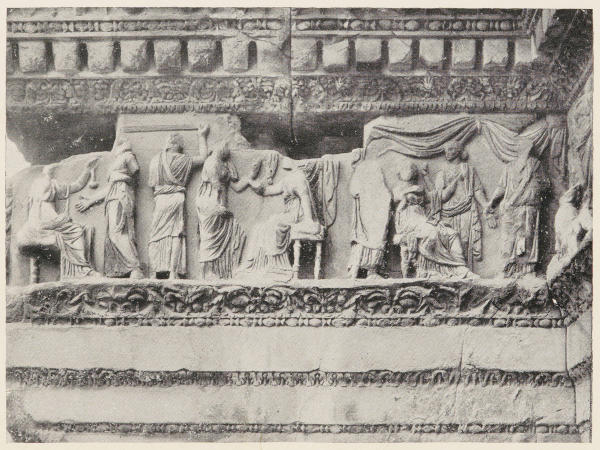
ROMAN ART OF THE SILVER AGE.
Reliefs from frieze of temple of Minerva in Nerva’s Forum representing
the goddess’s patronage of domestic arts.
From photograph by Alinari.
A Literary History
of Rome in the
Silver Age
From Tiberius to Hadrian
By
J. Wight Duff
M.A., D.Litt. (Oxon.), Hon. D.Litt. (Durham), LL.D. (Aberdeen);
Professor of Classics, Armstrong College (in the University
of Durham), Newcastle-upon-Tyne
Author of
“A Literary History of Rome to the Close of the Golden
Age” and “Writers of Rome”
T. Fisher Unwin Limited Bouverie House, Fleet Street
1927
PRINTED IN GREAT BRITAIN
LITTERARVM VETERVM
STVDIOSIS AMATORIBVS
HAS QVALESCVMQVE SVNT LVCVBRATIONES
DE AETATE ARGENTEA EXARATAS
LIBENTISSIMO ANIMO
IOANNES WIGHT DUFF
D. D. D.
ID. IVL. MCMXXVII
Preface
The favourable reception accorded in several countries to
my work on A Literary History of Rome from the Origins to
the Close of the Golden Age, of which the first edition appeared
in 1909, suggested the idea of continuing on similar principles
the study of Latin literature into the first and second centuries,
during which the Roman empire at its zenith in power and
efficiency rendered its greatest services to human civilisation.
The project was dropped throughout the period of the Great
War, when, even if publication had been feasible, duties on a
local Brigade Committee and for a time as Acting-Principal
of my College effectually removed me from the atmosphere
of literary criticism. Even after my publisher, Mr. Fisher
Unwin, was good enough to revive the design, progress
was extraordinarily slow, owing to the increasing demands made
upon time by the recurrent problems of a modern university.
As in the former volume, emphasis has here been laid on
the national character imprinted upon Latin literature despite
all borrowings from Greek models; and attention has been
carefully devoted to the evidence for the facts of an author’s
life in an endeavour to recreate the environment amidst which
he wrote. Nor have material sources, whether Greek or
Latin, been overlooked: indispensable though some account of
these must be for a true conception of a writer as at once inheritor
and progenitor, it is surprising to note how little in
this country scholarship has concerned itself with the origin of
encyclopaedic learning like that of the elder Pliny. The
arrangement adopted is different from that in Professor
Summers’s skilful handling of a slightly shorter period in his
Silver Age of Latin Literature under headings of various kinds
of literature rather than on chronological lines. In the present
work, where historical background and literary evolution are
alike regarded as of vital importance, the treatment has been
not according to genre but mainly in the order of time. While
the limits set for full discussion of authors are A.D. 14–A.D. 138,
these dates are not rigidly observed respecting relevant topics,
such as the survival of an author’s influence till modern times
or the continuance of the Roman educational system; and an
epilogue is added to give a brief conspectus of the literature
which followed the Silver Age.
An attempt has been made to secure acquaintance with a
reasonable proportion of the vast number of treatises and
pamphlets written in Latin and in several modern languages
upon matters related to the authors of the period. The
obligations incurred to such works may be gauged from references
in the footnotes. But it is obvious that no amount of
reading in books upon books, however valuable in substance,
can avail to produce either a vital chronicle of any age or
serviceable estimates of its writers without first-hand study of
the writers themselves and independent appreciation of their
significance. I hope, therefore, for success in conveying to
readers, by summary, by quotation, and by criticism, something
of the impression made on myself during adventures among the
literary products of the Silver Age. The illustrative translations
from Latin into prose or verse are my own, and have
been for the most part composed specially for this volume.
Thanks are due to the Delegates of the Oxford University
Press for permission to use a few verse renderings which I
made for my book on The Writers of Rome. The general
reader, whose Latin has perhaps grown rusty, may welcome
these translations as supplementing the historical and critical
portions, while he will doubtless realize that it is optional to
consult or not to consult the footnotes.
The bibliographical notes, it should be explained, are
intended, not to be exhaustive, but to give by mention of
selected editions some clue to the history of the printed text
of an author and to include representative modern studies of
his literary significance.
I wish to acknowledge kind assistance rendered by
Mr. Basil Anderton, M.A., Public Librarian, Newcastle-upon-Tyne,
and by Miss Constance Shipley, M.A., Lecturer
in Classics at Armstrong College, in reading and criticising
some of the chapters of this book. My son, Mr. Arnold M.
Duff, M.A., B.Litt.(Oxon.), Assistant Lecturer in Greek in
the University of Aberdeen, has also perused several chapters
and made useful suggestions, while my wife copied for the press
either by hand or by typewriter almost the whole manuscript.
Both have helped greatly in the checking of proofs and in the
verification of references. To Professor Hermann Dessau
of Berlin I owe several references to inscriptions which he
sent me some years ago to amplify those in my article on
“Roman Education” in The Encyclopaedia of Religion and
Ethics. In the choice of a frontispiece, intended to illustrate
the art of the period, I had the great benefit of advice from
Mrs. Arthur Strong, Litt.D., LL.D., formerly Assistant-Director
of the British School at Rome, in whose penetrating
discernment of the true ethos of Roman sculpture I have found
much to reinforce my argument that within the analogous
domain of literature the Romans knew not only how to borrow
from Greece but also how independently to create the beautiful.
It is a satisfaction to observe among scholars a growing
insistence upon the independent vitality of Roman literature
and a growing disinclination to regard it as a pale second-hand
reflection of the splendour of Greek literature. My friend,
the late Dr. Warde Fowler, appended to his Presidential
Address on “The Imagination of the Romans,” read at the
Newcastle-upon-Tyne Meeting of the central Classical
Association of England and Wales in 1920, a note to the
effect that he was in agreement with the contentions advocated
on the subject in my Literary History of Rome; and only last
year a German Professor, Herr Günther Jachmann, chose as
the theme of an inaugural lecture at Köln “Die Originalität
der römischen Literatur”. The value of Roman literature
cannot be grasped without recognition of the extent to which
Roman authors found fresh stimulus in surroundings widened
far beyond those assigned by historical circumstance to the
brilliant intellects of Greece.
J. W. D.
Newcastle-upon-Tyne July 1927
Table of Contents
INTRODUCTION — CHAPTER I PROLOGUE
“Silver” and “Gold” in Roman literature—The period from Tiberius to
Hadrian (A.D. 14–138)—Historical aspects—Cosmopolitan Rome—Tangible remains—Emperors
in relation to literature—Risks in writing—Fresh individual forces in
Silver literature—The conventional in education—Declaiming and reciting—Epigrammatic
point and decorative tinsel—Corrective factors in real life—Serious
thought—Stoicism—The Stoic opposition—Influence of Stoic doctrine—Influence
of the provinces—Variety in “Silver” themes and style—Changing features in the
language—Concentration on the terse, the surprising, and the poetic—Grammar
and vocabulary—A few summary reflections.
In the literary history of Rome one of the most brilliant and
attractive epochs is that part of the first and second centuries
of the Christian era which critics have usually distinguished
with the epithet of “Silver.” The Silver Age of Roman
Literature is regarded in the present work as that immediately
following the great times of Augustan poetry and prose. What
has been traditionally reckoned the Golden Age coincided with
the productive careers of Cicero and then Livy in prose, and
lasted from Lucretius to Ovid in verse. While, soon after it
began, Catullus wrote his anti-Caesarian lampoons, it reached
its fullest glory when Virgil and Horace by their works threw
lustre around the emergence of the imperial family—ecce Dionaei
processit Caesaris astrum, in the language of the Eclogues.
Politically, therefore, the Golden Age saw the final overthrow
of the old senatorial republic and the inauguration of state-control
by a single ruler for Rome and the Roman dominions.
Such public oratory as Cicero’s, which adorned the earlier
phases of the age amidst the unfettered interplay of republican
politics, had become an impossible anachronism before its close,
when Augustus concentrated in his person all the significant
powers of the ancient magistracies—munia senatus magistratuum
legum in se trahere is the remark of Tacitus. In time, then,
the Golden Age may be dated from 70 B.C. to A.D. 14, a
stretch of eighty-four years.
The Silver Age is a longer period, even when restricted, as
some prefer, to the years between A.D. 14 and 117, that is
from the beginning of Tiberius’s reign to the end of Trajan’s.
Here it has been extended to include the reign of Hadrian,
A.D. 117-138, after which Latin literature is marked partly
by sterility, partly by an artificial archaizing movement, partly
by the entirely different train of thought expressed in Christian
apologetics. Historically, this period of a century and a quarter
coincides with the reigns of all but the first two of Suetonius’s
twelve Caesars, and, in addition, the reigns of Nerva, Trajan
and Hadrian, thirteen emperors altogether. If in the preceding
age the empire was still young and so far, under Augustus,
only partially tested, now during these succeeding generations,
in spite of the enormities of individual emperors and in spite
of the ghastly interval of bloodshed among successive candidates
for the purple after Nero’s suicide, the hold of the system upon
the world was firmly established, and its organization perfected,
on the whole, for the benefit of mankind. With the Pax
Romana came greater safety for life and limb both in Italy and
in the provinces; governors abroad were more under the
central control; roads were improved to meet the requirements
of the imperial post-service for despatches; the water-supply
of Rome and other cities was diligently cared for; new harbours
were constructed; industry and trade increased, at any
rate up to the point at which the policy of the bread-dole effected
moral ruin for the population and in the end financial ruin for
a state in which the value of free agriculture and free capital
was misunderstood. Nihil est ab omni parte beatum; and so,
upon examination, it is plain that amidst the material well-being
and felicities of the second century, even in the prosperous
Antonine age with which Gibbon began his history of The
Decline and Fall, there lurked elements of disintegration which
would lead to the troubles of the third century.[1]
During the first century events had revealed the state-secret
not only that emperors might be made by other electors than
the Senate, but that they might be made even elsewhere than
in Rome. The tendency, in fact, was towards a military
monarchy, as the careers of Galba, Otho, Vitellius and Vespasian
showed. When one considers, it seems well-nigh inevitable
that an emperor’s absolute power abroad should ultimately
expand his theoretically limited power in Italy and Rome
towards absolutism. Between Augustus as first citizen at the
opening of the century and Domitian claiming to be “Lord
and God” towards its end vast changes had intervened. The
dyarchy which Augustus was careful to respect had in time
gone far on its way to monarchy; for the senate not infrequently
acted under imperial coercion. More and more, too, it grew
evident that the basis of the ruler’s power was the army—a
conception abhorrent to Romans of the constitutional republic.
In this connexion it is significant that the title imperator became
commoner than princeps about Trajan’s time. Moreover, the
worship of emperors during their lifetime in association with
the cult of the goddess Roma, and the deification of certain
emperors after death, outwardly exalted their office. It is,
however, difficult to see how the notion of apotheosis could
seriously survive among thinking readers of Seneca’s satire on
the dead emperor Claudius; and it is a strange contradiction
inherent in circumstances that, while the sacrifice in honour
of a Caesar as the public test of loyalty involved the martyrdom
of many Christians, yet the Caesar-worship from which their
faith revolted did actually by its attainment of official universality
prepare the way for the ultimate predominance of the
Christian religion.
The crucial problem for the empire was, as Augustus
foresaw, one of consolidation rather than aggrandisement;
and the only notable departures from this policy during the
whole period were connected with the annexations in Britain
begun by Claudius and those in Dacia and the East carried out
by Trajan. Trajan’s Oriental conquests in the first quarter
of the second century, though soon abandoned by his successor,
brought the Roman Empire to its widest extent, and marked
the extremity of contrast between the primitive pastoral settlement
near the Tiber and the capital of world-wide dominions
into which it had evolved. Rome had in the first century
become more cosmopolitan than ever—a phenomenon sufficient
to illustrate in the eyes of a Seneca the essential brotherhood of
mankind, but in the eyes of a Juvenal the objectionable ubiquity
of the alien interloper. It has been argued that, early in the
second century, when Juvenal and Tacitus wrote, “a very
small percentage of the free plebeians on the streets of Rome
could prove unmixed Italian descent.”[2] Here at once we meet
a feature of importance for literature. Rome possessed a
wonderful power of nationalizing the foreigner; but there was
sure to be a reaction on her own life and thought. This large
cosmopolitan and international element in the capital contributed
towards a widening of their horizon for literary men,
and to it the human note unquestionably observable in the
Silver Age owed a great deal.
The whole period has been made very real to us by writers
within recent times who have investigated its political, constitutional,
social, religious and artistic history.[3] Modern
inquiry has combined with ancient documents to recreate the
historical background requisite for appreciation of the literature,
in such a way that few epochs of the past are so intimately
known. In some degree this clear view is due to the strikingly
human note, the living interest in man and his concerns, which
is characteristic of the ablest writers in the Silver Age. Much
of its history and many of its personages have been made to live
for us by Tacitus and Suetonius; its society by Petronius’s
novel, the miscellaneous poems of Statius, the younger Pliny’s
letters, Martial’s epigrams and Juvenal’s satires; its science by
the elder Pliny; its rhetoric by the elder Seneca and Quintilian;
its practical ethics by Seneca the younger. Inscriptions and
coins tell their tale; the Colosseum remains the most imposing
monument to the Flavian dynasty; Pompeii puts before us the
dwellings, decorations and the very street-paving of the time;
and Hadrian is brought nearer through his magnificent villa,
a veritable urbis opus, close under Tivoli, his gateway at Athens,
his wall in Britain, and his mausoleum familiar now as the
Castel Sant’ Angelo at Rome.
Before passing from the historical aspects of the age, one
may observe how the emperors comported themselves in
relation to literature.[4] They were well-educated men, and
several of them showed literary talent. Tiberius in early life
cultivated the acquaintance of M. Valerius Messala Corvinus,
the friend of Horace and Tibullus, and modelled his oratorical
style on Messala’s. It was said that he imitated the pathetic
love-stories of Parthenios of Nicaea, who taught Virgil Greek.
Tiberius’s successor Caligula was no author, but he had a turn
for shrewd criticism, discernible in his sharp remark about
Seneca’s style as “sand without lime;”[5] and he recognized
classic greatness in literature well enough to be insanely jealous
of it. The next two emperors, Claudius and Nero, displayed
ability as writers, the one in prose, the other in verse. If we
then turn to the Flavian emperors, we find that, although none
of the three felt so enthusiastic for literature as either Claudius
or Nero had done, yet they all extended a certain limited
patronage to authors. Vespasian, bourgeois man of business
though he might be, was not unskilled in Greek eloquence, and
composed memoirs. Titus, we know, wrote a poem on a
comet; while his brother Domitian was devoted to poetry in
youth, and later fostered poetic rivalry by the Capitoline and
Alban contests. That competition, when the right circumstances
co-operate, can give health to literature is evident from
the lasting greatness of Athenian drama: unfortunately, the
spirit of Domitian’s reign was such as mainly to favour mediocrity
or truckling in its poets. Trajan, without profound
culture himself and no very active patron of letters, at least
maintained friendly relations with such authors as the younger
Pliny and the Greek Dion Chrysostom. His successor Hadrian,
versatile and Hellenic in taste, dabbled in Latin poetry; but,
to judge from the surviving fragments, never so successfully as
at the last, when he composed his death-bed adieu in half a dozen
lines to his soul.
Even such a cursory glance at rulers of the time indicates
that the drawback for literature consisted not in their particular
unfitness to play the literary patron but in a generally untoward
environment. Artistic creation of the very freest and highest
order was little likely to thrive in the atmosphere of the first
century. The risk of danger always lay hidden in the unfathomable
temperament of an emperor; and in the very essence of
the new régime there wrought elements inimical to the safe
production of literary work. The outspoken oratory of the
past was unacceptable; history was capable of giving offence
in high quarters; even drama could be frowned upon for a
line misconstrued as a political allusion. At a time when
Phaedrus’s beast-fables were denounced as libellous insults, it
is not surprising that histories of human affairs should be
adjudged to the flames. The prospects for literary men must
often have appeared dark during the sway of the Julio-Claudian
dynasty in situations such as were created by the espionage
which Tiberius permitted in his later days, by the incalculable
caprice of Caligula, the uncertainties of policy under the wives
and freedmen of Claudius, and the egotistic vanity of Nero.
The wonder is not that we have so small a yield from times so
difficult, but that we have so much that has proved worth preserving.
Fortunately, writers took risks. Under Nero,
Petronius was safe, up to a point, in writing a novel of low
adventure, and Seneca was safe, again up to a point, in writing
essays on high moral principles, though even these might be
interpreted as implied reproofs. Lucan, on the other hand,
was clearly on the thinnest ice in writing an epic about Pompey’s
heroism in his warfare against Julius Caesar. This was doubly
dangerous; because while the poem might very well be regarded
as anti-imperial, it might also stir the jealousy of a poet-emperor.
Later, under the Flavians, no one could be sure when
the court might grow too suspicious to tolerate philosophers
any longer in Rome, as happened in A.D. 75 and 90. Deep
intellectual speculation has always been liable to enmity as
unsettling: and so many members of noble houses had in
troublous times found consolation in Stoicism that its teaching
particularly tended to be associated with opposition to the
imperial system. Apart from this aspect, it may be noted in
passing how Stoic thought shows itself in such poets as Persius,
Lucan and Juvenal, and in such prose writers as Seneca, the
elder Pliny and Tacitus. The period of terror during the later
part of Domitian’s reign, fifteen years of “silence” as Tacitus
viewed it, pressed most severely upon history. But it was not
impossible to write securely, if an author chose remote epic
themes as Statius did, or composed scores of occasional epigrams
as Martial did. Indeed, there never was a time when dilettanti
recited more energetically their latest productions before a
select circle of friends. After Domitian’s death, history and
oratory recovered a modicum at least of their old freedom.
Nerva’s principate was too brief to affect literature deeply,
though it brought that welcome release from tyranny which
bore fullest fruit in the historical labours of Tacitus under
Trajan. This fresh impulse, however, seemed almost spent
by the reign of Hadrian; for Suetonius and Florus were artistically
but poor successors to Tacitus. Under Hadrian a revival
of interest in Hellenism and the prominence of authors writing
in Greek combined with the emperor’s example to act as positive
setbacks to the fashion of writing in Latin.
In its literary aspects the whole age makes a fascinating study.
Its appropriate epithet of “Silver” concedes the classic superiority
of the Golden Age (aurea prima sata est aetas ... subiit
argentea proles); but silver, viewed as metal or as literature,
retains a value of its own, and the metaphorical title, whether
it calls to mind a glittering style or a literary convention already
somewhat silvered with time, is both picturesque and instructive.
No apology is needed for a survey of literary works
created during the greatest period of the Roman Empire.
Parallel with its administrative triumphs and its permanent
services to civilization, we discover, in an adventure among its
masterpieces, artistic production of high quality, thought commensurate
with the achievement of the times, and engrossing
portrayal of life. Convention has been alluded to, and we may
trace much of it at work among authors; yet it is only fair to
point out that the Silver Age had its unique geniuses. Nowhere
else is a Tacitus or a Juvenal to be found, each uttering an
individual note, and each among the greatest names in the
domains of historical prose and poetic satire respectively.
Phaedrus in fable, Petronius in the novel, Martial in epigram,
Pliny in letter-writing were all fresh forces; nor is there any
Seneca elsewhere in Latin, whether we like his style or not.
Even the massive proportions of some works composed during
this age are impressive though sometimes forbidding—it is so
much easier, and commoner, to criticize than to read the thirty-seven
books of Pliny’s Natural History or the seventeen of
Silius’s epic. Before the incessant industry of the elder Pliny,
less hard-working generations might, like his nephew, stand
abashed. But such phenomenal diligence is not necessarily
attractive; and probably what most draws readers to the Silver
Age is that human note already mentioned which, in the midst
of widespread artificiality elsewhere, makes many of the
authors interesting to all periods. No one can take up Petronius,
Juvenal, Martial or Tacitus without feeling that real life and
real things are being described and without feeling absorbed by
that reality.
The chief formative factors of this complex literature may
be rapidly passed under review. Foremost of all the influences
at work was the contemporary education in letters and rhetoric.[6]
While the general training in letters opened up the treasures
of Greek and Latin literature as sources of inspiration for prospective
writers, the special training in the principles and practice
of speaking profoundly affected style. The predominant
study of poets in the rhetorical academies tended to obliterate
the true demarcation between prose and poetry, leaving upon
prose the indelible poetic tint which is characteristic of the
Silver Age. The imitation of Virgil, traceable in Lucan,
well-marked in Valerius Flaccus, and still more so in Silius
and Statius, was by no means confined to these epic writers;
it spread to occasional verse, epigram and satire; and it invaded
prose, so that the style of Tacitus must be viewed in relation
to Virgilian influence. Nor was this only a matter of poetic
colour: the bones, as it were, of the language were affected in
the altered grammar and syntax which have presently to be
discussed and illustrated.
Manner of expression came to be deeply modified by the
systematic instruction in rhetoric and by the declamatory
exercises (especially the controuersia and suasoria) composed by
the student practising the use of figures of speech, exclamations,
apostrophes, interrogations, and innumerable other artifices,
which he had been taught by a rhetor to consider effective for
the purposes of argument or display. The declamation wore
more than one aspect. A serious ingredient in the educational
system, it was an exercise to be regularly practised by learners
as a training in argument; and, whatever its futility under
some instructors, sensible authorities like Quintilian had in
view the solid kind of argument useful in a law-court.[7] It
combined certain of the functions of a modern essay with those
of a debating society. It had even a romantic side; for not a
few of its themes anticipated elements in medieval tales and
modern novels. But it was open to attack from the first. The
Romans indeed showed their common sense in calling the
exercise declamatio—something of loud-voiced overstatement
was implied in that half-derogatory term. Being a pillar of the
educational fabric it was, like most things in education, pretty
sure to be criticized. However much pleasure it might give
an admiring parent to hear his son exhibit his eloquence on
speech day, this supreme test of the school career and reputed
passport to success in life was subjected to incisive attacks,
examples of which may be read in Petronius and Tacitus. No
one could deny the readiness attainable by such practice in the
rhetorical academy, any more than one could fairly overlook
the metaphysical importance of some at least of the themes with
which medieval Scholasticism was concerned; but in the one
case, as in the other, a ceaseless immersion in verbiage caused
stagnation of thought. Obscurantist professors of what was in
itself an excellent art checked the progress of eloquence and
robbed it eventually of life. Yet for generations it defied
detraction, and in spite of defects, produced a long line of capable
speakers. Unduly elaborated subtlety was at the worst wearisome:
it was not destructive like the shameless perversion of
the art practised by professional informers (delatores), who saw
in the share of confiscated goods allowed to them by the
Government a handsome reward for misapplying rhetoric
towards compassing convictions on charges of treason.
Two sets of circumstances reinforced this rhetorical influence;
one, the not uncommon habit of continuing exercise
in declamations, either privately or under a master, long after
college days; the other, an author’s custom, derived from
Augustan times, of holding recitationes of his compositions in
prose or verse before an invited gathering of friends, partly to
elicit criticism, partly to advertise a forthcoming work, and
also very largely to impress the audience. Under this last aim
lay many pitfalls. Literature designed for a kind of parade
tended to repeat the qualities of the academic show-piece. The
ideal coveted was the production of telling effects. Hence
ingenuity was expected in narrative, description and argument,
with the result that a wide entrance stood open for the precious
and far-fetched. A discourse, an oration, or a poem had to
exhibit its author’s ability in elaborating academic commonplaces
into surprisingly terse epigrams or sententiae; it had to
wear the variegated adornments of rhetoric so that the style
often became outrageously rococo in taste. Of the worst
excesses of the Silver Age one feels as did Alceste in Le Misanthrope,
when he expressed his disdain for Oronte’s sonnet:
“Ce n’est que jeu de mots, qu’ affectation pure,
Et ce n’est point ainsi que parle la nature.”
Artificiality driven to such extremes meant a divorce from plain
common sense; for natural feeling met its death in the exuberant
riot of epigram, word-play, antithesis, apostrophes and
other devices. Similarly, when presenting a hypothetical case
in a controuersia or suasoria, the speaker’s temptation was to
cast about for novel arguments; and the quest after something
novel was apt to lead far away from reality into unnatural
extravagances of perverted ingenuity. Both defence and attack
in the controuersiae reported by the elder Seneca give, we shall
find, many examples of those incredibly smart inventions.
Rhetorical gymnastics of this sort, while they had the merit of
ensuring a high degree of readiness and finish in speech and in
style as a whole, yet fostered in some speakers and authors an
empty glibness from which no great literature could grow.
The contemporary complaints about the decadence of oratory
are significant. Despite all the attention lavished upon it,
eloquence deteriorated. Over-cultivation would contribute to
a measure of staleness, and political conditions had taken the
heart out of the old type; but, beyond all that, the rhetoric of
the schools was too remote from truth to produce good style.
It was well for literature, therefore, that actual life counteracted
the cramping effects of rhetorical training. Many a
promising academic speaker got his first salutary awakening
when he had to plead a real case in a law-court. Furthermore,
contact with the multiplicity of life in Rome, and with the
various peoples included in the empire, was certain to stimulate
and deepen an interest in man as such. It would be a profound
mistake to overlook the complex nature of the Silver literature,
or to imagine that we could sum up its qualities as if they were
solely those of clever rhetoric, or to forget the realists of the
time—Petronius, Juvenal, Martial. Of these three, while
Petronius proves that he could compose in the conventional
vein when he liked, it is Juvenal who makes the most interesting
blend, because he can be at once declamatory and realistic. If
the worst manner of the declamations reappears in some of the
rant which disfigures Seneca’s tragedies, Juvenal on the other
hand is not mastered by but master of the declamatory element.
This simply indicates that rhetorical artifice could be turned
to different purposes by different hands: while it was used with
mechanical precision by Valerius Maximus and with oppressive
ingenuity by Lucan, it attained a miraculous brilliance under
the pen of Tacitus. One feels with relief that Tacitus avoids
Lucan’s besetting sin of overdoing the epigrammatic; for no
Latin author is so absorbingly possessed by the passion for point
as Lucan. Like Ovid in his quest after cleverness, Lucan casts
about among several ways of saying the same thing, serves up
obscure subtleties, and inserts digressions favourable to erudite
description. As in his fellow epic-writers Valerius, Statius,
Silius, this love of description again and again beguiles the author
into subordinating the artistic unity of the whole to the elaboration
of separate passages.
It has been pointed out that, alongside of this prevalence of
the academic, there was the corrective element of genuine
interest in man to give permanent value to much of the Silver
Literature. While direct observation of life was the best antidote
to unreal rhetoric, there were other factors which made
for serious thought in preference to merely smart expression.
One, already mentioned, was the Stoic philosophy, which
offered to its followers an ordered view of the world as well as
guidance in matters of conduct, especially at a crisis in life.
Now grown more practical and therefore more Roman, since
it had abandoned its extremest paradoxes, neo-Stoicism counted
among the influences which encouraged a fellow-feeling
amongst mankind. Between Stoicism and Cynicism, which the
earlier Stoics had admitted to be a short cut to virtue,[8] there was
much in common. In agreement broadly, although not in
detail, concerning virtue, reason (logos), cosmopolitanism and
freedom of will, both disciplines reckoned numerous adherents
in the early empire. They now definitely overshadowed the
neo-Pythagoreans and neo-Sceptics. Other schools also had
lost ground. The prestige of Epicureanism was waning, while
pure Platonism and pure Aristotelianism failed to attract the
Roman mind. But Stoicism contained elements more commendably
intelligible. Above all things, it emphasized conduct:
it was an applied science of life, offering for troublesome
enigmas a solution which, even if not finally satisfying, claimed
a true accord with nature, and in the experience of many was
found workable. With less demand upon intellectual subtlety
than Platonism, practical Stoicism more adequately suited the
Roman temperament as a preparation for facing the things that
may happen.[9] For many thinking Romans it must have been
a consolation to realize that, though they might feel repelled
from activity in the political sphere controlled by a Caesar, they
yet remained citizens of a cosmopolis—a world-state, wherein
they were fellow-citizens with God, participators in the divine
essence and free by reason of a freedom divinely conferred.
“God is near you,” writes Seneca, “with you, within you.
This I say, Lucilius: a holy spirit abides within us, watcher
of our deeds good or evil, and guardian over us.”[10] In the
spiritual realm, then, the Stoic was an intellectual aristocrat,
conscious of an eternally virtuous power which enabled him to
disdain misfortune and defy a Nero or a Domitian. Nor was
this position the outcome of tumid rhetoric or ingenious
theorizing: it was put to the proof: it was a faith in which men
died and women faced exile.
Theoretically the Stoic creed did not prevent its followers
from being loyal citizens of the empire; but in practice there
was certain to be conflict. Their exaltation of virtue and their
austere regimen in life were implicit rebukes to a luxurious
emperor or court: the not uncommon actual abstention of
Stoics from politics and their half-cynical attitude of independence
gave further grounds for suspicion. Julius Kanus offended
Caligula by uncompromising argument, and Thrasea under
Nero was charged with disbelief in the deification of Poppaea
and with contempt for state-religion. Besides, the historical
outlook of many Stoics as laudatores temporis acti tended to give
umbrage in high imperial quarters. Revolutionary sympathies
might not illogically be suspected in enthusiasts for “Romans
of the olden times.” It had been dangerous to call Cassius
“last of the Romans”: it was scarcely less dangerous to drink
toasts to the memory of Brutus and Cassius on their birthdays.[11]
There lay significance in the fact that Helvidius Priscus, who
had been banished by Nero, renewed under Vespasian his
subversive propaganda in favour of what was termed democracy,
but was really planned to be a government of Rome by the
senatorial class in consonance with philosophical ideas.[12] It is
scarcely surprising then that Vespasian expelled all philosophers
except Musonius.[13] Only after Domitian did the imperial
government become reconciled with Stoicism, which in the
second century was the prevailing creed of educated Romans
and found one of its classic exponents in the Greek reflections
of an emperor.
The concept of a Stoic opposition under the empire must not
call up the picture of a regularly organized party of disaffection.
The Stoic might, like Seneca, take service with a Caesar. But
among several features of the empire which provoked hostility
two at any rate stand out. A Stoic could not avoid feeling
repelled at once by Caesar-worship, and by the development of
a largely mechanical bureaucracy in which the individual
lacked scope for the competent performance of duty. Now
Stoicism claimed to supply the very competence for which there
was little or no safe outlet in imperial employment. The strong
tendency among Roman Stoics of the first century to accentuate
the individual came less from an aggressive Cynic standpoint
than, as in Seneca, from a conception of the inward development
of personality effected by rigorous self-examination. It
did not amount to an assertion of the individual as an absolute
and independent entity; nevertheless, it encouraged that doctrine
of self-sufficiency and that portion of disdain for others
which can be illustrated from both Lucan and Persius.
Nor should the senatorial opposition under the Caesars be
mistaken for lineal representatives of the nobles of the republic.
The old families died out fast: some of their scions, as Tacitus
and Juvenal show, lapsed into indigence and menial occupations.
The patrician houses of the senate in Julius’s day are
almost extinct by Hadrian’s time: Aemilii, Claudii, Fabii,
Manlii and Valerii are gone: it is almost a surprise to find
Cornelii. This disappearance of the ancient blood was due
not so much to tyranny as to that voluntary childlessness which
imperial legislation had attempted to discourage. A large proportion,
then, of the new aristocracy was not of the old republican
stock, but represented a fresh strain drawn from the
industrial democracy of Caesar’s age: it was destined in turn
to collapse through its own prosperity.
Both on contemporary and on subsequent thought neo-Stoicism
exercised an almost incalculable influence. The
insistence on a moral order in nature to which man must
conform made for salutary discipline, and the doctrine of the
immanence of the divine reason ennobled the conception of
duty. The recognition of moral progress, in contrast to the
uncompromising tenet of sudden perfection held by the early
Stoics, was a more practical, a more encouraging, a more human
view which possessed a tonic value beyond the reach of outworn
paradoxes. Again, while the Stoic teaching on the
brotherhood of man fostered kindliness, that on the equality
of man fostered fairness of treatment.[14] These and other
doctrines of value colour the deep Stoic influence on Roman
law. In the field of religion, Stoicism proved ultimately to be
a solvent of polytheism; for though Stoics might profess belief
in the divinities of traditional paganism, they yet turned to
allegory as an explanation of the myths, and thus tended to
undermine an unquestioning acceptance of the gods. Stoicism,
therefore, with its pantheistic trend contributed to the annihilation
of traditional religion among the intellectuals without
fully establishing monotheism to replace the polytheistic system.
Another of the more serious influences of the age, largely,
though, as we shall find, not entirely independent of rhetorical
artifice, was the practical interest in learning of an encyclopaedic
sort, exemplified in Celsus, the elder Pliny and the lost
works of Suetonius. The discontent repeatedly expressed over
men’s waste of time is another reminder that the more serious
thinkers were unlikely to reap permanent satisfaction either
from social amenities or from vapid rhetoric. We have something
like a gospel of work if we combine Phaedrus’s scoffing
remarks on the fussy ardaliones, Seneca’s distaste for spending
energy on trifles, the elder Pliny’s nervous husbandry of hours
for study, his nephew’s grumblings about encroachments upon
leisure, and even Martial’s regrets over procrastination and lost
opportunities—soles ... nobis pereunt et imputantur, as he so
humanly says.
Yet another influence which must not go unnoticed is that
of the provinces, and especially the influence exercised by the
old province of Spain. With some claim to have developed a
partially independent culture of its own, it spoke a Latin which
naturally retained certain idioms, words and sounds used by
previous generations of soldiers and colonists. Latin which
had grown old-fashioned at Rome might still in these days be
heard in Spain. It is not altogether fanciful to detect a Spanish
note in parts of the Silver Literature; for among Romano-Spaniards
of the time were the Senecas and Lucan, Columella,
Quintilian, Martial, besides several rhetors of standing. Trajan
was a native of the Spanish Italica, where Hadrian’s ancestors
had lived since the days of the Scipios. It is significant of the
contribution being made by the provinces to Rome that the
Spanish influence is observable in the first century, to be followed
by the development of an African Latinity in the second, and
the flourishing of Romano-Gallic rhetoric in the third. The
contemporary influence of Greece also acted externally upon
Rome in so far as it was exerted by Greeks who taught or wrote
in the city. History has recorded how responsive to personal
contact with Greece itself were emperors like Nero and Hadrian;
but the deeper Hellenic influence lay imbedded in the literature
of the past, constantly lectured upon and assimilated generation
after generation in Rome.
The wonderful variety of the Silver literature depends on
the intermingling of such currents of influence, old and new.
Tradition and inheritance, both Greek and Roman, operate
side by side with fresh problems and interests. It was no age
of stagnation. Distinctive, though conventional, voices are
heard in the epics of Lucan and of his three successors, Valerius,
Statius and Silius, whether, as in the case of the first and the
last of these, they chose a historical theme, or, as in the case of
the other two, they had recourse to mythology. Virgilianism
acted there, as it also did in the eclogues by which Calpurnius
Siculus transmitted pastoral poetry to Nemesianus. The drama
of the day, never very great, has left, besides the Octauia,
which is the single extant historical play in Latin, only Seneca’s
mythological tragedies based on the Greek dramatists. Far
more individual power is shown in satire. Persius, a convinced
young Stoic student of Horace, fulminates in crabbedly compressed
sermonettes against moral backsliding; and later,
Juvenal, proclaiming himself to belong to the literary lineage
of Lucilius and Horace, displays his unsurpassable strength of
invective. Satire may be said to have taken a new turn early
in the first century when Phaedrus used the iambics of his
beast-fables to suggest with mischievous irony the foibles of
mankind, and once more a new turn when, in the last quarter
of the century, Martial perfected the epigram with the stinging
close after the fashion which has ever since made him famous.
In the revival of the Menippean satire, formerly associated
with the name of Varro, we again encounter the medley of
verse and prose. This type is represented in Seneca’s skit on
the deification of Claudius and in Petronius’s picaresque novel.
As regards prose style, the names of Seneca and Petronius
mark two different tendencies traceable throughout the period—Seneca,
usually artificial, though less so in his satire; and
Petronius, as becomes a portrayer of manners, more influenced
by the spoken Latin of his day. It might have been expected
that encyclopaedic, scientific and technical learning should be
uniformly conveyed in the simple style; but it is not always so.
Straightforward expression, as a rule, characterized Celsus in
the medical part of his encyclopaedia (and presumably also in
the lost parts), besides Columella in his agricultural treatise, and
Frontinus writing about aqueducts; whereas one detects, on
the other hand, the lure of the purple patch when the elder
Pliny pauses for intervals of reflection in his gigantic Natural
History. So too Pomponius Mela’s geographical manual is
needlessly decorated with flashes of intended eloquence; while
Valerius Maximus’s handbook of stories for rhetoricians would
have been more entertaining, had he told the stories in plainer
style, leaving embellishment to the rhetoricians for whom he
collected them. In history restraint of style is far to seek.
Velleius Paterculus is convicted by his excessive superlatives
alone, though one forgives him much for his surprisingly
original interest in certain aspects of literary history. Curtius
Rufus, handling the grand subject of Alexander’s campaigns,
shows his ability in semi-romantic description rather than in
historical inquiry. During the Neronian era, we meet the
epigrammatic manner in Seneca’s philosophy. The brilliant
neatness of his sentences lent them a quotability which essayists
in later literatures have loved. But this is a manner whose
qualities cloy; and a revulsion from his style soon took place,
when in the Flavian era Quintilian’s lectures warned students
against the seductions of Senecan prose and beckoned them back
to Cicero’s rounded periods as the true models for composition.
A modified Ciceronianism is, therefore, visible in Quintilian,
and a still more modified Ciceronianism in his pupil, the younger
Pliny. It also marks Tacitus’s early dialogue on oratory; but
his characteristic style, that of his historical writing, is notoriously
the triumph of an original genius in verbal parsimony.
The closing phase of the Silver Age still exhibits the two
tendencies side by side in Suetonius’s business-like sentences and
in Florus’s feeble echoes of rhetorical utterance.
The language which was the medium for this literature may
be briefly surveyed. Some aspects of Silver Latinity have been
incidentally touched upon in connexion with the preponderating
amount of poetry read at school, which bore fruit not merely
in poetic phraseology and Virgilian imitations, but in constructions
(like the familiar dative of the agent with a passive verb)
now transferred from poetry to prose. No doubt some of the
typical usages and idioms which we shall find illustrated in
Silver authors are due to the inevitable change which any living
language must undergo. Old words gain a new meaning:[15]
new words are introduced. The Latin of Cicero could not
have been, either in vocabulary or in sentence-structure or in
grammar, the Latin of five generations later:[16] hence we are
prepared to observe in Tacitus and other writers of the Silver
Age alterations in the employment of the subjunctive mood,
fresh meanings of prepositions (like circa and citra), new usages
of and new positions for connective particles.[17]
In tracing differences between Silver and earlier Latin, it is
difficult to assess the relative importance of the universal tendency
in language towards change and of such special influences
as the systematic drill in rhetoric and poetry. Some apparent
changes such as are noticeable in the position of igitur, in a
seemingly strange word, or strange meaning, or in the use of
a mood, are in reality inheritances from one or two prose
writers of the Golden Age, especially Sallust and Livy: what
had once been an exception has become, if not the rule, at least
much commoner. Apart, however, from the inevitable laws
of development, the Latin language of the first century and a
half of the Christian era was most deeply affected by three fixed
attitudes of mind—the rhetorical passion for terseness, the
rhetorical passion for novel modes of expression, and the
rhetorical concentration of study upon poetic authors. Of
these, compression was especially admired in the clause or
phrase with epigrammatic point, but its pursuit was accountable
not only for the shorter sentence in vogue, but for all sorts of
ellipses[18] in grammar and for a copious employment of asyndeton.
The avoidance of the stereotyped made for the introduction of
new words and meanings, greater freedom in the handling of
moods, and a departure from the more regularly balanced
clauses and phrases of Ciceronian Latin. Many of the changes
in vocabulary are due to the individual genius of prose writers
who invented words, or, by adopting them from the common
speech, gave them a literary cachet. Under this head, Tacitus
is an excellent example both as innovator and as lover of the
rare word. Probably few who use the term “accumulator,”
in speaking of modern apparatus, know that it was invented by
Tacitus to describe one who heaps up wealth. The liking for
the unusual which pervades his sentence-structure, his expression
and his syntax descends into his selection of words. Thus,
when there is a choice between noun-forms ending in -men
and -mentum, he characteristically decides for the more uncommon
form: he actually invents imitamentum, though
imitamen had the poetic sanction of Ovid.
The wholesale invasion of prose by the poetic element
already emphasized calls only for a few illustrations in a preliminary
survey. It is poetic example that leads Seneca to
write senium for senectus, Venus for amor, iuuenta for iuuentus,
and leads Tacitus to use Lucretian words like insatiabiliter,
Virgilian words like breuia (“shoals”), and adjectives like
indefessus and intemeratus which both Virgil and Ovid had
used before him. It is the poetic turn of expression also that
fostered the increasing boldness of personification in prose, the
use of abstract nouns in a concrete or personal sense,[19] and the
substantival use of a neuter adjective.[20] Poetry affected the
grammar of cases and tenses as well. Thus the Latin perfect
used in a general sense, like the gnomic “aorist of experience”
in Greek, was in Augustan Latin still a poetic usage of which
Virgil was fond in the Georgics; but by Seneca’s time it had
passed into imperial prose.[21] These and other instances, too
many for citation here, make it evident that the language no less
than the literature of the Silver Age has the interest of possessing
distinctive features of its own.
A few reflections may fitly form a summary and conclusion
to this introduction. When considering the Silver Age, in
style so easily contrasted with its golden predecessor, one must
beware of so isolating its artificialities as to produce an impression
that it teems with faults. The truth rather is that the
Silver Age does by a natural process of literary evolution
continue tendencies already present in Augustan times. There
is in Horace an artificiality which in some measure anticipates
Persius and Statius; there are in Ovid ingenuities prophetic of
Seneca and Lucan; and in Sallust and Livy aspects of prose
which foreshadow Tacitus. There was no violent break; but
in time, if only by reason of a gradual and apparently cyclic
exhaustion of genius, the changes become too obvious to miss.
It is perfectly reasonable, it is indeed incumbent, to state the
differences; but they must be so stated as to include not merely
signs of stylistic variation but fresh notes of wider outlook in
certain later writers who come close to the general human
heart, perhaps because less exclusively aristocratic than the
elder Romans. A catholic criticism must do justice to their
strength as well as to their weakness.
Such a caveat is needful, because the factors of national
deterioration, even though they worked slowly, were unquestionably
manifold. They were not merely political and economic:
they were physiological and, what is of deep significance
for literature, they were psychological. Though it is easy to
to take an exaggerated view of vice under the empire, there is
nevertheless significance in the fact that the most powerful
voices in the whole period are the voices of protest raised by
Juvenal and Tacitus: satire and irony inevitably flourished in
such an environment. There is a strong temptation to see
little but proof of decadence in the conventional imitators
among the poets of the age, its literary conceits, and unreal
rhetoric, and even in its occasional recourse to the opposite
tendency towards innovation, which French criticism has
taught us to associate, as much as imitation, with decadent
literature. Broadly the undeniable truth is that the Silver poets,
whatever their literary skill, have fallen off in sheer artistic
achievement. To turn from Lucretius and Virgil to Valerius
Flaccus and Statius is to recognize an inferior quality of soul.
The Silver poets have less whereon to feed man’s higher nature.
Virgil’s profundity of feeling and reflection is something more
enduring than refinements based on rhetorical commonplaces.
Enough has, however, been said to lay stress upon the variety
of the Silver Age, and upon the unfairness of estimating it
solely as an age of decadence. One can no more affix a single
label on a composite era than one can indict a nation. If the
feeble echo or the falsetto note is often heard, it is not the only
sound. The literature of the time must be judged positively
by its own appeal to the world. Under this aspect, the Silver
Age has its unique luminaries, the individuality of whose genius
ensures them permanent fame. The mark of the true classic
is the power of giving pleasure to the young and old of many
generations through some fascinating and constantly renewed
testimony to the indestructible continuity of human nature.
Its interest is therefore universal, and its popularity unrestricted
to an epoch. Readers of different countries at different epochs
find in such work a source of eternal delight: it is not alien
to them, nor they to it. In so far as authors of the Silver Age
can address themselves successfully to mankind, and some of
them beyond challenge retain this power, their place is secure
among the immortals.
CHAPTER II ROMAN EDUCATION UNDER THE EMPIRE
Connexion of Roman Education with Literature—Evolution through three
periods—Emergence of three grades in education—Some problems of elementary
education—Suitable nurses and reading-books—“Secondary” training under
grammatici—Province of “grammar”—Exercises prescribed—Authors taught by
grammatici—The higher training in rhetoric—Exercises preliminary to declamation—The
suasoria—The controuersia—Ingenuity and unreality combined—The broad
basis of sound oratory—Subjects included in Roman schemes of education—Spread
of the traditional system in imperial times—Decay of Greek in the West—Growth
of governmental interest in education—Attitude of emperors towards provincial
academies and the later fortunes of the old education.
The main clue to the literary qualities of Silver Latin is to
be found in education, and particularly in rhetorical education.
No social or political factor exercised so determining an influence
upon the literature of imperial Rome. It cannot be
too clearly realized how potent must have been the effect of a
training which was undergone by the writers, speakers and
civil servants of each generation, and which had for its cardinal
aims, first, to secure a thoroughly appreciative acquaintance
with the best poetry in the literatures of Greece and Rome,
and, next, to equip students with the power of effective and
persuasive speech. A connected account of the education in
vogue is, therefore, a fitting prelude to the evidence for the
rhetorical system which may be drawn from such sources as
the Controuersiae et Suasoriae collected by the elder Seneca,
Quintilian’s Institutio Oratoria, Tacitus’s Dialogus de Oratoribus
and the notes by Suetonius De Grammaticis and De Rhetoribus.
Roman education, viewed in its continuity, underwent
certain well-defined processes of evolution.[22] Its history from
first to last, from simple to complex, possesses the interest of
showing how the primitive domestic discipline made way for
a cosmopolitan culture imparted in great measure by skilful
foreigners, and how the ancient training of what we should
call a primary type came to be amplified by a “secondary”
curriculum, and still further by advanced courses of a “University”
character. Interesting, however, as is the whole of
this development, it is with definite phases and periods that we
are here concerned. One may, in fact, conveniently think of
Roman education as falling broadly into three ages, ending,
each in its turn, with the Punic Wars, the reign of Hadrian
(circ.A.D. 120), and the close of the Western Empire. Here
we are mainly concentrating attention on the earlier generations
of the Christian era; and what we find, as regards education,
is that, before the opening of our period, scholastic training
at Rome had gone through its most progressive stage, and, in
range of subjects and interest, had left far behind the ancient
parental instruction. That old type of instruction is best
exemplified by the rigid, unromantic and severely practical
method according to which the elder Cato brought up his son,[23]
and which, despite limitations, was well adapted to the mind,
body and estate of the older Romans. It was a grounding in
the elements of reading, writing and arithmetic, coupled with
sound physical and moral instruction, and had been entrusted
by custom largely to those agents of education in the home
whom Seneca happily calls the “domestic magistrates.”[24] In
those early times which the younger Pliny[25] recalls with admiring
regret, it was possible that every parent should be an instructor
and that the intimate companionship between father
and son should be relied upon to guarantee not only proficiency
in the barest essentials of intellectual education, but also ability
to serve in the army, knowledge of the laws and of religious
rites, propriety of conduct and experience helpful in advising
or controlling men.
As the ages passed, however, increased complexity of social
conditions, together with the influx of Greeks whether bond
or free, tended inevitably to relegate the work of equipping
youthful minds to cultured slaves under parental supervision,
and, at a later stage, very often to grammarians, rhetoricians
and philosophers who settled in Rome eager to convey knowledge.
Besides, the Romans, as conquest brought them nearer
to world-dominion, were shrewd enough to recognize that a
training which had suited the burgher of a city-state stood in
need of generous extension, if it were to mould the citizens of
a governing power charged with imperial responsibilities. The
momentous agent of expansion in Roman education was the
influence of Greece.[26] The expansion itself may be fairly
gauged from the acquaintance with the principles of Greek
rhetoric common among the upper classes at Rome by the
middle of the second century B.C., and from the establishment
of three several grades of education controlled respectively by
the litterator, the grammaticus and the rhetor. These correspond
roughly to the elementary, secondary and University
standards of modern days.[27] While, however, literary and
rhetorical education had reached a high pitch of proficiency
long before our period opens and ceased to alter much
in method, there are, on the other hand, before our period
closes, signs of a changed attitude towards education on the
part of the imperial authorities—signs, in fact, indicating some
amount of endowment and control by municipalities and by
the Emperor.
Allusion has been made to the emergence of three grades of
education. Of these, the “secondary” and “University” grades
possessed under the Empire the deepest significance for their
effects upon literature because of the attention bestowed upon
the grammatical and aesthetic study of authors, upon rhetoric
and upon philosophy. But while the bearing on literature is
necessarily closer at these second and third stages in the educational
fabric, still one cannot ignore the “primary” training,
which contained features of fundamental importance for thought
and literary production. It is not germane here to consider, as
Quintilian does in the first book of his treatise, the methods of
conveying to children the rudiments of reading, writing and
arithmetic,[28] or to comment on the awkwardness of the Roman
numerals.[29] Perhaps, in passing, it may be worth remark that
the proportion of illiterates in ancient Rome was less than many
might be disposed to guess; for elementary education must
have been fairly extensive by the time of Polybius to admit of
the circulation of military orders in writing; and the scribblings
on walls in Pompeii argue a widespread ability to read and write
in the first century A.D. But two problems in the most elementary
education are not to be passed over, for they appeared
to ancient thinkers to be vital in their influence upon character
and taste. These were the choice of a nurse, and, at a subsequent
stage, the choice of books from which reading should be
taught. To Quintilian both were matters of serious consideration.
Although primitive custom preferred, and learned
authors[30] argued, that mothers should suckle their own infants,
and although the devoted care of a mother remained up to
imperial times an appreciable and appreciated factor in shaping
youthful lives,[31] still there is evidence for the employment, at
an early period in Rome, of both foster-mothers and dry
nurses. At a later period the large number of household nurses
may be inferred from inscriptions.[32] Their province, it was
recognized, was not confined to sound alimentation; they
helped to form character for better or worse, and to eliminate
bad habits, mischievous notions and incorrect pronunciations.
Hence the emphasis laid upon the selection of suitable nurses
in Quintilian and in the treatise De Educatione ascribed to
Plutarch.
The other matter in the elementary education which bears
on literary equipment is the choice of reading-books. The
scarcity of literary texts in Latin, which stimulated Livius
Andronicus in the third century B.C. to translate the Odyssey,
had long since ceased to trouble teachers; the difficulty came
to lie rather in the embarrassing wealth of available material.
Quintilian is emphatic in his counsel that for the earliest
lessons good authors should be selected; and his preference is
for Greek.[33] He believed in the stimulus obtainable from great
literature, even where the pupils are too young to appreciate its
full meaning and beauty. In any case there were simple fables
and extracts from standard authors in abundance to serve as
convenient lesson-books.
The second and third stages of education were entrusted to
a grammaticus and a rhetor respectively; here the methods and
subjects produced manifest effects upon literary men in Rome.
Age-limits for the different grades of study varied considerably
owing to individual capabilities and the overlapping of which
Quintilian complained; but commonly a pupil passed from
elementary instruction to the “grammar school” at about twelve
or thirteen, and then to the school of rhetoric at about sixteen.
The function of “grammar” was to train pupils in the intelligent
and effective reading of standard authors both Greek and
Latin; and the teachers themselves were of diverse origin and
rank. Most of the series of grammatici mentioned by Suetonius
were Greeks, and many were freedmen;[34] but there were native
Romans quick enough to adopt the principles of criticism
illustrated by Crates in his lectures upon Greek literature
about 165 B.C., and to transfer them to their own poets, with
the result that Naevius, Ennius and Lucilius speedily became
school authors.[35] Though instances occurred of Roman knights
taking up such work, still, as a rule, a profession of meagre
returns and meagre repute attracted only a motley concourse of
strange fellows—the retired apparitor, the unsuccessful pantomime-actor
or the ex-boxer.[36] But that the demand for instruction
was considerable is plain from the mention by Suetonius
of the time when there were twenty flourishing grammar
schools in the capital.[37] Many Greek grammatici in Rome
towards the end of the Republic added to their duties the
teaching of Latin; thus, the freedman Ateius Philologus, a
native of Athens, was called by Asinius Pollio nobilis grammaticus
Latinus,[38] and Gnipho who taught Cicero was non minus
Graece quam Latine doctus.[39] Specialism, however, in the one
or the other literature was usual in the schools of the Empire,
and the testimony of inscriptions proves the existence of separate
masters for Greek and for Latin.[40]
The implications and functions of ‘Grammar’ were wider
than with us. Its two main concerns, as we shall find in Quintilian,
were the correct employment of language (recte loquendi
scientia) and the appreciative criticism of poetry (poetarum enarratio).[41]
The former comprised study of the parts of speech,
accidence, metres, and faulty usages in word, idiom, pronunciation
or spelling. The latter involved much more than knowledge
of literature; for, since its aim was the elucidation of a
poet’s complete value and meaning, it demanded acquaintance
with subsidiary subjects like music, geometry, astronomy,
physics and philosophy.[42] One feature in the training which
had lasting effects upon literature and which coloured diction
under the Empire, is the signal preference for lecturing on
poets rather than on prose-writers: this was an old tendency,
for Cicero had raised his voice against the comparative neglect
of history.[43] It is also of interest to recollect the attraction
which even the drier and more detailed aspects of Grammar
possessed for many great Romans, for scholars like Varro,
leaders of men like Caesar, and emperors like Claudius. Keil’s
Corpus Grammaticorum Latinorum may be said to establish the
study as one of the monuments of the Roman genius; and such
representative commentators upon Virgil as Macrobius and
Servius are good examples of the mode in which capable grammarians
were expected to annotate a classic.
The main exercises prove the attention given to composition.
They included the re-telling of Aesop’s fables by word of
mouth or in writing, paraphrases, training in moral maxims
(sententiae), extracts of ethical import (chriae), sketches of
character (ethologiae), brief stories (narratiunculae) of a poetic
order where the momentous thing was information rather than
style.[44] The treatment of literature—on which ancient
“grammar” laid very great stress—embraced expressive reading
(lectio) free from sing-song and provincialisms;[45] the elaborate
explanation (enarratio) of subject-matter; textual criticism
(emendatio); and literary criticism (iudicium).
The authors taught by the professor of grammar were
largely the same as those taught subsequently by the professor
of rhetoric. The tenth book of Quintilian, therefore, gives a
representative list, subject to the qualification that rhetoric
required more prose than grammar did. The difference lay
not so much in the authors as in the mode of treatment: the
grammaticus taught literature, the rhetor taught oratorical effect.
In Greek it was traditional to start with Homer, as in Latin,
under the Empire, with Virgil. Other usual Greek authors
were Hesiod, who was valued for his practical maxims; the
lyric poets, in excerpts “bowdlerised” to minimize the erotic
element; the masters of Attic tragedy; and the comic writers,
particularly Menander, in selections. Among Latin authors,
Livius Andronicus’s translation of the Odyssey into saturnians
still held its ground when Horace went to school; and generations
of schoolboys were reared on the older epic poets Naevius
and Ennius, and on the dramatists Plautus, Caecilius, Terence,
Pacuvius, Accius, Afranius. Virgil was introduced into the
course by Caecilius Epirota, the freedman of Cicero’s friend
Atticus, and soon took a premier position. Horace, too,
speedily realized his own alarmed anticipation of becoming a
text-book; and a passion for novelty, combined with a revulsion
from the archaic, helped to bring about lectures on the works of
Lucan, Statius and Nero himself, while the authors were still
alive. Reaction was a recurrent feature in Roman literary
taste as in education. It was a protest against the predominance
of the moderns in the second century A.D. that actuated the
revived enthusiasm for ante-Augustan poetry. The poets,
then, on the whole, played rather too oppressive a part at this
stage of education; and it was inevitable that the rhetorician
should adjust the balance, for his pupils were to be concerned
mainly with prose as their medium. Cicero had become a
model in his own day, and Quintilian regards him as a fine
exemplar from the outset (iucundus incipientibus quoque et
apertus). Of the historians, Quintilian prefers Livy to Sallust
because the latter, he considers, demands a more advanced
intelligence. Here it is but right to say he has in view especially
the needs of students of declamation.
If we class philosophy, especially when pursued by Romans
abroad, as a kind of “post-graduate” study, we may regard the
formal education in Rome as culminating in rhetoric. The
training under the rhetor was designed to equip pupils for the
vocations of public life—for deliberative and forensic oratory;
and, despite obvious faults, it undoubtedly furnished in the best
days of the Empire a constant supply of men of affairs, magistrates
and lawyers, wielding speech with a standard of efficiency
beyond the prevalent attainments of civil servants in modern
times. The Roman, inheriting a native turn for oratory, had
been easily drawn to the study of Greek rhetoric, which was
based upon prolonged theorizing and practice in Sicily, Athens
and Asia Minor. So insistent appeared to be the demands of
rhetoric that teachers were constantly tempted to initiate their
pupils into it too soon,[46] when they ought to have been
continuing grammar; and this overlapping was the natural
occurrence in the old days before any line of professional
demarcation had been drawn between the provinces of grammar
and rhetoric.[47] But even much later, it often remained a point
of honour with grammarians to give boys at the grammar
school practice in rhetoric so that they might do themselves
and their masters credit when they joined the rhetorical
academy.[48] The training in rhetoric at Rome had been in
touch with Greek methods from the second century B.C.; but
education was profoundly affected by the introduction early in
the first century B.C.[49] of the composition declaimed on a purely
imaginary theme; and in time the Latin term declamatio, which
had signified the forcible delivery of a speech, came to be
applied to the academical exercise in rhetoric on an invented
subject. Thenceforward declamation was the supreme test
and crowning exercise in rhetoric, success in which was the
ambition of pupils and the pride of parents.[50] Practice in it
spread from Italy to the schools of the west, in Gaul and
Spain.
Before students were matured for declamation, they had to
pass through a prescribed series of preliminary exercises.[51]
These included narratives less poetic in cast than those of the
“grammar school,” investigation of debateable questions in
history, panegyric and invective, examination of good and bad
laws, comparison of character, moral studies or “common places,”
(communes loci) serviceable for attacking vices, questions of a
general type for debate (theses, e.g. “Is town life preferable to
country life?” “Is forensic or military renown the greater?”),
and questions involving reasons for particular facts (coniecturales
causae, which Quintilian recollected from his student days as
entertaining exercises, and which he illustrates by the example,
“Why is Cupid winged and furnished with arrows and torch?”)[52]
Lectures on great masters in oratory and history were also
requisite; and here models like Cicero and Livy might be
studied with the maximum of profit. Quintilian maintained
that the student should memorize passages from the
masterpieces of standard authors instead of wasting energy on
“cold cabbage heated up”—the crambe repetita of the pupil’s
own show-pieces.[53]
The two most advanced exercises were the suasoria and the
harder controuersia—the former intended to prepare for deliberative
oratory, the latter for pleading in the law-courts.[54]
Ample illustrations of their nature are furnished by the seven
suasoriae and five books of controuersiae which have come down,
along with excerpts from five lost books, out of the collection
of the elder Seneca. Quintilian cites examples of stock themes,
and there exist also the declamations of the pseudo-Quintilian
and excerpts from Calpurnius Flaccus. The suasoria was an
imagined consideration of the action suitable at a historical
crisis: sometimes it was a supposed soliloquy, e.g. “Alexander
deliberates whether he shall cross the ocean,” “Agamemnon
deliberates if he should sacrifice Iphigeneia,” “Cicero deliberates
whether he should burn his works to secure his safety from
Antony”;[55] sometimes it was a supposed joint deliberation,
e.g. “The three hundred Spartans at Thermopylae consider
whether they ought to retreat,” “The Conscript Fathers discuss
the propriety of surrendering the Fabii to the Gauls”;[56] at other
times it was a supposed address conveying counsel of the kind
which Juvenal remembered offering to the dictator Sulla by
way of exercise in the academy where he suffered the cane.[57]
Similarly, many a junior aspirant after eloquence composed an
advisory speech to Hannibal urging him to advance straight
upon Rome after Cannae.[58] Seneca[59]
records some interesting
facts concerning Ovid’s attitude to this exercise. After commenting
on the influence of the schools upon Ovid’s poetry
and on the young poet’s reputation as a declaimer, he tells us
that Ovid rarely declaimed controuersiae, and in any case only
those of a psychological nature (non nisi ethicas): his preference
was for the suasoria, and he found arguing irksome.[60] These
illuminating remarks explain both the aspect of Ovid’s genius
exhibited in the Heroides, and his failure to carry out his
father’s wish that he should become a lawyer. For entire
success, it should be noted, this hortatory declamation required
historical knowledge, psychological insight, some dramatic
power, and distinct gifts of imagination and style.
In the controuersia one has passed from monologue to a
debate which professed to represent the pleadings in an imaginary
suit or criminal trial, where, as Addison’s Sir Roger would
have it, “much might be said on both sides.” The students
virtually acted an invented case in a sham court. They argued
for or against—sometimes, to gain additional readiness and
thoroughness, they argued first on one side, then on the other.
Though there was a semblance of observing legal forms, yet
the circumstances, the laws assumed to be applicable, and the
standing characters were largely drawn from a realm of imagination
which undeniably evoked marvellous ingenuity in argument,
but merited the strictures in Petronius and Quintilian
because of its divorce from actual life. Magicians, pirate chiefs,
and their susceptible daughters, preternaturally hard-hearted
fathers, and unconscionably cruel tyrants appear and reappear.
Suetonius[61] cites two specimens of the less extravagant controuersiae.
The first concerns the disputed ownership of a
treasure which happens to be dragged up in a fishing-net after
certain youths have, by way of speculation, purchased in advance
that particular cast from the fishermen—are the purchasers
entitled to the fish plus the gold, or to the fish only? The
other concerns the disputed freedom of a slave from the East
so valuable that the dealer disguised him and falsely declared
him as a free man at Brindisi to escape the duty exigible by the
Customs officers—has the slave been legally emancipated in
virtue of his owner’s declaration before witnesses?[62] In Seneca
the situations are often more unreal. Take his very first case:—One
of two brothers who were at variance had a son; when
his uncle fell into poverty, the kind-hearted nephew helped
him, but was disinherited by his father for so doing: he was,
however, adopted by his uncle, who luckily had a great estate
left to him: meanwhile the young man’s father came to want,
and though forbidden by his uncle, the lad now insisted on
helping his father: in consequence, he is disinherited by his
uncle—the question is, can he successfully impugn his uncle’s
decision?[63]
Such exercises, incredible though the situations might be,
imparted, through the mental gymnastics involved, a nimbleness
of mind, a quickness in propounding or refuting arguments, a
versatility in treatment, and a finish of speech which again and
again fell little short of the amazing. The adept could equip
himself with skilful mastery from the whole armoury of rhetoric.
Yet, whatever merits may be claimed for rhetoric here or in
the chapter on the elder Seneca, the training had obvious
drawbacks. For its range was narrow and unreal: it handled
things and persons such as never were on land or sea: and these
same unreal cases were handled an infinite number of times, so
that the depressing round of declamation, as pupil after pupil
rose from the bench, was calculated, Juvenal says, to bore
luckless professors to death![64] Any ambitious pupil had to take
refuge in innovations upon the threadbare theme; and his
most promising chance lay in suggesting some colour, some
ingenious line of defence undreamt of by any predecessor.
Hence the far-fetched absurdities with which the pleadings
teem. At any cost, old material had to receive a new dress,
bedizened with all the frippery of rhetoric; and this compulsion
produced an inordinate concentration upon tricks of expression
to the detriment of matter and sense. A frequent result was
an inartistic phantasmagoria of artificialities, conceits, antitheses
and quibbles. Nor was the effect upon morals always better
than upon aesthetics, for such a system was at times apt to
engender a heedlessness of truth or falsity in fact, and callousness
to the justice or injustice of a plea, provided only it could
be made telling. Another dangerous fruit was pretentious
glibness of speech of the kind which the staid author of
the De Educatione Liberorum repeatedly denounced as obnoxious;[65]
and—most far-reaching of all the consequences—the
rhetorical declamations were largely accountable for the
unreal pose and mannerisms of the Latin literature of the
Silver Age.
For such artificiality the best cure lay in extended knowledge.
No sound critic ever based oratory on mere tricks of speech.
Practised judges like Quintilian and Tacitus complained that
true eloquence had deteriorated owing to the extravagance and
ignorance of declaimers. Agreeing with Cicero, Quintilian
views ideal oratory as founded upon a strong moral and intellectual
basis; for to Quintilian, as to Cato generations earlier,
the effective orator was the good man skilled in speaking (uir
bonus dicendi peritus).[66] Mere plausibility or claptrap is ruled
out by his insistence upon the orator’s knowledge of the subject
on which he is to speak. Put this way (mihi satis est eius esse
oratorem rei de qua dicet non inscium), Quintilian’s requirements
seem more moderate than Cicero’s sweeping demand for wide
knowledge of all great subjects (omnium rerum magnarum
atque artium scientiam),[67] yet Quintilian too believes in
the study of subjects outside the professional training in
rhetoric, especially ethics, physics and dialectic, law, and
history.[68]
At a much earlier period, indeed, Romans of the better class
had been expected to cover a wide field of knowledge. Cato,
for instance, included in his scheme oratory, agriculture, law,
war and medicine. A century later, Varro’s nine departments
of education were grammar, dialectic, rhetoric, geometry,
arithmetic, astronomy, music, medicine and architecture. In
the first three of these one recognizes the “trivium” and in the
next four the “quadrivium” of the medieval education, while
Cato’s subjects of agriculture, law and war have come to be
regarded as professional. Medicine would tend to be more
and more superficially studied, by reason of the number of
Greek practitioners who came to Rome. The inclusion of
architecture in the list is a testimony to the interest taken in
the principles of a fine art which constituted an integral portion
of Roman civilization, and reminds one of the broad education
which Vitruvius believes should go to the training of an architect.
But one may assume that architecture was in practice a
special profession, and that an encyclopaedic education became
less and less attainable, as knowledge deepened, although, under
the Empire, writers like Celsus and Pliny still made an encyclopaedic
appeal, at least to mature readers. It was, indeed, largely
in philosophy that the abler youths followed “post-graduate”
courses, either at Rome itself, where Epicurean, Academic and
Stoic thought had long been represented, or abroad, especially
at Athens, as the time-honoured fountain-head of the schools.
Under the later Republic, the custom of seeking breadth in
education is well exemplified by the studies which famous
authors had pursued. Thus Virgil, besides his literary reading,
worked at rhetoric, philosophy, mathematics, medicine and law;
and study at a “foreign University,” which became common
under the Empire, is illustrated in the careers of Caesar, Cicero
and his son, Horace and Ovid.
Our present concern, however, is not with philosophy under
the Empire but with grammar and rhetoric; and this for two
reasons—firstly, grammar and rhetoric affected literary style
more than philosophy ever did, deep though the influence of
Stoicism was in imperial days; secondly, it was the time-honoured
curriculum in grammar and rhetoric which was most
widely diffused in the Roman world, and which was, especially
at many Western seats of learning, taught to the absolute
exclusion of philosophy. In the Greek portions of the Empire,
the so-called “Second Sophistic” was represented in the second
century A.D. by itinerant rhetoricians presenting their displays
of eloquence before audiences whose powers of criticism proved
the continuance and diffusion of the ancient education.[69] In
the Western portions, it is interesting to note that the ancient
system of grammar and rhetoric came to be preserved particularly
at Carthage in Africa and in the academies of Gaul.
Marseilles, Autun, Lyons, Bordeaux, and, later, Toulouse,
Narbonne and Trèves were typical centres of instruction. The
educational movement was of old standing in Gaul, where
Marseilles had long exercised a magnetic attraction. Memories
of the sound education which he had enjoyed at Marseilles
doubtless weighed with Agricola when, about A.D. 80, he established
schools in Britain for the sons of chieftains;[70] and there
was in Britain doubtless a serious enthusiasm for Roman culture,
although Juvenal makes game of it by his jesting allusions to
the influence of Gallic eloquence on British advocates and to
the talk in the “Farthest North” about establishing a chair of
rhetoric.[71] Later in the second century, the regular three
grades with some amplifications are illustrated in the studies of
Marcus Aurelius; his early lessons from the litterator were
varied by others from an actor and a tutor who taught both
music and mathematics; next, he worked under professors of
grammar, one of Greek and three of Latin; and at the later
stage he had three Greek masters of rhetoric, among whom
was Herodes Atticus, and one Latin master, who was Fronto.
He studied philosophy under many teachers, and devoted much
attention to law. Public declamation also had an attraction for
him.[72] The firm hold obtained by such courses as we have
described is plainly seen for many generations beyond our
period. Alexander Severus early in the third century passed
through just such a course as Marcus Aurelius had done.[73]
The instruction which many of the Christian Fathers underwent
in youth was on the old pagan lines, and the Confessiones
of St. Augustine are typical from this standpoint, because they
are the vivid reminiscences of one who had been a student of
rhetoric at Carthage and a professor at Milan. The conditions
of education in Gaul in the fourth and fifth centuries are best
known from the writings of Ausonius and Sidonius Apollinaris.[74]
Christians and non-Christians then found a bond of union in
the literary studies familiar during their “college days”; so that
some measure of vitality was left to the old training despite the
degeneration consequent upon its bondage to unreal and conventional
dexterities.
One life-giving element of our period, however, gradually
vanished out of the Western schools. That was Greek.
Whereas Seneca includes Greek arguments in his Controuersiae,
and whereas, in the days of Apuleius and Tertullian, scholars
knew Greek as well as Latin, yet by the fourth century both in
Africa and in Gaul it was little taught. St. Augustine, for instance,
had no liking for or proficiency in Greek, and read
Plato mainly in Latin translations.[75] This severance of the
two literatures was prophetic of the approaching division of the
Empire and of the usual Latin curriculum in the Middle
Ages.
A highly interesting feature in education during imperial
times is the closer rapprochement of the government therewith.
This was a growing, though a slowly growing, tendency. The
state had shown solicitude over morality by enacting sumptuary
laws and encouraging marriage, but had been reluctant to
patronize education directly. The Caesars had, however,
foreshadowed a new policy. Julius paid respect to erudition by
granting citizenship to peregrini who settled in Rome as
medical men or teachers of the liberal arts.[76] Augustus exempted
teachers from an edict banishing foreigners, and he transferred
Verrius Flaccus with his school to the Palatium at a handsome
salary, so that he might instruct the imperial grandchildren.[77]
Tiberius and Claudius were personally interested in grammatical
studies; but the next practical step towards imperial patronage
consisted in the fixing by Vespasian of an annual stipend of
100,000 sesterces for Greek and Latin rhetors. Whether
Vespasian’s decree was intended to apply beyond the walls of the
capital, and how soon it actually came into force inside the walls
is not quite clear; at any rate, Jerome says Quintilian was the
first professor at Rome to receive payment from the fiscus, and
he sets this down to a year in Domitian’s reign.[78] Trajan,
recognizing the value of education as a means of training the
future citizens of a state, decided to secure public instruction
for five thousand poor boys.[79]
But it was left for Hadrian to take that new departure which
constitutes his reign an epoch in educational history. Versed
in literature, a skilled musician and painter, fond of declamation,
the emperor had a taste for keeping learned men at Court, and
fellow-feeling made him kind to them. Upon teachers who
had grown too old for duty he conferred a retiring allowance.[80]
At Rome he housed rhetoric handsomely in his famous Athenaeum,
and in the provinces he founded schools, awarded them
subventions, and made appointments of teachers to them. It
is worth while to trace the tendency beyond the limits of our
period. Hadrian’s active policy of generous interest was continued
by Antoninus Pius, who improved the status and income
of professors of rhetoric and philosophy all over the Empire.[81]
Furthermore, he exempted from certain state-imposts rhetors,
philosophers, grammarians and physicians, defining the number
of teachers entitled to such immunity in different towns—thus,
the minimum personnel for the smallest place touched by his
edict consisted of five physicians, three sophists and three
grammarians.[82] This imperial measure bears witness to the
connexion of both central and municipal authorities with a
local educational staff. In fact, the burden of maintaining local
academies fell on the municipalities, and what an emperor did
was by special benefits to stimulate local educational policy.
It seems, therefore, natural that Marcus Aurelius in A.D. 176
should have devoted money towards the establishment of professorial
chairs at Athens.[83] Beyond his reign it must suffice
to indicate only the most significant symptoms.[84] Alexander
Severus in the third century introduced a bursary system for
deserving lads.[85] In the next century, repeated edicts exhibit
emperors in the light of protectors of underpaid or irregularly
paid teachers against the penurious economies and dilatory
finance of local bodies. Beneficence had established rights of
control: hence, at the end of the third century, when Constantius
Chlorus nominated Eumenius as principal of the reorganized
school at Autun, the town accepted the emperor’s
action as a matter of course. Julian in 362 explicitly claimed
the prerogative of appointing professors to chairs, and, although
he entrusted the sifting of candidates to the municipalities, he
subjected them to the first definite restriction imposed by an
emperor on local liberty of selection, when he forbade the teaching
of literature by any Christian. Gratian’s edict—which is
of interest as showing the hand of his adviser and old tutor, the
poet Ausonius—fixed the emoluments for different grades of
teachers; thus, a rhetor was to be paid twice as much as a
grammarian. Virtually in this way, although the Government
did not make direct grants, yet money for educational salaries
was earmarked in the municipal budgets. So the chronicle of
the imperial organization of public instruction proceeds; and,
if it did little to affect the methods in vogue, still the patronage
was of value in keeping learning alive. The last great event in
this connexion was the establishment by Theodosius II at
Constantinople of a University staff consisting of thirty-one
professors. Little over a century later came the dissolution by
Justinian.
LITERATURE UNDER TIBERIUS, CALIGULA AND CLAUDIUS A.D. 14–A.D. 54 — CHAPTER I THE ELDER SENECA: ORATORS AND RHETORICIANS
Rhetoric in operation—The elder Seneca’s life—Character and tastes—His surviving
Controuersiae and Suasoriae—His marvellous memory—Value of the prefaces—Their
portrayal of rhetoricians—Critical views—Unpractical nature of declamations—Recollections—The
academic and the forensic—Seneca’s method—Cases criminal,
civil, social—Immoral, romantic, incredible elements—Sources—Literary ability—Effect
of the exercises—Ingenuity—Interest of digressions—Silly arguments—Qualities
of declamations in relation to Silver Literature.
Speakers of two generations—The emperors Tiberius, Caligula and Claudius—Some
rhetoricians and orators of the time—Informers.
A study of the elder Seneca[86] is invaluable, not merely for the
light which he sheds upon the methods pursued by professional
speakers, but also for his knowledge (illustrated by a wealth of
anecdote and reminiscence) concerning the individual literary
qualities or even mannerisms of orators and rhetors both
Augustan and Tiberian. Acquaintance with the system
represented in his collection of Controuersiae and Suasoriae is
indispensable for an appreciation of the position and prospects of
oratory reflected in Quintilian’s treatise and Tacitus’s dialogue.
But Seneca’s work is much more than an illuminating introduction
to works about oratory: it constitutes the great exemplar
of the Roman rhetorical education in operation, which must be
grasped in order to estimate the stylistic merits or demerits of
verse and prose in the Silver Age. Seneca is a gateway through
which the history of Latin expression must pass towards Lucan
as well as towards Tacitus, and to examine the academic exercises
recorded by him is to go far on the path to understand the
style of two centuries; for, like much subsequent prose and
verse, they contain elements pointed to the degree of monotony,
ingenious to the degree of unreality, and sometimes half-poetic
in virtue of a spice of far-fetched romanticism.
L. Annaeus Seneca[87] was born at Corduba, an ancient patrician
colony of Rome in Spain—a town with literary traditions in
Cicero’s time, and by Martial’s days able to boast of having
produced three noted members of a single family, namely, the
two Senecas and Lucan.[88] This provincial family had attained
equestrian rank, as we learn from words assigned to the younger
Seneca.[89] The elder Seneca was prevented by the civil wars
from hearing Cicero[90] declaim “with his great pupils in their
praetextae,” i.e. during the consulate of Hirtius and Pausa in
43 B.C.; and, since the young Spaniard could not well have
attended declamatory performances under the age of twelve, it
is not likely that he was born later than 55 B.C. He was a boy
(puer, Contr., I, praef. 3) when he first reached Rome, probably
in 42 B.C., after the battle of Philippi. He may have come with
his Spanish friend, Porcius Latro: in any case, they were classmates
in the rhetorical school of Marullus,[91] who was perhaps
recommended to them by his Spanish origin more than by outstanding
merit. But Seneca did not restrict himself to one
teacher. He had Arellius Fuscus for one of his early masters,
and he evidently made a practice of listening to all available
speakers, if we may judge from his wide acquaintance with
their modes of argument and expression in the Controuersiae.
This implies long residence in Rome, though there is no proof
to support his frequent designation as a “rhetor.” Guess-work
would assign to him the official duties of a procurator, and would
by the call of such duties explain his return to Spain for a period.
It was in Spain that he married Helvia, the mother of his three
sons—M. Annaeus Novatus, who took the name of his adoptive
father Gallio and, as pro-consul of Achaea, had the apostle Paul
brought before him;[92] L. Annaeus Seneca, the philosopher;
and M. Annaeus Mela, Lucan’s father.
Clearly Seneca was in Rome at a date between 29 and 24
B.C., when he heard Ovid declaiming under Arellius Fuscus;[93]
and still later in 17 B.C., when he heard Latro’s embarrassing
reference to the subject of adoption in the presence of Augustus
and Agrippa.[94] He was back in Rome before Asinius Pollio
died, A.D. 5; for he mentions having heard Pollio’s youthful
oratory and afterwards the oratory of his old age.[95] The date
of his death is to be inferred approximately. His allusion to the
extinction of the Scaurus family (Suas. ii. 22) cannot be earlier
than A.D. 34; and we can feel reasonably sure that he outlived
Tiberius; for the account of that emperor’s death given by
Suetonius[96] on the authority of “Seneca” is plausibly referred
to the lost historical work, which, as we know from a fragment
of the younger Seneca, his father composed. The outspoken
criticism on the policy of burning books (Contr. X. praef. 7)
suggests that publication did not precede Tiberius’s death in 37.
On the other hand, when the younger Seneca was banished in
A.D. 41, his mother was a widow;[97] so that the father can be
presumed to have died at an age well over ninety, between
A.D. 37 and 41.
A man of old-fashioned austerity,[98] the elder Seneca recalls
Cato the Censor, whom he admired. It is provincial virtue
more than a love of rhetorical commonplace that speaks when he
censures the moral decadence of the times; and one cannot
but admire the straightforward sincerity in his manner of
addressing his sons for whom he put together the Controuersiae.
Even if public service interested him for part of his life, he can
confidently be described as a scholar by preference. Not
modern enough in his tastes to sympathize with the higher
education of women, he discouraged Helvia from devoting
herself to those philosophical studies in which their second son
was destined to see a remedy for most of the ills of existence.
Yet the attraction of the past did not render him hostile to the
imperial system, which, under Augustus, he found compatible
with reasonable liberty:[99] and, while repressive book-burning
stirred his anger, he declined to waste pity on speakers who
would give utterance to treasonable words at the risk of their
lives.[100] His patriotism burned strongly enough to give him
pleasure in pitting the epoch of his model Cicero against the
oratorical claims of “arrogant Greece.”[101] In general, he distrusted
the smart levity of Greek rhetoricians,[102] and his occasional
compliments to them were oftener than not accompanied with
a qualification.[103]
Of his ten books of Controuersiae, five (III, IV, V, VI and
VIII) are represented only by the headings and excerpts of a
fourth-century epitomator,[104] with the fortunate addition,
however, of prefaces to books III and IV. The other five
books (I, II, VII, IX, X) survived in spite of being summarized
and give a reasonably full presentation of the arguments
used in different declamations, though gaps are especially
noticeable in the transcription of the debating points made in
Greek. The prefaces to these five books have also survived,
except that the preface to IX is incomplete. The survival of
excerpts for the fuller books enables us to survey the method
followed in epitomizing. The total number of subjects debated
is seventy-four, of which thirty-nine are represented by excerpts
only. The number of Controuersiae in a book varies from six
to nine. There are seven suasoriae (perhaps part of a larger
collection), of which the first has lost its beginning. These
exercises have been defined and illustrated in the chapter on
Roman education: it remains to examine Seneca’s subjects,
method and judgements.
This elaborate collection of arguments on rhetorical themes
was the compilation of his old age, and evidence has been cited
to show that some parts were written after A.D. 37. It does not
follow, however, that the whole was put together at the beginning
of Caligula’s reign by a man over ninety:[105] it is more likely
that the author had begun his task years before when his sons
would be practically interested in rhetorical exercises, and that
he spread its composition over the later period of Tiberius’s
reign without publishing until the emperor was dead. The
Suasoriae were composed after the Controuersiae.[106]
Seneca’s purpose is stated in his first preface, which is addressed
to all three sons, and yet meant for the public at large.[107] It was
to recall the manner and diction of declaimers of the older
school, and to represent speakers whom his sons could not have
heard. Impressing on these young men the wisdom of taking
bygone rhetoric into account along with contemporary rhetoric,
he is conscious of a decadence in oratory to be measured against
the greatness of Cicero and his times. To the author the causes
appear to be three: luxurious laziness; the fact that, since
oratory came to offer fewer rewards, men turned to pursuits
less honourable but more profitable; and a natural law of
reaction. Realizing the scarcity of works representative of the
greatest declaimers and, still worse, the circulation of forgeries
(quod peius est, falsi), he declares it his duty to rescue noble
names from oblivion. Hence it is natural to respond with
pleasure to his sons’ request that he should undertake so extensive
a task.[108] Only a marvellous memory could have achieved it;
but Seneca possessed a Macaulay-like gift of remembrance, and,
as he remarks with obvious truth, it was the distant past he recalled
the more surely. There had been a time when he was
capable of repeating a list of 2000 names read over once. This
is partly the secret of his proficiency in citing arguments from
about 120 different speakers, though one is not precluded from
believing that he had preserved notes, and that he consulted
published collections.
The seven prefaces possess great interest. One may weary
of the seventy-four themes and the often scrappy arguments,
even although they are genially diversified by criticism,
digression and reminiscences; but the prefaces are eminently
readable in respect of subject-matter and style. They are
valuable for characterization of speakers, for critical judgements,
and for their record of facts otherwise unknown to literary
history: they are attractive for their entertaining stories.
Besides, they give the best opportunity of weighing Seneca’s
own literary qualities in contradistinction to the text of his
themata, where he is for the most part professedly reporting the
words of others. His Latinity, in its pleasant freedom from
artifice, is worthy of an author who consistently revered Cicero
and was aware that an inferior type of eloquence had emerged.
This alone would constitute him an important link between the
Golden and the Silver Age. Indeed, the first preface shows his
realization of that change from oratory to declamation for which
the principate was largely accountable. Commenting on the
alteration of the Ciceronian causae into the later controuersiae,
he proceeds to draw the distinction between the public speaking
of an orator (uera actio) and the private exercise (domestica
exercitatio) of a declaimer. The new declamation, he notes,
was a product of his own period.
Each preface, as a rule, treats one rhetor prominently, and
in the succeeding book that rhetor’s arguments are reported
with considerable fullness. Thus, the opening preface sketches
a delightfully graphic picture of Seneca’s friend, Porcius Latro,
his bodily strength and strong voice, his ineradicable Spanish
ways, his passion for work in defiance of the laws of digestion,
his memory for written notes, his mastery over historical detail,
and his method of practising the artifices of his craft. Such
realistic portrayal cannot but rivet our attention upon his
advocacy in the controuersiae which follow; and Seneca explains
that the first controversy in his collection was so placed because
he remembered it to be the earliest of Latro’s declamations in
the academy of Marullus. Similarly, the next preface describes
Fabianus, the teacher of the younger Seneca, and in Book II
a special effort is made to recall his arguments. The preface
to III deals particularly with Cassius Severus; that to IV deals
with a pair, Asinius Pollio and Q. Haterius; that to VII is
mainly on Albucius; that to IX considers why Votienus
Montanus did not practise declamation; and the last preface,
when Seneca is tiring of his subject, gives rapid impressions of
various speakers—Mamercus Scaurus (a great orator spoiled by
laziness); Labienus, nicknamed “Rabienus,” a Pompeian in
spirit who had his books publicly burned; Musa, objectionable
for unnatural rhetoric; a group consisting of Moschus, Pacatus,
Sparsus, Bassus, Capito; and finally the Spanish declaimers
Gavius Silo and Turrinus Clodius.
Seneca’s admirable criticisms are well seen in his second
preface which contrasts Fabianus with his master Arellius
Fuscus. Here he commends the study of rhetoric as a fitting
pursuit for his favourite son Mela, whose talents he rated more
highly than those of his two brothers, then preparing for public
life. Among instructive features in the preface to III are the
demarcation of forensic from academic speaking, and the explanation
offered by Cassius Severus of his relative inferiority
as a declaimer. Severus, it may be noted, was a good extempore
speaker, and anger improved his pleading. After arguing that
non omnia possumus omnes, that the individual’s gifts are often
confined to a single field, that Cicero’s style was inferior in
verse and Virgil’s in prose, he accounts for his success at the
bar in words which implicitly censure the whole method of
declamation:
“I have been accustomed to address not an audience, but a
judge; I have been accustomed to answer not myself, but an
opponent. I avoid superfluous words as much as inconsistent
ones. In scholastic speaking what may not be considered
superfluous, when the whole thing is a superfluous practice?...
When I speak in court, I am doing something; when I
declaim, I seem to be toiling in dreamland (in somniis laborare)....
Declaimers are like hot-house plants that droop in the open
(uelut adsueta clauso et delicatae umbrae corpora sub diuo stare
non possunt).... There is nothing to be said for testing an
orator in such a childish exercise. What would you think of
judging a pilot on a fish-pond?”[109] Seneca, then, is by no means
blind to the unpractical nature of declamation. Elsewhere he
records instances of the absurdity of some rhetorical figures
in a law-court,[110] and the inability of even a practised declaimer
to plead in the forum under the open sky without the familiar
associations of four enclosing walls.[111]
Part of the charm in the prefaces depends on random recollections.
We grow familiar with Seneca’s Memini.[112] It is not
the least of their merits that some of the reminiscences are
humorous and satiric. He takes care to chronicle Severus’s
amusing attitude to the conceited Cestius, whose modern
declamations students got up by heart, though in Cicero they
studied only speeches to which Cestius had composed replies.
“One day I remember entering his lecture-room when he was to
deliver a speech against Milo (i.e. a rejoinder to Cicero’s Pro
Milone). Self-satisfied as usual, Cestius was saying, ‘If I were
a Thracian gladiator, I should be a Fusius; if I were a pantomime-actor,
I should be a Bathyllus.’ Unable to check my
wrath I burst out, ‘Yes, and if you were a drain, you’d be the
main drain!’—huge guffaws from everybody! The pupils
gazed, curious to see what uncouth sort of creature I
was. Cestius, ready to answer Cicero, had no answer for
me!”[113]
Other interesting points occur in the preface to IV. They
include a glance at the select audiences of Asinius Pollio, who
was the first to give recitationes before invited guests; Seneca’s
recollection of Pollio’s instructing his grandson how to look on
both sides of a declamation; and references to the extempore
declamations by Q. Haterius, “the one among all Romans known
to me,” he says, “who transferred Greek facility to Latin.”
His speed of utterance made Augustus remark, “Our friend
Haterius needs a brake put on” (sufflaminandus est). The
sketch of Albucius in the preface to VII is diverting. He was
fearless in his employment of ordinary words: “sour wine” and
“flea-bane,” “fallow deer” and “rhinoceros,” “latrines” and
“sponges” came all alike to him in speaking. A chameleon
orator, for ever adopting fresh styles, he sometimes proved
unlucky in his figures, as when he asked rhetorically “Why is a
cup smashed if it falls, and why is a sponge not?,” on which
Cestius commented, “To-morrow he’ll give a declamation on
why thrushes fly and gourds don’t!” It was Albucius who, in
the debate about a parricide set adrift in a boat, invented the
far-fetched joke of calling the boat “the wooden sack” (culleum
ligneum) instead of the real sack used in the punishment of
parricides.
The incomplete preface to IX resumes the criticism of declamation
as unpractical. Seneca recognizes the defects afterwards
emphasized by Petronius and Tacitus,[114] when he points
out that the dominant aim in declamation is to please, not to
carry conviction (non ut uincat sed ut placeat). This is why it
hunts for alluring ornaments (lenocinia conquirit) and avoids
solid reasoning. Declamations composed on the assumption
that one has only fools for opponents (aduersarios quamuis
fatuos fingunt) must provide a poor training for a court of law.
The conditions of practice are too easy in an academic exercise:
gladiators, it should be remembered, train with heavier weapons
than those with which they fight in the arena.
The final preface is notable for the author’s frank confession
that he had exhausted his recollections and they him (fatebor
uobis: iam res taedio est). Indignant at the governmental
revenge taken on the writings of Scaurus and of Labienus, he
yet thanks heaven that these punishments of genius did not
begin until genius itself was deteriorating. Musa’s extravagance
of language is illustrated and condemned:
I remember his saying “Birds that fly, fish that swim, beasts
that run, find graves in our insides. Ask now why we men die
suddenly—we live by deaths!”
Freeman though he was, Musa, in Seneca’s view, richly
deserved flogging like the veriest slave for such artificiality.
“Much, I consider, must be allowed to talent,” he adds; “one
must allow faults, but not monstrosities.”
The traditional title Oratorum et Rhetorum Sententiae
Diuisiones Colores indicates the method. On a case propounded,
the sentiments (sententiae) and contentions of a number of
speakers for or against are given, often mere jottings; then a
skeletonic mapping out (diuisiones) of quaestiones involved;
and, finally, a selection of more or less plausible conceptions
(colores) designed to put a special complexion on certain acts
under review. Invention and ingenuity find their best opening
in the third group, but the ingenuity often overleaps itself into
absurdity. A few extracts from II. i. may serve by way of
illustration. A rich man who has already disinherited no fewer
than three sons, asks for a poor man’s only son in order to adopt
him: the poor man says “yes;” but the son says “no,” and is
thereupon disowned by his father. Arguments from eleven
speakers in favour of the son are cited, among them those of
Porcius Latro and Arellius Fuscus, whose arguments on the
other side are afterwards given. Latro opens for the youth:
“And this is my fate—disowned and adopted at the same
moment! The home that sheltered my father up to old age
cannot admit me!... (To the rich man) You suppose gold
and silver to be riches, but they are the playthings of fortune.
I give you warning: even if I come to you, I shall take care—and
it is a very easy thing in your house—to get disinherited!
Strange things do happen, but I never dreamt that my father
would hate children, or the rich man want them. I desire no
patrimony: happiness is a frail fleeting thing”—and he cites
examples. Vibius Rufus makes the young man argue: “The
very father that does not like keeping his children,
judges it necessary to have children! I invited his disinherited
sons into our humble abode. Am I going to rob them of their
home after promising them mine? What am I to do? If I obey,
I shall get disinherited: if I don’t obey, I shall get disinherited.
I love my father: and that is my offence.” Among Fuscus’s
points are these: “(To the rich man) You ask for a son: well,
there are crowds of youths without a father! (To his father)
Lay on me any command you choose: I shall go to sea, go on
war-service, provided that, wherever I am, I remain yours”;
and much of his oration turns on the perils of wealth. Then
Fabianus also declaims against the corrupting influence of riches,
and uses his noted gift of description to contrast domestic
decoration with natural landscape scenery, which is the possession
of the poor. When Latro in turn argues for the father, he
represents him as saying: “If I did not know what an evil
poverty is, I should understand it now: my son does not dread
being disowned. Adoption amalgamated the families of the
Fabii, the Aemilii and the Scipios. From the foundation of
Rome to our own days our famous patrician nobility has
depended on it. Adoption cures the wounds of fortune (adoptio
fortunae remedium est).” The marshalling of arguments under
the diuisio follows: e.g. Pompeius Silo began, on behalf of the
reluctant son, with the trite question, “Is a father to be obeyed
in all things? And even if in all things, does this include an act
that would make him no longer one’s father? Can a son be
handed over for adoption against his will? If he cannot, can he
be disowned for exercising his own will?” and so through
logical alternatives on to his proof that the proposed adoption
was, firstly, disgraceful; secondly, useless; thirdly, dangerous.
When the colores are reported, Seneca comments on their risky
allurements and adduces warning examples of silliness. He does
not mince words when he disapproves. This is a color from
Latro in defence of the young man, who is supposed to say:
“I was always friendly with the three disowned sons: I am
their friend still. When they were disinherited, I advised them
to keep quiet and by yielding soften their father. I told them,
‘As soon as you think it the right time, my father will entreat
yours.’ Well, now they assure me that the most favourable
moment is here. They are right: my father cannot find any
more favourable moment for the reconciliation: the rich man
is seeking sons.” And here is Latro’s color when he spoke on
the other side: “This,” says the father to his son, “is my aim:
I want to hand you over for adoption, so that the disowned sons
may be by your means more readily reconciled to their father.”
While the exact point at issue varies greatly in the Controuersiae,
the general question under debate falls into one of
three types—criminal, civil, social. The fourth book may
illustrate this division, as well as the unlikelihood of the themes.
Of its eight cases, three are criminal, three civil, and two involve
questions of public status. The criminal cases are: (IV. i.)
A man is dragged from the grave of his three children by a wild
young roysterer who plays upon him the prank of forcibly
shaving him, dressing him in festal attire and compelling him
to take part in a banquet; (iv.) During war-time a man who has
lost his weapons in battle seizes weapons from a hero’s tomb,
fights bravely and restores them: he is charged with sacrilegious
violation of the monument; (vi.) A man’s wife dies in giving
birth to a boy: the father marries soon after, and the boy borne
by the second wife has a remarkable resemblance to his half-brother.
Both are brought up in the country and become almost
indistinguishable. After many years, on their reappearance
in town, the father, who knows which is the elder, will not tell
his wife which is her child: he is charged with cruelty. The
civil cases are: (iii.) The ravisher of a girl secures from her
exiled father a command that she shall elect to marry him, but
her brother at home insists on her claiming the culprit’s death:
the brother is disinherited for opposing his father’s will; (v.) A
stepson, who is a doctor, declines to attend his stepmother, and
his father disinherits him; (viii.) A proscribed master in time of
civil war is sheltered by a faithful freedman to whom he
promises remission of all future claims on his service; when
he is restored to his belongings, he makes demands on the freedman,
which the latter resists. The two cases of status are:
(ii.) Metellus, in rescuing the Palladium from the burning temple
of Vesta, has lost his eye-sight: as a blind man, he is refused the
right to exercise the priesthood; (vii.) A man taken in adultery
by a tyrant wrests his sword from him, kills him, and claims a
public prize as a tyrannicide.
In the whole collection the criminal charges predominate:
of the 74, there are 30 criminal, 26 civil, while 18 affect status.
But many side issues are involved. There are about a score of
cases concerning immoral relations such as adultery, seduction,
outrage and prostitution: almost as many turn on the disinheriting
of children; seven on poisoning; seven on tyrants,
a theme more at home in Greece. Pirates add a mild flavour
of danger to some, but again and again the imagined circumstances
are hopelessly unnatural and bizarre, and encourage
extravagance of treatment and style. Certain controuersiae
sound like sketchy novels with impossible plots, and must have
been so handled in the narratio of a clever rhetor, who aimed at
the diversion of a leisured and blasé audience. One instance[115]
combines the following episodes: a tyrant is slain; an illicit
liaison results in homicide; a father’s intercessions are rejected
by a son, who is afterwards captured by pirates; they demand a
ransom, but the unforgiving father replies that, if they cut off
their prisoner’s hands, he will pay twice the amount; the
captive is eventually liberated by the gang; later the father
falls into beggary; and finally his son refuses to help him.
Anything may be expected in such a jumble—rhetorical outbursts,
Homeric quotations, a plea of insanity, or the color
devised by a professor with a voice like a hundred nutmeg-graters
(centum raucorum uocem) that the father’s offer to the
pirates “You will be paid double for cutting his hands off” was
merely a regrettable secretarial error (librario una syllaba excidit
‘non’) for “You will be paid double for not cutting his hands
off!”
The ultimate sources of most of the themes are undiscoverable.
Many had become stereotyped in Greek rhetorical
schools, and, with little or no modification, were transmitted
through generations at Rome. Thus, actual Greek history
supplied material for the suasoria on Alexander’s entry into
Babylon, and Greek tragedy for Agamemnon’s deliberation
whether he shall immolate his daughter. Sometimes the
historical kernel was of the smallest. It is, for instance, an
invention that the Athenians deliberated about removing their
Persian trophies under Xerxes’s threat to return with his army.
Sometimes the law invoked was a genuine one from the Attic
code: often, however, it was a figment of the schools. An
example is the debate on whether the priestess convicted of
immorality who was thrown from a rock and survived might
be subjected to punishment a second time: by Roman law a
guilty priestess was buried alive. From Sulla’s time onwards
there had been a growing accumulation of material for the free
use of declaimers either to thrash out on Greek lines or to fuse
with Roman elements. The treatise Ad Herennium and
Cicero’s De Inuentione supply a long list of themes drawn from
Roman as well as from Greek history; but details were liberally
altered in declamations to secure rhetorical effect; for a good
point counted more than historical accuracy. Mythology was
also a source: and fertile imagination yet another.
Seneca’s ability as a writer is shown both in his suggestive
comments and in a Boswellian aptitude for reproducing the
words and style of others. In criticism nothing could be
sounder than his grasp of that psychological endowment which
made Ovid successful in a suasoria, of the wilfulness which made
that poet love the bizarre lines which others censured, and the
quality in his lost oratory which made it poetic prose (solutum
carmen, Contr. II. ii. 8). Most illuminating are the remarks on
Montanus’s passion for repetitions: he was “the Ovid of orators”
because he could not let well alone (nescit quod bene cessit
relinquere, Contr. IX. v. 17). It argues a genuine feeling for
style that Seneca, besides characterizing good and bad speakers,
can also represent their actual manner, such as Latro’s exclamatory
qualities in Book I or his outburst on Popillius’s barbarity
in killing Cicero in Book VII. Similarly in the case of the
Roman official who had a man beheaded at a banquet to satisfy
the curiosity of a fille de joie, Seneca reproduces Murredius’s
tetracolon which ended in nonsense “to complete the rhythm”—“Justice
was subservient to the bed-chamber, a praetor to a
harlot, prison to a banquet, day to night” (Seruiebat forum
cubiculo, praetor meretrici, carcer conuiuio, dies nocti, IX. ii. 27).
The heartlessness of the same scene is vividly brought home by
Seneca’s illustration of Vibius Gallus’s realism, “A toast was
drunk to the headsman for his deft stroke” (lictori quia bene
percusserat propinatum est, IX. ii. 23).
The pernicious effect of some of the subjects upon the morality
of pupils may easily be overstated. It is doubtful whether
there was more of the violent and the illicit in them than is
illustrated on a modern cinema film, which does not provide an
equal stimulus towards thought and expression. Much, indeed,
in ancient declamations was morally sound and bracing, even if
rather commonplace: there was a healthy spirit in the denunciations
of luxury and of tyranny, which might pass safely in an
academic exercise, but might spell ruin in a historical work
under the Empire. It is, besides, doubtful whether students
altogether failed to realize the unreality of their controversial
world; even the far-fetched elements may be said to have been
attempts to satisfy the perennial human desire for romance.
With so many stock subjects common to the successive periods
represented by Seneca, Quintilian and the pseudo-Quintilian,
by Calpurnius Flaccus,[116] and later in Greek by Libanius, it was
inevitable that sensible arguments should run dry, and relief
from the hackneyed should be sought either in artificial embroidery
or in capricious invention. The incentive to invent operated
often without the check of common sense: so that one is
reminded of nothing so much as of the pedantically ingenious
questions which were devised by the fantastic imagination of
the Troubadours to be pleaded and decided in a Court of Love.
Ingenuity is so characteristic of the Silver Age that it deserves
to be noted in the making. It is most observable in the
cunningly contrived rebuttal of a charge. At first sight, one
might condemn as beyond all excuse the scandalous practical
joke already mentioned which was played upon a man at his
children’s grave. Subjected forcibly to a fashionable toilette,
the mourner had been presented by an unruly young reveller
to his boon companions and coerced into attending their banquet
in a neighbouring garden. What fair complexion shall an
enterprising defence put upon such conduct? One answer to
the prosecution follows these lines: Was it not reasonable to be
touched by the old man’s mourning and loneliness? Was it not
heart-breaking to notice that he had no kinsman to console him?
Now when it is too late, the offenders, of course, can see that his
friends must have deserted him, because they knew he was mad.
In fact, “all was meant in kindness” is the explanation offered
by this misunderstood young gentleman! “It was a festive
occasion, and I was entertaining some of my good friends, when
one of them said, ‘Why do we let that poor fellow in the
cemetery kill himself with grief? Nobody can make up his mind
spontaneously to abandon sorrow: people are bashful about it:
they want compulsion....’” To prove the continuance of
his friendly attitude, the defendant assures the complainant:
“I’m perfectly ready to give you more consolation of the same
sort—only, you’d just accuse me again!” The danger of such
smartness in rhetoric and in literature is that it constantly tends
to be overdone. Ingenuity of idea and phrase palls even in Ovid
and in Lucan; but, indulged in by the smaller mind of a
rhetorician in quest of specious argument or pointed epigram, it
becomes grotesque, as Seneca shows by his censures.
The seven deliberative exercises, or Suasoriae, exhibit similar
rhetorical qualities to those in the Controuersiae, and furnish
continued proof of the attraction which digressive anecdotes,
luckily for his readers, possessed for Seneca. At times he conscientiously
pulls himself up (longius me fabellarum dulcedo
produxit; itaque ad propositum reuertar, Suas. i. 7); but to
his deviations from the strict lines of argument we owe interesting
comments, e.g. on Virgil’s avoidance of bombast (i. 12);
Pedo’s lines describing Germanicus’s voyage (i. 15); Arellius
Fuscus’s description of the moon in contrast with Virgil’s
simpler and happier words (iii. 4); Gallio’s amusingly nonchalant
attitude towards impassioned oratory at which he jested
as “plena deo” (iii. 6-7); the records of Pollio’s hostility to
Cicero’s reputation (vi. 14); an extract from Livy on the death
of Cicero (vi. 17); Cornelius Severus’s hexameters on the same
subject (vi. 26); and Cestius’s praise of Cicero’s services in
exalting the Latin language over Greek (vii. 10).
Seneca had not spared foolish arguments in the Controuersiae.
Murredius, quoted in the seventh book for a foolish point
regarding Popillius, the ungrateful murderer of Cicero, and for
another ineptitude on a poisoning charge, is declared to be “as
silly as ever” in the ninth book.[117] In the murder mystery,
where a woman is found wounded, her husband killed, and a
breach made in the wall between the house and the neighbouring
one, Seneca justifiably stigmatized as fatuous the bit of description
“My father had holes made in him as if he were the wall”
(pater meus tamquam paries perfossus est).[118] So it is with absurdities
in the Suasoriae. The deliberations of the 300 Spartans
in the pass whether to retreat or face the Persian are marked
both by excellences and by inanities. “Whither will you,
hoplites, flee, who are yourselves the walls of Sparta?”—that,
in four neat words,[119] is cited by Seneca as the best hit made by
any Greek speaker in this suasoria. On the other hand, his
strictures upon overstrained point are severe; for he says the
prize-winner for puerility (inter has pueriles sententias uidetur
palmam meruisse) was the speaker who played with the conceit
that the inscription to the fallen Spartans was written in blood
squeezed from their wounds—“ink,” he exclaimed, “worthy of
a Spartan!” (where the Latin atramentum gives a more violent
contrast to the red blood). The last suasoria concludes with two
remarks from “that most likeable fool” Gargonius, “than which
not even he had ever said anything sillier.” Turgid rhetoric
receives corresponding castigation. The author, in making fun
of his namesake Seneca “Grandio” (ii. 17), so called because he
liked everything big from sandals to a sweetheart, recalls his
handling of the 300 Spartans at bay. Lifting his arms and rising
on his toes (that was his way of making himself bigger!) he
declaimed in swelling accents a Spartan’s imaginary soliloquy:
“So all Greece has abandoned us. So much the better, I am
glad, I am glad.” We wondered, remarks Seneca drily, what
there was to be glad about. “Why? Because I shall now have
the Persian to myself. That monarch, Xerxes, who has stolen
seas with his armada, who has confined the earth but extended
the deep, whose orders impose a new aspect upon universal
nature, that monarch may doubtless encamp over against the
heavens; but I shall have the gods for comrades!” If the elder
Seneca’s good sense had been more widely shared, such bombast
would have been frowned out of existence.
From these exercises, then, one may take an inventory, as it
were, for the literary stock-in-trade of Silver Latin. There are
exclamatory and high-flown outbursts typified in the apostrophe
to the monster of cruelty who maimed foundlings to make money
out of their begging;[120] common-places on themes like the
mutability of fortune,[121] or the effect of calamity on the mind;
sententiae, embodying ancient wisdom in proverbial form, such
as “The cure may be worse than the disease” (quaedam remedia
grauiora ipsis periculis sunt), “There are many paths to death,”
“Innocence is a protection in danger,” “Nature has given none
the breath of life for ever”;[122] the purple patches in elaborate
descriptions of ocean or tempest or natural scenery;[123] the brief
and pointed epigram designed to surprise by ingenuity or
paradox, “Weeping is a modest curse directed against human
calamity” (fletus humanarum necessitatum uerecunda exsecratio
est);[124] and the frequently allied antithesis, “the greatest runaways
among the brave, the greatest laggards among runaways”
(inter fortes fugacissimi, inter fugaces tardissimi).[125] The indictment
which lies against rhetoric for extravagance in the use of
these and other artifices, and for its frequent self-divorce from
real life, must not blind us to the good services which it rendered.
Though but a simulacrum of the old free oratory, it was cherished
by the Romans with almost pathetic assiduity, and from
their devotion to it as an end in itself they gained at least
sharpened wits and facility of expression. The rhetorical
training maintained in the Empire a high standard of ability
in the use of language. This was not its sole advantage.
Declaimers were not, as a rule, politicians, but the declamations
afforded a safe outlet for a certain amount of social criticism
and even a certain amount of republican feeling. Some of the
themes, we have seen, gave the mind the satisfaction of entering
upon mildly romantic adventures. The very fact that the law
assumed in a case was not the actual law of Rome aided the
growth of a new sentiment of equity. Further, there was
ethical value in the moral and humane reflections of an experienced
declaimer, while the attacks made upon luxury and riches
were in keeping with a literary exaltation of the poor and the
humble, which implied a broadening conception of the worth
of the individual. To suppose that the declamations produced
merely expert phraseology and did not stimulate thought is a
profound mistake.
Seneca places before us the speakers of two generations in
Rome, who by their various nationalities—Italian, Greek,
Spanish and Gallic—indicate the cosmopolitan hold obtained
by rhetoric. Most of the older generation, as Augustans, are
outside our present limits; some speakers belong to both generations;
and some definitely to the reign of Tiberius. Of the
quartette (τετράδιον) placed by Seneca in the highest rank[126]—Porcius
Latro, Arellius Fuscus, Albucius Silus and Junius
Gallio—the first three had been recognized as eminent before
the Christian era began. Ovid studied under Latro and Fuscus,
and doubtless a subtle portion of their rhetorical influence
descended through the poet to his imitators in the first century.
Fuscus also had for a pupil Papirius Fabianus, a philosopher still
more than a speaker, who taught the younger Seneca. Gallio,
whose arguments are often exemplified in the Controuersiae,
was noted for a jingle (tinnitus) of style in speaking. One of
his writings was an answer composed to Labienus’s invective
against Bathyllus, the favourite of Maecenas; and other
publications of his were declamations and a treatise on rhetoric.
He was exiled in A.D. 32. Though Cestius Pius from Smyrna
was pre-Tiberian, his pupils, Surdinus, Aietius Pastor, Quintilius
Varus (son of the general crushed by the Germans in
A.D. 9), formed a group towards the beginning of Tiberius’s
reign; and Argentarius, his assiduous ape (Cestii simius), belonged
clearly to the same time. Cestius had a swarm of
followers who, we have seen, learned by heart his speeches in
preference to Cicero’s.
In passing to speakers definitely under Tiberius, Caligula
and Claudius, it is worth while to remember that the emperors
themselves were by education products of the rhetorical system.
Tiberius,[127] as a student of rhetoric under Theodorus of Gadara,
imbibed new principles—very different from those which his
predecessor Augustus had learned from Apollodorus of Pergamum.
The Apollodoreans, emphasizing narratio, stood for
regularity in the division and structure of a speech, whereas the
Theodoreans, eager for greater freedom, were content if the
argumentatio alone was adequately handled. Tiberius’s years
of retirement at Rhodes, before he was emperor, had perfected
his acquaintance with Greek rhetoric; and his skill in the
diplomatic and even cryptic use of language is apparent in the
reports of his senatorial speeches given by Tacitus.[128] In Latin,
his tendency was to prefer archaic to foreign words and to base
his oratory on the manner of Messalla Corvinus. Among his
literary compositions were memoirs, while his verses showed
the influence of Euphorion and other Greek poets. His successor,
C. Caesar Caligula, from whose insane jealousy sprang
his desire to annihilate the works of Homer, and his scathing
attacks upon Virgil as well as Livy, did not publish works,
though he was well trained in rhetoric, capable as a speaker
especially when stimulated by anger, and critically contemptuous
of the younger Seneca’s style as “sand minus mortar.”[129]
His uncle Claudius, the next emperor, was a voluminous writer
in Greek and Latin. An early taste which he evinced for history
had been fostered by Livy; and his learning in other fields was
extensive. Now a play, now a book on gambling, now an
apology for Cicero against the strictures of Asinius Gallus, came
from his pen. He even proposed three additional letters, the
inverted digamma (Ⅎ) for consonantal u, antisigma (Ↄ) for
ps, and the left half of H (Ⱶ) for the y sound between i and u.[130]
Part of the speech delivered by Claudius before the senate in
A.D. 48, supporting the admission of Gallic nobles to Roman
offices, was found recorded on a bronze tablet at Lyons in 1524,
and forms an interesting subject of comparison with the version
by Tacitus (Ann. XI. xxiv). Claudius’s consort, Agrippina,
wrote memoirs, which the elder Pliny and Tacitus consulted.[131]
Of rhetoricians at least partly of the time of Tiberius, like
Asprenas, Bruttedius, Turrinus and Capito, it is enough to
distinguish the last for his declamation regarding Cicero’s
murderer Popillius, which remained in circulation and was
erroneously ascribed to Latro.[132] Many speakers published
collections of their speeches or manuals on speaking. Junius
Otho, praetor in A.D. 22, was the author of four books on
Colores;[133] and Rutilius Lupus, towards the end of Seneca’s
lifetime, brought out an abridged translation of a work on figures
of speech by Gorgias, who taught at Athens in the first century
B.C. Alfius Flavus, one of Cestius’s pupils, wrote also in verse.
Senatorial eloquence under Tiberius was (in addition to Junius
Otho) represented by Asinius Gallus, son of Asinius Pollio, and
inheritor of his caustic style; Aeserninus, Pollio’s grandson;
Valerius Messallinus Cotta, younger son of the Augustan
Messalla Corvinus, and consul in A.D. 20, a pleasure-seeker
with gifts in verse-making and in pleading (Ovid in exile had
read a speech which he had delivered in court); Mamercus
Scaurus, the easygoing aristocrat whose friendship with
Sejanus and authorship of a tragedy, Atreus, proved his ruin;
Q. Haterius, who died an old man in A.D. 26 and whose
startlingly rapid delivery called forth Augustus’s remark already
mentioned, that he needed a brake put on;[134] L. Arruntius,
a man of ability at once academic and forensic; Votienus
Montanus, from Narbo, who made his mark in an inheritance
case for Galla Numisia, and was exiled for treason in A.D. 25;
and L. Calpurnius Piso, one of the most dignified characters of
the day, who alarmed Tiberius on one occasion by denouncing
the infamy of informers and threatening to quit Rome in disgust.
To the time of Caligula and Claudius belongs Crispus
Passienus, son of the Augustan Passienus. His published
speeches were among those familiar to students in Quintilian’s
boyhood.[135] It is notable that Caligula allowed the condemned
works of certain Augustan orators and historians, T. Labienus,
Cremutius Cordus and Cassius Severus, to circulate again.[136]
Of these Cremutius belongs to the annals of history. Labienus,
more noted as an orator than as a historian, was disliked for
exceeding the due limits of free speech, and his enemies were
pleased when his books were given to the flames by senatorial
decree about A.D. 12.[137] The blow was one which he refused
to survive. Cassius Severus, another prominent orator in the
Controuersiae, had offended Augustus by libels upon men and
women of high station, and died in miserable poverty after
twenty-five years of exile. There are reasons for believing that
his death happened about A.D. 37, five years later than the date
assigned by Jerome. Tacitus connects with his condemnation
Augustus’s first attempt to repress literature.[138]
Many orators were occupied rather as political accusers than
as literary creators, finding it lucrative to place delation at the
service of any emperor whose aim was to ruin the potentially
dangerous scions of aristocratic families, the so-called opposition
under the Caesars. Some were unquestionably able persons,
like Domitius Afer of Nemausus (Nîmes), who pleaded in the
law-courts, occupied high positions in several reigns, and was
known for legal writings De Testibus, and for published speeches
mentioned by Quintilian. He had begun his career as an
accuser by A.D. 26, and lived into Nero’s times (A.D.
59).[139] P.
Suillius, one of the dreaded informers under Claudius, eventually
fell himself under sentence of banishment. Vibius Crispus,
already by Claudius’s time active in the nefarious intrigues of
the delator, survived until about A.D. 90, one of many links
between this period and the Flavian age.
CHAPTER II VALERIUS MAXIMUS—A REPERTORY FOR SPEAKERS
Valerius Maximus—His date—His nine books and their aim—A collection for
rhetoricians—Method and arrangement—National subject-matter and spirit—Sources—Survival
of his influence through abridgements—Limitations in historical
outlook—Adulation of the Caesars—Moralizing and sententious reflections—His
style a mirror of the period—The poetic element—Rhetorical exclamations and
declamations—Balanced structure—Artificial conceits—Language—Abstractions—Vocabulary
and syntax.
Little can be surmised regarding the life of Valerius Maximus,[140]
the compiler of a significant repertory for rhetoricians;
but that little is enough to settle his period. Vossius,[141] rejecting
the suggestion that he belonged to the third century A.D., proved
that he must be referred to the age of Tiberius; and there is
not much to add to his arguments. Aulus Gellius, in the second
century, cites from the eighth book of Valerius.[142] Further,
what are almost the only explicit personal reminiscences in
Valerius’s work afford evidence of date; for his great friend,
the eloquent Sextus Pompeius, with whom he visited Asia and
to whose kindly patronage he pays a tribute in his chapter on
friendship, is identical with one of the consuls in the last year
of Augustus’s and the first year of Tiberius’s reign, A.D. 14.[143]
Pompeius was also a friend of Germanicus, and the patron to
whom Ovid addressed certain epistles from Pontus:[144] he became
proconsul of Asia about A.D. 27. Besides, the tone in which
Brutus and Cassius are charged with “parricide” for their
share in the assassination of Julius Caesar savours of the repressive
times of Tiberius.[145] Confirmatory impressions may be
derived from Valerius’s style; and, finally, if more precision in
dates be desired for an author not so lavish in their use as
Velleius Paterculus was, then two passages may be cited bearing
on the time of composition. The prefatory remarks to his
treatment of pudicitia must have been written before Livia’s
death in A.D. 29; and the denunciation directed against Sejanus
(though it does not name him) must have been written after
his downfall in A.D. 31.[146] Valerius’s work, then, appeared at
latest within a few years after the publication of Paterculus’s
history in A.D. 30; for its dedication to Tiberius, who is the
Caesar addressed[147] and often flattered, shows that it was not
subsequent to the close of his reign in A.D. 37.
His work, Facta et Dicta Memorabilia, consists, as we have
it, of nine books; and though his epitomator, Julius Paris,
implies there were ten, this is most likely an error. The
author’s aim will be best understood in the light of a summary
of the contents:—
Book I. Religion, auspices, omens, prodigies and marvels
ranging from more to less awe-inspiring instances—from
a mysterious utterance or miraculous intervention of a
god, to such merely curious cases as those of the man who
forgot how to read, or the princess with a double row of
teeth, or a heart stuffed with hairs!
Book II. A pot-pourri of subjects, perhaps in this book more
loosely interrelated than in any—marriage, magistracies,
military regulations and discipline, public games, foreign
customs, censorial strictness, and so on.
Book III. Mental and moral endowments, bravery, endurance,
rise from humble origin to greatness, degeneracy,
self-confidence, etc.
Book IV. Moderation, abstinence, conjugal love, friendship,
generosity, etc.
Book V. Clemency, gratitude, ingratitude, filial duty, brotherly
affection, patriotism, paternal love and severity.
Book VI. Chastity, outspoken retorts, strict punishments,
weighty words and acts, justice, national honour, fidelity
of wives and of slaves (where the comment quo minus
exspectatam hoc laudabiliorem fidem speaks eloquently of
the prevailing distrust felt by masters), and mutability of
fortune.
Book VII. Good fortune, wise sayings or acts, smart sayings
or acts, military ruses, defeat at elections, the straits of
necessity, wills cancelled or ratified.
Book VIII. A book covering an extensive range, but furnishing
only a few brief examples under some of its headings—Acquittals
and convictions in public trials, famous
private law-suits, women who pleaded cases, testimony
borne in court, those who committed faults which they
punished in others, industry, leisure, eloquence, expression
and gesture, striking effects of the arts, memorable old
age, desire of glory, magnificent honours conferred.
Book IX. Luxury and lust, cruelty, anger and hatred, avarice,
arrogance, perfidy, temerity, mistakes, vengeance, wicked
sayings and doings, deaths out of the common, desire of
life, enrolment in families by fraud.
The utility of this fairly full, but not exhaustive, list rests on
its indication of the author’s intention to illustrate subjects
likely to be touched on by an orator. The design relates the
work to the rhetoric of the times. Here was ready for use a
collection of noteworthy anecdotes constituting a serviceable
Vade mecum for speakers or teachers. And this aim, easily
discernible from a table of contents, is openly avowed by the
compiler: his task, he tells us, was to make a handy digest of
memorable deeds and sayings with a view to saving his readers
the trouble of hunting among the scattered authorities whose
writings he himself had to consult.[148] It is a fair guess that he
was a professor of rhetoric.
Dividing each book into chapters on separate topics, Valerius
generally subdivides each chapter into Roman and foreign
examples. The latter (externa) are fewer and are sometimes
omitted.[149] Occasionally he confesses to a sense of perplexity
between the mass of available material (sermo infinitis personis
rebusque circumfusus) and the claims of reasonable brevity:[150]
and so he feels bound under certain heads to reduce the number
of examples (satietas modo uitanda est).[151] Some parts of the
work show little sign of systematic dovetailing: others exhibit
closer interconnexion. From time to time he is at pains to
indicate his method of grouping illustrations; thus, he exemplifies
self-confidence, first in war, next in peace, then introduces
the poet Accius avowedly as a link between Roman and
foreign instances.[152] Or, again, just as he is about to pass to
foreign examples, some insistent Roman illustration may arrest
his attention with a demand to be recorded (ad externa ...
transire conanti M. Bibulus ... manus inicit);[153] and equal
emphasis marks his transition from Book IV to V—from
generosity to its “fit companions, humanity and clemency.”
These and other such instances prove that he had an artistic
regard for unity, and that it would be unfair to view him as
an accumulator of higgledy-piggledy miscellanea.
In subject-matter, and in spirit no less, he is decidedly
national. The predominance of examples from native life,
custom and history makes this inevitable; yet it is, after all,
but one aspect of the Roman in him. He is Roman in the
practical aim wherewith he composed his digest for rhetoricians
and their pupils; in the typical position assigned to religion at
the forefront of the work; and in the conservative note upon
which his text opens. This Roman conservatism animates his
dignified pride in recording the ancestral habit of referring
intricate ceremonial to pontifical wisdom, the sanction for
action to augural observation, oracular responses to prophetic
books, and the fit treatment for portents to the lore of Etruria.
About illustrations from foreign history he is conscious that, if
they do not make the same direct appeal as national examples,
still they introduce a pleasant variety in the Latin subject-matter
(attingam igitur externa; quae, Latinis inserta literis,
ut auctoritatis minus habent, ita aliquid gratae uarietatis afferre
possunt). No less patriotic is the enthusiasm with which, after
mentioning the lays of ancient Rome once sung at banquets, he
praises the old Roman training, and with a rhetorical climax
turns his list of great families so educated into a compliment to
the Caesars:
Maiores natu in conuiuiis ad tibias egregia superiorum opera
carmine comprehensa pangebant, quo ad ea imitanda iuuentutem
alacriorem redderent. Quid hoc splendidius, quid etiam utilius
certamine?... Quas Athenas, quam scholam, quae alienigena
studia huic domesticae disciplinae praetulerim? Inde oriebantur
Camilli, Scipiones, Fabricii, Marcelli, Fabii: ac ne singula
imperii nostri lumina simul percurrendo sim longior, inde, inquam,
caeli clarissima pars diui fulserunt Caesares.
A similar spirit pervades his record of the honour secured for
Latin as the official and imperial language everywhere;[154] his
apostrophe eulogizing Marius’s disdain for Greek eloquence;[155]
and his genuine admiration for the old national deliberative body:
“The Senate-house was the trusty deep-set heart of the
commonwealth, fortified, walled all round with the healthiness
of silence. As men crossed its threshold, they cast aside personal
and put on national affections.”[156] So too one notes his pride in
“the most tenacious bond of military discipline,” which he
pronounces “the especial glory and mainstay of the Roman
power, having been by salutary steadfastness kept untarnished
and unscathed to the present time.”[157] It is the same with his
panegyrics upon Rome;[158] his gratified consciousness of the
progressive evolution from “Romulus’s small hut” (paruula
Romuli casa) to “the pillar of the world” (terrarum orbis
columen);[159]
his belief in the generosity of the Roman people;[160]
his rhapsodic outbursts like O munificentiam gentis Romanae,
deorum benignitati aequandam![161] or his satisfaction in Roman
justice.[162]
In the absence of systematic acknowledgment of his borrowings,
it is impossible to give an exact account of the sources of
Valerius. Any reader will observe that Livy has been largely
drawn upon, even though he is mentioned but once.[163] Cicero
is mentioned oftener;[164] but the mere occurrence of his name is
no gauge of the extent to which he was used. Varro must
have been an authority in many instances.[165] We may also infer
the consultation of Sallust and Asinius Pollio, and, for foreign
examples, of Trogus.[166] Besides mention of such poets as Livius
Andronicus and Accius, there are references to the historian
Caelius (Antipater), to the Collecta of Pomponius Rufus, and to
M. Scaurus’s autobiographic Memoirs.[167] Cato’s work on
Origines is cited definitely in one passage,[168] and may elsewhere
be reasonably thought to have supplied material. That work,
as well as Cato’s Orations, must have been in Valerius’s mind
when he wrote the words ornata sunt ab eo (sc. Catone) literarum
Latinarum monimenta.[169] About a score of Greek authors are
cited. His treatment of sources varies. The original may be
copied with fidelity, or paraphrased and rhetorically embellished,
or condensed, or sometimes misrepresented thanks to bungling;
for superficiality betrays him into many confusions.
Yet, blemishes notwithstanding, there are, as testimonies to
a great measure of utility and vitality in his work, at least two
well-known abridgements[170] of it—one by Julius Paris, made
about the fourth century, and intended, like the ampler original,
for schools; the other by Januarius Nepotianus, the extant
form of which breaks off in the third book (III. ii. 7), but
which was evidently drawn from a manuscript of the original
superior to any now extant, because it summarizes the gap in
the first book (I. i. ext. 4–I. iv. ext. 1). Possibly the C. Titius
Probus, to whom is ascribed in some MSS. the summary on
Roman names at the end of Valerius, was an earlier epitomizer
than Julius Paris and may have left an epitome afterwards
combined with his; but, as the summary on names cannot by
any stretch of imagination be called literature, there is scant
profit in discussing the date of Titius Probus or his relationship
to Julius Paris.[171] Suffice it to add that the existence of late
abridgements and the number of MSS. of the full text which
have come down are indications of its hold upon medieval
education. Niebuhr, indeed, declares that Valerius “was
considered the most important book next to the Bible throughout
the Middle Ages; it was the mirror of virtues and was translated
into all the languages of Europe.”[172]
Teuffel[173] more
cautiously remarks that he was not rarely read (nicht selten
gelesen) in the Middle Ages; but even this modified statement
is an illustration of the continued enthusiasm for Roman
history.
His outlook on the world and his attitude towards historical
questions do not argue a penetrating or independent genius.
He relates omens and miracles in a spirit of unquestioning
superstition; e.g. after his record of prodigies sent by Jupiter
to dissuade Pompey from resistance to Caesar, Valerius asserts
that “the overmastering principles of destiny prevented a heart
not otherwise possessed by folly from weighing the prodigies
aright.”[174] He is also uncritical in his acceptance of traditional
stories; if they are ancient, he argues that antiquity should
secure credit for them, while it is his own function not to reject
as idle such tales as gained the sanction of famous literary
documents.[175]
On many historical matters his attitude is distorted by bias.
He is an apologist for Caesarism, animated by an unconcealable
dislike for inflammatory agitations conducted by the tribunes
of the people in the days of the republic.[176] Thus, although he
admits the moderation of Tiberius Gracchus, he elsewhere
brands him “an enemy of his fatherland.”[177] Gaius Gracchus he
regards as one who might have been a champion of the state,
but who preferred to be its impious disturber.[178] Consistently
with this anti-democratic leaning, his attitude towards the
imperial family is throughout one of such fulsome adulation
that the author deteriorates into a toady; and this without, so far
as we know, the excuse which may be offered for the flatteries
of his contemporary Paterculus, on whose personal notice war
had forced some of the admittedly able traits in Tiberius.
Valerius’s invocation had described the reigning emperor as
one “whose heavenly foresight guarantees a kindly fostering
care for the virtues about which I am to speak”; and he
delights to note that Tiberius has nobly united the blood of
the Nerones with that of the Livii (in ortum salutaris principis
nostri conflueret).[179] Again, he makes allusions to the blessings
of contemporary life under an excellent emperor;[180] but his
enthusiasm embraces the whole kith and kin of the Caesars—they
are heavenly luminaries risen from the time-honoured
Roman training.[181] So Julius Caesar is mentioned or addressed
in terms of religious adoration, well seen in the apostrophe[182]Tuas aras tuaque sanctissima templa, Diue Iuli, ueneratus oro,
ending with an artificially balanced reference to the assassination:
“Then burst forth the parricidal act of those whose
design to subtract thee from the number of mankind involved
thine addition to the conclave of the gods!” Elsewhere
Caesar’s good qualities are declared to have given him the
entrée into heaven, and his repurchase from pirate captors in
earlier days is noted as a strange transaction on the part of
Fortune; for then she ordained that a small ransom should buy
back “the brightest star in the universe”: why, then, should
ordinary men complain concerning Fortune, if she does not
spare even the Caesars, “sharers in her own divinity”?[183] This
commendation of Caesarism lasts up to the end of the work:[184]
now the author couples Julius and Augustus as patrem et filium
... diuinitatis fastigio coniunctos;[185] now it is on Augustus
that he concentrates attention;[186] now on the palace, as a hallowed
abode—ad Augustam domum, beneficentissimum et honoratissimum
templum.[187] Sycophany reaches its acme of enormity in his
shameless association of Chastity with the marriage-bed of the
princess Julia.[188]
In another way the narrowness of Valerius’s outlook is
discernible. He is given to moralizing, a habit which in itself
might afford a thinker opportunities for philosophic criticism
of men, conduct and events. As it is, the actual pronouncements
cannot hide the shallowness of the author’s intellect.
His denunciations of luxury, partly perhaps sincere and usually
justifiable, are also partly perhaps suggested by conventional
sententiae within the cognizance of all educated Romans.
These reflections, many of them second-hand or ready-made,
constitute practically all his philosophy. He takes few steps
towards scientific history. Eagerness to make a point renders
him indifferent to healthy doubt; for his aim is to teach, if not
history, at least rhetoric, by examples.[189] With almost a fabulist’s
fondness for pointing a moral, he enjoys conveying lessons
on the degeneracy of his fatherland. He has praise for the old-fashioned
probitas and continentia once under censorial scrutiny
and by him regarded as the righteousness that strengthens a
nation—quid enim prodest foris esse strenuum, si domi male
uiuitur?[190] Incidentally his protests afford glimpses of social
history. He remarks on the advance in luxury at Rome since
the days when Rufinus, an ex-consul, was struck off the
senatorial roll for acquiring ten pounds’ weight of silver plate;[191]
and he glances at the contemporary craze for building-sites
more extensive than the farm-lands of Cincinnatus.[192] So, too,
after dating the growth of Roman pleasure-seeking from the
close of the Second Punic War and the conquest of Macedon,
he contends that the abrogation of the Oppian law regulating
the expenses of women was the thin end of the wedge which
made an opening for greater extravagance in adornment.[193]
Another passage emphasizes the spread of luxurious customs
within a single generation—cuius adulescentia priscos mores
uidet, senectus nouos orsa est.[194] Occasions are fastened upon to
inculcate venerable saws on the “riches of him who hath no
desires” (omnia nimirum habet qui nihil concupiscit), or on the
necessity of checking vice at the start (neque enim ullum finitur
uitium ibi ubi oritur).[195]
His reflections, however, are not confined to the topic of
effeminacy; for there is a wealth of general truths and half-proverbial
sayings. They have the pointed expression suitable
for clinching an argument or adorning a speech: e.g. “Necessity
makes the most effectual hardening for human weakness”
(humanae imbecillitatis efficacissimum duramentum est necessitas),
or “There is a standing antipathy between valour and poltroonery”
(sic enerues animos odisse uirtus solet).[196] Similarly, of
Theramenes’s bravado in toasting his enemy Critias out of
the very poison he had been sentenced to drink, “To face
punishment with such ease is assuredly to free oneself from
punishment” (profecto est supplicio se liberare, tam facile supplicium
perpeti);[197] of the harm done to oneself by indulgence in
angry passion (dolorem cum inferre uult, patitur);[198] or of the
altogether admirable bravery that comes from true philosophy
(illa uehemens et constans animi militia);[199] or yet again, of the
vital interconnexion between home and country.[200] Among
more elaborate passages of this reflective cast is one (with a
typical mixture of metaphors) upon the fleeting nature of
human blessings:
Too perishable and frail, too much resembling the toy rattles of
children, are your so-called human strength and human wealth.
Their rising tide is as instantaneous as their ebb is sudden: at
no place and in no person do they stand firmly fixed to steadfast
roots; but, driven hither and thither by the wayward blast of
fortune, they miserably plunge in an abyss of disaster those whom
they have raised aloft and who are now deserted by an unforeseen
retreat. And so things which by their loss double the
bitterness of the hardships inflicted ought to be neither considered
nor called blessings.[201]
To sum up, although he is superstitious, uncritical, time-serving
and in his moralizing somewhat hackneyed, yet
Valerius is not to be denied credit for protesting against luxury,
whether in an independent spirit or from sympathy with the
emperor’s policy; and occasionally his genuine appreciation of
the greatness of Rome may condone his rhetoric.
This leads to a consideration of his style. Wearing the
characteristic guise of the period, it is rhetorical to the verge of
bombast; it is metaphorical; it is, as we have seen, given to
sententiae; and marked by artifice especially in its penchant for
the balanced and epigrammatic. At his briefest he does not
hold us—the curt paragraphs allotted to some illustrations are
little better than a catalogue; and at times he is himself conscious
of the defects attendant upon this mode of treatment.[202]
Many examples are incidents compressed from such authors as
Livy and, it must generally be added, spoiled in the compressing.
How much more effective, for instance, and dramatic is Livy’s
handling of the trick whereby a Roman cheated a Sabine out of
a cow intended for a sacrifice to bring good fortune![203] Still,
justice compels the admission that sometimes Valerius relates
a story both briefly and well—particularly where there is a
neat dialogue to introduce. Such merits, however, as he has
fail to raise his conglomerate of anecdotes into an aesthetic
whole.
The influence of the rhetorical schools dominates his poetic
and exclamatory vein, and not seldom beguiles him into turgidity.
A piece representative of his occasional touch of
poetic fancy follows his story about the symbolic wheat-grains
heaped by ants into the mouth of the sleeping infant,
Midas:
To the ants of Midas I incline with justice and reason to
prefer the bees of Plato; for the former proved harbingers of a
prosperity perishable and frail; but the bees foretold prosperity
solid and everlasting, when they placed the honey inside the lips
of the little child asleep in his cradle. On hearing of what had
befallen, the interpreters of prodigies declared that from his
mouth should flow a dulcet eloquence unparalleled. Yet to my
thinking it was not on Mount Hymettus, fragrant with thyme
blossom, that these bees fed, but on the Heliconian mountain-slopes
verdant with learning of every kind, and so by the inspiration
of the goddesses they instilled into a noble genius the sweetest
nourishment of the most exalted eloquence.[204]
Uncurbed by artistic repression, he indulges too freely in
the exclamatory. This tends to inflation, and through over-employment
becomes wearisome. Take the outburst (O spectaculum
admirabile!) on the preparations for carrying out the
sentence of scourging passed by the dictator Papirius upon his
insubordinate master of the horse; or the apostrophe to the
dictator Postumius, who adjudged his own son to death for
disobedience to a military command.[205] Touching the Macedonian
envoys to Rome, who volunteered to carry the funeral
bier of Aemilius Paullus, the author exclaims:
Twice did Macedonia show our city, Paullus, that you were
an illustrious man; during your life, by its spoils; on your
death, by its shoulders![206]
It is a forced point made at the expense of simplicity. The
section on the praises of poverty ends in characteristic tones:
Why then do we lacerate with daily invective a moderate
fortune, as if that were an especial hardship for mankind?...
Let us rather rise in spirit and with the memory of the olden
times refresh our souls enfeebled by gazing upon money; for by
the hut of Romulus, and by the modest dwellings of the ancient
Capitol, and by the everlasting hearths of Vesta, content to this
day with earthen vessels, I swear that no riches can be preferred
to the poverty of such men![207]
If the passage were not so declamatory one might accept the
suggested implication that the author’s means were moderate;
as it stands, its autobiographic significance may be doubted.
Akin to the rhetorical element in Valerius are the copiousness
and boldness of his metaphors. Their free introduction
without a semi-apologetic uelut or quoddam or ut ita dicam, if
un-Ciceronian, is in a stylistic sense more modern. The
metaphors may be violent, or overdone, or actually mixed.
One of many instances occurs in the contrast between Euripides
and a self-confident contemporary proud of his powers in rapid
composition:
The writings due to the fertile rush (fertilis cursus) of the one
have collapsed without reaching the first turning-posts of memory
(intra primas metas memoriae); the work of the other, a product
of the lamp and of the hesitating pen, shall be borne with the
full sails of fame along the passage of all time.[208]
Again, the degeneracy of Scipio’s son is “a birth of darkness
from the lightning” (Di boni, quas tenebras ex quo fulmine nasci
passi estis!);[209] and the break in the even tenour of Polycrates’s
happiness is thus expressed: “Once only did he change countenance,
shaken with a very brief jolt of sadness” (semel dumtaxat
uultum mutauit perquam breui tristitiae salebra succussum).[210]
The balance so representative of his time is a favourite
device in summing up illustrations, as inimicorum existimatione
punitus, suo iudicio finitus (of the death of Theramenes), or ita
alteri tectum mendacium, alteri ueritas aperta finis uitae fuit,[211]
or in his prologue to Book I, “the other gods we have received,
the Caesars we have given” (deos enim reliquos accepimus,
Caesares dedimus). In a later book he remarks that the difference
between the poet Accius and Julius Caesar lay in books
not busts (ibi uoluminum non imaginum certamina exercebantur),
while of Virginius resolved to deliver his daughter from the
designs of Appius Claudius he says: puellam occidit pudicaeque
interemptor quam corruptae pater esse maluit.[212]
His artificiality is largely due to the inveterate habit of
hunting for effective contrasts, and to a passion for the epigrammatic
in expressing facts and reflections.[213] Overreaching his
aim, he constantly falls into far-fetched conceits. Some of
these smart sayings are as heartless and tasteless as the headlines
of certain modern newspapers. Take his comment on the
intended result of the punishments inflicted upon Romans who
had surrendered to a force of slaves: the object was, he says
grimly,
that those who had been lured by the desire for life into permitting
runaways richly deserving crucifixion to set up trophies
over them, those who had not blushed to have the ignominious
yoke imposed upon their own liberty by the hands of slaves,
should now find that their share in the light of day could be
embittered, and should now have a manly longing for that death
of which they had felt a womanish dread.[214]
Here the final antithesis between effeminate timuerant and
uiriliter optarent is singularly unnatural and strained. He is
scarcely less artificial when he declares that “from the gallant
wounds” of Cato of Utica “flowed more glory than blood,”
and that by falling on his sword he taught mankind “how the
upright should prefer honour without life to life without
honour.”[215] The tendency resembles Dryden at his earliest and
worst, and the riot of conceit during one phase of English
literature in the seventeenth century.
No less in the narrower aspect of vocabulary and constructions
does the Latin of Valerius Maximus bear the stamp of
the Silver Age. His prose shares the fondness noticeable in
Phaedrus’s verse for abstract turns of expression. As Phaedrus
uses maiestas ducis for “the Emperor,” so Valerius uses mea
paruitas for “my humble self.”[216] This liking for the abstract,
conjoined with abundance of metaphor, contributes to give his
phraseology a more modern ring than the strictly classical Latin
idiom has. When Marius is described as hostile to the upholders
of ancient lineage, Valerius merges such persons in the abstract
term uetustas, and the incompetent warriors who belittled successful
men risen from lowly origins are grouped under the
phrase militaris ignauia.[217] He refers to Aemilius Lepidus
despatched by the senate to be a guardian for a young Egyptian
prince as amplissimique et integerrimi uiri sanctitatem.[218] In
similar fashion, he mentions “men who have slipped into this
deviation (of luxury) unknown to old-world temperance,”
where a simpler and earlier style of Latin might have said
“unknown to our temperate ancestors.”[219]
As might be expected, new words rise into prominence and
old words are used in changed senses. For example, he appears
to favour sugillare, which, like sugillatio,[220] is a Livian word—a
significant point when it is remembered that Livy marks the
transition between republican and Silver Latinity.[221] Valerius
gets the unusual and “post-classical” word uaframentum
(“a trick”) into his head at VII. iii. ext. 2, and repeats it in
the fourth and seventh paragraphs of the chapter. Indeed, he
is given to this repetition of words and expressions which
capture his fancy. Symptoms of the change coming over the
language may be detected in his invention or acceptance of
fresh meanings and fresh usages. Thus he widens the metaphorical
use of words: e.g.Cimonis incunabula opinione stultitiae
fuerunt referta (VI. ix. ext. 2) is a more artificial employment
of referta than in Cicero’s uita undique referta bonis (Tusc. Disp.
V. xxxi. 86). The adjective numerosus, too, appears in its late
Latin sense.[222] Nor are his constructions those of stricter days.
As in Phaedrus, persuadere is used personally in the passive;[223]
and infinitives are joined freely with verbs which in the Golden
Age took a dependent ut and subjunctive.[224] In all such linguistic
matters Valerius is as symptomatic of his age as when he serves
the needs of disputants and declaimers, or makes his verbal
obeisances before imperial authority. So, while he is not a
thinker even to the limited extent that Paterculus is, while he
is casual in investigation, superficial in comment, and too often
showy in style, yet, as a literary landmark, he possesses historical
importance sufficient to justify an attentive examination of his
work.
CHAPTER III VELLEIUS, CURTIUS AND HISTORY — MINOR HISTORIANS — VELLEIUS PATERCULUS — Q. CURTIUS
Minor historians of the period—Cremutius Cordus, Aufidius Bassus and others.
Velleius Paterculus—Ancestry—Interest in literature and in the East—Military
service under Tiberius—Scheme of the compendium—Obligation to be brief—Sources—Subjective
factors of interest in Velleius—Symptoms of Silver Latin—The
rhetorical element—Epigrammatic antitheses—Literary conceits—Merits of
style—Sententious sayings—Defects and merits as historian—Subjective historical
method—Character-pieces—His picture of Tiberius—The close on an imperial note.
Q. Curtius Rufus—The puzzle of his identity—Probable date under Claudius—Eight
surviving books—The attractive theme of Alexander the Great—Curtius,
Plutarch and Arrian in relation to sources—Want of critical method and historical
grasp—Gift of narration—The hero’s character—A psychological study in deterioration—Fortune
and Fate—Stoicism in Curtius—Freedom from superstition—Rhetorical
element—Some features of style.
Under Tiberius, Caligula and Claudius history did not
greatly flourish: under Nero, we shall find, it flourished still
less. There are only two historians of note in the period—Velleius
and Curtius. Before considering them, we may pause
on a few minor names. Cremutius Cordus illustrates the danger
of historical composition in the early Empire, especially if a
writer gave offence to a powerful minister like Sejanus. Cremutius
was charged with praising Brutus in his annals, and with
calling Cassius “last of the Romans.” He starved himself to
death, and the senate had his books burned in A.D. 25, though
Tacitus says copies were hidden and published.[225] Similarly, the
downfall of the republic and the initial phases of the Empire
occupied Aufidius Bassus in Tiberius’s reign. He gave attention
to Rome’s wars with the Germans, and his work is cited and
continued by the elder Pliny.[226] The elder Seneca’s lost historical
work has been recorded as containing an account of the end of
Tiberius. A later group includes Caligula’s victim Gaetulicus,
who governed Germany for ten years, but whose writings on
Germans and Britons may, like other works of his, have been
in verse;[227] then, in Claudius’s time, Servilius Nonianus who
wrote on recent as well as contemporary history, and Bocchus
who treated chronology and the marvels of Spain.
The circumstance that C.[228]
Velleius Paterculus[229] was quaestor
elect in A.D. 6[230] warrants the inference that his birth took place
not later than 19 B.C. After A.D. 30, the year of the consulate
of M. Vinicius, to whom he dedicated his history and whom he
often addresses in its course, we know nothing of Velleius;
and, indeed, he seems to have played no prominent part in the
reign of Tiberius, for throughout the sixteen years which
elapsed after his nomination as a candidatus Caesaris for the
praetorship in the year of Augustus’s death[231] we have no information
about him. Then comes the fact that he published
his book; and as to his biography the rest is silence. For us,
therefore, his activity lies within narrow limits of time: its
outstanding feature, that which determined his outlook on
history, was his career in the public and especially the military
service during the first fourteen years of the Christian era.
He came of a family which, as he is at pains to remind his
readers, had been strenuous in civic life and in the profession of
arms. Dealing with the Italian franchise war, he declares that
mistaken modesty (uerecundia) shall not deter him from doing
justice to the part played by an ancestor (atauus), Minatius
Magius, who in turn was the grandson of a notable Campanian,
Decius Magius. This more distant forbear figures in Livy’s
pages at Capua as a stubborn advocate of fidelity to Rome
despite the threats of Hannibal.[232] The author’s grandfather,
C. Velleius, a praefectus fabrum, had been honoured by Pompey
and remained so keen an anti-Caesarian that he ran himself
through with his sword, when by reason of years he felt unable
actively to support Tiberius Nero (the future emperor’s father)
after his defeat by Octavian: “I shall not defraud my own
grandfather,” says Velleius admiringly with a Johnsonian
emphasis, “of a testimony which I should give to a stranger.”[233]
He notes elsewhere that his father, like himself, had been
praefectus equitum.[234] Again, he records the assistance given by
Capito, his uncle (patruus meus), a man of senatorial rank, to
Agrippa in prosecuting C. Cassius after the assassination of
Caesar.[235] To his brother, Magius Celer Velleianus, he makes
several allusions, chronicling his recognized ability as lieutenant-general
under Tiberius Caesar in Dalmatia and his association
with the author both in attending Tiberius’s triumph, and later
as one among “Caesar’s candidates” for the praetorship.[236]
Concerning his formal education we have scant knowledge;
yet, considerable rhetorical training may be argued from his
artifices of style; and he must have imbibed an interest in books
and authors, to judge from his pronouncements on Homer,
Hesiod and Cicero, and from excursuses on literary men of the
Gracchan, Ciceronian and Augustan periods.[237] About the
beginning of our era he was a young officer (tribunus militum)
who had gained preliminary insight into military life under
Vinicius’s father in Thrace and Macedonia, and was next on
service in the East.[238] Such service doubtless provided a stimulus
towards writing the now mutilated compendium upon Oriental
and Greek affairs near the outset of his history. Elsewhere,
too, we meet transient suggestions of Oriental colour and
memories—as when he recalls his good fortune in beholding
a gorgeous Durbar held on an island in the Euphrates between
C. Caesar and the Parthian monarch;[239] or when there flashes
on his inward eye the pleasant recollection of “so many events,
places, nations and cities” of the East;[240] or when he recounts
Antony’s luxurious chariot-ride through the streets of Alexandria
as the new Father Bacchus, “ivy-wreathed, clad in a
golden robe, thyrsus in hand, and buskins on his legs;”[241] or
again when, con amore, he devotes picturesque touches to his
description of the extravagant mummery of Antony’s quondam
friend, Plancus, who acted Glaucus “naked and painted sea-green,
wearing a chaplet of reeds on his head, dragging a tail
after him and crawling upon his knees.”[242]
But no experience left upon his history so distinctive an
imprint as his military service under Tiberius. This meant
contact virtually for eight years on end with a powerful and able
personality.[243] For his commander’s greatness he conceived and
expressed unbounded enthusiasm in an almost eighteenth-century
sense of the term. It is an enthusiasm which amounts to a bias
for Tiberius in particular and for the Caesars in general. The
question of the character of Tiberius may be with greater
appropriateness raised in considering Tacitus; but at least more
light and shade might have been expected from Velleius, if, as
an actual observer (spectator), he aimed at producing an impartial
and realistic picture of the man. What one can say without
prejudice is that he had abundant opportunity for estimating
the merits of Tiberius as a general, and that both the author and
the subject of his eulogies were men of proved military experience.
The future historian went out as a cavalry officer with
Tiberius to Germany in A.D. 4; two years later, when quaestor-elect,
he took charge of reinforcements despatched from Rome
to Tiberius, who was then coping with the danger threatening
Italy from Dalmatia and Pannonia; and after the quaestorship
at Rome he acted as legatus under him.[244] “What battalions of the
enemy did we not behold in that first year!” exclaims Velleius
proudly.[245] The ultimate surrender of Pannonia confined war-like
operations to Dalmatia, where Velleius and his brother were
assisting Tiberius.[246] Scarcely was Dalmatia pacified in A.D. 9
when the appalling disaster to the Roman arms under Varus
in Germany summoned Tiberius thither to the rescue of imperial
fortunes, or, to follow Velleius’s artificial expression, as
the patronus who took up the case of his client, the state: “the
never-failing champion of the Roman Empire undertakes the
cause so familiar to him.”[247] With Velleius’s attendance at
Tiberius’s triumph in the winter of A.D. 12-13 the record of
his career as a soldier fittingly closes.
It is natural that, like Livy on a larger scale, Velleius should
treat with greater fulness events nearest to his own day; but his
treatment of early history would look less disproportionate, if
his compendium had come down in more perfect form. As it
stands, Book I has lost its opening; and only eight chapters have
survived to represent the affairs of the East and Greek and
Tyrian enterprise before the foundation of Rome. An allusion
to the rape of the Sabine maidens is interrupted by a gap of well-nigh
six hundred years in the narrative, which is resumed in the
second century B.C., at the period of the second Macedonian
war. Then ten extant chapters of Book I include the fall of
Carthage and Corinth, an account of Roman colonies, reflections
on the multiplicity of geniuses at certain epochs and remarks on
Roman literature and oratory. Book II, in 131 chapters,
ranges over more than a century and a half from Tiberius
Gracchus to Tiberius Caesar. The last definite historical
allusion is to the emperor’s bereavement by the death of the
dowager-empress Livia, which happened in A.D. 29.[248] The tone
of encomium adopted towards Sejanus would prove, even if we
did not know the date of Vinicius’s consulate, that the work
ended before his fall in A.D. 31.[249]
In reviewing the literary and historical qualities of Velleius,
one must keep before one the intentionally compendious nature
of his work. Readers are indeed not likely to forget it; for he
repeatedly pauses to explain that he is in haste, harping on the
point till it sounds like a refrain among his themes. This
brevity was a kind of literary fashion, comparable with that to
which Phaedrus lays claim at the same period. Velleius seems
desirous of illustrating the merits of his compendious system
when applied to a serviceable digression upon Roman colonies
(non inutili rerum notitia in artum contracta).[250] At another time,
he feels impelled to digress on the recurrence of periods distinguished
for special talent, although he is sensible that the
“headlong rapidity” of his composition, “like the revolution of a
wheel, or the downrush of a torrent, admits of no halt, and involves
rather the exclusion of necessary details than the acceptance
of the superfluous.”[251] Similarly he realizes the necessity
laid upon him by his limits to deal succinctly with even such a
subject as the greatness of Pompey (operis modus paucis eam
narrari iubet);[252] while the greatness of Caesar forces him to stop
despite his urgency (quamlibet festinantem in se morari cogit.)[253]
Again, he offers a condensed account of the outbreak of the
Civil War in contradistinction to the copious volumes of others;[254]
almost apologetically he regrets that his promise to be brief
involves racing over details in Caesar’s campaigns against the
Pompeians;[255] with equal regret he exclaims that the boons
conferred upon the world by the victory at Actium could not
have justice done them in so rapid a survey as his abridgement;[256]
and elsewhere he asserts the impossibility of describing adequately
the magnificence of Octavian’s triumphant return to Rome
“even in the compass of a regular history, let alone a work so
abbreviated as this.”[257] But it is in connexion with Tiberius that
he becomes still more insistent upon his obligation to be concise;
thus, he promises to discuss in a different work Pannonia,
Dalmatia and other countries subdued by Tiberius;[258] he
reserves, presumably for the same intended work, the circumstances
attending that prince’s withdrawal from Rome into
temporary seclusion at Rhodes;[259] he looks forward to conveying
an impression of the popular joy over his adoption “in that
regular history” (in illo iusto opere); so too with further Dalmatian
and Pannonian victories and the Varian disaster which
called Tiberius to Germany.[260] The alarming effect of Augustus’s
death he avers to be beyond description: “I have no
leisure in so precipitate a narrative to portray it, and he who has
leisure is unable to do it.”[261] All this may savour of protesting
too much on the part of one who would be brief; yet it has its
importance as a proof that he had a conception of, and perhaps
yearnings after, a different method of writing history; while,
to some extent, his confessedly compendious aim disarms criticism
or, at least, palliates certain blemishes and omissions. It is
beside the point to reproach him with sketchiness when his plain
object is to be sketchy; nor is it surprising that in his hurry he
should be at times careless in composition, awkward in structure,
conversational in tone, and given to tasteless repetition in word
and phrase.[262]
In a work which makes no pretence to be exhaustive we
cannot expect an enumeration of authorities. Some sources
he does, in fact, mention; others we are left to infer. Discussing
the foundation of Capua and Nola (in a manner half suggesting
that he belonged to the former town),[263] he cites vaguely “some
authors,” and then descends in particular upon Cato, whose
Origines he is certain to have found useful, and from whom he
dissents “with all due deference to his carefulness.”[264] He
alludes to the Annales of Hortensius as authoritative upon the
Italian war of Sulla’s time; to an inscription, in proof of a
religious ceremony performed by Sulla; to ampler details “in
the larger volumes of others” who had treated the outbreak of
the Civil War; and to the autobiographic memoirs of Augustus.[265]
The effect of the annalists’s method is observable in his inclusion
of a survey of Greek colonization; and we may readily suppose,
since the works of Atticus, Cornelius Nepos and Pompeius
Trogus[266] were available, that he made use of them. Livy, who
was republican enough to be dubbed “Pompeian” by Augustus,
would not possess the pro-Caesarian enthusiasm likely to commend
him to Velleius.
The curtness of the specially compendious parts does not
conduce to interest, and for this reason one welcomes occasions
when summary gives place to slightly more spacious digressions
such as those on colonies, on early Roman literature and the
natural law regulating the emergence of genius, on literature
and oratory at the Gracchan period, on great authors of the
Augustan age, on Roman provinces, and on the boons of the
Augustan régime.[267] But it is only fair to say that the general
effect compares favourably with that of most compendium-writers
in Latin. For instance, his compendium is of much
greater force and individuality than that of Florus. Velleius
can at least be spirited and interesting (even if over-enthusiastic),
when he relates his personal impressions of Tiberius. This may
be due to an excess of that subjectivity which is a characteristic
of the Silver Age; but it has the merit of winning attention.
He leaves us under no misapprehension as to his likes or dislikes.
He is no democrat: he hates the ‘pernicious’ agitations
of the Gracchi; he detests Marius and Cinna and the tribune
of the people, Manilius (semper uenalis et alienae minister
potentiae);[268] on the other hand, he is full of admiration for
Marcus Cato, while his affection for the Caesars emerges at
every opportunity, continuously from the chapter recording
Octavius’s birth, on through the appreciative comparison of
Julius Caesar’s achievements in Gaul with the subsequent
exploits of Tiberius, until he reaches those passages where he
sounds the praises of the princeps or of his minister Sejanus.[269]
Now, while these antipathies and sympathies imply partiality,
they by no means make the historian less entertaining. It is one
thing to be trustworthy, and another to be readable. Besides,
as we shall find, the very style, faults notwithstanding, has a
good deal of colour and variety: it is no dead monotony in its
choice of words and ideas.
Already in his prose there are evidences of the change which
had set in towards Silver Latinity. Traces of such tendencies
may be remarked in Livy,[270] but in Velleius they are more
prominent; for the old massive and, on the whole, straightforward
periods are largely replaced by briefer sentences where
pointed phrase and emphatic contrast argue a style at once
disdainful of absolute simplicity and ambitious of attracting
notice to the manner of expression. Where he attempts the
long sentence, the inferiority of his literary architecture becomes
patent: it is often an ill-built fabric of clumsy patchwork.
Thus, the character of Julius Caesar is portrayed in a rambling
sentence where the first word “hic” is separated from the
closing verb “elapsus est,” to which it is nominative, by nearly
130 words forming an overcrowded series of subordinate clauses
and phrases.[271]
The evolution of Latin prose during the first century A.D.
is so closely wrapped up with the educational training undergone
by writers, that one instinctively looks for traces left by the
rhetorical school upon Velleius. They are not far to seek
among his plentiful exclamations and interrogations: e.g. the
apostrophe denouncing Antony for Cicero’s murder:
“You gained nothing, however, Mark Antony (for indignation
bursting from heart and spirit compels me to depart from
the regular form of my history), you gained nothing, I tell you,
when you paid the hire for cutting off a divine gift of utterance
and a most noble head, or when you procured for a ghastly wage
the assassination of a man once the preserver of the commonwealth,
once a consul so illustrious! You robbed Cicero on that
day of a life of trouble, of an age in the yellow leaf, of an existence
more pitiable under your domination than death could be
under your triumvirate; but his reputation, the renown of his
actions and words, these, instead of taking away, you enhanced.
He lives and will live in the memory of all the ages; and as
long as, whether framed by chance or providence or by what
means soever, there shall endure unharmed this fabric of the
universe, which he almost alone of Romans could see in the
mind’s eye, could grasp with his genius, and could illustrate by
his eloquence, so long shall it carry the praise of Cicero as the
companion of its own continuance. All posterity will admire his
writings against you, and will curse your conduct towards him!”[272]
The poetic element in his diction is an allied feature; and
another kindred symptom is an inordinate fondness for superlatives.[273]
But it is his habitual quest after the striking and epigrammatic
that classes Velleius’s Latin as definitely Silver.[274] His antitheses—and
some are excellent—would impress one more,
if they were fewer; their frequency palls, and amid such an
embarrassment of material, one need but select the examples
first to hand. “Scipio, by the destruction of Carthage and
Numantia, freed us from the dread of the one, and the insults
of the other” (excisa Carthagine ac Numantia ab alterius nos
metu, alterius uindicauit contumeliis).[275] A little more elaborate
is the studied contrast of nouns, adjectives and tenses observable
in the following:
ne quid usquam malis publicis deesset, in qua ciuitate semper
uirtutibus certatum erat, certabatur sceleribus, optimusque sibi
uidebatur qui fuerat pessimus.[276]
Another chapter contains a balanced summary of the rivals’
position at the outbreak of the Civil War:
alterius ducis causa melior uidebatur, alterius erat firmior; hic
omnia speciosa, illic ualentia: Pompeium senatus auctoritas,
Caesarem militum armauit fiducia,[277]
in reading which one cannot help thinking of Lucan’s famous
antithesis concerning the same struggle, Victrix causa deis
placuit sed uicta Catoni, and the fuller comparison between the
protagonists which follows that line.[278] So one might quote the
distinction drawn between Brutus and Cassius, or the portions
of the chapter on Actium where he piles antithesis upon antithesis.[279]
Sometimes his artificiality lies in straining after an affectedly
remote way of conveying a mental picture; and such literary
conceits may or may not be combined with the trick of antithesis.
He introduces a fanciful idea of the solace which the
outcast Marius might derive from the ruins of Carthage, each
contemplating, each comforting the other (cum Marius aspiciens
Carthaginem, illa intuens Marium, alter alteri possent esse
solacio).[280] When Catulus asphyxiated himself, he found a death
rather after the wish than the design of his enemies (mortem
magis uoto quam arbitrio inimicorum obiit).[281] Similar anxiety to
compass a smart saying animates the conceit implying that
Catiline’s end had cheated the executioner: “gallantly fighting,
he yielded up the breath of life already due to capital punishment”
(fortissime dimicans quem debuerat supplicio spiritum
reddidit).[282] So of Sextus Pompey, the son of the pirate-crusher
turned pirate, as Velleius must remind us: so, of the heroic
lady, who “bringing about a premature death by swallowing live
coals was compensated for death by deathless fame” (uiuo igni
deuorato praematura morte inmortalem nominis sui pensauit
memoriam).[283]
His prose style demands attention, both as a type of its period
and as the subject of strictures which have sometimes been too
unqualified. Although nowise comparable to the lactea
ubertas of Livy, yet a careful examination will show that it
cannot fairly be dismissed as absolutely meagre. There are
qualities which recall Sallust: and that must be imputed to
Velleius for literary virtue. His very artifices save him from
baldness, while, as a military author, he displays, with all his
faults and affectations, more sense of style than, for instance,
the continuators of Caesar.[284]
His semi-proverbial sayings, which read like so many condensations
of a reflective wisdom, rather heighten than otherwise
one’s opinion of him as an author. Such pronouncements
as the following imply, not absolute invention, but a faculty of
insight and expression: “rivalry nurtures talent” (aluntur
aemulatione ingenia); “continuance at the height of perfection
is hard” (difficilis in perfecto mora est); “what one cannot overtake
one ceases to follow” (quod assequi non potest sequi desinit);
“precedents do not stop where they start” (non ibi consistunt
exempla unde coeperunt); “men are indulgent critics of themselves”
(familiare est hominibus omnia sibi ignoscere); “any port
in a storm” (exitialem tempestatem fugientibus statio pro portu);
“ease is the deadliest foe to discipline” (res disciplinae inimicissima
otium); “great tasks need great helpers” (magna negotia
magnis adiutoribus egent).[285] On at least two occasions he propounds
the ancient notion that those predestined to calamity are
forced upon foolishness by some higher power, be it “God” or
“Destiny’s force that none may wrestle against.”[286]
For his historical method at large profundity cannot be
claimed. He does not appreciate great movements in history;
he does not exhibit the essential nexus or continuous evolution
between periods; and though his eye to their relationship in
time is noticeable in the frequent insertion of a date, even this
laudable habit is discounted by inconsistencies in chronology.
On the other hand, if he shows no keen discernment for the
causal link conjoining ages, he can grasp and criticize certain
political, social or economic developments which constitute
differences between them: thus, he remarks forcibly upon the
increase at Rome of civil broils (II. iii.), aestheticism (I. xiii.),
luxury (I. xi., xv.),[287] and house-rents (II. x.). And while the
vital significance of great movements is not made luminous,
he at least realizes the duty of assigning causes, as in his speculation
upon the contemporary emergence of great geniuses
(I. xvii.). It adds to his merits that he recognizes the play
of human passions and in virtue thereof remains no mere
chronicler, but becomes a discerner and recorder of motives—as
in the case of the outbreak of the Civil War, where he accounts
for Pompey’s attitude, or where he states the respective objects
of Pompey, Caesar and Crassus in forming their triumvirate.[288]
If, then, it may be admitted that Velleius writes history without
deep penetration into what Teuffel calls “the internal connexion
of things”;[289] yet it is going too far to say that “his interest
centres upon individuals only.” For, surely, his actual search
for motives must relate the individual to his surroundings;
and, as indicated, he is not entirely neglectful of the need for
tracing causes. Besides, his serviceable digressions, already
glanced at, arise expressly from his sense of the inferior force of
isolated details in history as compared with their effect when
grouped together.[290]
With these qualifications, however, the truth remains that his
history is written mainly from a personal or subjective standpoint;
and its cardinal method is the biographic, with some of
the merits and most of the defects entailed. It is, then, not highly
scientific or philosophic: on the other hand, though Velleius
believes in the universal sway of fortune,[291] there is in such a
character-loving method little danger of representing historical
figures as mere puppets controlled by some indefinable but
apparently inexorable “Will of the Age.” With him prominent
men are no tools of impersonal forces, but living actors who
logically deserve moral blame or commendation when their
qualities come to be weighed. So, through his own interest in
character, he increases his readers’ interest in his personages
and seldom leaves a doubt as to his opinion for or against a man.
Strong sympathies, indeed, may be consistent with a claim to be
candid and dispassionate.[292] Velleius is, however, too enthusiastic
to realize the extravagance of his praises. Bias has blinded
the judge. Tiberius was doubtless an able soldier, but Velleius
damages the emperor’s character by excessive eulogy. Perilously
endowed with an inexhaustible capacity for laudation and
an insatiable thirst for superlatives, he resembles a professional
writer of testimonials in favour of the Caesars.[293]
The likes and dislikes are not confined to persons. He is
almost Puritanic in his suspicion of art and wealth as detrimental
to the community;[294] and yet this distrust of aestheticism does not
conceal from him the crass ignorance (although he is too grave
to see the humour) which Mummius showed in serving his
celebrated notice upon the contractors for the removal of
pictures and statues from Corinth to Rome, to the effect that
any masterpiece lost must be replaced![295] He is scathing in his
denunciation of proscription, and sarcastic on the tendency to
minimize contemporary greatness and on homage rendered to
high place.[296] Still, it is upon his character-drawing that one
should focus attention. His briefer character-pieces, containing
many neat strokes, include, in the first book, that of Scipio (xii.-xiii.);
in the second, Marius (xi.); Mithradates (xviii.); Cinna
(xxiv.); Cato, finely called “the very likeness of Virtue” (homo
uirtuti simillimus, xxxv.); Clodius (xlv.); Curio, “a most ingeniously
good-for-nothing person” (homo ingeniosissime nequam,
xlviii.); Caelius, who resembled Curio and was not minus ingeniosissime
nequam (lxviii.); Brutus and Cassius (lxxii.); Lepidus
(lxxx.), Shakespeare’s “slight unmeritable man,” called by Velleius
“the biggest of fools without a single good quality to deserve
the long indulgence of fortune”; Maecenas, whose voluptuous
effeminacy during leisure-hours is noted in otio ac mollitiis paene
ultra feminam fluens, and his sleepless vigilance at an emergency
in the no less striking words ubi res uigiliam exigeret, sane exsomnis
(lxxxviii.). The sketch of Drusus comes later (xcvii.). Fuller
portrayals are given of Pompey (II. xxix.) and Caesar (xli.).
Still more elaborate is the character of Tiberius conveyed in
different chapters; and to this picture we now turn, remembering
that a complete estimate of the real Tiberius involves the
attitude of Tacitus. Tiberius is introduced in a comparison
with Julius and Augustus;[297] but we get our first historical
glimpse of him when, a child of two, he lay in the arms of his
mother Livia, then a fugitive from the troops of the man whose
consort she was one day to be.[298] Really, however, he enters on
Velleius’ stage in his nineteenth year, announced with a fanfare
of praise as a quaestor of promise:—
“Tiberius Claudius Nero ... brought up on a system of
the loftiest principles, a youth of high birth, good looks and
imposing stature, thoroughly equipped with an excellent education
and superior talents, who from the outset had awakened
expectations equal to his present greatness, and even to the eye
had proclaimed himself a prince.”[299] For almost forty chapters
Tiberius is the dominating figure; but it is mainly his career
previous to his accession which Velleius describes; for it is only
in five closing chapters that he touches briefly on his reign.
This brevity is the more disappointing in view of the account
which Tacitus gives in the Annals; and those at least who
accept it must charge Velleius with suppressio ueri. About
twenty chapters are occupied with Tiberius as a soldier.[300] They
contain material illustrative of his greatness, such as the indescribable
enthusiasm for him as a general:—
The very sight of him drew tears of joy from the soldiers.
They were all eagerness, with a sort of unexampled rapture in
their salutation and a passion for touching his hand: they could
not restrain themselves from immediately adding ‘Is it really
you, General? Have we got you back in safety?’ and then,
‘I was with you in Armenia, General,’ ‘I was in Raetia,’ ‘I
had a reward from you in Vindelicia,’ ‘I in Pannonia,’ ‘I in
Germany’—a scene not to be expressed in words, and perhaps
scarcely capable of winning belief.[301]
This forms an effective prelude to his military successes in
Germany. Another impressive incident is that of the tall and
aged German chieftain who in a native “dug-out” paddled
half across the river between the enemy and the Roman camp
to request the privilege of looking upon Tiberius.[302] Tiberius’s
solicitude for the health of subordinates (his provision of an
ambulance for sick officers is one illustration), and his self-discipline
on active service, are among the admirable traits
emphasized.[303] Apart, however, from handling his prowess,
Velleius has ways of elevating his hero. He touches on Tiberius’s
dignified leisure at Rhodes, the disturbing effect exercised
upon the peace of the world by this retirement, the widespread
joy over his adoption by Augustus, and his modest reluctance
to accept imperial sovereignty.[304] Then, looking back from
A.D. 30 over Tiberius’s years upon the throne, in a passage
whose textual variations fortunately do not impair the sense,
our author paints in couleur de rose his picture of the
reign:
“Of the transactions of these last sixteen years, massed
(ingerantur, Ellis; inhaereat, Kritz) as they are before the eyes
and mind of everyone, who shall venture upon a detailed
account? Our emperor secured the consecration of his sire not
by authority, but by scrupulous reverence (non imperio sed
religione); he did not simply give Augustus a divine title—he
made him a god. Financial stability has been recalled to our
public life and political disaffection cleared out of it (summota),
as bribery has been from the elections, and strife from the senate-house.
Justice, equity, industry, long buried and cumbered with
mould (sepultaeque ac situ obsitae), have been restored to the
state. There has been an enhancement of prestige for the
authorities (magistratibus instead of militibus), of grandeur for
the senate, and of dignity for the law-courts. Rioting in the
theatre has been put down, and upright conduct has been either
the aim inspired in all or a necessity imposed upon them: integrity
is honoured and irregularities are punished. The humble
man respects the powerful without fearing him, while the
powerful takes precedence of a humbler man without despising
him. When were provisions more moderate in price? When
was peace richer in blessings? Spread over the regions of east
and west and everywhere within the bounds of south or north,
the Augustan Peace to the uttermost corner of the earth preserves
men immune from the dread of brigandage. Accidental
losses sustained not only by individuals but by cities are made
good through the generosity of our prince. Cities in Asia have
been repaired; provinces have been secured against the wrong-doing
of governors. Office is the ready reward of merit; crime
is certain to meet with punishment, even if it comes late. Influence
is surpassed by a fair claim, and intrigue by desert; for
our best of princes by his own practice teaches his countrymen
to act aright, and while he is greatest in power, he is even
greater as an example.”[305]
Later we read his panegyric upon Tiberius composed in
exclamatory fashion:
“With what precepts did he equip his dear Germanicus and
imbue him with the principles of campaigning in his own
company long before he welcomed him back as the conqueror
of Germany! What were the honours which he heaped upon
his young manhood, when the style of his triumph corresponded
to the greatness of his exploits! How often has he honoured
the people with donations, and how willingly, when he could
do it with the approval of the senate, has he made good a deficiency
in a senator’s income without either offering inducements
to extravagance or allowing honourable poverty to be
deprived of dignity!... What a formidable war, stirred up by
the Gallic chieftain Sacrovir and Julius Florus, did he suppress
with a rapidity and a gallantry so marvellous that the Roman
people found itself a conqueror before it was conscious of being
at war, and the messenger of victory outstripped the news of
danger! The highly alarming conflict in Africa, too, despite
its daily increase in seriousness, was, under his auspices and
direction, speedily laid to rest. What public works has he
erected of his own (sua rather than suo), or in the name of his
family! With what dutiful generosity, surpassing human
belief, is he rearing a temple to his sire!... Anything that has
at any time enjoyed eminent renown, he considers to have the
claim of kindred upon his protection. With what liberality on
other occasions, but, especially at the recent conflagration on
the Caelian Mount, has he out of his own patrimony come to
the rescue of the losses of people in every rank! How little are
the public disturbed when, without the consternation involved
in a levy, he organizes the raising of troops, a matter of prolonged
and peculiar alarm!”[306]
Having thus belauded his talent for training youth in military
science, his benefactions, energy, businesslike grasp, filial piety,
and gift for organization, Velleius proceeds humbly to protest
his wonderment that the gods should permit plots to be formed
against so good a ruler, and to bemoan the sorrowful bereavements
and shameful domestic trials which have befallen the
emperor.
So the historian praises not wisely but too well. There is no
whisper about unfair treatment of Germanicus to besmirch the
spotlessness of the emperor: nor is there a suggestion of fault
in Sejanus, for the powerful minister had not yet fallen. In the
pages of Tacitus we look upon a different portrayal of the
emperor and his times. But with Velleius all is right in the
Roman world. As an old soldier he is unflinching in loyalty
to his imperator. He could not belong to the political opposition.
From the first warmly affected towards the Caesars, he shows
his favourable attitude to the Empire in his sketch of the benefits
conferred by the Augustan régime.[307] Consistently with this
feeling of approval a sense of the continuity of Rome animates
and dignifies his closing prayer. This is an appeal for national
preservation and defence addressed to Jupiter of the Capitol, to
Mars as author of the Roman name and mainstay of its power,
to Vesta as warden of the ever-burning fires, and finally to all
those majestic divinities who had conferred imperial destiny
upon Rome:
Voto finiendum uolumen est. Iuppiter Capitoline, et auctor ac stator
Romani nominis, Gradiue Mars, perpetuorumque custos Vesta
ignium, et quidquid numinum hanc Romani imperi molem in amplissimum
terrarum orbis fastigium extulit, uos publica uoce obtestor
atque precor: custodite, seruate, protegite hunc statum, hanc pacem,
hunc principem.[308]
A story is told about Alfonso V of Aragon and I of Sicily and
Sardinia that once, when ill, he had Quintus Curtius’s narrative
of the exploits of Alexander the Great read to him, and that the
result proved to be more than relaxation; for the King was
cured. This anecdote of a ruler in the fifteenth century notable
for kindness to scholars who fled from Constantinople to escape
the Turks is one which indicates the right approach to Curtius.
He is to be read rather for entertainment than for exact instruction;
yet, after all, this is to certify his possession of a
considerable literary gift. The manuscripts give his name as
Q. Curtius Rufus;[309] but details of his life are not forthcoming
and his date is a matter of inference. There seems no way of
settling his relationship to or identity with the Curtius Rufus[310]
in Tacitus who was son of a gladiator, gained a triumph for
overworking his soldiers at silver mines in Germany, beheld
an ominous midday vision recorded[311] by both Tacitus and Pliny,
and eventually became proconsul of Africa. It has been argued
that, if he had been a writer, Tacitus would have mentioned
the fact; that a proconsul might have been expected to be more
proficient in military history than our Curtius is; and that an
imperial official characterized by a “sullen sycophancy towards
superiors” (aduersus superiores tristi adulatione) would not have
been so independent in criticisms on Alexander’s arrogance, and
on his courtiers’ subservience—“the perpetual curse of princes,
whose power has been overthrown oftener by flattery than by
foes.”[312] Plausible answers can be framed to each of these arguments;
for example, it is unfortunately too innocent (and
Sallust will serve as an instance) to assume that a writer’s
morality is equal to his moralizing. But, all things considered,
no absolute conclusion can be reached. Rather more satisfactory
is the contention that he wrote under Claudius; for the
two contemporary references[313] traceable in his work best suit
that period. One arises out of the siege of Tyre, “now that
prolonged peace restores all things, Tyre, reborn after her
destruction, finds repose beneath the protecting clemency of
Rome”; and the other contrasts the dissolution of Alexander’s
dominions after his death with the happier condition of the
Roman Empire:
“Rightly does the Roman people acknowledge a debt of
safety to a prince that shone forth like a new star of the night
which wellnigh proved our last: most truly it was his rising,
not the sun’s, that restored light to a world in gloom (caliganti)
when, deprived of their head, its members were in conflict and
panic.” The most satisfactory explanation of the second passage
is that it refers to the night in January, A.D. 41, when
Caligula was murdered and Claudius found himself suddenly
elevated to the throne; and the suggestion has been made that
caliganti is a play on the dead emperor’s name. The “prolonged
peace” of the earlier passage applies appropriately to the
period up to 41: and if the historian is the Curtius Rufus given
between Porcius Latro and Valerius Primanus in Suetonius’s
list in De Rhetoribus, then the order of names would suggest a
similar date.[314]
Of the ten books which Curtius composed on Alexander’s
exploits, the first two are lost. Other gaps occur at the end of
Book V and beginning of VI, and there is a break in the last
book. Freinsheim in the seventeenth century wrote Latin
supplements for the missing parts, drawing his material from
many authors including Plutarch and Arrian. The eight surviving
books narrate Alexander’s career from 333 B.C., when
he was twenty-three and had reached Phrygia in his Asiatic
expedition, up to his death at Babylon in 323 with the resultant
confusion and rivalries. Falling short of first-rate history, the
work is yet a wonderful and often enthralling pageant of adventure,
diplomacy, barbarity, kindliness, privation, battle and
sieges with “scapes i’the imminent deadly breach.” We need
not read far in the existing Latin text before Alexander characteristically
cuts the Gordian knot; and the will-power thereby
displayed is soon triumphantly seizing the passes of Cilicia,
winning the battle of Issus, and capturing the Persian queen
and queen-mother (Book III.). Tyre falls after protracted
siege-operations calling forth many inventions. In Egypt
Alexander visits the oracle of Jupiter Hammon, is declared the
god’s son, founds Alexandria, and on his return into Asia
defeats King Darius at Arbela (IV.). The great cities of
Babylon, Susa, Persepolis, fall into the victor’s hands, and Darius,
to Alexander’s indignation, is murdered by two of his own
commanders (V.). Oriental luxury increases its hold on the
conqueror; and he has to face danger from conspirators (VI.).
An emissary is despatched to kill Parmenio, his general in
Media, whose son had been, on insufficient evidence, put to
death for treason. Then Alexander carries his conquests into
the heart of Asia (VII.). His murder of Clitus is the outcome
of quarrelling over the wine-cups, and his domineering arrogance
is depicted as on the increase. Besides, his espousal of an Oriental
bride, Roxane, causes widespread disapproval. The next episode
is the invasion of India, and a description of the country is
attempted as a preliminary. The Indus is crossed and King
Porus defeated (VIII.). After continued operations in the
Punjaub, the army protests against proceeding further and
Alexander reluctantly sanctions withdrawal. Nearchus is told
off to investigate the Indian Ocean (IX.). Mutinous outbreaks
hamper Alexander’s schemes of universal conquest and at
Babylon he dies. After much scheming and counter-scheming
Perdiccas divides the lands overrun by Alexander as provinces
to be ruled by different generals, and Ptolemy transfers the
embalmed body of the monarch to Alexandria (X.).
The barest summary of such achievements serves as a
reminder, though not as an explanation, of the greatness which
the ages have conceded to Alexander. This unique personality
remains an enigma: how much was due to personal ambition
or actually to blood-lust, how much to thirst for adventure, how
much to any definite or indefinite notion of disseminating Greek
culture through the absorption of many ancient sovereignties
into one far-extended empire, historians have found it hard
conclusively to decide. But though the motives are beyond
exact measurement, and though they palpably changed amidst
the growing brilliance of repeated triumphs, the general results
are unmistakable. Alexander’s was a career destined to alter
the course of civilization, and open a new epoch for the world.
Naturally, then, history has always felt the attraction of his
name. Professional writers accompanied his expedition and,
like modern war-correspondents, employed their eyes and ears
to advantage; official records were kept of Macedonian affairs,
of campaigns by land, of coasting voyages, and survived long
enough to be documents for later research; so that, between
authors with war experience and authors of the study, a gigantic
literature was composed on the conqueror in the Alexandrian
epoch. The theme in turn fascinated Rome. Livy, jealous
of the Macedonian’s fame, makes a patriotic digression[315] to argue
that he would not have had the success against Rome that he had
against Persia and India: and Livy’s contemporary, Pompeius
Trogus, concerned himself with Macedon, as is plain from the
epitome by Justinus. Some realization of the adventurous element
in his career prompted the academic exercise recorded
by the elder Seneca “Alexander deliberates whether he should
cross the ocean.”[316] Finally, the extent to which the glamour
of his life fascinated the Middle Ages is shown in Chaucer’s
words:
The storie of Alisaundre is so comune
That everie wight that hath discrecioun
Hath herd somewhat or al of his fortune.
Curtius, therefore, entered upon a great inheritance. Yet
he cannot be said to have made full use of his available sources.
Only in two passages[317] does he name authorities: in both Clitarchus
is mentioned, and in one of them Timagenes as well. It
is possible indeed that he drew from Clitarchus (c. 300 B.C.)
mainly through Timagenes (c. 55 B.C.). But, supposing he
drew directly, Clitarchus was not a first-rate source; for it is
an erroneous inference from Diodorus[318] and Strabo that he
actually served under Alexander. Further, he was turgid rather
than veracious, and Cicero[319] thinks poorly of him, counting it
against Sisenna that he was content with imitating Clitarchus,
an inferior model at the best. In many respects, Curtius seems
to have less historical method than the two authors who not
long after treated the same subject in Greek, namely, Plutarch
and Arrian. Plutarch (born c.A.D. 40) at the outset of his Life
of Alexander records his consciousness of the mass of material
available, but is careful to add that he is writing “not histories
but biographies.” All the same, he shows more critical acumen
than Curtius, and does not necessarily accept, on a disputed
point, the opinion of the majority. Arrian (c.A.D. 90-170),
the latest classical historian of Alexander, possessed qualities
which made him on the whole the best. His training in Stoic
philosophy under Epictetus, his experiences as a soldier, his
ability to write on Tactics, and the good sense with which he
amply fulfils the promise of his proem to rely upon the evidence
of Aristobulus and Ptolemy, both of whom served with Alexander—all
contribute to the success of his story.[320]
Most of Curtius’s defects lie on the surface. His geography
is not infrequently at fault, his accounts of military operations are
less than satisfying, his understanding of politics is far from
profound, and his speeches are not individualized, but sound the
same rhetorical note irrespective of variations in nationality and
character. Virtually he renounces all claim to be critical when,
relating the tenacity wherewith an Indian dog even with
amputated limbs holds on to a lion, he declares,[321] “Certainly I
transcribe more than I believe; for I cannot bring myself to
affirm what I doubt, nor to suppress what I have received.”
In connection with the plain speaking of Scythian envoys[322] who
reproached Alexander for rapacity, Curtius professes to give it
accurately (incorrupta), adding “though their speech be
despised, our integrity ought not to be.” Laudable enough so
far; but faithful reproduction of selected material (if indeed it
was selected with discrimination) would for him preclude actual
invention, and yet freely permit literary embellishment. Such
negation of any high standard of critical inquiry is in keeping
with his weakness of historical grasp. He takes no synoptic
view of the meaning and results of Alexander’s career: thus,
although he does contrast the posthumous dissolution of his
power with the unity of the Roman Empire,[323] he never attempts
to estimate the debt of civilization to the wars of Alexander.
Notwithstanding such limitations, he displayed literary virtue.
Above all, he can tell a story well. He had an inkling of the
romance inherent in so intrepid an invasion of the gorgeous but
perilous East, and his incidents are telling, sometimes positively
exciting. Rhetorical erudition prompts him to over-indulge
in descriptions: so that he enters with zest into details of
difficulties overcome—a river reckoned impassable, a jungle
wellnigh impenetrable, a rocky hill-fort to all appearance
unscalable, the hazards of snowdrift and frostbite, or of sun-scorched
wastes. He shows, however, to most advantage where
he can best import dramatic movement; e.g. in V. xii., the
treacherous conspiracy against Darius carried out at night when
the monarch is deserted by his guards and a portentous silence
broods over his tent; VI. vii.-xi., the plot against Alexander,
involving its thrill of intrigue and discovery, with the pleading
for life before the army, the hideous tortures to extort confession,
and a final spice of mystery concerning the guilt or innocence
of Philotas; VII. ii., the camel-ride of Polydamas disguised as
an Arab across the desert, and his fulfilment of Alexander’s
crafty scheme of murdering Parmenio without trial as he reads
a forged letter purporting to be from his son Philotas; VII. xi.,
the scaling of the rock-fastness in Sogdiana; VIII. i., the fatal
quarrel at the banquet when Clitus, annoyed at Alexander’s
boastfulness, quotes Euripides on Greek kings who monopolize
the glory of others and then with drunken licence goes on openly
to denounce Alexander’s murder of Parmenio and to mock at
Alexander’s claim to be a son of Zeus; VIII. vi., the scheme
of the pages of the bedchamber to assassinate the king after a
carousal, the long wait for the expected chance, and the melodramatic
interruption of their plan by a woman reputed to be
a crazed prophetess; and, in IX. ix., the struggle against an
unforeseen tide from the ocean.
Another element of interest is furnished by Curtius’s conception
of his hero’s character. From one standpoint the work
is a psychological study in progressive deterioration caused by
prosperity. Here is a favourable sketch of Alexander which
comes in the first of the surviving books:[324]
“It is not easy to describe, apart from their inborn reverence
for their monarchs, how far the people surrendered themselves
to an admiration for this monarch in particular, or, you might
equally say, burned with affection for him. To begin with, it
looked as if he could essay nothing without heaven lending
assistance: as luck was everywhere at his side, his very rashness
had turned to his glory. Then, even his years were scarcely
ripe for achievements of such moment, and yet they were
more than enough, for they threw a halo round all his exploits;
and things that are commonly thought insignificant not infrequently
find their way to the common soldiers’ heart. He took
his physical exercise among them; his dress and style were little
different from the ordinary man’s; while he possessed true
military energy. Such were the natural endowments or mental
skill that had secured for him an equal share of affection and
respect.”
Henceforward the author’s task is to display the effect of
constantly triumphant warfare on such a character: and his
method throughout is to record noble and chivalrous qualities
in Alexander, but at the same time to produce the impression
that gradually, under the influence of success, luxury and drink,
the king yielded oftener to arrogant, arbitrary and cruel impulses,
so that Jekyll-like he found it increasingly difficult to
return from his inferior to his better nature. Hence a sort of
alternation between good and bad strikes the reader as the tale
is unfolded. The demoralization of the army at Babylon
(V. i. 36-39) is a significant presage; still the conqueror feels
qualms (V. ii. 13-15) about setting his feet on a table at which
Darius used to dine, and he shows tactful respect for the feelings
of the captive mother and queen of Darius (V. ii. 18-22) when
he apologizes for his unfortunate, and to Persians impossible,
suggestion that the royal ladies should work at woollen clothes
like those from Macedonia. Similarly the moderation which
marked one part of his career (V. iii. 15, moderationem clementiamque
regis quae tunc fuit) becomes evident in his mercy to
enemies at the intercession of Darius’s mother. Then falls a
dark shadow: his fine traits of endurance, activity, honour and
clemency are sullied by his insuperable passion for wine, and
the drunken advice of the harlot Thaïs leads to the wanton
burning of Persepolis, for the royal guests “rise from table
intoxicated to fire a city which they had spared when they had
arms in their hands” (V. vii. 5, surgunt temulenti ad incendendam
urbem cui armati pepercerant). In the next book, Curtius
pronounces Alexander a victim of luxury; “the man whom
Persian arms had not broken was defeated by vice” (VI. ii. 1,
quem arma Persarum non fregerant, uitia uicerunt); nevertheless
he is still considerate towards captives (ibid.), and, out of courtesy
to Artabazus, an old Persian in his ninety-fifth year, orders a
horse for both, forgoing his well-known preference for marching
on foot (VI. v. 5). It is noted that his outward appearance
disappointed the Amazonian queen (VI. v. 29), as it afterwards
did the Scythian envoys (VII. viii. 9), being in both cases “not
at all proportionate to his reputation.” Meanwhile, Oriental
tastes and habits (VI. vi.) were driving him in the direction of
ostentatious pomp. Luxury, however, did not prevent the king
from sharing the privations of his men. The same chapter
(VII. v.) which relates his merciless barbarity at Branchidae
relates also his self-abnegation, despite the pangs of thirst, in
declining water meant for some young men in the army. Yet
this temperate warrior became an insufferable boaster in his
cups, lauding his own exploits and belittling his royal sire Philip
(VIII. i. 22). True, he undergoes agonies of remorse after his
hasty murder of Clitus (VIII. ii.); but now that Clitus’s
unbridled tongue has led to his doom, frankness in presence of
the king becomes impossible (VIII. iv., sub fin., post Cliti caedem
libertate sublata). Alexander succumbs to the charms of
Roxane, because “amid fortune’s subservience to him, he could
less control his desires now” (VIII. iv. 24, minus iam cupiditatibus
suis imperantis inter obsequia fortunae). Scheming to be
proclaimed a god, he resents Macedonian objections (VIII. v.).
“His greed for glory and insatiate lust for fame grew intolerant
of all obstacles” (IX. ii. 9, auaritia gloriae et insatiabilis cupido
famae nihil inuium nihil remotum uideri sinebat). The chronicle
reveals a grotesque chaos of pleasure and pain: immediately
after the riotous Bacchanalian march of Alexander’s army in
the East, Curtius remarks “This pomp had the executioner at
its heels, for the satrap Aspastes already mentioned was ordered
to be put to death: so cruelty is no bar to luxury, nor luxury to
cruelty” (IX. x. sub fin.). A similar strain is heard in the last
book: “He began to be impetuous in executing punishments,
and likewise in believing ill of people. Prosperity, it is plain,
has power to alter one’s nature, it being a rarity for anyone to be
sufficiently guarded in respect of good fortune” (X. i. 39-40).
In the final summary of his character (X. v. 26-37) we read “it
is plain to all fair judges of the king, that his merits were due to
nature, and his faults to fortune or his time of life,” and later in
his estimate Curtius elaborates this. For on the one hand he
attributes to “fortune” failings such as Alexander’s claim to
equal the gods or his exaction of divine honours—sins of pride,
in fact, generated by his victories; and on the other hand he views
his irascibility and intemperance as slips of youth which time
would have abated. “It must, however, be allowed that while
he owed a very great deal to merit, he owed more to fortune,
whom he alone of mortal men held within his power.”
This raises a fundamental question touching the historian’s
conception of Alexander’s whole career.[325] The ascription of
virtues to “nature” and faults to “fortune” takes us but a
little way towards explaining a great man. The antithesis
resembles Plutarch’s account of Alexander’s success as due to
fortune (τύχη) combined with generalship (Alex. xx. 675), and
it does not obviously fit into the Stoic view which Curtius
elsewhere professes to be his solution for the enigma of life.
“Fortune” indeed counts for much with Curtius. It was
what we should call sheer luck that the enemy did not attack
and crush Alexander’s troops while they revelled on Mount
Meros. “It is incontestable that glory is oftener the gift of
fortune than of merit” is the comment (VIII. x. 18, quis
neget eximiam quoque gloriam saepius fortunae quam virtutis
esse beneficium?). So, too, of a week’s Bacchanalian progress
when the revelling host might have been an easy prey, “Fortune
who ordains the credit and value of things here also turned a
military scandal into glory” (IX. x. 28, fortuna quae rebus
famam pretiumque constituit ...). Alexander’s aims against
Spitamenes were secured without exertion on his part, because
“fortune, never weary of favouring him, managed the matter
without his presence” (VIII. iii. 1, fortuna indulgendo ei
numquam fatigata ...)—a personification like that implied
in the “homage paid by fortune” (obsequia fortunae, VIII.
iv. 24) which, as already shown, rendered him less master of his
passions when he met Roxane, the satrap’s daughter. The
king’s quick decision to segregate the Macedonian grumblers
over Parmenio’s death proved, like everything else, fortunate
for him, because they always afterwards fought gallantly to
remove the stigma (VII. ii. 37, consilium temerarium forsitan
... sicut omnia alia felicitas regis excepit): and in his last
adventure oceanwards “the one consolation of his rashness was
his unfailing success” (unum erat temeritatis solacium perpetua
felicitas). Little wonder, then, that Alexander should believe
in his felicitas (VII. vii. 28) or his fortuna (fortunam cui confidat,
VII. ix. 1, fortunae suae confisus, VII. xi. 27) like Julius
Caesar after him.
In some of these instances Curtius may appear to imply little
more than luck. But logically he is no believer in chance. He
is a fatalist in his view of human life and is clearly influenced by
Stoicism: so that his “fortune” in the last resort would be
merged in “fate.” The inevitability of fate is a thought repeated
in various contexts: of Alexander’s risk of a wound he
says, “but to my mind, fate is unavoidable” (IV. vi. 17, sed,
ut opinor, ineuitabile est fatum); of Darius’s incapacity to take
advice that would rescue him, he says, “he is doomed to his own
lot” (V. xii. 8, destinatus sorti suae), and of an intrigue to ruin
an innocent man, “destiny, whose appointment is inevitable,
was at hand” (X. i. 30., fatum cuius ineuitabilis sors est appetebat).
His theory of history is made explicit apropos of the failure of
Patron, the Greek, to save Darius by warning him against the
treachery of Bessus:
This incident may afford amusement to those whose conviction
it is that human affairs roll on driven by blind haphazard.
I favour the belief that every series of events follows by immutable
law its course as the result of eternal ordinance and the nexus
of mysterious causes long since preordained.[326]
An aspect of Curtius’s thought commonly overlooked is a
certain enlightenment of mind which argues his emancipation
from some of the superstitious obsessions of antiquity. He
condemns as unacceptable to the gods the ancient Tyrian
sacrifice of a freeborn boy (IV. iii. 23): he remarks, on the
recourse to a soothsayer about an accident to a crow, that Alexander’s
“mind was not without its touch of superstition”
(IV. vi. 12, ut erat non intactae a superstitione mentis), and on
the consultation of the oracle of Hammon that “the prophet
had set himself to flatter” (IV. vii. 26, uates in adulationem
compositus). He dubs the employment of diviners for a military
problem as “the outcome of a superstitious mind” (V. iv. 1,
a superstitione animi). A noticeable example occurs in the introductory
description of the judicious Cobares who, after reminding
the Persian satrap Bessus incidentally that a dog’s bark may
be worse than its bite and that still waters run deep, advocates
coming to terms with Alexander: “there was at the feast one
Cobares, of Median nationality, more renowned for his profession
of the magical art (if it really is an art and not a jest at
the expense of the silliest) than for any knowledge thereof”
(VII. iv. 8). Plainly Curtius would have one take note that
such things mean weakness: it was when ill and confronted with
serious menaces that Alexander, “who had, since Darius’s
overthrow, given up the consultation of soothsayers and prophets,
fell back on that superstition—the delusion of mankind”
(VII. vii. 8, humanarum gentium ludibria). It must have
given Curtius satisfaction to record later how Alexander dismissed
the warnings of a fortune-teller as unseasonable
hindrances (IX. iv. 27-30).
Speeches and descriptions yield Curtius his readiest outlet for
rhetoric. Not offensively overdone, it is most patent in the
sententious remarks introduced into narrative and speeches
alike. Of gallant fighting in a tight corner he says “necessity,
I hold, sharpens even cowardice, and despair is often the cause
of hope” (V. iv. 31, ut opinor, ignauiam quoque necessitas acuit
et saepe desperatio spei causa est). When Alexander tried to
win indulgence for his Oriental luxury by generous gifts, the
comment is, “but, I hold, to the free the price of slavery is unwelcome”
(VI. vi. 11, sed opinor, liberis pretium seruitutis
ingratum est). The story of a poor scion of a royal race brought
from garden-work to a throne calls forth an almost Juvenalian
cynicism: “the cause of his poverty was as usual—honesty”
(IV. i. 20, causa ei paupertatis, sicut plerisque, probitas erat).
Two instances may be given from a speech: “Those bear
afflictions best who conceal them” (V. v. 11, optime miserias
ferunt qui abscondunt) and “no man loyally loves one he disdains,
for calamity is querulous and prosperity proud” (V. v.
12, nemo fideliter diligit quem fastidit, nam et calamitas querula
est et superba felicitas). Some of the inserted epistles have a
rhetorical ring, as in Alexander’s haughty words to Darius:
“I know both how to conquer and how to consider the conquered
... when you write to me, remember that you are
writing not only to a king, but to your king” (IV. i. 10-14).
As regards the technique of his prose, Curtius’s sentence-endings
show a distinct preference for a cretic followed by
spondee or trochee, a rhythm which perhaps no contemporary
employs so often. An ending about half as often used—though
still comparatively common—is the double cretic; next to
that, the cretic followed by a tribrach, and then the double
trochee.[327]
His style in general is influenced by Sallust, Virgil and, most
of all, by Livy. But there is in him a sameness of expression for
similar situations which becomes monotonous, and marks his
inferiority in prose to Livy’s brilliant variety. One cannot read
far without noticing his pluperfect indicatives, his employment
of a future participle in Greek fashion to denote purpose, his
loose ablatives absolute, his repetition of the connectives ceterum
and quippe. Some rhetorical constituents of his style have
already been illustrated. Yet it must be conceded that neither
mannerisms, nor the poetic strain in him debar him from being
generally clear: not seldom he is even vivacious.
Cornelius Celsus—Contents of his encyclopaedia—The eight books, De Medicina—Sources—Relation
to his times—Common Sense—Curiosities of Celsian medicine—Style.
The first Roman Geography—Pomponius Mela—The coasting method—Some
aspects of his treatment—Faults and merits—Sources—Enlivening touches—Description
of customs and marvels—Mela on tides—Rhetorical elements and his rhythm—Miscellaneous
learning of the age.
The biography of A. Cornelius Celsus,[328] the encyclopaedist,
is a blank; and, in the absence of details, inquiry must rest
satisfied with the guarantee of his gentile name through its
occurrence in Columella and the elder Pliny.[329] Celsus was a
senior contemporary[330] frequently mentioned by Columella, who
belongs to the time of Claudius. Pliny’s statement that Julius
Graecinus made use of the agricultural work of Celsus suggests
that at least the books on farming were written before the close
of Tiberius’s reign; for Graecinus was executed under Caligula
about A.D. 39.[331] The subsequent books on medicine may be
presumed to precede A.D. 47, when Scribonius Largus published
among his prescriptions a cure for quinsy which Celsus declares
he has not found in medical treatises.[332]
The encyclopaedic habit of Cato and Varro[333] descended to
Celsus. His labours included agriculture, medicine, military
tactics, rhetoric, jurisprudence and philosophy—all subjects
of traditional importance in the higher education of a Roman.
To each he devoted several books;[334] but the one surviving
portion is the De Medicina in eight books. His military writings,
whether in the encyclopaedia or in separate pamphlets composed
as late as Nero’s reign, were consulted by Vegetius and Lydus.[335]
The books on philosophic systems, in which (Augustine informs
us) the aim was rather exposition than refutation, may have been
included in the encyclopaedia; but he evidently wrote other
treatises on philosophy.[336] Quintilian, who bestows modified
praise upon Celsus’s style in discussing philosophy, cites his
opinions on rhetoric, frequently to disagree with them.[337]
This is not unnatural when it is remembered that Celsus’s
cursory treatment of rhetoric would not be calculated to satisfy a
specialist like Quintilian; and it may be guessed that Celsus’s
rhetorical portion was in fact eclipsed by the fuller treatment
of the great professional authority and so sank into oblivion.
Regarding the order of parts in this encyclopaedia, we can
be certain that the five books De Agricultura opened the work,
and that the De Medicina followed, forming Books VI to XIII[338]
of the whole corpus. Detached from the encyclopaedia, they
possess the unique importance of representing the healing art
in classical Rome. At the close of an introduction, which is
an epitome and criticism of prevailing tendencies in medical
science, Celsus summarizes his own position and announces
his plan of handling first rules of health and next phenomena and
cures of disease. To this end Book I is largely of diet; II of
symptoms and therapeutics; III of fevers; IV of internal
diseases, considered in order from the head to the joints of the
feet; V and VI of drugs and ailments for which they are specifics
(with numerous prescriptions); VII and VIII of surgical
operations.
His sources are mainly, but not entirely, Greek; and among
those the influence of Hippocrates and Asclepiades is pre-eminent.
The authority of the former is recognized in the
preface to Book II; his teaching on massage, Celsus notes,
was in nowise superseded by the more diffuse Asclepiades; and
again his magnanimous avowal of a professional mistake is
admired, but without any such encomiastic fanfaronade as to
justify the nickname “Hippocrates’s ape” sometimes given to
Celsus.[339] Asclepiades is also in high favour: his books on preservation
of health and on general remedies are cited; his cure
for a tertian fever is approved for its rejection of the faulty
method of Cleophantus; he is quoted in contrast with Erasistratus
to show that doctors differ about the treatment of hemorrhage
or about the stress to be laid on diet.[340] Erasistratus is another
medical authority often mentioned.[341] Prescriptions are ascribed
to an imposing array of practitioners—especially in the pharmacy
of the fifth book.[342] Further, the punctiliousness with which
Celsus introduces Greek synonyms indicates the origin of much
of his reading.[343] Yet it would be a mistake to suppose that he
confined himself to the older Hellenic sources. He had the work
of recent practitioners, both native and foreign, like Cassius or
Themison, to draw from; he had his own observation, though
this plays no great part; so he introduces, sometimes with
emphasis, his individual views and criticisms, and throughout
displays a practical common sense which is typically Roman.
Some of these points demand attention, as illustrations of the
author’s relation to his times. Indeed, it is not surprising that
Celsus, who in another field incurred the disapproval of Quintilian
because of an “excessive passion for novelty,”[344] should
have in medicine shown himself abreast of the latest tendencies
and discoveries. Thus, though he does not always agree, he
takes pains to record Themison’s advice as something modern;[345]
and in his preface remarks on the attitude of his followers
(Themisonis aemuli) to the vexed question of theory versus
practice. Cassius, again, is singled out for characterization as
“the most talented leech of our age,” and is elsewhere mentioned
as the proud discoverer of a remedy for disease of the larger
intestine.[346] The opening remarks by Celsus upon the diverse
views of contemporary schools, and subsequent comparisons
between medical practices of his own day and those of predecessors,
prove that he was alive to advances or at least changes
in the healing art.[347] Sometimes he inserts original examples,
such as the method of inducing perspiration pursued near
Baiae.[348] At other times his personal opinions or results of his
observation are stated with a dogmatism that would do credit to
wide practical experience.[349] Scaliger, indeed, believed that
Celsus practised; but this has been stoutly denied, and one
notices nothing in him that a vigilant eye and a perusal of medical
books might not have yielded. It is difficult to credit that, if
he had been a practising physician or surgeon, he would have
refrained from quoting cases which he had attended. Undoubtedly,
however, he gains in interest by combining an
individual note with a continual suggestion of his environment.
It is Celsus himself who speaks when the increased recourse to
bleeding is noted as a novelty, and especially when he proceeds
with his cautionary remarks on its unsuitability in certain cases
and its murderous results in others.[350] Like most contemporary
writers, he feels impelled to stigmatize the two great moral and
hygienic perils of the Empire—idleness and luxury.[351] As a
whole, his background forms for modern readers an attractive
index to other days and other lands. The risks to health in
autumn are naturally important to one writing in Rome: the
mention of a siesta at midday comes from a southern clime:
the careful description of the way to extract an arrow revives
pictures of antiquated warfare: and the stress laid upon reading
aloud as an exercise beneficial or injurious in certain bodily
affections takes the reader back to the declamatory recitatio
which once played its great part in the Roman social and educational
system.[352]
The common sense noticeable in Celsus is in part an inheritance
from earlier medical systems and ancient human experience;
but in part an individual trait of tone and attitude. The
wisdom evident in the preface must be credited to the author
himself; for there, after an able statement of the issue between
empirics and theorists in medicine, he holds the balance fairly,
and votes for a combination of experience (usus, experimenta)
with science (rationalis ars). Proposing, therefore, a uia media
as likeliest to lead to truth, he sagely argues that the great doctors
of the past were not made doctors by scientific investigation
independently of practice, but were by the fusion made greater
doctors still.[353] Among enlightened points in the same introduction
are his freedom from the superstitious notion that
diseases originate in divine wrath (a supposition logically
denounced as a barrier to medical research and progress); his
insistence upon the quest for true causes; and the emphasis laid
upon anatomy and dissection. Celsus is indeed scientific enough
to state principles which were ultimately to antiquate and supersede
him: thus, under the head of dissection, he advocated the
acquisition of a knowledge destined in due time to convict him
of errors; for his anatomy, when he comes to it, is not beyond
reproach. His remarks on vivisection are interesting. While
he states the argument for experimenting upon condemned
criminals, he also states with sympathy, and even some tenderness,
the contrary argument on behalf of those surgeons who aim
at “cure, not kill” (prudentem medicum non caedem sed sanitatem
molientem), who recognize that the chances of the arena or
war or an affray often provide a view of internal organs during
life without dependence upon the scalpel of some “ruffian
bandit of a doctor,”[354] and who are content “to learn through
pity what others have come to know by fiendish cruelty”
(idque per misericordiam discere quod alii dira crudelitate cognouerint).
His final verdict is that vivisection is superfluous,
but dissection imperative.[355] On many matters his counsels may
involve no more than an ability to profit by ordinary human
experience and medical tradition; yet, they are counsels which
require continual restatement and are violated in all ages.
Instances may be found in his rules for preservation of health, in
the limits assigned to bodily exercise, in the reduction of food
after hard work, in the advantages of a rest cure,[356] or in the
physiological restrictions incumbent upon the scholar’s burning
of the midnight oil—restrictions, more salutary,[357] if less romantic,
than the enthusiasm of the student in Bailey’s Festus,
When night hath set her silver lamp on high,
Then is the time for study.
With equal plausibility he advocates the benefits of change:
it is good for a cough, while the climate that made one ill is the
very worst for the invalid:[358] similarly a voyage is recommended
for consumption. Noteworthy acumen, too, marks his insistence
on the fundamental position that strong probability is
enough to justify a belief in the power of medicine.[359] There is,
however, no attempt to overestimate the value of drugs; for
he bears in mind the curative efficacy of nature,[360] and in another
connexion declares the best medicine to be diet seasonably
given.[361] Other illustrations of sound sense are his reminder of
the tact requisite in a physician about to take an invalid’s
pulse, his admission that the confident quack may succeed with
another’s patients better than with his own (quos ratio non
restituit temeritas adiuuat), and his suspicion of too rigid a theory
concerning “critical days” during an illness as being apparently
due to the misleading influences of Pythagorean numbers upon
medical calculations.[362] Throughout his work he gives the impression
that he set himself in a business-like manner to illustrate
the aims which Asclepiades ascribed to a capable physician and
which Celsus approves as an ideal uotum, namely, “to effect a
cure with safety, despatch, and pleasantness” (ut tuto, ut
celeriter, ut iucunde curet).[363]
The person likely to reap the maximum of enjoyment from
Celsus would be a medical man with historic instincts and a
liking for straightforward Latin. A perusal will not recompense
the seeker after either elaborate style or unquestionably sound
advice; but to any reader passably acquainted with modern
medical theory and practice his pages offer much in the way of
interest, and occasionally of entertainment. Celsus represents
the stage of medical knowledge attained in the early Empire, and
the regimen and prescriptions found in his work indicate the
method of treating or maltreating Roman citizens unlucky
enough to need professional attendance. In a system so many
centuries prior to the germ-theory of disease or to antiseptic
and anaesthetic surgery, all sorts of quaint precautions and quaint
remedies are advocated. There is a difference of atmosphere
which, once felt, exerts a fascination, partly in spite of and
partly in virtue of its errors. It is true that his teaching on
anatomy leaves much to be desired; but the lay reader soon
forgives mistakes such as those regarding the spleen.[364] His
surgery takes one back to a period ages before chloroform or
ether, when one essential merit of the operator was intrepidity
sufficient “to resist being influenced by the patient’s shrieks
into hurrying more than the case demanded or cutting less than
was needful,”[365] and when, in an operation for cataract, the head
had to be held fast to prevent a movement which might be
permanently fatal to the eyesight.[366] Among curiosities of
Celsian medicine may be cited blood-letting for the spitting of
blood,[367] and a queer precaution against headache, to wit, the
avoidance of moonlight particularly before the conjunction of
sun and moon.[368] Some pronouncements on diet are extraordinary—pork
is the lightest and beef the heaviest of foods
(leuissima suilla est, grauissima bubula).[369] His recipe for quinsy
is to eat a young swallow salted, burned, and administered as a
powder in hydromel; and his comment here implies by contrast
that, as a rule, book-knowledge rather than practice is the
basis of his pharmacy—“although I have not read this in medical
treatises, still I believe it ought to be included in this work of
mine.”[370] The powdered liver of a fox[371]
for asthmatic troubles is
comparable to the roast mouse still recommended in parts of
Norfolk for whooping-cough. Not the least interesting are
those prescriptions which, like so many survivals from primitive
magic-healing, belong to what may be called excremental
medicine. Prominent ingredients in his pharmacopoeia are
not only such as deer’s marrow, bull’s suet, hog’s lard, but also
the ordure of various animals. Lizard’s dung and pigeon’s
blood are among the purgatives; and the dung of lizard, pigeon,
ring-dove, swallow and sheep among caustics.[372] As an encyclopaedic
summarizer of previous and current medicine, Celsus
could not be expected to go beyond his own age; but at least
this may be urged that his emancipation from a number of earlier
superstitions and his sensible attitude on the combined merits
of theory and practice were far-off presages of a time when
medicine should abandon the copious blood-letting and clysterizing
of coprophagous patients. An illustration of the mark left
by Celsus upon medicine was the implicit claim to have eclipsed
him which was made in the name “Paracelsus” assumed some
four centuries ago by the clever Swiss alchemist and quack
Theophrastus Bombast von Hohenheim. If in the twentieth
century Celsian medicine lies under a cloud, it is mainly because,
notwithstanding his professed anxiety to give fair-play to both
theory and experiment, he does not convince practising doctors
that he founded his work sufficiently upon observation. Book-learning
and the experience of others do not, from the standpoint
of science, counterbalance this absence of a commanding personal
authority.
We have seen that Quintilian, who would be most prone to
appraise Celsus by his work on rhetoric, did not consider him
an author of eminent genius. Without, however, exalted merit,
Celsus had a sanity which is reflected in his style. One aspect
of his good sense is that gift of straightforward expression which
differentiates him from the artificiality of contemporary Latin.
He states a plain fact or counsel or argument in a plain way.
Some, indeed, of his readers, attracted by the elegance of his
brief sentences, have declared that more store should be set by
his Latinity than by his medicine. It is an elegance which
consists in no literary adornment beyond what comes of lucid,
facile and neat exposition in sound Latin.[373] There is almost
nothing in the way of literary allusion. Quite exceptional in
this respect is the passing reference to the poets’ accounts of
Ajax or Orestes as illustrating the creations of a disordered
imagination.[374] Apropos of swallow’s blood prescribed for an
injured eye he mentions the fabula which told how the old birds
healed the eyes of their young with a herb, but fabula here may
mean popular tradition rather than the literary fable. Signs of
the usages of Silver Latin occur: igitur begins sentences in the
manner of Sallust and Tacitus: frequens is used in its later sense:
and occasionally he shows the tendency to use abstracts for
concretes.[375] But he keeps clear of contemporary mannerisms.
When he uses balance, as in his opening words, it is not so much
for ornament as for clearness;[376] and herein he presents a strong
contrast to such writers as Velleius Paterculus and Valerius
Maximus. A well-sustained example of his style is his introduction,
where he is free to discuss general subjects at some
length and to state his views. In it, the sentences are short and
direct—well adapted, without artifice, to the subject in hand.
He is not concerned to avoid the repetition of a word or phrase
by hunting after remote equivalents. Once, indeed, he seems
to hesitate on a matter affecting his choice of words: it is,
however, a hesitation animated not by rhetorical motives but
by those qualms of modesty in expression which led many
cultured Romans to avoid the Stoic outspokenness in “calling
a spade a spade” and to reject even innocent collocations of
sounds capable of conveying indecent suggestion. The question
from this latter standpoint is discussed in the well-known letter
by Cicero where he furnishes a salutary motto in the opening
phrase amo uerecundiam.[377] It will be readily gathered that the
difficulty for Celsus arises not in collocations of sounds, but in
terms which he feels he must use in certain delicate parts of his
subject.[378] His quandary is to secure clearness with a due observance
of the dictates of modesty and the requirements of medicine.[379]
Finally he decides in the interests of health that his treatment
must be open and exhaustive; and it is noteworthy that, while
he regards Greek terms in such connexions as more acceptable,
he prefers in fact to use Latin words.
One may conclude with a passage on the duties of a physician,
where the clausulae of two sentences recall the Ciceronian esse
uideatur:
In the case of these (external injuries), it is beyond everything
imperative upon a medical man to know which are incurable,
which involve difficulty, which greater ease in treatment. For
the wise doctor’s duty is, first, to decline handling a patient ill
beyond the possibility of recovery, and so avoid the appearance
of having killed one who was already cut off by his own fate;
next, where there is serious apprehension—falling short, however,
of absolute hopelessness—to inform the relatives of the person in
danger that the case is risky, so that, if his skill is baffled by the
malady, he may not produce the impression either of ignorance
or of deception. But, just as this is the fitting attitude for a
wise man, so on the other hand it is worthy of a charlatan to
magnify a trivial case in order to produce the impression of a
greater achievement.[380]
Pomponius Mela[381] makes at least this claim on attention
that his is the first Roman geography which has come down.
A study holding a central position between natural sciences such
as physics, astronomy, geology, zoology on the one hand and
human sciences such as history, anthropology, ethnology,
sociology on the other, might reasonably have been expected
through its multifarious orientation to appeal to the didactic
tendencies of Roman writers. One might have expected that
upon the physical, mathematical and ethnographical foundations
laid by the Greeks, imposing edifices would be raised by a people
whose commercial and military interests opened the world to
them, and that the continuous expansion of Rome beyond Italy
would stimulate geographical inquiry. No doubt Varro did
contribute to the subject, and Caesar, at any rate, incidentally.
But for generations systematic investigation remained in the
hands of Greeks and made little advance upon the knowledge
attained in the times of Alexander and Alexandria. It is
significant, then, that at a date when the Romans held the greater
part of Britain, they had added scarcely anything to the facts
learned by the voyage in northern waters made by Pytheas of
Massilia about 330 B.C. Much later, indeed, when Pompey’s
operations against Mithridates opened out the lands in Asia
between the Black Sea and the Caspian, the opportunity for
recording fresh geographical results had been seized not by any
Roman but by the general’s Hellenic comrade Theophanes
from Mytilene. Later still, the newly consolidated Roman
Empire of the Augustan era received a systematic description
from a Greek of Pontus, the renowned Strabo, who, friendly
to Rome as he was, entertained but a poor opinion of Roman
geographers, remarking that they imitated Greeks without much
success, and without bringing to the subject much love of inquiry.[382]
These considerations render such Roman works on the
subject as exist the more noteworthy; and time has left to us only
two, first, the Chorographia (or, as it is sometimes called, De
Situ Orbis) by Pomponius Mela, largely an unoriginal compendium,
and later, the portions in the Natural History of Pliny
which handle geography in no very scientific manner, though
their author has too high a regard for truth to acquit Roman
writers of falsification or carelessness in their investigations.[383]
Pomponius Mela was, he tells us,[384] a native of Tingentera in
Spain, not far from Gibraltar. A slight balance of evidence[385]
suggests that he wrote his description of the world under
Claudius and that he refers to that emperor and his triumph
of A.D. 44, rather than to Caligula, when he says: “About the
nature of Britain and the nature of her sons it will not be long
before more definite and better ascertained details are given.
Closed for ages, Britain is now being opened up by the greatest
of emperors,[386] victorious over tribes not only unconquered before
his own day, but actually unknown. The evidence of its
peculiarities which he aimed at in his campaign, he brings home
to render clear by his triumph.”[387]
The method of Mela was prompted by the coasting survey
of early travellers, and the tradition of such works as the partially
genuine Periplus or “Cruise” of Scylax[388] in the fourth century
B.C. In the first two of his three books Mela follows the Mediterranean
seaboard from west to east along the southern shores
and then back from east to west along the northern shores:
the third book is left for countries outside this scheme which,
though it could not possibly be exhaustive, still with a certain
appropriateness had for its hinge the Mediterranean, the
ancestral home of geography. Thus, his brief introduction
over, Mela deals in Book I with the main divisions of the world,
and, after a summary description of Asia, Europe and Africa,
turns to a particular description, starting with Morocco, and
from Egypt and Arabia proceeding by the coast of the Levant,
Aegean, and Black Sea round Asia Minor until in Scythia he
reaches Europe. In Book II the course is in the main westwards
from European Scythia by Thrace, Greece, Italy,
Southern Gaul to Spain with a digression on islands of the
Mediterranean suggested by the “Gades insula.” Book III
is concerned with coasts and countries outside the Mediterranean.
The ocean brings him to the subject of tides, and he
next follows the outer seaboard of Spain, proceeds by Gaul and
the Baltic (his Codanian Gulf) to Germany, Sarmatia and
Northern Scythia, then notices the islands of the ocean (including
Britain and Thule), India, the Persian Gulf, and by a
short circuit of Africa works his way back to the part of Mauretania
bordering on the Atlantic, so that he ends where he
began.
The Mediterranean (nostrum mare) is viewed as a continuous
sea contracting at the Hellespont (Dardanelles), expanding in
the Propontis (Sea of Marmora), narrowing again in the Bosporus,
but once more widening into the Black Sea. The method
of an imaginary voyage has the disadvantage of greatly neglecting
interior countries (e.g. in Asia, Assyria); and Mela, in the later
part of his work, feels compelled to leap eastwards to seas which
shall secure him contact with India and Ethiopia. Being a
Spaniard, he treats Spain with comparative fulness. In some
other cases he holds that the reputation of a city or region
dispenses him from elaborate description: Athens, for instance,
is too famous to require notice (clariores quam ut indicari egeant
Athenae), and Italy is handled in a matter-of-fact way without
bursts of enthusiasm for the land of his adoption. He will be
brief, he promises, concerning a country the treatment of which
is demanded rather by the claims of system than by a need for
exposition, since here “all is known” (nota sunt omnia).
He blunders in thinking that the Danube flows into the
Adriatic and that the Alps bound Germany, and he is unscientific
in blending mythology with geography; but he has the merit
of knowing about the north-western sweep of the Gallic coast
and about northern seas and the Orkneys (Orcades).
Of Mela’s sources we have scanty information. He quotes
Cornelius Nepos twice,[389] and mentions a report by Hanno the
Carthaginian after a voyage of discovery, for which Mela’s
authority may be Nepos. The knowledge of Spain acquired
by Varro, when a Pompeian officer in that country, may possibly
have been accessible to the author,[390] who in turn became a source
for the elder Pliny. He is cited on Ireland by the scholiast on
Juvenal and on the channels of the Ganges by Servius in
opposition to Seneca.[391]
With something like a grudge the author in his proem
declares that his task is of a sort which does not admit eloquent
treatment; as it involves an array of names, its subject-matter is
tedious rather than genial (longa est magis quam benigna materia).
At the same time, it is well worth study (aspici cognoscique
dignissimum) and calculated to recompense attention through the
very thought put into it, if not through the talents of the author.[392]
Though the work be dry and little susceptible of ornament
(facundiae minime capax), Mela does grasp opportunities of
embellishing and enlivening his theme; and the alert reader
may, among geographical details, discover and even welcome
a rhetorical word-picture or record of wonders.
One of these purple patches is the description of the cavern
of Corycus[393] in Cilicia, environed by charming greenery and
entered by a narrow and difficult footpath which descends
among rustling trees and dancing rivulets to a grotto within a
grotto, darker and more mysterious, filled with a sound as of
crashing cymbals, where a great river seems to issue forth only
to vanish again: and beyond are the depths of the cavern
unmeasured and inexplorable. What otherwise would be a
catalogue is lighted up by passing allusions to famous battlefields,
scenes with historical, poetic or legendary associations,
birthplaces of celebrities, and monuments to the mighty dead;
and no little entertainment may be got from his mention of
customs[394] and of marvels. It is not every geography that provides
readable fare like the strange fountain of the Sun in
Cyrenaica which boils at midnight and is icy cold at noon (I.
viii.); queerly illogical African tribes who curse the Sun both
at his rising and at his setting, and who have no individual
names and are a dreamless people; or cave-dwellers feeding on
serpents; or headless creatures with faces in their chests; the
Pyramids (I. ix.), and the Mausoleum of Halicarnassus (I. xvi.)—representative
wonders of the world; birds that shoot their
wing-feathers like arrows (II. vii.); the land of the midnight
Sun (III. v.); the rich pastures of Ireland on which flocks
might feed till they burst (III. vi.); the island of “hairy
women” (presumably some species of apes, III. ix.); and the
well that brings on a fatal laugh (III. x.). One may read how
to defy the serpents of Colubraria (II. vii., ad fin.); or may be
half persuaded, apropos of the rocky district of the Lapideum
(Le Crau) in Southern France, to believe the old fable that it
once rained stones there (II. v.). The attraction of the marvellous
is for Mela irresistible; Syracuse, for example, interests
him not for its situation or history, but for the legend of
Arethusa: and perhaps, if he could not be completely scientific,
it was well that he should thus frankly display his not unengaging
limitations.
Yet he can be serious and perspicacious. He notes the German
love of war for little or no reason (ex libidine) except the
desire of having a desolation round a country where might is
right (ut circa ipsos quae iacent uasta sint; ius in uiribus habent);
and he apologizes that he cannot give German geography
exhaustively, because the names are too barbarous for Roman
lips to pronounce (quorum nomina uix est eloqui ore Romano,
III. iii.). His description of the Atlantic tides,[395] with his
alternative theories about their cause, may be translated:
“A vast limitless sea, stirred by great tides (that is the term
for its movements) at one time floods the plains, at another
uncovers them widely and retreats. It does not work so on
plain after plain in turn; it does not by alternate advances
sweep round in full rush first on these and next on those; but
after pouring out from its centre upon the shores of all countries
and islands alike, however far apart, it quits them, and again
massing towards its centre returns upon itself. Such is the regular
force of the incoming tide that it drives back even mighty
rivers, and either overtakes land animals or leaves sea-creatures
high and dry. So far there is no definite decision whether
this is the action of the universe through its own heaving
breath, attracting and repelling the waters everywhere (on
the assumption of savants that the world is a single animate
being); or whether there exist some cavernous depressions
for the ebb-tides to sink into, thence to well out and rise
anew; or whether the moon is responsible for currents so
extensive.”
The traces of rhetoric are visible not only in descriptions,
but also in balanced clauses and exclamatory parentheses which
recall Valerius Maximus. Of the bridging of the Hellespont by
the Persians he exclaims “marvellous and mighty feat!”
(mirum atque ingens facinus!), and of the devotion of the Carthaginian
brothers buried alive to settle a boundary dispute in their
country’s favour, “Marvellous feat most worthy of remembrance!”
(mirum et memoria dignissimum facinus!).[396] But he
is not long-winded, and indeed has caught some of Sallust’s
brevity, as where he remarks of the rivers Simois and Scamander
near Troy that for them “fame has done more than nature”
and so gives pithy expression to a feeling which many a traveller
on the Trojan plain must have shared. Nor is Mela a mere echo
of others: his prose has a rhythm of its own. Even without
careful enumeration one is struck in reading his Latin by the
frequency of double cretic and dactylic endings to his sentences.
Closer investigation has shown that while he quite remarkably
avoids the double trochee endings which are so much more
common in Celsus, Curtius, the Senecas and Tacitus, he almost
as markedly exhibits a preference for closing on a cretic
followed by an anapaest or tribrach (–⏑–⏑⏑⏓) or on
one of the favourite types of Greek clausulae, the double
dactyl (–⏑⏑–⏑⏑).[397]
In the miscellaneous learning of the age may be included its
philosophy, criticism and grammar, jurisprudence and medicine.
To take the last first, one recognizes in Scribonius Largus,[398]
court physician to Claudius, a sort of pendant to Celsus; for
about A.D. 47 he made his collection of medical prescriptions.
The jurists included Ateius Capito’s pupil, Masurius Sabinus,
who gave his name to the “Sabinian” school, and influenced
legal thought through his three books on the ius ciuile. In contrast
with him M. Cocceius Nerva, the emperor’s grandfather,
trained by Labeo, the great Augustan rival of Capito, was a
forerunner of Proculus from whom the “Proculians” took their
name.[399] Among the grammarians were Julius Modestus,
Hyginus’s freedman, who followed his master’s broad conception
of grammar; the strict purist Pomponius Marcellus;[400]
and the successful but immoral teacher, Q. Remmius Palaemon
(flor.A.D. 48), whose handbook (Ars) had a great vogue, and with
whom Persius and Quintilian studied. Columella drew from
Julius Atticus and Julius Graecinus, both writers on vine-culture
in the time of Tiberius; and the botanists Caepio and
Antonius Castor were used by the elder Pliny.
Apicius, pre-eminent as the ideal gourmet, belonged to the
reign of Tiberius. His culinary lore was, as we know from
Seneca and from a note on Juvenal,[401] committed to writing. The
work, however, on cookery in ten books which passes under
his name (Apicius de re coquinaria)[402] is a compilation of some
centuries later, poorly and even ungrammatically written,
although entertaining for its astounding variety in ingredients
and modes of dressing fish, flesh and fowl, as well as for such
naïve receipts as that for improving honey: “mix two parts of
good honey with the bad and put on the market.”
In philosophy the austere morality of the Sextii, father and
son, in the Augustan age, had been transmitted through their
adherent Papirius Fabianus to the youthful Seneca. Celsus,
as we have seen, also wrote on philosophy. Theoretical
speculation, however, might prove politically disastrous; for
the uncompromising arguments of Julius Kanus, or Canus, led
to his being sentenced to death by Caligula:[403] it was a philosopher
who attended him to the place of execution, Julius undertaking
that, if he discovered the condition of souls in the other world,
he would revisit his friends to inform them. But the Stoics
in the time of Nero form a more powerful group of thinkers, and,
as we shall see, left a permanent mark on literature.
CHAPTER V PHAEDRUS AND FABLE: POETRY OF THE TIME — PHAEDRUS: THE FABULIST OF ROME — POETRY OF THE TIME
Phaedrus—His Life—Books of Fables and “Appendix”—Text incomplete—His
Greek exemplar—Relationship to Aesop—Novelties introduced by Phaedrus—Anecdotes
based on Roman life—Political allusions and prosecution by Sejanus—The
gentle art of making enemies—The injustices of life—Human weaknesses—The
serious and the humorous—Perennial interest in fable—Realism—Phaedrus as
man of letters—Fable in the later Roman world—Style—Art—Phaedrus and La
Fontaine—Metre—A concluding view.
The poems of Tiberius—Germanicus Caesar’s Aratea—Mythological Astronomy—Albinovanus
Pedo—Decadent forms of drama—Mime, Atellan farces and Fabulae
Salticae—Pomponius Secundus.
Phaedrus,[404] the fabulist of Roman literature, was an alien
slave of Thracian, or, to use his own adjective, “Pierian”
origin. The lines[405] in which he laid claim to birth “almost in
the very school of the Muses” are to be taken, according to the
spirit of the context, in the strict geographical sense and not as a
metaphorical anticipation of the Tennysonian conception that
“the poet in a golden clime is born.” Perhaps the plain prose
of the matter is that his birthplace was the Roman colony of
Philippi. Evidently he was brought to Italy when young; for
he refers to studying Ennius in boyhood.[406] His Latin and Greek
education followed the customary routine, to judge from the
fact that, although fables do not readily lend themselves to a
display of erudition, yet his yield proof of acquaintance with such
authors as Virgil, Euripides and Simonides.[407] Hardly mentioned
in classical literature, his name first appears as a nominative,
“Phaedrus,” in a prefatory letter of Avianus;[408] but some have
argued that it is more in accord with linguistic usage and inscriptional
evidence to call him “Phaeder.” Inasmuch, then,
as he became a freedman in the household of Caesar Augustus,
one may consider his full name C. Julius Phaeder or Phaedrus.[409]
Concerning the limits of his life, and its scanty details, we are
dependent upon deductions from his writings. There is a
prevalent consensus among critics that the first two of his five
books were published during the reign of Tiberius,[410] perhaps
together, perhaps separately, as Professor Ellis supposed,[411] and
that the third book appeared under Caligula, some time between
A.D. 37 and the beginning of 41. Now, since passages[412] in that
book suggest that the author was already conscious of approaching
age, there is justification for guessing that he was born some
fifteen years before the Christian era.[413] Although in Book III
he had decided to relinquish authorship, he explains his change of
mind in the prologue to the next book,[414] and even after that we
possess a fifth, the product of his advanced years.[415]
The two opening books, which explain in their prologues the
relationship between the present fables and those of Aesop, may
be regarded as dedicated to readers at large;[416] but the rest were
dedicated to individuals; namely, Book III to Eutychus,
plausibly identified with the chariot-driver of the Greens
prominent under Caligula;[417] IV to one Particulo, for whom
Phaedrus entertained a respect enhanced, doubtless, by gratification
at being quoted in his compositions;[418] and Book V to
a certain Philetes, or Philetus, who is pointedly expected to
see the applicability to the aged author of the tale about the old
hunting-dog past its best:
In addition to these five books, for which (discounting the
recorded readings of the lost Remensis and three imperfect
codices) only a single manuscript[420] is extant, there is an
“Appendix” of about thirty fables. These, although they look
tinctured with medieval colour and show signs of having been
supplemented from the Greek collection of Babrios, are considered
to have been drawn by Perotti in the fifteenth century
from a subsequently lost abridgement of Phaedrus.[421] Twenty
so-called “New Fables” gained from the prose paraphrases
associated with the name of the medieval Romulus, appeared
in Nilant’s edition early in the eighteenth century. The traces
discernible therein of their original verse-form led scholars like
Dressier and Lucian Müller to rewrite them in metre.[422] Recently
Zander in his Phaedrus Solutus has reclaimed thirty
fables which he has re-written in senarii after a careful investigation
of the three prose-collections—the Ademarian, the
Wissemburgensis and “Romulus.” Zander has aimed at
separating Phaedrian and non-Phaedrian elements in the prose
paraphrases; he has isolated the traces of fifth-century or sixth-century
Latin comparable with what is to be found in Salvianus
or Gregory of Tours; and, following principles of Phaedrian
metric expounded by Havet, he has made a rather more
successful iambic reconstruction of missing fables than some of
his predecessors in this field.
Much of Phaedrus, then, is lost. This is a safe conclusion, if
only from gaps in our existing text and from the disproportionate
length of the books—the total of 93 fables in the five books
being made up of the constituent numbers 31, 8, 19, 25 and 10.
Besides, an objection of the imaginary matter-of-fact critic
forestalled by Phaedrus[423] is that “not merely beasts but trees do
speak” in his fables; yet, in such of the surviving tales as are
incontestably by Phaedrus, trees nowhere appear among the
interlocutors.[424]
If Phaedrus had been asked what was the origin of his
material, he would have answered “Aesop” without hesitancy
or qualification. Yet the true answer is not so simple. On the
one hand, the well-springs lay far deeper in primeval Aryan tales
than Phaedrus could have dreamed, and on the other hand the
fables which he assumed to be by Aesop consisted largely of
accretions subsequent to Aesop’s time. The primitive beast-story,
so widespread an element in folklore, becomes literary
when it is shaped either to satiric or to moral purpose. Some
such shaping of the beast-fable lies at the root of the renown of
the Samian slave, the actual “Aisopos,” who flourished in the
middle of the sixth century B.C. From tradition and experience—that
great repository of practical morality—the Greek observer
drew his store. But in the history of literature “Aesop”
became gradually a vague name; for later tales were freely
ascribed to him as a kind of father of fable, and such tales enjoyed
wide popularity among Greek democracies both as a convenient
cloak for social criticism and as a simple form of amusement.
In this respect, then, there is an “Aesopic” just as there is a
“Homeric” Question. The supposed Aesopic fables (λόγων
Αἰσωπείων συναγωγαί) were gathered about 300 B.C. by
Demetrius of Phaleron, once tyrant at Athens, and afterwards
savant at Alexandria, where he did much to establish the great
library. This Greek prose collection it was—altered and interpolated
by Alexandrine scholars—which formed the basis of
Phaedrus’s neat version in Latin iambics. The same collection,
it may be inferred from the reappearance of several stories in
Plutarch (or in writings attributed to him), was a source common
to Phaedrus and Plutarch (or the pseudo-Plutarch).[425] Further,
there is ground for holding that the modern “Aesop” contains
actually more of Phaedrus than of Aisopos, thanks to the influence
exerted by Phaedrus in medieval times, mainly if not
entirely through the prose-forms to which his verses had been
reduced.
Phaedrus was not the first who used the fable in Roman
literature. It had been employed incidentally by Ennius,
Lucilius and Horace.[426] Phaedrus, however, was the first to
compose separate volumes of fables in Latin: this was the one
Hellenic form not yet taken over. Drama, epic, didactic,
elegy, lyric, history presented no fresh openings; but a limited
claim to originality might be based on free poetic adaptations of
Greek prose-fables current under the name of “Aesop.” The
attitude of Phaedrus to “Aesop” was not one which paused
critically to examine the implications of the name, but evidently
accepted “Aesop” as the personality responsible for the fables
ascribed to him. Phaedrus, therefore, felt that, however much
he might modify or add, he individually owed Aesop a debt for
the substance at least of the fables; and this relationship to the
Greek sage is proclaimed at the outset:
Indeed, throughout we are continually being reminded of his
model. The epilogue to the second book—an envoi to the
volume which began with the piece just cited—gives utterance
to his admiration in the sentiment which possessed a strong
attraction for De Quincey:
a proof, says Phaedrus, that the pathway of honour lies open to
all and that glory depends on merit instead of birth. If he
follows in Aesop’s steps, it is in no spirit of envy, but in one of
fair emulation:
If Latium shall countenance my task,
More authors shall she have to match with Greece.[429]
The prologue of the next book shows that this ambitious desire
of bringing honour to Roman literature harmonizes with his
own patriotic appreciation of Hellenic traditions:
In a later poem, he pictures Aesop brought out in “the fresh
buskins” of the tragic trimeter;[431]
elsewhere,[432] he protests against
carping detractors who set successes among the fables to Aesop’s
account but failures to Phaedrus’s own account. The last
prologue offers the explanation that he employs Aesop’s name
to recommend his works, as great artists’ names might be
inscribed on productions not by themselves: this is virtually to
amplify his remark in another place that the fables are not
“Aesop’s, but Aesopian.”[433]
It may well be, as Lucian Müller suggested,[434] that Phaedrus
used a more complete Aesop than is now available, and that we
therefore cannot know how much he owed; but, however
extensive his debt, it does not amount to servile borrowing.
Independence is not surprising in an author who explicitly
recognizes individuality in literature,[435] and who, while he undertakes
to imitate Aesop’s principle of instruction through
examples, at the same time engages to introduce novel and
diverting anecdotes:
By such promised anecdotes, some from bygone Greek life,
some from contemporary Rome, and by allusions to current
events sufficiently caustic to bring trouble upon his head,
Phaedrus added greatly to the living force of his work. Bent
on his twofold purpose of amusement and counsel, he could
not, without becoming a dull second-hand plagiarist, shut his
eyes to his own times. Occasionally, indeed, the Roman setting
is plainly revealed. It is so in the case of the too-credulous
father who slew his son under a misapprehension, and then by
his suicide left his suspected wife to be haled before the centumuiri:
it is so in the tale of the conceited flute-player called
“Princeps,”[437] who used to play accompaniments to the pantomimus
Bathyllus and who, with sublime assurance, mistook for
plaudits in his own honour the acclamations of the theatre
intended for the real princeps, the emperor. Equally Roman,
or at least Italian, is the atmosphere in the entertaining tale
about the peasant who competed in pig-squeaking on the stage
against a professional ventriloquist, and, despite his ingenious
precaution of keeping a live porker hidden beneath his clothes
to be pinched surreptitiously, was howled down by the audience
as defective in realism! The closing situation is one of delicious
irony when he turns the laugh against his judges by openly
displaying the authentic grunter:
Look ye, this shows what critics you must be.[438]
Again, the painted “history” of the warfare between mice and
weasels[439] seems to allude to wall-paintings of a comic or burlesque
nature such as can be illustrated from Pompeii. Another
instance is a hit at the ardaliones,[440] the fussy triflers and ineffectual
meddlers of Roman society. They are derided under the
semblance of an officious slave who, by forcing his gardening
labours upon the attention of his imperial majesty, tried hard to
curry favour and possibly win the ceremonial slap (alapa) that
conferred liberty:
A tribe of busy-bodies lives at Rome,
Hot-headed bustlers, pressed mid idleness,
Panting sans effort, and with much ado
Effecting naught, a plague unto themselves
And most detestable to other men.
This tribe, if I but can, I would reform
By this true tale, which will repay your care.
Tiberius Caesar once, when Naples-bound,
Had reached his villa at Misenum’s Cape,
Which, by Lucullus on the headland built,
Gazes far over the Sicilian main,
And looks right down upon the Tuscan Sea.
The Prince was strolling ’mid its pleasant glades,
When one of his high-girt domestic slaves,
Whose tunic of Egyptian linen fell
Loose from his shoulders with its drooping fringe,
Started with wooden watering-pot to spray
The droughty ground, and for parade of work
Got laughed at. Then by well-known cuts he gained
Another terrace, quick to lay the dust.
Caesar observed the man and grasped his game
Of counting on some profit to be earned.
“Come here!” the Emperor cried; the knave skipped up,
Brisk with the joy of sure gratuity.
Then his Imperial Highness had his jest:
“You’ve not scored much, and all your fuss is lost:
Far more with me the slaps of freedom cost!”[441]
But Phaedrus’s satire was not merely social: it invaded
politics. In one passage he refers to fable as a literary invention
which might be of service when one dare not be outspoken;[442]
and though it would be an exaggeration to consider him an
organ of political opposition, he clearly did give umbrage in
high quarters by criticisms. There are always people ready to
fit the satiric cap on their heads; and much in Phaedrus could
be deemed offensive by a bad conscience. Some doubtless
detected a political allusion where none was intended; yet there
were lines which inevitably summoned up before the mind recent
chapters in Roman history. No one, for instance, with republican
sympathies in his heart could avoid putting his own
interpretation and comment upon the lines:
Amid a change of government in states
Poor folk change nothing but their master’s name.[443]
Besides, certain fables definitely entered on dangerous ground.
Thus, the familiar tale of the Wolf and the Lamb is explicitly
levelled at false accusers, deriving special significance from the
increase of informers (delatores), eager to secure convictions for
treason, and encouraged by the authorities.[444] Nor is hatred of
delatores under Tiberius far to seek in the story of the evil end
which befell the Wolf who bore false witness to support the
Dog as plaintiff in his invented claim against the Sheep for a
loan.[445] Indeed, there is a good deal of fun in the fables at the
expense of law-courts and judges. The problem whether the
emperor liked the anecdote (previously translated) concerning
his snub administered to the officious slave must remain undetermined;
and equally insoluble is the question whether he
recognized his portrait in the dread King Water-snake sent to
succeed King Log, the roi fainéant against whom the Frogs had
petitioned;[446] but, at any rate, for the emperor’s minister Sejanus
there was decidedly unpalatable reading in the first two books.
Sejanus was very like the upstart Jackdaw in peacock’s feathers
and his projected alliance with Livia, widow of the younger
Drusus, possibly lent a sting to the protests of the Frogs against
the marriage of the Sun who, even as things were, dried up the
pools: “what will result if he have progeny?”[447] Whichever
may have been the offending fables in the volume of Bad Beasts,
Sejanus assuredly did institute proceedings against the author,
who resented the indignity of suffering “calamity” at such
hands.[448] There is no evidence as to the punishment inflicted—whether
it was banishment or imprisonment or even a return
to slavery—but Phaedrus’s tone proves that it left him sore;
and the incident is one among many illustrations of the repressive
influence of the imperial entourage, a circle where few dared
say the thing they felt.
It was not only through political strictures that Phaedrus
made enemies. As we shall find, his very style, his love of
brevity and pith, incurred hostile criticism, and, like Terence,
he felt bound to devote portions of his prologues to answering
detractors. Annoyance was also given by the manner in which
his fables upheld honesty and justice:
Hard task it is one’s feeling to restrain,
When, conscious of sincere integrity,
’Tis badgered by the insolence of knaves.
“Who are they?” you will ask: well, time will show.
Perhaps he is over-insistent on the didactic element in his work
and on the lessons derivable from regarding him seriously:
You take my work for jest; with naught to do
More grave, I wield an airy pen, ’tis true:
Howbeit, scan my trivial lays with care,
And how great profit shall you gather there![450]
It is an important aspect of his relation to his times, and a
powerful factor in his social criticism, that he emphasizes the
ubiquitous presence and frequent triumph of injustice. It
would be too much to call him gloomy or pessimistic; yet his
figures move in a beast-world where, notwithstanding the moral
sermonettes, much hardship and unfairness are perforce endured.
The Wolf tyrannizes unmolested: the Lion insists that the whole
spoil is his “share” and defies his allies to demur: the Ass,
captured by robbers, feels no worse for the change of owner than,
as a rule, Rome might when she gets a new emperor.[451] When
the great fall out, humble people have to suffer—so argue the
Frogs about the battles of the Bulls.[452] In a life so troublous,
resignation is assumed to be a wise precaution—the Frogs,
oppressed by their terrible King Water-snake, after lazy King
Log, come to realize that it is best to let well alone, or even if
things are not well, to bear the ills one has.[453] Accordingly, there
is much acceptance of fate. This is a wicked world, and must
be recognized as such; for so far are rogues from infallibly
getting their deserts that their success is often a good advertisement
for villainy (successus improborum plures allicit, II. iii. 7).
Phaedrus, however, looked beyond the Rome of his day to
that wider sphere of human nature which the best fables always
illustrate and to which they owe much of their perennial
attraction:
This relation to life at large comes to a great extent under the
second of his professed objects—sound counsel. For example,
it is with becoming seriousness that he treats the idea of the two
wallets for human shortcomings familiar in Catullus’s allusion
and forming the ancient analogue to Burns’ aspiration:
With similar seriousness of tone he uses the instance of the
treasure-dragon to introduce his impressive apostrophe to the
miser.[456] In another poem we find the wise pilot’s advice for
voyagers across the ocean of life:
Rejoice restrainedly and murmur slow;
For life is one long blend of weal and woe.[457]
There is also a note of pathetic truth to human experience and
of wistful yearning in the little piece on the rarity of affection
in ordinary life:
The name of friend is common; friendship, rare.
When a small home was built by Socrates
(I would not shun his death to win his fame,
I’d yield to odium, if but cleared when dust),
One of the people—name unknown, of course—
Asked “Why so small a house for one so great?”
The answer came “’Twill hold my real friends.”[458]
Yet it would be unfair to leave the impression that even in
his satire on human nature Phaedrus constantly wears a sober
face. He does not forget that one of his objects is amusement;
and although there may be little enough of the “laughter”
which he promised, still many subjects are treated lightly and
pleasantly. In such manner he handles the recurrent foibles
of humanity exemplified in braggarts, in public gullibility, in
interested advisers, in the old lady with a weakness for drink,
and so forth.[459] Here is his glance at good-looking and lucky
fools:
Here again, a little more fully than in the Horatian parturiunt
montes, nascetur ridiculus mus, we have a vivid illustration of
“much cry and little wool”:
There is humour, too, as of some irresolute Sir Roger de Coverley,
in Mr. Justice Ape’s summing up of a case where prosecutor
and defendant are alike disreputable, and there has been unscrupulous
cross-swearing. After hearing two clever but
conflicting perorations, the Justice pronounces with Gilbertian
comicality for both sides:
“You, Wolf, it seems, ne’er lost what now you claim:
I find, glib Fox, you stole it all the same!”[462]
One must not overlook another source of charm. Good
fables have a right to be read for the story alone. Now, as has
been pointed out, much in Phaedrus comes down through
Aesop from the primitive beast-story and folklore of the
Aryans: much is but the residuum of what prehistoric fancy
was capable of inventing and believing in far-off times when
quadruped, reptile and bird were supposed to talk. Phaedrus
gave classic expression in verse to tales which have appealed to
countless generations of children, and which hold their own
in the modern nursery. For, as M. Reinach would like us to
believe, our youngsters love such tales because they are unconscious
totemists![463] To read Phaedrus, therefore, is like
meeting friends that everyone must know, because the stories
illustrate the common experience of mankind. So, granted a
judicious ability to overlook the obtrusion of a moral first or
last in a fable, one never tires of The Wolf and the Lamb, The
Jackdaw in Peacock’s Feathers, The Lion’s Share, The Ambitious
Frog and the Ox, The Sham Hospitality of Fox and
Stork, The Mule with the Load of Gold and the Mule with
the Load of Barley, The Wolf at Large and the Dog with a
Collar,[464] The Pearl in the Dung-heap, Aesop tossing Nuts or
All Work and No Play, The Fox and the Sour Grapes, The
Viper and the File, The Snake in the Bosom, The Forelock
of Opportunity, and Old Bald-pate with the Fly or Adding
Insult to Injury.[465]
Human realism, in fact, has been imparted to the beast-fable.
Constantly forgetting that one is reading about animals, one
does not care if the doings and sayings are inconsistent with the
laws of physics or natural history. It matters little that a
swimming dog is unlikely to see his reflexion in the water, and
that cats do not habitually eat young pigs.[466] The passions, wiles
and talk of the animals are convincing because of the resemblance
to mankind. In this sense, how natural it all is—how
true to life! The cynical ingratitude of the bitch after borrowing
shelter for herself and whelps; the mortally wounded pride
of the old lion who endures a double death (bis uideor mori)
when kicked by the ass; the much to be suspected outburst of
sudden generosity on the part of designing persons in contrast
with the staid fidelity of a watchdog; the dignified contempt
wherewith the boar declines to avenge a lewd insult (inquinari
nolo)—these[467] and many such have close parallels in actuality.
Little wonder, then, that contemporaries not infrequently
beheld themselves under the disguise. So entirely apposite were
many stories that, as already seen, offence was sure to be taken
where none was meant.
Without being among the great in achievement, Phaedrus
yet exhibits the genuine attitude of a man of letters. He is
intensely sensitive to unfriendly criticism; he repeatedly makes
retorts on cavillers;[468]
he is proud of literary qualities like brevity;[469]
believes he has his place as the introducer of a new form in
Roman literature;[470] and has confidence in the survival of his
writings.[471] He takes pleasure in his vocation; for it is with
obvious satisfaction that he recounts the value of literature to
Simonides.[472] Yet, equipped as he was with talent and self-reliance,
and likely to secure an initial recommendation from
his connexion with the imperial court, he admits that he made
his way with difficulty. The admission occurs in the passage
where, after mentioning his birth, he avows his disdain for
wealth and his devotion to poetry:
In face of opposition, however, he feels the superiority of his
own unappreciated pearls: it is like throwing them on a dung-hill
to offer fables to unresponsive readers:
Once in a dung-heap, as for food it sought,
A barnyard fowl a pearl to light had brought:
“Ah, what a gem to lie so low!” he cried;
“If found by one for thy true worth keen-eyed,
Long since thou hadst regained thy pristine pride.
The tardy acceptance of his writings during his lifetime seems
in harmony with the silence regarding him in the classics at
large. Seneca, writing about A.D. 43, pronounces the fable
to be work “unattempted by the Roman genius.”[475] Possibly
in this remark he may definitely have the Greek Phaedrus in
mind, though he does not name him. Quintilian, while he
finds a place for fable in his scheme of education,[476] does not
mention Phaedrus. Before Avianus, who wrote in the fourth
century, the single allusion generally cited as applicable to him,
namely, Martial’s an aemulatur improbi iocos Phaedri? is not
beyond dispute. While it is appropriate in Martial to call the
fables ioci, as their author does, the epithet improbus, if it seriously
means “shameless,” is remarkably inappropriate as a fair
description of our moralist, even when we grant that he can be
coarse. It is just possible that the coarsest in him has not survived;
but unless one adopts a supposition of this sort, there is
a temptation to fancy that the Phaedrus whom Martial meant
may have been some obscure writer of mimes.[477] More justice
was done to his reputation in later centuries when abridgements
were in vogue; and in the Middle Ages he may said to have
had his revenge.
This is a suitable point at which to note briefly the later
fortunes of fable in the Roman world. It was not till after the
time of Augustus that a group of Indian beast-stories with
ethical applications was brought to Alexandria by a Cingalese
embassy. Translated as the “Libyan Fables” of one
“Kybises,” they had pithy conclusions pointing the moral to
be deduced. In the days of Marcus Aurelius, a rhetor at his
court, Nicostratus, formed a corpus out of the old Greek collection
of Demetrius and the Libyan collection of “Kybises.”
This body of fable from the nearer and the farther East was next
turned into Greek choliambics by Valerius Babrius, about whose
date there has been considerable dispute, but who was perhaps
tutor to the young son of Alexander Severus. It is the Libyan
element, rather than the Aesopic, which predominates among the
forty-two fables done into Latin elegiacs by Flavius Avianus in
the fourth century; and his uninspiring verses close the ancient
records on this subject. With the later and more fascinating
history of fable we are not concerned except to observe that in
the Middle Ages it was Phaedrus who was especially read and
paraphrased among fabulists. About eighty of his fables were
collected in prose, perhaps in the ninth century,[478] and went
under the name of “Romulus.” The prose collection which
once belonged to the monk Ademar of Chabannes or Chabanais,[479]
and was possibly written by himself early in the eleventh
century, possesses the historic interest of preserving some
portions of Phaedrus otherwise lost; elsewhere among its
contents are prose versions of existent verse fables in Phaedrus
with but slight alterations.[480]
The outstanding qualities of the style and art of Phaedrus are
his direct simplicity of language and unpretentious neatness of
phrase and line. On brevity, as already indicated, he plumed
himself, though on occasion he is half-apologetic over it.
Brevity, we know, is not necessarily simple; but his brevity is.
With him, condensation was not purchased at the expense of
clearness; for his style is on the whole flowing and easy. Its
natural turns, which seem to grow out of the nature of the subject,
are at once appropriate to his animal speakers and a contrast to
the artificial rhetoric beginning to inundate Latin literature. At
the same time, he was aware of this increasing tendency towards
the high-flown and the far-fetched; for in a passage[481] where he
makes telling retort on the hypercriticism launched at him, he
composes a specimen of the tragic manner, and proclaims the
impossibility of pleasing a fastidious Cato[482] of a critic by means of
either fabellae (fables) or fabulae (plays). It is, then, vastly to
his credit that, while he thus affords proof of what he could do
in aping tragic diction, he yet so avoids inflation and preciosity
as to attain a strict and almost Attic sobriety of style comparable
with the clear-cut and restrained work of Terence in the drama
or of Caesar in prose. His use of antithesis, which is not
tediously overdone, may be cited in illustration of his restraint;
e.g.
Strangers he gulls, but friends make fun of him
(Ignotos fallit, notis est derisui, I. xi. 2)
or
Bores to themselves, to others caviare
(Sibi molesta et aliis odiosissima, II. v. 4).
In a certain fondness for abstract[483] turns of expression one remarks
a resemblance to the style of Valerius Maximus, and
therefore a symptom of the movement in the language towards
Silver Latinity. In general, despite his foreign origin, the Latin
of Phaedrus obeys correct canons, though there are occasional
vulgarisms and instances of loose grammatical usage.[484]
He does not possess in any remarkable degree the artist’s eye.
The picturesque may be said to begin and end for him in a few
vivid synonyms like “long-ears” (auritulus) for an ass, “the
wizened one” (retorridus) for an old mouse, or in epithets like
those in “branching antlers” (ramosa cornua) of a stag, or
“lightning-flashing tusks” of the wild boar (fulmineis dentibus).[485]
He may pause to give a condensed description; but it is rare to
find anything so full in this kind as Juno’s summary of the
peacock’s advantages:
Thou bear’st the palm for beauty as for size;
The gleam of emerald illumes thy neck;
A tail thou spread’st with brilliant plumes begemmed.[486]
Nor does he trouble, we have seen, to keep true to nature;
except in wonderland, cow, she-goat and sheep make a curious
triple alliance for a lion on a carnivorous expedition. Really,
Phaedrus is in Roman fashion bent upon moralizing so that his
readers shall reap benefit (utilitatem);[487] and this domination of
the moral is one factor which prevents any free and accurate
study of animals. Not one of the world’s mighty sages, he has
rather a thin philosophy to propound; and on his narrow stage
the beasts sometimes display no more vitality than wooden
marionettes. This renders his psychology too naïve—his animals
reason in a manner patently subordinate to the intended lesson.
The doves, for instance, harried by the kite, see at last the error
of their ways and acknowledge the justice of their punishment:[488]
and the outcome has a smack suggestive of a death-bed repentance
in accord with the distinctly self-regarding morality inculcated.
Although the parallel of La Fontaine’s fables must cross the
mind insistently during a study of Phaedrus, yet any elaborate
comparison between the two would be futile. There is so much
that is incommensurate. The claim of Phaedrus had been to
polish in iambic verse the prose of “Aesop”; and it may be
granted that his fables have more picturesque turns than their
Greek originals. But they pale before the masterpieces of the
French writer. Phaedrus does not possess the knowledge, the
penetration, the dramatic power, the sense of style—he has not,
in short, the genius which makes La Fontaine a great poet at
a great epoch, and par excellence the thinker and artist among
fabulists. The Russian fabulist Kriloff, who is manifestly under
obligations both to La Fontaine and to Aesop, may in one
striking way be said to continue the Phaedrian tradition; for,
whereas La Fontaine’s fables are impersonal, Kriloff’s had a
frequent and pointed bearing on affairs and circumstances in
the Russia of his time.
The metre of Phaedrus is the iambic senarius throughout.
It is not the iambic line favoured by Catullus, Bibaculus or
Horace, but broadly that employed by the ancient comic
writers. He may have been influenced by Publilius Syrus, to
whose sententious manner the moral of a fable often bears
resemblance. We meet with a different type of iambic trimeter
in Seneca, who, owing to Ovidian influence,[489] composed
lines unlike the early Roman tragic iambic; for neatness and
monotony have in the Senecan iambic replaced the strong rough
lines of Ennius, Pacuvius and Accius. But it is the ancient
iambic line, as used in comedy by Plautus and Terence, which
descends lineally to Phaedrus. Only, while he may offend a
fastidious ear by admitting spondees in the second and the fourth
feet, he is generally careful to avoid overloading his verse with
long syllables and to secure variety of sound by introducing other
metrical feet[490] and by attention to elision.
Regarding the fables as a whole, Dr. Mackail contends that
“their chief interest is as the last survival of the urbanus sermo
in Latin poetry”;[491] but perhaps this view too exclusively estimates
them from the linguistic and stylistic side. Slight from
the standpoint of purely literary merit, the fables of Phaedrus
do however possess considerable historical importance. They
hold their place in the chronicle of European fable-literature;
they form a chapter in the book of Rome’s debt to Greek models;
they contain a significant amount of original material, with a
virile bearing upon contemporary life; and, farther, it is not the
least of their claims to attention that they wielded a potent
influence in medieval times, and, if only as one of those lesson-books
which sink deep into the memory, they have been beloved
by many generations of readers.
To the exiguous body of minor poetry during his own times
Tiberius contributed a lyric lament on the death of L. Caesar,
and poems in the late Greek manner.[492] It has already been
observed that the emperor had profited by his studies in rhetoric,
under Theodorus and others, enough to acquit himself proficiently
in speaking and in writing, though he cultivated at
times a halting and obscure manner. Towards the close of
Augustus’s reign, Manilius[493] had written his Astronomica,
viewing the universe on Stoic principles and displaying a style
not uninfluenced by Ovidian dexterity.
A famous but ill-starred prince has a niche in the history of
that particular type of didactic poetry which descended from
Cicero and Manilius. The emperor’s nephew and adopted
son, Germanicus[494] (15 B.C.–A.D.
19), added to military ability
a command of his own language as speaker and poet.[495] He
wrote Greek comedies which have perished, and in both languages
elegiac epigrams, a few of which have been preserved,
including a Latin one on a boy who met with a fatal accident on
ice. To him are usually assigned the hexameter translations or
adaptations of the Greek poems by Aratus of Soli in Cilicia on
astronomy and weather-forecasts (Φαινόμενα and Διοσημεῖα)
which have come down, some 700 and 200 lines respectively,
under the name of “Claudius Caesar.” There is ancient authority
for the ascription to Germanicus; Lactantius, for instance,
quotes a line from “Germanicus Caesar in his Aratean poem.”[496]
An apostrophe to Augustus in the poem (l. 558) implies the
death of that emperor, and genitor in l. 2 is applicable to his
adoptive father Tiberius. Rutgers’s advocacy for the authorship
of Domitian (who did not take the title “Germanicus” until
after his campaign against the Chatti in A.D. 84) has found little
acceptance.
Astronomy formed in antiquity an integral part of a liberal
education: a cultured Roman in reading about the heavens
was far from being so helpless as is the average reader of to-day,
nor was the ancient so ignorant when he looked at the starry
sky. The work translated and amplified by Germanicus is,
in effect, an indication of a different type of knowledge, requirement
and interest from that usual in modern times, and its
compound of astronomy and mythology cannot retain the
attraction which it once exercised. A heavenly body is not
merely mentioned in its position or for its influence: it is
connected with the legend from which its name is derived, and
so the didactic is lit up with faint gleams of poetry, in which
perhaps Germanicus excels his original. Thus the deteriorating
ages of the world appear as in Ovid, and the name of a constellation
like Andromeda leads away from science into fancy:[497]
The picture of her woe abides: she still extends
Her arms as once when bound to cruel cliff.
Long ago, Frey[498] pointed out the prince’s free treatment of
his Greek original, his correction of mistakes in the light of
later knowledge, and his insertion of passages of his own composition,
somewhat in the fashion observable in Coleridge’s rendering
of Schiller’s Wallenstein. If time-honoured legends are not
subjected to critical examination, they are at least sometimes
introduced apologetically: “if an old tale may find favour,”
“if in truth Juppiter was suckled as a child,” “if in truth Atlans
upholds the realms of Jove.”[499] This independence of method
and spirit is one of the features which distinguishes Germanicus’s
version of the Aratea from the preceding attempt by Cicero
and the later one by Avienus in the fourth century.
A poem concerned with Germanicus may appropriately be
mentioned here, because it connects the age of Augustus and
that of Tiberius. It is a fragment in hexameters which stops
short in the twenty-third line as quoted by the elder Seneca[500] to
illustrate Latin power in describing the ocean. The verses
are by Albinovanus Pedo,[501] a poet of Ovid’s set, who had written
a Theseid and elegies, including a consolation to Livia on the
death of Germanicus’s father, Drusus, some twenty-four years
earlier than this poem on the expedition under Germanicus
into the North Sea. Tacitus has described the storm which
befell this same expedition in the Annals (II. xxiii.). In turgid
style Pedo aims at conveying the nervous alarm of adventurers
braving the unknown hazards of high latitudes, with a sense of
being exiled (extorres) beyond the known limits of the globe
into sunless realms where Ocean “bears enormous monsters
’neath its sluggish tides”: They exclaim:
Heaven calls us back, forbidding mortal eyes
To know the boundary of the world: why force
With oars those alien seas and haunted waves?[502]
Though Pedo is mainly Augustan, his declamatory lines
composed under Tiberius possess the interest of forming a link
between the rhetorical qualities observable in Ovid and the epic
poetry of the Silver Age.
The rarity of names of contemporary playwrights is a reminder
that the drama, usually at Rome outrivalled by less
intellectual entertainments, had fallen upon evil days. The
popular dramatic performances, in favour of which comedy[503]
had virtually disappeared, were now the mime and the Atellan
farce. The mime, realistic and often coarse though it was in
its picture of life, yet, according to the opinion of so staid a
philosopher as Seneca, shared with ancient classical tragedy and
comedy the merit of conveying impressive lessons of practical
wisdom;[504] and there is a familiar anecdote told of the death-bed
scene when Augustus asked those around him whether he had
played the “mime” of life well, capping his query with Greek
verses which solicited their applause.[505] A writer of Caligula’s
time named Catullus composed mimes, two of which were
Phasma (“The Spectre”) and Laureolus, whose title-rôle of a
bandit was on one occasion sustained by a wretched criminal
who underwent a real crucifixion upon the stage.[506] The Atellan
farce held its ground during several reigns,[507] and was presumably
all the more acceptable because some line or lines might
strike the audience as covertly directed against an emperor.
Tragedy can scarcely be said to have had a real survival in
the atrophied forms of fabulae salticae and dramatic recitations.[508]
The fabula saltica expressed action, feeling and character,
sometimes no doubt with marvellous dexterity, through the
dancing, gesture and garb of a pantomimus, while the words of
the play were assigned to a chorus. Had the librettos come
down, some might conceivably have entered into literary
history: we know, for instance, that Lucan wrote fourteen
such librettos; and, later, Statius wrote an Agaue for the dancer
Paris. Many pieces, however, were based on the most unsavoury
stories in mythology, and represented a Pasiphaë, a
Myrrha, or a Leda. As regards the pathetic recitations extracted
from plays or composed specially to recite, this mutilated
or attenuated form of drama became one of the great amusements
of Nero both as writer and performer.
Dramatic composition under the Empire was in reality no
safer for authors than history was. If a mere line about a ruler’s
folly in a tragedy apparently so remote from contemporary
politics as his Atreus involved the downfall of Mamercus
Scaurus,[509] it is hardly matter for surprise that an equivocal jest
in an Atellan farce should lead Caligula to have its luckless
author burned in the amphitheatre.[510] The friendship of P.
Pomponius Secundus[511] with a son of Sejanus had rendered him
suspect under Tiberius, and for years he remained under
surveillance with enforced leisure for literary creation. Outliving
Tiberius, he again became a public figure. The elder
Pliny speaks of him as of consular rank, served under him against
the Germans, and wrote his biography. Why the mob in the
theatre attacked the dramatist in A.D. 47 is not clear. Quintilian,
at any rate, considered him far the best tragic poet he had
seen. A single title of his plays survives—the Aeneas, presumably
a praetexta dramatizing portions of the legendary
history of Rome.[512]
LITERATURE OF THE NERONIAN PERIOD A.D. 54–A.D. 68 — CHAPTER I COLUMELLA AND AGRICULTURE
Columella’s works—His date—Subjects treated in De Re Rustica—His outlook
on agriculture—Vivid glimpses of farm-life—Attitude to sources—Prose style—Feeling
for colour—His verse-book on gardens—Things useful and things beautiful.
The De Re Rustica of L. Junius Moderatus Columella[513] is
our best witness to methods of husbandry in the earlier Empire.
A Spaniard by birth—his native place was Gades[514] (Cadiz)—he
took both a family and a personal interest in farming. His
uncle, “the most diligent husbandman in the province of
Baetica,”[515] whom he several times cites with respect, gained great
experience in land-owning: and when Columella himself
acquired estates in Italy,[516] he added practical knowledge to his
study of Greek, Carthaginian and Roman writers on the subject.
An inscription[517] tells that he was of the Galerian tribe and served
as an officer in the legio sexta ferrata; so it is a reasonable
conjecture that, when that legion was stationed in Syria, he
took the opportunity of observing agricultural operations which
he recalled when he came to write.[518] Besides his De Re Rustica
in twelve books (originally designed to end with the tenth book
which is in verse), he had previously written a manual on
agriculture, of which the second book, De Arboribus, is left.
A work now missing was his counterblast to fortune-telling,
Adversus Astrologos (XI. i. 31); and he at least had it in mind
to compose[519] an account of rituals followed in farming, which
would have been of great value for a student of Roman
religion.
He wrote after Julius Graecinus and Cornelius Celsus (the
agricultural part of whose encyclopaedia he often quotes), but
before the elder Pliny, who in turn used Columella. One other
chronological point can be determined, which shows he was
writing in Nero’s reign. In the third book of the De Re
Rustica he mentions Seneca, “a person of excellent genius and
learning,” as holding a Nomentan estate[520] not far from his own;
and, as Seneca acquired this late in life but must have already
held it long enough to make it known for its abundant vintage-yield,
the inference is that this book was written not much before
Seneca’s death in A.D. 65.
Briefly these are the subjects of the twelve books:
I, General rules for country life, e.g. on choosing land,
securing water and staffing a farm; II, treatment of land,
ploughing, manuring, various crops; III-IV, vineyards and
vines; V, land dimensions, elms, olives, fruit-trees; VI, cattle,
horses, mules; VII, sheep, goats, and (after a chapter on cheese-making)
swine and dogs; VIII, poultry and fish-ponds; IX,
wild cattle and bees; X, gardens (in verse); XI, duties of a farm-bailiff,
work for different months, and gardens (in prose); XII,
duties of a bailiff’s wife—provisions, pickling, fruit-preserving;
on mead, cheese, figs, raisins, making and treatment of wines,
savoury olive marmalade, salting swine’s flesh.
From the mere headings one can see at once that such work
is technical rather than literary; yet there is much in it to recreate
important aspects of the environment of the Romans in
the first century. Columella was conscious that agriculture,
the traditional strength of Rome, was being sapped by the multiplication
of parks and country-seats and by wasteful mismanagement
of estates through incompetence. He is very
insistent on the abuses due to absentee landlords, and equally
insistent on the need for practical farming and personal control.
The owner who manages for himself ought to secure better
returns than he would by letting to tenant-farmers, though this
latter method avoids some of the risks consequent on running the
farm by slave-labour under a farm-bailiff.
A summary examination of his preface to the first book
illustrates his general outlook and his advocacy of restored
attention to agriculture, for which he has imbibed a traditional
Roman veneration. The old Roman practice, he says, of land-tilling
in which a consul or a dictator used to take personal
delight, the pursuit which might be called “own sister to philosophy”
(quasi consanguinea sapientiae), has fallen on evil days.
There are teachers for all other sciences and arts, including
trumpery, luxurious, and even disreputable ones; but, he adds,
“of agriculture I have never known any to profess themselves
either instructors or students.” Mother earth is foolishly
alleged to have declined in fertility, whereas the true reason
is that skilled labour is not being devoted to her. Feeble old
town-slaves will be banished to do country work, although rural
toil demands both knowledge and “green age” capable of
standing fatigue. In contrast with olden times, we Romans
“have crept (correpsimus) inside the city-wall and ply our hands
rather in circuses and theatres than among crops and vineyards.”
We misspend our days and nights and “consider ourselves
lucky because we never see a sunrise or a sunset.” Things are
come to such a pass that “in this Latium and Saturnian land we
let out by public auction the importation of corn from our
provinces.” Agriculture is no easy thing to excel in; but the
right attitude is not despair in face of its vast variety (tam variae
tamque uastae scientiae), but determination to use the knowledge
handed down by Greek and Roman writers (many of whom
Columella names),[521] and to make diligent practical experiment.
As he remarks in his first chapter, “practice and experience
are masters in the arts”: books and rules are only auxiliary:
nothing benefits the farm so much as the master’s own
presence.
Naturally the didactic value in such work outweighs the
artistic; but there is a great deal of old-world information
which can hardly fail to interest, though it may but concern
the right contrivance of an old Italian hen-house, the food
proper for poultry, recipes for preserving pears, the way to
make mead of the very best honey, or the mode of reasonably
encouraging treatment which Columella found efficacious with
his slaves. It is something to have thus brought home to the
mind what life meant on farms in the imperial period, to learn
that a shepherd’s dog should be white so that it could be distinguished
on dark mornings or at evening twilight from the
dangerous wolf, to note the frugality and energy laid down as
ideally requisite in a competent farm-bailiff, to admire the
methodical regularity declared to be equally essential in the
farm-bailiff’s wife as in a chorus of singers or (as the author
says, no doubt with a touch of personal reminiscence) in the army.
One of the truly Roman features in Columella is his maintenance
of a standard of hard work, fortified by his citation from
Cato, “by doing nothing men learn to do evil.” It is true his
science is far from impeccable: some of his cures are appallingly
foolish, and his astronomy little likely to produce a sound
calendar. But then even blunders may have the merit of
affording amusement; and, besides, there is in him a modesty
which half disarms criticism. It appears very prettily in his
final sentence, when, now an old man, and conscious
of the magnitude of his theme, he comes to say good-bye
to it:
As a conclusion of my work now accomplished, I think it
not improper, Publius Silvinus, to declare to my readers (if truly
any be found who deign to take cognizance of such affairs) that I
nowise doubted the existence of wellnigh an infinity of matters
capable of being ingrafted upon this subject, but that I judged
it right that only such as seemed most necessary should be handed
down to remembrance. Nature has not, however, bestowed
even on grey hairs insight into all things; for even whosoever
have been esteemed the wisest of mortals are said to have known
many things, but not all.[522]
Columella’s sources include, besides Greek authorities and
Mago, the Carthaginian, whose work the senate of the republic
had ordained to be translated into Latin, Cato,[523] the Sasernae
(father and son), Tremellius Scrofa, Varro, Virgil, Hyginus,
and among later writers Graecinus, Julius Atticus and Cornelius
Celsus. The two last he characterizes as “the most celebrated
authors of our age.”[524] He often adduces Celsus’s opinions, just
as he often quotes Virgil’s Georgics. Columella is noticeably
more specific, in fact more honest, touching his sources than
many writers of antiquity were. Nothing could be more open
than his introductory remarks on bees and beehives. It is solely
for the sake of completeness, he explains, that he must include
the theme: for on it “no precepts can be given more carefully
than have been delivered by Hyginus, nor more gracefully than
by Virgil, nor more elegantly than by Celsus.”[525]
Columella writes on a practical subject in a practical way.
Of course there must be rare technical words drawn from
operations that fall to be described, like abnodare (“cut off knots,”
IV. xxii. 4, IV. xxiv. 10), decacuminare (“cut tops off,” IV. vii.
3, V. vi. 12), canteriatae (of vines supported by trellis-work,
V. iv. 1, cf.canterius, IV. xii. 1), impedatio (“propping,” IV.
xiii. 1), scabrata (of a vine roughened by pruning, IV. xxiv. 22),
glocire (of a hen’s clucking, VIII. v. 4).[526] His sentences are
clear and business-like, though without the archaic and bare
jerkiness of Cato. Generally his most polished style appears
in his prefaces; and, where he aims at finish, the influence of
Cicero can be traced. Even without exact statistics, the ear
detects the cadences of his clausulae—a liking for cretics (or
resolved cretics) followed by trochee or double trochee, spondee
or double spondee. One feature anyway is refreshing: he does
not weary his reader with purple patches or with the artifices
of his age. There are allusions to Spanish habits and Spanish
names, but there is no Spanish rhetoric. When he is enthusiastic,
his enthusiasm is natural, and that is why one can honestly
welcome a certain poetic vein in him. Independently of his
constant quotations from Virgil and his verse-book on gardens,
an artistic sentiment stirs within the author, and his eye does
not fail to mark nor his pen to convey the colours of an Italian
vineyard in autumn:[527]
Even the greatest stranger to rural life, should he come into
your grounds planted in due season, must with a transport of
pleasure marvel at the kindliness of Nature, to see there the
Bituric vines rich in fruitage, and here their rivals, the pale yellow
vines, match each other.... Bounteous earth, rejoicing over
the annual return of the season, as it were some eternal child-bearing,
offers to mankind her breasts distended with new wine.
Amidst all, while Bacchus favours the pregnant vine-branches
whether of the white kind or golden and ruddy, or agleam with
purple brightness, everywhere doth Autumn shine lustrous, laden
with parti-coloured fruits.
This feeling for colour is met with again in his verses:
His treatment of horticulture in the tenth book, like his
motive for writing it, was partly utilitarian, partly, but only
partly, poetic. He was scarcely free enough in soul to take a
garden, as Bacon did, for “the greatest refreshment to the
spirits of man”; nor would Bacon’s threefold division of “a
greene in the entrance, a heath or desart in the going forth,
and the maine garden in the midst” ever have occurred to
Columella. The luxury of contemporary banquets shocked
him, he says in his preface; no poor man could afford such
extravagance. Yet thrifty use might be made of a garden, and
this would have been handled in prose but for Silvinus’s request
that Columella should write in verse what Virgil expressly
bequeathed in the fourth Georgic for literary posterity. Parts
of the subject seemed so insignificant that the author feared its
treatment might resemble “making ropes out of sand”; and
thus throughout the 436 hexameters there may be traced a
sort of conflict between the desire to give serviceable advice
concerning a market-garden and an artistic yearning after
beauty. Columella, indeed, succeeds, as Martial did after him,
in making some at least of his vegetables poetic. Flowers are
a godsend to him. Besides, there are Virgilian echoes from
Eclogues, Georgics and Aeneid, but also occurrences of compound
adjectives proportionately rather more frequent than in Virgil.[529]
The start is made on useful topics—soil proper to a garden,
trees indicative of suitable ground, the wall or fence, the undesirability
of statues save of the protective wooden Garden-God;
then, after a pause to utter a conventional invocation,
the author advocates digging and ploughing regardless of mercy
for “mother earth.” The season
When nesting swallows twitter “Spring is come”[530]
calls for the employment of manure, hoe, rake and spade, and
for the planting of gay flowers, as in the passage already translated.
Herbs of various potency, different kinds of cabbage,
watering of young plants and the management of a dry hill-plot
lead to his insistence on work at the right moment:
Be wakeful, men! noiseless the Seasons ply
Their pace, and all the year turns round unheard.[531]
Then follows a procession of vegetables—parsley, leeks, parsnips
and lettuces, with a side-glance directed to the “thousand
hues” secured by the skilled gardener, till the fertility of spring
wakes a rhapsody on the dominion of Venus as reminiscent of
Lucretius and of Virgil’s second Georgic, as it is anticipative of
the Peruigilium Veneris:
Here, however, the poet checks himself: let such themes be
reserved for a bard inspired to sing of nature’s mysteries: he
must answer the call to humbler matters:
Knit strains with slender thread such as ’mid toil
The pruner, bending o’er his shrubs, may sing
Attuned, or gardener in his pleasaunce green.[533]
So we find ourselves among cresses, artichokes, pomegranates
and beet; till again the brilliant array of spring-blossom fills
the poet with glee over the flower-harvest:
So for the moment he is on the verge of fairyland invoking
the nymphs.
Then comes the thought that in workaday Italy and in its
market towns there is money to be made from the produce;
so one must remember the tasks appropriate as the day lengthens
and the southern heat increases: one must be on guard against
inroads of insects and danger to ripe fruits from rain and hail,
and must grow cucumbers and melons, plums, peaches and figs,
not forgetting Vulcan’s feast in autumn. But, at this autumnal
allusion, the vintage beckons us away from gardens to obey
the summons of Bacchus, and with that Columella finishes his
task self-imposed in pursuance of the behest of Virgil, the
Roman Hesiod,
Who sang through Roman towns the Ascraean lay.[535]
CHAPTER II PETRONIUS: NOVELIST AND POET
The remains of the Satyricon—The name Petronius Arbiter—The Petronius of
Nero’s time—Identity of the author—Menippean form—Earlier adventures of
three ne’er-do-wells in the extant text—The banquet of Trimalchio—Arrival of
guests and host—Courses surprising and excessive—Conduct of the host—His
blunders and egotism—Talk of the guests—Adventures resumed after the banquet—Sea-voyage
and shipwreck—The impostors at Crotona—Love-episodes and closing
scenes—The dramatic date—Sources and the author’s originality—Traces of literary
convention even in first realistic romance—Morals and realism—Elements picaresque
and sensual—Qualities anticipative of modern novels—Certain contrasts with
Apuleius—Latin of the Satyricon—Plebeian speech—Examples in Petronius—Contrast
with certain contemporary tendencies—His poetry—De Bello Ciuili—Short
poems attributed to him—Nature and love.
An intensely interesting, though fragmentary, work, now
by common consent ascribed to Nero’s reign, is usually entitled
the Satyricon or Satiricon (originally a Greek genitive plural),
though the fragments are in the manuscripts also called satirae
or satyri, and referred to Petronius Arbiter as author. Like the
editio princeps of about 1482,[536] several editions appeared without
the famous “Banquet of Trimalchio,” which was recovered
at Trau in Dalmatia only in the middle of the seventeenth
century. In that unique manuscript (Traguriensis) an entry
had been made to the effect that the fragments belong to Books
XV and XVI of Petronius’s “Satyri”; if this is trustworthy,
then merely a fraction of a long work has come down to us.
Since that thrilling discovery at Trau, all claims to have found
additions have proved to be based on forgeries, like the passages
published at Paris in 1693 by Nodot, who pretended they were
contained in a manuscript from Belgrade.
Quotations from “Arbiter” or “Petronius” are made by
several ancient scholars (e.g. Diomedes, Servius, Priscian);
Fulgentius cites him as “Petronius Arbiter”; Terentianus
Maurus calls him “Arbiter disertus,” and Sidonius Apollinaris
classes him among renowned masters eloquii Latini; but the
process of excerpting (like epitomizing, often fatal to an original)
probably accounts for the disappearance of the complete work
about the seventh century. The limited Petronius now extant
was presumably the portion known to Eugenius Vulgarius in
the tenth century, to John of Salisbury in the twelfth, and to
Vincentius of Beauvais in the thirteenth.
Niebuhr’s opinion that the work was of the third century
and Beck’s that it belonged to the time of Augustus or Tiberius
have by general consent given place to the established belief
that it was written in Nero’s age.[537] Its social atmosphere, its
style, its echoes of Seneca, Lucan and even of the emperor, all
point the argument in the same direction. Likewise it is in
the highest degree probable that the author is the Petronius
whose death is dramatically recorded by Tacitus and whose
character is attractively idealized by Sienkiewicz in “Quo
Vadis?” Gaius (or as Nipperdey[538] preferred, Titus) Petronius
was one of a series of Nero’s victims in A.D. 66, and Tacitus
devotes two chapters[539] to the career and end of a very remarkable
man:
With him day passed in sleep, night in the duties and amusements
of life. Energy makes some men’s reputation, but idling
had made his: he was considered, not a debauchee and spendthrift
like most squanderers of their wealth, but a man of polished
luxury. The freer his sayings and doings and the more seeming
carelessness they displayed, the more cordially were they construed
as looking like straightforwardness. Yet when governor
of Bithynia and afterwards when consul, he showed himself alert
and a match for business. Then, falling back on vice or aping
vice, he was selected by Nero to be one of his small inner circle,
his judge of etiquette (elegantiae arbiter); for the emperor
thought nothing charming and elegantly voluptuous, unless
Petronius had given him approval of it.
As ill luck would have it, he roused the dangerous jealousy of
Tigellinus, who proceeded to compass his ruin through a false
charge. Nero was in Campania when Petronius received an
ominous command to confine himself to Cumae. He was not
the man to tolerate fluctuations of fear and hope: on the other
hand he was little disposed to fling life away by precipitate
suicide: so he alternately opened and bandaged his veins,
exactly as he chose, held receptions for his friends and indulged
in conversation neither serious nor suggestive of stoical virtue.
He listened as they repeated, not views on the immortality
of the soul or on the theories of philosophers, but light poetry
and sportive lines. To some of his slaves he gave generous gifts,
to others a flogging. He went in to dinner, then indulged in
sleep so that, though forced upon him, his death might appear
the result of chance. Even in his will he did not, like most
doomed men, flatter Nero or Tigellinus or any other powerful
personage; instead, he wrote a description of the prince’s scandalous
excesses, prefixing the names of the profligates and the
women concerned, and detailing every immoral novelty; then
sealed the document and sent it to Nero.
This chronique scandaleuse written in Petronius’s last hours
cannot, as some have hastily surmised, be the Satyricon, a far
more elaborate production, which must have demanded prolonged
leisure for its composition. But the Satyricon enables
one to imagine the pith and realism of the terrible indictment
hurled at the depraved despot by one who had been his minister
of amusements. Certainly, in the qualities ascribed to Petronius
by Tacitus, there is nothing to render it unlikely that the
ascription of the fragments in the manuscripts to Petronius
Arbiter refers to any other person than the Petronius who is
called by the historian the emperor’s elegantiae arbiter. It is
immaterial that Tacitus did not allude to any previous literary
work by him: the historian’s grave judgement might not have
considered its tone worth mention, and, in any case, it is not his
way to record the writings of historical figures. We should
never, for instance, have known about Seneca’s voluminous
compositions from Tacitus. On the positive side it may be
affirmed that the Tacitean portrait of Petronius wears the very
features to be expected in the author of a novel depicting low
and vicious life in tones which argue intimacy of knowledge
and at the same time the almost cynically detached spirit of a
spectator. This Mephistophelian insouciance of attitude has the
artistic merit of leaving the wickedest and vulgarest characters
of the story to act in an absolutely natural way, and exactly fits
the brilliant courtier for whom, in spite of a spasmodic energy
suggestive of higher capacities, the favourite business of life was
the invention, organization and criticism of sensuous enjoyments.
A psychology thus complex may well have baffled his closest
friends. It might amuse so great a master of facile accomplishment
to surprise Rome by an unsuspected talent for administration
abroad. The controller of the revels may have been able
at will to listen with assumed gravity to philosophical discussions
and rhetorical performances, or even take part in what might
one day furnish material for satire; in all probability he narrowly
observed Seneca and Lucan at court as potential “copy”; but
his real affair was to be the ultimate authority on pleasures for
exalted society, and, with a defiant unconcern, to live the life
of an expert in everything that could contribute towards passing
time gaily away.
What remains of the Satyricon is (like the contemporary
Apocolocyntosis by Seneca) in the form of the Menippean satire
taken over into Roman literature by Varro[540] from the Cynic
philosopher Menippus of Gadara, and therefore in prose
interspersed with verses. Its story of adventures, many of them
unutterably disreputable, is related by Encolpius, one of a trio on
a round of escapades among the half-Greek cities of Southern
Italy. His fellow-wanderers, rogues like himself, are Ascyltus,
a young freedman, and Giton, a handsome serving-boy, who is
a bone of contention between them. The narrative is diversified
with a few entertaining tales—about a werewolf, about
witches substituting a straw changeling for a boy, and the
famous one of the widow of Ephesus[541]—digressive stories within
a story, which long remained a convention of the novel, like
the history of “the man of the hill” in Tom Jones.
Our present text opens somewhere on the coast of Campania—perhaps,
if indeed it is necessary to locate the scene, at Cumae,[542]
though Naples, Puteoli and Misenum are among the rival
suggestions. Encolpius, a student of rhetoric for the time
being, is delivering a tirade against the unreality and futility of
a rhetorical education totally divorced from the business of the
actual world. Professor Agamemnon, who is in his company,
argues in defence that teachers have to suit current taste or
close their academies. The faulty training of the day he ascribes
to parents’ insistence on an easy and quick road to proficiency;
and, breaking into verse, he recites choliambics on the simple
life advisable for an orator, and hexameters on the needful
study of Socratic philosophy and Demosthenes. Meanwhile
Ascyltus had slipped off, and a crowd of students pour into the
colonnade. Encolpius starts in pursuit of his comrade; asks
his way of a greengrocer-woman, who guides him to a disorderly
establishment, where he discovers his friend, and soon afterwards
enters on one of a series of jealous wrangles with him
over Giton. In the market-place the pair meet with exciting
experiences, told in Latin so admirably natural as to place
everything before our eyes. A brawl breaks out because the
pair are taxed with being in possession of a stolen cloak (pallium),
and because at the same time they challenge a countryman
wearing a lost tunic of their own, threadbare indeed but very
precious for the secret stock of gold coins sewed into it. Folk
are much puzzled with the strangers’ willingness to renounce
the cloak for the shabby tunic. They just escape arrest, and,
when they have reached their inn, are visited by one Quartilla,
who, preceded by her servant and attended by a little girl, has
come to declare that they owe her penance for disturbing her
ritual in the chapel of Priapus. Later, the scene changes to her
house, where an orgy leads to general drowsiness, broken at
length by the entry of two burglars. When their depredations
are interrupted, the robbers pretend to snore, and the convivial
licentiousness is renewed.
Then comes the morning of Trimalchio’s banquet (§§ 26-78)—a
free repast secured for the adventurers through Agamemnon.
Out of the existing total of 141 sections, over 50 are concerned
with this episode, whose details vividly recreate an extravagantly
vulgar dinner-party given by a wealthy parvenu of the
freedman class to people of similar standing and to uninvited
guests. It reads like an excursion into an ancient and not unreal
land of Cockaigne. There is scarcely a dull piece among all
the kaleidoscopic changes from incident to incident between
the opening glimpse of the host,
a bald old man in a reddish shirt, playing at a game in which
he never stooped to pick up a ball, if it touched the ground, but
had a slave to supply fresh ones from a bag,
and the final scene during which, amidst the confusion caused
by the irruption of the fire-brigade, Encolpius and his friends,
surfeited and bored, made good their escape.
Four decorated lackeys precede the great man’s litter, which
brings him home in a scarlet woollen wrap from the preliminary
bath, while a musician plays small pipes close by, so that Trimalchio
shall have music wherever he goes. The guests reach
the entrance:
There stood a porter in green, with a cherry-coloured belt,
shelling peas in a silver dish. Over the doorway hung a golden
cage and a spotted magpie in it greeted arrivals.
These splashes of colour make a fitting prelude to the exuberant
profusion throughout. Everywhere is a lavish parade of wealth
and such an over-plentiful variety of viands that one feels of
Trimalchio as of Chaucer’s frankeleyn:
It snewed in his hous of mete and drinke,
Of alle deyntees that men coude thinke.
Trimalchio is drawn as the representative of a new rich class
whose social aspiration in any community must always be
entrance at all costs into the envied circle of people of quality—that
old caste which it must ape in default of manners and
traditions of its own and whose culture it must affect with a
nervous sense of inferiority imperfectly concealed under blatant
self-assertion. A huge chained dog painted on the wall with
large letters above, “CAVE CANEM,” played on guests the same
mild joke as the familiar mosaic at one of the thresholds in
Pompeii. This was, however, merely an introduction to other
decorations, which represented Trimalchio in the slave-market,
Trimalchio guided to Rome by Minerva, Trimalchio learning
book-keeping, Trimalchio appointed steward, Trimalchio at various
stages in his successful rise, “and just where the wall-space
of the colonnade gave no more room, Mercury had lifted him by
the chin and was hurrying him to his elevated official dais (as
a sevir Augustalis).” No wonder that Fortune should be there
with a horn of plenty and the three Fates spinning golden
threads. Trimalchio was one of those who find in their own
career a substitute for ancestors. His name reappears incessantly
inscribed on as many things as possible: one part of the dining-room
door-posts ended in a sort of ship’s beak bearing the
legend “presented by the steward Cinnamus to Gaius Pompeius
Trimalchio, priest of the college of Augustus”; besides, silver
dishes might be noted with the host’s name and their weight
scrupulously engraved on the edges.
The diners take their places and have hors d’oeuvres served
without Trimalchio, who arrives purposely late to the strains
of music, his shaven head peeping out above a scarlet cloak and
a fringed napkin round his neck—an irresistibly funny figure
at which any guest off his guard was sure to laugh (expressit
imprudentibus risum). His display of rings, bracelet and bangle
indicated no better manners than his explanation to his guests
that it was inconvenient for him to come so soon, but that he
had sacrificed his own pleasure to avoid keeping them waiting.
Even so, he means to finish his game with crystal pieces on a
draughts-board of terebinth wood.
From this point the banquet proceeds through a whirl of
surprise courses and surprise incidents. The pea-hen’s eggs
distributed from under a wooden hen prove, though doubtful-looking
at first, to contain a fat beccafico wrapped in spiced yolk
of egg. A slave-boy is boxed for troubling to pick up a silver
entree-dish that had fallen—by orders of the host it must be
thrown down again and swept away. To ensure a fair field
as in war, he has arranged that each guest shall have a separate
table: “so the stinking slaves will make us less hot by crushing
past us” (obiter et putidissimi serui minorem nobis aestum frequentia
sua facient). When his fine old Falernian, labelled
one hundred years in bottle, is produced, he indulges in one of
his ill-bred remarks, “Yesterday I didn’t supply such a good
brand, and there were far more genteel people at dinner”
(heri non tam bonum posui, et multo honestiores cenabant). The
old wine, like other incidents of the dinner, sets the host moralizing.
“Ah me, so wine lives longer than poor mankind: so let’s
have a good ‘wet’ (tengomenas). Wine is life”; but next
moment a slave brings in another reminder of death, a mechanically
jointed silver skeleton, on which Trimalchio reflects in verse:
One can but summarize, without entering into details, the fare
provided. A Zodiac dish with symbolic dainties above for each
of the twelve signs (on which the host insisted on giving a
rambling astronomical lecture afterwards) has much finer
delicacies concealed underneath. A wild boar on a tray is
attended by huntsmen and hounds, and when the boar is opened,
the birds begin to fly—thrushes, to wit, limed by fowlers in the
dining-room for the astonished banqueters. Three white pigs
are driven in, one of them to be turned into a dinner on the spot.
Soon after, a pig is served up, to all appearance ungutted, and
when by a prearranged jest, the seemingly negligent chef has
been stripped for punishment, a stab at the animal releases a
tumbling mass of cooked sausages! What promises to be a last
course (epideipnis) consists of thrushes of fine meal stuffed with
raisins and nuts, followed by quinces stuck all over with little
spikes to resemble hedgehogs; but to their horror and loathing
the sated guests are next confronted with a fat goose garnished
ostensibly with fish and different birds, and yet all made, as
Trimalchio boasts, by his expert cook Daedalus out of the
same ingredient, namely, hog’s flesh! Suddenly two slaves fall
a-fighting and smash the waterpots that hang round their
necks, thus revealing oysters and mussels to be handed round
presently in competition with the cook’s snails on a silver gridiron.
Still more entertainment is derivable from the conduct and
talk of the diners than from the conglomerate menu. The host at
one time inflicts on his guests a hideous tune from a mime;
he must crack his joke in shouting “Carve ’er!” (Carpe) at
his slave “Carver” (Carpus), he talks very plainly on subjects
customarily thought delicate; he needs to be told by his wife
to remember his dignity; and yet later in the meal lets a favourite
slave mount on his back and slap him. Loving to create
astonishment, he has an enormous hoop let down from an opening
in the ceiling to convey golden crowns and perfume-boxes
as souvenirs; and he has cakes and fruits prepared to spurt out
saffron. After acrobatic performances come Homeric reciters
clashing spear and shield. Trimalchio tries to follow their Greek
in some sort of Latin Iliad, until he thinks fit to explain the
situation by his own fatuous version of the tale of Troy:
“You know the story they’re doing? Diomede and Ganymede
were two brothers. Their sister was Helen. Agamemnon
ran off with her and palmed off a hind on Diana in her place.
So Homer is now telling of the fighting between Trojans and
Parentines. Of course Agamemnon won, and married his
daughter Iphigenia to Achilles. That’s what drove Ajax out of
his mind, and he’ll make the sequel clear in a second.”[544]
And so a charger is carried in bearing a calf boiled whole and
helmeted for a raving “Ajax” to slash at and divide on the point
of his sword among the onlookers.
Another curious recitation is that by a young slave-boy of
Habinnas’s, who, with his wife Scintilla, had arrived late in the
evening, mellow from a wake. The boy starts with the opening
line of Aeneid V., but, being a foreigner, soon makes blunders
and actually sandwiches in between Virgilian pieces scraps from
Atellane farces “so that for the first time in my life,” comments
the smart Encolpius, “even Virgil hurt my finer feelings”
(ut tunc primum me etiam Vergilius offenderit).[545] This production
is, however, in keeping with Trimalchio’s own standard of
attainment; for it is one of the signs of his vulgarity that he
pretends to a learning which he does not possess. He attempts
literary talk with the professor present, claiming culture on the
ground that he owns two collections of books—one Greek, one
Latin.[546] He used to read Homer when a boy, he adds; and with
what effect is evident from the “howlers” in his story of the
origin of Corinthian bronze, which bears some resemblance to
that of Charles Lamb regarding roast-pig:
“When Troy fell, that charlatan and big rascal Hannibal
heaped all the statues of bronze, gold and silver on to a single
funeral pile and set them on fire: they turned into one amalgam
of bronze. From this mass artificers took pieces and made cups,
dishes and statuettes.”[547]
Such mixed history prepares one for his mixed mythology when
he boasts of his ownership of a round hundred beakers
“engraved with Cassandra killing her children—and the little
boys are lying dead so naturally that you’d think they were alive.[548]
I have also a thousand cups, which Mummius left to my late
master; and on them Daedalus is shutting Niobe into the Trojan
Horse.”
The proud egotism of the self-made man who has risen in
the social scale is admirably made to betray itself by such means
as the engagement-book displayed prominently, the daily
gazette of events on his estates read at dinner,[549] his narrative of
how he got on in business, or even his attempts at pathos by
reading his will, the directions for his tombstone and his own
epitaph:[550]
HERE RESTS
C. POMPEIVS TRIMALCHIO MAECENATIANVS: NOMINATED TO THE AUGUSTAL PRIESTHOOD
IN ABSENCE, HE MIGHT HAVE BEEN MEMBER
OF ANY CIVIL GUILD IN ROME, BUT DECLINED.
DUTIFUL, BRAVE, FAITHFUL,
HE STARTED WITH LITTLE, BUT LEFT THIRTY MILLIONS:
YET HE NEVER HAD A COLLEGE EDUCATION.
FAREWELL BOTH HE AND THOU!
The talk of the guests makes a refreshing change from what
would otherwise be intolerable gorging. Here the author
proves his dramatic realism by drawing from the spoken Latin
of the day, introducing its colloquialisms and faulty grammar.
A few translated extracts may suggest the off-hand character of
the conversation:
“I couldn’t eat any more so I turned to my neighbour to get
all the news I could, and started raking up stories and asking him
who the woman was that was bustling up and down. ‘That’s
Trimalchio’s wife,’ says he, ‘her name’s Fortunata, and she
measures her shekels by the bushel. And what was she just a
little while ago? Well, you must excuse my saying it, but you
wouldn’t have taken a bit of bread from her hand. Now—I
can’t say why or wherefore—she’s in the seventh heaven: she’s
Trimalchio’s factotum (topanta). The truth is, she’s only got to
tell him at high noon that it’s dark, and he’ll believe it. He hasn’t
a notion of what he owns—he’s such a plutocrat; but this lynx
of a woman keeps a look-out on everything, even where you
wouldn’t think it.’”
And he proceeds to describe her as sober and thrifty, but a shrew
and capable of inflicting, like Mrs. Caudle, curtain-lectures on
her husband (est tamen malae linguae, pica puluinaris).[551]
Nowhere do we hear more of the true ring of chatter than
when the host’s temporary retirement removes all restraint:[552]
Dama bawls for an extra tankard:
“Day doesn’t count: it’s night before you can turn about.
So the best you can do is to go right from bed to dinner. And
nice chilly weather we’ve had. Hot baths has scarcely warmed
me up. (uix me balneus calfacit). After all, hot drinks is equal
to an overcoat. I’ve had some good pulls, and am absolutely
tight (plane matus). Wine’sh gone to my head” (uinus mihi in
cerebrum abiit).
Seleucus breaks in—he has been at a funeral:
“Well, well, he’s joined the majority (abiit ad plures). The
doctors did for him, or rather his evil stars has done it (immo
magis malus fatus). A doctor’s only a comfort to the mind.
Still he had a fine funeral ... and the mourning was jolly
good—he left several slaves their freedom—even if the widow
was stingy with her tears. What if he didn’t treat her over
well? Woman taken all round is a bird of prey. One should
never do a good turn: it’s just like chucking it down a well.
But an old love nips like a crab.”[553]
One bore is interrupted by another; “Let’s remember the
living,” shouts Phileros, but he too is soon talking about the dead
man and his brother. Next Ganymedes insists on having his
growl over profiteers and high prices until Echion, the rag-merchant,
the optimist of the party, brings him to book:
“Do give up whining. Now it’s this way, now it’s that, as
the countrymen said when he’d lost the spotted pig. What one
doesn’t get to-day, one will to-morrow—that’s how life pushes
on. S’help me, ye couldn’t mention a better country, if only it
had the right people.... If you emigrate, you’ll be telling how
pigs trot round at home ready-cooked. And, mark ye, we’re
going to have a topping gladiatorial show (munus excellente) in
three days more—the public holiday.”[554]
And, reckless of grammar, he rattles on about gladiatorial
matches, till he takes to chaffing the professor:
“Now, Agamemnon, I fancy you’re saying ‘what’s this bore
blethering about?’ Folks like you that’s able to speak doesn’t.
You don’t belong to our sort, and so you jeer at the remarks of
we ’umble people. We know as how much learning doth make
you mad.”[555]
With their escape from this maelstrom of junketing, the
youths recommence their adventures. It was no easy task after
hard drinking to find the way back to their inn in the dark
through a strange town. Luckily Giton had made chalk-marks
on columns in the daytime, and the white could be seen.
Renewed quarrels between Encolpius and Ascyltus give
place to a fresh set of incidents. Encolpius in a picture-gallery
has met a shabbily dressed and unprincipled old poet Eumolpus.
He can talk effectively on the decay of art[556] owing to the disappearance
of the ancient times of rivalry in hard work, when
unselfish toil for posterity contrasted with the modern love of
wine, women and wealth. Seeing Encolpius interested in a
picture of the taking of Troy, he recites sixty-five iambics on this
Troiae Halosis, introducing the Trojan horse and Laocoon with
the serpents as in Aeneid II, and thus briefly handling a theme
which had interested Nero. His verses have a way of bringing
a shower of stones about his head, but he remains an incorrigible
versifier, even later when in imminent danger from shipwreck.
Encolpius has deemed it wise to share Giton’s favour with
Eumolpus, and the three have made their way aboard ship when
Encolpius discovers to his alarm that the ship belongs to an old
enemy, Lichas, and that he, with Tryphaena, another deadly
enemy made in a lost part of the story, is actually on the vessel.
To avoid detection, Encolpius and Giton agree to be shaven
and branded to look like slaves; but a sea-sick passenger
notices in the moonlight the shaving—an evil omen at sea—and
discovery follows, with a free fight in which passengers and
crew take part until a treaty of peace is made. Then there
are rejoicings aboard, and Eumolpus indulges in elegiacs
and hendecasyllabics on the tonsure of the youths, for whom
wigs and false eyebrows have to be obtained. To illustrate
fickleness, Eumolpus recounts the tale of the apparently inconsolable
widow of Ephesus and the kindly soldier. In a storm
Lichas is blown overboard and drowned, and the voyage ends
in shipwreck.
The closing scenes are laid in Crotona, whither Encolpius
and Giton accompany Eumolpus with much bravado and assurance
to practise fraud and wilful imposition for their livelihood.
Legacy-hunting is the great industry of the city (nam aut
captantur aut captant, 116). The strangers have decided that
Eumolpus shall act the part of a fabulously wealthy landed
proprietor from Africa who has unfortunately been shipwrecked,
but who can presumably more than repay in the long
run any hospitality received at Crotona. Before the impostors
set to work, a pause in the narrative permits Eumolpus to propound
critical doctrines on historical poetry in his remarks
introductory[557]
to nearly three hundred hexameters[558] upon the
Bellum Ciuile of 49 B.C. It is in the mouth of Eumolpus that
the author places the famous phrase about the studied grace of
Horace (Horatii curiosa felicitas).
Adventures are to the adventurous; and Encolpius, now
called Polyaenus, is not long in Crotona before a serving-maid
makes amorous overtures to him on behalf of her mistress, and
his introduction[559] to this fair Siren named Circe is related with
a romantic beauty which deserves to be linked with a less
unsavoury intrigue:
“It was not long before she ushered her mistress from her
hiding-place and escorted to my side a lady perfect beyond all
dreams. There is no language that can contain her charm:
words of mine must fall short—her tresses all over her shoulders,
a cascade of nature’s own curls; a low forehead with the hair
turned back from it; eyebrows running on to the line of her
cheeks and, between the eyes, almost united again; eyes
brighter than the gleaming stars when there is no moon; just
a curve on the nose; and sweet lips such as Praxiteles imagined
Diana had. And then her chin, her neck, her hands, and the
whiteness of those feet set in a tiny band of gold—she had
eclipsed the marble of Paros. I had long loved Doris: I thought
nothing of Doris now.”
The meetings with Circe end, however, disastrously for her
lover, whom her servants finally expel with ignominy as an
unsatisfying swain. Other troubles are in store when he has the
misfortune to kill one of three sacred geese, but the imperfections
of the text give a disjointed effect to the remaining episodes,
which close with a very natural uneasiness on the part of the
tricksters that they may be found out, and the grim jest which
Eumolpus plays upon expectant beneficiaries under his will by
making it a condition in one of the clauses that his heirs shall
after his death slice him up and eat him!
While the period of composition may be taken as Neronian,
the time of the events related is most likely not much earlier.
Though Mommsen put the dramatic date under Augustus,
Friedländer prefers the close of Claudius’s reign or beginning of
Nero’s; and this proposition fits the case of Trimalchio “Maecenatianus,”
freed in boyhood by his patron Maecenas, who died
in 8 B.C. Petronius describes Trimalchio as old (senem caluum,
27) at the time of his entertainment; hence it may be imagined
to have happened about the middle of the first century.
On possible literary sources of the Satyricon perhaps too much
has been written in view of the fact that whatever the borrowing,
suspected or unsuspected, the work remains a monument of
originality for its realistic portrayal of certain grades of contemporary
Italian life. The debt to that human fund of material
and to the author’s unique genius for artistic handling eclipses
any debt to literary sources. Of these sources the most obvious
concerns his method of relieving prose with verse after Varro’s
Menippean fashion: and to this particular medley (without any
claim to the Varronian spirit) the title of saturae may allude.
There are also a few burlesque echoes of epic,[560] although, in the
absence of the missing books, one cannot be justified in accepting
the theory of “The Wrath of Priapus”[561] as a motive
comically analogous to a Homeric “Wrath of Poseidon,” and
thereby imagined to link the escapades into a unity suggestive
of an obscene Odyssey. Persecution by an offended deity of
sex-lust may plausibly be considered to operate for part of the
story in the spirit of the lines,
Angry Priapus of the Dardanelles
Hunts me on earth and where grey Ocean swells;[562]
but it remains problematic whether it dominates the whole.
Other literary forms have been put forward as credible
sources of influence on the Satyricon—the serious heroic
romance, stories of adventure implied in certain rhetorical
exercises among the elder Seneca’s collection, the prologue of
comedy, and, with more plainly apposite bearing, the mime for
its realism and the erotic Milesian tales[563] in Greek, if not in
Sisenna’s adaptations from Aristides. The hypothesis that
Petronius travestied such Greek love-romances as are represented
by the Ninos story[564] recovered on a first-century papyrus can
scarcely hold good where we find no structure clearly suggesting
parody to a reader: manifestly the tone of Petronius is far
removed from that of the conventional courtships, piracies,
voyages, shipwrecks, separations and reunions in the love-stories
of later Greek literature.[565] Time has even been spent on an
endeavour to prove that picaresque Greek novels existed from
which Petronius might have borrowed his rascally heroes. No
doubt he owed much: there is equally no doubt that he created the
realistic novel; for before him such prose fiction as had appeared
in the form of fable, parable or anecdote fell far short of a sustained
romance well filled with incident and characterization.
But just as the Satyricon as a whole, however original in
spirit, owed something to literary convention, so the Cena
repeats stock-features of Greek banquets like the performances
by acrobats and reciters, the appearance of the uninvited guest
(Habinnas), the quarrel, and the dog-fight.[566] The Cena in
Roman Satire had a tradition beginning perhaps in Ennius,
but certainly established by Lucilius and developed by Horace;
and between Nasidienus’s banquet in Horace and Trimalchio’s
dinner-party there are points of resemblance[567] enough to prove
how fresh and independent Petronius could be even when he
handled a tralatician idea like that of a rich and ill-bred parvenu,
or reckless extravagance, or an accident at the feast, or the efforts
of guests to smother laughter at their entertainer, or the obvious
freedom from restraint among the guests during their host’s
temporary withdrawal.[568]
A sentence written in the eighteenth century makes a good
introduction to much of the criticism passed on Petronius:
“I told him that, in my opinion, he wrote with ease and vivacity,
but was withal so lewd and indecent that he ought to find no
quarter or protection among people of morals and taste.” So
Smollett makes Roderick Random answer Earl Strutwell when
he has raised the question of Petronius’s “taste in love” as
“generally decried and indeed condemned by our laws.”[569] The
judgement has the interest of occurring in a novel which presents
a parallel to the Satyricon in its spirit of adventure into more than
questionable companies and in its background of rascality and
immorality. Petronius’s own line,
may be taken as an anticipation of the attitude of many. In this
faithful picture of seamy aspects of Italian life and manners there
is much that is loathsome, but there is much that is merely
vulgar, much that is innocuously humorous, while as a true
presentment all of it retains its value in the history of society.
It should be noted too that if Petronius does not condemn,
neither does he commend. As a recording spectator with a
patrician’s half-amused cynicism and a jaded voluptuary’s
thrill from contemplating low life in contrast to court ceremonial
and luxury, he was justifiably conscious that he had
inaugurated something new in literature.
Any who may entertain misgivings about the title of
Petronius’s work to rank as a realistic romance would do well
to consider Guy de Maupassant’s preface to Pierre et Jean.
There he states and defends the position of the realistic artist
among novel writers. The realist, because misunderstood, is
sometimes injudiciously condemned. No mere slavish copying
of contemporary life will produce an adequate sense of simple
reality; for an endeavour to incorporate within the limits of a
book the whole truth and nothing but the truth would inevitably
result in desperate entanglement among an endless
number of insignificant details. So the artistic realist, as surely
as he values art and under pain of becoming a commonplace
verbal photographer, must select characteristic details only,
must communicate some meaning which underlies the bewildering
miscellany of apparently incongruous incidents, and must,
by his readjustment of actualities, compose a synthesis more
intelligible and more cogent than life itself. This is a task
which genius alone has power successfully to achieve; and,
indeed, so subtle is the genius demanded that the higher order of
realists must, as Maupassant suggested, prove themselves to be
illusionists. In this connexion, one conceives that Petronius’s
presentment of Trimalchio’s dinner-party is more effective and
more memorable than the exact record of an actual dinner-party
would have been. The quality of the host’s character and
motives is grasped best from the artist’s manipulation of incidents;
for without recourse had to elaborate psychological analysis
there can be unmistakeably conveyed, by means of such conversation,
behaviour and gestures as the author’s foresight has
introduced, a convincing picture of the mental endowment of
persons under observation. And, if this is the case with character,
so too the events may be chosen and marshalled in such a
way as to suggest their special significance in the narrative.
These a realist like Petronius will choose and marshal with
unabashed candour, disdaining nothing that is common to
humanity, and unhindered by qualms of gingerly prudishness.
It is his mode of representing life that places Petronius in
the company of Rabelais, Fielding and Smollett. His is a gay,
outspoken, unashamed sensuality, flitting naturally from
pleasure to pleasure and accepting for his characters without
hesitancy the experiences of the world which come their way.
This is the true spirit of the picaresque romance. Now one
thinks of Gil Blas as a parallel, now of some of Dumas’s adventurers.
An amour, a fight, a theft, a carousal, come all alike to
Encolpius; and it is among the author’s distinctive merits that
without pointless embroideries or reflective digressions he uses
an accumulated experience of cities and men to fashion a straightforward
and life-like story. It is briskly told, and because its
characters seem flesh and blood it smacks of truth. Its living
people reveal themselves in part through their doings or misdoings,
in part through natural talk; they are, in fact, the sport
of their own weaknesses, whether they be the wandering rogues
Encolpius and Ascyltus or the self-satisfied profiteer Trimalchio
or some of his fellow-freedmen in affluent or in reduced circumstances.
From the pen of an adept in sternly realistic
treatment of figures and situations the reader must expect the
shocking as well as the mirth-provoking; so that frank avowals
and naked abandonment of reticence give to the Satyricon some
of that kind of realism which is discoverable in certain French
and Russian novels. The sensuality is, however, by no means
sexual only. There is something Gargantuan, as there is
certainly intended to be something satiric, in the overdone
profusion which marks Trimalchio’s hospitality; and yet its
variety and surprises imply that sort of sensual delight in good
food which animates Anatole France’s description, in his
Histoire Comique, of the Castelnaudary stew a-cooking twenty
years till the added ingredients in the pan imparted a quality like
that in the women’s amber-flesh of old Venetian masters. This
Roman, this Gallic interest in food is not understood in England,
where people do not talk about meals as they did at Rome and
do in France; but then the renown of England does not lie in
her cookery.
It is as a novelist that Petronius must be appreciated. A full
judgement on his achievement is prevented by the loss of much
the greater part of his work, though enough survives to prove
his mastery of some qualities felt to be most enjoyable in the
modern novel; such as his humour of situation and dialogue,
often as pronounced as in Dickens; his restrained irony of
attitude, not tragic as in Hardy, but verging towards Meredith’s
comic spirit; his creation of incidents lively and varied,
carrying the reader along as rapidly as in Dumas; and his
management of pervading atmosphere in consonance with
incidents and characters—a great secret in all the most effective
tales. But in these light chapters of ancient life let no reader
look for depth of thought or passion, or any of that pity and
tenderness which make the strength of some of the greatest
modern fiction.
The Metamorphoses or Golden Ass of Apuleius in the second
century is the only other fictitious narrative in Latin prose.
One must place in a separate category The Marriage of Philology
and Mercury written by Martianus Capella in the fifth century.
That work was designed by Capella to precede his educational
encyclopaedia on the triuium and quadriuium. It follows the
Menippean form, as the Satyricon did, but is a pedantic allegorical
fantasia. The Golden Ass and the Satyricon are alike of
a higher imaginative order than the stereotyped romances of
erotic adventure which subsequently became common in Greek;
but, though they are both more readable than the loves of
Theagenes and Chariclea in Heliodorus’s Aethiopica or of
Daphnis and Chloe in Longus’s elegant prose pastoral, the
Satyricon excels The Golden Ass because of its greater originality
and its more typically Roman colour. The Golden Ass betrays
more of the influence of Greek Milesian tales, notably in its long[571]
but charming episode of Cupid and Psyche; and, while it may
be considered a satiric romance in its mockery of contemporary
superstition, priestly imposture, and a weak police-system under
which brigands enjoyed too much licence, still its atmosphere
of the marvellous and the magical is widely dissimilar to the
prevailing realism of the Satyricon, which, except in incidental
tales concerning werewolf or witches, seldom departs from
fidelity to actual life. Lucius, the hero of the later romance,
whose lubricity and prying are responsible for his transformation
into an ass, is, no doubt, as the victim of the mismanaged spell,
brought into contact with different classes of individuals,
different homes, and different religious rites including the
mysteries of Isis so finely described towards the close;
but the realism is less telling in Apuleius than in Petronius,
because the incidents are related in a bizarre African style,
whose colour and ring contrast markedly with the natural
Latin of the Satyricon.
This Latin of the Satyricon has a natural ring, partly because,
even where Petronius writes in literary Latin, he is, as a rule,
simple, direct and non-rhetorical; partly because he constructs
a life-like framework of easygoing remarks; partly because he
employs the actual words of everyday conversation. His style
is not a unity. He is master of two styles—one educated, the
other colloquial.[572] Encolpius, like the rhetorical professor
Agamemnon and the poet Eumolpus, expresses himself usually
in the polished urbane Latin, which, without being over-formal,
is still distinct from the vulgar Latin in which the freedmen
speak. Even within this latter sphere, difficulties have been
encountered in rigidly demarcating ordinary colloquial elements
from plebeian and possibly dialectic elements. It is unlikely
that Petronius took pains to manufacture an accurate mosaic of
Campanian words: enough, that through broad strokes
imitative of the locutions of humble folk he produced an effect
like that of the “racy genuine language” which Borrow somewhere
admires in criminals’ accounts of themselves; and, in
fact, there are echoes as of an ancient Newgate Calendar. This
dialogue is as true to life as the talk in Kipling’s “Soldiers
Three” or in Conrad’s “Nigger of the Narcissus.” One of
the great values, therefore, of Petronius is that his realistic
novel, along with comedy, satire and the less formal letters of
Cicero, affords examples of that popular Latin which is so
important for understanding the genesis of the Romance
languages. To take the most familiar instance, it is significant
that caballus, which descends as the word for “horse” into
Italian, Spanish, Portuguese, French and Roumanian, should
be found in writers like Lucilius, Horace and Juvenal as well
as in Petronius.[573]
This sermo plebeius, then, Petronius causes to live again for
his readers with just admixture enough of Greek[574] to remind us
that we are supposed to be in Campania. And so the freedmen,
while they dine and revel, speak slangily and ungrammatically,
uttering their thoughts in too casual and disconnected a manner
to trouble about logical subordination of clauses or periodic
form, and interspersing their talk quite appropriately with saws
or scraps of popular wisdom, rare compounds and diminutives,[575]
irregular inflectional endings and false genders. The sententious
is rolled off by Trimalchio with a negligence of grammar
which can be paralleled, if not exactly echoed, in English:
“My friends, even slaves are human beings, and they drinks
the same milk as us, even if their evil stars has downed them.”[576]
Commending his wine, he declares “Fishes must swim”
(pisces natare oportet). Ganymedes grumbles “This district’s
going down as the calf’s tail grows” (haec colonia retrouersus
crescit tanquam coda uituli). “One good turn deserves another”
(manus manum lauat) says the next guest, who concludes in
Latin less commendable than the sentiment, “Education’s a
treasure and culture never dies” (litterae thesaurum est et artificium
nunquam moritur, 46).
The spoken language, being conservative no less than innovating,
retained, as it does in many countries, a proportion
of archaisms, so that Petronian diminutives and other formations
find parallels in early Latin writers. Gaudimonium, 61,
and tristimonium, 63, remind one of words like mercimonium
in Plautus; and there is an old-fashioned sound in sestertiarius,
45, dupunduarius, 58 and 74, linguosus, 43 and 63, dignitossus,
57, with adverbs like improbiter, 66, largiter, 71, and urceatim,
44. Similarly, several frequentative and intensive verbs are of
the sort used by comic authors, and may be referred to the
sermo cotidianus rather than to the sermo rusticus.[577] Plebeian
speech was also, like comedy, rich in transitives of the first
conjugation (e.g.argutare, 46, 57; aginare, 61) and in compounds
(recorrigere, 43, shared with Seneca and Tertullian;
adcognoscere, 69; domusio, 46; caldicerebrius, 45, nesapius, 50).
To the vulgar speech we may set down most of the departures
from classic grammatical form, such as 3rd declension nouns
transferred to 1st, e.g. the Greek words schemas, 44, stigmam,
45, 69; 2nd declension nouns transferred to 1st, triclinia, 71,
intestinas, 76; 1st to 2nd margaritum,[578]
63; 3rd to 2nd uasus,
57, pauperorum, 46. Bouis, 62, and Iouis, 58 appear as nominatives:
so too lacte, 38, which with the adjective in munus excellente,
45, is almost Italian. Changes of gender are seen in caelus,
39, 45; uinus, 41; balneus, 41; fatus, 42, 71, 77; fericulus, 39
(= ferculum with epenthetic vowel from vulgar pronunciation);
lorus, 57. Notable verb-forms are uinciturum, 45, for uicturum;
fefellitus sum, 61; faciatur, 71; mauoluit, 77. Alterations in
voice occur; e.g.potes loquere, non loquis, 46; pudeatur, 47.
As might be expected, old words are used in new senses; e.g.notaui, 6 (= “I noticed”),[579] and departures are made from
standard syntax; e.g.temptemus si adhuc sorbilia sunt, 33;
persuadeo hospitem, 62.
True as he is to certain phases of life and speech, Petronius
is yet a contrast to contemporary literary tendencies. In this
very realism of his he is independent, and in large measure it
must have rescued him from the risk of indulgence in the
rhetorical artificialities of the period. He is, besides, a sort of
flippant Epicurean counterfoil to the grave Stoic thought in
Seneca’s treatises, and he is out of sympathy with Lucan’s
manner in composing a historical poem.
Petronius is himself one of the figures in the poetry of the
Neronian age. His own poetical attainments were considerable.
The mere skill is evident from the varied verse-passages, long
or short, in the Satyricon. Some of these have a literary bearing
like Agamemnon’s didactic lines on the training of an orator,
or Eumolpus’s iambics On the Sack of Troy—uninspired in face
of the inevitable comparison with Virgil, but undeserving of
that shower of stones which Petronius merrily makes the
reciter earn. The longest piece consists of 295 hexameters to
illustrate Eumolpus’s dogmas concerning the dangers which
beset a poem on the Bellum Ciuile. Without naming Lucan,
these pronouncements imply a criticism on his epic, especially
in their objection to taking actual facts for poetic material and
in their advocacy of divine interventions (deorum ministeria)
which the Pharsalia had eschewed. The poem itself cannot
be read without thoughts of Lucan, particularly in its description
of portents and panic. The alarm in Rome over Caesar’s
approach is described in a passage characterized by rhetoric,
artificialities and monotony in phrase and metre,[580] while it
contains pithy sentences recalling Lucan’s style: e.g. “as each
man fears, so great his flight” (quantum quisque timet, tantum
fugit), and “slays, if prayers could slay, his absent foe” (absentem
uotis interficit hostem).
More poetic feeling is shown in some of the shorter pieces,
such as the lines picturing the love of Circe and Encolpius in a
flowery setting like that of Mother Earth in Jove’s embrace:
Forth flashed rose, violet, and iris soft,
And from the meadow green white lilies laughed:
So bright the ground that to the lush grass called
Apart from verses in the Satyricon, there are short poems
which, with different degrees of authority and in different
number, have been considered Petronian. Bährens gives 37.[582]
Sixteen pieces follow the epigrams assigned to Seneca in the
Codex Vossianus Q. 86, and include two guaranteed as Petronian
by Fulgentius, who quotes from them; eleven others
were drawn by Binet from a now lost MS. which apparently
ascribed them to Petronius, from whom Fulgentius in any case
cites one; and they were followed by eight in regard to which
at most a stylistic argument can be used; while four more
(including, however, two from our mutilated Satyricon) are
entitled as by Petronius in a different MS., Codex Vossianus
F. 111. There is fair reason to believe that these, with a few
possible exceptions, are his work, and they may be excerpts
from vanished portions of the Satyricon. Not unnaturally they
vary in theme, metre and style, so that an appropriate motto is
furnished by one of the couplets:
Find here what each desires: men’s pleasure goes
Strange ways: one pulls a thorn and one a rose.[583]
The fear that created gods, the emigrant with the world before
him, the triumph of worthlessness, an old man’s torrent of tears,
betrayal of secrets, perils of the sea, nature’s infinite variety,
sympathy in suffering, a sweetheart’s gift of apples, a parrot
from India, and a theory of dreams, are among the subjects.
A few end in epigrammatic manner with a line which has some
of the point though not all the sharpness of Martial. Nowhere,
however, can we more readily believe that we have the genuine
accents of Petronius than in poems which imply a cordial delight
in natural beauty. It is more than a sated epicure’s itch for
change from town, because in some a truer poet speaks than in
the pastorals of his contemporary Calpurnius Siculus. Thus,
Petronius leads his brief description of an autumn scene up to
a neat final line:
All the year’s promise stood before our eyes.[584]
Or he pictures his simple country house lovingly indeed, but
with a sense of disillusion and an almost Senecan consciousness
of wasted time:
CHAPTER III SENECA THE PHILOSOPHER: MISCELLANEOUS LEARNING — SENECA THE PHILOSOPHER — MISCELLANEOUS LEARNING
Widely varied problems regarding Seneca—His family—Education—His relations
with Caligula, Claudius and Nero—Retirement from the imperial court—Character—Works
lost and extant—Vexed questions of chronology—Brief survey
of his prose writings—Style in theory—Style in practice—Seneca as essayist—The
pithy sentence—Composite language—Ancient traces of his influence—The exponent
of Latin Stoicism—Vitality of the Stoic creed—The human and the humorous—Bracing
spirit of his philosophy.
Contemporary learning—History, jurisprudence and philosophy—Stoics of the
day—Scholarship—Asconius and Probus—Orators, informers and rhetoricians.
The jungle of literature which has grown up around Seneca[588]
testifies to the manifold inquiries stimulated by his personality
and works. The bare enumeration of representative treatises
or essays on Senecan subjects becomes oppressive. In Latin and
in many modern languages they have dealt with problems of his
life—the cause of his exile, his moral character, his inconsistencies,
his political significance and control or want of control
over Nero; they have dealt with the chronology of his writings;
with his theology, philosophy and cosmology, so that what he
thought of God, man and the world has been scrutinized in
relation to Stoicism as well as to those eclectic modifications
which were always typical of the practical Roman; they have
dealt, too, with his science, with aspects of his style, his characteristic
prose, his gift of piquant satire, his poetic and tragic
powers; with difficulties, still unsolved, in his text; with
questions of his influence upon Christian literature, European
drama and modern essay-writing. There is, then, no lack of
Senecan themes, and his influence makes him one of the most
prominent figures in the history of letters.
The Seneca family belonged to Corduba, the chief city of
Baetica, which was the most civilized province of Spain. There,
about 4 B.C.,[589]
L. Annaeus Seneca,[590] second son of the so-called
“rhetor,” was born. His mother Helvia, we learn in the Consolatio
sent to her by her exiled son, had a philosophical bent—a
contrast in this respect to her husband, whose interest lay in
rhetoric. The family was well-to-do and talented. The elder
Seneca and Helvia had three sons. The eldest was Novatus, to
whom his brother dedicated his treatises On Anger and On A
Happy Life: he became “Gallio” through adoption by L.
Junius Gallio, the orator, and, when governor of Achaea in
51-52, happened to have the apostle Paul brought before his
tribunal.[591] The second son, called “Seneca” by his father,
became, as a statesman and writer, the most famous bearer of
the name. The youngest son, Mela, of whose ability his father[592]
held a high opinion, was of a more retiring disposition, but,
without courting senatorial honours, proved himself a successful
money-maker, and possesses his best title to fame as father of
Lucan.
Seneca was brought when a child, in the arms of an affectionate
aunt,[593] to Rome, whither his parents either preceded or
followed him. His preliminary training under a grammaticus
left him with a memory of much barren detail and a pronounced
distaste for verbal criticism or the minutiae of book learning;[594]
his subsequent training in rhetoric by such masters as Mamercus
Scaurus, Gallio, Musa, Julius Bassus,[595] and under the auspices
of his father, made an indelible impress upon his genius. No
doubt his true intellectual love was reserved for philosophy, and
he saw the weaknesses of declamation;[596] but we have his father’s
evidence that all three sons were captivated by rhetorical
sententiae,[597] and Seneca’s own style—disconnected, pointed,
antithetic, metaphorical and piquant—is the best proof of its
own origin. With his philosophical studies came a fuller satisfaction
for intellect and spirit. Seneca was thoroughly Roman
in emphasizing the practical aspect of philosophy. “Philosophy,”
he says, “consists not in words but in realities. She sits
at the helm and steers the voyage through the hazards of the
waves.”[598] More and more Seneca was drawn to it, not merely
as a guide to conduct, but as something that filled a profound
need of the soul. To him it signified the divine way, truth,
and life: it made, especially through the Neo-Stoicism which
he accepted and developed, a religious appeal. For the elect there
was a turning away from the world,[599]
a disdain of earthly things,[600]
the duty of self-examination,[601]
the joys of conversion,[602] the
apostolic call to enlighten others.[603]
There were ascetic privations,[604]
hard at first in their disciplinary stringency, although
afterwards joyously welcomed: there were ecstatic possibilities
of drawing close to God.[605] The boy might not at once grasp
all the implications of the higher teaching, and in life he may
have practised very imperfectly the doctrines to which he gave
eloquent and noble expression; yet it is certain that from the
outset his philosophical masters exercised a deep influence upon
him. They were three disciples of the Sextii—Sotion, Attalus
and Fabianus. Sotion, arguing on Pythagorean principles,
persuaded Seneca to become vegetarian; Attalus, the Stoic, with
a contempt for luxury, induced him to renounce perfumes,
wines, oysters, mushrooms and a soft bed; while Fabianus,
who had given up a career as a speaker to devote himself to
philosophical discussion, conveyed to him much of his own
enthusiasm. Seneca was the first to arrive for a lecture, and
last to leave: his abstinence and fasts were so rigorous that his
health, never of the best,[606] began to suffer, and his father intervened
with the timely reminder that he might be mistaken for
a devotee of the foreign superstitions which Tiberius had
endeavoured to extirpate about A.D. 19. If Seneca sighed as a
theorist, he obeyed as a son. Fits of melancholy drove him to
thoughts of suicide, which Stoicism permitted in certain
circumstances: only regard for his father prevented him from
losing control over himself. The state of his health may have
accounted for visits to Pompeii and to Egypt, where an aunt
was wife of the Governor.[607] One of his early works, a lost
treatise on Egyptian religious practices (De Ritu et Sacris
Aegyptiorum), must be put down to his stay in the country. His
aunt was more than a good nurse; she could use her influence
for her nephew, and on his return to Rome about A.D. 31
helped to secure the quaestorship for him. Then his career as
a speaker at the bar began. Some years passed, and his oratorical
performances drew upon him the jealousy of Caligula, who,
not content with sneering at them as “mere competitive
exercises” and “sand without lime,”[608] would have put Seneca
to death but for the whisper from one of the emperor’s favourites
that he was in any case doomed to die soon from consumption.[609]
Threatened men, however, live long, and Seneca’s future fame
lay in other fields than the dangerous one of oratory.
By degrees his own preference turned him to literature and
philosophy.[610] Some of his lost works belong to this period—collections
of discourses and poems, a physical treatise De Motu
Terrarum, a biography of his father, who died about A.D. 39,
and perhaps the Consolation to Marcia. Most likely, too, the
material for the three books On Anger was collected about the
same time, and published, with its bitter allusions to Caligula,[611]
soon after that emperor was safely dead. Seneca was not a
recluse: a measure of self-effacement may have been judicious
under Caligula, but Seneca’s own choice was to make the
student’s loneliness alternate with social engagements. “There
should be a blend, an alternation of solitude and society: the
former will cause us to want human kind, the latter to want
ourselves. And the one will be a cure for the other: solitude
will heal dislike for a crowd, a crowd will heal the weariness of
solitude.”[612] The school of the world was essential to the thinker
on wisdom. He was a good business man, able to advance his
financial interests; and he had gifts of elegant expression which
fitted him to mix with the highest circles in Rome. At court,
after Caligula’s murder, Seneca occupied a prominent position
as an asset in the party of the princesses, Julia Livilla and
Agrippina, daughters of Germanicus and nieces of the emperor.
His happiness was short-lived. A charge was brought against
him of an immoral intrigue with Julia.[613] Messalina, the
unscrupulous empress, is not unreasonably suspected of having
for political reasons invented the accusation to weaken a rival
faction. It involved Julia’s death ultimately, and Seneca’s
trial before a subservient senate, where the death-sentence was
at Claudius’s suggestion commuted to banishment. So for
eight years, from 41 to 49, he underwent the punishment of
“relegation” in Corsica.
In writing his Consolation to Helvia, probably a good many
months later, he endeavours to cheer his mother by philosophical
arguments that exile is quite tolerable, and very much
what the exiled person makes it; but his real feelings of weary
despondency are expressed in certain epigrams and in his
Consolation to Polybius of A.D. 43, when his sympathy proffered
to Claudius’s learned Secretary for Petitions (a libellis) and his
cringing flattery of the emperor were designed, though in vain,
to facilitate his recall. Certainly, he had books and literary pursuits
to occupy his mind; slaves may have been in attendance;
and his friend Caesonius Maximus seems to have stayed with
him for a time; but there was much that was depressing. He
had lost his father, his wife and a child: like other ancients, he
could take little pleasure in rugged scenery: and there was a
limit to his interest in the ethnology of the island. For a
capitalist, diplomat and courtier, for a literary man with social
instincts, banishment meant the same poignancy of suffering as
Ovid knew on the shores of the Black Sea. But relief came for
Seneca as it never came for Ovid. In 49 he was recalled and
made praetor, through the influence of Agrippina, who realized
that a man of his literary reputation would make a suitable tutor
for her boy Nero.[614] The young prince’s education consisted of
all available subjects of culture, with two chief limitations
according to Suetonius: Nero’s mother disapproved of philosophy
for a future ruler, and Seneca jealously discouraged the
study of the old orators, so that his own modern style might
remain Nero’s ideal.[615] When Claudius was done to death in 54,
it fell to the imperial tutor to compose a suitable panegyric for
his pupil, the new emperor, to deliver: and so began the period
of five years—the quinquennium[616] praised long afterwards by
Trajan—during which Seneca, aided by the good sense of
Burrus, prefect of the guard, kept Nero on paths of comparative
decency and moderation.[617] Part of Seneca’s policy was directed
towards keeping Nero free from undue interference on the
part of his imperious mother,[618] who hotly protested against
“the claim of the cripple Burrus and the exile Seneca to govern
mankind with a maimed hand and a scholar’s tongue.”[619] At
this period Seneca’s influence as a statesman reached its zenith;
and it is a reasonable conjecture that for a time he contrived
to mould governmental policy in the spirit of his own broadminded
cosmopolitanism. It was of some service to the world
that the author of the De Clementia, addressed to Nero when he
was eighteen, should now be his chief adviser. Dio himself,
who is usually a hostile witness where Seneca is concerned,
gives to him and Burrus credit for able and fair administration.[620]
There were, however, black crimes which Seneca, whether
privy to them or not, had to condone. Britannicus, the true
heir to the purple, had been got rid of by poison at the emperor’s
table in 55; and in 59 came Agrippina’s murder by her son’s
command. State policy, the historical cloak for many infamies,
might argue a case on behalf of both acts: the one removed
a rival and secured the throne, the other ended a woman’s
ascendancy and secured the emperor’s freedom.[621] It was Seneca
who composed for Nero the statement to be read in the Senate
respecting his mother’s death. One can only guess what
acquiescence meant for a man who could both think and feel.
To his credit be it said that he seems at least to have pleaded
with Nero to save his cruelly maligned empress Octavia in
A.D. 62.
That was the year of Burrus’s death and of Tigellinus’s
elevation, when Nero had begun to lean upon worse advisers,
who urged him to shake off his mentor.[622] The mentor himself,
recognizing that his influence was undermined, placed before
Nero his request to retire.[623] The wealth of a professing Stoic
made an easy target for criticism,[624] and a tempting lure for an
avaricious emperor. Seneca’s speech, therefore, at his interview,
as reported by Tacitus, took mainly the form of an apologia pro
diuitiis suis. His wealth amassed in these years of service was an
index surely of his Majesty’s bounty; and, now that he was old,
it should return to his Majesty. Nero’s own ability to give a
ready rejoinder he adroitly set to the credit of his excellent
teacher, who was not nearly so old that his imperial pupil could
think of dropping his pilotage and whose wealth he could not
possibly accept—for what would people say?[625] Fair dissembling
words did not deceive Seneca. From that day he changed his
mode of life: he no longer kept open house or made public
appearances attended by troops of friends. He had some three
years yet to devote to studious retirement: and to this period,
A.D. 62-65, can be assigned with confidence his essay On Leisure
(De Otio), his elaborate Moral Letters (Epistulae Morales), the
seven books of the Quaestiones Naturales, and with less certainty
some other works. Once again he made an offer of his substance
to the emperor: it was in A.D. 64 when he proposed to help in
repairing the devastation caused by the burning of Rome.[626]
He was not however destined to escape the despot. In 65, on
an allegation of complicity in Piso’s conspiracy—and there were
some who said that the next emperor was intended to be the
philosopher[627]—the old man was ordered to put himself to death.
What Tacitus records of the last hours of Seneca, his dignified
calm, his reliance upon philosophy, his farewell advice to friends,
his devoted wife’s desire to die with him, the too slow ebbing
of life from the chill, attenuated frame, is an account few can
read unmoved.[628]
The character of Seneca presents anomalies comparable to
those which are notorious in Lord Bacon’s case. If Seneca
does not merit to the full the absolute superlatives which Pope
applied to Bacon, “the wisest, brightest, meanest of mankind,”
still the noble grandeur of his theoretical morality was deplorably
sullied by lapses in actual life. Many of the charges date
from his own time; and never was the calumny of enemies
more rife, more gross, more readily believed than in the days
when creatures like Suillius threw their slanderous mud.
Among the historians, Dio is too biased to be trusted in his
enumeration of the immoralities and inconsistencies laid to
Seneca’s account. The story of improper relations with Julia
so obviously served Messalina’s machinations that it cannot be
accepted as incontrovertible fact, while the suggestion of an
amour with Agrippina is even more incredible. That Seneca
was privy to the deaths of Claudius, of Britannicus and of
Agrippina was whispered and repeated, but the rumours can be
neither proved nor disproved. His weak condonation of such
deeds very naturally subjects him to suspicion. That he advocated
the contempt of wealth and yet accumulated it, is not to
be gainsaid; even so, and granted that he lent money on interest,
we are not bound to believe Dio’s statement that Seneca caused
an insurrection in Britain by suddenly calling in the huge sum
of forty million sesterces. If he was a thrifty financier all his
life, he at least thereby escapes the accusation of a vicious abuse
of his money in an age of luxury.
While, however, some of the blackest charges may be parried
as not proven, one count in the indictment is beyond denial,
even if it be capable of extenuation. Outside the study, he lacked
true moral bravery. Nothing could transcend the elevation of
his ethical theory; but this emphatic assertor of moral principles
tamely saw them trampled upon at court. Circumstances
overbore his protests, perhaps even his qualms: his wisdom failed
in courage and his prudence degenerated into pusillanimity.
A voluptuous court, it must be allowed, had no atmosphere of
bracing discipline in which an austere philosopher could
practise virtue: its extravagant opulence and titanic depravity
were better calculated to stifle the moral sense with a rankly
perfumed sultriness. The danger was twofold: at one time,
the aesthetic taste and social charm of Nero might lull the
conscience to rest; at another, his tigerish nature might unnerve
any counsellor. Let it be admitted that Seneca was incapable
of maintaining an impolitic opposition, and that he was, in
Carlyle’s words, “so wistfully desirous to stand well with
Truth and yet not ill with Nero” that he remains “our perhaps
niceliest proportioned half-and-half, the plausiblest plausible on
record.” Such scathing words may be glibly repeated by critics
who are safe from Nero. But is no allowance to be made,
if Seneca failed to transfer the dogmatism of the schools to an
emperor’s acts? The philosopher’s heart at least was on the side
of goodness. Nero’s court, life, policy must have often caused
inexpressible pain to a believer in the Fatherhood and Providence
of God, the brotherhood of man, the divine spark within
all, the sovereign excellence of virtue, the vanity of worldly
goods, the sin of luxury; and it must have been hard to adapt
to Neronian orgies Seneca’s own ascetic preferences and practices.
But a personality endowed with philosophic will, like Seneca’s,
aimed sincerely at a higher life for himself and a better world
for others: it could not choose but exert some influence. When
one complains of Seneca’s inconsistencies, is one prepared to
say that he would have served Rome better by avoiding court?
To say this is to forget the good he did. To his credit stand
Nero’s promising quinquennium, a policy of toleration in religion,
and an endeavour to lessen cruelty in gladiatorial shows: besides,
he preached clemency in life, as the author of the Octauia
makes him do in the play. Nero’s deterioration after Seneca’s
retirement is in itself a testimony to his previous authority.
Perhaps it is not merely fanciful to trace a dynamic evolution
in Seneca’s character determined by his continuous struggle
against hindrances and failures. If a worldling like Petronius
came in time to feel out of touch with the vanity of court life,
what of Seneca, who realized its vanity from the outset? In
spite of much to disillusionize and to disgust, he persevered at
court until his prospects of influencing Nero faded into nothingness,
and his offered renunciation of riches had been hypocritically
declined. His very faults made him in a sense a better
man, and so acquired a spiritual value; for a recognition of his
own backsliding and cowardice showed the force of temptation
and taught indulgence towards human frailty. This is why
Seneca is less bigoted, less overbearing than most of his fellow-Stoics.
His habit of self-examination must have often revealed
his faults to him, so that one outcome was a tolerance which
might well be imitated in judging him. “We have all done
wrong,” he says in the De Clementia[629]—peccauimus omnes. It is
then, more charitable, as well as more profitable, to forget his
imperfections and omissions in favour of positive qualities like
his humility[630] and humanity—to forget his timidities in favour
of his bravery at the end. In one of his later years he wrote
to Lucilius: “Before old age my aim was a good life; in old age
my aim is a good death.”[631] And in another letter there is an
utterance of dignified courage on which the hour of trial set the
final seal of validity:
Without dread, then, I am composing myself for that day
on which, laying aside shifts and subtleties, I shall have to judge
respecting myself whether I merely speak or really feel as brave
men should, whether all my insolent words hurled against fortune
were mere pretence and mumming. Discount man’s opinion:
it is uncertain and partial. Discount the philosophical pursuits
of a lifetime: it is death that is to pass judgement on you. ’Tis
true: discussions, literary conversations, words collected from
the precepts of sages, and learned discourse do not exhibit the
true strength of the mind. The greatest cowards can talk big.
What you have achieved will then be made plain when you come
to die. I accept the terms: I do not shrink from the decision.[632]
Besides his tragedies, short poems and the satire on Claudius,
which are to be considered in another chapter, the following
prose works by Seneca are extant—twelve so-called Dialogues,
two books On Clemency, seven On Benefits, seven books of
Natural Problems, and 124 Moral Epistles. His works that are
lost, or survive only in fragments, trenched on the provinces of
geography, physics, natural history, biography and ethics.
Among these were De Situ Indiae, De Ritu et Sacris Aegyptiorum,
De Motu Terrarum, De Forma Mundi, De Piscium
Natura, De Vita Patris, De Superstitione, De Immatura Morte,
Moralis Philosophiae libri. Some of his Orationes and additional
books of Letters also circulated. The twelve Dialogi collected
in the Ambrosian MS. are given in the following order: De
Prouidentia, De Constantia Sapientis, De Ira libri III, Ad
Marciam de Consolatione, De Vita Beata, De Otio, De Tranquillitate
Animi, De Breuitate Vitae, Ad Polybium de Consolatione,
Ad Heluiam Matrem de Consolatione. Unfortunately, these
are not in the sequence of composition; had they been so, fuller
light would have been shed on the author’s intellectual development.
Much labour has been spent on the chronology of the
works, and respecting some of them at any rate the conclusions
reached by inquirers are vain and conflicting. Several avenues
of approach have been explored along the lines of internal
evidence drawn from statement, expression or rhythm. But
contemporary allusions (apart from those sometimes merely
imagined in the searcher’s enthusiasm) are scarce in Seneca, as
if to remind us that the treatises are concerned with themes
which are independent of the years. Similarities of thought
yield inconclusive criteria of contemporaneous composition in
an author who, on some subjects, expressed himself in much the
same manner from first to last throughout his career, but who
conversely, on other subjects, contradicted himself within the
range of the same treatise. Then, again, statistics, like M.
Bourgery’s, showing relative frequency of definite metrical
sentence-endings form an unsubstantial foundation on which
to base theories of earliness or lateness in composition. M.
Pichon[633] in 1912 considered that, on the chronology of the
works, Gercke in his Seneca-Studien of 1895 had to a great
extent superseded Jonas’s dissertation of 1870; and now it is
suggested[634] that M. Albertini[635]
has made it almost unnecessary
to consult Gercke. If one constructs a table to exhibit the dates
assigned by different critics to the works, the variation of opinion
is at first sight bewildering. For instance, the Consolatio Ad
Marciam, which Lipsius placed after the exile, was, according to
others, written during it (41-49); and, according to Albertini,
before it (A.D. 40). All three books of the De Ira were, according
to Jonas, published in 41, but, according to Lehmann and
Rossbach, in 49 after the recall; or—to take what marks perhaps
the maximum of divergence—the De Prouidentia, in which
Waltz sees a similarity of tone linking it with the De Constantia,
is referred by him to the first months of exile, 41-42,
while Albertini, agreeing with Gercke that it is “après la
disgrâce,” gives A.D. 63. Respecting dates for the tragedies,
opinions are equally at variance. The general proportion of
uncertainty is so great that one is tempted to fall back upon
Madvig’s dictum of 1873, librorum Senecae praeter paucos
tempora incerta sunt.[636] Yet, after all, there are points on which
we can lay firm hold. Few of the extant prose works were
written before Seneca’s exile in 41, and most of the best-known
ones belong to the sixteen years which he had to live after his
recall, when he was well over fifty years of age. There is much
to say for believing that the Consolatio Ad Marciam is the oldest
of the surviving treatises (A.D. 40), and that at least two books
of the De Ira were composed in 41. We can be quite certain
that the other two Consolations, namely Ad Heluiam and Ad
Polybium, belong to the early part of the exile, the one to 41-42,
the other to 43. No other work can be, without challenge,
ascribed to this Corsican period, although some authorities think
that to it belong the De Breuitate Vitae as well as the De Constantia
and the De Prouidentia. As to the period after Seneca’s
recall in 49, there is no doubt that the De Clementia was written
early in Nero’s reign, probably in 55 (Albertini thinks 56). It
is generally agreed that the De Otio, Epistulae Morales, and the
Quaestiones Naturales follow the retirement of A.D. 62, the
composition of the last two works spreading over more than
one year.
Realizing, then, that a full and exact chronology is unattainable,
we proceed to a brief survey of the works.[637] Of the twelve
Dialogi[638] it may be convenient to consider the three Consolations
first, then the three books On Anger, and finally the remaining
half-dozen treatises. The Consolations are not spontaneous
expressions of sympathy, but literary efforts following broadly
a scheme. It was a Greek invention thus to cure one of the
maladies of the soul—grief; and the philosophers of different
schools[639] who composed such exercises were in time joined by the
rhetoricians, so that two streams of influence converged in what
was a kind of popular philosophy, with general features of similarity.
Among these features were eclecticism in argument;
insistence upon our inability to control external circumstances
in contrast with the possession of our own reason and will; the
employment of rhetorical loci communes and historical examples,
as in a declamation; and a typical structure. Usually this
structure consisted of an introduction, on the evil to be remedied;
the main body of the consolation, on the cause of the affliction
and the person afflicted; and a conclusion. It is evident that
this species of moral pharmacy, based on an established science of
consolation, possessed its time-honoured conventions alike in
plan and thought. While, therefore, in Seneca the colour
borrowed from Stoics and others is pronounced, it is fruitless
to endeavour to trace his sources in detail. What gave a Consolation
its distinctive value was very much what gives value
to any work of art—the genius of its author and his power,
within the limitations of an old form, to achieve a fresh result.
The special circumstances deplored, the personality of the individual
consoled, sometimes even digressions indulged in, and
the signal mastery of style displayed, might all open up paths
to an original effect.
The Ad Marciam is addressed to the brave daughter of
Cremutius Cordus, who published some of the writings of her
dead father, one of Sejanus’s victims. Its design is to console
her in her continued mourning for her son, whom she had lost
three years earlier. Between its exordium and its peroration
it contains a fairly systematic reasoning based on examples of
other mothers in grief and on precepts for the control of grief.
Seneca’s hand, however, is not so sure as it is in the Ad Heluiam,
the most regularly arranged and, at the same time, the cleverest
and most readable of the three Consolations. Once he has
passed the exordium and a recapitulation of the troubles which
have already taught his mother, Helvia, to be courageous, he
addresses himself to the immediate task of consoling her under
the loss of her exiled son—himself. The situation, it will be
observed, was unique; for the person whose loss is mourned
comforts the mourner. His ingenuity and prevailing Stoicism
are apparent in the defence of the two main positions. On the
one hand, the exile himself is not really unfortunate, because
he has been trained not to mind the deprivation of external
blessings; banishment is but a change of place which cannot
affect virtue; enforced poverty does not hurt the sage (an argument
which gives a handle for invectives against luxury); and
the disgrace of exile lies only in man’s opinion. On the other
hand, his mother is not really unfortunate; it cannot be that
she laments her son’s support, since her affection has always
been disinterested; her natural pangs over the separation give
her an excellent chance of displaying fortitude after the manner
of other courageous women whom Seneca proceeds to cite; her
melancholy can be dispelled through her favourite studies in
philosophy, and through the affection of the dear ones who are
left. Seneca’s recognition here of ordinary human feelings
outside the chill reason of the Stoics makes the one truly
touching portion of his Consolation. For himself, he is happy
to have leisure both for the study of the universe and for light
literary work.
In the Ad Polybium, written about the middle of A.D. 43, he
is far less cheerful. Here the object is to comfort Polybius, a
learned and influential freedman at court, on the death of a
brother. Apart from the reasoned consolation, two features
stand out—the author’s acknowledgement of his misery in a
remote corner (angulo) of the world, where his very Latin might
suffer,[640] and his flatteries of the emperor in the hope of securing
a remission of his sentence. The inconsistency with his
previous fortitude and the undignified abasement in respect
of Claudius have made all Seneca’s admirers wish that he had
never written this treatise. Diderot’s denial of Seneca’s authorship
in the eighteenth century has, however, received only
slight support in modern times. The manner is Seneca’s, and
there are not wanting memorable sayings; e.g. on the obligations
of high rank, “great fortune is great servitude” (magna
seruitus magna fortuna, vi. 5); on a dilemma for mourners, “to
lament one in bliss is jealousy; to lament the non-existent,
insanity” (beatum deflere inuidia est, nullum dementia, ix. 3); on
life as a torture (omnis uita supplicium est, ix. 6), at the beginning
of a fine passage on the troublous ocean of life whose one final
haven is death; respecting the dead man, “he has not left us
but gone before” (non reliquit ille nos sed antecessit, ix. 9); and
on the grumbler under a reversal of fortune, “the man who
gives to the close of a spell of pleasure the name of injustice has
no gratitude” (ingratus est qui iniuriam uocat finem uoluptatis,
x. 2).
The three books De Ira (which have certain gaps) were
dedicated to Seneca’s brother, Novatus. They investigate the
characteristics, uselessness and curability of anger. The plan,
although the author several times indicates his line of treatment
and his transitions, is not satisfactory.[641] There are repetitions
and contradictions,[642] and the relation of Book III to the preceding
couple presents difficulties. The work must be later
than Caligulas’s reign; for it contains frank criticism on his mad
anger, I. xx. 8-9, and on his barbarities, III. xviii. 3-4 and
xix. 1-2. In the last passage Seneca indulges in the bitter
climax: “Caligula tortured his victims by means of all the
grimmest things in the world, with the cord, boot, rack, fire,
and with that face of his (uultu suo).” Possibly the first two books
were written, as Albertini suggests, in 41, just before the
banishment; and Book III, which reads as if it came from
Nero’s preceptor, may have been added in 49 to the work
interrupted eight years before. Seneca’s handling of so unfortunately
common a human frailty could not fail to possess
interest. He reminds us that ungovernable rage is the one
passion that seizes a nation as a whole and so leads to war.[643] The
gift of apt illustration which marks the Letters to Lucilius is
already noticeable. Irascible men, he suggests, ought not to
meddle with the more exacting sorts of task, or, if they do,
should stop short of weariness: their tempers need to be softened
with milder pursuits; “for who does not know that clarions
and trumpets are irritants, just as some airs are lullabies to
soothe the mind? Green is good for wearied eyes (confusis oculis
prosunt uirentia), and some colours are restful for weak sight,
while the brilliancy of some is dazzling.”[644] There is the gift
too of graphic description and anecdote. A reader never forgets
the opening chapter, where, after citing the sage who called
anger “a brief insanity,” the author gives his tellingly repulsive
portrayal of the outward symptoms of mad wrath leading up
to his words of dismissal, “You could not tell whether the vice
is more hateful or ugly.”[645] Nor does one forget the idle Sybarite
who was annoyed over seeing a labourer hard at work, and who
complained about the discomfort caused him by the rumpling
of some of the rose-leaves on which he lay.[646]
Years elapsed before Seneca indited to the same brother the
now imperfect De Vita Beata. Novatus had become Gallio
by adoption, as the superscription Ad Gallionem shows: most
likely his governorship of Achaea was over. Two main
questions are propounded—what makes life happy? and what
is the way to the happy life? Happiness for Seneca consists not
in what the many, but in what Stoic sages, think happy. It is
“to live according to nature,”[647] in possession of a sound mind,
true courage, true patience, and a true estimate of things, so
reaping “an immense joy, unshaken and equable, along with
peace and harmony of spirit, greatness of mind and gentleness;
for all savagery is the outcome of weakness.”[648] From another
point of view, happiness is to practise virtue. Against pleasure
a polemic is directed, although Seneca takes up a broadminded
attitude towards the Epicurean system when properly interpreted
(ch. xii). The mode of attainment to happiness is not
clearly formulated, but the essay develops a spirited retort to
those who yelp (conlatrant) at philosophy on the ground that
philosophers do not perform what they preach.[649] In particular
a defence is needed for the ownership of wealth by the sage
who affects to despise it. For himself Seneca can reply that
he does not claim the virtuous perfection of the sage, but a wise
use of wealth justifies its retention. Even in high estate a
virtuous life may be led. Since the impression is given that the
author is answering criticisms levelled at him as a rich man, a
plausible date is 58 or 59, after Suillius’s attack upon Seneca.
The three treatises De Constantia Sapientis, De Tranquillitate
Animi, and De Otio were addressed to a recipient, whose
name, Serenus, fits the tenets conveyed. Annaeus Serenus
died as prefect of Nero’s uigiles during one of Seneca’s later
years: he had been accommodating enough to lend himself as
a screen to prevent Agrippina from detecting Nero’s passion
for the freedwoman Acte. Waltz,[650] following Hense, has
pointed out that the three treatises mark progressive stages of
philosophical attitude in Seneca’s pupil. In the De Constantia
Serenus is Epicurean; in the De Tranquillitate, he is already
Stoic in sympathy, though restless; in the De Otio, he is a
convinced disciple. The fuller title for the De Constantia, states
its theme, “that the wise man can receive neither wrong nor
insult” (nec iniuriam nec contumeliam accipere sapientem). Not
unnaturally, considering its subject, some have referred it to
the early months of exile; but a reference to a recent discussion
on Cato[651] implies Rome rather than Corsica as the place of
writing. As the purpose is to prove a paradox—admittedly a
hard saying for Serenus—Seneca begins by explaining that Stoic
doctrine is too manly to aim at attractiveness. The answers to
the supposed adversary’s objections involve a good deal of hair-splitting;
but there is a fine confidence in the emphasis laid upon
the calm of the sage amidst the storm of war; “for no siege-engines
can be invented to shake the well-established mind”
(nulla machinamenta posse reperiri quae bene fundatum animum
agitent), and he sums up:
See, then, Serenus, that the perfect man, full of virtues
human and divine, can lose nothing: his goods are girt with
solid and unscalable ramparts.... You cannot compare with
them the walls of Babylon which Alexander entered, nor the
battlements of Carthage or Numantia.... Those which protect
the sage are safe from fire and invasion: they yield no
passage: they tower impregnable, equalling gods. You have
no ground for saying, as you are wont to do, that this sage of ours
is nowhere found. We invent no such unreal glory of human
genius (vi. 9-10).
At the opening of the De Tranquillitate, Serenus confesses
his uneasy vacillation in the pursuit of peace of mind. What,
for instance, should be the attitude of man amidst luxury?
What are the claims of leisured retirement against the worries
of public life? What satisfaction comes from literary fame?
The answer gives Seneca’s views on the attainment and maintenance
of such an unruffled course that the mind shall take
pleasure in itself and in its surroundings. An extraordinary
amount of human wisdom is contained in this treatise, which
seeks to provide a cure for ennui and nerves. Among the
interesting topics are failures in life; the restless traveller in
quest of change; the teacher who performs genuine social service
(in priuato publicum negotium agit); the value of friendship
(nihil aeque oblectauerit animum quam amicitia fidelis et dulcis);
property as a source of anxiety (a theme illustrated with characteristic
fertility); foolishness in book-collecting (multoque satius
est paucis te auctoribus tradere quam errare per multos); the
defiance of fortune; the vanity of human wishes; the interest in
the condition of spirits beyond death; the proper estimate of
human failings and sorrows; the torment of an artificial life;
and the advisability of a little nonsense now and then to obviate
the dullness produced by all work and no play (danda est animis
remissio ... nascitur ex assiduitate laborum animorum hebetatio
quaedam et languor).
The De Otio (mutilated at beginning and end) defends the
moral value of leisure from affairs, in reply to Serenus’s statement
of the strict Stoic position. Seneca’s plea is that at every
age it is permissible to renounce action for philosophical meditation;
but most of all is it permissible for those who have grown
old in active service. Amid general corruption, such withdrawal
is countenanced on both Stoic and Epicurean principles.
We each belong to two commonwealths, and in retreat the
sage may usefully serve the universal cosmopolis, the world at
large, through his speculative life in accord with nature.
Especially may he with profit devote himself to satisfying that
inquiring disposition implanted in man by Nature herself.
Nature has produced us to be spectators of her vast works: her
beauty and complexity are not meant to pass unobserved. So
by the right path of research, man must “discover something
more ancient than the world itself” (aliquid ipso mundo inueniat
antiquius); for “our thought bursts through the battlements
of heaven, dissatisfied with knowing merely what is shown”
(cogitatio nostra caeli munimenta perrumpit nec contenta est id
quod ostenditur scire). The scientific impulse here is that which
animates the Quaestiones Naturales, and the general tone befits
the statesman who has resigned all responsibility for public
policy.
There is a link between the De Otio and the much earlier
De Breuitate Vitae; for its final advice to Paulinus, controller
of the grain-supply for Rome, is that he would make the best
use of life by retiring to cultivate philosophy. Such advice could
hardly come with full effectiveness from an exile; while, on
the other hand, a reference shows that the treatise must have
been written before Claudius extended the pomerium of the
city on January 24th, A.D. 50. Its date lies, therefore,
presumably somewhere in 49 between the author’s recall and
his acceptance of a regular appointment.[652] Paulinus perhaps
was related to Seneca’s second wife.
The treatise is full of good things. Nowhere in literature
are there to be read pithier remarks on the value of time. The
first century of our era displayed a peculiarly keen sense of the
way in which days are wasted. Under Tiberius, Phaedrus,
we have seen, made fun of those fussy triflers, the ardaliones;
and late in the century Pliny chafes against the petty but
innumerable inroads made on leisure, while Martial betrays
the same nervous spirit. Here Seneca speaks for the Neronian
period. Life is short: yes, but it is we who make it so: life is
long enough, if well employed. The general blindness to the
worth of time is amazing: men will resist encroachments on
land or money, but will let people trespass freely on their time,
which is in reality their life. They are spendthrifts with the
one thing in which greed is honourable (profusissimi in eo cuius
unius honesta auaritia est). We live, in fact, as if we were to
live for ever. You hear men coolly postponing leisurely
reflection till after fifty or sixty: should they not blush to
reserve for the sovereign duty of reflection the mere remnants
of a life no longer fit for business? Drusus once declared that
he was the only person who had never had holidays even when
a boy: precocity like that must have an evil end. But the
really great man will not let his hours be filched away from him;
and his life will be long because devoted to self-improvement.
Many a wrinkled grey-haired man has merely existed, not
lived, a long time (non ille diu uixit, sed diu fuit). Yet for all
men’s extravagance with this most precious of things, confront
them with the peril of death, and how they plead for more time!
For what purpose? To learn how to live and how to die
demands a lifetime; but the paramount concern is laid aside in
favour of toilsome exertions for a future on which no one can
count. Thus the true life suffers from that procrastination
which is the thief of our to-days (expectatio quae pendet ex
crastino perdit hodiernum): so old age comes as a surprise, and
death as a terror, to those who have been busy (occupati) over
the wrong things, and have squandered time on luxury, affectation
or vice. That man has true leisure who has the sense of
leisure: its secret lies with philosophy, through whose study one
may master centuries that are past and commune with all the
ages and all the sages. Those great thinkers—not the arrogant
snobs whom some court in Rome—constitute the true society
of the world; and yet, Seneca reminds us, as Ruskin did long
afterwards in Sesame and Lilies, none of those great thinkers
will refuse access to him. The communicable wisdom of the
ages points the right path towards immortality, and what
philosophy has hallowed is beyond the reach of injurious time.
The remaining dialogue is the De Prouidentia, given first in
the Milan MS. It is addressed, like the Naturales Quaestiones
and the Epistulae, to Seneca’s friend Lucilius, a man with
literary tastes,[653] who had held procuratorial offices in various
parts of the Roman world, including Sicily, and in whom some
have seen the author of the Aetna. The subject discussed is
summarized in the fuller title—why any misfortunes befall
good men, when a Providence exists (quare aliqua incommoda
bonis uiris accidant, cum prouidentia sit). From the Stoic
doctrine of a providential government of the universe, it
follows that suffering must serve a good purpose. Discipline
is one of the ends subserved: misfortune is a school for virtue,
and a spectacle noble enough for the gods to witness is that of
good men struggling with adversity—non miror si aliquando
impetum capiunt spectandi magnos uiros conluctantis cum aliqua
calamitate ... ecce par deo dignum, uir fortis cum fortuna mala,
utique si et prouocauit. The last clause “especially if he has
actually thrown out the challenge,” is an addition symptomatic
of a rhetorical over-statement too common in this essay. The
imperfect way in which some points in the argument are worked
out has led certain critics to hold that a portion is lost at the end.[654]
Of the De Clementia, once in three books, we possess the
first and a portion of the second. The idea of writing on
clemency was suggested to Seneca through recollecting Nero’s
words, when he reluctantly signed a death-warrant, “Would
that I had never learned to write!”[655] If one is tempted to jeer at
Seneca’s compliments to Nero and his expectations that a better
era had dawned, one must in fairness remember the high hopes
reposed and realized during the earlier years of the young
prince’s reign. Book I discusses the need for clemency in a
ruler. The emperor, as war-lord, is urged to recognize his
responsibilities. He should follow the model of the gods:
things a subject might do, a monarch cannot, in the full light
that beats upon a throne (multa contra te lux est, omnium in
istam conuersi oculi sunt). Cruelty makes a tyrant; but the
affection of subjects is a stronger defence for a prince than their
fear. Book II degenerates into tedious attempts at the definition
of clementia in contrast with what the Stoic condemns as
weaknesses—mercy (misericordia) and pardon (uenia).
The seven books De Beneficiis addressed to Aebutius Liberalis
were not issued together. An allusion towards the close of
Book I[656] shows that Claudius was dead, and it is likely that the
first four books had appeared some years after 54; being followed
by the remaining books,[657] perhaps by V and VI together, as
Gercke thinks, before the retirement of 62, and by VII still
later.[658] The praise of Demetrius in VII. viii.-xii. best suits
Seneca’s closing years. Based upon Hecaton, Panaetius and
other Stoics, the treatment of Benefits is marked by insight into
human nature and generosity of impulse rather than by strict
method. It may be too much to say that the work is incapable
of analysis,[659] but it is safe to say that an attempted analysis shows
the absence of exact system.
There are repetitions and anticipations, apparently because
the author, instead of punctiliously exhausting a particular
aspect of his subject, preferred to record, as they came, in
characteristically concise and striking language, his thoughts
upon points which he left himself free to illuminate again as
occasion might offer. He is not unaware of such repetitions.[660]
He is aware, too, of his digressions, on which he imposes a
closure in such terms as, “Let us now return to the theme set
before us,” or “My enthusiasm is carrying me away rather too
far, for the subject is a tempting one.”[661] Even his initial
definition of a benefit is unduly deferred (I. vi. 1) until after
five somewhat rambling chapters. Such traits, although they
may be adjudged faults in logic, actually contribute to the easiness
and readability of his work.[662] Besides, some of his best thoughts
are repeated in such varied form that they cannot fail to arrest
the attention and impress themselves on the memory. Despite,
then, a dearth of method, no man can rise from the most casual
reading of a tractate by Seneca without having grasped its
spirit. The redoubled beats, so keen and insistent in their
staccato, ensure that effect.
The commonness of ingratitude is in Book I put down
largely to the wrong mode of conferring benefits. The essence
of a benefit lies in the attitude of the giver, and two points need
consideration, the kind of benefits to be conferred and the mode
of giving. The latter point is dealt with in Book II which
turns to the mode of receiving, a topic involving that of the
ungrateful disposition. Book III continues the subject of
ingratitude, stating and answering problems: “Can ingratitude
be prosecuted?” No. “Can a slave benefit a master?” Yes.
“Can children confer on a parent more benefits than they have
received?” Yes. Book IV, dealing with aspects of benefits and
gratitude, puts the query, “Should one benefit the ungrateful?”
The later books, from their investigation of quaestiones, are
casuistic in character, but by no means uninteresting. Book
V asks “Is it a shame to be surpassed in benefits?” then takes
up the Stoic paradoxes “No one can be ungrateful,” “All are
ungrateful”; and proceeds to find fresh puzzles, “Must a son be
grateful for benefits done to his father?” “Is that a benefit
which was not intended?” Among the problems in Book VI
are “Do we owe gratitude to one who has benefited us against
his will?”, or “without knowing it?”, or “incidentally in furthering
his own interests?,” and in the last book “Can one benefit the
sage who possesses all?” and “What is the position where the
giver has forgotten the benefit conferred?” Although many of
the problems end in unfruitful refinements, there is much to
treasure in Seneca’s permanently valuable and shrewd criticism
of human conduct. He is genuinely anxious to correct by his
counsels one of the most detrimental and heartbreaking mistakes
made in life; for he well realises how much pain is caused
by ignorance in conferring or in receiving a benefit. A few
citations will illustrate some aspects of his attitude:
“I should find it hard to say whether it is meaner for the
recipient to repudiate a benefit, or for the giver to press for its
repayment, inasmuch as a benefit is a sort of loan whose return
absolutely depends on the spontaneous action of the debtor.”
“We find many people ungrateful; yet we make more people
so, because at one time we are insistent and harsh in our claims
for return, at another time we are fickle enough to regret our
generosity. By such conduct we spoil the whole favour....
A benefit is felt to be a debt in the same spirit as that in which
it is bestowed.”
“If a man does not give because he does not receive, he must
have given in order to receive, and that justifies ingratitude.
How many there are who are unworthy of the light of day, and
nevertheless the sun rises.”
“Persevere in your generosity. Assist one with your means,
another with credit, another with your favour, or your advice,
or a word in season. Is he ungrateful for one benefit? After
receiving a second, perhaps he will not be so. Has he forgotten
two? Perhaps the third kindness will bring back the recollection
of those that slipped his mind.”
“The reality of a benefit lies not in gold, nor silver, but in
the goodwill of the giver.”
“What is a benefit? It is the doing of a kindness which gives
pleasure and in the giving gets pleasure.... The spirit
animating the act is what exalts trivial things, throws lustre on
ordinary things, while it can discredit great and highly valued
ones.”
The Naturales Quaestiones is in Seneca’s eyes an excursion
into the highest speculation; for such physical inquiries concern
God’s universe, whereas moral philosophy concerns man. The
subject had occupied Seneca in Corsica,[663] and for many years he
must have collected material to be combined (not over methodically)
in these seven books. At the opening of Book II he
gives his threefold division of the knowledge of nature into
astronomy, meteorology, and geography, according as the
investigation is directed to phenomena in the heavens (caelestia),
or between the heavens and earth (sublimia), or upon the earth
(terrestria). He does not, however, treat these subjects equally
or in order, as a glance at the contents of the different books
will prove. Indeed, the order of these books is much disputed.[664]
It is possible that Seneca never finally settled their succession;
for the work may have been ultimately issued by Lucilius, to
whom it was dedicated. The time of composition can be
determined within limits. Book III shows that it was the
work of the author’s old age after his retirement in 62, and the
opening of Book VI records the earthquake at Pompeii in
February of 63.
The main themes are distributed among the books thus:
I, Fire (meteors, rainbow, mock sun, etc.); II, Air (Thunder
and Lightning); III, Water in various forms; IV, The rise
of the Nile and (after a sudden break) snow, hail, and rain; V,
Wind and atmospheric movement; VI, Earthquakes; VII,
Comets.
The historical importance of the work is considerable. Here
Seneca is in the succession to the Augustan Sextii, who had
some reputation for scientific inquiry. Their influence and
that of the “pneumatic” physicians, who took a Stoic view of
the mechanism of physiology, contributed to keep physical
speculation alive in the first century. Science, however, was
still too much a literary manipulation of material bequeathed
by predecessors to facilitate real advance. This in the main
applies to the compiler of the Naturales Quaestiones. Although
he undoubtedly developed germs of independence (e.g. in
ridiculing the divination with which he could not irrevocably
break), he is not possessed by his subject, as the Epicurean poet
Lucretius was. For Western Europe, in default of direct access
to Aristotle, the work remained during the Middle Ages the
prevalent authority on cosmology; but scientific, according to
modern standards, it certainly is not. The absence of the exact
equipment nowadays available rendered nice experiment
impossible, and with the best will in the world the observer was
exposed to all the risks attendant on the inaccuracy of sense-perception.
To the utmost of his ability, nevertheless, Seneca
sought to secure trustworthy data; e.g. with respect to a comet
(VII. ii.); he was a searcher after causes, and stated fairly the
points of conflicting theories; eclectic by preference, he even
rejected the explanations of his own Stoic school when he
deemed them incorrect; and he realized that generations of
workers might be needed to reach truth in complex subjects
(VII. xxv.). On the other hand, he never learned to divorce
ethics from physics, and consequently some of the most interesting
parts of the Naturales Quaestiones are his unscientific
digressions. Thus, lightning suggests other presages and leads
to discussions on fate and religion in Book II. Closing the same
book, he recognizes that some would rather be delivered from
the fear of lightning than know its origin, and, conceding that
a moral should attach to every study, he proceeds to reason
against the dread of death. Again, the chafing of the sea, he
believes, indicates that Nature will ultimately inundate the
world to make a new world. Lucilius is admonished at the
beginning of Book IV that he must not be arrogant, although
governor of Sicily; for the island is “a province, not an empire”;
and the topic of snow occasions one of his tirades against the
despicable luxury of effeminate Romans who would bathe in
it or use ice to cool their thirst. In such passages the physicist
has reverted to the moral philosopher.
Much labour has been spent in arguing that the 124 Epistles
to Lucilius were not real letters. In the last resort, the question
is hardly a vital one; for supposing the form were proved to be
fictitious, Seneca must at least have meant the collection to be
taken for a budget of correspondence despatched by him to his
friend, because he introduces references to letters received.[665]
Several scholars[666] have followed Lipsius in his denial of the
reality of the correspondence; but it is more satisfactory to
accept the epistles as representing a real correspondence subjected
to the author’s editorial suppression of the regular opening
or closing phrases, of very intimate passages, and of certain
personal names. They were written in A.D. 63 and 64, and
sent, as written, to Lucilius. At different points in the collection
a subject is often reopened, and there are inconsistencies in
thought, so that no logical order is to be looked for, although
it is possible to trace certain chronological groups[667] according to
Seneca’s change of reading or residence. Thus, the model
of Epicurus’s letters to Idomeneus especially pervades the first
twenty-nine letters, most of which close with an Epicurean
maxim sent to Lucilius under some such jocular labels as “a
little gift” (munusculum), “a windfall” (lucellum) or “toll”
(portorium). Similarly, we note the effect of his concurrent
study of Posidonius in many letters after No. 78. About forty
letters (Nos. 49-87) seem to have been composed in Campania,
and the subsequent letters in Rome or the neighbourhood.
Some are brief notes: others treatises many pages long. Seneca
remarks on the difference between Cicero’s epistolary notes[668]
about current politics and his own letters discussing moral and
intellectual problems. Promising Lucilius a literary immortality[669]
through the publication of the correspondence, he keeps
his eye fixed on posterity as firmly as ever the younger Pliny or
Madame de Sévigné did.
The variety of interest is great, when it is remembered that
the prevailing object is the consideration of philosophical points,
and that, therefore, many personal details were intentionally
excluded. Nothing stands out more, throughout a perusal,
than Seneca’s faith in the eternal and inestimable value of
philosophy, for which everything should be sacrificed. Philosophy
is the guide of life (xvi.) and its joy (xxiii.): more vital
than any physical exercise, it promotes the health of the mind
(xv.), guarantees a pleasant old age (xii.), and teaches how to face
death (a recurrent topic): it offers the glory of literary immortality
(xxi.), and deserves to be made a man’s life-work (lxxii.).
Hunger and poverty must be endured cheerfully in the quest
after wisdom (xvii.), and social pleasures rigidly renounced to
win the needful seclusion (recede in te ipse quantum potes, vii. 8).
Such seclusion involves hard mental toil, not for oneself but for
posterity (viii.), to increase the store of human wisdom. Philosophy
must be studied earnestly in Stoic writings as a whole,
not in merely convenient anthologies (flosculi, xxxiii.); for
Stoics decline to practise window-dressing (ocliferia: “We don’t
trick a purchaser, so that, when he has entered the shop, he’ll
find nothing beyond what was hung up in front,” xxxiii. 3).
The time-honoured traditions of philosophy stamp it as a gradual
achievement of civilization (xc.). It is no self-regarding morality,
but has duties to discharge—the reclaiming of backsliders
(xxv.) and help for the wretched (xlviii.). Genuine philosophy
is in touch with human kind (v.), despite the risk of debasement
from mixing with the mob (vii.): truly democratic, it is no
respecter of pedigrees (stemma non inspicit, xliv. 1), and it is
an occupation of the heart, not a pose marked by outward
peculiarities (v.).
His counsels are couched in terms of winning modesty. He
is not perfect, he confesses (xxvii.); if he ventures to prescribe
remedies, he is in the same infirmary (ualitudinario, xxvii. 1)
talking with other moral invalids about common ailments of
the soul and their cure. This note of sympathy with frailty
in utter forgetfulness of dogmatic Stoicism is one of the most
likeable traits in Seneca: it increases his hold over us and his
power of doing us good. So he preached abstinence (xviii.)
more effectively than many a temperance bigot; recommended
the right behaviour for travel (i.e. learn to be at home everywhere
as a citizen of the world, xxviii. 4); and pleaded the duty
of kindness to slaves (“slaves?—nay, our humble friends:
slaves?—nay, our fellow-slaves, for the real slavery is that of
the mind, and no slavery is baser than self-imposed slavery in
high rank,” xlvii. 1). He was too sensible to be misled by Stoic
paradoxes about the self-sufficing sage who had no need of a
friend (ix. and cix.): there had to be a uia media between contamination
amidst the madding crowd (vii.) and deterioration in
solitude: alone with oneself, he reminds us, one might be in
bad company (x.). Thus he writes:
When friendship is made, one must trust; before it is made,
one must judge. There is a topsy-turvy confusion in your folk
who, in disobedience to the rule of Theophrastus, judge one
after making a friend of him instead of making him their friend
after judging him. Ponder long whether a given person is to
be admitted to your friendship: when you have decided that he
is to be so, welcome him with all your heart. Converse with him
as boldly as with yourself (iii. 2).
The human appeal of the letters is intensified by the light
thrown on contemporary life. They place before us the
loathsome butchery at gladiatorial shows (vii.), the seductions
of a seaside resort (li.), the arrival of mailboats from Alexandria
(lxxvii.), the treatment of runaway slaves (cvii.), the pleasure
of travelling light in contrast to the overpowering magnificence
of some travellers (lxxxvii.). No less enlivening are personal
details which bring the author nearer to us—even his asthma
(liv.) and other ailments (lxxviii.), depressing attacks of fever,
and his decision to be careful out of consideration for his wife’s
solicitous feelings (civ.), sea-sickness on a trip in the Bay of
Naples (liii.), an outing in a litter (lv.), trying experiences during
a day of mud and dust in a tunnel near Naples (lvii.), lodgings
over a noisy public bath (lvi.), feelings on the death of a friend
(lxxvii. and lxiii., 1 and 4, “at a friend’s loss the eyes should be
neither dry nor streaming ... let us see to it that the recollection
of our lost ones is a pleasant one”), attendance at
philosophy lectures when old (lxxvi.), thoughts suggested by a
wrestling-school or Scipio’s villa (lxxxvi.). Here the work on
Italian fields is put before us (“It’s late June ... this very
day I noticed peasants harvesting beans and sowing millet,”
lxxxvi. 16); and another letter gives Seneca’s own experiences
in vine-grafting (cxii.). Elsewhere we find reminiscences of
his teachers with entertaining anecdotes (cviii.), or a hint to
Lucilius that he must climb Aetna (lxxix.). His attitude to
the government of the day appears in exhortations to practise
circumspection and avoid offence (xiv.). It is noteworthy that
he says nothing to indicate whether he looked back with
satisfaction upon his public life. No doubt, his own tastes
preferred the serene detachment of an onlooker portrayed in the
following passage:
You dun me for more frequent letters: let’s compare
accounts—you’ll not be solvent! The bargain, of course, was
that you were to start—you were to write, I was to write back.
But I’m not going to make difficulties: I know you’re safe for
credit, and so I’ll pay in advance, and not do as that master of
style, Cicero, tells Atticus to do—write anything that rises to his
lips, even if he has got no news. I can never be at a loss for matter,
though I skip all the details that fill Cicero’s letters—what candidate
is in difficulties; who is fighting with other people’s backing,
who with his own; who is standing for the consulship in reliance
on Caesar or on Pompey or on a money-chest; what a skin-flint
Caecilius is, out of whom his own relations can’t shift a coin
under twelve per cent. No, it’s better to handle one’s own troubles
than other folk’s, better to examine oneself to see in how many
affairs one is a candidate, and yet decline to vote. This, my dear
Lucilius, is the noble line—the line that means tranquillity and
freedom—to compete for nothing, and entirely to give the
elections of fortune the go-by. How great do you take the
pleasure to be when the assembly of the tribes has been summoned,
when the candidates are on tenterhooks within their
respective quarters, when one is offering money, another acting
through an agent, another smearing with kisses the hands of folk
to whom he’ll refuse his handshake after election, when all are
waiting in dumb amazement for the crier’s voice—how great the
pleasure to stand at one’s ease, a spectator of that Vanity Fair
without either buying or selling anything?[670]
The discussions frequently bear, like St. Paul’s epistles, the
mark of the Stoic diatribe. Objections are supposed to be raised
(inquis) by Lucilius or by an imaginary opponent to be scrutinized
and refuted. And there is something Bionean in sharp sarcasms
recalling those of the Apocolocyntosis. The philosopher makes
great game of the futile queries raised by pedantic teachers
(lxxxviii. 7-8 and 37); of brainless pleasure-seekers in Rome,
the human “antipodes” who turn night into day (cxxii.); of an
outrageously vulgar parvenu freedman who purchased highly
educated slaves to enable him to parade learning by proxy
(xxvii.); of a philosophical lecturer’s rapid delivery, which was
too like the glibness of a cheap-jack (xl. 3, istam uim dicendi
rapidam atque abundantem aptiorem esse circulanti quam agenti
rem magnam ac seriam docenti); or of luxurious baths hot
enough to parboil a condemned criminal (lxxxvi. 10).
The remarks on style in various letters are instructive, as
coming from one whose own style has provoked severe criticism
in ancient and modern times. Letter 84 discusses the
assimilation of reading, and states a theory of style in the making:
bee-like we should gather widely, but the combined products
must finally be made our own. In Letter 100, writing for the
soul is contrasted with writing for the ear, and Seneca distinguishes
the prose of Fabianus with the artificially inverted prose
of the day. Letter 114 examines decadence in style, which is
explicable on the hypothesis that it is a mirror of morals.
Seneca’s citations here illustrate the loose and undisciplined
compositions which, he argues, reflected the character of
Maecenas. With the spread of luxury the affected manner in
literature keeps pace, and eccentricity of expression captures the
cultivated public as well as the common herd. There is no
absolute standard: fashion sways style. While some ape the
diction of earlier generations, others cannot abide the old-fashioned;
and Seneca points the distinctions between the long
rhythmic sentences of Cicero and the terse abruptness of Sallust.
In the next letter, 115, he warns Lucilius not to be over-anxious
to attain to a fine style: matter is more than manner—the
question should be “what?” not “how?” Then, anticipating
the famous Le style est de l’homme même, he declares
that style is the yield of a man’s mind (oratio cultus animi
est).
This raises the question of Seneca’s own prose. The stress
laid on the “what,” rather than the “how,” goes some way,
though not all the way, towards explaining why he wrote, as
many would have it, so badly. Quintilian, the champion of a
phase of restored Ciceronianism in the next generation, may be
taken to speak for the hostile critics. In a well-known passage[671]
he examines Seneca’s merits and demerits. In Quintilian’s
eyes Seneca’s style was spoilt by all sorts of blemishes, and he
felt it his duty to point his students to stricter standards of taste.
Tacitus afterwards recorded Seneca’s power of appealing to
his contemporaries.[672] This very attractiveness Quintilian
recognized, but feared: “he charmed because of his faults
only” (placebat propter sola uitia). Conceding Seneca’s ready
and rich intellect, his learning and versatility, brilliant sententiae
and moral value, he at the same time indicates his weaknesses—liability
to be misled by those who “devilled” for him in scientific
inquiries (aliquando ab his quibus inquirenda quaedam mandabat
deceptus est); want of strict accuracy in philosophy; and a style
all the more pernicious because full of fascinating faults (eo
perniciosissima, quod abundant dulcibus uitiis). Yet Quintilian
considers that, in spite of wilful mannerisms, Seneca is safe
reading for those of maturely trained judgement, for he allows
there is much in him to approve and to admire. Next century,
when an archaising movement had set in, Fronto condemns his
style more sweepingly for its “fever-producing plums”
(febriculosis prunuleis), while Gellius records some readers’
dislike for his glib vulgarity as well as other alleged defects, and
censures Seneca for having, in the now lost twenty-second book
of the Epistles, dared to pass unfavourable criticisms on Ennius,
Cicero and Virgil.
It is clear that a lover of Cicero’s polished amplitude will not
feel drawn to the Senecan sentence which, by comparison, must
appear offhand, and, despite frequent use of pointed balance, to
a large extent formless. In order that a sententious thought
might go home impressively and might be easily recalled and
quoted, a premium was set upon its smart and brief formulation.
The literary fashion was everything by fits and starts and nothing
long; for the copious rounded periods of the older oratory had
for the time lost their power of attraction. So eloquence no
longer flowed in a full broad stream, but glittered iridescent like
intermittent jets shot into sunlight from a cleverly contrived
fountain. Seneca himself writes[673] that he would like his Letters
to Lucilius to be as natural in tone as if he were chatting with
his friend seated or walking at his side; and so colloquial words
and phrases do not surprise us. Indeed they fit the easygoing
argument, as homeliness fits some sermons. But Seneca
adheres to this simple model no more rigidly than Wordsworth
to his theory of “a selection of the language really spoken by
men.” Seneca is far from avoiding the artificial; and his style,
like his character, has complexities and inconsistencies. It is
intelligible, then, that critics should distinguish good and bad
qualities in his composition, but perhaps it is more profitable to
ask whether, with his style, he fulfilled his main object in writing.
He had to face the fresh problem of composing readable
tracts on ethical questions mainly Stoic: so, as an experimenter
and innovator, he was sure to depart from traditional lines.
Yet sometimes it looks as if he were censured for not being
another Cicero. In literature, however, there are many
mansions. The opening for Seneca was to create the Latin
philosophical essay; and here he is, on the whole, a success.
To this success his power of awakening interest greatly
contributed; for he is not a dull writer. He secures varied
effects by neglecting logical method, so that he becomes pleasantly
discursive; he diversifies his science with rhetorical
descriptions; he illuminates a point with wonderful fertility in
examples; and he holds the attention by his lively manner in
arguing a question. Homeliness of expression alternates with
elevation of thought. It is a personal and unmistakeable style,
crowded with those disconnected, jerky, antithetic and epigrammatic
sentences which made Macaulay say: “to read him
straightforward is like dining on nothing but anchovy sauce.”
After all, those same forcible and quotable sentences have the
merit of leaving Seneca’s position clear. Now, the virtue of an
essay, in the true and original sense, lies largely in this, that,
while it may not exhaust a subject, it must, if a good essay,
convey a lucid impression. The qualities here noted are parallel
to those in the writings of Montaigne and Bacon, and constitute
Seneca one of the most admirable essayists in the world.
Everywhere we meet with such terse sayings as these:[674]
“A life is not incomplete, if it is honourable”; “it is not an
important matter to live—it is important to die honourably,
wisely, courageously”; “as a play, so is life—it matters not
how long, but how good the acting is”; “success is a restless
thing ... it intoxicates in more ways than one” (res est
inquieta felicitas ... mouet cerebrum non uno genere); “a
humiliating and grotesque sight is an old man at his A B C”
(turpis et ridicula res est elementarius senex); “old age is an ailment
for which there’s no cure” (senectus insanabilis morbus est).
There are paradoxes like “some people have stopped living
before they could start” (quidam ante uiuere desierunt quam
inciperent); or balanced clauses, “in a multitude of books is
distraction—so, as you can’t read all you’ve got, it’s enough to
have as much as you can read”; or pieces of workaday wisdom,
“what’s the good of meeting one’s trouble halfway? You’ll
have the trouble fast enough when it comes” (quid iuuat dolori
suo occurrere? satis cito dolebis cum uenerit), or “if you don’t
want a man to lose his head in a crisis, you should give him
practice beforehand.”[675]
Superabundant terseness of this sort leaves the reader dazzled
and fatigued. Seneca’s is a prose which produces an effect
analogous to that of his nephew Lucan’s hectic verse.
His language,[676] as we might expect, is an amalgam of the
literary and the vulgar. On the one hand, there is the
contribution of rhetoric and learning—poetic words, archaisms,
philosophical terms, Hellenisms; on the other hand, the contribution
of spoken Latin. A good deal of his vocabulary he
shares, not with the more literary authors, but with Varro,
Columella and the elder Pliny. From trade come such words as
botularius (“sausage-maker”) and libitinarius (“undertaker”);
and from agriculture, such as folliculus (“pod”) and retorridus
(“parched up”). There are colloquial words like pilicrepus
(“ball-player,” found in inscriptions), scordalus (“brawler,” in
elder Seneca and Petronius), and diminutives like centunculus
(“a little patch”). There are also rare words, not known before
Seneca, like collatrare (“yelp at”) and perpessicius (“much
enduring”). To other words he gives a new meaning.
Traces of Seneca’s influence are found in Juvenal and
Tacitus; and early Christian writers[677] like Tertullian, Lactantius
and Jerome were attracted by the spirit and words of one
who was for long believed to have corresponded with St. Paul.
His prose style is definitely echoed in Tertullian’s Apologeticum;
for its peroration, fiercely triumphant in its eulogy upon martyrdom,
contains antitheses, exclamations, historical instances and
short crisp utterances which ring as if they might have come from
a converted Seneca.
If only as the exponent of Latin Stoicism, Seneca deserves
lasting fame. The spirit of the later Stoicism can be gathered
from his Latin essays and epistles, and in Greek from the
Discourses of Epictetus recorded by Arrian and from the Meditations
composed by the Emperor Marcus Aurelius. In the eyes
of all three, the Stoic mode of thought guarantees healing for
the wounds of life. But internal peace can be attained only by
hard-won victories over self and over circumstance, by persevering
progress towards virtue—a progress which, Seneca wisely
insists, is in itself virtue—by trust in Providence, by acceptance
of the Divine Will, by harmonizing oneself with Nature. The
precept of Epictetus, “endure and abjure” (ἀνέχου καὶ ἀπέχου),
expresses much of this ascetic faith. The tranquillity which the
stricter Stoics of Greece would confine to the perfect sage is,
in the more sensible Roman spirit, claimed by Seneca for him
also who is advancing and has made some headway. It is a hard
fight to advance, he says, but “you are sworn to make yourself
a good man”[678]
and the very striving is virtue.[679] This is typical
of the Roman rejection of the more pedantic early Stoicism.
In Seneca the system has become an enlightened and broadened
one, too practical to mistake paradoxes for genuine intellectual
or moral sustenance. So too Seneca’s breadth of sympathy
indicates the widening of the moral ideal; for cosmopolitanism
has transcended the old opposition between Greek and barbarian.
The claims of others are infinitely heightened, when in each
fellow-man there is recognized, notwithstanding imperfections,
some spark of an all-pervading divine essence. Forbearance,
kindliness and true humanity are the fruits of such a creed:
so out of a once rigid and unbending system disdainful of feeling,
intolerant of human frailty, was evolved the Neo-Stoicism which
could not but be moved by the sorrows and follies of the world,
and could not look upon a distressed gladiator or a sick slave
without seeing a kinsman deserving commiseration. It was a
great gain for the world that at Rome the strength of Stoicism
had grown less harsh, its exaltation less arrogant, its integrity
less priggish, its calm less unfeeling.
At first it is not unnatural that in the restrained and self-confident
Stoic philosophy a reader might seem to encounter a
remote and even repellent quality as of a system too unreal to be
literally practical. Yet in fact this is a mistake. The Roman
Stoicism of the first century was no mere theoretic elaboration:
it was a faith which offered genuine consolation amidst desperate
afflictions. It could confer upon a believer the victory in
defiance of the most malignant arrows of fortune. In such a
faith some men could steel themselves, for the sake of the state,
to help the work of government in trying times, and some could
die triumphant over human injustice. History bears the
clearest testimony to the inspiring vitality of the creed; and it is
from this standpoint that one can best observe the human side of
Seneca. Behind his preaching of Stoic doctrine there worked
a powerful earnestness which goes far to justify the iteration
of counsels throughout the massive corpus of his treatises and
letters.
The very seriousness of this philosophy, then, related it to
life: it is in part the outcome of actual and often dangerous
experience in dark times. It is a seriousness which makes the
lighter human touches rarer and more precious. No doubt
the sage cannot descend so easily to earth from an Olympian
superiority as the ordinary littérateur who may be content to
view mankind from the plain rather than from the heights;
and one realizes that is was easier for Cicero and Pliny to unbend
in their Letters than for Seneca in his. It is, then, all the more
to the credit of Seneca’s good sense, as it certainly adds to his
interest, that, though the Letters primarily subserve the purpose
of permanent ethical instruction, he is by no means wanting in
“small talk” and humour. The same breadth of mind that saved
him from being a rigid dogmatist taught him to discover material
for comment everywhere—vegetarianism, study in rowdy
surroundings, slops for an invalid, the invasion of a dining-room
by kitchen appliances to keep dainties hot.[680] He can make fun
of and, at the same time, defend the Stoic annihilation of emotion:
with a touch of mischief he reports the young man’s question
to Panaetius, “Should the good Stoic fall in love?”[681] Never
interested in logic, he jests at syllogisms more than once:[682]
they are not applicable, he insists, to the supreme question of
human good and human conduct: “such subtleties make
savants rather than saints” (non faciunt bonos sed doctos). A
similarly jocular vein at the expense of pedants runs through
his letter on virtues viewed as animalia,[683] where he leads the
Stoic argument by a reductio ad absurdum to the conclusion that
to make a wise speech in the senate is an “animal.” Referring
to his sea-sickness, he remarks facetiously that if he had regularly
to be put ashore, as he was after one brief trip on the Bay of
Naples, then a voyage anywhere would take him twice as long
as Ulysses’s wanderings lasted, and with mock seriousness he
affects to think that we owe the elaborate Odyssey ultimately
to the hero’s mal de mer.[684] So, too, he drops the philosophic
mantle to give us vivid pictures like that of his picnic with a
friend,[685] or a tissue of exaggerations in satirizing the luxury of
the day: “We have reached such a pitch of luxury that we
decline to tread on anything but precious stones” (eo deliciarum
peruenimus ut nisi gemmas calcare nolimus, lxxxvi. 7).
Such ordinary human notes strengthen Seneca’s power over
us when we turn to his grave and elevated thought. He does
not work out systematically for us the whole body of the Stoic
doctrines; but few can rise after reading in his books without
feeling the better for it. A tonic bracing of the spirit comes
from the serene forbearance advocated in the De Ira; the uncalculating
generosity so estimably pervading the De Beneficiis;
the princely, if Stoically guarded, clemency recommended in the
De Clementia; the widely sympathetic understanding of human
nature evident in the Letters; the virtuous conquest of desire
proclaimed as the secret of bliss in The Happy Life; and the
complete mastery of the soul indispensable for The Constancy
of the Wise Man or for The Tranquillity of the Mind. The
closing words of his last letter to Lucilius show the true Stoic
independence of worldly standards:
I shall give you in brief a rule whereby to measure yourself,
whereby to gauge your development: in that day you will come
to your own, when you realize that the successful are of all men
most miserable. Good-bye.
After the study of achievement so manysided as Seneca’s in
philosophy, oratory and natural science (apart from his contribution
to satire and drama), a brief sketch of contemporary
learning is appropriate. In history the Neronian period did not
shine. The impressions of Domitius Corbulo in Asia, of C.
Suetonius Paulinus in Mauretania, of Ti. Claudius Balbillus
in Egypt, and of L. Antistius Vetus in Germany made little
mark. Agrippina, the emperor’s mother, composed memoirs
which the elder Pliny and Tacitus quote. Works by jurists
were not directly literary; but they were so frequently influential
on Roman thought and its formulation that it is right to
record the names of the younger Nerva, father of the future
emperor; Proculus from whom the “Proculians” took their
name, and, among their “Sabinian” rivals, C. Cassius Longinus.
Much philosophy continued to be written in Greek, as was done
by Musonius Rufus and by Cornutus, who also was the author
of works on grammar and rhetoric. But Latin was employed
for philosophical purposes not only by Seneca but by Papirius
Fabianus and Celsus. Stoicism, whether in formal exposition
or in the actual lives of its professors, became one of the mighty
intellectual and moral forces of the time. The independence
of spirit, too, which the system fostered made its followers
suspect: some of their tenets might readily be misconstrued as
those of a political opposition, while a defiantly courageous
manner of dying gave to many victims of an emperor’s cruelty
a semi-religious halo of martyrdom. Among such victims were
Barea Soranus, and Paetus Thrasea of Patavium, author of a
panegyric upon the younger Cato which Plutarch used.
Thrasea’s ruin in A.D. 66 involved his son-in-law Helvidius
Priscus in banishment; but Helvidius returned when Galba
had succeeded Nero, impeached twice unsuccessfully his father-in-law’s
accuser, and brought upon himself a second exile under
Vespasian.
It was to Nero that Caesius Bassus dedicated his metrical
treatise: he may, as mentioned elsewhere, be identical with
Persius’s poet-friend. Scholarship was also represented by Q.
Asconius Pedianus (A.D. 3-88) and M. Valerius Probus of
Berytus. The former proved himself a thorough investigator
into the subject-matter and meaning of classical writers in his
Liber contra obtrectatores Vergilii and his commentaries upon
Cicero’s speeches. We possess, in impaired form, his commentaries
on five speeches.[686] One most valuable portion is his
introduction to the Pro Milone. On Cicero’s Verrine orations
notes of a very different character, as superficial as the genuine
Asconius is satisfying and as grammatical as he is historical,
have come down along with the other comments, but are usually
referred to a “Pseudo-Asconius” of the fifth century. The
eminent grammarian Valerius Probus[687] belongs to the Neronian
period, though he outlived it by many years.[688] His provincial
education had brought him under the influence of older Latin
books, and as a teacher in Rome he retained that interest in the
style of the past which guaranteed linguistic equipment for his
editions of Latin authors. He left a miscellany of notes upon
archaic Latin;[689] and Gellius, who often cites him, shows that
he delivered lectures to his pupils on the subject. He elucidated,
with critical notes, Terence, Lucretius, Virgil, Horace and
Persius.
The oratory of the day recalls the names of the Stoic speakers
in the Senate, Paetus Thrasea and Helvidius Priscus. Eprius
Marcellus made himself notorious as a delator; the rhetorician
Julius Africanus we shall find praised by Quintilian[690] and coupled
with Domitius Afer; Galerius Trachalus had his talents used
by the Emperor Otho in the composition of speeches.[691] Fabricius
Veiento, who was accused in A.D. 62 for his satiric codicils
directed against senators and priests, was banished by Nero, and
had his books burned, but was in Rome again practising delation
under Domitian. Among the professors of rhetoric were
Clodius Quirinalis from Arelate (Arles); Antonius Liberalis
who maintained a feud with Palaemon; and Verginius Flavus,
the eminent teacher, who had Persius for a pupil.[692]
CHAPTER IV SENECAN SATIRE AND POETRY: DRAMA OF THE AGE — SENECAN SATIRE, POETRY AND DRAMA — DRAMA OF THE AGE
Apocolocyntosis—A summary—Title and conclusion—Spirit and purpose of the
skit—Menippean qualities—Style and metres.
Seneca’s short poems—The nine tragedies—Authenticity—When written—Not
intended for the stage—Contrast with Greek spirit—Sources of the tragedies—Deviations
in plot from Greek originals—Influence of previous Latin dramatists—Influence
of Euripides—Outstanding defects—The unintentionally ludicrous—Effective
qualities of style—Thrust-and-parry lines—The epigrammatic—Poetry—Philosophical
passages—Stoicism—Roman colour—Metre—Seneca’s influence on Italian
and French drama—Seneca and Elizabethan tragedy—Transmission of stock
characters and horrors—A quieter stream of influence.
The Octauia play—Date and authorship—Historical content—Misplaced erudition.
Comic drama of the age—Emperor and theatre—Curiatius Maternus and other
tragic poets.
The Apocolocyntosis,[693] or “pumpkinification” of the Emperor
Claudius, being, as a Menippean Satire, to some extent in verse,
is a convenient link between Seneca the prose-writer and Seneca
the poet. Many light and flippant touches in this skit, coupled
with the metrical facility shown when prose is dropped, enable
us to believe that he could have also written the verse-epigrams
ascribed to him. A summary may convey some notion of its
contents and spirit.
“I wish,” he begins, “to record the proceedings in heaven
on October 13th in the new year which opens this fortunate
era. No concession is to be made to malice or favour. It’s
simple truth.” Then the author pokes fun at historians,
philosophers and poets. One may inquire if this is to be a true
story of Claudius’s translation? But who ever demanded
witnesses from a historian? The exact hour of day? Well, you
may expect philosophers will say the same thing before clocks
will! Was it afternoon? Oh, these poets! not content with
raving about a sunrise or a sunset, they must interfere with our
noontide:
Now Phoebus’ car had passed its mid career.
That was the very time when Claudius lay dying, and he was an
unconscionable time over it. Mercury had to remonstrate with
one of the Fates: “Isn’t the poor wretch ever to have a rest?
Why, it’s sixty-four years since he started gasping. What
grudge have you got against him and the nation?” But Clotho
remarked, “I wanted to give him a tiny bit of time longer, till
he should confer Roman citizenship on the two or three left
without it!...” However, she consents to leave a few
foreigners in the world, just as a kernel (in semen):
Round the foul spindle then she twined the thread
And snapped the life-span of Prince Dunderhead.
Meanwhile Lachesis has a new golden thread to manipulate—Nero’s;
and Apollo is there to chant approval:
Ye Fates, cut not this short: let him outlive
The span of mortal life, like me in face,
Like me in grace, my peer in voice and song....
“Nothing loth to look kindly on a handsome man, Lachesis went
on spinning by the handful, and presented Nero with many
extra years, on her own (annos de suo donat). Just then Claudius
bubbled forth (ebulliit) the ghost, and consequently ceased to
convey even the impression of being alive! He breathed his
last as he was listening to a company of comedians, so there’s
good reason for dreading them!”
(The scene shortly after changes.)
“Now listen to what took place in heaven. My informant
will guarantee my accuracy (fides penes auctorem erit). Jupiter
had got word that a person had arrived—a rather tall person and
rather grey: he was threatening something or other, it was
thought, for he was constantly shaking his head: he dragged the
right foot. They’d asked what his country was, but couldn’t
make his answer out. He wasn’t a Greek; he wasn’t a Roman—didn’t
belong to any known race, in fact.”
So, at Jupiter’s suggestion, Hercules, who had travelled the
whole world over, was told off to interview this outlandish
stranger. Greatly troubled, Hercules thought a thirteenth
labour was upon him! Still, as the new arrival looked like some
sort of human being (uisus est quasi homo), he tried him with
Greek—a line from Homer. Claudius was delighted to find
savants (philologos) in heaven; there would therefore be some
room for his own works on history! So he answered in Greek,
and, Roman-like, claimed Troy as his place of origin. Unluckily
for this remark, the Goddess Malaria, who had attended
him from Rome, interrupted with a flat contradiction, “It’s an
absolute lie. He was born at Lyons: he’s a genuine Gaul: so,
of course, he took Rome—the proper thing for a Gaul to do!”
Thereat Claudius blazed out in anger and (like the Queen of
Hearts in Alice in Wonderland) shouted, “Off with her head!”
But you might have fancied the bystanders were his own freedmen
for all the notice they took! Thereupon Hercules called
him to order: “You just mark my words. Drop playing the
silly ass. You’ve come where mice nibble iron. Make a clean
breast of it—else I’ll bang the sottise (alogias) out of you.” And
to look more awful, Hercules assumed the tragic rôle, and
declaimed:
What place of birth you vaunt, be quick to show;
Else felled to earth this club shall lay you low.
This club has often butchered fiery kings!
Why babble these uncertain murmurings?...
Claudius’s reply, as far as it could be understood, was an attempt
to mollify Hercules, reminding him of days spent by the emperor
on law-cases near his temple.
His success in this attempt must have been described in a
passage now lost; for we are suddenly present at the debate in
heaven concerning Claudius’s eligibility for deification. Some
deity is quizzing Hercules on his proposal:
“Only do tell us what sort of a god you want that creature
made. He can’t be an Epicurean god; for such a one ne
dérange ni soi-même ni les autres (οὔτε αὐτὸς πρᾶγμα ἔχει
τι οὔτε ἄλλοις παρέχει). There’s a bit of the Stoic deity
in him, I can see; for he’s got neither heart nor head.... Is
this person to make our crooked ways straight? Why, he doesn’t
know what to do in his own bedroom, and now he ‘scans the
purlieus of the sky’—wants to be a god! He’s not content with
having a temple in Britain and with savages for worshippers!”
At this point Jupiter “spies strangers” in the House, and in
accordance with the rules Claudius has to retire. Janus, on
being asked to express his views, makes a long speech too fast
for the shorthand writer to keep up with (quae notarius persequi
non potuit). Arguing that the honour of being a god must not
be given to the canaille, he proposes a motion of exclusion in
general terms. The next speaker, Diespiter, moves that Claudius
be made a god in view of his relationship to Augustus and
Augusta, and in view of Romulus’s need for a comrade in devouring
boiled turnips! Many speeches are made and Hercules
canvasses the gods in Claudius’s favour; but Augustus opposes
in an oration of scathing irony:
“I call you to witness, Conscript Fathers, that since I was
made a god, I have never uttered a word. I always mind my
own business. But I can no longer disguise my feelings. Was
it for this that I secured peace on land and sea?... Words
fall short of my indignation.... This man, Conscript Fathers,
who looks as though he couldn’t disturb a fly, used to kill folk
as readily as a dog squats down.”
Claudius is then denounced as a murderer of Augustus’s
descendants, and is apostrophized with the question why he
passed death-sentences in cases that were untried:
“Where is this usual? It’s not done in heaven. Look at
Jupiter. He’s been ruler for ever so many years, but Vulcan’s
the only person whose leg he has broken. He lost his temper
with his wife and hung her up, but he didn’t kill her, did he?...
Who’s going to worship Claudius as a god? Who’s to
believe in him? Make a god of such as he is, and nobody will
believe you are gods yourselves!”
Augustus’s motion for deportation is carried, and Claudius
is haled off to the lower regions by Mercury. As they pass down
the Via Sacra, they can see Claudius’s funeral in progress—a
lovely (formosissimum) funeral and an extravagant one, obviously
the obsequies of a god (plane ut scires deum efferri). And now
Claudius realizes that he is dead, since there is din enough for
him to hear the anapaestic dirge:
Pour out your weepings, your sorrows make known:
Deafen the forum with many a groan!...
O weep for the dead, for none had the head
To settle suits faster, and every point master,
Tho’ only one side of the case had been tried,
And oft he had heard from neither a word!
Who now will be drudge, and thro’ the year judge?
All this was most enjoyable. Claudius would have liked to
watch his funeral longer, but he is hurried off below. Now,
who should be in the lower world to meet him but his freedman
Narcissus, spick and span, fresh from his bath? He had got
ahead by a short cut (antecesserat compendiaria), and says he,
“What have gods to do with mere mortals?” But Mercury
breaks in: “Be sharp and tell them we’re coming.” Narcissus
flies off faster than you could say the word. Everything
slopes in hell, you must know: it’s easy going down. So
Claudius, gouty though he was, arrived at Pluto’s door in a
twinkle. Cerberus, “the hundred-headed brute” to use
Horace’s phrase (ut ait Horatius, belua centiceps), was on the
scene; and it was a little trying to face a shaggy black monster-dog
after being used to a small whitish pet-bitch (subalbam
canem in deliciis habere adsueuerat). But Narcissus shouted the
announcement “Claudius is coming!” and immediately there
was a throng of his victims to give him a reception! Then, as
they crowd round, consuls, prefects, relatives and freedmen,
the absent-minded emperor remarks, “Voici mes amis partout!
How did you come here?” to which they answer, “Who but
yourself sent us, you assassin of all your friends? To court with
him!” So he is brought before Aeacus, and statistics are produced
of those he had put to death: and Aeacus, being a person
of perfect fairness, judges Claudius on Claudian principles;
that is, he hears only the case for the prosecution! The verdict
is “Guilty.” What should the sentence be? A new sort of
penalty is wanted, and, after discussion, Aeacus decrees that
Claudius must rattle dice for ever in a box with no bottom.
The convict had already begun this fruitless task, when all of a
sudden Caligula appeared on the scene to claim him as a slave.
Witnesses prove that they had seen Caligula thrashing him:
so clearly he must have been in servitude, and is therefore
assigned to Caligula, who gives him as a gift to that most
righteous judge, Aeacus: and Aeacus hands him over to his
Greek freedman Menander to be a law-clerk in attendance upon
cases for evermore.
So the satire ends. Some critics will not allow the author
to be funny in his own way, and they express dissatisfaction.
They gravely point out that Claudius is not turned into a pumpkin,
a metamorphosis which they understood was promised
in the title: therefore they urge that perhaps the real conclusion
is lost, or perhaps the real pumpkinification belonged to another
pamphlet altogether.[694] There is no need to be so literal:
Claudius, an imperial applicant for divine honours, is sufficiently
metamorphosed when he is degraded from heaven to a trumpery
post in hell, and when throughout the satire he is treated as a
silly pumpkin-head[695] of a man. The title in the best MS.
(Sangallensis) is Diui Claudii incipit Apotheosis (spelt Ἀποθήοσις)
Annei Senece per satiram, which does not, at first sight, square
with the title Apocolocyntosis recorded by Dio Cassius.[696] Yet,
on examination, the MS. title betrays a confirmatory corruption.
It is tautological, as it stands, for one does not deify a
deified emperor; all, however, is intelligible if it be, as Bücheler
guessed, a contamination of an original superscription Diui
Claudii Apocolocyntosis with a gloss, Apotheosis per satiram, to
explain the parody implicit in the rare word.
The conclusion has been otherwise impeached.[697] Some have
thought the Caligula episode illogical after Claudius had been
sentenced to perpetual dice-playing: others have thought the
end too abrupt to be effective. Logic, however, is not to be
demanded from a merry jest, and the fun lies exactly in its
inconsequent suddenness. So far is the dénoûment from being
pointless that in reality its point is double. Firstly, it represents
a ruler who had yielded excessive power at his court to freedmen,
as being now adjudged a slave, and transferred, like the veriest
chattel, to be a freedman’s underling; secondly, it represents one
who had a passion for acting the judge on earth as doomed to
remain a mere law-clerk (a cognitionibus) in the infernal regions
till the end of time. Several references to Claudius’s freedmen
in the body of the satire are in keeping with this conclusion,
especially the ironical gibe at their contemptuous disobedience;[698]
similarly, there are previous references to his performances in
law which make the finale perfectly appropriate.[699]
The question of Seneca’s authorship involves different
problems. Is the satire a likely product of his genius? How
could he consistently write such an attack after his grovelling
adulation of Claudius in the Consolatio ad Polybium,[700] and after
composing the funeral laudation for Nero to pronounce at the
ceremonial sanctification of Claudius?[701] The two questions
of ability and consistency must be kept separate. About
Seneca’s versatility and control of brilliant style there can be no
doubt, while humorous and satiric qualities are not wanting in
his Letters: about his consistency it must be allowed that this
never was his strong point. Few philosophers are more vulnerable
than the Stoic who amassed wealth and the moralist who
drafted exculpatory orations to be delivered by a tyrant. Modern
feeling cannot but see indecency in this bitter invective against
a deceased sovereign. Seneca laughs mercilessly at the dead
emperor’s frailties, mental and physical—his pedantic stupidity,
offensive absent-mindedness, capricious temper, unreasoning
tyranny, shambling gait, and stammering utterance. The
unprepossessing picture is painted with increasing bias until in
Augustus’s denunciation of Claudius the author takes full
opportunity for venting his spleen. There is no intention of
being any fairer than Aristophanes was to Euripides or Socrates.
One must expect nothing about the better aspects of Claudius’s
policy or scholarship, or about the building schemes of his reign,
nor any pity for the deep damnation of his taking off. Cunningly
his contemptuous dismissal by the Fates is set in juxtaposition
with Apollo’s praise of his young successor. A feeble dotard
had gone: with the new princeps a golden era would return.
Ignoble we may call it, but it can at any rate be explained.
Years before, to suit his own longings for recall from exile,
Seneca had resorted to gross flattery of Claudius in addressing
Polybius; he had by request composed a formal speech on the
dead emperor to suit the immediate state-occasion; but now,
shortly after, he was quick enough to see that no reverence was
shown to Claudius’s memory. His own oration, spoken by
Nero, had been received with undisguised merriment when it
mentioned “the foresight and sagacity”[702] of the departed prince;
and Nero’s conscience over the poisoning of Claudius troubled
the emperor so little that he came to joke[703] about mushrooms as
food for the gods—had not Claudius gone by that means to
heaven? On the whole, however, it suited the poisoners, Nero
and Agrippina, that Seneca should take an opportunity of
adopting their official version of the death and say nothing
awkward about mushrooms. At the same time, if he depreciated
Claudius and magnified Nero, so much the better: the
predecessor would be the less missed, and the successor the more
commended on the threshold of his reign. So at last Seneca’s
chance came for unmasking his true attitude. He detested
Claudius:[704] he had an old score to wipe out: he probably felt
a sincere contempt for his pedantry: and thus a clever and venomous
pasquinade was written by a man of flesh and blood, a
Spaniard who could let his feelings—especially those of hatred—go.
It rings as if it must have been written very soon after the
official deification which it burlesques, i.e. soon after the middle
of October, A.D. 54.[705] The latest occurrence to which the author
refers is the death of the imperial freedman Narcissus, whose
removal followed hard upon that of his master.
The idea of a visit to the other world was familiar in ancient
epic and drama, and could be made to serve either a serious or a
comic purpose. The gods are treated by Seneca cavalierly; but
Lucilius, Lucretius, even Cicero, had accustomed readers to
such literary irreverence, and in Seneca no systematic attack on
state religion was contemplated. Combined with the spirit
and form of Menippean satire, such a framework and such an
attitude gave excellent promise of burlesque effect; for the
Menippean satire, thanks to Cynic traditions, encouraged the
outspoken, the abrupt, the inconsequent, the startling in manner.
Inherited from Menippus of Gadara and transmitted through
Varro, it could be employed as an irresponsible and defiant
medley. Seneca’s satire is less akin to the generally good-natured
outlook of Varro[706] than to that Cynicism in Menippus
which is the secret of the Gadarene’s attraction for Lucian.[707]
But while Seneca shared in the spirit and conventions of the
traditional Menippean, his place in this succession must not
obscure his originality. The Apocolocyntosis is far too fresh and
lively, too direct in its satiric bearing upon an actual personality,
to be anything but work of an individual stamp. Obviously
it is in many respects a contrast to the contemporary Menippean
of Petronius. It had its own descendants, too: long after the
classic age, two definite imitations of Seneca’s satire appeared;
one, Lipsius’s Satura Menippea towards the end of the sixteenth
century; the other Cunaeus’s Sardi Venales in 1612.
Critics have differed about the style of the Apocolocyntosis
in comparison with that of Seneca’s philosophical works. But
two things have to be remembered: Menippean Satire does not
claim the finish of style that suits philosophy; on the other hand,
so expert a writer as Seneca had the ability to produce a fresh
type of prose, if necessary, and to sprinkle it with homely
proverbs, colloquialisms, slang plebeian grammar and a plebeian
want of syntax.[708] Adroitness in turning from higher to lower
style is nowhere better seen than in his contemporary Petronius.
The versification is that of a skilled hand. The interspersed
hexameters are comparable in quality with those of the
epigrams and minor poems ascribed to Seneca. Behind the
anapaestic dirge on Claudius lies the author’s facility gained in
writing choral odes for his tragedies,[709] and even the fourteen
iambic senarii exhibit the same fondness for anapaests[710] which
marks his dramatic speeches and dialogues.
Seneca as poet must be judged not only by his dramas but by
a collection of brief pieces[711] in the Anthologia Latina compiled
at Carthage in the sixth century. Of the opening seventy-three
poems three are assigned by the MSS. to Seneca; but most, or
indeed all, of the seventy-three may be his. Except a few in
hendecasyllables, the poems are elegiac. They touch on miscellaneous
themes—the mutability of things, a quiet life, the
hardships of exile, republican heroes like Cato and Pompey,
the true friendship of such as Crispus (presumably Passienus
Crispus, the able orator who was consul a second time in A.D.
44), the false friendship of the great, imperial victories, luxury,
riches, and the evils of civil warfare. While the reader is prepared
for Stoic lines on simplicity of life and the dissolution of
the universe, he is perhaps surprised to find erotic poems in the
collection, until he realizes that Seneca was no exception to the
common practice whereby Romans amused themselves with
composing verses inferior in morality to their authors’ actual
behaviour.[712] Even in the amorous pieces, however, it is a
moralist that professes to speak—he sets limits to immodesty,
and admires the fair one who relies on natural rather than
artificial charms (naturae simplicitate ualet). There is, at the
same time, in other poems much that fits the true Seneca—lines
to his native Corduba (xix.), a reference to his two brothers
(v. 14), and, elsewhere, to his little nephew, plausibly identified
with Lucan:
and can be yet crueller as the season advances. Amidst a
plentiful lack of blessings, there are only two things to find
there, “the place of exile and the exile’s self” (exul et exilium).
He asks merely for an undisturbed existence: “Let the praetorship
fall to those who wish it,” he says, and it is significant that
Seneca had not risen higher than quaestor before his banishment.
His fulsome and repeated eulogies on Claudius’s victories are
partly redeemed by their romantic association with distant
Britain “severed by the dreary sea” (uasto disiuncta Britannia
ponto),
The nine plays[716] ascribed to Seneca in the Codex Etruscus
and other MSS. of the same family are given in the following
order: Hercules (Furens), Troades, Phoenissae, Medea, Phaedra,
Oedipus, Agamemnon, Thyestes, Hercules (Oetaeus). Inferior
MSS. give the alternative titles of Thebais for Phoenissae and
Hippolytus for Phaedra. They add the Octauia, which cannot
be by Seneca for reasons to be mentioned later.
The testimony to the manysidedness of Seneca[717] is so strong
that there is no need to pay attention to Sidonius Apollinaris’s
blunder in separating Seneca the dramatist from Seneca the
philosopher. It is true that Quintilian does not give Seneca’s
name in his list of dramatists; but he certifies his interest in
tragic diction (VIII. iii. 31), and quotes part of a line
from the Medea as Seneca’s (IX. ii. 8). Six plays, Medea,
Hercules Furens, Troades, Phaedra, Agamemnon and Thyestes,
are cited by Latin authors or grammarians. The remaining
three, Oedipus, Phoenissae and Hercules Oetaeus are, like the
others, regarded in the MSS. as by Seneca. These three have
had their authenticity attacked, but scholars generally accept
all but portions of the Hercules Oetaeus. This last play extends,
as we have it, to nearly 2000 lines, and its very length, along
with echoes of previous plays, arouses suspicion: further
investigation into such a feature as its double chorus (in which it
resembles Seneca’s Agamemnon) or into its change of scene leads
to the conclusion that it is a patchwork due, in part, to other
hands than Seneca’s. The attribution of the plays as a whole to
Seneca is confirmed by internal evidence. The short pointed
sententiae both in form and in expression resemble his prose:
and there are frequent parallels in thought, especially if, as
often occurs, the thought assumes a Stoic cast.[718]
The question when Seneca wrote the tragedies is one which
has received various and inconclusive answers. It has been
dogmatically asserted[719] that most of them were composed after
54 and none before 49. Recently,[720] fresh emphasis has been laid
on Quintilian’s recollection of hearing praefationes in which
the propriety of a phrase for tragedy was discussed between
Seneca and Pomponius Secundus. The plausible suggestion is
made that these praefationes were spoken, not written, introductions
to public readings of tragedies. Quintilian mentions
the incident as a reminiscence from his youth, and, as he was
born about A.D. 35, this implies a date in the early fifties of
the first century. The point bears on the two problems whether
Seneca’s dramas were meant for the stage and when they were
composed. It may be that some of Seneca’s plays, like some by
Secundus, were read, if they were not written, in the early
fifties, and a desire to foster in his pupil Nero an interest in
Greek adaptations might explain why Seneca should give
tragic readings about that period; but it does not follow that
all the plays are to be so dated. Pomponius Secundus had been
in Germany in 50 and 51, and his debate with Seneca may
therefore have followed his return. He had, however, produced
plays or at least some kind of dramatic compositions before,
as we know from the storm raised against him in the theatre in
A.D. 47.[721] So too Seneca, who returned from banishment in 49,
may have written plays during his years of enforced leisure in
Corsica. It is not surprising that this is the period of his life
to which prevailing guess-work has ascribed the tragedies.
But the problem appears insoluble: there was abundant time
for Seneca to have written tragedies even before he was exiled,
a man of over forty, and there are elements in the tragedies
more nearly akin to a clever student’s rhetoric than to
philosophical maturity. Nor would it be easy to disprove a
contention that some at least of the plays consisted of early
material worked over and touched up at a later date.
That Seneca intended his dramas for the stage is incredible.
No doubt there were still in the Neronian period tragic representations,
but many of Seneca’s elaborate speeches would have
been unsuitable in a theatre, and some scenes would not act as
they stand. It was one thing for Seneca merely to imagine
Medea slaying her children in public, but another thing to have
this shown before actual Roman audiences, accustomed though
they were to horrors. The author’s retention of three actors
is not so much an attempt to meet theatrical conditions as an
adherence to Greek convention. On the other hand, the
rhetorical dexterity and descriptive power exhibited in the
tragedies suited the taste of literary coteries before whom
dramatic compositions could be read with effect.
As an adapter of Greek tragedy, Seneca was attracted most
to the blend of realism and romance which characterises Euripides.
Out of nine plays his model is definitely Euripides in
four, Hercules Furens, Troades, Medea and Phaedra. Besides,
in the imperfect and inconsistent remains of the Phoenissae,
Euripidean material is drawn from the Greek play of that name,
though there are also contributions from Aeschylus’s Seven
Against Thebes and Sophocles’s Oedipus at Colonus. On
Aeschylus was based the Agamemnon, and on Sophocles the
Oedipus as well as the drearily long Hercules Oetaeus, whose
authenticity has most been called in question. The Thyestes
has no equivalent among extant Greek plays. These Latin
plays are in no sense versions of the Greek: Seneca did not feel
himself bound to adhere to the original plot in detail, but either
introduced departures or followed Roman predecessors in their
departures.[722] The essential contrast, however, is one of spirit,
which no reader can fail to realize, if he turns from Aeschylus’s
Agamemnon, Sophocles’s Oedipus Tyrannus and Euripides’s
Medea to their Senecan descendants. In the Latin plays one
has entered a new world, where genius has been replaced by
cleverness, and an eminently classic directness of expression
by rhetoric. Despite the recurrence of philosophical sentiments,
there is no longer felt, like a pervasive force, the old Aeschylean
preoccupation with fundamental themes of life and destiny, an
atmosphere of altitude in thought and emotion whence a poet
can survey the deepest problems concerning God and man, sin
and suffering; there is no longer that combination of serenity
and of tense drama which makes the Oedipus Tyrannus one of
the greatest of plays; nor is there any longer the wide Euripidean
humanity to win full sympathy for the outraged wifehood
of Medea.
The most cursory comparison of Seneca’s plays with extant
originals will indicate the nature and sometimes the object of
his alterations. The Hercules Furens dramatises the hero’s
madness which is with terrible irony turned upon his own wife
and children after his triumphant return from the underworld
in time to rescue them from the tyrant Lycus. For the sentence
of death against the absent hero’s sons in Euripides the Roman
dramatist has substituted a compulsory, and defiantly refused,
offer of marriage from the tyrant to Hercules’s wife Megara;
and he has introduced Theseus, not towards the close, as in the
Greek play, but much earlier, so as to facilitate a long description
of adventures shared by Theseus with Hercules during
their raid upon the infernal regions. Another significant contrast
is that Seneca treats Hercules’s slaying of wife and children
as an exhibited part of the dramatic action, and not as material
for narration in accord with Greek usage.
The Troades, on afflictions which befell the captive dames of
Troy, combines material from the play of the same name by
Euripides with parts of his Hecuba. In fact, Seneca’s play is
cited under the title of Hecuba by Probus. The sacrifice of the
princess Polyxena, which the ghost of Achilles demands shall
be made at his tomb before the Greeks sail away, is based on the
Hecuba. To it Seneca adds from the Troades the Greek precautionary
execution of Astyanax, the little son of Hector and
Andromache. The extent of Seneca’s originality in what is
one of his best plays could not be absolutely assessed without
more knowledge than we are ever likely to obtain of two lost
plays by Sophocles—the Polyxena and the Captive Women
(Αἰχμαλωτίδες).
The presence among Accius’s plays of an Astyanax and a
Troades raises the question of a possible influence of the older
Roman tragic writers upon Seneca. It is certain that in his
prose works Seneca occasionally cites them, either from direct
knowledge or indirectly through Cicero. Some doubt may be
felt whether earlier Roman tragedy retained all the prestige
ascribed to it by Ribbeck; for, though it may not have entirely
vanished from the stage, the taste of the Neronian age was even
more pronounced than that of the Augustan in regarding it as
old-fashioned and uncouth. If the fragments of Accius indicate
departures from Euripides in which Seneca resembles him, this
does not prove positively the influence of the earlier Latin poet:
they may have used a common source in Sophocles. At best,
however, all this is conjecture, though it has been gravely made
material for learned tractates.[723] There remains the obligation
to remember that one need not find a source for every departure
made by Seneca from extant Greek plays. He is entitled to
credit for a measure of originality and a desire to entertain
readers or hearers with inventive variations of his own on a
familiar plot as well as with ingenious rhetorical points. This
is his express theory of literary borrowing; for he advocates,
it will be remembered, a bee-like diligence in blending borrowed
materials into a new and distinctive flavour, so that even if the
original source is manifest, the product shall be something
different.[724]
The fragmentary Phoenissae presents puzzling features. The
title suggests that Seneca contemplated importing from the
Greek a chorus of Phoenician damsels. Its 664 lines fall into
two portions. The earlier portion presents, as in Sophocles’s
Oedipus at Colonus, the self-blinded and self-exiled king wandering
under the guidance of his daughter Antigone, who has
vowed never to desert him. With a rhetorical echo of Roman
Stoicism, he claims volubly the right of self-murder, a right
which, during three years of misery, he has not exercised and
which Antigone is at pains to refute by argument. A sudden
break, where a choral ode might have been expected, leads to
a brief episode in which Oedipus bitterly prays that his sons,
Eteocles and Polynices, at war with each other, may act worthily
of such a miserable father. From l. 363 a new episode, partly
akin to the situation in Aeschylus’s Seven against Thebes,
represents Antigone as now in Thebes, no longer with her
father, but with her mother Jocasta, who has not committed
suicide as in Sophocles’s Oedipus Tyrannus or in Seneca’s
Oedipus, and whose feelings are torn between the two brothers
at enmity:
The hopelessness of her attempt to conciliate the pair is seen
in Eteocles’s theory of power which is propounded, and in
Senecan manner expanded, towards the close of the fragment:
Who fears being hated wills not to be king.[726]
A reference to the literature[727] on the Phoenissae shows how
some have held these passages are excerpts from one or more
completed dramas; others that they are fragments of one or
more dramas never completed; others again that they are only
dramatic studies or sketches not designed to be worked up into
play-form.
The main differences of plot-construction which distinguish
Seneca’s Medea from Euripides’s play are that, for the chance
visit of King Aegeus to Corinth when he promises to protect
Medea during her imminent exile, Seneca substitutes a scene
in which Medea’s wonder-working powers are described; and
that, while in the Greek play the children of Jason and Medea
are sentenced to exile along with their mother, in the Latin
she begs in vain to be allowed to take them with her. Jason’s
confession that he could not live without his children suggests
to her the most terrible part of her revenge:
Thus doth he love the boys? ’Tis well. He’s caught.
The spot for wounding him hath been laid bare.[728]
How far these and other changes either in plot-management
or in expression are due to Seneca himself is past finding out.
Medea’s story, dramatized half a dozen times in Greek, was a
theme that attracted several Latin writers. Long after Ennius
and Accius it had been handled by Ovid, both in the Heroides
and in a play now lost; later, in Seneca’s time, it occupied the
attention of his nephew, Lucan, and of Curiatius Maternus.
Seneca’s admiring imitations of Ovid, demonstrable elsewhere
in his writing, render it likely that here too he owed him much.
A subject not nearly so congenial to Roman tastes as Medea’s
revenge was the guilty passion of Queen Phaedra for her stepson
Hippolytus, an almost Puritanic devotee of the chase, for
whom life in the open air meant everything and woman nothing.
The extant version of this romantic theme by Euripides is his
famous Hippolytus of 428 B.C., which has been designated
Hippolytus Crowned (Ἱππόλυτος στεφανηφόρος or στεφανίας)
to distinguish it from his previous and less successful drama
Hippolytus Veiled (Ἱππόλυτος καλυπτόμενος). It is an
interesting literary point that Seneca seems to have been
attracted to the earlier version;[729] for he restored in the plot of
his Phaedra what Euripides apparently cancelled in deference
to Athenian censure—the personal avowal of her love by
Phaedra to her stepson. In the extant play by Euripides the
nurse takes it upon herself to open Hippolytus’s eyes to the
Queen’s feelings; and, after his horrified recoil, the shame-stricken
Phaedra strangles herself, leaving a note with false
charges against the innocent youth. But in Seneca, as she has
in person confessed her love, so in person does she malign him
to her husband Theseus; and so again, when Hippolytus has
met an undeserved death, it is Phaedra in person (not, as in
Euripides, the goddess Artemis) who reveals her crime and
clears Hippolytus.
In incidents, structure, and spirit, the Oedipus is a woeful
falling off from Sophocles’s thrilling development of the steps
in the revelation of the king as the unwitting murderer of his
father. In Sophocles the seer Teiresias is sent for in time of
crisis, and, when forced to speak, declares, though he is not
believed, that Oedipus is the criminal sought for: in Seneca
much space is laboriously wasted upon the description of gloomy
sacrifices and necromancy. Instead of announcing, as in the
Greek, the suicide of the queen, Seneca towards the close brings
face to face the two chief victims of tragic circumstance, before
Jocasta openly kills herself. But the very construction of the
play is inferior. Devoting over 300 lines to lyric portions and
over 200 to details of sacrifices and necromancy, the Roman
writer has left himself only some 500 lines for the disentanglement
of a complicated dramatic story.
Equally disappointing, when contrasted with its renowned
Greek original by Aeschylus, is the Agamemnon. The disproportion
of 1012 Latin lines to 1673 Greek could be compensated
for by nothing short of vastly superior literary power;
and of that there is no sign. The prevailing absence of genuine
thought and feeling in choric songs and invocations based on a
frigid mythology is in strong contrast to the profound reflections
in the choruses of Aeschylus. It may be that, as Leo thinks,[730]
this was Seneca’s first essay in drama, and the Oedipus his
second. In any case, the deviations from Aeschylus are noticeable.
Instead of the watchman, who in the Greek announces
the beacon-sent tidings of Troy’s capture, there is substituted
a much more typically Senecan figure—the ghost of Thyestes,
filled with the spirit of revenge against his hated brother Atreus,
father of Agamemnon, and therefore urging Aegisthus, the
queen’s paramour, to perform his destined part in the hour of
Agamemnon’s triumphant return from war. Clytemnestra,
in the episode which follows, seems disposed to listen to the
advice of her nurse—another typically Senecan figure—and
abandon the design of murdering her husband. Less strong-willed
than the Aeschylean Clytemnestra, she is confirmed
in her purpose by Aegisthus. A further Senecan trait is the
detailed description by the herald of the appalling storm which
overtook the Greeks on their homeward voyage. Appearing
late in the play (l. 782)—considerably after the band of captive
Trojan women led by Cassandra—Agamemnon makes his
exit less than 30 lines further on. One misses the famous and
symbolic scene of the purple carpet in Aeschylus: it is replaced
by brief and unheeded warnings of Agamemnon’s impending
death from Cassandra. One misses too the single line of final
anguish from the victim within. The Latin play represents
Cassandra, not as murdered along with her captor, but as
relating outside the palace the crime that is being perpetrated.
An exciting moment occurs when Electra hurries from the
palace and succeeds in sending her young brother Orestes, the
future avenger, away into safety under the care of King Strophius,
who has opportunely arrived in his chariot on his way
home from an Olympic victory. Aeschylus represents the boy
as already staying at the court of Strophius. His sister Electra,
who at the close of Seneca’s play is sent to imprisonment while
Cassandra is sent to her death, makes no appearance in the
Agamemnon of Aeschylus. Some of these variations are foreshadowed
in the fragments of Livius Andronicus’s Aegisthus,
and Accius’s Clutemestra[731]—a coincidence which suggests either
Seneca’s knowledge of the older Latin plays, or his use, in
common with Andronicus, of a Greek play by a dramatist
junior to Aeschylus.
There is no surviving Greek original with which to compare
Seneca’s Thyestes, a gruesome play on the fiendish revenge
wrought by Atreus upon his ambitious and adulterous brother
Thyestes. But some parts at least of this dark story touching
the accursed house of Pelops, son of Tantalus, had been
dramatized by Sophocles and Euripides in plays entitled Thyestes.
It was a common theme for Roman writers. Three at least
had handled it before Seneca: Ennius in his Thyestes; Accius
in his Atreus, containing the cynical words oderint dum metuant;
and, more famous still, Horace’s contemporary Varius in his
Thyestes, which was praised by Quintilian as worthy to be set
beside any of the Greek tragedies.[732] Whether the earlier Latin
plays influenced Seneca or not, it is barely conceivable that he
should have missed reading Varius. But even after Seneca the
subject continued to attract. Under Vespasian, Curiatius
Maternus composed a Thyestes as he did a Medea, and in the
Dialogus de Oratoribus is rallied by Aper for wasting his time
on such material. Presumably the Ligurinus addressed in
Martial III. 45, and certainly the Bassus twitted by him in V. 53,
had handled the theme of Thyestes.
Occasional brilliance in expression and occasional loftiness
in thought fail to outweigh those bombastic utterances and
those innovations in incident or character-drawing which rob
the Hercules Oetaeus of the delicacy exhibited by Sophocles in
the Trachiniae. As we have it, patched by Seneca himself or
another,[733] it runs to a length of almost 2000 lines—over 700
more than there are in Sophocles’s play. In particular, the
character of Deianira has suffered under Roman hands. From
a heroine who was in the beginning tenderly attracted with
Hellenic sweetness towards the captive Iole, and who was only
by degrees tempted into jealousy, she is transformed by Seneca
into one who hates at first sight—“like to one maddened and
with lowering gaze,” in her uncontrollable anger “a tigress” or
“a Maenad,”[734] full of malevolence towards rival and husband.
It is impossible to give to Seneca’s Deianira the sympathy felt
for the broken-hearted wife in Sophocles when she realizes too
late that the promised love-charm must mean death to Hercules.
Other additions are the introduction of the hero’s mother,
Alcmena, to bewail his sufferings, and the incorporation into
the play of his deification at the burning pyre on the summit
of Oeta. There are, besides, signs that Seneca drew from
Ovid’s Heroides and Metamorphoses.[735]
Even the brief glances here directed at Seneca’s deviations
from well-known Greek originals serve to suggest many of his
characteristics. His affinity with Euripides already indicated
is significant. In truth, Seneca may be said to have, in great
measure, although with inferior dramatic genius, pursued the
path along which Euripides led. There was much to link
together those two spirits, separated though they were by four
centuries. There was above all a common interest in speculative
philosophy and in live humanity. Already in Euripides
there is the same craving after variety and effect, betrayed in
situations intended to be telling, in pathetic or even harrowing
detail, in picturesque descriptions, in smart argument, in
sententious reflections. Here, if in any field, Seneca’s rhetorical
training equipped him. Even when he breaks away from
Euripides, he is but following his example in the quest of variety.
The more he changes, the more he imitates. It would, therefore,
be difficult to overrate the Euripidean influence upon
him, and this should be remembered in any estimate of Senecan
influence upon the literature of the Renaissance. On the other
hand, while historically carrying on a late development in
Greek drama, Seneca is the child of his own age, imbued with
Latin rhetoric, and capable of using it alike with imposing and
with futile effect. It cannot be contested that in his free treatment
of borrowed material he leaves his individual impress for
good or bad upon his plays. There is a Senecan ring, for which
he must himself accept credit or discredit, in his curtailment or
expansion of plots, his elaboration of descriptions, his choice of
impressive dramatic moments, and in that aim at heightened
colour which is betrayed by his fondness for the weird, for
ghosts, for incantations, and by his introduction of death as an
integral part of the action.
His faults lie on the surface. Mythological conventionality
in plots which were already, despite variations, fully exhausted
in Greece; feebleness of moral significance; monotony of
character; lack of nature’s infinite variety and lack of fidelity
to much of the human nature selected for portrayal—such
defects hinder the plays from powerfully enchaining the
interest. The positive influence of rhetoric too is responsible
for many far-fetched dialogues, high-flown declamations, and
pedantic recitals. Seneca’s Medea may be regarded as an
epitome of his method. Barbaric though she is by hypothesis,
she is yet in Seneca too little a woman and too much a sorceress:
we miss the more natural evolution of character given in
Euripides: from the outset her fury is rhetoric, and, while we
loathe the craven ingratitude of Jason, her wrongs fail to move
us fully, because her transports of insane hatred are demonstrably
manufactured. Medea can pause to weigh her anger
mythologically:
Mythology is one of Seneca’s besetting perils. Jason is extravagantly
praised as handsomer than Bacchus or Apollo;[737] and the
choric song praying that he may never be a victim of misfortune
like his Argonautic comrades is too learnedly allusive,[738] though
not so irrelevant as the chorus upon the labours of Hercules
which follows the tardy and brief appearance of Agamemnon
in the play bearing his name. One mythological group of
which Seneca never can have enough is that of the familiar
sufferers of punishment in Hades—Ixion, Sisyphus, Tantalus
and Tityos: mentioned in the Medea without Tityos, they
recur in at least four other plays, and are taken over for
literary ornament by the author of the Octauia.[739] This may be
a little tiresome, but nothing to the dreary boredom which
reigns over long speeches like Medea’s catalogue of the charms
needed for her murderous purposes, in which the author is
determined that his acquaintance with ancient geography and
legend shall be unmistakable. Some such over-elaboration,
some such inability to tell a plain and simple tale, explains the
account, too ludicrous to be pathetic, of the piecing together
of the mutilated remains of Hippolytus as if they were a
jigsaw puzzle:
Chorus. The scattered limbs of that torn frame do thou,
His sire, in order set, and straggling parts
Put duly back; here for his strong right hand
Is place; here set the left, skilled guide of reins;
Of his left flank I recognize the marks.
How great a part is missing for our tears!
Theseus. My nervous hands, be firm for task of woe:
Be dry, my cheeks, and stay the flowing tear,
The while a father portions to his son
His limbs and makes a body. What is this—
Shapeless and ugly, maimed with many a gash?
What piece of thee, I know not: yet ’tis thine.
Here put it—not in place, but where there’s room.[740]
It is a dangerous realism which produces unintentional comicalities.
What shall we say about the ghost of Thyestes who,
because during his life he had been served with the hideous
meal of his slaughtered children, could grotesquely claim to be
“full of three sons buried in me?”[741] No less peculiar is the
chorus on the universal sway of love which reaches the climax
of absurdity among enamoured whales and elephants:
A similar desire to be at once literal and smart leads to the
silliness of Hercules’s words on recovering his wits after he has
slain his family: “I have lost all,” he cries, “lost soul, arms,
honour, wife, children—and madness too!”[743] A deeper sense
of humour would have made Seneca more tragic. Further,
more self-criticism in the light of common sense would have
spared us much of what fatigues us in him—the pedantry, the
senseless bombast,[744] the epigrams which so inevitably come, no
matter who is speaking; for a nurse will talk like a manual of
rhetoric or like Seneca the moralist.[745] When Phaedra’s nurse
sagely reflects on love-madness and on inordinate desire as the
companion of high estate, she adorns her remarks about luxury
with semi-proverbial wisdom, and proceeds, through a contrasted
picture
Why dwelleth hallowed love in lowly homes?
to her epigrammatic conclusion
Excessive power seeks power beyond its power.[746]
As in set speech or soliloquy, so too in dialogue, there is displayed
an allied and wonderful cleverness, but it is preternatural. The
reader is not captured, as he should be, by the dramatic illusion:
he never quite forgets that beings of real flesh and blood are not
so ingenious in tragic situations. He is, besides, positively
wearied with Ovidian elaboration of the same picture by fresh
strokes, or choral platitudes ringing changes on the same
idea.[747]
Yet all is not exaggeration in sentiment and style. When
the worst has been urged against Seneca, there remain speeches
that are spirited, descriptions that are effective, and thoughts
that are memorable. The style is in general lucid, and, if epigrammatic,
is founded on pure Latin and on harmonious
versification. Perhaps no better example of the dramatic
speech in Seneca can be given than that from the Troades in
which Agamemnon pleads against the proposed sacrifice of the
Trojan maiden Polyxena at Achilles’s tomb. The arguments,
put with clearness and vigour, are characteristically fortified
by sententiae and antitheses:
Why stain with murder foul the noble shade
Of that famed chief? First shouldst thou learn
What victor ought to do, what vanquished dree.
None keeps a sway of violence for long:
’Tis self-restraint endures. The higher Chance
Hath raised and magnified the power of man,
The more ’tis fitting he should curb his joy
And quake at chequered circumstance, afraid
Of gods too kind. Conquest hath taught me how
A moment ruins greatness. And doth Troy
Swell us with over-daring pride? We Greeks
Stand on the spot Troy fell from. Once, I own,
Self-willed I bore my kingship haughtily.
But Fortune’s smile, in others cause belike
For pride, hath tamed in me such arrogance.
Thou, Priam, mak’st me proud—but frightened too!...
A few other illustrations chosen from the same play are the
more appropriate because nowhere so much as in the Troades
does he hold his own in rivalry with his Greek sources. It is
characteristic that the agonized mother, Andromache, concealing
her boy in her husband’s sepulchre with the hope of
eluding the murderous foe, should make the antithetic point:
There is plausible rhetoric in the alliterative excuse which
Helen proffers for luring Polyxena into an expectation of
marriage when she is really to be executed:
Death without dread of death is welcome death;[750]
and Helen’s own plea for her guilty self is a clever appeal suggesting
that she was more sinned against than sinning:
nor does one lightly forget the single utterance by the doomed
boy—miserere, mater.[752] One wonders, too, whether Seneca was
thinking of his own almost miraculous rescue from Caligula’s
death-warrant when he declared:
Another dramatic feature often dexterously managed consists
of the thrust-and-parry strokes in single lines—the Greek
stichomythia. A suitable example comes from the passage where
the nurse urges Medea to drop her daring resolution:
Medea. Fortune doth dread the brave: cowards she quells.
Nurse. Courage that finds its hour must win applause.
M. Never can courage fail to find its hour.
N. For ruined cause no hope reveals a way.
M. With naught to hope, of naught should one despair.
N. Thy Colchians are gone; thy lord is false;
Of thy resources naught is left to thee.
M. Yet is Medea left: in her thou hast
Sea, land, sword, fire and gods with thunder-flame!
An allied neatness of expression, not uncommonly strengthened
by antithesis, marks the sententious epigrams found in isolated
verses throughout. The following are a few from three plays:[755]
Crime ever finds its safest path through crime.
What reason cannot, oft delay hath cured.
Best follow hazard when the mind’s at fault.
Nor throne nor bridal bed brooks rivalry.
Too late to be on guard in peril’s hour.
To wish for healing is the half of health.
Success gives certain crimes the stamp of right.
Light pangs are eloquent: deep pangs are dumb.
Sometimes the whole of a character’s attitude in a given dramatic
situation is summed up in a single line, as in Medea’s words,
My crime-won home I must in crime forsake,
or her appeal to Jason later in the play,
Hold thou her sinless who has sinned for thee![756]
Compared with such a plethora of ingenious epigram, the
flights into poetry are rare. Yet Seneca’s eye was not closed
to nature. He paints daybreak in its colour and its human
significance:
In view of the doubt sometimes needlessly cast upon Seneca’s
authorship of these dramas, it is of importance to note the
strong tincture of philosophic thought which colours many of
the speeches and choral odes. The Troades presents us with a
chant on the doctrine of utter annihilation:
Can it be truth that we utterly die?
Is there no part of us left, when the soul
At the final breath-flicker soars into the air,
Mingling with cloudland so soon as the torch
Lays fingers of fire on the corpse lying bare?...
After our death there is naught. Death is naught
But the finishing goal of a race quickly run....
The way into Hell and the cruel King’s realm
And Cerberus guarding the Perilous Gate
Are idlest of gossip and meaningless words—
A fable that sounds like a feverish dream.
Dost thou ask where thou liest when death sets thee free?
Thou shalt lie where the things lie that have not been born.[759]
A familiar Stoic dogma suggested the lines upon true kingship
in the Thyestes:
Similarly Stoic are the notions of freedom, of equality with
monarch and with God, and of the right to abandon life at will,
which are propounded in the Agamemnon:
It is this creed of the open door leading out of life on which
Oedipus harps in the Phoenissae[762] and which the guilty queen
proclaims in the Phaedra,
Death ne’er can fail the man who wills to die.[763]
As we should expect, it is stated in the prose works[764] of Seneca,
and so brings him into touch with contemporary history; for
it is but the theoretical formulation of that right to suicide
which many of the Roman Stoics in opposition during the
darkest days of imperial tyranny not only claimed but exercised.
While, however, much of the philosophic colour in the plays
reflects their author’s Stoicism, Seneca is dramatist enough to
introduce non-Stoic views also. He allows, for instance, the
chorus in the Phaedra to adopt an Epicurean and pessimistic
attitude. It comes in an ode addressed to Nature and to
“Olympus’s Lord,” beseeching a solution to one of the riddles
of the universe—why it is that external nature is so regularly
controlled by law, whereas the Ruler of all things appears to be
indifferent to man, and human affairs appear to be a chaotic
realm of chance.[765]
Philosophy, whether Stoic or not, is, after all, one of the
personal notes imported by Seneca into his adaptations from
Greek drama. Like his yet more pervasive rhetoric, it is of
Roman cast, and, if anachronistic in its Hellenic environment,
it is but an additional sign of his independence of his originals.
He is not at pains to avoid national colour: and thus, reckless
of inconsistency, he puts into the mouth of Mycenaean elders
certain terms redolent of Roman political history; turns the
thought of a Theban chorus towards the clientes and patroni of
Rome, and, later in the same play, towards a Roman rather
than a Greek holiday; represents the ex-king of Thebes as
quoting, like a paterfamilias, his power of life and death;[766] and—more
surprising still—not merely fuses into a Corinthian
marriage-hymn elements in the bantering Fescennine spirit
(“rarely against our lords is license legalised”), but actually,
a few lines further on, where the metre has become hexameter,
names that familiar feature of a wedding at Rome:
Another national trait lies in his debt to Latin predecessors.
This is especially observable in his relation to Virgil and Ovid.
To the former he owes much in language and in idea: one
cannot, for example, read Theseus’s description in the Hercules
Furens[768] of his descent into the Lower World, nor Andromache’s
account in the Troades[769] of her vision of the dead Hector, without
noticing reminiscences of Aeneid VI in the one case and of
Aeneid II in the other. Ovid, to whose rhetorical abilities
Seneca’s early attention must have been directed by his father,
is the ultimate inspirer of many of his epigrams and mannerisms
as well as of some of his metrical characteristics. Seneca,
however, though a borrower in most fields, remained in part
original and inventive. This holds good of his choice of words.
Such compounds as luctificus and fatidicus he would, like other
poets of his century, inherit from Virgil; and similarly such
words as securiger and multifidus from Ovid. But some compounds
it would be hard to find in other authors, e.g.incestificus
and superbificus, and nidificus too, although the verb nidificare
rises to the mind in connexion with a famous tale of Virgil’s
readiness in verse-making. Pacificus, apparently used by Cicero
once, Seneca seems to have originated in verse and bequeathed
through his nephew and Martial for its most familiar use in the
Vulgate version of the Beatitudes.
The iambic trimeter used by Seneca for dramatic speeches
and dialogue is in his hands a finished line more akin to that of
Greek tragedy than to the rugged senarius of the oldest Latin
dramas. Like the Augustans, and in all likelihood under the
influence of Ovid’s lost Medea, he would regard the verses of
Ennius, Pacuvius and Accius as uncouth. Seneca, for instance,
does not imitate the heavy Ennian line with its spondees in
second and fourth feet, and at least before a cretic ending shows
a preference for elision. But the general effect is a polished
monotony, towards which contributing factors are scarcity of
the more subtle elisions, want of varied pauses, and a pronounced
liking for either spondee or anapaest in the fifth foot.
According to Lucian Müller, in all Seneca there are only six
examples of a double iambic ending to a line;[770] and statistics
indicate that the anapaest in the fifth place, as a variant for the
spondee, occurs rather oftener than once in every five lines.
Seneca’s iambic trimeter is at its neatest, as it is at its sagest, in
the stichomythia of the dialogue. When in long speeches the
sense too often closes with the end of each line, the sharp ring
which is suitable in stichomythia becomes mere jerkiness. His
trimeters—indeed Latin trimeters as a whole—never attain
the charm which can be illustrated from any Greek tragedy.
Herein it contrasts with the Latin hexameter, which possesses
a beauty and nobility rivalling any effect achieved in Greek.
Trochaic tetrameter is used in three passages,[771] amounting to a
total of 34 lines, based rather on the Greek model than on early
Latin septenarii. But one departure is the admission of a dactyl
in the sixth foot—a practice metrically analogous to the favour
shown for an anapaest in the fifth foot of an iambic trimeter.
Of choral measures he employs a considerable variety, some
being feeble imitations of, others unfortunate departures from,
Horace. The mixed metres in the Agamemnon and Oedipus[772],
are such failures that some, forgetting how much of an experimenter
Seneca was in dramatic composition, have denied that
he wrote those plays. The sum of the matter is that the
choruses, lacking strophic arrangement and often dull in theme,
suffer from the wearisome continuance of the same line without
the break of a shorter closing one. Long passages in Sapphics
without an Adonic, or in Asclepiadeans without a Glyconic,
or in anapaestic dimeter without a monometer, almost madden
the reader because of their sameness; and, unluckily, while
Seneca declines to afford the relief of a Glyconic among longer
Asclepiadeans, he has no qualms about perpetrating a run of
Glyconics for seventy or eighty lines on end.
Time, however, has not judged Seneca by the monotony of his
choral metres. In literature it is not too much to say that he has
been a world-wide influence; for without him the history of the
drama in most countries would have run an entirely altered
course. By the fourteenth century his influence upon writers
in Italy was evident—on Mussato, for example, whose iambic
tragedy Ecerinis was a literary triumph in 1314 or 1315.[773]
Seneca’s historical function was to be a link between the incipient
modern drama and Hellenism, which could not be directly
accessible, or indeed intelligible, so long as Greek study was in
its infancy. As a force at the birth of modern drama he completely
eclipsed the other dramatists of antiquity: Sophocles
counted for very little, Aeschylus for less, and Euripides mainly
for as much of his spirit as operated through Seneca. When,
therefore, Latin plays gave place to Italian tragedy in Cammelli’s
Filostrato e Panfila, Seneca was reckoned an appropriate
personage to pronounce the prologue. At the period of the
revival of learning, his plays had become renowned over Europe—Scaliger,
it should be noted, rated him above Euripides—and
his authority, except for Trissino’s preference in favour of
Greek models, was riveted on Italy. In France it was the
Latin plays which Buchanan and Muret wrote for their scholars
to act that introduced the Senecan model and pointed the way towards
the French tragedy of the Pléiade. In contrast to comedy,
over which Terence’s influence did not retain its hold, French
tragedy continued for three centuries to follow the foreign
classical exemplar with the strictness observable in Corneille
and Racine.
The immense popularity of Seneca in England during the
sixteenth century is illustrated by the production of his Troades
at Trinity College, Cambridge, in 1551-52, as well as by frequent
translation and frequent imitation. A reason is easily
found. English playwrights, confronted with the task of
shaping the amorphous native drama, saw in his plays orderly
patterns to suit their purpose. Here was a type of drama which
was a descendant of the ancient Greek, with still less action than
in the Greek, with choruses even more divorced from the action,
but conveniently demarcating the play into definite episodes or
acts; while, in spirit, this type of drama exhibited what was for
the Elizabethan playgoer an acceptable store of moral reflections
and harrowing situations. One could accordingly combine the
satisfaction of hearing good talk about rectitude one moment,
and of revelling in horrors the next. Morality could be blended
with melodrama. The leaven worked rapidly after Heywood
began a series of translations of Seneca’s plays in 1559. Our
first English tragedy, Gorboduc, 1561, is framed on the Senecan
model, which had already captured the playwrights of Italy,
France, and, in a measure, Germany. The division into five
acts and the introduction of choruses (as lyric interludes rather
than as integral parts in the drama) show Seneca’s influence upon
the form of such plays as Gorboduc and The Misfortunes of
Arthur. Dramas, however, that can be called fairly and fully
Senecan are not numerous in English; for the drama in England
was turned into a freer course by Marlowe and Shakespeare, as
it was in Spain by Lope de Vega and Calderon. The more
lasting influence of Seneca on drama in France is largely
attributable to the closer affinity between the Senecan and the
French taste for rhetorical finish. But even where the model
was not closely followed in England, the spirit of Seneca was
operative; for it should be realized that it acted on the romantic
drama no less than on the classical.
Thus, stock characters like the nurse, the ghost, the tyrant—each
of them borrowed from Greek by Seneca, but each slightly
modified—are handed on to the English drama. The nurse
is a feature in five of the ten plays which Elizabethans ascribed
to Seneca;[774] in a sixth, Thyestes, there is an attendant on Atreus
who hears his secrets and gives advice, while in a seventh,
Oedipus, Manto, daughter of the blind Tiresias, fills the office
of trusted attendant on her father, like Antigone in the Phoenissae.
Such figures are prototypes of the nurse in Romeo and
Juliet and the confidante of the French stage. Thyestes’s
ghost designed in the Agamemnon to personify a Spirit of Revenge
is the ancestor of the murdered Andrea’s ghost in Kyd’s
Spanish Tragedie and the ghost of the hero’s father in Hamlet.
The ruthless Lycus in Hercules Furens, Medea resolute in her
contemplated barbarity, and Atreus openly avowing villainy,
are types of character that descend to Elizabethan literature—to
Barabas in Marlowe’s Jew of Malta, to Lorenzo in Kyd’s
Spanish Tragedie, and to “Crookback the Tyrant” in Shakespeare’s
Richard III. There is indeed much that is Senecan—as
if we were to fancy that some old Spanish traits in Seneca
were being revived—in The Spanish Tragedie, a ghastly medley
of blood and thunder, ghosts and horrors. Its lurid description
of the road to hell is after the manner of Seneca’s eeriest passages.
This aspect is handed on to plays like Titus Andronicus, and
persists in Webster’s Duchess of Malfi and The White Devil.
Richard III, too, has many Senecan lineaments besides that
already mentioned. One of the tragedies of blood, it has a
multiplicity of ghosts: it has even a Senecan tendency to that
rant from which Shakespeare did much to rescue drama; while
the old tones of repartee, subtly developed in Athenian tragedy
and transmitted through Seneca to the moderns, ring out in the
dialogue between Richard and the Queen Elizabeth in Act IV,
Scene iv.
This stichomythia is the chief feature common to the popular
playwrights of Shakespearean times and an author who represents
a widely divergent line of Senecan tradition—namely, Sir
William Alexander, Earl of Stirling. He followed the more
classical Seneca, the Seneca of argument, description and
apophthegm. Tyrannical wickedness and inflated bombast
make room in his plays for discussions and reflections. When
Ben Jonson’s Sejanus and Catiline had failed to keep Seneca on
the boards of the playhouse, scholars turned to write dramas, as
Seneca himself had done, for the study. Independent of popular
taste, they were free to copy the quieter, the less wildly romantic,
side of Seneca, to restore the chorus, to banish action, and create
monuments of unreadable dullness. Works, however, like
Alexander’s are interesting contrasts to such dramas of the
theatre as displayed Seneca’s influence in almost hypertrophied
vitality.
The Octauia, in 983 lines, is the one surviving Roman
historical drama. We have only more or less fragmentary
traces of eleven other praetextae—Naevius’s Clastidium and
Romulus, Ennius’s Ambracia and Sabinae (if we can be sure
these two were plays), Pacuvius’s Paulus, Accius’s Brutus and
Decius, Cornelius Balbus’s Iter, and, under the Empire, the
Aeneas of Pomponius Secundus and the Domitius and Cato of
Curiatius Maternus. It is difficult to see why the traditional
ascription of the Octauia to Seneca ever deceived anyone.
That Seneca should have introduced himself on the stage is
barely credible; but that he, or anyone, should, during Nero’s
lifetime, have ventured to portray the emperor as a heartless
monster[775] to mother and wife, as well as a vindictive tyrant to
his people, is absolutely incredible. It has long been recognized,
too, that the dramatic prophecy of Nero’s doom is too circumstantially
accurate to have been composed till after the event
in A.D. 68; and Seneca had died three years before. The play
no doubt recalls his manner. It has a ghost: it has a couple of
nurses: it has, like the Agamemnon and Hercules Oetaeus, a
couple of choruses: but its doleful repetitions are too many and
its epigrams too few for Seneca. Also, the metre, in spite of
certain similarities, such as the liking for an anapaest in the
fifth foot, shows significant differences; for example, though
Seneca was not so careful as the Greek dramatists in linking
lines together, he did not allow hiatus and a syllaba anceps at the
close of lines nearly so often as the author of the Octauia. This
is a further reason, if further reason be needed, for repudiating
Seneca’s authorship.[776]
Many conjectures have been made about the date of its
composition, which has been put arbitrarily as late as the fourth
century, not to speak of the absurd notion that the play was
invented ten centuries later. The case for a date early in
Domitian’s reign has been argued solemnly[777] with little regard
to the likelihood of such a publication under such an emperor.
So too critics have cast around for an author and lighted upon
Maternus, who, we know, wrote praetextae. These guesses
take us nowhere. The most that can be said is that the
author is unknown, but that he plainly studied Seneca; and
that an extremely probable, because suitable, date is one of the
years immediately succeeding Nero’s fall.[778]
The scene is laid in Nero’s palace, and the time is A.D. 62.
The play opens with a lyric lament by Nero’s neglected empress,
Octavia, who “outwails the sea-bred Halcyons” in her grief
over the criminal follies of her dead mother Messalina, and over
the wickedness shown by her stepmother Agrippina (now also
dead) in poisoning her imperial husband, Claudius, Octavia’s
father, and in taking Octavia from her betrothed, Silanus, to
marry her to young Nero. To these enormities and to the
poisoning of Octavia’s brother, Britannicus, rightful heir to
the throne, the melancholy heroine and her nurse repeat their
sombre allusions until they cease to be artistically effective.
Nero’s barbarity in murdering his mother, mentioned many
times and once fully described,[779] and his maltreatment of his
wife, leave the unhappy Octavia nothing to hope for but death.
On one occasion she is goaded into half a threat, which the
nurse, however, unable to take it seriously, answers with scorn:
Oct. Let Nero kill me too, lest I slay him!
Nurse. Nature hath not bestowed on thee such strength.
Oct. Pain, hate, grief, wretchedness and woe will serve.
Nurse. Nay, by compliance win thy cruel lord.
Oct. To give me back my brother, foully slain?
Nurse. To be thyself unharmed, and yet restore
Thy father’s tottering house with babes of thine.[780]
The nurse, like her mistress, is versed in mythology and endeavours
to console Octavia for Nero’s infidelities by relating Jupiter’s
misdemeanours as Swan or Bull or Golden Shower. The next
choral chant recites a rumour that Nero has decided to espouse
a new consort, and in the following episode Seneca enters
soliloquizing on the dangers of prosperity, on his own greater
safety as an exile “amid the cliffs of the Corsican sea,” and on
the deterioration of mankind. Nero arrives blustering angrily
and issuing orders to his prefect for two executions. Seneca’s
vain appeal for clemency is succeeded by his equally vain
expostulation against the projected marriage with the wanton
Poppaea. Nero declares his resolution to make the morrow his
wedding-day. On his departure, the ghost of his mother
appears in order to symbolize the vengeance that must come,
and her speech contains the prophecy of Nero’s doom (619-631),
on which rests the conviction that the play is later than his
death. Another choral ode precedes a scene between Poppaea,
distraught by alarming dreams, and her nurse. Then to the
chorus of Poppaea’s sympathizers enters a messenger reporting
a revolt in favour of Octavia. The emperor reappears,
breathing merciless fury and determined to revenge himself
on Octavia, who in the final scene is exhibited under an armed
guard bound for exile and death. She came with a wail and she
goes with a wail.
Although one cannot withhold sympathy from the victim of
Nero’s heartlessness, the many feeble repetitions, the tiresome
lamentations, and a minimum of incident, make the Octauia
unforgivably dull. Even Agrippina’s ghost is unimpressive. If
the reader wonders what business mythology has in this particular
galley, he must remember the Senecan tradition. But,
obviously, mythological lore removes all chance of making a
historical drama realistic. It is grotesque when the nurse
whitewashes Nero by giving a list of Jupiter’s lapses from
connubial rectitude, or when Octavia herself, in railing against
her wicked husband, opines that Mother Earth did not produce a
worse monster in Typhon. Instead of all this, one would have
liked a historical play to stir the feelings with abuse of Nero in
good set terms and in plain Latin. And so with pity no less
than indignation. If we are to sorrow with Octavia, she must
first (as Horace would remind us) sorrow herself—naturally
too, not uttering the artificial question, “What nightingale can
match with plaints my tears?”[781] But the incubus of learning is
sometimes historical as well. The chorus take occasion to cite,
as instances of the disastrous results of popular favour, the
Gracchi and Livius Drusus, regretting that present grief prevents
them from giving additional examples—presumably by
ransacking historical or rhetorical manuals like the collection
of exempla by Valerius Maximus. More perhaps than any other
handicap, such misplaced erudition balks this tragic story in its
intended emotional appeal.
The place occupied in the early Empire by fabulae salticae,
mimi, pantomimi, and recitations excerpted from standard
tragedies or composed for the occasion, has been already touched
upon. Literary comedy fared no better than literary tragedy:
mimes and Atellan farces had displaced it. The same thing
holds good in the next period as in the Neronian age; such a
comedy as the younger Pliny tells us[782] he heard Vergilius
Romanus reading was modelled on classical lines and stood no
chance of winning popularity. The mime, on the other hand,
when it sketched ordinary life, had the spice of realism, united
sometimes to that wisdom of experience which Seneca recognized
as truly philosophic, and which, he suggests, it shared with
writers of tragedy and togatae.[783] It is interesting, in this connexion,
to note that Afranius’s old togata of “The House on
Fire” (Incendium) was played in Nero’s time, truth to life
doubtless being enhanced by the permission granted to actors
to keep any furniture which they saved from the flames.[784] The
Atellan farce had the additional and dangerous spice of veiled
jests at exalted personages; but Suetonius gives us to understand
that Nero showed surprising indulgence towards offending
authors, so that joking allusions to the deaths of Claudius
and Agrippina involved no more serious penalty than
exile.[785]
The variety of public amusements with which serious drama
had to compete may be estimated from several passages in
Suetonius’s Life of Nero. It was at best but a spurious drama
that found its way to the boards. Nero liked appearing on the
stage as a tragic character.[786] The matricide Orestes, the blinded
Oedipus, the mad Hercules were parts that appealed to him;[787]
and it may be inferred that, like Lucan, he wrote the words to
be recited or chanted. The quinquennial contests of the “Neronia,”
even if established from vainglorious motives, proved his
interest in poetry and music, and stimulated production of a kind.
The emperor’s final performance on the stage was in an iambic
chant from Oedipus in Exile, a theme similar to that of the opening
part of Seneca’s Phoenissae; in this piece, however, Nero
used Greek.[788]
Pomponius Secundus, who had made his début as author long
before, as already recorded, lived far into Nero’s reign. Whether
the riot in the theatre over his carmina[789] in Claudius’s reign
implies that he merely wrote verses for actors, or whether he
put complete tragedies on the stage, one cannot say. Curiatius
Maternus,[790] a famous orator who renounced public life for poetry
and whose house is the scene of Tacitus’s Dialogus, had written
his first play in Nero’s time. One of his two praetextae,
entitled Domitius, was concerned with an ancestor of Nero’s
who opposed Julius Caesar and died fighting at Pharsalia. His
other historical play, Cato, had just made a great stir in Rome
at the time of the Dialogus, A.D. 79-81. Like Seneca he wrote
tragedies on the Greek subjects of Medea and Thyestes.
It is clear, then, that, whether or not complete tragedies
continued to be represented on the stage, tragic poets at least
continued to compose, if only in a dilettante manner. But no
real survival of tragedy can be inferred from the shadowy list
of names and titles yielded by allusions in Juvenal and Martial[791]—Alcithoe
by Paccius, Thebae (or Thebais) and Tereus by
Faustus, Atreus by Rubrenus Lappa, Hercules and Hecuba
(or Troades) by Scaeva or Scaev(i)us Memor, who belongs to
the reign of Domitian. It is one of literature’s little ironies
that Memor should be addressed by Martial as “the glory of
the Roman buskin” (Romani fama cothurni).
CHAPTER V PERSIUS: STOIC SATIRE — PERSIUS
The Vita by Valerius Probus—Persius’s friends—Cornutus, his Stoic teacher—The
six satires—Sources of Persius—Horatian and Bionean influences—The charge
of obscurity—Vivid pictures—Other features of his style—His hexameter—Did he
assail Nero?—Varying judgements upon him.
The essential facts of the short life of Aulus[792] Persius Flaccus
are preserved in a biography taken from the commentary on the
poet by Valerius Probus. Persius[793] was born at Volaterrae in
Etruria, and lived nearly twenty-eight years, from December,
A.D. 34, to November, 62. Jerome, who felt attracted to his
thought, corroborates both dates on the Abrahamic system of
chronology. When about six years old, the boy lost his father,
a man of equestrian rank; and his mother, who bore the
Etruscan name Sisennia, remarried, but lost her second husband
Fusius, a municipal knight, a few years later. It is recorded
of the youth that he was of gentle and modest character, good-looking,
and affectionate to his female relatives, his mother,
sister and aunt. Till he was twelve he was brought up in
Etruria; his education at Rome began in A.D. 46. First he
studied literature under the able but unprincipled Remmius
Palaemon, and, even if temperamentally and morally antipathetic
to this famous teacher, Persius would at any rate learn
the technique of poetry in a school where the authors specially
taught included Terence, Horace and Virgil. Later he worked
at rhetoric under Verginius Flavus, whose renown for eloquence
earned Nero’s hatred and who was banished at the same time as
Musonius Rufus, the Stoic. There is little to support Lehmann’s
hypothesis[794] that republican tendencies were conveyed
by Verginius to Persius; but at least the rhetorical method,
practised though it apparently was by Verginius with some
modifications, must have influenced Persius through such
features as its search for striking phrases, and its introduction of
communes loci. All the same, Persius had been schoolboy enough
to play truant from rhetorical exercises, which he found
unprofitable and distasteful: a touch of oil might produce an
appearance of weak eyes and enable him to shirk the recitation
lesson and so avoid declaiming some fine dying speech of Cato.
Dice or a top might be preferable to the suasoria.[795]
Among his friends was the lyric poet Caesius Bassus, addressed
in his sixth satire, who became his posthumous editor. He
respected like a father Servilius Nonianus, ex-consul, orator and
historian, who one day by the plaudits of his audience attracted
the Emperor Claudius to a reading which he was giving near
the Palatine Hill.[796] Persius’s relationship to the younger Arria
brought him into touch with the Stoic senator Thrasea, whose
Life of Cato was a source for Plutarch, and who, though not in
active opposition, wore a look of gravity equivalent to a permanent
rebuke for Nero.[797] Neither Thrasea nor Nonianus
would necessarily have inculcated upon Persius hatred of the
imperial system, and yet one may guess that Thrasea’s conservatism
had its influence on his sympathies and tastes. He had
composed juvenile verses on the death of the elder Arria; and
he mixed in Stoic circles. At sixteen he began a close and uninterrupted
friendship with the Stoic teacher Cornutus, and
through him became acquainted with two Greek philosophers
of the day, Claudius Agathurnus (or Agathemerus) and Petronius
Aristocrates, and with the young poet Lucan, like himself
one of Cornutus’s pupils. Lucan’s admiration for his friend’s
talent was enthusiastic: Persius’s writings, he declared, were
genuine poetry, and his own mere sportive pieces (illa esse uera
poemata, sua ludos). To Seneca, Lucan’s uncle, Persius was not
drawn:[798] the courtier’s pliant and adaptable Stoicism evidently
did not commend itself to this young devotee. Literature apart,
the most vital influence on Persius came from the intimacy and
instruction of Cornutus,[799] to whose philosophic power his
pupil’s satires are the best surviving testimony. Cornutus was
also a tragic poet, grammarian and author of a commentary on
Virgil. Already, no doubt, suspect as a professor of Stoicism,
he was banished for the suggestion that Nero’s projected epic
on Roman history would be too long in 400 books.
Affectionate gratitude towards his master is one of the
winning traits in Persius and adds greatly to the human interest
of the fifth satire, which is addressed to him. On quitting boyhood,
Persius relates he had been welcomed to “the Socratic
bosom” of Cornutus, and had all moral twists straightened by
a rule applied with subtle skill:
Persius died of an ailment of the stomach on his estate about
eight miles out of Rome along the Appian Way. Possessed of
considerable wealth (2,000,000 sesterces), he bequeathed a
collection of books, including 700 volumes by the Stoic Chrysippus
as well as money and silver plate to Cornutus, who
accepted the library but renounced the other legacies in favour
of his pupil’s relatives. Persius left only a small amount of
literary work, for the Life remarks that he wrote seldom and
slowly (scriptitauit et raro et tarde), as might be inferred from
his style. His juvenile works included a praetexta, a book of
travels[802] (if Hodoeporicon is the true reading in the Vita), and his
lines already mentioned on the heroic Arria. All these were,
after his death, destroyed by the advice of Cornutus, who made
slight corrections on the half-dozen satires before entrusting
their publication to Caesius Bassus.
There is much to make Persius an interesting study. He was
the first Stoic verse satirist of Rome; he was possessed by a moral
earnestness almost preternaturally beyond his years, and died
comparatively young; with his one book, as Quintilian
remarked,[803] he earned genuine glory; he has throughout the ages
attracted some and repelled others; he is undoubtedly difficult
to understand, and yet has exerted a great influence on
thinkers.
His six satires amount only to 650 hexameters: the shortest
(iv.) being 52 lines long, and the longest (v.) 191. None but
the first, for which it is said he received stimulus from reading
Lucilius, can be strictly called a satire: the other five are
“sermons,” rather in the modern than in the Horatian sense.
Besides, there have come down fourteen choliambic lines
appearing in some MSS. as a prologue, in others as an epilogue.
They may well be neither, but the single piece saved from
Persius’s other poems—a mock-modest disclaimer of inspiration
which need not be taken literally as containing solemn misstatements
by the poet about himself.[804]
Satire I, on the right and wrong spirit in current literature,
is combined with the important secret (opertum) that everybody
is an ass (auriculas asini quis non habet?)—a jocular offgrowth of
the Stoic creed that all but the sage adept are fools. This initial
attack on the corruption of literature furnished hints for the
first satire of Juvenal. Persius in his imagined dialogue with a
friend judges decadent literary taste to be a symptom of moral
decay, and this stings him to pungent criticisms upon the foppery
and ostentation of public recitations by authors who titillate
the inward parts of a depraved audience with their licentious
poetry. Private dinner-parties end in listening to insipid trash
about a Phyllis or a Hypsipyle—but can a host get honest
opinions on his poems from his guests? Heroics are attempted
by writers who could not describe a simple rural scene, and there
is a mania for archaisms and archaic poets, like Accius and
Pacuvius.[805] What is the good of artificial oratory and polished
antitheses, if there is a plain charge of theft to meet? And surely
the manhood of the old Roman past has vanished when poetry
apes nerveless stuff like,
Grim horns they filled with Mimallonean booms.[806]
The poet’s friend remonstrates: such unpopular truths may win
a chilling reception for him in high society. By way of answer,
Persius recalls the outspokenness of Lucilius and Horace’s
winning pleasantries at the expense of human foibles.[807] Is it
sacrilege for Persius to mutter the truth and confide his little
whispered secret, this joke of his own (hoc ridere meum), to the
safe-keeping of a hole in the earth—“All the world’s got
donkey’s ears?” He asks for readers who have drawn an inspiring
breath from the masters of the old Greek comedy—Cratinus
and Eupolis and the “Grand Old Man” (praegrandi
sene) of comic drama, Aristophanes. This satire, then, is a
manifesto of literary independence in contrast to the prevailing
mode and of censorial independence after the example of
Lucilius. The remaining five contain his Stoic message to his
generation.
Satire II, on praying aright, is a brief disquisition addressed
to a learned friend, Macrinus, on a similar theme to that in
Juvenal’s tenth Satire. If Persius cannot rival Juvenal’s
brilliant rhetorical skill and force, he at least surpasses him in the
impression which he leaves of moral dignity and almost religious
fervour. Condensed and scathing in its denunciation of the
immorality and foolishness of petitions brazenly offered to the
gods though unfit to be overheard by men, the poem rises to a
noble elevation at its close upon the spiritual value of true
worship:
Satire III, on right living and right thinking, expostulates with
laziness which childishly fails to face the serious purposes of life.
It opens with a concrete picture of lounging: “already bright
morning enters the windows, widening the narrow chinks with
light,” and yet we go on snoring off last night’s debauch. Is it
not a scandal to pass an unworthy existence like a Natta?—Only,
his vice is ingrained hopelessly:
He feels no guilt; knows not his loss; deep-drowned
May the Great Sire inflict on monsters of wickedness no other
punishment than a revelation of virtue as she is:
Let them see Virtue—pine for Her they’ve lost.[810]
Then the poet commends the wisdom derivable from true philosophy
in spite of the guffaws of the unsympathetic soldier:
Learn, hapless ones; the causes grasp of things;
Grasp what we are, what life we’re born to live;[811]
and from the same Stoic system one must learn the way at
turning-points in one’s career, the limits of wealth and of desire,
the claims of fatherland and kin, and the part God has ordained
one to play.
Satire IV, on the right knowledge of oneself, opens with a
brief Socratic examination of the claim made by “great Pericles’s
ward” (Alcibiades) to guide the state. Of course, wisdom
comes before he has a beard! (ante pilos uenit). He ventures to
advise the “Quirites” (a Roman touch in what is a Greek
situation) on delicate problems of policy, while making mere
enjoyment his chief good and having no higher conceptions
than those of an old vegetable-woman of the streets (an allusion
that recalls the crone in the Satyricon, who was Encolpius’s
conductress to a haunt of vice).
and yet the popular estimate of your character is worthless;
you must retire within yourself and examine the state of your
soul:
Dwell with yourself: learn your scant furnishing.[813]
Satire V, on the right freedom conferred by Stoic principles,
has already been cited for its cordial acknowledgement of the
poet’s debt to the guidance of Cornutus. The model on which
the whole is based is the seventh satire of Horace’s second book.
In contrast to the unity of feeling between himself and Cornutus,
Persius notes the variety of aims in the world:
Men will not learn the one true lesson: they are in perpetual
quest after a to-morrow which is never reached. What man
needs is freedom—not the merely civic sort granted when a
Roman praetor turned a slave into a freedman by formal stroke
of the rod, but the true freedom guaranteed by moral reason:
Without reason, which enables a man to distinguish good from
bad, his every act is sin (one of the hard sayings typical of
orthodox Stoicism):
Reason has granted naught to thee: put out
A finger: that is wrong. Yet what so slight?
But never frankincense will win thy prayer
That e’en a short half-ounce of right shall dwell
In fools. God sunders right from foolishness.[816]
And so, if you have passions within that master you, or if you
feel the rival claims of avarice and luxury, then you are a slave.
The two hooks pull opposite ways. If you escape once, you
may still drag your chain. The truly free man is he who can
inhibit himself from an evil impulse and disentangle himself
from weaknesses like ambition or superstition.
Satire VI, on the right use of wealth, is not so decidedly a
Stoic homily as its four predecessors. Wintering at Luna on
the Ligurian coast by the Tuscan Sea (meum mare), Persius
addresses to Caesius Bassus his claim to spend money on reasonable
objects, supporting it by an argument with a supposed heir
who desires to have the fortune saved intact. The statement
by the biographer that some lines were removed from the last
book (uersus aliqui dempti sunt ultimo libro) is best understood to
imply that this final satire is incomplete.[817]
The subject of the sources of Persius is one of considerable
complexity. His material was largely provided by his education,
associates, and his own tastes. Stoic by training and conviction,
he was more orthodox and more dogmatic than most Romans,
and so took over and restated with scant argument some of the
extreme paradoxes of the School. His studies under rhetoricians
who preferred the classic Augustan models account for the
opposition which he displays in his first satire to the revived
Alexandrinism of Rome, and for his borrowings from Virgil,
and beyond all others from Horace. Along with Horace he
adopted for imitation Horace’s outspoken master in satire,
Lucilius.[818] His Horatian debts are visible everywhere, in
reminiscent word or phrase or idea, all retaining the mark of
their origin despite Persius’s inveterate habit of contorted
involution, which of set purpose departs from Horace’s clear
straightforwardness. Thus, the simple rule of pathos in the
Ars Poetica, “If you would have me weep, you must yourself
grieve first,” is by Persius elaborated into
He who would bow me down with woeful plaint
Must shed true tears, not tears prepared o’ernight.[819]
The reappearance of Horatian names gives an added effect of
imitation, e.g. Pedius (i. 85), Nerius (ii. 14), Natta (iii. 31),
Craterus (iii. 65), Bestius (vi. 37). Even a partial consideration
of Persius’s sources shows that his aim was to express Stoic
thought in language largely Horatian—a tour de force bound
to fall short of perfect success; for no writer could hope to wed
the suppleness of Horace to Stoic rigidity. Jahn emphasized
the influence of the mime on Persius in addition to that of
Horace; and there is a possibility that the dramatic realism of
mime-writers like Sophron acted on the satires.[820] To these
must be added the influences of rhetoric and of the Cynico-stoical
disputations. Rhetoric accounts for many of the diverse
elements in his style, such as literary reminiscence, academic
common-place, and argumentative artifice. Stoic preaching,
which had for long been abandoned either to professional
orators or to popular speakers, was now brought by Persius
into literature. He might easily have imbibed the style of
the Stoic diatribe (διατριβή), or polemic disputation, from
Cornutus; and at Thrasea’s house he could have heard expositions
by a Stoic like Musonius or by a Cynic like Demetrius.[821]
Cynic inspiration had already operated on Roman literature
through Varro’s Menippean satires, and Horace alludes to the
bitter wit of Bion.[822] The Bionean diatribe, given to blending
learned argument with forceful words from popular speech,
was likely to win attention from a writer fired, like Persius,
almost to proselytizing ardour; and Greek Cynic literature had
itself inherited and in turn bequeathed elements from Socratic
dialogue and drama and rhetoric which contributed to the
vigorous presentation of a philosophical argument. Just as the
argumentative manner of certain of St. Paul’s epistles is affected
by the Stoic diatribe, so Persius keeps up a similar tradition
when he develops a theme by answering an objector implied
or definitely introduced.[823]
Worked on by influences thus complex, enamoured of condensation,
of allusiveness, of subtle borrowings, jerky in his
management of dialogue so that a change of speaker is sometimes
difficult to detect, Persius developed a crabbed manner of
expression which makes him the hardest of Latin poets to read.
Enjoyment is apt to vanish amidst the toil of disentanglement.
Conscious as he was of the mission to proclaim salutary truths,
he yet seems to have forgotten the effective force of clearness,
and his curiously laboured style is certainly not that of the
Cynico-stoic disquisition. The failure to support by connected
argument dogmatic tenets, in themselves possibly intelligible
enough, and the departure from a logical order of thought in
the structure of some satires further contribute to his obscurity.
Strictures upon him date from ancient times. Johannes Lydus,
whose record of Persius’s imitation of Sophron, though challenged,
has some facts in its favour, added that Persius surpassed
the obscurity of Lycophron.[824] In the time of Louis XIV
Nicolas Chorier in his Aloisia imagined a letter apostrophizing
Persius: “You wrapped yourself in blind night.... You
did not want to be understood, perchance you too did not
understand!... You lurked inside yourself, lest the painstaking
sagacity of learning might discover you. You were
your own envelope.”[825]
The obscurity often lies in expression. A notoriously
difficult line occurs at iv. 49.
si puteal multa cautus uibice flagellas,
which, even supposing it is to be translated “if craftily you
scourge the exchange with many a lash,” still leaves the sense
cryptic. Excessive compression may prove puzzling, as “While
I pluck forth old grandams from your breast,”[826] meaning “grandmotherly
notions”; or, on testing the true meaning of applause,
“Shake out thoroughly all this ‘bravo!’ (belle hoc excute
totum); what does it not hold inside?” Another example turns
on Janus’s luck in having two faces so that he cannot be mocked
behind his back by imitation of a stork’s bill, or of the ears of an
ass, or by shooting out the tongue:
O Janus, whom the stork ne’er pecks behind,
Nor hand that nimbly apes white donkey-ears,
Nor tongue as long as parched Apulian dog’s,[827]
where strangely enough the essential key-notions of mockery
and of putting out the tongue are omitted. Occasionally an
idiom may pull the reader up, for example his liking for infinitives
in substantival meanings.[828] Thus it is not at first obvious
either to readers or commentators that iratus mammae lallare
recusas is intended to signify “pettishly refuse your nurse’s
lullaby.” Elsewhere the difficulty may lie in the disconnected
course of his thought and the suddenness of his transitions; so
that one is kept on the alert by what is no light reading for tired
heads.
There are, however, compensations. The test is whether
under a cloud of difficulties there remains something real and
sincere. Immediate delight is not obtainable from Persius:
there are no flights of pleasant fancy, no ideal scenes, no passages
of sheer beauty; and, if the reader is transported to no ideal
world, he may be tempted to doubt—some critics have doubted—whether
the world of the young satirist is a real world,
whether his exposure of human weakness smacks more of Stoic
books than of actual life. Persius did not write for the crowd:
he in particular does not yield his secret except to the intimacy
and sympathy of a thinking mind. His very obscurity is a fruit
of a half-cloistered delicacy which shrank from revealing itself
in ordinary modes of expression, and therefore adopted a composite
style in which Lucilius and Horace, the mime and the
argumentative Stoic diatribe are all ingredients. At the same
time there has too often been a disposition to regard him mainly
as a youthful zealot, fanatically fervent in his Stoicism, who
had not mixed with his fellow-men. Sometimes it is forgotten
that while he can be provokingly obscure, he can also be vivid,
and, though his range is not wide, can show a power of observing
life around him.
Among his sketches memorable for realism are those of the
affected reciter;[829] the laziness of the debauchee snoring as the
sunshine pours through the shutter-chinks and the shadow
touches the fifth line of the sun-dial;[830] the fretful struggle to get
to work with book and ink and pen;[831]
the truant’s games;[832] the
centurion’s idea of philosophers as
lugubrious Solons
With head bent down, pinning their eyes to earth;[833]
a national holiday on the occasion of a victory over the
Germans;[834] a shipwrecked friend who
Lies on the beach himself, with gods hard by—
Huge figures off the vessel’s stern—and ribs
Of his maimed ship now in the seagulls’ path;[835]
or the funeral of a Roman master by whose last will and
testament his favourite slaves have been emancipated:
A kindred vigour produces violent expressions like “purveying
titbits for other people’s ears” (auriculis alienis colligis escas),
or the forcible personification of money spent on costly sacrifices
in an unrewarded pursuit after wealth:
Till the last coin, now hopeless and befooled
At the purse-bottom heaves its sigh in vain.[838]
A passage in the fifth satire[839] is illuminating as to Persius’s
own opinion of his style. There Cornutus is imagined to tell
the poet that his forte lies not in mouthing high-flown tragedy,
nor in foolish cawing (cornicaris) of mysterious nonsense, nor
in straining his puffed cheeks with rhetoric till they go bang
with a pop,[840] but, as he declares in Latin words which intentionally
echo Horace, “Nay, you follow the language of ordinary
life, dexterous in the subtlety of your phrase-making” (iunctura
callidus acri); or, in other terms, it was for Persius to cultivate
plain satire instead of dramatizing any mythological supper of
horrors. The words iunctura callidus acri provide a clue both to
his merits and to his defects; for his phrase-making, at times
strikingly successful, at other times overleaps itself and becomes
one factor in his Browningesque obscurity.
The ring of Persius’s hexameters differs from that of Horace’s,
which were constructed without regard to the high-sounding
epic tradition and designedly lowered in tone to suit the half-conversational
character of his sermones. It is natural that
Persius, who interpreted his Stoic message as lofty and severe,
should not write with so easy a movement, but should adopt a
more mechanical structure and more conventional cadence.
There is in Persius a smaller number of spondaic words, a
different management of caesurae, and a rarer use of monosyllabic
endings; but, like Horace, he freely admits elision, and
so presents a contrast with one of the features of the hexameters
parodied in his first satire, as well as of the contemporary verse
of Calpurnius Siculus, of the Einsiedeln eclogues and of the
Laus Pisonis.
A hypothesis maintained with different degrees of detail by
different commentators would make Persius not merely a
mouthpiece of Stoicism but a political satirist who ventured to
assail Nero. In the Vita a closing paragraph of unsettled
authenticity affirms that in his fulminations against the modern
school of literature he included an attack on the emperor.[841] This
contained the expression auriculas asini Mida rex habet, which
Cornutus altered for safety to auriculas asini quis non habet? to
prevent Nero from thinking he was aimed at. Then the
scholia gave varying accounts of the source of the hexameters
in the first satire at which Persius jests, but one view was that
they were Nero’s; and so ancient commentators began to see
throughout the satire a series of allusions to the emperor.
Casaubon maintained that in Satire IV Alcibiades, the would-be
statesman, stands for Nero, and though Jahn does not follow
him here, as he does regarding Satire I, Casaubon has had
supporters in Pretor and others.[842] Lehmann has gone further.
He has claimed to find covert but stinging allusions to Nero in
Satire V, the very satire which to most readers must appear
remarkable in that, while it handles freedom, it avoids all
political aspects of the question. The more the hypothesis
grows by accretion of hitherto unrecognized allusions, the weaker
it seems. Why should Nero alone be attacked? Why should
the author have been so unphilosophical as to single out for
constant censure an individual when all the world fell far short
of Stoic perfection? Might not Persius well remember that
Horace, his model, left politics on one side? And are we to be
asked to believe that Cornutus took the trouble to alter the
words “King Midas” to avoid giving possible offence to the
emperor, and yet left in the text not merely copious hits at his
Majesty more or less veiled, but actually lines of Nero’s own
composition of which the satirist made fun?
Opinions have varied greatly concerning Persius. His
fellow-student Lucan, as already mentioned, praised him
whole-heartedly, and his satires on publication won immediate
esteem.[843] He was popular with the Fathers of the Church for his
strong advocacy of virtue and his anima naturaliter Christiana,
and he has attracted enthusiastic commentators since the days
of Valerius Probus in his own century. Isaac Casaubon wrote
of his own unsparing labours on him: in Persio omnem ingenii
conatum effudimus. On the other hand, Joseph Scaliger remarked
sarcastically about that same commentary: au Perse
de Casaubon la saulce vaut mieux que le poisson. It is common
literary knowledge that he left his mark on Rabelais and
Montaigne, on Ben Jonson and Boileau, which argues in him
something deeper than what Nisard saw—the knack of reproducing
servilely in verse ready-made philosophical ideas.
Simcox thinks he improves upon every reading, and a French
editor[844] declares je quitte Perse avec un sincère regret et comme on
quitte un vieil ami; whereas a German scholar is delighted to lay
him down: mit Freuden legen wir den Dichter aus der Händen,[845]
and another writer discovers in the satires a sea of darkness.[846]
It may be a half-cynical suggestion that editors come to love
Persius in proportion to the toil which he has cost them, but
one may fairly take leave to doubt whether an exponent of
doctrines with which he hopes to better his fellowmen is
justified in being so far from plain. It is true that a recent
editor sought to acquit him of obscurity, arguing that he is
difficult but not obscure.[847] Most students will hold that he is
both, and that it must be largely a matter of disposition whether
a reader will resent or not the trouble involved. Even that
very earnestness in preaching morality which has gained him
champions may appear to others the priggishness of a bookish
young recluse. Still, in justice to Persius, it should be remembered
that his lack of knowledge of the world may be easily
overstated: his very education in rhetoric would open his
eyes to evil; he had travelled; and many of his pictures show
that he had observed life.
Persius set himself the task of presenting Stoic homilies in
Horatian guise—a task perhaps harder, perhaps involving more
incompatible elements even than that which Lucretius undertook
when he wedded Epicureanism to the heroic hexameter.
But whatever their obstacles, Lucretius attained his goal
triumphantly, whereas Persius cannot be said to have won that
perfect mastery over form and material which begets the
greatest literature. Yet, obscurities notwithstanding, his voice
has influenced the world and its thinkers; for it has at least
been understood that there breathes through Persius no light-hearted
complaisance with the frivolities of life, but a stern
urgency always beckoning towards an austere ideal.
CHAPTER VI LUCAN: HISTORICAL EPIC — LUCAN
The author of the Pharsalia—Authorities for his life—His career—Relations
with Nero—Lost works—The Pharsalia—Summary of the ten books—What was
its contemplated length?—The three books first composed—Daring in choice of
subject—Originality in epic treatment—Lucan’s sources, historical, philosophical
and literary—Historical value—Misstatements and anti-Caesarian bias—Stoicism—Influence
of previous poets—How rhetoric affected him—Erudition—Realism—Speeches—Pointed
style in sententiae—A vein of poetry—His hero.
Precocity and enthusiasm were eminent characteristics of the
young poet who first throve under Nero’s favour and finally
succumbed to that emperor’s jealousy. Byron, dying at thirty-six,
is reckoned a fertile genius; but when Lucan had to face
death at an age earlier by more than ten years, there stood to his
credit an almost equally wonderful mass of work—letters and
speeches, epic and drama, miscellaneous verse, court-poetry,
panegyrics and satires, as well as librettos for mimes. Of all
these, however, time has spared only his Pharsalia, broken off
in the tenth book. The determining factors in his career were
his descent from two prominent Spanish families and his
rhetorical education; for upon these depended the success and
failure of his life, and the main qualities of his thought and style.
Lucan’s maternal grandfather was Acilius Lucanus, a
Corduban speaker of note. His paternal grandfather was the
elder Seneca, well known to Roman literary circles in the
reigns of Augustus and Tiberius; his father was Annaeus Mela,
an eques, apparently something of a philosophic recluse,[848] while
his uncles were M. Annaeus Novatus (the “Gallio” of the
Acts of the Apostles) and the philosopher L. Annaeus Seneca.
To the latter he owed his introduction to court-life, which
proved an incentive to brilliant achievement but ultimately
compassed his ruin.
While the impersonality of epic precludes the Pharsalia from
yielding details about Lucan’s life, yet from it alone sure
influences could be drawn as to his training in literature,
rhetoric and philosophy, his anti-Caesarism, his self-confident
and impetuous spirit. We are not, however, without definite
biographical sources. There are two lives of importance, one
imperfect and inimical, manifestly the basis of Jerome’s entry[849]
regarding the death of Lucan, and, since the days of Joseph
Scaliger, concluded with justice to come from Suetonius’s De
uiris illustribus; and the other life a fuller and appreciative one,
assigned to Vacca, a grammarian of the sixth century. Statius
and Martial were admirers of Lucan and joined with his widow
Polla in keeping his memory green; hence the Genethliacon
Lucani of the former and several short pieces by the latter poet
supply additional information.[850] The record of Lucan’s connexion
with the Pisonian conspiracy is in Tacitus, who also
in the Dialogus ranks Lucan as already a classic alongside of
Horace and Virgil.[851]
M. Annaeus Lucanus[852] (A.D. 39-65) was born, about the
year of his grandfather Seneca’s death, at the “Patrician
Colony” of Corduba, itself for generations a centre of intellectual
importance in Spain. The infant, when eight months old,
was brought to Rome; for it was natural that his father Mela
should migrate in response to the lure of the great city, where
already his own father and brother had made their mark. Later,
there are interesting references by the philosopher Seneca to
the child. In the Consolatio addressed to his mother Helvia he
writes about a nephew, who must be Lucan, as a winning boy
whose merry playfulness and talkativeness would keep anyone
amused (ad cuius conspectum nulla potest durare tristitia ...
cuius non lacrimas illius hilaritas supprimat?)[853] and an epigram
of his prays that one day this prattling child (dulci Marcus qui
nunc sermone fritinnit) may rival his uncles in eloquence.[854] His
education under the best teachers was directed towards the
realization of that very wish. Grounded in literature and in the
traditionally wide range of learning subsidiary to “grammar,”
he proceeded in due course to the study of rhetoric and philosophy.
His declamations in Latin and Greek were of astonishing
ability, eclipsing the efforts of his fellow-students, if not of his
masters, and commanding the applause of his hearers. Such
brilliance was at once a result and a cause of self-confidence:
and the habitual desire to win attention confirmed him in many
artificial conceits inseparable from the rhetorical system. Some
philosophy he derived from his uncle; but he had at least one
other famous Stoic teacher in Cornutus, at whose lectures, if
we may trust Probus, he met Persius.[855] For Persius’s poetry
Lucan expressed cordial admiration—a noticeable tribute from
one whose precocious fertility had led him to compare himself
favourably with Virgil.[856]
Quite early in his reign[857] Nero had his attention drawn by
Seneca to a nephew so talented. Little is known precisely
regarding the development of his relations with the emperor;
but we read of a visit paid to Athens from which Nero recalled
him to join his entourage, and of honours conferred, such as the
quaestorship before the regular age of twenty-five, and an
augural priesthood. In A.D. 60, when twenty-one, he achieved
his first public literary triumph in his Laudes Neronis at the
quinquennial festival of the Neronia, then newly established,
and at this date Nero and his youthful panegyrist were evidently
on the best of terms. But Lucan’s position became insecure as
Nero’s dislike for Seneca grew pronounced. It was perilous
to vie with a clever and conceited imperial egotist prone to
arrogate a principate in arts as well as in state, and an award of
the prize to Lucan in a competition where he had the hardihood
to enter against Nero rankled in the ruler’s heart. Suetonius
implies that the final breach arose from Lucan’s sensitive fancy
that Nero’s attitude towards his recitations was deliberately
insulting, and from the poet’s unbecoming ridicule of the
emperor’s verses. Vacca ascribes the quarrel to Nero’s jealousy
of Lucan’s powers, and declares that he was forbidden further
poetical production or forensic pleading. Thus silenced, except
for covert satire, his passionate and wounded genius was driven
into the bypaths of Piso’s conspiracy, in which he took a
prominent part,[858] indulging, according to Suetonius, in ferocious
threats against the tyrant and in rapturous praises of tyrannicide.
When, however, this over-ripened intrigue was unmasked,
disaster revealed the weakness of his character; for, oblivious
of his professed Stoicism, he descended to abject entreaties, and,
in anxiety to save his life, made confessions involving among
his accomplices his apparently innocent mother. That at least
is what Suetonius records.[859] But pusillanimity did not capture
Nero’s indulgence. Lucan was ordered to die; and after a
sumptuous repast had his veins opened. Then he recollected,
and recited as his last words, a piece of his own about a soldier
similarly bleeding to death. This dying quotation, although
Tacitus’s words[860] might very well suggest that it belonged to a
separate poem, has been sought for in three[861] different places in
the Pharsalia, and by some[862] identified with a passage from the
ninth book:
His tears were blood; and, where the ooze can find
An outlet, wells abundant gore; the mouth
And open nostrils stream: his sweat comes red:
And every limb is drenched from teeming veins.
So the whole body is a single wound.
Thus, when “the mad despot’s crime” (rabidi nefas tyranni)
cut short the poet’s career, his epic was incomplete and only in
part published. “Why doth cruel allotment debar greatness
from old age?” asks Statius in his tribute to Lucan’s memory.[863]
Thirteen of Lucan’s lost works were known to Vacca, and
five of these are alluded to by Statius, who adds the Adlocutio
ad Pollam.[864] Suetonius, who confirms the other two authorities
regarding the Laudes Neronis, mentions also a lampoon on Nero.
The sagacious Vacca is clear that his thirteen are minor works
compared with the epic on the civil war, but still “not all to be
disdained”;[865] and one might guess that the most important are
those common to Vacca and Statius—the Iliacon from the
Trojan cycle, the Catachthonion, a descent into the underworld,
the Laudes Neronis, and the Orpheus. Naturally, although in all
likelihood less important, the Adlocutio to Lucan’s wife Polla
is mentioned by Statius in his poem addressed to her in widowhood;
but we do not know whether it was in prose or verse,
unless its inclusion immediately after the De Incendio Vrbis, the
one prose composition in Statius’s list, raises a presumption that
it likewise was in prose. The remaining items in Vacca’s list
are the Saturnalia, on the gaieties of December,[866] ten books of
miscellaneous Siluae, the unfinished tragedy of Medea, fourteen
Salticae Fabulae,[867]Epigrammata;[868] and in prose (besides his
account of the Great Fire at Rome) a series of Epistulae ex
Campania (which, if they had survived, ought to have proved
a fascinating addition to our specimens of ancient letter-writing)
as well as a speech for and one against Octavius Sagitta.
These orationes suggest that Lucan in A.D. 58, perhaps filled
with the detective instinct characteristic of not a few literary
men, seized upon one of the most exciting murder trials of the
day[869] as material for two clever rhetorical show-pieces in proof
of what a versatile genius could say on both sides of a case
complicated by cross-swearing and by an innocent freedman’s
self-accusation.
The number of these works would be reduced by one on the
suggestion which has been made[870] that the Catachthonion and
Orpheus may be identical. But this seems impossible. True,
both concern the underworld and are in hexameters;[871] but Statius
makes separate allusions to them, and they are mentioned at
different points in the Life by Vacca in the sixth century, when
Lucan’s works were, as his words imply, still extant.
The ten books of the Pharsalia,[872] on the war which broke out
in 49 B.C. between Caesar and Pompey, amount to over 8000
hexameters, but do not complete the poet’s design; for the tenth
book, about 150 lines shorter than the next shortest, ends
abruptly, leaving Caesar at war in Egypt.
Book I, though in many respects powerful, might have had
more epic force, had it plunged at once into the narrative. As
it is, the action is delayed by the announcement of the theme,
a remonstrance on the iniquity of civil warfare, the comforting
reflection that but for that warfare Rome would have had no
Nero, the fantastic picture of the emperor as a god, and a
fawning address to him as sufficient inspiration for the poet
without need to invoke Apollo or Bacchus. The ensuing
sketch of the causes of strife omits the burning question between
the Senate and Caesar concerning Caesar’s command, but
contains a vivid glance at the motives and characters of the two
protagonists, spurred by rival claims (stimulos dedit aemula
uirtus):
Referring to Pompey’s lack of recent campaigning, Lucan
unduly stresses his advanced age.[874] Now a man of 58, he was
only six years older than his opponent, and, as Lucan more
than once reminds us, had become Caesar’s son-in-law by
marrying Julia, whose death rendered the breach between them
more likely. In Pompey the poet, warmly though he espouses his
cause, discerns a man over-confident in his previous record, who
Finds not new strength, but trusting much past luck
Strict narrative begins with Caesar’s passage of the Alps
(l. 183), bringing his big plans to the small river Rubicon—the
antithesis in adjectives is Lucan’s—to be confronted with the
majestic image of his native country protesting against further
advance:
The waters of the little Rubicon
Were won, when, in the general’s sight, arose
The mighty Phantom of his land, dismayed,
Clear through the darkling night, most sad of look,
Letting her grey locks stream from head that wore
A crown of towers: so, with her tresses torn,
Bare-armed she took her stand hard by and spoke
Words blent with groans: “Men, whither press ye on?
Where bear my standards? If with right ye come,
Or if as citizens, thus far ye may.”
Then thrilled a shudder through the general’s frame,
Stiffening his hair, and on the river’s brim
Curbing his march a languor held his steps.
Forthwith he prayed: “O Thou, that lookest forth
From the Tarpeian Rock down on the walls
Of our great city, O Thou Thunderer,
And Phrygian Home-Gods, ... Vestal Fires, and peer
The Rubicon crossed, Ariminum is taken; Caesar is met by
Curio and other tribunes expelled from Rome. A summons
sent for troops from Gaul gives occasion for digressions on
Gallic tribes, tides and Druids: then a description of panic in
Rome at Caesar’s approach leads to the introduction of prodigies
and expiatory rites. The book ends gloomily amidst presages
of disaster. Lucan, it will be noted, while he removes from his
historical poem the conventional gods of epic, supplies their
place by the supernatural, as represented here by the symbolic
figure of Roma, by portents, and by the prophetic second sight
of both an astrologer and a matron so weirdly possessed that she
has power to behold Pompey already lying dead.
A hesitant note of philosophy opens Book II. Stoics were
perpetually confronted with the problem of reconciling belief
in fate with divination. Why, asks Lucan, is man allowed
knowledge of future woes through omens? Then, with a transient
departure from Stoic dogmatism, he speculates on the
operation of cause in the world. Is it the outcome of law or
chance? Yet he clinches this old debate with the Epicureans
by uttering the prayer,
Thy will be done forthwith: let human thought
Be blind to coming doom: grant hope mid fear![878]
Mourning, as at a death, falls on Rome: men pray for the peril
of foreign attack in preference to internecine strife. It is a
passage typically rhetorical in the tumid declamation of its
earlier portion and the argumentative point of its close:
Make Rome the foe of all the nations, but
Spare us a civil war! Let Dacians hem
Us here and Getae there: one rival should
Meet Spain, the other turn his standard ’gainst
The quivers of the East. And let thy hand,
O Rome, have no relief from toil! Or, if,
Ye Gods, ye will to blast th’ Italian name,
Then let all ether, fallen into fire,
Crash manifold in lightning on the earth!
O wrathful Father, in one instant smite
Both sides, both leaders, ere they yet have earned
The chief incidents of the book are the remarriage to Cato of
his former wife, Marcia, widow of Hortensius; the resistance to
Caesar offered by Domitius (pointedly introduced because an
ancestor of Nero) and the driving of Pompey southwards to
Brundisium and thence overseas to Epirus. What Heitland
frankly calls “padding” consists in digressions on the civil
wars between Marius and Sulla and on the rivers of Italy. The
figure of Cato is of significance in relation to Book IX, where
he plays a commanding part. In Lucan’s eyes Cato is the
incarnation of virtue, hitherto guiltless of his country’s blood,
but now, as Brutus tells him, drawn perforce into the struggle:
Thy virtuous past shall have this one reward—
War makes thee guilty as it finds the rest:
(Accipient alios, facient te bella nocentem.)[880]
Full of admiration for Cato’s ascetic ordering of his life, the
poet proudly depicts his Stoic ability to combine a self-sufficing
virtue with altruistic claims,
Book III, mainly concerned with Caesar’s doings on his
return to Rome and during his siege of Massilia, is impoverished
by a wearisome list of Pompey’s eastern allies and an
incessant series of too ingeniously horrible deaths which befall
the combatants. But among compensating passages are the
descriptions of Pompey’s farewell to Italy and of the eerie
forest near Massilia. The former opens the book with a note
of poetry and pathos:
The South Wind fell upon the yielding sails
And sped the Armada till its argosies
Ploughed through the midmost deep: each mariner
Kept steadfast outlook for the Ionian Main.
Pompey alone ne’er turned his eyes aside
From Italy, but all the while he watched
The homeland havens fade away and shores
That ne’er would meet his sight again, and peaks
Cloud-wrapt, and scarce distinguishable hills.[882]
The second passage, a study in the sombre touched with the
spirit of Celtic romance, describes the grove of the Druids.
Here we are in a haunted twilight wood, polluted with inhuman
rites, shunned by bird and beast as by sylvan deities, and though
windless yet aquiver with a mysterious thrill in its leaves
(arboribus suus horror inest)—a forest of black waters and
misshapen images of eldritch gods, awesome through a wan
aspect of decay and nameless terrors, where caverns resound
with the rumble of the earthquake, where the hewn death-yew
comes to life again, where flame plays among branches that do not
burn and serpents hold the oak in their embrace.[883]
Three episodes constitute most of the action in Book IV—Caesar’s
Spanish operations against Afranius and Petreius near
Ilerda; the failure of one of three Caesarian rafts to escape the
Pompeian blockade in Illyria; and the descent of Curio, in
Caesar’s interest, upon Africa, when he is defeated by Juba
and meets death. The pangs of thirst suffered by Pompeians
in Spain prompt one of Lucan’s denunciations of luxury,[884] while
the counsel of Volteius to his men on the trapped raft that they
must slay each other rather than surrender is argued in the
overstrained manner of the schools, and is an ingenious combination
of special pleading and boastfulness. When the crew
carry out their dreadful compact of mutual slaughter, like the
offspring of the teeth of mythical dragons, characteristic realism
is indulged in to describe the crawling writhing bleeding agony
of the lacerated men. But this virtual suicide closes in a
reflection that consoled many of Nero’s subjects as well as
Lucan—death is a ready way of eluding tyranny. Here it is
still the Stoic who speaks; for Stoicism, while recognizing the
theoretical obliquity of suicide, admitted that it was in certain
circumstances defensible:
Despite such, lessons shown of manliness,
Yet craven peoples will refuse to learn
How smooth the path of valour which the hand
Can make to ’scape from bondage; but a King
Is dreaded for the steel; and liberty
Is galled with cruel arms, in ignorance
That swords were given that none might be a slave.
Ah Death! That thou mightst scorn to take from life
Cowards, and none but brave be free to die![885]
The African expedition suggests the single long deviation of
this book on the legend of the earth-born Antaeus strangled by
Hercules. Curio’s soliloquy before battle reflects his not unnatural
nervousness as commander of soldiers who had become
Caesarians only by surrendering at Corfinium:
’Tis daring cloaks great fear: myself shall first
Seize arms, and let my men, while yet mine own,
March down to level ground; for idleness
Aye bringeth changeful mind. End plots by fight!
When blood-lust prompts and sword is firmly gripped,
The apostrophe to Curio after his death leads up to the familiar
line which implies that his desertion to Caesar’s side turned the
scale of history:
Momentumque fuit mutatus Curio rerum.
Though Book V opens in Epirus with the assembly of the
Senate friendly to Pompey and closes with his decision to send
his wife Cornelia for safety to Lesbos, yet Caesar is the dominant
figure, especially when he cows the mutineers (who express their
grievances with pointed rhetoric), and recrosses the Adriatic
in a small boat on a tempestuous night to bring Antony to his
aid. The action is delayed by a digression of about 150 lines
on the Delphic Oracle consulted by Appius.
Caesar’s will-power is well brought out in his defiant braving
of the storm despite the fisherman’s warning. He is content
to have Fortune for his sole attendant (sola placet Fortuna comes)
in crossing the sea to ensure the transport of his troops from
Italy; for
But the storm proves an irresistible temptation to Lucan.
Having exhausted his list of contending winds, he turns to
hyperbole—mountains long buffeted in vain now at last succumb,
and portentous waves new to those seas roll in from the
encircling ocean. Next he elaborates the description by a resort
to mythology. Much more human, however, is the concluding
episode, in which Pompey, deeply affected, can scarcely bring
himself to tell his wife that for her safety they must part:
Overloaded with digressions, besides detail of Caesar’s
scheme to enclose his enemy at Dyrrachium, and hyperbolical
praise of the centurion Scaeva’s repulse of Pompey’s attempt to
break through, Book VI is not on the whole successful. The
plan to construct gigantic lines of investment is at first as little
grasped by Pompey
In time, he is driven to counter-movements, and would have
made a victorious sortie but for the prowess of one outstanding
Caesarian, on whom, with incredible exaggeration, the whole
fighting is made to concentrate. This champion is not to be
dislodged save by a war-engine; he bristles with a thick forest
of missiles in his chest; he offers the resistance of an African
elephant; and, tearing out his eyeball along with the arrow
which pierced it,
This and much more is neither poetry nor common sense. The
rest mainly concerns the temporary discomfiture of Caesar,
who retires upon Thessaly followed by Pompey. If only Pompey
had been a Sulla, reflects Lucan, and had used his advantage
for an immediate descent upon Rome, there would have been
no Pharsalia. The mention of Thessaly is responsible for
digressions on geography and magic; and, though the wizardry
and witches of Thessaly appear more convincing in the pages
of Apuleius, yet Lucan, when he leaves off cataloguing the
astounding potency of Thessalian enchantments over love,
weather, rivers, mountains and laws of the universe, does
achieve an effect of gruesome diablerie through Sextus Pompey’s
morbid longing to learn the future, not from oracles but, like
Saul at Endor, from necromancy. After he and his attendants
have made their way past ruined tombs towards the sunless and
hell-like cavern when the sorceress Erichtho sits crooning her
malignant spells, he holds a midnight séance with the hag. Conceding
his request, she scares off birds and beasts of prey from
the battle-field, and selects a fallen warrior to be revivified by
loathsome ingredients and eerie incantations for the purpose of
revealing prophetic messages from the other world. The revelation
is that the shades await both Sextus’s father and his house;
Caesar’s daring, on the other hand, delights the spirits of dead
Roman revolutionaries, but his triumph will be short. With
such ominous responses Sextus returns to his father’s camp
before daybreak.
Book VII is not free from turgidity and extravagance, but
it is the greatest book of the poem, and describes the feelings
of both rivals before Pharsalia as well as their fortunes in the
culminating battle. With an outburst of enthusiasm, Lucan
predicts the enduring power of his subject to engross readers:
’Mid tribes in far-off years, ’mid folks unborn,
Haply by fame alone to time bequeathed,
Or haply profited by such renown
As e’en my toiling pen can lend the great,
When men shall read of war, this tale shall still
Move hope and fear alike, or futile wish.
Spellbound each reader still shall fancy doom
Is yet to come, not past and gone, and so
Will favour thee, great Pompey, to the end.[891]
In the famous passage on Pompey’s dream, he is fancied to be
once more receiving the plaudits of the Roman people in his
own theatre:
In dreamland Rome seemed his. Break not that sleep,
O camp-watch! Ne’er let bugle strike his ears!
To-morrow’s ghastly night, sad to recall
The day, brings naught but deadly battle-lines.[892]
He awakes to realities. The Pompeians clamour for the fray
and criticize their leader’s caution:
In Pompey’s camp “Pharsalia!” was the prayer.[893]
Unhistorically Cicero, who was not present, is introduced as
urging him to give battle. He consents under protest and his
men have their will; but
Amidst other presages of disaster, Lucan’s bias insinuates that
Caesar sacrificed to the infernal powers. The harangue to his
followers is, some of it plausible argument, some of it rhodomontade,
but, by reason of its vigour, all very readable. Observing
the disposition of Pompey’s troops (Lucan’s account of
which does not agree with that of other authorities), and seeing
his wish fulfilled in the enemy’s descent upon the plain, Caesar
confidently addresses his soldiers as the true arbiters of his
destiny:
No need for prayer: woo fortune now by fight,[895]
and continuing his alliterative rhetoric:
Wave but the blade and bring the whole world low.[896]
With corresponding alliteration, and not without bravado,
Pompey’s speech to his army expresses his reasons for confidence:
Our better cause bids hope for help from Heaven.[897]
But in vain. Tyranny, in Lucan’s view, was triumphant at
Pharsalia. Why did Rome ever know freedom, if she was to
lose it?[898] Surely, the gods’ apathy had led through civil warfare
to the creation of new deities and a new religion in emperor-worship![899]
Refraining from details of individual horrors on the
battle-field, Lucan contrasts the fugitive Pompey looking back
upon lost greatness with Caesar, whose adversary is henceforward
not Pompey but freedom,[900] and who to discerning eyes
might well be an object of pity—“’twas worse to win”
(uincere peius erat). The picture of the conqueror is not
flattering. According to Lucan, Caesar encouraged his men
to plunder, was leader of the really guilty side, was hunted
Orestes-like by avenging furies, callously surveyed the dead,
and withheld from the rotting corpses that cremation which
would not be refused (and here a piece of far-fetched Stoicism
is dragged in) by the universal conflagration at the end of the
world.
The main interest of Book VIII lies in Pompey’s flight to
Egypt and his murder as he is about to land: it is broken by
reflections on and apostrophes to both Egypt and Pompey. A
prey to nervous fears, alarmed at the rustle of woodland leaves
in the wind,[901] the defeated warrior escapes in a frail craft to
Lesbos, where he endeavours to console his swooning wife:
He sets sail with her in anxiety great enough to make unnatural
his converse with the pilot upon astronomy. By the Levant he
reaches Cilicia, the scene of his old victories over piracy, and
holds council with his remaining supporters on the policy,
cunning but unprincipled, of playing East against West. Why
not entangle and weaken Parthia by inducing her to fight in
Rome’s civil wars? This proposal of Pompey’s is scouted as
dishonourable by Lentulus—why not rather, he argues, keep
the conflict within the Roman world, and try Egypt, whose
King, Ptolemy, owed his throne indirectly to Pompey? So he
sails to meet the death prepared for him by Ptolemy’s cynical
adviser Pothinus, whose contention is that expediency must
be preferred to right and that it is wisdom to side with the
conqueror:
In the offing at Pelusium, overmastering fate secured that
Pompey should be enticed from his high-sterned vessel into a
small boat, where, within sight of wife and son, he was stabbed
by the traitor Septimius. Achillas, that “Pharian satellite,”
claimed the right to carry the victim’s head to the young king.
Having noted the majesty of Pompey’s looks as preserved in
death, Lucan yields to his besetting passion for realism and
spoils the pathos of the scene. Instead of Virgil’s dignity of
sorrow, or beauty of simile, we have the repulsive details of the
still gasping mouth and the drooping neck laid cross-wise on a
boat-thwart to be hacked through; there are sinews and veins
to cut; there are bones to break; it all takes time (diu); for the
art of whirling off the head at a single blow, Lucan remarks
(with his thoughts perhaps on Caligula), had yet to be developed—nondum
artis erat caput ense rotare.[904] Such realism is rendered
superfluous by what follows:
To let the curséd boy prince know the dead,
Yon manly wealth of hair by kings admired,
The locks which graced that noble brow, were seized,
And, while the features lived and sobbing breath
Yet moved the lips to murmur, while the eyes
Unclosed were glazing, on a Pharian spear
Was fixed that head whose word for war had rung
The knell of peace, the head that swayed our laws
In campus or from rostra eloquent.
This face, O Roman Fortune, pleased thee once!
The headless body is recovered from the sea in the moonlight
by Cordus, one of Pompey’s Roman attendants, and, after an
incomplete cremation, for which the material has to be supplied
by the somewhat ludicrous device of theft from a conveniently
deserted funeral pile, it is buried hastily; for the dawn has
surprised Cordus at his ceremonial. But the lonely grave on
the beach cannot confine one so illustrious:
The Roman name and the wide realms of Rome
Mark the true boundary of great Pompey’s tomb.[905]
Imprecations upon Egypt follow—futile, because Lucan’s curse
of barrenness, if it could have been fulfilled, would have closed
the chief granary of Rome. With further wild rhetoric on the
burial-place the book ends.
Pompey’s apotheosis begins Book IX:
Not in Egyptian ashes lay his soul:
A little dust held not so great a shade.
Spurning the tomb and quitting limbs half-burned
And the unworthy pyre, it makes for Heaven.
The lamentations of Cornelia, her announcement of her
husband’s injunction that unceasing war must be waged for
liberty against Caesar, the vengeance on Egypt threatened by
Pompey’s elder son when he learns of his father’s murder, and
Cato’s dignified praise of the dead leader are preliminary to the
chief theme of the book—the heroism of Cato. He will have
none of the argument that continuance of war is criminal, now
that Pompey is dead. Expostulating with reluctant Pompeians,
he sarcastically declares that Caesar will believe they did him
an intentional benefit by running before him at Pharsalia—here
and in other passages erroneously called Philippi. As their
next objective is Juba’s kingdom, Lucan is enabled to describe
the treacherous quicksands of the Syrtes, a storm that imperils
Cato’s fleet, and the swamps of Triton which most of the ships
reach in safety. The resolution to march across the desert to
Mauretania occasions a digression on Libya as well as passages
recounting Cato’s marvellous endurance[906] of thirst, and his
refusal to consult the oracle of Hammon (whose misplacement
is one of the not uncommon geographical blunders in Lucan).
Labienus would have the will of Jupiter ascertained by this
austere captain of men:
Cato’s inspiring fortitude during the march with his soldiers is
almost smothered beneath the mass of irrelevance expounding
the origin of serpents in Africa, and catalogues enumerating
not only various species of serpents but also various sorts of death
from snake-bite. Late in the book Caesar reappears on a voyage
which brings him to the ruins of Troy; and Lucan’s confidence
in his own literary immortality prompts an apostrophe to poetry
as conferring eternal renown:
Caesar’s veneration of his ancestral gods at Troy would have
received more sympathetic treatment from Virgil. Lucan is
content to record his coasting voyage along Asia Minor and his
crossing by Rhodes to Egypt, where, amidst his hesitation
whether to land, one of Ptolemy’s courtiers comes aboardship
with the head of Pompey. To Lucan his grief over his rival’s
murder is hypocrisy: now that he had ocular proof of the crime
and thought it safe to be a good father-in-law (tutumque putauit
iam bonus esse socer),
Some tears he shed that fell not of freewill,
And forced his moanings from a mirthful heart.
Book X, on Caesar in Egypt, would fit better into an epic
on the mighty Julius himself than into the Pharsalia. Yet it
has energy, in spite of a divagation on Alexander the Great,
against whom Lucan inveighs as a “successful bandit” (felix
praedo), and a longer excursus on the Nile. The principal
incidents are Caesar’s visit to Alexander’s tomb, his amour
with Cleopatra, her magnificent banquet after a reconciliation
with Ptolemy, the plot of Pothinus to kill Caesar, and the attack
at dawn with Caesar at bay:
He dreads the onset, yet disdains to dread:
So roars some noble brute in cage confined
And gnaws his prison till he breaks his teeth.[910]
Before the book is broken short, his arch-enemies, Pothinus
and Achillas, are dead; but the renewal of resistance by Ganymedes
brings him again into imminent danger. There we leave
the Caesar of Lucan. In the opinion of so Pompeian a poet,
he cannot be fittingly punished by any blow from Egypt:
This reference to the postponement of a fated penalty has in
some eyes lent colour to the view that the poem was designed
to continue Caesar’s history up to his assassination in 44. The
tenth book is on the face of it incomplete; even were that not
obvious, we should detect an unfinished scheme from the assurance
given to Sextus Pompey that his fate would be foretold
by the shade of his dead father.[912] That promised episode, a
parallel to Anchises’s prophecy uttered to Aeneas, would have
come into one of the unwritten books. A likely chronological
limit would be Thapsus and the suicide of Cato in 46 B.C. That
is M. Pichon’s view,[913] which seems more commendable than his
associated argument that, as the necromancy of Pharsalia VI
corresponds in weirdness to the descent into the lower world in
Aeneid VI, therefore twelve books must have been planned to
answer to Virgil’s twelve. Much closer parallelism between the
several books of Pharsalia and Aeneid would have to exist
before this contention had validity. In the seventeenth century,
the historian Thomas May, whose works in verse and prose
are all forgotten save his translation of the Pharsalia, believed
that Lucan meant to carry his epic as far as Caesar’s death. To
fill the gap. May composed a Supplementum, which Hallam
ventured to call “the first Latin poetry which England
can vaunt.” The whole matter is, however, conjectural; and
the arguments for a contemplated prolongation to 44 B.C. are
not of compelling cogency.
Another point on which there is divergence of opinion concerns
the three books first composed according to Vacca’s Life.
Ussani thinks they were I, VII, IX; Pichon thinks II, VII,
VIII. One might defend I, II, VII as a more likely group
than either, if one took certain mistakes in VII to prove its
comparative earliness and were to offer a plausible explanation
of its touching-up with anti-Caesarism. In all the suggestions,
however, there are difficulties concerning Lucan’s attitude to
Caesar and Nero; and waverers may do worse than fall back
on the traditional view, which presents at least as few difficulties,
and is the most natural interpretation of Vacca’s words, namely,
that I, II, III constituted the tres libros quales uidemus.
The seven books not published till after Lucan’s death may
have been already known to literary circles from the author’s
readings; for the composition of the Pharsalia presumably
extended over several years before A.D. 65. If one is satisfied
that Lucan even in his first book,[914] as well as in others, borrowed
from Seneca’s Naturales Quaestiones belonging to A.D. 62 and
63, then that circumstance may be taken to limit the period;
but Vitelli’s endeavour still further to narrow the time of writing
seems unconvincing.[915]
Let us realize the audacity of this youthful author. Himself
in touch with an imperial court, he dared write a long poem
glorifying the opposition to the founder of the imperial principle
at Rome. Possibly, in an age of ingenious and bizarre compositions
under a clever sovereign, he imagined that his work might
pass muster or evade censure as an artistic tour de force, and that
a generous interpretation would be placed upon a historical
thesis handled with epic talent and oiled with introductory
adulation. But Lucan must have been sufficiently intimate with
the arbitrary despotism of Nero to recognize that in taking such
a risk he played a game involving the highest of stakes. A
consciousness of genius and an independence of spirit combined
with the impetuosity of youth to drive him upon a hazard,
in which perhaps he was keen to welcome the fascination of
double danger. It was jeopardy enough to challenge the ruler
of the world by rivalry in any field of literary eminence; but
it was still more perilous to champion the defenders of the ancient
republican system. Theirs had been a lost cause; and yet Lucan
by setting himself to make idols of Pompey and Cato threw down
the gauntlet to Caesarism again. Several factors contributed to
this anti-Caesarism. Corduba, the Spanish home of his family,
acknowledged a traditional allegiance to Pompey; Lucan’s own
boyish imagination conjured up roseate visions of the republican
past; his reading in the Pompeian books of Livy confirmed his
attitude; and the sense of Nero’s intolerable unfairness in trying
to silence him eventually turned intimacy into detestation.
This independence of spirit has its literary side, where Lucan
proves himself an original genius. Apart from possession of a
distinctive style, he refused to be encumbered by tradition.
His originality lay not in the choice of a Roman historical theme—for
there had been many epics, renowned and unrenowned,
on national history—but in the decision to treat his theme
without the conventional introduction of gods as controllers
of the action. This novel method of treatment is, we know,
criticized in Petronius.[916] Well aware of the intrinsic greatness
of the figures in a colossal struggle, Lucan relied for his effects
more on history than on romance. In his theme he thus broke
away from Virgilian precedent, and substituted for legendary
glamour the interest of a fierce human conflict waged in comparatively
recent times.
His equipment for his task may be indicated by a sketch of his
sources—historical, philosophical and literary. As regards
history, the theory which holds the field is that certain lost
books of Livy are the well-springs of Lucan’s subject-matter.[917]
This thesis, the outcome of a hint given by Reifferscheid to
Baier, his pupil, was maintained by the latter in a work published
in 1874. It has in recent years been reaffirmed by M. Pichon,[918]
whose skill, in what is the most complete study of Lucan’s
sources, has addressed itself to the emancipation of Baier’s
hypothesis from the exaggerations of Ziehen and Vitelli, and to
its defence against the objections of Westerburg and Ussani.
For the accessory material in his digressions Lucan no doubt
went elsewhere: serpent-lore he could draw from Macer, who
had copied Nicander; geography, in which he is inaccurate,
from some general treatise; and data about Egypt in particular
very likely from Seneca’s missing work on that country. Much
of his merely allusive and decorative matter could be furnished
from the standard academic learning, amplified by his own
experience—he had been a quaestor, an augural priest, and he
had travelled. But for details of his main theme there lay open
at that time the complete decades of Livy, who had derived
information from Caesar, Posidonius and others. Material
contemporary with the civil war could thus be reached through
Livy as an intermediary. By Livy it had been to a large extent
already Pompeianized. Lucan was not temperamentally likely
to follow Caesar’s own account; he would distrust Asinius
Pollio, as one too active on Caesar’s side; and although he
might well have found facts to recommend the writings of
Cremutius Cordus, we do not know that Cordus related the
struggle between Caesar and Pompey. On the other hand,
Livy was an author for whose literary power the Senecas
expressed warm admiration, and Lucan, while subscribing to the
opinion entertained by his grandfather[919]
and his uncle,[920] felt the
special call of political sympathy.
Lucan’s historical value must remain a debatable question.
It is comparatively easy, though it costs time, to construct a
formidable list of his inexactitudes and deliberate departures
from fact.[921] It is also easy to illustrate his strong bias against
Caesar. The bias may be readily explained; but it is not
always so easy to be sure that the unhistorical in him is due either
to bias or to ignorance. When, for instance, he introduces
Cicero, contrary to truth, in Pompey’s camp before Pharsalia,
is he simply careless, or has he yielded to a half-poetic, half-rhetorical
desire to insert a speech from the orator? The
almost infectious enthusiasm of M. Pichon for Lucan, while it
makes him too tolerant of his wearisome digressions, too laudatory
of poetic merit in his rhetoric, too appreciative of the originality
of his borrowings, at the same time makes him perhaps too
ingenious in finding excuses for his misstatements. Yet the
defence is at times justifiable. For example, as regards the
frequently criticized epithets applied to Gallic tribes, their appropriateness
is plausibly supported on historical, philological and
archaeological grounds.[922] Again, on the alleged confusion
between Arverni and Aedui (I. 427), Lucan’s language need
not involve the mistake commonly supposed, if proper stress be
laid on both verbs in the line,
Aruernique ausi Latios se fingere fratres.
Certainly, to construct against Lucan a laborious indictment of
error is quite misleading. It should, in any case, be noted that
his additions are fewer than his omissions, and many alterations
of historical fact charged against the Pharsalia may be due to
Livy. One may surmise that Lucan himself is responsible for
the silence about Caesar’s pacific overtures, for the sinister
misconstruction laid upon Caesar’s clemency, and for the
undervaluing of Caesarian bravery; because Livy, writing near
the events, could hardly have risked such falsification of history.
But, to hazard a guess—and here it is all guesswork—if Livy
recorded generous acts by Caesar with some reserve as to their
motives, then Lucan might conceivably drop them out because
he did not think them sincere; and if characteristic episodes
of bravery among the Caesarians were recorded, as we might
expect, by Livy, then Lucan might with a kind of Stoic casuistry
decline to take them over, because it would be evil to praise
valour so ill employed. On the other hand, the elimination
of Pompeian bloodthirstiness is presumably a feature already
occurring in Livy;[923] and it is highly probable that incidents
which put Pompey in an unfavourable light would be toned
down by the historian who was twitted with having proved
himself a good “Pompeian.” In short, Lucan’s suppressions
and transpositions of fact are sometimes those of a partisan (and
herein Livy preceded him), sometimes those of the artist who is
interpreting history in a poet’s way.
One result of his choice of subject, it will thus be seen, is
that some questions affecting Lucan are not literary questions
at all, but concern historical value and misstatements intentional
or unintentional. There is a risk of harbouring an exaggerated
estimate of his historical acumen. Granted that he is at least
scientific enough to note certain causes of the civil war, yet he
betrays no conception of the vital constitutional principles
involved, of the extent to which past abuses rendered the conflict
inevitable, or of the real significance of the victory for the
destinies of Rome and the world. Though in some aspects very
Roman, Lucan is without Virgil’s profound insight into the
mission of the Empire. Readers will concede that he is sensitive
to the nefarious horror and enormity of civil strife, for he calls
shame upon it in exclamatory outbursts repeated till we weary;
but this fervour arises less from social or moral or even vaguely
humanitarian considerations than from his ingrained rhetoric.
One should not presume to blame him: we have little right to
demand scientific history from a poet. Although he selected
a historical subject and so must remain, faults notwithstanding,
a source of history,[924] yet it is not by historical standards that Lucan
must be judged, nor, despite his Livian basis, could we unreservedly
use his text to supply some of the missing matter of
Livy. Frank allowance must be made for prejudices and inconsistencies,
which are but natural to juvenile ardour and
emotion. He had definitely taken his side, and it is absurd to
look for a dispassionate attitude to Caesarian or Pompeian.
Interested in philosophy without being a philosopher, he was
not concerned to reflect how un-Stoic it was, and in any case,
how futile, to reproach Caesar, the man of destiny, for being
also a man of blood. Here, as so often, he lets feeling speak.
What philosophy appears in the poem is Stoic. Remembering
the poet’s family and his training alongside of Persius, we should
expect nothing else; but it should also be remembered that the
philosophical colour is incidental, and that the Pharsalia must,
in the last resort, be judged less for its history or its philosophy
than for its poetry. Critics like Heitland make as great a mistake
in claiming a systematic character for Lucan’s Stoicism as
Souriau does in over-emphasizing its contradictions. To demand
rigid consistency in his thought is to end in the negative conclusion
of Lejay—that Lucan had no philosophy. If a lapse
into pessimism caused him to wonder whether the world is
guided by the Stoic Providence or by blind chance, it was a
very human aberration from his normal creed; and if, poet-like,
he used the older mythological beliefs, such literary decoration
must be no more pressed against him than against Lucretius.
Lucan’s literary training implied acquaintance with the
classics of the past. It would be far too much to call him a
disciple of Virgil: his spirit is alien to the Virgilian, and yet his
debt to the great epic poet was inevitable owing to the education
of the times. Here the truth lies between Merivale’s astonishing
opinion that Lucan was in style practically independent
of Virgil and Heitland’s that Lucan was “steeped” in Virgil’s
language. The debt is seen in borrowed words and locutions
(like felix qui potuit, IV. 393, and uenit summa dies, VII. 195),
in a fresh use of Virgilian epithets and phrases, in a heightening
of Virgilian simplicity to achieve strong effects, and in imitation
of Virgilian episodes. Conscious and subconscious echoes are
so plentiful and obvious that one cannot feel like Merivale
“almost tempted to imagine that he had never read Virgil.”
At the same time, there is no need to hunt for parallels where no
parallels exist. Many of the alleged analogies in Heitland’s
elaborate list are too vague and faint to be reckoned as definite
borrowings; and even M. Pichon, who adopts a sounder attitude
regarding the Virgilian influence, scarcely convinces us in his
claim that the vanishing of Julia’s ghost is modelled on that of
Creusa, or that a father’s anguish over a dying son is modelled on
Anna’s grief over Dido.[925]
Horace influenced Lucan slightly, Ovid very considerably.
Sharing his uncle’s admiration for Ovid, he not only borrowed
mythological material from him but also inherited much of his
rhetorical dexterity. The Ovidian gift of repeating an idea in
surprisingly new ways reappears in Lucan, and accounts for
Fronto’s criticism that in his first seven lines he simply rang the
changes on the one idea of “worse than civil wars.”[926] He has
not Ovid’s wonderful lightness and facility, but in the smoothness
and monotony of his versification it can be seen that the
rhythms of the Metamorphoses have told upon him. Resemblances
to earlier poets like Ennius[927] are not distinct enough to
base conclusions upon; and a similarly negative result, many will
agree, comes from the evidence adduced by Hosius[928] to detect
verbal influences exerted by Manilius, by the author of Aetna,
by the earlier books of Livy and by Q. Curtius. This inquiry
has considerable interest in its bearing on works so conjectural
in date as the Astronomica, Aetna and the History of Alexander;
but unfortunately the evidence rests upon slight similarities and
amounts to little. Some of the not very impressive resemblances
between Curtius and Lucan are due to analogy of facts (deserts,
for example, are much alike the world over, and prompt similar
terminology); other resemblances may be ascribed to community
of source; and others are simply part of the common
stock of Latin expression. One exceptional case is that of
Seneca, some of whose works, particularly the tragedies, appear
(after allowance has been made for the wide prevalence of the
same mythology and the same rhetoric) to have affected Lucan.
This hypothesis, if accepted, would prove the anteriority of
the tragedies and support their attribution to Seneca.
Far more important, however, than the discovery of verbal
similarities is the consideration of the action of rhetoric on
Lucan’s genius. When it is remembered that the essential aim
in academic declamation was to appear clever and striking at all
costs, the central characteristic of his epic is at once grasped.
The dominant note is one of display. The object, not to be
natural, but above everything to be piquant and impressive, is
pursued with marvellous vigour and with mastery of all effective
artifices. To his training, therefore, and to his aim we owe the
parade of erudition which leads him into digressions[929] and
enumerations; the descent into realistic detail which is calculated
to cause a shudder; the subtlety of argument which makes a
debating speech cogent; the tendency to hyperbole which is
bound to arrest attention; the love of point, epigram, antithesis
which produces memorable phrases; and the recollection
or invention of pithy maxims which embody human experience.
His erudition is in part encyclopaedic, based on the science of
the day, and in part mythological, based on the ancient literary
education. The former accounts for excursuses on subjects
like astronomy and geography,[930] many of which are out of place;
the latter appears in allusions or descriptions. The allusions
may be straightforward, as when the preparations for Pharsalia
are likened to those before the giants’ war, and when Caesar
haunted by ghosts is likened to the matricide Orestes;[931] or they
may be slightly more recondite, as when the olive-branch is
called “the leafage of Cecropian Minerva,” and when Marius
is said to “gather Libyan wrath,” because, like the giant
Antaeus, he drew fighting-force from the soil of Africa.[932]
Myth in Lucan’s eyes yields opportunities for exhibiting book-knowledge
and so overpowers his philosophy upon occasion.
Certainly in a critical mood he would, Stoic-like, reject the
legends. It is the free-thinker that speaks through Cornelia’s
guarded promise to follow her husband “through hell, if hell
there be” (per Tartara, si sunt ulla, IX. 101-102). But
should the old traditional colour seem requisite, Lucan makes no
scruple about its introduction: thus Julia’s ghost, expelled from
Elysium (III. 12), knows that Tartarus is being enlarged to
punish human misdeeds. His attitude is, in fact, not consistent:
On the one hand, when Pompey reaches Cyprus, Lucan resists
the attraction of the tale which long after inspired Botticelli’s
“Nascita di Venere,” and so surrenders to rationalism with
the unpoetic caveat “si numina nasci credimus”[933]: on the other
hand, he is romantic enough to discern in the story of Antaeus
or of the Golden Apples a chance for a telling description:[934]
None but a churl insults time-hallowed eld
And summons bards to tell plain truth. There was
Once on a time a forest all of gold
Whose wealth weighed down its boughs with yellow fruit.
A troop of maidens watched that radiant grove:
And round the trees, ’neath ruddy metal bowed,
A serpent never doomed to slumber coiled.
Realism in Lucan is now natural, now morbid, now grotesque.
Too often it is coupled with the desire to harrow by dwelling
on the horrible. Hence he revels in describing tortures, the
agonies of the wounded, the repulsive ghoulishness of a witch,
the still twitching mouth of Pompey after his head has been
hacked off, revolting aspects of cremation, and equally revolting
aspects of putrefaction.[935] So zealous is he in making a point that
he again and again overshoots the mark, as in his account of a
crowd of victims mutually smothering each other;[936] or of an old
man’s reminiscence of searching among the slain during the
Sullan Terror for a body whose neck would fit his brother’s
head, which he was carrying;[937] or of Curio’s slaughtered men in
Africa having no room to fall:
Hemmed by the throng each corpse still kept its feet
(Compressum turba stetit omne cadauer, IV. 787).
When the realism is strained to breaking-point, it becomes
unreal, as in the carnage during the seafight at Massilia. There
the devilish ingenuity in inventing bizarre modes of death fails
to make the struggle truly heroic, because the artificiality
detracts from strong simplicity and pathos.[938] The poet, having
caused smiles by far-fetched conceits, only just succeeds towards
the end in striking a note of human feeling when he relates the
parting of the mortally wounded Argus from his father.[939]
Good examples of Lucan’s management of speeches are those
of Caesar and Pompey in Book VII, where the two great
opponents are made to express themselves in the author’s
forceful, if rather bombastic, rhetoric. In Volteius’s speech
in Book IV, encouraging his men to slay each other, we have
virtually a thesis supported by the tricks of the schools and
transferred to verse: the men by their death have to make a
spectacle of themselves and the speech is correspondingly
spectacular. The same rhetoric, often powerful and ingenious,
invades parts of the epic where there is no set speech, but where
the poet becomes declamatory, rendering his work, Quintilian
thought, magis oratoribus quam poetis imitandus. Thus the reflections
upon Pompey’s grave in Book VIII are composed
after the fashion of a special pleader in a controuersia. The
smartness in shifting positions and the disregard for consistency
argue little solidity; and even where, as in this passage,[940] the
author’s favourite Pompey is concerned, the limited depth of
feeling is comparable to nothing so much as that of a versatile
advocate. One is naturally reminded of Lucan’s lost prose
speeches for and against Sagitta.
Hyperbole is among his most noticeable rhetorical tendencies.
He overstates and, in pursuit of overstatements, is drawn into
the kind of elaboration which characterizes the storm in Book
V.[941] But the exaggeration is often confined to a single idea:
so, to convey the notion of Caesar’s immense lines of circumvallation
near Dyrrhachium, Lucan avers that, inside them,
rivers run their whole length from source to mouth,
There many rivers rise and speed their course
Till yet within the lines they join the sea;[942]
and, of Thessaly polluted by the slain,
What crop shall rise unstained with tainted blade?
One of the great secrets of Lucan’s brilliant rhetoric is his
subtle power of expressing thought in terse[944] pointed form, often
assisted by antithesis. When this subtlety is not carried to
excess, the results are extraordinarily effective in producing
memorable lines and phrases, epigrammatically summarizing a
character or a situation or, in the older meaning of sententia, a
general truth. Even his less natural conceits have a way of
clinging to the memory, like his paradoxical manner of suggesting
that when Caesar’s ships lie helpless on a still sea the crews
would prefer a watery grave to being thus becalmed: “all
hope of shipwreck vanishes” (naufragii spes omnis abit).[945]
Typical common-places admirably expressed in his neat Latin
are those on the peril of success,
Greatness is wrecked upon itself: the gods
Have set that limit on prosperity
(In se magna ruunt: laetis hunc numina rebus
Crescendi posuere modum, I. 81-82);
on the danger of delay,
Postponement ever hurts the well-prepared
(Semper nocuit differre paratis, I. 281);
on famine as a cause of revolt,
A starving people knows not fear
(Nescit plebes ieiuna timere, III. 58);
on the secret happiness of death,
From those who are to live the gods conceal
The bliss of death; so they endure their life
(Victurosque dei celant ut uiuere durent
Felix esse mori, IV. 519-520);
on condonation of a widely supported fault,
The sin that many share goes unavenged
(Quidquid multis peccatur inultum est, V. 260);
on death, as viewed in Pompey’s last words,
In life success is mutable: in death
Man meets not misery.
(Mutantur prospera uitae,
Non fit morte miser, VIII. 631-632);
on the true attitude to death,
The brave man’s finest lot
Is knowledge how to die; next, death enforced
(Scire mori sors prima uiris, sed proxima cogi, IX. 211).
Alliteration is noticeable in some of the examples cited. Lucan
does not use it so sparingly as Heitland suggests: on the contrary,
much of his verse gains additional emphasis from being
alliterative, as does his best known line,
Heaven loved the winning cause, Cato the lost
(Victrix causa deis placuit sed uicta Catoni, I. 128);
or the simile descriptive of a storming charge by African horse,
The loud sound shook the land: from shattered earth,
High as the dust the Thracian whirlwind drives,
A cloud dimmed heaven and drew the darkness down
(Tum campi tremuere sono: terraque soluta
Quantus Bistonio torquetur turbine puluis,
Aëra nube sua texit traxitque tenebras, IV. 766-768).
A scrutiny of Lucan’s feverish mannerisms and wilful faults
must not blind one to his merits. It is true that he is rhetorical
and sensational; and that behind his clever artifices lies no
mystery. He is able half to surprise, half to weary us with
dazzling tricks of style; but he seldom enchants us with beauty.
Yet, when all his inaccuracies, distortions, conceits, digressions
and tediousness have been urged against him, his great passages
prove that, in spite of artificiality, he can be fiery[946] and well-nigh
irresistible. He would have gained extraordinarily by compression:
that is to say, he shows to most advantage in extracts.
His best rhetoric is something intensely stirring, though it is a
style more appreciated in France than in England. Nor, even
if he seldom is deeply poetic, should the vein of poetry that is in
him be overlooked: it appears in passages such as that on
Pompey’s last look at Italy, or on Cornelia in love with sorrow:
Locking in fast embrace her cruel grief,
She hath her joy in tears, enamouréd
Of woe that henceforth is her lord,
(Saeuomque arte complexa dolorem
Perfruitur lacrimis et amat pro coniuge luctum, IX. 111-112).
Some have submitted that the Pharsalia is an epic without a
hero, or alternatively an epic with three. Perhaps it is truer to
argue that Lucan in a real degree rose to the inherent greatness
of his theme by so portraying Caesar that, while Pompey was his
formal hero and Cato his spiritual hero, Caesar, however much
disliked and maligned by the author, was and still is the practical
hero of the poem in virtue of the defiant egoism and the untiring
energy summarized in the line,
Thinking naught done while aught remained to do,
(Nil actum credens cum quid superesset agendum, II. 657).
CHAPTER VII CALPURNIUS SICULUS AND MINOR POETRY OF THE NERONIAN AGE — CALPURNIUS SICULUS — MINOR NERONIAN POETRY
Calpurnius and Nemesianus—Calpurnius belongs to Neronian period—Is “Meliboeus”
Seneca?—The Seven Eclogues—Panegyric on Piso possibly by Calpurnius—Identification
of the patron eulogized—Some aspects of style.
The Einsiedeln Eclogues—Uncertain date and authorship of Aetna—A blend
of dullness and enthusiasm—The best passage—The Latin Iliad—Latin translations
from Homer—Suggested acrostics bearing on authorship—Why was the Latin
Homer called “Pindar”?—Departures from the Greek original—Nero as poet—The
lesser lights.
The importance of the eclogues of T. Calpurnius Siculus[947]
rests as much upon their testimony to the continuance of one
aspect of Virgil’s influence as upon intrinsic poetic value. Eleven
eclogues for long went under his name; but the edition by
Angelus Ugoletus about 1500 cites the authority of a manuscript
now lost for assigning the last four to Nemesianus, who
wrote late in the third century. There is, in any case, good
internal evidence for the separation; for, in the last four, elision
is much commoner; more unclassical shortenings of final o
appear; the parenthetic insertions of memini and fateor frequent
in the first seven are absent; nor are there any of the allusions
to the emperor which were familiar in the previous group.
Besides, the ninth eclogue imitates parts of the third, though
its taste is more questionable; and there are stylistic resemblances
between the final eclogues and the undoubted work
of Nemesianus on the chase—his Cynegetica.
Whether the epithet “Siculus” means that he came from
Sicily or that he was a follower of the Sicilian pastoral of
Theocritus cannot be decided. His date too has been the
subject of debate. The older theory of Wernsdorf, Gibbon
and Bernhardy, that Calpurnius wrote under the Emperor
Carus and his sons in the third century has been rejected by
most modern authorities for cogent reasons which combine to
fix the eclogues early in the reign of Nero. The ruler they
mention is young (i. 44; iv. 85, 137; vii. 6),[948] good-looking
(vii. 83-84),[949] divine (i. 84 ipse deus; vii. 6) and eloquent (i. 45;
iv. 87). This applies to Nero satisfactorily.
The contemplation of a better time as in prospect (i. 42, 54),[950]
and of fairer treatment of the senate (i. 62) is in keeping with the
actual relief and confidence felt in the opening reign of Nero,
when contrasted with the closing years of Claudius. The
comet described in the first eclogue is most plausibly identified
with that which, according to the elder Pliny, Suetonius, and
Dio Cassius, betokened the death of Claudius and lasted into
Nero’s reign.[951] The scene of the games described in the seventh
eclogue is not the Colosseum (which was not begun till the
reign of Vespasian), but the wooden amphitheatre of Nero’s
time mentioned by Tacitus and Suetonius.[952] No other epoch, then,
suits all these references so well as the early Neronian.
How far we can rely on Corydon’s mention of a brother or
of poverty for autobiographic information about the poet is
extremely doubtful. The reference to Meliboeus as a patron
who saved him by assistance from the need of going to Spain[953]
may have a personal bearing and the question of identifying the
patron has been much discussed. Granted that he is a historical
figure, Sarpe’s[954] contention that Meliboeus was Seneca is more
satisfying than Haupt’s identification of him with Calpurnius
Piso, who in the Laudatio Pisonis is spoken of as under the
patronage of Apollo. The fourth eclogue[955] describes Meliboeus as
a poet under the auspices of Apollo and the Muses; and further
it is suggested that he is an authority on winds and weather.
Both references suit Seneca, who was a tragic poet and an
observer of physical phenomena in his Quaestiones Naturales.
Meliboeus is evidently a personage of exalted influence, and the
idea of his acting as intermediary between the rustic singer and
the emperor[956] is consistent with Seneca’s high position at the
imperial court.
The seven eclogues range in length from 84 lines (vii.) to
169 (iv.), and amount to 759 hexameters altogether. They
are smoothly composed; and the echoes of Virgilian thought,
expression, and poem-construction are obvious. Other Augustans
are also laid under contribution. The whole effect,
allowing for the artificiality and conventionality inseparable
from the pastoral, is pleasing rather than forceful. The poet as
“Corydon” is conscious that to seek to be a second Virgil
(“Tityrus”) is an ambitious task, and so he represents
Meliboeus as saying:
High aim’st thou, Corydon, if Tityrus
Thou striv’st to be. He was a bard inspired
Who on the reed-pipe could outplay the lyre.[957]
Eclogue I is modelled loosely on the so-called Messianic
eclogue of Virgil. Two rustics, Corydon and Ornytus, are
sheltering from the scorching heat of the noontide,
Where ’neath its very root the beechtree keeps
Guard o’er the bubbling waters of the brook
And casts a tangled shade with swaying boughs,[958]
when they find, carved on the bark of a tree, a prophecy by
Faunus which heralds the dawn of a new golden age of peace
and clemency associated with the accession of a young ruler,
“a very god, who will take in his stout arms the weight of the
Roman empire.” Eclogue II, after the manner of Virgil’s
seventh eclogue, contains an amoebean contest in quatrains in
which a shepherd and gardener praise Crotale, the object of
their admiration, and make rival offers in this wise:
Idas. Lambs countless bleating ’neath the teat I feed;
Countless Tarentine ewes yield wool for me,
And all the year my snow-white cheese is press’d.
Come, Crotale! This store shall all be thine.
Astacus. Who seeks to count the apples which I pick
In III, Iollas searching for a lost heifer meets Lycidas, who tells
how jealousy has driven him to lose his temper so far as to beat
his sweetheart, Phyllis. Penitently he now would woo her love
back in song, and the poem ends with lollas’s undertaking the
part of peacemaker. “Out-and-out country, and clownish at
that” (merum rus idque inficetum) was Scaliger’s sweeping
judgement on the eclogue, which has however redeeming
touches of delicacy and chivalry. Eclogue IV, entitled
“Caesar,” and much the longest eclogue, is full of eulogy for
the youthful emperor, whose services to the world are chanted
in responsive verses by Corydon and Amyntas before their
patron Meliboeus, who is besought to bring the verses under
the eye of his imperial majesty:
Corydon. O how my lines that run in slender strain
Eclogue V is more reminiscent of the Georgics than of the
Eclogues, and therefore savours more of work than of the
idealized recreation which is the feature of pastorals. It is
extravagantly praised in the hexameter summaries of Brassicanus’s
edition, to the effect that the agricultural writers Varro,
Palladius, Columella, Cato and Virgil himself were all outdone
here by the brief precepts enjoined by Mycon upon his young
pupil Canthus. The precepts largely concern the management
of sheep and goats.
The subject of VI is a not very entertaining wrangle between
a pair of shepherds over a decision which one of them had pronounced
in a musical contest between two other swains. The
wrangle, it is proposed, might be settled by a poetic competition
between the disputants; but their bad temper and abuse force
the selected umpire to decline to act. The last poem, VII,
with a similarity in scheme to Virgil’s first eclogue, possesses a
special archaeological interest by reason of the description which
the countryman Corydon, newly back from town, gives of the
wooden amphitheatre in Rome, where a “young god” of an
emperor exhibited thrilling and surprising contests. The
variety of rare animals and quick scenic changes had filled the
rustic eyewitness with wonderment; and at a distance he could
see the emperor himself:
It will be noted that these poems are not all strictly pastoral:
under a bucolic guise the first, fourth, and seventh are essentially
court-poetry with semi-political flavour and no little adulation.
And in any case, whether they contained flatteries of the
emperor or not, poems so artificial, as pastorals must be, were
more likely to appeal to courtly readers than to any other
audience of their day. The literary influence of Calpurnius
Siculus was transmitted through Nemesianus to later centuries
than the third, reappearing in the Renaissance pastorals of the
Italians, Baptista Mantuanus, Sannazaro, Andrelinus and in
the more prosaic French scholar Arnolletus (Arnoullet) of
Nevers.[962] The first among these, the “good old Mantuan”
cited in Love’s Labour’s Lost, printed ten eclogues in 1498,
and through them affected many authors of the sixteenth and
seventeenth centuries, including Alexander Barclay’s “egloges”
and, more memorable still, three “aeglogues” in the Shepheards
Calender of Spenser.
A Panegyric on Piso[963] (now generally taken to be C. Calpurnius
Piso, the figurehead in the abortive plot against Nero in
A.D. 65) has been claimed by some as the work of Calpurnius
Siculus.[964] The 261 hexameters De Laude Pisonis are carefully
composed, and, like those of Calpurnius’s eclogues, contain few
elisions.[965] The passage where the panegyrist addresses Piso as
his Maecenas and a passage in Calpurnius’s fourth eclogue
addressed to Corydon’s patron Meliboeus resemble each other
in the application of the epithet tereti (probably “slender”) to
verse; but the coincidence does not make irrefragable proof of
unity of authorship.[966] The utmost that can be said is that the
identification is plausible. The ascription to Virgil, reported from
a lost manuscript of the whole poem, is impossible; while the
ascription to Lucan in a manuscript of extracts results from a
copyist’s blunder; and such resemblances in diction to the
Pharsalia of Lucan as can be traced[967] in the panegyric are due
to identity of period rather than of authorship. As conceivable
authors of the poem three other names, Ovid, Saleius Bassus
and Statius, have been put forward, of whom the first lived too
early and the second and third too late to write it.
More certain ground is reached regarding the person eulogized.
The poet, who declares himself under twenty summers
old (261), poor, but ambitious for literary fame in preference
to wealth (219-221), directs his praises to a youthful patron,
eloquent, courteous, generous, musical, fond of games, and
especially expert on the draught-board. Such characteristics
accord with the description of C. Calpurnius Piso in Tacitus[968]
and with Juvenal’s “Piso bonus” of Satire V. 109, where the
old scholium recounts Piso to have been such a celebrity for his
playing with latrunculi that people flocked to watch him. The
panegyric was most likely composed earlier than the eclogues
of Calpurnius Siculus; and it does not follow, though the
“Maecenas” of the one poem is C. Calpurnius Piso, that the
“Meliboeus” in the other poems need be the same patron.
The laudation tends to monotony, though it never becomes
absurdly fulsome. Piso, whom the poet more than once
addresses as iuuenis facunde (32, 109), is honoured for having
renounced the martial glory of his ancestors to
Judged by the test of style alone, the piece has the ring of the
first century, and the spirit of the references to oratory is
unmistakably post-Augustan. It should be pointed out that
the repeated use of chelys for the “lyre” suggests a similar
period.[972] But reliance on internal stylistic evidence is ancillary
rather than essential, where the recipient of the panegyric has
been definitely identified.
Further examples of the bucolic verse of Nero’s age are
furnished by the Einsiedeln Eclogues. These are two brief
pieces contained in a tenth-century manuscript at Einsiedeln.[973]
The first, in 49 hexameters, is a contest of the conventional
type between two shepherds who praise the emperor’s dexterity
on the cithara, the one likening him to Apollo and the Thunderer,
the other alluding to his poem on the burning of Troy.
The umpire’s decision is wanting. The other piece, 38 lines
long, rejoices over the return of the Golden Age,
Saturni rediere dies, Astraeaque uirgo,
in the spirit of Calpurnius Siculus’s
Aurea secura cum pace renascitur aetas,
and must belong to the happier opening years of Nero’s reign.
Beyond this there is no certainty about date or authorship,
though considerable learned speculation[974] has been expended
on two rather inconsiderable eclogues. The frail argument,
for instance, has been used that Seneca’s expression fas sit uidisse
in Letter 115 (probably 64 B.C.) must refer to and so be later
than fas mihi sit uidisse deos in the first poem. The higher
literary quality of the second piece has appeared to some sufficient
reason for assuming dual authorship: others have in both
seen lost eulogies by Lucan on the emperor: others still ascribe
them to C. Calpurnius Piso,[975] laying stress on the way in which
the first words of the second poem Quid tacitus, Mystes? seem
to be echoed in the first words of Calpurnius Siculus’s fourth
eclogue, Quid tacitus, Corydon? Since the speaker there is
Meliboeus (identified by some scholars, as we have seen, with
Calpurnius Piso), the idea is that he may be quoting from a production
of his own. One metrical feature may be pointed out:
in the 49 lines of the first eclogue there are fully twice as many
elisions as in the 261 lines of the De Laude Pisonis, and about
as many as in the whole of Calpurnius Siculus.
According to the opinion of many, though the opinion is by
no means unchallenged, this same Neronian period produced the
Aetna,[976] a didactic poem in 644 hexameters on the volcano.
Traditionally, it came down among the minor works attributed
to Virgil, although even by the time of Donatus doubt had been
thrown on the attribution. While, then, it cannot be omitted
in an account of the Appendix Vergiliana,[977] it equally calls for
mention in a review of the later age to which many prefer to
assign it. There have not been wanting modern attempts to
prove an early date: Kruczkiewicz[978] has reasserted the Virgilian
authorship, and Alzinger[979] has argued for the earliest date of all,
about half a dozen years after Lucretius’s death in 55 B.C. Independently
of obvious imitations of Lucretius in the poem, its
general style alone would point to some subsequent generation:
technically and after a ponderous manner, the hexameters are
Virgilian in cast, and Bücheler[980] would put them at least later
than Ovid and Manilius. One cannot but be struck with the
frequency of the elisions, if one turns to the Aetna straight from
Calpurnius Siculus. The extreme inferior limit of time, on the
other hand, is A.D. 79, the year of the eruption of Vesuvius,
because in Aetna, 424-431, the fires of the sulphurous lands
round Naples are regarded as extinct—a view impossible after
the renewal of volcanic activity.[981] Scaliger, accepting the
authority of certain fifteenth-century MSS., believed that
Cornelius Severus was the writer; but a common theory since
Wernsdorf has been that the author was Lucilius Junior, the
correspondent of the philosopher Seneca and imperial procurator
in Sicily. To Lucilius Seneca addressed his moral epistles,
the first book of his so-called dialogues, and his Quaestiones
Naturales. We know from Seneca that he wrote verse and
had literary tastes. We know too that Seneca wrote to Lucilius
intimating that he expected from him a description of his tour
round Sicily, and urging him to climb Aetna and send him
information about the mountain:[982]
But you were sure to indulge your own weakness, without
a suggestion from anybody. There’s no fear of your failing to
describe Aetna in your poem (ne Aetnam describas in tuo carmine)
and so touch on this commonplace of all the poets. Virgil’s
previous treatment was no hindrance to Ovid’s handling the
theme; and a pair of predecessors did not frighten Cornelius
Severus off it.... Aetna is making your mouth water (Aetna
tibi saliuam mouet), or I don’t know you! You’re bent on
writing something fine (grande) to match former attempts.
The terms of the letter, it should be observed, suggest not so
much a separate poem as the insertion of a description to form an
episode in a poem on which Lucilius was at work; and the
arguments advanced, taken as a whole, do not avail to place the
problem completely outside the range of question.
Should the author ever be indisputably unearthed, his literary
reputation will not be vastly enhanced by the discovery; for there
is little in the poem to relieve its dullness; textual uncertainties
apart, it is not seldom obscure; and, despite the author’s
professed search for causes, it makes but indifferent science.
So one finds difficulty in understanding Teuffel’s apparently
serious criticism of it as “very attractive”;[983] but there is no
accounting for taste. At the same time, the author must be
credited with an earnest enthusiasm for the study of certain
natural phenomena and a disdain for legendary subjects, which
at the outset he dismisses as hackneyed, though he himself
lapses inconsistently into mythology where he portrays Jupiter
as amazed at Aetna’s fiery crashing menace and as alarmed lest
the giants are once again to make war on heaven (ll. 202-203).
Men tour the world to see places celebrated in story, he points
out, and then scornfully asks, “Do you think such things worth
visiting? Study the mighty work of nature the artificer”
(artificis naturae ingens opus aspice, l. 599). Far less extended,
however, than this maxim should imply, his own theme is a
single circumscribed corner of nature, almost trivial compared
with the De Rerum Natura, just as his spirit is one of remarkably
tempered seriousness compared with the passionate ardency of
Lucretius. Unfortunately, the volcanic fire of which he wrote
did not transmit itself to his style; and for his lack of interest in
mankind he has paid the penalty of failing to engage a reader’s
interest. Significantly, he is most impressive when he leaves off
theorizing about the subterranean action of water, wind and fire,
or describing ominous hidden rumblings and engulfing lava-streams,
in order to show how the danger might affect human
beings and elicit high moral qualities. This he does towards
the close by introducing the episode of two brothers who
rescue their father and mother during a volcanic eruption.
The passage, though a little exclamatory and tautological,
remains deservedly the best-known part of the poem. The
following are excerpts translated from it (604 sqq.):
Once Aetna burst its caves and glow’d with fire;
As if its inmost furnaces were wreck’d,
One wave of sweeping heat poured forth afar....
Ablaze were crops in fields, and like their lords
Rich acres burn’d, and wood and hill gleam’d red....
This spoil they’ll snatch, and through the midmost flames,
That gave them confidence, they haste to flee.
O sense of loving duty, best of goods,
Surest salvation for an upright man!
The fire-flames blush’d to touch the pious youths,
And wheresoe’er they turn’d their steps, retir’d.
Blest was that day: the ground they trod unscath’d:
Grim burning reign’d to right and blazed to left.
The title of The Latin Iliad (Ilias Latina),[986] though it might
well raise great expectations of literary achievement, is conferred
upon 1070 hexameters of condensed paraphrase rather
than of translation from the long Homeric epic. Judged solely
as a summary, its representation of its original is most disproportionate;
for over half the Latin total is given to the first
five books of the Greek twenty-four. Whereas several of the
earlier books get over 100 Latin lines, several of the later get
under 10; the fifth book, for instance, gets 149, the seventeenth
only 3. The work must have been designed for an educational
text-book, and to its employment in schools it doubtless owed
its survival, and, what is notable in a production of no outstanding
power, its happy chance of materially aiding the knowledge
of letters in post-classical times; for in the dark medieval
centuries, when Greek was forgotten in Western Europe,
this “Latin Homer,” if only with faint and borrowed light, had
the incontestable merit of reflecting some of the old radiancy of
“the tale of Troy divine.”
Although by no means the sole attempt to give a Latin dress
to the epics of the Trojan cycle, in which the Romans by virtue
of their fabled descent always felt a national interest, the Ilias
Latina is yet the only one which has come down. Other
workers in the same field have left of their performance fragments
only, or nothing. Roman literature indeed may be said
to have dawned with the translation of the Odyssey into Saturnian
verse by Andronicus.[987] In Sulla’s time, Cn. Matius, and probably
also in the first century B.C. Ninnius Crassus, had rendered
the Iliad into hexameters[988] without making any great mark.
Then two attempts of imperial date may be mentioned besides
the Ilias Latina. Attius Labeo, whom the scholiast on Persius
declared “unscholarly” (indoctus)—exactly the opposite epithet,
by the way, to that which Aulus Gellius applied to Matius—turned
both Iliad and Odyssey into Latin hexameters. Persius
calls his Iliad “drunk with hellebore” (ebria ueratro),[989] and
time has mercifully spared but one line of it. The other
attempt was in prose and was the composition of the Emperor
Claudius’s influential freedman Polybius. Seneca, in the
Consolatio addressed to him, refers to this production twice[990]
in commendatory terms. Apparently Polybius had translated
Homer into Latin and Virgil into Greek; for Seneca says:
Homer and Virgil have been benefactors of mankind as
much as you have been a benefactor of these poets and of everyone
in deciding to make them known to a wider circle than that
for which they wrote,
and, again,
Take in your hands the poems of either of the two authors
(Homer and Virgil)—poems, the fame of which the abundant
toil of your genius has enhanced, and which you have paraphrased
(resoluisti) in such a way that, although their metrical form has
gone (quamuis structura illorum recesserit), the charm is nevertheless
preserved; for you have transferred them from one
language to another so well as to secure that most difficult effect,
the bringing of all the beauties of the original over into a foreign
speech.
The Ilias Latina can with good reason be referred to some
date earlier than Nero’s death, because its author has introduced
into it a passage coloured with loyal Roman sentiment which
could have been composed at no time except under the Julian
dynasty of the Caesars:
Had not great Ocean’s ruler saved the prince (= Aeneas)
To flee and build New Troy in happier lands,
Raising a stock majestic to the stars,
The clan Rome loves would ne’er have come to stay.[991]
Its hexameters are post-Ovidian, and Plessis[992] ventures not
over convincingly to fix its composition as early as in the era of
Tiberius, in which case the author must have been contemporary
not with Lucan, but with Phaedrus. This author he
believes to have been Italicus—not Silius, but another of previous
date; and in that belief is involved the question of alleged
acrostics at the beginning and end of the poem, which has
attracted the curiosity and ingenuity of certain commentators.
The initial letters of the first eight lines spell Italices and of the
last eight lines scqipsit. A conjectural change in the seventh
line gives Italicus and a mere transposition of words gives in the
latter case scripsit. Some are content to leave the opening
seven lines unaltered and read Italice, either as a vocative, or an
adverb (“he wrote Italian-wise”). But the idea of the vocative
has prompted tamperings with the next few lines to extract
Sili, so that the poem would address Silius Italicus. To the
acrostics[993] is added the further elaboration of finding after the
caesurae in the first six lines the letters of a mesostich, Pieris,
to mean “The muse wrote it.” Such coincidences, however,
in each case partly engineered, lead to no sure ground. Even
if “Italicus” were accepted, the style of the Ilias Latina is so
unlike[994] that of Silius Italicus in the Punica that believers in the
acrostic have had recourse to guessing it to be a work either of
his youth or by some one else bearing the same name.
Another puzzle has arisen on the title “Pindarus” which
MSS. of the Middle Ages imposed on the Latin Homer.
Why should two very different Greek poets have been thus confused?
Referring to Lucian Müller’s[995] attempted explanation
of this alternative title as based on the coupling of Homer with
Pindar in Horace’s Odes,[996] Tolkiehn has suggested that the
intrusion of “Pindarus” may have been due to the presence in
earlier MSS. of “Thebanus,” a possible epithet for Homer in
respect of his legendary association with Thebes in Egypt.
As in the Aratea of Germanicus, new matter, though on a
smaller scale, is sometimes introduced by the translator. An
example of inserted Roman sentiment has been already cited.
The last eight lines addressed to Calliope and other powers
constitute the translator’s personal farewell to his task, and some
of his departures from events or details, as narrated in the Greek,
may be caused by his reminiscences of Virgil and Ovid or by his
trusting to memory. The modifying influence of Virgil is
traceable in a simile here and there; in his making Aetna the
forge of Vulcan (856-857), which is not Homeric; and in
many turns of expression.[997] There are, besides, positive inexactitudes,
such as the assignment of some of Ulysses’s words to
Nestor (ll. 151 sqq.), or the slaying of Democoon by Agamemnon
(ll. 372-373) instead of by Ulysses as in Homer. These
very additions and negligences acquit the author of having been
a slavishly close translator. His Latin possesses the virtue of
straightforward clearness, and his versification a considerable
share of easy grace.
Nero[998] also was among the poets, although he was one of the
friends from whom literary men might reasonably pray to be
saved. His education had been to some extent warped; for his
mother Agrippina prevented the future emperor from studying
philosophy deeply, and Seneca had in eloquence directed his
pupil less to the old standard oratory than to the modern school
in which the tutor himself cut a prominent figure.[999] It was
observable that, unlike previous emperors, he preferred to have
his speeches composed for him,[1000] and Seneca could at least check
the tasteless bombast of which he sometimes betrayed signs.
Towards poetry he had a bent, though he missed supreme
success. One may conclude that caprice and mannerism outweighed
Nero’s readiness and technique, without believing that
the lines ascribed to him by the scholiast on the first satire of
Persius are genuinely his. Seneca[1001] commends for its elegance
his line about the play of light on a dove’s neck as it moves
(colla Cytheriacae splendent agitata columbae); and Nero
certainly displayed versatility in sportive, satiric and erotic
verses, in monologues of a tragic character suitable for his own
recitation on the stage, and in his epic Troica, whence may have
come the episode of “The Taking of Troy” which scandal
alleged he chanted to the cithara while Rome was in flames.[1002]
His establishment in A.D. 60 of the quinquennial competition
of the Neronia arose fully as much from his own ambition to
win the prize in public as from any desire to patronize music
and poetry.
Caesius Bassus, one of Persius’s senior friends, was a lyric
poet of whom Quintilian thought highly.[1003] He may be the same
as the author of a work on prosody dedicated to Nero.[1004] Seneca’s
friend Vagellius,[1005] who had some reputation as a poet, the
satirical versifiers Antistius (Sosianus) and Curtius Montanus
mentioned in Tacitus,[1006] and the Serranus included by Quintilian
among epic authors may close the list of those who were lesser
lights in Neronian poetry, unless the fact that Serranus is coupled
by Juvenal with Saleius implies that he lived somewhat later.[1007]
LITERATURE OF THE FLAVIAN PERIOD A.D. 69–A.D. 96 — CHAPTER I THE ELDER PLINY: FLAVIAN SCIENCE AND HISTORY — THE ELDER PLINY — FLAVIAN HISTORY
Life—His public appointments—Eruption of Vesuvius—Avidity for knowledge—Six
lost works—Contents and arrangement of the Natural History—Sources and
method—Pliny’s lists of authorities—Quellenkritik—Some of its services—Variations
in use of Greek and Latin sources—Difficulties as to minor authorities—Pre-eminent
authorities—A few contrasts with modern science—Obvious weaknesses—Historical
value of the encyclopaedia—Attractive features—Information pleasantly conveyed—Stoic
outlook—Nature and man—Mother-earth—Human society—Human progress—Political
views—Literary qualities—Rhetoric, sarcasm, epigram—Pith of expression—Purple
passages—The common-place and the poetic—Sentence-structure—Survival
of influence.
Flavian historians (a) under Vespasian, (b) under Domitian.
What everyone knows about an author is not necessarily of
supreme importance; but the two most familiar facts about the
elder Pliny—that he composed a massive Natural History and
that he perished while investigating an eruption of Vesuvius—lie
in their implications at the very roots of his title to fame. A
meagre life by Suetonius has to be supplemented by information
from the colossal work which is his imperishable monument and
from his nephew’s admiring testimony in four of his letters.[1008]
C. Plinius Secundus[1009] was born of an equestrian family at Novum
Comum in A.D. 23 or 24,[1010]
and his birth near Lake Como led
him to claim Catullus as a fellow-Northerner (conterraneum
meum).[1011] He must have come early to Rome, because Nonianus,
whom the boy saw in his consulate,[1012] held the office in A.D. 35.
If we know little about his education, we can see from his style
that rhetoric was not omitted; and, while there is no proof that
the poet Pomponius Secundus formally trained him in literature,
we can at least be sure that he deeply influenced the younger
man, who was destined to write his biography. Pliny’s
allusions to Pomponius are full of respect, and he recalls how on
one occasion he saw at Pomponius’s house specimens—then
about two centuries old—of the handwriting of the Gracchi.[1013]
Similarity of disposition may have linked them together; for,
like Pliny, Pomponius showed ability to combine literary with
official duties. Pliny’s youthful pleading at the bar was followed
by military service. When twenty-three or twenty-four he was
a cavalry officer under Corbulo in Germania Inferior, and his
first book was written on the use of the javelin by mounted
troops. His comradeship (castrense contubernium) which he
mentions[1014] with the future Emperor Titus may have happened
ten years later, about A.D. 57, when he was in the army of Pompeius
Paulinus.[1015] Several allusions attest experiences among
peoples near the northern frontier of the Empire;[1016] no doubt it
was personal knowledge that united with historical instinct to
suggest his lost work on the wars of Germany.
Full detail, however, regarding his life before the accession
of Vespasian is not available. It is true that he gives us a few
interesting reminiscences: he saw for himself the harbour
works in progress at Ostia about the beginning of Claudius’s
reign; he could remember Claudius’s Empress Agrippina wearing
a mantle of woven gold at a sham naval fight exhibited by
the Emperor; and he witnessed the building of Nero’s “golden
house” after the fire of 64.[1017] On the other hand, we should like
to be sure whether he had official connexion with the East.
Was he ever procurator of Syria? Did he serve against the Jews
as a staff officer under Titus? and was this the service which he
calls castrense contubernium? Could he have been present at
the siege of Jerusalem in 70? These questions might all be
answered in the affirmative, if Mommsen’s hypothesis were
accepted that Pliny is alluded to in a Greek inscription from
Arados.[1018] But the balance of authority prefers to hold that in
70 Pliny was in Gaul, and that this year began for him a series
of procuratorships in Gallia Narbonensis, Africa, Gallia
Belgica and Hispania Citerior.[1019] Administered, according to
Suetonius, with the highest integrity, these offices at the same
time widened his horizon, even though they were all held within
the western half of the Empire.
While at Rome, Pliny kept in close contact with the imperial
house. A well-known letter by his nephew tells us that it was
his custom to visit the palace before daylight to interview
Vespasian and then return to his daily task.[1020] He was on duty
as admiral of the fleet at Misenum on that summer afternoon
in 79 which the younger Pliny’s account of the catastrophe
has made memorable. A pine-like cloud of smoky vapour
rising above the neighbouring mountains betrayed alarming
volcanic activity, and the phenomena, pointed out to him by his
sister, the younger Pliny’s mother, were too tempting for an
ardent student of nature to miss, even though he was elderly,
stout and busily engaged in reading after his midday siesta.
“He called for his shoes and climbed some high ground from
which that uncommon sight could best be viewed. Looking at
it from this distance, one felt uncertain from what mountain
the cloud was rising, though later it was known to be Vesuvius....
It was white at one moment, at another grimy and spotted,
as if it had carried up soil or cinders. A man of my uncle’s
learning saw that the phenomenon was significant and deserving
of closer survey. He ordered a light vessel to be got ready and
gave me the chance of going with him, if I wished.”[1021]
Appeals for help reached him: large galleys had to be
launched: and the scientific admiral made for the danger zone
from which others were fleeing. His nephew’s letter pictures
him dictating observations, braving the rain of stones upon the
bay, and by his coolness heartening his friend Pomponianus, in
whose house he supped and stayed overnight at Stabiae (Castellamare).
The next day, one of preternatural darkness,
amidst terrific concussions and sulphurous gas-fumes which put
his friends to flight, he was left by the seashore and, troubled
as he had been with his breathing, succumbed to asphyxiation.
When, a day later, light was restored to the land, his body was
found uninjured, wearing the appearance rather of sleep than
of death (quiescenti quam defuncto similior).
An insatiable desire for knowledge and indefatigable industry
in amassing it are the outstanding characteristics of Pliny. A
hard-working official, he could never have completed so many
volumes on intricate subjects without marvellous self-denial
and an extraordinary faculty for dispensing with sleep. The
small hours after midnight found him ready to begin study long
before the time came for repairing to the Emperor Vespasian—another
early riser. His very meals could be utilized for listening
to a trained reader: during leisure hours, as he basked in
summer sunlight, he would have a book read aloud, and take
notes or extracts. A favourite, but very risky, remark of his was
that there was no book so bad as not to contain something
profitable.[1022] In the country only bathing-time was exempt from
study, and immediately after a bath, while he was being rubbed
down, he listened to a reader, or himself dictated. In winter
the close attendance of a secretary, with hands gloved against the
cold and equipped with books and tablets, ensured that nothing
should impede the acquisition and distribution of knowledge.
Once at dinner a book was being read aloud, when one of the
guests stopped the reader for mispronouncing some words and
made him repeat them: upon which Pliny said, “You understood
him surely.” “Yes,” replied the friend. “Then why
did you stop him? We have lost more than ten lines by
this interruption of yours.” Such was his parsimony in
time.[1023]
On another occasion he remonstrated with his nephew for
taking a walk: “You might,” said he, “have avoided wasting
those hours.” The nephew, in recalling the incident long
afterwards, made the comment that his uncle thought all time
lost that was not devoted to study.[1024] By dint of this intense
application he left to the younger Pliny no fewer than one
hundred and sixty volumes of extracts written on both sides
and in an extremely small hand, which, as the embarrassed
legatee realized, “is tantamount to increasing their number.”[1025]
It is rare for so passionate a student to fill so many practical
offices, and there is a legitimate force in the younger Pliny’s
question, “Who among the lifelong devotees of letters must
not, when compared with him, blush for yielding to slumber
and sloth?”[1026]
Of the half-dozen lost works by Pliny, of which his nephew
gives a chronological list,[1027] one was a technical military manual,
one a biography, two were on language under oratorical or
grammatical aspects, and two were historical. They mark that
all-roundness of interest which reappears in the Natural History.
His literary career began when, as a young officer, he wrote
his handbook on the use of javelins by cavalry, De iaculatione
equestri.[1028] The two books De uita Pomponii Secundi
were
intended for a tribute of affection to the memory of one who
was both a literary friend and Pliny’s commanding officer in
Germany.[1029] The Bellorum Germaniae XX Libri gave an
account of the wars between Rome and the Germans. The
idea came to the author on one of his German campaigns when
he dreamt that the ghost of Drusus asked that his fame should
be rescued from oblivion.[1030] Tacitus quotes the work, which
seems to have been in existence as late as the time of Symmachus
in A.D. 396.[1031]Studiosi III Libri, “The Student,” or, according
to Gellius, “The Students,”[1032] had each of its three long books
divided into two volumes. Like Quintilian after him, Pliny
treated the education of an orator from infancy (ab incunabulis).
Choice specimens from controversial declamations were
included. The work impressed Quintilian on the score of
carefulness, and therefore surprised him all the more by incidentally
introducing fantastic views upon the secret of the long gown
which Cicero used to wear and on the advisability of tidy or
untidy hair for a speaker.[1033] It was in the latest years of Nero’s
reign, when even learning had to walk warily, that Pliny turned
to a grammatical subject[1034] in Dubius Sermo, “doubtful forms in
language.” He thus made his contribution, as Julius Caesar
had done, to the conflict between anomaly and analogy in
linguistic forms, though Pliny’s love of variety made him a less
rigid stickler for analogy than Caesar had been. Its eight books
carried weight with many grammarians including Charisius.[1035]
Next, in the thirty-one books A Fine Aufidi Bassi Pliny went
back to history, continuing the work of Bassus. It is, however,
not clear when that historian stopped: what we do know is
that of three definite citations of Pliny’s history by Tacitus,[1036]
the earliest refers to A.D. 55. The guess has been made—and
opposed—that the thirty-one books treated annalistically the
equal number of years from Caligula’s fall in 41 to the triumph
of Vespasian and Titus in A.D. 71.[1037] Fabia, who, like Nissen,
sees in the lost work a principal source for the Histories of
Tacitus, suggests that Pliny started from the later years of
Claudius’s reign. Unfortunately, the surviving fragments[1038] are
too scanty to aid a decision; but, touching the terminus ad quem,
it should be pointed out that Pliny’s words show that he certainly
treated Nero’s last year, and suggest that he carried this history
of his own times well into the reign of Vespasian.[1039] Completed
in A.D. 77, the work was left for publication by the
younger Pliny, who notes in his uncle’s historical composition
the same scrupulous exactitude[1040] that struck Quintilian in his
oratorical treatise. Care alone, however, does not create
literature; and no one can now say how far Pliny’s methods in
political and social history differed from his methods in natural
history. That Tacitus by writing on the same period eclipsed
and superseded him as artist and historian we may be quite
sure. But it is likely enough that, even if he was no historical
genius, we have lost much attractive material in the shape of
Pliny’s first-hand impressions and experiences during a period
with which he was contemporary.
The supreme memorial to his energy is his one extant production,
the Naturalis Historia in thirty-seven books, admirably
characterized by his nephew as “a diffuse work, learned, with
a variety equal to nature’s own.”[1041] The author found a patron,
to whom he might address it, in the prince Titus—himself the
composer of a poem on the appearance of a comet. Although
dedicated to Titus in A.D. 77,[1042] it was published, at least in the
main, posthumously. Probably, either the first decade alone
was issued in 77,[1043]
or even it may have been subjected to alterations
after being presented to Titus: there is general agreement
that the author during the last two years of his life continued
his task, but did not succeed in giving a final revision to the
remaining books. The arrangement is as follows. Book I,
which is preceded by an epistle dedicatory, forms an introduction
consisting of an exhaustive table of contents book by
book (expressly designed to save time and trouble for busy
readers[1044]) with an imposing array of authorities employed in
each: II, the single physical book, giving Pliny’s cosmography
in relation to God, the universe and its elements: III-VI, on
the geography and ethnography of Europe, Africa and Asia,
starting in the west at the Pillars of Hercules and, after two
books allotted to countries on the northern side of the Mediterranean,
restarting eastwards from Mauretania for India and
Mesopotamia: VII, his anthropological section, treating man
and human physiology: VIII-XI, four books on zoology—land
animals (with the elephant first, because biggest), sea
creatures, birds, insects receiving each a book: XII-XIX,
eight books on botany, under which come forest trees and
fruit trees and (in XVIII) agriculture: XX-XXVII, eight
books devoted to materia medica from botanical sources:
XXVIII-XXXII, five books devoted to materia medica from
zoological sources: XXXIII-XXXVII, mineralogy and
metallurgy, embracing a survey of their application to medicine
and the fine arts, so as to bring in the healing properties of
metallic substances, artistic productions in gold, bronze or other
metals, the manufacture of colours and achievements of great
painters, stones and their employment by architects and sculptors,
precious stones and their value.
The arrangement is not illogical in broad outline, though the
treatment of medicaments got from the animal kingdom is,
with a curious lack of symmetry, deferred until both the
vegetable kingdom and its medicaments have been treated at
great length. That the plan of division was the author’s own
is manifest from cross references within the text.[1045] Even a
brief summary of the scheme shows how much the subject is
related to human concerns. In addition to thirteen predominantly
medical books, the mineralogical portion contains a large
amount bearing on the healing of man’s ailments: and it was
the human factor that fortunately prompted—what would not
have occurred to many writers on mineralogy—a valuable
digression on the history of art.
Pliny calculated that his work was a repertory of twenty
thousand facts, or what he took for facts, compiled from about
two thousand volumes and one hundred selected authors.[1046]
This last number, however, does not cover his obligations to
all sources, because the lists or indices of Roman and foreign
authorities, which he appends to his table of contents for each
book, yield totals of 146 Roman and 327 foreign authors, or
something approaching 500 in all. The discrepancy between
this total in the indices and the hundred exquisiti is more apparent
than real. It was a professed point of honour with Pliny,
though not with ancient writers as a rule, frankly to own
obligation to all from whom literary material had been derived:
“I hold it for courtesy and ample proof of an honourable
modesty to acknowledge by whom one has profited.”[1047] Therefore
he feels gratitude not only to his hundred special authors,
but to earlier writers whose knowledge they have enabled him
to use. This avoidance, however, of any suspicion of plagiarism
has been turned against him. Attempts have been made to
charge him on this score with an empty parade of learning,[1048]
as if, even without his nephew’s explicit testimony, any reader
should fail to see that the author had drawn upon multitudes
of books. He carries out his promise of acknowledgement to
all authorities by recording their names (with subjects sometimes,
but only sometimes, specified) in his indices for each book and
to a less extent by mentioning authorities in the text. Here,
however, he considers himself dispensed from systematic or
exhaustive mention of the authors given in the lists: some are
cited on incidental or isolated points, others can be inferred to
be of more importance, and occasionally others are said to be
followed for a considerable portion of the work.[1049] Usually
when an author is cited the information is indirectly reported
in dependence upon such phrases as Fenestella tradit (IX. 123),
scribit Annaeus Seneca (IX. 167), Varro auctor est (XVIII. 307),
L. Piso prodidit (XXXIV. 30); but there are passages where
authors are quoted verbatim for some lines on end, e.g., Trebius
(IX. 93), Nepos (IX. 137) and Cato (XXIX. 14). One
cardinal misfortune is that Pliny did not decide expressly to
distinguish among principal, secondary, and still more remote
authorities, such as those Greek writers who were known to
him solely through intermediary writers, Greek or Roman. If
he had even revealed the names of his hundred exquisiti, we
should have possessed a canon for his main authorities, and
thereby known which were subordinate, although the degree
of their subordination might still have been perplexing to
determine. Again, if we could have been certain of the principle
underlying the order of names in each author-list, much
would have been clearer about the origin and value of the
material. Brunn’s well-known pamphlet of 1856,[1050] which has
had great influence in Plinian criticism, laid it down that the
order of names in each list broadly corresponded with the order
in which the authors were originally used in the particular book
to which the list was applicable. Unluckily, this principle, as
Brunn himself saw, is not so simple as it looks; and on examination
it is burdened with so many exceptions due to Pliny’s
subsequent insertions and to disturbances in the text, intentional
or accidental, that one must reluctantly doubt its validity.[1051]
Another puzzle lies in the figures given after most of the tables
of contents to represent totals of “facts, stories, and observations”
(res et historiae et obseruationes). The figures vary
considerably (417 for Book II, 2214 for VI), while they are
absent for III-V.[1052] They may have been taken over from the
excerpt-books containing Pliny’s raw material.
Such uncertainties engender speculation, and, since Montigny’s
tractate of 1844 examined the relation of Pliny to Aristotle,[1053]
a formidable mass of books or brochures has appeared on the
sources of the Natural History. This subject of Quellenkritik,
though dry, is not barren, because it bears on the progress of
human knowledge in antiquity and on Pliny’s mode of work.
At the same time, a salutary reminder is given in Teuffel’s
Geschichte der römischen Literatur that sure ground is likeliest
where the inquiry deals with authors whose works still exist in
whole or in part—Aristotle, Theophrastus, Cato, Varro, Virgil,
Ovid, Vitruvius, Celsus, Mela and Columella—and that, where
intermediary or original authorities are lost, modern research
has had wide room—and used it freely—for the play of imagination.[1054]
This play of imagination accounts for some arbitrary
and extreme positions. Rose, for example, declared Pliny to be
an untrustworthy compiler who never handled Aristotle in
Greek; Birt was confident that Pliny used Aristotle only
through Pompeius Trogus (whereas others have laid much
stress on King Juba, Nigidius Figulus, and Varro as intermediaries);
Koebert uncompromisingly denied to Pliny the
slightest intelligence in art criticism; Rabenhorst scrapped
Pliny’s author-lists along with Brunn’s attempted explanation
of their order, to make way for his theory that Pliny did
apparently little else than plunder the encyclopaedia of Verrius
Flaccus.[1055] Some proportion, however, ought to be observed
in theorizing. Common sense refuses to believe that all Pliny’s
authenticated toil could have been spent on summarizing and
annotating scores of authors for his excerpt-rolls, if his Natural
History were merely a compilation from Verrius Flaccus’s
rerum dignarum memoria libri. Other reasons, if necessary,
could be advanced to demolish such a contention; but we may
rest content with the argument that the man who filled a series
of distinguished offices with absolute integrity (procurationes
splendidissimas et continuas summa integritate administrauit,
Sueton.) would scarcely in his writing stoop, under an assumed
cloak of gratitude, to a fraudulent invention of authorities to
whom he in reality owed nothing.
In fact, throughout an investigation which has to a great
extent become a controversy, three schools of criticism are
discernible—one, radical in its attitude to Pliny, which, with
Montigny, Rose, Rabenhorst and others, would dismiss his
lists as totally untrustworthy; a second, conservative in attitude,
which with Brunn, Urlichs, Gruppe and Detlefsen, would
champion Pliny against a charge of pedantic or dishonest
parade; and a third, probably now represented by the majority
of scholars, moderate in attitude which would admit that Pliny’s
lists of authorities cannot be taken at their face-value, but
require minute sifting so as to discover, as far as is feasible, the
relative importance of the authors named.
Yet amidst a welter of hypotheses, sometimes mutually
destructive, real service has been rendered to learning. Brunn’s
rule, already mentioned about the order in the author-lists, was
well worth formulating as an endeavour to disentangle Pliny’s
system of quotation. Aly made temperately stated contributions
to the subject of the zoological sources, and Münzer has
illuminated in particular Pliny’s employment of Latin authorities
like Cato and Varro, and their dependence in turn upon
Greek originals. He has argued that Juba was for Pliny a
channel for much of the older Greek learning, as Varro was for
much of the older Latin learning.[1056] In tracing sources for the
fine arts treated in Pliny’s last books, progress has been made
on the lines laid down by Otto Jahn,[1057] who, after detecting the
homogeneous nature of many of the art-criticisms, indicated
their immediate Varronian authorship and ultimate Greek
origin. Since Brieger[1058] made the first attempt to determine the
names of the Greek writers whose opinions Varro had latinized,
a series of scholars have developed or modified the views of the
pioneers in this subject.[1059]
Looking broadly at the whole vexed problem, one cannot
find compelling reasons against believing that Pliny sometimes
went back to the Greeks, and sometimes did not. In
detail, if for a moment one considers zoology alone, there is
ground for thinking that Pliny in certain parts of his work used
the Greek Zoica[1060] which passed for Aristotle, and in other parts
used intermediary authors either Greek or Latin. It is a large
assumption to make that a learned industrious Roman of the
Flavian age never consulted the original Greek sources. Pliny
probably obtained Aristotelian and Theophrastian material
both indirectly through different intermediaries and directly
from the Greek. As regards Latin authors, we know that he
used Cato both directly and indirectly; for we find that a
quotation in Varro refers him to a passage in Cato, whom he
then evidently consults by way of verification, because he quotes
more of Cato’s passage than Varro did.[1061] A presumption is
thus raised in favour of believing that a parallel desire for
verification would at times carry Pliny back from Roman
authors to Greek authors whom they cited. An apposite
instance occurs in a passage[1062] where divergent views of Aristotle
and Trogus are contrasted, suggesting the inference that Pliny
had both the Greek and the Latin author in front of him.
Elaborate as have been the pains devoted to the inquiry,[1063] one
cannot hope fully to recreate the working methods of an
omnivorous excerptor and annotator like Pliny;[1064] but one may
picture his closely written notebooks packed with extracts,
comments, and references, under appropriate headings or
rubrics.[1065] Beyond that, to descend into minutiae is guesswork.
Pliny’s arrangement in those overflowing excerpt-rolls[1066] and
his way of serving up material for his magnum opus are alike
matters of speculation, not of dogma. Much of his grouping
came from predecessors—categories of animals, for example,
classified, unscientifically enough, according to their environment
as terrestrial, aquatic, aerial, were ready found for him;
but how many tables of interesting points, more or less relevant,
Pliny himself added as fruits of discursive reading can only be
faintly conjectured. We can fancy his notebooks contained
countless headings like “Earthquake, miraculous accidents
due to,” “Fortune, examples of mutability in,” “The Sea,
wonderful things observed in,” “Death, signs of,” “Elephants,
remarkable traits in,” “Of Tritons and Nereids,” “Eagle, a
strange case,” “Wood, valuable kinds of,” “Diet—for a man’s
health,” “Headache, remedies for,” “Crabs, what they cure,”
“Mining, methods of,” “Gold, ancient uses of,” “Colours,
natural and artificial,” “Precious stones, tests for”: many such
are echoed in the Natural History. As to actual writing, his
procedure was probably variable—involving now concentration
upon one author or a very few authors, now dispersion among
many authors or extracts from them. For larger and well-defined
portions of his subject he would rely on one or more
authors of highest importance—his authorities of first rank to
be reinforced by others of inferior weight. Some such kind of
hierarchy of sources has been sketched for the zoological books.
Aly[1067] has maintained that, whatever Pliny’s reliance upon
Roman sources by preference, this reliance does not hold for
Books VIII-XI. Here in zoology, according to his argument,
the Aristotelian tradition reigned supreme, and no Latin
author could compete; but Pliny liked patriotically to adduce
the authority of his fellow-countrymen, and he therefore on
special subjects turned from Aristotle—on domestic animals
to Varro and Columella, on bees to Hyginus. Other authorities
in this second rank were Nigidius, Trebius Niger, and Trogus,
who themselves had drawn copiously from Aristotle. To
ensure a spice of attractive variety, Pliny resorted to sources of
a third rank, and thus imported anecdotes from the royal
dilettante Juba,[1068] or the travelled consular Licinius Mucianus.
Enlivening items could also be hunted up in Roman annalists,
antiquaries, poets, and jurists, or, if already entered in the
notebooks, could be fitted into a suitable place in the big work.
Besides, there was the added personal touch due to Pliny’s own
recollections and comments.
For want, however, of any exact criterion, we are left with
a double difficulty in absolutely pronouncing, firstly, which
authorities are minor, and, secondly, what is the relative
importance of different minor authorities. It is obvious that
some writers must have been very seldom used: thus in the second
book, on the universe, we should assume from the nature of its
contents that Livy, Nepos, Sebosus and Caelius Antipater,
though named in the author-list, are not primary authorities
on physics: very likely Nepos and Caelius are included solely
in virtue of the incidental citations from them regarding the
circumnavigation of Africa.[1069] Again, how can we assess
Pliny’s debt to Vitruvius and Valerius Maximus? Both names
appear in a few of the author-registers, but they are never
named in the text. Yet Pliny beyond a doubt used both, and,
as they were post-Varronian, used them, not through Varro,
but by direct consultation. In this connexion, it is judicious
to observe that even as to pre-Varronian writers in Latin,
though his debt to Varro is great, the exact amount of his
independent research must remain undetermined. His reading
in Roman literature earlier than Varro’s time may have been
considerably wider than some critics of late have given him
credit for. Pliny was not a lazy man.
From this preliminary consideration of problems involved
in the study of Pliny’s sources we pass to a brief mention of his
outstanding authorities for the principal branches of his work.
In Physics he took over the inherited teaching of a large number
of Greek thinkers, of whom he names, in his list for Book II,
twenty-six as compared with seventeen Romans. He shows
keen interest in such problems of Greek mathematicians as the
size of the earth or distance of heavenly bodies. Enthusiasm
evokes outbursts of praise for the wonderful scientific attainments
of Greeks like Aristarchus and Hipparchus.[1070] Matter is drawn
from Posidonius; and Varro’s authority acts influentially here,
as in most books—it is rare to find his name absent from the
author-lists. One cannot but think it peculiar that neither the
De Rerum Natura of Lucretius nor the Quaestiones Naturales
of Seneca earned for their authors a mention in this list, though
their names appear later in the work. In Geography[1071] Varro
was supplemented by Agrippa’s wall-chart of the known world
which Augustus had completed. Pomponius Mela and Juba
were also used, but not Strabo. An important Greek source
was Eratosthenes, who flourished early in the second century
B.C. and drew from Pytheas, Hanno, and Nearchus. The book
on mankind was specially indebted to Varro, Trogus and
Verrius Flaccus. Coming to the twenty-five books (VIII-XXXII)
assigned to Zoology and Botany under various
aspects, one does well to remember, with regard to the Greek
sources, that Alexandria had shown less interest in the “descriptive
sciences” than in Physics, Mathematics and Astronomy.
Zoology and Botany had been subordinated to the art
of healing, and it is not without significance that Pliny devotes
so large a space to their medicinal side. The development of
technical applications appealed to the practical Roman temperament,
which preferred empirical concentration upon
externals to a Hellenic quest after universals. Doubtless Pliny
often felt spiritually more at home with Roman writers—with
Vitruvius’s applications of mathematics rather than with
Euclid’s theorems, and with actual Roman achievements in
engineering rather than with the problems of Archimedes.
Thus in Zoology, while Aristotle’s influence remains paramount,
it acts also through intermediaries like Nigidius Figulus,
Trogus, and Juba. In Botany, material is borrowed from
Theophrastus (who had given close attention to the healing
properties of plants) but also from Varro, Juba, and Sextius
Niger (whose Ὕλη—for he wrote in Greek—was a source
common to Pliny and Dioscorides). Alongside of a clear
respect for many Greek writers on botany, it is noticeable that
Pliny shows fondness for Latin works with botanico-pharmacological
contents: phrases like proximi herbarii nostri or
quidam e nostris mark his national interest. On bees, Pliny,
as we have noted, used Hyginus; on medicine, Celsus, Pompeius
Lenaeus, Pompey’s freedman, who made available Mithradates’s
lore on poisons, and Antony’s freedman, Antonius
Castor, a man of high renown in botany;[1072] on agriculture, Cato,
Varro and Columella. The Carthaginian Mago’s treatise on
husbandry had long been accessible through the Latin translation
authorized by the Senate. Mineralogical material was
first collected in the fourth century by Theophrastus; but
Pliny, who used his work on stones, is our principal surviving
authority. In art, Pliny’s chief guide to Greek authorities was
Varro, whom he often cites. Varro had taken occasion to
sketch the history of art in connexion with architecture, an
important branch in his scheme of education (disciplinae). The
three ultimate Greek originals were Duris of Samos, born
about 340 B.C., and his juniors Xenocrates[1073] of Sicyon and
Antigonus of Carystus. From the first of these came biographic
and anecdotic matter concerning artists, from the
second a sketch of developments in art with information about
workers in bronze and colour, and from the third miscellaneous
items of aesthetic interest. In more than one index
appear the names of Pasiteles as a writer on wonderful
works and of Heliodorus as a writer on monuments
dedicated at Athens. Cornelius Nepos, Fenestella, Vitruvius,
and Seneca are among Latin authors in the art-lists.
The contemporary general and historian Licinius Mucianus
supplied the author with facts bearing on art in Asia
Minor.
Among questions affecting this elaborately stratified fabric
of ancient knowledge, the temptation may arise to inquire what
is its scientific worth to-day. Certain drawbacks lie on the
surface. One sees that the author was too bookish to be
original, too receptive to be experimental, too acquisitive to be
discriminating. He tended rather to be overpowered by his
enormous material than to marshal it with unerring critical
control. We hear in him no Baconian trumpet-call towards
research as a condition of intellectual advance; but, then, can
experiment be demanded at a stage when, in spite of mechanical
discoveries in Alexandria and Rome, scientific instruments and
appliances were as yet imperfectly developed? It is, in truth,
easy, though not over-helpful towards a just estimate, to
criticize Pliny for all his weakness in science when compared
with standards of the present. Modern conceptions have,
however, left much in the thought of less than a hundred years
ago hopelessly antiquated—still more so an encyclopaedist of
the first century. The gap between ancient Rome and ourselves
is perceived the moment that we think of contemporary
theories on the constitution of the universe, on astro-physics,
on the properties of matter, on energy, on the meaning of life,
on the origin of species, on disease, and on art. Such terms as
electro-magnetics (electrum is only “amber” for Pliny),
ether-waves, spectrum analysis, radio-activity, relativity, anthropology,
evolution, bacteriology and aesthetics have no place
in this old encyclopaedia. One has only to pick out a dozen
names like Galileo, Newton, Laplace, Faraday, Huxley, Kelvin,
Linnaeus, Lamarck, Lyell, Darwin, Mendel and Pasteur, and
associate with them their teaching, to see at once how far Pliny
has been outdistanced in Physics, Natural History and Medicine.
To-day any visitor to Como, the birthplace of the
Plinies, might readily fancy that the city itself bears witness to
the advance in scientific achievement since the Natural History
was written. In the façade of the cathedral are statues of both
uncle and nephew, and a piazza not far away contains a statue
in honour of another native of Como, the renowned Volta,
who heralded an era of electricity. Along with electricity the
sciences most conspicuously absent in the Natural History are
Chemistry, Geology and Biology. All this is a reminder that,
if defects are pointed out, many of them were inevitable in
Pliny’s time, and to enter into minute detail would be implicitly
to rehearse the history of scientific thought between then and
now.
Pliny’s physics, being pre-Copernican, give, a geocentric
plan of the universe; and no deeper explanation of the constitution
of matter is vouchsafed than the doctrine of the four
elements. His geography is unscientific, in some respects
untrustworthy, and too much of a dry catalogue, in which
many chances of winning interest are missed. In justice, it
should be said, that he prepares us for this, and apologizes indeed
for his brevity.[1074] How disappointingly unentertaining he can
be is clear from the bald treatment of such an island as Sicily,
or of such a country as Italy, which ends in his matter-of-fact
dismissal of the subject, haec est Italia, diis sacra, hae gentes eius,
haec oppida populorum.[1075] Only at the outset does he let himself
go regarding Italy; but a panegyrical excursus[1076] does not atone
for sins of omission. It is notorious that in his zoology there
are many vulgar errors, and yet there is no dearth of the valuable
and attractive. Here in the main the worth of what had been
handed down from his master Aristotle ensured that much in
Pliny must live; for Aristotle was a first-hand observer and
exact recorder of the animal world, at any rate within the
Aegean area which he knew: if he was overtaken by fable and
fantasy, it was usually in the case of distant and semi-romantic
regions. His fame as a naturalist has grown almost in inverse
proportion to the decline of his fame as a physicist; for, whereas
Copernicus and Galileo overturned his physics, the labours of
men like Cuvier and Richard Owen have established his
greatness in zoology. Of this Aristotelian tradition Pliny,
though a less acute observer than his predecessor, inherited
enough to win the grateful admiration of Buffon, just as his
avowedly encyclopaedic aim won the sympathetic regard of
von Humboldt. Neither in zoology nor in botany can his
classifications be accepted to-day: nor yet are his descriptions,
although many have merit, exhaustive or accurate. If we find
cities confused in geography,[1077] we are prepared for still worse
confusion in the animal and vegetable kingdoms. To treat the
elephant first of land animals or the whale first of sea creatures—at
least after Tritons and Nereids!—is a negation of scientific
order. Unfortunately, too, Pliny revived some of the fabulous
element largely rejected by Aristotle. But here and there
gleams betoken conceptions of the future. For example, had
facts been more scientifically grasped, the assertion of sex in
plants and the account of artificial fertilization among date-palms
might have carried the author far further. About his
medicine what can be said? The quite imaginary healing
powers ascribed to a vast assemblage of animals, plants and
substances prove a great deal of his pharmacology to be a farrago
of old-world and superstitious remedies. Still, here again the
qualification of a critical sense is not entirely absent, inasmuch
as Pliny realizes that the absurd claims of wonder-workers[1078]
tended to discredit the genuine virtues of herbs. His credulity
has its limits. While Pliny, like many a Stoic, accepts portents,
as is plain from his record of monstrous births in Book VII,
he, on the other hand, rejects the werwolf fable (homines in lupos
uerti rursusque restitui, VIII. 80) as only to be believed if all
tales are true! Supposing, then, he ever read the excellently told
story of the werwolf in Petronius, he read it in the same spirit
as a modern reader would.
No number of shortcomings, however, can rob this encyclopaedia
of its historical value. The most comprehensive document
on the current science of imperial Rome, it is at the same
time an index to the attainments of previous epochs in man’s
pursuit after knowledge. Tested by its sources, it represents
the intellectual stage reached through the manipulation and
amplification of Greek—especially Aristotelian—knowledge
by Alexandrian and Roman savants. Defects notwithstanding,
it therefore abides an irremovable landmark. Admittedly a
great deal of the Natural History is neither literature nor
science: its style, which has yet to be considered, is often
forbidding, and only under serious reservations can it be credited
even with that informative quality which makes the literature
of knowledge. Much of it, as we have seen, would be disowned
by science. Yet its worst mistakes bear a significance in the
chronicle of human thought. On the positive side, we owe an
infinite amount of instruction to it and to it alone. Think as
we choose of Pliny—picture him merely as an intelligent,
painstaking, sincere official eager to know but limited in
acumen, and dismiss, as we may by modern standards, his
science as contemptible, we have still to place to his lasting
credit the merit of seeing that the world around teemed with
curious things of fascinating interest which demanded record,
though they might elude explanation. Besides, the human
note (quite apart from the book devoted to man) rings out again
and again. Whatever he might, during moments of despondency,
write in disparagement of mankind, Pliny recorded enough by
way of entertaining stories to place man in strange and sometimes
romantic settings. Much that would otherwise have
perished was rescued by him from oblivion. Some of the
toilers for human progress in the distant past would be unknown
but for his mention, and important details about Rome itself
and Roman ways can be learned from no other ancient witness.
Dreary tracts of second-hand matter redolent of the lamp
rather than of nature are compensated for by information, often
the fruit of Pliny’s personal experience, concerning such a
miscellany of subjects as German forests and Spanish mining,
animals imported for table-delicacies or public shows in the
capital, harbour-works, roads, embankments, bridges, the
sewage system, aqueducts with other great engineering feats of
which he is justifiably proud, and (not always, it must be owned,
without mistakes) the artistic treasures of the author’s day.
While there is a sense, then, in which Pliny remains in part
true knowledge, he also remains literature in part, because a
good deal of him can be read with pleasure. He is not, of
course, to be continuously perused: his own recommendation,
if needed, is against any such attempt, and Roman common
sense would have prescribed for a work of reference exactly
what a character in Ennius prescribed for philosophy—sips in
preference to a sousing plunge.[1079] For anyone not too rigidly
concerned with Pliny’s Latin, an excellent way to enjoy him
would be to prop Philemon Holland’s folio translation on a
table, and browse, as one lists, among the big pages that give a
feeling of spacious leisureliness by their size no less than by their
generously expanded allowance of quaint English. An appropriate
attitude finds a certain charm in anachronisms whereby the
ager Gallicus has become “the French pale about Ariminum,”
or a Roman emperor in an inscription has been, as Pontifex
Maximus, turned into an “Archbishop.” So Diuus Augustus
is “Augustus Caesar of happie memorie” and Eratosthenes
“a great clerke verily for all kind of literature.” But even in
Pliny’s own Latin there is often the attractive feature of
readability. He has a knack of recounting familiar things with
freshness, and so one reads without boredom about the marvellously
indiscriminate digestion of an ostrich (concoquendi sine
delectu deuorata mira natura) and its foolish notion that, its
head once hidden, its whole body is out of sight (cum colla
frutice occultauerint latere sese existimantium, X. i.). His
passage on the nightingale is, no doubt, in essence incommensurable
with Keats’s Ode, but it will be felt that no one has ever
described in prose with more enthusiasm than Pliny the musical
variations in the bird’s minstrelsy, the marvel of sound so loud
from so small a throat, the marvel of notes in rise and fall so
true to perfect harmony.[1080] Judged solely by its information,
that is to say its facts and anecdotes, apart from manner of telling—which
is variable—the Natural History is one of the half-dozen
most interesting books in the world. To turn over its
pages almost casually will prove this. Now we read about
Nature’s wonderful equipment of the mosquito (XI. 2-3), now
about products of civilization, whether, like paper,[1081] essential
in Pliny’s opinion, or less so, like citronwood tables (mensarum
insania, XIII. 91-95), or oysters brought from Brindisi and
refattened in the Lucrine lake (IX. 169). Again, we are
told that soap or sapo—not, by the way, a Roman word or
invention—was originally produced for reddening the hair in
the form of a Gallic pomade, which was compounded of tallow
and ashes, might be hard or soft, and gained more popularity
in Northern Europe with men than with women (XXVIII.
191). Here we chance upon an account of the ways to find
gold (XXXIII. 66 sqq.), and there a case of a military officer
being fool enough to take 12,000 lbs. weight of silver plate with
him on a campaign against barbarians (ib. 143). One gets to
know what the eyes of five emperors were like (XI. 143-144),
how madly fond Tiberius was of Lysippus’s statue, the “Apoxyomenos,”
and how Nero spoiled Lysippus’s “Alexander” by
gilding it (XXXIV. 62-63). Or it may be only isolated scraps
that we note—what ship brought the Egyptian obelisk to the
Vatican, who first served a boar whole, who first served goose-liver
at Rome, when bakers first came to the city, who was the
earliest doctor. Or the subject may be, as it is in Book XIV,
famous vineyards and vintages—what Augustus’s favourite
brand was, what was a good invalid wine, what the wines at
Julius Caesar’s banquets, what the evils of drunkenness or next
morning’s feelings after a debauch—“a cask’s breath from the
mouth, oblivion of almost everything, the death of memory.”[1082]
It is all the more entertaining that his individual impress is left
on some at least of his catalogues. Thus his sketch of the
imposing structures of Rome,[1083] interspersed with outbursts of
commendation as well as censures upon luxury, can hardly
fail to amuse the modern reader by its picture of the supposedly
dignified Roman people whirling through the air in two
reversible theatres and actually cheering at the risk it ran (ad
periculum suum plaudens, XXXVI. 118).
Pliny’s outlook on life was largely determined by his Stoic
sympathies. Epicurean, Academic and Neo-Pythagorean
grains had fallen upon his mind, but had not taken root there
as did Stoicism. There was much to draw him to the system.
He knew the most high-souled of its adherents, Paetus Thrasea,
and he had studied Seneca.[1084] A philosophy which pointed
towards the study of nature, and was yet more engrossed in the
attainment of virtue through wise conduct, could not but appeal
to a grave, diligent, self-sacrificing spirit like Pliny’s. It
claimed to hold the solution for the riddle of Providence and
the universe; and its ascetic position of disdain for pleasure so
suited his own simple tastes and laborious days as to confirm
him in a heart-felt dislike of luxury and of fools. His characteristic
views, then, those to which he most regularly adheres,
regarding God, the world and nature, man and society, are
traceable to, or at least consistent with, Stoicism. Thus he is
inclined to believe in a providential government of the world,
whose soul is a divine power acting beneficently on earth as
among the stars above.[1085] Only human weakness could seek to
associate God with an image made by human hands:[1086] there is
one God and, echoing Xenophanes’s conception that “He is
all eye, all thought, all ear,” Pliny believes Him to be a mighty
principle of Life and Soul, beside whom the manifold deities of
Greece or Rome are simply a jest; for such diversity of gods
makes “the population of heaven outstrip mankind!”[1087] With
this pantheistic creed Pliny sees around him a divine organism
at work for human good; and something noble animates his
perception of godhead in the service of humanity. For mortal
to help mortal, he feels, is to rise to the rank of divinity and to
glory everlasting.[1088] A sense of piety, then, must have lightened
his own toil upon the encyclopaedia, since his explicit aim
therein was to help his fellows and posterity.[1089]
The same ultimate belief underlies his attitude to nature and
to the earth, which are not always in his mind absolutely
distinguished, and which logically indeed must be partially
identified in respect of the divine element ascribed to both.
Despite a few inconsistencies, there is no mistaking his general
position; but the profundity of a philosopher is not to be
expected from him. An honest simple-minded observer, Pliny
did not arrogate to himself a power of penetration into the
innermost recesses of nature. Perhaps he is chargeable with
having been over-readily content to contemplate merely the
outward appearance of things—their phenomenal existence.
Yet this was at least sincerer than bedimming nature under a
misty cloud of unwarrantable hypotheses. On the whole, he
saw life and the world with remarkable clearness: finding in it
matter for wonder, indignation, and pity, he did not stay to
analyse the momentous theories logically implicit in such
sentiments. His criticism is at best on the surface: and he is
more fully satisfied with a rapturous apostrophe or a puritanic
tirade or a moralizing reflection than with any systematic pursuit
of a vera causa or any attempt to read the enigma of the
universe. So he is not strictly consistent even with regard to
this mighty “Nature” whom he personifies as a Universal
Mother. In one mood, thinking of man, poor wretch, whom
she lays all naked upon the earth on his very birthday to wail
in helplessness,[1090] Pliny wonders whether after all she may be
only a grim Stepdame (parens melior homini an tristior nouerca,
VII. 1). But the mood does not last. As a rule, he is enamoured
of Nature rather than of man: she does everything well, whereas
man abuses and degrades her products. This spirit prompts
Pliny’s repeated invectives against the refinements of pleasure.
From his standpoint the herbal dyes of Gaul are more innocent
than the purple got from the murex, because the former are
ready to hand, while the latter must be sought in the unfathomed
depths of the sea (intacta etiam ancoris, XXII. 3). So then man
is at fault. Man’s pride is but folly after his lowly start at
birth: man’s inhumanity to man makes most of the world’s
mourning: man perverts the kindly boons of nature.[1091] In
contrast with his folly, his ingratitude, his extravagances,
nature is the inspired artificer whose perfect workmanship
ought never to be improved upon.[1092] Virtues in herbs are so
many proofs that nature produces nothing without some secret
reason—really for the sake of man.[1093] Her simple remedies far
excel his artificial drugs.[1094] Her infinite and joyous variety is
such that painting cannot do justice to her festive hues.[1095] In
keeping with such affectionate enthusiasm, the author has a
characteristic retort for scoffers at his devoted toil upon the
Natural History, when he claims the consolation of suffering
neglect in company with Nature the beneficent (XXII. 15,
plerisque ultro etiam inrisui sumus ista commentantes atque
friuoli operis arguimur, magno quamquam immensi laboris solatio
sperni cum rerum natura). Finally, if we can take the text as
authentic, it is to her that he addressed a pious farewell as he
laid down his pen: “Hail, Nature, parent of all things, vouchsafe
thy blessing on the work of one who alone of Romans has
celebrated thee in thine every phase” (XXXVII. 205).
A parallel attitude is adopted towards Earth, whom with
some forgetfulness of nature’s beneficence he regards at once
as part of nature, and yet as a mother enfolding man when finally
cast off by the rest of nature. The typically Plinian eulogy
translated below appears to ignore nature as parent of all:
“The Earth is the one portion of nature on whom for her
singular services we have conferred a surname expressive of
revered motherhood. She is to man as the heavens to God.
She welcomes us at birth, feeds us when born, and once we have
issued into this world supports us continually: at the last she
folds us in her bosom when the rest of nature has abandoned us,
then most our mother as she covers us: in none of her services
more blessed than in that which makes us also blessed—even
bearing our monuments and titles, prolonging our name, and
extending our money in despite of quick-passing time. Her
final power we men in our anger pray should lie heavy on an
enemy who is now no more,[1096] as though we knew not that she
is the only one never angry with mankind. The waters steal
into rain-clouds, harden to hail, swell in waves, dash headlong
in torrents: the air thickens in mist and raves in the storm-blast.
But Earth is bountiful, tender, indulgent. Ever the
handmaiden of mortal needs, what does she breed at our compelling,
what yield at her own will—what scents and savours,
what juices, what things to touch, what wealth of colour!
How true her honesty to repay with interest a loan entrusted
to her! What plenty she maintains for our sake!”[1097]
When at the beginning of his book on agriculture he renews
his praises of Earth, it is to this passage that he refers, as one in
which he has already championed her cause.[1098] Yet man has
repaid her bounty with gross maltreatment: “with iron,
wood, fire, stone, and crops she is tortured every hour, and much
more to serve our pleasures than our needs.... How many
hands are worn to enable a finger-joint to glitter with a gem!
If there were a hell, the excavations of greed and luxury would
have dug it up by now!”[1099]
How empty, he reflects, is all man’s striving. This Earth,
the theatre of our ambitions, is but a speck in the universe
(mundi punctus). To those who are avaricious for land he
preaches a sermonette on the vanity of human wishes, anticipates
Juvenal’s sarcophago contentus erit on the close of Alexander’s
career.[1100] In a gayer mood, however, he overlooks the
tortures of Mother-earth by crop-raising, and fancifully assigns
as one explanation for the ancient fertility of the soil that it
liked being ploughed by ex-generals of the Cincinnatus type,
whereas in later days it underwent the ignominy of cultivation
by slaves instead of retired dictators.[1101]
Pliny’s exaltation of nature proportionately depresses his
views on man, society and progress. Good men, he thinks, are
due to nature’s kindness in providing the antidote with the
poison:
“Some men too are born poisons. Like the black dart of
the serpent’s tongue, their venomous souls blight what they
touch. They denounce everything, and, comparable with
unhallowed birds, begrudge their own darkness, and disturb the
quiet of night itself with their howls—the only utterance they
have—so that their mere encounter, as much as that of ill-omened
creatures, paralyses action or kind-heartedness. Universal
hatred is the one known gain from their loathsome
breath. But in this sphere too the majesty of nature has produced
good and honest men, just as she is more fertile in plants
that heal and nourish. Rejoicing in the esteem of the good, we
will abandon such human scum to the bitterness that burns
within them, and proceed to make life fairer (excolere
uitam): and this with firmer resolution, as our aim is the
pleasure, not of reputation won, but of service rendered”
(XVIII. 4-5).
As to the related subject of human society, Pliny is disappointed
with the heedlessness of contemporary Romans, the
lack of serious desire for knowledge, the flippant passion for
luxury. This latter theme never tires him, though it tires his
readers. Historically he connects the inroads of luxury with
the conquest of Asia.[1102] Widened maritime control had endangered
the old Roman character: “we are not merely fed
by risks at sea, we are clothed as well:” even shellfish had involved
a devastation of morals (populatio morum), and, as regards
the parade of wealth in pearls, “it is not enough to wear them—people
must walk on them!”[1103] Censuring the expenditure of
fortunes upon costly incense for funeral pyres, Pliny claims that
the old salted cake of simple worship used to win more divine
grace, and complains that millions on millions of sesterces are
drained out of the Roman Empire annually by China, India and
Arabia in return for Oriental exports like silks, pearls and scents—“a
dear price to pay for our extravagance and women”
(tanti nobis deliciae et feminae constant).[1104]
Elsewhere, he ranks
perfumes as the most superfluous of luxuries: “pearls pass to
an heir: garments enjoy a respite: but perfumes breathe
their last on the spot—they die in what may be called their
own hour: their chief recommendation is that, as a lady passes
by, the scent may draw the attention of those who have other
business on hand.”[1105] Forced fruits and vegetables share his
condemnation with iced water for the full purse.[1106] We have
seen that he prefers natural dyes from Gallic plants to other
sorts: Gaul therefore does not need to ransack the ocean for
purples which the vicious use for seductive purposes. Gravely
he adds that these more innocent vegetable dyes will not wash:
and then, avoiding a detailed homily, pulls himself up with a
rhythm that amusingly anticipates the mediaeval student’s song
Mihi est propositum in taberna mori.[1107] The same liking for
simplicity comes out in his admiration for the ancient plainness
of the oak wreath (ciuica corona) conferred for life-saving in
war—a custom worthy of deathless memory, because rescue of
a citizen must not be matter for gain.[1108] Pliny’s own frugal
habits of life and industrious husbandry of time give point to
his protests against the shallowness of his day: he grieves in
particular that the discoveries of the past are neglected and sound
knowledge contemned owing to a pernicious worship of money
(auaritiae tantum artes coluntur). In spite of free intercommunication
throughout the Empire and the advantages of peace
for quiet study, ground has been lost: preoccupation with the
means of enrichment has engendered a lethargic attitude to
antiquity as well as a brood of social evils.[1109] Early in his work
he had struck a similar note of regret over the unrewarded toil
of ancient investigators (sine praemio alio quam posteros iuuandi),
the contemporary failure to add to learning (nihil addisci noua
inquisitione), and the cramping concentration on lucre (lucri
non scientiae gratia).[1110] The same revulsion against the carelessness
of voluptuaries acts along with his ever-present desire for
knowledge and his humanitarian regard for the thousand ills
that flesh is heir to (millia morborum singulis mortalium timenda)
among the motives which underlie Pliny’s enthusiasm for the
healing art.[1111]
Bias in favour of simplicity and belief in nature’s perfection
combined to produce a curious anomaly in Pliny’s
attitude towards life. This appears in a distrust of inventions
which, if pressed logically, would argue actual hostility to human
progress. One is prepared to find his discontent with contemporary
society impelling him, like Rousseau, to conceive an
ideal picture of primitive tribes: and so his raptures[1112] on the
charming innocence of unsophisticated man, supposing there
were no mines in a wicked world, will not deceive a modern
reader into fancying a dainty existence among Hottentots
or Andaman islanders. When, however, he denounces the
audacious manufacture of linum into sails (XIX. 4-6), and a
Roman admiral has thus declared war on ships, one asks how far
this is merely a conventional pose. It is at least infinitely
ridiculous when contrasted with Sophocles’s famous ode on
man as greatest of wonders, first and foremost because he “fares
across the white sea before the stormy South.”[1113] By degrees we
realize that Pliny, in spite of his passion for knowledge, was not
sympathetic towards daring exploration or scientific discovery.
Well aware that nature has her secrets, he is yet chary about
probing too deeply. We have seen that he has no inkling of
the fundamental conceptions of pure science. Nor could
applied science ever have obtained his benediction or thriven
on his cautious methods. He would have been out of touch
with an age of rapid industrial development and mechanical
improvements. Upon his reflections about the evil uses of
iron,[1114] Philemon Holland appends a marginal note: “O Pliny,
what wouldest thou say if thou diddest see and hear the pistols,
muskets, culverines and cannons in these daies!” To transpose
the Elizabethan apostrophe to more modern times, what would
he have said of inventions like gas, incandescent mantles,
photography, telegraph, telephone, electric light, electric
transmission of force, gramophone, cinematograph, anaesthetics,
bacteriological tests, applications of Röntgen rays, wireless
broadcasting, and, after his objections to navigation, what would
he have said about aeronautics?
His political views may be in a measure divined from his
close intimacy with the Flavian house, the tone of his preface to
Titus, and allusions like that to the salutaris exortus Vespasiani
(XXXIII. 41). Accepting the imperial system as indispensable
to Rome, he is grateful for the security guaranteed by a world-wide
order (immensa Romanae pacis maiestate, XXVII. 3).
It is in virtue of this system that Italy holds the principate on
earth and rules the nations aright (XXXVII. 201). Nevertheless
his patriotism is wider than a single political system:
he is intensely national and proud of Rome as Rome. He
therefore feels himself free to praise the qualities which constituted
the moral strength of the republic (XVI. 14); and,
without Livy’s dominant bias for the aristocracy, he still venerates
the renowned families who made history. Cincinnatus,
Curius Dentatus and the elder Cato are among his heroes—men
who could take a lead in defending the state and its land.
The decline of agriculture was in his eyes the most painful
symptom of the deterioration of Rome (XVIII. 21 and 35).
Literary judgements are not germane to his subject, but his
reverence for Homer, Cicero and Virgil can be observed.[1115]
It was part of his patriotism that, as already noted, he made the
fullest possible use of Latin authorities in collecting the substance
of his work. His preference for the writers of Rome is
intensified because of his conviction that foreign influences had
damaged the nation. Great as had been the intellectual services
of Greece to the world, Pliny quotes with gusto the warning
from Cato which ends like the jest about the Scots’ revenge for
Flodden: “That country (Greece) will present us with her
literature, and corrupt everything—even more so, if she sends
her physicians here. They have sworn to kill off every non-Greek
with medicine!”[1116]
Pliny’s literary qualities form an extraordinary and somewhat
irritant mixture. If one had to characterize his style, one might
call it piebald; for there is an enormous difference between
his lack-lustre catalogues and his intentional purple passages.
Certain ingredients too are drawn from authors whose words
have been worked into his text. In his preface he avows that
he makes no claim to write an elevated style: his theme, he
points out, is a dry one, calling for unadorned treatment, giving
few opportunities for amusing a reader (neque admittunt ...
iucunda dictu aut legentibus blanda), and necessitating in some
portions the use of words from country life or from abroad (rusticis
uocabulis aut externis, immo barbaris) to suit the subject-matter.[1117]
But, in general, his writing bears unmistakably the
imprint of the Silver Age: alongside of the usual rhetorical
paraphernalia such as antitheses, exclamations, questions and
figures of speech, it exhibits the presence of poetic colouring
and a particularly formless structure of sentence. At the same
time there are elements of individuality. Though Pliny can be
insufferably dull, he can also furnish a lively description and tell
a good story. The former gift may be illustrated by his sketch
of a struggle between an eagle and its prey, condensed in jerky
jingling clauses,[1118] or by the account in Book X of the bee-republic,
the spider’s web, and organization among ants.
Among many stories which Pliny, better than his promise in the
preface, introduced to secure variety of interest, one may refer
to Cleopatra’s boastful bet that she could spend ten million
sesterces at a banquet and her way of doing it (IX. 119-121);
the schoolboy of Baiae who used to bathe with a tame dolphin
(IX. 25, followed by a similar tale which the younger Pliny
seems to forget having found in his uncle’s work); the cobbler’s
pet raven and why it got a public funeral (X. 121-122); the
freedman who raised far better crops than his neighbours and
who, when arraigned for sorcery, exhibited in court his implements
and workmen with the words, “These be my spells!”
(XVIII. 41-43, ueneficia mea, Quirites, haec sunt.) One of the
best Roman examples shows appreciation of the sardonic
flavour in Tiberius’s joke about invalid wine from Sorrento:
“doctors,” said the Emperor, “have laid their heads together
to give Surrentine a testimonial—and I must say it’s excellent
vinegar!” (XIV. 64). The anecdotes about Greek artists
have the merit of retelling the competition of Zeuxis’s picture
of grapes versus Parrhasios’s picture of a curtain (XXXV. 65),
and the equally famous incident of the cobbler who, as a conceited
art-critic, proved that he ought to have stuck to his last
(ne supra crepidam sutor, XXXV. 85).
Seneca’s brevity, acting on a sarcastic vein in Pliny, sent him
in expression half-way on to Tacitus. With less toilsome
accumulation to face and more leisure for reflection, he might
have developed a pretty wit: as things are, the mass of his work
is so huge that he does not always get credit for his ingenuity.
This pre-Tacitean irony colours his implication that some
emperors had divinity thrust upon them, when in reference to
“that god Augustus” he gravely adds the aside, “and I can’t
say whether he simply got heavenly honours or deserved them”
(VII. 150); and there must be a spice of mischievous raillery
when in Book XXI he applies the phrase “God’s letters” to
Augustus’s epistles complaining about his daughter Julia’s
nocturnal revelries. Sometimes, the jest may be at the expense
of idolatry: “once on a time wood served for images of the gods,
for as yet nobody had discovered the value of beasts’ carcases,
but nowadays by divine concession to luxury, the ivory (of
elephants) makes gods’ heads and table-legs!” (XII. 5). Or
it may be at the expense of civilization: he contrasts the honesty
in Arabian forests—where the trees tapped for liquid incense
need no watch set upon them; but in the perfume establishments
of Alexandria “no supervision can sufficiently guard
the workshop and the workman has his pants sealed up”
(XII. 59). Much of his mockery, like Martial’s, is expended
on medicine. “A tiny ulcer must have a drug from the
Persian Gulf” (ulcerique paruo medicina a Rubro Mari imputatur,
XXIV. 5). “In matters affecting health, people are
less trustful if they understand” (XXIX. 17: that is why a
mysterious Greek practitioner is appreciated). “Physicians
learn at our risk and conduct experiments through deaths”
(ib. 18). “It’s not modesty but competition that brings
medical fees down” (neque enim pudor sed aemuli pretia summittunt,
ib. 21): “the hot baths prescribed for digestion so
reduce the strength that the doctor’s most obedient patients
are carried to their graves!” (ib. 26). Apropos of the wrangling
among physicians over invalids and the epitaph on the man who
“died of a crowd of doctors” (turba se medicorum perisse),
Pliny remarks: “It’s an open secret that the most loquacious
among these Greek doctors becomes straightaway the arbiter
of a Roman life or death”: the fact is “Greek talent is the
breeze that drives us Romans” (ingeniorum Graeciae flatu
impellimur, XXIX. 11).
Some of the above are general enough in application to
approach the semi-proverbial sententia, which gains in force if
scathing and disdainful, like “When all hope is away, it is high
time to pray” (tum praecipuus uotorum locus est cum spei nullus
est, VIII. 57); “Absolutely nothing pleases man as it pleases
nature” (nihil utique homini sic quomodo rerum naturae placet,
XIX. 55); and “It is fitting that even luxury must be protected
against faked gems” (quando etiam luxuriam aduersus fraudes
muniri deceat, XXXVII. 198). Pliny displays aptness of personification
in such conceptions as “nature at play” amidst
the variety of her shells (magna ludentis Naturae uarietas, IX.
102), or the Nile-water “filling the rôle of farmer” (Nilus
coloni uice fungens, XVIII. 167). He gives also many pithy
summaries of a situation. Latifundia perdidere Italiam, on the
ruin of agriculture, has been already quoted: by way of contrast,
he lays it down that “cultivation consists in labour, not
outlay” (if the reading is opera non impensa cultura constat)—that
is why our ancestors said “The master’s eye is the most
fertilizing thing” (XVIII. 43). Other epigrams touch neatly
on the dangerous pursuit after riches, “We mine for wealth in
the depths of hell” (in sede manium opes quaerimus, XXXIII.
2); on the deterioration caused by luxury, “The life of
pleasure began, real life stopped” (uoluptas uiuere coepit, uita
ipsa desiit, XIV. 6); and on the drawbacks entailed by the
Empire on Rome in the loss of her ancient customs, “Our
victory has meant moral defeat: we are dependents of the
foreigner” (uincendo uicti sumus: paremus externis, XXIV. 5).
Certain longer passages, where he indulges in “fine writing,”
exemplify his fanciful style and hankering after point. Here is
an encomium upon Italy introduced with an apology for his
brief treatment of Italian geography:
“Neither am I ignorant that it might be taken, and that
justly, for a sign of an unthankful and a lazy mind, if one should
speak merely in passing, after this cursory manner, of a land
which is at once foster-child and parent of all lands. Divine
grace has chosen Italy to make heaven itself more glorious, to
unite scattered empires, to civilize manners, to draw together by
interchange of speech the discordant and savage tongues of so
many nations, to give to humanity humane culture, and in a
word become for all peoples in the whole world their one and
only country.... The city of Rome that stands alone therein—how
worthy a face upon so charming a neck!—by what means
ought she to be set forth?”
He proceeds to praise the climate, fertility and trade of the
peninsula, “An open bosom for the commerce of the world
from all parts, herself as it were eagerly running out into the
sea to help mankind. The very Greeks—a stock most unrestrained
in self-laudation—have delivered judgement on Italy by
giving to what is but a small part of her the name of ‘Great
Greece.’”[1119]
A parallel passage near the close of the work comes near to
being a sort of peroration:
“Now that we have fully treated all the works of nature, it
is fitting to draw some distinction among things themselves and
among countries. Over all the globe, then, everywhere beneath
the dome of heaven, the most beautiful land, the one that holds
for products the highest rank in nature is Italy—queen and
second mother for the world (rectrix parensque mundi altera),”[1120]
and there follows a summary of her pre-eminence in men and
women, soldiers and slaves, arts and talents, position and
healthiness, water-supply and fertility.
His rhetoric may be elaborate, like his apostrophe to Cicero
(VII. 116-117) and the passage on the question “What did
Dame-Nature mean by making some honies poisonous?”
(XXI. 78); or it may consist in short swallow-flights of sentiment
like his regret over decay in bronze-work (XXXIV.
5-6), his pleasure over the power of art to draw the eyes of the
Senate (XXXV. 28), and his allusion to the fall of the Carthaginian
Hercules into dishonour (XXXVI. 39). All this
betrays artifice designed to counterbalance the commonplace
technicalities forced upon him by agriculture, medicine
and mining. Another side of this desire to escape from his
subject-matter appears in the poetic ingredients of his vocabulary—forms
such as senecta and iuuenta shared with poets and
the later prose-writers, or a word like gemmans employed in the
Ovidian and Manilian sense of “sparkling.” When Pliny
wrote sortis humanae uolumina (VII. 147), meaning “revolutions
or reversals of human fortune,” he gave a metaphorical
turn to the poetic use of uolumen in the sense of “whirl” or
“eddy.” A Livian word like sugillatio (VII. 150; XXXII.
74) is also characteristic: it may have come direct from Livy,
who in many respects is a forerunner of Silver Latin, or Pliny
may have got it through Valerius Maximus. Further symptoms
are noticeable in personifications and use of abstract nouns for
concrete: leonum feritas inter se non dimicat (VII. 5, for leones
feri), uniuersa mortalitas (VII. 147, for cuncti mortales, cf.mortalitati, XXXIV. 141), potestatum (IX. 29 “of men in
power”), seruitus (XIV. 5, “slaves”), seruitia (XXXIII. 23,
“slaves”), ministeriorum (XXXI. 7, for ministrorum).
Pliny’s frequent curtness does not make for limpidity. Too
often he writes as one in a hurry, with the result that both
expression and structure suffer. The ordinary Plinian sentence,
in its badly fitted series of condensed clauses and phrases, forms
a great contrast to the finished Ciceronian period; it loses
proportionately in rhythm, logic and clearness. Any schoolboy
will detect the inelegantly loose employment of the present
participle in writing inde eductum custodia bibere iussit illico
exspirantem (XXI. 12) to convey the fact that “She (Cleopatra)
had a prisoner brought from custody, whereupon she
ordered him to drink, and he died on the spot.” Nowhere,
however, is Pliny more exasperating than in his maltreatment
of the ablative case. He uses ablatives in a slack sense, accumulates
them cumbrously, introduces contiguous ablatives in confusingly
different meanings, plasters a heap of ablatives absolute
on to a sentence, or awkwardly suspends a gerund to the close
(e.g.prodendo, XII. 17). Thus tenui gutta ploratu lanis (XII.
116) is intended to mean “after exuding in thin drops on to
linen”; and the lumbering collocation adhibetur et ars iecori
feminarum, sicut anserum, inuentum M. Apicii, fico arida
saginatis a(c) satie(tate) necatis repente mulsi potu dato (VIII.
209) refers to the mode of securing sow-liver as well as goose-liver—“the
sows being stuffed with dry figs, and then, when
fattened, suddenly killed after having honied wine given to them to
drink.” Fortunately the world has not judged Pliny by his style.
Himself a pre-eminent epitomator and excerptor, Pliny in
turn fell into the hands of the epitomators and excerptors of the
third and fourth centuries. Their interest lay chiefly in his
geographical and medical portions.[1121] The Collectanea rerum
memorabilium by Solinus in the third century shows much of his
influence acting either directly or indirectly;[1122] and the so-called
Medicina Plinii of the next century drew copiously on his
medical books, as the third-century poem in 1115 hexameters by
Serenus Sammonicus had also done. Abridgement brought upon
many ancient originals the fate of disappearance; but this did
not befall the Natural History. From Symmachus in the fourth
century we learn that it was widely read; certainly it was used
by Martianus Capella and Isidorus of Seville. In the surviving
MSS. we have about a couple of hundred witnesses to its
popularity in the Middle Ages. Bede in the eighth century
possessed a copy,[1123] and an astronomical work in an Anglo-Saxon
monastery drew material from at least two of the books.[1124] In
the next century Alcuin applied to Charlemagne for part of the
text; a poem by Alcuin includes Pliny among the volumes of
the library at York; and the Irish monk Dicuil made extracts
from Pliny for his Mensura orbis terrae. In the twelfth century
Robert of Cricklade (in North Wilts), Prior of St. Fridewide
at Oxford, dedicated to Henry II of England his elaborate
Defloratio in nine books excerpted from the Natural History.[1125]
Writers of every period, in fact, profited by the diligence of
a compiler who took advantage of all moments to construct a
main conduit whereby the science of the ancient world might
pass on to later times. But it is natural that, while during less
enlightened centuries he was accepted as an authority, the
modern spirit of research should demand a fresh orientation
towards his work judged as science. It is significant that “a
large part of Pliny’s work has gradually passed into folk-keeping,
so that through its agency the gipsy fortune-teller of to-day is
still reciting garbled versions of the formulae of Aristotle and
Hippocrates of two and a half millenia ago.”[1126] That, however,
is only one phase of his survival. On the permanence of his
historical value stress has already been laid. It is under this
aspect that the gigantic encyclopaedia best justifies the author’s
unremitting pains and a reader’s interest to-day.
As Pliny was a historian, it is in place to give here the brief
chronicle of Flavian history. Primarily a business-like emperor,
Vespasian himself wrote memoirs. Cluvius Rufus[1127] connects
the Claudian and Flavian epochs. Of consular rank when
Caligula was assassinated in 41, he was governor of Spain in
69, and in his later years under Vespasian composed his work
on Nero’s reign which Tacitus used. Another recent historian
used by Tacitus was Fabius Rusticus[1128] who seems to have been
alive as late as A.D. 108. Vipstanus Messalla, an orator like
Quintilian with a preference for the old style, was a friend of
Tacitus’s youth and author of historical studies.[1129]
Under Domitian, history could not but suffer blight. The
only names that call for mention are those of Vibius Maximus,
destined to become prefect of Egypt in A.D. 104, and author of
a universal history in which Statius saw qualities recalling
Sallust and Livy;[1130] and the two Stoics Arulenus Rusticus and
Herennius Senecio, composers of eulogies upon Paetus Thrasea
and Priscus Helvidius respectively, which, with their philosophical
independence, cost them their lives.[1131] These were days
when sentence of death was passed on Hermogenes of Tarsus
because his history offended the Emperor, and on Mettius
Pompusianus because he was interested enough in Livy to keep
a volume of speeches by kings and generals extracted from his
pages.[1132]
CHAPTER II QUINTILIAN: DECLAMATIONS AND ORATORS — QUINTILIAN — DECLAMATIONS AND ORATORS
Spanish birth and Roman influences—Immediate predecessors, Africanus, Domitius
Afer, Nonianus, Trachalus, Vibius Crispus and Julius Secundus—A professorial
chair—Pathos of bereavements—Quintilian’s pupils—Lost works—Date of the
Institutio Oratoria—Its scheme—Four prominent books—Importance of the child—Fundamentals—Transition
from Grammar to Rhetoric—On oratory without
training—Hard work essential—Moral and intellectual qualities involved—Subject-matter
and arrangement in a speech—Attitude to technicalities—Practical application
of oratory to law—Virtues of style—Mechanism of adornment—The best
authors—Quintilian as critic—On delivery—Parallels with painting and sculpture—Attic,
Asian, Rhodian—Latin compared with Greek—Eloquence and everyday
language—Sententiae spoken and written—Another division of styles in oratory—The
complete orator—Sources—Common sense—Aspects of Quintilian’s achievement—His
style—Reputation through the centuries.
The two sets of declamations under Quintilian’s name—Characteristics—Persistence
of rhetorical exercises—Rhetoricians and orators of the day.
In M. Fabius Quintilianus[1133] we meet the premier teacher of
imperial rhetoric and the greatest Latin authority upon education.
The epigrammatist justifiably invoked him as
Belonging to Calagurris in Spain,[1135] he spent some part, perhaps
a great part, of his early life in Rome, where his father may have
been a rhetor.[1136] Quintilian recalls the trial of Cossutianus
Capito in A.D. 57 as an event of his youth (nobis adulescentibus):
he mentions also his youthful attendance on the aged speaker
Domitius Afer,[1137] who died a year or more later. The conjectural
date, then, for his birth would be about A.D. 35. If we accept
the evidence of the scholiast on Juvenal,[1138] the distinguished
grammarian Palaemon was one of Quintilian’s teachers; and
the common impression has been that his education was mainly
in Rome. He had studied observantly the methods adopted by
speakers of the previous generation, and his own criticisms
indicate some of the qualities that acted upon him. Among
these predecessors he ranks Julius Africanus high, no doubt for
his force (uires Africani, XII. x. 11), alongside of his old master
Domitius Afer, for whom, although a detestable informer under
Tiberius, he entertained a deep respect. He liked Afer’s bon
mots and his ripeness (maturitatem): he recalls his treatise On
Witnesses and a speech that circulated in his boyhood.[1139] Africanus,
we learn independently, indulged in a metaphorical style
of which it was remarked “Very fine, indeed; but what’s the
point of it?”[1140] Among others who exerted influence on Quintilian
was Servilius Nonianus, to whose able though discursive
histories he had listened.[1141] Three recent orators he particularly
mentions together.[1142] They are Galerius Trachalus, whose
lofty style and lucidity appeared to more advantage when heard
than when read; for, says Quintilian, “he was blest with a voice
such as I never heard in anyone else and a delivery that would
have done credit to the stage” (pronuntiatio uel scenis suffectura);[1143]
Vibius Crispus, the notoriously successful informer whose
pleasant style was apparently better suited to private than to
public cases;[1144] and Julius Secundus, like Marcus Aper, one of
the figures in Tacitus’s Dialogus, and prevented only by his
premature demise from developing into a great orator.[1145]
While, however, rhetoric pervaded the atmosphere of Rome,
we have no means of determining how much Quintilian owed
in training to his own cultured home-province of Spain or
whether he actually taught there. At some time or other he
had gone back to Spain; for in 68 Galba brought him to Rome.[1146]
He then entered on his career of teaching as a professor,
holding what may be termed an imperially subsidized chair of
rhetoric.[1147] His lectures earned him reputation, honours and
wealth. Pupils surreptitiously pirated his discourses, and he
himself was ultimately paid the compliment of elevation to the
consulate.[1148] After retirement from public teaching, he devoted
the evening of life to his work on the principles of oratory,
dedicated to Victorius, or Vitorius, Marcellus. Domitian
entrusted to him the tutorship of his two grandnephews, as we
learn from the proem to his fourth book, where he combines a
perhaps diplomatically unavoidable flattery of the emperor
with the explanation that this mark of confidence in his educational
power had stimulated him to provide more than a manual
on rhetoric for the son of Marcellus and his own son. Before
he had gone quite half-way through his literary task the author
suffered the pangs of severe bereavement.
Striking the most personal note in his work, the proem to the
sixth book turns from technicalities to the broken hopes of a
sorrowing father. Addressed to Marcellus as the real begetter
of the treatise, it tells how the author had counted on bequeathing
the work to be the richest of inheritances for his son, then a
promising lad of nine, but death had intervened. In a fit of
human petulance he upbraids the gods for causing him to outlive
all his dear ones. He had already lost his young wife in her
nineteenth year, then one boy of five, and now the surviving boy—a
clever child on whose accomplishments in Greek and Latin,
and patience during illness he dwells tenderly, so that amidst
his apostrophes of grief and Stoic reflections we are drawn
nearer to him than anywhere else in his writings. In spite
of a few epigrammatic antitheses, true to the rhetoric of the age,
one cannot but be touched when he begs indulgence if mourning
should make his energy flag, finds his best security in the
thought that fortune has left herself no further chance of afflicting
him, and bespeaks a kind attitude to labours that are not
selfish but altruistic in aim. “This work, alas, like the acquisitions
of my fortune, I shall leave for others than those for whom
I designed it.”[1149]
The first ten chapters of the second book enable us to picture
the sort of exercises prescribed by Quintilian in his apparently
rather select academy. These were written themes to be criticized;
reading lessons in historians and orators, with exposition
and questioning; choice passages for committal to memory;
courses on the theory of rhetoric—all leading to the supreme
test of the declamation. A rhetorical instructor evidently led
a busy life. Help had to be given to pupils in laying out a scheme
of treatment, or marshalling arguments; the prepared speech
had to be listened to and criticized; models for comparison had
to be composed by the master. In addition, Quintilian took
engagements outside school: he gave public exhibitions of his
skill,[1150]
and he accepted briefs.[1151] Many, therefore, who were not
formally pupils came under his influence. The younger
Pliny mentions him as his teacher.[1152] On the other hand, there
is no proof that Tacitus or Juvenal attended his school. It is
not impossible that the former, who began his literary career
with a flavour of Ciceronianism had, like his friend Pliny,
studied under Quintilian; and passages in Juvenal,[1153] which look
like reminiscences of Quintilian, may imply acquaintance with
the Institutes of Oratory as a book or with its author as an
instructor. But here positive statement is not defensible. Nor
can a date be assigned for his death: it is usually placed before
A.D. 100.
Of his lost works the most valuable would have been his
investigation into decadence in oratory, De Causis Corruptae
Eloquentiae.[1154] This was a subject sure to engage the attention
of criticism. Petronius, in his romance, had put his finger on
the weak spots in declamations, and Tacitus handled the
question in the Dialogus. Quintilian’s attitude, we can infer,
was that of the expert who recognized the evil effects of unpractical
exercises divorced from the concerns of ordinary life
and marred by artificial figures of speech.[1155] To Tacitus’s
genius the same problem presented itself in its historical setting:
political developments at Rome were no longer, he realized,
such as to foster the ancient greatness in oratory. Among
Quintilian’s orations there was only one which he published
himself—an early effort defending Naevius Arpinianus and
admittedly issued from ambitious motives.[1156] But there were
others which admirers had taken down imperfectly in shorthand
and circulated under his name with a minimum of the real
Quintilian in them (minimam partem mei habent). We cannot
tell whether such collections included the two other cases which
he definitely specifies—his speech for Queen Berenice and that
for a widow alleged to have forged a will.[1157] There was, besides,
a pair of unauthorized publications of his lectures based on notes
taken by enthusiastic students—the one on a two days’ discourse;
the other on a longer course.[1158] These appeared under
Quintilian’s name, but, as they are stated to be libri artis
rhetoricae, they can hardly be identified with either collection
of Declamationes which used to be ascribed to Quintilian and
which fall to be noticed later.
His single extant work, the Institutio Oratoria, in which he
gathered up an educational experience of twenty years, was
undertaken only after prolonged resistance to requests made to
him in his newly won leisure: it took over two years to write,
and even then, conscious of Horace’s precept against hurried
workmanship, he delayed publication, as he explains to his
publisher Trypho, from a sense that the two years had been
given more to collection of material than to style.[1159] If, as is
usually thought, the twenty years of teaching mean years spent
in Rome after his return in 68, then his retirement happened
in 88, and the earliest date for the issue of the treatise would be
four or five years afterwards, 92 or 93.[1160] In the other direction,
the latest date must fall before Domitian’s death in 96.
The author’s outline of his scheme in the twelve books is as
follows.[1161] Book I treats preliminary education from infancy;
II, the initial training under a professor of rhetoric. This leads
to a definition of rhetoric in which the essential divisions are
inuentio (getting the right subject-matter) and elocutio (use of
the right style). Five books (III-VII) are assigned to inuentio
with the allied subject of dispositio (arrangement), and then four
(VIII-XI) to elocutio with memoria (memorizing of a speech)
and pronuntiatio (delivery). XII, as a culmination to the work,
draws the picture of the finished orator.
The books that stand out distinctively are the first, in which
Quintilian’s greatness as an educator is apparent—just where he
would have wished it to appear—at the earlier stages of education;
the second, in which he exhibits his method of teaching
rhetoric; the tenth, in which his list of authors suitable for
study is accompanied by brief literary judgements, many of them
since grown familiar and famous; and the twelfth, which
conveys his final conception of the trained speaker. But all
possess value far beyond what might be looked for in a treatise
on oratorical instruction. This is largely due to the width of
the author’s purview. To educate a speaker was to educate a
Roman gentleman; and capable speaking was expected of all
in public life. The training too was in much more than in
speaking. It had to build up character, and to embrace the
liberal arts.
Quintilian’s thoroughness impress one from the outset. This
is what gives to the first book its permanent appeal. In education
the initial steps are of vital importance; for early influences
leave an indelible imprint.[1162] No detail, therefore, is overlooked
that might count—the speech of a child’s nurse, parental
example, manners of slaves, ways of learning the letters,
attention to syllables, or practice in saying hard words. The
last contributes to clear enunciation—so much neglected in
English education that we are fast becoming a nation of bad
readers. The principle of the Kindergarten is foreshadowed
in the dictum that mental work ought at the start to wear the
shape of amusement. Quintilian offers sound reasons for preferring
school to the home as an educational instrument: he
believes in healthy emulation among boys and in the bond of
initiation into common pursuits. “Ambition,” he remarks,
“may be a vice, but it is often the root of virtues” (I. ii. 22).
The best teacher must be secured even for the rudiments, but
the standard should never be beyond the pupil’s capacity—the
vessel must not be overfilled. One section is concerned with
testing intelligence and temperament, to which instruction is
to be adapted. Greek is prescribed from the beginning of the
school-course, as well as the use of standard authors, even though
the pupil may not appreciate them fully till later in life. Wider
than in modern times, “Grammar,” we have seen,[1163] embraces
both the correct use of language and the study of literature.
Linguistic foundations cannot be dispensed with: “without
them the superstructure will collapse” (quidquid superstruxeris
corruet, I. iv. 5). The warning about the danger of showy
haste is as necessary now as in the first century. “This advice”
(to study grammar), he says, “would be superfluous, were it
not that most teachers, in their pretentious hurry (ambitiosa
festinatione), begin with what should come later, and, through
a preference for parading their pupils’ attainments in regard to
the more brilliant parts of their subject, actually hinder their
progress by the short cut” (I. iv. 22).
When, after careful grounding in language, the young
scholar reaches literature—where Homer and Virgil make the
best reading-books—it will be found that, as honey is drawn from
various blooms, so eloquence needs many arts for its support.
There must be geometry and at least some philosophy; besides,
ancient poetry could not be understood without some knowledge
of music and astronomy. Before the book closes, a fine plea
is made for breadth of training, and for the love of accomplishments
for their own sake. Concurrent teaching of varied subjects
is advocated, because change of study stimulates mental
activity, and there is a tendency to underestimate the power of
boys to bear the strain. For many studies there will never be
more free time than in boyhood; we are apt to forget this and
“shield laziness under the excuse of difficulty” (difficultatis
patrocinia praeteximus segnitiae, I. xii. 16). Protesting against
mercenary estimates of a subject, Quintilian says, “I don’t
want to have a reader who is going to count up how his training
is to pay him” (I. xii. 17).
The age for beginning the higher study of rhetoric, in
contradistinction to grammar, must depend not on years but on
attainment (II. i. 7). As the type of exercise in vogue has been
indicated in the chapter on Roman education and in the sketch
of Quintilian’s academy, it need not detain us. But attention
may be drawn to the sanity of the pronouncements on the need
for ability, character, good temper and patience in a teacher;
on the mischief done to pupils by excessive applause or excessive
severity; on the promise indicated by exuberance of style;
on the correction of written work; on test-questions to make
pupils think for themselves; on the discussion of blemishes and
excellences in speeches chosen for study; on the deleterious
influence of the proud parent; on the affection due by pupils to
teachers who are “the parents of the mind” (parentes mentium,
II. ix. 1). Regarding declamations it is worth observing that
Quintilian, while he recognizes their weaknesses and suggests
improvements (II. x. 9), will not go the length of forbidding the
imaginative type of theme.
There is a passage that implicitly states the case for such a
work as the Institutio Oratoria, by answering the question why
the untrained in speaking are sometimes thought more effective
than the trained:
“An untrained speaker (ineruditus) employs abuse too openly
and too often, even to the peril of the party whose case he has
taken up, and to his own peril as well. At the same time, such
a line gains a reputation, for people like very much to hear
things said that they would never have consented to say themselves.
A speaker of this sort still less escapes the other peril
that lies in style: he makes frantic efforts (conatur perdite),
with the occasional result that, while invariably casting about
for the extravagant (nimium), he may chance on a fine effect
(aliquid grande); but it is of rare occurrence and does not compensate
for undoubted faults. For this reason, the uninstructed
sometimes appear to have the fuller flow, because they say
everything: trained speakers feel the need of both selection and
restraint (et electio et modus). There is the further point that
untrained speakers abandon the task of proving what they have
asserted! By this means they avoid what our decadent law-courts
(corrupta iudicia) consider dryness of question and argument;
and they seek solely the kind of thing calculated to
gratify the ear of the court with spurious delights. Besides,
their very epigrams (sententiae), which they make their one great
aim, are the more striking because the whole context is poor and
mean—it is the case of flashes that show brighter not in shadow,
as Cicero has it, but in downright darkness. So then one may
call them geniuses to one’s heart’s content, provided it remains
clear that such praise would be an insult to a really eloquent
man.”[1164]
So much for the justification of his task. Full success, he is
convinced, is the fruit of hard work devoted to a difficult subject
of wide ramifications; and he can only congratulate, he remarks
ironically, those persons who are eloquent without any trouble
or system or study (sine labore, sine ratione, sine disciplina).
The leisure secured by his retirement from teaching and pleading
while his services were still in demand (dum desideraremur)
will enable him to formulate principles likely to help genuine
students.[1165] To be sure, an absolutely fixed system is impracticable:
rhetoric would be a simple matter, if even a division of it
were capable of being summarized in one brief instruction.[1166]
But, subject to certain rights of deviation, rules there must be:
It is upon great labour, continual study, varied practice,
repeated experiments, profound sagacity and ready resource that
the art of speaking depends. But it is also assisted by these rules,
provided they point out the straight road instead of one fixed
wheel-rut (orbitam); for if anyone believes it a sin to deviate
from it, he needs must submit to the slow progress of a tight-rope
walker! So we often quit the main military road, allured by a
short cut.... The orator’s task is of wide extent and variety,
fresh almost every day, and on it the last word will never have
been said.[1167]
So Quintilian addresses himself to the details of his work with
a dignified consciousness of its utility and indeed of its
divine call—for speech, the God-given endowment which distinguishes
man from other beings, undeniably deserves assiduous
cultivation.[1168] Defined as bene dicendi scientia, rhetoric, in addition
to natural ability and expert training, demands a moral basis.
A good character is insisted upon over and over again as an
essential qualification of the orator, who is defined in Cato’s
familiar words as uir bonus dicendi peritus.[1169] Without sound
morality the glib speaker endangers both the community and
his own soul. Equally indispensable to a great orator is wide
knowledge. As shown in the chapter on Roman education,
Cicero actually recommended omnium rerum magnarum atque
artium scientiam, while Quintilian’s requirements are more
moderate—sed mihi satis est eius esse oratorem rei de qua dicet
non inscium,[1170]i.e. he must study the subject on which he is to
speak. This explains why during schooldays, though the pupil’s
individual bent is to be taken into account, yet some breadth of
training should be compulsory for all. It will be observed that
this raises the question of the educational profit of training in
subjects which a student may not like. We have seen that
acquaintance with subjects like music, geometry, astronomy,
outside the professional training was recommended at an earlier
stage: and the importance of ethics, physics, dialectic, law and
history could not be overlooked.[1171] Purely vocational specialization
for an orator would defeat itself.
At the outset of the five books allotted to matter and arrangement
(III-VII), Quintilian, conscious that technicalities are
unavoidable, gives warning that there will be much “wormwood
and little honey” (parum mellis et absinthii multum). To
his credit, he is not so dry as he promised to be. Certainly we
are no longer interested in deciding into how many divisions the
status of a case should fall. On the other hand, it would be too
much to expect him entirely to renounce or even denounce the
multa in nominibus differentia (III. vi. 47) as futile verbiage;
for that would be opposed to the loyal spirit which led him to
record, with merciful reductions, the terminological exactitudes
used by generations of predecessors. We may, then, rest content
in the confidence that he must have writhed under a boredom
which he could not end. Technicalities notwithstanding,
there is much of value. We would not be without his sketch of
Greek and Roman writers on rhetoric,[1172] which marks his interest
in the past of his subject and constitutes an ancient bibliography
on it as well as some indication of his sources. It is good to be
told that of the two schools Apollodoreans and Theodoreans, the
former represented an older type of oratory and were specially
keen on narratio, the statement of a case; also, that Apollodorus
taught Augustus, whereas Theodorus taught Tiberius.
Again, when, after adopting the ancient tripartite division of
oratory into laudatory, deliberative, and judicial, Quintilian
adduces among deliberative exercises a technical term like
prosopopoeia,[1173] his remarks have the refreshing merit of showing
his sound educational preference for a difficult thing. Prosopopoeia
was a dramatic exercise in character—a declamation
where the speaker assumed the personality of the supposed
deliberator; and Quintilian holds it to be the most useful of
exercises for the excellent reason that it involves double the
amount of work and develops the powers of future poets and
historians.
Another testimony to his concern for the practical application
of oratory is found in the predominance of its judicial aspects.
In none of the parts of a speech, prooemium or exordium, narratio,
probatio, refutatio, peroratio, do we ever seem far from the law-courts,
so that interesting and sometimes entertaining light is
thrown on criminal and civil procedure. Illustrations are
drawn from the handling of arguments in Cicero’s speeches;
and various problems are threshed out, such as the conciliation
of a judge, the countering of an opponent’s pleas, or the
admissibility of more than one answer to a charge. We are
reminded of risks in a digression (egressio) which is sandwiched
between the statement of a case and the enumeration of points
to be dealt with (propositio). We recognize the virtues of a
narratio when told that it must above all be understood, remembered,
believed. Further, we learn the autobiographical fact
that Quintilian was an adept at narratio, with the consequence
that, in lawsuits where the pleading was shared among several
advocates, he was usually asked to present the case—a circumstance
which he mentions with a justifiable Apollodorean
pride.
This legal atmosphere prevails throughout the fifth book in
the treatment of proof, oaths, witnesses and rebutting arguments;
and again through the sixth on perorations, sway of emotions,
and the altercatio. Fortunately other matters are touched on.
In one passage[1174] he denounces the absence of solid reasoning—a
want of virility to his mind—which weakened declamations
composed merely to attract notice. They are like foils with the
button on (praepilatis), and have no sinews (neruis carent).
Among the emotions he examines laughter,—a perennial
problem for the psychologist—and on it is prudent enough to
confine himself to a single chapter, recognizing the merits of
the facetious and illustrating various types of pleasantry more or
less funny. The attempted classification of jokes foreshadows
no solution of the origin of laughter on the basis of psychoanalysis
or otherwise: he is frankly puzzled: “a joke is
appreciated not by the reason but by a mental impulse perhaps
inexplicable.”[1175] The seventh book—on arrangement—largely
reflects the management of actual lawsuits. Here the process
of thinking out points in a case recalls to the author several
times his own practice. There is one most instructive example
of the different lines on which the same academic case may be
argued.[1176]
With four books to write on style (elocutio) and delivery (pronuntiatio),
Quintilian declares that difficult portions of his work
are still ahead. Good style is not compassed by taking thought:
as he mischievously remarks, “it has happened that some most
painstaking authors of manuals have themselves been very far
away from eloquence.”[1177] Mere attention to words (cura
uerborum, VIII. pr. 18) is not enough, for real style is not a
matter of showiness. Solicitude over verbal niceties quenches
the ardour of imagination.[1178] Yet the right sort of labour earns
its reward: “no appropriate word will be lost by the man who
first of all has learned the principles of eloquence, and by prolonged
and judicious reading has acquired a plentiful stock of
words, and applied thereto skill in arrangement; and who,
besides, has strengthened all by abundant practice, so as to have
it constantly at hand and before his eyes.... When our words
are sound Latin, significant, elegant and appropriately arranged,
why need we trouble further?”[1179]
One of the positive virtues in style is its due embellishment
(ornatus); for the attainment of correctness and perspicuity is
but to have avoided faults.[1180] Such adornment should be virile,
noble and chaste: it must not court an effeminate flightiness or
artificial showiness: it ought to be radiant, as it were, with
healthy blood and vigour. And so ornatus leads him to its
mechanism in “tropes” (including metaphor, metonymy,
irony, hyperbole) which he distinguishes from the “figures”
of Book IX. These figures depend either on the thought (like
interrogation, personification, apostrophe) or on language
(climax, paronomasia, antitheton or balance).
The chapter on the cultivation of style (de compositione, IX.
iv.) is of vital importance for the student of Latin. It deals with
charm in style, with the compact and the loose type of prose
(uincta or contexta, and soluta),[1181] order of words, jarring of consonants,
final -m, jerkiness produced by a run of monosyllables,
and prose-rhythm. It is an appropriate echo that
the book should end with the Ciceronian clausula “esse
uideatur.”
The long opening chapter of Book X contains Quintilian’s
list of the best authors for study, first Greek and then Latin, in
the provinces of poetry, drama, history, oratory and philosophy.
When he comes to Roman writers, he adds satire, and makes
the well-known claim, satura quidem tota nostra est, which,
though fully defensible in one sense needs in another as much
qualification as Horace’s statement that Lucilius depends
entirely on old Attic comedy. In estimating Quintilian’s
judgements, it should be remembered that they are primarily
made from an oratorical standpoint. The chapter is not a piece
of pure literary criticism. There is in it, as regards the Greeks,
a good deal of traditional appreciation according to Alexandrian
and Pergamene canons, and in many of the brief findings we
feel that Quintilian has missed saying the right thing. Again,
his attitude to history shows the limitations of his period. Here
he is not advanced enough to conceive of history as a science
as well as an art. Influenced by the prevailing tendency to
compose history on rhetorical lines with purple patches and poetic
descriptions, he holds it to be proxima poetis and in a sense
“poetry free from the shackles of metre” (carmen solutum, X.
i. 31). Nor is there any dream of a philosophy of history; there
is no testimony to its power of guidance in the hands of the
greatest masters; and when he avers that, in contrast with
forensic oratory, it has nothing to do with proof, he ignores the
part played in historical investigation by the weighing of documents
and evidence. All the same, on the purely stylistic aspect
of history, he has said memorable things, like densus et breuis
et semper instans sibi Thucydides, dulcis et candidus et fusus
Herodotus, or his ascription of lactea ubertas to Livy and of
breuitas as well as immortalis uelocitas to Sallust.[1182]
The traditional element in his criticisms, particularly on
Greek literature, lessens his claim to originality. Broadly
similar to Dionysius of Halicarnassus in order of treatment, he
probably used both his work περὶ μιμήσεως and some of its
sources.[1183] Though he does not name him in Book X, he does
so elsewhere more than once. But it should be remembered
that he had open access to an extensive corpus of Greek criticism
with its canonical lists of authors arranged in different branches
of literature. Such literary canonization received the sanction
of renowned authorities like Aristophanes of Byzantium and his
follower Aristarchus; and similar lists issued from Pergamum.
The stiffness of treatment and fixed habit of comparison which
are the outcome of this inheritance leave their mark upon
Quintilian: he is too starched in his grouping and too fond of
finding for Greek writers a supposed analogue among the
Romans. In respect of Latin literature, he is freer to employ
his own reading and his own judgement. Though he had at
least three well-known predecessors in the field of Latin
criticism—Varro, Cicero and Horace—who were available, still
here he speaks more clearly for himself.[1184] There is no mistaking
either his genuine predilection for Cicero,[1185] whom he only
occasionally criticises and then apologetically, or his almost
consequential dislike of Seneca as master of a newfangled but
unhealthily attractive style in prose.[1186]
Neat though many of the verdicts on Roman writers be, they
are, except in fuller critiques like those on Cicero and Seneca,
too perilously adapted for unintelligent repetition by label-lovers.
What purports to be criticism in a nutshell contains
so small a fraction of the whole truth as to be virtually false or
positively useless. It takes us, for instance, but a little way to
find Lucretius put alongside of Macer for graceful handling of
material, with the qualification that the latter is “tame”
(humilis) while the former is “hard reading” (difficilis); and,
while among elegiac poets Tibullus may properly be singled out
for smooth finish, it is extraordinarily unsatisfying to read the
added words “there are some who prefer Propertius.” Equal
disappointment is felt on realizing that Catullus is regarded as
a bitter lampoonist rather than a lyric poet. Yet within his
limits Quintilian has given us much to be grateful for. It is
illuminating to read the comparison of Ennius to the venerable
oaks of the forest; or the opinions that Julius Caesar, granted
more time for forensic oratory, would have rivalled Cicero;
that Ovid was too much in love with his own genius; and that
Lucan for all his fire, impetuosity and epigrams, must be frankly
reckoned a model for orators instead of poets. It is of service
also to have testimony to the excellence of lost plays like
Varius’s Thyestes and Ovid’s Medea. Quintilian’s view was
that Latin tragedies might rival Greek, but that in comedy
Rome was crippled.[1187]
The treatment of memoria in Book XI gives an opportunity
for the record of some wonderful powers of memory. Pronuntiatio
(or delivery), which follows, is, we are told, termed
“action” by most authorities, “but it appears to derive the one
name from the voice, the other from gesture.” On this appeal
to ear and eye, Quintilian lays great stress: “personally, I
should be inclined to declare that language of but moderate
quality, if recommended by forcible delivery, will produce a
more powerful effect than the most excellent language, if
deprived of that advantage.” He contemplates in language a
standard of correct, clear, elegant Latin pronunciation free from
anything rustic or foreign,[1188] and in gesture a convincing fitness
to the thought. “If gestures and looks are at odds with our
speech, if we utter melancholy words with a cheerful air, if
we assert anything in a tone of denial, it is not merely impressiveness
that is lacking to our words, but credibility as well.”
Besides, there must be restraint: to prance about while speaking
is to “overdo the business”—the bad habit of the professor who
was jocularly asked how many miles he had declaimed![1189]
It is in the last book that the moral dignity of Quintilian’s
conception is best revealed. In the definition of an orator as
“the good man skilled in speaking,” the indispensable requisite
is put first: whatever academic labour may be involved in gaining
the prescribed skill, he must before everything be good.
“This is of moment,” he insists with a Roman grauitas,
“because, should the oratorical power furnish the equipment
of wickedness, then nothing would be more ruinous than
eloquence alike to national and to private interests.” He might
be expected to share Hecuba’s contempt for Odysseus as the
glib orator, prepared to sacrifice every consideration to please
the majority.[1190] This stress on morality is so emphatic that his
occasional concessions regarding a speaker’s avowal of the truth
almost wear the guise of Macchiavellian lapses.[1191]
The tenth chapter of Book XII is full of value. Brief
parallel surveys of Greek painting and sculpture faintly raise
the hope that an attempt might be made, as in Lessing’s Laocoon,
to demarcate the provinces of painting and literature. What in
fact they lead up to is an instructive glance at dominant qualities
in different Roman orators, and at the change in prevalent
opinion about Cicero’s speeches. Once upon a time censured
by hostile critics as florid and exuberant, they had come in
Quintilian’s day to be thought meagre and dry. Thereupon we
get the famous division of oratory into three traditional styles—the
restrained Attic, the inflated Asian and the intermediate
Rhodian. With the grammarian Santra’s explanation of
Asianism, as due to the circumlocutions used by imperfect
speakers of Greek on the Asiatic coast, he cannot agree. More
plausibly he refers differences in oratory to national and racial
differences in speaker and hearer. “Attic” one may cheerfully
pronounce the best style; but there is Attic and then again
Attic. In an admirable passage he picks out types of Attic
orators, among them Demosthenes and Pericles, to remind us
how distinct in quality they were.
But now, as to what vitally concerns him, Latin eloquence
(Latina facundia), he feels it cannot be properly discussed except
from a comparative standpoint. How does the Latin language
appear when placed side by side with Greek? Here two thoughts
may present themselves to the reader, first, that Quintilian
possessed the great advantage which Aristotle as a critic did not
possess, and the later author of the Περὶ ὕψους did not use to any
extent, of having the best of both Greek and Roman literature
on which to form a judgement, and, second, that some authorities
have tended to overstate Quintilian’s homage to Greek. On the
latter point it may be said that this passage shows the Roman
critic endeavouring to hold the balance evenly between a well-grounded
traditional reverence for Greek and a patriotic confidence
in the virility of Latin. No modern can hope to estimate
either Greek or Latin sounds exactly with Roman ears, or to
appreciate fully the counts on which he finds Greek more
pleasant than Latin. He dislikes, for example, the letter f,
particularly in the combination fr: he prefers the ringing final
-ν of Greek to the “lowing sound” of the Latin -m. It is,
however, easier to follow his complaint about the paupertas
which involved Latin in repetitions unneeded by Greeks, and
he is entitled to note the rich variety of Greek dialects. Yet
he is not dismayed:
He who is to demand from the Latins the acknowledged
grace of Attic speech must give me the same sweetness in utterance
and equal supply of words.... The less help our language
gives, the more we must battle in the production of thought.
Sublime and varied conceptions must be brought forth. All the
emotions should be stirred, and our speech illumined with the
gleam of metaphor. We cannot be so graceful as the Greek:
let us be more vigorous. We are defeated in subtlety: let us
prevail in weight.[1192]
A curious anticipation of the Wordsworthian doctrine of
poetic diction in the preface to the Lyrical Ballads appears in
the contention next examined—that there is no natural
eloquence except in the language of ordinary life.[1193] Quintilian
furnishes a sensible answer in his insistence on the fundamental
difference between the common language and the speech
of an eloquent man. If the theory were correct, then the
orator’s sole task would be to apply plain words appropriately,
whereas his duty is the wider one of delighting, touching,
influencing hearers, and for such aims he must employ other
aids—aids that are also granted to man by nature. Exercise
is as needful and natural for the orator as for an athlete; and so
in all nations one man is recognized as more eloquent than
another.
Passing to the striking thoughts (sententiae) characteristic
rather of Latin than of Greek oratory, Quintilian holds they
are admittedly serviceable within limits—if they bear on the
case, are not overdone, and contribute to a speaker’s success.[1194]
They have the merit of being impressive in a single hit (uno
ictu), memorable for brevity, and effective by their charm (ipsa
breuitate magis haerent et delectatione persuadent). Now are
these ingenious flashes of epigram permissible in a spoken but
not in a written oration? On this question, while he owns that
the spoken speech may have to be somewhat cut to fit it for
permanent book-form, Quintilian yet makes the significant
declaration that ultimately an identical law of criticism must
rule: “I consider it one and the same thing to speak well and
to write well.”[1195] The broad validity of this is not impaired by
special circumstances like the necessity for addressing a popular
jury or adapting one’s pronunciation to suit an illiterate
witness.
Thereupon another threefold division of styles is given
without any explicit attempt to relate it to the previous geographical
triad. The three types are the plain (ἰσχνὸν), to
instruct; the grand (ἁδρὸν), to move; and the intermediate
or flowery (ἀνθηρὸν), to charm.[1196] We are quickly assured
that the three have many subdivisions and gradations of shade,
and that eloquence cannot be confined rigidly by classification.
All varieties have their uses: besides, an orator is not always
equal to himself. One thing is clear—it is a mistake to believe
that a corrupt and flamboyant type is sure to be popular.[1197] In
any case, the true orator will achieve his supreme effects with
the ease that comes to the successful climber above the zone of
difficulty, and he will respect that sense of due restraint (modus)
without which nothing is praiseworthy or beneficial.[1198] Similar
judgement (ratio) is applicable to all aspects of oratory, where,
as in Aristotelian ethics, virtue lies in the mean (utriusque
ultimum uitium est).[1199]
Towards the end, he not unnaturally thinks of the judgements
which his work may encounter. To the best of his
ability, he has put his knowledge at the service of those desirous
to learn: “and it is enough for an honest man to have taught
what he knew.”[1200] But he anticipates criticism on his exacting
demand that the same individual shall combine the highest
ethical qualities with the highest intellectual proficiency based
on extensive academic study—a sort of Admirable Crichton in
oratory. If it be objected that his conception is too ideal, that
it implies too much work, and that there is no time for a training
so elaborate, then the answer to each count is ready: “let those
who incline to despair reflect how great is the ability of the
human mind, and how capable of realizing its aims....[1201] Next
let them think how noble is the object, and that no toil should
be shirked with such a reward in view”; then in a Senecan
tone he adds, “it is we ourselves that make our time short; for
how little do we devote to study! The empty ceremonial call
filches some hours, leisure squandered on gossip other hours,
public shows and conviviality others still.”[1202] He is conscious of
an aim transcending all this as he continues: “let us pursue
wholeheartedly the true majesty of eloquence, than which the
immortal gods have granted nothing better to mankind, and
deprived of which all things remain dumb, lacking illumination
for the present as well as remembrance among posterity: let us
unceasingly strive after the highest, for so doing we shall
either attain the summit or at the least behold many below
ourselves.”[1203]
Quintilian’s eclectic erudition was drawn from wide reading
in Greek and Latin. A full list of its sources would almost
amount to a catalogue of rhetorical literature.[1204] He was conversant
with Greek theories, old and new, on his subject. Both
Aristotelianism and Stoicism exerted influence upon him;
Chrysippus[1205] contributed important elements to his educational
doctrine; and there is ground for believing that he studied the
critical works of learned Greeks who had lived in Rome under
Augustus, like Caecilius Calactinus (i.e. from Cale Acte in
Sicily) and Dionysius of Halicarnassus. Among his Latin
authorities on rhetoric Cornificius (usually identified with the
Auctor ad Herennium), Cicero and Celsus were notable; while
grammatical material was borrowed from Verrius Flaccus,
Remmius Palaemon, and the elder Pliny. Quintilian possessed
besides, as his quotations, allusions and criticisms show, an
indispensable acquaintance with the best poetry and oratory
composed in Latin.[1206]
Perhaps more than his learning, already glanced at, it is
Quintilian’s prevailing sanity that impresses us. His common
sense is apparent in his refusal to lose himself, despite an intricate
subject, amidst a maze of rules, definitions or subdivisions; in
his consequently drastic reduction of the technicalities infesting
the ordinary artes or handbooks; in his repeated reminders that
actual oratory gave birth to the rules, not the rules to oratory,
and therefore that mere adherence to rules will never make
a great speaker; in his admonition that rules cannot fit all
occasions, but that circumstances alter cases; in the instructive
citations of his own practical experience; in his recognition
that weighty responsibility in a law-court is very different from
the fictitious cases of the schools, with the corollary that practice
without learning is better than learning without practice;[1207] and
in the broadminded pronouncements that one’s chief model
should not be one’s sole model,[1208] and that the moderns are not
entirely to be ignored.[1209] With a similar eye for the practical,
believer though he was in ideals, he condemns the foolishness of
aiming at an unattainable perfection, and tells an illustrative
anecdote. Julius Secundus, when a young student, was once
found by his uncle in despair over the exordium of a speech
on which he could not make a satisfactory start in spite
of three days’ work: his uncle, an experienced speaker,
rallied him smilingly into a sensible view by the pertinent
question: “You don’t want, do you, to speak better
than you can?”[1210] Quintilian would not have progress in a
great subject hindered by fantastic hypercriticism: dicendum
pro facultate.
So much common sense and such preoccupation with the
making of an orator may forbid us to expect anything startling
in his criticisms. Practical in retrospect and outlook, he could
not fail to value literature mainly by standards of utility. He
does not turn his eye upon sheer beauty of words as the author
of the Περὶ ὕψους does;[1211] nor has he any flair for romance that
might have made him appreciative of the tale of Cupid and
Psyche or the Peruigilium Veneris, had they appeared in his day.
It is not without significance that the grim wrestlings in
Lucretius’s soul or in Catullus’s heart appear never to have
affected him. The frenzy of despair and the fires of love are
not such stuff as sound oratory is made of; and in any case it
may be that he shares Horace’s antagonism to Catullus and
Propertius, who had the temerity to exalt love into an absorbing
passion and who could never have taken the Augustan official
view of marriage as a civic duty. But Quintilian has admirable
qualities which find parallels in our own Age of Reason during
the eighteenth century. In contrast to the manifold affectations
of his day, he shows a noticeable severity of taste. He seeks on
all occasions to discern clearly and think directly, because he has
a zest for truth; he uses learning without flaunting it, while
his maturity of judgement is saved from becoming oppressive
by grace of expression and occasional gleams of humour. The
kindliness of his heart, his sympathy with learners, and his steady
resolve to help education forward are winning traits that make
the Institutio something far higher than a manual of
rhetoric.
It had been his ambition to produce an up-to-date handbook
on an orator’s training that might be deemed equally classic
with the rhetorical works of Cicero. To this object he devoted
the fruits of his reading, teaching, and thinking, so that on the
technique of the past conjoined with his personal experience he
was enabled to rear with admirable discernment a coherent
system from which the aspirant after oratorical triumphs might
realize the extent and pertinacity of effort involved. Within
the field of rhetoric, no ancient writer has rivalled him in varied
fullness of achievement. He not merely gave us an excellent
treatment of grammar in its literary aspects, of rhetorical
technicalities, of idiomatic and euphonious prose, of the contrasted
virtues and styles perennial in speaking and the avenues
towards success; he not merely left us an incidental sketch of
select Greek and Latin authors; but even outside the realm of
composition and criticism he proved himself to be one of the
great educators.[1212] Though there may be no inkling of modern
psychological paedagogy or of recently devised intelligence-tests,
yet many of the eternal principles of a sound education
are to be found in him stated for all time with convincing
authority. The fact that many of his pronouncements retain
their applicability amidst modern problems of teaching is, like
the constant citation of his critical dicta, among the proofs of his
permanent value.[1213]
Quintilian’s personal preferences in style can be gauged from
the two cautions prescribed for young students, the one against
an uncouth archaism, the other against the allurements of
modern affectation (ne recentis huius lasciuiae flosculis capti
uoluptate praua deleniantur).[1214] Admirer though he was of the
Latinity of the Golden Age, and, in particular, a confessed
follower of Cicero, abjuring all such artificial glitter as he
associated with Seneca’s compositions, he was yet sufficiently
a product of his own age to betray in his prose the new literary
tendencies.[1215] That was inevitable. The most potent will
could not avail to reimpose on writers a Ciceronian Latin
unchanged after a lapse of nearly a century and a half. Quintilian,
then, while he soberly avoids meretricious tinsel, is himself
a proof of the alteration in the language since the close of the
republic. The examination of single words, idioms, sentence-structure,
and of literary ornament half-shyly used, must
definitely place him in the Silver Age. There are words like
amaritudo, consummatus, formator, profectus, professor which
he shares with several post-Augustan prose-writers; some like
insenesco and secessus that have come from Augustan poets into
subsequent prose; others of which we do not know in Latin
before him, like adnotatio, circulatorius, destructio.[1216] He has his
own dash of the poetic tinge that now coloured prose—simple
verbs for compounds (finire for definire, solari for consolari),
abstracts for concretes, and adjectives employed as substantives.[1217]
Signs of Silver Latin are noticeable in the sense he gives to
adverbs like alioqui and olim, or to prepositions like circa and
citra. Equally symptomatic is the fondness for augmentatives
in prae-, like praedurus, praedulcis, praetenuis, and the absence
of the intensive per- compounds familiar in Cicero.[1218] So, too,
with syntax, in such constructions of the infinitive as opponere
uerear or legi dignus. The change is, however, more than one
in vocabulary and syntax. The usual ring of the sentence is
different from the Ciceronian.[1219] The old amplitude of period
is rarely present: it is replaced by a frequent looseness of
structure whereby causal and adjectival clauses are tacked on to
the sentence in a semi-detached fashion which operates against
the harmony and euphony of the whole. Consequently, in
spite of express preference for the ancient style of oratory,[1220]
there is no longer the same fullness or symmetry in Quintilian’s
modified Ciceronianism. It was Filelfo, in the fifteenth
century, who suggested that one might detect in Quintilian a
smack of Spain (sapit Hispanitatem) and departure from good
Latin (barbariem quandam); but it is as hard to isolate any
characteristic Spanish colour or atmosphere or humour in him
as it is to recognize the Patavinity of Livy. His style is, at least,
free from that smart artificiality which offended him in the
oratory of his day; for he stigmatizes it as a great contemporary
fault to court praise by studied effects under which the artifice
lay transparent. “People consider that the art is lost, unless it is
obvious; whereas it ceases to be art, if it is obvious.”[1221] This is
in substance a return to the Horatian maxim of literary sobriety,
ars est celare artem. A pervading restraint recommends him to
the confidence of readers, and has contributed to form a prose
which, without Aristotelian profundity or Ciceronian brilliance,
is worthily adapted to the ripeness of experience that everywhere
seems to speak through it. So it comes that after Seneca’s
clever restlessness one has a sense of calm in Quintilian.
What were the vicissitudes of Quintilian’s reputation?
Martial’s apostrophe, already cited, was a proclamation of his
educational supremacy, as, in a left-handed way, was the
fathering of spurious Declamations upon him. The Dialogus of
Tacitus owed its inception probably to Quintilian’s inquiry
into decadence in oratory. Published to meet an express
demand, his Institutio must have enjoyed for a time a vogue
which is reflected in the attitude of Juvenal and Suetonius.
From Suetonius descended the information entered in Jerome’s
Chronicle of the fourth century: besides, Jerome’s letters
imply acquaintance with Quintilian’s writings. But the
Frontonian archaizers of the second century had checked the
pro-Ciceronian authority of Quintilian, and in fact we have
for 300 years no evidence proving direct knowledge of his
work.[1222] In the fourth century Quintilian appears to be known,
except to Jerome and possibly Lactantius, solely through the
Declamations. After Jerome, in spite of the fact that Cassiodorus
and Isidorus recognize his rhetorical eminence, there are
great intervals in time during which no mention of Quintilian
can be traced. One of these long silences was broken in the
ninth century when Servatus Lupus wrote to the Abbot of
York asking for a copy of the twelve books of the Institutio—a
request which he also preferred to the Pope with the explanation
that he possessed only incomplete copies of Quintilian and of
the De Oratore.[1223] Silence falls again for a couple of centuries
until, in the twelfth, the testimony of John of Salisbury proves
that some of Quintilian’s methods were in use at the school
of Chartres; nor is that the solitary evidence for monastic
acquaintance with his work at this period.[1224] Next century, the
encyclopaedist Vincent of Beauvais knew his text at first hand;
and then Petrarch’s enthusiastic handling of a manuscript of the
Institutio, “discerptus et lacer” though it was,[1225] brings us to
the verge of the Renaissance.
A strong reinforcement in the posthumous influence of
Quintilian came with the rediscovery of a complete text by
Poggio at St. Gall in 1416. Five years earlier, in 1411, Guarino
had translated into Latin the treatise of disputed authenticity
Περὶ παίδων ἀγωγῆς which is included among Plutarch’s
writings and which is affected by a great deal of Quintilian’s
educational theory.[1226] The two events united to confirm the
hold of Quintilian over humanism at the Revival of Learning.[1227]
In the general purpose of the humanist educator—the production
not of a pedantic recluse but of an all-round man and fully
equipped citizen—there was great similarity to the aims of the
Institutio. For the attainment of Quintilian’s ideal no less than
for that of the Renaissance, it was requisite to develop natural
gifts by training, to form character by the lessons of standard
literature, and to ensure an attractive dignity of bearing in
social relations. The modern might be expected to find more
ways of employing leisure nobly than a Roman gentleman of
the Empire, to have more freedom of personal grace, and to
show, if less oratorical cleverness, then perhaps more skill in
conversation—but the fundamental basis for both systems was
the same, and this explains why Quintilian was so warmly
taken to the hearts of the humanists. His influence was
enormous on educators like Vittorino da Feltre, Aeneas Sylvius
Piccolomini (Pius II), Guarino, Agricola, Bebel, Vives and
Melanchthon. Nowhere did it work more clearly than on
Erasmus himself. In England Quintilian’s authority can be
traced decidedly as far back as Elyot’s Governour of 1531.
Ascham was much less impressed, whereas extensive borrowings
from Quintilian went to the making of Ben Jonson’s
Discoveries. Later, among great figures in our literature, Pope
stands out as the one who had most understanding of “grave
Quintilian’s copious works,” where “the justest rules and
clearest methods” are “all ranged in order and disposed with
grace.”[1228] Apart from inevitable references in the comparatively
modern treatises on rhetoric by Blair, Campbell and Whately,
it must be recognized that Quintilian has scarcely attracted in
Britain his due share of attention—but then we are not a
rhetorical nation.
Two sets of Declamationes[1229] have come down under Quintilian’s
name in separate MSS, the one consisting of nineteen fairly
elaborate productions, the other of 145 shorter and sketchy
ones from a collection originally numbering 388; for time has
mercifully spared us the first 243. The ascription to Quintilian
does not now convince many scholars of the authenticity of
either collection. There has not, however, always been equal
distrust. The Oxford editors of the longer declamations in the
seventeenth century published them as specimens of his method,
anticipating in the preface gratitude for omitting “the sorry
remains and unsightly ruins” (miseras reliquias et informia
rudera) of the 388 shorter ones. On the other hand, these
same remnants were claimed for Quintilian by Aerodius in the
sixteenth century and by Ritter in recent times.
In neither collection is the Latin notably irregular. There are
in the nineteen longer declamations no very glaring deviations
from classical diction to make belief in Quintilian’s authorship
prima facie absurd on bare linguistic grounds. Yet features in
the form of argument and the over-frequent recourse to
sententiae of doubtful relevance point to a later date for some
of them at least. Ritter thinks four authors[1230] are represented;
and Reitzenstein thinks even more, in which he is supported
by Golz after an examination of the clausulae.[1231] Few may
accept in detail the groups arrived at by tests partly subjective
and partly numerical; but it is likely enough that some are
nearer in time to Quintilian than others and may actually
represent themes used in his school. A plausible guess is that
we have here a collection made and perhaps amplified by a
contemporary of Gellius or Apuleius.[1232]
As early as the third century A.D., there was current a collection
of declamations referred to Quintilian but recognized as containing
spurious specimens.[1233] Jerome and Servius in the fourth
century, and later Isidorus, quote from the longer declamations;
Jerome, indeed, like Lactantius, quotes other declamations now
lost. The belief of antiquity, therefore, that some of the declamations
came down from Quintilian was unquestioning. But here,
where there is so much triviality, so much of what he himself condemned
in oratory, our hardest task is to believe either collection
worthy of the great teacher. Ritter, however, has championed
the authenticity of the shorter pieces, claiming that as legal
speeches by Quintilian were brought out without his permission,
so it is possible that these scholastic speeches were issued in an
unauthorized way. Of two works in the province of rhetoric
mentioned by Quintilian as having been published by enthusiastic
pupils from notes, Ritter identifies the second with the shorter
declamations; but, as this second work is stated to have been
taken down in a comparatively few days, it is not easy to think
it the same as the long series of what was once 388 school-themes,
or to think it could be appropriately mentioned as an ars rhetorica.[1234]
It remains to glance at the collections themselves. The
“learned and ingenious hand” who made the English version of
the nineteen specimens in 1686 regarded them as an “exercitation
or praxis upon Quintilian’s XII Books,” naïvely pronouncing
them to be “the cream and product of the most promising
wits (in the schools) culled out and polished by the second hand
of the master.” Some turn upon immorality or crime: some
have a public bearing: more often, with features akin to the
Greek comedy of manners or a modern novel, their interest is
social or domestic. A few could be served up as romances like
The Philtre of Loathing (XIV, XV), or as spiritualistic cases
for investigation by the Psychical Research Society, like The
Spell-bound Tomb (X), in which a mother, hitherto comforted
by visions of her dead son, is aggrieved because a magician, at
her husband’s instigation, has by enchantment cut off communication
with the ghost. A detective story might be made
out of The Wall with Handprints of Blood (I); and then we
have the usual quota of pirates. A half-romantic theme like a
wizard’s prophecy may be entangled with two imaginary laws
which create a dilemma for debate. Thus, the fourth case
concerns a brave young soldier whose horoscope, read by an
astrologer long ago, had foretold that he would win distinction
in battle but would one day kill his father. Now, there are
supposed to be in this state two laws; (i) “A warrior who has
served his country nobly may choose his reward;” (ii) “A
citizen who meditates suicide must render satisfactory reasons
for his resolve in open senate, under the penalty (so dreadful
to the ancients) of having his body refused burial.” Here is the
crux. The wizard’s prophecy about his valour has come true:
he cannot face the likelihood of committing parricide which has
by the power of suggestion become an obsession. The only
way out, therefore, is to kill himself; but to secure burial he
must gain the senate’s approval. This, then, is the reward
which he will ask—leave to put himself to death:
“I, who am willing to die that I may not commit parricide,
do not see but I must commit it, if I continue to live.... As
for my father, who would keep me alive against my will, I do not
wonder at him, because he is still overjoyed at the fresh acquist
of my martial glory (adhuc recenti gloriae nostrae gaudio stupet)....
He cannot see the parricide through the champion.”
The situation is not one which could ever trouble the student
in actual life, but, like many other exercises, it served to evoke
ingenuity in pleading. We seem to see literature in the making,
when we chance upon a miniature study in the workings of
fate that might form the basis of a Greek tragedy:
“My father was so far from being deterred by the prediction
of his own danger that he himself, I say, (alack for the melancholy
force of fate—proh tristis necessitas!), girt on my arms and
equipped me for battle with his own hands, as if assured of the
astrologer’s veracity (tanquam mathematico iam credidisset)....
And now he will not have me die, though there is nothing left
for me to do but to murder him. O Death, who art commendable
for the valiant, desirable for the wretched, and not to be rejected
even by the happy! How much have I courted thee in war!
(quanum te quaesiuimus in bello!)”
He relates how he bore a charmed life amidst the deadliest
dangers: as no foe could slay him, he now must beg permission
to kill himself:
“Titles, statues, dignities—reserve them for those who must
live: guarantee me but my father’s safety, my own innocence,
and the respect of history (temporum pudorem).... I trust the
House will not consider that my father’s appearing against me
(contradictione) debars me of my reward.”
The pleader contends that in any case it is better to die young
in the midst of one’s fame than to endure the decrepitude of
old age; but, in his special case, he is destined by his horoscope
to die as a felon, if the fortune-teller spoke truth. Then comes
a fresh turn. His valiancy in battle after all could only have
been downright frenzy:
“I was not myself when I fought so gallantly; and I shall
commit parricide too when I am not myself.... God forbid
that I should tarry till the issue decide the conflict betwixt the
wizard’s response and myself. I had rather defeat the astrologer
than find fault with his predictions (mathematicum uincere malo
quam reprehendere).”
This, then, is the paradoxical impasse: he can baulk his destiny
only by death. If he is allowed to die now, his father, who
admittedly loves him, will be able to shower affection upon his
body, and (in the peroration)
“when you have had enough of farewell embraces, then and
not till then is it right to lift up your hands towards heaven and
cry out, ‘Wizard, thou art a liar!’ (mathematice, mentitus es).”
It is wonderful with what variety of argument or reflection
upon life and death, astrology and the power of prediction,
such a theme can be elaborated. Similar dexterity, worthy
of more solid cases, pervades most of the orations. It
scarcely matters whether we have a lawsuit to compensate
a poor man’s loss of bees through poison sprinkled on his rich
neighbour’s flowers, or a strange malady of sleepy sickness
attacking twins, of whom the doctor undertakes to cure
one if he is allowed to put the other to death and hold a
post-mortem!
The shorter declamations (and some are fortunately quite
short) are more profitably represented in specimens than in
their wearisome total. The problems are such as arise out of
cases of outrage, divorce, adultery, murder of or by outlaws,
tyrannicide, military desertion, shipwreck, prodigality of sons,
harshness of fathers, or (like later Italian novelle) marriage
between a son and a daughter of hostile families. Handling the
type of theme already worn threadbare in Augustan days, they
cannot be considered uniformly entertaining. Yet there are
exceptions, and all is not monotony. One may even be grateful
for absurd instances with outlines that might serve for wildly
impossible tales; and, dipping further into the collection, one
cannot deny that it has some variety. We may light upon the
Gilbertian situation of a Cynic youth with a professed contempt
for the good things of life objecting to disinheritance by his
father; or a sober question of legacies to relatives or freedmen;
or a semi-economic discussion on a proposed equalization of
property, with such pertinent queries as whether it is to be for
once and all, or whether the equalizing process is to be carried
out as often as some one, for any reason whatever, is found to have
less than his fellows. Favourite themes are dilemmas due to
conflict between two laws: e.g. If a man exiled for treason has
come so gallantly to the aid of his country in wartime that she
gratefully recalls him, can he have his original conviction
reviewed in spite of a law that the same case must not be heard
twice? Or, again, if an exile has illegally come home before
his time has expired, is he entitled to plead a law permitting an
injured husband to inflict on his wife and her paramour the fate
that befell Paolo and Francesca? A common motif is that of
an outraged woman. There is a refinement of this theme in
the case where the unfortunate lady seems at various crises to
jump out of the frying-pan into the fire. Against her father’s
wish, she had exercised her option to marry the violator rather
than have him put to death. For this compassion her father
disowns her. When her father afterwards fell into poverty,
filial affection impelled her to relieve his straits in spite of her
husband’s objection; and for this he divorces her! Many cases,
however, are of a stereotyped character, with little to differentiate
them from the elder Seneca’s examples, except perhaps
greater silliness.[1235] In the case of the imported slave dressed by
a dealer as a free citizen to cheat the Customs, one recognizes
a parallel to that given by Suetonius as an illustration of the
controuersia.[1236]
It is usual to find imaginary points of law freely and subtly
raised, effective lines of argument being sketched in the sermo,
and the rhetorical handling in the declamatio. Sometimes we
get more than one sermo and declamatio: sometimes a section
is devoted to the law of the case before it is examined in equity:
sometimes the sermo is absent, leaving the declamatio, as in the
dispute among three sons, an orator, a physician, and a philosopher,
claiming the property of their deceased father, whose will
constituted as his heir the son who should be proved to have
best served the state. The general method may be exemplified
in The Digging up of the Parricide’s Bones.[1237] Two laws are here
assumed that may conflict: (i) “Let a parricide’s body be cast
out unburied”; (ii) “Let the violation of a grave be actionable.”
The statement of the case is in brief as follows: a father on his
death-bed, declaring that his two sons have poisoned him,
enjoins on his daughter the duty of vengeance. She accuses
them both. Before the trial one commits suicide and is buried
in the family tomb. The other, when tried, is found guilty,
put to death, and his body left to rot. The daughter, presuming
the guilt of the suicide, has his corpse exhumed and cast forth.
She is charged with illegal violation of a grave. In the sermo,
among questions suggested for discussion are these: is it illegal
to disinter a buried person in any circumstances? More
particularly, is it legal for one who could have prevented the
burial in the first instance? Does the law, in forbidding burial
of a parricide, forbid burial only of persons duly convicted?
From the declamatio a few sentences may indicate the rhetorical
line of defence:
“So then (had he not been exhumed) the dead parricide would
have been buried and laid in lasting rest beside his father (his
victim)!... Is such treatment to be conceded to one whom
the law would cut off from the light of heaven when alive and
from the earth when dead?... Must not a dutiful daughter
listen to the troubled ghost of her father, unable to bear contact
with a guilty son?”
Tediously unreal though the declamations are, they have a
genuine importance in the history of ancient education and
eloquence. They link the exercises of the Golden Age, as
recorded by the elder Seneca, with those of several succeeding
centuries. Deserving to die of their own dullness, they yet had
surprising vitality, so that when we turn to the Greek declamations
of the sophist Libanius, whose works help to make
the century of Gregory Nazianzenus, Basil the Great and Julian
the Apostate live again for us, we find the time-honoured
themes still under treatment in the Eastern empire. The gibe
of Gibbon that Libanius lived too much in the times of the
Trojan War and in Athenian history might lead one to overlook
other themes of his, of equal artificiality but of more social
interest, in which preternaturally embittered fathers, unscrupulous
stepmothers and disinherited sons play much the same part
as they do in the Latin exercises that passed under Quintilian’s
name.[1238]
Quintilian himself passed on what he found valuable in the rhetorical
lore of writers like Rutilius Lupus and Celsus. He mentions
together[1239]
the senior rhetorical authors of his own day, Verginius
Flavus, Pliny (the elder), and Tutilius, thus looking back in the
case of the first-named to the Neronian age; for Verginius, as
has been noted, taught Persius. Tutilius is named by Martial,[1240]
when he counsels a parent to avoid for his boy’s instructors all
grammarians and rhetors, and so “leave Tutilius alone in his
glory.” It is unfortunate for the completeness of our record
that Quintilian expressly omits mention of authors alive when
he wrote the Institutio.[1241] Princeps was a rhetorician whom
Suetonius could remember as giving on alternate days exhibitions
of declamation and disputation. Julius Tiro is mentioned
just after Quintilian himself in Suetonius’s list of rhetoricians,
and Julius Gabinianus, who figures in the same list, won a great
name as a teacher in Gaul during the Flavian period.[1242] M.
Aquilius Regulus, the younger Pliny’s bugbear, wrote books
including a biographical lament on his dead son, but unscrupulously
applied his oratorical gifts in delation, as did the hated
Baebius Massa, Mettius Carus and Palfurius Sura. At the
bar there were many able speakers less famous than Tacitus
and Pliny themselves, such as Herennius Senecio, who was
with Pliny in the impeachment of Baebius Massa; Vitorius
Marcellus to whom Quintilian dedicated his Institutio; the
African Septimius Severus, grandfather to the emperor of that
name, and known to Statius and Martial; Satrius Rufus whom
Pliny characterizes as content with contemporary style without
seeking to rival Cicero (which Pliny himself tried to do);
Valerius Licinianus, a native of Bilbilis, admired as a sort of
Cicero by his fellow-Spaniard Martial, exiled under Domitian,
but allowed by Nerva to settle as a professor of oratory in Sicily;
and one of Martial’s patrons, the Spaniard Licinius Sura, who
later composed speeches for Trajan.
CHAPTER III FRONTINUS AND TECHNICAL WRITERS — FRONTINUS — TECHNICAL WRITERS
Career of Frontinus—A general’s prose anthology of Stratagems—Who wrote the
fourth book?—Frontinus’s treatment of sources—The water-commissioner’s account
of The Aqueducts—His scheme—Belief in honest work—Glimpses of his character—Latinity.
Professional writers of the Flavian age.
The works of Sextus Julius Frontinus[1243] originated largely in
posts which he held during his public career. No one could
have shown more of that thorough devotion to the details of
official duty with which many of the best-born Romans ensured
the greatness of the Empire. Frontinus was of good family, and
his friend Martial alludes to a poetic vein discoverable in him
during leisure hours at the coast.[1244] Since, however, his books
are practical rather than literary, it looks as if the energetic
general and water-commissioner found scant time for any play
of fancy. On New Year’s Day A.D. 70 we meet him[1245] at a
sitting of the senate, which he had summoned as city praetor,
prepared presently to hand over his office to the young prince
Domitian. His birth-date, then, may be guessed as about 40.
In Britain his name is of historic interest; for as governor
(75-78) he proved a worthy successor to the vigorous Cerealis,
whose successes against the Brigantes of the North he equalled
by victories over the Silures in the difficult territories of South
Wales.[1246] It is likely that the Roman road from Bath and beyond
the Bristol Channel westwards by Caerwent and Caerleon was
engineered under his orders, even if it was not yet called the
Via Julia. He was succeeded by Agricola in 78; but presumably
saw further military service with Domitian in Germany
against the Chatti in 83, since he makes specific allusions to the
emperor’s tactics.[1247] Some time afterwards, we know from
internal evidence,[1248] he was at work on a collection of stratagems
in continuation of an earlier tactical manual, and at its outset
he claims to be the solitary author to treat military science
systematically.[1249] It was in 97 that Nerva, aware of much slackness
and corruption in the administration of the water-supply
for Rome, showed confidence in the ability and integrity of
Frontinus by appointing him superintendent of the aqueducts
(curator aquarum).
To the new commissioner’s determination never to rely
upon subordinates for advice but to learn for himself everything
of moment affecting his task[1250] we owe his immediate start upon
the historical, topographical and statistical record which we
possess in the De Aquis. Consul for a third time in the year
100, he held the position of augur until 103, the date of a letter
by the younger Pliny[1251] acknowledging a correspondent’s
congratulations on his own nomination by the emperor to the
college of augurs in succession to Frontinus. We may therefore
infer that he died in that year.
If all his writings had survived, they would have added still
more to the technical and professional effect of those we have.
He composed a work on land-surveying and land-laws, but of
this gromatic treatise only excerpts have come down.[1252] His
theoretical treatise on military science (De re militari) is lost;
but in the extant Strategematon Libri Tres we have a sequel for
the use of officers,[1253] illustrating principles of war by stratagems
chosen from Greek and Roman history. They are grouped
as those for use (Book I) before battle, (Book II) during battle
and after; (Book III) at sieges; and are again subdivided into
sections headed “on concealing one’s plans,” “on finding out the
enemy’s plans,” “on escaping from difficult positions,” and so
on.
A fourth book, containing anecdotes of another sort, has
come down with The Stratagems and constitutes a problem.
The preface acknowledges that the recorded instances illustrate
military management rather than stratagems (exempla potius
strategicon quam strategemata). They are treated in categories
such as “discipline,” “restraint,” “justice,” “determination,”
so that the ethical aspect forms a contrast to the three preceding
books. The book has not lacked champions of its authenticity
even in recent times.[1254] Whereas, however, the three books on
stratagems bear marks of common authorship with the De
Aquis,[1255] there are considerations that tend to isolate the fourth
book. These include differences in thought between it and
the undoubtedly genuine parts of the prefaces, and, throughout,
differences in build of sentence, in turn of expression and use
of words.[1256] Equally tell-tale are traces of a change of tone in
the latest preface; besides there is no clear explanation of the
departure from the author’s express resolve to write three
books.
Yet the Latinity of Book IV does not appear to be demonstrably
so much more post-Augustan than that in Books I-III
that critics need put it as late as the fourth or the fifth century.[1257]
Expressions quoted against it like de uariis consiliis are not
decisive. Gundermann[1258] passed a more discriminating judgement
upon its Latin by referring it to a date close to Frontinus’s
own, early in the second century. Schanz’s hypothesis claims
that the author was contemporary with Frontinus, and that
he recorded an actual experience of his own in the surrender
of the Lingones in A.D. 70 to himself.[1259] It is difficult to believe
in this unknown officer, who for this one occasion betrays his
personal experience and in several other places relies upon
Frontinus’s instances. The hypothesis in any case has to
assume that a third person combined this book with the genuine
three, and, to effect a plausible deception, not only wrote a
fictitious preface for the later book, but also foisted a passage,
ostensibly by Frontinus, into the original introduction to the
earlier work.[1260] But it is not an unnatural supposition that the
fourth book was written by an imitator impressed with Frontinus’s
example and responsive to Roman interest in military literature,
and that he paid his model the compliment of incorporating
material from him.[1261] If this author pretended to write as
Frontinus, the episode of the surrender of the Lingones may
have been an insertion by him to lend verisimilitude to his
forgery; if not, it was due to a subsequent interpolator, who,
on all the theories, seems a necessary postulate to account for
certain intrusions and repetitions in the text. The borrowings
are not all made by the author of Book IV, for some of his
work is found interpolated in the earlier collection.[1262] And
what sort of interpolator or editor must we picture when we
find instances repeated even within the space of the opening
book?[1263]
Any collection of anecdotes pure and simple, even in the
lightest vein, is apt to pall: so one tires of the concentrated
essence of stratagem in campaign or siege administered in
tabloid doses without comment. While Macaulay can thrill
in relating “how well Horatius kept the bridge,” Frontinus’s
bald account is Livy with all the lactea ubertas squeezed out.[1264]
Here and there, however, points of interest arise. Some of his
examples of Machiavellian diplomacy or astute ruses de guerre
prove that everything may be held fair in war. When we read
about a screen of prisoners (captiuos lateri euntium praetexuit,
I. iv, 1: cf. 2), or about poisoning an enemy’s water-supply
(aquam hellebore corruptam, III. vii, 6), we recognize that
unchivalrous devilry in military operations is not a peculiarity
of any one period; while an instance of premeditated disregard
of a covenant (III. iv. 6) anticipates the doctrine that treaty
obligations must yield to military necessity. If such examples
are abreast of modern ruthlessness, the author himself appears
hopelessly antiquated in his naïve confession that he sees no
prospect of improving engines of war.[1265]
Frontinus took the majority of his examples from Greek
and Roman history before the Empire. Occasionally we find
something later, like an allusion to the Variana clades of A.D. 9,
or to Corbulo’s fighting in Armenia during Nero’s reign, or to
Domitian’s campaigns; but his main sources are Caesar,
Sallust and Livy. No stress need be laid on the two passages
where Livy is cited by name (II. v. 31 and 34); for both are
possibly interpolations. On the whole, Frontinus is free in his
rehandling of originals, as may be seen if one compares passages
in Livy with his adaptations.[1266]
If, further, one compares passages
in Livy with the adaptations by both Valerius Maximus
and Frontinus,[1267] one will find that the latter does not show the
almost slavish dependence upon Valerius which characterizes
the author of Book IV.[1268] Sometimes indeed Frontinus is free
to the extent of carelessness and inaccuracy. He is capable of
confusing occasions and individuals. Thus he misrepresents
Livy’s Diodorus as Diodotus (III. xvi. 5); turns a device used
by Cincinnatus against the Volscians into one by Capitolinus
against the Falisci (II. viii. 3); alters to Cimbrians Livy’s
Celtiberians (II. v. 8), having in the preceding section (II. v. 7)
called Viriathus “dux Celtiberorum,” though he is “dux
Lusitanorum” elsewhere (II. xiii. 4). The trick ascribed to
Manlius as a means of encouraging his men against the
Etruscans (II. vii. 11) appears, on comparison with Livy
and Dionysius, to involve a mistake between two colleagues.
In such cases Frontinus’s memory may have played him
false amidst the multitude of names with which he had
to deal.
The Strategemata belongs to Domitian’s reign. The more
famous treatise De Aquis Vrbis Romae, in two books, was begun
under Nerva, but not finished until Trajan had succeeded him.[1269]
Only those without historical sense will dismiss as totally
unreadable his description of aqueducts once vital in their
utility and still in ruin imposingly picturesque. Undertaken in
the conscientious spirit of mastering his business and instructing
successors,[1270] the author’s labour was lightened by belief in the
value of his duties; for, in his eyes, the maintenance of the
aqueducts gave “a signal testimony to the greatness of the
Roman Empire” (cum magnitudinis Romani imperii uel praecipuum
sit indicium, 119). He had to contemplate a state of
things very different from the old times when for 441 years
Rome had been content with water from the Tiber, wells, or
springs. Springs, he allows, may have healing virtues, and are
still the objects of veneration (fontium memoria cum sanctitate
adhuc exstat et colitur, 4); but his concern is now a practical
one, directed upon nine or ten majestic conduits bringing water
for miles over stone arches into the city.
His scheme embraced an account of the builders of the aqueducts,
dates of construction, direction, length of channels,
elevations, measurements of pipe-capacity and of volume at
intake and delivery, as well as a list of curators up to his own day.
Statistical details of wastage and of the amounts of water distributed
by the several aqueducts in the several wards are certain—and
the author knows it—to be complicated as well as dull
(non ieiunam tantum sed etiam perplexam, 77); but he prescribes
a cure in judicious skipping (licebit transire leuiora). We soon
weary of the quinaria, the official unit of measurement, which
Di Fenizio has recently calculated to have equalled 0.48 litre
per second or 41.5 cubic metres per 24 hours. Yet even a
cursory perusal yields instructive items. We read about the
limpid drinking water that came from the Marcia; about
unnecessary blending with turbid waters which spoiled the best;
about fraudulent tapping of the supply; about the system of
repairs; and topographical facts which illuminate features of
the landscape near Rome to-day. A good deal is not literature
but archaeology or engineering. All the same, it is a human
document presenting an unvarnished picture of scrupulous and
observant fidelity in the control of an essential public service,
where there had been slackness and dishonesty. Through its
unpretentious style shines a personality with a true conception of
civic virtue, determined to aid Nerva and Trajan in undoing
the abuses of the previous reign. For a man of culture it must
have entailed some self-sacrifice to settle down upon the dry
minutiae of the water-supply. Still, he was rewarded by a
satisfaction in work well done which justified his proud
reflection that his reforms had, under imperial auspices, made
Rome a salubrious city:
The Queen and Mistress of the globe realizes from day to
day the care bestowed by our devoted emperor Nerva, her ruler;
still more will the health of this same eternal city realize it in the
increase of reservoirs, waterworks, fountains and tanks. No less
benefit is distributed among individual consumers owing to the
increase in the emperor’s private grants: those also who nervously
used to draw an illegal water-supply are now relieved from
anxiety and enjoy it by imperial bounty. Not even waste-water
is lost: the look of the city is clean and improved: what we
breathe is purer: and, as regards the unwholesome atmosphere,
the causes which gave to the air of Rome its bad name have been
removed.[1271]
The old-fashioned practical Roman of limited outlook speaks
through the disdainful self-complacency of his exclamation:
With such a number of indispensable structures for all these
waters you are welcome to compare the idle Pyramids or all the
futile, though renowned, works by Greeks.[1272]
This, however, is a note of national hauteur. As an individual
he was the reverse of boastful, and his modesty is illustrated in
Pliny’s story about his forbidding any monument to be erected
to himself, because, as he pithily put it, “Our memory will
last if deserved by our life” (memoria nostra durabit si uita
meruimus).[1273]
The composition of the De Aquis involved, besides personal
observation and inquiries, research among records and business
documents. Part of its material is based on reports from surveyors
and engineers. Senatorial decrees affecting the aqueducts
are recited.[1274] Among Roman writers quoted are Fenestella,
Ateius Capito and Caelius Rufus.[1275] It was characteristic
of the man that his style should be straightforward in its freedom
from artifice. He liked parade in composition as little as he did
in the performance of duty. Dispensing with the attendants
decreed to a water-commissioner on official business outside
Rome, he declares: “for myself, when on my rounds inspecting
the conduits, my own honesty and the authority given by his
Majesty will serve for lictors” (101). So, too, he wisely refrained
from pomp or epigram on such a subject as the water-supply.
Very occasionally there is a sly hit, like that at the
honesty required from masons on the wall “in accord with a
law more honoured in the breach than in the observance”
(secundum legem notam omnibus sed a paucis obseruatam, 123).
But his belief, as we have learned from Pliny, that a man’s
surest memorial is a worthy life makes a complete apologia for
the absence of literary refinements.
His Latinity has been just glanced at in connexion with the
problem of a pseudo-Frontinus. The “Silver” mark is
unmistakeable in such usages as citra meaning “without,”
circa meaning “about” or “over,” quamquam with subjunctive
or participle, and future participles with a notion of
purpose.[1276] A reader can tell his whereabouts in the history of
the language, when three lines in the preface to Book III give
him hucusque, praelocutione and attentione (used absolutely, as in
Quintilian). Many such typically post-Augustan words as
sequelae (II. iv. 8) occur, or at least words, as we should expect
remembering the main source of the Strategemata, that are
Livian but otherwise mainly post-Augustan, like exasperatus
(II. i. 11), praeualere (II. i. 8) and subinde (I. iii. 10, iv. 13;
II. iii. 23, ix. 1; III. ix. 7). There are poetic epithets like
inrequietum (II. ix. 1) which prose took over from Ovid, and
there are phrases like bello adfusus (I. i. 8) and profunda siluarum
(I. iii. 10) that have a Tacitean ring. Annuntiare (= nuntiare,
I. ix. 2) is one of the words common to Frontinus with the elder
Pliny and Apuleius which passed through the sermo cotidianus
and ecclesiastical Latin into the Italian annunziare and the
French annoncer.
We have had occasion to point out resemblances between the
Strategemata and the De Aquis in their Latin. The latter is
nowhere more obviously post-Augustan, or non-Ciceronian,
than in its employment of the superlative piissimus (De Aq. 88).
Used by Mark Antony and condemned by Cicero as impossible,[1277]
it was accepted by Curtius, Seneca, Tacitus and Florus.
Resemblances between Frontinus’s Latin and that of Book IV
are explained away by Wölfflin as conscious imitation on the
part of the spurious author. It is at least arguable that, since
words of his like adiutorium, foret as a variant for esset, notabilis
and subinde[1278] belonged to the manner of the period, there was no
need to steal them. Representative words in Book IV bear the
same general post-Augustan stamp, usually with a Livian
association, like praecessisse (IV. ii. 1, “be before others” in
getting a bridge built), praeoptare (IV. ii. 2, v. 22, “prefer”),
acclinauerat (IV. v. 5, “leaned against”), ampliaretur (IV.
iii. 12, “be increased,” an extension from the legal sense of
adjournment). As a significant parallel to inrequietum in the
unchallenged part of Frontinus, we have an Ovidian word in
obmurmurare (IV. vi. 2). The whole linguistic evidence runs
counter to any violent separation of the books in time of
composition.
In the professional writing of the Flavian age, law and
grammar may be included. Under Vespasian, the Sabinian
school of jurists was represented by Caelius Sabinus, and the
Proculian by Pegasus. Other legal writers were Urseius Ferox,
Plautius, and Juventius Celsus the elder. The younger
Juventius belongs, with Neratius Priscus, to later Flavian days
and still more to Trajan’s reign. One of the juridical writers
of Domitian’s time was Aufidius Chius, mentioned by Martial.
Among refined literary critics of the day was Apollinaris, also
in Martial, whose Claranus, however, perhaps belonged to an
earlier period. Possibly, but not certainly, we may place here
Largius or Larcius Licinus, whose Ciceromastix is significant
of a literary quarrel; and Aemilius Asper, the erudite grammarian,
who left his mark on ancient scholarship by his commentaries
upon Terence, Sallust and Virgil.
CHAPTER IV VALERIUS FLACCUS
What is known of the life of Valerius Flaccus—Romance in his theme—Predecessors—The
story of the Argonautica—Apollonius of Rhodes and Valerius—How
was the epic designed to end?—The Roman element—Comparative lack of vogue—Features
of his language—Metre—Qualities of style.
C. Valerius Flaccus[1279] belongs, at least in part, to the time of
Vespasian. If we accept “Balbus Setinus” or “Setinus Balbus,”
the additions to his name in subscriptiones of the Vatican MS.,
then he may have been a native of Setia, but whether that was
the Setia in Campania or one of two Setias in Spain it is
impossible to determine. No special Spanish qualities are
discoverable in him, and he was Roman enough to serve on
the committee of fifteen for sacrifices.[1280] Almost at the outset
of his Argonautica, in invoking the emperor, he refers to
Vespasian’s service in British seas, to the recent capture of Jerusalem
by Titus in A.D. 70, and to the supposed likelihood that
Vespasian’s younger “offspring” (proles), Domitian, might
celebrate his brother’s exploits:
O thou yet more renowned for opening
The ocean, since the Caledonian wave
(That erst disdained our Trojan-blooded race)
Hath yielded to thy sails, O sire revered,
Raise me above the herd, and cloudy earth.
Show favour to a bard who sings the fame
Of heroes of old days and deathless deeds.
Thine offspring shall unfold (for he hath skill)
Judaea’s fall, and how his brother, smirched
With Salem’s dust, launched firebrands everywhere,
Beginning his epic, therefore, soon after 70, he made slow
progress; for in the third and fourth books[1282] he alludes to the
eruption of Vesuvius in 79, and apparently he never completed
the eighth book. Quintilian, writing in the early nineties of
the century, is the only classical writer who mentions him.
His words of regret over his recent death (multum in Valerio
Flacco nuper amisimus, X. i. 90) suggest that Valerius died about
A.D. 90.
In the Quest of the Golden Fleece Valerius had a subject
which no one could make entirely dull. The tale of the earliest
of ships,[1283] the Argo, of its hazards by sea and land, of the love
between Jason and the outlandish princess Medea, and of the
perilous winning of the dragon-guarded treasure contains the
same inherent romance as that which colours adventures upon
the Spanish Main, so that Heredia’s line in Les Conquérants
might equally well have been written of Jason’s crew,
Ils allaient conquérir le fabuleux métal.
Here too were voyagers for whom, under the perpetual
imminence of the unknown, each night brought hopes and
dreams of heroic morrows. This is the stuff of which epics can
be made. Valerius, luckier in choosing such a theme than Lucan
and Silius were in drawing upon history, could hardly fail,
notwithstanding the trammels of his episodes, to catch and
convey some gleams of its pure roseate charm. The story of
Statius’s Thebaid stirs in the bosom little perceptible emotion;
but it is otherwise with the fortunes of the Argonauts. A
primeval glamour plays round a legend which may be older
than the tale of Troy: and we can be sure that it is older than
the composition of one of the Homeric poems as we have it,
for in the Odyssey Jason’s fabled ship is mentioned as in all
men’s minds.[1284]
In a story so old, Valerius had many predecessors. He was
not even the first Roman poet to handle it. Varro of Atax had
based a work on the Argonautica of Apollonius of Rhodes, and a
reference in Probus[1285] to Varro makes it likely that his poem was
accompanied with a commentary whence Valerius might have
derived material. Ancient Greek writers on the myth,
Herodotus, the Attic tragedians, Apollodorus and Diodorus
seem to have furnished Valerius with subject-matter, but
whether directly, or indirectly through scholia on his chief
source, Apollonius, it is hard to say.[1286] Later Greek writers also
contributed their portion; and his geographical learning, as in
the catalogue of peoples in Book VI, came more probably from
Eratosthenes than from the elder Pliny. To his material sources
Valerius added inventions of his own, and treated the whole
in a style upon which the influence of Virgil and of Ovid are
unmistakeable.
The hexameters of the eight books reach a total of 5593,
and Book I is the longest (851). Greek though the theme be,
the poet’s aspiration is that his “utterances may fill the cities
of Latium” (l. 21). The narrative opens with the jealousy
felt by Pelias, king of Thessaly, towards Jason, the son of his
brother Aeson, and his crafty plan to despatch his nephew on
the dangerous Quest of the Golden Fleece under the pretext of
revenge on Aeetes of Colchis for the murder of Phrixus. Jason
feels the lure of glory, prays for the favour of Juno, and at
Minerva’s command builds, decorates and solemnly launches
the Argo. Heroes flock to man her—Hercules brings the
youth Hylas, and Chiron his ward Achilles. Sunset comes and
because there are no mariners! Orpheus whiles away the hours
of night with a relevant ballad on the drowning of Helle by
falling into the sea from the back of the golden ram, and on the
escape of Phrixus, her brother. When the Dawn-goddess
comes, “setting the sea a-shimmer with the morning sun,”[1288]
it is to display the adventurers in readiness for their start, which
takes place after Jason’s parents, Aeson and Alcimede, have
given utterance to their grief at the parting. A catalogue of
the crew is added in about 130 lines (352-483). Their number
is fifty, including Acastus, Pelias’s son, who joins stealthily at
the moment of sailing. It is one of Valerius’s many departures
from Apollonius that he more subtly represents Jason as inducing
his cousin to share the dangerous voyage, whereas Apollonius
makes him join voluntarily. Another difference is his introduction
of the catalogue at a considerably later point than in
Apollonius—an improvement, because he has first roused the
human interest in the heroes. To the signal of three trumpet-blasts
the galley sets forth, Telamon stroking on port-side and
Hercules on starboard, with Orpheus to give time to the rowers,
Argus in charge of ship-repairs, and Tiphys as pilot. The sailing
has not passed unnoticed in heaven. The Sun-god, sire of
Aeetes, whose domain is threatened, complains to Jove, Mars
supporting the complaint, while Juno and Pallas oppose it. It
is the old celestial machinery conventional in epic. As in
Virgil, Jove replies, unfolding destiny with a Roman note
prophetic of other empires,[1289] and, again as in Virgil, the hero’s
ship is menaced by a storm which Neptune calms. Meanwhile,
Pelias’s impotent grief over the secret departure of his son in
the Argo is vigorously described. He can strike at Jason
through his parents, as he declares in Latin reminiscent of
Virgil:
But the old folk resolve to forestall the cruelty of the king, and
drain a cup of bull’s blood. The death of Aeson and his consort
is the occasion for a picture of the under-world strongly
marked by Virgilian influence. Both in ideas and language
the last twenty lines of the book recall Aeneid VI: e.g. the new
adaptation of the Twin Gates; the joys of light, dance and song
in the abodes of bliss; and the type of life on earth that is a
passport to happiness.[1291]
The feeling that the Argonauts were “the first that ever
burst” into a silent sea is skilfully suggested early in Book II
by the description of sundown:
The sunset hour had doubled every fear,
When now they saw heaven’s face revolve, while hills
And plains were wrested from their eyes, and round
Guided by the stars, they make Lemnos; whereupon a digression
relates how it came that Vulcan loved and Venus hated the
island. Digression though it be, it is a well-told tale (which in
turn influenced Statius) concerning the murder by the Lemnian
women of their husbands returning from war, and Hypsipyle’s
rescue of her royal father in an old ship. Her love for Jason is a
copy in miniature of Dido’s for Aeneas. Jason, like the Trojan
prince, has to be reminded of his mission; and there is grief in
Lemnos when the Argonauts leave. The book contains a
further incident—the rescue by Hercules and Telamon of the
daughter of Laomedon from the sea-monster, and the scheming
of the mean-souled Laomedon to avoid giving the rescuer the
promised reward of white horses. Putting to sea again, they
pass the narrows between Europe and Asia and are welcomed
by King Cyzicus in his town.
Most of Book III is occupied with two incidents—the fight
against Cyzicus and the capture of Hylas by a water-nymph.
The former is a fatality due to a mistake pathetic in intention
but in essence incredibly grotesque. The Argonauts have
sailed away laden with farewell gifts from Cyzicus. Now, the
goddess Cybele nurses a grudge against the royal house for the
slaughter of one of her sacred lions during a hunt. It is,
therefore, brought about that Tiphys, the steersman, is sunk in
deep slumber and that the Argo drifts back to Cyzicus’s city,
where in the dark enemies are fancied to be at hand. The battle
thus begun in error lasts, we are expected to believe, through
much of the night, and the Homeric slaughter wrought by the
Argonauts is told with a realism considerably overdone: bones
and jaws resound beneath the blows, and the land is white with
scattered brains! (sparsusque cerebro albet ager, 166). The
mighty boon (donum ingens) of being killed by Hercules leads
one victim to the knowledge that a dreadful blunder has been
made, and after the king has fallen by Jason’s spear, Jupiter
intervenes. With the dawn Tiphys realizes that they have been
fighting against a friendly state: it is a tragic recognition, like
a frenzied Bacchanal’s return to her senses. Jason is filled with
grief over his host of yesterday and arranges for elaborate funeral
honours. This affords an opening for an exposition of the
philosophy of the soul and of conscience by the soothsayer
Mopsus, who ordains ceremonies of expiation. Artificial
scapegoats are employed, upon which, by a curious ritual magic,
the anger of the hell-powers is to be diverted, and so the Argonauts
row away light-hearted. The rebound from sorrow to
happiness is reflected in the jocular rivalry among the oarsmen
and by the humorous description of the “crab” caught by
Hercules which smashes his oar and sends him floundering
back on several others. Fresh trouble, however, comes with
another landing: and some pretty description marks the story
of how Hylas in hot pursuit of a stag stoops to drink at a brook
and is drawn into it by a water-nymph. A series of similes
illustrates the restless anxiety of Hercules as he calls in vain for
the missing youth:
“Hylas” again and “Hylas” yet again
He shouts through distant wilds. But naught replies
The Argonauts become impatient over the prolonged absence
of Hercules, and debate (with traces of the rhetoric in a controuersia)
whether they should sail without him. In the end,
after Jason, with reluctance, has loosed the cable, his men
grieve to miss the lion’s skin and see the empty bench:
As the ship goes, all yet shout “Hercules”
And “Hylas” all—names lost amidst the waves.[1294]
In Book IV the chief incidents are the appearance of Hylas in a
vision to announce his fate to Hercules; the arrival of the Argo
at the land of the Bebryces, whose arrogant boxer-king, Amycus,
is humbled by Pollux; Orpheus’s song of Io’s transformation
into a heifer, in reference to the legendary name of the Bosphoros;
the freeing of blind old Phineus from the torment of the
Harpies, and his foretelling of the main stages of the Argonauts’
adventures; the narrow escape of the Argo from the Clashing
Rocks (“how,” reflects Jason, “could they on their return
voyage ever thread their way through again?”—a hint of the
poet’s intention to bring them back by a different route); and
the attainment of the Euxine, where a dull and unpoetic description
is inserted. Their welcome from the prince of the
Mariandyni is all the warmer because, like them, he loathed
King Amycus: as Valerius remarks in one of his comparatively
few sententiae,
At the beginning of Book V death has thinned the number
of the Argonauts, and fresh comrades join who relate their
exploits in following the arms of Hercules against the Amazons.
By night the noise of the Chalybes can be heard at work on
implements of war—evil inventions which had brought into
activity the Hates, the Angers and the avenging Fury. Caucasus
is next sighted—the scene of Prometheus’s torment, and it so
chances that Hercules has arrived to free the Titan that very
day. Next comes the first sight of the Colchian land, with a
fresh invocation to mark a new portion of the epic. Their
hardest task is now before the Argonauts, and Jason reminds
them that nothing must prevent their bringing back the Fleece:
Necessity should never know a qualm
(rebus semper pudor absit in artis).
Medea, King Aeetes’s daughter, after a night of ominous
dreams, is early astir with her handmaidens. She is likened to
Proserpine:
Valerius describes her, when she first sees the strangers, as a
shy girl with nothing in her manner to suggest the sorceress.
She depends for reassurance on her old nurse, who recognizes
the aliens as Greeks. The mutual impressions of hero and
heroine follow: she, reduced to silence, draws back a few steps,
but has eyes for him alone; he concentrates attention on her as
a princess among the foreign women. Answering his courteous
appeal, Medea declares herself daughter of Aeetes and instructs
him about his way. So Jason proceeds shrouded in a mist of
invisibility to the audience-chamber of the king in the Sun-god’s
temple. In all this there is a contamination of epic sources, and
a modelling of incidents upon earlier poems. The meeting of
Jason and Medea is based partly on Odysseus’s meeting with
Nausicaa in Homer, partly on Aeneas’s meeting with Venus
under the guise of a huntress in the Aeneid. Jason, like Aeneas,
proceeds in a miraculous cloud of concealment. The first
interview with royalty in the Argonautica., as in the Aeneid,
takes place in a temple. Just as there were tableaux on the walls
from the Trojan war to interest the hero of the Aeneid, so for
Jason there are provided, thanks to the prophetic skill of Vulcan,
pictures of the Golden Fleece and the coming expedition of the
Argonauts. This parallelism is one of the cramping conditions
of ancient epic, and when it passes the bounds of the pleasantly
reminiscential the reader feels that the poet has sacrificed his
individuality to standard authority.
Jason’s claim to possess the Fleece angers Aeetes, but he
dissembles and promises it as recompense if the Argonauts will
help him against the menace of his brother Perses. It is a
promise which causes commotion among the gods.
Much of the fighting against Perses and his catalogued allies
in Book VI is wearisome. It is one of the innovations made on
the story by Valerius, but we do not follow Jason on the battle-field
with the love-lit gaze of Medea, when Juno, disguised as
Medea’s sister, has led her to the town walls to watch the conflict.
There is a note of pity for this girl ignorant of coming ill
and the victim of a scheming goddess:
So gleams the lily white, pre-eminent
Amid the hues of spring; but short her life:
Her glory hath brief flourishing—e’en now
The dark wings of the South o’ershadow her.[1297]
Jason performs deeds of prowess and Perses is defeated. With
nightfall the din of battle dies away.
If Book VI has dull stretches, the last two books are the most
attractive and possess great human interest. This is notably
true of Book VII; for it traces the growth of Medea’s passion
for Jason, the mental conflict between loyalty to her father and
love for a stranger, and the avowal of their affection by the lovers
in the temple of Diana. The speeches, though coloured
inevitably with some rhetoric and some Virgilian echoes, show
real emotion.
Aeetes disdainfully breaks his promise and makes a new
proposal—the fire-breathing bulls must be yoked by Jason, and
the crop of warriors from the dragon’s teeth must be sown.
His perfidy meets with a spirited reply from Jason:
Not this the recompense, Aeetes, nor
The hope you offered to the Argonauts,
When first we donned our armour for your walls.
What means this change of faith? What craft is planned
By your commands? Another Pelias,
Another ocean here I see! Nay, come,
Ye princes all, combine to hunt my life
With hate and hests. But ne’er shall my right hand
Or hope desert me. ’Tis my wont to bow
To orders, not to quail before the hard.
One boon I pray for—whether yonder crop
Whelms me with its own spear-growth, or the fire
To-morrow swallows me with threatening maw—
Send hence to Pelias’ cruel ears the news
That here died men, and that, had you kept faith,
Jason could have regained his country safe.[1298]
Alarmed for the hero, the lovesick princess wanders distraught
in the palace; and still more passion is breathed into her soul
by Venus under the form of Circe, daughter of the Sun. Her
inward struggle is vividly represented—which shall she favour,
father or alien? She is trapped (prensa). Would that earth
could swallow her, and so she might escape accursed suggestions.
Now she will, now she will not betray her father; but at last,
overcoming scruples, she turns to her most potent drugs to
aid Jason. Possessed of these magical charms, she passes out
into the night, and, after a final hesitation, through the city
gates. Here Medea is a dual personality, now a timid maiden
with a sense of modesty and a regard for duty, now an astonishingly
powerful enchantress capable of controlling the passage
of Night and the heavenly bodies. In Diana’s temple they confront
each other. Jason breaks silence:
Pray, maiden, act not like thy cursed sire;
Unkindness fits no countenance like thine.[1299]
Protesting against the king’s ingratitude and perfidy, he declares
his unalterable resolution:
Ne’er shall I quit this land without the Fleece:
Thou shalt not first behold me fail my race.[1300]
Scarce lifting her eyes, the Colchian princess half resentfully,
half scornfully, asks Jason why he ever came to her land; why
he, a Thessalian foreigner, should look for aid from her. Her
final entreaty is that, finding help elsewhere, he should let her
go back to her father innocent as yet of treachery. But Jason
snatches the proffered charms with avidity; henceforth
irrevocably she is the guilty betrayer of her father. Round her
lover she must put a sevenfold spell, and instruct him how to
face the dread crop of warriors:
She calls him hospes and he calls her coniunx, a contrast designed
to recall Dido and Aeneas;[1302] and when Jason imprecates fire
and destruction upon himself if he should forget Medea’s
sacrifice of royalty and home, the tragedy of their broken love
(though Valerius never completed the tale) is foreshadowed.
The lists are made ready for his ordeal against the fire-breathing
bulls and the furrow-sprung warriors; and Jason, with the aid
of Medea’s magic and counsel, proves victorious.
Book VIII: Only one course is now open to Medea. In
terror at her own acts and afraid of her father, she bids farewell
to the palace and joins her lover in the forest. There is still the
Fleece to win. To enable Jason to carry it off, she charms the
guardian Dragon to sleep, though, as she bends over the prostrate
beast which hitherto she has fed, she cannot but utter her
sorrow for it when it wakes to realize the theft. But now there
is need for despatch; and the supporting tree yields up the Fleece
to the hero, while melancholy gloom gathers in the place; but
elsewhere the land is lit up by the brilliant gold as he bears it
away. Cheers rise from his men: the Argo draws near to meet
him; and he hastens aboard with Medea.
Meanwhile dismay invades the palace on the discovery of her
flight. Her mother, who has hitherto played no part, comes
into the story with a rhetorical apostrophe to her fugitive
daughter—she would fain scratch the face of the robber; she
would have Fleece or any other sacred thing taken, if only
Medea were given back; and details (singula) now too late
recur to the queen’s mind that should have betrayed Medea’s
love for the Thessalian; that was why she had no appetite
(nullae dapes)! The scene changes: the lonely princess is at
sea, the one woman among foreigners, uncertain whether the
man for whom she has sacrificed so much will make her his
bride. This anxiety ends, however, with their marriage in the
island of Peuce. But the festivities are disturbed by the arrival
of Medea’s brother Absyrtus with a fleet which Valerius wishes
his readers to believe was very suddenly built. The Argonauts
grumble over the prospect of attack from their Colchian pursuers,
and would restore the girl if they might keep the Fleece.
Jason does not hold out boldly against his men’s advice, but, with
groans and qualms about his plighted troth, meditates treachery
to his bride. So, within less than one hundred lines of the
abrupt close, Valerius brings out the worst in Jason’s character.
Divining his cowardice, Medea remonstrates with argument
and question and irony. Is she a captive on the vessel? May
she not hear the plans proposed?
Is he afraid, she asks, of her brother’s ships? Still even against
a greater fleet she deserves to be defended.
Would God my love had not dared all for thee,
But felt a scruple! Nay, bethink thee now
Of fresh commands—Alack, is cruelty
So tongue-tied? Can this shamefast mien of thine
Bode aught but harm? I ask thee, who wert once
Mine own loved Jason—is it right that I,
That I, with suppliant breath, should pray to thee?[1304]
A night of agony over Jason’s pusillanimous ingratitude has
wrought a change on the beautiful girl:
She comes not now the glory of her race
Nor the illustrious grandchild of the Sun,
Nor yet the flower of youthful savagedom,
As once when from the tree Chaonian
She bore the radiant Fleece in joy and ’mid
The mighty names of Greece on Pallas’ prow
Stood forth a Maid that seemed the Goddess’ peer.[1305]
Swayed two ways, Jason tries to say soothing words to Medea,
and the epic breaks off leaving its hero discredited. The poet
has, however, enlisted our sympathies for Medea, as Virgil has
done for Dido.
Even the sketch just given serves to show that Valerius was
not a slavish imitator of Apollonius of Rhodes. Certainly he
owed him much in episodes, similes and ideas. But under each
of these three heads he also shows independence. Episodes are
amplified, abbreviated, or transferred, and original episodes are
introduced; if some similes are copied, fresh ones are invented;
and, if there is a certain amount of close rendering of the Greek
text, there is, besides, a great proportion of the poem which is
due not merely to borrowings from Homer and the Latin of
Virgil, Ovid, Lucan and Seneca’s tragedies, but to Valerius’s
own genius. Thus, while it is instructive to estimate his debt
to Apollonius, it is equally instructive to remember the contrasts
between them, and competent critics have studied this question.[1306]
Broadly, in construction and probability of narrative he excels
his Greek forerunner; but Valerius is most distinctively himself
when he displays his gift of description, which is, on the whole,
free from the flagrant vices of rhetoric and sometimes reaches
a high level of beauty, and when he applies his psychological
ability to the character of Medea. One cannot fail to see that
in his unfolding of her love he is not tied to the Apollonian
account: one notes the influence of Virgil’s Dido: one suspects
Ovid’s influence as well; but there is no reason to deny to an
artist like Valerius his own large share in elaborating his
heroine’s passion.
It is, on several grounds, likely that the incompleteness of the
epic was caused by the author’s death rather than by the ravages
of time.[1307] Some of the charges of inconsistency and disconnectedness
brought against Valerius by critics might have been
averted, it is contended, had he lived to revise his epic. All the
same, it must be remembered that Valerius took years over his
work and might never have removed such blemishes. As
Professor Summers points out, Statius’s echoes of Valerius’s
language suggest familiarity with his poem; but of about a
score of allusions which Statius makes to the Argonautic legend
none bears on the return voyage of the heroes, and this is just
the portion which is missing in Valerius. An interesting
problem turns on the author’s design for finishing his epic. One
may conjecture that he contemplated four more books to equate
the number with Virgil’s twelve; and it is a plausible guess that
he would have, in his closing books, evinced still more independence
of his Greek model. Since he elects to place Jason’s
marriage in Peuce, he presumably would have dropped the visit
to Phaeacia. There is another feature which, while it illustrates
his individuality, at the same time lends colour to the belief that
he meant to bring his heroes into connexion with Italy.[1308] This
feature is the frequency of the allusions to Rome and her
customs which the poet engrafts upon this epic of early Greek
mariners. Surprise is scarcely felt that at the beginning we
should find his autobiographic hint about the Sibyl’s tripod in
his house, or his references to recent Roman history in his
invocation to Vespasian, or his desire that his poem should be
famed in Latin-speaking cities.[1309] But the recurrent Roman
note in the course of the narrative is more significant. Jove
is made to foreshadow the coming of empires which must
include Rome; Hypsipyle’s renown is to last as long as Roman
chronicles; and allusions are made to Jupiter of the Alban
mount and to the connexion of Rome with Troy.[1310] In the sixth
book there is an anticipation of the military emblems of Rome;
a likening of the battle between Perses and Aeetes to internecine
strife between Roman legions; and illustrations are drawn from
shipwrecks on the Latian coast and from hunting in Umbria.[1311]
In the next book Jason is said to be as much dismayed by Aeetes’s
refusal to keep his promise as a Tuscan pilot looking for the
Tiber mouth but blown upon the quicksands off Africa; and
Venus, disguised as daughter of the Sun, pretends to be consort
of the Italian Picus and “queen of the Tuscan main.”[1312] These
and other instances incline one to believe that Valerius was leading
up to a sort of Italianization of his Greek theme in its later
phases, in which case he would have been at once more national
and more Virgilian. For, just as the later half of the Aeneid has
its scenes laid in Italy, so Valerius may have decided to imitate
Virgil in bringing his Argonauts back by a route more familiar
to a Roman reader than that by which they ventured out to
Colchis. If the adventurers were to sail homewards by way of
the North Sea past Britain and Gaul, this would have fittingly
accorded with the address to Vespasian in the opening book;
and poetic justice might have been done by prolonging the epic
to include the death of Jason’s enemy Pelias.
The fact that there is only one classical mention of Valerius
(that by Quintilian recognizing his death as a loss to literature)
does not suggest that he had a wide vogue. Yet his influence
is traceable in Statius and Silius;[1313] and Juvenal may be thinking
of him in his gibe at the conveyance of “the gold of the stolen
fleecelet.”[1314] After age-long oblivion, attention was once more
directed to his poem by Poggio’s discovery at St. Gall in 1417
of a manuscript containing Argonautica I-IV, 317. In spite
of considerable poetic quality Valerius is not a readily quotable
author. There is little criticism of life in him—little even in
the way of the sententia: so readers have not found much
to lay hold on, and his influence has been lessened. Thus,
in estimating the classical sources of a work like William
Morris’s Life and Death of Jason it is the relation to
Apollonius rather than that to Valerius that one makes
prominent.
The language[1315] of Valerius is an interesting complex. As in
the treatment of his epic theme he was both borrower and innovator,
so with his style. Deeply influenced by Virgil and other
predecessors, he yet strikes into fresh paths of expression: he
even coins words. Among the compounds (many of them
dactylic) which he loves, he revives old epithets like auriger,
omnituens; uses rare ones, like astrifer, gemmifer, luctifer (in
Seneca also); notably shares some with Ovid like piniger,
reparabilis, turifer; and others, like monstrifer and monstrificus,
with the elder Pliny. The adjectives astrifer, flammiger,
undisonus recur in Statius; flammifer (which is Ennian,
Lucretian and Ovidian), auricomus (Virgilian), securiger, and
others, recur in Silius. But he has adjectives that are entirely
his, aegisonus, arcipotens, implorabilis, intemerandus, soligena,
just as he has ἅπαξ εἰρημένα among his verbs like protono,
superincendo, and among his nouns like a(d)spiramen, lustramen,
ouatus (“rejoicing”), memoratrix, mugitor, the last term being
used in one of his references to volcanic activity:
There are also forcible applications of words in new connexions,
or extensions of meaning: e.g.Medea adnuitur thalamis (V.
258), “Medea is granted to the marriage-couch”; inuasit
habenis murmur (VII. 605), “attacked the horse’s neighing
with the reins,” i.e. “set bit and bridle to its mouth”; ueteris
sub nocte cupressi (I. 774), “beneath the night-like shadow of an
old cypress-tree,” resembling the phrase noctem implicat (VII.
598) of entangling a bull in a cloud of darkness, or Juvenal’s
tenebrae for “a dingy hovel.” Fragor expresses vigorously
news that comes in a crash:
A startling rumour spreads it thro’ the town—
“The King is summoning a thousand hands!”
(regemque fragor per moenia differt
mille ciere manus, I. 753).
The mixture of convention and boldness in Valerius makes him
an intensely interesting linguistic study.
Despite his profound debt to Virgil, and traces of lines with
a still more archaic flavour, the technique of Valerius’s verse is
predominantly Ovidian. He recalls Ovid in dactylic movement,
in lack of varied pauses, and in smooth versification.
This smoothness of post-Ovidian poetry, which was based on a
comparative avoidance of elision, missed that subtle entanglement
of word with word which Virgil artistically employed
to counteract some of the heaviness of the Latin language.
Valerius has not the technical skill of Statius in hexameters:
he is often monotonous in rhythm, in repetitions of words within
a few lines, and in over-symmetric arrangement. Yet he is less
monotonous than Lucan, although when the test is intellect,
Valerius is unquestionably Lucan’s inferior. It is easy to illustrate
some phases of his monotony: in Book VIII, a short one
of 466 lines, one can count at least 35 dactylic verbs (implicat,
prosilit, etc.) forming the first foot of the line, without counting
other dactylic words like uellera (at least four times), immemor
(at least twice). Some of his endings too are monotonous:
e.g.proles four times in less than ninety lines in Book IV,[1317]
although we may accept this as an echo of ancient epic
phraseology. It is also convention which prompts his alliterative
effects such as these in his later books:[1318]
impingit pecorique pauor qualesue profundum
per chaos occurrunt caecae sine uocibus umbrae (VII. 401-2)
or
iam magis atque magis mentem super alta ferebat (ib. 473)
or
fata domus luctumque ferens fraudemque fugamque (VIII. 135)
More subtle is the onomatopoeic effect which he achieves in
describing the gloomy sea-cave
That knows nor daylight’s gifts nor starry flame,
Ill-starred abode that rocks to ocean’s boom
(infelix domus et sonitu tremibunda profundi).
To the credit of his common sense, he is less rhetorical than
either Lucan or Statius. He rants less. He indulges in fewer
epigrams. In eight books his sententiae do not exceed a dozen.[1319]
Doubtless, his similes are too numerous,[1320] but they are, as a rule,
brief. Unfortunately, though some have beauty, others are in
bad taste, like the comparison of the love-sick Medea to a dog
going mad; and others are far-fetched, like the comparison of
the flight of the Harpies to the rain of ashes from Vesuvius in
eruption.[1321] He has his lapses into absurdities, hyperbole and
artificiality. In the battle of Book VI there are extravagant
details which recall Lucan; and the danger of mythology can
be seen when Jason, instead of the simple question, “Where
is Hercules?” asks, “Where is he who was equal to the
monsters sent by his stepmother?”[1322] Such mythological
allusions play their part along with inverted order of words and
compact forms of expression in producing an effect sometimes
far from clear: even though he is relatively free from laboured
conceits, he falls far short of Virgil’s classic lucidity. There is
undoubtedly in Valerius descriptive power, varied incident,
vivid narrative, and the perennial attraction of the way of a man
with a maid. Except for this last psychological interest his
merits are mainly related to the objective and concrete with
little to suggest that he had reflected profoundly on life or had
any guidance or solace to offer to humanity.
CHAPTER V SILIUS ITALICUS
Life—An ancient Southey—Evidence for date of the Punica—Scheme of the
seventeen books—Weaknesses—Certain merits—Stoic notes—Sententiae—Imitations
and innovations—Virgilian echoes.
Few literary figures of the first century are so well known
biographically as Ti. Catius Silius Italicus.[1323] The information
comes mainly from a letter by the younger Pliny (III. vii), who,
writing in A.D. 101 about the recent death of Silius, took the
opportunity to sketch his career. Other facts of his life are
learned from Martial and Tacitus.[1324] He is called Silius Italicus
in MSS., in Pliny and in Tacitus; Martial calls him either
Silius or Italicus; his full name we know from inscriptions.[1325]
It is argued that, if “Italicus” implied birth at Italica in Spain,
Martial would have expressly claimed him for a countryman.
Pliny’s evidence that he was over seventy-five when he died
enables us to date his birth as A.D. 25 or 26. Under Nero he had
got an evil name as an informer. He was the last Neronian
consul (A.D. 68), and, in the struggle for the succession, a supporter
of Vitellius, whom Cluvius Rufus and he attended at
his interview with Flavius Sabinus in the Capitol. The reputation
which he gained as proconsul of Asia in Vespasian’s time
and his subsequent life of literary retirement did something to
wipe out the stain of his ill-employed activity in Nero’s days.
Leisure hours in intervals of writing were devoted to the reception
of a circle of visitors and to learned discussions, presumably
philosophical. His readings from his own works were
planned to be practical tests of his friends’ critical judgement.
In the later part of his life he left Rome for the quiet of
Campania, from which not even the accession of the new
emperor, Trajan, in A.D. 98, could lure him back. A connoisseur
(φιλόκαλος, as Pliny says), he could not resist the
temptation to buy fine country houses, in this respect becoming
even more extravagant than his friend Pliny. He surrounded
himself with books, statues and busts, above all venerating the
portrait of Virgil, the anniversary of whose birth he observed
more scrupulously than his own. Virgil’s tomb at Naples was
to him a holy place (adire ut templum solebat). Before he
attempted an epic, he had made some name in oratory, especially
as a pleader in court.[1326] His death on his Neapolitan estate was
due to voluntary starvation. A tumour from which he was
suffering was pronounced incurable, and he decided to refrain
from food. It was a Stoical resolution; and he had, in fact,
relations with the Stoic philosopher Epictetus.[1327] Of two sons
one predeceased him, the other reached the consulship and
survived his father. Among additional facts derived from
Martial we learn that one of his villas had been Cicero’s, that
Virgil’s grave was on one of his properties, and that he began his
Punica after his consulship. The ascription to him of the
epitome known as the Ilias Latina or Homerus Latinus is
mentioned elsewhere.
A diligent but usually uninspired writer, fitly described by
Pliny as having composed with more pains than genius (maiore
cura quam ingenio), Silius must have resembled Southey in his
methodically calculated production of verse; and his Punica
may be said to occupy in Latin literature a position not unlike
that of Madoc in English. By A.D. 88, the date of Martial’s
fourth book, the plan of Silius’s epic was apparently known and
friends were acquainted with parts of it.[1328]
By the end of 92[1329]
some at least of the Punica, wildly praised by Martial as immortal,
was in book form; but the reference to Domitian’s
war in Silius, Book III, 607, cannot have been written before
that same year, as the Sarmatian campaign was fought in A.D.
92-93. Since XIV. 686 refers to Nerva (96-98), we may
assign the latest books to the beginning of Trajan’s reign. It
has been contended that so comparatively early a part of the work
as Book VII must have followed the death of Domitian (96),
on the ground that the introduction of Minerva there as hostile
to Rome would have been unsuitable during the life of an
emperor attached to the cult of that goddess.[1330]
Silius’s narrative of the Second Punic War is told in over
12,200 hexameters distributed among seventeen books. Of
the three conflicts between Rome and Carthage the author
realizes, at the outset of his task (I. 12-14), that this middle one
demanded the greatest efforts from the combatants, and that the
victors themselves were imperilled. Book I relates how in
Dido’s city Juno pits against fate the war-loving and indomitable
leader Hannibal, who resolves to strike a blow at Rome from
Spain by besieging Saguntum. The Saguntine danger is laid
before Rome; then in Book II Rome is embroiled with Carthage;
and Saguntum, after a heroic defence, is taken by Hannibal.
During the fighting, Queen Asbyte, the Camilla of the Carthaginian
side, falls, and the flight of the enemy before Hannibal
as he seeks to avenge her is likened, in a typical simile, to the
homeward flocking of birds or the swarming of bees to their
hive:
Early in Book III there are digressions for the sake of descriptive
writing. Neither the labours of Hercules on the
portals of the temple where Hannibal seeks responses, nor the
marvels (mira) of the inrushing tide are subjects possessing
artistic necessity. The episode of the parting of Hannibal from
his wife and child on the seashore is at once more natural and
more relevant: it portrays her disappointment that she may
not share his dangers; it also portrays his realization, as her
ship waits, that the stirrings of ambition must tear him from her:
After such human motives it is weak to have intruded Jupiter’s
designs for trying the Romans by peril and his despatch of
Mercury to hasten Hannibal’s plans for the invasion of Italy.
The catalogue of the Carthaginians and the crossing of Pyrenees,
Rhone and Alps, with incidental episodes and risks, occupy the
rest of the book. Opening with alarm in Italy, the next book
narrates the fighting at the Ticinus and the Trebia. Warriors
on the field after epic fashion are invoked in the second person
and perform prodigies of valour, while the unreality is increased
by bringing Hannibal on the scene attended by Panic, Terror and
Rage. The disaster caused by the Carthaginian elephants at
the Trebia suggests the reflection:
Amidst the rigours of the Apennines Hannibal has lost an eye,
when senators arrive from Carthage to claim in sacrifice his son.
The demand had been debated at home, supported by Hanno
because of an old grudge, but bitterly opposed by Hannibal’s
wife Imilce, whose creed concerning sacrifice is thus avowed:
Book V is on Lake Trasimene, opening in legend and the mists
of dawn, and then advancing, through Homeric armings and
challenges, to the death of the consul Flaminius and to Hannibal’s
chivalrous admiration for the bravery of his fallen enemies:
The brows still threaten and their looks are wrath.
Book VI is largely devoted to the story of Regulus taken
from the first Punic War. His son, Serranus, severely wounded,
reaches the door of Marus, one of his father’s old soldiers, who
preaches endurance amidst the reverses of Rome:
(Per uarios praeceps casus rota uoluitur aeui).[1336]
The old man’s tale of Regulus is partly legendary, partly
historical: it begins with dragon-fighting, and proceeds, not
without rhetoric, to relate how Regulus kept his parole when the
Carthaginian senate sent him to Rome in the vain hope that he
would advocate an exchange of prisoners. There must always
be a moral greatness in this story of self-abnegation and Stoic
austerity:
And yet Silius’s long-drawn narrative has not the moving force
of Horace’s brief treatment of the same episode in the third
book of the Odes. The digression ends at line 552, where
Silius returns to his true subject—panic in the city and Jupiter’s
prompting of the Romans to entrust all to Fabius.
The saving of Rome by Fabius’s delaying tactics is the theme
of Book VII. The digressions include the legend of the 300
Fabii told to Hannibal by a prisoner, a story of Bacchus
occasioned by the Carthaginian inroad on the Falernian vineyards,
and, at the approach of the Carthaginian fleet, the introduction
of Nereids with the Virgilian cave of Proteus. The
delays are not confined to the inaction of Fabius: Proteus is
asked to prophesy, but first he must hark back to the Judgement
of Paris. There is, however, a foil to Fabius’s caution in the
impetuous Minucius, who is magnanimously rescued from the
consequences of his foolhardiness by his colleague.
Book VIII forms a prelude to the battle of Cannae, as
related in the two following books. The unreal device of Juno’s
despatch of the nymph Anna to encourage Hannibal leads us
back to the Dido story for a time.[1338] Then the narrative is
resumed. The consuls have been changed, and Aemilius
Paulus dreads the abyss to which the arrogance of his colleague
Varro may lead. His arguments are stated in the debating
manner of the schools,[1339] making brief ironical points one after
another—“the impetuous consul fears that he might leave
Rome’s ruin for another man’s consulate; it might be well to
summon a consul from Carthage, for even a Carthaginian
would not be so dangerous!” The catalogue of Italian warriors,
extending to over 260 lines, gives a chance of introducing
famous names. There is, for example, a Tullius, descended
from King Tullus, and destined, as ancestor of Cicero, to give
in later days a noble citizen to Ausonia: next follows a eulogy
on the orator:
Beyond the Ganges heard and furthest Ind,
His voice will fill the earth, and frenzied war
Will bow before his lightning tongue, nor can
Descendants hope for equal fame in speech.[1340]
So too there is a Scaevola, a Sulla, Nero the Sabine, a Piso, a
Galba, a Brutus and others. Among the men of North Italy
those are not forgotten who come from Virgil’s birthplace,
In the description of the battle of Cannae, Silius’s aim is not
historical accuracy, but epic embellishment. His true model,
therefore, is not such brief narratives as those in Polybius
(III. 115-116) or Livy (XXII. 47-49), but the manner of the
Iliad and the Aeneid, so that the account is expanded to fill
nearly two books, IX and X; and is diversified by similes,
divine interferences, Homeric slaughter, and episodes like the
unwitting slaying of a father by a son. Though it be mythological,
there is a grim suggestiveness in Charon’s rejoicing in
the expectation of receiving the dead:
Glad on the pallid mere the Ferryman
Now cleared the thwarts for ghosts that were to come;[1342]
and the poet has a conception of Roman greatness in adversity:
Would that hereafter, Roman, thou mayst face
Fair fortune nobly as thou didst defeat.
Be this thy last disaster! May Heaven consent
Never to try if Trojan progeny
Can bear a war so dread! I pray thee, Rome,
That tremblest for thy destiny, to dry
Thy tears and to adore thy wounds that must
Bring thee renown unto eternity.
Greater at no time shalt thou ever be:
For soon the slippery pathway of success
Shall make thee hold misfortune but a name.[1343]
There is nobility in Hannibal’s character as drawn by Silius,
when he decrees funeral honours to the fallen consul, Paulus,
and muses over his body:
The sorrow-stricken capital is again saved by Fabius, who wins
a nation’s gratitude because he did not despair of the republic,
though Silius unhappily uses the stilted expression, “he did not
despair for the city of Laomedon’s descendants.”[1346] Indeed some
twenty lines towards the close of the tenth book are full of
indirect and far-fetched expressions.
Book XI brings Hannibal to Capua, where luxury begins
its demoralizing work. The banquet has an obvious Virgilian
basis. At Carthage the news of victory and the heap of rings
from the fallen Romans fail to induce Hanno to join in the
general plaudits for Hannibal. Instead, he advocates making
terms with Rome, pleads war-weariness, and extols peace:
Peace is the best of blessings given to men
To know: and Peace alone is better than
Uncounted triumphs: Peace hath power to keep
Our safety and make equal citizens.
In Book XII, with the coming of spring, Hannibal stirs
forth from Capua, like a serpent after hibernating. Henceforward
his luck wanes, for the Romans win their first victory
in the war. Among those celebrated for bravery is Ennius,
whose poetry is eulogized. Hannibal appears outside Rome
and rides round the walls to reconnoitre; but Jupiter checks
his plans by raising storm after storm. It is a ludicrous see-saw
of good and bad weather.
Book XIII, the longest book (895 lines), contains, besides
digressions, the recapture of Capua, and its rescue by Pan from
burning though not from pillage. Sent to inspire mercy, Pan
is minutely described—horned and horny-hoofed, peak-eared,
bearded and tailed, nimble and sportive, carrying a shepherd’s
staff, altogether a strangely incongruous figure in the midst of
historical events. In Spain, the two Scipios—father and uncle
to the younger Scipio, afterwards Africanus—meet their death;
and this leads to a long passage founded on Aeneas’s visit to the
Underworld in Aeneid VI. Scipio, as the ultimate victor, is a
kind of hero for Silius. As in the Odyssey, sacrifice and the
blood-trench are indispensable preliminaries to holding converse
with departed spirits; but the interview with the shade of
Appius Claudius becomes ridiculous when Scipio lectures the
ghost on different ways of disposing of the dead. The Sibyl
is asked to unfold the mysteries of the Underworld and of the
different souls admitted through the Ten Gates. The infernal
rivers, the personified evils of human life, and the monsters of
mythology burden the description, and thereafter the wraiths
of Scipio’s father and mother appear. Not only do the shades
of Aemilius Paulus and of others killed at Cannae drink of the
blood and speak, but Romans of ancient times appear as well
as Hamilcar, Alexander the Great, and the god-like ghost of
Homer. Among souls of the great fancied to be not yet
incarnate are those of Pompey and Julius Caesar. When the
Sibyl has foretold the eclipse of Hannibal’s career, Scipio returns
to his men rejoicing.
In Book XIV the Muses are invoked to turn to Sicily, where
Marcellus captures Syracuse after a defence prolonged by the
mechanical ingenuity of the famous Greek mathematician
Archimedes (who is referred to,[1347] but, owing to hexametric
exigencies, not named). In Book XV the Roman Senate
anxiously consider the question of finding a general to succeed
the two Scipios killed in Spain: and at this juncture Silius
introduces the young Scipio confronted with the figures of
Virtue and Pleasure after the model of the fabled Choice of
Hercules. Gaily attired, Pleasure is one whose
frolic eyes
With wayward movement darted flame on flame.[1348]
Her alluring promises, coloured with an Epicurean idea of
bliss,[1349] contrast with the appeal directed by Virtue to the celestial
element ennobling man. Virtue’s offer is “not purple or scents
but victory over the enemy”; and, on Scipio’s acceptance,
Pleasure retires displeased, but satirically prophesying that one
day her hour will come in Rome. So Scipio mounts the rostra
asking for control of the war. He afterwards justifies his
selection by the capture of Nova Carthago in Spain. The book
is crowded with other incidents such as the alliance of Philip
of Macedon with Carthage, the funeral honours paid by
Hannibal to Marcellus, and the defeat by Claudius Nero of
Hannibal’s brother Hasdrubal at the Metaurus on his way to
join Hannibal. Book XVI recounts Scipio’s operations in
Africa and Spain, and his games to honour the dead—chariot-race,
foot-race, sword-fight, javelin competition, in which
traditional epic elements are discernible. His request in Rome
to be allowed to transfer the war to Africa, though hotly
opposed by Fabius, is granted by the Senate: so in Book XVII
he crosses to Africa and is thus the means of forcing Hannibal
to quit Italy, to his poignant sorrow.[1350] After a display of Homeric
prowess by Scipio and deceits practised by Juno on Hannibal,
the decisive victory of Zama is won. Hannibal may be overwhelmed,
he reflects, but Jupiter himself can never blot out the
memory of Cannae, nor will the nations pass over his deeds in
silence. He will live still to be a menace to Rome.[1351] Scipio
recrosses the sea to hold his triumph, with Syphax and Hanno as
notable captives, and the work closes with an apostrophe to him
as the unvanquished sire, in merit comparable with Quirinus
or Camillus, and truly claimed in Rome to be an offspring of
the gods.
Even a summary betrays many of Silius’s weaknesses. His
theme, the struggle of two peoples for world-supremacy, as
derived from Livy, was a great one; and yet his quest after
poetic embroidery divorced it from reality.[1352] He makes gods
interfere where a historian would investigate causes and
motives: he relates battles, not as matters of strategy, but as
conglomerates of individual combats. Military history is,
therefore, not to be demanded from him; but a more penetrating
genius, even though he might in epic spirit, like Silius,
have concentrated largely on occurrences affecting the heroic
figure of Hannibal, would still have placed in true perspective
the evolution of the conflict. As it is, one would never grasp
from Silius the significance of events like the siege of Syracuse
and the younger Scipio’s Spanish campaign; nor would one
learn what the defeat of Carthage meant for the world. Traces
there are, it is true, of the imperial note, but Silius does not
convey through his poem a sense of the greatness of Rome as
his master Virgil did. Author and reader are alike oppressed
by the outworn conventions of invocations, apostrophes,
similes,[1353] lineages and colloquies of antagonists who fight in
the Homeric fashion, intervention of mythological deities, unilluminating
geography, and lack-lustre catalogues of names,
in using which Silius has no Virgilian or Miltonic gift of
making beautiful music.[1354] All this goes to constitute the head
and front of his offending—he is, taken altogether, dull and
uninspiring. Hardly any of his characters live. Hannibal may
be said to live at times, Scipio scarcely at any time: and interminable
longueurs, verging on the dismal, force one in the end
to wonder what imaginable constraint other than editorial
necessity should ever drag one to a second perusal of these
seventeen ponderous books.
Yet, even so, Silius has merit. He can be rhetorical, but he is
not so insistently in search of striking points as the other epic-writers
of his century. A curious nemesis overtakes him when
he imitates; for some of his least natural effects arise from his
enslavement to the example of Homer; Virgil and Lucan. It
is particularly to the baleful influence of Lucan that one must
ascribe his misdirected attempts at realism. One wishes that
Silius, over his slain warriors, had felt a portion of the Virgilian
pity; but instead he overdoes his descriptions. The last notes
of a bugler, mortally hurt at the Ticinus, pass lingeringly through
his instrument after his lips are already mute in death; the final
breath of a gigantic soldier stirs the dust on the plain; a head is
struck off, but the body runs on from its own impetus; or a
victim’s murmured appeals continue after his head is severed.[1355]
Lucanesque reminiscences overpaint the naval engagement off
Syracuse in Book XIV—a man is cut in two by a prow; oars
splash blood; hands grasping an enemy ship are hacked off and
carried away still clinging; open wounds admit the sea.[1356] In
similarly exaggerative manner he makes corpses bridge a river,[1357]
and copies more than once Lucan’s idea of the wounded having
no room to fall.[1358] Yet there are not nearly so many of these
excesses as in Lucan; and there are comparatively few strained
conceits, like the topsy-turvy one, which he approves sufficiently
to repeat, of fighters avenging their deaths in advance by abundant
slaughter.[1359] More often he is straightforward and non-rhetorical,
with touches of natural description, as of the river
Ticinus crystal-clear and gliding softly between shady banks
to the notes of birds;[1360] with an occasional eye for colour, as
where he marks the rosy dawn over the blue waters, the glint
of the Roman arms at Cannae, or the Carthaginian priest’s robe
of blue on which precious stones glitter;[1361] or, again, with a gleam
of romance to light up the catalogue of Hannibal’s host, when
from the far eastern gardens of the Hesperides came a leader,
Who in that faëry woodland by the sea
Beheld the golden fruitage mid the leaves.[1362]
Traces of Stoic thought in Silius may be in part prompted by
the Stoicism recurrent in Lucan’s epic, but may conceivably
be due to its contemporary prevalence. Among instances may
be cited the unflinching constancy of the slave tortured by the
Carthaginian whose “mind remains untouched, surmounting
pain with smiles”; Decius’s claim that nature has granted no
such boon to man as the open doorway out of life; the rivalry
between Pleasure and Virtue for control over Scipio; and the
fortitude with which Hannibal, when his brother’s head is
exhibited on a spear,
His sententiae, because not too numerous to be tedious, are the
more effective. Some of the most telling are “The test of
manhood is adversity” (IV. 603); “Banish delay: short-lived is
fortune’s smile” (IV. 732); “War must have craft: a leader’s
stout arm wins less fame” (V. 100); the cynical observation
“in happy days the altars seldom reek” (VII. 89); “Anger
against one’s country is sin” (VII. 555 succensere nefas patriae);
“never doth love abandon hope” (VIII. 95 non unquam spem
ponit amor); “valour is her own most fair reward” (XIII. 663);
and Alexander’s counsel on celerity in fighting:
In spite of his debt to Virgil and Lucan, Silius gives signs of
originality in his language. Occasionally he ventures on bold
expressions: “a draught of Hannibal inflames” his soldiers
(I. 345, haustusque medullis Hannibal exagitat); and, in
reference to Capuan demoralization, “the yelps of vice (XI.
426 uitia adlatrantia)[1365] shake a character so far unsmirched by
prosperity.” He employs a large number of compound adjectives,
especially in -fer and -ger. Some are Lucretian words
transmitted through Virgil like aestifer, saetiger, horrificus.
The adverb regifice he shares with Ennius. Many of his compounds
had been used by Ovid and Lucan. Others cannot
easily, if at all, be discovered elsewhere; uiticola, austrifer,
nubiuagus, pharetriger, criniger (possibly in Lucan, unless he
wrote cirrigeros in Phars. I. 463). Diffulminat seems to be
Silius’s own invention. It is to be expected that he should
share several compounds with his contemporaries, e.g. with
Valerius Flaccus, luctificus (also in Cicero and Virgil), securiger
(also in Ovid), gemmifer (in Propertius and Pliny), and with
Statius uuifer, sceptriger and other words. Whether these last
are instances of the influence of Silius on Statius cannot be
determined, but Statius certainly borrowed the gold-digger of
Dalmatia from Silius’s “greedy Asturian.”[1366] Silius’s use of
sonipes, quadrupes and cornipes for equus (which he does not
however entirely renounce) becomes wearisome.
Apart from Virgilian influence on incidents like the cave of
Proteus (VII. 419 sqq.), tree-felling for funeral pyres (X. 527
sqq.), the banquet at Capua (XI. 267 sqq.), the Sibyl’s exposition
of the lower world in Book XIII, and the funeral games of
Book XVI (down to the detail of fouling transferred from the
foot-race of the Aeneid to a chariot-race), there are frequent
reminiscences of Virgil’s language in such phrases as quaerentia
lumina caelum (VI. 11) or ille quidem cruda mente et uiridissimus
irae (V. 569). Still more old-fashioned echoes are his ac tuba
terrificis fregit stridoribus auras (V. 189);[1367]ensis contunditur
ense, pes pede uirque uiro teritur (IX. 325);[1368] and the ancient
legal form capital (XIII. 155). Silius did not write in a style
so elaborate as that of Valerius Flaccus or Statius, and he did not
try to be so clever as Lucan; but he is composite enough to be
acquitted of bald simplicity. His hexameters are often highly
alliterative, some lines having alliteration on three different
consonants. There is much also which proves the metrical
influence of Ovid, though Silius is less dactylic and moves less
lightly than any of the epic poets of his time.
CHAPTER VI STATIUS
Statius and his father—Dates of publication—Lost works—Friends—His times—The
Thebaid and its twelve books—Mythology—Sources—Influence of Antimachus
and Virgil—Achilleid—His epic fame—Siluae—Qualities of his occasional poems—Style—Artificiality
and conceits—Compounds and Similes—Metre.
P. Papinius Statius,[1369] a Neapolitan whose miscellaneous
poems reflect many aspects of Rome in the Flavian age, is, even
if judged solely by his posthumous influence, a considerable
figure in the annals of epic. For his life our main source of
information lies in his own Siluae. The date of his birth is a
matter of inference, and the tendency is now to place it earlier
than once was common. A passage formerly taken to mean
that he was on the threshold of life at his father’s death does
not really bear that sense,[1370] and, while a reference to his own
old age (senium)[1371] in the Siluae
need not be literally pressed, it is
most likely that these poems were written in mature years. For
several reasons his birth-date cannot be put later than A.D. 45.
His native town was Naples (mea Parthenope, Silv. I. ii. 260-261),
a meeting-place of Greek and Roman culture, where his
father, a man of good family, was a celebrated teacher. The
lament (epicedion) on his death (Silv. V. iii.) tells how his father
possessed poetic skill, had won victorious contests in poetry,
kept a popular school, turned out pupils successful in after life,
trained his son’s taste, and encouraged the epic on Thebes. The
elder Statius’s affection for his wife, the poet’s mother, was only
one of many endearing qualities which explain the depth of the
younger man’s grief in bereavement. Before his father’s death
Statius had begun to make a mark. He had won the prize for
poetry at the Neapolitan Augustalia. At Rome he made money
by such a libretto as that on Agaue supplied to the actor Paris,[1372]
and his recitationes from his works attracted good audiences.[1373]
Statius senior certainly did not die till after the eruption of
Vesuvius in A.D. 79, because a passage in the Siluae (V. iii. 205)
shows that he contemplated a poem on it, as he had already
celebrated the destruction in 69 of the temples on the Capitol.
The passage reads as if he did not long survive the eruption;
and yet, since he encouraged his son’s work on the Thebaid
(Silv. V. iii. 233), he must have lived an appreciable time beyond
its inception in A.D. 80. However that may be, he was no
longer alive at the time of Statius’s memorable triumph in the
Alban competition instituted by Domitian, and the earliest date
assignable to this success with a poem on the emperor’s exploits
is 89.
Meanwhile (apart from recitations) none of Statius’s extant
work had been published; but he had long been elaborating
his epic on the seven champions against Thebes. That poem,
the Thebaid, was issued in twelve books shortly before[1374] the
publication of the first book of the Siluae, which can be dated
A.D. 92. Certain passages,[1375] it is true, in the Siluae refer to the
author as still at work on the Thebaid; but they must be
assumed to have been written, though not published, before
92. The poet’s farewell to a task of twelve years bears interesting
testimony to his speculation on its claim to lasting renown,
his complimentary attitude to Domitian, his knowledge that
his own writings were being already studied, and above all his
worshipful reverence for Virgil, the inspirer of his epic style:
Attracted from the subject of Thebes to “the tale of Troy
divine,” he was yet to attempt another epic; but, for an interval,
he was free to collect some of his miscellaneous poems, and the
first book of the Siluae was issued in the same year, as is inferred
from its prefatory reference to the death of Rutilius Gallicus,
prefect of Rome, whose recovery from illness is the theme of
the fourth poem. This book, dedicated to the poet Stella,
whose marriage is celebrated in the second poem, was followed
during the poet’s lifetime by II, III and IV, all addressed to
different friends. Book IV can be definitely dated, as its
opening piece celebrates Domitian’s seventeenth consulate:
the book is assigned to the summer of A.D. 95. It is a fair
surmise that Book II had been published in 93 and Book III
in 94. Book V may have been posthumously issued; for its
preface to Abascantus bears solely on the first poem, and the
fifth is incomplete.
Statius writes as if his attempted epic on Achilles had to
yield place to the idea of an Italian subject—the wars of
Domitian.[1377] He had begun his Achilleid
in 95,[1378] and although
it had not gone far beyond a single book, he gave public readings
from it.[1379] But the final interruption came with his death. The
presumption is that Statius did not outlive Domitian, whose
assassination occurred in 96.
The lost works of Statius are the pantomime Agaue from the
tragic Theban story of Pentheus; the epic on the German
campaign of Domitian, of which four hexameters survive;[1380]
and an epistle concerning the Thebaid sent to Vibius Maximus,
the recipient of Statius’s Sapphics (Silv. IV. vii.), and an epitomator
of Livy.[1381] From the ode to him and the allusion in the
preface of Siluae, Book IV, we realize that Statius admired
his literary power and felt gratitude for his inspiring encouragement
while the Thebaid was being written.
Statius’s love for his native Naples is obvious in his works.
It was thither that he repaired towards the end of his life,
mortified by his defeat in the Capitoline contest of 94, though
sustained by the sympathy of his wife Claudia. But he had
lived much in Rome and at the Alban villa which he owed to
the emperor. His circle of friends was representative of the
age. It included Domitian himself, whom he flattered far
more than was justified by the grant of a special water-supply
or by invitations to dinner. It included also men prominent
in public life like the prefect Rutilius, imperial secretaries like
Claudius Etruscus and Abascantus, or men who combined
literary tastes with national service, like the poet Arruntius
Stella who rose to the consulship, and the historian Vibius
Maximus who under Trajan became governor of Egypt. It
is plain that Statius and Martial belonged to the same social
grade; for Etruscus, Stella, and Lucan’s widow Polla appear
in the works of both; and among other friends in common were
Atedius Melior and Novius Vindex. But neither poet names
the other, and the silence may be due to dislike.
The age was a tranquil one, favourable to aesthetic refinement
rather than powerful creation; and Statius is its perfect
counterpart in his quiet learning, power of polished expression,
appreciation of beautiful scenes and beautiful works of art.
We can discern his warmth of heart in the love he bears his
father and his wife, and in his sorrow over the death of the
little boy whom he adopted; for his marriage to Claudia, a
widow with a daughter, proved childless. Very appropriately
he contrasts a busy man of affairs with himself, a poet idly
touching his lyre, but filled with a scholar’s veneration for
Virgil:
Thy talents are alive; thy spirit, girt
For mighty tasks, can face both foul and fair.
But I, a singer whiling easeful hours,
Quest after reputation’s airy joys:
And, lo! I woo the dreamful happy shore,
Where, newly landed in Ausonia,
Parthenope found haven; there I touch
With idle thumb my slender-stringéd lyre,
And seated by the marge of Virgil’s shrine
Take heart to hymn my mighty master’s grave.[1382]
We may rest assured that, while courtier-like he felt compelled
to feign a celestial rapture in being a guest at Domitian’s
table[1383] and to suggest that it outshone the Homeric banquet of
King Alcinous or the Virgilian banquet of Queen Dido, still
his secret preference must have been for some such feast of
reason and flow of soul as he was safe to find when he dined
with his poet-friend Vindex.[1384] At the board of that cultured
connoisseur, gifted with unerring judgement of art-treasures,
the menu—unlike that of Trimalchio in Petronius—did not
consist of freakish whets to the appetite (ludibria uentris), but
was in keeping with the literary talk and cheery jests which made
a midwinter night fly[1385]—a night to mark with pearls (nox et
Erythraeae Thetidos signanda lapillis). In these social surroundings
we can best understand the personality of Statius.
One might feel a temptation to dismiss the Thebaid with a
summary as brief as the twelve bald hexameters in the Codex
Toletanus; but that would convey a beggarly impression of a
narrative nearly 10,000[1386] lines long, in which, despite dull
tracts, there are vigorous incidents and great moments. If
Statius had studied the construction and proportions of his story
more exactly, if he had condensed some and rigidly excised
others of his episodes, the Thebaid would have gained in unity and
attractiveness, while his readers and his reputation might have
been increased by the reappearance as separate poems of the
best among the banished portions. The following analysis may
serve to confirm this.
Book I. Statius makes a dull start with frigid professions of
ignorance as to where in the Theban story he should begin, and
with equally frigid flattery of Domitian. The requisite note
of gloom is struck in the fiendish prayer of the self-blinded
Oedipus to the Fury Tisiphone that she should estrange his
sons Eteocles and Polynices, and ensure discord through Eteocles’s
refusal to keep his promise of letting his brother reign for a year
in his stead at Thebes. Sharing none of Lucan’s objections to
divine interference in epic action, the poet describes a council
of Gods attended by Demigods, Rivers and Winds at which
ruinous war between Thebes and Argos is ordained. Polynices,
the prince exiled from Thebes, reaches Argos and during a
terrific storm fights with another stranger to the land, Tydeus,
for shelter by the palace door. The two combatants are
received by King Adrastus, become fast friends, and are recognized
by their host as the Lion (Polynices) and the Boar
(Tydeus), destined to be his sons-in-law. At a royal banquet
they see the two princesses, their future brides:
The face of men was new to them and set
Them blushing; and together red and white
Coursed o’er their glowing cheeks; their modest eyes
The king’s tale of the dealings of Apollo with Argos owing to
the death of the God’s child is a digression.
Book II. The woes of an accursed house work even beyond
the grave. The ghost of Laius, father of Oedipus, escapes—to
the envy of the other dead—from the lower world for the
purpose of hardening Eteocles against his brother. Meanwhile
at Argos there are wedding festivities, but also bad omens, when
Argia is married to Polynices and Deipyle to Tydeus. The
story of the fatal necklace of Harmonia worn by Argia is told
incidentally. After twelve days of rejoicing, Polynices turns
to his claims on Thebes:
Tydeus undertakes a mission to Thebes to require from Eteocles
observance of his pact; but Eteocles refuses and plots to waylay
the envoy on his way back by ordering an ambush of fifty men
to await him. Tydeus’s fight against his foes in the pass is one
of the most spirited and saga-like passages of the Thebaid. His
challenge to the lurking assassins is given in ringing tones:
At the stone of the Sphinx he baffles their onset, slaying one
after another:
Alarmed they miss their fellows, then they count.
Their murder-lust is changed amid their grief
Over the thinning of so strong a band (rarescere turbam).[1390]
One survivor is spared to take back the tidings to the treacherous
king.
Book III. At the news there is sorrow in Thebes. To stir
up Argos, Jupiter despatches Mars and overawes the gods into
compliance with his will. The hush produced by his threats
is likened to a windless calm in summer-time:
As when the ocean is becalmed amid
Long surcease of the gales, and every shore
Reposeth in an unresisting sleep,
When drowsy summer fans the woodland leaves
And clouds with scarce a breath; then do the pools
And murmuring meres abate their height, and streams
Are hushed, for burning suns have parched them dry.[1391]
Exultant in his chariot, Mars is met and reproached by Venus
in vain. Tydeus, battle-worn and wounded, presents himself
at the council of King Adrastus in Argos and relates his adventure.
The debate is “war or no war?” The seer Amphiaraus,
when consulted, foresees disaster, and, though reluctant to
reveal the worst, opposes the impetuosity of Capaneus. The
seer’s speech when induced to break his silence is a forcible
effort. Argia pleads for hostilities. Her speech has an effective
close in human feeling: she would have her royal father consent
to the war which is the heart’s desire of her husband; but she
knows that, when the parting comes and the bugles sound for
the men who march away, she would wish it otherwise.
Book IV. King Adrastus decides on war in the third spring
after Polynices left Thebes. The leaders are Adrastus,
Polynices, Tydeus, Hippomedon, Capaneus, Amphiaraus and
Parthenopaeus. The description of the forces of these seven
warriors against Thebes forms a dull catalogue of blended
geography and mythology. At Thebes the dejected king
consults the prophet Teiresias, who advocates recourse to the
oracles of the dead in a forest of gloom comparable to Lucan’s
eerie forest near Massilia. Statius conveys an appropriate sense
of weirdness in his description:
At noontide yet and in the lonely night
Thro’ shadowland the damnéd ground exhales
Appalling battle-fumes: black figures rise—
The Earthborn dead—to urge their ghostly war.
The peasant flees his half-ploughed field unnerved,
From the sadness of the Argolic ghosts whom he evokes
Teiresias infers an ultimate Theban victory. Bacchus, aiding
Thebes, hinders the Argives’ march by a miraculous drought:
It was the hour whereat the panting day (anhela dies)
Raiseth the sun high as the mid-world peak,
When o’er the gaping fields a sluggard haze (tardus uapor)
Broods, and each forest lets the sunlight in.[1393]
And amidst this anguish of the solstice they are guided to the
one spring remaining in the land by Hypsipyle, once of Lemnos
and now a nurse to a king’s child Opheltes or Archemorus.
Suspecting no danger, she leaves the child, in order to show
them the water more quickly.
Book V. King Adrastus is desirous of knowing who this
benefactress is, and nearly 500 lines are devoted to the fortunes,
past and present, of Hypsipyle. She relates the crime of the
Lemnian women in murdering their menfolk, the consequences
to herself of having surreptitiously saved her father, and the
visit of Jason in the Argo. Statius here trespasses on the subject
of Valerius Flaccus’s Argonautica; and it may be noted that
while in the Thebaid Hypsipyle states that she was forced into
a union with Jason, Valerius represents her as attracted into
an amour by Jason’s looks.
The child Archemorus has been all this time left unattended,
and another digression describes the venomous serpent which
attacks him. Cries “like half-completed words in dreams”
(qualia non totas peragunt insomnia uoces) are heard, and on her
return the errant nurse finds the child dead. Against the
furious anger of its father she is protected by the grateful
Argives.
Book VI. The epic interest is considerably less in a book
concerned first with the building of a funeral pyre and cremation
of the child, and then with an elaborate account of the games
in its honour—chariot-race, foot-race (“running,” remarks the
poet, “is a useful accomplishment in war, if success fails one!”)
quoits, boxing and wrestling.
Book VII. Jupiter is vexed that the Argives should delay
the war by holding games—and readers may sympathize with
Jupiter’s feeling in mid-epic. A further intervention is made
by Mars and Bacchus. Eteocles hears of the Argive advance,
and there follows a catalogue of the host, as pointed out by old
Phorbas to Antigone, sister of the arch-opponents, while they
look forth from a tower in Thebes. Jocasta, mother of
Polynices, comes forth
to carry the olive branch (ramum oleae) into her son’s camp and
make an appeal for peace. Polynices is touched; but, while
he is wavering, Tydeus intervenes, bitterly recalling the
treachery to which he had been subjected by Eteocles. The
overtures fail: the Fury rouses the old passion for blood: fighting
begins. A Theban warrior longs to slay Amphiaraus, counting
other victims trivial in comparison. But another doom was
appointed for him: Apollo diverts the fatal weapon to his
charioteer, and takes the dead driver’s place, spreading death
everywhere as the chariot careers on its dread path among
bleeding corpses and dying men. Then by a solemn intuition
Amphiaraus realizes the presence of Apollo and his own
nearness to the brink of the other world:
“Long since, Cirrhaean sire, my quivering car
Told me ’twas thou that by my fated team
Didst sit (why honour human frailty thus?)
How long wilt thou delay th’ approaching ghosts?
I hear e’en now the Stygian torrent’s rush,
Pluto’s black rivers and the triple bark
Of hellish watch-hound. Take my laurel crown,
Take now thine honours girt about my head:
To carry these to hell were sacrilege.
With my last words—if aught of thanks thou ow’st
Unto thy prophet passing hence—to thee,
Phoebus, I trust a home betrayed, and doom
Of wife accurst, and generous wrath of son.”
—Down leaped Apollo sad, but hid his tears.[1395]
Then came the mysterious passing, as the ground opened beneath
the doomed man:
Sheer yawned the earth below with jaws profound.
Dread seized in turn on stars and shadowland.
Him did that cavern measureless drink down,
Engulfing steeds that made as if to cross.
He loosed not grip of weapon or of rein,
But, as he was, drove straight for Tartarus,
And, ever lower fallen, gazed at heaven,
Groaning to see the land close over him,
Until a lighter shock conjoined again
The parted fields and blocked daylight from Hell.[1396]
Book VIII. Excitement reigns in the lower world over the
sudden descent of Amphiaraus; and the querulous utterances
of Pluto, almost Lucianesque in their scoffing spirit, have a
wholly different ring from the consistent solemnity of Virgil
in Aeneid VI. The Argives are inwardly shaken and fall back:
so there is joy in Thebes. Adrastus summons a council to
choose a successor to the prophet. The battle is renewed on
the Theban side by a sally, and a narrative of wounds and death
ensues. The daughters of Oedipus, Antigone and Ismene, a
pair of contrasting characters (par aliud morum), lament the
sorrows of their house with divided sympathies in the conflict:
Both, ways their fears incline: whom would they wish
Real pathos marks the end of Ismene’s lover, Atys, the warrior
brought home dying, with her name the only word on his chill
lips.[1398] Tydeus works havoc among the enemy, and sends
whirling through the air helmets with heads inside
(galeasque rotat per nubila plenas, 699). He and Melanippus
mortally wound each other, and the book closes with the
horrible spectacle of Tydeus gnawing the head of his
adversary.
Book IX is mainly concerned with the valiancy of two
heroes, Hippomedon and the young Arcadian Parthenopaeus,
whose parting from his mother Atalanta formed a brief episode
in Book IV. Stoutly defending the dead Tydeus, Hippomedon
is tempted away by Tisiphone’s lying message that Adrastus
is taken prisoner, and on returning discovers that the foe have
secured his friend’s body. During Hippomedon’s subsequent
deeds of prowess, he is opposed by the River-god Ismenus and
is saved from drowning only to succumb on the bank under
a rain of darts. Parthenopaeus signalizes himself by feats of
archery. He is in the end, at the instigation of Mars, slain by
Dryas, who is in turn slain by an invisible hand, deemed to be
that of Diana herself. The book concludes with the dying
behests of Parthenopaeus.
Book X. Theban troops, inspirited by Eteocles’s harangue,
plan to surround the Argives and prevent a retreat; but are
themselves overcome by a divinely contrived sleep and surprised
by the Argives, who break their lines and do much slaughter.
At daybreak a fierce attack is delivered on Thebes, when
Creon’s son Menoeceus devotes himself for his city, plunging
to death from a rampart-tower. Capaneus, defiantly scaling
the town walls, is struck dead by Jupiter’s thunderbolt.
Book XI. Goaded by Tisiphone, Polynices challenges
Eteocles to single combat, and the latter, over-persuaded by
Creon to face his brother, will not listen to the entreaties of his
mother Jocasta. Polynices similarly rejects his sister Antigone’s
appeals. Heaven, earth and hell are revolted by this detestably
unnatural duel. The horrified Adrastus endeavours in vain to
part the brothers and retires to Argos. The agonized intervention
of Pietas descending from the skies is foiled by the
malignant Fury.
Thus, at last, half-way through the eleventh book, Statius
makes the two protagonists meet, with the result that the compression
of the last eleven hundred lines produces a much
balder effect than that of the more spacious books which precede.
Both combatants die, Polynices being mortally wounded, as he
stoops to strip his rival. Creon, assuming the crown, decrees
that no invader is to be buried. Led by Antigone, Oedipus
laments over the bodies of his sons, and meditates suicide, which
his daughter prevents. Jocasta stabs herself, and is tended by
Ismene. Then Antigone’s intercession obtains a mitigation
of Creon’s arrogant sentence of exile launched at Oedipus.
The remnants of the invading army disperse to Adrastus’s
dominions.
Book XII opens with funeral honours for the Theban dead.
A report of Creon’s decree withholding burial from his fallen
foes is brought to the wives of the six slain leaders on their way
from Argos to recover the bodies of their dead. Except Argia,
Polynices’s widow, all the women go to implore aid from
Theseus, King of Athens. Argia, arriving outside Thebes,
burns the body of her husband on Eteocles’s pyre, where there
are signs to show that fratricidal hatred had survived death;
she is met and helped by Antigone. The two are detected,
haled before Creon, proudly own their act and are sentenced
to death. Athens meanwhile consents to help the Argive war-widows.
Very significantly the altar of mercy in Athens is
described, as a symbolic contrast to the harshness of Creon at
Thebes. The passage is remarkable for the colour it gave to
the notion of after times that the poet was a Christian:
So the Athenians approach Thebes and win the victory, Creon
dying at the hands of Theseus. The obsequies of the fallen and
the envoi (already translated) complete the work.
To appreciate an allusive epic like the Thebaid the reader
needs equipment in the myths of Thebes: he must know more
than the story of Oedipus, the fated king, his house, and the
“Seven Against Thebes”: he must remember the outlines of
legends about Amphion, about Cadmus, son of Agenor, about
Dirce, and he must be expert enough to grasp why Statius calls
Thebes by varying epithets like “Aonian” (I. 34), “Echionian”
(I. 169, II. 90), “Ogygian” (I. 173, 328, II. 85), or
“Sidonian” (III. 656), and why Polynices is the “Ismenian
hero” (I. 673), and why the Argives are Inacha pubes (I. 619).
The well-springs of all such mythological lore lay far back in
the ancient Greek Cyclic story of Thebes; in the tragedies of
Aeschylus, Sophocles and Euripides;[1400] and in Statius’s main
source for material, Antimachus, who, before the days of the
Alexandrian poets, but anticipating their erudition, composed
a massive epic in his Thebais. He wrote rather for the leisured
and the learned than for the ordinary reader. Alexandrian
critics put him second among epic authors: and Hadrian is
said to have preferred him to Homer. But he used his spacious
limits unrestrained by any canons of unity. Not content to end
the forbidding tale of fratricidal strife on the more human, more
really tragic note of Antigone’s devotion to her slain brother, he
involved himself in two additional sequels, the war with Athens
and the revenge of Argos. Statius showed more wisdom in
writing fewer books on the theme, in condensing the war with
Athens, and in omitting the triumphant return during the next
generation of the Argive avengers, the Epigoni. When he is
criticized, as he deserves to be, for his digressions, it is fair to
remember the almost overpowering literary legacy which he
inherited. There are signs that he also consulted Seneca’s
Phoenissae and Oedipus; but in Latin his master was Virgil,
although Ovid and Lucan[1401] also went to his making. Nor was
Horace forgotten.[1402] The Virgilian influence is manifest both
in his language and in the construction of his incidents. Sometimes
actual phrases are copied as in magnanimosque duces (Th.
III. 65); procumbunt piceae (Th. VI. 100, to remind readers,
as if by a traditional phrase, that the whole passage is based on the
felling of the wood in Aen. VI. 179 sqq.); pede pes (Th. VIII.
399, repeating the Ennian words borrowed by Furius of Antium
as well as by Virgil, Aen. X. 361, and in structure going back
to Homer himself). The Siluae present the same features in
phrases like urbis opus (Silv. II. ii. 31) and qualis eras! (II. vi.
34). Or, again, a different turn may be given to the original
expression, as Virgil’s Quis fallere possit amantem? becomes nil
transit amantes (Th. II. 335), or his forsan et haec meminisse
iuuabit is elaborated into
forsan et has uenturus amor praemiserit iras
ut meminisse iuuet. (Th. I. 472-473).
Elsewhere Statius gives us a blend of verbal and material
reminiscence, as when he implores his father’s spirit to revisit
and counsel him in dreams issuing from “the Gate of Horn”
rather than from “The Ivory Gate” (Silv. V. iii. sub fin.;
Aen. VI., sub fin.). His debt to Virgil for incident is also heavy—too
heavy, in truth, for genuine originality. It was not merely
that he took over through Virgil the convention of supernatural
interferences, as also of copious decorative similes, and outdid
all his predecessors in these: he went further and allowed his
imitation to become too obsequious in a parallelism of incidents.
Because Evander told the story of Hercules and Cacus in the
Aeneid, we must, before the first book of the Thebaid is completed,
have Adrastus’s digressive tale about Coroebus’s resolve
to rid his country of a punitive monster sent by Apollo; because
there were funeral games in Virgil, we must have almost a
whole book devoted to the rites and contests in memory of the
child Archemorus; and because Aeneid IX celebrated the bold
night-raid by Nisus and Euryalus, we must have a corresponding
pair, Hopleus and Dymas, in the tenth book of the Thebaid,
intercepted during their quest for the bodies of Tydeus and
Parthenopaeus.
The other epic effort by Statius was his Achilleid, cut short
by death when little over 1100 lines were written. What
dimensions this tale of Troy might have reached we can only
guess: it certainly was to cover a wider field than a “Wrath of
Achilles”; for the author, immediately after his invocation,
declares that his design is to relate more than the Iliad contains—not
to end with the fate of Hector, as Homer did, but
to escort the young hero throughout the Trojan war.[1403] This
then, is a second laurel wreath which he asks Apollo to plait
for him, inasmuch as he announces himself no stranger to the
Muses but known for his poem on Thebes.[1404] True to his more
extended view of Achilles’s life, Statius begins early in it with
the fears of the hero’s mother Thetis that danger threatens her
son from the elopement of Helen with Paris. So, with the
purpose of transferring Achilles to a safe hiding-place, she
visits the cave of the Centaur Chiron under Mount Pelion
where the youth is being brought up. Her son is absent:
Chiron tells his mother he has remarked a change in him:
Once he was wont to bear rebuke and hear
Commands with zeal, nor far desert the cave;
Now Ossa holds him not; nor Pelion’s
Towering mass, nor snows of Thessaly.
Just at that moment, radiant after an adventure on which he has
killed a lioness, he returns,
Yet, spite of war and toilsome energy,
Comely to look upon: there floated o’er
Fair lineaments a rosy fire: his hair
Outshone the gleam of yellow gold, and time
Had not yet changed his earliest youthful down.
Eyes with a quiet flash were his, and you
Could see his mother written on his face.
She decides that he must be concealed in the island of Scyros,
and a pleasant picture of mingled nature and fancy is given us
of his half-miraculous transference thither. Achilles, sunk in
the profound sleep that falls on the young (qui pueris sopor),
is borne by his goddess-mother down to the quiet seashore
(iussa tacere litora). The way lies clear in a moonlit world.
Their escort, the Centaur, seeks to hide his moist eyes (udaque
celat lumina), when suddenly a dolphin team hurries mother and
son off across the waters, and he can with effort (erecto prospectat
equo!) just see them pass from sight where the white
foam lingers behind their course. Then gloom descends on
Thessaly; for the heights of Pholoë lament the youth that will
never return, and cloud-capt Othrys sighs, and the river
Spercheos wastes with pining—a frigid sort of “pathetic
fallacy” like the legendary sorrow of nature for Balder dead.
It is a more natural touch to say that the cave where the old
Centaur taught Achilles music is now mute, or even to fancy
that the woodland Fauns miss his boyish melodies, but the
grotesque is reached in the mourning of the nymphs for the lost
opportunity of marrying Achilles! This and the too matter-of-fact
reference to the Centaur on his hind legs (erecto equo)
are among the not infrequent instances where mythology
betrayed Statius into absurdity. Nearly all the rest of the existing
fragment, which might borrow Mr. Robert Bridges’
title “Achilles in Scyros,” relates his reception in women’s
attire at court there, his passion for one of the princesses, the
detection of his disguise by Ulysses, and his departure for Troy.
The Achilleid has much the same qualities as the Thebaid.
There are still echoes of Virgil, mythological erudition, and
ornamental similes. The subject, however, is a more attractive
one than that of the Thebaid, and it is unfortunate that the
incompleteness of the Achilleid makes elaborate comparison
between them nugatory.
Probably Statius and his contemporaries felt that his fame
would be founded on his epic work, and it was for his Thebaid
that he was valued in the Middle Ages. In Dante he plays an
elevated part, and is often quoted. Chaucer, who mentions him
with enthusiasm several times, calls him “Stace of Thebes”
in The Knightes Tale, and in the Hous of Fame, repeating
Dante’s confusion[1405] of him with a rhetorician of Toulouse,
The Tholosan that highte Stace,
That bar of Thebes up the fame
Upon his shuldres, and the name
Also of cruel Achilles.
Here, then, as in Troilus and Criseyde, where he tells his
“litel book” to go
And kis the steppes, whereas thou seest pace
Virgile, Ovyde, Omer, Lucan and Stace,
it is among the great narrative poets that Chaucer places
Statius. His hold upon the Middle Ages[1406] is not altogether easy
to explain. Was it the tradition that he became a Christian which
threw a halo round him in the eyes of medieval Catholicism, and
did that tradition in turn grow out of his worshipful attitude
to Virgil and the tenderness of feeling which found one of its
most remarkable expressions in his description of the Shrine of
Mercy at Athens? Modern criticism, however, is not likely to
forget that he was also the author of the miscellaneous Siluae,
which after centuries of oblivion were restored to notice,
when Poggio on his travels in 1417 or 1418 found them in a
manuscript along with Manilius and Silius and had a copy made
to be sent back to Italy.[1407]
The thirty-two poems in the five books of the miscellany
entitled the Siluae are mostly in hexameter verse, though there
are four in hendecasyllables[1408] and one set each of Alcaics and
Sapphics.[1409] The number of lines in each book is between 700
and 800. In the fifth book, the longest poem of all, 293 lines
on the poet’s father, is in juxtaposition to the shortest, the
19 lines to Sleep. The variety of the poems is the outcome
of their origin: they fit some passing event; pay a compliment
to the emperor or a friend; describe a country house or work
of art; frame an elegy on the poet’s father, a slave, a lion or a
parrot; indite an invocation to Sleep; or celebrate the dead
poet Lucan’s birthday. In other words, they are occasional
verses, being, the author tells us in one of his five prefaces,[1410]
rapidly composed, so that they illustrate Quintilian’s description
of what is meant by a silua in literature.[1411] Statius had long
hesitated about issuing in collected form poems which were
composed separately, but considered that the author of the
Thebaid might be pardoned for this venture, on the analogy of
great poets who wrote light verses as Virgil did the Culex.[1412]
All students of the archaeology and social history of the
Flavian age have reason to applaud the poet’s decision to give
them to the world; and as literature there is nothing quite like
them in Latin. They are not to be judged as claiming high
inspiration, but as pieces in which the recurrent artificiality is
time after time illuminated by the play of a pretty fancy and the
grace of clever expression. Nor is the artificiality wholly
inconsistent with sincerity of feeling. A survey of the poems
may illustrate their qualities.
Book I. Statius is not at his best in the opening poem, on the
equestrian statue of Domitian, where he strikes an exaggerated
note in suggesting that the work has come down complete from
heaven, that the rider is a greater than Julius, and that the burden
of divinity makes Earth pant beneath the statue. The long
epithalamium which follows, on Stella’s marriage to Violentilla,
who was a Neapolitan like Statius, is pleasanter, though modern
taste wearies of its Venus, Cupids, Apollo and Bacchus. More
concrete and engaging is the third poem, on a visit to Vopiscus’s
cool retreat at Tivoli where the natural beauty of the scenery
makes a genuine impression on the poet,[1413] and compensates for
the attendant artificialities. Then the recovery of Rutilius
Gallicus is celebrated in polished lines, which, however they
suited the first century, read rather frigidly when they introduce
a rescue by Apollo and Aesculapius. Statius holds us more
in describing his friend’s considerate conduct as a judge[1414] and
his premature breakdown owing to the strain of official duty.
The lines appear to argue in their author maturity of years, and
bear on the question of his birth-date: to him in this poem
sixty is not old age:
In the fifth poem his sportive theme is the decoration of
Claudius Etruscus’s baths and his task to celebrate not Greek
springs but the Latin waters of the aqueducts Virgo and Marcia.
Having struck this Roman note, however, he returns to Greek
mythology: it is our Lady of Cythera, Venus and her husband,
the Fire-God, who with the aid of the Loves’ torches are
responsible for heating the bath furnaces! Everything there
is costly (nil ibi plebeium); for Statius had aristocratic tastes:
the water is fit to be Cytherea’s birthplace, Narcissus’s mirror,
Diana’s bath! And after these mythological conceits comes
the prosaic assurance that not even a visitor from the seaside
would despise those bathing facilities.[1416] The book closes with
the praises of the emperor’s carnival, memorable for a fair-weather
rain of delicacies and fruits, a lavish bounty surpassing
the Golden Age, Domitian’s condescension in sharing the feast,
spectacular features like women combatants and dwarf warriors,
and the cosmopolitan crowd at the theatre—buxom Lydian
damsels clapping their hands, the jingling musicians of Cadiz,
noisy Syrians, and those who barter common sulphur for broken
glass.
The consolatory poem sent to Melior on the death of a slave-boy
adopted by him has touches of real feeling, and is less overloaded
with mythology. Closeness of blood, he argues in excuse
for the adoptive father’s frantic grief, does not always make the
strongest tie:
The poem on the mansion of Pollius and Polla at Sorrento
shows how the effects of nature and of art compete in the poet’s
mind. To adjudicate between the charms of a crescent bay
outside and the architectural amenities of the villa itself is
embarrassing.[1419] Characteristically he divides his praises among
aesthetic treasures and the view from different rooms, with
his eye now on Naples in the distance, now on the variety of
marbles around him. He draws from nature in his picture of the
seaside villa in the gloaming,
’Neath the dark night, with full-grown tendril clears
Of brine her dripping eyes, and from the slopes
Snatches the clusters sweet. The spindrift oft
Splashes the vintage from the neighbouring waves.
The Satyrs seaward dive and ’mid the surf
The Hill-gods long to seize the naked nymph.[1421]
Three short pieces follow, each touching on a possession of
Atedius Melior—his plane-tree by the garden pool concerning
which Statius daintily relates the legend of a nymph’s escape
from Pan; his parrot for whose sudden death a train of mourning
birds is invited to chaunt a dirge; and his tame lion slain
in the amphitheatre to the just indignation of his fellow-lions,
but with the consolation of having roused the emotion of people,
senate and emperor! Of the dead slave of Flavius Ursus,
commemorated in the next poem, he affirms that his fine
qualities of soul justify the free display of grief which Statius in
such consolations takes pains to emphasize. The book closes
with the Genethliacon Lucani, whose neat hendecasyllabics
congratulate Spain, land of the west, on its gift of Lucan to the
world, and extravagantly claim that Homer and Virgil are outrivalled
by him. But we are grateful for the light thrown by
the Muse’s prophecy on the subjects of Lucan’s writings. Nor
are the exclamatory lines on a young life cut short unnatural:
Book III opens with a record of the dedication of a temple
to Hercules by Pollius Felix at Sorrento on a spot where the old
narrow shrine once gave shelter to a picnic party surprised on a
hot summer day by tempest. The poet thinks the spacious
building has improved what was
A barren sandy shore but yesterday,
A hillside which the sea-foam splashed upon,
Cliffs rough with brier, ground that foothold grudged.[1423]
The second piece is a send-off (propempticon) to the author’s
patron Maecius Celer about to sail for Egypt, where, the poem
reminds us, the grain ships come from. Echoing Horace,
Statius says his patron takes with him the better half of his soul
(animae partem ... maiorem), and he dwells on the pain of
parting. The gradually disappearing vessel is pictured:
The barque speeds o’er the wandering tides in flight,
His self-recrimination over failure to go abroad with his patron
scarcely rings true, especially when supported with mythological
instances; but the imagined reunion on the traveller’s
return and the anticipation of the story of intervening years
make a natural conclusion. The third poem is another consolation:
it is addressed to Claudius Etruscus on his father’s
death. The poet too, he says, had mourned a father.[1425] The dead
Etruscus, though of servile origin, was ennobled by service, and
obedience is a law of nature. The sketch of his career is interesting.
Freed by Tiberius, he attended Caligula as a keeper
might a wild beast; he had high responsibilities under Claudius
and Nero; and his preferment in the civil service to the treasury
was a tribute to his ability in dealing with estimates. All this
is cleverly told in well-turned verses; and a pleasant account
is given of his married life. Unfortunately, artificiality is not
absent. The conceit of fluttering Cupids dropping wing-feathers
on a funeral pyre or supplying discarded arrow-cases
to make fuel for the cremation is supremely ridiculous; and
when the grief of Etruscus for the loss of his father is compared
with the grief of Theseus in like case, we feel the mythological
parallel detracts from the simplicity befitting a deep sorrow.
The fourth poem, one of the least pleasing, turns on the dedication
to Aesculapius of the locks of Earinus, one of the emperor’s
eunuchs. The fifth, on the other hand, has charm in its playful
remonstrance with his wife on her alleged reluctance to accompany
her husband when he has decided to quit Rome for the
Bay of Naples. Could she refuse, after sharing loyally his
hours of triumph and defeat, after full knowledge of his literary
toil on the Thebaid, after nursing him back from the point of
death? Facetiously he assures her that her daughter can find
suitors elsewhere than in Rome: the district of his choice has
not been completely devastated by the fires of Vesuvius! This
home to which he invites her is “his own, his native land”
(natale solum), blest with temperate climate and with peace. He
ends this persiflage with a reminder of the legendary and literary
associations of the Bay of Naples.
The first three poems of Book IV are overburdened with the
praises of Domitian, and celebrate respectively his Majesty’s
seventeenth consulship, his hospitality in the banqueting-hall,
and his greatness as a road-maker. There follows a poetical
epistle counselling a busy friend to take a holiday:
The one Alcaic lyric of the Siluae is a spring-ode to Septimius
Severus, a native of North Africa. After it stands the hexametric
poem which proves the value attached by Statius to the
literary and artistic accompaniments of a dinner-party. Then
Sapphics are addressed to Vibius Maximus abroad:
But there is a child at home to greet Vibius: let the child learn
from his father the historical skill wherewith he traces the antiquity
of the world, recalling the style of terse Sallust and of
“the nurseling of Timavus” (Livy). The eighth poem conveys
congratulations to Julius Menecrates on the birth of a third
child, so that, as the poet is quick to point out, the emperor’s
previous concession of the ius trium liberorum had merely
anticipated Lucina’s actual gift. The final piece, addressed in a
bantering spirit to a friend on his return-present of a mouldy
old book, submits a humorous list of possible cheap things to
give away.
Book V begins with the commemorative poem consoling
Abascantus in his continued grief over the loss of his wife
Priscilla, a dear friend of Statius’s wife. Their loyal union is
beautifully drawn and makes one of several engaging pictures in
Statius of married happiness. Priscilla felt rapturous joy over her
husband’s attainment to high office in the state, but the raptures
did not turn her head:
The doom that assailed this favoured home is the prevailing
theme in the second half of the poem. The succeeding piece
is on a youth of sixteen, Crispinus, going out to face the work of
the world, with the inspiring memory of a father’s distinguished
services. The next, a long “In Memoriam” on Statius’s own
father, has been extensively drawn upon in connexion with his
life. Like prose Consolationes, such an epicedion shows conventional
features in structure and thought. It is followed by the
briefest and most poetic of the Siluae. Dr. Mackail says, “one
might almost call it a sonnet,”[1430] and, if certain mythological lines
are dropped, it can be reduced to the requisite proportions:
What crime, O Sleep, thou God of calm confessed
Brings my young heart alone to lack thy boon?
Wild things of earth or air in slumber swoon:
The tree-tops droop the head in mimic rest:
Loud streams are hushed: the rough sea smooths his breast:
Fierce waves find peace upon the strand full soon.
But stars of eve and seventh returning moon
Behold me ever in pale woe depressed.
Dawn passing leaves me in her ruth bedewed:
E’en now some lover, clasping hand in hand
His love by night, repels thee, Sleep, with zeal.
Leave him—not on my eyes full-winged to brood,
As joy might crave. Nay, touch me with thy wand:
Enough if, o’er me poised, thou lightly steal.[1431]
In the final poem of the miscellany is a lament on the death of
the poet’s adopted son which marks the tenderness of his heart.
“I,” he says, “who once could offer balm to the bereaved now
crave the healing hand: and who art thou that censurest my
lament?”
There are some books—and shall we not include the Siluae
or still more the Thebaid?—of which the reader feels that it
were best not too earnestly to plod through them, but when one
chances upon the wearisome to leave it as one found it, perhaps
preferring my Lord of Montaigne’s method “of running over
by divers glances, sodaine glimpses and reiterated reprisings.”
To come from a simple and direct kind of poetry to Statius is
like passing out of the open breeze into a conservatory of flowers,
where many are beautiful but many raise the conviction that
they are forced. He had inherited the Alexandrian and
Catullian fondness for picture-drawing; and it is a natural
result that descriptions emanating from an art-admirer like
Statius should be influenced by his recollection of paintings and
statues. At the same time this influence removed him one
degree further from nature and led to that over-elaboration,
which, by leaving little to the reader’s imagination, loses the
charm of vague suggestiveness.[1433] It is a learned and allusive
style, apt to be far-fetched in fancy and excessive in eulogy. The
Siluae, in particular, have the elegance of the eighteenth century.
They imply a cultured leisure fertile in refined improvisations.
The elegance bears a resemblance to that of Pope and Thomson,
and the scenery to that of Watteau’s Fêtes Champêtres. Some
of the missives have a tone that would have suited the boudoir
of a French marquise or the library of a noble patron of letters
in the time of Queen Anne or the early Georges. Nor is it
surprising that the Thebaid should have made an appeal, if only
a transient one, to Gray, whose works contain a fragment of his
early translation into heroic couplets of part of its sixth book.
Statius’s artificiality is largely apparent in his enslavement to
an unreal mythology, but partly also in his liking for literary
conceits, which may or may not be mythological. Modern
readers are mildly amused at the feather-dropping Cupids
(Silv. III. iii.), or at Leander’s fire of love fit to warm the sea
but not equal to Stella’s love for Violentilla (I. ii.), or at the
descent from the sky of Domitian’s celestial kindred to embrace
his equestrian statue:
Thus one neck shall find room for all the stars! (I. i. 98).
In great part the artificiality was traditional. Thus, when
Statius addresses elegiac poets as “Ye who defraud the renowned
verse of its final stride,” he is intentionally aping Ovid’s conceit
of making Cupid responsible for the change of the heroic hexameter
to the pentameter.[1434] Often the attempt to make a myth
realistic merely succeeds (as with Lucan) in achieving the
grotesque: e.g. when the ghost of Laius mortally wounded
years before is imagined to drop blood on the sleeping Eteocles
in Thebaid II, or when the deaths of Niobe’s fourteen children
is arithmetically related to the seven gates of Thebes:
Two funerals thronged each massive city-gate.[1435]
Sometimes the artificiality lies more in the phrasing. It is
fairly obvious that “the bridler of fiery footed steeds”[1436] must be
the Sun-god; that, if Hercules is “soaked plentifully with his
brother,” the reference is to the grape juice of Bacchus;[1437] and
that, when in years a boy “equalled the sum of Hercules’s
labours,” he ought to be twelve.[1438] Rather more remote is the
epithet “Ledaean” applied to a swan-plume because of Jove’s
amour with Leda, or the author’s mode of suggesting that a cool
mansion is free from the scorching summer sun of the Olympic
games:
The house seethes not with heat of Pisa’s year.[1439]
Again, the artificiality may depend on no allusion, but on a
curiously strained form of expression. “He slants (obliquat)
his entreaties” is used of entreaties addressed to bystanders;
“they hold exchange of breasts” means embracing; “she
reduced the glades to peace with her horn” means that Atalanta,
when hunting, killed the wild beasts therein; and “the liquid
fodder of eastern mid-winter” is a Statian expression for rains
that feed the Nile.[1440] It is easy to laugh at such lapses from the
straightforward and to complain of Statius’s artificiality and
prolixity: it is easier still, and perhaps commoner, to decry him
without reading him. But neither carping nor neglect is the
right attitude towards a great influence in literature. More
profit is derivable from remembering that he can show, as an
epic writer, vigour in narrative and speech, and, as an occasional
poet, a real taste for landscape and colour,[1441] besides letting his
fancy at times go free. Nor should strained compliments,
strained consolations, strained mythology wholly obliterate
that depth of affection which is nowhere more manifest than
in the last book of the Siluae.
If he is more Virgilian than Lucan, Statius is less obtrusively
rhetorical. There is less of the sententia, less epigram, less
antithesis, and more of a quiet scholarly elaboration of the traditional
epic manner. Thus it is rarer to find in him than in
Lucan semi-proverbial phrases of a quotable cast, like “Panic
believes everything” (nil falsum trepidis, Th. VII. 131), or
“Hope deferred maketh the heart sick” (spes anxia mentem
extrahit et longo consumit gaudia uoto, Th. I. 322: cf. II. 320-321).
His elaboration tends to war against pithiness, but some
phrases and lines are readily recalled: e.g.Cur oculis sordet
uicina uoluptas? (Silv. I. iii. 98, virtually “why does distance lend
enchantment to the view?”); calcabam necopinus opes (Silv. I.
iii. 53, “I trod on wealth and knew it not”) of a rich mosaic
floor; or, from the simile of Pluto’s entrance upon his
sovereignty over the lower world, words that would fit Milton’s
Satan, palluit amisso ueniens in Tartara caelo (Th. XI. 446,
“blenched as he came to Hell when Heaven was lost.”).
What we must expect in a style so elaborate is an avoidance
of the more simple and concrete modes of expressing ideas and a
preference for abstractions, personifications, metaphors, as well
as erudition. The lion that, even when mortally wounded, dies
fighting to the last is referred to in these abstract terms: “as he
fell, his valour returns from the midst of death and not at once
did all his threats present their backs,” i.e. turn to flight.[1442]
Statius makes great use of compound adjectives (e.g.uuifer,
oliuifer, rorifer, laborifer, fumifer, flammiger, saetiger, noctiuagus,
montiuagus, fluctiuagus, anguicomus), also of one of the traditional
decorations in epic—the simile. There are well over thirty
similes in Thebaid, Book VI, in connexion with the games, and
well over twenty in many of the other books. They are elaborated
often to the extent of six lines, sometimes to eight, and
show considerable variety. Many that illustrate violent action
introduce such animals as lions, tigresses, wolves, bears, boars,
bulls; others picture birds in flight like cranes, or twittering
like swallows: a snowstorm, a hunter, a passing ship, a ruined
nest, a Spanish gold miner underground, an avalanche (which
the old Delphin edition illustrates from Rhaetia), or a cow
grieving for a lost calf (a passage that recalls a similar situation
in Lucretius). King Adrastus is likened to a victorious bull, and
Hippomedon to a Centaur; runners are compared cumulatively
to race-horses, arrows, and stags escaping from a lion; and a falling
quoit to the moon brought down from heaven by magic.
The hexameters of Statius exhibit less monotony than do
those of Ovid, Lucan or Valerius Flaccus. He secures this
greater variety by dexterity in the use of pauses. His metrical
movements are composed with skill, and often are felicitously
appropriate to the sense, as in the passage on Night and Sleep
in Thebaid I, where he brings into juxtaposition a line with five
spondees and one with five dactyls, then has a quick line of four
dactyls, returns to a slow movement of five spondees, and closes
on one where the feet are exactly balanced:
Titanis late, mundo subuecta silenti,
Rorifera gelidum tenuauerat aera biga;
Iam pecudes uolucresque tacent, iam Somnus amaris
Inrepsit curis pronusque ex aethere nutat
Grata laboratae referens obliuia uitae.
Computations[1443] have been made which show that, while Statius
is more dactylic than Virgil, he is less so than Ovid and Valerius.
He has fewer elisions than Virgil. Altogether his line falls
short of supreme epic dignity. In the Siluae his hendecasyllabics,
unlike Catullus’s but like Martial’s, regularly begin with
a spondee. His two imitations of Horatian lyric metres display
small inspiration. But in the Siluae his hexameters appear to
most advantage, attaining a facility suitable to the lighter and
more sportive subjects in the collection. Here, then, Statius
is in matter and form most truly himself. He portrays in the
main the surface of life, and is acquainted with its amenities and
even its pathos; but he does not penetrate into its meaning.
CHAPTER VII MARTIAL AND MINOR FLAVIAN POETRY — MARTIAL — MINOR FLAVIAN POETS
Martial’s career—Poetry and patronage—Order of his books—Numeration and
fresh editions by the author—His personality—Relation of literary trifles to real
life—Distaste for epic—Varied assortment of Flavian types—Contemporary Rome
envisaged—The humorous and incongruous—Martial’s friends—The epigram before
him—His impress on it—Verse-forms and sources—Comparative absence of rhetoric—Simplicity,
wit, polish combined—Pointed end in an epigram—Confidence in
popularity and immortality—Sense of wasted time—Double nemesis of his two
great faults—Adulation and coarseness—The sentimental side—Poems on the dead—On
friendship—On natural scenery—Quotability—His influence.
Minor Flavian poetry—Maternus’s post-Neronian plays—Saleius Bassus—Poets
under Domitian—Lyrics by Spurinna—Epics by Cerealis and Codrus—Erotic poems
by Verginius Rufus, Arruntius Stella and Sulpicia—Satires by Turnus—Tragedies by
Scaeva Memor and Canius Rufus.
M. Valerius Martialis[1444] was a native of Bilbilis in Spain. In
his tenth book, which belongs to A.D. 95-98, he celebrates his
fifty-seventh anniversary,[1445] so that his birth fell between 38
and 41. His cognomem was due to his having been born on the
first of March.[1446] While he claimed descent from Iberians and
Celts,[1447] his name indicates Roman citizenship. His parents,
Fronto and Flaccilla,[1448] secured for him a literary education to
which he owed an incalculable debt, although in a fit of cynical
depression in his fifties he says:
Already intellectually well-equipped when over twenty, he
left Spain in A.D. 64 to find a wider scope for his abilities in
Rome, which had grown so cosmopolitan that its population
struck his fellow-Spaniard Seneca as made up more of foreigners
than of citizens.[1450] This first immigrant—a young “compatriot
of the Tagus” with bristling Spanish hair, as he describes
himself[1451]—had before him a reasonable prospect of success as a
lawyer or a speaker; but he did not choose to employ his
training in oratory. What attracted him was verse-writing,
with the patronage which verse might win. The common
link with Spain explains why Seneca and Lucan were his
earliest patrons; but the introduction to society in the capital
begun under such auspices was followed next year by the
ruinous implication of both patrons in the Pisonian conspiracy
against Nero. The career to which he had turned, or drifted,
was sure to be one of vicissitude and disillusion; and Martial
had frequent cause to recognize that only the few among clever
poets or obsequious clients could scrape a living, while the rest
starved (pallet cetera turba fame).[1452]
We read of juvenile productions which an enthusiastic
bookseller would not let die;[1453] but virtually Martial’s life is a
blank for the first sixteen years of his residence in Rome (A.D.
64-80). What his works make certain is that he gained an
intimate acquaintance with all grades of society, the highest
and the lowest. Some honours came his way, of a kind that
indicate his possession of more influence than money. He
became a tribunus, perhaps without having seen military
service; he was confirmed in the resultant title of eques without
possessing the means to support the position;[1454] and he had obtained
from two emperors the ius trium liberorum[1455] without being a
father—in fact, the tone of his work throughout argues the
bachelor.[1456] It is doubtful if his plot of farmland at Nomentum
was in his hands early enough to have been a gift from Seneca,
as has been guessed; but whether it came from him, or from
Lucan’s widow Polla, or from some one else, it must have often
afforded a welcome change after his three pair back-room in
the sweltering city.[1457] Later, he had a small house of his own
on the Quirinal.[1458] Neither from Caesar, however, nor from
grandee did Martial ever obtain as much as he expected and
craved. As it was, he survived by adroitness in courting the
favour of well-to-do citizens so as to earn personal presents or
the dole of the sportula. If he was temperamentally unfit to do
anything but write verse, it is hard to see what other opening
there was, apart from a way of life indistinguishable from
sponging. For the surmise that he practised at the bar there
is no justification either in the advice he quotes from a person
whom he asked for a loan, “if you want to be rich, plead cases,”
or in the similar counsel from Quintilian.[1459] In spite of the fact
that his verses had a sale, there was no such reading public as
could ensure returns adequate for his maintenance: so pique
at times made him argue that, if money-making is the supreme
object, parents ought not to spend on education: much better
make a boy something practical, a musician, an auctioneer, or
an architect.[1460] For himself, he felt obliged to live, whatever
scoffers might say about the necessity; and consequently had
to capture patrons to be the props of his subsistence and, as he
believed, the indispensable conditions of poetic production
(sint Maecenates, non derunt, Flacce, Marones).
His first publication known to us was the Liber Spectaculorum
of A.D. 80 which commemorated the opening by Titus
of the Flavian Amphitheatre familiar now as the Colosseum.
Though anything but inspired, the surviving thirty-three poems
of this group throw interesting light on the contests of the
arena. Some four years later appeared the collections, almost
entirely of couplets, which are usually printed in defiance of
chronology, as Books XIII and XIV of the Epigrams. They
owed their occasion to the Saturnalia in December, when gifts
might be sent to guests (Xenia) or taken home from the festive
board (Apophoreta). The 127 pieces of the one, and 223 of
the other were nearly all meant as suitable mottoes for such
presents. Luckily Martial was capable of cleverer work.
Epigrams of his had appeared before 86 when he published,
perhaps together, the first two books of those which made his
fame. Allusions enable us to date his volumes with fair closeness,
and, while there are a few complications due to revised
editions and collected issues, it is broadly true that from 86
until his return to Spain in 98 he brought out a new book about
once a year. Taken together, his poems, few of them other
than quite short, constitute one of the most extraordinary
galleries of literary pictures, vignettes, miniatures, portraits,
caricatures, sometimes almost thumbnail sketches that have
ever made a past society live again in the mind’s eye. While
grace in the sight of the emperor commended him to those in
high places, including the worst creatures at court like the
notorious Crispinus and Paris, there were many at the other
end of the social scale, needy and seedy outcasts, to whom
Martial’s Bohemian indigence introduced him. He observed
all. He is one of the great spectators in literature. But the
vanity of the whole spectacle recurrently depressed him.
Unremunerative attendance at the receptions of the great as
well as disgust at loathsome vices which he exposes, contributed
towards his tedium. Once weariness drove him to Cisalpine
Gaul, whence he issued an edition of Book III.[1461] In the very
next book[1462] he is hankering after Venetia as a retreat for his old
age. Yet years passed before he could tear himself away from
Rome, where, despite its drawbacks, he knew all the literary
men of the day. At last in 98 the sense of monotony told. The
ordinary expenses of life seemed as hard to meet as ever, and
the old scenes in Spain, never wholly forgotten during more
than the third of a century, came back now with alluring
insistence to his mind:
Perhaps too some occult warfare in his soul between spirit and
sense made him realize, as never before, the emptiness of the
life around. At any rate the Flavian régime had suited him
best; for under Nerva and Trajan a new age had dawned,
when sycophantic blandishments were futile and rustica ueritas
had been restored (X. lxxii). His well-to-do friend, the
younger Pliny, found money for the impecunious poet’s
journey to Spain. There, settled at Bilbilis on land granted
to him by a patroness Marcella, he could indulge to the full
that yearning for a quiet retreat which he revealed in lines
addressed to the great satirist of the time:
Missing the stimulus of the capital, he let three years elapse
before his twelfth and last book was sent out from Spain in 102.
He did not long survive its publication; for Pliny in a letter
belonging to A.D. 104 mentions his death, adding the criticism
that he was a man of talent, subtlety and vigour, whose writing
was characterized by abundance of wit and pungency, but no
less good nature.[1465]
The form in which Martial’s works have come down calls
for brief remark. Imperfect though the book of Spectacula is,
the missing portions are perhaps a greater loss to archaeology
than to literature. In the Xenia and Apophoreta, unlike the
later books, short headings (lemmata) are given to which the
reader is facetiously told he may, if he likes, confine himself;
and the presents of the Apophoreta are arranged in pairs,
expensive and less expensive. As regards the existing division
into books, the numeration was Martial’s own,[1466] though some
books, as we have them, are not exactly as originally issued.
For instance it is inconceivable that his first book was from the
beginning entitled “Liber Primus,” with the implication that
he was certain of success enough to justify future issues; still
less is it conceivable that in the original issue of his first book
he could have been described as toto notus in orbe Martialis.
His preface to Book II, which defends the innovation of an
introductory prose epistle, reads as if it were written before the
preface to Book I; and this latter preface, by speaking of
“little books” (libelli) in the plural, suggests that it could not
have been added till more than one book of epigrams had
appeared—probably when a collected edition of I-VII was
issued. Among the later books, X and XI, originally belonging
to A.D. 95 and 96 respectively, had an Anthology made from
them in 97; and a second edition of X came out in 98.[1467]
Interesting prose prefaces are given to Books I, II, VIII and
XII, while a few lines of prose at the opening of IX introduce
verses for the poet’s bust in Stertinius’s library. The preface
to I offers an apology for the coarse outspokenness in the
epigrams, with a significant list of literary predecessors; that
to Book II is, as mentioned, an apology for an introductory
epistle, in answer to the objection epigrammata curione non
egent; that to VIII professes that there has been less indulgence
here than elsewhere in the licence of the mime; and the last
preface is an apology for slackness in publishing, since Martial’s
retreat to Spain has deprived him of his stimulating Roman
environment.
Martial, in his epigrams, reveals himself, and, even more,
the company he kept. With him we enjoy the luxury of an
intimacy unusual among writers of the Silver Age. Seneca,
it may be said, opens his philosophic heart, yet he does not
make—it is hardly imaginable that under Nero he should
make—a complete self-revelation. Juvenal’s outspokenness
is that of indignant censure rather than of personal confession.
But Martial is naked and unashamed: he does not hide his
thoughts, and even those quick flashes in which he divines the
thoughts of others still further illuminate his own. Thus his
personality is reflected in his themes, and is inseparable from
the things he described and the men he loved or hated. A
spectator of life, he was yet no detached spectator, but in a
sense a part of his own observations, so that his resolve to
reflect his surroundings leaves him at the same time essentially
autobiographic. We become familiar, then, with his poverty,
his mendicancy, his contempt for shams, his confidence in his
literary powers, his pride in Spain, his determination to pander
to readers by spicy attacks on the uncleanest vices. At times
he seems a sort of Villon, never so much of a gallows-bird as
the French poet, nor ever master of so deep a note of anguish,
but yet like him in Bohemian neediness and in direct vigour
of style.
In the last resort, the key to his personality, to his style,
to his reputation, to everything that matters respecting Martial,
is to be found in this attitude towards life. Life afforded the
inexhaustible material whence he recognized it was his special
métier to draw. His brief poems—some of them butterfly
flights as brief as Japanese tankas—might be trivialities, but
they at least sprang from the actual. There is a sort of double
antinomy in him. On the one hand, he often calls his verses
nugae or ioci, as if he made no higher claim for them than the
knack of amusing; yet he is insistent that they are not mere
flippancies:
On the other hand, he explains elsewhere[1469] that he could write
seriously, but prefers to write entertainingly—the secret of his
vogue. At the same time, he cannot make a living out of
pleasantries: instead, he gets praise and starves:[1470] so he jocularly
even threatens to turn lawyer! In fact, however, though he
said, and showed, that he could write seriously, he seldom chose
to. The sportive, the flippant, the ludicrous, and often the
indecent appealed to him irresistibly; for the truth is that he
wrote, like all literary artists, because it was his pleasure:
For all their compliments, do verses pay?
They mayn’t, yet these same poems make me gay.[1471]
But he would not have been human, he would certainly not
have been Martial, if he had not expected an adequate return
from verses that entertained or flattered; and occasionally his
tone appears to meditate a sort of literary strike—pas d’argent,
pas de poésie:
No writer ever more clearly recognized his field. In the
third poem of Book VIII he pretends to hesitate over multiplying
epigrams—five books, six, seven are already out and the
whole collection is thumbed everywhere (teritur noster ubique
liber), there should be some stint and limit (sit pudor et finis).
Here the rebuke from the Comic Muse Thalia is significant:
“Abandon your charming trifles! But what better thing is
an idle singer (desidiosus) to do? Not tragic drama surely?
Not epic? No, Martial’s function is to hold the mirror up to
the manners of the day”:
Nay, dye your Roman booklets smart with wit
That Life may read and know the portraits fit.[1473]
The claim is also well illustrated in his objection to mythological
twaddle—an objection sufficient to account for a radical lack
of sympathy with Statius, the only prominent poet of the time
whom he does not name:
This confident acceptance of life as his great exemplar
explains the variety and truth of Martial’s pictures. He knew
that he could portray his fellows with a sure hand; and his
conviction that his forte lay in light verse reflecting manners
and morals gave him an assurance that his work had force
enough to last. It is essentially Flavian Rome that he drew;
for, though his writing continued under Nerva and the first
few years of Trajan’s reign, nine books of epigrams had come
out under Domitian. The repression of the Reign of Terror,
which brought about the fifteen years of silence to which
Tacitus alludes, did not affect the sort of verse which Martial
composed. It was spicy, but not at the expense of the emperor
or the imperial system. All contemporary types appear in
Martial’s pages (hominem pagina nostra sapit). They range
from Domitian himself, haloed beyond recognition, down to
the vilest of characters to whom Martial owed no flattery and
of whom to tell the truth was to produce a shudder. Since fun
comes easiest at the expense of human weakness, there is a
predominance of types in some way objectionable. Hence a
multitudinous array of spongers, dinner-hunters, fortune-hunters,
bores, coxcombs, charlatans, topers, freaks, stingy
hosts, and incorrigible reprobates. But if there are false friends
there are also firm ones, there are faithful slaves as well as
faithless, moral wives as well as immoral, and genuine poets as
well as poetasters. The eye for detail is remarkable: nothing
is too slight for mention: the hawker of sulphur and the
purchaser of broken glass are not overlooked any more than a
wealthy connoisseur of artistic treasures. Such pieces as the
neat summary of how the hours in a Roman day were spent
convince one that Martial saw things as they were, whereas
Juvenal, though possessed of an unchallenged sense of picturesque
realism, tended to overlay his subject with violent exaggeration
or with a thesis-like treatment in the manner of the
rhetorical schools.
Thus to turn over Martial’s leaves in the most casual way
transports one to ancient Rome. There we find the Stoic heroine
and hero, Arria and Paetus, face to face with death; and intimates
of the author who have to be admonished about using
life aright, or welcomed home, or reminded of the enjoyable
ideals of the unambitious, or urged, on the principle of Satan
reproving sin, to decide on a profession (dum quid sis dubitas
iam potes esse nihil). We can enter a private library; we can
join in the despatch of marriage greetings, or condolences
under bereavement, or congratulations to a lucky person on the
prospect of a long holiday which will send him back sun-burnt
to the pale dwellers in town. We can see artistic triumphs in
a handsomely enchased wine-bowl, or an antique bronze
statuette. Again, we may listen to the author’s petition for
the ius trium liberorum, his request for a supply of domestic
water from the Aqua Marcia, or his many growls over the burdensome
duty of calling on patrons, over paltry presents (some
folk, he observes, send less and less each December!) and over
the failure of patrons to maintain him fittingly; he is, he
complains, not so well sheltered as his patron’s orchard-trees:
I’ve got a room where window-draughts do play—
One where the very North Wind wouldn’t stay![1475]
But it is not solely for town life that he has an eye. We note
the almost Dutch detail in some of his sketches of rustic scenes.
Especially out on Faustinus’s estate with its steading, the corn
in heaps, the wine in casks, the barn-yard fowls, the labourers’
work, the rural fare, he appears to revel in “the genuine
country, uncivilised” (rure uero barbaroque).[1476] He envisages
for us a real farm in Spain free from the formal dress of Rome,
and provided with shade against the summer heat, and against
the winter cold with a wood fire surrounded by grubby
youngsters.[1477]
True to the author’s promise, there are many figures that
amuse—the dry-as-dust antiquary spoiling his wine-parties by
tedious rigmaroles about the pedigree of his silver goblets, the
prosy pleader in court who needs hours to make a few legal
points, the counsel who sagaciously blushes in preference to
stating his client’s full case, the guest who arrives too late for
breakfast but too early for lunch, and the too prolific poet who
finds no time to revise his hasty compositions:
The element of humour in Martial was largely due to a keen
sense of the incongruous. He could not help chuckling at the
notion of keeping about eight birthdays each year to secure
presents, or at the huge Gaul who sprained his ankle and was
glad to be carried home on a pauper’s bier, or at the nuisance
who rummages a shop for objets d’art and gives endless trouble
without buying enough to compensate for it.[1479] Again there is the
decidedly plain lady who takes care to frequent the company of
ladies still plainer so as to appear a beauty by comparison:
Ailments and the medical profession are the subjects of many
jests. There was the rebellious client who pretended to have
gout in order to avoid calling on his patron, but who, after
hobbling about swathed in wrappings, finally got the genuine
disease; there was the patient who died because he dreamt of
his medical man overnight; there was the ex-physician who
turned undertaker and therefore had undertaken the same
undertaking for the sick as before; and there was the doctor
who on his clinical rounds gave a sufferer fever:
Such alert perception of the incongruous made him scoff at
shams—the cupboard love that acts friendship with a view to
hospitable invitations, the lady whose artificial aids to beauty
leave her with no face of her own, the hypocrisy of pretended
philosophers who were at heart dissolute reprobates.[1482]
Ability to see the ludicrous side of things is always an entertaining
social recommendation. With the literary circles of
the day Martial was on familiar terms. He sends lines to
Lucan’s widow on an anniversary of the poet’s birth, he records
Caesonius’s fidelity to Seneca in exile, and shows patriotic
pride in mentioning the Spanish birthplace of the Senecan
family.[1483] Quintilian, Arruntius Stella, a writer of polished
verse, and Valerius Flaccus were among his friends. Despatching
poetry to the younger Pliny, he good-humouredly quizzes
him on his serious work at the bar: the judicious moment of
festive relaxation “when rose-leaves reign, when locks are
scent-bedew’d” must be chosen for the presentation of Martial’s
trivialities.[1484] With Silius Italicus he was well acquainted:
would that Epic poet, “pride of the Castalian sisterhood,” he
asks, deign to spare some leisure for the sportive trifles which
he begs to forward? Just so, he suggests anachronistically,
might Catullus have sent his Sparrow to Virgil![1485] He also
shows interest in Silius’s activities and expresses sympathy for
him in bereavement.[1486] But no one, he felt, could embroil him
with so true a friend as Juvenal, to whom he wrote after his
retirement to Spain and whose distaste for long-winded epics
he plainly shared.[1487] As regards Statius, who often wrote about
the same things and people as Martial did, their mutual silence
must have been due to incompatibility of temperament.
Martial’s circle included also the orator Aquilius Regulus,
whom Pliny could not bear; Antonius Primus from Toulouse,
who helped as a commander to secure the Empire for Vespasian;
Julius Martialis, a close intimate; Q. Ovidius, a country
neighbour at Nomentum; wealthy knights like Atedius Melior
and Claudius Etruscus, but also many people less prominent
like the centurions Varus and Pudens. While he gives the
real names of friends, it is to his credit that he uses disguised
names for the victims of his satire. Disclaiming any intention
of hurting (ludimus innocui), he declares that his concern is to
attack not persons but vice (parcere personis, dicere de uitiis).[1488]
Consequently, resentful at having scurrilous verses fathered on
him, he draws a lurid picture of the punishment which ought
to befall a slanderous poet.[1489] The systematic backbiter, he
agrees, may be called malign; but, with a fine touch of human
feeling, he adds:
The epigram in Martial is to be distinguished from, even
if related to, the epigrammatic in contemporary rhetoric,
whether prose or verse. In Martial it is a short independent
verse composition, not one of a series of glittering ornaments
in a continuous poem, history, or oration; that is, it constitutes
a miniature unity; and there is a notable freedom from the
forced conceit with which the epigrammatic is often allied in
writers like Lucan. The epigram reached Rome from Greece
in the form of a brief poem originally inscriptional in character,
as its name implies. But the Greek ἐπίγραμμα itself had gone
through a wide evolution since Simonides of Ceos employed
it for the tomb of the Spartans who fell at Thermopylae.
Beyond its use for epitaph, memorial, dedication, or gift, the
elegiac metre in particular had been devoted, with its Greek
quality of delicate and finished charm, to occasions which in
modern times would be considered essentially lyrical. The
impression made by a passing event or inward experience found
utterance in a brief poem: the poem might convey the feeling
produced by a landscape, a book, a storm, an artistic work, a
misfortune, a mental disturbance, a friendship, an affair of the
heart. In contrast therewith, the Roman tendency, on taking
over from the Greeks this ill-defined branch of lyric, was to
sacrifice the poetic flavour to point, and most of all to the point
that stings. Hence, losing much of the lyric charm of the
Greek, the epigram was largely transferred to the service of
satiric purposes. Catullus, though certainly not wanting in
true lyric quality, gave to the elegiac that bent towards invective
which was more definitely associated with the abusive iambic.
In this latter field, it is noticeable that Diomedes,[1491] describing
the bitter iambic, names, along with the Greeks Archilochus
and Hipponax, the Latin writers Lucilius, Catullus, Horace
and Bibaculus. Now Martial owns his obligations and traces
his freedom of speech (lasciuam uerborum ueritatem)[1492] to Catullus,
Domitius Marsus, Albinovanus Pedo, and Lentulus Gaetulicus
of Caligula’s reign. Roman dilettanti of the Empire liked composing
such verses, and it is among the freaks of time that,
though many authors like Marsus, Pedo, Gaetulicus, Seneca
and Petronius wrote epigrams, too little has survived in this
genre, outside Martial’s collection, to afford a criterion of their
individual contribution. Clearly, however, the march of
literature had worked changes that could not fail to affect
Martial. By his days, satire and rhetoric had both played a
great part. He is but following the traditions of the epigram
in maintaining its essential elements of concise expression and
unity of idea; but he owes a debt to satire for his width of range
(Juvenal’s farrago libelli), his dramatic vigour, his scraps of
dialogue, his reflective pieces, his mordant wit and irony. So
too, although he is not enslaved by rhetorical artifice, he knows
how to make use of rhetorical point, as the culmination—usually
a stinging culmination—up to which the rounded whole of a
short poem should lead. His satiric epigrams, then, mark the
close of the evolution of this partly lyric type.[1493] Hence Martial’s
individual impress on the epigram is permanent. With him
it reached that fixity of form which it has retained up to modern
times.
In a total of 1561 epigrams in the Spectacula and fourteen
other books, 1235 are in elegiac metre, 238 in hendecasyllabic,
and 77 in choliambic or scazon. There are, besides, a few in
hexameter and iambic verse. The elegiac distich is common,
and is almost the only form among the 350 pieces of the Xenia
and Apophoreta. Often, however, his elegiac poems run to
ten or a dozen lines, occasionally to twice that length. When
the delights of Faustinus’s farm tempt him to write 51 scazons,
or when a dinner menu needs 32 hendecasyllabics, one hesitates
whether to call these epigrams at all. Vigorous and correct
in versification, his metres are in felicitous accord with the
theme and spirit of his various pieces. With great skill he can
employ the elegiac to express tender sentiment or weighty
compliment, the hendecasyllabic for sportive and ironic occasions,
and the scazon for trenchant invective. But, if the mood
takes him, he can equally adapt the elegiac to satiric, and both
hendecasyllabics and scazons to descriptive purposes. Martial’s
favourite verse-form, the elegiac, is based, though not pedantically
so, on Ovid: lines and phrases are occasionally taken from him,
but Martial does not adhere to the Ovidian ending of the
pentameter on a disyllable. Typical endings such as hospitibus,
ingenio, undecies, amicitiae show that here, as elsewhere, he is
under the influence of Catullus. It is upon Catullus principally
that his hendecasyllabics and choliambics are founded, with the
notable difference that Martial, departing from the Catullian
freedom in the opening foot of the choliambic, restricts himself
to a spondee. In style and metre we can trace some echoes of
Virgil, Horace and the Priapea; and, to a less degree, of
Tibullus and Propertius. Nor was the pointed manner of his
early patrons Seneca and Lucan without effect on him.[1494] Greek
authors too have their share in his sources, but, on the whole,
he is remarkably independent of models. Sometimes he appears
to do little more than continue the kind of popular tradition
found in the smarter graffiti at Pompeii. This, for example,
is not unlike his manner:
I wonder, wall, that you have not gone smash—
You’ve had to bear so many scribblers’ trash.[1495]
Low life and the commonest objects came under his survey
and saved him from bookish pedantry. The workaday spoken
Latin of the caballus type, and words which many Romans
would have shrunk from uttering (as we know from Cicero),
enter into his pages, alongside of language sanctioned by exalted
literary usage. This range of vocabulary is proportionate to
the width of his outlook, which contemplated, perhaps occasionally
with too heartless an indifference, the ugly as well as the
beautiful. His unabashed persistence in observation and his
conscious power of natural portrayal left him free to use at will,
or not to use, the literary predecessors whom he had studied.
On subjects drawn direct from life he writes with a finished
neatness of expression and a freshness that reads like improvisation.
Over and over again, his natural themes appear to
fall into natural phrases. It is a straightforwardness that gives
him, for all his debt to patterns, the unmistakeable ring of
originality. In literature there is only one Martial.
Rhetoric is in the main absent from one who, primarily
interested in man, wrote as a realist. His most representative
work is simple, with little of that Spanish note of excess which
one detects or suspects in several of his compatriots, from the
violent Porcius Latro onwards, not excepting Lucan and at
times Seneca himself. Martial feels no attraction to mythology,
though a court-poem might involve a few learned allusions.
He is content that elevated epics should be praised, admired,
even adored, so long as his verses are read. Hence the fundamental
contrast, and therefore presumably the antipathy, to
Statius[1496] already mentioned. Hence too the justification for
Martial’s pronouncement: “all turgid rhetoric (omnis uesica)
is foreign to my writings: my muse swells not in wild tragic
robe.”[1497] Conformably thereto, he has a genial way of disarming
criticism by making no high claims:
In another piece he admits that, while tossing off epigrams
may appear simple, the crux lies in making a book; and, again,
the criticism that a book of his shows marked inequalities is
answered by the contention that this is in its favour, because a
bad book is of uniform quality![1499] No author ever passed a more
honest criticism on his work. It is just this unevenness that
makes Martial a successful surprise. Alongside of plain-speaking—the
plainest of the plain—the reader may chance
upon poems which prove in him an exquisite sense of beauty.
If the seaside or a pretty name engages his fancy, he rises to a
style in keeping with the subject. There are no finer scazons
in Latin than those he wrote on “the sweet strand of genial
Formiae” to rival the Catullian scazons on Sirmio:
So the liquid consonants of the admired “Springtide Lad”
(Earinos) seem to run over into his enthusiastic hendecasyllabics
on
A name with violets and roses born,
Name that the loveliest time of year hath worn,
Fragrant of Hybla and of Attic thyme
Or of the nest where dwells the bird sublime,
A name sweet heavenly nectar to outvie,
One that fair Attis would be calléd by,
Or he that blends the cup for Jove on high,
Which, uttered once in the Parrhasian Hall,
Would make the Powers of Love sing madrigal.[1501]
So beauty of idea is combined with neatness when he sends a
rose-wreath to a friend:
Go, happy rose, with thy soft chaplet bind
My own Apollinaris’ locks; and see
One far-off day, when they are white, thou wind
Rose leaves around them: so may Love love thee![1502]
There the pedigree of the opening movement in Waller’s “Go,
lovely rose” and Herrick’s “Go, happy rose” is evident.
Much, indeed, that might be called Herrickian comes from
brief pieces like
This neatness in expression underlies the characteristic
suspense of point until the concluding line, phrase, or even
word of an epigram—the typical manner of Martial familiar
to us from imitations in neo-Latin writers, in writers of our
own eighteenth century and in Byron, on the bee-like principle
that
The body should always be little and sweet
And the sting should be left to the tail.
Very often, whether the piece is a brief couplet or a more extended
set of elegiac, choliambic, or hendecasyllabic verses, the
surprise and the bite come at the end. The epigram thus
constitutes an artistic “period.” Such is the force of the sharp
tussit of I. x.: “What is the inducement that lures Gemellus
to propose marriage to Maronilla? Why does he long, plead,
implore, send presents? Is she pretty? Nay, none so ugly!
What is the bait and charm then? Why, her churchyard
cough!”—an ugly but effective close on the attraction of a
consumptive heiress for a fortune-hunter.[1504] So he retorts on a
person whose absence would be a good riddance:
Then keep the other half of that half-share.[1506]
Again, less briefly than, but to the same effect as, Mr. Punch’s
advice to those about to marry, he writes on a debtor’s going
to law to dispute a claim:
This last is a frequently imitated form in which the apparent
confirmation of the first statement leaves the final state of the
victim worse than the first. A similar effect is got by an
apparent contradiction of the original statement:
’Tis said Acerra reeks of last night’s wine:
’Tis false: he always drinks till morning-shine.[1511]
Just as elsewhere we trace the legacy of Martial in some of the
gallantry of Cavalier poets, and as his “Non amo te, Sabidi”
descends to “I do not like thee, Dr. Fell,” so this corrective
form of epigram is the prototype of such quips as Samuel Rogers’s:
Ward has no heart, they say; but I deny it:
He has a heart—and gets his speeches by it.
An engaging blend of modesty and confidence is an ingredient
in the variety of Martial. At times, by way of pose, he may
wish to give the impression that, like Byron, he “rattles on
exactly as he’d talk” and that his verses are of little consequence:[1512]
at other times, he is both proud of his popularity and
confident of his permanent place in literature. The emperor
read him (II. xci.): so did ministers of state and men of letters
(VI. lxiv. 8-10): everybody at Rome did, in fact (VI. lx.). He
was pointed out (monstramur digito, IX. xcvii. 4), and people
whispered “There he is!” (V. xiii. 3). Such a vogue had he
that it was possible to find a nuisance of a person who could
repeat Martial by heart and decline to stop! (VII. li.). In
mock-heroic strain he declares:
His naughty jests (nequitiae, VI. lxxxii. 5) were known to
everyone who had not a Dutchman’s ear: no wonder, then,
that his circle of readers should be as wide as the world (I. i. 2;
V. xiii. 3; VIII. lxi. 3). He was flattered to realize that he
was a favourite in Vienne (VII. lxxxviii.): his poems might
be despatched to one person, but would be read by all (uni
mitteris, omnibus legeris, VII. xcvii. 13). Away among the
Goths a centurion thumbed his Martial (a rigido teritur centurione
liber), and Britain learned to repeat his verses (XI. iii.
3-5). His books went through different editions; they were
on sale by Secundus in parchment binding (I. ii. 3, 7-8),
suitable for travellers; or at Atrectus’s shop, smart in purple
(I. cxvii. 13-7); or at the establishment of Tryphon (IV. lxxii.),
who was Quintilian’s publisher. Furthermore, his juvenile
verses could be had in collected form (I. cxiii.), and plagiarists
stole from his works. Yet even a “best seller” in ancient
Rome could not ensure handsome returns: Martial significantly
takes satisfaction in the thought that anyone can make
money, but not everyone can be a poet (V. xiii. 9-10); for he
has a fine consciousness that a book, to live, must possess an
indwelling spirit (VI. lxi. 10). No doubt crosses his mind
about his own literary survival (X. ii. 7-12), or about the
immortality which mention by him can confer (V. xv. 3-4).
Nobodies, therefore, must not expect to have their names
perpetuated in his verse (V. lx. 6-7).
Alongside of this confidence, however, there rings out a note
of impatient fretfulness. Weariness of the bustle in the Vanity
Fair of Rome brought to this merry companion his intervals of
heart-searching. Surrender day by day to the solicitations of
purely trivial circumstance produced a natural revulsion against
such waste of time. Led by a too facile compliance into insipid
society, he awakes upon occasion to a sense of paltry achievement
and lost opportunity. Etiquette, he felt, wars with poetry:
Yet in spite of this discontent over a partially spoiled life, it
may be doubted whether Martial was capable of more than he
accomplished. He could only be himself. While he ought not
to be called entirely shallow, he lacked the profundity which
might have made him other than a laureate of the occasional.
The two glaring faults in Martial, servility and obscenity,
brought each their own nemesis: where he is most flattering
he is least simple, and where he is most indecent he is least
witty. Both defects sprang from his circumstances. Never
wealthy, he found in adroit dedications a more likely source of
profit than in book-sales. Subservience towards patrons, on
whose uncertain favours he had to rely, was inevitable. Hence
adulation of the emperor, cringing to exalted personages, and
continual clamour for bounty. He flattered Domitian because
there was no choice. In touch with court, he could not logically
keep out of his verse the official title of “Lord and God” assumed
by the emperor: not belonging to the political opposition, he
had no doubt a genuine belief in the imperial system; and, as
the most fulsome compliments were acceptable, he resorted to
mendacious homage. It is not merely that it appears historically
ludicrous in Martial to apply to Domitian the epithet of
chaste (pudicus) or to commend one of his own volumes as fit
to be read without a blush by that permanently red-faced
prince; but it is also, as already suggested, noticeable that he
pays a literary penalty for his moral weakness herein by deviating
from his usual straightforwardness of style. In the midst
of his extremest sycophancy, he becomes artificial owing to
the intrusion of over-ingenious conceits. Thus, it is grotesque
to assert[1517] that Rome envies the barbarians with whom Domitian
has been warring in person, because they were lucky enough to
see the emperor’s face, whereas the poor capital had to be content
with the laurel-wreathed despatch of victory. And no one
can take seriously the far-fetched absurdity of his congratulations
to the enemy on “seeing Domitian’s face at close quarters and
in that countenance finding material for both terror and rejoicing.”
Similar extravagance marks his welcome on his
Majesty’s return from Dacia,
Come, Caesar, e’en by night—let stars delay;
If thou but come, thy folk will find it day.[1518]
His argument, also, in favour of making requests to the divine
emperor is far too clever; “it is not the sculptor of an image who
makes a god; it is the man who prays.”[1519]
Martial’s indecency palls no less than his adulation. We are
not amused. The foulest epigrams force on the reader a resilient
disgust as if from some sickening contagion; and repeated shocks
end in boredom. Conceivably it was a salutary instinct that
prompted the quaint idea of a Delphin editor to remove from
their original place in the text all the unsavoury epigrams into
a musée secret at the end of the volume, in which might be taken
one nauseating draught of concentrated impropriety. They
number more than 150 or over ten per cent of the whole.
Many open out vistas down by-lanes of hideous vice. It might
be argued that even the foulest practices of sexual inverts had
to be included in a complete picture of pagan Rome; and
that there was much to which an avowed realist could not shut
his eyes. Perhaps just because in their naked Romana simplicitas
the worst epigrams are so repulsive, they might, though filthier,
be considered less pernicious than Ovid, or than a sex-encumbered
modern novel, which often lacks Martial’s truth to life.
Here we have a repellent rather than an erotic obscenity. The
author realizes that some apology is needed for overstepping
the limits of propriety. His poems are not for the prim and
prudish, who are in set terms warned away with the mischievous
suggestion that the warning will only whet their curiosity.[1520]
Certain of his books he can recommend as respectable:[1521] in
general, however, he does not address children but the seasoned
onlookers at the Floralia and folk of easy morality.[1522] So the
freedom of Book XI is defended by the licence of the Saturnalia.[1523]
The fundamental excuse offered is one which not a few
Roman writers were at pains to make by way of protest against
any assumption that he who composes foul verses must himself
be foul. Martial’s declaration “our page is wanton but our
life is clean”[1524] is couched in terms similar to those used by
Catullus and Ovid, and practically repeated by Pliny, Apuleius
and Ausonius.[1525] The attitude suggests that the author had no
objection to giving readers the particular spice they wanted:
sometimes a fine poem is marred by a gross jest reserved as a
surprise.[1526] Beside so much nauseating coarseness, the claim of
ludimus innocui (VII. xii. 9) may sound ironical; yet this can
be said by way of comment, if not of palliation—he is not a
slanderer, for in general real names are avoided. If victims were
foully satirized, it was left to themselves or others to fit the cap.
He resents the impudent dishonesty of a verse-writer who
“vomits viperous venom” under Martial’s name.[1527]
His character is too complex to be satisfactorily analysed on
psychological principles. Whether one thinks of a super-man
as well as a subter-man within the same self, or thinks of
the surprising contradictions in him as liberated at different
crises from the oubliettes of a chequered experience, the diversity
of his genius remains beyond full explanation. If one side
belonged to a realm where ethics and ideals seemed contraband,
he presented another side in which sentiment under various
aspects prevailed. Wrapped up with the sentiment on this more
kindly and genial side there is admittedly some conventionality:
the Greek tradition may act in one place, and the Latin tradition
through poets like Catullus in another. A certain amount of
sentiment may be due to the growth of more humane feelings
in his age, as is traceable in Seneca. Yet a large portion must be
ascribed to Martial’s own disposition. These phases of sentiment
are most observable in his attitude to the dead, his genius
for friendship, and his love of nature.
His best known epitaph, that on a little girl Erotion, bespeaks
for her spirit in the land of shades the sheltering protection
of Flaccilla and Fronto, his parents, who had gone before.
It ends:
Soft be the turf that shrouds her! Tenderly
Rest on her, earth; for she trod light on thee.[1528]
This conclusion, suggestive of the “sit terra tibi leuis” in
sepulchral inscriptions, was twisted to malicious effect by Martial
himself on a disreputable person:
Again, in a brief review of an intimacy of thirty-four years with
Julius Martialis, he finds it has contributed on the whole to
happiness, but pathetically fights against the notion of making
friendship too warm, lest its loss prove overwhelming:
Martial’s appreciation of the country was inspired by something
deeper than the relief felt by a jaded town-dweller. His
ideals may not have been mightily exalted, but he had the poet’s
eye for landscape and colour, and therewith a gift of fancy.
Nowhere does he seem more poetic in his attitude towards
external nature than in his lines on Vesuvius visited some years
after the terrible eruption of A.D. 79. The poem has the interest
of treating volcanic soil, which made both a practical and an
imaginative appeal to the Romans.[1535] The poet’s recollection of
the old fertile greenery and cool shadows of the vines (hic est
pampineis uiridis modo Vesbius umbris) contrasts with the bare
desolation of the land now buried beneath the mournful ashes
of the volcano (cuncta iacent flammis et tristi mersa fauilla).
Then an exquisite touch of romantic imagination pictures the
vine-slopes as once haunted by the Wine-god, near the dancing-places
of the Satyrs (moderns might fancy them as gnomes and
elves)—a region where Pompeii enjoyed the patronage of the
Queen of Love and Herculaneum was called after the renowned
demi-god:
This is Vesuvius where but late ’mid vines
Green shadows played, and noble clusters filled
The brimming vats. This is the very ridge
More dear to Bacchus e’en than Nysa’s heights.
On this same mount the Satyrs yesteryear
Did foot their frolic dance: here Venus found
A sweeter home than Lacedaemon gave.
A city here bore Hercules’ great name:
Now all lies whelm’d in fire and ashes dread,
And Heaven might well repent such fatal power.[1536]
So the poem ends in a tone of heartfelt sorrow over beauty
destroyed, while other pieces are full of a healthy delight in fresh
air and country scenes. A plane-tree might set his fancy roaming
into fairy-land:
Oft ’neath this tree the tipsy fauns have played,
And the late pipe hath scared a silent home.
Fleeing the midnight Pan o’er lonely mead
Oft ’neath its leaves the woodland Dryad lurked.[1537]
Nature could bring him lively sensations of sight and smell, so
that he scents the fragrance from the myrtle, from the vine
flowering white in its first clusters, and from the grass newly
nibbled by the sheep.[1538] Such images for the moment at least
shut out the revolting vices of the city.
His own career in retrospect, when he left Rome for ever,
contained much to dissatisfy him. But though he had fallen
short of the noblest ideals, his experience enabled him to appraise
aright the value of a good conscience in a review of bygone
years. To this thought he has given admirable expression:
Good men make life a twofold span to last:
Twice doth he live who can enjoy his past.[1539]
The pith of style which contributed to Martial’s vogue in
his own day has always kept his poems alive; for quotability
favours the preservation of literary work. Among his memorable
sayings, in addition to the couplet quoted, are “To live is
not a life—one must live well” (non est uiuere sed ualere uita,
VI. lxx. 15); “To-morrow’s life comes late—live then to-day”
(sera nimis uita est crastina, uiue hodie, I. xv. 12); “Accept
the lot thou hast—prefer naught else” (quod sis esse uelis nihilque
malis, X. xlvii. 12); “He hath no home whose home is everywhere”
(quisquis ubique habitat, Maxime, nusquam habitat,
VII. lxxiii. 6), which suggests his curt apostrophe to the owner
of a spacious but comfortless mansion, “How well you are—not
housed!” (quam bene non habitas! XII. l. 8.) His dislike
of shams appears in “There is a gulf ’twixt goodness and
pretence” (refert sis bonus an uelis uideri, VIII. xxxviii. 7).
Many sundials have repeated his reflection on the flight of
“sunny days that are lost but set to our account” (soles ...
qui nobis pereunt et imputantur, V. xx. 12-13); and there is
educational wisdom in the hint “Boys who keep fit in summer
learn enough” (aestate pueri si ualent satis discunt, X. lxii. 12).
For literary production he values patronage: “Give us but
patrons—Virgils will not fail” (sint Maecenates, non derunt,
Flacce, Marones, VIII. lvi. 5); but he goes deeper when he says
“To live, a book must have a soul within” (uicturus genium
debet habere liber, VI. lxi. 10), which is in keeping with “’Tis
not a reader your books need but Apollo” (non lectore tuis opus
est sed Apolline libris, X. xxi. 3). On the risk of publishing too
many books he reminds himself “The rare delights: so early
fruits please best” (rara iuuant: primis sic maior gratia pomis,
IV. xxix. 3).
Martial’s influence began to act on Juvenal,[1540] and remained
operative throughout antiquity. Fathers of the Church showed
knowledge of him, and grammarians found illustrative material
in his words and phrases. During the Renaissance he was much
studied and edited. His hendecasyllabics were constantly
imitated by the neo-Latin poets of Italy and France for satiric
purposes. None followed more keenly in his steps than the
Hungarian Janus Pannonius (1434-1472), who, besides
modelling his epigrams in freedom of utterance upon Martial’s
elegiacs and hendecasyllabics, enthusiastically praised him as a
“father of wit” (ludorum pater et pater leporum)[1541] to be invoked
in preference to Apollo and the Muses. Alongside there also
flows (what is present in Martial himself) the stream of Catullian
influence observable in the easy though occasionally solecistic
Basia of the Pancharis by Jean Bonnefons (Bonefonius) printed
at Paris in 1587.
Then the influence passed over from Latin into the epigrammatic
writing of all modern literatures. Even the couplets of
the Xenia bore fruit; for from them sprang the sarcastic Xenien
in which Goethe and Schiller confronted dullness and satirized
their literary enemies. Although in quite recent times the
epigram may have been less cultivated, in his own field Martial
remains, as a pattern, supreme.
The minor and lost poetry of the Flavian era reaches a considerable
amount. Vespasian, though an enemy to philosophers,
gave financial encouragement to rhetors and poets. Both his
sons, Titus and Domitian, wrote poems; but the latter, after
his accession, did little for poetry, unless we put to his credit
the continuance of Capitoline and Alban competitions which
ministered to his pride by eliciting laudatory verse. Curiatius
Maternus, best known from Tacitus’s Dialogus, has been
included among poets of the Neronian age, when his career as
dramatist began. His tragedy of Thyestes, however, and his
praetextae entitled Domitius and Cato belong to Vespasian’s
reign. The epic poetry of Saleius Bassus may have been, like
that of Valerius Flaccus, based on mythology. Statius’s father
was more attracted by current themes.
Under Domitian, dilettanti might keep the path of safety, if
they confined themselves to such compositions as erotic poems,
conventional epic, eulogies and colourless occasional verse for
recitation before friends or for public competitions or for private
exchange with other literary men. The authors were the kind
of persons whom we meet in Statius, Martial or the younger
Pliny. A considerable list could be drawn up from these
three sources; but it may suffice to select, in lyric, Vestricius
Spurinna,[1542] a military commander on Otho’s side; in epic,
Julius Cerealis and the Codrus or Cordus whose Theseid is
mentioned in Juvenal’s second line; in erotic verse, Verginius
Rufus, an elderly friend of Pliny’s; Arruntius Stella, consul in
101, author of passionate poems on Violentilla, whom he afterwards
married; and Calenus’s wife, Sulpicia, to whom the later
so-called satire of Sulpicia in seventy hexameters should not be
ascribed.[1543] Turnus succeeded in writing satire and yet surviving
at the court of Domitian.[1544] His brother Scaeva or Scaev(i)us
Memor, we have seen, wrote tragedies, as did Canius Rufus,
along with others mentioned by Martial and Juvenal. There
are also traces of lost palliatae and togatae. Neither these, however,
nor productions like the Agaue by Statius prove that there
was any real renascence of drama. It had fallen on evil days.
LITERATURE UNDER NERVA AND TRAJAN A.D. 96–A.D. 117 — CHAPTER I PLINY THE YOUNGER AND MINOR CONTEMPORARIES — PLINY THE YOUNGER — MINOR CONTEMPORARIES
Early life—Problems in chronology—Later career—Poems—Orations—The
Panegyricus—The amplified speech—Flattering picture of an ideal prince—Epistulae—Roman
success in letter-writing—The essay-like epistle—Contrast with Cicero’s
letters—Plinian parallels in eighteenth century—Correspondence with Trajan—Pliny’s
gentlemanliness—Passion for literary pursuits—Naïve vanity—Religion and
politics—Composite style—Neologisms—Influence.
Pliny’s literary circle and minor contemporaries—Verse—History and Oratory—Jurisprudence—Scholarship—Gromatics.
The Latin name of the younger Pliny after his adoption
under his maternal uncle’s will in A.D. 79 was C. Plinius
Caelius Secundus.[1545] Previously he had been called P. Caecilius
Secundus, and was one of the sons of L. Caecilius Cilo, a man of
substance belonging to the old northern family of the Caecilii
at Comum (Como). Pliny thus retained his gentile name
instead of changing it to Caecilianus according to the republican
mode. He was born at Comum,[1546] in either 61 or 62; for he says
he was in his eighteenth year when his famous uncle lost his
life in the eruption of Vesuvius, August 24th, A.D. 79.[1547] His
father’s early death left him under the guardianship of the distinguished
general Verginius Rufus, who twice refused the
imperial purple: to him and to his uncle he owed guidance in
his studies. There was no public teacher at Comum (a disadvantage
which Pliny sought to remedy in later years), so that
his education in the north must have been conducted either
privately or at Milan. In time, however, he went to Rome and
studied under Nicetes Sacerdos and Quintilian.[1548] The elder
Pliny’s example and precepts kept his nephew assiduously
employed: even a walk was frowned upon, and on the occasion
of the fatal eruption the youth was engaged on a literary exercise
set him by his uncle, and was also working on Livy.[1549] Such
teaching and his own diligence led to his early appearance as a
pleader; for he argued his first case in his nineteenth year.[1550]
This was in Titus’s reign; thereafter, under Domitian, he
filled a round of offices and built up a reputation by speaking,
sometimes in the Senate, but mostly in what he calls his special
“arena,” the centumviral court for the trial of lawsuits about
disputed properties or successions.[1551] The literary works,
however, by which he is known belong almost entirely to the
time of Nerva and Trajan, and are therefore post-Flavian.
Except Cicero, no Latin author is so well-known to us. We
have a full self-revelation in his letters, while a few inscriptions
record his cursus honorum.[1552] Yet, clearly though his personality
stands out, teasing puzzles remain, affecting his life and works.
For these problems brief mention must suffice. Ever since
Mommsen published his elaborate article Zur Lebensgeschichte
der jüngeren Plinius in Hermes in 1869, discussion has continued
on the dates when Pliny held certain of his offices and on the
interconnected question of the dates when the different books
of the epistles were written and issued. Though finality has not
been reached, some of Mommsen’s pronouncements have been
controverted, and doubts thrown upon his basic conception
that Pliny is misleading his readers, with a view to produce a
false impression of fine carelessness, when he declares that the
letters are not in chronological order. Mommsen used his findings
on the chronology of the letters as a foundation for his
account of Pliny’s life. It is impossible here to enter into the
arguments with which critics have assailed him or each other.[1553]
After all, however important such details are in the interests
of historical accuracy, it does, from the standpoint of pure
literature, make little difference, if, for example, Mommsen
was wrong (led wrong perhaps by implications in his own
theory)[1554] as to Pliny’s tenure of office at the aerarium Saturni,
or if he was right in assigning Pliny’s praetorship to 93.[1555]
Nor is there any stagnation in Plinian textual criticism, as
the issue of recent editions proves;[1556] and, though a literary
history is not directly concerned with an author’s MSS., it is
difficult to forget that the sole written copy on which Pliny’s
correspondence with Trajan rests has long since been lost, and
that the establishment of the text in the other books of letters—not
an easy matter—depends on a right assessment of three
distinct families of MSS.[1557]
Fortunately, the essential facts of Pliny’s life are beyond
dispute. He went through the two preliminary stages of a
civil career by performing in the “vigintivirate” the duties of
assisting the praetor as decemuir stlitibus iudicandis and by serving
in garrison abroad as military tribune in Syria. After his return
to Rome, he received the compliment of being appointed seuir
of the equites; he held the quaestorship 89-90, tribunate of the
people 91-92, and praetorship in 93. An imperial dispensation
abolished for him the usual interval between tribunate and
praetorship. He was, then, praetor in a year signalized by
Domitian’s determined endeavour to quell what he considered
a “Stoic Opposition.” How far Pliny did or could help his
Stoic friends cannot be determined. He is at some pains at a
later date to declare that he supported the philosopher Artemidorus
with money and a personal call of sympathy outside Rome,
and to indicate that he was himself the subject of a secret information;[1558]
but Pliny had a hazardous position to fill, especially
in 93, as a magistrate, as a recipient of the emperor’s favour,
and as a temperamental objector to anything like martyrdom.
Further confidence was shown in 94, when Domitian made him
one of the three prefects of the military treasury. Discretion
and the right sort of silence brought him safely to Nerva’s
reign, when his business experience recommended him for
nomination early in A.D. 98 to the prefecture of the military
treasury. Nerva’s death before the end of January involved
his induction into that office by Trajan, who, two years later,
in September, 100, promoted Pliny to the suffect consulship.
It was on assuming the chair in the Senate that Pliny pronounced
before the emperor the Panegyric which was the spoken basis
of the over-elaborated oration that survived. A break in magisterial
duties ended a few years later, when Trajan granted him
a seat in the college of augurs in succession to a revered friend,
Julius Frontinus: next came his commission on the Tiber
Conservancy Board, involving superintendence of the banks and
channel of the river and the drainage of the city. When Trajan,
therefore, had taken over from the Senate the badly managed
province of Bithynia, he paid a well-deserved compliment to
Pliny’s executive and financial ability by letting his choice fall
upon him as his special and personal representative. The
emperor knew him intimately, and on one occasion summoned
him as an assessor in trials heard by his Majesty at Centum
Cellae (Civita Vecchia), some forty-seven miles distant from
Rome.[1559] The evidence on the whole points to A.D. 111-113
as the period of two years during which Pliny was governor in
Bithynia.[1560] It may have been only in his second year of office
that he found time to extend his movements beyond Bithynia
proper, and to visit the eastern or Pontic part of his province.[1561]
Presumably he died in harness: at least the correspondence
comes to an abrupt close. In the last letter of his which we
have, he mentions having sent his wife back to Italy post-haste
on account of her grandfather’s death, and the emperor’s
reply ends the collection.[1562] It is not wholly unfitting that this
mainly official book should conclude with a domestic touch.
Pliny was deeply attached to his third wife, Calpurnia: what he
writes of her shows how much he appreciated her interest in
his work: what he writes to her when they are separated shows
that a love letter was within his capacity.[1563]
Pliny’s marriages brought him no children, but Trajan conferred
upon him the ius trium liberorum in 98. Generous to
friends, he showed munificence to his native town during his
lifetime by presenting and endowing a library, devoting a sum
to the support of freeborn boys and girls, and promising to pay
one-third of the salary for a professor of rhetoric. The longest
of the inscriptions[1564] concerning him prove his bequests for baths,
for the maintenance of a hundred freedmen, and on their death
for banqueting the townsfolk.
Of poetry we should scarcely have suspected him, but that he
pleads guilty, and is manifestly anxious to be thought capable of
composing the lightest of light verse. Pliny endeavouring to
be naughty or even frivolous is difficult to conceive. However,
he had tried his hand at a variety of forms; at a Greek tragedy,
when he was fourteen, and later at Latin elegiac, epic and
hendecasyllabic verse.[1565] An epigram by Cicero on Tiro
tempted him once to use his midday siesta for poetic composition;
and the thirteen hexameters which resulted show that he had
much better have slept.[1566] The eight elegiacs of versified advice
preserved elsewhere as one of his sportive trifles (lusus) are
mediocre.[1567] Yet he is proud to have issued a volume of
hendecasyllabic poems, which, he says, are read, sung to music,
and actually lure Greeks to study Latin. “I simply pray,”
is his complacent remark, “that future ages may endorse the
mistake or the appreciation of my contemporaries.”[1568] But the
ages have not spared the book.
Pliny felt still more pride in his oratory as a basis of fame.
Much of his speaking must have been too strictly legal for preservation;
but there were occasions in and outside Rome which
made his eloquence in his own eyes worthy of permanent record.
With some speeches he took enormous pains after delivery:
they would be carefully revised, retried upon a small circle
of friends, sent in whole or in part to correspondents for
criticism, delivered afresh before a large invited audience, and,
after final emendation, possibly published.[1569] “I reflect,” he
remarks, “what a serious matter it is to put something
into the hands of the public.”[1570] He was perfectly conscious
of the risk that such a redelivered speech ran of losing its
fire, and yet he wonders why he should be criticized for his
practice of serving up speeches at a formal recitatio.[1571] We know
of at least seven speeches of his that reached book-form, though
they have not reached us. These include his address at the
dedication of the library at Comum; pleadings in defence of
Julius Bassus and Rufus Varenus on the two occasions when
Pliny acted as counsel against the Bithynians, whom he was
one day to govern; a speech for Attia Viriola to show cause why
she should not be disinherited; and an attack in the Senate,
after Domitian’s death, upon Publicius Certus as responsible
for the conviction of the younger Helvidius. This last oration[1572]
gave Pliny a safe opportunity of eulogizing a Stoic family, and
brought him from a friend the compliment, joyfully accepted,
of comparing it to Demosthenes’s speech Against Meidias. “In
fact,” replies Pliny, “I had that speech in my hands when I
composed mine—not to rival it (that would be outrageous or
almost insane), but still to imitate and follow as far as difference
of genius—a very great and a very small one—or the dissimilarity
of the case would permit.”[1573] Among other speeches,
which may or may not have circulated afterwards, were those he
delivered on the two occasions when, as advocate for the Baetic
provincials, he prosecuted ex-governors of theirs, Baebius Massa
and Caecilius Classicus; his impeachment of the notorious
Marius Priscus as counsel for the Africans along with Tacitus
in A.D. 100; and the defence of a group of legatees charged in
the criminal court with poisoning.
Nothing has, however, come down to represent his oratorical
activity except the re-edited form of the Panegyricus on Trajan,
pronounced in the Senate by Pliny on entering with Cornutus
Tertullus upon the consulate in the later part of the year 100.
One cannot hope to discern how much of the original speech is
embedded in what we now have. Soon after its delivery,
Pliny sent a copy to Voconius Romanus asking for criticisms,
and his letter[1574] makes it clear that he was scrutinizing his own
performance under various rhetorical heads. His contention
is that the well-known nature of the material (that is, Trajan’s
services and qualities) must concentrate the attention unduly
on style (elocutio), whereas there are other points to consider
like arrangement and transitions; also, just as in a picture, one
demands high lights and shade. No more illuminating introduction,
however, to the Panegyric can be found than in another
letter mentioning an amplified form of the speech which Pliny
has been reading to a gathering of friends on three successive
days.[1575] As they had assembled in spite of bad weather, their
interest was a compliment to literature, which, he says, was just
reviving after being nearly extinguished: “it is not that there
is more style than formerly, but people write with more liking
because they have more liberty (liberius ideoque etiam libentius).”
Exuberance, he submits, must be expected in such a composition:
in fact, plain unadorned language might appear out
of place in a eulogy, though he hints at hopes that literary taste
will yet come to favour austere in preference to sugared writing.[1576]
One most important point emerges bearing on the author’s
design. Proper as it was that the fuller treatment in book-form
(eadem illa spatiosius et uberius uolumine amplecti) should
do justice to the excellence of the emperor, there was the further
aim of drawing the picture of a perfect prince. This is an implicit
appeal to posterity. Yet it only relatively makes the
Panegyric more endurable: the praises remain excessive, the
figures strained, the prolixity wearisome. For us its chief value
lies in the historical light shed on the early part of a reign so
scantily documented as Trajan’s is, apart from Pliny’s speech
and his correspondence.[1577]
The complimentary expression of thanks to which senators
had listened with secret chafing in Domitian’s day was expanded
by Pliny into a laudatio in which he incorporated the two
rhetorical prescriptions of detailed fact and psychological study.
That is why the speech divides itself broadly between Trajan’s
public acts and Trajan’s personal character. The exordium
acknowledges a sense of the divine favour which has bestowed
upon Rome such an emperor: it disclaims all intention of flattering;
for abject obeisance, as if to a deity, is no longer necessary—Trajan
is no tyrant, but a fellow-citizen. Then the keynote
is struck. One reflects how highly endowed ought that person
to be who controls the Empire by sea and land, in peace and war;
but imagination can yield none worthier of such authority than
the prince in whose presence the orator is speaking. Logically,
then, he is the picture of an ideal for future ages. Trajan’s
services before his recent arrival in Rome imply bravery, wide
military experience, power of discipline and a loyal acceptance
of his adoption by Nerva to be a colleague and successor. His
triumphant entry into the city and at the same time his modest
bearing form a fit prelude to a rehearsal of his public acts, such
as liberality to the people, care of poor children, protection of
commerce, solicitude for the corn supply that might well
make Rome independent of “haughty Egypt,” exhibition of
manly games, abolition of espionage, repression of informers,
discountenancing of treason-trials, stabilization of finance,
guaranteeing of wills, and a wise policy in building. The
emperor devotes anxious thought to the provinces, and has a
due regard for justice: in fine, he governs as the Creator does—a
vicegerent on earth. His personal qualities are commended
with allusions to the contrasted inhumanity of Domitian. So
far is the emperor from self-assertion that he had long hesitated
to accept a third consulship: so zealous is he that change of work
is for him a form of relaxation. Unconscious humour lurks
in the detailed picture of this indefatigable sportsman and handy
seaman, unlike his predecessor (quantum dissimilis illi) whom
sea-sickness reduced to the condition of a victim led to the
slaughter (piaculum). Next, his private life in the palace with
wife and sister is touched on; then his affability to friends, and,
with a glance at Claudius’s court, his control over the freedmen
of his household: “You know that greatness in freedmen is
the chief mark of littleness in a prince.”[1578] Well does such an
emperor deserve to be called optimus. After an apostrophe to
his late Majesty, Nerva, the formal close comes in acknowledgements
uttered to Trajan on behalf of Pliny himself and his
colleague, and in deferential remarks to their fellow-senators.
Regarded under the aspect of an admonitory document for
future princes, the Panegyric is less offensive to modern taste;
because its words are not those of an obsequious toady but of a
patriot insistent upon the services rendered by a wise emperor
to his country. Its faults, too, such as affectation and long-windedness
would certainly have been less present in the spoken
form. As it now stands, it wearies the reader by its length,
adulation and artifices. Trajan ceases to be interesting as a
Sun-god or an earthly Jupiter: he is more effective as a hard-working
ruler. The rhetorical element is also overdone:
resort is too often had to antitheses,[1579]sententiae,[1580] and a subtlety
that degenerates into bad taste.[1581] The specious “colores” of
rhetoric betray themselves in over-ingenious turns: a mutiny,
it is suggested, was the very thing wanted to prove Trajan a
true corrector emendatorque; and his grey hairs were heaven-ordained
to enhance his reverend appearance. What uncomplimentary
rhetorical colour would have been given to grey hairs
in Domitian’s case may be imagined. Perhaps Trajan felt such
elaborate praises as trying as he must have found some of the
questions on detail included a dozen years later in Pliny’s letters
to him from Bithynia. Finally, the Panegyric contains much
to illustrate the invasion of prose by the poetic: here the
egressio on Egypt will provide apposite examples. As this
epideictic performance, then, is our sole specimen of the author’s
oratory, we must beware of judging the lost speeches by it. In
other speeches Pliny, though never an austere orator, may have
indulged less in the rhetorical faults of his time.
Pliny’s Letters, on which he prided himself less than on his
poetry and speeches, constitute his real title to fame. The 247
letters of the nine books which precede the last book (containing
121 letters of official correspondence between Trajan and
Pliny in A.D. 111-113) were written in the period from about
A.D. 97 to about 109. Their chronology, it has been indicated,
is a debated and still debateable matter; but there is a growing
belief that the letters in the nine books were issued in groups,
which one theory at least arranges symmetrically in triads.[1582]
Pliny did not adhere to strict chronological order; and his own
statement to that effect is confirmed by several instances.[1583] The
collection in nine books may be assumed to have been complete
before Pliny left Italy for his eastern province, and the so-called
tenth book to have been published after Pliny’s death by some
friend or possibly by his widow.
To understand Pliny’s significance as letter-writer it is
necessary to observe what an epistula from his hand meant.
We have nothing quite like it earlier: on the other hand, a
long series of prose letters in later times and later literature
bear a family resemblance to his. Classical Greece presents in this
field relatively slight remains. There are no indisputably genuine
Greek letters to represent the best period, partly because inside
the small Hellenic communities it was pointless to write to a
man whom one might see in an hour or so, and partly because
external communication was hampered in many ways. As
travel and separation greatly predispose to letter-writing, it is
natural to think that the breadth of interest which furnishes
the best epistolary equipment came more easily to a Roman in
the days of a world-empire: it is therefore natural to feel less
surprise that, as the dialogue had become classic in Greece, so
the sort of halved dialogue which constitutes a good letter
became classic at Rome. Something in the Roman genius
favoured this literary form: it is not merely that there is no
Greek analogy to the three kinds of epistles written by Cicero,
Seneca and Pliny, but in later centuries Latin still holds the
supremacy; for Julian the Apostate and Synesios, Bishop of
Cyrene, are not in letter-writing the equals of the Gallic
Bishop, Sidonius Apollinaris, or the statesman Cassiodor(i)us.
The letter, as published by Pliny, goes far beyond the scope
of the simplest private form written to make a request or give
information. This simplest form may be no more literature
than an official letter is; yet many letters, in the original sense,
intended only for an individual receiver may possess the charm
of frankness and artlessness united with just as much design as
is needed for clear conveyance of the writer’s thoughts. One
of the fascinations in Cicero’s letters, especially those to Atticus,
is that he speaks to his friend as if to himself, uttering the first
thing that comes (quidquid in buccam, Ad Att., XII. i. 2); so
that this immediate committal of thought or experience to
paper involves a disregard of academic rules and often a free
borrowing of tone and expression from the sermo cotidianus.
Wherever, in parts of the Epistulae ad Familiares, there may
cross Cicero’s mind the possibility of publication, he becomes
at once less unconstrained and more formal. It makes all the
difference whether our letters are to be read by one or by many.
With the notion of a collective audience among contemporaries
or posterity there begins the quest after artistry: then it is always
possible that, on redressing the balance, one may be compensated
for the lost spontaneity with new aesthetic effects. This
more literary type is represented by Pliny. With him the
epistle has overstepped the rigid bounds of a letter: it has
become a causerie on paper, and the addressee is in a position
comparable to that of the Pisones in Horace’s versified epistle
on poetry, or Lucilius in Seneca’s Epistulae Morales, or Madame
de Sévigné’s daughter in her correspondence. The recipient
really represents the great public, while Pliny ranges at will
anywhere through the width of human life among themes
likely to provide interesting material—a senatorial debate, a
trial, an illness, a death, a murder, a mysterious disappearance,
floods on the Tiber, a volcanic disaster, ghost stories, a book, a
speech, a literary celebrity, questions of style, principles of
education, advice about a tutor, social claims, a day in town,
a day in the country, scenery, a residence by the sea or in
Tuscany or on the Lago di Garda, an offer of a loan, a purchase
of property, a mean host, a Corinthian bronze, the duty of
forgiveness, greetings to friends or relatives, congratulations,
consolations. Elsewhere, in a light vein, he rallies a poor
correspondent, or an acquaintance who has forgotten to come
to dinner; regrets he has only got thanks to send for a present
of thrushes; acknowledges another gift with the information
that, though his eyes are troubling him, he can see it is a plump
hen; tells another friend that he is busy with the vintage, but
will “draw off” fresh verses for him;[1584] or again, much as Burns
in one of his letters delightfully told three tales about Alloway
Kirk, so Pliny tells three anecdotes about Regulus with the
airy introduction: “down with your copper and get a story
worth gold; no, three stories!”[1585]
Expression must be manifold to keep pace in pliancy with
every swift turn of thought on such a variety of subjects. The
general effect is that of a miscellany of miniature studies or
feuilletons, in the sense that Pliny’s letters, essay-like, weigh
some incident, experience, or idea in the scale of the author’s
personal mood, or, if “weighing” be too precise a term, the
author may be said to play lightly round his theme and put his
own spirit into it. This personal impress makes the letters as
readable as leaves from a well-written diary, so that they have,
some of them, the incidental, intimate, and literary interest
which marks a work like the Journal des Goncourt. Epistolary
literature, even at its most artificial, possesses the attraction of
affording a sure insight into the nature of the author. While
it may be too much to declare, as Johnson did, that “in a man’s
letters, you know, madam, his soul lies naked,” still there must
always be in them a biography of the feelings: there will also
often be—and perhaps more interesting if undesigned—illumination
thrown upon the customs of the day. Since
Pliny’s letters do not belong to the kind tossed off in fine careless
freedom, one does not look to find in them the rapid
conversational and staccato notes of some of Cicero’s, or the
open impetuosities of Byron; for Pliny’s letters are more
laboriously penned with the thought of eventual publication
and the hope of posthumous fame: their sentiments and
phrases are so cunningly disciplined and marshalled that what
they lose in unsophisticated charm they gain in artistic grace.
But with all this clever artificiality Pliny has much sound
matter to convey. Studied elegance is not necessarily inimical
to sincerity, and his letters remain a true index to his personality
and to the life of his times. He realized the contrast between
his own letters and Cicero’s. Their circumstances were
different, and Cicero’s fertile genius could readily find abundance
of material in the stirring times that witnessed the
death-throes of the republic. Apologizing, therefore, to a
friend who has demanded full letters, Pliny pleads lack of
thrilling subjects and fears that his epistles may become too
academic (scholasticae atque umbraticae).[1586] We may take it for
certain that one reason why Cicero’s letters so far outnumber
Pliny’s is that Pliny must have excluded from publication such
of his letters as in substance could not lay claim to general
interest or in form could not serve as patterns of style. It is
noteworthy that there are no epistles of the literary type
belonging to the period of his governorship, though it is conceivable
that, but for his death, the world would have seen
another issue of his open letters, adorned, as before, with that
bel esprit which Europe has found so attractive.
This Plinian type of letter, where the underlying realities
are retouched more or less lightly with literary refinements
before publication, is one of the legacies of Rome to modern
literature. Epistolography made no advance in the Middle
Ages, but with the Renaissance the recovery was well marked
among scholars. When we turn to the eighteenth century,
the palmiest age for letter-writing in English literature, it is
impossible to avoid being struck with a similarity of spirit
between Pliny’s letters and those of Horace Walpole, Gray
and Cowper. Despite Pliny’s complaints about inroads on
his time, and harder worker though he was than our chief
letter-writers, he yet enjoyed the comfort and the leisure which
seem indispensable to the production of the best literary epistles.
Thoughtful, kindly, communicative, he was the very man to
give human interest to his writing. Neither in Walpole, that
caustic and voluminous man of the world, nor in Gray, largely
a recluse with a fund of somewhat baffling restraint, do we
discover the amiability which makes this pagan gentleman so
winning. Perhaps Cowper, if we neglect his shy melancholy
and quiet humour, presents most parallels to Pliny. Scholarly,
sensible, well-mannered, free from ill-nature, artistic in expression,
he had a turn for reflection which make much in
his letters read as if the English would go straight into Plinian
Latin. Certainly it is not without significance that one of the
best English renderings of Pliny was that composed by Melmoth
in the eighteenth century: it is too verbose, but even its
generous verbosity suggests the spacious leisure of a period
before the rush of modern life mortally wounded the art of
letter-writing.
In contrast to the literary epistles, the correspondence with
Trajan concerns the business of a provincial governor, some
of it urgently demanding for settlement all the haste that the
Roman imperial post by road and sea would allow. Here we
find petitions for privileges on behalf of Pliny himself and
others, reports on his struggles with the impaired finances of
municipalities, knotty questions in civil or religious or criminal
law, local difficulties in building a theatre or temple or aqueduct
or baths, and repeated requests for a trained surveyor or architect
from Rome. Most famous of all is the pair consisting of
the letter from Pliny on prosecuting Christians and Trajan’s
answer. Historically the collection is most valuable, because
it lifts the veil from the administration of a province in an abnormal
condition; but much non-literary matter has, of necessity,
to be introduced, and there is just that element of fussiness
which good letters lack. One feels that the special commissioner
refers too many minute points to Trajan, and deserves the
reminder that some of his reported quandaries were exactly of
the sort which he had been sent out to solve on the spot.
Trajan’s replies are business-like and brief, the findings of a
fair-minded man: though they are friendly to his “dear
Secundus,” their very brevity sometimes implies that the governor
is causing both the emperor and himself too much worry:
once or twice, indeed, they verge on the snappy. That is one
reason why it is incredible that they could have been the
product of the imperial bureau in Rome—the personal touch
is present. Reputations are not likely to be made by propounding
theories that these replies came from an office instead
of from the emperor, or by starting doubts about the authenticity
of this correspondence in general or about the special letters
touching the Christians whom Pliny had to judge in Bithynia.[1587]
A personality so manifold deserves fuller examination than
has been incidentally possible in a survey of his life and letters.
If dignity, self-possession, broad-mindedness, considerateness,
courtesy and generosity are qualities that constitute a gentleman,
then Pliny was one. He knew how to ensure respect for the
high magistracies which he held; he could keep his head in
court so as to make the requisite retort to an unfair opponent;
his wide experience of life taught him fairness in dealing with
others; he was considerate to tenants and servants; treated
superiors and inferiors with politeness, and performed notable
acts of munificence. Although he devoted much energy to
the preparation of cases on the court-roll,[1588] his master-passion
was literary study. Enthusiasm forces him to recommend it
for others:
Let this be your business, this your idleness; this your toil,
and this your rest; in these pursuits let your vigilance, in these
let your repose too be found.[1589]
Amidst distracting avocations, he pined for retirement away
from Rome where he could read and write:
Shall I never break, if I mayn’t untie, these cramping bonds?
Never, I suppose—for the old tasks have new tasks growing on
them before the earlier ones are finished.[1590]
So he writes from town:
What am I doing, you ask. What you wot of. I’m hard
pressed with official duty; I’ve friends to attend to; sometimes
I study, the thing to do which, not “sometimes” but solely and
continually, would be, I don’t dare to say more virtuous, but
surely more welcome.[1591]
Even if he did get away to the lake-country for fishing and
hunting, he liked to combine literary composition with his
sport; and a saving grace let him see the humour of the
situation when he tells Tacitus about waiting for the wild boar
with writing material at hand.[1592] What might easily have become
mere bookishness was counteracted by duties, official and
social, which involved intercourse with his fellow-men. As
it happened, his career enabled him to discharge faithfully
public and professional tasks, and yet in his leisure do good
service to literature. Here his premier attention turned on
oratory and poetry. While he knew and esteemed certain
philosophers, he apparently shared some of Quintilian’s
suspicions about others; and while he once penned a handsome
tribute to the divine majesty of history, he disavowed any
purpose of competing in that field.[1593] But, if he restricted his
own output, he was catholic in his zeal for the production of
all forms of literature. This appears in his enthusiasm for
recitationes: it mattered little whether the reading were from
history, comedy, poetry or oratory—Pliny was scrupulous in
his attendance,[1594] believing that private perusal was not enough
to test a work without the uiua uox,[1595] and offering sound reasons
in defence of the practice as an aid to criticism.[1596]
Similar zeal stimulates vigorous correspondence about the
emendation of his speeches and verses, and repeated exhortations
urging others to produce literary work.[1597] His praises of
contemporaries, though too lavish and partial, were in a
measure due to the same genuine interest.[1598] He may be
extravagant in declaring that nothing so perfect had appeared
of recent years as Augurinus’s “Poems in Little” (Poematia):
here he seems naïvely to disclose the reason for his bias as
personal liking or the poet’s compliments to himself.[1599] He
may also have overstated the case in saying that Fannius’s
premature death robbed the world of an immortal work on
Nero’s victims.[1600] Naturally some whisper reached him in
time that exception had been taken to his excessive commendations:
to which his answer, if not wholly valid, is at least candid:
You tell me that some people have condemned me in your
hearing for praising my friends at every opportunity beyond what
is due. I admit the impeachment (agnosco crimen)—welcome it,
in fact. For what is nobler than the fault of kindliness? After all,
who are they who know my friends better than I do? Yet
suppose they do, why grudge me a most delightful deception?
For, supposing my friends are not such as I declare they are, still
I am happy in fancying them so. Well, then, they’d better turn
this maladroit activity of theirs (sinistram diligentiam) upon
others: there’s no lack of people who call it “critical judgement”
to pull their friends to pieces: they’ll never persuade me into
thinking that I love my friends too dearly.[1601]
It is futile to argue that he was not severe enough, and might
have raised the literary standard by indulging, like Boileau,
in outspoken attacks.[1602] What looks more likely is that the
example and praise of a man of Pliny’s ability and reputation
stirred contemporaries to do the utmost of which they were
capable. However that may be, the freedom from envy
implied in such praises must be set to his credit, and a good deal
should be forgiven to a benevolence which showed itself in
many other ways—in his charitable use of wealth, his willingness
to help in misfortune, his ready emotion over the death of
friend or slave.[1603] None but a considerate master would have
chosen a room for study so as to avoid any temptation to interfere
with the festive rowdiness of his slaves when celebrating
the Saturnalia,[1604] or have taken pains to arrange that his freedman
Zosimus, who had been spitting blood, should go to the Riviera
and benefit by a prescription which medicine neglected for
centuries in the treatment of consumption—excellent fresh
air and properly handled milk.[1605] The tolerance which marked
him as a governor made him companionable for very diverse
types of men—a brooder like Tacitus or an airy mocker like
Martial. It was rare for him to loathe anyone as he did
Regulus; for he recognized the inhumanity of being too fierce
a hater, and the virtue of forgiveness.[1606] Temperate though
rich, Pliny followed a rule of life as commendable as the Stoic,
yet without Stoic rigidity; and if at times he appeared a little
prim and priggish, let it be remembered how anxious he was
at other times to show that he could unbend into frivolities.[1607]
His greatest weakness lies so patently on the surface that it
amuses more than it offends. The passion for fame turned
into an amiable vanity when he was convinced that the coveted
fame had been attained. With a perfectly naïve egoism that
disarms severe censure, he chronicles his own good deeds or
desires a place in Tacitus’s immortal works.[1608] Can one wonder
that he liked to have his name coupled with that of the
historian?[1609] He writes:
I never experienced greater pleasure than from a talk with
Cornelius Tacitus recently. He told me that he had sitting next
him at last circus-games a Roman knight. After conversation on
a wide range of learning, the latter asked, “Are you from Italy or
the provinces?” “You know me,” was the reply, “and from my
literary works to be sure.” Whereupon the other asked, “Are
you Tacitus or Pliny?”[1610]
The letter proceeds to recount another incident in which a
stranger guessed Pliny’s identity, and concludes: “I’m not
afraid to appear too boastful in quoting not my own but other
people’s opinion about me.” Still, it is his own golden opinion
that he quotes about his speech for Attia Viriola as an inspired
performance.[1611] No wonder, then, that he should mention his
delight when the judges in court could not help rising from their
seats to show appreciation of his speaking,[1612] or that he thought
it a “white pebble day” when he heard two young men (egregium
par) pleading on opposite sides in the urban prefect’s
council, both exhibiting an excellent style which they had
based on Pliny as their pattern (exemplar),[1613] or that he should
honestly confess that he enjoyed reading poetry which praised
himself.[1614]
But he was not without traits of modesty: he owned there
was something beyond him in the virtues of a good philosopher,
in the eminence of Cicero, and in the genius of Tacitus.[1615]
There is also something fine in his avowal that the attainment
of glory is not all: it is the inner quality that counts, and to
deserve success is no less honourable than to command it:
Besides I have in mind how much finer a spirit it shows to
set the rewards of honour in one’s conscience rather than in men’s
applause. Glory should follow, not be sought after; and if by
some chance or other it does not follow, a deed is no less excellent
for having failed to win glory.[1616]
A natural piety, flecked with superstition in the matter of
omens and dreams, prompted him to build temples in Italy
and to hesitate in the East over disturbing a consecrated site.[1617]
However much he might feel officially opposed to the non-conformity
of Christians in the observance of such public
sacrifices as tested loyalty, against the principles of the Christian
life he found nothing to say.[1618] As to his own religious beliefs,
he accepted a Divine Power as having vouchsafed Trajan to
Rome, and recognized the obligation of prayer to the Providence
sustaining the emperor.[1619] On a bed of sickness, he
knows the invalid discovers the vanity of worldly pursuits,
and “in that hour remembers there are gods, in that hour
remembers he is man.”[1620] Sincerity of feeling enabled him,
like Persius, to penetrate the inmost meaning of worship in the
doctrine that “the gods find pleasure not so much in exact
petitions by their votaries as in innocency and holiness, and he
who has brought to their shrines a clean and pure heart is found
more acceptable than he who has brought a premeditated form
of words.”[1621]
His views on the Empire were those of acquiescence in the
system of control by one ruler working for the general weal.[1622]
He had been able to keep to the path of prudence under a bad
emperor, though even he claims to have been in danger from
Domitian. After the dawn of better days, there came the
raptures of the Panegyric, where the constitutional change is
paradoxically summarized in his words to Trajan iubes esse
liberos: erimus.[1623] Admirers of the great past of Rome might
take comfort in the fancy that a good princeps was a restorer
of the olden times. Broadly, Pliny’s political attitude is that
difficulties in the state must be left to the higher powers to face:
that is what an emperor is for.[1624] On this principle he certainly
acted when Bithynia was under his charge.
Interrogated on his style, Pliny might have called himself
Ciceronian. For his letters he employs a rhythmic prose of a
a light type, decorating it with poetic quotations and allusions.
If he cannot be said to be periodic in structure, he does largely
follow the Ciceronian type of sentence-endings.[1625] Yet in reality
his prose was the resultant of different forces. It is true that
he went back in his orations to Cicero as a master; but, in
addition, he acknowledges his debt to Demosthenes in Greek
and to Calvus in Latin. It is also true that, like his master
Quintilian, he decries the oratory of the day,[1626] and, like Quintilian
again, holds that the best models (optima quaeque) should
be imitated:[1627] at the same time, it does not follow that Pliny
was unaffected by the rhetoric of his own era. On the
contrary, the reader soon discovers in the letters that he was an
offspring of the age in his studied use of the paraphernalia of
rhetoric such as antithesis, oxymoron, the emphatic anaphora,[1628]
and sententiae, like “many respect gossip, few conscience”
(multi famam, conscientiam pauci uerentur), or “The favour of
scoundrels is as untrustworthy as the scoundrels themselves”
(gratia malorum tam infida est quam ipsi). The rhetorical ring
due to artificial devices may be noted even in the English dress
of a representative letter to an official friend:
Consider that you are sent to the province of Achaia, the
true, the genuine Greece, where civilization, literature, and even
agriculture are believed to have originated. Consider that you
are sent to regulate the affairs of free states; that is to say, men
in the highest degree men, free men in the highest sense free,
who have maintained the right which nature granted them by
courage, by services, by friendliness, finally by compact and the
sanctions of religion. Let your feelings be those of reverence for
their antiquity, their marvellous deeds, even for their myths....
Keep before your eyes that this is the land which sent us our legal
code; the land which gave us laws, not after a victory, but at
our own request. Remember it is Athens you approach, it is
Lacedaemon you govern. To snatch from them the shadow that
is left, the surviving name of freedom, would be harsh, cruel,
barbarous.... Recollect the past greatness of each state, but
not so as to despise her for having lost it. Let there be no arrogance,
no harshness. You need not fear contempt: can contempt
be shown for the magistrate invested with power and the insignia
of office, unless he is a low, mean creature who has already a
contempt for himself? Authority makes a poor test of its own
force if it flouts others: it is a poor sort of homage that is won by
terror: affection gives a far stronger guarantee for holding what
you want than fear does. For fear vanishes, if one quits the scene,
while affection remains; and just as the former turns into hatred,
so does the latter turn into respect.[1629]
Yet Pliny was not a mere scholastic rhetorician: he was
habitually versed in business affairs and actual lawsuits: he
had, therefore, to be more practical in offence and defence than
an academic professor had need to be. In fact, he realizes the
weakness inherent in the rhetoric of the schools when he draws
a picture of the rhetor Isaeus as a simple-minded teacher in
contrast with the keen practised lawyer who necessarily learns
guile from close contact with the real disputes of men.[1630] As to
his Ciceronianism, it is so modified that his style could not be
mistaken for Cicero’s. If he had been taught by Quintilian to
eschew Seneca’s brevity, he did not keep the rotundity of the
Ciceronian manner. Rather he is a compromise between the
two styles. In one of his eleven surviving letters to Tacitus, he
raises an interesting question on the relative merits of the terse
and the profuse.[1631] True, at least, to theory, he favours the latter;
and it may be imagined how illuminating it would have been to
read the answer from the master of the condensed style. Pliny’s
own illustration of brevity has a delightfully vague freedom
about it: Homer, though like Virgil he takes many lines to
describe the armour of his hero, is brief, he maintains, because
he accomplishes his literary design (quia facit quod instituit),
and so Pliny’s letter on his Tuscan villa must not be called big—it
is the villa that is big! No single label indeed can fairly
denote Pliny’s style: if he could be so labelled, he would not
have made such attractive reading. The great variety of his
subjects met with corresponding variety of treatment from him,
so that he is justified when he claims that in literature, as in life,
the ideal effect is produced by a blend of the grave and the
gay.[1632]
In Pliny’s choice of words alone there are characteristics,
such as his liking for frequentative verbs, that mark him off
from the Golden Age.[1633] He is individual enough to invent
words, e.g. the nouns abactus, praelusio, renutus, socialitas,
sinisteritas, arcessitor, reformator, or to give fresh meanings to
old words, e.g.descensio, dispensatio, egestio, nutatio, latitudo,
gestator. Again, he typically shares words with writers of the
Silver Age, e.g.cenatio, “dining-room” (Sen., Plin. Maj.,
Col., Petr., Mart., Suet.); computatio, “account” (Sen.,
Plin. Maj., Quint., Front.); captiuitas, “slavery” (Sen.,
Petr., Tac., Flor.); diuersitas, “difference” (Plin. Maj.,
Quint., Tac.); circulator, “hawker” (Cels., Sen., Petr.).
His locutions and syntax also present noteworthy features. One
may find a Livian and poetic turn in pietatis est totus or ne
grauare or permitto facere, and a Virgilian base for constructions
like certus fugae or liberum discriminis or securus magnitudinis.
That Pliny based his Latin not strictly on Cicero but on the
Latin of his own century is shown by much in the structure of
the sentence, such as the general relinquishment of the period,
and reduction of relative words; the new sense attached to
conjunctions or adverbs like alioqui, quatenus, quoque; the use
of participles in bold ways; much too in the use of moods,[1634] like
quotiens intrasset or quocumque me contulissem or quamquam
nouerim.
Fronto’s educational correspondence shows no knowledge
of Pliny’s epistles; but Tertullian’s acquaintance with the two
letters on the Christians is evident from his angry objections
to them.[1635] Macrobius[1636]
couples Pliny and Symmachus, the
scholarly statesman of the late fourth century, as examples
of the rich and luxuriant (pingue et floridum) style in oratory;
but this does not convincingly prove that Symmachus’s
Epistulae were inspired by the Plinian collection. Cassiodor(i)us
mentions Plinius Secundus as orator et historicus cuius ingenii
plurima opera exstant. It is natural to suppose that letter-writers
in Latin should have used Pliny as a model, and that,
as Pliny’s books were sold at Lyon during his lifetime, they
would still be remembered when Roman studies flourished in
Gaul during the fifth century A.D. But it is doubtful whether
there is absolute proof of his influence between Sidonius
Apollinaris,[1637] who was an admiring follower, and the tenth
century.[1638] In the Middle Ages the Fathers and Seneca eclipsed
Pliny in favour, but from the time of Politian and Erasmus his
influence was re-established, and his literary heirs have been
many, especially in England and France.
Pliny was so completely in touch with the literary movements
of his day that a survey of his circle gives not only a retrospect
upon the Flavian age but an admirable introduction to literature
under Trajan, and even, in the case of a slightly junior friend
like Suetonius, carries us into Hadrian’s reign. Pliny, we have
seen, was fond of writing poetry and fond of poets. It is therefore
appropriate here to review his minor contemporaries in
general, whether they wrote verse or prose. Some of the
chief Flavian authors, such as Silius Italicus, Martial and
Frontinus, he knew well; and among his elderly friends was
Vestricius Spurinna, already classed among minor Flavian lyric
poets. With him may be named, as typical of culture at the
time, the grandfather of the Emperor Antoninus Pius, Arrius
Antoninus, whose Greek epigrams and mimes caused Pliny to
fancy he was reading Callimachus or Herodas.[1639] The information
yielded by Pliny’s letters about elegiac and lyric writers
indicates a widespread passion for composing short poems; so
that the Rome of Trajan may be pictured as a nest of gentlemen
singing or trying to sing, and what Pliny called “the crop
of poets” accounts for his normally roseate view of the condition
of literature. Two at least of his intimates, both of whom
he pressed to publish, seem to have had an epic bent: these were
Octavius Rufus[1640]
and Caninius Rufus.[1641] Several significant
letters were addressed to the latter on literary events, such as the
death of Silius Italicus and the composition of a comedy by Vergilius
Romanus. The story of a tame dolphin is communicated
to him as material for a poetic narrative; and Pliny approves
of his intention to write a poem in Greek on Trajan’s Dacian
War. Calpurnius Piso took an old Greek title, καταστερισμοί,[1642]
for his elegiac poem, which may have retold legends about the
constellations in the spirit of Ovid’s Metamorphoses. Like
several contemporaries, Pompeius Saturninus[1643] was an orator and
historian as well as a poet. His lyrics and epigrams after the
manner of Catullus and Calvus evoke the utmost enthusiasm
from Pliny; and to him Pliny’s speech at the inauguration of the
Como library went to be revised with his customary acumen
(qua soles lima). A very notable circumstance was that one day
he read to Pliny certain epistles which he said were by his wife.
Pliny’s comment is that he could have believed he was listening
to Plautus or Terence in prose,[1644] though he is not equally
sure that such polished letters could have been written by the
lady. The importance of the incident lies in its testimony to the
growing practice of writing literary epistles of what we may
call a Plinian type. There seems to be here a hint, perhaps not
sufficiently grasped, that such letters were considered to contain,
as Pliny’s often do, a poetic element; and this is confirmed by
the instance of Voconius Romanus, also an orator of ability,
who was the author of letters that gave an impression as if
“the Muses were speaking Latin.”[1645] Another imitator of
Catullus and Calvus was Serius Augurinus, the youthful
composer of Poematia, which were the best of their sort, we
are told, for years. Pliny cites from him a hendecasyllabic
piece, which, though it scarcely justifies the commendation
in the letter, possessed for the critic the merit of containing
the line “Pliny alone is as good as predecessors for me.”[1646]
Passennus Paulus wrote Propertian elegies and Horatian odes:
the latter, says the complimentary Pliny, might well suggest his
descent from Horace, as in blood he was descended from
Propertius.[1647] It was the opening of one of his lines, Prisce
iubes, that gave Javolenus Priscus at a recitatio the chance of
pouncing upon it disconcertingly with the rude interruption
Ego uero non iubeo.[1648] A most fascinating survival from the
period, had fate allowed, would have been the comic plays,
some in Menander’s style and others based on the old Attic
comedy, by Vergilius Romanus.[1649] The nature of the poems
by Silius Proculus, which Pliny in one letter agrees to read, is
unknown.[1650]
On turning from poetry to prose (though, it will be remembered,
some of those already mentioned were prose-writers
as well as poets), we are met on the threshold by Pliny’s
most famous literary friend, Tacitus, the subject of a later
chapter. The orator C. Fannius made some stir as a chronicler
of Nero’s victims: before his death three books of his work had
appeared and became popular.[1651] Titinius Capito chose for a historical
theme “The Ends of Illustrious Men” (Exitus Inlustrium
Virorum), occupying himself also with a poetic treatment of the
lives of the renowned.[1652] He was a shining ornament of the age,
a fosterer of learning, and restorer of what Pliny for the moment
regards as a decadent literature.[1653] Always willing to lend his
house for recitationes, he was a regular attender at Pliny’s
readings, and a hero-worshipper who kept busts of the great
republican champions at home. One of the three correspondents
called Maximus in Pliny’s letters directed against a
certain Planta a polemic work, which Pliny desired to see
published.[1654]
Writings by Sardus[1655] so delighted Pliny by praising
him that he read and reread them; and Atrius[1656] is thanked
for a book of his which he had not so far had time to read—the
liber in question was possibly a speech. Julius Avitus is
mentioned as having written much in a short life: since Pliny
laments the loss of the whole by his premature death, the
inference is that he never published his books.[1657] A large
number of contemporary orators, besides those just mentioned,
appear in Pliny’s pages; but they are too many to record here.[1658]
Jurisprudence under Trajan is represented by Neratius
Priscus and Juventius Celsus on the Proculian side, and on the
Sabinian side by Javolenus Priscus and probably Titius Aristo,
one of Pliny’s friends.
Grammatical and linguistic learning had several representatives.
Urbanus, who is plausibly referred to this period, has
his comments on Virgil quoted by Servius. Velius Longus
was likewise a Virgilian scholar. A student of Ennius, Lucilius,
Accius and other early Latin authors, he wrote on archaisms
and derivations: as was natural, he used and quoted Varro and
Verrius Flaccus. The date of Flavius Caper is not certain,
but he also combined an interest in Virgil with studies of old
Latin: a good deal of his lore passed into the works of Charisius
and Priscian. Caesellius Vindex, who is cited in Aulus Gellius,
compiled an alphabetic dictionary of Antiquae Lectiones, which
seems to have had the alternative title of Stromateus.
One of several authors named Hyginus in Latin literature
appeared at this period as a gromatic writer in a treatise, now
fragmentary, on legal boundaries, De Limitibus. It has been
disputed whether another work De Limitibus Constituendis is
his or not. The De Munitionibus Castrorum ascribed to him
must, from internal evidence, be placed much later. A manual
of geometry for land-surveyors, which drew upon Euclid
among other sources, was composed by the Balbus whom
subsequent gromatics often cite. This same department of
field-measurement is represented slightly later by Siculus
Flaccus and Junius Nipsus.
CHAPTER II TACITUS
The spice of problems—Facts and inferences concerning Tacitus—His official
career—Tacitus as a speaker—Memory of “The Terror”—The three minor works—Speculation
on secondary motives—Aspects of the Dialogue on Oratory—Vexed
questions—Agricola—Its form and purpose—Later style in the making—Germania—Points
of interest—Matter and manner—Histories—Plan—Character-drawing—Other
dramatic qualities—Annals—Great episodes—Sources—Outlook on human
life, history and politics—Anti-imperial bias—Attitude to Tiberius—Language and
style—Vicissitudes of his fame.
Concerning P. Cornelius Tacitus,[1659] the greatest historian of
the Silver Age, there is no dearth of problems to awake interest,
though they do not affect his unchallenged mastery of one of the
most wonderful prose styles in literature. His very praenomen
is uncertain.[1660] We do not know when or where he was born;
we do not know when or where he died; and, while scholars
are now nearly unanimous[1661] in ascribing the Dialogus de Oratoribus
to him, they are not agreed on its date of composition
or on the explanation of its contrast in style with the other
works of Tacitus. Differences of opinion have arisen about
the author’s real aim in his monographs on Agricola and on
Germany; rival suggestions have been made about the number
of books which the now mutilated Histories once contained;
and more serious controversies have raged over the sources
from which Tacitus drew, his method of using them, his
credibility in general and his presentation of Tiberius in
particular.
Approximately his birth-year may be given as A.D. 55. This
is an inference from two facts: first, that, looking back on the
year 75, the dramatic date of his Dialogus, Tacitus referred to
himself as then “quite a young man” (iuuenis admodum, Dial.
i.); and next, that, while the younger Pliny considered himself
and Tacitus “nearly of an age” (propemodum aequales) he has
mentioned efforts of his own as an adulescentulus to imitate
Tacitus, who had already made a name.[1662] We can prove Pliny
to have been born in 61 or 62, and from his words we may
guess that Tacitus was some half-dozen years his senior.
Possibly the historian’s father was the eques Cornelius Tacitus
mentioned by the elder Pliny[1663] as a procurator in Belgic Gaul:
the surmise at least would accord with Tacitus’s standing in
public and private life. His official honours under the three
Flavians are summarized by himself as “begun by Vespasian,
increased by Titus, and further advanced by Domitian,”[1664] the
interpretation being that under the first of these emperors he
held one of the offices in the vigintivirate and had served in the
army as tribunus militum laticlauius; that Titus nominated
him to the quaestorship in 80, when twenty-five; and that
under Domitian he was either edile or tribune, and afterwards,
we know, praetor in 88.[1665] In A.D. 77, when still a iuuenis, he
had been betrothed to the daughter of the Roman general
Agricola, who was consul at the time, and married her
next year shortly before his father-in-law’s appointment to
Britain.[1666]
The keenness with which Tacitus studied rhetoric under
eminent masters appears from his own statement.[1667] Following
with closest attention the court-pleadings of M. Aper and
Julius Secundus, he took lessons from them at their homes on
the principles of argument and style. It is not impossible,
although unproved, that he was one of Quintilian’s pupils:
the Ciceronianism of his earliest work rather favours the idea.
Certainly the Dialogus marks deep interest in the prospects of
Roman oratory. A good rhetorical education, turned to
practical account, earned him fame as a speaker; and among
his noted appearances in public were, after being made consul
suffectus in 97,[1668] his delivery of a funeral eulogy over Verginius
Rufus, and in A.D. 100, when counsel with Pliny for the
African provincials, his impeachment of Marius Priscus, their
ex-proconsul. Pliny’s explicit compliment to his eloquence on
both occasions was, we may take it, deserved; and it is significant
that, in regard to the second occasion, he singles out as a
quality of Tacitus’s oratory its impressive dignity.[1669]
Duties in an unknown province having kept Tacitus and his
wife abroad for the four years from 90 to 93, they returned
to Rome too late to attend the death-bed of his illustrious
father-in-law.[1670] At once he found himself in the gloom of a
reign of terror when senators were cowed by Domitian into
conniving at the emperor’s judicial murders.[1671] The atmosphere
of calculating espionage and of inexorable repression,
now imposing silence, now inviting adulation, coloured all the
after-life and after-writing of Tacitus. However gratefully
he recognized that the dark clouds had lifted with the accession
of Nerva in 96, and that at the dawn of “a most blessed age”[1672]
he was at length free to express his views, we yet feel that the
iron had entered into the soul of this man of over forty before
he ever embarked on his career as historian, and that his outlook
upon events must inevitably reflect the sombre hues of
fifteen years of dumb helplessness which could not be forgotten.[1673]
Though after Domitian’s death he accepted a consulship and
though an inscription found in Caria shows he was proconsul
of Asia about 112-116, still we may assume that henceforward
his extensive plans for historical composition occupied most of
his time. These plans proved in the event too extensive for
the span of life allotted to him. After the Histories came the
Annals, completed, as we shall see, between 115 and 117. But
for his old age he had, he tells us, set aside the reigns of Nerva
and Trajan; and he had also contemplated a work on the
times of Augustus.[1674] These latter projects he never carried
out, so that it looks as if he did not long survive the publication
of the Annals about the end of Trajan’s reign.
The three minor works of Tacitus, the Dialogus, Agricola,
and Germania, written before his prolonged historical labours,
are linked together in several ways. The text of all three
descends from the same lost archetype (Hersfeldensis), usually
identified with a codex observed and recorded at Rome in 1455[1675]
as containing the Germania, Agricola and Dialogus with the extant
portions of Suetonius’s De Grammaticis and De Rhetoribus.
All three works are of importance for the preliminary stages
in the evolution of Tacitus’s style. Further, all three have
been made the subjects of much theorizing about secondary
purposes which, it has been alleged, they were written to
subserve. Certain critics are not content with the motive
professed in each case by the author, but have insisted on looking
beneath the surface. Thus the Dialogus, ostensibly an inquiry
into the decadence of oratory, has been declared, in keeping
with the more than doubtful hypothesis that it was composed
after Domitian’s reign, to be the author’s farewell to public
speaking and an implicit apology for deserting the rhetorical
art in favour of history.[1676] The Agricola has been asserted to
be not only a memorial of piety to an honoured relative,[1677] but a
semi-political monograph meant to explain to Trajan and others
the conduct of both Agricola and Tacitus in the troublous
times of Domitian; while the Germania, the contention runs,
is no mere sketch of the homes and habits of northern tribes
but a pamphlet with a definite tendency, either to hold up to
luxurious Rome an accusing mirror which should reflect the
healthier simplicity of the Germans, or, with far-sighted historic
sense, to inculcate on the Romans the need for guarding
against danger from the barbarian, or virtually to justify the
prolonged absence of the new emperor Trajan on so vital a
frontier as the Rhineland. The ingenuity, however, displayed
in pressing such secondary motives has tended in some measure
to push the real motive into the background and to distract
attention from the literary value of the works.
The Dialogus de Oratoribus, in the form of a discussion
among eminent men of the day, supplies an answer to a question
put to Tacitus by Fabius Justus about the reasons for the
decline in oratory. The participants are four—Curiatius
Maternus, poet and dramatist, at whose house the scene is laid;
Marcus Aper, an advocate of Gallic origin; Julius Secundus,
a polished historian, and, like Aper, a native of Gaul; and
Vipstanus Messalla, a Roman of high birth. It is part of the
author’s dramatic skill to represent them in debate as speaking
in character. Aper, utilitarian and practical, contrasts his own
remunerative profession of pleader with the uselessness of
poetry: Maternus, as poet and idealist, disdains wealth and
influence, preferring the “privacy of woodland and grove”
(nemora et luci secretum)[1678] and the “blest camaraderie” (felix
contubernium) of the Muses. Secundus is a quiet and refined
speaker, while the true Roman Messalla is the admiring
champion of the past, with a dislike for the faults of contemporary
oratory and education. The earlier part of the Dialogus
consists of Aper’s eulogy on a lawyer’s calling and Maternus’s
reply on behalf of poetry. On Messalla’s entrance, a preliminary
exchange of views leads to Aper’s speech in praise of modern
oratory at the expense of the “ancients”; whereupon he is,
at Maternus’s request, followed by Messalla as a critic of
defects in present-day eloquence. Maternus interrupts to
recall Messalla to the real subject—the causes of deterioration
in oratory—which is handled in the last part (xxviii-xli).
A lacuna marked in the MS. has deprived us of the opening of
Secundus’s historical review of factors in politics and in legal
procedure which fostered the oratory of the republican era.
In contrast therewith “the emperor’s discipline had tranquillized
eloquence as it did everything else.”[1679] A second lacuna must
be assumed, where we have lost the first part of Maternus’s
closing speech, which proceeds in the extant portion to argue
that unsettled political conditions and party spirit in ancient
times had favoured the rise of great speakers. “Eloquence is
the nurseling of licence” (eloquentia alumna licentiae), so that
too well organized a government is fatal to first-rate speaking.
The Dialogus is a piquant combination of the fascinating
and the provoking; for, while it handles an attractive theme
with a charm that justifies its old description as an aureus
libellus, it yet raises problems that remain unsolved and are,
some of them, perhaps insoluble.[1680] The Tacitean authorship is
now soundly upheld on the basis of manuscript authority, the
general agreement of views with those in Tacitus’s unquestioned
writings, and, despite obvious differences, the presence of
significant similarities in style. With this prevalent acceptance,
the claims made for Quintilian, the younger Pliny, Suetonius
and others (including a hypothetical anonymous author) fall
to the ground. The dramatic date of the conversation is widely
accepted as A.D. 74-75, on the reasonable interpretation of the
phrase sextam stationem as the sixth year of Vespasian’s reign.[1681]
The actual time of composition by Tacitus is a much more
vexed question; but Gudeman’s contention that it must have
preceded the reign of Domitian appears still the most satisfactory.
In opposition to this a theory[1682] is maintained that the Dialogus
came after the other minor works in Trajan’s reign and that
the divergence in literary manner presents little difficulty for the
reason that in antiquity style was often not the man himself
but a garb which a clever author could don or doff at will. Yet,
when all is weighed, the Dialogus would have been a literary
anachronism at the end of the first century. It is difficult to
discern any occasion for Tacitus, so late as A.D. 98 or 99, when
he ranked as one of the foremost speakers of the day, to write
a dialogue on decay in oratory and to connect the subject with
circumstances over twenty years earlier. Is it credible that a man
of nearly forty-five, who was of recognized literary power and,
according to hypothesis, already the author of both Agricola
and Germania, would profess himself unable by his own effort
to treat the causes of decadence directly and so feel obliged to
employ the device of dialogue-form? And would a promise
to repeat exactly a discussion almost a quarter of a century old
strike readers as a plausible one? Another consideration is
that the contrast between the sunny spirit of the Dialogus and
the oppressive atmosphere of the Agricola makes it hard to
assign them to the same period of their author’s life. Tacitus’s
own reference to his silence under Domitian throws us back on
an earlier date, and, if we fix that date before Domitian’s reign,
as A.D. 81, it is not unnatural that Tacitus looking back from
the age of twenty-six should have thought himself iuuenis
admodum at the supposed period of the dialogue, A.D. 74-75.
For his Dialogus Tacitus drew considerable inspiration from
works of Cicero like the Hortensius and the De Oratore.
Quintilian’s known Ciceronianism is likely to have influenced
Tacitus, whether he studied under the great professor or not;
and those who place the composition of the Dialogus after
Domitian’s time are entitled, without violating chronology,
to believe that it was written with a bearing on the lost treatise
by Quintilian De Causis Corruptae Eloquentiae. Tacitus
mentions as available in libraries the acta and epistulae collected
by Mucianus. He may have used Varro’s Catus de liberis
educandis, and, like Quintilian in the Institutio and the pseudo-Plutarch
in Περὶ παίδων ἀγωγῆς he probably went back to
their common source, a Stoic work by Chrysippos, if we
may judge by the array of resemblances set out by
Gudeman.[1683]
In the Agricola Tacitus feels that he has a great man for the
subject of his monograph: sincerity of admiration, therefore,
lifts him above the rhetoric with which he was conversant.
His epigrams here, as in his later works, are effective because
they show grip of the eternal realities of human nature. So
there is no small amount of the universal—of that which is
true for all time—in the little book. It has besides the great
interest of reflecting truthfully important aspects of the Roman
imperial administration.
The introduction (i.-iii.) gives reasons for issuing a biography
in an age when satire enjoyed more vogue. Personal memoirs—a
class of writing with ancient traditions—must from their
nature contend against prejudice, and in the recent reign of
terror had been impossible; “for every good art had been
exiled so that nothing honourable could cross one’s path anywhere.”
But in the changed times of Nerva and Trajan[1684] an
enforced silence may at length be broken, though, after past
methods of repression, the harm still visible renders it hard to
revive literature:
Nevertheless it will not be an uncongenial task to compose,
even in a rugged and unpolished style, the record of previous
servitude (under Domitian) and a testimony to present blessings.
Meantime I issue this book designed to honour my father-in-law,
Agricola, and in virtue of its expression of loyal affection it will
be, if not commended, at least excused.[1685]
After this preface the author, turning to his theme, relates in
six chapters (iv.-ix.) the life of Agricola up to his appointment
as legate of Britain, describing his parentage, education, civil
offices, and periods of service in Britain before his consulship.
Into this earlier narrative Tacitus skilfully weaves characteristic
qualities of a hero whose greatness is to culminate in his
British victories. The all-important central portion of the
work is therefore preceded by two excursuses, a brief description
of Britain with its inhabitants (x.-xii.), and a sketch of the past
conquests of Rome in the island (xiii.-xvii.). Twenty-one
chapters (xviii.-xxxviii.) are then devoted to the main subject
of Agricola’s British campaigns during the seven years of his
command, from the defeat of the Ordovices and surrender of
Mona to the victory over the Caledonians near Mons Graupius
and the circumnavigation of the northern coast. Throughout
he is depicted as not only a successful commander skilled in
strategy but an able administrator, a discerner of men, and
himself fair-minded, loyal and modest. The final portion
(xxxix.-xlvi.), on Agricola’s recall and last years of retirement
in Rome, begins with the ominous note of Domitian’s jealousy
(fronte laetus, pectore anxius), and indicates that the ex-general
by his unostentatious conduct was fulfilling the part of a good
citizen in evil times. The shadow of an emperor’s enmity
falls darkly over the later pages; and suspicions of poison are
not absent from the fatal illness of A.D. 93. The work closes
in a rhetorical apostrophe to the dead man and an epilogue on
immortality:[1686]
“Thou wert blest indeed, Agricola, not only in the brilliance
of thy life, but also in the timeliness of thy death! They
who were present to hear thy last words recount thine unflinching
and cheerful welcome of thy fate, as though thou wert
doing a man’s best to make a gift of ‘not guilty’ to the emperor.
But for me and for thy daughter, beyond the bitterness of having
a parent torn away, there is an added sorrow. It was not ours
to sit by thy sick-bed, to support thine ebbing strength, and
take our fill of looks and embraces. Assuredly we should have
received instructions and utterances to imprint in the depths of
memory. Here lies our grief, our wound. By the circumstance
of so long an absence abroad, he was lost to us four years before.
Doubtless, best of parents, with a most loving wife sitting by
thee, everything was done abundantly to show respect. Still
it was with too few tears that thou wert lamented; in that
last day of life there was something for which thine eyes
yearned in vain.”
“If there is a land for the spirits of the just, if philosophers
are right in holding that great souls are not extinguished with
the body, then mayst thou rest in peace! Summon us, thy
household, from a paralysing sense of loss and from womanish
moanings to the contemplation of thy good qualities. To
weep or beat the breast for such were sin. It is by admiration
rather than by transient praise, it is by rivalling thine example if
nature allows, that we must pay thee respect. That is genuine
honour. That is the dutiful regard of one’s nearest kindred.
This too I should enjoin on his daughter and his wife so to
revere the memory of a father and husband, as to meditate
inwardly on his every act and word, and cherish the mould
and fashion of his soul rather than of his body. It is not that
I think a veto should be set on images fashioned of marble or
bronze; but, as with the face of man, so the likeness of the face
is but frail and perishable, while the mould of the mind is
everlasting—you can preserve and reproduce it, not through
a foreign substance and by art, but in your very character.
Whatever we loved, whatever we admired in Agricola, abides
and will abide in the memories of men, in the eternity of the
ages, through the reputation of his deeds. Many an ancient
will oblivion overwhelm, as if inglorious and ignoble: Agricola,
whose story is thus recorded for posterity, will survive.”
On the literary form and aim of the Agricola a surprising
amount has been written.[1687] Biography, an established form
of literature among the Romans, was akin to the laudationes
funebres pronounced over the dead. Such encomia went back
for their artistic pedigree to Greek models like the Agesilaos of
Xenophon and the Evagoras of Isocrates, while formal rules
for their construction were laid down in rhetorical handbooks.
It does not, however, follow that Tacitus—though Gudeman[1688]
would have it so—scrupulously conformed to these regulations;
for his was not a genius to imprison itself within mechanical
bounds. His growing interest in history was little likely to be
content with laudation, but prompted him to introduce narrative
freely, even to the extent of an enlivening digression such
as the adventurous voyage of the Usipian cohort, or an excursus
such as that on the geography and tribes of Britain, where the
doubtful relevance from the standpoint of biography may be
excused on the ground of irresistible didactic impulse. This
very blend of narrative with eulogy has tempted some to regard
the central portion of the Agricola as one of Tacitus’s preliminary
studies destined for incorporation in his contemplated
account of Domitian’s reign. But an examination of the
sections dealing with Roman governors in Britain will show
that in order to suit them for insertion in the Histories radical
alterations in the scale of treatment would have been inevitable,
especially in recording the services not only of Agricola but of
Cerialis and Frontinus. Besides, certain domestic details appropriate
in a biographical study would have been out of place
in a chapter of imperial history. Both recasting and omissions
therefore would have been necessitated. As it stands, the
author’s illustration of his father-in-law’s eminence by the
story of concrete achievement constitutes a more effective, if
more subtle, form of praise than a direct panegyric like Pliny’s
upon Trajan. The purely personal element was presumably
strong in the lost Republican autobiographies of Scaurus,
Rutilius Rufus, Catulus and Sulla, and under the Empire in
the Lives of Pomponius Secundus by Pliny the Elder and of
Julius Asiaticus by Julius Secundus, as well as in the kindred
eulogies upon Paetus Thrasea and Helvidius Priscus. It was
the example of Sallust’s Jugurtha and Catilina that served to
recommend to Tacitus a more impersonal mode of treatment
through an increased admixture of history; and the result is a
composite work where both structure and style are, throughout
the narrative, affected by Sallustian precedent. Livy’s influence
also operates in the delivery of speeches by the Caledonian
chief and by his Roman antagonist, while Cicero’s appears
particularly in the apostrophe near the close.
As to the purpose of the Agricola, some scholars insist that
it is no simple tribute of pietas, as Tacitus’s words suggest, but
a political manifesto in favour of moderation under tyranny,
and thus a reply to critics of Agricola’s and his own past subservience.[1689]
Now, it is true that Tacitus dislikes extremists
and commends moderate men, but he does so in all his writings;
and no evidence exists to show that he, any more than contemporaries
like Pliny, stood after Domitian’s death in special
danger of virulent attack for years of non-resistance. The
sorrowful admission which he makes[1690] of the shame incurred
by forced acquiescence in Domitian’s outrages is very far from
the tone, which Gantrelle professes to hear in the Agricola, of
“an angry advocate defending a client.” Surely, after all, his
attitude had not been different from that of Nerva and Trajan[1691]
themselves or the majority of the senatorial class, so that
hostility to Tacitus on the ground alleged would logically have
been an unreasonable position for all but a few irreconcileables,
and even in their case would have logically implied a censure
upon two emperors as well.
The Agricola is a book to which one can always return with
pleasure. In a venture through its pages one gets, within
marvellously brief compass, a memorable revelation of a period
in history and a noble personality. The rapid strokes of its
prose, though not yet, as a rule, in Tacitus’s most condensed
manner, are still sufficient to mark out the author as a great
stylist and at the same time a student of humanity. No intelligent
reader of the opening three chapters is likely to forget
their lurid picture of the despotic villainy from which Rome
was just recovering. In this setting begins a tale which holds
a world of meaning in its pregnant statements. Take a few as
one meets them. With a withering glance at Caligula, Tacitus
says of Agricola’s father that “his very virtues won the resentment
of Gaius Caesar.” A personal touch lends interest to
the reminiscence concerning Agricola himself: “I recollect
he used to say that in early youth he might have imbibed the
tenets of philosophy too eagerly for a Roman and a senator
(quam concessum Romano ac senatori), had not his wise mother
curbed his burning and ardent enthusiasm.” Later, the first
stirrings of military ambition felt by the young officer in
Britain are ominously pronounced to be “unwelcome at an
era when sinister misconstruction encountered eminence and
a great name was as risky as a bad one” (nec minus periculum ex
magna fama quam ex mala). Deep significance underlies the
words “for his quaestorship the lot assigned him Asia as
province and Salvius Titianus as chief: neither corrupted him”
(neutro corruptus est.) Success as a subordinate could not be more
pointedly summarized than in the balanced terms: “so by
valour in obeying orders, and modesty in his reports, he avoided
jealousy without avoiding distinction” (extra inuidiam nec extra
gloriam erat). A pretty irony characterizes the reflection on
the popular belief that one day Agricola would come back to
Britain as governor: “rumour is not always astray: sometimes
it actually picks the man” (haud semper errat fama,
aliquando et elegit), and no less ironical is the comment on the
British adoption of Roman dress, baths and banquets: “with
the unsuspecting it all passed for civilization, though it was but
a piece of their slavery” (humanitas uocabatur, cum pars seruitutis
esset).
We may put his sententiae down to rhetoric, but it is a human
rhetoric, based proverb-like on the experience of ages. “Successes
everybody claims, failures are laid at one man’s door”
(prospera omnes sibi uindicant, aduersa uni imputantur) is an
adage that applies to more than soldiering. “Everything
unknown passes for the marvellous” (omne ignotum pro magnifico)
is a safe declaration for others than the Caledonian chief to
make. “It is the way with human nature to hate the man
you have wronged” (proprium humani ingenii est odisse quem
laeseris) makes a cynical reminder of man’s unfairness to man.
With the Agricola, in short, Tacitus has reached his Sallustian
period, but already a greater than Sallust is here: in both
Agricola and Germania the unique style of the later works can
be seen, as it were, in the making.
The Germania, naturally of vital importance for early
Teutonic history, belongs to the same year as the Agricola.
The northern tribes of Europe had been powerful enemies of
Rome for 210 years, Tacitus reckons, from the Cimbrian
invasion of 113 B.C. to Trajan’s second consulate[1692] in A.D.
98;
“so long has the conquest of Germany been going on” (tam
diu Germania uincitur). The title, originally perhaps De Situ
Germaniae, has received in the MSS. such expansions as De
origine et situ Germanorum or De origine, situ, moribus ac populis
Germanorum. There is no parallel in antiquity to this separate
study of a people, viewed first generally (i.-xxvii.) in respect of
geography, climate, warfare, government, religion, divination,
meetings, punishments, chieftains, dwellings, dress, morality,
food, drink, tillage, funeral as well as other customs; and then
specially (xxviii.-xlvi.), in respect of the various tribes. In this
second part Tacitus, starting with western and northern tribes,
passes to the Suebi in central Germany and thereafter from
the tribes along the Danube and on the east to island folk and
folk near the Baltic, ending with Wends (Veneti) and Finns
(Fenni) bordering on Sarmatia. One does not need to be an
anthropologist to appreciate the attraction of a little treatise so
neat in its description and sometimes so biting in its swift
comments. All sorts of curiously instructive and diverting
details are given about those tall men with fierce blue eyes and
red hair (truces et caerulei oculi, rutilae comae). Was it, Tacitus
asks, the kindness or anger of the gods that denied them silver
and gold, so that, though frontier tribes adopted money, barter
remained the trade-custom of the interior? We learn how
German women were held in respect and how their near
presence was felt to be a stimulus by warriors in battle. We
read of the tribesmen’s fixed times for meetings at the new or
the full moon, and we recognize the origin of our English
“fortnight” and obsolete “sennight” in their non-Roman
mode of computing time (nec dierum numerum, ut nos, sed
noctium computant). Their observance of the marriage tie, their
payment of blood-money to end a feud, their open hospitality,
their primitive love of a gift, and reckless dicing up to the final
stake of personal freedom, all go to fill the picture. Their
liquor fermented from barley or other grain was evidently
responsible for much insobriety. “To spend a whole day and
night in drinking disgraces no one. Their quarrels, frequent
as usual among the intoxicated, are seldom settled with abusive
words, but commonly with wounds and bloodshed.”[1693] One of
their curious habits was to take counsel at a feast, when the
true feelings are disclosed amidst the freedom of the carousal,
but to make a decision next day by a sort of appeal from Germans
drunk to Germans sober: “they deliberate when they
are unable to dissemble, they resolve when they cannot make
a mistake” (deliberant dum fingere nesciunt, constituunt dum errare
non possunt, xxii.).
Too much ink has been wasted on speculations whether the
treatise is fundamentally an ethnographic essay, or a moral
lesson for voluptuous Rome, or a political brochure to commend
plans of aggression against the Germans.[1694] If we could be sure
that the province which Tacitus once governed was in the
north, we might then divine the origin of his interest in the
tribes across the frontier. Though there is nothing in the
treatise that proves personal contact, there is much that might
very well have been conveyed by oral inquiry apart from
reading. Supposing that his father was the procurator of
Belgica named Cornelius Tacitus, the author clearly had
opportunities for questioning a useful witness on many points.
His own purpose of writing a history of Domitian’s reign
during which there had been German campaigns, and Trajan’s
absence for the first year of his reign on the German frontier,
were enough to attract Tacitus to the subject. But it is most
unlikely that these forty-six chapters were designed as part of
his future Histories: it is a different thing, however, to view
an independent monograph as a preliminary survey of ground
some of which he would one day have to cover historically.
The only previous authority whom he names is Caesar; but
that he drew from more than one source is indicated by his vague
plurals, quidam affirmant, quidam uocant. Fragments of Sallust
prove that he dealt with German customs; Tacitus may or
may not have used him; and the same possibility holds with
regard to Livy (the periocha of whose hundred and fourth book
gives part of its contents as situm Germaniae moresque), and with
regard to Paterculus, Pomponius Mela, and the twenty books
on German wars by the elder Pliny.
The best reason assignable for the genesis of the book is that
Tacitus found the subject interesting. Had he intended to
secure a political effect, such as the advocacy of a forward
policy on the frontier, it is unimaginable that he should have
left his object a secret to be penetrated by a very few critics
with whom all others disagree. His one conceivable thought
in representing the Germans as dangerous enemies from the
days of the Cimbrian menace must have been approval for the
policy of caution such as Trajan favoured.
And if he took up the subject because it interested him, he
wrote about it in a way meant to interest the reader. Of course
he points out differences between Germans and Romans, and
of course he passes caustic remarks, because they are likely to
capture the attention. People enjoy them, because they are
excellent literature. Even Roman grauitas might permit a
smile now and again over a clever gibe at obvious national
failings. But this is not to say that Tacitus constructed his
essay to be either a monitory or a minatory mirror for Rome.
The Germans are not idealized in it. Though Tacitus
admires their bravery, loyalty, purity, hospitality and simplicity
of life, he does not overlook their faults like idleness, drunkenness,
gaming, and unpunctuality in attending popular assemblies.
He is entitled, then, with an investigator’s impartiality, to
redress the balance by implied or express censure on blemishes
in Roman civilization—its absurd deification of women
belonging to the imperial family; its demoralizing spectacles;
its over-costly banquets and funerals; its ineffectual enactments
against exorbitant interest. The widespread laxity of social
life at Rome is no doubt before his eyes when he writes “no
one in Germany smiles at vice: to corrupt and to be corrupted
is not styled up-to-date” (nec corrumpere et corrumpi saeculum
uocatur). He has in mind Rome’s carelessness of her offspring
when, after recording that infanticide is an infamy in Germany,
he adds, “good morals have more force there than good laws
elsewhere” (plusque ibi boni mores ualent quam alibi bonae leges,
xix.). The social influence of the childless rich is what, like
any satirist, he inwardly stigmatizes in the remark that among
the Germans there are no advantages in childlessness (nec ulla
orbitatis pretia); and it is of the notorious predominance of
freedmen at certain epochs that he is thinking when he points
out that they are of no importance in German states except in
those ruled by kings: “elsewhere the inferiority of the freedman
is the proof of freedom” (impares libertini libertatis
argumentum sunt). Pronouncements so pithily sarcastic
illustrate the same general characteristics of style in the Germania
as those noticeable in its immediate predecessor.
In the Historiae Tacitus treated a period of some twenty-eight
years (A.D. 69-96) which he had himself lived through.[1695]
The work, when complete, embraced six principates, those of
Galba, Otho, Vitellius, Vespasian, Titus and Domitian; in
others words, its main theme was the Flavian imperial house
with the preceding struggle during which three nominees of
different sections of the army rose in turn and quickly fell.
Beginning with 1st January, 69, it may have been originally
meant to continue a history written by Fabius Rusticus. The
title is guaranteed by Pliny’s prophecy “I augur (and in augury
I am expert) that your Histories are to last,” and by Tertullian’s
reference to the Jewish wars related in the fifth book.[1696] What
we have left breaks off before the middle of Book V in the
second Medicean MS., the sole authority for the text of the
Histories, as it is also for that of Annals XI-XVI (a run of
books which begin and end in a gap). Since that MS. numbers
Histories, Book I as the seventeenth of the combined work from
the death of Augustus, there is, prima facie, a presumption
that the Annals ended with Book XVI, which, when unmutilated,
must have treated about three years and a half
(middle of A.D. 65 to end of 68). That, however, was about
the length of time covered in Books III, and XIV, and XV.
From Jerome we learn that Tacitus’s complete narrative of the
Caesars, beginning with Tiberius and ending with Domitian,
consisted of 30 volumes.[1697] If, then, the Annals were in 16
books, the Histories had 14. Some assign 18 to the former
and 12 to the latter.[1698] This would imply a symmetrical hexadic
division, so that six books of the Annals would in that case have
treated Tiberius, six Caligula and Claudius, and six Nero.
The composition of the Histories preceded that of the
Annals, where Tacitus alludes to having already dealt with
Domitian’s times.[1699] Pliny had portions of the Histories sent to
him for revision, and occasionally supplied Tacitus with
material like the account of the eruption of Vesuvius. References
in his letters—we have eleven addressed to Tacitus—enable
us to fix the period of publication for the Histories as the
years from A.D. 104 to 109.[1700]
One cannot read the first twenty chapters without recognizing
that they come from a historian of grasp, who realizes
the momentous issues involved in the troublous times which
formed his theme. His plan is clearly stated, the dark
character of the period foreshadowed, the state of the Empire
and feeling in Rome sketched, before he brings on his stage
most of the leading personages in the sanguinary contests which
followed the death of Nero. Vitellius for the moment receives
only passing mention; but one cannot fail, even within the
earlier chapters, to be interested in the figures of Galba, Piso,
Otho, and Mucianus, who is the champion of the two coming
Flavians, already, says Tacitus, marked out for imperial power.
Much of the interest, when one pauses to analyse it, is awaked
by Tacitus’s never-failing psychological skill. We have almost
at once brought home to us old Galba’s obstinate parsimony.
“He was undone by his old-fashioned strictness and an excessive
severity to which nowadays we are not equal” (I. xviii.). His
murder is followed by a fuller estimate, in which his seventy-three
years prompt the reflection that, having lived under five
emperors, “he had been luckier in the reign of others than in
his own.” The estimate then describes his character as one
“rather free from vices than distinguished by virtues,” and ends
in the well-known terms, “by general consent he would have
been declared equal to empire, had he never been emperor”
(I. xlix.). Piso’s behaviour at his adoption by Galba is excellently
depicted: “not the least change did he show in look or
manner: it was as if he had the power rather than the wish to
rule” (I. xvii.). Of Otho we are told that “he had spent a
slack boyhood and unruly youth; Nero liked him for rivalling
his own profligacy” (I. xiii.). In Mucianus we see one better
fitted for emperor-maker than for emperor: “he was a blend
of dissipation and energy, courtesy and arrogance, good and
bad qualities. His self-indulgence was excessive in leisure
hours: whenever he was on service, he displayed great
qualities.... He was a man who would find it easier to confer
imperial power than to hold it” (I. x.).
The summary of the times is impressive in its melancholy
force:
The period I am entering upon was rich in disasters, appalling
in its battles, and rent asunder by mutinies—even in peace a
cruel time. Four emperors were cut off by the sword. There
were three civil wars, still more against the alien, and often wars
with both characters combined.
After a review of troubles in the Roman world at large, he
concentrates on Rome:
The city was wasted by conflagrations, its oldest sanctuaries
consumed, and the Capitol itself fired by the hands of citizens.
Holy rites were profaned; there was immorality in high places;
the sea was full of exiles and its rocks dyed with butcheries. The
savagery in the city was more outrageous. Nobility, possessions,
magistracies declined or filled, invited accusation: merit meant
surest destruction.... Slaves were bribed to betray masters,
freedmen to betray patrons: those without enemies were ruined
by friends. Yet the age was not so barren in good qualities as
not to exhibit fine examples as well. Mothers accompanied sons
in flight: wives followed husbands into exile: there were brave
kinsfolk and faithful sons-in-law: the fidelity of slaves bade
defiance even to torture: there were distinguished men driven
to the last necessity, when compulsory death was faced with
gallantry, and the last scenes of all rivalled the renowned deaths
of antiquity. At no time did more terrible disasters to the Roman
people or plainer evidence prove that what the gods care for is
not our peace of mind but our chastisement (non esse curae deis
securitatem nostram, esse ultionem, I. iii.).
Such was the far from roseate aspect which, on a general
survey, the period wore in the eyes of its historian. One
tragedy follows another in this historical drama with the
inevitability of fate. The prominent characters being as
Tacitus depicted them, no other dénouements seem possible.
Galba’s meanness was sure to undo him with the praetorians;
Otho’s faintheartedness to drive him on suicide; Vitellius’s
gluttony to prevent a successful stand against the Flavianists.
The secret of the imperial system had now, as Tacitus says,
been revealed: emperors could be made elsewhere than in Rome,
and the Empire, despite the veil drawn by the plausible fictions
of Augustus and his successors, was demonstrated to be essentially
a military, not a civil, institution. The pretence of
hereditary right to the succession vanished before the decrees
of contending armies. If only, then, as documentary evidence
for a new epoch of vital significance the Histories must be of
lasting value. Book I leaves Otho momentarily in power.
Much skill is shown in the employment of speeches to serve
historical purposes; for example, Galba’s address to Piso at
his adoption is an essay on the duties of an emperor (xv.-xvi.),
and the speech put into Otho’s mouth after praetorians and
marines have sworn allegiance to him is intended, through an
indictment of Galba’s rule, to explain the reasons for its collapse
(xxxvii.-xxxviii.). Among many impressive moments in what
makes a most readable book is that which immediately precedes
the murder of Galba and Piso. Like dramatists ancient and
modern, Tacitus divined the power of silence: in the third
book it is through the deserted halls of the palace that the
doomed Vitellius wanders alone (terret solitudo et tacentes loci,
III. lxxxiv.), and in the fourth book there is a memorable
picture of a disgraced legion on its gloomy march like a dumb
funeral procession (silens agmen et uelut longae exsequiae, IV.
lxii.). So here, in the opening book, as Galba with his adopted
successor reach the forum, the stage is set for tragedy:
Not an accent came from people or crowd; but looks were
those of dismay, and ears turned to meet any sound. There was
no uproar, no repose: it was a hush like that of a mighty terror
and mighty wrath (I. xl.).
Danger to the new ruler declares itself at once from the legionaries
in Germany, who proclaim Vitellius emperor. Otho is
therefore compelled to face hostile armies pouring into Italy
from the north. This struggle is the main subject of Book II,
which, owing to the historian’s constant dramatic sense, begins
by directing attention to Vespasian and his son Titus, who are
on the alert to challenge the victor in the latest duel. The
description of the battle of Betriacum, which left the Vitellianists
in possession of the field, is clearly not the work of an
expert military historian; but Otho’s speech to his men
choosing self-inflicted death as the only honourable course is
a fine performance which throws into the light unsuspected
traits of nobility in one who had misspent his life. Next
comes the turn of the victorious gourmand. Vitellius, in
betraying his indecent joy when nearly six weeks after the
battle he rode over the field among heaps of putrefying dead,
appears with unconscious dramatic irony to be provoking
nemesis. Meanwhile that nemesis is drawing near in the
shape of the generals who invade Italy on behalf of Vespasian,
the nominee of the eastern troops. This fresh struggle for the
throne is the subject of the third book—a powerful one, containing
such thrilling episodes as the terrible sack of Cremona,
the burning of the Capitol at Rome, and the last miserable
hours of Vitellius. The fourth book brings the acknowledgement
of Vespasian as emperor, and is largely concerned with
the bold scheme of the Batavian Civilis to establish a northern
empire free from the yoke of Rome. The narrative of his
operations continued in part of the next book is, like most of
the military history in Tacitus, hard to follow—“more
remarkable,” says Gibbon, “for its elegance than perspicuity.”[1701]
But the most interesting portions of the fifth book are those in
which Tacitus turns to the war with the Jews at the outset
of Vespasian’s reign. Unluckily, the account of the siege of
Jerusalem is lost, but there is a curious fascination in the
ludicrously distorted version of the Israelitish exodus from
Egypt and of the mode whereby Moses put an end to the
sufferings of his people in the wilderness. In many matters
touching Jewish religion Tacitus betrays an amount of Roman
prejudice and ignorance more tolerable in a satirist like Juvenal
than in an investigator of history. One cannot but think it a
pity that, if Josephus was not yet accessible, Tacitus failed to
consult the Septuagint.[1702]
Concluding his Histories with the year A.D. 96, Tacitus
turned back to deal with a period of over half a century from
the death of Augustus in A.D. 14. The title of this narrative
of the Julian dynasty through the reigns of Tiberius, Caligula,
Claudius and Nero, is given in the sole MS. authority for
Books I-VI (the first Medicean or Laurentian) as Ab excessu
diui Augusti. Since Tacitus, however, several times[1703] refers
to his work as Annales, we are justified in using the traditional
title. It is at least appropriate to his plan of following the
yearly succession of events, although Tacitus, being too great
an artist to enslave himself to such bare monotony as is found
in the Anglo-Saxon Chronicle, deviates from chronological
order, should his subject appear to demand it.[1704] Thus he relates
in sequence two summer campaigns as a relief from miseries
in Rome, and elsewhere combines the inter-connected transactions
of several years so that they may be more easily
remembered.[1705]
A clue to the date of composition is got from a reference to
the Persian Gulf as a contemporary limit of the Empire. This
held good only between Trajan’s conquest of A.D. 115 and
Hadrian’s order for withdrawal on his accession in 117.[1706] That
the division into books was the author’s own is plain from
allusions like “in prioribus libris.”[1707] The conclusion of a book
was often arranged to synchronize effectively with some
striking event: thus II ends with the death of Arminius,
(liberator haud dubie Germaniae), XI with the fall of the
empress Messalina, XII with the poisoning and deification of
Claudius, XIV with the cruel fate of Octavia, XV with the
crushing of the Pisonian conspiracy. We may guess that the
now imperfect Book V culminated in the overthrow of Sejanus.
Out of what once amounted to at least sixteen books, there
have survived the first four, a fraction of the fifth with more
of the sixth, and, although defective at beginning and end, the
series from the eleventh to the sixteenth. Interpreted in terms
of history, the losses are parts of Tiberius’s reign, the whole reign
of the imperial madman Caligula, the reign of Claudius up to
A.D. 47, and over two years at the close of Nero’s reign.
Regrettable though these losses are, we possess in the remainder
one of the greatest monuments of historical genius—the
ripest work of a penetrating critic of affairs who expressed
his thoughts in accents that are absolutely unique. Whatever
its gloom or its bias, lack of interest cannot be alleged against
the broken story of fifty years. In Tiberius’s reign we have placed
before us the enigmatic character of the emperor, his varying
attitude to Senate and senators, his ultimate withdrawal from
Rome, the sinister growth of sycophancy and delation, mutinies
theatrically engineered and as theatrically suppressed, the
exploits of Germanicus in the North and his untimely death
in the East, the fortunes and misfortunes of the elder Agrippina
and of the children whom she bore to Germanicus, the ambitious
projects of the dangerous minister Sejanus, and the
smothering of the third Caesar in his seventy-eighth year.
Even so, the record cannot always be thrilling, and we find the
historian regretting the necessity for inserting details which
may look trivial in spite of their significance and for using
matter that may appear monotonous. This is why he breaks
off his depressing tale of judicial murders to relate the legendary
account of the marvellous phoenix in view of the rumour that
it had reappeared in Egypt, and why he suggests that even
Eastern troubles with Parthia—not the most attractive theme
in his narrative—might afford a welcome change from affairs
in Rome. But in fact the variety of topics touched upon within
the compass of this single reign is amazing, and much is due to
social or economic bearing—extravagance in living, scarcity
of corn, financial crises, fires in the city, inundations from the
river, increase of slave establishments, Oriental worships,
the seductions of astrology, relief from taxation for Asiatic
cities ruined by earthquake, the questionable right of sanctuary
for criminals and so forth.
A break of about a decade after Tiberius’s death takes us
six years into the reign of Claudius, when Messalina was
empress and Suillius conducted his dastardly prosecutions.
Interested in completing a magnificent aqueduct from Subiaco
to the capital, in adding new letters to the alphabet, and in
supporting the claims of leading provincials for admission into
the Senate, the emperor, himself a puppet in the hands of his
freedmen officials, is the last to realize the public scandal
caused by Messalina’s misbehaviour. When, thanks to
energetic steps taken by the libertus Narcissus, she is despatched,
the marriage of Claudius to his niece the younger Agrippina,
Germanicus’s daughter, who had previously married Domitius,
ushers in a period of intrigue which brings about the poisoning
of Claudius and, with the elevation of Agrippina’s son Nero
to the throne, the exclusion of Claudius’s own son Britannicus.
Nero’s reign begins at Book XIII and is full of incident. His
earlier years of high promise are followed by the growth in him
of depravity, megalomania and cruelty. At times unpleasant,
the chronicle is scarcely ever uninteresting and is often exciting.
Among episodes which enchain the attention are Nero’s plots
against his imperious mother, his callous repudiation of Octavia
to marry his mistress Poppaea, heavy fighting in Armenia, a
fresh revolt in Britain, the execution of a whole household of
slaves for a murder committed by one, a treasure-hunt in North
Africa on a false scent, the emperor’s roystering in the streets by
night, his public display of his musical talents, his conduct
after the great conflagration in Rome, the ramifications of the
ill-starred Pisonian conspiracy, the dramatic deaths of men so
different as Seneca and Petronius, and the fate of the daringly
independent Stoic senator Paetus Thrasea. By a coincidence,
time has cut short the Annals in the midst of the account of
Thrasea’s enforced death just after he had severed his arteries
and let the blood flow with words which virtually repeat those
of the dying Seneca and which Tacitus in a freer reign must
have rejoiced to write—“we pour out a libation to Jupiter the
Deliverer” (libamus Ioui liberatori).[1708]
To do full justice to the debated subject of the historical
sources of Tacitus would require a separate chapter, if not a
book. Here it must be lightly touched upon. Let us first note
what obligations he specifies, remembering that such acknowledgements
were never de rigueur in antiquity. In the Histories
he names three authors, Vipstanus Messalla (twice), C. Plinius
and Sisenna.[1709] In the Annals he mentions more sources: C.
Plinius three times, once as a writer on wars with the Germans,
Fabius Rusticus also three times, Cluvius twice, Corbulo[1710]
once, Tiberius’s orations, a letter from Tiberius to the Senate
(quoted in part, perhaps from a previous historian rather than
from the acta senatus), the commentarii Agrippinae filiae, acta
diurna, and commentarii (or acta) senatus.[1711] But he is often
content with vaguer references, implying a plurality, and
sometimes a conflict, of authorities: e.g.inuenio apud quosdam
auctores or celeberrimos auctores habeo or tradunt plerique.[1712]
Clearly there was a large amount of potential material—literary
works, public or private records, oral tradition, and, for the
period of the Histories, the author’s own observation. It could
not all, however, be either equally available or equally valuable
for the historian. Among different sorts of records, the
commentarii principales were probably not accessible to him,
the acta senatus could not always be trusted, and the acta diurna
contained too much petty detail. In one passage[1713] he mentions
the circulation of fictitious speeches and decrees purporting to
be genuine acta senatus; he was, then, on his guard against
forgeries, and we may imagine that in some cases his account of
proceedings in the Senate was a combination of the “Hansard”
of the day with oral tradition.[1714] In another passage, relating
to Nero’s amphitheatre, he disdainfully relegates to the “Daily
Register,” or acta diurna, all details of foundations and timber-work
as beneath the dignity of history.[1715] Fortunately, although
here he seems to imply that the concern of history is with
“illustrious events,” he at once proceeds to record the strengthening
of two colonies by drafts of veterans, a money dole to
the people, a payment into the exchequer, and the remission
of a 4 per cent tax on slaves for sale—most of these
being facts of social or economic import rather than
res illustres.
Over and above authors whom he actually mentions, we
know of several who might have provided material. For the
period of the Histories there were Cluvius, Vespasian in his
memoirs, and Antonius Julianus; and for the Annals the elder
Seneca, Paterculus, Tiberius in his autobiography, Aufidius
Bassus, Servilius Nonianus, Suetonius Paulinus, and Claudius.
But in all this there are no more than possibilities. Indeed,
throughout the whole question of Tacitus’s sources, one is
always brought back to a baffling uncertainty due to the loss of
even such sources as he specifies.[1716] One avenue which at first
sight promised to lead to something definite was the investigation
into the striking coincidences between Tacitus’s Latin
and Plutarch’s Greek in their handling of Galba and Otho.[1717]
There have been upholders of the theory that in this case
Plutarch used Tacitus; but the general conviction is that both
used the same authority, and apparently with considerable
closeness.[1718] Beyond that, in spite of much ingenuity in argument,
nothing tangible has been attained. A wide diversity of
opinion prevails on the identification of this particular source.
No less uncertainty has resulted from the attempts at assessing
Tacitus’s debt to his authorities in general and his method of
employing them. Nissen, and after him Fabia, would have us
believe that Tacitus’s method was to follow closely the subject-matter
of a single author for large tracts of his work, neglecting
secondary sources (especially in composing the Histories), and
devoting his attention to the embellishment of his borrowed
material so as to produce a composition highly effective from
the standpoint of style. It is as difficult now, as it was when
Boissier first criticised Nissen’s hypothesis, to accept an attitude
which would imply a slavish lack of independence in Tacitus,
and a dishonest pretence of consulting several authors at a time.
The idea does not agree with Tacitus’s known desire to get
first-hand knowledge, as proved by the letters in which he
secured from the younger Pliny information about the eruption
of Vesuvius. In the entire absence of the original sources,
there is the utmost difficulty in comprehending how one can
comfortably assert that Tacitus drew from a single main source
for large tracts of his work, or how one can claim to identify
the source as the elder Pliny for the Histories, Aufidius Bassus
for earlier parts of the Annals, and Cluvius Rufus for the reign
of Nero.
Modern historical research demands methods of rigorous
investigation which it is futile to expect in Tacitus. He will
leave a matter of debate unsettled, and the uninitiated might
wonder whether this is due to impartiality or natural hesitancy
or an academic suspension of judgement. His criterion for
decision in face of a conflict of evidence was usually what he
deemed probable in the circumstances. The subjectivity of
such a test, while it removes him from the category of strictly
scientific historians, at the same time makes it important to
note that personal outlook on the world, on politics and on
history, which was certain to colour his interpretation of facts.
Broadly his leanings are Stoic, though he wavers between
freewill and predestination. At one time his language postulates
an overmastering fate; at another it ascribes an event to
the combined operation of a transcendental fate and human
agency;[1719] at yet another it betrays a doubt whether “mortal
affairs proceed by the unchangeable necessity of fate or by
chance” (in incerto iudicium est fatone res mortalium et necessitate
immutabili an forte uoluantur, Ann. VI. xxii.). If his views of
the world are chaotic,[1720] he is not the only great writer who has
found its mystery indefinable. He well realised how the
adversity of the good and the prosperity of the wicked lent
plausibility to the Epicurean creed that the gods take no
interest in mankind (non denique homines dis curae, VI. xxii.);
for himself, his melancholy observation of life made him not
an atheist but a believer in the frequent wrath of heaven.[1721] Yet
even this was a matter of the prevailing mood, for he was ready
to think it a kindly intervention of providence that vouchsafed
a brilliant starlit night with the calm of a tranquil sea, as it
were to unmask the crime of Nero’s attempt to drown his
mother.[1722] With all this is mixed up a share of superstitious
credulity towards prodigies and divination; but the essential
point for us is that Tacitus, on the whole, believed in some law
or principle which holds good among historical occurrences
and so gives meaning to the quest after a cause. Early in the
Histories he says:
Before composing my purposed work, I intend to survey the
condition of the capital, the temper of the armies, the attitude of
the provinces, and what made for strength or weakness anywhere
in the world, so that one may recognize not merely the incidents
and issues of events, which are mainly affairs of chance, but also
their meaning and causes.[1723]
With such expectations Tacitus could feel confidence in the
dignity of history[1724] and in its power to instruct the future:
My design is not to set forth all motions made in the Senate,
but only those which were remarkable for nobility or by reason
of notorious infamy. This I consider the outstanding function
of history to save excellence from oblivion and to confront evil
words and evil deeds with the menace of reprobation from
posterity (ne uirtutes sileantur utque prauis dictis factisque ex
posteritate et infamia metus sit, Ann. III. lxv.).
Towards this aim at teaching by example, character is of vital
importance; and among the causes of events which most
engage Tacitus’s attention are human temperament and motives;
so that, whatever the defects which made him in Mommsen’s
eyes the most unmilitary of historians, he is at the same time
one of the most psychological.
In theory Tacitus was republican, and in his writings a
laudator temporis acti, whether he had to contemplate the
pre-imperial state or its eloquence, its education, its historians.
Yet he admitted that circumstances had rendered inevitable
the concentration of power in the hands of a single individual.[1725]
The old free republic, to him ideally preferable,[1726] could never
come again.[1727] The duty of the citizen was therefore to pray
for good emperors, but put up with such as one had,[1728] and to
choose the safe path between brusque insolence and unseemly
toadying (inter abruptam contumaciam et deforme obsequium,
Ann. IV. xx.). We have noted in the Agricola his admiration
for moderate aristocrats and his disapproval for intransigent
members of the opposition who concluded a defiant parade of
independence with a theatrically ostentatious death (ambitiosa
morte, Agr. xlii.). Some consolation was obtainable from the fact
that emperors like Nerva or Trajan could, he points out,
square the principate with freedom. But, after all, the Empire
remained for him a pis aller. With some emperors he could
not but associate despotic cruelty, and with the period which
he himself had to treat “barbarous edicts, perpetual prosecutions,
treacherous friendships, the ruin of the innocent, the
same causes producing the same consequences while one meets
only a surfeit of sameness (obuia rerum similitudine et satietate).”[1729]
It is nothing short of a triumph of intellect and art that, insisting
as he does upon his depressingly sombre theme, Tacitus should
still be able to captivate his reader. The reader must, however,
be content to be thus held while he is subtly indoctrinated;[1730]
for dispassionate history is not to be expected from a hostile
judge.
The ineradicable prepossession in Tacitus is his conviction
that Rome had fallen on evil days. No less than in the Histories,
the opening chapters in the Annals have a sombre tone as of one
looking back upon a long period of national woe. The rapid
conspectus, in a sentence or two, of the evolution of Roman
history towards one-man-rule closes in a glimpse at a world
outworn with civil strife and subject to an emperor. Immediately
one breathes an asphyxiating atmosphere of oppression
and adulation which Tacitus feels must have impaired history.
The deeds of the old Roman people, he remarks with pride,
were recorded by famous historians, and even under the newly
established Empire the Augustan age produced fine intellects
capable of assessing and transmitting its achievements, had not
court influence militated against the free utterance of opinion.
But with later reigns came a blighting terrorism, so that, for
the times of Tiberius, Gaius, Claudius and Nero, contemporary
evidence was vitiated by dishonest flattery, and subsequent
criticism vitiated by the reaction of loathing. From such extremes
of feeling—from partiality as from bitterness—Tacitus
at least claims to be exempt.[1731] He proceeds to note the concentration
of supreme power in the person of Augustus and the
acquiescence of the provinces in an imperial control which
guaranteed them protection against the worst rapacity of
arbitrary officialdom. If this latter fact be viewed as a bright
spot in the new system, the dynastic plans of Augustus to
support his disguised despotism by recognized heirs are described
as clouded by a series of misfortunes. The death of the young
Marcellus, the untimely ends of the “princes of the youth,”
Gaius and Lucius Caesar, “cut off by destiny or by their stepmother
Livia’s treachery,” and the unfair banishment of the
aged emperor’s only grandson, Agrippa Postumus, served in
turn, through a tragically entangled network of intrigue, to open
for Livia’s son Tiberius the path to the succession.
Such is the way in which the stage is cleared for the entrance
of the figure around which the battle concerning Tacitus’s
credibility has been most fiercely fought.[1732] It is noticeable
that in several points this introduction anticipates the summary
in which he takes leave of the life and character of Tiberius
at the close of the sixth book. That summary divides his life
into phases, and implies that a signal deterioration took place
in his final years of seclusion on the island of Capri, when, throwing
off the habitual mask of hypocrisy, he came out in his true
colours (remoto pudore et metu suo tantum ingenio utebatur).
During a first perusal of the Annals one is so far overmastered
by the accumulated effect attained by reprobation and innuendo
as to take Tiberius for an execrable though accomplished
tyrant. The author’s skill whereby he first disarms suspicion
with a profession of impartiality, and thereafter loses few
opportunities of imputing sinister motives to the emperor,
bears its intended fruit in the reader’s willingness to accept the
historian’s hostility for independence. By a train of devices
one is almost unconsciously enrolled as a sympathizer with the
aristocratic opposition to empire. But in time, upon reflection,
there arise questionings. On a broad survey of facts, how
came it that the Roman Empire of the first century was on the
whole so well managed and so contented, if it was cursed with
such monsters for its governors as Tiberius, Caligula, Nero
and Domitian were traditionally represented to have been?
And as to Tiberius in particular—whose portrayal is the great
test for the veracity of Tacitus—how came it that his competence
as ruler and his advanced years could stand the strain
of the prolonged debauchery which is alleged to have disgraced
his retirement at Capri?
The rehabilitation of an over-maligned Tiberius, however,
runs a risk of going so far as to do injustice to Tacitus in turn.
Tacitus can scarcely be charged with having invented libels
upon the emperor: for everything he most likely had some
authority, and he believed in his own impartiality. What can
be pressed against him is the indictment that his own imperfectly
realized prejudice debarred him from weighing judicially his
information, drawn, as much of it was, from authorities with
strong senatorial sympathies. Tacitus had no canon of the
credible and incredible where his partisan passions were concerned.
It is not, therefore, surprising that great inconsistencies
can be pointed out in Books I-VI of the Annals. Reports
of contemporary comments do not necessarily make historical
evidence; and whether Tacitus did or did not set them down
in malice, it was in malice that many of them were conceived.
The suspicion is not an unreasonable one that he drew from
tainted sources, like the memoirs of the younger Agrippina,
which would be decidedly anti-Tiberian in tone. If we
consider the alleged orgy of sensuality by Tiberius on Capri,
the story may have originated in gossip provoked by the ruler’s
impenetrable seclusion on the island, or, according to another
guess, it may have been a legacy from scurrilous writings
designed to damage his moral character during his previous
retirement in Rhodes, and then, if submitted confidentially to
Augustus, possibly retained among state-papers to which a
century later both Tacitus and Suetonius had access. Whatever
the genesis of such tales, Tacitus’s fault lay not in creating
slanders but in failing to reject them critically. It is true that
Suetonius, in ascribing loathsome profligacy to Tiberius,
descends into details which Tacitus would pass over in lofty
disdain;[1733] but Tacitus ought to have noted the inherent unlikelihood
of this particular scandal, which is not substantiated by anything
in writers like Philo and Josephus. The view that Tacitus
of set purpose draws Tiberius with the conventional qualities
of the tyrant in rhetoric (such as cruelty, injustice, suspicion,
craft, lust, and anguish of soul) seems too mechanical a conception.
What one can admit is that Tacitus is not above
visiting upon Tiberius the faults of some of his worst successors,
and that just as Velleius, an admiring rhapsodist, overstresses
his hero’s merits, so Tacitus, although he records examples of
the emperor’s ability, wisdom, fairness, and even generosity,
allows prejudice so to blind him to many commendable traits
in Tiberius that he paints him too black. Tacitus had no more
unfortunate limitation than the inability to think imperially:
he never grasped the stupendous achievement involved in
Augustus’s reorganization of the Empire, and he betrays a
cardinal weakness when he misjudges Tiberius for his statesman-like
adherence to the Augustan policy of consolidation in
preference to aggrandisement.
The Latin of Tacitus, considered from the standpoint of
vocabulary, grammar and syntax, bears the impress of his age;
but no mere analysis of language can estimate the qualities of
his style.[1734] Words were for him instruments handled with an
individual touch of genius which makes his Latin different
from that of all other writers. Careful investigators have
examined his language and recorded their results in books or
pamphlets written in Latin and various modern languages:
here a few leading aspects may be noted. It has become almost
traditional, and it remains sensible, to approach the subject
under Bötticher’s headings of brevity, variety, and poetic
colour. Brevity is so inseparable from Tacitus that the schoolboy
recognizes it as a difficulty to be overcome. Verbs and
connectives are freely dropped, and puzzlingly elliptical bits of
syntax occur.[1735] It was a condensation reached by a long
process of experiment in thought and expression—an abrupt
terseness pushed sometimes to the verge or over the verge of
obscurity. The developed manner of the Annals, which is in
strong contrast to what some might call the cloying amplitude
of Ciceronian prose, indicates that Tacitus has travelled far
from the comparative fullness of his own earliest work. Though
he can at times employ the period with fine effect, his sentence-structure
in general represents a reaction from the Ciceronian.
In Tacitus, as in Virgil, thought or feeling is compressed into
chosen expressions of a brevity so profoundly significant that
they capture the imagination. The soul which he breathed
into prose makes his words live: almost unbidden, they revisit
the memory, haunting it with their ironic, melancholy, often
tragic power. One does not easily forget sayings like “Heaven’s
wrongs are heaven’s concern” (deorum iniurias dis curae, Ann.
I. lxxiii.), or “shortlived and ill-starred are the darlings of the
Roman people” (breues et infaustos populi Romani amores,
II. xli.). His terseness is at its most effective pitch in his
epigrams and summaries of character. Again and again the
finished neatness of the Latin seems to elude rendering. Take
the picture of the inscrutability of Tiberius:
His words were always halting and mysterious, but, now that
his aim was the thorough concealment of his feelings, they became
more than ever a tangled maze of uncertainty (suspensa semper
et obscura uerba: tunc uero nitenti ut sensus suos penitus abderet,
in incertum et ambiguum magis implicabantur, Ann. I. xi.).
A deep glance into a warped nature is conveyed in the thumbnail
sketch of a martinet’s cruelty—“an old hand at hard
military tasks and the crueller for having suffered” (uetus operis
ac laboris et eo immitior quia tolerauerat, I. xx.). The policy of
taking no notice of personal insults is inimitably expressed—“calumnies
wither up, if ignored: resentment gives them
seeming recognition” (spreta exolescunt: si irascare, agnita
uidentur).
Variety is a phase of his independence. He gives changed
meanings to words,[1736] indulges in novel extensions of idiom (e.g.pudet dictu, Agr. xxxii.); and, with a passion for the irregular,
departs from the normal symmetry of expression where there
is a balance in thought.[1737] It is not surprising that a long list
is available of words which occur only, or for the first time, in
Tacitus, such as adcumulator, adulatorius, concertator, eiectamentum,
imitamentum, inlacessitus, instigator, instigatrix, peramoenus,
regnatrix. In keeping with this goes a preference for the less usual
form of a word, claritudo and firmitudo rather than claritas and
firmitas;[1738] the form in -men like fragmen, medicamen, tegumen,
where the commoner prose forms end in -mentum; and conversely,
those in -mentum, like cognomentum and leuamentum rather than
cognomen and leuamen. The so-called Graecisms are to be set
down to the same pursuit of variety, although linguistically
they are mainly not so much direct borrowings from the Greek
as inheritances from native Latin idiom developed under
Greek influence,[1739] or actual imitations of previous Roman
writers: thus what is termed the Greek attracted dative
(quibus bellum uolentibus erat, Agr. xviii.) had already appeared
in Sallust and Livy, both of whom exerted influence upon
Tacitus.
The poetic colouring is ubiquitous. It is noticeable in
poetic, and especially Virgilian, words, which he often shares
with prose-writers of the Silver Age as a result of the predominance
of poetry in academic education. Examples are adolere
(also in Columella), breuia (“shallows,” Virgil and Lucan),
crebrescere (Quintil. and younger Pliny), densere (Lucret. and
Virg.), exspes (Hor.), gestamen (elder Pliny), meatus (Lucr.,
Virg., younger Pliny), regnator (Plaut., Virg.). It is noticeable
also in turns of phrase which recall Virgil, in frequent metaphors,
and in personifications such as “the informers’ eloquence
dripping with blood” (sanguinantis eloquentiae, Dial. xii.);
“nowhere is the sea more widely a queen” (nusquam latius
dominari mare, Agr. x.); “a night that threatens and will
break forth into crime” (noctem minacem et in scelus erupturam,
Ann. I. xxviii.).[1740]
Partly poetic association, partly a desire for variety sent
Tacitus back sometimes to old-fashioned words, though,
in spite of his liking for Sallust, he is more of an innovator than
an archaizer. He occasionally employs Plautine words like
mercimonium or truculentia, and by a kindred impulse substitutes
the simple verb for the compound, e.g.cernere for decernere
and firmare for affirmare. But he does not resort to the antique
in the manner of Apuleius and Gellius later in his century.
Like one of the interlocutors in his Dialogus, he recognized the
current demand for novel smartness and poetic turns “unstained
by the rust (ueterno) of Accius and Pacuvius, but taken
from the sacred treasury of Horace, Virgil or Lucan.”[1741] It is
an unwarrantable assumption to regard his hexametric opening
in the Annals (urbem Romam a principio reges habuere) as a
citation from Ennius.[1742]
Yet to scrutinize his language is only to note the mechanism
of his style. What most matters is the use to which he could put
his words, and his achievement of imperishable effects through
his mastery over vividness, irony and an elevation of style too
dignified to tolerate lapses into the petty or the repulsive.
Many of his qualities, like his epigrams, sprang from rhetoric:
it would be idle to pretend that he is free from affectation, but
it is an affectation tempered with sound sense that never allows
him to be carried into exuberance. Brilliant in his brevity,
Tacitus does not depend for his fame solely on his bright
flashes. His style is one of sustained power which does not
admit triviality or dullness. “Le plus grand peintre de l’antiquité,”
as Racine called him, showed himself a master of
portraiture and description when his theme was a character, a
conflict, a mutiny, a disaster, a plot, a trial, a debate. All is
rapidity and the interest never flags. His originality is a phase
of his intense subjectivity. He leaves his imprint on his
writings because, as we have seen, he abandons the normal for
a surprising terseness and for daring novelties, and because his
vigour of expression reflects his realistic conception of the men
and events which made his material.
Strange vicissitudes mark the history of Tacitus’s posthumous
fame.[1743] Notwithstanding Pliny’s confidence in his friend’s
literary immortality, the immediately succeeding generations
showed faint interest in his writings. He was not spicy enough
in detail for admirers of the Suetonian type of biography, not
quaint enough in style for the archaizing school later in the
century, not appreciative enough of either Christians or Jews
to please the Fathers of the Church. Even his monograph on
Agricola seems to have been little read, and grammarians do
not quote him. In the final quarter of the third century, the
emperor Tacitus claimed relationship with the historian, and,
in alarm lest his works should be lost lectorum incuria, issued
orders for the multiplication of copies, making it compulsory
for libraries to possess them.[1744] In the fourth century it was the
fond ambition of Ammianus Marcellinus, the last considerable
historian in antiquity, to prove himself another Tacitus by
continuing his works in thirty-one books (of which the last
eighteen survive) on the Empire from the reign of Nerva to
that of Valens. We can prove that Tacitus was known to the
Aquitanian presbyter Sulpicius Severus, to Augustine’s Spanish
friend Orosius, and to Sidonius Apollinaris; but when Cassiodorus
in the sixth century, on the subject of amber, refers to
“a certain Cornelius” as having mentioned it, we realize how
misty his reputation had grown.[1745] That the Carolingian period
had access to the Germania and the earlier books of the Annals
can be demonstrated from the works of Robert of Fulda in the
second half of the ninth century. Thereafter silence falls for
some centuries until we find Boccaccio possessed of a manuscript,
perhaps identical with our “Second Medicean,” containing
the later books of the Annals with the Histories. The
facts concerning the arrival at Rome from Germany in 1455
of the sole source for the minor works and the discovery at
Corbey in 1509 of the “First Medicean,” the sole source for
the earlier part of the Annals, are thrilling reminders how near
the world came to losing Tacitus. All that we possess of him
has been available in print since 1515, and has interested
generations of politicians, historians, and essayists from Macchiavelli,
Guicciardini and Montaigne onwards. When one
reads of French revolutionaries relying upon Tacitean doctrine,
one is amused to think that Milton had to rebut Salmasius’s
misreading of him as an upholder of autocratic rule.
His influence upon early English drama should not be
forgotten. It may be illustrated by Ben Jonson’s Sejanus His
Fall, first acted in 1603 (when Shakespeare played a part), but
not published till 1605. The playwright’s address “To the
Readers” acknowledges his debt to Tacitus, Dio and Suetonius;
and the same three sources were drawn upon some years later
for the anonymous play of Nero. Abroad, Tacitus’s stimulus
towards dramatic production is visible under Louis XIV in
Corneille’s Otho and Racine’s Britannicus; towards the end of
the eighteenth century in Alfieri’s Ottavia; and about the
beginning of the nineteenth in Marie-Joseph Chénier’s Tibère
and Arnault’s Germanicus.
His style militated against popularity with humanists so
strictly trained on the norm of Ciceronianism as to be unable
to see the merits of a different type of prose; but one most
interesting phase of his influence is traceable in Justus Lipsius,
whose edition of Tacitus in 1574 was a masterpiece of scholarship.
Lipsius’s editorial labours transformed his Latin from
Ciceronian into Tacitean and, in establishing his claim to
breadth of literary taste, at the same time bore witness to the
vital power transmitted by the great historian of the early
empire.
CHAPTER III JUVENAL
Perplexities of biography—Medieval uitae—Contradictory and incredible elements—Tradition
of Juvenal’s exile—Was he in Egypt?—Was he in Britain?—The
lost inscription from Aquinum—Martial and Juvenal—Publication of the
Satires in books—A few dates obtainable—Survey of the Satires—Motives for writing—Pretence
of satirizing a previous generation—Men of evil life—A gallery of
detestable women—An honest Roman’s farewell to Rome—Dramatic elements—Hosts
and clients—Prospects of literature—Vanity of human wishes—Plain living
and extravagance—Legacy-hunters—Revenge a weakness—Parental example—Egyptian
villages at feud—A soldier’s advantages—Change of spirit in later Satires—Lucilius,
Horace, Juvenal—Power of vivid delineation—Dark colours—Grimness
of humour—Control of rhetorical artifice—Familiar quotations—Debt to predecessors—Juvenal’s
hexameter—Words from the common speech—Influence on later
writers.
The life of D. Junius Juvenalis[1746] is full of perplexities which
investigation has not disentangled. Outside the scanty data
obtainable from his works and certain scholia, there is little
on which to rely with absolute security: yet there is a considerable
amount of apparent evidence consisting of some thirteen
biographies, mostly medieval, attached to many of the interpolated
MSS., an inscription of possible relevance from Aquinum,
three poems addressed by Martial to a Juvenal whom we can
hardly suppose to have been other than the satirist, mention
by a few later authors,[1747] and an allusion in a hendecasyllabic
poem by Sidonius Apollinaris[1748] to one who had the misfortune,
like Ovid, to be banished and who was the “exiled victim of
an actor’s wrath” (irati fuit histrionis exul). Since the banishment
of Juvenal is a tradition among the uitae, though its
alleged time and place vary, this last allusion is not unnaturally
taken to apply to him. Juvenal was too much of a contemporary
to figure in Suetonius’s book De Viris Illustribus,[1749] so that even
the best written of the Lives—namely, that added to the Codex
Montepessulanus or Pithoeanus in a later hand—cannot be
surmised to rest on so good a foundation as Suetonius, or indeed
to be of earlier date than the fourth century. Twelve uitae
seem to be variations of the earliest one, independent variations
being almost certainly attempts to add conjectures based upon
passages in the satires. Thus, the prevailing tradition of a
banishment to Egypt is varied in two uitae to “contra Scotos”—a
change presumably suggested by Juvenal’s references to
Britain. How little intelligence might underlie a uita can be
gauged from the absurd explanation, given by one in a Harleian
MS., that Juvenal’s last satire, an attack on the unfair advantages
of soldiers, was meant to encourage recruiting. This
looks as if the innocent fabricator had confined himself to the
opening sentence—Quis numerare queat felicis praemia, Galli,
militiae?
The chief statements in the most highly commended uita
are that Juvenal was either a son or foster-son of a rich freedman
(a closely allied uita adds Aquinum as his birthplace); that he
practised declamation until middle life more for the sake of
amusement (animi magis causa) than for academic or forensic
use; that he composed lines directed against Domitian’s
pantomime-actor Paris; that later, when he had become
famous, he inserted those lines into what we know as the
seventh satire;[1750] that there happened then to be at court a
favourite actor who took the lines as directed against himself;
that Juvenal’s supposed allusion was resented in the highest
quarters; and that, under pretext of giving him a military
command but in reality by way of punishment, the authorities
gazetted him at the age of eighty to the prefecture of a cohort
in a distant part of Egypt, where he very soon (intra breuissimum
tempus) died of grief and weariness.
Difficulties arise at once. If Juvenal was either son or
foster-son of a rich libertinus, how comes it that he is so obviously
acquainted with poverty at first hand, and why does he assail
the class of freedmen, if he owed it either birth or up-bringing?
His tone convinces us that, for at least one part of his life, far
from being wealthy, he had experienced the indignities put
upon clients, hated the pampered lackeys of arrogant patrons,
and felt deep sympathy with the poor.[1751] Horace could attack
an individual freedman, as he did in the fourth epode, but
Juvenal detests the whole category: not only does he despise
the purse-proud upstart who had once been his barber, but he
writes in general with so Roman a prejudice against the
foreigner that one cannot but distrust the allegation of an alien
strain in him.[1752] The more one examines the uitae, the more do
they appear to be manufactured: here the suspicion arises that
Juvenal, being a satirist, has been by some wrong-headed
parallel-hunter credited with a libertinus for a father simply
because Horace had one before him. If it is just conceivable
that the lines cited as offensive enough to get him banished
might have been twisted against the author in the way alleged,
at any rate the appointment of an octogenarian to a military
post in an important province appears too incredible a prank
for the Roman Empire: and, in any case, this statement in three
Lives is contradicted by that in another group, which indicates
it was Domitian, not Trajan, who punished Juvenal. According
to that, the exile would have occurred earlier in
Juvenal’s career.
Confusion increases as we look through the uitae. One declares
Juvenal to have come back to Rome from his command,
and to have died of melancholy because he did not see his friend
Martial (who had left the city for Spain in A.D. 98): another
declares he died worn out with old age as late as the reign of
Antoninus Pius, having been exiled by Domitian but not
recalled by his immediate successors. In this latter uita he is
said to have “amplified his satires in exile and made many
changes in them,” a statement which bore fruit in part of
Ribbeck’s theory about two Juvenals. An additional uita
found by Dürr in a MS. in the Palazzo Barberini at Rome
agrees with twelve of the uitae that Juvenal belonged to
Aquinum: it also provides him with a mother and sister named
alike Septumuleia, which betrays medieval ignorance of the
classic usage whereby any daughter of Junius Juvenalis would
have been called Junia. The inconsistencies in these biographies
cannot but throw doubt even on any consistent residuum,
unless it be independently supported. Though a majority of
the uitae mention a military command in Egypt, one has the
uncomfortable suspicion that this may have come from an
impression that Juvenal’s treatment of an Egyptian subject in
Satire XV necessarily implied residence near its scene:[1753] and,
again, though in a majority of the uitae he is said to have
practised declamation till middle life, this may have been an
invention from the rhetorical manner characteristically persisting
in satires which were manifestly composed long after
he had been an academic pupil.[1754]
The all but unanimous record of a banishment appears to
receive some confirmation in the allusion already cited from
Sidonius Apollinaris; but one realizes that there is no certainty
about the emperor who pronounced the sentence, nor any
means of deciding whether the command in Egypt is or is not
a confusion with previous military service in Britain. The
almost complete consensus about Aquinum as Juvenal’s birthplace
agrees with, and indeed may be ultimately due to, the
passage in the third satire where Umbricius, who is supposed
to be saying good-bye to the poet, employs the phrase “tuo
Aquino.”[1755] That there was a Juvenal at Aquinum is clear
from the inscription discovered there and long since lost.[1756] It
recorded a dedication to Ceres (the very goddess mentioned
towards the close of the third satire) by Junius Juvenalis (the
praenomen had disappeared), who was an officer in a cohort of
Dalmatians, and who, in respect of being a duumuir quinquennalis
and flamen of the deified Vespasian, was evidently the
holder of two local offices of importance. The reference to
Vespasian-worship places the inscription late in the first century,
and, as more than one Dalmatian cohort served, we know, in
Britain about this period, it is tempting to think that here we have
an explanation of the satirist’s repeated references to so far-off
an island—his mention of the captured Orkneys and the short
night of the North, the chariot-fighting of Britons, the oysters
of Rutupiae (Richborough in Kent), the British whale, the forts
of the Brigantes in Yorkshire, the spread of Latin eloquence to
Thule (a designed exaggeration), and his use of the rather
official form Brittones.[1757] But here again questions arise. If
Juvenal had seen war-service, did it leave him inimical to a
military life, as he appears to be in his last satire? And, in
addition to his undoubtedly close acquaintance with Roman
city life, was he long enough resident at Aquinum to hold
important magistracies there?
If Martial’s Juvenal is, as seems most likely, our Juvenal,
then we have the evidence of two epigrams in the seventh book
belonging to A.D. 92, and one in the twelfth book issued in 101
or 102, after Martial had returned to Spain.[1758] By 92 Juvenal
is regarded by his friend as facundus, which may refer either
to style in writing or to eloquence in speech. The eloquence
has in this case generally been associated with rhetorical powers,
but it may have a forensic reference. Juvenal is possibly
speaking of his own practice at the bar when, after stigmatising
the high fee paid to a nobleman as advocate, he adds “and yet
we pleaded better.”[1759] Besides, it is worth noting that Martial
applies the epithet facundus to his lawyer friend Pliny, and that
Juvenal too uses it of lawyers.[1760] Granted that banishment ever
befell Juvenal, there was time for it to have occurred between
92 and 101 or 102, when Martial again addressed Juvenal;
and whether Juvenal was an advocate or not, he was then
pictured as a struggling citizen wearing his sweaty gown
(sudatrix toga) at receptions in the mansions of the great.
Between the two poets a great sympathy of outlook is discernible[1761].
They not only touch often upon the same subjects and persons,
but adopt a very similar attitude towards literature and patronage;
they unveil alike the vices of their day; and they exhibit
considerable resemblance in words and expressions.
Fortunately a few unquestioned dates can be extracted from
his works. The sixteen satires were issued in five sets or books
at different times.[1762] Internal evidence as to date discoverable
from any one satire has therefore significance for the whole
volume to which it belongs. The first book contained satires
I-V, and the bitter tone regarding Domitian in the second
and fourth satires would alone prove that their composition
was later than his assassination in 96.[1763] But we do not need to
rely on inference; for a definite reference is made in the fourth
satire to his murder.[1764] The opening satire, which, being
prefatory, may have been written last, alludes to the sentence
on Marius Priscus for misgovernment in Africa;[1765] and, as we can
date this trial, in which Pliny held a prosecuting brief, at A.D.
100, we see that Juvenal’s earliest published work belongs to
the beginning of the second century. It seems natural to think
that Domitian’s reign was not yet far in the past, and that
Juvenal writes with a fierce, because recent, recollection of
the repression which had been removed to the equal relief of
writers like Pliny and Tacitus. This spirit makes it difficult
to believe that Friedländer is right in dating the first book so
late as the years between 112 and 116 in order to bring it
nearer in time to the succeeding book.
The long sixth satire formed the second book. The comet
and the earthquake[1766] there mentioned have been convincingly
assigned to the year 115, so that the volume can be dated about
A.D. 116.
The third book consisted of satires VII, VIII and IX.
The first of these three opens with the declaration that the
future of literature depends on the emperor entirely—et spes et
ratio studiorum in Caesare tantum. Which Caesar? Some
have said Trajan; Nettleship argued for Domitian,[1767] without
winning much support for a theory which would badly break
the chronological sequence of the volumes. A more fitting
emperor and period can be found in Hadrian, soon after his
accession. He had poetic tastes, and Juvenal’s words were a
not unbecoming compliment to the new ruler who reached
Rome from the East in 118. Satire VIII was probably written
earlier: its allusion to Marius Priscus suggests a date not long
after A.D. 100.[1768]
The date of the fourth book, containing X, XI and XII,
is undiscoverable. The remaining four satires constituted the
fifth book. Two passages in it give clues to a date, and fix the
thirteenth satire to 127 and the fifteenth to 128 A.D.[1769]
This brief summary indicates a literary activity of some
thirty years. If, as we may infer, Juvenal had reached middle
life when the first volume was published, a date about A.D. 60
might be conjectured for his birth. By the time of the eleventh
satire he writes as an old man.[1770] Unlike Lucilius and Horace,
his acknowledged masters in satire, Juvenal reveals little about
himself. His rhetorical education was the one customary for
Romans of standing.[1771] For the philosophy professed by exalted
minds he felt a respect proportionate to his contempt for
philosophical hypocrites; but the philosophy which appealed
to him was not so much that of the Greek schools[1772] as that of
life:
Great is Philosophy, whose holy writ
Ordains commandments and who conquers Chance.
We deem those happy too whom life hath taught
To bear life’s ills nor fret against the yoke.[1773]
He himself had been schooled by hardship, though later in his
career we know he owned a small farm at Tibur, and was able
to offer hospitality to friends in his own house at Rome.[1774]
The sixteen Satires consist of nearly 3900 hexameters, and
range in length from the 661 lines (or, including the Bodleian[1775]
fragment, 695 lines) of the devastatingly horrible sixth satire to
the 60 lines of the incomplete sixteenth. In particular, the
first, third and tenth—each making a different appeal—can be
read again and again without losing their freshness: they stand
the true test of the classical. It is impossible to miss either the
nobility of spirit pervading the thirteenth or the terrific, if
overdriven, power of the indictment against women in the
sixth.
The first satire is a characteristic prelude—the poet’s
apologia, to explain why he should write satire, and what his
manner and matter should be. A careful examination of it,
therefore, reveals the underlying aim. Deafened with recitations
from authors, and, like Martial, sick of hackneyed
mythology, must not Juvenal too have his say?
Shall I just listen always? ne’er repay
Hoarse Cordus bawling his heroic lay?
Shall one recite his comedies at me,
Another elegiacs, and go free?...
I too learned rhetoric beneath the cane:
My essays counselled Sulla sleep to gain
In private life. ’Tis clemency misplaced,
When everywhere with swarms of bards you’re faced,
To spare the paper someone sure will waste.
So much to justify writing. But why satire? Why should
Juvenal follow the career of Lucilius? The answer comes pat:
the difficulty is not to write satire (difficile est saturam non
scribere). The prominence of offensive and vicious persons
goads one into invective. One loathes the spectacle of the
impotent who dares to marry, or the masculine woman aping
a man, or the fabulously wealthy ex-slave and ex-barber
flaunting his riches. Annoying beyond endurance are the
over-smart lawyers, the treacherous informer and the unabashed
will-hunter. How one’s anger blazes to think of an innocent
ward driven to evil courses by the knavery of an unscrupulous
guardian, or of a guilty proconsul receiving so light a sentence
that he can enjoy exile on his ill-gotten gains! Such abuses
need the Venusian lamp of Horace, and, somewhat in Martial’s
spirit, Juvenal claims that he has no taste for legendary themes,
when, from lust of filthy lucre, a cuckold encourages his wife’s
lover, or when horse-racing spendthrifts expect commissions
in the army. In fact, the temptation is rather to compose a
whole volume in the open street, when an imposing lectica brings
along a forger lolling at ease, or a wealthy widow who poisoned
her husband. If you would cut a figure, dare some black deed
that ought to earn transportation or jail: honesty gets praise
but is left in the cold (probitas laudatur et alget):
To crime men owe their table, park, estate,
Goblets in high relief or antique plate.
Say, who could find the calm repose they need
When a son’s wife is bribed to sin for greed,
When brides prove frail and boys turn paramours?
Though nature jibs, yet wrath my verse ensures.
(si natura negat, facit indignatio uersum).
So, like Martial again, but in an angrier tone, Juvenal proclaims
his subject to be human life—a gallimaufry of everything
from the days of the Flood:
Whate’er men do, their vows, fears, pleasure, rage,
Joys, hustle, make the hotchpotch of my page.[1776]
And when was there ever a heavier crop of villainy and avarice?
Picture the gamester attended by his steward, armed squire-like
with a money-chest for the battle of the gaming-table, ready to
stake a fortune but refusing raiment to a shivering slave. Think
of the many country-seats one rich individual may possess;
think of his dining off seven courses in solitary state; think of
the miserable dole of the sportula given at his door to poor
dependents, and the care taken to confer this charity upon as
few as possible. The scramble for the dole, and the degrading
tricks by which it is sought, are inimitably narrated with all
Juvenal’s power of realistic detail. “Wealth,” he remarks
bitingly, “is our most revered divinity: how singular that we
Romans have raised no temple to Money—no altars to the
coinage to match our worship of Pax, Fides, Victoria, Virtus
and Concordia!” The gluttony of the rich, however, brings
its penalty in sudden death: and no one feels sorry. Nowadays
vice has reached its zenith—“so then, my satire, hoist sail,
crowd on full canvas!” (utere uelis, totos pande sinus). Yet
one caution must be observed. If, following Lucilius, you
attack those in high station, you may be sentenced to a cruel
death. Therefore count the cost before the trumpet sounds.
It is safer to satirise a past generation—those who lie buried
beside the Great North Road (the Flaminia), or the South-Eastern
Road (the Latina). Dead men do not retaliate.
Juvenal’s claim here to occupy himself with the past is noteworthy.
The profession is less an attempted blind for his own
safety, than simply another way of disavowing, as Martial
explicitly did, the intention of attacking individuals of his own
times. Some critics have emphasised the unreality of Juvenal’s
working himself into a fury against dead men and bygone
abuses; but it may be urged that conceivably part of his material
was secretly written up (it was certainly noted in the mind)
under Domitian, and that anyhow, as society does not radically
change within a few years, there obviously remained, even
under the better rule of Trajan, abundance of human types
inviting satiric attack. Contemporary observation would
then reinforce memory. The theory that represents Juvenal’s
eye as mainly upon the past fails to account for his vigour of
style, which is not adequately explained as artificial rhetoric.
Satires II, VI and IX may be considered together. Their
plainspokenness on sexual excess or perversion has excluded them
from many editions. Satire II denounces the atrocious profligacy
of hypocritical philosophers “who pose as Puritans,
but live in vice” (qui Curios simulant at Bacchanalia uiuunt).
After a Zolaesque glance at diseases caused by evil living, it is
conceded that an open offender is less obnoxious than a counterfeit
moralist: “who’d stand a Gracchus railing at revolt?”
(quis tulerit Gracchos de seditione querentes?). In contrast with
the sixth satire, a woman is here introduced as a critic of the
unnatural depravity of some of the male sex. She protests that
not women, but men deserve the rigours of the law. Yet
“censure acquits the crow but damns the dove” (dat ueniam
coruis uexat censura columbas). Men begin with effeminate
luxury and end as such monstrosities that the other world
would have to be disinfected after receiving them! One great
lesson is driven home—the steps in degradation must be jealously
watched; “No man becomes a blackguard in a trice” (nemo
repente fuit turpissimus).
Satire VI is a long gallery of women to be avoided. Some
are incurably bad and deserve all they get: others, whom we
might call merely objectionable, like the loud-voiced virago
or ostentatious she-pedant, incur equal castigation from the
angry author. About his brilliant vehemence there can be no
doubt. One must, however, not expect a strictly logical
summary; for careful planning is not Juvenal’s forte. He
will not limit his energy to a fixed programme. Thus in VI
he harks back to its opening jeremiad on the disappearance
of primitive chastity from a degenerate world; and more than
once he introduces the capricious cruelty of mistresses to slaves,
or the passion for public spectacles. It is inevitable, then, that,
in satires like the first, critics should note signs of imperfect
construction. What, however, is lost in methodical arrangement
is often gained in free vigour.
His immediate keynote is the insanity of a man’s contemplating
marriage so long as ropes are available to hang himself
with! With characteristic exaggeration he declares there are
few pure women left in Rome—few that do not behave as
dangerous temptresses. Can one imagine a woman content
with one husband? Scarcely could one discover an honest girl
in the country. Roman ladies are spectators of indecent
pantomimes, they fall in love with players or gladiators—they
will desert home and children for a pet “Sergy”—and they
prove exacting in the costliest fancies.
Should you chance on that astounding rarity (rara auis in
terris nigroque simillima cygno)—a good woman—she is likely
to exhibit intolerable pride (grande supercilium): and the
boastfulness that ruined Niobe spoils all other feminine merits.
Then there is the annoying affectation of using Greek words
(like the wanton ζωή and ψυχή) which turned an Italian
girl into “a maid of Athens” with Hellenic blandishments.
Even true love for your bride constitutes a danger; you become
her thrall and Madame rules the house, prescribing your
affections, settling your will, sentencing a slave to death, and
in the end leaving you if it suits her. Figure to yourself the
wife of eight husbands in five autumns—an elegant epitaph!
(here again Martial might be speaking). Besides, there is your
mother-in-law, schooling the young mistress in rapacity and
duplicity. If there is a law-suit, cherchez la femme (nulla fere
causa est in qua non femina litem mouerit). Another bugbear
is the unsexed woman who takes up fencing, or the guilty
consort whose hypocritical tears conceal her offence, who
brazens out the charge if detected in an amour, and is eloquent
where a trained rhetorician would be hard put to it for an
excuse. Riches, drunkenness, foreign ways, strange rituals
have all contributed to Rome’s deterioration. The advice may
be offered to set a guard on one’s wife—“but who shall guard
the guards themselves?” (quis custodiet ipsos custodes?)
The unpleasant series of portraits continues:—the housewife
whose ruinous extravagance knows no bounds and takes no
lesson; she who dotes on eunuchs or musicians; the gossip
who retails the latest news with additions; the bad-tempered
woman, imperious in demands on her slaves and coolly keeping
guests waiting for dinner if she chooses to have a bath. There
is also the victim of disgusting intemperance; but Juvenal’s
grim humour represents as worse still[1777] the lady who will talk
literature at table—Madam Oracle, beside whom not even
another woman (to say nothing of an attorney or town-crier)
could get a word in:[1778] and, with a suggestive alliteration, he
adds:
The wave of words, you’d swear, that from her wells
Sounds like so many basins banged with bells.[1779]
Therefore do not let the Roman matron go in too much for
logic, history, grammar, or rhetoric, for she will then quote
verses you don’t know, and pedantically correct her friend’s
slip in grammar. He returns to the maltreatment of slaves—a
displaced curl may cost a lashing: he then pillories the
devotees of Eastern superstition, and those who avoid motherhood,
smuggle supposititious children into a home to delude a
husband, and resort to magic charms or philtres or even to poisons.
But—and here Juvenal anticipates the criticism that he paints
too dark a picture—you will say, this is all tragic rant.[1780] No,
it is too true: Roman women are guilty of the enormities
described. Alcestis died for her husband; the modern woman
would have a husband die for a pet dog. There are Clytemnestras
everywhere.
It is a lurid ending, all the more effective after the clever
protest that he has only been telling the truth. In this satire
we seem far away from the respectable society of the satirist’s
contemporary, Pliny the younger. Yet if the picture is too
much overdrawn to be sound history, the genius of the author
makes it great literature.
The ninth satire need not occupy us fully. In treating the
unpleasant theme of a reprobate’s sorrows, Juvenal introduces
just enough of the element of dialogue to remind one of the
manner of Persius. Answering the interlocutor’s request that
he should withhold his revelation of depravity in high circles,
the poet asks in turn whether rich offenders can ever successfully
hide their infamy—the very talk of one’s slaves should set
a check on evil living. The other, mourning over years
misused, replies in one of the most notable passages in Juvenal:
Satire III, paraphrased by Johnson under the title of
“London,” as he paraphrased Satire X under the title of
“The Vanity of Human Wishes,” is deservedly among the most
admired of Juvenal’s poems. The picture of Rome as a good place
to be out of lends itself to so much realistic and even dramatic
treatment that it forms an unforgettable social document. The
attack is put in the mouth of one of the poet’s friends, Umbricius,
who unburdens his mind just outside the Porta Capena,
as he and a cartful of household belongings are about to quit
the city and take the road for Cumae on the Bay of Naples.
The capital is no place, he asserts, for honourable men or
honest work; he cannot be a useful accomplice in crime; he
cannot lie and flatter like smooth-tongued versatile jacks-of-all-work
from Greece or yet further East. Bitter invective
is directed against the Graeculus esuriens who belongs to a
nation of consummate actors, cringing sycophants, and dangerous
spies; but there is also much stinging criticism upon the
Rome and Romans of the day. Where money, not worth,
is the test of character, poverty meets with the unkindest cut
of all—it is jeered at.[1782] How hard it is to rise in straitened
circumstances! Rural simplicity is in sharp contrast to the
showiness of the town, where everything has its price, where
one must bribe a pampered valet for an interview with his
master, where life is threatened by tumble-down tenements
or conflagrations or street accidents.
The sudden collapse of a waggon loaded with marble is made
the subject of a miniature drama worthy of the ancient traditions
of satura. Within fourteen lines[1783] we have three vivid
scenes:
I. A street in Rome; heavy traffic; cart upset; fatal accident
to a passer-by.
II. (The scene is changed, domus interea). The victim’s home;
busy slaves, in unconscious dramatic irony, preparing the
bath for their master who will never return alive.
III. (Another change of scene). Hades, whither master has
already gone (at ille iam sedet in ripa), a shuddering novice
waiting for the dread ferryman across the gloomy stream.
Nor are the perils less by night. Make your will before you
venture to sup from home! A strikingly picturesque sketch
is given of the dark streets where the drunken swashbuckler
bullies those he can waylay. Here again Juvenal shows
mastery of his effective semi-dramatic method in a series of
brief scenes:
I. Night: restless apache of ancient Rome tossing sleepless on
his couch; he has killed nobody that day; hence his insomnia!—murdering
is an indispensable soporific.
II. Dark street; apache eluding the patrol.
III. Moonlight; lonely wayfarer returning from a supper-party;
enter apache (stat contra):
He calls a halt: and you must needs obey:
What else? he’s wild, and brawn can force its way.
Swift angry dialogue follows, if dialogue it can be called, where
the surprised citizen scarcely gets time to reply. “And where
may you come from?” he bawls: “whose sour wine and beans
have blown you out? Who’s the cobbler you’ve been with
gorging chopped leeks or boiled sheep’s head? Eh? no answer?
Speak or take a sound kicking! Out with it! Where do you
hold forth? In what praying-shanty am I to look for you?”
It is the poor man’s privilege to get mauled and implore leave
to go home with just a few teeth left! After a final complaint
about shopbreakers, footpads and highwaymen, Umbricius,
in Juvenal’s hyperbolical manner, affects to fear a shortage of
iron owing to the quantity of chains needed for the criminal
population.
Satire IV is a half-playful account of an enormous turbot
which a fisherman decided must be presented to Domitian,
who summons his privy council to deliberate on the proper
treatment of the fish. We are made vividly to realize the
perilous friendship of an imperial tyrant, his distrust of his
counsellors, and their pallid nervousness in his proximity. The
brief strokes of portraiture which recreate the figures at court
show great power.
The fifth satire is a scathing exposure of the shabby entertainment
of clients by mean hosts. “If,” says the poet to the
client, “you can tamely suffer the indignities put upon you at
a rich patron’s table, you must be absolutely worthless. Better
be a beggar out and out. The height of your aspiration
(uotorum summa) is to get even the worst place at the great
man’s board, where one is not allowed to drink the same wine,
or eat the same bread or fish as he. A blackamoor rascal
attends to you whom you wouldn’t like to meet on a dark
night (cui per mediam nolis occurrere noctem) on the Latin Way,
while a handsome slave stands by your patron, who regales
himself upon foie gras, capon and boar with truffles in season.
The best dainties you are permitted to watch without tasting.
Don’t suppose all this is entirely mean economy on your host’s
part: he does it maliciously to wound: it is such fun to watch
a client’s angry disappointment. To endure such insults proves
you deserve them (omnia ferre si potes, et debes).”
Satire VII anticipates the dawn of better days for literature
and learning under the patronage of a new ruler (et spes et ratio
studiorum in Caesare tantum). In contrast with these brighter
prospects, the poem is a growl of discontent over the present
condition of literature, which does not pay. Patrons are mean
and poverty chills authorship. Only the pantomime actor
thrives and wields influence (quod non dant proceres dabit
histrio): so the most promising thing poets can do is to sell a
libretto for a fabula saltica on the stage: otherwise a Statius
might starve in spite of popular readings from his Thebaid.
Take the literary professions: they are all miserably rewarded.
The historian gets no adequate return for his exacting toil:
the advocate is not recompensed in proportion to real skill—a
jockey of the red colour can eclipse in fortune a hundred lawyers.
Nowadays a Cicero would not be prized unless he wore
a fine ring: a poor man has no chance, however eloquent
(rara in tenui facundia panno), and would do well to retire to
Gaul or Africa—a sagacious testimony by Juvenal to the
intellectual force of these provinces. The teachers of declamation
are no better off: they are killed by the deadly
monotony of repeated exercises (occidit miseros crambe repetita
magistros). They are expected to post students up in useful
points without receiving proper fees (scire uolunt omnes, mercedem
soluere nemo), and they are blamed for a pupil’s want of
proficiency. Compute the fees earned by a teacher of singing
and music, and you will tear up your manual of rhetoric. If a
great professor like Quintilian made a good income, that was
an exceptional freak of fortune. And, with a touch of poetry,
Juvenal calls for heaven’s blessing on former generations who
knew how to respect the instructor of the mind:
In the eighth satire the uselessness of pedigrees is exposed
(stemmata quid faciunt?) as Juvenal laughs at the claims of long
descent on the part of those who live unworthy lives:
Though decked with olden busts great halls may be,
Good character is the true patent of high rank:[1786] there should
be a rapturous welcome for real goodness to match that of
votaries greeting Osiris. In breeds of dumb animals we expect
the old qualities to be maintained: otherwise, the degenerate
is rejected: so a man must be capable of winning distinction
by his own conduct instead of relying on his ancestors’ renown
(miserum est aliorum incumbere famae). Juvenal nowhere
strikes a loftier ethical note than in his admonitions here that
the truth must be spoken were it even at the risk of torture,
that a governor of a province must rule his own desires, that
the triumphs of peace outnumber those of war (plures de pace
triumphos), and—in two of his most memorable lines—that
death is preferable to disgrace.
Hold it black sin ’fore honour breath to choose—
For living’s sake the grounds of life to lose.[1787]
With the famous tenth satire we encounter Juvenal’s later
and more reflective manner. In length it comes next to the
sixth, though about 300 lines shorter. The main thesis is that
a survey of mankind over the globe from the Pillars of Hercules
to the Ganges, or, as Johnson has it, “from China to Peru,”
shows the blind foolishness of human desires. Ignorant of
what is really beneficial, man everywhere craves for what may
prove his ruin. Such a world of idiocy may move equally well
a Democritus to laughter or a Heraclitus to tears. The theme
is vigorously illustrated by instances exhibiting the perils of
political ambition (Sejanus, Crassus, Pompey, Caesar); eloquence
(Demosthenes and Cicero); military glory (Hannibal,
Alexander the Great); long life (Nestor, Priam, Croesus,
Marius, and others who outlived their best days); beauty
(Lucretia, Virginia, Hippolytus, and Messalina’s ill-starred
favourite Silius). More abstract in subject, the satire retains much
of Juvenal’s old vivid and dramatic manner. In one compact
line an admirably complete picture can be conveyed: a traveller,
nervous over the risk of robbery on a lonely road (like the
Appian), passes through a marshy district (such as the Pomptine),
and in the moonlight fancies each stirring of the bulrushes
may mean a lurking highwayman.[1788] Nothing could exceed the
vigour shown in describing the outburst of popular fury against
the statues of the fallen idol, Sejanus, and in the dramatic
comments by those whom we might introduce as “first citizen”
and “second citizen.”[1789] Much else remains familiar in the
satire—the gibe at Cicero’s poetry, the nauseous realism in
recounting drawbacks of old age, and the sketch of Hannibal’s
career leading up to the contemptuous dismissal:
Go, madman, o’er the cruel Alps make speed
To please young spouters of a college screed![1790]
Juvenal’s cynicism is not entirely negative. After denouncing
all ordinary human aims, he still leaves something to pray for.
The concluding passage owes much of its nobility to the
Stoicism which inspires it; and though there is no need to
question the author’s sincerity, he comes in one flippant line
very near spoiling the whole effect. Half ashamed of his own
seriousness, he seems unable to resist the temptation to have
his jest at one of the religious rituals of the day (exta et candiduli
diuina tomacula porci):
The interest of the eleventh satire, which contrasts plain
living with sumptuous junketing, is in part autobiographic;
for after its prelude of 55 lines on the folly of extravagant
gourmands who neglect the heaven-sent and ever-valuable
maxim “Know thyself,” it consists of an invitation from the
poet to a simple meal which shall draw produce from his own
Tiburtine farm. Only Homer and Virgil are to be read at table,
while the roar of the holiday-makers in the circus can be heard
afar off. The author’s old age is suggested in his declaration
that it is for the young to attend the games and shout and bet
with a smart damsel seated by their side: “but let my shrivelled
skin bask in the spring sunshine free from the formal gown.”[1792]
Though the twelfth is the shortest of the satires except the
fragmentary sixteenth, it hardly makes an artistic unity. The
safe arrival of Juvenal’s friend Catullus at Ostia after imminent
danger of shipwreck gives occasion for a pious sacrifice in
token of thanksgiving by the poet. His motives however
must not be misconstrued. He is no legacy-hunter seeking to
curry favour. An awkward transition leads to a gibe at such
legacy-hunters as would purchase a place in a will by offering
the costliest victims, an elephant (and here the satire becomes
doubly elephantine), or a slave, or a child devoted like Iphigeneia.
The closing note is the forcible imprecation on a
fortune-seeker:
Long may Pacuvius live, as Nestor old,
Possess as much, as Nero snatched, pile gold
In mountains, loving none, by none beloved.[1793]
The elevated moral teaching of Satire XIII must win our
admiration. Calvinus has been cheated of 10,000 sesterces
by a fraudulent friend. The solace which the poet has to offer
is that genuine punishment is inflicted by a guilty conscience:
no wrong-doer can elude that court. After all, we live no
longer in the Golden Age, but in corrupt times, when money
exerts its lure and perjury is rampant. “The wrath of gods is
great, yet worketh slow” (ut sit magna tamen certe lenta ira
deorum est). The offender, then, must be left in the hands of
heaven; and Juvenal feels for vindictive passions only a biting,
and, at the same time, misogynistic contempt:
The influence of parental example is the theme of Satire
XIV—the third longest of the collection. There are many
faults which children learn from their parents, such as gambling,
gluttony, cruelty, intrigue. Therefore all that is unseemly to
hear or see must be excluded from the home: the utmost respect
is due to the child (maxima debetur puero reuerentia). You
take pains to make your house clean to receive a guest: should
you not, for your son’s sake, keep it free from evil? The later
part of the poem deals with avarice, a fault which the young
practise reluctantly and which wears a spurious resemblance
to virtue. Hence too often a father inculcates the passion for
gain upon a son by precept and example; and hence the modern
quest for wealth at the cost of crime and risk of death. The
final counsel is to get enough for the support of life; and, with
a glance at the Stoic ideal of living secundum naturam, he
declares:
If you need more, adopt the equestrian income as a standard,
or even twice that amount; beyond that, the treasures of
Croesus are little likely to satisfy your desires.
The fifteenth satire tells of a feud between two Egyptian
townships, Ombi and Tentyra. The Tentyrites having attacked
their neighbours in the midst of a festival were put to
flight. In the retreat one fugitive who slipped was hacked
to pieces by the victors and devoured. This revolting cannibalism
gives Juvenal occasion for the reflection that tenderness
of heart as shown by tears is the noblest attribute of man.[1796]
Only partially finished, the last satire complains of unfair
advantages possessed by a soldier over a civilian. When it is
cited as evidence throwing doubt upon the records of Juvenal’s
military service, one ought in fairness to remember that not
every soldier leaves the army as its panegyrist.
In spirit there are signal differences between the earlier and
the later satires. If Satires X and XII-XV be compared with
the rest, an increase in prolix bookishness will be noted alongside
of a decrease in concrete force. Ribbeck’s theory of two
Juvenals, a genuine satirist and a spurious declaimer, is long
since dead; but it possessed the merit of resting upon a close
examination into points of difference in the satires. The
hypothesis viewed the traditional Juvenal as a Janus-head
(Janus-kopf) looking on one side at the full fresh life of Rome
and the present, but on the other side at the dead past and the
dusk of academic tradition. The contrast was likened to
passing from one of Schiller’s dramas to a drowsy afternoon
sermon (eine sanft einschläfernde Nachmittagspredigt). Unfortunately
the theory overestimated the differences, failed to
see that there was no fundamental incompatibility in style, and
interpreted the actual differences with a perverse misconception
of the true explanation. Above all its other absurdities, the
theory would ask us to believe that the tenth satire was the
work of some unknown forger and was merely one of the
alleged “drowsy afternoon sermons.” The solution lies not
in positing a duality of authorship, but in recognizing that the
real Juvenal had grown older, and in his later manner let his
satire down from the old level of full-blooded vitality and
devil-may-care invective. The figment of the true and the
false Juvenal could be maintained only in cheerful oblivion of
the evolution, and sometimes deterioration, in style characteristic
of many other authors. There is no greater unlikeness
between the early and the late Juvenal than between the
Horace of the earliest Satires and the Horace of the Epistles;
or, to cite a prose-writer, between the first and last works of
Tacitus. In modern English, Carlyle and Browning are apt
parallels.
Juvenal, we have seen, proclaims his literary ancestry in his
first satire, legitimately affiliating his genre to that of both
Lucilius and Horace. His insistence on indignation as the
mainspring of his censorious utterances definitely connects him
with the fierce invective of the former. Though the influence
of Horace is manifest in his language, one finds no imitation
of Horatian geniality. To turn from Juvenal to the fourth
satire in Horace’s first book is to breathe an entirely different
atmosphere. We are there in the company of an apologist for
the satiric attitude who does not wish to be feared or hated or
to write dangerously, who guarantees that ill-natured rancour
shall be absent from his sketches, and who pleads for an indulgent
attitude towards any outspoken jest.[1797] Aware of his own
faults, Horace can take himself, as well as others, gently to
task, with a sort of Chaucerian smile for pardonable human
weaknesses. His very habit of jotting things down on paper
(inludo chartis) is one of those venial peccadilloes (mediocribus
illis ex uitiis unum). This is the reason why his sportive verses
win the reader’s heart, as Persius felt—circum praecordia ludit.
Juvenal’s strength lies elsewhere: the genial smile has gone:
he cannot laugh at himself as Horace does. There is no self-revelation;
for Juvenal takes himself as seriously as he takes
the world. If there is humour, it is grim; since the times are
out of joint, the lash must be plied to put them right again.
Some elements of Persius’s earnest spirit, especially some Stoic
traits, enter into him, though his method of censure is not so
much homily as fiery attack. Both alike, however, are fighters,
waging a warfare to improve the diseased society against which
they find themselves in reaction.
For Juvenal’s purpose he had at his command the gift of
extraordinarily vivid and succinct presentation of men and
things. This gift renders him the most powerful delineator
of Roman society at the beginning of the second century, so
that he recreates for his readers the life that was led then and
the human figures who moved in the street, house, or palace.
This constitutes what, for want of a better term, we call his
realism. The secret of it he had learned, not in any rhetorical
academy, but in the severe school of life:[1798] he had undergone
the privations of poverty, and almost certainly of war and
exile: he possessed the observant eye, the retentive memory,
the faculty of direct expression needed to make an experience
live again in literature. A few essential and picturesque
details, recorded with the utmost parsimony, place a whole
scene before us. Thus, we cannot fail to see the scramble for
the dole, with such subterfuges as the curtained, though empty,
lectica supposed to contain a lady caller.[1799]
Again, we seem to
be uncomfortably present among Domitian’s counsellors—one,
an unwieldy mountain of flesh (uenter adest abdomine tardus);
another, an informer whose gentle whisper could slit a victim’s
throat (tenui iugulos aperire susurro); yet another, a repulsive
blind flatterer, pouring out words of admiration for the emperor’s
great turbot, and at the same time “turning to the left, though
in fact the fish was lying on his right!” In the same passage[1800]
the allusion to “the beggar at the carriage wheels, who throws
wheedling kisses as it drives down hill” is as true to Italy to-day
as it ever was. Certain dramatic aspects of this realism have
been illustrated in the survey of the Satires. Not unnaturally
it is a realism concentrated mainly on what will favour satiric
treatment. A satirist never achieves, or even aims at, a universal
or impartial view of life. Juvenal’s professed subject may be
the farrago of all mankind’s doings during postdiluvian ages;
but actually a great proportion of human affairs can offer no
challenge to a mordant critic. Goodness, for instance, even at
its most humdrum, is little likely to stir the indignatio which is
Juvenal’s driving force. That he should be darkly pessimistic
is involved in the nature of the case and in his temperament.
He tends to look only at the gloomy side, and therefore to
obscure the fact that not everything around him was a cesspool
of vice, but that on the contrary much in contemporary Roman
and Italian life was sound, healthy, and beautiful. Undeniably,
we could have spared some of the coarseness with which he
made wickedness revolting.
What humour exists in Juvenal is of a kind to match his
serious disposition. It tends to be grim and ironical: and the
want of kindly sunshine in it has led some to doubt its existence.[1801]
His roundabout allusive manner sometimes produces quaintly
humorous effects through its smack of flippancy: thus he
substitutes “Ceres’ son-in-law” for Pluto; and “the youth
preferred to jealous Iarbas” for Aeneas. But his grim irony
is best seen in passages like those in which he treats the
unexpected fate of the citizen killed in the street accident of the
third satire, or when he sums up the aim of all ambition as
nothing but the laudatory inscription on a sepulchre which is
itself so far from immortal that even a tree may burst it asunder—“the
very tombs have their allotted span” (data sunt ipsis
quoque fata sepulcris, X, 146). Here he has taken one impressive
step beyond the idea in Gray’s line, “The paths of glory
lead but to the grave.”
Occasionally there is a feeling for beauty, doubly welcome
because not much may be expected in a satirist. A transient
gleam of romance illumines the grotto of the inspired Egeria
when he prefers nature’s loveliness to artificial improvements:
Down to Egeria’s vale we fared, to caves
From Nature’s work transformed. How much more near
Would be the fountain nymph, if simple grass
Enclosed the waters with its margent green,
Nor marble kerb profaned the native stone.[1802]
Allusion has already been made to the beauty of idea and
language in his prayer that the last resting-place of those who
revered the teachers of the young shall be brightened by
“fragrant crocus and unfailing spring” (spirantisque crocus
et in urna perpetuum uer, VII, 208).
It is not however in the realm of pure poetry but in his free
mastery of rhetoric and his skill in adapting it to his literary
aims, that Juvenal’s true eminence lies. This is not to suggest
that he could ever be dismissed as a rhetorician. He is not
controlled by, but controls, his instrument. It is very easy to
accumulate copious examples of his recourse to rhetorical
artifices—interrogation, apostrophe, antithesis and the rest.
Scores of sententiae could be reckoned up, like
Travellers with naught sing in the robber’s face.[1803]
or
“There’s many a thing which they
Whose coats are tattered never dare to say.”[1804]
Attention could also be called to his fondness for hyperbole,
like “men at sea outnumber those ashore!” or “pillars split by
the everlasting reciter,” or the jest that, if asked to enumerate
the legion ailments of old age, one could more readily tell “how
many patients Dr. Themison killed off in one autumn season.”[1805]
Akin to this penchant for overstatement is his diverting use
of an anticlimax where a series of objectionable things or
persons ends intentionally in a surprise. Thus, nothing worse,
he says, could be conceived than to stay in Rome dreading
conflagrations, the constant fall of houses, the thousand dangers
of a cruel town, and—to cap all—poets giving readings from
their works in the hot August days![1806] But the truth is that,
tricks notwithstanding, his style in its complexity and individuality
is much more than merely rhetorical. The statement
of the uitae that he practised declamation till middle life has
produced a misleading effect on some critics who have impeached
his sincerity. His place, however, in literary history
is secure: he is one of the great satirists—to some the greatest—and
one refuses to believe that greatness of style can be based
on rhetorical knack alone. Admittedly declamatory, he yet drew
his real strength from a passion for serious morality, which,
without, perhaps, very deep religious feeling[1807] or convinced
attachment to philosophy,[1808] still gave him the right to cherish
his saeua indignatio against abuses constituting social dangers.
Genuine feeling, then, forced him to raise an original voice
in utterances which the world has not allowed to die. Lines
or phrases that readily recur to the memory (some of them
already quoted) are so many reminders of his permanent
contribution to literature: e.g. probitas laudatur et alget; quis
tulerit Gracchos de seditione querentes? nemo repente fuit turpissimus;
omnia nouit Graeculus esuriens; haud facile emergunt,
quorum uirtutibus obstat res angusta domi; nemo malus felix;
rara auis in terris; hoc uolo, sic iubeo, sit pro ratione uoluntas;
sed quis custodiet ipsos custodes? soloecismum liceat fecisse marito;
facies dicetur an ulcus? occidit miseros crambe repetita magistros;
stemmata quid faciunt? propter uitam uiuendi perdere causas;
panem et circenses; mens sana in corpore sano; pictores quis nescit
ab Iside pasci? prima est haec ultio, quod se iudice nemo nocens
absoluitur?; maxima debetur puero reverentia; lucri bonus est
odor ex re qualibet.
Allusions and verbal reminiscences prove Juvenal’s memory
for previous literature. His reader is expected to understand
an ordinary reference to Greek poetry or history and to recognize
now a Horatian, now a Virgilian tag, as, for example, we find
rusticus expectas and parcendum est teneris in the same satire.[1809]
As regards his versification, he makes a noticeable departure
from his fellow-satirists, Horace and Persius, in favour of
Virgil. His control, and it is masterly, over the hexameter is
in the main Virgilian rather than Ovidian, though it has some
Lucretian quality. One finds, then, in him an epic ring,
which appears to suggest that at least in his longer passages
Juvenal may be represented in English by the traditional
blank verse of narrative poetry more appropriately than by what
too easily becomes the ding-dong of the rhymed heroic couplet.
In those satires which Dryden selected for rendering, his
neat distich is at its best among the terse sententious parts; and
the experiment whereby the great English satirist set himself to
translate his Roman prototype must always remain of extraordinary
interest, although one may feel that Gifford’s heroic
couplets achieve in some respects a more successful version.
Briefly, however, Juvenal’s variety of line-structure, his freedom
in pause and enjambement, cannot be conveyed within the rigid
limits of the couplet. This ease of movement accounts for his
range—occasional beauty, occasional harshness, but prevailing
rapidity. Cleverly interwined alliterations may be made not
merely emphatic and decorative as in dat ueniam coruis, uexat
censura columbas, but realistic in their unmistakable echo of
the sense, as in the likening of a woman’s torrential talk to the
banging of tin basins and tinkling bells—tot pariter pelues et
tintinnabula dicas pulsari. Or, again, the excited bustle of a
house on fire is suggested by the final and initial dentals which
recur, like the rat-tat of a kettle-drum in
“iam poscit aquam, iam friuola transfert
Ucalegon, tabulata tibi iam tertia fumant.”
Totally different effects are produced by the slow melancholy
movement at the close of a line to express the fate of a poor
wretch who has found favour with the dangerous Messalina:
“rapitur miser extinguendus
Messalinae oculis.”
Like all the satirists, Juvenal draws a modicum of words from
the common speech of town and country—caballus, olla, scrofa,
potestas (like the Italian podestà, a magistrate). He delights
in such diminutives as the sermo cotidianus preserved all through
the history of Latin and handed down to modern Italian. One
may specify as examples, candidulus, cuticula, flammeolum,
foculus, fraterculus, Graeculus, hortulus, igniculus, improbulus,
liuidulus, nutricula, ofella, pallidulus, palliolum, paruulus,
pellicula, rancidulus, sarcinula, seruulus, sordidulus, virguncula.
The influence of the Satires is not traceable before the fourth
century, when Ammianus Marcellinus proves they had
admirers. Both pagans and Christians felt their spell: they were
imitated by Ausonius, Claudian, and Prudentius, and quoted
by Lactantius and Servius. Medieval interest in Juvenal’s
ethical value was well marked—Chaucer apostrophizes him;
and from Elizabethan times onwards the satirists of England
and France have studied his poems. Readers of Boileau,
Dryden, Pope, Johnson and Byron know that they all in
varying degrees were indebted to the works of the Roman satirist.
LITERATURE IN THE REIGN OF HADRIAN A.D. 117–A.D. 138 — SUETONIUS AND FLORUS — THE REIGN OF HADRIAN — SUETONIUS — FLORUS
Hadrian’s reign a literary diminuendo—The emperor himself—His tastes—Archaism
and Greek—Suetonius—An imperial secretary in disgrace—Encyclopaedic
fruits of his leisure—Works extant and lost—Date of De Viris Illustribus and De
Vita Caesarum—Sources—De Grammaticis—De Rhetoribus—De Poetis—The doubtful
Life of Virgil—Characteristics of Lives of the Caesars—Suetonius and Tacitus—Suetonius
and Pepys—Portraits of emperors—Entertaining realism—Style—Influence.
Three Flori in one—Florus the rhetor—Florus the poet—Doubtful ascription of
Peruigilium Veneris to him—Florus the historian—The Roman people his hero—Eulogy
and rhetoric.
Tempting though it is to make a study of the Silver Age
culminate crescendo-wise in the unique artistry of Tacitean
prose, there are difficulties in leaving out the diminuendo of
Hadrian’s reign[1810] (A.D. 117-138). One must acknowledge
that literary history has but a faint interest in the jurists of the
period like Salvius Julianus and Pomponius; or in the rhetoricians
and philosophers, who mostly wrote in Greek; or again
in versifiers, skilful rather than inspired, like Annianus,
Septimius Serenus, Alfius Avitus, and the restless emperor
himself, although his dying farewell to his soul is at least a
perpetual bait for translators.[1811] One notes, too, little of significance
among the grammarians, except perhaps the commentaries,
now in fragments, written by Terentius Scaurus on
Plautus, Virgil and Horace, and his linguistically important
De Orthographia, of which we possess two abstracts. It is
also true that the greatness of Tacitus eclipses the work of
Suetonius and Florus, the only two Hadrianic historians who
are noteworthy, if, as is most likely, the abridgement of Trogus’s
Macedonian history by Justinus is rather Antonine than
contemporary.[1812] But chronologically there is no natural break
just before Suetonius, who was one of Pliny’s junior
friends; nor should the fall-off from Tacitean brilliance
blind one either to Suetonius’s merits in a different kind of
biography from the Agricola or to the debt which literary
history owes him for preserving, with an almost Varronian
interest in the past, much that could not otherwise
have been known about the poets and the teachers of
Rome.
Before studying Suetonius and Florus, a glance at the reign
seems appropriate. Its total literary achievement makes a
somewhat ironic comment on Juvenal’s hope et spes et ratio
studiorum in Caesare tantum, and shows that patronage does
not of necessity beget literature. Patronage, indeed, while
clearly it never can create genius, is not always even good for
such genius as may emerge. The prince himself was a lover
of learning and architecture. He established a library at his
spacious villa whose ruins still impress us under the slopes of
Tivoli: he had another at Antium, and a third was attached
to his famous academy at Rome, the Athenaeum. “The
little Greek” (Graeculus), as some dared to call him, was a
student of eloquence and drama. He published some of his
speeches: he patronized but also quizzed scholars and philosophers.
Pieces of mediocre verse by his Majesty have survived,
and we know the ugly title of his lost miscellany, Catachannae.
Only once did inspiration visit him: as he lay under the
shadow of death, there came to him a few simple lines
immortal in their suggestion of the mysterious parting between
body and soul:
Animula, uagula, blandula,
Hospes comesque corporis,
Quae nunc abibis in loca,
Pallidula, rigida, nudula,
Nec ut soles dabis iocos?
The tender diminutives add to the difficulty of translation, but
one more attempt may be made:
In several ways the example set by imperial taste contributed
to give to literature the particular turn which it now took.
Hadrian had a preference for the archaic—a feature of Roman
criticism accentuated later in the century. That he was a
pronounced phil-Hellene and a great traveller were both facts
which influenced others. Suetonius, we shall find, furnishes
a good instance of the extent to which authors were now
composing in Greek as well as in Latin; and no long time
elapses before a Roman emperor, Marcus Aurelius, chooses
Greek as the proper language for his Meditations. Apollodorus
composed his treatise on siege-operations expressly for
Hadrian, and military writing was continued by Aelian in his
work on Greek tactics. Many Greek volumes of the time
on history have perished; for example those of Crito, a Macedonian
who accompanied Hadrian on his journeys, and treated
Syracuse, Macedonia, Persia in addition to Trajan’s Dacian
war. The best work of Arrian, from Bithynia, belongs to
Hadrian’s time. If he is chiefly remembered as a second
Xenophon who produced a new set of Memorabilia in handling
the Stoic philosophy of his master Epictetus, and a new Anabasis
in narrating the Asiatic expedition of Alexander, it should likewise
be borne in mind that he became a Roman citizen and a
consul. Though he was still alive in the days of Marcus
Aurelius, it was for Hadrian that Arrian wrote the Periplus
of the Black Sea. Geography, one feels, ought to have flourished
under so indefatigable a traveller: certainly mathematical
geography was, thanks to the genius of Ptolemaeus, to make
a notable advance under the Antonines.
No one in antiquity appears to have thought of writing the
biography of one of its most famous biographers, C. Suetonius
Tranquillus.[1814] For information about him, we are in consequence
dependent upon a few allusions of his own,[1815] sundry
letters of the younger Pliny, and a statement in the Life of
Hadrian which Spartianus wrote in or after Diocletian’s reign.
His father, Suetonius Laetus, fought at Betriacum as a tribunus
angusticlauius of the thirteenth legion in A.D. 69, and about
that year Suetonius Tranquillus must have been born.[1816] This
conclusion hangs largely on the meaning attached to the term
adulescentia; for he looked back on himself as having been
adulescens in A.D. 88 (when a pretended Nero appeared twenty
years after the real Nero’s death), and as still adulescens late in
Domitian’s reign.[1817] He may have been born in Rome; but this
is no more certain of him than it is of Lucretius or Julius Caesar.
The external evidence about his life consists of references
in Pliny’s letters within the period from 96 to 112.[1818] These
references show that he practised in the law-courts; that he
was allowed to transfer to a kinsman a military tribunate for
which he had himself been nominated; that he was appreciated
as a writer, but slow to issue works; and that Pliny valued his
advice on such a question as reading verse in public. Pliny’s
request submitted on Suetonius’s behalf to Trajan for the
concession of the ius trium liberorum proves that, though he
was married, he had either no children or fewer than the
statutory requirement. The letter is a warm testimony to the
integrity and learning of a man who had been for a time an
inmate of Pliny’s house, and for whom, he assures the emperor,
he felt a stronger affection the closer his acquaintance became.[1819]
In the next reign Suetonius held an imperial secretaryship,[1820]
when access to the archives gave him presumably the first
impulse, and certainly considerable material, towards his Lives
of the Caesars. Hadrian, however, in A.D. 121 dismissed him
along with others, including Septicius Clarus, prefect of the
Praetorian guard, for some offence against court-etiquette in
relation to the empress Sabina.[1821] Never a public man, Suetonius
thenceforward devoted his leisure to what most attracted him—historical,
academic and antiquarian studies. The list of
his works proves that his productivity was great; but we know
from Pliny that he produced slowly.[1822] It may, therefore,
easily be credited that Suetonius lived till he was an old man
under the emperor Antoninus Pius.
Time has spared only the Lives of the Caesars, and from the
De Viris Illustribus, on men eminent in literature, the greater
part of the sections De Grammaticis and De Rhetoribus, as well
as the Life of the elder Pliny among the historians, that of
Passienus Crispus among the orators, and the Lives of Terence,
Horace and Lucan.[1823] These last three are all (except such morsels
as Jerome preserved in his amplification of Eusebius’s chronicle)
that can safely be counted genuine portions of the De Poetis,
the loss of which has left lamentable blanks in our knowledge.
A catalogue given in Greek by Suidas under the heading
Τράγκυλλος includes the De Vita Caesarum and De Viris
Illustribus and adds nine titles: On Games among the Greeks
(in Greek); On Spectacles and Games among the Romans;
On the Roman Year; On (critical) Signs in Writings; On
Cicero’s Republic (a book in answer to six books by the grammarian
Didymus against Cicero); On Proper Names, Dress
and Shoes (probably a history rather than a philosophy of
clothes); On Abusive Terms and their Origin (in Greek, and
grouped by their application to the vicious, to busybodies, fools,
slaves, etc.); On the Manners and Customs of Rome (two books
which we can imagine to have been full of interest); and the
enigmatic Συγγενικόν.[1824] Some of these are also vouched for
by Latin writers like Aulus Gellius, Tertullian, Censorinus,
and Servius; while some may be not independent works but
sections of a larger treatise. Traces of yet other books are
found in Orosius, Servius, Lydus, Priscian and Isidore: namely,
an account of Julius Caesar’s campaigns in Gaul;[1825]On Physical
Blemishes (De Vitiis Corporalibus, conceivably treated in
connexion with his work on dress); On Eminent Courtesans;
On Organization of Public Duties (De Institutione Officiorum);
On Kings (De Regibus); On Various Matters (De Rebus Variis),
possibly identical with the miscellaneous Pratum or Prata,
which, as can be inferred from later references, was divided
into books on different subjects, antiquarian and scientific (e.g.
Rome and Roman customs, the Roman year, the universe,
nature of animals, etc.), probably including some of those in
Suidas’s list.[1826] When it is remembered that Suetonius wrote
both in Greek and in Latin, and handled a vast range of
themes, one can realize his long years of laborious industry and
understand his influence upon historians, grammarians, antiquaries
and encyclopaedists for several centuries.
If the work whose appearance in whole or part Pliny in one
of his letters expected from Suetonius was the De Viris Illustribus,
then its publication may be put about A.D. 113.[1827] One
is on fairly sure ground in dating the De Vita Caesarum about
121, i.e. before the disgrace of Septicius Clarus to whom the
imperial biographies were dedicated. There is, however,
hardly justification for attempting to give, even with reserve,
as Macé does, an approximate date for the De Institutione
Officiorum and the De Rebus Variis.
Much of his antiquarian lore Suetonius drew from Varro;
for facts about illustrious men he could lay under contribution
Fenestella, Santra, Nepos, Hyginus, Seneca the elder, and
Asconius; and for poets the commentators upon them. The
citations and references to authorities in the Life of Terence
indicate that he was well read. His main reliance upon books
and documents may be one reason (apart from an instinctively
historical interest in Julius and Augustus) why the Lives grow
shorter as they approach his own period, when oral evidence
was more abundant than written histories. But he did not
ignore verbal witnesses: on the contrary, much in him was
due to popular opinion and gossip. Thus, stories about Claudius
on the bench are recorded from the recollections of elderly
persons (a maioribus natu audiebam, Cl. xv.). The painstaking
inquiries (quamuis satis curiose inquirerem, Vesp. i.) about
Vespasian’s ancestors were presumably conducted in districts
likely to know the family. Quite definitely he made use of
matters which he heard mentioned by his grandfather (auum
meum narrantem puer audiebam, Cal. xix.), by his father (Oth. x.),
or by others (ex nonnullis comperi, Ner. xxix.). Similarly, he had
several informants (e pluribus comperi, Tit. iii.) to vouch for
Titus’s expertness in shorthand and that adroitness in imitating
signatures which might in other circumstances have turned
the prince into an arch-forger. Yet the bulk of Suetonius’s
material came from his reading, which could be more exactly
estimated, had it been part of his method to name his sources
regularly instead of frequently contenting himself with a
colourless quidam ... nonnulli tradunt (Vesp. i.). Though he may
characterize authorities as trustworthy (nec incertis, Ner. xxxiv.),
this only leaves one curious as to their identity. When Suetonius
was in Hadrian’s service ab epistulis, the archives under charge
of the associated department a studiis were easily accessible to
him; while his intimacy with Pliny’s circle had not only given
a patrician colour to his outlook, but probably directed him by
preference to writers of a corresponding hue. At court he had
opportunities for examining collections of imperial letters and
speeches, state-papers, edicts and ceremonial eulogies, and,
among public documents, the acta diurna, senatus consulta and
senatus acta.[1828] It is interesting to remember that Suetonius
mentions his possession of verses by Nero in the emperor’s own
handwriting;[1829] nor is his reading without literary acumen when
he remarks of Claudius’s autobiography in eight books that
it was lacking not so much in style as in common sense (composuit
... magis inepte quam ineleganter).[1830] Among historians
whom he does name are well-known figures like Nepos,
Hirtius, Asinius Pollio, Cremutius Cordus and a few others
unfamiliar to us.[1831] Diligent though he was, he cannot be called
critical of his material: he was too well satisfied with amassing
it. A conflict of evidence he prefers to leave undecided (quod
discrepat sit in medio, Vitell. ii.). It is the more surprising that
upon occasion he can weigh his authorities. The most memorable
instance is the chapter discussing the birthplace of Caligula,[1832]
where a brief investigation into his sources decides him to follow
the official acta or publici instrumenti auctoritas in preference
to the authors Lentulus Gaetulicus and the elder Pliny. In
another passage he reasons critically about the variation between
complimentary and uncomplimentary accounts of Vitellius’s
ancestry: it was not, he observes, simply due to prejudice for
or against the emperor himself, since older accounts presented
the same conflict of evidence; and, in this connexion, he cites
as one of his first-hand authorities a memoir by Q. Elogius in
the Augustan period.[1833]
The De Grammaticis contains in brief space much of interest
in the chronicle of literary teachers at Rome, throwing incidental
light on such points as the demarcation of grammar from
rhetoric, the effect of literary teaching on poetry, the fees
earned, and the taste for old-fashioned writers which lingered
in the provinces after it had vanished in Rome. Here and there
we find amusing touches, like the request made by a pleader
for adjournment of a case to enable a litigant to take lessons in
grammar, or Asinius Gallus’s epigram on the ex-boxer who had
turned to teaching:
In the still shorter De Rhetoribus we are told incidentally about
enactments against professors of rhetoric, dangerous innovations
in the educational system, instances of long-continued
practice of declamation by famous men, varying methods and
standard exercises. The work unfortunately ends in an
interrupted list of prominent teachers.
Among the Lives of the Poets we face the double misfortune
that few have survived, and that the Life of Virgil cannot with
confidence be pronounced Suetonian. It strikes in its very
first chapter a note different from the other literary biographies.
There is something appropriately mysterious in the record of
Virgil’s lowly birth by the wayside, the mild-eyed tearless babe,
his mother’s symbolic dream, and the poplar branch which
was planted where he was born and which grew with miraculous
speed into a tree hallowed by prayers and veneration. All
this is indicative of a reverential attitude towards the personality
of Virgil already enshrined in educational tradition and
honoured by worshipping poets like Statius, in preparation, as it
were, for the medieval belief in his wizardry. The tone has led
many critics to ascribe it to Donatus; but it is only right to
quote Nettleship’s defence of the Suetonian authorship.[1835] “The
style,” he says, “is in the main the peculiar style of Suetonius;
the Latin is the quiet, sober, terse and yet distinguished Latin
which characterizes him among other writers of his period,
and separates him from the later writers of the Historia
Augusta.” Of the accepted Lives the Terence has among its
verse quotations interesting criticisms by Cicero and Caesar
(o dimidiate Menander!) while the Horace gives illuminating
glimpses into Horace’s affectionate intimacy with Maecenas
and Augustus.
On the Lives of the Caesars the reputation of Suetonius rests.
Yet it is easy to pick faults in the work. A great deal of it partakes
of the nature of a chronique scandaleuse based upon tittle-tattle
about the emperors and compiled by a literary man with
the muck-rake, too keen upon petty and prurient detail to
produce a scientific account of his subjects. The author is
neglectful of dates and over-rigid in his scheme of biography.
A measure of monotony is inevitable in his typical arrangement
of ancestry, birth, years before accession to power, then public
life and private life grouped under different aspects, portents
presaging death, personal appearance and so on.[1836] The stiffness
of plan is, however, considerably softened by a wealth of
illustrative anecdote. But there is no grasp like that of a
Tacitus, no deep penetration of motive, no appreciation of
historical movements. One reads the biographies of Galba,
Otho and Vitellius without getting any connected view of
their struggle for sovereignty as presented in the Histories of
Tacitus. On the other hand, the truth remains that Suetonius
is readable and continues to be read. In strong contrast to
Tacitus he hardly ever indulges in a general reflection; but he
succeeds in drawing attention to significant facts and outward
characteristics. The names of Suetonius and of Pepys have
been mentioned together;[1837] and some analogy indeed exists
between their matter-of-fact, concrete, gossiping styles, and
their official relationship to the most elevated personages of
their day. There, however, the likeness, such as it is, ends;
for the English diarist is pre-eminent for naïve honesty in setting
down his own personality with his pen. The self-revelation
made with his intimacy of detail belongs to a different world
from the record of the Caesars which Suetonius compiled from
documents and hearsay. Pepys is internal, subjective and
autobiographic: Suetonius is external, objective and biographic.
If, again, one thinks of Tacitus’s vividness, Suetonius is vivid
in a different way. Compared with Tacitus, he is as a photograph
to a picture or a finished engraving. He is plain-spoken,
and it may at least be urged that, after the lunacy of certain
high-flown writers, Suetonius comes like a whiff of plebeian
common sense. To him nothing is common or unclean. He
descends, if need be, into the coarse without qualms or condemnation.
He is a recorder, not a moralist: so, in regard to
Tiberius, as Heredia has it,
Égratignant la cire impitoyable, il a
Décrit les noirs loisirs du veillard de Caprée.[1838]
The great thing is that his personages live. His method
is brevity of fact, story and description. Attracted by details
such as Tacitus would have considered beneath the dignity of
history, many may wish to know what the early emperors
looked like. Here are some vignettes with which Suetonius
can oblige them—Julius Caesar, a tall, clear-complexioned,
well-formed man with keen black eyes, close-shaven and rather
sensitive about his baldness; Augustus, handsome though not
tall, with striking eyes, curly yellowish locks, a nose prominent
at the top, and complexion between dark and fair; Tiberius,
of robust build and stature above the average, left-handed,
wearing his hair pretty long at the back, with particularly large
eyes capable of seeing even in the dark, a stern person with
hardly anything to say; Caligula, pale-complexioned, hollow-eyed
and ugly; Claudius, not without dignity while he sat or
stood, but shaky on his legs when he walked, and ridiculous
by reason of his unseemly guffaw, his stammering utterance,
and his perpetually nodding head; Nero, of about medium
height, with features handsome rather than winning, light hair
arranged in tiers of curls, weak bluish-grey eyes, thick-set neck,
projecting paunch and slender legs; Galba, bald in front,
blue-eyed, hook-nosed, his hands and feet twisted with arthritis.[1839]
We need not go through the whole realistic gallery, which
suggests the Dutch School of portraiture.
Similar vividness marks the facts and incidents with which
Suetonius entertains us. So full is he of his facts that as a rule he
gives them in the briefest possible compass. Just occasionally
does he allow himself to expand into longer passages which
impress the memory. Among such memorable ones is the
narrative of Caesar’s arrival at the Rubicon after missing his
way in the darkness, the pause to weigh the question whether
to cross or not to cross, and the strangely gracious figure that
appeared to him piping by the river-side.[1840] Here a slight gleam
of romance has lit up a prevailingly matter-of-fact style. Other
passages somewhat more sustained than his customary terse
strokes are the engrossing description of Caesar’s murder,
the account of Tiberius at Rhodes, the graphic chapter on
Caligula’s mad cruelty, where one almost seems to hear the
eerie laugh of the insane tyrant tickled at the thought that on
a nod from him his two unsuspecting consular guests could
have their throats cut; and the complete tale of the closing
days in Nero’s life when he was at bay, a series of ten chapters
forming a unity unusually elaborate for Suetonius and thrilling
in its culminating three chapters.[1841]
Much, however, is on a smaller and less connected scale.
As with a diarist like Pepys, one can dip anywhere into Suetonius
at haphazard and chance upon incidents that may be isolated
but are certainly entertaining. It holds one to read about
Caligula’s megalomaniac jealousy of great writers like Homer,
Virgil and Livy, whose works he wished to destroy; his
lunatic pranks in treating Castor and Pollux as his concierges so
that from their temple Romans might enter the imperial
palace; his flirtations with the Moon-goddess and confidential
talks with brother Jove; his scathing disrespect for relatives
in characterizing his grandmother Livia as “a Ulysses in
petticoats” and in regarding his uncle Claudius as merely a butt.
In the next Life, the ridiculous side in Claudius is illustrated
repeatedly from the emperor’s feeble jokes, his silly remarks, and
an absentmindedness so supreme as to sanction the despatch
of invitations to the dead. The reader is not expected to honour
an emperor who, while he could declaim marvellously, talked,
as Goldsmith did, like poor Poll.[1842] The Life of Nero has many
good things. It tells of the way in which his ancestors the
Aenobarbi got their red beards; and of the young ruler’s
exclamation over signing his first death-warrant, “How I wish
I did not know letters!” (quam uellem litteras nescire!) It
reveals the system of claqueurs whom Nero had trained in
different sorts of applause (“bombi,” “rain-patter,” “dish-clash”),
and acquaints us with his touchy conceit, his hooliganism
in the streets at night, his ominous interest in fires, and
his childish conduct in exhibiting water-organs after the news
of the revolt of Vindex had reached him.
The sketches of the three Flavians contain metal just as
attractive. The Life of Vespasian is masterly in its own way,
from the entertainingly superstitious portents heralding the
great future of the destined prince from the East (e.g. the sign
of the three oak branches, the sign of the street-mud, and the
sign of the dog that brought in a man’s hand one day when
Vespasian was at lunch) up to the dying emperor’s grim jest
“Alack! I’m growing into a god, I suppose” (Vae, puto,
deus fio). The short Life of Titus gives a mere glance at his
notorious passion (insignem amorem) for Queen Berenice; and
a little later what might have been handled as a romance
closes in the curt statement about the parted sweethearts;
Berenicem statim ab urbe dimisit inuitus inuitam. Like Gibbon,
Titus presumably sighed as a lover but obeyed as a son. To
Suetonius we owe the record of the prince’s deservedly commended
utterance that a day in which he had done good to
nobody was a lost day—“perdidi diem,” memorabilem illam
meritoque laudatam uocem. In the Life of his brother we are
doubtless intended to catch the sinister bearing of Domitian’s
morbid pleasure in fly-catching at the beginning of his reign,
and his incessant reading of little beyond the memoirs written
at Capri by Tiberius—son digne émule, remarks Cucheval.[1843]
The free-and-easy style of Suetonius makes a sort of businesslike
match for his systematic marshalling of material. He is
too much absorbed in what he has drawn from his documents
to trouble about rhetorical display. His facts are left to speak
for themselves, and sometimes they speak badly. Inelegantly
used participles or ablatives, jerky and unpolished clauses, and
an inartistic structure of sentence are frequent results of this
carelessness. One feels as if something has gone wrong with
sentences like sed ea quoque paulatim repleta assidua equi
uectatione post cibum (Cal. iii.); or, again, one finds an important
remark tacked loosely on to a sentence, e.g. in telling how the
doubtful reputation of Titus as a possible second Nero “changed
into rapturous praise when no fault was discovered in him, but
the noblest virtues instead”—at illi ea fama pro bono cessit
conuersaque est in maximas laudes neque uitio ullo reperto et
contra uirtutibus summis (Tit. vii.). There is something modern
in this escape from the conventional order of words and this
absence of decoration. Hence it comes that the Elizabethan
pomp and quaintness of Philemon Holland’s version are too
opulently distracting to convey the simple matter-of-fact tone
of the greater part of Suetonius, so that there is critical point
in the old epigram:
Philemon with’s Translations doeth so fille us,
He will not let Suetonius be Tranquillus.
Yet it has been noted that Suetonius is not without a rhythm
in his prose. De Groot’s statistics for the sentence-endings
examined by him suggest that the frequency of the double
trochee in Suetonius is much the same as in Quintilian, of
cretic followed by trochee less than in Quintilian, and of
double cretic much the same as in Quintilian, though less than
in the younger Seneca.[1844] Macé has considered, on M. Havet’s
method, the rhythm of Suetonius’s clausulae in relation to both
quantity and accent.[1845]
Preferring a neat simplicity[1846] in the statement of facts,
Suetonius has yet an individuality of style which, in spite of
Silver Age constructions and vocabulary, marks him off from
writers like Velleius and Florus as much as from Caesar and
Cicero. We owe it to his dislike of affectation that he often
quotes documents verbatim without any attempt at rewriting
in his own manner. To the same dislike of affectation we owe
the comparative infrequency of archaisms and neologisms in
his works. It is noticeable that while Suetonius, as a scholar,
had literary and antiquarian interests in common with Hadrian,
his critical tastes were different. Unlike the emperor, he did
not prefer Ennius to Virgil, Cato to Cicero and Caelius to
Sallust:[1847]
on the contrary, he was an admirer of Cicero, and,[1848]
if he found blemishes in Sallust, must have seen more in Caelius.
In his vocabulary, as might be expected, there are many words,
or meanings of words, not to be found in Caesar or Cicero;
but, as in most other Silver Age writers, these are, to a large
extent, words taken over in first-century prose from the poetry
of Virgil and Horace, or words already occurring in the prose
of Livy and post-Augustan authors. Thus the Virgilian
austrinus (“southern”) had been used by Columella and the
elder Pliny before Suetonius; and adapertus (“open”)
descended to him from Livy and Ovid through both prose and
poetry of the first century. Occasionally Suetonius harked
back to the old-fashioned: cerritus (“crazed”) is a Plautine
word transmitted through Horace, and aquilus (“swarthy”)
is a rare adjective borrowed from Plautus. Sometimes there
are comparative novelties. Extemporalis (“on the spur of the
moment”) represents the sort of term which Suetonius
naturally shares with writers like Quintilian, Tacitus, the
younger Pliny and Martial, who have occasion to mention
rhetorical fluency. Much the same holds of the non-Ciceronian,
but ultimately most useful, words prosa (sc. oratio) for “prose,”
and breuiarium for “an abstract.”
The Suetonian tradition is traceable in the biographical
character of histories for generations. It ousted the Tacitean
type until Ammianus Marcellinus (330-400) modelled his
work on Tacitus. Suetonius’s formal arrangement was
imitated in the lost writings of Marius Maximus (165-230),
and it is evidently followed in the Augustan History, once
ascribed in part to Diocletian’s reign.[1849] Christian authors also
copied his structure, as did Paulinus in his biography of Ambrosius,
and after the same pattern Einhard, or Eginhard,
composed his life of Charlemagne. As regards language,
writers like Eutropius, Aurelius Victor, and Orosius show traces
of having read Suetonius. The influence of his Lives of literary
celebrities upon Jerome is a familiar fact. His Greek writings
appealed to some of the Byzantines, while his miscellaneous range
secured him notice from many different writers in Latin. Thus,
Tertullian used his work on games for the De Spectaculis; Censorinus,
Solinus and Macrobius found antiquarian lore in him;
and other borrowers were the Virgilian commentator Servius, the
scholiasts on Horace, on Germanicus, on Lucan and on Juvenal;
as well as the encyclopaedist Isidorus of Seville.
Great probability attaches to the arguments that Florus[1850] the
historian, Florus the rhetor, and Florus the poet, who all lived
at this period, were one and the same person. Accepting this
identification, we must take the correct name to have been
P. Annius Florus, as the rhetor was called, and explain as
confusions the “Julius Florus” and “L. Annaeus Florus”
in MSS. of the historian. The academic dialogue by the
rhetor on the question whether Virgil was more of an orator
or a poet (Vergilius Orator an Poeta) is lost, but from a Brussels
MS., containing an introduction[1851] to this lost theme, important
details about the author’s life have been recovered. He was
African. While at Rome in his youth under Domitian, he
took part in the Capitoline competition, but was unfairly
denied the prize and in chagrin took to wanderings which
eventually brought him to Tarraco. Settled in Spain, he was one
day in Trajan’s reign taxed by a friend with his long absence
from the capital, where his verses, the friend reminded him,
found appreciative readers. By Hadrian’s time he was in
Rome again, and intimate enough with the emperor to banter
him in miserable trochaics upon his travelling propensities:
Better verses by Florus[1853] have come down in five hexameters
on spring-roses and twenty-six, on the whole pleasing, trochaic
tetrameters De Qualitate Vitae, which include reflections on
womankind, bad companionship, and foreign morality. In
one quatrain a lover, who has cut his sweetheart’s name on the
bark of a tree, declares with an agreeable assonance:
As the tree grows, so my zeal glows: passion fills the graven words.
Another quatrain plays with a fancy concerning the Sun-god
and the Wine-god:
As Apollo, so is Bacchus, bearer of a fiery load:
Both the gods were flame-created: both the gods were born in fire:
Both have heat to give as guerdon in the sunlight or the vine:
One dispels the dark of night-time, one the darkness of the mind.
(Sic Apollo deinde Liber sic uidetur ignifer:
Ambo sunt flammis creati prosatique ex ignibus:
Ambo de donis calorem, uite et radio, conferunt:
Noctis hic rumpit tenebras, hic tenebras pectoris.)
His work in trochaics gives colour to the guess that Florus
composed the Peruigilium Veneris,[1854] nearly one hundred trochaic
tetrameters celebrating the eve of a joyous festival devoted
to the Lady of the Springtime and of Love. Though now
sadly disarranged, the poem was originally perhaps in twenty-two
quatrains,[1855] marked off by the chanted refrain:
Let the lover love to-morrow; let the loveless learn to love.
(Cras amet qui nunquam amauit, quique amauit cras amet.)
If one could be confident in the ascription to Florus, the reign
of Hadrian would be credited with one of the sweetest and most
romantic poems in all Latin literature, a hymn of ecstasy over
the coming of a new season of brightness and fertility upon
the earth:
’Tis the fresh and tuneful Springtide—Spring first brought the world to light,
In the Spring fond hearts draw closer: in the Springtime birds unite:
(Ver nouum, uer iam canorum; uere natus orbis est;
Vere concordant amores; uere nubunt alites.)
In contrast to the prevailing glee comes the personal note of
melancholy at the end:
She is singing: we are silent: when doth Spring for me awake?
When shall I grow like the swallow? When may I my silence break?
I have lost the Muse by silence, and Apollo heeds me not.
(Illa cantat, nos tacemus; quando uer uenit meum?
Quando fiam uti chelidon, ut tacere desinam?
Perdidi musam tacendo, nec me Apollo respicit.)
On the whole one must doubt whether the poem is not too
good to be by Florus. In style it might be called Apuleian,
and if it is not Hadrianic there is little to prevent one from
believing that it at least belongs to some part of the second
century, unless its almost entire avoidance of quadrisyllabic
endings is considered too suggestive of the manner of Tiberianus
in the fourth century.[1856]
With Florus as historian, or rather epitomizer, we are on
surer ground. The best MS., the Bambergensis, gives the
title of his work as Epitoma ... de T. Liuio bellorum omnium
annorum DCC and the correct number of books as two. The
Nazarianus follows a division into four books. In the title
Florus’s dependence on Livy is recognized; but, besides this
main source, he used Sallust, Caesar, and possibly the elder
Seneca’s Histories. He is no geographer, but he alludes in his
preface to geographical charts, and may have consulted Mela
and Pliny. The Natural History would give him authority
for his reference to the richness of Spain in gold, chrysocolla
and minium.[1857]
Perhaps Lucan also was a source.[1858] The work was
probably written early in Hadrian’s reign.[1859]
His preface shows his attitude. It is an attitude of praise
rather than of studied narration.[1860] The seven hundred years
which he counts from Romulus to Augustus had been, he feels,
so full of the greatness of the Roman people that one might
suppose the history had been longer. To study it is to study
the destiny not of one people but of the human race. Valour
and Fortune had combined to establish a world-wide dominion.
On the analogy of geographers, Florus submits at the outset a
kind of plan (breui quasi tabella) to illustrate the evolution of
the Roman people. For him it was an organism, and had passed
through four ages: infancy, 250 years of regal government;
youth, 250 years of warfare in Italy; robust maturity, 200
years of world-conquest up to Augustus; old age and decline,
200 years from Augustus until the writer’s own day—with,
however, he is careful to add, a renewal of youth under Trajan.
His figures, it should be noted, need correction; for chronology
is not his strong point. A recapitulation (anacephalaeosis) is
given with each of the first three ages; but the decadence is not
treated. There is at the end of Book I an anticipatory review
of growing luxury in the third age suggestive of the cause of the
decline: the attack, as so often in the Silver Era, is couched in
rhetorical terms.[1861]
Genuine historical thought is impossible in an author whose
criterion of value was the extent to which events redounded to
the glory of Rome, and whose criterion of credibility was an
entry in the annals (quae nisi in annalibus forent, hodie fabulae
uiderentur). His mode of treatment scarcely admits a touch of
romance. Egeria’s mysterious prompting of Numa’s policy
is merely a useful state-figment (quo magis barbari acciperent).
Occasionally we find a story, but it is in general told with
almost grudging curtness, like that of Navius and the whetstone.
Occasionally, too, a great exploit rouses Florus to
something approaching enthusiasm, like the recovery of Spain
by Scipio; though it is a blemish that the enthusiasm is not
always worked into the narrative but confined to parenthetic
outbursts. Inevitably, however, much of the fascination of
Roman history vanishes in the dry condensation of a summary.
Its very neatness becomes tiresome, for the brevity tends to
pass into abruptness. But in fairness it must be judged with
regard to the author’s intention of writing a eulogistic sketch,
where the Populus Romanus shall be the single hero throughout.
Because the aim was eulogistic instead of unimpassioned
history, there is too frequent indulgence in exclamatory asides—“quae
superbia!” “mira res dictu!” “quis credat?”
“immane dictu!” “mirum et incredibile dictu!” “fidem
numinum!” “o nefas!” Some of his comments have a naïve
banality in their search for antithetic point. Of Julius Caesar’s
assassination he says, “so he who had drenched the world with
citizens’ blood at last drenched the senate-house with his own”
(sic ille qui terrarum orbem ciuili sanguine impleuerat tandem
ipse sanguine suo curiam impleuit); and, when the murdered
Cicero’s head was fixed on the rostra, he states, “there was as
great a rush to see him as there usually was to hear” (nec aliter
ad uidendum eum quam solebat ad audiendum concurreretur).
It is not surprising that the poetic element in him overloads his
expression with metaphor, while the rhetorical element tempts
him to exaggerate, as when Antony’s high turreted ships,
“forts and cities in appearance, sailed not without the groaning
of the sea and the toil of the winds” (castellorum et urbium
specie, non sine gemitu maris, et labore uentorum ferebantur).
It is unsafe for a prose-writer to expand the idea of Virgil’s
urbis opus. On the other hand, he is happy in certain of his
comparisons: there is force in likening the final resistance of
Carthage to the dangerous bite of a dying beast; or the diminution
in the Gauls’ resistance, after a first effort, to the melting of the
snow upon their mountains. It may not be entirely fanciful
to impute to African Latinity the more bizarre and brusque
turns in him.[1862] In any case, though some of his rhetoric is
absurd, it redeems his work from being a totally dry abstract.
His sentences are, as a rule, well written, and not unpleasing
in their clausulae. His language is characteristic in the use of
post-Augustan words like captiuitas and diuersitas, and in the
position of igitur at the start of a sentence.[1863]Receptator seems
to be a word of his own, outside legal phraseology. The way
in which he overworks quasi and quippe is ludicrous.[1864]
The popularity of Florus was assured in the third and fourth
centuries, when the demand for epitomes rose to its height.
It is no longer a current belief, as it once was, that the Livian
periochae (which should not be mistaken for epitomes) were the
work of Florus. But Lucius Ampelius borrowed from him
for his short manual of general knowledge, the Liber Memorialis,
compiled perhaps early in the third century.[1865] Ammianus,
Orosius, Festus and Jordanes used him, as did the Byzantine
historian Malalas; and the multiplication of manuscripts of his
text testifies to the favour in which he stood with the Middle
Ages.
CONCLUSION AN EPILOGUE—THE SECOND CENTURY AND AFTER
The passing of the Silver Age—Factors hampering literary creation—Elocutio
nouella—Fronto, Gellius, Apuleius—Anarchy of third century—Energy diverted
towards law, scholarship, epitomes—Vigour of Christian apologists—Prose of Minucius,
Tertullian, Cyprian, Arnobius, Lactantius—Poetry of Commodianus, Ambrose,
Prudentius—A Greek renascence—Echoes of Silver Age in Gallic Panegyrici, in
Historia Augusta, and in Ammianus—Poetic revival in fourth century—Nemesianus,
Ausonius, Claudian—End of national Roman literature—The European Latin of
the Middle Ages—Vitality of literary influence of Rome at Renaissance and later
periods.
Beyond the time of Suetonius the Silver Age does not extend.[1866]
We are not, therefore, strictly concerned with the Roman
literature which followed, or with its phases of decadence,
barrenness and revival. Yet it is instructive to consider what
took the place of Silver Latin, and why changes set in. Obviously,
Latin continued to be written, though for a time not
in the same quantity; but such Latin as continued was written
with a difference in quality. Several factors, indeed, during
the immediately succeeding period militated against the production
of what had been the prevalent type of literature. In
the first place, there arose that natural desire for change which
ensures periodic reaction in all literary history. What one
might call the Silver spirit had spent itself. Pointed epigram
palled: neither interest nor dexterity in it any longer existed.
The chief sign of the altered tendency was the appearance of
the archaizing school of Cornelius Fronto, which, by turning
back to Ennius, Cato and the Gracchi as models of style,
implicitly undervalued the Silver Age and revolted against its
conventions. Born in Numidia about the beginning of the
second century, Fronto had studied at Alexandria, had been a
successful pleader at Rome in Hadrian’s time, and was, under
Antoninus Pius, made tutor to the future emperor Marcus
Aurelius, his correspondence with whom has in part survived.
Fronto never was in any deep sense a thinker. His primary
concern being eloquence, he manifestly did not sympathize
with his imperial pupil’s devotion to philosophy. Touching
canons of style, no less than the supremacy of wisdom, he was
poles asunder from Seneca. A zealous champion of archaism
in composition, Fronto maintained that old-fashioned Latin
writers were preferable to the Greeks and to the later Romans,
and that a virile elocutio nouella (the phrase is his own) would
spring from a union between the ancient and the spoken Latin.
The direct plainness of the older writers and speakers he felt,
with some justice, to be more in touch with life; but his
fundamental misconception lay in failing to realize that to
copy them, as if Roman literature had not run a distinguished
course during some centuries since their day, was to fly in the
face of evolution, and that to reintroduce obsolete words,
however natural they had been at one time, was merely to
displace one system of artificiality in favour of another. Yet
for a space the movement was novel enough to live. Fronto’s
unbounded enthusiasm for the antiquated won the admiration
of Aulus Gellius, who about the middle of the century began
his miscellany of the Noctes Atticae during a winter spent at
Athens. He used to buy old volumes in order to dig in them
for contributions towards those brief essay-like studies of his
which constitute an ancient museum of curiosities in literature,
learning, language, philosophy and custom. As Gellius occupied
himself particularly with the correct use of Latin words
and idioms, his illustrations are often of great value. Not only
did he transcribe passages from old authors like Ennius, Plautus,
Caecilius or Afranius, and discuss points of Virgilian or Ciceronian
expression and text, but he recorded critical views held by
contemporary rhetoricians like Fronto, Herodes Atticus and
Favorinus. In the Attic Nights one never knows on what odd
piece of information one may chance. When, for instance,
he writes about the perversity of Laberius in inventing bits of
doubtful Latinity or in borrowing words from the common
speech, Gellius tells us that botulus, a rare name for a sausage
which we associate with the modern medical term botulism for
certain sorts of food-poisoning, was a vulgar word used instead
of the more proper farcimen in one of Laberius’s mimes. All
such philological preoccupation was symptomatic of a period
of literary decadence, when critics could not see what a miserable
substitute for good Latin style was offered by the obscure,
ill-sounding and strained language which they were now
manufacturing.
The culmination of the elocutio nouella which marked the
collapse of the Silver Latin is to be found in the work of
the African Platonist and rhetorician Lucius Apuleius, and
especially in his Metamorphoses, the fantastic tale relating, not
without some prurience, the adventures of his namesake Lucius
in Thessaly, the home of witchcraft and the supernatural.
The main account of the consequences following the hero’s
magical transformation into an ass came from a Greek source;
and so did the incidental tales, such as the charming fairy-story
of Cupid and Psyche, which the author dovetailed into his
narrative. Based thus as its matter was on Greek, the romance
is not unaffected by Hellenisms, but its prevailing exuberance
follows the new Latin fashion. The short runs of words in a
clause seem partly to recall a primitive, partly to anticipate a
modern type of prose. The phrasing is unusual, often bizarre:
it is a fantastic blend of elaborate archaism and bold innovation—now
poetic, now colloquial. The diminutives of the vulgar
tongue jostle far-fetched artifices. Such is the general effect
that the reader accustomed to normal Latin feels as if he had
adventured into a strange land with a strange speech.
There were other contemporary factors which tended to
reduce the output of Latin literature. Tranquillity under
the good government of the Antonines appeared to be as
unpropitious for letters as was the anarchy of the third century.
It is significant that there were no fewer than twenty-five
Roman emperors between Commodus (180-192) and Diocletian
(284-305). Besides, intellect was being diverted into other
than purely literary channels. In law, the reigns of Septimius
and Alexander Severus are famous for the eminent jurists
Papinian and Ulpian. Attention was also devoted to scholarship
and criticism. Authorities on metre like Terentianus
Maurus, and grammarians or commentators of the third
century, had in the fourth many renowned successors like
Donatus, Charisius, Diomedes, Servius and Macrobius. Very
symptomatic too was the demand in these centuries for epitomes
of the more voluminous writers of the past. There is evidence
of a definite distaste—from which emperors were not free—for
the trouble of reading older and fuller authors; so that
epitomators, on the principle that half a loaf is better than no
bread, could at least claim to be ministering to culture by their
condensed products. How much the epitomes contributed to
the disappearance of their originals is a question easier to raise
than to settle. Sometimes both original and epitome have come
down together, as holds good of Vitruvius. Two abridgements
did not kill Valerius Maximus, nor did epitomators and
excerptors cause Pliny’s Natural History to be lost. Half of
the elder Seneca’s Controuersiae and nearly three and a half
decades of Livy survived in spite of being summarized, although
sometimes, on the other hand, the abridgement alone has
descended to posterity. Justinus, for example, remains, while
his foundation Trogus has perished. Here, however, we may
be content to conclude that the period was not only as a whole
uncreative but that it felt itself unequal to the task of digesting
the creations of more fertile times.
The truth is that the most virile thought which now found
expression in Latin for some generations was the thought connected
with the new faith in Christ, so that henceforth a history of
Latin literature must take into account theological and patristic
authors. Minucius Felix, a Roman lawyer, about the end of
the second century, composed in his dialogue Octauius, which
opens prettily on the sands at Ostia, a defence of certain aspects,
though not the most significant aspects, of the Christian
religion. This work was based on older models; but a new
manner is coupled unmistakably with new matter in the
works which the African Tertullian wrote after his conversion
to Christianity. His previous training had been that of an
advocate in the law-courts of Carthage; and he now consecrated
a fiery eloquence to a fresh cause. The fervid indictment
of paganism, in his Apologeticum especially, sounds like a break
with classical tradition, because he unsparingly denounces the
poetry and philosophy of the Greeks and Romans as a perversion
of Holy Writ. His uncompromising Puritanism could spare
no admiration for ancient culture. Yet, in spite of this, the
break is not absolute. Even among Christian writers two
lines of literary influence are discernible. On the one hand
Tertullian’s Latin is akin to the African Latinity of Apuleius,
and may, with some qualifications, be classed beside the better
style of Cyprian, who was bishop of Carthage in the middle
of the third century. On the other hand, a more classic
tradition is seen not only in the above-mentioned Octauius by
Minucius who continued the literary preference of Quintilian
for Ciceronian standards, but also in The Institutes of Divinity
(Diuinae Institutiones) by Lactantius, who, though a pupil of
Arnobius, the author of Aduersus Nationes, departed from his
master’s unpolished style in favour of that elegant diction
which he cultivated as a professor of rhetoric at Nicomedia late
in the third century, and which won him the title of “the
Christian Cicero.” His Ciceronianism was merely one of
many links between him and the past: he was in reality widely
read in classical verse as well as prose, and a poem on the
Phoenix in finished elegiacs may well be his. The poetry which
Commodianus wrote after his conversion is a deviation from the
classical manner, and in its mixture of quantitative with
accentual principles marks a step towards medieval versification;
but in general the attempts at Christian verse-writing bore
little fruit until, about the end of the fourth century, St.
Ambrose and Prudentius composed their hymns.
The contemporary prominence of Greek was another
indication and contributory cause of the decadence of Latin.
The fashion among Romans of composing in Greek and the
genius of the actual Greek writers at this epoch, like Plutarch,
Arrian and Lucian, helped to throw Latin into the shade as
something outworn. Once more history tended to pass into
Hellenic hands. Appian, in the time of Antoninus Pius, set
himself to compose a Roman history, of which we possess a
considerable portion; and later Dion Cassius, a grandson of
the rhetorician Dion Chrysostom esteemed by Trajan, conceived
the scheme of relating in eighty books the development
of Rome from Aeneas’s time to A.D. 229, the year of the author’s
return to his native Nicaea. The extant parts form an important,
though not infallible, historical document. Greek writers in
contact with Rome were never more admired than they were
from Flavian to Antonine days. Hadrian’s reign, we have
seen, inaugurated what may be fairly called a Hellenic revival;
for little of the highest importance had appeared in secular
Greek literature from Strabo and Diodorus in Augustan times
to Dion Chrysostom and Plutarch. There was now, however,
a sort of sophistic renascence of Greek prose, brilliant enough
to dazzle contemporaries, which is transmitted from Dion
Chrysostom, Lucian and Aristides, the rhetorician who studied
under Herodes Atticus, down to Libanius who was Julian’s
teacher in the fourth century. It is a movement which had
points of contact with Latin writers such as Apuleius; but it
laid no firm hold upon the world.
Latin, however, never so lost its vitality as to be wholly
supplanted by Greek in the late Silver Age of Hellenism.[1867]
Though it may be argued that classical Latin in a sense ended
with Suetonius, and though the literary ages which followed
the Silver might be named after inferior metal, there were
various resuscitations, if only spasmodic, of the classical manner.
Mention has already been made of Ciceronian elements in
Minucius and Lactantius. Although inferior in execution,
some writers at least looked to the old exemplars. The
rhetorical panegyrists of the Gallic school in the third century
had Pliny’s Panegyricus in their eye; the six authors who
composed, professedly under Diocletian and Constantine, the
Historia Augusta[1868] were, however feebly, continuing Suetonius’s
studies of the Caesars; and the Asiatic Ammianus Marcellinus,
though he never attained to mastery over Latin, intended
his history of nearly three centuries from the beginning of
Nerva’s reign until the death of Valens (96-378) to be a sequel
to Tacitus. The last eighteen of his thirty-one books survive
to enable us to judge of his obscurity and inflation in manner.
Among poets under Diocletian and his successors, the revival
of style became more evident; for the lethargy which had
fallen on the third century was being thrown off. Even then
the Virgilian tradition was plainly at work in the Cynegetica, a
didactic poem on hunting by the Carthaginian Nemesianus,
and in his bucolic pieces it combined pleasantly with the
influence of Calpurnius Siculus. Still more varied classical
influences unite in the works of Ausonius of Bordeaux.
Whether one looks at his miscellaneous light verse, often
amusingly egotistic, or at his renowned description of the river
Mosella, written about 370, one finds a great deal that marks
him as standing between the two worlds of classicism and
romance. Towards the turn of the same century Claudian
had come from Alexandria to the imperial court at Milan. In
contrast to Ammianus, his use of Greek in early life did not
prevent him from gaining wonderful control over the Latin
manner. His historical epics revive the Virgilian tradition
dear to the poets of the Silver Age; his Rape of Proserpine is
reminiscent of Ovid; and his laudatory pieces are under
obligations to Statius. Claudian’s patriotism, no less than his
style, is only one among many recurrent illustrations of Rome’s
power of attracting and remaking the alien. The beneficence
of the Roman Empire is the idea underlying his lines:
Rome only takes the vanquished to her breast,
Fostering mankind beneath one common name,
Like mother, not like mistress: citizens
She calls them, bound by ties no distance breaks.[1869]
With him or with the Gaul Rutilius Namatianus the national
poetry might be said to close. Namatianus wrote in half-classical
diction and half-classical metre at the time when the
Empire was splitting up into new kingdoms; and there is a
fitting note in his farewell apostrophe to Rome:
Thou mad’st a city what was erst a world.
(Urbem fecisti quod prius orbis erat.)
Yet, in another sense, Latin literature does not end either with
Claudian or with Namatian: nor does it make much difference
whether, with some authorities,[1870] we take Boethius for the last
of the ancients, or, with others,[1871] take him for the first medieval
Latin writer. Both positions are defensible and instructive.
Two events, in particular, may serve to illustrate the continuity
of influence, apart from questions of classic quality in style.
First, Jerome’s translation into Latin of the Scriptures from
Genesis to Acts, which came to be known as The Vulgate, was
published in 405. Its Latinity, very different from the Ciceronian,
must be recognized as one of the great formative influences
on expression during medieval times. Secondly, the sack of
Rome in 410 by a host of Goths and Huns under Alaric
stimulated Augustine to undertake his work De Ciuitate Dei.
No better link between antiquity and the Middle Ages could
be discovered. The ideal claim to citizenship in a more abiding
state than an earthly one had received a telling confirmation in
the barbarians’ triumphant challenge to the power of Rome;
and Rome herself was now to become “the Eternal City”
rather through the greatness of the universal Church than
through that of the Roman Empire.
Latin literature, then, did not close in the fourth or the fifth
century; but thenceforward it was no longer national, no
longer Roman. Latin became in the Middle Ages European,
whether employed by the Venerable Bede, by Isidore of Seville,
or by Carolingian scholars like Alcuin and Einhard. Even
the birth of modern languages from their parent did not supplant
Latin as an international medium for conveying ecclesiastical,
legal, historical and philosophical learning: so, following
Dante, it came that Petrarca and Boccaccio made use of Latin
and Italian indifferently; and not till after the end of the
seventeenth century was Latin really shaken in its supremacy
as the general language for philosophy and science. That
century had seen issued Bacon’s Nouum Organum and De
Augmentis Scientiarum in its first quarter and Newton’s
Philosophiae Naturalis Principia Mathematica in its last quarter.
There can be no more interesting pendant to a literary
history of Rome than a glance at later periods when the influence
of the best writers acted strongly enough to inspire an artistic use
of the Latin language. It must never be forgotten how much
the humanism of the Renaissance, vitalized as it was by the
rediscovery of Greek culture, included also a revival of Latin
studies and of the power to write good Latin. In prose many
names rise easily to the mind—among them, Valla and Ficino
in Italy, Budaeus and Langolius in France, Erasmus and
Grotius in the Low Countries, Sir Thomas More in England
and George Buchanan in Scotland. In verse, the various
collections of Deliciae drawn from the poets of Italy, France,
Holland, Germany, England and Scotland, contain excellent
examples of supreme ability to recapture, in fresh circumstances,
the manner of the greatest authors of Rome. Other countries
may not have had a galaxy of modern Latin poets to compare
with the Italians Baptista Mantuan, Poliziano, Bembo, Pontano,
Sannazaro, Vida, Fracastoro, Navagero and Flaminio, but there
is no mistaking the literary merit of such Latin poems as were
written by the Dutch scholars Grotius and Daniel Heinsius or
by the Scottish scholars Buchanan and Arthur Johnston. Of
England it may be said that, even if Latin poems like those of
Milton and Cowley be taken into account, her finest work
in Latin verse was yet to come from scholars of the nineteenth
century, when in this field she had no equals abroad. While
it is true that much of this modern skill consisted in translation
or light jeux d’esprit, the elegance and taste shown in composition
has borne eloquent testimony to the living literary
influence of the best poets of the Gold and Silver Ages of
Rome.
FOOTNOTES
[1] Heitland’s contentions in The Roman Fate and Iterum seem, however, unduly
to emphasize the want of power in the central government to remedy weaknesses
throughout the empire. His views regarding the stagnation resultant upon “the
inability of the passive parts to vitalize the whole” are not wholly applicable to the
first two centuries from Augustus: see H. M. Last, J.R.S., XV., 1925, Pt. I.
[2] Frank, “Race Mixture in Rom. Emp.,” Amer. Hist. Rev., July, 1916, pp.
689-708. Prof. Frank thinks “perhaps 90 per cent had Oriental blood in their
veins.”
[3]E.g. Merivale, Hist. of Romans under the Emp.; Mommsen, Röm. Staatsrecht,
and Röm. Gesch., vol. v. (The Provinces, Eng. ed.); Schiller, Gesch. der röm. Kaiserzeit;
Peter, Geschichtliche Litteratur üb. d. röm. Kaiserzeit (ch. ii. treats influence
of rhetoric on history); Ferrero, Greatness and Decline of Rome (from vol. v.);
Frank, Rom. Imperialism; Nilsson, Imperial Rome (tr. Richards), 1926; Dessau,
Gesch. d. röm. Kaiserzeit, II. i., 1926 (Tiberius to Vitellius); Rostovzeff, Social and
Econ. Hist. of Rom. Emp., 1926; Friedländer, Sittengesch. Roms (Eng. tr., Magnus);
Dill, Rom. Society, Nero to M. Aurelius, 1905; Tucker, Life in Rom. World of Nero
and St. Paul, 1910; Toutain, Les cultes païens dans l’empire romain; Wickhoff,
Rom. Art; Mrs. Strong, Rom. Sculpture; Apotheosis and After Life.
[4] For fuller treatment see Butler, Post-Augustan Poetry, 1909, pp. 1-6, 166-170.
[6] This is more fully discussed in a separate chapter.
[7] IV. ii. 29: “declamatio forensium actionum meditatio” (μελετή). F. H.
Colson, C.R., 1922, pp. 116-117, suggests that declamatio, “loud shouting,” may have
originally been a translation of κατήχησις, “dinning into the ears.”
[12] Dion Cass., lxvi. 12, says of Helvidius: βασιλείας τε ἀεὶ κατηγόρει καὶ
δημοκρατίαν ἐπῄνει.
[13] For prominent figures in opposition throughout the first century, see E. V.
Arnold’s Roman Stoicism.
[14] The Stoic test of a man’s worth was character: “we all have the same source:
no man is nobler than another, save he who has a more upright character,” Sen.,
De Ben., iii. 28.
[15]E.g.notare in sense of animaduertere; subinde,
“repeatedly” (Fr. souvent);
frequenter, “repeatedly”; numerosus, “numerous.”
[16]E.g. Cicero declared the superlative of pius to be un-Latin when used by
Mark Antony, Phil. xiii. 43; but Sen. ad Polyb., vii. 4, has piissimis: cf. xv. 4,
piissime. Itaque in Cic. is regularly at the beginning of a clause, in Sen. often after
one or two words. Proinde, once associated with imperative or subjunctive, comes
to be used more and more, without any idea of command or exhortation, as an
ordinary inferential word meaning “therefore.” Among noticeable grammatical
usages are the new Silver senses given to the fut. part. in -urus.
[17] For useful summaries of representative Silver features, see Furneaux’s Introd.
to ed. of Tac., Ann., and Summers’s Introductions to Select Letters of Seneca, 1910,
and to Tac. Hist., Bk. III., 1904. Cf. Dräger, Ueb. Syntax u. Stil des Tacitus. For
typical features of vocabulary, Paucker, Vorarbeiten zur latein. Sprachgesch., Berl.,
1884, zweite Abt.: “Uebersicht des der sogenannten silbernen Latinität eigenthümichen
Wörterschatzes.”
[18]E.g. frequent omission of parts of esse; omission of eo, tanto, potius
in comparisons,
and of utrum or -ne before an.
[19]E.g.ingenia, “men of talent,” “geniuses” (Sen., Ad Helv., xix. 5; Tac.,
Agric., ii.). The post-Augustan sense of custodiae as “persons under guard,”
“prisoners,” in Plin., Ep., X. xix., and Suet., Tib., lxi., Ner., xxxi., Sen., Ep., v. 7,
shows a complete change round from a previous extension of its meaning found in
Cic., viz. “persons serving as guards,” “sentinels.” Cf.inquisitio, “investigators,”
Plin., Ep., X. xxx.; matrimonia, “wives,” Tac., Ann., II. xiii.; amicitia,
“friends,” II. xxvii.; consilia, “advisers,” IV. xl.; affinitatibus et amicitiis, “kindred
and friends,” Agr., 44; lectiones, “works to be read,” Quint., I.O., X. i. 45.
[21]Ad Helv., ii. 4: “nulli tamen non magno constitit etiam bona nouerca.”
[22] Bibliography: Cramer, Gesch. d. Erziehung u. d. Unterrichts im Altertum,
2 vols., Elberf., 1832-1838; Egger, Étude sur l’education ... chez les Romains, Par.,
1833; Grasberger, Erziehung u. Unterricht im klass. Altert., 3 vols., Würzb., 1864-1881;
Ussing, Darstellung d. Erziehungs- u. Unterrichtswesens bei d. Griechen u.
Römern (Germ. tr. from Dan.), Altona, 1870; G. Boissier, art. “Declamatio” in
Daremberg-Saglio; L’Instruction publique dans l’emp. rom., in Rev. d. deux Mondes,
1884; Les écoles de déclamation à Rome, ib., Oct., 1902; Monroe, Source-Bk. of Hist.
of Educ. for Grk. and Rom. Period, Lond., 1902; Wilkins, Rom. Educ., Camb., 1905;
Gwynn, Rom. Educ. (Cic. to Quintilian), Oxf. 1926; Fuller bibliog. in Wight
Duff’s art. “Rom. Educ.” in Encyclop. of Religion and Ethics, vol. v., Edinb., 1912.
[25]Ep., VIII. xiv. 6: “suus cuique parens pro magistro.”
[26] Some of its details are considered in “The Invasion of Hellenism” in Wight
Duff’s Lit. Hist. of Rome to Close of Golden Age, pp. 92-117.
[27] Apul., Flor., IV. xx.: “prima cratera litteratoris ruditatem eximit, secunda
grammatici doctrina instruit, tertia rhetoris eloquentia armat.”
[28] For instruction in reading, see L. Grasberger, Erziehung u. Unterricht im klass.
Altert., II., pp. 256-300; writing op. cit., II. 300 sqq.
[29] Marquardt, Das Privatleben der Römer, ed. 2, pp. 97-104; or Fr. tr., La vie
privée des Romains, 1892, I. 115-123.
[30] Early in the De Educatione Liberorum, perhaps rightly ascribed to Plutarch,
it is laid down δεῖ δὲ (ὡς ἐγὼ ἂν φαίην) αὐτὰς τὰς μητέρας τὰ τέκνα τρέφειν καὶ
τούτοις ὑπέχειν τοὺς μαστούς.
[31] Cic., Brut., lviii.: “magni interest quos quisque audiat cotidie domi, quibuscum
loquatur a puero, quemadmodum patres, paedagogi, matres etiam loquantur. Legimus
epistulas Corneliae, matris Gracchorum; apparet filios non tam in gremio
educatos, quam in sermone, matris”; cf. Tac., Agric., iv.: “in huius (i.e. matris)
sinu indulgentiaque educatus per omnem honestarum artium cultum pueritiam
adulescentiamque transegit.”
[32] Consult “monumenta columbariorum” in C.I.L., VI. 4352, 4457, 6323, 6324,
8941-8943; and the occurrences of “nutrix” and similar words in the Indices to
volumes ix. and x. of C.I.L. under “parentelae et necessitudines.”
[40] E.g. “Grammaticus Graecus,” C.I.L., II. 2236 (Corduba); VI. 9453, 9454;
X. 3961 (Capua); “Grammaticus Latinus,” II. 2892 (Tricio in Spain); III. 406
(Thyatira in Asia Minor, ΡΩΜΑΙΚΩ); V. 3433 (Verona), 5278 (Comum); VI. 9455
(Rome); IX. 5545.
[47] Suet., De Gram., iv.: “ueteres grammatici et rhetoricam docebant.”
[48] Suet., De Gram., iv.: “ne scilicet sicci omnino atque aridi pueri rhetoribus
traderentur.”
[49] Declamations were introduced at Rome perhaps by Molon of Rhodes about
84 B.C., as Bornecque thinks (Les Déclamations et Déclamateurs, etc., p. 42).
[50] Juv., X. 114-117; Quint., Inst. Or., II. vii. i.
[54] The Roman term given to Greek rhetorical methods is marked by the change
of terminology, which indicates a change in practice. The main exercises at first had
been called theses, the Greek term (θέσεις) applied to general questions for debate,
such as “Ought a man to marry or remain single?” “Is it better to take a share in
public life or to mind one’s own affairs?” Then came a business-like development
or Roman condescension from general to particular whereby an approach to facts
and reality was made in treating “cases” such as those tried before a court; and,
appropriately, these exercises were called by a Latin name, causae. Both terms were
in use during Cicero’s days, but early in his career there emerged the fashion of
declamatio, the scholastic exercise in rhetoric based on but not identical with Greek
models; and in course of time we read no longer of theses and causae, but of controuersiae
and suasoriae—both, it will be noted, Latin, not Greek terms.
[55] Sen., Suas., i., iii. and vii.; cf. Quint., Inst. Or., III. viii. 16-19, e.g.
“Deliberat
C. Caesar an perseueret in Germaniam ire,” etc.
[66]Inst. Or., XII. i. 1. Quintilian insists on the moral excellence essential to great
oratory in I. prooem. 9-10; II. ii. (whole section); II. xv. 1.
[68]Op. cit., I. prooem. 16; XII. ii. 10; iii.; iv.
[69] Dill, Rom. Soc. from Nero, etc., 1905, p. 372; Mommsen, Provinces of Rom.
Emp., Eng. tr., 1886, I., pp. 362-367; cf. Philostr., Apoll. Tyan., i. 7; Vit. Soph.,
i. 220.
[86] Bibliography: Early editions of elder Seneca were combined with his son’s
works: sep. edns., by Faber, Par., 1587; Gronov., Leid., 1649; Bursian, Leipz.,
1857; Kiessling, Leipz., 1872 and 1913; H. J. Müller, Vienna, 1887; Bornecque
(text with Fr. tr.), 2 vols., Par., 1902.
On Seneca and rhetoric (cf. bibliogr. note on Roman educ.): Chassang, De
compta post Ciceronem a declamatoribus eloquentia, diss., Par., 1852; Koerber, Ueber
d. Rhetor Sen. u. d. röm. Rhetorik seiner Zeit, diss., Marb., 1864; Tivier, De arte
declamandi et de Romanis declamatoribus ... diss., Par., 1868; Sander, Der Sprachgebrauch
d. Rhet. Ann. Sen., Berl., 1877; Karsten, De elocutione rhetorica qualis
invenitur in Ann. Senecae suas. et contr., Rotterd., 1881; Jullien, Les professeurs d.
litter. dans l’anc. Rome ... Par., 1885; Cucheval, L’éloquence rom. depuis la mort
de Cicéron ... 2 vols., Par., 1893; Simonds, Themes treated by elder Seneca, diss.,
Baltim., 1896; Boissier, Les écoles de déclamation à Rome in Rev. d. deux Mondes, Oct.,
1902, pp. 481-508 (“Schools of Declam. at Rome” in Tacitus and other Studies,
1906); Bornecque, Les déclamations et les déclamateurs d’après Sénèque le père, Lille,
1902.
[87] The MSS. give L., which may account for the confusion of his works with those
of his more famous son. The argument for M. is not convincing.
[88] Mart., I. lxi. 7-8; Cic., pro Arch., x. 26. In Suas., vi. 27, Seneca calls the
Spaniard Sextilius Ena from Corduba “municipem nostrum.”
[102] I. vi. 12: “Glyconis ualde leuis e Graecis (v.l. ‘et Graeca’ uel ‘ut Graeca’)
sententia est.” There are commendations of Greeks in I. iv. 11-12, but then Albucius
is said to surpass them.
[103]E.g. X. iv. 18 and 23. For Seneca’s Roman preferences cf. praise of a Greek
speaker of Roman type, Agroitas from Marseilles (Contr., II. vi. 12); glances at
Greek unsavoury realism (I. ii. 22-23); record of Arellius Fuscus’s views about
Roman borrowers who improved on Greek originals (IX. i. 13); and Cestius’s views
on Cicero’s surpassing “arrogant Greece,” Suas., vii. 10, repeating Seneca’s phrase
in Contr., I. praef. 6.
[104] Galdi, L’Epitome nella letteratura latina, 1922, p. 148.
[105] I do not think Schanz has proved his conclusion, Gesch. d. röm. Lit., II. i. § 334:
“Die Abfassungszeit der Schrift fällt daher in die ersten Regierungsjahre des
Caligula.”
[106]Contr., II. iv. 8: “cum ad suasorias uenero.”
[138] Tac., Ann., I. lxxii.; IV. xxi.; Sen., Contr., III. praef.
[139] Tac., Dial., xiii.; Ann., IV. lii. and lxvi.; Plin., Ep., II. xiv. 10; Quint.,
I. Or., V. vii. 7; VIII. v. 16; IX. ii. 20, iii. 66, iv. 31; X. i. 24 and 118.
[140] Text: Aldus Manutius, Ven., 1534; Pighius, Antw., 1567; Thysius, Leyd.,
1655; Torrenius, c. nott. variorum (good index), Leyd., 1726; Kempf, Berl., 1854,
Lpz., 1888 (Nouae Quaest. Val., Berl., 1866). The 2-vol. ed. published Argent.,
1806, gives list of edns. and of trans. (several in French and German; one in English,
by Speed, 1678) up to beginning of 19th cent.
[141]De Historicis Latinis, prefixed to many editions of Valerius.
[142] Gell., N.A., XII. vii.; “Scripta haec historia est in libro Valerii Maximi
Factorum et Dictorum Memorabilium octauo” (i.e. Val. Max., VIII. i., sub fin.).
[143] Val. Max., II. vi. 8: “Asiam cum Sex. Pompeio petens Iulida oppidum intraui.”
Cf. IV. vii. ext. 2: “Pompeium meum ... a quo omnium incrementa
commodorum ultro oblata cepi ... qui studia nostra ductu et auspiciis suis
lucidiora et alacriora reddidit.”
[144]Ex Ponto, IV. i. and v. For Pompeius as speaker, cf.Ex Pont.,
IV. iv. 37 (“facundo
ore”); Val. Max., II. vi. 8 (“facundissimo sermone”); Tac., Ann., III. xi.
[145] I. v. 7, viii. 8; VI. iv. 5; cf. proceedings taken by creatures of Sejanus in
A.D. 25 against Cremutius Cordus for having praised Brutus and Cassius, Tac.,
Ann., IV. xxxiv.
[147] I. praef.: “Te igitur huic coepto, penes quem hominum deorumque consensus
maris ac terrae regimen esse uoluit, certissima salus patriae, Caesar, inuoco: cuius
caelesti prouidentia uirtutes, de quibus dicturus sum, benignissime fouentur, uitia
seuerissime uindicantur.” H. Peter, Die Geschichtliche Lit. über d. röm. Kaiserzeit,
1897, I. p. 15, gives the date “zwischen den Jahren 29 und 32 n. Chr.”
[148] I. praef. “... ab illustribus electa auctoribus digerere constitui, ut documenta
sumere uolentibus longae inquisitionis labor absit.”
[149] Some subjects are especially Roman, e.g. II. i., De Matrimoniorum Ritu, or
VII. v., De Repulsis. It is inaccurate to say that “each chapter” has the section
on externa, as is alleged in Teuffel, Gesch. Röm. Lit., § 279, 2.
[150] IV. i. 12; cf. VI. iv., ad init.: “ex abundanti copia nec parca nimis nec
rursus auida manu.”
[152] III. vii. 11: “ut ab eo decentius ad externa transeamus, producatur in
medium”; cf. transition from “bona fiducia” to “constantia,” III. viii., ad init.;
and from praises of poverty to “uerecundia,” IV. v. ad init.
[156] II. ii. 1: “Fidum erat et altum reipublicae pectus Curia, silentiique salubritate
munitum et uallatum undique: cuius limen intrantes, abiecta priuata caritate,
publicam induebant.”
[163] I. viii. ext. 19. For sources see Krieger, Quibus fontibus Val. Max. usus sit ...
Berl., 1888; Traube in Sitzungsberichte d. kais. bayerisch. Akad. d. Wissenschaften,
Münch., 1891. Klotz., Herm., XLIV. 2, gives 41 anecdotes as common to Val. Max.
and Seneca, which he believes came from a book of “Exempla” derived (possibly
by Hyginus) from Livy, Antipater, Cato, etc.
[164] In Teuffel, op. cit., § 279, 3, it is erroneously said that Cicero is “likewise mentioned
only once” (i.e. VIII. xiii. ext. 1); but see VIII. x. 3 and other passages.
[165] III. ii. 24: “Nisi ea certi auctores, inter quos M. Varro, monimentis suis
testata esse uoluissent”; cf. II. ii. 6, which may be based on Varro’s information
“de senaculis” in his De Vita Populi Romani; cf. Varro, Ling. Lat., V. § 156 (Müll.).
[166] For Trogus as utilized by Val. Max., see R. B. Steele, Amer. Jrnl. Philol.,
xxxviii. 1, 1917.
[167] II. iv. 4.; III. vii. 11; I. vii. 6; IV. iv., ad init.; IV. iv. 11.
[183] VI. ix. 15: “C. Caesar cuius uirtutes aditum sibi in caelum struxerunt....
Parua igitur summa clarissimum mundi sidus in piratico myoparone rependi Fortuna
uoluit”; and, on Julius’s care to fall with decency before his assassins, IV. v. 6:
“in hunc modum non homines exspirant, sed dii immortales sedes suas repetunt”;
cf. VIII. ix. 3; IX. xv. 2.
[184]E.g. IX. xv. 6: “a Sullana uiolentia Caesariana aequitas reduxit gubernacula
Romani imperii.”
[186] I. vii. 1: “diui Augusti sacratissima memoria”; IV. vii. 7; IX. xv. 3.
[187] VIII. xv., ad init. In II. viii. 7: “qua postes Augustae domus sempiterna
gloria triumphant,” the allusion is to the old oak near Julius’s house which furnished
the wreath conferred for saving a citizen’s life.
[188] VI. i., ad init.: “Tu (sc.
Pudicitia) palatii columen, augustos penates sanctissimumque
Iuliae genialem torum assidua statione celebras”: the reading “Iuliae
gentis” does not greatly mend matters.
[189] H. Peter, op. cit., I. pp. 15-16: “indem er die effektvollere Überlieferung
auswählt, selbst dann, wenn sein Gewährsmann (Livius) schon Zweifel an ihrer
Glaubwürdigkeit angedeutet hatte, ferner selbstständig die Pointe möglichst zuspitzt
und dabei sich nicht scheut, wissentlich von der Wahrheit abzuweichen, die obendrein
noch durch seine Oberflächlichkeit, seinen Leichtsinn und seine Gewissenlosigkeit
schwer geschädigt wird; zahllose Anachronismen und Fehler hat er in die
Erzählung hineingetragen.” Cf. Kempf, Prolegg., pp. 26-34; Köhler, Qua ratione
Liuii annal. usi sint historici, pp. 13, 21, sqq.
[201] VI. ix. ext. 7: “Caduca nimium et fragilia, puerilibusque consentanea crepundiis
sunt ista quae uires atque opes humanae uocantur. Affluunt subito, repente
dilabuntur: nullo in loco, nulla in persona stabilibus nixa radicibus consistunt; sed
incertissimo flatu fortunae huc atque illuc acta, quos sublime extulerunt, improuiso
recursu destitutos, profundo cladium miserabiliter immergunt. Itaque neque
existimari neque dici debent bona, quae inflictorum malorum amaritudinem
desiderio sui duplicant.”
[202] II. vii. 5: “non digna exempla quae tam breuiter, nisi maioribus urgerer,
referrentur.”
[203]Cf. Val. Max., VII. iii. 1, with Livy, I. xlv.
[208] III. vii. ext. 1; cf. II. vii., ad init.: “militaris disciplinae tenacissimum
uinculum in cuius sinu ac tutela serenus tranquillusque beatae pacis status acquiescat.”
[209] III. v. 1. Other typical metaphors are: IV. vii. ext. 2, “infulis misericordiae
permulseris”; VIII. v. 4, “quae decora civitatis umbone iudiciali repulsa sunt”;
IX. ii. 1, “Sulla ... omnes Italiae partes sanguinis fluminibus inundauit”;
IX. iii., ad init., “Ira quoque et odium in pectoribus humanis magnos fluctus excitant.”
[213]Cf. VIII. i. 7: “uictoriam in ipsa uictoria perdidit”; IX. i. 6: “eodem
tempore et in iisdem penatibus diuersa saecula habitarunt, frugalissimum alterum,
alterum nequissimum.”
[219] IX. i. 3: “uiros in hoc priscae continentiae ignotum deuerticulum prolapsos.”
Cf. IV. iii. 14: “quae quidem tam misericors continentia plebis tacitum crudelium
conuitium fuit”; IV. vii. 6: “fideli mendacio obscuritate ipsa suffragante, Brutum
se esse simulauit.”
[220]Sugillare (“beat black and blue,” hence “insult”), III. ii. ext. 1; VII. v. 5
and viii. 9; Liv., IV. xxxv.; Sugillatio, II. iii. 1; VI. ix. 12; IX. ii., ad init.;
Liv., XLIII. xiv.
[221] Wight Duff, A Lit. Hist. of Rome to Golden Age, 1909, pp. 659-662.
[222] III. ii. 24: “numerosa donorum pompa”; II. ix. 1: “posteritati numerosae.”
[223] III. viii. 1: “persuasam”; V. ix. 4: “persuasus.”
[224]E.g. V. x. 3: “orationi meae uagari permittam”; VII. i., ad init.: “malignitatis
obliuisci sibi imperauit”; IX. i. 3: “uehi permittebat.” Cf. IX. i. 4, “quas
imbecillitas ... studium ad cultum hortatur conferre.” Usages like Quintilian’s
familiar “fere solus legi dignus” (Inst. Or., X. i. 96) are already in vogue: e.g.
II. ix. 1: “puniri dignos.”
[225] Tac., Ann., IV. xxxiv.-v.; see also chapter on “Elder Seneca,” p. 63.
[226] Sen., Suas., vi. 18 and 23; Younger Sen., Ep., XXX. 1; Quint., I. Or., X. i.
103; Plin., N.H., praef. 20; VI. (10) 27.
[228] The praenomen “Gaius” of the editio princeps is supported (in preference to
P. or M.) by the identification of the historian with the individual named on a
milestone in North Africa, “C. Velleio Paterculo leg(ato) Aug(usti) leg(ionis) III
Aug(ustae),” C.I.L., VIII. 10311. See Teuffel, Hist. Rom. Lit., § 278, n. 1.
[229] Text: ed. princeps, Bâle, 1520; Orelli, 1835; Kritz (rec., annot. et indd.
instruxit), 1840; Halm (app. crit. adiecto), 1876; Ellis (ex Amerbachii praecipue
apographo ed. et emend.), 1898 (rev. by Warde Fowler, C.R., XIII. pp. 316 sqq.).
Rockwood, ed. Bk. II. xli.-cxxxi., 1900 (Civil War and reigns of Augustus and
Tiberius w. introd.; noticed C.R., X. 58). On style: Oestling, De elocutione Vell.,
1874; Fritsch, Über d. Sprachgebr. des Vell., 1876; Georges, De elocutione Vell.,
1877; Lange, Zum Sprachgebr. des Vell., 1878. On historical value: Morgenstern,
De fide historica V.P., imprimis de adulatione ei obiecta, 1798; Speckert, De la sincérité
de V.P., 1848; Pernice, De V. fide historica, 1862; Stanger, De V. fide,
1863; Windheuser, De V. fide ad Tiberii mores, 1867; De Oppen, De M. Vell.,
1875; Goeke, De Vell. Tiberii imagine, 1876.
[239] II. ci. 2: “quod spectaculum stantis ex diuerso, hinc Romani, illinc Parthorum
exercitus, cum duo inter se eminentissima imperiorum et hominum coirent capita,
perquam clarum et memorabile sub initia stipendiorum meorum tribuno militum
mihi uisere contigit.”
[240] II. ci. 3: “... haud iniucunda tot rerum, locorum, gentium, urbium recordatione
perfruor.”
[242] II. lxxxiii. 2: “caeruleatus et nudus caputque redimitus arundine et caudam
trahens, genibus innixus.”
[243] II. civ. 3: “Hoc tempus (i.e.A.D.
4) me, functum ante tribunatu, castrorum
Ti. Caesaris militem fecit; quippe protinus ab adoptione missus cum eo praefectus
equitum in Germaniam, successor officii patris mei, caelestissimorum eius operum
per annos continuos †VIII praefectus aut legatus spectator, tum pro captu mediocritatis
meae adiutor fui.”
[245] II. cxi. 4: “Quas non primo anno acies hostium uidimus!” It was Burman
who inserted “non” for nos. Heinsius’s conjecture of “fudimus” is rejected by
Kritz, who thinks it was approved “sine iusta caussa” by Krause, Orelli and others.
[251] I. xvi. 1: “intellego mihi in hac tam praecipiti festinatione, quae me rotae
proniue gurgitis (ac uerticis) modo nusquam patitur consistere, paene magis necessaria
praetereunda quam superuacua amplectenda.”
[261] II. cxxiv.: “neque mihi tam festinanti exprimere uacat neque cui uacat potest.”
[262]E.g. fondness for the epithet caelestis, II. lx.: “spreuit itaque caelestis animus
humana consilia”; II. lxiv.: “fulgentissimo et caelesti ore” (of Cicero); lxvi.:
“caelestissimi oris” (of Cicero again); civ.: “caelestissimorum eius operum” (of
Tiberius); cxxiii.: “animam caelestem deo reddidit” (of Augustus); or such
recurrences as “mihi contigit” in II. ci. 2, cxxi. 2, cxxiv. 4.
[264] I. vii.: “pace diligentiae Catonis dixerim.”
[265] II. xvi. 3, xxv. 4, xlviii. 5, lix. 1 (reading praeuenit).
[266] Wight Duff, op. cit., pp. 86, 423-426, 636-637.
[267] I. xiv.-xv., xvii.; II. ix., xxxvi., xxxviii., lxxxix.
[268] Gracchi, II. iii., vi.-vii.; Marius, II. xi.; Manilius, II. xxxiii.
[269] Cato, II. xxxv.; Octavius’s birth, II. xxxvi.; Julius Caesar, II. xxxix.; Tiberius
as soldier, II. xciv.-xcvii., civ.-cxv., cxx.-cxxii. (for his praises, esp. xciv., xcix., cxi.,
cxiii.-cxv., cxx., cxxii., cxxiv., cxxix.-cxxx.); Sejanus, II. cxxvii.
[270] Wight Duff, Lit. Hist. of Rome to Golden Age, pp. 661-662.
[271] II. xli. 1-2; cf. the clumsiness of structure in I. xii. 4-5, “bellum ... clementiae”
with a characteristically awkward parenthesis; II. ii. 1-3, “quippe ...
iuuenem”; and elsewhere passim.
[272] II. lxvi. 3: “nihil tamen egisti, M. Antoni (cogit enim excedere propositi
formam operis erumpens animo ac pectore indignatio), nihil, inquam, egisti mercedem
caelestissimi oris et clarissimi capitis abscisi numerando auctoramentoque funebri
ad conseruatoris quondam rei publicae tantique consulis inritando necem. rapuisti
tum Ciceroni lucem sollicitam et aetatem senilem et uitam miseriorem te principe
quam sub te triumuiro mortem, famam uero gloriamque factorum atque dictorum
adeo non abstulisti ut auxeris. uiuit uiuetque per omnem saeculorum memoriam
dumque hoc uel forte uel prouidentia uel utcumque constitutum rerum naturae
corpus, quod ille paene solus Romanorum animo uidit, ingenio complexus est,
eloquentia inluminauit, manebit incolume, comitem aeui sui laudem Ciceronis
trahet omnisque posteritas illius in te scripta mirabitur, tuum in eum factum exsecrabitur.”
For rhetorical interrogations, see II. liii. 2.
[273]E.g. II. xxiii. 1 (of Marius): “uir in bello hostibus, in otio ciuibus infestissimus
quietisque impatientissimus.” The usual plethora of superlatives is well exemplified
in II. xxix (character of Pompey).
[274] For the palpable “desire of Velleius Paterculus to write for the sake of fine
writing and to improve upon the diction of the Ciceronian era,” see art. by Sihler,
Transactions Amer. Philol. Assoc., 1894, vol. xxv.
[285] I. xvii. 5; ib., 6; ib.,
7; II. iii. 4, xxx. 3, lxxii. 5, lxxviii. 2, cxxvii. 2.
[286] II. lvii.: “Sed profecto ineluctabilis fatorum uis, cuiuscumque fortunam
mutare constituit, consilia corrumpit”; cf. II. cxviii.: “ita se res habet, ut plerumque
cui fortunam mutaturus est deus, consilia corrumpat.” It is the spirit of
the later proverb, quem Iuppiter uult perdere prius dementat.
[287] I. xi., Metellus, who built the first marble temple at Rome, “uel magnificentiae
uel luxuriae princeps fuit.” In I. xv. Velleius sympathizes with the opposition of
“Puritans” like the consul Scipio to the completion of a theatre by Cassius, the
censor, at Rome.
[301] II. civ. 4: “At uero militum conspectu eius elicitae gaudio lacrimae alacritasque
et salutationis noua quaedam exultatio et contingendi manum cupiditas non continentium
protinus quin adicerent, ‘uidemus te, imperator? Saluum recipimus?’
ac deinde ‘ego tecum, imperator, in Armenia, ego in Raetia fui, ego a te in Vindelicis,
ego in Pannonia, ego in Germania donatus sum,’ neque uerbis exprimi et fortasse uix
mereri fidem potest.”
First Eng. trans, by Brende, Lond., 1553, followed by those of Codrington, 1652;
Digby, 1714; Pratt, 1809 and 1821. French trans, by Vaugelas in Firmin Didot
edn. (Nisard, 1847), with Du Ryer’s Fr. version of Freinsheim’s supplements for
the missing bks., I. and II. Cf. Dosson, Étude sur Quinte Curce, 1887.
[310] Furneaux, on Tac., Ann., xi. 20, thinks it probable Curtius Rufus was father
of the historian.
[311] Tac., Ann., XI. 21; Plin., Ep., VII. xxvii. 2-3.
[312] Curt. VIII. v. 6: “adulatio, perpetuum malum regum, quorum opes saepius
adsentatio quam hostis euertit.”
[313] IV. iv. 21: “longa pace cuncta refouente ...”; X. ix. 3-4: “nouum sidus
inluxit: huius, hercule, non solis ortus lucem caliganti reddidit mundo.”
[314] Hosius, Rh. Mus. xlviii. p. 303 sqq., on Lucan u. seine Quellen endeavours to
suggest, on ground of analogies in description and resemblances in expression, that
Lucan used Curtius. If proved, this would clearly bear on his date. But Hosius’s
theory is examined and rejected, I think convincingly, by R. Pichon in Les Sources de
Lucain, 1912, pp. 254-261.
[317] IX. v. 21: “Ptolemaeum qui postea regnauit, huic pugnae adfuisse auctor est
Clitarchus et Timegenes: sed ipse ... afuisse se ... memoriae tradidit.”
IX. viii. 15, on number of Indians slain: “Clitarchus est auctor.”
[318] Diod. Sic., II. vii. (96): ὡς δὲ Κλείταρχος, καὶ τῶν ὕστερον μετ’ Ἀλεξάνδρου
διαβάντων εἰς τὴν Ἀσίαν τινὲς ἀνέγραψαν: cf. Strab., XI. v. 4, where Clitarchus’s
statement regarding the Amazon queen who visited Alexander and his record of
a geographical distance in stades from the Caspian do not prove his participation in
the expedition.
[319] Cic., de Leg., I. ii. 7: “quem (Clitarchum) si assequi posset aliquantum tamen
ab optimo abesset.” Cf. Quint., I. Or., X. i. 75: “Clitarchi probatur ingenium,
fides infamatur.”
[320] F. Reuss, in Rh. Mus., xxvii. 4 (1902), maintains that Clitarchus lived about
260 B.C. and must have used Aristobulus; objects to the hypothesis of a history of
Alexander by Timagenes; and ascribes the agreement in the account of the campaigns
by Strabo, Plutarch and Arrian to a common source in the writings of Eratosthenes.
[321] IX. i. 34: “equidem plura transcribo quam credo: nam nec adfirmare sustineo
de quibus dubito, nec subducere quae accepi.”
[324] III. vi. 17-20: “Namque haud facile dictu est, praeter ingenitam illi genti
erga reges suos venerationem, quantum huius utique regis uel admirationi dediti
fuerint uel caritate flagrauerint. Iam primum nihil sine diuina ope aggredi uidebatur:
nam cum praesto esset ubique fortuna, temeritas in gloriam cesserat. Aetas
quoque uix tantis matura rebus, sed abunde sufficiens, omnia eius opera honestabat
et, quae leuiora haberi solent, plerumque militari gratiora uolgo sunt: exercitatio
corporis inter ipsos, cultus habitusque paulum a priuato abhorrens, militaris uigor:
quibus ille uel ingeni dotibus uel animi artibus ut pariter carus ac uenerandus esset
effecerat.”
[325] The conception deserves comparison with Florus’s view of the Roman Empire
as the outcome of a struggle between fortune and virtue.
[326] V. xi. 10: “eludant me licet quibus forte temere humana negotia uolui agique
persuasum est: equidem fato crediderim nexuque causarum latentium et multo ante
destinatarum suum quemque ordinem immutabili lege percurrere.”
[327] For these four types of clausulae De Groot, Der Antike Prosarhythmus, 1921,
gives, over a number of observed instances, the following percentages—31, 15, 12
and 8.
[328] Text: Almeloveen (not. varr.), 1687; Targa (Patav.), 1769, (Veron.) 1810;
Milligan (index), ed. 2, 1831; Daremberg, Lpz., 1859 (ed. 2, 1891). Translations:
Lee (Lat. and Eng.), 2 vols., 1831-1836; Nisard (Lat. and French), 1877. See
also Ilberg, A. Corn. Celsus u. die Medizin in Rom (aus dem XIX. Bande der
Neuen Jahrbücher für d. Klass. Altert.), Lpz., 1907.
[329]E.g. Col., I. i. 14.; III. xvii. 4; Plin., N.H., XIV. ii. (v.), xxxiii.: “Graecinus
qui alioqui Cornelium Celsum transcripsit.” The praenomen has the authority of
MS. headings of the De Medicina.
[330] Col., III. xvii. 4: “Iulius Atticus et Cornelius Celsus, aetatis nostrae celeberrimi
auctores, patrem atque filium Sasernam secuti.”
[331] Teuffel, op. cit., § 280, 4; 283, 4. Cichorius, Röm. Studien, 1922, pp. 411-417,
examines Pliny’s citations and argues that the agricultural portion of Celsus was
written A.D. 25-26, and the medical portion soon after.
[332] IV. iv. 1: “quamuis in monumentis medicorum non legerim”; cf. Teuffel,
op. cit., § 294, 2.
[333] Wight Duff, A Literary Hist. of Rome, ed. 2, 1910, pp. 262 sqq.
and 332 sqq.
[334] There were five books on agriculture, Col., I. i. 14; and, if he is the Celsus
mentioned by the scholiast to Juv., vi. 245, there were seven books on rhetoric
(“Celso: oratori illius temporis qui septem libros Institutionum scriptos reliquit”).
His work on philosophy was in six books, Augustin., De haeresibus (Migne, Patrolog.,
tom. xlii., 1861, p. 23), “opiniones omnium philosophorum ... sex non paruis
uoluminibus quidam Celsus absoluit.”
[335] Veget., De re mil., i. 8; Lyd., De mag., i. 47; iii. 33: καὶ συγγραφὴν περὶ
τούτου μονήρη Κέλσος, ὁ Ῥωμαῖος τακτικὸς, ἀπολέλοιπε, and 34.
[336] Aug., loc. cit. “nec redarguit aliquem, sed tantum quid sentirent (v.l., sentiret)
aperuit”; contrast Quint., Inst. Or., X. i. 124: “scripsit non parum multa
Cornelius Celsus, Sextios secutus, non sine cultu ac nitore.”
[337]I. Or., XII. xi. 24: “Cum etiam Cornelius Celsus, mediocri uir ingenio, non
solum de his omnibus conscripserit artibus sed amplius rei militaris et rusticae et
medicinae praecepta reliquerit”; cf. II. xv. 22 and 32; VIII. iii. 35: “neque
enim accedo Celso qui ab oratore uerba fingi uetat.”
[338] In Cels., V. xxviii. 16, the mention of a prescription, “as already recommended
in case of cattle,” proves the agricultural portion preceded. The opening of the
preface to what is now Bk. I. suggests that “Agriculture” immediately preceded,
“ut alimenta sanis corporibus agricultura, sic sanitatem aegris medicina promittit.”
This is confirmed by headings in many MSS., “Celsi artium liber VI., idem
medicinae I.”; cf. Col., I. i., xiv.
[339] II. praef., ad init.: “non dubitabo auctoritate antiquorum uirorum uti,
maximeque Hippocratis”; cf. II. xiv., VIII. iv. Rhodius, in a rambling Vita prefixed
to Almeloveen’s ed., records the nickname “Hippocratis simiam.”
[340] IV. iv.: “Asclepiades ... auctor bonus”; ibid. infra for Asclepiades and
Erasistratus on hemorrhage; I. iii.: “in eo uolumine quod de tuenda sanitate
composuit”; II. xiv., ad init.: “in eo uolumine quod communium auxiliorum
inscripsit”; Cf. III. xiv. and V. praef.
[341]E.g. III. iv.: “Commodeque Erasistratus dixit ....”; IV. xxiv., sub fin.;
V. praef., etc.
[343]E.g. II. i. (consumption): “labes quam Graeci φθίσιν nominant” ib.
(paralysis): “resolutio neruorum, παράλυσιν Graeci nominant.”
[344]I. Or., IX. i. 18: “Cornelius tamen Celsus adicit ... figuras colorum, nimia
profecto nouitatis cupiditate ductus.”
[345]E.g. I. praef.: “Themison nuper ipse quoque quaedam in senectute deflexit”;
III. iv. (on food in fevers): “At Themison nuper, non quando coepisset febris, sed
quando desisset ... considerabat”; ib.: “Neque tamen uerum est quod Themisoni
uidebatur”; cf. IV. xv. (cure for dysentery).
[346] I. praef.: “ingeniosissimus saeculi nostri medicus, quem nuper uidimus,
Cassius”; IV. xiv.: “Est etiam medicamentum eius rei causa comparatum, quod
κωλικὸν nominatur: id se repperisse Cassius gloriabatur.”
[347]E.g. II. xii., decreased use of injections; II. x., ad init.,
increased use of blood-letting.
[348] II. xvii.: “quarumdam naturalium sudationum ubi terra profusus calidus
uapor aedificio includitur sicut super Baias in myrtetis habemus.”
[349] III. xi., sub fin.: “Ego tum hoc puto tentandum”; III. xxiv.: “Ego utique,”
after citing Asclepiades and others on jaundice; III. xxi., a treatment of dropsy
introduced by Tharrias is “still observed by many, I see” (“seruatum esse a pluribus,
uideo”). In VII. xii. 4 he cites a case known to him of an ineffective operation upon
a tongue-tied patient (“Ego autem cognoui qui, succisa lingua,” etc.), and in VII.
vii. 6 he says of a certain eye-operation that he remembers no successful case (“ego
sic restitutum esse neminem memini”).
[350] II. x.: “quod si uehemens febris urget, in ipso impetu eius sanguinem mittere,
hominem iugulare est.”
[351] I. praef.: “siquidem haec duo (desidia et luxuria) corpora, prius in Graecia,
deinde apud nos afflixerunt.”
[352] II. i. (autumn); I. x. (“meridianus somnus”); VII. v. 2 (surgical treatment
of arrow-wounds); I. ii., iv., vii., viii. (“clara lectio,” “clare legere,” “uoce contendere”).
[353] I. praef.: “Verique simile est ... non ideo quidem medicos fuisse, uerum
ideo quoque maiores medicos exstitisse.”
[354] His language (loc. cit.) pointedly suggests the parallel between the “ruffian”
vivisectionist and the “ruffian” robber with violence: “ita mortui demum praecordia
et uiscus omne in conspectum latrocinantis medici dari,” and “interdum
enim gladiatorem in arena uel militem in acie uel uiatorem a latronibus exceptum sic
uolnerari ut eius interior aliqua pars aperiatur, et in alio alia.”
[355] I. praef.: “Incidere autem uiuorum corpora et crudele et superuacuum est:
mortuorum, discentibus necessarium.”
[357] I. ii.: “Sin lucubrandum est, non post cibum id facere, sed post concoctionem.”
[358] II. i.: “Pessimum aegro caelum est quod aegrum fecit”; IV. iv. 4: “Utilis
etiam in omni tussi est peregrinatio, nauigatio longa, loca maritima, natationes.”
[359] II. vi.: “Non itaque, si quid uix in millesimo corpore aliquando decipit,
fidem non habet.”
[360] II. viii.: “Scire licet, inter ea quoque quae ars adhibet, naturam plurimum
posse.”
[361] III. iv.: “Optimum uero medicamentum est opportune cibus datus.”
[362] III. vi. (pulse); x. sub fin. (a quack’s temerity); iv. (critical days).
[373] As a rule, he has too keen a feeling for exactitude to indulge often in a pleonasm
like “causa quae ante praecesserat” (I. praef.).
[374] III. xviii.: “Quidam imaginibus non mente falluntur; quales insanientem
Aiacem uel Orestem percepisse poetae ferunt.”
[375] IV. xxi.: “uitare autem oportet cruditates,” in sense of “indigestible fare.”
[376] I. praef., ad init., quoted supra; cf. later in praef.:
“Nec post rationem
medicinam esse inuentam sed post inuentam medicinam rationem esse quaesitam,”
where the antithetic order aims at clear emphasis, not rhetorical effect.
[377] Cic., Ad Fam., IX. xxii. (discussion by E. W. Fay in Cl. Q., I. i., April, 1907);
Cic., Or., XLV., 154; Quint., I. Or., VIII. iii. 44-47 (on κακέμφατον), IX. iv.
33; cf.Rh. Mus., Vol. III. p. 576 (1835); Ritter, Uebertriebene Scheu der Römer vor
gewissen Ausdrücken und Wortverbindungen.
[378] VI. xviii. 1: “Proxima sunt ea quae ad partes obscaenas pertinent: quarum
apud Graecos uocabula et tolerabilius se habent et accepta iam usu sunt, cum in
omni fere medicorum uolumine atque sermone iactentur.”
[379]Loc. cit.: “ut difficilis haec explanatio sit simul et pudorem et artis praecepta
seruantibus.”
[380] V. xxvi. 1: “In his autem ante omnia scire medicus debet, quae insanabilia
sint, quae difficilem curationem habeant, quae promptiorem. Est enim prudentis
hominis, primum eum qui seruari non potest, non attingere, nec subire speciem eius,
ut occisi, quem sors ipsius interemit: deinde, ubi grauis metus, sine tamen desperatione,
est, indicare necessariis periclitantis, in difficili rem esse; ne, si uicta ars
malo fuerit, uel ignorasse uel fefellisse uideatur. Sed ut haec prudenti uiro conueniunt,
sic rursus histrionis est paruam rem attollere quo plus praestitisse uideatur.”
[381] Ed. Gronov., Leyd., 1696; cum not. var., ib., 1722; Parthey, Berl., 1867;
Frick, Leipz., 1880. Nisard (with Macrobius and Varro and Fr. trans.), Firmin-Didot,
Par., 1883.
[386] Norden, Kunstprosa, 305, imagines that in the Latin text, III. vi. (49), “tamdiu
clausam (sc. Britanniam) aperit ecce principum maximus,” there is a play on the
name of Claudius.
[387] Current literary histories (Teuffel, 296, 1; Schanz, 443) combine this passage
(III. 49) with Mela’s alleged mention of Thia (II. 111), an island which first appeared
in A.D. 46, to prove a later date. But Wissowa, Herm., li. (1916), p. 89 sqq., distrusts
the reading in II. 111, and argues that the future in triumpho declaraturus makes it
imperative to take the triumph as a terminus ante quem. He rejects 46 and believes
the beginning of 44 to be the date of composition.
[388] Bunbury, Hist. of Anct. Geog., I. p. 404; Tozer, Hist. of Anct. Geog.,
p. 119.
[390]Handb. d. klass. Altertumswissenschaft,
vol. iii. (Geographie u. politische Geschichte),
p. 514: “Von römischer Seite ist zuerst Varro (116-127 v. Chr.) als geographischer
Schriftsteller über Hispanien aufgetreten, das er als Legat des Pompejus persönlich
kennen gelernt hat.”
[391] Notes on Juv. II. 159-160; Virg., Aen., IX. 31.
[392] I., prooem.: “quod si non ope ingenii orantis at ipsa sui contemplatione pretium
operae attendentium absoluat.”
[402] Ed. pr., Mil., 1498; Lister, Lond., 1705; Schuch, Heidelb., 1867, 2nd ed.,
1874; Giarratano and Vollmer, Leipz., 1922. Vollmer has argued that the
“Caelius,” sometimes added to Apicius’s name, should be dropped as an erroneous
expansion by Renaissance scholars of what they found on the title-page of the archetype
MS.
[404] Text: Ed. pr., Pithoeus, 1596; Burman, 1698 (varior. not., 1718); Bentley
(w. Terence), 1726; Orelli, 1831; emend., adnot., suppl. L. Müller, 1877; Robert
(w. facsim. of Cod. Pithoeanus), 1894; Havet, Phaedri Aug. lib. fab. Aesop., 1895
(noticed by Ellis, C.R., X. 159-163), and Phèdre (texte, notes), 1896, ed. 14, 1923;
Gow, Corp. Poet. Lat., II., 1905; Ramorino, ed. 5, Turin, 1915; Postgate, Fabulae
Aesopiae (cum Perotti prologo et X. nouis fabulis), 1920; Brenot, Phèdre (Budé),
texte et trad., 1924.
Other works: Nisard, Études ... sur les poètes latins de la décadence, ed. 3, 1867,
I. pp. 3-57; L. Müller, De Phaedri et Aviani fabulis, 1875; J. J. Hartman, De Ph.
fabulis commentatio, 1890, an able work, noticed C.R., V. 29-32; Hervieux, Les
fabulistes latins, vols. i.-v. ed. 2, 1893-1894; Ellis, The Fables of Ph. (Inaug. Lect.),
1894; Jacobs, The Fables of Aesop, 2 vols., 1889 (for history of Aesopic fable, see
vol. i.); Vandaele, Qua mente Phaeder fabellas scripserit, 1897; Zander, Phaedrus
solutus uel Phaedri fab. nouae, XXX., Lund, 1921 (noticed J. R. S. by Wight Duff,
1923).
[405] III. prol. 17 sqq.; Schwabe, Rh. Mus., xxxix. p. 476, proves against Wölfflin
that the lines are meant literally.
[406] III. epil. 33-34: “Palam muttire plebeio piaculumst” is from the Telephus of
Ennius.
[407] III. prol. 27-28; IV. vii. 6 sqq.; IV. xxii. (xxiii.) and xxv. (xxvi.).
[408]Epist. ad. Theodos.: “Phaedrus etiam partem aliquam quinque in libellos
resoluit.”
[409] Plessis, La poésie lat., p. 484. Ellis (Fables of Ph., p. 3) thinks the rare by-form
“Phaeder” less likely.
[410] The emperor seems to be referred to as alive in II. v. 7, where he is “Caesar
Tiberius”; contrast “a diuo Augusto” of Augustus, III. x. 39.
[411] Ellis, op. cit., p. 2. Bk. I. is more strictly “Aesopian” or Hellenic; Bk. II.
obviously introduces Roman matter.
[413] Havet favours later dates for his birth and for chronology of the works. According
to his arguments—which present difficulties—Book III. was written under
Claudius, IV. under Nero, and V. as late as Vespasian’s time. Havet’s hypothesis
depends primarily upon his transposition from Book III. of the second part of the
prologue (ll. 33-63) to the epilogue of Book II.
where the reading of P is fili te, and of R filiᵉ de.
[420] L. Müller’s ed. 1877, Introd., pp. xiii.-xxxvii.; Plessis, op. cit., pp. 488-491.
[421] Ellis (op. cit.) gives a useful account of MSS. and early history of the text.
Janelli, the editor of the “Perottine” fables in 1811, has been supported by Cardinal
Mai, Orelli, Lachmann, L. Müller, Hervieux and Ribbeck in accepting their descent
from Phaedrus. Ellis (op. cit., pp. 25-28) gives reasons against crediting this, and
compares the impression left by these fables to that left by various imitations of
Ovid, the Nux or the Epicedion Drusi or the spurious poems among the Heroides.
[422] For Müller’s opinion of Dressler’s iambic composition see his ed. of 1877,
pp. xxxviii.-xxxix.
[424] The account of trees favoured by different deities in III. xvii. is not an example;
but in Fab. Nouae (Müller’s ed., No. xiii.), the oak admits to the ash that
they were justly cut down because they had ordered the wild olive to supply a man
with an axe-handle.
[425] Otto Crusius, Rh. Mus., xxxix. p. 603; Ellis, op. cit., p. 4; cf. Rutherford,
Babrius, Introd., p. xi.
[426] Aul. Gell., II. xxix.; Hor. Epist. I. i. 73 sqq.
(the sick lion, previously in Lucilius,
vid. Non. 303); I. vii. 29 (the uolpecula that raided the bin); I. x. 34 (horse securing
man’s help against stag); Sat., II. vi. 79 (town mouse and country mouse).
Ingenio is most likely. This is one of a few cases in which N and V preserve by
their reading (“Aesopi ingenio”) the right tradition against the older manuscript P
and the record of R. P gives “Aesopo ingentem (m. pr. Aesopi ingento)....”
[464] III. vii. Havet’s theory (Rev. des études anciennes, 1921) that this fable represents
an actual dialogue in A.D. 16 between Arminius, the Cheruscan warrior, and his
Romanized brother Flavus cannot be either proved or disproved.
[465] The most famous line in Phaedrus is probably V. iii. 5:
“Iniuriae qui addideris contumeliam.”
[466] I. iv.; II. iv. Lessing in the one case and Ellis in the other criticized adversely
Phaedrus’s accuracy. For similar mistakes, see J. J. Hartman, op. cit.
[475] Sen., Cons. ad Polyb., viii. 3 ... “fabellas quoque et Aesopeos logos, intemtatum
Romanis ingeniis opus.” Most scholars take this to imply either an ignorance
or an ignoring of Phaedrus on Seneca’s part. But Seneca was writing to a Greek
freedman, and remembering that Phaedrus was Greek too, he compliments his
correspondent by remarking that fable-writing was a sort of literary work which
Romans had not tried. I have argued in C.R., XXIX. (1915), pp. 252-253, that there
is no need to implicate Seneca in a wilful falsehood.
[477] Mart., III. xx. 5. This is Friedländer’s suggestion ad loc. Teuffel, Gesch. d.
röm. Lit., § 284, 3, dismisses it summarily as against probability (“ohne Wahrscheinlichkeit”).
But Plessis, La poés. lat., p. 487, agrees with Friedländer. Ellis (op. cit.,
p. 8) takes Martial to mean the fabulist, and improbi to allude to fables such as I. xxix.;
III. i.; III. iii.; IV. xv. (xvi.); IV. xviii. (xix.). Thiele, in Philologus, LXX., 1911,
pp. 539-548, proposes to read in Martial “an aemulatur improbi logos Phaedri,”
taking logos = apologos (cf. Sen., Cons. ad. Polyb., viii. 3) and improbi = “audacious”
applied to political allusions in the fables.
[478] The process of abridgement, mutilation and transformation of Phaedrus took
place between the time when Avianus must have read the fables in verse-form (i.e.
with intervals marked between lines), and the ninth or tenth century, when the
Pithoeanus has them without any mark to distinguish them from prose. Ellis (op. cit.,
pp. 9-10) argues that the abridgement “may have been executed in the 5th or 6th
cent., and that the gradually declining knowledge of ancient language and metre,
which the unsettled state of Europe produced, caused the iambics of Phaedrus to
be written in prose. As prose they were probably read by the Carlovingian scholars.”
[479] “Ex libris bonae memoriae Ademari grammatici” is part of a note in the MS.,
which was written in the Abbey of St. Martial de Limoges.
[480] The influence of Phaedrus, and especially the strong influence of the Romulus
collection, upon the MS. of Ademar, are discussed in Der illustrierte lateinische Aesop,
Thiele, 1905; cf. Zander, De generibus et libris paraphrasium Phaedrianarum, 1897;
Phaedrus Solutus, 1921.
[482] IV. vii. 21-22. Cato is, of course, the type of the austere literary judge, e.g.
in the Petronian epigram, 132:
“Quid me constricta spectatis fronte, Catones?”
[483]E.g. I. xiii. 12: “Tum demum ingemuit corui deceptus stupor”;
II. v. 23: “Tum sic iocata est tanti maiestas ducis”;
III. v. 9: “Sed spes fefellit inpudentem audaciam”;
cf. the personification in I. xxvii. 6:
“Poenas ut sanctae Religioni penderet”;
and in IV. xi. 4:
“Repente uocem sancta misit Religio.”
[484]E.g. I. xxiv. 8: “quis maior esset,” where “uter” would be correct (cf. Lucan,
I. 126, “quis iustius induit arma” of Caesar and Pompey); III. v. 8: “persuasus”
(cf. I. viii. 7). Ellis (op. cit., 21) quotes in defence of the latter Ad Herenn., I. vi. 9,
and Ovid, A.A., iii. 679.
[485] I. xi. 6; IV. ii. 16; I. xii. 5; I. xxi. 5. The epithet fulmineus is shared with
Ovid and Statius.
[487] IV. ii. 4. A case in point is the threefold lesson, each, as it were, numbered and
labelled, from the story of the thief who stole an altar-lamp, IV. xi. 16-21.
[489] Butler, Post-Augustan Poetry, 1909, pp. 70-71.
[490] His usage with regard to various feet is discussed in Müller’s ed., 1877, pp.
ix.-xiii. Consult also the careful essay on metre and prosody in Havet, Phaedri ...
Fabulae Aesopiae, 1895.
[493] Wight Duff, A Lit. Hist. of Rome to Golden Age, 1909, pp. 619-623.
[494] Text: In Astron. Veterum Scripta Isagogica Gr. et Lat. (w. Proclus, etc.) Ciceronis,
Festi Avieni, Germanici Aratea, in off. Sanctandreana, 1589; Caesaris Germanici
Aratea (with Phaedrus, etc.), Orelli, Zur., 1831; with Aratus, Koechly (Firmin-Didot),
Par., 1851; Breysig, ed. 1, Berl., 1867; ed. 2, Lpz., 1899; Baehrens,
P.L.M., i. pp. 148-200. Cf. Frey, Epist. Crit. de Germanico Arati Interprete, Culm,
1861; Sieg, De Cicerone, Germanico Avieno Arati interpretibus, Halle, 1886.
[495] Suet., Cal., iii.; Tac., Ann., II. 83; Plin., N.H., VIII. 155: “fecit et
diuus Augustus equo tumulum, de quo Germanici Caesaris carmen est.”
[496] Lact., Div. Inst., V. v. 4: “ut Germanicus Caesar in Arateo loquitur
carmine:
[501]Elegiae III. et frag. (cum interpret. et notis Jos. Scaligeri, etc.), Amst., 1715;
Latin w. Eng. version, Kidderminster and London, 1807. The name Albinovanus
Pedo suggests a possible relationship with Albinovanus Celsus mentioned by Horace,
Epist., I. viii. 1. He accompanied Tiberius to Armenia in 20 B.C.
[503] The chief authors of comedy traceable during the Silver Age are the Pomponius
Bassulus recorded in an inscription at Aeclanum (C.I.L., IX., 1165) as a translator
of Menander as well as a writer of original plays, and the Vergilius Romanus of
Pliny’s letters who composed comic dramas after the old fashion. These, it may be
guessed, were not intended to be acted.
[511] Tac., Ann., V. viii., XI. xiii.; Dial., 13;, Plin., N.H.,
VII. 80, XIII. 83, XIV.
56; Plin., Ep., VII. xvii. 11; Quint., X. i. 98. Interesting light is thrown on his
life and qualities by Cichorius, Röm. Studien, 1922, pp. 423-432, where it is shown
that Pomponius lived till late in Nero’s reign.
[512] Attraction to the Troy-saga may explain the tragic songs which Paetus Thrasea
rendered at the cetaria, or festival, in honour of the Trojan Antenor at Padua, where
Thrasea came from; cf. Charisius, p. 125 K. (based on Pliny, i.e. presumably the lost
Dubius Sermo); Tac., Ann., XVI. 21.
[513] Text: In Scriptores Rei Rusticae Veteres Latini, ed. Gesner, Lpz., 1735; Bipont.
ed., 1787; sep. ed., Ress, Flensburg, 1795. Book X., Lundström, Ups., 1902 (fasc.
vi. of edn., of which fasc. i., 1897, was De Arboribus); ed. Postgate, Corp. Poet. Lat.,
1905.
Transln., Columella: Of Husbandry in Twelve Bks. and His Bk. concerning Trees,
Lond., 1745; Le Poème des Jardins de L. J. M. Columella, trad. en vers français
avec le texte, Bonafous, Par., 1859; Barberet, De C. vita et scriptis, Nancy, 1887;
cf.Agricola, Heitland, Camb., 1921 (esp. pp. 250-269).
[514] VIII. xvi. 9: “in nostro Gadium municipio”; X. 185: “et mea (sc. lactuca)
quam generant Tartesi litore Gades.”
[515] II. xvi. 4; V. v. 15: “uir illustribus disciplinis eruditus ac diligentissimus
agricola Baeticae prouinciae”; VII. ii. 4; XII. xxi. 4: “patruus meus, illustris
agricola.”
[520] III. iii. 3: “Nomentana regio ... quam possidet Seneca uir excellentis
ingenii atque doctrinae.” See discussion hereon in relation to Plin., N.H., XIV.
(5), 49-51, by Barberet, De Columellae Vita et Scriptis, 1887, pp. 23-25. Cichorius,
Röm. Studien, 1922, pp. 417-422, makes it probable that Columella served on the
expedition to Cilicia Trachea in A.D. 36 (II. x. 18), and was at Rome in 41 (III.
viii. 2).
[522] XII. lvii. 6: “Clausulam peracti operis mei, P. Siluine, non alienum puto
indicem lecturis (si modo fuerint qui dignentur ista cognoscere), nihil dubitasse me
paene infinita esse, quae potuerint huic inseri materiae: uerum ea quae maxime
uidebantur necessaria, memoriae tradenda censuisse. Nec tamen canis natura dedit
cunctarum rerum prudentiam. Nam etiam quicunque sunt habiti mortalium
sapientissimi, multa scisse dicuntur, non omnia.”
[523] See Wight Duff’s Lit. Hist. of Rome to Close of Golden Age, for Cato, pp. 262-264;
for Varro, pp. 342-343.
[535] X. 436 (the closing line): “Ascraeum cecinit Romana per oppida carmen,”
echoing Virg., Georg. II. 176: “Ascraeumque cano Romana per oppida carmen.”
[536] Text: ed. pr. (before recovery of Cena Trimalchionis), Petronii arbitri satyrici
fragmenta, w. Scriptores Panegyrici Lat., etc., Milan, circ. 1482; Fragmentum
Traguriense (= Cena Trim.), Frambotti, Padua, 1664; Burman, Petr. Satyr. Quae
Supersunt (copiously annotated), Utr., 1709, and Amster., 1743; Bücheler, ed.
maior, Berl., 1862; ed. min., 4th ed., 1904, 6th revised by Heraeus, Berl.,
1922; Latin w. earliest Eng. trans. of 1694; Gaselee (illustns.), Lond., 1910;
Latin w. Eng. tr., Heseltine (Loeb), Lond., 1913; Mitchell, Lond., 1922; w.
French tr., Ernout, Par., 1922; Cena Trim. (Germ. tr. and notes), Friedländer,
Leipzig, 1891; w. Eng. tr. and notes, Lowe, Camb., 1905; Ryan, Lond., 1905;
w. Seneca’s Apocol. and Pompeian inscrns., Sedgwick, Oxf., 1925; Bellum Ciuile
(from Satyr.) w. Eng. tr. and notes, Baldwin, New York, 1911. For Poems ascribed
to Petronius, see Bährens’s P.L.M., vol. iv., and Bücheler’s ed. minor. The 1708
Eng. trans. was privately reprinted, Lond., 1899.
Other wks.: Beck, The Age of Petronius, Camb., U.S.A., 1856; and The MSS.
of the Satyricon ... described and collated, Camb., U.S.A., 1863; Pétrequin,
Nouvelles Recherches hist. et crit. sur Pétrone, Paris and Lyon, 1869; Boissier, Un
roman de moeurs sous Néron in “L’opposition sous les Césars,” Par., 1875; Émile
Thomas, L’Envers de la société romaine d’après Pétrone, Par., 1892; Collignon,
Étude sur Pétrone, Par., 1892; and Pétrone au moyen âge, etc., 1893; Paul Thomas,
L’âge et l’auteur du Satyricon, Gand, 1905; F. F. Abbott, Origin of Realistic Romance
among Romans in “The Common People of Anct. Rome” (orig. in Class. Phil.),
Lond., 1912, and Petronius: A Study in Ancient Realism in “Society and Politics
in Anct. Rome,” Lond., 1914; Mendell, P. and the Greek Romance in Class. Phil.,
XII. 2, 1917.
On Language: Ludwig, De Petronii sermone plebeio, Marb., 1869; Guericke,
De linguae vulgaris reliquiis apud Petron. et in inscript. parietariis Pompeianis, Gumbinn.,
1875; Cesareo, De Petronii sermone, Rome, 1887 (esp. on Neapolitan elements);
Heraeus, Die Sprache des Petron. u. die Glossen, Leipz., 1899; and Cena
Trim. nebst ausgewählt. Pompeian. Wandinschriften (“Sammlung vulgärlateinischer
Texte”), Heidelb., 1909; cf. Schuchardt, Der Vocalismus des Vulgärlateins, 1866-1868;
Cooper, Word-Formation in Roman Sermo Plebeius, 1895.
[537] See Studer, “Ueber das Zeitalter des Petr. Arb.,” Rh. Mus., ii., 1843, p. 50,
p. 202, and others.
[538] He founded on Plin., N.H., XXXVII. 20; Plut., De discr. am. et adul.,
19, p. 60 e.
[542] This was Mommsen’s view, Herm., XIII. 114 (cf. “Trimalchios Heimat u.
Grabschrift” in his Ges. Schr., 7, 1909, Berl.), which some think incompatible with
Trimalchio’s reference to seeing the Sibyl in a cage at Cumae (Satyr., 48). For other
views see Schanz, Gesch. d. röm. Lit., 1913, p. 126. After the sea-voyage, from § 116
to the end, the scene is definitely at Crotona. Some missing incidents may have
occurred at Massilia; for Servius (ad Verg., Aen., III. 57) ascribes to Petronius the
story of a human scapegoat there in time of plague (cf. Sid. Apoll., XXIII. 155-156:
“te Massiliensium per hortos sacri stipitis Arbiter colonum....” But it is too
impetuous to infer therefrom, as some have done, a Gallic origin for Petronius, or
to regard his Satyricon as the beginning of the French novel!)
[548] § 52: “et pueri mortui iacent sic ut uiuere putes.” Squire Western is equally
confused in his recollections of the metamorphosis of Actaeon into a stag: “I’d
rather be run by one of my own dogs as one Acton was that the story-book says was
turned into a hare and his own dogs killed un and eat un.” Fielding, Tom Jones,
XVII. ch. 3.
[555] § 46: “Videris mihi, Agamemnon, dicere ‘Quid iste argutat molestus.’
Quia tu, qui potes loquere, non loquis. Non es nostrae fasciae, et ideo pauperorum
uerba derides. Scimus te prae litteras fatuum esse.”
[563] The type is seen in the Widow of Ephesus (Satyr., § 111-112). On Milesian
tales see Norden, Die Antike Kunstprosa, II., 602, 604 n.; Rohde, Der Griech. Roman
(1900), 586; Kl. Schr. (1901), II. 25 sqq.; Lucas, “Zu den Milesiaca des Aristides,”
Philologus, 61 (1907), 16 sqq.
[564] Schanz, Gesch. d. röm. Lit. (1913), p. 125; Abbott, Common People of Anct.
Rome, pp. 128-133.
[565] Chauvin, Les romanciers grecs et latins, 1864.
[566] For traditional features from banquets in Greek lit. see Geffcken, Studien zur
griech. Satire in Neue Jahrb. f. d. klass. Alt., XXVII. (1911), 395 and 484; and, in
general, Ullrich, Entstehung u. Entwickelung d. Litteraturgattung des Symposion,
Würzb., 1908.
[567] Collignon, Étude sur Pétrone, pp. 254 sqq.; Revay, “Horaz u. Petron,” Class.
Phil., XVII. (1922), pp. 202 sqq.; Shero, “The Cena in Roman satire,” Class. Phil.,
XVIII. (1923), esp. pp. 134-139.
Petr., Sat., 41, 9: “ab hoc ferculo Trimalchio ad lasanum surrexit. Nos libertatem
sine tyranno nacti coepimus inuitare conuiuarum sermones.”
[569] Among the manuscript titles is Petronii arbitri affranii Satirici lib. incip.,
where the at first puzzling appearance of the name of Afranius indicates Petronius’
resemblance to that writer of togata-comedies in puerorum foedis amoribus (Teuffel,
Gesch. d. röm. Lit., § 305, 1).
[574]E.g.athlum, 57; phantasia, 38; philologia, 39; polymitus,
40; synoccio, 93);
apoculare, 62 and 67 (= ἀποκυλίω), and hybrids like bilychnis, 30 (= bis + λύχνος;
percolopare, 44 (= per + κόλαφος); lupatria, 37; excatarissasti, 67.
[575]E.g.amasiunculus, 45; amasiuncula, 75; lamellula, 57; cor(i)cillum,
75;
manuciolum, 63. The loss of force in popular diminutives is plain from “hominem
... ualde audaculum,” 63 = “a mighty bold fellow.”
[576] § 71: “amici,” inquit, “et serui homines sunt et aeque unum lactem biberunt,
etiam si illos malus fatus oppressit.”
[578] The neuter form, instead of the usual margarita, was used by Varro, Tacitus
(Agr., 12) and Tertullian.
[579] It is an easy development from the physical sense of notare, “to note” or
“mark down,” and the transition is found in Cicero.
[580]Sat., 123, ll. 209-232: tantum fugit (221) is echoed by the corresponding
metrical position of tantum trahit (231); maerentia tecta relinquunt (225) by maerentia
pectora iungant (229); relinquunt ends 225 and relinquit 227.
[587]Ib., 99: The English verse is from J. Wight Duff’s “Sonnets from the
Antique” in Quatercentenary number of Alma Mater, Aberdeen Univ. Mag., 1906.
The elegiacs show Petronius’s departure from the rigorous Ovidian disyllabic
ending in the pentameter:
“Lecto compositus uix prima silentia noctis
Carpebam et somno lumina uicta dabam:
Cum me saeuus Amor prensat sursumque capillis
Excitat et lacerum peruigilare iubet.
‘Tu famulus meus,’ inquit, ‘ames cum mille puellas,
Solus io solus, dure, iacere potes?’
Exsilio et pedibus nudis tunicaque soluta
Omne iter incipio, nullum iter expedio.
Nunc propero, nunc ire piget, rursumque redire
Poenitet et pudor est stare uia media.
Ecce tacent uoces hominum strepitusque uiarum
Et uolucrum cantus turbaque fida canum.
Solus ego ex cunctis paueo somnumque torumque
Et sequor imperium, magne Cupido, tuum.”
[588] Text: Prose wks., ed. pr., Nap., 1475; Erasmus, Bas., 1515, 1529; Lipsius,
Antw., 1605, 1615; Ruhkopf, Lpz., 1797-1811; Haase, Lpz., 1852 sq.; later
Teubner ed., Vol. I. 1, Dialog., Hermes, 1905; I. 2, De Ben., De Clem., Hosius,
1900; II., Nat. Quaest., Gercke, 1907; III., Epist., Hense, 1898, 1914; IV., Frag.,
Bickel. Sep. edns., De Ben., Gertz., Berl., 1876; Dial., Gertz, Copenh., 1886;
Dial., X., XI., XII., J. D. Duff, Camb., 1915; De Otio, Waltz, Par., 1909; Ad Helu.,
Favez, Laus., 1918; Select Letters, Summers, Lond., 1910; Ep. Mor., Beltrami,
Brescia, 1916; Loeb. ed. (w. trans.), Gummere, Lond. and New Yk., 1917-1920;
De Clem., Préchac, Par., 1921.
Tragedies and satire: see next chapter.
Transns.: Prose Wks., Lodge, Lond., 1614. On Benefits; also Minor Dial. and
Clem., Stewart, Lond., 1889; Quaest. Nat. (Physical Science in Time of Nero), Clarke
and Geikie, Lond., 1910.
Chronology of Wks.: Jonas, De Ordine librorum Sen., Berl., 1870; Schanz,
op. cit.; Gercke, Seneca-Studien, Lpz., 1895.
Life: Waltz, La Vie politique de S., Par., 1909.
Philosophy: (General) Zeller, Die Philos. d. Griechen; Martha, Les moralistes sous
l’empire romain; Boissier, La religion romaine d’Auguste aux Antonins; Schiller,
op. cit.; Arnold, Roman Stoicism, Camb., 1911; (Special) Corsi, Lo stoicismo romano
... particolarmente in Sen., Prato, 1884; Levy-Bruhl, Quid de deo Sen. senserit,
Par., 1884; Weissenfels, De Sen. Epicureo, Berl., 1886; Rubin, Die Ethik Sen. in ihr
Verhält. z. älter. u. mittler. Stoa, Berl., 1892; Burnier, La Morale de S. et le Néo-stoïcisme,
Laus., 1908; Gummere, S. the Philosr. and his modern Message, Bost.,
Mass., 1922.
Literary Qualities: Hoppe, Ueber d. Sprache des Philos. Sen. (syntactical), Lauban,
1873; Weber, De Sen. philos. dicendi genere Bioneo, Marb., 1895; Kunz, Sentenzen
in S.’s Tragoedien zusammengestellt, Wienerneust., 1897; Nottola, La prosa di S.,
Bergamo, 1904; Merchant, S., his theory of style, Amer. Jrnl. Philol., 26 (1905);
Norden, Kunstprosa, etc., p. 311; Bourgery, Sénèque Prosateur, Par., 1922; Albertini,
La Composition dans les ouvrages philosophiques de S., Par., 1923.
For recent lit. on Seneca, Münscher in Bursian’s Jahresb., Lpz., 1923, pp. 109-214.
[589] The conjectural date is based on De Tranq., xvii. 7; Ep., cviii. 17 and 22;
Nat. Q., I. i. 3. Lehmann, Claudius u. Nero, I. 152, prefers 8 B.C. Favez, in ed.
of Ad Helu., supports the earlier date because of Seneca’s recollection of Asinius
Pollio recorded De Tranq., xvii. 7; Pollio died in A.D. 5.
[590] He gives his full name, De Ben., IV. viii. 3. For his b.p. see Mart., I.
lxi. 7-8.
[591] Acts xviii. 11-17. M. Anatole France gives a lively account of Gallio in Sur la
Pierre Blanche, as already mentioned, p. 44 n.
[602]Ep., VI. 1 (sign of grace to see one’s faults); VIII. 3.
[603]Ep., vi. 4 (“gaudeo discere ut doceam”), viii. 3 (“rectum iter ... lassus
errando aliis monstro”), xxxiii. 1 (“adsero te mihi: meum opus es”), xlviii. 7-8.
[611]De Ira, I. xx. 8-9; II. xxxiii. 3 sqq.; III. xviii. 3-4 and xix.
[612]De Tranq., xvii. 3: “miscenda tamen ista et alternanda sunt, solitudo et
frequentia: illa nobis faciet hominum desiderium, haec nostri; et erit altera alterius
remedium; odium turbae sanabit solitudo, taedium solitudinis turba.”
[616] The quinquennium is here used in its customary sense, and not the less likely
one in which Mr. J. G. C. Anderson applied it to the last five years of Nero’s reign
on the ground that the Golden House scheme and rebuilding after the Great Fire
were the achievements which aroused Trajan’s admiration. (Jrnl. Rom. Stud.,
I. pt. 3 (1912), pp. 173 sqq.)
[630]De Vit. Beat., xvii. 3: “Non sum sapiens”; 4: “ego in alto uitiorum omnium
sum”; xviii. 1: “cum uitiis conuicium facio, in primis meis facio”; Ep., lvii. 3:
“multum ab homine tolerabili, nedum a perfecto absum.”
[632]Ep., xxvi. 5-6: “non timide itaque conponor....”
[633]Journal des Savants, Par., 1912: “Les travaux récents sur la chronol. des
œuvres de Sén.,” p. 213.
[634] See Mr. J. D. Duff’s notice of M. Albertini’s La Composn. dans les ouvrages
philos. de Sén., C. R., May-June, 1924.
[635] Albertini states with admirable clearness the difficulties of the problem and
indicates the variety of answers given. His conclusions are often in agreement
with Gercke’s.
[636]Aduersaria Critica, Vol. II. 344, Copenhagen, 1873.
[637] The logical sequence and arrangement of topics in the treatises (other than
N.Q.) and letters are examined by Albertini, op. cit., pp. 51-146.
[638] Only one, the De Tranq., has a form suggestive of “dialogue” in the true sense.
[646]Ib., II. xxv. 2: “questus est quod foliis rosae duplicatis incubuisset.” A longer
anecdote, admirably told, is that of Augustus twitting Asinius Pollio with keeping
in his house “the wild beast” Timagenes, ib., III. xxxiii.
[647]De Vit. Beat., iii. 2: “quod inter omnis Stoicos conuenit, rerum naturae
adsentior”; viii. 2: “idem est ergo beate uiuere et secundum naturam.”
[649]Ib., xvii. 1: “Quare ergo tu fortius loqueris quam uiuis?” xviii. 1: “aliter
(inquis) loqueris, aliter uiuis”; xx. 1: “non praestant philosophi quae loquuntur.”
[650] Ed. De Otio. According to Marchesi, Seneca, 1920, all three were written
about 62. Dessau’s view, Herm., liii., 1918, pp. 192 sqq., is that they were composed
after Serenus’s death, late in Seneca’s career, as a memorial recreating three stages
in a dead friend’s advance towards and in Stoicism. Waltz stands not alone, as
Dessau said, but has Münscher’s support, for dating the De Const. early in Claudius’s
reign, about 42. Most concur in putting all three somewhere in Nero’s reign; e.g.De Const., 54-56; De Tranq., 59; De Otio, 62.
[651]De Const., ii. 1: “Nuper cum incidisset mentio M. Catonis....”
[652] Dessau, op. cit., finds difficulties in the usually accepted date, and considers
the De Breu. was composed about A.D. 62. This view is criticized by Albertini.
[653]N.Q., IV. praef. 1 and 12. Seneca quotes from a poem of his, N.Q., III. 1;
a hexameter, Ep. Mor., xxiv. 21; iambics, viii. 10.
[654] Schanz, op. cit., p. 381, does not think so. On the other hand, Albertini, op. cit.,
p. 102, says; “Je suis de ceux qui croient que la fin du De Prouid. est mutilée.”
[658] M. Bourgery concludes that Bks. VI. and VII., as exhibiting an increase of
regular clausulae, were written after the other books. M. Pichon asks why, if that
metrical criterion holds for VI. and VII., one should not apply it to Bk. V. Bk. V.
is credited with only 41% of regular clausulae, and so by M. Bourgery’s test should
be earlier than I. and II., which have about 50%.
[659] M. Paul Thomas, Morceaux choisis de Sénèque, ed. 8, 1918, p. 145, says: “il
serait aussi difficile que peu utile d’en donner une analyse.”
[661]Ib., I. xiv. 1: “ad propositum nunc reuertamur”; I. x. 1: “sed longius nos
impetus euehit prouocante materia.”
[662]Cf.argumentum to Bk. I. in the Strasbourg ed. of 1809: “libri boni sunt sed
mehercule in ordine et tractatu confusi, quem uix est uel adnitentem expedire.”
[664] A table of varying rearrangements is given by Schanz, op. cit., p. 400. The
last book (VII.) is put first by Gundermann, and the first last by Schultess and
Gercke. Diels, Müller and Gercke begin with III., which Bourgery would put at
the end according to his metrical tests.
[666]E.g. Hilgenfeld, Gercke, Schanz, Bourgery. Albertini thinks the letters real,
and discusses the problem, op. cit., pp. 132-146. I accept his views.
[667] Various attempts have been made: e.g. Bourgery, Rev. de Philol., xxxv., 1911,
pp. 40-55; Albertini, op. cit.
[672] Tac., Ann., XIII. iii.: “ingenium amoenum et temporis eius auribus accommodatum.”
[673]Ep., lxxv. 1: “qualis sermo meus esset si una sederemus aut ambularemus,
inlaboratus et facilis, talis esse epistulas meas uolo quae nihil habent accersitum nec
fictum.”
[674]Ep., lxxvii. 4, 6 and 20, xxxvi. 1 and 4, cviii. 29.
[676] Summers, Select Letters of S., pp. xlii. sqq., gives a careful study; cf.
Bourgery,
Sénèque Prosateur, pp. 206-305.
[677]E.g. Lact., Div. Inst., I. v.: “Annaeus quoque Seneca, qui ex Romanis uel
acerrimus Stoicus fuit, quam saepe summum Deum merita laude prosequitur!”
[692] Tac., Ann., XV. lxxi.: “Verginius studia iuuenum eloquentia fouebat.” He
is mentioned or cited by Quintilian as “Verginius,” I. Or., III. i. 21; III. vi. 45;
IV. i. 23; VII. iv. 24; as “Flavus,” VII. iv. 40; as “Flavus Verginius,” XI. iii. 126.
[693] Text: ed. pr. (In morte Claudii Ludus), Rome, 1513; Schusler, Utr., 1844;
Bücheler, Symb. philol. Bonn., Leipz., 1864-1867 (Einl. u. Comment.); ed. min.
(w. Petronius), 1871; 6th ed. (Heraeus), Berl., 1922; Ball, (tr. and comm.), New
Yk., 1902; Rouse (Loeb ed. w. Petron.), Lond. and New Yk., 1913; Weinreich,
Berl., 1923.
[694] Birt, De Sen. Apoc. et Apoth. lucubratio, Marb., 1888, thinks Sen. wrote not
only the existing political satire, but a lost philosophical Apocolocyntosis. Stahr,
Agrippina, append., Berl., 1867, also refuses to identify the Apotheosis with the
Apocolocyntosis, but further denies S.’s authorship of the extant skit. Hartman,
Mnemos., N.S., xliv. (1916) holds that the pumpkinification was contained “in
aliquo colloquio” distinct from the extant “Ludus.”
[695] The Greek title ἀποκολοκύντωσις is from κολοκύντη = Lat. cucurbita. For
the satiric use of cucurbitacf. Petron., 39; Juv., XIV. 58; Apul., Met., I. xv. The
title Ludus de morte Claudii Caesaris is in inferior MSS., and involves an un-Latin
use of ludus.
[697] Bickel in “Der Schluss d. Apoc.,” Philol., lxxvii. (1921) defends the ending as
it stands.
[698]Apoc., 7: “putares omnes illius esse libertos: adeo illum nemo curabat.”
[699]E.g.Apoc., 7: “ante templum, ius dicebam”; 10: “antequam audires,
damnasti”; 12: “discere causas una tantum parte audita, saepe ne utra”; 14:
“illum altera tantum parte audita condemnat.”
[700] Diderot argued that either Seneca’s adulation was sarcastic or that the Consol.
ad Polyb. was written by some one to damage Seneca’s character.
[708]E.g. (proverbs) 1: aut regem aut fatuum nasci oportere; 7: manus manum
lauat; (colloquialisms) 1: dicam quod mihi in buccam uenerit; 3: in semen relinqui;
(slang) 4: animam ebulliit; 9: mapalia (Punic = “shanties”); (parataxis) 2: si
dixero, mensis erat October; 10: dic mihi ... quare damnasti. The diminutives
nummulariolus, ciuitatulas, auriculam, and a few more, occur.
[709] Weinreich, op. cit.,
pp. 65-66, considers that he travesties his own Herc. Fur.
[710] Five out of fourteen lines have an anapaest in the fifth foot.
[711] Baehrens, P.L.M., iv. (1882) pp. 55-73; Riese, Anth. Lat., Leipz., I. (1894);
II. (1906).
[716] Tragedies: ed. pr., Ferrara, c. 1481; Lipsius, Leid., 1588; Gruter, Heidelb.,
1604; Gronov, Leid., 1661; Pierrot, Par., 1829-1832; Peiper and Richter, Leipz.,
1867 (influenced by erroneous belief in strophic arrangement); improved ed.,
Richter, Leipz., 1902; Leo, Berl., 1878-1879 (vol. i., Obseruationes criticae, pp. 232,
vol. ii., Tragoediae); Miller (Loeb ed. w. prose trans.), 2 vols., 1916-1917.
Trans.: Heywood and others, Lond., 1581; Harris (verse), Lond., 1904; Miller
(blank verse and lyric metres), Chicago, 1907.
Dramatic influence: Cunliffe, Influence of S. on Elizab. Tragedy, Manch., 1893;
Vaughan, Types of Tragic Drama, Lond., 1908; Spearing, Eliz. Transns. of S.’s
Tragedies, Camb., 1912; Godley, Senecan Tragedy in Eng. Lit. and Classics, Oxf.,
1912; Kastner and Charlton, Growth of Senecan Tradition in Renaiss. Trag., introd.
to Poet. Works of Sir W. Alexander, Lond., 1921; Lucas, S. and Eliz. Tragedy,
Camb., 1922; Jourdain, Drama in Europe, Lond., 1924.
[717] Quintil., X. i. 128: “tractauit etiam omnem fere studiorum materiam: nam
et orationes eius et poemata et epistulae et dialogi feruntur”; cf. VIII. iii. 31;
Tac., Ann., XIV. lii.; Plin., Ep., V. iii. 5.
[718] Examples may be found in Schäfer’s De Philosophiae Anneanae in Senecae
tragoediis vestigiis, Jena, 1909.
[719] Birt (Neue Jahrb. f. d. klass. Altert., 1911). Jonas, De ordine librorum Sen., 1870,
aimed at a closer determination of dates, e.g.Med. and Tro. soon after Seneca’s
return from exile in 49, Herc. Fur. after 57, Oed. after the Parthian war of 58,
Thyest. after Seneca’s retirement in 62. Weinreich (Apoc., Einführung, etc., 1923,
p. 65), founding on Münscher’s metrical analyses, remarks with airy confidence,
“Daran denkt man heute nicht mehr dass die Tragödien, ganz oder zum Teil, in
der Jugendheit oder während des Exils entstanden seien.” Weinreich maintains
that Seneca wrote Thyest., Herc. Fur. and Tro. before he composed the anapaests
of the Apoc. in 54. He gives Münscher’s dates for the remaining plays: Phaed.
and Med., 54 or 55; Agam., a year or two later; Oed., 57; Herc. Oet. and Phoen.,
64 or 65.
[720] Cichorius, Röm. Studien, 1922, pp. 426-429; Quintil., VIII. iii. 31.
[722] Differences in plot or structure between the Latin and corresponding Greek
plays are exhibited in the comparative analyses appended to Miller’s edition (Loeb).
The chief differences are summarized by Schanz, Gesch. d. röm. Lit.
[723] Strauss, De ratione inter Sen. et antiquas fabulas Romanas intercedente, Rost.,
1887 (combats Ribbeck’s views on ancient Roman tragedy); Liedloff, Die Nachbildung
griech. u. röm. Muster in Senecas Troades u. Agamemnon, Grimma, 1902;
Schreiner, Sen. als Tragödiendichter in seinen Beziehungen zu den griech. Originalen
(contains bibliography), Münch., 1909; Tachau, Die Arbeiten üb. d. Tragödien des
Sen. in d. letzten Jahrzehnten, Philol., 48 (1889) p. 340.
[724] Sen., Ep., lxxxiv. 5 “... in unum saporem uaria illa libamenta confundere,
ut etiam si apparuerit unde sumptum sit, aliud tamen esse quam unde sumptum est,
appareat.”
[729] So too Ovid in Her., iv. (Phaedra’s epistle to Hippolytus) seems to follow the
earlier rather than either the later Euripidean version or Sophocles’s lost Phaedra.
[730] Leo, De Sen. tragoediis obseruationes criticae, 1878, p. 133.
[733] Leo considers it in part spurious, Obseruationes, vol. i. of his edn., p. 74; cf.
Summers, C.R., XIX. (1905), p. 40. Ackermann maintains the genuineness of the
whole, De Senecae Hercule Oetaeo, Marb., 1905; cf. his Der leidende Hercules des S.,
Rh. Mus., lxvii. (1912), pp. 425-471.
Phaed., 211: “cur sancta paruis habitat in tectis Venus?”
215: “quod non potest uult posse qui nimium potest.”
[747]E.g. conception of a tranquil sea, expressed three times over in Tro., 199-203;
or notion of the abasement of the proud repeated again and again, Agam., 79-107.
[763]Phaed., 878: “mori uolenti desse mors numquam potest.”
[764]E.g.Epist. Mor., xii. 10, where “patent undique ad libertatem uiae multae,
breues, faciles” significantly resembles Phoen., 153, “mille ad hanc (sc. mortem)
aditus patent”; xiii. 14, lviii. 36. Seneca disapproved of a merely capricious
suicide, Epist. Mor., xxiv. 25, xxx. 15.
[770] They are all cases of words of four syllables, like nepotibus, Med., 512. Hardie,
Res Metrica, 1920, p. 83, adds from H.F., 20, nuribus impiis, if that is the right
reading.
[777] Nordmeyer, De Oct. Fab., Leipz., 1892. For views on this over-discussed
question, see Schanz, op. cit., pp. 75-76.
[778] Since I wrote this I have noted with satisfaction P. J. Enk’s recent conclusions,
in Mnem. liv., “De Octauia Praetexta,” that the play was written not long after
Nero’s death and by an author well acquainted with Seneca’s tragedies.
[791] Juv., VII. 12 and 72-73; Mart., XI. ix. and x., with vet. schol. ad Juv., I. 20;
Ribbeck, Trag. Rom. Fr., p. 269. It has been previously indicated that Martial
connects Ligurinus and Bassus with a Thyestes, p. 257 supra.
[793] Text: P. Pithoeus, Par., 1585; Casaubon, Par., 1605, etc.; cum schol., Jahn,
Leipz., 1843; ed. ii., Bücheler, 1886; ed. iv., Leo, 1910; w. tr. and comm., Conington,
ed. Nettleship, Oxf., 1872, 1874 and 1893; Gildersleeve, N.Y., 1875; étude et
trad. fr., Rousse, Par., 1884; w. Juvenal, Owen, Oxf., 1902; Némethy, Budapest,
1903; in Corp. P.L., II., Summers, Lond., 1905; Santi Consoli, Rome, 1911;
w. Juvenal, Eng. tr. G. G. Ramsay (Loeb), Lond., 1918; Cartault, tr. fr., Par.,
1920.
To consult: Nisard, Études sur les poètes lat. de la décadence, Par., 1834, 1849, 1867,
etc.; Martha, “Un Poète Stoïcien” in Les Moralistes sous l’emp. rom., 1865, etc.;
Wilcke, Quid elocutio Juvenalis a Persiana differat, Stendal, 1869; Werther, De
Persio Horatii imitatore, Halle, 1883; Sorn, Die Sprache d. Satirikers P., Laibach,
1890; Morgan, A Bibliography of P., Camb., U.S.A., 1893; Gérard, Le latin
vulgaire et le langage familier dans les satires de P. in Le Musée belge, 1897; Burnier,
Le rôle des satires de P. dans le développement du neo-Stoïcisme, Chaux-de-fonds, 1909
(bibliog.); Schönbach, De Persii in saturis sermone et arte, Leipz., 1910; Villeneuve,
Essai sur Perse, Par., 1918 (bibliog.).
Transns.: Batten Holyday, ed. 3, 1635; Dryden, 1693; Thos. Sheridan (prose),
1728; Wm. Drummond, 1797; and in Conington’s and G. G. Ramsay’s edns.
[794] Lehmann, “Zur erklär. d. Sat. des P.,” Philol., vi. (1851) p. 432.
[802] These may have been sketches of the nature of Lucilius’s Journey to the Sicilian
Straits or Horace’s Journey to Brundisium.
[803]Inst. Or., X. i. 94: “Multum et uerae gloriae, quamuis uno libro, Persius
meruit.”
[804] Pretor, C.R., xxi. (1907) pp. 72 sqq., argues that the choliambics are a prologue,
and, being intended as a blind to safeguard the author against Nero’s vengeance for
alleged allusions to the emperor, contain deliberate untruths, e.g. that the writer
has no capacity for authorship and is only half-educated or at least provincial (semi-paganus).
[806] I. 99-102: “Torua Mimalloneis inplerunt cornua bombis,” etc. The lines
have been ascribed to Nero, but more probably are Persius’s own parodies on the
Catullian and pre-Augustan type of poetry favoured by many contemporaries who
were court-favourites.
[817] Macleane’s is a plausible theory that “uende animam lucro” (l. 75) begins a
new branch of the subject which is left unfinished. Pretor (introd. xix.-xxii.) argues
that the gap comes earlier in Sat. vi. Jahn, who considered Sat. vi. to be among
the first composed and our Sat. i. to have been among the last, believes that the
sixth is complete as we have it and that the incompleteness is in Sat. i.
[818] Fiske regards Lucilius as a source for Persius second in importance only to
Horace. Transns. Amer. Philol. Assoc., vol. 40, pp. 121-150.
Other phrases in Persius’s first satire which may be instructively compared with
their Horatian bases are l. 43: “scombros metuentia carmina”; l. 64: “ut per
leue seueros effundat iunctura ungues”; l. 106: “pluteum caedit nec demorsos
sapit ungues.”
[822] Hor., Sat. II. ii. 60: “Bioneis sermonibus et sale nigro.” The varied linguistic
elements and polemic artifices of the lost moral disquisitions of Bion are partially
discernible in the remains of Teles, an obscure Cynic of the 3rd cent. B.C. For
Bion, see Villeneuve, op. cit., pp. 130-135.
[823] Pers., I. 44: “Quisquis es, o, modo quem ex aduerso dicere feci”; cf.1 Corinthians
xv. 35-37.
[824] Lyd., De Mag., I. 41: Πέρσιος δὲ τὸν ποιητὴν Σώφρονα μιμήσασθαι θέλων τὸ
Λυκόφρονος παρῆλθεν ἀμαυρόν.
[825] “Obuoluisti ipse te caeca nocte.... Nolebas intellegi, forte et tu non intellegebas!...
Latebas intra te, ne te curiosa et erudita inueniret sagacitas. Eras
ipse inuolucrum tibi.”
[826] V. 92: “Dum ueteres auias tibi de pulmone reuello.”
[840] V. 13: “nec scloppo (? stloppo) tumidas intendis rumpere buccas.” The
loan-words from vulgar Latin in Persius (e.g. diminutives and obscenities) are such
as occur in comedy and satirists like Lucilius and Horace. He also shares colloquialisms
(ebullire, etc.) with contemporaries like Petronius in the Satyricon and Seneca
in the Apocolocyntosis.
[841] Specified in the Latin of the Vita as Neronem principem illius temporis.
[842] Pichon, Hist. d. l. litt. lat., p. 553: “Sans nommer Néron en toutes lettres
(la chose eût été impossible) Perse le met en scène sous le nom d’Alcibiade.” Waltz,
Vie de Sénèque, “L’Alcibiade est Néron, comme l’a pensé Casaubon.” Kukula’s Persius
und Nero (Graz, 1923) treats the first satire as containing a definite attack on Nero.
[843]Vita: “Editum librum continuo mirari homines et diripere coeperunt”;
cf. Quint., I. Or., X. i. 94; Mart., IV. xxix. 7.
[846] Sorn, Die Sprache des Persius, p. 31: “es ist ein Meer von Dunkelheit.”
[847] G. G. Ramsay, Juv. and Pers., Loeb, 1918, Introd., pp. xxx.-xxxii.
[848] Vacca, Vit. Luc., mentions his “studium uitae quietioris.”
[849] Hieron., Chron. Euseb., ad. ann. Abr. 2079: “M. Annaeus Lucanus Cordubensis
poeta in Pisoniana coniuratione deprehensus brachium ad secandas uenas medico
praebuit”; cf. Suet., Vit. Luc.: “brachia ad secandas uenas praebuit medico.”
[850] Stat., Sil.,
II. vii.; Mart., I. lxi.; VII. xxi., xxii., xxiii.; X. lxiv.; XIV. cxciv.
[851] Tac., Ann., XV. xlix., lvi., lvii., lxx.; Dial. xx.
[852] Text: Ed. pr., Rome, 1469; Grotius, Antw., 1614, 1625, 1639; Farnaby, Eng.
ed., 1618; Amst., 1715; Korrte (= Cortius), 1726; Oudendorp (index), Leyd., 1728;
Burman, Leyd., 1740; c. notis Grotii et Bentleii, Strawb. Hill, 1760; Glasg.,
1816; Weber, 3 vols., Lpz., 1821-1831 (scholia and Korrte’s comment.); Lemaire,
2 vols., 1830-1832; Weise, 1835; Haskins (introd. by Heitland), Lond., 1887;
Hosius, Lpz., 1892 and 1905; ed. 3, 1913; Francken, 2 vols., Leyd., 1896-1897
(bibliog.); Heitland in Postgate’s C.P.L., 1905; Housman, Oxf., 1926. Bk. I.,
Lejay, Par., 1894 (important introd.); VII., Postgate, Camb., 1896; VIII., do.,
1917. Fragments: Bährens’s Frag. P. Rom., 1886, pp. 365-368. Transns. into
verse: Gorges, 1614 [rare]; May, 1627, ed. 2, 1631 (heroic couplets); Rowe, 1719
(heroic couplets); Ridley, 1896 (blank). Studies, etc.: Weber, Vitae Lucani collectae,
progr., Marb., 1856-1858. Genthe, De Luc. uita et scriptis, diss., Berl., 1859;
Scholia uet. e codice Montepessulano, 1868; Usener, Commenta Bernensia, 1869;
Nisard, Études ... sur les poètes latins de la décadence, ed. 3, 1867, ii. pp. 85-454,
ed. 4, 1878. On hist. sources: Baier, De Liuio Lucani ... auctore, diss., Bresl.,
1874; Singels, De L. fontibus et fide, diss., Leyd., 1884; Westerburg, Luc. Florus und
Pseudo-Victor, Rh. Mus., xxxviii. pp. 34-39; Giani, La Farsaglia, etc., Turin, 1888;
Ziehen, Luc., als Historiker in Berichte d. freien Hochstiftes, Frankft.-a-M., 1890;
Vitelli, Sulla composizione e publicazione della Fars. in Studi italiani di fil. class.,
VIII. pp. 33-72, 1900; Studi sulle storiche fonti della Fars., op. cit. X. pp. 359-429;
Ussani, Sul valore storico del poema Lucaneo in Atti del congresso internaz. di scienze
storiche, II. iv., Rome, 1903; Jullian, Lucain historien in Rev. des Études anciennes,
Bord., I. 4, 1900. On philos. sources: Souriau, De deorum ministeriis in Phars.,
thèse, Par., 1885; Oettl, Lucans philosophische Weltanschauung, prog., Brixen,
1888; Millard, Lucani sententia de deis et fato, diss., Utr., 1891. On lit. sources:
Diels, Seneca und L., Abhandl. der Berl. Akad., 1886; Hosius, L. u. seine Quellen,
Rh. Mus., XLVIII. pp. 380-397, 1893; Heitland’s introd., Haskins’s ed., pp. cviii.-cxxxi.
On the whole question of sources: Pichon, Les Sources de L., Par., 1912;
on Stoicism in general: E. V. Arnold, Roman Stoicism, Camb., 1911.
[854] Bährens, P.L. Min., 1879-1883, IV. p. 77: cf. p. 247 supra.
[855] Probus took Persius and Lucan to be of the same time of life; but Persius
was Lucan’s senior by about five years. Prob., Vit. Persii: “Cognouit per Cornutum
etiam Annaeum Lucanum, aequauum auditorem Cornuti. Lucanus adeo mirabatur
scripta (Persii) Flacci ut uix retineret se recitante eo cum clamore quin illa esse uera
poemata diceret, sua ipse ludos faceret.” (v.l. “recitante eo de more.”)
[856] Suet., Vit. Luc.: “ut praefatione quadam aetatem, et initia sua cum Vergilio
comparans ausus sit dicere ‘et quantum mihi restat ad Culicem?’”
[857] Vacca, Vit. Luc.: “puerili mutato in senatorium cultum et in notitiam Caesaris
Neronis facile peruenit.”
[859]Ib., “matrem quoque innoxiam inter socios nominauit”; cf. Tac., Ann.,
XV. lvi. Vacca mentions no such incident.
[860]Ann., XV. lxx.: “recordatus carmen a se compositum, quo uolneratum militem
per eiusmodi mortis imaginem obisse tradiderat, uersus ipsos rettulit, eaque illi
suprema uox fuit.”
[861]Phars., III. 638-641; VII. 608-615; IX. 811-814.
[862]E.g. by May in the Life prefixed to his translation.
[863] Stat., Sil., II. vii. 92: “Cur saeua uice magna non senescunt?”
[865]Vit. Luc., ad fin.: “non fastidiendi quidem omnes, tales tamen ut Belli Ciuilis
uideatur accessio.”
[866] Genthe, De L. uita et scriptis, p. 61, plausibly refers to the Saturnalia the coarse
line quoted by Martial, X. lxiv. 6.
[867] What Schanz (Gesch. d. röm. Lit.) calls “Tanzstücke,” citing Jahn’s description
“in usum pantomimorum scriptae,” Proleg. in Pers., p. xxxiv.
[868] That is a possible correction of appāmata in the best MSS.
[869] Tac., Ann., XIII. xliv. Sagitta in presence of a freedman killed a woman who
would not marry him: the freedman sought to take the guilt on himself, but a maid
revealed the truth, and Sagitta was brought to trial.
[870] Pichon, Les Sources de Lucain, p. 53, footnote: “ces deux poèmes n’en forment
peut-être qu’un seul.” In noticing Pichon’s valuable work (C.R., xxvii. 1, 1913, pp.
25-28), I mentioned what appeared to me the incredibility of this hypothesis.
[913]Op. cit., p. 270. The late Canon Cruickshank, Professor of Greek in Durham,
saw a possible limit in the reference to Munda (45 B.C.) as the last battle of the
civil wars, I. 40. But some take ultima there as “most distant,” and Lucan, in spite
of ultima, goes on to refer to Mutina (43) and Perusia (41 B.C.).
[914]Cf. the language regarding portentous constellations in Phars., I. 527-529, with
Sen., N.Q., VI. iii. 3 and VII. xx. 3.
[915] For summary of evidence, see Schanz, op. cit., pp. 104-105.
[922] Pichon’s explanation of the picta arma of the Lingones as “une allusion aux
boucliers ornés d’émail que l’on fabriquait à Bibracte” must interest anyone who
has seen the Aeduan antiquities from Mont Beuvray at Autun.
[923] Pichon believes this “sans doute,” op. cit., p. 145.
[924] Lucan’s influence on Appian, Dio Cassius and Orosius, asserted by Ussani, is
denied on good grounds by Pichon (op. cit., pp. 81 sqq.). Westerburg (Rh. M.,
xxxviii. pp. 34 sqq.) maintains that Florus drew from Lucan, and so did not simply
summarize Livy. Against this theory powerful arguments are arrayed by Pichon
(op. cit., pp. 69-81). Postgate (ed. Bk. VIII., postscript to introd.) remarks that
much of the difficulty would be removed by the assumption that the epitomator of
Livy used Lucan as well as Livy and that Florus used the epitome.
[925] Pichon, op. cit., p. 226; Heitland’s Introd., p. cviii. sqq.
[926] Fronto, 157 n.: “is initio carminis sui septem primis uersibus nihil aliud quam
bella plus quam ciuilia interpretatus est.”
[932] II. 93; III. 306. So it involves a little mythological lore to understand why,
among omens of trouble, the flame announcing the close of the Latin festival is
said to be parted into two, “copying the Theban pyres” (I. 550-552).
[944] He carries condensation too far, e.g. II. 35, diuisere deos=“they divided the
gods,” i.e. Roman ladies took their prayers to different temples; or he uses an over-fanciful
conceit, e.g. II. 72, depositum applied to Marius, the exile, as “the deposit”
entrusted by Fortune to the marshes. But such phrases have at least the intended
quality of being striking.
[947] Text: Wernsdorf, Poet. Lat. Min., 1780, vol. ii.; Gläser, Gött., 1842; Bährens’s
Poet. Lat. Min., vol. iii.; Calp. et Nemesian., Schenkl, Prag., 1885, and by same
editor in Postgate’s C.P.L., ii.; Keene, Lond., 1887. In Eng. verse (octosyll.),
E. J. L. Scott, Lond., 1890.
Other wks.: Haupt, De carm. bucol. Calp. et Nemes., Leipz., 1854; Append.
On Later Bucolic Poets of Rome in Conington’s Virgil, vol. i., with summary of
Haupt’s arguments.
Tac., Ann., XIII. xxxi. (A.D. 57): “nisi cui libeat laudandis fundamentis et
trabibus quis molem amphitheatri apud campum Martis Caesar extruxerat”;
Suet., Nero, xii.: “munere quod in amphitheatro ligneo regione Martii campi
intra anni spatium fabricato dedit....” The games instituted by Nero are
mentioned in Suet., Nero, xi.
[954] Sarpe, Quaest. philol., Rostock, 1819. Keene, in introd. to his edn., agrees,
p. 12. Summers, Silver Age of Latin Lit., p. 91, thinks that to identify the patron
with Seneca or Calpurnius Piso is sheer caprice.
[962] The influence of Calpurnius is illustrated in Prof. Mustard’s notes to his edns.
of The Eclogues of Baptista Mantuanus, 1911; The Piscatory Eclogues of Sannazaro,
1914; The Eclogues of Andrelinus and Arnolletus, 1918.
[963] Text: ed. pr. in Sichard’s ed. of Ovid, Bas., 1527; (with Lucan) Corte, Leipz.,
1726; Held, Bresl., 1831; Weber, cum proleg., Marb., 1859; Bährens’s P.L.M.,
1879, vol. i.
[964] Haupt, Opusc., I. p. 391; cf. Lachmann’s comment on Lucretius, ed. 3, 1866,
p. 326, “laudator Pisonis Calpurnius.”
[965] There are three instances, two in the first foot (atque illos, 24; quare age, 81) and
one in the third (et te credibile est, 168), among the 261 lines; there are eight elisions,
all in the first foot (eleven, if three doubtful cases be admitted) among the 759 lines
of Calp. Siculus.
[975] Groag, art., “Calpurnius Piso” in Pauly-Wissowa, Realencycl., III. 1379;
Bücheler, Rh. Mus., xxvi., p. 235.
[976] Text: (first published with Virgil), Scaliger, Lyon, 1572; Gorallus (i.e. Leclerc),
Amst., 1703, 1715 (“P. Cornelii Seueri Aetna et fragm....”); Wernsdorf’s
P.L.M., iv., 1785; Munro, Camb., 1867; Bährens’s P.L.M., ii. 88, 1880 (in App.
Verg.); Sudhaus, Leipz., 1898; Ellis, 1901, and by same editor in Postgate’s C.P.L.,
vol. ii., 1905; Lenchantin de Gubernatis, Turin, 1911; L’Etna (texte et trad.),
Vessereau, Par., 1923 (defends Virgilian authorship).
[977] Wight Duff, A Lit. Hist. of Rome to Close of Golden Age, 1909, pp. 492-495, for
previous discussion of Aetna.
[978]Poema de Aetna monte Vergilio auctori praecipue tribuendum, diss., Krak., 1882.
Brakman, Mnem., li. 2 (1923), holding that the treatment is based on Posidonius and
that style and metre are Lucretian, marshals internal evidence to support a date
about 30 B.C.
[981] Gross, De metonymiis lat. a deorum nominibus petitis (diss., Hal., 19 (1911),
p. 296), seeks on ground of resemblances between Octauia and Aetna to suggest that
the poet of the Aetna was the borrower, and wrote between A.D. 69 and 79.
I should like to give the poet the credit of sarcastically regarding poems as heavy
enough to be a hindrance; but the carmina are possibly charms or spells to which
recourse might be had in terror.
[986] Text: Bährens, P.L.M., iii., pp. 7-59: Italici Ilias Lat. (praef., app. crit.),
Plessis, Paris, 1885; cf. Tolkiehn, Homer u. die röm. Poesie, 1900, pp. 96-119.
[987] Wight Duff, Lit. Hist. of Rome, 119 sqq.; Bährens, Fragm. P.L.,
p. 37 sqq.
[988] Bährens, Fragm. P.L., p. 281 and p. 283; Wight Duff, op. cit., p. 123 and
p. 245.
[989] Pers., i. 50; cf. i. 4 and Schol. The surviving line—
[993] For a record of the discussions on the acrostics see Schanz, op. cit.,
pp. 121-122.
[994] Tolkiehn, op. cit., p. 101, quotes treatises by Paul Verres (1881) and by Altenburg
(1890) to suggest that the metre of Ilias Lat. is better than that of Silius’s
Punica. The contention is that Silius would not have written his magnum opus in
less careful style than an epitome of the Iliad. Galdi, L’epitome nella letteratura
latina, 1922, p. 244, takes the view of Schanz that Il. Lat. is a free and brief rehandling
of the Homeric Iliad by a dilettante fond of Virgil and Ovid (“innamorato
di Virgilio e di Ovidio”). A real epitome would have had more Homeric colour.
[1008] Plin., Ep., III. v., account of his uncle’s works; V. viii., history compared with
oratory; VI. xvi., his uncle’s death; VI. xx., continued account of eruption of
Vesuvius.
[1009] Text: Barbarus, Rome, 1492; Dalecampius, Lyons, 1587; Gronov, c. not.
varior., Leyd., 1669; Harduinus, Par., 1685 (1723); Franz, c. not. Harduini et
varior., 10 vols., Leipz., 1778-1791; Sillig, 8 vols., Gotha, 1851-1858; Jan, Lpz.,
1854-1865; ed. 3, Mayhoff, 1906 sqq.; Detlefsen, Berl., 1866-1882, and crit.
ed. of geog. bks. (II. 242–VI.), Berl., 1905; Morceaux extraits de Pline, trad.
en fr., Guéroult, ed. augm., Par., 1845; Chrestomathia Pliniana, Urlichs, Berl.,
1857; Chapters on Hist. of Art (from XXXIV.-XXXVI.), text and tr., Jex-Blake,
introd. and comm., Sellers, Lond., 1896.
Trans.: Philemon Holland, Lond., 1601; ed. 2, 1634; Bostock and Riley,
Lond., 6 vols., 1898, etc.
On his science: Plinius u. seine Naturgesch. in ihrer Bedeutung für d. Gegenwart,
Dannemann, Jena, 1921.
On sources see bibliogr. in Teuffel, op. cit., Schanz, op. cit., and footnotes in this
chapter.
On style: Der Stil des ält. Plin., Joh. Müller, Innsbr., 1883.
[1010]Ep., III. v. 7, states that he died in his fifty-sixth year; this was in August,
A.D. 79.
[1011]N.H., praef. 1, i.e.
like Catullus, a native of Gallia Cisalpina, though not, as
some have argued, a fellow-townsman from Verona.
[1018]C.I.G., III. 4536; Herm., XIX. (1884), p. 644. Since Hirschfeld, in 1887
(Röm. Mitt. d. deutsch. archäol. Inst., 2, p. 152), opposed Mommsen, several scholars,
including Münzer, have also attacked the identification. Fabia and Detlefsen
support it.
[1019]N.H., II. 150: “ego uidi in Vocontiorum agro”; VII. 36: “ipse in Africa
uidi”; XVIII. 183: “in Treuerico agro ...”; Plin., Ep., III. v. 17: “cum
procuraret in Hispania.”
[1031]Ann., I. lxix.; Symm., Epist., IV. 18, 16. Lehnerdt, Herm., xlviii., 1913,
pp. 274-282, discusses the possible survival of a copy in Germany in the fifteenth
century.
[1035] For Pliny’s influence on Nonius Marcellus, Nettleship, Jrl. of Philol., XV. 189,
“Study of Lat. Gram. in 1st Cent., A.D.”; on Gellius and others, Beck, Studia
Gelliana et Pliniana, Lpz., 1892.
[1036]Ann., XIII. xx. (early in Nero’s reign, A.D.
55); XV. liii. (Piso’s conspiracy,
A.D. 65); Hist., III. xxviii. (sack of Cremona, A.D. 69).
[1037] For the theories see Schanz, op. cit., pp. 495-496.
[1039]N.H., II. 199: “anno Neronis principis supremo, sicut in rebus eius exposuimus”;
praef. 20 (of Vespasian and his sons): “Vos omnes, patrem te fratremque,
diximus opere iusto, temporum nostrorum orsi a fine Aufidi Bassi.”
[1040]Ep., V. viii. 5: “historias et quidem religiosissime scripsit.”
[1042]Praef. 2 addresses Titus as “sexies consul.” His poem on the comet belonged
to his fifth consulate, N.H., II. 89.
[1043] This is Urlichs’s view (Chrestom., Einl., p. xiv.): “Vermutlich gab er deshalb
vor der Reise (von Rom) nur die erste Dekade vollständig heraus.” Bks. XI. and
XII. in Riccard. MS. and the last six bks. in the Bamberg. MS. bear the words
“editus post mortem.” Cf. Detlefsen, Untersuch. üb. d. Zusammensetzung der
Naturgesch., 1899, p. 18; Klotz, Herm., xlii., 1907, pp. 324-325.
[1047]Praef. 21: “est enim benignum, ut arbitror, et plenum ingenui pudoris
fateri per quos profeceris.”
[1048] Montigny, Quaestiones in Plin. nat. historiae de animalibus libros, Bonn, 1848,
p. 7: “uana eruditionis ostentatio.” Rabenhorst, Die Indices auctorum u. die
wirklichen Quellen der N.H., in Philol., 65 (1906), sees in Pliny’s desire to acknowledge
literary obligations merely a rhetorical trick.
[1049] VIII. 43-44: “Aristoteles ... uir quem in his magna secuturus ex parte
praefandum reor,” i.e. Aristotle is for zoology his great authority, and Pliny proceeds
to mention his summary of 50 volumes of Aristotle (“collecta in artum”). Klotz
points out that the words in VI. 49, “Demodamas ... quem maxime sequimur,”
only mean that Pliny’s material at this point goes back in the last resort to Demodamas
(“in letzter Linie zum grössten Teil auf D. zurückgehen,” Herm., xlii., p. 327).
[1050] Brunn, De auctorum indicibus Plinianis disputatio isagogica, Bonn, 1856.
[1051] On the relation between the order of authors’ names in the special indices and
the order followed in a general index common to Pliny’s books on closely allied
subjects, see Klotz, Herm., xlii., p. 323 (1907), and his Quaestiones Plinianae Geographicae,
1906, p. 4 sqq.
[1052] Numbers often constituted a difficulty in the MSS., and uncertainty led to
gaps. Klotz, loc. cit., p. 325, cites Dicuil, De mens. orb. terr., as aware of imperfections
in Pliny MSS. On the figures, cf. Birt, Das antike Buchwesen, Berl., 1882,
p. 333.
[1053] Montigny, op. cit., showed that Pliny often named in his indices authors whom
he had not directly consulted.
[1054] Teuffel, op. cit., 313, 3: “Im übrigen hat die Phantasie des modernen Quellenforschers
hier, bei dem Verlust der meisten Quellen, weiten (auch reichlich
benutzten) Spielraum.”
[1055] Rose, Aristoteles Pseudepigraphus, Lpz., 1863 (“ipsius nunquam Aristotelis
Graecos libros adhibuit”); Birt, De Halieuticis Ouidio falso adscriptis, Bonn, 1878
(criticized by Aly, Zur Quellenkritik, 1885, pp. 17-18); Koebert, Das Kunstverständnis
des Plinius, pp. 134-146, in Abhandlungen ... W. v. Christ dargebracht,
1891; Rabenhorst, Der ältere Plinius als Epitomator des Verrius Flaccus, Berl., 1903,
and Die indices auctorum u. die wirklichen Quellen der N.H., Philol., 65, 1906 (examined
by Klotz, Herm., xlii., p. 324 sqq., who declines to regard Pliny as a miserable
humbug, “elender Windbeutel” and swaggerer, “Aufschneider.”) For brief account
of Verrius Flaccus, see Wight Duff, Lit. Hist. of Rome to Golden Age, pp. 629-631;
Trogus, ib., pp. 631, 636-637; Figulus, ib., p. 346; Juba, ib., p. 667.
[1056] Aly, Zur Quellenkritik des älteren Pl., Marb., 1885; Münzer, Beiträge zur
Quellenkritik der Naturgesch., Berl., 1897.
[1057] Jahn, Ueber die Kunsturteile des P.
(in Berichte d. Sächs. Gesellschaft d. Wissenschaften,
1850, pp. 105-142.)
[1058] Brieger, De Fontibus Librorum XXXIII.-XXXVI.Nat. Hist. Plin. quatenus ad
artem plasticam pertinent, diss., Greifsw., 1856.
[1059] This is well summarized in E. Sellers’s introd. to The Elder Pliny’s Chaps. on
Hist. of Art, 1896, where attention is directed to relevant works by Schreiber, Furtwängler,
Oehmichen, Robert, L. Urlichs, his son H. L. Urlichs, and others. Münzer,
Zur Kunstgesch. des Pl., examined the Greek bases for Pliny’s history of art in Herm.,
xxx. (1895), pp. 499-547. To this list may be added Kalkmann’s Die Quellen der
Kunstgesch. des Pl., Berl., 1898. He denies Pliny’s indebtedness to Pasiteles of Naples
included in the indices, and maintains that Pliny here relied instead on a chronological
compilation by Apollodorus as well as a current catalogue of artists.
[1060] Aly makes this probable, op. cit., pp. 18-19.
[1061]N.H., XIV. 44-47. Münzer, Beitr. zur Quellenkrit., pp. 12-13.
[1063]E.g. on Pliny’s “Arbeitsweise,” Aly, op. cit.,
pp. 19-21; Münzer, op. cit.,
pp. 3-133; Klotz, Herm., xlii. 323-329.
[1064] Plin., Ep., III. v. 10: “adnotabat excerpebatque.”
[1065] Furtwängler, Pl. u. seine Quellen üb. die bildenden Künste, in Jahrb. für klass.
Phil., Supplbd. ix., Lpz., 1877, p. 4 sqq., regards Pliny’s mode of compilation as
having been “nach einer unter Rubriken geordneten Excerptensammlung.”
[1066]Cf. his nephew’s description, Ep., III. v. 17: “electorum commentarios ...
opisthographos quidem et minutissimis scriptos.”
[1070]N.H., II. 54: “macti ingenio este, caeli interpretes, rerumque naturae capaces
...”; 95: “Hipparchus nunquam satis laudatus”; 117: “ista plures sine
praemio alio quam posteros iuuandi eruerunt.”
[1071] See list of works on the subject by Oehmichen, Gruppe, Detlefsen, Cuntz,
Klotz and others in Schanz, op. cit., § 492.
[1072]N.H., XXV. 9: “cui summa auctoritas erat in ea arte nostro acuo.” Wellmann,
“Beiträge zur Quellenanalyse des älteren Plinius,” Herm., lix. (1924), p. 129 sqq.,
has endeavoured to awake fresh interest in Castor as a Latin source and in Solon of
Smyrna as a Greek source for Pliny’s medical botany.
[1073] This Xenocrates, the statuary who wrote de toreutice, is to be distinguished
from Xenocrates, a physician of Aphrodisias in Cilicia, whose name appears in many
previous author-lists, and from whose recent compilation Pliny borrowed remedies
of a superstitious character.
[1074]N.H., III. 2: “locorum nuda nomina et quanta dabitur breuitate ponentur”;
III. 39: “nec ignoro ingrati ac segnis animi existimari posse merito, si obiter atque
in transcursu ad hunc modum dicatur terra.”
[1079]N.H., praef. 33: “Tu per hoc et aliis praestabis ne perlegant, sed ut quisque
desiderabit aliquid id tantum quaerat”; Gell., N.A., V. xvi.: “degustandum ex
philosophia censet, non in eam ingurgitandum.”
[1080]N.H., X. 81-82: “tanta uox tam paruo in corpusculo ... in una perfecta
musica scientia modulatus editur sonus.” The lavish measure of Holland’s paraphrase
is apparent here: three Latin words, infuscatur ex inopinato, become “anon
all of a sudden, before a man would think it, she drowneth her words that one can
scarce hear her.” His “descant between the plain song” and “crotchets, quavers,
semiquavers and double semiquavers” add to the general effect of rich freedom
in his tribute to the bird.
[1081] The chapters on papyrus are specially treated by Dziatzko, Untersuch. üb.
ausgew. Kapitel d. antiken Buchwesens, mit Text übers. u. erkl. von N.H., XIII. 68-69,
1900.
[1082] XIV. 142: “ex ore halitus cadi, ac fere rerum omnium obliuio, morsque
memoriae.”
[1087]Ib., 15-16: “maior caelitum populus etiam quam hominum intellegi potest.”
[1088] II. 18: “Deus est mortali iuuare mortalem, est haec ad aeternam gloriam uia.”
[1089]Praef. 16: “qui ... utilitatem iuuandi praetulerunt gratiae placendi,
idque iam et in aliis operibus ipse feci.”
[1090] VII. 2: “hominem tantum nudum et in nuda humo natali die abicit ad uagitus
statim et ploratum.” Cf. Lucret., V. 222-227.
[1091] VII. 3: “Heu, dementiam ab his initiis existimantium ad superbiam se genitos!”
5: “At, hercules, homini plurima ex homine sunt mala”; XVIII. 2-3:
“ferro ipsi nocentius aliquid damus, nos et flumina inficimus, et rerum naturae
elementa ipsumque quo uiuitur aerem in perniciem uertimus.”
[1092] XXII. 117-118: “parens illa ac diuina rerum artifex.... Naturae quidem opera
absoluta atque perfecta gignuntur.... Scrupulatim quidem colligere ac miscere
uires, non coniecturae humanae opus, sed impudentiae est.”
[1093] XXII. 1 ... “nihil ab rerum natura sine aliqua occultiore causa gigni”;
XVIII. 1: “si quis aestimet uarietatem, numerum, flores, odores coloresque
et sucos ac uires earum (herbarum) quas salutis aut uoluptatis hominum gratia
gignit.”
[1094] XXIV. 1: “sacra illa parente rerum omnium nusquam non remedia disponente
homini”; 4: “Naturae placuerat esse remedia parata uolgo,” etc.
[1095] XXI. 1-2 ... “inenarrabili florum maxime subtilitate, quando nulli potest
facilius esse loqui quam rerum naturae pingere lasciuienti praesertim et in magno
gaudio fertilitatis tam uariae ludenti ... ne pictura quidem sufficiente imagini
colorum reddendae.”
[1096] The imprecation would be “sit tibi terra grauis.”
[1115] Homer, VII. 108: “pretiosissimum humani animi opus”; XVII. 37: “fons
ingeniorum Homerus”; eulogy on Cicero, VII. 116-117, XVII. 38: “Cicero,
lux doctrinarum altera”; Virgil, VII. 114.
[1117]Praef. 6: “uolgo scripta sunt”; 12-13: “(hi libelli) nec ingenii sunt capaces,
... neque admittunt excessus aut orationes sermonesue ... sterilis materia rerum
natura, hoc est uita narratur....”
[1121] Galdi, L’Epitome nella letteratura lat., 1922, pp. 157-174.
[1122] The dispute concerning the relation of Solinus to Pliny as a source is discussed
by Galdi, op. cit., pp. 159-166.
[1123] Welzhofer, Bedas Citate aus der N.H., in Abhandln. W. v. Christ dargebracht,
pp. 25-41, Münch., 1891.
[1124] Rück, Auszüge aus d. Naturg. des P. in einem astronomisch-komputist. Sammelwerke
des 8-ten Jahrhts., Münch., 1888.
[1125] Rück, Das Excerpt der N.H. des P. von Robt. v. Cricklade, Münch., 1902;
Die Geographie u. Ethnographie der N.H. des P. im Auszüge des R. v. Cricklade,
Münch., 1903 (with conspectus of Pliny’s “Fortleben” prefixed).
[1126] Singer, Greek Biology and Gk. Medicine, Oxf., 1922, p. 63.
[1127] Tac., H., I. viii., IV. xliii.; Ann., XIII. xx., XIV. ii.; Suet., Ner.,
xxi.; Dio,
lxiii. 14.
[1128] Tac., Agr., x.; Ann., XIII. xx., XIV. ii., XV. lxi.
[1129] Tac., Dial., xv. 1, xxviii. 1-6, xxxii.; H.,
III. ix, xxv, xxviii; IV. xlii.
Saintsbury, Hist. of Criticism, I., 1900, pp. 289-321, gives a readable conspectus
of the Institutio; cf. extracts in his Loci Critici, 1903. For comprehensive reports
of modern studies on Q., Bursian’s Jahresberichte üb. d. Fortschritte d. class. Altertumswissenschaft,
1887, 1901 and 1922.
[1147] Hieron., ann. Abr., 2014 = A.D.
88: “Quintilianus ... primus Romae publicam
scholam et salarium e fisco accepit et claruit.” Jerome’s date is too late; for Suet.
Vesp., 18, shows that Vespasian, who died A.D. 79, first gave the annual grant to
rhetores.
[1148] Auson., Grat. Act., 7. Possibly Juvenal is thinking of the same thing in VII.
197: “fies de rhetore consul.”
[1151] IV. i. 19 (“pro regina Berenice”), IV. ii. 86, VII. ii. 5 and 24, IX. ii. 74 (where
a ticklish case is cited from his own experience).
[1152]Ep., II. xiv. 9: “ita certe ex Quintiliano praeceptore meo audisse memini.”
[1153]Cf.I. Or., I. ii. 4 sqq. with Sat., XIV. 31 sqq.
In X. 122 Juvenal cites as his
example of Cicero’s bad verse one of the well-known lines quoted in I. Or., XI. i. 24.
When, however, Juvenal was caned at school (I. 15), his master was presumably not
Quintilian, who did not believe in corporal punishment (I. Or., I. iii. 13).
[1154] Reuter, De Qi. libro qui fuit de causis corrupt. eloq., Bresl. 1887.
[1155]I. Or., VI. pro. 3, VIII. iii. 76, II. iv. 42 (“alio quoque libro”), II. x. 3-5,
V. xii. 17-23, VIII. iii. 57-58 (“corrupta oratio”).
[1159] See introd. epistle to Trypho, 1-3, I. pr. 1.
[1160] Colson, op. cit., p. xvi., suggests an earlier date, A.D.
86, as a possibility, on the
ground that twenty years of teaching might include an unknown period in Spain.
[1162] J. Overbeck, in an art., “Die Entdeckung d. Kindes im I. Jahrht. n. Chr.”
(Neue Jahrbr. für d. klass. Altertum, liii.-liv., 1924), establishes, from literary and
medical sources, the intelligent interest taken at this period in children and their
upbringing. Stoicism contributed to it.
[1163] See chap. on “Roman Education under the Empire,” esp. pp. 27-29.
[1164] II. xii. 4-7: “maledicit ... laudari disertum.”
[1181] From another standpoint oratorical prose may be “simple” or “grand” or
“intermediate,” X. i. 44: Cf. XII. x. 58-61 and 63.
[1182] X. i. 73, 32 (cf. 101 for Livy); 32 and 102 (for Sallust).
[1183] Claussen, Quaest. Quintilianeae (Fleckeisen, Jahrb. Suppl., 6), Lpz., 1873;
Dionys. Halic., lib. de imitatione rel., ed. Usener, Bonn, 1889. Usener denies Q.’s
dependence on Dionys., but see Peterson, ed. Bk. X., Intr., pp. xxx. sqq.; Heydenreich,
De Quintiliani Inst. Or. libro X., de Dionysii de imitatione libro, II., etc., Erl., 1900.
[1184] Nettleship, Lity. Criticism in Lat. Antiquity in Jrnl. Philol., XVIII., pp. 225
sqq.; Cole, Q.’s Quotatns. fr. Lat. poets, C.R., XX. (1906), p. 47.
[1185] X. i. 105-112. The test of real progress, he says, lies in the student’s enjoyment
of Cicero: “ille se profecisse sciat cui Cicero ualde placebit.”
[1186] X. i. 125-131. Rocheblave, De Q. Senecae iudice, Par., 1890, defends Seneca
against Q.’s antagonism.
[1204] His prooemium de scriptoribus artis rhetoricae (III. i.), as indicated, is a kind of
ancient bibliography for rhetoric. For modern works on his sources, see Schanz,
op. cit.
[1212] See Laurie, Hist. Survey of Pre-Christian Educn., Lond., 1895. Colson, op. cit.,
Introd., gives an account of Q.’s relation to the education of his times, his own educational
principles, his scheme for teaching the mother-tongue and a brief comparison
with (pseudo-)Plutarch’s De Liberorum Educatione and Tacitus’s Dial.
[1213] Froment, Quid e Qi. orat. institutione ad liberos ingenue nunc educandos excerpi
possit, thes., Par., 1874; H. A. Strong, Q. the Roman Schoolmaster (Some of his probable
views on mod. educn.), Univ. Press, Liverp., 1908.
[1215] On Q.’s style, Peterson, Bk. X., Intr., pp. xxxix. sqq.; Bonnell’s Lexicon
(Proleg.);
Dosson, Bk. X. (Remarques sur la langue de Q.); Marty, De Quintilianeo usu et
copia verborum cum Cic. comparatis, 1886.
[1216] Fuller lists are given by Peterson, op. cit., xli. sqq.
[1217] Hirt, Ueber d. Substantivierung des Adject. bei Q., Berl., 1890.
[1218] “Pas un seul augmentatif en per-,” Laurand, Manuel des études gr. et lat., Par.,
1918, p. 606.
[1219] Q.’s clausulae have been examined by Gladisch, De Clausulis Quintilianeis,
Bresl., 1909, and De Groot, Der antike Prosarhythmus, Gron., 1921. Their statistics
are arrived at by different methods, but both indicate considerable contrast (though
apparently not the same amount of contrast) between Cic. and Q.
[1221] IV. ii. 127: “perire artem putamus nisi apparet, cum desinat ars esse si
apparet.”
[1222] Colson, Bk. I., Intr., traces through the centuries the evidence for knowledge
of either the Institutio or its author.
[1223] To this century belongs the “Liber Glossarum,” that portentous medieval
collection of glosses, which was perhaps compiled by Adelhard, abbot of Corbie.
Three scraps from Q.’s ninth book are quoted in the medieval glossaries to exemplify
the use of pugnaciter, caesim and austera, but there is no proof whether these come
direct from the text or through some intermediary. See Mountford, Quotations
fr. class. authors in medieval glossaries (Cornell publn.), New Yk. and Lond., 1925,
pp. 85-86.
[1227] For Q.’s influence on humanism, see Colson, op. cit., pp. lxiv. sqq., and Messer,
Q. als Didaktiker u. sein Einfluss auf die didaktisch-pädagogische Theorie des Humanismus
in Neue Jahrb., 1897.
[1228]Essay on Criticism, ll. 669-694; cf. Pope’s own notes.
[1229]The longer declns., Merula, Ven., 1481; with Tac., Dial., Oxf., 1675, 1692;
Inst. Or. et Declam. XIX. et Calpurn. Flacci Declam., c. not.... Burm., 3 vols.,
Leyd., 1720; Lehnert, Lpz., 1905 (to some extent based on Dessauer’s Handschriftliche
Grundlage, 1898). Cf. Reitzenstein, Studien zu Q.’s grösser. Declam., Strassb.,
1909. Trans.: Warr, “from the Oxford Ed.,” Lond., 1686. The Tenth Declam.,
Robinson Ellis, Lond. and Oxf., 1911.
The shorter: ed. pr. Ugoletus, Parma, 1494; Aerodius, Par., 1563 (136 pieces),
Pithoeus, Par., 1580 (all the 145 extant); Ritter, Lpz., 1884 (cf. Ritter’s Die Quintilianische
Decl., Untersuchung üb. Art u. Herkunft, Freib. u. Tüb., 1881.) Against
Ritter’s belief in their authenticity may be put Trabandt, De minoribus ... declam.,
Greifsw., 1883; Fleiber, De minoribus, etc., Münst., 1890.
[1230] Ritter, Quintilianische Declam., 1881; groups (1) I.; (2) X.; (3) II., IV., V.,
VII., VIII., XI., XIV.-XIX.; (4), a group which may show the influence of Quintilian
or a pupil, III., VI., IX., XII., XIII.
[1231] Reitzenstein, op. cit.;
Golz, Der rhythmische Satzschluss in d. gröss. pseudo-Quintilianischen
Decl., Bresl., 1913; esp. pp. 61 sqq.
[1232] Hammer, Beitr. zu den 19 gröss ... Münch., 1893, p. 44. Ellis, Notes on
the 19 Larger Decl., in Hermathena, 1909, pp. 328 sqq., alludes to these almost forgotten
exercises as “dating perhaps from the second, perhaps from the fourth century
A.D.” The latter alternative seems too late.
[1233] Trebell. Poll., Trig. Tyr., iv. 2; Auson., Prof. Burdig., i. 15-16.
[1235]E.g. The charge of attempted parricide brought against a son found mixing
poison in No. ccclxxvii. may be compared with Sen., Cont., VII. iii., and No. xvii.
of the longer declamations.
[1236] cccxl.; cf. Suet., De Rhet., i. The case is stated in the chapter on Roman
education, p. 34 supra.
[1237]Ossa eruta parricidae, ccxcix.; Ritter, p. 180.
[1238]Cf. Liban., Decl.,
xlix., with the first of the xix. longer declamations.
[1240] Mart., V. lvi. 6: “famae Tutilium suae relinquat.”
[1241]I. Or., III. i. 21: “parco nominibus uiuentium.”
[1242] Hieron., Ann. Abr., 2092 = A.D. 76; cf.
Tac., Dial., xxvi. II.
[1243] Text: Strategem., ed. pr. (with Aelian, Vegetius, Modestus), Rome, 1487;
Modius, Leid., 1607; Oudendorp, Leid., 1731, 1779; Gundermann, Lpz., 1888;
Eng. trans., Scott, Lond., 1816. De Aquis, ed. pr. (with Vitruvius), Pompon. Laetus,
1484-1492; Polenus (Proleg. vita, etc.), Pad., 1722; Dederich (with Germ. tr.),
Wesel, 1841; Nisard (with Fr. tr.), Par., 1846; Bücheler, Lpz., 1858; Herschel
(with facsim. of MS., and Eng. tr.), Bost., 1899; Krohn, Lpz., 1922. Complete
Wks.: Keuchen, Amst., 1661; Bipont ed., 1788; Dederich, Lpz., 1855; McElwain
(Eng. tr.), Loeb ed., Lond. and N. Yk., 1925. To consult: Lanciani, Topografia
di Roma antica, i commentarii di Frontino intorno le acque (Memorie ... della Accad.
dei Lincei, bol. 4), Rome, 1881; Ashby, Die antiken Wasserleitungen d. Stadt Rom
(Neue Jahrb. f. d. klass. Altert., 1909) (with his maps in Builder, Jan. 11, 1908, in
Papers of Brit. School at Rome, and, in part, in “Livellazione degli antichi acquedotti
romani,” Memorie della società italiana delle scienze, etc. ser. 3, vol. XX., 1917, by
Reina, Corbellini and Ducci).
[1253]Strat., I. praef.: “cum hoc opus, sicut cetera, usus potius aliorum quam
meae commendationis causa aggressus sim.”
[1254] Fritze, De F. Strat. libro IV., diss., Halle, 1888; Esternaux, Die Komposition
von Frontins Strat., progr., Berl., 1889; Kortz, Quaest. grammat. de F. operibus
institutae, diss., Münst., 1893.
[1255] Wölfflin, Frontins Kriegslisten, in Herm., IX. (1875), points out resemblances
in thought despite the difference of subject; and the occurrence of significant
similarities like conuolnerare, Strat., II. v. 31, Aq. 27 and 115; depressus = humilis,
Str., I. v. 24, Aq. 65; adiutorium = auxilium, Str. II. v. 11, Aq. 14 and 67.
[1256] Wölfflin, Herm., IX., instances ad with geographical names used differently
from F.’s usage; traditur used impersonally; total absence in Bk. IV. of certain
phrases recurrent in F. like ob hoc, ob id, et ideo, ideoque, eoque; and unnecessary use
of suus with frater, filius, etc. There seems very little in the last point. In IV. i. 32
suum is properly added to fratrem for emphasis; but filium in 40 and fratrem in 41
have no suum.
[1257] This was Wachsmuth’s view, Rh. Mus., XV. (1860), pp. 574-583. Wölfflin
agreed, Herm., IX. (1875), p. 91: “wir haben aber keinen Grund Wachsmuth zu
widersprechen, wenn er die Entstehung des Buches (= Strat., IV.) in das vierte,
oder auch fünfte, Jahrh. setzt.”
[1258]Quaest. de ... strat. libris in Fleckeis. Jahr. Suppl., 1888.
[1259] Schanz, Philol., xlviii. (1889), p. 647; Gesch. d. röm. Lit.,
II. ii., p. 512. See
Str. IV. iii. 14: “Lingonum opulentissima ciuitas ... septuaginta milia armatorum
tradidit mihi.”
[1260]Praef., par. 4, reads like an addition designed to account for the existence of
a fourth book on a commander’s strategics as a pendant to the special stratagems of
I.-III.
[1261]Str., IV. v. 8, is the same as I. v. 12 except for perrupit
changed to erupit;
IV. v. 9 shows a few slight changes on I. v. 14; and IV. v. 10 and 11 = I. v. 15 and
I. xi. 3.
[1262] II. iv. 15 and 16 come from IV. vii. 4. and 41.
[1265]Strat., III. praef.: “machinamentis quorum expleta iampridem inuentione
nullam uideo ultra artium materiam.”
[1266] Perhaps one of his closest copies is Str., I. v. 16, based on Liv., XXXV. xi.
Here, Livy’s “Caudinae cladis memoria ... obuersabatur” becomes “obuersaretur
Caudinae cladis exemplum”; “per ludibrium spectaculo esse” is repeated word
for word; and “subditis calcaribus inter medias stationes hostium erupere” becomes
“additis calcaribus per intermissas hostium stationes eruperunt.”
[1267]E.g. Liv., I. xxvii.; Val. Max., VII. iv. 1; Str., II. vii. 1. Here Frontinus
seems independent of Val. Max., though, like him, he happens to introduce the word
fiducia.
[1268] In Str., IV. i. 31 a dozen consecutive words (but for a change of an adjective
to a noun) are identical with Val. Max., II. vii. 4.
[1269]De Aq., praef. 1: “Nerua Augusto”; 93: “Traianum Augustum”; 118:
“diuus Nerua.” Krohn (Teubner ed., 1922) defends in his preface the title De
Aquaeductu Vrbis Romae.
[1271]De Aq., 88: “Sentit hanc curam imperatoris piissimi Neruae principis sui
regina et domina orbis in dies, et magis sentiet salubritas eiusdem aucto castellorum,
operum, munerum et lacuum numero. Nec minus ad priuatos commodum ex
incremento beneficiorum eius diffunditur; illi quoque qui timidi inlicitam aquam
ducebant, securi nunc ex beneficiis fruuntur. Ne pereuntes quidem aquae otiosae
sunt: alia munditiarum facies, purior spiritus, et causae grauioris caeli quibus apud
ueteres urbis infamis aer fuit, sunt remotae.”
[1272]De Aq., 16: “Tot aquarum tam multis necessariis molibus pyramidas uidelicet
otiosas compares aut cetera inertia sed fama celebrata opera Graecorum.”
[1275]De Aq., 7, 76, 97. Vitruvius, the architect, is mentioned twice in 25.
[1276]Eg. “Citra uexationem,” Str., I. viii. 9; “circa praedam occupatos,” I. vi. 3;
“circa gratulationem morantis,” II. ix. 8; “quamquam dissimularent,” I. ii. 9;
“instructuris,” II. praef. 1; “traditurus,” III. praef.
[1277]Philipp., XIII. xix. 43: “uerbum omnino nullum in lingua Latina.”
[1278] “adiutorium,” IV. vii. 31; cf. II. v. 11; “foret,” IV. vi. 3, vii. 9;
cf. “forent,” III. xvi. 3; “notabilis,” IV. iii. 13 (“notabiliter,” IV. i. 1); cf.
III. viii. 2; “subinde,” IV. i. 1, vii. 13; and often in the earlier books.
Trans.: Book I. (Eng. verse), T. Noble, 1808; (text w. Fr. verse) Dureau de
Lamalle, 3 vols., Par., 1811; Fr. prose w. Lemaire text in Didot ed., 1864.
Studies: Greiff, De ... Argonauticis cum ... Aeneide comparatis, Trient,
1869; Schenkl, Studien zu d. Argon. des V. Fl. in Sitzungsber. d. Wien Akad., p. 271,
1871; Gebbing, De V. Fl. tropis et figuris, Marb., 1878; De V. Fl. dicendi genere,
Cobl., 1888; Peters, De V. Fl. vita et carmine, Königsb., 1890; Moltzer, De Ap.
Rhodii et V. Flacci Argon., Utr., 1891; Summers, A Study of the Arg. of V. Fl.,
Camb., 1894; Harmand, De V. Flacco Ap. Rhodii imitatore (bibliog.), Nancy, 1898;
Heeren, De Chorographia a V. Fl. adhibita, Gött., 1899; Renkema, Observ. crit. et
exeget. ad Argon., Utr., 1906.
[1280]Arg., I. 5 sqq.; cf. III. 417 sqq., VIII. 239 sqq.
[1283] Valerius is not consistent about the Argo as first of ships. However strange its
building may be considered in the Thessaly of Bk. I., the Lemnians of Bk. II. are
supposed to have sailed back in ships from Thrace (II. 108-111), and Hypsipyle sent
her father off secretly in an old ship (II. 285-287).
[1318] Summers, op. cit.,
p. 54, gives a list of alliterations from the first four books.
[1319] Summers, op. cit., p. 62, gives references to ten; e.g. IV. 158: “melior uulgi
nam saepe uoluntas” (“a people’s heart is often better than their king’s”).
[1320]Eg. Similes become especially frequent in the description of the fighting in
Bk. III., and in Hercules’s alarm over the absence of Hylas (III. 577, 581, 587).
Among natural and pathetic similes is that on children praying that their father
seriously ill may be spared (V. 22-24).
Eng. trans.: Thos. Ross, Second Punick War (w. continuation to Death of Hannibal)
Lond., 1661.
On Sources, etc.: Wezel, De Sil. Ital. cum fontibus tum exemplis, diss., Lpz.,
1873; Heynacher, Die Quellen des Sil., Ilfeld, 1874; Die Stellung des Sil. unter d.
Quellen des 2ᵗᵉⁿ pun. Kriegs, Ilf., 1877 (attempt to displace Livy as Silius’s source
in favour of some early annalist like Fabius Pictor); Kerer, Ueber d. Abhängigkeit des
S.I. von Livius, Bozen, 1881; Schlichteisen, De fide historica Silii, Königeb., 1881;
Bauer, Das Verhältn. der Pun. des S.I. zur 3. Dekade des Livius, Erlang., 1884.
On Date of Composn., etc.: Schinkel, Quaest. Silianae, diss., Halle, 1883; Buchwald,
Quaest. Sil., diss., Bresl., 1886.
On Language: Zingerle, Zu späteren lat. Dichtern, Heft II., pp. 12 sqq.; “Zu
Lucan, Silius, Martial,” Innsb., 1879; Brandstäter, De Pun. ... argumento, stilo,
ornatu poetico, Witten, 1877; Occioni, L’arte in S. Ital., etc., in Scritti di lett.
latina, Rome, 1891; Lindblom, In S. Ital. Punica Quaestiones, Upsal., 1906.
[1324] Tac., Hist., III. lxv.; Mart. VII. lxiii., VIII. lxvi., IX. lxxxvi., XI. xlviii. and
l., XII. lxvii. 5.
[1325] From the fasti sodalium Augustalium Claudialium (C.I.L., VI., 1984; Dessau,
5025).
[1326] Mart., VII. lxiii. 5-8; cf. IX. lxxxvi. 2: “Ausonio non semel ore potens.”
[1338] VIII. 144-223 belong to this digression, and first appeared in the Aldine ed.,
1523, supplying a lacuna in earlier edns. Their genuineness is effectively defended
by Heitland, Jrl. Phil., XXIV., 1896.
[1352] On the oratorical side also Silius departs from Livy’s themes without any intention
of making his speeches historical in effect. See R. B. Steele, “The Method of
Silius Italicus,” Class. Philol., XVII., 1922.
[1353] The conventionality of the similes is emphasized by their frequency, and their
effectiveness proportionally lessened. At least 15 occur in Bk. VII., 13 in Bk. X.,
11 in Bk. XVII. They are sometimes elaborated to 6 or 7 lines, sometimes restricted
to a few words, e.g. “ut torrens,” XV. 712, the first of 5 similes in 3 lines.
[1354] It was unfortunate for Silius that his employment of proper names and the
position assigned to them in his metrical structure followed Lucan’s manner rather
than Virgil’s.
[1355] IV. 173-174, V. 455-456, XIII. 246-248, XV. 470 (“absciso durabant murmura
collo”).
[1367]Cf. Ennius’s “At tuba terribili sonitu taratantara dixit,” and Virgil, Aen.,
IX. 503:
“At tuba terribilem sonitum procul aere canoro
Increpuit.”
[1368]Cf.Iliad, XVI. 215: ἀσπὶς ἄρ’ ἀσπίδ’ ἔρειδε, κόρυς κόρυν, ἀνέρα δ’ ἀνήρ:
Ennius, “premitur pede pes atque armis arma teruntur”; Furius Antias (c.
100 B.C.) ap. Macrob., Sat., VI. iii. 5: “pressatur pede pes, mucro mucrone, uiro
uir”; Virg., Aen., X. 361: “haeret pede pes densusque uiro uir”; and Statius,
perhaps reminded by Silius, takes over this conventional line, Theb., VIII. 399:
“ense minax ensis, pede pes, et cuspide cuspis.” The half-dozen lines in Silius
(IX. 321 sqq.) make a good example of a mosaic of archaisms; Lucan is imitated in
“nec ... artatis cecidisse licet”; the rare flictu is Pacuvian and Virgilian;
fatiscit echoes Virgil; and the alliteration introduced is designedly quaint.
Comment.: Gronovii, In Silv. ... Diatribe, Hag., 1637 (also in Veenhusen’s
ed., 1671); Nohl, Quaest. Stat., Berl., 1871; Lehanneur, De P. P. Statii Vita
et Operibus Quaest., thèse, La Rochelle, 1878; Vollmer, Introd. to ed. of Silv.,
1898; Legras, Les légendes Théb. dans l’epopée et la tragéd. grecq., Par., 1905;
Étude sur la Théb. de Stace, Par., 1905; Les Puniques et la Thébaïde (Rev. d.
étud. anciennes), 1906; Giri, in Riv. di filol. ... classica, vol. 35, 3, 1907 (biogr.
points).
Eng. Trans.: Theb., 5 Bks. (verse), Stephens, 1648; Achill. (verse), Howard,
1660; Theb., Bk. I., Pope (heroic couplets), transd. 1703, pubd. 1712 (also in Chalmers’s
Wks. of Eng. Poets, Vol. XX., 1810); Theb., Lewis (couplets), ed. 2, 1773;
Silv., II. vii. (“Lucan’s Birthday,” octosyll.); C.R., XXI. (1907), p. 92; Silv.,
Slater (prose), Oxf., 1908.
[1370]Silv., V. iii. 72-73: “mihi limine primo ... ceu raptus,” etc., implies that
Statius regarded his father, although a man of 65, as having been snatched away
from vigorous manhood by an untimely death.
[1371]Silv., IV. iv. 69-70: “nos facta aliena canendo vergimur in senium.”
[1372] Juv., VII. 86. This must have been before Paris’s loss of Domitian’s favour in 83.
[1374]Silv., I. praef.: “adhuc pro Thebaide mea, quamuis me reliquerit, timeo.”
The words in Silv., IV. iv. 89, “Thebais optato collegit carbasa portu” (published
in A.D. 95), apparently refer to the attainment of fame by the Thebaid some time after
publication.
[1375]Silv., I. v. 8, III. ii. 40 and 142, III. v. 35-36.
[1400] His use of Euripides has been recently considered by Reussner, diss., Halle, 1921.
[1401] One finds chains of phraseology like Ovid, Met., XV. 529: “unumque erat
omnia uolnus,” Luc., Phars., IX. 814: “totum est pro uolnere corpus,” Stat.,
Theb., V. 598: “totumque in uolnere corpus.”
[1410]Silv., I., praef.
Statius says none of these pieces occupied over a couple of days,
“nullum enim ex illis biduo longius tractum”; cf. his references to “gratiam
celeritatis” and in II., praef.: “stili facilitatem”; III., praef.: “libellorum
istorum temeritatem” and “audaciam stili nostri.”
[1411]Inst. Or., X. iii. 17: “primo decurrere per materiam stilo quam uelocissimo et
sequentes calorem atque impetum ex tempore scribunt: hanc siluam uocant.”
Selectns.: Paley and Stone, Lond., 1868, 1881; Sellar and Ramsay, Edinb.,
1884; Stephenson, Lond., ed. 4, 1899; Bridge and Lake, Oxf., 1908.
Trans.: Vol. in Bohn’s Class. Lib. contains specimens of verse translators of
17th and 18th cents.; Eng. prose (w. Lat.), Ker, Loeb ed., 2 vols., Lond. and New
York, 1919-1920.
Translns. and Imitations (select): Francis and Tatum, Camb., 1924.
Other Wks.: Nisard, in Les poètes lat. de la décadence, ed. 3, 1867, I., pp. 381-471;
Boissier, “Le poète Martial” in Tacite, ed. 4, Par., 1908, pp. 281-335; Eng. tr.,
Hutchison, Lond., 1906; Pisani, Marziale, Mil., 1904; Butler, Post-Aug. Poetry,
Oxf., 1909, pp. 251-286; Plessis, La poés. lat., Par., 1909, p. 578; Giarratano,
De M. re metrica, Naples, 1908; K. Flower Smith, M. the Epigrammatist and other
Essays, Balt., U.S.A., 1920.
On Martial’s models: Paukstadt, De M. Catulli imitatore, diss., Halle, 1876;
Zingerle, Mart. Ovidstudien, Innsbr., 1877; and “Zu Lucan Silius Martial” in
Zu Spät. lat. Dichtern, Hft. 2, Innsbr., 1879; Schulze, Mart. Catullstudien, Fleck.
Jahrb., 137, 1887; Wagner, De Martiale poet. Augusteae aet. imitatore, diss., Königsb.
1880 (by the same, resemblances w. earlier and later authors in Friedl.’s ed.).
[1455] II. xci., xcii.; III. xcv. 5, where “Caesar uterque” may imply conferment
of the ius by Titus on the recommendation of his brother Domitian, or Domitian’s
confirmation of a concession promised by Titus. Schanz mentions Lieben’s view
that the “two emperors” were Vespasian and Titus.
[1456] “Valebis uxor,” II. xcii. 3, means “farewell to you, the wife of my imagination”
or “farewell to the idea of a wife.” The wife addressed in an indecent manner in
another epigram could not conceivably have been his own.
[1457] For Nomentum, II. xxxviii.; XII. lvii.; XIII. xlii., cxix.; “scalis habito
tribus sed altis,” I. cxvii. 7.
[1461] The “liber prior” of III. i. 3 was either a previous edition of III. or a combined
edition of epigrams afterwards separated into Books I. and II., as Friedländer thought.
[1465] Plin., Ep., III. xxi.: “erat homo ingeniosus acutus acer, et qui plurimum in
scribendo et salis haberet et fellis nec candoris minus.”
[1466] II. xciii. refers to Books I. and II. The author in V. ii. calls the book his fifth,
and refers to the preceding four. The arrangement in seven books is mentioned
VII. xvii. 6.
[1467] Friedländer’s chronology is generally accepted with slight modifications. It is
not seriously upset by Dau, De Mart. libellorum ratione temporibusque, Rost., 1887.
Cf. Schanz, op. cit., pp. 181, 184.
[1535] Dr. Warde Fowler, Presidential Address to Class. Assoc., Newcastle-upon-Tyne,
1920, pointed out that, while volcanic soil influenced drainage schemes, it also set
the Romans adventuring on the search for portents.
[1542] Plin., Ep., II. vii. 1; III. 1. Four mutilated choriambic odes, ascribed by some
to Spurinna, are convincingly rejected as forgeries: for text, Wernsdorf, P.L.M.;
Held, Ueber d. Werth d. Briefsammlung des jüng. Plinius in Bezug auf Gesch. d. röm.
Lit., 1833.
[1544] Valla’s schol. on Juv., I. 20; Mart., XI. x.
[1545] Text: Paneg. in Panegyrici Lat., Cuspinianus, 1513; Rhenanus, Bas., 1520;
Livineius, Antv., 1599; E. Bährens, Lpz., 1874; 2nd ed. W. A. Bährens, 1911;
Sep. edns., Ed. pr. (?) 1476; Lipsius, Antv., 1600; Utr., 1652, etc.; Arntzen
(not. var.), Amst., 1738; Gierig, Lpz., 1796; Dübner, Par., 1843. Trans.: Stapylton,
Oxf., 1644; [White Kennet], Lond., 1686; G. Smith, Lond., 1702; in French,
De Sacy, Par., 1722. Epist.: Ed. pr., Ven., 1471 (8 bks., I.-VII. and IX.); 1st
compl. ed. Aldus, Ven., 1508; Gruter, 1611; Veenhusen (not. var.), Leid., 1669;
Cortius and Longolius (indices), Amst., 1734; E. T. Merrill, Lpz., 1922.
Sep. edns.: I., II., Cowan, Lond., 1889; III., J. E. B. Mayor, Lond., 1880,
1889; VI., J. D. Duff, Camb., 1906; X., E. G. Hardy, Lond., 1889.
Selectns.: Church and Brodribb, Lond., 1870, 1872; Prichard and Bernard,
Oxf., 3rd ed., 1896; Merrill, Lond., 1903; Allen, Oxf., 1915.
Trans.: Epistles (w. Paneg.), Henley, Lond., 1724; Letters, Melmoth, Lond.,
1746-47-48-57-70-86-1810; Earl of Orrery, Lond., 1751; Lewis, Lond., 1879;
Melmoth’s revised, Bosanquet, Lond., 1878, 1892; and Hutchinson (Loeb ed.),
Lond. and N. Yk., 1915.
Collected edns.: Boxhorn, Leid., 1653; Gierig, Leipz., 1806; Keil (ed. maior,
rerum enarr. Mommseni, etc.), Lpz., 1870; C. F. W. Müller, ib., 1903; Kukula,
ib., 1908, 1912.
Life and character: Tanzmann, De C. Pl. Secundi uita ingenio moribus quaestio,
Bresl., 1865; Mommsen, Zur Lebensgesch. d. jüng. Pl., Herm., III. 31, 1869 (= Gesam.
Schr., IV. 366, 1906); in French, trans. Morel, w. Mommsen’s addns., Par., 1873;
Bender, Der jüngere Pl. nach seinen Briefe, Tüb., 1873; Moy, Qualem apud aetatis
suae studiosos personam egerit C. Pl. Sec., Par., 1876.
Literary Significance: Held, Ueb. d. Werth d. Briefsammlung d. jüng. Pl. in
Bezug auf Geschichte d. röm. Lit., Bresl., 1833; De la Berge, Essai sur le regne de
Trajan, esp. ch. xvi., Par., 1877; Allain, Pline le jeune et ses héritiers, 4 vols., Par.,
1901-1902. Style: Lagergren, De uita et elocutione C. Pl. Sec., Ups., 1872; Morillot,
De Pl. minoris eloquentia, Gren., 1888; Consoli, Il neologismo negli scritti di Pl.,
Palermo, 1900; Kukula, Briefe d. jüng. Pl. (Intr. includes “Entwickelung d. Epistolographie,”
“Sprache u. Stil des Briefes,” etc.), Lpz., 1904; Smiley, Latinitas and
Ἑλληνισμός (Influence of Stoic theory on writings of Quintilian, Pliny the Yr.,
Tacitus, etc.), Wisconsin, 1906.
[1551] VI. xii. 2: “in harena mea, hoc est apud centumuiros.”
[1552]C.I.L., V. 5262, 5263, 5264, 5667. V. 5279 records appointment of three
trustees (one of them the younger Pliny) to administer a fund left by his father Cilo
to provide oil at the Neptunalia for athletes and bathers at Como.
[1553] Merrill’s complete ed. of the Epistulae,
1922, gives a list of the principal Abhandlungen
on the subject by Stobbe, Gemoll, C. Peter, Asbach, Schultz and H. Peter.
Schanz, op. cit., p. 360, gives a useful summary of their conclusions; and the reports
on Plinian literature in Bursian’s Jahresbericht reveal still more extensive activity.
Cf. Merrill, Sel. Lett., 1903, pp. xxxvii. sqq.
[1554] Prof. E. T. Merrill, whose authority on Plinian matters is deservedly great,
undermines Mommsen’s position here: “On Date of Pliny’s Prefecture of Treasury
of Saturn,” Am. Jrl. Phil., xxiii. 4.
[1555] W. A. Bährens, “Prätur des jüng. Pl.,” Herm., lviii. (1923), p. 109 sqq., agrees
that Otto’s instructive paper on Pliny’s Lebengeschichte in Sitzungsber. d. Bayer.
Ak. d. Wiss., 1919, corrected several of Mommsen’s results, but rejects Otto’s date
of A.D. 95: “Plinius war, wie schon Mommsen meinte, in Jahre 93 Praetor.” Otto
replied in Bayer. Sitz., 1923. Allain, Pline le jeune, gives 94.
[1556] Kukula, ed. 1912, noticed J. Wight Duff, C.R., XXVIII. (1914), pp. 134-137;
E. T. Merrill, 1922, noticed J. P. Postgate, C.R., XXXVII. (1923), pp. 35-36.
[1557] Prof. E. K. Rand, who with E. A. Lowe published the facsimile of the uncial
remains of the Letters now in the Pierpont Morgan Library, N. Yk. (Washington,
1922), has indicated a new method of approach through the Aldine edition, in the
belief that these fragments form part of the lost Codex Parisinus which Aldus used
for his ed. of 1508 (Harv. Stud. in Cl. Phil., XXXIV., 1923). Prof. Merrill has not
accepted this identification or the 6th cent. date suggested for the uncials (Class.
Philol., Chicago, April, 1923).
[1560] E. G. Hardy, ed. of Epist. ad Traian., Introd., p. xxiv. sqq., and footnote to
Lett., xv., pp. 105-106.
[1561] Such is Wilcken’s view, Herm., xlix. (1914), in opposition to Mommsen, who
placed Pliny’s visit to the eastern parts of the province in the latter half of his first
year. Wilcken thinks that in late autumn of 112 Pliny took ship to Sinope, and that
after this he wrote from Amisus the famous letter touching the trial of Christians.
[1568] VII. iv. 10: “unum precor ut posteri quoque aut errent similiter aut
iudicent.” His “libelli,” which were on sale at Lyon, may have contained
poetry, IX. xi.
[1577] Allain, Pline le jeune, says Pliny is cited 293 times by De la Berge, and is “le
véritable historien de Trajan.”
[1578]Pan., lxxxviii. 2: “Scis enim praecipuum esse indicium non magni principis
magnos libertos.”
[1579]Pan., vii. 4: “dignus alter eligi, alter eligere”; x. 6: “(Nerua) tibi terras,
te terris reliquit”; xvii. 4: “non ideo uicisse uidearis ut triumphares, sed triumphare
quia uiceris.”
[1580]Pan., vii. 6: “imperaturus omnibus eligi debet ex omnibus”; lxvi. 5: “neque
umquam deceptus est princeps nisi qui prius ipse decepit”; and paradoxes, xlix. 3:
“hoc inexpugnabile munimentum munimento non egere.”
[1581]Pan., xxiv. 5: “te ad sidera tollit humus ista communis et confusa principis
uestigia.” (i.e. the use of his feet on common earth exalts the emperor to the sky!)
[1582] H. Peter, Der Brief in d. röm. Lit., Lpz., 1901, p. 107 sqq., divides as follows:
I.-III., published A.D. 104; IV.-VI., A.D. 108; VII.-IX., a supplement, containing
at least some letters of a date earlier than 108.
[1583] I. i. 1: “Collegi non seruato temporis ordine, neque enim historiam componebam.”
E.g. II. xx. is perhaps earliest of all. II. xi., on Priscus’s trial, belongs to
A.D. 100, but III. iv. to 98. IX. xxxiv. mentions Pliny’s idea of employing a reader;
in VIII. i. the idea has been acted on.
[1588] Mart., Epig., X. xx. 14-17, cited by Pliny, III. xxi. 5.
[1589] I. iii. 3: “Hoc sit negotium tuum, hoc otium....”
[1590] II. viii. 2: “Numquamne hos artissimos laqueos ... abrumpam?...”
[1591] VII. xv. 1: “Requiris quid agam. Quae nosti. Distringor officio, amicis
deseruio, studeo interdum, quod non interdum sed solum semperque facere, non
audeo dicere rectius, certe beatius erat.”
[1592] I. vi. 1: “Ridebis et licet rideas”; cf. IX. x.
[1602] Moy, op. cit. (in bibliog.), p. 107: “illi prosunt saeculo suo qui, sicut Bolaeus
noster, publicam quasi censuram agentes, parce laudant, uehementer reprehendunt.”
[1603]E.g. I. xii.; II. i. 10; III. xxi.; V. v. (“nuntius me graui dolore confudit”);
V. xvi. (“tristissimus haec tibi scribo”); and, for slaves, VIII. xvi., xix.
[1605] V. xix. 7: “aera salubrem et lac eiusmodi curationibus accommodatissimum.”
[1606] VIII. xxii. 2-3: “ego optimum et emendatissimum existimo qui ceteris ita
ignoscet, tamquam ipse cotidie peccet....”; IX. xvii. 4: “demus igitur alienis
oblectationibus ueniam ut nostris impetremus.”
[1611] VI. xxxiii. 1: “accipe orationem meam, ut illa arma, diuinam (num superbius
potui?), reuera ut inter meas pulchram.” According to Sid. Apoll., viii. 10, it
eclipsed the Panegyric.
[1612] IX. xxiii. 1-2: “... omnes repente quasi uicti coactique consurgerent
laudarentque.”
[1632] VIII. xxi. 1: “pulcherrimum et humanissimum existimo seueritatem comitatemque
miscere.”
[1633] Lagergren, De uita et elocutione C. Pl., Ups., 1872, enters more exhaustively
into Pliny’s style than Oestling or Holstein did in their opuscula.
[1634] For collected examples, Remy, De Subjunct. et Infinitiuo ap. Pl. minorem,
Louv., 1884.
[1637] Sid. Ap., iv. 22: “ego Plinio ut discipulus adsurgo”; cf.
i. 1, iv. 3, viii. 10.
[1638] Merrill, ed. 1922, praef., half allows the possibility (“nisi fortasse”) that
Einhart’s “mortalitatem magis quam uitam uidebam esse finitam” is based on
Plin., II. i. 10, as Manitius thinks, Gesch. d. lat. Lit. des Mittelalters, 1911, p. 644.
IV., Hist., Kiessling, Lpz., 1840; Heraeus, Lpz., ed. 4, 1885; Simcox, Lond.,
I., II., 1875; III.-V., 1876; Godley, Lond., I, II., 1887; III.-V., 1890; Spooner,
Lond., 1891; Fisher, Oxf., 1910.
V., Ann., Ruperti, Gött., 1805; Kiessling, Lpz., 1829; Nipperdey (vide supra);
Holbrooke, Lond., 1882; Furneaux, Oxf., 1891-1896; Fisher, Oxf., 1906; Goelzer
(Budé), Par., 1923 sqq. (Facsimile: Codex Laurent. 68, I. and II., Rostagno,
Leyd., 1902.)
Trans.: Wks. (w. Discourses): Gordon, 2 vols., fol., Lond., 1728-1731 (pedantic);
(w. Essays), Murphy, Lond., 1793; 1830 (diffuse). Church and Brodribb, Lond.,
Agric., Germ., Dial., 1877; Hist., new ed., 1882; Ann., 1882; Townsend,
Agric., Germ., Lond., 1894; G. G. Ramsay, Lond., Ann., 1904-1909; Hist.,
1915; Hist., Fyfe, Oxf., 1912; Agric., Germ., Hutton, w. Dial., Peterson (Loeb),
Lond., 1914; Hist., Moore (Loeb), 1925.
General Wks.: Bötticher, Proleg. to Lexicon Taciteum, Berl., 1830, and De uita
scriptis ac stilo Taciti, Berl., 1834; Dubois-Guchan, Tacite et son siècle ou la société
romaine impériale, etc., 2 vols., Par., 1861; Urlichs, De uita et honoribus Taciti,
Würzb., 1879; Schiller, Gesch. d. röm. Kaiserz., Gotha, 1883; Asbach, Röm.
Kaisert. u. Verfass. bis auf Traian (a hist. introd. to Tacitus); Peter, Die geschichtl.
Litt. üb. d. röm. Kaiserzeit; Boissier, Tacite, Par., 1903; ed. 3, 1908; Eng. tr.,
Lond., 1906; Schwabe, Pauly-Wissowa’s Realencycl., IV., 1566.
Special Wks.: in notes infra.
[1660] Other writers call him “Tacitus” or “Cornelius Tacitus”; e.g. Plin., Epist.,
IX. xxiii. 2. Codex Med., I, gives his praenomen as “Publius”: Sidonius
Apollinaris twice calls him “Gaius” (Epist., IV. xiv. 1, xxii. 2), with which the
later MSS. agree.
[1661] Novák once more claimed it for Quintilian in his ed. of opera minora, Prag.,
1889.
[1668] This date for his consulship is now usually accepted instead of A.D.
98.
[1669] Plin., Ep., II. i. 6: “laudator eloquentissimus”; II. xi. 17: “respondit
Cornelius Tacitus eloquentissime et, quod eximium orationi eius inest, σεμνῶς.”
[1670]Agr., xlv.: “nobis tam longae absentiae condicione ante quadriennium amissus
est.”
[1671]Agr., xlv.: “mox nostrae duxere Heluidium in carcerem manus ... nos
innocenti sanguine Senecio perfudit.”
[1672]Agr., iii.: “nunc demum redit animus; et quamquam primo statim beatissimi
saeculi ortu Nerua Caesar res olim dissociabiles miscuerit, principatum ac libertatem,
augeatque cotidie felicitatem temporum Nerua Traianus....”
[1673]Agr., ii. 3: “dedimus profecto grande patientiae documentum ... memoriam
quoque ipsam cum uoce perdidissemus, si tam in nostra potestate esset obliuisci
quam tacere”; iii. 3: “quid? si per quindecim annos, grande mortalis aeui spatium
... pauci ... nostri superstites ... iuuenes ad senectutem, senes prope ad
ipsos exactae aetatis terminos per silentium uenimus.”
[1674]Hist., I. i.: “quod si uita suppeditet, principatum diui Neruae et imperium
Traiani ... senectuti seposui”; Ann., III. xxiv.: “cetera illius aetatis (sc.
Augusti) memorabo, si, effectis in quae tetendi, plures ad curas uitam produxero.”
[1675] Sabbadini in 1901 intimated Decembrio’s note to that effect. Romance seemed
to have entered into palaeography when the announcement was made in 1903 of the
discovery at Iesi, near Ancona, of a 15th-century MS. in which is incorporated, it
is claimed, one quaternion of the Agricola from the veritable parent codex.
[1676] Schanz, Gesch. d. röm. Litt., II., p. 293: “wir gewinnen den Eindruck, als wollte
der Verfasser des Dialogs einem Gegenstand alter Liebe das letzte Lebenwohl
zurufen,” u.s.w.
[1677]Agr., iii. 4: “hic interim liber, honori Agricolae soceri mei destinatus, professione
pietatis aut laudatus erit aut excusatus.”
[1678] It is not impossible that in Pliny, Ep., IX. x. 2, addressed to Tacitus (though
some think written by Tacitus), there is a direct reference to this.
[1679]Dial., xxxviii. 4: “principis disciplina ipsam quoque eloquentiam sicut omnia
depacauerat.”
[1680] They are adequately and convincingly treated by Gudeman in 138 pages of
prolegomena (ed. 1914). From his exhaustive bibliography may be selected: Weinkauff,
De Tac. dialogi ... auctore, Köln, 1859, and Untersuchungen u.s.w., 1881;
Steiner, Ueber den Dial. de Or., Progr., Kreuznach, 1863; Jansen, De Tac. dial.
auctore, Gron., 1878; Resl, Utrum dial. ... Tacito adscribi possit, etc., Czernowitz,
1881; Nolte, De ... dial. de or., Gleiwitz, 1903.
[1681]Dial., xvii. 3. The figures given there of succeeding reigns as amounting to the
sum of 120 years from Cicero’s death in 43 B.C. to the time of the dialogue need slight
adjustment, because that total would bring out the date at A.D. 77.
[1682] Schanz, op. cit., II., pp. 293-296. Gudeman (op. cit., proleg.) successfully
controverts Leo’s hypothesis of a date after Agric. and Germ., and refutes the support
lent to that hypothesis in the theory of style propounded by Norden and Wilamowitz.
Vogt’s pamphlet, Tac. als Politiker, Stuttg., 1924, ends with a brief defence
of the early date.
[1684] A comparison of the references to the emperors in chaps. iii. and xliv. indicates
that the Agricola was published soon after Trajan’s accession in A.D. 98. He is
called princeps in xliv. From the introduction it is plain that the Agricola preceded
the Germania.
[1687] Most editions handle the questions involved; e.g. Furneaux, 1898; Gudeman,
1902; Anderson, 1922. Cf. Hirzel, Ueb. d. Tendenz des Agr., Tüb., 1871; Andresen,
“Entstehung u. Tendenz des Tac. Agr.” in Festschr. d. Gymn. z. grau. Kloster,
Berl., 1874; Leo., Die griech. röm. Biographie, Lpz., 1901.
[1688] Germ. ed., Berl., 1902; similarly, Hendrickson, “Proconsulate of Agric. in
relation to hist. and encomium” in Univ. publns., Chicago, 1902.
[1689] Among those who see a political aim in the Agric. are Hoffmann, Zeitschr. f. d.
österr. Gymn., 1870; Gantrelle, Rev. de l’instr. belg., xxi., p. 217; Furneaux, Agr.,
Intr., pp. 7-15; Boissier, Tacite, 1903, pp. 161-166; cf.L’Opposition sous les
Césars, pp. 317 sqq. On the other side, Hirzel, op. cit.; Anderson, Agr., Introd.,
and others.
[1690]Agr., xlv.: “nostrae duxere Heluidium in carcerem manus,” etc.
[1691] Pliny, addressing Trajan, Pan., xliv. 1, said, “Vixisti nobiscum, periclitatus es,
timuisti, quae tum erat innocentium uita.”
[1693]Ib., xxiii.: “potui humor ex hordeo ...”; xxii.: “crebrae ut inter uinolentos
rixae,” etc.
[1694] Weinberger, Die Frage nach Entstehung u. Tendenz der tacit. Ger., progr.,
Olmütz, 1890 (convenient summary); Müllenhoff, Deutsche Altertumskunde, IV.
[1695] For historical background, see Henderson, Civil War and Rebellion in Rom.
Emp., Lond., 1908; for literary aspects, Courbaud, Les procédés d’art de T. dans les
Hist., Par., 1918.
[1700] Schanz, op. cit., II. 311. Pliny, Ep., VI. xvi. 1, shows that shortly before 106
Tacitus had not completed his collection of material for the year 79.
[1701]Decline and Fall, etc., ed. Bury, 1896, ch. ix., p. 232 n.
[1702] Morr, “Die Landeskunde von Palästina bei Strabon u. Josephos,” Philol.,
lxxxi. 3 (1926), considers Posidonius a source for Strabo and Josephus as well as for
Tacitus’s Hist. and Justinus.
[1704]Ann., IV. lxxi.: “ni mihi destinatum foret suum quaeque in annum referre,
auebat animus antire....” On the annalistic principle he defers treating certain
events: “in tempore memorabo,” I. lviii.; “in loco reddemus,” II. iv.
[1705] VI. xxxviii.: “duabus aestatibus gesta coniunxi”; XII. xl.: “plures per
annos gesta.”
[1706]Ann., II. lxi ... “Romani imperii quod nunc ad mare rubrum patescit”;
Spart., Hadr., v. 1-4.
[1707]Ann., VI. xxvii. He applies the term libri to his previous Histories
in Ann.,
XI, xi.
[1710] Schur has recently in Klio, xix. (“Untersuchungen zur Gesch. d. Kriege Corbulos”)
argued that Tacitus used Corbulos’s military reports, while Cluvius was the
main authority for A.D. 60-63.
[1711]Ann., I. lxix., lxxxi.; III. iii.; IV. liii.; VI. vi.; XIII. xx.; XIV. ii.; XV.
xvi., liii., lxi., lxxiv. (cf. II. lxxxviii.).
[1712]Hist., II. xxxvii.; III. li.; Ann., I. xxix.
[1716] For a sketch of the problem, Schanz, op. cit.; cf. R. Weidemann, Die Quellen
d. ersten sechs Bücher v. Tac. Ann., Cleve, 1868 (emphasising Senatus acta), H. Nissen,
Rh. M., xxvi. (1871), pp. 497 sqq. (“Einquellenprinzip”); Fabia, Les sources de
T. dans les hist. et les ann., Par., 1893; Groag, Zur Kritik von T. Quellen in d. Hist.
(Fleck. Jahrb. Suppl., 23 (1897), p. 711). The discussion is endless; see Marx in
Herm., lx. 74 sqq.
[1717] The resemblances are arrayed by E. G. Hardy, Plut., Galba and Otho (Introd.),
Lond., 1890.
[1718] The view that Plutarch used Tac. is supported by Clason, Plut. u. Tac., Berl.,
1870; Nipperdey, ed. Ann., 1874; Lange, De Tacito Plutarchi auctore, Halle, 1880,
and others. Most, however, guess at a common source, either the (inadequate)
acta diurna (Hirzel), or Cluvius (H. Peter and Mommsen), or the elder Pliny (Nissen,
Hardy, Fabia). Th. Wiedemann, in a Latin diss. of 1857, conjectured that Tac.
used Pliny, and Plutarch both Pliny and Cluvius. Borenius (diss. Helsings., 1902)
argued that Plutarch used both Tacitus and the common source. For other variations,
see Schanz, op. cit.
[1719]Hist., I. x.: “occulta fati”; xviii.: “quae fato manent”; Ann., V. iv.:
“fatali quodam motu ... seu praua sollertia”; Ann., I. lv.: “Varus fato et
ui Arminii cecidit.” Contrast Ann., III. xviii.: “ludibria rerum mortalium”;
IV. xx.: “dubitare cogor fato et sorte nascendi ... an sit aliquid in nostris consiliis.”
[1720] Pöhlmann, Die Weltanschauung des T., ed. 2, Münch., 1913, calls his views
“ein Chaos von unabgeklärten u. unausgereiften Meinungen.” Fabia’s notice of
Pöhlmann appeared in Jrnl. des Savants, 1914, pp. 250 sqq., in art. entitled “L’irréligion
de Tacite.”
[1721]Hist., IV. xxvi.: “quod in pace fors seu natura, tunc fatum et ira diuom
uocabatur”; Ann., IV. i.: “non tam sollertia ... quam, deum ira....”;
XVI. xvi.: “ira illa numinum in res Romanas”; Hist., I. iii.: “adprobatum
est non esse curae deis securitatem nostram, esse ultionem.”
[1730]Ib., “plures aliorum euentis docentur: ceterum ut profutura, ita minimum
oblectationis adferunt.”
[1731]Ann., I. i. ... “sine ira et studio, quorum causas procul habeo.”
[1732] The question of Tiberius’s character is older than the histories of Ihne and
Duruy, and goes back to the 17th cent., when a justification of Tiberius was attempted
by De la Houssaye, Tibère, Amst., 1686. For some modern views, see
Stahr, Tiberius, Berl., 1863; Freytag, Tib. und Tac., Berl., 1870 (indicates inconsistencies
in Tac.); Beesly, Catiline, Clodius and Tib., Lond., 1878 (a rehabilitation);
Furneaux, ed. Ann., I.-VI., 1884, on “Char. and Govt. of Tib.” (moderate view);
Gentile, Il imp. Tiberio secondo la moderna critica storica, Mil., 1887 (summarizes
points at issue); Faust, De Vellei Pat. fide, Giessen, 1891; Tarver, Tib. the Tyrant,
Westm., 1902 (a defence of Tib.); Jerome, Roman Memories, Lond., 1914, pp. 220-248
(refutation of “Orgy in Capri”); J. S. Reid, “Tac. as a Historian,” J.R.S.,
XI. 2, 1921 (protest against too high an estimate). Bacha, Le génie de T., la création
des annales, Par., 1906, takes the extreme line that the work is a mendacious and
poetic romance.
[1733] Voltaire’s article, “Pyrrhonisme” in his Dictionnaire Historique, stated doubts
regarding Suetonius’s account of the foulnesses alleged to have disgraced the old age
of Tiberius.
[1734] Language and style: Bötticher, Lexicon Taciteum, Berl., 1830; Dräger,
Üb. Syntax u. Stil des T., Lpg., ed. 2, 1874; ed. 3, 1882; Wölfflin, Philol., xxiv.-xxvii.
(on evolution of T.’s style); Furneaux, Ann., Intr., ch. v.; Clemm, De Breuiloq.
T., Lpg., 1881; Valmaggi, L’arcaismo in T., Tur., 1891; Vianey, Quomodo dici
possit T. fuisse summum pingendi artificem, Par., 1896; G. G. Ramsay, Ann., trans.,
Intr., Lond., 1904; Lundström, Tacitus’s poetiska källor, Göteborg, 1923.
[1735]E.g. of the type met with in later bks. of Annals, such as XV. v.: “Vologesi
uetus et penitus infixum erat arma Romana uitandi.”
[1742] In reviewing De Groot’s Antike Prosarbythmus, J.R.S., XI. (1921), pp. 116-117,
I pointed out that the identity of the possibly un-Tacitean title Annales with that
of Ennius’s poem makes a shaky foundation for the guess that Tacitus is citing
Ennius, and a shakier one for the dogmatic statement (op. cit., p. 27), “die Annalen
fängt er aber so gar mit einem ganzen Hexameter des Ennius an.”
[1743] Ramorino, Cornelio Tacito nella storia della coltura, Mil., 1898; “T. during late
Roman period,” J.R.S., VI. (1916), pp. 196 sqq.
[1745] Cassiod., Var., v. 2: “quodam (quondam,
Müllenhoff) Cornelio scribente.”
[1746] Text: Ed. pr. (Ven.), 1470; Calderinus, Ven., 1475; G. Valla, Ven., 1486;
comment. Mancinelli, Lyon, 1498; Britannicus, Bresc., 1501; Pulmannus, Antw.,
1565; in usum Delphini, Par., 1684; Pithoeus, Par., 1585; Rigaltius, Par., 1613;
Henninius, Utr., 1685, and Glasg., 1750; c. comm. eruditorum (with the Casaubons’
Persius), Leid., 1695; Ruperti, Lpz., 1801, 1819; Heinrich, Bonn, 1839;
Stocker (w. Pers.), ed. 3, Lond., 1845; Jahn, Berl., 1851 (w. Pers. and Sulpicia,
1858; ed. 2 and 3 by Bücheler, 1886 and 1893; ed. 4, Leo, 1910); Hermann,
Lpz., 1854, 1873, 1897 (w. Sulp.); Ribbeck, Lpz., 1859; Simcox (XIII. Sats.),
ed. 2, Lond., 1873; Lewis (w. Eng. tr.), ed. 2, Lond., 1882; J. E. B. Mayor (XIII.
Sats.), Lond., 1853, 1869, 1880-1881; E. G. Hardy (XIII. Sats.), Lond., 1883;
ed. 2, 1891; Pearson and Strong, Oxf., 1887; Friedländer, 2 vols., Lpz., 1895;
J. D. Duff (without II. and IX.), Camb., 1898, 1900, 1914; Housman, Lond.,
1905, and in C. P. Lat., Lond., 1905; Owen (w. Pers.), ed. 2, Oxf., 1907.
Winstedt, Ad Sat. VI. in cod. Bodl. additi versus xxxvi. (facs.), Oxf., 1899;
Ellis, The new fragments of J., Lond. and Oxf., 1901; Cope, On a recently discovered
fragmt. of J., Oxf., 1905.
Trans.: In verse, Stapylton, Lond., 1647; Dryden and others (w. Pers.), Lond.,
1693; Gifford, Lond., 1802, 1805; In prose, Strong and Leeper (XIII. Sats.),
Lond., 1882; Owen, Lond., 1903; G. G. Ramsay (w. Pers., Loeb ed.), Lond., 1918.
Life: See various edns. and Friedländer, De Juv. uitae temporibus, Köningsb.,
1875, and Sittensgesch. Roms; Strack, De Juv. exilio, Laub., 1880; Naguiewski,
De Juv. uita observ., Riga, 1883; Hild, Juvénal, notes biog., Par., 1884; Dürr, Das
Leben Juv., Ulm, 1888; Dompierre de Chaufepié, De titulo I.R.N. 4312 ad Juv.
poetam perperam relato, Hag., 1889; Nettleship, “Life and Poems of J.,” in Lects.
and Essays, ser. 2, Oxf., 1895; Merchant, “The parentage of Juv.,” A.J.P., 22
(1901).
On Satires: Ribbeck, Der echte u. d. unechte Juv., Berl., 1865; Martha, Les
moralistes sous l’emp. rom., Par., 1866; ed. 8, 1907; Widal, Juv. et ses satires, Par.,
1869; Tyrrell, Lat. Poetry, N. Yk., 1895; Plessis, La poésie lat., Par., 1909.
Style: Wilcke, Disp. quid elocutio Juvenalis a Persiana differat, Stendal, 1869;
Schwartz, De J. Horatii imitatore, Halle, 1882; Gehlen, De J. Vergili imitatore,
Gött., 1886; Eskuche, Juvenals Versbau, offprint fr. Friedländer’s ed., Lpz., 1895
(contention that J. is designedly careless in metre was opposed by L. Müller, Berl.
phil. Wochenschr., 1896); Wilson, Lity. influence of Martial upon J., in A.J.P., 19
(1898).
[1747] Ioannes Malalas, Chron., X., p. 341, Chilm., says Juvenal was banished to
Pentapolis in Libya for attacking Domitian’s favourite Paris. Suidas has an entry
regarding Ἰουβενάλιος to like effect. Juvenal is coupled with Marius Maximus
in Amm. Marcell., XXVIII. iv. 14, and with Turnus in Rut. Namat., Itin., I. 604,
and in Ioannes Lydus, De Mag., l. 41.
[1753] “Quantum ipse notaui,” XV. 45, is not absolutely convincing proof of his
having been in Egypt. His topographical mistake about the two villages Ombi and
Tentyra does not add to one’s confidence.
[1759] Juv., VII. 124-125, “et melius nos egimus.” See Merchant, A.J.P., 22 (1901),
PP. 51 sqq.
[1760] Mart., X. xx. 3; Juv., VIII. 48; cf. VII. 145.
[1761] Nettleship, Lects. and Essays, II., pp. 124-131; Pearson and Strong’s ed.,
pp. 41-43.
[1762] Leo, “Doppelfassungen bei Juv.,” Herm., xliv. 4, argued for two complete
editions, one published by the poet himself, the second (containing alterations) after
his death; and attempted to reconstruct double versions in Juvenal (cf. the Bodleian
fragment). If copies of both editions were known to commentators for centuries,
then the posthumous text might in places be interpolated from the earlier.
[1775] This piece, 34 lines long, was discovered in 1899 by Mr. Winstedt. The sceptical
attacks of a few Continental critics have only served to establish its authenticity;
but Dralle, in a Marburg dissertation, 1922, renews the ineffectual attempt.
[1801] The laughable at any rate is present. Some of its aspects were made the subject
of a “program” by Neissner, Ueber das komische Element in d. Sat. des J., Dresd.,
1876.
[1807] Nisard was too sweeping when he wrote: “Quant à la religion, ce qu’il en a
dit en se moquant ôte toute autorité aux endroits où il parle sur le ton sérieux,”
Études, etc., ed. 3, 1867, II., p. 59.
[1809] XIV. 25 and 215; cf. Hor., Epist., I. ii. 42; Virg., G.,
II. 363.
[1810] For historical background, Gregorovius, Der Kaiser Hadrian, ed. 2, Stuttg.,
1884; Eng. tr., Robinson, Lond., 1898; Henderson, Life and Principate of H.,
Lond., 1923 (“H.’s Literary Activities,” pp. 240 sqq.).
[1811]Translations ... of Dying Hadrian’s Address to his Soul, collected by D.
Johnston, Bath, 1876 (in several languages).
[1812] This was my view in Lit. Hist. of Rome, 1909, p. 636. Galdi’s examination of
the style and clausulae of Justinus tends to show “che è assai verosimile ch’egli visse
sotto gli Antonini, e propriamente tra il 130-180,” L’epitome nella lett. lat., 1922,
p. 108.
[1814] Ed. pr. (pref. by Campanus), Rome, 1470; (pref. by Bishop of Aleria) also
Rome, 1470; (printed by Jenson) Ven., 1471; Beroaldus, Bologna, 1493, 1506;
Erasmus, Bâle, 1518; Casaubon, Geneva, 1595, Par., 1610; Pitiscus (comm. varior.),
Utr., 1690, Louvain, 1714; P. Burman, Amst., 1736; Baumgarten-Crusius (comm.,
ind.), Lpz., 1816; Roth, Lpz., 1858, 1890, 1904; Preud’homme, Gron., 1906;
Ihm, Lpz., 1907. Suet. praeter Caesarum libros reliquiae, Reifferscheid, Lpz., 1860.
Sep. Vitae: Jul., Aug., Peck, N. Yk., ed. 2, 1893; Aug., Shuckburgh, Camb., 1896;
Claud., Smilda, Gron., 1896; Galb., Oth., Vit., Hofstee, Gron., 1898; Tib., Cal.,
Claud., Nero, Pike, Bost., 1903. Trans.: (1) Caesars., Philemon Holland, Lond., 1606
(and reissues); “By several hands,” Lond., 1688; (2) extant wks., Bohn Lib.,
Lond., 1893 and other yrs. (Forester’s revision of Thomson’s trans., Lond., 1796);
Loeb Lib., Rolfe, Lond. and N. Yk., 1914.
On style, etc.: Thimm, De usu atque elocutione C. Suet., Königsb., 1867; Bagge,
De eloc. C. Suet., Ups., 1875; Macé, Essai sur Suét., Par., 1900; Leo, Die griech-röm.
Biographie, Lpz., 1901; Freund, De Suet. usu ... dicendi, Bresl., 1901;
Howard and Jackson, Index Verborum C. Suet. Tranq. stilique eius proprietatum nonnullarum,
Camb., Mass., 1922.
[1815] There are seven: Aug., vii.; Cal., xix.; Ner., lvii.; Oth.,
x.; Dom., xii.; De
Gramm., iv. (recollection of hearing instances of students going straight from grammatici
to the bar); Vit. Luc. (recollection of Lucan being lectured on).
[1816] This is Macé’s view, Essai sur Suét., pp. 35 sqq. Mommsen’s date, a.d. 77
(Herm., III. p. 43), seems too late. Shuckburgh, Aug., p. xxviii., prefers 75, which
Teuffel thinks the latest possible year.
[1831] Prof. Monroe Deutsch has contended that the author who recorded the story
of Caesar’s extravagant gifts to his reputed mistress Queen Eunoe of Mauretania
was not (M. Actorius) Naso, but (P. Attius) Varus, one of Pompey’s officers, and
therefore hostile to Caesar. The argument is that in Suet., Iul., lii., the true reading
is “ut Varus scripsit,” Class. Jrnl., Dec., 1921.
Trans.: M. Casaubon, Lond., 1658; Watson (w. Sall. and Paterc.), Lond., 1876, 1889.
Other Wks.: Monceaux, Les Africains, Par., 1894 (pp. 193-209); Sabbadini,
“Del numerus in Floro,” Riv. fil. cl., xxv. 1897; Galdi, L’epitome nella lett. rom.,
Nap., 1922 (pp. 44-62).
[1858] His “plus quam bellum,” II. xi., in reference to civil strife, seems an echo of
Lucan’s opening line. But see footnote on p. 321 supra.
[1859]Prooem., 8: “A Caesare Augusto in saeculum nostrum haud multo minus
anni ducenti ... sub Traiano principe mouit (mouet, Naz.) lacertos et praeter
spem omnium senectus imperii ... reuiruit (reuirescit, Naz.).” I. v. 5, “hactenus
pro libertate ... Euphrates,” could not have been written before A.D. 115.
[1860] Augustine must have had Florus in his eye when he wrote the words “non
tam narrare bella Romana quam Romanum imperium laudare,” Ciu. Dei, iii. 19.
[1861]E.g. the anaphora “unde ... nisi ...” three times, I. xlvii.
[1862] Monceaux, Les Africains, p. 209, thinks that Florus, “prépare les voies aux
grands rhéteurs d’Afrique ... et s’il tombe fréquemment dans la déclamation,
l’afféterie et le mauvais goût, ce seront là justement des défauts familiers à la prose
africaine.”
[1863] Not, however, invariably: e.g. “reuersus igitur” (III. x. = I. xlv.).
[1864] Teuffel records 125 occurrences of quasi and 75 of quippe in the 81 chapters.
The single chapter cited in the previous note illustrates several inartistic repetitions
of both words.
[1865] Ed. by Wölfflin, Lpz., 1873; cf. Galdi, op. cit., pp. 80-89.
[1866] Professor Summers in his Silver Age of Lat. Lit. omits even Suetonius.
[1867] Certain aspects of this later Hellenic literature are sketched in Mahaffy’s Silver
Age of the Gk. World, Chicago, 1906.
[1868] Dessau, Herm. XXIV. (1889), assigned it to the days of Theodosius the Great,
i.e. late in 4th cent. But N. Baynes, Hist. Aug., Its Date and Purpose, Oxf., 1926,
argues for A.D. 362-363, under Julian.
[1870]E.g. Simcox, A Hist. of Lat. Lit. from Ennius to Boethius, 1883. Teuffel extends
his Geschichte beyond Cassiodorus and Gregory of Tours so as to include some
writers of the seventh and eighth cents.
[1871] Manitius begins his Gesch. der lat. Lit. des Mittelalters, 1911-1923, with Boethius.
Pichon, Hist. de la litt. lat., regards Sidonius, Boethius and Cassiodorus as “tout à
fait confins du moyen âge.”
INDEX
The letter n. after a number means a footnote on the page indicated.
For the main subjects treated under leading authors, consultants are
referred to the summary prefixed to each chapter, and for other points
to the bibliographies given in the footnotes. The index includes the
names of modern scholars cited in the notes, where their views illustrate
literary history or criticism.
The Mayflower Press, Plymouth. William Brendon and Son, Ltd.