And others in a uniform collected
edition, to be ready later
New York: Alfred · A · Knopf
“Hew to the line, let the divots
fall where they may.”
A Line o’ Gowf
or Two
by
Bert Leston Taylor
With an Introduction by
Charles (“Chick”) Evans
New York 1923
Alfred · A · Knopf
COPYRIGHT, 1923, BY ALFRED A. KNOPF, INC.
Published, March, 1923
Set up, electrotyped, and printed by the Vail-Ballou Co., Binghamton, N. Y.
Paper furnished by W. F. Etherington & Co., New York.
Bound by H. Wolff Estate, New York.
MANUFACTURED IN THE UNITED STATES OF AMERICA
Acknowledgments for permission to use material
are due The Chicago Tribune, Golf
Illustrated, The Golfer’s Magazine and
Mr. Payson Sibley Wild.
Foreword
If desired may be pronounced “Guff”.
B. L. T.
Introduction
By Charles Evans, Jr.
A man once said to me: “I consider the daily
reading of B. L. T.’s column equal to a liberal
education in English.” The thought immediately
came to me that whatever it was necessary
for B. L. T. to do he did well; and as his chief
business in life was the writing of English he did
that with an accuracy, a beauty and grace of expression
at which the rest of us could only marvel.
Of course, my attention was first called to
him because of his interest in golf, and I began
reading his column mainly to see what he might
say about the game, but I ended by being interested
in everything that he wrote about, and that
often seemed to mean the whole universe.
I cannot remember exactly when I first met
him, but I think that it was at one of the indoor
golf schools where he was practicing, and we
began discussing golf in a desultory sort of way.
That part of my remembrance is hazy, however,
but another meeting stands out with peculiar
vividness. We were at the Cliff Dwellers, and
deaf and blind to the clamor and brilliancy about
us we retired into a corner, and with the aid of
a cane or an umbrella we worked out the golf
swing segment by segment. It was his idea of
the way to learn it. It showed his thoroughness,
and it may be said truthfully that by the time the
demonstration was over he had mastered the
theory of the swing. It was then very apparent
that he was fast yielding to the charms of the
enchantress.
After that he and I played a good many games
of golf together. It was a great pleasure for
me and I hoped that he enjoyed it. We presented
a marked contrast. He had learned his
golf at a comparatively late age; it was a
cerebral production, a good one, too, and like all
such things it had improved with time. Had he
lived longer I am sure that his game would have
become a very fine one. Indeed I often thought
that it had developed faster, considering the time
he had been able to give to it, and certain physical
limitations, than any game I had ever watched.
His eyes had been long over-worked, and I do
not think that during his early life he had given
much time to athletics. These two things are a
drawback, but in spite of them his game improved
with surprising rapidity. On the other
hand I had picked up my game when a small boy
and it was largely imitative. I had fine eyesight
and I had played every game that the “vacant
lot” or the school playground permitted. When
I reached years of reason I spent a great deal of
time trying to find out why certain shots were
played in certain ways. When the reasons were
unearthed I frequently discarded the methods,
having proved to my own satisfaction that other
ways were easier, and based on a sounder theory.
Mr. Taylor may have thought at times that I
was helping him with golf. I knew that he was
helping me. Through his eyes I was often able
to see the theory of the shot, and I confess that
many of us imitative golfers work from a false
foundation, and do not know why or how we
play our shots, and that is the reason why, when
the game that we learned without reason deserts
us, we are unable to find the way back quickly.
Mr. Taylor’s whole attitude towards the game
and everything else in life impressed upon me the
intrinsic value of sound methods. In a way he is
linked in my mind with Edgewater, for he, Mr.
MacDonald, and I played many games there, and
they are things that we are very glad to remember.
The greatest compliment ever paid my game
of golf I received from B. L. T. The text is not
now before me, because like many another thing
that I prized and preserved most carefully its
exact sanctum is unknown, but he said, in that
priceless column that daily intrigued me, and
thousands of others, that he had gone out one
day to play golf with me and to try to find out
the secret of my golf swing. He declared that
it was rhythm, and added: “The morning stars
have nothing on Mr. Chick.”
I have received much of praise and of blame
in my life, and I have tried to bear both philosophically,
feeling often that one was just as far
wrong as the other, but never before have the
morning stars and I occupied a place, to my advantage,
in the same sentence. It may have
been hard on them, but as for me, I was thrilled
to the depths of my being. It made me wonder,
too, if B. L. T. (what a world of affection dwells
in those initials, whether spoken or written!)
was not right in this: That any art, however
humble, and often it may be the humblest, must
be rhythmic, a part, infinitesimal though it may
be, in the great song that the morning stars sing;
and whether it be the sweep of the artist’s brush,
the measured beat of the poet’s song, the movement
of a game, or dance, it answers to the universal
swing.
B. L. T. had a mind that continually asked
why. Therefore when he discovered at first
hand the overwhelming difficulties of the putt,
and the overwhelming ignorance of all golfers,
amateur or professional, concerning it, he put
his mind to the task and evolved a new theory,
or rather he decided that the billiard-player, not
the golfer, was using the right method to get
the ball into a sunken receptacle. “Keep your
eye on the ball,” is a sacred, ancient golf law.
Even the small boy, picking up his game when
and where he can, learns it, and no one is more
dogmatic than he in its promulgation. B. L. T.
attacked us right here. He said, “Keep your
eye on the hole and not on the ball.” Various
matches were played to try out this theory,
chiefly among newspaper men, I fancy, and I
think that Mr. Taylor lost most of them, which
may or may not have been conclusive, for it
would have taken a longer time than had been
given to weld a new theory solidly into one’s
game. Ordinarily I should say, however, that
Mr. Taylor should have beaten the other men.
I could not recommend looking at the hole,
but I can say that the best putting I ever did was
achieved by keeping my eye, not on the ball, but
on a spot two or three inches in advance of it.
But whether right or wrong, B. L. T.’s golf
theories were always inspiring and they made a
game with him a stimulating occasion that we
were never willing to miss.
Our days with him upon the links were all too
short. Without warning the news of his illness
crept about. “Threatened with pneumonia,”
some one said, and before we realized the threat
the end had come. Few men could have been
so missed. Thousands had found his column a
sort of daily bread, and mind and heart were
hungry when he laid aside his pen. His golfing
friends missed him with an aching sense of loss;
they felt that something irreplaceable had gone
from their lives. Now it is a pleasure to them
to learn that Mrs. Taylor has prepared a carefully
edited collection of all B. L. T.’s sayings
and writings about golf. It is just such a record
as we have wished vainly to have. In his own
inimitable style a student of the game has told
us about it, and in this little book, the fine fugitive
things, the glancing wit, the keen flashes of
human nature that illuminated all that he said
or wrote, have been preserved. And we are very
grateful.
Charles Evans, Jr.
A LINE-O’-GOWF OR TWO — STARTING KEATS TWO UP. — ON ADDRESSING THE BALL. — THE BALLYROT STYLE. — YOU NEVER CAN TELL. — WITHOUT WHICH NOT. — HEWING TO THE LINE. — “THE ESSENCE OF THE MATTER.” — THE QUINTESSENCE OF THE MATTER. — MAKING IT EASY FOR DEMOCRACY. — AN ALL-AROUND LINKS. — RULES FOR PORCH GOLF.
Motto: Hew to the Line, let the
divots fall where they may.
The red-breast whistles from a garden-croft,
And gathering swallows twitter in the skies.
The turf upon the fairgreen still is soft,
And offers many perfect brassie lies.
When Rome started to burn Nero turned to
fiddling. Had there been a golf course nearby
he likely would have golfed instead.
Lady giving order for a caddie at a Country
club: “Please send me two small ones or one
large one.”
Golf is a great game because it leads a man to
self-restraint and poise. There is the case of the
philosophical player at Glenview. After topping
three new balls into the river he threw his
midiron into the drink, pitched his bag of clubs
after it, and then chased the caddie to the clubhouse.
The abolition of the stymie by the Western
Golf Association will be applauded by those
golfers—or, rather, golf players—who delight in
five and ten-cent syndicates. When a man has a
jitney or a drive invested in a hole it is “unfair”
to have his investment jeopardized by a stymie.
Then again, the holes are too small. The W.
G. A. might consider enlarging the cup to the
diameter of a peck measure.
Some players accost the ball opprobriously,
employing the adjective “pock-marked.” Others
regard it dubiously, hopelessly, prayerfully, tremulously,
disgustedly, resignedly. Still others
eliminate the troublous sphere from their consciousness
(it can be done), and swing through
the spot where the Ding an sich would be if the
consciousness had not refused to entertain the notion
of its existence.
When Bishop Berkeley said there was no matter—
And sliced it—’twas no matter what he said.
The best way to address the ball is neither
fiercely nor dreamily, but quizzically; as one
should say, “Well, well, little pest! And so you
are going on a long journey. Take keer of yourself!”
Bang!
“Pairsonally,” said Mr. Sandy McTosh, professional
at Ballyrot—the word “personally” being
a waggle with which every pro preludes a shot
at the King’s English—“pairsonally, I punch the
ba’, nae sweep it. I dinna use a besom in gowf,
though ’tis useful in curling.” Pressed for an
analysis of his perfect stroke, “Oh, ay,” said Mr.
McTosh, and obligingly took up a driver. “I
tak’ the club in ma hands, and raise it so; and
then”—his face fairly radiated intelligence—“I
gie the ba’ a guid skelpin’. Ay.” Nothing could
be more transparent; and by adopting the Ballyrot
style we expect to add at least a few more
strokes to our score.
We were discussing the golf stream, and Leopat
was reminded of a fisherman acquaintance,
Bill Rice, who having recently begun golf, fancied
that everybody was as interested as he.
Seeing Dick Lang, another fisherman, go by, he
called out: “I got six in bogey to-day.”
“You’re a liar,” replied Dick. “There ain’t no
such stream in the hull state.”
A medical adviser suggests chair-swinging for
men who cannot golf. It has the disadvantage
that it cannot be practised in the open, without
attracting the attention of the idle curious. On
the other hand, it is not an expensive sport—a
kitchen chair will last for years—and it is almost
as interesting as indoor golf. Chair-swinging
might also be recommended to those whose scores
run over 100.
“The Essence of the Matter,” holds up as an
exposition of the soundest technique we have encountered.
Technique resides chiefly in the fingers,
in golf as in piano playing. Its first use,
and its last, is to enable the player to produce any
desired effect with a minimum of effort. One
man, without exertion, will drive a ball fifty yards
farther than another man who delivers what
seems to be a terrific blow. Mr. Percy Grainger
will sail through a Tchaikowsky concerto at the
conventional tempo, and yet, so impeccably
smooth is his performance, he seems to be playing
it much faster than you have ever heard it
played before. Speed is necessary in golf; in
piano playing an impression of speed suffices.
It was Saturday afternoon, and a cup match
was under way. We were standing near the first
tee, smoking a cigar and watching one manifestation
of the inefficiency of the human race. The
weather was dry, and the course was noticeably
in need of rain.
A friend ambled out, garbed for battle, but
unaccompanied by implements or bag-bearer.
“Aren’t you playing?” we queried. “I’m waiting
for my opponent,” he replied. “He is taking
a lesson from the professional.”
“Congratulations!” we exclaimed. “The
match is as good as won. No man was ever able
to hit a ball for a week after taking a lesson.”
Our friend smiled complacently, and we left
him to his waiting triumph. A few hours later,
when we encountered him again, the smile was
on the other side of his countenance. “Jones
trimmed me,” said he; “never knew him to play
so well.”
Moral: All signs fail in a dry time.
“When a player puts four balls into a pond,”
queries a reader, “would you call it playing golf
or pool?”
Of the instructing of dubs there is no end.
Yet how little emphasis is placed on the sine qua
non, the multum in parvo, the e pluribus unum!
As Edmond Dantes observed, when he finished
three up on his enemies, all human wisdom is contained
in the five words, “Get back of the ball!”
There were three dubs stood on a tee,
And they were dubs as dubs could be.
The par for that there hole was three,
But all they made was B. L. T.
W. B. H., Jr.
Mr. Hammond’s article in the world’s greatest
golf magazine for September was interesting in
more ways than two. The photograph of Ernest
Jones shooting a 72 with only one leg to his name,
and that a left, was an arc-light of illumination.
One-legged golf is what we have all been hoping
for. It does away with the problem of the shifting
of weight from one pin to another; it eliminates
the perplexities of stance; it prevents
heaves and swayback; it precludes pivoting on the
left great-toe (unless the player is a Mordkin);
it reduces the game to its simplest terms, and
leaves the pundits not a leg to stand on. Surgeon,
get the saw! On to the operating room!
Mr. Hammond mentions Jones’ conviction that
“the fingers are the essence of the matter.”
They must be, since the cracks all have the game
at their fingers’ ends.
The Essence of the Matter having been definitely
exposed, suppose we consider the quintessence,
“the perfect flower and efflorescence,” the
Pythagorean ether, and this quintessence we esteem
to be a “fine careless rapture.”
We will say this much for golf. It begets an
ambition to succeed—at golf.
While we are praising golf, we will say still
another thing for it. Its first rule contains the
sum of human wisdom: “Keep your eye on the
ball.”
This being understood, we now inquire—
Why, if putting is as simple a matter as it is
cracked up to be—and it is even simpler—why
practise it, as the doctors enjoin? Why not
merely do it? Whatever genius may be in the
fine arts, genius in the gentle art of putting is not
infinite capacity for taking pains; it is possible
to putt well and take no pains whatever. If a
man must practise, let him practise the fine careless
rapture of the singing thrush, for this includes
confidence, relaxation and everything else that
the doctors say should enter into the least complex
of strokes. If anyone should not comprehend
what is meant by this fine careless rapture,
we might reply with Burke—or somebody—that
we are not obliged to find him a comprehension.
Perhaps the next simplest thing to putting is
rolling off a log. Prithee consider what would
happen if a man practised that for an hour each
day, paying excessive care to the position of his
hands and feet, the relaxing of his muscles, the
eye fixed on the ground, and so forth! Eventually
he would execute the roll-off in a self-conscious,
constrained manner, and, if it were possible,
he would miss the ground once out of five
times. If he also practised following through he
would stand an excellent chance of breaking his
neck.
“I want,” writes Mr. Francine in the Golfer’s
Magazine, in his prolegomena to a disquisition
on form, “I want to take good golf out of the
class of accomplishments that belong to gifted
characters only, and pass it on to the common people.”
Quelque want, nace-paw? Why pause
here? Why not take poetry out of the class of
accomplishments that belong to the gifted, and
sometimes dissolute, characters only, and pass
that on to the undeniably common people? It
is a simple matter to tell a mute inglorious Milton
what constitutes good poetry; all he needs then
is pen and ink. The golf swing is simple, and so
is the line—
“I will arise now, and go to Innisfree.”
Why should only a few gifted characters write
stuff like that, and only a few other gifted ones
whale a golf ball a mile without slicing it to Helngon?
Medal play is certain to retain its popularity
in a country the motto of which is “Safety First.”
Suggestion for the opening of an essay on putting
by any celebrated professional: “At the
outset I may commence by beginning to say that
putting cannot be taught.”
[From an ad of a Southern resort.]
You can sail, bathe, motor, play tennis or play
golf on the finest nine-hole golf course in the
South.
Speaking of democratizing the U. S. G. A.
and making the game safe for democracy, an old
lady accosted a man who was poking a ball along
the edge of a public course. “What do you call
that game?” she asked. “Dunno,” said the
man. “This is the first time I ever played it.”
On the same course, a child was heard to announce:
“I’m going to play golf, too, when I’m
six years old.” “Here!” called a waiting and
weary democrat, “take my clubs. You’ll be six
years old when my number is called.”
Our interest is solicited by W. J. T. in behalf
of the Porch Golfer, who burns up perfectos and
works his elbow in a praiseworthy endeavor to
reduce the floating debt of his club. Should he
not be subject to rules, as is the regular golfer?
As a starter, the following is suggested:
Rule I. “Keep your eye on the high-ball and
swallow through.”
II.—Foursomes shall have precedence over
twosomes. It costs no more to make four high-balls
than to make two, and the club gets twice
the revenue.
III.—When a player is carried out of bounds
he shall not be permitted to put another ball
into play.
IV.—A golfer soleing his face on the table
shall be disqualified.
V.—A player holing his opponent’s ball shall
be penalized one round.
VI.—Should a player, when addressing his
ball, roll off the porch he may be replaced; penalty,
one round.
VII.—In case of rain, snow, or darkness the
player shall take the same.
A GOLFER’S GARDEN OF VERSES. — OFFICE IN SUMMER. — WHOLE DUTY OF GOLFERS. — RAIN. — TRAVEL. — THE PRO. — PRAYERS. — HAPPY THOUGHT. — HOW TO TOP A MASHIE. — PEMMICANIZED GOLF. — THE METAPHYSICIANS. — WHY. — “A DEEP STUDENT OF THE GAME.” — CONCERNING SPIN. — “THE PSYCHOLOGY OF GOLF.” — SUNDAY SCHOOL FOR GOLFERS.
In winter, when the links are white,
I’m at the office until night.
In summer, when the course is green,
I always catch the 12:15.
I have to stay till then to see
The business folks who bother me.
There’s always something to detain,
And more than once I’ve missed my train.
And does it not seem hard to you,
When all the sky is clear and blue,
That I must office half the day,
With only eighteen holes of play?
A golfer, when he plays with you,
Should speak when he is spoken to,
And keep his score-card free from fable;
At least as far as he is able.
The rain is raining all around,
It falls on turf and tree;
But I don’t care how wet I get—
I made that hole in three!
Winters I should like to go
Where there is no cold and snow,
Where, below another sky,
Lureful links Elysian lie;—
Where, with nothing else to do,
I should golf the whole day through,
Pausing only now and then
For a bite, then back again.
Southward I would track the sun:
Travel always broadens one.
The friendly Pro so tanned and tall
I love with all my heart:
He shows me how to hit the ball,
And shares with me his art.
He wanders here, he wanders there,
Instructing dubs like me,
And charges for his counsel rare
A very modest fee.
He drops a ball upon the tee
And knocks it half a mile:
“There, hit it that way, man,” says he,
And never cracks a smile.
Every night my prayers I say,
And ask a better score next day;
And every day, for all my care,
My card would make St. Andrew swear.
The world is so full of a number of links,
I’m sure we should all be as happy as kinks.
One of the prettiest shots in golf is the topped
mashie. The ball flies low, like swallow on the
river’s brim, and, crossing the green, comes to
rest in the clean white sand of a deepish depression,
vulgarly termed a trap. The majority of
golfers execute this shot naturally, but not inevitably;
now and then they get under the ball,
which of course prevents a top, the result being
an ordinary pitch. To make certain of a top, it
is only necessary to have the left hand, at the
moment of impact, a few inches in advance of
where it was when the ball was addressed. This
means that the pivot on which the club swings
(the left wrist in a short shot, the left elbow in
a long) is transferred to a point nearer the flag,
and the lower edge of the clubhead, instead of
connecting with the ball at 90 degrees south
latitude, meets it anywhere from 35 to 45 degrees
south. In the works of the golf masters, old and
young, we have seen no reference to this advancing
of the pivotal point in the swing, from which
omission we conjecture that the idea has not yet
occurred to them.
Another pretty mashie shot is that which sends
the ball well to the right of the green, where commonly
there is some sort of hazard. The simplest
way to bring this off is to pronate the left
forearm. This facilitates cramping the down-swing
and pushing the ball off to starboard.
There is no accounting for tastes, in love or
golf. Many expert players use a mashie with a
narrow face, whereas we prefer one with a square
chin.
In selecting a driver, choose a club that is
neither too long nor too short. If too long, you
must stand away from the ball; if too short, you
must stand in to it.
Choose a shaft that has just the right amount
of whip; a whippy shaft is not desirable, neither
is one that is rigid.
The lie is important. Expert opinion is
against a too flat lie, and the best authorities disapprove
of the ultra-upright.
Be particular about the weight. A heavy
driver is likely to be unwieldy, while one too
light would not be wieldy enough.
The best plan is to have your professional
measure you for a club. The ready-made ones
soon bag at the knees.
Far—far as Arcturus—be it from us to dissipate
the mist of theory that envelops the so-called
royal and undeniably ancient game, or to
diminish by one the methods of its madness.
The more the merrier, as Noah remarked when
he led the way to the Ark. The fairway is wide,
and we had as soon knock a ball through it in one
style as another; variety spices the journey, and
wards off monotony. It is only when, approaching
the green, we require accuracy in direction,
that we dismiss theory and resort to the primitive
expedient of striking the ball with the club-face
at right angles to the line o’ flight—in other
words, returning the club-face to the position it
was in when the ball was addressed. The trick
is so simple, when the mind is disburdened of all
other consideration, that we are a little ashamed
of the inevitable result; it is so much more interesting
to try to reach the pin by the most complicated
method, involving a nice consideration
of stance and grip, division of labor between the
hands, pronation, concentration, pausation, and
what not. If every stroke in golf were reduced
to its lowest terms, what would the pundits do for
an audience?
Why, when the sun is gold,
The weather fine,
The air (this phrase is old)
Like Gascon wine;—
Why, when the leaves are red,
And yellow, too,
And when (as has been said)
The skies are blue;—
Why, when all things promote
One’s peace and joy—
A joy that is (to quote)
Without alloy;—
Why, when a man’s well off,
Happy and gay,
Why must he go play golf
And spoil his day?
We have found on the links at Manchester,
Vt., opportunity for uncommonly deep study. It
took us three (ladder-steps) to get out of one
pit. The caddie retrieved the ball.
“Romberg’s Sign,” says a medical writer, indicates
locomotor ataxia; if, when the eyes are
closed, the body sways several inches, we have a
positive Romberg. On the other hand, if the
eyes are open when the body sways, we have the
average golfer. In either case, when the condition
is advanced, “the body is likely to topple
over.”
Pourquoi, indeed? He goeth forth at noon-time,
chattering, laughing, overflowing with
goodnature. He cometh in at eventide, sore, sullen,
and silent, except for an occasional curse.
Man that is born of woman is full of foolishness.
“There is no ball that will run more straightly
to the hole than an ordinary putt,” deposes one
pundit, meaning a ball to which no spin has been
imparted. On the o. h., a physicist tells us that
the cut ball will hold the tenor of its way more
evenly than the uncut ball. The reason, we conjecture,
is that the deflecting material on a green
exhausts itself in opposing the spin on the ball,
and so has little chance to interfere with its forward
motion. One may ascertain in practice
what line a ball will take, curved or straight, with
any given spin, and he may then hew to that line
in full confidence that the spin will keep it in its
course, whether the shot be a pitch or a putt.
We were smoking a pipe in the laboratory of
Dr. Sike, the eminent student of the soul and less
eminent golfer. All about us were queer looking
instruments for measuring the mental processes
of the so-called human race. We indicated
one contraption and asked its use.
“That,” said Dr. Sike, “is the well-known
Poggendorff illusion.”
“Never drove into Pogg. What’s his club?”
“The Styx Country Club, if any.”
“And what was his illusion, that the flag moves
after you shoot?”
“You are nearer the mark than you think,”
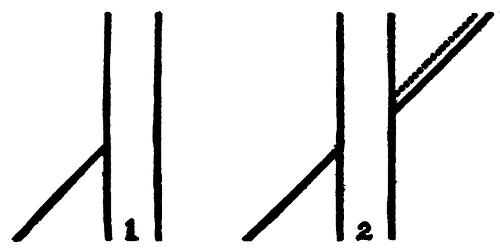
said the Doctor; and taking up a pencil he drew
two perpendicular lines (as represented in Fig.
1). Then he added the oblique line, and pushed
the paper across the table. “Continue that line
across the ditch,” he instructed.
We did so, and the result is indicated by the
dark line in Fig. 2; the real line is the dotted
one. The illusion is corrected by looking down
the oblique line.
Dr. Sike lit an introspective cigarette.
“Suppose that a fairway,” said he. “If a ditch
or road cuts the line of play at that slant, the
player should aim a bit to the left.”
“Unless the ditch runs northeast-southwest.
Then he should hold to the right.”
“Exactly so.”
We poked the ashes in our pipe with a deep
contemplative forefinger, and remarked that the
illusion would not seriously affect the play of the
average golfer, but that it might mean the loss of
a match to an accurate approacher like Mr. Chick
Evans or ourself.
“But hold on,” we second-thoughted. “The
player is not, as in this test, looking down the
ditch, but down the line that crosses it.
Wouldn’t that correct the illusion?”
“A slight illusion would remain, if the player
established his line of play by looking along the
ground, and if the ditch were wide enough to
disclose two lines.”
“Otherwise the Poggendorff person contributed
nothing of permanent value to the psychology
of golf.”
“Exactly so,” said Dr. Sike, and plunged into
a revery. Presently he emerged. “Still,” said
he, “the majority of shots would fly to the right.”
“Because of the cosmic tendency to slice?”
“Exactly so. Will you pass the matches?”
“How is it,” we asked Dr. Sike, as we passed
the matches, “that after one has taken the line of
his putt and transferred his attention to the ball,
he still can view the line with ‘that inward eye
which is the bliss of solitude’?”
“Eye-pull,” said the Doctor, lighting a laconic
cigarette.
“What an alibi!” we whatted. “A gentleman
who blows a five-foot putt has only to remark to
his partner: ‘Sorry. My eye-pull isn’t on
straight to-day.’”
“Exactly so,” said Dr. Sike. “To some persons,
like myself, the line of the putt is clearly
defined, as a darker green in the grass; to others
the line is not present, but these locate the target
just as accurately. All this is quite apart from
the visual imagery referred to in the Wordsworth
poem. The eye——”
What followed was highly technical, and we
regret that our memory failed to imprison the
Doctor’s exact words; but we gathered that the
eye is a mawxstrawnry organ, which can do everything
except talk. The technical explanation
would, of course, be a-b-c to a reader like Max
Behr, who looked in “A Critique of Pure Reason”
for a definition of amateurism, and is now
working on the Hegelian Hypothesis of Professionalism;
but we fear the average reader would
be puzzled by such phrases as “accommodation
pull,” “convergence pull,” and “binocular disparity.”
Therefore, to put it as simply as possible,
we will say that when a man takes the line
of his putt the muscles of his eyes set themselves,
his head and neck muscles co-ordinate, and there
is probably co-ordination in the semi-circular
canals. The eye-pull once established, it remains
after attention is transferred to the ball—how
long we cannot say, but long enough to serve the
purpose of all except those extremely deliberate
persons who fall asleep over their putts. We
should advise, therefore, putting as rapidly as is
consistent with an unhurried stroke.
“Strange to say,” mused Dr. Sike, “although
innumerable experiments in eye-pull have been
made and recorded in laboratories, there has been
no attempt to relate them to golf, which is the
proper study of mankind.”
“But science is coming round,” said we. “The
last two or three years have brought a great deal
of speculation and research.”
“Yes, yes,” yessed the Doctor. “Even the
watchers of the skies are beginning to admit that
Canopus, Aldebaran, and the Pleiad Seven are
only exaggerations of a golf ball, which is the
symbol of the universe.”
“Now, if we imagine amateurism as a great
sea, and in the midst of it a little island....”—Mr.
Behr, at the annual meeting.
Why, then, on a Saturday or Sunday afternoon,
at any country club, we can define an island. An
island is a professional entirely surrounded by
dubs.
“Did you ever take up the game?” we asked
Arthur Whiting, the musician. “I took it up
and put it down,” said he, and mentioned two
shots that were memorable. The first was made
with a driver, the pet club of the lady who was
showing him how to wield it. The head broke
off and wound itself around the lady’s neck.
“And your second shot?” we inquired. “Ah,”
said he, “the second shot—” An interruption at
this point put the game out of his mind. It was
undoubtedly a remarkable second shot.
Sir: One member remarked that his wife had
agreed to play with him in the afternoon if he
would go to church in the morning. I’ve agreed
to play with my wife in the afternoon if she
doesn’t make me go to church in the morning.
Which bargain is best?
J. M. P.
Spring to the golfer is something more than
Spring.
Spring or no spring, we shall open the season
to-day.
The driver, son!
The Compleat Golfer; OR, THE IDLE MAN’S RECREATION. — INTRODUCTORY. — THE FIRST HOLE. — THE SECOND HOLE. — THE THIRD HOLE. — THE FOURTH HOLE. — THE FIFTH HOLE. — THE SIXTH HOLE. — THE SEVENTH HOLE. — THE EIGHTH HOLE. — THE NINTH HOLE.
[A discourse betwixt a Golfer and one that
would have knowledge of the game.]
Golfator. A fine morning, sir, as fresh
as when this world was young. I mark
you have a sack of golfing tools upon your back.
Are you for the links thus early?
Scholar. Ay, sir, for I am resolved to learn
this game, of which you spake so bravely yester-night,
and rose betimes to buy these tools; and I
do entreat you to instruct me in the art of striking
the ball, that I may be well launched upon my
adventure.
Golf. Well, sir, as for that I am at your
pleasure, yet I am loath to launch any man upon
so great a sea of troubles, but would persuade
him rather to forego the hazard.
Schol. Nay, I am not to be persuaded, but
am impatient to be at the business, and to strike
a ball that it may fly to a great distance.
Golf. Marry, sir, consider well, there is yet
time to withdraw. Have you a wife?
Schol. Not I, nor do I contemplate such
folly.
Golf. I am rejoiced, for what is your loss is
some maid’s gain. A woman that has a golfer
for husband might as profitably be wed to a
sailor, or to an adventurer in polar lands.
Haply you have a business that will suffer.
Schol. Not I, again. My worldly goods
are all in stocks and bonds, and I have nought on
my mind of greater import than the learning of
this ingenious game. Let us then to the links,
and be at it.
Golf. In good season, Scholar. I pledge
you I am in no haste to watch your antics, and
since you are but of a middle age there is great
store of time before you. Come, let us sit beneath
this tree, in the branches of which a robin
is chirping, and we will speak further of the adventure
to which you are committed.
First, you are to know that the chief end of
golf, as I view it, is not to strike the ball with
greater skill than your adversary, but to give
strength to your character, and, if it be needed,
to reform it. Patience and a good temper, courtesy
and a pleasant speech, these be marks of the
true golfer, yet are they virtues that one may
put on as a mask, whereas I would have you wear
them honestly.
Schol. Master, I am all ears, like an ass,
and I entreat you to fill them.
Golf. Clap then a hand to one of them, that
my counsel may not escape you. You are to reflect,
Scholar, that in tennis, or in a passage at
foils, or in any other game of great movement,
there is not the space of a moment in which to
desire ill luck to your adversary, but this golf is
a game of so great deliberation, that whilst you
address the ball I may pray fervently that you
top or founder it, or that you miss it entirely,
and this I hold to be no true spirit.
Schol. Would you beseech heaven that your
adversary strike the ball with greater cunning
than yourself?
Golf. Marry, sir, I would hope that he
struck it fairly, and that I struck it fairly in my
turn, and that good fortune might attend us both.
Schol. Sir, I will endeavor to give such current
to my thought. Shall we not seek the links
now? I am impatient to have knowledge of this
great game.
Golf. The which you will presently be as
impatient to be rid of, and seeking to dispose of
this sack of tools for a tenth of their cost.
Marry, sir, when I reflect on the tribulations in
store for you I could weep, as a mother regards
her female babe, and laments the ills that it is
heir to. Here is as fine a morning as ever broke
upon this world, with a sweet wind from the
south, and birds calling from the greening
boughs; yet must you mar your day and mine.
But since there is no help for it, let us to your
undoing.
Schol. Well, Master, here am I upon the
tee. How shall I strike the ball?
Golf. As you will. For this first stroke I
would have you assail the ball in any fashion that
may please you; for it will be a great time hence
when you please yourself again, before which day
you shall be slave to this dogma and that, and a
great grief to your friends.
Schol. Shall I stand in this fashion?
Golf. Nay, bestride not the ball like the
colossus which was at Rhodes, for in such stiff
and ungraceful posture you cannot put hip and
shoulder into the blow. There be many strange
golfers that spread themselves in this fashion,
and play with elbows, to the great detriment of
the landscape, so that when I walk over the links
I could wish for blinders, that horses wear.
Let your feet be more neighborly, so, and have at
it.
Schol. The ball is gone, yet I saw it not.
Golf. Well hit, Scholar; as true a ball as
ever left wood, and as far as the most.
Schol. Why, sir, it was nought. I did but
swing the club, and felt not the blow.
Golf. A brave shot, Scholar, which you shall
have sweet remembrance of these many months
to come. Marry, sir, if you take my advice you
will rest content, and sell these tools of wood and
iron, to your great peace of mind and the continued
esteem of such friends as now you have.
Schol. Sir, I take not your meaning. Let
us to the ball, that I may strike it again, for my
impatience is not to be described.
Golf. Come, then; for compared with the
task of staying you, it were a profitable employ
to discourse to the deaf, or to show pictures to
the blind. A sparrow, new come from the southland,
sings for a mate in yonder maple tree, yet
I warrant you hear him not. There are patches
of springing green in the brown carpet of the
links, yet this pleasing tapestry serves but as
background for your ball. Here it lies, well up.
Take now this other club of wood, the which is
shod with brass, and whilst you fall upon the ball
I do desire to look another way.
Schol. Saw you the ball, Master?
Golf. Nay, I did avert mine eyes the while
you smote it; but this scarred turf will bear witness
to the stroke. You are to observe that the
ball was pulled and foundered, and will be close
at hand, methinks in yonder copse. Let us to it.
Schol. What must I do, now, with the ball?
Golf. Cast it upon the turf and make further
trial. And do you clap an eye on the ball the
while you strike it, or fix your gaze on yonder
flag; either, as it please you, so long as your head
be at rest. Sir, I shall ever marvel why a golfer
must cock his head up at every stroke, like a robin
questing worms, for since the greater number of
players top the ball, or fling it in any direction
save the right one, you would conceive they would
avoid to look up as long as might be, that they
be spared sight of their woeful want of skill.
Marry, sir, if I played as the majority I would
close mine eyes with each stroke, and ask to be
led as a blind man to the ball.
Schol. Sir, I will endeavor to abide by your
counsel, and I pray you attend me. Now, sir!...
Maledictions! Another ill stroke, yet I
looked upon the ball.
Golf. Nay, my good Scholar, your head did
come up with the jerk of the hanged ere the ball
was struck. So little of concentration hath the
average man that he cannot bring his mind to a
focus for a few seconds; wherefore he avoids to
read a serious book, or to attend a serious play,
or to give ear to music which is other than a
tinkle. I shall give you counsel in plenty, and
to some small part of it you will give attention,
and thus you may curtail your apprenticeship a
year; but the larger part of what I shall tell you
will be wasted on these sparrows that flit about
us, and for a great while you will go from bad to
worse, as the saying is, pursuing this notion and
another, and reading many books upon the matter,
the which are writ by players that preach the one
thing and practise the other, until there remain
no fresh folly that you may commit. Truly, I
would not pass through the travail which is before
you for a great sum of money.
Schol. Sir, it is but a dismal prospect that
you offer, yet am I resolved at all pains to learn
this noble game; therefore I beg you to unlock
the storehouse of your knowledge and set me in
the right path.
Golf. That I will do, and gladly. But do
you step aside a moment, for hither come two
golfers that would play this hole.... Good
morning, sirs. A fine, sweet day, is it not?
First Player. Sir, I should have made that
last hole in five, but that a worm-cast marred my
putt.
Golf. A grievous accident, and all too common.
Will you play by us?
First Player. With pleasure, sir. Yesterday
I did make this hole in four, and Saturday
a week I was so fortunate as to get a three.
Golf. Say, rather, so skillful; and, sir, I am
enraptured to learn of your cunning and would
desire a much longer tale of it. Good morning,
gentlemen.... And there, my honest Scholar,
you may perceive yourself in the sorrowful days
that are to come, a burden and a grief to your
friends, to whom you must relate the ill luck that
robbed you of a four at this hole, and the conspiracies
of nature that prevented a five at that;
for it is ever want of luck and not want of skill
that addeth strokes to a score, and many a summer’s
day that promised fair has been marred by
a cuppy lie or ruined utterly by a worm-cast.
Marry, sir, I had as lief listen to a play actor
recounting his greatness as to a man besotted by
this game of golf.
Schol. Shall I make further trial with this
club?
Golf. Nay, sir, you have done enough mischief
with that tool. Put it in the sack and let
us to a putting-green; for whoso would walk
must begin by creeping, and much may be made
of a golfer that is caught young.
Scholar. Well, Good Master, I have belabored
the ball to no purpose and I entreat you,
sir, to counsel me in the way of striking it, else
I shall come to no understanding of the art.
Golfator. You are to know, Scholar, that
concerning the Drive there is nought that is
Rosicrucian, nor is it a thing to be approached
with incantations, though there be many that give
it an air of mystery and make of it a business of
much weight and complication. Nor do we find
among the wiseacres of the game more agreement
than was brought to the building of the great
tower in Babel, as is shown in the vast number of
theories, the one contradicting the others, and
all of them as owlish as you please.
Schol. I am rejoiced, Master, to learn this
thing, for I had esteemed the proper striking of
a ball to be a most difficult art.
Golf. The difficulty resides in yourself, sir,
and not in the mechanics of the stroke, which are
most plain and simple; therefore I have deemed
it wise to prepare you against the thousand follies
that you shall commit, so that when you have
made the round of them you shall not sink into
discouragement, but take up the matter afresh
with a mind purged of vanities and errors.
Schol. But, Master, might not one begin at
this point, without entering upon the follies of
which you speak?
Golf. Yes, if one and twenty had the wisdom
of two score years, but nature hath decreed it
otherwise, and there be many things of great
simplicity that are to be come by only through experience.
Let us take the matter of looking at the
ball. I was reading of late a writing that contained
much sound sense, and it was declared that
this golf is the only game played with a ball in
which the player looks upon the ball instead of
the direction he would have it fly. Now, sir,
this is but half a truth. It is true that the skillful
player sees the ball, as a tennis player sees it,
yet his mind is upon the line of its flight, which
the club’s head must travel; whereas the unskillful
player has his mind upon the ball, which
charms him as a serpent is fabled to charm a bird;
so that to tell a novice to keep his eye upon the
ball is but mischievous counsel, and I pray you
avoid this thing.
Schol. Yet, Master, you did advise me, but
a little time ago, to clap an eye upon it.
Golf. Marry, sir, that was to divert you
from cocking up your head like a little bird, before
ever the ball was struck. Take now your
driver, and we will consider the matter of swinging
it.
Scholar. Well, Master, I have pursued this
ball unto the second green, smiting it some dozen
times, and not once fairly; yet you would have
me believe that it is but a simple matter.
Golfator. Ay, sir, as simple as the boiling
of an egg; yet is there no trick so simple but care
must be brought to the turning of it; and you are
to know that the stroke in golf and the boiling of
an egg are the same in this, that to time it rightly
is nine-tenths of the matter.
Schol. It may be, sir, that I am ill fitted to
this game, and shall never come to skill in it, for
it seemeth of great difficulty, despite your fair
words.
Golf. Well, Scholar, to speak truth, your
antics have been most fantastical, and what skill
you may come to no man can say; therefore if
you are for withdrawing I do again heartily
counsel you so to do, and to give your leisure to
a more profitable employ, as the study of mares’
nests or the collecting of phœnix eggs; but if you
are resolved to have knowledge of this ingenious
game I am still at your service.
Schol. Then, sir, I entreat you to teach me
this stroke, that you say is so simple.
Golf. Why, sir, you have but to do certain
things and to avoid doing certain other things and
the trick is learned. The things you are to do
are to stand easily, neither stiffly nor limply; to
sole the club at a right angle to the line of the
ball’s flight; to take the club back smoothly, seeing
to it that the wrists start the motion and the
arms follow, and that the wrists turn inward
during or at the height of the swing; and to strike
downward with decision, timing the blow to the
thousandth of a second, and letting the arms
draw the body around in a natural fashion. And
the things you are not to do are these: you must
not let the club’s head flop at the height of the
swing, nor stiffen the muscles at any time, nor
move your head, nor heave your shoulders like
a ship in a sea, nor hop upon your left great toe
as a ballet dancer, nor fall upon the ball, nor fall
backward, nor pound the ball as if it were a peg
for a tent, nor cock up your head as a tomtit, nor
fall into other errors of which I shall speak later.
These divers matters kept in mind, the ball will
fly straight, and to a great distance.
Schol. On my word, Master, it were a rare
feat to hold so many things in mind at the one
moment.
Golf. My good Scholar, it is not to be compassed,
yet do we see scores of hapless creatures
endeavoring the impossible; for it is the way of
many teachers of this game to bedevil the novice
with a multitude of instructions, so that the poor
wretch is at his wits’ end. Therefore I commend
to you the learning of one thing before another,
and the thing you are first to come by is a
free wrist; for in tennis, or in handball, or in
bowls, as in this golf, it is a supple wrist that puts
pace on the ball and gives it direction. And you
are to observe this principle again in the fine art
of casting a fly for trouts, and in the play of foils,
so that a man that has reached to three score and
ten, though the vigor of his prime is past, is yet
able to take trouts or to wield a rapier with the
youngest.
Schol. Sir, I am heartened by the thought
that there is a likeness between the casting of a
fly and the swinging of a club, for I have some
skill with the rod.
Golf. Then, Scholar, you must know that the
rod itself does the work, guided by the wrist, so
that a man may throw a fly for hours without
fatigue; therefore you have but to conceive yourself
as casting with the left wrist, and you have
the secret of every stroke in golf; for it is all of
the putt and the beginning of the drive.
Schol. I take your meaning, Master. You
would have me to swing in this fashion.
Golf. Marry, sir, that had been a sorry performance
on a trout river, for you were forward
with your cast before ever your line had straightened
behind you. Whip back your clubhead, as
a brown hackle on a leader, pause until all is
straight behind and free of kinks, then forward
with the wrists, and the arms will follow.
Schol. Sir, your words are as a torch in a
dark night.
Golf. Practice then this back cast diligently,
let the ball fly where it will. And I would I were
at this moment in a little river, knee-deep in sweet
running waters, and casting here and there for
trouts; for that, Scholar, is a game worth two of
this.
Golfator. Come, my good Scholar, let us
tarry a space beneath this maple, that we waste
not the morning utterly, but give ear to the meadowlarks,
and take in the sweet scents which the
sun distilleth from the new leaves and grasses.
And if your mind still be on this golf you may
view, to your profit, the players that pass by us;
for it is as needful to know what to avoid doing
as what to do.
Scholar. Here comes one that has played
these many years, yet methinks he performs but
indifferent well.
Golf. Ay, sir, and should he attain to the
years of Noah he would come to no greater skill.
This is one that, scorning instruction, hath worked
out his own game—a poor thing but his own.
There be many such, and when they play one
against the other, commonly for stakes, ’tis a
great battle of blunders. Mark you that drive!
The green is but an iron shot away, but the ball
has fallen a score of yards on this side.
Schol. Yet he smote it mightily.
Golf. A lusty stroke, that might have served
in the driving of a fence post, but one that is as
ill suited to the propelling of a golf ball as the
stroke of a pile driver, the which it counterfeits.
The marvel is, not that the ball fell short, but
that it flew so far.
Schol. Ay, marry, he swung like a knight of
Camelot upon an adversary’s shield.
Golf. Not so, else there had been room for
praise. Think you the heroes of Camelot buffetted
the enemy so ineptly, fighting their own
selves at the top of the swing, as most golfers
do? Nay, I promise you. Sir Launcelot timed
his mighty blows; nor did he strike stiffly, in a
piece, but drove sharply with his wrists, on which
his sword turned as upon a hinge, his great arms
following, and there was naught to resist his
cleavage. Wherefore the fame of his follow-through
spread through all the land. And this
matter of the follow-through you are now to consider.
Golf. You are to know, my honest Scholar,
that the follow-through, concerning which an infinite
deal of nothing is said and written, is like
to the snark, and he that setteth out to compass
its taking will have his trouble for his pains.
For the follow-through is the result of a proper
stroke, and not the cause of it; it hath not a separate
existence, as a something to be sought after;
therefore I would have you take no thought of it.
Schol. Yet, Master, have I seen players practising
this thing with exceeding industry.
Golf. Marry, sir, Simple Simon was as well
employed. But ’tis the way of man to seek after
the ends and take no thought of the means, and
to look upon success as a something bestowed by
heaven upon one mortal and denied to another.
This is but vanity and vexation of spirit, as
the Preacher saith. My good Scholar, this golf
teacheth a man more things than one, and if you
have any philosophy in you you shall nurture it
and bring it to a full flower; but if you are wanting
in philosophy you shall have as much profit in
the beating of a carpet, for the which a multitude
of golfers are by nature fitted.
Schol. Sir, your words are as apples of gold
in pictures of silver.
Golf. Fairly spoken, Scholar; yet I mark you
are impatient to be forward with your game, such
as it is. Take, then, your iron and I will counsel
you in the using of it.
Schol. I have heard, Master, that ’tis easier
to play with the iron than with a club of wood.
Golf. As to that there be two opinions, as
usual, and you will be wise to follow either, for
I am satisfied that they are of equal value.
Golfator. You are to observe, my honest
Scholar, that although your iron is a shorter tool
than your wooden, you may do quite as much mischief
with it; nay, sir, more, I warrant, for the
head of the club being of metal, you may hack a
ball to pieces with it in a few wild strokes.
Wherefore it is that the experienced golfer plays
his iron shots with less frenzy than he brings to
his drive, striving to hit the ball cleanly and with
exactness.
Scholar. Sir, I shall endeavor the cultivating
of this virtue, in accordance with your wise
counsel.
Golf. You are to observe again, that in the
free stroke of the drive ’tis all one whether the
ball fly ten yards to this side or that of the true
line of its flight, but as you draw near to the flag
this true line becomes a matter of first importance.
Marry, sir, if your desire for knowledge of this
game were deeper than yonder ditch, I would have
you to begin at the edge of the putting green, and
to withdraw by degrees to greater distances, until
you reached a point where the wrists no longer
sufficed to propel the ball, by the which time they
might be trained to some purpose.
Schol. Nay, Master, my desire for knowledge
of this ingenious game is as deep as any
well.
Golf. Then, sir, I have read you wrongly,
for I mark that you clutch your iron with impatience,
and gaze into the distance, and then
upon this ball at your feet, and you do have the
seeming of one that would smite the ball most
lustily. Smite it, then, good Scholar, and have
done with it. Ah! A most marvelous slice!
The ball hath flown far into the wood, as a startled
quail. Come, let us follow it, and though
we find it not we may happen upon matter of more
importance.
Schol. The ball cannot be far in the wood,
Master. I marked it by this dead tree, yet we
find it not.
Golf. ’Tis most cunningly hidden. Do you
sit down, honest Scholar, and rest your eyes, for
much searching for a lost ball doth weary them.
See, here is a brave array of trilliums, nodding
welcome to us, as jocund a company as the poet’s
daffodils. Here, too, is columbine, that begins
to show itself, and Bethlehem’s Star, and many
other wilding flowers.
Schol. Sir, I thought to walk directly to the
ball, since I saw it drop among these trees.
Golf. Marry, sir, believe your ears sooner
than your eyes, and your nose before either; but
not one of the senses is to be trusted. Yet if
mine eyes serve me now, here is yellow lady’s-slipper,
that I have not seen before in this countryside,
and it were well worth losing a ball to
come upon this solitary plant, for I see no others
of the family. I have found them in great number
farther north, where, too, I chanced one
rememberable day on the orchid Arethusa, that
grows in bogs, and is the loveliest of plants.
Mark you the gold in the sunlight, shewing that
the summer draws on; and hearken to that
thrasher overhead, who would have you to believe
that singing is the chief business of life.
Schol. Think you that the ball struck upon
a tree and was flung deeper into the wood?
Golf. ’Tis conceivable, for I never saw ball
that had less notion of whither it was flying.
Let us press farther into the thicket, for ’tis a
rare place to loiter in. This, you are to observe,
is the compensation for a foolish stroke at golf,
for he that plays straight before him sees nought
but a strip of turf, and ever his thought is of his
next stroke, whether he shall take wood or iron
to it.
Schol. Good fortune, Master! Here is the
ball, among these trilliums, the which it is very
like in color.
Golf. And fairer to your eye than any
flower. I observe, sir, that you have the makings
of a golfer, and are not to be diverted by
the babbling of brookwater, and the twittering
of birds, and other natural distractions. Let us
return, then, to the fairgreen, where you may
make further trial of your iron.
Scholar. Sir, hither comes a pair of golfers
that would play this hole. Shall we stand aside
until they pass?
Golfer. Aye, sir, and I particularly charge
you to remain stock still the while, and to breathe
as lightly as a summer night; for one of these
golfers, he that strutteth before the other, would
have Nature to make a pause whilst he swing his
club, and is fretful as a porcupine if a caddy do
but shift an arm or leg, or a sparrow twitter in a
nearby tree.
Schol. Sir, I shall take the pattern of the
rabbit, that freezeth, as the saying is, when the
predacious owl booms through the darkened
wood.
[The players approach.]
Golf. Good morrow, gentlemen. How
fares the match?
First Player. Indifferent well, sir; for what
with the gabbling of these caddies and their clicking
of clubs together, and the great number of
noises round about, one might suppose himself
to be on the links of Bedlam.
[The players drive and pass on.]
Golf. There goeth one that is a great affliction
to his fellows, and is to be found this world
over. Now, ’tis but common courtesy to refrain
from talking whilst a player drives his ball, but
he that is disturbed by such a trifle lacketh control
of his mind, and were he a surgeon I should
not summon him to so small an operation as the
lancing of a boil. Why, sir, if there be any virtue
in this game it is that it teacheth one control, and
he that cannot dispatch a ball save in a church-yard
hush hath somewhat the matter with his
wits, or hath no salt of humor in him. To play
a round with such a golfer is a great waste of
time, save it be done in the way of penance, for
which purpose a hair shirt were not more serviceable.
Schol. Will you counsel me, Master, in the
use of this iron?
Golf. Willingly, honest Scholar, and for beginning
do not hold the club loosely in the palms
of your hands, but grip it firmly with your ten
fingers. This is the first principle of iron play.
Golfator. Well met, honest Scholar. The
birds have mated and reared their young since
last I saw you, and the summer is over and gone.
How fares it with you? Indifferent well, methinks,
for I observed you to strike a ball a few
minutes since.
Scholar. Truly, Master, this golf is a thing
that is not come by quickly, and I well nigh despair
of mastering it.
Golf. Then let me advise you to abandon it
in season, that you may be spared much vexation,
and your friends many afflicting tales.
Schol. Nay, sir, I am resolved at any cost
to lay hold of the secret, to which end I have
vowed the rest of my days.
Golf. Truly, a worthy ambition. Now there
be men that have vowed their days to so futile a
thing as the mapping of the farthest stars, which
is of small purpose compared with the mastering
of this incomparable game. Good luck to you
then, honest Scholar.
Schol. Sir, what luck I have now and again
is the fruit of such counsel as you have given me,
and I entreat you further to instruct me in the
art of striking the ball, that it may fly straight,
and not match the crescent of the young moon.
Golf. Marry, sir, you will never bring off a
skillful shot, save by accident, until you put
rhythm into your stroke; nor is aught else of
value achieved in this life save by rhythm. A
sage once said that if he but had his way he would
write the word “Whim” above every man’s door-way.
Now, sir, in the place of this “Whim” I
would write the word “Rhythm.”
Schol. I take not your meaning, Master.
What, in so many words, is this priceless Rhythm?
Golf. Marry, sir, he that could answer you
in so many words would have the tongue of all
philosophy.
Golfator. Well met, Scholar. Much water
has passed the miller’s wheel since last we were
in company; and, marry, much has fallen on these
fair acres, which too oft at this season are sere
and brown; and thus we have compensation for
the cool winds and drenching rains of this so
backward summer. Saw you ever so green a
sward, and grasses so void of dust? Yet mark
you the chatter of yon robin, that never gets his
fill of rain, so that methinks some far ancestor of
his was a water fowl, or perchance a flower that
grew in water, since to my fancy birds are but
flowers that have taken wings. But peradventure
you had rather I question you concerning your
towardness in the game of golf, as I mark you
have your tools by you, and I may hazard that
you have prospered exceedingly.
Scholar. Why, good Master, to speak truth,
this ingenious game has so bedeviled me that I
mark not if the grass be brown or green, or if
robin or blackbird chatter by my path. As for
my towardness, I have practised with great diligence,
and have been directed by this teacher and
that, and all excellently well, yet do I find myself
at a stand, and unable to advance beyond a moderate
skill.
Golf. I pray you, Scholar, make trial with
your club of wood, that I may observe in what
fashion you handle it.
Schol. There, Master! Is that not well
swung? And that? And that?
Golf. Marry, an excellent swing, save that it
lacks freedom and rhythm, and has no power in
it, otherwise a most worthy swing, that might be
of great service in knocking apples from a tree.
One may observe with half an eye, Scholar, that
you have been well instructed in every detail save
one, the which concerns the striking of the ball.
Golfator. You are now to know, worthy
Scholar, that whatsoever skill you may come to
in the wielding of your tools, naught of great
consequence is to be achieved at this ingenious
game save by the cultivating of the highest
powers of concentration, as has well been said by
Mr. Travers, and other notable performers; and
to the acquiring of this faculty you are to sacrifice
all else in life; for what is of greater moment in
this world than the proper striking of a ball?
Scholar. Alas, good Master, it is this great
faculty that I so sadly lack; for from the moment
that I raise my wood or iron until I bring it back,
my mind is, as you might observe, a blank.
Golf. A perfect blank, truly; ’tis as if no
mind existed. But thus it is with the majority,
therefore be not cast down.
Schol. This concentration, sir, is it aught
save the fixing of the eye upon the ball?
Golf. Ay, marry, much more. There is an
attention of the eye, and an attention of the mind,
and there is also an attention of the soul, and all
three of these you shall require. There are
lower forms of concentration, and much has been
achieved through them. Thus one man sets his
mind to the building of a system of philosophy;
another man puts himself to the discovering of a
satellite of our sun beyond the farthest that is
known, or to the devising of an hypothesis that
may explain the beginnings of matter, and the
movements of the stars; a third man gives his
life to the writing of plays, as Shakespeare or
Euripides. All these are excellent pastimes, that
require concentration; but they are of little import
compared with the striking of a ball so it
fly straight and to a great distance.
Schol. And how, Master, may this concentration
be found?
Golf. Marry, sir, by the endless iteration of
the magical words, Keep the eye upon the ball!
Give your days to this, good Scholar. ’Tis not
necessary to say the words loudly, but so much
power is there in the spoken word that one must
do more than think the conjuration; a low murmur,
or a mumble, will serve. There be those
that, observing a man going about muttering to
himself, will be moved to scoff, but these, being
ignorant of the great matter going forward, need
not be considered. Persist, worthy Scholar, and
ere the snow lies in winrows on these links, your
heart’s desire will be well toward fulfilment.
A LINE-O’-GOWF OR TWO — ALICE IN BUNKERLAND. — ANOTHER NOTED MEMBER OF THE FAMILY WAS A COLONEL. — SHAKESPEARE ON THE AMATEUR QUESTION. — THE TURF-TEARERS. — HELPFUL HINT NO. 640. — DEGENERATE DAYS. — WONDER WHAT THIS OISEAU DID? — ON THE OTHER HAND— — THE DUB. — WE’VE TRIED IT ON A GOLF BALL, BUT IT DOESN’T WORK. — HAVING THEIR SLICE OUT, MEBBE. — FRENZIED JOHN. — STYMIED. — OVERHEARD AT A SMALL-TOWN BALL GAME. — THE GOLFER. — DOES TOBACCO AFFECT YOUR GAME? — AN EXTREMELY INTELLIGENT DOG. — PROBLEM OF CONDUCT. — WHY GOLF DIVOTEES GO INSANE. — DO YOU KNOW THIS ONE? — WHY GOLF DIVOTEES GO INSANE. — GUFFLE FOR GOLFERS — FAMOUS LAST LINES.
Hew to the Line, let the
divots fall where they may.
“If forty pro’s wrote forty books,
Besides what books there are,
Do you suppose,” the Walrus said,
“I’d play this course in par?”
“I doubt it,” said the Carpenter,
And lit a fresh seegar.
“The golfer is about the only mortal proud of
being in a hole.”—Philadelphia Ledger.
Zazzo? A cribbage player holes out as gleefully
as a golfer.
No department of the game discloses more
variation than iron work. For example, some
players take turf; others take to the woods.
“The really interesting question is, why will
not men listen to women?” says Alice Duer
Miller. It’s this way, lady. After a hard day
on the golf links a man gives reluctant ear to discussions
of the music of Ravel and DeBussy, the
Epicureanism of Marius, the influence of democracy
on Greek culture, and other subjects which
the ladies persist in introducing. Collectively,
women are rather strenuous. Individually they
are easy to listen to, especially if they are easy to
look at. And if they punctuate their discourse
with taps of a fan and what are known as speaking
glances, they may disquisish on any topic,
from figs to futurism.
The farmers around Brook, Ind., have voted
to keep their clocks at the old time. Comrade
Ade will likely use both times—the old for his
farm, and the new for his golf course.
[Ad in an Ohio paper.]
For Sale—Bookcase and doctor’s library, including
skull of Lucretia Bogie, a noted murderess.
W. H. Garnette, East Monroe, O.
“Golf,” again we read, “is a game that demands
courtesy and politeness.” Makes us think
of coal at the present writing. The demand exceeds
the supply.
“Golf Playing Is Newest Cure for the Insane.”—Newspaper
Headline.
As the Latins used to say, Similia similibus
curantur.
Our golfing ambition may be stated in three
words: Length without strength.
Horatio—Is it a custom?
Hamlet—Ay, marry, is’t;
But to my mind, though I am native here
And to the manner born, it is a custom
More honour’d in the breach than the observance.
There are two theories to explain the steadiness
of champions in gruelling (to coin a word)
tournament play. One is “heart of oak,” and
the other is head of the same material.
Demos has taken to golf in America. In Lincoln
Park, Chicago, Demos wears suspenders and
a derby, and Mrs. Demos has been seen pushing
a perambulator from hole to hole. For the delectation
of Demos, golf links and books are
multiplying, and eventually every town will have
at least two libraries—the Carnegie and the Golf.
When in doubt pronate the forearm.
To Inquiring Golfer: Qualifications for membership
in the Lincoln Park Golf Club are a derby
hat and a coupla clubs. No one is allowed to
tee off unless he is thus equipped.
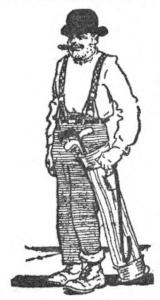
Golf magazines are showing
spring fashions for players;
effete east stuff, chiefly.
A natty make-up which will be
seen at the Lincoln Park
Country Club is exhibited in
the accompanying illustration.
We were sitting on the
porch of the clubhouse at
Brae Burn, listening to a discussion
of the prohibition of
Sunday golf at other courses.
A gentleman who looked like
a substantial pillar of the church offered his
views. “Cut all your church subscriptions,” said
he. “That will put a stop to this nonsense.”
Mr. Ouimet qualified with a score of 79 and a
temperature of 103. That established the temperature
record for the course, which is uncommonly
difficult.
When, one day, we engaged a caddy to walk
around with us, although we carried only a midiron,
we fancied we had reached the Height of
Affluence; but we know a man who drives a Ford
and carries a chauffeur on the rear seat.
For years our hard-boiled foursome
Came to the eighteenth hole;
And then the struggle for a par,
To save a payment at the bar.
The café beckoned from afar
To every thirsty soul.
When now on Sunday morning
Fred steps upon the tee,
With dull despair his brow is wet;
We do not care what score we get—
For ice cream sodas are the bet,
The price of victory.
“The time has come,” I heard Fred mutter,
“For me to fall upon my putter.”
Double Barrel.
Golfers, the days are growing shorter. Get
out after dinner and save some daylight for the
farmers.
“Golf has its jokes, undoubtedly,” says Dr.
Francis Hackett, “but it has no joke such a joke
as golf itself.” If Francis were thirty or forty
years younger he would yell “Fore!” whenever
he saw a man going along with a bag of clubs.
We have frequently wondered why we play
such a messy game on a golf course new to us.
Mr. Vardon explains. “The perspective of the
course” at Inverness bothered him.
When Harry Vardon relates that he putted
from the edge of the green, and “thanks to the
fates of golf” the ball fell into the cup, he means
that he made a damned good putt and is wholly
aware of the fact.
Mr. Harding, we read, shoots Chevy Chase
in 95, “but is known to be ambitious to reach par,”
which is 71. Any golfer should be able to get a
laugh out of that.
From the Morris, Man., Herald.
To the Editor: Kindly allow me to make a
public apology in your paper concerning my conduct
in a game of ball between Emerson and
Morris. I feel very sorry and ashamed of myself
for losing my hasty temper. I could not
have been in my right mind to do just as I did,
to allow such a provocation to make me do as I
did. It seems like a bad dream to me and never
will forget it. In my 24 years of playing I never
lost control of myself before. I forgive the
player who was the cause of my weakness, and
hold no ill-will to any one. It will be better for
me to say no more.
Jim D. McLean.
The gentleman could not be more regretful if
he had tanked up and punched somebody at the
Lambs’ Club.
From the Kansas City Star.
It is a tribute both to the game of golf and to
those who play—the fact that you never read of
two players getting into a brawl over the golf
table and hitting each other on the head with a
golf cue.
Those persons who feel sorry for Chick Evans
because he can’t putt may like to know that Vardon
and Ray, interviewed when they returned to England,
agreed that “Evans with his new club is the
best putter in the United States.”
Paying club dues for the three months beginning
January first used to be our notion of zero
in entertainment. We are obliged to lower the
temperature twenty degrees since the war tax was
added to the dues.
One of the things in golf most difficult to explain
is “the feel of the clubhead.” We have
tried to convey an idea of the sensation to persons
who have solicited an opinion, but without
success. Perhaps this will explain it: Take a
full swing with the mashie for a chip shot of
ten or twenty yards. Practise that for a while,
and you will begin to discover that there is something
at the end of the shaft.
The young woman with the golf club who appears
on magazine covers or in railway folders
is shown, as often as not, holding the implement
in an exceedingly awkward manner. Artists of
yesteryear were better observers. A reproduction
of a painting, “The Golf Players,” by Pieter
de Hooch (1630-1677), represents, for one item,
a child holding a club as a Vardon of that period
might have grasped it.
Mr. Topping is a well known American golfer,
and the mention of his name has evoked many
smiles and decrepit jests. It is not generally
known, however, that he is related on the paternal
side to the Hookers and on the other wing to the
Slicers, two other celebrated clans whose lineage
details occupy many pages in the Almanac de
Golfa.
After prayerful consideration the Western
Golf Association has ruled that as long as a
golfer depends on the literary merits of his articles
to sell them, he will retain his amateur standing.
One could almost whittle a wheeze out of
that.
When Frederick was a little lad
He practised the pianner,
And practised it, we need not add,
In ladhood’s usual manner.
His progress was more slow than snail’s,
Of skill came no increase;
But Frederick would not practise scales—
He wished to “play a piece.”
At golf Fred cannot use his hands,
He has no sense of rhythm;
And yet he thinks he understands—
You cannot argue with’m.
Dub will remain his middle name
Till death shall him release.
He doesn’t care to learn the game—
He wants to “play a piece.”
When the Preacher observed that there was no
new thing under the sun, he articulated a mouthful,
as a contemporary slangily remarked of Demosthenes.
A Denver man relates in the Golfer’s
Magazine that he keeps his eye off the ball, instead
of on it, from the drive to the putt. Unlike
the feat which we recently noticed on an oratorio
programme, “Rest in the Ford,” this can
be done. Several years ago we demonstrated to
our own content that it was possible to use a
mashie accurately while scrutinizing the flag, and
during one season we putted while glaring at the
hole; but in the longer shots we preferred more
freedom of the neck—ours not being of the
giraffe type—and so maintained an “eyes front”
attitude. About that time Mr. Charles Clarke,
professional to the Rothersham Club at York,
published his “Common Sense Golf,” which contained
this admonition:
“And most important of all, for putts of six
feet and under, look at the hole and not at the
ball. I know it is a very unorthodox thing to say,
and it will require no little courage at first to get
used to the method. But the difficulty exists only
in the imagination; the lie of your ball is as nearly
as possible perfect, and all the preliminary adjustments
have been made. A back-swing of a few
inches, and a short, firm tap is all that is required.
Personally I have improved my holing out enormously
since adopting this method, and there are
days when I can scarcely miss a two-yard putt.”
Our hypothesis, which we arrived at independently
of the Rothersham pro (as Adams located
the planet Neptune “unbeknownst” to Leverrier)
was challenged by Grantland Rice and Jerome
Travers; and so we arranged a test with Mr.
Rice. But a heavy shower interposed, and we
agreed to try the thing on a new dog—Mr. Ring
Lardner, who up to that time had not trifled with
a golfing implement. He was required to putt
eighteen holes while looking at the hole, and to
repeat while looking at the ball. The result was
slightly in favor of the latter method, but this
was fairly attributable to increased familiarity
with the putter. Personally (sic), we can putt
as well one way as the other, and all that we ever
maintained for the eye-on-hole style was that it
would improve the work of one who putted badly.
If a man putts well by any method, let him keep
the even tenor of his way, nor heed the rumble of
a distant drum.
Golf is advised for training camps by the War
department, to counteract the tension of intensive
training. The beneficial effect lies in the mental
rest during the swing; from the moment the ball
is addressed until it is struck the mind is an absolute
blank. The poorer the player, the more
strokes he takes, and the greater the mental
rest.
Sir: In the Rotarian for this month: “Like
a rubber ball, the Spirit of Rotary will not be
cowed by any one.” Did you ever try to cow a
rubber ball?
R. C. S.
The Empory Gazette admits that something
is to be said for golf; that “a man can play the
game without being hooted and abused as though
he was a wife beater.” But the same can be said
for every other game except baseball.
Isn’t the weather provokingly delightful?
Here we have a compilation of verse, a novel,
and a few smaller matters planned out, and the
golfing weather persists out of reason.
[From a Rockford contemp.]
GOLF SEASON CLOSES.
H. S. Wortham underwent a minor operation
at Rockford hospital yesterday morning.
L. D. Ray underwent a minor operation at
Rockford hospital Sunday.
Time to put away your golf tools. Navigation
on the Yukon river has closed.
Economically war is much more wasteful
than golf. In war a waster bullet is a total loss,
but when you lose a golf ball somebody else finds
it, and eventually your initials are worn off it.
By the way, has the question been discussed, and
settled, whether it is good sportsmanship to stamp
your initials on a ball? We never stamped more
than a dozen, and none of these, when lost, was
ever returned to the shop.
He worked as hard at golf
As any man alive;
For nothing went the time he spent—
He always sliced his drive.
He held himself like this,
He held himself like that;
By hook and crook he tried to look
And see where he was at.
He changed his stance and grip—
It mattered not at all;
The same old thing with every swing,
He sliced the bally ball.
He put his right foot forward,
He put his right foot back;
But still his game remained the same—
He sliced at every crack.
He told it to the lockers,
He told it in the hall,
Till more and more it grew a bore
To hear he sliced the ball.
He read the books of Vardon,
Of Taylor, Braid, and all;
But every shot went straight to pot—
He sliced the cursed ball.
He went to Doctor Vardon,
And got the best advice;
He whaled the pill till he was ill,
Nor ever lost his slice.
Doc took him out to pasture,
And showed him what to do,
And while the Doc was there to knock
He hit them fairly true.
But after Doc departed
The stuff was off again:
He shot it on to Helngon,
And nearly went insane.
He tried to hit it easy,
But still his trouble grew;
He tried, like Jesse Guilford,
To split the ball in two.
No matter how he whacked it,
He sliced into the tall.
“O Lord, how long!” his frenzied song;
“How must I hit the ball?”
Again to Old Doc Vardon
He tottered for advice.
Said Doc: “We’ll have to operate,
And cut away that slice.”
He overlapped with Vardon,
He underlapped with Vaile—
And sliced into the garden
Of Mr. Ezra Hale.
He trained with Doctor Hammond—
“The Essence of the Matter”—
Old Simpson, Bart., he knew by heart,
And yet his score grew fatter.
He put his right hand under,
He put his right hand up,
But still the ball would hunt the tall,
Nor ever reach the cup.
He put his heels together,
He put his heels apart.
With anguished brow he wondered how
He’d ever learn the art.
He laid the club-face forward,
He laid the club-face back.
His face grew thin, his chest fell in,
His mind began to crack.
(Note: This poem was never finished by Mr. Taylor. Ed.)
Mr. Pradt of Wausau, Wis., writes to us:
“One day last summer I found my ball, after a
fine approach, lying in a hole on the back of a
toad. Would you hold that the ball was teed
up?” We should hold, off hand, that it was toad
up.
Sir: This is the situation at a summer resort
course in Wisconsin:
Chorus of Young Ladies: “Oh, is that the
professional?”
Caddie: “Yes, but he’s married.”
J. G. L.
Did you happen to see this wheeze in a recent
issue of London Punch:
“In New York a club has been started exclusively
for golfers. The others insisted on it.”
The headline, “Finds a Husband on Golf
Links,” reminds us of the lady who observed
sagely: “There is one good thing about golf.
You always know where your husband is.”
Young Mr. Ouimet’s feat of holing out in one
iron shot contains a helpful hint for the novice.
When the hole is only 243 yards away take a
midiron. A driver might put you over the green.
Umpire: “Boy, that’s certainly some tear you
gave your pants when you slid.”
Casey (colored): “Shuah is. Mighty near
havin’ to call this game off on ’counta darkness.”
Whit.
“The only man who can play a good game of golf is he
who has no brains.”—Andrew Lang.
Like Man With Hoe he leans upon his club,
And gazes groundward with a vacant air;
A wretched, brainless, golf-besotted dub—
A brother to the Hatter and the Hare.
Ah, what to him the “swing of Pleiades”
Whose mind is fixed on swinging on the pill,
Whose only mental processes are these:
“I must grip tight, and keep my head quite still.”
Ah, what to him the pull of Jupiter—
This muddy-headed clod, this witless wight—
Who fears that he may “pull,” or, commoner,
Slice off into the bushes on the right.
For aught he knows whom golf hath so besot,
The sky has fall’n, or is about to fall;
For heaven and earth, and time and space are not
To him whose gaze is glued upon the ball.
“The boast of heraldry, the pomp of power,
And all that beauty, all that wealth e’er gave,”
May all have bumped th’ inevitable hour,
For aught he knows, infatuated slave!
So come away and leave him to his club,
His rubber pill, his fixed and vacant stare.
’Tis but a brainless, golf-besotted dub,
A brother to the Hatter and the Hare.
According to Mr. Jim Barnes, whose new and
really valuable book of golf-swing photographs
has just left the press, one can get more fun out
of golf by knowing what he is about when wielding
the various clubs. But according to Capper
& Capper, “How to Get More Fun Out of Golf”
depends on wearing athletic union suits with
swiss-ribbed bottoms.
Observe how easily the Western Golf Association,
confronted, like the peace conference, with
the problem of the stymie, reverses its perplexity!
The player of the ball nearer the hole may play
it or lift it, at his option.
We are not sure whether smoking has an adverse
influence on our game, such as it is; but we
felt a bit concerned the other day when we missed
a thirty-foot putt. For—
Tidal fury surges o’er us,
And we breathe a savage “Tut!”
When, with all the green before us,
We don’t hole a ten-yard putt.
Sir: I have a remarkable dog, a Scotch terrier,
bought of a caddy at St. Andrews. This
dog has seen some pretty good golf, and is a bit
of a critic. I took him to the links to watch my
game. My approach to the second flag was
within five yards, and the dog disconcerted me
by sitting by the hole and alternately watching
it and me. My putt went wide and seven or eight
feet past. The dog arose and began digging
frantically at the hole to make it larger. Intelligent?
Brassie Cleek.
A drives. Before A reaches his ball B drives,
and his ball strikes A in the back. A waits for
an apology. B comes up and says: “Why didn’t
you duck, you rummy? That’d been a peach of
a drive.”
What should A do?
“Putting is extremely simple and easy to
learn.”—P. A. Vaile.
“Of all the golfing arts putting is the most
unteachable.”—Bernard Darwin.
“Although putting appears to be the simplest thing
in golf to the beginner, after a little experience he
will find out that it is the most difficult part of the
game.”—Jerome Travers.
“The putt is without doubt the easiest stroke to
learn.”—P. A. Vaile.
“It is impossible to assert with too passionate
an emphasis that the player must not try to assist
the club on its path by sympathetically moving his
body forward in unison with it.”—Bernard Darwin.
“The best way is to let the body go slightly
forward with the club as the ball is struck.”—Tom
Ball.
“The plan of playing for the back of the hole is
all right in certain shots.”—J. L. Low.
“Always go for the back of the
hole.”—Innumerable Authorities.
[From Tom Daly’s department in the Philadelphia Ledger.]
Somebody, probably our favorite story-teller
among golfers, narrated to us the tale of a man
whom the same John D. invited to play on the
Rockefeller private course at Cleveland. The
guest had neglected to provide himself with balls.
“Lend Mr. Blank a couple of old balls, George,”
said the host to his caddie. “There’s no old balls
in the bag, Mr. Rockefeller,” replied the caddie.
“No?” exclaimed the host, and after a pause,
“well, I guess you’ll have to lend him a new one,
then.”
We have wondered ever and anon—and sometimes
as frequently as now and then—where the
illustrators get their golf models for the decorating
of magazine covers. Perhaps on public links,
where there is no grip or stance so absurd that it
may not be observed.
(Concerning the use of the mashie)
“The blade is better for being deep.”—Mr.
Travis.
“Better results can be obtained by using a
mashie with a narrow face.”—Mr. Travers.
“The ball has to be picked up rather
abruptly.”—Bernard Darwin.
“Follow through as in the drive.”—Mr.
Travis.
“Draw in the arms a trifle immediately after
the ball is struck.”—Mr. Travis.
“There is no drawing in at the moment of
crossing to produce the cut.”—P. A. Vaile.
“The player must take turf after hitting the
ball.”—Mr. Travers.
“It matters very little whether the player
takes ground with him or not.”—Simpson, Bart.
“The back-swing is long or short, according
to the distance from the green.”—A multitude
of authorities.
“Many will remember the wonderful accuracy
Jamie Anderson acquired, hitting a full blow at
all distances, and regulating the length of his
loft by the inches of turf he took behind the
ball.”—Simpson, Bart.
“Keep your eye on the ball.”—Chorus of
pundits.
“Keeping the eye on the ball is not of
first importance.”—George O’Neil.
For the benefit of golfers who depend on this
department exclusively for their tips on the game,
we have engaged Mr. Donald MacBawbee, the
famous professional at Prairie Dog, as first aid
to the helpless, and we feel safe in promising that
he will add delightfully to the complications of
the sport.
Mr. MacBawbee is 5 feet 11⅜, and carries the
conventional clubs, with the addition of two implements
which he calls a soakum and a pushum.
The first is a bludgeon of wood, and is employed
for dispatching the ball from the tee; the second
is an iron for push shots. The grip of this iron
is tapered to a point at the end, so that when the
hands are pushed forward, which Mr. MacBawbee
claims is the proper way to make the shot, the
chance of the hands slipping is reduced to an irreducible
minimum.
The Prairie Dog pro is committed to heavy
clubs, and consequently he prefers lignum vitae to
the conventional hickory. Concerning the length
of the implements he has very decided opinions.
No golfer, he says, should attempt to wield a
club taller than himself or shorter than his golf
bag. A happy medium, he suggests, will prove
most satisfactory.
Mr. MacBawbee lays much emphasis on the
matter of stance. Two ways of confronting the
ball, he says, are the ramrod stance and the
cab-horse stance. The first is to be avoided,
as several cases are recorded of players who have
broken a leg in swinging. The cab-horse stance
is easy, graceful, and relaxing. As an arch is
stronger than a straight line, the firmest of all
stances, says Mr. MacBawbee, is the hoop stance,
but this is possible only for very bowlegged golfers.
For this stance he advises that the feet be
placed rather near each other.
Says Mr. Jock Hutchinson, who is illuminating
the arcanum of golf for the benefit of the Dub
Family Robinson, “I am 5 feet 10¼ inches in
height, weigh 137 pounds, and carry twelve clubs.”
That bag would bar him from the Lincoln Park
Country Club.
Hon. Jock’s arsenal of irons includes one which
he calls a “stopum.” Percy Hammond’s bag includes
a peculiar instrument which might be called
a “topum.”
Besides a “stopum” every bag of golf clubs
should contain a startum, a topum, a sliceum, a
hookum, a sclaffum, a killum, and, for general
utility, a dubum.
Doc Hammond’s golf bag has two new clubs
in it besides his topum—a lose-um and a wet-um.
Home-bound from the links, we were thinking,
for the somethingth time, that golf was a great
waste of time and money, when we observed a
citizen starting out to break a few hundred clay
pigeons. Everything is relative, as Box remarked
to Cox.
“The shower bath is the best part of the
game.”
THE LINKS OF ANCIENT ROME. — I—AUGUSTUS FIT CUPIDUS SCIENDI (C II K) — II—AUGUSTUS UTITUR LINGUA VULGARI SED LUDUM DISCIT.
Fragments from the Diary of Maecenas.
Latin Verses by P. Sebleius Ferus
(Payson S. Wild).
Maecenas vult ut Princeps faciat quod intemperanter promiserit.
“Nuper, Octavi, dixisti iturum
Te mecum olim et campos visurum
Ubi libentes iam ludimus illa
Altivolante, durissima pila.
Die mihi, vetule, saltem spectare
Nonne nunc vis, si nondum tentare?”
Octavius respondet breviter “Minime pol in tuo daguerreotypo.”
Frustra cum Imperatore locutus,
Impedimenta ac fustes indutus,
Abii atque quaesivi amicos
Qui iam profecti ad agros apricos.
Sed vix discesseram fessus orando,
Cum Caesar, fessus et ipse negando,
Talia reddit adstantibus fando:
Princeps affirmat hunc ludum sibi nihil in lusibus esse.
“Bella, Rapinae, Incendia, Caedes,
Carmina, Litterae, Templa et Aedes,
Quae sunt res publicae, graves et durae,
Illis furentibus nihil sunt curae;
Immo pol vinum, mulieres, cantum,
Non tantum diligunt, antea quantum!
Namque novicius lusus damnabilis
Nescio quis, et, ut dicunt, mirabilis
Fascinavisse videtur sodales
Quondam carissimos contubernales.
Eam rem omnem non facio flocci;
Sum studiosior comici socci,
Amo picturas moventes vel pontem,
Cupidus nunquam per vallem aut montem
Pilulam albam sequendi in fontem!
Sed putat illum sibi investigandum saltem.
“At cantilenam eandem cur cano;
Num decet ipsi mentiri tyranno?
Huc automovens vehiculum ferte!
Quid-inel agant comperiam certe.”
Maecenas pilam expellit dum Princeps adridet.
Pilam expuleram aggere primo,
Cum Imperator iam illitus limo,
Clamans “Quid! Istoc est totum?” apparet,
Atque observat dum pila volaret
Pedes per caelum ad terram sescentos.
“En,” inquit, “sane homunculos lentos,
Qui quot diebus exercent iam dudum
Effeminatum eiusmodi ludum!
Hic Maecenatem exululat (ut ita dicamus).
“Quam putris ictus hic proximus erat!
Talis ut aegre peritus pol ferat;
Tu imbecillus es, hercle, Maecenas;
Quid fluit tibimet, quaeso, per venas?
‘Atavis edite regibus’—quippe;
Hoc enim luderet ludo Xantippe!
Si non potuero longius sphaeram
Quam tu impellere, causam tum quaeram.
Clavam da mihi; ostendam, sceleste,
Ego tu faciam. Omnes adeste!”
Augustus “fusillum exspirat.”
Ita locutus, tenaciter prendit
Clavam et statim ad aggerem tendit.
Spuens confestim in mediam manum,
Pectore scelus anhelans profanum,
Agitat baculum sat negligenter;
S-s-s-t! ferit sphaeram (ut putat) valenter.
At tamen haece immobilis iacet,
Atque Augustus attonitus tacet.
Puer cachinnat, qui saccum ferebat,
Temporis tamen momento silebat,
Nam ululatum iam Princeps tollebat:
“Stulte damnate, ad usque avernam
Volo tu eas Gehennam infernam!”
Maecenas leniter loquitur.
Tum ridens “Oculos,” inquam, “attollis;
Pilula illa est, minime follis.”
“Istud pro di immortales excide!
Si placet, eris dum mortuus, ride!
Princeps lepidopteron acquirit.
Heus, vespertilio, caece, ausculta:
Quae tibi faciam ea sunt multa.
Ego et tu excercebimus soli—
Pilam amittere edepol noli!”
Maecenas amicique ludunt pocillum undevicensimum.
Nos modo caudas gallorum martini,
Modo lagenas arcessimus, vini.
THE LINKS OF ANCIENT ROME. — I—AUGUSTUS BECOMES C2K. — II—AUGUSTUS INDULGES IN STRONG LANGUAGE, BUT DECIDES TO LEARN THE GAME.
English version by B. L. T.
Maecenas reminds the Emperor of a rash promise.
“Octavius, I’ve often heard you say
That you’d cut out the work some sunny day,
And have a look at our new country club.
Why not this aft, old top? Put on a sub;
Come down and watch us shoot a round of golf,
Whether you stay to play or stay to scoff.”
Augustus returns a laconic “Nix.”
“Nix on that golf stuff,” said the Emperor,
And so to prod him further I forbore.
Grabbing my clubs I chucked them in my car,
And made the two miles to the links in par;
While Caesar, peeved at having stood me off,
Let go the following remarks on golf:
Augustus defines golf as his notion of zero in recreations.
“War, glory, statecraft, and the Muses Nine
No longer charm these golf-mad friends of mine;
Wine, skirts, and song have also lost their hold
Beside this strange new game that, I am told,
By old and young and wise and foolish played is—
For which I would not give a hoot in Hades.
Me for the play or moving picture show,
A hand at bridge, or any game with go;
But chasing white pills round a vacant lot
Is my idea of entertainment, not.
But he decides to look it over.
“But here I am, singing the same old tune.
I’ve really not much on this afternoon,
And can, as old Maecenas said, knock off
And watch him shoot a hole or two at golf.
My motorcycle, boy! I’d like to see
Just wotinel this d. f. game may be.”
Maecenas drives, and the Emperor sniffs.
I whaled the ball two hundred yards or more—
A screamer—when up wheeled the Emperor,
Exclaiming, as he watched the sphere sail off,
“Ye gods! Is that the total sum of golf!
Weaklings and mollycoddles, what a shame
To waste your time on such a baby game!
He bawls Maecenas out.
“And you, Maecenas, ‘Son of Ancient Kings’
(As Flaccus boy satirically sings
In his last book, ‘A Line-o’-Verse or Two’),
Is that the best, old scout, that you can do?
A stroke most ladylike! Why, on my soul,
I’d back Xantippe for a ball a hole!
Say, if I couldn’t slam that piffling pill
Over the crest of yonder fir-clad hill
I’d go jump in the Tiber. Here, I say,
Give me that mallet! Caddy, stand away!”
Augustus short-circuits himself.
Preluding thus, the Top Card took his stance,
Giving the “pill” a quick, contemptuous glance,
Then swung the driver with terrific force,
And—missed the ball a foot or two, of course.
A caddy snickered, then discreetly blew,
And Caesar after him the driver threw,
With certain objurgations, warm and tinglish,
That look less rude in Latin than in English.
Maecenas speaks in part as follows.
I laughed and said, “You see, it takes some skill:
You didn’t keep your eye upon the pill.
The striking surface, you’ll observe, is small;
It’s not, Octavius, a soccer ball.”
The Emperor gets the bug.
“Aw, cut that out, for love of Mike!” said he.
“Laugh if you will—I grant it’s one on me.
Son of a bat!”—he called the nearest caddy—
“We’ll learn this game alone. Come on, my laddie;
And if you lose this new ball in the rough
What I will do to you will be enough!”
Maecenas and his friends play the Nineteenth Hole.
So off they went, while we the club bar found,
And ordered dry martinis all around.
A LINE-O’-GOWF OR TWO — HAD HERRICK GOLFED. — THAT WE SHAN’T MAKE A 73. — FOR GOLF BUGS ONLY. — FOR GOLF NUTS ONLY. — THE NINETEENTH HOLE. — WHOLE DUTY OF CADDIES. — “THE ART OF GOLF.” — SUPREME IGNORANCE. — “GOLIF.” — THE GOLFING DOCTOR. — IN THE LATE BILL NYE’S BAILIWICK. — SOUNDS SARCASTICAL. — WE, TOO, PASS. — SCIENCE IN THE WOODS. — “AM I TO SET MY LIFE UPON A THROW?” — A THING OF BEAUTY. — “CONSULT HARRY VARDON.” — FOGGY. — LIFE’S LITTLE MIDIRONIES.
Hew to the Line, let the
divots fall where they may.
Gather ye foursomes while ye may,
The old year fast is going;
And this same sky that smiles to-day
To-morrow may be snowing.
Why do British golfers, in their photographs,
always look as if they were four down at the turn,
and American golfers as if they were six up?
Sir: I absolutely refuse to putt for a hole if
a ball which has already been holed is not removed.
What is your pet golfing superstition?
H. F.
Pursuing a red ball over the wintry lea is a
pastime that leaves us cold. But, for compensation,
one does not hear, in the locker room, that
the shower is “the best part of the game.”
“Golf,” writes Professor William Lyon
Phelps in “The New Republic,” “has done more
for swearing than any other modern employment;
it has made taciturn gentlemen as efficient as
teamsters. The disappointments of golf are so
immediate, so unexpected, so overwhelming.
Nearly all men, and women, too, must swear naturally
in their thoughts; else how explain such
easily acquired efficiency!”
Professor Phelps’ observations coincide with
ours. Once, having addressed the recreant ball
in terms more pointed than polite, we remarked
to the caddy: “The ladies never talk that way, do
they?” “Oh,” said he, “they say worse things
than that.” Which moved us to inquire:
Should a youth of tender years caddy for a lady?
“Golf is the peculiar pastime of a peculiar
people”; and particularly peculiar are the persons
into whose soul the iron has entered and
displaced the wood. A friend of ours, Colonel
Talmadge, of Glen View, is one of these eccentrics.
He was starting out for a round one
day, toting a ton of iron, when his partner inquired:
“Where are you going with all those
dental instruments?”
The news that a golf pro in Louisiana was
buried with his favorite clubs set us wondering
what might be the width of the River Styx.
While waiting for the ferry the shade might tee
up a few balls and see whether he could carry
the hazard.
“Golfing Wonder—One-Legged Man’s Win
in Open Tournament.”—London Mail.
He couldn’t kick, eh?
The grounds and greens committee of the
Evanston Golf Club concludes: “Transgressions
of the rules embodied in paragraphs 1 to 14
shall be reported at once to the rules and etiquette
committee.” But why, a member wants
to know, send the fourteen points abroad again?
In 1909, P. A. Vaile, the w. k. golf nut, discoursed
in “Modern Golf” on the superior merits
of the open stance. The model he selected for
his illustrations, George Duncan, was shown
hewing to that stance, let the chip shots fall
where they might. However, a little study convinced
us, then learning the game, that, while
the open stance might be all right for Duncan,
it was all wrong for us; whereupon we adopted
the square stance, and, like the person in the
soap ad, we have “used no other since.”
Now hearken to George Duncan, writing in
1920: “Generally speaking,” says he, “I should
say that the best stance is the square one. I
found it to be the best, but, before I made the
discovery, I went through a trying time in which
I had many aggravating cutting of tee shots....
To many (I know it did to me) the open
stance would appear to be the natural method
of standing up to a golf ball. I can only repeat
that if your trouble is slicing, you will continue
to have plenty of it to face if you do not get
to the square stance.”
Better late than never.
A good argument against the theory that man
is descended from the monkey is the average
golfer. Now, the monkey is nothing if not imitative,
but a golfer can watch a professional
swing all day without being able to imitate his
motions. No swing could be more obvious than
that of our canny friend, Joe MacMorran; he
merely hauls off and hits the ball, which is all
that is necessary. Josephus weighs, when he is
eating well, 104 pounds, yet he knocks the ball
half a mile, or thereabouts.
Dear Beechnut: Why do I call you a beechnut?
Because it’s the only nut older than a
chestnut. What do you mean in 1920 by trying
to hold me answerable for what George
Duncan and I thought in 1909? On golf we
are like Art J. Balfour in politics—of whom you
may have heard, although you would not approve
of his follow through. We have no settled
convictions. We must expand with the
exigencies of modern golfomania.
You know yourself, from personal experience,
that the stance for the pull at the 19th hole has
been recently changed to the open square, and
even at that it requires a fine push to get a shot
of any length or depth. When such a radical
change as this takes place overnight you must
not mind George Duncan changing his mind once
in ten years—and I am not sure that I don’t
agree with him.
P. A. Vaile.
[From the Des Moines Register.]
Mr. and Mrs. Harry Hole will entertain the
Nonpareil Club Friday evening at their home,
1502 Twenty-fourth street.
Once in an aeon or two somebody says something
about putting that is as a light in a dark
place, as a staff to a blind man, as a voice crying
in the wilderness. Thus spake George
Zarathustra O’Neil:
“It will be objected that no putting green is
as smooth as a billiard table, but such objectors
will hardly maintain that the majority of putts
that miss do so because they are thrown off the
line by inequalities in the surface of the green.
The fact is that most putts that miss were not
played properly—and that is the whole truth.”
A caddie should be, first of all,
As silent as the Sphinx of fable;
And he should watch the flying ball,
At least as far as he is able.
That, with acknowledgment to Stevenson’s
heirs and assigns, covers the case to our notion.
It may be desirable to give a caddie a polite
education, including French and dancing, but the
duty of a caddie is simple. So long as he is
reticent and watches the ball, we don’t mind if
he stands an inch too near us while we shoot, or
whether he bats an eye while holding the flag
for a putt.
Miami, with its 19-hole golf course, has a
rival in Pensacola, which calls itself “The Oasis
of West Florida.” One who was there tells us
that it is well camouflaged.
We have read half a ton of golf books, and
in none of them is it advised to start the hands
back before the club head. Yet, as C. B.
Lloyd’s moving pictures show, many if not most
of the crack players employ that method. Don’t
they know what they do?
“Lord Northcliffe is shown contemplating
a long drive on the celebrated golf course at
Biarritz, where he is much at home.”—The incomparable
Examiner.
As the gentleman has a mashie in his hands,
he is evidently a considerable contemplater.
“Warren K. Wood and Will Diddel, paired
against Chick Evans and Kenneth Edwards.”
Hey, Diddel, Diddel, the cat and the fiddle,
The ball sailed over the moon,
The gallery laughed to see such sport,
And Chick drove the green with a spoon.
“With the upright swing,” writes Hon. Jock
Hutchison, “you must of necessity take some
turf. Any novice knows when he has taken too
much.” True; the limit is a pound. But what
the novice needs to know is that it is more important
to put back turf than to take it.
Speaking of the Lincoln Park Country Club,
F. D. P. reports that the golfer in the skin-tight,
bowery blue sweater failed to make a clean drive
although he spat on both hands.
A carping correspondent asks why cartoonists,
column conductors, and so forth, drop into
golf when they can’t think of anything else to
draw or write about. We can reply only for this
department. We touch the subject of golf infrequently,
and then chiefly for the benefit of
readers in remote corners of the land, who write
to us to ask about such elementary things as the
difference between square and open stance.
These novices are almost sure to get off on the
wrong foot if they read almost any of the books
about golf. Herr Einstein’s explanation of his
theory is translucent compared with the average
golf writer’s exposition of his stroke.
The results are sometimes deplorable. There
is Ed Freschl, who wrote the other day that golf
does not reduce his circumference. Very likely
not—with his swing. He probably entertains
that curious notion of the “follow-through”
which the writers emphasize—the notion of “letting
the arms go forward freely,” as if that
would get you anything. Ed will never take up
any belt-holes by extending his arms in prayer.
Brother Whigham takes a lusty crack at
some of the “enormities” of golf, No. 2 being
“the horrible habit of counting scores and competing
for silver pots on Saturday afternoons.”
Medal scores produce the “strong east winds in
the locker room” which George Ade once referred
to, and are a nuisance in more ways than
one. Some pencil players remain on the putting
green, lost in computation, and it is necessary to
drive into them to wake ’em up.
The links of the Gary Country Club are laid
out on the Atlas plan, reports the Gary Tribune.
“That is, squares each 100 feet in size, measure
numerically one way and alphabetically the
other. This greatly facilitates the locating of
any particular section of the grounds when necessary.”
The idea being, we take it, that when a
player slices into the ball he has only to consult
his atlas to locate the ball.
Much personal property was destroyed in
the fire at the Glen View Country Club; but they
saved the trophies! What’s the use of having a
fire if you don’t get rid of the trophies?
Readers and writers of the game are discovering
Sir Walter Simpson, whose “Art of Golf”
is a classic not so much because of the instruction
it contains as because of the graceful style in
which the instruction is conveyed. In this respect
it resembles “The Compleat Angler.”
Old Izaak’s instruction to fishermen was sound
enough, but we cherish his pages for something
more than that. Sir Walter wrote the book
himself, we conjecture—another peculiarity distinguishing
it from most of the dull-thud volumes
on the Five-Foot Shelf of Golf Books. Copies
of it appear to be scarce; a gentleman writes to
“The American Golfer” that he has a Simpson
in his library, which “makes at least two copies
in America.” We’ll make it three; there is a
copy in the Chicago Public Library. And we
shall be much surprised if Mr. Dana, the golfing
librarian of Newark, N. J., hasn’t Simpson in
his temple of erudition.
Sir: The scene is a picnic in the middle of
the fairway of Hole 1. Question, by a judge of
the Supreme Court: “What do they use this
part of the golf grounds for?”
J. P. M.
Cornell, Ia.
A player on a public course in Chicago broke
a leg during his upswing at Tee No. 1. Very
likely he is, or was, a disciple of that school of
thought which insists on having the right leg as
rigid as the well known ramrod. Soon or late
one of these stiff-legged players was bound to
unscrew or fracture the limb. For this school
the wooden leg is the ideal pivot.
“Much virtue in If,” as the Bard of Avon
(sometimes referred to as Shakespeare) remarked.
“If I hadn’t looked up—” “If I
hadn’t tried to kill the ball—” “If I hadn’t
sliced—” “If I hadn’t turned my body too
soon—” In view of these and other Ifs, lame
and impotent explanations (commonly known as
alibis), the World’s Greatest Obsession might
appropriately be spelled “Golif.”
An account of an aviation stunt on Chesapeake’s
strand includes the instructive information
that the aviator “began his loops with graceful
curves, accurately timed.” Our first thought
was that all curves are graceful, but the Short
Skirt has negatived that notion; and some of the
most ungraceful golf swings we have observed
undeniably described curves. The intriguing
item in the aviation story was the accuracy of the
timing. If we only knew how a sky terrier times
his curves we might be able to explain how Mr.
Ouimet or Mr. Evans times his’n.
“All Mrs. Gourlay Dunn-Webb’s male ancestors
for generations, including her father and
mother, have been golf experts and teachers.”
Does this prove, queries J. U. H., that golf un-sexes
one?
The patient’s brow was hot and dry,
His pulse was running rather high;
The missus, worried by his groans,
Dispatched a call for Doctor Jones.
Doc, summoned from his favorite game,
Picked up his other tools and came;
And presently he reached the door,
Exclaiming as he entered, “Fore!”
He drew a chair beside the bed,
And felt the patient’s feverish head;
He took his pulse, and said, “I see.
He’s doing it in 93.
Too high,” said he, “Too high by far;
He’s twenty-one beats over par.”
Then turning to the anxious wife,
“He’s not in danger of his life;
His general health is good enough,
He’s merely slicing to the rough.
These simple pills I leave with you
Will get him down to 72.
He’ll soon be back in summer form.
Good morning, madam. Rather warm.”
A lady in Lake Forest, Ill., whose cottage is
within a few yards of the tenth hole at Onwentsia,
tells us that there are no good players in the
club. It seems that the members of foursomes
gather at this tee to make up their matches for
the day, and the lady in the cottage has overheard
so much self-depreciation, she has come to the
natural conclusion that every player in the club
ought to be started at least six up.
Whenever we play at Onwentsia we think of
an odd happening at the first tee a few years ago.
A waiting foursome of plutocrats were discussing
a Certain Rich Man. “Oh, he’s not so well off,”
remarked one; “his income can’t be more than
$250,000 a year.” At that moment a visiting
golfer from the Skokie club, who was in the act
of swinging, topped his drive and fell into a swoon.
It is an old saying that too much abuse of a man
will enlist sympathy for him. So with the stymie.
Many players who considered it merely a necessary
nuisance are beginning to feel that they can’t
keep house without it.
Sir: Can you inform me where one might
procure a good golf hound? The animal chosen
must have a sense of smell that will not be deflected
by the dust and gnats in the buffalo grass,
a sense of sight that is unerring, and the courage
and agility to retrieve balls which have rolled
down gopher holes. Ours is a nine-hole course.
The first hazard consists of discarded objects of
various sorts forming what might be called the
city dump. The other hazards are prairie-dog
villages and the tribe of gopher. To keep
thoughtless cattle from making their beds on our
greens we have the latter enclosed with barbed
wire. But even here the game flourishes.
Josh B. P.
Laramie, Wyo.
When we added a wing to our Cannery last
Spring, we reserved a shelf for golf phrases that
exhibit signs of decomposition. The canning
season is now here, and Jar No. 1 has been set on
the shelf, bearing the label, “A close student of
the game.”
Sir: I read: “Kenneth Edwards by his play
to-day demonstrated that he is possessed of the
courage of a lion.” In the face of these noble
sentiments concerning two adulated young men
propelling a harmless sphere across the virgin
sward, how puerile appear Hercules’ twelve labors,
Napoleon’s conquests, and Cato’s success in
learning Greek at eighty!
J. F. B.
Golf is becoming a democratic game—who
can doubt it? Private and public links multiply.
And yet—and yet—when a national tournament
is on nobody calls up a newspaper office to inquire
about the score.
A pedometer test shows that a housewife walks
two miles while preparing three meals, but father
walks twice as far doing a round of golf and
doesn’t make any fuss about it.
We were admiring the niblick of Chick
(“Charles”) Evans. The next morning he sent
us one just like it. Quite Japanese—the courtesy,
not the niblick. But in Japan you are supposed
to return the gift, are you not? How
about it, “Charles”?
Relying on our superior wisdom, Mr. George
O’Neil has relayed to us the following problem
from a Kentucky gentleman:
“Dear Sir: I have played golf six years. I
play an average game but my iron work has been
awful. Lately a friend suggested pronating the
left hand (turning it over) just as you start the
back-swing, and I must say it worked wonders.
I tried the same theory with wooden clubs and the
same was disastrous. Why should this work on
one and not the other? What really happens
when you pronate? Why should a player have
to use this method for results?”
We supposed the relative merits of the flat
swing and the upright swing had been definitely
defined. At least we recall a learned scientific
exposition in “Golf Illustrated” some months ago.
“Of course,” we remarked to Hon. Bob MacDonald,
the lank pro at Indian Hill, “of course
you swing upright, whereas we ought to swing
flat.” “A flat swing,” replied Hon. Bob, “is no
good to anybody.”
In summer journeys through the woods we have
admired (as what forest pilgrim has not) the
ax work of our guides; and there is little to
choose between the best white artist and the best
Indian. Bill was perhaps our favorite, and it was
always a pleasure to watch him work—especially
if the day was warm. His execution was precise,
no matter how precarious the stance—as, for
example, when he placed one foot on the bow of
the canoe and the other on a floating log, and
tackled the river barricade which the Chippewa
calls “ge-bok-wah.” Bill grasped his ax
with the o. f. palm grip. We tried to induce him
to use the Vardon grip, explaining that the two
hands would function more nearly like one, but
Bill couldn’t see it; nor could we make him
visualize the motion of the ax as a sweep, rather
than a hit. We had better luck when we got on
the subject of the left being the master hand.
Bill agreed to give that the once over. He did,
and nearly cut his feet off. After that we could
do nothing with him.
Omar Khayyam, the well-known wine agent,
related musically that when young he eagerly frequented
the company of the well informed, and
listened to cubic miles of heated air; and that, so
far as unravelling the plot of the universe was
concerned, he might as profitably have spent his
time in digging holes in the desert. And so it is
that while we hear “great argument” about the
golf swing, it remains to the majority (and we
fear it must continue to remain) a royal and ancient
arcanum.
Take some recent punditial ponderings put
forth by men who, as Editor Behr has said, can
never be satisfied with their perceptions until they
have translated them into thought. A writer in
“The American Golfer” illumines the arcanum
with this lightning flash:
“The ideal timing consists in gradually increasing
the speed of the swing from the start so that the
maximum will be attained when we connect with
the ball.... We should try to put the final effort
into the stroke when the clubhead is about two
feet away from the ball.”
It seemeth to us that any one who tries for a
final effort when the clubhead is two feet from
the ball is endeavoring to encompass the improbable,
and is getting away as far as possible from
the idea of “throwing the head of the club at the
ball,” as advocated by leading academicians. We
asked Mr. George O’Neil to explain the throw,
and he replied that “the clubhead must lead in
the movement, and pull after it the shaft of the
club and the player’s hands, arms, and body.”
This dictum may, to some mentalities, be packed
with significance, but it means little in our mental
life. A throw’s a throw. We, too, essay a
throw, but we throw what is in our hands to
throw, which is the other end of the club. What
becomes of the head of it we do not know, but we
are sustained and soothed by the unfaltering trust
that if it continues attached to the shaft it will
take care of itself.
After all, the difference between Tweedledum
and Tweedledee is more fancied than real. Both
of these heroes drive a long ball. It is only when
they attempt to translate their perceptions into
thought that they slice to the rough.
Our gossip, C. B. Lloyd, who has taken miles
of moving pictures of the golf swing, writes us
that, in the case of many celebrated players, the
pictures show that the clubhead does not leave
the ball before the hands and arms are set in motion.
That coincides with our observation, C. B.,
and applies particularly, we conjecture, to upright
swings.
(To Old E. C., Donor.)
I care no dam for diamonds or rubies,
For ornaments in silver or in gold;
Such baubles are for babies or for boobies—
A dozen Kohinoors would leave me cold.
Jewels are something I would never bawl for;
To me they’re merely bits of colored rocks.
But one thing, Ed, I simply have to fall for—
A dozen virgin golf balls in a box.
Dear Mr. Vardon: We cannot supply a
photograph of our chief golfing fault, but perhaps
we can make it clear to you. Our great
trouble is splitting our psyche; we seem not to be
able to give an undivided soul to the ball. Just
as we are ready to shoot, something of less importance—immortality,
the war, or the cost of
living—comes to mind, and the result, as often as
not, is a top. Any little suggestion will be appreciated
by your constant reader and admirer.
Among those recently bitten by the golf bug is
Old Bill Byrne, and he is making, as he was bound
to make, interesting discoveries. “A man isn’t
a good player,” sezzee, “until he can make his
drive sound like the wind storm in ‘Way Down
East.’”
Golf is being made safe for democracy, as
items like the following indicate:
ON THE LINKS OF THE GARFIELD TOWN AND COUNTRY CLUB.
Sir: Last Sunday our Beau Brummel appeared
in the latest golfing costume, cutaway, striped
trousers and straw hat. And he played.
M. A. C.
Evans, Edwards, Hutchison, and MacDonald
are to play over George Ade’s golf course, for the
Red Cross; and it may encourage these excellent
players to learn that Messrs. Ade, McCutcheon,
Atkinson, and Ye Ed all pitched to the flag on the
short hole one day. There was, unfortunately,
no gallery.
When we wrote: “None of the golfers were
wearing derby hats,” we knew we should start
someone. “None are” is good English, and once
out of perhaps fifty times we prefer it to “None
is.”
“The ball is played well back off the right toe,”—the
St. Andrews run-up is under discussion,—“and
the hands are held well in front. This
naturally tips the face of the mashie forward, reducing
the loft.” Is there any other reason for
holding the hands forward except to reduce the
loft? If not, why not use midiron or cleek?
There is, of course, a reason, but it is not mentioned.
We can account for the perfect opacity
of golf writers only on the classic theory that
language was invented to conceal thought.
Steel shafts are mentioned, since hickory is
temporarily scarce; and steel shafts will do as well
as wood or concrete for the dub, just as a steel
fish rod serves the ignoble purpose of the impaler
of worms.
Readers who attach significance to what is
termed the fitness of things will be enthralled to
learn that Charles E. Ball has been re-elected
president of the Tampa Golf Club.
A standard of amateurism is needed in art,
says Max Eastman. “We cherish that standard
in sport, where it does very little good and quite
an amount of harm. It is idealism of a kind, but
it is misplaced idealism.” We must agree with
Max; indeed, any man whose first name is Max
is more than likely to be right. There is Max
Beerbohm for one, and Max—— But we digress,
as Ulysses remarked when his ship was
blown nine points to leeward. What we started
to say was, there are two kinds of golfers—gentlemen
and gents. The former might be admitted
to national tournaments, the latter barred.
You know the golfing gent. He has spoiled more
than one afternoon for you.
To aim at the southern hemisphere of the ball,
and then hit it above the equator.
You may break, you may shatter the state if you will,
But the golfer who won it will gab of it still.
Putting, Mashie and Midiron. — PUTTING. — I. — II. — III. — IV. — V. — THE MASHIE. — I. — II. — THE MIDIRON.
Putting is probably the favorite feature of
indoor golf, but very few persons who are
practising it have any notion of what they are
about. Statistics, especially those that are known
as reliable (as George Birmingham says), show
that of eighty-six longish putts, forty-one go to the
right of the hole and thirty-nine to the left; the
remaining six, by great good fortune, fall into the
cup. The fortunate play is always heartily congratulated.
Champ or dub, pro or amateur, hardly any one
putts accurately seven days in the week. For that
reason a great mystery is made about it. It is
said that putting, the simplest and most important
part of the game, cannot be taught, and the
statement is true to this extent, that a man cannot
teach something that he hasn’t reasoned out
and come to understand. Professional coachers
scoff at “book learning” (that is, those who
haven’t written books on the game); but all of
consequence that is known in this world was
learned from books. You don’t really know a
thing until you have taken it apart and linked it
together again. You can do this with any stroke
in golf. And your stroke is as strong as its
weakest link.
You remember that glorious Thursday (shall
you or your friends ever forget it?) when you
were putting in wonderful form; you holed a number
of long ones and laid the others dead. But
Friday! If the hole had been big enough to bury
a dog in you would have missed it. Now, a
happy-go-lucky method that embraces such a
variation is no method at all. The difference between
your Thursdays and Fridays should be a
matter of inches, not a matter of feet. What
you require is a method of taking the putter back
and bringing it forward, that shall, on your bad
days, keep the ball somewhere near the line.
Your putt must be as nearly as possible automatic,
not temperamental. If this cannot be taught the
fault is with the instructor.
When you drive from the tee for a distant flag,
it doesn’t matter if you are ten feet off the line,
nor need your second shot give you too much
concern. When you come to pitch or run up to
the green the margin of error shrinks. Once on
the green it disappears; accuracy is now demanded.
Yet on every green one sees putts of a
few inches fluffed, a putt of two feet is studied
with great care, while a six foot putt is gone
about as gravely as an operation for appendicitis,
and much less expeditiously.
Place the ball twelve inches from the hole.
This putt has been missed, although I cannot understand
how—unless the player was stricken
with paralysis at the moment of moving his club,
or was intoxicated, and, seeing two balls, played
the wrong one. There are, of course, persons
with so poor an eye that, when they try to throw
coal into a furnace, they strike the outside of the
furnace two inches below the fuel door. But
paralytics, heavy drinkers, and cross-eyed persons
will never become accurate putters, so we may dismiss
them from consideration; we may also dismiss
the twelve-inch putt as unmissable. Now
place the ball two feet from the hole. This putt
can be foozled, and the easiest way to achieve that
absurdity is to putt with the arms. Many players
putt with the arms, perfectly still, and putt very
well—on Mondays, Wednesdays and Fridays.
On the alternate days they are what is called off
their game, and in such cases it is usual to ascribe
the unhappy conditions to an inscrutable providence
and not to a fault in the method of taking
back the club. It is agreed, I assume, that the
putter should be taken straight back on the line of
the hole, and it is difficult to do this with the arms,
stiff or relaxed, as half an inch on either side of
the line means inaccuracy. A man might learn
to do this with practising constantly for ten years.
But then he would have to spend fifteen years
learning to bring the putter back in the same line,
which is even more difficult. One can take a flat
swing with the club around his right leg and run
the ball to the hole—but only on Tuesday, Thursday
or Saturday; and he might have to play a
match on Friday.
There is no accounting for the tastes of golfers,
and it may be that for many of them the very uncertainty
in erratic putting may be one of the
game’s attractions. Those persons are advised
to putt with their arms, and if a wider margin of
error is desired it can be obtained by letting the
right hand turn over when the ball is tapped. If
an even more brilliant result is wished for, the
player may stand well back from the ball, with
legs spread wide. In this attitude he can miss
the rim of a cistern.
Man’s arms have always been of great service
to him. In the arboreal age they helped him
swing from tree to tree. Later they were useful
for transporting Christmas bundles, embracing
the lady of his choice, making political
speeches, and so on. But man’s arms were never
designed for putting; this is work for the wrists.
These are well-oiled hinges, easily controlled;
they can be trained to work almost automatically;
they can brush a ball a few inches or they can
flick it a hundred yards; they can caress or smite.
Even in the long drive it is the turn of the wrists
that puts the pace on the ball. When professional
coaches play they play with the wrists;
when they instruct the novice they spend their
time telling him how to wave his arms. There
are a few exceptions.
Let us return to the ball, as the novelist “returns
to his story.” We left it two feet from
the hole. To propel it so that it will strike the
back of the cup it is necessary to take the putter
straight back. Stand as close to the ball as the
lie of the putter allows. Face as you please; it
pleases me to face along a line at an angle of
forty-five degrees. Having soled the club, anchor
your elbows to your body, and don’t weigh anchor
for an instant. You can take the club back along
the extension of the imaginary line between the
ball and the hole by bending, not turning, the
wrists, but there is lack of freedom. You can
also take it back by turning the left wrist inward,
as in the full iron shot, but the clubhead will
leave the line. A third way remains—to violate
one of the best rules of golf and turn the left
wrist outward. The turn must be decided and it
suffices to lift the putter and keep it on the line.
Make the turn slowly and let the clubhead swing
forward smoothly.
Concerning the putt of greater length than
three or four feet, I am not disposed to be dogmatic
or ride a theory to death; besides, I should
inevitably collide with that nebular hypothesis of
golf known as “the feel of the club.” But for
a yard putt I don’t care how the club feels if I
can keep the ball on a straight line to the hole.
O’Neill refuses to subscribe entirely to my method.
He flatters me by saying I can putt any fashion.
Even if this were true, which it is not, I can putt
best in the way indicated.
Don’t look at the ball! Nothing is more fatal
to consistent accurate putting than the habit of
looking at the ball. The fact that many persons
who do look at it putt very well, and often brilliantly,
merely proves that man is a patient and
persistent animal, and can overcome almost any
obstacle. I am aware that “keeping the eye on
the ball” is regarded as a virtue; the agreement
on this point is pathetic. But I have found in
jogging through this world, that oftentimes a
piece of advice works very well if it is turned upside
down. I never could see any good reason
for falling in a trance over a ball before putting
it, and I suspect that this is one of the theories
which work well when reversed.
To draw, freehand, a straight line from A to
B do you look at A? No, you look at B. Does
a billiard player look at the cue ball when making
a shot? No: having taken his “stance” and
made his calculations, he fixes his eye on the object
ball. Billiards is played with the wrists, and
the cue is taken back automatically, as a putter
should be; and so you will never master the art
of putting until you swing your club as unconsciously
as you move your arm in tossing nuts to
a squirrel, or pitching a quoit or doing a number
of other things of a similar nature.
Looking up from the ball is fatal; your head
moves. Looking at the hole is not; your head remains
still. Take your line carefully and as
deliberately as you please, and, having soled your
club, fix your attention on the hole, and don’t look
back at the ball.
For the benefit of golfiacs who depend exclusively
on this department for hope and inspiration
we are “able to say” that poor putting is due, in
great measure, to the foolish notion that “perfect
golf” allows two putts to the green. A putt from
any part of the green that does not sink is an unsuccessful
putt, and no amount of self-delusion
can make it otherwise. Hardly anybody tries to
hole a long putt; the player is satisfied with “laying
it dead”; if it stops within two feet of the hole
he is tickled pink, and his companions congratulate
him, saying, “Very good, Eddie! That’s laying
’em up!” He ought to know—and we take
pleasure in telling him—that the only good putt
is the putt that sinks, and that he will never, except
by accident, sink a long putt if he continues
to cherish the delusion that “laying ’em dead” is
good putting.
In a word, an “approach” putt that fails to
drop is really a re-proach. The word approach
should be eliminated from the game and pin or
hole substituted.
The difference between a putter and a mashie
is that the face of one is straight and the face of
the other is laid back. For short pitches you
take the mashie back in the same way that you
move the putter, and with a mere turn of the wrist
you “chip” the ball toward the hole. It is assumed
that tall grass or rough turf lies between,
for no sensible person will run up over smooth
turf with a mashie when he can use a midiron or
cleek—unless he has deluded himself for years
with the notion that the difference between one
club and another is more than a difference of
weight and loft. The over-use of the mashie is
generally due to cowardice; the lofted face promises
to get the ball up, and it frequently does.
This timidity is due to the moss-grown tradition
that it is essential to “keep your eye on the
ball.” Now when a man can repeatedly top a
ball that he is looking steadily at, it ought eventually
to dawn on him, as it dawned on me, that
looking at the ball is one of the causes of topping.
I don’t recall ever having topped a croquet ball,
or ever having given a thought to the swing of
the mallet. Having taken aim, one looks at the
wicket and strikes the ball; that’s all there is to
it. So in golf. When you want distance you
look at the ball, because you are going to “soak”
it; but when direction or delicacy of stroke are
wanted, you look at the hole, or at that spot on
the green where you design to drop the ball.
You stand very “open,” with your right foot
well advanced and your right elbow anchored to
your hip; you let the club swing on the hinge of
your wrists—straight back and straight forward—and
when you reach the ball you flick it sharply
or gently, as the distance may require. A child
that never pitched ball can do this. A man who
has devoted years to glaring at the ball will have
some difficulty at first, because perfect relaxation
is possible only when your attention is on the
flag.
For straightaway work (and that is all that
need concern the inexperienced player) the mashie
can do nothing that the midiron cannot do, except
to put the ball higher in the air and more at
the mercy of the wind. Yet, when the average
golfer gets within a hundred and fifty yards of
a green out comes his mashie, and one of two
things happens: if the ball is half topped it goes
to perdition; if it is hit clean it drops short of
the green. A lower flying ball would have
reached the green or passed it. But “many are
called and few get up.”
Of ten players, nine overswing with all the
irons, and especially with the mashie. Now, a
mashie, like a cheap piano, cannot be forced by
the average player without disastrous results. A
very skilful player can force a club in an emergency,
but if he were to force it at all times he
would soon cease to be a very skilful player. I
know of no holes that call for a long shot with
a mashie. If you find yourself one hundred and
fifty or more yards from a green, and the ball has
to be dropped dead, that is both your misfortune
and your fault; your previous shots were short.
If, in the back-swing, your mashie passes the
perpendicular, and your wrists are carried higher
than your equator, you are forcing the stroke.
Even if you are in the predicament referred to,
and have to have a long ball, it is better to do
the forcing with your wrists and forearms than
to wrap the club around your neck. As to where
you should look while executing the shot, I find
that the pleasantest results are obtained by letting
the eyes follow the ball. You don’t lift your
head or shoulders to do this; you merely roll your
head, and your eyes follow the entire flight of
the ball. Nothing is gained, and something is
risked, by staring at the ground after the bird
has flown.
Before continuing these illuminating remarks
on golf, it might be well to echo the warning of
Andrew Lang in an introduction to an edition
of Walton’s Angler. “If there are any facts in
this book,” he said in effect, “they got in by accident.”
This being understood, we may proceed
to consider that indispensable tool, the midiron.
The most satisfying shot in golf would be the
drive, if you drove well every day; but all the circumstances
of this stroke are not always within
your control; on the off days driving is something
that, since it must be done, ’twere well it were
done quickly. But the short shot with the iron,
up to, say, seventy-five yards, is, next to putting
(which is as simple as beanbag), the easiest thing
to do imaginable. You need to keep but two
things in mind: first, you must lay the right elbow
against the side and take the club back with
the wrists and forearms; second, you must finish
the stroke with the knuckles of the right hand underneath.
This in itself insures the clubhead being
carried through on the line. When this has
become automatic you may add the crowning touch—finishing
with the clubhead very low, the blade
laid flat, and your arms perfectly straight and
pointed at the flag.
Don’t look at the ground after the ball is gone.
Let everything follow it,—club, arms, eyes and
body. A very good plan is to practise the shot
with eyes on the flag. When you discover that
you can hit a ball without looking at it you will
have no trouble in looking at it when the occasion
requires.
And this, in a word, is what I have been driving
at, that you cannot play golf easily, gracefully
and accurately until you have lost all fear of the
ball and have got rid of the notion that keeping
your eye on it is the fundamental principle of the
game. Almost any professional will tell you that
it is not looking at the ball that enables you to
drive two hundred yards; it is keeping your
shoulders in one plane throughout the stroke.
A LINE-O’-GOWF OR TWO — THE PLEASURES OF HOPE. — ON THE STYXVILLE GOLF LINKS. — GOLF AND GRUEL. — THE LAY OF THE LAST GOLFER. — WHY INDEED? — WINTER GOLF. — THE PROPER SPIRIT. — OUR VILLAGE. — FIRST AID TO THE GOLF DUB. — SUNDAY GOLF. — THE GAME IN STAGELAND. — FIRST AID. — BULWER LYTTON ON GOLF. — THE PENDULUM PUTT. — ON THE FIRING LINE. — GOLFING WISDOM FROM THE ANCIENTS. — SIMPLIFIED SPORT. — QUAD ERAT DEMONSTRANDUM.
Hew to the Line, let the
divots fall where they may.
Hope springs eternal in the human jar;
Man never is, but always to be par.
“Let firmness combined with ease be your
motto,” advises George O’Neil. Or, as Horace
suggested to Maecenas, on the links of Ancient
Rome, “Otium cum dignitate.”
Woman’s place, as Socrates said, is in the
home. One of her appeared on a public golf
course yesterday in so transparent a skirt that
four members of a foursome topped their approach
shots, and one of them left his ball on the
green.
Golf would be a perfect game if it were not
for the golf gabble; and this must be accepted as
inevitable. If a person who is conscious of the
absurdity of golf gabble is unable to quit it,
how hopeless is the case of the unconscious
gabbler.
Here’s an example of it: We bring off a good
iron shot, and instead of ascribing it (silently) to
chance or happy circumstance, we must announce
to our companion that at last we have solved
the secret of the iron shot. And so we gabble
our way around the course, till the sound
of our own voice is wearisome to our own
ears.
It’s a Scotch game. We borrowed it from the
Scotch, but we added the gabble.
Olds Grant Rice and Bill Hammond of the
N. Y. Mail and Sun respectively came out and
golfed with ye Scribe. Grant is a regular player,
but Bill is kind of irregular.
The Saturday Review says that the fascination
of golf is understandable, but “the wicked
hate of the non-player is less easy to grasp.”
Nobody objects to the game itself; it is the incessant
gabble about it that bores one to tears.
Tie a non-player to a bench in the locker room of
any golf club and he would go mad within the
hour.
Golf is a gabby game because it is so stuffed
with ifs—“if I hadn’t hooked,” “if I hadn’t
looked up,” “if the ball hadn’t hit the bunker,”
etc. And it is all a great waste of breath, nobody
is interested in your “ifs,” not even the man
you are playing with.
Hon. Brand Whitlock, staff correspondent
for the Line at Brussels, advises us that there is
a good golf course there, and that the Flemish
caddies touch their caps politely and do not seek
to draw players into intimate and animated conversation.
In Wilmette, we gather, the goats are those
who play golf on Sunday, and the sheep are those
who go to church. This classification is flattering
to neither flock.
Curious golfers who may follow the learned
arguments on “what constitutes a good hole”
must conclude that the purpose of the architects
is not to make the game easy for democracy.
Par figures mean nothing to the average player;
they are for the few gifted beings who participate
in national tournaments. As courses are now
laid out, there is a “short way to the green,”
calling at the outset for a carry of, say, 190 yards.
The next thing will be to station a policeman at
the bunker, to chase off the course a player so unlucky
as not to carry the hazard.
“Golf is the pastime of small men with large
incomes, who are too old to play tennis and too
dull to talk to women.”—Walter Pritchard
Eaton.
It is also the pastime of large men with small
incomes, who vary golf with tennis, and who are
too busy to hang around a samovar discoursing
the drayma.
To be entirely fair to Mr. Eaton (although
one is under no compulsion to be fair to a dramatic
critic), he put the sniffy remarks about golf into
the mouth of one of his short-story characters.
Tennis players should not scorn Golf. We have
discovered that playing golf improves our tennis
game at least fifty percent. Golf compels deliberation
in striking; and waiting for a tennis ball,
instead of leaping at it, is the secrecy of accuracy;
not to mention the turn of wrist when the racquet
(or golf ball) is taken back. This is what keeps
the tennis ball out of the net and the golf ball
out of the rough.
Of course you know that Lady Brassie is a
champion golf player in England.
A golfer in Rockland, Me., has a cat which
chases the ball and sits by it until the player arrives.
This is interesting chiefly as being the
solitary reason for a cat’s existence.
“Each caddy should be at his ball by the time
the player arrives.”—Indian Hill note.
But what happens is: “Hurry up, kid! I’ve
found the ball.”
“Bozzy,” chuckled Dr. Samuel Johnson, “you
were but a novice at the game.”
The amiable lexicographer teed off on the links
of the Styxville Golf Club and he and Boswell,
his caddie, leisurely followed the ball.
“Yes, Bozzy,” continued Dr. Johnson, “I used
to think you the most enterprising press agent that
ever tooted a horn, but when I compare your work
with the twentieth century article I am convinced
that you were the merest alphabetarian.”
“I put down everything that happened,” said
Boswell, humbly.
“Pooh, pooh! A press agent who publishes
only what has happened would starve to death
these days. But I have you even on that count.
How about the time I lost my pantaloons and was
too late at the Cheshire Cheese. Not a word
about it in your celebrated ‘Life of Johnson.’
By the way, what became of the ball? Did you
keep your eye on it?”
Boswell located the gutta percha and remarked
that he considered the loss of his patron’s unmentionables
too trivial an item for a dignified
biography.
“Sir,” cried Dr. Johnson, relapsing into his ancient
stilted manner, “you are an unconscionable
blockhead. When, not long ago Booth Tarkington
lost his trousers a great ado was made by the
press agent and the papers were full of it. ’Twas
not half so good a tale as mine. You might have
scribbled a whole chapter about it. Dick Steele
made an excellent jest on the matter and Noll
Goldsmith a set of verses, Davy Garrick gagged
his lines with it and put the house in an uproar.
Give me the cleek.”
Leaning on the club he gazed at his abashed
biographer with a twinkling eye.
“Nay, Bozzy, you were a very good press
agent for our day, but you would not stand much
show if you were on earth to-day. Tarkington
wouldn’t keep you a week. You couldn’t caddie
five minutes for Irving Bacheller or Ham Garland,
or Hop Smith, or any other modern man
of letters. Boz, you’re a back number.”
Golfers, especially those addicted to slicing,
will approve a plan to pasture sheep in the rough
and on the crest of bunkers. A well cropped
rough will take much of the gloom out of their
zigzag operations.
Why are golf matches referred to as “gruelling
contests?”
—Ignoramus.
Golf and gruel are both Scotch, and as inseparably
associated as kilts and bagpipes.
Come, Winter, come, and free me from the thrall
Of Golf! Bestrew the lureful links with snow:
For they that are condemned to chase the ball
Are hopeless as the Person with the Hoe.
Midsummer form is gone, nor all my play
Can win it back to cancel half a stroke;
The driver’s off, the brassie’s had its day,
The mashie’s blown, my putting is a joke.
And yet I chase the ball around the lot
(He needs must whom the golfing devil drives),
Hoping I may—but knowing well I’ll not—
Pull off a brilliant string of fours and fives.
Sound, Winter, then, “the trumpets of the sky,”
Lock up the links and throw away the key;
Else, like a self-doomed Sisyphus, must I
Pursue this foolish game from tee to tee.
Short colloquy on a street car:
“Why the hell don’t you go to war instead of
carrying golf clubs?”
“Why the hell don’t you go to war yourself?”
A Philadelphia golfer gets on the First
Page for playing 144 holes of golf in one day.
But this is by no means a record. It was tied
by Slason Thompson of Old Elm, who was far
from considering it a remarkable feat. It would
be much more noteworthy if the Philadelphia
person should eat 144 pies between sun-up and
sun-down.
“All the benefits of outdoors winter golf in the tropics, at
the Indoor Golf School.”—Ad.
Within the grimy Loop’s environs,
The rubber pill may be addressed,
A man may swing his golfing irons,
And let his fancy do the rest.
The murmur in the street below,
The elevated’s boom and roar,
Will sound—if fancy have it so—
Like surf upon a tropic shore.
The air within the driving stall
Does not suggest a Stilton cheese,
To one whose mind is on the ball
’Tis fragrant as a tropic breeze.
We, upon whom the spell is laid,
For tropic things care not a whoop,
Imagination’s artful aid
Will bring the tropics to the Loop.
The sun, the breeze, the fields, the rest—
Of them let railway folders sing.
We know, who are by golf obsessed,
The Pill’s the thing! the Pill’s the thing.
“Pairfect,” said Mr. Joe MacMorran, when
we indulged him in the pleasure of watching us
swing a golf club. “The swing is pairfect. All
ye need is control.” Or, as the distinguished
Kansan said of hell and western Kansas, all that
either place needs is water and good society.
During a golf match at Greenwich this week
an approach by Vardon was so strong that the
ball passed the green and hit a lady on the bounce,
recoiling to the flag. “Some back spin!” cried
another spectator.
Sir: I am resolved to essay the game of golf
again after having yielded to discouragement for
a season. But now I am fired by a new ambition.
Reason has taught me that the greater the number
of swats I can get at the pill the more I get for
my money. This attribute of mind will enable
me to preserve an even temper and measurably
reduce (or reduce measurably) my output of rude
language. I shall welcome on the bunkers or elsewhere
the theory that I am better off where I am
than where I’m going next. If I can get a hundred
wallops in a round I get more fun and exercise
than my friend who finishes in eighty, and is
chesty about it.
Mike.
“Have we too many golf clubs?” inquires the
valued Post. It has always seemed so to us.
We usually get around with a driver and a
putter—one drive to the green and one putt to
the hole.
A well worn golf pencil was picked up by your
correspondent. What scores it could tell of.
Brand Whitlock writes from St. Andrews that
he had a fine time on the most famous links in the
world, he especially enjoying the Scotch of the
caddies.
In the great fourth-estate golf tournament, Old
Pop Wells and Ye Ed qualified as captains of canal
boats. We out-cussed Pop on the first round,
but he more than evened things up on the second,
we being two down at the end.
Ye scribe shot a game of golf with Chick
Evans, who allowed that our clubs, bag, shoes,
and hat are all o.k., and that all we need is a little
skill.
Many are complaining that the golf season is
at a conclusion; but, as the native at Lake George
said, Hell, did you think it was going to be summer
all the time?
The frost is on the niblick and the putter’s in
the shock. When a man has to play in a couple
of undershirts, flannel shirt, sweater, paper vest,
and a mackinaw coat, it is time to hang up the
fiddle and the bow, for as a fellow said, hownl
can you play if you can’t follow through?
Ed Beck and Homer Chandler, accompanied
occasionally by their wives, are motoring through
the effete east, tearing up the golf courses en
route.
Mr. Jack Hoag, for whose golfic opinions we
entertain unmitigated respect, writes that “to hit
a ball with a wooden club with the wrists loose is
to have a feeling that the club itself is stopped
when the ball is hit.” Therefore he advises
tightening the grip at the impact. It pains us to
differ with Mr. Hoag. A golf ball opposes to
the clubhead hardly more resistance than a puff
ball, as two minutes experimenting will show.
Sounder advice, we think, is this: grip loosely or
grip tightly, but never change throughout the
stroke.
The mother of Hamilton Post, the golfer, was
a Miss Stump; the wedding took place in Garrett
Woods’ chapel, and the clergyman was Dr. Bockwood.
Pass the matches.
A prominent dub said to us one day: “I’ve
taken a good many lessons, and every line of instruction
I’ve received sounds perfectly foolish.”
Obviously, the instruction is at fault, for, next
to rolling off a log, there is nothing easier than
driving a ball with, say, a midiron.
Take a box of balls and an iron, and station
yourself a short distance from a putting green.
Lay the club on the ground; you won’t need it for
ten minutes or so. Now, with your right hand
pitch the balls, one by one, at the flag just as you
would pitch an indoor baseball, or throw a bowling
ball down an alley—underhand. The only
difference between this motion and the golf stroke
is that in the bowling “address” you face the pins,
whereas in golf your left side is toward the pin.
Hence the turn of the body.
After you have chucked the dozen balls, you
will discover, if you are not utterly imbecile, two
or three things: you can’t chuck the ball underhand
when your right hand is shoulder high;
the arm must come down first; your body has come
part way round and your left hip has gone forward;
and, of chief importance, the knuckles of
your hand are underneath when the ball is dispatched.
Precisely the same motions are gone through
with when you use the midiron. If, after half
an hour’s practice, with or without the club, you
can’t acquire the knack, you had better quit. You
are hopeless.
We have a few remarks to make about the
iron shots.
The two things sought for are distance and
direction. Concerning the first we have nothing
at present to offer; our conclusions have not yet
jelled.
Direction is a simpler matter. Accuracy in approaching
and good direction in longer shots may
be acquired by the simple expedient of relaxing
the grip of the right hand after the ball is struck—relaxing
it, not slightly, but completely; the
fingers barely retaining a hold on the club. Most
duffers pull or drag all their iron shots away to
the left of the flag; letting go with the right hand
will remedy this. The left hand, the grip of
which is constant throughout the stroke, goes
merrily on its way, uncrumpled, unhampered and
unchecked.
One can, at will, pull or slice a golf ball around
a bunker or other obstruction, and we should
think it possible to rifle a cannon in such a
way that a round shell could be shot around a
corner.
State convicts are to be employed on the public
roads of Illinois. This will be good for the
roads, and as good as golf for the convicts, as
the work will “take them out in the open air.”
And it is a more pleasant sight to watch a man
mending a road than to watch a dub golfer ruining
the turf of a fairgreen.
Cannery! Special delivery! “Playing superlative
golf.”
The star player of Greenwich Golf Club is
Mr. Topping, who may be related to F. Dub,
whose name we saw once in an account of a golf
match.
When, on a Saturday you have bought a golf
club or tennis racket in a department store, has it
occurred to you that the clerk who sold you the
things would like to be setting forth that afternoon,
like yourself, for a turn on the links, or in
the park? It has? Then you are more thoughtful
than some people.
There is Sunday golf at Onwentsia now, in the
afternoon; the forenoon, which is the better half
of the day, is set apart for church-going. A considerable
time ago a well known pastor announced
that if the members of a certain golf club would
not come to the gospel he would take the gospel
to the golfers, but, so far as we remember, no
services were held at the home tee. “The better
the day, the better the deed,” does not hold true
of golf. As a friend jingles it—
“O, wad some power
The giftie gie us
To ken the days
The Lord be wie us!”
Mr. Collins, the dramatic reviewer of the
Chicago Evening Post, has recently taken up the
r. and a. g.; consequently his critical eye is cast
upon characters in plays who are introduced in
golfing regalia. He reports to us two interesting
discoveries to date. In “Parlor, Bedroom, and
Bath,” the contents of the golf bag consist of
three brassies and four putters, and in “Good
Bye, Boys,” the bag holds two drivers and a midiron.
It is scarcely necessary to say that the
realistic Mr. Belasco is not connected with either
production.
Discovered again, the meanest man. Playing
in a game that called for a penny a stroke, the pot
to go to the Red Cross, he lifted when he pitched
into a bunker, and conceded the hole.
A Goop writes: “What is good for sclaffing?”
(Reply: Any smooth piece of turf. Do not
attempt to sclaff in tall grass, as the club might
break on a concealed stone.)
Sherlock writes: “I look at the ball, but I top
it just the same. What do you make of that,
Watson?”
(Reply: Very likely you look at the ball with
your left eye, instead of your right. The right
eye, being farther from the ball, can see farther
under it. The cleanest hitter we know has a left
eye of glass.)
Moron writes: “I am a chronic slicer; so
desperate is my disease, I have to allow for the
slice on every shot, even in practice swings. Can
anything be done?”
(Reply: Cut out meats, eat plenty of green
vegetables, and take long walks in the open air—which
is really the most convenient place for long
walks. Report to us again in three years.)
Fluff writes: “With a strong wind blowing
from east to west, should I slice or pull?”
(Reply: You neglect to say whether you are
going north or south. If you are going south,
pray give our regards to the bunch at Belleair.)
A valued reader, Mr. D. Precox, writes us
that, after testing a suggestion we advanced in
March, he perfectly agrees that topping is invited
by regarding the ball with the left eye, but discouraged
by regarding it with the right. “Unfortunately,”
he communicates, “my left eye is
not of glass, like your cleanest hitter’s, nor can I
break it of the habit of looking at the ball. In
these critical circumstances what would you advise?”
We can only refer Mr. Precox to the
best of authorities. If his left eye offends him,
let him pluck it out. No sacrifice is too great.
What is an eye more or less when a perfect pitch
to the pin is demanded?
In hands of golfing men entirely great
The swing is mightier than the club.
“I ask your indulgence, gentlemen,” said the
new President of the U. S. G. A., “if I make any
mistakes in my more or less ignorance of parliamentary
procedure.” Our advice to President
Perrin is that he take a niblick when he gets into
trouble. There is nothing better for quelling a
cantankerous delegate.
As we find the theories of others are more
diverting than our own, which are merely scientific,
we shall but seldom intrude an opinion, and then
only for the purpose of adding to the general confusion.
Thus we may take this occasion to record
that the so-called Pendulum Putt is an overpraised
institution. Any man, or almost any man, may
become a grandfather, but no man can be grandfather’s
clock; a tall clock has no nerves and no
muscles, and it lives a quiet, regular life. The
Pendulum Putt is not more inevitable than another.
In our laboratory experiments we have
putted in every language, including the Scandinavian
and Profane, and have found that the hole
can be missed as easily by one method as by another.
The least attractive style is that which
requires a consideration of their navels (known
in California as “sunkist navels”), and a strict
adherence of the putter blade to the line o’ flight.
The method we finally adopted does not require
that the putter be taken back or brought forward
on any invariable, ineluctable line; any line,
within reason, will do. That decided on, putting
ceased to be as troublesome as a hair shirt, and
we now approach the green sustained and soothed
by an unfaltering trust, instead of like the quarry-slave
at night, scourged to his dungeon.
Mr. Chick Evans drove two or three dozen
golf balls into the west wind once for our special
delectation, and golf dubs will be glad to learn
that after analyzing Mr. Chick’s stroke we concluded
that the great secret of golf and the only
secret, is rhythm. Mr. Chick’s rhythm is perfect.
The morning stars have nothing on him.
At thought of what may hap to-day
I’m not disturbed a bit;
And who may triumph in the fray
Perplexes me no whit.
The doings in Convention hall
Afford me no concern;
I do not speculate at all
On how the tide will turn.
I ask not who may hit or miss,
Who perish, who survive:
The thing that bothers me is this—
Why did I hook that drive?
Where there’s a will there’s no sway.
Sir: A golfing friend of mine was telling a
friend, not a golfer, how difficult it was to play
over the ditch on our course. The party of the
second part said, “Why don’t they fill up the
ditch?”
A. H. R.
Waterloo, Ia.
(Your party of the second part is evidently
related to the old lady who, watching a tennis
game, asks, “Why don’t they take down the
net?”)
The new professional at our club is Mr. Al
Falfa, winner of last year’s open, when he pitched
a ton of hay in six forks under par. Mr. Falfa
uses the closed stance in pitching, as he believes it
facilitates the follow-through. In hoeing, however,
he inclines to a square stance, the feet being
close together. As adviser to the greens committee,
he advocates dandelions and dock as being
superior to spinach. As a majority of our
club is going in for gardening, the new pro’s
teaching time is already filled.
At Old Elm last fall we were knocking around
in a foursome, one member of which was a visitor
from the east. We paired with him, but he was
unaware of the singular honor accorded him.
After apologizing for missing a short putt, he
confided to us that his putting had been ruined by
his following the advice of a writer in some golf
magazine, who advocated looking at the hole
instead of the ball. “If ever I meet that chap,”
said he, “I’ll take a niblick to him.” As we dislike
violent scenes, we did not enlighten the gentleman.
Quite otherwise the case of Old Al Dennis of
Skokie, whom we persuaded to give the theory a
trial. For several seasons he has looked at the
hole while putting, and is wholly satisfied with the
result. Why wake him up?
Of 365 persons who use the expression “the
psychology of golf,” 365 know nothing of psychology,
and 273 can spell the word. As it happens,
one of our friends is a distinguished psychologist
and something of a golfer, and our conversations
have been more or less illuminating.
We may report some of them in this incomparable
department of uplift.
Mr. Punch gives us a picture of a golfer subduing
a burglar with a cleek, and Mr. Fox shows
us a golfer pitching coals into his furnace with a
mashie. So perhaps the missus will admit that
the game is not an utter waste of time.
Mr. Varden’s game is a drive, a mashie, and
a couple of putts. Thanks to temperament and
years of practice, he has concentration and perfect
control of his muscles. Self-control is nearly all
of golf, and few people play seventies because few
people possess self-control.
We do not envy the man with the vegetable
temperament. The man we envy is the man with
the nervous temperament, who has acquired control
of himself. He may not live so long as the
vegetable person, but while he is living he is living.
Considerable golfer, Mr. Ouimet. Or is it
pronounced Ouimet?
About this “perfect golf” or “faultless golf”
that figures so frequently in the accounts of
matches. It isn’t. For if a par four, allowing
two putts, is perfect golf, one under par would be
“more perfect.” One under par—one putt on
each green—would be perfect golf, and this is accomplished
by good players frequently and by
ordinary players occasionally.
They have been playing golf at Bayside for
the Mary Garden cup. Another clever substitute
for losing one’s jewels.
Mr. Darwin, who knows how to play golf as
well as how to write about it, has pleasantly but
plainly indicated that there is a difference between
a real golf course and the usual links to be
found hereabouts. Any course on which a player
can slice or hook badly without penalty is fit only
for lady golfers or for males who are content to
slop around in ninety-something with nothing
worthier in view than winning a “syndicate” from
two or three other dubbers.
Anybody can drive a golf ball a considerable
distance, but not every one can drive in a straight
line. The man who CAN do it should be rewarded
with a good lie for his second. The man
who can’t should experience the terrors of the pit
and the jungle. After a season of continuous
punishment he may do one of two things—quit
the game, or learn how to play it.
The dear old Saturday Review has discovered,
to its own satisfaction, why Vardon and Ray were
beaten by Ouimet. The concentrated will power
of the gallery did it, and the idea, says the S. R.,
“is based upon the latest teachings of psychology.”
“Englishmen,” it adds, “are seldom at
their best when playing games in America.”
Can you—as Baucis inquired of Philemon—beat
it? Apparently the denser atmosphere of
the British Isles is a non-conductor of psychological
force; otherwise, Mr. McLoughlin could
not have brought home the Davis Cup, and Heinrich
Schmidt could not have held Harold Hilton
until the last gun was fired.
Women are queer. They can’t see the difference
between playing eighteen holes of golf
and digging eighteen shrub holes in a garden.
Al Seckel is our notion of the Height of Affluence.
His valet caddies for him.
Another cousin of Young Grimes, reports D.
M. V., refers to a w. k. golf implement as a
Skenecaddy putter.
Entrants for the Printers’ Golf tournament
were requested to “hole all puts and replace all
pivots.” A proofroom foozle.
THE GOLFER’S PRIMER — I. — II. — III. — IV. — V. — VI.
See the La-dy on the tee. What is she do-ing?
She is writ-ing down her score, which was on-ly nine
for that hole.
Why does she not move on? Some men are wait-ing
to play.
She will e-vent-u-al-ly. But first she must re-turn to
the edge of the green and pick up her bag.
Why does she not lay the bag on the far side of the
green, so as not to de-lay the game?
Be-cause if she did that she would not be a la-dy
golf-er.
See the man on the tee. What is he wait-ing for?
He is wait-ing for the con-vers-a-tion to cease.
Oh, yes. But ever-y one is qui-et now. Why does he
not hit the ball?
Some one must be breath-ing heav-i-ly. There!
Ever-y one is now hold-ing his breath.
Oh, he has hit the ball, but he has knocked it on-ly a
lit-tle way. What is he so sore a-bout?
A rob-in chirped just as he raised his club, and it spoiled
his drive. If he could catch that bird you bet he would
wring its neck.
See the man. He is danc-ing up and down. What is
the mat-ter?
The play-er be-hind him drove in-to him and beaned
him with the ball.
Does that hap-pen ver-y oft-en?
Oh, ver-y.
Here comes the man be-hind. Is he go-ing to a-pol-o-gize?
It is cus-tom-ary.
What will he say?
The us-u-al thing. “Aw-ful-ly sor-ry, old man. I’d
no i-de-a I should drive so far.”
What will the first man say?
Not much, but he will keep up a dev-il of a think-ing.
See the man. Has he a chill?
O, no; it is too hot to have a chill.
Per-haps he has St. Vi-tus’ dance?
No, he is mere-ly ad-dress-ing the ball. That is what
is called the pre-lim-in-ary wag-gle.
But he has been wag-gling for five min-utes, and
oth-er play-ers want to play.
Yes, he is a well-known bird. He be-longs to the wag-tail
fam-i-ly.
How long does he wag-gle?
There is no tell-ing. Let us go a-way. He gives me
the wil-lies.
See the men run-ning! Is it a foot-race?
O, no. They are play-ing golf.
But why do they run on such a hot day?
They are a-fraid that some-body will ask to play
through them.
See, one of them has lost his ball, but he will let it go
and drop an-oth-er.
But the play-ers be-hind them do not seem to be in a
hur-ry.
Not in the least. So far as they are con-cerned, the
men in front can run and be damned.
See the man. He is wav-ing his arm. Why does he
do that?
He has lost his ball and is mo-tion-ing for the play-ers
be-hind him to play through.
O, yes. Here they come. But see, the man has found
his ball and is play-ing it.
Yes, that’s a com-mon trick. Let us hope some-body
will hit the man in the bean.
A LINE-O’-GOWF OR TWO — THE LADY GOLFER. — THE COMPULSION OF HABIT. — A GREAT GAME. — ADDRESSING THE BALL. — GOLF ATHLETES. — FOOTNOTES TO BAEDEKER. — SPEAKING OF PUTTING. — THE SEVENTEENTH OF MARCH. — KEEP YOUR EYE ON THE HOLE! — HAPPY HINTS FOR GLOOMY GOLFERS. — ASIDES. — FAR FROM THE M. C. — WE SYMPATHIZE AND UNDERSTAND. — THE TRAINING OF CADDIES. — UPLIFTING THE CADDIE. — JUST AS YOU SAY. — POPULAR GOLF MAGAZINE PAGE. THE AMERICAN GOLFER.
Hew to the Line, let the
divots fall where they may.
When lovely woman whacks the pellet,
Though fair as Helen’s be her face,
Her golfing form (I grieve to tell it)
Is very far removed from grace.
The way she stands, her every motion,
Suggest the airy dinosaur:
She sways, she lifts, she heaves like ocean—
Ma chère, vous devriez la voir!
The Oklahoma Times refers editorially to the
Nineteenth Amendment. The editor, it is conjectured,
is probably a golfer, and has confused
the amendment with the hole.
Society over here doesn’t make much of golf.
For one thing, all sorts of people play it; then
there isn’t much chance to exhibit millinery, while
to watch a match one has to walk three or four
miles. It is easier to pretend an interest in tennis.
Golf seems a great waste of time, until you
see a man shooting at clay pigeons or starting off
to attend an automobile race.
We believe we have discovered a method of
hitting a golf ball with certainty and precision,
and we pass it on to the great army of toppers.
You know what you do; you step up to the ball
apprehensively and hit it timidly and ineffectively.
Then, when it hop-skips into the rough you waste
all manner of epithets on it. The language is all
right, but it is applied at the wrong time.
Try this; tee the ball, stand over it threateningly,
and glare at it balefully. As you swing
back, say, between shut teeth, “You pock-marked”—the
adjective brings you to the top of the
swing, when you pause an instant to gather all
your energy. Then apply the noun—any you
may fancy—at the same time smiting the ball as
if it were the head of a rattler.
The secret of the method is a maximum of concentration.
Your malignant gaze has never left
the ball. It is surprising the distance you get—if
you don’t smash your club. Even that’s better
than topping.
Sir: Gentleman with two golf clubs in his hand
stepped into an elevator in the Railroad Exchange.
After the car started up he yelled
“Four!” The man standing in front of him
ducked his head.
E. F. W.
Meditating on the fact that the English have
beaten the Scotch at their own game of golf, a
correspondent writes, “Is there, in the whole history
of games, another case like this?” Sure.
There’s polo. It originated in Asia.
We do not wish to add to the already extensive
list of words and phrases used in writing of golf,
but it occurs to us that “led the field” would be
a serviceable phrase in reporting a qualifying
round.
Suggestion to crack golfers: Why not get
photographed in the act of finishing a drive?
“Keep your eye on the ball,” writes Arthur
Taylor, the w. k. golfer. And he adds, quizzically;
“Which eye?” It makes a difference.
Speaking of golf (which we do on the slightest
encouragement) the Pall Mall Gazette has been
considering the best hole in a choice of 50,000.
The experts do not agree, naturally, but they do
agree that the best “blind hole” is the Alps hole
at Prestwich.
At a meeting of 10,000 Chicago golfers, it was
agreed that the most attractive hole was the nineteenth.
In his preface to his book, “The New Golf,”
P. A. Vaile writes: “Unless one can play, or at
least talk intelligently about golf, one has to miss
about three-quarters of the conversation in any
country club—and many other places in America.”
That were indeed a deprivation.
As for the instruction in the book; the essence
of it is that one should grip the club tightly and
think of nothing except hitting the ball. Sound
advice; there is no better. It is almost impossible
to explain the golf stroke because of its simplicity.
One might write a book explaining how
to swim, but if the novice persisted in throwing
up his hands he would go under. Similarly, if
the golf novice persists in attacking the ball in a
complex and unnatural manner, elaborate treatises
on the simplicity of golf will do him no good.
A large part of Mr. Vaile’s book is taken up
in pooh-poohing the theories of other writers,
which are for the most part pooh-poohable. The
question arises, what would Mr. Vaile and the
others do for material if the game were not enveloped
in mystery, and the simplest club shot
considered as solemnly as the ordination of a
bishop?
A golf bag that does not require a caddy is
among the season’s novelties. It is, we assume,
so contrived that every now and then it slams itself
on the ground with sufficient force to break
the shaft of the driver or brassie.
A popular fallacy, usually cherished by the
missus, is that a man can get as much physical good
from weeding a garden as from playing eighteen
holes of golf.
From Milwaukee comes the regret that we have
deserted the r. and a. game for a mere automobile.
We found that hauling on a wheel
ruined the delicacy of our approaching game.
Nineteenth Hole has a yarn to tell. His
opponent drove a ball under a low-limbed thorn
apple, and as he crawled into the thicket on his
tum, N. H. said j. l. t. “Keep your head down!”
There is nothing surprising in the news that
a caddy found a diamond necklace on the links.
A caddy is likely to find anything except the thing
you pay him to keep an eye on.
Sir: A tall youth who golfs (by courtesy) at
Jaxon park has a wig-wag and swing which suggests
a combination of St. Vitus, tango, and locomotor
ataxia. As he was teeing off with much
ceremony the other day a Scotch devotee of the
game remarked: “’Tis a great game! There’s
a mon who gets a’ there is in it. Before he
heets the ba’ he’s used every mooscle in his body
except his ears.”
R. H. C.
“Near Golf Links”—Ad of a South Haven
resort. Obviously, again, a hyphen is missing.
“Play golf on perfect links”—Railroad ad.
There ain’t no sich thing.
It is never too late to learn. From their more
recent disquisitions we observe that professional
golfers are learning something about the game,
and are advocating methods precisely the reverse
of their former instruction.
I do not like the Colonel’s camp,
Because I hate a crowd;
The language there would light a lamp,
And all the talk is loud.
I do not like the Taftian camp,
Its atmosphere is ghoulish;
The language there is dull and damp,
And all the talk is foolish.
I do not like a hue and cry,
I do not like a pall,
A plague on both your camps, say I—
Hey, Caddy! Watch that ball!
“The revolutionists hold much of southern
Finland along the Finnish golf,” reports the Minneapolis
Journal. And A. E. B. thinks it must
be annoying to have those seaside links cluttered
up with Bullsheviki, Red Guards, and other
things.
The difference between a summer member and
a regular member of a golf club is that the summer
member does not enjoy the privilege of paying
dues during the winter.
Sir: As a fellow sport will you kindly assist
me to hand a few remarks to those people who
speak of golfers as “athletes.” Athlete is an
over-worked word, anyhow, and to tack golfers
on to its tail, is about the limit. To my notion
golf is a game fit only for ladies and doddering
old men. You are at liberty to give my address
to any golf “athlete” who thinks he would like
to “take a fall” out of me.—Buck (Ex-champion
tiddlediwinks athlete.)
One or two professionals have admitted that
when you look at the hole in putting the ball
keeps wonderfully on the line, but they think
they sense the distance better by looking at the
ball.
At Kingston, Sept. 2, 1912.
Between the fort and the town sprawls the links
of the Barifield Golf Club, as “sporty” a course
as you please. I remarked a clubhouse and a
number of putting greens; for the rest one plays
anywhere across the rock-strewn landscape.
Wire fences surround the putting greens, on which
the grass is tall and thick. A herd of cows were
cropping the fairgreens and these I took to be
members of the Greens Committee. Although it
was Saturday afternoon, only two players were
on the links, and they, as long as they remained
in view, were searching for balls among the
myriad stones of the hillside.
At Manchester, Vermont, we were the honored
guests of Dr. P. Sibleius Ferus, the distinguished
Latin scholar and gentleman. An evening’s conversation
with Dr. Ferus is as stimulating as I conceive
an evening with Dr. Middleton to have been.
I also shot a round of golf with the doctor on the
links of the Ekwanok Club—the most beautiful
course I ever expect to see. The score? No
matter.
It was a new experience to play golf among the
mountains. It is a passionate golfer who can disregard
the distracting views from the tees and
regard the ball as raptly as certain Hindu gentlemen
contemplate their equators. Upon the flat
and smoky links on the south side of Chicago concentration
is easy. The ball is the handsomest
object in sight. There, too, it seems a more important
matter than among the mountains. Of
course one may look at it this way: A golf ball is
a symbol of infinity; it is as perfect a sphere as
Aldebaran; the power that sends it winging is
one with the power that moves the stars in their
courses; the laws that govern its flight and trajectory
are as immutable as the laws that bind Arcturus
and his sons. The trouble is, if you get to
thinking in that groove while addressing the ball
you are apt to laugh, and that spoils your drive.
Chicago golfers who may have played around
the links of the Claremont Country Club of Oakland,
will agree that the course may be classified
as “sporty” especially in August. The earth is
baked hard and the turf burnt brown, and the ball,
however driven, runs like a kangaroo. If the
drive deviates from the straight and narrow path
the ball rolls down hill to heaven and the caddy
knows where. One usually aims ten or more
points to the right or left of the flag; and so many
shots must be played off steep slopes that a man
with one leg six inches shorter than the other
would have a decided advantage over the conventionally
legged player.
A writer in Drover’s Journal remarks that
we are “trying to tell Jerry Travers how to play
golf.” The gentleman is wrong, as usual; we
should assume to teach a duck how to swim. But
putting is a department of golf in which one man’s
opinion is as good as another’s.
A child cannot drive a ball 250 yards, but a
child can putt better than a number of gentlemen
we know who have been playing golf for years—provided
the child is permitted to function naturally,
as when it plays croquet.
When a seasoned player, distant only a dozen
feet from the cup, can putt a ball a yard to the
right or left of the hole, it shows that something
is practically wrong. Yet one sees such pathetic
exhibitions of inaptitude on every green.
“Putts and calls are the safest and surest
method of trading in wheat, corn or oats, because
your loss is absolutely limited to the
amount bought.”—Ad.
Keep your eye on the pit!
InGolf Illustrated, Mr. Francis Ouimet writes
that when, in his approach putt, he runs by the
cup only eight feet, he is more confident of holing
the next putt than if the approach had been three
or four feet short? When a man overruns the
cup eight feet, would you call that sensing the
distance?
Sir: Apropos of the day, likewise apropos of
one of your hobbies, it might interest you to know
that golf as a game is of Irish origin, having been
played by Cuchullian, a personality who figures
largely in Irish heroic literature. In fact, it is
said that the snakes left Ireland because of an unsuccessful
attempt of a kind old mother snake to
hatch a consignment of golf balls which she mistook
for eggs. Whereupon she rallied all her ilk
and they betook themselves to a land more suitable
for incubating purposes.
T. O’D.
Sir: If I fail to hold my place on the team
this year, it will be because your eye-on-the-hole
stuff has made a good putterer out of a mediocre
putter, and the crime will rest upon your colyum.
Farthest North.
Stick to it, old man, and you’ll come out all
right. Two eminent psychologists have assured
us that our theory is absolutely sound, and we’d
rather have their opinion than that of Harry Vardon,
who confesses that he doesn’t know anything
about putting.
A large percentage of golf gloom arises from
slicing. A golfer’s idea of hell is to stand on a
hot tee for a million years and slice balls out of
bounds. The chronic slicer is a wretched figure
and he falls as low as he can when, giving up
hope of ever hitting a straight ball, he aims a
quarter of a mile to the left of the flag.
There are at least seven causes of slicing. The
commonest is the vicious practice of bringing the
clubhead down outside the line of the ball’s flight.
This imparts a rotary motion to the ball, and the
flight of it describes a crescent. You do this nine
times out of ten. But do not despair; we can
help you. We can teach you to hit inside the
line.
Buy from a commission merchant a basket of
very, very bad eggs, and give these to the caddy
to carry. When you tee your ball, or come up to
it on the fairgreen, place an egg about three
inches away from the ball and an inch or so back
of it. Now swing, being careful to keep the
clubhead from straying beyond the line, otherwise
you will smash the egg and scatter the malodorous
contents. Before a dozen eggs are broken
you will quit slicing or be asked to resign from
the club.
If the egg remedy fails, procure a piece of dynamite
and use that instead. This will effect a
permanent cure.
L. E. B. says his wife claims to be a Class A-plus
golf widow. When she passes to her reward
she hopes it will be early in the week, so the
incident will not interfere with husband’s Sunday
golf.
Florence quotes from one of H. G. Wells’s
slams at golf, concluding with, “The uglier a
man’s legs are, the better he plays golf.”
“I play a beastly game,” adds Florence; “how
about you?” Oh, a regular Chippendale of a
game, my dear.
Sir: I am sure I saw her on the golf course
one windy day. We offer her the privilege of our
course for entire season if she will agree to keep
herself in shape.
Chairman Entertainment Committee.
The consensus of our readers seems to be that
the maiden whose legs are “noticeably bowed”
should take up golf, as she would likely develop
a peach of a game.
Sir: Sunday I looked at the hole and missed
the putt. At the nineteenth hole I looked at the
ball four times and was then eighty cents in the
hole.
C. S. P.
Davy: A light golf ball (floater) will rise
fifteen or twenty feet higher than a heavy ball.
A light ball should always be used when you have
to “hold the green.”
L. V. B. Your experience coincides with that
of many people. Putting cannot be taught; not
because it is too hard, but because it is too easy.
It is like instructing a duck in the art of natation.
After a round of golf a man might acquire a
reputation for originality by announcing, in the
locker room, that “at this time of year the shower
bath is the best part of the game.”
“I must have looked up,” said our friend, A.
E. D., as he replaced a divot. And he added:
“Why don’t we have a list of such remarks, numbered
to save time?” “Why not, indeed?” said
we, who are nothing if not helpful. And so we
offer a short list which golfers may extend as they
wish:
1. “I must have looked up.”
2. “I tried to knock the cover off.”
3. “I should have used an iron.”
4. Omitted to avoid confusion with “Fore!”
5. “High like a house.”
6. “Some drive, that!”
With such a list agreed on, when a man topped
his driver he would merely ejaculate, “Two!” and
sit down.
All true golfers believe in a golf hereafter.
Brand Whitlock was okaying St. Andrews with
a famous “pro” who remarked, of a certain putting
green, that there was none larger or finer, and
Whitlock’s aged caddy added: “Not in this
world.”
One of the pleasures of playing golf at Old
Elm is a notable absence of small bets in the
matches such as a ball a hole or a piffling “syndicate.”
Old Elm golfers play for blank cheques.
A gentleman writes us that our look-at-the-hole
theory works all right in practice, but breaks
down in actual play. We beg to assure him that
that is his fault not the theory’s. The test of
every stroke is what you do with it in practice,
when the muscles are relaxed and you function
almost mechanically.
Frexample, the Worthington Ball Company
does not employ a crack golfer to test its products;
it has a mechanical driver at its plant in Ohio.
If the ball flies straight they know it is perfectly
round; if one brand flies farther than another,
they know that that is the longest ball. There
is nothing “psychological” about it.
The Thrasher, on a leafless bough
High in a maple tree,
Pours forth, as only he knows how,
A song of ecstasy.
The sunbeams thro’ the branches sift
Upon the putting green,
Aloft the fleecy cloudlets drift,
The morning is serene.
In town strong men are in the heat
Of party politics;
The air is filled with “Lie” and “Cheat,”
And other verbal tricks.
The Thrasher sings for song’s own sake;
I share his ecstasy.
I have a longish putt to make,
And hole it for a three.
As bearing on the great obsession we may note
that of the twelve volumes added to the library
of the Union League Club of Chicago, “since the
last report,” eight were about golf.
Casually glancing at a ladies’ tournament,
we observed that while the follow-through of the
players was open to criticism, the show-through
was perfect.
When a lady golfer cries “Fore!” the safe
thing to do is to step between her and the flag and
call, “Shoot!”
An English writer having asserted that golf is
a nerve-wrecking game, the Interstate Medical
Record welcomes discussion of the subject, as a
change from the eternal debate on sex and neurasthenia.
Now, for several years, we have made
a rather close study of golf and golfers, and we
are well assured that golf as a health-giving recreation
is a greatly overlauded institution.
We will consider, now, only the person with a
nervous temperament: for him, golf is decidedly
not a restful game. The failure to bring off a
shot that he knows perfectly well how to play,
due to the refusal of the muscles to obey the instructions
of the mind, sets up an irritation conscious
or subconscious, that more than offsets the
good derived from a round on the links.
If golf works this way on a man who knows
why he bungles a stroke, imagine what it does
to the man who can’t tell what ails him, and must
make periodic visits to the golf doctors to have
his affliction diagnosed.
The best thing about golf is that it cultivates
patience and perseverance. But so does the
telephone.
Sir: I feel that I have an indisputable right
to wail at your wailing place. I am being ridiculed
and relentlessly persecuted by various
amateur golfer friends because, forsooth, I have
dared to defend your theory of k. y. e. o. t. h.
Please assure me of at least your sympathy and
understanding.
R. E. P.
P. S. I do not golf.
Much may be made of a golfer if he be caught
young. After he has played a few years, you
can’t tell him anything.
Speaking of “golf and athletic sports” a dispatch
from New York mentions “precious stones
and jewels.”
Sir: Didn’t that English writer who implied
that we were committing an economical sin by
training caddies to become a class worthless except
as boys of burden, exaggerate things somewhat?
Frinstance! At Jackson Park one day a
caddie made a perfectly good nurse girl while
the father and mother of the child played eighteen
holes of golf. I can vouch for this, as I was
nearby when the brave bag-bearer decided that
pushing a baby buggy was not beneath his dignity.
R. H. C.
A sure-fire recipe for cooling off:
Eighteen holes of golf.
One long cold shower.
One long cold ginger ale (flavored).
Jackson Park society note: Applications
for lockers at the Golf shelter clubhouse should
be made to-day—Mr. Jim McGinnis will assist
in receiving the guests, and the weather man has
promised to pour.
Query by the Golfer’s Magazine. “Does
golf cause men to neglect their wives?”
Not being a golfiac, we cannot say, but if the
answer is in the affirmative, the wives must be
singularly unattractive.
Is there another bore comparable with the man
who is just learning golf? He bores the friend
who was so foolish as to show him the game. He
bores the good souls who are kind enough to
play around with him. He bores his family and
all his acquaintances. And finally (if able to
view himself objectively) he bores himself.
If we had not made a vow never again to
parody “The Ancient Mariner” we might easily
turn one on the golfiac who holds you with his
glittering eye. But it would be a shame to do it.
“When you have practised with your mashie
on the various golf courses around Chicago,”
writes L. T., “and have hit a foot behind the ball
and splashed mud all over you and into your
mouth, have you ever decided which are the best
tasting links?” Well, we fancy the Skokie pot
bunkers, though the Glen View links are uncommonly
rich. We usually eat with a niblick.
It may not be possible to write an interesting
baseball story in ordinary English but it is possible
in the case of Golf. The articles by Mr.
Darwin in the W. G. N. are uncommonly interesting.
He was not long in discovering that American
players are weak with their irons, as any one
with half an eye can see. This weakness is due
to over swinging and to lack of instruction. Visit
any golf club and watch the members play. Men
who have played for years are content to dub
around in ninety something. It is pathetic. The
self-taught golfer moves us to tears.
Golf in itself is not an important thing, but if
a thing is worth doing at all, it is worth doing
well. It is worth doing gracefully, too, unless
nature has denied a man all sense of rhythm,
which seldom happens.
Gratifying is the response to the inquiry,
“What should be done to occupy, instruct, or
amuse the caddie during the long waits?”
Sir: What shall be done is asked, to occupy,
amuse or instruct the caddie during the long
waits? Why, teach them to caddie, of course!
One of ’em, at the Homeward links, planted himself
at the side of each green, and whistled “On
the Mississippi” while we were trying to putt.
Obviously, it can’t be done—to that tune!
F. D.
F. W. P. “During those long waits, sift the
caddie for golf balls. I think I know where you
can get a new one if you hurry.”
C. P. S. “I always improve the time by reading
to my caddies from ‘How to Keep Well.’”
E. McC. “Started by handing him the W. G.
N. folded so the Line alone was visible. He
calmly informed me that he read it every morning
before eating, and after breakfast he looked
at Brigg’s picture and read the baseball news.
Then with a sly look, he remarked: ‘I ain’t seen
you make it yet.’ Now, you got me into this,
and it is up to you to reinstate me in the good
opinion of my caddie—if he ever had a good
one.”
E. E. R. “Uplifting one to-day, I found him
standing on my perfectly good Black Circle.”
J. M. W. “Since school began, a small boy
who hitherto had been a ‘model of a pupil,’ has
been brought before the principal three times for
using ‘the most terrible language.’ Questioned
as to how he had spent his vacation, the miscreant
confessed that he had caddied on a local golf
course. The principal suggests that caddies be
supplied with earmuffs, to be worn through the
long and profane waits.”
Another way to uplift the caddie is to follow
the example of Col. MacDonald of Edgewater
and blow the boys to a good feed and a little good
will.
Sir: Asked my caddie his views, and he suggested
shorter hours and higher pay. I guess it
is about time to drop the subject.
A. McC.
Practical Suggestions.
When you are put up at a club and invited
to sign a friend’s name for anything you
desire, always provide yourself with a hard
pencil. It lasts longer.
Some players, not many, replace divots;
but it is better to disregard them, as the
cavity prepared with your iron leaves an
ideal brassey lie for a following player.
After driving into the party ahead, the
correct explanation is: “I didn’t think I
was going so far.”
Always use a wooden club on a caddy.
A niblick is too messy.
Before pocketing a ball lost by another
player it is well to wait until the ball has
stopped rolling.
A character in one of Mr. Thomas’ plays
remarks that there is nothing less worth watching
than a bum game of billiards. But at Ormond
Beach a gallery watched Mr. Rockefeller play a
round of golf.
For a certain golfer
A word sufficed.
And the less they told him
The more he sliced.
A LINE-O’-GOWF OR TWO — MR. LEGION. — THE PILL. — GOLF ILLUSIONS. — LOVE’S ANTIDOTE. — FORE! — HOUSEFLY GOLF. — GOLF NOTE. — THE DEVIL’S DISCIPLE. — IN THE WAKE OF THE WAKE. — SCIENCE AND INVENTION. — WHY IS IT— — LET THE DIVOTS FALL WHERE THEY MAY. — (THE LAST LINE OF ALL.)
Hew to the Line, let the
divots fall where they may.
He belongs to several golf clubs, he is keen about the game.
You would fancy that the pastime was his being’s end and aim.
He plays in all the tourneys, but (the mystery to me!)
He always takes an iron when he stands upon the tee.
If we Americans took good government as
seriously as we take the game of golf, we might
hope to overhaul the millennium.
Whether in his relations to others or in the
game of golf, almost everybody tries to do too
much at one time. So from now to the end of
the year we shall attempt but two things—(1)
to be kind to those around us; and (2) to learn
how to use a mashie. Fore!
Fine distinctions are being drawn between amateur
and professional golfers. In the case of
the amateur one may occasionally be in doubt,
but we can always tell a professional by the way
he handles his iron clubs.
To throw coal accurately into the furnace, reports
R. E. T., after experimenting, you must
keep your eye on the opening, stand “open” and
use a pendulum swing. Correct. And in order
to get the coal to the back of the furnace you
must have a free follow-through. A jerky stroke
piles the coal near the door.
Many golfers are setting out for the so-called
sunny southland, where for two or three months,
they will hook and slice with all their clubs, and
pitch balls with a mashie in every direction except
toward the flag. We say nothing about the
wooden club, but the fluffed iron shot always
evokes our compassion. Sooner than persist in
such ineptitude we’d arrange our implements in
a neat pile, pour kerosene on them, and strike a
match.
There may be more than one way to get a
straight ball with an iron, but there is at least one
way. All the player need keep in mind are two
things, instead of the conventional baker’s dozen.
And the first of these is that his right elbow must
be in contact with his body throughout the swing
until the ball is struck. The second essential is
that the knuckles of his right hand must be underneath
when the ball is struck. If these two items
of a complicated matter are attended to the other
eleven will give less and less trouble. What a
dub needs is a short cut. There it is. Keep the
change.
Golf, says Mr. Taft, is a great boon to humanity.
It is indeed. It not only “takes you out
in the open air,” but it consumes so much time
that you haven’t much left for making speeches
and putting your foot in it. Every politician
should play golf. Col. Lewis, for example,
should swap his pen for a midiron.
Despite the pleasant words said of Mr. Wilson’s
golf game his scores probably have to be
taken out and buried, as G. Ade expresses it. It
may be that he is like the gentleman whom he
appointed Minister to Belgium. We were playing
with the Hon. Brand, and things weren’t
going well. He related an experience at St.
Andrews. After he had shot five or six holes,
he asked the caddie what he thought of his game—“Aweel,”
said the bag-bearer, gloomily, “you
have a grand style, but nae luck.”
We have located the man who was first on the
links of the Jackson Park Country Club. He got
there at three A.M. Sunday morning, and, it being
too early to play, he curled up in a rocker and
went to sleep. He slept so soundly that when he
woke up the starter had given out two hundred
tickets.
The man who peddles sassafras
May herald Gentle Spring;
The red-breast or the greening grass
A promise o’t may bring;
But I know Spring is on the bound
And leaping o’er the hills
When Old Doc Prentiss gets around
With a pocketful of pills.
He takes one from its paper coat,
A globe of glossy white:
“Now, that will roll right to the hole,
And has a screaming flight.
Take one each day and soak it good,
And slam it through the air;
You’ll get relief from every grief,
And every cark and care.”
Sure harbinger of Spring, is Doc,
With pocket full of pills,
The which I’m sure will quickly cure
My winter’s store of ills.
And when the grasses show less sere,
And softer grow the skies,
I’ll bid farewell to every fear
And wipe my weeping eyes.
In quest of a certain volume of golf scripture
we visited the Crerar Library in Chicago. Mr.
Andrews, the librarian, apologized for the lack
of scripture on his shelves, saying that the Public
Library had agreed to take over all amusements.
Amusement, forsooth! Golf is a religion, a disease,
a fixed idea, a state of mind, a system of
metaphysics, what you will—but not an amusement.
And Mr. Andrews himself a golfer!
When a man has to be coaxed into a golf game
he is tired.
Perhaps the greatest illusion about golf is that
it is a sociable game. The fact is, that, next to
solitaire, golf is the most unsociable game that
man has invented. One of many such stories tells
of two Scotchmen, brothers, who played together
in perfect silence up to the twelfth hole, when one
of them let fall a trifling remark; whereupon the
other flew into a passion, declaring that his
brother’s gabbing had spoiled his day. An exaggeration,
but only for artistic purposes. On
all golf courses one sees the same twosomes or
foursomes going the season through. Players
avoid other players as they would the plague.
If a round, even with old friends, is played sociably,
it is at the expense of the game. Silence
and obsequial gloom brood over the putting
greens. A match for the president’s cup is a
funeral procession. Golf a sociable game?
About as sociable as a hand at Canfield in the
morgue on a rainy afternoon, in November.
The second great illusion about golf is that to
play par, especially to win important matches, a
man must possess a mysterious something called
“temperament.” Now, the only comprehensible
temperament is what an English writer has happily
termed the wooden temperament. Combine
this with a maximum amount of skill, and par
golf is possible seven days in the week. Golf
rhapsodists are fond of declaring that the successful
match player must have a great heart, and
an indomitable soul, and all that rot; whereas the
requirements are great skill and almost perfect
muscular control. Great players with the so-called
temperament have blown up under pressure;
even the wooden temperament is not proof
against an occasional loss of muscular control.
Harold Hilton won the finals in this country
through a fluke; what good would his temperament
have done him if his ball had not struck a
rock and bounded to the green? A heart as big
as an ox is no assistance if skill and luck are lacking,
and many an indomitable soul has topped a
critical shot. The only really temperamental
player is the man whose score fluctuates between
eighty and ninety.
Concerning our giving up smoking, it had to
be either that or golf. When a man misses a
twenty-five-foot putt he should ask himself
whether tobacco is unsettling his nerves.
(Miss May Sutton avers that “athletics is an antidote
for the poison of premature romance.”)
Alas for them that played a part
In earlier premature romances!
The natural history of the heart
Is full of their extravagances.
If lovers in the vanished years
Had been a trifle more athletic,
Full many a tale that wins our tears,
Would not be classed with the pathetic.
The pangs which Abelard endured
And Heloise’s tears and tingles
Might have been very simply cured
By half a dozen sets of “singles.”
And Romeo and Juliet
Might easily have dodged their troubles,
And ended all their fuss and fret
By mixing in a game of doubles.
One might go on, but why recite?
The simple point that we would pen is,
All lovers’ ills may be set right
By basketball or golf or tennis.
An excellent substitute for golf is swatting flies.
Although it does not take one out in the open
air, it provides more excitement. The full course
may be played over in a nine-room apartment,
playing from parlor to kitchen and back again,
but good sport may be had in a six-room flat.
Four or five slapsticks of varying shapes and
widths are all the clubs required, and the following
suggestions may be useful to those who wish
to take up the new sport.
If the fly is on a table top or other broad surface,
a mashie may be used. If on a curtain, use
the driver and follow through with stroke; this
being the only chance to employ the follow-through.
If the fly is on light or expensive wall-paper,
take a niblick. This is a difficult shot, as
the fly must be lifted clear of the wall, after which
he is holed out with the putter.
If the fly is on the side of a valuable vase or
other bric-à-brac, the putter and a delicate wrist
are required. The swing must be checked the
instant the fly is crushed and before the club
reaches the china. A coffee cup, such as is found
in a quick lunchery, is a good thing to practise on.
In fact, that is just the place to practise putting.
Sir: On Sunday, after the company had gone,
the Missus and I played a twosome of your new
game of bughouse golf; but on the first hole—“kitchen”—after
a good drive off the sink, I
foozled my approach into some water from an
overflowing drip pan under the icebox. I claimed
a right to lift out of casual water, but wifey said
I’d forgotten to empty the pan for several days,
and that the puddle constituted a regular hazard.
Is she right?[1] Then, on the fourth hole, up the
hill over the dining table, I sliced my brassie into
the sand pit, alias the sugar bowl, and though I
could get out with my mashie the ball went back
into the pit again and again and I had to use a
baffy spoon. After that I got several bogies,
and didn’t blow up till I came to the “nursery,”
when I laid my approach shot dead against the
kid’s toy balloon. I must have pressed a bit, for
I couldn’t find the ball afterward.
Sir: Your new “fly” game, as a substitute for
golf, should become very popular with those who
have had trouble with the old-fashioned outdoor
sport. After spending most of my time on hands
and knees in the tall grass, peering down gopher
holes for eighty-five cent disappearers, I find the
new game a refreshing diversion. Have already
one good score to submit—
Played the bedrooms in 4, 6, 5, and 3 respectively;
parlor, seven; dining-room, five; kitchen,
nine; and finished the bathroom in bogey. The
flour barrel and range were some trouble, but
bunkers add zest to the game. The chandeliers
and my wife were mental hazards, which I shall
become accustomed to or remove. A friend of
mine says the sport is particularly enjoyable out
at Calumet, where the flies have nine legs and
stand so high they don’t have to be teed. I am
open to challenges.
J. H. C.
“O wild west wind, thou breath of Autumn’s being,
Thou, from whose unseen presence the leaves dead
Are driven, like ghosts from an enchanter fleeing”—
And, as Arnold Bennett would say, with those
cadences singing in his head a man will go out and
quarrel with a golf ball.
“Golfers sleep on Grounds.”—Lead, South
Dakota Call.
Nothing uncommon. Our friend B. L. M.
takes a nap over every putt.
A reader mentions casually that he took sixteen
shots for the first hole at Skokie, with three
balls in the pond. It doesn’t seem possible.
Still, it might be done this way: Three in the
pond is six strokes; the seventh was over, the
eighth was topped, the ninth was in the bunker;
two chops make eleven, out in twelve; thirteenth
on the green or thereabouts; and three putts.
It’s a great game.
By sheer nerve a golfer with a handicap of
twenty-something played through all the threesomes
and foursomes ahead of him, on the
Skokie, holding them all back, blowing up the entire
course, and putting everybody out of humor.
When last seen he was smoking a seegar
on the club porch, entirely at peace with himself.
It must be great to have a hide like
that.
The cost of golf balls is to be inquired into.
For a reasoning creature, man spends an intolerable
time in needless investigation. The manufacturers
charge a high price for golf balls because
they can get it. There is absolutely no
other reason.
Sir: At Wabash and Madison, I noticed a
whitewings using the Varden grip on his implement.
Is this au fait in the profession.
W. F.
Golf players talk and write a great deal about
the niblick, but they devote hardly any time to
practising with that tool. It is considered a
comical club.
The meanest golfer is Pop Royce, who holes
a twenty-foot putt, and acts as if he did that sort
of thing every day of his life.
Crack golfers find a week of tournament play
physically fatiguing. A dub doesn’t tire so
easily. He will play thirty-six holes, day after
day, and use up as much energy in one drive as a
champ needs for a dozen. Vive le dub!
Mr. Taft’s gabby caddy explains that the
president plays “consistent” golf. That is to
say, he does not bring in a poor score one day
and a better one the next, but brings a poor one
every day. Thus we observe again the influence
of the judicial temperament. It’s a grand temperament,
but it never sets any links on fire.
The Golfer stood in his room at night,
Pitching balls to a padded chair.
He could work his mashie there all right,
But on the links he was in despair:
’Twas top and sclaff,
Till a horse would laugh,
And the best he’d get was a measly half.
“I never shall learn this game,” quoth he.
“And I’d tell my soul for a seventy-three!”
No sooner said, on this fatal night,
Than the Devil walked in, with a bow polite.
“Pledge me your soul, my friend,” said he,
“And to-morrow you’ll shoot a seventy-three.
Don’t think at all
Of stance or grip;
Just swat the ball,
And let ’er rip.
Leave it to me, I’ll turn the trick;
You pin your faith to your Uncle Nick.”
“Done!” said the Golfer—“gladly, too.”
“You’re on,” said the Devil. “Good-night to you.”
Next day, when “Mac” drove off the tee
For the first long hole, he was down in three;
And every other, or near or far,
Was played, somehow, in exactly par.
He sliced, he hooked, he sclaffed, he topped,
But somehow or other he always copped.
If he hit a bunker he blundered o’er,
And rolled to the pin for an easy four.
Over the green, or short, or up,
He trickled the next one to the cup.
Once, when he pulled to a bunker tall,
Which promised to grab and hold the ball,
A caddie said, as he rubbed his eye,
That a hoof had carromed the pellet by;
But none suspected, who saw it kick,
’Twas the cloven hoof of your Uncle Nick.
Hole by hole,
To the eighteenth goal,
Walked the man who had sold his soul;
Drive and iron, and pitch and poke,
Till, matching his card, his friends went broke.
For, adding his score, they found that he
Had shot the course in a seventy-three!
Whether his bargain he ought to rue
Depends of course on the point of view.
At least “Mac’s” happier now by far
Than when he was eighteen under par.
He never worries about the trade,
Or ever gives it a thought at all:
And the only sign of the pact he made
Is a puff of smoke where he hits the ball.
Envy not the men who go south in the winter
to continue their golf. They miss the pleasure
of waiting for spring days and greening turf.
Besides, the more they play the less eradicable
become their bad habits.
A stretch of greensward fringed with the morning
shadows of oaks and maples; a reach of
swampland gay with the colors of October; a
flash of tardy songbirds drifting south, reluctant
still to go; a small lagoon glittering like steel in
the sunlight; a slender shaft rising and falling
rhythmically; a click, followed by the graceful
flight of a small white sphere that falls obediently
upon a square of velvet green—
Oh, shucks! Don’t forget to register.
The Chronomatic Golf Ball is another neat little
invention of Prof. B. House of the University
of Iowa. It is used only in driving, the object
being to avoid the loss of so many balls. The
device consists of clockwork imbedded in an
ordinary golf ball, which clockwork is set to allow
for the time in walking from tee to the end
of drive.
Modus operandi: On stroke from club (impact
on plunger) the machinery starts. At the
expiration of five minutes—or whatever time is
allowed for in the setting—a bell rings. The
ball is then officially a “lost ball,” but it is actually
recovered, the owner being able to follow the
sound. Ringing continues until ball is found.
That a golf ball knocked out of bounds
into high weeds is frequently findable, while
one that lies along the course in short grass
will elude the most patient search?
After the golf scientists finish the fascinating
study of the pronation of the left hand and forearm,
we wish they would take up the matter of
rhythm, which is the fundamental law of golf, as
it is the law of the almost as interesting universe.
An ounce of rhythm is worth a pound of pronation.
The “slow back-swing” comes highly recommended,
but its only value is that the dub does
not fight himself quite so violently at the top of
his swing; his mind is a blank for a shorter space
of time. Why a back-swing at all? Why not
take stance, turn the body, adjust the club back
of the head, and then, when all is set, swat the
ball? We have driven dozens of balls that way.
It is not beautiful, but it is better than the jerky,
snatchy, spasmodic swipe of the average golf
player.
Miss Kaiser was defeated in the finals of the
woman’s tournament, and Mr. Krupp got as far
as the finals at Sandusky. Mr. Rainwater won
in the finals at Atlanta. He must be, as Joe
Davis allows, a casual player.
In the accounts of important golf tournaments
we read, in every other paragraph, about the terrific
strain; and if the winner does not “crack under
the strain” he is hailed as a person of wonderful
nerve and the possessor of a lion heart.
We wonder whether the writers, who themselves
are players, do not exaggerate this strain stuff.
Golf is a good deal a matter of taking pains, and
if a person is exceedingly keen to win he will not
play carelessly. The concentration which care
brings, more than offsets, we are sure, any strain.
One plays best when alone on the links, or in a
close competition; one plays worst in a “friendly
game,” especially if the friend is an inferior
player.
Ouimet won against Varden by eliminating the
Englishman from his consciousness; to all purposes
he was playing solitaire. Travis, whose
heart is assayed one hundred percent leonine,
walks the links in a trance; he, too, is alone.
If you go out to play a friendly game do not
expect a score. If this is necessary to your happiness,
erase your friend from your mind at the
outset and restore him on the final green. It will
not be sociable, but golf is not a sociable game.
If you received an invitation to take a shot on
the new golf course at the Elgin State hospital
of Illinois, you probably remarked: “Yes, I’m
crazy about golf, but not enough to go to Elgin.”
Mr. Evans, the well-known “Chick,” reports
that golf is played very seriously by the patients
at Elgin. This is remarkable as showing that, in
one respect, there is no difference between the persons
inside and those outside.
Sir: Golf enthusiasts will be interested to
read in Timothy iv., 7: “I have fought the good
fight. I have finished the course.”
G. A. G.
You know the infallible sign of spring: father
on the back porch, cleaning last fall’s mud from
his golf shoes.