Mrs. Campbell: "Now this, I
think, is the most exciting part of
the whole affair, and the pleasantest."
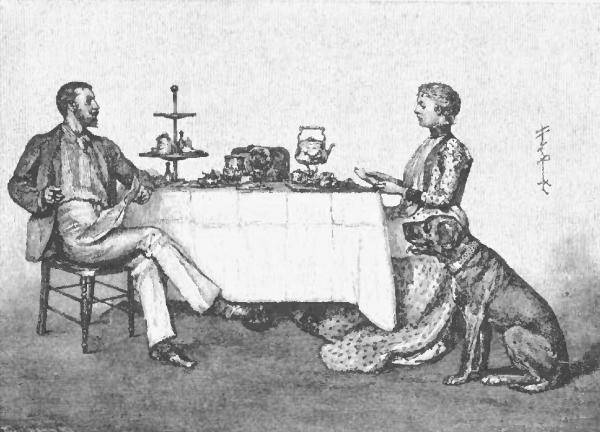
She is seated at breakfast in her cottage
at Summering-by-the-Sea. A heap of
letters of various stylish shapes, colors,
and superscriptions lies beside her plate,
and irregularly straggles about among
the coffee-service. Vis-à-vis with her sits
Mr. Campbell behind a newspaper. "How
prompt they are! Why, I didn't expect
to get half so many answers yet. But
that shows that where people have nothing
to do but attend to their social duties
they are always prompt—even the men;
women, of course, reply early anyway,
and you don't really care for them; but
in town the men seem to put it off till
the very last moment, and then some of
them call when it's over to excuse themselves
for not having come after accepting.
It really makes you wish for a leisure
class. It's only the drive and hurry
of American life that make our men
seem wanting in the convenances; and if
they had the time, with their instinctive
delicacy, they would be perfect: it
would come from the heart: they're more
truly polite now. Willis, just look at
this!"
Campbell, behind his paper: "Look at
what?"
Mrs. Campbell: "These replies. Why,
I do believe that more than half the people
have answered already, and the invitations
only went out yesterday. That
comes from putting on R.S.V.P. I knew
I was right, and I shall always do it, I
don't care what you say."
Campbell: "You didn't put on R.S.V.P.
after all I said?" He looks round the
edge of his paper at her.
Mrs. Campbell: "Yes, I did. The idea
of your setting up for an authority in such
a thing as that!"
Campbell: "Then I'm sorry I didn't
ask you to do it. It's a shame to make
people say whether they'll come to a
garden-party from four till seven or
not."
Mrs. Campbell: "A shame? How can
you provide if you don't know how many
are coming? I should like to know that.
But of course I couldn't expect you to
give in gracefully."
Campbell: "I should give in gracefully
if I gave in at all, but I don't." He throws
his paper down beside his chair. "Here,
hand over the letters, and I'll be opening
them for you while you pour out the
coffee."
Mrs. Campbell, covering the letters
with her hands: "Indeed you won't!"
Campbell: "Well, pour out the coffee,
then, anyway."
Mrs. Campbell, after a moment's reflection:
"No, I shall not do it. I'm going
to open them every one before you get a
drop of coffee—just to punish you."
Campbell: "To punish me? For what?"
Mrs. Campbell hesitates, as if at a loss
what to say. "There! you don't know."
Mrs. Campbell: "Yes, I do: for saying
I oughtn't to have put on R.S.V.P. Do
you take it back?"
Campbell: "How can I till I've had
some coffee? My mind won't work on
an empty stomach. Well—" He rises
and goes round the table towards her.
Mrs. Campbell, spreading both arms
over the letters: "Willis, if you dare to
touch them, I'll ring for Jane, and then
she'll see you cutting up."
Campbell: "Touch what? I'm coming
to get some coffee."
Mrs. Campbell: "Well, I'll give you
some coffee; but don't you touch a single
one of those letters—after what
you've said."
Campbell: "All right!" He extends
one hand for the coffee, and with the
other sweeps all the letters together, and
starts back to his place. As she flies
upon him, "Look out, Amy; you'll make
me spill this coffee all over the table-cloth."
Mrs. Campbell, sinking into her seat:
"Oh, Willis, how can you be so base?
Give me my letters. Do!"
Campbell, sorting them over: "You
may have half."
Mrs. Campbell: "No; I shall have all.
I insist upon it."
Campbell: "Well, then, you may have
all the ladies' letters. There are twice as
many of them."
Mrs. Campbell: "No; I shall have the
men's, too. Give me the men's first."
Campbell: "How can I tell which are
the men's without opening them?"
Mrs. Campbell: "How could you tell
which were the ladies'? Come, now,
Willis, don't tease me any longer. You
know I hate it."
Campbell, studying the superscriptions,
one after another: "I want to see if I can
guess who wrote them. Don't you like
to guess who wrote your letters before
you open them?"
Mrs. Campbell, with dignity: "I don't
like to guess who wrote other people's
letters." She looks down at the table-cloth
with a menace of tears, and Campbell
instantly returns all the notes.
Campbell: "There, Amy; you may
have them. I don't care who wrote them,
nor what's in them. And I don't want
you to interrupt me with any exclamations
over them, if you please." He
reaches to the floor for his newspaper,
and while he sips his coffee, Mrs. Campbell
loses no time in opening her letters.
Mrs. Campbell: "I shall do nothing
but exclaim. The Curwens accept, of
course—the very first letter. That means
Mrs. Curwen; that is one, at any rate.
The New York Addingses do, and the
Philadelphia Addingses don't; I hardly
expected they would, so soon after their
aunt's death, but I thought I ought to
ask them. Mr. and Mrs. Roberts, naturally;
it was more a joke than anything,
sending their invitation. Mrs. and the
Misses Carver regret very much; well, I
don't. Professor and Mrs. Traine are
very happy, and so am I; he doesn't go
everywhere, and he's awfully nice. Mr.
and Mrs. Lou Bemis are very happy, too,
and Dr. Lawton is very happy. Mrs.
Bridges Dear Mrs. Campbells me, and is
very sorry in the first person; she's always
nice. Mr. Phillips, Mr. Rangeley,
Mr. Small, Mr. Peters, Mr. Staples, Mr.
Thornton, all accept, and they're all
charming young fellows."
Campbell, around his paper: "Well,
what of that?"
Mrs. Campbell, with an air of busy preoccupation:
"Don't eavesdrop, please;
I wasn't talking to you. The Merrills
have the pleasure, and the Morgans are
sorrow-stricken; the—"
Campbell: "Yes, but why should you
care whether those fellows are charming
or not? Who's going to marry them?"
Mrs. Campbell: "I am. Mrs. Stevenson
is bowed to the earth; Colonel Murphree
is overjoyed; the Misses Ja—"
Campbell, putting his paper down:
"Look here, Amy. Do you know that
you have one little infinitesimal ewe-lamb
of a foible? You think too much of young
men."
Mrs. Campbell: "Younger men, you
mean. And you have a multitude of perfectly
mammoth peccadilloes. You interrupt."
She goes on opening and
reading her letters. "Well, I didn't expect
the Macklines could; but everybody
seems to be coming."
Campbell: "You pay them too much
attention altogether. It spoils them; and
one of these days you'll be getting some
of them in love with you, and then what
will you do?"
Mrs. Campbell, with affected distraction:
"What are you talking about? I'd
refer them to you, and you could kill
them. I suppose you killed lots of people
in California. That's what you always
gave me to understand." She goes
on with her letters.
Campbell: "I never killed a single human
being that I can remember; but
there's no telling what I might do if I
were provoked. Now, there's that young
Welling. He's about here under my feet
all the time; and he's got a way lately of
coming in through the window from the
piazza that's very intimate. He's a nice
fellow enough, and sweet, as you say. I
suppose he has talent, too, but I never
heard that he had set any of the adjacent
watercourses on fire; and I don't know
that he could give the Apollo Belvedere
many points in beauty and beat
him."
Mrs. Campbell: "I do. Mrs. and Miss
Rice accept, and her friend Miss Greenway,
who's staying with her, and—yes!
here's one from Mr. Welling! Oh, how
glad I am! Willis, dearest, if I could be
the means of bringing those two lovely
young creatures together, I should be so
happy! Don't you think, now, he is the
most delicate-minded, truly refined, exquisitely
modest young fellow that ever
was?" She presses the unopened note
to her corsage, and leans eagerly forward
entreating a sympathetic acquiescence.
Campbell: "Well, as far as I can remember
my own youth, no. But what
does he say?"
Mrs. Campbell, regarding the letter: "I
haven't looked yet. He writes the most
characteristic hand, for a man, that I ever
saw. And he has the divinest taste in
perfumes! Oh, I wonder what that is?
Like a memory—a regret." She presses
it repeatedly to her pretty nose, in the
endeavor to ascertain.
Campbell: "Oh, hello!"
Mrs. Campbell, laughing: "Willis, you
are delightful. I should like to see you
really jealous once."
Campbell: "You won't, as long as I
know my own incomparable charm. But
give me that letter, Amy, if you're not
going to open it. I want to see whether
Welling is going to come."
Mrs. Campbell, fondly: "Would you
really like to open it? I've half a mind
to let you, just for a reward."
Campbell: "Reward! What for?"
Mrs. Campbell: "Oh, I don't know.
Being so nice."
Campbell: "That's something I can't
help. It's no merit. Well, hand over
the letter."
Mrs. Campbell: "I should have thought
you'd insist on my opening it, after that."
Campbell: "Why?"
Mrs. Campbell: "To show your confidence."
Campbell: "When I haven't got any?"
Mrs. Campbell, tearing the note open:
"Well, it's no use trying any sentiment
with you, or any generosity either. You're
always just the same; a teasing joke is
your ideal. You can't imagine a woman's
wanting to keep up a little romance all
through; and a character like Mr. Welling's,
who's all chivalry and delicacy and
deference, is quite beyond you. That's
the reason you're always sneering at him."
Campbell: "I'm not sneering at him,
my dear. I'm only afraid Miss Rice isn't
good enough for him."
Mrs. Campbell, instantly placated:
"Well, she's the only girl who's anywhere
near it. I don't say she's faultless, but
she has a great deal of character, and
she's very practical; just the counterpart
of his dreaminess; and she is very, very
good-looking, don't you think?"
Campbell: "Her bang isn't so nice as
his."
Mrs. Campbell: "No; and aren't his
eyes beautiful? And that high, serious
look! And his nose and chin are perfectly
divine. He looks like a young
god!"
Campbell: "I dare say; though I never
saw an old one. Well, is he coming?
I'm not jealous, but I'm impatient. Read
it out loud."
Mrs. Campbell, sinking back in her
chair for the more luxurious perusal of
the note: "Indeed I shall not." She
opens it and runs it hastily through, with
various little starts, stares, frowns, smiles
of arrested development, laughs, and
cries: "Why—why! What does it mean?
Is he crazy? Why, there's some mistake.
No! It's his hand—and here's his
name. I can't make it out." She reads
it again and again. "Why, it's perfectly
bewildering! Why, there must be some
mistake. He couldn't have meant it.
Could he have imagined? Could he have
dared? There never has been the slightest
thing that could be tortured into—But
of course not. And Mr. Welling,
of all men! Oh, I can't understand it!
Oh, Willis, Willis, Willis! What does it
mean?" She flings the note wildly across
the table, and catching her handkerchief
to her face, falls back into her chair, tumultuously
sobbing.
Campbell, with the calm of a man accustomed
to emotional superabundance,
lifting the note from the toast-rack before
him: "Well, let's see." He reads
aloud: "'Oh, my darling! How can I
live till I see you? I will be there long
before the hour! To think of your asking
me! You should have said, "I permit
you to come," and I would have flown
from the ends of the earth. The presence
of others will be nothing. It will
be sweet to ignore them in my heart, and
while I see you moving among them, and
looking after their pleasure with that
beautiful thoughtfulness of yours, to
think, "She is mine, mine, mine!"
"Oh, young lord lover, what sighs are those
For one that can never be thine?"
I thank you, and thank you a thousand
times over, for this proof of your trust in
me, and of your love—our love. You
shall be the sole keeper of our secret—it
is so sweet to think that no one even suspects
it!—and it shall live with you, and
if you will, it shall die with me. Forever
yours, Arthur Welling.'" Campbell turns
the note over, and picking up the envelope,
examines the address. "Well, upon
my word! It's to you, Amy—on the outside,
anyway. What do you suppose he
means?"
Mrs. Campbell, in her handkerchief:
"Oh, I don't know; I don't know why he
should address such language to me!"
Campbell, recurring to the letter: "I
never did. 'Oh, my darling—live till I
see you—ends of the earth—others will be
nothing—beautiful thoughtfulness—mine,
mine, mine—our love—sweet to think no
one suspects it—forever yours.' Amy,
these are pretty strong expressions to use
towards the wife of another, and she a
married lady! I think I had better go
and solve that little problem of how he
can live till he sees you by relieving him
of the necessity. It would be disagreeable
to him, but perhaps there's a social
duty involved."
Mrs. Campbell: "Oh, Willis, don't torment
me! What do you suppose it
means? Is it some—mistake? It's for
somebody else!"
Campbell: "I don't see why he should
have addressed it to you, then."
Mrs. Campbell: "But don't you see?
He's been writing to some other person
at the same time, and he's got the answers
mixed—put them in the wrong envelopes.
Oh dear! I wonder who she
is!"
Campbell, studying her with an air of
affected abstraction: "Her curiosity gets
the better of her anguish. Look here,
Amy! I believe you're afraid it's to some
one else."
Mrs. Campbell: "Willis!"
Campbell: "Yes. And before we proceed
any further I must know just what
you wrote to this—this Mr. Welling of
yours. Did you put on R.S.V.P.?"
Mrs. Campbell: "Yes; and just a
printed card like all the rest. I did want
to write him a note in the first person,
and urge him to come, because I expected
Miss Rice and Miss Greenway to help me
receive; but when I found Margaret had
promised Mrs. Curwen for the next day,
I knew she wouldn't like to take the
bloom off that by helping me first; so I
didn't."
Campbell: "Didn't what?"
Mrs. Campbell: "Write to him. I just
sent a card."
Campbell: "Then these passionate expressions
are unprovoked, and my duty
is clear. I must lose no time in destroying
Mr. Welling. Do you happen to
know where I laid my revolver?"
Mrs. Campbell: "Oh, Willis, what are
you going to do? You see it's a mistake."
Campbell: "Mr. Welling has got to
prove that. I'm not going to have young
men addressing my wife as Oh their darling,
without knowing the reason why.
It's a liberty."
Mrs. Campbell, inclined to laugh: "Ah,
Willis, how funny you are!"
Campbell: "Funny? I'm furious."
Mrs. Campbell: "You know you're not.
Give me the letter, dearest. I know it's
for Margaret Rice, and I shall see her,
and just feel round and find out if it isn't
so, and—"
Campbell: "What an idea! You haven't
the slightest evidence that it's for Miss
Rice, or that it isn't intended for you,
and it's my duty to find out. And nobody
is authority but Mr. Welling. And
I'm going to him with the corpus delicti."
Mrs. Campbell: "But how can you?
Remember how sensitive, how shrinking
he is. Don't, Willis; you mustn't. It will
kill him!"
Campbell: "Well, that may save me
considerable bother. If he will simply
die of himself, I can't ask anything better."
He goes on eating his breakfast.
Mrs. Campbell, admiring him across
the table: "Oh, Willis, how perfectly delightful
you are!"
Campbell: "I know; but why?"
Mrs. Campbell: "Why, taking it in the
nice, sensible way you do. Now, some
husbands would be so stupid! Of course
you couldn't think—you couldn't dream—that
the letter was really for me; and yet
you might behave very disagreeably, and
make me very unhappy, if you were not
just the lovely, kind-hearted, magnanimous—"
Campbell, looking up from his coffee:
"Oh, hello!"
Mrs. Campbell: "Yes; that is what took
my fancy in you, Willis: that generosity,
that real gentleness, in spite of the brusque
way you have. Refinement of the heart,
I call it."
Campbell: "Amy, what are you after?"
Mrs. Campbell: "We've been married
a whole year now—"
Campbell: "Longer, isn't it?"
Mrs. Campbell: "—And I haven't
known you do an unkind thing, a brutal
thing."
Campbell: "Well, I understand the
banging around hardly ever begins much
under two years."
Mrs. Campbell: "How sweet you are!
And you're so funny always!"
Campbell: "Come, come, Amy; get
down to business. What is it you do
want?"
Mrs. Campbell: "You won't go and
tease that poor boy about his letter, will
you? Just hand it to him, and say you
suppose here is something that has come
into your possession by mistake, and that
you wish to restore it to him, and then—just
run off."
Campbell: "With my parasol in one
hand, and my skirts caught up in the
other?"
Mrs. Campbell: "Oh, how good! Of
course I was imagining how I should do
it."
Campbell: "Well, a man can't do it
that way. He would look silly." He
rises from the table, and comes and puts
his arm round her shoulders. "But you
needn't be afraid of my being rough
with him. Of course it's a mistake; but
he's a fellow who will enter into the joke
too; he'll enjoy it; he'll—" He merges
his sentence in a kiss on her upturned
lips, and she clings to his hand with her
right, pressing it fondly to her cheek.
"I shall do it in a man's way; but I guess
you'll approve of it quite as much."
Mrs. Campbell: "I know I shall. That's
what I like about you, Willis: your being
so helplessly a man always."
Campbell: "Well, that's what attracted
me to you, Amy; your manliness."
Mrs. Campbell: "And I liked your
finesse. You are awfully inventive, Willis.
Why, Willis, I've just thought of something.
Oh, it would be so good if you
only would!"
Campbell: "Would what?"
Mrs. Campbell: "Invent something
now to get us out of the scrape."
Campbell: "What a brilliant idea! I'm
not in any scrape. And as for Mr. Welling,
I don't see how you could help him
out unless you sent this letter to Miss
Rice, and asked her to send yours back—"
Mrs. Campbell, springing to her feet:
"Willis, you are inspired! Oh, how perfectly
delightful! And it's so delicate of
you to think of that! I will just enclose
his note—give it here, Willis—and he
need never know that it ever went to the
wrong address. Oh, I always felt that
you were truly refined, anyway." He
passively yields the letter, and she whirls
away to a writing-desk in the corner of
the room. "Now, I'll just keep a copy
of the letter—for a joke; I think I've a
perfect right to"—scribbling furiously
away—"and then I'll match the paper
with an envelope—I can do that perfectly—and
then I'll just imitate his hand—such
fun!—and send it flying over to Margaret
Rice. Oh, how good! Touch the
bell, Willis;" and then—as the serving-maid
appears—"Yes, Jane! Run right
across the lawn to Mrs. Rice's, and give
this letter for Miss Margaret, and say it
was left here by mistake. Well, it was,
Willis. Fly, Jane! Oh, Willis, love!
Isn't it perfect! Of course she'll have
got his formal reply to my invitation, and
be all mixed up by it, and now when this
note comes, she'll see through it all in an
instant, and it will be such a relief to her;
and oh, she'll think that he's directed both
the letters to her because he couldn't
think of any one else! Isn't it lovely?
Just like anything that's nice, it's ten
times as nice as you expected it to be;
and—"
Campbell: "But hold on, Amy!" He
lifts a note from the desk. "You've sent
your copy. Here's the original now.
She'll think you've been playing some
joke on her."
Mrs. Campbell, clutching the letter from
him, and scanning it in a daze: "What!
Oh, my goodness! It is! I have! Oh,
I shall die! Run! Call her back! Shriek,
Willis!" They rush to the window together.
"No, no! It's too late! She's
given it to their man, and now nothing
can save me! Oh, Willis! Willis! Willis!
This is all your fault, with that fatal
suggestion of yours. Oh, if you had only
left it to me I never should have got into
such a scrape! She will think now that
I've been trying to hoax her, and she's
perfectly implacable at the least hint of a
liberty, and she'll be ready to kill me. I
don't know what she won't do. Oh, Willis,
how could you get me into this!"
Campbell, irately: "Get you into this!
Now, Amy, this is a little too much. You
got yourself into it. You urged me to
think of something—"
Mrs. Campbell: "Well, do, Willis, do
think of something, or I shall go mad!
Help me, Willis! Don't be so heartless—so
unfeeling."
Campbell: "There's only one thing
now, and that is to make a clean breast
of it to Welling, and get him to help us
out. A word from him can make everything
right, and we can't take a step without
him; we can't move!"
Mrs. Campbell: "I can't let you. Oh,
isn't it horrible!"
Campbell: "Yes; a nice thing is always
ten times nicer than you expected it
to be!"
Mrs. Campbell: "Oh, how can you
stand there mocking me? Why don't you
go to him at once, and tell him the whole
thing, and beg him, implore him, to help
us?"
Campbell: "Why, you just told me I
mustn't!"
Mrs. Campbell: "You didn't expect me
to say you might, did you? Oh, how
cruel!" She whirls out of the room, and
Campbell stands in a daze, in which he is
finally aware of Mr. Arthur Welling, seen
through the open window, on the veranda
without. Mr. Welling, with a terrified
and furtive air, seems to be fixed to
the spot where he stands.