All Hallowe’en,
October 31, 1871,
Chicago, Ill.
My dear Father and Mother:
I am ashamed to put you off any longer without a long letter. I have
been waiting to get the office comfortable so that I could spend some
evening in it, when it would be nice and warm, and give you a longer
account of the fire. We are into the middle of another week, no desks,
and no fire, so muffle myself up, and collect my thoughts the best way
I can. For a beginning, we should have been very busy today, with salt,
but it is raining very hard, and is altogether a miserable day both
out and inside, so cannot find anything better to do, although it is
not pleasant work.
To begin—on Saturday morning the 7th of this month, I saw Mr. Ackroyd
off to Milwaukee, and came back with Mr. Kenny.
The three of us were stopping at different hotels, therefore Mr. Kenny
went to his, I to the Brigg’s house, and got my tea, then went to the
Sherman house where Mr. Ackroyd had been stopping, to get his trunk
and have it sent to my room at the Brigg’s house. After that was done
I took my usual Saturday evening stroll, ’round the city, just ready
to look at anything interesting. Nothing happened; but just as I was
going into the hotel, at ten o’clock, there was the glare of a fire in
the sky. I did not feel like going to bed, so thought I might spend
an hour looking at the flames. It was a big fire in my eyes then, a
large wooden house near a row of splendid brick ones; the latter they
were trying to save, and succeeded. I was in a splendid position for
seeing, without getting any of the water the firemen directed at the
crowd every few minutes. It was nearly over, and I was just going to
leave, when some one shouted that there was a fire on the west side. I
looked up, saw the sky all lurid, and started off to see the new one.
It looked very awful, sweeping houses before it like chaff, until it
got to a lumber yard. Then the efforts of the firemen appeared useless,
twenty acres of buildings and wood were all ablaze; the sight thrilled
me through, as I thought there would be no stopping it. I assisted
people to carry things out of their houses, and did what I could to
help them, until the fire appeared to be so far under way that there
was no further danger. I hung ’round until two o’clock then went home,
got into bed, satisfied I had seen a tremendous calamity. The biggest
of any I had ever seen, or hoped to see. But alas, how much was I
disappointed! I could not sleep for a long time, and then only dozed
off for a few minutes, but woke with a start, and looking out of the
window, saw how the fire was progressing. Whilst awake I was thinking
what a splendid account I could write you. When anything of interest
occurs it is my first thought—how nice that will do for my letter
home. I always have you uppermost in my mind and wish you were with me
to enjoy things when I am enjoying myself—but this is parting from my
story.
When I saw the fire fade, I fell asleep (it was about four-thirty)
and did not wake until Mr. Kenny came to my door at ten. I had made
an appointment to meet him at that hour, and kept it as you see—“in
bed.” After he left I slept until twelve, then got up, dressed, went
down, met Mr. Kenny again, and we both started off to Mr. Small’s to
dine. At five-twenty we left there and walked together to my hotel;
we parted, and I did not see him again until twenty-six hours after,
he thinking me burnt, and I thinking that he was burnt. We were very
pleased to see each other again safe and sound.
I got my tea, went to my room, and read awhile, then went to Church;
it happened to be a Universalist place that I got into, and did not
enjoy it much. I went away kind of dissatisfied and got to the Briggs
House at nine-fifteen, not feeling like sleeping. I made myself as
comfortable as I could, lit my pipe, and commenced reading the book
Mrs. Somerville made me a present of. I had been reading about half an
hour when the fire bell tolled three-forty-two three times. I looked
out and saw the sky red in the direction of the fire of the previous
evening, but paying no attention to it, I turned round and read away.
I looked again and saw it was increasing; I tried to read now but
it was impossible. I put down the gas, and sat opposite the window
watching it; the fire was more than two miles away, still I felt very
uneasy, and could not go to bed. It was Sunday night and I did not
like the idea of going on a rollicking expedition after a fire, but
I could not make myself easy anywhere, and I concluded to go see it;
so I took off my Sunday clothes, put on a pair of drawers (I felt
chilly the night before, so took the precaution to make myself warm
this night, and it was well for me I did as my story will show during
its progression), an extra undershirt, an old warm coat and vest, and
sallied out at ten-fifteen P.M. October eighth.
It was blowing hard at the time, but I got along well, having fit
myself out for cold and dirt; having little interest in the city,
no friends whose losing property could affect me much, and little
property of my own to care for, I felt probably as free and easy as any
one who saw that fire.
I got up to it at ten-forty-five, but could not get near on account
of the heat. How the firemen stood it I don’t know! A general alarm
was sounded and thirty steam fire engines were on the spot soon after
I arrived. It was a grand sight but hellish in the extreme; streets,
houses, trees, and everything in one grand furnace. It was not a blaze
like the night before, but a white melting heat; volumes of flames were
cut off from the seat of the fire itself and carried over into other
streets. In addition to this there was a perfect shower of sparks, all
red and glowing. The fall of them was like a fall of golden snow, and
as far as the eye could reach upward, the air was filled with them; not
only sparks, but burning brands of wood from six inches to two feet
long, and from one inch thick to six inches. This may seem incredible
but it is true. I saw them myself, saw them fall in the street, and
worse than that, on houses with wooden roofs, and on people’s heads,
almost knocking them down. The wind was blowing a fearful gale at this
time and that accounts for it.
At eleven-fifteen these brands set fire to the roof of a church about
three hundred yards from the main fire. I went to see this before there
was the sign of a blaze; (I adopted the plan of keeping before the
fire, so that in case it spread I should not be cut off from my hotel)
some men got on the roof and tried to put it out but they could not.
So an engine came, and dilly-dallied about for a few minutes, until a
volume of thick black smoke rolled up from it and in two minutes it
was in flames. The edifice was wood and it went like a matchbox; it
was a Roman Catholic institution. Some one said it was on fire before
any sign of a blaze came from it; an old Irish woman that had just
come heard the remark and asked: “Where is the foire?” They told her
on the roof. “Ah,” said she, “God will put it out,” and appeared quite
composed about it. This is where the real trouble commenced.
There were two immense fires now, and the fire brigade divided. This
left the first fire almost to itself, and in a few minutes it joined
the second one; the sight was now dreadful. It swept along, burning
wood, bricks, stone, alike; I never saw the equal. The two latter
materials gave out sooner than the wood; they melted down like wax,
while wood burned so long as a stick remained. It flew from house to
house almost as quick as one could walk, until it reached the river.
I will stop about the fire now and tell you something of the
inhabitants, a great many being burnt out, the fire having come a mile
now, and half a mile wide. The people were mostly looking at the fire,
but as soon as they saw their homes in danger, a general packing up
could be observed in all the houses, and soon after a regular exodus,
everyone, old and young, carrying something. The men looked pale and
callous as a rule; the women ran about in an excited manner, but none
fainted. Children clung to parents, or old friends, too frightened
to cry; infants alone made noise, as the mothers had not time to sit
down and soothe them. Others of them slept peaceably in the mothers’
arms, ignorant of all danger and care. Old women were carrying weights
too heavy for men, and young women were dragging trunks (enough for a
donkey to pull), no doubt containing their best clothes, or sat on them
and wept quietly when they could not pull any longer, and had to leave
them for the fire to lick up as a giant would swallow a midge.
I was not an idle observer during all this. I carried boxes and bundles
without number, placing them in nooks that the owners considered safe.
Vain delusion. Everything I laid hands to save was eventually burnt. In
one place there was a long train of empty railway cars. People thought
the railway company would be sure to save their cars, so they would put
in their goods. I worked as I never worked before, loading up the cars
with all kinds of things, but before I had finished the train was on
fire and it burnt up as would a train of gunpowder on the flags. This
was my last act of kindness on the West side; it being close to the
river, I crossed over to what is called the South side.
To return to the fire account. After crossing the river, I stood and
gazed on the burning mass. It was thought it could not cross eighty
yards of water. The firemen made a hard fight here to prevent its
going any further, and it looked somewhat as if they might succeed.
At this point I left, a fire having broken out behind me about four
hundred yards away. This was on the side of the river I was on, so
there was no doubt but that the fire had crossed. Of course this took
away a lot of engines and left the old fire to do as it liked; it soon
jumped the river too, and joined the new one. I went to see this new
fire and found it to be among a nest of wooden shanties that went like
tinder. Upon close observation I saw that it was within a few yards
of the gas works, so thought it better to quit and plant myself at
a reasonable distance from it. In going away I took the liberty of
hammering people up, as the fire was spreading so rapidly it might
reach them before all of them could get out. The streets were all quiet
as I passed along, but soon were busy enough with people turning out. I
was also busy enough assisting to put out little fires, such as linen
awnings that sparks had ignited, and pieces of wooden side walks that
were burning, until I got to the heart, and best part of the city where
all buildings were built of brick, stone, iron, or marble, and many of
them without any wood except the office desks and furniture. I felt
sure the fire would never go through these buildings; still to make my
mind easy, I went to the Brigg’s House, and commenced packing. This was
one o’clock, wind still blowing a gale, the fire within a quarter of a
mile from the hotel, and just beginning to cross the street to the good
part of the city. Although I was packing, I really did not believe the
fire would reach the place where I was.
I will give you an idea of how my packing arrangements were made. I
first got my small valise with the brass round the edges, put into it
my best suit, album, and all the little presents that I value, then
filled up with the best of my underclothing; after that I took off the
old suit I had on, and put on my second best suit, so that if it came
to the worst I could carry the valise in my hand, and have a good suit
on my back. At this juncture, a waiter of the hotel came running up,
saying the wind had changed and there was no danger. I paid little
attention to it and went on packing my large trunk; certainly it made
me more careless in packing, for I left out a lot of small things,
I could have put in, thinking if the place should be threatened I
could then put them in. After I fastened all up, leaving out my large
overcoat, I again walked out to see the progress of the fire. It had
taken full possession of the fine buildings I before mentioned. It was
surprising to see the way they tumbled; marble buildings cracked away
for a time, then burst out in a volume of flame; the walls parted,
and down came the whole fabrication a jumbled mass of smouldering
ruins. This took but little time, but short as it was, before it was
in ruins, other buildings were burning and tumbling in the same way.
I was watching in one place, when a cry was raised that the City Hall
was on fire. I never thought that this would burn, as it stands in a
little park, and is built of stone. I ran round and there sure enough
the cupola was burning, and very soon after, the edifice was a red,
seething mass, sending up clouds of sparks, and dealing destruction,
with a deadly hand, all ’round.
I now thought it about time to move, and see after my things, so
commenced lugging them downstairs; I had not time now to put anything
into the trunk, so let the few things left take their chance. I had
with me one valise, one large portmanteau of my own, and one large
trunk belonging to Mr. Ackroyd (had he left it at Sherman’s House it
was gone sure as I could never have saved it). When I had them down,
I went to look for a carriage or an express man, to take them away;
they were asking fifty dollars for a carriage; as this would not do I
went up the street a piece, met a man with a light waggon, asked what
he would take me a mile away for. He said five dollars down. “Done,”
I said. He wanted to get the money in the street before he got the
things; of course I would not do that, but told him, I would pay him
the minute I got the things on board. After a good deal of talk he
consented, came alongside, put the packages on and I paid him. Just
as I was leaving the place took fire, and I heard people offering one
hundred dollars, then one hundred and fifty dollars, for a carriage,
but they could not get any. As I was going along several people
applied to the express-man offering him three or four dollars for
the conveyance of a trunk, but ten dollars was now his charge. People
refused to pay him that amount and I am sure they all lost their
things, as we were about the last to cross the bridge. We took up one
young man with a similar lot of traps to mine. He was a very decent
fellow, so we stuck together. The express-man put us down at his own
house. We left our things inside, and went to see how the fire was
getting along.
Before going further I will explain why I crossed the river again,
and what we did. To do this I must give you an idea of the place. I
remember once before giving you a rough outline of Chicago. I will do
so again. [See illustration.]
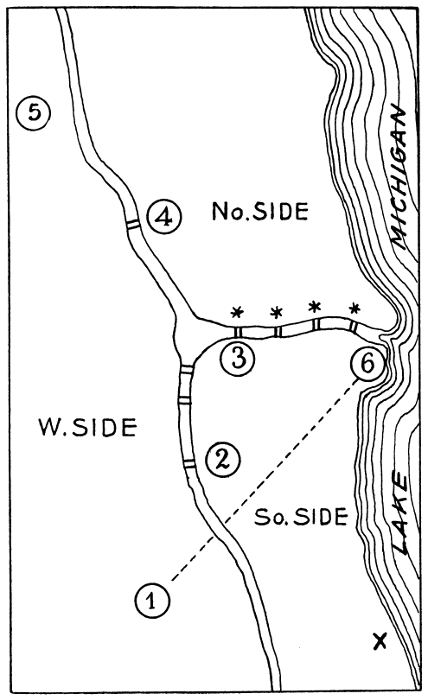
The bars across the river represent the turn bridges. 1 is where the
fire commenced, 2 where I crossed the river the first time, 3 where I
crossed the second, 4 where I crossed the third, 5 where I finally
drew up and left my clothes. The wind was blowing in the direction
from 1 to 6, so I thought the fire would wear out at the lake, and not
be able to cross the river to the North Side. In this I was mistaken,
for when I went to look at the fire, after deposing our things at the
express-man’s house, as before stated, we found the bridge we had just
crossed was on fire, and that the North Side was doomed unless the
wind changed (this was three o’clock) so we turned back to move our
traps again. Whilst walking up, we met a man pulling a large trunk. We
helped him along to where we were staying, hired a boy with a waggon
who drove over to the West Side, crossing bridge at number 4. Here we
considered ourselves safe, put down our luggage on the side walk, and
sat on it ’till daylight. We asked a man to let us into his house but
he refused. It was here that my warm underclothing and heavy overcoat
stood to me. The wind was brisk and keen; had I been lightly clothed, I
might have taken a severe cold—fortunately I escaped. This place was
partly on the prairie, so had a splendid view of the fire at large,
although fully three miles from it. The smallest print could be read
with ease, the light was so intense. As day dawned the light faded, but
daylight revealed the volumes of black smoke rolling up from the city,
and the ruins of the previous night’s destruction. The fire was now
sweeping the North Side entirely unchecked, the waterworks being burnt
and no water in the town. I felt very hungry by this time, and hailed
with delight the taking down of the first shutter of a small grocery
store. I got some dry biscuits and ate them with a relish—something
wonderful. As there was a dirt waggon passing, our last named friend
and myself stopped it, put in our things, got on top of them, and
requested the driver to take us to a place my friend knew.
He accomodated us, and drew up at a very good looking general store
in a small settlement on the prairie, shown as number 5 on the map.
It ought to be farther out, but the paper won’t admit it. We gave our
baggage in charge of the owners, and left them.
In walking back to the city we met a gentleman who was acquainted
with my fellow traveller. He wished us to call at his house and have
breakfast. We did so, and a good one it was; the house was all upset,
getting their things packed up, little of which I am afraid was saved.
Walking citywards, the road was crowded with all sorts of vehicles
carrying furniture of every description; the road was littered with
furniture, pianos, beds and so forth in indescribable confusion;
drivers of waggons would engage to take it out some distance on the
prairie, get their money first before they started, then would only
go a little way, tumble it out on the road, return and repeat the
operation, on someone else.
I now wanted to get to Mr. Small’s house, to learn what I could about
Mr. Kenny. When I got to the city I found all the bridges that I have
starred, burnt up, so had to make a long detour, going all round the
burnt district. His house is on the South Side where I put a cross. I
arrived there at eleven o’clock lost in dirt, blended with dust and
smoke. Not a drop of water in the house to wash with. Mr. Small told me
to consider it (his house) my home until I could find something else.
I took a bucket, went to the lake and brought it back full of water
and felt better for it. (This was eleven-thirty A.M.) Up to this time
nothing was heard of Mr. Kenny. I felt rather uneasy, as it was much
easier for him to get there than for me, and I fully expected finding
him there when I arrived. I was also astonished to find the South Side
still burning; the fire was creeping up against the wind at the rate of
a house every five minutes. At that calculation Small’s house would be
burnt at three o’clock. Of course he was very uneasy and sent his wife
and baby away; if the wind changed in the opposite direction he would
be cleared out much sooner. At two o’clock we walked down together and
found the flames stopped by blowing up of several streets of houses.
The North Side was swept out clear and clean, right into the country,
burning up Lincoln Park and a Catholic Cemetery. Seventy-five thousand
people resided on the North Side, and every house with one exception
was burned to the ground, not even the walls standing. Altogether one
hundred thousand people were rendered homeless, and had to camp out on
the prairie without any covering for two days and two nights, having
little to eat and scarcely any water to drink. This is something awful
to think of. Delicate people, young children of all classes, huddled
together without any comforts; a great many people died, and no wonder.
However, they are all pretty well provided for now, supplies are
plentiful, the only fear is that the charity will be abused.
The fire lasted thirty-six hours, during that time clearing everything
before it for a distance of five and a half miles, commencing in a
point, and finishing two miles in width; about fifty thousand tons
of coal caught fire, which burned for a week quite bright, always
keeping the sky aglow with its light. It is still burning but no
fire can be seen. I must add here that Mr. Kenny did not turn up the
whole afternoon, and I began to fear the worst. However he made his
appearance between seven and eight o’clock, all safe and sound and
relieved my mind. Next day the city was put under martial law, General
Sheridan commanding. I was made a patrol between twelve and four
o’clock at night with Small; this was to prevent ruffians from firing
other places. Several of them were caught and immediately shot, or hung
up to some lamp post. The city was without water ten days and fourteen
without gas, so it presented a miserable appearance.
Mr. Kenny and myself went to the lake twice a day, and brought as much
water as supplied Mr. Small’s family. This was the way we paid our
board. People a long way from the lake suffered fearfully; all the
watering carts were put to hauling water, but all they could draw was
only a speck of what was needed.
I have given you a pretty fair account of my experience during the
fire, now I will give you a few incidents or curiosities. In the first
place, I was greatly amused by the unlikely things that many people
in their excitement tried to save the very first. On the West Side
the rage appeared to be to save their stoves and crockery. As soon
as a house was threatened, the first thing brought out was a stove,
then a lot of tins and glassware; in other places I saw people open
their windows up stairs, and throw out looking glasses, chairs, water
pitchers and basins, all of which were broken and rendered useless
the moment they touched the ground. In some streets the pavement was
littered with debris of this kind; when the fire got amongst the
stores, cabmen, expressmen, and roughs in general were dressed up
in much better style than usual. A large number of silk hats being
particularly observable on the gents, showing plainly that some stores
had suffered. A lot of prisoners locked up in the City Jail were let
loose; the first thing they did was to run over to the jewellry stores
and plunder them of all the valuables that were convenient. Many of the
store owners saved what they could, then opened the doors and told the
multitude to help themselves. One of the largest jewellers out of New
York did this, and a few lives were sacrificed in his place; people
being so venturesome that they went once too often, and got caught with
a falling building. One piano store owner commenced pulling pianos
out of a third story window. This was the worst piece of business
that I saw for they were smashed into splinters when they struck the
ground, and greatly endangered the lives of people around. Pistols were
freely used, a great many ruffians were shot for trying to break into
different places, and in return, a few respectable men were shot by
them, for preventing them carrying out their purpose. One expressman
that we employed was going to drop our things out on the street after
he got a few yards when one of my newly made acquaintances drew his
revolver, and told him he would blow his brains out if he did. He drove
quietly on after that.
A great many lives were lost, more than ever will be known. A lot of
people congregated in the tunnel under the river (that I have described
in a previous letter) and most of them were smothered or burned. There
were two things that helped the fire along wonderfully. They were the
wooden pavements and the quantity of things thrown out of the houses
and left there.
This ends my account. All being well, I will continue my usual weekly
letter from this out. I am very well and hope you are the same, with
kindest love to yourselves, Annie, and Alfred,
I remain your affectionate son,
Thomas.
You may show this letter to anyone you think would be interested in it.
I cannot begin to write another so minute as this.