‘O Spirit of the Lord, prepare
All the round Earth her God to meet;
Breathe Thou abroad like morning air,
Till hearts of stone begin to beat.
‘Baptize the Nations; far and nigh
The triumphs of the Cross record;
The Name of Jesus glorify
Till every kindred call Him Lord.’
In the second week of October 1875, Miss Tucker left
English shores, never to return. The voyage was uneventful,
differing therein from her trip to Canada. On
its very next voyage the good ship Strathclyde, which
carried her to the East, went down within sight of Dover.
But no threatenings of such a catastrophe disturbed
A. L. O. E. on her way out.
A fellow-passenger on board the Strathclyde wrote long
afterwards:—
‘My first introduction to A. L. O. E. was when I was lying in all
the helplessness of the first days of my first voyage, quite unable
to stir from the deck. I became conscious of a grey-haired lady
stooping over me, offering some eau de cologne, and with a winning
smile asking if she could do anything for me. She was a good
sailor, and in those miserable days moved about amongst the sea-sick
passengers like an angel of mercy. Even then dear Miss
Tucker looked very frail and delicate; and one could scarcely
have expected that she would be spared for eighteen years to work
in all the heat and discomfort of India. One thing remarkable
about her on that voyage was the influence she had over the men
on board,—some of them quite indifferent, if not hostile, to religion.
No one could withstand her genial, loving ways; and it was a sight
to be remembered, to see her gathering the young fellows round
the piano, while she led off in some old English ditty.’
Her own letters to Mrs. Hamilton, while on board, are
cheery as usual, and speak no word of pain or longing
for all that she had left behind; indeed the very first ends
merrily: ‘Please give my kindest love to your dearest
girl, and tell her that I have already hung up her famous
bag. I hope that no ayah will bag it! I could not resist
the pun, bad as it is.’
There were five ayahs on board, and she soon struck
up an acquaintance with one of them,—a Christian ayah,—reading
aloud her Hindustani Bible, and delighted to
find that the ayah could understand what was read. ‘I
am bribing one to teach me,’ she wrote. ‘The ayahs
ought to be glad to help; for they, at least two or
three of them, seem to regard me as a kind of supplementary
nurse, and if they want to go to work make
over the baby to me.’ In the same letter she states:
‘We have a strong Missionary force on board; two Scotchmen,
the wife of one of them, and six Missionary ladies.
We have not quarrelled at all; but then, most of us have
been sea-sick!’—again a little glimmer of fun. ‘We lady
Missionaries get on very well together,’ she says in another
letter. ‘Very gentle and modest are the Misses A., “your
pretty girls,” as Lady I. called them to-day.’
As to amusements on board, she wrote:—
‘Lady I. has started a game which dear Leila and Fred may
add to their store at Christmas. She wrote something, missing
out all adjectives. A gentleman went round and collected adjectives
haphazard from the passengers, inserting them in the places left
blank. The piece was then read out. It was a description of the
voyage and many of the passengers. Of course nobody could be
offended, because the adjectives came haphazard. But how your
young folk would have laughed when, amongst other personages
described, came—“Miss Tucker, of a grandiloquent disposition, with
other bouncing Missionary ladies.”’
About a fortnight later she wrote:—
‘A contrast to —— is Mr. S., the competition-wallah, probably
the most highly educated man in the ship. I look upon him as the
Squire of the Mission ladies. In his most quiet, proper fashion, he
is ever ready to do our behests; and he never seems to tire of
hymn-singing.... He has evidently plenty of moral courage. The
very funniest thing was that Mr. S. was actually present at the
solemn conclave held by us six M. L.[24] to decide whether we could
conscientiously attend a second theatrical amateur performance,
Mr. S. having been the principal actor in the first one, which we
did attend. It was as if Garrick had been present at a Clapham
conference on the subject of whether it were right to go to see him
act!!! Mr. S. was very amiable and good: he had taken a great
deal of trouble to amuse the passengers, and his part was perfectly
unexceptionable; but if we all absent ourselves next time I do not
think that he will take any offence. I proposed that we should all
sleep over the matter, one of my reasons being that I could not but
feel Mr. S.’s presence a little embarrassing. On the following day
we met without him, and decided that the question is to be an open
one; each M. L. is to judge according to her own conscience. I
believe that we shall divide; but this is not, we have agreed, to
disturb the harmony between the M. L.’
After a few days spent in ‘bright, beautiful Bombay’—these
are her own words—she proceeded by rail with
one companion to Allahabad. A pause at Jabalpur had
been planned, but this fell through; and they accomplished
the whole long journey of 845 miles without a
break. Wisely, her friends had insisted on first-class,
and she was none the worse for the fatigue. On the very
morning of her arrival at Allahabad she could say: ‘I
had a nice warm bath, and then a good breakfast, and I
feel almost as fresh as if I had not travelled 845 miles
at a stretch, but merely taken a little drive. Think how
strong I must be!’
Later in the same letter, a long and cheery one, bearing
no signs of fatigue, she speaks of Mr. George Bowen,
an American Missionary, who had ‘laboured without intermission
for twenty-eight years’ in the East, and who
was known among Natives as ‘the English Faqir,’ on
account of his wandering and self-denying life.
‘He will take no salary,’ she wrote, ‘but has earned his own living,
I hear, by teaching, supporting himself on the merest trifle. I
esteem it a great honour that I sat beside him at breakfast at the
Zenana Mission House last Thursday. Mr. Bowen looks quite skin
and bone, wondrously thin, but not in the least unhealthy, but as if
there were plenty of work in him still. He told me that he does not
“believe in age.” He seems to feel as fresh as he did twenty-eight
years ago; and yet at the beginning of his career he was so fearfully
ill that his life was given up, and he wrote his farewell to his mother.
As India has agreed so splendidly with Mr. Bowen, I asked him—as
I generally do those who thrive in the climate—whether he drank
only water. “Tea,” he replied, smiling. He gave his opinion that
to take stimulant here is “the way to have to leave the country.”
Almost all the Missionaries whom I have met appear to be water-drinkers.
I am particularly delighted with the American Missionaries
whom I have seen.... I am ashamed of ever having had a prejudice
against Yankees. I am attracted also by Native Christian ladies.’
On her way up-country she came in for the wedding
of a Missionary lady, and after her usual fashion she was
most active in helping; working hard at the making of
wreaths and at the decoration of the Ludhiana Church
porch. As the married pair were about to drive off, rice
was brought to be thrown; but somebody present objected
to the custom for India, as originally heathen, and liable
to be misunderstood.’ Then the horses shall have it!’
declared Miss Tucker; and with two hands well filled
she went to the horse’s heads, and fed them, amid much
laughter, in which she heartily joined. Her own description
of the event is overflowing with spirit and enjoyment.
It is dated November 30.
‘I have just come in to rest a bit, and wash my soiled hands,—for
what do you think that I have been about?—at the express
request of the bride, helping to decorate the church for her wedding,
which is to come off to-day. This house is jammed full—that is to
say, a good deal more full than is comfortable; but the kind folk
would not hear of my leaving till after the wedding, so I do not
go to my home till to-morrow morning. Indian railways are regardless
of convenient hours. I, who was up this morning soon after
five, must be up to-morrow morning soon after three. Of course
I had to arrive here by starlight; and on the same night there had
been another arrival at one A.M. ... There is a grand tamasha[25]
about the wedding. Every one seems pleased. It is Missionary
wedding Missionary, and—perhaps I had better go and make myself
useful....
‘Later. Oh, such a pretty wedding! The little church fresh
white-washed within, clean as a wedding-cake. The porch almost
like a bower. A border of flowers on either side up the centre
made a kind of path. Then the presence of the school-girls in their
white chaddahs; the number of Natives in their picturesque costumes,—both
Christians and heathen, inside the church and looking in
from the outside,—all made a charming scene.
‘But before we went to church, a Begum, a royal lady, granddaughter
of Shah-Soojah, came to see the fun. And only fancy,
Laura, I was left for perhaps a quarter of an hour to entertain the
fine old lady. Would not your Fred and Leila have laughed to
have seen me, making gallant efforts to keep up conversation with
my dreadfully bad Hindustani. I dashed at it, tried to explain why
I wore a black dress when I had lilac and blue ones at Amritsar,
told her that I had never been married, answered questions regarding
my family, etc. The Begum laughed, and I laughed, for I knew
that my Hindustani was very bad; but I did remember always to
use the respectful “Ap”[26] to the princess.
‘Presently the dear old Missionary, Mr. Rudolph, appeared. The
“pardah”[27] lady, on seeing a man, hid behind an arm-chair. But
when I told her that it was “Rudolph Sahib,” the old lady said that
he was her father, and that she would make her salaam to him. I
hear that the Begum is almost a Christian, and she can read.
Wrapped in her chaddah, she walked with me to church, and stayed
through the service. I was close behind her. When it was over, I
managed to say a little sentence to her in rather better Hindustani,
“The Lord Jesus Christ is here; He gives blessing.” The Begum
gave a sound of assent.’
Next day, the first of December, Charlotte Tucker
reached Amritsar,—the spot which she fully expected to
be her home for many a year to come. But Amritsar was
only a stage on the road to Batala, where her Indian work
really lay.
All who know aught of India know the name of ‘The
Panjab’;[28] that province to the far north, a land of five
great rivers, where in Mutiny days so much was done for
the preservation of our Indian Empire. Amritsar[29] is one
of the larger cities of the Panjab, containing a population
of about 135,000 inhabitants,—Hindus, Muhammadans,
and Sikhs. It is the Holy City of the Sikhs, and has
their ‘golden temple,’ wherein they worship, and wherein
also is kept their sacred book, the ‘Granth.’
Missionary work has been mainly carried on in the
Panjab by the Church Missionary Society; just as, in
many parts of Bengal, Missionary work has been mainly
carried on by the Society for the Propagation of the
Gospel. Where the one great Church Society has
obtained a footing, the other great Church Society does
not interfere in either case, but goes elsewhere in the
Mission field. It is greatly to be wished that this spirit
of courtesy were more widely seen in the working of
Missions generally among the heathen. During late years
the ladies of the Church Zenana Society have come in as
an additional help to the Societies above-named,—as true
‘handmaids,’ alike in the Panjab and in other parts of India.
The Mission premises are about half-a-mile distant from
the City of Amritsar. A. L. O. E.’s first Indian home
was here; in a bungalow, surrounded by a large compound
or garden which was part of the Mission premises.
When she arrived, in the beginning of December, roses
were in full bloom, as well as abundantly-flowering shrubs
and creepers. The great banyan-tree, which grew and still
grows in front of the bungalow, was soon named by Miss
Tucker ‘The Mission Tree.’
A warm welcome was given to her by the Missionary
ladies living there:—Miss Emily Wauton, who still labours
on in the same spot, though nearly twenty years have
passed since that day; Mrs. Elmslie, widow of Dr.
Elmslie, the Pioneer of Missionary work in Cashmere; Miss
Florence Swainson; and Miss Ada Smith;—not to speak
of the C.M.S. Missionary gentleman living close by.
After her wont, Miss Tucker was very eager, very
bright, very anxious to become immediately one of the
little circle. That first evening, as they sat round the
table, she said: ‘I don’t want to be “Miss Tucker” here.
Can’t you all call me “Charlotte Maria”?’ The ladies
naturally demurred. ‘We could not possibly,’ they said.
Miss Tucker’s face fell a little; then came a happy
thought, and she brightened up. ‘Call me “Auntie,”’
she said. ‘So many call me “Auntie.” All of you must
do so.’
‘But we cannot directly. We don’t know you yet,’
objected the others again.
She was very much delighted when Mr. Rowland
Bateman, one of the Missionaries, began the same evening,
without hesitation, to speak to her as ‘Auntie.’
Soon after, news came of the death of her brother, Mr.
Henry Carre Tucker. It was needful to arrange for her
mourning; and pending the arrival of other things, one of
the younger ladies offered to alter for her an old black
silk dress which she had. Going to her room, the young
lady knocked and said, ‘Miss Tucker, may I have the
dress now?’ No answer. Another attempt;—and ‘No
Miss Tucker here!’ was the result. ‘Unless you call me
“Auntie,” you will not have it.’ ‘But how can I so soon?
I don’t know you yet,’ was once more the unavailing plea.
Miss Tucker had her way, however; and thenceforward
she became ‘Auntie’ to an ever-increasing circle of
nephews and nieces in India.
Some extracts from her own letters, written to Mrs.
Hamilton in the December of 1875, will give, far better
than words of mine can do, the impressions received in
her new position.
‘December 2, 1875.
‘It is early morning, before 6 A.M., my first morning in my new
home. A cock has been crowing, otherwise everything is profoundly
still. I hear a cart in the distance. You will like to hear something
of my surroundings.
‘Mrs. Elmslie came to meet me at the station; also Mr. Clark and
Mr. Baring. It was slightly bewildering, for, says Mr. Clark, “the
Bishop wants to see you; he and Miss Milman are to go off by this
train.” Now the thought most in my mind was, “I won’t let poor dear
Miss F.[30] think that I desert her for new acquaintances.” She also
was going on by the train; but there was a pause at Amritsar station
for perhaps a quarter of an hour. So I had to be agreeable to the
Bishop, Miss F., and all,—and keep Mrs. Elmslie waiting besides.
‘This is a splendid room of mine ... about twenty-four feet each
way, and so lofty. I am surprised at the elegance of these Indian
bungalows. Please put from your mind all idea of hardship.[31] I have
now lived in four bungalows, and all have elegant rooms, and there is
such an air of refinement that I have great doubts whether it would be
the correct thing to put out my hand and take a slice of bread off a
plate. Mrs. Elmslie is a lovely lady, tall, slight, fair; but however
tall, a lady every inch of her; she might be a Countess with her
meek dignity....’
‘December 9.
‘I directed via Brindisi my sad letters to the almost broken-hearted
mourners, and I thought, “I will write no more by this mail. I
should only write on one theme, my precious, noble Henry.” But I
have since thought that I was wrong in this determination. My own
sweet Laura will be closing a heavy year.... If I can turn the
channel of sad thoughts, it is better that I should write, and not only
on one theme. She will like to hear of my home and my work, and
I ought to write to the darling!...
‘What shall I say of Mrs. Elmslie? She is one of a million. I
never met with any woman in my life so like an angel without wings.
Tall, fair, elegant, graceful, with a face that Ary Scheffer might have
chosen to paint for a seraph,—her soul seems to correspond to her
external appearance. Saintly as she is, she is not in the least
gloomy; she tries to make all happy, and is business-like and
practical. Fitted to grace a drawing-room, she throws her heart
into school-work, and seems to manage the house beautifully. It will
give you an idea how winning she is, when I tell you that Miss Wauton
and Miss Hasell call Mrs. Elmslie “Mother,” “Mother dear,” though
the name seems strange from one who looks quite as old as herself.
You should see Mrs. Elmslie with a black baby in her arms, looking
at it with such loving tenderness and pleasure too, just as its guardian
angel might....
‘I must not fill up all my letter with my sweet friend, and it is nearly
time that I should take my morning walk. I always take a rapid
one in the compound, which is large, with a good many trees and
nice flowering shrubs in it. I hope always to keep up the habit,
which is so very conducive to health; but of course I shall not walk
so fast when the hot weather comes.
‘It may give you a little idea of life here, if I describe yesterday’s
occupations.
‘I rose about six, dressed, and wrote a little. My Ayah brought
me early breakfast. I went out and took my walk, then returned and
prepared for my Munshi.[32] He is a convert, and was baptized last
month, with his two little children. The Maulvi, as we call him, is a
dear good man, but too indulgent for a teacher. He is not particular
enough in correcting my faults. I have an hour with him before
breakfast; and after the meal comes family worship—the morning
hymn, prayer, and chapter, always in Urdu.
‘After prayers yesterday I returned for a short time to my room
and occupations. I was engaged to go to “the city”—within the
walls of Amritsar—with Mrs. Elmslie; for it is desirable that I
should see work going on. The conveyance is a kind of large box of
a carriage, contrived to let in air and keep out sun. Yesterday we
went to four native houses; Mrs. Elmslie went to a fifth, but went
alone. Such strange narrow lanes one has to go through; sometimes
on foot where the gari could not go, mounting up to the first floor of
the houses by very steep steps....
‘We returned home after our city visits, and had dinner. Yesterday
being Wednesday, after dinner we went to church; we always
attend the Native church. As the prayers are a translation of our
own Liturgy, I can join in them well enough, but I can yet make very
little of the sermon....
‘I find it a good plan to go to Mrs. Elmslie’s Orphanage, and sit
and listen to the lessons, and thus learn myself. The girls in their
white chaddars[33] look, generally speaking, well and happy. I was to
have amused some of the younger ones last Sunday with Bible
pictures; but when I had had the sad letters I gave up my intention
of helping sweet Mrs. Elmslie in this way. I hope to do so another
time.’
‘December 13.
‘I have so much to interest me here, and every one is so kind....
I call this bungalow “House Beautiful,” on account of the
dwellers within it. It is also a nice refined place, with an extensive
compound, and plenty of trees and flowers. If I were not so busy I
should like to send you a sketch of it; but daylight seems too short
for what I want to do; and when once my mouth is really opened,
I shall feel as if I never could get through all the interesting work
that is to be done. The ladies here have a kind of general superintendence
of twenty-two schools—not Christian—but where they
are allowed to teach the Bible. Fancy what an opening!’
TO MISS ‘LEILA’ HAMILTON.
‘Dec. 13.
‘There are some things in Indian life which would strike you as
curious. For instance, I have five glass doors to my bedroom. One
alone is never opened ... but through all the others people,
especially my Ayah, come in; and she never knocks.... Folk can
walk in from the outside of the house through two of my glass doors.
It is a very public sort of living, but it is Indian fashion. The great
thing is to let in abundance of air; and where air comes in other
things come in too. I have, however, “chick” blinds to my outer
doors; these are made of thin split bamboos; and if I let them down,
no one can see in. Of course they would not keep out my dear little
Ayah; she can always pop in by lifting the chicks. She is the only
one who really laughs at my bad Urdu.... My Munshi laughs a
little, but not in the same way. He is gentle and pleasing.’
TO MRS. HAMILTON.
‘Dec. 21.
‘I have been waiting to write to you till the tardy mail should
come in. But why wait any longer, when I have always so much to
say to my Laura now?—only I lack time—and light—for this is the
shortest day, and the houses are built to keep out light, which comes
in underneath a heavy verandah, so that I am sometimes obliged to
feel rather than to see....
‘I did not open my picture-box for some time after my arrival, but
when it was opened it would have pleased you to have seen the
pleasure given by its contents, including your lovely tidies. Mrs.
Elmslie was eager as a girl, settling where the different pictures were
to be hung, jumping up on chairs, and keeping us up beyond our
usual hour for retiring, for she could not bear to leave the picture-question
unsettled. We had consultation, trying this place and that
place on the walls, trying to balance sides and keep all things straight.
For the angel-lady likes to have everything pretty.... It seems
to me as if both England and America had sent their cream to
India. But then Amritsar is a specially favoured place.... As is
natural where the Missionaries are first-rate, there is a great deal
of leaven working amongst the heathen.’
TO MISS ‘LEILA’ HAMILTON.
‘Dec. 23.
‘Though I posted a letter to your sweet Mother only yesterday,
perhaps I had better tell you of my visit to the Zenana of —— whilst
it is fresh in my mind. Dear C., Miss H., and myself went to-day to
visit this Muhammadan house. It is a handsome one, in the midst of
fine park-like grounds; and from the lofty verandah we had a better
view of part of our city than I have seen before.
‘The Muhammadan Sahib has three wives. I suppose that they
were the three middle-aged or elderly native women who sat on a
bed; the other five women present, old or young, may have been
servants; but one of them, a handsome girl, with very dashing nose-ring,
and eyelids blackened on the edges, native-fashion, shook hands
with us as well as served us. There were a fair number of free-and-easy
little dark children playing about. The eldest is C.’s pupil; and
one of the first things done was to hear her repeat her part in a kind
of catechism—Christian, of course.
‘One of the ladies smoked a hookah; had it been even invisible,
we should have been made sensible of its presence by an occasional
bubble-bubble sound, and then a perfume—to our minds by no means
odoriferous. Another lady had her teeth horridly blackened by what
she had been chewing; but, generally speaking, the natives’ teeth are
very nice and white.... I showed off my beautiful chatelaine, your
dear Father’s gift, which I think pleased; and Miss H. showed hers,
which is quite different in style. You must not suppose that this was
a mere visit of amusement.... No, we had Bible-reading and
hymn-singing; and afterwards C. was evidently holding a religious
discussion with the elder lady.
‘Dec. 24.—I find that only two of the ladies were wives of the
Sahib; the third was somebody’s relation.
‘Mr. Clark[34] approves of my Oriental tale, only he wishes some
names altered. He is going to give me a list of names, Muhammadan
and Hindu.’
TO MRS. HAMILTON.
‘Christmas Day 1875.
‘I was awakened in the night by the Indian Waits, children singing
in the language of the Sikhs ... one of their native airs. My
little Ayah came up to me and shook hands when she entered
my room early in the morning,—is not this the great Day, and is
not she a Christian?—so she may indeed rejoice and be glad in
it. I have prepared little presents for the dear ladies here, except
C., to whom I gave a wedding-present yesterday. I will pause
now, and go on later in the day, when I may better describe
our Indian Christmas. 6½ A.M. Orphans singing hymns at the top
of their voices. They are evidently very happy. They are to have
a Christmas tree.
‘Later.—I have come home from church, from receiving the Holy
Communion. Thank God, the sheaves are being gathered in!
What would dear Henry Martyn not have given to have seen what I
saw to-day? So many Natives remained to share the holy Feast, men
and women, young and old,—in our little church there must have
been nearly if not quite fifty communicants. I received the Cup from
the hand of a Native. I felt the scene quite affecting. It is a great
privilege to be in India, and specially now, when the blades are
ripening,—though, oh, how few in number, compared with the
Muhammadans and heathen!
‘After church and luncheon I went to the Orphanage Garden, to
help sweet Margaret[35] to deck the Christmas Tree. In less than
half an hour the little guests are to be summoned to receive their
dolls, tops, books, etc. I expect a charming scene.’
In the previous spring, when first Charlotte Tucker
decided to go out, she wrote in one letter a statement of
the financial plan to be followed. ‘I have arranged with
the Society,’ she said, ‘to pay 200 rupees a quarter for my
board and lodging, exclusive of Munshi[36] and conveyance.’
For this she had been told to expect a bedroom and a
bathroom; meals being taken with the other Missionaries.
She had also been told that she would require an Ayah
and ‘half a tailor.’ ‘I do not want superfluities,’ she wrote;
‘for mine is a modest income, and I should not like to
spend it all on myself.’
Modest though it might be, she gave away largely,
restricting herself to a limited amount, and practising
great economy. After being for a while in India, she
seems to have been strongly impressed with a dread of
needless luxuries, and to have become eager to set an
example of extreme simplicity in the Missionary life. The
rigid simplicity which she cultivated was, no doubt, partly
a matter of pure economy, that she might have the more
to give away,—partly a matter of her innate generosity;
but partly also it arose from a deep-rooted desire to
remove the reproach, which has of late been often levelled
at the ease and luxury, real or supposed, of many
Missionaries in India or elsewhere.
It is always a difficult question to decide in such cases
what does or does not constitute luxury. For example,
the number of servants kept, which often startles an
Englishman, is unavoidable to some extent, arising from
the very low wages given, and the small amount of work
which each servant will undertake. Indian servants sleep
often in the verandah or in outside huts, and provide their
own food out of their small wages; so, keeping several of
them is a very different matter from keeping many
English servants. Moreover, an Englishman, still more
an Englishwoman, labouring in such a climate as that of
India, must as a matter of simple safety have many things
which in England would be entirely needless. To walk
any distance under the heat of the Indian sun would for
the ordinary European often mean death. To ‘rough it,’
to brave the climate, to be reckless of hardships, would in
the majority of instances be tantamount to suicide. Yet,
on the other hand, it may well be that under the guise of
necessity some things not necessary have here and there
crept in. A story has been told of an officer, himself
a hearty supporter of Missions, who received a very
unfavourable impression of one particular Missionary from
observing the large amount of comfortable furniture which
arrived at the said Missionary’s bungalow, for the latter’s
use. The officer felt at once, as he said, that the Missionary
‘was not made of the right stuff.’ He may have judged
hastily, and he may have been mistaken. It is by no
means impossible that the Missionary may have been
‘of the right stuff,’ despite his superabundance of home-comforts.
Nevertheless, such judgments will be passed,
and it is well if Missionaries can live a life that shall
render them uncalled for.
The more closely modern Missionaries can approximate
to Early Church Missionaries, the better. One can hardly
picture S. Paul as settling down in a very luxurious
bungalow, with a very huge amount of luggage; and
though the conditions of life are greatly changed, and
allowance has to be made for the change, yet the principle
and spirit of Missionary work remain the same. Things
harmless may become harmful, if they prove an actual
hindrance to success in the work, if they cause an actual
lessening of influence. The question should be,—not,
How much may I allow myself?—but, How little can I do
with? This was the question asked by Miss Tucker, and
she set herself bravely, as the years went on, to test and
to prove how much or how little was truly needed.
On first arriving she had of course to do simply as she
was told,—not always even that, without protest. When
the first Sunday came, she was informed that they would
all drive to church. Miss Tucker objected. She did not
like horses to be made to work on Sunday. She was told
that it was a necessity, but she was not convinced. She
would put her large thick shawl over her head, and walk.
Nothing could hurt her through that shawl! Others had
to yield to her will; not without fears of consequences;
and Miss Tucker trudged off alone, with the thick shawl
well over her head—heroically half-suffocated. When
they all came out of church, she would not wait to be
driven, but again severely marched off alone. However,
the result of this was so bad a headache—though in
general she never suffered at all from headache—that she
was once and for all convinced. Evidently she could
not do in India precisely as in England; and from that
time she consented, when it was necessary, to be driven to
church like the rest. Of course this question of walking
or driving depends largely on the time of year, as well
as upon the hour at which the Service is held. As will
be seen later, Miss Tucker never lost her habits of good
walking until quite late in life; and when the hour of
Service or the time of year rendered walking safe, she
always preferred it to being driven.
Some friends who knew her best in India have been
requested to jot down their recollections, and have most
kindly responded. Certain ‘side-lights’ upon what she
was will be best thrown by quotations from two of these
papers as to the beginning of her Indian career.
Miss Wauton writes:—
‘I have been asked to put down a few reminiscences of A. L. O. E.
in her Missionary life in India. But how shall I do it? It seems
like being asked to help in painting a rainbow. We can hardly compare
her to anything else; so varied, so harmonious, so lovely were
the rays of light which she reflected. Spirit and mind were as a
clear prism, through which the light of Heaven fell, irradiating the
atmosphere in which she lived, and which shone out all the more
brightly when seen against the dark clouds of heathendom.
‘The first mention of her intention to come out to India reached us
in May 1875. Well do I remember the evening when Mr. Clark,
coming to our Bungalow, with a letter in his hand, said, ‘Who do
you think is coming to join you here as a Missionary?—A. L. O. E.!’
The title instantly brought to mind books such as The Young
Pilgrim, The Shepherd of Bethlehem, which had delighted us in our
childhood’s days. And now we were to welcome the well-known and
gifted authoress into our house! This was a privilege; and
earnestly did we look forward to the pleasure of receiving her;
though at the same time we were perhaps conscious of a slight shadow
of doubt crossing our minds, as to how far one of Miss Tucker’s age
would be able to accommodate herself to the new surroundings, and
bear the trials incident to life and work in a tropical climate.
‘If such doubts did occur to us, they were soon dispelled by a
closer acquaintance with the object of them. The letters received
during the following months by her future fellow-Missionaries showed
with what whole-heartedness she was coming forth, prepared from
thenceforth to make her home in the land of her adoption, and to
devote all she was and all she had to the grand work of winning the
people of India to Christ....
‘Miss Tucker reached Amritsar on the 1st Nov. 1875. The warm
kiss with which she greeted her sister-Missionaries showed the
affectionate nature; and it was not long before we felt that we had
in her, not only a fellow-worker, but a loving and true friend. At
her own request the formal “Miss” was soon dropped, and she was
always addressed as “Auntie.” The family of adopted nephews and
nieces, beginning with three or four, gradually widened, till it finally
embraced more than twenty members. Nor was this relationship a
mere formality. It represented on her part a very special share in
the sympathetic interest extended to all fellow-Missionaries, and on
their side a reverential love and esteem, which in many cases could
not have been deeper, had the tie been one of natural kinship.
‘She soon became known amongst the members of the Indian
Church as the “Buzurg,” or “Honourable” Miss Sahib; and the title
of “Firishta” or “angel” was not unseldom heard in connection with
her name. And indeed they might well call her so. Every time she
spent even a few hours under our roof we felt that we had entertained
an angel, though not unawares, so bright were the memories
she left behind in loving words and deeds....
‘She was so considerate for servants, that she would, during the
first hot weather, often stop her pankah-walas at two or three o’clock
in the morning, for fear of tiring them. Her face and hands covered
with mosquito-bites showed what she endured in practising this self-denial.
It took a long time to convince her that there was no hardship
in employing these men in night-work, seeing they had plenty
of time to rest during the day.
‘A. L. O. E. lost no time in beginning to use her pen in the service
of India. I think it was the very day after her arrival that she came
to us with the MS. in her hand of a little book she had written on
her way up-country. It was called The Church built out of One
Brick; its object being to stir up the Christians of this land to give
more liberally, and to work more heartily, for their own Churches.
We were amazed, on hearing the little story read, at the wonderful
knowledge which Miss Tucker had even then gained, or rather,
which she seemed to have intuitively, of the people amongst whom
she had come to live. She said, “I want to Orientalise my mind”;
but she seemed to have been born with an Oriental mind. Parable,
allegory, and metaphor were the very language in which she thought;
and her thoughts always seemed naturally to clothe themselves in
those figures of speech in which the children of the East are wont
to express themselves.
‘She always wrote her books in English, as there was never any
difficulty in getting them translated into the vernaculars. Many
thought that, on this account, she would not care to study the language;
but she had no idea of reaching the people only through her
pen. She was determined, as far as it was possible, to use her own
lips in telling out the message of salvation she had come to bring.
‘Accordingly, she was soon hard at work with primer, grammar,
and dictionary. At the end of a year she passed the Hindustani
Language Examination, and then began Panjabi. She learnt to
express herself intelligibly in both these tongues, though the
acquisition of them cost her many an hour of hard labour.
‘How she did toil over them! I remember, when sharing a room
with her once, waking about four o’clock on a cold winter’s morning,
to see her, already dressed, with a book before her, in which she had
herself written in very large printed characters, that she might the
more easily read them, a long list of Hindustani and Panjabi words,
which she was busily learning off by heart. By this incessant industry
she acquired a large vocabulary, and was also soon able to read
intelligently many vernacular books, which gave her an insight into
the religious life of the people.’
The Rev. Robert Clark writes:—
‘I remember well her arrival, when she was received by Mrs.
Elmslie and Miss Wauton in the Mission House.... We felt that a
spiritual as well as an intellectual power had come amongst us....
Like the great Missionary Swartz, she never went home on furlough;
and she never took more than a month’s[37] holiday in the year, but
remained at her post, hot weather and cold weather, sometimes
eleven months, sometimes twelve months in the year, during her
whole service....
‘Her first endeavour on her arrival in India, as she said, was to
seek to “Orientalise her mind.” She noticed everything, watched
everything around her, sought intercourse with the people, and tried
to think with their thoughts and feel with their feelings, and to realise
their position and circumstances, in order that she might bring God’s
Word to bear on them as they were. It was in this way only that
she could hope to do them good....’
During the greater part of 1876 Miss Tucker remained
at Amritsar, cementing her friendship with the ladies there,
learning the Hindustani and Panjabi languages, studying
the ways of the people, and writing little books for
translation into the Native tongues. At her age it was by
no means so easy to master a new language as for a
younger person;—indeed, hard as she toiled, she never did
absolutely master any Indian language colloquially, though
for a time she became thorough mistress of the Hindustani
grammar and construction. In later years much that she
had conquered, with such hard and persevering toil, slipped
from her again.
Also, it was less easy for her, than for a younger person,
to fall in with modes of work, so entirely unlike aught to
which she had been accustomed. Her very warm-heartedness
and impetuosity were now and then somewhat of a
hindrance,—as when, on her first arrival, going into a
Zenana, she pressed forward and eagerly shook hands with
a bibi,—an Indian lady,—forgetting the difference of
Indian customs and English ones. Had it been a
Christian bibi, this would not have mattered. As it was,
the mistake was so serious, that it might have resulted, and
very nearly did result, in the closing of that particular
Zenana to all further efforts.
The letters home from this time are so full and so
abundant, that the only difficulty lies in selection. By far
the larger number are of course to her much-loved sister,
Mrs. Hamilton. For the saving of space, it may be
understood in the future that letters not especially stated
to have been written to any one else, were written to
her.
‘Jan. 8, 1876.—My expenses have been less than I expected. I
think that Margaret must be a very good manager.... I can now form
a rough idea of my expenses, and I think my sweet Laura will like to
see a rude estimate.[38] As rupees and annas may puzzle you, I write
in English fashion—
| Board and Servants (there will be pankahs to pay for), say— |
per annum, |
£80 |
| Carriage |
” |
15 |
| Travelling |
” |
25 |
| Munshi, say |
” |
10 |
| Postage, say |
” |
5 |
| Dress, etc., etc. |
” |
20 |
|
|
£155 |
‘As I allow myself £270 in India, you see that I have a nice
balance to spend; so you may be quite easy, and I quite thankful,
regarding finances. One ought to thank God for independent means;
and I am very grateful to my honoured father also.’
FROM MRS. ELMSLIE TO MRS. HAMILTON.
‘Jan. 13.
‘I am sorry to have been unable to write to you sooner, as I
should have wished to tell you how much we love your dear sister,
and how truly she has already become an honoured and trusted
member of our Mission circle. You know her gentle, loving, winning
ways too well to doubt our soon learning to love and cherish her;
but I dare say you also know her unselfish character so well, that
you will often feel anxious lest she should suffer on that account. She
had not been one hour with us before I found out that it is her
delight to be giving to others the comforts and honours which are due
to herself; and it shall be my endeavour that she shall not lose one
iota of anything that should help her, or of anything that is truly
good for her. Being the housekeeper here, I can manage this....
‘Her understanding of the language and character of the people is
quite wonderful. I hardly think any one ever read character so
clearly and truly as she does,—or so charitably. She sees good in
all. And when she must acknowledge some blemishes, she finds
some kind excuse for them. “Thinketh no evil” seems written
on her brow. I believe she will do much for India, if spared; she
sees where teaching is needed, and her ready mind so cleverly weaves
the lessons into sweet stories which, when read by the people, will
do wonders in opening their minds. I hope she will be persuaded to
go to the hills in summer, for this work, which is so peculiarly her
own, can be carried on there as well as here, and at one-thousandth
part of the expense to physical strength.’
C. M. T. TO MISS ‘LEILA’ HAMILTON.
‘Feb. 1, 1876.
‘I feel as if one of my chief works here must be to try and keep
up the spirits of my poor, anxious, overworked companions. I cannot
possibly take much work off their hands; but my loving, clinging
Margaret seems to feel it such a comfort to have an elderly friend to
lean on.’
Towards the end of February Miss Tucker went, with
Mrs. Elmslie and two Bible-women, on her first itinerating
expedition,—not, as she herself said, to use her lips, but to
use her eyes. Writing while away, she says:—
‘Behold us here, my Queen Lily[39] and I, encamped in the midst of
a Sikh village, and living in a tent, without lock or key, with as little
sensation of danger as I had at Woodlands or Firlands....
‘It was indeed romantic to travel along that wild path by starlight....
Do you remember the well-known engraving of Una with
her lion entering a witch’s cave? Now, as I jogged along in my duli,[40]
while Margaret rode on her white pony, she made me think of that
picture of Una. She is so fair, so graceful, so pure-looking, with her
chiselled profile and her sweet expression; I could not make out,
however, anything that would do for the lion.
‘Dear Leila’s most useful bag is now fastened up in our tent....
Poor Sarah Jones’ night-bag is on my bed; please ask dear Leila to
tell her so, when she sees her, with my kind remembrances.
‘Oh, a Sikh village is a curious place; built of mud, and pretty
thickly populated, it reminds me of an ant-hill. I wonder how such
houses stand the rains. The people are not very dark, and they seem
to be very friendly. It is not from rudeness that they crowd about
one, and examine one’s dress.
‘It would have amused you to have seen Margaret and me
perambulating the village, going through its muddy lanes; sometimes
so narrow that one could have touched the walls on either hand,—or
nearly so. Do not suppose that we walked alone. We had wished
to take a quiet stroll together, but this was out of the question. We
carried a train with us; and when we had entered a tiny court,
inhabited by four families, when I raised my eyes I saw a set of
spectators perched on the wall above, like so many sparrows, gazing
down on the English ladies. One had not in the least the feeling of
being amongst enemies,—only once or twice I saw a man look sternly
at us. I concluded that these men were Muhammadans, of whom
there are, I believe, a few in this village. The Sikhs seem to be a
good-humoured, friendly set, who have not the slightest objection to
our speaking as much about our religion as we like. Some of the
people here—like the Pandit[41]—know Urdu, but by no means all of
them.
‘But, Laura, you who have an eye for the picturesque, and a soul
for the romantic, you should have had a glimpse of us yesterday in
the Pandit’s house, at evening prayer! The long mud-built room
looked strange enough by day; but at night seen by the gleam of
one lamp, it looked—like the entrance to a cave or a catacomb.
‘There sat the Pandit on his large mat, and at a little distance
his wife on a very small one, the dull lamp throwing their black
shadows on the mud wall behind them. A black buffalo calf was at
one end of the apartment; but the place was too dark for us to see
much of it. The Pandit bending over his book was a study for an
artist, with his white turban and his extraordinary spectacles. I
was asked to choose the chapter; I chose Romans xii. The Pandit
had such difficulty in finding the place, that it seemed evident that
he is not familiar with the Epistles. But he must have been pleased
with the chapter, when he did find it; for he not only read it, but
the one which followed it. Then came a long Sanscrit prayer.’
‘March 7.—One of the things most admired has been a prism,
which I have as a letter-weight. The splendid colours which through
it an Indian sun casts on the walls excite much admiration and
pleasure. My little Ayah to-day asked me what my Zouave had
cost. I should hardly call her my Ayah, as, luckily for me, I have
only one-third part of the little woman. To have a whole Ayah
would be too much of a good thing.
‘I took your Illustrated yesterday to show to the Mother-in-law of
the German Missionary.... I tried as I walked to the house to get
up a little German; but, O Laura, the Urdu had driven it almost all
out of my head. If I wished to call up a German word, up would
come an Urdu one! I did indeed remember “wunderbar,” and
“shrecklich,” so that helped me with the Illustrated, but they would
not have been very useful in a lengthy conversation.
‘If I had had time to write yesterday, I might have given you such
an interesting account of the Panjabi Munshi, which I heard from
Mr. H. This Munshi, I forget his name, is the son of one of the
four priests of the Golden Temple, and a man of character, some talent,
and influence. Mr. H., who is translating some of the Bible into
Panjabi, wanted ——‘s assistance. The Munshi courteously declined,
as he feared that the Bible would be contrary to the “Granth,” the Sikh
Scriptures. These Scriptures, so far as they go, Mr. H. says, are not
bad at all; and true Sikhs detest idolatry. “Well,” says Mr. H.,
“both you and I worship the Great God. We will make a bargain.
If in the Bible we meet with anything against the Great God, we will
close the book at once.” The Munshi instantly closed with the offer;
and the result is that at last he has told Mr. H. that there is no book
in the world like the Bible. When the Munshi’s sister lay dying, he
nursed her night and day, and used to carry to her what he had been
reading with Mr. H.
‘The Munshi’s father, the priest, seemed to have had rather a
natural fear of his son’s imbibing what he would consider wrong
doctrine. He therefore, with two friends, made the Munshi read
over to them what he had been busy about with the Christian Sahib.
After a while the priest observed, “At first I listened as a critic;
now I listen with interest.”
‘What an honest, conscientious man the Munshi is, was shown by
his conduct to a rich tradesman in the city. This rich man paid the
Munshi to come and read the “Granth” to him,—I suppose for
amusement, as he himself is a Hindu and idolater. When —— came
to read, he saw an idol in front of the Hindu, and the Sikh positively
refused to open the “Granth”—his sacred book—in presence of the
idol. “Why,” says the Hindu, “you worship the picture of your
saint, so you need not object to my image.” But —— positively denied
that he worshipped the picture. “Bring one here,” he said; “and
in the presence of witnesses, I will tear it in pieces. Will you do the
same with your idol?”’
The following letter to one of her aunts, dated May 8,
1876, refers to the above expedition:—
‘I see you have an impression that we Missionary ladies dress
oddly, behave strangely, and undergo all kinds of hardships. You
think that I slept on the ground when I went to O——. Not a bit
of it! Margaret and I took beds with us, and a table and seats and
cooking utensils, and a stock of provisions—and Common sense!!!
We were never the worse for our adventure. The Missionaries
scold each other more for imprudence about health than any other
thing, and I am the scold of the party, so that as I preach I must
practise.
‘2ndly. As regards dress, I consider that we dress rather prettily
than otherwise. Of course in England it would look funny to see a
lady of my age all in white, with a topi and pugri and white parasol;
but it does not look funny in India. Why, the very soldiers look
like figures in plaster of Paris. As for the natives thinking us
“Chinese,” there is no fear of their doing that. I believe that we
Missionaries are much respected; we are treated with courtesy;
and one of us may walk alone through crowds of hundreds of natives,
and never have a disrespectful word....
‘Then you so kindly take a little anxiety about my health; but
I do not know that I was ever better in my life. I fancy that I am
even a trifle fatter. Thank God, I have not had a touch of fever or
headache yet; and though my pankah has been up for days, I have
not cared to have it worked. Of course the greatest heat is to
come; ... but heat, except of course exposure to the sun, does not
seem to injure me; and I am more afraid of December cold than of
July heat.’
In April she went to Lahore for a visit, as companion
to a Missionary, left alone. Writing from there, she
observes: ‘Visits to Missionary stations are a part of my
education; and one which Dr. Murdoch strongly recommended
for me. He would have me running about the
country; but really I am too old to be a comet like my
nephew.’[42] And again, speaking of a walk through the
narrow streets of Lahore: ‘Presently we met a cart
drawn by buffaloes, which filled up the greater part of the
width of the road,—of course one does not expect
pavements for foot-passengers. Miss H. was a bit
frightened, and seemed to think that the big ugly creatures
would leave us no room to pass; but I could see that
there was plenty of room, if we went single file. And as
for being afraid of a stolid buffalo, that looks as if it never
would dream of goring any one, even if its horns were not
so set on that it could not do such a thing, there would be
small excuse for that. Why, Margaret one day, when she
was in Cashmere, saw a big black bear only a few yards
from her, with just a little icy stream between, and she
was not terrified. One bear would be equal to a hundred
black buffaloes. I am rather struck by the amount of
dash amongst Missionaries! Miss —— is perhaps an
exception, but then hers is merely school-work. I think
that Margaret is a gallant lady, and that Emily[43] would
be true as steel. As for some of the gentlemen, I feel sure
that there is plenty of real heroism in them.’ In almost
her next letter she says of one of these Missionaries: ‘I
do hope that your cheque may make my nephew take a
little more care of his health. He is so careful of Mission
money, that he almost provokes us by travelling in ways
likely to make him ill. I believe that he has seriously
injured himself by economising in his own comforts. He
ought not to be knocked about, for he is very fragile
indeed.’
‘April 20.—The weather is gradually getting warmer. The
thermometer in my verandah to-day, where it had been in the shade
all the day, was about 107°, that is more than twenty degrees hotter
than I have ever seen it in the most sultry day in England. But do
not suppose that I mind the heat, or that it has hitherto done me the
slightest harm. Thank God, I am in perfect health, not in the
slightest degree feverish. I charmed Margaret at dinner to-day.
“You are better in the hot weather than the cold,” she cried. “I
never knew you ask for a second help in the cold weather.” And
the two poor dear girls opposite me sat with plates sadly clean;
neither of them would touch a bit of meat.... Of course we shall
have the weather a good deal hotter presently, but then pankahs
will be up.’
‘May 8.—There is a little romance going on here. A little native
maiden was betrothed to a native lad. Before the marriage came
off, the destined bridegroom and his parents became Christians.
The girl’s parents wanted to break off the match, and unite the girl
to a heathen. But her heart was set on her young bridegroom.
The case came before court,—Emily thinks about a year ago. It
was adjudged that the maiden was too young to fix her own fate. But
she is old enough now, and she has kept true to her lover. The
final decision must be made in twenty-one days. The young girl—she
looks such a child—wants, I hear, to become a Christian. Emily fain
would ascertain whether she does so from love of religion, or only
from love for her boy. I hope to be at her baptism,—and her
wedding too, if all be well.’
‘May 29.—I have done so few lessons to-day, I had better set to
them bravely. I have written out, large and black, so that I may
easily read in dim light, more than 1300 words, to go over regularly
every fortnight, masculine separated from feminine nouns. I know
others that I have not written down. But, Laura dear, all these
words—rather a tax on an old lady’s memory—take one on but a
small way in speaking this difficult language.’
Early in June she yielded very reluctantly to Mrs.
Elmslie’s pressure, and consented to go for a short time to
Dalhousie; and the letter following was written at an inn
on the way:—
‘Dâk Bungalow, June 13, 1876.
‘I have been giving dear Leila an account of the first part of
my journey; now I will go on with you. I slept a good deal in the
gari. I dreamed that I was talking with you about Margaret....
‘Well, I reached the dâk bungalow (kind of inn) early in the morning,
took early breakfast, and started in my duli (kind of palanquin) at about
6.15. I wanted to start earlier, knowing that I had a nineteen miles
stage before me, and that the day would probably be hot. I had
nine men to carry me and my luggage. They made little of it, but
went at the rate of nearly four miles an hour, including brief stoppages.
Three times the poor fellows asked for leave to stop and drink water.
This of course I granted. Twice I was asked for bakhshish; but I
declined giving any until I should arrive, and then if they carried me
nicely I promised them something.
‘They did carry me very nicely. When they had gone about ten
miles, and might be supposed to have grown pretty tired, then they
began to be lively, laughing and chatting together, I suppose to
beguile the way. It would be well if we took life’s journey as
patiently and cheerfully as these poor half-clad mountaineers. Note
inserted. Oh, doubtless it was a relay!...
‘The thunder has been grumbling. Perhaps I may take a little
walk before I start on my long night expedition. This seems to be a
lovely place, but of course I shall not walk in the heat of the day....
‘It is indeed a miracle how a mere handful of Englishmen rule
such a country as this. Since I left Amritsar I have seen but one
English face, and that was the face of some one lying full length in
a duli which I passed. He was very likely ill. Yet one feels oneself
under a very strong wing of the law,—far more so than one does in
England. There have I been travelling with a band of natives to
whom threepence is a good present ... my language, my religion,
are strange, and yet I neither receive nor fear the slightest disrespect.
Is not this like a miracle?
‘Thunder again! If I have a storm to-night in the mountains,
how sublime it will look!’
But though she enjoyed her time in the mountains, she
was eager to return to work; and even from Dalhousie
her letters contain chiefly details of what was being done,
there or at Amritsar, in her absence. On the 18th of July
she was on the road; and again she wrote from an inn:—
‘I have bidden farewell to Dalhousie. The skies were weeping
violently when I started; so was not I!... Dalhousie is grandly
beautiful; but I have been asking myself why I have not been in
raptures with its beauties. I think that two things are wanting to
its perfection;—first, the soft blue haze which one connects with
distant mountains. High and hard, some snow-crowned peak cuts
the sky. You are told that it is a hundred miles off. You don’t
believe it! It is as clear and sharp as if only two. Then water is a
very great want, at least to me. Certainly, there is the Ravi, one of
the five famous rivers of the Panjab; but at Dalhousie it looks, at
least in June, first cousin to a swamp. One wants waterfalls. One-hundredth
part—one-thousandth part—of Niagara, glorious Niagara,
would be a boon at Dalhousie....
‘It is a curious thing, dear Laura, that kind of instinct which
one acquires in India! I have often and often thought on the subject.
One feels as if one belonged to such a lordly race. It is that odd
kind of impression upon one that, though one may personally be
weak as water, one forms a part of a mysterious power. There is a
kind of instinctive persuasion that neither man nor beast would dare
to attack one,—except perhaps a vicious horse. One travels by
night, without the slightest protection, surrounded by half-clad,
ignorant semi-savages; one never dreams of fearing them. One
takes one’s early walk in a lonely place, where the cheetah or snake
may lurk, without the smallest alarm. They would not surely attack
one of the English!...’
More than half of Charlotte Tucker’s first year in India
was now over; and still no thought of work for herself in
Batala had arisen. She knew about Batala, and was
interested in the place, no doubt, as in all other outlying
parts where Missionary work had been even fitfully
attempted. But Amritsar was thus far her home; and there
she expected to remain. She continued to study hard and
perseveringly, in preparation for fuller work, often lamenting
her own slowness in learning to speak; and already she
was making herself known and beloved by a few Indians,—either
Christian, or disposed towards Christianity.
After her return from Dalhousie she wrote in joyous
strains: ‘Here I am at dear Amritsar again, which I
much prefer to the abode amongst the clouds.’ There
was some idea that she might have to go all the way back
to Dalhousie, to nurse a sick Missionary there; and she
was perfectly willing to do so, without hesitation on the
score of fatigue, without a thought of the long, troublesome
journey. No one else could be so well spared at that
period from Amritsar as herself; and this she fully realised.
‘If however dear Florrie rallies nicely,’ she wrote, ‘I have
not the slightest intention of going to cloudland again.
Pankah-land suits my taste better.’ Happily, it was not
necessary for her to go.
It was in the spring or summer of this year that she
began to name her various new friends after certain jewels,
according to her estimate of their respective gifts and
characters. She possessed, in imagination, a jewelled
bracelet, representing the different Missionary gentlemen
of her acquaintance,—Diamond, Opal, Amethyst, etc. A
companion bracelet was supposed to represent the Missionary
ladies,—consisting of Diamond, Sardonix, Onyx,
etc. Also she had in mind ‘an extraordinary necklace,
Oriental pattern, formed of Native friends,’—those Indian
Christians, whom she had begun to know and to love,
many of whom repaid her love, and did not disappoint
her trust in the coming years.
A little later, in the letter describing this favourite idea,
she adds: ‘Now we come to my yellow girdle, studded
with gems. This is composed of dear ones in Old England;
my own Laura being the Pearl nearest the heart.’
A more prosaic and less romantic nature can perhaps
hardly understand, much less sympathise with, the delight
afforded to her curiously symbol-loving mind by this
manner of regarding those whom she loved.
In July a letter speaks of ‘seeing more of the lights and
shadows of Missionary life’ than before. A certain young
Muhammadan, in whom they were greatly interested,
after long inquiry and hesitation, at length made up his
mind to come boldly forward, and to be baptized.
Arrangements were made for his Baptism in the Church
by a Native clergyman; the matter being kept as quiet as
possible, for avoidance of the opposition which was sure
to arise. Miss Tucker was told only on the morning of
the day what was about to happen; and great was her
delight, as well as her fear that some hindrance might
intervene.
‘I had a kind of intuitive feeling,’ she said, ‘that something
might come to prevent the Convert from openly
confessing his Lord. I knew not how great the danger
was.’
One hour remained before the time fixed for the Baptism,
when the young man—Babu G. he may be called—came
in, troubled and pale. His Mother had somehow
divined his intention, and was doing her utmost to prevent
its being carried out. She flung a brick at the head of
one Christian Native, who had had a hand in influencing
the young Muhammadan; she raved and beat her breast;
she cursed and tore her hair; she declared to her son that
if he became a Christian she would die.
Babu G. believed all this, and was sorely shaken.
His Mother was brought to the Mission-house, and a
vehement scene followed. The old lady sat upon the
ground, pouring out threats and curses, beating her breast
and tearing her hair anew,—only, as A. L. O. E. somewhat
drily observed afterwards, she very cleverly avoided hurting
herself by her blows, and none of her hair seemed to come
out with all the apparent ‘tearing.’ But the young man
could hardly be expected to see this as a stranger would!
He wavered—hesitated—and at last gave way. The
Baptism did not take place; and the unhappy young
fellow, convinced of the truth of Christianity, willing in
heart to be a servant of Christ, had not courage to take
his own decision, but remained a Muhammadan. Bitter
tears were shed over his defection by gentle Mrs.
Elmslie; the first that Miss Tucker had ever seen her
shed.
Such stories as this show conclusively that the work which
most of all needs to be done in India is to transform the
Mothers,—to educate a generation of Christian Mothers.
Their sons then will be Christian too. No power in the
world surpasses that of a mother over her children,
whether she be English or Hindu or Muhammadan.
Charlotte Tucker’s stern side seems to have come out
in this stormy interview with the furious old lady. ‘Are
you not afraid,’ she demanded, ‘that God’s anger is on
you? You have been your son’s enemy. When affliction
comes, remember,—remember,—REMEMBER!’
Side by side, however, with this great disappointment,
were other more hopeful aspects of the work. Light
and shade naturally go together. A few days later she
wrote:—
‘The mother still holds her unhappy son in bonds, and forbids him
even to breathe the air of our compound.... But even about her
we need not despair. I was reading the Gospel to-day with the
sweetest-looking elderly woman that I have seen in India. All
beauty generally departs with youth, but this woman is really attractive
still. She was in bitter grief at the baptism of her eldest son;
when the next was baptized she blessed him; and now she is quite
ready for baptism herself. Such a sweet expression came over her
face yesterday when I reminded her of her former grief and her
present joy!’
On August 8th she wrote:—
‘The old Chaukidar[44] made us laugh the other evening by his earnest,
emphatic warning against our ladies driving out at night. He uses
sometimes almost frantic gesticulations. He told us that there is danger
of meeting at night a dreadful being, in appearance somewhat like Mr.
H.—a tall, fair, blue-eyed handsome young friend of ours!—whose
object is to cut off English heads. I have heard of a similar superstition
in the Hills; but there I fancy that Native heads, not English,
were in requisition. You can imagine from this what a funny fellow
the old Chaukidar is; but we look on him as true as steel. One day
Mrs. E. found him most good-naturedly pulling Iman’s pankah for
him. She was so much pleased that she gave him four pomegranates.
The old fellow was delighted, and at once gave three of them away,
keeping only one for himself. His friend, our half-blind Iman, was
one to benefit by his generosity.’
The name ‘Iman,’ meaning ‘Faith,’ was bestowed by
Miss Tucker upon a poor pankah-wala, whose affectionate
disposition made a strong impression upon her. The poor
fellow, although half-blind, volunteered one day to walk the
whole twenty-four miles to Batala and back in three days,
to carry medicine to a sick woman there,—the wife of
the young Muhammadan, Babu G., above mentioned.
Iman himself was, to say the least, disposed to be a
Christian. These little side facts all serve to show the
manner of influence which was acting gradually in all
directions.
In another letter, belonging to August, are the words:
‘We are rather on the tiptoe of expectation about our
Bishop that is to be. There is a rumour that good Mr. ——
is the man; but surely it is impossible that such
a shy, boy-like Missionary should be turned into a Right
Reverend Father!’ The appointment when made proved
to be that of Bishop French, well known in Mutiny days
as Mr. French of Agra, who utterly refused to allow the
Christian Natives to be banished from the town, as was
proposed by some faint-hearted people there. If they
went, Mr. French said, he would go with them; and he
undertook to answer for their faithfulness. His resolution
prevailed; and the little band of Indian Christians were
faithful to the end of the Siege.
About this time a change took place, which A. L. O. E.
‘quite approved,’ but which she did not ‘like.’ Mrs.
Elmslie left the Mission Bungalow, to live at the neighbouring
Orphan House, taking charge of the orphans.
A superintendent under her had hitherto done the work,
but had proved inefficient; and the new plan was not
only better in itself, but promised to save money—always
a prime consideration where Missionary funds have to be
considered.
On August 23rd comes a letter of some importance,
respecting the kind of Missionaries wanted out there.
This subject will recur from time to time in the course of
the correspondence; but even at so early a stage as this
Miss Tucker seems to have clearly grasped what was and
what was not required.
‘It is very kind in you to send me the Illustrated. After it has
been seen here, and at the Orphanage, and by the dear, good
Germans, off it starts for Dalhousie, and Florrie probably makes it
over to the soldiers after she has done with it; so you see that you
benefit many by your kindness.
‘I do not think that my Margaret at all enjoys being away from us
in the schoolhouse, though she keeps bright and brave. “The
Mother is as home-sick as can be,” was the description given by one
of our ladies, this house being the “home” meant. Of course, we go
over and pet her, and get her here when we can. I hear that
her room was leaking so last night; that must be looked to at
once. But rooms had a fair excuse for leaking; we had such a
storm!...
‘It was amusing when Emily, Ada, and I were talking over our
youth the other day. Dashing, energetic games had been the delight
of my companions; and I begin to imagine that cricket, rounders,
and bolstering form no bad preparation for Missionary life. Dash
and energy and physical strength are very desirable. We want ladies
who fear nothing, grumble at nothing, and are ready to carry the
Holy War into the enemy’s camp. One of Emily’s many advantages
is that she is a fearless rider. I am rather alarmed at hearing that
an extremely delicate lady is coming out to us. We want hearty,
strong ladies, not sickly ones. The Missionaries are too short
of hands to be able to undertake much sick-nursing. If I were
to require to be nursed at night—which, thank God, I have not
done—I should feel inclined to run off somewhere or other, so as not
to tax the strength of my nieces.’
Only two days later we have mention of the first Baptism
in Batala, her future home during so many years. She
writes: ‘A deeply interesting event took place yesterday
at Batala; the baptism of a Brahmin, a man in a very
influential position, and in Government employ. Dear
Sadiq[45] and I believe other Christians went to Batala on
Wednesday for the Baptism, which was to be as public as
possible—in a tank.’ This was written August 25; and
on the 29th she gave more particulars.
‘The jackals treated us to their varied music last night; but one
does not mind them a bit, for they never seem to attack people, or
intrude into houses. I wish that they would teach their good manners
to the sparrows. The cheetah also is a modest creature. There was an
account very lately of a cheetah going into a verandah at Dalhousie;
nothing between it and the interior of the house but a chick blind;
but it was too polite to intrude. It would be rather exciting to look
at a cheetah through a chick blind; you can see through it quite well,
as the light is outside.
‘But, O Laura, I ought not to waste my space on cheetahs or
jackals, when I can write of things so much more interesting. I had
such an interesting account of the Baptism of B—n, the Brahmin
at Batala, from Mr. Beutel,[46] supplemented by one from Sadiq.
They were both present.... Mr. Beutel observed that he (B—n)
had had to go through more than many do in a campaign. Why,
except the Catechist and his wife, he is the only Christian that we
know of in that fierce, bigoted Batala. As the Muhammadans did not
know of the time fixed for the baptism, at the beginning of the Service
by the tank not many people gathered; but seeing that something
was going on, gradually a crowd collected. At last the crowd grew
large—and excited also—and the police authority had to be called in
for protection.
‘Perhaps the worst of all was the Christian’s reception at his
home; his wife came with her three little ones to meet him, beating
her breast, etc. Sadiq had intended to carry B—n back to
Amritsar with him, to let the first fury of the storm blow over; but
poor B—n preferred remaining at Batala, because if he left his
wife, he did not know what she might do with his children. So there
the brave fellow remains. We ought to pray earnestly for this our
brother.’
In a letter to her niece, Mrs. Boswell, on September 1st,
Charlotte Tucker spoke of herself as ‘heart-sick with
anxiety’ about the convert, regretting much that he had
not come to Amritsar.
‘Would that he could have carried wife and children off with him!
but I suppose that this was impossible, against the woman’s will.
Dear Sadiq soon went again to Batala;—alas! he was not suffered to
see the convert, who is surrounded by enemies, and seems to be quite
in their power. B—n’s wife, after starving herself for three days from
grief at his baptism, has died, it is said from an attack of cholera.
‘Our fear is that the heathen are starving B—n and his three
children to death! One poor lamb is but a few months old. If I
were a man, I would be off to Batala. My friend Mr. H. has written
a strong note to an English official at no great distance from Batala,—there
not one Englishman resides,—and I feel little doubt that he
will bring the strong arm of the law to protect B—n. But the note
will not reach till this evening. For eight days B—n will have
been in the fiery furnace. How long can he hold out?’
Reports, happily false, of the retractation of the convert
came to distress them at Amritsar; and Mr. Beutel,
leaving his wife and mother dangerously ill, went over to
Batala to inquire how matters stood. He found B—n,
though much tried and sorely pressed, still standing
firm.
It is melancholy to read of Charlotte Tucker’s eager
delight in carrying the good news to her favourite
Maulvi Z.,—of whom at that time she thought so well
and hopefully as an established Christian, and who in
later years was to grieve her most bitterly by himself
becoming an apostate.
Letters at this time show her steadily growing interest
in Batala, her ever-increasing desire for systematic work
there.
‘Sept. 14, 1876.—I have been delaying writing till I could give you
news from Batala,—that place towards which Missionary eyes
longingly turn, as those of the Germans did towards Strasburg.
May Batala be given to us, as Strasburg was to them.’
‘Sept. 20.—As regards my little Indian tales, I have sent a good
many to Nelson, who has accepted them; and consequently I
suppose intends to publish them. It is very likely that they have
been appearing in the Family Treasury.... Sadiq had just come
from Batala, where he had seen B—n. Dear Sadiq! I think that
he must have gone altogether seven or eight times to Batala. He is
a friend worth having. B—n expressed his willingness to bring his
little girls to Amritsar; but his baby was so very, very ill, that he feared
she could not be moved.... The little lamb appeared to be sinking
fast. My surprise is how she has been kept alive so long. The last
account was that the baby was “not fit to be picked off the charpai”;[47]
she seemed dying. Dear little martyred innocent,—dying because
her father gave himself to Christ! B—n intends to bring his two
elder children; but of course nothing can be done while baby is
dying....
‘O Laura, I feel as if these two deaths in Batala marked the place
as our own. So much cannot have been suffered in vain.’
TO MISS ‘LEILA’ HAMILTON.
‘Sept. 26, 1876.
‘Those rogues of sparrows have fairly driven me out of my room
this morning. They make such a chatter. I intend to request Mr.
H. benevolently to shoot a few; just to show the rest that really they
must not expect to be allowed to build, and gossip, and make themselves
disagreeable in every possible way in the room of a Buzurg
Miss Sahiba....
‘It is much cooler. These two last nights I have needed no
pankah, and was able to bear a blanket. I have resumed wearing a
merino vest by day, and it is very comfortable. The darzi,[48] who
squats in the verandah, is busy on a magnificent dressing-gown,
which I have ordered. I brought out flannel from England, but not
a flannel dressing-gown, so I have bought a rich shawl-pattern, and
the flannel will line it, and I shall look like a Maliká[49] and feel—almost
as comfortable as a sparrow.... It seemed to be a question
with the darzi whether the white flannel was to be inside or outside!
The matter appeared to interest some of the servants. One lives in
such a public way in India. Whatever one gives to be made or
mended is made or mended in the verandah; and the darzi, as he
cuts out, clips, and sews, talks—perhaps with the pankah-wala,
perhaps a stranger, perhaps the munshi (tutor) whose pupil is not
quite ready to take her lesson.... There is no shutting the world
out; and the Indian world is such a curious world.
‘Then people’s characters are so public; no one seems to think it
worth while to wear thick cloaks over them. Everybody seems to
know about everybody else. The very public papers seem personal.
... O yes, India is a very curious place,—people curious,—ways
curious,—insects curious,—dress curious, etc. The very Anglo-Saxon
character appears in a new and curious aspect. India is a
place to develop an instinct to command, and to carry things with a
high hand. Weakness does almost as much harm as wickedness.
But I feel myself too old to learn the zabardast[50] way of going on. I am
not fitted to grasp reins of government, and drive a team of twenty-two
Indian servants, syces, pankah-walas, bearer, khitmatgar, ayah, etc.,
see that the horses are not cheated of grain, that pankah-walas pull,
that kahars don’t take French leave, etc. etc. I hope that Florrie[51]
will hold the reins, if she and I go off together.’
‘Oct. 5.—We had a visit from our good Pastor Sadiq yesterday.
I was the one to receive him. You know that I am not strong
in the language yet. I knew that Sadiq was speaking about sickness,
castor-oil, and quinine, and people going about to look after
the sufferers; but I could not get at his full meaning; and as he was
clearly on business, I thought it better to call in C. to my aid.
It was well that I did! Sadiq’s heart was full of Batala—our Strasburg—where
people are dying of fever, faster than even in Amritsar.
Sadiq wanted a subscription to be made instanter to send off quinine
and castor-oil. The Christian lawyer, R., would go on to-day or
to-morrow, and Sadiq himself would follow on Monday. Talk of
languid, apathetic Hindus! Sadiq, when he takes a thing into his
head, goes at it like a battering-ram....
‘To-day I had what seemed to poor me a long tête-à-tête with the
Pandit from O——, that village which you will remember I visited
with Margaret. O dear! it was a bit of a mental effort. He is a
learned man! I longed for C. to come to my rescue, but battled
with verbs and genders as well as I could.
‘I was determined to do the polite, so I boldly asked the Pandit to
stay to dinner. I could do so, as, oddly enough, I am now the senior
Missionary at Amritsar,[52] though I feel such a child in the language.
Rather to my surprise, the Pandit accepted my invitation at once. He
would not eat with us when he was here before, nor when at O——,
for he is a curious half-and-half sort of Christian,[53] leading such a
lonely life amongst heathen. The Pandit shared our meal, but only
took vegetables and bread-and-butter.
‘Do you not laugh at the notion of poor Char, sitting at the head
of a table, and entertaining a Pandit, and feeling her ignorance, and
plunging about in a bog of Urdu? I did not, however, attempt to talk
much after C. came in, as she has been nearly four years in India,
and speaks the language well.’
When the next letter was written, on October 14, the
Batala plan was under discussion. Padri Sadiq seems to
have first suggested the idea that Miss Tucker should proceed
thither with Miss Swainson, and open a Mission in
the place. Miss Tucker does not appear to have at first
viewed the scheme with any great enthusiasm.
‘Such a merry breakfast we had this morning! Our three dear
ladies, Margaret, Emily, and Florrie, arrived at about 9 A.M. after
nine hours of raft,—very tiring, for it involved much walking, and it
was raining away,—and twelve of dâk-gari. Margaret looked young
and lovely; Florrie much improved.... She is delighted with the
Batala scheme; but Margaret tells me that it cannot be carried out
till December at earliest, and I have my doubts about its being
carried out at all. At any rate, the difficulties will not have come
from me. I am quite willing to go; but of course a new station
would involve the Committee in expenses, and it is not easy to procure
a suitable house, etc., so it is likely enough that Sadiq’s plan
will be disapproved of in high quarters. I quietly wait to see what
direction is taken by “the fiery, cloudy pillar.” ...
‘Last night I had to chaperon to our noisy, bustling station after
dark a young Missionary, who looks to me quite unfledged. There I
met the school-teacher, Miss ——, with her young sister, yet more
unfledged, bound on the same errand.... I think that the stations
at Indian cities are more noisy and bustling than the worst London
ones. It almost shocks my sense of propriety, young girls travelling
at night,—it is funny even to an old lady, hurrying up and down a
bustling platform amongst Natives. I think that I managed pretty
well for my charge, for I got her into a carriage with a lady and
children, so she was safe enough; she was not to cross the Sutlej till
daylight. Poor little Miss —— was put by her sister into an empty
carriage; but who knows whether some drunken, low European may
not have got into it at the next station? And the poor, simple little
thing was to cross the Sutlej at midnight, with her baggage to look
after!!! We would hardly do such things in England. I have slept
a night here, with not a soul in the house but myself, and the house
seems so strangely open; but I was not a bit afraid.’
‘Oct. 20, 1876.—When this reaches you, perhaps you will be feeling
the first pinch of winter. We do not escape it here in our bright,
glowing Panjab. I cherish a fond hope that if we go to Batala, we
shall find it warmer than Amritsar.... Emily, Florrie, and Sadiq
have gone off to-day on a house-hunting expedition to Batala. It
is considered a very healthy place; except, of course, at present—an
exceptional season. If I go, I do not expect to have much to do
at first except learn the language. I leave school-work to Florrie;
she is well up to it; and I hear that Zenanas are likely to be very
slow in opening....
‘My Munshi ... asked me to give him leave of absence on the
next day, or that following it, as it would be the Muhammadans’ great
day. He could not tell me which of the two days it would be, because
all would depend on the moon. If the moon were seen on the night
after the 18th, then the 19th would be the feast day, the end of the
long Muhammadan fast. If the moon were not seen, the poor people
must wait till the 20th. “Suppose,” said I, “that the people at
Lahore see the moon, and that those at Amritsar do not, will the
Lahore folk have a feast and you a fast?” A. answered in the
affirmative....
‘I talked with A. a little about the fasting. He told me with
gusto that he had once gone to the house of a Muhammadan friend,
who happened to have a little hole in his door, on one of the days
of the fast. A., the old rogue, peeped through the hole, and
detected his friend in the act of eating. A. then knocked at the
door. His friend—it made me think of Friar Tuck!—popped the
food into a box, wiped his mouth, and was ready to receive his
visitor. “What were you doing?” asked A. “Reading,” was
the reply. Then A. opened the box, and showed the discomfited
hypocrite the food, and—according to his own account—gave
the man a lecture. I have my doubts about the latter part of the
story—I mean the lecture.’
‘Oct. 26.—Our poor city has been bearing some resemblance to a
hospital. Some think that not one of her inhabitants—120,000—has
altogether escaped the fever, and many have died; but I am thankful to
write that the sickness is on the decrease.... I cannot, however, go
to dear Louis, for the Beutels, who have been very ill, are going to
Ludhiana; and their mother, too ill to be moved, must have some one
to look after her a little during their absence. I am the only lady
available, being well, and with no pressure of work. I am almost
astonished at having been so exempted from suffering, when
thousands and thousands have been so ill. I have not spent a day
in bed ... since leaving England. It is a cause for much thankfulness.
Of course I had a little fever, but it has left no dregs. The
weather is so nice, that one hardly understands why any one should be
ill....
‘The Batala plan is rather hanging fire at present. Day after day
passes, and no reply is received to the letter asking permission for us
to occupy apartments in the palace. No other place in or near
Batala seems to be available. Even in the palace considerable
alterations would be needed, to make the rooms at all suitable for
English ladies.’
‘Nov. 16.—Sadiq does not quite approve of our selection of a house.
He would have liked one right in the city; but it is far pleasanter to
us to be a little out of it.... I asked him if he had any news of B—n.
Sadiq told me that he had seen him at Batala, the beginning of last
week. Our brave Brahmin convert had been very ill, and had
written—or caused to be written—a paper stating that he wished his
body to be buried by Christians, his children brought up by Christians,
and his property taken care of by the Mission. I am thankful
to say that B—n did not die; but as Sadiq said, he has had
affliction upon affliction.... In a few months this convert has lost
wife, babe, and only brother. Sadiq said that B—n’s regret about
the babe was that it had not been baptized. But when I remarked
that I thought the babe had been a kind of martyr, like the little ones
killed by Herod, Sadiq looked pleased.’
‘Dec. 1.—I suppose that my next letter will be addressed to you
from my new home in Batala. My nieces are very anxious to make
arrangements for my comfort. I am not to have the trouble of helping
to put the new house into order. Two ladies go before to make
everything nice....
‘I went to dear S. Begum to-day,—the one who was lately baptized
with her young daughter,—to speak to her about Holy Communion.
I am glad that I shall have the First Sunday in Advent in Amritsar.
It will seem strange to reside in a place where there is no church!
I suppose that we shall go over to the Catechist’s house, and have
Urdu service there....
‘It was very interesting to hear Mr. Wade’s account of the opening
of a little church in the village of G. The peculiar and very
interesting feature of the affair is that in this Rajput village a little
flock has been gathered just by Native agency. And the way for the
Native evangelist, the excellent C., was wondrously prepared.
‘In old Runjit’s time a kind of Native prophet declared that our
Lord was greater than all others. This Pandit was succeeded by
another, who declared that all the people would become the Lord’s
followers. They who came first would receive honour; they who
came next, a mere subsistence; they who came last would be driven
in! Then a third teacher arose—the present one. He said that a
shepherd pushes one sheep after another into the fold, and when all
are in follows himself; and that so he would get the people into the
Christian fold, and then follow them.
‘It seems to us a most extraordinary way of evangelising; but
when the Rev. C. came to the village, he found that these strange
teachers had really ploughed up the ground to receive the good seed;
and the third teacher has come himself into the fold with four of his
relatives. His wife still holds out.
‘The opening of the tiny church was a delightful scene. There
are only 14 or 15 baptized Christians; but the people, men and
women, flocked in, till there was hardly room to sit on the ground.
In the thoroughly Oriental church there are no seats.’
‘Dec. 4, 1876.—I have this morning read your loving expostulation
to Margaret and myself regarding Batala. You think that your
strong point is my unfitness for an out-station. But, sweet one, you
forget that I am so specially fitted, by age, for the post, that if I were
to draw back, the whole promising plan might fall to the ground. The
Natives reverence grey hairs; and I dare say that some of them will
pet me. As for the language, I manage to get on after a fashion,
and smiles go a good way.
‘I assure you that I have never felt my heart lighter than I have
done lately, fond as I am of those I leave. It seems as if the way
were so plain. If I were perfectly dumb, I should still be useful as a
chaperon. But I am not quite dumb.
‘I had such a golden First Sunday in Advent yesterday....
Fancy the encouragement of seeing B—n, the one Christian convert
residing in Batala, and sharing the Cup with him in our dear
Amritsar Church. I shook hands with him after afternoon service.
I am sorry that when I uttered the two words, “Hamara bhai,”[54] I
should have said “Hamare,” instead of “Hamara.” It was a pity
that my first word should have been incorrect; but I could not think
of grammar at such a moment.... Then I have had such an
encouraging note from dear Emily, who is making things straight
for me at Batala....—Your happy
Char.’
In December 1876 Charlotte Maria Tucker entered upon
the final stage of her earthly career. Final in a sense; for
though more than once Batala had to be temporarily
deserted, the place was never given up. Thenceforward,
Batala became in very truth her home; Batala work was
essentially her work; and the remaining years of her life
were devoted to Batala.
Having once made up her mind that she was definitely
called to this particular post, nothing could withhold her.
Difficulties, oppositions, hindrances, prospects of loneliness,
imperfect knowledge of Indian languages, increasing age,—all
these were as nothing in the way. If she was called,
she would go! And Miss Tucker believed that she was
called.
Others were not so sure. Mrs. Elmslie wrote on the 8th
of December to Mrs. Hamilton: ‘I agree with you that
your beloved sister’s power lies in gifts which can be used
to perhaps greater influence here than in an out-station.
This isolation from European society is not what I should
have chosen for one who can exercise so much influence
for good among her own countrymen; and whose pen
can do more for India than perhaps the lives of many
others.’ No doubt this view of the question weighed
greatly in the judgment of many. For one who can
write books suitable to Indian requirements, there are
scores of Missionaries who can with ease learn the Native
languages, and who can visit and teach in Zenanas, perhaps
far more effectually than A.L.O.E. did.
To lookers-on it may seem that she judged wrongly
here; that her eagerness for personal work was a mistake;
that she might have done more by following the advice of
her friends, and remaining at Amritsar. Advice she had;
for Mrs. Elmslie says in the same letter: ‘We have one
and all of us tried to dissuade her from going; but she
sees the Pillar going straight on before her. And who are
we that we should gainsay it?’
Suppose she only fancied that she ‘saw the Pillar,’—in
other words, that she was called or led or ordered to
Batala? A mistake of this description is not impossible,
especially in the case of an ardent and impulsive nature.
If so, it was the mistake of burning love and self-devotion;
and one can well believe that such a mistake must be
dearer to the Heart of our Lord than the correct attitude
of those who always decide on the safe and comfortable
side.
But why should we imagine it to have been a mistake?
The true gist of the matter is not, after all, to be found in
the question as to which particular type of work she might
be best fitted for intellectually. The main question was
rather—to which especial work was she bidden by her
Master? One can hardly live many years on Earth, with
observant eyes, and believe that people are always or
generally given exactly that work to do, for which they
are by natural powers best adapted. Things often seem,
indeed, just the other way; people being put to work for
which they appear to be least well adapted, and simply
having to do their best. To us it may seem that
A.L.O.E.’s pen was worth more to India than all her
heroic struggles to conquer the languages and to teach in
Zenanas. But if, as with her whole heart she believed,
God had called her to work in Batala,—‘who are we,’ to
say that she should have remained away? The Commander-in-Chief
of an army has a perfect right to place
his soldiers where he will; and so long as the soldier who
is ordered to any particular post hears the word of command,
it matters very little whether anybody else hears
it also.
Suppose A.L.O.E. had not gone to Batala, but had
taken the advice of others, and had remained at Amritsar!
Possibly she might, by devoting herself to writing alone,
have accomplished treble or quadruple the number of
little books and tracts for India which she did accomplish.
But then a very heroic example of courage and
self-devotion would have been lost to the Church. At
Amritsar she would have had plenty of loving friends,
and would have been altogether more comfortable,
altogether in easier circumstances. Easy and comfortable
examples, however, are not rare. Even the writing of a
good many more little books might not have made up to
us for what we should have lost in other respects.
Besides,—she believed that she had her ‘marching
orders.’ Even if, by any possibility, she were mistaken
in that belief, she could not disobey. A soldier always
instantly obeys what he believes to be the order given.
Yet it could have been no light matter,—this going
forth alone, with only one young companion, into a very
fastness of Muhammadanism and Heathenism. Miss
Tucker herself was no longer young. Though marvellously
strong and spirited for her time of life, she was
now in her fifty-sixth year; hardly an age when, at the
best, a woman is commonly willing to undertake great
responsibilities in a new and untried direction. It was,
however, true, as she said, that if she did not go, the
Mission in Batala could not be at once started—as
a resident Mission. No two young women could have
gone there alone. They must have waited for a married
Missionary and his wife to head the effort.
In this step of Miss Tucker’s a clue may perhaps be found
for some lives, here or there, where a vocation is earnestly
sought and not yet found. Why should not other middle-aged
ladies go out, as she went out?—not necessarily
always to attempt full Zenana work; but to be protectors,
housekeepers, nurses, to younger and more active ladies?
Whether it would be right to use any portion of Mission-funds
for such a purpose may be doubted; and in many a
case Mission rooms could not be spared; but there are exceptions
as to the latter. And as to the money part of the
question, doubtless many a warm-hearted lady, over fifty
years of age, free from home-ties, with a spirit full of love
and self-devotion, could afford to spend £150 or £200 a year
on such an object. Much might be done by her to cheer
up the workers, to leave them more free for all that needed
most to be done,—and indirectly she might help forward
the work of evangelisation by the mere force of a fair
Christian example in a dark land. There can be no question
that Miss Tucker’s life worked far more effectually
than her words. What she said may have been long ago
forgotten. What she was will never be forgotten. Her
spoken words doubtless had at the time some power; her
written words perhaps had much more; her life had by
far the most of all.
For any such line of life as is above suggested, however,
only that type of woman is fit which has been already
described in some of A.L.O.E.’s letters. Thin-skinned,
anxious, feeble-spirited ladies, easily worried and easily
vexed, will not do; and angular, managing, argumentative
ladies would be quite as unsuitable. Those alone
may venture who are not only fairly strong in health,
vigorous in spirit, fearless as to difficulties, and careless as
to discomforts, but who are also gentle, kind-hearted,
sympathetic, willing to yield to the judgment of others,
ready to please and not to rule. Almost above everything
else, there should be a freedom from grumbling
tendencies. If such elderly ladies of England are willing
to tread in A.L.O.E.’s footsteps, and to give the
Evenings of their lives to Mission-work, openings enough
for them might be found.
The closing words of Mrs. Elmslie’s letter to Mrs.
Hamilton on December 8, show what Miss Tucker’s
presence in the Amritsar bungalow had been: ‘I shall
miss my darling Charlotte much. She has been sunshine
to me ever since she came; and I am accustomed to
think of her as a very precious gift from a loving Father
Who knows our need. I hope to have her again at
Christmas. Please feel assured that we shall tenderly
watch over your dear one, even though not so closely
together as formerly.’ Miss Wauton also, speaking of
that time, says: ‘Her general presence was a great cheer
to her fellow-workers there.’
Mention has been made of the Mission-tree,—a large
banyan, in front of the Amritsar bungalow, where Miss
Tucker had now spent so many months. The central
trunk had received the name of Amritsar, and other
slender trunks around, already rooted, had received the
names of various out-stations, where occasional work had
been begun, but where no Missionaries yet resided. One
slender shoot was called after Batala. It had then just
reached the ground, but was not firmly rooted. Now, in
1895, it is ‘a thick, substantial trunk.’
Batala, a walled town, about a mile across, has a
population of some 25,000 people, and is twenty-four
miles to the east of Amritsar. The Dalhousie range of
the mighty Himalayas lies about fifty miles off; but the
mountains, when snow-capped, look very much nearer.
In those days there was not, as there is now, a line of rail
connecting Amritsar with Batala. The journey from one
to the other had commonly to be accomplished, either
by tum-tum, a light cart, with two or three changes of
horses; or else by ekka, a country cart, which last mode
of conveyance was very often used by Miss Tucker in
coming years. It was a peculiarly rough and wearisome
mode of travelling, the ekka having no springs; but very
early she took to doing as far as possible what the Indians
do in such cases. Anything that would tend to make her
one with them was eagerly attempted. For instance, she
began speedily to sit upon the floor as Natives do; and at
Indian gatherings or feasts she would not only sit as they
sat, but would share their food. She must have been
singularly supple-jointed for her years, to be able to adopt
this position without any serious inconvenience. The
Rev. Robert Clark writes, with reference to her Batala
mode of life:—
‘No conveyance was kept. Miss Tucker always travelled in her little
dhoolie (or bird’s-nest carriage), or in an ekka, a native conveyance
without springs, where a seat about a yard square was perched on
wooden wheels. On this she spread her bedding, which is always
carried about by Missionaries. She was so well accustomed to sit
on the ground, that her legs in this conveyance never were in the
way. She gracefully folded them before or under her—we never
could tell how—in a position which was very painful to most English
people, but which seemed quite natural to her. She often used to
trot over in this way, in an ekka, to Amritsar, on a road which
caused many bumps and aches to most people’s heads and arms and
bodies; but she would never allow that the shaking of twenty-four
miles of such travelling as this ever did her any harm. I think she
wished to be an example to us all. We used to travel then in
tum-tums or buggies, or other vehicles with springs. But ekkas
have much more become the fashion in our Missionary circles.’
One idea Miss Tucker had, on first going to Batala,
which the other Missionaries dissuaded her with great
difficulty from putting into execution. This was to dress
as the Indians do! It was not considered a wise or
desirable plan, from any point of view; but Charlotte
Tucker had gone so far, in her enthusiasm, as to provide
herself with a Native dress, and her heart was very much
set upon wearing it. To make her give up this favourite
idea was no easy matter.
Batala is a picturesque old town, with fine banyan-trees,
and many old mango-tree gardens towards the north, enclosed
either by walls or by aloe hedges, curiously appropriate
for A. L. O. E. It is said that in her younger days
a review of some of her books spoke of them as being
‘bitter, like the name of their Author.’ Did Miss Tucker
ever recall this little notice when she looked upon the
aloe hedges of Batala?
There is also a large lake-like tank close to the house
in which Miss Tucker lived, and other tanks lie further
off. This nearer tank has an ornamental pleasure-house
in the middle; and the tomb of the man who dug the
tank is on its bank. Many handsome old tombs are to
be seen in the place. The town itself is old, with exceedingly
crooked and narrow streets; so narrow, that a duli
when carried through often touches the walls on both sides.
The Batala people have the character of being particularly
bigoted, hard-natured, quarrelsome, and difficult to deal
with.
Early in 1876 Miss Wauton had written in the Society’s
Report: ‘I think we may consider the Batala Mission
now thoroughly established.’ This meant that about five
Girls’ Schools had been opened for Hindu, Sikh, and
Muhammadan scholars, under the superintendence of the
Catechist’s wife, being from time to time visited by the
Amritsar Missionary ladies. The children were taught
elementary Christian truths; they learned to sing simple
hymns; and books were given to them. The work,
however, was hardly more than begun, when A. L. O. E.
decided to make Batala her home. One Native Catechist
and his wife were there; one Batala man had been
baptized; and a certain number of children had begun to
learn a few simple truths. For the rest, Batala was ‘a
stronghold of bigoted Muhammadanism.’
And the first thing which had to be done was not to
reap a harvest, not to begin looking for results, but simply
to plough the hard ground, and thus to make seed-sowing
a matter of possibility. When the ground was broken and
softened, then the seed might be sown; after that, the
sown seed could be watered, and the harvest patiently
waited for.
Almost every letter at this time contains something of
interest. To quote half of what might be quoted is
impossible, for lack of space. It seems, however, worth
while to give fuller records of these early days, when all
was fresh, and when Miss Tucker’s interests were keenly
awake to her novel surroundings, even though more fulness
here means some curtailing later.
A certain change in the style of her letters is observable
after she reached India, especially in the long series to
Mrs. Hamilton. Personal matters are pushed very much
into the background; while tendencies to introspection or
to moralisings are almost non-existent. The letters fall
naturally into a simple record of the work being done.
She is far too fully occupied with things and people
around to have any leisure to bestow upon her own
feelings. Moreover, the mode of expression gains a
terseness and vigour, not always characteristic of the
earlier correspondence.
To write the life of A. L. O. E. at this period is hardly
possible, without at the same time writing the life of the
Infant Church at Batala. The one is almost identical
with the other.
The house in which their first start was to be made is
described by Miss Tucker, as will be seen, in somewhat
glowing terms. She was resolutely bent upon making the
best of everything, and upon seeing all around through her
rose-coloured spectacles. There were, however, two sides
to the question. The ‘house,’ so called, was in reality an
old Sikh palace, ‘used by Sher Singh, son of Maharajah
Singh, as a hunting-box.’ Sher Singh is said to have
spent no more than one night in it. The building was
very substantial, and two-storied. A central room below
was over thirty feet in length, and another exactly over it
was of the same size. Other smaller rooms lay around,
and of these one was chosen for Miss Tucker’s bedroom.
The great, ponderous, creaking doors were difficult to
close; and the wind would sweep through them in a
manner suggestive of chill and rheumatism. In the
winter months they were very cold and comfortless
apartments. The name of the old palace was ‘Anarkalli.’[55]
‘When we first used these rooms, during occasional
visits to Batala,’ writes Miss Wauton, ‘they were largely
haunted by owls, bats, and rats; and it was a long time
before these occupants understood that they had notice to
quit the premises. Then it seemed impossible ever to
make those huge, weird, gloomy-looking rooms at all cosy
and home-like. However, we did our best with matting,
screens, and furniture, to make it look habitable. And in
Miss Tucker’s eyes the very strangeness and romance of
the place made up for its deficiency in warmth and
comfort.’ Mr. Clark also, referring to this large and
somewhat dreary palace, says of it: ‘The winds blew
through many chinks in the uncurtained doors; and the
house was once likened to Eden, because four streams
flowed through it.’
Two days after her arrival she wrote to her favourite
sister:—
‘Batala, Dec. 8, 1876.
‘Do not connect Batala with any idea of self-sacrifice. I am
astonished to find myself in such a beautiful home. It is more
suited for an Earl and Countess than for two lowly Missionaries;
and yet our rent is only a little more than £20 a year! Certainly,
we have had to make that very necessary article, a fireplace, and to
build servants’ huts; but the house is grand! It seems unnatural
to be the lady of it.
‘We do not intend to furnish the room in which I am now sitting,—till
the fireplace is finished in our smaller room we use this fine apartment,—but
its length is about thirty-six feet. Poor Shere Singh!
little he guessed, when he built the fair mansion, that he was but to
sleep in it for one night, and then be murdered at Lahore! He never
dreamed of Mission-books, Bibles, etc., being stored up in those most
convenient presses in the walls, which add exceedingly to one’s
comfort. For really the native house is not only stately, but
wondrously comfortable. It seems to me to be decidedly warmer
than Amritsar bungalow—a matter of real importance to me. It is a
great deal lighter, and I suspect that in summer it will be cooler also,
at least in this room, which is splendidly protected from the sun.
‘Another advantage as regards both health and cheerfulness is
that we live on the first floor, and this first floor is a good height
from the ground. One first ascends five steps to the substantial
platform on which the house is built, and then twenty-nine steps to
our apartments. Florrie and I have each a nice, light, airy bedroom,
with bathroom attached. We shall soon have a pleasant sitting-room,
to which this splendid unfurnished apartment will serve as a
vestibule.’
‘Dec. 9.—I have just come from the City,—we live more than half-a-mile
out of it. O, my Laura, a wide door is open before us. I was
told that Batala is a place where we could not read the Bible: but I
have copied a great deal into my Bible picture-book; and there is no
let or hindrance that I can see in showing the pictures, and reading the
descriptions, which are God’s own Word.... I find that a good way
to begin, when I enter a house, is by showing off my Zouave.[56] ...
Every one is delighted with it. A good large group of women and
children assemble.... It is harder for me to understand the women,
than it is for them to understand me,—they sometimes jabber so;
and if they mix Panjabi, I am all at sea. In the evenings I intend
to do a little Panjabi with Florrie; and in return I teach her to play
the guitar. I have begun to learn the alphabet, which has thirty-five
letters. We hope next week to have an Urdu Munshi; but I only
intend to have one hour and a half with him [i.e. daily]....
‘In nine days we hope to make a day’s itinerating tour to two
villages. There are little schools in them,—not of course Christian.
The poor women here seem inclined to like me, for which I am
thankful. Florrie told me to-day that she thought she would have
gone into fits of laughter at what was said of me. My being elderly
and unmarried seemed to be giving an impression that I was a kind
of saint or faqir,—perhaps my being thin and wearing my faithful
old green dress added to the impression. One woman asked me
whether I had eaten anything that day. Florrie thinks that it was
from a courteous wish to feed me, if I had not.
‘I arrived here on Thursday,—-this is Saturday. Yesterday I saw
poor, dear B—n at the house of the Catechist. He looked sad; not
as he looked in the Amritsar church. I suspect that his Cross is still
very heavy....
‘I am in excellent health, thank God, and Florrie seems to be
getting all right again. She and I “pull well together, when yoked
twain and twain.” I have not seen a single white face but hers—not
even in travelling here—since I left the dear Amritsar bungalow.
I think that I shall improve more rapidly in the language here than
if I had remained at my first station.
‘What an extraordinary and somewhat romantic position I am in,
for an elderly lady, who in her youth hardly ever stirred from a
London home! How amazed we should have been when we were
girls, if we could have known that I was to find my home in an
Oriental palace—afar from all Europeans—and itinerate a little in
heathen villages! How good God has been to your loving sister!’
TO MRS. J. BOSWELL.
‘Dec. 11, 1876.
‘I have not been many days in this my new home, but I could fill
pages and pages with Batala. My time, however, is precious, and I
must not waste too much even in writing to dear ones.... I was
much struck by an incident which occurred to-day. Four workmen
are still engaged in making a fireplace for us. This morning, as I
sat reading, waiting for my Munshi, one of the men stood near, as
if silently watching me. I thought this strange; but, as he was not
rude, I made no remark but read on. Presently the man said to
me, “Is that the Gospel?” I said, “Would you like to hear the
Gospel?” He assented. I read part of Matthew v.; and the three
other men came and listened. Afterwards at morning prayer I sat
very near the open door leading to the room where two of these
men were working at the fireplace. Two of our Muhammadan
servants come now regularly to family prayers. The men at the
fireplace were so perfectly still that I am sure they were listening
to God’s Word.... Of course, it is quite optional with the servants
to attend or not; and the workmen could easily have drowned my
voice, if they had chosen to do so....
‘I find my walking Zouave so very useful in opening a way, that
I much wish for five or six clever clockwork toys, such as would take
the fancy of natives.... The toys should be rather small, and such
as I could easily show off. The floors are so rough, that I am
obliged to make my Zouave walk on the top of his own tin box, short
as it is. I feel the toys, if really clever, so important....’
TO MRS. E——.
‘Dec. 14, 1876.
‘I dare say that you will be rather curious to know how I like my
new home. I like it very much indeed. I cannot tell you what the
city is like; for though I have been into it every day but to-day, I
cannot say that I know anything of its general appearance, except
that the streets are extremely narrow, and that the houses appear to
be made of brick. The fact is that I never go into the city, except
shut up in a duli, a kind of box with no window. Unless I push the
curtain a little back, I see nothing, and nobody can see me. I
am rather careful about the proprieties; and to be carried in a box
is the correct thing. My duli is red; Florrie’s moderately white.
‘Now fancy yourself at my side, dearest Aunt. I will give you a
kind of rough idea of what is said and done, after my duli has stopped
at the door of one of the four Zenanas now open to us at Batala. I
will suppose C. M. T. alone, as she sometimes is.
‘C. M. T. gets out of her box, and enters,—perhaps mounting a
small, rather dark staircase. Presently she finds herself in a place
where there are perhaps a dozen or twenty women and children.
‘C. M. T. smiles, says, “Salaam,” and informs her who seems the
chief woman that she is happy to see her. A bed or perhaps an arm-chair
is politely put for C. M. T. to sit down on.... C. M. T. begins by
showing off a clockwork figure that can walk. Women and children
look on with curiosity and pleasure. Says C. M. T., “The doll is
cleverer than the idols; it can walk.” The house being Muhammadan,
the observation is approved of; and C. M. T. amuses the good folk
by a few lively remarks as to the doll being weak or tired, etc.
‘Then C. M. T. says, “I have made a very long journey from
Europe by sea. I have come thousands of miles. Why have I
come?” Silence amongst my auditors. “I have come to give good
news.” They listen with interest. “Jesus Christ came into the
world to save sinners. This is good news. We are all sinners.
He died for us,” etc. None look angry; some look pleased; some
look tenderly at me, as if they thought me very kind to come such a
long way to give them good news.
‘Then a Bible picture-book is opened; perhaps the story of the
Fall read. Muhammadans believe a great deal of the Old Testament;
one can talk to them of “Father Adam,” and “Mother Eve,”
without shocking them in the least. I cannot talk much,—very little
indeed,—but I can say such things as I have written above, and
tell the dear women that I am happy, that I do not fear death at all,
because I believe that the Lord bore the punishment of my sins on
the Cross.
‘I have not met with any discourtesy. There are three things in
my favour—my age; my family being of the Sarkar-log;[57] and my
receiving no salary.... Another thing which seems to awaken a
sort of interest is the fact of my being unmarried. I have met
with the idea that there is some merit in celibacy. I repudiated
it, and said that in our Book marriage is spoken of as an honourable
thing.’
TO MRS. HAMILTON.
‘Dec. 16, 1876.
‘We never drive in Batala, but on the roads outside. Of course
we often meet Natives. Some of them salaam to us, and I make a
point of bowing with marked courtesy when they do so. One feels
the salaam a breaking of the ice. Those who have exchanged greetings
on the road with us are less likely to shut their doors against the
polite strangers. Florrie has been admitted into a fifth Zenana to-day.
The Catechist thinks that after a while there will be more work
than we can overtake.’
TO MRS. J. BOSWELL.
‘Christmas Day, 1876.
‘Is not this a curious life for me? What a contrast Batala is to
Marylebone! But I stand up for Batala. This is a capital house,
in spite of rats. You should see Florrie and me in our tam-tam
driving along kachcha roads,[58] the odd-looking conveyance plunging
up and down or from side to side, like a boat on a rough sea. Or fancy
me seated in my red duli starting for the city. I remember how I
looked on the picture of such a red duli, painted on talc, and pitied
native ladies for having to travel in a box. It really, however, is
not bad, and it is the only practicable conveyance for the narrow
streets of Batala.’
The year 1877 dawned full of work and full of hope, in
Batala. Fresh openings were appearing on all sides;
and to the four Zenanas which at first could alone be
entered, others had been already added. Then suddenly
came a check. Miss Tucker’s hard-working companion,
who had all through suffered much from the Panjab
climate, broke down, and was ordered off to England.
For Miss Tucker to remain alone at Batala, without a
single European companion, could not be thought of;
and so many Missionaries had been invalided during the
past unhealthy year, that no one else could possibly be
spared. She had perforce to return to Amritsar.
The great disappointment—and very great it was—she
took patiently, even cheerily. Some considered a few
months more at Amritsar no bad thing for her or for her
future work. She had freedom from responsibility, and
more leisure in consequence for study and for writing.
Many a short story went forth from her busy pen that
winter for India’s millions. But her eyes were still bent
longingly upon Batala; and her whole desire and prayer
were that she might soon return there again.
Nor had she to wait long before the granting of her
wish. Mr. and Mrs. Beutel, then resident at Amritsar,
were appointed C.M.S. Missionaries at Batala; and when
they went she could go also. Mr. Beutel describes as
follows the course of events:—
‘One day—it was early in 1877—after returning from a preaching-place
in the city (Amritsar), I met Miss Tucker on my way home.
She was glad to see me, and then told me of her intention of going to
settle at Batala, provided that my wife and I were willing and prepared
to go with her. After a while this was sanctioned, and consequently
we left Amritsar for Batala in April, and settled in the old house
... which is still used for the Christian Boarding School. It then
looked like a haunted house, inhabited by owls,—which regularly had
a dance in the loft almost every night!—bats and wasps, etc. Miss
Tucker occupied the one wing of the upper story, and we the other.
The centre-hall served as a dining-room. She was our daily boarder.
‘As a rule she rose very early in the morning. After her morning
walk, service, and breakfast, she regularly went out into the city, to
see and teach some women in their houses, occasionally accompanied
by my wife. Now and then she also paid visits, like myself, to the
villages in the neighbourhood. As a rule the afternoons were filled
up by her with the study of the language, reading and writing, etc.
‘But, alas! not quite two months had passed, when both Miss
Tucker and my wife were laid up with fever. The chief cause of
this, as the Doctor afterwards explained, seemed to be the stagnant
water almost all around the house; and he ordered them both away
as quickly as possible. Consequently we all returned to Amritsar
by the end of May 1877, and settled again in our old quarters.
‘As soon as the hot season was over, we all went back to Batala,
a second time. The condition of the house was as bad as before;
but Miss Tucker immediately offered her help, and I set about fifty
people to work. The ground near the house was soon raised about
two feet or more; and consequently the place became more healthy,
so that this time we could stay there all the winter, doing our work
as before.’
After a few months, however, came a renewed check.
Mr. Beutel was required for work in Amritsar; and when
he and his wife left Batala, Miss Tucker had to leave also.
Once more she was obliged to settle down for a term of
patient waiting and study at Amritsar.
Not till the spring of 1878 was any really permanent
arrangement made. Then a school of Panjabi boys was
removed from Amritsar to the old palace, under the
presidency of the Rev. Francis Baring; and Miss Tucker
went to live under the same roof, to carry on the work
among women of Batala. Thenceforward her home was
at Batala to the end. Throughout the year 1877 she had
much of doubt and disappointment to endure; but her
brave trustfulness never broke down under the strain.
Charlotte Tucker was a thoroughly loyal soldier of the
Cross,—willing to go, or willing to stay, as her Master
might dictate. Her heart’s desire was to live and toil
in Batala; but a yet deeper desire of her whole being was
to carry out His Will, whatever that Will might be.
The Centurion’s words, ‘I am a man under authority,’
may be cited as peculiarly applicable to her. If God’s
Will for her were Amritsar, not Batala, she would be
content.
For a short time, seemingly, things were so; but not
for long. Fresh plans in 1878 would make all clear.
Meanwhile some months of change and uncertainty did
no harm. They were but part of the polishing of the
golden staff of her Will,—to revert to her own allegory of
earlier days.
The history of these months, beginning with the time
when she was first at Batala with Miss Swainson, will best
be told by occasional extracts from the abundance of
letters remaining.
TO MISS ‘LEILA’ HAMILTON.
‘Batala, Jan. 4, 1877.
‘Here we are in a regular “fix,” as the boys would say,—no bread
nor butter in the house, and with the probability of a grand lady, a
Commissioner’s wife, coming to-day, perhaps to stop the night. Pity
the sorrows of—of ladies twenty miles from civilised life. I’m not
housekeeper, so I can laugh; but poor dear Florrie!! You can feel
for her. This is how we got into the fix.
‘We settled on to-day, Thursday, for a general giving of prizes in
the six City schools. Several pounds have been spent on prizes, and
Florrie and I were for hours yesterday ticketing and preparing them.
The prize-giving is of real importance; for we give prizes instead of
money, as the Government gives. To throw éclat on the affair, we
asked Mrs. T. to give the prizes away, which she kindly consented
to do. A note was sent to her on Tuesday morning by a kahar,[59]
to tell her the day, and the kahar was to bring back bread and
butter, which we have always to get from Amritsar, twenty-four
miles off.
‘Thursday morning, the grand morning, has arrived,—nay, it is
nearly eleven o’clock, and the children of six schools, their teachers
and their mothers, and perhaps scores of women besides, will be on the
tiptoe of expectation,—and our kahar has never returned!!! We
don’t know whether Mrs. T. is coming; we don’t know whether she
is sticking half-way on the road, waiting for the horse which we
offered to send twelve miles, if she required it! Like the famous
little pig, we have eaten all the bread and butter; and if the grand
lady arrives—without that faithless kahar—what shall we give her to
eat? I urged Florrie at least to send to the city for meat; but she
fears that in the absence of the cook the guest may arrive.
‘O dear! O dear! Why did we trust that sust[60] kahar,—or eat up
all the bread? O how shall the bari Bibi ever be fed? I must go
and try to cheer up poor Florrie, who suffers from her head, in
addition to being in this “fix.” I must tell you how the matter ends
afterwards.
‘Don’t fancy we’re starving! Oh, nothing like it! We had a
famous breakfast, chapatties,[61] eggs, etc. We don’t starve!
‘Later.—No one has appeared. No tidings either of lady or
kahar; but Florrie has sent for meat. She told me that the poor
children had said that they would be ready at 7 A.M. If so, they
must be rather tired by this time, nearly 11½ A.M. ...
‘Later.—The kahar came at last, and brought the provisions, and
a note from Mrs. T. to say that she is coming to-morrow.
‘Jan. 6.—I was rather glad when yesterday’s grand affair was over.
As we had two dulis for three ladies, we had to manage by Florrie
always going first,—i.e. she proceeded to School 2, while we lingered
at No. 1—to School 3, while we stopped at 2, etc. I had to try
to amuse and show off the children to Mrs. T. during the waiting
time, which sometimes seemed rather long, especially where the girls
would not sing. In vain I started even a bhajan[62] in one of the schools.
TO MR. AND MRS. CHARLES TUCKER.
‘Batala, Jan. 6, 1877.
‘How well I can fancy you in your home, with the wide blue
expanse of Ontario stretching in front. I suppose the world looks
very white with you just now; with us it is pretty green. We have
no garden, but our large house stands in the country, without any
enclosure. Herds of goats or strings of camels could pass near to
our mansion. There is certainly not much noise of carriages. Here
the sight of a dâk-gari is somewhat rare; and in the city I have
never seen any wheel vehicle, except bullock-carts in the wider
streets. We can sometimes hardly get through the narrow streets
in our duli; and I am not aware that there are any other dulis in
Batala except that of the Catechist’s wife.
‘Very funny things we hear of ourselves; and I dare say many
funny things are said that we do not hear. In one place which my
companion visited, in company with E., the Catechist’s wife, she
overheard the remark that she—-Miss Swainson—was the husband,
and E. her bibi. I think that I excite more curiosity than my
companion on account of my age. On account, I suppose, of an
Englishwoman with any silver hair being a rarity in India, I seem to
be sometimes considered wonderfully old. Florrie told me that she
had heard the women talking as they might have done had I been a
hundred years old.
‘One day I wore brown kid gloves. My hands were looked at
with surprise. I suppose that the women wondered why I should
have brown hands and a white face. I pulled off my gloves, and this
seemed a new cause for surprise. Natives are very curious. One ...
young man of good family acts as my Munshi. He told me to-day
that his aunt wished to know whether I have any salary. How
astonished we should be if French or drawing masters asked such
questions in England! I have been asked what salary my nephew
receives. My being unmarried makes me doubly an object of
curiosity to the Hindu women.
‘A poor woman came the other day to see us, and brought us some
common yellow flowers. I did not at all admire them, but I thought
it only courteous to accept so small a present graciously. Miss
Swainson did not like to accept the flowers—I did not know why....
She told me afterwards that she was afraid they were brought as
religious offerings,—flowers are what are used for such offerings,—and
she had heard repeatedly that we are ‘devi.’[63] What gross,
fearful ignorance! I heard on good authority that in one place in
India, not the Panjab, offerings are actually made to a dead European,
who was a special object of dread to the Natives, and whom they
therefore wish to propitiate as a kind of demon! Do not the poor,
deluded creatures want teachers? I find the women in general very
gentle and courteous, and quite willing to listen when they are
spoken to on the subject of religion. With the men—except of course
the servants—we have little to do.’
TO MRS. HAMILTON.
‘Batala, Jan. 9.
‘Florrie and I hired four extra kahars, took earlier breakfast, and
started this morning for O——, the village in which, as you may
remember, I encamped for two or three days with my Margaret,
about ten or twelve months ago.
‘We started on foot, as it was not at all too hot for a walk; and
though we never walk in the city, we have no objection to doing so
in the country. Our dulis, white and red, with eight kahars, followed
us. When we had walked about a mile, whom should we meet but
the postman, with the English letters! I popped the rest of the
things into the duli, but read my Laura’s despatch as I walked along
the dusty lane. Very many thanks both to you and to dearest Leila.
The bonnet has not yet arrived,—I dare say it will be very elegant,—and
yet, as well as the bag, owe its chief value to the love sewn up
in it. Your lovely tidies ornament my Batala home.
‘When F. and I returned from the village, being rather tired of
going about twelve miles in a canvas box,—of course there is no
seat in it; one sits half-Oriental style on a kind of coarse carpet,—I
got out to walk the last mile home.’
‘Amritsar, Jan. 13.—My note to dear Leila will tell you of the
change which now a good deal engrosses my mind. You did not like
my going to Batala; and as far as we can see, our Heavenly Father
does not intend us to remain there. He is Wisdom; and what to us
seems mysterious and trying must in the end be seen to be right....
‘Ah, well, it is doubtless good to have the branches shaken, on
which we perch; and happily I have built no elaborate nest.’
TO MISS ‘LEILA’ HAMILTON.
‘Batala, Jan. 20.
‘I am writing in such a dismantled room, making a table of a chair,
and sitting on the floor. My luggage went off yesterday—such a
quantity! My big boxes and little boxes, chairs, tables, almira, sofa,
etc. I do not intend to unpack more than I can help, for I rather hope
to have another move before long,—a move back to dear Batala....
‘I have been round to the six schools and three Zenanas, explaining
the sad cause of our sudden departure. I have found sympathy and
kindness. On three faces at least there were tears. Facts are often
more eloquent than words! The Batala people have seen B—n
suffering keen anguish for Christ’s sake; they see that the property
which was ——‘s is his no more, for Christ’s sake. They have seen
two ladies going fearlessly, trustingly, amongst them, one of them old,
and the other so ill that she has fairly broken down in her work—for
Christ’s sake! These things may tell more even than preaching....
With God’s blessing Batala will yet be ours.
‘Strange to say, the Mission has just bought a house in the midst
of the City; not hired, but bought it out and out. I went over it
yesterday.... There is room on that ground to build a church on.
And, please God, we shall have a church there some day. Nil
desperandum.’
To another she wrote on the same day: ‘It seems very
sad, when there had been such a promising beginning; a
new and interesting Zenana opened to me only yesterday;
and I must quit Batala to-day, for one lady cannot stay
by herself. But I am not in the least discouraged. I
believe that the Almighty will not suffer the Mission to be
permanently broken up. He will send some one to take
poor Florrie’s place; and then I am ready, at twenty-four
hours’ notice, to return to my post. I hear that the women
are very sorry for our going. I have myself seen tears on
brown faces.’ Her confident hope was soon to come true.
‘Mission Bungalow, Jan. 29.—Here I am, back again in my
nice large room. My nieces would have it so, and made all
arrangements during my absence.... I must tell dear Leila what
C. H. said one day, absurd as it sounds; but it was a compliment to
her work, therefore I repeat it. “How bonny the Auntie looks in her
new bonnet!” There is a bit of flattery, spoken for once by one
who is particularly plain-spoken! But it was the bonnet that was
bonny, not your loving old sister.’
TO MISS ‘LEILA’ HAMILTON.
‘March 5, 1877.
‘Many thanks to you and your sweet Mother for your loving notes
and the Illustrated. I am glad that I have not been sent Froggy’s
Brother. Not only am I afraid of shedding one useless tear; but I
seem to have scarcely any time for reading what is unconnected with
my work. I have begun the Koran, which will be rather a tedious
task,—only in English,—but I think it well to read it, and a few books
of manners and customs. Then I have two Munshis; and with my
imperfect memory, I must be perpetually going over and over what I
learn, so as not to lose it. Then I ought to write, whenever I can,
and visit Natives a little; and we have so many interruptions. The
day passes so fast; and perhaps at the end one feels—“What has
been done?—how little!” But as for sitting down to amuse oneself
with an English story-book,—how can that be done by your attached
old Missionary Auntie?’
TO W. F. T. HAMILTON.
‘March 9, 1877.
‘I am about a very tedious work, reading through the Koran in
English. I think that it may be very desirable for me to be able to
say—“I have read your Koran right through.” But, oh, how sleepy
one gets over the book! It is so full of repetitions; the same ideas
and stories over and over again. I am perfectly well, and the weather
is now charming,—such a comfort to get rid of the cold!—but I
believe that I twice this forenoon went to sleep, simply from reading
the Koran. I read and read, then leant back in my comfortable
chair, and took a nap!
‘The poor Muhammadans must get a painful idea of the Almighty
from their book. It seems almost a mockery to head almost every
“Sura” with “In the Name of God the Compassionate, the Merciful.”
One is so perpetually reading of the torments of unbelievers, the
fires of Gehenna, etc.! Our Lord is written of with great respect, and
His Birth regarded as quite miraculous; but the Muhammadans will
not believe Him to be the “Son of God.” There is a great deal about
Abraham, Moses, Joseph, etc., in the Koran; Old Testament stories
altered and enlarged upon, to suit Muhammadan tastes. I have met
with no reference to the Blood of Atonement; in the account of the
Exodus, given over and over, there is no allusion to the Paschal
Lamb; Muhammadanism appears as a religion of works.
‘It would seem to me to be a dreary kind of religion, and well
suited to make men hard and stern. Of the three religions in the
Panjab, I think Sikhism by far the best; but then the race of those
who profess it in purity seems to be dying away.... The Enemy
would not leave poor Man even the scraps of Truth bequeathed by
the noble Guru Nanak. It is a sad pity. Hearts which had only
known pure Sikhism might have formed a rich soil to receive the seed
of the Gospel.’
Early in March it was arranged, to her great joy, that
before the close of the month she might expect to be
back in Batala again, living there with Mr. and Mrs.
Beutel. When the time came, the roads being especially
bad with the heavy rains, Miss Tucker performed her
journey from Amritsar to Batala in what she called ‘a most
luxurious conveyance,—the big, heavy Government dâk
gari,[64] in which one can recline at ease, as if in a bed.’ The
twenty-four miles’ drive proved, however, to be not altogether
luxurious; for on the worst and roughest part of the road
the whole gari went over on its side,—‘one big wheel aloft,
another big wheel below.’ Miss Tucker being entirely
unhurt, thought mainly of the safety of her desks and of
her ‘dear travelling clock.’ She found them, to her great
relief, ‘quite serene,’ as serene as she was herself in her
‘funny position,’—the clock ticking placidly on, undisturbed
by the jar. Describing the scene afterwards, she continued:
‘A number of men came to the aid of our forlorn conveyance,
down in the mud. The horses were of course released from
the traces. Many hands make light work; so, with a good deal
of pushing and shouting and tamasha, the carriage was set up again
on its wheels. I got out, thinking that I should have to trudge
through the mud on foot, carrying my clock in my hand. But I
was not obliged to make my entry into my palace in so humble a
fashion. I was able to re-enter the gari. Of course, I presented the
natives with a reward.’
‘April 14, 1877.—I wrote to our Commissioner to ask his permission
for fish to be caught in the large tank, close to which our
mansion is built. He politely replied that we were welcome to fish
with hook and line, but that a net is prohibited. I am rather amused
to find that our dear, kind-hearted Germans cannot bear to give to
the fish the suffering which a hook would inflict. I think that we
shall do without fish.
‘Such stormy—oh, such stormy weather as we have had, night
after night! There have been such thunder and lightning, and
rushing blast, and banging of doors and windows, as if in this
great echoing house there were pistol practice.... Those Indian
unmanageable doors and windows are the worst of it, particularly
if any inmate of the house has headache or fever. One wanders
about in the dark,—perhaps helped by the lightning,—to find the
region of a door that is the chief offender. The one which I
managed to shut in the night, for the first time since my coming
chose to shut itself in the morning, so that neither I nor my Ayah
could open it. Some one had to go round by another route to lift
the latch, which had gone down without being touched.’
In the same letter, speaking of a young Indian, who had
eagerly said to her that ‘the Bible is the light of our eyes,
and the root of our faith,’ she sadly remarked that it was
‘almost sickening’ to think what the young Muhammadan
‘would have to endure, did he openly confess Christ,’—even
while earnestly hoping that he would be constrained
‘by the cords of love’ to leave all and come forward.
TO MISS LAURA V. TUCKER.
‘May 2, 1877.
‘Thanks many, darling Laura, for your dear, sweet letter. You
speak of the flowers. Ah, if I could but give you a sight of the
glorious pink water-lilies or lotuses out of our nice tank! I am not
sure, however, whether I would not change them for—cabbages;
certainly I would for cauliflowers. It is not very easy to get our
vegetables, twenty miles away from an English garden. However,
V. brought two cucumbers to-day,—a welcome sight,—and a
Native presented us with some kelas,[65]—more welcome still. My
experience is that fruit and vegetables are particularly conducive to
health in India.
‘You may rejoice to hear that we have got rid of our very wicked
cook.... But it is funny to have no cook at all!! Mrs. Beutel’s old
mother does all the cooking; perhaps Mrs. Beutel helps a little;
and it puts her quite into spirits. If we were not likely to go into
Amritsar in ten or eleven days, I think that we should be obliged to
procure a cook. It is a most unusual thing for Europeans to cook
in a Panjab May; every day likely to get warmer and warmer! And
if Mrs. J. fell ill, as she did last year—her daughter is constantly
off and on with fever—where should we be? In a laughable dilemma,
I should say; for I don’t think that Mr. Beutel could cook; and I
am sure that I can’t! I forget—“can’t” is not a Missionary word!
But I really don’t see what I could do, except boil eggs; we have
plenty of them. You know that Fairy Frisket did not fancy a
kitchen!
‘We have bread brought in regularly; for I did not think the
heavy, solid German home-made bread suitable for India. The
bread we get is so beautifully light. I do not know exactly where it
comes from,—I fancy from Gurdaspur or Amritsar. I am not
housekeeper.
‘What a greedy letter this seems! so much about eatables! But
it may help you to picture to yourself life at Batala. I am very
happy here.’
The end of May found her back again in Amritsar, but
by no means downhearted. The fresh check was evidently
regarded by Miss Tucker as only temporary.
‘May 30.—It does my heart good to see Emily walking off to her
work, perhaps at 6 A.M., so brave and bright, with firm, elastic
tread.... Sweet Margaret has been very unwell. She looks too
much like the statue of an angel in white marble. But she is better
again; and if we can coax her back to her old quarters here, and pet
her to any extent—her medicine—I think that she may weather the
hot weather well.
‘As I have little need of a separate kahar here, I was advised to
part with V. I tried to do so, but I really could not. The poor
fellow pleaded,—it was so hard to get work,—and I remember how
miserable he looked when out of situation before. Then he is a
married man, and such an intelligent, faithful creature.[66] So I gave
in! It seems to me very hard to cast off good servants, just because
the perpetual changing about makes one rather a supernumerary.
V. is invaluable to me at Batala; and I hope to return to Batala.
I was rather pleased at C.’s pleading for his companion. He seemed
quite eloquent; but I confess that I did not understand much
of his eloquence; only he evidently did not want poor V. to be cut
adrift. I would at any time, if troubles arose, trust my life either to
C. or V. I get quite interested in some of the servants, and they seem
to be really affectionate. They are much like children.’
‘Amritsar, June 11, 1877.—Emily said quietly to me yesterday,
“You certainly have wonderful health.” Not that I was well during
my last trying time at Batala; but I have surprised my friends by
getting all right again so very rapidly. The heat is very moderate as
yet. I have only once this year had the thermometer in my sleeping
room up to 90°. It seldom rises above 85° or 86°, which is nothing.’
‘June 22.—The banyan-tree has dropped its brown leaves at last.
Fancy a tree waiting till May or June before it will put off its old
dress! It waits till all its new leaves are well out; and in midsummer
throws off the withered ones. It is a grand tree; the one
here is a fine one, but not to be compared to the one at Batala.
‘The quite new school at Batala, the first Boys’ School in which
Christianity is taught, has already risen to 175 pupils. The house is
too small, and I. D.[67] is going to give up his for it, and take another.
The religious instruction has been given by three natives.’
‘June 30.—Dear Emily is done up. She actually asked me for an
amusing book, feeling evidently fit for little but to lie on the sofa and
read. She overworks, and the season tells on her. When dear Leila
happens to be writing to Bella Frances, would she kindly ask her to
send me by post “Fairy Know-a-bit,” and “Fairy Frisket,” and
“Pride and his Prisoners,” my funniest tales. We have three trying
months at least to come; and I want to keep my ladies as cheerful
as I can. They have not much time for reading, except when poorly,
and then a laugh is medicine.’
‘July 2.—The work is going on at Batala, love, though we are
absent. The Bible-woman, lately sent, who was here to-day, has
access into nearly double the number of zenanas that Florrie and I
had. There is also daily bazaar-preaching; and I. D. tells me
that he has great hopes from the new Batala Boys’ School, where
the little lads listen readily to daily religious instruction. The
women, I hear, want me back; but I do not see my way to returning
till the rains are over. It would not do to dwell in a house which
might be surrounded by water.’
‘July 14.—It was so nice last Wednesday welcoming my dharm-nephew[68]
back to Amritsar. Dharm is a good word to distinguish my
Missionary relatives from my relatives by birth. A Godmother is a
Dharm-mai. The Natives themselves have put me up to adopting the
distinction. One of them asked Emily after me as her “dharm-poti,”
(religion-aunt). My dharm-nephew was only two days in Amritsar;
he is off to Dhamsala, to be out of the heat of the plains. He looked
better than I had hoped to see him, and just his own bright self.’
TO —— ——
‘July 20, 1877.
‘Mr. Clark told us the other evening that he had had an hour’s
interview with a Brahmin, who has come from beyond Benares.
This man’s views remind one of the Brahmo Somaj; but God grant
that this Hindu may find more light than those Hindu Unitarians
ever found. He is a man of great courage; he has flung aside the
prejudices of his caste; he vehemently opposes idol-worship, and
will readily eat with Christians. One of his special difficulties in
regard to our faith is, I believe, the difficulty of reconciling God’s
justice with the punishment of the Innocent. The Brahmin is a
gifted, eloquent man, and many go to hear him.
‘Margaret and I were taking a moonlight drive after the heat of
the day, with lightning flickering in the sky, when we passed a house
in which I knew that the Brahmin has taken up his abode. It is
some little way out of the city, and is a European bungalow. I
pointed out to Margaret a little crowd in the compound, in the
picturesque white Oriental costume, and told her that it was formed
of those who were listening to the preacher.
‘Margaret stopped the carriage, and we tried to catch the words
which could reach us at the distance. They were, however, few; so
we got out of the carriage, and without going near the crowd drew a
little nearer and nearer to the place where the Brahmin was addressing
his audience. We were still too far off to hear much, and there
was too much of Hindi mixed with his Urdu to make his language
clear; but we could see the man’s eloquent, animated gestures, and
hear the rich tones of his voice.
‘It was a very picturesque scene; the mingled torchlight, moonlight,
and heat-lightning,—the quaint, white-robed crowd,—the man
who has dared to break through so much, who calls himself a Luther,
telling idolaters of the folly of idol-worship. I should think that
it would be wise to place in communication with this remarkable
man some of our most talented converts from Hinduism—not
Muhammadanism.’
TO MRS. HAMILTON.
‘Aug. 11, 1877.—I missed a grand opportunity the other day of
killing a centipede. It lay so quiet, as if to invite me to make myself
illustrious. But I hate crunching creatures, so called out for
some one to kill my centipede.... It is not fear of being bitten,
but dislike of killing. The ladies think that it would not do for
me to keep house, for that I should spoil the servants. I did give
C. a decided rebuke the other day for beating his wife. He promised
me to be kind in future.’
‘Aug. 13.—I have this morning received my precious Laura’s
letter, with a request for a certain prayer—which I shall certainly
remember. If a feeling of fear comes over my Laura, it must surely
be as regards the act of departure, not what follows; for there is
“no condemnation” to Christ’s people, no death in the real sense of
the word.
‘But why, love, should we fear the act of departing? How many,
many, pass Jordan, as it were, dry-shod? Remember how peacefully
sweet Fanny sank to rest,—dearest Mother,—how my Letitia’s face
was lighted up with a smile,—how our Bible-woman at Batala sang
aloud a happy hymn within a few hours of her going! To me it
seems such a simple thing for the—I had almost said imprisoned
soul, to leave its “cottage of clay,”—for the bird, as soon as fledged,
to spread its wings! We are winged creatures, and it seems a
humiliation to be creeping on earth so long. Only think what the
first sight of the Lord will be! I am not sure whether some
departing ones do not see Him before the last breath is drawn.’
Though Miss Tucker had by no means fallen in love
with Dalhousie during her former visit to the Hills, she
was again this August to be, as she said, ‘almost trapped’
into going there. Mrs. Elmslie, albeit in need of rest,
could not leave a child in the Orphanage who was
dangerously ill, perhaps dying; and Miss Wauton, worn
out with heavy toil through the very hot weather, imperatively
needed change, yet was in no condition to manage
the long distance alone. Miss Tucker therefore resolved
to go with her; and the two started off in company, Miss
Tucker in her duli, Miss Wauton on a pony. They
travelled slowly, with frequent rests by the way, so as to
extend the usual two days’ hard journeying into six days
of easy advance. On August 22, before leaving Amritsar,
Miss Tucker wrote:—
‘Man has been described as a “laughing animal,” “a cooking
animal,” to distinguish him from the lower creation. I would suggest
“a packing animal,” for neither birds nor beasts—except the
elephant—have anything to do with filling trunks! What an amount
of packing I have had in the last two and a half years! Of course,
these thoughts are suggested by my present business of packing for
the Hills.
‘One must be prepared for all sorts of weather, for burning heat,
bitter cold, or furious rain. One may have all three in the course of
a week. Then one must prepare—as for an attack of cavalry—for a
dinner-invitation from the Commissioner’s wife. One is pretty certain
that one will meet some worldly folk, who are inclined to think
Natives “niggers,” Converts hypocrites, and Missionaries half-rogues
and half-fools; so that one must not “appear as a scrub.” I do
not wonder that the weary Emily wants to keep in the jungle as
long as she can. Ah! if we could but keep in the jungle all the
time, I need not pack up my “Conference Cream,”[69] nor my faithful
moire antique. There would be some fun in meeting with a cheetah
or a hyena,—I should not like a bear unless there were a kud[70]
between us,—but I shrink from the world and his wife. However,
Missionaries, like sailors, are bound for all weathers....
‘If it won’t shock dear ——, I think that I must give you a laugh
over a funny little story, which was told me the other day as a true
one. A very attractive Scotch clergyman was teased in the same
way that the Energetic used to be. At last a—one can’t call her
lady, actually wrote to offer him “her purse, her hand, and her
heart.” The cream of the story is the clergyman’s reply. He wrote
to his silly sheep: “I advise you to give your heart to God, your
purse to the poor, and your hand to him who asks for it.” Was it
not clever? I hope that the lady profited by the pastoral rebuke,
though she can hardly have enjoyed it....
‘Thanks for the paper about the Telephone. But I hope that
we may not hear our Queen’s voice by it, if it is to sound like a
trombone.’
From Dinaira, a place some twenty-two miles short of
Dalhousie, she wrote:—
‘There is something more soothing to the eye in the softly wooded
mountains in which we are now cradled, than in the cold, stern white
peaks, seen higher up. The great want is water. One sees the rough,
almost precipitous, channels of mountain torrents, but there is not a
drop trickling in them. The land suffers sorely from drought. The
early crops were partly spoilt by furious storms, the second crops are
threatened with destruction by the failure of the rains. A peasant
saw me yesterday very slowly getting down rather a rough bit, and
with kindly courtesy came and offered me the help of his brown
hand. He almost immediately afterwards began to speak of the
want of rain; it is the uppermost thought amongst the poor, dear
people....
‘I feel that I was rather ungrateful last year about Dalhousie.
Though I do not like the place much, it is a very great blessing to
have it.’
‘Dalhousie, Sept. 3, 1877.—This ought to be a good day for letter-writing;
for it is like an exaggerated November day in England: rain
more violent; wind more furious.... I amuse our ladies by my indignation
at one of our best hands, Miss H. of J——, deserting us for matrimony.
Merrily laughed the bonny blue-bell at my proposition that,
in addition to the fine of £100 imposed on Mission Miss Sahibas who
marry within three years of coming out, it should be part of the
contract that they should have all their hair shaved off on the day
before the wedding. Don’t you approve, dear? In the Strathclyde,
beside Miss F. and myself, there were four Mission Miss Sahibas
going out for the first time. One of the four has gone home,
invalided; two have married; only my noble Miss G. remains in
the field! It is a great deal worse when experienced Missionaries
marry; we do not know how to supply their places....
‘You must not fancy that we have always weather like this in the
hills. When we first arrived, and for days afterwards, the weather
was lovely, July in the middle of the day, October at night. The
scenery was glorious. I hope, however, that I may get back next
week. I intend to travel rapidly, as I travel alone.’
A few days afterwards saw Miss Tucker back in
Amritsar; and later in the same month she went all the
long journey to Murree, giving herself only six days of
absence, to be present at the wedding of her nephew,
Louis Tucker. Thence she again returned to Amritsar.
Exciting events had happened at Amritsar during even
that absence, in the shape of fresh Baptisms and fresh
persecutions. In October she was once more off on a
short itinerating tour through villages. A letter written
on the first of October refers to the Batala work, of which
her heart was full.
‘Mr. Beutel told me with regret that Mr. Baring, on account of low
funds, had desired him on Nov. 1st to stop two village-schools near
Batala, in which 50 or 60 boys are receiving instruction. I had my
Laura’s £5—grown to £5, 10s.—half of her handsome gift, of which
Margaret has the other half. This will keep the village schools
going till April; and by that time, please God, others may send
help.... People do not seem to care for village schools. Government
does not. And the people—our dear Natives—are so anxious
to have them. The nicest boys seem the village ones.’
An undated letter belongs, probably, to about this time.
‘I think I mentioned to you that a troop of guests invaded my
poor Margaret almost in the middle of the night, 3 A.M. She had
too much bustle, too much discomfort. She fell ill, as was almost to
be expected; but I left her up again, and going to work. When she
was lying on her sick-bed,—lovely she looked, with her soft pink
cheeks, and her long golden hair hanging loose,—I went and had a
chat with her. She has had too few chats with those whom she
loves since going to live at the Orphanage.... Says Margaret,
“What caps are you going to take to your nephew’s?” “Oh, killing
caps,” said I. Perhaps they would look killing if Margaret wore
them! She would not believe me,—her playful banter, her arch
smile, so reminded me of my Laura! Margaret went on exactly as
you would have done. She was certain that my velvet cap must
want a new ruche; would I send over a whole set of caps for her to
improve? It would amuse her, she said. The Doctor came in,
when I was having one of my playful chats with Margaret; and he
highly approved of my giving her a little laugh.... She called me
“sparkling champagne.” There is a fine name for a Missionary
Miss Sahiba! Fancy my discovering one day that, in her crowded
little dwelling, she had so emptied herself of needful comforts, that
she had not so much as a basin to wash in. If she wished to wash
her hands, she must stoop or kneel to perform the ablution in her
bath! Off went I to the city, and procured a toilette-set for our
house in Batala, which Margaret has the use of till we go,—when I
hope that she will return to the Bungalow.’
The above must have been written before her visit to
Murree, already mentioned. By the middle of October she
was on the point of again starting for Batala; and she
wrote cheerily beforehand, on the 15th:—
‘Many, many thanks to my own sweet Laura for the pretty sketch
of what was once to me a very happy home. I am so pleased that
your hand has not lost its skill. I am in great hopes that, like
myself, you may have renewed vigour as you walk down the incline
of life’s hill. My companions here wonder at me. In another month
I shall have been two years in India,—only two months, journeys
included, spent in the Hills; all the remaining twenty-two in the
Plains, with one peculiarly unhealthy season, and another of
unusually prolonged heat;—and yet I am just as strong and well
as if I had been just sauntering about an English garden all the
time....
‘I am considered to have a wonderful constitution; and as my
Laura is my own sister, I always hope that she has one also....
‘Take no fears about Batala. Fear is another thing with which
Missionaries should have nothing to do. It seems to me that English
folk in India rather change in character. I never imagined the
effect of being in a land like this, where you belong to a conquering
race. I must not just say that no one seems afraid of anything, for
that would be an exaggeration; but physical courage seems to come
quite naturally. Those who might be timid girls in England fearlessly
travel at night, quite alone—save for the company of wild-looking
natives,—through lonely mountain-passes, perhaps through
lightning and storm, with the possibility of meeting cheetahs, bears,
and snakes. I feel no more afraid of being at Batala, with or
without Mr. Beutel, than you would of sleeping in a London hotel.’
FROM MRS. ELMSLIE TO MRS. HAMILTON.
‘Oct. 18, 1877.
‘I have just returned from seeing our darling off to Batala. I
know you will be sorry to hear she has gone there again; and Miss
Wauton, Mr. Clark, and I have tried hard to prevent it,—in vain!
She thinks it her duty to go, and she makes it her pleasure. How
we miss her here, I cannot tell you. She is beloved and honoured by
rich and poor, young and old. She is our Sunshine. Her bright
fancies, her quick perceptions, her wise suggestions, are invaluable
to all of us in the Mission.
‘While she frets over her want of power in speaking Urdu and
Panjabi, we are rejoicing, not only in her power of writing for the
people, but in her wonderful perception of the national character, her
insight into the weaknesses and also into the virtues of our Native
friends, Christian and heathen. Her loving, unselfish ways are
wonderfully soothing and sustaining; and life has seemed to me
a different thing since God brought her to us.
‘She has been wonderfully free of fever during the past year; and
the excitability which used to make me anxious has quite passed
away. I think she has been looking quite lovely of late; the
expression of her dear face has been so restful, so sweet, so angel-like.
She has been a little less thin too, and has been wearing more
becoming caps and bonnets. We find it necessary to look after her
in such sublunary things; and many a laugh she has at our anxiety
about her appearance. You asked me to tell you of anything
she ever needs; and I think you may like to know that she has
no intermediate dress for everyday use; nothing between the dark
green cashmere and a very pale kind of Chinese silk.
‘A light material of a rather dark grey colour, nicely made up with
a tunic bodice and belt, would be very useful to her. But what
would she say to me, if she thought I had written this? Another
thing is a feather pillow. Such a thing is not to be had in India;
and her dear head is, I am sure, often tired. We put our only one into
her gari just now, hoping she would not notice it. Off went her
coach, and we were so pleased to think it was with her, but she found
it out before reaching the end of the Avenue, and sent it back. If
you could send one with a coloured cover, it could do either on bed
or sofa; and I think it might be well to put her name on it in
indelible ink, for she is so very likely to give away such a desirable
thing....’
C. M. T. TO MRS. E——.
‘Batala, Nov. 15, 1877.
‘Where do you think the gay Mission Miss Sahiba has been
to-day? Never consider mine a monotonous life! Why, I have
been to a fair, a mela, as they call it here. I had never thought of a
lady’s going to a heathen fair; but two of our Mission ladies are here
for ten days, to conduct examinations in the schools. Our valuable
Miss Wauton said that she would like to go to the mela. Of course,
I would not let her go without a lady companion; so we both
accompanied Mr. Beutel in his light covered cart, plunging over ruts
in the kachcha road in fine style.
‘It was a pretty sight. The weather was delicious. Numbers of
people in their picturesque costumes were threading their way to the
village of A——, white being the prevailing colour of the men’s
costumes, gay red that of the women’s, with a fair sprinkling of green,
a touch of yellow and blue, and here and there a grand display
of glittering gold. But we did not go just to look at the folk, or to
buy fairings either. Emily and I went armed with books and pictures,
to try and sow a little good seed amongst the women, whilst Mr.
Beutel and the two Catechists preached to the men.
‘Mr. Beutel found a shady place for us, and Emily and I tried to
gather women around us. The men were curious, and wanted to see
and hear also. We could not secure an exclusively feminine audience.
It was a Hindu mela; and not many Muhammadans seemed to be
present, which made matters easier for us.... No one objected to
hearing as much about the Blessed Saviour as we could tell them.
Emily speaks Punjabi famously; I have only about a thimble-full of
it; so I chiefly listened to Emily, and held the umbrella to shield her
from the sun.
‘It was interesting to look at the faces, when Emily, with admirable
fluency, told the story of the Prodigal Son. At this time her audience
seemed to be principally Sikh men. They crouched upon the ground
around us, and listened with hearty interest. Nowhere, either from
men or women, did we meet with any rudeness; nor did any one
seem vexed with our describing what our Lord had done for us....
‘The way in which Batala is opening out is marvellous. I go from
Zenana to Zenana, and have not by any means finished paying all my
first visits!! Our Bible-woman thinks that about thirty Zenanas are
open to her. I doubt that nearly so many are open in the large
mother-stations of Amritsar or Lahore. We ought to have two or
three clever, active, strong Miss Sahibas here, instead of one elderly
lady, who is slow at both learning and teaching.
‘The two ladies from Amritsar are delighted with Batala. To-day
is, I think, the anniversary of my arrival in India; so I have entered
upon my third year! My Missionary life has, on the whole, been a
very happy one....’
TO MRS. HAMILTON.
‘Dec. 13, 1877.—The overland mail was particularly long in arriving
this time. I hoped that it would bring me something particularly
nice; and what should come to-day but your dear loving letter, and
the first halves of your munificent contribution to our schools! How
very kind and liberal my Laura is! I had been speaking to Mr.
Beutel but yesterday of those two village schools, which would—from
the lowness of funds—have been dropped, but for your last handsome
gift. I was asking Mr. Beutel how far your Rs.55 would carry them
on. He replied—till past the beginning of March. Beyond that
there was no provision for them at all.
‘How delighted Mr. Beutel will be, on his return from Amritsar, to
hear that a bountiful supply has come in! I think it better to apply
your gift to the village schools, than to the girls’ schools in Batala.
The latter, I think, excite more interest, and are not so likely to be in
want of funds. These poor village schools—since for retrenchment
sake they were cast off—are like waifs and strays. Government does
not care for village schools; the School Society cannot afford to
keep up half the desirable number. Mr. Beutel often receives
applications for new village schools, and is so much interested in
them that he and our Catechist have one between them....
‘We are to have a grand tamasha here at Christmas-time. Mr.
Beutel is going to gather, not only the boys of our Batala Mission
School, but boys from village schools. Of course, this is not merely to
give enjoyment, though the enjoyment will probably be great, but to
bring more forcibly before the lads the tidings of great gladness.
We are a little puzzled about the poor little girls; as their cruel and
absurd pardah rules prevent the possibility of gathering them all
together, even in the Bible-woman’s house.’
The beginning of 1878 found Miss Tucker at Batala;
and though once more for a short time her work there was
to be broken through, the spring of this same year, as
explained earlier, would see an end of the difficulty which
had attended her permanent residence in the place. The
letter to her sister, written on January 5th, is all through
a particularly characteristic one. A large amount will
bear quotation.
‘The warm dress which you have so very kindly procured for me
has not yet arrived; but I should not wonder if it were here on
Monday or Tuesday.... We have been guessing of what colour it
will be. Mrs. J. and I both fixed upon grey, Mrs. Beutel purple,
and Mr. Beutel brown. Perhaps after all it will turn out to be blue.
I hope that I may have it in time to wear at B.’s baptism, which
I do hope may take place to-morrow week, if some clergyman will
only come from Amritsar. To this baptism I look forward with
joyful interest. B.’s white dress is probably ready now. We like
converts to wear pure white at baptism. I intend to give J., the
Bible-woman, a new skirt to wear on the occasion; and I should
like to wear something perfectly fresh too....
‘I was in a Zenana to-day, which it is always a mental effort to
visit; but it is very interesting. Instead of talking to the women there,
I am certain to have one or two men, descendants of the famous
Guru Nanak, who engross the conversation with me almost entirely.
‘The religion of the fine old fellow who is the principal talker is a
regular puzzle. He talks Panjabi; so you may imagine how very
difficult it is for me to understand him; and he wants to make me
understand. I do my best to do so. This is what I gather of his
views. S. is not a Muhammadan; he says that he is a Hindu;
though by his birth he ought to be a Sikh. He reverences Guru
Nanak,[71] very properly, but thinks that Guru Nanak has given religious
tenets such as I am certain that he never did. We have no reason to
suppose that the excellent Guru had ever heard of our Saviour. But
S. propounds doctrines that are amazing from the lips of a Hindu.
He believes in the one true God. He believes that a time of great
war and trouble will come; and that then Isa Masih (Jesus Christ)
will come like a flash of lightning, and become the Ishar (Divine
Lord) of all the Earth.
‘I had taken a Gurmukhi Testament with me. Neither of the men
seemed disposed to read it. I thought that perhaps neither of them
could; so I opened it myself, and chose a pretty easy place. I had
never read the Gurmukhi character in a Zenana before. My old Sikh—for
I cannot help considering him one—listened very attentively,
correcting my pronunciation now and then. I did not venture
to read much. Then he took the Testament himself, and began to
read it in regular Sikh fashion, in a kind of measured chant, as if it
were poetry. It was clear that he could read; so I left the precious
Volume as a loan in that house. May God bless it!...’
‘Jan. 9, 1878.—Hurrah! the box has come! It is in process
of being opened.
‘Was I not a real witch? Did I not guess a grey dress? What
an elegant, ladylike, quiet costume! And so warm and comfortable!...
When I opened my tempting box, I thought of the dear fingers
which had been employed in putting it up! How very, very kind
you have been! So many, many thanks! And what loves of
cushions! You have remembered my weakness for cushions. Soft,
warm, and so pretty!... I am obliged to go to Amritsar, just for a
few days, as Mr. Clark and Margaret cannot come here; and we must
have a serious, prayerful discussion about what is really very important,
and too complicated for letters.... I see my own path clearly.
I intend, please God, to stick by Batala. My friends will not hear
of my staying alone.... May God guide us! Batala should NOT
be abandoned.’
‘Jan. 23.—I have come back from Amritsar, with nothing settled,
except that the Beutels are to go to Amritsar about the middle of
March. The Batala affairs have been much talked over.... I
earnestly hope that I may not have a third time to retreat from
Batala, for lack of a companion. We are beating about for one, but
it seems a hard thing to find, we are so undermanned. Every one
seems to acknowledge the great importance of Batala....
‘As for its being unhealthy, I regard it as more healthy than either
Amritsar or Lahore. The tank is a lovely tank, with no bad smell;
and when it is very full I can see the current of water flowing in on
one side and out at the other. Fishes live and jump about in it; and
birds delight in its bright waters. I have a better chance of keeping
well through the hot weather here than at the bungalow at Amritsar.
This house is far better built, with thick walls, lofty rooms, etc. But
none of my Missionary friends at Amritsar will listen to my staying
here alone. So I must just wait, and see what is God’s Will. He
can send me a companion, if He sees right to do so.’
‘Feb. 7.—Perhaps you will be glad to hear that all our attempts to
find a companion for me at Batala have failed. Poor —— must go
back to England; it was a mistake ever to have sent out so delicate
a lady. Miss —— with whom I was in treaty, is going home too.
Mrs. —— has been secured for another station.... Perhaps I have
been too ready to say to myself, “There is no place on earth where
I can be so useful as at Batala.” I must come down a little, which is
wholesome. But I have not any sense of defeat; no, thank God,—every
visit to Batala, it seems as if fresh ground had been gained.
The waves retreat again and again, while the tide is advancing....
I believe that a far better spirit, a spirit of kindness towards us,
a lessening of prejudice, a most encouraging readiness to listen, is
now spreading in Batala.[72] Maulvi Z. felt the difference. B—n
feels the difference. I believe that there will be real regret at
our leaving Batala. Dear B—n!... I had brought for B—n’s
children two gay little coverlets.... B—n took them and wrapped
them round the plump little girls as chaddahs. I think that he was
quite pleased....
‘Oh, did I tell you—I told somebody—about my other Brahmin;
the elderly man who prays by the side of our tank? I have repeatedly
spoken to him in my indifferent Panjabi; and I spoke to my nephew,
R. Bateman, about him, when he was here for two days. So on one
of the mornings I see my nephew seated beside my Brahmin close to
the tank, with only a handkerchief round his delicate head. His old
Auntie soon supplied him with an umbrella. R. Bateman gave me
afterwards an account of the Brahmin’s strange view of religion.
One can hardly imagine a mind in which the whole visible creation is
regarded as God. The Brahmin had no idea of sin; he had never
seen it, he said,—as if it were a thing like a stone or a tree!
‘I saw the poor fellow by the tank yesterday morning, and went
out and spoke to him. I invited him to come to morning prayers.
Rather to my surprise, the dear man really did come. He must be
a wondrously meek Brahmin; for he seated himself on the floor
amongst the servants, labourers, etc., apparently quite forgetful of the
tremendous difference between their castes and his own. Mr. Beutel
makes morning family prayers almost like a regular service. He
not only reads the Bible, but expounds. I had asked him, for my
Brahmin’s sake, to make his address as Punjabish as possible; so
he stuck in Punjabi words where he could. My Brahmin looked
very attentive. He has a sort of childlike readiness to listen, looking
full at you when you speak; and his face quite brightening
as if with pleasure when you talk of a Saviour. It must be all so
strangely new to him! I wonder if he will come again....
‘To-day I went to two new houses,—I have such a number to go
to! When I sang of the Saviour’s invitation, to a Hindu, not only
did she seem to listen attentively, but I saw her wiping moist eyes.
‘Margaret and E. Clay intend coming here the day after to-morrow
for two days.... I must not dwell on parting with Margaret.[73] I
rejoice in the happiness which I hope she will enjoy. She has
worked long and very hard.... No doubt there are some wise and
merciful reasons for sending me away from Batala.’
‘Batala, Feb. 14.—Another curious phase in my strange, strange
life! I told you or dear Leila of the idea of the Boys’ Orphanage
being brought here. That idea was knocked on the head; but
another is taking such shape that it is likely enough that I shall find
myself, not exactly planted in, but on the top of—and underneath also—another
boys’ school! The Rev. F. Baring, the Bishop of Durham’s
son, has fallen in love with Batala, and has set his heart
on buying this house from Government, for a Boarding-school for
Christian Native Boys.
‘We have no wish, however, to lose our hold of our beautiful palace
as a station for the Zenana Mission; so it is likely that, if Mr. Baring
succeed in buying Anarkalli, he will allow our Mission to rent from
him, on easy terms, that part of the house which we now occupy (by
we I mean myself), with the addition of the drawing-room and part
at least of the grand dining-room. Dear, good Babu Singha and his
wife and family will probably live in another part of the palace, he
being Under-Superintendent of the School!!
‘Here’s a brown and white Happy Family for you! Natives and
Europeans can hardly chum together; yet it would be absurd to
have three cooks for us. The present idea is for Mr. Baring and me
to chum, till I am joined by any young lady. Mr. Baring ... is
quite happy with me, because of my venerable age, which I have
found such an advantage in India. He asked me to-day to have him
as a nephew! How rich I am in these dharm-nephews,—to say
nothing of the real ones! Now I have five; one of them being my
Afghan, and the others four of the most valuable clergymen in the
Panjab Mission.[74] Henry, my Afghan boy,[75] you must know. He is
the youngest of all my dharm-nephews.
‘Now, what does my sweet Laura say to my plans—and my family?
I like you to know all my nephews.... I have more nieces even
than nephews; but you have had enough of my dharm-family for
the present. Mr. Clark wanted me to take him in too. If he had
asked to be a brother, I should have welcomed him; but I really
could not have as a nephew one to whom we look up as a head-pastor,
a kind of bishop! I don’t think that my nephews should be
more than forty years old.’
‘Amritsar, Feb. 23, 1878.—Here I am again in dear old Amritsar....
I know that you will be curious to hear how the Batala school
plan progresses. Well, we are waiting to hear what our saintly new
Bishop says to it. In a matter of such importance it is right to wait
for the advice of such an Apostolic man.... I wait passively. There
is plenty of work for me at Amritsar, more than I can do at all
properly....
‘You see, Laura darling, there are quantities of Aunts in England;
but an old Auntie is a rare bird in India, and therefore in request. I
am like a hen with such a large brood!
‘Dearest Margaret will be much missed. Many, many, both
English and Natives, love her.... The Native Christians have
quietly subscribed for a shawl for her Mother, as a token of their
grateful love. I think the Natives very affectionate. People talk of
their being ungrateful; but those who talk so have perhaps never
earned their gratitude. If you love them, they love you! They are
very sensitive, both to kindness and to unkindness....’
TO MISS ‘LEILA’ HAMILTON.
‘March 4, 1878.
’ ... Missionary work can be just as truly done in England as in
India; but only a few of the dear workers can—without forsaking
other duties—come out so far as the Panjab. Those who come here
should be strong also, physically as well as mentally suited for the
peculiar work and trying climate....
‘There are plenty of poor in Amritsar, as well as Batala. I went
to Mrs. Clark’s yesterday, at the large Mission House. In her
garden were quantities of poor folk; between three and four hundred,
counting children. A Catechist preached to them first; and then a
great number of chapatties, a kind of thick flat cake, of very simple
make, with a small quantity of dal,[76] was handed round and distributed.
Adults had two chapatties each; children one. Mr. Clark
had had a Brahmin to cook, for Hindu beggars would not otherwise
have liked the food, and Muhammadans do not object to a Brahmin’s
cooking. Station-people subscribe to help in the distribution of this
food....
‘Mr. Clark and my new nephew, Mr. Baring, have gone to Lahore
to see our new Bishop.[77] He is known to be such a saint, that thanksgivings
have been offered again and again for his appointment.’
TO MRS. J. BOSWELL.
‘March 4, 1878.
‘Is poor, dear —— going to remain in the same house, so full to
her of sad memories? People feel so differently on this subject.
Some cling to the spot where they have loved and sorrowed,—others
fly from it. I should never like to cross the threshold of No. 3 again.
I am rather pleased that it has another number now. There is no
3 Upper Portland Place now.’
TO MRS. HAMILTON.
‘March 8.—I can fancy the request to have my letters directed to
Batala has excited a little curiosity. It really seems likely that
our comical arrangement will be carried out; and that I and my
nephew will find ourselves chumming together in the midst of a Boys’
School!!
‘The Panjab is eager to have a boys’ school for young Christian
Native gentlemen. The Bishop approves. Our boys are to pay
Rs.5 a month. This may cover food expenses, but of course not the
expense of first-class teaching. Batala is to have this, the nucleus of
a future Panjabi Eton or Harrow (if it please God to prosper it), the
training-place for our clergymen, lawyers, and merchants. I am not
to be Matron. I am the sole representative—European—of our
Ladies’ Zenana Society; but it would be strange if I lived in the same
building with the dear boys, and took no interest in them. It is probable
enough that I shall find myself playing at Oxford or Cambridge,
or giving a music-lesson to young Panjabis. A comical idea suggests
itself. I have a large family of new Nephews and Nieces in India.
Am I to have a whole troop of brown Grandnephews in perspective!!!
Don’t fancy them ugly savages. Many will probably be
winsome enough,—bright, attractive, and courteous.
‘Good Babu Singha and his excellent wife will probably be in the
house, but not chum with Europeans....
‘Only imagine my darling Laura dreaming of coming to Egypt
to meet me!! But I doubt her being up to such a journey; and
mine would be about as formidable a one. But the dream is one of
“old,” not “young Love”!’
‘March 15.—Now, darling, to answer your objections to my spending
the hot season at Batala.... I doubt that the risk to health
from climate will be at all greater at Batala than at damp Amritsar.
Always remember, love, that at the former place I am high above
the ground, while at the latter I am on it. This makes an immense
difference. The large inner room at Batala would be cooler than any
room here....
‘I intend to take my large harmonium to Batala. It may be of
immense use there. I suppose that I shall have charge of all the
music; for I do not believe that either my Bhatija (nephew) or
the Singhas know anything about it. It is of immense importance.
Mr. R. told me yesterday that the Rev. C., perhaps the most
valuable convert in all the Panjab (he is a Bengali), was first brought
to Christ by listening to Church music. It carried his soul away!
I wish that I were more competent for the charge; but I must hope
and pray that God may bless my little attempts to serve Him by
music. I am so thankful that age has not affected my voice; at least,
it does not seem to me to have done so.’
The latter fact would tell little. People in advancing
years are seldom able to judge of their own voices.
Others, however, speak of the unusual manner in which
Miss Tucker’s voice lasted. It had never been one of
much power or sweetness; but she had always had a
sensitive ear, and had sung well; and to the end she
still sang in tune, even when the voice itself became
cracked with age.
One other point in the above may be noted. Miss
Tucker was throughout anxious to make the best of her
beloved Batala; and undoubtedly this was a case of
‘making the best.’ If Amritsar was damp, so also must
Batala have been,—at all events, in the seasons of heavy
floods, when it was often impossible to get about, from
the state of the roads. There were times when Anarkalli
was all but a veritable island, in the midst of a kind of
lake. This could hardly be regarded as healthy, while it
lasted.
TO MISS ‘LEILA’ HAMILTON.
March 28, 1878.
‘I am to have my “pen,” about which my dharm-nieces joke a
great deal. Mera Bhatija[78] is going to cut a slice off his magnificent
dining-room, to make a cool retreat for the Auntie. As a bamboo-screen
right across would be very unsightly, if seen in its bareness, I
am going to have mine covered on both sides. Fancy a screen,
twenty feet long and six feet high! I have been very fortunate in
securing a most suitable cloth for the cover. A bedroom chintz
would have looked quite out of character, but I have bought a native
cloth, with an Oriental pattern, very tapestry-like, old-fashioned
conventional flowers and birds on a blue ground. It is such a
pattern as one might see in a picture, and will not destroy the effect
of the Oriental hall. Every one who saw it at once fixed upon it as
the thing....
‘Emily has ordered eight chairs for my rooms,—I had two of my
own,—and your beloved Mother knows that I am splendidly supplied
with cushions; such dainty cushions! I like my rooms to look
rather nice, as young Panjab may get an extra polish, if admitted to
an English lady’s drawing-room.’
Once more Miss Tucker settled down in Batala—for life!
She would only leave the place again for her short and well-earned
holidays; and at the last for her passing away.
During many years her home was still to be in the
quaint old palace, described by others as draughty, weird,
forlorn, desolate; though she herself so resolutely looked
upon the discomforts of the old building through rose-tinted
glasses. But its dreary aspect was soon to be
changed. The bright faces of Panjabi lads, the merry
voices of Panjabi scholars, were to fill with fresh life those
big and empty rooms. ‘The Baring High School,’ as it
was called, had its first existence in the shape of a small
boarding-school at Amritsar, which Mr. Baring decided to
remove to the palace at Batala. About fifteen boys were,
in the beginning, at Anarkalli,—described by A. L. O. E.
as ‘our choicest young Natives, converts or descendants
of converts; one is the grandson of a martyr!’ These
boys or their friends paid fees, when they could, which
was not always; and the fees, though perhaps sufficient
to cover their food, were by no means sufficient to cover
the cost of a good education.
From the spring of 1878 Mr. Baring resided there, as
C.M.S. Honorary Missionary, with control of the Boys’
School, which indeed had been started mainly at his own
expense; while Babu Singha worked under him as the
Master of the School. Miss Tucker, as she stated in her
letters, held no such post as that of Matron. Her position
was entirely independent, being that of Honorary
Zenana Missionary. She paid for her own rooms and her
own board in the Palace, and regarded Zenana visiting,
and the writing of small books for Indian readers, as her
prime occupations. But for Charlotte Tucker to live
under the same roof with all those boys, and not to give
them loving interest, not to attempt to teach or influence
them, would have been a sheer impossibility.
Another Boys’ School had been started in Batala, which
must not be confounded with the above. The Baring
High School was—and is—distinctly for the education of
Indian Christian boys. The Mission School, known later
as ‘The Plough,’—Miss Tucker recognising strongly that
this early stage of work in Batala could only be compared
to a farmer’s ploughing of his fields,—was for Indian boys,
not yet Christian. They received Christian teaching; and
when a boy in the Plough School became a convert, he
was passed on usually to the High School. The very
starting of this ‘Plough School’ was due to Miss Tucker’s
liberality. Out of her own purse she generously paid the
main part of its expenses.
We must turn again to her letters, with all their curiously
fresh, young eagerness and enjoyment, to realise
what her life was at this time. Charlotte Tucker might
call herself ‘old,’—she was very fond of doing so on every
possible occasion; but certainly none of the weight of age
had as yet descended upon her spirits.
TO SIR W. HILL.[79]
‘Batala, April 13, 1878.
‘We hope next Sunday to have a Baptism in our lovely little lake;
and we have been practising baptismal hymns to sing on the joyful
occasion. We had some anxiety about our young convert.... He
went to Amritsar on business; and at the time when we expected
his return he did not come back.
‘What could have happened? Had the dear youth been seized by
his Muhammadan relations? Such things do happen; the danger is a
very real one. It is often no easy matter to confess Christ in India.
Mr. B., who was here, wrote off a note to a Christian Maulvi in
Amritsar to search for the lad. He did so, and found him, and
brought him here in safety last night; but not before —— had had a
painful time of it in Amritsar.
‘I looked with interest on that Christian Maulvi, as he sat in our
drawing-room, conversing with the English Missionaries.... He
has known well enough to what dangers a convert may be exposed;
for he has experienced them.... He was the first of his family to
take up the Cross. His Muhammadan neighbours formed the fiendish
design of burning him alive in his house. They piled up his clothes,
etc., in an under room. He was sleeping above. The Muhammadans
set fire to the pile; and the clothes, etc., were quickly consumed;
but the fire did not, as was intended, set the whole house in a blaze.
The ceiling was charred; that was all; and the Christian slept
unharmed, watched over by the Eye that never slumbers nor sleeps.’
About this time A. L. O. E. wrote home to another
quarter:—
‘Yesterday a letter arrived from the schoolmaster of O—— with
tidings that a lad of fifteen has had the courage to declare to his friends
his desire to become a Christian. The natural result of such a declaration
has followed,—the young confessor has been beaten. It is no
small matter to stand up thus openly for Christ in a heathen village.
The lad may have to endure much. I have seen one who was made
to stand in boiling oil by his own father, to hinder him from going to
the Christians. Whether the O—— boy’s conversion has been the
result of the Good Friday expedition we know not; but whether it be
so or not, the lad claims our sympathy and interest. We shall try to
bring him here, to the Batala Boarding-School, where he may at
least receive food and protection. “It is a refuge,” said our Christian
Maulvi to me yesterday, glancing up at the goodly building
raised by the Maharajah Shere Singh, who little dreamed that he
was preparing in it a home for a Christian Natives’ Boarding-School,
and also for the ladies of a Zenana Mission. I am at present the sole
English Agent of the latter Society here.’
TO MRS. E——.
‘May 10, 1878.
‘You may like to hear a little more about our School of young
Panjabis, as it is rather a curiosity.
‘My nephew, Mr. Baring, has succeeded in making these young
Natives like not only cricket, but gardening. We are to have a
Horticultural Exhibition in August, when prizes are to be given for
the best flowers and fruit. Considering that the gardens are all on
ground redeemed from the lake this year, it will hardly be expected
that the show will equal one in the Botanical Gardens. But oh, you
should see our glorious pink water-lilies! They grow wild in the
water, and would be a sight anywhere.
‘I want the boys also to take to intellectual games. I am much
pleased at having succeeded in making one nice lad compose two
Sunday enigmas. I by no means despise this small beginning of
authorship. Sunday enigmas greatly increase knowledge of Scripture,
and also help to make the holy day pass pleasantly. There is a great
deal of singing here also; and such a lovely text for our Chapel wall
is now almost ready.... Our dear lads cannot, as —— did, give a
beautiful pulpit, but I think that they take a pride and pleasure in
their Chapel.
‘It will look rather pretty, I hope, with its white walls, and striped
pardahs of red and white, and the pretty blue ecclesiastical-looking
carpet which is promised for it. A Baptismal Register Book is ordered.
I want a large one! God grant that it may fill up rapidly. We shall
require a cemetery too, and have rather set our hearts on a pretty
mango tope[80] at a suitable distance from, but not quite in sight of,
the house.’
‘Batala; my beloved Laura’s Birthday, May 20, 1878.
‘On this day of all days in the year I could not but write to my
own precious sister, even if I had not such a nice, long, interesting
letter to thank her for, as I received yesterday....
‘Like you, I earnestly hope that the Almighty will preserve our
dear land from the fearful evil of war. You and I would scarcely
now care to sing—
‘“In the proud battle-fields
Bounding with glee.”
‘How little realisation the juvenile writer had of what war is!...
We are in another kind of warfare here. This living in the First
Century, instead of the Nineteenth, seems to give a more vivid colour
to life. I suspect that I should find some Missionary stations so
dull after one like this! Such as those where year after year passes
without an adult baptism being witnessed,—hardly expected,—perhaps
in some instances hardly hoped for!... The fact is that it
needs some moral courage in the Missionary, as well as all sorts of
courage in the Convert, to face the storm that may follow a baptism.
‘One feels almost ashamed of remaining in such perfect security,[81]
when encouraging a poor brown brother or sister to go up, as it
were, to the cannon’s mouth. I was thinking to-day what would be
the most painful sacrifice which one could make. It seemed to me
that of the love and esteem of all our dear ones. And that is just the
sacrifice which some of our brethren have to make! No wonder
that they hesitate, weep, shrink from the flood of sorrow before
them; but the true-hearted ones make the plunge at last. “The
love of Christ constraineth.”
‘The enclosed to —— will give you an idea of some people’s trials;
but ever and anon new cases seem to crop up. I expect that our fair
Batala will be a kind of harbour of refuge to hunted ones. Mera
Bhatija has been telling me that a Missionary—I forget where—is
about to have a Baptism, and wants to send the new Christian over
to us for a week, to let the storm blow over a little. Another lad was
all packed ready to come, but he was caught. He means to take the
opportunity of escaping when he can....
‘Mera Bhatija and I are curious to see the Rainbow glass.
Perhaps, if it be small, I may show it off in the Zenanas. New and
curious things give much pleasure. From a little round pin-cushion
of mine the pretty glass picture of a Cathedral came off. I often
take it with me, and show it, and say, “This is an English Church,
in which God is praised every day!” Mere prints do not take with
the Natives. They like coloured things that glitter.’
TO MRS. J. BOSWELL.
‘May 21, 1878.
‘It is wonderful to me how an English lady can go without fear or
danger all about Batala, meeting with so much respect and courtesy.
I do not feel it the slightest risk. Into narrow lanes, up dark staircases,—amongst
women, amongst men,—I go without the smallest
excuse for being alarmed. The people, too, generally listen very
quietly, though what is said may be dead against their views. I make
the slender concession of calling Muhammad “Mr. Muhammad”—“Muhammad
Sahib”—but no one could object to so common a
title. He is never called “Hasrat”—Saint—like Moses and David.’
TO THE SAME.
‘May 29, 1878.
‘Three new boys have arrived to-day. I am glad that they did
not come till I had pretty well learned up the first seventeen, tacking
the right names to the right faces. It took me a good while to do
this, for I have a difficulty in remembering faces....
‘The Natives who send their boys to this upper-class school are of
course anxious that the lads should be good English scholars. At
this time of high-pressure education it is necessary that they should
be so. Mr. Baring drudges day after day at the English classes;
but it occurred to me that I could give a little help in play-hours. I
have written an English charade for our young Panjabis to recite;
and the idea has, I think, taken with them. It needed a little
management to give a separate part to every one of seventeen boys,
apportioning it to the individual’s capacity. Pretty little P. (five
years) could not be expected to manage more than a line and a half;
but it would never have done to have left him out. Into each of the
three divisions of the charade I have introduced a lively chorus, in
which all can join. The song that takes most is—
‘“I am a brisk and sprightly lad,
But newly come from sea, sir!”
‘This is rather curious, as none of our Punjabis have ever seen
the sea. The chorus will be first-rate practice for rapid, clear pronunciation;
for
‘“When the boatswain pipes ‘All hands aloft!’”
would not be an easy line even for some English boys. If the lads
manage tolerably well, the charade will be great fun. Who would
ever have dreamt that part of a Missionary’s work should be to set
boys to learn a lively charade!
‘I pity the City boys. I suspect that there is a sort of wistful
longing raised in many a young heart, “I wish I were one of those
Christian boys!” If there could be a blind ballot of Batala boys, as
to whether the whole town should become Christian, I am by no
means sure whether the votes would not be in our favour. I do not
mean that the poor, dear lads are converts, but that they use their
eyes and ears,—and think that ours must be a very pleasant, genial
kind of religion, connected in some sort of way with singing, and
cricket, and kindness.’
Another short English play, written by Miss Tucker for
the boys, was called The Bee and the Butterfly. Miss
Mulvany, a Missionary, went one day, somewhere about
this time, to Batala for a few hours; and in the course of
her visit she was sent upstairs, while Charlotte Tucker
gave the boys a lesson in acting the said little play. Miss
Mulvany has never lost the impression made upon her by
the peals and shouts of laughter which came up from the
merry company below.
TO MRS. HAMILTON.
‘June 19, 1878.
‘I am reading the Granth,[82] the sacred book of the Sikhs. Like the
Koran, it is very long,—I think more than 600 quarto pages,—and
with an immense deal of repetition in it. But it leaves on the mind
a very different impression from the Koran. As far as I have read,
it is wonderfully pure and spiritual. If you could substitute the
name “Almighty” for “Hari,” and “Lord Jesus” for “Guru,”[83] it
might almost seem the composition of hermits in the early centuries,
except that celibacy is not enjoined. Woman seems to be given her
proper place. Many exhortations are addressed to women....
‘There is something touching in the longing—the yearning—after
God,—the intense love of His Name! The Sikh idea of God is not
that of the Hindus, with their fiend-like deities. The Creator is
light, and goodness, and happiness. There is indeed the ridiculous
idea of people having to pass through 840,000 states of existence,—unless
the probation be shortened by meditation, purity, and the
repetition of God’s name,—but this fearful number of births is
regarded as very tiresome indeed.
‘One might call the Granth “the book of yearning,” and I feel
humiliated that I, with Gospel light, should in spiritual contemplation
and longing for closest communion with the Deity come so far
behind these poor Sikhs. Unfortunately, the Sikh religion has
been so much corrupted that it is almost dying out. I suppose that
it was too pure to please the Enemy; he knew that the Granth would
offer no strong opposition to the Bible. Here, in Batala, his stronghold
seems to me to be Muhammadanism. It shocks me to find how
that invention of Satan darkens the moral sense. What would be
thought sin in another, is by some openly defended as no sin if
committed by Muhammad!!
‘The Muhammadans too are so ready to stand up for their false
faith; far more inclined to defend it than the Hindus are to defend
theirs. Mera Bhatija was saying to-day that no book has been
written against Christianity by a Hindu. I have myself, however,
seen a very bitter article in a paper. But, generally speaking, the
Muhammadans seem to be much sterner opponents of Truth than the
Hindus. I feel it in the Zenanas.
‘Now, my own Laura, I am going to my long task of reading the
Granth. It puts me on vantage-ground when I can tell the Natives
that I have read their Scriptures.’
The High School was not to have broken up before the
middle of August; but circumstances caused Mr. Baring
to fix upon a fortnight earlier, and this decided Miss
Tucker to go to Amritsar on July 28. She at once
planned that two of the hard-worked ladies at the Mission
bungalow should then take their holiday, while she
remained as a companion to the third. It does not appear
that she had any idea of the Hills for herself. No doubt
the change to Amritsar would mean pleasure, if not rest;
and she was still able to speak of herself as ‘wonderfully
well’; but the unselfish thought for every one else, rather
than of her own needs, is not the less remarkable.
To one of her correspondents she wrote from Batala on
the 6th of July: ‘You know that I am the only Englishwoman
within twenty miles. Now and then friends pass
a night here; but in the hot weather not often.... The
29th will, if I stay till then, complete sixteen weeks of
steady residence, during which I have only twice seen
English ladies,—for less than twenty-four hours. I doubt
whether any European has ever stopped in Batala so long
before without a single night’s absence.... Once from
Friday evening to Monday morning I saw no white face.
There is a nice brown lady in the house.’[84]
At Amritsar she found herself as usual in the midst of
engrossing interests. Fresh Baptisms were taking place;
and about these she wrote to Mrs. Hamilton on the 21st
of August, describing one just past:—
‘There was a sweet-looking woman, D., a convert from Hinduism,
and her two dear little girls. Her husband, who is not brave
enough, or perhaps not sufficiently led towards Christianity, to
follow her example, saw her depart for church. “You know that she
is going to be baptized,” said Emily. “Yes, yes,” was the reply.
“You must be kind to her, and receive her back.” The man made
no objection,—even to his two children being baptized; though he had
formerly put obstacles in the way. There was a fourth, a convert from
Muhammadanism, T., whose baptism was the most interesting of
all.... The clergyman subjected the poor girl to the ordeal of a
severe examination. She had never probably spoken to an Englishman
before; and it would have been no wonder had she flinched or
faltered. But she, who has already been beaten at home for Christ’s
sake, showed no sign of weakness. Her answers came clear and
firm. “Is it because of Miss Wauton’s speaking that you come?”
“No, it is because of my heart’s speaking.”
‘The miseries and persecutions that may be coming upon her
were almost, I think, too faithfully set before her. “If they were
even to kill me, as they did M.’s father, what fear?” said the dauntless
girl....
‘I remarked to ——, on my return from the baptism, that I thought
that the Indian women were braver than the men. He quite agreed;
he knows that he dare not come forward like D. and T. Our noble
N. is, we believe, a Christian at heart, and we know other men
of whom we think that the same might be said, but they linger and
linger, and dare not yet ask for baptism. Here this year in Amritsar
we have had five women, and last year two, who, in the face of what
we might have considered almost insurmountable obstacles, have
bravely confessed Christ in baptism. It must be much harder for
them than for the men, but they seem to have more courage, or more
faith.’
Several weeks later another reference in home-letters is
found to the brave girl, mentioned above: ‘By last
accounts dear T. is holding out nobly. We are not
allowed to see her; but I hear that one or more Maulvis[85]
have been brought to try to argue the young maiden out
of her faith. But she tells them that they may read to
her all day long, but they never will change her. They
say that Christianity is ‘written on her heart,’—what a
testimony from Muhammadans!—and that the ladies must
have bewitched her. It reminds me of Lady Jane Grey
in prison; for dear T. is a prisoner.’
Plans did not fit in as Miss Tucker had intended.
Once more she found herself called upon to act escort to
a sick Missionary, who had to go to the Hills, and was
not well enough to travel alone. Miss Wauton could not
just then be spared from Amritsar, and she appealed to
the ‘Auntie,’ whose readiness to help in any emergency
was by this time well understood. ‘It seems as if by
some fatality I must go each year to Dalhousie,’ Charlotte
Tucker said in one letter, adding, ‘But I hope to return
back in a few days.’ Then, in allusion to a scheme that
she should join her nephew at Murree in September, ‘I
do not propose staying long. After sixteen weeks of
unbroken residence at Batala, behold me rushing up and
down hills like a comet.’
TO MISS L.V. TUCKER.
‘Aug. 14, 1878.
‘We are to have a Confirmation here on the 3rd of November. I
should be much tempted to come up from Batala to witness it,
particularly if any Batala Christians are confirmed. I am afraid that ——‘s
wife will shrink from breaking pardah,—that nonsensical
pardah, which is a real snare to some baptized bibis.... There is
one dear baptized young bride in Batala, whom I have not seen, but
hope to search out on my return. The brave girl dared to be baptized
in Amritsar, but was then carried off by her husband to Batala, and
we know not in what part she is. She is likely to be having a hard
time of it, but it is quite right in her to be with her husband....’
Writing home, she described drolly her absence from
Batala as—‘this strange episode of my life;—seven weeks
acting Superintendent of the Orphanage,—three of those
weeks sole Missionary at Amritsar,—and—oh, bathos!
ten days an ayah—for I had none other.’ Still her health
seemed to keep good. She could stand the plains in hot
weather as scarcely another Missionary was able to do.
While one and another broke down, and had to be off to
the Hills, Miss Tucker kept about, much the same as
usual, filling up as far as possible the gaps left by others.
She was full of ardent sympathy at this time for certain
converts from Muhammadanism, undergoing severe persecutions,
and was much distressed at the difficulty of
doing anything for them. She even formed a daring plan
for carrying off one brave young girl from her relatives,
and taking her to a safe distance; and Miss Tucker was
with difficulty dissuaded from a scheme which others of
longer experience knew too well might lead to serious
complications.
Another, a wife, and also her daughter, were at this
time in frequent peril, because they had become Christians
in heart, and were earnestly desiring Baptism. The
husband, a Muhammadan, would sometimes sit between
the two, sharpening a knife, and threatening to stab them.
Once he violently seized the daughter by her throat. Life
with them must have been one long unhappiness; yet
Miss Tucker, after an interview with the poor wife, could
describe her as looking ‘worn, but so bright and brave.’
In September she was at Murree, helping to nurse her
niece, and to take care of the tiny baby,—which latter
occupation, she wrote, was ‘more formidable to an old
maiden Aunt than conversing in Urdu with a learned
Maulvi, or doing the agreeable to a Rajah, would be.’
Of the place itself she said: ‘Murree is not a cheering
place to a Missionary.... One sees numbers of Natives;
but how is one to tell the glad tidings? I feel like a doctor
with multitudes of sick around him,—and he cannot get at
his medicine-chest. I have brought Urdu religious books;
I find no good opportunity of giving even one away.’
October saw her once more in the spot where she loved
to be, writing joyously home—
‘Here I am, in my own Station again, and glad to be back. I
find that our little Christian flock has been increasing in a very
encouraging way during my absence. There was a nice little
round of visits to pay to Christian families.[86] Those who had been
last baptized I had never seen before to my knowledge. A man of
some forty or fifty years of age, employed in the Government ——,
who has been thinking on the subject of religion for about nine years.
For about two years he has been going to some quiet place, when he
had leisure, to weep and pray. He appears now to be a very earnest
and bold Christian. At his own desire he was baptized in the middle
of the city, in a room set apart in the school.’
Very soon after Miss Tucker’s return came the death of
a little Christian Native baby; and the quiet Christian
funeral was in marked contrast with the wild wailings
usual at Muhammadan funerals,—though some Muhammadan
lamentings were heard from one visitor present.
‘We decked the little sleeping form with flowers; a rose was
placed in each hand, a fragrant white Cross on the breast.... I
attended the funeral; so did a good band of Native Christians,
including our schoolboys. The cemetery was a Muhammadan one.
We must buy one for ourselves, as we are, thank God, a growing
body. I hope that in another month we may number fifty baptized
persons in Batala; and I have lately been writing out the heading
for a Subscription for a Church at our dear Batala. We have now
only schoolrooms turned into Chapels. My list is to lie on our table
for visitors to see. Perhaps it will be one or two years before we have
collected enough; and by that time, please God, the flock may have
doubled or quadrupled.
‘It will be so—and more—if we go on at the rate at which the
Church has been growing. The bringing the Boys’ School here
has been a grand thing. The dear fellows, on the whole, set such a
nice example, and they seem so happy.
‘Nov. 4, 1878.—I have come to Amritsar for a few days, for the
Confirmation, and had the pleasure of receiving your dear letter of
October 1st yesterday.... How can beloved St. George send me
such bad advice? I like his example better than his counsel. What
did he do in time of trouble? Stick to his post like a Tucker!
Those of our Missionary family, with whom I have spoken on the
subject,[87] all agree with me that we should never desert our flocks.
What sort of army would that be, in which all the officers ran away
at sight of an enemy?... But take no thought about me, dear one.
Unless we meet with serious reverses in Afghanistan, I do not see
danger of a rising, especially in the Panjab, where, on the whole,
I think that we are considered tolerable rulers.
‘And if there were troubles, I suspect that we Missionaries would
run a better chance than other Europeans, we have such numbers of
friends amongst the heathen.... Just fancy—our Bible-woman and
her husband are actually collecting money from Hindus and
Muhammadans for our Church! A poor woman gave some barley.
If you were to hear all the polite little speeches, and see all the
smiles that pass between Missionary and Natives, you would not
expect us to be afraid. A Missionary in any case should have
nothing to do with fear,—it is dishonouring to the Master.
‘My love, how can you think of sending me another dress for
winter? Do you think me so careless and extravagant as to have
worn out the graceful Grey already? I never take it into a duli; I
keep my faithful Green for such rough work. But if a new winter
dress is actually in hand, let me send you even before seeing it a
thousand thanks for it.’
FROM AN INDIAN CHRISTIAN, CONVERT FROM MUHAMMADANISM,
1878
‘My dear Miss Tucker,—I received your kind letter, dated
13th instant, and the newspaper yesterday. I am very thankful to
you. I read it many times, and it truly made me brave. I like the
piece of poetry you quoted very much. Every day I pray to God to
lead me in the right way. I think my prayer is heard, for I do not
feel so lonely as I did at first; but I get fever nearly every day. I
had gone over to Lahore on Friday, and stayed there for Saturday
and Sunday.... I remember you in my prayers, and I hope you
do the same. Now I will not feel lonely. Please do not be
anxious....’
C. M. T. TO MRS. HAMILTON.
‘Nov. 8.—If I were not a Mission Miss Sahiba, who should never
complain, I might give a groan or a grumble to the mice and rats.
They get into my almira, and what is even worse, into my harmonium.
I had a tin plate made for the pedal part, expressly to keep creatures
out; but they managed to pass it. I have now had a second large
one made, and hope that it may prove more effectual. The creatures
have bitten almost all the red Persian away; to-day I found lumps
of wadding in my harmonium. “How could they have come there?”
I asked of my sharp kahar, V. I suspected the rats, but did not
know where they could have got the wadding from,—when V.
suggested the beautiful padded cover of my harmonium. Sure
enough, the rogues had bitten holes in that, and pulled out wadding
to stuff into my harmonium, doubtless to make a comfortable nest
for a family of young mice or rats. I tried a Batala trap; it was of
no use: I have bought an Amritsar one, and Mera Bhatija has
bought another; but the rats, I fear, will not be much thinned in
numbers. We try to get a weasel, but have not succeeded yet. But
things might have been much worse. The rats never try to eat us!’
‘Nov. 14.—I do not think that I told you of two Christian fakirs,
to whom I was introduced at Amritsar. They were very badly
clothed, fakir-like, but—especially one of them—had pleasing,
sensible faces. I suppose that they wander about, and lead a kind
of John the Baptist life. How curious such a style of Christian
would appear in old England!’
‘Nov. 20.—I have been wanting—wanting—my English letters,
expecting them these four days. At last here they are, and such
nice dear ones....
‘I shall much like to hear what you think of my sweet Margaret.
I doubt whether she will be in good looks, she has been so sorely
tried by her dear Mother’s illness, and the struggle in her own mind,—longing
to come to our help, yet unable to do so! I feel for her.
‘I think that dear Emily benefited little or not at all by her trip
to the Hills. She ought to go home in the spring,—after more than
six years’ work,—so ought Miss Fuller; but neither can leave till
they fairly break down; for there is no one to take their place....
‘You think, love, that by September 4th “the most dangerous
season was over.” Far from it! September is, I think, the most
dangerous month in all the year in the Panjab. Very hot, and full
of fever. My hardest pull up-hill since I came to India was, I think,
in September. You have had the heat then for so long, you have
less vigour, and the air is so unwholesome. Sickness all around.
‘How good you are to send me another dress! My graceful Grey
still looks very well. I consider it rather a company dress, and have
my Green for the Zenanas, which are sometimes so dirty! I am
wearing it now, for the weather is becoming very cold. It is rather
amusing to see our Panjabis come in for Morning Prayers, about
sunrise on a sharp morning. There is P. with a red comforter
round head and neck; J. is wrapped in his white blanket. Poor
Babu Singha, with a cold of course, is wondering how the big room
below is ever to be kept warm. Mera Bhatija and I are going to
change our drawing-room. The northern room is far the best in
summer; but in winter we escape to the southern, and what was our
guest-room becomes our sitting-room. There is actually a fireplace
in it!—and the sunbeams stream in....
‘Instead of spending the long winter evenings in solitary grandeur
upstairs, I now come down and make one of the cheerful party in the
schoolroom. It is much less distracting to be amongst a score of
boys than you would suppose. I and some of them have been trying
the vitre-manie (?) for our Chapel-window. Yesterday I brought
down my chess-board and challenged the boys, and fought P., R.,
and I. C., one after the other....
‘On Sunday evening we sing hymns for ever so long together,
just like one huge family. The boys never seem to quarrel, or say
one spiteful word of each other. We have just had two new
boys; one is an Afghan; so we shall have the sons of Christian,
Muhammadan, Hindu, and Afghan, (by race,) parents all together.’
TO MISS ‘LEILA’ HAMILTON.
‘Dec. 13, 1878.
‘This evening as Mera Bhatija has gone to Amritsar, I asked
three of our lads to tea.... After tea I taught the lads “Cross
Questions and Crooked Answers,” and showed them my splendid
bubbles and my chatelaine, which were greatly admired, and my
photograph-book, a great treasure to me. But what gave perhaps
more amusement than anything was the Beaconsfield handkerchief.
I was so glad to get some photos at last.... My visits in the
city were interesting. Dear B—n’s troubles have re-opened his
mother’s Zenana to me. She even paid me a visit here. I do not
see any inclination in her to become a Christian, however; she says
that I shall go to Heaven my way, and she hers. I suggested the
disagreeableness of 840,000 transmigrations; but she did not seem
troubled. Perhaps she hopes that she has passed through a few
hundreds of millions already.’
TO MRS. HAMILTON.
‘Dec. 23, 1878.—“I shall go to rest to-night nestling under my
Laura’s love, and I shall rise very early to thank her,” was my
thought last night, as I got into my nice comfortable bed, with her
soft, light, warm quilt above me. And here I am sitting by my
blazing wood fire, long ere dawn, with that same quilt like a shawl
round my shoulders,—so comfy! Luxurious Char! But, after all, I
have not begun my thanks, and where am I to end them?
‘Your wonderfully packed parcel reached me in perfect safety
yesterday. It was something like a nut, for it was rather difficult to
get at the kernel. So much careful stitching by dear fingers. At
last, however, the beautifully warm skirt and quilt, and most exquisite
cards, were fully displayed to view. A thousand, thousand thanks!
I have so many things, such goodly gifts, to remember my Laura
by!...
‘Our Christmas festivities have already begun. Our house is
pretty full with Native friends. Perhaps the most interesting is
dear B., the once Muhammadan wife of a Christian Catechist, and
mother of Christian children, who was so sturdily bigoted that she
held out for thirteen years, before she would give herself to the
Saviour. But then she did so in her honest way. B. was never
a hypocrite; we respected her when she vexed us. It was something
for her to remain with her husband; for, by Muhammadan law,
baptism of husband or wife constitutes divorce. Mera Bhatija told
me of a curious case, which excited much interest,—to Europeans it
would excite much surprise. A Muhammadan, who had, I suppose,
read Christian books, was travelling with some other Muhammadans,
and was imprudent enough to say that Muhammad wrought no
miracles, and expressed doubts as to his being really a prophet.
The poor man happened to have a rich wife, who, we may believe,
did not care for him. To speak against the Prophet is enough to
constitute a divorce! The companions of the man did not let their
chance go of half ruining him. The case was brought into Court,
and an English judge was obliged to give a verdict against the
unfortunate fellow, who had expressed an honest opinion. He lost
his wife and her rich dowry....’
‘Amritsar, Dec. 28, 1878.—I am sitting with my sweet Laura’s
delicious quilt wrapped closely round my shoulders, for it is warmer
than a shawl; and I am up before the fire-lighting period. Not
being at home, I do not know how to light the fire myself.
‘Our Christmas at Batala went off beautifully, and has, I think, left
a feeling of thankfulness on both Mera Bhatija’s mind and my own.
The following day we both came to Amritsar. Yesterday was the
grand opening of the Alexandra School. Mr. Clark asked me to
write an account of it for his report. I did not like the task; it
makes one feel so penny-a-linerish; and one is afraid of writing to
please this or that person, etc.; but I could not well refuse, so I have
been scribbling something in pencil in the cold, which I mean to
submit to dear Emily’s criticism....
‘Oh, I must tell you what a boon your Beaconsfield handkerchief is!
It gave much amusement at Batala, both to Europeans and Natives;
it is giving much here at Amritsar. I am engaged to dine with the
Clarks this evening; so I dare say that the good Bishop, Archdeacon,
and all will have a laugh over my puzzle. On Monday I am to go to
Lahore, and sleep a night at Government House. I mean to take
my handkerchief with me....
‘Batala will present rather a contrast to bustling Amritsar and
Lahore. When I return, there will probably be no European but
myself there for days, as Mera Bhatija must be absent at the
Conference till the 6th.’
So ended the third year of Miss Tucker’s life in India.
She had now thoroughly settled down to her own especial
work in Batala.
It is clear that Charlotte Tucker was profoundly impressed
with the sense of living, as she said, in the First
Century, instead of the Nineteenth. In another letter,
soon to be quoted, she describes her Batala experience as
‘being carried back to the days of the Apostles.’
For in Batala the complex conditions of modern life,
the intricacies of Nineteenth Century Christianity, were
absent. Here in England it is more or less the correct
thing to be in some measure religious, to be at least
nominally a Christian. People are on the whole expected
to go to Church,—or, if Dissenters, just as much to
go to Chapel,—and though the going to Church, as a
matter of course, does not at all indicate the lack of
deeper reasons, of purer motives underlying, it does make
the going a very easy matter. So, also, a mother takes
her little one to Church for Baptism, again almost as a
matter of course; often indeed with heartfelt prayer and
longing, but with no question of danger involved in the act.
It is a perfectly simple thing to do. More attention would
in fact be drawn by not doing it than by doing it.
At Batala, as in thousands of other Heathen and
Muhammadan cities, things are widely different. Sharp
lines of demarcation are drawn between the Christian
and the non-Christian,—between the Church and the
heathen world around. It was so most markedly when
Charlotte Tucker lived in Batala. There, as in Early
Christian days, was the great mass of those who neither
knew nor cared for the Names of God and Christ; and in
their midst was the Infant Church, a tiny body of brave
men and women, who had come out from amongst the
Heathen and Muhammadans, to be known as the servants
of Christ.[88]
And the step which led from the one to the other stood
clear and defined, with no possibility of a mistake. The
marching-orders which our Lord and Master issued were
not only to go forth and teach. Here is the fuller
version: ‘Go ye therefore, and teach’ (Rev. Ver. ‘make
disciples of’) ‘all nations, baptizing them in the Name
of the Father, and of the Son, and of the Holy
Ghost; teaching them to observe all things whatsoever I
have commanded you.’
That was the great order given; that was the
command which had to be obeyed, whether at Batala or
elsewhere. And however easy a matter Baptism in
England may be, it is no easy matter in the Panjab for
Converts from Heathenism or from Muhammadanism.
It is a step of overwhelming importance. It means leaving
the world of idolatry, ignorance, superstition, behind,
and entering the Church of Christ. It also means too
often leaving all things earthly that have most been loved.
It means persecution, beating, cruelty, hard words and
harsher deeds. It means wives separated from husbands,
mothers separated from children, loss of money, loss of the
means of livelihood, danger not seldom to life itself. It is
the passing of the Rubicon.
Again, in that Infant Church at Batala,—or, one may
equally say, in the Church at Amritsar, and throughout
the Panjab,—we find reproduced the various elements
which existed in Early Church days. There are strong
Christians and weak Christians; there are whole-hearted
ones and wavering ones; there are the true and the false.
What wonder?—when the very foundation-stones of the
Church of Christ included a Judas. Wheat and tares will
grow together until the end; and bad fish as well as good
will be caught in the net. The Church planted in a new
place is seldom long without her Demas, who loves this
present heathen world, and goes back to it again.
But for one who is unfaithful, for one who turns his
back upon the Light, after seeming to be indeed a Convert,
there are many who stand firm, persevering to the end,
despite difficulties, discouragements, and bitter oppositions.
These brave brown brothers and sisters of ours, who are
still in the fires of persecution, from which England has
been so long delivered, deserve our warmest sympathy.
In giving the story of Charlotte Tucker, and of the
growth of the Church at Batala, with which she was so
intimately associated, it is of very real importance to show
frankly both sides of the picture,—the dark side, as
well as the bright; the cloudy as well as the sunshiny.
There were of course disappointments as well as encouragements.
There were goings backward as well as
pressings forward. Missionary life is no more one of
unbroken success, even at its best, than any other kind of
hard-working life, with a high aim before it; and to
present it as such, by omitting to describe failure side by
side with success, would—and often does—produce only a
sense of unreality. The story of the Church throughout
the ages has always been a chequered tale.
Hard as Miss Tucker toiled, she had not the delight of
seeing many individuals won to Christianity through her
own efforts. Results of what she did, still more of what
she was, were visible enough to others,—but rather in the
shape of a general and widespread influence than in the
shape of conversions directly due to her labours. The
worth of any work can never be truly gauged by the
amount of success which may appear to follow within
a given time; and to measure the extent or the effects of
her loving influence, alike among younger Missionaries
and among Indian Christians, especially among the boys
in the Baring High School, is utterly impossible.
No less impossible is it to measure the results of her
years of toilsome work in Zenanas. Some here are disposed
to assert freely that she accomplished very little.
One Native Christian, sending a few slight memoranda,
goes so far as to say: ‘I feel sorry to have to add that
she signally failed as a Missionary, if by that term is
meant the preaching of the Gospel to the heathen of
India.’ A very great deal more than mere preaching is,
of course, meant by the term; but in any case this would
be a most rash judgment for any man to venture to pass,
were he English or Indian. No man could have entrance
into the scores upon scores of Zenanas which she visited,
to test for himself the effects of her work; and we all
know what hearsay evidence is worth. Even if he could
find entrance, he would have no Divine power to see into
the hearts of the people there. The fact that she herself
saw few results says nothing; for the best results are
often slowest in appearing. Judging from apparent results
is always a defective and a shallow proceeding.
From beginning to end she never so far conquered the
languages of North India as to speak them with ease.
Grammar and construction she might and did to a considerable
extent master, but colloquial fluency was not
in her case attainable. Still, though she never became
actually fluent, it is a matter of unquestionable fact that
she did both understand and make herself understood,
despite occasional verbal mistakes. There are testimonies
from all sides which abundantly prove this.
Her mode of working in Zenanas was peculiar to herself;
and though she always held to it, she did not put it
forward as a model for every one else to imitate. She
made no attempt at systematic instruction, probably
feeling her knowledge of the languages unequal to the
task; and this in itself was a drawback. ‘In point of
fact,’ as one says who was associated with her, ‘she never
considered herself as a teacher, but rather, like St. John the
Baptist, as a “voice crying in the wilderness.” Her visits
were almost always short,’—though to this rule there were
evidently exceptions,—‘she seems to have gone in, greeted
the people, given her message, and taken courteous leave.
She always deprecated any attempt to judge of her work
by the number of Zenanas on her visiting list; and indeed
it would not be fair to do so, as she did not undertake
regular teaching in them.’
Zenana-visiting was only one portion of her work;
regarded by herself as the more important portion, but not
necessarily the more important because she thought so.
We ourselves are poor judges of the comparative worth
of the different things which we have to do. She was
also a warm and true friend to the Indian Christians,
entering into their trials and difficulties, throwing herself
into their interests, doing her utmost to help them onward,
to lift them upward. In this direction she had a remarkable
degree of influence; and in her intercourse with them
she was absolutely without pride, she was full of kindliness,
consideration, and affection.
With the schoolboys, as already seen, she was in her
element. The old spirit of fun, the old devotion to games,
were invaluable here; neither having faded with increasing
age. One of her dharm-nephews, Dr. Weitbrecht, writing
about the High School in Batala, says:—
‘From this time for years to come Miss Tucker was a mainstay of
the Boys’ Boarding School, teaching the elder boys the English
language and history, taking a motherly interest in all their pursuits,
writing for them Batala School songs, inviting them in the evenings
to little social entertainments, enlivened by parlour games; visiting
the sick, comforting the home-sick new boy; mothering the young
convert, who had been sent to Batala not less for spiritual shelter
than for instruction; and upholding the hands of workers in the
School and Mission generally; besides carrying on without fail her
regular visits to the town and villages, and her literary work for
publication, both in England and India.’
One of the former schoolboys, now a Native surgeon in
India, Dr. I. U. Nasir, writes on the same subject:—
‘Her good influence on the young minds cannot be overrated.
Her Bible Classes were eagerly looked for and well attended,—it
may be, for the sake of lozenges and bits of cake which she distributed
at the end, but also for the interest she made everybody feel
in the meeting. She would begin by asking the verse and subject of
the morning sermon, and the various points of interest worth remembering.
This led to the habit of closely attending to the sermon....
Then every one had a choice of a hymn to be practised for the
evening services of the week; a short verse of the Bible was repeated;
and Sunday enigmas from the Bible were solved.’
And also with reference to social week-day evenings:—
‘She amused us with stories, comic songs, historical anecdotes,
making anagrams, giving riddles to be solved, and several amusements
of the kind. Many an evening was spent in Miss Tucker’s
drawing-room, playing various indoor games, of which chess and
word-making and word-taking were her favourites. In the latter
game she would consider it a great triumph to have made such long
words as “Jerusalem artichoke.” But she took particular delight in
showing her old scrap-album to any one who desired to see it. Many
an interesting incident was dropped in connection with her relatives,
as she turned leaf after leaf with her old slender fingers. She never
got tired of this. Then she would select good scenes from Shakespeare,
whom she called “The Poet of Conscience,” and give us
lessons in recitation and acting.’
Charlotte Tucker had a profound belief in the good
moral influence of Shakespeare. She is said to have
greatly wished that the Indians could have the benefit
of Shakespeare translated into their Native languages.
In addition to the Baring School boys, she had a
never-failing interest in the lads of the Mission Plough
School, started mainly by herself, and afterwards endowed
by her with the sum of £50 a year. She constantly
visited there, and taught the scholars, knowing many of
the older boys by name, and asking them from time to
time to pay her Sunday afternoon visits.
Moreover, outside all these occupations, A. L. O. E. was
still an Author. For some years, indeed, after her arrival
in India she wrote for India only, and not especially for
England. When, however, it became gradually clear
that books suitable for Indian readers were not adapted
for England, she found time to accomplish separate
volumes for home publication. Some would say that her
writings for the Native population of Hindustan are by
far the most important part of her whole Missionary work.
By her pen she could reach thousands, even tens of
thousands, where by her voice she could reach at most
only dozens. Her tiny Indian booklets, published by
the Christian Literature Society at very low prices,
are among the most widely selling of the Society’s productions.
It was only by an exceedingly systematic mode of life
and endless toil that Miss Tucker could get through what
she did. She was always up very early,—at 6 A.M. in
winter, at 4½ or 5 A.M. in summer,—and her day was
carefully apportioned out. Six weeks’ holiday in the year
was permitted by the Society under which she worked,
and she would seldom take more than a month of this in
the hottest weather, that she might be able to get away
for a few days at some other time, without infringing on
her full ten months and a half of work. Often part of her
so-called holiday was spent in looking after or in acting as
companion to somebody else,—or in undertaking work
during the absence of other Missionaries from their posts.
The marvel is, not that after a few years she should have
grown to look older than she was, but that her health
could in any degree have stood so great and constant a
strain. Few people in the prime of life could have done
and endured what she did and endured in the evening of
her days.
Very early after her arrival in India, as stated in a
previous chapter, the Natives seemed disposed to credit
Miss Tucker with an astonishing number of years; but
too much must not be thought of this. It arose from
the fact that a grey-haired English lady out there is a
complete rara avis—a sight seldom to be seen. Miss
Wauton’s first impressions of her, jotted down as follows,
do not give the impression of a very old lady, dearly as
Charlotte Tucker loved to describe herself in those terms:
‘Tall, slight, with lofty brow, sparkling eye, face constantly
beaming with love and intelligence; genius in
every look; figure frail and fairy-like, agile and graceful;
very brisk movements and light tread.’ Hardly like a
hundred years old! After a few years had passed she did
no doubt age rapidly.
Mention has several times been made of Miss Tucker’s
readiness to give; and when one recalls the abounding
generosity of her father, not to speak of the story of
her grandmother on the Boswell side giving away to a
beggar the last coin in the house, one can hardly be
surprised at the generous tendencies of Charlotte Tucker’s
character. She had the gift of liberality by inheritance;
and she cultivated her gift as a matter of principle. Giving
was at all times a real delight to her. A quotation on
this subject from Mr. Beutel may well come in here:—
‘Miss Tucker was always very liberal. Wheresoever there was
need or distress that she heard of, she gave substantial help
immediately. I well remember, for instance, after I had taken over
charge of the Boys’ Orphanage, one time there were between thirty
and forty boys to be fed and clothed, and no money left in hand. As
soon as Miss Tucker heard of it, she immediately sent me £10; and
I must confess such a blessing rested on that money, that I never
came into similar straits during the twelve years that I had charge of
the Boys’ Orphanage.
‘And again, before we settled at Clarkabad, there was a great
scarcity of grain, in consequence of the failure of crops among the
Zamindars. They had very little to eat, and no seed-corn to sow.
All wanted some help, and I had no money in hand.... When Miss
Tucker heard of it, immediately she sent us Rs.300; and our
greatest need was at an end.
‘Again, in 1889, when a dear friend of mine, Pastor and Teacher
in the United States of North America, with whom I had come
out to India in 1869, had decided to return to India as a Missionary,
in order to join and to help me in the multifarious work at
Clarkabad, and he found that the money in hand was insufficient to
pay for his and his family’s voyage from Germany, and Miss Tucker
heard of it, she immediately sent me £100, with the direction to forward
that sum to him, on condition that he had not left Germany
again for America. This, however, had already taken place in the
meantime, and the money was returned to her.
‘Again, in 1892, after we had returned to Kotgur, where there was
a great scarcity in the district, and many poor people had hardly one
meal a day to eat, and Miss Tucker heard that I gave relief work to
some forty or fifty people, she sent me another Rs.100.’
These are merely a few among innumerable instances
which might be quoted; though generally the gifts were
so quietly bestowed that few or none except the recipient
knew about the matter. It was not, however, only in
money that she was generous. The very necessaries sent
for her own use, the very clothes sent for her own
wear, would be given freely away to the first person
who seemed in need of them. Mrs. Hamilton, learning
something of this, at one time tried in despair calling her
gifts ‘loans,’ in the hope that they might be thus secured
for Charlotte Tucker’s own benefit. In later years, when
a parcel arrived from England, Miss Tucker would sometimes
not allow her Missionary companions to see what it
contained, that she might feel more free to give away as
she felt disposed.
The Rev. Robert Clark speaks of Miss Tucker as ‘an
English Christian Faqir,’—a curious use of the term,
which he applies also to one or two other Missionaries.
The original idea of ‘Christian Faqirs,’ sometimes
referred to in Miss Tucker’s own letters, was of Native
Faqirs, who, on becoming Christians, kept still to their
old mode of life, going about as before, teaching Christianity
instead of false religions, and not begging any
longer, but receiving a small sum for their support from
Englishmen. Mr. Clark, in speaking of A. L. O. E.,
doubtless uses the word in reference to her peculiar mode
of entering into Indian ways, Indian customs, Indian
thoughts,—as, for instance, sitting on the floor among
them, instead of on a chair, travelling in an ekka like
them, and so far as she was able living their life,—as
well as to the rigid simplicity and self-denial which she
cultivated.
After alluding to the manner of her earlier English life,
and contrasting it with the manner of her existence at
Batala, where ‘two chairs were placed on two sides of a
table in a large and almost unfurnished room,’ Mr. Clark
continues: ‘Miss Tucker ate very little. She always told
us to tell her beforehand if we were going to see her, in
order that she might have something to place before us.
There was then no railway; and everything had to be
brought from Amritsar once or twice a week. The bread
often became very hard. She sometimes said, “Do try this
piece; it seems a little softer.” Her guests were thinking
all the time of her tender gums, and of her teeth which
were no longer young.’
On first going to Batala Charlotte Tucker had had the
idea in her mind of inaugurating there a sort of ‘Zenana’
of maiden Missionary ladies,—a close retreat, from which
the foot of Man should be utterly and always excluded.
Probably this was part of her desire to imitate the ways
of Natives. Some judicious combating was needed to
break her loose from it; though when once a gentleman-Missionary
had actually arrived, theories went down before
the spirit of hospitality.
Once again it should be noted, that when in her letters
she writes home enthusiastically about all her comforts
and luxuries, these descriptions must be taken cum grano
salis. She had not the slightest intention of misleading
anybody; but she was very anxious to put a brave
face on the matter; moreover, she was a Missionary Miss
Sahiba, and she might not grumble. Everything was for
her right just as it was. But another side to the question
did exist.
In the year 1879 Mrs. Elmslie, being at home, paid a
visit to Mrs. Hamilton; and one day she could not help
remarking, ‘When I see how comfortable you are here,
and think of your sister, it makes me sad.’ Her tone was
almost reproachful; for she was mentally comparing
A. L. O. E.’s barely furnished rooms with the abundance
of comforts in this home. Evidently she thought Miss
Tucker badly off, and wondered why her friends did not
assist her more. Explanations naturally followed; and
when she learnt the true state of the case, when she heard
the amount of Charlotte Tucker’s comfortable little income,
she was astonished. The manner of life steadily followed
out was, in fact, no matter of necessity, but purely a
matter of principle. Miss Tucker counted a life of rigid
simplicity worthier her vocation as a Missionary than
one of greater ease could have been. She therefore kept
to a certain sum of money yearly for her own expenses,
while giving much away in addition; she made her clothes
last as long as it was possible for them to hold together;
she had hardly any furniture in her rooms; and she refused
all luxuries, including some things which in India are
commonly reckoned not luxuries, but absolute necessaries.
The following particulars have been kindly supplied to
me by Miss Wauton and others.
Her style of living, at all times extremely simple, was
particularly so at the time that she shared a home with
Mr. Baring. She scarcely, indeed, allowed herself even the
most ordinary comforts. Her bedroom furniture consisted
of a native bedstead, a small table, a wardrobe and two
chairs, with a piece of thin matting on the floor, and
one or two thin ‘durries.’[89] Always an early riser, Miss
Tucker never liked her Ayah to find her still in bed.
When she first got up, she used to heat a cup of cocoa
with her little etna, for her ‘chhoti hazari.’[90] Miss Tucker
always disliked very much being waited on, and preferred
to do things for herself. She treated the servants very
courteously, always addressing the Ayah as ‘Bibi ji’; and
any little thing offered to her at table was accepted with
a ‘Thank you,’ or declined with a ‘No, thank you,’ spoken
in English, as there is in Hindustani no equivalent for the
expression of gratitude.
Together with her marvellous activity of mind and of
body was seen a wonderful amount of patience under
suffering or discomfort. In the very hot weather she
would say to her companions, ‘Let me be the first to complain
of the heat’;—and of course she never did complain.
She used to ascribe her good health in Batala to the
absence there of three things, generally counted indispensable
by Europeans in India. She had, first, no doctor;
she had, second, no gari; she had, third, no ice. The want
of the latter must have been a serious deprivation. The
lack of a gari, or carriage, was supplied by her duli, by the
native ekka, and by her own walking-powers. As for
doctors,—she had, when ill, to go to them, like other
people, and to be grateful for their help. Doctors were
not, however, favourites with A. L. O. E. She was perhaps
a little hard upon them; since, on the one hand, she
professed not to trust their skill; and on the other hand,
she looked upon them as rather cruel than kind, in trying
to keep her longer upon Earth, away from the Home
where she wished to be.
Miss Wauton says:—
‘All she had was put at the disposal of others. Every book
sent out was lent round to the different Mission circles, or in any
place where it might give pleasure or profit. She always had some
interesting book on hand, and kept her mind richly stored with
knowledge, being specially fond of history. She allowed me once
to be present when giving an English History lesson to a class of
Baring High School boys. I could have wished myself one of them,
to have had such teaching constantly! She was very independent of
intercourse with other minds, yet thoroughly enjoyed social pleasures.
I never saw any one so carry out the precept—“Rejoice with them that
do rejoice.” Nowhere did she seem so much at home as at the
wedding-feast; and no wedding-party seemed complete without her.’
But though she could be the life and soul of a wedding
feast—perhaps especially of a Native wedding feast,—Miss
Tucker was not in all cases an advocate of marriage. The
Rev. Robert Clark speaks of her as—‘jealous of the
marriage of any of our Lady Missionaries, especially to
those gentlemen who were, as she said, “outside of the
family.”’ He adds: ‘In her verses on the duties and
qualifications of ladies for Missionary work in India, the
last couplet was, I think, as follows:—
“The Mission Miss Sahiba must single remain,
Or else she’ll step out of her proper domain.”
A friend who married one of our Missionary ladies, and
who was nominally outside the Mission family, but who
was and still is one of us, added the words—
“And never will be a Miss Sahiba again!”’
This quotation from Mr. Clark lands us in another subject,
and one of no small importance. Charlotte Tucker,
going as she did to India when well on in middle life,
looked upon herself as a possible Pioneer, a possible
example to others, and hoped that many more might be
led to do the same. But she was never under the delusion
that anybody and everybody is fitted for a Missionary
life,—even granting the spiritual adaptedness. There must
be of course whole-hearted devotion to Christ, whole-hearted
love to man, and whole-hearted self-abnegation;
but there must also be certain natural capabilities, certain
conditions of health and vigour. Beyond all, there must
be the Divine call to work in the Mission-fields. All this
Charlotte Tucker felt with increasing earnestness as years
went on; and she was often at pains to explain the kind
of workers wanted out there, to warn against the kind of
workers not wanted.
Before giving extracts from the correspondence of 1879,
two or three quotations of different dates shall be given
on this subject, beginning with a letter written to a lady
who had thoughts of offering herself:—
‘Batala, Dec. 3, 1878.
‘My dear Madam,—Hearing that you have some idea of giving
yourself to Mission work in India, I think that you may like to hear
the impressions of one who—after dear ones no longer required her
care—gave herself to that work.
‘I have now been for three years in India, and I have never for
one minute regretted coming. I do sometimes feel that there is need
of patience; one has a number of petty inconveniences and annoyances,
from which we are guarded in England. Whoever comes out
as a Missionary should pray for a brave, patient, cheerful spirit, and a
submissive will. But if these be granted, I should say that the
Missionary life is a very happy one.
‘There is a great charm in being carried back to the days of the
Apostles; for in an isolated station, like Batala or Kulu, there is much
to remind one of the First Century. Then there is joy in the hope
that one is putting out the intrusted talents—be they few or many—to
the best interest. One’s time, one’s money, one’s efforts, seem to
go further here. I have often thought, “India is the place to make
the One talent—Ten.” The work is so very great, the labourers so few!
‘There is another thing which has intensely sweetened my
Missionary life. It is finding myself a member of the Missionary
Family. It has been said that there are no friendships like those
made in youth. It has not been my experience. I have no dearer
friendships than those made in advanced years. God has given me
a number of new Relatives (I call them dharm nephews and nieces),
and the tie is as real as that made by blood-relationship....
‘In coming out as a Missionary, one has to devote oneself to duties
which are sometimes what would be called drudgery, and leave the
care of one’s happiness to the Divine Master, whom we attempt to
serve. He takes far better care of our happiness than we can.
‘Allow me, dear Madam, to add another word. If you come out,
you should start soon, to avoid the heat of the Red Sea. As regards
outfit, you would find a tin-bath, in a basket-case, to be used in
travelling as a trunk, a great comfort here. It is well to bring out a
few pictures and pretty things; and, if you are musical, your
instrument. Medicines are very useful. Warm clothes are requisite,
as well as light ones. Cotton gloves are a comfort in the season when
kid shrivels and dries.
‘Not without a hope that I may one day welcome you as a Sister-worker,
I remain, dear Madam, yours very sincerely,
C. M. Tucker.’
In a paper written some few years later by A. L. O. E.,
containing a list of things needed to make a good and
serviceable Missionary, the following are enumerated—as
usual, symbolically expressed:—
‘We need not dwell on the necessity of Faith and Love, which may
be represented as Gold. To start without these would be presumption
worse than folly.... And so with the only less valuable metal, Silver—Knowledge.
It is self-evident that such is required....
‘And a great deal of Steel is needed ... some physical, and,
above all, moral Courage is required. Nervous weakness of character
is undesirable at home; it would be a grievous misfortune in India....
A Missionary should claim the Christian’s privilege of fearing
no evil....
‘The old saying is, Nothing like leather.... What I would symbolise
by Leather is a capacity for encountering drudgery, something that
will bear the strain of daily and often monotonous work.... Give us
tough leather, such as harness and straps are made of; no romantic
sentimentality, but steady, resolute Perseverance.
‘Another useful article is a Letter-weigher, by which I would
represent Sound Judgment.... There is special experience required
for work in a foreign land. It has often occurred to my mind what a
blessing in disguise it is that Missionaries have to toil to acquire a
new language; such delay giving them time to learn something of
Native character, manners, and ideas. If language came by intuition,
we should make many more blunders in other things than we do now;
and such blunders are numerous enough already....
‘Another necessary must not be forgotten—a White-covered
Umbrella, representing Prudence regarding health. The white cover
is specially mentioned, symbolising the pure desire to economise
health for the sake of God’s cause, without which mere prudence
would be of very minor value....
‘Only one more necessary I would mention, and it may provoke a
smile: Be sure to bring a box of Salve, and not a very small one
either. When maidens of different antecedents, rank, age, temperament,
and—in minor matters—opinions, are brought together in
closest proximity, in a climate which tries the temper, there is at
least a possibility of some slight rubs, which without the soothing
ointment brought by the Peacemaker may even develop into sores.’
TO —— ——
‘Feb. 19, 1879.
‘I hope that good Miss —— will not leave her present field of
great usefulness for India. It is a sad mistake for those with her
delicacy of head to come out to the Panjab. “Panjab heads” are
proverbial. Our band is too small for any to be told off as nurses.
Very delicate workers should not come out to this trying climate.
For those whose constitutions are fitted for it, the Panjab is a glorious
field. It is a place where the one talent may become ten. All sorts
of gifts come into use; aptitude in buying and selling; engineering
skill; love of music; a mechanical turn, etc., may be turned to
such valuable account.
‘It is not a mere matter of preaching to the heathen. An Infant
Church has to be built up; openings are to be made for converts,
that they may earn their bread; churches have to be raised with small
funds and no architects, etc. A man who can carpenter, garden, or
put in panes of glass, may find his knowledge most useful. A bold
rider, a good shot, is at an advantage here.
‘Missionary life is not just like what one fancies it in England.
We do not want bookworms so much as active, intelligent, devoted
men, who can turn their hands to anything, and who, in addition to
Missionary zeal, have plenty of common sense. God grant that
Cambridge may send us many such! Mr. —— is one; a very
valuable man, though not gifted with eloquence, nor quick at learning
languages. He has a clear sound judgment, and a power of adapting
himself to varying circumstances, and of undergoing drudgery.’
TO MISS ‘LEILA’ HAMILTON.
‘March 24, 1879.
‘No, my dearest Leila, I could not in conscience urge poor dear
—— to come out here. It would be cruel. Any one who in England
suffers from headache, liver, back, and uneven spirits, I would rather
entreat to avoid the Panjab.... She would be one of the choice
delicate palfreys, yoked to artillery, who break down and give extra
work to the already fully-taxed horses. If you only knew what the
illnesses of those who ought never to have come out have cost others
as well as themselves!... The Lord does not call all His children
to India. There ought to be a certain fitness of constitution to dwell
in a fever-land. I am so thankful that I am not constitutionally
liable to headache, and that fever does not naturally cling to me.
But I walk warily, as one in an enemy’s country.’
TO W. F. T. HAMILTON.
‘May 20 (probably 1879).
‘Your dear Mother sends me delightful accounts of the devotion of
some of the Cambridge men, and their readiness to engage in
Missionary work, if they saw the way clear. Now, dearest Fred,
could there be a clearer opening than at Batala for an earnest
Christian man, whether in Orders or not? I am not thinking of you,
for I would not have any one subject to headaches come to this
feverish land; but I am thinking of your brother collegians. Batala,
for evangelisation, is a very central point; no end of work might be
done; and it is a hopeful place....
‘But I will be more minute in particulars.... I am not writing
of one who wishes to become one of the regular salaried Missionaries
of our Society; but of one who has the means to be an Honorary
worker. Say he has an income of £100. He would find at Batala
a home,—not a very luxurious one, but quite enough so for a
Missionary. His £100 would be enough for all his personal wants,
unless he travelled much; and he might keep a little horse, unless,
like ——, he preferred spending his extra rupees on something else.
He could at once help with English classes, if he chose to do so,
and in the meantime learn the language.... If he had a taste for
shooting and fishing, he would find means of gratifying it; and if he
were a good cricketer, it would add to his influence over our boys. If
he had any architectural skill, he would help us to build our church.
If he were musical, it would be a great advantage. He might lead a
very happy life, and an exceedingly useful one. We are in such
want of men; not mere bookworms, but earnest, devoted, bright,
active Christians, who can turn their hands to everything, and help
to mould the minds of our rising generation. We want more St.
Pauls!’
This chapter can hardly be better closed than by
quoting Miss Tucker’s descriptive lines as to the necessary
qualifications for a ‘Mission Miss Sahiba,’ already alluded
to. They were written at Amritsar, as early as the year
1876:—
RULES AND REGULATIONS
‘The Mission Miss Sahibas must never complain;
The Mission Miss Sahibas must temper restrain—
When “sust”
[91] pankah-wala won’t pull at the cane;
Must never be fanciful, foolish, or vain.
‘The Mission Miss Sahiba in dress must be plain;
The Mission Miss Sahibas must furnish their brain,—
Of two or three languages knowledge obtain,—
When weary and puzzled, must try, try again;
We cannot learn grammar by leger de main.
‘The Mission Miss Sahiba must know every lane,
Climb ladder-like stairs, without fearing a sprain;
The Mission Miss Sahibas must speak very plain,
Must rebuke and encourage, must teach and explain;
The Mission Miss Sahibas must grasp well the rein;
The Mission Miss Sahibas must not look for gain,
Though doctoring sick folk, like Jenner or Quain.
‘Let Mission Miss Sahibas from late hours refrain,
For they must rise early, and bear a hard strain,
Like vigorous cart-horses, drawing a wain,
That pull well together, when yoked twain and twain.
The Mission Miss Sahibas must work might and main,
And therefore good nourishment should not disdain,—
Or danger is great of their going insane.
‘The Mission Miss Sahibas must topis
[92] retain,
Must guard against sunstroke, to health such a bane;
And midst frogs and mosquitoes must patient remain,
Yes, e’en when tormented, must smile through their pain;
And, with courage like that of the knights of Charlemagne,
By Mission Miss Sahibas snakes should be slain.
‘The Mission Miss Sahibas should sow well the grain,
Dark babies should fondle, dark women should train,
And Bibis and Begums at times entertain;
Should smile and should soothe, but not flatter or feign;
And to usefulness thus they may hope to attain.
‘N.B.—Let all Mission Miss Sahibas single remain,—
If they don’t, they step out of their proper domain,—
And can never be Mission Miss Sahibas again!’
The annals of 1879 are as usual very abundant, and space
can only be found for a limited selection of extracts.
Miss Tucker was much distressed about the Afghan war;
not because of any possible peril or discomfort to herself,
but because her judgment disapproved of it as a whole,
and also because of the sufferings which she knew it must
entail upon the soldiers.
While the larger number of extracts given are, throughout
her Indian career, in reference to the work going on round
about her, it must not be supposed that her love for
relatives and old friends, or her interest in all that concerned
them, ever for a moment waned. The letters teem
with loving words and messages; and every item of news
from England is received with delight. Her affections
seem to have grown stronger rather than weaker, through
long separation.
‘Batala, Jan. 16, 1879.—Mine own Laura, how could you write
regarding the little meeting, at which you and sweet Margaret were,
“Would you not like to be in my shoes at the time, and hold your
darling friend in your arms?” I would much rather have been in
Margaret’s shoes, and have held some one else in my arms,—only for
the wrench that would have followed! But O love, we are
travelling in the same train, only in different carriages; and I am
thankful that though we cannot see each other, we can as it were
talk to each other out of the windows. What a blessing the Post is!’
TO MISS ‘LEILA’ HAMILTON.
‘Jan. 20, 1879.
‘Ours is not to be a village church, dear, but one in a city of more
than 25,000 inhabitants, where there are graceful mosques, a large
idol-temple, etc. A mere mud shed would be quite out of character;
our present room in a schoolhouse would be better than that. There
is considerable difficulty and expense in buying a site. It ought to be
in the city. I have written to dear —— about one which Mr. Baring
has seen, but it is very doubtful whether the place can be purchased.
‘My nephew and I are both economical, and I think that you and
dear Fred may depend on money not being wasted in useless
decorations. But the sacred edifice ought to be of brick, and pretty
strong, not only to endure for years, but also to keep out the heat. A
tiny church would not cost much; one so small that beams could
reach from side to side. But if our Church is to go on growing, as
we hope and pray that it may, what would be the advantage of having
a tiny chapel, which would not comfortably accommodate ourselves
in a fiery climate, and in which there would be no room at all for
heathen spectators? We should be wanting a second; and how
could we procure a second clergyman? Please thank dear Fred
very, very much for his kindness in collecting, and assure him that
we wish to make the money go as far as possible.’
TO MRS. HAMILTON.
‘Jan. 31.—I sometimes think that it is well for me that I have no
one to carry cushions after me,—as the dear A——s made the boys
do in George Square,—or to watch my face to see if I look pale.
I have been enabled to make efforts, for which I might not have
thought my frame capable, and have kept my health wonderfully.
‘This is the eighth day that I have not seen an English person!
Mera Bhatija has been away on duty; but I hope to have him back
to-morrow. I shall not be sorry to see him again; we are becoming
more and more like real Aunt and Nephew. He wanted me to go to
Amritsar during his needful absence; but there were strong reasons
against that....
‘As regards health, we are between Scylla and Charybdis. People
in India cannot help thinking a great deal about it, because five
minutes’ carelessness may wreck health for life; yet it is a great
matter for us, if possible, to keep from sinking to the languid
“cannot-do-anything” point. To rest there is something like letting
the head go under water. I often think of dear Uncle Tom’s
expression,—“Never say die!”’
TO MRS. E——
‘Feb. 4, 1879.
‘My nephew, the Rev. F. Baring, has organised little relief works;
for, owing to drought, and partly to the war, there is much distress in
Batala. If you were here, dear Aunt, it would interest you to walk
about, leaning on my arm, and see poor men in their rags, women
and children, carrying baskets of earth on their heads, to fill up that
part of the tank which is nearest to the house. It is a good thing for
us, but a better thing for the poor folk, who are thankful to earn their
pice. Mr. Baring intends also to give poor women in the city
employment in spinning, and to get a Christian native weaver to
make the cotton into towels or napkins....
‘Both my nephews, Mr. Bateman and Mr. Baring, are very clever
in finding ways to start the Converts in life, giving them means of
earning an honest livelihood. One fine lad has a place in the Woods
and Forests Department; another is learning work in the Press; a
third is to be employed in a religious book-shop; a fourth convert is
doing profitable business as a small wood-merchant. Another, who
has a little money of his own, intends to set up a small shop in his
own village. This is rather brave, as, only a month or two ago, he
was driven forth by his own family with threats and curses. It
seems to me that a very important part of a Missionary’s work is to
watch over converts after Baptism, both as regards body and soul.
In the Church, in the time of the Apostles, converts were not left
to starve. They must not be idle, but they must have the means
of earning their bread. We also greatly wish that every Native
convert should feel it to be his or her work to bring in others to
Christ....
‘We intend to have a Fancy Fair in April, for the Church which
we hope to build; but the great puzzle will be to find buyers,—Mr.
Baring and myself being the only white folk in Batala, and Natives
generally disliking to spend money, except on marriages, funerals,
jewels, and sweetmeats.’
TO MRS. HAMILTON.
‘March 3.—I have another dear letter, to-day received, to thank
you for. You need take no thought, love, about where I sit. We have
benches in chapel; and as for my duli—to sit on its flat floor does
not hurt me in the least. I dare say that dear E. never got into
the way of it; but I take to it as a duck to the water. The only
difficulty is the scrambling out of the box; but this does me no
harm; it is wholesome exercise. As for a carriage, it would be
useless in Batala. I was regularly blocked in to-day, even in my
tiny duli. The streets are so narrow and so crowded....’
TO W. F. T. HAMILTON.
‘March 17.
‘Our saintly Bishop, Dr. French, is now our guest.... We are
having such an interesting time, a heart-warming time! There is to
be a Confirmation to-morrow; and oh, through what fiery trials some
of the dear candidates have come! There is B—n, ... the first
man who dared to be baptized in bigoted Batala. His Baptism
cost him wife and child. There is the thin, worn B. D., with his
hair turning grey; the only Christian in his village, he whom his
own mother has reviled.... There is the aged Faqir and his
stalwart sons,—but I need not enumerate all. I have told you
enough to show what peculiar features of interest may attend a
Confirmation in India,—especially perhaps in so thoroughly Oriental
a place as this, where there are no Europeans at all but my nephew
and myself.
‘Ours is such a dear little Church,—I am not aware that there is
one really black sheep in it, though there are some infirm ones. Ten
women are to receive Confirmation. I think that all but perhaps one
have been converts from Muhammadanism or Hinduism. I do not
mean to say that they are all Batala people; but Batala is a genial
place to which converts seem drawn.
‘To-morrow, after Confirmation, we hope to spread, not the board
but the floor, for a goodly number of welcome guests, more even than
we had at Christmas. One feels very thankful to see such a nice
large Christian family.... Of course some Stations are more trying to
faith; some of God’s servants have to toil for years, and apparently
catch nothing; but about here in various directions one hears of
converts and inquirers. There is feeling of life stirring among the
dry bones.’
TO MISS ‘LEILA’ HAMILTON.
‘April 1, 1879.
‘Do you ever enter Trinity Church?[93] Probably not, it is so far
from you. To your sweet Mother and myself many memories are
connected with it. Weddings and Christenings,—the overflowing
pew,—the corner of it where we used to see the dear bald head of our
venerated Father!...
‘We have a dear young convert from a village, who, like others,
finds in Batala a refuge. A simple guileless lad, who likes to
come, as dear U. did, to sit at one’s feet, and have a talk about God’s
Word.... He does not know much, but enough to have enabled
the lad to resist temptation and endure persecution.... I wish that
dear —— would take up the subject of portable Bibles in Persian
Urdu. Even the children of clever Christian parents are apt to be
sadly ignorant of Old Testament Scriptures. How much would
English school-children know of them, if they could only buy Bibles
in three (Persian Urdu) large volumes,—or in one (Arabic Urdu),
very large and heavy?
‘It is not only the expense but the extreme inconvenience of such
bulky books that must be considered. Mera Bhatija has English
Urdu Bibles for his boys, but some read them with difficulty; and
we cannot expect a nation to adopt a new type utterly different from
its own. There is a beautifully written New Testament in Persian
Urdu ... light, easily carried about, and costing only half a rupee.
This is a great boon; but we want the Old Testament Scriptures....
They are at present almost shut out from the people. Our great
want is a complete Bible, as delicately written out, and on as fine
light paper, as the New Testament, and not very expensive. Most
of the Natives are so very poor. I can scarcely imagine how they
manage to live.’
TO MRS. HAMILTON.
‘Batala, April 20, 1879.
‘Your dear, sweet letter received to-day was like a nice little visit
to me in my comparative loneliness. Mera Bhatija and Babu Singha
are both away at Amritsar.... If, when proposing to come out, I
could have been told that I should be all alone in a house with
thirteen Native boys,—my Ayah is absent from late illness,—I should
have been startled, perhaps half-frightened. But these dear fellows
do not worry me at all. I asked one of them yesterday: “If I
were ill, which of you would nurse me?” “All of us,” was the
reply. I thought that thirteen boys would be too much for a sick-room;
so—“We would take it in turns,” was the second answer....
‘Many thanks, love, for the two copies of the nice work on
Prophecies in the Old Testament. It ought to convince any candid
mind.... It might be valuable to English-reading Muhammadans.
But it is not at all necessary with them to avoid the Blessed Saviour’s
Name. Yesterday, in a Zenana a bright-looking young woman
exclaimed, not particularly apropos to anything that I was saying:
“Jesus Christ is the Son of God.” “Beshakh!” (Without doubt!)
instantly rejoined an older Bibi.
‘Not that the offence of the Cross has ceased. The persecution
which dear —— is enduring shows this. He has been beaten five
or six times; and I think that we shall have to try to get his enemies
bound over to keep the peace. Personally, I am courteously, sometimes
affectionately, treated. The poor converts are those who have
to endure hardness!’
‘April 27.—I know that some of my dear ones think that I must
be very lonesome, with no white woman near me. But there are
three things to prevent this:—1st, The Presence of the Master.
2nd, The feeling that separation of body is nothing compared to
separation of soul. My ties to loved ones in England are not, thank
God, broken! They do not depend on mere space. 3rd, Real
loneliness, as regards even this world, is the want of love and
sympathy. Some count my brown friends for nothing in this way.
I do not do so. They draw out one’s affections, and respond to
them. The heart does not shrivel up in India, even when one lives
in such an out-of-the-way place as Batala.’
TO MISS ‘LEILA’ HAMILTON.
‘May 1, 1879.
I am sure that your dear Mother and you would peruse with
interest Keshab Sen’s lecture, or rather the review of it in the Statesman
which I sent home.... Keshab Sen was a brave man, not only
as regards the Hindus, but the English officials, to say what he did.
To aver that it is Christ’s Religion—not our superior strength,
wisdom, intelligence—that holds India for us, is likely to give great
offence in high quarters. To say what this Hindu did of despised
Missionaries, a band of weak-minded amiable enthusiasts, if not
something more contemptible,—as the world thinks them,—showed
moral courage.... He has probably made a good many people,
both white and brown, angry. His cry, “Jesus alone!—Jesus alone!
India for Christ!” would find no echo in the large majority of
hearts....
‘I suspect that there is an impression amongst some Europeans,
as well as Natives, that Auntie is very old. I have three times
heard the latter say that I am a hundred; and I notice that in the
last Female Evangelist I am pronounced “advanced in years.”
To my mind that means at least seventy!!! I was guessed to-day
as eighty in a Zenana. But I must be thought a pretty active old
dame, to get up such steep stairs as I do.’
TO MRS. HAMILTON.
‘June 2, 1879.—Of course I cannot tell what God wills for me.
I do not intend to do anything foolish. I do not even let my mind
dwell much on the joy of going to a Heavenly Home, because it
would seem selfish at present to wish to desert others. I realise
more the value of life below than I used to do, and am thankful
that at former periods God did not fulfil my wish to leave this Earth
for a better. He is a poor soldier who is always pining for the end
of the campaign!’
‘June 14.—I never felt so that the Word of God in my hand was
rejected, as in a Zenana to-day. When I came out, V., my kahar,
said, “You should not go to that house again. I was outside, but
I heard words that grieved me.” But I had two nice Zenanas and
a nice Native Christian home to balance. One of the nice Zenanas was
N.’s. He spoke almost like a Christian, before his mother, grandmother,
and handsome young bride. They all seemed quite friendly.’
‘June 20.—Darling Laura, your sweet letter has arrived since I
wrote the first note. Would you fairly kill me with kindness? You
have already done too much. No, my sweet sister, I would never
like to take your money for needless luxuries,—of comforts I have
many. Ice is not to be had, is not needed, and I hardly ever even
think of it. We are much better without a carriage; walking is
more wholesome, and to me more pleasant. I kissed the signature
on the cheque—and then—destroyed it! Forgive me! In about
two years I have had three cheques declined; so you see that I
have enough and to spare. I am quite easy-handed, love; not at
all in straits, thank God.’
TO MISS ‘LEILA’ HAMILTON.
(Probably July 1879.)
‘I am engaged in a matrimonial affair. B., Mera Bhatija’s
Christian servant, having just been rejected by one woman, solicits,
through my Ayah, my good offices to find him a wife. He bears a
first-rate character, and would make an excellent husband, but he
has the single disadvantage of having only one leg. I know that
Mera Bhatija wishes B. to have a nice wife; so—after consultation
with one who knows the Orphanage maidens well, and has an
excellent judgment,—I have fixed on a jolly, good-tempered girl,
... able to cook and scrub, and have written a note to the Lady
Superintendent, requesting her permission for B. to pay court
to C. C. is to be told of the lameness, etc., and then if she too
be willing, B. will be allowed to have an interview with her.
This interview decides the affair. Both parties have a negative
voice; both must be pleased; and if so—the banns are published!
This is the compromise between European and Oriental ways of
arranging marriages. I think that Mera Bhatija takes a lively
interest in the matter; and if the marriage comes off, we should
both like to have the wedding at Batala. The people here ought
to have the opportunity of seeing a Christian wedding.’
TO MRS. HAMILTON.
‘July 29, 1879.
‘I will give you another of my little Batala sketches. I am sitting
reading. Enters M., the tall one-armed Faqir (religious beggar),
who has been acting as Mera Bhatija’s pankah-wala. He evidently
wants to talk with me; so, seeing me willing to listen, the tall fellow
seats himself on the floor, and begins....
‘The poor fellow had been thinking how he could earn his livelihood,—he
has a wife and four children, and of course religious
begging would be for a convert both improper and unprofitable.
“Pankah-pulling will last for but a short time,” he very truly observed.
His plan was to start a little school in his own village.
‘“But could you get pupils?” I asked, knowing that the humble
converts are not kindly treated by their neighbours.
‘“I think that I could from the hamlets round.”
‘Then I inquired as to the poor Faqir’s qualifications for a teacher.
“I can read the Gospel well,” was the simple reply.
‘“Can you write?”
‘He was weak in that, poor fellow. Having only one arm increases
the difficulty.
‘“Do you know accounts?”
‘“No,” he frankly owned; but he could learn; he would take pains.
‘“You had better speak to the Padri Sahib; he makes all the
bandobast (arrangements); he is wise and kind.”
‘If I would speak to the Padri Sahib,—he could tell me; but with
the Padri Sahib he was shy, etc.
‘It is rather refreshing to see a Native Christian, especially one
brought up to regard idleness rather as a virtue, turning over in
his mind what he can do to earn his living. If we help poor M.
to a little better education, perhaps his little village school may
prove not a bad idea, for the scholars would learn what is good
from him, though they could only have elementary teaching. I do
not see why rustics should want high education. The Government
are educating thousands of clever infidels, who cannot all find employment
as clerks, etc., and who will despise manual labour. We
want simple pious labourers to mind the plough, spell out their
Testaments, and try to obey God’s commands.’
August and September this year saw Miss Tucker, not
at Dalhousie, but at Dilur, 3000 feet above the sea, with
forest-clothed Himalayan slopes below, and snow above.
She went there, partly for the change, but more for the
sake of staying with a young married couple, to whom
her companionship was a boon. The snow appears to
have soon vanished, as in one letter, written in September,
she observes: ‘The mountains are quite high and bold
enough for beauty, though to my comfort there is not a
soupçon of snow upon any of them.’ From the budget
of Dilur letters, only two quotations can be given. The
first is rare in style at this period of Charlotte Tucker’s
life. She seldom found time for written ‘cogitations.’
TO MISS ‘LEILA’ HAMILTON.
‘Dilur, Aug. 25.
‘This is a very quiet place ... so I have plenty of time for
thinking. I have been musing to-day why it is so very much more
easy to love some Christians than others. You and every other
servant of God must feel this, I think. It is not quite easy to get
at the bottom of the matter. I ought to have particular facilities
for judging; for, thank God, I find it easy to love a good many.
‘I have been considering to-day that simile of the four different
circles round Him Who is the Centre of light, holiness, and beauty.
Those who live nearest to Him, I do believe, actually catch something,
however faint, of His likeness.... Christ is the All-attractive;
and in the degree that His redeemed ones reflect His Image,
it seems to me that they unconsciously attract. If I be not mistaken
in this idea, one sees why anything of littleness or meanness
repulses. Those possessing such qualities may be sincere servants
of Christ; but these qualities spoil all likeness! So, love, here is
the result of my cogitations, as I reclined on the sofa to rest myself
after rather a tiring little expedition.
‘But oh, what a solemnising thought it is!—The likeness to Him,
which we know will be apparent in another world, to begin in this!
The glass of our souls, so spotted and dusty,—spotted with sin,
and dusty with pettiness,—to be cleansed and polished, so as to
receive such an Image! But you and I, love, have caught a glimpse
of that Image in those whom we have been privileged to know;
have we not?’
TO MRS. HAMILTON.
‘Sept. 29.
‘Yes, precious Laura, you might be sure that Char does not
forget you in prayer any day; but your last dear letter from Ilfracombe
made me more inclined to praise. It seemed as if God had
granted just what I wished for you; that spiritual joy which is His
special gift. Why should the Children of Light tread the pilgrim
way in heaviness? “Light is sown for the righteous,” and the crop
begins to show itself even here....’
Later, in the same letter, when speaking of two young
converts, she says of one of them:—
‘He is a Mullah’s (Muhammadan religious teacher’s) son, and has
been brought up in a fine school for bigotry. He told me what a
merit it is considered to kill infidels; and that, when a child, he had
intended to acquire this merit. “Do you mean that, if they could,
the Muhammadans would think it right to kill all the Europeans
and Native Christians?” I asked. “Beshakh!” (Without doubt!)
replied the lad simply. Happily all Muhammadans are not Mullahs’
sons!’
‘Batala, Oct. 31, 1879.—What shall I say for the splendid box,
which reached me in perfect condition to-night? I am almost bewildered
by the multitude of my possessions, and have hardly yet
quite realised their amount.... What shall I begin with?—not
the medicine, surely,—and yet quinine is such a treasure in India,
so often required, asked for! It is the medicine in a fever-land.
And it is dreadfully expensive. I think that I once paid more than
a guinea for a bottle, not a large one. But the cretonne—yes, that
must have a principal place in my letter of thanks; such a splendid
supply!...
‘I hope that my Laura will forgive me if I do not gobble up all
the groceries myself!! Of the chocolate and biscuit I shall probably
largely partake; they are such a comfort on winter mornings....’
‘Nov. 13.—I think that this is the fourth Anniversary of my landing
at Bombay,—my Indian birthday! Oh, how much I have to be
thankful for! Surely goodness and mercy have followed me!
‘Shall I give you a sketch of this my Indian birthday? Up early—for
I went to bed early. Ate two or three of my Laura’s biscuits,
and enjoyed them. Wrote till dear good R. brought the hot
water for my bath. Then came breakfast No. 2—tea and an egg.
At 7 A.M., or thereabouts, the prayer-bell rings, and we all assemble
in chapel. After chapel comes my delightful walk in the fresh morning
air. A little more writing and reading, and—breakfast No. 3 with
Mera Bhatija at 9. After that, off to the city on foot, my kahars
carrying my duli behind me.
‘In the city I visited first a Muhammadan Zenana, then paid my
weekly visit to our Brahmin convert, B.’s wife.... Then went to
G. R.’s Zenana, where are four generations of the family. I can read
the Gospel there, without let or hindrance. The sweet young Bibi
looked as if she would like me to kiss her,—so I did! Then to
Sadiq’s mother. After this I returned home, noted down where I
had been, and then—did not set to my lessons. I had something else
to do. The cloth of our large screen was dirty; so Mera Bhatija
suggested our putting the pictures on a nice clean one, and having
the first white-washed. So I got in my Ayah to help me, and we were
stitching away like anything, when I was interrupted by a visitor.
‘No fashionable lady,—no insipid individual, such as you must
talk to about weather, etc., but a fine, thoughtful young Man,—who
had been given a New Testament, which he is reading every day,
and who sat down on the floor, and quietly, gravely, asked me
to explain difficulties which he had met with in his reading, such as
Daniel’s “abomination of desolation,” the two women grinding, etc....
When he left, I returned to my beauty screen, but was interrupted
by dear good Bibi M., who came to read her report. She
also wanted quinine,—I am rich, my Laura knows. This brought
me up to 3 o’clock dinner.
‘Poor N. N. is not well, so I had no afternoon lesson from
a Munshi, but I did a little by myself. Then out into the bright,
pleasant air, where I had a nice talk with dear I. and P. After
I came in, Mera Bhatija and I had tea,—now I am writing to
my Laura by lamplight; and when I lay down my pen, I intend to
do a little lessons. I have written out my vocabulary very large,
so as not to injure my eyes. At 8½ I shall hear the bell ring for
prayers; and that almost closes the day.
‘Now is not this a very nice Indian birthday? I feel quite well
and hearty now; much stronger than when in the Salt range.’
‘Nov. 22.—Cold having set in pretty sharply, I have taken my
“graceful Grey” and faithful old Green out of their safe summer
quarters, and have prepared them for immediate service, putting in
lace to the sleeves, etc. The Episcopal Purple, my grand new dress,
I reserve for grand occasions. My dress must be well fastened up,
and decidedly more than clear the ground, when I go to Zenanas.
See me, in fancy, climbing slowly up a dirty steep outside staircase.
I have the indispensable umbrella in one hand,—though it be winter,
the sun may be blazing,—my large books in the other. Unless I had
a third hand, I could not hold up my dress; and the steps may be of
mud. Trains, elegant in the house, would never do in Zenanas....
I hope that you and dear Leila will be interested to hear that our one-legged
B., in search of a wife, has succeeded in finding one. I
think that their banns have been called twice; and we shall probably
see the happy pair next week.’
TO MISS ‘LEILA’ HAMILTON.
‘Nov. 29, 1879.
‘Yesterday, at last, the cricket-match between our School and the
big Government School came off. We challenged the Government
School long ago; but they took no notice. Yesterday, however, a
match was arranged between our Christian School and the Government
one, which is about ten or twelve times as large. We were much the
first on the ground, and were kept waiting for more than an hour.
Most of our Eleven wore red-checked flannel vests, but R. the
captain had a becoming grey one.... At last the match commenced;
but it was hardly worth calling one. The Government lads could not
hold their own in the least! The whole Eleven only made 5 runs
between them!
‘It was a very different thing when our boys took the batting. It
does one good to hear the thud from R.’s bat when he sends the
ball flying ever so far. He and S. made, I think, 87 runs, and
were never bowled out. The rest of our boys had no turns at all;
for the sun went down, and still R. and S., tired, but unconquered,
held their wickets. What is most pleasing is that our boys did not
crow as they might have done,—their opponents were too utterly
smashed. Had the contest been a close one, there would have been
plenty of cheering.
‘I really hope that it may do good for it to be known through
Batala that, in a manly game, the Hindus and Muhammadans “cannot
hold a candle” to the Christian boys, who go preaching and
singing hymns on Sunday! Piety is all the more attractive from
union with manliness.
‘Dec. 8.—Mera Bhatija intends to start a reading-room in the city
in 1880, with Bibles in various languages, books, and some Native
periodicals. The Illustrated—if you think of continuing it—will form
one of the baits. Many lads now can read a little English; and the
pictures will form an attraction.’
The series of extracts from letters, through the year 1879,
given in the last chapter, will convey a fair general idea of
how many succeeding years were passed. To quote with
equal fulness from each year would mean—not one comparatively
small volume, but two large ones; and, however
interesting the subject-matter in itself, readers might be
expected to grow weary.
Year after year Charlotte Tucker lived on in the old
palace, which had so strangely become her home, surrounded
by the brown boys, whom she loved; and by
the spring of 1880 they had grown to forty in number.
Year after year she wrote little booklets for the Natives of
India. Year after year she persisted in her steady round
of Zenana visits; not, like the average district-visitor of
England, going once a fortnight or once a week into her
district,—which was the whole city of Batala,—but day
after day giving hours to the work, never daunted because
results seemed small, never apparently even tempted to
throw up her arduous task in despair. She had to plough
for the Master of the harvest; and she was content to
leave results with Him.
It must have been a monotonous life, viewed from ordinary
standpoints. Charlotte Tucker had had plenty of
society in the past; and though she might laugh at stiff
dinner-parties or dull morning calls, she had fully enjoyed
intercourse with superior and cultivated minds. Some
amount of such intercourse she had still in the Panjab;
but for months together, as time went on, she was thrown
mainly upon her own resources, was left with absolutely
no European companions. It is hardly within the bounds
of possibility that she should not have suffered from the
deprivation, cheerily as she received it.
‘Missionaries in work are usually rather “yoked two
and two,”’ she wrote to an Aunt, in the beginning of 1880.
Then after a slight allusion to her successive ‘yoke-fellows’
at Batala, she adds brightly: ‘And I look
forward for the greater part of 1880 to going side by side
with Babu Singha, the converted Hindu Head-master,’—with
kind mention also of his wife and children.
Friends might say what they would. Miss Tucker had
advanced far beyond the stage when it was possible to
convince her that she ‘could not stay alone’ in Batala.
Mr. Baring had decided to go to England for eight months;
and no one else was free to join her in Anarkalli; but
she refused to desert her post. In fact, she would not be
‘alone’ there now, as she would have been two years
earlier. She loved and was loved by the little circle of
Indian Christians in the place; and the merry boys of the
household were very dear to her. None the less, her position
was a singularly solitary one.
The frequent arrival of boxes from England afforded
her never-failing delight; partly on her own account, and
yet more for the additional facilities afforded thereby for
giving away. Pages each year might be filled with quotations
on this subject alone.
Also month by month fresh indications appeared of the
reality of the work going on,—an inquirer here; a convert
there; an abusive Muhammadan softened into gentleness;
an ignorant Heathen enlightened; a bigot persuaded;
and now and again one coming forward, bravely resolute
to undergo Baptism, willing to face the almost inevitable
persecution following. All these things were of perpetual
occurrence, and they lay very near to Charlotte Tucker’s
heart.
On the 30th of January 1880 comes a pungent little
sentence:—
‘What fearful people the Nihilists are! When one reads of them,
one seems to see Satan let loose! There is some similarity between
India and Russia. Perhaps some years hence a Nihilist crop may
rise from tens of thousands of sharp conceited lads whom the Government
so carefully educate without God! They cannot possibly all get
the prizes in life which they look for; they won’t dig,—so will naturally
swell the dangerous classes. Such dear lads as we have here
will be, we trust, as the salt in the mass. But they may have a
difficult work before them.’
Two letters in February to two nieces must not be
passed over. In the first we have a glimpse of the dark as
well as of the hopeful side:—
‘Feb. 2.—That most unhappy lad, ——, seems to be a thorough
hypocrite. Only a day or so after professing himself a true penitent,
and kneeling in seeming prayer at my side, he has, we hear, been
actually preaching in the bazaar here against the Christians.... The
subject is too sad to dwell upon; but it is better that I should let you
know at once, as I sent home so hopeful a letter.
‘Fancy poor E. Bibi actually paying me a visit here yesterday
evening. The delicate creature longed to come. I told her to ask
her husband’s leave, and suggested that he had better come with her.
She asked me to send my kahar in the morning, and she would send
a message by him as to whether her “Sahib” consented or not. The
answer was favourable; so I made arrangements to have two dulis at
her door after dark, for E., her mother, and her two little girls.
I warned our boys to keep out of the chapel, into which I first introduced
the Bibis. I went to the harmonium, and sang to it, “Jesus
lives,” and two or three verses of the Advent hymn, etc. While we
were in the chapel the husband joined us, sat down, and quietly
listened. He was very silent, which I think showed good manners.
‘We then all proceeded up our long staircase.... I offered tea,
but no one drank it; the children ate some pudding, and I presented
each of them with one of the dolls which your dear Mother sent out,
which I have had dressed.... I think the party were pleased. I
wonder what thoughts were passing in the mind of that silent husband.
He knows perfectly well what I visit his wife for; for in
Batala we do not hide our colours at all. I sometimes think that
dear M.[94] dashes right at the enemy almost too boldly; but as she
is a supposed descendant of Muhammad, I dare say that her dauntless
intrepidity has a good effect. I do not find the women made
angry even by what must startle them. Of course one’s manner
must be gentle and conciliating, even when meeting the question,
“Do you think that Muhammad told lies?” with a simple straightforward,
“Yes.”
‘I think that not a few Batala women do now believe that our
religion is the right one, and that our Blessed Lord is the Saviour of
sinners. But this belief may exist for years before there is any
desire for Baptism.’
‘Feb. 6.—One visit which I paid in the former place (Amritsar)
would have warmed your heart. In a cottage in the Mission compound,
occupied by one of the Bible-women, I found three who
doubtless will inherit the blessing promised to all who are persecuted
for righteousness’ sake. There was dear faithful Begum J., and
her daughter, K. (now a Bible-woman). These are the two who,
as you may remember, were threatened with a razor by Begum
J.’s husband, and fled, and were afterwards baptized. They had
come to see another brave Convert, who had been baptized on the
previous day.
‘A fierce crowd had attacked her, tore the jewels from her ears,
beat her on the head, threatened to cut off her nose! How she
escaped she cannot tell; she was bewildered. Perhaps some unseen
Angel took her by the hand. She reached somehow a duli, which was
in waiting for her, and was baptized the same day.’
The school was so growing, that by March 1880 a
good many of the boys had to sleep on the floor which
formerly had been reserved entirely for Europeans. This
Miss Tucker did not mind.
Before the end of March she had to bid good-bye to her
dharm-nephew, who was starting for England. It must
have given her a strange feeling, thus to see one and
another leave for the dear old country, which she so loved,
and yet which she had resolved never of her own free will
to see again.
The previous day a feast was given in Mr. Baring’s
honour, the boys ‘subscribing to buy the little dainties’;
and ‘speeches of love and gratitude’ being made. Then,
in the early morning, long before dawn, Miss Tucker felt
her way down the dark staircase, to see the traveller off.
‘The babies,’ as she called some of the tinier brown boys,
were there also; one small orphan looking ‘sad and
thoughtful’ over the farewell. Bigger boys also came
down, and they waited in the Chapel till the Principal
appeared. Shakings of hands were followed by cheers, as
Mr. Baring drove away in the dâk-gari,—‘probably with
mingled feelings,’ writes Miss Tucker. One is disposed to
wonder what her feelings were, as she turned back into the
palace; alone among her companions; the only European
in that Eastern city! Yet no signs of heart-quailing
can be seen in the letter to her sister, written on the same
day.
In this spring of 1880 came another event of importance,—the
‘Disruption’ of the older Zenana Society,
under which Charlotte Tucker had worked as an Honorary
Member.
There is no necessity to enter fully here into the causes
which led to that disruption. To some of us it may seem
to have been, sooner or later, almost inevitable. Until
that date the attempt had been made to work on what are
sometimes called ‘un-denominational lines,’—which meant
that the Missionaries might be either Churchwomen or
Dissenters, each teaching according to her own convictions.
A difficult programme to carry out, one is disposed to
imagine! After a while friction arose in the Governing
Body at home. Since by far the larger majority of
workers in the field belonged to the Anglican Church, it
was rightly considered that the Governing Body ought to
consist of an equally large majority of Church people; and
on this point the split took place. The Society broke
into two parts. The one part remained more or less Dissenting;
the other part became distinctly and exclusively
Church of England. Each Missionary had to make her
own decision as to which she would join; and Charlotte
Tucker at least had no hesitation in the matter. On the
12th of May she wrote:—
‘Here I am at home again, after my strange little visit to Amritsar;
short, but by no means unimportant. All our five ladies have crossed
the Rubicon; they have sent in their resignations, with the usual six
months’ notice. It remains to be seen whether the new “Church of
England Zenana Society” will or can take them all on! We know
not what the state of their funds will be, as they begin on nothing.
Our ladies, with Mr. Weitbrecht the Secretary, seemed to have no
hesitation as to what course to pursue,—that of resignation.... I am
very desirous to know what dear Margaret Elmslie and Emily will
do.... How the complicated machinery of the Mission will work
during the strange interregnum I know not.... One expects a sort of
little—not exactly chaos, but—struggling along in a fog, for the next
six months; and then we shall probably see our way clearly.’
On the following day she sent in her own resignation.
Little more appears about the subject in later letters. As
an Honorary Worker her own position was not affected,
nor was her income placed in jeopardy; and soon the new
‘Church of England Zenana Society,’ being warmly taken
up, was in full working order. Amongst those who joined
it were her friends, Mrs. Elmslie and Miss Wauton.
At this time she was becoming very anxious for the return
of Mrs. Elmslie, who had been detained in England far
longer than was at first intended, by family claims. Sometimes
a fear was expressed that Mrs. Elmslie might never
return; and no one else could fill her place. Charlotte
Tucker did not dream of the happy consummation ahead.
Two or three references to her earlier days occur in June
and July, as if some cause had sent her thoughts backward.
‘June 4, 1880.—I think, love, that one gets into a kind of social
fetters. When we were young we had the worry of a footboy at our
heels,—it was thought suitable for our position. (Do you remember
dear Fanny’s lovely definition of that word?) When I was in
Edinburgh, dear —— was surprised, and I think a little shocked, at
“my father’s daughter” going in omnibuses. As if it were any
disgrace to my father’s middle-aged daughter to do what her precious
princely Sire had done a hundred times! O Laura, when one throws
aside these trammels of social position, one feels like a horse taken
out of harness, and set free in a nice green meadow. Our honoured
Father! what true dignity was his,—but how he shook off the
trammels!
‘To be mean and miserly is quite another thing. That dishonours
our profession. One should be ready to entertain hospitably, and to
pay for work done handsomely; there is a free hand and a generous
spirit quite consistent with economy.’
‘July 13.—Yes, love, we did intensely enjoy those concerts in H.
Square. I want you to enjoy more concerts. It is curious how useful
I have found my little music in the evening of my days. I
sometimes think of dear Mother’s words to me,—“Do not give up
your music.”’
In July, when Miss Tucker was congratulating herself
that half the time of Mr. Baring’s absence was over, a
letter arrived speaking of lengthened furlough. She was
much distressed, fearing harm to the school, and for a
while was assailed by fears that perhaps he and also Mrs.
Elmslie might never return. Happily these fears were
groundless; but plans were afloat for some temporary
arrangement while the Principal remained away. Miss
Wauton too was at this time taking her well-earned
furlough in England, and workers were sorely needed in
the Panjab; while new untrained Missionaries on first
going out could do little. ‘We want Margaret,’ was the
burden of her cry; to which was now added, ‘We want
Mr. Baring.’
For herself she had no thought of a furlough. Friends
thought of it for her; and she put the idea resolutely
aside. Writing to Mrs. Hamilton on September 6, she
said: ‘And now for a more important subject, broached
in your sweet letter. I do not feel that it would be either
wise as regards myself, or right as regards my work, to go
home next year. The great fatigue of two journeys, the
excitement of meeting loved ones, and the wrench of
parting again,—I doubt how my health could stand it.
As regards the work—I need not expatiate. It would look
as if I thought much of the little that I could do; but
little is better than nothing. It seems to me that one of
the most useful things about me is that—hitherto—I have
stuck pretty close to my Station. If I were a Native
Christian, I think that I should be tempted to hate the
very word “going home,” and to regard Europe as a trap
for my Missionaries. Let them, if possible, have a restful
feeling in regard to at least one old woman, whom they
are ready to love.’
And a few days later to Miss Hamilton, on September
14:—
‘Your sweet Mother threw out a suggestion about my going home
next year; but it seems to me, love, that if I did so,—unless
circumstances change,—I should deserve to be shot as a deserter.
Even if I were to become blind or paralytic, I believe that it would
be well to stick to Batala. I am the only apology for a European
Missionary here; and, curiously enough, my very age is an advantage.
What might be a great hindrance elsewhere is rather a help here.’
In a letter of September 14 occurs a passage about
apparent success or non-success in work. She had perhaps
comforted herself from time to time with such thoughts
as follow.
Speaking about a certain American religious book,
which had been lent to her by one who greatly admired it,
and about Mr. Bateman’s opinion of the same volume,
she observes: ‘What Rowland most objected to was
the American affirming that if you take certain means
to effect conversions, the result is as sure as harvest
following breaking up the ground. As Rowland says, we
cannot even break up the ground without God.... Are
we to conclude that —— and —— are truer workers than
dear —— spending his strength in breaking stones at K.,
while the sheaves almost drop into the reapers’ arms at
D.? Did our Blessed Lord Himself, Who was always
sowing golden seed, reap a very large harvest during His
Ministry? St. Peter’s first sermon drew in a far greater
number than all the disciples of the Blessed Lord before
His Resurrection put together.’
It was evident that, although she must have felt her
lonely position, she was gradually becoming used to it;
even so far as not at all to wish for a strange young lady
as a companion. Mrs. Hamilton had made strong
representations to the Society at home of the need of a
helper at Batala; and the letters given next seem to have
been written partly in consequence of this.
As early as the spring of 1880 Miss Tucker could say:
‘I used to think it rather tiresome when business took both
my English companions for a few days away; now I am
quite serene if I do not see a white face for months.’ And
in November of the same year: ‘As to earthly blessings,
they abound; the Natives are my real friends. The Lord
gives abundant grace, and cheers me with His Presence;
and I have such joy in the companionship of my Bible,
that I do not miss the society I should otherwise value.
Do not send a helper to me, when many other parts of
India need it so much more.’
Again, on September 27:—
‘It is very loving in you to be so anxious for me to have a lady-companion.
But, unless a Missionary’s wife, one might far from add
either to my comfort or usefulness. To put aside the possibility of
her being eloquent,—a late sitter-up,—of a melancholy or nervous
temperament, or often ailing,—I really have no spare space for a
lady companion. She must share my bath-room, if not my bedroom;
and in India this would be very uncomfortable.
‘But why, you may say, should there be more room for a married
pair than for one maiden lady? The answer is simple enough. If
a gentleman were here, the large family of the Singhas would give
up their rooms and move to the Banyans. We must have a gentleman
Superintendent.’
Later in the same letter comes a reference to one of the
Heroes of her enthusiastic girlhood. Lady Outram and
her gallant husband had been intimate friends of the
Tucker family; and many a loving message in these later
years was sent home by Charlotte Tucker to the former.
‘I have been reading much of the noble Outram’s Memoir to-day.
As far as I have gone, I think that the Biographer has done his work
well. The Outram of the book is just the Outram who was the
admiration of our girlhood,—generous, chivalrous, noble! One feels
how much pain that fine spirit would have been saved, had he
realised how little it really matters whether good service be appreciated
or not by man, if the great Leader accept it,—if all be done as to
Him Who never overlooks or misunderstands! To our own Master
we stand or fall; let earthly superiors say what they will.’
‘Oct. 16.—Dear, excellent —— thinks that my not having a “Revival”
in Batala is because I do not study his favourite author. You can
hardly have a Revival unless there has been some life before....
Our work is more like clearing in backwoods,—there are huge trees
and boulders cumbering the ground; not just weeds overspreading a
garden that once was a little cultivated. Then here women cannot
read, and do not choose to learn.... I like Miss Havergal’s Kept
for the Master’s Use so much. It is beautiful. But I do not feel
with her that it is possible on Earth to have our will exactly one
with God’s. Even the Blessed Saviour made a distinction between
“My Will” and “Thy Will.” Dear C. T. T., for instance, submitted
sweetly to her heavy trials; but it could not be her will, it was her
cross, to lose all her nearest and dearest, and see her father ill for so
many years.’
‘Dec. 15, 1880.—Dear Mr. Clark’s return has caused so much joy.
The Native Christians have had a loving address to him printed in
letters of gold. I fancy that a general feeling is, “Now there is a
hand on the reins.” ... Mr. Clark is an experienced and skilful
driver. True, he is very weak, but he brings brains, and a power of
organisation. If he were a prisoner to his room he might be very
valuable still.... He was sadly missed....’
‘Dec. 17.—Please, love, make no plans for bringing ladies to
Batala. It is so awkward to me to have to explain to nice enthusiastic
ladies that they cannot come. This is not a place except for elderly
or married ladies. If Mera Bhatija would bring out a nice wife, it
would give much pleasure; at present plans and propositions only—I
must not say burden me—but they do not help me. I do very well
as I am; I have had, through God’s goodness, a happy year; and if
I were to be ill, I would rather be doctored by our Sikh, and nursed
by our Natives. As for visitors, we have hardly any except in the
cooler weather; and a little packing then does no harm.’
Of the following extracts to Mrs. E——, only two of
which are fully dated, all probably belong to about this
period:—
‘July 23.—I saw to-day a sight which perhaps never met your eyes
in India, and which I never wish to see again; though it was not
without something of melancholy beauty. On Sunday towards dusk
I was with some of the boys, and they called out “Locusts!” I
looked up into the sky, and saw what my old eyes would have
considered harmless clouds high above me; but the young eyes must
have detected the motion of countless wings. To-day there was no
possibility of mistake. I was in a Zenana, in the full light of day,
gazing up at myriads and myriads,—dark against white clouds, light
against the blue sky,—passing over Batala. They looked to me like
God’s terrible army; so strong; so vigorous; not one amongst the
millions appeared to be weary; not one did I see drop down as if
faint from long flight. They flew as if they had a purpose; our fair
green fields did not appear to tempt the destroyers,—only I saw a
comparatively small number in one,—but they were clearly intent on
going somewhere else. Alas for the land where they alight! A
Native told me that they would probably come back again. How
helpless is man against such a foe! We can only ask for mercy, as
Pharaoh did.’
‘Kangra, Aug. 21.—I paid a visit to Kangra fort yesterday; a
grand picturesque place, holding a commanding position. The officer
in command had prepared tea and cake for me, and the dear kind
soldiers lemonade, so I was treated with much hospitality. They do
not often see a lady up there. I have often thought of your dear
M.’s words about the soldiers, and her wondering at my feeling
shy with them. They are some of the pleasantest people in the world
to have to do with.... While I was taking tea with the Commander,
the soldiers were concocting a letter to say that they had collected
ten rupees to pay my expenses, and hoped that I would soon come
again. I certainly do not want their money, poor dear fellows; and
I mean to go again on Monday. Soldiers’ money seems to jump out
of their purses of its own accord. In this the Natives are far behind
them. Four soldiers—I think in Afghanistan—are uniting to support
a little girl at the Amritsar Orphanage. They are charmed with the
idea. I had nothing to do with it, except giving the Superintendent’s
address. I have over and over again received help for the Mission
from English soldiers, and I never ask them for it. Fine fellows!—and
to think what they have to suffer!’
‘Batala, Oct. 1, 1880.—I was amused to-day at what my kahar
called out. I am quite accustomed, as I am borne along in my little
duli, to hear my bearers shout, “Posh! posh!” (Hide! hide!), which
is absurd enough, as if all must flee from my approach. But to-day
was too absurd. I was, according to custom, walking to the city,
with my kahars carrying my duli behind. There was a rider in front,
mounted on a horse inclined to back. My attentive kahar, careful
that the animal should not hurt me, cried out, “Save the horse!”—as
if, instead of its kicking me, the danger was that a mild old lady
approaching on foot should demolish the unfortunate animal!’
‘Batala, Jan. 31, 1881.—As I was engaged yesterday with a
party of our boys, I was interrupted by hearing that my poor dear
Ayah had been stung—bitten, as the people incorrectly say—by a
scorpion. I thought what could be done. I had happily by me
some ipecacuanha, sent to me in 1879 by my dear kind sister, Laura,
in case of such an emergency, and also pain-killer, which she
forwarded to me more recently. Armed with these and a bit of tape,
probably her present also, I hastened to the compound, and found
my Ayah crying with the violent pain. She had already sucked
the poor finger. I tied my tape round it, anointed it with a mixture
of ipecacuanha and pain-killer, and gave some of the latter also
internally. My Hannah appeared to derive some relief, but had
much pain in the night. To-day, however, she is much better. I have
never seen either scorpion or centipede in Batala; but then my long
staircase would present a formidable difficulty to such reptiles.’
About this time, hearing the boys one day singing The
Vicar of Bray, Miss Tucker wrote fresh words to suit the
old tune, and taught them to her young companions.
The second verse was curiously characteristic of herself.
‘The rushing torrent bears along
The straw on its surface thrown, Sir;
But the rock in its midst stands firm and strong,
Although it stand alone, Sir.
Oh, may our steadfast courage so
In danger’s hour be seen, Sir;
And let the tide flow,
And let the world go,
We ‘ll be true to our Faith and our Queen, Sir!’
The greater part of 1881 passed much as 1880 had passed;
Miss Tucker continuing to live in the old palace, busy and
happy among her Indian friends, and cheery with the
boys, having no second European within easy reach. But
in the spring came an unexpected joy. News arrived that
her dharm-nephew, the Rev. Francis Baring, was engaged
to be married to her dearly-loved friend, Mrs. Elmslie,
and that the two might be expected in Batala before the
close of the year. Could Charlotte Tucker have had the
shaping of events for herself, for her friends, and for Batala,
one can well imagine that this is precisely what she would
have chosen to take place. In the opening of the year,
however, she had no idea of what would soon come.
‘Jan. 5, 1881.—In looking over my records of 1880, I find that in
the nine, or rather eight months, of Mera Bhatija’s absence,—as I
was away myself for a month,—I have given nearer seven hundred
than six hundred teas to boys or young men. The expense is trifling;
it seems as if a couple of pounds of tea lasted for ever; but all these
little marks in my book represent a good deal of innocent enjoyment,
not, I hope, unmixed with profit. All the boys, save two lately come,
have again and again sat at my table, chatted or played with me.’
‘Jan. 11.—I was with a poor weeping Bibi yesterday. Her heart
was very heavy. She told me that her husband had forsaken her;
he has gone away and married another. When I asked her in the
presence of her companions who Christ is, she replied, “God’s
Son.” “Why did He come from Heaven?” “To save us.” I wish
that this forlorn one would throw herself on His love, and come into
the Church. I read God’s Word to another Bibi to-day, who is in
the same position,—desolate, forsaken, ready to listen. A third case
is somewhat similar. You would think it comparatively easy for
these forsaken ones to come out; but even to them the difficulties
are immense. Where the husband is tolerably kind, the difficulty is
next to insuperable; for marriage by Muhammadan law,—and I
have lately been shocked to hear, by English law also,—is dissolved
by Baptism. This is dead against St. Paul’s directions as to the duty
of believing wives towards unbelieving husbands; and you can
imagine how it complicates the difficulties of Zenana visitors!...
If one would express in one word the Missionary’s worst perplexity,
I think that I would put down the word “marriage.”’
‘Feb. 5, 1881.—I went to a wedding yesterday, one of the silly
child-marrying affairs, with which the Hindus delight to ruin themselves
and run into debt. Poor —— quite agreed with me that it is
very foolish; but he and his relatives cannot resist dastur,[95] so both
my kahars receive next to nothing for five months, to work out their
debt to me. I had to do rather a difficult thing for an old lady, in
order to get to the wedding-party, climb a real ladder—not very
good—of eight rounds. I am not as agile as I used to be, and had to
go up and up, and then down and down, very slowly and cautiously.
To parody Byron’s lines—
‘“The feat performed I—boots it well or ill,
Since not to tumble down is something still....”
‘May 10.
‘I thought that my birthday would pass over very quietly and
silently, as it fell on a Sunday.... But my Native friends would
not let me go without my birthday tamasha, merely delaying it till the
Monday. I could not regret it, for certainly it was one of the most
gratifying evenings that I have ever enjoyed. We had our feast,
given by the Singhas, on the top of their house, with the glorious
dark-blue sky as our ceiling, and our lamp the beautiful moon....
I was presented with a Batala scarf or chaddah, for which my dear
boys had subscribed. A wonderful chaddah it is, with borders of
red and gold. I thought by moonlight that the colour was grey....
In the morning I saw the exceedingly gay green, of which I enclose
a thread.... It is precious to me, as a token of affection.
‘The Native Christians not unfrequently subscribe to give a
parting gift to a Missionary whom they love, when starting for
England; but I suppose they thought that, in my case, if they waited
for that they would never give me anything, and that it was no harm
to present me with something for not going away! Mr. K. was
rather astonished at the wild bhajans, which he declares are all on
one note—but that is a mistake—but he says that they helped to cure
his earache; a very curious and novel effect, which I never knew
before to belong to a bhajan!...
‘I think, love, that these little particulars will amuse you. I write
playfully, but the real undermost feeling in my heart is that of humble
gratitude to Him from Whom all blessings flow,—the love of true and
God-fearing hearts being one of the most precious of those blessings.’
TO MRS. J. BOSWELL.
‘March 17, 1881.
‘The Hindus appear to be particularly silly at this time of the
year. They throw about coloured water, so as to make almost all
the white dresses of their companions look dirty and disreputable.
My poor —— came particularly badly off, for he not only had three
times his raiment dirtied, but his hand rather severely hurt. Said I
to him, “Do you think such a religion is from God?” “It is
devilish,” he frankly assented. “A devilish religion; a devilish
deed.” “Why do you not leave it?” The poor fellow was silent.
It is not faith in his nonsensical religion that holds him back, but
love of social ties and surroundings.’
TO MRS. HAMILTON.
‘April 13.
‘Our good pastor Sadiq and I had a long talk together to-day.
We two almost, as it were, form a little party by ourselves; we
are regular old-fashioned Panjabis, something like Saxons after
the Norman Conquest. Sadiq highly approves of this school,
because we don’t Anglicise the boys.... But the Anglicising tide
runs too fast for Sadiq and me. We get spoilt by Batala, where
there are no Europeans or Eurasians.... This is a grand transition
time in India; and the Conservatism, which I drank in at old No. 3,
remains in me like an instinct now. I would keep everything unchanged
that is not wrong or foolish—and there is such a fearful
amount of things that are wrong and foolish, that one might think
that to get rid of them would give all occupation sufficient. But I
know that I am old-fashioned, and live too much in one groove to be
able to judge correctly.’
TO MRS. E——
‘July 29, 1881.
‘You have perhaps heard that I am to have a charming lady to be
with me; for my adopted nephew, the Rev. F. H. Baring, is bringing
out a lovely bride, one whom I know well, and whom I have been
accustomed to call my Queen-Lily, because she is so tall and fair.
I expect her to do Mission-work much better than I can; and will
not our boys love her! They seem to have made up their minds
that she is to be their mother; so she will have a fine large family
to look after, thirty-seven boys, or more; some of them really not
boys, but men. Rowland Bateman is to perform, or rather, I believe,
has performed, the marriage service for his friend. We expect to
have grand rejoicings here on the arrival of the happy pair. It was
a feast to see the way in which the news of their Principal’s engagement
was received by his boys.... There was such clapping and
delight, that you might have thought all the boys were going to be
married themselves!’
TO MRS. HAMILTON.
‘Sept. 4, 1881.
‘I visited to-day a poor mother who has lost a fine little boy.
I seated myself amongst the mourners, and talked with the mother.
What she said gave me a gleam of hope regarding the child of
ten. He had till lately attended our Mission School, so of course
had received religious instruction. He had the opportunity also
of learning something in the Zenana, and knew Christian Hymns.
His illness was very short; and what he said no one could
understand; but, as his mother assured me more than once, “he
smiled twice.” This seems but a sunbeam to build upon; yet as I
have never known or heard of Muhammadans or Heathen smiling
when about to die,—the death-smile seems exclusively Christian!—I
cannot but hope that the dear little fellow had looked to the
Saviour. I told the mother of the hope in my mind, and spoke to
the weeping little brother also.’
‘Oct. 3.—It is a real pleasure to look forward to, that of welcoming
the Barings back, and placing the reins in younger and stronger
hands than my own. Not a giving up of work, please God, but a
lightening of responsibility. How often we say or think, “Oh, we’ll
leave that till the Padri Sahib comes.” He is to do the thinking and
ordering and arrangement in his little bishopric. As for sweet,
lovely Margaret, I expect to see her gentle influence bearing on all
sides. We are not likely to disagree, unless it be on the subject of
who is to sing first, and who is to take the coveted second part.’
‘Peshawar, Oct. 18, 1881.—A large military station like Peshawar
is rather a contrast to Batala. But, poor India! Where one
sees less of the enemy attacking in one direction, we find him advancing
in another. Over the Hindus and Muhammadans he throws
the chains of Superstition, Idolatry, Self-righteousness,—he makes
them choose a murderer instead of the Prince of Life. For the
Europeans he has coldness, deadness, infidelity! I noticed at
Church that but one man stayed to Holy Communion.’
‘Nov. 7.—I am so much stronger after my visit to Peshawar,—quite
a different being. It must be a comfort to Babu Singha, who thought
me ageing with wonderful rapidity. But at Peshawar I took a backward
spring. I was more than six hours to-day on an expedition to
the village of Urduhi, going in my duli; and I was very little tired,—quite
ready for Henry VIII. and his six wives in the afternoon, and
for Agamemnon and Achilles in the evening. It is amusing to go
back to the old stories one read in one’s childhood.’
TO MISS ‘LEILA’ HAMILTON.
‘Nov. 22, 1881.
‘The visit of the two Bishops,[96] Mr. Clark, and the Chaplain, Mr.
Deedes, went off beautifully. Everybody seemed pleased with
Batala; and the Bishop of Calcutta wrote such handsome things in
the school-book, that I am sure dear Babu Singha was gratified.
The Bishop of Calcutta is a striking-looking man; tall, with a simple,
unaffected dignity.... He gives one the impression of both physical
and intellectual strength, combined with true piety. As the vigorous,
energetic practical man, he forms an interesting contrast to the
fragile-looking, saintly Bishop of Lahore. Then Mr. Clark has a
calm charm of his own,—described by a lad as “looking like an
angel, with his beautiful white beard.” ...
‘Of course we had a feast. Then followed brief recitations from
Shakespeare, and choruses. To-day the school was examined in
Scripture, and pleased the Bishop. We had Divine Service, and an
interesting, forcible sermon, well translated, sentence by sentence, by
Mr. Clark. The Bishop of Calcutta afterwards went over the place,
examining the boys’ beds, etc., struck at Native lads having such
clean sheets, and at hearing that they were changed weekly. He
kindly visited our poor sick M., who is much better, thank God,
though still—after six weeks—confined to bed. I gave my guests
plenty to eat; and my bottle of wine held out bravely, two of the
gentlemen preferring tea, while the wine-drinkers were very moderate.
I had to manage a little to make my furniture suffice for four guests.
There was a little borrowing, but not much. I put two of your sweet
mother’s lovely tidies, quite fresh, over chair and sofa, to look elegant.
I wore the pretty cap, trimmed with blue, and my graceful grey dress,
both gifts from No. 31.[97]
‘The Bishop of Calcutta, before leaving, kindly put into my hand
a note for 100 rupees. I asked him to what purpose I should apply
it; he replied to whatever purpose I liked; so I at once decided on
our City Mission School, our Batala Plough, which has almost come
to the end of its means, and must on no account be suffered to drop
through. I was very glad of the seasonable supply.
‘Now all the boys’ thoughts are turned to the reception of the
dear Barings. The Natives take the whole affair into their own
hands, I merely helping by paying for the refreshments. I see a
wooden arch in course of erection, and hundreds—perhaps a thousand—little
earthen lamps cumbering our hall. Perhaps the Bishops
wondered what all those funny little concerns could be for. There
are to be fireworks too; but I have nothing to do with either illumination
or fireworks.’
Before the end of November Mr. and Mrs. Baring
arrived, to be received lovingly by Charlotte Tucker, and
enthusiastically, not by the boys alone, or even by the
Christians alone, but by many of the people of Batala.
On the 9th of December a letter went from Mrs. Baring
home:—
‘My dear Mrs. Hamilton,—I have but few uninterrupted
minutes, but long to send you at least a few lines, to assure you that
your beloved sister is well. She gave us a most delightful welcome; and
a very great joy it is to be with her. I thought her looking extremely
white and thin, although not lacking in her wonted energy, when we
first came. Now I think she is looking a little better; and we shall
tenderly watch over her, and cherish her, so far as she will allow us;
but I assure you it is very hard work to persuade her to reduce her
work, or to increase her nourishment. I see that my best plan is
quietly to put things in her way that may be strengthening, but not
to trouble her by pressing; and to ensure soups, puddings, etc.,
being all thoroughly nutritious, so that the amount she does take
may all do her real good. And as to the work, I hope she will
gradually let me have part of it, leaving herself more time for
writing.
‘You will be pleased to see how the people love and honour her.
The tahsildar[98] came one day to see us; and reverently bowing his
head before her, he asked her to lay her hand upon it, and pray for
him,—which she did, most earnestly asking that Heavenly light might
be poured into his soul. I think she is very wise in her dealings with
the Christians, but is apt to over-estimate some of the heathen,—and
to cast precious “pearls before swine,” at too great an expense of her
own time and strength. However, I am perhaps mistaken about
this. We must pray that all her loving efforts may be abundantly
blessed, and that she may be allowed the joy of seeing some fruit of
her city labours. Among the boys she has been much blessed. I
hope to write often, if you will kindly excuse my notes being hurried.
Much love to dear Leila. Kindest remembrances to Mr. Hamilton.—
Ever yours lovingly,
Margaret.’
One little touch of depression had appeared a few weeks
earlier, in a letter written before the visit of the Bishops,
wherein Miss Tucker alluded to a slight sketch or account
of herself which had been inserted in a Missionary periodical.
The tone of sadness was probably due to those
long city labours, spoken of by Mrs. Baring, so few results
of which could then be detected.
‘Nov. 16, 1881.— ... Last Sunday was my sixth Indian birthday;
it fell on a Sunday, like my natural one. In 1880 I felt joyous on my
Indian birthday. Somehow or other I had quite a different sensation
this year. I felt so dissatisfied with myself,—my work seemed all
sowing, and never reaping! Oh, what a false impression the ——
gives of me! And Miss —— never published my refutation....
Do you remember the noble lines in “Camoens”—
‘“Praise misapplied
Is to the generous mind not callous grown
A burning cautery.”
‘I do not mean that I am burnt; but I feel like one breathing an
unwholesome, sickly odour. Here is the Bishop of Calcutta wanting
to see me; he has probably been reading some painted description,
and imagines me a highly capable and successful Missionary. O
dear! O dear! If Miss —— had only published my honest, blunt
letter!’
For once in this little fit of down-heartedness, she seems
to have somewhat lost her usual balanced view of the
comparative unimportance of seemingly successful ‘results.’
But if in all these years of toil Charlotte Tucker had
never known depression, she would have been more than
human. Even her brave and dauntless spirit had
occasionally to pass under a cloud; more often, as years
passed on, and strength decayed. This time it had been
a very slight one; and the coming of her two dear friends
had brought bright sunshine into her life.
Early in the next year another letter went to Mrs.
Hamilton from the bride:—
‘Jan. 21, 1882.
‘Dearest Mrs. Hamilton,—I often want to have a chat with
you,—so often! But now how impossible it is to go to the bright,
home-like drawing-room at Leinster Square to have it! I must
therefore just be content with pen and ink.
‘Your own beloved one writes so regularly that you hear all Batala
news; but you do not, I fancy, hear much about her own dear self.
She had certainly overdone before we came, and naturally, after six
years of such continuous effort, in a climate such as this, she looks
aged; but she is really just as full of brightness as ever, and her
spirit is unflagging in its loving efforts for all around her. It is
indeed a privilege and joy to have her here. Just at present she has
a troublesome cold, caught by going out in the foggy morning of
last week; but I trust it will soon yield to remedies. She is cosily
resting in an arm-chair by the log-fire beside me, and has allowed
me to take a little care of her to-day. The Native doctor comes
every day to see the boys; so if anything is wrong with her we have
him upstairs, to have a chat and prescribe. He is a very superior
man, and she has great confidence in him.
‘She will have told you of the possibility of a Mrs. R. coming
out to join us as a Medical Bible-woman.... Not only would she
be very useful in the Zenanas, and in taking care of the little boys,
but also in taking a look-out for our dear one when we are absent....
My husband thinks of adding a room and dressing-room to The
Aloes for Mrs. R. if she comes; so she would be quite near us....
Dinner is announced, so I must say farewell. The dear Auntie
kindly consents to let a little low table be drawn close to the fire in
the drawing-room for her to-day, as the dining-room is very cold in
this weather....
C. M. T. TO MRS. HAMILTON.
‘Jan. 23, 1882.
‘It was rather naughty in Margaret to tell you that I had a cold;
I did not know that she would be such a blab! However, she is not
an easy person to be angry with. I think that dear kind Doctor,
B. D., is quite pleased with me. He thinks that I have done
more in the way of getting well in twenty-four hours than I should
have done in a week had I been a Zenana lady, because I should not
have obeyed him. The Natives are so very lazy about anything in
illness which involves any trouble.... Dear Margaret and Francis
take great care of me,—coddle me!’ (Then comes a pleased
reference to the thought of the Medical Bible-woman for the next
cold weather.) ‘It was such an utterly unexpected thing.... It is
so nice to meet with a servant of a true Missionary spirit. Of course
she will need taking care of herself. I told Francis that he should
calculate on her pankah costing £5 a year. I do not need as much
fanning as some Europeans do; but I count my pankah as that
expense; and it would be folly to grudge it. You see, in the Panjab,
if you wish to sleep at night, you must have a pankah in the hot
weather even at midnight, unless you can sleep in the open air,—which
I find impracticable in a boys’ school; and I do not see how
good Mrs. R. could manage it....
‘Aunt L.’s book is very amusing, even to a grown-up person;
there is such vigour in the attitudes, and the colouring is just suited
for Orientals. I think of taking it with me when I pay my long-promised
visit to Clarkabad. I hope to invade the heathen there
and not confine myself—please God—to the Christian village. I feel
a special interest in Clarkabad, on account of my dear Rowland. The
lovely little gem of a church, partly the work of his own hands, gives
a charm to the spot. Now the presence of the excellent Beutels will
add to it.
‘I expect to find some of the flock very troublesome folk; but that
is what Missionaries must expect. These big brown families have
their prodigals and sloths and backsliders. What is to be expected
from those who have had so little light for generation after generation?
We should hail every symptom of improvement. The
European idea of a Missionary standing under a tree, preaching,—and
numbers listening, understanding, and welcoming the Word of
Life,—is often a fancy picture, or gives a most imperfect view of the
truth. The seeking to win souls is but one part of the real work.
‘Only think what a regular workshop of thought has been going
on in the heads of such men as —— and ——. A. is weak; how is
he to be shielded from temptation? B. is a stupid, lazy fellow; how
is he to be made to work? What is to be done about C.‘s heathen
wife? Are not D.‘s children growing up like weeds? Can we
manage to find employment for E. or a Christian wife for F.? It is
this “care of the Churches” which was a burden to St. Paul, and I
suppose has been a burden to most of his most earnest successors.
It is not a thing to tell in a Report, or to draw out enthusiasm in a
Missionary meeting. But we know, darling, that if a farmer went
over a huge field, simply scattering grain, perhaps on ground even
unploughed, and then went home, quite sure that all would go right,
that he had only to go on for ever sowing and a harvest would
certainly rise, he would hardly be likely to garner a crop.... One
such matured, ripened Convert as —— is worth a hundred of those
whose conduct shows that they hardly deserve the name of Christians.’
In the course of this January she wrote lovingly to her
sister: ‘It touched my heart that you should have had
“grief” in your dreams about parting again with your
Char! The wrench of saying “Farewell” is what one
cannot help shrinking from.’
But despite the pain of long separation from those
whom she most loved, and despite many cares and
anxieties this year in her work, Miss Tucker still kept her
health. Mrs. Baring, writing early in February, could
say: ‘I am so very glad to be able to assure you that
your precious sister is much better, really looking well;
though perhaps not quite so strong as in the days when
she could easily outstrip me in a walk, or work from 4 A.M.
to 10 P.M. without feeling very tired.’ Few women at
their strongest could emulate such a day’s work, and not
feel ‘very tired’ at the end. It is hardly surprising that
at the age of sixty she should not continue ‘quite so
strong.’
Money for the proposed Church had been flowing in;
yet still it was not begun. ‘We have been, I think,’ Miss
Tucker wrote, ‘for nearly two and a half years trying to
buy a good site, but the Natives will not sell one to us.
We cannot build on air. We have the money—and the
will to buy—but we must wait God’s time.’ A little
hospital also was planned, but the same difficulties presented
themselves as to a suitable site, and delays were
unavoidable.
Here comes a melancholy little touch of the sad side
of Missionary work—that side which must inevitably
exist in everything belonging to this world:—
‘Perhaps you sometimes wonder at my so often making the special
request for prayer for wisdom. But oh, love, if you knew the puzzling
cases which meet us! I observe that experienced and sensible
Natives are taken in; so can we wonder at being so? I will just
give you a specimen case where we have not been taken in, because
warned in time. I have not even seen the woman in question; I
suppose that the parties found out that we have had notice.... A
woman professes, I hear, to be an inquirer. She wishes baptism.
Why? A Muhammadan man is at the bottom of her inclination
towards Christianity. The woman is of low caste, so that the man
would be degraded by marrying her, as he desires to do. Let her
become a Christian,—that will be a kind of white-washing for her,—she
will be received amongst us, be able to eat with us, etc. Then
the Muhammadan is to pervert her to the faith of Islam, and gain
credit for converting a Christian, instead of disgrace for marrying a
Mitrani.[99] ... We hope for more than twenty baptisms in C——,
but Francis is in no hurry to baptize, nor I to write to Miss ——
about our hopes. I think that I have gained more experience in
this my seventh year than any other; and dear Francis has also
greatly added to his. One of the parts of this experience is the
finding out our need of wisdom from above. Only God knows the
heart! Do not suppose me dismayed, or that I cease to value the
dear Natives; but it is almost sad to me to see that self-confidence
which often arises from lack of experience.’
Miss Tucker might well have said ‘very’ instead of
‘almost’ sad. Certain words in a letter of Mrs. Baring’s
to Mrs. Hamilton, soon after, are something of an echo
to the above:—
‘The blessing she (Miss Tucker) is among those Christian boys is
incalculable. Perhaps Eternity will show even more fruit from her
bright, loving, holy influence over them, than over the people in the
city. They are more able to appreciate her character and teaching
than the poor degraded heathen, to whom she is much more like an
angel afar off and above them, than a sister-woman whom they may
seek to follow and grow like.
‘She does love the boys, and is in her element among them; and
they have one and all a chivalrous admiration for her. These years
in India have taught her some things, I can see. Formerly her
purse was open to every one; now she has the same generous spirit,
guided by caution and experience. This winter’s painful lessons in
the fallibility of our best Native Christians have been to her a very sore
discipline, and to us too; but it is really safer for us all to know
exactly how far we dare trust, than to be thinking those saints who
are very far from it.’
A touching little episode about this time is related
in letters from both A. L. O. E. and Mrs. Baring. The
latter had been much grieved by quarrelling in one of
the Muhammadan schools; and she told her Pandit or
teacher about it. He was a Sikh, who knew much of
Christianity, though not yet a Convert. The kind words
which came in answer were certainly not what might
have been expected from a heathen. ‘But do not be sad
in heart,’ urged the Pandit. Satan is strong, but God
is stronger. He will hear your prayers.’ The speaker
could surely have been heathen only in name.
In the end of May it became needful for Mr. and Mrs.
Baring to go to a cooler spot, leaving Miss Tucker in
charge at Batala,—once more to be the only European in
that city. It seemed no great matter to her, and she
wrote as usual very cheerily about it beforehand. Little
dreamt she that this was to be a final parting; that she
and her beloved ‘Queen Lily’—her ‘Angel-friend’—would
never meet again in this life!
‘May 20, 1882.—The day after to-morrow my dear friends are to
leave me for the Hills. You must not be sad about it, for I am quite
happy; indeed, it will be rather a comfort to me for them to go, sweet
as is their society, and valuable as is their affection. Francis stands
heat so very badly.... Margaret too loses her pretty pink roses,
and gets so tired when she goes to the city. On the other hand, I
am far fitter for work than in winter.... It is a mistake in kind
friends to pity me, or think about sacrifices on my part, for the lines
have fallen to me in a fair ground. Of course, we have things to
trouble us; but the blessings far, far outweigh the trials.’
‘May 23.—Dear Francis and Margaret started last night, the
young May moon and the stars shining beautifully. It was a
picturesque scene. The carriage had a lamp within it, as well as one
or two outside; the light gleamed on our crowd of boys and men,
mostly in white garments. Loud was the cheer when our dear ones
drove off....
‘Well, love, I and our boys returned to Anarkalli. I did not feel
lonely. I went to bed under the swinging pankah; and was ere
long wrapped in repose. O what a startling waking at about 3 A.M.
What an uproar!—what a fierce sound of struggle breaks on the
silence of night,—the call for help—the whack of blows,—it reaches
Babu Singha’s ears at the Banyans, and brings him in haste from his
bed,—but not till the conflict is over. I start up, and am at the
window in a minute; but the moon has gone down; there is only
starlight; nothing can I see, though much can I hear. I recognise
the loud, manly voice of G., our Christian bihisti.[100] I think that
he is catching a thief, and that the thief has the worst of it. Of course,
boys and men come running. I hear a call for rope,—yes, certainly
a thief must have been caught.
‘Presently a wee light is brought. I can see, almost below my
window, an object crouching on the ground, surrounded by our
people. They have bound him; they are examining his face. There
is a great deal of noise and talking for twenty minutes or more;
and then the robber is evidently led away, and I retire again to rest.
My heart beat no faster, but it certainly would have beaten faster,
had I known the extent of dear, brave G.’s danger. When I came
down in the morning, there was the robber, in iron fetters, with
his face all marked with blood,—with the police around. He was
crouching on the ground, a picture of a ruffian, a miserable ruffian.
‘Babu Singha told me that there had been five burglars; but only
two had ventured near the house. Our chaukidar[101] ... gave the
alarm. G. rushed to the rescue, and he and B. between them,
with some help from the dhobi,[102] succeeded in catching the robber;
but not without G. receiving hurts from his heavy stick. Babu
Singha told me that the robber is a very powerful man. But, oh
Laura, what gave me the greatest feeling of the danger G. had
been in, was being shown the razor which the robber had had about
him. It had been dropped. Thank God, that had not been used;
indeed, I do not think that the ruffian had been given time to use it.
If he had, he might have killed G....’
Two months of busy work followed; towards the close
of which came another adventure,—a robber again, but
this time one on four legs instead of two.
‘July 18, 1882.—Our palace was invaded by a wild cat. She
caught a poor pigeon in the south room, carried it through the
dining-room into my room, and left its half-eaten remains on my
floor. Another time she had the impertinence to crouch on
sleeping C.[103] A wild cat is not a pleasant visitor; her mode
of attack, if incensed, being to spring at the throat. So I set a
price, a moderate one, on the wild cat’s head. She came again,—she
was sure to do so to a house where boys keep pets, and where
she had already captured a pigeon. At night I heard a battle-royal
going on over my head. I did not rise; I guessed that there was a
furious conflict between the boys and the wild cat. On the following
morning I saw the animal lying dead, and paid the reward.’
A few days more, and the bolt fell. News came that
Mrs. Baring was ill; and that her husband, away from her
at the time, had hastened back, to find her in a high fever.
Then a rather better report arrived; and Charlotte Tucker
was so far cheered as to write to Mrs. Hamilton in much
her usual strain, hoping that it might prove to be ‘only a
passing indisposition.’ Before this letter was closed,
tidings were received that all was over. Erysipelas had
set in, the fair face becoming unrecognisable, and with
little warning the gentle saint, so ready to go, had passed
away. It was a very heavy blow; and though Miss Tucker,
as usual, thought far more of what others felt than of what
she felt herself, the letters written afterwards show how
much she suffered:—
‘Aug. 9.—I feel as if I did not care to write much save on one
theme. The enclosed letters, which you will read, will give you
particulars of the sad, sad event, which must have shocked you much....
How little I dreamed, when I saw the two driven off in the dâk-gari,
while the moonlight fell on the picturesque scene, that one,
and that the stronger one, ... would never return to Batala again!
But the dear Lord knew that she was ready. He does not call His
children to mount up as on eagles’ wings till the wings are fledged.
‘This is the saddest year that I have ever passed in India....’
‘Aug. 11, 1882.—My dearest Leila, I doubt not that both you and
your loved Mother have shed tears over sweet, sweet Margaret’s loss,—or
rather, our loss,—and that you have tenderly sympathised both
with my poor Bhatija and with me. This has been a year of successive
trials, not only to us but to others in the Mission field,—a time to
make us search our hearts and examine our work. It seems almost
as if my two Scripture texts at present are, “Faint, yet pursuing,”—and
“Lord, we have toiled all night, and caught nothing, yet at Thy
Word we will let down the net.” ...
‘It seems such an age before I can get a reply to any letter
addressed to Francis. Time goes so slowly now! It is only a week
to-day since I received the startling news.’
The especial trials referred to, apart from the death of
Mrs. Baring, were numerous difficulties and disappointments
among and with the members of their little flock
of Indian Christians. One trouble had followed upon
the heels of another.
About the middle of August Miss Tucker went for change
to Allahabad; and very soon after her arrival she was able
to speak of herself as ‘less tired’ than before leaving
Batala; despite two nights of severe travelling, inclusive
of sixteen hours straight off in her duli. ‘The change of
air already tells on my bodily frame,’ she wrote; ‘and the
change of scene on my mind and spirits.... I was becoming
low in every way.’ Before the end of September she was
back again in Batala; and there she was soon joined by
Mr. Baring, after his most sad absence. For a while, but
only for a while, Batala was still to be his home.
In October for the first time the idea came definitely up
of building a ‘Mission Bungalow’ in the place, an idea
which afterwards developed into A. L. O. E.’s last earthly
home.
It was also in the course of 1882 that some one wrote a
sketch of her life, and requested her to revise the same
before publication. Miss Tucker had not attained to
modern composure on such questions, and she wrote with
indignation: ‘I am afraid ... neither you nor others may
like my note to ——.... I need not dwell upon the part
about the little book; it is too personal to myself. What
would you think of a little book being written about
yourself,—and sent to you to correct? Oh! Oh!! Oh!!!’
For some time past Charlotte Tucker had been watching
with great interest the movements of the Salvation Army
in India; at first with a disposition to admire and approve,
which tendency gave place gradually to strong disapproval,
as she saw more of the methods employed, and
found the exceedingly defective nature of the religious
teaching given.
Some very curious glimpses of Indian modes of life and
thought, and of the manner in which Miss Tucker dealt
with them, appear in the letters of 1882 and 1883, as will
be seen in succeeding extracts. Among the singular things
constantly happening, an old woman in a Zenana, at
about this time, composedly offered to sell to A. L. O. E.
one of her daughters-in-law. ‘If you will give me a
hundred rupees, you may have her,’ the old woman said
frankly. Needless to remark, Miss Tucker did not buy
the poor girl!
‘Nov. 17, 1882.—I had, I thought, finished my Zenana-visiting
to-day, when a man, at a loom in a room which I had not entered,
called out to me, “I wish a Gospel. I want to compare it with the
Koran.” He and the bibi wanted me to come into their room; so
of course I went and sat down. Says the man, “I think my
religion good. I want to compare our books.” “Much better,” said I.
The man brought his Koran, a translation into Urdu, probably made
by some Christian, or at least printed in some Christian press. The
good man treated me to such a long reading of the Koran, page after
page, I did not know when he would stop! I felt it not only common
politeness to sit and listen attentively, but good policy also, for how
can I expect an earnest Muhammadan to give the Gospel a fair hearing,
if I will not even listen to the Koran?
‘The man was anxious that I should understand as well as hear,
stopping every now and then to translate a word that he thought
might puzzle me. But the Urdu was particularly simple for anything
doctrinal. To understand anything doctrinal, even such sermons as
I hear, it is absolutely necessary to know some Arabic words. I have
written out more than two hundred,—chiefly Arabic,—all beginning
with M, and mostly three-syllabled words, which I feel that I ought
to know; yet they are hardly of any use with women; and if I have
them all at my fingers’ ends, I shall still be very imperfectly furnished.
Is it not a puzzling language? Of course, some of these two hundred
words are provokingly similar to each other, but the meaning is
different.’
In the same letter she mentions a visit from the Indian
Christian Faqir, M., who a quarter of a century before
had given up a lucrative situation, and ever since had
wandered about India, preaching the Gospel. On 20th
November the same subject recurs:—
‘His type of devotion is thoroughly Hindu, transfigured into Christianity....
One part of our conversation, however, amused me....
It was when we came on the subject of celibacy. The Hindu
evidently thought it better than marriage. He seemed to regard it
as an objection to the latter, that when a husband lost his wife he
would cry for two or three days!—the Faqir’s[104] religion is a very
joyful one, and when his eyes moisten it is with religious emotion.
I stood up for marriage. The dear man is no stern ascetic; he
smiled and half gave way, and said that he liked people to be happy.
It is pretty clear, however, as regards himself that it is better for him
to be unwedded. He walks long distances; sometimes forty—fifty—sixty—miles.
He says that he is not so strong as he was. But he
thinks nothing of age; the spirit never grows old.... M.’s voice is
peculiar; one could always tell without seeing him whether he were
in chapel or not; for his “Amen” sounds like a note from a bassoon.’
‘Nov. 21, 1882.—While it is fresh in my mind I had better give you
a description of our grand day, the laying of the first stone of our
Church by the Lieutenant-Governor....
‘Since the old days of the Sikhs I doubt whether Batala ever saw
such a tamasha. Numbers and numbers of boys were gathered together
by dear Francis, lining the roads, and cheering. Gay looked
the many-coloured turbans. Mr. Wade thought there must be about
one thousand boys, for we had Government School, City School, our
Village Schools, and our own boys. We had a fine triumphal arch at
the opening into our grounds, with “Welcome” in gold on scarlet; but it
was far surpassed by the lovely one in Persian Urdu, prepared by our
boys for the Church site: “Him that cometh to Me, I will in no wise
cast out.” Dear Emily Wauton came and helped us greatly; she
specially took the luncheon-table under her care; and very elegant
it looked, with the cold collation, and plenty of flowers from Amritsar.
My bedroom overlooks our front door, so in this room our three
pardah-nishin were hidden.... I dare say that these poor prisoners[105]
of pardah specially enjoyed what was to them so novel. The good
Lieutenant-Governor was more than punctual; a happy thing, as we
had much for him to do, and only about an hour and a half to do it in.
He brought with him his daughter, a winsome young maiden, ...
whom I called “dear” before we parted. I liked the Lieutenant-Governor
very much; a man of fine presence but simple manners....
‘The luncheon was preceded by the reading by one of the Batala
non-Christian magnates of an address, emblazoned with gold; other
Batala folk, some in very grand dresses, standing in line. The
Lieutenant-Governor gave a reply in English, which I doubt whether
many understood. Then we went to our collation; fifteen sat
down.... You should have seen our servant ——; he was quite
magnificent. He had on such a gold-adorned pagri that it might
have graced the head of a rajah, and had as much gold on his dress.
I did not think that he looked like a Missionary’s servant, but we left
him to enjoy his splendour. I had thought, darling, whether I should
wear your silk dress:[106] but no, thought I; in my Batala I will not
wear silken attire; so I wore my Laura’s purple, which was just the
thing, sober and handsome. The collation went over nicely; we
could not linger at it long, and no one could drink too much, as water
was our beverage. After seeing the view from the roof, we started
in the borrowed carriages for the Church. The first carriage, which
held the Aitchesons, Mera Bhatija, and myself, had highly conservative
horses, decidedly opposed to progress. No use coaxing and
urging them; the “nat-khats” would not go. The only thing was to
get out and go into another carriage.
‘Of course, there were many people at the site of our church. We
had four surpliced clergymen, my three nephews, Francis, Mr. Wade,
and Mr. Weitbrecht, and Nobin Chanda.[107] ... The religious Service
was very nice; of course, in Urdu. Then Sir Charles[108] spread mortar
over the place on which the marble block was to descend, in what was
considered a very workmanlike manner. We sang “The Church’s
One Foundation” in Urdu; Mr. Weitbrecht’s and Mr. Wade’s fine
voices making it sound so well. Sir Charles made such a nice
religious speech; it was almost like a little Missionary address. He
had had, he said, a very private conversation for an hour with a
Native of distinction, who was in concern about his soul; and it
ended by the Native saying that he had sometimes prayed to the
Lord Jesus, but would now pray to Him every day. Thank God for
a Lieutenant-Governor who thus shows his Christian colours!
‘We drove to the station, after again forsaking the carriage drawn
by the “nat-khats.”[109] Sir Charles made me come into the railway
carriage, to see its comfortable arrangements. Thoughtful Francis
had caused tea and cake to be taken to the station. All went off so
nicely; and my dear Bhatija feels that he has not had his labour
and expense for nothing.’
‘Nov. 28.—In three days I am to go up to Amritsar, ... where I am
to sleep on that Friday night.... By some afternoon train I shall
probably then go to Lahore.... On Sunday there are to be special
services for the Conference, and Holy Communion is to be administered;
a meet commencement for a gathering together of sisters
from nine different Societies. But Char has a special interest of her
own. We have at least a dozen of those who were Batala boys at
Lahore.... I have arranged that my boys should meet me on
Sunday afternoon. This is to me one of the most interesting
parts of my visit to Lahore.... I have been obliged to prepare
two little papers, but have made them mercifully short. I think that
one takes about five and the other three minutes to read aloud,—I
timed the reading,—so no one will have time to be tired.’
Of the above event Miss Wauton says: ‘In 1882 she
came to a Conference in Lahore, in which all the Zenana
Missions of the Panjab were represented, and was with one
consent elected President of the Meetings. None who were
present could ever forget the tactful, graceful way in which
she conducted the proceedings. Many, I believe, felt that
the harmonious spirit, which prevailed in that assembly,
was largely due to the loving and Catholic spirit of our
President.’
‘Dec. 15, 1882.—I have written to the ——s about the Salvation
Meeting at Lahore, at which I was present. I have not told them,
however, how sad an impression it left on my mind.... To me
there was no real joyousness in the sound of the drum and the tambourines....
The puzzle is to me how such music CAN be the
means of converting any, unless it be English roughs. X.[110] was
eager to join the “Army,” and go with them for a month to Calcutta.
But he went to the meetings, and his wish appears to have evaporated;
at least here he is.... The prevailing feeling in my heart (at the
meeting) was—pity. Though I knelt, I really could not pray. The
big drum and tambourines seemed to silence any whisper of real
devotion in my soul.... I think that I have just ascertained one
thing which has cooled our really devout X. It appears that he
asked ——[111] about Holy Communion, and found that he had not
received it since coming to India! Alas! alas! and if he lets
Natives consider themselves saved and sure of Heaven without
Baptism,—where will all end? The Blessed Saviour’s two clear
commands neglected! And —— just killing himself to introduce such
a mere—one almost fears—shadow of religion! It is just grievous!
How inconceivably artful the Enemy is!’
‘Dec. 21.—I paid a visit to a village to-day. I first went to the
school, then paid my respects to the lady of the place.... She
showed me into a pretty bare room,—a chair was brought for me
afterwards. But I thought little about the room; its strange
occupants attracted my attention. I seemed transported into the
Middle Ages, and found myself amongst the retainers of some bold
baron,—men who looked like the stuff out of which freebooters are,
or were, made. There were four powerful men, with four falcons;
and the hoods of the falcons were grand. I suspect that they were
valuable birds, used for hunting.
‘I had an animated conversation with these burly fellows—not the
birds, but the men—if that could be called a conversation, where the
talking was almost entirely on one side. I had my Parable of the
Two Paths with me, and spoke very plainly about Paradise and Hell;—and
they listened to the old lady with perfect good-humour. I
dare say that the bold falconers were rather surprised to find such
an apparition in the village; for they seemed to have nothing to do
with Batala, where of course my face is very familiar.
‘As I was returning in my little duli, I saw a bullock-cart in front,
with a kind of red, dome-shaped vehicle on it, which of course contained
some pardah-lady, perhaps a bride. I noticed that the
curtain was drawn back. Probably the prisoned inmate of the red
cage had caught sight of the duli, and was curious to see its
occupant. As my kahars went faster than the bullocks, I passed the
red cage, and a bright jewel-bedizened lady—smiling, as if amused at
seeing a white woman—exchanged brief glances with me. I thought
her a pretty creature. I wonder what she thought of the old lady
who smiled at her.’
Taken at Amritsar about 1882
F. Jenkins Heliog Paris
The New Year begins with a line from Mrs. Wade to
Mrs. Hamilton, in reference to the recent Conference:—
‘Amritsar, New Year’s Day, 1883.
‘I wish you could have seen dear Miss Tucker as President of our
Lahore Ladies’ Conference. She did all so perfectly; one only
feared her being over tired, but I think she is stronger than she was
some months ago. We had the pleasure of her staying a night with
us on her way; and her walking powers are wonderful! You will
no doubt have a report of the Conference, and of her solemn and
helpful words on John xiii., as it is to be printed in England.’
Although Mrs. Wade could speak of her ‘walking
powers’ as ‘wonderful,’ Miss Tucker had at this period
hardly the same unvarying good health as in earlier years.
A few days later she was laid by with an attack of
‘shingles,’ with pain in the side. The Native doctor,
called in, informed her that nothing was wrong with
either lungs or heart,—the pain which troubled her being
‘simply from the nerves,’ which were ‘affected by the
eruption.’ Miss Tucker assured him that she was not
nervous. Upon which, as she relates, ‘the Hindu doctor
smiled quietly, and gave me to understand that nerves are
real things. He had not meant that I was fanciful. So
the whole thing was simple enough,’ she philosophically
adds. ‘To make a bull, I had a little toothache in my
side.’ The attack gave way readily.
‘Jan. 25, 1883.—One is so apt to feel for the poor, down-trodden
Muhammadan women, that, until I began to read a novelette
written by a Native, I had no idea how they sometimes turn the
tables on their husbands. I am reading the book with N. N., who
quite confirms the truthfulness of the picture. It appears that a
woman will sometimes be asked a question ten times by her husband,
before she vouchsafes an answer. Some women burn the soles of
their shoes, and make a preparation of them to put on the eyes,
believing that by this strange superstitious means they will always
keep their husbands under their feet! With all the talk about
Woman’s Rights, we have hardly got so far as this!’
‘Feb. 20.—Mera Bhatija and I took rather a long walk this afternoon,
to look at a lovely little mosque. I had said before to Francis,
“How is it that the mosques are so beautiful, and our churches
here—unless expensively built—so ugly?” Francis gave me a
simple but good reason: “We want people to go into our churches;
the Muhammadans worship outside theirs.” You see, love, we have
first to think of room and comfort; so beauty gets shoved into a
corner.
‘We went to look more closely at the graceful mosque, to see if we
could gain hints. I made a rough sketch of the front. Francis says
that it would be much too expensive for us to have anything so
ornamental. We want room for one hundred people at least; and
that dot of a mosque would hold comparatively very few. Mera
Bhatija thinks that we might indulge in two minarets, and ornament
our church with clay vessels turned upside down, and painted white,
with a little Cross on the top of each. We must have a good-sized
Cross, gilt, to glitter in the sun, on the top of all.... The Cross is
our Banner, the Sign of Faith in the Son of God, rejected by
Muhammadan and Hindu! It should crown—and sparkle on, too—every
religious edifice in this land.’
‘March 8, 1883.—I had an extraordinary conversation with a
Muhammadan boy to-day. His name is Y. He lives in what I
consider a nest of bigotry. I am more likely to have to dispute there
than in any other place in Batala. I had with me, besides my Bible,
the “Mirror of the Heart,” which contains beautifully coloured
pictures of the human heart, with allegorical vices represented by
various animals, the serpent, rat, etc. It is a valuable help to a
Missionary. The first heart is that of the natural man, before
repentance; the second, that of a man repenting. The fourth is a
horrid heart, of a dingy colour, with a black cross in it, and seven
devils, mounted on the bad emblems, wanting to get in. It is the
heart of a hypocrite. Well, dear one, I was showing this picture in a
Zenana, and a grave-looking boy, to whom before I had given a
portion of Scripture, and who I think once studied in our Mission-School,
Y., was close beside me. When I had gone over the
various pictures, I said to Y., “Which of these hearts,”—showing
the first and second,—“is like yours?” I meant, “Are you repenting
or unrepenting?” The boy, perhaps fourteen years of age, would
not agree that either was like his. To my surprise he made me turn
over to the fourth heart, and told me that was like his.
‘“But it is not a Muhammadan’s heart,” said I. “You see the
Cross is in it,—but it is black.”
‘“And how do you know,” said the boy gravely, “that the Cross
is not in my heart?” I think that he repeated this touching question
afterwards. In short, he kept firmly to his declaration that that
heart was the one like his. What is passing in that lad’s soul? Does
he consider himself a hypocrite, with seven devils surrounding him?
If so, he must be a hypocrite as regards Muhammadanism?—for he
does not pretend to be a Christian. I suspect that this may be the
case. He has a cross, but it is a black one, because he does not
confess the Saviour.
‘There is a great change in dear ——‘s mother. (You remember
perhaps the dear lad in a bigoted home, who so loved the Lord
Jesus, bore persecution for Him, and died in peace.) My last visit to
that house was so different to the first! On the first occasion I left
the place so shocked, that I uttered the exclamation as I went,
“God have mercy on you!” I do not think that I ever left any other
house with such an exclamation on my lips. The last time I left the
house with the exclamation, “God grant!” The mother had told
me the story of her eldest brother, a policeman, who, like her son,
had become Christian in heart, and incurred the fierce anger of
his father by speaking against Muhammad. A Suni[112] had stabbed
the policeman in the side with a knife; but the Christian refused to
prosecute. He was very gentle, just like the nephew who followed
in his steps. The policeman left Lahore,—this was more than
twenty years ago,—and has never been heard of since. Probably he
is numbered in the noble army of martyrs.
‘I said, “I think that both your brother and son are with the Lord
Jesus.” “Without doubt!” cried this once bigoted woman. I urged
her to follow them, and asked her if she had no love for the Lord in
her heart. “He is the Apple of my eye,” she replied. You must not
suppose, love, that there is any immediate prospect of Baptism; but
I talked to her about it; and, as I have mentioned, left the house
with a “God grant!”’
‘March 24, 1883.—We cannot see one step before us! I was
thinking to-day, as I was going to the City, where my work seems of so
little use, “Abraham had to wait for twenty years before God kept
His promise to him.” Perhaps it may be twenty years before the
promise is fulfilled—fully—to me, “Your labour is not vain in the Lord.”
‘O the utter carelessness of some of the women, who will
interrupt the most solemn, heart-searching conversation with a
question about my dress, or a request for a pin. They seem so
utterly frivolous! Then those who do think, and have some concern
for religion, are such earnest Muhammadans; it is with them a
matter of heart-love! It is a mystery how it should be so, when
Muhammad was not only a murderer and profligate, but has lowered
woman altogether; but it seems especially the women who delight
in his false religion. They do not care for its having no proofs;
they love it.’
‘March 28.—I had rather an interesting visit to-day, which you
may like to hear about.
‘I went to the house of a Maulvi ... I had books to take to his
sweet young daughter; and soon I found that the ladies had gone to
a wedding; but as two servants were in the house, I thought it better
to stop and give the “good news” to them. Whether they cared
about it or not, I know not. After my interview with them, I was
about to leave, when who should come in but the master of the
house, the Maulvi himself. (He is not the same one who was so proud,
that I could not help an unpremeditated rebuke escaping from my
lips.) This Maulvi was fresh from a pilgrimage to Mecca; but the
merit ascribed to a Haji did not seem to make him proud at all.
‘He courteously addressed me, sat down, and prepared for a
tête-à-tête with the Englishwoman. He told me that he had none
of our books; that he wanted a controversial one, that he might
compare the two religions. There was no appearance of bigotry at
all. He asked me whether we read prayers. I told him that we not
only had regular prayer, but that we sang God’s praises,—which the
Muhammadans never do,—and opening my Bible, I read aloud
several passages in which Hasrat David (Saint David) commands us
to do so. My gentle Maulvi made no observation on this proof that
Christians pay more obedience than Muhammadans do to the commands
of one whom both acknowledge as a Prophet....
‘Accompany me now to another Zenana. A young man showed
himself again and again, as if he wanted to take a share in conversation,
but did not at first see his way to doing so. At last he
told me that there was great excitement. I could not for some time
make out what it was about; it seemed to be about some birth; but
then it appeared to be about something else. At last the difficulty
cleared up. The young Muhammadan made me understand that it
was said that the Imam Mahdi had been born; and on account of
this there was great excitement in H—— and over the country.
‘I said that I had heard about a man, calling himself the Mahdi,
near Egypt. The young man did not seem to have an idea where
the long-expected Imam is, but he said that when the place should
be known all would go to see him. My curiosity was a little aroused.
I asked what the Mahdi was to do. “To reign over all kingdoms, and
make every one Muhammadan.” “But if they should not choose to
be Muhammadans?” “Oh, all will be Muhammadans.” “But if I
did not choose to be a Muhammadan, would he kill me?” “No, his
rule will be like that of the English.”
‘I would not trust the Mahdi, however, nor that animated young
man! This was the only Zenana in which I have heard of the
Mahdi; and I have visited plenty. I had more talk with the
Muhammadan. I said that I thought that the Dajal was expected
to come before the Mahdi. No,—the Mahdi is to come first; then
the Dajal; and then Jesus Christ! It is curious to hear these ideas!’
‘March 28.—I almost think that the Muhammadans are stronger
in their bigotry, from an expectation of some coming event at the
coming Ramazan (great fast) in July. Perhaps, some of them think,
there will be great pestilence; perhaps Christ and the Mahdi will
come;—and the sun rise in the west instead of in the east. The
more intelligent do not seem to expect the last wonder.’
‘April 27.—The beautiful monument which Francis is going to
place over the grave of sweet Margaret was sent here from Delhi. I
have sent a sketch of it to her sisters, and another to Mrs. Baring.
I did not find it so easy to draw as I expected, on account of the
perspective of the three white marble steps, which support the pure
white Cross.... How little we know who will be called! I
remember my pleading with her not to delay coming out, or she
might find a Cross instead of her friend. The white Cross has been
for her, not for me; and I see no likelihood at present of my soon
being called, though of course one never knows. I have seen so
many young pass away since I came to India.’
In the same letter she says with respect to the Baring
High School: ‘I hope and expect that our School has
reached its lowest ebb,—twenty-three boys, mostly little
ones. There is some likelihood of six more coming.’
Mrs. Hamilton had begun to ask occasionally to her
house in London young Indians who had come to
England for a Western education. Some of them she saw
repeatedly, and reference is often made to them in letters.
C. M. T. TO THE REV. W. F. T. HAMILTON.
‘June 19, 1883.
‘Shortly after writing to your dear Mother, I had myself a visit
from a Muhammadan. I remembered what I had just been writing,[113]
so soon plunged straight into the subject of religion. I had seen
Sheik A. twice before; and the first time had had a good talk.
Yesterday he listened very well, though I ventured to contrast
Muhammad a little with the Blessed One. Sheik A. agreed to his
wife visiting me here this evening,—I sending a duli for her, as she
is “pardah-nishin”; and as he is going to L——, he asked me for a
letter of introduction to some lady there, that she might visit his
wife. This was encouraging. Sheik A. took a cup of tea with me,
and we parted excellent friends. Perhaps a couple of hours afterwards
my dear Faqir, M., came to see me. He too had been
having an interview with Sheik A. “Much excitement,” said the
Faqir. I think that the Muhammadan had probably not been as
much on his good behaviour with the dark Madrassee as with the
white Englishwoman. There seemed to have been a hot discussion
below. Dear M. was inclined to reproach himself. “Harsh!—my
loud voice!” said he. Depend upon it, he went at his work like
a cannon. But all seemed to end well. I think he told me that
Sheik A. and he shook hands as they parted.’
TO MRS. HAMILTON.
‘July 21, 1883.
‘How different it is writing a free and easy letter to you, from a
studied one like that to ——! I hope that my Laura will not consider
Char a conceited old woman, who likes no one to find fault with her
writings. But, you see, love, I know nothing of Mr. ——‘s capacity
to act as critic.... I cannot consent to walk in chains because
Mr. —— has a liberal hand and a full purse. I am so glad that I
refused pecuniary recompense. In writing I must be free. I hope
that I have not made a mistake in putting in as many proverbs as I
have done. It was difficult to select. How inappropriate—clever
as it is!—would it have been to put in such as this, “The sieve said
to the needle, You have a hole in your tail”!’ ...
‘Aug. 4.—Yes, love, I dare say that I was mistaken about your
entering on religious subjects soon with the young Indians. I often
doubt my own judgment. You see, it is a disadvantage to me
to have no one to correct me. This has been, I think, my most
lonely hot weather.
‘I am thankful that I do not hold the doctrine of Perfectionism.
I should be very miserable if I did; for sometimes it seems to
me as if I went backwards instead of forwards. If I thought that
a real child of God ought to be perfect, I must come to the
conclusion that I at least am not a child of God. But I do not hold
this view, and I see that the holy Simeon wrote clearly and distinctly
against it.’
‘Alexandra School, Amritsar, Aug. 15, 1883.
‘Here I am in this big palace, a good deal bigger than my Batala
one,—the guest of dear, loving Florrie.[114] ...
‘I have been taking my morning walk. I saw the old banyan in
the garden of what was my first Indian home with sweet Margaret.
The downward shoot which I named “Batala” has now the size of
the trunk of a tree.’
A visit of two or three weeks to her nephew at Dunga
Gully followed, where the children were a great enjoyment
to her, letters home being full of the pretty utterances of
little Tudor and Beryl. On the 15th of September,
however, she once more gaily reported herself as ‘back
again in dear old Batala!’ and again the steady round
of work went on as usual.
‘Sept. 19.—A lady who knows a good deal about Muhammadanism,
and has read from the Hadis (Muhammadan traditions), told me
something very curious that she had come upon....
‘There is a supposed prophecy of Muhammad, that in the latter
days a marvellous being, called Dajal, will appear. He will perform
marvels, bring a band of musicians, and whoever hears the enchanting
sound will follow him, leaving friends, parents, etc.... I, after
hearing this, inquired about Dajal from ——. He, having been a
learned Muhammadan, of course knew all about the prophecy....
Dajal, who will become a king, is to have but one eye, and ride an
ass nine coss (about fourteen miles) long!... Dajal is supposed to
be an evil being, drawing downwards those whom he influences.
After him the Muhammadans expect the Imam Mahdi;—and then,
our Blessed Lord.
‘What extraordinary ideas these people have of our Saviour!
They think that He never died, but was caught up to Heaven, and
some one else crucified in His stead. This is a true doctrine of the
devil, for of course it strikes against all belief in the Atonement. It
would drive us from the very key and central point of our faith.
Often have I tried to show how completely such a doctrine is against
prophecy. Well, dear, this is not all. The Muhammadans believe that
after our Lord comes again, to convert the world to Muhammadanism,
He will die! I have spoken with one who has actually seen the place
where His future tomb is to be at Medina! It is near Muhammad’s
grave, and is considered a very holy place. There is a handsome black
marble slab, bordered with white, and fine palings around.’
TO MISS LEILA HAMILTON.
‘Sept. 24.
‘I have started to-day a temporary drawing-class for the five poor
little boys who have to stay here all during the holidays. They
are so pleased. It was a pleasure to me to see them all seated, busy
with pencil and paper, instead of lounging about wearily. I did not
succeed in making them do a bit of carpentering for me.
‘The drawing lesson was a lesson to me, dear. After my own
fashion, it seemed to me a type, and—strange as it may seem to you—a
type bearing on the disputed subject of perfection in this life. We
are all children,—the sooner we realise this, the better!—and the Lord
sets us a copy; not a poor little one, such as I placed before the boys,
but a perfect, exquisite one. Now, I imagine three of our boys drawing
as nicely as they can, and then coming to me with their copies.
‘The first is very happy indeed. “It is quite perfect!” says he.
“My dear child, you may think so, but I do not think so. Take your
measuring paper, and go over your copy more carefully; and you
will see that not all the lines are straight.”
‘The second comes to me, crying. “I shall never manage my
copy,” sighs he. “It is not a quarter as good as the picture, and yet
I took such pains!” “Yes, dear boy, I see that you have taken
pains; and that is all that I require. You will do better in time.
But dry your tears. Did you really think that I should be angry
with you, because your drawing is not perfect?”
‘The third looks modestly into my face, to see if he has pleased me.
He knows that he has tried to please me; and though he has not
succeeded in making a perfect drawing, he has succeeded in pleasing.
‘The third child is the one whom I should most wish to resemble.
He trusts me!’
TO MRS. HAMILTON.
‘Oct. 14, 1883.
‘Do you ever note what is the first waking thought when consciousness
returns in the morning?... The other day my thought on
awakening was so very odd, that it made an impression by its very
strangeness. I could not imagine what could have put it into my
head, and you will smile when you read it. “The snuffers were of
gold!” I have not so much as seen snuffers since I came to India....
Why on earth should my waking thought be of them? “Well,” considered
I, “snuffers are worthy of mention in the Bible; and those in
the Temple were of gold. What can I make out of this thought?”
‘Then it occurred to me that the office of snuffers, humble enough,
being to make candles brighter, the office was emblematical perhaps
of that which St. Paul adjudged to the aged women. They were to
teach the young women to love their husbands, etc. At last I began
to think, darling, that perhaps my place in the Church here is a little
like that of a pair of snuffers; and now, when I feel that I ought to give
a little word in season to Native Christians, I fancy that I have to snuff
them—not out!—O no!—only to remove some little superfluity....
‘I think I must have amused my Laura with my idea of the
snuffers; but it may be a useful thought to those who are no longer
young. A little gentle snuffing may be the work—unostentatious
work—given to us.... What a snip dear H. gave to W. long, long
ago, and how the fine boy admired her for it!... But then the
snuffers were of gold. No one likes to be snuffed by coarse iron ones.
‘What a pity that I have no one to snuff me here! Were we
together, it would be your office, love. I have to act as my own
snuffers, and take hints never intended to be hints, like noble Tudor’s—“I
must do my duty.” He had no idea that he was acting the part
of a tiny pair of gold snuffers. I may almost say that I have taken
these snuffers up, and have been snipping away with them at our
young Natives ever since. No mortal could object to such a miniature
pair.
‘Oct. 16.—Do not think, from what is written above, that, as I
grow older, I think it well to grow more censorious. If I have grown
in anything this year, I think that it is in knowledge of my own
errors and mistakes. I sometimes feel quite disheartened. I do not
think that I ever more mistrusted my own judgment than I do now,
after my various blunders. But we know that, though snuffers are
less straight, comely, and upright, perhaps, than the candlestick, they
may be useful in brightening the light which it carries.’
Some little time before this Mr. Baring had, for various
reasons, decided to leave Batala, though not, it seems, to
give up his interest in the High School. His departure
was fixed for the last day of the year 1883; and Miss
Tucker, after her usual cheerful fashion, congratulated
herself upon the fact that, at least, the New Year would
not begin with a parting.
Much uncertainty had prevailed as to who should be
chosen to carry on Mr. Baring’s most important work
among the boys; but before the end of December suspense
was ended. Another of Miss Tucker’s dharm-nephews,
the Rev. Herbert U. Weitbrecht, with his wife
and children, would come to live in Anarkalli, and Mr.
Weitbrecht would be the Principal. By this time a
Mission Bungalow in Batala was finished, and two German
ladies, Miss Hoernle and Miss Krapf, came in the course
of December to reside in it. Miss Tucker, however, does
not yet appear to have thought of changing her quarters.
Indeed, the little bungalow was built to contain only two
ladies.
On December 27th she wrote home as to arrangements:—
‘The Weitbrechts are to come here on Jan. 15 for about a fortnight.
I am to keep house until they come for good about the
middle of March; and then my fair niece, Ellie, is to take the reins.
She and her two children must go to the Hills in May. All purpose
going to England in the following March. As Herbert did not wish
to be buying much furniture, when so soon to be on the wing, I felt
it the best plan to take some off dear Francis’ hands, and let the
Weitbrechts have the use of them. Thus, I find myself the possessor
of a very large bed, immensely long table, and a variety of other things
too numerous to recount.
‘There is no use in my not wanting possessions,—they will come!
I have even a large coffin, which is not the slightest use to me! I
did not buy that from Francis!...’
The fact of Miss Tucker including a coffin amongst her
possessions requires a word of explanation. About this
time the Rev. Robert Clark went to pay a little visit to
Batala; and on his first arrival he was shown straight to
the room which he would occupy while there. Miss
Tucker came running in, and exclaimed—
‘I hope you have not seen it,—have you?’
Mr. Clark naturally inquired what was the thing in
question which she wished him not to have seen.
‘I had better tell you all about it,’ she said. ‘A poor
woman was dying, and we thought they would take her
away and burn her; and we wished to give her Christian
burial. So I ordered a coffin to be made. But they were
late in making it, and she died before it was ready; and
they took her away and burnt her. And then they brought
the coffin. It was a very good coffin, and I thought it
would be useful; so I told them to put it under the bed in
the guest-room! You did not see it, did you?’ Mr. Clark
no doubt assured her that he had not yet made the discovery;
and she went on eagerly: ‘You must not think I
kept it for myself; for I have directed in my will that I
should be buried without a coffin, and that my funeral
expenses must not exceed five rupees.’
The latter injunction was with a view to lessening
funeral expenses among Indian Christians generally,
many of them being apt to spend heavily at such times.
But the whole story is eminently characteristic. Many
people shrink from the very mention of a coffin, because of
its associations. Not so Charlotte Tucker! There was to
her absolutely no sadness whatever in the thought of death.
She looked forward to the day of her departure from
earth as to a day of release from bondage, of an upward
spring into a new and radiant life. It was a subject to be
spoken of cheerily, and with a smile.
What became of the coffin in the end Mr. Clark does
not say; but he too speaks, as do others, of her entire
fearlessness with regard to death. Once, when talking
of it to him, she quoted impressively the words, used
long before by her gentle sister, Fanny: ‘Whenever,
wherever, however, He will!’
One time, when Mr. Clark was spending a Sunday at
Batala with Miss Tucker, she read aloud to him the 31st
verse of the 40th chapter of Isaiah, and drew attention to
the fact that the verse had in it instruction and comfort for
persons of all ages.
‘“They shall mount up with wings as eagles,”—that is
something for our young people; they are always soaring
and flying. “They shall run, and not be weary,”—that is
for our middle-aged people; they run and work on, and
never seem to tire. And there is something for us old
people too,—“They shall walk and not faint.” We old
people cannot fly; we cannot run; but we can walk, and
do not faint. And so we all of us renew our strength by
waiting on the Lord.’
Mr. Clark, from whom these details have come direct,
writes also:—
‘On another occasion, she came walking up to me in her genial, brisk
manner, with a book in her hands, as I entered the room, and said,
“You will be surprised when I tell you what book I am reading!
You know I am a good Churchwoman; and yet I often like to read
Spurgeon’s sermons. They are full of apt illustrations, and he never
repeats himself. I find them so useful in my writings; and I know
hardly any other work which so much helps me.” In her latter years
she often read Shakespeare, and recommended it to educated Natives,
who were averse to the study of the Bible. The recitations from
Shakespeare, at the Prize-giving in the Baring High School in Batala,
originated with her; and she thought them very valuable in the
formation of character. The Prologues in these Prize-givings were,
I think, till last year all written by her.’
Not only in later days, but all through her life from
very childhood, she had delighted in Shakespeare, as we
have already seen; and she had a very high opinion of
the value of Shakespeare in the general education of the
Indian mind.
In confirmation of certain words above, spoken by herself,
Mr. Clark observes: ‘As regards her religious views,
she was sincerely attached to the Church of England,
firmly believing that the teaching of the Church of
England, as set forth in the Book of Common Prayer and
in the Thirty-nine Articles, is in accordance with the Word
of God.’ Another also, who knew her well, has said:
‘A warm Churchwoman, she would always be ready to see
the best of those with whom she could not agree on many
points.’ This undoubtedly was the case,—in practice,
if not always in theory. She was, however, greatly
opposed to Ritualism, and would be much distressed when
she came across aught of the kind in her various visits
to different places.
The subject recalls involuntarily certain words uttered
by Bishop French of Lahore,—‘our saintly Bishop,’ as
Miss Tucker called him. When he was at home some
years ago, and staying at Eastbourne, I happened to
put to him a question bearing on this matter; and his
reply was one not soon to be forgotten. He said:
‘It is no question out there of High Church
and Low Church! It is a question simply of
Christianity and Heathenism!’ To this wide and
comprehensive view Charlotte Tucker could not have
fully subscribed. In her letters, from time to time, though
not often, the subject crops up, and she expresses her fears
strongly as to one individual or another. But it is noteworthy
that when, soon after, she meets with the individual
himself, her fears are usually quieted; and while
conscious of differences on certain points, she is yet able
fully to recognise—and to recognise with delight—real
devotion of heart and life to the Service of the Master
Whom she loved. No more unmistakable token can
well exist of true large-heartedness. There was in her no
innate love of controversy for its own sake; and though,
as might be expected with one of her impulsive temperament,
she sometimes expressed her views with energy, she
did not love fighting, nor was she a violent partisan. As
a general rule, her aim was rather to build up than to
pull down.
The years 1884 and 1885 passed in the main quietly,
marked by no especial events. Work went steadily on as
usual; holidays were short as usual; failure and success
fluctuated as usual. Miss Tucker’s loneliest time in Batala
was over. Now she not only lived with the family of Mr.
and Mrs. Weitbrecht, but two other lady Missionaries
were settled in Batala, helping to carry on the work. Not
that Charlotte Tucker’s toil was lessened thereby. She
had a less heavy weight of responsibility; but so far as
actual work was concerned it could never be overtaken,—and
it could not have been overtaken by twice or thrice
the number of workers. Fresh openings were continually
appearing, continually calling for attention.
In the hot weather, indeed, she had a taste of her old
manner of life. Then, when other Europeans were compelled
one after another to flee to the Hills, Miss Tucker
could safely remain on many weeks longer; up to a certain
point even enjoying the heat. On the whole, however,
things were altered. Not only were other Europeans in
Batala most of the year, but a railway had now been completed
between Amritsar and Batala, bringing all the
Amritsar friends within a very easy distance. It became
possible to run over to Batala for a day’s visit; and Miss
Tucker grew jealously anxious, lest such visitors should in
any wise hinder her work. ‘I have let it be known,’ she
wrote, ‘that I do not consider myself off duty till 2 P.M.,
so that if friends come in the morning they visit the house
and not me. I must try to be firm in this, and make no
exceptions.’
A certain little incident of this period may be mentioned.
With a new Principal, naturally new plans were
adopted in the training of the boys; and Miss Tucker
did not always at first take kindly to fresh ideas. She
was now of an age to prefer the old to the new, simply
because it was the old. Dr. Weitbrecht writes:—
‘In 1885, by way of encouraging muscular exercise in the hot
weather, I tried the experiment of having the boys taught wrestling
by a Native athlete. The Auntie was at first inclined to be a
little shocked at the new development, and would not grace the
wrestling practice with her presence. One day, as it was going
on, Mrs. Weitbrecht went to a window overlooking the arena, and
there found Miss Tucker, stretched on the floor, her head out of
the low window. In some alarm lest the old lady should have
fainted, she offered to raise her, but was only met with the reply,
“Hush! I’m looking at the boys.” The ladies soon saw they
were discovered, as a handsome young Pathan looked up with a
smiling “Salaam.”’
Extracts from the letters of these two years, 1884 and
1885, must unfortunately, for lack of space, be very limited
in number.
‘New Year’s Day, 1884.—I had a very sore parting with Mera
Bhatija; but on that I will not dwell....
‘The last day of 1883 was a very sad one to me; but I had some
of the little boys in the evening, and amusing them shook me out
of my melancholy. I awoke early—as usual—on the New Year’s
Day, and sang New Year’s hymns. After that I heard unwonted
music below my window. Good Miss Krapf and three of the Singha
girls had come to salute the New Year with a holy song. Of course,
I went to the city after breakfast.’
TO MISS ‘LEILA’ HAMILTON.
‘Jan. 21.
‘I am quite glad that my furniture is so simple. Had I had
plenty of gimcracks, I might have been a fidgety old maid. As it
is, there is no harm in having a nursery instead of a drawing-room.
But I have a nice little drawing-room of my own; a screened-off
bit of my fine large sleeping-room. I used it for my classes when
sweet Margaret was here; for I think that a married couple should
not be always having interruptions. This arrangement does nicely
in the cool weather; and in the hot weather dear Nellie and her
babes will be in the Hills. It will be the old arrangement of Auntie
and one choice nephew,—for Herbert is choice, and kind to my
Leila’s attached godmother.’
TO MRS. HAMILTON.
‘Jan. 28, 1884.
‘I feel as if I must have a talk with my Laura to-night; for my
spirit feels pensive and my heart tender. The ladies came and
took tea with us; and Miss Krapf brought her music. As Herbert
wanted to see a photo of St. George and Francie, I took my dear
old album into the drawing-room, which it very seldom enters.
While the sweet, rich music was going on, I was—yes, sighing over
my Album. More than twenty of the faces in it no longer of earth!
Sweet Mother, Fanny, Henry, Letitia, Aunt E——,—oh, so many
gone before! Then my Laura looked so like what she did in old
days. I must not look often over that Album; it is like my youth
between two boards. What a changing world!’
‘March 26.—I met with a perfectly mad woman in a Hindu
Zenana. She came and sat down beside me. V. and others
made me change my seat to another bedstead—the usual seat. I
did not at first know why, but was soon aware of the cause. The
poor, afflicted woman put her head right down on my lap. She
did not seem to be mischievous. It was insanity, not idiotcy.’
TO MISS ‘LEILA’ HAMILTON.
‘April 22, 1884.
‘Among the little matters which vary our regular life at Batala,
I may mention almost nightly alarms about robbers. The servants
have got into a nervous state.... It is not a comfortable state of
affairs.... The Weitbrechts and I have been putting our heads
together. I forget which of us suggested the plan which we hope
may succeed. I sleep in the front room, opposite to the servants’
house; so a great tumult naturally awakens me, especially as my
windows are open for air. The Weitbrechts are more out of the
way.
‘Herbert is to lend me his revolver, loaded, and we are to take
care that every one knows that I have the formidable weapon; but
no one but ourselves is to know that I would on no account hurt
any one with it. On the next alarm of robbers, I am to jump up,
and—fire—at the trees or the stars. The report will probably awake
Herbert, who has a rifle. Now you see the double use of this
arrangement. My Ayah may possibly even sleep out-of-doors, if
she knows that a yell from her may bring a pistol-shot from her
vigilant Miss Sahiba; and robbers, if such there be, will doubtless
dread my prowess, not knowing how peculiarly peaceable I am,
and that I would prefer being shot myself to shooting another!
I am to have a very determined look; and we have all tutored
each other not to laugh! Both Herbert and Nellie have some fun
in them, but they are to look as grave as judges, as if Miss Sahiba
were a dead shot; especially on a very dark night, when there is
no moon! Have I not spectacles?’
TO MRS. HAMILTON.
‘April 23.
‘Well, my loved sister, if you read my little note to Leila first,
you will be pleased to hear that the night went over serenely. Even
my frightened Ayah seems to have slept peacefully under the wing
of the Buzurg Miss Sahiba, armed with a revolver! Would not
dear Rowland have laughed to see old Auntie learning from Herbert
how to cock and fire a pistol! I wonder how Nellie kept her
countenance, when one of the servants expressed a hope that Miss
Sahiba would give some notice before firing, for fear of a casualty
to one of the household; and then wanted to know what would
happen if Miss Sahiba killed a thief! Nellie told the inquirer that
we English—she was too truthful to say the Miss Sahiba in particular—only
aimed at limbs to disable, not at bodies to kill. Nellie knows
pretty well that, if I aimed at anything, it would be at the stars.
‘I took care to lock up my dangerous weapon before sunrise,
treating my revolver with great respect. Do you remember that,
when I was known to be coming out to India as a Missionary, dear,
kind H. Boswell wanted to make me a present of his pistol? I
declined it, as a very unnecessary part of a Missionary’s outfit; but
I could not help remembering H.’s kindness yesterday. Though I
never fired Herbert’s revolver, yet the report of it—to speak in
Irish style—had a great effect.’
‘May 3.—O yes, my Laura, love your K.[115] The Native is
affectionate. Indians are not usually considered grateful; perhaps
they are not grateful for benefits bestowed through general benevolence
or a sense of duty; but my impression is that they readily
respond to affection. This is one of the great secrets of ——‘s
power.... I was rather amused yesterday, when I was describing
Philemon’s funeral to the dear Pandit of O—— (K. S.), and had
said that we went singing towards the grave. “I will not sing at
your funeral,” said he. And then he told me how he had tried to
sing at dear Margaret’s—but it was quite a failure; he could not
sing, his heart was much troubled. The Pandit is a lovable man;
and he loves.’
‘May 8, 1884. (Her Birthday.)
‘When I came down in the morning before 6 A.M. I found in
letters of gold on a purple ground over the large front door, “God
save our beloved Miss Sahiba.” I told dear Babu Singha when
we met, as I walked on towards the city, that I liked the “our.”
He observed that “buzurg” seemed to put me farther away from
them. I quite agreed. I like “our,” which makes me seem like
the boys’ property....
‘I was surprised in a Zenana to-day by a request for some old
article of my clothes for a baby. “I will give you some new cloth,”
said I; for I make exceptions to my rule of not giving presents to
Natives in Zenanas, in favour of new babies and brides. But the
grandfather did not want new cloth at all. He insisted on something
old. So I humoured him, and looked out on my return home
for something that I had worn....
‘How much I have to be thankful for, my Laura! I begin my
Tenth September with a quiet, peaceful feeling. “Oh, how kindly
hast Thou led me, Heavenly Father, day by day.” But the best is
to come. “Light after darkness—” Not that my present position
is darkness; but there is often weariness, of course.’
‘May 15.—I can so well enter into the “thought and anxiety”
caused by ——. His mind is probably in an effervescing state; but
we must trust and pray that, after the froth works down, something
precious may remain. Young India is at present in a peculiar state;
and —— does not stand alone in his dangerous love for oratory.
You must expect, love, to see some of the weaknesses of the Native
character even in those on whom our Blessed Religion has made
an impression. With the English—Truth, Honour, and a sense of
Duty are often found even in those not very religious, and it shocks
and disappoints one to find the want of this kind of moral foundation
in some Natives, whose piety one cannot doubt!! “I must
do my duty,”—“Honour bright!”—are expressions that in this land
need to be taught.
‘The Native character is a study. We can hardly disconnect
pious feeling from purity and conscientiousness. One must make
great allowance for those brought up in a tainted atmosphere. Do
not be easily discouraged, love. India does turn out some really
fine fellows; but a school like this is greatly needed, to begin moral
tuition early. We want our flowers to have stalks and leaves, and
not to spread out their petals so close to the earth as to be defiled
by its dust. Let —— expand his eloquence in trying to draw ryots[116]
to Christ. Close contact with really hard evangelistic work, if persevered
in, would probably do much to sober his mind. Let him be
persuaded that the Baptism of one true Convert, however ignorant
and poor, is a far higher honour than the plaudits of an English
audience.’
‘July 3, 1884.—I have had two comical though not very pleasant
incidents.
‘I sent dear Mrs. Singha as a present what I believed to be a
bottle of lemon syrup, delicious in hot weather.... When next I
went to the Banyans, Mrs. Singha told me that I had sent her a
bottle of brandy! I was astonished,—I, who am virtually a teetotaller!
I could hardly believe it. She produced the bottle; and,
sure enough, it was full of brandy. What a villain of a grocer must
have sold it, thought I, smuggling brandy in this way.... “This
is sure to be trashy brandy,” thought I, “which I should not dare
to give in a case of illness.” So, in my indignation, I poured it all
out on the grass. I also thought that I would write to good Babu ——
at Lahore, who had bought the bottle for me, to tell him of the
wicked cheat played on him. Most fortunately, I first mentioned
the matter to Herbert. “Do you not remember,” said he, “that when
we wanted a large bottle, you emptied your brandy into a small
one?” I had perfectly forgotten the fact. O stupid, most stupid,
old Auntie! And I had emptied my bottle on the grass!
‘The next incident was also a provoking one. You know that I
have had boils. Well, Herbert said ... that the best way to stop
a boil was, at the very first threatening, to put caustic to the place.
So I bought a bit of caustic, knowing as much about it as I do of
Hebrew.... Just before starting for afternoon Wednesday Service
in the city, I thought that I had the slightest possible sensation of
a boil on my nose. “Not a pretty place to have a boil on,” thought
I; so I took out my wee grey stone, dipped it in water, and applied
it. It did not burn at all, so I applied it again. Then, seeing a
black spot, hardly visible except through spectacles, off I went to
Service.
‘On returning home, to prepare to go out to Miss Hoernle’s,
how surprised—I may say almost shocked—was I, on looking in
my glass! A big black smutch on my nose; another on my chin;
and another on my thumb. Washing was of no avail; salts of
lemon none; chloride of lime none; soap useless! I could not
help laughing, I was such a figure; and my Ayah laughed too.
I determined to give it to Herbert roundly for putting me up to
make such a fright of myself.... As soon as I could get hold of
my naughty nephew, who was playing at lawn tennis as happily as
if nothing had happened, I scolded him in Miss Hoernle’s presence
as hard as I could,—considering that both of us were laughing.
At last my wrath blazed into verse:—
‘“You told me it would make me smart,—
The fear of pain was slight;
You have not made me smart at all,—
You’ve made me just a fright!”’
‘July 10.—You will like to know that I have managed almost
entirely to get rid of those spots, which made me think of Lady
Macbeth, and gave me rather a dislike to the use of caustic; for
one does not like to appear as if one never washed either face or
hands.’
In November another sorrow came; the death of Miss
Tucker’s nephew in Canada, Charles Tucker, whom she
had visited before starting for India. He was one of her
‘Robins’ of earlier days; and she felt the loss much.
It was in the course of 1884 that Miss Tucker related
to her sister a certain Christian Pandit’s dream. His
wife had long been dangerously ill, and the husband had
tenderly nursed her. No other Christians lived in the
village except these two; and no one but the husband
had been near the dying woman for many days.
‘I think it was the day before the sufferer’s departure,’ wrote
Miss Tucker, ‘that the Pandit fell asleep; but as he said, “In
sleep I was praying.” He dreamt that he heard a voice say, “I
will take her; she suffers so much!” Another Voice, which he
thinks was a Divine one, said, “Wait!” On waking, the Pandit
went to his wife. She told him that Jesus Christ had stood by her,
and laid His Hand on her head. “How did you know Him?”
asked the husband. “His Side was red!” Whether the appearance
was a dream or not, it gave comfort. The sufferer departed at last
in peace.’
There is no necessity for any one to believe this, on
the part of either husband or wife, to have been more
than a natural dream—a reflex of the state of mind and
thought previously. At the same time, it is undoubtedly
possible that help or comfort, whichever was required,
might be sent through the medium of a dream. Several
remarkable instances of dreams are mentioned from time
to time by Miss Tucker in her letters,—occasionally
vivid enough to decide a Muhammadan on the great
step of becoming a Christian. There is many a simple
and natural means by and through which God speaks to
the heart; and dreams may sometimes be one of those
means,—especially in ‘Early Church days.’
One other instance of the kind can be mentioned here,
while the subject is to the fore. In Charlotte Tucker’s
Journal, some few years later, occurs the following
singular little entry, when she is describing a visit to a
certain village:—
‘Aug. 16.—J. R. told me dream of Christ, which he had had three
or four years ago. Indignantly repudiated idea that my pictures
were like Him Who was so much more beautiful. I read part of
description of Christ in Rev. i.; but the old man, with simple
truthfulness, said that that was for the superior person who had
written. He was a poor man; he had only seen the white dress and
beautiful shining Face. I asked if he had seen it distinctly. “Do I
see you who are before me?” he replied. “So I saw Him.” His
nephew certified to J. R. having told him of this dream soon after
having it.’
It is very probable that the old man might have
been dwelling on the thought of Christ, consciously or
unconsciously endeavouring to picture the Divine Form
to himself; and the dream may have been a perfectly
natural consequence of his own cogitations. But to say
that a thing is or may be natural is not to say that it can
have been in no sense Divinely sent, or that it might not
bring quickened realisation with it.
The New Year’s Day of 1885 was not altogether cheerful,
despite courageous efforts made, and parties of Indians:
children in the afternoon, seniors in the evening. Two
unfortunate Hindus were accidentally drowned in one of
the large Batala tanks; happily not that tank which lay
close to the palace, wherein the schoolboys were wont to
disport themselves. This naturally threw a shadow over
the proceedings of the day.
Early in the year came a letter from the Bishop of
Lahore to Miss Tucker:—
‘Jan. 10.
‘Dear Friend and Sister in Christ,—May I venture to ask
if in the little room you may assign me kindly, during my short visit
to Batala, a little cot may be placed for a brother of mine from New
Zealand (a brother in Christ also), who is always pleased to chum with
me, as he does at Bishopstow also, our house being full?
‘I am sorry to say my visit must be limited to a sojourn with you
from Friday, 30th January, to Tuesday, February 3, as the Ajnala
work hedges me in behind, and Lahore and Amritsar Confirmations
before. May I ask your special prayers, lest this rather overpowering
crush of work may not impair strength of mind or tone of spirit, both
of which I have a little reason to dread at this season? It is a comfort
to know and to be assured that our Faithful Lord will “stablish
and keep us from evil.” May His peace, and love with faith, be our
portion; and then in the storm we may sing our watchword, “All
well.”—I am, yours, with ever affectionate and grateful regards,
‘Thomas V. Lahore.
‘Affectionate good wishes to your whole party.
‘This will, alas! break up my itinerating plan; not for ever, I
trust.’
A fortnight later Miss Tucker wrote to her sister, on
January 24:—
‘You will have seen in the paper that our good Bishop has lost his
daughter. I wrote to him a little note of sympathy which he was
not to answer; but he did reply in his own gracious, characteristic
style. We expect the Bishop here next week for a Confirmation;
and he has asked leave to bring a Christian brother from New
Zealand. Whether the brother be an emigrant or one of the
aborigines, we know not. We are prepared for either.’
TO MISS ‘LEILA’ HAMILTON.
‘Feb. 4, 1885.
‘The interesting Confirmation took place on Saturday, ... after
which we partook of the Holy Communion. I think Herbert said
that there were 41 Communicants. We never had so many before
in our chapel. The dear, saintly Bishop left on Tuesday morning.’
TO MRS. HAMILTON.
‘March 28, 1885.
‘You should have seen Ellie and me down on the floor to-day,
pinning down the dusters for the chess-board. It so happens that
there is an unusual influx of Native Christian visitors at present—R.
R., his winsome lady and two daughters, J.’s mother, and S.,
a fledged bird, and these with the numerous Singhas and the Native
Pastor will make quite a gathering. I rather expect to play badly;
but the great thing is to be quick and dashing, and to move as many
pieces as possible; and not to be disturbed by the bursts of laughter
likely to follow any check given or piece taken. Would you not
like to be present,—near me?
‘Well, as I rather expected, I was beaten, though I had the best
of the game at first. I never heard such noisy pieces of chess as the
dear brown boys were, when they were first marshalled on the board,
and had to don their crowns, regal or mural, their mitres and their
horses’ heads. Our Afghan hero, C. C., was a knight, and enjoyed
himself very much. I think that there was only one piece, or at
most two, that was not moved.’
‘April 23, 1885.—My nephew Herbert ... is absent again on
Mission work. He has heard that there is a spirit of earnest inquiry
amongst a number of poor low-caste village folk, I think about ten or
eleven miles from Batala. He has gone to look personally into the
matter; and if he finds that these lowly peasants are really seeking
after God, we will try to make some arrangement for their instruction.
Herbert will see if it be advisable for an English lady and Native
Bible-woman to go for a short time, and to fix some suitable agent
(Native) to reside amongst the poor people, and start a school. Of
course, this involves expense; but if corn at last be springing up,
it must not be neglected. It is such a comfort to have one, wise,
good, and active, like dear Herbert, to look after such matters....
‘If you happen to meet with dear Mrs. W——, please tell her that
her Cross gleams in my room every night. Her pretty straw basket
is so much admired in the zenanas....
‘Our Church-building is growing rapidly under Herbert’s auspices.
The “Mission Plough” too surprises me by its growth. I hear that
there are 105 boys there now. But we have not a sufficiently strong
staff of teachers. The Inspector (Government) was pleased with the
school, but said that we should have a stronger staff. We know
that too.’
‘May 8.—I saw Miss B. a few days ago. She saw you in
London, and thought that we resembled each other. “But I hope
that my sister looks much younger than I do,” said I. “Does she
look twenty years younger?” To my satisfaction, Miss B. agreed
that you did. So my Laura keeps her looks, though not feeling so
strong as I should wish her to do.’
‘June 22, 1885. ... I must amuse —— with the following perfectly
authentic anecdote. There was a nice young couple, as nice
as Fred and Maud perhaps, and they had a nice little baby. One
day the inexperienced Mamma banged the baby’s head. Accidents
will happen, you know, in the best-regulated families. The young
mother was conscientious; she felt that she ought to confess the
banging to the father of the child. With tearful eyes she went to her
husband, and owned that she had banged her baby’s head. Then
the husband, gaining courage from the brave woman’s truthfulness,
confessed that he had done the very same! he had banged the baby’s
head, but had not liked to own it. The baby does not appear to have
been the worse for the two bangs; perhaps they were on opposite
sides of the little head, and counteracted each other. Still—fathers
and mothers had better not try the experiment of how much banging
a baby will bear. Don’t you think so, darling?’
‘July 13.—I was interested in hearing what was said to E. by the
lad last baptized.... “I have nearly got through my temptations,”
said he. Of course, I cannot give his exact words, which were in
Urdu; but their drift. The lad thought that forty days of temptation
succeed a convert’s Baptism, and said, “I have only eleven left.” ...
“But do you think that you will never be tempted afterwards?” asked
E. Poor B. did not think that, but he thought that the first forty
days were the worst; and perhaps he is right.’
‘Nov. 13, 1885.—I think that it will amuse you and my dear god-daughter,
if I tell you of my first attempt regularly to make a
marriage, and what were the consequences thereof.
‘I had been told by the experienced Native Christian, whom I
will call M., the proper way to carry on a negotiation. He told
me long ago that a “Buzurg” (elder) should ask the parents for the
maid. There being a union which we Missionaries thought suitable
and desirable, ... I, the most buzurg of all our circle, at the desire
of the fine young suitor,—whom I will call B.,—went in my duli to
M.’s house, to ask his lovely daughter in marriage for my client.
I managed to have both parents present, and sent the maiden away.
It would have been a great breach of etiquette for her to have
heard me.
‘I felt that I was doing all in proper Oriental style. The parents
listened; we talked over the advantages of the union; and M. and
his wife were to give me their reply on the following day.
‘But Orientals take their time. I heard nothing on the following
day; so on the third I sent my salaam to M. and desired to see him.
He came, smiled, was highly agreeable, said that he was willing, but
must consult his brother, etc.
‘I thought that some one else should be consulted; namely, the
young lady. I was going to Amritsar ... so I resolved to have a
private interview with the maiden, whose future was to be decided
upon. The lovely—let’s call her X.—had returned to ——; so there
I sought her, and had a tête-à-tête. I wanted to know whether
she cared for B., whom she had had many opportunities of seeing
from her childhood.... We had almost taken it for granted that
X. must care for him.
‘Hitherto all had gone pretty smoothly. I had even thought
what presents I should give, and the Weitbrechts and I had talked
over the day for the wedding. But an unexpected obstacle arose.
X. could make no objection to B.; I do not think that she has a
thought for any other suitor; but she does not want to marry at all!
“I want to read,” she said. “I wish to remain like you!”
‘This opened our eyes to a peril in the infant Church, of which you
probably never would dream. Ellie and I set to counting up young
maidens who are of a suitable age to become brides,—well-educated,
nice girls,—and came to the conclusion that a kind of fashion is
setting in not to marry. The Native delights in imitating the
European. The girls see that most female Missionaries, whom they
love and honour, are unmarried. They enjoy freedom.... Christian
women are at a premium. Widows are eagerly sought as Bible-women....
‘Of course, I would never wish X. to marry one she does not care
for. I have told her father that the matter is at an end. But he looks
grave enough, and sees the peril to our Infant Church as clearly as
we do. If our nice maidens scorn to marry, where are our fine, well-educated
men to find Christian wives? How are girls—except in
very rare cases—to work in zenanas without the care of a husband?
It would be thought improper, hardly safe.
‘“The consequences are” that I have written a little book in
honour of the holy estate of Matrimony; which—the new book—has
had Ellie’s approval, and I am sending it to Herbert for his. What
we want in India are good wives and mothers. No science or literature
can make up for the lack of such.’
It was in the summer of this year that Miss Tucker
mentioned in one letter a curious little scene at the railway
station. She had gone there to meet a friend, who failed
to arrive. Two young Native Christians happening to be
present, and also a young English officer of her acquaintance,
she brought them together with a kind of half
introduction. When she had left the station, the officer
began talking to the two, asking lightly why they had
left their own religion for another. ‘It’s all the same,’
he said. ‘Muhammadans, Hindus, Christians, all know
that there is One God.’ This far from brilliant remark
received an answer which it well deserved. ‘If so,’ one of
the Indians replied, ‘what difference is there between you,
us, and the Devil?’ The train moved on, carrying the
speaker away; and no more could be said. But more
might have weakened the force of the retort.
A few slight memoranda, contributed by two Native
Christians, come next. The first are sent by Dr. I. U.
Nasir, formerly one of the boys in the Baring High School,
already quoted in an earlier chapter. He speaks of himself
as an adopted ‘son’ of Miss Tucker’s, not, like others
a ‘nephew.’ The second set of extracts, which I give last,
not because they are of inferior interest, but because I wish
to accentuate one suggestion, by letting it end the chapter,
are from the Rev. Mian Sadiq, at one time Indian clergyman
in Amritsar, and later the same in Batala.
‘Of all the India’s sons, especially those with whom she had to
deal at Batala, it was my privilege to be called her “son.” She was
an “Aunt” to a good many Missionaries, but only did she allow me to
call her “Mother”; and she did love me as a true mother....
‘The one thing most noticeable about her was that she was so self-denying
and humble, considerate for others’ feelings, and tender-hearted.
She would tend the sick with such motherly care; and if the
disease was a dangerous one, or infectious, she would insist on sitting
by the bedside, and not allow others to run the risk of contracting
the disease. On one occasion a poor, dirty convert was suffering from
fever, and had no clothes. Miss Tucker gave him her bedding for
the night, and spent the winter night herself sitting before a fire.
Above all she hated “I’s.” I remember only one occasion when
she desired us to do something for her. She had regular morning
and evening walks in the fields; but getting a little tired sometimes
of waiting till the Church bell sounded, she wished a small terrace to
be raised, just sufficient to seat her. A small rude platform was
raised for her by the side of a babūl tree. She may have selected
that particular spot, because it gave a very picturesque view of the
“stately palace,” with the “tank with lilies blowing” in the foreground,—now
turned into an artificial canal.
‘Her reticence regarding her own life and work was extreme.
This much I remember from her occasional talks, incidentally dropped
from her: that she was eight years old when she read Shakespeare;
she was eleven when she began to compose; and at twenty-one she
sent her first book to press.[117] She wrote to me once how much she
exulted over her first printed composition....
‘At that advanced age how much she could accomplish in a single
day was a wonder to everybody. Her vast correspondence, reading
of books and papers, her literary compositions, her school classes,
Bible-meetings, various interviews, were so gracefully and naturally
managed. Still, all these were held in the background, and jealously
guarded against encroaching upon her Missionary work....
‘She was reading the sermon (Spurgeon’s) on Christ’s first miracle
at Cana. She read there that our duty was to fill the jars to the
brim; and it was Christ’s work to turn them into wine. This led to
the self-examining question, “Am I filling the jars to the brim? Can
I not work a little more for Christ than I have hitherto done?” This
gave her strength in her feebleness; and from that day she spent an
hour more in the zenanas than she used to do. Considering the
various discouragements she met in her Missionary work, it was no
small matter to take this step,—and this too at a time when it was
an effort to walk, not to speak of ascending perpendicular flights of
stairs in the zenanas....
‘The one thing which was not liked by some people about her was
that she had an extreme disgust of Natives taking to English dress,
which she invariably designated “ugly.” She regretted on several
occasions that her age and habits did not allow of her adopting the
“graceful dopatta” (head cover) in preference to her hat....
‘Her ideas about the burial system were very definite. She would
take up the thread of St. Paul’s argument, and compare the human
body to a seed of grain, which should be simply buried under the
earth, and not shut up in a box and placed in the ground. She
several times expressed her desire to be simply wrapped up in a clean
sheet and carried by her boys to the cemetery when her turn came,
and then laid in the grave as one naturally sleeping.’
‘During Mr. Baring’s absence in England in 1881, one cold night
Miss Tucker noticed in the Chapel a man shivering with cold. He
was one of the non-Christian servants of the school. After Service
she called him, and asked him if he had more clothes. The man
said “No.” He was shivering, as he had fever. She told him to
wait, and ran upstairs. She came back in a minute with a beautiful
rug. She told the man she could not give it to him, as it was a
present from her sister, but she would lend it to him for the night,
and would buy a country blanket for him the next day. I asked her
what she was going to do herself. She said she would keep a fire in
her bedroom, and that would keep her warm.
‘I saw her many times picking up pieces of broken glass or bottles.
She said poor people who walk barefoot get hurt by these. She has
known cases in which men suffered for weeks from wounds received
from these.
‘She was not kind to men only, but to animals. One summer
morning, as she was coming from the city, after doing her work in
the Zenanas, she saw a poor donkey with a sore back, troubled by a
crow. She came home, took a piece of cloth, went to the place where
she saw the donkey, tied the cloth, and came back and took her
breakfast....
‘Her example has done a great deal in removing caste feelings
among Christians. Batala was a place for feasts. In these feasts all
Christians were invited. She generally sat with low-caste Converts,
and ate with them....
‘Once for sending a girl to an orphanage she sent for a prospectus
of the school. In it two warm dresses were put down in the list of
clothes. ‘It is very unreasonable,’ she said, ‘to require two warm
dresses.’ She had herself only one, and that she had been using for
the last nine years. Her poem, “What a Missionary Miss Sahiba
should be,” is an embodiment of what she was.’
One more short sentence from the same source is worthy
of particular attention: ‘When ill, Miss Tucker did not
like to inform her friends of it, lest her friends should leave
their work and come to nurse her. She often expressed a
wish that there were Mission Nurses, who could attend
to the sick Missionaries. Without these, when one got ill,
others were taken from their work to nurse her.’
In an earlier chapter it was suggested that some ladies,
wishing to find a vocation, might offer themselves as
Honorary helpers to the more regular Missionaries in
certain lines, among which Nursing was included. Here
it seems that the same thought had distinctly occurred to
the mind of Charlotte Tucker. Why should not a little
Band of Honorary Nurses for India be organised,—Nurses,
trained and capable, holding themselves ready to go
wherever their services may be required by any sick
Missionary, so that the steady work of other Missionaries
should not be unnecessarily interrupted by the illness of
one of their number? The idea is at least worth consideration,
since apparently it would have met with the
approval of A. L. O. E.
Changes again were impending. Mr. and Mrs. Weitbrecht,
after two years’ work in Batala, were to quit the
place; and in their stead would come Mr. and Mrs.
Corfield,—the former as new Principal of the High School.
It is singular to note one Missionary after another thus
coming and going, while Charlotte Tucker, with resolute
perseverance, held to her post.
At last she too began to think of a change. Not of
leaving Batala; not of going home, for even the shortest
of furloughs! Such an idea perhaps never so much as
occurred to her mind. She simply began to think of
altering her residence in Batala. At Anarkalli she had
lived with Miss Swainson, with Mr. and Mrs. Beutel, with
Natives alone, with Mr. Baring, with Mr. Baring and his
wife, with Mr. and Mrs. Weitbrecht; and now another
‘upheaval’ had become imminent.
The notion of a move was apparently at first her own,
though others soon looked upon it as desirable. Two
German ladies, Miss Hoernle and Miss Krapf, dwelt together
in the cosy little Mission Bungalow, which they had
named ‘Sonnenschein’ or ‘Sunshine.’ No room remained
for a third inmate; but Miss Tucker formed a plan of
building a small annexe to the west of ‘Sunshine,’ for her
own use; and to this tiny annexe she resolved to give the
name of ‘Gurub i Aftab,’ or ‘Sunset.’
Mrs. Hamilton, on first hearing of the scheme, was
somewhat distressed at the thought of such a change for
her ‘Char’; but Miss Tucker wrote to assure her of no
move until the new building should be perfectly dry.
Also a long letter from Mr. Weitbrecht set before Mrs.
Hamilton, with kind clearness, the advantages of the plan.
Among other reasons urged was the overcrowded state of
the palace, where more room for the School was urgently
needed; and also the desirability that Miss Tucker, in
advancing years, should not constantly have to climb a
steep and awkward staircase, which had of late greatly
tried her strength.
It is probable that for some little time past there had
been a certain failure of power, evidenced by such facts as
this, though made very little of by herself, and perhaps
little marked by others, because of her determined cheerfulness
and persistence in work.
Still, as always, she rose at six in winter, and at half-past
four in summer; had her little breakfast of cocoa and
sweet biscuits; then read and studied till eight. At 8 A.M.,
whether in summer or in winter, she seldom failed to take
her rapid ‘Devotional walk’ out of doors, up and down,
till summoned to Prayers by the Chapel gong. Then
came breakfast proper; after which she would still, as
always, go out in her duli for three or four hours of
Zenana-visiting. Next followed correspondence; lunch;
classes of English history and English literature for the
elder boys; then afternoon tea; then sometimes more
reading of a Native language, and visiting of Native
Christians. This was the manner of day that she spent,
week in, week out, month after month, often for ten or
eleven months at a stretch; varied only by itinerating
expeditions into neighbouring villages, or an occasional
trip to Amritsar,—the latter seldom, except on business of
some kind. And she had been living this life now for
at least eight or nine years! Small wonder that a breakdown
should come at last. The marvel was that it had
not come sooner. A chill and a bad smell were the immediate
cause,—they usually are in such cases, acting upon
exhausted powers.
Up to Thursday, December 10, things were much as
usual. That morning she went on her ordinary city
round, and then to a Native wedding, where she was very
much tried by a bad smell from a drain, though her innate
courtesy would not allow her to hurry away. On reaching
home she was in a chilled and shivering condition, with
the beginning of a sore throat. In the afternoon fever and
drowsiness came on.
For a day or two there seemed to be an improvement.
Mrs. Weitbrecht, who was to have left Batala before Sunday,
on account of health, deferred her journey until Monday.
Nothing could induce Miss Tucker to remain at home
on Saturday. She started as usual for the city; and on
her return she told Mrs. Weitbrecht ‘how glad she was to
have gone,’ adding, ‘I am always especially glad when I go
to the city, feeling it a little effort to do so.’ One is disposed
to imagine that it must have been more than a little
effort, on that particular day; and the words contain a
revelation as to past ‘efforts’ when unfit for the work which
she never would neglect. Dr. H. M. Clark had been asked
to come over, but she utterly declined to see him, except as
a friend, refusing to consider herself ill. On Sunday she
was at both the Church Services, ‘kept up,’ as Mr. Bateman
said, ‘by her indomitable spirit’; and in the afternoon she
had, as always, her Class of boys. On Monday morning
she made her appearance early, to see Mrs. Weitbrecht
off,—very bright and cheery, wrapping up sandwiches,
and determinedly hiding how ill she really felt, for fear
Mrs. Weitbrecht’s departure should be again delayed.
Things could not go on thus much longer. Miss Tucker
had made a brave fight,—too brave for her own good!—but
illness was now fast gaining the upper hand. She did
not again attempt city visiting,—a sure sign of her condition;
and much time that day was spent in a half-doze.
Towards night she became light-headed, and was so weak
that they had to carry her to bed. Miss Hoernle decided
to sleep at the palace, so as to be within easy call if needed;
but in the early morning she found her patient up, writing
a letter, and of course avowing herself ‘better.’ The
improvement, if it existed, was very brief. Fever again
set in, with weakness and delirium; and Dr. H. M. Clark
was sent for. On Tuesday Mr. Clark came too, and that
evening he sent for Miss Wauton to go over from Amritsar
on Wednesday morning. Mr. Rowland Bateman also was
speedily on the spot. Somewhat later in the week a
telegram summoned A. L. O. E.’s nephew and niece, Major
Louis Tucker and Mrs. Tucker.
For three days the greatest possible anxiety was felt;
and on the Thursday another medical man was telegraphed
for, that a consultation might take place. The result of the
consultation was not favourable. Dr. P. on first seeing Miss
Tucker thought she might live a week, but when going away
he expressed a fear that half that time would see the end.
Both before and after Dr. P.’s coming there was excessive
restlessness, and a great deal of delirium, though the
latter was never of a painful kind, and she always knew
those who were about her. She was at times extremely
anxious to get up, and she showed vexation at not being
allowed to do so. Once, when thus controlled, she said to
Mr. Weitbrecht with respect to her nurses:
‘Couldn’t you take them to see the Church?’
‘But, Auntie dear, we have seen the Church already,’
they assured her.
‘Then take them somewhere else,’ she said,—‘only take
them a long way off!’
This evidently remained on her mind; for the next day
she began to talk about the Salvation Army, and the
doctrine of Perfection in this life, as taught by its devotees.
‘It is a doctrine of the devil,’ she said emphatically.
‘Tell —— that I had an outbreak of anger and petulance
only yesterday. I wanted to go to my own room, and I
was quite cross when they would not let me. I think the
Lord let that be, that we might see how weak and sinful
we are. I am sixty-four years old,—and they who are so
much younger than I am would not let me get up! They
treated me just as if I were a child; and I could not bear
to be made into a little child; and so the Lord put me
down. These doctrines are the snare of the devil. They
make presumptuous people more presumptuous; and they
are calculated to drive conscientious people mad!’ The
last words were repeated; and Miss Tucker went on to
mention two cases, known to herself, where individuals had
become actually insane through ‘perfectionist’ teaching.
She talked in her delirium almost incessantly, showing
extreme mental activity, an activity which never failed, even
when exhaustion was greatest. She dictated letters; she
composed verses and comic parodies; she repeated texts
and long sentences in Hindustani; she sang with animation
a cricket-song for the boys, and then a hymn in Hindustani
or English. Sometimes her drollery was so intense
that her nurses, in all their anxiety, shook with laughter
to hear the things she said. And all through, from beginning
to end, one thing never failed,—her radiant happiness
in the thought of going Home.
While recognising those who were really present, she
fancied that others were there also, and talked to them.
Generally she could reason quietly about these appearances,
saying that she knew they were ‘shadows.’
She does not seem to have felt thus about the evil spirits,
which she thought she saw. She pointed to where she
believed them to be, asking, ‘Do you see them?’ Then
addressing the spirits, she continued: ‘I am not afraid of
you! You can do nothing to me! I belong to Jesus!
Don’t sit there, at the foot of my bed. Go away; you
cannot touch me!’
The strong doses of quinine made her very deaf, so that
she could hear little of what went on around her bed; but
she heard what others could not hear,—sounds of music
filling the room.
Sometimes she imagined herself to be in Zenanas,
talking to the Bibis, and pleading earnestly with them.
Or again she wondered why her kahars did not come to
take her thither.
‘What to me was most remarkable,’ wrote Mr. Clark
afterwards, ‘was her perfect cheerfulness and happiness;
thinking of everything and every one around her, and talking
of the most common things, and doing it all in the
light of Eternity; standing on the very brink of another
world, and yet forgetting nothing, but thinking of almost
everything in this.... It was at times even amusing, for
there was no sadness in her perpetual sunshine.’
On Friday morning, the day after the consultation, Miss
Tucker woke very early, and asked to have her desk, that
she might write. This of course could not be allowed.
Later in the same day Mr. Weitbrecht went in to see her,
just after an interview with Dr. Clark, and she inquired,
‘What does the doctor say?’
Mr. Weitbrecht endeavoured to avoid giving any direct
reply, speaking only of one symptom which the Doctor
had named as encouraging. Then came the point-blank
question:
‘Yes; but does he think I shall die, or recover?’
‘He cannot tell.’
Miss Tucker was not to be so put off. An answer she
would have. ‘I am very deaf with the quinine,’ she said.
‘I can’t hear what you say. If he thinks I shall stay, do
this!’—holding up her hand;—‘and if sinking, this!’—dropping
it.
There was no choice left. Truth compelled Mr. Weitbrecht
to lower gently his hand. ‘Whereupon,’ as Mr.
Bateman relates, ‘a smile and an almost shout of joy
escaped her.’
‘I am so glad!’ she exclaimed. ‘So glad to be dying in
harness! And to think that I shall be no trouble to anybody!...
It is too good to be true, that I am going
Home.... The bowl is broken at the fountain!’ Then
she repeated the simple verse beginning,
‘“And when I’m to die,
Receive me, I’ll cry,
For Jesus has loved me,
I cannot tell why!”’
What Charlotte Tucker experienced, on seeing that
lowered hand, may be to some extent realised by reading
her ‘Dream’ of the Second Advent, given in an earlier
chapter. Heaven to her was ‘Home’; many of her
nearest and dearest were already in Paradise; and ‘death,’
so called, would mean re-union with those dear ones.
Charlotte Tucker could from her very heart re-echo the
poet’s words,—with a most practical belief in them,—‘There
is no Death; what seems so is Transition.’ During
years past she had longed for this Transition; striving only
not to be impatient, but to await cheerfully God’s own time.
And now, it seemed, she was to go! Not only to leave
sin and sorrow behind; not only to be young and strong
again; not only to see such beauty and glory as our Earth
can never show; not only to ‘mount up with wings, as
eagles,’ into splendid new spheres of knowledge and thought,
of employment and work. All these things, though real,
were secondary. The overwhelming delight of going Home,
whether by the Coming of Christ, or through the ‘grave
and gate of Death,’ was that she would meet her Lord and
Master face to face! That was the grand expectation
which thrilled her whole being, which drew from her an
‘almost shout’ of joy, even in extreme weakness,—the
prospect of seeing Him, ‘Whom, not having seen,’ she loved.
So intense was the joy that it had a remarkable result.
It appeared to take the same effect as a powerful stimulant
upon her sinking strength. The very delight which she
had in dying brought her back to life; the very rapture
with which she desired to go kept her from going.
It is not needful to suppose that this alone saved her
life. Skilled physicians and devoted nurses had done and
were doing their utmost; and a fresh remedy was being
tried, which brought down the very high fever. But the
fact remains the same, that, until Charlotte Tucker was
told that she would die, hopes of her recovery had been
given up, at all events by those best qualified to judge;
and that, from the time when she learned the verdict of the
doctors, she began to revive. At the least we must allow
that the stimulant afforded by this eager rejoicing was a
marked assistance to other remedies; and that, without it,
in all probability she might have sunk.
Nor need it be imagined that she was immediately out
of danger. Improvement was very gradual, and anxiety
lasted long. Weeks later she spoke of her own life as
having been on Christmas Day still ‘trembling in the
balance,’ and this was nearly a week before Christmas.
But hope had revived, and every day it grew stronger.
Having once made up her mind that she was to die, it
was, we may be sure, no easy matter for Charlotte Tucker
to turn her mind earthward again. ‘She dwelt on the
thought continually,’ wrote one of her nurses afterwards;
and another friend said in a letter home, at the time,
‘She is deaf to any suggestion of possible recovery.’
Full directions were given as to presents which she
wished to have sent to relatives and friends after her
departure; and many messages also, expressive of intense
delight in the prospect which she believed to lie before her.
She was very particular as to her funeral. ‘I wish no one
to wear black for me,’ she said. ‘My funeral must not
cost more than five rupees. No coffin; only a plank to
keep the body straight. You must make a recess in the
grave, so that the earth may not fall on my face. No one
must carry me but my dear Christian boys.’
Then she would believe herself to be in a Zenana once
more, and she was giving a farewell address in Hindustani
to all her Bibis. In the midst of such a serious exhortation
would come in quotations from Shakespeare, or odd
little remarks about her food, making it impossible for
others not to smile, as the active mind passed rapidly
from one subject to another. But still her radiant expectation
and rejoicing never faltered.
‘What a happy thing it is to have conquered!’ she said
once,—‘and to know that I have a crown of glory awaiting
me above! What happiness! But I know I have no
righteousness of my own. No one has that! My trust is
in the Blood of Christ alone! “The Blood of Jesus Christ
cleanseth us from all sin.”’
Repeatedly she remarked how ‘happy she was, dying in
harness,—just as she had wished!’ And again: ‘I want
to go. You must not pray for my recovery. The Doctor
says I’m worse, doesn’t he?’ And again: ‘If the Ladies of
the Committee knew what a wreck I am, they would be glad
that I am going now. I cannot do any more work; but
tell them that I depart in the full, glad hope of Eternal
Life, through Jesus Christ only! His precious Blood
only!... “Nothing in my hand I bring; simply to Thy
Cross I cling!” ... I am almost surprised at my ever
coming out to be a Missionary. I was so very ignorant!
A Missionary needs very great humility.’
At another time she asked: ‘How long is it likely to
last? My sister will be quite happy about me, now that I
have completed my tenth year of Missionary service.’
But near as Charlotte Tucker drew to the Gate of
Death, which to her was the Gate of Life, she was only
allowed one glimpse inside; and then she had to turn
back into the wilderness of Earth once more. It makes
one think of the Pandit’s dream beside his dying wife. A
‘voice’ might well have said, with angelic pity, of Charlotte
Tucker, ‘She longs so to come! I will take her!’ But
if so, it would seem that the Divine Voice softly interposed,
‘WAIT!’ Her hour of Rest was not yet reached. She
was not very much more than half-way through her toilsome
Indian campaign. Ten years of work lay behind.
Eight years of work stretched ahead. This was but the
Rehearsal of the real Home-going.
By Saturday morning there was so far a distinct improvement
that Mr. Clark felt himself able to return
to Amritsar. Miss Tucker still counted herself dying;
and her last words to Mr. Clark were, ‘Give to our dear
and honoured Bishop my affectionate adieux!’
When Christmas Day arrived, though not yet out of
danger, she was allowed to see all her Batala friends who
could come, including the boys of the School,—no doubt
a mere passing glimpse of each. Much warm interest had
been shown by the people of the city, as well as by the
Christians who so well knew and loved her. Before
Christmas Day, however, Miss Tucker seems to have
accepted the fact that, so far as could be seen, she had
not yet fought out her battle, had not yet to exchange
Cross for Crown. So early as the 21st of December
Miss Wauton wrote to Mrs. Hamilton:—
‘I don’t think she will ever attempt so much active work again
amongst the people; but she said to me this morning, “Though I
shall probably not be able to do much amongst them, I can still love
them!” Darling Auntie! how every one does love and honour her!
This week has shown more than ever how she lives in the hearts of
those for whom she is spending her life; and how dear she is to a
very, very wide circle of friends, as well as to her relations. The
boys have been as quiet as mice all the time she was ill; and the only
sounds that reached her room were their voices practising the Christmas
hymns, which she was delighted with, and fancied she heard
them nearly all through the night, long after they were all in bed.’
On December 28th Charlotte Tucker was able to dictate
a letter to Mrs. Hamilton:—
‘My precious Laura,—I have been in deep waters, but I rather
think I shall swim. I cannot tell you what I owe to the splendid
nursing of —— and ——. You couldn’t have nursed me more devotedly
and tenderly yourself. Neither you nor I will ever forget it....
‘I’ve a noise going on for ever in my ears; but my mind has been
clear all through. The hard thing was not to be able to pray for
what I wished. I should so have liked to depart and be with Jesus;
but it didn’t seem God’s Will; and His Will must be best. I tried
to ask for patience and resignation. Good-bye, darling....’
Loving messages to many friends are included in this
letter; and she also mentions having received on Christmas
Day ‘Communion for the Dying,’—though apparently
she was then not really counted to be dying. However,
unless she misunderstood her doctor, he was not
even then hopeful to any great extent. Probably her
own recollections were a good deal more confused than
she was at all aware of.
It is not a little remarkable that, after all this, she
should in letters written somewhat later quietly and
decidedly assert that she had not reckoned herself to be
dying, but had fully expected to get well! The explanation
is, most likely, that her strong desire to pass away
was so dominant a feeling as to entirely push into the
background a consciousness that she would recover. At
the time she doubtless refused to listen to the voice of this
consciousness; but afterwards it would naturally recur to
memory,—possibly in a somewhat exaggerated form.
As soon as she was sufficiently improved for the move
to be practicable, she was taken to Amritsar,—being lifted
into her duli, which travelled by train, so that she was
spared any further changes. At Amritsar she was within
easy reach of her Doctor; also she could be better nursed
and cared for there than in such an out-of-the-way place
as Batala, where personal comforts were few. Letters
early in 1886 naturally contain a good deal about her
illness.
‘Batala, Jan. 2.—My darling Laura, the last time the Doctor
came, I said to him, “Doctor, you’re winning the game of chess.”
He said, “You’ve been as bad as you could be; but, under God, you
owe your life to the excellent nursing.” ... My sweet ladies watch
me day and night, and seem to think it fun.... I think in England
we add to the miseries of sickness by looking so anxious and grave.
Then, another thing, love, is this; don’t shut out friends, for fear
they should tire the patient. On Christmas Day, when my life was
literally trembling in the balance, I must have seen more than a
hundred, and they didn’t do me a bit of harm.... Good-bye, darling.
Please give all sorts of kind messages to dear Leila and your other
dear ones, and every one who loves me....
‘Please pray for patience. That is the lesson I have to learn.
“Be still, and know that I am God.” “O rest in the Lord, and wait
patiently for Him.” I mustn’t think even much about Heaven! I
mustn’t be like a soldier pining to get home, when he’s told to keep
quiet in the trenches.’
It is impossible not to remember Archbishop Trench’s
couplet:—
‘Some are resigned to go; might we such grace attain,
That we should need our resignation to remain!’
‘Amritsar, Jan. 11, 1886.—I hope that my telegram arrived before
the news that would trouble you. The doctor pronounced me “out
of danger” last Friday, the 8th; so I almost immediately thought of
sending a telegram. Now I’m going to make a little confession of exaggeration.
I told you that I saw more than one hundred people on
Christmas Day. Babu Singha told me that there were only eighty-four
at the feast; so, as babies count at the feast and didn’t come up to me,
I probably didn’t see more than seventy. I questioned the doctor a
little time ago as to the influx of visitors; and he only told me, that,
as he thought I was sure to die, it didn’t matter whom I saw. But I
didn’t think I was going to die; and you see I was right....’
‘Amritsar, Jan. 18.—Thanks were publicly returned in Amritsar
Church yesterday for the recovery of your Char. “Bless the Lord,
O my soul; forget not all His benefits.” ... I am floating in a sea of
delight, and shall certainly look back to this time of terrible illness as
one of the happiest periods of my life. I am as happy as a Queen.
A great deal happier than the Queen! One of the images that most
frequently rises before my mind, in prayerful thought, is that of our
own beloved Queen. There is something so grand and pathetic in
that image, as our Sovereign Lady sits with her hand on the helm,
solitary at her post of duty, with a revolutionary storm howling and
shrieking around her. The Lord shield her head; strengthen her
hands; give her increasing grace and wisdom; and grant her the
victory over all her enemies.
‘I think it would gratify Her Majesty were she to know her
personal influence amongst the Women of India. In zenana or mud-village,
“Maliká Muazima Kaiser-i-Hind”—I generally give our
Sovereign her full title among the Orientals, though I love “our own
dear Queen” much better!—is an object of interest.... Of course,
we inculcate loyalty among our Native Christians, in our Boarding
School at Batala. One of the first things that would strike the eye of a
visitor is “God save the Queen,”—hung up in the schoolroom....
It would please Her Majesty, could she hear our Christian boys
singing:
‘“Let the world know,
Be it friend or foe,
We’ll be true to our Faith and our Queen!”
The Hindus and Muhammadans might fail us should a storm arise;
the Atheists would be our bitter foes. I believe that many of our
noble Christians would be Faithful unto Death....
‘I have had two such extraordinary attacks of malarious fever....
For three days and nights, and more, I never slept for a moment.
My mind was sometimes carried, at other times goaded, in unnatural
activity. I had a torrent of thought, which I could not stop; the
first week is to me almost a blank.... Dr. P. knew nothing of me,
nor what a comically allegorical mind I have. I remember nothing
of our interview, but it must have been inexpressibly funny....’
Letters thus far were only dictated. On January 20 is
one in her own handwriting, very feeble and shaky:—
’ ... One does learn such lessons, when lying still for weeks and
weeks, with nothing to do but think. For instance, I remember
grievous sins of omission, which I have never thought of before....
The duty of Intercessory prayer opens out before me. Of course, I
have always prayed for you, love, and a great many more; no danger
of forgetting. But I have forgotten numbers.’
In a circular letter to English friends, dated January 25,
she again and more emphatically asserts her own non-expectation
of death during the late illness: ‘On the
worst day I talked Urdu, nothing else, from morning till
night, to imaginary bibis. Almost every one thought me
dying, except myself!... I asked the dear, kind, skilful
doctor of my state; he did not know what to say, for he
thought me sinking. I asked dear Mr. Weitbrecht, and he
pointed his finger straight downwards. I quite understood,
but did not believe myself dying for all that!’ This certainly
was not the impression of those around her at the
time, nor is it borne out by the things she said. No doubt
she was striving to believe what she longed for,—was
hoping that the doctors’ opinion, and not her own inner
sense, might prove to be right.
Miss Tucker’s ‘horror of alcohol’ is particularly noted
by Mr. Clark. When getting better, she one day remarked
to him, ‘What a dear, good doctor Dr. Clark is!
He has brought me through it all, without giving me any
spirits.’ Then, turning to one of her nurses, ‘Isn’t it so,
dear?’ A judicious answer was returned: ‘The doctor
gave you just the right medicine, and you were very good
in taking it.’ A little later, when having another dose of
medicine, she said again, ‘Are you sure there is no
alcohol in it?’ ‘It is what the doctor has ordered for you,
Auntie dear. You must just take it, and ask no questions.’
As letters show, it was not till February that she learned
the true state of the case, which was that she had been
kept alive by small doses of stimulant every hour. The
strongest brandy had tasted to her like water. As soon as
Miss Tucker understood how matters had been, she wrote
to her sister, to say:—
‘I made a great mistake in my letters home. If from them you
have given to others a wrong impression, please kindly correct it
when opportunity occurs. I wrote that I had had no stimulant in my
illness. I thought that I had not; but I find that I was utterly
wrong. I was kept from sinking, not only by quantities of quinine,
but brandy also. It was strange that I should not have recognised
it; but it was always mixed with something else.’
So steady now was the improvement in her health, that
before the middle of February she was able to get out for
drives; on the 14th she went to Church; and by the 18th
she was back again in ‘dear Batala,’—not at the old
palace, but in the Mission Bungalow, ‘Sonnenschein,’ with
Miss Hoernle. A crowd of boys welcomed her at the
Railway Station, on her arrival; and next day a grand
Batala feast was given in her honour.
So severe an illness could not fail to leave traces; and
Charlotte Tucker came out of it more distinctly an old
lady than she had ever been before. Ten years of perpetual
toil had used up a large amount of even her
superabundant vitality; and she could not expect to be
again fully what she had been, either as to vigour or
powers of endurance.
But although strength did not return quickly, and work
had to be very slowly resumed, her interest in all that
concerned Batala was as vivid as ever. The letters of
1886 are full of details about various High School boys,—either
those who had been or those who still were scholars.
Letters to Mrs. Hamilton were as long as ever,—longer
indeed than in times of greater work-pressure,—and the
shaky hand soon regained its firmness.
Immediately after her return to Batala, she wrote as to
work generally:—
‘O, there have been such stirring times in our Panjab Mission
field lately! On one side, or rather various sides, the poor, low-caste
people are joyfully receiving the Gospel. One hears of them
listening, with tears running down their brown cheeks. Dear Miss
Hoernle, my chum, is off to Futteyghur, with a new Bible-woman
specially for the poor peasants. There, after due examination, Mr.
Weitbrecht has baptized whole families,—fifty-six individuals,—and
I shall probably hear of many more when Miss Hoernle returns....
All this is comparatively smooth, for people do not flare up at poor
people being saved; but there has been desperate fighting over dear
lads of good family; prosecution, persecution, pelting, lying, hand-to-hand
struggling; even our chivalrous Missionary, Mr. Bateman,
always ready to be foremost in the fight, owns that he has never had
such a hard case as the last. The dear Convert, not yet baptized,
refused an offer of 10,000 rupees down and 40,000 in reversion, rather
than give up Christ....’
Many other particulars, too long to quote, follow.
The 4th of March was to be, as she wrote, ‘a very
great day here; the greatest Batala has ever known!
Our Church is to be consecrated; and Christians will
gather from far and near. One of the most interesting
features of the occasion will be, I trust, the presence of
converts.... I believe that many of them will gladly
walk fifteen miles to be present. One said, in regard to
their dress, which is, as you may suppose, of a very rough
kind, “We will come in clean clothes, if it take us four
days to wash them!”’ The last few words were in
allusion to very poor village converts.
A letter to a little great-nephew, the day after the
Consecration, gave some particulars:—
‘We had a very grand day in Batala yesterday. The Bishop
came to open our fine new Church. A great many ladies and
gentlemen came also. There were two meat meals for them; we sat
down about thirty-four. But one of the most interesting things was
that a good many poor men and boys, whom dear Mr. Weitbrecht
had baptized in the villages, came too. Now, some people are
proud enough to scorn these poor men, because they are of the low
Mihtar caste. But, you know, my T——, that there is plenty of
room in Heaven for Mihtars; and when they shine in white
garments and crowns no one will despise them then. We thought
that it would be a good thing to eat a little with the poor men, to
show that we do not scorn them.... Mr. Bateman, Mrs. Weitbrecht,
and I sat down on the straw, where the poor folk were eating their
dinner, and ate some too. I own that I did not eat much,—I had
had the two meat meals already!...
‘Our Church looked very nice. We had to lend three mats for it;
and other things were lent also.... But three beautiful cushions
were not lent. Dear Aunt Mina, her Wilhelmina, and Cousin Laura
worked them years ago for our Church. We took great care of
them, and they look in fine condition.’
The Church of the Epiphany at Batala, consecrated
on March 4, 1886, by the Bishop of Lahore, is described as
being ‘of brick, plastered with lime. The style chosen
is that of the Mogul period, adapted to the requirements
of a Christian Church. The Church at present consists of
a nave, with clerestory windows, chancel, and porch. Two
side-aisles remain to be added. The present accommodation
is 200; when completed it will be about 500. The
Church is situated near the chief gate of Batala, on the
road leading to the railway.’
Then came the parting with the Weitbrechts; a sorrowful
matter, after two years together under the same
roof. Miss Tucker, though still far from strong, was
sufficiently recovered to travel with them as far as to
Delhi, where she paid a short visit to a widowed niece.
While there, on March 18, she wrote:—
‘Here am I, in the famous old city of Delhi, long the capital of
India; but I go about to see none of its many sights.... The
dear Weitbrechts and I lunched with the Cambridge Mission
yesterday. A fine set of Missionaries, whom one is glad to have
met. I was invited to dine also, I fancy, but I did not care to have
my parting at a dinner-party. I returned here; and dear Herbert
came at past 9 A.M. just to bid me farewell. It was very kind in
him. We were alone in the verandah; and the parting was almost
like that between son and mother....
‘There is an interesting young Missionary here, Mr. Maitland of
the S.P.G. He has been almost at death’s door, and now appears
much in the same state as I was in Amritsar six or seven weeks ago,
coddled and taken care of. He wanted me to come and take a cup
of tea with him, which I did most willingly; and we had a good chat
together. Invalids like visitors, I think. I know that I did....
‘22nd.—O, my Laura, have you actually been sending more money,
to meet the expenses of my illness? I do not know what to say or
how to thank you. You must indeed stop overwhelming your Char!’
A very troublesome horse, who broke his harness and
refused to be controlled, was named by her ‘Buzdil,’ or
‘Coward.’ ‘I never attempted to drive,’ she observed in
an April letter, ‘but exhorted him, when I was beside
Maria; but he never minded what I said.’ Then came
some ‘rough lines,’ adapted to an old Scotch air, ‘He’s a
terrible man, John Tod, John Tod!’
‘He’s a terrible horse, Buzdil, Buzdil,
He’s a terrible horse, Buzdil!
He gives start and skip,
Fears all—but the whip,
And cares not a straw for our will!
‘He’s broken his harness, Buzdil, Buzdil,
He’s broken his harness, Buzdil!
He’d plunge in a hedge,
Or back on a ledge,
But when urged to go on—he stood still!
‘He puzzles his syce, Buzdil, Buzdil,
He worries his syce, Buzdil!
If you take my advice,
He’ll be sold in a trice,
Ere our poor Mission ladies he kill!’
Miss Tucker planned starting ‘a very sober, safe kind of
vehicle’ to carry to Church those who could not or might
not walk so far, even in cold weather. It was to be a
cart, with a cover to ward off the heat of the sun, and
was to be drawn by bullocks,—a humble conveyance,
which fact was no trouble at all to the mind of Charlotte
Tucker. The more humble, the better fitted in her estimation
for a Mission Miss Sahiba!
In June she went for a complete change to Murree, and
was soon able, while there, to speak of herself as being
decidedly stronger, ‘able without injury to walk twice to
Church and back,’ despite a tough hill on the way.
One friend, Mrs. Rowland Bateman, meeting her at this
time, wrote afterwards:—
‘It was so very delightful to see her dear face again, and so nice
to get her warm and loving welcome. You know what “pretty”
things she says; so on this occasion she said, “I came (to the
station) for silver, and I found gold!” Very pretty, was it not?
And now let me tell how I thought her looking. It is five years
since I saw her; so of course I saw a good deal of change. She is
looking very much older; but she is as bright as ever, cracking
jokes, and making us all laugh. Then of course, since her illness,
she is very thin, and that makes her face look older than she would
do, were she a little stouter. And she eats more than she used to
do. Five years ago she hardly ate enough to keep a sparrow alive....
Another thing I was very glad of, and that was that she does
not attempt to do so much. She gives herself time to rest.’
In July Miss Tucker welcomed with eager pleasure a
present from her sister of an ‘excellent likeness’ of the
Queen. Charlotte Tucker’s love for Her Majesty went
far beyond ordinary loyalty. It was more of the nature
of a personal romantic passion.
By the middle of August she was at work again.
Mr. Weitbrecht was now gone, and Mr. Corfield had been
seriously ill; so once more the School was for some time
without a Principal on the spot. Many of the boys did
not return to their homes for the holidays; indeed, some
young converts literally had no homes to go to. A. L. O. E.
therefore exercised her powers to find interests and
amusements for them. About this time also she started
Shakespeare readings in Batala, of which she says:—
‘Aug. 11.—Perhaps I told you that I had begun Shakespeare
readings. I had five readings of Henry VIII., with fair success; so
I thought that I would begin Macbeth, which I think the most
striking of all Shakespeare’s dramas. But it was a dead failure
here! The Natives could not understand it; and those who came
to the first reading were non inventus at the—what would have been
the second reading. So I have changed my book, and intend to-day
to begin to read aloud my Laura’s capital present, the particularly
amusing Life of Buckland. Fish instead of furies!—salmon instead
of slaughter!’
From many letters it may be seen that she was soon in
a steady swing again, both with Zenana and with Village
visiting; but the amount attempted seems to have been
more moderate than formerly. Few quotations must
suffice:—
‘Oct. 15, 1886.—Now I will tell you about a visit which I paid
yesterday to a Zenana, where the Bibi used to be very bigoted.
Yesterday I came on her husband, a grave, middle-aged man. So
he heard what I had to say. Then he asked me to give him a
picture of Christ. Very strict Muhammadans object to pictures;
but he wanted one of the Saviour. I, as a rule, never give pictures,
though I show them; but I happened to have three small pictures,
cut out from periodicals,—not coloured,—and I felt impelled to grant
the grave man’s request. I let him choose. He took the copy of
the famous picture—is it not Leonardo da Vinci’s?—of the Blessed
One, crowned with thorns, and put it carefully by in a paper. Will
that suffering, pathetic Face speak to the Muhammadan’s heart?
N. is no unlearned man. He told me that he had been our
K. B.’s teacher. “Were you angry with K. B.?” I asked,—meaning
for becoming a Christian! The grave man quietly replied in the
negative.’
‘Nov. 6.—I have lately been paying more attention to children
in the Zenanas,—partly perhaps because they seem to pay more
attention to what I say. When they listen in perfect stillness, one
cannot but hope that the young hearts are receiving some seed of
life. I had very quiet, attentive little listeners in a Zenana yesterday.
When I went to another, some of the children followed me, but the
bibi forbade them to come in. In vain I pleaded that they did not
make the least noise; she bade them go and play. But after I had
read to that woman, and proceeded to another house, children
came after me, I think two or three of the same ones. That little
book, with gaily-coloured pictures, about little Daisy, which you sent
me, is invaluable....’
Miss Krapf in her turn had had a serious breakdown;
and she did not return to Batala. In her place, towards
the end of the year, came Miss Minnie Dixie, who was to
be Miss Tucker’s constant companion and fellow-inmate
of the Mission Bungalow for seven years or more. By
the time Miss Dixie arrived, as ‘Sonnenschein’ was made
only to take in two ladies, and Miss Hoernle was still
there, Miss Tucker had doubtless moved into her own
little annexe,—the new west wing of the Bungalow, which
she had prettily named ‘Sunset!’
A ground-plan of the Bungalow gives a good idea of this
latest earthly home of Charlotte Tucker. One large room
was divided by screens into bedroom and sitting-room.
In front and behind were verandahs; while one side was
joined to ‘Sonnenschein,’ and on the other lay dressing-room
and bathroom. Miss Tucker lived in her own tiny
‘Sunset,’ but she took her meals with the other ladies in
‘Sunshine,’ and their evenings were often, if not regularly,
spent together. ‘We are a happy little band of Europeans
at Batala,’ she wrote in the November of 1886.
The year closed with a characteristic little episode, by
which it might be seen that the old energy and impetuosity
were by no means snuffed out of existence. A young
lady, not of the Batala party, was going to a certain
doctor at ——, of whose skill Miss Tucker was more than
dubious. She had, as we have seen, no very flattering
opinion of the medical faculty in general; always with
charming exceptions, where personal intercourse interfered
with theories. On the present occasion it was not
a man but ‘a dreadful woman doctor’ in the case. On
learning that all was arranged, Miss Tucker exclaimed,
‘You shall not go alone, dear. I will go with you.’ And
go she did; regardless of age, of weakness, of cold
weather, of long journeying.
Nor was this all! On reaching ——, Miss Tucker was
so utterly dissatisfied with the apparent state of things,
that she flatly refused to give up the patient to the doctor.
After what she describes as ‘a fight,—will against will!’
she fairly carried off her charge to the house of a friend
in the place; and next day ran away with her, by train,
to a distant town. The patient happily fell thereafter
into kind and skilful hands; and Charlotte Tucker congratulated
herself upon her own prompt and decisive
action. Whether or no her fears were well founded, one
cannot but admire her self-sacrificing readiness to endure
any amount of worry, fatigue, and responsibility on behalf
of another. The last thing Charlotte Tucker ever did
was ‘to pass by on the other side,’ when a human being
was in need of help. She never dreamt of sparing herself.
Many letters this year bear reference to the different
pretty and useful articles sent out by friends and working-parties
for sale or for gifts. With respect to those for
sale, she did indeed exclaim in one letter: ‘I wish dear
kind friends would sell the things themselves, and simply
give us the money! They do not think of the added
difficulty of insects and climate! I fear that a good
many things get spoiled.’ This however was not the
usual strain in which she acknowledged such parcels.
Here are a few specimen sentences, culled from letters of
different dates, to Miss Longley:—
‘I received your kind letter to-day, and do not delay thanking you
heartily for the account of what the dear Warwickshire children are
doing for the Mission cause.... The dolls are capital gifts to send.
Our little Fatimas and Barakats, etc., like them so much.’
‘Your very nice box of attractive dolls, those that can open and
shut their eyes, and a number of prettily-dressed sisters clustering
together like birdies in a nest, safely reached me to-day.... They
have come in excellent time, for our annual examination has been
delayed.... How pleased our little Panjabi maidens will be with
their dolls,—even blind girls would be charmed, I think! The clever
dolls that can open and shut their eyes ought to be very special
prizes.... Dolls are great favourites with Native children, and I do
not wonder at this. The Native toys look very coarse beside the
elegantly-dressed little ladies from dear old England.’
‘Dolls are much liked by our dark-eyed little maidens. Not only
little girls; but I suspect that many a mother would be pleased to
possess one of the quiet, rosy-cheeked babies from England, that never
cry nor give any trouble. Your useful work-basket must, I think, be
presented to some Native Christian girl who is fond of work....
Native Christians also would, I think, most value the scrap-books
so kindly prepared. At Christmas we have a bran-pie, only for
Christians, and we have to get ready about eighty gifts, even in this
out-of-the-way Batala. I begin my preparations very early. I
assure you that our children are not “black.” Some of the Natives
are quite pretty, and I think not darker than Spaniards. I every
now and then see a child with brown hair, perhaps curly.’
‘We have numbers of young people here. It would amuse some
of your workers to hear a few of their names translated. We have
amongst girls, Flower, Beloved, Lady of Light, An Offering, etc.,—amongst
boys, Valiant, Feet of Christ, Diamond-pearl, Welfare, etc.
A nice young convert has the pretty name of “Gift of the Merciful.”
A little boy is “The Mercy of God.” His father’s name is “The
Power of God.” Fancy a number of dark-eyed men, women, and
children, with these curious names, assembled around our bran-pie
(it is really a bath), and some of the pretty presents from Warwick
popping out to delight them.’
Dolls are spoken of again and again, as if too many
could not possibly be sent; but many other things are
mentioned also,—such as antimacassars, pretty handkerchiefs,
boxes of sugar-plums, a nice inkstand, and so on.
An unlimited amount of presents for Indian Christians at
Christmas-time was evidently a pressing need. Articles
for sale had to be sent to Amritsar or elsewhere, as there
was no demand for them in Batala.
In February 1887 two little ones came to her for a short
stay at Batala on their way to England,—the tiny grandchildren
of her brother, Mr. St. George Tucker. Children
had always a great attraction for her; and immediately
letters became full of the small pair, their pretty ways and
sayings and doings. Miss Tucker had to make arrangements
for their journey home. Writing on March 17 to
her niece, Miss Edith Tucker, she exclaims:—
‘O these children! they are such darlings! Edie will not be
three till the 19th, but she is as sensible as if double the age; and
seems to take a sort of care of her brother. She is such an honourable
little girl too. Mrs. C., the very nice matron here, has been
very much struck by this. “It must be hereditary,” she said; “she
could not have got it from her ayah.”[118] ... My heart feels very
tender towards the loving pets, whom I shall never see on earth
again. God grant us a joyful meeting before the Throne!...
‘I sometimes think how proud dear Sir Frederick Abbott[119] will be
of his descendants. Please congratulate him and dear Lady Abbott
from me.’
In another letter, about the same date, and also on the
subject of the children, written to Miss Alice Tucker,
A. L. O. E. speaks of having been kicked by a horse in a
small Muhammadan courtyard,—happily not a severe kick.
The horse struck out sharply, but she had just stepped
back, and the force of the blow was also broken by the
umbrella which she held. She escaped therefore with
only ‘a harmless contusion.’ It might have been a very
grave accident.
On March 26 comes a short letter to Mrs. Hamilton,
jubilant at the thought of a visit from her friend, Mr.
Francis Baring:—
‘To-day my darlings embark on the wide, wide ocean, dear little
“travellers by land and by water”! What sweet blossoms of the
fourth generation grow on our honoured Father’s family tree! I am
sure that you think your pet no exception....
‘I received a note the other day, which made my heart joyful: it
was from Mera Bhatija.
“He’s coming again! he’s coming again!
Oh, but he’s been long awa’,
Far frae his ain,” etc.
He is coming all the way from M——, for Batala’s ninth birthday.
I correct the boys’ letters to-day, and am pleased at the tone in
which they write regarding his coming.
‘R. “Won’t it be a grand thing to see our dear old Principal
again?” R. C. “The Rev. F. H. Baring will be here, and I hope
there will be a grand feast, and racing, jumping, etc. How happy
we shall be to see the father of our school!” ... I shall like to look
at dear Babu Singha’s face, when he grasps the hand of his old
patron.’
Another letter, April 6, refers to a slight operation which
she had had to undergo, for continued weakness of one
eye. ‘It needed the prick of the lancet and the entrance
of the probe. It was a mere trifle of an operation;
Henry[120] is so gentle and kind, she wrote cheerily; then,
later in the same letter: ‘Now I must be off for church.
We have a great deal of church-going in this Holy Week. I
have to play the harmonium to-day. This week Minnie
and I have been taking the privilege alternately.’
She was greatly interested this year in a young
Muhammadan, who seemed much disposed towards
Christianity, yet was never able to make up his mind or
to act with decision. He appeared, as she said in one
letter, to have clearly ‘two wills,—one desiring Baptism,’
the other drawing him among the enemies of Christianity.
‘He swings from good to evil like a very pendulum,’ she
observed. ‘We cannot keep him from the Muhammadans;
yet the Muhammadans cannot keep him from Christ.’ In
another May letter she wrote of him: ‘B. P. interested me
yesterday by trying to make me get one of the boys here
off with the latter part of a punishment. “You are a kind
of mother,” said he. “When the father is angry, the mother
should plead.” Natives do not clearly understand about
discipline and justice; even Christian Natives are apt to
think that offenders should be quickly forgiven, however
disastrous the results might be. Abstract justice to the
Oriental sometimes looks like revenge. How often have I
heard Muhammadans say, “God is the Forgiver!”—with
this they put conscience to rest. But a good many, called
Christians, fall into the dangerous mistake of imagining
the pure holy God to be too loving to be just. It is the
echo of Satan’s lie, “Ye shall not surely die.”’
In June came one of the heaviest blows of all her
Missionary career,—a very dark shadow indeed upon its
brightness. This was the sudden and unexpected apostasy
of one who for years had belonged to their little band of
Christians,—one of the first Native Christians whom she
had learnt to know on her earliest arrival at Amritsar,—one
whom she had loved and trusted, and whom she had
looked upon as not only a follower of Christ by profession
but in very truth. She felt the defection of this man with
exceeding acuteness. He has been once or twice already
referred to as Z., or Maulvi Z., and he might have
been referred to dozens of times. The first letter on this
sad subject to Mrs. Hamilton was written while Miss
Tucker was away from home, staying with Mr. and Mrs.
Francis Baring.
‘June 23, 1887.—I am certainly stronger, and should like the visit
to the dear excellent Barings much, if I had not such troubles. From
Batala Mission has come such a shock! Fancy Maulvi Z. and
his family going over to the Muhammadans,—he who for about
twelve years had been such a well-known member of the Church,—she
who for eighteen months worked as an Honorary Bible-woman!
Both, with their nice eldest son, took the Communion with me this
very month! It is terrible! The wretched Maulvi is to receive 40s.
for teaching in an opposition school, just set up to injure our Mission
School.... The Muhammadans have had rejoicings and fireworks,—the
enemies of the Lord will triumph and blaspheme. But I
believe that Z. has no faith in the false prophet, and that he has
loved the Saviour. The prodigal may come back, but probably after
terrible judgments, for he is sinning against light and love. I have
not the heart to write on other subjects.’
‘June 29, 1887.—I propose starting for Batala early on Monday
the 11th. I must be in time for the prize-givings and a feast. Mera
Bhatija had a letter to-day from ——, who does not think that Z.’s
terrible apostasy has done any harm to the Christian cause in Batala.
The more respectable Muhammadans do not trust him, and our
preachers are listened to as well as before. But oh, the wretched
man himself and his family! I must not dwell on a subject which
has made me so unhappy.’
She could not, however, keep from recurring to it once
and again, as darker details came out. Indignation at
the conduct of the apostate was equalled by her pity for
the unhappy man himself. Writing on July 29, still on
the same subject, she said: ‘He did harm in the school
while teaching here. Some of the Muhammadans
despise him. A most sarcastic, withering article has
come out in a Muhammadan newspaper against the
apostate.’
On reaching home another trial assailed her. One of
her most trusted servants, mentioned repeatedly as V.,
proved to be utterly dishonest, and had to be dismissed.
Miss Tucker felt this too very acutely. ‘In all my
Missionary life,’ she wrote on July 16, ‘I never knew such
a year as this.’
Miss Dixie was at this time away, and two or three
short extracts from letters to her may be given:—
‘July 18, 1887.—Welcome, dearest Minnie, home! We are to
have a picnic in celebration of your return. Please travel in a duli,
if the roads are very bad, as they are pretty sure to be. Tell us when
and where to send for you. We have had many troubles at Batala
since you left,—the unhappy Maulvi not only apostatising himself
and family, but slandering his former friends right and left. I have
dismissed V., and P. has followed him. A sight of your dear kind
face will be a cheer to your affectionate Auntie.’
‘July 30.—What an adventurous journey my dearest Minnie had!
Thank God, dear, that you are all safe and right.... I seem always
to be asking you to excuse short letters; but the fact is that almost
everything is an effort to me. I just manage to get through a little
work, but seem not to be able for much correspondence just at
present.’
‘Aug. 10.—I am glad that you are well and happy. You must not
think that I forget you, because I write little. It is rather a case of
“duties thronging round,” and not much strength to perform them.’
‘Aug. 16.—We have had such floods! On Sunday there was no
attempt to reach the large Church. There was Service in Anarkalli;
but that was surrounded with water. Some went on horseback, some
in dulis.’
One letter to Mrs. Hamilton contains a brief description
of her own work:—
‘Aug. 31.—I go, you know, to city work in the morning. After
our late breakfast I have a succession of people coming. For instance,
to-day,—1st, Munshi and four boys. 2nd, A convert came, to read
the Bible to me. 3rd, A teacher came, for me to explain difficult
English idioms. 4th, Three lads for English lessons. 5th, A fourth
lad more advanced. You see, love, that this is not a sleepy life,
though in this warm weather I usually get some sleep in the daytime.
I like having the dear boys. They have done much to keep the
heart green under various Missionary discouragements.’
On the 9th of September, responding to Mrs. Hamilton’s
letter upon the unhappy subject related above, she said:—
‘I fear that I cannot share your hopes.... A man who for nearly
twelve years passed as a Christian, took the Sacrament not many
days before he became apostate, spoke coarsely of the Holy
Communion to Muhammadans, and bitterly of Christians, ... seems
to me almost past hope. He has, as far as he could, “crucified the
Son of God afresh” and “put Him to an open shame.” ... Instead
of, as you sweetly write, “bitterly lamenting, like St. Peter,” poor
Z. day by day sits by his mosque, deceiving the people.’
One more quotation on this sad subject may be made
from a letter, dated April 12, 1889, when Miss Tucker was
perplexed what to do about seeing some relatives of the
unhappy apostate, who were staying with him. ‘Bishop
French excommunicated —— (we do not call him Z.
now), and forbade Christians having intercourse with
him.... It would clearly be wrong to throw over the ——s,
who had not left the Fold. I asked counsel from Herbert,
and guidance from One Higher.’ Eventually she did
manage to see the relatives while avoiding the apostate.
Until the year 1886 Miss Tucker apparently kept no
regular written record of her daily work. But in the
August of that year, doubtless from a sense that her
memory was becoming less trustworthy than of old, she
started a Journal, which was kept up until within three
weeks or so of her death. The Journal consists of 273
closely written foolscap pages; and, as Miss Wauton says,
they ‘give us a glimpse of the earnest, unremitting toil of
those seven years in the Batala Zenanas.’ The volume
opens with a list of about 173 names of those whom she
was then visiting; and this continued to be about the
average number throughout the seven years; some Zenanas
being from time to time closed, while new ones were
opened. To quote again from Miss Wauton, whose long
Indian and Missionary experience renders her judgment
especially valuable:—
‘Besides being a record of Zenana work, the Diary records many
little incidents in connection with the daily life; e.g. notices of the
arrivals and departures of fellow-workers, and of the many friends
and visitors who came to see her. There are numerous references
to the boys of the Baring High School, any sickness or death
amongst them, the subjects taken in her classes with them and with
the boys of the Mission Plough.... All speak of the many objects
embraced by her wide sympathies. But the Zenana teaching is
always first and foremost. Other things come in, as it were, by the
way. The whole Diary shows how carefully and methodically she
carried on this visiting, and what infinite pains she took to find out
and invent things which would help to attract the people, and open
the way for the delivery of her message.
‘Her inventive genius enabled her to do this very effectively; and
the wonderful pictures and allegorical designs she took with her
opened many doors, which would have probably remained fast barred
against a less winning visitor. These charms were very varied.
She seems generally to have taken one with her to every place she
went to; and to have changed it from time to time, as the lesson to
be taught from it had been learnt, or the novelty had worn off.
‘These are all entered in the Diary as “Ladder,” “Jewel,”
“Zouave,” “Pagoda,” “Prism,” “Crosses,” “Tree,” “Purse,” etc.
The first was a ladder, painted in various colours, showing the
different steps by which the sinner mounts up from grace to glory.
The second is a jewel, covered over with several pieces of cloth,
representing the different veils, such as ignorance, prejudice,
self-righteousness, which, covering man’s heart, conceal from his view
and hinder his attainment of the jewel of Truth. But these contrivances
were not the only key with which these bigoted Zenanas
were opened. We find in the Journal frequent memoranda of little
gifts to be taken to certain houses,—“sandcloth,” on the occasion of
a wedding or birth, “medicine,” “quinine,” “spectacles,” “tea,”
“soap,” etc. The Scripture subjects spoken upon each day are also
entered....
‘Her love of children was remarkable; and in many cases, where
the elder members of the household refused to listen, she would get an
interested audience from amongst the little ones. She writes in one
place, “Such nice children!” in another, “I found myself stroking
little cheeks.” ... Another striking feature of Miss Tucker was
the courage and indomitable perseverance which she showed in the
most difficult and trying circumstances. “Nil Desperandum” was
her favourite motto, and she carried it out fully. Sometimes she
was rudely treated, sometimes even insulted; but nothing daunted
her.’
Here are a few specimen extracts from the Journal,
including one or two of unusual length. The majority are
exceedingly short. I do not give the correct initials for
either Zenanas or people:—
‘Aug. 24, 1886.—A. very nice sick father, twelve quiet children;
Mark ii.
B. a little better, Christ blessing children.
C. disappointing; outburst of bigotry; M. however silent.
D. friendly; read three parables. Good listening.
E. very indifferent. Bibis. Mark vii. N. left.
Aug. 25.—F. fair.
G. Had very nice talk with him. Prodigal Son. From John iii.
New. H.’s nice wife. Seemed almost Christian. Ditto.
J. nice. Boy, ——, promised book if he comes. From Matt. x.
K. Send cloth to new baby. Read a little of Xt.’s Birth.
Aug. 26.—L. careless.... I do not remember what I read....
M. Only children attended. Children A., D.’
Sept. 1.—L. very cross, ill-tempered, loud voice. Rebuked by
elder woman. I showed picture of Christ healing, quoted “Learn of
Me.” After a while face quite softened, voice subdued.... Last
thing promised she would go to church....’
‘Dec. 15, 1886.—Rudely treated. Man with unpleasant face and
blemished eye shook the charpai (bedstead) on which I was seated
four times, to make me get off. Went to second place; people
noisy. A man asked me to read of Christ, and I began. Was asked
to go to more open place. Went,—found open place was the outside
of the village. Had to go off.
‘B. H. (another village). Rejected here also. Even a tiny clod
was thrown. I told people at both villages that I prayed God to
forgive them for their conduct to His servant. Ours is a religion of
love.’
‘Jan. 28, 1887.—P. very nice. Q., a youth, hearing of Last
Judgment, says that he wants to be a right-side one, and will pray to
be so. He is going to marry; says wife and he will both be right
side. He means to send her to our school. He learned in Mission
Plough.’
‘May 12, 1887. ... (List of names.) Except ——‘s house, none
really satisfactory. My heart very sad. There seems hardly any
good ground in Batala.’
The names of Zenanas, villages, and people living in
either, are generally printed in dark letters on the left side
of the page, while the coming and going of Missionaries
and friends, as well as items of home news, are printed on
the right side. On February 15, 1887, is the terse entry,
‘Operation on eye’; and the very next day, almost equally
terse, ‘I was kicked by a horse.’ Towards the end of the
same month is a characteristic notice of the death of one
of her nieces, printed large: ‘Vesa left earth!’ Death
to her meant simply this,—leaving Earth for a ‘better
Country.’
One matter of marked interest in the year 1887 was the
retirement of Bishop French from the Bishopric of Lahore,
and his return to the humbler post of simple Missionary.
This step appealed strongly to Miss Tucker’s sense of
admiration. On the 8th of October she wrote to Mrs.
Hamilton:—
‘I have already, as you see, written a good deal by this mail, ...
but I will not let the post for England go without at least a few loving
lines to my own dearest sister. The dear good Bishop is resigning.
I hear that he feels it sorely; but he has no intention of leaving
work. He resigns the English part into what he feels to be stronger
hands,—but will, I believe, continue Missionary work amongst
Natives. He was first a Missionary; and—dear man!—it is not
improbable that he will die a Missionary. To lay down a mitre is
no degradation!’
A few days later, having heard that the Bishop purposed
paying her a little visit at Batala, she wrote to him direct:—
‘Batala, Oct. 20, 1887.
Revered Bishop,—Though I know not whether this will reach you
till after your return from Batala, I cannot forbear thanking you for
your affectionate letter, and intention of gratifying me by visiting my
simple little Missionary home. I received your letter at Amritsar,
having—for a wonder—left Batala to be present at the wedding of dear
old Mr. Newton’s grandson at Ludhiana. This has occasioned a little
delay in my replying. Mr. Corfield also was absent, having gone to
bring his wife from Dharmsala; but we expect him to-morrow
morning, and then he shall know your wishes. I think that you will
find the Ghurub-i-Aftab very quiet. You will see visitors or not, just
as you please,—only give a hint of your wishes. When the dear
Lord’s Servants honour me with a visit, I say that they gild my
floors.
‘If it be not presumptuous in me to say so, I would express my
feeling that there is something beautiful and elevating in the idea of
one who was a Missionary before he was a Bishop, becoming a
Missionary after leaving his Bishopric; laying down the crozier and
mitre, to take up the simple Evangelist’s staff. Perhaps, my honoured
Friend,—if permitted to call you so,—your grandest work is yet to
come.—Yours with affectionate respect,
C. M. Tucker.
‘P.S.—Please offer my affectionate and grateful remembrances to
dear Mrs. French.’
The Bishop’s visit came about, as hoped for; and it
was a great pleasure to Miss Tucker to receive him.
Although they might differ on certain points, they
were one in absolute love and obedience to the same
Lord and Master; and each thoroughly appreciated,
thoroughly delighted in, the whole-hearted and single
devotion of the other. In some respects the two were
much alike. There was in both, as Dr. Weitbrecht has
said, ‘a fiery impatience of difficulty or delay which sometimes
led to mistakes.’ In both also there was a remarkable
upliftedness,—if the word is permissible,—an absorption
in things spiritual, which made earthly matters seem
altogether unimportant by comparison.
The one drawback to Miss Tucker’s enjoyment was that
she gave up to the Bishop her own little ‘house,’—and
such changes had at her time of life grown to be somewhat
of a trial. But she would not hear of a gentleman being
permitted to sleep in ‘Sonnenschein,’ with the younger
ladies,—not even her beloved and revered Bishop!! She
had not perhaps entirely even yet lost sight of her old
favourite idea of a home for Mission Miss Sahibas, into
which a man’s foot might not enter. At all events, she
decided to sleep there herself, and to give up her little
Sunset home to the Bishop. Which she did.
‘It was beautiful to see them together,’ Miss Dixie has
said, when speaking of this visit, which lasted somewhat
under a week. The Bishop and Miss Tucker went about
in company, attended church together, and had many a
long talk,—both of them white-haired, fragile in look, worn
out with heavy toil, aged beyond their years. Both would
be so utterly absorbed in the subject under discussion, as
to see nothing around, to hear nothing that went on.
There was about each of them a remarkable Other-worldliness,
to use a curious term, sometimes employed in this
sense. They were citizens of Heaven, not of Earth; and
they realised the fact to an extent not often equalled.
But with all her ‘Other-worldliness,’ Miss Tucker never
lost the sense of fun and humour, as connected with the
things of this world. One amusing little incident is told
of the Bishop’s visit. He had brought with him a
Muhammadan manservant. Miss Tucker habitually kept
in her cupboard a small bottle of brandy, in case of need,—the
brandy being well dosed with quinine, to render it
unattractive. When the Bishop was gone, this little bottle
was found to have vanished also. Miss Tucker, on making
the discovery, went back to her friends, to exclaim, with an
indescribable expression, ‘That greedy Muhammadan has
taken the brandy?’—then bursting into a fit of laughter at
the thought of his surprise on tasting the quinine. She
often referred to this afterwards with great amusement.
It was remarkable in A. L. O. E. that she still, in old
age, remembered and carefully followed in small matters her
parents’ wishes. Not of course that her life was shaped
by them. Probably old Mr. Tucker would have disapproved
of few things more highly than of a woman undertaking
such work as she undertook; but here she followed
the dictates of her own conscience. In slighter questions,
where conscience was not involved, she loved to do what
they had of old desired. Still, as always, she rose early to
work, and went to bed in good time, according to the promise
given long, long before. Still, when she drank afternoon
tea, she always took something to eat with it, because ‘her
Mother had liked her to do so.’ And often, though old and
weak, when she caught herself to be stooping, she still would
pull herself sharply upright, and say: ‘I remembered,—my
dear Father always wanted me to sit straight.’
While habitually much interested in engagements and
marriages, she was particular as to modes of speech on such
subjects. Once or twice, when some girl-visitor spoke with
what she considered an unbecoming lightness, upon some
matter of love or love-making, Miss Tucker observed, after
the girl’s departure,—‘My dear, what a vulgar person!!’
The same curious diversity of opinion as to particular
points of Miss Tucker’s character which was observable in
her English life, is also observable in her Indian life. Here
again are opposite opinions. One says, ‘She was so
peculiarly sympathetic!’ Another, with equally good
opportunities for judging, says, ‘Exceedingly kind, but
not sympathetic.’ One says, ‘She was so well able to put
herself into the place of another in trouble!’ Another
says, ‘No tact; the kindest intentions, but she did not
always know how to manage.’
The explanation lies, no doubt, at least in part, in her
own many-sidedness, and in the very different manner in
which she was affected by different people. Some appealed
to her tenderness; some only called out her kindliness.
She could and did love intensely; but only in particular
cases: and though to a wide outer circle she gave love, it was
of a less ardent nature. Moreover, she could dislike people;
and when she once took a marked dislike, though this
was seldom, it would be not quite easy to make her view
with fairness that person’s doings.
She was very impulsive still; the same eager, enthusiastic
warm-hearted being, who had lived in girlhood at
No. 3,—modified, but not intrinsically different. Possibly,
in old age, with weakened health, after living practically
much alone, the natural tendency to hasty judgments
may have somewhat increased. But if so, there was also
an increase in the spirit of humility, a far greater readiness
than of old to acknowledge herself mistaken or in the
wrong. By nature she was not gentle and had not self-control;
and physical weakness doubtless often rendered the
fight harder,—yet she persevered in the fight with never-failing
resolution.
Sometimes she would hear of a thing done by one of
the younger Missionaries, and would at once condemn it,
not waiting to learn all the circumstances, and speaking
with some severity. A few days later something would
turn up, explaining more fully the why and the wherefore
of the action in question; and then she would say frankly,
‘Well, I think I was wrong, after all! I think you were
right to do as you did!’ A smaller and less noble nature
would probably have refused to see the mistake, and would
have clung obstinately to its own way of thinking.
Although she would occasionally speak hastily, she did
not as a rule write hastily. If she could not in her
letters praise a person, she would cease to bring forward
that person’s name,—at all events in letters meant for
general reading.
It may also be noted here that, as time went on, Charlotte
Tucker, in her extreme desire for Missionary simplicity
and economy, had become a little apt to push
matters in that direction to an excess. Few people are
constituted as she was, to toil hard and to live long upon
the smallest possible minimum of food. As some of the
weakness of old age crept over her, she was perhaps not
always quite reasonable respecting Missionary requirements
and necessities. She would at times seem to expect
others, for the sake of economy, to do with what she
herself found sufficient, but which to their different constitutions
meant something like semi-starvation. This at
least is the impression of one who ought to be accounted
a good judge, and it appears to have been in some degree
a trouble to certain of her companions.
During all those long years of Indian life, amid the
variety of people with whom she was thrown, while there
were many whom she could love, and some whom she
could love most warmly, there were also naturally a few
who did not suit her, any more than she suited them. She
may have been somewhat of a trial to them; and undoubtedly
they were very much of a trial to her; yet despite all
her natural impetuosity and impatience of disposition, she
bore long and patiently in such cases. As one says, who was
with her in some of those later years, ‘Although sometimes
hasty in judging, she was also capable of much forbearance.’
It is noticeable that one who knew her well speaks of a
remarkable softening and increase of gentleness during
the last three years of her life. Naturally very ‘up and
down’ in her moods, she became then far more uniformly
bright. The fruit was growing very ripe, almost ready to
drop from the tree. Miss Wauton, too, tells of the growing
loveliness of expression in her face, as the end drew nearer.
But we have not yet quite arrived at those last three years.
By this time Miss Tucker was a little apt to fall behind
in new methods of work, and to cling to what was old-fashioned.
Needful changes in the High School were at
first a trouble to her, even though they might be real
improvements, tending to render the school more efficient.
She liked, for instance, to drop in at odd hours, and to
‘take a class,’ after the manner of an English squire’s
daughter dropping into the village school. As numbers
and discipline increased it was found to be not always a
convenient plan, and objections were made. Miss Tucker
one day, in a fit of depression at having to give up this
and other things, is recorded to have said, ‘My work
is done! I don’t care how soon I go now!’
This happily was a mere passing fit of sadness. It was
soon after arranged that a Class of the older youths
should go to her for instruction on Sunday afternoons;
and in the class she found very great interest. She would
also ask her ‘dear boys,’ a few at a time, to spend week-day
evenings with her, for games of play, which she
enjoyed fully as much as they did. She was very much
beloved by the boys; and they were no less delighted to
come to her than she was to have them. Her influence
over these boys, over Indian Christians generally, and over
most of the Missionaries with whom she came in contact,
will never be forgotten.
The springy step of earlier years was not quite lost, even
in old age. Another thing that she kept remarkably long
was, as earlier stated, her voice for singing. It had of
course grown thin and weak, and was now a good deal
cracked; still she did not sing out of tune; and her enjoyment
in singing never failed. It was with her the natural
expression of her feelings. When she sang in Church, and
when she played the harmonium, her whole face would
light up in a marvellous manner. Indians—not Christians—would
walk long distances, and be present in
Church, simply to look upon the face of the Buzurg Miss
Sahiba, as she sang or played. Such an illumination on
the face of a human being was counted well worth some
exertion to see. Another account tells of a Native who
would go to Church for the express purpose of watching
her look, when she recited the Gloria. It was all so real
to A. L. O. E. Her very smile was a sermon in itself.
All these years Zenana teaching went steadfastly on.
She ever had before her mind a keen sense that her own
call might come before another morning’s dawn, and that
the present might be her last opportunity of speaking.
Sometimes she would be depressed when reading of others
who had had more apparent results to their work; yet
through countless discouragements she never slackened.
The same Native Christian from whom I have quoted
earlier as to the non-success, in his opinion, of her
Missionary labours, says also about Miss Tucker: ‘She
was far from being a good judge of the Indian character.
I remember her pointing to a Native Christian, and saying
that the very light of Heaven was being reflected from
his countenance, when in fact he had almost apostatised.’
But this was simply a repetition of the old tendency to
think always the very best of everybody,—the habit being
cultivated to such an excess as materially to interfere
with her powers of perception in particular cases. It
does not touch the question of her general understanding
of the Indian character. Penetration, as to individuals,
was hardly one of her gifts; and few would hesitate
to agree to the assertion that she thought a great deal
better of many Natives than, unfortunately, they deserved.
Her eyes were opened slowly through bitter and repeated
disappointments. But to the last she would probably
have preferred to be sometimes deceived, rather than to be
always suspecting.
In the continuous pressure of her work and trials, Charlotte
Tucker was a woman of prayer. Not that she was
given to long and wordy outpourings; but she lived on the
border-land of the Unseen, and she held incessant intercourse
with her Divine Master. Whatever she felt, whatever
she wanted, when she was afraid, when she was depressed,
when things went wrong, when she could not see her way,
the first impulse of her heart was always—prayer! Then
she would wait to see His Will.
Systematic as were the entries in her Journal, those last
few years of life, she was apt to be a little forgetful,—which
no doubt was the very reason that she started the Journal.
She would come in and say to Miss Dixie, ‘Such a sweet
young Bibi in a Zenana to-day, dear. She wants to see
you.’ When Miss Dixie asked where the young Bibi lived,
her recollections were confused, and she could not say. The
name of Bibi, husband, and house had all escaped. Miss
Dixie would then have to question the bearers as to where
they had taken Miss Tucker, and so find out particulars.
The writing of books and booklets still continued to
some extent; indeed, it could not have been long before
this that she achieved a good-sized volume for young
English readers, called—Pictures of St. Peter in an English
Home. As its name might imply, it was controversial in
character, being written against the errors of the Roman
Church. She could not, however, work so hard now with
her pen as in earlier years. Dr. Weitbrecht states that
‘her books for publication in England, the proceeds of
which went to support local work, were mostly written
during her brief summer holiday. It was when she felt
her powers failing in this line that she set aside part of her
patrimony to endow the “Mission Plough.”’
The absence of allusions to her own writings in years of
correspondence is remarkable. Once in a way she speaks
of what she is doing, but this is quite the exception. Her
natural reserve showed strongly here. She had also a
curious dislike to being questioned—a fact noticed by
relatives in her English life years before; and one of her
Missionary companions tells of it also. If questions were
put direct, she would say, ‘I am not your Mother-Superior;
don’t appeal to me!’—when her questioner was
longing to have the benefit of her years of experience. A
story is told of one gentleman, who came from a considerable
distance, on purpose to consult Miss Tucker
about some books that he meant to publish. The call was
a failure. Instead of gradually getting into conversation,
and luring her on to tell what she knew, he asked point-blank
the things that he wanted to hear; and the result was
nil. On his way back to the station, he inquired whether
Miss Tucker had not lost her memory. Not at all, he was
told,—but direct questioning always checked information.
In the November of 1887 the small Star-Dispensary was
opened by Dr. Weitbrecht, for Miss Dixie. She had undergone
some training in England; and though not ‘qualified,’
she had it in her power to do much more for the women
and children of the neighbourhood than their own people
could do for them. Many objections have been made to the
idea of a Dispensary anywhere, without a properly qualified
doctor; and no doubt as soon as possible the latter should
in all cases be supplied. But where a doctor cannot be had,
then in default of what is better, a trained nurse can do a
great deal to help, in ordinary cases of sickness or accident.
The reception given to this little Dispensary soon showed
how much it was valued.
In a letter of December 9th are some words of depression
under difficulties, especially the difficulty of finding a
new master for the ‘Plough School,’ as the former master
was going away.
‘I send you and dear Leila a few words of St. Paul’s which seem
to me so sweet and restful,—a pillow for weary heads. “Beloved of
God, called to be saints.” It is often difficult to realise that we are
beloved of God, because conscience says we do not deserve to be so.
I have often to fight against discouragements.’
On the 21st of January 1888 is a mention of the
‘Missionary Ladies’ Conference,’ to be held in Amritsar
late in February, with a hope that all would be ‘as friendly
and good-tempered’ as on the previous occasion, five
years earlier. Towards the close of February comes her
report of what had occurred:—
‘Feb. 24, 1888.—I found your letter awaiting me this evening, when
I returned from the four days’ Conference of Lady Missionaries at
Amritsar.... Conferences are rather tiring. Sittings each day from
10 to 1, and 2 to 4, and always something besides. We had about
sixty ladies, of various Denominations and Societies and Nationalities
too, English, German, American, Indian. On Thursday, after our
Conference work, we went to Church, and had such a solemn spiritual
sermon from our new Bishop.[121] It was the first time that I ever had
seen him.
‘In the evening there was rather a large meeting of Christians,
both white and brown, to meet the Bishop. I was introduced to
him; and we had—in the midst of the room—a quiet talk, which I
do not think that I shall ever forget. It was almost as if we could at
once meet heart to heart.... I think that he takes up his high office
more as a burden and a Cross than a dignity. I felt greatly drawn
towards him, and thank the Lord for sending us a holy and humble
man.’
‘Feb. 28.—I must tell my loved Laura a little about the Conference,
and the characteristic way in which M., the real, took me down a
peg this evening. The first day nice Mrs. Perkins, presided; on the
second another nice lady; I was particularly requested to sit in the
chair on the third and the first half of the fourth days.
‘Now on the second there had been rather a hot discussion.
There had been a show of hands; but numbers were so closely
divided that we had to go by ballot. Even then there was only a
majority of one; and some of the members were absent, and some
imperfectly informed. In short, when Char succeeded to office, the
question was brought up again by a strong lady on the one side,—and
then a paper was read by a strong lady on the other,—and I
proposed that votes should be taken again, which resulted in a
majority of four, I being one of the four. A lady of the minority
called out, “It does not matter what is voted; we will all do just the
same as before,”—which was more true than polite. Then there was
another lady, who got up time after time, to make impracticable
propositions; and she got snubbed and sat down and cried.... Oh
dear, it does not do to be so thin-skinned! So you see, dear, all did
not go on quite smoothly while I sat in the chair, with the bonnet on
my head which you wore at dear Fred’s wedding!
‘This evening ... Herbert asked M. about the Conference.
“I thought the first day nice, when Mrs. Perkins presided,” said she.
I laughed a little again, and, I think, complimented her on her
sincerity.... It was clear that M. did not admire my way of
presiding. Now, I had been voted thanks at the meeting; but dear
M.’s honesty made me feel more than I had done before that
I had not been very efficient. It is a good thing to know the truth.
‘Is not this a funny little glimpse of life?... I doubt myself that
there is much use in Conferences, except that it is nice that some
dear workers should meet and know each other. We had many very
choice ones.’
More than a year later Miss Tucker referred again to
this Conference, when writing to Mrs. Hamilton upon the
subject of whether or not secular teaching in schools should
be undertaken by Missionary ladies:—
‘I cannot explain to you all the difficulties that surround the
question. We had a kind of wordy battle on the matter at the
Ladies’ Conference; and it was no good! When a lady proposed
another Conference after another five years, I suggested after ten, but
no one seconded poor Char! I am not calm and phlegmatic enough
for these discussions, and, I am afraid, do not always see both sides
of a question. I more and more now mistrust my own judgment, and
sometimes feel rather disgusted with—myself!’
There are thousands of people who lack the power of
looking on both sides of a question; but among them all
few are humble enough to acknowledge the fact!—still
more, to distrust their own judgment.
When the Conference was over, Miss Tucker remarked
to one of her companions, ‘I proposed ten years, because
I thought that then I should not be here.’ She was ‘here’
five years later, but was within a few months of her call
Home.
‘March 17, 1888.—I will tell you of a curious surprise I had a few
days ago. I was in my duli in one of the streets of Batala, when I
met one of my most highly respected Native friends, the dear old
Pandit, now the Rev. K. S.... A crowded street is not the
place for a talk. The Pandit asked me to go to his village, O——,
and had evidently some particular reason for his request. As the
next day was one of my village days, I promised to go then.... If
I thought much about the cause of a visit being desired, I guessed
that it either concerned some Mission work, or the health of the
good Bibi. But I was utterly wide of the mark, and so I think will
my Laura and Leila be, if they take to guessing.
‘The dear couple had set their hearts on presenting me with a
beautiful, richly embroidered white Cashmere shawl, which the Bibi,
I know not how long ago, had bought ... from some one in distress.
In vain I expostulated, in vain said that the lovely shawl
was fit for the Queen, and that it was not suitable for me to wear
anything so handsome; that it might be sold for the Mission.
Both the smiling husband and wife were determined to have it round
my shoulders; and I had to go away wearing it, though I took it off
in the duli, and took care of it, as if it had been a child. Now, the
Pandit and his wife want nothing from me; this was no case of
giving in hopes of receiving. The whole thing took me by surprise.’
‘April 21.—We are soon to go—all in the heat—to share a 3 P.M.
dinner at the Corfields, and meet the Bishop, Mr. Clark, and dear
Herbert,—such a galaxy of good men, that we won’t mind the heat,
especially as my plump wadded umbrella is a real protection.
‘I am reading—slowly—like a child enjoying a cake, that delightful
Life of Bishop Gobat. I mean to buy a copy for myself; it would
be so good for lending or extracting from. It is such a humbling
book too. I feel like a barn-door chicken looking up at an eagle,
and chirping, “I’m a bird too!” A pretty difference between
them! Now to put on your sun-hat, and be off.’
‘April 26.—You are quite right if you think your unnamed
convert’s idea of his baptism killing his mother a false one. It seems
the regular trick here to draw back converts from Christ by telling
them of a mother’s illness. We feel in such cases the force of our
Lord’s words, “Let the dead bury their dead!” It seems hard at
first; but experience shows us how needful is the caution.’
‘May 1.—Neither has April gone out smiling, nor did “May come
laughing o’er the plain.” The one has gone out, the other came in,—in
such a passion. It was so dark yesterday that I was reminded of
a London fog. Minnie required a lamp to read by; a lamp, at 4¼
P.M. on a summer-day, shed its light on our dinner-table. This is my
day for villages when I have extra kahars. I had ordered them not
to come, should the day be as bad as yesterday; but come they did.
Evidently these hardy fellows do not mind a dust-storm. They rather
seem to enjoy it, ... and laughed merrily enough as we went along.’
‘June 1, 1888.—I have to thank my sweet Laura for helping to
provide me with a nice tussore dress for my visit to Murree. I
cannot wear white there as I do in Batala, where it does not look
odd, as almost every man, woman, and child appears in white.
There is nothing like it for such hot weather. But in Murree, where
there are many European ladies, I must dress more suitably, and also
be prepared for any kind of weather, heat, cold, and torrents of rain.
For my cold-weather apparel I have the very elegant grey dress,
which dear W. and M. gave me a few years ago. When the weather
is warmer my new tussore will be just the thing. I do not like writing
so much about dress; but I wished to thank you for your kindness....
‘Excuse a short letter, love. I have so much writing in the way
of thanking for gifts to the Mission. Friends are so very kind. I
have asked a kind Station-lady, Mrs. G., whether she will help
me to sell at Murree beautiful things sent from England for the
Mission. I am a bad saleswoman myself. I sometimes feel inclined
to tell people not to buy what they do not require.’
‘June 19, 1888.—I was so much interested to-day by our young
Goorkha J.’s account of his own conversion and adventures, that I
will try to write out the gist of it for you and dear Leila....
‘Born of a Brahmin family in Nepaul, our Goorkha thought of
himself as a kind of god. He would motion to beings of lower
dignity to sit at a little distance from him; he was not to be polluted
by their touch. The child, however, attended a Mission School at
D——, and came a good deal under the influence of a Christian
Convert, a Pandit (learned man). At the age of about twelve the
boy resolved to leave father, mother, all, for Christ. He was too
young to be baptized without his parents’ permission, and was advised
to go a long way off. To be able to do so, the boy sold his valuable
gold earrings and bracelets, and, having thus a good stock of rupees,
he made his start, not by any direct route, but through wild, uninhabited
jungle.
‘He was accompanied and helped by an older Hindu, a sad rogue,
who had his own object, it appears, in assisting the flight of the
wealthy young Brahmin. The country was rocky and infested by
wild beasts. For two nights the fugitives slept in the trees, for
protection against leopards, bears, and tigers. But this extreme
discomfort could not be endured a third night; so they slept on the
ground, after lighting fires to prevent any attack from fierce animals
roaming about. The boy awoke,—I am not sure whether it was on
that or a succeeding morning,—to find that the false Hindu had
decamped with his money, clothes, etc. Happily, the boy-convert
had secreted on his own person fifteen or twenty rupees; and with
these, in the torn dirty clothes left to him still, the Brahmin went on,
and found his way to where some Hindus dwelt. These were kind,
but tried to dissuade him from changing his religion. The Goorkha
was, however, evidently a boy of strong character. He made his
way to a train, the first which he had ever entered, and reached
Calcutta at last.
‘Here he wandered from place to place, to find a school. Providence
at last put the boy under the kind, almost paternal, care
of the Rev. —— B., who nursed him through illness, and fed him
himself. The Brahmin at first chose only to drink milk; evidently
he still clung to caste. However, his prejudices wore away. Mr.
B. took the lad on an itinerating tour, and afterwards placed him
at school, first at C——, afterwards at R——. At R—— our boy,
after receiving more religious instruction,—for he says that he knew
very little,—was baptized by the name of J. After a while he was
sent to Batala.... I hope that after a while he will study at a
Theological College, and become a Catechist and Missionary to his
own people. J. has written two or three times to his parents, but
his letters have been returned....
‘I am writing very early this week, as I propose starting for
Murree to-morrow.’
‘Murree, July 11.—On Friday week I propose beginning my
homeward flight to Batala. It will be a different sort of life at the
Gurub-i-Aftab. Here there are morning callers, and afternoon
visitors, and luncheons, and tea-parties, and many a box-wala[122] or
kapra-wala brings his wares, to tempt us, spreading out a variety
of pretty things.... One of my pleasures is to see the lovely fair
blue-eyed children going about with their ayahs. I am so much
accustomed to see brown babies, that some of the English ones
look to me almost like cherubs. The church-going is a great gratification;
it is so nice to have prayers and sermon in English, and
I greatly enjoy the hymns.... I enjoy my quiet morning walks
in the lovely wooded paths on the hills. This house is very conveniently
situated near the church; so one does not require much
mounting, which is tiring. I do not attempt long walks, but stroll
about. My dear Rowland and Helen have had much anxiety about
their little Robin.’
‘Batala, Aug. 9, 1888.—As our Dr. Miss Sahiba, Minnie, is away,
I have now and then to try my ‘prentice hand a little, but in a very
humble, cautious way. I have nothing to do with making pills,
but have invested in big bottles of castor-oil and turpentine. I
have quinine, of course, and ammonia in case of bites or stings.
I don’t revel in physic, like Minnie; and dimness of sight and
want of steadiness of hand do not serve to make me more fit to
add Doctor to my name. What a blessing it is that some people
actually like doctoring! I remember saying to my ... kind-hearted
——, now a doctor, that operations must be trying. “I
like them,” was his simple, truthful reply. Well—Buckland liked
playing with snails and snakes. De gustibus non disputandum!’
On September the 10th, speaking of a planned trip to
Lahore, to see her nephew and niece, she continues:—
‘I propose after parting with the dear ones to sleep at the
Mission House at Amritsar, and to-morrow go to the hospital, to
see my dear ayah, Hannah, whom we sent there, not knowing that—as
we fear—a deadly illness is on her. Dear, gentle, loving
Hannah! she has served me faithfully for about seven years; and
in all that time I cannot remember her doing one wrong thing, or
saying one wrong word. A humble, gentle Christian, good wife,
good mother,—ah! she is a sad loss to her family of seven, ...
and also to your loving Char.’
‘Nov. 1. 1888.—The first of November, darling Laura, and I am
preparing for cold weather. I have taken my chhota janwar[123] (little
animal, alias dear Fred’s splendid foot-muff) out of its bag, to keep
my feet warm in the morning, before my bath is ready. Eiderdown
petticoat, etc., etc. O luxurious Char! It was a pleasure to me
to-day to pay F., my new ayah, her first month’s wages; there was
a pleasant, half-grateful look in her eyes.... I like paying wages.
‘My last dear ayah is not forgotten. I have given orders for
a modest little monument of brick and mortar, to mark where
Hannah sleeps. We have no stones here. I went to the cemetery
with the mason, ... to give directions, and was struck by finding
a tiny but touching memorial already on the spot. A very little
wooden Cross, covered with paper, to facilitate the writing of an
inscription. There was the date, of course in Urdu, and “Not
dead, but sleepeth”; and “The Lord gave; the Lord hath taken
away; blessed be the Name of the Lord.” This tribute of love had
been placed over his dear Mother’s grave by J., the eldest son
here, a lad of about fourteen. I mean to keep to his inscription,
when the humble monument is placed over Hannah’s dust. Dear
woman! she was of the meek and quiet spirits who are precious
to the Lord.’
‘Nov. 23.—The last mail brought me letters both from my loved
Laura and dear Leila; to both many thanks. My sunstroke was
nothing to tell you about; for though I was sickening two days,
the illness only lasted about six hours, and left, thank God, no dregs
behind. I awoke quite serene from the state which had so alarmed
my good friends, was able that very day to hold a little Bible-meeting,
and to go to my city-work next day.’
About this time Mrs. Herbert Weitbrecht, who was then
in England, wrote to Mrs. Hamilton, upon the question of
Miss Tucker being advised to go home. As will be seen
from the following little extract, her view was strongly
adverse to this step.
‘For one thing, the cold, in which Mrs. —— revels, would try the
Auntie very severely. But there is more than this. You know she
used to speak very freely to me; and I have a strong impression
that she did not let you and her other friends at home know how
much she suffered from the parting, how great a wrench it was to
her. She used to say that she ... dreaded above everything the
thought of having to go through such partings again.’
Probably no persuasions would have induced Miss
Tucker to return. She had steadily made up her mind
that in India she would live and die. Unless, indeed,
she should be called elsewhere! At this very time she
was deeply interested in the Andaman Islands, over which
her nephew, Major Louis Tucker, had been appointed
Chief Commissioner. On learning that a Mission among
the Convicts was sorely needed there, she is said to have
offered herself for the purpose,—if she could do good by
going. Probably she thought of it as merely a temporary
thing; as inaugurating, not as carrying on permanently,
the work. But at her age, and in her feeble health, the
very suggestion shows marvellous courage and energy.
The next letter is about a difficult case in England:
a young Indian, with whom Mrs. Hamilton was acquainted:—
‘Dec. 1.—I have not answered your letter about poor Q. in haste.
I received it the day before yesterday. Perhaps you will not like
my thoughts; but you had better know them, sweet sister....
‘It is a characteristic of the Native character to have little sense
of sin. A conscience seems a thing to be created. Q. does
not seem to see how grievously he has sinned, is sinning. He is
clearly denying the Lord Who bought him; and that for worldly
gain. Darling Laura, have you quite realised the greatness of the
sin? To my view it was a mistake to ask Q. to dinner. “With
such an one, no, not so much as to eat.” Until Q. deeply repents,
he is not fit to sit at your table....
‘You may cite the Parable of the Prodigal Son. That is exactly
what I would cite for my view of the subject. Poor Q., if
a son, is the Prodigal Son, beginning to be in want, and hiring
himself out,—feeding swine. If, when he was longing for even
husks, he had been coaxed and asked out to dinner, would he ever
have “come to himself,” would he ever have cried, “I will arise,
and go to my Father?” Was it easy for him to go, in a far country,
as he was? Was he not ready to sacrifice his pride, and go amongst
his Father’s servants as a beggar? If Q. would have the Prodigal’s
reception, he must do what the Prodigal did.
‘Perhaps my Laura will remind me of St. Paul’s injunction to
the Corinthians to take back and “comfort” a gross sinner. But,
remember, that man had first had some mysterious terrible punishment,—“delivered
over to Satan for the destruction of the flesh,”—and
he was so deeply penitent, that there was danger of his being
“swallowed up with overmuch sorrow.” When Q. repents like that,
let us all receive him and comfort him.’
Some may count this letter stern, viewed in the light of
modern lax and easy notions. But Charlotte Tucker knew
what she was about. She was living, at Batala, in the
First Century of Christianity. Things would often be
very differently viewed by us in England, if we could
see them from the standpoint of the First instead of the
Nineteenth Century.
The year 1888 closed with another sharp attack of illness,
not so severe or so prolonged as that of 1885, but
sufficient to cause anxiety. On the 16th of December,
though ‘far from well,’ Charlotte Tucker went to church
as usual; but all her ‘wraps upon wraps could not keep
her from catching cold.’ On the 21st, Mr. Bateman,
reaching Amritsar, was much disturbed by the arrival of a
telegram from Batala, requesting Dr. H. M. Clark to go over
immediately, as Miss Tucker was in high fever. There
was some hesitation whether to start at once by ekka, or
to wait for the early morning train; and the latter plan
was decided upon. When Dr. Clark went, Mr. Bateman
accompanied him; and he wrote to Mrs. Hamilton on
the 23rd:—
‘We reached Batala—“Sonnenschein”—together at 10.30 yesterday.
The Auntie was reported sleeping without fever. She woke about
11; and Dr. Clark, after seeing her, telegraphed, “No immediate
anxiety,” to Mr. Clark, who on receipt would decide whether to go
to Batala, or to come here (Lahore) for the “Quiet Day.” The
Auntie was very much pleased at my going over, and would not
rest again till I had been into her room. She is in a comfortable,
warm room. To my uninitiated eye she seemed to have everything
about her which she could desire.... As I passed into the room
Dr. Clark passed out, and behind the screen he whispered, “She
is all right.” She met me with almost a shout of welcome, and
said a number of quasi-comic solemnities, squeezing my hands with
great energy. She was a little flushed, and owned that she was
weak, but as far as appearances went I have often seen her look
worse when in full work. I felt very happy about her; but Dr.
Clark said that there was a blueness and a twitching about the lips
which he did not like, and that she was very weak. His “All right,”
he said afterwards, meant only, “You may safely go in.” The fever
kept off all day, and only returned about four in the afternoon....
It was 105 on Friday night.... I noticed that she is very much more
amenable to discipline than before. She admits that she can’t walk
or write decently, and she takes her medicine, including five grains of
quinine, every three hours, very carefully and with great docility....’
One little remark that she made to Mr. Bateman was,
‘Thank God, He has made me quite comfortable’;
and again, ‘I don’t find that I can pray to God about
myself; for I don’t know what to say.’
‘You are in a strait betwixt two,’ suggested Mr. Bateman.
Miss Tucker did not like this, and she showed that
she did not. Her friend adds, ‘I attribute the slight
twinge it gave her to her habitual dislike to being thought
so well of, as that she might appropriate an Apostolic
utterance.’
Another observation was as to the ‘Quiet Day’ in
Lahore,—she was having a ‘Quiet Week’ given to her
at Batala instead.
Some slight memoranda of things that dropped from
her were jotted down at the time by Miss Dixie. ‘Nil
Desperandum’ was often quoted in this and other illnesses;
also she would generally try to sing ‘Charlie is
my Darling,’—no doubt a reminiscence of her old Stuart
enthusiasm.
With reference to a Muhammadan school which had
been shut some months before: ‘The Muhammadans have
done us a good turn! They have rubbed hard against
our shield, and have caused our motto on it to shine
bright.’
‘My little musician is playing all day,’ she said once.
She was asked, ‘What kind of tunes?’ ‘Now—“The
Heavens are Telling.” The harmony is beautiful. I can
hear every note!’ She was asked again, ‘Does it play
on its own account, or do you express a wish for special
tunes?’ ‘It is sometimes wilful,’ Miss Tucker said, ‘and
plays, “Charlie is my Darling,” when I would rather it
played something else. It plays tunes I have not heard
since I was a child,—so correctly,—all in harmony!’ One
of her favourite hymns in illness was ‘Peace, perfect
peace’;—but she ‘did not like the last verse; it contradicted
what went before.’
Happening to speak about different kinds of love, she
observed,—‘There is a passion, not a love, which I have
known some women to have for another. That is not
wholesome; it is a passion, not love.’ Again, on the
question of bringing others to Christ,—‘We are only the
housemaids! We open the door; but they come in, and
go themselves up to the King.’
It was either after this illness, or after another of the
same type that she said, ‘I have felt that a beautiful
Wing has been spread over me, which is lined with down
and stitched with gold; and I am quite safe. Nothing
can harm me so long as I remain under it!’ Somebody
rather unnecessarily remarked, ‘But it is our own fault
if we do not remain under it.’ ‘No,’ Miss Tucker
replied, ‘we can’t say that. Satan does give us a pull
sometimes.’ She was reminded that God’s ‘favour is
always towards us’; but again she asserted the undeniable
truth that God does sometimes permit His servants
to be thus tried.
A long letter from herself to Mrs. Hamilton is dated
December 21st, or two days before that written by Mr.
Bateman, and apparently the very day on which Dr.
Clark was summoned by telegram to Batala. This must
have been a slip. The handwriting is shaky, but she
speaks of her illness as past. With reference to the
beginning of the latter, she says:—
‘When in the afternoon (of the 16th) it was evident that I was
seriously ill, the effect was magical. Up went my spirits like a
balloon,—the curious effect which severe illness seems to have
naturally upon me.... To be bright and cheerful in sickness and
suffering costs me nothing, for it seems to come naturally; but I
dare say that I get credit for a great deal of grace. It is so difficult
for others, so difficult for ourselves, to distinguish between Nature
and Grace.’
One may perhaps add that it is also unnecessary to
do so,—unnecessary as regards ourselves, and utterly impossible
as regards others. Better to leave such questions
in the Hands of Him with Whom alone ‘all things are
naked and opened.’ But evidently the subject had been
much in Miss Tucker’s mind. The long letter is half
full of it.
On January 4 she wrote:—
‘Now I dare say that you will want to hear how I am. Wonderfully
well, though, of course, not strong. I went a short distance
in my duli to-day. My late illness has quite convinced me that
God has given me a capital constitution. I had, apparently, so
much against steady recovery. Yet—there is no doubt of it—I am
recovering. Except rather more weakness of the eyes and slight
loss of flesh, no dregs seem left.’
‘Batala, Jan. 24, 1889.—Many thanks for the printed extract from
good Mr. Clifford’s letter about the cure for leprosy.... I dare
say that it is a valuable medicine when properly used; but probably
the secret of its great success in the Andamans is that it was tried
on convicts, who dared not refuse to rub themselves properly. Mr.
Clifford writes that the exercise is part of the remedy; but I think
that it would be wellnigh impossible to persuade free lepers to
rub themselves for four hours daily. They would greatly prefer
leprosy and begging. Do you not know of the Indian mother who,
when one of the Mission ladies told her to rub oil over her poor
sick child’s body, refused to take such trouble? “I have another!”
said she. With dear good Father Damien it would be different.’
TO MISS ‘LEILA’ HAMILTON.
‘Feb. 16.—The wood-pigeons are cooing, the little peach-trees displaying
pink blossoms, the fields are green with young corn. Perhaps
you will half envy us when you read this; but you would hardly envy
us six weeks hence....
‘In Mission life so much depends on one’s companions.... One
must not expect too much, for all Missionaries are fallible. One
should remember one’s own infirmities, and make allowance for
those of others. In India we seem to live in glass houses; people
are so well known; such a one is quick-tempered, such a one—but you
can imagine what it is. There is little privacy even in the dwellings.
There is no hall; the upper part of the outer door is glass; people see
through, tap, and walk in.... India is a good place for preventing
one from growing stiff and precise, and determined not to be put
out of one’s way. At Batala especially there is no starch.’
TO MRS. HAMILTON.
‘May 2.—I could give you curious anecdotes of the Ramazan, the
grand Muhammadan Fast, which has now begun. Minnie tells me of
women in an ostentatious way bringing their bottles, as if for medicine,
to the Dispensary; and then saying that they cannot take it—it
is their fast. Why did they come then? To be admired for piety!
Others come, looking rather piteous, though perhaps not really ill,
that the Doctor Miss Sahiba may forbid them to fast. Minnie asked
one woman whether she fasted. “I am poor; what can I do?” was the
helpless reply. One not acquainted with the case might interpret this
as, “I am helpless—I am only too often obliged to fast.” It really means,
“I am too poor to fast.” You might imagine fasting to be rather economical.
Quite the reverse! For instance, the —— whom Minnie employs
is laying out a whole month’s salary in food for the fast, to have
it extra good. She will have two meat meals every night, to make up
for not eating in the day. Does it not remind one of the Pharisees?’
Miss Tucker’s birthday this year was signalised by the
Baptism of one of the servants, and his whole family,
including a little brown baby. After describing the event
to her sister, with great delight, she added,—‘Of course
the new Christians were all invited to the simple feast
under a moonlit sky, which dear Babu Singha gave in my
honour. It certainly was one of the best, if not the very
best birthday, kept by your now aged but truly loving Char.’
‘May 30.—These last two mornings I have gone to help Miss Dixie
by reading to her patients in the waiting-room of her Dispensary.
There should always be some one to read, talk, sing, and keep order.
Dear good Rosie Singha is wanted to make up medicines. I do not
know what poor Minnie would do without her.... It is strange
what difficulty we have in getting Native helpers for her (Miss Dixie)....
You will have seen in the papers that noble devoted Father
Damien has sunk to rest; his form sleeps in a leper’s grave. What
a wonderful life and death was his!’
‘Simla, June 13.—Here is Char in Simla, the queen city of the
mountain; but I do not think that I shall see much of it. I have a
nice quiet walk near, commanding a noble view; and I go backwards
and forwards along it, not troubling myself at all with climbing or
sight-seeing. The air is very pure and fine; so I drink it in, and if
anything is to give strength it ought to do so.... There seems to
be a great deal of etiquette here,—people placed exactly according
to rank at the grand parties.... I do not care much for what are
really trifles, and am thankful that I have not to go out and be gay.
I make the most of my age, which enables me, as it were, to sit
quietly in a corner, and not even take the fatigue of rounds of visits.
A lady had paid sixteen in one day, she said. Evidently, it is a
matter of congratulation to find friends (?) not at home.... We
take our meals at a table d’hôte, happily a quiet one. I sit between
Louis and Lettie, so hardly speak to any one else, for I am shy of
conversing across the table.’
‘July 18.—Your “running about,” love, has been on a milder scale
than mine. On Friday last, knowing that I was to rise at about
3 A.M. (after a dinner-party at the C.’s), I did not entirely undress.
Miss Warren and I started on our long journey downhill by the dim
light of a clouded moon. Laziness might have made us miss the
evening train, for we had nearly a hundred miles’ drive, in a succession
of vehicles, to reach it; and we knew not what the state of
the road might be.
‘Vehicles, did I write? Would you call an elephant a vehicle?
We came to a place where there was a good deal of water; the Gogra
swollen by the rains. We were requested to quit the heavy gari, and
go across on an elephant. The nice docile creature knelt down; and
a man actually wished us to clamber up by its tail! He grasped it, so
as to form a kind of loop for me to put my foot in! But I objected
to this method of mounting, and managed to scramble up by means
of a kind of big bag hung across the animal. There was no saddle
or howdah; but the beast’s back was broad, its pace gentle, and we
held on by ropes fastened across the elephant. The good creature
well deserved the two biscuits with which it was rewarded.’
The following letter was with respect to two young
Indians, in whom Mrs. Hamilton had been much interested.
One might hesitate to quote it, in fear of giving pain to
the really true-hearted among Indian Christians; but
they are not referred to! It seems necessary to show that
Miss Tucker, despite her readiness always to think the
best of people, was by no means always easily taken in;
and that she gained wisdom through sad experience:—
‘Batala, July 31.—I have received the following reply from ——
about that Native in whom you have so long taken kindly, I fear
little merited, interest. You do not yet, darling, know how little it
costs Indians to write or speak in a way to please. They deceive
even old experienced Missionaries....
‘It seems almost cruel to throw cold water on my Laura’s warm
generous feelings, but I confess to an impression that Natives try to
deceive one so much more pure-minded and honest than themselves.
We get so grievously deceived and disappointed here, where we have
much better opportunities of judging. But I hope that your
—— may prove one of the real jewels which are—though not so often
as we could wish—to be found amongst Orientals.
‘Aug. 1.—Yesterday’s post brought me a loving letter from my
Laura.... A man[124] whom my Laura calls “my friend, ——,” ought to
turn out a fine fellow at last. Of course I cannot judge if the going
to Paris will be good or not. I do not like hiding colours when a man
has been baptized. With secret believers some indulgence is sometimes
needed; but after Baptism, it seems to me that to pass for a Muhammadan
is a sign—of danger at least. But you will talk over the
subject with Rowland. Five minutes with him will be better than five
long letters from me. O my Laura, I have so learned to mistrust myself,
my judgment, my disposition; and I have been particularly tried
this year by inconsistency in those of whom I had thought highly.’
TO MISS MINNIE DIXIE.
‘Aug. 17, 1889.
‘J. D., exemplary young man, has put all three harmoniums to
rights. He says that the largest has 223 tongues, and that 25 were
dumb. Perhaps I have not given the numbers quite correctly, but
nearly so. A live scorpion was found in our drawing-room instrument.
It cleverly managed to get away, but was happily found and
killed. There was a regularly-conducted Batala Feast yesterday,
given by M. in honour of Baby Baring’s second birthday. As I
walked towards the Singhas, I spoke with regret of the nice old-fashioned
feasts, which seem to have gone out, when every one sat on
the ground. Pleased was I to behold the cloth laid in the verandah,
with no tables! We were to have an old-fashioned feast, after all.
And a very nice one it was! About forty partook of it. To-day my
nephew gives a smaller party in honour of his dear wife’s birthday.’
TO THE REV. F. H. BARING.
‘Nov. 14, 1889.
‘I must give you good news. Another sheaf laid, by God’s grace,
on our Mission Plough. A nice gentlemanly young Brahmin from
that school, K. K., openly received Baptism in the large Church last
Sunday. As notice had been given to his family, there was such a
tamasha as I had never seen in Batala before. Crowds gathered
behind the extempore barricade to divide off the heathen in the
Church—line above line of turbaned heads; and the doors were
thronged. Without exaggeration, there must have been at least 200
people, besides us Christians. R. C., K. B., and A. B. (all converts)
made very dashing daring extempore policemen to keep the Hindus
from swarming in. The font was very near the sort of barricade;
so our young candidate had to face the crowd,—amongst them
one or two angry members of his family,—at the distance of only
about two yards; but he bore himself like a hero, giving all
his answers in a clear distinct tone. The most exciting part
was getting our lad out of the church and safe off! The Hindus
tried to stop and make the horse back; our boys pushed on behind
with energy; and at last the tum-tum was off and away. I would
not have missed the scene for something.’
Before entering on the correspondence of 1890, the
following verses may be given, written in the course of
that year for Batala boys; spirited in style as ever, though
Charlotte Tucker was now verging on the age of
seventy:—
A GENTLEMAN.
‘What is it makes a Gentleman? ’Tis not his high estate,
His liveried footmen, or the grooms that on his orders wait,—
The horses and the carriages that stand before his gate,
The tenants who bow low to him, and think him very great.
Chorus—
These do not make the Gentleman, whate’er his station be!
‘What is it makes a Gentleman? Not colour of his skin,—
The Negro, black as ebony, may yet be fair within;
The weak, the lowly, and the poor, a glorious race may win,—
There’s nothing makes a man so low as cowardice and sin!
Chorus—
He cannot be a Gentleman, whate’er his station be!
‘What is it makes a Gentleman? His dress is not the sign,—
Though on each finger of each hand a jewelled ring may shine;
His necktie may be elegant—his boots be superfine—
Howe’er you dress a monkey, Sir, he is no friend of mine.
Chorus—
He cannot be a Gentleman, whate’er his station be!
‘The real Gentleman is he whose aims are pure and high;
Who scorns a base dishonest act, and tramples on a lie;
Who treats the woman and the child with gentle courtesy,
Who holds the Christian’s faith and hope, so does not fear to die!
Chorus—
He is the real Gentleman, whate’er his station be!’
All these years, off and on, Charlotte Tucker’s pen had
been at work; and probably nothing that she ever wrote
was of greater importance than the many tiny little booklets
for translation into the various languages of India.
After being composed by her in English they were
rendered by competent persons into Urdu, Panjabi, Hindi,
Bengali, Tamil, and were published at exceedingly low
prices, to be sold by hundreds of thousands among the
Natives of the country. Many were brought out by the
Christian Literature Society for India, many more by the
Punjab Religious Book Society. A small report of the
latter Society, so early as about 1877-78, speaks of thirty-seven
of A. L. O. E.’s tiny booklets as already published,
and of fresh editions being in some cases already called
for. A letter to her English Publishers, Messrs. Nelson
& Sons, early in 1890, gives interesting information on the
subject:—
‘Batala, Jan. 18, 1890.
‘I am much pleased to hear that Beyond the Black Waters is out
at last, and return you many thanks for the copies for presentation,
kindly sent for me.
‘The subject of “cheap editions” of works published long ago is of
great interest to me. I am living in an immense country, swarming
with Muhammadans, Hindus, and Infidels, where Government is
educating tens of thousands of lads, without giving them any religious
instruction.... An evident breakwater for the waves of impiety and
sedition is religious literature. But it must be very cheap, or hardly
any Natives will buy it. I saw long ago in a Report of the Christian
Vernacular Society, that for one book costing, if I remember rightly,
about threepence, forty are sold costing a pie, less than a farthing.[125]
I resolved to write one-pie stories; did so; and thousands and tens
of thousands have been sold.
‘A lady here has told me that The Young Pilgrim is out of print;
she has vainly attempted to buy it. A cheap edition of that might,
by God’s blessing, be useful in India. Good paper is not needed;
but clear type and a bright cover,—not pink, as that soon fades in India.
‘As I went along in my duli, a kind of square box carried by men,
to-day, to visit villages, I thought that the Giant-Killer—only the
parable part, which would make a very moderate-sized book—might
have a large circulation here. Natives like parables; and though the
English portion of the volume, describing the Roby family, might not
be suited to Oriental readers, Giant Sloth, Selfishness, etc., are quite
as troublesome in India as in England. Would you like to make an
experiment with this small publication? If so, I should gladly myself
purchase for poor India £10 of cheap copies,—not more than sixpence
each,—to be sent as from me to the Christian Vernacular
Society’s House, Madras. As soon as I heard of the parcel being
shipped, I would send the cheque.’
When Miss Tucker was first starting for India, her
brother, Mr. Henry Carre Tucker, had written to her upon
the subject of literature for that land; and a short quotation
from his letter may be appropriately given here.
‘The great thing at present,’ he wrote, ‘is to disseminate
widely Christian Vernacular Literature in all the languages,
and suitable to the requirements of all classes, men, women,
and children; rich and poor; educated and ignorant.
Government is rapidly teaching most of the boys to read.
We Christians must provide them with a wholesome
literature. Few women and girls can be reached personally,
but books penetrate everywhere, and may do an
untold amount of secret silent good. The preparation and
distribution of such Literature ought to be your great
object. You might organise Female Colporteurs for the
Zenanas and womenkind.’ This last suggestion Miss
Tucker does not seem ever to have taken up, or attempted
to carry out.
Books for English readers still went on appearing from
time to time. In 1885 she published Pictures of St. Paul;
and in 1886 Pictures of St. Peter followed. In 1887 came
The Fairy in a Web, and Driven into Exile. The year
1888 also saw two—The Hartley Brothers, and Harold’s
Bride, both being continuations of the two Picture volumes,
named above. In 1889 Beyond the Black Waters was
brought out; in 1890 The Blacksmith of Boniface Lane;
in 1891 The Iron Chain and the Golden; and in 1892 The
Forlorn Hope. When one considers her age, her failing
health, and her ceaseless Zenana toil, one cannot but
be astonished at the mental energy shown in getting
through such an amount of writing as this.
On the 17th of February Miss Maria Hoernle left
Batala, with the purpose of soon proceeding to England;
and Miss Tucker wrote next day:—
‘So closes a leaf of my life; for I doubt whether I shall again see
on Earth one who nursed me too devotedly in 1885. Maria prefers
Bengal to the Panjab; so, if she return, we have hardly a chance of
meeting, unless perhaps at some Hill-Station.... I wonder if my
dear Bhatija Francis Baring will ever return to India. He was for
long my sole European companion.... Think of sixty-five Communicants
last Sunday in Batala! We never had so many before....
The Bishop was pleased,—though tired by his village tour,
seeing the seven little congregations of the Batala district.’
‘March 7.—You must not think of converts, love, as the fruits of my
labour, but that, by God’s blessing, of others. I have so many
Zenanas and villages, with limited strength, that hardly one place
gets more than one visit from me in a month, some not even that!
My employment is trying to pull up weeds that cumber, and to sow
good seed; but I have no time to water,—or very little, so far as
Zenanas are concerned.’
The 8th of May, Miss Tucker’s sixty-ninth birthday,
passed quietly, without the usual feasting, on account of
the death, three days before, of Babu Singha’s wife, who,
as Miss Tucker wrote,—‘fell asleep in Jesus,’after some
twenty-eight years of happy married life. The letter of
May 8 is very full of sympathy with the bereaved husband
and the nine children. In the latter half of the same
letter, finished next day, comes the mention of ‘another
book’ just written. ‘I am making out the fair copy in
my seventieth year. I have regarded Beyond the Black
Waters as my chrysanthemum, a winter plant, lingering on
even till December. But my Blacksmith of Boniface Lane
must be a little sprig of holly. It has its prickles and its
red berries. It has a historical—I suppose that I should
say—root, not basis.’
TO MISS ‘LEILA’ HAMILTON.
‘June 4, 1890.
‘We had a very uncommon visitor, who came at about 4 A.M. on the
1st of June. I do not think that he ever came before. What say you to
a Bagh-i-bilae, or Tiger-cat? He wanted to steal Miss Dixie’s chickens,
but lost his own life,—six men succeeding in the difficult task of killing
the fierce beast. We have kept his skin, which measures three feet
five inches from the tip of the nose to the end of his rather shabby
tail; so you see that he was a remarkable cat. The colour pale grey,
with a darker stripe down the back. There must have been another
curious visitor, and one who also left his skin, but without giving any
one the trouble of killing him. The day after the death of the Bagh-i-bilae,
Minnie found in her bath-room the overcoat of a snake about
four feet long. He has made us a present of it; for there is no use
in advertising for the owner of the skin. He gives it us gratis!’
TO MRS. HAMILTON.
‘Murree, June 27, 1890.
‘This day fortnight I expect to start on my long journey to Batala....
Life in a large Hill-Station is hardly congenial to an old Missionary.
It is curious how poverty is pleaded here by the gay and fashionable,
who live in goodly houses, entertain elegantly, ride nice horses, dress
well, etc. “Every one is poor at Murree,”—that is to say, when money
is required for religious or charitable purposes. L. is collecting for
Lady Dufferin’s Fund; a rich man’s response was that the journey to
Murree had cost him so much! The poor Chaplain complained
from the pulpit of the shabby collections for the Lahore Cathedral.’
In her letter of July 2 she wrote,—having been told of
shaking her head in Church at something that she disapproved,—‘I
am trying to cure myself of that trick.’ It
had grown to be so frequent a habit, that one of her
younger companions had already mentioned the tendency.
If anything was said which she did not quite like, or even
if in thought she recurred to something which she
regretted, she would say nothing, but would sit silent,
gently shaking her head. On being remonstrated with, she
showed no annoyance, but at once said cheerfully,—‘When
I shake my head, you must rap the table!’ The genuine
humility of this answer is even more remarkable than the
fact that, at her age, she should soon have entirely overcome
the peculiarity.
On July 16 she described herself as ‘in a frisky mood,
on account of getting back to Batala, and finding things
so nice here, weather included;’—and a little later, ‘It is
so nice to be amongst my brown Christian boys again!’
‘Aug. 22, 1890.—I must amuse you and dear Leila by a little
Oriental episode. A nice simple young widow, called W., is being
prepared for Baptism. Female converts, who have not husbands,
are specially welcome, as there is a great difficulty to poorer
Christians about getting wives. Even before W.’s baptism, therefore,
—— wished to secure her for a favourite convert. I spoke for
him to W., and she consented just to see M. N., being assured that,
if either she or he were not satisfied, there should be no marriage.
As we are very proper here, the important interview took place in my
presence; but I went a little aside, so as to be no gêne. The man
seemed very sensible and nice. He began religious conversation at
once, questioning the girl to whom he was paying his addresses, as
a Pastor might have done with a candidate for baptism.
‘So long as the wooer kept to this, all appeared going on well.
M. N. questioned, and W. answered in her simple innocent fashion.
But when something more personal was said,—I did not hear what,
but I suppose that its gist was, “Will you marry me?”—I felt that
there was some sticking, and came to the rescue. I asked W. if she
were willing; and a little in the spirit, though not in the words of
the old song—
‘“Amazed was the laird, when the lady said—‘Na!’”
‘I was surprised, and so I think was the visitor. I asked again,
to make sure; and again came a quiet decided negative. So of
course I let “Mistress Jean” “turn awa’.” ... W. has a perfect
right to say “Na,” if she prefer a life of sewing, grinding corn, etc.,
to trying matrimony a second time. I like her the better for her
independent spirit.’
‘Aug. 28.—I think that this August has been the pleasantest
month that I have spent this year. The temperature, quite unusually
mild for August, suits me admirably; for my idea of a perfect
temperature is from 80° to 85° in the house. It is getting into the 90°s
that is trying. There is a good deal of sickness about from damp,
but damp does not appear to hurt me, and it makes the air so soft.’
‘Sept. 12.—I have written through dear Leila my triple thanks for
the very elegant tasteful dress and pretty jacket. The cloud I am
keeping for Minnie, whom I hope to see back on Tuesday. The
women in Batala will be so glad to have the “Star” open again.
Dear sweet Daisy Key and I will be glad too to have the doctoring
in the compound taken off our hands. Some one or other seems to
be perpetually ill. Castor-oil and quinine have to be freely used.
Happily both are easily procured, especially the first....
‘As I was walking in the city early one morning,[126] a party of
Government schoolboys passed me, marching in order, in evident
imitation of our Christian boys. A minute or two afterwards a very
respectable-looking middle-aged Native, probably their master, ran
after me. I halted, to know what he wanted; and something like
this curious conversation passed between us, in English,—
‘Master. “I beg your pardon. Do you pronounce opíate or
ópiate?”
‘I. “Ópiate.”
‘M. “Who were the Jacobins?”
‘I. “Bad men, who cut off other people’s heads.”
‘M. “Were they Roman Catholics or Protestants?”
‘I. “Neither. They had no religion.”
‘M. “Were Jacobins connected with Jacobites?”
‘I. “No; those were followers of King James.”
‘M. “One more—what is ‘Black eye,’—‘give a black eye?’ I
cannot find it in the dictionary.”
‘To this funny question also I gave a brief answer, and then my
volunteer pupil left me,—I hope satisfied with his lesson.’
‘Oct. 14, 1890.—The shadow of consumption which may end
fatally is on two dear Native Christians here. One is R. U., a well-educated
Convert from Narowal, who has suffered much for the Faith.
The other is dear Babu Singha’s youngest daughter, Bini. The
death of her loved mother in May was a terrible shock to Bini.
Babu Singha, a most tender father, has gently intimated to his
darling child that perhaps she may be the first to see that dear
mother again. Bini is quite pleased at the thought....
‘But oh, Laura, we have had in our Mission lately something
worse, oh, so much worse! It has been as startling as a sudden
thunder-clap. K. K., the young Brahmin, over whose baptism we so
rejoiced, who seemed so brave, so true, who sat at our table ... and
actually has been employed to teach the Bible, ... he has apostatised;
he has become a fearful illustration of our Lord’s most terrible
parable,—“then taketh he (Satan) others more wicked than himself,”
etc. I am beginning to believe that this wilful apostasy, after clear
light given, is what is spoken of in Heb. vi. I can remember no
example, either in the Bible or Mission-life, of any apostate deliberately
choosing to forsake Christ, after being received and welcomed,
being “renewed unto repentance.” We have had so many dreadful
backsliders,—who have never returned. Alas! alas!... In no case
fear the motive, but worldliness or covetousness. When to my
surprise I heard that K. K. had fallen, my spirit could not readily
recover.... Poor dear N. C. began his sermon on Sunday
something like this,—“My spirit is heavy; I am very sorrowful.”
It was a brave sermon, nevertheless, about “holding the fort.” But
now he is the only Christian teacher in his school; and we have to
face the mockery of the exulting foe! The matter is of course known
all over the city. But the Lord reigns, and all enemies shall—must—be
put under His Feet. Amongst those who will rejoice will be
those who are saddened now, like your loving Char.’
‘Oct. 25.—I want to tell you and dear Leila about the trial in the
Singha family, but wish to wait till I have had to-day’s report of the
state of Bini, the dear girl about fifteen, who appears to be dying of
consumption. Bini has perhaps never recovered from the effects
of the shock caused to her loving heart by her mother, Mrs. Singha’s,
unexpected death. The poor child, arriving at the Batala station,
heard suddenly that her mother was dead.’
‘Later.—I have just come from the Singhas. Bini lingers still on
this side of the river. She is more to be envied than pitied. On
Thursday, two days ago, her pain ceased.... She was “quite happy,”
“quite ready,” “why delay?” ... Last night must have been a
glorious night for Bini. She spoke to this effect,—“I have been in
Heaven, and saw Jesus Christ and my Mother. I did not see the
others; they were there, but somewhere upstairs.” When some one
spoke to Bini of her “dream,” she did not like the word. “It was not
a dream,” she said.... If this be death, it is a blessed thing indeed!’
‘Oct. 31.—You will see from my note to dear Mr. Baring that
sweet Bini’s long trial is over. With what joy she departed! I am
telling the story in villages and Zenanas. She who had so little
opportunity of working for God in her brief life, bears powerful
testimony now by her death to Muhammadan and Hindu. To go
joyously, in the morning of her life, to death, as to a bridal,—this is a
proof of the truth and power of Christianity, which who can gainsay?
I went on the day of Bini’s departure to three Zenanas, which bigotry
has closed. I asked no leave but went in,—I was pretty sure of a
hearing, when I went to describe the death of Babu Singha’s daughter.
‘What a contrast between Christianity and Muhammadanism,
Hinduism, any other religion! As Bini lay near her pure white
coffin, with flowery Crosses above her, a party of the rather upper,
educated men of Batala came to pay customary respect to the
bereaved father. They were taken right up to where the white-clad
form lay peacefully on a charpai.... At Bini’s funeral the contrast
was most striking; for as the white flowery coffin was carried to its
resting-place, we all singing hymns of praise, the Hindus were—about
fifty yards to the left of us—burning a corpse. To the right,
flowers and music; to the left, fire. The miserable wail of the
heathen over their dead was not then heard; only our hymns, and
then beautiful words uttered over a peaceful grave.’
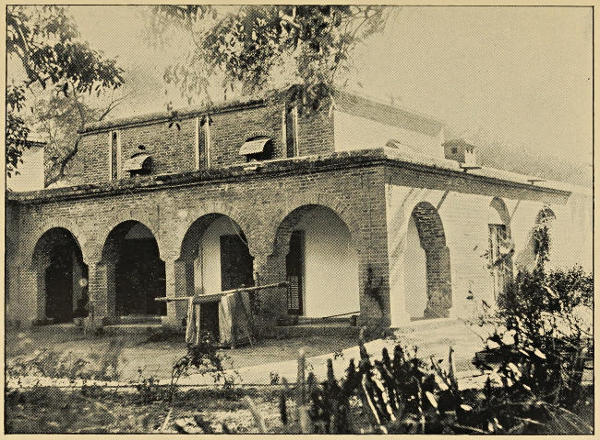
‘SUNSET,’ A. L. O. E.’S THREE-ROOMED HOUSE
Letters at this late period of Miss Tucker’s life become
so abundant, from numerous quarters, that the main
difficulty is in selection, the main cause of regret is that
so few can be used. The history of 1891 and 1892 may
be told chiefly by Miss Tucker’s details of what went on.
Miss Dixie remained her constant companion in the little
Mission bungalow all these years,—except when absent
for her summer holiday, or on furlough. Others came
and went, remaining a longer or a shorter time in Batala.
Dr. Weitbrecht had settled down as C.M.S. Missionary in
the place; and Mr. Bateman, stationed at Narowal, came
and went on itinerating expeditions.
Charlotte Tucker still lived her life of rigid simplicity;
though perhaps certain indulgences, immaterial when she
was younger and in more vigorous health, had now
become a positive necessity. Long Indian toil, as well as
sharp illnesses, had told upon her; and at seventy she had
every appearance of being ninety. Yet, through weakness,
weariness, and languor, she struggled on, and kept up her
steady round of work.
The little ‘Sunset’ house, in which she lived, consisted
mainly of the following: bath-room, size 8 feet by 8;
dressing-room, size 13 feet by 8; the one large principal
room, size 24 feet by 13, divided by a screen into bedroom
and sitting-room; and the verandahs. Miss Tucker’s
chief room has been described to me by one who spent
months at Batala, as, at this date,—‘Rather bare and
shabby, and used to have rather an untidy look.... As
you went in from the verandah in front, the fireplace was
on your left, and a sofa, with a screen behind it, screening
off the bed, on your right. In front of you was the little
table, where she used to write. I cannot remember all of
the furniture; there was not very much,—I think some
shelves on each side of the fireplace.’
This does not sound too luxurious. No doubt Miss
Tucker might, without expense, have made her rooms much
prettier, but for her passion for giving away. She seldom
kept for herself more than was imperatively needed.
While on this subject, it may be worth remarking, as
regards the food of the Missionary ladies in Batala, that the
cost of it has been found to amount, on an average, to about
eight annas a day,—an anna being worth rather less than
a penny. The said estimate applies to an ordinary time,
including a certain amount of entertaining of visitors. Probably
the cost would be much the same in other parts of
the Panjab, unless it were slightly more in large Stations.
A few scattered sentences from the Journal may
precede the letters of 1891:—
‘April 30, 1889.—Villages.... Sikh bibi very nice. I said, “I
am very weak. If you heard that I died, what would you say?”
Reply: “Gone to Jesus! Gone to Heaven!” After a while I
asked, “Were I to hear of your death, what should I say?” A little
delay; then a bibi observed on the kirpa, mercy, of Jesus, and
thought that He might take them too.’
‘Aug. 31.—“Faint, yet pursuing,” must be my motto. The two
boys from ——, who came to Anarkalli, as if resolved to embrace
Christianity, but, being without root, left us again, seem to have done
much harm. The Muhammadans more bitter than before. Twice
this week I—an aged servant of Christ—have been turned away
from the Zenanas, to which I went in gentleness and kindness. To-day
I was rejected at a fourth.... It is a strain upon the threefold
cord of Faith, Hope, and Love, this deliberate choosing of darkness
instead of light, Barabbas instead of Christ. We need the prayers
of God’s people, and to remember the promise, “In due season ye
shall reap if ye faint not.”’
‘Sept. 4.— ... Two places very nice. B. is determined to be a
Christian, and teach his wife. Wants Urdu Gospel....
‘Sept. 5.— ... Felt ill; half-blind; yet generally well-heard....
‘Sept. 6.— ... Ophthalmia, but managed to go to Q. five places....
‘Dec. 12, 1889.—D.G. Hindus cross. As I mounted dark stair,
heard “Buha band.”[127] However, I ventured up, smiling, and said,—“When
you come to the Dispensary, the door is not shut.”
There were four women; the two elder cross, not the younger.
At first no seat was offered me; then some one said, “Buddhi,”[128]
on which a small mat was brought, and the old woman meekly
sat down. I tried to make my visit pleasant, showed my Golden
Tree, and sang. It was a kind of breaking of ice. I took
care not to stay very long. When I had risen, the two younger
salaamed. I turned, smiling, to one cross old lady, and coaxed her
to return my salaam. After a little while she did so; but I wanted to
conquer the toughest also. The younger women listened, much
amused, to my polite expostulations on her rudeness. At last the old
hand went up to the brow, and I departed, contented. The ice was
broken. One can go again.’
‘Dec. 25, Christmas, 1889.—Nice. D., B., and children, made
catechumens.’
‘Dec. 27.—The best day, I think, that I have ever had in Zenanas....
N. B., A very nice visit. Two fine young men, and at least
seven women of various ages, appeared pleased, interested, and
without any bigotry. So much inclined towards Christianity did one
man in particular seem, that I spoke of the advantage of a united
family accepting the Truth, and expressed a hope that all would come
out. “Sat!”[129] echoed the Hindu heartily, throwing up one of his
hands, as though to give force to the word.’
‘June 29, 1890.—I have, three times in as many weeks, been able
freely to show a Bible picture in Islami schools, and speak of Christ.
To-day, as I walked in the streets, twice tradesmen in their little
shops wished to see my picture. I stopped, and others gathered
round, whilst I explained.’
‘Sept. 2, 1890.... K., she sad. Seems to regret death of her
poor young S., whom she kept such a prisoner, and of whom I
thought, “If any one in that quarter be a secret believer, it is she!”
I could seldom get into the house. The sweet S. was quite a
prisoner. I have even stood before the window, and sung in the
open lane, hoping that S. would hear the sound of my voice, like
imprisoned Richard. I hear that S. gave birth to a girl, “a very
beautiful tiny child,” who only lived for a month, and the young
mother soon followed. I have strong hopes that both are with the
Lord Jesus.’
‘Feb. 9, 1891.— ... I have suffered greatly from chilliness this cold
weather. Perhaps in no winter during my whole life more. Old
age. Ague.’
‘March 25, 1891.—Song. W. B. Buckle; but my best hearer was
R. L., very interesting schoolboy. He met me at my first Zenana, and
followed me to all the others. He was so nice,—even singing bhajans—that
I thought at first that he must have learned at the Plough.
With interest, amid interruptions from women, listened to story of the
three Jews in the furnace, and told it afterwards in another Zenana.
He was a help to me, explaining the Buckle, etc., very nicely. When
the subject was Christ’s Ascension, the boy said that He had gone up
to God Almighty. I intend to write out the song for the dear
fellow.... His heart seemed so impressionable, and his face
brightened at the thought of the Crown to be given to “those who
believe in Jesus.” “I want to be a Christian,” he said in English.
Lord, bless him. Give him the Crown.’
‘April 13, 1891.... R. E. took me into her arms; felt so slim
encircled by them. I noticed a quantity of jewels on her arms.
She popped her bare feet on my knee,—I was seated on the
ground,—to show me the jewels on them. Her amount of clothing
was by no means proportionate. Presently down went her forehead
on my lap. I silently hoped that there was not much oil on
her hair.’
‘May 14.—Hindus very nice. My A. B., cheerful-looking C. D.,
another whom I do not know so well, E. F. These three all hope
to meet me in Heaven. When I said to C. D., “But how can we
go? We are sinners!”—her simple reply was, “Jesus Christ, Guide.”
I have hopes of these three.’
‘May 15.—F. G., nice intelligent man. I was surprised at a little
boy, H. I., being able to read. Gave him hymn-book. Was much
followed about by boys....’
‘May 25, 1891.... Felt the weight of years much. Work a
struggle! Lord, help me!...’
‘June 4.... L. very nice. When I said that she was patient, poor
dying hand pointed upwards. Peace on face. Many listened....’
‘June 22.... I am to start to-day for Dalhousie. Feel old and
rather worn out. If I live to 1892 must not stay down[130] so long....’
‘Aug 14, 1891.... I sat outside with Bibis, in front of ——‘s
house. The door half open, behind it pretty smiling young Bibi,
who again and again silently made signs to me to come in. Did so,
and sat beside her. She did not utter one word, but by her looks
tried to show me that she received the Word, and believed. She
only said “Salaam,” when I left. I read to her of Christ being the
Good Shepherd, His own words.’
‘Dec. 24.—J. ill; sweet. Told me that, sitting up in bed, she saw
beings come in, clothed in white shining raiment. Felt frightened.
Asked why they did not speak. Afterwards fell asleep, and dreamed
of being taken to a beautiful place. She is, we think, a true believer,
confesses herself sinful, and looks to Christ for salvation. Asked
her if she would like baptism. “Yes.” “Would your husband allow
it?” “No.”’
These are specimens of the longer entries. The majority
are exceedingly brief, consisting for the most part of names,
initials, and single words. Letters to Mrs. Hamilton in
the early part of 1891 are unusually few: not that the
usual number were not written, but few have been kept.
In the spring of that year there was some discussion as to
the name of ‘The Plough School,’—her own favourite
name for the School, which meant much to her. One
cannot but regret that any stir should have been made
about the matter, when she had been the ‘mother’ of the
school. The criticism having been put forward, however
needlessly, she wrote to Mr. Baring:—
‘By-the-by, the name “Plough” is objected to, as sounding like a
public-house.... How could we choose a name that would signify
entire dependence on God?... The Plough appears to be flourishing.
Boys come to it even from what we call the large Government
School. Numbers have arisen to about 113. To-day I had no fewer
than seven rather superior boys from the Plough. They come for
religious conversation and Bible pictures.’
On the 17th of June 1891 she wrote to Mrs. Gardiner
about the recent death of that remarkable man, Bishop
French,—no longer holding the position of a Bishop, but
working as a simple Missionary.
‘My dear Mrs. Gardiner,—Though June in the plains is not the
most favourable month for letter-writing, especially to a Septuagenarian,
I will not let your kind note remain longer unanswered.
‘Yes, indeed, our late loved Bishop French was a saint, one whose
memory is sweet, whose example is lofty. You will have seen the
article in the Panjab Mission News. I think that it was written by
Rowland Bateman, who, so like himself, feels not having rushed off in
all the heat, to have been at the side of his venerated Friend, left alone
in a land of strangers. But the dear Saint was not alone! What a
glorious ending to his beautiful course! He reminds one, when
dying in the grapple with Muhammadanism in the very home of its
birth, of the Swiss hero, who broke the phalanx of the enemy by
clasping the spears of the foremost in his arms, and so receiving them
into his breast.
“‘Make way for liberty,’ he cried;
‘Make way for liberty!’—and died.”
‘Of course there will be a Memoir of Bishop French,—but where
is the Boswell competent to write it? Who could give all the
delicate touches, needed for a perfect portrait of one with so many
idiosyncrasies?
‘How well I remember the dear Bishop coming all the way from
Lahore,—when there was no railway,—to visit me, when I was
supposed to be dying.[131] He sat by my bedside, gently talking. I do
not remember that I said anything to him. I was looking up at his
face, and thinking what a lovely medallion might be made of it in
wax! It was an earthly thought; but when you recall the delicate
features, pure complexion, and saintly look, of that countenance, you
will hardly wonder at the sick woman’s reflection.
‘My letters, or rather letter, from England came in when I was
engaged in writing, and you will not wonder at the blot on the last
page.... I feel now disinclined to write at all. My beloved sister,
Mrs. Hamilton, has been seriously ill; but, thank God, to-day’s
account of her is good.—Yours affectionately,
C. M. Tucker.
TO MISS MINNIE DIXIE.
‘(From the Hills) July 4, 1891.
‘I am not timid about snakes; but H. has seen four lately, and it
is only common-sense to look under one’s bed, as the heat compels
open windows and doors. I have only fish-insects and tarantulas at
present, but am promised plenty of scorpions, centipedes, and leeches,
in the rains. You know I have not your talent for squashing reptiles;
and if I called out for help in the unpleasant business, I doubt
whether any one would hear me. I rather think that this will be my
last visit to the Hills, and that Amritsar will be my Sanatarium in
future.’
The two next letters to Miss Dixie are about the
outbreak of smallpox in Batala. She was ‘quite ready to
nurse a smallpox patient, should the malady spread.’
And again,—’ Why should I delay my return? As a
Missionary, I am liable any day to meet children with
smallpox full out. I hope to be with you in about a
fortnight.’
TO MISS LANGLEY.
‘Batala, July 29, 1891.
‘It is very kind of you to ask what kind of things would be most
useful here. For sale, pretty little articles of dress for English
children, from one day old to five years, are most readily disposed of.
We are afraid of woollen articles, as they are so difficult to keep.
White ants are a real puzzle at Batala.... Happily cotton or silk
they attack much less. Gentlemen’s neckties, of a fashionable shape,
would be likely to sell well. Station-people in India think at least as
much about fashion as Londoners do. A few pretty cosies and
toilet or tea-table covers would be nice, and some elegant dolls.
These would suit for sales. For presents in schools—cheap dolls,
gay and rather gaudy; bags, with cotton and tape; kurtas, common
gay print, that will wash. I dare say that Miss Cockle could supply
a pattern. The kurtas need to be made of Oriental shape, or they
would not be worn by the school-children.’
An attack of ophthalmia in her eyes, which must have
caused much suffering, is made light of in her letters; and
in the same passing manner she alludes to a fall, whereby
her face was turned black and blue. The main point in
connection with this accident seemed to her to be the
kindness and sympathy shown by Batala people, when she
went to visit them, and the fact that nobody smiled at her
discoloured and swollen features.
TO MISS LEILA HAMILTON.
‘Sept. 12, 1891.
‘You will see a half-sheet; it belonged to a whole one, but the
first half, alas! I have had to tear up; for it gave such a bright
account of one, who, only to-day, I have found out has been
deceiving us for many months!... Let us drop the painful subject.
‘I had a visit early this morning from a real servant of God, dear
old K. S.! One thinks of him rather as the learned and pious
Pandit, than as the ordained Pastor; he leads such a wandering life.
His faithful heart was heavy to-day, from the inconsistencies of
professed Native Christians. He thought them better out of the Fold
than in it;—so do I, for many are not sheep at all!
‘I have not yet heard whether dear Mr. Bateman has recovered.
I have written to him to-day. My letter will not cheer him, but he
must know facts. Blindness is no benefit. We want light and air.
Do you know, dear, that we felt our church dreadfully close,—yes,
for years and years. The cause was obvious to us ladies. The doors
and lower windows were often opened; the upper windows never!
It was troublesome to get at such high ones; so year after year the
bad air, which came from breath, ascended, and had no vent. Last
Sunday, after my earnest protest, the windows were opened, and we
breathed pure air!
‘We are very quiet now; but in two or three weeks will begin the
rush from the Hills; the season for work beginning, and the season
for visiting too.... It is possible that in the beginning of October
I may go for a week or so to Futteyghur with sweet Daisy Key, to
teach the Christian peasants in that out-of-the-way spot. I think
that the quietness, with one choice companion, would suit me better
than the bustle of many arrivals at Batala. About the 1st of
November I am engaged to go for a short visit to dear Louis and
Lettie at Rawal Pindi.... The journey is not a very fatiguing one,
as I can go all the way by train. Rawal Pindi is a city at the foot of
the Himalayas; there is no mounting up.’
‘Sept. 16, 1891.—My own sweet Sister, I do confess with regret that
I wrote too hastily about ——, as dear M. C. does not think him
bad, and hopes that he may be useful in time. I was vexed and
impatient at my Laura being so worried, year after year.... But I
was wrong, dear, I frankly own it! I wonder when I shall be given
grace to be really loving, gentle, and patient!
‘Poor dear Daisy and I have been sadly tried lately by the wickedness
of those in our own compound. We both feel that it will be a
relief to get away for a while to Futteyghur, which we shall probably
do in the beginning of October.... But oh, let me not be so
ungrateful to the Lord, or so unjust to dear excellent Native Christian
friends, as to say in my haste, “All men are liars!” Poor Daisy
thinks Batala the most wicked place that she has ever been in; and
so do I? But precious jewels come to Batala, though very few out of
it....
‘But I must not write only of trials, love. If you could have
dropped in upon us yesterday evening, you would have thought us a
very happy party. See Char, in one part of the room, playing at
chess with our good Pastor, Nobin Chanda;[132] ... dear Babu Singha,
the excellent and wise, a special comfort to me, looking on in his
quiet benevolent way. At the other side see sweet Daisy, animated
and bright, playing at our famous Batala game with a choice set of
Natives; ... and last, not least, dear Rosie Singha, our honorary
and very steady worker in the Dispensary. I feel giving these kinds
of parties a real duty; and they give, at little cost, so much innocent
enjoyment. It is well for the Missionaries too to have pauses, in a
struggle with so much that is repulsive and saddening.... I think
that Rowland is not now actually ill, as he writes about being in the
midst of a sermon. I hope that he will be able to pay Batala a
flying visit before long.... He has so many Missionary troubles,
and we cannot help adding to them. But—
‘“Soon and for ever, we’ll see as we’re seen,
And learn the deep meaning of things that have been!”’
‘Sept. 27, 1891.—I will steal a bit from the morning to write a
little to you. We are living rather in a bustle at present; the tide of
Missionaries running down from the Hills, rather sweeping over
Batala. Dear Rowland is here.... Miss Boyd is here. She is to
be married, please God, next week.... Her visit has been a real
help to me, at a time of much Missionary difficulty.... Her Betrothed
has been to Muscat, to gather information about the last days of dear
Bishop French.... Miss —— returned here on Saturday; Miss
Dixie and the Corfields start for Batala to-day. One lady comes
here from Amritsar to-day; we are to start her from hence at 4 A.M.
to-morrow, Tuesday.... I shall be very glad to be quietly off, ...
out of a kind of whirlpool. We will have eight at dinner to-day;
quite as much as our table will hold.’
‘Futteyghur, Oct. 11.—I watch with much interest the Christian
father, R. M., when at our long Services his little four-years old
Z. is beside him. It is lovely to see the peaceful confiding loving clinging
trust of the little child, as she cuddles to her strong father, and
his gentle tenderness to the wee girl.... It makes me think of our
Heavenly Father and us, His weak little ones. But an elder girl
of R. M. was bitten by a snake; and then the tender father
showed “the hardness of love.” He resolutely cut out the poisoned
part with a penknife. The poor child screamed terribly, but still the
parent cut on. I dare say that his own heart felt gashed. The child
was saved. O when our Heavenly Father thus wounds to save,
may we have grace to lie still!’
One would much like to know the rest of this story,
and how the poor father managed to keep his little girl
from bleeding to death. His courage must indeed have
been great.
Later in the same letter, when again on the never-failing
topic of troubles and disappointments in the work,
Miss Tucker says,—‘O what need we Missionaries have of
wisdom! We are so liable to make mistakes.’
TO —— ——
‘Oct. 24, 1891.
‘I was in Sikh villages this morning. The Sikhs are more
friendly than the Muhammadans. I have often told them that if
their respectable Guru Nanak were here on Earth now, he would probably
become a Christian. I said that I had heard that there was
something about our Lord in the Granth. The Sikh with whom I
was conversing at once gave me the “Slok,” and translated its difficult
antique Panjabi. This is the Slok in English; “That Cutter of
demons’ heads, the world’s revered Jesus!” The Sikh said that
“Isa” (Jesus) was thought by them to be “Ishur,—God Almighty.”
I replied that we too called Jesus, God!’
TO MRS. HAMILTON.
‘Oct. 30.—Many many thanks, mine own sweet Sister, for yours of
the 8th, and all your loving thought for Char.’s comfort. You would
keep the bird in a golden cage, lined with soft fur! But Char. is a
bit of a wild bird, and likes to fly about freely. The fur will be
delicious on cold mornings and evenings; but to wear it all day, even
in December, would feel exhaustingly warm. One needs to adapt
oneself perpetually to the changes of temperature in December and
January; this needs a little Indian experience and common-sense.
The want of these two things is one cause of Indian break-downs.
Inexperienced Missionaries think it safe to do in India what they
have done in old England! If you consider, love, that I have kept
my health, with some few interruptions, for almost sixteen years in
India, you may allow that I am a fair manager of it. I am thought
rather a wonder.
‘As for having “a really nice capable maid to wait upon” me;—O
dear!—dear—DEAR!! I might fill a whole line with such exclamations,
to express my almost horror at such a proposal! Europeans,
except good working Missionaries, who can help, are dreadful
anxieties and troubles. An Englishwoman in service is always a
possible invalid, and a probable grumbler. I never in my life could
stand a person running after me and watching me. I have an ayah
to attend to my room,—and could have plenty of darzies to mend my
clothes, but I prefer doing a little stitching myself. I am not always
tumbling down like a ninepin,—but I would prefer tumbling once or
twice a month to having any one always watching me. Dear Minnie
insists on handing me to my room at night. You must remember
that I am the adopted Aunt of a Doctor Miss Sahiba.
‘This is rather a frisky note, darling. When I am a real invalid,
I am said to be a good one; but I am strongly averse to becoming
one when I am in fair health.... I know how dear Laura and
Leila would constantly be putting soft fetters of love round me; but
they would find me an obstreperous bird. I should break the fetters
by sudden astonishing efforts,—as I fled from the Doctor lady who
came from Amritsar. I knew that the Weitbrechts wanted her to
see me. After breakfast she went with Dr. W. into his study, to look
at something. I saw my opportunity, hurried down the long stair,
and into my duli;—
‘“They’re gone! she’s gone,—over, etc.”
I knew that I was safe, as Batala has twelve entrances; and no one
could tell which I had taken. It was rare fun, and seemed to do me
more good than physic could have done. So take no anxious thought
about me, love.’
The being ‘handed to her room at night’ was found to
be a necessity in her old age. After spending the evening
in Sonnenschein with the younger ladies,—generally either
reading aloud, or playing games,—she had to go out into
the front verandah, and to pass along it till she reached
the door of her own little ‘Sunset’ dwelling. If alone,
she was apt to stumble, or to run against something, and
the regular plan was adopted of either Miss Dixie or one
other of her nieces always accompanying the older lady, on
this small nightly pilgrimage.
TO MISS LAURA VERONICA TUCKER.
‘Nov. 18, 1891.
‘Oh, dearest Laura Veronica, what a warm capital web you have
spread for her whom you call Fairy Frisket. Certainly I look very
unlike a fairy; and a very comfy rug is far more suitable for me than
gossamer wings or glittering wand! A bibi expressed surprise to-day
that a weak old woman could sing; but I told her that I sing
every day in my life. If I stopped for a week, perhaps my throat
might find out my age! I must not give it a chance of so doing. The
same with my feet; the dear kind E——s were always offering me
a drive, and I often took one with L.; but—oh, my friends, Misses
Feet, you had to do your work too. No laziness tolerated; or you
might presume to fancy yourselves antiquated. Now I am back in
harness again, have been to the city to-day, and intend to visit a
village-school to-morrow, unless Daisy Key go instead. She is far
better at teaching than I am. But I am afraid that I have not yet
thanked my sweet niece for the capital rug. I do so now with a kind
kiss....
‘Yesterday, in the railway carriage, I offered a wee book by
Spurgeon to a tall big man, connected with the railway department.
He asked me immediately if I were related to ——, and gave his
opinion that —— was a real good man. My frank companion
expressed, however, a general dislike to Missionaries. “Why do you
not like us?” I asked mildly. He had evidently not been fortunate
in some that he had known,—their names were not familiar to me.
He disliked their preferring working on Natives instead of their own
countrymen, and evidently thought them too comfortable! But what
can I do, when my dear relatives send such charming gifts to your
attached old Auntie Char?’
TO MR. AND MRS. ST. GEORGE TUCKER.
‘Dec. 12, 1891.
‘Your very handsome and very kind—only too handsome—gift
reached me safely this morning; just the right time for the arrival, as
the air in the morning is very keen, and then fur is a real comfort.
Much has your fine jacket been admired,—so “beautiful,” so “grand.”
But it does not look unsuitable even for Missionary use. Very many
affectionate thanks for this token of your affection. It quite strikes
as well as gratifies me, to see how little difference sixteen years of
absence seems to make as regards the loving-kindness of my dear
relatives. They do not seem to forget the aged Missionary, or weary
of showing her tokens of love.
‘We are to have an interesting Ordination Service next Sunday.
F. M. and I. U., Converts from Muhammadanism, tried and true,
are to be appointed Deacons. We expect the Bishop on Thursday.
He will, we hope, lay the first stone of our Mission School Building,
so called,[133] on Saturday.... I have begged that the building may be
very plain,—dear Mr. Baring gave the money for it.... It is a
great matter for some religious instruction to be given to more than
130 boys from Heathen and Muhammadan homes.’
TO MRS. HAMILTON.
‘Dec. 21.
‘We have been having a busy time.... On Sunday there was
the interesting Ordination. To-day the dear Bishop kindly laid the
first stone of Mr. Baring’s generous gift to Batala, a building for the
City School. A number of Muhammadans and Hindus were present;
but the service was most distinctly Christian. The Gloria
Patri was repeated again and again; the precious Name of Christ
was not only on the stone, but in the prayers and portion of the Bible
read.... At the gathering I saw many interesting persons, both
English and Native.... The Bishop is such a lovable man; gentle,
bright, affectionate; showing not a particle of pride. We do not
call him “My lord,” but “Bishop.”’
‘(Undated.)—Beloved Sister, this is the last Sunday of 1891; may
1892 be rich in blessings to you and your loved ones of two generations.
“He leadeth me,—oh, blessed thought!”
‘It is good for me to be a while in this quiet place.[134] Batala at
Christmas time is too bustling. Merry festivities are more delightful
to the young than the old. I expected dear Herbert and Mr.
Channing to dine with us; and to my surprise we sat down twelve.
It was all right; we should use hospitality without grudging,
especially at Christmas time; but you know that Char. has a sorrow
at her heart. I retired from the merry games, to prepare for the
next day’s long journey. O my Laura, ask for me a gentle sympathising
spirit,—
‘“To meet the glad with cheerful smiles,
And to wipe the weeping eyes.”’
Was the ‘sorrow’ here spoken of, the delicate health of
‘her Laura?’ If the sister in India was ageing fast, the
sister in England was failing fast. Parted as they had
been during sixteen long years, the loving sympathy
between them was as fresh and ardent as ever. A dread
had long oppressed Mrs. Hamilton that ‘her Char.’ would
soon be called away. But though the summons to the
elder sister was indeed not far distant, that to the younger
sister was to arrive first.
The Evening of Miss Tucker’s life was passing fast away.
Sixteen years of her long Indian campaign were over.
Only two years remained. But the end of her Evening
was to be Day, not Night. For nearly forty years she had
looked forward with joy to the great change; for more
than twenty she had longed with an impassioned craving
for a sight, Face to face, of that dear Lord and Master
whom she loved. And though she did not know it, the
time was drawing very near. Could she have known it, the
passing troubles of these months would have seemed easy
to bear, in the light of coming glory. Barely two more
years of toil and weariness,—and then—the Home-going!
One more heavy sorrow had to come first; one more
sharp blow upon the golden staff of her Will. Many a
blow had fallen since she wrote her little book, The Giant-Killer;
many dear ones had been called away by death.
And now the summons was going forth for the dearest of
all; the sister-friend, who from very infancy had been one
with herself. No shadow had ever fallen on their love one
for another. Before the close of 1892 the shadow of death
was to fall across it, leaving Charlotte Tucker more lonely
in heart than she had ever been before. But the shadow
was to fall for a very little while. Only a few months of
separation; and then the sisters would be together again.
‘“Stay thy hand!”’ Fides exclaimed, in the story by A. L. O. E.,
as blow after blow fell on the golden staff. ‘“It can bear no more!”’
‘“Yet a little patience,” cried Experience, and struck it again.
Then the Will was restored to Fides,—straight, pure, beautiful,—oh,
how unlike that staff which had been so deadly in the grasp of Pride!
‘As Fides stood gazing on the fair gift before him, once more, and
for the last time, the shining robe and star-wreath of Conscience
flashed on his sight. Never before had her smile been so glad, so
beaming with the radiance of Heaven.
‘“The work is done,—the fight is over!” she exclaimed. “Thou
art summoned to the Presence of thy King! A messenger is even
now waiting to conduct thee to the Home which thou so long hast
desired! Go, bearing with thee the offering of a conquered Will, the
acknowledgment that not even that should be thine own, and the
remembrance of foes bravely met and overcome, through the might
of Him Who armed thee for the fight.... Go where all is gladness
and rejoicing and peace,—where war and danger shall be known no
more!”‘[135]
The work was nearly done; the fight was nearly over.
But Charlotte Tucker could not yet see the starry form,
could not yet hear the gentle accents, which soon would
bid her to ‘rise and come away.’ Before many days of
1892 had passed, she was back again in Batala; deep in
her usual round of work and interests.
‘Batala, Jan. 10.—Here am I at home again. I did so enjoy and
benefit by my visit to Narowal. It was not leaving work but leaving
cares. I worked every day, but the work was more encouraging, and
the feeling of repose so refreshing. If I live to see another Christmas,
I think that I shall run away to some quiet spot, like Narowal,
where the railway whistle is never heard....
‘When I was at peaceful Narowal, I happened to read in a printed
paper a kind of fable, which has been such a comfort to myself, that
I have put the idea into verse, and my Laura shall have a copy....
As we Missionaries have a great many more little annoyances than
great afflictions, I am inclined—for myself—to change the last line
but one into
‘“Change petty worries to plumage on wings.”
‘You know there are on a bird’s pinion, not only the long feathers,
but the little tiny ones; but how that fluffy downy sort add to beauty
and comfort!...
“WEIGHTS AND WINGS.
‘“Sweet is a parable which I have read;
Birds at the first could not soar into air,
Bound to the earth; till their Maker, ’tis said,
Gave to each two little burdens to bear.
Proud ones refused the least burden to lift;
Others, submissive, obediently cried,—
‘All that He sends we will take as a gift;
Feeble are we, yet will strength be supplied.’
“Raising her burdens, each bird with surprise
Finds to her weak frame most closely it clings;
Soft, light and beautiful, radiant with dyes,
Lo! every weight has expanded to wings!
Woe to the creatures that clung to the ground!
They could not flutter bright wings in the sky;
Ne’er could they rise above Earth’s narrow bound,—
Whilst their companions were soaring on high.
“Take we up burdens of sorrow or care,
Looking to Him Who the trial has given,
Grace will give courage and patience to bear,
Make burdens wings to uplift us to Heaven.
When disappointment its heavy cross brings,
Lord, in each trial Thy love let us see;
Change e’en our heaviest woes into wings,
Onward and upward to bear us to Thee!”’
‘Feb. 12, 1892.
‘Mine own precious Sister,—Again have you been called to the
trial of sickness and suffering.... These trials may seem strange
and unaccountable to the children of earth, but how differently they
are regarded by the children of light! They make us keep closer to
the Father’s side,—cling more to His supporting Hand,—the weights
do turn into wings! O how often have I during late days thought
of that little parable! And when we reach the Blessed Shore, and
“know as we are known,” we shall fully realise why it is good that we
should be afflicted....
‘I was reading the Commandments aloud in a village yesterday,
when a bright young Hindu Pandit—rather well read—objected to
the Second. The poor fellow was probably conscious that he himself
was constantly breaking the Second Commandment. It interested
me to hear a middle-aged sensible-looking Sikh take the other side,
quietly, and with perfect good-temper. Each of the men afterwards
accepted a Gospel, one in Gurmukhi, one in Urdu.’
‘Feb. 18.—I am thankful for improved accounts of you.... We
have had rather an eventful week for Batala.... On Monday the
dear Bishop came in. Herbert asked me to take luncheon with him
on Tuesday. It was very nice; just the Bishop, Herbert, and four
nice Native Christians. I was the only lady.... At half-past three
we had a very interesting Confirmation Service in the Church, to
which the Bishop drove me. He gave a very nice address, which
Herbert translated beautifully into Panjabi, for the benefit of the
simple peasants. On the following morning the Bishop gave in
English such a practical heart-searching address to us workers! He
looked so earnestly at us ladies, and was evidently anxious to do us
real good. His was no idle display of eloquence; rather did his
address resemble the admonition of a kind wise father. We did not
see him after we left the chapel....
‘We have had a singularly mild and bright cold weather.... How
curious it would be to an English farmer to see fields green with
corn in February,—the Spring crop,—and, at the same time, other
bits of ground being ploughed up for the sowing of another crop!
There seems something always growing. There are lovely roses and
fruit blossoms, but the weather is now comparatively dark and dull.’
‘April 8, 1892.—The Muhammadans in Batala seem to be in a
much better humour than they may be expected to be during the
Ramazan—their grand fast. I have visited a good many Muhammadan
Zenanas this week; and in not one, so far as I remember, have
I heard a word about the fast, which was apt to make them so bigoted
and self-righteous. No one objects when I repeat in Urdu the
precious text, “By grace ye are saved, through faith,” etc. Indeed,
I believe that a good many Batala folk think that after all our
religion is better than their own. I repeat “God so loved ——”
more often, I think, than any other text; and I have not lately
heard the shocked exclamation, “Tauba! tauba!”[136] Perhaps it will
be different to-morrow, when I propose visiting two villages, which
were so bigoted and disagreeable, that I at one time struck both
out of my visiting-list. Minnie induced me to give them—at least
one of them—another trial, as she had given medical aid to the wife
of the Maulvi (Muhammadan religious teacher of the place), and
had found him very polite. No doubt the Dispensary opens doors.
I found the Maulvi bigoted but civil, and ... willing to receive a
New Testament.... I enjoy the quiet walk, and then ride in my
duli, in the cool fresh morning, when I visit villages. The harvest
has commenced. Here I see fields of ripening corn, there the
scattered sheaves. But the harvest is not so plentiful as it was last
year. We had too dry a cold weather; not nearly so chilly as the
former one. I am taking out illuminated texts just now. I have
beautiful ones, both in Persian, Urdu, and Gurmukhi. It is interesting
to see peasants, somewhat more intelligent than their fellows, spelling
out the precious verses from Scripture.’
‘April 12.—Precious darling Laura,—The Mail has to-day
brought me in your letter of March 24th; the first clear intimation of
the nature of your illness. I will not say that my eyes are dry. I own
that the selfish thought arose,—“Would that I had had it instead!”
And yet I prefer knowing the plain truth. I have comfort in the
thought, “I am old; whichever of us is taken first, the meeting—O
what a joyful meeting!—may not be far off!” ...
‘I am thankful that you do not suffer greatly. I fondly hope that
this trial may be spared. I do not feel inclined to add more. I need
not,—you know so much of your own loving Char.’
TO MISS ‘LEILA’ HAMILTON.
‘April 13, 1892.
‘Though I wrote to your beloved Mother yesterday, and shall only
be just in time to catch the post, my heart impels me to send a letter
to you, my dear afflicted God-daughter. I know that you try bravely
to bear up under your sore trial, so as not to add to that of your
precious invalid.... I am glad that I have been told the worst. It
has been good for my soul! Only the day before the mail came in,
I had been foolishly, sinfully, brooding over trifles, till I even showed
outward irritation, instead of reflecting that small annoyances as well
as great troubles are God’s loving discipline for us. Alas! that I should
have shown temper! The next day the Lord sent a quiet, holy sorrow,
and it did me good,—tears were wholesome,—I felt that I had been
petty and irritable, and deserved a different kind of trial. I have been
more under discipline since I attained the age of seventy than I have
perhaps ever been before in India. But should trifles disturb the
serenity of a Servant of a Crucified Saviour?... Thinking of your
real grief, I hope to be more patient with petty annoyances....
‘Write freely to me, dear Leila. To help you in your trouble will
not do me harm but good.’
‘April 17, 1892.—Beloved Laura, “The Lord is Risen indeed!”
This is the Easter greeting, and this is Easter morn. I shall soon
start for church; but first I would remind my darling sister and myself
of words like the clarion of a silver trumpet, followed by the
sound of an angel’s harp:—
‘“The Lord hath triumphed gloriously;
The Lord shall reign victoriously!
Seals assuring,
Guards securing,
Watch His earthly prison!
Seals are shattered,
Guards are scattered,—
Christ hath Risen!”
‘“No longer then let mourners weep,
Or call departed Christians ‘dead!’
For death is hallowed into sleep.
Each grave becomes a bed.”
‘“It is not exile—peace on high;
It is not sorrow,—rest from strife;
To fall asleep is not to die;
To be with Christ is better life!”
‘How beautiful are these lines,—how true!...
‘Oh, what Heavenly wisdom Missionaries need!... It seems to me
that dear people at home have a very imperfect idea of Missionaries,
and, in their prayers, probably ask for comfort in trial for God’s
servants, rather than for the wisdom which is from Above,—the
gentle influence of the Holy Spirit. Ask this for me, my Laura. I
do get impatient sometimes, and I make mistakes.’
‘May 2, 1892.—Books are a great enjoyment when I am alone, or
sitting, as I am at present, by the bedside of one who has been ill,
though now, thank God, recovering. We have had such a sick house,
your Char keeping well, when it seemed as if nobody else would;
delicate Miss —— coming next on the roll of health. She has been
able to take the housekeeping, and to help in the nursing, so we are
getting on, and hope that all will come right soon. Miss Dixie took
four children to Clarkabad, and returned April 23rd, quite ill....
Miss Wright is nursing her. Then ... Daisy and Miss Copes came
almost suddenly in from Futteyghur; Daisy’s fever had alarmed Miss
Copes.... Miss Copes had her turn next, and has suffered severely....
Char has felt some comfort from being of some use here.’
FROM THE REV. R. CLARK.
‘Cheshire, May 3, 1892.
‘My dear Mrs. Hamilton,— ... I saw dear Miss Tucker shortly
before I left Amritsar. She is, as you know, not strong; 2 Cor. iii.
13, R.V., always occurs to me when I see her. God is daily using her
to be a blessing to us all.’
C. M. T. TO MRS. HAMILTON.
‘May 8 (Seventy-first Birthday).
‘I am sure that my precious Laura has been thinking of me to-day,
as I have been thinking of her....
‘I think that it was some time before 5 A.M. that Mr. Corfield and
his boys came to greet me with a hymn. I was in my dressing-gown,
but hastily popped on my bonnet and went out to shake hands with
everybody. As it is well known that I do not wish gifts, and prefer
simple trifles that are useful, my presents were judiciously chosen,
and are, to my mind, curiously symbolical.
‘The Corfields gave me a box of soap,—fragrant, and typical
of cleansing. Miss Wright, a pretty little box of vaseline. This
pleased me particularly. I have said, and I think written, that every
Missionary should have a box of ointment, symbol of peace-keeping
and peace-making! Now I have one myself. Minnie gave pens.
May I make a good use of them!... Dear Babu Singha has given
me a hand-pankah (fan), which I waved gratefully in church this
morning. This is an emblem of refreshment in oppressive heat....
‘Dear Mr. Baring’s admirable building for the Mission Plough is
to be opened to-morrow by the Deputy Commissioner; and I
suppose that Muhammadan and Hindu big or little wigs will be
present. I am glad that my birthday falls on Sunday; so that the
tamasha is postponed till the next day. There is something solemn
about the Anniversary, when one has travelled so far on the Homeward
road. You will feel this, darling, on the 20th.[137] ... Dear
Herbert’s sermon to-day was on “Seekest thou great things for
thyself? Seek them not!” We should never have known Baruch’s
failing but for that warning word. I have been very much tamed
down, dearest.’
TO THE REV. F. H. BARING.
‘May 9, 1892.
‘I must tell you of the grand opening of your beautiful School
building to-day, while the scene is fresh in my mind, and before the
coming in of the home mail.... The thermometer has been nearly
92° in my room this morning.
‘The fine building was well filled; the part nearest the table with
Europeans and Baring boys; the Plough boys, very numerous, had
the larger space; and in front, on chairs, in stiff dignity, sat the city
magnates.... We sang a hymn; Mr. Wright ... read a Psalm;
and, we Christians standing, Herbert led the prayer. Then my
Nephew[138] made a short speech, followed by a nice one from dear
Babu Singha, and a kind of brief, satisfactory report from Nobin
Chanda.
‘And then up rose the Deputy Commissioner, and, to my great
surprise and great amusement, gave, in rough Urdu, such a whipping
to Batala and her magnates, as I never heard in a speech in my life.
First,—Batala, poor Batala, was not like any other city; it was so
quarrelsome! Clearly, the Deputy Commissioner (like Mr. ——,
who told me nearly sixteen years ago that Batala was the most
troublesome and litigious city in the district) has no fancy for the
place. Then the whip came down on the shoulders of the poor rais;[139]
and it was mercilessly plied. The magnates had to bear the
indignation of the Englishman for doing their best—or worst—to
prevent our getting ground for the school or the proposed Mission
Hospital. For whose benefit was the latter? asked the irate Deputy
Commissioner. Not for our own, but that of the women and children
of Batala! In short, the Englishman whipped the poor magnates,
till he made them bleed—in their purses. He told them that money
was wanted for school-benches, etc., and let them know that their
aid would be desirable. Paper was on the table.... Some put
down rupees; some wrote down promises. About 701 were thus
collected.... The whole thing was so funny that I could not help
being greatly amused. I wonder what the scolded Muhammadans
said, when they went back to their Zenanas....
‘Herbert said in his speech that your fine building will also be
used as Library, Reading-room, and Lecture-room. I think there
will be a Sunday-school also.’
TO MRS. HAMILTON.
‘May 15, 1892.—My precious Laura, you wish me to ask for you
more faith and love. I ask more, even for floods of joy. Why not,
darling? “Ask, and ye shall receive!” ... My trial, as regards
this matter, is different from yours. I have to learn patience to
restrain yearning to depart and be with Christ. I have twice, as it
were, in dangerous illness,—what men call “dangerous,”—caught a
glimpse of the River; and it seems glittering with sunbeams! I
long to cross it; but I feel that it would be wrong to pray to go.
The Master only knows when we are ready to go Home; but how
my spirits rise, if I see any likelihood of the time being near! I do
not feel this at present, for I have such a good constitution. Three
out of four of my Mission ladies here have been seriously ill; with
the fourth I can see that it is a weary struggle to get on; and I, an
aged woman, am not ill at all! I do not suppose that any of the four
really wish to quit the field—or the school. The one who does may
be kept long at her post. None can tell! I fall back on “The
Lord knows best.”’
‘May 20.—This is my own beloved Laura’s Birthday,—a day
which Char is not likely to forget. Sweet peace and joy be yours,
darling. You have added to the happiness of many. You have, as
it were, washed the disciples’ feet, and you are sitting at the Lord’s
Feet. That is what dear, saintly Fanny described as “the position
of a Christian.” Is it not a wondrous thought that you and I may be
welcomed by such as Fanny? She was not beautiful on earth; but
how fair she will be, raised “in His likeness”! The Saviour will be
“admired in His saints,”—a very remarkable expression, and a sweet
subject for thought. There is so much in us now not to be admired;
but when He comes to make up His jewels, all will be bright and
fair....
‘This has been a particularly hot season.... You would think 91°
warm in a bedroom at night. Miss —— and Daisy sleep out on
the roof: but I think myself too old for the chance of a midnight
scramble in my night-clothes, carrying my bedding down an outside
stair, should a dust-storm or thunder-storm come on. I keep on the
prudent side, which is inside.... A Sunday-school has been opened
in Mr. Baring’s beautiful new School-house. Attendance is of course
voluntary; and Mr. and Miss Wright, who have started the Sunday-school,
and who only expected to find about twenty boys, were
pleased to find about sixty pupils; not only the “Plough” boys, but
their teachers. Was not this grand?... I hope that dear Francis’
new building will be one of the best means of bringing hard-hearted
Batala to the knowledge of the Saviour. The laddies are often not
hard at all, but pleased and eager to hear about the Christian Faith.
The next generation may be very different from the present one.’
‘May 29.—Do not regret having told me about your state of
health. I like to know the truth, and at my advanced age may well
face it. Whether my darling Laura or myself be taken first, the
remaining one will have comfort. It is but a “little while”—
‘“Till He come! O let the words
Linger on the trembling chords,
Let the little space between
In their golden light be seen!”’
Early in June Miss Tucker took the long journey to
Simla, accompanied part of the way by Dr. Weitbrecht,
and afterwards by Dr. Lankester. Through the thoughtful
kindness of various friends, the journey was made as
little fatiguing to her as possible. On her arrival she was
so worn out as to sleep thirteen hours, with only one
break, but was afterwards none the worse. Writing of the
kind Cousins with whom she had gone to stay, she says:
‘The boys are charming, so clever, bright, and loving.
They make of me as much as if I were a pet Grandmother.
I bought a little toy for them; and they were
so much delighted with it, that I must have had between
the three boys nearly a dozen kisses for it. I wonder that
they are so fond of kissing a wrinkled old face.’
On June 17 she wrote from Simla:—
‘I am treated here with great kindness and consideration. I am
not pressed to exert myself; but of course I take my part when
friends come to dinner. To-day we are to have four Calcutta
Missionary ladies for dinner and games. To-morrow an old friend
of mine, Carry H., and her husband, and Lord Radstock. One
of the most lovable guests that we have had is our own Bishop of
Lahore. I am to go to his lecture on Isaiah this evening....
‘There is an excellent piano here, and dear Mackworth Young
plays exquisitely.... How you would have enjoyed Beethoven’s
Hallelujah Chorus, which he has played to me twice from memory!
“Worlds unborn shall sing His glory—the exalted Son of God!”
Do not those words recall the dear old Ancient Concerts? Yesterday
I was tempted, when alone, to open the piano myself;
and what do you think was one of the things which I sang
and played? My Laura’s “The Lord He is my Strength and
Stay!” That too reminds of old times. O what will Heaven’s
music be!’
The following letter, written from Simla to Miss Raikes,
was on the subject of a translation into Bengali of her
little book, The Story of Dr. Duff:—
‘June 20, 1892.—If I have neglected thanking you for a copy of
your translation, pray forgive an aged and half worn-out Missionary;—I
am seventy-one, and in weak health. In our Panjab I have no
intercourse with Bengalis, except such as know English more or less;
and I am not acquainted with a word of the Bengali language, Urdu
and Panjabi being what is spoken, so that I could not myself judge
of your translation. At Simla, however, where I am on a visit, I hear
that there are Bengalis, and I might find some to whom I could
present the book, which has been your labour of love. I cannot but
hope that you have not published 2000 copies at your own expense.
I never do; but a Society prints, and takes the risk. If the Bengalis
be like the Panjabis, it will be difficult to sell so many copies at
8 annas each. If I remember rightly, my little Life of Duff only
costs 2 annas; and our people think that a good deal! But Bengal
may be more liberal.’
The next letter—like one or two on the same topic,
already quoted—is of peculiar interest, because, some
three years earlier, Miss Tucker had been a good deal
exercised in spirit about the fact of Bishop French’s
successor being a decided High Churchman, and had
more than once written in strong and melancholy terms
to her sister on the subject. The tone in which she now
wrote, in 1892, is remarkable, as being by no means in
accord with her former prejudices. But Charlotte Tucker,
as I have had occasion to remark before, was not one of
those small-natured people, who always stick fast to what
they have said, because they have said it. She was ever
ready for fresh light upon any matter. It appears to me
that we see here in her some measure of that widening
of spiritual outlook, which ought to become visible with
advancing years and with a closer knowledge of the Spirit
of Christ. Probably she was not herself definitely conscious
of any difference.
‘Simla, July 3, 1892.—My beloved Laura, I have just come from
church, from partaking of Holy Communion. Our Bishop preached.
It was a sermon whose gist I do not think that I shall ever forget;
for it presented a most familiar text in—to me—quite a new and very
striking light: “Blessed are the poor in spirit.” The Bishop said
that many persons—I was amongst them—“took the Blessing as
meant for the humble”; but he, referring to the parallel passage in St.
Luke’s Gospel, showed that this is a limitation of the meaning. The
poor in spirit are those who count themselves as actually possessors
of nothing; the goods which are called theirs are merely lent of God,
to be taken up or laid down simply at His pleasure. In the face of
a large congregation, in gay, fashionable, money-seeking Simla, our
Bishop with fervent energy preached a sermon on Unworldliness!
May God write it in the hearts of the hearers!
‘I thank God for our Bishop. His influence is of untold value;
he is so gentle, courteous, considerate, that he does not, I should
think, usually give offence. I had the enjoyment yesterday of, I
think, more than an hour’s tête-à-tête with him. It interested me
much, for Bishop Matthews never puts himself on a pedestal. If
his Episcopal position resembles one, he comes down at once, with
humility and frankness, and seems like a brother. The Bishop
never appears to mind in the least my not calling him “lord,” either
in correspondence or in speaking. One has the impression that
he does not care a straw about it. I am struck by the pains which
he is taking about the case of a young Native Christian.... The
Bishop is investigating the matter with father-like interest.... It
is a cause of deep thankfulness that European or Native can appeal
to a good, wise Bishop.’
Miss Tucker does not, here or elsewhere, state why she
objected to calling a Bishop “my lord.”
TO MISS ‘LEILA’ HAMILTON.
‘July 3, 1892.
‘We had a Missionary Meeting last week, at which the most
striking speech was that of Mr. Lefroy[140] of Delhi. I could not
help thinking this, though the Bishop, Mr. Young, and my dear
nephew, Dr. Weitbrecht, spoke before him. In simple, manly
fashion, as one not thinking of human praise, Mr. Lefroy described
what seemed to me like a grand single combat between himself
and a Muhammadan Hafiz,—one who knows the whole Koran by
heart—of great influence. The Hafiz, a great opposer of Christianity,
asked Mr. Lefroy to have a long discussion with him, not saying
that he must go, or was tired, etc. Our champion accepted the
challenge at once. The Hafiz appointed a mosque as the place of
meeting.
‘Mr. Lefroy went at the appointed hour, and, to his surprise,
found about 500 Muhammadans waiting for him. They were very
attentive listeners; but great, very great, must have been the strain
upon the noble and gifted Missionary. Till midnight, for about
five hours and a half, in hot Delhi, in the fiery month of June, Mr.
Lefroy held up the Christian Banner against the Hafiz and others.
At midnight, after one Muhammadan had been arguing against our
Faith, the Hafiz said to him: “If you can bring forward no better
arguments, I will take the Missionary’s hand, and go out with him!”
He did not do so then; he had not sufficient courage to face the
storm of opposition; and again he failed on another occasion, to
Mr. Lefroy’s great disappointment. But after months, that Hafiz
is a Baptized Christian now. God gave His champion the victory
at last!’
TO MISS HOERNLE.
‘July 18, 1892.
‘I am still, as you see, at Simla, but expect to start on my long
journey downhill on the 21st. We have had a great quantity of
rain. I hear that Batala is flooded, so the heat will be much
lessened....
‘Yesterday was Sunday, and the dear Bishop and a few others
dined with us, and we had nice hymn-singing afterwards. How
you would have liked to have occupied my seat at the dinner-table!
I was next the Bishop, and Dr. Weitbrecht sat just opposite....
‘I need not tell you that the mountains are very beautiful;
especially, to my mind, when a white cloud, which has been, as
it were, quite blotting them out, is lifted, and one beholds the
glorious peaks and wooded valleys, lovely in the bright sunshine. It
reminds one of the American Poet’s striking lines on a yet loftier
theme,—
‘“Soon shall the whole
Like a parchéd scroll
Before my amazéd eyes uproll,
And without a screen,
At a burst be seen,
The Presence in which I have ever been!”
‘Ah, dear Maria, well may we exclaim—
‘“O to be ready, ready, for that Day—
Who would not cast Earth’s dearest joys away!”’
TO MRS. HAMILTON.
‘Batala, Aug. 8, 1892.—Daisy and I are living in a remarkably
damp world, as beautifully green as green can be. The rain is
pouring furiously. My kahars had to wade through water to take
me to the city. I had a good fire in my Gurub-i-Aftab to-day,
not for warmth, but to keep away mustiness.... Damp is by no
means as trying to me as cold, and it is a comfort to be in no
danger of sand-storms. No dust now; only “water, water, everywhere.”
Happily I cannot add, “not a drop to drink”!... We
have quite a bevy of our Mission ladies up at the Hills. I am very
glad that they are there. Hard-working Minnie seems to be enjoying
herself so thoroughly. Did I tell you of a Hindu presenting,
for her projected Hospital, a piece of ground, worth 700 rupees?
Herbert had a meeting of principal Batala folk; and such interest
was shown in Minnie’s work, that—including a hundred rupees
from the kind Deputy Commissioner—551 rupees have been given
or promised for the proposed Hospital.’
TO MISS EDITH TUCKER.
‘Aug. 18, 1892.
‘I will tell you between ourselves, for I would not trouble sweet
Aunt Hamilton about anything, that, in my old age, since I have
attained seventy, I have had more experience of difficulties and
worries than perhaps at any other period of my long Indian career.
I need not describe the worries; they are things that rub one, chafe
one, make life’s burden heavier. And why are they permitted,
darling? I think that they keep us in a more humble, clinging
position. We cannot ask sympathy for such little things; we are
pitied for some troubles; others we must keep to ourselves,—the
latter perhaps try us most. But the dear Saviour knows! He
experienced daily trials of patience as well as great afflictions. It
is good to remember this. Christ, in addition to cruel persecution
from open enemies, had to bear the dulness of perception, the weakness
of faith, the ambition, the tendency to quarrel, of His daily
companions. If great troubles are like the burdens which expand
into wings, it seems to me as if petty worries may turn into the
soft, downy little feathers which line the wings. They make our
wings softer for those whom we have to shelter beneath them. For
as the Lord spreads His great Wing over us, He means us to spread
our small ones over others.’
TO MISS L. V. TUCKER.
‘Sept. 21, 1892.
‘You call me “Fairy Frisket,” dear. If I be like a Fairy, it is
not pretty little Frisket, but rather the old woman of Nursery
stories, with wrinkled face and high cap. Yet here I have frisked
to Futteyghur. We have a little Christian congregation of peasant
converts here, who assemble twice a day in a large, neat room,
which serves for a church. It is well matted, and has a red curtain
down the middle, to divide the men from the women. All sit on
the ground; only Auntie, on account of her age, is allowed a low
seat. It is quite easy to me to sit on the ground; but to get up
again,—“there’s the rub.”
‘“What o’clock is Service?” I asked of our excellent Native
Pastor. “Half-past five in the morning; afternoon half-past five.
Before sunrise, and before sunset.” I thought half-past five A.M.
rather early; but of course we accommodate our convenience to
that of the peasants, who have to go to their work. Says I to
Daisy, “You may trust me to awaken you at five!” This is no
hard matter to Auntie!... When I sallied forth I could see Orion
in the sky.’
A few more scattered extracts from Miss Tucker’s
Journal may end this chapter.
‘Feb. 21, 1892. Sunday.—The best I have had since Narowal.
Prayer seemed answered.
‘Feb. 22.—Villages. Little B. H. Gave one Urdu Gospel to a
young man. Some listened, but I encountered some rudeness.
Almost pushed away. Ladder. Widow of Nain.... Went to
house of Maulvi F.... He courteous. Some children rude. Sent
him one of Gwynn’s Gospels.
‘May 3.—Blessed rain. Three invalids recovering. Thank God.
‘May 4.—Plough. Subject Passover. K. very nice. Gave Gurmukhi
Primer. Saw P. D.... Remembers Maria. Wants to learn
Urdu. Had good conversation with S.... Saw pretty bibi and
nice brother. He read first part of Acts ii. I lent him Daybreak.
‘May 29.—Too poorly to go to early church.
‘June 1.—Too poorly to go out. Wrote to poor, dear R. C.
‘June 3.—Plough. Short work; very weak. Too weak and
poorly for work.
‘June 10.—Left Batala. Dr. Lankester my escort.
‘June 11.—Reached Simla, much wearied. Slept about thirteen
hours.
‘Aug. 3.—A. B. Man sent me off at once; but almost immediately
recalled me; and I had a very good talk with him.
‘C.’s Bibi. Courteous and pleasant.
‘D. E. Good visit.
‘F. Middling.
‘G. H. She nice; but grumbling zemindar came in.
‘Old J. indifferent as usual.
‘H. did not see her, but sweet J. K.’
With the coming of autumn, accounts of Mrs. Hamilton’s
state grew steadily worse. In the middle of October Miss
Tucker went for a few days to Rawal Pindi; and the
last letter which she received there, before starting on
her return journey, prepared her for the coming blow.
Arriving at Batala station in the early morning, her first
question was—
‘Is there a telegram?’
There was a telegram, and it was given to her immediately.
Before seeing a word, Miss Tucker knew
what the missive had to tell,—knew that her dearly
loved sister had passed away. She opened it, and burst
into a flood of tears. Reaching home, Miss Dixie led
her to her own room, and there left her for a little while
alone.
Probably no sorrow in all her lifetime, except the
death of her Father and the death of Letitia, had touched
her so closely as this sorrow; and even they were not
the same, because through them she always had still her
Laura. Now the sense of loneliness pressed upon her
heavily. Whatever she had thought, whatever she had
wished, whatever had aroused her interest or appealed
to her sympathies, the immediate impulse had ever been
to tell it to Mrs. Hamilton,—perhaps even more during
these long years in a far-off land, than in her English
life. But indeed from very childhood, from the time
when Laura was a little rosy, sweet-tempered, merry maid
of four, and Charlotte was a wild-spirited, impulsive, and
ambitious child of eight, the tie between them had been
of a very unusual nature. They did not love merely as
sisters, but as the nearest and dearest of intimate personal
friends. What made the one happy made the other happy.
What grieved the one grieved the other.
And now for a while the tie was seemingly broken;
intercourse was at an end. True, Charlotte Tucker had
been for sixteen long years and more separated by land
and ocean from her sister. But the communion of mind
with mind had been incessant throughout. True, the
break was for a very little while. But this she could not
possibly know. Old as she was, old in some respects
beyond her years, she yet had a strong constitution, and
a marvellous amount even now of wiry vigour. Weak
she might be, in a sense; nevertheless she could get
through a round of work daily which few women of
seventy would dream of attempting. It was well within
the bounds of possibility that her life might be extended
through another ten or twelve years, or even longer.
‘She felt her sister’s death most dreadfully,’ one of her
nieces has said. Yet she did not lie crushed beneath the
weight of her grief. Work had still to be done; and
others had to be thought of and comforted.
On the very day that she received the telegram she
wrote to Mrs. Hamilton’s daughter a letter full of sympathy
for her niece’s loss, scarcely mentioning her own.
‘I would take you as it were into my arms, ... and weep with
you, so that I might possibly even remind you of the sympathy
of the precious Mother, whom you have not lost, but parted with
for a little while. O, when you meet in Eternity, what a little
while it will appear!... You have the blessing of holy memories;
you know that you were a great comfort to the precious Invalid; and
you have the joy of hope, the hope of re-union. We are only pilgrims
on the same road; and one arrives before the other. Both have the
same Home.
‘“And who can tell the rapture, when the circle is complete,
And all the Family of God around the Father meet?”
’ ... It will be a solace to you to look after your beloved Mother’s
poor. I am sure that many had cause to bless her. All her works
of love done so quietly and unostentatiously; but every one marked
down in God’s “book of remembrance.” What a wonderful joy
the opening of that book will be! Little kindnesses, acts of love,
words of holy counsel, all marked down, not one forgotten....
Try to realise your Mother’s happiness! Has she not looked on
the Lord Jesus, heard His Voice, received His welcome?’
And again on the 27th of October:—
‘Try, dear one, to comfort others; and then you will find comfort
yourself. This is a world of suffering; and the best Memorial to
your precious Mother will be something that will be a blessing to
others. To think of what she would have approved will be a solace
to your mind.’
On the same day she wrote to her nephew, the Rev.
W. F. T. Hamilton: ‘I go on with my daily Mission
work; it seems what I have specially to live for. Is it
not possible that your sainted Mother takes an interest in
it still?’
In the first letter to Mrs. J. Boswell, after receiving the
telegram, she spoke more openly of her own feelings:—
‘Oct. 23.— ... Your letter to Lettie, which I saw at Pindi, before
my own followed me there, quite prepared me for Edith’s thoughtful
telegram. I received that telegram at the Batala station, after my
long dark night’s journey back from Pindi. I thank and bless God for
my precious sister’s bliss; but to me the blank——! I suppose that
the funeral will be to-morrow; in thought I follow my poor bereaved
Leila,—but my mind dwells less on the grief of those left, than the
joy of her who is with her Saviour. I thanked God for her to-day at
Holy Communion.
‘I hope that there will be no unnecessary gloom to-morrow. It
seems to me so incongruous to throw a heavy black pall over the
dear form, when the spirit is wearing the shining white robe. I
hate black,—the colour of sin and spiritual death! My own beloved
sister had nothing to do with either. My tears fall as I write; but
I dare not, cannot, murmur; though life seems to me a weary
pilgrimage. I am very home-sick, my Bella; but the Lord will call
me when He knows that I am ready. He gives me some work to do
for Him. I must live for that.’
And again, on the 4th of November:—
‘This has been a year of trials. Since I reached seventy, I feel as
if my path had grown steeper, and flowers wither. But when the
summit of the Hill is reached—what joy! I can hardly help envying
my sweet Laura; and, oh, I am thankful that she was spared acute
suffering! Her end—as regards this world—was indeed peace; her
happiness will be never-ending. You see that I am again at
Futteyghur, for about five days, to keep Miss Key company.... It
was no sacrifice to me to come out to the village, for I was glad to
be in a very quiet place just now. Batala is too full of friends and
too cheerful for my present mood. Work is congenial; not cheerful
meetings. Mrs. Corfield gave a sort of Concert on Wednesday, to
which every one was invited; but I, of course, stayed at home.
There is no one but Daisy Key and myself here.’
From the Journal entries it is evident that Miss Tucker
gave herself only one clear day of rest—and that day a
Sunday—for indulgence in any wise of her sorrow. She
had the telegram on a Saturday; and on Monday the
usual round of visiting went on.
‘Oct. 20.[141]— ... My precious Laura departed.’
‘Oct. 22.—Returned to Batala. Telegram.’
This is the brief Diary notice of what occurred.
The next few months were marked by no very especial
events; only the usual ups and downs, anxieties, disappointments,
encouragements, of Missionary work.
Missionaries came and went as usual; and partings took
place, some of which tried her much. Miss Eva Warren,
who had spent several weeks with her in 1889, came in
November to be a permanent inmate of ‘Sunshine’; no
small pleasure to Miss Tucker. But Miss Warren, like
so many others, broke down under the Panjab climate;
and in the spring of 1893 she had to give up her post and
return home.
In April 1893 Miss Tucker wrote to her niece, Miss
L. V. Tucker:—
‘Though I have written playfully to your father, I am not in a
playful mood. This is such a year of partings for your poor old
Auntie. You know about my Louis and Lettie; then energetic
Minnie Dixie left us; to-day I go to the station for the last look of
the dear, good Corfields ... and their three fine children, accompanied
by Rosa Singha, who has been such a help and comfort here.
On Monday week sweet Eva Warren, one of my most lovable
companions, leaves me.... I do not expect to see her again on
earth. Next month Rowland Bateman, my very tip-top favourite
amongst all Missionaries, is to start for England. What a blessing
it is that there is One Friend Who says, “I will never leave thee,
nor forsake”; “Even to hoar hairs I will carry you”!’
A few slight recollections of Miss Warren’s may well
come in here. They are of particular interest, being
almost entirely of this last year of Miss Tucker’s life,
after the death of Mrs. Hamilton. The two had been very
little together before November 1892, when Miss Warren
returned from eighteen months’ sick-leave, to be again in
three months invalided.
‘She was very impulsive,’ Miss Warren says. ‘We used
to say of her sometimes that she needed cool young heads
to guide her. Her energy was very remarkable. During
the last cold weather I was with her, I could see how
much she felt the cold, but she would not give in in the
least.... Being an Honorary Missionary, she was very
scrupulous about not taking any extra privileges in the
way of holidays.... My impression is that she had
formerly known the language better than she did latterly.
In spite of her efforts not to forget what she had learned,
some had slipped away from her. She said to me one
day: “I speak Hindustani as the Duke of Wellington
used to talk French.” “Oh,” I said, “how was that?”
“Bravely!” she said. She had a very merry way of
laughing, when anything amused her.
‘She said to me once: “I think what is wanted out
here is—Missionaries’ graves. Not the graves of young
Missionaries, who have died here, but the graves of old
Missionaries, who have given their whole lives for these
people!” ... She was very humble about her own work,
and used sometimes to be quite depressed after reading
accounts of other people’s successful work, thinking that
she had met with no success.’
Miss Warren relates also how she would not unfrequently
say: ‘So-and-so is one of those people who think me a
great deal better than I am.’ Her conversation was still
very bright and full of interest; the active mind had by no
means parted with its vigour. Sometimes she would talk
eagerly about old days, and tell stories of the Duke of
Wellington, a subject which always aroused her. Or again
she would plunge into the topic of Shakespeare’s Plays.
Or she would read some of her favourite Spurgeon’s
Sermons. Another pet book of hers was Baxter’s Saints’
Rest; and this she read through with Miss Warren.
Occasionally still she would read aloud one of her own
stories in the evening. Happily, she retained her old love
of games; and they must have been a great relaxation
after the hard day’s work. Sometimes, when Miss Warren
had been reading or studying, she would say: ‘Now you
must come and frisk a little!’
The old untidiness in dress had never been overcome;
and the mixture of colours was often remarkable. But
though the clothes might not be artistically chosen, or put
on with great neatness, they were always daintily clean,—no
matter how many years they might have been in use.
Thin and fragile-looking as Miss Tucker had always
been, she was by this time hardly more than mere skin
and bone; and her face was singularly covered all over
with fine wrinkles. This it was, no doubt, which helped
to give her the appearance, spoken of by so many, of
being far older than she really was,—rather like ninety
than like seventy. The vigour and energy which she still
retained were, however, certainly not like ninety,—or even
like seventy.
Here are a few more selections from the Journal in the
year 1893,—the closing year of Charlotte Tucker’s Indian
life:—
‘Feb. 21.—Village. B. Saw fourteen girls; only eleven worthy of
being counted. Heard of five more. C. D. Did not see him, but E.,
F., and another familiar face. Men and women listened to story
of Knocking, etc. Some man said, did not understand me. I
repeated John iii. 16, and asked E. to repeat it too. He did so, and
no one could pretend not to understand. I asked E. to instruct
them; he said simply that it was difficult for a Hindu to teach about
Christ, and twice said that a Christian preacher should be sent.
Hindu Bibis nice. Seeing the picture of Knocking, they seemed to
understand; and one or two appeared to have opened the door of
the heart....’
‘Feb. 22.—G. H. Gentle, pleasing. I lent her Stories for
Women. J. nicer than I have ever found her. K., a delightful visit.
Her husband, L. M., a fine-looking man, has returned, and the
family are so happy. I saw first one, then another child, on the
father’s knee; the sweet wife’s face is full of pleasure. L. M. says
that he is going to be a Christian.... His brother, N. O., seems a
thoughtful, nice man. He is puzzled about God’s having a Son, but
told me that he did not ask questions for controversy, but wishing
to be instructed....’
‘March 27.—Village. P. Sirdar’s house. Pretty bibi, not attentive,
and bhatija ill-mannered. Other boys listened, specially nice R.
... Take more Urdu and Gurmukhi, and a little Hindi next time.
Gave three Gospels and other books. Weather cold.’
‘May 19.—S. T. Charming. U. V. sixteen years old. Appears to
be the wife of the uncle of some and grandfather of others, in the
house.... Has Gospel and Pilgrim’s Progress. Read and translated
to me some pages of latter, with great emphasis. Seems a
believer. I have sent her Psalms in Hindi....’
‘June 15.—Adopted Lefroy as Nephew.... Fancy-fair.’
‘June 17.—With W.’s bibi and Ayahs, Ascension and Pentecost.
Evening walk, met two respectable-looking men. Had Urdu and
Hindi Gospels in my hand. One man’s glance at Urdu encouraged
me to offer it. Man much pleased. Talked English; in some way
belongs to Viceroy. Wished to give me something for Gospel. I
said that I did not sell, but gave it with pleasure. Other man readily
received Hindi Gospel. A little farther met with a curious-looking
man, with appearance of a devotee. Offered him Gurmukhi Gospel.
Accepted eagerly, and, to my surprise, took my hand, and said
earnestly in English, “Thanks—dear—Madam!” Lord, bless Thy
Word!’
‘June 27.—Returned from Simla. Happy journey downhill with
dear Lefroy. I have left Batala work for four weeks and four days.
‘June 28.—Full of difficulties. Lord, help me! CLOSED
DISPENSARY.’
‘Aug. 31.— ... Here closes August, a month of Blessings....’
‘Oct. 28.—Village. P. started for V. But all V.’s inhabitants
seemed to have turned out for the funeral of a young man. Probably
eighty or a hundred present. I turned to the left, where about forty
women and girls were standing or seated on the ground. I repeated
twice over to them, not singing, a little hymn which I had made;
also the precious verse, “God so loved.” Had not only good
listening, but some of the women repeated after me the burden of
the hymn. I had chest-cold, so could not have sung without
coughing.’
The last page of Miss Tucker’s Diary, which follows
immediately after this entry of October 28, is reproduced
in facsimile.
Writing to Miss Minnie Dixie on July 21, 1893, she
asked: ‘Have you heard that I have a new nephew, Mr.
Lefroy? He is Irish, of Huguenot descent.... He is a
gifted man, and a devoted Missionary.’ Mr. Lefroy,
belonging to the Cambridge Delhi Mission, which is in
connection with the S.P.G., has been mentioned in an
earlier letter as arguing for over five successive hours
with Muhammadans in a mosque. This was probably
the latest of her numerous Indian ‘adoptions.’
She was for months in much trouble about the
Dispensary, as it seemed impossible to find any one,
European or Indian, capable of undertaking it and also
free to do so. The attendance had been good; often
more than a hundred women in one day coming for help;
and Miss Tucker was exceedingly desirous to keep it open.
But so many had broken down, or were absent on furlough,
that for a while the closing proved unavoidable.
That, from time to time, Miss Tucker suffered from
depression and moods of sadness, there can be no question.
She never allowed such moods to interfere with her work;
but she was not always in a state of high spirits and
rejoicing. If nothing else showed this, it would be plain
from certain brief passages in her journal, occurring at
intervals,—sometimes at long intervals. Such passages as
these speak plainly:—
‘1888.—I have suffered a good deal from bodily languor and mental
depression.’ ‘1888. Depression has overtaken me. Thank God,
not doubt or despair.’ ‘1891. Felt the weight of years much; work
a struggle.’ ‘1892. I begin my seventy-second year with a sense
of weakness almost amounting to exhaustion.’
But these and others of the same description were
exceptional. In a general way her steadfast courage and
cheerfulness were remarkable.
On the 30th of August 1893 she wrote to Mr. Bateman
in a strain as cheery as ever, despite the weight of years
and worries:—
‘O my dearest Rowland,—So you take to lecturing your ancient
Auntie, because she has come down to the Plains, where even an old
woman is needed, instead of being a weak, languishing, fine lady up
at Simla, where she was not needed one bit. Why, I am ever so
much more frisky here, more cheerful and well, as well as more
useful. Barring a few infirmities of age, I am in as good health, I
think, as I ever was in England. I paid a good visit to-day to a
village about four miles off, and am none the worse. Why, Rowland,
I am actually the only Missionary, man or woman, now in Batala;
and I have not dear Babu Singha, for he is at Chamba. Who would
there be to escort our little train of bibis and bachelors to Chapel
every afternoon, if an old dame were not here? I feel like a hen
with chickens; and Herbert said that we look like a school. We are
sometimes the better part of the congregation; for we have little
girls home from school, and expect more here, and two little boys
also from Narowal. Batala without a Miss T. would be like a teapot
without a top.
‘But you must not fancy that I am alone. Mr. Clark has considerately
sent me a lovely young German lady, to keep house for me,
which she does very nicely, and I am becoming a little fatter. I
often take her to Zenanas with me; but there she is rather a hindrance
than a help.... People will stare at her, instead of listening to me.
She cannot help being attractive. She is very happy with me; but
of course, as she does not do Mission work, this arrangement must
not continue after Miss Clarke comes back from the Hills.
‘Now I hope that you are satisfied, dear Rowland, that there has
been no foolish imprudence, or worshipping of her old broken net, on
the part of your ever attached
Auntie.
‘Kind love to Helen. Mr. Gray is to come for next Sunday’s
services!’
On the 13th of October, in a letter to Miss Edith
Tucker, she observed: ‘I have such a nice Missionary
companion, Miss Gertrude Clarke.... Batala is filling
again; it was so empty during the holidays, that, had
not Miss L. been sent to keep me company, I should
have had no European within twenty miles. I was sole
Missionary here.’
On the 31st of the same month, October, she wrote to
Miss Minnie Dixie:—
‘I made a grand expedition last week,—I have still four days of
my six weeks’ holiday left; but as we enter November to-morrow,
I am not likely to take them. I actually went to Bahrwal, and saw
the Consecration of Mr. and Mrs. Perkins’ choice little church;
simple, but in nice taste.... The dear Bishop was of course there,
and held a Confirmation Service in the afternoon, at which about
twelve or fourteen Peasant converts were received. I saw a good
many friends....
‘I send you a little hymn, which you may like to sing. It is
perhaps the last thing which may be composed by your affectionate
aged Auntie,
C. M. Tucker.’
From these words it would seem as if already some
dim sense had come that her time on Earth was nearly
over. She was indeed drawing very close to the dark
River, which to her did not look dark but bright; and
perhaps her eyes had already caught the ‘glitter’ of its
waters. A friend, writing soon after, observed: ‘She had
been growing more and more conscious of weakness, if
not actually weaker, and was looking forward eagerly to
release.’ In the month of November came what she was
wont to call ‘her Indian Birthday,’—the day on which she
had first landed on Indian shores, eighteen years before.
And, as she soon after said, when ill, though not yet so ill
as to cause anxiety: ‘When the Anniversary of my arrival
in this country came round this year, I felt that my work
was done, and that I should not live to see another.’
To some minds it may appear as if this perpetual longing
for death contained something of a morbid and unhealthy
nature. No doubt, as a general rule, it is perfectly natural
to cling to life, to shrink from death; and where a desire
for the latter exists, it often is romantic and unnatural,
or else it arises from impatience of life’s troubles, and
from a wish to escape those troubles. This, however,
was not the case with Charlotte Tucker. Her romance
was never unhealthy romance; she was not cowardly, nor
was she in the least morbid. On the contrary, she was
thoroughly healthy, high-spirited, vigorous in body and
mind,—exceptionally vigorous for her years, through the
greater part of middle life and old age, till within a short
time before her death. And although she had certainly
numerous trials in the course of her seventy-two years,—as
who has not?—hers was in many respects a very happy
life. She had freedom from money cares; she had plenty
of interests; she had success in her pursuits; she had
abundance of loving and steadfast friends; she had, above
all, one most satisfying intimacy; and, in addition to these
things, she had a natural buoyancy, a keen sense of fun,
a ready appreciation of the ridiculous, which in themselves
would brighten life, and which are not characteristics
usually found in morbid and self-centred people.
What was unusual in her was the strong and intense
realisation of the Other World. Spiritual things to her
were absolutely real. That which is unseen was to her as
if seen. The love of Christ was more to her than the love
of all earthly friends. Paradise was more to her than
Earth. It was not that she did not love Earth, but that
her love for Heaven was greater. It was not that she
could not enter into the bright things of this world, but
that she found the things of the Other World brighter
still. She could never be satisfied with the present life;
because she was always craving for the higher existence,
always longing to rise ‘nearer—nearer’ to God. She was
like a caged lark, impatient for freedom. And at last,
after all these years of waiting, the time was come.
Up to the end of October Miss Tucker had seemed to be
on the whole much the same as usual; though more than
one watcher had noted a gradual failure of strength. The
expedition to Bahrwal, for the Dedication, proved to be
too much for her powers; especially as she insisted on
returning to Batala the same evening, so as not to break
into another day’s work.
At the time she appeared, as Mrs. Wade afterwards
wrote, ‘though frail, wonderfully bright, ... full of
conversation while talking to the Bishop and others.’
When the ‘feast’ took place she sat upon the ground
among the Indian Christians, after her old style, utterly
refusing a chair. Some who were present left in the
middle of the day, so soon as the Dedication was over;
but Miss Tucker remained till the evening, so as to be
present at the second Service. Notwithstanding her
brightness, Mr. Clark was much impressed with the
alteration in her look; and he has since said that ‘she
evidently believed it to be her leave-taking.’
The day ended, Miss Tucker seemed very much
exhausted; and when returning by rail, with Mr. and Mrs.
Wade, she lay down on the seat to rest. The result of
this expedition was a severe cold, with much hoarseness;
and though her daily work went on as usual, she must
have felt very poorly. Mr. Clark speaks of her as, a few
days later, passing through Amritsar, and calling to see
himself and his wife. So ill did he think her looking, that
the expression he makes use of is: ‘Death was even then
written on her face.’
Others do not appear to have been so soon alarmed.
On November 13, writing to Miss Dixie, Miss Tucker
mentioned casually, ‘I have a cold,’ as an excuse for
her shaking hand; and said no more. But it was ‘the
beginning of the end.’
About this time she kindly took in a friend, Mrs. C——,
who seemed poorly and in need of change; and who,
after coming to ‘Sonnenschein,’ proved to be seriously ill.
Miss Tucker sat much with her, in a hot room; going out
from thence, late each evening, into the night air, to reach
her own little dwelling. On the 11th, two days before her
letter to Miss Dixie, she confessed to pain in the side,
telegraphed for a nurse, and went to bed. Next day,
Sunday, she was up again, and at Church. Then the
Nurse appeared, to be sent off on Monday, in charge of
Mrs. C——, to Amritsar; after which again Miss Tucker
went down.
Dr. Clark came to see her; and though the fever was
not very high, and no especial anxiety was felt, it was
decided that she ought to go to Amritsar to be nursed—a
Doctor there being on the spot. Miss Tucker was much
grieved at the decision. She longed to remain, and to die
in her dear Batala; and even then, evidently, she was
making up her mind to the likelihood of death. But,
however unwillingly, she submitted to the wishes of
others, and went.
THE LAST PAGE OF A. L. O. E.’S DIARY
The journey did no harm; and on arrival at Amritsar
Miss Tucker was most tenderly nursed by her friend, Miss
Wauton, and others, with the help soon of a regular nurse.
But though the fever yielded to remedies, and the
bronchitis improved, both the cough and pain becoming
for some days better, she was worn out, and had no
rallying power. The weakness was extreme, and the
dislike to food could not be overcome. Steadily and
slowly she sank, lasting just three weeks from the date of
the latest tremulous entry in her Journal.
Dr. Arthur Lankester[142] had written on the 27th of
October: ‘Sorry to say Auntie has taken a severe chill
at Bahrwal; she looks very frail and weak; only, she
is so wonderful that we all hope she will soon be about
once more, to cheer us all with her bright, sweet smile.’
He wrote again on Nov. 22: ‘Dear Miss Tucker has been
moved to the Mission-house here,[143] and I am thankful to
be allowed to be with her. She is very, very ill, but so
bright, and longing to go “Home.” I fear she is fast
sinking. It is a great privilege to be allowed to help look
after her.’ And again, on Nov. 30: ‘Auntie sinking fast;
the end can’t be far off. O what joy and glory are
waiting for her!—for us a terrible blank that nothing can
fill. No one could be quite like her.’
The last dictated letter of Charlotte Tucker was to her
niece, Mrs. J. Boswell, on the 21st of November:—
‘My dearest Bella Francis,—You will all like to know how I
am getting on. I have come again to House Beautiful in Amritsar,
where the four sweet damsels, Faith, etc., glide about to see to my
comfort. Yesterday dear Gertrude joined us, and also Miss B. A.,
so there is a regular bevy. Dr. Clark said yesterday, with a very
broad smile, that we were getting on; but I cannot quite see the pith
of this. When a worn-out ekka horse tumbles down on the road, and
no one can make him get up, one can scarcely say that he is getting
on. Getting up must come first. I ought to be very thankful for so
much kindness; but you can imagine, darling, that when I hope to
soar on eagle’s wings, it is rather a trial to have the doctor tie them
down so tightly, that when I hope to fly I cannot even creep.
‘I fancy this has been an attack of bronchitis and influenza.
Now this is difficult to me even to dictate. Would you have little
bulletins roughly printed on my account, and put them in envelopes,
and send them to ——?‘: after which follows a list of relatives and
friends in England, together with one or two short messages, and a
request that they would ask for her ‘patience and perfect submission.’
The day succeeding Miss Tucker’s arrival in Amritsar
Mrs. Wade came to see her; and during either that call or
the next Miss Tucker put the question, ‘Is my face altered?’
Mrs. Wade hesitated, unable to deny that she saw a
change. Miss Tucker immediately added: ‘Don’t mind
telling me. It is harder to be patient on this pillow than to
go inside the Golden Gate.’ And to Miss Jackson she said:
‘To depart and to be with Christ is so very much better!’
Many friends came to ask after her; but on account of
her excessive feebleness a very limited number could be
admitted; only one or two in the day, and merely for a
few minutes each.
One day, on hearing Mr. Clark’s voice outside, she said,
‘Is that Mr. Clark?’ They told her that she must not
see any one; she was too weak. ‘But I must see him!’
she replied; and then, ‘I will see him!’—with a flash of
the old determination. When he was brought in she said
to him: ‘I am dying! I know it. I am very happy,—in
perfect peace,—without a doubt or a care,—but I have
none of the rapturous feelings of triumph, which I have
rather looked forward to!’ Then she added: ‘It is best
as it is!’ The next day and the day after, when Mr.
Clark was again admitted, she was both times too ill to
say anything.
She was indeed this time far too entirely worn out and
exhausted, both bodily and mentally, for any shout of joy.
All was quiet trust, perfect confidence; but eagerness
and exultation were physically out of the question. She
could only wait peacefully to be carried through the waters
of the River. Rapture would come when she reached the
Other Side.
Still, there was the same longing as ever to go. Several
times she said: ‘Do not pray that I may stay here.’ And
another time: ‘Christ has abolished death! I am longing
to go Home!’
On Sunday, November 26th, Mr. Wade came to her
room for Holy Communion; Miss Wauton and Miss
Jackson being present. Miss Tucker was perfectly clear
in mind, and able to join audibly in the responses; but
the after-exhaustion was great.
Sometimes she would speak lovingly of her friends, and
would wish that she could see one and another. ‘It is a
pity Rowland Bateman is not here,’ she said. Also she
would give directions for presents to be sent to one and
another after her death. On the 27th she sent for Babu
Singha, and mentioned particulars as to the manner in
which she wished her funeral to be conducted. The boys—her
dear brown boys, as she had so often called them—were
to carry her to the grave, on a native charpai. No
coffin was to be used; and the expenditure might not
exceed five rupees. She was of course to be buried in
Batala. Nobody was to shed tears; nobody was to put
on mourning; and her own funeral hymn, one which she
had written quite lately in Urdu, was to be sung.
One day Miss Jackson repeated the hymn, ‘For ever
with the Lord!’—and Miss Tucker said, ‘That is my
favourite hymn!’ So it too was afterwards chosen to be
sung at the funeral.
On Wednesday, November 29, her temperature fell to
95°; and great difficulty was experienced in restoring it to
normal. Two days later it fell again; and this time there
was no rally. The cough and other symptoms were exceedingly
trying; and all Friday night she suffered greatly
from oppression, restlessness, and weariness. Again and
again she could be heard to murmur, ‘Quickly! Quickly!’
Nothing else that she said could be distinguished.
Early in the morning of Saturday, December the 2nd,
she became more placid; and when asked if she felt any
pain she made a negative sign. Dr. Weitbrecht came to
read and pray with her. She seemed to recognise him,
and to understand what he said; but she had no power
to articulate. Soon after this unconsciousness set in, and
lasted to the end, broken only once by a lifting of the eyelids,
and an upward look, as if she saw something which
others could not see.
At a quarter-past three in the afternoon, calmly and
without a struggle, she passed away.
The change which came over her in death was
remarkable. A change is often seen; a return sometimes
to greater youth and beauty. Death smooths away
wrinkles, refines rugged features, sharpens the outlines.
But in this case the transformation was of a rare type. ‘I
never saw a face so altered,’ wrote Dr. Clark, who had
attended her. ‘It became a face of massive power; more
like that of the Duke of Wellington than anything else;
the nose particularly so, and the jaw. A strong, massive,
determined, powerful face. I suppose the power was
always there, but masked by the habitual gentleness and
tender consideration for all around, which was so beautiful
a feature in her beautiful character.’
This allusion to the Duke of Wellington naturally
recalls her ardent admiration for him. She would in life
have probably counted no compliment greater than to
have been called like him. But the description is singular,
because her features had never been of the same type as
the Duke’s features. She had not a Roman nose; and
while many describe hers as a ‘bright face,’ ‘a sparkling
face,’ ‘a long, thin face,’ and even in one case ‘a
small face’ no one ever uses such words as ‘massive’ or
‘powerful,’ as descriptive of her appearance at any period
of her life. The touch of death seems to have torn away
a kind of veil, leaving bare the original outlines; perhaps
to some extent indicating what the face might
have become, if unsoftened by the moulding influences
of discipline.
Miss Jackson wrote from Amritsar, on Monday, December
4th: ‘Yesterday the Dead March was played in
Church, and all the congregation stood. It was announced
that all who wished to take a last look at the dear face
could do so at our house at a certain hour; and about
sixty availed themselves of this permission.’ And Miss
Wauton adds: ‘Miss Jackson will have told you that
many friends in Amritsar came on Sunday afternoon, to
take their last look at the peaceful sleeper. The hands
were clasped as if in prayer. The face was thin and
worn; but this only brought out a clearer chiselling of the
features; and the calmness of death gave a grandeur and
nobility to the expression, beyond anything we had seen
in the face while living. She looked, as one friend said,
“like a Crusader.”’
On December the 4th they bore all that remained on
Earth of Charlotte Tucker from Amritsar to Batala. As
she had forbidden the use of a coffin, the body was laid
upon a small Native bedstead, and, being carefully secured
in position, was conveyed thus, not by rail but by road.
On reaching Batala, the charpai, with its quiet burden,
was placed in the Church of the Epiphany,—known colloquially
as ‘the large Church,’ to distinguish it from
the little School ‘Chapel,’—there to remain till morning.
Some of the Baring High School boys took turns in
watching beside the loved form all night through.
Next day, Tuesday, was fixed upon for the funeral. It
had been delayed unusually long, to allow friends from a
distance to be present. A great many came from Amritsar,
Lahore, and other stations; and a message from the
Bishop expressed his regret at being unavoidably kept
away by a Confirmation. The Archdeacon and the
Bishop’s Chaplain were both present, as also were Dr.
Weitbrecht, Mr. Clark, Mr. Wade, Mr. Mackenzie, Mr.
Wright, Mr. Wigram, Mr. Shireff, Mr. Hoare, Mr. Coverdale,
and Mr. Grey, all in white surplices. A large congregation
filled the whole Church, including Missionaries,
friends, Native Christians, Non-Christians of Batala, and
boys of both the High School and the ‘Plough.’ The
first part of the Burial Service was read there; and two
or three hymns were sung. Mr. Clark preached a short
sermon from Acts i. 8.
Then began the Procession from the Church to the
little Christian Cemetery; the latter being close to ‘Sonnenschein,’
and nearly two miles away from the Church.
Happily it was a cool day; and the roads had been well
watered beforehand. A Police-guard preceded the Procession.
First came the surpliced Clergy; then the bier, which
was covered with a white chaddah; while many beautiful
white Crosses and wreaths sent by friends were laid upon
it. Some of the older schoolboys carried the bier, taking
turns. Next came the ladies and other Missionaries;
also the general congregation, and the rest of the boys.
Crowds of leading Batala men were present. A letter
from Miss Wauton, written at the time, describes the scene
graphically:—
‘After the Easter hymn, “Lo, in the grave He lay,” the congregation
then formed into Procession; the Clergy first, then the Bier....
The long line of followers stretched out, till we could scarcely see the
end of it. The distance being about two miles, the walk occupied
more than an hour. Hymns were sung the whole way; and the groups
of people, Hindus and Muhammadans, who lined the road and
crowded the tops of the houses, as we passed the city, seemed much
interested in looking on. Many of them, I think, came as far as the
Cemetery.
‘As we passed through the gates, copies of a hymn were distributed,
which the dear Auntie had composed about three weeks before
she was taken ill. On sending it to me at the time, she added in her
letter: “Perhaps you will like to see my little funeral hymn. Perhaps
it may be sung when I go to sleep.”
‘We also had the hymn, “Jesus lives”; and closed with her favourite,
“For ever with the Lord.” Deep feeling was shown; and many of the
boys could scarcely restrain their tears. We all felt we had lost a
friend, such as we should never see again. The Mission is bereaved,—not
only Batala, but the whole of the Panjab; and we all mourn
our loss together....
‘Dr. Weitbrecht had arranged everything for yesterday most
beautifully. The whole Service was, I think, in perfect accordance
with her wishes; simple, sweet, and solemn, yet with an element of joy
and hope about it, which was suitable to her bright, joyous nature.
We could indeed give thanks for the fight she had fought, the
course she had finished, the crown she had won; and so we laid her
down,—till the Day break and the shadows flee away. “Till He
come!”’
Another eye-witness, Mrs. Wade, wrote:—
‘We were very thankful that it was possible to delay the meeting
at Batala till Tuesday, as it gave opportunity for friends from some
distance to be present. We all met in the Church for the first part
of the Service and sermon by Mr. Clark,—the dear familiar face no
longer among the worshippers, but in the King’s Presence.... The
walk from the Church to the little Cemetery, quite near her own home,
is long, and occupied an hour; during which time many hymns of
faith and love were softly sung, and at the grave her own hymn, one
she had composed not six weeks ago for her own funeral.... Dr.
Weitbrecht then completed the Service.... The silence of the onlookers,
as one went towards the grave, was very noticeable. Many
of them felt that they had indeed lost a friend. A large number of
the Native gentlemen of the City were present in the Church and
during the Service, with reverent demeanour; and when we had left,
I was told, many of the poor women came to weep at her grave.
‘We thank God for all she was during the long life, and especially
in the eighteen years in India.... Batala will never be the same.
Many of the elder boys, who carried her, were weeping.’
And from the pen of Dr. Weitbrecht we have the
following:—
‘After the Burial was over, I spoke a few words about her to the
many people who had assembled from outside, trying to impress on
them the motive power of her life: “The love of Christ constraineth
us.” After most of the Clergy and visitors had left the Cemetery, a
number of women from the city came to take a last look, and to wail
at the grave. Times without number, gentlemen of Batala and men
of lower standing come to tell me how she went to their houses, and
sympathised with their wives and daughters in joy and sorrow. Not
a few will miss her open-handed charity; and, far more, her bright,
ever-ready sympathy.’
The Urdu hymn, written by Miss Tucker for her own
funeral, has been roughly translated as follows:—
‘The beloved Jesus sleeps in the grave;
Morn breaks, and He Who came to save
Has risen, glorious King of Kings,
Victorious o’er all evil things.
It is Christ’s power, Christ’s glorious Crown;
His rule shall spread with much renown;
Christ has risen, ne’er to die;
Hallelujah! Victory!’
One fact may be mentioned, as a slight token of the
loving esteem in which she was held. When Miss Wauton
took the hymn to be printed, the Manager of the Press,—not
himself a Christian, but one who had known Miss
Tucker,—said immediately, ‘Oh, are those lines Miss
Tucker’s? Then I will do them for nothing.’ He printed
off some hundreds at his own expense.
Out of the innumerable letters written to friends, after
the passing away of Charlotte Tucker, three short extracts
alone must be given.
FROM THE BISHOP OF LAHORE.
‘For the simple yet always aspiring spirit the change will be a
blessed one indeed! Her endurance unto the end, and her constant
rejoicing in the Lord, have been a great example, which many of us
need to follow.... It was a beautiful and consistent life; and she
will still speak, though out of sight.’
FROM THE REV. ROBERT CLARK.
‘Miss Tucker ... will not be easily forgotten there (at Batala), nor
indeed in India generally, where her name will long continue to be a
household word, both for what she was and for what she did. In
giving her to India, the Church of Christ gave of her very best.’
FROM THE REV. ROWLAND BATEMAN.
‘There is but one voice from India, whether it comes from Natives
or Europeans.... Do you know those lines of Toplady’s, beginning,
“Deathless Principle arise”? They are old-fashioned and out of
date, i.e. out of the range of the rising generation, but they are
peculiarly beautiful, and keep recurring, as I mentally pass through
the ministry which Miss Wauton and others were privileged to offer
to our beloved Aunt in Amritsar. There is one touch in Dr. Weitbrecht’s
p.c. which may not have reached you. He mentions that
many women came from the city, to wail at the grave. This is as it
should be; for though we know better than to wail or even weep over
the grave, in them it is but the expression of love and appreciation
and real kindred. Nobody—I speak of non-Christians—weeps and
wails except over relatives. We are sorely wounded, and our spirits
suffer a sort of collapse; but we have only to go over the hallowed,
holy memory of her converse and example, to feel refreshed and
braced again.
‘“With joy and gladness has she been brought,
And has entered into the King’s Palace.”’
So ends the story of Charlotte Maria Tucker; for fifty-four
years A Lady of England, and for eighteen years
A Lady of India. It is the story of a brave and self-sacrificing
life, whether in her quiet English home, or in
the vicissitudes of her Indian career. I have done my
best to present her simply and truly as that which she was,—a
very unusual and noble character, with of course some
of those defects which are found in even the best and
noblest of men and women. Charlotte Tucker would herself
have been the first to deprecate any attempt to make
her out a faultless being. Faultless she was not; but she
was singularly true, unselfish, devoted, single-hearted,
earnest-minded, and loving.
The one aim perpetually before her eyes was to carry
out the Will of her Father in Heaven, alike in the greatest
and in the smallest matters. Whether she were striving
to bring the Heathen to a knowledge of the Truth, whether
she were discussing difficult questions with a Muhammadan,
whether she were writing a book, whether she were entertaining
a guest, whether she were trying to cheer a sick
friend, whether she were playing a game with little brown
boys,—in any case she put the whole of herself into the
task which she had in hand, and she did it ‘unto God.’
To the utmost of her ability, all that she undertook was
done thoroughly. There was no half-heartedness, no
slurring over of one thing or another. Difficulties, oppositions,
failures, discouragements, lack of apparent results,
all these, instead of disheartening her, seemed rather to
spur her on to renewed efforts.
Beyond the few words above, no eulogistic ending to
her Biography is needed. If her Life as it was lived does
not speak for itself, mere words of praise would be thrown
away. It is possible that her example, in going out to
India after the age of fifty, will lead others to do the
same; and if so, one object of her going will have been
accomplished. That may well be the result in England of
her eighteen years’ toil. The results in India lie beyond
our puny powers of measurement.