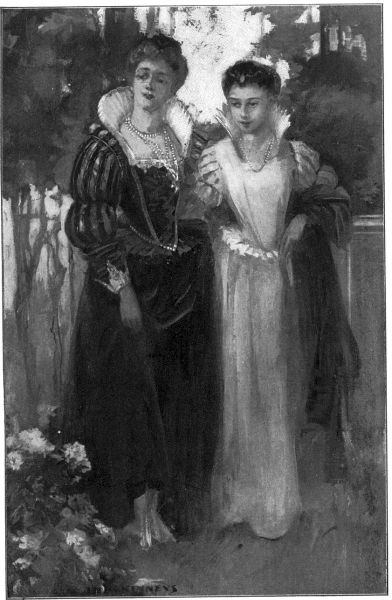
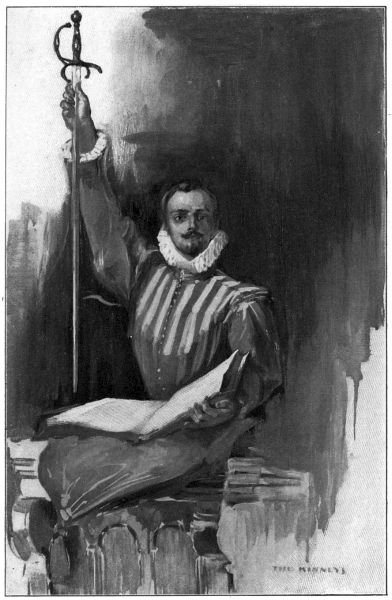
 IT seemed an unspeakable smallness in a man of such high place in the
state, whose hand had tied and untied myriad knots of political and
court intrigue, that he should stoop to a game which any pettifogging
hanger-on might play—and reap scorn in the playing. By insidious
arts, Leicester had in his day turned the Queen’s mind to his own
will; had foiled the diplomacy of the Spaniard, the German, and the
Gaul; had by subterranean means checkmated the designs of the Medici;
had traced his way through plot and counter-plot, hated by most,
loved by none save, maybe, his royal mistress, to whom he was now
more a custom than a beloved friend. Year upon year he had built up
his influence. None had championed him save himself, and even from
the consequences of rashness and folly he had risen to a still higher
place in the kingdom. But such as Leicester are ever at last a
sacrifice to the laborious means by which they achieve their greatest
ends—means contemptible and small.
IT seemed an unspeakable smallness in a man of such high place in the
state, whose hand had tied and untied myriad knots of political and
court intrigue, that he should stoop to a game which any pettifogging
hanger-on might play—and reap scorn in the playing. By insidious
arts, Leicester had in his day turned the Queen’s mind to his own
will; had foiled the diplomacy of the Spaniard, the German, and the
Gaul; had by subterranean means checkmated the designs of the Medici;
had traced his way through plot and counter-plot, hated by most,
loved by none save, maybe, his royal mistress, to whom he was now
more a custom than a beloved friend. Year upon year he had built up
his influence. None had championed him save himself, and even from
the consequences of rashness and folly he had risen to a still higher
place in the kingdom. But such as Leicester are ever at last a
sacrifice to the laborious means by which they achieve their greatest
ends—means contemptible and small.
To the great intriguers every little detail, every commonplace
insignificance is used—and must be used by them alone—to further
their dark causes. They cannot trust their projects to brave
lieutenants, to faithful subordinates. They cannot say, “Here is the
end; this is the work to be done; upon your shoulders be the burden!”
They must “stoop to conquer.” Every miserable detail becomes of
moment, until by-and-by the art of intrigue and conspiracy begins to
lose proportion in their minds. The detail has ever been so
important, conspiracy so much second nature, that they must needs be
intriguing and conspiring when the occasion is trifling and the end
negligible.
To all intriguers life has lost romance; there is no poem left in
nature; no ideal, personal, public, or national, detains them in its
wholesome influence; no great purpose allures them; they have no
causes for which to die—save themselves. They are so honeycombed
with insincerity and the vice of thought that by-and-by all colors
are as one, all pathways the same; because, whichever hue of light
breaks upon their world they see it through the gray-cloaked mist of
falsehood; and whether the path be good or bad they would still walk
in it crookedly. How many men and women Leicester had tracked or
lured to their doom; over how many men and women he had stepped to
his place of power, history speaks not carefully; but the traces of
his deeds run through a thousand archives, and they suggest plentiful
sacrifices to a subverted character.
Favorite of a queen, he must now stoop to set a trap for the ruin of
as simple a soul as ever stepped upon the soil of England; and his
dark purposes had not even the excuse of necessity on the one hand,
of love or passion on the other. An insane jealousy of the place the
girl had won in the consideration of the Queen, of her lover who, he
thought, had won a still higher place in the same influence, was his
only motive for action at first. His cruelty was not redeemed even by
the sensuous interest the girl might arouse in a reckless nature by
her beauty and her charm.
So the great Leicester—the Gypsy, as the dead Sussex had called
him—lay in wait in Greenwich Park for Angèle to pass, like some
orchard-thief in the blossoming trees. Knowing the path by which she
would come to her father’s cottage from the palace, he had placed
himself accordingly. He had thought he might have to wait long or
come often for the perfect opportunity; but it seemed as if fate
played his game for him, and that once again the fruit he would pluck
should fall into his palm. Bright-eyed, and elated from a long talk
with the Duke’s Daughter, who had given her a message from the Queen,
Angèle had abstractedly taken the wrong path in the wood. Leicester
saw that it would lead her into the maze some distance off. Making a
détour, he met her at the moment she discovered her mistake. The
light from the royal word her friend had brought was still in her
face; but it was crossed by perplexity now.
He stood still, as though astonished at seeing her, a smile upon his
face. So perfectly did he play his part that she thought the meeting
accidental; and though in her heart she had a fear of the man, and
knew how bitter an enemy he was of Michel’s, his urbane power, his
skilful diplomacy of courtesy had its way. These complicated lives,
instinct with contradiction, have the interest of forbidden
knowledge. The dark experiences of life leave their mark, and give
such natures that touch of mystery which allures even those who have
high instincts and true feelings, as one peeps over a hidden depth
and wonders what lies beyond the dark. So Angèle, suddenly arrested,
was caught by the sense of mystery in the man, by the fascination of
finesse, of dark power; and it was womanlike that all on an instant
she should dream of the soul of goodness in things evil.
Thus in life we are often surprised out of long years of prejudice,
and even of dislike and suspicion, by some fortuitous incident, which
might have chanced to two who had every impulse towards each other,
not such antagonisms as lay between Robert Dudley, Earl of Leicester,
and this Huguenot refugee. She had every cue to hate him. Each moment
of her life in England had been beset with peril because of
him—peril to the man she loved, therefore peril to herself. And yet,
so various is the nature of woman that, while steering straitly by
one star, she levies upon the light of other stars. Faithful and
sincere, yet loving power, curious and adventurous, she must needs,
without intention, without purpose, stray into perilous paths.
As Leicester stepped suddenly into Angèle’s gaze, she was only, as it
were, conscious of a presence in itself alluring by virtue of the
history surrounding it. She was surprised out of an instinctive
dislike, and the cue she had to loathe him was for the moment lost.
Unconsciously, unintentionally, she smiled at him now, then,
realizing, retreated, shrinking from him, her face averted. Man or
woman had found in Leicester the delicate and intrepid gamester,
exquisite in the choice of detail, masterful in the breadth of
method. And now, as though his whole future depended on this
interview, he brought to bear a life-long skill to influence her. He
had determined to set the Queen against her. He did not know—not
even he—that she had saved the Queen’s life on that auspicious May
Day when Harry Lee had fought the white knight, Michel de la Forêt,
and halved the honors of the lists with him. If he had but known that
the Queen had hid from him this fact—this vital thing touching
herself and England—he would have viewed his future with a vaster
distrust. But there could be no surer sign of Elizabeth’s growing
coldness and intended breach than that she had hid from him the
dreadful incident of the poisoned glove and the swift execution of
the would-be murderer, and had made Cecil her only confidant. But he
did know that Elizabeth herself had commanded Michel de la Forêt to
the lists; and his mad jealousy impelled him to resort to a satanic
cunning towards these two fugitives, who seemed to have mounted
within a few short days as far as had he in thrice as many years to a
high place in the regard of the Majesty of England.
To disgrace them both, to sow distrust of the girl in the Queen’s
mind; to make her seem the opposite of what she was; to drop in her
own mind suspicion of her lover; to drive her to some rash act, some
challenge of the Queen herself—that was his plan. He knew how little
Elizabeth’s imperious spirit would brook any challenge from this
fearless girl concerning De la Forêt. But to convince her that the
Queen favored Michel in some shadowed sense, that De la Forêt was
privy to a dark compact—so deep a plot was all worthy of a larger
end. He had well inspired the court of France through its ambassador
to urge the Medici to press actively and bitterly for De la Forêt’s
return to France, and to the beheading sword that waited for him;
and his task had been made light by international difficulties, which
made the heart of Elizabeth’s foreign policy friendship with France
and an alliance against Philip of Spain. She had, therefore, opened
up, even in the past few days, negotiations once again for the
long-talked-of marriage with the Duke of Anjou, the brother of the
King, son of the Medici. State policy was involved, and, if De la
Forêt might be a counter, the pledge of exchange in the game, as it
were, the path would once more be clear.
He well believed that Elizabeth’s notice of De la Forêt was but a
fancy that would pass, as a hundred times before such fancies had
come and gone; but against that brighter prospect there lay the fact
that never before had she shown himself such indifference. In the
past she had raged against him, she had imprisoned him, she had
driven him from her presence in her anger, but always her paroxysms
of rage had been succeeded by paroxysms of tenderness. Now he saw a
colder light in the sky, a grayer horizon met his eye. So at every
corner of the compass he played for the breaking of the spell.
Yet as he now bowed low before Angèle there seemed to show in his
face a very candor of surprise, of pleasure, joined to a something
friendly and protective in his glance and manner. His voice
insinuated that by-gones should be by-gones; it suggested that she
had misunderstood him. It pleaded against the injustice of her
prejudice.
“So far from home!” he said, with a smile.
“More miles from home,” she replied, thinking of never-returning days
in France, “than I shall ever count again.”
“But no, methinks the palace is within a whisper,” he responded.
“Lord Leicester knows well I am a prisoner, that I no longer abide in
the palace,” she answered.
He laughed lightly. “An imprisonment in a Queen’s friendship. I
bethink me, it is three hours since I saw you go to the palace. It is
a few worthless seconds since you have got your freedom.”
She nettled at his tone. “Lord Leicester takes great interest in my
unimportant goings and comings. I cannot think it is because I go and
come.”
He chose to misunderstand her meaning. Drawing closer, he bent over
her shoulder. “Since your arrival here my only diary is the tally of
your coming and going.” Suddenly, as though by an impulse of great
frankness, he added, in a low tone:
“And is it strange that I should follow you—that I should worship
grace and virtue? Men call me this and that. You have no doubt been
filled with dark tales of my misdeeds. Has there been one in the
court, even one, who, living by my bounty or my patronage, has said
one good word of me? And why? For long years the Queen, who, maybe,
might have been better counselled, chose me for her friend,
adviser—because I was true to her. I have lived for the Queen, and
living for her have lived for England. Could I keep—I ask you, could
I keep myself blameless in the midst of flattery, intrigue, and
conspiracy? I admit that I have played with fiery weapons in my day,
and must needs still do so. The incorruptible cannot exist in the
corrupted air of this court. You have come here with the light of
innocence and truth about you. At first I could scarce believe that
such goodness lived, hardly understood it. The light half-blinded and
embarrassed; but at last I saw! You of all this court have made me
see what sort of life I might have lived. You have made me dream the
dreams of youth and high, unsullied purpose once again. Was it
strange that in the dark pathways of the court I watched your
footsteps come and go, carrying radiance with you? No—Leicester has
learned how sombre, sinister, has been his past, by a presence which
is the soul of beauty, of virtue, and of happy truth. Lady, my heart
is yours. I worship you.”
Overborne for the moment by the eager, searching eloquence of his
words, she had listened bewildered to him. Now she turned upon him
with panting breath, and said:
“My lord, my lord, I will hear no more. You know I love Monsieur de
la Forêt, for whose sake I am here in England—for whose sake I
still remain.”
“’Tis a labor of love but ill requited,” he answered, with suggestion
in his tone.
“What mean you, my lord?” she asked, sharply, a kind of blind agony
in her voice; for she felt his meaning, and though she did not
believe him, and knew in her soul he slandered, there was a sting,
for slander ever scorches where it touches.
“Can you not see?” he said. “May Day—why did the Queen command him
to the lists? Why does she keep him here—in the palace? Why, against
the will of France, her ally, does she refuse to send him forth? Why,
unheeding the laughter of the court, does she favor this unimportant
stranger, brave though he be? Why should she smile upon him?... Can
you not see, sweet lady?”
“You know well why the Queen detains him here,” she answered, calmly
now. “In the Queen’s understanding with France, exiles who preach the
faith are free from extradition. You heard what the Queen required of
him—that on Trinity Day he should preach before her, and upon this
preaching should depend his safety.”
“Indeed, so her Majesty said with great humor,” replied Leicester.
“So, indeed, she said; but when we hide our faces a thin veil
suffices. The man is a soldier—a soldier born. Why should he turn
priest now? I pray you, think again. He was quick of wit; the Queen’s
meaning was clear to him; he rose with seeming innocence to the fly,
and she landed him at the first toss. But what is forward bodes no
good to you, dear star of heaven. I have known the Queen for half a
lifetime. She has wild whims and dangerous fancies, fills her hours
of leisure with experiences—an artist is the Queen. She means no
good to you.”
She had made as if to leave him, though her eyes searched in vain for
the path which she should take; but she now broke in, impatiently:
“Poor, unnoted though I am, the Queen of England is my friend,” she
answered. “What evil could she wish me? From me she has naught to
fear. I am not an atom in her world. Did she but lift her finger I
am done. But she knows that, humble though I be, I would serve her to
my last breath; because I know, my Lord Leicester, how many there are
who serve her foully, faithlessly, and there should be those by her
who would serve her singly.”
His eyes half closed, he beat his toe upon the ground. He frowned, as
though he had no wish to hurt her by words which he yet must speak.
With calculated thought he faltered.
“Yet do you not think it strange,” he said, at last, “that Monsieur
de la Forêt should be within the palace ever, and that you should be
banished from the palace? Have you never seen the fly and the spider
in the web? Do you not know that they who have the power to bless or
ban, to give joy or withhold it, appear to give when they mean to
withhold? God bless us all—how has your innocence involved your
judgment!”
She suddenly flushed to the eyes. “I have wit enough,” she said,
acidly, “to feel that truth which life’s experience may not have
taught me. It is neither age nor evil that teaches one to judge
’twixt black and white. God gives the true divination to human hearts
that need.”
It was a contest in which Leicester revelled—simplicity and
single-mindedness against the multifarious and double-tongued. He had
made many efforts in his time to conquer argument and prejudice. When
he chose, none could be more insinuating or turn the flank of a
proper argument by adroit suggestion. He used his power now.
“You think she means well by you? You think that she, who has a
thousand ladies of a kingdom at her call, of the best and most
beautiful—and even,” his voice softened, “though you are more
beautiful than all, that beauty would soften her towards you? When
was it Elizabeth loved beauty? When was it that her heart warmed
towards those who would love or wed? Did she not imprison me, even in
these palace grounds, for one whole year because I sought to marry?
Has she not a hundred times sent from her presence women with faces
like flowers because they were in contrast to her own? Do you see
love blossoming at this court? God’s Son! but she would keep us all
like babes in Eden and she could, unmated and unloved.”
He drew quickly to her and leaned over her, whispering down her
shoulder. “Do you think there is any reason why all at once she
should change her mind and cherish lovers?”
She looked up at him fearlessly and firmly.
“In truth, I do. My Lord Leicester, you have lived in the circle of
her good pleasure, near to her noble Majesty, as you say, for half a
lifetime. Have you not found a reason why now or any time she should
cherish love and lovers? Ah, no; you have seen her face, you have
heard her voice, but you have not known her heart!”
“Ah, opportunity lacked,” he said, in irony and with a reminiscent
smile. “I have been busy with state affairs, I have not sat on
cushions, listening to royal fingers on the virginals. Still, I ask
you, do you think there is a reason why from her height she should
stoop down to rescue you or give you any joy? Wherefore should the
Queen do aught to serve you? Wherefore should she save your lover?”
It was on Angèle’s lips to answer, “Because I saved her life on May
Day.” It was on her lips to tell of the poisoned glove, but she only
smiled, and said:
“But, yes, I think, my lord, there is a reason, and in that reason I
have faith.”
Leicester saw how firmly she was fixed in her idea, how rooted was
her trust in the Queen’s intentions towards her; and he guessed there
was something hidden which gave her such supreme confidence.
“If she means to save him, why does she not save him now? Why not end
the business in a day—not stretch it over these long midsummer
weeks?”
“I do not think it strange,” she answered. “He is a political
prisoner. Messages must come and go between England and France.
Besides, who calleth for haste? Is it I who have most at stake? It is
not the first time I have been at court, my lord. In these high
places things are orderly”—a touch of sarcasm came into her
tone—“life is not a mighty rushing wind save to those whom vexing
passion drives to hasty deeds.”
She made to move on once more, but paused, still not certain of her
way.
“Permit me to show you,” he said, with a laugh and a gesture towards
a path. “Not that—this is the shorter. I will take you to a turning
which leads straight to your durance—and another which leads
elsewhere!”
She could not say no, because she had, in very truth, lost her way,
and she might wander far and be in danger. Also, she had no fear of
him. Steeled to danger in the past, she was not timid; but, more than
all, the game of words between them had had its fascination. The man
himself, by virtue of what he was, had his fascination also. The
thing inherent in all her sex, to peep over the hedge, to skirt
dangerous fires lightly, to feel the warmth distantly and not be
scorched—that was in her, too, and she lived according to her race
and the long predisposition of the ages. Most women like her—as
good as she—have peeped and stretched out hands to the alluring fire
and come safely through, wiser and no better. But many, too,
bewildered and confused by what they see—as light from a mirror
flashed into the eye half blinds—have peeped over the hedge and,
miscalculating their power of self-control, have entered in, and
returned no more into the quiet garden of unstraying love.
Leicester quickly put on an air of gravity. “I warn you that danger
lies before you. If you cross the Queen—and you will cross the Queen
when you know the truth, as I know it—you will pay a heavy price for
refusing Leicester as your friend.”
She made a protesting motion and seemed about to speak, but suddenly,
with a passionate gesture, Leicester added: “Let them go their way.
Monsieur de la Forêt will be tossed aside before another winter
comes. Do you think he can abide here in the midst of plot and
intrigue and hated by the people of the court? He is doomed. But
more, he is unworthy of you; while I can serve you well, and I can
love you well.” She shrank away from him. “No, do not turn from me,
for, in very truth, Leicester’s heart has been pierced by the
inevitable arrow. You think I mean you evil?”
He paused as though uncertain how to proceed, then with a sudden
impulse continued: “No! no! And if there be a saving grace in
marriage, marriage it shall be, if you will but hear me. You shall be
my wife—Leicester’s wife. As I have mounted to power, so I will hold
power with you—with you, the brightest spirit that ever England saw.
Worthy of a kingdom with you beside me, I shall win to greater,
happier days; and at Kenilworth, where kings and queens have lodged,
you shall be ruler. We will leave this court until Elizabeth,
betrayed by those who know not how to serve her, shall send for me
again. Here—the power behind the throne—you and I will sway this
realm through the aging, sentimental Queen. Listen, and look at me in
the eyes—I speak the truth, you read my heart. You think I hated
you and hated De la Forêt. By all the gods! it’s true I hated him,
because I saw that he would come between me and the Queen. A man must
have one great passion. Life itself must be a passion. Power was my
passion—power, not the Queen. You have broken all that down. I yield
it all to you—for your sake and my own. I would steal from life yet
before my sun goes to its setting a few years of truth and honesty
and clear design. At heart I am a patriot—a loyal Englishman. Your
cause—the cause of Protestantism—did I not fight for it at
Rochelle? Have I not ever urged the Queen to spend her revenue for
your cause, to send her captains and her men to fight for it?”
She raised her head in interest, and her lips murmured, “Ah, yes, I
know you did that.”
He saw his advantage and pursued it. “See, I will be honest with
you—honest at last, as I have wished in vain to be, for honesty was
misunderstood. It is not so with you—you understand. Ah, light of
womanhood, I speak the truth now. I have been evil in my day—I
admit it—evil because I was in the midst of evil. I betrayed because
I was betrayed; I slew else I should have been slain. We have had
dark days in England, privy conspiracy and rebellion; and I have had
to thread my way through dreadful courses by a thousand blind paths.
Would it be no joy to you if I, through your influence, recast my
life—remade my policy, renewed my youth—pursuing principle where I
have pursued opportunity? Angèle, come to Kenilworth with me. Leave
De la Forêt to his fate. The way to happiness is with me. Will you
come?”
He had made his great effort. As he spoke he almost himself believed
that he told the truth. Under the spell of his own emotional power it
seemed as though he meant to marry her, as though he could find
happiness in the union. He had almost persuaded himself to be what he
would have her to believe he might be.
Under the warmth and convincing force of his words her pulses had
beat faster, her heart had throbbed in her throat, her eyes had
glistened; but not with that light which they had shed for Michel de
la Forêt. How different was this man’s wooing—its impetuous,
audacious, tender violence, with that quiet, powerful, almost sacred
gravity of her Camisard lover! It is this difference—the weighty,
emotional difference—between a desperate passion and a pure love
which has ever been so powerful in twisting the destinies of a moiety
of the world to misery, who otherwise would have stayed contented,
inconspicuous, and good. Angèle would have been more than human if
she had not felt the spell of the ablest intriguer, of the most
fascinating diplomatist of his day.
Before he spoke of marriage the thrill—the unconvincing thrill
though it was—of a perilous temptation was upon her; but the very
thing most meant to move her only made her shudder; for in her heart
of hearts she knew that he was ineradicably false. To be married to
one constitutionally untrue would be more terrible a fate for her
than to be linked to him in a lighter, more dissoluble bond. So do
the greatest tricksters of this world overdo their part, so play the
wrong card when every past experience suggests it is the card to
play. He knew by the silence that followed his words, and the slow,
steady look she gave him, that she was not won nor on the way to the
winning.
“My lord,” she said, at last, and with a courage which steadied her
affrighted and perturbed innocence, “you are eloquent, you are
fruitful of flattery, of those things which have, I doubt not, served
you well in your day. But, if you see your way to a better life, it
were well you should choose one of nobler mould than I. I am not made
for sacrifice, to play the missioner and snatch brands from the
burning. I have enough to do to keep my own feet in the ribbon-path
of right. You must look elsewhere for that guardian influence which
is to make of you a paragon.”
“No, no,” he answered, sharply, “you think the game not worth the
candle—you doubt me and what I can do for you; my sincerity, my
power you doubt.”
“Indeed, yes, I doubt both,” she answered, gravely, “for you would
have me believe that I have power to lead you. With how small a mind
you credit me! You think, too, that you sway this kingdom; but I know
that you stand upon a cliff’s edge, and that the earth is fraying
’neath your tread. You dare to think that you have power to drag down
with you the man who honors me with—”
“With his love, you’d say. Yet he will leave you fretting out your
soul until the sharp-edged truth cuts your heart in twain. Have you
no pride? I care not what you say of me—say your worst, and I will
not resent it, for I will still prove that your way lies with me.”
She gave a bitter sigh, and touched her forehead with trembling
fingers. “If words could prove it, I had been convinced but now, for
they are well devised, and they have music, too; but such a music, my
lord, as would drown the truth in the soul of a woman. Your words
allure, but you have learned the art of words. You yourself—oh, my
lord, you who have tasted all the pleasures of this world, could you
then have the heart to steal from one who has so little that little
which gives her happiness?”
“You know not what can make you happy—I can teach you that. By God’s
Son! but you have wit and intellect and are a match for a prince, not
for a cast-off Camisard. I shall ere long be lord-lieutenant of these
isles—of England and Ireland. Come to my nest. We will fly far! Ah,
your eye brightens, your heart leaps to mine—I feel it now, I—”
“Oh, have done, have done,” she passionately broke in. “I would
rather die, be torn upon the rack, burned at the stake, than put my
hand in yours. And you do not wish it—you speak but to destroy, not
to cherish. While you speak to me I see all those”—she made a
gesture as though to put something from her—“all those to whom you
have spoken as you have done to me. I hear the myriad falsehoods you
have told—one whelming confusion. I feel the blindness which has
crept upon them—those poor women—as you have sown the air with the
dust of the passion which you call love. Oh, you never knew what love
meant, my lord. I doubt if when you lay in your mother’s arms you
turned to her with love. You never did one kindly act for love; no
generous thought was ever born in you by love. Sir, I know it as
though it were written in a book: your life has been one long
calculation—your sympathy or kindness a calculated thing.
Good-nature, emotion you may have had, but never the divine thing by
which the world is saved. Were there but one little place where that
Eden flower might bloom within your heart, you could not seek to ruin
that love which lives in mine and fills it, conquering all the lesser
part of me. I never knew of how much love I was capable until I heard
you speak to-day. Out of your life’s experience, out of all that you
have learned of women, good and evil, you—for a selfish, miserable
purpose—would put the gyves upon my wrists, make me a pawn in your
dark game—a pawn which you would lose without a thought as the game
went on.
“If you must fight, my lord, if you must ruin Monsieur de la Forêt
and a poor Huguenot girl, do it by greater means than this. You have
power, you say. Use it then; destroy us, if you will. Send us to the
Medici: bring us to the block, murder us—that were no new thing to
Lord Leicester. But do not stoop to treachery and falsehood to thrust
us down. Oh, you have made me see the depths of shame to-day! But
yet”—her voice suddenly changed, a note of plaintive force filled
it—“I have learned much this hour—more than I ever knew. Perhaps it
is that we come to knowledge only through fire and tears.” She smiled
sadly. “I suppose that sometimes, some day, this page of life would
have scorched my sight. Oh, my lord, what was there in me that you
dared speak so to me? Was there naught to have stayed your tongue and
stemmed the tide in which you would engulf me?”
He had listened as in a dream at first. She had read him as he might
read himself, had revealed him with the certain truth, as none other
had done in all his days. He was silent for a long moment, then
raised his hand in protest.
“You have a strange idea of what makes offence and shame. I offered
you marriage,” he said, complacently. “And when I come to think upon
it, after all that you have said, fair Huguenot, I see no cause for
railing. You call me this and that; to you I am a liar, a rogue, a
cut-throat, what you will; and yet, and yet, I will have my way—I
will have my way in the end.”
“You offered me marriage—and meant it not. Do I not know? Did you
rely so little on your compelling powers, my lord, that you must
needs resort to that bait? Do you think that you will have your way
to-morrow if you have failed to-day?”
With a quick change of tone and a cold, scornful laugh he rejoined,
“Do you intend to measure swords with me?”
“Oh no, my lord,” she answered, quietly, “what should one poor,
unfriended girl do in contest with the Earl of Leicester? But yet, in
very truth, I have friends, and in my hour of greatest need I shall
go seeking.”
She was thinking of the Queen. He guessed her thought.
“You will not be so mad,” he said, urbanely, again. “Of what can you
complain to the Queen? Tut! tut! you must seek other friends than the
Majesty of England.”
“Then, my lord, I will,” she answered, bravely. “I will seek the help
of such a Friend as fails not when all fails, even He who putteth
down the mighty from their seats and exalteth the humble.”
“Ah, well, if I have not touched your heart,” he answered, gallantly,
“I at least have touched your wit and intellect. Once more I offer
you alliance. Think well before you decline.”
He had no thought that he would succeed, but it was ever his way to
return to the charge. It had been the secret of his life’s success so
far. He had never taken a refusal. He had never believed that when
man or woman said no that no was meant; and if it were meant he still
believed that constant dropping would wear away the stone. He
still held that persistence was the greatest lever in the world,
that unswerving persistence was the master of opportunity.
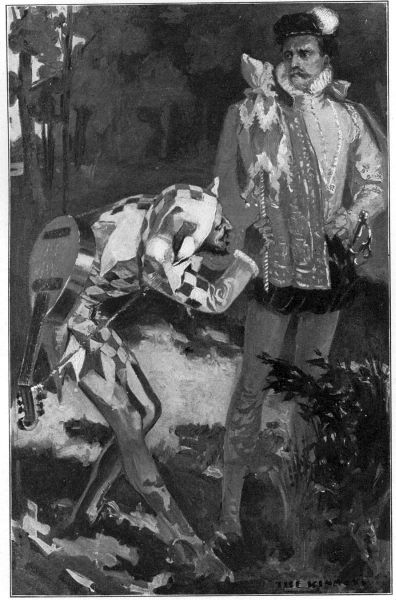
“IT WAS THE QUEEN’S FOOL”
They had now come to two paths in the park leading different ways.
“This road leads to Kenilworth, this to your prison,” he said, with a
slow gesture, his eyes fixed upon hers.
“I will go to my prison, then,” she said, stepping forward, “and
alone, by your leave.”
Leicester was a good sportsman. Though he had been beaten all along
the line, he hid his deep chagrin, choked down the rage that was in
him. Smiling, he bowed low.
“I will do myself the honor to visit your prison to-morrow,” he said.
“My father will welcome you, my lord,” she answered, and, gathering
up her skirt, ran down the pathway.
He stood, unmoving, and watched her disappear.
“But I shall have my way with them both,” he said, aloud.
The voice of a singer sounded in the greenwood. Half consciously
Leicester listened. The words came shrilling through the trees:
“Oh, love, it is a lily flower,
(Sing, my captain, sing, my lady!)
The sword shall cleave it, Life shall leave it—
Who shall know the hour?
(Sing, my lady, still!).”
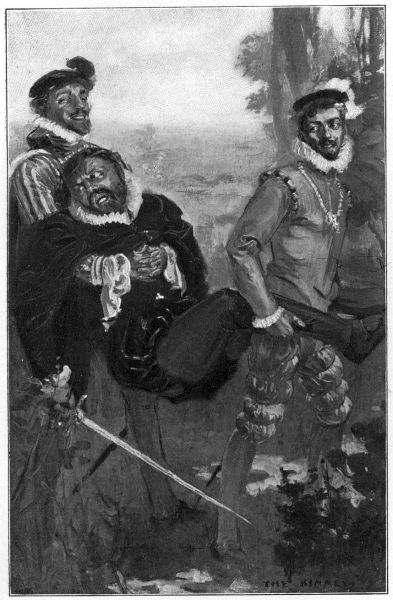
Presently the jingling of bells mingled with the song, then a figure
in motley burst upon him. It was the Queen’s fool.
“Brother, well met—most happily met!” he cried.
“And why well met, fool?” asked Leicester.
“Prithee, my work grows heavy, brother. I seek another fool for the
yoke. Here are my bells for you. I will keep my cap. And so we will
work together, fool: you for the morning, I for the afternoon, and
the devil take the night-time! So God be with you, Obligato!”
With a laugh he leaped into the undergrowth and left Leicester
standing with the bells in his hand.