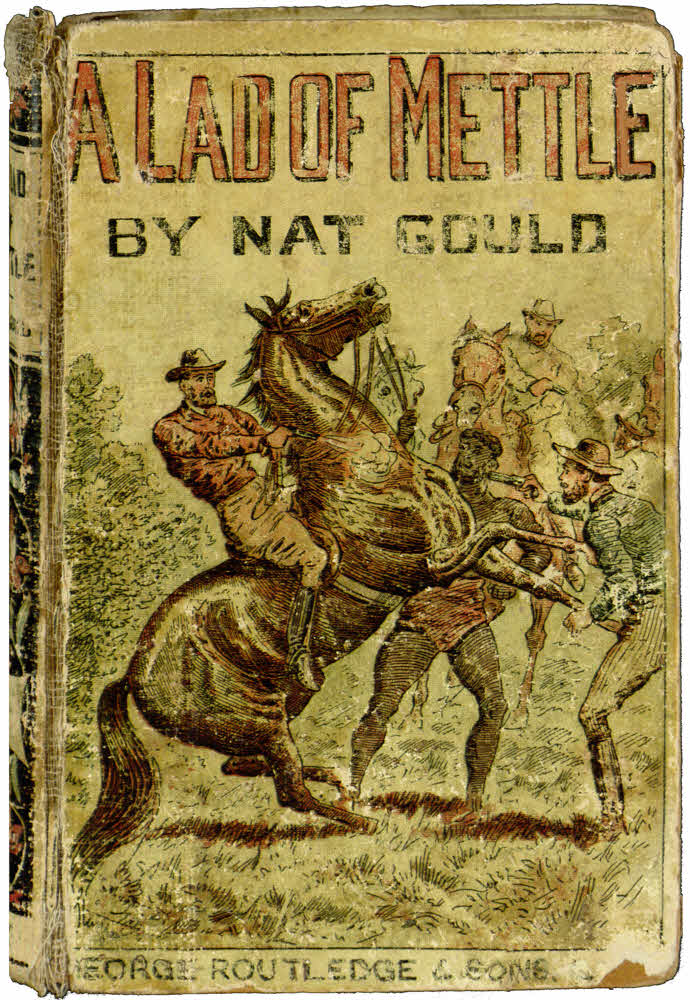
The Project Gutenberg eBook, A Lad of Mettle, by Nat Gould
Note:
Images of the original pages are available through
Villanova University Digital Library. See
https://digital.library.villanova.edu/Item/vudl:279070
A LAD OF METTLE
NAT GOULD’S SPORTING NOVELS
Crown 8vo., Picture Boards.
THE DOUBLE EVENT
RUNNING IT OFF
JOCKEY JACK
HARRY DALE’S JOCKEY
BANKER AND BROKER
THROWN AWAY
STUCK UP
ONLY A COMMONER
THE MINERS’ CUP
THE MAGPIE JACKET
WHO DID IT?
HORSE OR BLACKSMITH?
NOT SO BAD AFTER ALL
SEEING HIM THROUGH
Also, uniform with the above,
ON AND OFF THE TURF IN AUSTRALIA
TOWN AND BUSH
THE DOCTOR’S DOUBLE
A LAD OF METTLE
A LAD OF METTLE
BY NAT GOULD
AUTHOR OF ‘THE DOUBLE EVENT,’ ETC.
LONDON
GEORGE ROUTLEDGE AND SONS, Limited Broadway, Ludgate Hill
Lessons were over for the day, and the boys at
Redbank School came running with shouts and
whoops of joy into the playing-fields. They were
like young colts freed from restraint for a few hours,
and eager to make the most of their liberty.
Redbank was the home of brilliant cricketers and
all-round athletes. Many a noted cricketer had
received his first lessons in the great game on Redbank
cricket ground. The lads were proud of the
men who played in the All England eleven, and who
were never slow to acknowledge that to Redbank
they owed what prowess they possessed.
The Redbank lads were born runners, so many an
old hand training them for races vowed. Something
in the atmosphere of Redbank seemed to make the
lads athletic. Perhaps the traditions attached to the
school had much to do with this, for lads are very
proud, and justly so, of the feats of scholars who have
preceded them.
But Redbank was not merely a training ground for
famous athletes. Redbank scholars had taken high
honours at the Universities, and afterwards distinguished
themselves in various walks of life. The
Bishop of Flaxham was proud of the fact that he was
‘grounded’ at Redbank. He was an eloquent and
distinguished man, an ornament to the Church, and
a brilliant writer of readable books.
When the Bishop of Flaxham came to Redbank,
and preached in the chapel, the lads with difficulty
restrained themselves from giving him a hearty cheer
at the end of his address. The Bishop knew how to
talk to boys, and never forgot that at one period of
his life he had been bored with wearisome sermons
about the world, the flesh, and the devil, which he
did not in the least understand. So he took warning,
and told the lads to run the race set before them
much in the same manner as they would a hundred
yards sprint, each striving to win the prize and do
the distance in even time. The Bishop believed that
well-trained muscles and a healthy body were conducive
to an active and moral state of mind. The
Redbank lads gloried in the fact that the Bishop of
Flaxham had been one of themselves.
Field-Marshal Lord Kingcraft was a Redbank boy,
and his warlike deeds and bravery were celebrated
in song on the fly-leaves of school-books, and occasionally
on the panels of doors and the insides of
desks.
‘Lord Kingcraft’s won the great V.C.,
May Redbank do the same for me.’
was discovered carved, evidently with much labour
and pains, on the lid of a desk at which the celebrated
Field-Marshal formerly worried his brains over Euclid
and algebra.
This inscription was pointed out to the brave leader
of men when he visited his old school, and he never
forgot it. He hoped, from the bottom of his heart,
the lad who carved it would one day win his V.C.
Redbank was represented in the navy and in the
diplomatic world, and one day it was hoped a Redbank
lad would become Prime Minister.
So, with all these successful public men constantly
before them as an example, the lads of Redbank felt
bound to endeavour to do great deeds, and win
renown for themselves and their school.
The head-master of Redbank was the Rev. Henry
Hook, and it was universally acknowledged that no
more suitable man could have been selected. He
ruled his lads with a firm hand, but he was no tyrant
or hard task-master. The boys knew he meant what
he said, and that his word to them could be implicitly
relied upon. He had confidence in his boys, and they
returned it.
When Edgar Foster came to Redbank School he
was sixteen, small for his age, but muscular and
active. At this time there were between two and
three hundred scholars at Redbank, and naturally out
of such a number there were several lads whose
absence would not have been regretted.
Young Edgar Foster soon became popular. For
one thing, his father was a well-known man, who had
worthily upheld the honour of Redbank in the cricket
field, and had captained the All England eleven.
This was quite sufficient to give Edgar a standing in
the school.
Bullies exist in almost every walk of life, and a few
of this undesirable species were to be found at Redbank.
The leader of these bullies was a lad named
Raymond Rakes—‘Bully Rakes’ as he was generally
called. He was a big, hulking fellow, powerful and
strong, but deficient in courage, as bullies generally
are.
There was nothing manly about Bully Rakes, and
the boys knew it. So far he had held his own,
for he was the biggest boy in the school. Any new
scholar he at once endeavoured to inspire with awe,
and generally succeeded.
Our story commences about a week after Edgar
Foster’s arrival at Redbank. The boys were bounding
out of school and soon spread over the fields in groups;
the bulk of them, however, went towards the cricketing
nets.
Edgar Foster had not had any opportunity of
showing what he could do with the bat. He was a
lad who did not push himself forward, but quietly
bided his time, knowing full well that when that time
came he would not be found wanting. The boy is
father to the man, and it will be gathered from this
story of a lad of mettle that Edgar Foster acted in
this wise during many trying periods of his after-life.
Edgar watched the practice with keen and critical
eyes. His father had taught him how to handle a bat
as only a skilful player can.
‘Here, Foster, take a turn,’ said the lad who had
just finished batting. ‘We’ve not had the chance of
seeing how you shape yet.’
‘I’m ready,’ said Edgar, pulling off his coat and
eagerly holding out a hand for the bat.
‘It’s my turn,’ said Bully Rakes. ‘Just you drop
that bat, or I’ll make you.’
Edgar Foster looked up at the big fellow standing
before him, but he did not flinch, nor did he drop the
bat.
The boys crowded round, anticipating a row, and
anxious to see how the new-comer would shape with
Rakes.
‘If it is your turn,’ said Edgar quietly, ‘I will give
you the bat. If it is not your turn, under no circumstances
will I drop the bat.’
The tones were firm, there was no flinching, and
the lad looked determined.
Bully Rakes was not accustomed to be addressed
in this manner. He eyed Edgar scornfully, and
said:
‘I shall have to teach you manners. I am the
best judge of whose turn it is. Will you drop that
bat?’
Edgar turned to the lad who had handed him the
bat, and said:
‘Do you bat in turns? Has Rakes any right to
bat before me?’
Courage is infectious. Will Brown had never
defied Rakes before, but he felt he must back up his
plucky schoolmate.
‘Rakes has no right to bat here at all,’ he replied.
‘He’s been batting at the other net, and has just
finished his turn.’
Edgar Foster made no further remark, but walked
coolly to the wicket.
This defiance of his demands gave Bully Rakes a
shock. He knew if he allowed Foster to bat his
hold over the boys would be gone. He strode up to
Edgar and said savagely:
‘Give me the bat, or I’ll thrash you!’
‘Had you asked me politely at first, I should
probably have handed you the bat,’ said Edgar. ‘I
shall not do so now. As for thrashing me—well,
that has to be decided.’
‘Bravo, Foster!’ shouted several lads.
‘Punch his head, Rakes,’ said one of the bully’s
toadies.
‘Give me that bat, or fight me!’ shouted Rakes in
a passion.
‘Shame!’ shouted the lads.
Rakes was much taller and more powerfully built
than Edgar.
Edgar Foster handed the bat to Will Brown, and
said:
‘Come on, I’m ready.’
Bully Rakes had his coat off, and the boys, seeing
a fight about to take place, formed a ring. They
would have given much to see Bully Rakes get a
severe thrashing.
Now they were in a fighting attitude the disparity
between the lads was more apparent. Edgar was
lightly built, but active, and evidently in good condition.
Bully Rakes was massive, heavy, and ponderous
in his movements. The boys were determined to see
fair play, and gave Edgar every encouragement. As
usual, when he had to fight, Bully Rakes rushed in at
close quarters, and tried to overwhelm his smaller
opponent by the force of his onslaught.
Edgar, however, was ready for him. He knew how
to box better than most lads of his age. His father
had taught him, impressing upon him that because
he knew how to use his fists he ought not to pick
quarrels.
Seeing Bully Rakes rush at him, Edgar sprang
nimbly to one side. The bigger lad stumbled forward
and almost fell. Thus foiled at the first
attempt, Rakes lost his temper. He heard the lads
jeering at him, and he determined he would make
Edgar suffer for the humiliation.
Recovering himself, Rakes glared at Edgar and
then aimed a terrific blow at his ribs. Quick as
lightning shot out Edgar’s left and caught Rakes on
the ear. It was a stinging blow, and the bully did
not take punishment well. Rakes again rushed at
Edgar, and, closing with him, kicked him severely on
the shin. It was a despicable act, and several lads
pulled Rakes back, others shouting ‘Coward!’ and
‘Foul play!’
‘Hands off!’ shouted Rakes. ‘You’d better not
interfere with me.’
‘Leave him to Foster,’ said Will Brown; ‘he’ll
settle him.’
A roar of laughter followed this remark, and made
Bully Rakes furious.
‘Stand up and fight fair,’ said Edgar. ‘Who
taught you to kick? We’re not playing football.’
The boys were delighted. Here was young Foster
taking it out of Bully Rakes, and chaffing him unmercifully.
Rakes again commenced the attack, but with more
caution. He was not a match for his young opponent
when it came to science. He managed to land
a blow on Edgar’s right eye, but the return he
received fairly between his own eyes staggered him.
Edgar followed up his advantage and soon had the
satisfaction of seeing Bully Rakes measure his length
on the grass.
The younger boys danced with delight as the
defeat of their enemy looked assured.
Rakes, however, was not yet beaten. He staggered
to his feet and fought again with some determination.
Feeling he had met his match, his courage,
what little he possessed, gave way, and Edgar soon
had the bully at his mercy. Edgar was not disposed
to let him off lightly, and he knocked Rakes about
in a manner that both astonished and alarmed
him.
‘Have you had enough?’ said Edgar, standing
over him after another knock-down blow. ‘If not,
get up, and I’ll repeat the dose.’
‘I’ve done for to-day,’ growled Rakes; ‘but I’ll
be even with you for this, see if I don’t.’
‘Take your defeat like a man,’ said Edgar, ‘and
drop bullying in the future. Where’s the bat?’ he
added, turning to Will Brown.
But the boys would not let him bat. They cheered
him and shook hands with him, and Edgar felt he
had quickly made a position for himself in the
school.
Bully Rakes slunk away with one or two companions,
who had been tempted by his example to
bully on a smaller scale, and were downcast at his
defeat.
‘You’ll get into a row,’ said Will Brown to Edgar.
‘The chief can’t bear fighting, but when he hears the
truth, I fancy he’ll side with you.’
‘He’ll hear the truth then,’ said Edgar. ‘I shall
ask to see him when we reach school.’
‘I shouldn’t,’ said Will Brown. ‘None of the
masters may have noticed it.’
‘It makes no difference to me whether they have
noticed it or otherwise,’ said Edgar; ‘I shall tell the
doctor all about it, if he will see me. It is the most
straightforward way, as I have only been about a
week in the school.’
‘Perhaps you’re right,’ said Will Brown.
‘Sure of it,’ said Edgar.
That evening Dr. Hook received a polite note
from Edgar Foster, in which he asked for an interview.
Dr. Hook knew Edgar’s father, and admired
him for his many manly qualities.
‘You wanted to see me, Foster,’ said Dr. Hook,
when the lad came into his study.
Then, catching sight of Edgar’s discoloured eye,
he frowned.
Edgar explained what had occurred in the cricket-field.
Dr. Hook listened attentively, noting the
boy’s face all the time. His scrutiny was evidently
favourable.
‘I am glad you came to me,’ said the head-master;
‘I strongly object to fighting, but in this instance I
think it may be overlooked. Send Rakes to me
when you go out.’
‘Please, sir,’ said Edgar, and hesitated. ‘I hope
you will not punish Rakes; I gave it him severely
this afternoon.’
Dr. Hook smiled as he said:
‘No, I will not punish Rakes; I merely wish to
speak to him about his conduct. You may go.’
‘That lad will get on in the world,’ thought Dr.
Hook, when the door closed behind Edgar. ‘I’m
glad he thrashed Rakes; it will do him good.’
Bully Rakes got a very different reception to
Edgar Foster, and as he left the room he vowed he
would have his revenge upon Edgar for ‘sneaking’
to the head-master.
CHAPTER II. IN THE CRICKET-FIELD.
The thrashing of Bully Rakes gave Edgar Foster
a hold over the affections of his schoolfellows, and
he never lost it. In twelve months he became captain
of the eleven, and led them to victory on many
occasions. Edgar worked hard, both at lessons and
play. He found it much easier to study when his
body was in good order, and his athletic exercises
helped to make his school tasks the easier. He
could not be called a brilliant scholar by any means,
but he was endowed with an amount of perseverance
that generally pulled him through.
‘It’s got to be done, and I’ll do it,’ Edgar thought
to himself when pondering over a difficult task, and
he generally succeeded.
The Redbank lads took a defeat from their great
opponents, the eleven of Fairfield College, with a
very bad grace. Not that they allowed their successful
opponents to see their chagrin, they were too
manly for that, but they felt the defeat keenly.
Edgar Foster determined to win the return match
if possible. He had taken great care to select his
eleven, and felt confident of success. He was the
more eager to win because his father was coming to
Redbank to watch the game. Dr. Hook too was
anxious his boys should regain their lost laurels, and
he encouraged Edgar by his kindly advice.
It so happened that Raymond Rakes, despite his
many bad qualities, was a very fair cricketer. He
had not been chosen to play in the first match
against Fairfield, and he put his being left out of
the team down to Edgar’s animosity.
Edgar Foster, however, was not actuated by any
such motive. He thought Rakes hardly good enough,
and therefore did not select him. Since this match
Rakes had shown such good form that Edgar decided
to include him in the eleven for the return match.
Bully Rakes was much surprised when Edgar
asked him to play. He said he would think over
the matter, and complained about not being chosen
in the first match.
‘You had not shown good enough form then,’
said Edgar; ‘you have come on wonderfully since,
and therefore I ask you to play. It is for the honour
of the school we are playing this time, so you ought
to have no hesitation.’
‘Then I’ll play,’ said Rakes, in his usual surly
manner.
‘And I hope you will make a good score,’ said
Edgar.
As the captain of the Redbank eleven walked
away, Rakes looked after him with no friendly eyes.
He had never forgotten the humiliating defeat he
sustained when Edgar first came to the school. No
opportunity had yet occurred of paying off the grudge
he owed Edgar on that account.
‘He’s set his heart on winning this match,’ muttered
Rakes to himself; ‘he’d have left me out again
if he could. I’ve a good mind to spoil his plans.
What does it matter whether we win or lose the
match? I don’t care much which way it goes, and
I’d like to see Foster taken down a peg or two.
I’ll wait and see how our side shapes. I may be
able to carry out a plan of my own.’
Had Edgar Foster doubted Rakes, he would not
have asked him to play; but he could not understand
any lad throwing away a chance of victory
merely to spite the captain of the team. Such conduct
Edgar would not have suspected even in Raymond
Rakes.
‘So you’ve asked Rakes to play?’ said Will
Brown, who had become a stanch friend of Edgar’s
ever since the fight with Bully Rakes.
‘Yes,’ said Edgar. ‘He’s not a bad bat at all;
he’s a fair field, and will do to put on for a change
bowler. We must win the match. I’m awfully
anxious about it. My father will be here, and
there’s sure to be a big crowd of people. We
have a good team, and I’m pretty confident this
time.’
‘All the same, I should not have played Rakes,’
said Will Brown.
‘Why?’ asked Edgar.
‘Because I don’t trust him. He’s never forgiven
you for licking him, and if he gets half a chance
he’ll throw us over in the match, just to spite you,’
said Will.
Edgar looked at his schoolmate in surprise. He
could not believe in any lad doing such a thing.
‘He’ll never do that,’ said Edgar. ‘Even if it is
as you say, and he still bears me a grudge, he would
never be such a cad as to throw the school over in
order to annoy me.’
‘I hope he won’t, for your sake,’ said Will; ‘but
all the same, I have my doubts.’
Will Brown’s words made Edgar feel uneasy for
a time, but he soon forgot them. It was universally
agreed that a better eleven could not have been
chosen to meet Fairfield College. Masters were not
to play; it was to be purely a boys’ match.
Early and late Edgar was at the cricket nets
watching the practice and debating how he should
send his team in to bat. For such a young lad, he
had keen powers of observation, and he made a
pretty accurate calculation as to the pluck and nerve
of each boy. Edgar’s father arrived the day before
the match, and saw the final practice.
‘You have a real good team,’ he said to his son,
‘and ought to win. Remember, a good deal depends
upon the captain.’
‘I’m not likely to forget that,’ said Edgar. ‘You
have often told me a good captain wins many a game
at cricket.’
Robert Foster was proud of his son, and naturally
felt anxious to see him successful.
‘How’s my lad doing?’ he had said to the head-master.
‘Well—very well,’ said Dr. Hook. ‘He is not a
brilliant scholar, but he will get on in the world. He
is like his father in one respect. He is about the
best cricketer and all-round athlete we have in the
school.’
Robert Foster’s eyes brightened, and he said:
‘I’m glad of that. I’m not a rich man, and my
lad will have to fight his own battles. He has a
great inclination to go abroad, and I don’t know that
it will not be a good thing for him. His sister will
be able to keep me from feeling lonely.’
Dr. Hook looked at Robert Foster with his kindly
eyes, and replied:
‘Travel expands the mind. If a lad has plenty of
ballast, he will take no harm in any part of the
world. Your son is a lad of mettle, and you need
have no fear about his future. If I am a judge of
character, I should say Edgar Foster is a lad who
will surmount difficulties and dangers, and he is
bound to be a leader of men.’
Robert Foster was proud of the way in which the
head-master spoke of his son. How little do thoughtless
schoolboys know the pleasure a father feels in
hearing praise bestowed upon his child, or of the
pang he feels when the son he loves strays from the
right path. Robert Foster loved his son devotedly,
although he made very little demonstration of his
affection, and Edgar thoroughly understood and
appreciated the manly qualities of his father.
The eventful day arrived, and a glorious day it
was. The sun shone brightly, and there was a slight
cool breeze. Redbank cricket ground was charmingly
situated. The pavilion was small, but there were
several large trees growing at the back which afforded
ample shade. The ground was level and well-kept,
and the pitch had much care bestowed upon it. It
was a great day at Redbank when this return match
with Fairfield College was to be played. Flushed
with the triumph of their previous victory, the Fairfield
lads were eager for the fray, and had invited
many friends to come and witness their further
triumph. The captain of the Fairfield eleven, Harold
Simpson, was almost as popular at Fairfield as
Edgar Foster was at Redbank. The two captains
had a mutual liking for each other, although each
one was determined to beat the other in the great
game they were about to play.
Edgar Foster lost the toss, and, as the ground was
in such good order, Harold Simpson elected to send
his men in first.
‘They are a strong batting team,’ said Edgar to
his father. ‘It will take us some time to get rid of
them.’
‘It is a one-day match, so you must do your level
best to get them out quickly,’ said his father.
As the boys filed on to the field they were cheered
by their comrades and the Redbank supporters, who
had mustered in strong force.
Edgar Foster came in for a special share of applause,
and he felt his pulses tingle and his heart beat high
with hope as he bounded over the springy turf towards
the wickets.
The two Fairfield batsmen were wildly cheered by
their mates, and Harold Simpson decided on this
occasion to go in first.
Will Brown and Sayers junior were put on to
bowl.
An anxious moment is that during which the first
ball in a match is delivered. The bowler goes back
from the wicket, measuring his men; for a second or
two he hesitates and looks round, then he glances at
the batsman, sees all is ready, and prepares for the
delivery. As he takes his run to the wicket the
spectators hold their breath. Will this first ball be
fatal? A sigh of relief goes round as the batsman
plays it well forward.
Harold Simpson failed to score in Brown’s first
over. Sayers junior then took the ball, and his first
delivery made the bails fly, much to the delight of
the Redbank boys, who shouted and cheered vociferously.
Edgar Foster felt they had commenced well, and
was anxious for the good-fortune to continue. The
Fairfield boys were determined bats, and a long stand
took place before the second batsman was got rid of.
Harold Simpson still kept his wicket up, and runs
came freely. At the fall of the fifth wicket Fairfield
had put a hundred runs on, of which the captain had
made forty.
Edgar Foster went on to bowl. He was not such
a good bowler as Rakes, who thought he ought to
have been tried before, and looked sullen.
In his first over Harold Simpson skied a ball to
Raymond Rakes. It was an easy catch, but Rakes
missed it, and so clumsily that the boys jeered at
him.
Will Brown, who had been watching him, thought:
‘He dropped that on purpose, because Edgar
bowled it.’
Nothing daunted at this stroke of bad luck, Edgar
sent another similar ball down. Harold Simpson
hesitated for a moment as to what he should do with
it; then he struck out, and, strange to say, the ball
went to Rakes again.
It was not such an easy catch as the former one,
but, still, there ought to have been very little difficulty
in a good fielder securing it. Rakes fumbled it badly,
and again missed the catch.
Edgar Foster could not help thinking of what Will
Brown had said to him. He was very much annoyed,
and at the conclusion of his over said to Rakes:
‘Those were two easy catches to miss; they may
cost us the match.’
‘They were not as easy as they looked,’ said Rakes.
‘You don’t suppose I dropped them on purpose, do
you?’
‘I should be very sorry to think that,’ said Edgar;
‘but be more careful next time.’
At last Will Brown secured Harold Simpson’s
wicket, and the others followed rapidly, the innings
closing for a hundred and thirty-four, a good score in
a one-day school match.
‘What do you think of it, Edgar?’ asked his father.
‘Shall you be able to wipe that off?’
‘I think so,’ replied Edgar. ‘We should have had
a much easier task had Rakes held those two catches
off my bowling.’
‘He made an awful mess of them,’ said Robert
Foster. ‘How he dropped the first puzzles me; he
had it fairly in his hands.’
‘Look here, Edgar!’ said Will Brown. ‘It’s no use
mincing matters. I’m sure Rakes missed those
catches purposely. When are you going to send
him in?’
‘About seventh,’ said Edgar.
‘Put him in last,’ said Will.
‘That would only make matters worse,’ said Edgar;
‘he would know I doubted him, and act accordingly.
He shall go in sixth wicket down. It will
give him a chance of making up for missing those
catches.’
‘As you wish,’ said Will. ‘Mind, if you are in with
him, he does not run you out.’
‘No fear of that,’ said Edgar, laughing.
And he crossed over to speak to Raymond Rakes.
‘You go in sixth wicket down,’ he said.
‘All right,’ replied Rakes, ‘that will suit me.’
‘We’ve not been very good friends,’ said Edgar,
‘but you know it is not my fault. We want to win
this match, and it may be that your batting will turn
the scale in our favour at a critical point of the game.
I shall rely upon you to do your best for the honour
of the school. You missed two very easy catches;
try and make up for it by playing your best when
you go in to bat.’
‘I always do,’ said Rakes sulkily, and walked
away.
Edgar Foster felt rather sorry he had included
Raymond Rakes in the Redbank eleven.
CHAPTER III. A CRITICAL MOMENT.
As Edgar Foster walked to the wickets he felt much
depended upon him. He was going in first, taking
first over, and if he failed to play with confidence it
would set a bad example to the remainder of the
team. It was, however, at such moments as these that
Edgar Foster’s courage and spirit did not fail him.
As he took his position at the wicket he looked
round him with a confident air to see how the field
was placed. He saw Harold Simpson had so placed
his men that not a chance would be thrown away,
provided the bowlers were in good form. After a few
moments’ delay Edgar handled his bat confidently,
and prepared to receive the first ball of the over.
A lad named Winter was bowling, and Edgar knew
he was a promising youngster. The first ball pitched
short and then shot forward at a tremendous pace.
It was a ball that might have deceived any batsman,
and Edgar had only just time to change his mind and
block it. The escape was narrow, and the boys saw
it, but they knew the ball was well played, and
cheered.
‘Thought it had him,’ said Robert Foster to one of
the Redbank masters.
‘It would have been a stroke of bad luck for us if
he had gone out,’ was the reply.
Off the next ball Edgar scored a couple, and the
fourth ball of the over he skied on to the pavilion.
‘That first ball put him on his mettle,’ thought his
father.
Strange to say, in the next over Edgar’s partner
was dismissed first ball in a similar manner to that in
which the Fairfield batsman was out.
Will Brown was next in, and he and Edgar made
things lively. They fairly collared the bowling, and
gave the Fairfield team plenty of leather-hunting.
Fours came freely, and Harold Simpson began to
look rather downcast. However, when Will Brown
was bowled with the score at eighty, the Fairfield
captain brightened up again. He knew how often a
collapse followed a long stand, and how ‘glorious’
was the uncertainty of cricket.
Will Brown’s partnership with Edgar had put the
Redbank boys into an excellent humour, and they
were prepared to cheer every hit. What they were
not prepared for happened. This was the collapse of
the next four batsmen. Three of them were bowled
in one over, and the fourth had his bails sent flying
when he had scored two. Eighty for two wickets,
and eighty-two for six wickets altered the game completely.
It was now the turn of the Fairfield boys to give
vent to their delight. The prospect of defeat had not
been pleasant, but this sudden change mended the
fortunes of their side, and they were wild with the
sudden revulsion of feeling. They chaffed the Redbank
lads unmercifully, until at one time there was
danger of a fistic war.
This was, however, happily averted by the appearance
of Raymond Rakes, who was cheered as he went
to the wickets. Although Rakes was unpopular, the
boys knew he was a fair bat, and they wished to encourage
him to make a stand with Edgar Foster.
As Rakes came to the wickets Edgar went forward
to meet him.
‘Play steady,’ said Edgar; ‘I feel I am well set.
If you play carefully for a few overs you will soon
master the bowling. Remember how much depends
upon you. We shall have to win the match between
us.’
‘I’ll see what I can do,’ said Rakes. ‘It’s precious
bad luck four of our best bats going out like this.’
‘Don’t think of that,’ said Edgar. ‘Try and make
up for it by piling up a good score.’
Raymond Rakes followed Edgar’s advice, and soon
found he had very little difficulty in playing the
bowling. He knew how anxious Edgar was, not
only to win the match, but to make fifty because his
father was present.
‘I’m well set,’ thought Rakes. ‘I’d like to get
him out. It would cut him up terribly to be run
out. Even if he got out we have a chance. I can
make a fair score, and our tail-end is not a bad
one.’
Still harbouring such thoughts as these Raymond
Rakes batted steadily, and Edgar was immensely
pleased to see him scoring freely, and the Redbank
boys were cheering every stroke. They watched the
scoring-board intently, and grew more and more
excited with every run. Suddenly there was a loud
cry of dismay from the boys. Some shouted ‘Run,
Rakes!’ others ‘Go back, Foster!’
Edgar Foster hit a ball forward, and called to
Rakes to run. Had Rakes come at once it would
have been an easy but smart run. Rakes started
late, and then when Edgar Foster was three parts of
the way down the pitch shouted to him to go back,
and ran back himself. This left Edgar in a most
unenviable position. The ball was smartly fielded,
and as Edgar ran back he saw it flash past him
straight for the wicket-keeper.
‘I’m done,’ thought Edgar, but he ran on as fast
as possible.
It was a critical moment. The wicket-keeper in
some unaccountable way fumbled the ball, and only
knocked the bails off as Edgar reached the crease.
‘How’s that?’ came from wicket-keeper, bowler,
and fielders in a general chorus.
They were anxious to see Edgar out, for he had
given them a lot of trouble, and seemed likely to
give more.
‘Not out!’ promptly came the decision of the
umpire, and a roar of applause echoed over the field
as the Redbank lads danced with delight, and flung
their caps high into the air because their captain had
another chance given him. Edgar knew the decision
of the umpire was correct, and he thanked his lucky
star that the wicket-keeper had fumbled the ball.
When he thought of Raymond Rakes he felt inclined
to give him a bit of his mind, but he determined to
treat the matter as a pure accident until the close of
the game. As for Raymond Rakes he was savage
at the non-success of his plan. He had deliberately
tried to run Edgar out. It was a dirty trick, and he
knew it, but he was bitterly disappointed that it had
not been successful.
‘Hang the fellow! he seems to have all the luck,’
thought Raymond. ‘I wonder if he suspects anything?’
The idea of Edgar Foster suspecting he had acted
in such a manner made Rakes feel uneasy, for he
had not forgotten the punishment Edgar gave him
when he first came to the school. He did not bat
with such confidence, and Edgar put this down to
its proper cause. Runs came freely again, for Edgar
felt the result of the match depended almost entirely
upon himself. When his score reached fifty the
cheering broke out again, and made Rakes turn
green with envy.
‘He shall have a new bat for that,’ said Robert
Foster. ‘By Jove! he deserves it. He’s batting
splendidly. I’m glad that big hulking fellow did not
run him out.’
Before the score reached a hundred Rakes was
caught. He was not very warmly greeted as he
returned to the pavilion. The boys knew how matters
stood between him and Edgar, and they had a shrewd
suspicion Bully Rakes had tried to get Edgar run out.
Rakes flung his bat down in a corner of the dressing-room
and took off his pads.
‘You didn’t manage to run him out,’ said Will
Brown.
‘Who wanted to run him out?’ said Rakes angrily;
‘I didn’t. It was his own fault. There was no run,
and I didn’t want to get out through his foolishness.’
‘You’d better tell him that when the match is over,’
said Will Brown. ‘He’ll probably want an explanation.
If he believes you, well and good; if not—oh
my, won’t you just catch it!’
Bully Rakes took up a pad and hurled it at his
tormentor.
‘Get out of this, you little beast!’ he said. ‘You
know I can’t touch you here, or you’d not be so
cheeky.’
‘Mind and keep clear of Edgar’s left if it comes to
war,’ said Will Brown. ‘I fancy you know he’s a
good fist at the end of his left arm.’
Bully Rakes jumped to his feet and made towards
the speaker; but Will Brown was too quick for
him, and shot out at the side door.
Meanwhile the game was at a critical stage. Edgar
Foster was playing at his best. He did not give a
chance, nor did he throw away an opportunity of
stealing a run. He knew that every run was of vast
importance. A run lost might mean the match lost.
Sayers junior was in with him, and blocked steadily
while his captain made the runs. The fielders were
on the alert, and were smart and active, and many a
run was saved. Harold Simpson was a good general,
and handled his men well.
‘It does one good to watch a game like this,’ said
Robert Foster to Dr. Hook. ‘I have seldom seen
lads field better, and Edgar is batting really well.
Who is the little chap keeping his end up so well?’
‘Sayers junior,’ said Dr. Hook. ‘He’s helping
your son famously.’
‘Playing a most unselfish game,’ said Robert
Foster. ‘That is how matches are won. A selfish
player at any game is a big handicap on his side.’
A burst of cheering from lusty throats stopped
the conversation. It was caused by Edgar Foster
hitting a ball over the pavilion—a mighty stroke for
a lad.
‘Well hit!’ ‘Bravo, Foster!’ ‘Three cheers for
our skipper!’ And the Redbank lads shouted until
they were hoarse.
The match was, however, not yet won. Sayers
junior played a ball on to his wicket when ten runs
remained to be got to tie and eleven to win.
‘I am afraid we shall lose,’ said Dr. Hook, as the
ninth man was clean bowled and the last of the team
went in.
‘Can he bat at all?’ asked Robert Foster anxiously.
‘He is uncertain, but at times he shapes well,’ said
one of the masters.
‘Then I hope it is his day for shaping well,’ said
Edgar’s father.
‘Block them, Bull,’ said Edgar, as the lad came to
the wicket.
‘I’ll do my level best,’ said Bull, ‘and I don’t feel
a bit nervous.’
‘That’s right,’ said Edgar. ‘Then, between us we
must win the match.’
Fortunately Edgar was batting, and he hit the first
ball sent him after Bull came in for a single. It was
fielded smartly, thrown in swiftly, the wicket-keeper
could not quite reach it, and there was another run
for an overthrow. This gave Edgar another chance
before the over was finished, and he promptly took
advantage of it, hitting the next ball round to leg for
three. The excitement was intense. Would Bull be
able to keep his wicket up during this over? The
Redbank boys vowed they would make Bull a presentation
if he managed to do so. It was a surprise
to them when Bull fluked a ball past point, and
another run followed. Edgar determined to finish
the game if possible, and a couple of runs were got
by a somewhat lucky stroke. This left three runs to
win, and the boys of both schools were in a fever of
excitement.
‘If Edgar can only manage to hit a three,’ said
Will Brown, ‘then we shall be all right. He’s done
wonders, considering everything.’
The next ball Edgar could do nothing with. It
puzzled him, and nearly got past his bat.
Then came a comparatively easy ball, and Edgar
lifted it over the ropes, amidst a perfect hurricane
of cheers. This hit won the match, and the
Redbank boys rushed wildly over the ground and,
surrounding Edgar, bore him shoulder-high to the
pavilion. It was a scene seldom witnessed even on
this famous school-ground, and as Edgar’s father
looked on he felt the moisture well up into his eyes,
and his heart beat with pride. He knew what this
moment of triumph would mean to his son, and he
gloried in it. He made his way to the dressing-room,
and as he came the boys stood on one side and
cheered him again and again. They were proud of
the father and proud of the son, and were not slow to
show it.
‘Splendidly done, my lad!’ said Robert Foster, as
he placed his hand on Edgar’s shoulder. ‘It was a
plucky, uphill fight, and your schoolfellows are enthusiastic
about it. I never saw you play a steadier or
better game.’
‘It was hard work,’ said Edgar, ‘but I did not feel
a bit nervous. We have won, but it was a narrow
shave. I think it ought to have been an easier
victory had Rakes done his best.’
‘Then, you think Rakes behaved badly? I should
give a boy like that a wide berth.’
‘We are not friends,’ said Edgar, ‘but I bear him
no animosity.’
The Redbank boys could do nothing but talk over
their victory, and Edgar Foster found they gave most
of the credit to himself.
Edgar gave Rakes to understand he believed he
had tried to run him out.
‘I may be wrong, but that is my opinion,’ said
Edgar.
‘Your opinion is worth nothing to me,’ said Rakes,
‘so you may keep it to yourself.’
‘That may be,’ replied Edgar; ‘but the honour of
the school ought to be worth something to you. I
shall not ask you to play again during the time I am
captain of the eleven.’
CHAPTER IV. LEAVING SCHOOL.
The time arrived, all too soon, when Edgar Foster was
to leave Redbank. Unlike many lads, he was not
eager to have done with lessons, and take his place
in the busy world. During his stay at Redbank he
had made many friends, Will Brown being an
especial favourite with him. Dr. Hook was proud
of his scholar, for Edgar had done as well at work as
at play.
When the holiday time came round, Edgar Foster
bade farewell to Redbank with feelings of regret. As
he looked back at the school he was leaving he
thought of the many happy hours he had spent
within its walls. He had gone through trial and
struggle, such as every lad must encounter, but they
only made victory taste the sweeter.
‘I shall feel quite lonely next term,’ said Will
Brown, who was going home with Edgar to spend a
few days. ‘It’s lucky for some of us Rakes is leaving,
or he would have made it uncomfortably hot. I shall
never forget the thrashing you gave him. It did me
good to see you punish him;’ and Will Brown
chuckled with delight at the mere thought.
‘If I never have a harder battle to fight than that,’
said Edgar, ‘I shall be lucky.’
‘What are you going to do?’ asked Will Brown.
‘With my father’s permission I shall go to Australia,’
said Edgar. ‘You know how fond I have
always been of reading and learning about our great
colonies. I think it is a splendid thing to start life
in a new country, where you are not bound down
by a lot of old-world prejudices.’
‘And what shall you do in Australia?’ asked Will
Brown.
‘I hardly know, but you may be sure I shall
not remain idle very long. There ought to be
plenty for an active young fellow like me to do out
there.’
‘They are great cricketers, the Australians,’ said
Brown. ‘You’re sure to get into one of the best
elevens, and that will help you along.’
‘And give me a chance of a trip home perhaps,’
said Edgar. ‘I should hardly like playing against
England.’
‘I expect you will become such an enthusiastic
colonist that you will be only too eager to assist in
lowering the flag of old England on the cricket-field.’
‘We shall see,’ replied Edgar. ‘Of one thing you
may be quite sure: I shall look upon Australia as my
home if I have to earn my living there.’
Robert Foster was heartily glad to welcome his
son’s schoolmate at Elm Lodge. He was a believer
in schoolboy friendships when judiciously made.
Elm Lodge was not a large place, but it was old-fashioned
and picturesque, and overlooked the
Thames near Twickenham. Robert Foster, in
addition to being a great cricketer, was a skilful
oarsman, and many a Thames waterman had found
it a hard task to row with him. He was also an
enthusiastic fisherman, and knew the favourite haunts
of the famous Thames trout, and where many a good
jack was to be found. There was a boathouse at
Elm Lodge, and Edgar always anticipated a good
time on the great river.
Doris Foster was a bright, merry girl of seventeen,
a perfect picture of ruddy health, her cheeks untouched
by any artificial beautifier. Nature was her
lady’s-maid, and Doris Foster would not have
changed her for the most skilful of tire-women. It
was a difficult matter to keep Doris Foster indoors,
no matter how bad the weather might be. She
revelled in sunshine, but she loved the keen, sharp,
frosty air of winter, and the sound of the frozen snow
crunching beneath her tiny feet. She knew the
names of the wild-flowers, and was well acquainted
with their haunts, and also their habits. She was
not a clever girl, but she was thoroughly domesticated,
a far more desirable accomplishment. Her
father and brother were her best friends, and she
made but few new acquaintances. Doris Foster
was a true-born English girl, not a forced artificial
production such as may be encountered by the score
in the Row, or the fashionable thoroughfares of the
West End. She had not learned to talk slang, and
to consider it correct to endeavour to make people
think, ‘What a pity she is not a man!’
With the enthusiasm of a schoolboy, Will Brown
adored Doris Foster. There was no maudlin, sentimental
love nonsense about his adoration. It was
the pure affection and liking a healthy youth feels for
a healthy girl.
‘Excuse the expression, Edgar,’ he said one day,
‘but your sister is a brick.’
The schoolboy ‘brick’ is synonymous for everything
that is good. When one lad calls another a
‘brick’ there’s a ring about the word that is unmistakable.
So, when Will Brown called his sister a
brick, Edgar Foster heartily endorsed the sentiment.
‘I’d like to know,’ said Will, ‘if there is anything
she cannot do?’
‘Several things,’ said Edgar.
They were sitting in a boat close to the garden
hedge, and passing their time pleasantly enough.
‘Enumerate some of them,’ said Will Brown incredulously.
‘She cannot smoke,’ said Edgar solemnly; ‘nor
can she make a speech. She would be a ghastly
failure as a woman politician, or a leader of fashion.
I am afraid she could not write a book, and drag all
her female friends through a moral pillory in it. Oh,
there are heaps of things Doris cannot do!’
‘And a jolly good thing, too!’ said Will Brown.
‘I hate stuck-up girls—they’re worse than spoony
girls. Now, your sister—well, a fellow can make a
chum of her, and all that, don’t you know.’
‘Comprehensive, certainly,’ laughed Edgar. ‘What
does “all that, don’t you know” mean?’
Will Brown waved his hand towards the flowing
river, and was at a loss for an answer.
Splash!
‘What’s that?’ said Will, as he shook the water
off his boating-jacket.
‘That is Miss “All that, don’t you know,”’ laughed
Edgar.
‘Where is she?’ said Will, jumping up, and narrowly
missing overturning the boat.
‘In safety, on the other side of the hedge,’ said
Edgar loudly. ‘She dare not come nearer, for fear
of the consequences.’
Splash!
‘We had better get out of this,’ said Will.
A merry peal of laughter sounded from the other
side of the hedge.
‘You lazy boys! I thought I would rouse you.
Pull the boat round to the steps, and take me for a
row immediately.’
‘We decline to be ordered about,’ said Edgar.
‘Ask politely, and your request may be granted.’
‘Will Mr. William Brown and Mr. Edgar Foster,
of Redbank School—ahem! College—have the goodness
to row to the steps of Elm Lodge, where they
will find Miss Doris Foster at home?’
‘That’s much better,’ said Edgar. ‘Our compliments
to Miss Doris Foster, and we hasten to comply
with her request.’
‘Pull, Edgar, you lazy beggar!’ said Will, ‘for
Elm Lodge, home, and beauty.’
Doris Foster looked charming in her light summer
dress and large river hat, as she stood on the steps
leading from the lawn to the water.
‘Your ladyship has showered many favours upon
us of late,’ said Will Brown, as he gave her his hand
and she stepped into the boat; ‘in fact, we are in
danger of being overwhelmed with them.’
‘Doris, you ought not to throw stones,’ said Edgar,
with an attempt to be serious.
‘I did not throw stones,’ said Doris.
‘You hear her?’ said Edgar to Will. ‘She did not
throw stones! I blush for my sister.’
‘They were two half-bricks,’ said Doris. ‘Didn’t
they splash!’ And she laughed merrily.
‘There’s prevarication!’ said Edgar. ‘A brick
in this instance is to all intents and purposes a
stone.’
‘A brick is a brick,’ said Doris; ‘therefore it cannot
be a stone.’
‘A brick is not a brick when it is only half a brick,’
said Edgar.
‘If you don’t stop it,’ said Will Brown, ‘I’ll——Look
out!’ he shouted.
There was a bend in the river, and they did not
see the small launch until it was nearly on to them.
The swirl she made in the water caused their boat to
dance up and down in the swell.
‘All your fault,’ said Edgar to his sister. ‘But,
thank goodness! it has put an end to your argument.’
They had a pleasant row, and came back glowing
with health, and very hungry. Luncheon proved
most acceptable, and was thoroughly enjoyed by
these young people with good appetites and no
thoughts of indigestion.
Doris Foster missed Will Brown when he left Elm
Lodge, for she had come to regard him as a sincere
friend. She had, however, other things to occupy
her mind now, for Edgar was to sail for Australia in
a couple of months. She dreaded the parting with
her brother, not only on her own account, but because
she knew how much her father would miss him. She
was half inclined to be angry with Edgar because he
had chosen to go abroad. At the same time, she
admired the spirit of adventure that tempted him
away from a comparatively easy life in England.
She knew if she had been a man she would have
followed her brother’s example.
Robert Foster made the most of the time his son
was to remain at home.
‘I shall be sorry to part with you,’ he said to
Edgar; ‘but you are young, and I am not old. So I
hope, ere many years have gone, we may meet again.
I believe it will do you good to go abroad. One
thing you must bear in mind: come home again if
you do not like it.’
Edgar Foster was fond of the sea, and, as his father
knew the owner of one of the principal lines of sailing
ships trading to Australia, he had decided to make
the voyage in the Distant Shore, a large vessel holding
a quick record.
‘You are quite sure you prefer to go out in a sailing
vessel?’ said Robert Foster. ‘It will be a tedious
voyage.’
‘I am sure the time will pass quickly,’ said Edgar.
‘I love the sea. Those big steamers are too much
like hotels, and I cannot bear hotel life.’
‘Please yourself, my boy. The Distant Shore is a
fine vessel, and Captain Manton a good seaman.
He’ll look after you well, I feel sure.’
The weeks rolled all too quickly by, and the time
drew near when the Distant Shore was to sail for
Sydney.
Edgar Foster paid a visit to Redbank, and was
heartily welcomed by his old schoolmates, who
wished him a prosperous voyage and success in the
new country. Dr. Hook was very kind to him, and
gave him some good advice.
As Edgar shook hands with him, Dr. Hook said:
‘An old friend of mine once gave me what I consider
good advice. He said: “Don’t fret, keep your
temper, and mind your own business.” If you carry
out his precepts, I think you will do well.’
Edgar did not feel in very good spirits when his
last night at home arrived. As he looked around the
cosy room, he wondered how many years it would be
before he saw it again, and the dear ones he must
leave behind. He said to himself he must work hard
and earn a good name, and then he would come home
and be received with open arms.
His father was kinder than ever on this their evening
of parting, and Doris did all in her power to make
things bright and cheerful. Edgar never ceased to
remember this particular night, and it came vividly
before him on many occasions when far away.
Robert Foster and his daughter saw Edgar sail in
the Distant Shore, and waved him a tearful farewell.
As Edgar stood looking at them he felt lonely, and
when they gradually receded from his sight he heaved
a sigh, and felt a choking sensation in his throat.
When Robert Foster and Doris reached Elm Lodge
again he kissed her fondly, and said in a broken
voice:
‘God knows when we shall see him again, Doris.
You are all I have left now; you must not leave your
father.’
‘Edgar will return some day,’ she said quietly. ‘I
will take his place until then. When he comes back
you will forget all the sorrow of parting.’
CHAPTER V. A FURIOUS STORM.
Hundreds of people hurrying to business in Sydney
at an early hour in the morning cast anxious eyes at
the dull leaden sky, across which heavy clouds rolled,
hanging over the harbour and the city. They also
gazed in wonderment, and with feelings not devoid of
awe, upon a mass of peculiar white clouds banked up
in an exactly opposite direction to the harbour. These
clouds were of a fleecy whiteness, balloon-shaped, and
clung together until they were heaped almost mountains
high.
There was a peculiar stillness about the atmosphere—the
calm that usually precedes a storm. All day
long the clouds hung suspended overhead, and towards
the middle of the afternoon it grew much darker.
People residing at harbour suburbs hurried home as
fast as possible, and were glad when they were ferried
safely across the water.
The Watson’s Bay ferry-boat was throwing off from
the landing-stage as a well-built man in a pilot’s coat
jumped on board.
‘Nearly missed it, Wal,’ said the skipper of the
Fairy. ‘The next boat will have a rough passage, I
reckon.’
‘Yes; it’s been brewing all day,’ replied Walter
Jessop. ‘We shall have a terrible night, I fear. It
will be dangerous near the coast to-night. Luckily,
there’s no vessel been sighted anywhere handy.’
The speaker was evidently a seaman. He had an
honest, open face, weather-beaten and tanned with
exposure, and his hands were hard and big and used
to hard work.
Pilot Jessop was well known in Sydney. In years
gone by he had done good service as a pilot, and he
still followed his calling, but fortune had favoured him
in the shape of a windfall from a rich relation, and he
only took on work when he felt inclined.
Walter Jessop knew the coast of Australia as well
as any man, and he had sailed up most of the harbours
and rivers between Adelaide and Normanton. Such
a man was not likely to make many mistakes about
the weather, and he knew what these lowering clouds
that had been hanging about all day meant.
The Fairy was one of the smallest ferry boats on
the harbour, and at this time Watson’s Bay was not
such an important place as it is now. Pilot Jessop,
however, found it handy to live at Watson’s Bay, as
it was under the great shadows of South Head, beyond
which lay the open sea. Many a ship had he piloted
to a safe anchorage in the harbour.
When the landing-stage was reached, he bade the
skipper of the Fairy good-night, and walked to his
home, which nestled in a sheltered position high up
above the harbour.
A bright little woman, clad in a homely dress, gave
him a hearty welcome. Mrs. Jessop was just the wife
for such a man, and they had only one regret: they
had no child to lavish their affection upon.
‘We’re in for a storm,’ said Wal Jessop, as he was
generally called. ‘I hope there’s no vessel making
for the harbour; they’d better keep away from our
coast to-night.’
‘I’m right glad you have no occasion to go to sea
on such nights,’ said his wife. ‘It would make an old
woman of me before my time if you were out in these
storms.’
‘I weathered a good many storms before I met
you,’ said Wal Jessop, ‘but I don’t feel much inclined
for it again when I come to such comfortable quarters
as these.’
A low murmuring sound could be heard, a door
banged, and the windows creaked ominously.
‘It’s coming,’ said Jessop. ‘Make everything
snug, my lass; there’ll be a perfect hurricane before
morning.’
As Wal Jessop sat at the well-laden tea-table, he
suddenly put down his knife and fork, and drew a
paper from his coat-pocket.
‘I’d quite forgotten,’ he said. ‘I hope they’re not
making for Sydney in such a gale as this will be.’
‘What ship do you mean?’ asked his wife.
‘The Distant Shore is due here early next week.
It’s Saturday, and the agents expect her on Monday
at the latest. I hope Captain Manton has not made
an extra quick passage. She’s a clipping sailer, is the
Distant Shore, and he’s a bit venturesome—likes to
make a rapid run. I shouldn’t wonder if she’s not far
away to-night.’
‘I hope not,’ said Mrs. Jessop.
Captain Manton often paid a visit to the Jessops
when in Sydney, and the pilot and his wife were very
fond of his company.
As the evening wore on the storm raged in all its
fury. Every hour seemed to add to the velocity of
the gale. A great roar like distant thunder could be
heard in the cottage as the waves dashed against the
mighty rocks of South Head, and then rushed back,
baffled and angry.
‘It’s beginning to rain,’ said Wal Jessop; ‘I’ll just
see if the pony’s all right before it comes on faster.’
‘Be quick in again,’ said his wife, ‘or you’ll be
drenched.’
A fierce gust came in as he opened the door and
quickly shut it again.
‘It doesn’t rain after all,’ he said, as he looked up
at the dark clouds through which the moon occasionally
shone in fitful gleams.
As if to convince him he had made a mistake, and
that his first surmise was correct, a shower of heavy
drops fell upon him. He stood still and thought for
a moment; then he touched the wet on his coat and
tasted it. It was salt, and he knew the waves outside
were running high and dashing showers of salt spray
over the top of the rocks, and the wind carried it
across the village.
‘Such a sea is worth having a look at,’ he thought.
‘I’ll have a walk up to the cliffs before I turn in.’
He told his wife it was the spray from the waves
being dashed on the rocks, and she knew it must be
terrible out at sea.
Walter Jessop could not rest. He felt uneasy, and
had an undefinable feeling that some dire catastrophe
was about to take place. He sat down and tried to
read the evening paper, but nothing in it interested
him. His pipe continually went out because he was
so deep in thought he failed to draw sufficiently to
keep it alight. His wife watched him with anxious
eyes. She had seen him like this before when he
had been affected by a presentiment of evil. He got
up from his chair and restlessly paced about the
room.
‘Have a glass of something,’ said his wife. ‘It’s
getting on for bedtime.’
‘Don’t mind if I do,’ he said. ‘I’ll tell you what
it is, lass: I fear there’ll be something awful happen
before the night’s over.’
‘It’s the storm makes you feel like that,’ said his
wife. ‘This will do you good.’ And she handed
him a glass of toddy.
Wal Jessop drank it with evident relish. Then he
looked at his watch, and said:
‘Ten o’clock. I’ll just go up on the cliffs, and
have a look out to sea; I’ll never rest if I don’t.’
‘If you say you’ll go I know you mean it,’ said
his wife; ‘but do be careful. You might get blown
over the rocks.’
‘There’s a moon,’ he said; ‘and I’m more likely
to be blown away from the rocks than over them.
I’ll not be gone long. You go to bed.’
He put on a thick coat and slouch hat, kissed his
wife, and then went out into the stormy night.
‘If he fancies I’m going to bed until he comes
home he’s mistaken,’ said Mrs. Jessop to herself.
‘Oh, these sailors! A furious gale seems to tempt
them outside when other folk are only too anxious to
hide their heads under the bedclothes.’
Wal Jessop felt the full force of the wind as he
made his way up a narrow path towards the top of
the cliff. He battled with it, and seemed to take a
fierce delight in overcoming it. A terrific gust nearly
swept him off his feet, and he muttered:
‘Nearly had me that time, but I’ll beat the winds
as I have done before. There’s some satisfaction in
fighting a gale like this, but I’d sooner be doing it
here than out at sea yonder.’
At last he reached the roadway, which he crossed,
and then climbed up again towards the top of the
rocks. As he made his way slowly the salt spray
dashed into his face, and wetted him all over. He
could hear the waves thundering against the rocks,
and every roar was followed by a dense shower of
spray. When he reached the top of the rocks the
moon came out from behind a cloud, and shed a pale
light on the scene.
Wal Jessop looked out to sea, and saw nothing but
a black mass of tumultuous water and fierce waves
chasing each other in mad sport. Then he looked
down below and saw masses of foam tossed about
and flung high into the air. He saw the great waves
roll across the jutting rock, then dash furiously
against the solid mass opposed to them, and cast up
spray like a waterspout. This battle between the
waves and the rocks had been going on for centuries,
and would, he knew, continue for centuries more.
The waves, constantly baffled and defeated, had to
retreat, but they returned again and again to the
charge, bringing up reinforcements from their mighty
reserves, until at last the rocks seemed to give way
inch by inch, and their jagged, worn fronts bore
unmistakable testimony to the fierceness of the onslaught.
Pilot Jessop could not tear himself away from this
scene of tumult and fierce war. He stood alone
upon the rocks, the spray drenching him, and the
wind whistling and whining in his ears. He knew
there was a warm bed awaiting him at home, and yet
he could not leave the spot. He peered out to sea,
and saw an empty space. The moon was again
hidden, and all was black and desolate. Suddenly
he started, and gave vent to an exclamation. He
thought he saw a tiny light sparkle far away out in
the gloom. He looked again and again, but could
see nothing. Could his eyes have deceived him?
What could he have mistaken for a light so far out
at sea? There it was again. He could not mistake
it this time. There were two lights like stars; now
he saw three. A cold, dull feeling came over him,
and froze the blood in his veins; his heart beat
loudly, and he put his hands to his head to think.
Was it a ship out at sea and heading for the
harbour on such a night as this? Surely no captain
would be so mad and foolish as to risk passing
through that narrow strait between the Heads in such
a gale! He looked again and again, and the more
he looked the more he was convinced it was a vessel
being driven on to the rocks. He knew if it was a
ship she would be dashed into a thousand pieces and
not a soul on board could be saved. Hoping against
hope, he looked again. The light had gone, and he
breathed more freely. His eyesight must have
deceived him.
He felt a tug at his sleeve, and turning quickly
round, faced his wife.
‘I could bear it no longer,’ she said; ‘you have
been out over three hours. The suspense was
terrible. I thought you were blown over the rocks.
Come home, Wal, you are wet through.’
‘Three hours!’ he exclaimed, then, knowing how
he had been compelled to struggle to reach the rocks,
he took his wife in his arms, strained her to his
breast, kissed her fondly, and said:
‘You are a brave little woman, and I’m a brute for
causing you anxiety. We will go home at once.
This is no fit place for you.’
‘Wal, Wal!’ she cried as she stared over his
shoulder with wide, terror-stricken eyes; ‘look,
there’s a light; two lights, three! It’s a ship!
Lord have mercy on ’em!’
‘Good God, she’s seen it! Then my eyes have
not deceived me. That’s what I’ve been watching
this hour,’ he said.
They looked together out across the furious ocean,
and saw the lights plainly now.
Mary Jessop hid her face on her husband’s shoulder
and sobbed aloud. She knew not a single man,
woman, or child on the ill-fated vessel could expect
to live when the ship was shattered to pieces. As
she stood there in the rocks with the wind roaring
around her, safe in her husband’s strong arms, she
offered up a prayer to the God who rules the seas to
save the ship from destruction.
As for Pilot Jessop, he seemed for the moment
incapable of action. He quickly recovered, and said
in a hollow voice:
‘Suppose it’s the Distant Shore?’
His wife shuddered and said:
‘Can nothing be done to save her?’
‘No, Mary; she’s beyond control. No captain
would be here on such a night if he had control of his
ship. She’s helpless, and we are helpless; but we
can rouse the folk and do all we can. Come.’
They went down the rocky path and hurried to the
village, where, despite the gale, the people were sleeping
soundly.
They roused two or three men, and telling them to
pass the word on, they fought their way back to the
top of the cliffs.
CHAPTER VI. THE ‘DISTANT SHORE.’
The Distant Shore made a quick voyage towards
Australia, and her captain felt sure of beating the
sailing record by two or three days. Captain Manton
had taken a great liking to Edgar Foster, who spent
many a pleasant hour in his cabin with him. On
this voyage Captain Manton was accompanied by
his wife and child, a bright little girl about three
years of age. The child was very fond of Edgar,
and he played with the little one on deck for hours
at a stretch.
‘I never remember a more favourable voyage,’
said the captain to Edgar one morning; ‘we ought
to be in Sydney harbour in the course of two or
three days. Looks as though we are going to finish
with a squall,’ he added, pointing to the restless
clouds overhead.
‘I am quite anxious to weather a storm before
we get to our journey’s end,’ said Edgar, smiling,
‘or I shall fancy I have not been to sea.’
‘Your wish is likely to be gratified,’ he said; ‘but
the Distant Shore is a good ship, and it will be an
uncommon bad storm she cannot sail through safely.’
‘With a good ship and a clever captain we have
not much to fear,’ said Edgar. ‘Here’s little Eva
coming for her morning romp. I should have been
quite lonely on board without her.’
Edgar held out his arms, and the child ran into
them. He lifted her above his head, where she
laughed with delight, and looked at her father with
merry eyes.
‘Pass her on to me,’ said Captain Manton; and
Edgar tossed her into her father’s arms.
‘Back again,’ she cried, and she was tossed to
Edgar again.
The captain watched them for a few moments as
they played on the deck, and then cast an anxious
look at the sky. He knew they were in for a storm,
probably a bad one.
During the night Edgar heard the vessel creak
and groan, and her timbers strain in a most unusual
manner. The sailors were hard at work on deck,
and he knew the storm must have burst upon them.
He turned over in his berth, and felt thankful the
Distant Shore was such a safe vessel, and her captain
a trustworthy seaman.
Edgar had some difficulty in reaching the deck
next morning. Not a single passenger was in the
saloon as he staggered through, holding on first to
one thing, and then another.
‘You had better keep below, sir,’ said one of the
stewards; ‘you’ll stand a good chance of being blown
overboard if you venture on deck. We are finishing
up with a real bad storm.’
‘That’s just what I want to see,’ said Edgar.
‘You can’t get out that way,’ said the man; ‘the
hatches are down. Come this way, and I will show
you how to get on deck.’
Edgar followed the man to the fore-part of the
ship, and was well knocked about during the
journey.
‘Go up there, and you’ll be able to see what it’s
like before you go on deck,’ said the steward.
‘Just as well to look before I leap, I suppose,’
said Edgar.
‘I don’t think you’ll want to leap on deck when
you have had a look out,’ was the reply.
Edgar climbed up the steep steps, holding on with
all his might. When he reached the top he saw
there was a thick glass with bars across it. He could
see well enough through the glass, and the sight
almost took away his breath.
A huge wave towered high above the ship, and
Edgar thought if it came over the deck the vessel
must surely go down. The Distant Shore gave a
mad plunge, and he nearly lost his foothold. The
ship seemed to dive down into the depths of the
sea, and then, coming up again, shook herself all
over. On second thoughts Edgar decided to remain
where he was, or rather down below in the saloon.
Captain Manton entered a few minutes after Edgar
succeeded in finding his way back.
‘Well, my lad, you’ve got a storm at last,’ said
the captain; ‘I hope you are satisfied. My wife and
Eva are in their cabin, and I don’t think they are
quite so pleased as you are about the weather. It will
get worse before it mends.’
‘Worse?’ said Edgar. ‘Why, it’s blowing a regular
hurricane, and the sea is running as high as the
ship.’
‘How did you find that out?’ said Captain
Manton. ‘I gave orders no one was to be allowed
on deck.’
Edgar explained, and the captain was satisfied.
‘So you did not like the look of things?’ he asked.
‘No,’ said Edgar. ‘I think I am safer here,
although I confess I feel a little queer.’
Captain Manton smiled as he replied:
‘Sea-sickness will soon cure you of a longing for
storms. I’d advise you to turn in before you have
to be carried to your berth.’
‘Oh, it’s not so bad as that,’ said Edgar. ‘It will
pass off.’
‘No doubt,’ said the captain with a meaning smile.
All that day the storm raged, and the Distant
Shore battled with it. As night came on, Captain
Manton became anxious. He knew they were nearing
the coast of New South Wales, and the wind
was driving them straight in that direction. He tried
in vain to alter the ship’s course, but he could not
keep out to sea; some uncontrollable current appeared
to drive the vessel along. As the night wore on
there were no signs of the storm abating; in fact, the
gale was worse than ever.
A terrible crash made everyone on board quake.
A huge sea dashed over the ship, sweeping her deck
well-nigh clear. The boats were smashed to atoms;
two sailors were washed overboard, and Captain
Manton was dashed against his cabin and almost
stunned. Before the Distant Shore could right herself
another merciless sea swept over her, and at the
same moment the rudder chain snapped, and the
vessel swung helplessly round.
Captain Manton at once realized the danger they
were in. By the fitful light of the moon he saw the
terrible havoc the waves had made on deck. Then
he saw something that made his heart quail; it was
the flashing of the light from South Head lighthouse.
Well might a brave man tremble at the thought of
being dashed to pieces on those great rocks. His
ship was no longer under control, and he could do
nothing to save her from being driven to destruction.
Had the steering gear held firm he might have tried
to dash through the Heads into the harbour. That
would have been a mere chance; but even this,
small as it was, had gone. Despair seized upon him,
and held him in chains; but he burst the bonds at
the thought of the lives of those on board. They
were still some distance from the Heads; the light
flashed out many miles to sea. He must prepare
them as quietly as possible to await their fate.
Leaving the mate in charge of the vessel, he went
below. He made for Edgar’s cabin and entered
without knocking.
Edgar was wide awake and dressed, and he knew
there must be something wrong when he saw the
captain.
‘What is it?’ said Edgar. ‘Any danger?’ and he
tumbled out of his berth.
‘You are a brave lad,’ said Captain Manton, ‘and
I have come to you first. There is no time to lose.
We are in deadly peril. I have no control over the
ship, and we are being blown straight for the rocks.’
‘What can I do?’ said Edgar.
He was pale, but perfectly calm.
‘Very little,’ said Captain Manton; ‘but you can
set a good example. A panic will only make matters
worse. If the passengers are kept under control, it
may be possible to save some of them. Will you
call them up in the saloon cabin? Tell them to dress,
and try and calm them. I will tell my wife and take
her and Eva up with me. You will find them in my
cabin. If it comes to the worst, do what you can
for them. I must stick to the ship. I’ll save her if
I can, but I see no chance at present. Good-bye!’
He held out his hand and Edgar gripped it hard.
They looked firmly into each other’s eyes. They
were not afraid of facing death. Edgar seemed to
have grown older, and Captain Manton saw the look
of determination on his face and thought to himself:
‘This lad will not fail me. He will give his life to
save those I love.’
‘Good-bye,’ said Edgar, and without another word
he went to rouse his fellow-passengers.
So well did he accomplish his difficult task that,
although the peril they were in was understood, there
was no panic. Happily there were very few women
and children on board, and the men behaved well.
It was an awful sight, Edgar thought: the saloon
filled with people hastening to their death, awaiting
the summons from the captain, ‘All hands on deck,’
which meant they were to sell their lives as dearly as
possible. The very suddenness of the danger appeared
to have taken all sense of fear away. Not
a word was spoken; the sobbing of children, and the
half-smothered, heart-rending groan of some poor
mother, could alone be heard.
A great rush of wind, followed by a loud shout,
aroused them:
‘All hands on deck!’
Edgar led the way, and then stood by while the
women and children were helped up the stairs. The
men followed. Edgar was the last to leave the
saloon. Once on deck he saw what their danger
was, and from whence it came. The lighthouse stood
high up on the rocks, flashing across the sea, and they
were so near now that the rays lighted up the faces
of those in deadly peril on the doomed ship. Edgar
forced his way towards the captain’s cabin, and found
Mrs. Manton and Eva crouching down, overcome with
fear. He spoke a few words of encouragement, and
little Eva looked up into his face with wistful eyes.
Then Edgar looked round the ship as the light
flashed on it again. He saw pale, blanched faces all
round him, men clinging in desperation to ropes
and bars, and women holding their children fast,
themselves held by strong men’s disengaged arms.
It was an awful sight, but Edgar felt no fear for himself
as he looked at it. He thought of the grand
voyage they had gone through, and how near they
were to their destination. The good ship was struggling
on, and after going these thousands of miles
was to be dashed to pieces at the very entrance to
the harbour of safety. His mind wandered to those
at home, and he seemed to see his father and sister
sitting in the dear old room at Elm Lodge, as on
that last night in the home he loved so well. Their
voices seemed to ring in his ears, giving him hope
and encouragement. He smiled faintly as he
imagined he could hear his father say:
‘You’re in a tight fix, my lad, but never despair;
be brave and fight to the end.’
A loud cry of despair echoed through the night.
It was wafted to the watchers on the rocks, who
stood there helpless, unable to lend a hand to save
the men and women going to sure destruction.
Again it rose above the roar of the sea, and Edgar
shuddered as he heard it.
Well might the doomed ones cry aloud. To the
right of them, not many yards away, yawned a large
opening between the gigantic rocky Heads. Through
that opening lay safety and rest, and yet no power
on earth could drive the Distant Shore through it.
Facing them was another gap, but there was no
opening there; the solid rock rose straight out of the
sea. On came the Distant Shore through the boiling,
seething mass of waters.
Captain Manton stood at his post. Once he cast
his eyes in the direction of his cabin, and a satisfied
smile played over his face as he saw Edgar there.
‘My life for theirs, O God!’ he cried.
He was not a man given to many prayers, but he
believed his cry would be heard.
Edgar looked ahead. He saw the vessel heaved
high upon the waves; he saw the merciless rock in
front. There was not a moment to spare. He
rushed into the cabin.
‘Give me Eva,’ he said. ‘You will have a better
chance alone.’
The mother pressed her child to her heart and
smothered her with kisses.
Edgar snatched the child away and sprang out of
the cabin. At the same moment there was a terrific
crash, a rending and splitting of timbers, cries and
groans, shrieks for help, and strange, unearthly
sounds.
Edgar, with the child firmly clasped in his arms,
was hurled against the side of the vessel. He felt it
give way, and as he glanced round he saw the ship
shattered into a thousand pieces, and great timbers
hurled high into the air. Then he felt the water
rush over him, he was lifted off his feet and flung
into the furious waves, with little Eva still clasped
firm in his arms.
CHAPTER VII. WHAT THE MORNING BROUGHT FORTH.
And what of the watchers on South Head? Wal
Jessop’s summons had been obeyed, and a small
knot of men, and one or two women, stood looking
out to sea at the doomed ship.
‘What is she, Wal?’ said one man. ‘Do you know
her name?’
‘Not for certain; but I’m afraid it’s the Distant
Shore,’ replied Jessop.
‘Captain Manton? I hope not,’ was the reply.
‘She’s helpless,’ said Jessop. ‘There’s no control
over that ship. It’s awful! Here we are, and cannot
lend a helping hand. No boat could live in such a
sea; no man could swim near those rocks.’
They saw the ship lifted upon the top of the waves,
and then sink out of sight again. The large vessel
was no more to the merciless sea than a mere cork.
‘It will not be many minutes now,’ said Jessop to
his wife; and she shuddered, and stepped back from
the cliffs. ‘Go home, Mary,’ he said; ‘this is no
place for you.’
‘I’ll face it now I’m here,’ she said; ‘the crash will
be awful. Can nothing be done to save them?’
‘Nothing,’ he replied. ‘We must wait and see
what the morning brings forth; the sea may have
gone down by then. There’s very little hope that
anyone will be saved.’
They crowded dangerously near the edge of the
cliffs, and strained their eyes in the direction of the
ship.
Suddenly the vessel shot upright under them, deep
down below. She was heaved forward with tremendous
force on the waves, and then came the crash, which
seemed to shake the rock upon which they stood. It
was an awful sound, this rending of timbers, the
grinding and splitting to pieces of a fine ship, with
her living freight, within a few yards of the harbour.
Cries came up from this abyss and made strong
men tremble and weep. Cries for help, and they
could not help, although there was not a man
amongst them but would have risked his life cheerfully
had he thought there was the slightest hope of
saving those on board.
They heard the ship grinding on the rocks, they
heard groans and shrieks, and in a few moments
there came an awful stillness. Even the waves
seemed awed by this terrible disaster, and there was
a lull in the storm. The wind dropped quickly and
moaned dismally.
Wal Jessop lay flat down, and, while a man held
his legs, peered into the depths below, but he
could see nothing but the white foam from the waves.
There was not a trace of the vessel, so far as he could
make out.
‘We must wait till morning, but it’s weary work,’
he said. ‘Would to God we could do something to
help them! They’re beyond help now, I’m afraid.
Poor Manton!’
‘Then, you feel sure it’s the Distant Shore?’
‘I have a presentiment it is. She’s due shortly,
and Manton always liked to make a quick passage.
If it is the Distant Shore, it will be the last trip he
will ever make,’ said Jessop.
‘What shall we do as soon as it’s light?’
Wal Jessop was always the man addressed; the
others recognised him as the guiding hand in this
trouble.
‘We must have ropes ready,’ he said. ‘I’m going
down the rocks as soon as it’s light.’
‘No, no,’ said his wife; ‘you must not, Wal. It
will mean death to you, and then to me. If the rope
broke you would be dashed to pieces. Wait until
you can row round through the Heads.’
‘Nay, my lass,’ he said kindly; ‘even if the gale
drops, the sea will be too rough for any boat to reach
the rocks below. I must go down. There’ll be no
danger, with a stout rope and sturdy arms to hold
me. Think of it, lass—I might save a life. It’s
worth the risk, if only for the chance.’
She knew it would be useless to try and dissuade
him; but she determined to remain and watch.
It was weary work waiting for the light to come.
Ropes had been procured, and a heavy crowbar
driven firmly down.
‘No danger of them breaking,’ said Wal Jessop as
he handled the ropes. ‘You must keep the rope
well away from the rock as you lower me down; if it
frays on a jagged sharp edge it might break.’
At last daylight began to appear, and in these
climes there is not long to wait before it is quite light.
As the men looked over the cliffs they could see no
sign of any living creature. Spars and timbers had
been dashed upon the rocks, and remained there, but
they were the only signs of the wreck.
‘If timber can lodge there,’ said Jessop, ‘maybe
some poor fellow has managed to be cast up out of
reach of the waves. Make ready quickly; we must
lose no time.’
The men set to work with a will. The stoutest
rope was not long enough to reach to the foot of the
rocks, and another long one had to be fastened on.
The end was made fast to the iron bar, bags were
put along the edge of the cliff to prevent the rope
fraying, and, when Wal Jessop had inspected everything,
and found all right, he tied the rope round his
waist, and stood ready to make the descent. It was
a perilous task, for the wind was still high and the
face of the rocks dangerous, having so many sharp
projections against which he might be knocked as he
was lowered down.
He kissed his wife, and bade her think only of the
duty he had to perform; and if there was a spice of
danger in it, why, so much the better, and the more
credit to a man for undertaking it.
‘You ought to be proud I’m going to do it,’ he
said; ‘there’s not a man here who does not envy me
the job, and would like to take it on himself.’
‘That’s so,’ said one of the men. ‘It’s because
we have such respect for your husband that we’re
letting him have first turn. If he wants to go down
a second time, I reckon there’ll be a dispute about it.’
Wal Jessop crawled to the edge of the rocks, and
then, taking a firm hold of the rope, slipped quickly
over. Two men held the rope near the edge, the
others were behind, and one man stood watching
Jessop, giving the signal when to stop and when
to lower.
The wind was blowing strong from the sea, and it
took Wal Jessop all his time to keep himself clear of
the rocks. He dared not push off with his feet because
the wind swung him back violently. He was
bruised and scratched, and his clothes were torn, when
he reached a rock above the level of the waves, and
signalled to stop lowering.
‘He’s down,’ said the man giving orders to the
others, ‘and in a safe place, too.’
Mary Jessop felt thankful for this, but she would
not be at rest until her husband reached the top
again.
Wal Jessop unfastened the rope and left it dangling.
He then sat down and looked around him. Those
above could merely see a small figure contemplating
the scene. On all sides there was ample evidence of
a wreck, but it seemed to Wal Jessop the vessel had
been shattered to atoms.
‘Not much chance of anyone being saved,’ he
thought sadly. ‘How could they be dashed against
these rocks and live?’
He scrambled along from rock to rock and found
very little. A hat or a coat he came across, lodged
high up on some projection. There was plenty of
timber and odds and ends, but not a sign of any
living soul. He searched in one direction, towards
the Heads, for about an hour, and then began to make
his way in the opposite direction. It was hard work,
for the sea was still rough and the wind high, and it
was difficult for him to obtain a firm foothold on
the slippery slabs and slanting rocks.
He was about to give up his search, when he caught
sight of something white lying on a high level piece
of rock some distance away.
‘Wonder what that is?’ he thought. ‘A white
jacket, or something of the sort, I expect. Anyhow,
now I am here, I may as well go and see.’
He scrambled along, and as he neared the object
that had attracted his attention, his heart began to
beat fast. The white garment he fancied covered a
human form. Could it be possible? Had some poor
fellow been cast up by the sea on to a ledge of safety?
He hurried on, in the hope that after all he might be
able to save a human life. What a feeling of exultation
comes over a man when he snatches a fellow-creature
from the jaws of death! Wal Jessop had
saved men’s lives before this time, but he was
anxious to save someone from this fearful wreck if
possible.
As he struggled on over the uneven rocks, he saw
that the ledge upon which the white object lay was
out of the reach of the waves. His practised eyes
saw at a glance that, if a man had been cast up on to
this ledge, he would not be washed back by the
receding waves. He reached the foot of the rock, and
found it a difficult matter to get up the side. He
walked round and found a better foothold on the
other side. It was not long before he reached the
top, and there he saw a sight that brought tears to his
eyes.
Stretched on the rock lay a youth, calm and still—so
still that Wal Jessop thought him dead. It was a
comely face he looked upon, a face he knew would
be fair, indeed, if life still remained to bring back
light to the closed eyes. Clasped in the left arm
of the youth was a child, and she also lay insensible.
Wal Jessop looked down upon them with great
sorrow in his heart.
‘A brave lad this,’ he thought. ‘He must have
fought hard to save that little lass—a brave lad,
indeed, to risk his life for a little child.’
He stooped over them. He had a flask of brandy
in his coat-pocket. He placed his hand on the
youth’s heart and felt there was a slight pulsation.
He could not resist a loud cry of joy.
‘He’s alive yet!’ he shouted. Then he felt the
child’s heart. Yes, it still beat faintly.
‘Both alive!’ he cried. ‘Thank God, they may be
saved!’
He forced some brandy into the youth’s mouth,
and a few drops he gave to the child. Then he
pulled off his coat, wrapped the little girl in it, and
began to rub the youth’s limbs and body to try and
restore animation.
‘Not a case of half-drowned,’ he said. ‘They’ve
been thrown up on to this ledge and stunned. They
must have been insensible for some hours. He’s got
a nasty cut at the back of his head, and the little one
has a big bruise on her temple.’
After rubbing the youth’s hand for some time
Wal Jessop saw signs of returning life. The sight
gladdened him, and he redoubled his efforts.
Presently he heard a faint sigh, the youth’s eyes
opened, and he gazed wildly about him as though
thinking of and looking for something. In a few
minutes he gasped:
‘The child! Little Eva—where——’
‘Safe, my lad. She’s here,’ said Wal Jessop.
A satisfied smile passed over the youth’s face, and
he sank again into insensibility.
‘A brave lad,’ muttered Wal Jessop again. ‘Thinks
of naught but the saving of that little one.’
A faint cry made him turn his head, and he saw a
movement under his coat.
‘The warmth has brought her round,’ he thought.
‘I’ll attend to her first. He won’t come round again
yet awhile.’
He took up the girl and she opened her eyes wide.
‘Where is I?’ she lisped. ‘Where’s my daddy
and my mammy? Where’s Eddy? Who is you?’
Then, as she caught sight of the sea and the rocks,
she began to cry.
‘I’ll take care of you, my lamb,’ said Wal Jessop.
‘Eddy’s asleep—look.’
The girl looked at him and said quickly:
‘No wake him. Eddy very tired. He carried me
long way.’
‘Then, I’ll take you home and come back for him,’
said Wal. ‘Give me a kiss, little one.’
She put up her face and he kissed her tenderly.
Then he took her up in his arms and carried her as
gently as possible over the rocks back towards the
rope. Tired and worn out, the child was soon fast
asleep.
‘That’s well,’ said Wal Jessop as he hurried on;
‘she’ll not be frightened as we are hauled up.
There’ll be something for Mary to do here. We’ve
no young one of our own. Perhaps we are to have
this one from the sea. We’ll see about it when the
lad can tell us all.’
When Wal Jessop reached the rope he gave a loud
hallo, and held up the sleeping child. He could hear
the ringing cheers from those on the top.
Having made the rope fast and tied the child firmly
round the waist, he gave the signal to haul up, and
soon reached the top without any mishap.
‘Here, lass, there’s a present for you,’ said Wal, as
he laid the sleeping child in his wife’s arms.
Mary Jessop kissed it fondly, and could find no
words to express her feelings.
‘There’s a lad down yonder,’ said Wal Jessop. ‘I
must go back for him. You take the child home,
Mary. I’ll not be long. There’s no danger. It’s a safe
trip. I’ve been once, and I know the way. Now, lads,
lower me down again, and we’ll soon have the young
fellow up here. He’s a fine-looking chap, and I’m
glad I’m the one to rescue him. Lower away, boys!’
CHAPTER VIII. IN WAL JESSOP’S COTTAGE.
When Wal Jessop reached Edgar Foster—for it was
our hero who had been so miraculously saved from
sudden death—he found him sitting with his back to
the rock, and gazing out to sea with wistful eyes.
Edgar smiled faintly as he approached, and held out
his hand, which Wal Jessop seized in a hearty clasp.
Edgar began to talk, but Wal Jessop told him not to
excite himself, and to leave anything he had to say
until they were safe and sound on the top of the
rocks.
‘The little one is safe,’ said Wal. ‘It was easy
enough to take her up, but it will be more difficult
with you, and I shall want you to help me all you
can.’
‘I’ll do my best,’ said Edgar, ‘but I feel very weak.
What an awful night it was!’ And he shuddered as he
spoke.
‘You’ll be able to tell me about it later on,’ said
Wal Jessop. ‘Try and walk a bit; put your arm
round my neck, and lean on me heavily.’
Edgar managed to stand on his feet, but he felt so
weak he almost fell down again. However, he succeeded
in dragging along, with Wal Jessop’s assistance,
as far as the dangling rope. Edgar saw how
long it was, and said:
‘Will it bear us both? You ought not to run any
risk.’
It’s strong enough to hold an elephant,’ said Wal;
‘and there’s plenty of good sturdy fellows on top to
haul us up.’
Without further delay he proceeded to make preparations
for the ascent. He tied the rope firmly
under Edgar’s arms, then made a loop lower down in
which he could fix his feet. When Wal had put his
feet in the loop, Edgar put his feet on the top of
Wal Jessop’s, and, facing each other, they were ready
to be hauled up. Wal Jessop also had his arms
round Edgar, in case the rope was not sufficient
support for him.
‘Do you feel firmly fixed?’ said Wal.
‘Yes,’ replied Edgar; ‘but it will be a stiffish pull
for those on the top.’
‘Never you fear!’ said Wal. ‘They’ll manage it.
It’s what they have been at all their lives, hauling in
ropes either on board or ashore.’
He gave the signal, and they commenced slowly to
ascend.
It was with a hearty cheer the men hauled them
out of danger, and when Wal Jessop and Edgar stood
on the top of the rock the good fellows capered with
delight like so many schoolboys. They surrounded
Edgar, and were so boisterous in their expressions of
goodwill towards him, that Wal Jessop felt he ought
to interpose, or else the excitement would be too
much for the lad.
‘Hold hard, boys!’ he shouted, forcing them back.
‘This is my prize, and I’m going to carry him off
home. A rest will do him good, and we shall hear
all about his escape later on.’
‘What ship was it?’ asked one of the men.
‘The Distant Shore,’ said Edgar sadly.
‘And the skipper?’
‘Lost—all lost, I am afraid, but myself and the
little one,’ said Edgar.
Good-natured Wal Jessop, wishing to prevent more
painful questions, hurried Edgar Foster away from
the scene as quickly as he could walk.
‘Where are we going to?’ asked Edgar.
‘My cottage,’ said Wal. ‘The wife has taken the
young one, and has probably put her in bed ere
this.’
‘You are very kind to us,’ said Edgar.
‘I shouldn’t be much of a man if I didn’t do all I
could for you,’ said Wal. ‘I’ll bet you’d have done
as much for me.’
‘I should have done my best,’ said Edgar.
‘I know it, lad, and therefore there is all the more
pleasure in helping you. Mind the path here, it’s a
bit rough and steep,’ said Wal.
When they reached Wal Jessop’s cottage, Edgar
felt exhausted, and sank helplessly into the easy-chair
Mrs. Jessop placed ready for him. Tears stood
in her eyes as she looked at Edgar’s youthful face,
and thought of those who would mourn him as lost
until they learned the truth.
‘Poor lad!’ she said in a whisper to Wal. ‘He’s
worn out, and no wonder. You must get him into
bed, and I’ll make something hot for him.’
‘He’ll be best there,’ said Wal. ‘Here goes!’
He lifted Edgar out of the chair, and carried him
into a small bedroom. He helped him off with his
clothes, such as they were, all ragged and torn, and
wrapped him in the blankets. Mrs. Jessop brought
him a bowl of beef-tea and bread, and after Edgar
had done justice to it, he fell into a sound sleep.
‘Wonder who he is?’ said Mrs. Jessop. ‘He’s a
fine lad.’
‘And a brave one,’ said Wal. ‘He’ll sleep a good
many hours, I guess. I’ll go up to Sydney by the
boat, and give what information I can about the
wreck. I’ll hurry back as quickly as possible. If he
asks for me, tell him I shall not be long away.
Where’s the child?’
Mrs. Jessop, with her finger on her lips to ensure
silence, noiselessly opened their bedroom door.
Fast asleep in his own bed Wal Jessop saw the
child he had rescued from a cruel death. How calm
and peaceful she lay; not a thought of trouble haunted
her as she slept! One tiny hand peeped out from
the coverlet, and Wal Jessop could not resist covering
it with his large hand. The little one returned the
pressure, but did not awake.
‘I wish she belonged to us,’ he said to his wife.
‘So do I,’ was her reply. ‘Who knows but what
she may do, if she has lost her father and mother?’
‘We shall find out all about them when I return,’
he said. ‘Rest is what they want now, poor things.
I’ll bring some clothes back for him. You can get
the little one some when you go out. It will be a
bit of fresh shopping for you,’ he added with a smile
that brought the colour into his wife’s cheeks.
When Wal Jessop reached Sydney, he found
everyone in a state of excitement about the wreck,
so many different accounts having been given by
irresponsible persons. But he did not stay to gratify
mere idle curiosity. He went direct to the offices of
the Marine Board, and gave all the evidence he could
about the wreck of the Distant Shore. His story was
listened to with rapt attention, for Wal Jessop was
a man who could be depended upon in all he did or
said.
At the conclusion of his story, Captain Fife, President
of the Board, complimented him upon his
bravery, and asked him to bring the youth he had
rescued to the offices of the Board as soon as he was
in a proper state to give his version of the disaster.
‘By the way, what sort of a lad is he, Jessop?’
asked Captain Fife.
‘If looks go for anything, he’s one of the right sort,’
said Wal; ‘and that he’s brave goes without saying,
after what I have told you.’
‘Then, I dare say I can find him something to do,’
said Captain Fife; ‘that is, I mean, if he has no friends
out here to help him.’
‘I’m sure it is very kind of you,’ said Wal. ‘I
don’t know who or what he is, at present; but he’s
been brought up a cut above me, I guess.’
‘That may be,’ said Captain Fife, smiling; ‘but if
he turns out as good a man as Wal Jessop, his father
will have reason to be proud of him.’
Wal Jessop’s honest face shone with pleasure at
this remark, and he said:
‘If I can be of any use to him, he’s welcome to
all I know about Australia.’
‘And that is more than most of us,’ said Captain
Fife. ‘He is in good hands, at any rate. Bring him
here as soon as you can.’
Wal Jessop made the best of his way home. He
avoided the busy shipping quarters, but was waylaid
by several of his acquaintances, who knew he could
tell them more about the wreck than anyone. The
pressmen were also on his track, and, in order to
quiet them, Wal Jessop gave them a short account of
what had occurred.
‘It’s not all I know,’ he said at the conclusion of
his remarks; ‘but it is quite enough for you chaps
with vivid imaginations to work upon. I reckon,
when I read the accounts, they’ll be equal to anything
that could have been strung together on the spot.
Some of you have fathered stirring yarns on to me
before now. Give me a rest this time, and I’ll forgive
you.’
‘We can’t let you off so easily, Wal,’ said one
pressman. ‘If I don’t get your photo for my paper
I shall have to find another shop to work in.’
‘You’ll get no photo from me,’ said Wal. ‘I’m
not a particularly good-looking man, but I draw the
line at those outrages in your paper, Billy.’
When Wal Jessop arrived home, he found Edgar
had just awoke out of a refreshing sleep, for which he
felt much better.
‘I have brought you some new clothes,’ said Wal;
‘your garments were rather knocked about with
rough usage. How do you feel now, my lad?’
‘Excepting the pain in my head, I am all right,’
said Edgar. ‘It is very good of you to purchase me
clothes. I have lost all I had on board the ship. I
put a draft in my coat-pocket, but I had to get rid of
my coat to save our lives. I must let my father
know I am saved, as he will be anxious about me
when he hears of the wreck.’
‘I’ll send a cablegram,’ said Wal. ‘We can
manage to advance you cash enough,’ he added,
smiling. ‘Now put on your clothes and come and
have a chat with the lassie.’
‘She’s a dear little child,’ said Edgar, ‘and the
captain’s daughter.’
‘Poor Manton!’ said Wal; ‘I fancied as much.
She’s got the look of her father about her.’
When Edgar appeared in the cosy room, he saw
Eva quietly sitting on Mrs. Jessop’s knees. The
child cried out, and slipping down, toddled towards
him, holding out both hands.
Edgar clasped her in his arms and kissed her
fondly.
‘Poor little Eva,’ he said. ‘I promised to save
you if I could, and, now I have done so, I will look
after you.’
Eva commenced to prattle in her childish way, and
asked for her mother.
‘She’s gone a long way off,’ said Edgar. ‘You
will stay with me, won’t you, dear?’
‘Yes. Stay till mamma comes back,’ said Eva.
‘Where’s daddy?’
‘Gone with mamma,’ said Edgar. ‘He said you
must be a good girl.’
‘Always good girl with Eddy,’ she said, snuggling
up against him.
This was more than Mrs. Jessop’s motherly heart
could stand, and she beat a hasty retreat.
‘Me go too,’ said Eva; and Edgar let her patter
after Mrs. Jessop.
‘Now,’ said Wal Jessop, ‘we may as well introduce
ourselves. I’m Pilot Walter Jessop, and am as well
known along this coast as a good many sailors.’
‘Edgar Foster is my name,’ said Edgar, who proceeded
to relate how it came about he was on board
the Distant Shore. He also told Wal Jessop about
his school-days and life at home. Wal Jessop was a
man who inspired confidence, and Edgar felt it would
be good for him to make a friend of the man who
had rescued him from a watery grave.
‘We had a splendid passage,’ said Edgar, ‘until
we were somewhere off the coast of Tasmania, I believe.
It was then the storm commenced to brew,
and Captain Manton became anxious. We could not
have had a better skipper, and no blame can be attached
to him for the loss of the ship. It was a pure
accident. The rudder chains snapped at a critical
moment, and the ship was not under control. It was
a terrible time, and I shall never forget it. Captain
Manton asked me to do what I could to save his
wife and child, as he had to try and look after the
ship and those on board. The last I saw of him he
was standing as cool and collected as though sailing
calmly into port. What the agony of his mind must
have been I fail to imagine. When the crash came
I snatched Eva from Mrs. Manton’s arms, and
directly afterwards I was hurled against the side of
the vessel, and the support almost immediately gave
way. I was pitched into the seething waves, with the
child in my arms. For a moment I was stunned,
but when the dazed feeling passed I caught hold of
a floating spar, which I managed to grasp with one
hand and to hold Eva with my other arm. The
child was insensible from the shock, and luckily for
us she did not know what happened.
‘After a few minutes I scrambled on the spar,
which was tossed up and down by the waves in a
fearful manner. I expected every moment would be
my last, and that we should be dashed to pieces on
the rocks. How we escaped is really marvellous, and
God must have been very near us at that time. One
huge wave lifted the spar on to the rocks, and as I
felt it roll backwards I slipped off and clung to a
jagged edge of rock. Another wave came rushing
over us, and must have rolled me higher up the
rocks, for I remember nothing more until I saw you
bending over me. I can hardly realize I am saved,
and can still hear the roar of the waves, and seem to
feel the water dashing over me.’
‘When you see the place where you were cast up
by the sea,’ said Wal, ‘you will wonder still more
that you were not dashed to pieces. I see you are
tired now. In the morning we can talk over what is
best to be done.’
CHAPTER IX. UP COUNTRY.
Edgar Foster accompanied Wal Jessop to Sydney,
in order to give evidence before the Marine Board as
to the cause of the disaster to the Distant Shore.
He found he was the cynosure of all eyes on the
ferry-boat, for the morning papers had given a glowing
account of his bravery in saving Eva.
Wal Jessop felt proud of the fine lad by his side,
who had so quickly recovered from his exertions,
and seemed to have almost forgotten the horrors of
the wreck in looking at the beautiful scene he now
saw for the first time.
As the ferry-boat left the landing-stage at Watson’s
Bay, Wal Jessop pointed out the narrow passage
through the Heads, and Edgar saw with wondering
eyes how near the ill-fated ship had been to the
harbour of refuge.
‘If we could only have been driven through that
passage instead of on to the rocks,’ said Edgar, ‘we
might all have been alive now.’
‘It was a terrible thing to go down so near home,’
said Wal Jessop. ‘This is one of the best and safest
harbours in the world.’
‘I have heard a good deal about it,’ said Edgar,
smiling, ‘but I am not surprised at the enthusiastic
way in which people praise its beauties. All I have
heard or read gave me a very faint idea of the
reality, which is far beyond any expectation I had
formed.’
‘I’m glad to hear that,’ replied Wal Jessop.
‘People at times are apt to consider we “blow” too
much about our harbour.’
‘Too much praise cannot be bestowed upon a
scene like this,’ said Edgar.
When they arrived at Circular Quay, Wal Jessop
took his companion to the Marine Board offices,
where he left him, and went to send a cablegram to
Edgar’s father.
Edgar gave his account of the wreck in a manner
that at once won the respect of Captain Fife and
the members of the Board. He modestly put his
own courageous conduct in the background, and
spoke of Captain Manton in such a manner that it
left no doubt upon the minds of his hearers that
everything had been done that was possible to save
the ship. Edgar’s description of the wreck and the
bravery of Wal Jessop was given in a simple,
straightforward style.
Captain Fife watched Edgar narrowly, and came
to the conclusion he was a lad to be trusted, and
also a lad who had received a good education. After
the Board meeting he took Edgar into his private
office, and asked him what he intended to do.
‘I hardly know at present,’ replied Edgar, ‘but I
have no doubt I shall be able to obtain some kind
of work until I can look round.’
‘Your name seems familiar to me,’ said Captain
Fife.
‘Probably,’ said Edgar, smiling, ‘if you are a lover
of cricket.’
Captain Fife jumped up from his chair, and said
in astonishment:
‘Surely you are not the son of Robert Foster, who
captained the last English eleven against our team at
Lord’s?’
‘I am,’ said Edgar, ‘and proud of it.’
‘And well you may be, my lad,’ said Captain Fife.
‘The son of such a sterling, manly cricketer as
Robert Foster will not lack friends in Australia. I
suppose it is needless to ask if you play?’
‘I am very fond of the game,’ said Edgar, ‘and
was captain of my school when I left.’
‘We must give you a trial here,’ said Captain
Fife, ‘but in the meantime I must try and find you
something to do.’ He thought for a few moments,
and then said: ‘How would you like to go up country
for a time? I have an interest in a station in the
West, and I think you would enjoy the life. It is
very quiet, but the change would in itself be a novelty
to you.’
‘I should like it immensely,’ said Edgar; ‘I do
not care much for a town life.’
‘I believe you lost everything in the wreck?’ said
Captain Fife.
‘Yes,’ replied Edgar. ‘Wal Jessop has sent a
cablegram to my father, stating I am safe, and also
that I lost all, so I have no doubt he will send me
out a draft by an early mail to cover expenses.
I do not wish to draw upon my father continually,
and I came out here to earn my living if
possible.’
‘Glad to hear it,’ said Captain Fife. ‘We have
too many young fellows out here who live upon
money sent them from home. It is a mistaken kindness,
as it causes them to rely upon others instead
of themselves, and self-reliance a man must have to
get on in this world.’
Edgar was much impressed with what Captain
Fife said, and knew it was sound advice he gave.
‘My father always taught me to hold my own,’
said Edgar, ‘and to do what is right. Of course I
got into scrapes sometimes at school, but I never
shirked the consequences. I fought a lad called
Bully Rakes, and beat him, the first week I was at
Redbank. I was in the right, and therefore I felt
confident of success, although he was a much stronger
lad.’
‘So you can box as well as play cricket,’ said
Captain Fife, smiling; ‘you’ll get on all right here, I
can see. Can you ride well?’
‘Fairly well,’ said Edgar. ‘I followed the hounds
during the holidays when I had an opportunity. I
should like to have a chance in the cricket-field here.’
‘So you shall,’ said Captain Fife. ‘I will take
care your going up country does not injure your
prospects in that line. We have a very good team
on the station, and you will have plenty of practice
to keep your hand in. Some of our best men have
been drawn from up country.’
It was decided that Edgar, after a week’s stay in
Sydney with Wal Jessop, should go up to Yanda,
and try how the life suited him.
‘I will advance you enough money to keep you
going,’ said Captain Fife, ‘and you can repay me
when you have “knocked up a cheque,” as we say
here.’
Edgar left Captain Fife’s office feeling he had
been most fortunate. His heart was heavy when
he thought of the Distant Shore and those on board
who had lost their lives. He could hardly realize,
as he walked the streets of Sydney, how near he
had been to death, and that only a day or two ago.
He met Wal Jessop, and told him what Captain
Fife had done.
‘He’s a good sort,’ said Wal—‘a regular out-and-outer.
You’ll have a real good time at Yanda. It’s
different to many stations, for the hands up there all
pull together, and, my eye! don’t they turn out some
good sports. Why, Tom Trundle, one of the best
fast bowlers we ever had in the New South Wales
team, came from Yanda. How he learned to bowl
up there, blest if I know! but that he had learned
he quickly proved when he tried his hand on the
Association Ground. I’ll never forget that match,’
went on Wal, warming to his work, as this was one
of his favourite topics. ‘Tommy was picked to play
for the country against the town, and the way he
made some of the crack players’ stumps fly was a
caution. Frank Rarey was a good bat—about our
best—but the country chap sent Frank’s middle
stump turning summersaults in the air like a clown
in a circus. It was as good as a pipe of ‘bacca after
a day’s hard graft to see the expression on Frank’s
face when he saw that stump fly. He looked at
Tom, and he looked at the shattered wicket. Then
he walked into the dressing-room and meditated.
When the innings was ended Frank went up to Tom
and said:
‘“You’re a wonder, Trundle. You’ll have to play
for the colony next time.”
‘Sure enough he did,’ added Wal; ‘and bless me
if he didn’t come off first pop. He took seven of the
Victorian wickets in the very next match we had
against that colony.’
‘Something like a triumph,’ said Edgar, who
listened to Wal’s recital with all the ardour of a
schoolboy. ‘I only hope I may come off as well as
he did when I have the luck to play for the colony.’
‘Did Captain Fife say anything about it?’ asked
Wal. ‘He’s a rare one for cricket, and, in fact, all
sorts of sport.’
‘He said if I went up country it would not prejudice
my chance in the cricket-field,’ said Edgar.
‘Nor will it,’ said Wal. ‘It will be far better for
you to go up country than remain hanging about
town.’
‘I shall have to leave Eva behind until some of
Captain Manton’s friends have been communicated
with. My father will probably see to that when he
learns the news. I must write him a long letter by
the next mail, and tell him all about the wreck and
how bravely Pilot Jessop acted.’
‘Ay,’ said Wal, with a smile, ‘and if I were you
I’d just send him a few papers in order to let him see
how well his son behaved. That would only be fair.
As for the little lass, she’s welcome to stop with us as
long as she’s allowed. It will be a sore trial to my
wife to part with her. You see, we have no bairn of
our own,’ added Wal, with a wistful sigh.
‘She could not be in better hands,’ said Edgar. ‘I
suppose,’ he asked, as a sudden idea occurred to him,
‘there is no possible chance of anyone being saved
from the wreck? I mean, do you think it possible
anyone could have drifted out to sea on a portion of
the wreck and been picked up by a passing boat?’
‘That’s not possible, I think,’ said Wal. ‘No boat
left the harbour next day, and the storm was so bad,
I hardly think anyone could have lived through it out
at sea.’
‘It was just a thought occurred to me,’ said Edgar.
‘I know every search has been made, but one clings
to hope, even after all hope has gone.’
Wal Jessop took Edgar round Sydney, and showed
him several sights. The more Edgar saw of the city,
the more he marvelled at its wondrous growth. He
had been taught much at school about the colonies,
but he had no idea such vast cities as Sydney lay on
the other side of the world. Young though he was,
he saw at once how greatly such possessions as
Australia must enhance the power and importance of
the mother-country. He saw how widespread the
influence and example of England was, and every
name and building tended to revive some association
with the old country.
As he sat in the Botanical Gardens with Wal
Jessop, looking over the lovely expanse of harbour
before them, and the hills and bays of the opposite
shore, he said:
‘It is only a lad’s opinion, but I think we are not
taught sufficient about our country’s great possessions
abroad when we are at school.’
‘Perhaps not,’ said Wal; ‘but on this side of the
world our youngsters are taught more about old
England than Australia.’
‘That should not be,’ said Edgar. ‘Every child
ought to have a thorough knowledge of his own
country, and, from what little I know of it, the history
of Australia must be vastly interesting.’
‘It is,’ said Wal, ‘and I have managed to scrape
together a good deal about it. The early settlers
here had no easy time, but they did well, and laid the
foundation of a promising colony upon a lot of bad
material. You would hardly think to look at it now
that Sydney, a century ago, was a convict settlement
of only a few huts, and inhabited by desperate
criminals, many of whom were more like fiends than
human beings.’
‘There are not many traces of those days left?’ said
Edgar questioningly.
‘No,’ said Wal, ‘and it is far better they should be
obliterated. Now, in Tasmania you see more of it.
You would find Port Arthur a curious old place. It
gave me the horrors the first time I saw it.’
They chatted on for some time. Wal Jessop was a
good talker, and interested a lad of Edgar’s age.
Edgar Foster was a manly boy, not a boy developed
into a man before his time by a forcing process, as
too often is the case in this age of rapid progress.
On reaching home again, Wal Jessop explained to
his wife how Edgar had been received by Captain
Fife.
‘You’ll not object to keep the little lass here,’ said
Wal, ‘while Edgar goes up country for a few
months?’
‘I should like to keep her for my own,’ said Mrs.
Jessop. ‘She is a dear child, and will be a joy to our
home.’
‘She is a lovable little thing,’ said Edgar, ‘and I
am sure will give you no trouble. I do not know
whether Captain Manton had any relations in
England, but I imagine he had. In any case, we
shall hear something before very long. I know I
shall leave her in safe hands.’
‘That you may rest assured of,’ said Mrs. Jessop;
‘and I hope you will have a good time up country.
Captain Fife has evidently taken a fancy to you, and
he’s a man worth knowing.’
‘That he is, Mary,’ said her husband; ‘and many’s
the good turn he’s done me.’
‘Which you thoroughly deserved,’ said Edgar, with
a smile.
CHAPTER X. A WILD SCENE.
Yanda Station was situated in a wild country, and
when Edgar Foster arrived there he thought he had
never seen such a dreary spot. Accustomed to the
green fields of old England and her charming rural
landscapes, Edgar found the barren plains and scraggy
trees monotonous. Instead of miles upon miles of
green, undulating pasture-land, he saw brown, hard-baked
ground, the stunted grass growing in patches,
and looking parched and dry for want of water.
Although the first glimpse of Yanda disenchanted
Edgar of the ideas he had formed of ‘up-country’
scenes, the reception he met with from the station
hands reconciled him to the prospect before him.
Captain Fife had written to Benjamin Brody, the
manager at Yanda, informing him who Edgar Foster
was, and how he had behaved at the wreck of the
Distant Shore. He also stated that Edgar was the
son of the famous cricketer, Robert Foster. This was
quite sufficient to ensure Edgar a hearty reception,
and his arrival was quite an event on the station.
Ben Brody was a born colonial, a man accustomed
to take the rough with the smooth of life and weld
them into an even existence. Brody’s temper was
none of the best, but he kept it under control. He
was a sober man in the accepted sense of the word;
that is, he never took more liquor than he could conveniently
carry. There was no better rider at Yanda
than Ben Brody, and the toughest buck-jumper
generally found he had met his match when Brody
got on to his back.
Fearless and determined, he was the very man to
manage the somewhat mixed lot of hands on Yanda
Station. They had some ‘queer customers’—Brody’s
expression—on Yanda. It was a wild country, and
far out of the beaten track. The wonder to most
people who took the trouble to think about such an
outlandish place as Yanda was how it was kept going,
for they would never have been so rash as to argue
that Yanda paid its way.
But Yanda, thanks to good management, did pay
its way, and Captain Fife and others were perfectly
satisfied with their investment. Yanda was bought
cheap at a time when station property in the far
West was going begging, and the installation of Ben
Brody as manager had resulted in its turning out a
good bargain. Brody was a great believer in sheep,
but he had not much faith in cattle on Yanda. The
hands firmly believed that Ben Brody had been reared
from a very early age upon lean mutton, and that the
taste for any other kind of meat was foreign to
him.
Ben Brody had a horror of fat sheep. He preferred
sheep “all wool,” because wool was worth considerably
more than flesh. The slaughtering of a bullock
at Yanda was the signal for much joy on the part of
the hands. When Ben Brody received the news that
Edgar Foster would arrive on a certain day at Yanda,
he resolved to duly celebrate the event, just to give
the ‘new chum’ a better idea of the country.
‘What’s come over Brody?’ asked Will Henton.
‘He’s actually ordered the slaughtering of a bullock.
I am overwhelmed with joy.’
Will Henton was a young fellow who discovered
town life too fast for him, so had found his way to
Yanda, and turned out a useful man.
‘There’s a new hand coming,’ said Harry Noke.
‘Brody’s told me about him. He’s the young fellow
who rescued that little lass at the wreck of the Distant
Shore, and he’s a son of Robert Foster the cricketer.’
‘No!’ said Will Henton. ‘You can’t mean it.
What a slice of luck! He’s sure to play cricket well,
and we’re short of a man or two.’
‘You know the reason of the slaughter now,’ said
Harry. ‘I must confess beef will be a change from
Brody’s everlasting mutton.’
‘We must give young Foster a good reception,’
said Will.
‘He deserves it,’ said Harry, ‘and he’ll be able to
spin us some yarns about the wreck.’
‘Plucky young beggar,’ said Will. ‘I’m open to
bet you a trifle he can box.’
‘You’re mad on boxing,’ said Harry. ‘It would be
a blessing if some disguised fighting-man came here
to knock the conceit out of you.’
The hands at Yanda talked the matter of Edgar’s
arrival over, and agreed to make things pleasant for
him; occasionally they made matters rather rough
for a new hand, until he paid a substantial
footing.
So it came about that there was much feasting and
rejoicing when Edgar arrived, and he thought them a
set of jolly good fellows.
‘The hospitality makes up for the barrenness of the
land,’ thought Edgar.
There were a good many blackfellows about
Yanda, and they were as keen on the scent of fresh-killed
meat as a hound after a fox. Towards night,
when the feasting was over, and Ben Brody, Edgar,
and several of the hands were sitting on the wide
veranda running round the homestead, dusky forms
were seen advancing across the open plain.
‘Have you black men about here?’ asked Edgar in
some surprise.
‘Thousands of ’em,’ said Brody, without moving a
muscle of his face.
Edgar looked at him, smiling, and said:
‘They must be pretty tame if there are thousands
of them. I suppose when you first arrived here you
brought an army to conquer the country.’
‘We’ll say hundreds,’ said Brody; ‘I must have
been thinking of sheep.’
‘Mutton again!’ whispered Will to Harry Noke.
‘He lives on mutton, consequently he thinks of
sheep.’
‘How many hundred blacks have you on Yanda?’
said Edgar, who had been somewhat prepared for Ben
Brody’s exaggerations by Wal Jessop.
‘Well, really, I couldn’t say for certain,’ replied
Brody; ‘I’ve not had ’em mustered lately. When
we’ve a bit of spare time I’ll have ’em counted for you.’
‘Thanks,’ said Edgar; ‘it is always interesting to
ascertain what likelihood there is of the original inhabitants
of a country becoming extinct.’
A roar of laughter greeted Edgar’s reply, and Will
Henton said:
‘The young un’s a bit too much for you, Brody.
You had better not spin him any of those well-seasoned
aboriginal yarns of yours, for I fancy they
won’t wash.’
‘You swallowed some of them, anyway,’ said Ben
Brody.
‘Merely to oblige you,’ said Will.
Ben Brody glared at him, and then said:
‘Meat is bad for you, Will; I must in future
restrict you to a mutton diet.’
‘What are these fellows coming for?’ asked Edgar,
as about thirty blacks, including a few females,
advanced to within a dozen yards or so of the
veranda.
‘They are on the war-path,’ said Will Henton.
‘The slaughtering of a bullock at Yanda is an
event of such magnitude that even the natives
of the country assemble to give thanks on the
occasion.’
‘Never mind his chaff,’ said Ben Brody to Edgar;
‘you will have plenty of it if you remain here very
long. Would you care to see these fellows dance,
hold a “corroboree” as they call it?’
‘Yes,’ said Edgar, ‘I should very much like to
see it.’
‘Then you shall. They have not given us anything
in that line lately,’ said Brody.
He called a big, powerful-looking black, and spoke
to him, and made signs.
‘I’ve promised them a good square meal if they
give us a dance,’ said Brody.
Edgar thought it a wild scene as he looked at the
dusky forms in the moonlight. As far as he could
see the endless plain stretched out before him. The
white, gaunt trees were ghostly and weird, and the
hum of many insects was in the air.
In a few minutes Edgar heard a low, crooning
sound, which gradually swelled into a hoarse roar,
and then, with a loud shout from their leader, the
black fellows commenced to dance. They stamped
upon the hard ground with bare feet until the sound
became like the tramp of soldiers. Having worked
themselves up to a proper pitch of excitement, the
wild fellows threw their limbs about in the most
extraordinary fashion. Some of them leaped high
into the air, and the women sat and clapped their
hands and beat them on the ground.
The black men whirled their arms, and waved
heavy sticks over their heads. Their faces became
most repulsive. Most of them had thick, curly black
hair, which hung down in shaggy locks. Their noses
were big, coarse, and wide, and their cheek-bones
high, while their mouths were of great size, and their
lips thick.
As Edgar watched them dancing in this strange
fashion in the moonlight he thought it was the
wildest scene he had ever looked upon.
‘Do they never get tired?’ he asked, as the dance
continued, and the efforts of the blacks did not relax.
‘They have great powers of endurance,’ said Ben
Brody. ‘You see the big fellow there, to the right?
I’ve known him go ninety miles between sunset and
sunrise without so much as a halt. They are
treacherous fellows, some of them, but Yacka is a
cut above the others. He’s a strange fellow. He
hails from South Australia, and the blacks around
here seem afraid of him. Strange to say, he speaks
English well, and is far better looking than the
others. My own impression is that there’s a bit of
white blood in his veins, although his skin is black.
Eh, Yacka, come here!’ he shouted.
The black, who was standing alone looking at the
dancers, who were now slowing down, stepped quickly
on to the veranda without an effort.
‘This is Yacka,’ said Brody to Edgar, and then
turning to the black, he said: ‘A new hand, only
arrived to-day. You’ll be able to show him a thing
or two about Yanda, I reckon.’
Yacka nodded and, holding out his hand towards
Edgar, said:
‘He says true. I know much about this country.
Much about other country far off. Ah, you shake
my hand! Good fellow! Yacka your friend.’
Edgar had taken the black’s proffered hand, giving
it a hearty shake; this he did without a moment’s
hesitation.
‘You’ve made friends with Yacka,’ said Brody;
‘that is the way he tests a man. I’ve known fellows
come here and refuse to shake hands with Yacka.
Not a blessed black in the whole tribe would help
the man who declined Yacka’s hand. I dare say
it’s quite as clean as a good many white men’s
hands.’
‘I like the look of him,’ said Edgar, ‘and how well
he talks! Have you ever tried to make him work as
a hand on the station?’
‘Bless you, he wouldn’t demean himself to work
like these fellows, and if he did they’d buck against
it,’ said Brody.
‘Quite right, too,’ said Harry Noke; ‘we don’t
want a lot of infernal blacks doing station work;
they are good for nothing but thieving and every sort
of iniquity.’
‘Perhaps white men have driven them to it,’ said
Edgar; ‘I dare say they managed very well before
Australia was discovered by Captain Cook.’
‘You cannot make these black fellows understand
what civilization means,’ said Brody.
‘Rum,’ grunted a quiet-looking man, who had
scarcely spoken during the evening.
‘When Jim Lee offers a remark, which you may
have observed is seldom,’ said Brody, ‘it is generally
to the point. Undoubtedly rum and civilization go
hand in hand where the blacks are concerned. Apart
from rum, however, the beggars are too infernally
stupid to learn anything.’
‘Yacka seems fairly intelligent,’ said Edgar.
‘I make an exception of Yacka,’ said Ben. ‘He’s
sharp enough, and the way he carves emu eggs and
boomerangs is a caution. The ideas that chap can
put on an emu egg beat creation. But he’s a
thorough wild man, although he does talk English
well, and has ideas above his fellows. You could no
more get Yacka to conform to our idea of civilized
behaviour than you could train a monkey to keep
out of mischief. Yacka is full of mischief, but it’s
a humorous sort of mischief, and does not do much
harm.’
‘Yacka’s the only useful black we have around
here,’ said Will Henton. ‘He’s a splendid fag in the
cricket field, and when he’s extra good we let him
handle a bat. He shapes well, too, and I’m inclined
to think Yacka might be developed into a decent
cricketer. He rides well, and that’s more than the
other fellows do; and when he’s handled my gun
I’ve seen him make some fair shots. The rummy
part of the business is that Yacka won’t be civilized,
as Ben says, and you can’t get him to leave the
camp.’
Edgar Foster thought a good deal about Yacka
that night, and resolved to try and make friends
with him, and learn something of his past life, which
he felt sure would be interesting.
CHAPTER XI. YACKA THE BLACK.
Edgar Foster, after six months’ experience on
Yanda Station, liked the life very much. He was
popular with the hands, and Ben Brody had taken to
him in a manner that caused men to marvel. It was
seldom Brody made a chum of anyone, but he had
done so of Edgar, who was young enough to be his
son.
It was an intense relief to Edgar when he received
letters from his father and sister. They were letters
such as might have been expected from them, and the
way in which they referred to the terrible loss of the
Distant Shore brought tears into Edgar’s eyes. His
father enclosed him a draft, and said he was proud of
his son, and knew he had risked his life to save
Captain Manton’s child. Inquiries had been made in
every direction, but no relations had been found to
claim little Eva. Captain Manton had not saved
much money, and what he had was in the hands of
the shipping company to which the Distant Shore
belonged.
Robert Foster wrote that he had consulted the
chairman of the company, and it had been arranged
that if no relation claimed Eva she was to remain in
charge of Wal Jessop and his wife, and a sum of
money would be paid annually to them. In concluding
his letter Robert Foster gave his son good
advice, telling him to go on as he had commenced,
and to brave dangers if by doing so he could help
others.
Doris Foster wrote Edgar a loving letter, in which
she gave him the news that Will Brown had sailed for
Australia, and also that she had heard Raymond
Rakes had turned out badly, and been sent to
sea:
‘Will has promised to try and make a small fortune
in Australia,’ she wrote, ‘and when he has done so he
is to return to England and ask me a certain question
which I leave you to guess. Please do not tell him,
if you see him, that under any circumstances the
answer will be “Yes.” It might make him lazy if he
knew the capture was certain. You are a dear,
noble, brave brother, and we are very proud of you.
I am posting you a Graphic. You will see therein a
portrait of a certain young fellow who is styled “The
Distant Shore Hero,” which is no more than he
deserves. Give little Eva a lot of kisses from me.
I long to see the child you saved so splendidly. I
am sure Wal Jessop must be a grand man, and his
wife a dear, good woman. Please do not marry a
black lady, and come home as civilized as when you
left.’
Edgar read these letters again and again until Ben
Brody said:
‘You are a lucky beggar to have such interesting
letters. Those I get are never worth reading twice.
They’re mostly about sheep, and the price of wool,
and you cannot knock much romance out of those
articles.’
Before he had been at Yanda a month, Edgar had
shown them how he could bat, and also use his fists;
and, much to Will Henton’s surprise, he had found
his match with the gloves on.
‘You’re a hard hitter,’ he said to Edgar; ‘no
wonder you made Bully Rakes sing small.’
Edgar related many tales about his schooldays, and
worked the hands up to a pitch of enthusiasm over
the celebrated match with Fairfield.
‘Blest if I don’t feel as though I’d seen it!’ said
Ben Brody.
‘Good yarn!’ exclaimed Jim Lee, the silent one.
‘What a brute that Rakes must be,’ said Will
Henton. ‘Fancy a fellow going against his own
side. You say he’s gone to sea? I hope he won’t
come over here; we want none of his sort.’
‘I’d like to meet Will Brown,’ said Ben Brody.
‘Suppose you ask him to come up here and try his
luck? He’ll not make a fortune very quick, but it
will keep him out of mischief.’
‘I’ll write to his ship in Sydney when she arrives,
and ask him,’ said Edgar; ‘I think it would just suit
him.’
‘We can always find room for an extra hand or
two on Yanda,’ said Brody, with a wink, ‘provided
they’re the right sort.’
‘You’ll find Will all right,’ said Edgar.
‘If he comes up to your standard he’ll do,’ replied
Brody.
There was not much variety in the life at Yanda,
but it was new to Edgar, and he found much to
interest him. He had the usual experience with a
buck-jumper, and felt the peculiar sensation of being
hurled into the air, with no certainty as to where he
would come down. This is how Edgar described his
first throw from a buck-jumper to his father:
‘You suddenly feel his back arch, and it nearly
cuts you in two. Then you discover he has all four
legs off the ground at the same time. Finally you
are shot into space, much in the same way as you
would go if a gigantic catapult propelled you. The
sensation is not pleasant, and the knowledge that all
your mates are enjoying the undignified manner in
which you are unseated adds to the general discomfiture.
However, I am a fair rough-rider now,
although there’s one horse—“Brody’s buck-jumper,”
he’s called—I cannot tackle, and no other man on the
place with the exception of Brody himself. There’s
a history attached to this animal which you may hear
some day. Brody once got him into a horse-box, I
believe, and the passengers on the train sent a deputation
to the guard at the first stopping-place to have
the horse removed. Someone suggested the animal
ought to be shot, but Brody’s wrath was so great when
he heard this that no further mention was made of it.
Anyhow, Brody’s buck-jumper had his own way, as he
always has, for the remainder of the journey.’
Yacka the black had taken to Edgar Foster from
the moment he took his hand, and during the six
months that had passed he was constantly about the
homestead asking what he could do for him.
‘Bless me if I don’t think you’ll civilize Yacka in
time!’ said Brody. ‘I never knew him come round
here so much before. It’s all that handshake
did it.’
‘He’s a good fellow, although he is black,’ said
Edgar. ‘I’m very fond of Yacka, but I cannot quite
make him out. He seems to have something on his
mind. I hope he has done nothing very dreadful.’
‘You never know what these black fellows are up
to,’ said Brody; ‘but I do not think Yacka is deceitful.
Revengeful they all are, and if anyone harmed
Yacka or others belonging to him, I believe he would
make it particularly warm for him.’
Yacka followed Edgar about with dog-like devotion,
and never tired of doing odd jobs for him. Edgar
watched the black carve wonderful scenes on emu
eggs, and it was extraordinary the faithfulness with
which he depicted birds and beasts on these brittle
shells.
After taking particular care to carve one egg,
Yacka, with a look of fear in his eyes, handed it to
Edgar.
‘Why, it’s a cave surrounded by rocks and shrubs,’
said Edgar. ‘Where did you see it? There is nothing
at all like that about here.’
‘No,’ said Yacka, ‘long way off. Tramp, tramp,
for miles. Lonely desert where no white man ever
been—wonderful place. Like to see it?’
The black spoke eagerly, and Edgar saw there was
something he had left hidden, which he did not care
for him to know.
‘It would be no good going such a long journey,
Yacka,’ he replied, ‘because there are no people, and
what is to be found when we get there? We might
starve on the way, or die from want of water.’
‘Plenty water,’ said Yacka. ‘I know the track;
no one else knows it. There!’ he exclaimed, as he
smashed the emu egg he had been at so much trouble
to carve, ‘no one find it now, not even you.’
‘I should remember the place if I saw it,’ said
Edgar. ‘You carve so well, and I am sure what you
carved on that egg is true to Nature.’
‘Come with Yacka, and I will show you much,’
said the black. ‘Make you rich—richer than Master
Fife, richer than your Queen; but you must go
alone with Yacka.’
The black spoke earnestly, and his eyes glistened.
‘I don’t see much chance of making a fortune or
finding riches in a desert,’ said Edgar. ‘Where is
this wonderful cave that contains so much wealth?’
‘Many miles,’ said Yacka; ‘over Great Desert in
Northern Territory. It is not all sand. No white
man has been there; but Yacka has, and knows
there is grass and water, and food, plenty food.’
‘Are you certain no white man has ever been
there?’ asked Edgar.
Yacka hesitated a few moments, and then said:
‘No white man.’
‘And no white woman?’ laughed Edgar, who
noticed the stress Yacka laid on man.
Yacka sprang to his feet, and waved his arms
about wildly.
‘Come and see!’ he cried. ‘Come to the White
Spirit’s Cave! I am the son of Enooma!’
The last word he said in a soft, liquid tone, far
different from his usual rather harsh mode of speech;
and he lingered over the name with evident fondness.
Edgar became interested, and the spirit of adventure
began to stir within him.
‘Who is Enooma?’ he asked, endeavouring to
speak the word as Yacka pronounced it.
‘The White Spirit of the Great Desert,’ said Yacka,
in a solemn voice. ‘She rests in the cave in the land
I came from. She is beautiful and white as clouds;
and I am black as the thunder-makers—and her son.’
‘How can that be?’ asked Edgar. ‘Yacka must be
mistaken; he cannot be the son of Enooma the White
Spirit. How can I trust him if he deceives me?’
The black looked round, and, seeing no one about,
said:
‘Yacka speaks true, else how would he know the
cave where no white man has been?’
‘Suppose I promise to go with you to the cave,’ said
Edgar, ‘how would it be possible for us to go alone?’
‘We have guns,’ said Yacka, relapsing into ordinary
speech, ‘and there is much to shoot where I go. We
follow tracks through big white man’s country, and
cross rivers. I came from there, and can return.
Yacka knows a track once he has followed it.’
‘Give me time to think it over,’ said Edgar. ‘I
trust you, Yacka, but I have others to think about.
I have a good sister, and a kind father, in far-away
England, and there will be dangers to encounter on
our journey.’
‘Yes,’ assented Yacka, ‘dangers, but we shall not
die. The White Spirit will watch over us when she
knows we are coming towards her. Enooma rests
and waits for us. Speak no words to them,’ he
added, and pointed towards the homestead.
‘All you have told me I promise to hold sacred,’
said Edgar.
‘It is good,’ said Yacka, and calmly commenced
to carve a snake on one of the boomerangs, which he
picked up from the ground where he had thrown
them.
Edgar Foster felt he was about to embark upon
strange adventures. He knew Yacka was no
ordinary black, and Ben Brody had said he believed
Yacka had white blood in his veins. Who could this
White Spirit Enooma be, whom Yacka called his
mother? Could it be possible a white woman had
penetrated to the unknown parts of the Northern
Territory? If so, how had she reached there? and
how could it be that Yacka the black was her son?
Probably it was some superstition Yacka had inherited
from his tribe.
Edgar pondered over the story of riches Yacka
had related. Gold was dug out of the earth in most
unlikely places. Barren wastes had been found to
teem with the precious metal. The possibilities of
the country Edgar felt were not yet known, and in a
new and unexplored part of the vast land he was
now in what might not happen? He knew he could
trust Yacka, but he would have preferred to take a
mate with him. Will Brown would be just the one,
and if he could persuade Yacka to take Will along
with them it would be glorious. He thought over
the excuses he could make to Captain Fife and
Ben Brody for leaving Yanda. If he stated he was
prompted by a love of adventure they would believe
him, and it would be the truth. There would be no
difficulty in getting away, and no time for returning
need be named.
Eagerly Edgar awaited the arrival of Will Brown
in order to give Yacka a chance of making friends
with him.
CHAPTER XII. IN SEARCH OF ADVENTURES.
In due course Will Brown arrived at Yanda, and
he was only too glad to have the opportunity of
meeting his chum, Edgar Foster, in the new country
to which he had come. As for Edgar, it was with
unbounded delight he welcomed Will Brown. They
had much to talk about, and it was a source of much
joy to Edgar that he could listen to one who had
so recently seen those dear to him in the home he
loved so well, on the banks of the Thames.
When Edgar made known to Ben Brody his intention
of leaving Yanda for a time in search of adventures,
the manager evinced no surprise.
‘I didn’t expect you would be here long,’ he said.
‘Young ‘uns like to roam, and I don’t blame you.
I’ve had enough wandering about to last me a lifetime,
and I’m settled for good here, so long as they
will have me. I shall be sorry to lose you, and I
wish you had chosen to remain. You have picked
a good guide in Yacka. What that black chap
knows is beyond credit. He’s never said where he
came from, but if I’m a judge it is somewhere in the
region of the MacDonnell Ranges. There are some
powerful savage tribes over there, and I’d advise
you to steer clear of them, that is, if you get so far;
but you are a precious long way from there, you
bet.’
‘I do not know where we are going,’ said Edgar;
‘but Yacka has made great promises, and if he fulfils
them there will be something to talk about when we
return.’
Yacka, with some show of reluctance, agreed to
Will Brown accompanying them. He yielded when
Edgar said he would not go without Will, for the
black was determined Edgar should undertake the
journey.
The night before their departure they had a great
‘send off,’ all hands coming into the homestead for
the occasion.
The general opinion seemed to be that Edgar and
Will were about to follow Yacka purely for the sake
of adventure, and the good fellows thought all the
better of them for their pluck and spirit.
Ben Brody had given each of them a good horse,
and they had the pick of the best guns on the
station. Will Henton gave them a revolver each,
expressing the hope that they would clear the country
of a few blacks.
‘I hope we shall not have to use them for any
such purpose,’ said Edgar; ‘but if it comes to a fight
we shall be all there.’
‘You are going on a fool’s errand,’ said Harry
Noke; ‘much better remain where you are. I would
not trust Yacka, or any other blackfellow. It’s like
enough he’ll lead you into danger out of pure devilment.’
‘You are wrong,’ said Jim Lee; ‘Yacka’s square.’
‘Jim’s right,’ said Brody. ‘You’re riled, Harry,
because you have not pluck enough to go with them.
As it is the last night, we must have Yacka in and
give him a drink.’
Ben Brody went into the veranda and gave a
peculiar whistle, which sounded shrilly on the still
night air. In a few minutes Yacka appeared.
‘That’s fetched him,’ said Will Henton; ‘Brody’s
a wonder at all sorts of signals. I believe he’s a
different call for every man on the place.’
‘Have a drink, Yacka,’ said Ben Brody. ‘What’s
it to be, rum or beer?’
Yacka smacked his lips, and said, ‘Beer.’
‘That’s better,’ said Jim Lee; ‘rum’s a curse.’
Yacka drank the beer with evident relish.
‘Like a square meal?’ said Brody.
The black nodded, and Brody helped him plentifully
to the remains of the feast.
‘Where are you going to take these youngsters?’
said Ben Brody.
‘Long way,’ replied Yacka. ‘Bring them safe
back.’
‘I hope so,’ said Brody. ‘Going in search of the
lost tribes?’
Yacka grinned, showing his gleaming teeth.
‘All tribes lost since the white men came,’ he
replied.
‘Guess you’re about right there,’ said Brody.
‘Black and white cannot live side by side; one of
them’s bound to go, and it’s the black. Now, if
they were all like you, Yacka, we could get on well
together. Bless me if I don’t believe you are half a
white man!’
A peculiar look came into Yacka’s eyes.
‘Think so?’ he said. ‘Black skin, white man’s
heart.’
‘Bravo!’ shouted Brody. ‘You shall have another
glass for that. Fill up, lads! Here’s to our mates,
and a safe journey along with Yacka!’
All hands were becoming hilarious, and began to
sing ‘For they are jolly good fellows.’
When the noise subsided, Brody said:
Do you want a horse, Yacka?’
The black shook his head, and slapped his legs.
‘Yes, I know,’ said Brody; ‘your legs will carry
you quite as far as any of our station nags. You’ll
accept a gun, eh?’
The black sprang to his feet, and said:
‘A gun for my own! Very good, Master Brody;
I like a gun.’
‘Then you shall have one,’ said Ben. ‘I know
you can shoot.’
Yacka went through a performance of shooting an
imaginary object in such a realistic manner that
everybody laughed.
It was a merry night, and all slept soundly. In
the morning Edgar and Will made a start from
Yanda with Yacka, who was on foot, and the black
looked the picture of a trained athlete.
Yacka had discarded his ordinary loin-cloth, and
wore instead a peculiar arrangement in which he
could stow away a variety of articles. He declined
to wear any other clothing, and his body shone in
the sunlight, and the muscles stood out on his arms,
chest, and lower limbs. His curly hair was sufficient
protection to his head from the burning sun, and it
was in much better condition than the shaggy locks
of the blacks who were looking on. Yacka had
evidently told the blacks he was leaving Yanda, and
they looked as disconsolate as their expressionless
faces would permit.
As for Edgar and Will Brown, they were in
high spirits, and, mounted on two very fair horses,
thoroughly equipped for a journey, they looked a
fine pair of young fellows.
‘You’ll strike a station about sundown, I reckon,’
said Ben Brody. ‘They’ll be glad to see you if you
say where you hail from, although it makes very
little difference about that round here. Take care
of yourselves, my lads, and I hope Yacka will bring
you back to Yanda soon.’
After hearty handshakes all round, the trio set
off amidst cheers and the loud, peculiar cries of the
blacks. Ben Brody watched them for a long time,
and waved his hat in response to the salutes of
Edgar and Will.
‘Lads of mettle, both of ’em,’ said Brody. ‘Such
a wild-goose chase as they are on would just have
suited me in my young days. Good luck go with
you, my lads! You’ll always have a warm corner in
Ben Brody’s heart.’
As the homestead they had left behind became
fainter and fainter in the distance, Edgar and Will
turned round in their saddles and waved a parting
salute to Ben Brody, whose figure was just discernible
on the veranda.
As the morning wore on, the heat became intense,
and in the afternoon it was so hot they decided to
camp under the shade of some trees. Towards evening
they went on again, and that night slept in the
open, with their saddles for pillows and the bare
ground for a bed. Had it not been for the constant
singing and stinging of the mosquitoes, they would
have had a pleasant night, as the air was soft and
warm, and they needed no covering.
Yacka stretched himself out near them, and slept
like a dog—half awake and ready to spring to his feet
at the slightest sound. At daybreak they made a
slight meal, and then proceeded on their journey.
Yacka went ahead, and at such a pace that the horses
often had to break into a canter to keep up with him.
They arrived at Bardo Station that night, and met
with a hospitable reception.
Charles Brunt, the manager, was rather amused at
the idea of a couple of lads going in search of adventure,
with a blackfellow as guide and companion.
He knew Yacka, and was of the same opinion as Ben
Brody, that the black had white blood in his veins.
‘This is a hospitable land, anyhow,’ said Edgar,
when they had been away from Yanda for about a
fortnight, and had managed, through Yacka’s guidance,
to fall in with comfortable quarters almost
every night.
As they went on, however, Edgar saw they were
gradually getting into a wilder country, and farther
away from the beaten track. Yacka said, when
questioned, he was taking a short cut, and that he
knew the way.
‘Where are you steering for?’ asked Edgar.
‘South Australian border,’ said Yacka. ‘Then we
work up to the MacDonnell Ranges, past Alice
Springs. You’ll see wild country then, when we get
through the ranges.’
‘How long will it take us to reach the ranges?’
asked Will.
‘Long time yet,’ said Yacka. ‘Many miles’ tramp
a day. Horses will knock up, but not Yacka, then
you have to walk it.’
‘A pleasant prospect,’ said Edgar. ‘We may have
to tramp hundreds of miles. However, we are in for
it, and we may as well see all Yacka has to show
us. I shall be sorely cut up if he has deceived
us.’
‘Do you think he would do so?’ asked Will.
‘Not intentionally,’ replied Edgar; ‘but what may
appear wonderful to him may be commonplace to
us.’
Having got out of the beaten track, they had to
rely upon their guns for food. They had an ample
supply of ammunition, preferring to load up their
horses in this way to carrying provisions. Edgar was
a good shot, and seldom missed his mark.
‘We must be careful and not miss,’ he said, ‘for
every shot is of importance.’
One afternoon they had an exciting chase after
kangaroos, and Edgar and Will thought it excellent
sport. Yacka followed the hunt, and when he suddenly
vanished, Edgar in a few minutes saw him
ahead, waiting for the kangaroos to pass.
‘By Jove! how Yacka can run!’ said Edgar.
‘Look where he is now. He’ll get a kangaroo sure
enough, without firing a shot.’
They reined in their horses, and watched him.
When the kangaroos found the chase was not so hot,
they slackened their speed, and leapt along at a
steadier pace. Yacka was concealed behind a huge
tree, and as a large kangaroo went past he slipped
quickly round and dealt it a terrific blow with a
heavy knobstick he carried in his hand. The kangaroo
fell down stunned, and with a whoop Edgar
and Will rode forward, in case any of the herd should
make an attack on Yacka. When they pulled up,
they found Yacka had cut the animal’s throat, and
was contemplating it with satisfaction.
Will, having dismounted, picked up the stick Yacka
had struck the kangaroo with. It was smooth, hard
wood, with a notched handle, and gradually swelling
larger until, at the end, there was a sharp, smooth
knob, which was so heavy it might have been weighted
with iron.
‘A formidable weapon,’ he said, holding it out to
Edgar.
‘That is a nulla-nulla,’ said Yacka. ‘Crack a man’s
skull easily.’
‘What is it weighted with?’ asked Edgar.
‘Nothing,’ said Yacka. ‘Very hard, heavy wood,
all smoothed down with sharp stone and rubbed with
coarse sand. Never break it. Hard as iron.’
‘Are they used in your tribal wars?’ asked
Will.
Yacka nodded and said:
‘Terrible blows from them. Split a man’s head
right open. See!’ He took the weapon from Edgar,
and with one blow shattered the dead kangaroo’s
skull. It split in two, and Yacka scooped out the
brains. He then cut off the tail, and said, ‘Have
good soup to-night. This fellow make better soup
than ox-tail.’
They shook their heads sceptically; the tail did
not look very inviting then.
Yacka selected a spot to camp in near a small
spring of water. He then proceeded to make a fire,
collecting sundry dry pieces of wood and a kind of
moss for the purpose. He filled the large ‘billy’ can
he carried during the day slung across his back with
sundry other articles, and, having skinned the kangaroo’s
tail, cut it up into small pieces, and put it in
the can.
How he managed to make it so tasty Edgar could
not imagine, but it was delicious, and they voted
Yacka was right when he said it was better than ox-tail.
‘Yacka’s a capital cook,’ said Will, ‘and the beauty
of him is that he wants so little to cook with.’
‘He’d rather surprise some of the modern cooks,’
said Edgar. ‘They appear to contrive to do away
with the genuine flavour of everything they cook, and
Yacka makes a point of retaining that flavour.’
How they did enjoy this wild life! and, so far,
their powers of endurance had not been severely
tested.
CHAPTER XIII. BY THE LAGOON.
They had been more than a month away from
Yanda, and Edgar began to wonder where their
march would lead them. Yacka did not vouchsafe
much information, but kept steadily on his way at a
pace that astonished them. Mile after mile was
traversed, and their guide showed no sign of weariness
or flagging.
One beautiful moonlight night they camped by
the shore of a large lagoon, which reminded them
of a small lake in their own country. It was a magnificent
sight, this sheet of still water glistening
in the moonlight, the trees which overhung it reflecting
weird shadows on the surface.
‘I had no idea there were such lakes as these,’ said
Edgar. ‘There must be a lot of good shooting about
here.’
‘Plenty of ducks and herons,’ said Yacka. ‘I will
get you some ducks without firing a shot.’
They were interested in watching Yacka catch wild
ducks. The black crept cautiously into the water,
and then sat down amongst a lot of cover, which hid
his head from view. Presently they heard a call
such as the wild duck makes.
‘That’s Yacka,’ said Edgar. ‘He can imitate the
cries of all kinds of birds and animals. Look!
there’s a flock of wild ducks coming over.’
The birds flew right into the lagoon, and settled
down on the water not far from Yacka. In a few
minutes there was a flutter in the water, and the
flock rose quickly and flew rapidly away, leaving
three of their number struggling entangled in a fine-meshed
net Yacka had thrown dexterously over them.
Yacka stood up, and, seizing the ducks one by one,
quickly killed them, and brought them to the shore
where Edgar and Will were sitting.
‘Cleverly done,’ said Edgar. ‘If we run short of
ammunition there is little fear of starving when Yacka
can effect such captures.’
The ducks were spitted and roasted, Yacka as
usual acting as cook, and they were thoroughly
enjoyed. Wild bees seemed plentiful, and Yacka
went in search of honey, which he soon found in the
hollow of a tree.
So pleasant was it by the lagoon that they rested
there for several days, enjoying bathing in the lukewarm
water, and finding plenty of birds to supply
their daily wants. Yacka captured a native bear, a
curious little fellow with a woolly skin, and a sharp,
inquiring face. When tucked up he looked for all
the world like a big ball. Huge lizards were
occasionally seen gliding about, and the shrill cries
of parrots were heard overhead. At night the
peculiar cry of the laughing jackass was heard. A
flock of black swan passed by, but did not settle on
the lagoon. They also saw pigeons, wild geese,
plover, and quail, and a couple of pelicans.
So interesting was the wild life of this lagoon that
Edgar was loath to move on into less hospitable
country, but he saw signs that Yacka was becoming
impatient, so decided to resume their march. They
left the camp by the lagoon with much regret, and
cast many a wistful glance behind.
‘It will be a long time before we strike such a
good camping-ground again,’ said Edgar.
‘Wait until you reach Yacka’s country,’ said the
black; ‘find plenty sport there. My tribe help you
hunt and fish in big lakes and rivers.’
‘To which tribe do you belong?’ asked Edgar.
‘MacDonnell Ranges,’ said Yacka; ‘but we have
gone miles and miles further north to the land of
Enooma, the White Spirit, across sandy desert. My
tribe very old and warlike. Their country goes far
into the Northern Territory.’
‘So your tribe is known as the MacDonnell
Ranges blacks,’ said Edgar; ‘but you have a native
name, I expect. What is it?’
‘The Enooma,’ said Yacka. ‘We are the favoured
tribe of the great White Spirit.’
‘And you are the son of Enooma,’ said Edgar.
‘Then we are safe with you.’
‘No one will harm the friends of the son of
Enooma,’ said Yacka.
‘Why did you leave your own country?’ asked
Edgar.
‘To wander far and learn much. It was the wish
of Enooma, and she must be obeyed. I have been
in big cities—Sydney, Melbourne, Adelaide, and
Brisbane, and have learned many things and seen
much evil,’ said Yacka.
‘And how did you get on to Yanda Station?’ said
Edgar.
‘From Queensland. I went to Adelaide first, and
then walked to the other big cities. From Brisbane
I went on until I came to Yanda, and there I
camped.’
Yacka went on ahead, and Edgar said to Will:
‘It will be worth all our travels if we can clear up
this mystery about Yacka’s birth. He must have
been taught by white people, or he would not speak
as he does. It is getting more and more interesting.
Who would have thought when we were at Redbank
we should in so short a time be tramping over the
wilds of Australia with only a black for our companion?’
‘I wonder what they are up to at Redbank now?’
said Will.
‘The usual routine work,’ replied Edgar. ‘We
had some jolly times there.’
‘I wish I could make a fortune!’ said Will suddenly.
Edgar laughed as he replied:
‘It does not look much like it at present, but there
is no telling what may happen. Yacka says he can
make me rich, and if so you will have a share in the
plunder. Why do you wish to make a fortune?
You were not always such a mercenary fellow.’
‘Because I love your sister, and I want to be in a
position some day to ask her to be my wife. Now do
you understand?’
‘Yes,’ said Edgar, ‘and I wish you luck. Doris
is a lovable girl, and I know you will try and make
her happy. It is a long time to look ahead, but
there is nothing like having an object in life to make
a man successful.’
‘You know my object,’ said Will. ‘What is
yours?’
‘To earn a good name, and to make my father
proud of his son,’ said Edgar.
‘Then you will certainly succeed,’ said Will, ‘even
if you have not done so already.’
Edgar laughed as he said:
‘I have not done much at present to earn a name
for myself. If ever I become a rich man, I will try
and do good with my money. I have always found
there is a lot of pleasure in helping other people.’
‘You always manage to get on with people,’ said
Will. ‘You have even made a staunch friend of
Yacka. How did you manage it?’
‘By treating him more like a human being than a
dog,’ said Edgar. ‘Of course, Yacka is not like
most of the natives. They are a dull, stupid lot,
what I have seen of them so far, and it would be
almost impossible to teach them anything. I believe
Yacka could be taught just the same as a white man.’
One night, as they were camping under the shade
of some bushes, Edgar was awakened by something
cool touching his face. He put out his hand and felt
a cold, smooth substance, which he at once knew must
be a snake. He sprang to his feet, clutching the
snake and flinging it from him. The noise roused
Will, and Yacka was quickly on the alert. It was
too dark to see anything, but Yacka shifted their
camping-ground. In the morning Yacka came
across a venomous yellow snake, which he killed and
brought to Edgar.
‘Yellow snake,’ he said; ‘dangerous! Deadly
poison! Almost as bad as a death adder! Yacka
skin him,’ which he at once proceeded to do.
Edgar congratulated himself upon a lucky escape,
for had the snake bitten him there would have been
but little chance of his continuing the journey. For
breakfast Yacka was busily engaged in roasting strips
of flesh, but neither Edgar nor Will could think what
animal he had killed to provide their meal.
‘What have you got there?’ asked Will. ‘I hope
you’re not toasting that snake.’
Yacka shook his head and said:
‘You try it first, then I will tell you what it is.
Very good indeed!’ and he smacked his lips.
They enjoyed the tasty morsels, and Yacka informed
them it was the flesh of a species of iguana,
one of the lizard tribe.
Will shuddered as he said:
‘I confess it tasted all right, but I do not think
I should have eaten it had I known what it
was.’
They were about to resume their journey, when
they heard someone ‘cooeying’ loudly, and the
sound proclaimed the person was some distance
away.
Yacka had carefully avoided meeting wanderers in
the country they had come through, and when he
heard the ‘cooey’ he held up his hand, and they
stopped.
‘Let us see who it is,’ said Edgar. ‘It will be a
change to meet a stranger.’
‘All right,’ said Yacka; ‘I know where that comes
from. We are near the telegraph route. Send news
from Adelaide right across the country to Port
Darwin. It is men, perhaps, looking after the line.’
‘Bravo!’ said Will. ‘We shall at least be able to
hear some fresh news.’
They proceeded in the direction of the sound, and
in the course of a quarter of an hour came upon a
camp, where four white men were sitting down smoking
and chatting.
‘Hallo! what have we got here?’ said one of the
men, as he saw Yacka advancing in front of Edgar
and Will.
‘Glad to see you,’ said Edgar, stepping forward.
‘We have not had any company but our own for such
a long time that we are thankful to have fallen in
with you.’
‘You’re welcome,’ said the man. ‘Where do you
hail from?’
‘We have come from Yanda station, in the west of
New South Wales.’
The man stared at them in amazement.
‘What, just as you are? You two youngsters,
with this blackfellow!’
‘Yes,’ said Will. ‘My friend was going alone
with Yacka, but as I wanted to be in it if there were
any adventures, they decided to take me along with
them.’
‘Well, upon my word,’ said the man, ‘you’re a
couple of good plucked ’uns! Do you know where
you are?’
‘I have not the faintest idea,’ said Edgar, ‘but
Yacka has.’
‘You seem to have a good deal of confidence in
this blackfellow,’ said the man, eyeing Yacka closely.
‘We have,’ said Edgar. ‘He’s a fine fellow.’
‘That’s more than I can say for some of his kind,’
said the man. ‘It was only the other week one of
our fellows was murdered beyond the Ranges by
some of these blacks.’
‘Revenge!’ said Yacka quietly. ‘How many of
the black men had he killed?’
‘Blest if the fellow can’t speak English as well as I
can!’ said the man in astonishment. ‘Maybe it was
revenge, but we don’t allow black men to kill white
men without making an example of them.’ Turning
to Edgar he said: ‘I like the look of you, young
fellow, and your mate. My name’s Walter Hepburn,
and I’m in the Government service, and
stationed at Alice Springs, where the telegraph office
is. We’ve been repairing on the line, and are on our
way back to the Springs. If you care to come on
with us, I have no doubt we can show you some fun.’
‘How far are we from Alice Springs?’ asked
Edgar.
‘A couple of days will take us there.’
‘Then we shall be very pleased to go with you, and
thank you heartily for your invitation. My name is
Edgar Foster.’
‘What! the young fellow who saved the skipper’s
baby from the wreck of the Distant Shore?’ exclaimed
Walter Hepburn.
‘Yes,’ said Edgar sadly; ‘we were the only two
saved.’
‘Give me your hand, lad,’ said Walter Hepburn;
‘I’m proud to shake it. Here, lads, give three cheers
for Edgar Foster!’
The men gave three ringing cheers, that echoed
far and wide.
It made Edgar’s heart beat fast to hear them in
this wild country.
Good deeds make themselves known and felt the
wide world over, and their influence can make men
better even in a wilderness.
Yacka was pleased at the reception given to Edgar,
and his black face was all smiling.
‘That blackfellow’s uncommon fond of you, I
reckon?’ said Walter Hepburn.
‘He is,’ said Edgar. ‘Yacka planned this expedition
for us, and we are in search of adventures, and
want to see the country.’
That night Edgar and Will enjoyed a hearty
supper with their newly-made acquaintances; and
Edgar had to relate how he was rescued, and how he
saved Eva from the wreck of the Distant Shore.
When Edgar mentioned to Walter Hepburn that
they were going far beyond the Ranges with Yacka,
he looked serious.
‘If you’ll take my advice, you will make for
Adelaide from Alice Springs. It is over a thousand
miles from there to Adelaide. If you go on north,
to Port Darwin, that is over nine hundred miles.
Where does Yacka, as you call him, want to take you
on the other side of the Ranges?’
‘That is his secret,’ said Edgar, ‘and I cannot tell
you what he has told me. Before we started from
Yanda I meant to go through with this business, and
I’ll do it if I live.’
‘I admire your pluck,’ said Walter Hepburn; ‘but
what is the use of risking your life when there is no
object to be gained?’
CHAPTER XIV. ON THE OVERLAND LINE.
A couple of days after their meeting with the
telegraph repairers the party arrived at Alice Springs—the
most interesting of all the stations on the overland
telegraph line. Alice Springs stands high above
the sea-level, and there is magnificent and interesting
scenery in the district, the valley in which it lies being
of exceptional beauty.
As Edgar looked at the scene mapped out before
him, he could not help expressing astonishment at
what he saw. Alice Springs he had imagined as
a bare, desolate spot, and here he saw the great
MacDonnell Ranges lying to the north, the source of
rivers, creeks, and springs, the valley stretching far
away to east and west. The River Todd, running
close by, lends a picturesque charm to the scene.
There were numerous people about when the party
arrived, as Alice Springs is the repeating station on
the line, and consequently a considerable number of
officers were employed. The buildings were not particularly
enchanting, but they were useful and commodious.
Several trees were scattered about, affording
a comfortable shade, and the hot winds had not
scorched up all vegetation.
The officers employed at Alice Springs Station
were a genial, jovial lot of fellows; and when Edgar
and Will had been duly introduced by Walter Hepburn,
they were at once made at home. After
travelling so many miles, and living on the produce
of their guns and Yacka’s ingenuity, it was a treat
for them once more to come across civilization. They
were feasted and made much of, and the inevitable
race-meeting was got up in their honour.
Edgar noticed there were a good many men about
besides the officers employed on the station, and he
did not like the look of some of them. They had
a hang-dog expression on their faces, and a lazy,
loafing way of idling about that spoke ill for the
manner in which they managed to knock out a
living.
‘You have some queer customers about here,’ said
Edgar to Walter Hepburn.
‘You mean those fellows over yonder,’ he replied.
‘I guess you’re about right—they are queer customers.
They are out-and-out “spielers,” and you generally
find them loafing about in the interior wherever
there is a new settlement. They are always in
fairly strong force around here, and when we have
races they are only too ready to make wagers which
they have no intention of paying. Some of our
fellows are foolish enough to bet with them, and out
of sheer despair at getting up a game of cards, I
have known them play with these men. Needless to
say, our fellows never win. These “spielers” know too
much for them. In my opinion, they are worse than
the blacks, and a greater danger to settlers. Horse-stealing
and swindling they are always ready for;
but they are cowards when fairly tackled, and soon
seek fresh fields when a place becomes too hot to
hold them.’
‘Strange how such men can find occupation here,’
said Edgar.
‘Well, you see, it’s this way,’ said Walter Hepburn.
‘Settlers in a new country, where white men
are scarce, and blacks are dangerous and hostile, are
only too glad to give a white man a welcome. No
questions are asked as to who or what the white man
may be, but they take it for granted his company
must be an improvement on their black, quarrelsome
neighbours. I’ve known blackguards like those you
see over yonder stay at a place for a week, and then
clear out with the best horses and anything else they
could conveniently take away.’
‘I saw a couple of them eyeing our horses over
a short time back,’ said Will Brown, who came up
and heard the conversation. ‘Yacka says we had
better leave our horses behind when we go beyond
the Ranges, and call for them as we return; that is,
if they will care to have them here.’
‘You can leave them with pleasure if you wish,’
said Walter Hepburn, ‘and I’ll promise to look after
them for you as well as I can. You will certainly not
have much use for horses if you are going west after
you cross the ranges. It is, so far as we know, very
little else but desert between here and West Australia.
As I told you before, I am afraid you are undertaking
a great risk, and all to very little purpose. You may
as well remain here a week or two, and then return
south towards Adelaide. You’ll have had enough of
it when you reach there, without going farther north.’
‘I’ll consult Yacka, and hear what he has to say,’
said Edgar, and walked towards the black, leaving
Will with Walter Hepburn.
Edgar explained what Hepburn had said, and
Yacka replied:
‘I will go with you to Adelaide, if you wish; but
you will be sorry for it. We have come so far, let us
go on. These men know nothing of Enooma’s
country. They have been lost in the desert and
never found the green land. Come with me, and I
will show you much. Yacka has said he will make
you rich. Come and see if the son of Enooma speaks
true.’
‘You say we had better leave our horses here until
we return,’ said Edgar. ‘How far have we to go
beyond the ranges?’
‘Long way,’ said Yacka, ‘but fine country. We
soon leave the sand behind, and then you will see
much better place than Yanda.’
‘I will go with you,’ said Edgar, and Yacka was
pleased. ‘We will leave here in a few days.’
During the time they remained at Alice Springs
there was plenty of amusement. Local races, and a
cricket match filled in the time, and Edgar managed
to impress it upon them that he could handle a bat.
Yacka amused himself in various ways. He kept
aloof from everyone, and sat looking on at the
various games in a contemplative style that amused
Edgar.
The numerous ‘spielers’ about the place found
time hang heavily on their hands, and two or three
of them thought to pass a few hours away by teasing
Yacka, and trying to work him into a frenzy. These
vile wretches were adepts in the art of ill-using and
insulting not only blacks, but white men, when they
got the chance, and when there was but little danger
connected with it.
Yacka was quietly carving a stick, when three of
these vagabonds came up to him. One jerked the
stick out of his hand and flung it away, another
upset the log upon which he was sitting, and the
third kicked him in the ribs as he lay on the floor.
Then these three white men with black hearts got
a surprise from the black man with a white heart.
Yacka sprang to his feet with a yell. He seized the
nearest man round the waist, lifted him off his feet,
and flung him over his shoulder, as easily as only a
practised wrestler could. The man fell with a heavy
thud upon the ground and lay there. Yacka bounded
upon the next man before he had recovered from his
surprise, and would have treated him in a similar
way. The noise, however, attracted the attention of
the ‘spielers’ mates, who came running up, and Yacka
was surrounded by enemies.
The black’s eyes fairly blazed as he looked round
at the cowardly crew hemming him in on every side.
He could not see a loophole of escape, so he determined
to fight for liberty. Yacka knew well enough
if these men got him down he would probably be
kicked to death.
A blow on the back of his head warned him his
persecutors meant business. Yacka could see no
weapon handy, so he used his fists, and struck out
right and left with tremendous effect. Three of the
crew measured their full length on the ground in
almost as many seconds. Yacka’s blows fell fast, but
he could not guard himself at the rear as well as in
the front. Blows fell upon his head and made him
dizzy, and he knew he could not hold out much
longer.
‘There’s a row going on outside,’ said Walter
Hepburn, as he got up from the table where they had
just been refreshing themselves, and went to the
door.
‘Hang me if it is not that black chap of yours!
The “spielers” are on to him. Come along, quick,
or they’ll do for him!’
Edgar and Will jumped up, and the three ran towards
the scene of the encounter.
They were only just in time. One of the gang of
cowards attacking Yacka struck him a severe blow
on the head with a heavy stick, and the black fell on
to his knees. No sooner was he down than a brutal
assault was made upon him. Edgar outstripped his
companions and was first on the scene. He said
nothing, but he began to knock the ‘spielers’ about
in a manner that left no doubt as to his hitting
powers.
Will Brown and Walter Hepburn were not slow to
follow his example, and although they were opposed
to more than double their own number, the trio
quickly drove the ‘spielers’ away, some of them
much the worse for the encounter.
Edgar knelt down beside Yacka, who was lying on
the ground half stunned.
‘The brutes!’ said Edgar. ‘They have mauled
him badly. How do you feel, Yacka? Any bones
broken?’
The black smiled feebly and said:
‘No bones broken, Master Edgar, but I have got
a bad head. I could have beaten the first three, but
more came up and they got at me from behind.’
Seeing Hepburn, he added significantly: ‘That is
what causes revenge, and the killing of white men.’
‘I’m not surprised,’ said Will. ‘You cannot expect
a blackfellow to stand such brutal conduct as
this.’
‘No,’ said Hepburn, ‘but the worst of it is the
innocent suffer for the guilty. These brutes get off
scot-free, and some poor settler meets with his
death.’
‘Yacka has never killed a man what you call a
settler,’ said the black.
‘No one supposes you have,’ said Edgar. ‘Can
you walk?’
Yacka managed to stand on his feet, but his head
swam, and he felt dizzy.
‘Bring him into my shanty,’ said Hepburn. ‘I
can’t stand even a blackfellow being knocked about
in this style.’
The ‘spielers’ were hanging about as they led
Yacka into Hepburn’s house. As he entered the
door the black turned and shook his fist at them, and
a cruel look came into his eyes.
Hepburn saw it and whispered to Edgar:
‘I would not give much for one of those fellows’
chances of salvation if Yacka got him alone.’
Had it been a white man the ‘spielers’ had set
upon, they would have been hustled out of the place
quickly enough, but a blackfellow more or less did
not seem to matter with the bulk of the men. The
majority of them would have knocked a ‘spieler’
down with the greatest of satisfaction, but even in
such a case as the assault upon Yacka they were inclined
to regard the black as the aggressor. This
feeling naturally aroused Edgar’s indignation. He
had not lived amongst savage blacks as most of these
men had, and gone with his life in his hands every
time he went a few miles up country. The blacks in
many cases undoubtedly attacked peaceful settlers
and murdered them in a treacherous manner. This
naturally aroused a feeling of intense hatred against
the original inhabitants of the country, and all blackfellows
were treated alike. When the settlers treated
the blacks kindly it was regarded by them as a sign
of weakness, and an encouragement to attack them.
Arguments such as these Hepburn used to convince
Edgar the white men had good reason for hating the
black.
‘The Finke blacks,’ said Hepburn, ‘are a peaceable
lot; but when you get into the Musgrave and
MacDonnell Ranges, and farther north, it is necessary
to be well armed if you wish to come back again.
I have been there and know, and that is the main
reason I have endeavoured to persuade you not to
go with Yacka.’
‘It would be cowardly on our part to desert Yacka
now,’ said Edgar, ‘nor have we any inclination to do
so. I would sooner trust a whole tribe of blacks
than the brutal fellows who attacked him.’
Hepburn saw it was useless to argue more, so he
said good-naturedly:
‘If you are bent upon proceeding, you must let
me supply you with more ammunition. You will
want it, I am afraid, unless Yacka is well-known to
the northern tribes.’
‘You’re a brick!’ said Will enthusiastically, ‘and I
for one will accept your gift.’
‘It’s a good while since I heard that expression,’
said Hepburn. ‘It reminds me of my school-days.’
‘Where were you put in training?’ asked Edgar
with a smile.
‘At a grand old school, which I dare say you
have heard of,’ said Hepburn. ‘I was educated at
Redbank.’
Edgar and Will gave a whoop that startled Hepburn,
and before he could realize what had happened,
he felt both his arms being worked up and down in
a rapid style that took his breath away.
‘Hold on, lads!’ he gasped; ‘you’ll have my arms
off. What the deuce is the matter with you?’
‘This is the most extraordinary thing I ever heard
of,’ said Edgar.
‘I see nothing very extraordinary in my having
been educated at Redbank,’ said Hepburn, ‘except
the fact that I might have done the school more
credit, considering the training I received.’
‘We are Redbank boys,’ said Edgar.
It was Hepburn’s turn now, and the pumping
process recommenced. They almost danced for joy,
and Yacka, who was lying on the camp-bed, thought
they had gone suddenly mad.
‘Bless my soul! it is remarkable after all,’ said
Hepburn. ‘To think we Redbank fellows should
all meet in this outlandish spot! The world is very
small.’
What a night they made of it, and they were still
talking over the glories of Redbank when the morning
light made the lamp grow dim.
CHAPTER XV. THROUGH THE RANGES.
Edgar Foster learned that Walter Hepburn had
gone to Redbank a term or two after his father left
the school. Hepburn was therefore well acquainted
with the prowess of Edgar’s father in the cricket-field.
It seemed very strange that they should all
meet at Alice Springs, and it was a date to be noted
as a red-letter day when the discovery was made.
Had Walter Hepburn been free to leave his post,
he would, after finding out they were Redbank boys,
have joined them in their travels farther north.
School ties bind men fast together, especially when
such a good feeling existed as always did amongst
Redbank lads.
The time came for parting, and when Yacka was
sufficiently recovered they left the station amidst
general regret, and a universally expressed wish to
see them safe back again.
Yacka was quite himself as soon as all traces of
civilization were left behind. Once in the ranges he
revelled in the mountain air, and appeared familiar
with every pathway. In one place they had a
difficult task to perform. Yacka led them up to a
gigantic cleft in the rocks, which towered high above
them on either side. Between these high, rocky
walls flowed a river, and up it Yacka said they must
swim.
‘It will save a big climb over the rocks,’ he said,
‘and I can take your clothes on my head.’
There was nothing for it but to strip, and Edgar
and Will were not averse to a good swim.
Yacka tied their clothes in a bundle, and placing
the guns on the top, put them all on his head, far
out of the reach of the water. He had tied the
bundle under his chin with a strap, and it was
marvellous to watch how he swam up the river with
such a load on his head.
Edgar and Will plunged in after him, and found
the water very cold; but the exertion of swimming
kept the circulation of their blood up.
‘By Jove! it was a cold bath,’ said Will, as he
stood drying himself in the sun. ‘It must be the
rocks make it like iced-water.’
‘Very refreshing on a hot day,’ said Edgar. ‘They
would give a trifle to have such a cool bathing-place
at Yanda.’
As they proceeded they came across a number of
watercourses and hills and valleys. They climbed
to the top of high rocks, and descended again into
level lands. At sundown they were tired out, and
could hardly eat the supper Yacka prepared for
them. No sooner had they finished their meal than
they were sound asleep. But Yacka did not sleep;
he stood looking down at them with his big eyes, and
seemed to be in deep thought. The moonlight
showed his black form standing over the two sleepers,
and his attitude was one of dejection.
‘How white they are,’ he muttered, ‘and Yacka
so black! but they are not as white as Enooma,
and Yacka is her son.’
He sat down, and commenced to reason in his
own way as to why he should be black, and the two
sleepers white. He could find no satisfactory solution
to the problem. Yacka knew naught of the
white man’s God, but he had a wonderful amount
of superstition in his nature, and a firm belief that
the White Spirit watched over him. Yacka had no
fear of death; he would have laughed at such a
thought, and yet he did not understand what death
really meant. Had the blackfellow been able to
express what he really thought about death, it would
have been to the effect that it was merely the White
Spirit’s way of rewarding him for his work here by
carrying him off to a country where he would be
happy for ever. Yacka slept but little that night,
but he was awake early, and ready to start again.
The ranges were passed, and they were now in
more open country. On the lowlands were numerous
bushes, mulga on the hills, and gum and tea tree in
the creeks. Plains of salt-bush could be seen, but
on to the west they descried grass-land.
For several days they tramped on, living on the
simplest fare, and yet feeling strong and well, and fit
for almost any exertion.
‘Where are all the blacks we heard so much about?’
said Edgar. ‘We have met none yet.’
‘We shall be in the Enooma country by sunset
to-morrow,’ said Yacka; ‘then you will see men of
my tribe.’
Yacka spoke truly. The next night they came
across a blacks’ camp. To Edgar’s surprise there
were between two and three hundred of them. As
they approached Yacka made a peculiar sound like
the shrill cry of a parrot, only with quite a different
note, which roused the blacks, and several rushed
forward to meet them.
When they saw Yacka the effect was astonishing.
At first they looked at him in amazement, then an
old man cried aloud, ‘Yacka! Yacka! Enooma!
Enooma!’ and the whole of the blacks, surrounding
him, knelt before him.
There was a proud look on Yacka’s face as he
motioned them to rise. Then he spoke rapidly in
the native tongue, and pointed to Edgar and
Will.
The blacks gave vent to warlike cries, and, shaking
their wooden spears high in the air, drove them into
the ground with terrific force.
‘That means they will kill any man who does you
harm,’ said Yacka. ‘You are safe here, and the whole
tribe will protect you.’
They moved towards the camp, and at their
approach the blacks stood up and awaited their
coming with eager and excited looks.
Yacka was known to them, and was evidently an
important man with the tribe. Edgar fancied they
regarded him with something akin to fear, and said to
Will:
‘We were right to trust Yacka, for these blacks
stand in awe of him, and we shall be safe with
them.’
‘They are a savage-looking lot,’ said Will, ‘and I
should not care to have come amongst them alone.
If these are the men who molest the settlers, I am not
surprised at the white men hating them.’
The blacks were tall, powerful men, of a far different
stamp to those in the west of New South Wales.
Yacka was small beside some of them, and many
were six feet high and over. They were all armed
with native weapons, and were well prepared for any
encounter. As they were in such strong force, Edgar
came to the conclusion they must be on the war-path,
and questioned Yacka.
‘They are always armed,’ said Yacka. ‘The Curracoo
tribe are their deadly enemies, and when they
meet they fight.’
‘I never heard of that tribe,’ said Edgar.
‘The Enooma and the Curracoo are not known
except in this part of Australia,’ said Yacka. ‘They
are tribes of the MacDonnell and Musgrave blacks.
They fight savagely. The Curracoo wish to seize the
white spirit of the Enooma, and think to capture her;
but they know nothing of our country, nor of the caves
we are going to.’
The blacks regarded Edgar and Will with much
curiosity, and from the manner in which many of
them pointed at their own bodies and then at Edgar’s,
he thought they could not have seen many white men.
It was a strange sensation for the two friends to lie
awake in the midst of a camp of over two hundred
savage blacks, and wonder what was about to
happen.
Early in the morning they were aroused by loud
warlike cries, and Yacka hurried up to them and
said:
‘Follow me; the Curracoo are at hand, and there
will be a fight.’
‘And if the Enooma are beaten, what will become
of us?’ said Will.
‘The Enooma will win,’ said Yacka. ‘If beaten,
Yacka can save you.’
He led them to a small hill not far distant from the
camp, and bade them remain until his return.
‘You can see the fight,’ he said, ‘and there is no
danger.’
‘This is a lively situation,’ said Edgar. ‘With all
due respect to Yacka, if his tribe is defeated, the Curracoo
will make short work of us.’
‘There they are!’ said Will, pointing excitedly to a
dark mass moving across the open country.
‘It seems to me there are some hundreds of them,’
said Edgar; ‘far more than the Enooma. This is a
poor look-out, Will. We must be prepared to fight
for our lives.’
As they stood on the rising ground they had a
splendid view of the plain below, and were soon
absorbed in the scene before them. The two bodies
of blacks were approaching nearer and nearer, and
neither tribe shirked an encounter. They could see
Yacka standing some distance apart, and evidently
directing the movements of the Enooma.
‘Yacka has learned something in the big cities,’
said Edgar; ‘look where he has sent about fifty men
round that clump of trees, where they are hidden from
the enemy. They intend to make an attack on the
rear that will prove successful.’
Suddenly, and without a moment’s warning, the
whole scene changed. On the plain, that a moment
before had contained two bodies of blacks advancing
towards each other, there was now a confused mass of
figures, uttering terrible cries and fighting like furies.
The sound of blows could be heard above the din, and
the grass was dotted with the forms of fallen blacks.
They were at too close quarters for spears, and were
using heavy nulla-nullas, and warding off the blows
with wooden shields.
They saw Yacka quietly surveying the scene, and
wondered why he did not join in.
‘He is waiting for a favourable opportunity,’ said
Edgar. ‘Those men behind the trees have not moved
yet.’
The cries of the fighting blacks became more and
more wild and furious. They looked like fiends
dancing about in a frenzy, and dealing blows on
every hand. One huge fellow, a chief of the
Enooma, did terrible execution with an enormous
weapon which he whirled about like a battle-axe, and
Edgar and Will watched him with a fascination
that deadened all sense of their own danger if the
tribe suffered defeat.
‘Look at him!’ said Edgar. ‘He’s mowing them
down like grass. No one can stand in his way. His
wrist play is splendid—it reminds me of club exercise
at school.’
‘It’s a trifle more exciting than that,’ said Will.
‘What strength the fellow has! He could fell an ox
with one of those terrible blows. Nothing can stop
him.’
As though to give the lie to his words, a black,
nearly as big as the Enooma chief, barred his way,
and a desperate combat took place. Both men had
wooden shields with which they dexterously warded
off the blows. They were evenly matched, although
the Enooma black was a shade taller than his opponent.
Both were mad with rage and thirst for blood,
and it was a duel to the death.
‘He’s down!’ shouted Edgar, as the Enooma chief
slipped; but it was only a feint, as the black,
dodging a blow aimed at his head by his opponent,
suddenly raised himself. The Curracoo overbalanced
himself with the force of the blow, and fell forward.
As he stumbled along, the Enooma, raising his huge
club on high, brought it down with tremendous force
on the back of the Curracoo’s head. Where they
stood they could hear the blow, and Edgar shuddered
as he saw the black’s head split open, and he fell dead
on the ground.
Seeing their champion killed, the Curracoo wavered;
and, seizing this favourable opportunity, Yacka, uttering
a loud war-yell, sprang forward and called upon
the men in ambush to follow him. In a few minutes
the Enooma blacks were furiously attacking the Curracoos
in the rear. Unaccustomed to these tactics,
the Curracoos were terrified, and at once tried to run
away from the danger. This, however, was impossible;
they were hemmed in on all sides, and by
merciless foes who knew not the meaning of the
word ‘quarter.’ It was a fearful sight to see these
blacks felled to the ground by the heavy blows rained
upon them on all sides. The Enooma were bent
upon slaughter, and killed their enemies without
mercy. The plain had every appearance of a battle-field,
and in some places half a dozen blacks were
piled in a heap, dead.
At a signal from Yacka the Enooma ceased fighting,
and, surrounding the blacks still left alive, held them
prisoners. These men were disarmed and marched
off towards the camp. A few of the Curracoos could
be seen flying from the scene of the battle which had
proved so fatal to them, but comparatively few of
them escaped.
Yacka came to Edgar and Will, and they saw he
was almost covered with blood, and his club was dripping
dark-red drops. The black’s eyes shone with
the light of battle and thirst for blood. All the
savage nature of this strange being was roused, and
the cruelty in him was uppermost. He shook the
blood-stained club over his head, and said:
‘Victory to the Enooma. There has been a
terrible slaughter. Come and see. Yacka will show
you how the Enooma strike their enemies.’
Edgar and Will descended from the hill where they
had witnessed the fight, and followed Yacka on to the
field of battle.
CHAPTER XVI. AFTER THE FIGHT.
It was indeed a terrible sight the two friends gazed
upon. On the ground where the fight had furiously
raged lay scores of dead blacks in all attitudes, just
as they had fallen. It made them shudder to look at
the scene. The terrific nature of the blows dealt was
apparent, for most of the dead had their skulls fractured,
and their features were ghastly and distorted.
Their weapons lay near them, and Edgar picked up
the club which the powerful black who fought the
Enooma chief had used. It was a great weight, and
fully three feet long, and capable of dealing a fearful
blow, even in a weak man’s hands. The end was
covered with blood and hair, showing that the Curracoo
had killed many enemies before he was slain.
‘You will bury these men?’ asked Edgar.
‘The Enooma must have burial,’ said Yacka; ‘the
Curracoo are not fit to be hidden away;’ and he struck
a fallen black, who still showed signs of life, over the
head with his club.
‘That was a cowardly thing to do,’ said Edgar.
‘They are not fit to live,’ said Yacka, and went on.
‘What a brute he is, after all!’ said Will, in a low
voice. ‘He is no better than the others.’
‘He is a savage at heart,’ said Edgar, ‘and we
must make allowances for him.’
‘If he kills defenceless men like that,’ said Will, ‘I
would not give much for our lives if he felt disposed
to turn upon us.’
‘He will not do that,’ said Edgar. ‘We are his
friends, these men his enemies. Had the Curracoo
won, they would have treated the Enooma in the
same way. This savage warfare is the same the
world over, I expect. It is a horrible sight.’
‘Over a hundred killed,’ said Yacka, with a savage
smile; ‘and we have many prisoners.’
‘Shall you kill the prisoners?’ asked Edgar.
‘Yes; and leave them as a warning to the tribe.’
‘How will they be put to death?’ asked Edgar,
who had read of the tortures inflicted by savages in
Africa and elsewhere.
‘That will be decided,’ said Yacka. ‘The Enooma
know how to kill their enemies.’
After a gruesome tramp over the battle-field, they
returned to the camp. The victorious Enooma were
already commencing to celebrate their triumph.
Edgar saw a group of prisoners, about forty or
fifty in number, bound with thongs made of some
kind of reed or long grass. They all looked terror-stricken,
and evidently knew what was in store for
them.
‘Poor wretches!’ said Will. ‘It would be a kindness
to shoot them.’
‘We must not interfere,’ said Edgar. ‘It would
be risking our lives to do so. Even Yacka would not
stand that.’
‘You saw a dance at Yanda,’ said Yacka. ‘You
will see a genuine war dance soon.’
Towards night the big men of the tribe assembled
round Yacka, and all squatted on the ground.
‘They are deciding the fate of the prisoners,’ said
Will. ‘I hope it will not be very awful.’
The consultation did not last long, and Yacka came
towards them. He seemed pleased at the prospect
before him, and laughed harshly.
‘It is good,’ he said. ‘All die a dog’s death.’
‘Will they be hanged?’ asked Will.
‘Some,’ said Yacka. ‘Wait and see.’
There were many trees near the camp, and they
had big white branches a good height from the
ground. Ten of the Curracoos were brought
forward and thrown down under the trees. They
were then raised feet first, and bound with their
heads downwards round the trunks of the trees.
Others were drawn up, feet foremost, over the
branches, and left hanging with their heads touching
the feet of the others.
Edgar protested to Yacka, but he took no notice.
The black was looking at the fearful scene with
savage delight. There was no mercy to be got out
of Yacka, so Edgar did not speak to him again.
Other blacks were brought to these trees, cast
down on their faces, and spears were driven through
their backs, pinning them to the ground in such a
manner that they could not get free. Their cries
were fearful, and made the place seem like a hell
upon earth. Some of the cruelties were too fearful
to relate, and yet Yacka watched it all with fiendish
glee. When the last prisoner had been tortured and
left to die a lingering death, Yacka was satisfied.
‘We cannot trust you after what we have seen,’
said Edgar. ‘We shall go back. Guide us to Alice
Springs; if not, we must risk it, and go alone.’
Yacka was dumfounded. He could not understand
the reason of their distrust in him. He had
acted according to the customs of his tribe, and
knew, had the Curracoo won, the Enooma would
have been treated in a similar way. It was the
fortune of war. The Enooma had gained the victory;
why should the white men mistrust him because the
tribe had taken their just revenge?
‘Yacka is your friend,’ said the black. ‘You have
come to no harm. We make war in our own way.
You kill many men with big guns. I have seen them
fired. They kill many at one shot. It is more
terrible than our wars.’
‘We do not torture prisoners,’ said Edgar. ‘You
are no better than these savages.’
‘I am the son of Enooma,’ said Yacka; ‘therefore
I am the head of them. The head guides the
body. I am the chief, the king, and I am above
them all.’
‘You are as cruel as they are,’ said Edgar. ‘If
you are the King of the Enooma, why did you not
kill these men at once, not torture them?’
‘It is the will of Enooma,’ said Yacka, ‘and she
must be obeyed.’
‘The White Spirit would never allow men to be
tortured,’ said Edgar. ‘There is no White Spirit
over the Enooma; it is a black spirit, and full of
evil.’
‘You saved Yacka’s life,’ said the black, ‘and he is
grateful. If my tribe know you call Enooma a black
spirit, Yacka could not save you. Follow me. It is
not far. Yacka will lead you back when you have
looked upon the White Spirit, and seen the gold and
beautiful stones.’
The agonized groans of the tortured blacks sounded
terrible, and Edgar said:
‘Kill these men, and we will go with you.’
Yacka hesitated, and Edgar, noticing it, said:
‘I took your hand in friendship; now it is stained
in blood. Kill these men, and I will forgive you, and
the White Spirit will be glad.’
‘It shall be,’ said Yacka, and moved away towards
the camp.
How he prevailed upon the tribe he did not say,
but the tortured men were killed, and their groans
ceased, much to Edgar’s relief.
After this experience, there was no telling what
might happen if another encounter took place with a
hostile tribe, and the Enooma were defeated. Yacka,
however, had no intention of proceeding alone, and
Edgar and Will found the tribe was to accompany
them. Marching many miles a day in the company
of a tribe of warlike blacks was a novel experience.
Edgar had many opportunities of noting how they
lived and their habits. He soon learned that the
Enooma were excellent marksmen, and could throw
a spear with as great accuracy as he could shoot.
They used their boomerangs dexterously.
Yacka was an adept at throwing this peculiar
weapon, which is almost in the shape of a half
crescent, and is made of very hard wood, smooth and
shaved down to a sharp edge on the inside curve.
Yacka could throw his boomerang high into the air,
until it appeared a mere speck, and it came down in
a series of curves until it fell at his feet. No matter
how far he threw the boomerang, it invariably returned
to him.
The first time Edgar attempted throwing a
boomerang he was rather astonished. Instead of
going high into the air, it gave a few curves, then
flew rapidly backwards, and Edgar had to duck his
head quickly to avoid a blow.
‘It is not so easy as it looks,’ he said to Will.
‘Have a try?’
Will took the weapon and tried, with no better
result; in fact, he came off worse than Edgar, for he
got a severe blow on the shin. The blacks were
amused at the white men’s clumsy attempts to throw
the boomerang, and their grins of satisfaction exasperated
Edgar.
‘They imagine we can do nothing in this line,’ he
said to Will. ‘We must undeceive them, or they
will have a very poor opinion of us. We have not
many shots to spare; but it may be as well to show
them how deadly a gun is.’
Edgar explained to Yacka that it was not fair the
blacks should have it all their own way.
‘Throw your boomerang, and I’ll engage to hit it
in the air,’ said Edgar.
Yacka did not care to risk his own boomerang,
which was carved in a fantastic manner, so he took
another, and, after telling the blacks what Edgar
was about to do, he flung it into the air.
As it came circling down Edgar fired and hit it,
but it did not split with the shot; the marks, however,
were plainly visible, and the blacks were not
only terrified at the noise, but amazed at the result.
It was Will’s turn next, and he elected to try his luck
with the revolver.
Yacka fastened one of the blacks’ loin-cloths to a
tree, doubling it into a small space. These cloths
were made of thick skin, probably kangaroo, and
when doubled it offered strong resistance to a
bullet.
Will fired at twenty paces. The bullet passed
through the skin and flattened against the tree. On
seeing this, the blacks regarded the revolver with
much interest, but would not handle it.
The Enooma blacks were athletic fellows, and
could run, jump, and wrestle in a manner that surprised
Edgar, who knew a good deal about such
sports.
In his Redbank days Edgar had run his hundred
yards in even time, and he was in splendid condition
now.
One of the Enooma, called Ouwana, they noticed
was a fine runner, and Will suggested Edgar should
try his speed against him.
Yacka, as usual, arranged matters.
Ouwana was a tall, lithe-limbed black, about
twenty years old, and with a less repulsive cast of
countenance than many of his tribe. He was quite
willing to run Edgar, and Will measured out the
distance as near as he could stride it.
Yacka acted as starter, the signal being a loud
clap of the hands, and Will was judge. The blacks
grew quite excited over the race.
Yacka’s hands met with a crack like a pistol, and,
trained as he had been to start smartly, Edgar gained
a slight advantage. He ran his best, but before he
had gone fifty yards it was a hopeless case, as
Ouwana passed him like a flash, and simply won
hands down.
Edgar was amazed, not so much at being beaten,
as by the easy way in which it was done.
‘He’s a champion,’ said Edgar.
‘He would be good enough to win one of those
big handicaps we saw advertised in the Sydney
paper before we left Yanda. How much was the
prize money?’
‘About six hundred pounds, I think,’ said Will;
‘I wish we had Ouwana there.’
‘So do I,’ said Edgar; ‘it would be rare fun to see
the black fellow “down” the cracks.’
The days passed quickly, and Edgar and Will
had no thought of time. They did not even know
what month it was, and were dead out of their
reckoning as regards the days of the week.
What surprised them most was the fertile nature of
the country. They had passed across a vast sandy
plain, and taken some days to do it, but ever since
they left it behind they had been tramping over what
Edgar knew would not only be excellent sheep
country, but would also carry cattle. Grass was
plentiful—not brown, dry grass, but green and juicy—proving
there had either been recent rain, or there
was plenty of moisture in the earth.
It was not a flat, dull, and uninteresting country,
for there were hills and valleys, and trees and shrubs,
and beautiful wild flowers and blossoming trees were
found in many places. Wild berries and fruits they
found, and running streams of water, which seemed
to find their source in the many caves with which the
mountains were honeycombed. In some of these
streams, which at times were sufficiently large to be
called rivers, crocodiles were found, both large and
small. The larger crocodile was voracious, and it
was not safe to bathe when any of them showed their
ugly heads, but the smaller species was harmless, and
never ventured to attack them.
The Enooma blacks were fond of the water, and
often risked their lives bathing and swimming where
crocodiles were to be seen.
Ouwana was especially venturesome, and often
speared a crocodile in the water.
Yacka said he had seen Ouwana fight a crocodile,
with a shortened spear like a dagger, for the mere
excitement of the sport.
Edgar managed to further earn the goodwill of
the blacks by saving Ouwana’s life.
The black dived into the stream, and was swimming
in the centre, when a huge crocodile appeared
close beside him. The hideous creature opened its
monster jaws, showing great ugly teeth, and in
another moment would have ended Ouwana’s career.
Edgar luckily had his gun with him, and, taking a
steady aim with the barrel used for ball, fired. The
crocodile sank like a stone.
Ouwana was unaware of his danger, and at first
thought Edgar had fired at him. This roused all the
ferociousness in the black’s nature, and it would have
gone hard with Edgar had Yacka not come up and
explained.
When Ouwana found out what Edgar had done he
showed his repentance for doubting him, and his
thankfulness for his delivery from a fearful death, by
kneeling down and putting both arms round Edgar’s
legs. He then looked up into his face with such
sorrowful eyes that Edgar patted his woolly head,
much as he would have done that of a big dog.
CHAPTER XVII. WONDROUS CAVERNS.
‘Look!’ said Yacka, pointing to a range of hills in
the distance. ‘There you will find the cave of the
White Spirit, and your journey will be ended.’
Gazing in the direction the black indicated, they
saw hill upon hill towering one above the other like a
number of huge pyramids. It was a strange sight in
this wild country, where it was doubtful if ever a
white man had set foot before.
They were all eagerness to continue the journey,
but Yacka said this could not be. Certain forms and
ceremonies were to be gone through before he could
venture with them into the hills and caves where
Enooma, the White Spirit, lay at rest. Only the head
of the tribe was permitted to enter the cave, and so
superstitious were the blacks upon this point, that
they believed it meant certain death to anyone of
their number who disobeyed. Consequently Yacka
would have no difficulty in showing Edgar and Will
what the cave contained, as he alone could enter.
Yacka had stated to the tribe that the white men
were come to see Enooma, who was of the same
race, and therefore they must be permitted to enter
the cave.
At the foot of the nearest hill—it could almost be
called a mountain—they halted, and the blacks commenced
a wild, weird chant which sounded like the
wail of lost spirits. They prostrated themselves upon
the ground, and made signs with their spears.
Yacka stepped on ahead, and beckoned to Edgar
and Will to follow, which they did without hesitation.
The other blacks came on at a respectful distance,
and seemed afraid that something was about to
happen. In the side of the hill they were approaching,
Edgar saw a large cleft in the rock wide enough
to admit half a dozen people to pass in abreast.
These hills were all solid rock, not merely mounds
of earth, and were bare in many places, while in
fissures grew trees, and wild creepers hung down in
great profusion. Orchids were growing of exceptional
beauty, and Edgar, as he looked at them,
thought of the price they would bring in the old
country. As they entered the cleft in the rock the
blacks remained behind, and squatted down on the
ground.
‘They guard the entrance,’ said Yacka. ‘When
no one is here this opening in the rock closes up, and
no one can find the cave of Enooma.’
Edgar wondered how Yacka knew the cleft closed
up if no one was there to see such a strange thing
happen.
‘How can you tell that,’ he said, ‘if you have never
seen it?’
‘Rest and listen,’ said Yacka: ‘You never believe
I speak truth because I am black. Once the
Enooma were defeated by the Curracoo, and fled
before them to these hills. They were so hard-pressed
that they had to rush through the cleft in the
rock, and when the last of the tribe passed in the
cleft closed and shut the Curracoo out. This is true,
for men of the tribe have told me, and they do not
lie to the chief.’
Edgar believed this to be another superstition of
the blacks, but he could not resist looking behind
him towards the cleft they had entered by. With a
loud cry he sprang to his feet, for behind them there
was a solid rock, and he could see nothing of the
blacks they had left. Will looked, and turned pale
as he saw they were shut in.
‘How is this?’ said Edgar. ‘What has happened?’
‘Enooma has closed her gate,’ said Yacka. ‘She
knows of the approach of her son and the white men,
and she wishes to be undisturbed.’
Edgar walked back to where he imagined the cleft
in the rock by which they entered had been, but he
could see nothing but a solid mass in front of him.
He felt the rock and it was hard and firm, and must
have been there for ages. How had this strange
thing happened? Yacka must have suddenly turned
as they walked along, and the opening become
hidden, but as they entered the black appeared to
have gone straight on.
‘I give it up,’ said Edgar. ‘We seem to be
blocked in here, and shall have to trust to Yacka to
get us out. It makes a fellow feel queer when such
strange things happen, but I have no doubt there is
an explanation of it if we can find it out.’
The place they were now standing in was a narrow
defile between rocks towering up perpendicularly to
a considerable height. These rocks were bare and
smooth, and not a plant or fern could be seen
growing on the sides. Before them was the mouth
of a cave, and inside seemed dark as pitch. Yacka
walked to the mouth of the cave, and they followed
him. When they became accustomed to the gloom,
they saw a faint glimmer of light, about the size of a
bull’s-eye lantern glass, in the far distance. So far
as Edgar could make out, the sides of the cave were
rocks, but smoothed in a similar way to those on
either side of the defile they had left. The floor of
the cave was hard and even, in some places so
smooth that it became slippery and dangerous.
Yacka did not speak, but kept moving slowly
forward, and they could see the dim outline of his
figure.
‘It must have been the action of water for ages
that has made the floor so smooth,’ said Edgar.
‘How cold it is after the heat we have had! Reminds
me of a petrifying cave. I believe if we
remained here long enough we should be turned into
stone.’
‘I have no desire to be turned into a petrified
mummy at present,’ said Will laughing; ‘but you’re
right about the cold—I am chilled to the bone.’
‘How much more of this is there, Yacka?’ said
Edgar, speaking loud enough for the black, who was
some way in front, to hear him.
The sound of his voice echoed through the passage,
and gradually died away in the distance.
‘Wait,’ said Yacka. ‘Be careful here.’
They had need of the warning, for they were now
treading upon something soft and slimy, and the
sensation was not pleasant. They slipped about and
made but little progress, and were glad when the
ground felt hard and dry again.
The round ball of light at the end was gradually
widening, and they could now see more plainly the
nature of the passage they were traversing. Looking
up to the roof Edgar saw thousands of glittering
stars, which flashed and twinkled even with the faint
light from the opening.
‘Look, Will,’ he said; ‘how lovely this roof would
be if there was more light! They might be diamonds,
they sparkle so.’
‘Wish they were,’ replied Will. ‘A few diamonds
would help a fellow along—you know in what direction
I mean.’
‘Yacka has promised to make us rich. I wonder
if he will let us take what we like if there is anything
to take?’
It was a mass of various-coloured stalactites on the
roof that had attracted Edgar’s attention, and as they
got more light in the passage they were seen in all
their beauty. The sides were also covered with
curiously-twisted and gnarled designs. As they
neared the opening they saw the sun was shining
brightly, and that they were about to enter an open
space. They were not, however, prepared for the
sight that burst upon their astonished gaze as they
stepped out of the darkness into the full light of the
sun. Yacka watched them with a delighted expression
in his eyes, and had evidently anticipated the
surprise he was about to give them.
They were so charmed with the scene that they sat
down and looked upon it without saying a word.
The spot they were in was like a large basin hollowed
out of the solid rocks. The sides sloped down gradually,
and were hollowed out at the base. Had there
been tiers of seats round, it would have resembled in
shape a vast amphitheatre. There was, however,
something far more picturesque than bare seats round
this wonderful circle. The whole of the basin was
covered with a kind of green moss, which looked like
velvet as the sun shone upon it.
This velvet bed was studded with a profusion of
flowers of all colours, shapes, and sizes. Brilliant
orchids selected the most shady nooks to fix their
abode in. Huge white convolvulus spread over projections
and clumps; lilies of great height filled in spaces
where water lodged, and gently trickled down into a
pool in the hollow of the basin. Great nest ferns surrounded
the water, their fronds, over six feet long,
spreading out like large fans. The miniata had its
large carmine blossoms showing to perfection, the
colour being dazzling. Pandanus and screw palms
also grew amongst the giant ferns and lilies. Floating
on the water in the basin were gigantic water-lilies.
So scooped out was this basin, that there was an
ample shade for the numerous ferns and lilies that do
not flourish with the full light of the sun upon them.
Surrounded by such lovely flowers and ferns, and with
a cool pool of water to make everything refreshing, it
is small wonder, after their recent experiences, that
Edgar and Will fancied themselves in an enchanted
spot. How it all came here no one could fathom.
Nature fixes upon strange spots in which to work at
her best. All they knew and cared about was that
in an unexplored part of Australia they had come
upon such a wonderful scene.
Yacka assured them this was a mere nothing when
compared with the cave of Enooma.
The place they were now in he described as the
bathing-place of Enooma, and said the waters from
the caves did not run into this place.
‘You can drink this water,’ said Yacka, ‘but not
that in the caves. It is bitter, and will turn the
tongue hard, and you will have no taste.’
It always struck Edgar as curious that, no matter
where they happened to be, Yacka could invariably
procure them a good meal. Even in this spot, where
it did not seem likely they would be able to find much
to relieve their hunger, Yacka got berries and roots,
some water from the pool, and made quite a pleasant,
and what proved to be a strengthening, drink. He
also gave them a root which he said would appease
hunger for a time whenever tasted.
Yacka would not allow them to linger here, but
walked round the basin.
Edgar saw no outlet except the one by which they
had entered. At the far side Yacka pulled aside the
dense masses of ferns, and they saw an opening large
enough to admit of a man crawling through. Yacka
went first, and they followed on their hands and
knees.
This passage was about fifty yards in length, and
at the other end was an open cave, which was lighted
by a hole in the roof, naturally formed. Gliding down
the walls were glistening drops of water, and the floor
was very uneven, and covered with masses of rock
that must at some remote period have become
detached from the roof. Some of the tracery on the
walls Edgar looked at with wonder. It was of a rich
cream colour, and almost like the texture of a cashmere
shawl.
All sorts of shapes and figures could be seen caused
by the action of the water, which must have taken
thousands of years to perform its work, and would
take thousands more years to complete it. Hanging
from the roof were large pendants like icicles, and the
water ran slowly down them and dripped off at the
end. The hollow underneath caused by these drips
showed the extreme age of the cave.
Leaning against the side of the cave Edgar saw
close to him what at first looked like a bunch of
grapes; but when he observed it closely he found it
was a peculiar formation in the rock.
‘That is one of the secrets,’ said Yacka. ‘It is a
guide to the inner cave we must enter. Watch.’
Yacka pushed the bunch of grapes, and a large
slab of rock moved slowly round, and through the
opening they saw another large cave beyond.
‘Enter and wait,’ said Yacka.
‘Are you coming?’ said Edgar.
‘I will fetch you,’ said Yacka; ‘but I must enter the
White Spirit’s cave before you, or harm may befall.’
‘I don’t half like it,’ said Edgar. ‘We are not
afraid, but you had better go on with us.’
Yacka said: ‘You must remain alone.’
‘All right,’ said Edgar, sitting down on a projection
from the rock; ‘but make haste back.’
Yacka went away, and when they looked round they
found the rock had swung back into its place, and they
were imprisoned in the cave.
CHAPTER XVIII. THE WHITE SPIRIT.
It was not a pleasant sensation to find themselves
alone, shut up in a cave, only a faint glimmer of
light being visible, and from which there appeared to
be no means of escape. There was a peculiar clammy
dampness about the atmosphere, and a strange vault-like
smell. It might have been an old tomb, so weird
was everything surrounding them.
‘The stone must have swung back into its place,’
said Edgar. ‘Yacka will open it when he returns.’
‘All the same, I don’t like it,’ said Will. ‘Suppose
he could not move the stone again. If anything
happened to him, we have very little chance of getting
out.’
‘There is no occasion for alarm at present,’ said
Edgar. ‘I trust Yacka, and he will soon return. To
pass away the time we may as well examine the cave.
It is evidently only one of many. The whole of
these rocks and hills are honeycombed.’
They stepped cautiously, and felt the sides of the
cave, finding them smooth and even.
‘Here is another of these peculiar formations like
a bunch of grapes,’ said Edgar. ‘Perhaps there is
another stone that swings round. We can try at any
rate.’
He pushed the hard knob, as he had seen Yacka do,
and cried out excitedly:
‘It moves, Will; come and help me! Push hard!
I can feel it giving way.’
Slowly the huge stone moved, and there was an
opening wide enough for them to pass through.
Edgar went through first, but came back quickly
when Will called out the opening was closing up
again and the stone swinging back into its place.
Edgar had just time to step back into the cave when
the stone swung to.
‘That is the way the other must have closed up,’
said Edgar. ‘It made no noise. Let us have
another try, the cave on the other side is much
larger than this.’
‘If we get through,’ said Will, ‘the stone will
swing back, and we shall be worse off than before.
Yacka will not be able to find us when he returns.’
‘He will follow us,’ said Edgar. ‘He must know
of this cave and the way to enter it.’
‘If you mean going on, I will follow you,’ said
Will.
They moved the stone again, and this time they
both stepped quickly through before it swung
back.
The cave they entered was, as Edgar said, much
larger than the one they had just left. It was lighted
by the same dim light, but they could not see from
whence it came.
‘Here is another knob,’ said Will. ‘They must
have been made by the blacks. Perhaps we are on
the way to the cave of Enooma. I wonder what
Yacka will think if we reach it before him.’
‘He will think we have been guided there by the
White Spirit,’ said Edgar, ‘and will regard us with
superstitious awe. It would be a good thing if we
could come across the cave he spoke of without his
help.’
The stone turned in a similar way to the others,
but this time they found themselves in a long passage,
like an old mining tunnel in a rock.
They walked cautiously along, but there was more
light here than in the cave they had left. Edgar
kicked a loose stone and it rolled some distance in
front and then vanished, and they heard a splash.
The stone had fallen into a deep hole, and as they
peered down they saw the water rolling slowly along
at a considerable depth.
‘It must be an underground river,’ said Edgar.
‘We have had a narrow escape.’
They shuddered to think what would have befallen
them had they not been warned by the stone.
Round one side of the opening was a narrow pathway,
and along this they passed safely to the opposite
side, looking well ahead in case there should be more
of these death traps.
The passage wound through the rock in a tortuous
manner, and after they had gone a considerable distance,
they sat down to rest and wonder where it
would lead them. Will wished they had remained in
the cave and waited for Yacka’s return, and Edgar
began to think he had ventured upon a foolhardy
journey.
‘We are in for it now,’ he said, ‘and shall have to
go on, for we cannot find our way back, and even if
we did, we could not push the stones round from this
side. It looks very much like the workings of an old
mine, but there can have been no mining done here,
because the blacks know nothing of such work.
What’s that?’
They listened intently and heard a faint sound in
the distance like someone in pain and wailing aloud.
‘Come along,’ said Edgar, ‘there is someone ahead
of us.’
They walked on as fast as they were able, and
presently came to the end of the passage. Here they
found another stone blocking the exit, but it had
been partly pushed aside as though someone had just
entered, and it had not swung back into its place.
Edgar passed through, and as he did so held up his
hand to caution Will not to make a noise.
It was a strange, weird sight they saw. They had
entered another large cave, but it was of a totally
different formation to those they had seen. At the
far end of the cave was a beautiful crystal wall nearly
thirty feet high. The stalagmites were short and
thick, and the stalactitic formations extremely long,
many being over a hundred feet in length. Massive
deposits could be seen on all sides heaped up in the
most curious manner. Many of them were of a
wondrous salmon colour, others were deep red, and
brown, and several glittered with a dull blood-red
glow.
They were awed by this grand, majestic freak of
Nature. To the left was another passage, full of
magnificent columns of stalactites and stalagmites,
all pure white and diamond-like in brilliance; they
seemed to be coated with sparkling and lustrous
gems. These columns rose from floor to roof like
huge pillars in some vast cathedral. They were of
different formations, but all about the same height.
All the colours of the rainbow sparkled in the various
pillars, and the effect was dazzling.
Passing down this magnificent column passage, untouched
by the art of man, and marvelling at its
strange beauty, they came to a beautiful shawl-like
formation of the purest white, which hung suspended
from the roof between two massive pillars until it
reached within a yard of the floor. This curtain was
of the most delicate pattern, the tracery being very
fine, in some places almost as fine as a spider’s web.
There were designs on it of flowers and leaves unlike
any they had ever seen in reality. It was evident
this curtain shut off some chamber beyond from the
passage of columns they had just passed through.
Edgar was about to speak, when they again heard
the wail that had before startled them.
This time it sounded nearer, on the other side of
the curtain, and Edgar stooped down in order to pass
underneath. Will followed him, and both clutched
their revolvers.
They were now in a richly-stocked chamber of
large size, the colours on the rock and the roof being
of a dazzling white, like alabaster. In a recess at
the end was a white recumbent figure, resting on a
huge salmon-coloured slab, from which hung down
like drapery a yellow-tinted curtain of stone, with
red-veined tracery running through it in all manner
of intricate shapes and ways.
Before this stone figure, resting upon its hard bed,
knelt the black figure of Yacka, standing out with
extraordinary distinctness from his white surroundings.
Yacka prostrated himself before the white
figure, and from time to time gave a low, yet piercing,
wailing cry.
They stood looking upon the strange scene in
silence, and neither felt inclined to break it.
Yacka suddenly seemed to be aware that someone
was present, for he rose to his feet and, turning round,
faced them.
He did not seem at all surprised to see them, and
beckoned to them to advance.
When they reached the stone upon which Yacka
stood, the black said:
‘Kneel, kneel. This is the White Spirit of the
Enooma. This is Enooma, and this is her cave.
She dwells here. She has lived here from the beginning,
and Yacka is her son. Kneel before the White
Spirit.’
To humour him they knelt. There was something
solemn about the proceedings—something it was
difficult to understand. As they knelt, Yacka wailed
again, and the peculiar cry echoed through the white,
vaulted chamber.
‘I knew you would come,’ said Yacka. ‘Enooma
told me you would find your way. She whispered to
me that you were of her race, and her people.’ The
black’s voice had a sad tone in it. ‘She has found
her white sons, and the poor black must know her no
more; Yacka is no longer the only son of Enooma.
He has brought you to her, and she claims you as
her own. You are of her race and her people.
Rise and look upon the face of Enooma, the White
Spirit, and say did Yacka speak false when he brought
you here.’
Edgar and Will rose to their feet, and, standing on
a large slab which Yacka pointed out to them, they
looked down upon the figure before them.
To Edgar it looked like the figure of a very beautiful
woman carved in alabaster. She lay on her back,
with her hands hidden beneath the folds of a fine
piece of stone lacework. The lower part of the
figure had a similar covering, so that the actual part
of a woman visible to them was the face only. But
the lace covering of the body was of such fine work
that the figure could almost be seen underneath.
The face of Enooma wore a calm and peaceful
expression, such as is invariably found upon the
carved monuments of the dead, and bearing but
little sign of the mind that worked within before
death.
‘Can this be the image of a being that once lived
here?’ said Edgar to Will.
Yacka stood some distance away, and could not
hear them.
‘Impossible,’ said Will. ‘No white woman has
ever been here.’
‘It may not have been a white woman,’ said Edgar.
‘Carved as this is, one could not tell whether the
original was black or white. It is an alabaster figure,
or looks like it.’ He touched the figure on the face with
his hand, and drew it back suddenly. ‘It feels quite
hot,’ he said.
‘Probably so intensely cold that you imagined for
the moment it burned you,’ said Will.
Edgar touched the face again, but, strange to say,
could not keep his hand upon it.
‘You try,’ he said; and Will put his hand out.
Yacka saw the motion, and called out:
‘Touch her not! Only one must touch her.’
Will smiled as he said:
‘I will do her no harm, Yacka.’
‘At your own risk,’ said the black, ‘touch her,
but do not blame me; I warned you.’
Will put out his hand again, and then a strange
thing happened. Before he touched the face his feet
slipped, and he fell off the slab with such force that,
his head coming into violent contact with the stone,
he was stunned.
Edgar jumped down and held up his head, and in
a few moments Will recovered his senses.
‘I warned you,’ said Yacka.
‘It was a pure accident,’ said Will.
Edgar made no remark, but he thought it a strange
coincidence.
A peculiar rumbling sound was heard, and Yacka
listened intently. In a moment there was a terrific
crash. The rock upon which they stood shook, and
the sides of the cave seemed to rock.
The slab upon which rested the White Spirit of
Enooma rocked to and fro, and the figure seemed to
move.
Crash followed crash, and roar upon roar. The
forces of Nature seemed to have suddenly burst
loose, and a general upheaval was taking place. So
violent became the oscillation, that they were compelled
to lie down on the floor of the cave.
‘It is Enooma’s welcome to her own people,’ said
Yacka, who was not in the least afraid.
‘It is an earthquake,’ said Edgar in an awestruck
voice.
‘What is an earthquake?’ said Yacka.
Edgar made no reply. He could not. For the
first time he felt a strange fear creep over him. With
a trembling hand he pointed to the white figure of
Enooma.
They looked with wondering eyes, and on Yacka’s
face was an expression of absolute terror. The slab on
which Enooma rested cracked and split, and the white
figure disappeared from view.
With a terrible cry of rage Yacka sprang to his
feet, and looked down the opening into which the
White Spirit of Enooma had disappeared.
CHAPTER XIX. THE FORCES OF NATURE.
As Yacka stood on the height above them, his black
figure seemed to grow and expand until he looked a
giant in stature. His rage was terrible, and his
whole frame shook with wrath. Shock followed
quickly upon shock, but Yacka maintained his foothold,
despite the violent concussions that rocked the
cave.
A huge piece of rock crashed down at Edgar’s
feet, the broken portions flying in all directions.
They at once looked round for some place to hide
in, and some protection from the falling stones.
Crawling along on their hands and knees, they crept
under a portion of the slab upon which the white
figure had rested, and which had fallen upon two
large rocks that upheld it. Under this they had a
safe shelter, providing the ground held firm. Above
the roar and din of falling rocks they could now
hear the peals of thunder, which sounded like salvos
of artillery. A crack in the roof of the cavern
admitted the lightning, which darted in and out
incessantly.
From where they were hidden they could see
Yacka, who still stood a solitary black figure amidst
this chaos. The black was lost to all sense of danger,
even to the nature of the surroundings. One thought
alone absorbed him—the sudden vanishing of the
white figure of Enooma. He peered into the depths
below him, but could see nothing; he waved his
hands wildly, and uttered loud cries.
Watching him intently, Edgar and Will were
afraid every moment he would jump into the fissure,
or be hurled into it by a sudden shock. After a few
moments’ pause in this battle of the forces of Nature,
another shock was felt. They heard the same dull,
rumbling sound, and felt the vibration of the earth
beneath them. The movement increased in force,
until they were rocked to and fro, and had to cling
to the edge of the slab for support. Another rush
of fallen rocks and stones took place, and after a
terrific and prolonged peal of thunder a dead silence
reigned. After the deafening noise the sudden silence
could almost be felt; the change was marvellous.
‘It is all over,’ said Edgar. ‘Thank God, we are
alive!’
They crept out of their hiding-place and looked
for Yacka, but he was nowhere to be seen. Hastily
they scrambled on to the fallen slabs, and looked
down into the dark hole where the figure of Enooma
had fallen.
‘Yacka, Yacka!’ shouted Edgar.
There was no answer, except a loud echo of his
voice. Again Edgar shouted, and this time there
was a faint response.
‘He has fallen down,’ said Will. ‘How are we to
reach him? He may be fatally injured.’
They looked round for some means of descending
in safety, and after peering down the hole for some
time Edgar said:
‘There is a light at the bottom, and now I can
see better; the rocks seem to be piled up in heaps.
We may be able to descend by slipping from one to
the other. It is our only chance, and we must
try it.’
They prepared for their perilous descent; they
had no rope, and nothing out of which a support of
any kind could be made.
Edgar knelt down, and Will caught hold of one
hand as he glided over the edge.
‘All right,’ said Edgar, ‘I have a foothold here.’
Will followed, and the same operation was repeated,
and Edgar again found a firm footing lower down.
He stood still, and helped Will to follow him. It
was slow work, but by degrees they neared the
bottom.
Edgar looked down from the ledge upon which
he was standing, and saw Yacka lying near the foot
of the rock.
‘Are you badly hurt?’ he called out.
‘Not much hurt,’ replied Yacka. ‘My leg pains,
but is not broken.’
‘It is a big drop from here,’ said Edgar, ‘but it
does not look a dangerous place to fall on. I’ll
chance it.’
He let himself down to his full length, and then
dropped.
‘It is quite safe,’ he shouted to Will.
Will followed, and they found they were on a
bed of moss and ferns that had flourished in the
darkness, and had been kept green by the dampness.
Yacka was not much hurt. He had slipped, and
fallen a considerable distance, and his descent had
been checked by a projection in the rock. From
this he had gradually descended, much in the same
way as Will and Edgar.
‘Where are we?’ said Edgar. ‘This cavern must
have been in its present state a long time.’
‘It has,’ said Yacka. ‘This is the place I was to
show you. The White Spirit of Enooma guarded the
entrance. The place where she rested formed the
opening. She fell down here, and is gone; Enooma
will be seen no more. When her treasure is gone
there will be no need for her to guard it. Her task
is ended, and she will watch no more.’
‘If the figure fell on the moss and ferns it would
not be much injured,’ said Edgar; ‘we will search
for Enooma while you rest here.’
‘It is not good for Yacka to remain; he will search
with you,’ said the black.
‘She must be near here,’ said Will. ‘See, there is
the opening down which she fell.’
They searched in every direction, but could find
no trace of the figure. Edgar felt they were treading
on some soft substance like sand, and, stooping
down, felt it with his hands. It was like powder,
quite white and fine.
‘The figure must have crumbled away,’ said
Edgar. ‘Look at this powder’; and he handed
some to Will.
Yacka looked at it curiously, and said:
‘Enooma has gone; the White Spirit has left her
cave, and has shown no sign.’
‘This is a sign,’ said Edgar. ‘Your white lady
has crumbled to dust. The figure must have been
one of Nature’s freaks, and having become decayed
and rotten with age, has been ground to powder by
the fall.’
‘I should like to know how the figure came where
we found it,’ said Will.
‘It was placed there by the Enooma years and
years ago,’ said Yacka. ‘It was a pure block of
white stone then, and no figure on it. The White
Spirit formed the figure, and Yacka is the son of
Enooma.’
‘Was Enooma, your mother, a white woman?’
said Edgar.
‘I knew no mother,’ said Yacka. ‘She left me
before I could speak. The tribe knew she was white,
and her spirit lived in these caves. Now the spirit
is gone, and the Enooma will seek a new country.
It is good; we have lived here too long. We
shall go north, and be near the sea; that will give
strength to the Enooma, and make them strong big
men.’
‘How are we to get out of this place,’ said Will.
‘Easy way out,’ said Yacka; ‘but hard way in.’
Edgar thought this strange, but waited to see what
Yacka meant.
‘Come,’ said Yacka, limping along. ‘I will show
you the riches of Enooma.’
He led them along a dark passage into another
cave, and here the light streamed in from a cleft in
the rock. Gold glittered in heaps on the floor. There
were nuggets of gold almost solid, and some as large
as a goose egg. They were scattered about in
reckless profusion. There were diamonds of small
size, uncut, and great rubies of pigeon-blood colour.
It was a cave of riches, and Edgar and Will feasted
their eyes on it in amazement. They held the rubies
in their hands, and gloated over their wondrous
colour. They handled the gold and felt its weight,
and were bewildered with the nature of the discovery.
‘How did all this come here?’ said Edgar. ‘To
whom does it belong?’
‘It is mine,’ said Yacka. ‘I am the son of
Enooma, and the tribe collected it. None of them
know its value. They do not wish for gold or stones.
All they wish for is to live a savage life, and to have
a country of their own. They cannot be taught what
such things as these mean. Yacka has been in great
cities and knows. He has seen the white man kill
for love of gold; he has seen the women of the white
men sell themselves for these,’ and he held up some
rubies and diamonds. ‘It is better for the Enooma
to remain as they are. Gold would make them fight
amongst themselves, now they fight their enemies.’
‘You may be right,’ said Edgar. ‘All the same, I
should like a few samples of your wealth, Yacka.’
‘Take what you will,’ said Yacka. ‘It is far to
carry it. Do not take too much, or you will not
reach Yanda again. Water is more precious than
gold sometimes.’
‘May we return and take away more?’ asked
Will.
‘If you can find the place,’ said the black; ‘but
Yacka will show you no more.’
‘Then I am afraid we shall not have much chance,’
said Will. ‘It is a pity all this wealth should be
wasted.’
‘Others may find it, and take their share,’ said
Yacka. ‘It is not good for one man to have too
much.’
‘We can carry enough away with us,’ said Edgar,
‘to give us a start in life, anyhow. Perhaps Yacka is
right. It is not good for a man to have too much.
Will you help us, Yacka?’
‘To carry gold for you?’ said the black.
‘Yes,’ said Edgar.
‘I will carry some, and stones for you, but I will
not use any,’ Yacka said.
‘You’re a strange being,’ said Edgar; ‘but the
black man lives not as the white man.’
‘No,’ said Yacka; ‘he does not slay his friend for
gold.’
Edgar dropped the subject. Whatever the cruel,
cowardly conduct of the blacks might be, he knew
enough about the pursuit of wealth to refrain from
arguing with Yacka.
‘The tribe will be waiting for us,’ said Yacka. ‘We
must return.’
‘Perhaps the earthquake has frightened them
away,’ said Will.
‘They would not feel it so much as we did, being
underground,’ said Edgar.
‘It was no earthquake,’ said Yacka. ‘It was the
White Spirit welcoming you.’
‘A strange welcome,’ said Edgar.
‘Had it been an earthquake you would have been
killed,’ said Yacka. ‘I have seen what an earthquake
does. It swallows up mountains and trees,
and heaves up other mountains in their place. All
the plains of Australia were formed by earthquakes,
and the mountains were thrown up to make that part
smooth.’
‘How long will it take us to return to the tribe?’
said Edgar.
‘Not long,’ replied Yacka. ‘We will go now. We
can return for the gold.’
‘We had better take some now,’ said practical Will.
Edgar was nothing loath, and they filled what
pockets they had left in their torn clothes with gold,
rubies, and diamonds.
Yacka watched them and said:
‘I will return for more. You need not come again.’
‘You mean you do not wish us to return,’ said
Edgar.
‘That is it,’ said Yacka. ‘I will return alone.’
To this they agreed, acknowledging that Yacka
had the right to do as he pleased, as it was undoubtedly
his find. They were not long in getting
out of this strange labyrinth of caves and passages,
and Edgar wondered why they had not come in this
way. Before they reached the exit Yacka said they
must be blindfolded. To this at first they protested,
but as Yacka was firm, and they were in his power,
they consented.
Yacka led Will by the hand, Edgar holding Will’s
other hand. They tramped in this way for a considerable
time, and then Yacka removed the covering
from their eyes.
They were on the grassy plain once more, but the
whole scene had been changed by the wondrous
forces of Nature. Huge masses of rock were strewn
about, and trees were felled and torn up by the roots.
Where they had entered the mountains there was no
other means of passing through. The blacks had
retreated before the terrible storm, and were encamped
a long way off. They could just see the
camp fires in the distance. Several dead blacks lay
around, evidently killed by falling rocks, but Yacka
took very little notice of them. Death ended all for
these men, and, being dead, Yacka thought no more
of them.
When Edgar looked round to see where they had
come out of the caves, there was no opening anywhere.
Yacka smiled as he said:
‘You will never find the entrance. It is known
only to me, and once I lost it and never found it
again.’
‘Then that is the reason we went in the other
way,’ said Edgar.
‘Yes,’ said Yacka. ‘Now I have the way out, I
can find the way in again.’
They marched towards the camp, and the Enooma
rushed to meet them, uttering loud cries of delight.
They had never expected to see them return alive
after such a terrific earthquake. These blacks were
strange people. Terrified as they had recently been,
they had in a very few hours forgotten their experiences.
The sudden changes in this climate had
made them familiar with the working of the forces of
Nature, which are truly marvellous.
In the stillness of the night, as Edgar and Will sat
side by side, they returned thanks for their merciful
escape. It was an experience they would never
forget, and now that it was over both felt untold
gold would not tempt them to brave it again.
CHAPTER XX. THE RETURN TO YANDA.
Before they were awake next morning Yacka, true
to his promise, went to the cave and returned with
some of the finest rubies and purest lumps of gold.
He roused Edgar and Will, and showed them what
he had done.
‘It is as much as we can carry,’ he said, and they
agreed with him.
The gold was heavy, and they had a long tramp
before them.
Without further delay they collected their treasure,
and made it secure in a strong skin loin-cloth, which
was fastened by dried strips of leather, so that none
of the stones could fall out.
‘This is like putting all our eggs in one basket,’
said Edgar. ‘I think we had better carry the best
of the rubies about us.’
This was done, and the bag again fastened
securely.
The Enooma accompanied them, and left them
about a couple of days’ journey from the ranges.
At this point Edgar and Will bade them farewell,
and Yacka promised to return and travel with them
further north. The black had explained to them all
that had taken place in the caves, and they did not
care to remain longer in that district.
Yacka led them safely through the MacDonnell
Ranges, and they reached Alice Springs, where they
had a hearty welcome.
‘We never expected to see you alive again,’ said
Walter Hepburn. ‘You have been away close upon
six months, and we thought you were gone for good.
I hope you are satisfied with your experiences.’
‘We are,’ said Edgar. ‘We have seen many
strange and wonderful sights.’
‘You must tell me about your adventures to-night,’
said Hepburn. ‘I have kept your horses safe, and
they will be ready for the journey.’
It was a relief to Edgar and Will to obtain fresh
clothes, for those they wore were almost in rags.
The night of their arrival they related to Walter
Hepburn all that had befallen them, and he was
amazed. He could hardly credit the account Edgar
gave of the wealth found in the cave of Enooma; but
when he saw the precious stones and gold spread out
before him, he was completely overwhelmed.
‘This is pure gold,’ he said, as he handled a large
lump of the precious metal. ‘And these rubies are
exceedingly rich in colour, and worth a heap of
money. We have found rubies in the creeks here,
but nothing to be compared to these. Of course, you
will return with a properly equipped expedition, and
carry the bulk of it away?’
‘I am afraid that will be out of the question,’ said
Edgar. ‘Yacka will not guide us there again, and I
am sure we could not find the place.’
‘Yacka must be forced to act as guide,’ said Hepburn.
‘Such a treasure as you have discovered
cannot be allowed to remain buried.’
‘I shall not be the one to use force against Yacka,’
said Edgar. ‘The black has acted honestly by us,
and we must do the same by him.’
‘If you fellows do not have another try to find the
place I shall,’ said Hepburn.
Edgar laughed as he said:
‘You are welcome to do so. For my part I have
had enough of it, and am glad to have got back
again with a whole skin.’
‘You must be careful not to let anyone know about
here what you have with you. There are some
desperate characters, and a mere hint as to the wealth
you have, and your lives would not be safe,’ said
Hepburn.
‘We have told no one but yourself,’ said Edgar;
‘and we know we can trust you. You are an old
Redbank boy.’
After some persuasion Walter Hepburn agreed to
accept a couple of fine rubies and a heavy nugget in
return for the keep of the horses, and as a remembrance
of their visit. As well as he was able
Edgar described the country they had traversed
and the appearance of the place where the caves
were.
‘Even if you reach there safely,’ said Edgar, ‘you
will not be able to find the entrance. We could see
nothing of it, and even Yacka lost the run of it once.’
‘It is worth the risk,’ said Hepburn. ‘I wish I
had gone with you. I am used to these wilds, and
once I had been over the ground I am sure I could
find my way back.’
They did not remain long at Alice Springs, as they
were eager to return to Yanda and learn how their
friends had got on during their absence.
The return journey passed in much the same way
as their ride to Alice Springs from Yanda.
They had a plentiful supply of ammunition, which
Walter Hepburn had given them, and consequently
were not afraid to shoot when in need of provisions.
Edgar noticed Yacka was restless, and did not
seem at his ease during their journey, and he questioned
him as to the reason.
‘I have a fear we are being followed,’ said Yacka.
‘I have seen no one, but still I fear it. Did anyone
know you had gold and stones at Alice Springs?’
‘Only Walter Hepburn,’ said Edgar. ‘We were
careful not to tell anyone else.’
‘You showed him the stones?’ asked Yacka.
‘Yes,’ said Edgar; ‘we spread them out on the
table in his house, but no one else was there.’
‘But there are windows,’ said Yacka, ‘and someone
may have looked in. It was foolish.’
‘I think you are wrong about anyone following us,’
said Will. ‘They would have attacked us before
now.’
Yacka explained that he had not slept at night
since they left the Springs. He had watched and
waited and heard strange sounds. He felt sure they
were being followed, but at some distance.
‘You must have a sleep to-night, anyhow,’ said
Edgar, ‘or you will knock up. We can keep watch
in turns.’
Yacka assented, for he felt much in need of sleep.
They camped on a level patch of ground, where
there was not much surrounding shelter, and where
they felt secure against any surprise.
Worn out from want of sleep, Yacka stretched
himself on the ground, and quickly fell into a deep
slumber.
‘He’s dead tired,’ said Edgar. ‘I have never seen
him drop off into such a sound sleep. He generally
has an eye open, and his ears catch every sound.’
‘Are you going to take first watch?’ said Will.
‘If you like,’ said Edgar. ‘I will rouse you when
I become drowsy.’
Will soon followed Yacka into the land of dreams,
and Edgar, leaning his back against the trunk of a
tree, watched them. The treasure was close to him,
and the sight of it brought back to him the scenes
they had witnessed. From these experiences his
thoughts wandered to Wal Jessop and Eva, and he
wondered how they had gone on during his absence.
He was anxious to see them again, and when he
reached Yanda meant to take a trip to Sydney as
early as possible.
Then he thought of home, and his father and sister,
and hoped to have letters from them at Yanda. They
would be anxious to hear how his exploit had turned
out, and what a glowing account he would give them!
Lost in these pleasant reflections, he did not hear the
stealthy tread of two men behind the tree.
These men kept well in the shadow of the trunk of
the tree against which Edgar sat, all unconscious of
their approach. They were desperate-looking fellows,
dressed in bush fashion, and had evidently ridden
after Edgar and his companions from Alice Springs.
Cautiously they approached, avoiding the loose twigs
on the ground, and halting to listen intently at every
few yards. Each man had a revolver in his hand,
and a knife in his belt.
The taller of the two motioned to the knife at his
side, and pointed to Edgar. The other nodded, and
drew out his formidable blade. He then crept, knife
in hand, towards Edgar, and his companion made
towards Will.
Edgar, who began to feel drowsy, rose to his feet
and leaned on his shoulder against the tree, his back
still to the man stealing up, knife in hand. Edgar
little knew the peril he was in, and dreaded nothing.
Nearer and nearer drew the man with his murderous
weapon. He was now close to the tree, and had his
knife uplifted ready to strike.
Suddenly a laughing jackass, perched in the
branches above Edgar’s head, gave his mocking
laugh. The sound startled him, and he turned round;
as he did so he saw the man, and the knife he had
in his uplifted hand flashed in the faint moonlight.
He shouted, ‘Yacka! Yacka! Will! Will!’ and
sprang backwards.
The man rushed upon him just as Will opened his
eyes in a half-drowsy way, and dimly realized that a
man was pointing his revolver at him.
‘Move, and I fire!’ said the man to Yacka, as he
saw the black spring to his feet.
Yacka dared not move; he knew it would be
instant death to Will.
Meanwhile Edgar grappled with his assailant, and
a desperate struggle was going on.
The man covering Will called out to his mate and
Edgar:
‘Drop struggling, or I fire!’
Edgar glanced at him, and saw the danger Will
was in.
‘Hands off!’ he said, and the man ceased to
struggle with him.
Unfortunately, neither Edgar or Will had their
revolvers handy, and their guns were against the
trunk of the tree—the revolvers being luckily hidden
from sight in the long rank grass.
‘We want that bag,’ said the tall man, still covering
Will. ‘Let my mate get the bag and your guns, and
then you can go.’
In a moment it flashed across Edgar that if the
men took the bag and the guns there would still be
the revolvers, and that gave them a chance before the
thieves reached their horses. He was not, however,
too eager, and said:
‘You are a cowardly pair to rob us like this.’
‘You are three to one,’ said the man with a grin.
‘Nothing very cowardly about that. Will you “ante
up” the “boodle”?’
‘How do we know you will not fire on us? We
shall be unarmed,’ said Edgar.
‘We want the plunder, not your lives,’ said the
man. ‘Come, be quick. We have no time to
waste.’
The man was evidently impatient, and Edgar
thought: ‘Perhaps they are afraid of someone following
them from the Springs.’ Aloud he said:
‘We agree. Take the bag and our guns and go.’
The man who had attacked Edgar picked up the
bag and the two guns. It was an anxious moment
for Edgar. The revolvers were lying near the tree,
and the man might kick them as he went along.
With a sigh of relief, Edgar saw the man had not discovered
them. Yacka was on the alert, but saw no
chance of making a move without injuring Will, and
Edgar was in the same fix. The tall man ‘bailed’
them up until his companion returned with their
horses.
Having fixed the bag firmly in front of the saddle
the man mounted, placing the guns also in front of
him. He then led the other horse up to the man
covering Will, and levelled his revolver at him while
his mate mounted.
Yacka stood at the other side of the horses, and for
a brief moment the man covering Will could not see
him, and the taller man was mounting with his back
to Yacka. In an instant Yacka bounded between the
man with the revolver and Will, and jerked the
horse’s bridle, which caused the animal to suddenly
back. The man fired, but the movement of the horse
spoilt his aim and the shot did no harm.
Seeing how matters stood, Edgar ran for the
revolvers, and reached them before the thieves could
realize what had happened.
A desperate fight now took place. The mounted
men, whose horses plunged at the sound of firing,
aimed at Will and Edgar, and the former felt a sharp
pain in his left arm.
Yacka still hung on to the horse’s bridle, and the
man on it fired point-blank at him, the bullet
grazing his head.
Edgar approached this man, and when close to
him fired. The shot told, and the man’s right arm
fell to his side, his revolver dropping on to the
ground.
‘Winged!’ shouted Edgar. ‘Hold on, Yacka!’
But Yacka had let go of the horse and pulled the
man out of the saddle. The horse, finding itself free,
galloped off, with the bag still fast to the front of the
saddle.
The other man, seeing how matters were going,
and knowing the loose horse had the bag still fast to
the saddle, turned tail and galloped after it.
‘The horses—the horses! Quick, Will!’ said
Edgar. ‘We must be after them.’
Will brought up the horses, and they were quickly
in the saddle.
‘You keep guard over this fellow, Yacka,’ said
Edgar. ‘Don’t let him go.’
For answer Yacka smiled savagely, and gripped
the man by the throat so hard that his eyes started
from his head.
‘He’s in safe hands,’ said Edgar. ‘Come along,
Will, or we shall lose our treasure after all.’
They rode away after the other man and the runaway
horse as fast as their nags could carry them.
CHAPTER XXI. AN EXCITING CHASE.
It proved an exciting chase they had commenced.
The thief knew he need expect no mercy if caught,
and rode desperately. He knew the country better
than Edgar and Will, which gave him a decided
advantage; moreover, he had a good horse, probably
stolen, and knew how to ride.
‘He is gaining on us,’ said Edgar. ‘I am afraid
we shall lose him. There is no chance of hitting
either man or horse from this distance.’
Mile after mile was traversed, and still the chase
went on. The riderless horse stuck close to his
companion, but when he began to flag the man took
hold of the bridle and urged him on. Edgar took
no heed where they were going, nor did Will. They
were too excited to take much notice of the country
they passed through. At last the fugitive turned his
horse to the left, and plunged into a much more
difficult country to travel. The undergrowth became
denser and tangled, and it was with difficulty the
horses could be forced to go through it. It was not
long before they lost sight of the man they were in
pursuit of.
‘Where can he have got to?’ said Will. ‘He
would never hide here with two of us after him.’
‘We must ride on,’ replied Edgar. ‘It is easy to
miss a man and come across his track again in a very
short time.’
They rode on at a slow pace, and presently came
to a narrow opening in the scrub. Here they
halted and found recent tracks of horses, so they
determined to follow in this direction. The tracks
led them in a roundabout way, and presently they
came to the conclusion the man had doubled
back.
‘He must be heading for our camp again,’ said
Edgar. ‘Strange he should do this unless he fancies
we are put off the scent, and he is riding back to
rescue his mate.’
‘If that is his game,’ said Will, ‘we must follow
him hard. He might shoot Yacka before we arrive.’
It was, however, difficult for them to find their
way. They were not experienced bushmen, and had
failed to notice certain signs by which they would
know they were on the right track. They saw no
signs of the man, nor could they now observe in
which direction the horses had gone. To ride on
and trust to chance was their only hope. It was
quite light now, and this aided them. As time
passed they became anxious, and wondered what
would become of Yacka if they did not arrive on the
scene in time, for they had not the least doubt now
that their man was heading for the camp to rescue
his mate.
‘This chase he has led us has been a blind,’ said
Edgar. ‘If we had taken ordinary precautions we
ought to have found out he was doubling back.’
‘Only a bushman would have found that out,’ said
Will. ‘I do not see how we can blame ourselves.’
‘We have had enough experience the last few
months to have found that out,’ said Edgar. ‘By
Jove! there he is, I believe.’
There was a horseman in front of them, but they
could not see the second horse. They rode on faster
now, but did not gain much ground. A rise in the
land hid the man from view, and soon after he disappeared
they heard a shot. This made them ride
all the faster, and they quickly reached the top of
the rise, and had a good view of the plain beyond.
‘He fired that shot to warn his mate,’ said Will.
‘We cannot be far from the camp now.’
‘I’ll fire,’ said Edgar; ‘and if Yacka hears the
two shots he will probably divine we are in
pursuit.’
He fired a shot from his revolver as they rode on.
‘There’s the place we camped at,’ said Edgar,
pointing to two or three tall trees: ‘but I see nothing
of Yacka or the other men.’
They rode up to the place, and found the camp
deserted. There was blood upon the ground and
signs of a struggle, but they imagined this must
have been caused by Yacka dragging the wounded
man along. Edgar called out ‘Yacka!’ and gave
a loud ‘cooee,’ and after waiting a few moments they
heard a faint response. They rode in the direction
of the sound, and, rounding a clump of trees on a
mound, came upon a strange sight.
Stretched on the ground was one of the robbers,
the man they supposed they had left with Yacka.
This man had been strangled, and was dead. Near
him sat Yacka with a strange expression on his face.
When the black saw them he gave a faint moan, and
pressed his hand to his side.
‘Good God! he’s shot!’ said Edgar, dismounting
and running to the black. He found blood streaming
from a deep wound in his side evidently inflicted
with a knife. ‘How did this happen?’ asked Edgar,
as he endeavoured to stanch the flow of blood with
a neckerchief he had rapidly pulled off.
Yacka pointed to the dead man, and Will, who
had come up, exclaimed:
‘This is not the fellow we left with Yacka. It is
the man we have been chasing all this time.’
‘Where is the other man?’ asked Edgar, who could
hardly believe his eyes.
‘I killed him,’ said Yacka faintly.
‘Where is he?’ asked Will.
Yacka pointed to some bushes, and Will went
across and found the body of the man they had left
with Yacka. This man had also been strangled.
They managed to stop the flow of blood from the
deep wound in Yacka’s side, but it was some hours
before he had sufficiently recovered strength to relate
what had happened.
When Yacka heard the shot fired, he at once
thought the man’s mate had doubled back to rescue
him, and had given Edgar and Will the slip. He
knew how easily it could be done by an old hand,
and his surmise was confirmed by the expression on
the man’s face when he heard the shot. In a moment
Yacka had made up his mind how to act. He had
no gun, for he found that all three had been taken,
instead of only those belonging to Edgar and Will.
He seized his prisoner by the throat, and strangled
him. Then he propped the dead man up with his
back to a tree, and tied him to it with one of the
tethering ropes. He hid himself behind the tree and
waited, and in a short time the other robber came
on to the scene. When this man saw his mate bound
to the tree, he dismounted and came towards him,
evidently thinking Yacka had made him fast, that he
had fallen asleep, and Yacka had gone away.
Yacka awaited his coming, crouching down behind
the tree. No sooner did the man see his mate was
dead than he realized that a trap had been set for
him, and ran back to the horses. Yacka was quickly
after him, and before the man could reach the horses
had caught him up. Finding Yacka at such close
quarters, the man drew his knife instead of his revolver,
no doubt thinking it would be more effective.
A desperate struggle ensued, which Yacka described
graphically.
‘We rolled over and over,’ said Yacka. ‘I had no
knife, and he was a powerful man. I caught him by
the throat, and he lost the grip of his knife. I clung
to him with both hands, and he managed to get his
knife and stuck it in my side. I did not let go my
hold. I became fainter and fainter, but clung to his
throat. Then I fell across him, and when I came to
my senses again, which could not have been long, he
was dead. It was their lives or mine, and they were
not fit to live.’
As they listened to Yacka’s story of this terrible
struggle and awful end of the thieves, they wondered
if many men would have had the courage to act as
he had done.
‘The horses will not have gone far,’ said Yacka.
‘They were dead tired, I could see, when the man
dismounted.’
While Will attended to Yacka, Edgar went in
search of the two stray horses, and found them about
a couple of miles away, quietly cropping the scanty
herbage. He secured them without trouble, and was
glad to see their precious treasure was safe, and also
their guns.
They had to remain in this spot for a week before
Yacka was fit to be removed, and during that time
they buried the bodies of the robbers as well as they
were able with the primitive means at hand.
Their progress was slow, because Yacka could not
ride far, and had to be helped off one of the horses at
different times to rest. It was lucky for them they
had the two captured horses in addition to their own.
Yacka guided them, and seemed to take a delight in
hiding from them how far they were from Yanda.
‘Surely we must be somewhere near Yanda by this
time,’ said Edgar. ‘I almost fancy I can recognise
the country.’
‘You ought to,’ said Yacka, ‘for we are on Yanda
Station now, and we shall reach the homestead to-night.’
They could not suppress their feelings, and gave a
loud hurrah.
Yacka had spoken correctly, for towards sundown
the familiar homestead came in sight.
Yacka wished them to gallop on and leave him,
but this they declined to do, saying he had done so
much for them, it was only making a small return to
remain with him.
As they neared the homestead they noticed several
figures moving about, evidently in an excited way, on
the veranda.
‘There’s Ben Brody!’ said Edgar eagerly. ‘He
has recognised us. What a time we shall have to-night!’
Ben Brody was standing leaning against the door-post
when he saw something moving across the plain
in front of him. He went inside for his glasses, and,
after looking through them for several minutes, he
gave a loud shout.
It was such an unusual thing for Ben Brody to
shout, except when issuing orders, or expressing his
feelings to some unfortunate new-chum, that the
hands about the place fancied the homestead must
have caught fire. Several of them rushed round to
the front, and found Ben Brody executing a kind of
war-dance on the veranda.
‘What’s up now?’ asked Will Henton. ‘Something
stinging you?’
‘No, you fool,’ roared Brody. ‘Do you think I’m
as tender as you? It’s them lads coming back!’
‘Not Foster and Brown?’ asked Will.
‘That’s just it, you bet,’ said Brody.
Off ran Will Henton, and in a few moments
Harry Noke, Jim Lee, and two or three more came
round.
‘Give me the glasses,’ said Noke.
‘No need for that,’ said Jim Lee. ‘I can spot ’em
from here.’
‘We must go and meet them,’ said Will Henton.
‘Right you are,’ said Brody. ‘Boys, we’ll have a
terrible night of it.’
They mounted their horses, and in less time than it
takes to write it down were galloping towards the
home-comers.
The scene was one to be remembered. They
sprang from their horses, and pulled Edgar and Will
out of their saddles, and shook them by the hands,
cheered and hallooed until the plain rang with their
hearty shouts. Yacka stood quietly looking on, and
when they had almost wrung Edgar’s and Will’s
hands off they tackled him.
‘Don’t handle Yacka as roughly as you have
handled us,’ laughed Edgar; ‘he’s got a bad wound.’
Then came a string of questions as to how Yacka
received his wound, and who had given it him. Such
a rain of questions was showered at them that at last
Ben Brody said:
‘Give them breathing-time, lads. We shall hear
all about their adventures later on. We’re right glad
to see you back again safe and sound.’
A general chorus of assent followed this remark.
‘Expect you have not come back loaded with
wealth?’ said Will Henton.
‘Wait and see,’ said Edgar. ‘I rather fancy we
have a surprise in store for you.’
‘Have you had a good time?’ said Ben Brody.
‘It has been a wonderful time, and we have seen
many strange things, and gone through a good deal
of hard work. I’m heartily glad to see Yanda again,
but I would not have missed our experiences for the
world.’
‘Same here,’ said Will Brown, ‘but I never wish
to go through such a time again.’
Yacka rode quietly behind, a lonely black figure,
the pain in his face showing how he still suffered. He
was glad to see this hearty welcome, but it made him
feel lonely. He had no friends such as these men at
Yanda were. He was a wanderer, an outcast, a black,
a despised native of the country these white men had
taken from his people. But Yacka was, through all
this, white enough at heart to know it was all for the
best. His people could never become like these
people, and the country in the hands of blacks, he
knew, would still have been wild and desolate.
CHAPTER XXII. TIME FLIES.
The hands at Yanda marvelled greatly at the tale
Edgar told of their adventures, and they marvelled
still more when the treasure they brought with them
was shown.
‘And to think that black fellow knew all about it,
and kept the secret so long,’ said Ben Brody. ‘I can
hardly believe it is true. You must have travelled
thousands of miles. All I can say is you deserve
what you have got.’
After staying a few weeks at Yanda, where he received
letters from home, and from Wal Jessop, Edgar
decided to go to Sydney and see Eva again. Will
Brown remained at Yanda, in order to gain more
experience of station life.
When Edgar arrived in Sydney, he at once went to
Watson’s Bay. Wal Jessop did not know Edgar had
left Yanda. Eva had constantly inquired for Edgar
during his absence, and been comforted by the assurance
he would return to her.
Edgar walked up the steep path to the cottage,
intending to give the inmates a surprise, but Eva,
who was looking out of the window, recognised him,
and gave a joyful cry that brought Mrs. Jessop to
her. Together they rushed out to greet Edgar, and
he soon had little Eva crowing delightedly in his
arms, Mrs. Jessop looking on, her motherly face
beaming with satisfaction.
‘How you have grown, Eva!’ said Edgar, holding
her up in his arms to have a better look at her. ‘You
have had a good home, and Mrs. Jessop has taken
great care of you.’
Eva began to prattle in her pretty childish way,
and asked Edgar numerous questions, some of which
he found a difficulty in answering.
When Wal Jessop returned home and found Edgar
installed in the cottage he was delighted. He had
been longing to see him again, and to hear all about
his adventures. These Edgar had to relate over and
over again, and little Eva, too, was interested in
hearing about Yacka and the blacks, and the White
Spirit in the wonderful cave. When she saw the
precious stones and gold Edgar brought with him, she
clapped her hands with joy, and wanted to play with
all the pretty things.
‘You’ll not be short of money for a time with such
rubies as these to sell,’ said Wal Jessop, as he took
some of the stones in his hand. ‘They are the finest
I ever saw. You’ll get more for them in London than
you will here.’
‘I shall keep the bulk of them,’ said Edgar; ‘but
we must dispose of some of them, Wal, in order to
keep things going.’
‘Captain Fife will be able to do that for you,’ said
Wal. ‘He knows the best market for such things.
What a wonderful chap that black must be! There
are not many like him here.’
‘You will see him before long,’ said Edgar. ‘He
has promised to come to Sydney when his wound
has quite healed.’
‘A knife-thrust like that will take some time to
get well,’ said Wal. ‘I wonder if he will ever take
you back again to find more of the treasure?’
‘I shall not go,’ said Edgar; ‘but I have no
doubt there will be search made for it, even if Yacka
declines to lead the way.’
The evening of Edgar’s arrival at the cottage he
had a walk on the cliffs with Wal Jessop, and again
looked down upon the terrible rocks where the
Distant Shore was dashed to pieces, and himself and
Eva were so miraculously saved. As he looked into
the depths below, the scene came vividly to mind
again, and he could not resist grasping Wal Jessop
by the hand, while the tears stood in his eyes.
Wal Jessop knew what he meant better than if he
had spoken, and returned the pressure of his hand.
They walked back to the cottage, and once more
talked over the scenes of that awful night.
When Edgar saw Captain Fife that gentleman
received him cordially, and promised to dispose of
some of the rubies to the best advantage.
‘They are wonderfully good stones,’ said Captain
Fife, ‘and there will be no difficulty in obtaining a
stiff price for them. By the way, what are you
going to do with yourself now? Are you returning
to the station, or would you prefer to remain in
Sydney?’
‘If I can obtain a suitable billet,’ said Edgar, ‘I
should like to remain here.’
Captain Fife had been on the look-out for a private
secretary for some time, and he offered Edgar the
post, which he willingly accepted, thinking himself
fortunate, as indeed he was, to gain such a position.
Time flies quickly, and when Edgar Foster had
been private secretary to Captain Fife for over two
years, he had become quite at home in Sydney, and
was recognised as one of the best of good fellows.
Edgar was fond of sports of all kinds, and he liked
fun as well as any young fellow of his age, but he
shunned the fast sets in the city, and one of his
constant companions was Wal Jessop. Two or three
times a week he went to Wal’s cottage to see Eva,
who was rapidly growing into a very pretty girl. He
heard regularly from home, and also had news from
Yanda—for Will Brown was still there. Yacka had
tried Sydney life, but quickly tired of it, and returned
to the West.
Two or three expeditions had been fitted out to
try and find the Cave of Enooma, as it was called, for
the adventures of Edgar Foster and Will Brown had
been related in the Sydney Mail, and naturally there
was a desire to obtain the wealth stated to be there.
These expeditions had, however, been failures, and
nothing came of them. Yacka refused to lead anyone
into the Enooma country, and Edgar and Will,
when approached upon the subject, expressed their
inability to do so. When the second expedition
failed in its object, people said the discovery was a
myth, but others knew better, and Edgar only smiled
when he heard disparaging remarks made.
Although Edgar stuck well to his work during the
time he had been with Captain Fife, he found ample
opportunity to indulge in his favourite pastime,
cricket, and, much to his delight, had been selected
captain of the South Sydney team. In this capacity
he not only proved himself a good all-round cricketer,
but a splendid leader, and no one, it was generally
acknowledged, placed his men to more advantage in
the field. He was selected to play for New South
Wales against Victoria, but, like many a good
cricketer before him, he failed at his first attempt.
There was, however, no doubt about his ability, and
he now stood an excellent chance of being selected
as one of the next Australian eleven. This is the
height of every cricketer’s ambition in the colonies,
and Edgar felt anxious as to whether his performances
during the season would warrant the selection
committee including him in the team. So far he had
done fairly well. There remained one inter-Colonial
match to play against South Australia, and Edgar
knew upon this match would depend the final decision
as to his being a member of the Australian
eleven.
He had practised steadily, and felt confident, and
was encouraged by Wal Jessop and Captain Fife.
Will Brown wrote from Yanda, saying they were
coming down in force to see him play, and Ben
Brody added a postscript to the effect that the honour
of the Yanda boys was in Edgar’s hands.
When the eventful day arrived Edgar’s feelings
can be imagined. The match took place on the
Association ground at Sydney, and the South Australians
placed a formidable team on the field.
Several men on either side were on their best mettle
and playing for a place in the Australian eleven.
Ben Brody appeared on the ground resplendent in
a new cabbage-tree hat, which he had bought in
honour of the occasion. He was as anxious as anyone
to see Edgar successful. Will Brown vowed if
Edgar Foster went home with the team, he should go
by the same boat. Will Henton, Harry Noke, and
Jim Lee all came up from Yanda for the match, and
consequently there was a family party on the ground.
In Wal Jessop Ben Brody found a man after his own
heart, and they got on well together.
Edgar felt encouraged by their presence to do his
best, and something seemed to tell him he would
succeed.
The New South Wales captain won the toss and
elected to bat. This gave Edgar a chance to sit and
chat with his friends. He hardly knew how popular
he had become in Sydney, owing to his numerous
adventures and his sterling character, until he saw
the number of people who were only too proud to
recognise him.
‘You must be a favourite with the ladies,’ said
Ben Brody. ‘All the pretty girls are smiling at you.
Lucky dog!’
It was true Edgar knew several nice girls, but he
had not yet found one he preferred to any of the
others. He thought there was time enough for that
in another five or six years.
The home team commenced badly, and lost two
wickets for thirty runs. At the fall of the fourth
wicket Edgar Foster went in, and his appearance on
the ground, from the pavilion, was the signal for a
loud outburst of applause. As he walked to the
crease Edgar vowed he would do his utmost to merit
this reception. He was cool and collected, and had
seldom felt so confident. He commenced well by
making a couple of boundary hits in his first over.
His partner, Frank Highdale, was well set, and the
pair looked like making a big stand.
Edgar roused the spectators by hitting a ball into
the pavilion, and Highdale had completely mastered
the bowling. Runs came rapidly, and the South
Australian captain seemed puzzled to know how to
effect a separation.
Although Highdale had been batting some time
before Edgar came in, the latter was first to reach
the coveted fifty. When this number of runs appeared
to Edgar’s name on the scoring-board, Ben
Brody, to use his own expression, ‘broke loose.’ He
cheered in the most frantic manner, and waved his
huge hat in delight.
The New South Wales eleven were at the wickets
all day, and when stumps were drawn Edgar Foster
was ‘not out, one hundred and nine’! He was congratulated
on all sides, and Captain Fife said, as he
shook hands with him:
‘Your place in the team is assured. I shall cable
to your father as soon as the selection is made. He
will be mighty proud of his son.’
On the renewal of the match next day, Edgar
added another fifty to his score, and was clean
bowled, after making one hundred and fifty-nine, a
magnificent innings.
The match ended in a win for the home colony by
two hundred runs. In the second innings Edgar
Foster placed fifty-six to his credit; he also bowled
well during the match, and came out with a very
good average.
Consequently, it was no surprise when he found
his name amongst the favoured thirteen cricketers
picked to make up the Australian team. He received
a cablegram from his father congratulating
him, and this gave him more pleasure than anything
else.
As usual, there was some grumbling about the
composition of the team, but no one had anything to
say about Edgar Foster’s inclusion.
‘We are to go home in the Cuzco,’ said Edgar
to Will Brown; ‘so you had better book your
passage.’
‘You bet!’ said Will; ‘and who do you think is
going home for a trip with us?’
‘Don’t know,’ said Edgar. ‘I wish we could take
Yacka. He would create a sensation there.’
‘Yacka is far happier camping out at Yanda,’ said
Will. ‘Ben Brody is going home with us. He says
he has never had a holiday since he was a lad, over
forty years ago, and he thinks it is about time he
took one now.’
‘I am glad,’ said Edgar. ‘Ben Brody is a real
good sort; he’s a rough diamond, but I like him
better than if he were polished.’
The hands on Yanda were in high glee about
Ben leaving them for a time. They fancied the
mutton diet would be knocked off, but Ben said he
should leave strict injunctions behind about that.
The time passed quickly, and the morning the
Cuzco was to leave Circular Quay a large crowd of
people assembled to see the New South Wales
members of the team leave for London. There
was so much hand-shaking, and so many parting
good-byes, that Edgar felt sure some of them would
be left behind.
Wal Jessop and his wife brought Eva down to see
Edgar off, and the child did not like to see him leave
her in the big steamer.
‘I will come back for you, Eva,’ said Edgar; ‘I
promise you I will come back. Be a good girl while
I am away, and I will bring you back the best doll I
can find in London.’
‘With brown hair, and blue eyes?’ said Eva.
‘Yes,’ said Edgar. ‘It shall have bonny blue
eyes, and bright brown hair like yours, Eva.’
He took her in his arms, and kissed her over and
over again, and then handed her to Mrs. Jessop.
Just as the gangway was about to be raised they
saw a tall figure flying up it with long strides. It
was Ben Brody.
‘You nearly missed us,’ said Edgar, laughing.
‘Where have you been? I thought I saw you on
board some time back.’
‘So I was,’ said Ben, gasping for breath; ‘but I
left my ‘bacca behind in a box at the hotel, and I’d
sooner have gone back to Yanda than been on board
without my usual brand.’
The Cuzco had now cast off, and as she left the
wharf Edgar singled out Eva, hoisted high on Wal
Jessop’s shoulder, and waved her a hearty farewell.
CHAPTER XXIII. AN EVENTFUL NIGHT.
An Australian team bound for England always has
a good time on board the steamer, and the eleven
of which Edgar was a member was no exception to
the rule. At Melbourne and Adelaide they were
joined by the members of the team hailing from
Victoria and South Australia.
On arriving at Colombo they went ashore to play
a match against a team selected from the leading
local cricketers. Being out of practice they did not
play up to their usual form, and the Colombo team
nearly defeated them, and were much elated in consequence.
At this time the mail steamers did not pass
through the Suez Canal at night-time, and the Cuzco
anchored off Ismailia. A run ashore to pass away
the time was only natural, and Edgar, accompanied
by Will Brown and other members of the team,
made up a party. This night ashore at Ismailia
was destined to effect a change in Edgar’s future
life.
The population of Ismailia is a mixture of different
nationalities, some of them being of a rather desperate
and fierce nature. An Egyptian wedding-party
passed through one of the streets; it was a curious
sight to unaccustomed eyes. The men, swathed in
long white garments, with turbans on their heads,
and sandals on their feet, carried long poles, at the
ends of which lanterns were fixed. Their brown
arms and faces shone in the reflected light, and
offered a strong contrast to the colour of their
garments. Fierce eyes gleamed from under dark,
bushy eyebrows, and as the men marched, uttering
a wild chant in peculiar tones, the effect was somewhat
weird. The bridegroom, who was being escorted
to his bride, was a tall, powerful young fellow, of a
better caste than his friends.
All went well until the procession approached the
bride’s house, when a party of young fellows from
the Cuzco, who had been revelling not wisely but too
well, barred the road. It was a foolhardy thing to
do. To stop such a procession was exceedingly
dangerous, and could only be construed as an insult
by the natives, who are not slow to avenge any slight
put upon them.
Edgar and those with him saw the danger, and
shouted to the obstructionists to move out of the
way. It was, however, too late, and the warning
would probably not have been heeded in any case.
Seeing how matters stood, the Egyptians grew
furious. Knives flashed in the light, and a rush was
made at the foolish young fellows, who so recklessly
hindered the procession.
‘Come on,’ shouted Edgar, ‘or there will be
murder done!’
He rushed forward, followed by his companions,
but they found it impossible to render much assistance,
owing to the confusion. Edgar became separated
from the others, and was drawing back from the
crowd, when he heard a cry for help, followed by a
woman’s shriek.
Rushing in the direction of the sound, he saw a
girl of about eighteen struggling in the grasp of a
powerful Egyptian. He recognised her as Miss
Muriel Wylde, a passenger on the Cuzco, with whom
he had had pleasant chats on deck. In a moment
Edgar had the ruffian by the throat, and forced him
to loose his hold. No sooner, however, was the girl
free, than another man seized her and attempted to
carry her off. She struggled violently, and shouted
again for help. Edgar had his work cut out with
the man he first tackled. He was unarmed, and
had to rely upon his fists. The furious Egyptian
rushed upon him with an uplifted knife in his hand.
Edgar did not flinch, but caught the fellow by the
wrist, and the knife flew from his grasp. Then,
with his left fist, he dealt the man a savage blow
between the eyes that well-nigh stunned him.
Turning to see what had become of Miss Wylde,
Edgar saw that she had fainted, and her captor was
hurrying away with her. Edgar gave chase, and
quickly came up with him. The Egyptian dropped
his burden, and turned on Edgar, aiming a terrific
blow at him with his knife. Edgar sprang backwards,
and the man over-reached himself. Before
he recovered, Edgar had him on the ground, and
stunned him by knocking his head on the hard
road.
He then sprang to his feet, and went to the
assistance of Miss Wylde, who had luckily been
thrown on the soft sand by the side of the road, and
found she had recovered from her faint.
‘Can you walk?’ said Edgar; ‘are you much
hurt?’
She was trembling and alarmed, and could hardly
answer him.
‘We must make our way to the quay,’ he said,
‘and get a boat back to the ship as quickly as
possible. These fellows are frantic at being interfered
with, and are in a dangerous state. Lean on
me, and try and walk.’
She put her hand on his shoulder, and Edgar
supported her by placing his arm round her waist.
They had not gone many yards before Edgar
heard loud shouting behind them. It was evident
some of the Egyptians were coming that way, and
they must be avoided if possible. A few paces
straight ahead Edgar saw a high wall, and what
looked like a doorway. He lifted his companion off
her feet, and ran as fast as he could towards the
archway.
On reaching it he knocked loudly. The door was
opened by an old native woman, who peered curiously
into his face.
Without saying a word Edgar stepped inside, and
closed the door behind him.
‘What do you here?’ asked the old woman, in
broken English. ‘Are you from the ship?’
‘Yes,’ said Edgar, not knowing what else to say,
or what excuse to give for his conduct.
The old woman’s eyes gleamed, and her wrinkled,
parchment-like skin seemed to crumple up and
almost crack. Her mouth expanded in what she
no doubt meant for a smile, but Edgar thought it a
diabolical grin, and Muriel Wylde shrank back.
‘Money—gold!’ said the woman hoarsely, her
skinny hands extended like a couple of claws. ‘Gold,
and you shall hear your fortune. The oldest Egyptian
in Ismailia can speak truth.’
Edgar felt relieved; had the old woman guessed
they were fugitives she might not have been so
friendly. He looked at his companion, and said:
‘We shall be glad to hear our fortunes from you,
mother. That is what we came for,’ and he took a
sovereign out of his pocket.
The old Egyptian’s eyes fastened upon it, and her
hand was stretched out.
‘Give me your hand,’ she said to Miss Wylde.
The girl put out her open hand reluctantly, and
the Egyptian gazed at it so attentively that she
appeared to have forgotten the coin.
‘You have been in trouble, and he has saved you,’
croaked the woman.
The girl started, and the Egyptian smiled at this
corroborative evidence. She had hazarded a guess
at the situation, and hit the mark.
She then proceeded to give an account of what
would follow this adventure, and caused Muriel
Wylde to blush, and wish she was safely on board
again.
Edgar’s future was soon told, in the usual strain.
He was the hero of the story, and would be rewarded
in due time by the hand of the lady he had
rescued.
Edgar gave the fortune-teller the sovereign, and
asked her to direct them to the quay. She cautiously
opened the door, and peered out into the darkness,
listening attentively. She beckoned them to step
out, and then pointed in the direction in which they
should go.
They walked for some distance, and then reached
the part of the town where the cafés were still open,
and men and women were drinking coffee, seated
round tables under the verandas and trees.
They sat down at one of the tables and rested,
refreshing themselves with some excellent coffee.
‘We must hurry back to the ship,’ said Edgar.
‘Your party may have returned, and if so your
mother will be very anxious.’
She was eager to go, and they rose from the table.
As they walked away a tall Egyptian followed them.
It was one of the men Edgar had knocked down.
They were not out of danger yet.
A long avenue led down to the quay, where the
boats were generally waiting to sail or row passengers
back to the ship.
The Egyptian followed them, keeping within the
shadow of the trees, his bare feet making no sound.
Muriel Wylde was still weak from the effect of the
shock she had received, and Edgar had to support
her. He seemed nothing loath to do so, and his
companion felt a sense of pleasurable security with
his strong arm round her waist.
On reaching the quay Edgar called out to a boatman,
who came slowly towards them in his tiny craft.
He explained that he wanted to be taken to the
Cuzco, and the boatman agreed.
Edgar handed his companion down into the boat,
and as she stepped on to the seat she looked up and
gave a cry of alarm. Behind Edgar stood the tall
Egyptian, who had crept stealthily up, and was about
to stab Edgar in the back. At her cry Edgar looked
round, and, seeing no other way of escape, he sprang
into the water. The Egyptian sprang after him, and
grasped Edgar by the arm. A terrible struggle
then took place, and in the water the Egyptian
proved the more powerful.
The man in the boat made no movement until
Muriel Wylde seized a round pole, and tried to hit
Edgar’s assailant on the head. The boatman then
took the part of his countryman, and attempted to
seize the pole and wrench it out of Muriel’s hands.
The girl, however, was now thoroughly roused.
Edgar had rescued her, and she must do the same
for him, for he was in deadly peril. The Egyptian
dragged Edgar down and got his head under the
water, with the evident intention of drowning him.
A struggle commenced in the boat, but by a lucky
stroke Muriel managed to hit the boatman in the
chest, and he fell overboard. The Egyptian was not
far from the boat, and Muriel, raising the pole,
brought it down heavily on his head, causing him to
loose his hold of Edgar.
Half suffocated, Edgar came to the surface, and
struck out feebly for the boat.
Muriel leaned over the side and grasped him by
the arm. Pulling with all her strength, she managed
to give him sufficient assistance to help him to
scramble into the boat.
The two Egyptians in the water were on either
side of the boat, and were trying to upset it, and
Muriel kept them from clambering in by hitting at
them with the pole.
Edgar was well-nigh exhausted, but he managed
to set the sail, and, as the breeze was blowing from
the shore, the boat soon made headway and left the
Egyptians behind. Finding pursuit hopeless, they
swam ashore, and stood there gesticulating furiously.
Muriel, turning round to look at Edgar, saw he
was unconscious. She was accustomed to sailing-boats,
and, having placed her jacket under Edgar’s
head, she steered with one hand and guided the sail
with the other. The boat sped along in the direction
of the Cuzco, whose lights were seen shining in
the distance.
Muriel Wylde sat watching Edgar, and when she
thought over their night’s adventures, she was thankful
they had escaped with life. Edgar was a handsome
young fellow, and Muriel Wylde felt her heart beat
fast as she looked at him. They had been good
friends on board during the voyage, and Edgar’s
mates had chaffed him about ‘pretty Miss Wylde.’
Her mother had noticed her daughter’s partiality for
Edgar’s society, and did not discourage it, as she had
taken a fancy to the young fellow.
Before they reached the steamer, Muriel Wylde
left the stern of the boat for a moment to attend to
Edgar. As she bent over him, he opened his eyes
and looked into her face, which was very near to his
own. Their eyes met, and they suddenly felt that
something had been revealed to each of them.
Edgar took Muriel Wylde’s hands, and drew her
towards him. She did not resist, and when he kissed
her she was not surprised or startled. It seemed a
fitting climax to the dangers they had passed
through.
So lost were they in each other, although neither
spoke, they did not notice they were close to the
Cuzco. A loud ‘Ahoy!’ from the deck roused them,
and in a few minutes they were alongside the steamer,
and friendly hands were assisting them up the gangway.
CHAPTER XXIV. HOME AGAIN.
Their adventures at Ismailia formed the subject of
conversation for several days between Edgar and
Muriel Wylde. With her mother’s consent, Muriel
accepted Edgar’s offer of marriage, and when the
engagement became known on board they were regarded
with romantic interest by the passengers.
The remainder of the voyage proved uneventful.
Muriel Wylde and her mother left the steamer at
Naples, and proceeded overland to London, but
Edgar remained on board with the team.
On arriving at Tilbury, the eleven received a hearty
welcome from a large number of influential cricketers
and lovers of the game. To Edgar, all this was as
nothing to the joy he felt at meeting his father and
Doris again.
Elm Lodge looked much the same as when he
went away, and the old home was so peaceful that
Edgar began to wonder how he had ever made up
his mind to leave it. He had much to relate to his
father and sister, and, needless to say, Will Brown
entertained Doris in a manner agreeable to that
young lady.
The wreck of the Distant Shore was described
again, and Robert Foster noticed with pride how
modestly Edgar spoke of the part he took in saving
Eva.
‘Poor Manton!’ said Robert Foster. ‘I am sorry
he was drowned, for a better seaman could not be
found. I should like to meet Wal Jessop, and we
must try and have little Eva over here, for we cannot
spare you again, Edgar, now we have got you at
home.’
‘It would be splendid if Wal could be induced to
bring Eva and his wife home,’ said Edgar. ‘I must
write and ask him. You have to meet Ben Brody,
who came over with us, and I am sure you will be
amused at him. He is a character, and a rough-and-ready
customer, but a genuine good fellow.’
When Edgar spoke of his engagement to Muriel
Wylde, his father was pleased he had found a girl
after his own heart, for his son’s happiness always
held a foremost place with him.
‘And what about the Australian eleven?’ said
Robert Foster. ‘Are they a strong team? It is
rather too bad of you to play against the old country.
It places me in an awkward position. Of course,
I am patriotic enough to wish to see England victorious,
and yet I shall be highly delighted to see
you pile up a big score.’
‘I shall do my best,’ said Edgar; ‘and every
member of the team will try hard to win the matches.
I think we stand an excellent chance, and you will
have to put your best eleven in the field to beat us in
the test matches.’
‘Your men generally play well, and with constant
practice they know each other’s play thoroughly, but
we have some splendid cricketers now, and they will
take a lot of beating,’ said his father.
‘All the more credit to us, then, if we win,’ said
Edgar.
The members of an Australian eleven have plenty
of hard work to go through when in England, and
Edgar could not remain idle at home. He went to
Mitcham to practise on the famous common, and his
father accompanied him to see how the men shaped.
To two or three of the older members of the team,
who had been in England before, Robert Foster was
well known, and his appearance with Edgar was
hailed with delight.
William Murch, the captain of the Australians,
shook hands heartily with Robert Foster, and said
with a smile:
‘We have had you against us on many occasions,
but I think we can cry quits now we have your son
on our side.’
‘How does Edgar shape?’ asked Robert Foster.
‘I consider him one of our best bats, and expect
great things of him. He has a happy knack of
making a big score when it is most wanted. He is a
smart fielder and a good change bowler. In fact, I
cannot pay him a higher compliment than to say he
is as good a man as his father,’ said Murch.
Edgar was now at the nets, and making the balls
fly about merrily.
‘He does not seem very stiff after the voyage,’ said
Robert Foster. ‘His wrist play is good, but his style
could be improved a bit. I must give him a wrinkle
or two.’
‘That will be going over to the enemy’s camp,’
said Murch, with a laugh; ‘but we shall be glad of
such a valuable coach.’
‘By Jove! so it will,’ said Robert Foster. ‘But
I cannot resist the temptation, all the same. We
cricketers, I am glad to say, are always ready to help
each other, and I have had many a good wrinkle
given me by Australians.’
‘Ah! it is a game that stands ahead of all other
games,’ said Murch enthusiastically. ‘It is a genuine
sport, and a manly sport. It not only gives pleasure
to the players, but to thousands of people in all
parts of the world. Lovers of cricket, no matter
where you go, are always willing to help each
other.’
‘You are right,’ said Robert Foster. ‘Cricket will
never take a back seat to any other game.’
‘Look out!’ said Murch, as he dodged a ball hit
by Edgar. ‘Your son is evidently bent upon letting
us know he is at the nets.’
When he had finished his turn with the bat Edgar
joined his father and Murch.
‘How do you think I shape?’ said Edgar.
‘Very well,’ replied his father, ‘but your style is
rather faulty. I think I can give you a hint as to
what I mean when we reach home.’
‘Now then, Will, it’s your turn,’ said Edgar, and
Will Murch went to the nets with his bat under his
arm.
‘You have seen him play before?’ said Edgar.
‘Many times,’ said his father. ‘He is a splendid
bat, and I should think he will make a good captain.
Is he popular with the team?’
‘Very,’ said Edgar. ‘I believe every one of us
thinks he is the best man that could have been
selected.’
‘That is the proper feeling to start with,’ said
Robert Foster. ‘If you have no confidence in your
captain, defeat is almost certain.’
When Robert Foster had seen the Australians at
practice on several occasions, he came to the conclusion
it was the strongest team that had yet come
to England.
‘The test matches will be a treat,’ he said. ‘If
honours are divided in the first two matches, what
tremendous excitement there will be over the
final!’
‘Which I hope we shall win,’ said Edgar.
Doris Foster was quite as interested as her father
in the probable result of the tour. Although Will
Brown had not returned from Australia with enough
wealth to warrant him in setting up an establishment
of his own, Doris thought she would not be
risking much in accepting him as her lover. With
Robert Foster’s sanction they became engaged, and
the family circle at Elm Lodge increased.
Ben Brody came to Elm Lodge, and soon made
himself at home. Robert Foster discovered that men
of Brody’s stamp are to be trusted, and although he
might have been out of place amidst the sham and
humbug of a society drawing-room, Ben Brody was
in his element at Elm Lodge.
His quaint remarks caused roars of laughter, and
he drew some amusing pictures of station life in which
Edgar and Will Brown were conspicuous figures.
‘I’ll tell you what it is,’ he said to Edgar one day
as they sat on the lawn enjoying the fragrant weed,
‘this beats Yanda hollow. What a trump your dad
is! Talk about colonial hospitality, it is a mere trifle
to the way in which I have been treated here. I
have lived on the fat of the land, while those poor
beggars at Yanda have been stifling their ill-feelings
with the usual mutton. Then there’s your sister—but
she ought to have a whole vocabulary to herself
and not be mixed up with such matters. Will
Brown’s a lucky fellow, and so for the matter of that
are you. Girls like Miss Muriel Wylde are not
found every day. I wonder if you will ever return to
Australia.’
‘That remains to be seen,’ said Edgar. ‘After the
tour will be time enough to think about that.’
The opening match of the tour was played at Sheffield
Park against Lord Sheffield’s eleven. Ever
ready to assist in promoting honest manly games,
H.R.H. the Prince of Wales honoured them with his
presence. Will Murch was introduced to his Royal
Highness, and was naturally much elated. The
match resulted in a win for the Australians, but
Edgar did not ‘come off’ on this occasion.
As the weeks rolled by and the tour progressed, it
was easy to see the Australian eleven was a fine
team. So far they had only been twice beaten—once
by an M.C.C. eleven, and in the first match
against England.
Their second struggle with the cracks of the home
team had resulted in a win for the Australians.
Edgar played well in these matches, but had done
nothing particularly wonderful. Against several of
the county elevens he had made good scores. He
astonished W. G. at Gloucester by the way he
knocked the champion’s bowling about, and the hero
of a hundred fights warmly congratulated him on his
performance.
‘I always thought W. G. was a jealous man,’ said
Edgar.
‘Not a bit of it,’ said Robert Foster. ‘He’s one
of the first to recognise merit in a cricketer. I’ll tell
you what he is jealous about.’
‘And that is?’ asked Edgar.
‘The honour of the game, and the honour of his
side when he captains a team,’ said Robert Foster.
The final test match was to be played at Lord’s,
and the greatest interest was manifested in the
result. Throughout England enthusiastic cricketers
waxed eloquent over the forthcoming struggle. In
Australia every item of news was eagerly read and
discussed. It might safely be said that millions of
people anxiously awaited the result of this great match.
The picking of the England eleven was a difficult
task, but at last it was done, and Robert Foster could
not find a fault with the team.
‘They ought to beat you, Edgar,’ he said. ‘It is
the best team that could have been selected. Grace
has had a large finger in that pie, and no fault can
be found with it. I cannot pick out a weak spot.’
‘They have not won yet,’ said Edgar; ‘and all
our men are in splendid trim. Murch is sanguine,
and he’s not given to over-estimate our chances.
Lord’s has been our unlucky ground, but that is no
reason why we should not prove successful.’
‘What a sight it will be!’ said Robert Foster. ‘I
hope you will pile up a big score.’
‘So do I,’ replied Edgar. ‘This is my chance,
and I shall do my best.’
The great match was to commence on Monday,
and on the Sunday quite a party of cricketers
assembled at Elm Lodge. Will Murch, Bannman,
Black, Royle of the Australians, and two of the
English team enjoyed Robert Foster’s hospitality
and listened to the yarns spun by Ben Brody.
Muriel Wylde and her mother were in London for
the match, and came to spend the day at Elm
Lodge. Muriel and Doris were great friends, and
found much to talk about. It was an eventful
Sunday, this day before the great match, which
formed almost the sole topic of conversation. Many
were the surmises as to who would make the big
scores, and which bowler would secure the best
average.
‘We count upon you this time,’ said Murch to
Edgar. ‘It is your turn to knock up a big score
against England.’
‘I mean to try,’ said Edgar, ‘and I feel very fit.’
‘Muriel will be terribly disappointed if you make
less than a hundred,’ said Doris.
‘That is rather a large order,’ laughed Edgar, ‘but
I must do my best to execute it.’
Late hours were not kept that night. Robert
Foster packed them off in good time.
‘You shall have a night of it when the match is
over,’ he said to Will Murch. ‘Win or lose, you must
come here to celebrate the event. Remember I am
equally interested in both sides.’
As Edgar bade Muriel good-night, she said:
‘I am quite anxious about you, Edgar. I feel sure
you will succeed. I shall be terribly excited during
the first over, but when you are firmly set and
making a score, it will be glorious.’
CHAPTER XXV. THE SCENE AT LORD’S.
An enormous crowd assembled on the famous
cricket-ground at Lord’s to witness the final battle
between England and Australia. The record attendance
was registered for the opening day of a match,
and it was with difficulty that the crowd could be
kept within bounds. It reminded old race-goers of
a Derby Day to see so many vehicles driving in the
direction of the ground. Although the sky was dull
and threatening, this did not damp the ardour of the
spectators. The members’ pavilion was thronged,
and also the reserved stands and enclosure. A dense
mass of people filled every available standing and
sitting place in the cheaper portion of the ground.
No sooner were the doors opened than a rush commenced
for the best seats, which were secured by
those who had been patiently waiting from an early
hour in the morning.
Outside the high walls it was more like a fair than
anything else. Itinerant vendors of a variety of
eatables did a good trade, and evaded the attentions
of the police with remarkable skill. No sooner did
the man in blue move a coster on than he ‘bobbed
up serenely’ in a different place. Portraits of the
cricketers were hawked about, though the celebrities
depicted would have had some difficulty in recognising
their own faces. The excitement over the
match was tremendous. The bus-drivers discussed
the chances of success with the passengers nearest to
them, and many of the cabmen wore the English
colours on their whips. Morning editions of the
evening papers met with a ready sale, and every
scrap of news anent the great match was pounced
upon with avidity.
Before noon a few drops of rain fell, and with the
gathering clouds the faces of the people became
sombre, and their looks gloomy. A heavy shower
would make a good deal of difference, and none knew
it better than the members of the teams.
Robert Foster stood inside the pavilion, with his
son and Will Murch, anxiously scanning the clouds
for a sign of a break. They had not long to wait.
The blue sky became visible, and the sun chased the
dulness away and shed its brilliant rays on the scene.
And what a sight it was as they looked from the
pavilion over the ground! A dense mass of people
lined the enclosure, and even pressed over the boundary
line in some parts of the ground. To the
left of the pavilion the enclosure was gay with the
costumes of the ladies, and they seemed as eager
for the game to commence as any of the male
sex.
Doris Foster accompanied Muriel Wylde and her
mother, and they were escorted by Will Brown and
Ben Brody, who felt slightly uncomfortable in a hard
hat and a pair of gloves—not to mention a new suit,
made by a fashionable tailor. They occupied seats
in the first enclosure, and had an excellent view of the
ground.
The mere mention of Lord’s conjures up wonderful
feats in the cricket field, and recalls memories of men
who played on its green sward. A glance round the
pavilion shows the members have not been unmindful
of their doughty champions of the game. It gives
the history of cricket, its rise and progress, in a
pictorial form, to look at the various prints, paintings,
and engravings hanging on the walls. The ‘tall hat’
period is well represented, and young cricketers may
well be forgiven for smiling at the costumes of the
men who made the game what it is. The smile, however,
was not at the men—there was nothing but
praise for them. Old stagers waxed eloquent over
the doings of the cricketers of their younger days.
They vowed there were as good men then as now,
although they had to confess the game had improved—and
consequently the players also.
A gray-headed veteran came up to Robert Foster
and said:
‘We had big crowds in our day, but nothing like
this,’ and he waved his hand in a comprehensive
sweep round the circle of faces.
Edgar was introduced to the veteran, who said:
‘I remember the first time I saw your father play.
He was about your age then, and he was a bat. I’ll
never forget it. It was on this very ground—Surrey
against Middlesex. He won the match, my boy. I’d
sooner you were for us than against us to-day, if you
can play as well as your father did then.’
‘I recollect that match,’ said Robert; ‘but you
give me too much credit when you say I won it for
the team.’
‘Not a bit of it,’ replied the veteran. ‘Ask any
man who saw it, and I’ll guarantee he tells the
same story. Is it not recorded in the annals of
cricket?’
‘We’ve lost the toss,’ said Edgar. ‘The usual luck
at Lord’s.’
‘I expect they will bat,’ said Robert Foster.
‘I doubt it,’ said Edgar. ‘The ground is a bit
tricky and in favour of the bowlers. Grace has gone
to have a good look at the wicket. He knows there
are no chances to be thrown away.’
The tall figure of the English captain, with his
black, bushy beard, stood out boldly against the background
of people. It was in the days when Grace
was at his best, and Dr. E. M. was another of
the valiant brothers who took the field; Shaw and
Morley, the famous Notts bowlers, were in their
prime, and Daft had not yet retired from the field—when
such grand men as A. P. Lucas, A. G. Steel,
A. Lyttelton and Lord Harris were seen at nearly
every big match. It was an anxious moment for
everyone as Grace consulted with two of his team as
to whether they should bat.
At last the decision came. The Englishmen were
to bat, and a mighty cheer went up from the crowd.
‘The pitch is all right, or Grace would not have
gone in,’ said Robert Foster.
‘Perhaps he thinks it will wear all right for their
innings, and leave us with the ground cut up,’ said
Murch.
People settled down in their places, and made
themselves as comfortable as possible. As the Australians
filed on the ground, headed by Murch, cheer
after cheer was given them—for the ‘Kangaroo boys’
had become very popular.
The commencement of a great match is always
fraught with intense excitement. How will the game
go? Will there be a stand for the first wicket?
The brothers Grace, W. G. and E. M., came out to
face the bowling, and again the cheers broke out from
all parts of the ground. Two good men and good
bats were going to open the game for the honour of
Old England against the attack of her young country’s
sons.
The English captain went through the preliminaries
usual with him. He calmly surveyed the field,
noting with keen eyes how each man was placed.
He took his block, and then patted the ground in a
fatherly way with his bat, as though requesting the
pitch to behave well to him. Then he put his bat
under his arm and leisurely fastened his glove.
Having put himself to rights, he was ready for the
attack.
The battle had commenced, and it soon became
lively. Both men were in form, and the Australians
had plenty of leather-hunting. Boundary hits did
not come quite so quickly as might have been
expected, as the ball seemed to fall rather dead, and
did not roll far. When an adjournment for luncheon
was made, both Graces were still in, and the crowd
was jubilant.
Murch was not at all depressed. He never gave
in, or had the faintest intention of doing so.
‘After luncheon will do it,’ he said. ‘There will
be a separation then.’
He was right, for in the first over E. M. Grace
had his stumps upset.
It was, however, uphill work fighting against such
a powerful batting team. Man after man came in
and piled up a score, and the captain was not got
rid of until he had placed one hundred and fifty-two
to his credit. He had played a grand innings,
and fully maintained his great reputation.
The Englishmen were not disposed of until they
had piled up the large score of four hundred and
two.
‘What do you think of it now?’ asked Robert
Foster of Edgar.
‘It is a big score, but we may equal it,’ he replied.
‘I admire your pluck, but I hardly think you
will do that,’ was the remark of a friend of Mr.
Foster’s.
They did not do it. The Australians made an
unfortunate start, for Murch, their great bat and
popular captain, was caught before he had scored.
Edgar made a fair show, and put on thirty runs
before he was bowled; but none of the team made
a good stand, and the innings closed, for a hundred
and fifty runs—two hundred and fifty-two behind
their opponents. This was a terribly black outlook
for the Australians, and everyone was disappointed
at their display.
Muriel Wylde felt vexed, and she knew Edgar
would be much cut up about it. He came to see
her, and tried to put the best face he could on the
matter.
‘We must avoid a one innings defeat, anyhow,’
he said; ‘I cannot make it out at all. It is sheer
bad luck, for the wicket was good. I think when
Murch got out for a duck it made our fellows feel a
bit nervous.’
‘You played well enough,’ said Brody.
‘That you did,’ said Will Brown; ‘but I’m afraid
you are in for an awful dressing.’
‘No telling what may happen in cricket,’ said
Edgar. ‘I have seen an even worse match than this
pulled out of the fire.’
‘Then you have not lost hope?’ said Muriel.
‘By no means,’ said Edgar. ‘I have a presentiment
we shall make a big score, and prove what we
really can do.’
Robert Foster was proud of the display of the
home eleven, but he could not help feeling a pang
of regret that the Australians had not made a better
show.
Will Murch was determined to have his revenge
for the catch that disposed of him, and said he felt
like making a big score. He got his men together,
and talked the matter over.
‘I’ll go in first again,’ he said, ‘with Bannman,
and we must make a stand somehow. If we can
make a big score the other side may be got out
without getting the requisite runs, or they may not
have time to get them, and we shall make a draw
of it.’
Edgar Foster was to go in at the fall of the first
wicket, and Murch was very anxious every man
should do his level best.
‘They will be very down in the mouth about it
at home,’ he said. ‘We can all imagine how they
felt when they saw the poor stand we made; we’ll
try and change the tune for them. Remember, lads,
that every run tells. Run carefully, but run well,
and then it is surprising how a few singles tot up
and swell the total. Bat carefully until you are set,
and when you feel safe don’t spare them. They have
given us some leather-hunting, let us return the compliment.’
The cheery words of their captain put heart into
the team, and it was with considerable confidence
they saw Murch and Bannman walk to the wickets
to commence the second innings.
Edgar went over to his father to watch the start,
and his heart beat fast as he saw Murch prepare to
take the first over.
‘This is better, much better,’ said Robert Foster,
as Murch hit a couple of fours in his first over. ‘We
can afford to be generous, and wish you all to do
well this innings.’
Bannman played a cautious game, and left the
bulk of the run-getting to his captain. After half
an hour’s play there was a change of bowling. Will
Murch treated the new-comer with scant ceremony.
To Edgar’s great delight the Australian captain
hit the bowling all over the field. His powerful
drives and clean cuts elicited well deserved applause,
which was freely bestowed.
‘If you go on at this rate,’ said Robert Foster,
‘it will put a very different complexion on the game.
Your men always did play a good uphill fight.’
‘And will do so to-day,’ said Edgar. ‘By Jove!
that was a narrow shave.’
Bannman made a miss-hit, and the ball went near
to the fielder at point, but he just failed to hold it,
although he touched it.
When the second day’s play ended, Murch and
Bannman were not out, and the score stood at one
hundred and thirty, of which number Will Murch
had made eighty-four.
CHAPTER XXVI. AN UPHILL GAME.
The brilliant stand made by the Australian captain
and Bannman caused intense excitement, and the
attendance on the final day of the match was enormous.
Hundreds of people who anticipated a tame
finish, and a one-sided affair, changed their opinions
upon reading the score in the morning papers. Contrary
to expectation, the third day’s play promised
to be the most interesting of all.
When Murch and Bannman commenced again,
every stroke was followed with interest. Runs came
freely, and Bannman was not disposed of until he
had made seventy. Then Edgar Foster joined his
captain, and the reception he received on going to
the wicket proved his father’s prowess in the field
was not forgotten. Foster, in days gone by, was a
name to conjure by, and people remembered Robert
Foster’s feats with the bat.
Muriel Wylde felt anxious, and whispered to Doris
Foster:
‘I do hope Edgar will make a score.’
‘He will try to do so, because he knows it will
give you pleasure,’ said Doris.
Murch spoke to Edgar when he went in to bat,
and gave him a hint or two as to the bowling.
Edgar played the last ball of the over, and then
Murch scored a couple in the next over.
The bowling was splendid. Both Shaw and
Morley were doing their level best. Edgar found
Alf Shaw could deceive a batsman, and put in a
swift ball when least expected. He scored a single
off the last ball, and then faced Morley. Edgar was
partial to swift bowling, as Morley soon discovered,
and the over proved productive.
‘I’m getting well set,’ thought Edgar. ‘I believe
I’m in for a good score.’
The runs came freely, and it was not until he had
made a hundred and sixty runs that Murch was
caught.
He had done splendidly, and his return to the
pavilion was a triumph. Royle joined Edgar and
played steadily.
Grace took the ball and faced Edgar. The English
captain knew Edgar was a free hitter, and placed his
men far out. Then he tried to tempt him to send a
catch. Edgar narrowly escaped being caught at the
second ball of the over, and this made him careful.
The last ball, however, was one he could not resist
hitting. He drove it straight as a dart, and it
landed over the boundary. It was a tremendous hit,
and caused an outburst of cheering.
The next exciting moment came when E. M.
Grace made a magnificent catch at long-on from a
very high hit by Royle. He caught the ball with
one hand, having had to run for it, and, much to
Royle’s surprise, held it.
Donnell came next, and then there was some big
hitting. Both batsmen knocked the bowling about
terribly. When Edgar had scored fifty there was a
hearty cheer, and he appeared likely to make as big
a score as his captain. The Australians were playing
a splendid uphill game, and keeping up their reputation
as ‘men who never know when they are
beaten.’
At the fall of the seventh wicket the two hundred
and fifty-two runs had been wiped off, and they were
over fifty to the good.
The game now became most exciting, as the
Englishmen knew if they did not quickly dispose of
the Australians the game would end in a draw.
Each man worked hard, and the fielding and bowling
was splendid.
Still Edgar Foster kept on increasing his score,
and passed his century, to the great delight of his
father and his friends.
Connor was now in, and his hits were marvellous.
The giant—he was about six feet four—lifted the balls
all over the ground, and safely out of the reach of the
fielders.
When the last wicket fell Edgar Foster was a
hundred and fifty, not out, and the score was five
hundred and two runs, or two hundred and fifty
ahead of the Englishmen.
Such a grand uphill game it was generally acknowledged
had never been played before. Edgar Foster
was overwhelmed with congratulations, and Muriel
Wylde showed her delight on her face.
‘It was splendid, Edgar,’ she said. ‘I believe you
would have made two hundred or more.’
‘I felt like it,’ said Edgar. ‘I knew you were
watching me, and that put me on my mettle.’
It seemed well nigh a hopeless task for the
Englishmen to get two hundred and fifty runs in the
short time at their disposal. However, they lost no
time in making a start to try to do so.
Strange to say, they did not bat in anything like
the form shown in their first innings. Three wickets
fell for under fifty runs, W. G. Grace being unluckily
run out.
The Australians fielded with wonderful skill.
Hardly a ball got past them, and many boundary
hits were saved.
Seven wickets fell for a hundred runs, and now it
was the turn of the Australians to endeavour to get
their opponents out before the call of time.
The Englishmen had reckoned with certainty upon
a draw, but they now had to fight hard to avert
defeat, and even a draw would not be in their favour.
‘It is a most extraordinary game,’ said Robert
Foster. ‘The glorious uncertainty of cricket again.
You never can tell how it will go until a match is
over, no matter how favourable it may look for a
particular side.’
He had joined the ladies, and they were all watching
the game with interest, taking keen note of every
good stroke and every brilliant piece of fielding.
Will Brown looked at his watch.
‘They have only half-an-hour left,’ he said. ‘I
should not wonder if they were got out in that time.’
The thousands of spectators also wondered how the
game would end.
Ten minutes before time Morley joined Shaw at
the wickets. They were not good bats—anything
but that, and the crowd knew it. Morley hit out
recklessly and made a couple of fours, and Shaw
played steadily. The Australians did all in their
power to separate them, but, as luck would have it,
they failed to do so. The game ended in a draw,
which practically amounted to a victory for the
Australians, as the English eleven required over
seventy runs to win.
The result of this match was the subject of conversation
for some days, and the grand struggle made by
the Australians was commented upon on all sides.
At Elm Lodge the event was duly celebrated, and,
as Robert Foster promised, the party made a night
of it.
When the tour of the Australians was finished they
left for home, but Edgar Foster did not return with
them. At his father’s request he remained at home.
‘What will Eva think when she finds that I have
not returned?’ said Edgar. ‘I promised her I would
go back.’
‘We must try and get her over here,’ said his
father. ‘I shall feel lonely when you and Doris have
left me, and Eva will be nice company for me.’
‘She is a dear little thing,’ said Edgar, ‘and you
will love her as much as though she were your own
child.’
‘Do you think every soul on board the Distant
Shore, with the exception of Eva and yourself, was
drowned?’ said Robert Foster.
‘There can hardly be any doubt about it,’ said
Edgar. ‘Why do you ask?’
‘Because I have received a rather mysterious letter,’
said Robert Foster; ‘it bears the Sydney postmark,
and contains news that may interest you. I will show
it you.’
Robert Foster unlocked his desk, and put his hand
in one of the pigeon-holes. He looked through the
letters, but could not find the one for which he
searched.
‘Strange,’ he said, ‘I am sure I put it there.’
‘You may have dropped it, or torn it up by
mistake,’ said Edgar. ‘Perhaps you remember the
contents?’
‘The bulk of them,’ said his father. ‘The letter
stated that the writer had been on a cruise to the
South Sea Islands, where he met a man who had
been saved from a wreck. He believes, from hints
the man, who was very reticent, let fall, that he was
saved from the wreck of the Distant Shore. When
he returned to Sydney he met with Wal Jessop, who
was much interested in what he was told about this
man. Wal Jessop described Captain Manton, and
my correspondent says he firmly believes from this
description it is Captain Manton who was saved and
is now in the South Seas. He did not tell Wal Jessop
this, because the man seemed to have a great desire
to be left alone, and had no wish to let people know
he had been saved from the wreck of the Distant
Shore. It is a most extraordinary story, and I wish
I had the letter. I must have torn it up by mistake.
It was careless of me to do so.’
Edgar was amazed at what his father said, and
replied:
‘I can hardly credit this story. How any man
could live if washed out to sea on such a night I do
not know. If it is Captain Manton, surely he would
have made some sign before this. It cannot possibly
be Eva’s father, for I saw him standing on the deck
as the ship struck, and from the look on his face, and
the way he waved farewell to me, I knew he meant to
go down with her.’
‘He may have been washed out to sea, and found a
spar or something to support him. I have a peculiar
feeling that this man who was saved from the wreck
is Manton. I have had strange dreams about him
since I received the letter, and I am not a dreamer as
a rule, or a superstitious man. I knew Manton well;
he was a proud man, and very sensitive. If he be
the man so strangely saved, I think it is precisely
what he would do—to hide himself away in some
lonely spot, in order to make people think him dead.’
‘But surely he would come forward and tell the
story of the wreck,’ said Edgar. ‘No blame attaches
to him; he did his utmost to save the ship, and went
down with her when he found he could not do so.
Then there is Eva. He would want to see his child
again; surely he would hear that she had been
saved.’
‘He may not have heard. In such a lonely spot
one hears very little news from the outer world.’
‘Do you really place any faith in your mysterious
correspondent’s letter?’
‘I do, Edgar, and for this reason: I feel no man
would have written such a letter had he not been convinced
of the truth of its contents.’
‘But why should he write to you?’ asked Edgar.
‘Wal Jessop probably told him how you saved
Eva from the wreck, and it would occur to him that
you might wish to know what he thought he had discovered.
He no doubt wrote to me, thinking I would
tell you if I thought it well to do so,’ said Robert
Foster.
‘It may be as you surmise,’ said Edgar. ‘I shall
never be easy in my mind until I have seen the man
who wrote the letter, and heard all he has to tell.’
‘That would mean another trip to Australia,’ said
his father with a smile. ‘What would Muriel say to
that?’
‘I do not think she would object to my going, for
we are not to be married, as you know, until she is
twenty-one. Her mother will not consent to part
with her before that time. In any case I should not
have the journey for nothing, because I could bring
Eva back with me.’
‘So you could,’ said Robert Foster. ‘We should
be put down as a couple of foolish fellows if anyone
knew what you went to Sydney for.’
‘I shall tell no one, with the exception of Muriel,’
said Edgar. ‘She will not think it foolish.’
‘I ought to tell you more,’ said Robert Foster.
‘There was a sketch in the letter, and it bore a strange
resemblance to Manton. I cannot make out where
the letter has got to.’
‘Was it a sketch made on the spot, or drawn from
memory?’
‘Drawn in Sydney, I believe the writer said.’
‘Then it may have been drawn from Wal Jessop’s
description,’ said Edgar.
‘Possibly, but I hardly think so. It seemed to
me to be a sketch just as the man who drew it remembered
to have seen him. I did not tell you of
this before, because I thought it might upset you
during the tour.’
‘I should have thought a good deal about it, no
doubt,’ said Edgar; ‘and perhaps it was as well you
did not tell me.’
Edgar pondered over what his father told him, and
the more he thought over it, the more impossible it
seemed to him that anyone, least of all Captain
Manton, should have been saved from the wreck of
the Distant Shore.
The spirit of adventure, however, was still strong
within him, and this letter his father had received
would serve as an excuse, if a poor one, to revisit
Australia. He communicated his intention to Muriel,
and when she heard the reason for his setting out
again she did not consider it so improbable as Edgar
himself did.
So it was arranged that Edgar should again voyage
to the Colonies, and Ben Brody was glad of a comrade
to return with him. Will Brown, having
obtained a situation in a large shipping office, decided
to remain in England, and Doris Foster was consoled
by the thought that if Edgar left again, she would
still have a companion of her own age to whom she
was much attached.
CHAPTER XXVII. THE CAPTAIN OR HIS GHOST.
In due course Edgar Foster arrived in Sydney again.
He thought it better to take Wal Jessop into his
confidence, and related to him the real reason of his
return to Australia.
Wal Jessop remembered the circumstances, and
said he did not think Edgar would easily find the
man.
‘He spoke of sailing for America,’ said Wal; ‘and
as I have seen nothing of him for some time, I think
he must have gone away.’
‘I mean to have a cruise in the South Seas, at any
rate,’ said Edgar. ‘I have never been there, and it
will be interesting. I am sure to hear something
about this man from the natives and traders.’
Wal Jessop thought for a few moments, and then
said:
‘I have a schooner that would suit your purpose,
and I should not mind making a voyage with you.
It would be better than going alone, and I have been
in the South Seas several times.’
‘That would be splendid!’ said Edgar, overjoyed
at the prospect of having Wal Jessop with him.
Wal Jessop communicated his intention of accompanying
Edgar to his wife, and although she did not
care for him to leave her again to go on a cruise, she
raised no objections when she heard what object they
had in view.
‘How strange it will be if you find Captain
Manton there!’ she said. ‘Even if such a thing
happened I am afraid he would not return with
you.’
‘We shall persuade him to do so,’ said Wal, ‘if
we find him; but that is more than we hope for.
Still, more extraordinary things than this have happened
over shipwrecks, and truth is often stranger
than fiction.’
Wal Jessop’s schooner did not take much fitting
out for the voyage, for both he and Edgar were used
to roughing it. A couple of good men were engaged
to go with them, upon whom Wal Jessop knew he
could rely.
They set sail early one morning, and were soon
outside the heads, going along at a fair rate of speed
in their small craft.
‘She sails well,’ said Edgar.
‘Many a craft twice her size does not skim over the
sea so fast,’ said Wal.
Edgar thoroughly enjoyed being on board the
schooner. It was vastly different from the life on an
ocean liner. They had on board a stock of goods to
trade with the natives, and hoped to make the trip
profitable. The wind and weather being in their
favour, they sailed merrily along, and there was every
prospect of their making a fast trip.
Wal Jessop suggested going to Fiji first of all.
‘It’s a jolly place,’ he said, ‘and will not be out of
our way, and we are not tied for time.’
‘It is a good thing your wife cannot hear you,’ said
Edgar, laughing. ‘I fancy I heard you say we should
return as quickly as possible.’
‘So we shall,’ said Wal; ‘but we made no stipulation
as to the course we should take.’
They made sail for Levuka, the former capital of
Fiji, Suva being the present capital. Levuka is
situated on a narrow strip of beach, from which the
backbone of Ovalau rises precipitately to a height of
2,500 feet, and falls in a similar manner on the other
side.
Levuka, Edgar found, consisted of one main street
about a mile in length, which runs along the beach
from old Government House to the native village
at the other end. The ground ascends rapidly on
leaving the beach, and the hills around are dotted
with pretty villas. The stores and hotels face the
water, and here Edgar and Wal took in a fresh stock
of provisions for the schooner.
After leaving Levuka, they sailed along the coast
and saw a number of small native towns dotted about
at varying intervals, usually among a little grove of
cocoa-nuts or bananas.
They landed near one of these native villages and
obtained a supply of yams and sweet potatoes, also
bananas in any quantity. The village was surrounded
by filth and garbage of all sorts, and among
this highly-scented mess a number of scraggy pigs,
thin hens, and young children were rummaging. The
stagnant water lying about attracted swarms of
mosquitoes and flies.
Edgar entered one of the houses and was almost
choked with the smoke, and was glad to get a breath
of fresh air. The earthen floor of the house he
could just discern was covered with dry grass over
which were spread a few mats. The men seemed a
lazy lot of fellows, passing the bulk of their time in
smoking. They went inland for several miles, but
found the country hilly and uninteresting.
They saw numerous inland villages nestling in the
valley or perched on the top of a hill. After leaving
Fiji they sailed for the New Hebrides, rather an inhospitable
country, so Edgar understood. Wal Jessop
had, however, been to Tana before, and meant to
steer for that place.
‘What sort of a place is Tana?’ asked Edgar as
they sat idly in the schooner with the blue sky
shining brilliantly overhead, and the blue water of
the ocean all around them.
‘It is a volcanic island,’ said Wal. ‘There are
several of them in the group, and on many of them
the natives speak different languages. It is a circular
island, with a high mountain in the centre which we
ought to see before long. The mountain is constantly
in eruption, and answers the purpose of a
lighthouse. It is covered with vegetation almost to
the top.’
‘I hope we shall not have an earthquake during
our stay on the island. I have experienced one
already, during our exploration in the cave of
Enooma, and I should not care for the experience
to be repeated,’ said Edgar.
Next morning the island of Tana came in sight,
and Edgar marvelled at its beauty as seen from the
schooner. In the centre of the island rose the high
mountain, as Wal Jessop had described it, and smoke
and fire were issuing from the top. They were not
long in reaching a landing-place, and on the beach
they saw a number of native canoes, some about
fifteen feet long, and others from twenty-five to
nearly fifty feet in length.
When the natives saw the schooner let go her
anchor, two canoes put off and were quickly paddled
alongside. The natives in them were rather under
the middle stature and the colour of old copper.
Their faces were painted a reddish colour, and looked
oily and sticky. Their hair was frizzy and of a light-brown
colour, and was twisted and curled into
numerous tails, which were thrown back from the
forehead and hung down the back. It looked for all
the world like a wig made of whipcord, Edgar
thought.
‘These fellows are Tanese,’ said Wal. ‘I must
try and make them understand a few questions.’
He spoke to one of the natives, who was taller
than his companions, and asked him to come on
board the schooner. Without the least hesitation
the man did so. As he stood on deck, Edgar saw
that he was a well-made, athletic young fellow. The
septum of his nose was pierced, and through it was
inserted a reed horizontally, but not so as to project
beyond either nostril. He had tortoiseshell earrings
in his ears, about half a dozen hanging down
on each side, and the weight had enlarged the
aperture until a child’s hand might have been passed
through. He was not tattooed, but on his breast a
rude device of a fish had been either cut or burnt in,
and on the upper part of his arms was a leaf done in a
similar way. He had no clothes on except a matting
bag round the loins. He had armlets on, and also
three large whale’s teeth on three strings hanging
horizontally on his breast.
‘He’s a chief,’ said Wal. ‘I can tell that by those
teeth he has on his breast.’
‘He is a formidable-looking savage,’ said Edgar.
‘I should not care to have a hit with that club he
carries.’
Wal Jessop motioned the chief to sit down, which
he did, and was presented with a necklace of bright-coloured
beads which delighted him immensely.
The other natives in the canoes were looking at
the schooner with eager eyes, evidently with the expectation
of getting a few presents.
The chief, whose name was Meri, spoke a few
words of English, and as Wal Jessop knew a little of
the Tana language, they managed to understand
each other.
Although Edgar could not make out what they were
talking about, he knew Wal Jessop was questioning
him as to the white men who visited the island.
‘Psan Aremama,’ said Meri.
‘There is a white man on the island,’ said Wal to
Edgar. ‘We must go ashore and try and meet him.
Meri knows where he is to be found, but he avoids
the coast.’
‘Strange a white man should be here,’ said Edgar.
‘It may be the very man we are in search of.’
‘If it turns out to be Manton, it will be stranger
still,’ said Wal.
Meri agreed to take them ashore in his canoe, and
to make room for them ordered two of the men to
jump out and swim back to land.
Wal Jessop asked if there were sharks about, for
he saw the natives were frightened, but dared not
disobey the chief.
Meri laughed, showing his even teeth, and hinted
that it would be good sport to see a shark or two
hunt the natives.
‘Pleasant sort of man to work for,’ said Edgar,
when Wal had explained.
The canoe shot away from the side of the schooner.
Wal and Edgar had their rifles with them and also a
number of beads, trinkets, and pieces of bright-coloured
cloths, with which to propitiate the natives.
As they neared the shore one of the natives who
was swimming dived, and before he came to the
surface the water was dyed with blood.
‘Laumasan! [good],’ chuckled Meri.
The native came to the surface, and they saw he
had dived and stabbed a shark that had been in
pursuit.
‘That was cleverly done,’ said Wal.
‘They must have some pluck,’ said Edgar.
‘Good fighters, many of them,’ said Wal. ‘We
must try and get them to give us an exhibition of
spear-throwing and stone-slinging. It will interest
you.’
They got out of the canoes and waded through
the surf to the beach. Here a number of natives,
men and women, were gathered. The women were
fairly well covered with long girdles reaching below
the knee. These girdles were made of rolled dried
fibre of the banana stalk, which was soft to touch
and very like hemp. They also wore a few ornaments,
and their hair was shorter than the men’s,
standing erect in a forest of little curls about an inch
long.
The chief conducted them to his hut, which was
rudely constructed, but large enough to hold half a
dozen persons comfortably. This hut was built
amongst the trees, and there were huts of a smaller
size for about eight or ten families.
The chief gave them to understand that they must
join them at the marum, or place of public meeting.
This meeting was held under a banyan tree in a
large clear space. All the men assembled here at
sundown for their evening meal.
A bowl of kava was prepared by chewing the root
and ejecting the contents of the mouth into a bowl,
which was filled up with water, then mixed and
strained. In addition to the kava, there were raw
yams served, and cooked food consisting of figs and
fowls. The women had their meal apart from the
men.
Meri repeated a short prayer before the meal,
wishing them success in their crops and in the battles
in which they were often engaged.
Edgar, having seen the kava prepared, did not
relish tasting it, but at a sign from Wal Jessop, he
took the bowl and sipped a little.
‘They would have been greatly offended had you
refused it,’ Wal explained.
After the meal, which, with the exception of the
kava, Edgar relished, the men made speeches and
danced, flourishing their clubs. It amused Edgar
to watch the children, of whom the men seemed very
fond. The copper-skinned little ones imitated their
elders with precocious dexterity.
It was a curious sight to see these natives holding
a marum under the huge banyan tree, and as the
shades of night quickly fell their figures loomed in
the light with a peculiarly weird effect as they
danced and chanted their monotonous song.
Meri sat between Wal Jessop and Edgar, and as
the dance proceeded, he caught them one by each
arm and nodded across the opening. Edgar and
Wal looked in the direction Meri indicated, and saw
a strange figure standing looking at the scene.
Edgar sprang to his feet and shouted:
‘The captain or his ghost!’
‘The very image of him,’ said Wal.
The stranger had, however, noted their movements,
and, suddenly turning, darted back into the shadow
of the trees.
CHAPTER XXVIII. A STRANGE STORY.
Wal Jessop hastily explained to Meri that it was
their intention to go in pursuit of the white man,
and the chief said he would accompany them. The
meeting came to an end, the savages dispersing to
their various huts.
Meri, beckoning to Wal and Edgar to follow him,
led the way across the marum into the forest beyond.
They were soon in richly-wooded country, and found
progress difficult. Edgar constantly stumbled over
some tangled, twisted root that lay hidden in his
path; thorns, growing on some of the bushes, pricked
him and tore his clothes, and Wal Jessop was in no
better plight. Meri, however, did not appear to mind
the thorns, but walked on at a rapid pace.
They continued their tramp for some time, but saw
nothing of the white man who had so quickly and
mysteriously disappeared.
When they halted to rest Wal Jessop questioned
Meri, and learned that the white man had been on
the island for some time. He came in a trading
vessel, and was left behind, either wilfully or through
his own desire. The natives regarded him with
superstition, and thought him scarcely human. Meri
himself was evidently a believer in the white man’s
powers over the natives for good or evil.
On resuming their search they came upon a pathway
evidently cut in the bush, and along this Meri
led them.
He halted at the entrance to a small clearing, and
here they saw a strange sight.
Standing straight up from the ground were several
large trunks of trees, that had been hollowed out and
rudely carved in the shape of hideous heads at the
top. They appeared to be idols, and Meri regarded
them with a look of awe.
‘This is a Sing-Sing ground,’ said Wal; ‘I have
heard of them before, but never seen one. This is
where their gods live, and it is regarded as a sacred
grove. If the white man is here it easily accounts
for the fear with which he is regarded. No native
would remain here alone; in fact, they dare not
venture except upon special occasions. I’ll ask Meri
about it.’
Wal questioned the chief, who said he could enter
the sacred grove as chief of his tribe, and they walked
into the clearing. Raising his club Meri struck one
of the hollow trunks a blow, and it echoed through
the forest with a sound like a drum.
Edgar looked into the hollow of each tree, but saw
nothing. Presently a tall figure glided into the grove,
and stood still regarding them.
They were at once convinced it was the unfortunate
captain of the Distant Shore standing before them,
but he showed no sign that he recognised them.
He was strangely altered from the fine, stalwart
seaman they had known as Captain Manton of the
Distant Shore. His figure was gaunt and thin, and
his arms and hands were mere skin and bone. His
hair was white, his beard of the same hue, and
his eyes looked vacantly from under his bushy eyebrows.
He wore an old coat, which reached to his
knees, and his legs and feet were bare. As he
advanced slowly towards them Meri fell back, but
Edgar and Wal stood their ground.
‘Begone!’ said this ghost-like figure of Captain
Manton. ‘This is no place for you. Begone, and
leave me in peace! I harm no one. I am quite
alone—alone in a world of my own, peopled with the
ghosts of the drowned!’
Edgar stepped forward, and, looking him straight
in the eyes, said:
‘Do you not know me, Captain Manton? I am
Edgar Foster. I was saved from the wreck with your
daughter Eva.’
At the mention of Eva’s name a momentary light
of intelligence came into the man’s eyes, but it
quickly died away, and left them dull and vacant.
‘Poor fellow!’ said Edgar sorrowfully; ‘his brain
has given way under the strain. He must have
suffered severely.’
‘Do you think he is mad?’ asked Wal.
‘Not a dangerous form of madness,’ replied Edgar;
‘but I have no doubt he is not in his right mind. We
must humour him, and question him. He has a
strange story to relate, if he can be persuaded to tell
it, and if he remembers all he has gone through.’
Edgar took the unfortunate man by the hand, and
persuaded him to sit down.
Meri looked on, his curiosity evidently being
excited.
Edgar tried as gently and simply as possible to
lead the wandering mind of the captain back to
the wreck of the Distant Shore, and found, to his
delight, that he succeeded in rousing his dormant
memory.
Captain Manton began to talk in a strange,
monotonous way. He was evidently recapitulating
what had happened to him after the wreck of the
Distant Shore, and he seemed almost unconscious of
anyone being present.
From time to time during the course of the strange
tale he related Edgar refreshed his weak memory.
‘If we can lead him on to tell us everything,’ said
Edgar, ‘he may recognise us in the end.’
‘I hope so,’ said Wal; ‘it is terrible to see him
like this, but it may be caused through not having
any white men to converse with.’
Captain Manton—for, indeed, it was that unfortunate
seaman—commenced by telling them, in a somewhat
incoherent way, that he was on a big ship when
it went on to the rocks and crashed to pieces.
‘It was the captain’s fault,’ he said; ‘he ought to
have made for a harbour; he is responsible for all our
deaths.’
‘You were saved,’ said Edgar. ‘You are not dead,
and you ought to be thankful. It was not the
captain’s fault, for he was a brave man, and a good
seaman. I knew him well, and he was incapable of
a cowardly action.’
‘I knew him once,’ said Captain Manton, ‘but it
must have been a very long time ago. He’s dead
now, and you say I am alive. Strange how little I
remember of Manton, for I must have known him
well.’
‘You did,’ said Edgar. ‘Have you forgotten?
Can you not remember that you are Captain Manton,
and that I saved your daughter Eva?’
‘Eva,’ said Manton, with a deep sigh, ‘I know
the name very well—Eva; yes, I once knew little
Eva.’
He spoke in such pathetic tones that both Edgar
and Wal Jessop were affected.
Suddenly Manton began to talk rapidly.
‘I remember now,’ he said; ‘the captain went
down with the ship. I was tossed about on the rocks—washed
on and then off again. A huge wave rolled
me back into the sea, and I clutched a broken spar.
The captain clutched that spar, too, but I pushed
him off—ah, ah! I pushed him off because there was
only room for one; but he came up again and sat
beside me, and I had not strength to push him off
again. He did not try to push me off. Out to sea
we were taken, and then I recollect nothing until I
awoke on board a small craft, and the captain was
not there. He must have fallen off the spar, and
been drowned. I was starved on the boat, for they
had very little to eat. When they landed on some
island, they went away and left me. The natives
were kind to me and gave me food. I have lived
here many years. I do no one any harm, and I want
to stay here. You will not take me away?’ he said
suddenly, turning to Edgar and Wal, with an imploring
look in his eyes.
Edgar evaded the question, and said:
‘I will tell you what happened on the night the
Distant Shore was wrecked, and how Wal Jessop
here saved me and your daughter Eva.’
‘My daughter Eva!’ said Manton, with a soft smile—‘my
daughter Eva!’
He lingered fondly over the name, and Edgar said
to Wal:
‘I believe if I relate all that took place he will
remember. His sufferings have caused loss of
memory, that is all.’
‘I hope so,’ said Wal; ‘it is pitiable to find him
like this.’
Edgar then told him as briefly as possible all that
took place at the wreck of the Distant Shore. As he
described how Wal Jessop found himself and Eva
on the rocks, and at great risk got them to the top of
the cliffs, Manton’s eyes brightened, and he listened
with intense interest.
‘Eva is now a beautiful little girl,’ said Edgar, ‘and
she has been expecting to see you. We have always
told her you would come back to her, and I am sure
you will do so. You remember me now, do you not?’
said Edgar; ‘and also your good friend in Sydney,
Wal Jessop?’
‘Ay, you’ll remember me, skipper,’ said Wal, in a
hearty voice; ‘I’ve towed you safely into port many
a time. Come, give me a grip of your hand, and say
you know me.’
Manton looked, first at Edgar, and then at Wal
Jessop. He was wrestling with the memories of the
past that had so long been absent from him. Gradually
they saw his memory was recovering its power.
The mind was only clouded, and brighter days would
chase the gloom away.
‘My God! can it be true?’ said Manton, as he
gazed at them. ‘Am I dreaming, or am I mad?
Can this be Edgar Foster, and my old mate, Wal
Jessop? Where am I, and how did I come here?’
He was wrestling with his memory, and gradually
drawing it back to life. With the return of reason
he failed to comprehend what had happened to him,
and why he was on this wild island in the New
Hebrides.
‘True, true, true!’ he murmured; ‘they are indeed
my friends!
He grasped their hands, and his frame shook with
the intense emotion he felt. He was in a very weak
state, and the reaction was too much for him. The
change from darkness to light overpowered him, and
he sank back in a dead faint.
Meri, when he saw Manton fall back, to all appearance
dead, sprang forward and brandished his club
in a savage manner. He thought Edgar and Wal
must have practised some witchcraft upon this white
man, who had been so long amongst them.
Wal Jessop, leaving Manton in Edgar’s care, explained,
as well as he could, what had happened.
Meri looked displeased when Wal said they would
take Manton away with them, and said evil would
fall upon their tribe if they allowed him to go.
It was some time before Manton recovered, and
when he did so he was too weak to walk. Wal Jessop
persuaded Meri to return with him to the village, and
obtain help to carry Manton to the beach.
Edgar remained with the captain, and did all in
his power to cheer him. He knew it would be some
time before they returned, and Manton was not in a
fit state to be left alone. With the return of his
memory he had become nervous and excited. For
the first time since that fatal night when the Distant
Shore was wrecked, he began to remember clearly
what had taken place.
Edgar saw what it was preyed upon his mind, and
said:
‘Everyone will be glad to hear you have been
saved in such a strange and marvellous way. You
will be heartily welcomed in Sydney when we return;
and think of little Eva waiting and watching for
you.’
‘The ship was lost,’ said Manton in a hollow voice,
‘and I am responsible. Did all on board perish with
the exception of three?’
‘Yes,’ said Edgar; ‘but you were not to blame.
Everyone praised your conduct, for I told them how
you stood by your ship, and went down with her.
Nothing could have saved her. You did all that
man could do.’
‘And my poor wife?’ he moaned.
Edgar was silent. He knew words would avail
nothing.
‘How did you find me?’ asked Manton.
Edgar related how his father received a letter, and
his own determination to set out in quest of him in
order to ascertain the truth.
‘And you did this for my sake?’ said Manton.
‘I must not take too much credit for that,’ said
Edgar. ‘A love of adventure prompted me, and,
although I hardly credited your being alive, yet I
knew it was not impossible.’
‘And where am I, and how long have I been
here?’ asked Manton wonderingly.
‘You are on the island of Tana, in the New
Hebrides,’ said Edgar. ‘You were no doubt picked
up by a schooner on its way to the South Seas from
Sydney.’
‘It is all very strange,’ said Manton. ‘I must
have been near to death when I was rescued from
the sea.’
‘Your sufferings were so great that your mind
became deranged,’ said Edgar. ‘With complete rest,
and amongst your friends, you will speedily recover.’
Manton shook his head despondingly. He was in
a melancholy mood, and his mind was not quite
balanced. As Edgar looked at him his heart was
full of pity for him, and he fervently hoped it would
not be many weeks before Captain Manton was fully
recovered both in mind and body.
CHAPTER XXIX. WARLIKE SPORTS.
When Meri and Wal Jessop reached the village the
chief explained to his followers how the white men
had recognised their friend, and the natives were
excited at such an unlooked-for occurrence. A
stretcher was quickly made of long poles and
matting, and, accompanied by four stalwart natives,
Wal Jessop and Meri returned to the Sing-Sing
ground where they had left Edgar and Captain Manton.
They carefully carried Manton to the village,
and Wal Jessop went out to the schooner to obtain
drugs from the medicine chest.
In the course of a few days Captain Manton was
much better, and eager to be gone from the island.
The chief and the natives, however, seemed loath to
part with him, and Edgar thought there might be
some trouble in getting him away. To make matters
easier they presented Meri and most of the natives—men,
women, and children—with gifts of beads, cloth,
and small ornaments. It amused them to watch the
women adorning their persons with bright red and
yellow cloths, and they were particularly delighted
some with the strings of bright-coloured beads.
Edgar noticed the natives, even when going to
walk in the plantations, were armed, and Meri said
they were always at war with one or more of the
neighbouring tribes. Even the women and children
were armed, and it was surprising with what accuracy
of aim the smallest lads could shoot their arrows.
These natives were all fond of sports, and spent the
greater part of their time practising with the various
weapons they used.
Meri, at Edgar’s request, ordered some native
sports to take place; and the men, nothing loath, prepared
for them in a very short time. Wal Jessop
promised the most successful should have prizes
given them, selected from the stock of trade goods
on board the schooner.
Spear-throwing was first undertaken, and the
natives aimed with wonderful skill, far better than
the Enooma blacks. They hurled their spears with
terrific force, and often buried them six inches deep
in the trunk of a tree the wood of which was almost
as hard as iron. Smooth stones were piled up on the
beach, and the natives, using slings, whirled them out
to sea for such a long distance that the splash made
when they fell could hardly be seen. Club-swinging
they were clever at, and an attack with clubs, warded
off by wooden shields, made Edgar fearful for the
result, so furious and excited did the combatants
become.
The boys and girls, all naked, ran races on the
clear white sand, and swam out to sea in the most
daring manner. One lad, a son of the chief, shot his
arrow through Meri’s fingers as he spread the back of
his hand out wide against a tree. The girls were
quite as active as the boys, and ran as fast, and swam
as well. These youngsters had very little fear in
them, and even a shark near the shore did not
frighten them, for the lads would swim out with
spears in their hands and attack the monsters.
The canoe-races caused much excitement, and the
chief, Meri, paddled dexterously—in fact, he was
superior to the others in most of the sports.
Edgar was much interested in watching the natives
build a canoe. A tree was felled, and the branches
cut off. Then, for a common fishing canoe, the log
was hollowed out about fifteen feet long, and a
rough canoe was soon formed. The better-built
canoes were made of separate planks raised from
the keel, and laid on in pieces from twenty-five to
fifty feet long. Gum of the bread-fruit tree was
used instead of pitch, and smeared over to make
them water-tight. The inside and outside were
smoothed, and when finished the canoe looked a
creditable craft.
Although Edgar enjoyed the experiences he was
going through at Tana, he was anxious to get away
now Captain Manton had been discovered; but the
chief always made some excuse for detaining them,
and Wal Jessop said it would be safer to obtain his
permission to leave. Captain Manton was also in a
hurry to depart, and once more get to sea. Wal
Jessop gave Meri to understand that it was necessary
for them to leave, and the chief said he would
consider the matter.
A meeting was held under the banyan tree in the
marum, and the three friends looked on, much
interested in the proceedings.
Wal Jessop gathered that there was considerable
opposition to Captain Manton’s departure, and that
the chief did not care to resist the will of the natives.
When the meeting was over, Meri said his people were
not willing that Captain Manton should go with Edgar
and Wal.
To this Wal Jessop made no reply, but after consulting
Edgar and Captain Manton, it was arranged
they should make a bolt for it at night, seize one of
the canoes, and row back to the schooner.
Wal Jessop went to the schooner to give instructions
for all to be ready for sailing immediately they
were on board.
Towards evening, when the natives were returning
from the plantation, there was a great row amongst
them. They came forward shouting, dancing, and
gesticulating, and in their midst was a poor wretched
native, almost ready to drop with fright. Meri’s men
had kidnapped this man, who belonged to another
tribe, and he knew, poor wretch! the fate in store for
him.
‘What will they do with that poor beggar?’ said
Edgar.
‘Eat him probably,’ said Wal Jessop with a
shudder. ‘The natives here are cannibals.’
‘Horrible!’ said Edgar. ‘Can we do nothing to
prevent it?’
‘I am afraid not,’ said Wal. ‘I will remonstrate
with the chief, but it will be all to no purpose. All
we can do is to take advantage of their absence
when the poor wretch is killed, and make for the
schooner.’
‘Speak to Meri,’ said Edgar. ‘We ought to stop
it if we can.’
Wal Jessop went to the chief, who acknowledged it
was the custom to kill and eat prisoners of another
tribe. Wal then tried to buy the wretch off, but the
chief was firm. He could not interfere with the custom
of the tribe.
That night a large fire was lighted in the marum,
and they could see the flames flashing in the darkness.
They shuddered as they thought of what was
about to take place; but as they were powerless
to interfere they determined to steal away to the
schooner.
Cautiously they went down to the beach and
secured a canoe. Captain Manton sat in the bow,
where there was a seat for the chief, and Wal and
Edgar paddled.
Before they were half-way to the schooner the
natives saw them, and, uttering loud cries, ran down
to the beach. A large canoe was quickly launched,
Meri took his place in the bow, and the pursuit commenced.
‘They will overhaul us before we reach the schooner,’
said Wal. ‘Our only plan is to frighten them. We
have our rifles. You must send a bullet or two in
their direction, Edgar. Do not harm anyone if you
can help it, but strike the canoe somewhere near the
chief. It will give him a shock, and may hinder the
pursuit.’
The natives were fast nearing them, their canoe
skimming along the water with wonderful swiftness.
Meri stood up in the bow, spear in hand, and signalled
them to stop. His dark figure was plainly seen in
the moonlight which covered the sea with a soft,
silvery glow.
Edgar put down his paddle and took up his rifle,
which he levelled at the chief.
Meri saw him, but did not flinch. He turned to his
men and urged them on.
Edgar took aim and fired at the bow of the canoe.
It was a lucky shot, for just as he fired the bow of the
canoe rose slightly, and the bullet splintered the wood
under Meri’s feet.
This caused the chief to spring backwards, and in
so doing he stumbled and fell into the water. The
natives at once ceased rowing, and assisted him to get
into the canoe.
Edgar, as soon as he had fired the shot, put down
the rifle and grasped the paddle. They gained on
the canoe again, and reached the schooner before
the natives. Captain Manton was assisted into the
schooner, and Edgar and Wal quickly followed,
taking good care to throw their rifles to the men on
deck.
Everything was ready for sailing immediately, but
before the schooner could get under way the canoe,
full of natives, was alongside.
Meri was about to spring on the schooner when
Edgar levelled his rifle at him, and Wal Jessop
shouted:
‘Get back, or we shall fire. We want to leave
peaceably. Go back to your island. You have had
many presents from us.’
The chief said they wanted their white man back,
and meant to have him.
‘Then you must look out for a row,’ said Wal.
The schooner was now under sail, and although
there was but little breeze, she made headway. Seeing
the schooner gliding away, the chief gave some
order to his men, who stood up and hurled their spears
at those on deck.
‘Lie flat down,’ shouted Wal, who saw their intention;
and they all fell on the deck. The spears
whistled harmlessly over them, one or two striking the
mast.
‘Give me the gun; I’ll give them a dose of shot for
that,’ said Edgar.
Wal Jessop handed him a gun, and Edgar fired it
at the canoe. The shot told, and one or two of the
natives were hit, but not severely. This had the
desired effect, and, seeing pursuit was both hopeless
and dangerous, the chief ordered them to paddle back
to the island.
The travellers were all glad to get safely away from
Tana, and decided to sail direct to Sydney, as there
was an ample supply of food on board. Captain
Manton seemed to recover every day at sea, and
both Edgar and Wal Jessop did all in their power
to cheer him and make him forget what he had
suffered.
The voyage back to Sydney was uneventful, and
the little schooner entered the Heads sooner than was
expected, and cast anchor in Watson’s Bay.
Captain Manton, as they neared the Heads, had
looked long at the fatal rocks where the Distant Shore
went to pieces, and the tears stood in his eyes as he
thought of that awful night.
When they were in the smooth waters of the
harbour, and snugly at anchor in Watson’s Bay, his
spirits revived at the prospect of meeting his daughter
again.
He wondered if she would know him, for he was
much altered, and she was a little child when last he
saw her on that fatal night.
‘I am sure she will recognise you,’ said Edgar;
‘you look much more like your old self now. When
we found you at Tana you were a different man.’
They landed at the jetty, and walked up to Wal
Jessop’s cottage.
‘We shall give them a surprise,’ said Edgar.
‘A pleasant one,’ said Wal.
Captain Manton’s heart beat fast as he walked up
the familiar road, and hastened to meet the daughter
he had thought he would never see again.
‘Perhaps it will be better for me to go on first,’ said
Wal, ‘and prepare her. The sudden joy may be too
much for Eva.’
They agreed, and Wal walked on. He reached
the cottage door, and knocked. His wife opened it,
and gave a cry of joy as she saw him. After a hearty
embrace, she said anxiously:
‘Where is Edgar? Is he well?’
‘Never better,’ said Wal. ‘Where’s Eva?’
Eva heard them talking, and came running into
the room. She rushed into Wal’s outstretched arms,
and he kissed her tenderly.
‘Edgar has come back,’ said Wal, ‘and someone
else—someone you love best in all the world.’
‘Daddy?’ said Eva excitedly.
‘Yes,’ said Wal, looking from her to his wife;
‘daddy has come back.’
He heard footsteps outside, and said:
‘And here he is, with Edgar.’
Captain Manton came into the room. Eva looked
at him for a few moments, evidently in doubt.
‘Eva, my child, my little one, don’t you know me?
Come to my arms, my pet; come to daddy again.’
‘It is my daddy!’ said Eva, with a joyful cry, as
she flew to him. ‘Eddy said he would come back.
I shall never let him go away again—never, never,
never!’
CHAPTER XXX. GOOD-BYE TO AUSTRALIA.
How Captain Manton came to Sydney, and how he
received a welcome of the heartiest description on all
sides, is well known throughout the colony. His
marvellous escape and subsequent adventures, and
the strange discovery of him at Tana by Edgar
Foster and Wal Jessop, have been related over and
over again. His examination by the Marine Board
was thoroughly satisfactory, and Captain Fife said
no man could have done more than Captain Manton
to save his ship.
The tall, commanding form of Captain Manton,
and the pretty child accompanying him wherever he
went, soon became familiar figures in the parks of
Sydney. The big, stalwart seaman was wrapped up
in his child, and his intense love for her was shown in
every word and action.
They sat together for hours on the grassy slopes of
the Botanical Gardens overlooking the harbour, and
watched the big steamers pass to and fro, and the
sailing vessels towed out from their snug berths to
face the perils of an ocean voyage to some far-distant
land. Those were halcyon days for little Eva Manton,
and she often thought of them in after years, when
the business of life had commenced for her in real
earnest.
Leaving Captain Manton to rejoice in his new-found
happiness, Edgar Foster took a trip out West
to Yanda, in order to bid good-bye to his friends
before finally departing for England.
They were all very pleased to see him at Yanda,
and Ben Brody could not refrain from relating
wonderful and improbable yarns about his experiences
with Edgar in London.
‘It’s grown into a mighty big place,’ said Ben.
‘You fellows have no idea what London is like.
Bless me if the people are not thicker on the pavements
than sheep in a catching pen!’
‘What’s the mutton like over there?’ asked Jim
Lee solemnly.
‘Nearly as juicy as it is here,’ said Ben, with a
wink, and a smack of the lips that betokened fond
remembrances of sundry succulent London chops.
Yacka made quite a scene when he discovered that
Edgar had returned. He summoned all the blacks
in the neighbourhood, and a great corroboree took
place in his honour.
To Edgar’s inquiries Yacka said he had resolved
never to return to the country of the Enooma, or to
the cave of the White Spirit, now no longer there.
Yacka was contented to live and die at Yanda,
where Ben Brody and the hands were kind to him,
and where he could idle away most of his time, and
spend a savage life such as the blackfellow loves.
‘Would you not like to become civilized,’ asked
Edgar, ‘and cultivate the ways of the white man?’
‘No,’ said Yacka; ‘to be civilized means rum and
ruin. Yacka loves his freedom, and wants no civilization.’
It was in vain Edgar endeavoured to induce Yacka
to leave Yanda, and go to Sydney with him. The
black was firm in his resolve never to quit Yanda
again, and many years after Edgar learned that
Yacka died at the station, and was much regretted,
not only by the blacks, but also by the hands.
Before Edgar left Sydney he was entertained by
the cricketers of the city at a banquet, and the
speeches made on that memorable occasion were
treasured by him. They were not mere after-dinner
displays, but real, genuine words spoken from the
heart, and Edgar accepted them as such.
Edgar made many attempts to induce Captain
Manton to return to England with him.
The captain, however, was firm in his determination
not to leave Sydney.
‘I want to end my days here in peace,’ he said to
Edgar; ‘I have only Eva to live for, and I feel we
shall be happy here with our good friends the Jessops.
You will tell your father how much I thank him for
all his kindness to me and mine.’
‘I am sorry you have decided to remain here,’
said Edgar; ‘we should all be so pleased to welcome
you home.’
‘I feel I must remain, my lad,’ said Captain
Manton. ‘I want to be near the place where I lost
my wife and my ship, and all the poor souls who
went down with her. God knows I did my best to
save them, but it was not to be. I feel it to be my
duty to stay here—a duty I owe to the dead who lie
buried fathoms deep off this spot. At Watson’s Bay
I hope to end my days, and I am thankful Eva has
been restored to me to keep me from being lonely
in my declining years.’
Wal Jessop became more reconciled to parting
with Edgar Foster when he heard that Captain
Manton had decided to remain and take a small
cottage at Watson’s Bay.
‘I should have been lost without one of you,’ he
said, ‘and I don’t know what the wife would have
done without Eva. She loves that bairn as much as
if she were her own.’
The day that Edgar sailed for home Captain
Manton and Eva stood on the cliffs at Watson’s
Bay, and watched the great steamer pass slowly
through the Heads. They waved their handkerchiefs,
and Captain Manton, looking through his glasses,
spied Edgar leaning over the rails of the upper-deck
also waving a farewell.
As he saw those two figures on the cliffs, Edgar
Foster felt a sadness creep over him at the thought
that he might never see them again. He watched
them as the steamer ploughed its way south, until
they were mere specks against the sky-line.
As for Captain Manton and Eva, they stood there
until the steamer had disappeared, and only a faint
line of smoke denoted where she had sunk below
the horizon. Then the captain took Eva by the
hand, and led her gently down the rough, steep,
pathway to Wal Jessop’s cottage. He did not feel
lonely, for he had his child to comfort him, and he
knew the remainder of his life would be quiet,
uneventful, and peaceful. He had determined to
devote his life to his child, and to try and teach her
how to be a brave, good woman.
Mrs. Jessop had been a mother to Eva, and she
felt it would be hard to part with her.
‘Try and persuade Captain Manton to stay with
us,’ she said to Wal. ‘We have room for him, and
then I shall not lose Eva.’
Wal Jessop broached the subject to Captain
Manton, who was easily persuaded to fall in with
Mrs. Jessop’s wishes.
‘It will be better for Eva,’ he said, ‘for your wife
has taken her mother’s place. I shall not want
much attention. We old sailors are accustomed to
looking after ourselves and taking things easily, eh,
Wal?’
‘I guess we are,’ replied Wal; ‘I’m right glad
you have decided to stay with us, skipper. I believe
the wife would have broken her heart if you had
taken Eva away from her.’
So Captain Manton and Eva remained at Wal
Jessop’s cottage, and a happy united family they
were.
Leaving Captain Manton and the Jessops, we
must now return to Edgar Foster, who, after a safe
passage home, was once more at his father’s house
at Elm Lodge.
He related how Captain Manton was found, and
excited interest by displaying a number of curiosities
he had secured in the South Seas.
‘I wish Manton had come home with you,’ said
his father; ‘I wanted to see him again.’
‘After all, I think he decided rightly to remain
in Sydney,’ said Edgar. ‘Eva was much attached
to Mrs. Jessop, and Wal will be a good companion
for the captain.’
Naturally, Edgar had not been home long before
he paid a visit to the Wyldes, and he found Muriel
looking more charming than ever. After several
years of travel, Edgar felt it was high time he settled
down and devoted himself to business seriously.
He knew his father was moderately well off, but he
was determined to get his own living, and not rely
upon him. He did not know that Mrs. Wylde was
a wealthy woman, or he would perhaps have felt
some diffidence in proposing to Muriel.
Will Brown and Doris Foster were married soon
after Edgar’s return, and resided in a comfortable
house at Putney.
When Edgar had been at home some time, the
secretary of the M—— Cricket Club died, and
Robert Foster thought it would be a good place for
his son. The salary was excellent, and the work
such as Edgar liked, and knew a good deal about.
At a meeting of the club Edgar’s name came up,
and the committee decided in his favour, at the same
time suggesting that he should play when required.
This suited Edgar’s plans admirably, and it was
somewhat of a novelty to see the secretary of such
a club taking a prominent position in the cricket-field.
Feeling his position secure, and having now an
ample income for his wants, Edgar asked Muriel
Wylde to marry him at an early date, and she consented.
The wedding took place at Twickenham
Church, and never had the sun shone on a prettier
bride, or a more manly-looking bridegroom.
Prosperity dogged Edgar’s footsteps, for he invested
a considerable sum in mines in West Australia,
and being well advised, his speculation proved successful.
As the years rolled on he became a devoted
husband and father, and he taught his sons to be
honest and manly, and to earn for themselves a good
name as lads of mettle.
In the cricket-field Edgar constantly distinguished
himself, and many a century was recorded to his
credit. Through his management the club of which
he was secretary advanced by leaps and bounds,
until financially it stood far above the average run
of clubs, and in the cricket-field had twice held the
honours at the close of the season.
News from Sydney came frequently, and kept
Edgar in touch with the world over the water, for
which he had a great affection.
Many years after Edgar Foster left Sydney for the
last time an old man and a lovely girl were sitting on
the cliffs at Watson’s Bay. Below them the vast
expanse of sea lay calm and still. Hardly a ripple
stirred the placid surface of the water, as it gently
lapped over the smooth worn slabs of rock at the
base of the cliffs. A faint breeze fanned the faces of
the old man and the beautiful girl, and waved his
white beard gently, and caressingly lingered amidst
her silken hair. It was easy to see they were father
and daughter, for she resembled him very much.
They both looked out to sea, and watched the
boats sailing slowly in the calm water. Scores of
yachts and small boats had ventured outside the
Heads on this calm day.
It was Sunday, and there were many people from
Sydney enjoying the cool breeze on the cliffs.
Several of them looked at the gray-bearded man
and his lovely daughter, and there was respect in
their glances, for they knew the history of this inseparable
pair.
Eva Manton had developed into a lovely girl.
The promise of childhood had been fulfilled in
womanhood—for woman she was, although her father
always called her ‘my little girl.’
Captain Manton was ageing rapidly, but still looked
to have many years of life before him. With sturdy
Wal Jessop and his wife he passed life comfortably,
and lived for his daughter, who amply repaid the
affection he bestowed upon her.
Eva Manton had her admirers as other girls have,
but she kept them at arm’s length. She meant to
be her father’s companion while he lived, and
thought it no sacrifice upon her part to remain with
him.
Now she could understand all about that terrible
wreck, and how Wal Jessop’s sturdy arms had rescued
Edgar Foster and herself from the rocks below
where they stood.
She often sat there looking down into the depths,
and thought how Edgar Foster had at the risk of
his own life saved hers. Then she would think of
the peril her father had passed through, and of his
wonderful rescue and discovery on the island by
Wal Jessop and Edgar. She felt it was good to be
alive after such trials and sufferings, and she was
thankful for her existence.
‘A letter from Edgar,’ said Wal Jessop one morning
as they all sat in the cottage.
This was an important event, and one always
eagerly looked forward to. Edgar’s letters gave
them all pleasure, they were so bright and cheery,
and full of good news and good wishes.
Wal Jessop read it, and, as usual, had to repeat the
operation.
‘That’s what I call a manly letter,’ said Captain
Manton.
‘He was always a straight goer,’ said Wal Jessop.
‘As a lad he was a manly youngster.’
‘He was brave,’ said Eva, ‘and full of courage.
He risked his life for mine.’
‘And for that I am ever grateful,’ said her father.
‘I wish him well,’ said Wal, ‘for he deserves to be
happy. I always thought him a lad of mettle.’
BILLING AND SONS, PRINTERS, GUILDFORD.
Transcriber’s Note:
This book was published in 1897.
Some cricketers in the book have the same names as well-known
cricketers of the time period.
The original hard copy version of this book has advertisements at
the end, some of which are now illegible due to wear, and these
advertisements are not included in this version.
Punctuation has been made consistent.
Variations in spelling and hyphenation were retained as they appear in
the original publication, except that obvious typographical errors
have been corrected.
The following change was made:
p. 187: MacDonald changed to MacDonnell (the MacDonnell Ranges)