A JOURNEY TO CENTRAL AFRICA; OR,
LIFE AND LANDSCAPES FROM EGYPT
TO THE NEGRO KINGDOMS OF
THE WHITE NILE.
By BAYARD TAYLOR.
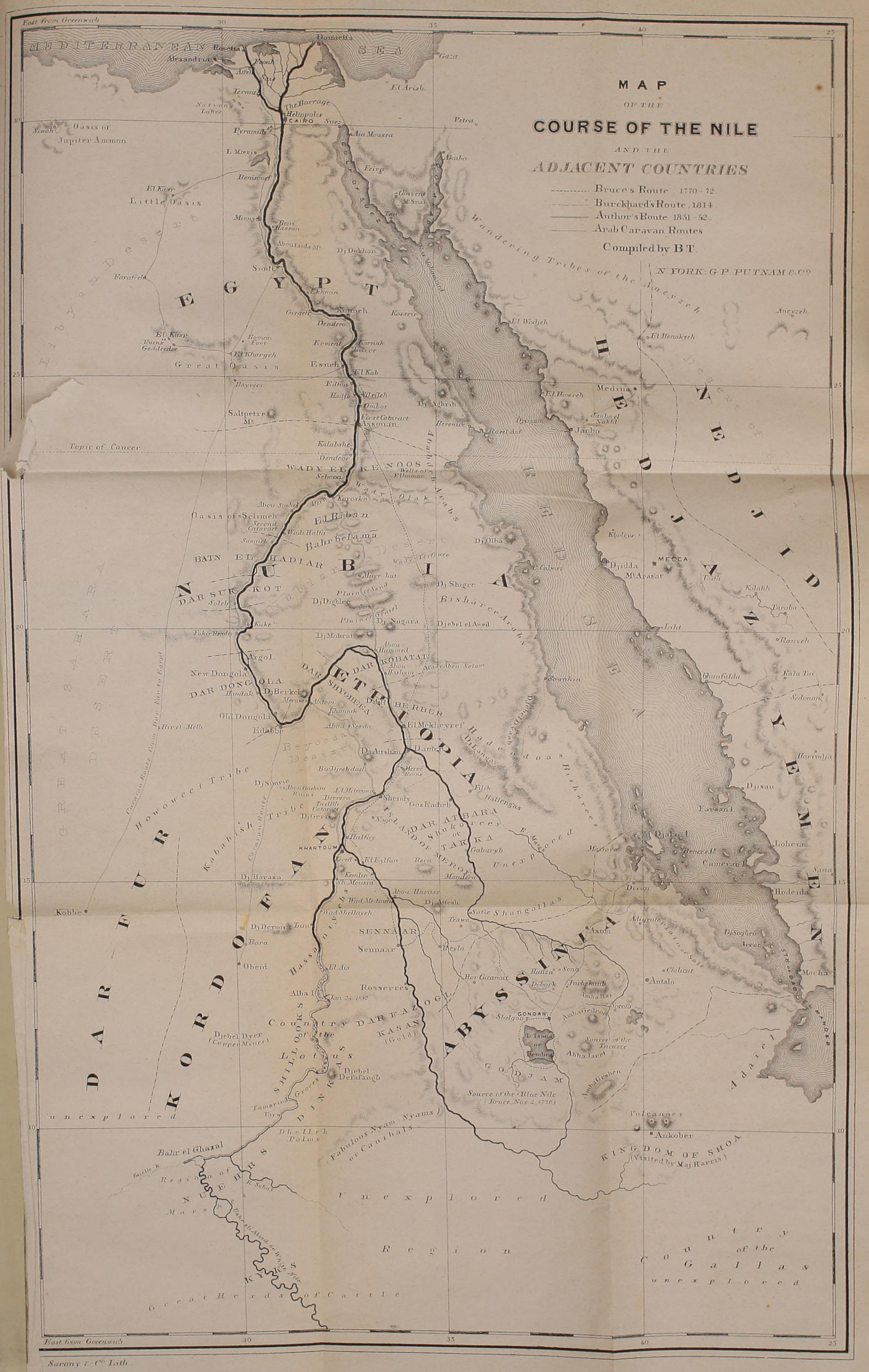
WITH A MAP AND ILLUSTRATIONS BY THE AUTHOR.
NEW YORK: G. P. PUTNAM AND SON, 661 Broadway, Opposite Bond Street.
1869.
Entered according to Act of Congress, in the year 1854, by
G. P. PUTNAM & CO.,
In the Clerk’s Office of the District Court of the United States for the Southern
District of New York.
RIVERSIDE, CAMBRIDGE:
PRINTED BY H. O. HOUGHTON AND COMPANY.
Dedicated to
A. B.
OF SAXE-COBURG-GOTHA, BY
HIS FELLOW-TRAVELLER IN EGYPT.
B. T.
PREFACE.
There is an old Italian proverb, which says a man
has lived to no purpose, unless he has either built a
house, begotten a son, or written a book. As I have
already complied more than once with the latter of
these requisitions, I must seek to justify the present
repetition thereof, on other grounds. My reasons for
offering this volume to the public are, simply, that
there is room for it. It is the record of a journey which
led me, for the most part, over fresh fields, by paths
which comparatively few had trodden before me. Although
I cannot hope to add much to the general
stock of information concerning Central Africa, I may
serve, at least, as an additional witness, to confirm or
illustrate the evidence of others. Hence, the preparation
of this work has appeared to me rather in the light
of a duty than a diversion, and I have endeavored to
impart as much instruction as amusement to the
reader. While seeking to give correct pictures of the
rich, adventurous life into which I was thrown, I have
resisted the temptation to yield myself up to its more
subtle and poetic aspects. My aim has been to furnish
a faithful narrative of my own experience, believing
that none of those embellishments which the imagination
so readily furnishes, can equal the charm of the
unadorned truth.
There are a few words of further explanation which
I wish to say. The journey was undertaken solely
for the purpose of restoring a frame exhausted by
severe mental labor. A previous experience of a tropical
climate convinced me that I should best accomplish
my object by a visit to Egypt, and as I had a whole
winter before me, I determined to penetrate as far into
the interior of Africa as the time would allow, attracted
less by the historical and geographical interest of those
regions than by the desire to participate in their free,
vigorous, semi-barbaric life. If it had been my intention,
as some of my friends supposed, to search for the
undiscovered sources of the White Nile, I should not
have turned back, until the aim was accomplished or all
means had failed.
I am aware that, by including in this work my
journey through Egypt, I have gone over much ground
which is already familiar. Egypt, however, was the
vestibule through which I passed to Ethiopia and the
kingdoms beyond, and I have not been able to omit my
impressions of that country without detracting from
the completeness of the narrative. This book is the
record of a single journey, which, both in its character
and in the circumstances that suggested and accompanied
it, occupies a separate place in my memory. Its
performance was one uninterrupted enjoyment, for,
whatever the privations to which it exposed me, they
were neutralized by the physical delight of restored
health and by a happy confidence in the successful
issue of the journey, which never forsook me. It is
therefore but just to say, that the pictures I have
drawn may seem over-bright to others who may hereafter
follow me; and I should warn all such that they
must expect to encounter many troubles and annoyances.
Although I have described somewhat minutely the
antiquities of Nubia and Ethiopia which I visited, and
have not been insensible to the interest which every
traveller in Egypt must feel in the remains of her
ancient art, I have aimed at giving representations of
the living races which inhabit those countries rather
than the old ones which have passed away. I have
taken it for granted that the reader will feel more
interested—as I was—in a live Arab, than a dead
Pharaoh. I am indebted wholly to the works of Champollion,
Wilkinson and Lepsius for whatever allusions I
have made to the age and character of the Egyptian
ruins.
B. T.
New York, July, 1854.
CONTENTS.
CHAPTER I.
Arrival at Alexandria—The Landing—My First Oriental Bath—The City—Preparations
for Departure,
Departure—The Kangia—The Egyptian Climate—The Mahmoudieh Canal—Entrance
into the Nile—Pleasures of the Journey—Studying Arabic—Sight of the Pyramids—The
Barrage—Approach to Cairo,
Entrance—The Ezbekiyeh—Saracenic Houses—Donkeys—The Bazaars—The Streets—Processions—View
from the Citadel—Mosque of Mohammed Ali—The Road to
Suez—The Island of Rhoda,
Necessity of Leaving Immediately—Engaging a Boat—The Dragomen—Achmet el
Saïdi—Funds—Information—Procuring an Outfit—Preparing for the Desert—The
Lucky Day—Exertions to Leave—Off,
Howling Dervishes—A Chicken Factory—Ride to the Pyramids—Quarrel with the
Arabs—The Ascent—View from the Summit—Backsheesh—Effect of Pyramid-climbing—The
Sphinx—Playing the Cadi—We obtain Justice—Visit to Sakkara
and the Mummy Pits—The Exhumation of Memphis—Interview with M. Mariette—Account
of his Discoveries—Statue of Remeses II.—Return to the Nile,
Leaving the Pyramids—A Calm and a Breeze—A Coptic Visit—Minyeh—The Grottoes
of Beni-Hassan—Doum Palms and Crocodiles—Djebel Aboufayda—Entrance into
Upper Egypt—Diversions of the Boatmen—Siout—Its Tombs—A Landscape—A
Bath,
Independence of Nile Life—The Dahabiyeh—Our Servants—Our Residence—Our Manner
of Living—The Climate—The Natives—Costume—Our Sunset Repose—My
Friend—A Sensuous Life Defended,
Calm—Mountains and Tombs—A Night Adventure in Ekhmin—Character of the
Boatmen—Fair Wind—Pilgrims—Egyptian Agriculture—Sugar and Cotton—Grain—Sheep—Arrival
at Kenneh—A Landscape—The Temple of Dendera—First Impressions
of Egyptian Art—Portrait of Cleopatra—A Happy Meeting—We approach
Thebes,
Arrival at Thebes—Ground-Plan of the Remains—We Cross to the Western Bank—Guides—The
Temple of Goorneh—Valley of the Kings’ Tombs—Belzoni’s Tomb—The
Races of Men—Vandalism of Antiquarians—Bruce’s Tomb—Memnon—The
Grandfather of Sesostris—The Head of Amunoph—The Colossi of the Plain—Memnonian
Music—The Statue of Rameses—The Memnonium—Beauty of Egyptian Art—More
Scrambles among the Tombs—The Bats of the Assasseef—Medeenet
Abou—Sculptured Histories—The Great Court of the Temple—We return to
Luxor,
The Dancing Girls of Egypt—A Night Scene in Luxor—The Orange-Blossom and the
Apple-Blossom—The Beautiful Bemba—The Dance—Performance of the Apple-Blossom—The
Temple of Luxor—A Mohammedan School—Gallop to Karnak—View
of the Ruins—The Great Hall of Pillars—Bedouin Diversions—A Night
Ride—Karnak under the Full Moon—Farewell to Thebes,
The Temple of Hermontis—Esneh and its Temple—The Governor—El Kab by Torch-light—The
Temple of Edfou—The Quarries of Djebel Silsileh—Ombos—Approach
to Nubia—Change in the Scenery and Inhabitants—A Mirage—Arrival at Assouan,
An Official Visit—Achmet’s Dexterity—The Island of Elephantine—Nubian Children—Trip
to Philæ—Linant Bey—The Island of Philæ—Sculptures—The Negro Race—Breakfast
in a Ptolemaic Temple—The Island of Biggeh—Backsheesh—The Cataract—The
Granite Quarries of Assouan—The Travellers separate,
Solitary Travel—Scenery of the Nubian Nile—Agriculture—The Inhabitants—Arrival
at Korosko—The Governor—The Tent Pitched—Shekh Abou-Mohammed—Bargaining
for Camels—A Drove of Giraffes—Visits—Preparations for the Desert—My
Last Evening on the Nile,
The Curve of the Nile—Routes across the Desert—Our Caravan starts—Riding on a
Dromedary—The Guide and Camel-drivers—Hair-dressing—El Biban—Scenery—Dead
Camels—An Unexpected Visit—The Guide makes my Grave—The River
without Water—Characteristics of the Mirage—Desert Life—The Sun—The Desert
Air—Infernal Scenery—The Wells of Mûrr-hàt—Christmas—Mountain Chains—Meeting
Caravans—Plains of Gravel—The Story of Joseph—Djebel Mokràt—The
Last Day in the Desert—We see the Nile again,
A Draught of Water—Abou-Hammed—The Island of Mokràt—Ethiopian Scenery—The
People—An Ababdeh Apollo—Encampment on the Nile—Tomb of an Englishman—Eesa’s
Wedding—A White Arab—The Last Day of the Year—Abou-Hashym—Incidents—Loss
of my Thermometer—The Valley of Wild Asses—The Eleventh
Cataract—Approach to Berber—Vultures—Eyoub Outwitted—We reach El Mekheyref—The
Caravan Broken up,
A Wedding—My Reception by the Military Governor—Achmet—The Bridegroom—A
Guard—I am an American Bey—Kèff—The Bey’s Visit—The Civil Governor—About
the Navy—The Priest’s Visit—Riding in State—The Dongolese Stallion—A
Merchant’s House—The Town—Dinner at the Governor’s—The Pains of Royalty—A
Salute to the American Flag—Departure,
Fortunate Travel—The America—Ethiopian Scenery—The Atbara River—Damer—A
Melon Patch—Agriculture—The Inhabitants—Change of Scenery—The First Hippopotamus—Crocodiles—Effect
of My Map—The Raïs and Sailors—Arabs in Ethiopia—Ornamental
Scars—Beshir—The Slave Bakhita—We Approach Meroë,
Arrival at Bedjerowiyeh—The Ruins of Meroë—Walk Across the Plain—The Pyramids—Character
of their Masonry—The Tower and Vault—Finding of the Treasure—The
Second Group—More Ruins—Site of the City—Number of the Pyramids—The
Antiquity of Meroë—Ethiopian and Egyptian Civilization—The Caucasian
Race—Reflections,
The Landscapes of Ethiopia—My Evenings beside the Nile—Experiences of the Arabian
Nights—The Story of the Sultana Zobeide and the Wood-cutter—Character
of the Arabian Tales—Religion,
Arrival at Shendy—Appearance of the Town—Shendy in Former Days—We Touch at
El Metemma—The Nile beyond Shendy—Flesh Diet vs. Vegetables—We Escape
Shipwreck—A Walk on Shore—The Rapids of Derreira—Djebel Gerri—The
Twelfth Cataract—Night in the Mountain Gorge—Crocodiles—A Drink of Mareesa—My
Birth-Day—Fair Wind—Approach to Khartoum—The Junction of the Two
Niles—Appearance of the City—We Drop Anchor,
The American Flag—A Rencontre—Search for a House—The Austrian Consular Agent—Description
of his Residence—The Garden—The Menagerie—Barbaric Pomp
and State—Picturesque Character of the Society of Khartoum—Foundation and
Growth of the City—Its Appearance—The Population—Unhealthiness of the Climate—Assembly
of Ethiopian Chieftains—Visit of Two Shekhs—Dinner and Fireworks,
Visit to the Catholic Mission—Dr. Knoblecher, the Apostolic Vicar—Moussa Bey—Visit
to Lattif Pasha—Reception—The Pasha’s Palace—Lions—We Dine with the
Pasha—Ceremonies upon the Occasion—Music—The Guests—The Franks in Khartoum—Dr.
Péney—Visit to the Sultana Nasra—An Ethiopian Dinner—Character
of the Sultana,
Recent Explorations of Soudân—Limit of the Tropical Rains—The Conquest of Ethiopia—Countries
Tributary to Egypt—The District of Takka—Expedition of Moussa
Bey—The Atbara River—The Abyssinian Frontier—Christian Ruins of Abou-Haràss—The
Kingdom of Sennaar—Kordofan—Dar-Fūr—The Princess of Dar-Fūr
in Khartoum—Her Visit to Dr. Reitz—The Unknown Countries of Central
Africa,
Excursions around Khartoum—A Race into the Desert—Euphorbia Forest—The
Banks of the Blue Nile—A Saint’s Grave—The Confluence of the Two Niles—Magnitude
of the Nile—Comparative Size of the Rivers—Their Names—Desire to penetrate
further into Africa—Attractions of the White Nile—Engage the Boat John
Ledyard—Former Restrictions against exploring the River—Visit to the Pasha—Despotic
Hospitality—Achmet’s Misgivings—We set sail,
Departure from Khartoum—We enter the White Nile—Mirage and Landscape—The
Consul returns—Progress—Loss of the Flag—Scenery of the Shores—Territory of
the Hassaniyehs—Curious Conjugal Custom—Multitudes of Water Fowls—Increased
Richness of Vegetation—Apes—Sunset on the White Nile—We reach the Kingdom
of the Shillook Negroes,
Morning—Magnificence of the Island Scenery—Birds and Hippopotami—Flight of the
Natives—The Island of Aba—Signs of Population—A Band of Warriors—The Shekh
and the Sultan—A Treaty of Peace—The Robe of Honor—Suspicions—We walk to
the Village—Appearance of the Shillooks—The Village—The Sultan gives Audience—Women
and Children—Ornaments of the Natives—My Watch—A Jar of Honey—Suspicion
and Alarm—The Shillook and the Sultan’s Black Wife—Character of the
Shillooks—The Land of the Lotus—Population of the Shillook Kingdom—The Turning
Point—A View from the Mast-Head,
Explorations of the White Nile—Dr. Knoblecher’s Voyage in 1849-50—The Lands
of the Shillooks and Dinkas—Intercourse with the Natives—Wild Elephants and
Giraffes—The Sobat River—The Country of Marshes—The Gazelle Lake—The
Nuehrs—Interview with the Chief of the Kyks—The Zhir Country—Land of the
Baris—The Rapids Surmounted—Arrival at Logwek, in Lat. 4° 10′ North—Panorama
from Mt. Logwek—Sources of the White Nile—Character of the Bari Nation—Return
of the Expedition—Fascination of the Nile,
We leave the Islands of the Shillooks—Tropical Jungles—A Whim and its Consequences—Lairs
of Wild Beasts—Arrival among the Hassaniyehs—A Village—The Woman
and the Sultan—A Dance of Salutation—My Arab Sailor—A Swarthy Cleopatra—Salutation
of the Saint—Miraculous Fishing—Night View of a Hassaniyeh Village—Wad
Shèllayeh—A Shekh’s Residence—An Ebony Cherub—The Cook Attempts
Suicide—Evening Landscape—The Natives and their Cattle—A Boyish
Governor—We reach Khartoum at Midnight,
The Departure of Abd-el Kader Bey—An Illuminated Picture—The Breakfast on the
Island—Horsemanship—The Pasha’s Stories—Departure of Lattif Effendi’s Expedition—A
Night on the Sand—Abou-Sin, and his Shukoree Warriors—Change in the
Climate—Intense Heat and its Effects—Preparations for Returning—A Money
Transaction—Farewell Visits—A Dinner with Royal Guests—Jolly King Dyaab—A
Shillook Dance—Reconciliation—Taking Leave of my Pets,
The Commerce of Soudân—Avenues of Trade—The Merchants—Character of the Imports—Speculation—The
Gum Trade of Kordofan—The Ivory Trade—Abuses of the
Government—The Traffic in Slaves—Prices of Slaves—Their Treatment,
Farewell Breakfast—Departure from Khartoum—Parting with Dr. Reitz—A Prediction
and its Fulfilment—Dreary Appearance of the Country—Lions—Burying-Grounds—The
Natives—My Kababish Guide, Mohammed—Character of the Arabs—Habits
of Deception—My Dromedary—Mutton and Mareesa—A Soudân Ditty—The
Rowyàn—Akaba Gerri—Heat and Scenery—An Altercation with the Guide—A
Mishap—A Landscape—Tedious Approach to El Metemma—Appearance of the
Town—Preparations for the Desert—Meeting Old Acquaintances,
Entering the Desert—Character of the Scenery—Wells—Fear of the Arabs—The Laloom
Tree—Effect of the Hot Wind—Mohammed overtakes us—Arab Endurance—An
unpleasant Bedfellow—Comedy of the Crows—Gazelles—We encounter a Sand-storm—The
Mountain of Thirst—The Wells of Djeekdud—A Mountain Pass—Desert
Intoxication—Scenery of the Table-land—Bir Khannik—The Kababish
Arabs—Gazelles again—Ruins of an Ancient Coptic Monastery—Distant View of the
Nile Valley—Djebel Berkel—We come into Port,
Our whereabouts—Shekh Mohammed Abd e’-Djebàl—My residence at Abdôm—Crossing
the River—A Superb Landscape—The Town of Merawe—Ride to Djebel Berkel—The
Temples of Napata—Ascent of the Mountain—Ethiopian Panorama—Lost
and Found—The Pyramids—The Governor of Merawe—A Scene in the Divan—The
Shekh and I—The Governor Dines with me—Ruins of the City of Napata—A
Talk about Religions—Engaging Camels for Wadi-Halfa—The Shekh’s Parting
Blessing,
Appearance of the Country—Korti—The Town of Ambukol—The Caravan reorganized—A
Fiery Ride—We reach Edabbe—An Illuminated Landscape—A Torment—Nubian
Agriculture—Old Dongola—The Palace-Mosque of the Nubian Kings—A
Panorama of Desolation—The Old City—Nubian Gratitude—Another Sand-Storm—A
Dreary Journey—The Approach to Handak—A House of Doubtful Character—The
Inmates—Journey to El Ordee (New Dongola)—Khoorshid Bey—Appearance
of the Town,
We start for Wadi-Halfa—The Plague of Black Gnats—Mohammed’s Coffin—The
Island of Argo—Market-Day—Scenery of the Nile—Entering Dar El-Màhass—Ruined
Fortresses—The Camel-Men—A Rocky Chaos—Fakir Bender—The Akaba
of Màhass—Camp in the Wilderness—The Charm of Desolation—The Nile again—Pilgrims
from Dar-Fūr—The Struggle of the Nile—An Arcadian Landscape—The
Temple of Soleb—Dar Sukkôt—The Land of Dates—The Island of Sai—A Sea of
Sand—Camp by the River—A Hyena Barbecue,
The Batn El-Hadjar, or Belly of Stone—Ancient Granite Quarries—The Village of
Dal—A Ruined Fortress—A Wilderness of Stones—The Hot Springs of Ukmé—A
Windy Night—A Dreary Day in the Desert—The Shekh’s Camel Fails—Descent to
Samneh—The Temple and Cataract—Meersheh—The Sale of Abou-Sin—We
Emerge from the Belly of Stone—A Kababish Caravan—The Rock of Abou-Seer—View
of the Second Cataract—We reach Wadi-Halfa—Selling my Dromedaries—Farewell
to Abou-Sin—Thanksgiving on the Ferry-boat—Parting with the Camel-men,
Wadi Haifa—A Boat for Assouan—We Embark on the Nile Again—An Egyptian
Dream—The Temples of Abou-Simbel—The Smaller Temple—The Colossi of
Remeses II.—Vulgarity of Travellers—Entering the Great Temple—My Impressions—Character
of Abou-Simbel—The Smaller Chambers—The Races of Men—Remeses
and the Captive Kings—Departure,
I Lose my Sunshine, and Regain it—Nubian Scenery—Derr—The Temple of Amada—Mysterious
Rappings—Familiar Scenes—Halt at Korosko—Escape from Shipwreck—The
Temple of Sebooa—Chasing other Boats—Temple of Djerf Hossayn—A
Backsheesh Experiment—Kalabshee—Temple of Dabôd—We reach the Egyptian
Frontier,
Assouan—A Boat for Cairo—English Tourists—A Head-wind—Ophthalmia—Esneh—A
Mummied Princess—Ali Effendi’s Stories—A Donkey Afrite—Arrival at Luxor—The
Egyptian Autumn—A Day at Thebes—Songs of the Sailors—Ali leaves
me—Ride to Dendera—Head-winds again—Visit to Tahtah—The House of Rufaā
Bey,
Siout in Harvest-time—A kind Englishwoman—A Slight Experience of Hasheesh—The
Calm—Rapid Progress down the Nile—The Last Day of the Voyage—Arrival
at Cairo—Tourists preparing for the Desert—Parting with Achmet—Conclusion,
JOURNEY TO CENTRAL AFRICA. — CHAPTER I. INTRODUCTION TO AFRICA.
Arrival at Alexandria—The Landing—My First Oriental Bath—The City—Preparations
for Departure.
I left Smyrna in the Lloyd steamer, Conte Stürmer, on the
first day of November, 1851. We passed the blue Sporadic
Isles—Cos, and Rhodes, and Karpathos—and crossing the
breadth of the Eastern Mediterranean, favored all the way by
unruffled seas, and skies of perfect azure, made the pharos of
Alexandria on the evening of the 3d. The entrance to the
harbor is a narrow and difficult passage through reefs, and no
vessel dares to attempt it at night, but with the first streak of
dawn we were boarded by an Egyptian pilot, and the rising
sun lighted up for us the white walls of the city, the windmills
of the Ras el-Tin, or Cape of Figs, and the low yellow sand-hills
in which I recognized Africa—for they were prophetic of
the desert behind them.
We entered the old harbor between the island of Pharos
and the main land (now connected by a peninsular strip,
on which the Frank quarter is built), soon after sunrise.
The water swarmed with boats before the anchor dropped,
and the Egyptian health officer had no sooner departed
than we were boarded by a crowd of dragomen, hotel runners,
and boatmen. A squinting Arab, who wore a white
dress and red sash, accosted me in Italian, offering to conduct
me to the Oriental Hotel. A German and a Smyrniote,
whose acquaintance I had made during the voyage, joined me
in accepting his services, and we were speedily boated ashore.
We landed on a pile of stones, not far from a mean-looking
edifice called the Custom-House. Many friends were there to
welcome us, and I shall never forget the eagerness with which
they dragged us ashore, and the zeal with which they pommelled
one another in their generous efforts to take charge of
our effects. True, we could have wished that their faces had
been better washed, their baggy trousers less ragged and their
red caps less greasy, and we were perhaps ungrateful in allowing
our Arab to rate them soundly and cuff the ears of the
more obstreperous, before our trunks and carpet-bags could be
portioned among them. At the Custom-House we were visited
by two dark gentlemen, in turbans and black flowing robes,
who passed our baggage without scrutiny, gently whispering
in our ears, “backsheesh,”—a word which we then heard for
the first time, but which was to be the key-note of much of our
future experience. The procession of porters was then set in
motion, and we passed through several streets of whitewashed
two story houses, to the great square of the Frank quarter,
which opened before us warm and brilliant in the morning sunshine.
The principal hotels and consulates front on this square
The architecture is Italian, with here and there a dash of Saracenic,
in the windows and doorways, especially in new buildings.
A small obelisk of alabaster, a present from Mohammed
Ali, stands in the centre, on a pedestal which was meant for a
fountain, but has no water. All this I noted, as well as a
crowd of donkeys and donkey-boys, and a string of laden
camels, on our way to the hotel, which we found to be a long
and not particularly clean edifice, on the northern side of the
square. The English and French steamers had just arrived,
and no rooms were to be had until after the departure of the
afternoon boat for Cairo. Our dragoman, who called himself
Ibrahim, suggested a bath as the most agreeable means of
passing the intermediate time.
The clear sky, the temperature (like that of a mild July
day at home), and the novel interest of the groups in the
streets, were sufficient to compensate for any annoyance: but
when we reached the square of the French Church, and saw a
garden of palm-trees waving their coronals of glittering leaves
every thing else was forgotten. My German friend, who had
never seen palms, except as starveling exotics in Sorrento and
Smyrna, lifted his hands in rapture, and even I, who had
heard tens of thousands rustle in the hot winds of the Tropics,
felt my heart leap as if their beauty were equally new to my
eyes. For no amount of experience can deprive the traveller
of that happy feeling of novelty which marks his first day on
the soil of a new continent. I gave myself up wholly to its
inebriation. Et ego in Africâ, was the sum of my thoughts,
and I neither saw nor cared to know the fact (which we discovered
in due time), that our friend Ibrahim was an arrant
knave.
The bath to which he conducted us was pronounced to be
the finest in Alexandria, the most superb in all the Orient,
but it did not at all accord with our ideas of Eastern luxury.
Moreover, the bath-keeper was his intimate friend, and would
bathe us as no Christians were ever bathed before. One fact
Ibrahim kept to himself, which was, that his intimate friend
and he shared the spoils of our inexperience. We were conducted
to a one-story building, of very unprepossessing exterior.
As we entered the low, vaulted entrance, my ears were
saluted with a dolorous, groaning sound, which I at first conjectured
to proceed from the persons undergoing the operation,
but which I afterward ascertained was made by a wheel
turned by a buffalo, employed in raising water from the well.
In a sort of basement hall, smelling of soap-suds, and with a
large tank of dirty water in the centre, we were received by
the bath-keeper, who showed us into a room containing three
low divans with pillows. Here we disrobed, and Ibrahim,
who had procured a quantity of napkins, enveloped our heads
in turbans and swathed our loins in a simple Adamite garment.
Heavy wooden clogs were attached to our feet, and an
animated bronze statue led the way through gloomy passages,
sometimes hot and steamy, sometimes cold and soapy, and
redolent of any thing but the spicy odors of Araby the Blest,
to a small vaulted chamber, lighted by a few apertures in the
ceiling. The moist heat was almost suffocating; hot water
flowed over the stone floor, and the stone benches we sat upon
were somewhat cooler than kitchen stoves. The bronze individual
left us, and very soon, sweating at every pore, we began
to think of the three Hebrews in the furnace. Our comfort
was not increased by the groaning sound which we still heard,
and by seeing, through a hole in the door, five or six naked
figures lying motionless along the edge of a steaming vat, in
the outer room.
Presently our statue returned with a pair of coarse hair-gloves
on his hands. He snatched off our turbans, and then,
seizing one of my friends by the shoulder as if he had been a
sheep, began a sort of rasping operation upon his back. This
process, varied occasionally by a dash of scalding water, was
extended to each of our three bodies, and we were then suffered
to rest awhile. A course of soap-suds followed, which
was softer and more pleasant in its effect, except when he took
us by the hair, and holding back our heads, scrubbed our faces
most lustily, as if there were no such things as eyes, noses and
mouths. By this time we had reached such a salamandrine
temperature that the final operation of a dozen pailfuls of hot
water poured over the head, was really delightful. After a
plunge in a seething tank, we were led back to our chamber
and enveloped in loose muslin robes. Turbans were bound on
our heads and we lay on the divans to recover from the languor
of the bath. The change produced by our new costume
was astonishing. The stout German became a Turkish mollah,
the young Smyrniote a picturesque Persian, and I—I
scarcely know what, but, as my friends assured me, a much
better Moslem than Frank. Cups of black coffee, and pipes
of inferior tobacco completed the process, and in spite of the
lack of cleanliness and superabundance of fleas, we went forth
lighter in body, and filled with a calm content which nothing
seemed able to disturb.
After a late breakfast at the hotel, we sallied out for a survey
of the city. The door was beleaguered by the donkeys
and their attendant drivers, who hailed us in all languages at
once. “Venez, Monsieur!” “Take a ride, sir; here is a
good donkey!” “Schœner Esel!” “Prendete il mio burrico!”—and
you are made the vortex of a whirlpool of donkeys.
The one-eyed donkey-boys fight, the donkeys kick, and
there is no rest till you have bestridden one of the little
beasts. The driver then gives his tail a twist and his rump a
thwack, and you are carried off in triumph. The animal is so
small that you seem the more silly of the two, when you have
mounted, but after he has carried you for an hour in a rapid
gallop, you recover your dignity in your respect for him.
The spotless blue of the sky and the delicious elasticity of
the air were truly intoxicating, as we galloped between gardens
of date-trees, laden with ripe fruit, to the city gate, and
through it into a broad road, fringed with acacias, leading to
the Mahmoudieh canal. But to the south, on a rise of dry,
sandy soil, stood the Pillar of Diocletian—not of Pompey,
whose name it bears. It is a simple column, ninety-eight feet
in height, but the shaft is a single block of red granite, and
stands superbly against the background of such a sky and
such a sea. It is the only relic of the ancient Alexandria
worthy of its fame, but you could not wish for one more imposing
and eloquent. The glowing white houses of the town,
the minarets, the palms and the acacias fill the landscape, but
it stands apart from them, in the sand, and looks only to the
sea and the desert.
In the evening we took donkeys again and rode out of the
town to a café on the banks of the canal. A sunset of burning
rose and orange sank over the desert behind Pompey’s
Pillar, and the balmiest of breezes stole towards us from the
sea, through palm gardens. A Swiss gentleman, M. de Gonzenbach,
whose kindness I shall always gratefully remember,
accompanied us. As we sat under the acacias, sipping the
black Turkish coffee, the steamer for Cairo passed, disturbing
the serenity of the air with its foul smoke, and marring the
delicious repose of the landscape in such wise, that we vowed
we would have nothing to do with steam so long as we voyaged
on the Nile. Our donkey-drivers patiently held the bridles
of our long-eared chargers till we were ready to return. It
was dark, and not seeing at first my attendant, a little one-eyed
imp, I called at random: “Abdallah!” This, it happened,
was actually his name, and he came trotting up, holding
the stirrup ready for me to mount. The quickness with
which these young Arabs pick up languages, is truly astonishing.
“Come vi chiamate?” (what’s your name?) I asked
of Abdallah, as we rode homeward. The words were new to
him, but I finally made him understand their meaning, whereupon
he put his knowledge into practice by asking me: “Come
vi chiamate?” “Abbas Pasha,” I replied. “Oh, well,”
was his prompt rejoinder, “if you are Abbas Pasha, then I am
Seyd Pasha.” The next morning he was at the door with his
donkey, which I fully intended to mount, but became entangled
in a wilderness of donkeys, out of which Ibrahim extricated
me by hoisting me on another animal. As I rode away,
I caught a glimpse of the little fellow, crying lustily over his
disappointment.
We three chance companions fraternized so agreeably that
we determined to hire a boat for Cairo, in preference to waiting
for the next steamer. We accordingly rode over to the Mahmoudieh
Canal, accompanied by Ibrahim, to inspect the barks.
Like all dragomen, Ibrahim had his private preferences, and
conducted us on board a boat belonging to a friend of his, a
grizzly raïs, or captain. The craft was a small kangia, with
a large lateen sail at the bow and a little one at the stern. It
was not very new, but looked clean, and the raïs demanded
three hundred piastres for the voyage. The piastre is the current
coin of the East. Its value is fluctuating, and always
higher in Egypt than in Syria and Turkey, but may be assumed
at about five cents, or twenty to the American dollar. Before
closing the bargain, we asked the advice of M. de Gonzenbach,
who immediately despatched his Egyptian servant
and engaged a boat at two hundred and twenty-five piastres.
Every thing was to be in readiness for our departure on the
following evening.
CHAPTER II. FIRST VOYAGE ON THE NILE.
Departure—The Kangia—The Egyptian Climate—The Mahmoudieh Canal—Entrance
Into the Nile—Pleasures of the Journey—Studying Arabic—Sight of the Pyramids—The
Barrage—Approach to Cairo.
We paid a most exorbitant bill at the Oriental Hotel, and
started on donkey-back for our boat, at sunset. Our preparations
for the voyage consisted of bread, rice, coffee, sugar, butter
and a few other comestibles; an earthen furnace and charcoal;
pots and stew-pans, plates, knives and forks, wooden
spoons, coffee-cups and water-jars; three large mats of cane-leaves,
for bedding; and for luxuries, a few bottles of claret,
and a gazelle-skin stuffed with choice Latakieh tobacco. We
were prudent enough to take a supper with us from the hotel,
and not trust to our own cooking the first night on board.
We waited till dark on the banks of the Canal before our
baggage appeared. There is a Custom-House on all sides of
Alexandria, and goods going out must pay as well as goods coming
in. The gate was closed, and nothing less than the silver
oil of a dollar greased its hinges sufficiently for our cart to pass
through. But what was our surprise on reaching the boat, to
find the same kangia and the same grizzly raïs, who had previously
demanded three hundred piastres. He seemed no less
astonished than we, for the bargain had been made by a third
party, and I believe he bore us a grudge during the rest of the
voyage. The contract placed the boat at our disposition; so
we went on board immediately, bade adieu to the kind friends
who had accompanied us, and were rowed down the Canal in
the full glow of African moonlight.
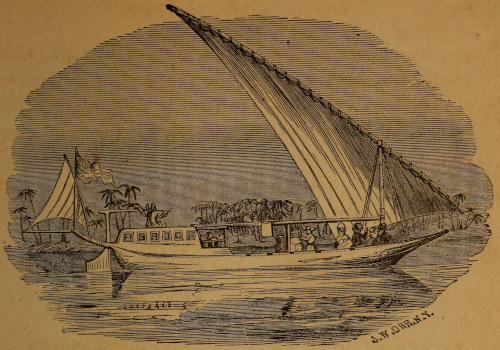
Some account of our vessel and crew will not be out of
place here. The boat was about thirty-five feet in length, with
a short upright mast in the bow, supporting a lateen sail fifty
feet long. Against the mast stood a square wooden box, lined
with clay, which served as a fireplace for cooking. The middle
boards of the deck were loose and allowed entrance to the
hold, where our baggage was stowed. The sailors also lifted
them and sat on the cross-beams, with their feet on the shallow
keel, when they used the oars. The cabin, which occupied
the stern of the boat, was built above and below the deck,
so that after stepping down into it we could stand upright.
The first compartment contained two broad benches, with a
smaller chamber in the rear, allowing just enough room, in all,
for three persons to sleep. We spread our mats on the
boards, placed carpet-bags for pillows (first taking out the
books), and our beds were made. Ibrahim slept on the deck,
against the cabin-door.
Our raïs, or captain, was an old Arab, with a black, wrinkled
face, a grizzly beard and a tattered blue robe. There were
five sailors—one with crooked eyes, one with a moustache, two
copper-colored Fellahs, and one tall Nubian, black as the
Egyptian darkness. The three latter were our favorites, and
more cheerful and faithful creatures I never saw. One of the
Fellahs sang nasal love-songs the whole day long, and was always
foremost in the everlasting refrain of “haylee-sah!” and
“ya salaam!” with which the Egyptian sailors row and tow
and pole their boats against the current. Before we left the
boat we had acquired a kind of affection for these three men,
while the raïs, with his grim face and croaking voice, grew more
repulsive every day.
We spread a mat on the deck, lighted our lantern and sat
down to supper, while a gentle north wind slowly carried our
boat along through shadows of palms and clear spaces of moonlight.
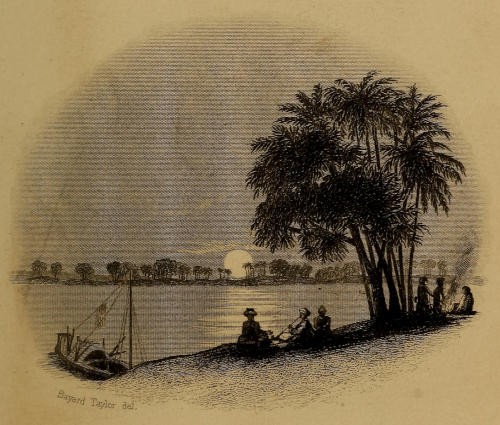
Ibrahim filled the shebooks, and for four hours we sat
in the open air, which seemed to grow sweeter and purer with
every breath we inhaled. We were a triad—the sacred number—and
it would have been difficult to find another triad so
harmonious and yet differing so strongly in its parts. One
was a Landwirth from Saxe-Coburg, a man of forty-five, tall,
yet portly in person, and accustomed to the most comfortable
living and the best society in Germany. Another was a Smyrniote
merchant, a young man of thirty, to whom all parts of
Europe were familiar, who spoke eight languages, and who
within four months had visited Ispahan and the Caucasus. Of
the third it behooves me not to speak, save that he was from
the New World, and that he differed entirely from his friends
in stature, features, station in life, and every thing else but mutual
goodfellowship. “Ah,” said the German in the fulness
of his heart, as we basked in the moonlight, “what a heavenly
air! what beautiful palms! and this wonderful repose in all
Nature, which I never felt before!” “It is better than the
gardens of Ispahan,” added the Smyrniote. Nor did I deceive
them when I said that for many months past I had known no
mood of mind so peaceful and grateful.
We rose somewhat stiff from our hard beds, but a cup of
coffee and the fresh morning air restored the amenity of the
voyage. The banks of the Canal are flat and dull, and the
country through which we passed, after leaving the marshy
brink of Lake Mareotis, was in many places still too wet from
the recent inundation to be ploughed for the winter crops. It is
a dead level of rich black loam, and produces rice, maize, sugar-cane
and millet. Here and there the sand has blown over it,
and large spaces are given up to a sort of coarse, wiry grass.
The villages are miserable collections of mud huts, but the
date-palms which shadow them and the strings of camels that
slowly pass to and fro, render even their unsightliness picturesque.
In two or three places we passed mud machines, driven
by steam, for the purpose of cleaning the Canal. Ropes were
stretched across the channel on both sides, and a large number
of trading boats were obliged to halt, although the wind was
very favorable. The barrier was withdrawn for us Franks, and
the courteous engineer touched his tarboosh in reply to our
salutations, as we shot through.
Towards noon we stopped at a village, and the Asian went
ashore with Ibrahim to buy provisions, while the European
walked ahead with his fowling-piece, to shoot wild ducks for
dinner. The American stayed on board and studied an Arabic
vocabulary. Presently Ibrahim appeared with two fowls, two
pigeons, a pot of milk and a dozen eggs. The Asian set about
preparing breakfast, and showed himself so skilful that our
bark soon exhaled the most savory odors. When we picked
up our European he had only two hawks to offer us, but we
gave him in return a breakfast which he declared perfect. We
ate on deck, seated on a mat; a pleasant wind filled our sails,
and myriads of swallows circled and twittered over our heads
in the cloudless air. The calm, contemplative state produced
by the coffee and pipes which Ibrahim brought us, lasted the
whole afternoon, and the villages, the cane-fields, the Moslem
oratories, the wide level of the Delta and the distant mounds
of forgotten cities, passed before our eyes like the pictures of
a dream. Only one of these pictures marred the serenity of
our minds. It was an Arab burying-ground, on the banks of
the Canal—a collection of heaps of mud, baked in the sun.
At the head and foot of one of the most recent, sat two women—paid
mourners—who howled and sobbed, in long, piteous,
despairing cries, which were most painful to hear. I should
never have imagined that any thing but the keenest grief could
teach such heart-breaking sounds.
When I climbed the bank at sunset, for a walk, the minarets
of Atfeh, on the Nile, were visible. Two rows of acacias,
planted along the Canal, formed a pleasant arcade, through
which we sailed, to the muddy excrescences of the town. The
locks were closed for the night, and we were obliged to halt,
which gave us an opportunity of witnessing an Arabic marriage
procession. The noise of two wooden drums and a sort of fife
announced the approach of the bride, who, attended by her
relatives, came down the bank from the mud-ovens above. She
was closely veiled, but the Arabs crowded around to get a peep
at her face. No sooner had the three Franks approached, than
she was doubly guarded and hurried off to the house of her intended
husband. Some time afterwards I ascended the bank
to have a nearer view of the miserable hovels, but was received
with such outcries and menacing gestures, that I made a slow
and dignified retreat. We visited, however, the house of the
bridegroom’s father, where twenty or thirty Arabs, seated on
the ground, were singing an epithalamium, to which they kept
time by clapping their hands.
Next morning, while our raïs was getting his permit to pass
the locks (for which four official signatures and a fee of thirty
piastres are necessary), we visited the bazaar, and purchased
long tubes of jasmine-wood for our pipes, and vegetables for
our kitchen. On all such occasions we detailed Seyd, the tall
Nubian, whose ebony face shone resplendent under a snow-white
turban, to be our attendant. The stately gravity with which
he walked behind us, carrying bread and vegetables, was worthy
the pipe-bearer of a Sultan. By this time we had installed
the Asian as cook, and he very cheerfully undertook the service.
We soon discovered that the skill of Ibrahim extended no further
than to the making of a pilaff and the preparation of coffee.
Moreover his habits and appearance were not calculated to make
us relish his handiwork. The naïveté with which he took the
wash-basin to make soup in, and wiped our knives and forks on
his own baggy pantaloons, would have been very amusing if we
had not been interested parties. The Asian was one day
crumbling some loaf sugar with a hammer, when Ibrahim, who
had been watching him, suddenly exclaimed in a tone of mingled
pity and contempt, “that’s not the way!” Thereupon he
took up some of the lumps, and wrapped them in one corner of
his long white shirt, which he thrust into his mouth, and after
crushing the sugar between his teeth, emptied it into the bowl
with an air of triumph.
A whole squadron of boats was waiting at the locks, but
with Frankish impudence, we pushed through them, and took
our place in the front rank. The sun was intensely hot, and
we sweated and broiled for a full hour, in the midst of a horrible
tumult of Arabs, before the clumsy officers closed the last
gate on us and let us float forth on the Nile. It is the western,
or Canopic branch of the river which flows past Atfeh. It
is not broader than the Hudson at Albany, but was more muddy
and slimy from its recent overflow than the Mississippi at
New Orleans. Its water is no less sweet and wholesome than
that of the latter river. After leaving the monotonous banks
of the Canal, the aspect of its shores, fringed with groves of
palm, was unspeakably cheerful and inspiring. On the opposite
side, the slender white minarets of Fooah, once a rich manufacturing
town, sparkled in the noonday sun. A fresh north
wind from the Mediterranean slowly pressed our boat against
the strong current, while the heavily-laden merchant vessels
followed in our wake, their two immense lateen sails expanded
like the wings of the Arabian roc. We drank to the glory of
old Father Nile in a cup of his own brown current, and then
called Ibrahim to replenish the empty shebooks. Those who
object to tobacco under the form of cigars, or are nauseated by
the fumes of a German meerschaum, should be told that the
Turkish pipe, filled with Latakieh, is quite another thing. The
aroma, which you inhale through a long jasmine tube, topped
with a soft amber mouth-piece, is as fragrant as roses and refreshing
as ripe dates. I have no doubt that the atmosphere
of celestial musk and amber which surrounded Mahomet, according
to the Persian Chronicles, was none other than genuine
Latakieh, at twenty piastres the oka. One thing is certain,
that without the capacity to smoke a shebook, no one can taste
the true flavor of the Orient.
An hour or two after sunset the wind fell, and for the rest
of the night our men tracked the boat slowly forward, singing
cheerily as they tugged at the long tow-rope. The Asian
spread on the deck his Albanian capote, the European his ample
travelling cloak, and the representatives of three Continents,
travelling in the fourth, lay on their backs enjoying the
moonlight, the palms, and more than all, the perfect silence and
repose. With every day of our journey I felt more deeply and
gratefully this sense of rest. Under such a glorious sky, no
disturbance seemed possible. It was of little consequence
whether the boat went forward or backward, whether we struck
on a sand-bar or ploughed the water under a full head of wind;
every thing was right. My conscience made me no reproach for
such a lazy life. In America we live too fast and work too
hard, I thought: shall I not know what Rest is, once before I
die? The European said to me naïvely, one day: “I am a
little surprised, but very glad, that no one of us has yet spoken
of European politics.” Europe! I had forgotten that such a
land existed: and as for America, it seemed very dim and
distant.
Sometimes I varied this repose by trying to pick up the
language. Wilkinson’s Vocabulary and Capt. Hayes’s Grammar
did me great service, and after I had tried a number of
words with Ibrahim, to get the pronunciation, I made bolder
essays. One day when the sailors were engaged in a most
vociferous discussion, I broke upon them with: “What is all
this noise about? stop instantly!” The effect was instantaneous;
the men were silent, and Seyd, turning up his eyes in
wonder, cried out: “Wallah! the Howadji talks Arabic!”
The two copper-faced Fellahs thought it very amusing, and
every new word I learned sufficed to set them laughing for half
an hour. I called out to a fisherman, seated on the bank: “O
Fisherman, have you any fish?” and he held up a string of
them and made answer: “O Howadji, I have.” This solemn
form of address, which is universal in Arabic, makes the language
very piquant to a student.
During our second night on the river, we passed the site
of ancient Saïs, one of the most renowned of Egyptian cities,
which has left nothing but a few shapeless mounds. The country
was in many places still wet from the inundation, which
was the largest that had occurred for many years. The Fellahs
were ploughing for wheat, with a single buffalo geared to a
sharp pole, which scratched up the soil to the depth of three
inches. Fields of maize and sugar-cane were frequent, and I
noticed also some plantations of tobacco, millet, and a species
of lupin, which is cultivated for its beans. The only vegetables
we found for sale in the villages, were onions, leeks and tomatoes.
Milk, butter and eggs are abundant and very good, but
the cheese of the country is detestable. The habitations resemble
ant-hills, rather than human dwellings, and the villages are
dépôts of filth and vermin, on the most magnificent scale. Our
boat was fortunately free from the latter, except a few cockroaches.
Except the palm and acacia, without which a Nile
journey would lose half its attractions, I saw few trees. Here
and there stood a group of superb plane-trees, and the banana
sometimes appeared in the gardens, but there is nothing of that
marvellous luxuriance and variety of vegetation which is elsewhere
exhibited in the neighborhood of the Tropics.
On the evening of the third day we reached the town of
Nadir, and, as there was no wind, went ashore for an hour or
two. There was a café on the bank—a mud house, with two
windows, adorned with wooden frames, carved in the Moorish
style. A divan, built of clay and whitewashed, extended along
one side of the room, and on this we seated ourselves cross-legged,
while the host prepared the little coffee-cups and filled the
pipes. Through the open door we saw the Nile, gleaming
broadly under the full moon, and in the distance, two tall palm-trees
stood clearly against the sky. Our boatmen, whom we
had treated to booza, the Egyptian beer, sat before us, and
joined in the chorus of a song, which was sung to entertain us.
The performers were three women, and a man who played a
coarse reed flute. One of the women had a tambourine, another
a small wooden drum, and the third kept time by slapping the
closed fingers of the right hand on the palm of the left. The
song, which had a wild, rude harmony that pleased me, was
followed by a dance, executed by one of the women. It was
very similar to the fandango, as danced by the natives of the
Isthmus of Panama, and was more lascivious than graceful.
The women, however, were of the lowest class, and their performances
were adapted to the taste of the boatmen and camel-drivers,
by whom they are patronized.
The next day the yellow hills of the Libyan Desert, which
in some places press the arable land of the Delta even to the
brink of the Nile, appeared in the west. The sand appeared
to be steadily advancing towards the river, and near Werdan
had already buried a grove of acacias as high as their first
branches. The tops were green and flourishing above the
deluge, but another year or two would overwhelm them completely.
We had a thick fog during the night, and the following
day was exceedingly hot though the air was transparent as
crystal. Our three faces were already of the color of new
bronze, which was burned into the skin by the reflection from
the water. While my friends were enjoying their usual afternoon
repose, a secret presentiment made me climb to the roof
of our cabin. I had not sat there long, before I descried two
faint blue triangles on the horizon, far to the south. I rudely
broke in upon their indolence with a shout of “the Pyramids!”
which Seyd echoed with “El-hàram Faraoon!” I
was as much impressed with the view as I expected to be, but
I completely nullified the European’s emotion by translating
to him Thackeray’s description of his first sight of those renowned
monuments.
The same evening we reached the northern point of the
Delta, where we were obliged to remain all night, as the wind
was not sufficiently strong to allow us to pass the Barrage.
Singularly enough, this immense work, which is among the
greatest undertakings of modern times, is scarcely heard of out
of Egypt. It is nothing less than a damming of the Nile,
which is to have the effect of producing two inundations a
year, and doubling the crops throughout the Delta. Here,
where the flood divides itself into two main branches, which
find separate mouths at Damietta and Rosetta, an immense
dam has not only been projected, but is far advanced toward
completion. Each branch will be spanned by sixty-two arches,
besides a central gateway ninety feet in breadth, and flanked
by lofty stone towers. The point of the Delta, between the
two dams, is protected by a curtain of solid masonry, and the
abutments which it joins are fortified by towers sixty or seventy
feet in height. The piers have curved breakwaters on the
upper side, while the opposite parapet of the arches rises high
above them, so that the dam consists of three successive terraces,
and presents itself like a wedge, against the force of
such an immense body of water. The material is brick, faced
with stone. When complete, it is intended to close the side-arches
during low water, leaving only the central gateway
open. By this means sufficient water will be gained to fill all
the irrigating canals, while a new channel, cut through the
centre of the Delta, will render productive a vast tract of fertile
land. The project is a grand one, and the only obstacle
to its success is the light, porous character of the alluvial
soil on which the piers are founded. The undertaking was
planned and commenced by M. Linant, and has since been
continued by other engineers.
The Egyptian boatmen have reason to complain of the
Barrage. The main force of the river is poured through the
narrow space wherein the piers have not yet been sunk, which
cannot be passed without a strong north wind. Forty or fifty
boats were lying along the shore, waiting the favorable moment.
We obtained permission from the engineer to attach
our boat to a large government barge, which was to be drawn
up by a stationary windlass. As we put off, the wind freshened,
and we were slowly urged against the current to the main
rapid, where we were obliged to hold on to our big friend.
Behind us the river was white with sails—craft of all kinds,
pushed up by the wind, dragged down by the water, striking
against each other, entangling their long sails and crowding
into the narrow passage, amid shouts, cries and a bewildering
profusion of Arabic gutturals. For half an hour, the scene was
most exciting, but thanks to the windlass, we reached smoother
water, and sailed off gayly for Cairo.
The true Nile expanded before us, nearly two miles in
width. To the south, the three Pyramids of Gizeh loomed
up like isolated mountain-peaks on the verge of the Desert.
On the right hand the Mokattam Hills lay red and bare in
the sunshine, and ere long, over the distant gardens of Shoobra,
we caught sight of the Citadel of Cairo, and the minarets
of the mosque of Sultan Hassan. The north wind was faithful:
at three o’clock we were anchored in Boulak, paid our
raïs, gave the crew a backsheesh, for which they kissed our
hands with many exclamations of “taïb!” (good!) and set
out for Cairo.
CHAPTER III. PICTURES OF CAIRO.
Entrance—The Ezbekiyeh—Saracenic Houses—Donkeys—The Bazaars—The Streets—Processions—View
from the Citadel—Mosque of Mohammed Ali—The Road to
Suez—The Island of Rhoda.
Our approach to and entrance into Cairo was the illuminated
frontispiece to the volume of my Eastern life. From the Nile
we had already seen the mosque of Sultan Hassan, the white
domes, and long, pencil-like minarets of the new mosque of
Mohammed Ali, and the massive masonry of the Citadel,
crowning a projecting spur of the Mokattam Hills, which
touches the city on the eastern side. But when, mounted
on ambling donkeys, we followed the laden baggage-horses
through the streets of Boulak, and entered the broad, shaded
highway leading through gardens, grain-fields and groves of
palm and banana, to the gate of the Ezbekiyeh—the great
square of Cairo—the scene, which, at a distance, had been
dimmed and softened by the filmy screen of the Egyptian air,
now became so gay, picturesque and animated, so full of life
and motion and color, that my dreams of the East were at
once displaced by the vivid reality. The donkey-riding multitudes
who passed continually to and fro, were wholly unlike
the crowds of Smyrna and Alexandria, where the growing influence
of European dress and customs is already visible.
Here, every thing still exhaled the rich aroma of the Orient
as it had been wafted to me from the Thousand and One
Nights, the Persian poets and the Arab chroniclers. I forgot
that I still wore a Frank dress, and found myself wondering at
the temerity of the few Europeans we met. I looked without
surprise on the long processions of donkeys carrying water-skins,
the heavily-laden camels, the women with white masks
on their faces and black bags around their bodies, the stolid
Nubian slaves, the grave Abyssinians, and all the other various
characters that passed and repassed us. But because
they were so familiar, they were none the less interesting, for
all had been acquaintances, when, like Tennyson, “true Mussulman
was I, and sworn,” under the reign of the good Haroun
Al-Raschid.
We entered the Ezbekiyeh, which is wholly overgrown with
majestic acacias and plane-trees, and thickets of aromatic flowering
shrubs. It is in the Frank quarter of the city, and was
first laid out and planted by order of Mohammed Ali. All the
principal hotels front upon it, and light, thatched cafés fill the
space under the plane-trees, where the beau monde of Cairo
promenade every Sunday evening. Nothing of the old City of
the Caliphs, except a few tall minarets, can be seen from this
quarter, but the bowery luxuriance of the foliage is all that the
eye demands, and over the plain white walls, on every side,
the palms—single, or in friendly groups—lift their feathery
crowns. After installing our household gods in the chambers
of the quiet and comfortable Hotel d’Europe, we went out to
enjoy the sweet evening air in front of one of the cafés. I
tried for the first time the narghileh, or Persian water-pipe.
The soft, velvety leaves of the tobacco of Shiraz are burned in
a small cup, the tube of which enters a glass vase, half filled
with rose-scented water. From the top of this vase issues a
flexible tube, several feet in length, with a mouth-piece of wood
or amber. At each inspiration, the smoke is drawn downward
and rises through the water with a pleasant bubbling sound. It
is deprived of all the essential oil of the weed, and is exceedingly
mild, cool and fragrant. But instead of being puffed out
of the mouth in whiffs, it is breathed full into the lungs and
out again, like the common air. This is not so difficult a matter
as might be supposed; the sensation is pleasant and slightly
exhilarating, and is not injurious to the lungs when moderately
indulged in.
The Turkish quarter of Cairo still retains the picturesque
Saracenic architecture of the times of the Caliphs. The
houses are mostly three stories in height, each story projecting
over the other, and the plain stone walls are either whitewashed
or striped with horizontal red bars, in a manner which would
be absurd under a northern sky, but which is here singularly
harmonious and agreeable. The only signs of sculpture are
occasional doorways with richly carved arches, or the light
marble gallery surrounding a fountained court. I saw a few
of these in retired parts of the city. The traveller, however,
has an exhaustless source of delight in the wooden balconies
inclosing the upper windows. The extraordinary lightness,
grace and delicate fragility of their workmanship, rendered still
more striking by contrast with the naked solidity of the walls
to which they cling, gave me a new idea of the skill and fancy
of the Saracenic architects. The wood seems rather woven in
the loom, than cut with the saw and chisel. Through these
lattices of fine net-work, with borders worked in lace-like patterns,
and sometimes topped with slender turrets and pinnacles,
the wives of the Cairene merchants sit and watch the crowds
passing softly to and fro in the twilight of the bazaars, themselves
unseen. It needed no effort of the imagination to people
the fairy watch-towers under which we rode daily, with forms
as beautiful as those which live in the voluptuous melodies of
Hafiz.
To see Cairo thoroughly, one must first accustom himself
to the ways of those long-eared cabs, without the use of which
I would advise no one to trust himself in the bazaars. Donkey-riding
is universal, and no one thinks of going beyond the
Frank quarter on foot. If he does, he must submit to be followed
by not less than six donkeys with their drivers. A
friend of mine, who was attended by such a cavalcade for two
hours, was obliged to yield at last, and made no second attempt.
When we first appeared in the gateway of our hotel, equipped
for an excursion, the rush of men and animals was so great,
that we were forced to retreat until our servant and the porter
whipped us a path through the yelling and braying mob. After
one or two trials, I found an intelligent Arab boy, named
Kish, who, for five piastres a day, furnished strong and ambitious
donkeys, which he kept ready at the door from morning
till night. The other drivers respected Kish’s privilege, and
thenceforth I had no trouble. The donkeys are so small that
my feet nearly touched the ground, but there is no end to their
strength and endurance. Their gait, whether a pace or a gallop,
is so easy and light that fatigue is impossible. The drivers
take great pride in having high-cushioned red saddles, and
in hanging bits of jingling brass to the bridles. They keep
their donkeys close shorn, and frequently beautify them by
painting them various colors. The first animal I rode had legs
barred like a zebra’s, and my friend’s rejoiced in purple flanks
and a yellow belly. The drivers run behind them with a short
stick, punching them from time to time, or giving them a sharp
pinch on the rump. Very few of them own their donkeys, and
I understood their pertinacity when I learned that they frequently
received a beating on returning home in the evening
empty-handed.
The passage of the bazaars seems at first quite as hazardous
on donkey-back as on foot, but it is the difference between knocking
somebody down and being knocked down yourself, and one
naturally prefers the former alternative. There is no use in
attempting to guide the donkey, for he won’t be guided. The
driver shouts behind, and you are dashed at full speed into a
confusion of other donkeys, camels, horses, carts, water-carriers
and footmen. In vain you cry out: “Bess!” (enough!)
“Piano!” and other desperate adjurations; the driver’s only
reply is: “Let the bridle hang loose!” You dodge your
head under a camel-load of planks; your leg brushes the wheel
of a dust-cart; you strike a fat Turk plump in the back; you
miraculously escape upsetting a fruit-stand; you scatter a company
of spectral, white-masked women, and at last reach some
more quiet street, with the sensation of a man who has stormed
a battery. At first this sort of riding made me very nervous,
but finally I let the donkey go his own way, and took a curious
interest in seeing how near a chance I ran of striking or being
struck. Sometimes there seemed no hope of avoiding a violent
collision, but by a series of the most remarkable dodges he generally
carried me through in safety. The cries of the driver,
running behind, gave me no little amusement: “The Howadji
comes! Take care on the right hand! take care on the left
hand! O man, take care! O maiden, take care! O boy, get
out of the way! The Howadji comes!” Kish had strong lungs
and his donkey would let nothing pass him, and so, wherever
we went, we contributed our full share to the universal noise
and confusion.
Cairo is the cleanest of all oriental cities. The regulations
established by Mohammed Ali are strictly carried out. Each
man is obliged to sweep before his own door, and the dirt is
carried away in carts every morning. Besides this, the streets
are watered several times a day, and are nearly always cool
and free from dust. The constant evaporation of the water,
however, is said to be injurious to the eyes of the inhabitants,
though in other respects the city is healthy. The quantity of
sore-eyed, cross-eyed, one-eyed, and totally blind persons one
meets every where, is surprising. There are some beggars,
mostly old or deformed, but by no means so abundant or impertinent
as in the Italian cities. A number of shabby policemen,
in blue frock-coats and white pantaloons, parade the principal
thoroughfares, but I never saw their services called into
requisition. The soldiers, who wear a European dress of white
cotton, are by far the most awkward and unpicturesque class.
Even the Fellah, whose single brown garment hangs loose from
his shoulders to his knees, has an air of dignity compared with
these Frankish caricatures. The genuine Egyptian costume,
which bears considerable resemblance to the Greek, and especially
the Hydriote, is simple and graceful. The colors are
dark—principally brown, blue, green and violet—relieved by a
heavy silk sash of some gay pattern, and by the red slippers
and tarboosh. But, as in Turkey, the Pashas and Beys, and
many of the minor officers of the civil departments have adopted
the Frank dress, retaining only the tarboosh,—a change
which is by no means becoming to them. I went into an Egyptian
barber-shop one day, to have my hair shorn, and enjoyed
the preparatory pipe and coffee in company with two individuals,
whom I supposed to be French or Italians of the
vulgar order, until the barber combed out the long locks on the
top of their head, by which Mussulmen expect to be lifted up
into Paradise. When they had gone, the man informed me
that one was Khalim Pasha, one of the grandsons of Mohammed
Ali, and the other a Bey, of considerable notoriety. The
Egyptians certainly do not gain any thing by adopting a costume
which, in this climate, is neither so convenient nor so agreeable
as their own.
Besides the animated life of the bazaars, which I had an
opportunity of seeing, in making my outfit for the winter’s
journey, I rarely went out without witnessing some incident or
ceremony illustrative of Egyptian character and customs. One
morning I encountered a stately procession, with music and
banners, accompanying a venerable personage, with a green turban
on his head and a long white beard flowing over his breast.
This, as Kish assured me, was the Shereef of Mecca. He was
attended by officers in the richest Turkish and Egyptian costumes,
mounted on splendid Arabian steeds, who were almost
hidden under their broad housings of green and crimson velvet,
embroidered with gold. The people on all sides, as he passed,
laid their hands on their breasts and bowed low, which he answered
by slowly lifting his hand. It was a simple motion, but
nothing could have been more calm and majestic.
On another occasion, I met a bridal procession in the streets
of Boulak. Three musicians, playing on piercing flutes, headed
the march, followed by the parents of the bride, who, surrounded
by her maids, walked under a crimson canopy. She
was shrouded from head to foot in a red robe, over which a
gilded diadem was fastened around her head. A large crowd
of friends and relatives closed the procession, close behind
which followed another, of very different character. The chief
actors were four boys, of five or six years old, on their way to
be circumcised. Each was mounted on a handsome horse, and
wore the gala garments of a full-grown man, in which their little
bodies were entirely lost. The proud parents marched by their
sides, supporting them, and occasionally holding to their lips
bottles of milk and sherbet. One was a jet black Nubian, who
seemed particularly delighted with his situation, and grinned on
all sides as he passed along. This procession was headed by
a buffoon, who carried a laugh with him which opened a ready
passage through the crowd. A man followed balancing on his
chin a long pole crowned with a bunch of flowers. He came to
me for backsheesh. His success brought me two swordsmen
out of the procession, who cut at each other with scimitars and
caught the blows on their shields. The coolness, swiftness and
skill with which they parried the strokes was really admirable,
and the concluding flourish was a masterpiece. One of them,
striking with the full sweep of his arm, aimed directly at the
face of the other, as if to divide his head into two parts; but
without making a pause, the glittering weapon turned, and
sliced the air within half an inch of his eyes. The man neither
winked nor moved a muscle of his face, but after the scimitar
had passed, dashed it up with his shield, which he then reversed,
and dropping on one knee, held to me for backsheesh. After
these came a camel, with a tuft of ostrich feathers on his head
and a boy on his back, who pounded vigorously on two wooden
drums with one hand, while he stretched the other down to me
for backsheesh. Luckily the little candidates for circumcision
were too busily engaged with their milk bottles and sugar-plums,
to join in the universal cry.
I had little time to devote to the sights of Cairo, and was
obliged to omit the excursions to the Petrified Forest, to Heliopolis
and Old Cairo, until my return. Besides the city itself,
which was always full of interest, I saw little else except the
Citadel and the Island of Rhoda. We took the early morning
for our ride to the former place, and were fortunate enough to
find our view of the Nile-plain unobscured by the mists customary
at this season. The morning light is most favorable to
the landscape, which lies wholly to the westward. The shadows
of the Citadel and the crests of the Mokattam Hills then
lie broad and cool over the city, but do not touch its minarets,
which glitter in the air like shafts of white and rosy flame.
The populace is up and stirring, and you can hear the cries of
the donkeymen and water-carriers from under the sycamores and
acacias that shade the road to Boulak. Over the rich palm-gardens,
the blue streak of the river and the plain beyond, you
see the phantoms of two pyramids in the haze which still curtains
the Libyan Desert. Northward, beyond the parks and
palaces of Shoobra, the Nile stretches his two great arms toward
the sea, dotted, far into the distance, with sails that flash
in the sun. From no other point, and at no other time, is
Cairo so grand and beautiful.
Within the walls of the Citadel is the Bir Youssef—Joseph’s
Well—as it is called by the Arabs, not from the virtuous
Hebrew, but from Sultan Saladin, who dug it out and
put it in operation. The well itself dates from the old Egyptian
time, but was filled with sand and entirely lost for many
centuries. It consists of an upper and lower shaft, cut through
the solid rock, to the depth of two hundred and sixty feet. A
winding gallery, lighted from the shaft, extends to the bottom
of the first division, where, in a chamber cut in the rock, a
mule turns the large wheel which brings up a continual string
of buckets from the fountain below. The water is poured into
a spacious basin, and carried thence to the top by another
string of buckets set in motion at the surface. Attended by
two Arabs with torches, we made the descent of the first shaft
and took a drink of the fresh, cool fluid. This well, and the
spot where the Mameluke Emin Bey jumped his horse over
the wall and escaped the massacre of his comrades, are the
only interesting historical points about the Citadel; and the
new mosque of Mohammed Ali, which overlooks the city from
the most projecting platform of the fortifications, is the only
part which has any claim to architectural beauty. Although
it has been in process of erection for many years, this mosque
is not nearly completed internally. The exterior is finished,
and its large, white, depressed dome, flanked by minarets so
tall and reed-like that they seem ready to bend with every
breeze, is the first signal of Cairo to travellers coming up or
down the Nile. The interior walls are lined throughout with
oriental alabaster, stained with the orange flush of Egyptian
sunsets, and the three domes blaze with elaborate arabesques
of green, blue, crimson and gold. In a temporary chamber,
fitted up in one corner, rests the coffin of Mohammed Ali, covered
with a heavy velvet pall, and under the marble arches before
it, a company of priests, squatted on the green carpet covering
the floor, bow their heads continually and recite prayers
or fragments of the Koran.
Before descending into the city, I rode a little way into
the Desert to the tombs of the Caliphs, on the road to Suez.
They consist mostly of stone canopies raised on pillars, with
mosques or oratories attached to them, exhibiting considerable
variety in their design, but are more curious than impressive.
The track in the sand made by the pilgrims to Mecca and the
overland passengers to Suez, had far more real interest in my
eyes. The pilgrims are fewer, and the passengers more numerous,
with each successive year. English-built omnibuses,
whirled along by galloping post-horses, scatter the sand, and
in the midst of the herbless Desert, the travellers regale themselves
with beef-steak and ale, and growl if the accustomed
Cheshire is found wanting. At this rate, how long will it be
before there is a telegraph-station in Mecca, and the operator
explodes with his wire a cannon on the Citadel of Cairo, to
announce that the prayers on Mount Arafat have commenced?
The Island of Rhoda, which I visited on a soft, golden
afternoon, is but a reminiscence of what it was a few years
ago. Since Ibrahim Pasha’s death it has been wholly neglected,
and though we found a few gardeners at work, digging up
the sodden flower-beds and clipping the rank myrtle hedges,
they only served to make the neglect more palpable. During
the recent inundation, the Nile had risen to within a few
inches of covering the whole island, and the soil was still soft
and clammy. Nearly all the growths of the tropics are nurtured
here; the coffee, the Indian fig, the mango, and other
trees alternate with the palm, orange, acacia, and the yellow
mimosa, whose blossoms make the isle fragrant. I gathered
a bunch of roses and jasmine-flowers from the unpruned vines.
In the centre of the garden is an artificial grotto lined with
shells, many of which have been broken off and carried away
by ridiculous tourists. There is no limit to human silliness,
as I have wisely concluded, after seeing Pompey’s Pillar disfigured
by “Isaac Jones” (or some equally classic name), in
capitals of black paint, a yard long, and finding “Jenny Lind”
equally prominent on the topmost stone of the great Pyramid
(Of course, the enthusiastic artist chiselled his own name beside
hers.) A mallet and chisel are often to be found in the
outfits of English and American travellers, and to judge from
the frequency of certain names, and the pains bestowed upon
their inscription, the owners must have spent the most of their
time in Upper Egypt, in leaving records of their vulgar vanity.
CHAPTER IV. PREPARATIONS FOR THE JOURNEY INTO CENTRAL AFRICA.
Necessity of Leaving Immediately—Engaging a Boat—The Dragomen—Achmet el
Saïdi—Funds—Information—Procuring an Outfit—Preparing for the Desert—The
Lucky Day—Exertions to Leave—Off!
I devoted but little time to seeing Cairo, for the travelling
season had arrived, and a speedy departure from Cairo was
absolutely necessary. The trip to Khartoum occupies at least
two months and it is not safe to remain there later than the
first of March, on account of the heat and the rainy season,
which is very unhealthy for strangers. Dr. Knoblecher, the
Catholic Apostolic Vicar for Central Africa, had left about a
month previous, on his expedition to the sources of the White
Nile. I therefore went zealously to work, and in five days my
preparations were nearly completed. I prevailed upon the
European of our triad, who had intended proceeding no further
than Cairo, to join me for the voyage to Assouan, on the Nubian
frontier, and our first care was to engage a good dahabiyeh,
or Nile-boat. This arrangement gave me great joy, for nowhere
is a congenial comrade so desirable as on the Nile. My
friend appreciated the river, and without the prospect of seeing
Thebes, Ombos and Philæ, would have cheerfully borne all
the inconveniences and delays of the journey, for the Nile’s
sake alone. Commend me to such a man, for of the hundreds
of tourists who visit the East, there are few such! On my arrival,
I had found that the rumors I had heard on the road
respecting the number of travellers and the rise in the price of
boats, were partially true. Not more than a dozen boats had
left for Upper Egypt, but the price had been raised in anticipation.
The ship carpenters and painters were busily employed
all along the shore at Boulak, in renovating the old barks
or building new ones, and the Beys and Pashas who owned the
craft were anticipating a good harvest. Some travellers paid
forty-five pounds a month for their vessels, but I found little
difficulty in getting a large and convenient boat, for two persons,
at twenty pounds a month. This price, it should be understood,
includes the services of ten men, who find their own
provisions, and only receive a gratuity in case of good behavior.
The American Consul, Mr. Kahil, had kindly obtained for me
the promise of a bark from Ismaïl Pasha, before our arrival—a
superb vessel, furnished with beds, tables, chairs and divans,
in a very handsome style—which was offered at thirty pounds
a month, but it was much larger than we needed. In the
course of my inspection of the fleet of barks at Boulak, I found
several which might be had at fifteen, and seventeen pounds
a month, but they were old, inconvenient, and full of vermin.
Our boat, which I named the Cleopatra, had been newly cleansed
and painted, and contained, besides a spacious cabin, with
beds and divans, a sort of portico on the outside, with cushioned
seats, where we proposed to sit during the balmy twilights,
and smoke our shebooks.
Without a tolerable knowledge of Arabic, a dragoman is
indispensable. The few phrases I had picked up, on the way
from Alexandria, availed me little, and would have been useless
in Nubia, where either the Berberi language, or a different
Arabic dialect is spoken; and I therefore engaged a dragoman
for the journey. This class of persons always swarm in Cairo,
and I had not been there a day before I was visited by half a
dozen, who were anxious to make the trip to Khartoum. How
they knew I was going there, I cannot imagine; but I found
that they knew the plans of every traveller in Cairo as well.
I endeavored to find one who had already made the journey,
but of all who presented themselves, only two had been farther
than the second Cataract. One of these was a Nubian, who
had made a trip with the Sennaar merchants, as far as Shendy,
in Ethiopia; but he had a sinister, treacherous face, and I refused
him at once. The other was an old man, named Suleyman
Ali, who had been for three years a servant of Champollion,
whose certificate of his faithfulness and honesty he produced.
He had been three years in Sennaar, and in addition to
Italian, (the only Frank tongue he knew), spoke several
Ethiopian dialects. He was a fine, venerable figure, with an
honest face, and I had almost decided to take him, when I
learned that he was in feeble health and would scarcely be able
to endure the hardships of the journey. I finally made choice
of a dark Egyptian, born in the valley of Thebes. He was called
Achmet el Saïdi, or Achmet of Upper Egypt, and when a boy
had been for several years a servant in the house of the English
Consul at Alexandria. He spoke English fluently, as well
as a little Italian and Turkish. I was first attracted to him by
his bold, manly face, and finding that his recommendations were
excellent, and that he had sufficient spirit, courage and address
to serve us both in case of peril, I engaged him, notwithstanding
he had never travelled beyond Wadi Halfa (the Second
Cataract). I judged, however, that I was quite as familiar
with the geography of Central Africa as any dragoman I could
procure, and that, in any case, I should find it best to form my
own plans and choose my own paths. How far I was justified
in my choice, will appear in the course of the narrative.
The next step was to procure a double outfit—for the Nile
and the Desert—and herein Achmet, who had twice made the
journey to Mount Sinai and Petra, rendered me good service.
I had some general knowledge of what was necessary, but without
the advantage of his practical experience, should have been
very imperfectly prepared. As it was, many things were forgotten
in the haste of departure, the need of which I felt when
it was too late to procure them. I had been prudent enough,
when in Vienna, to provide myself with Berghaus’s great map
of Arabia and the Valley of the Nile, which, with a stray volume
of Russegger, were my only guides. In Khartoum, afterwards,
I stumbled upon a copy of Hoskins’s Ethiopia. The
greater part of my funds I changed into Egyptian silver medjids,
colonnati, or Spanish pillar-dollars, and the Austrian
dollar of Maria Theresa, all of which are current as far as Sennaar
and Abyssinia. I also procured five hundred piastres in
copper pieces of five paràs (about half a cent) each, which were
contained in a large palm-basket, and made nearly an ass’s
load. In addition to these supplies, I obtained from an Armenian
merchant a letter of credit on his brother in Khartoum, for
two thousand piastres, on which, he gave me to understand. I
should be obliged to pay a discount of twenty per cent. I endeavored,
but in vain, to procure some information relative to
the cost of travelling in Nubia and the countries beyond. The
Frank merchants knew nothing, except that the expenses were
vast, and predicted that the sum I took would prove insufficient
and that I should certainly become involved in great difficulties
and embarrassments. The native merchants who had made
the journey were all jealous of a foreign traveller attempting
to penetrate into their peculiar domain, and gave me no satisfactory
information, while to the imagination of the Cairenes,
Sennaar is the utmost verge of the world, and he who has been
there and returned in safety, enjoys the special protection of
Allah. Even Achmet, although he showed no signs of fear,
and did not hesitate to accompany me, informed his family and
friends that we were going no further than Wadi Halfa, for he
said they would certainly detain him by force, should they
learn the truth.
I did not think it necessary to obtain a firman from Abbas
Pasha, which might readily have been procured. The American,
English and Austrian Consuls kindly gave me letters to
the principal Consular agents and merchants in Khartoum, besides
which, Achmet professed to have some acquaintance with
Lattif Pasha, who was then Pasha of Soudân. To the Hon.
Mr. Murray, the English Consul-General, and Mr. Constantine
Kahil, the American Vice-Consul at Cairo, I was especially
indebted for favors. The former intrusted me with despatches
for Khartoum and Obeid, in Kordofan, and the latter furnished
me with letters to the Governors of Thebes, Assouan and Korosko,
asking the latter to insure my safety on the journey
through the Nubian Desert. Thus prepared, I anticipated no
further trouble on the road than from hard-trotting camels,
sand, brackish water, and the like privations, which are easily
borne.
The furnishing of a Nile-boat requires considerable knowledge
of housekeeping. The number of small articles required
for this floating speck of civilization in a country of barbarians,
is amazing to a bachelor. I had no idea that the art of cooking
needed such a variety of tools and appliances, and for the
first time in my life, conceived some respect for the fame of Ude
and Soyer. There are frying-pans and stew-pans; coffee-pots
and tea-pots; knives, forks, spoons, towels, cups, ladles and
boxes; butter, lard, flour, rice, macaroni, oil, vinegar, mustard
and pepper; and no end to the groceries. We must have
a table and chairs, quilts and pillows, mats, carpets and napkins,
and many other articles which I should never have
thought of without the help of Achmet and of M. Pini, who
keeps a general dépôt of supplies. His printed lists, in four
languages, lighten the traveller’s labor very greatly. His experience
in regard to the quantity required, is also of much
service; otherwise an inexperienced person would not know
whether to take twelve or fifty pounds of rice, nor how much
sugar belonged to so much coffee. The expense of our outfit,
including bread, fowls, mutton, charcoal, and every other
requisite, was about two thousand piastres—a little more than
one hundred dollars. The calculation was made for one
month’s provisions for two persons.
For my further journey after leaving the Nile, I was
recommended to take a large supply, on account of the scarcity
and expense of many articles in Upper Nubia and Sennaar. I
therefore purchased sufficient tea, coffee, flour, rice, biscuits,
sugar, macaroni and dried fruit to last me two months, beside
a complete canteen, or supply of articles necessary for life in
the desert. I took an extra quantity of gunpowder, tobacco
and coffee, for presents to the Arab shekhs. The entire cost
of this outfit was about nine hundred piastres. In addition, I
procured a good Turkish tent for two hundred and fifty piastres,
to which I added a supply of tent-pins, lantern-poles, water-skins,
and leathern water-flasks, all these articles being procured
to better advantage in Cairo. I did not propose adopting
the Egyptian costume until I had made some progress in
the language, and therefore contented myself with purchasing
a bornous of camel’s hair, a sabre, a broad shawl of Tripoli
silk, for the waist, and shoes of white leather, which are very
cool and comfortable. I also followed the custom of the European
residents, in having my hair shorn close to the head, and
wearing a white cotton skull-cap. Over this was drawn the
red tarboosh, or fez, and as a protection against the sun, I
bound a large white shawl around it, which was my first lesson
in turban-making.
Achmet, influenced by a superstition which is not peculiar
to the East, begged me to hasten our preparations, in order
that we might leave Boulak on Monday, which day, he averred,
was the luckiest in the week, and would render our journey
prosperous from beginning to end. Knowing from experience
that half the success of the journey is in the start, and believing
that it is better to have superstition with you than against
you, I determined to gratify him. He was as zealous as I
could wish, and we rested not from morning to night, until at
last, from the spirit with which we labored, it seemed almost a
matter of life and death, that the boat should leave on Monday.
I had a clause inserted in our written contract with the
captain, that he should forfeit a day’s rent, in case he was not
ready at the appointed hour; but, in spite of this precaution
Achmet, who well knew the indifference of the Arab nature,
was constantly on his track. Two or three times a day he
galloped to Boulak, to hasten the enlistment of the men, the
baking of bread for the voyage, the furbishing of the cabin,
and the overhauling of the sails, oars and rigging. My European
friends in Cairo smiled at our display of activity, saying
that such a thing had never been known, as a boat sailing at
the appointed time, and that I was fatiguing myself to no
purpose.
Monday (Nov. 17th) came, and the Egyptian cook, Salame,
whom we had engaged for the Nile voyage, was despatched
to the markets to lay in a supply of fowls, eggs, butter
and vegetables. My letters home—the last I expected
to send, for months to come—were committed to the Post
Office, and after an early dinner, we saw our baggage and
stores laden upon carts and started for Boulak, under Achmet’s
guidance. We took leave of the few friends we had
made in Cairo, and followed. The Cleopatra was still lying
in the midst of a crowd of dahabiyehs, but the American flag,
hoisted at the peak of her little mizzenmast, was our “cornet,”
proclaiming departure. We found Achmet unjacketed and
unturbaned, stowing away the stores, with one eye on the
raïs, and another (as it seemed to me) on each of the tardy
sailors. There was still charcoal to be bought, and bois gras
for kindling fires, and clubs for the men, to prevent invasions
from the shore, with many more of those wants which are
never remembered until the last moment. The afternoon wore
away; the shadows of the feathery date-trees on the island
of Rhoda stretched long and cool across the Nile; but before
the sun had touched the tops of the Pyramids, we had squeezed
out from the shipping of Boulak, and were slowly working up
the Nile before a light wind, while our boatmen thumped the
tarabooka, and sang their wild Arab songs of departure. The
raïs came up to know whether he had not fulfilled his contract,
and Achmet with a cheerful face, turned to me and said:
“Praised be Allah, master! we shall have a lucky journey.”
CHAPTER V. THE PYRAMIDS AND MEMPHIS.
Achmet.
Howling Dervishes—A Chicken Factory—Ride to the Pyramids—Quarrel with the
Arabs—The Ascent—View from the Summit—Backsheesh—Effect of Pyramid
climbing—The Sphinx—Playing the Cadi—We obtain Justice—Visit to Sakkara
and the Mummy Pits—The Exhumation of Memphis—Interview with M. Mariette—Account
of his Discoveries—Statue of Rameses II.—Return to the Nile.
“And Morning opes in haste her lids,
To gaze upon the Pyramids.”—Emerson.
We went no further than the village of Gizeh, three or four
miles above Cairo, on the first evening, having engaged our
donkeys and their drivers to meet us there and convey us to
the Pyramids on the following morning. About dusk, the raïs
moored our boat to the bank, beside a College of dervishes,
whose unearthly chants, choruses and clapping of hands, were
prolonged far into the night. Their wild cries, and deep, monotonous
bass howlings so filled our ears that we could not
choose but listen, and, in spite of our fatigue sleep was impossible.
After performing for several hours, they gradually
ceased, through sheer exhaustion, though there was one tough
old dervish, who continued to gasp out, “Allah! Allah!”
with such a spasmodic energy, that I suspected it was produced
by the involuntary action of his larynx, and that he
could not have stopped, even had he been so minded.
When we threw open the latticed blinds of our cabin, before
sunrise, the next morning, the extraordinary purity of the
air gave rise to an amusing optical delusion on the part of my
friend. “See that wall!” said he, pointing to a space between
two white houses; “what a brilliant color it is painted,
and how those palms and these white houses are relieved
against it!” He was obliged to look twice before he perceived
that what he had taken for a wall close at hand, was
really the sky, and rested upon a far-off horizon. Our donkeys
were in readiness on the bank, and I bestrode the same
faithful little gray who had for three days carried me through
the bazaars of Cairo. We left orders for the raïs to go on to
Bedracheyn, a village near the supposed site of Memphis, and
taking Achmet with us, rode off gayly among the mud hovels
and under the date-trees of Gizeh, on our way to the Pyramids.
Near the extremity of the village, we entered one of the large
chicken-hatching establishments for which the place is famed,
but found it empty. We disturbed a numerous family of Fellahs,
couched together on the clay floor, crept on our hands
and knees through two small holes and inspected sundry ovens
covered with a layer of chaff, and redolent of a mild, moist
heat and a feathery smell. The owner informed us that for
the first four or five days the eggs were exposed to smoke as
well as heat, and that when the birds began to pick the shell,
which generally took place in fifteen days, they were placed in
another oven and carefully accouched.
The rising sun shone redly on the Pyramids, as we rode
out on the broad harvest land of the Nile. The black,
unctuous loam was still too moist from the inundation to be
ploughed, except in spots, here and there, but even where the
water had scarce evaporated, millions of germs were pushing
their slender blades up to the sunshine. In that prolific soil,
the growth of grain is visible from day to day. The Fellahs
were at work on all sides, preparing for planting, and the ungainly
buffaloes drew their long ploughs slowly through the soil.
Where freshly turned, the earth had a rich, soft lustre, like
dark-brown velvet, beside which the fields of young wheat,
beans and lentils, glittered with the most brilliant green.
The larks sang in the air and flocks of white pigeons clustered
like blossoms on the tops of the sycamores. There, in November,
it was the freshest and most animating picture of Spring.
The direct road to the Pyramids was impassable, on account
of the water, and we rode along the top of a dyke, intersected
by canals, to the edge of the Libyan Desert—a distance of
nearly ten miles. The ruptures in the dyke obliged us occasionally
to dismount, and at the last canal, which cuts off the
advancing sands from the bounteous plain on the other side,
our donkeys were made to swim, while we were carried across
on the shoulders of two naked Arabs. They had run out in
advance to meet us, hailing us with many English and French
phrases, while half a dozen boys, with earthen bottles which
they had just filled from the slimy canal, crowded after them,
insisting, in very good English, that we should drink at once,
and take them with us to the Pyramids.
Our donkeys’ hoofs now sank deep in the Libyan sands,
and we looked up to the great stone-piles of Cheops, Cephrenes
and Mycerinus, not more than half a mile distant.
Our sunrise view of the Pyramids on leaving Gizeh, was sufficient,
had I gone no further, and I approached them, without
the violent emotion which sentimental travellers experience,
but with a quiet feeling of the most perfect satisfaction. The
form of the pyramid is so simple and complete, that nothing is
left to the imagination. Those vast, yellowish-gray masses,
whose feet are wrapped in the silent sand, and whose tops lean
against the serene blue heaven, enter the mind and remain in
the memory with no shock of surprise, no stir of unexpected
admiration. The impression they give and leave, is calm,
grand and enduring as themselves.
The sun glared hot on the sand as we toiled up the ascent
to the base of Cheops, whose sharp corners were now broken
into zigzags by the layers of stone. As we dismounted in his
shadow, at the foot of the path which leads up to the entrance,
on the northern side, a dozen Arabs beset us. They belonged
to the regular herd who have the Pyramids in charge, and are
so renowned for their impudence that it is customary to employ
the janissary of some Consulate in Cairo, as a protection. Before
leaving Gizeh I gave Achmet my sabre, which I thought
would be a sufficient show to secure us from their importunities.
However, when we had mounted to the entrance and
were preparing to climb to the summit, they demanded a dollar
from each for their company on the way. This was just four
times the usual fee, and we flatly refused the demand. My
friend had in the mean time become so giddy from the few steps
he had mounted, that he decided to return, and I ordered Achmet,
who knew the way, to go on with me and leave the Arabs
to their howlings. Their leader instantly sprang before him,
and attempted to force him back. This was too much for
Achmet, who thrust the man aside, whereupon he was instantly
beset by three or four, and received several hard blows. The
struggle took place just on the verge of the stones, and he was
prudent enough to drag his assailants into the open space before
the entrance of the Pyramid. My friend sprang towards the
group with his cane, and I called to the donkey-driver to bring
up my sabre, but by this time Achmet had released himself,
with the loss of his turban.
The Arabs, who had threatened to treat us in the same
manner, then reduced their demand to the regular fee of five
piastres for each. I took three of them and commenced the
ascent, leaving Achmet and my friend below. Two boys followed
us, with bottles of water. At first, the way seemed
hazardous, for the stones were covered with sand and fragments
which had fallen from above, but after we had mounted twenty
courses, the hard, smooth blocks of granite formed broader and
more secure steps. Two Arabs went before, one holding each
of my hands, while the third shoved me up from the rear.
The assistance thus rendered was not slight, for few of the
stones are less than four feet in height. The water-boys
scampered up beside us with the agility of cats. We stopped
a moment to take breath, at a sort of resting-place half-way
up—an opening in the Pyramid, communicating with the
uppermost of the interior chambers. I had no sooner sat
down on the nearest stone, than the Arabs stretched themselves
at my feet and entertained me with most absurd mixture of
flattery and menace. One, patting the calves of my legs, cried
out; “Oh, what fine, strong legs! how fast they came up:
nobody ever went up the Pyramid so fast!” while the others
added: “Here you must give us backsheesh: every body gives
us a dollar here.” My only answer was, to get up and begin
climbing, and they did not cease pulling and pushing till they
left me breathless on the summit. The whole ascent did not
occupy more than ten minutes.
The view from Cheops has been often described. I cannot
say that it increased my impression of the majesty and grandeur
of the Pyramid, for that was already complete. My eyes
wandered off from the courses of granite, broadening away
below my feet, to contemplate the glorious green of the Nile-plain,
barred with palm-trees and divided by the gleaming flood
of the ancient river; the minarets of Cairo; the purple walls
of the far Arabian mountains; the Pyramid groups of Sakkara
and Dashoor, overlooking disinterred Memphis in the South;
and the arid yellow waves of the Libyan Desert, which rolled
unbroken to the western sky. The clear, open heaven above,
which seemed to radiate light from its entire concave, clasped
in its embrace and harmonized the different features of this
wonderful landscape. There was too much warmth and brilliance
for desolation. Every thing was alive and real; the
Pyramids were not ruins, and the dead Pharaohs, the worshippers
of Athor and Apis, did not once enter my mind.
My wild attendants did not long allow me to enjoy the
view quietly. To escape from their importunities for backsheesh,
I gave them two piastres in copper coin, which instantly
turned their flatteries into the most bitter complaints. It was
insulting to give so little, and they preferred having none; if
I would not give a dollar, I might take the money back. I
took it without more ado, and put it into my pocket. This
rather surprised them, and first one, and then another came
to me and begged to have it again, on his own private account.
I threw the coins high into the air, and as they clattered down
on the stones, there ensued such a scramble as would have sent
any but Arabs over the edge of the Pyramid. We then commenced
the descent, two seizing my hands as before, and dragging
me headlong after them. We went straight down the
side, sliding and leaping from stone to stone without stopping
to take breath, and reached the base in five or six minutes. I
was so excited from the previous aggression of the Arabs, that
I neither felt fatigue nor giddiness on the way up and down,
and was not aware how violent had been my exertions. But
when I touched the level sand, all my strength vanished in an
instant. A black mist came over my eyes, and I sank down
helpless and nearly insensible. I was scarcely able to speak,
and it was an hour before I could sit upright on my donkey.
I felt the Pyramid in all my bones, and for two or three days
afterwards moved my joints with as much difficulty as a rheumatic
patient.
The Arabs, who at first had threatened to kill Achmet,
now came forward and kissed his hands, humbly entreating
pardon. But his pride had been too severely touched by the
blows he had received, and he repulsed them, spitting upon
the ground, as the strongest mark of contempt. We considered
it due to him, to ourselves, and to other travellers after us,
to represent the matter to the Shekh of the Pyramids, who
lives in a village called Kinnayseh, a mile distant, and ordered
Achmet to conduct us thither. We first rode along the base
of the Pyramid of Cephrenes, and down the sand drifts to the
majestic head of the Sphinx. I shall not attempt to describe
this enormous relic of Egyptian art. There is nothing like it
in the world. Those travellers who pronounce its features to
be negro in their character, are certainly very hasty in their
conclusions. That it is an Egyptian head is plainly evident,
notwithstanding its mutilation. The type, however, is rather
fuller and broader than is usual in Egyptian statues.
On reaching the village we found that the shekh was absent
in Cairo, but were received by his son, who, after spelling
out a few words of my Arabic passport and hearing Achmet’s
relation of the affair, courteously invited us to his house. We
rode between the mud huts to a small court-yard, where we
dismounted. A carpet was spread on the ground, under a
canopy of palm-leaves, and the place of honor was given to us,
the young shekh seating himself on the edge, while our donkey-drivers,
water-boys and a number of villagers, stood respectfully
around. A messenger was instantly despatched to
the Pyramids, and in the mean time we lighted the pipe of
peace. The shekh promised to judge the guilty parties and
punish them in our presence. Coffee was ordered, but as the
unlucky youth returned and indiscreetly cried out, “Ma
feesh!” (there is none!) the shekh took him by the neck,
and run him out of the court-yard, threatening him with all
manner of penalties unless he brought it.
We found ourselves considered in the light of judges, and
I thought involuntarily of the children playing Cadi, in the
Arabian tale. But to play our Cadi with the necessary gravity
of countenance was a difficult matter. It was rather embarrassing
to sit cross-legged so long, and to look so severe.
My face was of the color of a boiled lobster, from the sun, and
in order to protect my eyes, I had taken off my cravat and
bound it around the red tarboosh. My friend had swathed his
felt hat in like manner, and when the shekh looked at us from
time to time, while Achmet spoke of our friendship with all
the Consuls in Cairo, it was almost too much to enjoy quietly.
However, the shekh, who wore a red cap and a single cotton
garment, treated us with much respect. His serene, impartial
demeanor, as he heard the testimony of the various witnesses
who were called up, was most admirable. After half
an hour’s delay, the messenger returned, and the guilty parties
were brought into court, looking somewhat alarmed and
very submissive. We identified the two ringleaders, and after
considering the matter thoroughly, the shekh ordered that
they should be instantly bastinadoed. We decided between
ourselves to let the punishment commence, lest the matter
should not be considered sufficiently serious, and then to show
our mercy by pardoning the culprits.
One of the men was then thrown on the ground and held
by the head and feet, while the shekh took a stout rod and
began administering the blows. The victim had prepared
himself by giving his bornous a double turn over his back, and
as the end of the rod struck the ground each time, there was
much sound with the veriest farce of punishment. After half
a dozen strokes, he cried out, “ya salaam!” whereupon the
crowd laughed heartily, and my friend ordered the shekh to
stop. The latter cast the rod at our feet, and asked us to
continue the infliction ourselves, until we were satisfied. We
told him and the company in general, through Achmet, that
we were convinced of his readiness to punish imposition; that
we wished to show the Arabs that they must in future treat
travellers with respect; that we should send word of the affair
to Cairo, and they might rest assured that a second assault
would be more severely dealt with. Since this had been
demonstrated, we were willing that the punishment should now
cease, and in conclusion returned our thanks to the shekh, for
his readiness to do us justice. This decision was received
with great favor; the two culprits came forward and kissed
our hands and those of Achmet, and the villagers pronounced
a unanimous sentence of “taïb!” (good!) The indiscreet
youth again appeared, and this time with coffee, of which we
partook with much relish, for this playing the Cadi was rather
fatiguing. The shekh raised our hands to his forehead, and
accompanied us to the end of the village, where we gave the
coffee-bearer a backsheesh, dismissed our water-boys, and
turned our donkeys’ heads toward Abousir.
Achmet’s dark skin was pale from his wounded pride, and I
was faint from pyramid-climbing, but a cold fowl, eaten as we
sat in the sun, on the border of the glowing Desert, comforted
us. The dominion of the sand has here as distinct a bound
as that of the sea; there is not thirty yards from the black,
pregnant loam, to the fiery plain, where no spear of grass
grows. Our path lay sometimes on one side of this border,
sometimes on the other, for more than an hour and a half, till
we reached the ruined pyramids of Abousir, where it turned
southward into the Desert. After seeing Cheops and Cephrenes,
these pyramids are only interesting on account of
their dilapidated state and the peculiarity of their forms, some
of their sides taking a more obtuse angle at half their height.
They are buried deep in the sand, which has so drifted toward
the plain, that from the broad hollow lying between them and
the group of Sakkara, more than a mile distant, every sign of
vegetation is shut out. Vast, sloping causeways of masonry
lead up to two of them, and a large mound, occupying the
space between, suggests the idea that a temple formerly stood
there. The whole of the desert promontory, which seemed to
have been gradually blown out on the plain, from the hills in
the rear, exhibits traces here and there of ruins beneath the
surface. My friend and I, as we walked over the hot sand,
before our panting donkeys, came instinctively to the same
conclusion—that a large city must have once occupied the
space between, and to the southward of, the two groups of
pyramids. It is not often that amateur antiquarians find such
sudden and triumphant confirmation of their conjectures, as
we did.
On the way, Achmet had told us of a Frenchman who had
been all summer digging in the sand, near Sakkara. After we
had crawled into the subterranean dépôt of mummied ibises,
and nearly choked ourselves with dust in trying to find a pot
not broken open; and after one of our donkeymen went into a
human mummy pit and brought out the feet and legs of some
withered old Egyptian, we saw before us the residence of this
Frenchman; a mud hut on a high sand-bank. It was an unfortunate
building, for nearly all the front wall had tumbled
down, revealing the contents of his kitchen. One or two
Arabs loitered about, but a large number were employed at
the end of a long trench which extended to the hills.
Before reaching the house a number of deep pits barred
our path, and the loose sand, stirred by our feet, slid back into
the bottom, as if eager to hide the wonders they disclosed.
Pavements, fresh as when first laid; basement-walls of white
marble, steps, doorways, pedestals and fragments of pillars
glittered in the sun, which, after the lapse of more than two
thousand years, beheld them again. I slid down the side of
the pit and walked in the streets of Memphis. The pavement
of bitumen, which once covered the stone blocks, apparently to
protect them and deaden the noise of horses and chariots, was
entire in many places. Here a marble sphinx sat at the base
of a temple, and stared abstractedly before her; there a sculptured
cornice, with heavy mouldings, leaned against the walls
of the chamber into which it had fallen, and over all were
scattered fragments of glazed and painted tiles and sculptured
alabaster. The principal street was narrow, and was apparently
occupied by private dwellings, but at its extremity were
the basement-walls of a spacious edifice. All the pits opened
on pavements and walls, so fresh and cleanly cut, that they
seemed rather the foundations of a new city, laid yesterday,
than the remains of one of the oldest capitals of the world.
We approached the workmen, where we met the discoverer
of Memphis, Mr. Auguste Mariette. On finding we were not
Englishmen (of whose visits he appeared to be rather shy), he
became very courteous and communicative. He apologized
for the little he had to show us, since on account of the Vandalism
of the Arabs, he was obliged to cover up all his discoveries,
after making his drawings and measurements. The
Egyptian authorities are worse than apathetic, for they would
not hesitate to burn the sphinxes for lime, and build barracks
for filthy soldiers with the marble blocks. Besides this, the
French influence at Cairo was then entirely overshadowed by
that of England, and although M. Mariette was supported in
his labors by the French Academy, and a subscription headed
by Louis Napoleon’s name, he was forced to be content with
the simple permission to dig out these remarkable ruins and
describe them. He could neither protect them nor remove
the portable sculptures and inscriptions, and therefore preferred
giving them again into the safe keeping of the sand.
Here they will be secure from injury, until some more fortunate
period, when, possibly, the lost Memphis may be entirely
given to the world, as fresh as Pompeii, and far more grand
and imposing.
I asked M. Mariette what first induced him to dig for Memphis
in that spot, since antiquarians had fixed upon the mounds
near Mitrahenny (a village in the plain below, and about four
miles distant), as the former site of the city. He said that
the tenor of an inscription which he found on one of the blocks
quarried out of these mounds, induced him to believe that the
principal part of the city lay to the westward, and therefore
he commenced excavating in the nearest sand-hill in that direction.
After sinking pits in various places he struck on an
avenue of sphinxes, the clue to all his after discoveries. Following
this, he came upon the remains of a temple (probably
the Serapeum, or Temple of Serapis, mentioned by Strabo),
and afterward upon streets, colonnades, public and private edifices,
and all other signs of a great city. The number of
sphinxes alone, buried under these high sand-drifts, amounted
to two thousand, and he had frequently uncovered twenty or
thirty in a day. He estimated the entire number of statues,
inscriptions and reliefs, at between four and five thousand.
The most remarkable discovery was that of eight colossal
statues, which were evidently the product of Grecian art.
During thirteen months of assiduous labor, with but one assistant,
he had made drawings of all these objects and forwarded
them to Paris. In order to be near at hand, he had built
an Arab house of unburnt bricks, the walls of which had just
tumbled down for the third time. His workmen were then
engaged in clearing away the sand from the dwelling of some
old Memphian, and he intended spreading his roof over the
massive walls, and making his residence in the exhumed city.
The man’s appearance showed what he had undergone, and
gave me an idea of the extraordinary zeal and patience required
to make a successful antiquarian. His face was as brown
as an Arab’s, his eyes severely inflamed, and his hands as
rough as a bricklayer’s. His manner with the native workmen
was admirable, and they labored with a hearty good-will
which almost supplied the want of the needful implements.
All they had were straw baskets, which they filled with a sort
of rude shovel, and then handed up to be carried off on the
heads of others. One of the principal workmen was deaf and
dumb, but the funniest Arab I ever saw. He was constantly
playing off his jokes on those who were too slow or too negligent.
An unlucky girl, stooping down at the wrong time to
lift a basket of sand, received the contents of another on her
head, and her indignant outcry was hailed by the rest with
screams of laughter. I saw the same man pick out of the sand
a glazed tile containing hieroglyphic characters. The gravity
with which he held it before him, feigning to peruse it, occasionally
nodding his head, as if to say, “Well done for old
Pharaoh!” could not have been excelled by Burton himself.
Strabo states that Memphis had a circumference of seventeen
miles, and therefore both M. Mariette and the antiquarians
are right. The mounds of Mitrahenny probably mark
the eastern portion of the city, while its western limit extended
beyond the Pyramids of Sakkara, and included in its suburbs
those of Abousir and Dashoor. The space explored by
M. Mariette is about a mile and a half in length, and somewhat
more than half a mile in breadth. He was then continuing
his excavations westward, and had almost reached the first
ridge of the Libyan Hills, without finding the termination of
the ruins. The magnitude of his discovery will be best known
when his drawings and descriptions are given to the world.
A few months after my visit, his labors were further rewarded
by finding thirteen colossal sarcophagi of black marble,
and he has recently added to his renown by discovering an entrance
to the Sphinx. Yet at that time, the exhumation of
the lost Memphis—second only in importance to that of Nineveh—was
unknown in Europe, except to a few savans in Paris,
and the first intimation which some of my friends in Cairo and
Alexandria had of it, was my own account of my visit, in the
newspapers they received from America. But M. Mariette is
a young man, and will yet see his name inscribed beside those
of Burckhardt, Belzoni and Layard.
We had still a long ride before us, and I took leave of
Memphis and its discoverer, promising to revisit him on my
return from Khartoum. As we passed the brick Pyramid of
Sakkara, which is built in four terraces of equal height, the
dark, grateful green of the palms and harvest-fields of the Nile
appeared between two sand-hills—a genuine balm to our heated
eyes. We rode through groves of the fragrant mimosa to
a broad dike, the windings of which we were obliged to follow
across the plain, as the soil was still wet and adhesive. It was
too late to visit the beautiful Pyramids of Dashoor, the first of
which is more than three hundred feet in height, and from a
distance has almost as grand an effect as those of Gizeh. Our
tired donkeys lagged slowly along to the palm-groves of Mitrahenny,
where we saw mounds of earth, a few blocks of red
granite and a colossal statue of Remeses II. (Sesostris)—which
until now were supposed to be the only remains of Memphis.
The statue lies on its face in a hole filled with water. The
countenance is said to be very beautiful, but I could only see
the top of Sesostris’s back, which bore a faint resemblance to
a crocodile.
Through fields of cotton in pod and beans in blossom, we
rode to the Nile, dismissed our donkeys and their attendants,
and lay down on some bundles of corn-stalks to wait the arrival
of our boat. But there had been a south wind all day,
and we had ridden much faster than our men could tow. We
sat till long after sunset before the stars and stripes, floating
from the mizzen of the Cleopatra, turned the corner below
Bedrasheyn. When, at last, we sat at our cabin-table, weary
and hungry, we were ready to confess that the works of art
produced by our cook, Salame, were more marvellous and interesting
than Memphis and the Pyramids.
CHAPTER VI. FROM MEMPHIS TO SIOUT.
Leaving the Pyramids—A Calm and a Breeze—A Coptic Visit—Minyeh—The Grottoes
of Beni-Hassan—Doum Palms and Crocodiles—Djebel Aboufayda—Entrance into
Upper Egypt—Diversions of the Boatmen—Siout—Its Tombs—A Landscape—A
Bath.
“It flows through old hushed Egypt and its sands,
Like some grave, mighty thought threading a dream.”
Leigh Hunt’s Sonnet to the Nile.
The extent of my journey into Africa led me to reverse the
usual plan pursued by travellers on the Nile, who sail to Assouan
or Wadi-Halfa without pause, and visit the antiquities
on their return. I have never been able to discern the philosophy
of this plan. The voyage up is always longer, and
more tedious (to those heathens who call the Nile tedious),
than the return; besides which, two visits, though brief, with
an interval between, leave a more complete and enduring
image, than a single one. The mind has time to analyze and
contrast, and can afterwards confirm or correct the first impressions.
How any one can sail from Cairo to Siout, a voyage
of two hundred and sixty miles, with but one or two points
of interest, without taking the Pyramids with him in memory,
I cannot imagine. Were it not for that recollection, I should
have pronounced Modern Egypt more interesting than the
Egypt of the Pharaohs and the Ptolemies. I omitted seeing
none of the important remains on my upward journey, so that
I might be left free to choose another route homeward, if possible.
It seemed like slighting Fortune to pass Dendera, and
Karnak and Ombos, without notice. Opportunity is rare, and
a wise man will never let it go by him. I knew not what dangers
I might have to encounter, but I knew that it would be a
satisfaction to me, even if speared by the Bedouins of the Lybian
Desert, to think: “You rascals, you have killed me, but
I have seen Thebes!”
The Pyramids of Dashoor followed us all the next day
after leaving Memphis. Our sailors tugged us slowly along
shore, against a mild south wind, but could not bring us out of
the horizon of those red sandstone piles. Our patience was
tried, that day and the next, by our slow and toilsome progress,
hindered still more by running aground on sand-banks, but we
were pledged to patience, and had our reward. On the morning
of the fourth day, as we descried before us the minarets of
Benisouef, the first large town after leaving Cairo, a timid
breeze came rustling over the dourra-fields to the north, and
puffed out the Cleopatra’s languid sails. The tow-rope was
hauled in, our Arabs jumped on board and produced the drum
and tambourine, singing lustily as we moved out into the
middle of the stream. The wind increased; the flag lifted itself
from the mast and streamed toward Thebes, and Benisouef
went by, almost before we had counted its minarets. I tried
in vain to distinguish the Pyramid of Illahoon, which stands
inland, at the base of the Libyan Hills and the entrance of the
pass leading to the Lake of Fyoom, the ancient Mœris. Near
the Pyramid are the foundations of the famous Labyrinth,
lately excavated by Dr. Lepsius. The Province of Fyoom,
surrounding the lake, is, with the exception of the Oases in
the Libyan Desert, the only productive land west of the mountains
bordering the Nile.
All afternoon, with both sails full and our vessel leaning
against the current, we flew before the wind. At dusk, the
town of Feshn appeared on our left; at midnight, we passed
Abou-Girgeh and the Mounds of Behnesa, the ancient Oxyrinchus;
and when the wind left us, at sunrise, we were seventy
miles from Benisouef. The Arabian Mountains here approach
the river, and at two points terminate in abrupt precipices of
yellow calcareous rock. The bare cliffs of Djebel el Tayr (the
Mountain of Birds), are crowned with the “Convent of the
Pulley,” so called from its inaccessible situation, and the fact
that visitors are frequently drawn to the summit by a rope and
windlass. While passing this convent, a cry came up from
the muddy waters of the river: “We are Christians, O Howadji!”
and presently two naked Coptic monks wriggled over
the gunwale, and sat down, panting and dripping, on the deck.
We gave them backsheesh, which they instantly clapped into
their mouths, but their souls likewise devoutly yearned for
brandy, which they did not get. They were large, lusty fellows,
and whatever perfection of spirit they might have attained,
their flesh certainly had never been unnecessarily mortified.
After a breathing spell, they jumped into the river again, and
we soon saw them straddling from point to point, as they
crawled up the almost perpendicular cliff. At Djebel el Tayr,
the birds of Egypt (according to an Arabic legend) assemble
annually and choose one of their number to remain there for a
year. My friend complained that the wild geese and ducks
were not represented, and out of revenge fired at a company of
huge pelicans, who were seated on a sand-bank.
The drum and tambourine kept lively time to the voices of
our sailors, as we approached Minyeh, the second large town
on the river, and the capital of a Province. But the song this
time had a peculiar significance. After the long-drawn sound,
something between a howl and a groan, which terminated it, we
were waited upon by a deputation, who formally welcomed us
to the city. We responded by a backsheesh of twenty-five
piastres, and the drum rang louder than ever. We stayed in
Minyeh long enough to buy a leg of mutton, and then sailed
for the tombs of Beni-Hassan. The wind left us as we reached
a superb palm-grove, which for several miles skirts the foot of
Djebel Shekh Timay. The inhabitants are in bad odor, and in
addition to our own guard, we were obliged to take two men
from the village, who came armed with long sticks and built a
fire on the bank, beside our vessel. This is a regulation of
the Government, to which travellers usually conform, but I
never saw much reason for it. We rose at dawn and wandered
for hours through the palms, to the verge of the Desert. When
within two or three miles of the mountain of Beni-Hassan, we
provided ourselves with candles, water-flasks and weapons, and
set off in advance of our boat. The Desert here reached the
Nile, terminating in a bluff thirty to forty feet in height, which
is composed of layers of pebbles and shelly sand, apparently
the deposit of many successive floods. I should have attributed
this to the action of the river, cutting a deeper channel
from year to year, but I believe it is now acknowledged that the
bed of the Nile is gradually rising, and that the yearly inundation
covers a much wider space than in the time of the Pharaohs.
It is difficult to reconcile this fact with the very perceptible
encroachments which the sand is making on the Libyan
shore; but we may at least be satisfied that the glorious harvest-valley
through which the river wanders can never be wholly
effaced thereby.
We climbed to the glaring level of the Desert, carrying
with us the plumes of a beautiful gray heron which my friend
brought down. A solitary Arab horseman was slowly moving
along the base of the arid hills, and we descried in the distance
a light-footed gazelle, which leisurely kept aloof and
mocked our efforts to surround it. At the foot of the mountain
we passed two ruined villages, destroyed several years ago
by Ibrahim Pasha, on account of the marauding propensities of
the inhabitants. It has a cruel sound, when you are told that
the people were driven away, and their dwellings razed to the
ground, but the reality is a trifling matter. The Arabs take
their water-skins and pottery, jump into the Nile, swim across
to a safer place, and in three or four days their palaces of mud
are drying in the sun. We came upon them the next morning,
as thievishly inclined as ever, and this was the only place
where I found the people otherwise than friendly.
A steep path, up a slope covered with rounded boulders of
hard black rock, leads to the grottoes of Beni-Hassan. They
are among the oldest in Egypt, dating from the reign of Osirtasen
I, about 1750 years before the Christian Era, and are
interesting from their encaustic paintings, representing Egyptian
life and customs at that early date. The rock chambers
extend for nearly half a mile along the side of the mountain.
The most of them are plain and without particular interest,
and they have all suffered from the great spoilers of Egypt—the
Persian, the Copt and the Saracen. Four only retain their
hieroglyphics and paintings, and are adorned with columns
hewn from the solid rock. The first we entered contained four
plain, fluted columns, one of which had been shivered in the
centre, leaving the architrave and capital suspended from the
ceiling. The walls were covered with paintings, greatly faded
and defaced, representing the culture and manufacture of flax,
the sowing and reaping of grain, and the making of bread,
besides a number of spirited hunting and fishing scenes. The
occupant of the tomb appears to have been a severe master,
for his servants are shown in many places, undergoing the punishment
of the bastinado, which is even inflicted upon women.
He was also wealthy, for we still see his stewards presenting
him with tablets showing the revenues of his property. He
was a great man in Joseph’s day, but the pit in which he lay
is now empty, and the Arabs have long since burned his
mummy to boil their rice.
The second tomb is interesting, from a painting representing
thirty men, of a foreign nation, who are brought before the
deceased occupant. Some antiquarians suppose them to be the
brethren of Joseph, but the tomb is that of a person named
Nehophth, and the number of men does not correspond
with the Bible account. Two of the southern tombs, which
are supported by pillars formed of four budding locust-stalks
bound together, are covered with paintings representing different
trades and professions. The rear walls are entirely devoted
to illustrations of gymnastic exercises, and the figures are
drawn with remarkable freedom and skill. There are never
more than two persons in a group, one being painted red and
the other black, in order the better to show the position of
each. In at least five hundred different groupings the same
exercise is not repeated, showing a wonderful fertility of invention,
either on the part of the artist or the wrestlers. The
execution of these figures fully reached my ideas of Egyptian
pictorial art, but the colors were much less vivid than some
travellers represent. The tombs are not large, though numerous,
and what is rather singular, there is not the least trace of
a city in the neighborhood, to which they could have belonged.
The next day at noon we passed between the mounds of
Antinoë and Hermopolis Magna, lying on opposite banks of the
Nile. Antinoë, built by the Emperor Adrian in honor of his
favorite, the glorious Antinous, who was here drowned in the
river, has entirely disappeared, with the exception of its foundations.
Twenty-five years ago, many interesting monuments
were still standing, but as they were, unfortunately, of the
white calcareous stone of the Arabian Hills, they have been
long since burnt for lime. Before reaching Antinoë we had
just come on board, after a long walk on the western bank, and
the light wind which bore us toward the mountain of Shekh
Abaddeh was too pleasant to be slighted; so we saw nothing
of Adrian’s city except some heaps of dirt. The splendid
evening, however, which bathed the naked cliffs of the mountain
in rosy flame, was worth more to us than any amount of
marble blocks.
The guide book says, “hereabouts appears the doum palm,
and crocodiles begin to be more frequently seen.” The next
morning we found one of the trees, but day after day we vainly
sought a crocodile. My friend recalled a song of Geibel’s, concerning
a German musician who played his violin by the Nile
till the crocodiles came out and danced around the Pyramids
and in his despair would also have purchased a violin, if any
could have been found in Siout. I had seen alligators on the
Mississippi, and took the disappointment more complacently.
The doum palm differs from the columnar date-palm in the
form of its leaves, which are fan-like, and in having a branching
trunk. The main stem divides a few feet from the root, each
of the branches again forming two, and each of these two more,
till the tree receives a broad, rounded top. The fruit hangs
below in clusters, resembling small cocoa-nuts, and has a sort
of gingerbread flavor, which is not disagreeable. When fully
dry and hard, it takes a polish like ivory, and is manufactured
by the Arabs into beads, pipe bowls and other small articles.
We approached the mountain of Aboufayda with a strong
and favorable wind. Here the Nile, for upward of ten miles,
washes the foot of lofty precipices, whose many deep fissures
and sharp angles give them the appearance of mountains in
ruin. The afternoon sun shone full on the yellow rocks, and
their jagged pinnacles were cut with wonderful distinctness
against the perfect blue of the sky. This mountain is considered
the most dangerous point on the Nile for boats, and the
sailors always approach it with fear. Owing to its deep side-gorges,
the wind sometimes shifts about without a moment’s
warning, and if the large lateen sail is caught aback, the vessel
is instantly overturned. During the passage of this and other
similar straits, two sailors sit on deck, holding the sail-rope,
ready to let it fly in the wind on the slightest appearance of
danger. The shifting of the sail is a delicate business, at such
times, but I found it better to trust to our men, awkward as
they were, than to confuse by attempting to direct them. At
Djebel Shekh Saïd, the sailors have a custom of throwing two
or three loaves of bread on the water, believing that it will be
taken up by two large white birds and deposited on the tomb
of the Shekh. The wind favored us in passing Aboufayda;
the Cleopatra dashed the foam from the rough waves, and in
two or three hours the southern corner of the mountain lay
behind us, leaning away from the Nile like the shattered pylon
of a temple.
Before sunset we passed the city of Manfalout, whose
houses year by year topple into the mining flood. The side
next the river shows only halves of buildings, the rest of
which have been washed away. In a few years the tall and
airy minarets will follow, and unless the inhabitants continue
to shift their dwellings to the inland side, the city will entirely
disappear. From this point, the plain of Siout, the garden of
Upper Egypt, opened wide and far before us. The spur of
the Libyan hills, at the foot of which the city is built, shot
out in advance, not more than ten or twelve miles distant, but
the Nile, loth to leave these beautiful fields and groves, winds
hither and thither in such a devious, lingering track, that you
must sail twenty-five miles to reach El Hamra, the port of
Siout. The landscape, broader and more majestic than those
of Lower Egypt, is even richer and more blooming. The
Desert is kept within its proper bounds; it is no longer visible
from the river, and the hills, whose long, level lines frame the
view on either side, enhance by their terrible sterility the
luxury of vegetation which covers the plain. It is a bounteous
land, visited only by healthy airs, and free from the pestilence
which sometimes scourges Cairo.
The wind fell at midnight, but came to us again the next
morning at sunrise, and brought us to El Hamra before noon.
Our men were in high spirits at having a day of rest before
them, the contracts for boats always stipulating for a halt
of twenty-four hours at Siout and Esneh, in order that they
may procure their supplies of provisions. They buy wheat
and dourra, have it ground in one of the rude mills worked by
buffaloes, and bake a sufficient quantity of loaves to last two
or three weeks. Our men had also the inspiration of backsheesh
in their song, and their dolorous love-melodies rang
from shore to shore. The correctness with which these people
sing is absolutely surprising. Wild and harsh as are their
songs, their choruses are in perfect accord, and even when at
the same time exerting all their strength at the poles and oars,
they never fail in a note. The melodies are simple, but not
without expression, and all are pervaded with a mournful monotony
which seems to have been caught from the Desert.
There is generally an improvisatore in each boat’s crew, who
supplies an endless number of lines to the regular chorus of
“hay-haylee sah!” So far as I could understand our poet,
there was not the least meaning or connection in his poetry,
but he never failed in the rhythm. He sang, for instance:
“O Alexandrian!”—then followed the chorus: “Hasten,
three of you!”—chorus again: “Hail, Sidi Ibrahim!” and
so on, for an hour at a time. On particular occasions, he added
pantomime, and the scene on our forward deck resembled a
war-dance of the Blackfeet. The favorite pantomime is that
of a man running into a hornet’s nest. He stamps and cries,
improvising all the while, the chorus seeking to drown his
voice. He then throws off his mantle, cap, and sometimes his
last garment, slapping his body to drive off the hornets, and
howling with pain. The song winds up with a prolonged cry
which only ceases when every lung is emptied. Even when
most mirthfully inclined, and roaring in ecstasy over some silly
joke, our men always laughed in accord. So sound and
hearty were their cachinnatory choruses, that we involuntarily
laughed with them.
A crowd of donkeys, ready saddled, awaited us on the bank,
and the boys began to fight before our boat was moored. We
chose three unpainted animals, so large that our feet were at
least three inches from the ground, and set off on a gallop for
Siout, which is about a mile and a half from the river. Its
fifteen tall, white minarets rose before us, against the background
of the mountain, and the handsome front of the palace
of Ismaïl Pasha shone through the dark green of its embosoming
acacias. The road follows the course of a dam, built to
retain the waters of the inundation, and is shaded with palms,
sycamores and mimosas. On either side we looked down upon
fields of clover, so green, juicy and June-like that I was
tempted to jump from my donkey and take a roll therein.
Where the ground was still damp the Arabs were ploughing
with camels, and sowing wheat on the moist, fat loam. We
crossed a bridge and entered the court of justice, one of the
most charmingly clean and shady spots in Egypt. The town,
which is built of sun-dried bricks, whose muddy hue is somewhat
relieved by the whitewashed mosques and minarets, is
astonishingly clean in every part. The people themselves appeared
to be orderly, intelligent and amiable.
The tombs of the City of Wolves, the ancient Lycopolis,
are in the eastern front of the mountain overhanging the city.
We rode to the Stabl Antar, the principal one, and then
climbed to the summit. The tombs are much larger than
those of Beni-Hassan, but have been almost ruined by the
modern Egyptians. The enormous square pillars which filled
their halls have been shattered down for lime, and only fragments
of the capitals still hang from the ceilings of solid rock.
The sculptures and hieroglyphics, which are here not painted
but sculptured in intaglio, are also greatly defaced. The
second tomb called by the Arabs Stabl Hamam (Pigeon Stable),
retains its grand doorway, which has on each side the colossal
figure of an ancient king. The sand around its mouth
is filled with fragments of mummied wolves, and on our way
up the mountain we scared one of their descendants from his
lair in a solitary tomb. The Stabl Hamam is about sixty
feet square by forty in height, and in its rough and ruined aspect
is more impressive than the more chaste and elegant
chambers of Beni-Hassan. The view of the plain of Siout,
seen through its entrance, has a truly magical effect. From
the gray twilight of the hall in which you stand, the green of
the fields, the purple of the distant mountains, and the blue
of the sky, dazzle your eye as if tinged with the broken rays
of a prism.
From the summit of the mountain, which we reached by
scaling a crevice in its white cliffs, we overlooked a more beautiful
landscape than that seen from the Pyramid. In the
north, beyond the spires of Manfalout and the crags of Aboufayda,
we counted the long palm-groves, receding behind one
another to the yellow shore of the Desert; in front, the winding
Nile and the Arabian Mountains; southward, a sea of
wheat and clover here deepening into dark emerald, there paling
into gold, according to the degree of moisture in the soil,
and ceasing only because the eye refused to follow; while behind
us, over the desert hills, wound the track of the yearly
caravan from Dar-Fūr and Kordofan. Our Arab guide pointed
out a sandy plain, behind the cemetery of the Mamelukes,
which lay at our feet, as the camping-ground of the caravan,
and tried to tell us how many thousand camels were assembled
there. As we looked upon the superb plain, teeming with its
glory of vegetable life and enlivened by the songs of the Arab
ploughmen, a funeral procession came from the city and passed
slowly to the burying-ground, accompanied by the dismal
howling of a band of women. We went below and rode between
the whitewashed domes covering the graves of the
Mamelukes. The place was bright, clean and cheerful, in
comparison with the other Arab burying-grounds we had seen.
The grove which shades its northern wall stretches for more
than a mile along the edge of the Desert—a picturesque avenue
of palms, sycamores, fragrant acacias, mimosas and acanthus.
The air around Siout is pregnant with the rich odor of
the yellow mimosa-flowers, and one becomes exhilarated by
breathing it.
The city has handsome bazaars and a large bath, built by
Mohammed Bey Defterdar, the savage son-in-law of Mohammed
Ali. The halls are spacious, supported by granite columns,
and paved with marble. Little threads of water, scarcely visible
in the dim, steamy atmosphere, shoot upward from the
stone tanks, around which a dozen brown figures lie stretched
in the lazy beatitude of the bath. I was given over to two
Arabs, who scrubbed me to desperation, plunged me twice over
head and ears in a tank of scalding water, and then placed me
under a cold douche. When the whole process, which occupied
more than half an hour, was over, a cup of coffee and a pipe
were brought to me as I lay stretched out on the divan, while
another attendant commenced a course of dislocation, twisting
and cracking all my joints and pressing violently with both
hands on my breast. Singularly enough, this removed the languor
occasioned by so much hot water, and gave a wonderful
elasticity to the frame. I walked out as if shod with the wings
of Mercury, and as I rode back to our boat, congratulated my
donkey on the airy lightness of his load.
CHAPTER VII. LIFE ON THE NILE.
The Cleopatra.
Independence of Nile Life—The Dahabiyeh—Our Servants—Our Residence—Our Manner
of Living—The Climate—The Natives—Costume—Our Sunset Repose—My
Friend—A Sensuous Life Defended.
——“The life thou seek’st
Thou’lt find beside the Eternal Nile.”—Moore’s Alciphron.
We hear much said by tourists who have visited Egypt,
concerning the comparative pains and pleasures of life on the
Nile, and their decisions are as various as their individual
characters. Four out of every five complain of the monotony
and tedium of the voyage, and pour forth touching lamentations
over the annoyance of rats and cockroaches, the impossibility
of procuring beef-steak, or the difficulty of shooting
crocodiles. Some of them are wholly impermeable to the influences
of the climate, scenery and ruins of Egypt, and carry to
the Nubian frontier the airs of Broadway or Bond-street. I
have heard such a one say: “This seeing the Nile is a nice
thing to have gotten over, but it is a great bore while you are
about it.” Such is the spirit of those travelling snobs (of all
nations), by some of whom sacred Egypt is profaned every
winter. They are unworthy to behold the glories of the Nile,
and if I had the management of Society, they never should.
A palm-tree is to them a good post to shoot a pigeon from,
Dendera is a “rum old concern,” and a crocodile is better than
Karnak.
There are a few, however, who will acknowledge the truth
of the picture which follows, and which was written in the cabin
of the Cleopatra, immediately after our arrival in Upper Egypt.
As it is a faithful transcript of my Nilotic life, I have deviated
from the regular course of my narrative, in order to give
it without change:—
The Nile is the Paradise of Travel. I thought I had
already fathomed all the depths of enjoyment which the traveller’s
restless life could reach—enjoyment more varied and
exciting, but far less serene and enduring than that of a quiet
home—but here I have reached a fountain too pure and powerful
to be exhausted. I never before experienced such a
thorough deliverance from all the petty annoyances of travel in
other lands, such perfect contentment of spirit, such entire
abandonment to the best influences of nature. Every day opens
with a jubilate, and closes with a thanksgiving. If such a
balm and blessing as this life has been to me, thus far, can be
felt twice in one’s existence, there must be another Nile somewhere
in the world.
Other travellers undoubtedly make other experiences and
take away other impressions. I can even conceive circumstances
which would almost destroy the pleasure of the journey.
The same exquisitely sensitive temperament which in our case
has not been disturbed by a single untoward incident, might
easily be kept in a state of constant derangement by an unsympathetic
companion, a cheating dragoman, or a fractious crew.
There are also many trifling desagrémens, inseparable from
life in Egypt, which some would consider a source of annoyance;
but as we find fewer than we were prepared to meet, we
are not troubled thereby. Our enjoyment springs from causes
so few and simple, that I scarcely know how to make them
suffice for the effect, to those who have never visited the Nile.
It may be interesting to such to be made acquainted with our
manner of living, in detail.
In the first place, we are as independent of all organized
Governments as a ship on the open sea. (The Arabs call the
Nile El bahr, “the sea.”) We are on board our own chartered
vessel, which must go where we list, the captain and
sailors being strictly bound to obey us. We sail under national
colors, make our own laws for the time being, are ourselves
the only censors over our speech and conduct, and shall have
no communication with the authorities on shore, unless our
subjects rebel. Of this we have no fear, for we commenced
by maintaining strict discipline, and as we make no unreasonable
demands, are always cheerfully obeyed. Indeed, the
most complete harmony exists between the rulers and the ruled,
and though our government is the purest form of despotism,
we flatter ourselves that it is better managed than that of the
Model Republic.
Our territory, to be sure, is not very extensive. The Cleopatra
is a dahabiyeh, seventy feet long by ten broad. She
has two short masts in the bow and stern, the first upholding
the trinkeet, a lateen sail nearly seventy feet in length. The
latter carries the belikôn, a small sail, and the American colors.
The narrow space around the foremast belongs to the crew,
who cook their meals in a small brick furnace, and sit on the
gunwale, beating a drum and tambourine and singing for hours
in interminable choruses, when the wind blows fair. If there
is no wind, half of them are on shore, tugging us slowly along
the banks with a long tow-rope, and singing all day long: “Ayà
hamàm—ayà hamàm!” If we strike on a sand-bank, they
jump into the river and put their shoulders against the hull,
ringing: “hay-haylee sah!” If the current is slow, they ship
the oars and pull us up stream, singing so complicated a refrain
that it is impossible to write it with other than Arabic characters.
There are eight men and a boy, besides our stately raïs,
Hassan Abd el-Sadek, and the swarthy pilot, who greets us
every morning with a whole round of Arabic salutations.
Against an upright pole which occupies the place of a main-mast,
stands our kitchen, a high wooden box, with three furnaces.
Here our cook, Salame, may be seen at all times, with
the cowl of a blue capote drawn over his turban, preparing the
marvellous dishes, wherein his delight is not less than ours.
Salame, like a skilful artist, as he is, husbands his resources,
and each day astonishes us with new preparations, so that, out
of few materials, he has attained the grand climax of all art—variety
in unity. Achmet, my faithful dragoman, has his station
here, and keeps one eye on the vessel and one on the kitchen,
while between the two he does not relax his protecting care for
us. The approach to the cabin is flanked by our provision chests,
which will also serve as a breastwork in case of foreign aggression.
A huge filter-jar of porous earthenware stands against
the back of the kitchen. We keep our fresh butter and vegetables
in a box under it, where the sweet Nile-water drips cool
and clear into an earthen basin. Our bread and vegetables, in
an open basket of palm-blades, are suspended beside it, and the
roof of the cabin supports our poultry-yard and pigeon-house.
Sometimes (but not often) a leg of mutton may be seen hanging
from the ridge-pole, which extends over the deck as a support
to the awning.
The cabin, or Mansion of the Executive Powers, is about
twenty-five feet long. Its floor is two feet below the deck, and
its ceiling five feet above, so that we are not cramped or crowded
in any particular. Before the entrance is a sort of portico,
with a broad, cushioned seat on each side, and side-awnings to
shut out the sun. This place is devoted to pipes and meditation.
We throw up the awnings, let the light pour in on all
sides, and look out on the desert mountains while we inhale the
incense of the East. Our own main cabin is about ten feet
long, and newly painted of a brilliant blue color. A broad
divan, with cushions, extends along each side, serving as a sofa
by day, and a bed by night. There are windows, blinds, and
a canvas cover at the sides, so that we can regulate our light
and air as we choose. In the middle of the cabin is our table
and two camp stools, while shawls, capotes, pistols, sabre and
gun are suspended from the walls. A little door at the further
end opens into a wash-room, beyond which is a smaller cabin
with beds, which we have alloted to Achmet’s use. Our cook
sleeps on deck, with his head against the provision chest. The
raïs and pilot sleep on the roof of our cabin, where the latter
sits all day, holding the long arm of the rudder, which projects
forward over the cabin from the high end of the stern.
Our manner of life is simple, and might even be called
monotonous, but we have never found the greatest variety of
landscape and incident so thoroughly enjoyable. The scenery
of the Nile, thus far, scarcely changes from day to day, in its
forms and colors, but only in their disposition with regard to
each other. The shores are either palm-groves, fields of cane
and dourra, young wheat, or patches of bare sand, blown out
from the desert. The villages are all the same agglomerations
of mud-walls, the tombs of the Moslem saints are the same
white ovens, and every individual camel and buffalo resembles
its neighbor in picturesque ugliness. The Arabian and Libyan
Mountains, now sweeping so far into the foreground that their
yellow cliffs overhang the Nile, now receding into the violet
haze of the horizon, exhibit little difference of height, hue,
or geological formation. Every new scene is the turn of
a kaleidoscope, in which the same objects are grouped in
other relations, yet always characterized by the most perfect
harmony. These slight, yet ever-renewing changes, are to us
a source of endless delight. Either from the pure atmosphere,
the healthy life we lead, or the accordant tone of our spirits,
we find ourselves unusually sensitive to all the slightest touches,
the most minute rays of that grace and harmony which bathes
every landscape in cloudless sunshine. The various groupings
of the palms, the shifting of the blue evening shadows on the
rose-hued mountain walls, the green of the wheat and sugar-cane,
the windings of the great river, the alternations of wind and
calm—each of these is enough to content us, and to give every
day a different charm from that which went before. We meet
contrary winds, calms and sand-banks without losing our
patience, and even our excitement in the swiftness and grace
with which our vessel scuds before the north-wind is mingled
with a regret that our journey is drawing so much the more
swiftly to its close. A portion of the old Egyptian repose
seems to be infused into our natures, and lately, when I saw
my face in a mirror, I thought I perceived in its features something
of the patience and resignation of the Sphinx.
Although, in order to enjoy this life as much as possible,
we subject ourselves to no arbitrary rules, there is sufficient
regularity in our manner of living. We rise before the sun,
and after breathing the cool morning air half an hour, drink a
cup of coffee and go ashore for a walk, unless the wind is very
strong in our favor. My friend, who is an enthusiastic sportsman
and an admirable shot, takes his fowling-piece, and I my
sketch-book and pistols. We wander inland among the fields
of wheat and dourra, course among the palms and acacias for
game, or visit the villages of the Fellahs. The temperature,
which is about 60° in the morning, rarely rises above 75°, so
that we have every day three or four hours exercise in the mild
and pure air. My friend always brings back from one to two
dozen pigeons, while I, who practise with my pistol on such
ignoble game as hawks and vultures, which are here hardly shy
enough to shoot, can at the best but furnish a few wing feathers
to clean our pipes.
It is advisable to go armed on these excursions, though
there is no danger of open hostility on the part of the people.
Certain neighborhoods, as that of Beni Hassan, are in bad
repute, but the depredations of the inhabitants, who have been
disarmed by the Government, are principally confined to thieving
and other petty offences. On one occasion I fell in with a
company of these people, who demanded my tarboosh, shoes
and shawl, and would have taken them had I not been armed.
In general, we have found the Fellahs very friendly and well
disposed. They greet us on our morning walks with “Salamàt!”
and “Sàbah el Kheyr!” and frequently accompany us
for miles. My friend’s fowling-piece often brings around him
all the men and boys of a village, who follow him as long as a
pigeon is to be found on the palm-trees. The certainty of his
shot excites their wonder. “Wallah!” they cry; “every
time the Howadji fires, the bird drops.” The fact of my wearing
a tarboosh and white turban brings upon me much Arabic
conversation, which is somewhat embarrassing, with my imperfect
knowledge of the language; but a few words go a great
way. The first day I adopted this head-dress (which is convenient
and agreeable in every respect), the people saluted me
with “good morning, O Sidi!” (Sir, or Lord) instead of the
usual “good morning, O Howadji!” (i. e. merchant, as the
Franks are rather contemptuously designated by the Arabs).
For this climate and this way of life, the Egyptian costume
is undoubtedly much better than the European. It is light,
cool, and does not impede the motion of the limbs. The turban
thoroughly protects the head against the sun, and shades the
eyes, while it obstructs the vision much less than a hat-brim.
The broad silk shawl which holds up the baggy trowsers, shields
the abdomen against changes of temperature and tends to prevent
diarrhœa, which, besides ophthalmia, is the only ailment the
traveller need fear. The latter disease may be avoided by
bathing the face in cold water after walking or any exercise
which induces perspiration. I have followed this plan, and
though my eyes are exposed daily to the full blaze of the sun,
find them growing stronger and clearer. In fact, since leaving
the invigorating camp-life of California, I have not felt the
sensation of health so purely as now. The other day, to the
great delight of our sailors and the inexhaustible merriment of
my friend, I donned one of Achmet’s dresses. Though the
short Theban’s flowing trowsers and embroidered jacket gave
me the appearance of a strapping Turk, who had grown too
fast for his garments, they were so easy and convenient in
every respect, that I have decided to un-Frank myself for the
remainder of the journey.
But our day is not yet at an end. We come on board
about eleven o’clock, and find our breakfast ready for the table.
The dishes are few, but well cooked, and just what a hungry
man would desire—fowls, pigeons, eggs, rice, vegetables, fruit,
the coarse but nourishing bread of the country, and the sweet
water of the Nile, brought to a blush by an infusion of claret.
After breakfast we seat ourselves on the airy divans in front
of the cabin, and quietly indulge in the luxury of a shebook,
filled by Achmet’s experienced hand, and a finjan of Turkish
coffee. Then comes an hour’s exercise in Arabic, after which
we read guide-books, consult our maps, write letters, and occupy
ourselves with various mysteries of our household, till the
noonday heat is over. Dinner, which is served between four
and five o’clock, is of the same materials as our breakfast, but
differently arranged, and with the addition of soup. My friend
avers that he no longer wonders why Esau sold his birthright,
now that he has tasted our pottage of Egyptian lentils. Coffee
and pipes follow dinner, which is over with the first flush of
sunset and the first premonition of the coolness and quiet of
evening.
We seat ourselves on deck, and drink to its fulness the
balm of this indescribable repose. The sun goes down behind
the Libyan Desert in a broad glory of purple and rosy lights;
the Nile is calm and unruffled, the palms stand as if sculptured
in jasper and malachite, and the torn and ragged sides of the
Arabian Mountains, pouring through a hundred fissures the
sand of the plains above, burn with a deep crimson lustre, as
if smouldering from some inward fire. The splendor soon
passes off and they stand for some minutes in dead, ashy paleness.
The sunset has now deepened into orange, in the midst
of which a large planet shines whiter than the moon. A
second glow falls upon the mountains, and this time of a pale,
but intense yellow hue, which gives them the effect of a transparent
painting. The palm-groves are dark below and the sky
dark behind them; they alone, the symbols of perpetual desolation,
are transfigured by the magical illumination. Scarcely
a sound disturbs the solemn magnificence of the hour. Even
our full-throated Arabs are silent, and if a wave gurgles
against the prow, it slides softly back into the river, as if rebuked
for the venture. We speak but little, and then mostly
in echoes of each other’s thoughts. “This is more than mere
enjoyment of Nature,” said my friend, on such an evening:
“it is worship.”
Speaking of my friend, it is no more than just that I
should confess how much of the luck of this Nile voyage is
owing to him, and therein may be the secret of my complete
satisfaction and the secret of the disappointment of others. It
is more easy and yet more difficult for persons to harmonize
while travelling, than when at home. By this I mean, that
men of kindred natures and aims find each other more readily
and confide in each other more freely, while the least jarring
element rapidly drives others further and further apart. No
confessional so completely reveals the whole man as the companionship
of travel. It is not possible to wear the conventional
masks of Society, and one repulsive feature is often
enough to neutralize many really good qualities. On the other
hand, a congeniality of soul and temperament speedily ripens
into the firmest friendship and doubles every pleasure which is
mutually enjoyed. My companion widely differs from me in
age, in station, and in his experiences of life; but to one of
those open, honest and loving natures which are often found in
his native Saxony, he unites a most warm and thorough appreciation
of Beauty in Nature or Art. We harmonize to a miracle,
and the parting with him at Assouan will be the sorest
pang of my journey.
My friend, the Howadji, in whose “Nile-Notes” the
Egyptian atmosphere is so perfectly reproduced, says that
“Conscience falls asleep on the Nile.” If by this he means
that artificial quality which bigots and sectarians call Conscience,
I quite agree with him, and do not blame the Nile for
its soporific powers. But that simple faculty of the soul, native
to all men, which acts best when it acts unconsciously,
and leads our passions and desires into right paths without
seeming to lead them, is vastly strengthened by this quiet and
healthy life. There is a cathedral-like solemnity in the air of
Egypt; one feels the presence of the altar, and is a better
man without his will. To those rendered misanthropic by
disappointed ambition—mistrustful by betrayed confidence—despairing
by unassuageable sorrow—let me repeat the motto
which heads this chapter.
I have endeavored to picture our mode of life as faithfully
and minutely as possible, because it bears no resemblance to
travel in any other part of the world. Into the heart of a
barbarous continent and a barbarous land, we carry with us
every desirable comfort and luxury. In no part of Europe or
America could we be so thoroughly independent, without undergoing
considerable privations, and wholly losing that sense
of rest which is the greatest enjoyment of this journey. We
are cut off from all communication with the great world of
politics, merchandise and usury, and remember it only through
the heart, not through the brain. We go ashore in the delicious
mornings, breathe the elastic air, and wander through
the palm-groves, as happy and care-free as two Adams in a
Paradise without Eves. It is an episode which will flow forward
in the under-currents of our natures through the rest of
our lives, soothing and refreshing us whenever it rises to the
surface. I do not reproach myself for this passive and sensuous
existence. I give myself up to it unreservedly, and if
some angular-souled utilitarian should come along and recommend
me to shake off my laziness, and learn the conjugations
of Coptic verbs or the hieroglyphs of Kneph and Thoth, I
should not take the pipe from my mouth to answer him. My
friend sometimes laughingly addresses me with two lines of
Hebel’s quaint Allemanic poetry:
“Ei solch a Leben, junges Bluat,
Desh ish wohl für a Thierle guat.”
(such a life, young blood, best befits an animal), but I tell him
that the wisdom of the Black Forest won’t answer for the
Nile. If any one persists in forcing the application, I prefer
being called an animal to changing my present habits. An
entire life so spent would be wretchedly aimless, but a few
months are in truth “sore labor’s bath” to every wrung heart
and overworked brain.
I could say much more, but it requires no little effort to
write three hours in a cabin, when the palms are rustling their
tops outside, the larks singing in the meadows, and the odor of
mimosa flowers breathing through the windows. To travel and
write, is like inhaling and exhaling one’s breath at the same
moment. You take in impressions at every pore of the mind,
and the process is so pleasant, that you sweat them out again
most reluctantly. Lest I should overtake the remedy with
the disease, and make to-day Labor, which should be Rest, I
shall throw down the pen, and mount yonder donkey which
stands patiently on the bank, waiting to carry me to Siout
once more, before starting for Thebes.
CHAPTER VIII. UPPER EGYPT.
Calm—Mountains and Tombs—A Night Adventure in Ekhmin—Character of the
Boatmen—Fair Wind—Pilgrims—Egyptian Agriculture—Sugar and Cotton—Grain—Sheep—Arrival
at Kenneh—A Landscape—The Temple of Dendera—First Impressions
of Egyptian Art—Portrait of Cleopatra—A Happy Meeting—We approach
Thebes.
Our men were ready at the appointed time, and precisely
twenty-four hours after reaching the port of Siout we spread
our sails for Kenneh, and exchanged a parting salute with the
boat of a New York physician, which arrived some hours after
us. The north wind, which had been blowing freshly during
the whole of our stay, failed us almost within sight of the port,
and was followed by three days of breathless calm, during
which time we made about twelve miles a day, by towing.
My friend and I spent half the time on shore, wandering inland
through the fields and making acquaintances in the villages.
We found such tours highly interesting and refreshing,
but nevertheless always returned to our floating Castle of Indolence,
doubly delighted with its home-like cabin and lazy divans.
Many of the villages in this region are built among the
mounds of ancient cities, the names whereof are faithfully enumerated
in the guide-book, but as the cities themselves have
wholly disappeared, we were spared the necessity of seeking
for their ruins.
On the third night after leaving Siout, we passed the village
of Gow el-Kebir, the ancient Antæopolis, whose beautiful
temple has been entirely destroyed during the last twenty-five
years, partly washed away by the Nile and partly pulled down
to furnish materials for the Pasha’s palace at Siout. Near
this the famous battle between Hercules and Antæus is reported
to have taken place. The fable of Antæus drawing
strength from the earth appears quite natural, after one has
seen the fatness of the soil of Upper Egypt. We ran the
gauntlet of Djebel Shekh Hereedee, a mountain similar to
Aboufayda in form, but much more lofty and imposing. It
has also its legend: A miraculous serpent, say the Arabs, has
lived for centuries in its caverns, and possesses the power of
healing diseases. All these mountains, on the eastern bank
of the Nile, are pierced with tombs, and the openings are
sometimes so frequent and so near to each other as to resemble
a colonnade along the rocky crests. They rarely contain
inscriptions, and many of them were inhabited by hermits and
holy men, during the early ages of Christianity. At the most
accessible points the Egyptians have commenced limestone
quarries, and as they are more concerned in preserving piastres
than tombs, their venerable ancestors are dislodged without
scruple. Whoever is interested in Egyptian antiquities,
should not postpone his visit longer. Not only Turks, but
Europeans are engaged in the work of demolition, and the very
antiquarians who profess the greatest enthusiasm for these
monuments, are ruthless Vandals towards them when they
have the power.
We dashed past the mountain of Shekh Hereedee in gallant
style, and the same night, after dusk, reached Ekhmin,
the ancient Panopolis. This was one of the oldest cities in
Egypt, and dedicated to the Phallic worship, whose first symbol,
the obelisk, has now a purely monumental significance.
A few remnants of this singular ancient faith appear to be retained
among the modern inhabitants of Ekhmin, but only in
the grossest superstitions, and without reference to the abstract
creative principle typified by the Phallic emblems.
The early Egyptians surrounded with mystery and honored
with all religious solemnity what they regarded as the highest
human miracle wrought by the power of their gods, and in a
philosophical point of view, there is no branch of their complex
faith more interesting than this.
As we sat on the bank in the moonlight, quietly smoking
our pipes, the howling of a company of dervishes sounded from
the town, whose walls are a few hundred paces distant from
the river. We inquired of the guard whether a Frank dare
visit them. He could not tell, but offered to accompany me
and try to procure an entrance. I took Achmet and two of
our sailors, donned a Bedouin capote, and set out in search of
the dervishes. The principal gate of the town was closed, and
my men battered it vainly with their clubs, to rouse the guard.
We wandered for some time among the mounds of Panopolis,
stumbling over blocks of marble and granite, under palms
eighty feet high, standing clear and silvery in the moonlight.
At last, the clamor of the wolfish dogs we waked up on the
road, brought us one of the watchers outside of the walls,
whom we requested to admit us into the city. He replied
that this could not be done. “But,” said Achmet, “here is
on Effendi who has just arrived, and must visit the mollahs
to-night; admit him and fear nothing.” The men thereupon
conducted us to another gate and threw a few pebbles against
the window above it. A woman’s voice replied, and presently
the bolts were undrawn and we entered. By this time the
dervishes had ceased their howlings, and every thing was as
still as death. We walked for half an hour through the deserted
streets, visited the mosques and public buildings, and
heard no sound but our own steps. It was a strangely interesting
promenade. The Arabs, armed with clubs, carried a
paper lantern, which flickered redly on the arches and courts
we passed through. My trusty Theban walked by my side,
and took all possible trouble to find the retreat of the dervishes—but
in vain. We passed out through the gate, which
was instantly locked behind us, and had barely reached our
vessel, when the unearthly song of the Moslem priests, louder
and wilder than ever, came to our ears.
The prejudice of the Mohammedans against the Christians
is wearing away with their familiarity with the Frank dress
and their adoption of Frankish vices. The Prophet’s injunction
against wine is heeded by few of his followers, or avoided
by drinking arakee, a liquor distilled from dates and often flavored
with hemp. Their conscience is generally satisfied with
a pilgrimage to Mecca and the daily performance of the prescribed
prayers, though the latter is often neglected. All of
my sailors were very punctual in this respect, spreading their
carpets on the forward deck, and occupying an hour or two
every day with genuflexions, prostrations, and salutations toward
Mecca, the direction of which they never lost, notwithstanding
the windings of the Nile. In the cathedrals of Christian
Europe I have often seen pantomimes quite as unnecessary,
performed with less apparent reverence. The people of
Egypt are fully as honest and well-disposed as the greater
part of the Italian peasantry. They sometimes deceive in
small things, and are inclined to take trifling advantages, but
that is the natural result of living under a government whose
only rule is force, and which does not even hesitate to use
fraud. Their good humor is inexhaustible. A single friendly
word wins them, and even a little severity awakes no lasting
feeling of revenge. I should much rather trust myself alone
among the Egyptian Fellahs, than among the peasants of the
Campagna, or the boors of Carinthia. Notwithstanding our
men had daily opportunities of plundering us, we never missed
a single article. We frequently went ashore with our dragoman,
leaving every thing in the cabin exposed, and especially
such articles as tobacco, shot, dates, &c., which would most
tempt an Arab, yet our confidence was never betrayed. We
often heard complaints from travellers in other boats, but I
am satisfied that any one who will enforce obedience at the
start, and thereafter give none but just and reasonable commands,
need have no difficulty with his crew.
The next morning, the wind being light, we walked forward
to El Menschieh, a town about nine miles distant from
Ekhmin. It was market-day, and the bazaar was crowded
with the countrymen, who had brought their stock of grain,
sugar-cane and vegetables. The men were taller and more
muscular than in Lower Egypt, and were evidently descended
from a more intelligent and energetic stock. They looked at
us curiously, but with a sort of friendly interest, and courteously
made way for us as we passed through the narrow bazaar.
In the afternoon the wind increased to a small gale, and
bore us rapidly past Gebel Tookh to the city of Girgeh, so
named in Coptic times from the Christian saint, George.
Like Manfalout, it has been half washed away by the Nile,
and two lofty minarets were hanging on the brink of the slippery
bank, awaiting their turn to fall. About twelve miles
from Girgeh, in the Libyan Desert, are the ruins of Abydus,
now covered by the sand, except the top of the portico and
roof of the temple-palace of Sesostris, and part of the temple
of Osiris. We held a council whether we should waste the
favorable wind or miss Abydus, and the testimony of Achmet,
who had visited the ruins, having been taken, we chose the
latter alternative. By this time Girgeh was nearly out of
sight, and we comforted ourselves with the hope of soon seeing
Dendera.
The pilgrims to Mecca, by the Kenneh and Kosseir route,
were on their return, and we met a number of boats, crowded
with them, on their way to Cairo from the former place.
Most of the boats carried the red flag, with the star and crescent.
On the morning after leaving Girgeh, we took a long
stroll through the fields of Farshoot, which is, after Siout, the
richest agricultural district of Upper Egypt. An excellent
system of irrigation, by means of canals, is kept up, and the
result shows what might be made of Egypt, were its great natural
resources rightly employed. The Nile offers a perpetual
fountain of plenty and prosperity, and its long valley, from
Nubia to the sea, would become, in other hands, the garden of
the world. So rich and pregnant a soil I have never seen.
Here, side by side, flourish wheat, maize, cotton, sugar-cane,
indigo, hemp, rice, dourra, tobacco, olives, dates, oranges, and
the vegetables and fruits of nearly every climate. The wheat,
which, in November, we found young and green, would in
March be ripe for the sickle, and the people were cutting and
threshing fields of dourra, which they had planted towards the
end of summer. Except where the broad meadows are first reclaimed
from the rank, tufted grass which has taken possession
of them, the wheat is sowed upon the ground, and then
ploughed in by a sort of crooked wooden beam, shod with iron,
and drawn by two camels or buffaloes. I saw no instance in
which the soil was manured. The yearly deposit made by the
bountiful river seems to be sufficient. The natives, it is true,
possess immense numbers of pigeons, and every village is
adorned with towers, rising above the mud huts like the pylons
of temples, and inhabited by these birds. The manure
collected from them is said to be used, but probably only in
the culture of melons, cucumbers, and other like vegetables
with which the gardens are stocked.
The fields of sugar-cane about Farshoot were the richest I
saw in Egypt. Near the village, which is three miles from the
Nile, there is a steam sugar-refinery, established by Ibrahim
Pasha, who seems to have devoted much attention to the culture
of cane, with a view to his own profit. There are several
of these manufactories along the Nile, and the most of them
were in full operation, as we passed. At Radamoon, between
Minyeh and Siout, there is a large manufactory, where the
common coarse sugar made in the Fellah villages is refined and
sent to Cairo. We made use of this sugar in our household,
and found it to be of excellent quality, though coarser than
that of the American manufactories. The culture of cotton
has not been so successful. The large and handsome manufactory
built at Kenneh, is no longer in operation, and the fields
which we saw there, had a forlorn, neglected appearance. The
plants grow luxuriantly, and the cotton is of fine quality, but
the pods are small and not very abundant. About Siout, and
in Middle and Lower Egypt, we saw many fields of indigo,
which is said to thrive well. Peas, beans and lentils are cultivated
to a great extent, and form an important item of the
food of the inhabitants. The only vegetables we could procure
for our kitchen, were onions, radishes, lettuce and spinage.
The Arabs are very fond of the tops of radishes, and eat them
with as much relish as their donkeys.
One of the principal staples of Egypt is the dourra (holcus
sorghum), which resembles the zea (maize) in many respects.
In appearance, it is very like broom-corn, but instead of
the long, loose panicle of red seeds, is topped by a compact cone
of grains, smaller than those of maize, but resembling them in
form and taste. The stalks are from ten to fifteen feet high,
and the heads frequently contain as much substance as two ears
of maize. It is planted in close rows, and when ripe is cut by
the hand with a short sickle, after which the heads are taken
off and threshed separately. The grain is fed to horses, donkeys
and fowls, and in Upper Egypt is used almost universally
for bread. It is of course very imperfectly ground, and unbolted,
and the bread is coarse and dark, though nourishing. In
the Middle and Southern States of America this grain would
thrive well and might be introduced with advantage.
The plains of coarse, wiry grass (halfeh), which in many
points on the Nile show plainly the neglect of the inhabitants,
who by a year’s labor might convert them into blooming fields,
are devoted to the pasturage of large herds of sheep, and goats,
and sometimes droves of buffaloes. The sheep are all black or
dark-brown, and their bushy heads remind one of terriers.
The wool is rather coarse, and when roughly spun and woven
by the Arabs, in its natural color, forms the mantle, something
like a Spanish poncho, which is usually the Fellah’s only garment.
The mutton, almost the only meat to be found, is generally
lean, and brings a high price, considering the abundance
of sheep. The flesh of buffaloes is eaten by the Arabs, but is
too tough, and has too rank a flavor, for Christian stomachs.
The goats are beautiful animals, with heads as slender and
delicate as those of gazelles. They have short, black horns,
curving downward—long, silky ears, and a peculiarly mild and
friendly expression of countenance. We had no difficulty in
procuring milk in the villages, and sometimes fresh butter,
which was more agreeable to the taste than the sight. The mode
of churning is not calculated to excite one’s appetite. The
milk is tied up in a goat’s skin, and suspended by a rope to
the branch of a tree. One of the Arab housewives (who are
all astonishingly ugly and filthy) then stations herself on one
side, and propels it backward and forward till the process is
completed. The cheese of the country resembles a mixture of
sand and slacked lime, and has an abominable flavor.
Leaving Farshoot, we swept rapidly past Haou, the ancient
Diospolis parva, or Little Thebes, of which nothing is left but
some heaps of dirt, sculptured fragments, and the tomb of a
certain Dionysius, son of a certain Ptolemy. The course of
the mountains, which follow the Nile, is here nearly east and
west, as the river makes a long curve to the eastward on approaching
Kenneh. The valley is inclosed within narrower
bounds, and the Arabian Mountains on the north, shooting out
into bold promontories from the main chain, sometimes rise
from the water’s edge in bluffs many hundred feet in height.
The good wind, which had so befriended us for three days, followed
us all night, and when we awoke on the morning of December
4th, our vessel lay at anchor in the port of Kenneh,
having beaten by four hours the boat of our American friend,
which was reputed to be one of the swiftest on the river.
Kenneh, which lies about a mile east of the river, is celebrated
for the manufacture of porous water-jars, and is an inferior
mart of trade with Persia and India, by means of Kosseir,
on the Red Sea, one hundred and twenty miles distant. The
town is large, but mean in aspect, and does not offer a single
object of interest. It lies in the centre of a broad plain. We
rode through the bazaars, which were tolerably well stocked
and crowded with hadji, or pilgrims of Mecca. My friend,
who wished to make a flag of the Saxe-Coburg colors, for his
return voyage, tried in vain to procure a piece of green cotton
cloth. Every other color was to be had but green, which, as
the sacred hue, worn only by the descendants of Mohammed,
was nowhere to be found. He was finally obliged to buy a
piece of white stuff and have it specially dyed. It came back
the same evening, precisely the color of the Shereef of Mecca’s
turban.
On the western bank of the Nile, opposite Kenneh, is the
site of the city of Tentyra, famed for its temple of Athor.
It is now called Dendera, from the modern Arab village.
After breakfast, we shipped ourselves and our donkeys across
the Nile, and rode off in high excitement, to make our first
acquaintance with Egyptian temples. The path led through a
palm grove, which in richness and beauty rivalled those of the
Mexican tierra caliente. The lofty shafts of the date and the
vaulted foliage of the doum-palm, blended in the most picturesque
groupage, contrasted with the lace-like texture of the
flowering mimosa, and the cloudy boughs of a kind of gray cypress.
The turf under the trees was soft and green, and between
the slim trunks we looked over the plain, to the Libyan Mountains—a
long train of rosy lights and violet shadows. Out of
this lovely wood we passed between magnificent fields of dourra
and the castor-oil bean, fifteen feet in height, to a dyke which
crossed the meadows to Dendera. The leagues of rank grass on
our right rolled away to the Desert in shining billows, and the
fresh west-wind wrapped us in a bath of intoxicating odors. In
the midst of this green and peaceful plain rose the earthy
mounds of Tentyra, and the portico of the temple, almost buried
beneath them, stood like a beacon, marking the boundary of the
Desert.
We galloped our little animals along the dyke, over heaps
of dirt and broken bricks, among which a number of Arabs
were burrowing for nitrous earth, and dismounted at a small
pylon, which stands two or three hundred paces in front of the
temple. The huge jambs of sandstone, covered with sharply
cut hieroglyphics and figures of the Egyptian gods, and surmounted
by a single block, bearing the mysterious winged globe
and serpent, detained us but a moment, and we hurried down
what was once the dromos of the temple, now represented by a
double wall of unburnt bricks. The portico, more than a hundred
feet in length, and supported by six columns, united by screens
of masonry, no stone of which, or of the columns themselves, is
unsculptured, is massive and imposing, but struck me as being
too depressed to produce a very grand effect. What was my
astonishment, on arriving at the entrance, to find that I had
approached the temple on a level with half its height, and that
the pavement of the portico was as far below as the scrolls of
its cornice were above me. The six columns I had seen covered
three other rows, of six each, all adorned with the most
elaborate sculpture and exhibiting traces of the brilliant coloring
which they once possessed. The entire temple, which is in
an excellent state of preservation, except where the hand of the
Coptic Christian has defaced its sculptures, was cleaned out by
order of Mohammed Ali, and as all its chambers, as well as
the roof of enormous sandstone blocks, are entire, it is considered
one of the most complete relics of Egyptian art.
I find my pen at fault, when I attempt to describe the impression
produced by the splendid portico. The twenty-four
columns, each of which is sixty feet in height, and eight feet in
diameter, crowded upon a surface of one hundred feet by
seventy, are oppressive in their grandeur. The dim light,
admitted through the half closed front, which faces the north,
spreads a mysterious gloom around these mighty shafts, crowned
with the fourfold visage of Athor, still rebuking the impious
hands that have marred her solemn beauty. On the
walls, between columns of hieroglyphics, and the cartouches of
the Cæsars and the Ptolemies, appear the principal Egyptian
deities—the rigid Osiris, the stately Isis and the hawk-headed
Orus. Around the bases of the columns spring the leaves of
the sacred lotus, and the dark-blue ceiling is spangled with
stars, between the wings of the divine emblem. The sculptures
are all in raised relief, and there is no stone in the temple
without them. I cannot explain to myself the unusual emotion
I felt while contemplating this wonderful combination of a
simple and sublime architectural style with the utmost elaboration
of ornament. My blood pulsed fast and warm on my
first view of the Roman Forum, but in Dendera I was so saddened
and oppressed, that I scarcely dared speak for fear of
betraying an unmanly weakness. My friend walked silently
between the columns, with a face as rigidly sad as if he had
just looked on the coffin of his nearest relative. Though such
a mood was more painful than agreeable, it required some effort
to leave the place, and after a stay of two hours, we still lingered
in the portico and walked through the inner halls, under
the spell of a fascination which we had hardly power to break.
The portico opens into a hall, supported by six beautiful
columns, of smaller proportions, and lighted by a square aperture
in the solid roof. On either side are chambers connected
with dim and lofty passages, and beyond is the sanctuary and
various other apartments, which receive no light from without.
We examined their sculptures by the aid of torches, and our
Arab attendants kindled large fires of dry corn stalks, which
cast a strong red light on the walls. The temple is devoted to
Athor, the Egyptian Venus, and her image is everywhere seen,
receiving the homage of her worshippers. Even the dark stair
case, leading to the roof—up which we climbed over heaps of
sand and rubbish—is decorated throughout with processions of
symbolical figures. The drawing has little of that grotesque
stiffness which I expected to find in Egyptian sculptures, and
the execution is so admirable in its gradations of light and
shade, as to resemble, at a little distance, a monochromatic
painting. The antiquarians view these remains with little
interest, as they date from the comparatively recent era of the
Ptolemies, at which time sculpture and architecture were on
the decline. We, who had seen nothing else of the kind,
were charmed with the grace and elegance of this sumptuous
mode of decoration. Part of the temple was built by Cleopatra,
whose portrait, with that of her son Cæsarion, may still be
seen on the exterior wall. The face of the colossal figure has
been nearly destroyed, but there is a smaller one, whose soft,
voluptuous outline is still sufficient evidence of the justness of
her renown. The profile is exquisitely beautiful. The forehead
and nose approach the Greek standard, but the mouth is
more roundly and delicately curved, and the chin and cheek
are fuller. Were such an outline made plastic, were the blank
face colored with a pale olive hue, through which should blush a
faint rosy tinge, lighted with bold black eyes and irradiated
with the lightning of a passionate nature, it would even now
“move the mighty hearts of captains and of kings.”
Around the temple and over the mounds of the ancient
city are scattered the ruins of an Arab village which the inhabitants
suddenly deserted, without any apparent reason, two
or three years previous to our visit. Behind it, stretches the
yellow sand of the Desert. The silence and aspect of desertion
harmonize well with the spirit of the place, which would
be much disturbed were one beset, as is usual in the Arab
towns, by a gang of naked beggars and barking wolf-dogs.
Besides the temple, there are also the remains of a chapel of
Isis, with a pylon, erected by Augustus Cæsar, and a small
temple, nearly whelmed in the sand, supposed to be one of the
mammeisi, or lying-in houses of the goddess Athor, who was
honored in this form, on account of having given birth to the
third member of the divine Triad.
At sunset, we rode back from Dendera and set sail for
Thebes. In the evening, as we were sweeping along by moonlight,
with a full wind, a large dahabiyeh came floating down
the stream. Achmet, who was on the look-out, saw the American
flag, and we hailed her. My delight was unbounded, to
hear in reply the voice of my friend, Mr. Degen, of New York,
who, with his lady and two American and English gentlemen,
were returning from a voyage to Assouan. Both boats instantly
made for the shore, and for the first time since leaving
Germany I had the pleasure of seeing familiar faces. For the
space of three hours I forgot Thebes and the north wind, but
towards midnight we exchanged a parting salute of four guns
and shook out the broad sails of the Cleopatra, who leaned her
cheek to the waves and shot off like a sea-gull. I am sure she
must have looked beautiful to my friends, as they stood on
deck in the moonlight.
CHAPTER IX. THEBES—THE WESTERN BANK.
Arrival at Thebes—Ground-Plan of the Remains—We Cross to the Western Bank—Guides—The
Temple of Goorneh—Valley of the Kings’ Tombs—Belzoni’s Tomb—The
Races of Men—Vandalism of Antiquarians—Bruce’s Tomb—Memnon—The
Grandfather of Sesostris—The Head of Amunoph—The Colossi of the Plain—Memnonian
Music—The Statue of Remeses—The Memnonium—Beauty of Egyptian
Art—More Scrambles among the Tombs—The Bats of the Assasseef—Medeenet
Abou—Sculptured Histories—The Great Court of the Temple—We return to
Luxor.
On the following evening, about nine o’clock, as my friend and
I were taking our customary evening pipe in the cabin, our
vessel suddenly stopped. The wind was still blowing, and I
called to Achmet to know what was the matter. “We have
reached Luxor,” answered the Theban. We dropped the shebooks,
dashed out, up the bank, and saw, facing us in the
brilliant moonlight, the grand colonnade of the temple, the
solid wedges of the pylon, and the brother-obelisk of that
which stands in the Place de la Concorde, in Paris. The
wide plain of Thebes stretched away on either hand, and the
beautiful outlines of the three mountain ranges which inclose
it, rose in the distance against the stars. We looked on the
landscape a few moments, in silence. “Come,” said my friend,
at length, “this is enough for to-night. Let us not be too
hasty to exhaust what is in store for us.” So we returned to
our cabin, closed the blinds, and arranged our plans for best
seeing, and best enjoying the wonders of the great Diospolis.
Before commencing my recital, let me attempt to give an
outline of the typography of Thebes. The course of the Nile
is here nearly north, dividing the site of the ancient city into
two almost equal parts. On approaching it from Kenneh, the
mountain of Goorneh, which abuts on the river, marks the
commencement of the western division. This mountain, a
range of naked limestone crags, terminating in a pyramidal
peak, gradually recedes to the distance of three miles from the
Nile, which it again approaches further south. Nearly the
whole of the curve, which might be called the western wall of
the city, is pierced with tombs, among which are those of the
queens, and the grand priestly vaults of the Assasseef. The
Valley of the Kings’ Tombs lies deep in the heart of the
range seven or eight miles from the river. After passing the
corner of the mountain, the first ruin on the western bank is
that of the temple-palace of Goorneh. More than a mile further,
at the base of the mountain, is the Memnonium, or temple
of Remeses the Great, between which and the Nile the two
Memnonian colossi are seated on the plain. Nearly two miles
to the south of this is the great temple of Medeenet Abou, and
the fragments of other edifices are met with, still further beyond.
On the eastern bank, nearly opposite Goorneh, stands
the temple of Karnak, about half a mile from the river.
Eight miles eastward, at the foot of the Arabian Mountains, is
the small temple of Medamot, which, however, does not appear
to have been included in the limits of Thebes. Luxor is directly
on the bank of the Nile, a mile and a half south of
Karnak, and the plain extends several miles beyond it, before
Beaching the isolated range, whose three conical peaks are the
landmarks of Thebes to voyagers on the river.
These distances convey an idea of the extent of the ancient
city, but fail to represent the grand proportions of the landscape,
so well fitted, in its simple and majestic outlines, to inclose
the most wonderful structures the world has ever seen.
The green expanse of the plain; the airy coloring of the mountains;
the mild, solemn blue of the cloudless Egyptian sky;—these
are a part of Thebes, and inseparable from the remembrance
of its ruins.
At sunrise we crossed to the western bank and moored our
boat opposite Goorneh. It is advisable to commence with the
Tombs, and close the inspection of that side with Medeenet
Abou, reserving Karnak, the grandest of all, for the last.
The most unimportant objects in Thebes are full of interest
when seen first, whereas Karnak, once seen, fills one’s thoughts
to the exclusion of every thing else. There are Arab guides
for each bank, who are quite familiar with all the principal
points, and who have a quiet and unobtrusive way of directing
the traveller, which I should be glad to see introduced into
England and Italy. Our guide, old Achmet Gourgàr, was a
tall, lean gray-beard, who wore a white turban and long brown
robe, and was most conscientious in his endeavors to satisfy us;
We found several horses on the bank, ready saddled, and
choosing two of the most promising, set off on a stirring gallop
for the temple of Goorneh and the Valley of the Kings’
Tombs, leaving Achmet to follow with our breakfast, and the
Arab boys with their water bottles.
The temple of Goorneh was built for the worship of Amun,
the Theban Jupiter, by Osirei and his son, Remeses the Great,
the supposed Sesostris, nearly fourteen hundred years before
the Christian era. It is small, compared with the other ruins,
but interesting from its rude and massive style, a remnant of
the early period of Egyptian architecture. The two pylons in
front of it are shattered down, and the dromos of sphinxes has
entirely disappeared. The portico is supported by a single
row of ten columns, which neither resemble each other, nor
are separated by equal spaces. What is most singular, is the
fact that notwithstanding this disproportion, which is also observable
in the doorways, the general effect is harmonious.
We tried to fathom the secret of this, and found no other explanation
than in the lowness of the building, and the rough
granite blocks of which it is built. One seeks no proportion
in a natural temple of rock, or a cirque of Druid stones. All
that the eye requires is rude strength, with a certain approach
to order. The effect produced by this temple is of a similar
character, barring its historical interest. Its dimensions are
too small to be imposing, and I found, after passing it several
times, that I valued it more as a feature in the landscape,
than for its own sake.
The sand and pebbles clattered under the hoofs of our
horses, as we galloped up the gorge of Biban el Molook, the
“Gates of the Kings.” The sides are perpendicular cliffs of
yellow rock, which increased in height, the further we advanced,
and at last terminated in a sort of basin, shut in by precipices
several hundred feet in height and broken into fantastic
turrets, gables and pinnacles. The bottom is filled with huge
heaps of sand and broken stones, left from the excavation
of the tombs in the solid rock. There are twenty-one tombs
in this valley, more than half of which are of great extent and
richly adorned with paintings and sculptures. Some have
been filled with sand or otherwise injured by the occasional
rains which visit this region, while a few are too small and
plain to need visiting. Sir Gardner Wilkinson has numbered
them all in red chalk at the entrances, which is very convenient
to those who use his work on Egypt as a guide. I visited ten
of the principal tombs, to the great delight of the old guide,
who complained that travellers are frequently satisfied with
four or five. The general arrangement is the same in all, but
they differ greatly in extent and in the character of their decoration.
The first we entered was the celebrated tomb of Remeses
I., discovered by Belzoni. From the narrow entrance, a precipitous
staircase, the walls of which are covered with columns
of hieroglyphics, descends to a depth of forty feet, where it
strikes a horizontal passage leading to an oblong chamber, in
which was formerly a deep pit, which Belzoni filled. This pit
protected the entrance to the royal chamber, which was also
carefully walled up. In the grace and freedom of the drawings,
and the richness of their coloring, this tomb surpasses
all others. The subjects represented are the victories of the
monarch, while in the sepulchral chamber he is received into
the presence of the gods. The limestone rock is covered with
a fine coating of plaster, on which the figures were first drawn
with red chalk, and afterwards carefully finished in colors.
The reds, yellows, greens and blues are very brilliant, but
seem to have been employed at random, the gods having faces
sometimes of one color, sometimes of another. In the furthest
chamber, which was left unfinished, the subjects are only
sketched in red chalk. Some of them have the loose and uncertain
lines of a pupil’s hand, over which one sees the bold
and rapid corrections of the master. Many of the figures are
remarkable for their strength and freedom of outline. I was
greatly interested in a procession of men, representing the different
nations of the earth. The physical peculiarities of the
Persian, the Jew and the Ethiopian are therein as distinctly
marked as at the present day. The blacks are perfect counterparts
of those I saw daily upon the Nile, and the noses of
the Jews seem newly painted from originals in New York.
So little diversity in the distinguishing features of the race,
after the lapse of more than three thousand years, is a strong
argument in favor of the new ethnological theory of the separate
origin of different races. Whatever objections may be
urged against this theory, the fact that the races have not materially
changed since the earliest historic times, is established
by these Egyptian records, and we must either place the first
appearance of Man upon the earth many thousands of years in
advance of Bishop Usher’s chronology, or adopt the conclusion
of Morton and Agassiz.
The burial-vault, where Belzoni found the alabaster sarcophagus
of the monarch, is a noble hall, thirty feet long by nearly
twenty in breadth and height, with four massive pillars forming
a corridor on one side. In addition to the light of our
torches, the Arabs kindled a large bonfire in the centre, which
brought out in strong relief the sepulchral figures on the ceiling,
painted in white on a ground of dark indigo hue. The pillars
and walls of the vault glowed with the vivid variety of their
colors, and the general effect was unspeakably rich and gorgeous.
This tomb has already fallen a prey to worse plunderers
than the Medes and Persians. Belzoni carried off the sarcophagus,
Champollion cut away the splendid jambs and architrave
of the entrance to the lower chambers, and Lepsius has finished
by splitting the pillars and appropriating their beautiful paintings
for the Museum at Berlin. At one spot, where the latter
has totally ruined a fine doorway, some indignant Frenchman
has written in red chalk: “Meurtre commis par Lepsius.” In
all the tombs of Thebes, wherever you see the most flagrant
and shameless spoliations, the guide says, “Lepsius.” Who
can blame the Arabs for wantonly defacing these precious
monuments, when such an example is set them by the vanity
of European antiquarians?
Bruce’s Tomb, which extends for four hundred and twenty
feet into the rock, is larger than Belzoni’s, but not so fresh and
brilliant. The main entrance slopes with a very gradual descent,
and has on each side a number of small chambers and
niches, apparently for mummies. The illustrations in these
chambers are somewhat defaced, but very curious, on account
of the light which they throw upon the domestic life of the
Ancient Egyptians. They represent the slaughtering of oxen,
the preparation of fowls for the table, the kneading and baking
of bread and cakes, as well as the implements and utensils of
the kitchen. In other places the field laborers are employed
in leading the water of the Nile into canals, cutting dourra,
threshing and carrying the grain into magazines. One room
is filled with furniture, and the row of chairs around the
base of the walls would not be out of place in the most elegant
modern drawing-room. The Illustrated Catalogue of the London
Exhibition contains few richer and more graceful patterns.
In a chamber nearer the royal vault, two old, blind minstrels
are seen, playing the harp in the presence of the King, whence
this is sometimes called the Harper’s Tomb. The pillars of
the grand hall, like those of all the other tombs we visited,
represent the monarch, after death, received into the presence
of the gods—stately figures, with a calm and serious aspect,
and lips, which, like those of the Sphinx, seemed closed upon
some awful mystery. The absurdity of the coloring does not
destroy this effect, and a blue-faced Isis, whose hard, black eyeball
stares from a brilliant white socket, is not less impressive
than the same figure, cut in sandstone or granite.
The delicacy and precision of the hieroglyphics, sculptured
in intaglio, filled me with astonishment. In the tomb of Amunoph
III., which I visited the next day, they resembled the ciphers
engraved upon seals in their exquisite sharpness and regularity.
Only the principal tombs, however, are thus beautified. In
others the figures are either simply painted, or apparently
sunken in the plaster, while it was yet fresh, by prepared patterns.
The latter method accounts for the exact resemblance
of long processions of figures, which would otherwise require a
most marvellous skill on the part of the artist. In some unfinished
chambers I detected plainly the traces of these patterns,
where the outlines of the figures were blunt and the grain
of the plaster bent, and not cut. The family likeness in the
faces of the monarchs is also too striking, unfortunately, for us
to accept them all as faithful portraits. They are all apparently
of the same age, and their attributes do not materially differ.
This was probably a flattery on the part of the artists, or the
effect of a royal vanity, which required to be portrayed in the
freshness of youth and the full vigor of body and mind. The
first faces I learned to recognize were those of Remeses II.,
the supposed Sesostris, and Amunoph III.
The tomb of Memnon, as it was called by the Romans, is
the most elegant of all, in its proportions, and is as symmetrical
as a Grecian temple. On the walls of the entrance are
several inscriptions of Greek tourists, who visited it in the era
of the Ptolemies, and spent their time in carving their names,
like Americans nowadays. The huge granite sarcophagus in
which the monarch’s mummy was deposited, is broken, as are
those of the other tombs, with a single exception. This is the
tomb of Osirei I., the grandfather of Sesostris, and the oldest
in the valley. I visited it by crawling through a hole barely
large enough to admit my body, after which I slid on my back
down a passage nearly choked with sand, to another hole,
opening into the burial chamber. Here no impious hand had
defaced the walls, but the figures were as perfect and the coloring
as brilliant as when first executed. In the centre stood
an immense sarcophagus, of a single block of red granite, and
the massive lid, which had been thrown off, lay beside it. The
dust in the bottom gave out that peculiar mummy odor perceptible
in all the tombs, and in fact long after one has left them,
for the clothes become saturated with it. The guide, delighted
with having dragged me into that chamber, buried deep in the
dumb heart of the mountain, said not a word, and from the
awful stillness of the place and the phantasmagoric gleam of
the wonderful figures on the walls, I could have imagined myself
a neophyte, on the threshold of the Osirian mysteries.
We rode to the Western Valley, a still deeper and wider
glen, containing tombs of the kings of the foreign dynasty of
Atin-Re. We entered the two principal ones, but found the
paintings rude and insignificant. There are many lateral passages
and chambers and in some places deep pits, along the
edge of which we were obliged to crawl. In the last tomb a
very long and steep staircase descends into the rock. As we
were groping after the guide, I called to my friend to take care,
as there was but a single step, after making a slip. The words
were scarcely out of my mouth before I felt a tremendous
thump, followed by a number of smaller ones, and found myself
sitting in a heap of sand, at the bottom, some twenty or thirty
feet below. Fortunately, I came off with but a few slight
bruises.
Returning to the temple of Goorneh, we took a path over
the plain, through fields of wheat, lupins and lentils, to the two
colossi, which we had already seen from a distance. These
immense sitting figures, fifty-three feet above the plain, which
has buried their pedestals, overlook the site of vanished
Thebes and assert the grandeur of which they and Karnak are
the most striking remains. They were erected by Amunoph
III., and though the faces are totally disfigured, the full, round,
beautiful proportions of the colossal arms, shoulders and thighs
do not belie the marvellous sweetness of the features which we
still see in his tomb. Except the head of Antinous, I know
of no ancient portrait so beautiful as Amunoph. The long and
luxuriant hair, flowing in a hundred ringlets, the soft grace of
the forehead, the mild serenity of the eye, the fine thin lines
of the nostrils and the feminine tenderness of the full lips,
triumph over the cramped rigidity of Egyptian sculpture, and
charm you with the lightness and harmony of Greek art. In
looking on that head, I cannot help thinking that the subject
overpowered the artist, and led him to the threshold of a truer
art. Amunoph, or Memnon, was a poet in soul, and it was
meet that his statue should salute the rising sun with a sound
like that of a harp-string.
Modern research has wholly annihilated this beautiful fable.
Memnon now sounds at all hours of the day, and at the command
of all travellers who pay an Arab five piastres to climb
into his lap. We engaged a vender of modern scarabei, who
threw off his garments, hooked his fingers and toes into the
cracks of the polished granite, and soon hailed us with “Salaam!”
from the knee of the statue. There is a certain stone
on Memnon’s lap, which, when sharply struck, gives out a clear
metallic ring. Behind it is a small square aperture, invisible
from below, where one of the priests no doubt stationed himself
to perform the daily miracle. Our Arab rapped on the
arms and body of the statue, which had the usual dead sound
of stone, and rendered the musical ring of the sun-smitten
block more striking. An avenue of sphinxes once led from the
colossi to a grand temple, the foundations of which we found
about a quarter of a mile distant. On the way are the fragments
of two other colossi, one of black granite. The enormous
substructions of the temple and the pedestals of its columns
have been sufficiently excavated to show what a superb
edifice has been lost to the world. A crowd of troublesome
Arabs, thrusting upon our attention newly baken cinerary urns,
newly roasted antique wheat, and images of all kinds fresh
from the maker’s hand, disturbed our quiet examination of the
ruins, and in order to escape their importunities, we rode to
the Memnonium.
This edifice, the temple-palace of Remeses the Great, is
supposed to be the Memnonium, described by Strabo. It is
built on a gentle rise of land at the foot of the mountain, and
looks eastward to the Nile and Luxor. The grand stone pylon
which stands at the entrance of its former avenue of
sphinxes has been half levelled by the fury of the Persian conquerors,
and the colossal granite statue of Remeses, in the first
court of the temple, now lies in enormous fragments around its
pedestal. Mere dimensions give no idea of this immense
mass, the weight of which, when entire, was nearly nine hundred
tons. How poor and trifling appear the modern statues
which we call colossal, when measured with this, one of whose
toes is a yard in length; and how futile the appliances of
modern art, when directed to its transportation for a distance
of one hundred and fifty miles! The architrave at each end
of the court was upheld by four caryatides, thirty feet in height.
Though much defaced, they are still standing, but are dwarfed
by the mighty limbs of Remeses. It is difficult to account for
the means by which the colossus was broken. There are no
marks of any instruments which could have forced such a mass
asunder, and the only plausible conjecture I have heard is,
that the stone must have been subjected to an intense heat and
afterwards to the action of water. The statue, in its sitting
position, must have been nearly sixty feet in height, and is the
largest in the world, though not so high as the rock-hewn
monoliths of Aboo-Simbel. The Turks and Arabs have cut
several mill-stones out of its head, without any apparent diminution
of its size.
The Memnonium differs from the other temples of Egypt
in being almost faultless in its symmetry, even when measured
by the strictest rules of art. I know of nothing so exquisite
as the central colonnade of its grand hall—a double row of
pillars, forty-five feet in height and twenty-three in circumference,
crowned with capitals resembling the bell-shaped blossoms
of the lotus. One must see them to comprehend how
this simple form, whose expression is all sweetness and tenderness
in the flower, softens and beautifies the solid majesty of
the shaft. In spite of their colossal proportions, there is
nothing massive or heavy in their aspect. The cup of the
capital curves gently outward from the abacus on which the
architrave rests, and seems the natural blossom of the columnar
stem. On either side of this perfect colonnade are four
rows of Osiride pillars, of smaller size, yet the variety of their
form and proportions only enhances the harmony of the whole.
This is one of those enigmas in architecture which puzzle one
on his first acquaintance with Egyptian temples, and which he
is often forced blindly to accept as new laws of art, because his
feeling tells him they are true, and his reason cannot satisfactorily
demonstrate that they are false.
We waited till the yellow rays of sunset fell on the capitals
of the Memnonium, and they seemed, like the lotus flowers
to exhale a vapory light, before we rode home. All night we
wandered in dreams through kingly vaults, with starry ceilings
and illuminated walls; but on looking out of our windows at
dawn, we saw the red saddle-cloths of our horses against the
dark background of the palm grove, as they came down to the
boat. No second nap was possible, after such a sight, and
many minutes had not elapsed before we were tasting the cool
morning air in the delight of a race up and down the shore.
Our old guide, however, was on his donkey betimes, and called
us off to our duty. We passed Goorneh, and ascended the
eastern face of the mountain to the tombs of the priests and
private citizens of Thebes. For miles along the mountain
side, one sees nothing but heaps of sand and rubbish, with
here and there an Arab hut, built against the face of a tomb,
whose chambers serve as pigeon-houses, and stalls for asses.
The earth is filled with fragments of mummies, and the bandages
in which they were wrapped; for even the sanctity of
death itself, is here neither respected by the Arabs nor the
Europeans whom they imitate. I cannot conceive the passion
which some travellers have, of carrying away withered hands
and fleshless legs, and disfiguring the abodes of the dead with
their insignificant names. I should as soon think of carving
my initials on the back of a live Arab, as on these venerable
monuments.
The first tomb we entered almost cured us of the desire to
visit another. It was that called the Assasseef, built by a
wealthy priest, and it is the largest in Thebes. Its outer
court measures one hundred and three by seventy-six feet, and
its passages extend between eight and nine hundred feet into
the mountain. We groped our way between walls as black as
ink, through long, labyrinthine suites of chambers, breathing
a deathlike and oppressive odor. The stairways seemed to
lead into the bowels of the earth, and on either hand yawned
pits of uncertain depth. As we advanced, the ghostly vaults
rumbled with a sound like thunder, and hundreds of noisome
bats, scared by the light, dashed against the walls and dropped
at our feet. We endured this for a little while, but on reaching
the entrance to some darker and deeper mystery, were so
surrounded by the animals, who struck their filthy wings
against our faces, that not for ten kings’ tombs would we have
gone a step further. My friend was on the point of vowing
never to set his foot in another tomb, but I persuaded him to
wait until we had seen that of Amunoph. I followed the
guide, who enticed me by flattering promises into a great many
snake-like holes, and when he was tired with crawling in the
dust, sent one of our water-carriers in advance, who dragged
me in and out by the heels.
The temple of Medeenet Abou is almost concealed by the
ruins of a Coptic village, among which it stands, and by which
it is partially buried. The outer court, pylon and main hall
of the smaller temple rise above the mounds and overlook the
plain of Thebes, but scarcely satisfy the expectation of the
traveller, as he approaches. You first enter an inclosure surrounded
by a low stone wall, and standing in advance of the
pylon. The rear wall, facing the entrance, contains two single
pillars, with bell-shaped capitals, which rise above it and
stand like guards before the doorway of the pylon. Here was
another enigma for us. Who among modern architects would
dare to plant two single pillars before a pyramidal gateway of
solid masonry, and then inclose them in a plain wall, rising to
half their height? Yet here the symmetry of the shafts is not
injured by the wall in which they stand, nor oppressed by the
ponderous bulk of the pylon. On the contrary, the light columns
and spreading capitals, like a tuft of wild roses hanging
from the crevice of a rock, brighten the rude strength of the
masses of stone with a gleam of singular loveliness. What
would otherwise only impress you by its size, now endears itself
to you by its beauty. Is this the effect of chance, or the
result of a finer art than that which flourishes in our day? I
will not pretend to determine, but I must confess that Egypt,
in whose ruins I had expected to find only a sort of barbaric
grandeur, has given me a new insight into that vital Beauty
which is the soul of true Art.
We devoted little time to the ruined court and sanctuaries
which follow the pylon, and to the lodges of the main temple
standing beside them like watch-towers, three stories in height.
The majestic pylon of the great temple of Remeses III. rose
behind them, out of heaps of pottery and unburnt bricks, and
the colossal figure of the monarch in his car, borne by two
horses into the midst of the routed enemy, attracted us from a
distance. We followed the exterior wall of the temple, for its
whole length of more than six hundred feet, reading the sculptured
history of his conquests. The entire outer wall of the
temple presents a series of gigantic cartoons, cut in the blocks
of sandstone, of which it is built. Remeses is always the central
figure, distinguished from subjects and foes no less by his
superior stature than by the royal emblems which accompany
him. Here we see heralds sounding the trumpet in advance of
his car, while his troops pass in review before him; there, with
a lion walking by his side, he sets out on his work of conquest.
His soldiers storm a town, and we see them climbing the wall
with ladders, while a desperate hand-to-hand conflict is going
on below. In another place, he has alighted from his chariot
and stands with his foot on the neck of a slaughtered king.
Again, his vessels attack a hostile navy on the sea. One of
the foreign craft becomes entangled and is capsized, yet while
his spearmen hurl their weapons among the dismayed enemy,
the sailors rescue those who are struggling in the flood. After
we have passed through these strange and stirring pictures, we
find the monarch reposing on his throne, while his soldiers deposit
before him the hands of the slaughtered, and his scribes
present to him lists of their numbers, and his generals lead to
him long processions of fettered captives. Again, he is represented
as offering a group of subject kings to Amun, the Theban
Jupiter, who says to him: “Go, my cherished and chosen,
make war on foreign nations, besiege their forts and carry off
their people to live as captives.” On the front wall, he holds
in his grasp the hands of a dozen monarchs, while with the
other hand he raises his sword to destroy them. Their faces
express the very extreme of grief and misery, but he is cold
and calm as Fate itself.
We slid down the piles of sand and entered by a side-door
into the grand hall of the temple. Here, as at Dendera, a surprise
awaited us. We stood on the pavement of a magnificent
court, about one hundred and thirty feet square, around which
ran a colonnade of pillars, eight feet square and forty feet high.
On the western side is an inner row of circular columns, twenty-four
feet in circumference, with capitals representing the
papyrus blossom. The entire court, with its walls, pillars and
doorways, is covered with splendid sculptures and traces of
paint, and the ceiling is blue as the noonday sky, and studded
with stars. Against each of the square columns facing the
court once stood a colossal caryatid, upholding the architrave
of another colonnade of granite shafts, nearly all of which have
been thrown from their bases and lie shivered on the pavement.
This court opens towards the pylon into another of similar
dimensions, but buried almost to the capitals of its columns in
heaps of rubbish. The character of the temple is totally different
from that of every other in Egypt. Its height is small in
proportion to its great extent, and it therefore loses the airy
lightness of the Memnonium and the impressive grandeur of
Dendera. Its expression is that of a massive magnificence, if
I may use such a doubtful compound: no single epithet suffices
to describe it.
With Medeenet Abou finished our survey of the western
division of Thebes—two long days of such experience as the
contemplation of a lifetime cannot exhaust. At sunset we took
advantage of the wind, parted from our grooms and water-carriers,
who wished to accompany me to Khartoum, and crossed
the Nile to Luxor.
CHAPTER X. THE ALMEHS, LUXOR AND KARNAK.
The Dancing Girls of Egypt—A Night Scene in Luxor—The Orange-Blossom and the
Apple-Blossom—The Beautiful Bemba—The Dance—Performance of the Apple
Blossom—The Temple of Luxor—A Mohammedan School—Gallop to Karnak—View
of the Ruins—The Great Hall of Pillars—Bedouin Diversions—A Night
Ride—Karnak under the Full Moon—Farewell to Thebes.
Two days in the tombs of the Kings and the temples of the
Remesides and the Osirei exhausted us more thoroughly than
a week of hard labor. In addition to the natural and exciting
emotion, with which we contemplated those remains, and which
we would not have repressed, if we could, we puzzled ourselves
with the secrets of Egyptian architecture and the mysteries of
Egyptian faith. Those pregnant days were followed by sleepless
nights, and we reached Luxor at sunset with a certain
dread of the morrow. Our mental nerves were too tensely
strung, and we felt severely the want of some relaxation of an
opposite character. The course which we adopted to freshen
our minds for Karnak may strike a novice as singular, but it
was most effectual, and can be explained on the truest philosophical
principles.
In the afternoon Achmet had informed us that two of the
celebrated Almehs, or dancing-women of the East, who had
been banished to Esneh, were in Luxor, and recommended us
to witness their performance. This was a welcome proposition,
and the matter was soon arranged. Our raïs procured a large
room, had it cleared, engaged the performers and musicians,
and took the cushions of our cabin to make us a stately seat.
If one should engage Castle Garden, and hire a company of
ballet-dancers to perform for his special amusement, the fact
would shake the pillars of New-York society, and as it was, I
can think of some very good friends who will condemn our
proceeding as indiscreet, and unworthy the serious aims of
travel. As I have no apology to make to myself, I need make
none to them, except to suggest that the first end of travel is
instruction, and that the traveller is fully justified in pursuing
this end, so long as he neither injures himself nor others.
About eight o’clock, accompanied by Achmet, our Theban
guide, the raïs of our vessel, and our favorite sailor, Ali, we set
out for the rendezvous. Ali was the most gentleman-like Fellah
I ever saw. His appearance was always neat and orderly, but
on this particular evening his white turban was sprucer than
ever, and his blue mantle hung as gracefully on his shoulders as
the cloak of a Spanish grandee. He followed behind us, rejoicingly
bearing the shebooks, as we walked under the moonlit
columns of Luxor. We passed around the corner of the temple
and ascended a flight of stone steps, to one of the upper chambers.
It was a room about thirty feet long by fifteen wide,
with a roof of palm-logs, covered with thatch. The floor rested
on the ceiling of the ancient sanctuary. Our boat-lanterns
of oiled paper were already suspended from the roof, and a few
candles, stuck in empty bottles, completed the illumination.
We were politely received and conducted to the divan,
formed impromptu of a large cafass, or hen-coop, covered with
a carpet and cushions. We seated ourselves upon it, with legs
crossed Moslem-wise, while our attendants ranged themselves
on the floor on the left, and Ali stood on the right, ready to
replenish the pipes. Opposite to us sat the two Almehs, with
four attendant dancers, and three female singers, and beside
them the music, consisting of two drums, a tambourine, and a
squeaking Arab violin. Our crew, shining in white turbans,
were ranged near the door, with a number of invited guests,
so that the whole company amounted to upwards of forty persons.
On our entrance the Almehs rose, came forward and
greeted us, touching our hands to the lips and forehead. They
then sat down, drank each a small glass of arakee, and while
the drum thumped and the violin drawled a monotonous prelude
to the dance, we had leisure to scrutinize their dress and
features.
The two famed danseuses bore Arabic names, which were
translated to us as the Orange-Blossom and the Apple-Blossom.
The first was of medium size, with an olive complexion,
and regular, though not handsome features. She wore a white
dress, fitting like a vest from the shoulders to the hips, with
short, flowing sleeves, under which a fine blue gauze, confined
at the wrist with bracelets, hung like a mist about her arms.
Her head-dress was a small red cap, with a coronet of gold
coins, under which her black hair escaped in two shining braids.
The Apple-Blossom, who could not have been more than fifteen
years old, was small and slightly formed, dark-skinned, and
might have been called beautiful, but for a defect in one of her
eyes. Her dress was of dark crimson silk, with trowsers and
armlets of white gauze, and a red cap, so covered with coins
that it nearly resembled a helmet of golden scales, with a
fringe falling on each side of her face. Three of the other
assistants were dressed in white, with shawls of brilliant patterns
bound around the waist. The fourth was a Nubian slave,
named Zakhfara, whose shining black face looked wonderfully
picturesque under the scarlet mantle which enveloped it like a
turban, and fell in long folds almost to her feet. Among the
singers was one named Bemba, who was almost the only really
beautiful Egyptian woman I ever saw. Her features were
large, but perfectly regular; and her long, thick, silky hair
hung loose nearly to her shoulders before its gleaming mass
was gathered into braids. Her teeth were even, and white as
pearls, and the lids of her large black eyes were stained with
kohl, which gave them a languishing, melancholy expression.
She was a most consummate actress; for she no sooner saw
that we noticed her face than she assumed the most indifferent
air in the world and did not look at us again. But during the
whole evening every movement was studied. The shawl was
disposed in more graceful folds about her head; the hair was
tossed back from her shoulders; the hand, tinged with henna,
held the jasmine tube of her pipe in a hundred different attitudes,
and only on leaving did she lift her eyes as if first aware
of our presence and wish us “buona sera”—the only Italian
words she knew—with the most musical accent of which an
Arab voice is capable.
Meanwhile, the voices of the women mingled with the
shrill, barbaric tones of the violin, and the prelude passed into
a measured song of long, unvarying cadences, which the drums
and tambourine accompanied with rapid beats. The Orange-Blossom
and one of her companions took the floor, after drinking
another glass of arakee and tightening the shawls around
their hips. The dance commenced with a slow movement,
both hands being lifted above the head, while the jingling bits
of metal on their shawls and two miniature cymbals of brass,
fastened to the thumb and middle finger, kept time to the music.
As the dancers became animated, their motions were
more rapid and violent, and the measure was marked, not in
pirouettes and flying bounds, as on the boards of Frank theatres,
but by a most wonderful command over the muscles of
the chest and limbs. Their frames vibrated with the music
like the strings of the violin, and as the song grew wild and
stormy towards its close, the movements, had they not accorded
with it, would have resembled those of a person seized with
some violent nervous spasm. After this had continued for an
incredible length of time, and I expected to see the Almehs
fall exhausted to the earth, the music ceased, and they stood
before us calm and cold, with their breathing not perceptibly
hurried. The dance had a second part, of very different character.
Still with their lifted hands striking the little cymbals,
they marked a circle of springing bounds, in which their
figures occasionally reminded me of the dancing nymphs of
Greek sculpture. The instant before touching the floor, as
they hung in the air with the head bent forward, one foot
thrown behind, and both arms extended above the head, they
were drawn on the background of the dark hall, like forms
taken from the frieze of a temple to Bacchus or Pan.
Eastern politeness did not require us to cry “brava!” or
“encore!” so we merely handed our pipes to Ali, to be filled
a second time. Old Achmet Gourgàr, our Theban guide,
however, was so enraptured that he several times ejaculated;
“taïb keteer!” (very good indeed!) and Raïs Hassan’s dark
face beamed all over with delight. The circle of white turbaned
heads in the rear looked on complacently, and our guard,
who stood in the moonlight before the open door, almost forgot
his duty in his enjoyment of the spectacle. I shall never forget
the wild, fantastic picture we saw that night in the ruins
of Luxor.
The Apple-Blossom, who followed in a dance with one
named Bakhita, pleased me far better. She added a thousand
graceful embellishments to the monotonous soul of the music;
and her dance, if barbaric, was as poetic as her native palm-tree.
She was lithe as a serpent, and agile as a young panther,
and some of her movements were most extraordinary, in
the nerve and daring required to execute them, and to introduce
them without neglecting the rhythm of the dance. More
than once she sank slowly back, bending her knees forward, till
her head and shoulders touched the floor, and then, quick as a
flash, shot flying into the air, her foot alighting in exact time
with the thump of the drum. She had the power of moving
her body from side to side, so that it curved like a snake from
the hips to the shoulders, and once I thought that, like Lamia,
she was about to resume her ancient shape, and slip out of
sight through some hole in the ruined walls. One of the
dances was a sort of pantomime, which she and Bakhita accompanied
with their voices—clear, shrill, ringing tones, which
never faltered for a moment, or varied a hair’s breadth from
the melody, while every muscle was agitated with the exertion
of her movements. The song was pervaded with a
strange, passionate tremolo, unlike any thing I ever heard before.
The burden was: “I am alone; my family and my
friends are all dead; the plague has destroyed them. Come,
then, to me, and be my beloved, for I have no other to love
me.” Her gestures exhibited a singular mixture of the abandonment
of grief, and the longing of love. While her body
swayed to and fro with the wild, sad rhythm of the words, she
raised both arms before her till the long sleeves fell back and
covered her face: then opening them in wistful entreaty, sang
the last line of the chorus, and bringing her hands to her forehead,
relapsed into grief again. Apparently the prayer is answered,
for the concluding movement expressed a delirious joy.
We listened to the music and looked on the dances for
more than two hours, but at length the twanging of the violin
and the never-ending drum-thumps began to set our teeth on
edge, and we unfolded our cramped legs and got down from
the divan. The lantern was unswung, the candle-ends taken
from the empty bottles, the Almehs received their fees and
went off rejoicing, and we left the chambers of Luxor to the
night-wind and the moon.
The guide of the Eastern bank, a wiry young Bedouin,
was in attendance next morning, and a crowd of horses and
asses awaited us on the shore. I chose a brown mare, with a
small, slender head and keen eye, and soon accustomed myself
to the Turkish saddle and broad shovel-stirrups. The temple
of Luxor is imbedded in the modern village, and only the
front of the pylon, facing towards Karnak, and part of the
grand central colonnade, is free from its vile excrescences.
For this reason its effect is less agreeable than that of the
Memnonium, although of much grander proportions. Its plan
is easily traced, nevertheless, and having been built by only
two monarchs, Remeses the Great and Amunoph III.—or, to
use their more familiar titles, Sesostris and Memnon—it is
less bewildering, in a historical point of view, to the unstudied
tourist, than most of the other temples of Egypt. The sanctuary,
which stands nearest the Nile, is still protected by the
ancient stone quay, though the river has made rapid advances,
and threatens finally to undermine Luxor as it has already undermined
the temples of Antæopolis and Antinoë. I rode into
what were once the sacred chambers, but the pillars and sculptures
were covered with filth, and the Arabs had built in,
around and upon them, like the clay nests of the cliff-sparrow.
The peristyle of majestic Osiride pillars, in front of the portico,
as well as the portico itself, are buried to half their depth,
and so surrounded by hovels, that to get an idea of their arrangement
you must make the tour of a number of hen-houses
and asses’ stalls. The pillars are now employed as drying-posts
for the buffalo dung which the Arabs use as fuel.
Proceeding towards the entrance, the next court, which is
tolerably free from incumbrances, contains a colonnade of two
rows of lotus-crowned columns, twenty-eight feet in circumference.
They still uphold their architraves of giant blocks
of sandstone, and rising high above the miserable dwellings of
the village, are visible from every part of the plain of Thebes.
The English Vice-Consul, Mustapha Agha, occupies a house
between two of these pillars. We returned the visit he had
paid us on our arrival, and were regaled with the everlasting
coffee and shebook, than which there is no more grateful refreshment.
He gave us the agreeable news that Mr. Murray
was endeavoring to persuade the Pasha to have Karnak cleared
of its rubbish and preserved from further spoliation. If I possessed
despotic power—and I then wished it for the first time—I
should certainly make despotic use of it, in tearing down
some dozens of villages and setting some thousands of Copts
and Fellahs at work in exhuming what their ancestors have
mutilated and buried. The world cannot spare these remains.
Tear down Roman ruins if you will; level Cyclopean walls;
build bridges with the stones of Gothic abbeys and feudal fortresses;
but lay no hand on the glory and grandeur of Egypt.
In order to ascend the great pylon of the temple, we were
obliged to pass through a school, in which thirty or forty little
Luxorians were conning their scraps of the Koran. They immediately
surrounded us, holding up their tin slates, scribbled
with Arabic characters, for our inspection, and demanded backsheesh
for their proficiency. The gray-bearded pedagogue tried
to quiet them, but could not prevent several from following
us. The victories of Remeses are sculptured on the face of
the towers of the pylon, but his colossi, solid figures of granite,
which sit on either side of the entrance, have been much defaced.
The lonely obelisk, which stands a little in advance,
on the left hand, is more perfect than its Parisian mate. From
this stately entrance, an avenue of colossal sphinxes once extended
to the Ptolemaic pylon of Karnak, a distance of a mile
and a half. The sphinxes have disappeared, but the modern
Arab road leads over its site, through fields of waste grass.
And now we galloped forward, through a long procession
of camels, donkeys, and Desert Arabs armed with spears,
towards Karnak, the greatest ruin in the world, the crowning
triumph of Egyptian power and Egyptian art. Except a
broken stone here and there protruding through the soil, the
plain is as desolate as if it had never been conscious of a
human dwelling, and only on reaching the vicinity of the mud
hamlet of Karnak, can the traveller realize that he is in Thebes.
Here the camel-path drops into a broad excavated avenue,
lined with fragments of sphinxes and shaded by starveling
acacias. As you advance, the sphinxes are better preserved
and remain seated on their pedestals, but they have all been
decapitated. Though of colossal proportions, they are seated
so close to each other, that it must have required nearly two
thousand to form the double row to Luxor. The avenue finally
reaches a single pylon, of majestic proportions, built by one
of the Ptolemies, and covered with profuse hieroglyphics.
Passing through this, the sphinxes lead you to another pylon,
followed by a pillared court and a temple built by the later
Remesides. This, I thought, while my friend was measuring
the girth of the pillars, is a good beginning for Karnak, but it
is certainly much less than I expect. “Tāāl min hennee!”
(come this way!) called the guide, as if reading my mind, and
led me up the heaps of rubbish to the roof and pointed to the
north.
Ah, there was Karnak! Had I been blind up to this time,
or had the earth suddenly heaved out of her breast the remains
of the glorious temple? From all parts of the plain of Thebes
I had seen it in the distance—a huge propylon, a shattered
portico, and an obelisk, rising above the palms. Whence this
wilderness of ruins, spreading so far as to seem a city rather
than a temple—pylon after pylon, tumbling into enormous
cubes of stone, long colonnades, supporting fragments of Titanic
roofs, obelisks of red granite, and endless walls and avenues,
branching out to isolated portals? Yet they stood as silently
amid the accumulated rubbish of nearly four thousand years,
and the sunshine threw its yellow lustre as serenely over the
despoiled sanctuaries, as if it had never been otherwise, since
the world began. Figures are of no use, in describing a place
like this, but since I must use them, I may say that the length
of the ruins before us, from west to east, was twelve hundred
feet, and that the total circumference of Karnak, including its
numerous pylæ, or gateways, is a mile and a half.
We mounted and rode with fast-beating hearts to the western
or main entrance, facing the Nile. The two towers of the
propylon—pyramidal masses of solid stone—are three hundred
and twenty-nine feet in length, and the one which is least ruined,
is nearly one hundred feet in height. On each side of the sculptured
portal connecting them, is a tablet left by the French
army, recording the geographical position of the principal
Egyptian temples. We passed through and entered an open
court, more than three hundred feet square, with a corridor of
immense pillars on each side, connecting it with the towers of
a second pylon, nearly as gigantic as the first. A colonnade
of lofty shafts, leading through the centre of the court, once
united the two entrances, but they have all been hurled down
and lay as they fell, in long lines of disjointed blocks, except
one, which holds its solitary lotus-bell against the sky. Two
mutilated colossi of red granite still guard the doorway, whose
lintel-stones are forty feet in length. Climbing over the huge
fragments which have fallen from above and almost blocked up
the passage, we looked down into the grand hall of the temple.
I knew the dimensions of this hall, beforehand; I knew the
number and size of the pillars, but I was no more prepared for
the reality than those will be, who may read this account of it
and afterwards visit Karnak for themselves. It is the great
good-luck of travel that many things must be seen to be known.
Nothing could have compensated for the loss of that overwhelming
confusion of awe, astonishment, and delight, which
came upon me like a flood. I looked down an avenue of twelve
pillars—six on each side—each of which was thirty-six feet in
circumference and nearly eighty feet in height. Crushing as
were these ponderous masses of sculptured stone, the spreading
bell of the lotus-blossoms which crowned them, clothed them
with an atmosphere of lightness and grace. In front, over the
top of another pile of colossal blocks, two obelisks rose sharp
and clear, with every emblem legible on their polished sides.
On each side of the main aisle are seven other rows of columns—one
hundred and twenty-two, in all—each of which is about
fifty feet high and twenty-seven in circumference. They have
the Osiride form, without capitals, and do not range with the
central shafts. In the efforts of the conquerors to overthrow
them, two have been hurled from their places and thrown
against the neighboring ones, where they still lean, as if weary
with holding up the roof of massive sandstone. I walked alone
through this hall, trying to bear the weight of its unutterable
majesty and beauty. That I had been so oppressed by Dendera,
seemed a weakness which I was resolved to conquer, and
I finally succeeded in looking on Karnak with a calmness more
commensurate with its sublime repose—but not by daylight.
My ride back to Luxor, towards evening, was the next
best thing after Karnak. The little animal I rode had become
excited by jumping over stones and sliding down sand-heaps;
our guide began to show his Bedouin blood by dashing at full
gallop toward the pylons and reining in his horse at a bound;
and, to conclude, I became infected with a lawless spirit that
could not easily be laid. The guide’s eyes sparkled when I
proposed a race. We left my friend and the water-carriers,
bounded across the avenue of sphinxes, and took a smooth path
leading toward the Desert. My mare needed but a word and
a jog of the iron stirrup. Away we flew, our animals stretching
themselves for a long heat, crashing the dry dourra-stalks,
clearing the water-ditches, and scattering on all sides the Arab
laborers we met. After a glorious gallop of two or three miles
my antagonist was fairly distanced; but one race would not
content him, so we had a second, and finally a third, on the
beach of Luxor. The horses belonged to him, and it was a
matter of indifference which was the swiftest; he raced merely
for the delight of it, and so did I.
The same gallant mare was ready for me at night. It was
precisely full moon, and I had determined on visiting Karnak
again before leaving. There was no one but the guide and I,
he armed with his long spear, and I with my pistols in my
belt. There was a wan haze in the air, and a pale halo around
the moon, on each side of which appeared two faint mock-moons.
It was a ghostly light, and the fresh north-wind,
coming up the Nile, rustled solemnly in the palm-trees. We
trotted silently to Karnak, and leaped our horses over the fragments
until we reached the foot of the first obelisk. Here we
dismounted and entered the grand hall of pillars. There was no
sound in all the temple, and the guide, who seemed to comprehend
my wish, moved behind me as softly as a shadow, and
spoke not a word. It needs this illumination to comprehend
Karnak. The unsightly rubbish has disappeared: the rents in
the roof are atoned for by the moonlight they admit; the fragments
shivered from the lips of the mighty capitals are only
the crumpled edges of the flower: a maze of shadows hides the
desolation of the courts, but every pillar and obelisk, pylon and
propylon is glorified by the moonlight. The soul of Karnak
is soothed and tranquillized. Its halls look upon you no longer
with an aspect of pain and humiliation. Every stone seems to
say: “I am not fallen, for I have defied the ages. I am a
part of that grandeur which has never seen its peer, and I shall
endure for ever, for the world has need of me.”
I climbed to the roof, and sat looking down into the
hushed and awful colonnades, till I was thoroughly penetrated
with their august and sublime expression. I should probably
have remained all night, an amateur colossus, with my hands
on my knees, had not the silence been disturbed by two arrivals
of romantic tourists—an Englishman and two Frenchmen.
We exchanged salutations, and I mounted the restless mare
again, touched her side with the stirrup, and sped back to
Luxor. The guide galloped beside me, occasionally hurling
his spear into the air and catching it as it fell, delighted with
my readiness to indulge his desert whims. I found the captain
and sailors all ready and my friend smoking his pipe on
deck. In half an hour we had left Thebes.
CHAPTER XI. FROM THEBES TO THE NUBIAN FRONTIER.
The Temple of Hermontis—Esneh and its Temple—The Governor—El Kab by Torch-light—The
Temple of Edfou—The Quarries of Djebel Silsileh—Ombos—Approach
to Nubia—Change in the Scenery and Inhabitants—A Mirage—Arrival at Assouan.
Our journey from Thebes to Assouan occupied six days, including
a halt of twenty-four hours at Esneh. We left Luxor
on the night of December 8th, but the westward curve of the
Nile brought us in opposition with the wind, and the next day
at noon we had only reached Erment, the ancient Hermontis,
in sight of the three peaks of the Theban hills. We left our
men to tug the boat along shore, and wandered off to the
mounds of the old city, still graced with a small temple, or
lying-in house of the goddess Reto, who is here represented as
giving birth to the god Hor-pire. The sculptures in the dark
chambers, now used as stalls for asses, were evidently intended
only for the priesthood of the temple, and are not repeated,
as are those of other temples, in the halls open to the public.
Notwithstanding the great license which the Egyptian faith
assumed, its symbols are, in general, scrupulously guarded
from all low and unworthy forms of representation.
The group of pillars in the outer court charmed us by the
richness and variety of their designs. No two capitals are of
similar pattern, while in their combinations of the papyrus, the
lotus and the palm-leaf, they harmonize one with another and
as a whole. The abacus, between the capital and the architrave,
is so high as almost to resemble a second shaft. In
Karnak and the Memnonium it is narrow, and lifts the ponderous
beam just enough to prevent its oppressing the lightness
of the capital. I was so delighted with the pillars of Hermontis
that I scarcely knew whether to call this peculiarity a grace
or a defect. I have never seen it employed in modern architecture,
and judge therefore that it has either been condemned
by our rules or that our architects have not the skill and daring
of the Egyptians.
We reached Esneh the same night, but were obliged to remain
all the next day in order to allow our sailors to bake
their bread. We employed the time in visiting the temple,
the only remnant of the ancient Latopolis, and the palace of
Abbas Pasha, on the bank of the Nile. The portico of the
temple, half buried in rubbish, like that of Dendera, which it
resembles in design, is exceedingly beautiful. Each of its
twenty-four columns is crowned with a different capital, so
chaste and elegant in their execution that it is impossible to
give any one the preference. The designs are mostly copied
from the doum-palm, the date-palm, and the lotus, but the
cane, the vine, and various water-plants are also introduced.
The building dates from the time of the Ptolemies, and its
sculptures are uninteresting. We devoted all our time to the
study of the capitals, a labyrinth of beauty, in which we were
soon entangled. The Governor of Esneh, Ali Effendi, a most
friendly and agreeable Arab, accompanied us through the temple,
and pointed out all the fishes, birds and crocodiles he
could find. To him they were evidently the most interesting
things in it. He asked me how old the building was, and by
whom it had been erected. On leaving, we accepted his invitation
to partake of coffee and pipes. The visit took place in
due form, with many grave salutations, which we conscientiously
imitated. Achmet had returned to our boat, and my
small stock of Arabic was soon exhausted, but we managed to
exchange all the necessary common-places.
The day of leaving Esneh, we reached El Kab, the ancient
Eleuthyas, whose rock-tombs are among the most curious in
Egypt. We landed at twilight, provided with candles, and
made our way through fields of wiry halfeh grass, and through
a breach in the brick wall of the ancient town, to the Arabian
Desert. It was already dark, but our guide, armed with his
long spear, stalked vigorously forward, and brought us safely
up the mountain path to the entrances of the sepulchres.
There are a large number of these, but only two are worth
visiting, on account of the light which they throw on the social
life of the Egyptians. The owner of the tomb and his wife—a
red man and a yellow woman—are here seen, receiving the
delighted guests. Seats are given them, and each is presented
with an aromatic flower, while the servants in the kitchen
hasten to prepare savory dishes. In other compartments, all
the most minute processes of agriculture are represented with
wonderful fidelity. So little change has taken place in three
thousand years, that they would answer, with scarcely a correction,
as illustrations of the Fellah agriculture of Modern
Egypt.
The next morning we walked ahead to the temple of Edfou,
shooting a few brace of fat partridges by the way, and scaring
two large jackals from their lairs in the thick grass. The
superb pylon of the temple rose above the earthy mounds of
Apollinopolis like a double-truncated pyramid. It is in an
entire state of preservation, with all its internal chambers, passages
and stairways. The exterior is sculptured with colossal
figures of the gods, thirty feet in height, and from the base
of the portal to the scroll-like cornice of the pylon, is more
than a hundred feet. Through the door we entered a large open
court, surrounded by a colonnade. The grand portico of the
temple, buried nearly to the tops of its pillars, faced us, and
we could only judge, from the designs of the capitals and the
girth of the shaft, the imposing effect which it must have produced
on those who entered the court. The interior is totally
filled with rubbish, and a whole village of Arab huts stands on
the roof.
A strong wind carried us, before sunset, to the quarries of
Djebel Silsileh, the “Mountain of the Chain,” where the Nile
is compressed between two rugged sandstone hills. The river
is not more than three hundred yards broad, and the approach
to this rocky gateway, after so many weeks of level alluvial
plain, is very striking. Here are the sandstone quarries whence
the huge blocks were cut, to build the temples and shape the
colossi of Thebes. They lie on the eastern bank, close to the
river, and the ways down which the stones were slid to the
vessels that received them, are still to be seen. The stone is
of a pale reddish-brown color, and a very fine and clear grain.
It appears to have been divided into squares of the proper size,
and cut from above downward. The shape of many of the
enormous blocks may be easily traced. In one place the rock
has been roughly hewn into a sort of temple, supported by pillars
thirty feet square, and with an entrance as grand and rude
as a work of the Titans.
In the morning we awoke in the shadow of Ombos, which
stands on a hill overlooking the Nile, into which its temple to
Isis has fallen. Little now remains of the great temple to
Savak, the crocodile-headed god, the deity of Ombos, but its
double portico, supported by thirteen pillars, buried nearly
waist-deep in the sands. The aspect of these remains, seated
on the lonely promontory commanding the course of the river
and the harvest-land of the opposite shore, while the stealthy
Desert approaches it from behind, and year by year heaps the
sand higher against the shattered sanctuary, is sadly touching.
We lingered and lingered around its columns, loth to leave the
ruined grace which a very few years will obliterate. Two such
foes as the Nile and the Desert make rapid progress, where no
human hand is interposed to stay them. As we sailed away, a
large crocodile, perhaps Savak himself, lay motionless on a
sand-bank with his long snout raised in the air.
We were two days in sailing from Ombos to Assouan
owing to a dead calm, the first in two weeks. The nights were
very cool, and the mid-day temperature not too warm for comfort.
One morning my thermometer stood at 40°; the Arabs
complained bitterly of the cold, and, wrapped in their woolen
mantles, crawled about the deck as languidly as benumbed flies.
At noon the mercury did not often rise above 75° in the
shade. As we approach Nubia, the scenery of the river
undergoes a complete change. The rugged hills of black sandstone
and granite usurp the place of the fields, and leave but a
narrow strip of cultivable land on either side. The Arabs are
darker and show the blood of the desert tribes in their features.
They are, however, exceedingly friendly. The day before
reaching Assouan, we walked ahead of our boat and were
obliged to wait two or three hours. We had a retinue of boys,
who pummelled one another as to which should pick up the
pigeons we shot. The successful one came bounding back with
a face sparkling with delight, and kissed the bird and touched
it to his forehead as he gave it to us. As we were resting
under the palm-trees, my friend regretted that we had not
brought our shebooks along with us. One of the Arabs, guessing
his wish from the word “shebook,” instantly ran off and
scoured the dourra-fields until he found a laborer who owned
a pipe. He brought the man back, with the sickle in his hand
and a corn-stalk pipe of very indifferent tobacco, which he
gravely presented to my friend. Before returning on board we
saw a wonderful mirage. Two small lakes of blue water, glittering
in the sun, lay spread in the yellow sands, apparently
not more than a mile distant. There was not the least sign
of vapor in the air, and as we were quite unacquainted with the
appearance of the mirage, we decided that the lakes were Nile-water,
left from the inundation. I pointed to them and asked
the Arabs: “Is that water?” “No, no!” they all exclaimed:
“that is no water—that is a bahr Shaytan!” (a river of the
Devil).
The white tomb of a Moslem saint, sparkling in the noon
day sun, on the summit of a hill overlooking the Nile, finally
announced our arrival at the Nubian frontier. We now beheld
the palms of Assouan and the granite cliffs beyond—which
we had been so impatient to reach, a few hours before—with
regret, almost with dread. This was our point of separation.
My pathway was through those desolate hills, into the heart
of Nubia, into the Desert, and the strange countries beyond,
where so few had been before me. The vestibule was passed:
Egypt lay behind me. The long landscape of the Nile was
but the dromos to that temple of African life, whose adytum
was still far in advance, deep in the fiery tropical silence of
Ethiopia. While my blood thrilled at the prospect, and the
thirst of adventure and discovery inspired me as the wind of
the Desert inspires the Arab charger, I could not part with indifference
from the man who had shared with me the first august
impression, the sublime fascination of Egypt. Nor was
the prospect of a solitary voyage back to Cairo at all cheering
to him. Achmet would of course accompany me, and the cook,
Salame, who knew barely twenty words of French and Italian,
must perforce act as dragoman. My friend was therefore completely
at the mercy of the captain and crew, and saw nothing
but annoyance and embarrassment before him. I had much
trust in Raïs Hassan’s honesty and good faith, and was glad
to learn, several months afterwards, that his conduct had confirmed
it.
CHAPTER XII. PHILÆ AND THE CATARACT.
An Official Visit—Achmet’s Dexterity—The Island of Elephantine—Nubian Children—Trip
to Philæ—Linant Bey—The Island of Philæ—Sculptures—The Negro Race—Breakfast
in a Ptolemaic Temple—The Island of Biggeh—Backsheesh—The Cataract—The
Granite Quarries of Assouan—The Travellers separate.
“Where Nile reflects the endless length
Of dark-red colonnades.”—Macaulay.
We had scarcely moored our vessel to the beach at Assouan,
before a messenger of the Governor arrived to ask if there
was an American on board. He received the information, and
we were occupied in preparing ourselves for an excursion to
the island of Elephantine, when Achmet called to us: “The
Governor is coming.” We had no time to arrange our cabin
for his reception; he was already at the door, with two attendants,
and the most I could do was to clear sufficient space for
a seat on my divan. His Excellency was a short, stout, broad-faced
man, with large eyes, a gray beard and a flat nose. He
wore a semi-European dress of brown cloth, and was blunt
though cordial in his manners. His attendants, one of whom
was the Captain of the Cataract, wore the Egyptian dress,
with black turbans. They saluted us by touching their hands
to the lips and forehead, and we responded in similar manner,
after which the Governor inquired after our health and we inquired
after his. I delivered my letter, and while he was occupied
in reading it, Achmet prepared the coffee and pipes.
Luckily, we had three shebooks, the best of which, having an
amber mouth-piece, was presented to the Governor. I waited
for the coffee with some trepidation, for I knew we had but
two Turkish finjans, and a Frank cup was out of the question.
However, Achmet was a skilful servant. He presented the
cups at such intervals that one was sure to be empty while the
other was full, and artfully drew away the attention of our
guests by his ceremonious presentations; so that not only they
but both of us partook twice of coffee, without the least
embarrassment, and I believe, had there been ten persons
instead of five, he would have given the two cups the effect of
ten.
After the Governor had expressed his pleasure in flowing
Oriental phrases, and promised to engage me a boat for Korosko,
he took his leave and we crossed in a ferry barge to Elephantine.
This is a small but fertile island, whose granite
foundations are fast anchored in the Nile. It once was covered
with extensive ruins, but they have all been destroyed except
a single gateway and an altar to Amun, both of red granite,
and a sitting statue of marble. The southern part is entirely
covered with the ruins of a village of unburnt brick, from
the topmost piles of which we enjoyed a fine view of the picturesque
environs of Assouan. The bed of the Nile, to the
south, was broken with isles of dark-red granite rock, the same
formation which appears in the jagged crests of the mountains
beyond the city. Scattered over them were the tombs of holy
men, dating from the times of the Saracens. A thin palm-grove
somewhat concealed the barren aspect of the city, but
our glances passed it, to rest on the distant hills, kindling in
the setting sun.
The island is inhabited by Nubians, and some twenty or
thirty children, of from six to ten years of age—the boys entirely
naked, the girls wearing the ràhad, a narrow leathern girdle,
around the loins—surrounded us, crying “backsheesh!” and
offering for sale bits of agate, coins, and fragments of pottery.
Some of them had cunning but none of them intelligent faces;
and their large black eyes had an astonishingly precocious expression
of sensuality. We bought a few trifles and tried to
dismiss them, but their numbers increased, so that by the time
we had made the tour of the island we had a retinue of fifty
followers. I took the branches of henna they offered me and
switched the most impudent of them, but they seemed then to
consider that they had a rightful claim to the backsheesh, and
were more importunate than ever. As we left, they gathered
on the shore and sang us a farewell chorus, but a few five para
pieces, thrown among them, changed the harmony into a
scramble and a fight, in which occupation these lovely children
of Nature were engaged until we lost sight of them.
The next day we visited Philæ. We took donkeys and a
guide and threaded the dismal valley of Saracenic tombs south
of the town, into a pass leading through the granite hills.
The landscape was wintry in its bleakness and ruggedness.
The path over which we rode was hard sand and gravel, and
on both sides the dark rocks were piled in a thousand wonderful
combinations. On the surface there is no appearance of
regular strata, but rather of some terrible convulsion, which
has broken the immense masses and thrown them confusedly
together. Russegger noticed that the structure of the primitive
strata of Assouan was exactly similar to that of Northern
Lapland. The varieties of landscape, in different climates,
depend therefore upon the difference of vegetation and of atmospheric
effect, rather than that of geological forms, which always
preserve their identity. Dr. Kane also found in the
bleak hills of Greenland the same structure which he had
observed in the Ghauts of tropical India.
After three or four miles of this travel the pass opened
upon the Nile, just above the Cataract. At the termination
of the portage is a Nubian village, whose plantations of doum
and date-palms and acacias are dazzling in their greenness,
from contrast with the bleak pyramids of rock and the tawny
drifts of the Lybian sands on the western bank. We rode
down to the port, where a dozen trading vessels lay at anchor,
and took a large boat for Philæ. The Governor of Assouan
was there, and His Excellency showed me the vessel he had
engaged for me—a small and rather old dahabiyeh, but the
best to be had. The price was one hundred and fifty piastres
for the trip—about one hundred and twenty miles—besides
something for the men. Achmet attributed this moderate demand
to the effect of a timely present, which had been delicately
conveyed into the Governor’s hands the night before.
There was a tall gentleman, in the official Egyptian costume,
in company with the Governor. Achmet said he was a French
engineer in the service of Abbas Pasha, and I afterwards
learned that he was none other than M. Linant, or Linant
Bey whose name is so well known through his connection
with the exploration of Petra, and of the antiquities in Ethiopia.
He was accompanied by his wife, a French lady, who
greeted us courteously, and two daughters of semi-Abyssinian
origin. The latter were dressed in Oriental costume, but unveiled.
M. Linant is a tall, grave person, about fifty years of
age. He wore a crescent of diamonds on his breast, and his
features expressed all the dignity and repose of one who had
become thoroughly naturalized in the East.
As the wind carried us out into the stream, we saw the
towers of the temple of Isis, on Philæ, through a savage gorge
of the river. The enormous masses of dark granite were piled
on either side to a height of several hundred feet, taking in
some places the forms of monoliths and sitting colossi, one of
which appeared so lightly balanced on the loose summit that a
strong gale might topple it down the steep. The current in
the narrow channel was so violent that we could make no headway,
but a Nubian boy, swimming on a palm-log, carried a
rope to the shore, and we were at length towed with much labor
into the more tranquil basin girdling Philæ. The four lofty
towers of the two pylons, the side corridors of pillars and the
exterior walls of the temple seem perfectly preserved, on approaching
the island, the green turf of whose banks and the
grouping of its palms quite conceal the ruins of a miserable
mud village which surrounds the structures. Philæ is the
jewel of the Nile, but these ruins are an unsightly blotch,
which takes away half its lustre. The setting is nevertheless
perfect. The basin of black, jagged mountains, folding on all
sides, yet half-disclosing the avenues to Egypt and Nubia;
the hem of emerald turf at their feet, sprinkled with clusters
of palm, and here and there the pillar or wall of a temple;
the ring of the bright river, no longer turbid as in Lower
Egypt: of these it is the centre, as it was once the radiant
focus of their beauty.
The temple, which belongs to the era of the Ptolemies, and
is little more than two thousand years old, was built by various
monarchs, and is very irregular in its plan. Instead of preserving
a fixed direction, it follows the curve of the island, and
its various corridors and pylons have been added to each other
with so little regard to proportion, that the building is much
more agreeable when viewed as a collection of detached parts,
than as a whole. From its locality, it has suffered comparatively
little from the ravages of man, and might be restored to
almost its original condition. The mud which Coptic Christians
plastered over the walls of its sanctuaries has concealed,
but not defaced, their richly-colored sculptures, and the palm-leaf
and lotus capitals of its portico retain the first brilliancy
of their green and blue tints. The double corridor of thirty-six
columns, in front of the temple, reaching to the southern
end of the island, has never been finished, some of the capitals
last erected being unsculptured, and others exhibiting various
stages of completion. In Egypt one so accustoms himself to
looking back four thousand years, that Philæ seems but of yesterday.
The Gothic Cathedrals of the Middle Ages are like
antediluvian remains, compared with its apparent newness and
freshness.
We examined the interior chambers with the aid of a torch,
and I also explored several secret passages, inclosed in the
thickness of the walls. The sculptures are raised on the face
of the stone, and painted in light and brilliant colors. They
represent Isis and Osiris, with their offspring, the god Horus,
which three constituted the Trinity worshipped in Philæ. In
one place Isis is seen giving suck to the infant god—a group
which bore a singular resemblance to some painting I have
seen of the Virgin and Child. The gods are here painted of
fair, Greek complexion, and not, as in the oldest tombs and
temples, of a light red. Their profiles are symmetrical and
even beautiful, and the emblems by which they are surrounded,
are drawn and colored in admirable taste. Those friends
of the African Race, who point to Egypt as a proof of what
that race has accomplished, are wholly mistaken. The only
negro features represented in Egyptian sculpture are those of
slaves and captives taken in the Ethiopian wars of the Pharaohs.
The temples and pyramids throughout Nubia, as far
as the frontiers of Dar-Fūr and Abyssinia, all bear the hieroglyphs
of these monarchs, and there is no evidence in all the
valley of the Nile that the Negro Race ever attained a higher
degree of civilization than is at present exhibited in Congo and
Ashantee.
East of the great temple is a square, open building, whose
four sides are rows of columns, supporting an architrave, and
united, at about half their height, by screens of stone. The
capitals are all of different design, yet exhibit the same exquisite
harmony which charmed us in Hermontis and Esneh.
The screens and pillars were evidently intended to have been
covered with sculpture, and a roof of sandstone blocks was to
have been added, which would have made the structure as perfect
as it is unique. The square block, or abacus, interposed
between the capital and architrave, is even higher than in the
pillars of Hermontis, and I was equally puzzled whether to
call it a grace or a defect. There was one thing, however,
which certainly did give a grace to the building, and that was
our breakfast, which we ate on a block large enough to have
made an altar for the Theban Jupiter, surrounded by a crowd
of silent Arabs. They contemplated the ruins of our cold
fowls with no less interest than did we those of the temples of
Philæ.
Before returning, we crossed to the island of Biggeh,
where two pillars of a temple to Athor stand sentry before the
door of a mud hut, and a red granite colossus is lucky in
having no head, since it is spared the sight of such desecration.
The children of Biggeh fairly drove us away with the
cries of “backsheesh!” The hideous word had been rung in
our ears since leaving Assouan, and when we were again saluted
with it, on landing at the head of the Cataract, patience
ceased to be a virtue. My friend took his cane and I the
stick of my donkey-driver, and since the naked pests dared
not approach near enough to get the backsheesh, they finally
ceased to demand it. The word is in every Nubian mouth,
and the very boatmen and camel-drivers as they passed us said
“backsheesh” instead of “good morning.” As it was impossible
to avoid hearing it, I used the word in the same way,
and cordially returned the greeting. A few days previous, as
we were walking on shore near Esneh, a company of laborers
in a dourra-field began the cry. I responded, holding out my
hand, whereupon one of the men pulled off his white cotton
cap (his only garment), and offered it to me, saying: “If you
are poor, take it.”
We walked down to the edge of the Cataract and climbed
a rock, which commanded a view of the principal rapid.
There is nothing like a fall, and the passage up and down is
attended with little peril. The bed of the Nile is filled with
granite masses, around which the swift current roars and
foams, and I can imagine that the descent must be very exciting,
though perhaps less so than that of the Rapids of the
St. Lawrence. Boats are towed up, under the superintendence
of one of the raïs, or captains of the Cataract. There are four
of these officers, with a body of about two hundred men. The
fee varies from two to four hundred piastres, according to the
size of the boat. One third of the money is divided among
the captains, and the remainder falls to the portion of the men.
This also includes the descent, and travellers going to the
Second Cataract and back, pay half the fee on returning.
On the following morning we visited the ancient granite
quarries of Assouan. They lie in the hills, south of the town,
and more than a mile from the river. I never saw a more
magnificent bed of rock. Its color is a light red, flecked with
green, and its grain is very fine and nearly as solid as porphyry.
An obelisk, one hundred feet long and twelve feet
square at the base, still lies in the quarry, having been abandoned
on account of a slight fissure near its summit. Grooves
were afterward cut, for the purpose of separating it into blocks,
but for some reason or other the design was not carried out.
In many parts of the quarry the method employed by the
Egyptians to detach the enormous masses, is plainly to be
Been. A shallow groove was first sunk along the line of fracture,
after which mortices about three inches wide and four
deep, were cut at short intervals, for the purpose of receiving
wooden wedges. These having been driven firmly into their
sockets, were saturated with water, and by their expansion
forced the solid grain asunder.
We rode back to the Cleopatra with heavy hearts. Every
thing had been prepared for our departure, my friend for Cairo
and Germany, and I for the Nubian Desert and White Nile.
The Governor of Assouan had despatched a letter to the Governor
of Korosko, asking him to have camels ready for the
Desert, on my arrival, my own letters to my friends were finished,
my equipage had been transferred to the shore, and
camels had arrived to transport it around the Cataract to the
Nubian village, where my boat was in readiness. Our handsome
sailor, Ali, begged so hard to be allowed to accompany
me, that I finally agreed to take him as a servant, and he was
already on duty. Achmet was nearly as cheerful as he, notwithstanding
he had just written to his family to say that he
was going to Soudân, and had given up, as he afterwards informed
me, all hopes of ever seeing Egypt again. The American
flag was run down, and the Saxe-Coburg colors—green
and white—hoisted in its stead. We had a parting visit from
the Governor, who gave me another letter to Korosko, and we
then sat down to a breakfast for which we had no appetite.
The camels were loaded and sent off in advance, under Ali’s
charge, but I waited until every man was on board the good
old vessel and ready to push off for Cairo. The large main-sail
was unshipped and laid over the cabin, and the stern-sail,
only to be used when the south-wind blows, hoisted in its
place. The tow-rope was wound up and stowed away, and the
large oars hung in the rowlocks. Finally, every sailor was at
his post; the moment came, and we parted, as two men seldom
part, who were strangers six weeks before. I goaded my donkey
desperately over the sands, hastened the loading of my
effects, and was speedily afloat and alone on the Nubian Nile.
CHAPTER XIII. THE NUBIAN NILE.
Ali.
Solitary Travel—Scenery of the Nubian Nile—Agriculture—The Inhabitants—Arrival
at Korosko—The Governor—The Tent Pitched—Shekh Abou-Mohammed—Bargaining
for Camels—A Drove of Giraffes—Visits—Preparations for the Desert—My
Last Evening on the Nile.
We passed to the west of the island of Biggeh, where the current
is less rapid, and a gentle north wind soon carried us
away from Philæ. Dark mountains of porphyry rock inclosed
the river, and the solitude of the shores, broken only by the
creaking of an occasional sakia, or irrigating wheel, made me
feel keenly the loneliness of my situation. Achmet, who now
became cook as well as dragoman, served me up three fowls,
cooked in different styles, for dinner—partly as an earnest of
his skill, and partly to dispel my want of spirits. But the fragrant
pipe which followed dinner was the true promoter of patience,
and “Patience,” says the Arab poet, “is the key of
Content.” My boat was a small, slow craft, and Raïs Hereedee,
the captain, the most indolent of Nubians. His weak,
feminine face showed a lack of character, which Achmet soon
turned to advantage, by taking the command into his own
hands. The wind was barely strong enough to obviate the
necessity of towing, and my three sailors sat on the bow all
day, singing: “andèrbuddee! andèrbuddee!” as we lazily
ascended the river.
Those who do not go beyond Thebes are only half acquainted
with the Nile. Above Esneh, it is no longer a broad, lazy
current, watering endless fields of wheat and groves of palm,
bounded in the distance by level lines of yellow mountain walls.
It is narrower, clearer and more rapid, and its valley, after
the first scanty field of wheat or dourra, strikes the foot of
broken and rocky ranges, through the gaps in which the winds
of the Desert have spilled its sands. There is not the same
pale, beautiful monotony of color, but the landscapes are full
of striking contrasts, and strongly accented lights and shadows.
Here, in Nubia, these characteristics are increased, and the
Nile becomes a river of the North under a Southern sun. The
mountains rise on either hand from the water’s edge; piles of
dark sandstone or porphyry rock, sometimes a thousand feet in
height, where a blade of grass never grew, every notch and jag
on their crests, every fissure on their sides, revealed in an
atmosphere so pure and crystalline, that nothing but one of our
cloudless mid-winter days can equal it. Their hue near at
hand is a glowing brown; in the distance an intense violet.
On the western bank they are lower; and the sand of that vast
Desert, which stretches unbroken to the Atlantic, has heaped
itself over their shoulders and poured long drifts and rills even
to the water. In color it is a tawny gold, almost approaching
a salmon tint, and its glow at sunrise equals that of the
snow-fields of the Alps.
The arable land is a mere hem, a few yards in breadth on
either side of the river. It supports a few scattering date-palms,
which are the principal dependence of the Nubians.
They are taxed at the rate of a piastre and a half each, annually,
the trees being counted every five years by a Government
officer appointed for that purpose. If half of them should die
in the mean time, the tax remains the same until the next
count. The trees are seven years in coming to maturity, after
which they produce dates for seven years, and then gradually
decay. They are male and female, and are generally planted
so that the pollen may be blown from the male to the female
flowers. In some parts of Egypt this impregnation is artificially
produced. The banks are planted with wheat, beans and
a species of lupin, from which bread is made, and wherever a
little shelf of soil is found along the base of the mountains, the
creaking sakias turn day and night to give life to patches of dourra
and cotton. In a rough shed, protected from the sun by palm-mats,
a cow or buffalo walks a weary round, raising the water,
which is conveyed in small channels, built of clay, to all the
numerous beds into which the field is divided. These are filled,
in regular succession to the depth of two inches, and then
left to stand until dried by the sun. The process is continued
until the grain is nearly ripe. The sakias pay a tax of three
hundred piastres a year, levied in lieu of a ground tax, which the
Egyptians pay. With all their labor, the inhabitants scarcely
produce enough to support themselves, and the children are
sent to Cairo at an early age, where they become house-servants,
and like the Swiss and Savoyards, send home a portion
of their earnings. This part of Nubia is inhabited by the
Kenoos tribe, who speak a language of their own. They and
their language are designated by the general name of Baràbra
(nearly equivalent to “barbarians”) by the Arabs. They are
more stupid than the Egyptian Fellahs, but their character for
truth and honesty is superior. In my walks on shore, I found
them very friendly, and much less impudent than the Nubians
about Assouan.
The northern part of Nubia is rich in Egyptian remains,
but I hastened on without visiting them, passing the temples
of Dabôd, Kalabshee, Dakkeh, Dendoor and Sebooa, which
looked at me invitingly from the western bank. Near Dendoor
I crossed the Tropic of Cancer, and on the fourth afternoon
after leaving Assouan, Raïs Hereedee pointed out in the distance
the mountain of Korosko, the goal of the voyage. I was
charmed with the near prospect of desert life, but I fancied
Achmet was rather grave, since all beyond was an unknown
region to him. The sharp peak of the mountain gradually
drew nearer, and at dusk my boat was moored to a palm-tree,
in front of the village of Korosko.
In less than half an hour, I received a visit from the Governor,
Moussa Effendi, who brought me good news. A caravan
had just arrived from Sennaar, and camels were in readiness
for the journey to Berber, in Ethiopia. This was very lucky,
for merchants are frequently detained at Korosko twenty or
thirty days, and I had anticipated a delay of at least a week.
I also learned that Dr. Knoblecher, the Apostolic Vicar of the
Catholic Missions in Central Africa, had left for Khartoum
about twenty days previous. The Governor was profuse in his
offers of assistance, stating that as Shekh Abou-Mohammed, a
chief of the Ababdeh tribe, through whose territories my road
lay, was then in Korosko, he would be enabled to make every
arrangement for my safety and convenience.
Early the next morning my equipage was taken ashore
and my tent pitched for the first time, under a clump of palm
trees, overlooking the Nile. Leaving Ali to act as guard, I
took Achmet and walked up to the village of Korosko, which
is about a quarter of a mile from the shore, at the foot of the
lofty Djebel Korosko. The Governor’s mansion was a mud
hut, differing from the other huts in size only. His Excellency
received me cordially, and immediately sent for Shekh
Abou-Mohammed, with whom the contract for camels must be
made. The Shekh was a tall, imposing personage, with a
dark-brown complexion, but perfectly straight and regular features.
He was accompanied by a superb attendant—an Ababdeh,
six feet two inches in height, with sharp, symmetrical
features, and a fine, fierce eye. His hair was raised perpendicularly
from his forehead, but on each side hung down in a great
number of little twists, smeared with mutton-fat and castor-oil.
His long cotton mantle was wrapped around him like a Greek
chlamys, and his bearing was as manly and majestic as that of
an Ajax or a Diomed. There was some controversy about the
number of camels; Achmet and I had decided that we should
not require more than five, and the Shekh insisted that we
should take more, but finally agreed to furnish us with six, including
one for the guide, at the price paid by officers of the
Government—ninety piastres (four dollars and fifty cents) each,
to El Mekheyref, the capital of Dar Berber, a journey of fourteen
days. This included the services of camel-drivers, and
all other expenses, except the hire of the guide, whose fee was
that of a camel—ninety piastres. Merchants who travel this
route, pay according to the weight of their loads, and frequently
from one hundred and twenty to one hundred and fifty
piastres.
Soon after returning to my tent, I was again visited by the
Governor, who found my choice Latakieh very acceptable to his
taste. I therefore presented him with two or three pounds of
it, and some gunpowder, which he received in a way that made
me sure of his good offices. Shekh Abou-Mohammed also
came down, inspected my baggage, and was satisfied that the
camels would not be overloaded. He declared, however, that the
four geerbehs, or water-skins, which I had brought from Cairo,
would not be sufficient, and as none were to be purchased in
Korosko, loaned me four more for the journey, on my agreeing
to pay him half their value. I also paid him for the camels, he
giving a formal receipt therefor, which was intrusted to the
guide, to be delivered to the Governor of Berber, on our arrival
there. Three short, black Arabs of the Bishàree tribe, with
immense bushy heads of twisted and greased hair, were presented
to me as the camel-drivers. After receiving their share
of the money (for the camels belonged to them), they squatted
down together and occupied an hour or two in counting and
dividing it. One of them then took a long palm-rope, and
went into the desert to catch the animals, while the others remained
to assist in arranging the baggage into separate loads.
The caravan from Sennaar brought twelve giraffes, which
had been captured in the forests of the Blue Nile, as a present
from Lattif Pasha, Governor of Soudân, to Abbas Pasha.
They were in good condition, notwithstanding the toilsome
march across the Nubian Desert. The officer who had them
in charge informed me that they made frequent efforts to
escape, and one of them, which broke from its keeper’s hold,
was only recaptured after a chase of several hours. Four
large trading-boats were in readiness, to convey them to Assouan,
and the graceful creatures stood on the bank, with their
heads almost touching the crowns of the date-trees, looking
with wonder on the busy scene below. For a long time they
refused to enter the unsteady barges, but at last, trembling
with fear, they were forced on board and floated away, their
slim necks towering like masts in the distance.
There was a small tent on the bank, pitched not far from
mine. Its occupant, a one-eyed, olive-faced young man, in
Egyptian costume, came to pay me a visit, and I found that
he was a son of M. Linant, by a former Abyssinian wife. He
was then making his second trip to Soudân, as a merchant, on
a capital of twenty-five thousand piastres, which his father had
given him. Although he only required twelve camels, he had
been eight days in Korosko waiting for them, and was still
waiting when I left. He was accompanied by a young Frenchman,
who was one of the grandest liars I ever met. He told
me with a grave face, that he had travelled from Algiers to
Egypt through the Great Sahara, and had on one occasion
gone eight days without water, and the thermometer one hundred
and twenty-five degrees in the shade! The son of the
former Mek (king) of Shendy—the same fierce old savage who
burned to death Ismaïl Pasha and his soldiers—was also in
Korosko, and visited me during the day. He held some office
under Government, which made him responsible for the security
of travellers and merchandise in the Desert, and his presence
probably facilitated my arrangements. He was a strikingly
handsome man, and wore a superb Cashmere shawl
twisted around his head as a turban.
The water-skins were soaked in the Nile all day, to prepare
them for use. Achmet, backed by the Governor’s authority,
ransacked the village for further supplies of provisions,
but the place was miserably poor, and he only succeeded in
procuring two pounds of butter, a few fowls, and some bread.
There were pigeons in abundance, however, and he cooked a
sufficient number to last us two or three days. The fowls
were placed in a light cafass, or coop, to be carried on the top
of the baggage. Ali, proud of his new station, worked faithfully,
and before night all our preparations were completed.
I then sent for a barber, had my hair shorn close to the skin,
and assumed the complete Egyptian costume. I was already
accustomed to the turban, and shawl around the waist, and the
addition of a light silk sidree, or shirt, and trowsers which
contained eighteen yards of muslin, completed the dress, which
in its grace, convenience, and adaptation to the climate and
habits of the East, is immeasurably superior to the Frank costume.
It allows complete freedom of the limbs, while the
most sensitive parts of the body are thoroughly protected from
changes of temperature. The legs, especially, are even less
fettered by the wide Turkish trowsers than by a Highland kilt,
and they fold themselves under you naturally and comfortably
in the characteristic attitude of the Orientals. The turban
which appears so hot and cumbrous, is in reality cool, and impervious
to the fiercest sun that ever blazed.
After dinner, I seated myself at the tent door, wrapped in
my capote, and gave myself up to the pipe of meditation. It
was a splendid starlit evening. Not a blade of the palm-leaves
was stirring, and the only sounds I heard were the melancholy
drone of sakias along the river, and the cry of the
jackal among the hills. The Nile had already become my
home, endeared to me not more by the grand associations of
its eldest human history than by the rest and the patience
which I had breathed in its calm atmosphere. Now I was to
leave it for the untried Desert, and the strange regions beyond,
where I should find its aspect changed. Would it still give
me the same health of body, the same peace and contentment
of soul? “Achmet,” said I to the Theban, who was sitting
not far off, silently smoking, “we are going into strange countries—have
you no fear?” “You remember, master,” he answered,
“that we left Cairo on a lucky day, and why should I
fear, since all things are in the hands of Allah?”
CHAPTER XIV. THE GREAT NUBIAN DESERT.
Eyoub, the Ababdah Guide.
The Curve of the Nile—Routes across the Desert—Our Caravan starts—Riding on a
Dromedary—The Guide and Camel-drivers—Hair-dressing—El Biban—Scenery—Dead
Camels—An Unexpected Visit—The Guide makes my Grave—The River
without Water—Characteristics of the Mirage—Desert Life—The Sun—The Desert
Air—Infernal Scenery—The Wells of Mûrr-hàt—Christmas—Mountain Chains—Meeting
Caravans—Plains of Gravel—The Story of Joseph—Djebel Mokràt—The
Last Day in the Desert—We see the Nile again.
“He sees the snake-like caravan crawl
O’er the edge of the Desert, black and small,
And nearer and nearer, till, one by one.
He can count its camels in the sun.”—Lowell.
A glance at the map will explain the necessity of my Desert
journey. The Nile, at Korosko (which is in lat. 22° 38′),
makes a sharp bend to the west, and in ascending his current,
one travels in a south-westerly direction nearly to Dongola,
thence south to Edabbe, in lat. 18°, after which his course is
north-east as far as lat. 19° 30′, where he again resumes the
general southern direction. The termini of this immense
curve, called by the ancients the “elbows” of the Nile, are
Korosko and Abou-Hammed, in southern Nubia. About
ninety miles above the former place, at Wadi Haifa, is the
second cataract of the Nile, the Southern Thule of Egyptian
tourists. The river, between that point and Dongola, is so
broken by rapids, that vessels can only pass during the inundation,
and then with great difficulty and danger. The exigencies
of trade have established, no doubt since the earliest
times, the shorter route through the Desert. The distance between
Korosko and Abou-Hammed, by the river, is more than
six hundred miles, while by the Desert, it is, according to
my reckoning, only two hundred and forty-seven miles. The
former caravan route led directly from Assouan to Berber and
Shendy, and lay some distance to the eastward of that from
Korosko. It is the same travelled by Bruce and Burckhardt,
but is now almost entirely abandoned, since the countries of
Soudân have been made tributary to Egypt. It lies through
a chain of valleys, inhabited by the Ababdeh Arabs, and according
to Burckhardt, there are trees and water, at short intervals,
for the greater part of the way. The same traveller
thus describes the route from Korosko: “On that road the
traveller finds only a single well, which is situated midway,
four long days distant from Berber and as many from Sebooa
[near Korosko]. A great inconvenience on that road is that
neither trees nor shrubs are anywhere found, whence the
camels are much distressed for food, and passengers are obliged
to carry wood with them to dress their meals.”
On the morning of the 21st of December, the water-skins
were filled from the Nile, the baggage carefully divided into
separate loads, the unwilling camels received their burdens,
and I mounted a dromedary for the first time. My little caravan
consisted of six camels, including that of the guide. As
it was put in motion, the Governor and Shekh Abou-Mohammed
wished me a safe journey and the protection of Allah.
We passed the miserable hamlet of Korosko, turned a corner
of the mountain-chain into a narrow stony valley, and in a few
minutes lost sight of the Nile and his belt of palms. Thenceforth,
for many days, the only green thing to be seen in all the
wilderness was myself. After two or three hours’ travel, we
passed an encampment of Arabs, where my Bishàrees added
another camel for their own supplies, and two Nubians, mounted
on donkeys, joined us for the march to Berber. The first
day’s journey lay among rugged hills, thrown together confusedly,
with no apparent system or direction. They were of jet
black sandstone, and resembled immense piles of coke and anthracite.
The small glens and basins inclosed in this chaos
were filled with glowing yellow sand, which in many places
streamed down the crevices of the black rocks, like rivulets of
fire. The path was strewn with hollow globes of hard, black
stones, precisely resembling cannon-balls. The guide gave
me one of the size of a rifle-bullet, with a seam around the
centre, as if cast in a mould. The thermometer showed a
temperature of eighty degrees at two P. M., but the heat was
tempered by a pure, fresh breeze. After eight hours’ travel, I
made my first camp at sunset, in a little hollow inclosed by
mountains, where a gray jackal, after being twice shot at, came
and looked into the door of the tent.
I found dromedary-riding not at all difficult. One sits on
a very lofty seat, with his feet crossed over the animal’s shoulders
or resting on his neck. The body is obliged to rock backward
and forward, on account of the long, swinging gait, and
as there is no stay or fulcrum except a blunt pommel, around
which the legs are crossed, some little power of equilibrium is
necessary. My dromedary was a strong, stately beast, of a
light cream color, and so even a gait, that it would bear the
Arab test: that is, one might drink a cup of coffee, while going
on a full trot, without spilling a drop. I found a great
advantage in the use of the Oriental costume. My trowsers
allowed the legs perfect freedom of motion, and I soon learned
so many different modes of crossing those members, that no
day was sufficient to exhaust them. The rising and kneeling
of the animal is hazardous at first, as his long legs double together
like a carpenter’s rule, and you are thrown backwards
and then forwards, and then backwards again, but the trick of
it is soon learned. The soreness and fatigue of which many
travellers complain, I never felt, and I attribute much of it to
the Frank dress. I rode from eight to ten hours a day, read
and even dreamed in the saddle, and was at night as fresh and
unwearied as when I mounted in the morning.
My caravan was accompanied by four Arabs. The guide,
Eyoub, was an old Ababdeh, who knew all the Desert between
the Red Sea and the Nile, as far south as Abyssinia. The
camel-drivers were of the great Bishàree tribe, which extends
from Shendy, in Ethiopia, through the eastern portion of the
Nubian Desert, to the frontiers of Egypt. They owned the
burden camels, which they urged along with the cry of “Yo-ho!
Shekh Abd-el Kader!” and a shrill barbaric song, the
refrain of which was: “O Prophet of God, help the camels and
bring us safely to our journey’s end!” They were very susceptible
to cold, and a temperature of 50°, which we frequently
had in the morning, made them tremble like aspen leaves,
and they were sometimes so benumbed that they could scarcely
load the camels. They were proud of their enormous heads
of hair, which they wore parted on both temples, the middle
portion being drawn into an upright mass, six inches in height,
while the side divisions hung over the ears in a multitude of
little twists. These love-locks they anointed every morning
with suet, and looked as if they had slept in a hard frost, until
the heat had melted the fat. I thought to flatter one of them
as he performed the operation, by exclaiming “Beautiful!”—but
he answered coolly: “You speak truth: it is very beautiful.”
Through the central mass of hair a wooden skewer was
stuck, in order to scratch the head without disturbing the
arrangement. They wore long swords, carried in a leathern
scabbard over the left shoulder, and sometimes favored us with
a war-dance, which consisted merely in springing into the air
with a brandished sword and turning around once before coming
down. Their names were El Emeem, Hossayn and Ali.
We called the latter Shekh Ali, on account of his hair. He
wore nothing but a ragged cotton clout, yet owned two camels,
had a tent in the Desert, and gave Achmet a bag of dollars to
carry for him. I gave to El Emeem, on account of his shrill
voice, the nickname of Wiz (wild goose), by which he was
thenceforth called. They were all very devout, retiring a short
distance from the road to say their prayers, at the usual hours
and performing the prescribed ablutions with sand, instead of
water.
On the second morning we passed through a gorge in the
black hills, and entered a region called El Biban, or “The
Grates.” Here the mountains, though still grouped in the same
disorder, were more open and gave room to plains of sand several
miles in length. The narrow openings, through which the
road passes from one plain to another, gave rise to the name.
The mountains are higher than on the Nile, and present the
most wonderful configurations—towers, fortresses, walls, pyramids,
temples in ruin, of an inky blackness near at hand, but
tinged of a deep, glowing violet hue in the distance. Towards
noon I saw a mirage—a lake in which the broken peaks were
reflected with great distinctness. One of the Nubians who was
with us, pointed out a spot where he was obliged to climb the
rocks, the previous summer, to avoid being drowned. During
the heavy tropical rains which sometimes fall here, the hundreds
of pyramidal hills pour down such floods that the sand
cannot immediately drink them up, and the valleys are turned
into lakes. The man described the roaring of the waters,
down the clefts of the rocks, as something terrible. In summer
the passage of the Desert is much more arduous than in
winter, and many men and camels perish. The road was
strewn with bones and carcasses, and I frequently counted twenty
dead camels within a stone’s throw. The stone-heaps which
are seen on all the spurs of the hills, as landmarks for caravans,
have become useless, since one could find his way by the
bones in the sand. My guide, who was a great believer in
afrites and devils, said that formerly many persons lost the
way and perished from thirst, all of which was the work of
evil spirits.
My next camp was in the midst of a high circular plain,
surrounded by hundreds of black peaks. Here I had an unexpected
visit. I was sitting in my tent, about eight o’clock,
when I heard the tramp of dromedaries outside, and a strange
voice saying: ana wahed Ingleez (I am an Englishman). It
proved to be Capt. Peel, of the British Navy, (son of the late
Sir Robert Peel), who was returning from a journey to Khartoum
and Kordofan. He was attended by a single guide, and
carried only a water-skin and a basket of bread. He had
travelled nearly day and night since leaving Berber, and would
finish the journey from that place to Korosko—a distance of
four hundred miles—in seven days. He spent an hour with
me, and then pushed onward through “The Gates” towards
the Nile. It had been his intention to penetrate into Dar-Fūr,
a country yet unvisited by any European, but on reaching
Obeid, the Capital of Kordofan, his companion, a Syrian
Arab, fell sick, and he was himself attacked with the ague.
This decided him to return, and he had left his baggage and
servants to follow, and was making for England with all speed.
He was provided with all the necessary instruments to make
his travel useful in a scientific point of view, and the failure
of his plans is much to be regretted. I was afterwards informed
by M. Linant that he met Capt. Peel on the following day,
and supplied him with water enough to reach the Nile.
Towards noon, on the third day, we passed the last of the
“Gates,” and entered the Bahr bela Ma (River without
Water), a broad plain of burning yellow sand. The gateway
is very imposing, especially on the eastern side, where it is
broken by a valley or gorge of Tartarean blackness. As we
passed the last peak, my guide, who had ridden in advance
dismounted beside what seemed to be a collection of graves—little
ridges of sand, with rough head and foot stones. He sat
by one which he had just made. As I came up he informed
me that all travellers who crossed the Nubian Desert, for the
first time, are here expected to pay a toll, or fee to the guide
and camel-men. “But what if I do not choose to pay?” I
asked. “Then you will immediately perish, and be buried
here. The graves are those of persons who refused to pay.”
As I had no wish to occupy the beautiful mound he had heaped
for me, with the thigh-bones of a camel at the head and
foot, I gave the men a few piastres, and passed the place. He
then plucked up the bones and threw them away, and restored
the sand to its original level.[1]
The Bahr bela Ma spread out before us, glittering in the
hot sun. About a mile to the eastward lay (apparently) a lake
of blue water. Reeds and water-plants grew on its margin,
and its smooth surface reflected the rugged outline of the hills
beyond. The Waterless River is about two miles in breadth,
and appears to have been at one time the bed of a large stream.
It crosses all the caravan routes in the desert, and is supposed
to extend from the Nile to the Red Sea. It may have been
the outlet for the river, before its waters forced a passage
through the primitive chains which cross its bed at Assouan
and Kalabshee. A geological exploration of this part of Africa
could not fail to produce very interesting results. Beyond
the Bahr bela Ma extends the broad central plateau of the
Desert, fifteen hundred feet above the sea. It is a vast reach
of yellow sand, dotted with low, isolated hills, which in some
places are based on large beds of light-gray sandstone of an
unusually fine and even grain. Small towers of stone have
been erected on the hills nearest the road, in order to guide
the couriers who travel by night. Near one of them the guide
pointed out the grave of a merchant, who had been murdered
there two years previous, by his three slaves. The latter escaped
into the Desert, but probably perished, as they were
never heard of afterwards. In the smooth, loose sand, I had
an opportunity of reviving my forgotten knowledge of trackography,
and soon learned to distinguish the feet of hyenas,
foxes, ostriches, lame camels and other animals. The guide
assured me that there were devils in the Desert, but one only
sees them when he travels alone.
On this plain the mirage, which first appeared in the Biban,
presented itself under a variety of wonderful aspects. Thenceforth,
I saw it every day, for hours together, and tried to deduce
some rules from the character of its phenomena. It
appears on all sides, except that directly opposite to the sun, but
rarely before nine A. M. or after three P. M. The color of the
apparent water is always precisely that of the sky, and this is
a good test to distinguish it from real water, which is invariably
of a deeper hue. It is seen on a gravelly as well as a
sandy surface, and often fills with shining pools the slight depressions
in the soil at the bases of the hills. Where it extends
to the horizon there is no apparent line, and it then becomes
an inlet of the sky, as if the walls of heaven were melting down
and flowing in upon the earth. Sometimes a whole mountain
chain is lifted from the horizon and hung in the air, with its
reflected image joined to it, base to base. I frequently saw,
during the forenoon, lakes of sparkling blue water, apparently
not a quarter of a mile distant. The waves ripple in the wind;
tall reeds and water-plants grow on the margin, and the Desert
rocks behind cast their shadows on the surface. It is impossible
to believe it a delusion. You advance nearer, and suddenly,
you know not how, the lake vanishes. There is a grayish
film over the spot, but before you have decided whether the
film is in the air or in your eyes, that too disappears, and you
see only the naked sand. What you took to be reeds and
water-plants probably shows itself as a streak of dark gravel.
The most probable explanation of the mirage which I could
think of, was, that it was actually a reflection of the sky upon
a stratum of heated air, next the sand.
I found the Desert life not only endurable but very agreeable.
No matter how warm it might be at mid-day, the nights
were always fresh and cool, and the wind blew strong from the
north-west, during the greater part of the time. The temperature
varied from 50°-55° at 6 A. M. to 80°-85° at 2 P. M.
The extremes were 47° and 100°. So great a change of temperature
every day was not so unpleasant as might be supposed.
In my case, Nature seemed to make a special provision
in order to keep the balance right. During the hot hours of
the day I never suffered inconvenience from the heat, but up
to 85° felt sufficiently cool. I seemed to absorb the rays of
the sun, and as night came on and the temperature of the air
fell, that of my skin rose, till at last I glowed through and
through, like a live coal. It was a peculiar sensation, which I
never experienced before, but was rather pleasant than otherwise.
My face, however, which was alternately exposed to the
heat radiated from the sand, and the keen morning wind; could
not accommodate itself to so much contraction and expansion.
The skin cracked and peeled off more than once, and I was
obliged to rub it daily with butter. I mounted my dromedary
with a “shining morning face,” until, from alternate buttering
and burning, it attained the hue and crispness of a well-basted
partridge.
I soon fell into a regular daily routine of travel, which,
during all my later experiences of the Desert, never became
monotonous. I rose at dawn every morning, bathed my eyes
with a handful of the precious water, and drank a cup of
coffee. After the tent had been struck and the camels laden,
I walked ahead for two hours, often so far in advance that I
lost sight and hearing of the caravan. I found an unspeakable
fascination in the sublime solitude of the Desert. I often
beheld the sun rise, when, within the wide ring of the horizon,
there was no other living creature to be seen. He came up
like a god, in awful glory, and it would have been a natural
act, had I cast myself upon the sand and worshipped him.
The sudden change in the coloring of the landscape, on his appearance—the
lighting up of the dull sand into a warm golden
hue, and the tintings of purple and violet on the distant porphyry
hills—was a morning miracle, which I never beheld
without awe. The richness of this coloring made the Desert
beautiful; it was too brilliant for desolation. The scenery, so
far from depressing, inspired and exhilarated me. I never
felt the sensation of physical health and strength in such perfection,
and was ready to shout from morning till night, from
the overflow of happy spirits. The air is an elixir of life—as
sweet and pure and refreshing as that which the first Man
breathed, on the morning of Creation. You inhale the unadulterated
elements of the atmosphere, for there are no exhalations
from moist earth, vegetable matter, or the smokes and
steams which arise from the abodes of men, to stain its purity.
This air, even more than its silence and solitude, is the secret
of one’s attachment to the Desert. It is a beautiful illustration
of the compensating care of that Providence, which leaves
none of the waste places of the earth without some atoning
glory. Where all the pleasant aspects of Nature are wanting—where
there is no green thing, no fount for the thirsty lip,
scarcely the shadow of a rock to shield the wanderer in the
blazing noon—God has breathed upon the wilderness his
sweetest and tenderest breath, giving clearness to the eye,
strength to the frame, and the most joyous exhilaration to the
spirits.
Achmet always insisted on my taking a sabre as a protection
against the hyenas, but I was never so fortunate as to see
more than their tracks, which crossed the path at every step.
I saw occasionally the footprints of ostriches, but they, as well
as the giraffe, are scarce in this Desert. Towards noon, Achmet
and I made a halt in the shadow of a rock, or if no rock
was at hand, on the bare sand, and took our breakfast. One’s
daily bread is never sweeter than in the Desert. The rest of
the day I jogged along patiently beside the baggage camels,
and at sunset halted for the night. A divan on the sand, and
a well-filled pipe, gave me patience while dinner was preparing,
and afterwards I made the necessary entries in my journal.
I had no need to court sleep, after being rocked all day
on the dromedary.
At the close of the third day, we encamped opposite a
mountain which Eyoub called Djebel Khattab (the Mountain
of Wood). The Bahr Khattab, a river of sand, similar to
the Bahr bela Ma, and probably a branch of it, crossed our
path. I here discovered that the water-skins I had hired
from Shekh Abou-Mohammed were leaky, and that our eight
skins were already reduced to four, while the Arabs had entirely
exhausted their supply. This rendered strict economy
necessary, as there was but a single well on the road. Until
noon the next day we journeyed over a vast plain of sand, interrupted
by low reefs of black rock. To the south-east it
stretched unbroken to the sky, and looking in that direction,
I saw two hemispheres of yellow and blue, sparkling all over
with light and heat, so that the eye winked to behold them.
The colocynth (called by the Arabs murràr), grew in many
places in the dry, hot sand. The fruit resembles a melon, and
is so intensely bitter that no animal will eat it. I made
breakfast under the lee of an isolated rock, crowned with a
beacon of camel-bones. We here met three Ababdehs, armed
with long spears, on their way to Korosko. Soon after mid-day
the plain was broken by low ranges of hills, and we saw in
front and to the east of us many blue mountain-chains. Our
road approached one of them—a range, several miles in length,
the highest peak of which reached an altitude of a thousand
feet. The sides were precipitous and formed of vertical strata,
but the crests were agglomerations of loose stones, as if shaken
out of some enormous coal-scuttle. The glens and gorges were
black as ink; no speck of any other color relieved the terrible
gloom of this singular group of hills. Their aspect was much
more than sterile: it was infernal. The name given to them
by the guide was Djilet e’ Djindee, the meaning of which I
could not learn. At their foot I found a few thorny shrubs,
the first sign of vegetation since leaving Korosko.
We encamped half an hour before sunset on a gravelly
plain, between two spurs of the savage hills, in order that our
camels might browse on the shrubs, and they were only too
ready to take advantage of the permission. They snapped off
the hard, dry twigs, studded with cruel thorns, and devoured
them as if their tongues were made of cast-iron. We were
now in the haunts of the gazelle and the ostrich, but saw
nothing of them. Shekh Ali taught me a few words of the
Bishàree language, asking for the English words in return,
and was greatly delighted when I translated okam (camel),
into “O camel!” “Wallah!” said he, “your language is
the same as ours.” The Bishàree tongue abounds with
vowels, and is not unmusical. Many of the substantives commence
with o—as omek, a donkey; oshà, a cow; ogana, a gazelle.
The plural changes o into a, as akam, camels; amek,
donkeys, &c. The language of the Ababdehs is different from
that of the Bishàrees, but probably sprang from the same
original stock. Lepsius considers that the Kenoos dialect of
Nubia is an original African tongue, having no affinity with
any of the Shemitic languages.
On the fifth day we left the plain, and entered a country
of broken mountain-ranges. In one place the road passed
through a long, low hill of slate rock, by a gap which had been
purposely broken. The strata were vertical, the laminæ varying
from one to four inches in thickness, and of as fine a quality
and smooth a surface as I ever saw. A long wady, or valley,
which appeared to be the outlet of some mountain-basin,
was crossed by a double row of stunted doum-palms, marking
a water-course made by the summer rains. Eyoub pointed it
out to me, as the half-way station between Korosko and Abou-Hammed.
For two hours longer we threaded the dry wadys,
shut in by black, chaotic hills. It was now noonday, I was
very hungry, and the time allotted by Eyoub for reaching Bir
Mûrr-hàt had passed. He saw my impatience and urged his
dromedary into a trot, calling out to me to follow him. We
bent to the west, turned the flank of a high range, and after
half an hour’s steady trotting, reached a side-valley or cul-de-sac,
branching off from the main wady. A herd of loose
camels, a few goats, two black camel’s-hair tents, and half a
dozen half-naked Ababdehs, showed that we had reached the
wells. A few shallow pits, dug in the centre of the valley, furnished
an abundance of bitter, greenish water, which the
camels drank, but which I could not drink. The wells are
called by the Arabs el morra, “the bitter.” Fortunately, I
had two skins of Nile-water left, which, with care, would last
to Abou-Hammed. The water was always cool and fresh,
though in color and taste it resembled a decoction of old shoes.
The Wells of Mûrr-hàt.
We found at the wells Capt. Peel’s Syrian friend, Churi,
who was on his way to Korosko with five camels, carrying the
Captain’s baggage. He left immediately after my arrival, or
I might have sent by him a Christmas greeting to friends at
home. During the afternoon three slave-merchants arrived, in
four days from Abou-Hammed. Their caravan of a hundred
and fifty slaves was on the way. They were tall, strong, handsome
men, dark-brown in complexion, but with regular features.
They were greatly pleased with my sketch-book, but
retreated hastily when I proposed making a drawing of them.
I then called Eyoub into my tent, who willingly enough sat
for the rough sketch which heads this chapter. Achmet did
his best to give me a good Christmas dinner, but the pigeons
were all gone, and the few fowls which remained were so spiritless
from the heat and jolting of the camel, that their slaughter
anticipated their natural death by a very short time.
Nevertheless, I produced a cheery illumination by the tent-lanterns,
and made Eyoub and the Bishàrees happy with a
bottle of arakee and some handfulls of tobacco. The wind
whistled drearily around my tent, but I glowed like fire from
the oozing out of the heat I had absorbed, and the Arabs without,
squatted around their fire of camel’s dung, sang the wild,
monotonous songs of the Desert.
We left Mûrr-hàt at sunrise, on the morning of the sixth
day. I walked ahead, through the foldings of the black mountains,
singing as I went, from the inspiration of the brilliant
sky and the pure air. In an hour and a half the pass opened
on a broad plain of sand, and I waited for my caravan, as the
day was growing hot. On either side, as we continued our
journey, the blue lakes of the mirage glittered in the sun.
Several isolated pyramids rose above the horizon, far to the
East, and a purple mountain-range in front, apparently two or
three hours distant, stretched from east to west. “We will
breakfast in the shade of those mountains,” I said to Achmet,
but breakfast-time came and they seemed no nearer, so I sat
down in the sand and made my meal. Towards noon we met
large caravans of camels, coming from Berber. Some were
laden with gum, but the greater part were without burdens, as
they were to be sold in Egypt. In the course of the day upwards
of a thousand passed us. Among the persons we met
was Capt. Peel’s cawass, or janissary (whom he had left in
Khartoum), on his return, with five camels and three slaves,
which he had purchased on speculation. He gave such a dismal
account of Soudân, that Achmet was quite gloomy for the
rest of the day.
The afternoon was intensely hot, the thermometer standing
at 100°, but I felt little annoyance from the heat, and used no
protection against it. The sand was deep and the road a weary
one for the camels, but the mountains which seemed so near
at hand in the morning were not yet reached. We pushed forward;
the sun went down, and the twilight was over before we
encamped at their base. The tent was pitched by the light of
the crescent moon, which hung over a pitchy-black peak. I
had dinner at the fashionable hour of seven. Achmet was
obliged to make soup of the water of Mûrr-hàt, which had an
abominable taste. I was so drowsy that before my pipe was
finished, I tumbled upon my mattress, and was unconscious
until midnight, when I awoke with the sensation of swimming
in a river of lava. Eyoub called the mountain Kab el Kafass—an
absurd name, without meaning—but I suspect it is the
same ridge which crosses the caravan route from Shendy to
Assouan, and which is called Djebel Shigre by Bruce and
Burckhardt.
The tent was struck in the morning starlight, at which
time the thermometer stood at 55°. I walked alone through
the mountains, which rose in conical peaks to the height of
near a thousand feet. The path was rough and stony until I
reached the outlet of the pass. When the caravan came up, I
found that the post-courier who left Korosko two days after
us, had joined it. He was a jet-black, bare-headed and barelegged
Bishàree, mounted on a dromedary. He remained with
us all day, and liked our company so well that he encamped
with us, in preference to continuing his journey. On leaving
the mountain, we entered a plain of coarse gravel, abounding
with pebbles of agate and jasper. Another range, which
Eyoub called Djebel Dighlee, appeared in front, and we reached
it about noon. The day was again hot, the mercury rising
to 95°. It took us nearly an hour to pass Djebel Dighlee,
beyond which the plain stretched away to the Nile, interrupted
here and there by a distant peak. Far in advance of us lay
Djebel Mokràt, the limit of the next day’s journey. From its
top, said Eyoub, one may see the palm-groves along the Nile.
We encamped on the open plain, not far from two black pyramidal
hills, in the flush of a superb sunset. The ground was
traversed by broad strata of gray granite, which lay on the
surface in huge boulders. Our camels here found a few bunches
of dry, yellow grass, which had pierced the gravelly soil.
To the south-east was a mountain called by the Arabs Djebel
Nogàra (the Mountain of the Drum), because, as Eyoub declared,
a devil who had his residence among its rocks, frequently
beat a drum at night, to scare the passing caravans.
The stars were sparkling freshly and clearly when I rose,
on the morning of the eighth day, and Djebel Mokràt lay like
a faint shadow on the southern horizon. The sun revealed a
few isolated peaks to the right and left, but merely distant
isles on the vast, smooth ocean of the Desert. It was a rapture
to breathe air of such transcendent purity and sweetness.
I breakfasted on the immense floor, sitting in the sun, and then
jogged on all day, in a heat of 90°, towards Djebel Mokràt,
which seemed as far off as ever. The sun went down, and it
was still ahead of us. “That is a Djebel Shaytan,” I said to
Eyoub; “or rather, it is no mountain; it is an afrite.” “O
Effendi!” said the old man, “don’t speak of afrites here.
There are many in this part of the Desert, and if a man travels
alone here at night, one of them walks behind him and forces
him to go forward and forward, until he has lost his path.”
We rode on by the light of the moon and stars—silently at
first, but presently Shekh Ali began to sing his favorite song
of “Yallah salaàmeh, el-hamdu lillàh fôk belàmeh,” and one
of the Kenoos, to beguile the way, recited in a chanting tone,
copious passages from the Koran. Among other things, he
related the history of Joseph, which Achmet translated to me.
The whole story would be too long to repeat, but portions of it
are interesting.
“After Joseph had been thrown into the well,” continued
the Kenoos, “a caravan of Arabs came along, and began to
draw water for the camels, when one of the men said: ‘O
Shekh, there is something in the well.’ ‘Well,’ said the Shekh,
‘if it be a man, he belongs to me, but if it be goods, you may
have them.’ So they drew it up, and it was Joseph, and the
Shekh took him to Cairo and sold him to Azeez (Potiphar).’
[I omit his account of Potiphar’s wife, which could not well be
repeated.] When Joseph was in prison, he told what was the
meaning of the dreams of Sultan Faraoon’s baker and butler,
who were imprisoned with him. The Sultan himself soon
afterwards had a dream about seven fat cows eating seven lean
ones, which nobody could explain. Then the jailer went to
Faraoon, and said: ‘Here is Joseph, in jail—he can tell you
all about it.’ Faraoon said: ‘Bring him here, then.’ So they
put Joseph in a bath, washed him, shaved his head, gave him
a new white turban, and took him to the Sultan, who said to
him: ‘Can you explain my dream?’ ‘To be sure I can,’ said
Joseph, ‘but if I tell you, you must make me keeper of your
magazines.’ ‘Very well:’ said Faraoon. Then Joseph told
how the seven fat cows meant seven years when the Nile would
have two inundations a year, and the seven lean cows, seven
years afterwards when it would have no inundation at all; and
he said to Faraoon that since he was now magazine-keeper, he
should take from all the country as far as Assouan, during the
seven fat years, enough wheat and dourra and beans, to last
during the seven lean ones.” The narrator might have
added that the breed of fat kine has never been restored, all
the cattle of Egypt being undoubted descendants of the lean
stock.
Two hours after sunset, we killed Djebel Mokràt, as the
Arabs say: that is, turned its corner. The weary camels were
let loose among some clumps of dry, rustling reeds, and I
stretched myself out on the sand, after twelve hours in the
saddle. Our water was nearly exhausted by this time, and
the provisions were reduced to hermits’ fare—bread, rice and
dates. I had, however, the spice of a savage appetite, which
was no sooner appeased, than I fell into a profound sleep. I
could not but admire the indomitable pluck of the little donkeys
owned by the Kenoos. These animals not only carried
provisions and water for themselves and their masters, the
whole distance, but the latter rode them the greater part of the
way; yet they kept up with the camels, plying their little legs
as ambitiously the last day as the first. I doubt whether a
horse would have accomplished as much under similar circumstances.
The next morning we started joyfully, in hope of seeing
the Nile, and even Eyoub, for the first time since leaving Korosko,
helped to load the camels. In an hour we passed the
mountain of Mokràt, but the same endless plain of yellow
gravel extended before us to the horizon. Eyoub had promised
that we should reach Abou-Hammed in half a day, and even
pointed out some distant blue mountains in the south, as being
beyond the Nile. Nevertheless, we travelled nearly till noon
without any change of scenery, and no more appearance of river
than the abundant streams of the mirage, on all sides. I drank
my last cup of water for breakfast, and then continued my march
in the burning sun, with rather dismal spirits. Finally, the
Desert, which had been rising since we left the mountain, began
to descend, and I saw something like round granite boulders
lying on the edge of the horizon. “Effendi, see the doum-trees!”
cried Eyoub. I looked again: they were doum-palms,
and so broad and green that they must certainly stand near
water. Soon we descended into a hollow in the plain, looking
down which I saw to the south a thick grove of trees, and over
their tops the shining surface of the Nile. “Ali,” I called to
my sailor-servant, “look at that great bahr shaytan!” The
son of the Nile, who had never before, in all his life, been more
than a day out of sight of its current, was almost beside himself
with joy. “Wallah, master,” he cried, “that is no river
of the Devil: it is the real Nile—the water of Paradise.” It
did my heart good to see his extravagant delight. “If you
were to give me five piastres, master,” said he, “I would not
drink the bitter water of Mûrr-hàt.” The guide made me a
salutation, in his dry way, and the two Nubians greeted me
with “a great welcome to you, O, Effendi!” With every step
the valley unfolded before me—such rich deeps of fan-like foliage,
such a glory in the green of the beans and lupins, such
radiance beyond description in the dance of the sunbeams on
the water! The landscape was balm to my burning eyes, and
the mere sight of the glorious green herbage was a sensuous
delight, in which I rioted for the rest of the day.
CHAPTER XV. THE ETHIOPIAN FRONTIER.
A Draught of Water—Abou-Hammed—The Island of Mokràt—Ethiopian Scenery—The
People—An Ababdeh Apollo—Encampment on the Nile—Tomb of an Englishman—Eesa’s
Wedding—A White Arab—The Last Day of the Year—Abou-Hashym—Incidents—Loss
of my Thermometer—The Valley of Wild Asses—The Eleventh
Cataract—Approach to Berber—Vultures—Eyoub Outwitted—We reach El Mekheyref—The
Caravan Broken up.
Achmet and I began to feel thirst, so we hurried on in advance,
to the mud hamlet of Abou-Hammed. We dismounted
on the bank of the river, where we were received by a dark
Ababdeh, who was officiating in place of the Governor, and invited
me to take possession of the latter’s house. Achmet
gave him a large wooden bowl and told him to fill it from the
Nile, and we would talk to him afterwards. I shall never forget
the luxury of that long, deep draught. My body absorbed
the water as rapidly as the hot sand of the Desert, and I drank
at least a quart without feeling satisfied. I preferred my tent
to the Governor’s house, and had it pitched where I could look
out on the river and the palms. Abou-Hammed is a miserable
village, inhabited by a few hundred Ababdehs and Bishàrees;
the Desert here extended to the water’s edge, while the opposite
banks were as green as emerald. There was a large mud
fortress, with round bastions at the corners, to the west of the
village. It formerly belonged to an Ababdeh Shekh, but was
then deserted.
The Tent-Door, at Abou-Hammed.
In the afternoon I crossed to the island of Mokràt, which
lies opposite. The vessel was a sort of a canoe, made of pieces
of the doum-palm, tied together with ropes and plastered with
mud. My oarsmen were two boys of fifteen, half-naked fellows
with long, wild hair, yet very strong and symmetrical limbs
and handsome features. I landed in the shade of the
palms, and walked for half an hour along the shore, through
patches of dourra and cotton, watered by the creaking mills.
The whole island, which is upwards of twenty miles long, is
level and might be made productive, but the natives only cultivate
a narrow strip along the water. The trees were doum
and date palm and acacia, and I saw in the distance others of
a rich, dark green, which appeared to be sycamore. The hippopotamus
is found here, and the boatmen showed me the
enormous tracks of three, which had made havoc among their
bean-patches the day before. As I was returning to the boat
I met three natives, tall, strong, stately men. I greeted them
with “Peace be with you!” and they answered “Peace be
with you,” at the same time offering their hands. We talked
for some time in broken Arabic, and I have rarely seen such
good-will expressed in savage features. In fact, all the faces I
now saw were of a superior stamp to that of the Egyptians.
They expressed not only more strength and independence, but
more kindness and gentleness.
I procured a lean sheep for eight piastres, and after Achmet
had chosen the best parts for my dinner, I gave the remainder
to Eyoub and the Bishàrees. The camels were driven
down to the river, but only three drank out of the six. I took
my seat in the shade of the tent, and looked at the broad blue
current of the Nile for hours, without being wearied of the
scene. Groups of tall Bishàrees stood at a respectable distance,
gazing upon me, for a Frank traveller was no common
sight. In the evening I attempted to reduce my desert temperature
by a bath in the river, but I had become so sensitive
to cold that the water made me shudder in every nerve, and it
required a double portion of pipes and coffee to restore my
natural warmth.
I left Abou-Hammed at noon the next day, having been
detained by some government tax on camels, which my Bishàrees
were called upon to pay. Our road followed the river, occasionally
taking to the Desert for a short distance, to cut off a
bend, but never losing sight of the dark clumps of palms and
the vivid coloring of the grain on the western bank. The
scenery bore a very different stamp from that of Egypt. The
colors were darker, richer and stronger, the light more intense
and glowing, and all forms of vegetable and animal life penetrated
with a more full and impassioned expression of life.
The green of the fields actually seemed to throb under the
fiery gush of sunshine, and the palm-leaves to thrill and tremble
in the hot blue air. The people were glorious barbarians—large,
tall, full-limbed, with open, warm, intelligent faces and
lustrous black eyes. They dress with more neatness than the
Egyptian Fellahs, and their long hair, though profusely smeared
with suet, is arranged with some taste and clothes their
heads better than the dirty cotton skull-cap. Among those I
saw at Abou-Hammed were two youths of about seventeen,
who were wonderfully beautiful. One of them played a sort
of coarse reed flute, and the other a rude stringed instrument,
which he called a tambour. He was a superb fellow, with the
purest straight Egyptian features, and large, brilliant, melting
black eyes. Every posture of his body expressed a grace the
most striking because it was wholly unstudied. I have never
seen human forms superior to these two. The first, whom I
named the Apollo Ababdese, joined my caravan, for the journey
to Berber. He carried with him all his wealth—a flute, a
sword, and a heavy shield of hippopotamus hide. His features
were as perfectly regular as the Greek, but softer and rounder
in outline. His limbs were without a fault, and the light poise
of his head on the slender neck, the fine play of his shoulder-blades
and the muscles of his back, as he walked before me,
wearing only a narrow cloth around his loins, would have
charmed a sculptor’s eye. He walked among my camel-drivers
as Apollo might have walked among the other shepherds
of King Admetus. Like the god, his implement was the flute;
he was a wandering minstrel, and earned his livelihood by playing
at the festivals of the Ababdehs. His name was Eesa, the
Arabic for Jesus. I should have been willing to take several
shades of his complexion if I could have had with them his
perfect ripeness, roundness and symmetry of body and limb.
He told me that he smoked no tobacco and drank no arakee,
but only water and milk—a true offshoot of the golden
age!
Abebdeh Flute and Tambour Players.
We encamped for the night in a cluster of doum-palms,
near the Nile. The soil, even to the edge of the millet-patches
which covered the bank, was a loose white sand, and shone
like snow under the moon, while the doum-leaves rustled with
as dry and sharp a sound as bare boughs under a northern sky.
The wind blew fresh, but we were sheltered by a little rise of
land, and the tent stood firm. The temperature (72°) was
delicious; the stars sparkled radiantly, and the song of crickets
among the millet reminded me of home. No sooner had we
encamped than Eesa ran off to some huts which he spied in
the distance, and told the natives that they must immediately
bring all their sheep and fowls to the Effendi. The poor people
came to inquire whether they must part with their stock,
and were very glad when they found that we wanted nothing.
I took only two cucumbers which an old man brought and
humbly placed at my feet.
The next morning I walked ahead, following the river bank,
but the camels took a shorter road through the Desert, and
passed me unobserved. After walking two hours, I sought for
them in every direction, and finally came upon Ali, who was
doing his best to hold my dromedary down. No sooner had I
straddled the beast than he rose and set off on a swinging gallop
to rejoin the caravan. During the day our road led along
the edge of the Desert, sometimes in the sand and sometimes
over gravelly soil, covered with patches of thorny shrubs. Until
I reached the village of Abou-Hashym, in the evening, there
was no mark of cultivation on the eastern bank, though I saw
in places the signs of fields which had long since been deserted.
I passed several burying-grounds, in one of which the
guide showed me the grave of Mr. Melly, an English gentleman
who died there about a year previous, on his return to
Egypt with his family, after a journey to Khartoum. His
tomb was merely an oblong mound of unburnt brick, with a
rough stone at the head and foot. It had been strictly respected
by the natives, who informed me that large sums were
given to them to keep it in order and watch it at night. They
also told me that after his death there was great difficulty in
procuring a shroud. The only muslin in the neighborhood was a
piece belonging to an old Shekh, who had kept it many years, in
anticipation of his own death. It was sacred, having been sent
to Mecca and dipped in the holy well of Zemzem. In this the
body was wrapped and laid in the earth. The grave was in a
dreary spot, out of sight of the river, and surrounded by desert
thorns.
We had a strong north-wind all day. The sky was cloudless,
but a fine white film filled the air, and the distant mountains
had the pale, blue-gray tint of an English landscape. The
Bishàrees wrapped themselves closely in their mantles as they
walked, but Eesa only tightened the cloth around his loins,
and allowed free play to his glorious limbs. He informed me
that he was on his way to Berber to make preparations for his
marriage, which was to take place in another moon. He and
Hossayn explained to me how the Ababdehs would then come
together, feast on camel’s flesh, and dance their sword-dances.
“I shall go to your wedding, too,” I said to Eesa. “Will you
indeed, O Effendi!” he cried, with delight: “then I shall kill
my she-camel, and give you the best piece.” I asked whether
I should be kindly received among the Ababdehs, and Eyoub
declared that the men would be glad to see me, but that the
women were afraid of Franks. “But,” said Achmet, “the
Effendi is no Frank.” “How is this?” said Eyoub, turning
to me. “Achmet is right,” I answered: “I am a white Arab,
from India.” “But do you not speak the Frank language,
when you talk with each other?” “No,” said Achmet, “we
talk Hindustanee.” “O, praised be Allah!” cried Hossayn,
clapping his hands with joy: “praised be Allah, that you are
an Arab, like ourselves!” and there was such pleasure in the
faces of all, that I immediately repented of having deceived
them. They assured me, however, that the Ababdehs would
not only admit me into their tribe, but that I might have the
handsomest Ababdiyeh that could be found, for a wife. Hossayn
had already asked Achmet to marry the eldest of his two
daughters, who was then eleven years old.
I passed the last evening of the year 1851 on the bank of
the Nile, near Abou-Hashym. There was a wild, green island
on the stream, and reefs of black rock, which broke the current
into rapids. The opposite shore was green and lovely, crowned
with groups of palms, between whose stems I had glimpses
of blue mountains far to the south and west. The temperature
was mild, and the air full of the aroma of mimosa blossoms.
When night came on I enjoyed the splendid moon and
starlight of the tropics, and watched the Southern Cross rise
above the horizon. The inhabitants of the village beat their
wooden drums lustily all night, to scare the hippopotami away
from their bean-fields. My dream before waking was of an
immense lion, which I had tamed, and which walked beside
me—a propitious omen, said the Arabs.
The morning was so cold that the Bishàrees were very languid
in their movements, and even I was obliged to don my
capote. Eesa helped the men in all the freedom of his naked
limbs, and showed no signs of numbness. The village of
Abou-Hashym extends for three or four miles along the river,
and looked charming in the morning sunshine, with its bright
fields of wheat, cotton and dourra spread out in front of the
tidy clay houses. The men were at work among the grain,
directing the course of the water, and shy children tended the
herds of black goats that browsed on the thorns skirting the
Desert. The people greeted me very cordially, and when I
stopped to wait for the camels an old man came running up to
inquire if I had lost the way. The western bank of the river
is still richer and more thickly populated, and the large town
of Bedjem, capital of the Beyooda country, lies just opposite
Abou-Hashym. After leaving the latter place our road swerved
still more from the Nile, and took a straight course over a
rolling desert tract of stones and thorns, to avoid a very long
curve of the stream. The air was still strong from the north,
and the same gray vapor tempered the sunshine and toned
down the brilliant tints of the landscape.
We passed several small burying-grounds in which many
of the graves were decked with small white flags stuck on
poles, and others had bowls of water placed at the head—a
custom for which I could get no explanation. Near El Bagheyr,
where we struck the river again, we met two Bedouins,
who had turned merchants and were taking a drove of camels
to Egypt. One of them had the body of a gazelle which he
had shot two days before, hanging at his saddle, and offered to
sell to me, but the flesh had become too dry and hard for my
teeth. Ali succeeded in buying a pair of fowls for three piastres,
and brought me, besides, some doum-nuts, of the last
year’s growth. I could make no impression on them until the
rind had been pounded with stones. The taste was like that
of dry gingerbread, and when fresh, must be very agreeable.
In the fields I noticed a new kind of grain, the heads of which
resembled rice. The natives called it dookhn, and said that it
was even more nutritious than wheat or dourra, though not so
palatable.
I signalized New-Year’s Day, 1852, by breaking my thermometer,
which fell out of my pocket as I was mounting my
dromedary. It was impossible to replace it, and one point
wherein my journey might have been useful was thus lost.
The variations of temperature at different hours of the day
were very remarkable, and on leaving Korosko I had commenced
a record which I intended to keep during the whole of
my stay in Central Africa.[2] In the evening I found in the
Nile a fish about four feet long, which had just been killed by
a crocodile. It was lying near the water’s edge, and as I descended
the bank to examine it, two slender black serpents slid
away from before my feet.
We struck the tent early the next morning, and entered
on the akaba, or pass of the Wady el-homar (Valley of
Asses). It was a barren, stony tract, intersected with long
hollows, which produced a growth of thorns and a hard, dry
grass, the blades of which cut the fingers that attempted to
pluck it. We passed two short ranges of low hills, which
showed the same strata of coal-black shale, as in the Nubian
Desert. The akaba takes its name from the numbers of wild
asses which are found in it. These beasts are remarkably shy
and fleet, but are sometimes killed and eaten by the Arabs.
We kept a sharp look-out, but saw nothing more than their
tracks in the sand. We met several companies of the village
Arabs, travelling on foot or on donkeys. The women were
unveiled, and wore the same cotton mantle as the men, reaching
from the waist to the knees. They were all tolerably old,
and, unlike the men, were excessively ugly. An Ababdeh,
riding on his dromedary, joined company with us. He was
naked to the loins, strongly and gracefully built, and sat erect
on his high, narrow saddle, as if he and his animal were one—a
sort of camel-centaur. His hair was profuse and bushy, but
of a fine, silky texture, and “short Numidian curl,” very different
from the crisp wool of the genuine negro.
In the afternoon we reached the Nile again, at his Eleventh
Cataract. For a space of two or three miles his bed is
filled with masses of black rock, in some places forming dams,
over which the current roars in its swift descent. The eastern
bank is desert and uninhabited, but the western delighted the
eye with the green brilliance of its fields. In a patch of desert
grass we started a large and beautiful gazelle, spotted like a
fallow-deer. I rode towards it and approached within thirty
yards before it moved away. At sunset we reached a village
called Ginnaynetoo, the commencement of the Berber country.
The inhabitants, who dwelt mostly in tents of palm-matting,
were very friendly. As I was lying in my tent, in the evening,
two, who appeared to be the principal persons of the place,
came in, saluted me with “Peace be with you!” and asked
for my health, to which I replied: “Very good, Allah be
praised!” Each of them then took my hand in his, pressed it
to his lips and forehead, and quietly retired.
We resumed our march through a dry, rolling country,
grown with thorns, acacias in flower, and occasional doum-trees.
Beyond the Nile, whose current was no longer to be
seen, stretched the long mountain of Berber, which we first
discerned the day previous, when crossing the rise of the
Wady el-homar. The opposite bank was a sea of vivid green,
as far as the eye could reach. Near the water the bean and
lupin flourished in thick clusters; behind them extended fields
of cotton, of a rich, dark foliage; and still beyond, tall ranks
of dourra, heavy with ripening heads. Island-like groups of
date-trees and doum-palms studded this rich bed of vegetation,
and the long, blue slope of the mountain gave a crowning
charm to the landscape. As we approached the capital of
Berber, the villages on our right became more frequent, but
our path still lay over the dry plain, shimmering with the lakes
of the mirage. We passed a score of huge vultures, which
had so gorged themselves with the carcase of a camel, that
they could scarcely move out of our way. Among them were
several white hawks, a company of crows, and one tall black
stork, nearly five feet in height, which walked about with the
deliberate pace of a staid clergyman. Flocks of quail rose
before our very feet, and a large gray dove, with a peculiar
cooing note, was very abundant on the trees.
My shaytan of a guide, Eyoub, wanted to stop at a village
called El Khassa, which we reached at two o’clock. El Mekheyref,
he said, was far ahead, and we could not get there; he
would give us a sheep for our dinner; the Effendi must prove
his hospitality (but all at the Effendi’s expense), and many
other weighty reasons — but it would not do. I pushed on
ahead, made inquiries of the natives, and in two hours saw before
me the mud fortress of El Mekheyref. The camel-men,
who were very tired, from the long walk from Korosko, would
willingly have stopped at El Khassa, but when I pointed out
Berber, and Achmet told them they could not deceive me, for
I had the truth written in a book, they said not a word.
We entered the town, which was larger, cleaner and handsomer
than any place I had seen since leaving Siout. Arnaout
soldiers were mixed with the Arabs in the streets, and
we met a harem of Cairene ladies taking a walk, under the
escort of two eunuchs. One of them stopped and greeted us,
and her large black eyes sparkled between the folds of her veil
as she exclaimed, in great apparent delight: “Ah, I know you
come from Cairo!” I passed through the streets, found a
good place for my tent on the high bank above the water, and
by an hour before sunset was comfortably encamped. I gave
the men their backsheesh—forty-seven piastres in all, with
which they were well satisfied, and they then left for the tents
of their tribe, about two hours distant. I gave Eesa some
trinkets for his bride, which he took with “God reward
you!” pressed my hand to his lips, and then went with them.
CHAPTER XVI. MY RECEPTION IN BERBER.
A Wedding—My Reception by the Military Governor—Achmet—The Bridegroom—A
Guard—I am an American Bey—Kèff—The Bey’s Visit—The Civil Governor—About
the Navy—The Priest’s Visit—Riding in State—The Dongolese Stallion—A
Merchant’s House—The Town—Dinner at the Governor’s—The Pains of Royalty—A
Salute to the American Flag—Departure.
I was sitting at my tent-door at dusk, after a luxurious dinner
of fowls and melons, when we suddenly heard a great sound of
drums and Arab singing, with repeated discharges of musketry.
The people told us that a marriage was being celebrated,
and proposed that I should go and take part in the festivities.
I therefore partly resumed my Frank dress, and told Achmet
that he must no longer represent me as a Turk, since, in the
conquered countries of Soudân the ruling race is even more
unpopular than the Franks. “Well, master,” said he; “but
I must at least make you an American Bey, because some
rank is necessary in these countries.” He took a lantern, and
we set out, in the direction of the noises.
As we passed the mosque, a priest informed us that the
wedding was at the Governor’s house, and that the bridegroom
was the son of a former Governor’s wekeel, or deputy. The
drums guided us to a spacious court-yard, at the door of which
stood guards in festive dresses. The court was lighted by a
large open brazier of charcoal, fastened on the end of a high
pole, and by various colored lanterns. Long benches were
ranged across the central space, facing the Governor’s mansion,
and upon them sat many of the inhabitants of the town,
listening to the music. The Arnaout soldiers, in their picturesque
dresses, were squatted around the walls, their yataghans
and long guns gleaming in the moonlight. The musicians
sat on a raised platform, beside the steps leading to the
door. There were half a dozen drums, some Arab flutes, and
a chorus of strong-lunged singers, who chanted a wild, barbaric
epithalamium, in perfect time and accord. The people all saluted
us respectfully, and invited us to enter. The Albanian
guards ushered us into a lofty room, roofed with palm-logs,
which were carefully chosen for their size and straightness.
A broad, cushioned divan ran around two sides of the apartment.
Here sat the military Governor, with his principal officers,
while richly-dressed soldiers stood in waiting. An immense
glass lantern gave light to this striking picture.
The Governor, who was called Yagheshir Bey (although
he held the lower rank of a Sanjak), was an Albanian, and
commander of the Egyptian troops in Berber and Shendy.
He received me with great kindness, and made room for me
beside him on the divan. He was a tall, stately man, about
fifty years of age; his face was remarkably handsome, with a
mild, benevolent expression, and he had the manners of a finished
gentleman. On my left hand was one of his officers,
also a tall, fur-capped Albanian. I presented both of the dignitaries
with cigars, for which they seemed to have a great
relish. Coffee soon appeared, served by negro slaves, in rich
blue dresses, and then the Bey’s shebook, with a mouth-piece
studded with diamonds, was filled for me. The slaves presently
returned, with large glass cups filled with delicious sherbet,
which they offered upon gold-fringed napkins. Achmet, being
seated on the other side of the Governor, was mistaken by the
attendants for the American Bey, notwithstanding his dark
complexion, and served first. I could not but admire the
courtly ease of his manners, which belonged rather to the born
son of a Pasha than to the poor orphan-boy of Luxor, indebted
only to his honesty, quick sense, and the kindness of an
English lady, for a better fate than that of the common Fellahs
of Egypt. Yet with all the respect which he knew so
well how to command, his devotion to me, as a servant, was
unchanged, and he was as unremitting in his attentions as if
soul and body had been given him expressly for my use.
The Bey, learning that I was bound for Khartoum, sent a
soldier for the shekh of the harbor, whom he commanded, in
my presence, to procure a boat for me, and see that it was
ready to sail the next day. The only boats in this region are
rough, open crafts, but the shekh promised to erect a tent of
palm-mats on the poop, to serve as a cabin. Soon after he
left the bridegroom appeared, led by an attendant, as he was
totally blind. He was a handsome youth of eighteen, and in
his air there was a charming mixture of the bridegroom’s dignity
and the boy’s bashfulness. He was simply, but very
tastefully dressed, in a blue embroidered jacket, white silk
shirt, white shawl fringed with gold, full white trowsers and
red slippers. He was led to the Governor, kissed his hand
and begged him to ask me if he might not be allowed to have
dinner prepared for me. The officers asked me whether I
knew of any remedy for his blindness, but as I found that the
sight had been destroyed by cataract, I told them there was
no help for him nearer than Cairo. The ceremonies were all
over, and the bride, after the entire consummation of the nuptials,
had gone to her father’s house, to remain four days.
The Bey, finding that I was not a merchant, asked Achmet
what rank I held, and the latter answered that in my own
country it was something between a Bey and a Pasha. Before
we left, three soldiers were sent down to the river, and,
as I afterwards learned, remained all night, standing with
whips over the poor sailors who were employed in removing
the cargo from the hold of the vessel, which the shekh of the
harbor had selected for me. The raïs was threatened with a
hundred lashes, unless he had every thing ready by the next
day. On leaving, I gave a medjid to the servants, as a gratuity
is expected on such occasions. The Bey sent me one of
his Arnaouts to carry the lantern, and insisted on stationing a
guard near my tent. Two soldiers came soon afterwards, who
sat upon my camp-chests and smoked my tobacco until morning.
Many of the soldiers were slaves, who received only fifteen
piastres a month, beside their rations. The Arnaouts
were paid one hundred and twenty-five piastres, and thirty-five
piastres additional, provided they furnished their own equipments.
As I pulled off my turban and threw myself on my
mattress, I involuntarily contrasted my position with that of
the previous evening. Then, I slept in the midst of a cluster
of Arab huts, a simple Howadji, among camel-drivers.
Now, I was an American Bey, in my tent overlooking the
Nile, watched by a guard of honor sent me by the commander
of the military forces in Berber and Shendy. All honor to
Ethiopian hospitality! For here was at last the true Ethiopia,
beyond the confines of Nubia; beyond the ancient Capital
of Queen Candace; beyond, not only the first and second, but
the eleventh cataract of the Nile, and not far distant from
“the steep of utmost Axumè.”
The morning brought with it no less pleasant experiences.
Seated at the door of my tent, indolently smoking, lulled by
the murmuring of the Nile and cheered by the brightness of
the green sea that bathed his western shore, I enjoyed the first
complete kèff since leaving Egypt. The temperature was like
that of an American June, and my pulse beat so full and warm,
my whole body was so filled with a sense of health, of strength
in repose, of pure physical satisfaction, that I could not be
otherwise than happy. My pleasure was disturbed by an old
Arab, who came up with two beautiful goats, which I supposed
he wanted to sell, but when Achmet returned from the bazaar,
I found that they were a present from the Bey.
As I was sitting at breakfast, an hour later, I heard Achmet
talking loudly with some one on the outside of the tent,
and called to him to know what was the matter. He stated
that an officer had just arrived to announce the Bey’s approach,
but that he had ordered him to go back and say that I was at
breakfast, and the Bey must not come for half an hour. “You
have done a very rude thing,” I said; for I felt annoyed that
the Bey should receive such a message, as coming from me.
“Don’t be alarmed, master,” he coolly replied; “the Bey is
now certain that you are of higher rank than he.” Fortunately,
I had a handsome tent, the best of tobacco, and pure Mocha
coffee, so that I could comply with the requisites of Eastern
hospitality in a manner worthy of my supposed rank. The
tent was put in order, and I arranged a divan on one side,
made of my carpet, mattress, and capote. The two lantern-poles,
bound together, formed a mast, which I planted at the
door, and then run up the American flag. The preparations
were scarcely completed before the Bey appeared, galloping
up on a superb, jet-black stallion, with half a dozen officers in
attendance. As he dismounted, I advanced to receive him.
According to Arab etiquette, the highest in rank enters first,
and true to Achmet’s prediction, the Bey, after taking my
hand, requested me to precede him. I declined, out of courtesy
to him, and after a polite controversy on the subject, he
passed his arm affectionately around my waist, and we went in
side by side. Achmet had excellent coffee and sherbet in
readiness, but the Bey preferred my cigars to the shebook.
As he sat beside me on the divan, I thought I had rarely seen
a nobler countenance. He had an unusually clear, large hazel
eye, a long but not prominent nose, and the lines of fifty years
had softened and subdued an expression which may have been
fierce and fearless in his younger days. He was from a village
near Parga, in Albania, and was delighted when I told him
that not long previous, I had sailed past the shores of his
native land.
He had no sooner taken his leave than the Civil Governor,
ad interim, Mustapha Kashif, arrived, attended by his chief
secretary, Mahmoud Effendi. Mustapha was an Anatolian,
small in stature, and quite withered and wasted by the torrid
climate of Berber. His skin had a dark unhealthy hue, and
his eyes a filmy glare, which I attributed to other causes than
the diseased liver of which he complained. He immediately
asked for arakee, and when I told him that it was bad for the
liver, said it was the only thing which did him good. Mahmoud
Effendi, who was a good-humored Turk, made himself
quite at home. I showed them my sketches, with which they
were greatly diverted. A remark of the Governor gratified
me exceedingly, as it showed that all the attention I received
was paid me, not on account of my supposed rank, but from
the fact of my being the first American who had ever visited
the place. “I have been in this country twenty-four years,”
said he, “and in all that time only some French and two or
three German and English travellers have passed through.
You are the first I have seen from Yenkee-Doonea. [This
sounds very much like Yankee-Doodledom, but is in reality the
Turkish for “New World.”] You must not go home with an
unfavorable account of us.” He had once, when in Alexandria,
visited an American man-of-war, which, it appeared, had
left a strong impression upon his mind. After mentioning the
circumstance, he asked me how many vessels there were in our
Navy. I had mastered the Arabic language sufficiently to
know the necessity of exaggeration, and answered, without hesitation,
that there were one hundred. “Oh no!” said Mustapha,
turning to Mahmoud, the Secretary: “His Excellency
is entirely too modest. I know very well that there are six
hundred vessels in the American Navy!” I had fallen far
below the proper mark; but Achmet tried to straighten the
matter by saying that I meant one hundred ships-of-the-line,
and did not include the frigates, sloops-of-war, brigs, and corvettes.
Before the Governor had finished his visit, there was a stir
outside of the tent, and presently the Chief Mollah—the high-priest
of the mosque of Berber—made his appearance. He
was a tall, dark-skinned Arab of between fifty and sixty years
of age, and wore a long robe of the color sacred to Mahomet,
with a turban of the same, under which the ends of a scarf of
white gauze, embroidered with Arabic characters in gold, hung
on both sides of his face. His manner was quiet and dignified,
to a degree which I never saw excelled by any Christian
divine. He refused the pipe, but took coffee and sherbet,
holding the former two or three times alternately to each eye,
while he murmured a form of prayer. He was very much
delighted with my sketches, and I was beginning to feel interested
in his remarks, when the Governor’s servant appeared,
leading a splendid chestnut stallion, with a bridle of scarlet
silk cord, and trappings of cloth of the same royal color. He
was brought in order that I might take a ride through the city.
“But,” said I to Achmet, “I cannot go until this priest has
left.” “You forget your high rank, O master!” said the
cunning dragoman; “go without fear, and I will take charge
of the priest.” Without more ado, I took a hasty leave of the
mollah, and swung myself into the saddle. The animal shot
off like a bolt from a cross-bow, leaving the Governor to follow
in my wake, on his favorite gray ass. On reaching the
mosque, I waited for him, and we entered the bazaars together.
He insisted on my preceding him, and at his command
all the merchants rose and remained standing until we
passed. All eyes were of course fixed upon me, and I had
some difficulty in preserving a serious and dignified countenance,
as I thought of my cracked nose and Abyssinian complexion.
Two of the Governor’s slaves attended me, and one
of them, who had a remarkably insolent and scornful expression,
was the only person who did not seem impressed by my
presence. The fellow’s face was disagreeable to me; he was
the death’s-head at my banquet.
The stallion was a noble beast, so full of blood and fire
that it was worth a month’s journey through the Desert to bestride
him. He was small, and his limbs were scarcely long
enough for the breadth of his chest and the fulness of his
flanks. He had, however, the slender head and brilliant eye
of the Arab breed, and his powerful neck expressed a fine disdain
of other horses. He was of the best Dongolese stock,
but resembled in many points the famed Anatolian breed of
Asia Minor. He pranced and caracoled impatiently as I
forced him to accommodate his pace to that of the ignoble ass.
“Let him run!” said the Governor, as we reached a broad
open square near the outskirts of the city. I slackened the
rein, and he dashed away with a swiftness that almost stopped
my breath. I am but an ordinary rider, but owing to the
Turkish saddle, had no difficulty in keeping a firm seat and
controlling the powerful steed. We visited the mud fortress
of Berber, which is a square structure, with a bastion at each
corner, having embrasures for three cannon, and the Governor
gave me to understand that they made a mighty sound, every
time they were fired. He then took me to the house of a
French merchant, with a name something like D’Arfou. The
merchant was absent in Cairo, but a black slave gave us
admittance. We took seats in a cool portico, admired the
Frenchman’s handsome gray donkey and his choice cows, looked
out the windows upon his garden, planted with fig, orange,
banana and pomegranate trees, and were finally served with
coffee, presented in heavy silver serfs. A slave then appeared,
bringing his child, a pretty boy of two years old, born of an
Abyssinian mother. He refused to be taken into the Governor’s
arms, and contemplated me, his Frank relative, with
much more satisfaction. M. D’Arfou’s house—although the
walls were mud, the floors gravel and the roof palm-logs—was
cool, roomy and pleasant; and for that region, where one
cannot easily have marble pavements and jasper fountains, was
even luxurious.
We mounted again, and the Governor took me through the
city, to its southern extremity. It is more than a mile in
length, and contains about twenty thousand inhabitants. The
houses are all of mud, which, though unsightly in appearance,
is there as good as granite, and the streets are broad, clean,
and unmolested by dogs. I was well pleased with the appearance
of the place. The inhabitants are mostly Nubians, of the
different tribes between Berber and Dongola, mixed with a
few Ababdehs, Bishàrees, and other Desert Arabs. Though
scantily dressed, they seemed contented, if not with their masters,
at least with their condition. Among the crowd that
gathered to see us, I recognized Eesa, arrayed in a new, snow-white
garment, and looking like a bronze Ganymede. He
gazed at me wistfully, as if uncertain whether he should dare
to speak, but I hailed him at once with: “Salaamàt, ya
Eesa!” and he replied proudly and joyfully. After our tour
was over, the Governor took me to his house, which, after that
of the Pasha, was the finest one in the place. His reception-room
was cool, with a broad divan, upon which we stretched
ourselves at ease, sharing the single pillow between us. The
attendants were dressing in an adjoining room, and presently
appeared in all the splendor of snow-white turbans and trowsers.
I was presented with a pipe, and as a great treat, a bottle
of the mastic cordial of Scio was brought. The Governor
insisted on my drinking three small glasses of it, three being
the fortunate number. At this juncture Achmet appeared, to
my great relief, for my whole stock of Arabic was exhausted.
We were about to leave, but the Governor declared that it
was impossible. It would be disgraceful to him, should we
not take dinner in his house, and in order that we might not
be delayed, he ordered it to be served at once. I was willing
enough to make use of this opportunity of partaking of an
Arab dinner. First, a slave appeared, and gave each of us a
napkin, which we spread over our knees. He was followed by
another, who bore a brass ewer, and a pitcher from which he
poured water over our hands. A small stand upholding a
large circular piece of tin, was then placed before us. A covered
dish stood in the centre, and a rampart of thin wheaten
cakes, resembling Mexican tortillas, adorned the circumference.
The cover was removed, disclosing a thick soup, with balls of
dough and meat. We took the ebony spoons, and now behold
the Governor, Achmet and I dipping fraternally into the same
bowl, and politely stirring the choice lumps into each other’s
spoons. Mustapha was in the most hilarious humor, but his
four dark attendants stood before us as solemn as Death. I
thought then, and still think, that they hated him cordially.
The soup was followed by a dish of kibâbs, or small pieces of
meat, fried in grease. These we picked out with our fingers,
and then, tearing the wheat cakes into slices, sopped up the
sauce. About ten different compounds of meat and vegetables
followed, each unlike any thing I ever tasted before, but all
quite palatable. The only articles I was able to detect in the
whole dinner, were mutton-cutlets, egg-plants and sour milk.
Each dish was brought on separately, and we all three ate
therefrom, either with spoons or fingers. When the repast was
finished, water was brought again, and we washed our hands
and quietly awaited the pipes and coffee. When we arose to
leave, Achmet was about to give the customary medjid to the
servants, but the Governor prevented him. Nevertheless, he
found an opportunity as I was mounting, to slip it into the
hand of the scornful slave, who took it without relaxing the
scowl upon his features. I pranced back to my tent upon the
chestnut stallion, from which I parted with more regret than
from its owner.
By this time, every thing was in readiness for my departure.
The sailors, who had worked all night with the whips
of the Albanian soldiers hung over their backs (unknown to
me, or I should not have permitted it), had brought the vessel
to the bank below my tent, and the Bey had sent me his promised
letter to the Governor of Shendy. The pleasures of royalty
were now over, and I had to deal with some of its pains.
All the officers and servants who had been employed for my
benefit expected backsheesh, and every beggar in the place
came to taste the bounty of the foreign king. When Achmet
went to the bazaars to purchase a few necessaries, he overheard
the people saying to one another, “That is the interpreter
of the strange king,” and many of them rose and remained
standing until he had passed. Ali, who had spent the
whole day apparently in hunting for chickens and pigeons, but
Eblis knew for what in reality, was assailed on all sides with
inquiries: “Who is this that has come among us? What
high rank does he possess, that he receives such honor?”
Ali, who had known me merely as a Howadji, was somewhat
perplexed how to explain the matter, but got out of his difficulty
by declaring that I was the son of the great king of all
the Franks.
I shall not soon forget that noble old Albanian, Yagheshir
Bey. Achmet, who paid him a parting visit, and was received
with the greatest kindness, conceived a strong affection for
him. The Bey, on learning that I was ready to leave, sent
word to me that he would bring a company of his Arnaouts
down to the bank of the Nile, and salute my flag. “It is the
first time that flag has been seen here,” said he to Achmet,
“and I must have it properly honored.” And truly enough,
when we were all embarked, and I had given the stars and
stripes to the Ethiopian winds, a company of about fifty soldiers
ranged themselves along the high bank, and saluted the
flag with a dozen rattling volleys.
As I sailed away I returned the salute with my pistols,
and the soldiers fired a parting volley after me for good luck
on the voyage, but so recklessly that I heard the sharp whistle
of the bullets quite close to the vessel. I felt more grateful to
the Bey for this courtesy than for his kindness to myself.
But Berber was soon left behind; for the wind was fair, and
bore me southward, deeper into Africa.
CHAPTER XVII. THE ETHIOPIAN NILE.
Fortunate Travel—The America—Ethiopian Scenery—The Atbara River—Damer—A
Melon Patch—Agriculture—The Inhabitants—Change of Scenery—The First Hippopotamus—Crocodiles—Effect
of My Map—The Raïs and Sailors—Arabs in Ethiopia—Ornamental
Scars—Beshir—The Slave Bakhita—We Approach Meroë.
“Fair is that land as evening skies,
And cool—though in the depth it lies
Of burning Africa.”—Wordsworth.
The voyage from Berber to Khartoum was another link in my
chain of fortunate travel The Ethiopian Nile seemed to me
more beautiful than the Egyptian; at least, the vegetation was
richer, the air milder and sweeter, the water purer, and to
crown all, the north-wind unfailing. Day and night there was
a fresh, steady breeze, carrying us smoothly against the current,
at the precise rate of speed which is most pleasant in a
sailing craft—three to four miles an hour. The temperature
was that of an American June, the nights deliciously mild and
sweet, and the full moon shone with a splendor unknown in
northern latitudes. I was in perfect health of body, and suffered
no apprehension or anxiety for the future to disturb my
happy frame of mind.
El Mekheyref looked very picturesque in the soft clear
light of the last afternoon hour, as I sailed away from it. The
Bey’s mansion and the mosque rose conspicuously above the
long lines of clay walls, and groups of luxuriant date-trees in
the gardens supplied the place of minarets and spires. Both
shores, above the city, were in a high state of cultivation, and
I passed many thriving villages before dusk. Even under the
moon, the corn-fields on either hand were green and bright. I
was installed in a temporary cabin, formed of my tent-canvas,
stretched over a frame of palm-sticks, erected on the narrow
poop-deck. Achmet and Ali took possession of the hold, which
they occupied as kitchen and store-room. The raïs, sailors,
and the two beautiful sheep which the Bey gave me, were grouped
on the forecastle. On this first evening, the men, fatigued
by their extra labors on my account, were silent, and I was
left to the full enjoyment of the scene. The waves rippled
pleasantly against the prow of the America; the frogs and
crickets kept up a concert along the shore, and the zikzak, or
crocodile-bird, uttered his sharp, twittering note at intervals.
Hours passed thus, before I was willing to close my eyes.
The landscapes next morning were still more beautiful.
The Nile was as broad as in Lower Egypt, flowing between
banks of the most brilliant green. Long groves of palms behind
the shore, shut out from view the desert tracts beyond,
and my voyage all day was a panorama of the richest summer
scenery. Early in the forenoon I passed the mouth of the Atbara,
the ancient Astaboras, and the first tributary stream
which the traveller meets on his journey from the Mediterranean.
Its breadth is about one-third that of the main river,
but the volume of water must be in a much smaller proportion.
The water is a clear, bright green, and its junction with the
darker Nile is distinctly marked. I could look up the Atbara
for about a mile, to where it curved out of sight between high
green banks covered with flowering mimosas. It was a charming
piece of river scenery, and I longed to follow the stream
upward through the wild domains of the Hallengas and Hadendoas,
through the forests and jungles of Takka and Schangalla,
to where, an impetuous torrent, it foams through the
Alpine highlands of Samen, under the eternal snows of Abba-Jaret
and Amba-Hai. In Abyssinia it bears the name of Tacazze,
but afterwards through the greater part of its course, is
called the Atbara (and the country it waters, Dar Atbara), except
at its junction with the Nile, where the natives name it
El-bahr Mogran.
Two or three hours later we reached the large town of Damer,
which gives its name to the point of land between the
two rivers. It is a quarter of a mile from the shore, and is a
collection of mud buildings, scattered through a grove of sont
trees. My sailors stopped to get some mats, and I climbed
the bank to look at the place, but there was nothing in the
view to tempt me to enter. During the day we stopped at an
island in the river, to buy some vegetables. Two men were
guarding a large patch of ripe melons and cucumbers, behind
which extended fields of dourra, divided by hedges of a kind
of shrub cypress, all overgrown with a purple convolvulus in
flower, and a wild gourd-vine, with bright yellow blossoms.
In wandering through the luxuriant mazes of vegetation, I
came upon a dwelling of the natives—a nest or arbor, scooped
out of a thick clump of shrubs, and covered with dry branches.
It resembled the milpas, or brush-huts of the Mexican rancheros.
The only furniture was a frame of palm-sticks, serving
as a divan, and four stones, arranged so as to form a fireplace.
On returning to the shore, I found Achmet in dispute with
the two men. He had taken some melons, for which he offered
them two and a half piastres. They demanded more, but
as he had purchased melons for less in El Mekheyref, he refused,
and giving them the money, took the melons perforce.
“Well,” said they, “you are our masters, and we must submit;”
but they would sell no more to my sailors. The latter,
however, procured a bowl of treacle, made of dates, and some
sour milk, at another hut, and were contented therewith. The
bean-fields along the shore had just been trampled down by a
hippopotamus, whose huge footprints we saw in the soft mud
near the water.
All day, we sailed between shores of vegetation, of the
ripest green. Both banks of the river, through this region,
are studded with water-wheels, whose creaking ceases not by
day nor by night. It was pleasant to see the strings of jars
ascending and descending, and to hear the cool plashing of the
precious blood of the Nile, as it poured into the branching
veins which are the life of that teeming soil. The wheels
were turned by oxen, driven by Dinka slaves, who sang vociferous
melodies the while, and the water was conveyed to
fields distant from the river in the hollow trunks of the doum-tree.
There, where I expected to sail through a wilderness, I
found a garden. Ethiopia might become, in other hands, the
richest and most productive part of Africa. The people are
industrious and peaceable, and deserve better masters. Their
dread of the Turks is extreme, and so is their hatred. I stopped
one evening at a little village on the western bank. The
sailors were sent to the houses to procure fowls and eggs, and
after a long time two men appeared, bringing, as they said, the
only chicken in the place. They came up slowly, stooped and
touched the ground, and then laid their hands on their heads,
signifying that they were as dust before my feet. Achmet
paid them the thirty paràs they demanded, and when they saw
that the supposed Turks had no disposition to cheat them, they
went back and brought more fowls. Travellers who go by the
land routes give the people an excellent character for hospitality.
I was informed that it is almost impossible to buy anything,
even when double the value of the article is tendered,
but by asking for it as a favor, they will cheerfully give whatever
they have.
When I crept out of my tent on the third morning, the features
of the scenery were somewhat changed. A blue chain
of hills, which we had passed in the night, lay behind us, and
a long, graceful mountain range rose on the right, broken by a
pass which was cut through it at right angles to its course.
The mountains retreated out of my horizon during the forenoon,
but in the afternoon again approached nearly to the
water’s edge, on the eastern bank. They were of a dark-red
color, exhibiting a broken, mound-like formation. We passed
several islands during the day—beds of glorious vegetation.
The sakias were turning at intervals of a hundred yards or
less, and the rustling fields of wheat and dourra seemed bursting
with the fulness of their juices. I now began to notice
that warm vermilion tinge of the clouds, which is frequently
exhibited near the Equator, but is nowhere so striking as in
Central Africa. Lying heavily along the horizon, in the warm
hours of the day, they appeared to glow with a dead, smouldering
fire, like brands which are soft white ashes on the outside,
but living coals within.
On the same day I saw the first hippopotamus. The men
discerned him about a quarter of a mile off, as he came up to
breathe, and called my attention to him. Our vessel was run
towards him, and the sailors shouted, to draw his attention:
“How is your wife, old boy?” “Is your son married yet?”
and other like exclamations. They insisted upon it that his
curiosity would be excited by this means, and he would allow
us to approach. I saw him at last within a hundred yards, but
only the enormous head, which was more than three feet in
breadth across the ears. He raised it with a tremendous snort,
opening his huge mouth at the same time, and I thought I had
never seen a more frightful-looking monster. He came up in
our wake, after we had passed, and followed us for some time.
Directly afterwards we spied five crocodiles on a sand-bank.
One of them was of a grayish-yellow color, and upward of
twenty feet in length. We approached quietly to within a few
yards of them, when my men raised their poles and shouted.
The beasts started from their sleep and dashed quickly into
the water, the big yellow one striking so violently against our
hull, that I am sure he went off with a head-ache. The natives
have many superstitions concerning the hippopotamus, and related
to me some astonishing examples of his cunning and
sagacity. Among others, they asserted that an Arab woman,
at Abou-Hammed, went down to the river to wash some clothes,
once upon a time. She laid the garments upon some smooth
stones, and was engaged in trampling them with her feet, when
a huge hippopotamus thrust his head out of the river, and after
watching her for some time, made for the shore. The woman
fled in terror leaving the clothes behind her; whereupon the
beast immediately took her place, and pounded away so vigorously
with his feet, that in a short time there was not left
a fragment as big as your hand.
On making inquiries for the ruins of Meroë, which we were
then approaching, the raïs only knew that there were some
“beioot kadeem” (ancient houses) near the village of Bedjerowiyeh,
which we would probably reach that night. As I found
on my map a name which nearly corresponded to that of the
village, I had no doubt that this was Meroë, and gave orders
that the boat should halt until the next day. The raïs was
greatly surprised at my knowing the names of all the towns
along the river, seeing that I had never been there before. I
showed him my map, and told him that I knew from it, the
name of every mountain, every village, and every river, from
Cairo to Abyssinia. The men crowded around and inspected
it with the utmost astonishment, and when I pointed out to
them the location of Mecca, and read them the names of all
the villages as far as Khartoum, they regarded it with an expression
of reverential awe. “Wallah!” exclaimed the raïs:
“this is truly a wonderful Frank!”
My raïs, whose name was Bakhid, belonged, with his men,
to the Nubian tribe of Màhass, below Dongola. They were
tall, well-formed men, with straight features and high cheek-bones,
but the lips were thicker than those of the Arab tribes
of Ethiopia. The latter are of almost pure Shemitic blood,
and are descended from families which emigrated into Africa
from the Hedjaz, seven or eight centuries ago. This accounts
for the prevalence and purity of the Arab language in these
regions. The descendants of the Djaaleyn, or tribe of Beni
Koreish, of Yemen, are still to be found in the country of the
Atbara, and there are those in Ethiopia, who claim to be descendants
from the line of the Abbasides and the Ommiades.
There has been very little intermixture with the negro races
beyond Sennaar, who are looked upon as little better than wild
beasts. The Arabic language is spoken from the Red Sea to
the borders of Dar-Fūr and Bornou, and according to Burckhardt,
the prevalent idioms are those of Hedjaz, in Arabia.
The distinction between the descendants of the old Arab stock,
and those who, like the Ababdehs and Bishàrees, belong to the
native African races, is obvious to the most careless observer.
The latter, however, must not be confounded with the Negro
race, from which they differ still more widely.
Raïs Bakhid had with him a son named Ibrahim—a boy
of twelve. His head was shaven so as to leave a circular tuft
of hair on the crown; large silver rings hung from his ears,
and each cheek was adorned with four broad scars—three horizontal,
and one vertical,—which were produced by gashing the
skin with a knife, and then raising the flesh so as to prevent
the edges from uniting. All the Nubian tribes are scarred in
the same way, frequently upon the breast and back as well as
the face, and the number and position of the marks is generally
a token of the particular tribe to which the person belongs.
The slaves brought from the mountains of Fazogl, on the
Abyssinian frontier, have a still greater profusion of these barbaric
ornaments. I had another Mahassee on board—a fellow
of five and twenty, named Beshir, who kept all the others in a
continual laugh with his droll sayings. He spoke the dialect
of his tribe, not a word of which I could understand, but his
face and voice were so comical, that I laughed involuntarily,
whenever he spoke. He was a graceless fellow, given to all
sorts of debauchery, and was never so happy as when he could
drink his fill of om bilbil; (the “mother of nightingales,”) as
the beer of the country is called, because he who drinks it,
sings.
Another curious character was an old woman named Bakhita,
a slave of the owner of the vessel, who acted as cook for
the sailors. She sat squatted on the forward deck all day,
hideously and nakedly ugly, but performed her duties so regularly
and with such a contented face, laughing heartily at all
the jokes which the men made at her expense, that I soon learned
to tolerate her presence, which was at first disgusting. She
was a native of the mountains of Dar-Fūr, but had been captured
by the slave-hunters when a child. She was in Shendy on
the night when Ismaïl Pasha and his soldiers were burned to
death by Mek Nemr, in the year 1822. But with all my questioning,
she could give no account of the scene, and it was a
marvel that she remembered it at all. Life was to her a
blank page, and what one day might write upon it, the next
day erased. She sat from morning till night, grinding the
dourra between two flat stones, precisely as the Mexican women
grind their maize, occasionally rubbing her hands upon her
woolly head to rid them of the paste. Her only trouble was
my white sheep, which, in its search after food, would deliberately
seize her mealy top-knots and begin to chew them. Her
yells, at such times, were the signal for a fresh attack of Beshir’s
drollery. Yet old, and ugly, and imbruted as she was, no
Frankish belle, whose bloom is beginning to wane, could have
been more sensitive about her age. I was delighted to find
this touch of vanity in her; it was the only trace of feminine
nature she ever betrayed. Beshir’s declaration that she was a
hundred and fifty years old, roused her to fury. She rose up,
turned to me with a face so hideously distorted that I could
not laugh at it, and yelled out: “Look at me, O my lord! and
tell me if this son of a dog speaks the truth!” “He lies,
Bakhita,” I answered; “I should say that you were not more
than thirty years old.” The fury of her face was instantly replaced
by a simper of vanity which made it even more hideous;
but from that time Bakhita considered me as her friend. Beshir,
who never missed an opportunity of hailing the people on
shore, called out one day to a damsel who came down to the
river for water: “Here is your sister on board.” The amiable
maiden, not at all pleased with the comparison, rejoined;
“Am I sister to a hyena?”—a compliment, over which the
old woman chuckled for a long time.
The wind fell at sunset, when we were about seven miles
from Meroë, and while the sailors moored the boat to the shore
and built a fire to cook the head and ribs of my sheep, I climbed
the bank, to get a sight of the country. As far as I could
see, the soil was cultivated, principally with cotton and dourra.
The cotton was both in flower and pod, and was of excellent
quality. Achmet and I visited a water-mill, under the charge
of a Dinka slave, who came up humbly and kissed our hands.
We commanded him to go on with his work, when he took his
seat on the beam of the wheel and drove his cows around, to
the accompaniment of a loud, shrill song, which, at a distance
harmonized strangely with the cry of the jackal, in the deserts
away beyond the river.
CHAPTER XVIII. THE RUINS OF MEROË.
Arrival at Bedjerowiyeh—The Ruins of Meroë—Walk Across the Plain—The Pyramids—Character
of their Masonry—The Tower and Vault—Finding of the Treasure—The
Second Group—More Ruins—Site of the City—Number of the Pyramids—The
Antiquity of Meroë—Ethiopian and Egyptian Civilization—The Caucasian
Race—Reflections.
A light breeze sprang up soon after midnight, and when I
arose, at sunrise, we were approaching the village of Bedjerowiyeh.
By the time coffee was ready, the America was moored
at the landing-place, and Raïs Bakhid, who was familiar
with all the localities, stood in waiting. Achmet, with Beshir
and another sailor, also accompanied me. We crossed some
fields of cotton and dookhn to the village, which was a cluster
of tokuls or circular huts of mud and sticks, in a grove of
sont trees. The raïs tried to procure a donkey for me, but the
people, who took me for an Egyptian, and appeared very timorous
and humble, denied having any, although I saw two half-starved
beasts among the trees. We therefore set out on foot,
toward a range of mountains, about five miles distant.
The discovery of the ruins of Meroë is of comparatively
recent date, and it is only within a very short time that their
true character and place in Ethiopian history have been satisfactorily
established. Hoskins, Cailliaud and Ferlini were the
first to direct the attention of antiquarians to this quarter, and
the later and more complete researches of Lepsius leave room
for little more to be discovered concerning them. It is remarkable
that both Bruce and Burckhardt, who travelled by
land from Berber to Shendy, failed to see the ruins, which
must have been visible from the road they followed. The former,
in fact, speaks of the broken pedestals, carved stones and
pottery which are scattered over the plain, and sagely says.
“It is impossible to avoid risking a guess that this is the ancient
city of Meroë”—but he does not mention the groups of
pyramids which are so conspicuous a feature in the landscape.
Our path led over a plain covered with thorny shrubs at
first, but afterwards hard black gravel, and we had not gone
more than a mile before the raïs pointed out the pyramids of
the ancient Ethiopian city. I knew it only from its mention
in history, and had never read any description of its remains;
consequently I was surprised to see before me, in the vapory
morning air, what appeared to be the ruins of pylæ and porticos,
as grand and lofty as those of Karnak. Rising between
us and the mountains, they had an imposing effect, and I approached
them with excited anticipations. As we advanced,
however, and the morning vapors melted away, I found that
they derived much of their apparent height from the hill upon
which they are built, and that, instead of being the shattered
parts of one immense temple, they were a group of separate
pyramids, standing amid the ruins of others which have been
completely destroyed.
We reached them after a walk of about four miles. They
stand upon a narrow, crescent-shaped hill, which rises forty or
fifty feet from the plain, presenting its convex front to the
Nile, while toward the east its hollow curve embraces a small
valley lying between it and the mountain range. Its ridge is
crowned with a long line of pyramids, standing so close to each
other that their bases almost meet, but presenting no regular
plan or association, except in the direction of their faces. None
of them retains its apex, and they are all more or less ruined,
though two are perfect to within a few courses of the top. I
climbed one of the highest, from which I could overlook the
whole group, as well as another cluster, which crowned the
summit of a low ridge at the foot of the mountains opposite.
Of those among which I stood, there were sixteen, in different
degrees of ruin, besides the shapeless stone-heaps of many
more. They are all built of fine red sandstone, in regular
courses of masonry, the spaces of which are not filled, or cased,
as in the Egyptian pyramids, except at the corners, which are
covered with a narrow hem or moulding, in order to give a
smooth outline. The stones are about eighteen inches high,
and the recession of each course varies from two to four inches,
so that the height of the structure is always much greater than
the breadth of the base. A peculiarity of these pyramids is,
that the sides are not straight but curved lines, of different
degrees of convexity, and the breadth of the courses of stone
is adjusted with the utmost nicety, so as to produce this form.
They are small, compared with the enormous piles of Gizeh
and Dashoor, but singularly graceful and elegant in appearance.
Not one of the group is more than seventy feet in height, nor
when complete could have exceeded one hundred.
All or nearly all have a small chamber attached to the exterior,
exactly against the centre of their eastern sides, but no
passage leading into the interior; and from the traces of Dr.
Lepsius’s labors, by which I plainly saw that he had attempted
in vain to find an entrance, it is evident that they are merely
solid piles of masonry, and that, if they were intended as
tombs, the bodies were deposited in the outer chambers. Some
of these chambers are entire, except the roof, and their walls
are profusely sculptured with hieroglyphics, somewhat blurred
and worn down, from the effect of the summer rains. Their
entrances resembled the doorways of temples, on a miniature
scale, and the central stones of two of them were sculptured
with the sacred winged globe. I saw on the jamb of another
a figure of the god Horus. The chambers were quite small,
and not high enough to allow me to stand upright. The sculptures
have a very different character from those in the tombs
of Thebes, and their resemblance to those of the Ptolemaic
period was evident at the first glance. The only cartouches of
monarchs which I found were so obliterated that I could not
identify them, but the figure of one of the kings, grasping in
one hand the hair of a group of captives, while with the other
he lifts a sword to slay them, bears a striking resemblance to
that of Ptolemy Euergetes, on the pylon of the temple at
Edfou. Many of the stones in the vast heaps which lie scattered
over the hills, are covered with sculptures. I found on
some the winged globe and scarabeüs, while others retained the
scroll or fillet which usually covers the sloping corners of a
pylon. On the northern part of the hill I found several blocks
of limestone, which exhibited a procession of sculptured figures
brilliantly colored.
The last structure on the southern extremity of the hill is
rather a tower than a pyramid, consisting of a high base or
foundation, upon which is raised a square building, the corners
presenting a very slight slope towards the top, which is covered
with ruins, indicating that there was originally another and
narrower story upon it. When complete, it must have borne
considerable resemblance to the Assyrian towers, the remains
of which are found at Nineveh. On this part of the hill there
are many small detached chambers, all facing the east, and the
remains of a large building. Here Lepsius appears to have
expended most of his labors, and the heaps of stone and rubbish
he has left behind him prevent one from getting a very
clear idea of the original disposition of the buildings. He has
quarried one of the pyramids down to its base, without finding
any chamber within or pit beneath it. My raïs, who was at a
loss to comprehend the object of my visit, spoke of Lepsius as a
great Frank astrologer, who had kept hundreds of the people at
work for many days, and at last found in the earth a multitude
of chickens and pigeons, all of solid gold. He then gave the
people a great deal of backsheesh and went away, taking the
golden fowls with him. The most interesting object he has
revealed is a vaulted room, about twenty feet long, which the
raïs pointed out as the place where the treasures were found.
It is possible that he here referred to the discoveries made
about twenty years ago by Ferlini, who excavated a great
quantity of rings and other ornaments—Greek and Roman, as
well as Ethiopian—which are now in the Museum at Berlin.
The ceiling of this vault is on the true principle of the arch,
with a keystone in the centre, which circumstance, as well as
the character of the sculptures, would seem to fix the age of
the pyramids at a little more than two thousand years.
I took a sketch of this remarkable cluster of ruins from
their northern end, and afterwards another from the valley below,
whence each pyramid appears distinct and separate, no
one covering the other. The raïs and sailors were puzzled
what to make of my inspection of the place, but finally concluded
that I hoped to find a few golden pigeons, which the
Frank astrologer had not carried away. I next visited the
eastern group, which consists of ten pyramids, more or less dilapidated,
and the ruined foundations of six or eight more.
The largest, which I ascended, consists of thirty-five courses
of stone, and is about fifty-three feet in height, eight or ten
feet of the apex having been hurled down. Each side of the
apex is seventeen paces, or about forty-two feet long, and the
angle of ascent is consequently much greater than in the pyramids
of Egypt. On the slope of the hill are the substructions
of two or three large buildings, of which sufficient remains to
show the disposition of the chambers and the location of the
doorways. Towards the south, near where the valley inclosed
between the two groups opens upon the plain, are the remains
of other pyramids and buildings, and some large, fortress-like
ruins are seen on the summits of the mountains to the East.
I would willingly have visited them, but the wind was blowing
fresh, and the raïs was impatient to get back to his vessel.
Many of the stones of the pyramids are covered with rude attempts
at sculpturing camels and horses; no doubt by the
Arabs, for they resemble a school-boy’s first drawings on a
slate—straight sticks for legs, squares for bodies, and triangles
for humps.
Leaving the ruins to the company of the black goats that
were browsing on the dry grass, growing in bunches at their
eastern base, I walked to another group of pyramids, which lay
a mile and a half to the south-west, towards the Nile. As we
approached them, a herd of beautiful gray gazelles started
from among the stones and bounded away into the Desert.
“These were the tents of the poor people,” said the raïs,
pointing to the pyramids: “the Frank found no golden pigeons
here.” They were, in fact, smaller and more dilapidated
than the others. Some had plain burial chambers attached to
their eastern sides, but the sculptures were few and insignificant.
There were sixteen in all, more or less ruined. Scattering
mounds, abounding with fragments of bricks and building-stones,
extended from these ruins nearly to the river’s bank,
a distance of more than two miles; and the foundations of
many other pyramids might be seen among them. The total
number of pyramids in a partial state of preservation—some
being nearly perfect, while a few retained only two or three of
the lower courses—which I counted on the site of Meroë, was
forty-two. Besides these, I noticed the traces of forty or
fifty others, which had been wholly demolished. The entire
number, however, of which Meroë could boast, in its prime,
was one hundred and ninety-six. The mounds near the
river, which cover an extent of between one and two miles,
point out the site of the city, the capital of the old Hierarchy
of Meroë, and the pyramids are no doubt the tombs of its
kings and priests. It is rather singular that the city has been
so completely destroyed, as the principal spoilers of Egypt,
the Persians, never penetrated into Ethiopia, and there is no
evidence of the stones having been used to any extent by the
Arabs, as building materials.
The examination of Meroë has solved the doubtful question
of an Ethiopian civilization anterior to that of Egypt.
Hoskins and Cailliaud, who attributed a great antiquity to the
ruins, were misled by the fact, discovered by Lepsius, that the
Ethiopian monarchs adopted as their own, and placed upon
their tombs the nomens of the earlier Pharaohs. It is now
established beyond a doubt, that, so far from being the oldest,
these are the latest remains of Egyptian art; their inferiority
displays its decadence, and not the rude, original type, whence
it sprang. Starting from Memphis, where not only the oldest
Egyptian, but the oldest human records yet discovered, are
found, the era of civilization becomes later, as you ascend the
Nile. In Nubia, there are traces of Thothmes and Amunoph
III., or about fifteen centuries before the Christian era; at
Napata, the ancient capital of Ethiopia, we cannot get beyond
King Tirhaka, eight centuries later; while at Meroë, there is
no evidence which can fix the date of the pyramids earlier than
the first, or at furthest, the second century before Christ.
Egypt, therefore, was not civilized from Ethiopia, but Ethiopia
from Egypt.
The sculptures at Meroë also establish the important fact
that the ancient Ethiopians, though of a darker complexion
than the Egyptians (as they are in fact represented, in Egyptian
sculpture), were, like them, an offshoot of the great Caucasian
race.[3] Whether they were originally emigrants from
Northern India and the regions about Cashmere, as the Egyptians
are supposed to have been, or, like the Beni Koreish at
a later period, crossed over from the Arabian Peninsula, is not
so easily determined. The theory of Pococke and other
scholars, based on the presumed antiquity of Meroë, that here
was the first dawning on African soil of that earliest Indian
Civilization, which afterwards culminated at Memphis and
Thebes, is overthrown; but we have what is of still greater
significance—the knowledge that the highest Civilization, in
every age of the world, has been developed by the race to
which we belong.
I walked slowly back to the boat, over the desolate plain,
striving to create from those shapeless piles of ruin the splendor
of which they were once a part. The sun, and the wind
and the mountains, and the Nile, were what they had ever
been; but where the kings and priests of Meroë walked in
the pomp of their triumphal processions, a poor, submissive
peasant knelt before me with a gourd full of goat’s milk; and
if I had asked him when that plain had been inhabited, he
would have answered me, like Chidhar, the Prophet: “As
thou seest it now, so has it been for ever!”
CHAPTER XIX. ETHIOPIAN NIGHTS’ ENTERTAINMENTS.
The Landscapes of Ethiopia—My Evenings beside the Nile—Experiences of the Arabian
Nights—The Story of the Sultana Zobeide and the Wood-cutter—Character
of the Arabian Tales—Religion.
“For it was in the golden prime
Of good Haroun Al-Raschid.”—Tennyson.
With my voyage on the Ethiopian Nile a thread of romance
was woven, which, in the Oriental mood that had now become
native to me, greatly added to the charm of the journey. My
nights’ entertainments were better than the Arabian. The
moon was at the full, and although, during the day, a light
north-wind filled my sails, it invariably fell calm at sunset,
and remained so for two or three hours. During the afternoon,
I lay stretched on my carpet on the deck, looking
through half-closed eyes on the glittering river and his banks.
The western shore was one long bower of Paradise—so green,
so bright, so heaped with the deep, cool foliage of majestic
sycamores and endless clusters of palms. I had seen no such
beautiful palms since leaving Minyeh, in Lower Egypt.
There they were taller, but had not the exceeding richness and
glory of these. The sun shone hot in a cloudless blue heaven,
and the air was of a glassy, burning clearness, like that which
dwells in the inmost heart of fire. The colors of the landscape
were as if enamelled on gold, so intense, so glowing in their intoxicating
depth and splendor. When, at last, the wind fell—except
a breeze just strong enough to shake the creamy odor
out of the purple bean-blossoms—and the sun went down in a
bed of pale orange light, the moon came up the other side of
heaven, a broad disc of yellow fire, and bridged the glassy
Nile with her beams.
Moonlight on the Ethiopian Nile.
At such times, I selected a pleasant spot on the western
bank of the river, where the palms were loftiest and most
thickly clustered, and had the boat moored to the shore.
Achmet then spread my carpet and piled my cushions on the
shelving bank of white sand, at the foot of the trees, where, as
I lay, I could see the long, feathery leaves high above my
head, and at the same time look upon the broad wake of the
moon, as she rose beyond the Nile. The sand was as fine and
soft as a bed of down, and retained an agreeable warmth from
the sunshine which had lain upon it all day. As we rarely
halted near a village, there was no sound to disturb the balmy
repose of the scene, except, now and then, the whine of a jackal
prowling along the edge of the Desert. Achmet crossed his
legs beside me on the sand, and Ali, who at such times had
special charge of my pipe, sat at my feet, ready to replenish it
as often as occasion required. My boatmen, after gathering dry
palm-leaves and the resinous branches of the mimosa, kindled
a fire beside some neighboring patch of dookhn, and squatted
around it, smoking and chatting in subdued tones, that their
gossip might not disturb my meditations. Their white turbans
and lean dark faces were brought out in strong relief
by the red fire-light, and completed the reality of a picture
which was more beautiful than dreams.
On the first of these evenings, after my pipe had been filled
for the third time, Achmet, finding that I showed no disposition
to break the silence, and rightly judging that I would
rather listen than talk, addressed me. “Master,” said he, “I
know many stories, such as the story-tellers relate in the coffee-houses
of Cairo. If you will give me permission, I will
tell you some which I think you will find diverting.” “Excellent!”
said I; “nothing will please me better, provided
you tell them in Arabic. This will be more agreeable to both
of us, and whenever I cannot understand your words, I will
interrupt you, and you shall explain them as well as you can,
in English.” He immediately commenced, and while those
evening calms lasted, I had such a living experience of the
Arabian Nights, as would have seemed to me a greater marvel
than any they describe, had it been foreshown to my boyish
vision, when I first hung over the charmed pages. There, in
my African mood, the most marvellous particulars seemed
quite real and natural, and I enjoyed those flowers of Eastern
romance with a zest unknown before. After my recent reception,
as a king of the Franks, in the capital of Berber, it was
not difficult to imagine myself Shahriar, the Sultan of the Indies,
especially as the moon showed me my turbaned shadow
on the sand. If the amber mouth-piece of my pipe was not
studded with jewels, and if the zerf which held my coffee-cup
was brass instead of gold, it was all the same by moonlight.
Achmet, seated on the sand, a little below my throne, was
Sheherazade, and Ali, kneeling at my feet, her sister, Dinarzade;
though, to speak candidly, my imagination could not
stretch quite so far. In this respect, Shahriar had greatly the
advantage of me. I bitterly felt the difference between my
dusky vizier, and his vizier’s daughter. Nor did Ali, who listened
to the stories with great interest, expressing his satisfaction
occasionally by a deep guttural chuckle, ever surprise me
by saying: “If you are not asleep, my sister, I beg of you to
recount to me one of those delightful stories you know.”
Nevertheless, those nights possessed a charm which separates
them from all other nights I have known. The stories
resembled those of the Arabian tale in being sometimes prolonged
from one day to another. One of them, in fact, was
“Ganem, the Slave of Love,” but, as told by Achmet, differing
slightly from the English version. The principal story,
however, was new to me, and as I am not aware that it has ever
been translated, I may be pardoned for telling it as it was told
to me, taking the liberty to substitute my own words for Achmet’s
mixture of Arabic and English. I was too thoroughly
given up to the pleasant illusion, to note down the story at the
time, and I regret that many peculiarities of expression have
escaped me, which then led me to consider it a genuine product
of the age which produced the Thousand and One Nights.
“You already know, my Master,” Achmet began, “that
many hundred years ago all the people of Islam were governed
by a caliph, whose capital was Baghdad, and I doubt not that
you have heard of the great Caliph, Haroun Al-Raschid, who
certainly was not only the wisest man of his day, but the
wisest that has been known since the days of our Prophet,
Mohammed, whose name be exalted! It rarely happens that
a wise and great man ever finds a wife, whose wisdom is any
match for his own; for as the wise men whom Allah sends
upon the earth are few, so are the wise women still fewer.
But herein was the Caliph favored of Heaven. Since the days
of Balkis, the Queen of Sheba, whom even the prophet Solomon
could not help but honor, there was no woman equal in
virtue or in wisdom to the Sultana Zubeydeh (Zobeide). The
Caliph never failed to consult her on all important matters,
and her prudence and intelligence were united with his, in the
government of his great empire, even as the sun and moon are
sometimes seen shining in the heavens at the same time.
“But do not imagine that Haroun Al-Raschid and the
Sultana Zubeydeh were destitute of faults. None except the
Prophets of God—may their names be extolled for ever!—were
ever entirely just, or wise, or prudent. The Caliph was subject
to fits of jealousy and mistrust, which frequently led him
to commit acts that obliged him, afterwards, to eat of the bitter
fruit of repentance; and as for Zubeydeh, with all her
wisdom she had a sharp tongue in her head, and was often so
little discreet as to say things which brought upon her the displeasure
of the Commander of the Faithful.
“It chanced that, once upon a time, they were both seated
in a window of the hareem, which overlooked one of the streets
of Baghdad. The Caliph was in an ill-humor, for a beautiful
Georgian slave whom his vizier had recently brought him, had
disappeared from the harem, and he saw in this the work of
Zubeydeh, who was always jealous of any rival to her beauty.
Now as they were sitting there, looking down into the street,
a poor wood-cutter came along, with a bundle of sticks upon
his head. His body was lean with poverty, and his only
clothing was a tattered cloth, bound around his waist. But
the most wonderful thing was, that in passing through the
wood where he had collected his load, a serpent had seized
him by the heel, but his feet were so hardened by toil that
they resembled the hoofs of a camel, and he neither felt the
teeth of the serpent, nor knew that he was still dragging it
after him as he walked. The Caliph marvelled when he beheld
this, but Zubeydeh exclaimed: ‘See, O Commander of
the Faithful! there is the man’s wife!’ ‘What!’ exclaimed
Haroun, with sudden wrath: ‘Is the wife then a serpent
to the man, which stings him none the less because he does not
feel it? Thou serpent, because thou hast stung me, and because
thou hast made sport of the honest poverty of that poor
creature, thou shalt take the serpent’s place!’ Zubeydeh answered
not a word, for she knew that to speak would but increase
the Caliph’s anger. Haroun clapped his hands thrice,
and presently Mesrour, his chief eunuch, appeared. ‘Here
Mesrour!’ said he, ‘take this woman with thee, follow yonder
wood-cutter, and present her to him as his wife, whom the Caliph
hath ordered him to accept.’
“Mesrour laid his hands upon his breast and bowed his head,
in token of obedience. He then beckoned to Zubeydeh, who
rose, covered herself with a veil and a feridjee, such as is worn
by the wives of the poor, and followed him. When they had
overtaken the wood-cutter, Mesrour delivered to him the message
of the Caliph, and presented to him the veiled Zubeydeh.
‘There is no God but God!’ said the poor man; ‘but how
can I support a wife—I, who can scarcely live by my own labors?’
‘Dost thou dare to disobey the Commander of the
Faithful?’ cried Mesrour, in such a savage tone, that the man
trembled from head to foot; but Zubeydeh, speaking for the
first time, said: ‘Take me with thee, O Man! since it is the
Caliph’s will. I will serve thee faithfully, and perhaps the
burden of thy poverty may be lightened through me.’ The
man thereupon obeyed, and they proceeded together to his
house, which was in a remote part of the city. There were but
two miserable rooms, with a roof which was beginning to fall in,
from decay. The wood-cutter, having thrown down his bundle,
went out to the bazaar, purchased some rice and a little salt,
and brought a jar of water from the fountain. This was all he
could afford, and Zubeydeh, who had kindled a fire in the
mean time, cooked it and placed it before him. But when he
would have had her raise her veil and sit down to eat with him,
she refused, saying: ‘I have promised that I shall not increase
the burden of thy poverty. Promise me, in return, that thou
wilt never seek to look upon my face, nor to enter that room,
which I have chosen for my apartment. I am not without
learning, O Man! and if thou wilt respect my wishes, it shall
be well for thee.’
“The wood-cutter, who was not naturally deficient in intelligence,
perceived from the words of Zubeydeh that she was a
superior person, and, judging that he could not do better than
to follow her counsel, promised at once all that she desired.
She then declared, that as she intended to take charge of his
household, he must give to her, every evening, all the money
he had received for his wood during the day. The man consented
to this likewise, produced a handful of copper coins,
which altogether amounted to only one piastre—but you must
know, my master, that a piastre, in the days of Haroun Al-Raschid,
was four or five times as much as it is nowadays.
Thus they lived together for several weeks, the wood-cutter
going to the forest every day, and paying his gains every night
into the hands of Zubeydeh, who kept his miserable house clean
and comfortable and prepared his food. She managed things
with so much economy that she was enabled to save two paràs
every day, out of the piastre which he gave her. When she
had amassed twenty piastres in this way, she gave them to the
wood-cutter, saying: ‘Go now to the market and buy thee an
ass with this money. Thou canst thus bring home thrice as
much wood as before, and the ass can subsist upon the grass
which he finds in the forest, and which costs thee nothing.’
‘By Allah!’ exclaimed the wood-cutter; ‘thou art a wonderful
woman, and I will obey thee in every thing.’
“He forthwith did as Zubeydeh ordered, and was now enabled
to give her three or four piastres every evening. She
presented him with a more decent garment, and added butter
to his pillau of rice, but still preserved such a strict economy,
that in a short time he was master of three asses instead of
one, and was obliged to hire a man to assist him in cutting
wood. One evening, as the asses came home with their loads,
Zubeydeh remarked that the wood gave out a grateful fragrance,
like that of musk or ambergris, and upon examining it
more closely, she found that it was a most precious article—in
fact, that it had been cut from one of those spicy trees which
sprang up where the tears of Adam fell upon the Earth, as he
bewailed his expulsion from Paradise. For at that time the
juices of the fruits of Paradise still remained in his body, and
his tears were flavored by them—which was the cause of all
the spices that grow in the lands of Serendib and India. Zubeydeh
asked of the wood-cutter: ‘To whom dost thou sell this
wood?’ and from his answer she found that it was all purchased
by some Jewish merchants, who gave him no more for it than
for the common wood with which she cooked his rice. ‘The
accursed Jews!’ she exclaimed: ‘Go thou to them immediately,
and threaten to accuse them before the Cadi of defrauding
a son of the Faith, unless they agree to pay thee for this
wood henceforth, twelve times as much as they have paid
before!’
“The man lost no time in visiting the Jewish merchants,
who, when they saw that their fraud had been discovered, were
greatly alarmed, and immediately agreed to pay him all that
he demanded. The wood-cutter now brought home every
night three donkey-loads of the precious wood, and paid to
Zubeydeh from one to two hundred piastres. She was soon
able to purchase a better house, where she not only gave the
man more nourishing food, but sent for a teacher to instruct
him how to read and write. He had so improved in appearance
by this time, and had profited so well by the wise conversation
of Zubeydeh, that he was quite like another person, and
those who had known him in his poverty no longer recognized
him. For this reason, the Caliph, who soon repented of his
anger towards Zubeydeh and made every effort to recover her,
was unable to find any trace of him. Mesrour sought day and
night through the streets of Baghdad, but as Zubeydeh never
left the wood-cutter’s house, all his search was in vain, and the
Caliph was like one distracted.
“One day, as the wood-cutter was on his way to the forest,
he was met by three persons, who desired to hire his asses for
the day. ‘But,’ said he, ‘I make my living from the wood
which the asses carry to the city.’ ‘What profit do you make
upon each load?’ asked one of the men. ‘If it is a good
load, I often make fifty piastres,’ answered the wood-cutter.
‘Well,’ said the men, ‘we will give you two hundred piastres
as the hire of each ass, for one day.’ The wood-cutter,
who had not expected such an extraordinary offer, was about
to accept it at once, when he reflected that he had obeyed in
all things the advice of Zubeydeh, and ought not to take such
a step without her consent. He thereupon requested the men
to wait while he returned home and consulted his wife. ‘You
have done right, O my lord!’ said Zubeydeh: ‘I commend
your prudence, and am quite willing that you should accept
the offer of the men, as the money will purchase other asses
and repay you for the loss of the day’s profit, if the persons
should not return.’
“Now the three men were three celebrated robbers, who had
amassed a vast treasure, which they kept concealed in a cave
in one of the neighboring mountains. They hired the donkeys
in order to transport this treasure to a barque in which they
had taken passage to Bassora, where they intended to establish
themselves as rich foreign merchants. But Allah, who
governs all things, allows the plans of the wicked to prosper
for a time, only that he may throw them into more utter ruin
at the last. The robbers went to their secret cave with the
donkeys and loaded them with all their spoils—great sacks of
gold, of rubies, diamonds and emeralds, which the beasts were
scarcely strong enough to carry. On their way to the river
below Baghdad, where the boat was waiting for them, two of
them stopped to drink at a well, while the other went on with
the asses. Said one of the twain to the other: “Let us kill
our comrade, that we may have the greater treasure.” He at
once agreed, and they had no sooner overtaken the third robber,
than the first, with one stroke of his sabre, made his head
fly from his body. The two then proceeded together for a
short distance, when the murderer said: ‘I must have more
than half of the treasure, because I killed our comrade.’ ‘If
you begin by claiming more than half, you will in the end
claim the whole,’ said the other robber, who refused to agree.
They presently set upon each other with their swords, and
after fighting for some time, both of them received so many
wounds that they fell dead in the road.
“The asses, finding that no one was driving them any
longer, took, from habit, the road to the wood-cutter’s house,
where they arrived safely, with the treasure upon their backs.
Great was the amazement of their master, who, at Zubeydeh’s
command, carried the heavy sacks into the house. But when
he had opened one of them, and the splendor of the jewels filled
the whole room, Zubeydeh exclaimed: ‘God is great!
Now, indeed, I see that my conduct is acceptable to Him, and
that His hand hurries my design more swiftly to its completion.’
But, as she knew not what had happened to the robbers,
and supposed that the owner of the treasure would have
his loss proclaimed in the bazaars, she determined to keep the
sacks closed for the space of a moon, after which, according to
the law, they would become her property, if they had not been
claimed in the mean time. Of course, no proclamation of the
loss was made, and at the end of the moon, she considered that
she had a just right to the treasure, which, upon computation
proved to be even greater than that of the Caliph Haroun Al-Raschid.
“She commanded the wood-cutter to send her at once the
most renowned architect of Baghdad, whom she directed to
build, exactly opposite to the Caliph’s Palace, another palace
which should surpass in splendor any thing that had ever been
beheld. For the purchase of the materials and the hire of the
workmen, she gave him a hundred thousand pieces of gold.
‘If men ask,’ said she, ‘for whom you are building the palace,
tell them it is for the son of a foreign king.’ The architect
employed all the workmen in Baghdad, and followed her instructions
so well, that in two months the palace was finished.
The like of it had never been seen, and the Caliph’s palace
faded before its magnificence as the face of the moon fades
when the sun has risen above the horizon. The walls were of
marble, white as snow; the gates of ivory, inlaid with pearl;
the domes were gilded, so that when the sun shone, the eye
could not look upon them; and from a great fountain of silver,
in the court-yard, a jet of rose-colored water, which diffused
an agreeable odor, leaped into air. Of this palace it might
be said, in the words of the poet: ‘Truly it resembles Paradise;
or is it the lost House of Irem, built from the treasures
of King Sheddad? May kindness dwell upon the lips of the
lord of this palace, and charity find refuge in his heart, that
he be adjudged worthy to enjoy such splendor!’
“During the building of the palace, Zubeydeh employed
the best masters in teaching the wood-cutter all the accomplishments
which his present condition required that he should possess.
In a short time he was a very pattern of elegance in his
manner; his words were choice and spoken with dignity and
propriety, and his demeanor was that of one born to command
rather than to obey. When she had succeeded to the full extent
of her wishes, she commenced teaching him to play chess,
and spent several hours a day in this manner, until he finally
played with a skill equal to her own. By this time, the palace
was completed, and after having purchased horses and slaves,
and every thing necessary to the maintenance of a princely
household, Zubeydeh and the wood-cutter took possession of it
during the night, in order that they might not be observed by
the Caliph. Zubeydeh bade the wood-cutter remember the
promise he had made her. She still retained her own apartments,
with a number of female slaves to attend her, and she
now presented to him, as a harem becoming a prince, twenty
Circassian girls, each one fairer than the morning-star.
“The next morning she called the wood-cutter, and addressed
him thus: ‘You see, my lord! what I have done for
you. You remember in what misery I found you, and how,
by your following my advice, every thing was changed. I intend
to exalt you still higher, and in order that my plans may
not be frustrated, I now ask you to promise that you will obey
me in all things, for a month from this time.’ Zubeydeh made
this demand, for she knew how quickly a change of fortune
may change a man’s character, and how he will soon come to
look upon that as a right which Allah granted him as a boon.
But the wood-cutter threw himself at her feet, and said: ‘O
Queen! it is for you to command, and it is for me to obey.
You have taught me understanding and wisdom; you have
given me the wealth of kings. May Allah forget me, if I forget
to give you, in return, gratitude and obedience.’ ‘Go,
then,’ continued Zubeydeh, ‘mount this horse, and attended
by twenty slaves on horseback, visit the coffee-house in the
great bazaar. Take with thee a purse of three thousand pieces
of gold, and as thou goest on thy way, scatter a handful occasionally
among the beggars. Take thy seat in the coffee-house,
where thou wilt see the Vizier’s son, who is a skilful player
of chess. He will challenge the multitude to play with him,
and when no one accepts, do thou engage him for a thousand
pieces of gold. Thou wilt win; but pay him the thousand
pieces as if thou hadst lost, give two hundred pieces to the
master of the coffee-house, divide two hundred pieces among
the attendants, and scatter the remainder among the beggars.’
“The wood-cutter performed all that Zubeydeh commanded.
He accepted the challenge of the Vizier’s son, won the game,
yet paid him a thousand pieces of gold as if he had lost, and
then rode back to the palace, followed by the acclamations of
the multitude, who were loud in their praises of his beauty,
the elegance of his speech, his unbounded munificence, and the
splendor of his attendance. Every day he visited the coffee-house,
gave two hundred pieces of gold to the master, two
hundred to the servants, and distributed six hundred among
the beggars. But the Vizier’s son, overcome with chagrin at
his defeat, remained at home, where, in a few days, he sickened
and died. These things coming to the Vizier’s ear, he
felt a great desire to see the foreign prince, whose wealth and
generosity were the talk of all Baghdad; and as he believed
himself to be the greatest chess-player in the world, he determined
to challenge him to a game. He thereupon visited the
coffee-house, where he had not remained long when the wood-cutter
made his appearance, in even greater splendor than before.
This was in accordance with the instructions of Zubeydeh,
who was informed of all that had taken place. He at
once accepted the Vizier’s challenge to play, for a stake of two
thousand pieces of gold. After a hard-fought battle, the
Vizier was fairly beaten, but the wood-cutter paid him the
two thousand pieces of gold, as if he had lost the game, gave
away another thousand as usual, and retired to his palace.
“The Vizier took his defeat so much to heart, that his chagrin,
combined with grief for the loss of his son, carried him
off in a few days. This circumstance brought the whole history
to the ears of Haroun Al-Raschid himself, who was immediately
seized with a strong desire to play chess with the
foreign prince, not doubting but that, as he had always beaten
his Vizier, he would be more than a match for the new antagonist.
Accordingly he sent an officer to the palace of the wood-cutter,
with a message that the Commander of the Faithful desired
to offer his hospitality to the son of the foreign king.
By Zubeydeh’s advice, the invitation was accepted, and the
officer speedily returned to Haroun Al-Raschid, to whom he
gave such a description of the magnificence of the new palace,
that the Caliph’s mouth began to water, and he exclaimed:
‘By Allah! I must look to this. No man, who has not the
ring of Solomon on his finger, shall surpass me in my own capital!’
In a short time the wood-cutter arrived, attired in
such splendor that the day seemed brighter for his appearance,
and attended by forty black slaves, in dresses of crimson silk,
with turbans of white and gold, and golden swords by their
sides. They formed a double row from the court-yard to the
throne-hall where the Caliph sat, and up the avenue thus formed
the wood-cutter advanced, preceded by two slaves in dresses
of cloth-of-silver, who placed at the Caliph’s feet two crystal
goblets filled with rubies and emeralds of immense size. The
Caliph, delighted with this superb present, rose, embraced the
supposed prince, and seated him by his side. From the great
wealth displayed by the wood-cutter, and the perfect grace
and propriety of his manners, the Caliph suspected that he
was no less a personage than the son of the King of Cathay.
“After a handsome repast had been served, the Caliph
proposed a game of chess, stating that he had heard much of
the prince’s skill in playing. ‘After I shall have played with
you, O Commander of the Faithful!’ said the wood-cutter,
‘you will hear no more of my skill.’ The Caliph was charmed
with the modesty of this speech, and the compliment to
himself, and they immediately began to play. The wood-cutter,
although he might easily have beaten the Caliph, suffered
the latter to win the first game, which put him into the best
humor possible. But when the second game had been played,
and the wood-cutter was the victor, he perceived that the Caliph’s
face became dark, and his good-humor was gone. ‘You
are too generous to your servant, O Caliph!’ said he; ‘had
you not given me this success as an encouragement, I should
have lost a second time.’ At these words Haroun smiled, and
they played a third game, which the wood-cutter purposely allowed
him to win. Such was the counsel given to him by Zubeydeh,
who said: ‘If thou permittest him to win the first
game, he will be so well pleased, that thou mayest venture to
defeat him on the second game. Then, when he has won the
third game, thy having been once victorious will magnify his
opinion of his own skill; for where we never suffer defeat, we
at last regard our conquests with indifference.’
“The result was precisely as Zubeydeh had predicted.
The Caliph was charmed with the foreign prince, and in a few
days made him his Vizier. The wood-cutter filled his exalted
station with dignity and judgment, and became at once a great
favorite with the people of Baghdad. The month of obedience
which he promised to Zubeydeh was now drawing to a close,
when she said to him: ‘Cease to visit the Caliph, and do not
leave thy palace for two or three days. When the Caliph
sends for thee, return for answer that thou art ill.’ She foresaw
that the Caliph would then come to see his Vizier, and
gave the wood-cutter complete instructions, concerning what he
should say and do.
“Haroun Al-Raschid no sooner heard of the illness of his
Vizier, than he went personally to his palace, to see him. He
was amazed at the size and splendor of the edifice. ‘Truly,’
said he, striking his hands together, ‘this man hath found
the ring of Solomon, which compels the assistance of the genii.
In all my life I have never seen such a palace as this.’
He found the Vizier reclining on a couch of cloth-of-gold, in a
chamber, the walls whereof were of mother-of-pearl, and the
floor of ivory. There was a fountain of perfumed water in the
centre, and beside it stood a jasmine-tree, growing in a vase
of crystal. ‘How is this?’ said the Caliph, seating himself
on one end of the couch; ‘a man whom the genii serve, should
have the secrets of health in his hands.’ ‘It is no fever,’ said
the Vizier; ‘but the other day as I was washing myself in the
fountain, before the evening prayer, I stooped too near the jasmine
tree, and one of its thorns scratched my left arm.’
‘What!’ cried the Caliph, in amazement; ‘the scratch of a
blunt jasmine-thorn has made you ill!’. ‘You wonder at it,
no doubt, O Commander of the Faithful!’ said the Vizier;
‘because, only a few months ago, you saw that I was insensible
to the fangs of a serpent, which had fastened upon my
heel.’ ‘There is no God but God!’ exclaimed Haroun Al-Raschid,
as by these words he recognized the poor wood-cutter,
who had passed under the window of his palace—‘hast
thou indeed found the ring of Solomon?—and where is the woman
whom Mesrour, at my command, brought to thee?’
“‘She is here!’ said Zubeydeh, entering the door. She
turned towards the Caliph, and slightly lifting her veil, showed
him her face, more beautiful than ever. Haroun, with a
cry of joy, was on the point of clasping her in his arms, when
he stopped suddenly, and said: ‘But thou art now the wife of
that man.’ ‘Not so, great Caliph!’ exclaimed the Vizier
who rose to his feet, now that there was no longer any need
to affect illness; ‘from the day that she entered my house, I
have never seen her face. By the beard of the Prophet, she
is not less pure than she is wise. It is she who has made me
all that I am. Obedience to her was the seed from which the
tree of my fortune has grown.’ Zubeydeh then knelt at the
Caliph’s feet, and said: ‘O Commander of the Faithful, restore
me to the light of your favor. I swear to you that I am
not less your wife than when the cloud of your anger overshadowed
me. This honorable man has never ceased to respect
me. My thoughtless words led you to send me forth to
take the place of the serpent, but I have now shown you that
a wife may also be to her husband as the staff, whereon he
leans for support; as the camel, which bringeth him riches;
as the tent, which shelters and protects him; as the bath,
which maketh him comely, and as the lamp, whereby his steps
are enlightened.’
“Haroun Al-Raschid had long since bitterly repented of
his rashness and cruelty. He now saw in what had happened,
the hand of Allah, who had turned that which he had intended
as a punishment, into a triumph. He restored Zubeydeh at
once to his favor, and to the wood-cutter, whom he still retained
as Vizier, he gave his eldest daughter in marriage. All the
citizens of Baghdad took part in the festivities, which lasted
two weeks, and the Caliph, to commemorate his gratitude,
built a superb mosque, which is called the Mosque of the Restoration
to this very day. The Vizier nobly requited all the
pains which the Sultana Zubeydeh had taken with his education,
and showed so much wisdom and justice in his administration
of the laws, that the Caliph never had occasion to be
dissatisfied with him. Thus they all lived together in the utmost
happiness and concord, until they were each, in turn, visited
by the Terminator of Delights and the Separator of Companions.”
So ended Achmet’s story; but without the moonlight, the
tall Ethiopian palms and the soothing pipe, as accessories, I
fear that this reproduction of it retains little of the charm
which I found in the original. It was followed by other and
wilder tales, stamped in every part with the unmistakable signet
of the Orient. They were all characterized by the belief
in an inevitable Destiny, which seems to be the informing soul
of all Oriental literature. This belief affords every liberty to
the poet and romancer, and the Arabic authors have not scrupled
to make liberal use of it. There is no hazard in surrounding
your hero with all sorts of real and imaginary dangers,
or in heaping up obstacles in the path of his designs,
when you know that his destiny obliges him to overcome them.
He becomes, for the time, the impersonation of Fate, and circumstances
yield before him. You see, plainly, that he was
chosen, in the beginning, to do the very thing which he accomplishes,
in the end. If a miracle is needed for his success, it
is not withheld. Difficulties crowd upon him to the last, only
that the final triumph may be more complete and striking.
Yet with all these violations of probability, the Oriental tales
exhibit a great fertility of invention and sparkle with touches
of genuine human nature. The deep and absorbing interest
with which the unlettered Arabs listen to their recital—the
hold which they have upon the popular heart of the East—attests
their value, as illustrations of Eastern life.
From Poetry we frequently passed to Religion, and Achmet
was astonished to find me familiar not only with Mohammed,
but with Ali and Abdullah and Abu-talib, and with
many incidents of the Prophet’s life, which were new to him.
The Persian chronicles were fresh in my memory, and all the
wonders related of Mohammed by that solemn old biographer,
Mohammed Bekr, came up again as vividly as when I first
read them. We compared notes, he repeated passages of the
Koran, and so the Giaour and the True Believer discussed the
nature of their faith, but always ended by passing beyond Prophet
and Apostle, to the one great and good God, who is
equally merciful to all men. I could sincerely adopt the first
article of his faith: “La illah il’ Allah!” “There is no
God but God,” while he was equally ready to accept the first
commandment of mine.
CHAPTER XX. FROM SHENDY TO KHARTOUM.
Arrival at Shendy—Appearance of the Town—Shendy in Former Days—We Touch at
El Metemma—The Nile beyond Shendy—Flesh Diet vs. Vegetables—We Escape
Shipwreck—A Walk on Shore—The Rapids of Derreira—Djebel Gerri—The
Twelfth Cataract—Night in the Mountain Gorge—Crocodiles—A Drink of Mareesa—My
Birth-Day—Fair Wind—Approach to Khartoum—The Junction of the Two
Niles—Appearance of the City—We Drop Anchor.
The morning after visiting the ruins of Meroë I reached the
old Ethiopian town of Shendy. It lies about half a mile from
the river, but the massive fort and palace of the Governor are
built on the water’s edge. Several spreading sycamore trees
gave a grace to the shore, which would otherwise have been
dull and tame. Naked Ethiopians were fishing or washing
their clothes in the water, and some of them, as they held their
long, scarlet-edged mantles above their heads, to dry in the
wind and sun, showed fine, muscular figures. The women had
hideous faces, but symmetrical and well developed forms. A
group of Egyptian soldiers watched us from the bank before
the palace, and several personages on horseback, one of whom
appeared to be the Governor himself, were hailing the ferry
boat, which was just about putting off with a heavy load of natives.
We ran the boat to the shore, at a landing-place just above
the palace. The banks of the river were covered with fields
of cucumbers and beans, the latter brilliant with white and
purple blossoms and filled with the murmuring sound of bees.
Achmet, the raïs and I walked up to the capital—the famous
Shendy, once the great mart of trade for the regions between
the Red Sea and Dar-Fūr. On the way we met numbers of
women with water-jars. They wore no veils, but certainly
needed them, for their faces were of a broad, semi-negro character,
and repulsively plain. The town is built in a straggling
manner, along a low, sandy ridge, and is upwards of a mile in
length, though it probably does not contain more than ten
thousand inhabitants. The houses are mud, of course, but
rough and filthy, and many of them are the same circular tokuls
of mats and palm-sticks as I had already noticed in the
smaller villages. The only decent dwelling which I saw had
been just erected by a Dongolese merchant. There was a
mosque, with a low mud minaret, but neither in this nor in
any other respect did the place compare with El Mekheyref.
The bazaar resembled a stable, having a passage through the
centre, shaded with mats, and stalls on either side, some of
which contained donkeys and others merchants. The goods
displayed were principally blue and white cotton stuffs of coarse
quality, beads, trinkets and the like. It was market-day, but
the people had not yet assembled. A few screens of matting,
erected on sticks, were the only preparations which had been
made. The whole appearance of the place was that of poverty
and desertion. Beyond the clusters of huts, and a mud wall,
which ran along the eastern side of the town, the Desert extended
to the horizon—a hot, white plain, dotted with clumps
of thorns. On our return to the boat, the raïs pointed out the
spot where, in 1822, Ismaïl Pasha and his soldiers were burned
to death by Mek Nemr (King Leopard), the last monarch
of Shendy. The bloody revenge taken by Mohammed Bey
Defterdar (son-in-law of Mohammed Ali), for that act, sealed
the fate of the kingdom. The seat of the Egyptian government
in Soudân was fixed at Khartoum, which in a few years
became also the centre of trade, and now flourishes at the expense
of Shendy and El Metemma.
Burckhardt, who visited Shendy during the reign of King
Leopard, devotes much space to a description of the trade of
the town at that time. It was then in the height of its prosperity,
and the resort of merchants from Arabia, Abyssinia,
Egypt, and even Syria and Asia Minor. It was also one of
the chief slave-marts of Central Africa, in which respect it has
since been superseded by Obeid, in Kordofan. The only commerce
which has been left to Shendy is that with Djidda and
the other Arabian ports, by way of Sowakin, on the Red Sea—a
caravan journey of fourteen days, through the country of
Takka, infested by the wild tribes of the Hallengas and Hadendoas.
Mek Nemr, according to Burckhardt, was of the
Djaaleyn tribe, who are descendants of the Beni Koreish, of
Yemen, and still retain the pure Arabian features. I was
afterwards, during my stay in Khartoum, enabled to verify
the declaration of the same traveller, that all the tribes of
Ethiopia between the Nile and the Red Sea are of unmixed
Arab stock.
The palace of the Governor, which was a building of considerable
extent, had heavy circular bastions, which were defended
by cannon. Its position, on the bank of the Nile, was
much more agreeable than that of the city, and the garrison
had settled around it, forming a small village on its eastern
side. The white walls and latticed windows of the palace
reminded me of Cairo, and I anticipated a pleasant residence
within its walls, on my return to Shendy. As I wished to
reach Khartoum as soon as possible I did not call upon the
Governor, but sent him the letter of recommendation from
Yagheshir Bey. From Shendy, one sees the group of palms
which serves as a landmark to El Metemma, the capital of a
former Ethiopian Kingdom, further up the Nile, on its opposite
bank. This is the starting point for caravans to Merawe
and Dongola through the Beyooda Desert. We passed its
port about noon, and stopped a few minutes to let the raïs pay
his compliments to the owner of our vessel, who was on shore.
He was a little old man, with a long staff, and dressed like the
meanest Arab, although he was shekh of half a dozen villages,
and had a servant leading a fine Dongolese horse behind him.
The boat of Khalim Bey, agent of the Governor of Berber and
Shendy, was at the landing place, and we saw the Bey, a tall,
handsome Turk in a rich blue and crimson dress, who sent a
servant to ask my name and character.
The scenery of the Nile, southward from Shendy, is again
changed. The tropical rains which fall occasionally at Abou-Hammed
and scantily at Berber, are here periodical, and there
is no longer the same striking contrast between desert and
garden land. The plains extending inward from the river are
covered with a growth of bushes and coarse grass, which also
appears in patches on the sides of the mountains. The inhabitants
cultivate but a narrow strip of beans and dourra along
the river, but own immense flocks of sheep and goats, which
afford their principal sustenance. I noticed many fields of the
grain called dookhn, of which they plant a larger quantity than
of dourra. Mutton, however, is the Ethiopian’s greatest delicacy.
Notwithstanding this is one of the warmest climates in
the world, the people eat meat whenever they can get it, and
greatly prefer it to vegetable food. The sailors and camel-drivers,
whose principal food is dourra, are, notwithstanding a
certain quality of endurance, as weak as children, when compared
with an able-bodied European, and they universally
attribute this weakness to their diet. This is a fact for the
lank vegetarians to explain. My experience coincided with
that of the Ethiopians, and I ascribed no small share of my
personal health and strength, which the violent alternations of
heat and cold during the journey had not shaken in the least,
to the fact of my having fared sumptuously every day.
After leaving Shendy, the Nile makes a bend to the west, and
we went along slowly all the afternoon, with a side-wind. The
shores were not so highly cultivated as those we had passed,
and low hills of yellow sand began to show themselves on
either hand. The villages were groups of mud tokuls, with
high, conical roofs, and the negro type of face appeared much
more frequently among the inhabitants—the result of amalgamation
with slaves. We saw numbers of young crocodiles
which my sailors delighted to frighten by shouting and throwing
sticks at them, as they sunned themselves on the sand.
Wild geese and ducks were abundant, and the quiet little coves
along the shore were filled with their young brood. During
the day a large hawk or vulture dashed down to within a yard
of the deck in the attempt to snatch a piece of my black ram,
which Beshir had just killed.
The next morning we had a narrow escape from shipwreck.
The wind blew strong from the north, as we reached a twist in
the river, where our course for several miles lay to the north-west,
obliging the men to take in sail and tow the vessel. They
had reached the turning-point and the sail was blowing loose,
while two sailors lay out on the long, limber yard, trying to
reef, when a violent gust pulled the rope out of the hands of
the man on shore, and we were carried into the stream. The
steersman put the helm hard up, and made for the point of an
island which lay opposite, but the current was so strong that we
could not reach it. It blew a gale, and the Nile was rough with
waves. Between the island and the southern shore lay a cluster
of sharp, black rocks, and for a few minutes we appeared to
be driving directly upon them. The raïs and sailors, with
many cries of “O Prophet! O Apostle!” gave themselves up
to their fate; but the strength of the current saved us. Our
bow just grazed the edge of the last rock, and we were blown
across to the opposite shore, where we struck hard upon the
sand and were obliged to remain two hours, until the wind
abated. I was vexed and impatient at first, but remembering
the effect of a pipe upon a similar occasion, I took one, and
soon became calm enough to exclaim: “it is the will of Allah!”
While the boat was making such slow headway, I went
ashore and walked an hour or two among the fields of beans
and dourra. The plains for several miles inland were covered
with dry grass and thorn-trees, and only needed irrigation to
bloom as a garden. The sun was warm, the bean-fields alive
with bees, and the wind took a rich summer fragrance from the
white and purple blossoms. Near one of the huts, I accosted
a woman who was weeding among the dourra. She told me
that her husband had deserted her and taken another wife,
leaving her the charge of their two children. He had also
taken her three cows and given them to his new wife, so that
her only means of support was to gather the dry grass and sell
it in the villages. I gave her a few piastres, which she received
gratefully. In the afternoon we passed the main bend of
the river, and were able to make use of the wind, which by this
time was light. The sailor who had been left ashore during
the gale overtook us, by walking a distance of eight or ten
miles and swimming one of the smaller arms of the river. The
western bank of the river now became broken and hilly, occasionally
overhung by bluffs of gravelly soil, of a dark red color.
On the top of one of the hills there was a wall, which the raïs
pointed out to me as kadeem (ancient), but it appeared too
dilapidated to repay the trouble of a visit.
On the following day, the scenery became remarkably wild
and picturesque. After passing the village of Derreira, on the
right bank, the Nile was studded with islands of various sizes,
rising like hillocks from the water, and all covered with the
most luxuriant vegetation. The mimosa, the acacia, the palm,
the sycamore and the nebbuk flourished together in rank
growth, with a profusion of smaller shrubs, and all were matted
together with wild green creepers, which dropped their
long streamers of pink and purple blossoms into the water.
Reefs of black rock, over which the waves foamed impetuously,
made the navigation intricate and dangerous. The banks
of the river were high and steep, and covered with bushes and
rank grass, above which the rustling blades of the dourra glittered
in the sun. The country was thickly populated, and the
inhabitants were mostly of the Shygheean tribe—from Dar
Shygheea, the region between Dongola and Berber. The sakias
were tended by Dinka slaves, as black as ebony, and with
coarse, brutish faces. At one point on the eastern shore, opposite
the island of Bendi, the natives had collected all their live
stock, but for what purpose I could not learn. The shore was
covered with hundreds of camels, donkeys, sheep, cows and
goats, carefully kept in separate herds.
After threading ten miles of those island bowers, we approached
Djebel Gerri, which we had seen all day, ahead of us.
The Nile, instead of turning westward around the flank of the
mountain, as I had anticipated from the features of the landscape,
made a sudden bend to the south, between a thick cluster
of islands, and entered the hills. At this point there was
a rapid, extending half-way across the river. The natives call
it a shellàl (cataract), although it deserves the name no more
than the cataracts of Assouan and Wadi-Halfa. Adopting the
term, however, which has been sanctioned by long usage, this
is the Twelfth Cataract of the Nile, and the last one which the
traveller meets before reaching the mountains of Abyssinia.
The stream is very narrow, compressed between high hills of
naked red sandstone rock. At sunset we were completely shut
in the savage solitude, and there we seemed likely to remain,
for the wind came from all quarters by turns, and jammed the
vessel against the rocks more than once.
The narrow terraces of soil on the sides of the mountains
were covered with dense beds of long, dry grass, and as we lay
moored to the rocks, I climbed up to one of these, in spite of
the raïs’s warnings that I should fall in with lions and serpents.
I lay down in the warm grass, and watched the shadows
deepen in the black gorge, as the twilight died away. The
zikzak or crocodile-bird twittered along the shore, and, after
it became quite dark, the stillness was occasionally broken by
the snort of a hippopotamus, as he thrust his huge head above
water, or by the yell of a hyena prowling among the hills. Talk
of the pleasure of reading a traveller’s adventures in strange
lands! There is no pleasure equal to that of living them:
neither the anticipation nor the memory of such a scene as I
witnessed that evening, can approach the fascination of the
reality. I was awakened after midnight by the motion of the
vessel, and looking out of my shelter as I lay, could see that
we were slowly gliding through the foldings of the stony mountains.
The moon rode high and bright, over the top of a peak
in front, and the sound of my prow, as it occasionally grated
against the rocks, alone disturbed the stillness of the wild pass.
Once the wind fell, and the men were obliged to make fast to
a rock, but before morning we had emerged from the mountains
and were moored to the bank, to await daylight for the passage
of the last rapid.
In the mouth of the pass lies an island, which rises into a
remarkable conical peak, about seven hundred feet in height.
It is called the Rowyàn (thirst assuaged), while a lofty summit
of the range of Gerri bears the name of Djebel Attshàn (the
Mountain of Thirst). The latter stands on a basis of arid
sand, whence its name, but the Rowyàn is encircled by the
arms of the Nile. In the Wady Beit-Naga, some three or four
hours’ journey eastward from the river, are the ruined temples
of Naga and Mesowuràt, described by Hoskins. The date of
their erection has been ascertained by Lepsius to be coeval
with that of Meroë. We here saw many crocodiles, basking on
the warm sand-banks. One group of five were enormous monsters,
three of them being at least fifteen, and the other two
twenty feet in length. They lazily dragged their long bodies
into the water as we approached, but returned after we had
passed. The zikzaks were hopping familiarly about them, on
the sand, and I have no doubt that they do service to the crocodiles
in the manner related by the Arabs.
The river was still studded with islands—some mere fragments
of rock covered with bushes, and some large level tracts,
flourishing with rich fields of cotton and dourra. About noon,
we passed a village on the eastern bank, and I sent Ali and
Beshir ashore to procure supplies, for my ram was finished.
Ali found only one fowl, which the people did not wish to sell,
but, Turk-like, he took it forcibly and gave them the usual
price. Beshir found some mareesa, a fermented drink made
of dourra, and for two piastres procured two jars of it, holding
two gallons each, which were brought down to the boat by a
pair of sturdy Dinka women, whose beauty was almost a match
for Bakhita. The mareesa had an agreeable flavor and very
little intoxicating property. I noticed, however, that after
Beshir had drunk nearly a gallon, he sang and danced rather
more than usual, and had much to say of a sweetheart of his,
who lived in El-Metemma, and who bore the charming name
of Gammerò-Betahadjerò. Bakhita, after drinking an equal
portion, complained to me bitterly of my white sheep, which
had nibbed off the ends of the woolly twists adorning her head,
but I comforted her by the present of half a piastre, for the
purpose of buying mutton-fat.
As the wind fell, at sunset, we reached a long slope of
snowy sand, on the island of Aūssee. Achmet went to the
huts of the inhabitants, where he was kindly received and furnished
with milk. I walked for an hour up and down the
beautiful beach, breathing the mild, cool evening air, heavy
with delicious odors. The glassy Nile beside me reflected the
last orange-red hues of sunset, and the evening star, burning
with a white, sparry lustre, made a long track of light across
his breast. I remembered that it was my birth-day—the fourth
time I had spent my natal anniversary in a foreign land. The
first had been in Germany, the second in Italy, the third in
Mexico, and now the last, in the wild heart of Africa. They
were all pleasant, but this was the best of all.
When I returned to the vessel, I found my carpet and
cushions spread on the sand, and Ali waiting with my pipe.
The evening entertainment commenced: I was listening to an
Arabian tale, and watching the figures of the boatmen, grouped
around a fire they had kindled in a field of dookhn, when the
wind came up with a sudden gust and blew out the folds of my
idle flag. Instantly the sand was kicked over the brands, the
carpet taken up, all hands called on board, and we dashed away
on the dark river with light hearts. I rose before sunrise the
next morning, and found the wind unchanged. We were sailing
between low shores covered with grain-fields, and a sandy
island lay in front. The raïs no sooner saw me than he called
my attention to the tops of some palm-trees that appeared on
the horizon, probably six or eight miles distant. They grew
in the gardens of Khartoum! We reached the point of the
broad, level island that divides the waters of the two Niles,
and could soon distinguish the single minaret and buildings of
the city. A boat, coming down from the White Nile, passed
us on the right, and another, bound for Khartoum, led us up
the Blue Nile. The proper division between the two rivers is
the point of land upon which Khartoum is built, but the channel
separating it from the island opposite is very narrow, and
the streams do not fully meet and mingle their waters till the
island is passed.
The city presented a picturesque—and to my eyes, accustomed
to the mud huts of the Ethiopian villages—a really
stately appearance, as we drew near. The line of buildings
extended for more than a mile along the river, and many of
the houses were embowered in gardens of palm, acacia, orange
and tamarind trees. The Palace of the Pasha had a certain
appearance of dignity, though its walls were only unburnt
brick, and his hareem, a white, two-story building, looked cool
and elegant amid the palms that shaded it. Egyptian soldiers,
in their awkward, half-Frank costume, were lounging on the
bank before the Palace, and slaves of inky blackness, resplendent
in white and red livery, were departing on donkeys on
their various errands. The slope of the bank was broken at
short intervals by water-mills, and files of men with skins, and
women with huge earthen jars on their heads, passed up and
down between the water’s edge and the openings of the narrow
lanes leading between the gardens into the city. The boat of
the Governor of Berber, rowed by twelve black slaves, put off
from shore, and moved slowly down stream, against the north
wind, as we drew up and moored the America below the garden
of the Catholic Mission. It was the twelfth of January;
I had made the journey from Assouan to Khartoum in twenty-six
days, and from Cairo in fifty-seven.
CHAPTER XXI. LIFE IN KHARTOUM.
The American Flag—A Rencontre—Search for a House—The Austrian Consular Agent—Description
of his Residence—The Garden—The Menagerie—Barbaric Pomp and
State—Picturesque Character of the Society of Khartoum—Foundation and Growth
of the City—Its Appearance—The Population—Unhealthiness of the Climate—Assembly
of Ethiopian Chieftains—Visit of Two Shekhs—Dinner and Fireworks.
At the time of my arrival in Khartoum, there were not more
than a dozen vessels in port, and the only one which would pass
for respectable in Egypt was the Pasha’s dahabiyeh. I had
but an open merchant-boat, yet my green tent and flag gave it
quite a showy air, and I saw that it created some little sensation
among the spectators. The people looked at the flag with
astonishment, for the stars and stripes had never before been
seen in Khartoum. At the earnest prayer of the raïs, who
was afraid the boat would be forcibly impressed into the service
of the Government, and was anxious to get back to his
sick family in El Metemma, I left the flag flying until he was
ready to leave. Old Bakhita, in her dumb, ignorant way, expressed
great surprise and grief when she learned that Achmet
and I were going to desert the vessel. She had an indefinite
idea that we had become part and parcel of it, and would remain
on board for the rest of our lives.
I took Achmet and started immediately in search of a
house, as in those lands a traveller who wishes to be respectable,
must take a residence on arriving at a city, even if he
only intends to stay two or three days. Over the mud walls
on either side of the lane leading up from the water, I could
look into wildernesses of orange, date, fig, and pomegranate
trees, oleanders in bloom and trailing vines. We entered a
tolerable street, cleanly swept, and soon came to a coffee-house.
Two or three persons were standing at the door, one of whom—a
fat, contented-looking Turk—eyed Achmet sharply. The
two looked at each other a moment in mutual doubt and astonishment,
and then fell into each other’s arms. It was a Syrian
merchant, whom Achmet had known in Cairo and Beyrout.
“O master!” said he, his dark face radiant with delight, as
he clasped the hand of the Syrian: “there never was such a
lucky journey as this!”
The merchant, who had been two years in Khartoum, accompanied
us in our search. We went first to the residence
of the shekh of the quarter, who was not at home. Two small
boys, the sons of one of a detachment of Egyptian physicians,
who had recently arrived, received me. They complained bitterly
of Soudân, and longed to get back again to Cairo. We
then went to the Governor of the city, but he was absent in
Kordofan. Finally, in wandering about the streets, we met a
certain Ali Effendi, who took us to a house which would be
vacant the next day. It was a large mud palace, containing an
outer and inner divan, two sleeping-rooms, a kitchen, store-rooms,
apartments for servants, and an inclosed court-yard and
stables, all of which were to be had at one hundred piastres a
month—an exorbitant price, as I afterwards learned. Before
engaging it, I decided to ask the advice of the Austrian Consular
Agent, Dr. Reitz, for whom I had letters from the English
and Austrian Consuls in Cairo. He received me with true
German cordiality, and would hear of nothing else but that I
should immediately take possession of an unoccupied room in
his house. Accordingly the same day of my arrival beheld me
installed in luxurious quarters, with one of the most brave,
generous and independent of men as my associate.
As the Consul’s residence was the type of a house of the
best class in Khartoum, a description of it may give some idea
of life in the place, under the most agreeable circumstances.
The ground-plot was one hundred and thirty paces square, and
surrounded by a high mud wall. Inside of this stood the dwelling,
which was about half that length, and separated from it
by a narrow garden and court-yard. Entering the court by
the gate, a flight of steps conducted to the divan, or reception-room,
in the second story. From the open ante-chamber
one might look to the south over the gray wastes of Sennaar,
or, if the sun was near his setting, see a reach in the White
Nile, flashing like the point of an Arab spear. The divan had
a cushioned seat around three sides, and matting on the floor,
and was really a handsome room, although its walls were mud,
covered with a thin coating of lime, and its roof palm-logs
overlaid with coarse matting, on which rested a layer of mud
a foot thick. In the second story were also the Consular Office
and a sleeping-room. The basement contained the kitchen,
store-rooms, and servants’ rooms. The remainder of the house
was only one story in height, and had a balcony looking on the
garden, and completely embowered in flowering vines. The
only rooms were the dining-hall, with cushioned divans on each
side and a drapery of the Austrian colors at the end, and my
apartment, which overlooked a small garden-court, wherein two
large ostriches paced up and down, and a company of wild
geese and wild swine made continual discord. The court at
the entrance communicated with the stables, which contained
the Consul’s horses—a white steed, of the pure Arabian-blood
of Nedjid, and the red stallion appropriated to my use, which
was sent by the King of Dar-Fūr to Lattif Pasha, and presented
by him to the Consul. A hejin, or trained dromedary, of
unusual size, stood in the court, and a tame lioness was tied to
a stake in the corner. She was a beautiful and powerful beast,
and I never passed her without taking her head between my
knees, or stroking her tawny hide until she leaned against me
like a cat and licked my hand.
Passing through a side-door into the garden, we came upon
a whole menagerie of animals. Under the long arbors, covered
with luxuriant grape-vines, stood two surly hyenas, a wild
ass from the mountains of the Atbara, and an Abyssinian mule.
A tall marabout (a bird of the crane species, with a pouch-bill)
stalked about the garden, occasionally bending a hinge in the
middle of his long legs, and doubling them backwards, so that
he used half of them for a seat. Adjoining the stable was a
large sheep-yard, in which were gathered together gazelles,
strange varieties of sheep and goats from the countries of the
White Nile, a virgin-crane, and a large antilopus leucoryx,
from Kordofan, with curved horns four feet in length. My
favorite, however, was the leopard, which was a most playful
and affectionate creature except at meal-time. He was not
more than half grown, and had all the wiles of an intelligent
kitten, climbing his post and springing upon me, or creeping
up slyly and seizing my ankle in his mouth. The garden,
which was watered by a well and string of buckets turned by
an ox, had a rich variety of fruit-trees. The grape season was
just over, though I had a few of the last bunches; figs were
ripening from day to day, oranges and lemons were in fruit
and flower, bananas blooming for another crop, and the pomegranate
and kiskteh, or custard-apple, hung heavy on the
branches. There was also a plantation of date-trees and
sugar-cane, and a great number of ornamental shrubs.
In all these picturesque features of my residence in Khartoum,
I fully realized that I had at last reached Central Africa.
In our mode of life, also, there was a rich flavor of that
barbaric pomp and state which one involuntarily associates
with the name of Soudân. We arose at dawn, and at sunrise
were in the saddle. Sometimes I mounted the red stallion, of
the wild breed of Dar-Fūr, and sometimes one of the Consul’s
tall and fleet dromedaries. Six dark attendants, in white and
scarlet dresses, followed us on dromedaries and two grooms
on foot ran before us, to clear a way through the streets. After
passing through Khartoum, we frequently made long excursions
up the banks of the two Niles, or out upon the boundless
plain between them. In this way, I speedily became familiar
with the city and its vicinity, and as, on our return, I always
accompanied the Consul on all his visits to the various dignitaries,
I had every opportunity of studying the peculiar life of
the place, and gaining some idea of its governing principles.
As the only city of Central Africa which has a regular communication
with the Mediterranean (by which it occasionally
receives a ray of light from the civilized world beyond), it has
become a capital on a small scale, and its society is a curious
compound of Christian, Turk and Barbarian. On the same
day, I have had a whole sheep set before me, in the house of
an Ethiopian Princess, who wore a ring in her nose; taken
coffee and sherbet with the Pasha; and drank tea, prepared in
the true English style, in the parlor of a European. When
to these remarkable contrasts is added the motley character of
its native population, embracing representatives from almost
every tribe between Dar-Fūr and the Red Sea, between Egypt
and the Negro kingdoms of the White Nile, it will readily be
seen how rich a field of observation Khartoum offers to the
traveller. Nevertheless, those who reside there, almost without
exception, bestow upon the city and country all possible
maledictions. Considered as a place of residence, other questions
come into play, and they are perhaps not far wrong.
Khartoum is the most remarkable—I had almost said the
only example of physical progress in Africa, in this century.
Where, thirty years ago, there was not even a dwelling, unless
it might be the miserable tokul, or straw hut of the Ethiopian
Fellah, now stands a city of some thirty or forty thousand inhabitants,
daily increasing in size and importance, and gradually
drawing into its mart the commerce of the immense regions
of Central Africa. Its foundation, I believe, is due to Ismaïl
Pasha (son of Mohammed Ali), who, during his conquests of
the kingdoms of Shendy and Sennaar, in the years 1821 and
1822, recognized the importance, in a military and commercial
sense, of establishing a post at the confluence of the two Niles.
Mohammed Bey Defterdar, who succeeded him, seconded the
plan, and ere long it was determined to make Khartoum, on
account of its central position, the capital of the Egyptian
pashalik of Soudân. Standing at the mouth of the Blue Nile,
which flows down from the gold and iron mountains of Abyssinia,
and of the White Nile, the only avenue to a dozen Negro
kingdoms, rich in ivory and gum, and being nearly equidistant
from the conquered provinces of Sennaar, Kordofan, Shendy
and Berber, it speedily outgrew the old Ethiopian cities, and
drew to itself the greater part of their wealth and commercial
activity. Now it is the metropolis of all the eastern part of
Soudân, and the people speak of it in much the same style as
the Egyptians speak of their beloved Cairo.
The town is larger, cleaner and better built than any of
the cities of Upper Egypt, except perhaps Siout. It extends
for about a mile along the bank of the Blue Nile, facing the
north, and is three-quarters of a mile in its greatest breadth.
The part next the river is mostly taken up with the gardens
and dwellings of Beys and other government officers, and
wealthy merchants. The gardens of the Pasha, of Moussa Bey,
Musakar Bey and the Catholic Mission are all large and beautiful,
and towards evening, when the north wind rises, shower
the fragrance of their orange and mimosa blossoms over the
whole town. The dwellings, which stand in them, cover a
large space of ground, but are, for the most part, only one
story in height, as the heavy summer rains would speedily beat
down mud walls of greater height. The Pasha’s palace, which
was built during the year previous to my visit, is of burnt
brick, much of which was taken from the ancient Christian
ruins of Abou-Haràss, on the Blue Nile. It is a quadrangular
building, three hundred feet square, with a large open court
in the centre. Its front formed one side of a square, which,
when complete, will be surrounded by other offices of government.
For Soudân, it is a building of some pretension, and
the Pasha took great pride in exhibiting it. He told me that
the Arab shekhs who visited him would not believe that it was
the work of man alone. Allah must have helped him to raise
such a wonderful structure. It has an inclosed arched corridor
in front, in the Italian style, and a square tower over the
entrance. At the time of my visit Abdallah Effendi was
building a very handsome two-story house of burnt brick, and
the Catholic priests intended erecting another, as soon as they
should have established themselves permanently. Within a
few months, large additions had been made to the bazaar,
while the houses of the slaves, on the outskirts of the city,
were constantly springing up like ant-hills.
There is no plan whatever in the disposition of the buildings.
Each man surrounds his property with a mud wall, regardless
of its location with respect to others, and in going
from one point to another, one is obliged to make the most
perplexing zigzags. I rarely ventured far on foot, as I soon
became bewildered in the labyrinth of blank walls. When
mounted on the Consul’s tallest dromedary, I looked down on
the roofs of the native houses, and could take my bearings
without difficulty. All the mysteries of the lower life of
Khartoum were revealed to me, from such a lofty post. On
each side I looked into pent yards where the miserable Arab
and Negro families lazily basked in the sun during the day, or
into the filthy nests where they crawled at night. The swarms
of children which they bred in those dens sat naked in the
dust, playing with vile yellow dogs, and sometimes a lean burden
camel stood in the corner. The only furniture to be seen
was a water-skin, a few pots and jars, a basket or two, and
sometimes an angareb, or coarse wooden frame covered with a
netting of ropes, and serving as seat and bed. Nearly half the
population of the place are slaves, brought from the mountains
above Fazogl, or from the land of the Dinkas, on the White
Nile. One’s commiseration of these degraded races is almost
overcome by his disgust with their appearance and habits, and
I found even the waste plain that stretches towards Sennaar a
relief after threading the lanes of the quarters where they live.
Notwithstanding the nature of its population, Khartoum
is kept commendably neat and clean. It will be a lucky day
for Rome and Florence when their streets exhibit no more
filth than those of this African city. The bazaars only are
swept every morning, but the wind performs this office for the
remainder of the streets. The soog, or market, is held in a
free space, opening upon the inland plain, where the country
people bring their sheep, fowls, camels, dourra, vegetables and
other common products. The slaughtering of animals takes
place every morning on the banks of the Blue Nile, east of the
city, which is thus entirely free from the effluvia arising therefrom.
Here the sheep, cows, goats and camels are killed,
skinned and quartered in the open air, and it is no unusual
thing to see thirty or forty butchers at work on as many different
animals, each surrounded by an attendant group of vultures,
hawks, cranes, crows and other carnivorous birds. They
are never molested by the people, and we sometimes rode
through thousands of them, which had so gorged themselves
that they scarcely took the trouble to move out of our way.
The place labors under the disadvantage of being the most
unhealthy part of one of the most unhealthy regions in the
world. From the southern frontier of Nubia, where the tropical
rains begin to fall, to the table-land of Abyssinia on the
south, and as far up the White Nile as has yet been explored,
Soudân is devastated by fevers of the most malignant character.
The summers are fatal to at least one-half of the Turks,
Egyptians and Europeans who make their residence there, and
the natives themselves, though the mortality is not so great
among them, rarely pass through the year without an attack
of fever. I arrived during the most healthy part of the year,
and yet of all the persons I saw, three-fourths were complaining
of some derangement of the system. The military hospital,
which I visited, was filled with cases of fever, dysentery
and small-pox. I was in such good bodily condition from my
journey through the Desert that I could scarcely conceive the
sensation of sickness, and the generous diet and invigorating
exercise I enjoyed secured me from all fear of an attack.
Travellers are not agreed as to the cause of this mortality in
Soudân. Some attribute it to the presence of infusoriæ in the
water; yet we drank the pure, mountain-born flood of the Blue
Nile, and filtered it beforehand. I am disposed to side with
Russegger, who accounts for it entirely by the miasma arising
from decayed vegetation, during the intense heats. The country
around Khartoum is a dead level; the only mountain to
be seen is the long ridge of Djebel Gerrari, twelve miles to the
north. Behind the town, the White Nile curves to the east,
and during the inundation his waters extend even to the suburbs,
almost insulating the place. The unusual sickness of the
winter of 1852 might be accounted for by the inundation of
the previous summer, which was so much higher than ordinary
that the people were obliged to erect dykes to keep the water
out of the streets. The opposite bank of the river is considered
more healthy; and in the town of Halfay, only ten miles
distant, the average mortality is much less.
I was fortunate in reaching Khartoum at a very interesting
period. All the principal shekhs of the different tribes between
the Nile and the Red Sea were then collected there,
and as Dr. Reitz was on friendly terms with all of them, I
had the opportunity of making their acquaintance, and could
have readily procured a safe-conduct through their territories,
if I had been disposed to make explorations in that direction.
During the summer there had been trouble in the neighborhood
of Sennaar, and a general movement against the
Egyptian rule was feared. In October and November, however,
Moussa Bey made a campaign in the regions about and
beyond the Atbara, and returned with the chief malcontents
in chains. They were afterwards liberated, but had been retained
in Khartoum until some disputed questions should be
settled. On the night of my arrival, the Consul received a
visit of ceremony from the two principal ones: Hamed, the
chief shekh of the Bishàrees, and Owd-el-Kerim, son of the
great shekh of the Shukorees, which inhabit the wide territory
between the Atbara and the Blue Nile. They were accompanied
by several attendants, and by Mohammed Kheyr, the
commander of the Shygheean cavalry employed in the late expedition.
The latter was a fierce-looking black in rich Turkish
costume.
Hamed was a man of middle size, black, but with straight
features and a mild, serious expression of face. He was dressed
in white, as well as his attendant whose bushy hair was
twisted into countless strings and pierced with a new wooden
skewer. The Shukoree shekh arrived last. We were seated
on the divan, and all rose when he entered. He was a tall,
powerful man, with large, jet-black eyes and a bold, fierce face.
He wore a white turban and flowing robes of the same color,
with a fringe and stripe of crimson around the border. The
Consul advanced to the edge of the carpet to meet him, when
the shekh opened his arms and the two fell upon each other’s
necks. Coffee and pipes were then served, and water was
brought for the washing preparatory to dinner. Hamed and
the Shygheean captain washed only their hands, but the great
Owd-el-Kerim washed his hands, face and feet, and occupied
nearly a quarter of an hour at his devotions, bowing his head
many times to the earth and repeating the name of Allah with
deep emphasis. We passed through the garden to the dining-room,
where the shekhs were greatly amazed at seeing a table
set in European style. They all failed in managing the knives
and forks, except Owd-el-Kerim, who watched the Consul and
myself, and did his part with dignity. Achmet had made a
vermicelli soup, which they eyed very suspiciously, and did not
venture to take more than a few mouthfuls. They no doubt
went away with the full belief that the Franks devour worms.
They were at a loss how to attack the roast mutton, until I
carved it for them, but did such execution with their fingers
among the stews and salads that the dishes were soon emptied.
After they had again partaken of coffee and pipes in the
divan, the Consul ordered two or three rockets, which had been
left from his Christmas celebration, to be sent up in order to
satisfy the curiosity of his guests, who had heard much of
those wonderful fires, which had amazed all Khartoum, three
weeks before. The shekhs and attendants were grouped on
the balcony, when the first rocket-shot hissing into the air,
drew its fiery curve through the darkness, and burst into a
rain of yellow stars. “Wallah!” and “Mashallah!” were
echoed from mouth to mouth, and the desert chiefs could
scarcely contain themselves, from astonishment and delight.
The second rocket went up quite near to us, and sooner than
was expected. Hamed, the Bishàree shekh, was so startled
that he threw both his arms around the Consul and held fast
for dear life, and even the great Owd-el-Kerim drew a long
breath and ejaculated, “God is great!” They then took
their leave, deeply impressed with the knowledge and wisdom
of the Franks.
CHAPTER XXII. VISITS IN KHARTOUM.
Visit to the Catholic Mission—Dr. Knoblecher, the Apostolic Vicar—Moussa Bey—Visit
to Lattif Pasha—Reception—The Pasha’s Palace—Lions—We Dine with the
Pasha—Ceremonies upon the Occasion—Music—The Guests—The Franks in Khartoum—Dr.
Péney—Visit to the Sultana Nasra—An Ethiopian Dinner—Character
of the Sultana.
On the day of my arrival, Dr. Reitz proposed a visit to Dr.
Knoblecher, the Apostolic Vicar of the Catholic Missions in
Central Africa, who had returned to Khartoum about twenty
days previous. The Vicar’s name was already familiar to me,
from the account of his voyage up the White Nile in 1850,
which was published in the German journals during his visit
to Europe, and it had been my design to propose joining his
party, in case he had carried out his plan of making a second
voyage in the winter of 1852. He ascended as far as lat. 4°
north, or about sixty miles beyond the point reached by D’Arnaud
and Werne, and therefore stands at the head of Nilotic
explorers.
Preceded by two attendants, we walked through the town
to the Catholic Mission, a spacious one-story building in a large
garden near the river. Entering a court, in the centre of
which grew a tall tamarind tree, we were received by an Italian
monk, in flowing robes, who conducted us into a second court,
inclosed by the residence of the Vicar. Here we met two other
priests, a German and a Hungarian, dressed in flowing Oriental
garments. They ushered us into a large room, carpeted
with matting, and with a comfortable divan around the sides.
The windows looked into a garden, which was filled with
orange, fig and banana trees, and fragrant with jasmine and
mimosa blossoms. We had scarcely seated ourselves, when
the monks rose and remained standing, while Dr. Knoblecher
entered. He was a small man, slightly and rather delicately
built, and not more than thirty-five years of age. His complexion
was fair, his eyes a grayish blue, and his beard, which
he wore flowing upon his breast, a very decided auburn. His
face was one of those which wins not only kindness but confidence
from all the world. His dress consisted of a white turban,
and a flowing robe of dark purple cloth. He is a man of
thorough cultivation, conversant with several languages, and
possesses an amount of scientific knowledge which will make
his future explorations valuable to the world. During my
stay in Khartoum I visited him frequently, and derived from
him much information concerning the countries of Soudân and
their inhabitants.
On our return we called upon Moussa Bey, the commander
of the expedition sent into the lands of the Shukorees and the
Hallengas, the foregoing summer. He was then ill of a fever
and confined to his bed, but we entered the room without ceremony,
and found with him the new Governor of Berber and
Abd-el-Kader Bey, the Governor of Kordofan, besides several
secretaries and attendants. Moussa Bey was a Turk, perhaps
fifty years of age, and had a strong, sturdy, energetic face.
Several Arab shekhs, some of whom had been taken prisoners
in the late expedition, were lounging about the court-yards.
The day after my arrival, Dr. Reitz presented me to Lattif
Pasha, the Governor of Soudân. The Egyptian officials in
Khartoum generally consider themselves as exiles, and a station
in Soudân carries with it a certain impression of disgrace.
For the Pasha, however, it is an office of great importance and
responsibility, and its duties are fully as arduous as those of
the Viceroy of Egypt himself. The provinces under his rule
constitute a territory of greater extent than France, and there
are as many factions among the native tribes as parties among
the French politicians. It is moreover, in many respects, an
independent sovereignty. Its great distance from the seat of
authority, and the absence of any regular means of communication
except the government post, gives the Pasha of Soudân
opportunities of which he never fails to avail himself. Achmet
Pasha at one time so strengthened himself here that he defied
even Mohammed Ali, and it is still whispered that foul means
were used to get rid of him. Since then, rotation in office is
found to be good policy, and the Egyptian Government is careful
to remove a Pasha before he has made himself dangerous.
From the Turks and Europeans in Khartoum, I heard little
good of Lattif Pasha. His character was said to be violent
and arbitrary, and several most savage acts were attributed to
him. One thing, however, was said in favor of him, and it
was a great redeeming trait in those lands: he did not enrich
himself by cheating the government. At the time of my visit
it was understood that he had been recalled, and was to be
superseded by Rustum Pasha.
We found the Pasha seated on his divan, with a secretary
before him, reading a file of documents. The guards at the
door presented arms as we entered, and the Pasha no sooner
saw us than he rose, and remained standing till we came up.
The Consul presented me, and we seated ourselves on the divan,
separated from him by a pair of cushions. Pipes were
brought to us by black slaves, and after a few common-places,
he turned again to his business. The Secretary was reading
despatches to the different provinces of Soudân. As fast as
each was approved and laid aside, a Memlook slave of fifteen,
who appeared to fill the office of page, stamped them with the
Pasha’s seal, in lieu of signature. When the affairs were concluded,
the Pasha turned to us and entered into conversation.
He was a man of forty-five years of age, of medium height, but
stoutly built, and with regular and handsome features. His
complexion was a pale olive, his eyes large and dark, and he
wore a black beard and moustaches, very neatly trimmed. His
mouth was full, and when he smiled, showed a perfect set of
strong white teeth, which gave a certain grimness to his expression.
His manner was refined, but had that feline smoothness
which invariably covers sharp claws. If I had met him
in London or Paris, in Frank costume, I should have set him
down as the primo basso of the Italian Opera. He was plainly
dressed in a suit of dark-blue cloth, and wore a small tarboosh
on his head.
Our conversation first turned upon America, and finally
upon steam navigation and maritime affairs in general. He
took an interest in such subjects, as he was formerly Admiral
in the navy of Mohammed Ali. An engraving of the Turkish
frigate Sultan Mahmoud, which was built by the American
Eckford, hung on the wall opposite me. Over the divan was
a portrait of Sultan Abdul-Medjid, and on each side two Arabic
sentences, emblazoned on a ground of blue and crimson. The
apartment was spacious and lofty; the ceiling was of smooth
palm-logs, and the floor of cement, beaten hard and polished
with the trowel. I expressed my surprise to the Pasha that
he had erected such a stately building in the short space of
nine months, and he thereupon proposed to show it to me more
in detail. He conducted us to a reception-room, covered with
fine carpets, and furnished with mirrors and luxurious divans;
then the dining-room, more plainly furnished, the bath with
Moorish arches glimmering in steamy twilight, and his private
armory, the walls of which were hung with a small but rich
assortment of Turkish and European weapons. The doors of
the apartments were made of a dark-red wood, of very fine
grain, closely resembling mahogany. It is found in the mountains
of Fazogl, on the south-western border of Abyssinia. It
is susceptible of a fine polish, and the Pasha showed me a large
and handsome table made from it.
The Pasha then led us into the court-yard, where the workmen
were still busy, plastering the interior of the corridors
surrounding it. A large leopard and a lion-whelp of six
months old, were chained to two of the pillars. A younger
whelp ran loose about the court, and gave great diversion to
the Pasha, by lying in wait behind the pillars, whence he
pounced out upon any young boy-slave, who might pass that
way. The little fellow would take to his heels in great terror,
and scamper across the court, followed by the whelp, who no
sooner overtook him than he sprang with his fore-paws against
the boy’s back, threw him down, and then ran off, apparently
very much delighted with the sport. He had the free range
of the palace, but spent the most of his time in the kitchen
where he would leap upon a table, deliberately lie down, and
watch the movements of the cooks with great interest. The
Pasha told us that this whelp had on one occasion found his
way to the harem, where his presence was first proclaimed by
the screams of the terrified women. The leopard was a large
and fierce animal, but the other lion was a rough, good-humored
fellow, turning over on his back to be played with, and roaring
frequently, with a voice that resembled the low notes of
a melancholy trombone. From this court we passed into the
outer corridor fronting the square, when the jewelled shebooks
were again brought, and the Pasha discoursed for some time on
the necessity of controlling one’s passions and preserving a quiet
temperament under all circumstances. When we rose to depart,
he invited us to return and dine with him next day.
Towards sunset the horses were got ready; Dr. Reitz donned
his uniform, and I dressed myself in Frank costume, with
the exception of the tarboosh, shawl and red slippers. We called
at the Catholic Mission on our way to the Palace, and while
conversing with the monks in the garden, a message came from
the Pasha requesting Aboona Suleyman—(Padre Solomon, as
Dr. Knoblecher was called by the Copts and Mussulmans in
Khartoum)—to accompany us. We therefore set out on foot
with the Vicar, with the grooms leading the horses behind us.
The Pasha received us at the entrance of his reception-room,
and then retired to pray, before further conversation. The divan
at the further end of the room was divided in the centre
by a pile of cushions, the space on the right hand being reserved
for the Pasha alone. The Consul, being the second independent
power, seated himself on the left hand, Dr. Knoblecher
modestly took the corner, and I drew up my legs beside
him, on the side divan. After a short absence—during which,
we also were supposed to have said our prayers—the Pasha
returned, saluted us a second time, and seated himself. Four
slaves appeared at the same moment, with four pipes, which
they presented to us in the order of our rank, commencing with
the Pasha.
When the aroma of the delicate Djebeli tobacco had diffused
a certain amount of harmony among us, the conversation
became more animated. The principal subject we discussed
was the coup d’étât of Louis Napoleon, the news of which had
just arrived by dromedary post, in twenty-four days from
Cairo. The Pasha said it was precisely the thing which he
had long ago predicted would come to pass. Louis Napoleon,
he said, would behead Thiers, Cavaignac, Lamoricière and the
others whom he had imprisoned, and make, if necessary, twenty
coups d’étât, after which, France would begin to prosper. The
French, he said, must be well beaten, or it is impossible
to govern them. The conversation had hardly commenced,
when a slave appeared, bearing a silver tray, upon which were
four tiny glasses of mastic cordial, a single glass of water, and
saucers which contained bits of orange and pomegranate. The
Pasha was always served first. He drank the cordial, took a
sip of water, and then each of us in turn, drinking from the
same glass. At intervals of about five minutes the same refreshment
appeared, and was served at least ten times before
dinner was announced.
Presently there came a band of musicians—five Egyptian
boys whom the Pasha had brought with him from Cairo. We
had also two additions to the company of guests: Rufaā Bey,
an intelligent Egyptian, who was educated in France, and had
been principal of a native college in Cairo, under Mohammed
Ali, and Ali Bey Khasib, the late Governor of Berber, who
had been deposed on account of alleged mal-practices. The
latter was the son of a water-carrier in Cairo, but was adopted
by the widow of Ismaïl Pasha, who gave him a superior education.
Other accounts represented him to be the illegitimate
son of either Ismaïl or Ibrahim Pasha, and this surmise was
probably correct. He was a bold, handsome man of thirty,
and was said to be the most intelligent of all the officials in
Soudân.
After some little prelude, the musicians commenced. The
instruments were a zumarra, or reed flute, a dulcimer, the
wires of which were struck with a wooden plectrum, held between
the first and middle fingers, and a tambourine, two of the
boys officiating only as singers. The airs were Arabic and
Persian, and had the character of improvisations, compared
with the classic music of Europe. The rhythm was perfect,
and the parts sustained by the different instruments arranged
with considerable skill. The Egyptian officers were greatly
moved by the melodies, which, in their wild, passionate, barbaric
cadences, had a singular charm for my ear. The songs
were principally of love, but of a higher character than the
common songs of the people. The Pasha translated a brace
for us. One related to the loves of a boy and maiden, the former
of whom was humble, the latter the daughter of a Bey.
They saw and loved each other, but the difference in their stations
prevented the fulfilment of their hopes. One day, as the
girl was seated at her window, a funeral passed through the
street below. She asked the name of the dead person, and
they answered “Leyl,” the name of her beloved, whom the
violence of his passion had deprived of life. Her lamentations
formed the theme of a separate song, in which the name of
Leyl was repeated in one long, continued outcry of grief and
love. The second song was of a widow who had many wooers,
by whom she was so beset, that she finally appointed a day to
give them her decision. The same day her son died, yet, because
she had given her word, she mastered her grief by a heroic
resolution, arrayed herself in her finest garments, received
her suitors, and sang to her lute the song which would best
entertain them. At the close of the festival she announced
her loss in a song, and concluded by refusing all their offers.
At last, dinner was announced. The Pasha led the way
into the dining-room, stopping in an ante-chamber, where a
group of slaves were ready with pitchers, ewers and napkins,
and we performed the customary washing of hands. The
Pasha then took his seat at the round table, and pointed out
his place to each guest. Dr. Knoblecher and myself sat on
his right, Dr. Reitz and Rufaā Bey on his left, and Ali Bey
Khasib opposite. There were no plates, but each of us had a
silver knife, spoon and fork, and the arrangement was so far in
Frank style that we sat upon chairs instead of the floor. The
only ceremony observed was, that the Pasha first tasted each
dish as it was brought upon the table, after which the rest of us
followed. We all ate soup from the same tureen, and buried our
several right hands to the knuckles in the fat flesh of the sheep
which was afterwards set before us. Claret was poured out
for the Franks and Rufaā Bey (whose Moslem principles had
been damaged by ten years residence in Paris), the Pasha and
Ali Bey alone abstaining. There were twenty courses in all
and the cookery was excellent Besides the delicate Turkish
compounds of meat and vegetables, delicious fish from the
White Nile and fruits from the Pasha’s garden, we had blanc
mange and several varieties of French patisserie. At the close
of the repast, a glass bowl containing a cool drink made from
dried figs, quinces and apricots, was placed upon the table.
The best possible humor prevailed, and I enjoyed the dinner
exceedingly, the more so because I had not expected to find
such a high degree of civilization in Soudân.
We had afterwards coffee and pipes in the reception-room,
and about ten in the evening took leave of the Pasha and walked
home, preceded by attendants carrying large glass lanterns.
After accompanying Dr. Knoblecher to the gate of the Mission,
Ali Bey Khasib took my hand, Rufaā Bey that of the Consul,
and we walked to the residence of the Bey, who detained us
an hour by the narration of the injuries and indignities which
had been inflicted upon him by order of Abbas Pasha.
The latter, on coming into power, took especial care to remove
all those officers who had been favorites of Mohammed Ali.
Many of them were men of high attainments and pure character,
who had taken an active part in carrying out the old
Pasha’s measures of reform. Among them was Rufaā Bey,
who, with several of his associates, was sent to Khartoum, ostensibly
for the purpose of founding a College there, but in
reality as a banishment from Egypt. He had been there a
year and a half at the time of my visit, yet no order had been
received from Cairo relative to the College. This state of inaction
and uncertainty, combined with the effect of the climate,
had already terminated the lives of two of his fellow professors,
and it was no doubt the design of Abbas Pasha to relieve
himself of all of them by the same means. When I heard this
story, the truth of which Dr. Reitz confirmed, I could readily
account for the bitterness of the curses which the venerable
old Bey heaped upon the head of his tyrannical ruler.
The Frank population of Khartoum was not large, consisting,
besides Dr. Reitz and the priests of the Catholic Mission,
of Dr. Péney, a French physician, Dr. Vierthaler, a German,
and an Italian apothecary, the two former of whom were in the
Egyptian service. Dr. Péney had been ten years in Soudân,
and knew the whole country, from the mountains of Fazogl to
the plains of Takka, on the Atbara River, and the Shangalla
forests on the Abyssinian frontier. He was an exceedingly
intelligent and courteous person, and gave me much interesting
information, concerning the regions he had visited and the
habits of the different tribes of Soudân. I had afterwards
personal opportunity of verifying the correctness of many of
his statements. There were a few Coptic merchants in the
place, and on the second day after my arrival I had an
opportunity of witnessing the New-Year ceremonies of their
Church, which, like the Greek, still retains the old style. The
service, which was very similar to a Catholic mass, was chanted
in musical Arabic, and at its close we were presented with
small cakes of unleavened flour, stamped with a cross. At the
conclusion of the ceremonies coffee was given to us in an outer
court, with the cordial “Haneean!” (a wish equivalent to
the Latin prosit, or “may it benefit you!”)—to which we replied:
“Allah Haneek!” (may God give you benefit!)
Dr. Reitz took me one day to visit the celebrated Sitteh
(Lady) Nasra, the daughter of the last King of Sennaar and
brother of the present Shekh of that province. She is a woman
of almost masculine talent and energy, and may be said to govern
Sennaar at present. All the Arab shekhs, as well as the
population at large, have the greatest respect for her, and invariably
ask her advice, in any crisis of affairs. Her brother,
Idris Wed Adlan, notwithstanding his nominal subjection to
Egypt, still possesses absolute sway over several hundred villages,
and is called King of Kulle. The Lady Nasra retains
the title of Sultana, on account of her descent from the ancient
royal house of Sennaar. She has a palace at Soriba, on the
Blue Nile, which, according to Lepsius, exhibits a degree of
wealth and state very rare in Soudân. She was then in
Khartoum on a visit, with her husband, Mohammed Defalleh,
the son of a former Vizier of her father, King Adlan.
We found the Lady Nasra at home, seated on a carpet in
her audience-hall, her husband and Shekh Abd-el-Kader—the
Shekh of Khartoum, who married her daughter by a former
husband—occupying an adjacent carpet. She gave the Consul
her hand, saluted me, as a stranger, with an inclination of her
head, and we seated ourselves on the floor opposite to her.
She was about forty-five years old, but appeared younger, and
still retained the traces of her former beauty. Her skin was
a pale bronze color, her eyes large and expressive, and her face
remarkable for its intelligence and energy. All her motions
were graceful and dignified, and under more favorable circumstances
she might have become a sort of Ethiopian Zenobia.
She wore a single robe of very fine white muslin, which she
sometimes folded so as nearly to conceal her features, and
sometimes allowed to fall to her waist, revealing the somewhat
over-ripe charms of her bosom. A heavy ring of the native
gold of Kasan hung from her nose, and others adorned her fingers.
Dr. Reitz explained to her that I was not a Frank, but
came from a great country on the other side of the world.
She spoke of the visit of Dr. Lepsius, at Soriba, and said that
he was the only far-travelled stranger she had seen, except
myself. I took occasion to say that I had frequently heard of
her in my native land; that her name was well-known all over
the world; and that the principal reason of my visit to Soudân,
was the hope of seeing her. She was not in the least flattered
by these exaggerated compliments, but received them as
quietly as if they were her right. She was a born queen, and
I doubt whether any thing upon the earth would have been
able to shake her royal indifference.
Her slaves were all girls of twelve to fourteen years of age,
naked except the ràhad, or girdle of leathern fringe about the
loins. They had evidently been chosen for their beauty, and
two of them, although as black as cast-iron statues, were incomparable
for the symmetry of their forms and the grace of
their movements. They brought us pipes and coffee, and when
not employed, stood in a row at the bottom of the room, with
their hands folded upon their breasts. Dinner was just ready,
and we were invited to partake of it. The Sultana had already
dined in solitary state, so her husband, Shekh Abd-el-Kader,
the Consul and I, seated ourselves cross-legged on the
floor, around the huge bowl containing an entire sheep stuffed
with rice. We buried our fingers in the hot and smoking flesh
and picked the choicest pieces from the ribs and flank, occasionally
taking a handful of rice from the interior. The only
additional dish was a basket of raw onions and radishes. Before
each of us stood a slave with a napkin and a large glass
of om bilbil—the “mother of nightingales.” After drinking
we returned the glass to the slave’s hand, she standing all the
while immovable as a statue. After we had eaten our fill of
roast mutton and raw onions, they brought a dish of prepared
dourra, called abri, which strongly resembles the pinole of
Mexico. The grain is pounded very fine, sifted, mixed with a
little sugar and water, and made into thin, dry leaves, as white
and delicate as cambric. It is considered very nourishing, especially
on a journey, for which purpose it is used by the rich
shekhs of Soudân.
As we took our leave, the Sultana, observing that our cane
batons, which we had just purchased in the bazaar, were of
very indifferent quality, ordered two others to be brought, of a
fine yellow wood, resembling box, which is found in the mountains
on the Abyssinian frontier, and gave them to us.
CHAPTER XXIII. THE COUNTRIES OF SOUDÂN.
Recent Explorations of Soudân—Limit of the Tropical Rains—The Conquest of Ethiopia—Countries
Tributary to Egypt—The District of Takka—Expedition of Moussa
Bey—The Atbara River—The Abyssinian Frontier—Christian Ruins of Abou-Haràss—The
Kingdom of Sennaar—Kordofan—Dar-Fūr—The Princess of Dar-Fūr in
Khartoum—Her Visit to Dr. Reitz—The Unknown Countries of Central Africa
Until within a recent period, but little has been known of the
geography and topography of the eastern portion of Central
Africa. Few English travellers have made these regions the
subject of their investigation, their attention having been principally
directed towards the countries on the western coast.
The Niger, in fact, has been for them a more interesting problem
than the Nile. The German travellers Rüppell and Russegger,
however, by their explorations within the last twenty-five
years, have made important contributions to our knowledge
of Eastern Soudân, while D’Arnaud, Werne, and more than
all, Dr. Knoblecher, have carried our vision far into the heart
of the mysterious regions beyond. Still, the results of these
explorations are far from being generally known, or even represented
upon our maps. Geographical charts are still issued,
in which the conjectured Mountains of the Moon continue to
stretch their ridges across the middle of Africa, in latitudes
where the latest travellers find a plain as level as the sea. A
few words, therefore, concerning the character and relative position
of the different countries of which I have occasion to
speak, may make these sketches of African life and landscapes
more intelligible to many readers.
As far as southern Nubia, with the exception of the Oases
in the Libyan Desert, the Nile is the only agent of productiveness.
Beyond the narrow limits of his bounteous valley, there
is little except red sand and naked rock, from the Red Sea to
the Atlantic. On reaching lat. 19°, however, a change takes
place in the desert landscapes. Here the tropical rains, which
are unknown in Egypt and Northern Nubia, fall every summer,
though in diminished quantity. The dry, gravelly plains,
nevertheless, exhibit a scattering growth of grass and thorny
shrubs, and springs are frequently found among the mountain
ranges. As we proceed southward, the vegetation increases
in quantity; the grass no longer keeps the level of the plain,
but climbs the mountain-sides, and before reaching Khartoum,
in lat. 15° 40′ north, we have passed the limit of the Desert.
The wide plains stretching thence eastward to the Atbara, and
westward beyond Kordofan, are savannas of rank grass, crossed
here and there by belts of the thorny mimosa, and differing
little in aspect from the plains of California during the dry season.
The Arabs who inhabit them are herdsmen, and own
vast flocks of camels and sheep. The Nile here is no longer
the sole river, and loses his title of “The Sea,” which he owns
in Egypt. The Atbara, which flows down to him from the
Abyssinian Alps, has many tributaries of its own; the Blue
Nile, between Khartoum and Sennaar receives the large
streams of the Ràhad and the Dender; and the White Nile,
though flowing for the greater part of his known course
through an immense plain, boasts two important affluents—the
Sobat and the Bahr el-Ghazàl. The soil, climate, productions
and character of the scenery of this region are therefore
very different from Egypt.
Before the conquest of Soudân by Mohammed Ali, little
was known of the country between the Ethiopian Nile and the
Red Sea, or of Central Africa south of the latitude of Kordofan
and Sennaar. The White Nile, it is true, was known to
exist, but was considered as a tributary stream. It was extremely
difficult and dangerous to proceed beyond Nubia, and
then only in company with the yearly caravans which passed
between Assouan and Sennaar. Ibrahim Pasha, Ismaïl Pasha,
and Mohammed Bey Defterdar, between the years 1820 and
1825, gradually subjugated and attached to the rule of Egypt
the countries of Berber, Shendy and Sennaar, as far as the
mountains of Fazogl, in lat. 11°, on the south-western frontier
of Abyssinia, the wild domains of the Shukorees, the Bishàrees,
the Hallengas and Hadendoas, extending to the Red Sea,
and embracing the seaport of Sowakin, and the kingdom of
Kordofan, west of the Nile, and bounded by the large and
powerful negro kingdom of Dar-Fūr. The Egyptian possessions
in Soudân are nearly as extensive as all Egypt, Nubia
not included, and might become even richer and more flourishing
under a just and liberal policy of government. The plains
on both sides of the Nile might be irrigated to a much greater
extent than in Egypt, and many vast tracts of territory given
up to the nomadic tribes, could readily be reclaimed from the
wilderness. The native inhabitants are infinitely more stupid
and degraded than the Fellahs of Egypt, but that they are capable
of great improvement is shown by the success attending
the efforts of the Catholic priests in Khartoum, in educating
children. The terrible climate of Soudân will always be a
drawback to its physical prosperity, yet even this would be
mitigated, in some measure, were the soil under cultivation.
As I followed the course of the Nile, from the northern
limit of the tropical rains to Khartoum, my narrative will have
given some idea of the country along his banks. The territory
to the east, towards and beyond the Atbara, is still in a
great measure unexplored. Burckhardt was the first European
who visited it, but his route lay among the mountain-ranges
near and parallel to the coast of the Red Sea. The
long chain of Djebel Langay, which he crossed, is three to five
thousand feet in height, and, like the mountain-spine of the
island of Ceylon, never has the same season on both sides at
once. When it rains on the eastern slopes, the western are
dry, and the contrary. There is another and still higher chain
near the coast, but the greater part of this region consists of
vast plains, tenanted by the Arab herdsmen, and rising gradually
towards the south into the first terraces of the table-land
of Abyssinia. The land of the Shukorees and the Hallengas,
lying on both sides of the Atbara, is called Belad el Takka.
Dr. Reitz visited it during the summer of 1851, in company
with the military expedition under Moussa Bey, and travelled
for three or four weeks through regions where no European
had been before him.
Leaving the town of Shendy, he travelled eastward for
nine days over unbroken plains of grass, abounding with gazelles
and hyenas, to a village called Goz Radjeb, on the Atbara
River. This belongs to the Shukorees, against whom the
expedition was in part directed. He then crossed the river,
and travelled for two or three weeks through a broken mountain
country, inhabited by the wandering races of the Hallenges
and Hadendoas. The mountains, which were from two to
three thousand feet in height, were crested with walls of naked
porphyry rock, but their lower slopes were covered with grass
and bushes, and peopled by myriads of apes. Between the
ranges were many broad and beautiful valleys, some of which
were inhabited. Here the vegetable and animal world was far
richer than on the Nile. The Consul was obliged to follow
the movements of the expedition, and therefore could not trace
out any regular plan of exploration. After seeing just enough
to whet his curiosity to penetrate further, Moussa Bey returned
to Goz Radjeb. His route then followed the course of the
Atbara, for a distance of one hundred and twenty miles, to the
town of Sofie, on the Abyssinian frontier. The river, which is
a clear and beautiful stream, has a narrow border of trees and
underwood, and flows in a winding course through a region of
low, grassy hills. By using the water for irrigation, the country,
which is now entirely uncultivated, might be made very
productive. The Shukorees possess immense herds of camels,
and a hegin, or trained dromedary, which the Consul purchased
from them, was one of the strongest and fleetest which I
saw in Africa.
Near Sofie the savannas of grass give place to dense tropical
forests, with a rank undergrowth which is often impenetrable.
Here, in addition to the lion and leopard, which are
common to all Soudân, the expedition saw large herds of the
elephant and rhinoceros. The woods were filled with birds of
brilliant plumage, and the vegetable world was rich and gorgeous
beyond description. The Consul remained but a short
time here, and then travelled westward to the town of Abou-Haràss
on the Blue Nile, visiting on the way a curious isolated
mountain, called Djebel Attesh. Near Abou-Haràss are the
ruins of an ancient Christian town, probably dating from the
fourth or fifth century, about which time Christianity, previously
planted in Abyssinia, began to advance northward towards
Nubia. The Consul obtained from the Governor of
Abou-Haràss three iron crosses of a peculiar form, a number
of beads which had belonged to a rosary, and a piece of incense—all
of which were found in removing the bricks used to
build the Pasha’s palace and other edifices in Khartoum. The
room which I occupied during my stay in Khartoum was paved
with the same bricks. These remains are in curious contrast
with the pyramids of Meroë and the temples of Mesowuràt.
The Christian and Egyptian Faiths, advancing towards each
other, almost met on these far fields.
The former kingdom of Sennaar included the country between
the two Niles—except the territory of the Shillooks—as
far south as lat. 12°. It is bounded by Abyssinia on the
east, and by the mountains of the savage Galla tribes, on the
south. The Djezeereh (Island) el Hoye, as the country between
the rivers is called, is for the most part a plain of grass.
Towards the south, there are some low ranges of hills, followed
by other plains, which extend to the unknown mountain region,
and abound with elephants and lions. The town of Sennaar,
once the capital of this region and the residence of its Meks or
Kings, is now of little importance. It was described to me as
a collection of mud huts, resembling Shendy. The Egyptian
rule extends ten days’ journey further, to Fazogl, where the
fine timber in the mountains and the gold-bearing sands of
Kasan have given rise to the establishment of a military post
Sennaar, as well as Kordofan, Berber and Dongola, is governed
by a Bey, appointed by the Pasha of Soudân. It is only
two weeks’ journey thence to Gondar, the capital of Amhara,
the principal Abyssinian kingdom. I was told that it is not
difficult for merchants to visit the latter place, but that any
one suspected of being a person of consequence is detained
there and not allowed to leave again. I had a strong curiosity
to see something of Abyssinia, and had I been quite sure that
I should not be taken for a person of consequence, might have
made the attempt to reach Gondar.
Kordofan lies west of the White Nile, and consists entirely
of great plains of grass and thorns, except in the southern
part, where there is a mountain range called Djebel Dyer, inhabited
by emigrants from Dongola. It is not more than two
hundred miles in breadth, from east to west. Its capital,
Obeid, lies in lat. 13° 12′ north, and is a mere collection of
mud huts. Mr. Peterick, the English Vice-Consul for Soudân,
to whom I had letters from Mr. Murray, the English
Consul-General in Cairo, had taken up his residence in Obeid.
The soil of Kordofan is sterile, and the water is considered
very unhealthy for foreigners. Capt. Peel gave me such a description
of its endless thickets of thorns, its miserable population
and its devastating fevers, that I lost all desire to visit it.
The Governor, Abd-el-Kader Bey, was in Khartoum, and Dr.
Reitz intended making a journey through the country in company
with him. There is a caravan route of twenty days between
Obeid and Dongola, through a wild region called the Beyooda,
or Bedjuda. A few degrees further north, it would be a barren
desert, but here it is an alternation of wadys, or valleys,
with ranges of porphyry mountains, affording water, trees, and
sufficient grass for the herds of the wandering Arabs. It is
inhabited by two tribes—the Kababish and the Howoweet,
who differ strongly from the Arabs east of the Nile, in their
appearance and habits. The latter, by their superior intelligence
and their remarkable personal beauty, still attest their
descent from the tribes of Hedjaz and Yemen. The tribes in
the western desert are more allied to the Tibboos, and other
tenants of the Great Zahara. The caravans on this road are
exposed to the danger of attacks from the negroes of Dar-Fūr,
who frequently waylay small parties, murder the individuals
and carry off the camels and goods.
The great kingdom of Dar-Fūr offers a rich field for some
future explorer. The extensive regions it incloses are supposed
to furnish the key to the system of rivers and mountain-chains
of Central Africa. Through the fear and jealousy of
its rulers, no stranger has been allowed to pass its borders,
since the visit of Mr. Browne, half a century ago. Of late,
however, the relations between the Egyptian rulers in Soudân
and the Sultan of Dar-Fūr have been quite amicable, and if
nothing occurs to disturb this harmony there is some hope that
the ban will be removed. Lattif Pasha informed me that he
had written to the Sultan on behalf of Capt. Peel, who wished
to pass through Dar-Fūr and reach Bornou. He had at that
time received no answer, but it had been intimated, unofficially,
that the Sultan would reply, giving Capt. Peel permission
to enter the country and travel in it, but not to pass beyond it.
There is an almost continual war between the Sultans of Bornou
and Dar-Fūr, and the Pasha was of the opinion that it
would be impossible to traverse Africa from east to west, in
the line of those states.
A circumstance occurred lately, which may help to open
Dar-Fūr to Europeans. The Sitteh (Lady) Sowakin, the aunt
of Sultan Adah, the present monarch of that kingdom, is a
zealous Moslem, and lately determined to make a pilgrimage
to the grave of the Prophet. She arrived in Khartoum in August,
1851, attended by a large retinue of officers, attendants
and slaves, and after remaining a few days descended the Nile
to El Mekheyref, crossed the Desert to Sowakin, on the Red
Sea, and sailed thence for Djidda, the port of Mecca. During
her stay Lattif Pasha was exceedingly courteous to her, introducing
her to his wives, bestowing upon her handsome presents,
and furnishing her with boats and camels for her journey. Dr.
Reitz availed himself of the occasion to make the people of
Dar-Fūr better acquainted with Europeans. All the Frank
residents assembled at his house, in Christian costume, and
proceeded to the residence of the Lady Sowakin. They found
her sitting in state, with two black slaves before her on their
hands and knees, motionless as sphinxes. On each side stood
her officers and interpreters. She was veiled, as well as her
female attendants, and all exhibited the greatest surprise and
curiosity at the appearance of the Franks. The gifts they laid
before her—silks, fine soaps, cosmetics, bon-bons, &c.—she examined
with childish delight, and when the Consul informed
her that the only object of the Europeans in wishing to enter
Dar-Fūr was to exchange such objects as these for gum and
elephants’ teeth, she promised to persuade Sultan Adah to open
his kingdom to them.
The next day her principal officers visited the Consul’s
house, and spent a long time examining its various wonders.
The pictures, books and furniture filled them with astonishment,
and they went from one object to another, like children,
uttering exclamations of surprise and delight. What most
startled them was a box of lucifer matches, which was entirely
beyond their comprehension. They regarded the match with
superstitious awe, and seemed to consider that the fire was produced
by some kind of magic. Their relation of what they
saw so excited the curiosity of the Lady Sowakin, that she
came on the following day, with her women. She was no less
astonished than her attendants had been, but was most attracted
by the Consul’s large mirror. She and her women spent
half an hour before it, making gestures, and unable to comprehend
how they were mimicked by the reflected figures. As
she was unacquainted with its properties, she threw back her
veil to see whether the image would show her face. The Consul
was standing behind her, and thus caught sight of her features;
she was black, with a strongly marked but not unpleasant
countenance, and about forty-five years of age. He had a
breakfast prepared for the ladies, but on reaching the room the
attendants all retired, and he was informed that the women of
rank in Dar-Fūr never eat in the presence of the men. After
they had finished the repast, he observed that they had not
only partaken heartily of the various European dishes, but had
taken with them what they could not eat, so that the table exhibited
nothing but empty dishes. When they left, the Lady
reiterated her promise, and added that if the Consul would
visit Dar-Fūr, the Sultan would certainly present him with
many camel-loads of elephants’ teeth, in consideration of his
courtesy to her.
To the westward of Dar-Fūr, and between that country and
Bornou, lies the large kingdom of Waday, which has never been
visited by a European. I learned from some Kordofan merchants,
who had visited the frontiers of Dar-Fūr on their trading
expeditions, that Sultan Adah had conquered a great part
of Waday, and would probably soon become involved in war
with the Sultan of Bornou. It is said that there is in the
country of Waday a lake called Fittre, which is a hundred
and fifty miles in length, and receives several rivers. At the
south-western extremity of Dar-Fūr, in lat. 6° N. there is a
small country, called Fertit. I often heard it mentioned by
the Ethiopian traders, one of whom showed me a snuff-box,
which he had bought of a native of the country. It was made
from the hard shell of a fruit about the size of an orange, with
a stopper roughly wrought of silver. Almost the entire region
south of lat. 10° N. and lying between the White Nile and
the Gulf of Guinea is unknown ground, and presents a rich
field for future explorers.
The difficulties and dangers which have hitherto attended
the path of African discovery, are rapidly diminishing, and the
time is not far distant when every mystery, hidden in the heart
of that wonderful Continent, will be made clear. Where a
traveller has once penetrated, he smoothes the way for those
who follow, and that superior intelligence which renders the
brute creation unable to bear the gaze of a human eye, is the
defence of the civilized man against the barbarian. Bruce,
journeying from Abyssinia to Egypt, in the year 1772, was beset
by continual dangers, and even Burckhardt, in 1814, though
successfully disguised as a Mussulman shekh, or saint, was obliged
to keep his journal by stealth. At present, however, a
Frank may travel in comparative safety, from Cairo to the
borders of Dar-Fūr and Abyssinia, while the White Nile and
its tributaries afford avenues to the very heart of the unexplored
regions beyond. The climate is the greatest obstacle in the
way of discovery, and the traveller whose temperament is best
adapted for the heats of the inter-tropical zone, possesses the
best chance of success.
CHAPTER XXIV. EXCURSIONS AND PREPARATIONS.
Excursions around Khartoum—A Race into the Desert—Euphorbia Forest—The
Banks of the Blue Nile—A Saint’s Grave—The Confluence of the Two Niles—Magnitude
of the Nile—Comparative Size of the Rivers—Their Names—Desire to penetrate
further into Africa—Attractions of the White Nile—Engage the Boat John
Ledyard—Former Restrictions against exploring the River—Visit to the Pasha—Despotic
Hospitality—Achmet’s Misgivings—We set sail.
My morning rides with Dr. Reitz, around Khartoum, gradually
extended themselves into the neighboring country, within
the limits which a fast dromedary could reach in two hours’
travel. In this way I became familiar with the scenery along
the banks of both Niles, and the broad arid plains between
them. As I rarely appeared in public except in the Consul’s
company, and attended with all the state which his household
could command, I was looked upon by the inhabitants as a
foreign prince of distinguished rank. The Pasha’s soldiers
duly presented arms, and the people whom I met in the streets
stopped and saluted me profoundly, as I passed. The Consul
had succeeded in making a strong impression of his own power
and importance, and this was reflected upon his guest. One
morning, as we were riding towards the palace, a man cried
out: “May God prolong your days, O Consul! and the days
of the strange lord,—for you make a grand show with your
horses, every day!”
There was one of our rides which I never call to mind without
a leap of the heart. The noble red stallion which I usually
mounted had not forgotten the plains of Dar-Fūr, where he
was bred, and whenever we came upon the boundless level extending
southward from the town, his wild blood was aroused.
He pricked up his ears, neighed as grandly as the war-horse
of Job, champed furiously against the restraining bit, and ever
and anon cast a glance of his large, brilliant eye backward at
me, half in wonder, half in scorn, that I did not feel the same
desire. The truth is, I was tingling from head to foot with
equal excitement, but Dr. Reitz was a thorough Englishman in
his passion for trotting, and was vexed whenever I rode at any
other pace. Once, however, the sky was so blue, the morning
air so cool and fresh, and the blood so lively in my veins, that
I answered the fierce questioning of Sultan’s eye with an involuntary
shout, pressed my knees against his sides and gave
him the rein. O Mercury, what a rush followed! We cut
the air like the whizzing shaft from a Saracen cross-bow; Sultan
stretched out until his powerful neck was almost on a level
with his back, and the glorious rhythm of his hoofs was accompanied
by so little sense of effort, that it seemed but the throbbing
of his heart, keeping time with my own. His course was
as straight as a sunbeam, swerving not a hair’s-breadth to the
right or left, but forward, forward into the freedom of the
Desert. Neck and neck with him careered the Consul’s milk-white
stallion, and I was so lost in the divine excitement of
our speed, that an hour had passed before I was cool enough
to notice where we were going. The Consul finally called out
to me to stop, and I complied, sharing the savage resistance of
Sultan, who neighed and plunged with greater ardor than at
the start. The minarets of Khartoum had long since disappeared;
we were in the centre of a desolate, sandy plain, broken
here and there by clumps of stunted mimosas—a dreary
landscape, but glorified by the sunshine and the delicious air.
We rode several miles on the return track, before we met the
pursuing attendants, who had urged their dromedaries into a
gallop, and were sailing after us like a flock of ostriches.
A few days after my arrival, we had the dromedaries saddled
and rode to Kereff, a village on the Blue Nile, about two
leagues distant. The path was over a wide plain, covered with
dry grass, and resembling an Illinois prairie after a long
drought. In the rainy season it is green and luxuriant with
grass and a multitude of flowers. The only trees were the
savage white thorn of the Desert, until we approached the
river, where we found forests of the large euphorbia, which I
had first noticed as a shrub in Upper Egypt. It here became
a tree, upwards of twenty feet in height. The branches bent
over my head, as I rode through on the Consul’s tallest dromedary.
The trees were all in blossom, and gave out a subtle,
sickening odor. The flowers appear in whorls around the stem,
at the base of the leaves; the corolla is entire, but divided
into five points, white in the centre, with a purple stain at the
extremity. The juice of this plant is viscid and milky, and
the Arabs informed me that if a single drop of it gets into the
eye it will produce instant blindness.
Beyond these thickets extended patches of wheat and cotton
to the banks of the Blue Nile, where the hump-backed
oxen of Sennaar were lazily turning the creaking wheels of the
sakies. The river had here a breadth of more than half a
mile, and shone blue and brilliant in the morning sun. Before
reaching Kereff, we visited five villages, all built of mats and
clay. The inhabitants were warming themselves on the sunny
side of the huts, where they still shivered in the cold north-wind.
At Kereff, two men brought a large gourd, filled with
sour milk, which was very cool and refreshing. The principal
wealth of the people consists in their large flocks of sheep and
goats. They cultivate barely sufficient wheat and dourra to
supply them with a few cakes of coarse bread, and their favorite
beverage of om bilbil.
On our return we passed the grave of a native saint, which
was decorated with rows of pebbles and a multitude of white
pennons, fluttering from the tops of poles stuck in the ground.
Several women were seated at the head, apparently paying their
devotions to the ghost of the holy man. The older ones were
unveiled and ugly, but there was a damsel of about eighteen,
who threw part of her cotton mantle over her face, yet allowed
us to see that she was quite handsome. She had a pale
yellow complexion, showing her Abyssinian descent, large, almond-shaped
eyes, and straight black hair which diffused an
odor of rancid butter. I found it most agreeable to admire
her beauty from the windward side. An old beggar-woman,
whose gray hair, skinny face and bleared eyes, flashing from
the bottom of deep sockets, made her a fitting picture of a
Lapland witch, came up and touched our hands, which she
could barely reach as we sat on the dromedaries, which saved
us the horror of having her kiss them. We gave her a backsheesh,
which she took as if it had been her right. After invoking
the name of Allah many times, she went to the grave
and brought each of us a handful of dirt, which we carefully
put into our pockets, but as carefully emptied out again after
we had reached home.
The next morning I rode with the Consul to the junction
of the two Niles, about a mile and a half to the west of Khartoum.
The land all around is low, and the two rivers meet at
right angles, but do not mingle their waters till they have rolled
eight or ten miles in their common bed. The White Nile
is a light-brown, muddy color, the Blue Nile a dark bluish
green. Both rivers are nearly of equal breadth at the point
of confluence, but the current of the latter is much the stronger.
There is a low green island, called Omdurman, in the White
Nile, at its junction. The ferry-boat had just brought over a
party of merchants from Kordofan, with their packages of gum.
A number of large vessels, belonging to the government, were
hauled up on the bank, and several Arabs, under the direction
of a Turkish ship-builder, were making repairs. We rode a
short distance up the White Nile, over a beach which was
deeply printed with the enormous footprints of a whole herd
of hippopotami, and then home through the fields of blossoming
beans.
The Nile was to me a source of greater interest than all
the negro kingdoms between Khartoum and Timbuctoo.
There, two thousand miles from his mouth, I found his current
as broad, as strong, and as deep as at Cairo, and was no nearer
the mystery of his origin. If I should ascend the western of
his two branches, I might follow his windings twelve hundred
miles further and still find a broad and powerful stream, of
whose source even the tribes that dwell in those far regions are
ignorant. I am confident that when the hidden fountains shall
at last be reached, and the problem of twenty centuries solved,
the entire length of the Nile will be found to be not less than
four thousand miles, and he will then take his rank with the
Mississippi and the Amazon—a sublime trinity of streams!
There is, in some respects, a striking resemblance between the
Nile and the former river. The Missouri is the true Mississippi,
rolling the largest flood and giving his color to the mingled
streams. So of the White Nile, which is broad and turbid,
and pollutes the clear blue flood that has usurped his name
and dignity. In spite of what geographers may say—and
they are still far from being united on the subject—the Blue
Nile is not the true Nile. There, at the point of junction,
his volume of water is greater,[4] but he is fresh from the mountains
and constantly fed by large, unfailing affluents, while the
White Nile has rolled for more than a thousand miles on nearly
a dead level, through a porous, alluvial soil, in which he
loses more water than he brings with him.
The Blue Nile, whose source the honest, long-slandered
Bruce did actually discover, rises near lat. 11° N. in the mountains
of Godjam, on the south-western frontier of Abyssinia.
Thence it flows northward into the great lake of Dembea, or
Tzana, near its southern extremity. The lake is shallow and
muddy, and the river carries his clear flood through it without
mixing. He then flows to the south and south-east, under the
name of Tzana, along the borders of the kingdom of Shoa, to
between lat. 9° and 10°, whence he curves again to the north
and finds his way through the mountains of Fazogl to the plains
of Sennaar. His entire length cannot be less than eight hundred
miles. The stream is navigable as far as the mountains,
about three hundred miles from Khartoum, where it is interrupted
by rapids. The Arabic name El-bahr el-Azrek,
means rather “black” than “blue,” the term azrek being
used with reference to objects of a dark, blue-black color; and
besides, it is called black, in contradistinction to the Bahr el-Abiad,
the white Nile. The boatmen here also frequently
speak of the black river as he, and the white as she. When I
asked the reason of this, they replied that it was because the
former had a stronger current. It is remarkable that the name
“Nile,” which is never heard in Egypt, (where the river is
simply called el-bahr, “the sea,”) should be retained in
Ethiopia. There the boatmen speak of “el-bahr el-Nil,”
which name they also sometimes apply to the Blue Nile. It
is therefore easy to understand why the latter river should have
been looked upon as the main current of the Nile.
After I had been eight or ten days in Khartoum, I began
to think of penetrating further into the interior. My intention,
on leaving Cairo, was to push on as far as my time and
means would allow, and the White Nile was the great point of
attraction. The long journey I had already made in order to
reach Soudân only whetted my desire of seeing more of the
wild, barbaric life of Central Africa, and, owing to the good
luck which had saved me from any delay on the road, I could
spare three or four weeks for further journeys, before setting
out on my return to Egypt. Some of my friends in Khartoum
counselled one plan and some another, but after distracting
myself in a maze of uncertainties, I returned to my first
love, and determined to make a voyage up the White Nile.
There was little to be gained by visiting Kordofan, as I had
already seen Central African life to better advantage in Khartoum.
Sennaar is now only interesting as a station on the
way to Abyssinia or the mountains of Fazogl, and in the wild
regions along the Atbara it is impossible to travel without an
armed escort. As it is exceedingly dangerous for a single boat
to pass through the extensive negro kingdoms of the Shillooks
and the Dinkas, I had hoped to accompany Dr. Knoblecher’s
expedition some distance up the river and then take my chance
of returning. The boat belonging to the Catholic Mission,
however, had not arrived from Cairo, and the season was so
far advanced that the expedition had been postponed until the
following November. At the time of my visit, nevertheless, a
Maltese trader named Lattif Effendi, was fitting up two large
vessels which were shortly to leave on a trading voyage which
he intended pushing as far as the Bari country. I could have
made arrangements to accompany him, but as he could not return
before some time in June, I should have been obliged, in
that case, to pass the sickly season in Soudân—a risk scarcely
worth the profit, as, with the best possible good luck, I might
barely have reached the point attained by Dr. Knoblecher.
The Consul proposed my going with Lattif Effendi until I
should meet the yearly expedition on its return, and then come
down the river with it. This would have enabled me to penetrate
to lat. 9°, or perhaps 8°, but after passing the islands of
the Shillooks, one sees little except water, grass and mosquitoes,
until he reaches the land of the Kyks, in lat. 7°. After
weighing carefully all the arguments on both sides, I decided
to take a small boat and ascend as far as the islands. Here
the new and rich animal and vegetable world of the magnificent
river begins to unfold, and in many respects it is the most
impressive portion of his stream.
I was fortunate in finding a small vessel, of the kind called
sandal—the only craft in port, except the Pasha’s dahabiyeh,
which would have answered my purpose. It belonged to a fat
old Turk, named Abou-Balta, from whom I engaged it for
three hundred and twenty-five piastres. The crew consisted
of a raïs, five strong Dongolese sailors, and a black female
slave, as cook. The raïs knew the river, but positively refused
to take me further than the island of Aba, somewhere between
lat. 12° and 13°, on account of the danger of venturing
among the Shillooks, without an armed force. I named the
boat the John Ledyard, in memory of the first American
traveller in Africa. The name was none the less appropriate,
since Ledyard was buried beside the Nile, at the outset of a
journey undertaken for the purpose of discovering its sources.
Dr. Reitz gave me two sheep as provision for the voyage, and
the remainder of my outfit cost me about a hundred and twenty
piastres in the bazaars of Khartoum.
I reached Khartoum at a favorable season for making the
voyage. Formerly, it had been very difficult for any European
to obtain permission to sail on the White Nile, owing to
the trade of the river having been completely monopolized by
the Pasha of Soudân, in defiance of the Treaty of 1838, which
made the river free to merchants of all nations. No later
than the previous winter, Count Dandolo, an Italian traveller
who visited Khartoum, encountered much opposition before he
succeeded in obtaining a boat for the Islands of the Shillooks.
Owing to the vigorous efforts of Dr. Reitz, the monopoly had
at last been broken down, and the military guard formerly
stationed at the confluence of the two rivers, no longer existed
I did not even inform the Pasha of my intention to make the
voyage until after I had taken the boat and completed my
preparations. I then paid him a visit of ceremony, in company
with the Consul. He was very affable, and insisted on
our remaining for dinner, although we had invited two friends
to help us eat a roasted ram. We urged this in excuse, but
he cut us off by exclaiming: “I am ruler here, and my commands
dare not be disobeyed,” and immediately sent a servant
to order our guests, in his name, to eat the ram themselves.
He then despatched messengers for Abd-el-Kader Bey, Governor
of Kordofan, and Rufaā Bey, who were brought to the
palace in the same arbitrary manner. Having thus secured
his company, he retired for the usual prayers before dinner,
leaving us to enjoy the preparatory pipe. Among the manifold
dishes served at dinner, were three or four kinds of fish
from the White Nile, all of them of excellent flavor. The
Pasha continued his discussion of Louis Napoleon’s coup
d’étât, taking delight in recommending a sanguinary policy
as the only course, and could not enough praise Sultan
Mahmoud I. for his execution of forty thousand Janissaries
in one day.
Finally, on the morning of the 22d of January, my effects
were all on board, and my raïs and sailors in readiness. Achmet
and Ali preceded me to the boat with many misgivings,
for we were now going into regions where the Pasha’s name
was scarcely known—where the Egyptian sway had never
reached—a land of kaffirs, or infidels, who were supposed to
be nearly related to the terrible “Nyàm-Nyàms,” the anthropophagi
of Central Africa. Achmet could not comprehend
my exhilaration of spirits, and in reply to my repeated exclamations
of satisfaction and delight, observed, with a shake
of the head: “If it were not that we left Cairo on a lucky
day, O my master! I should never expect to see Khartoum
again.” Fat Abou-Balta, who had promised to accompany me
as far as the first village on the White Nile, did not make his
appearance, and so we pushed off without him. Never was
name more wrongly applied than that of Abou-Balta (the “father
of hatchets”), for he weighed three hundred pounds, had
a face like the full moon, and was the jolliest Turk I ever saw.
Dr. Reitz, whose hospitality knew no bounds, sent his dromedaries
up the river the day previous, and accompanied me with
his favorite servants—two ebony boys, with shining countenances
and white and scarlet dresses.
CHAPTER XXV. VOYAGE UP THE WHITE NILE.
The White Nile.
Departure from Khartoum—We enter the White Nile—Mirage and Landscape—The
Consul returns—Progress—Loss of the Flag—Scenery of the Shores—Territory of
the Hassaniyehs—Curious Conjugal Custom—Multitudes of Water Fowls—Increased
Richness of Vegetation—Apes—Sunset on the White Nile—We reach the Kingdom
of the Shillook Negroes.
“At night he heard the lion roar
And the hyena scream,
And the river-horse as he crushed the reeds
Beside some hidden stream;
And it passed like a glorious roll of drums
Through the triumph of his dream.”—Longfellow.
The men pushed away from shore with some difficulty, as a
violent north-wind drove the boat back, but the sail once unfurled,
we shot like an arrow between the gardens of Khartoum
and the green shores of the island of Tuti. Before
reaching the confluence of the rivers, a jut of land obliged the
sailors again to take to their poles and oars, but a short time
sufficed to bring us to the turning-point. Here the colors of
the different streams are strongly marked. They are actually
blue and white, and meet in an even line, which can be seen
extending far down the common tide. We tossed on the agitated
line of their junction, but the wind carried us in a few
minutes past the island of Omdurman, which lies opposite.
The first American flag that ever floated over the White Nile,
fluttered gayly at the mast-head, pointing to the south—to
those vast, mysterious regions out of which the mighty stream
finds its way. A flock of the sacred ibis alighted on the sandy
shore of the island, where the tall king-heron, with his crest
of stately feathers, watched us as he walked up and down. In
front, over the island of Moussa Bey, a broad mirage united
its delusive waters with those of the true river and lifted the
distant shores so high above the horizon that they seemed
floating in the air. The stream, which is narrow at its junction
with the Blue Nile, expanded to a breadth of two miles,
and the shores ahead of us were so low that we appeared to be
at the entrance of a great inland sea. Our course swerved to
the eastward, so that we were in the rear of Khartoum, whose
minaret was still visible when we were ten miles distant. The
low mud dwellings of the town were raised to twice their real
height, by the effect of the mirage. The shores on either side
were sandy tracts, almost uncultivated, and covered with an
abundant growth of thorns, mimosas and a small tree with
thick green foliage. By twelve o’clock we reached the point
where Dr. Reitz had sent his dromedaries, which were in
readiness, kneeling on the beach. We could not approach the
shore, on account of the mud, but the sailors carried us out on
their shoulders. I rode with him to a small Arab hamlet,
scattered among the thorny thickets. There were but two
mud houses, the other dwellings being merely rude tents of
grass matting; few of the inhabitants were at home, but those
few were peaceable and friendly. As the Consul had a ride
of four or five hours before him, he wished me good luck and
set off northward, while the sailors, who were in waiting, carried
me back to the boat.
All the afternoon I sped before a strong wind up the magnificent
river. Its breadth varied from two to three miles, but
its current was shallow and sluggish. The shores were sandy,
and covered with groves of the gum-producing mimosa, which
appeared for the first time in profusion. About four o’clock I
passed a low, isolated hill on the eastern bank, which the
sailors called Djàr en-nebbee, and near sunset, a long ridge on
the right, two miles inland, broke the dead level of the plains
of Kordofan. The sand-banks were covered with wild geese
and ducks in myriads, and here and there we saw an enormous
crocodile lounging on the edge of the water. The sun
went down; the short twilight faded, and I was canopied by a
superb starlit heaven. Taurus, Orion, Sirius and the Southern
Cross sparkled in one long, unbroken galaxy of splendor.
The breeze was mild and light, and the waves rippled with a
pleasant sound against the prow. My sailors sat on the forward
deck, singing doleful songs, to which the baying of dogs
and the yells of hyenas made a fit accompaniment. The distant
shores of the river were lighted with the fires of the Mohammediyeh
Arabs, and we heard the men shouting to each
other occasionally. About nine o’clock we passed their principal
village, and approached the territories of the Hassaniyehs.
The wind fell about ten o’clock, and the boat came to anchor.
I awoke an hour or two after midnight and found it
blowing again fresh and strong; whereupon I roused the raïs
and sailors, and made them hoist sail. We gained so much
by this move, that by sunrise we had passed the village of
Shekh Moussa, and were entering the territories of the Hassaniyeh
Arabs; the last tribe which is subject to the Pasha of
Soudân. Beyond them are the primitive Negro Kingdoms of
Central Africa, in almost the same condition now as they have
been for thousands of years past. About sunrise the raïs ordered
the sails to be furled, and the vessel put about. The
men were rowing some time before I discovered the cause.
Whilst attempting to hoist my flag, one of them let it fall into
the water, and instead of jumping in after it, as I should have
done had I seen it, suffered the vessel to go some distance before
he even announced the loss. We were then so far from
the spot, that any attempt to recover it would have been useless,
and so the glorious stars and stripes which had floated
thus far triumphantly into Africa, met the fate of most travellers
in those regions. They lay imbedded in the mud of the
White Nile, and I sailed away from the spot with a pang, as
if a friend had been drowned there. The flag of one’s country
is never dearer to him than when it is his companion and protector
in foreign lands.
During the whole forenoon we sailed at the rate of six or
seven miles an hour, in the centre of the river, whose breadth
varied from two to three miles. The shores no longer presented
the same dead level as on the first day. They were
banks of sandy soil, ten or twelve feet in height, and covered
with forests of the gum-bearing mimosa, under which grew
thickets of a dense green shrub, mixed with cactus and euphorbia.
The gum is a tree from twenty to thirty feet in height,
with a thick trunk and spreading branches, and no Italian oak
or chestnut presents a greater variety of picturesque forms to
the painter’s eye. The foliage is thin, allowing the manifold
articulations of the boughs and twigs to be seen through it.
It was most abundant on the Kordofan side, and the greater
proportion of the gum annually exported to Egypt comes from
that country. The broad tide of the river and the wild luxuriance
of the continuous forests that girdled it, gave this part
of its course an air of majesty, which recalled the Mississippi
to my mind. There was not a single feature that resembled
Egypt.
Towards noon we reached the more thickly populated districts
of the Hassaniyeh. The town of Damas, on the east,
and Tura, on the west, not very distant from each other, were
the first I saw since leaving Khartoum. They were merely
clusters of tokuls, or the straw huts of the natives, built in a
circular form, with a conical roof of matting, the smoke escaping
through an opening in the top. At both these places, as
well as at other points along the river, the natives had ferries,
and appeared to be busy in transporting men, camels and goods
from one bank to the other. On account of the breadth of the
river the passage was long, and the boatmen eased their labor
by making a sail of their cotton mantles, which they fastened
to two upright sticks. The shores were crowded with herds
of sheep and goats, and I saw near Damas a large drove of
camels which were waiting an opportunity to cross. The Hassaniyehs
own no camels, and this was probably a caravan from
Khartoum, bound for Kordofan. In some places the people
brought donkeys laden with water-skins, which they filled from
the river. I noticed, occasionally, a small patch of beans, but
nothing that looked like a regular system of cultivation. The
Hassaniyehs are yellow, with straight features, and resemble
the Fellahs of Lower Egypt more than any other Central-African
tribe. Those whom we saw at a distance from the villages
retreated with signs of fear as my vessel approached the
shore. Dr. Péney, the Medical Inspector of Soudân, described
to me, while in Khartoum, some singular customs of these
Arabs. The rights of women, it appears, are recognized
among them more thoroughly than among any other savage
people in the world. When a woman is married, her father
states that one fourth of her life thenceforth is reserved for her
own use, and the husband is obliged to respect this reservation.
Every fourth day she is released from the marriage vow,
and if she loves some one else better than her husband, he can
dwell in her tent that day, obliging the husband himself to retire.
Their hospitality is such, moreover, that if a stranger
visits one of their settlements they furnish him, for four days,
with a tent and a wife. They should add a family of children,
and then their hospitality would be complete. No reproach
whatever attaches to the woman, on account of this temporary
connection. The Hassaniyeh, in other respects, are
not more immoral than other tribes, and these customs appear
to be connected with their religious faith.
After passing Tura (the terminus of a short caravan route
of four days to Obeid, the capital of Kordofan), a mountain
range, some distance from the river, appeared on the right
bank. The peaks were broken and conical in form, and their
pale-violet hue showed with fine effect behind the dark line of
the gum forests. With every hour of our progress, the vegetation
grew more rank and luxuriant. On the eastern bank
the gum gave place to the flowering mimosa, which rose in
a dense rampart from the water’s edge and filled the air with
the fragrance of its blossoms. Myriads of wild geese, ducks,
cranes, storks, herons and ibises sat on the narrow beaches of
sand or circled in the air with hoarse clang and croaking.
Among them I saw more than one specimen of that rare and
curious water-bird, whose large, horny bill curves upward instead
of downward, so that it appears to have been put on the
wrong way. As he eats nothing but small fish, which he swallows
with his head under water, this is not such a great inconvenience
as one would suppose. The bars which occasionally
made out into the current served as a resting-place for crocodiles,
which now began to appear in companies of ten or fifteen,
and the forests were filled with legions of apes, which leaped
chattering down from the branches to look at us. A whole
family of them sat on the bank for some time, watching us, and
when we frightened them away by our shouts, it was amusing
to see a mother pick up her infant ape, and scamper off with it
under her arm. The wild fowl were astonishingly tame, and
many of them so fat that they seemed scarcely able to fly.
Here and there, along the shore, large broods of the young
were making their first essays in swimming. The boatmen
took great delight in menacing the old birds with pieces of
wood, in order to make them dive under water. There were
some superb white cranes, with a rosy tinge along the edges
of their wings, and I saw two more of the crested king-herons.
After passing the island of Tshebeshi, the river, which still
retains its great breadth, is bordered by a swampy growth of
reeds. It is filled with numerous low islands, covered with
trees, mostly dead, and with waste, white branches which have
drifted down during the inundation. In the forests along the
shore many trees had also been killed by the high water of the
previous summer. There are no habitations on this part of
the river, but all is wild, and lonely, and magnificent. I had
seen no sail since leaving Khartoum, and as the sun that evening
threw his last red rays on the mighty flood, I felt for the
first time that I was alone, far in the savage heart of Africa.
We dashed along at a most exciting rate of speed, brushing the
reeds of the low islands, or dipping into the gloom of the shadows
thrown by the unpruned forests. The innumerable swarms
of wild birds filled the air with their noise, as they flew to their
coverts, or ranged themselves in compact files on the sand.
Above all their din, I heard at intervals, from the unseen
thickets inland, the prolonged snarling roar of some wild beast.
It was too deep-toned and powerful for a leopard, and we all
decided that it was a lion. As I was watching the snowy
cranes and silvery herons that alighted on the boughs within
pistol-shot, my men pointed out a huge hippopotamus, standing
in the reeds, but a short distance from the vessel. He was between
five and six feet high, but his head, body and legs were
of enormous bulk. He looked at us, opened his great jaws,
gave his swine-like head a toss in the air, and plunged hastily
into the water. At the same instant an immense crocodile
(perhaps twenty feet in length) left his basking-place on the
sand and took refuge in the river. Soon afterwards two hippopotami
rose in the centre of the stream, and, after snorting the
water from their nostrils, entertained us with a peculiar grunting
sound, like the lowest rumbling note of a double-bass. The
concert was continued by others, and resumed from time to time
through the night. This was Central Africa as I had dreamed
it—a grand though savage picture, full of life and heat, and
with a barbaric splendor even in the forms of Nature.
As the new moon and the evening star went down together
behind the mimosa forests on the western bank, we reached the
island of Hassaniyeh, having sailed upward of one hundred
and forty miles since the evening before. I had every prospect
of reaching my destination, the island of Aba, in the
archipelago of the Shillooks, before noon the next day, or in
two days from Khartoum—a distance of more than two hundred
and fifty miles! Better sailing than this was never made
on the Nile. Four more days of such wind would have taken me
to the Bahr el-Ghazàl, in lat. 9°—the land of lions, elephants,
and giraffes, where the Nile becomes a sea of grass. It became
more difficult for me to return, the further I advanced. At
nine o’clock we passed the island of Hassaniyeh, and saw the
fires of the Shillook negroes burning brightly on the western
bank. The wind blew more briskly than ever, and I dashed
onward in the starlight with the painful knowledge that I was
fast approaching the point beyond which I dared not go.
CHAPTER XXVI. ADVENTURES AMONG THE SHILLOOK NEGROES.
Morning—Magnificence of the Island Scenery—Birds and Hippopotami—Flight of the
Natives—The Island of Aba—Signs of Population—A Band of Warriors—The Shekh
and the Sultan—A Treaty of Peace—The Robe of Honor—Suspicions—We walk to
the Village—Appearance of the Shillooks—The Village—The Sultan gives Audience—Women
and Children—Ornaments of the Natives—My Watch—A Jar of Honey—Suspicion
and Alarm—The Shillook and the Sultan’s Black Wife—Character of the
Shillooks—The Land of the Lotus—Population of the Shillook Kingdom—The Turning
Point—A View from the Mast-Head.
We sailed nearly all night with a steady north-wind, which
towards morning became so strong that the men were obliged
to take in sail and let us scud under bare poles. When I rose,
in the gray of early dawn, they were about hoisting the little
stern-sheet, which alone sufficed to carry us along at the rate
of four miles an hour. We had passed the frontier of Egyptian
Soudân soon after sunset, and were then deep in the negro
kingdom of the Shillooks. The scenery had changed considerably
since the evening. The forests were taller and more
dense, and the river more thickly studded with islands, the soil
of which was entirely concealed by the luxuriant girdle of
shrubs and water-plants, in which they lay imbedded. The
ambak, a species of aquatic shrub, with leaves resembling the
sensitive plant and winged, bean-like blossoms of a rich yellow
hue, grew on the edge of the shore, with its roots in the water
and its long arms floating on the surface. It formed impenetrable
ramparts around the islands and shores, except where
the hippopotamus and crocodile had trodden paths into the
forests, or the lion and leopard had come down to the river’s
margin to drink. Behind this floating hem of foliage and blossoms
appeared other and larger shrubs, completely matted together
with climbing vines, which covered them like a mantle
and hung from their branches dangling streamers of white and
purple and yellow blossoms. They even stretched to the
boughs of the large mimosa, or sont trees, which grew in the
centre of the islands, thus binding all together in rounded
masses. Some of the smaller islands resembled floating hills
of vegetation, and their slopes and summits of impervious foliage,
rolling in the wind, appeared to keep time with the rocking
of the waves that upheld them. The profusion of vegetable
life reminded me of the Chagres River. If not so rich
and gorgeous, it was on a far grander scale. The river had
still a breadth of a mile and a half, where his current was free,
but where island crowded on island in a vast archipelago of
leafy shores, he took a much wider sweep. The waves danced
and glistened in the cool northern wind, as we glided around
his majestic curves, and I stood on deck watching the wonderful
panorama unfold on either side, with a feeling of exultation
to which I gave free vent. In no other river have I
seen landscapes of larger or more imposing character.
All the rich animal world of this region was awake and
stirring before the sun. The wild fowls left their roosts; the
zikzaks flew twittering over the waves, calling up their mates,
the sleepy crocodiles; the herons stretched their wings against
the wind; the monkeys leaped and chattered in the woods,
and at last whole herds of hippopotami, sporting near the shore,
came up spouting water from their nostrils, in a manner precisely
similar to the grampus. I counted six together, soon
after sunrise, near the end of an island. They floundered
about in the shallows popping up their heads every few minutes
to look at us, and at last walked out through the reeds
and stood upon the shore. Soon afterwards five more appeared
on the other side of the river, and thenceforth we saw them
almost constantly, and sometimes within fifty yards. I noticed
one which must have been four feet in breadth across the ears,
and with a head nearly five feet long. He opened his mouth
wide enough to show two round, blunt tusks, or rather grinders,
one on each side. They exhibited a great deal of curiosity,
and frequently turned about after we had passed, and followed
for some time in our wake.
Soon after sunrise the raïs observed some Shillooks in the
distance, who were sinking their canoes in the river, after
which they hastily retreated into the woods. We ran along
beside the embowering shores, till we reached the place. The
canoes were carefully concealed and some pieces of drift wood
thrown over the spot, as if left there by the river. The raïs
climbed to the mast-head and called to the people, assuring
them that there was no danger, but, though we peered sharply
into the thickets, we could find no signs of any human being.
The river here turned to the south, disclosing other and richer
groups of islands, stretching beyond one another far into the
distance. Directly on our left was the northern point of the
island of Aba, our destination. As the island is six or eight
miles in length, I determined to make the most of my bargain,
and so told the raïs that he must take me to its further end,
and to the villages of the Shillooks, whom I had come to see.
Abou-Hammed was small in body, but had a stout heart. The
Consul and fat Abou-Balta had given him special instructions
to keep me out of danger, yet he could not refuse my demands.
We sailed two or three miles along the shore of Aba, looking
into the depths of its ambak forests for traces of the Shillooks,
who, according to the raïs, had a village on the island. On
our right extended a chain of smaller islands—bowery masses
of leaves and blossoms—and beyond them the wild forests of
the western bank. Glorious above description was that world
of waves and foliage—of wood, water and sky.
At last, on rounding one of the coves of Aba, we came
upon a flock of sheep, feeding along the shore. A light thread
of smoke arose from among some dead, fallen trees, a few paces
in the forest, but no person was to be seen. The boat was run
to the shore, and we landed and examined the spot. The natives
had evidently just left, for the brands were burning, and
we saw the prints of their long feet in the ashes. The raïs and
sailors walked on tiptoe through the woods, looking for the
hidden inhabitants. The mimosas, which here grow to the
height of fifty feet, met above our heads and made a roof,
against the sun. Some large gray apes, startled by our visit,
leaped with wonderful dexterity from tree to tree. I found
several abandoned fire-places during my walk, and near the
shore saw many footprints in the soft soil. The forest was
quite clear of underwood, but the ground was cumbered with
the trunks of dead trees. There were but few flowering plants,
and I was too much interested in the search for the Shillooks
to examine them.
The raïs finally descried the huts of the village at a distance,
near the extremity of the island. We returned to the
vessel, and were about putting off in order to proceed thither,
when a large body of men, armed with spears, appeared in the
forest, coming towards us at a quick pace. The raïs, who had
already had some intercourse with these people and knew something
of their habits, advanced alone to meet them. I could
see, through the trees, that a consultation was held, and shortly,
though with some signs of doubt and hesitation, about a
dozen of the savages advanced to within a short distance of
the vessel, while the others sat down on the ground, still holding
the spears in their hands. The raïs now returned to the
water’s edge, and said that the Shillooks had come with the
intention of fighting, but he had informed them that this was a
visit from the Sultan’s son, who came to see them as a friend,
and would then return to his father’s country. Thereupon
they consented to speak with me, and I might venture to go
on shore. I landed again, with Achmet, and walked up with
the raïs to the spot where the men were seated. The shekh
of the island, a tall, handsome man, rose to greet me, by touching
the palm of his right hand to mine and then raising it to
his forehead. I made a like salutation, after which he sat
down. The vizier (as he called himself), an old man excessively
black in complexion, then advanced, and the other warriors
in succession, till all had saluted me. The conversation
was carried on in the Arabic jargon of Soudân, which the shekh
and some of his men spoke tolerably well, so that I could understand
the most of what was said. “Why don’t you bring
the Sultan’s carpet that he may rest?” said the shekh to one
of my sailors. The carpet and pillows were immediately
brought, and I stretched myself out in front of the shekh and
vizier, who sat upon a fallen tree, while the others squatted
upon the ground. The shekh at first took no part in the conversation,
but sat looking at me steadily, from under his heavy
eyebrows. Our negotiations were conducted in genuine diplomatic
style. Whenever His Majesty of the Shillooks had any
thing to say, he mentioned it to his vizier, who addressed Achmet,
my vizier, who communicated it to me, the Sultan. The
spectators observed the most profound silence, and nothing
could surpass the gravity and solemnity of the scene.
In the mean time the other warriors had come up and taken
their seats around us, each one greeting me before he sat down,
with “ow-wow-wobba!” (probably a corruption of the Arabic
“mar-habba?” “how d’ye do?”) The vizier, addressing me
through Achmet, said: “Tell us what you want; if you come
to fight, we are ready for you.” I assured the shekh through
him that I came as a friend, and had no intention of molesting
them, but he was not satisfied, and repeated three or four
times, drawing a mark between us on the ground: “if you are
really friends, we will be friends with you; but if you are not,
we are ready to fight you.” Achmet at last swore by the Prophet
Mohammed, and by the wisdom of Allah, that we had come
in peace; that the Sultan wished to pay him a visit, and would
then return home. At the request of the raïs we had come on
shore unarmed, but it had not the anticipated effect. “Why
have you no arms?” said the shekh; “are you afraid of us?”
I told him that it was in order to show that I had no hostile
intentions, but the people seemed to consider it as mark of
either treachery or fear. I brought some tobacco with me;
which I gave to the shekh, but he received it coldly, and said:
“Where is the dress which the Sultan has brought for me?”
This reminded me that I had entirely neglected to provide
myself in Khartoum with muslin and calico, for presents. I
remedied the deficiency, however, by going on board and taking
one of my shirts and a silk handkerchief, as well as some beads
and ear-rings for the wives of the two dignitaries. Achmet
added a shirt and a pair of Turkish drawers, and brought a
fresh supply of tobacco for the warriors. The shekh took the
presents with evident gratification, and then came the work of
clothing him. He was entirely at a loss how to put on the
garments, but Achmet and the raïs unwound the cotton cloth
from his loins, stuck his legs into the drawers, his arms into
the shirt-sleeves, and tied the handkerchief about his head.
Once clothed, he gave no more attention to his garments, but
wore them with as much nonchalance as if he had never possessed
a scantier costume. The vizier, who had shown manifest
ill-humor at being passed by, was quieted by the present
of a shirt, which was put upon his shoulders in like manner.
He gave me his name as Adjeb-Seedoo (“He pleases his Master”),
a most appropriate name for a vizier. The shekh’s
name, Abd-en-noor (“the Slave of Light”), was hardly so
befitting, for he was remarkably dark. I was much amused at
my servant Ali, who had shown great terror on the first appearance
of the savages. He had already become so familiar,
that when the shekh did not seem to understand the use of
the beads and ear-rings, Ali pinched his ears very significantly,
and took hold of his neck to show how they must be worn.
By this time coffee had been prepared and was brought to
them. But they had been so accustomed to inhumanity and
deception on the part of the Turks, that they still mistrusted
us and no one would drink, for fear that it contained poison.
To quiet them, therefore, I drank a cup first, after which they
took it readily, but many of them, who then tasted coffee for
the first time, did not seem to relish it. A drove of sheep
happening to pass by, the shekh ordered one of the rams to be
caught and put on board the vessel, for the Sultan’s dinner.
The men soon began to demand tobacco, clothes, and various
other things, and grew so importunate that Achmet became
alarmed, and even the raïs, who was a man of some courage,
seemed a little uneasy. I thought it time to give a change to
affairs, and therefore rose and told the shekh I was ready to
visit his village. We had intended returning on board and
sailing to the place, which was at the southern extremity of
the island, about a mile distant, but reflecting that this might
occasion mistrust, and that the best way of avoiding danger is
to appear unconscious of it, I called Achmet and the raïs to
accompany me on foot. While these things were transpiring,
a number of other Shillooks had arrived, so that there were
now upwards of fifty. All were armed—the most of them
with iron-pointed spears, some with clubs, and some with long
poles, having knobs of hard wood on the end. They were all
tall, strong, stately people, not more than two or three under
six feet in height, while the most of them were three or four
inches over that standard. Some had a piece of rough cotton
cloth tied around the waist or thrown over the shoulders, but
the most of them were entirely naked. Their figures were
large and muscular, but not symmetrical, nor was there the
least grace in their movements. Their faces resembled a cross
between the Negro of Guinea and the North American Indian,
having the high cheek-bones, the narrow forehead and
pointed head of the latter, with the flat nose and projecting
lips of the former. Their teeth were so long as to appear like
tusks, and in most of them one or two front teeth were wanting,
which gave their faces a wolfish expression. Their eyes
were small and had an inflamed look, which might have been
occasioned by the damp exhalations of the soil on which they
slept. Every one wore an armlet above the elbow, either a
segment of an elephant’s tusk, or a thick ring of plaited hippopotamus
hide. The most of them had a string of glass beads
around the neck, and the shekh wore a necklace of the large
white variety, called “pigeon eggs” by the traders on the
White Nile. They had no beards, and their hair was seared
or plucked out on the forehead and temples, leaving only a
circular crown of crisp wool on the top of the head. Some
had rubbed their faces and heads with red ashes, which imparted
a livid, ghastly effect to their black skins.
The shekh marched ahead, in his white garments and fluttering
head-dress, followed by the warriors, each carrying his
long spear erect in his hand. We walked in the midst of
them, and I was so careful to avoid all appearance of fear that
I never once looked behind, to see whether the vessel was following
us. A violent dispute arose among some of the men in
front, and from their frequent glances towards us, it was evident
that we were in some way connected with the conversation.
I did not feel quite at ease till the matter was referred
to the shekh, who decided it in a way that silenced the men, if
it did not satisfy them. As we approached the village, good-humor
was restored, and their demeanor towards us was
thenceforth more friendly. They looked at me with curiosity,
but without ill-will, and I could see that my dress interested
them much more than my person. Finally we reached the
village, which contained about one hundred tokuls of straw,
built in a circular form, with conical roofs. They were arranged
so as to inclose a space in the centre, which was evidently
intended as a fold for their sheep, as it was further protected
by a fence of thorns. Guards were stationed at intervals of
about twenty yards, along the side fronting the river, each
leaning back against his spear, with one of his legs drawn up,
so that the foot rested against the opposite knee. At the
principal entrance of the village, opposite which I counted
twenty-seven canoes drawn up against the shore, we made halt,
and the shekh ordered a seat to be brought. An angareb, the
frame of which was covered with a net-work of hippopotamus
thongs, was placed in the shade of a majestic mimosa tree, and
the shekh and I took our seats. Another angareb was brought
and placed behind us, for our respective viziers. The warriors
all laid aside their spears and sat on the ground, forming a
semicircle in front of us. A swarm of naked boys, from eight
to twelve years of age, crept dodging behind the trees till they
reached a convenient place in the rear, where they watched me
curiously, but drew back in alarm whenever I turned my head.
The village was entirely deserted of its inhabitants, every one
having come to behold the strange Sultan. The females kept
at a distance at first, but gradually a few were so far overcome
by their curiosity that they approached near enough for me to
observe them closely. They were nude, except a small piece
of sheepskin around the loins, and in their forms were not very
easy to distinguish from the men, having flat, masculine breasts
and narrow hips. They were from five feet eight inches to six
feet in height. The raïs informed me that the Shillooks frequently
sell their women and children, and that a boy or girl
can be bought for about twenty measures of dourra.
After undergoing their inspection half an hour, I began to
get tired of sitting in state, and had my pipe brought from the
boat. I saw by an occasional sidelong glance that the shekh
watched me, but I smoked carelessly until the tobacco was
finished. Some of the men were already regaling themselves
with that which I had given them. They had pipes with immense
globular bowls of clay, short, thick stems of reed, and
mouth-pieces made of a variety of wild gourd, with a long,
pointed neck. A handful of tobacco was placed in the bowl
and two or three coals laid upon it, after which the orifice was
closed with clay. The vizier, Adjeb-Seedoo, who had something
of the Yankee in his angular features and the shrewd
wrinkles about the corners of the eyes, chewed the tobacco and
squirted out the saliva between his teeth in the true Down-East
style. I bargained for his pipe at two piastres, and one
of the ivory arm-rings at five, but as I had no small silver
money (the only coin current among them), did not succeed in
getting the former article. I obtained, however, two of the
arm-rings of hippopotamus hide. While these things were going
on, the shekh who had been observing me closely, saw the
chain of my watch, which he seized. I took out the watch
and held it to his ear. He started back in surprise, and told
the men what he had heard, imitating its sound in a most
amusing manner. They all crowded around to listen, and
from their looks and signs seemed to think the case contained
some bird or insect. I therefore opened it, and showed them
the motion of the balance-wheel and of the hand on the smaller
dial of the face. Their astonishment was now changed to awe
and they looked at it silently, without daring to touch it.
I profited by this impression to make a move for starting,
before their greed for presents should grow into a resolve to
rob us by force. I had asked the shekh two or three times to
have a cup of water brought for me, but he seemed to pay no
attention to the request. Soon, however, one of the men
brought a large earthen jar, stopped with clay, and placed it
at my feet. Thereupon the shekh turned to me, saying:
“There is plenty of water in the river, and here I give you
honey to mix with it.” The jar was taken on board, and contained,
in fact, nearly a gallon of wild honey, which had a rich,
aromatic taste, like the odor of the mimosa flowers. The trading-vessels
on the White Nile purchase this honey, but as the
natives, in their hatred of the Turks, frequently mix with it
the juice of poisonous plants, they are obliged to taste it themselves
before they can sell it. I did not require this proof at
their hands, preferring to trust them unreservedly, at least in
my demeanor. Trust always begets a kindred trust, and I
am quite sure that my safety among those savages was owing
to my having adopted this course of conduct.
I went on board to get the money for the arm-rings, and
after Achmet had paid the men, directed him and the raïs to
return. Several of the Shillooks followed, offering articles for
sale, and the vizier, who had waded out, holding up his new
shirt so that it might not be wet, climbed upon the gunwale
of the boat and peered into the cabin. I changed my position
so as to stand between him and the door, gave him two onions
which he saw on deck and had an appetite for, and hurried
him away. The shekh and all the warriors had come down to
the shore, but without their spears, and were seated on the
ground, holding a consultation. By this time, however, the
raïs was at the helm, and the sailors had begun to shove the
bow of my boat into the stream. I called out: “O Shekh
Abd-en-noor!” in a familiar way, and waved my hand as a
token of parting. He rose, returned the salute, made a gesture
to his men, and they all went slowly back to the village.
As we were leaving, the sailors informed me that one of the
Shillooks, who had come down to the boat while I was seated
with the shekh on shore, took a fancy to the fat black slave
who cooks for them, and expressed his determination to take
her. They told him she was one of the Sultan’s wives, and
that as His Majesty was now the shekh’s friend, he dare not
touch her. “Oh,” said the Shillook, “if she is the Sultan’s
wife, that is enough;” and he immediately returned to the
shore. I forgave the impertinence of the sailors in passing off
such a hideous creature as one of my wives, in consideration
of the adroitness with which they avoided what might have
been a serious difficulty.
The Shillooks have not the appearance of men who are
naturally malicious. The selfish impudence with which they
demand presents, is common to all savage tribes. But the
Turks and even the European merchants who take part in the
annual trading expeditions up the river, have dealt with them
in such a shameful manner that they are now mistrustful of all
strangers, and hence it is unsafe to venture among them. I
attribute the friendly character of my interview with them as
much to good luck as to good management. The raïs afterwards
informed me that if the shekh had not been satisfied
with the dress I gave him, he would certainly have attempted
to plunder the vessel. He stated that the Shillooks are in the
habit of going down the river as far as the country of the Hassaniyehs,
sinking their boats and concealing themselves in the
woods in the day-time, while by night they venture into the
villages and rob the people of their dourra, for which they
have a great fondness. They cultivate nothing themselves,
and their only employment is the chase of the elephant, hippopotamus
and other wild beasts. All the region east of the
river abounds with herds of elephants and giraffes, but I was
not fortunate enough to get sight of them.
Here is the true land of the lotus, and the Shillooks, if not
the lotophagoi of the Greeks, are, with the exception of the
Chinese, the only modern eaters of the plant. I was too late
to see it in blossom, and there were but few specimens of it
among these islands; but not far beyond Aba it appears in
great profusion, and both the seeds and roots are eaten by the
natives. Dr. Knoblecher, who ate it frequently during his
voyage, informed me that the root resembles the potato in consistence
and taste, with a strong flavor of celery. These
islands are inhabited only by the hunters and fishers of the
tribe, who abandon them in summer, when they are completely
covered by the inundation. At lat. 12°, or about thirty
miles south of Aba, both banks of the river are cultivated, and
thence, for upwards of two hundred miles, the villages are
crowded so close to each other all along the shores, that they
almost form two continuous towns, fronting each other. This
part of the White Nile is the most thickly populated region in
Africa, and perhaps in the world, China alone excepted. The
number of the Shillooks is estimated at between two and three
millions, or equal to the population of all Egypt.
As we weighed anchor, I found that the men had taken
down both sails and shipped the oars for our return to Khartoum.
We had reached the southern point of the island, in
about lat. 12° 30′ north, and the north-wind was still blowing
strongly. The rounded tops of the mimosa forests bent southward
as they tossed; the flowery arms of the ambak-trees
waved to the south, trailing against the current, and my heart
sank within me at the thought of retracing my steps. We
had sailed two hundred and fifty miles in forty-eight hours;
the gateway to the unknown South was open, and it seemed a
treason against Fortune to turn my face towards the Mediterranean.
“Achmet!” said I, “tell the men to set the trinkeet
again. We will sail to the Bahr el-Ghazàl.” The Theban’s
face became ghastly at the bare idea. “O Master!” he exclaimed,
“are you not satisfied with your good fortune? We
are now nearly at the end of the earth, and if we go further, it
will be impossible to return.” Raïs Abou-Hammed declared
that he had kept his word, and that he should now return, as
it had been agreed, before we left Khartoum. I knew there
was certain danger in going further, and that I had no right to
violate my agreement and peril others as well as myself; but
there lay the great river, holding in his lap, to tempt me on,
isles of brighter bloom and spreading out shores of yet richer
foliage. I was in the centre of the Continent. Beyond me
all was strange and unknown, and the Gulf of Guinea was less
distant than the Mediterranean, which I left not three months
before. Why not push on and attempt to grasp the Central
African secret? The fact that stronger, braver and bolder
men had failed, was one lure the more. Happily for me, perhaps,
my object on commencing the voyage had been rest and
recreation, not exploration. Had I been provided with the
necessary means and scientific appliances for making such an
attempt useful, it would have been impossible to turn back at
that point.
I climbed to the mast-head and looked to the south, where
the forest archipelago, divided by glittering reaches of water,
wove its labyrinth in the distance. I thought I saw—but it
may have been fancy—beyond the leafy crown of the farthest
isles, the faint blue horizon of that sea of water and grass,
where the palm again appears and the lotus fringes the shores.
A few hours of the strong north-wind, now blowing in our
faces, would have taken me there, but I gave myself up to
Fate and a pipe, which latter immediately suggested to me
that though I was leaving the gorgeous heart of Africa, I was
going back to Civilization and Home.
CHAPTER XXVII. THE WHITE NILE.
Explorations of the White Nile—Dr. Knoblecher’s Voyage in 1849-50—The Lands
of the Shillooks and Dinkas—Intercourse with the Natives—Wild Elephants and
Giraffes—The Sobat River—The Country of Marshes—The Gazelle Lake—The
Nuehrs—Interview with the Chief of the Kyks—The Zhir Country—Land of the
Baris—The Rapids Surmounted—Arrival at Logwek, in Lat. 4° 10′ North—Panorama
from Mt. Logwek—Sources of the White Nile—Character of the Bari Nation—Return
of the Expedition—Fascination of the Nile.
Let me here pause a moment, at the turning-point of my journey,
and cast a glance up the grand and wonderful vista which
the White Nile opened to my view. The exploration of this
river within the last fifteen years constitutes the most interesting
chapter in the annals of African Discovery. It has been
ascended to lat. 4° north, eight degrees of latitude, or four
hundred and eighty geographical miles—and at least eight
hundred miles, following the course of the stream—beyond the
island of Aba. Of the Europeans who at different times accompanied
the exploring fleets of Mohammed Ali or the annual
trading expeditions, three kept journals and made scientific
observations, and two—D’Arnaud and Werne—have published
accounts of the voyage. Werne’s book, however, is
taken up with peevish comments on the conduct of D’Arnaud
and Sabatier, and the report of the former, as I learned from
Dr. Knoblecher himself, is incorrect in many particulars.
The most satisfactory account is that of Dr. Knoblecher, who
ascended about fifty miles beyond the point reached by previous
expeditions. During my stay in Khartoum, I received
from him full particulars of his adventures, and was allowed
to inspect his journals and sketch-books. His reports are exceedingly
curious and interesting, and I herewith present a
brief outline of them.
Dr. Knoblecher was specially educated, in the Propaganda
at Rome, as a missionary for Central Africa. After studying
the Arabic language for a year in Syria, he proceeded to
Khartoum, where a Catholic Mission had already been established.
There, however, the Mission found its sphere of operations
circumscribed by the jealousy of the government, as all
attempts to make proselytes of Mussulmen are forbidden, and
the highest ambition of the slaves who are brought from the
interior is to be considered faithful followers of the Prophet.
Dr. Knoblecher was therefore directed to accompany the annual
trading expedition up the White Nile, for the purpose of
ascertaining the practicability of establishing a missionary station
among some of the native negro tribes near the Equator.
He experienced much difficulty at the outset, on account of the
jealousy of the Egyptian traders, who find the company of a
European a restraint upon their violent and lawless practices,
but through the influence of the Pasha, who was at last
brought to give his consent, the missionaries secured a place in
the expedition, and on the 13th of November, 1849, set sail
from Khartoum. There were seven vessels in the flotilla, and
that of Dr. Knoblecher, though the smallest, proved to be the
best sailer and usually kept the lead. He had on board a
faithful and experienced Nubian pilot, named Suleyman Abou-Zeid.
After fourteen days’ sailing, the expedition passed the
islands of the Shillooks and reached that part of the river
where the banks are covered with continuous villages. The
number of these is estimated at seven thousand. It is worthy
of notice that their circular tokuls of mud and reeds are precisely
similar in form and construction to those of the tribes
on the Niger and Senegal Rivers, with whom the Shillooks
have no communication, and from whom they differ in language,
appearance and character. While threading the mazes
of the archipelago, a violent whirlwind passed over the river
and completely dismasted one of the boats. Beyond the
islands the river expands so that the marshy shores are barely
visible in some places. The lotus grows abundantly in the
shallows, and the appearance of the thousands of snowy blossoms
as they flash open at sunrise, is described as a scene of
vegetable pomp and splendor, which can be witnessed in no
other part of the world. The forests of sont trees which cover
the islands give place to doum-palms and immense tamarinds,
and beyond lat. 10°, in the land of the Dinkas, the beautiful
dhelleb-palm is first seen. It has a tall, graceful trunk, thick
in the middle, but tapering towards the top and bottom, and a
rich crown of large, fan-like leaves.
On the twenty-eighth of November the expedition succeeded,
after some difficulty, in establishing an intercourse with the Dinkas
and Shillooks, who inhabited the opposite banks of the river.
The latter in consideration of some colored glass beads, furnished
a number of oxen for provisions. Dr. Knoblecher described
their running, when they drove the cattle together, as
resembling that of the gazelle; they leap high into the air,
drawing up their long legs as they rise, and clear the ground
at a most astonishing speed. The next day the vessels reached
a large town called Vav, where the people received them
without the least appearance of fear, and brought quantities of
elephants’ tusks to trade for beads. Herds of wild elephants
and giraffes were now frequently seen on the banks of the river,
and the former sometimes threw up their trunks and spirted
water into the air when they saw the vessels. Numbers of
white herons were perched composedly upon their backs and
heads. The giraffes, as they gazed with wonder at the fleet,
lifted their heads quite above the tops of the mimosa trees.
On the second of December, the expedition passed the mouth
of the Sobat River, the only tributary stream which comes to
the White Nile from the east. Its source is supposed to be in
the country of the Gallas, south of the kingdom of Shoa. Its
breadth, at its entrance into the Nile, is six hundred and fifty
feet. Werne, who ascended it about eighty miles, with D’Arnaud’s
expedition, states that its shores are higher than those
of the Nile, and that the surface of the country became more
elevated as he ascended, whence he infers that the White Nile,
as far as it has been explored, flows in a depressed basin of the
table-land of Central Africa.
From lat. 9° 26′ to 6° 50′ N. there is a complete change in
the scenery. The magnificent forests disappear, and the shores
become marshy and unhealthy, covered with tall grass, whose
prickly stalks render landing difficult, and embarrass the navigation
of the shallows. The air is heavy with noxious miasmas
and filled with countless swarms of gnats and mosquitoes.
The water of the river is partially stagnant, and green with
vegetable matter, occasioning serious disorders to those who
drink it. Dr. Knoblecher clarified it by means of alum, and
escaped with a sore mouth. In order to sleep, however, he
was obliged to wear thick gloves and muffle up his face, almost
to suffocation. The Bahr el-Ghazàl, or Gazelle Lake, lies in
lat. 9° 16′ N. It is thus named from the Gazelle River, which
flows into it on the western side, and which has never yet been
explored. Its depth is about nine feet, but the reeds and
water-plants with which it is filled reach to the surface, and
render the navigation difficult. Its shores are inhabited by
the Nuehr negroes, a stupid, imbruted race, many of whom are
frequently carried off by the traders and sold as slaves. For
this reason it is now very difficult to procure elephants’ teeth
from them.
After leaving the Gazelle Lake, the course of the White
Nile becomes exceedingly tortuous, and its current sluggish.
Innumerable estuaries, or blind channels, which lose themselves
among the reeds, perplexed the pilots, and delayed the progress
of the expedition. The land of the Kyks succeeded to
that of the Nuehrs, which terminated about the eighth parallel
of latitude. The former are a race of herdsmen, who have
great numbers of cattle and sheep. Dr. Knoblecher found
them exceedingly shy, on account of the threats of one of
their kogiurs, or soothsayers, who had warned them against
holding any intercourse with the traders. On the twenty-second
of December they reached the village of Angwen, where
the King of the Kyks resided. The monarch received them
with great kindness, and paid distinguished homage to Padre
Angelo Vinco, Dr. Knoblecher’s companion, whom, on account
of his spectacles and gray beard, he took to be a magician.
He begged the Padre to grant him four favors, viz:—abundance
of children; the death of the enemy who had slain his
father; victory in all his fights, and a cure for the wound in
his head. The latter gift was easily bestowed, by means of a
plaster, but he was not satisfied until an image of the Virgin
had been hung around his neck.
South of the Kyks dwell the Elliàbs, who are less timid
than the southern tribes, because they come less frequently into
contact with the traders. In their country the White Nile
divides into two branches, and here the expedition separated,
each division taking a different channel. The water was so low
that the vessels stuck fast in the mud, but were relieved by the
friendly natives, who dragged them through the shallows by
means of long tow-ropes. For this service they were paid in
glass beads. The further the vessels went into regions where
intercourse with the Egyptian traders is rare, and therefore
fewer outrages are perpetrated, the more friendly, confiding
and unconcerned was the behavior of the natives.
On the thirty-first of December the expedition reached the
country of the Zhirs. The people came down to the water’s
edge to greet them, the women clapping their hands and singing
a song of welcome. On the second of January, 1850, Dr.
Knoblecher saw in the south-east the granite mountain of
Nierkanyi, which lies in the Bari country, in about the fifth
degree of north latitude. It was the first elevation he had
seen since leaving Djebel Defafangh, in the country of the
Dinkas, in lat. 10° 35′. All the intervening space is a vast
savannah, interspersed with reedy swamps of stagnant water.
The Zhirs own numerous flocks and herds, and cultivate large
fields of sesamè and dourra. They are very superior to the
Nuehrs and Kyks in stature, symmetry of form and their manners
toward strangers. In all these tribes, the men go entirely
naked, while the women wear a narrow girdle of sheepskin
around the loins. Dr. Knoblecher, however, confirmed the
statement of Werne as to the modesty of their demeanor and
the evident morality of their domestic life.
After leaving the Zhirs the expedition entered the country
of the Baris, and on the fourteenth of January reached the
rapids of the White Nile, at the island of Tsanker, in 4° 49′ N.
This was the farthest point reached by all previous expeditions,
as they found it impossible to advance further with their vessels.
The Nubian pilot, Suleyman Abou-Zeid, determined to
make the attempt, and on the following day, aided by a strong
north-wind, stemmed the rapid and reached the broad, lake-like
expanse of river above it. Continuing his voyage, Dr. Knoblecher
sailed sixteen miles further, to the Bari village of Tokiman.
The country was exceedingly rich and beautiful, abounding in
trees, and densely peopled. The current of the river was more
rapid, its waters purer, and the air seemed to have entirely lost
the depressing miasmatic exhalations of the regions further
north. The inhabitants of Tokiman showed great astonishment
at the sight of the vessels and their white occupants.
Nothing, however, affected them so much as the tones of a harmonica,
played by Dr. Knoblecher. Many of the people shed
tears of delight, and the chief offered the sovereignty of his
tribe in exchange for the wonderful instrument.
On the sixteenth, the expedition reached the village of
Logwek, which takes its name from a solitary granite peak,
about six hundred feet high, which stands on the left bank of
the Nile. It is in lat. 4° 10′ N., and this is the most southern
point which has yet been reached on the White Nile. Dr.
Knoblecher ascended the mountain, which commanded a view
of almost the entire Bari country. Towards the south-west
the river wound out of sight between the mountains Rego and
Kidi, near which is the mountain of Kereg, containing rich
iron mines which are worked by the natives. Towards the
south, on the very verge of the horizon, rose a long range of
hills, whose forms could not be observed with exactness, owing
to the great distance. Beyond the Logwaya range, which appeared
in the east, dwell the Berri tribes, whose language is
distinct from the Baris, and who are neighbors of the Gallas—that
warlike race, whose domain extends from Abyssinia to the
wilds of Mozambique, along the great central plateau of Uniamesi.
The natives of Logwek knew nothing whatever of the
country to the south. The farthest mountain-range was probably
under the parallel of lat. 3° N., so that the White Nile
has now been traced nearly to the Equator. At Logwek, it
was about six hundred and fifty feet wide, and from five to
eight feet deep, at the time of Dr. Knoblecher’s visit, which
was during the dry season. Such an abundance of water
allows us to estimate with tolerable certainty the distance to
its unknown sources, which must undoubtedly lie beyond the
Equator.
The great snow mountain of Kilimandjarò, discovered in
1850 by Dr. Krapf, the German missionary, on his journey
inland from Mombas, on the coast of Zanzibar, has been located
by geographers in lat. 3° S. It is therefore most probable
that the source of the White Nile will be found in the range
of mountains, of which Kilimandjarò is the crowning apex.
The geographer Berghaus, in a long and labored article, endeavors
to prove that the Gazelle River is the true Nile, and
makes it rise in the great lake N’Yassi, in lat. 13° S. Dr.
Knoblecher, however, who examined the Bahr el-Ghazàl at its
mouth, says it is an unimportant stream, with a scarcely perceptible
current. He considers the White Nile as being, beyond
all question, the true river. He also informed me, that,
while at Logwek, some of the natives spoke of people white
like himself, who lived far towards the south. I do not believe
in the fable of a white civilized race in the interior of
Africa, and consider this rather as referring to the Portuguese
settlements on the coast of the Indian Ocean, reports of which
would readily be carried inland, from one tribe to another.
Dr. Knoblecher is of the opinion that no exploring expedition
from Khartoum will be successful; that the traveller must first
stop in the Bari country long enough to gain some knowledge
of its people, and then, with a company of the natives as his
attendants, make that his starting point.
The shortness of Dr. Knoblecher’s stay among the Baris
did not permit him to obtain much information concerning
them. They appeared to be worshippers of trees, like the
Dinkas and Shillooks, but to have a glimmering idea of the
future existence of the soul. They are brave and fearless in
their demeanor, yet cheerful, good-natured and affectionate
towards each other. Werne frequently observed the men
walking along the shore with their arms around each other’s
necks. They are even more colossal in their stature than the
Shillooks, many of them reaching a height of seven feet.
Their forms are well-knit, symmetrical, and indicate great
strength and activity. In smelting and working up the iron
ore of Mount Kereg they show a remarkable skill. Many of
the spears in Dr. Knoblecher’s possession are as elegantly
formed and as admirably tempered as if they had come from
the hands of a European blacksmith. They also have war-clubs
of ebony, which are nearly as hard and heavy as iron.
One end is of a sloping, oval form, and the other sharp, and
they are said to throw them a distance of fifty or a hundred
yards with such precision that the sharp point strikes first and
the club passes through the body like a lance. I have in my
possession some of these clubs, which were presented to me by
Dr. Knoblecher.
On the seventeenth of January the expedition left Logwek
on its return to Khartoum, the traders having procured all the
ivory which the natives had collected since the previous year.
The Missionaries were prevented from accomplishing their object
by the jealousy of the traders, who persuaded the Bari
chiefs that they were magicians, and that if they were allowed
to remain, they would bewitch the country, prevent the rains
from falling and destroy the crops of dourra. In consequence
of these reports the chiefs and people, who had been on the
most friendly terms with Dr. Knoblecher and Padre Angelo,
suddenly became shy and suspicious, and refused to allow the
latter to take up their residence among them. The design of
the mission was thus frustrated, and the Vicar returned with
the expedition to Khartoum. He designed leaving for the
Bari country in November, 1852, but up to the present moment[5]
no account has been received of the fulfilment of his plans.
The pictures which these recent explorations present to us,
add to the stately and sublime associations with which the
Nile is invested, and that miraculous flood will lose nothing of
his interest when the mystery which veils his origin shall be
finally dispelled. Although in standing upon the threshold
of his vast central realms, I felt that I had realized a portion
of my dream, I could not turn away from the vision of those
untrodden solitudes, crowned by the flashing snows of Kilimandjarò,
the monarch of African mountains, without a keen
pang of regret. Since Columbus first looked upon San Salvador,
the Earth has but one emotion of triumph left in her
bestowal—and that she reserves for him who shall first drink
from the fountains of the White Nile, under the snow-fields
of Kilimandjarò.
CHAPTER XXVIII. THE HASSANIYEH ARABS.
We leave the Islands of the Shillooks—Tropical Jungles—A Whim and its Consequences—Lairs
of Wild Beasts—Arrival among the Hassaniyehs—A Village—The Woman
and the Sultan—A Dance of Salutation—My Arab Sailor—A Swarthy Cleopatra—Salutation
of the Saint—Miraculous Fishing—Night View of a Hassaniyeh Village—Wad
Shèllayeh—A Shekh’s Residence—An Ebony Cherub—The Cook Attempts
Suicide—Evening Landscape—The Natives and their Cattle—A Boyish
Governor—We reach Khartoum at Midnight.
After we parted from the Shillooks the men rowed lustily,
and, taking to the western side of the river, soon put an island
between us and the village. It was about two o’clock when
we left, and the wind fell sufficiently before night to allow
them to make considerable progress. We swept along, under
the lee of the islands, brushing the starry showers of yellow
blossoms that trailed in the water, and frightening the ibises
and herons from their coverts among the reeds. The hippopotami
snorted all around us, and we had always a convoy of
them following in our wake. The sun sank, and a moon, four
days old, lighted the solitude of the islands, but the men still
rowed vigorously, until we had passed the spot where the Shillooks
buried their canoes in the morning. They then deemed
it safe to come to anchor in the middle of the stream, though
the watch-fires of the savages were still blazing brightly in the
distance. During the night the wind blew violently, and the
river was rough and agitated. We all went to sleep, therefore,
feeling certain that no predatory canoes would venture to follow
us.
In the morning there was a strong head-wind, and the temperature
was so cold that I was obliged to wear my thick capote
of camel’s hair while I sat on deck, looking regretfully at
the beautiful islands I was leaving behind me. Achmet heated
and strained the honey given me by the Shillooks, which
yielded between three and four quarts of rich liquid. While
the men made fast to the bank for breakfast, I went on shore
to get a glimpse of the country behind the forests. Paths
trodden by wild beasts led through the walls of tangled vines
that elsewhere were impenetrable, and I crept along them,
under the boughs of strange trees and through thickets of luxuriant
shrubs. At length I reached an open patch of grass
four or five feet in height, and so dry and yellow that it snapped
like glass under my feet. It was dotted with clumps of
high shrubs, knotted all over with wild, flowering vines, which
formed admirable lairs for the lions and leopards. There was
a strong smell of lions about the place, and I deemed it prudent
not to venture far, since the rank animal odor peculiar to
that beast grew more marked the further I went. The jungle
in which I stood covered a tongue of land inclosed between two
coves of the river, and through the openings in the thickets I
saw that it led to other open tracts further inland. The wind
was blowing towards the river, and as I stood in the midst,
contemplating the wild, lawless grouping of the different trees
and shrubs some imp of darkness whispered in my ear
“What a magnificent conflagration this would make! and then,
perhaps, you might have the satisfaction of burning out a brace
of lions!” Without more ado, I whipped out a box of matches,
and struck fire in one of the thickest tufts.
The effect was instantaneous, and so was my repentance.
There was a crack and a crash, like the explosion of powder,
and a sheet of red flame leaped into the air. In a few seconds
it had spread to a broad swath of fire, rolling rapidly before
the wind, and leaving the earth behind it as bare as the palm
of my hand. The rank grass roared and snapped as the terrible
power I had so thoughtlessly awakened, licked it away;
and not the grass alone. It seized on the vines and tore them
down, swung itself by them into the boughs of the trees, and
found richer aliment in their gums and juices. It spread on
both sides and against the wind, and soon the long spires of
scarlet flame, twisting in the air, rose high and hot above the
dome-like tops of the mimosa forests. Before we left the
place, the volumes of smoke reached nearly to the other side
of the Nile. As I heard its relentless feet trampling down
the thickets, I tormented myself with pictures of the evil
which I had perhaps originated. I fancied it spreading from
day to day, lapping the woods in coils of flame and flinging
their burning boughs from island to island, till of all the glory
of vegetation which had filled me with such rapture, there was
nothing but a few charred trunks standing in beds of ashes.
I saw the natives with their flocks and herds flying before it,
the wild beasts leaping into the flood for refuge from its red
fangs, and all that glorious region given up to terror and desolation.
As we moved slowly away, against the wind, I watched
its progress with a troubled conscience and an anxious
heart. Now it paused and I flattered myself that there was
the end, but the next moment the black clouds rolled up
denser than ever. Thus it wavered for some time, but at last,
thank God! it seemed to fade gradually away, and I gave myself
the hope that it had not extended beyond the jut of land
whereon it was kindled.
At noon we passed the locality marked on D’Arnaud’s map
as El-Ais, but there was no sign of habitation. The raïs said
there had been a town some distance inland, but it is now deserted.
The river here makes a curve to the west, and our
small stern-sail was bound to the foremast, in order to use the
side-wind. My sailors were unremitting in their labors, and
rowed, poled and tracked the whole day. I sat in the sun all
the while, looking on the incomparable shores. We saw multitudes
of gazelles along the water’s edge, on both sides.
They were in companies of forty or fifty, and so little shy,
that they often allowed us to approach within fifty yards.
Wild fowl were as abundant as ever, and I greatly regretted
having brought no rifle and fowling-piece. When we reached
the northern extremity of Hassaniyeh, at sunset, I went ashore
on the eastern bank, hoping to find a gazelle. The thickets
were almost impenetrable, and I made my way with difficulty
into a more open space, where the trees grew in clumps and
the lion-paths had broken a way between them. Each of these
clumps was woven into a single mass with vines, forming coverts
of deepest shade, wherein a beast might crouch unobserved,
even at mid-day. The ground was covered with dry bur-grass,
whose heads pierced through my clothes. One of the
sailors accompanied me with a club, but was in such deadly
fear of lions that he obliged me to return to the shore. Certainly,
this is the paradise of wild beasts. Such convenient
lairs they can find in no other part of the world, and the thousands
of gazelles and antelopes that range through the wilderness
furnish them with a choice bill of fare. The trees and
vines were nearly all new to me. I noticed in particular, a
succulent vine, resembling the cactus and cereus families, but
with square, fluted joints. It grew so thickly as frequently to
conceal entirely the tree that supported it. I also saw a
shrub with leaves like the ivy, but a large, purple, bell-shaped
flower, and another with delicate, fern-like leaves of a dark-green
color, and white, fragrant blossoms. There was a
greater variety in the vegetable world than I had yet seen.
What must be the splendor of the land during the rainy season!
I found a peculiar fascination in tracing the wild paths
through the thickets. It was a labyrinth to which there was
no end, and the sense of danger gave a spice to its richness
and novelty. Occasionally, I saw large holes in the ground,
which my attendant said were those of serpents. No gazelle
was to be seen, and when I reached the shore again, the wild
geese had left. The wind fell at sunset, and the sailors rowed
cheerily down stream, singing the while a barbaric chorus,
which they had learned from the slaves brought from Fazogl.
The sun, next morning, showed us a very different landscape
from that of the previous two days. The river was
broader, but the shores were clothed with a more scanty vegetation,
and the few islands in the stream were but beds of sand.
When the men stopped for breakfast we were in the neighborhood
of a village of Hassaniyehs, as I had previously conjectured,
from the camels and donkeys grazing among the thorns.
Leaving the sailors to kill one of our sheep, I took Achmet
and the raïs, and followed the paths inland through a wood of
scattering mimosas. After a walk of ten minutes we came to
the village, or rather encampment, since the dwellings were
mere tents of sticks and reeds. They were barely large enough
to cover the two or three angarebs, which served as a bed for
the whole family. Although the sun was an hour high, not
more than half the inhabitants were stirring. The others,
men and women, thrust their heads from under their dirty cotton
mantles and looked at us with astonishment not unmixed
with fear. The women who had already risen sat on the
ground kindling the fires, or spinning with a rude distaff the
raw cotton which these people cultivate. We found two or
three men, whom we saluted with the usual “Peace be with
you!” and the raïs informed them that the Sultan’s son, returning
from a visit to the Shillooks, with whom he had made
a treaty of peace, had come to see them. Thereupon one of
them brought an angareb and set it in the shade for me, while
another caught a she-goat that was browsing among the bushes,
and soon returned with a gourd half full of warm milk, which
he gave me. As sour milk is considered a great delicacy
among these people, a gourd of it was also procured for me.
The woman who brought it knelt and placed it at my feet, but
as I could not drink it and did not wish to refuse their gift, I
asked one of the men to take it to the boat. He hesitated,
evidently afraid to trust himself with us, whereupon the woman
said: “I am not afraid to go with the Sultan; I will
take it.” As we started to return, the man, whose sense of
bravery, and perhaps his jealousy also, was touched by this remark,
came likewise and accompanied us to the river. When
we reached the vessel I sent the milk on board for the sailors
use, and gave the woman two piastres in copper money and a
handful of tobacco. She immediately put her hand to her
mouth and uttered a piercing, prolonged cry, which the raïs
said was intended as an expression of great joy. After repeating
this two or three times she dropped on her knees, and before
I could divine her intention, kissed my red slipper.
In a short time I received word that the women of the
village would come to perform a dance of welcome and salutation,
if I would allow them. As the wind was blowing strongly
against us and the sailors had not finished skinning the
sheep, I had my carpet spread on the sand in the shade of a
group of mimosas, and awaited their arrival. Presently we
heard a sound of shrill singing and the clapping of hands in
measured beat, and discerned the procession advancing slowly
through the trees. They came two by two, nearly thirty in
all, singing a shrill, piercing chorus, which sounded more like
lamentation than greeting. When they had arrived in front
of me, they ranged themselves into a semicircle with their
faces towards me, and, still clapping their hands to mark the
rhythm of the song, she who stood in the centre stepped forth,
with her breast heaved almost to a level with her face, which
was thrown back, and advanced with a slow, undulating motion
till she had reached the edge of my carpet. Then, with a
quick jerk, she reversed the curve of her body, throwing her
head forward and downward, so that the multitude of her long
twists of black hair, shining with butter, brushed my cap.
This was intended as a salutation and sign of welcome. I
bowed my head at the same time, and she went back to her
place in the ranks. After a pause the chorus was resumed and
another advanced, and so in succession, till all had saluted me,
a ceremony which occupied an hour. They were nearly all
young, between the ages of fourteen and twenty, and some
were strikingly beautiful. They had the dark-olive Arab
complexion, with regular features, teeth of pearly whiteness,
and black, brilliant eyes. The coarse cotton robe thrown over
one shoulder left free the arms, neck and breasts, which were
exquisitely moulded. Their bare feet and ankles were as slender
as those of the Venus of Cleomenes. Owing to the skirts
worn by the American women I have no recollection of ever
having seen an entire foot belonging to them, and therefore
can make no comparison; but I doubt if one in a thousand
stands on so light and beautiful a pedestal as those wild African
girls. There were two or three old women in the company,
but they contented themselves with singing and did not
venture into the lists with the younger ones.
Several of the men, who had followed in the rear of the
women, came and sat near us, on the sand. They were all evidently
delighted with the occasion, and encouraged the more
timid of the dancers by their words. One of them was an old
man, with a long gray moustache and beard, carrying in his
hand a spear, pointed with iron. My raïs and sailors were on
the ground, and one of the latter, a splendid fellow, whose
form was almost perfect in its manly strength, took his station
among the women and acted as master of the ceremonies. He
drew a line in the sand down the centre of the ring, and
another along the edge of my carpet, and she who did not
dance down the line until the final toss of her head threw her
hair over the Sultan’s cap, was obliged to perform her part
over again. My sailor clapped his hands, joined in the song,
and moved with such entire and absolute grace in the dance,
that he almost drew away my attention from the women. He
was of the Djaaleyn tribe, and therefore of pure Arabian
blood. As the ceremony was prolonged, they accompanied the
dance with a hard, guttural breathing, in time with the music,
and some of the old women, in their anxiety to encourage the
younger and more timid dancers, leaned forward with eager
eyes, uttering short, quick screams at intervals. It was a
most remarkable scene; the figures and the dancers were unlike
any thing I ever witnessed. For the first time, in fact—perhaps
because I had hitherto seen few women unveiled—I
found undoubted beauty in the Arab female countenance.
The last dancer was the wife of the Shekh, who came towards
the close, with two negro slaves behind her. She was a
woman of twenty, and the most beautiful of the group. Making
allowance for the difference in complexion, she had a strong
resemblance to the Cleopatra of Guido. Her eyes were large,
black and lustrous; her face the full, ripe oval of the South,
with a broad, round forehead, perfect lips and a most queenly
neck and chin. She wore a diadem of white beads, under
which her thick hair—unfortunately plastered with butter—hung
to her shoulders in at least fifty slender braids. She
went through the monotonous movement of the dance with the
stately ease of a swan gliding down a stream, and so delighted
my sailors and the men who had come down from the village,
that she was obliged to repeat her salutation several times. I
bowed lower to her than to the others, but took care to keep
her unctuous braids from touching my face. When all was
concluded, I directed Achmet to distribute a few handfuls of
copper money among them, whereupon they returned to the
village, uttering sharp yells of joy as they went. After they
had left, I asked the men whether what I had heard in Khartoum,
concerning the peculiar conjugal customs of the tribe,
was true, and they replied that it was.
As we were about leaving, one of the shekhs, or holy men
of the tribe, came down to greet me. He was an old man in a
blue cotton mantle, and had with him two attendants. After
touching my hand twice and asking many times for my health,
he commenced singing passages of the Koran, in a loud, resonant,
and not unmusical tone, somewhat resembling the sunset
cry of the muezzin from his minaret. The two others responded,
and thus this religious entertainment was kept up for some
time. But the raïs was at his post and the wind had fallen,
so I acted my despotic character of Sultan, by leaving the holy
man in the midst of his chanting and going on board. When
we left he was still standing under the mimosas, singing of
Mohammed, the Prophet of God.
We made but little headway during the afternoon, although
the men worked faithfully. Djebel Deyoos, whose
loose cluster of peaks is seen for a great distance over the
plains of Kordofan, still kept us company, and did not pass out
of our horizon until the next evening. The men towed for
several hours, and as the shore was flat and the river very
shallow they were obliged to walk in the water. While Achmet
was preparing dinner, a fish about the size of a herring
vaulted upon deck and fell at his feet. He immediately clapped
it into the frying-pan and presented me with an acceptable
dish. To his unbounded astonishment and my great satisfaction,
the same thing happened three days in succession, at precisely
the same hour. “Wallah, master!” he exclaimed: “it
is wonderful! I never knew such a thing to happen in Egypt,
and it must certainly be a sign of good fortune. If you were
not a lucky man, the fish would never offer themselves for your
dinner in this way.”
By night the men could make no headway against the wind,
which continued unabated nearly all the next day. They
worked hard, stimulated by the promise of an abundant supply
of mareesa at the next Hassaniyeh village. In the afternoon
we passed Tura, which I recognized by the herds of camels on
shore and the ferry-boats passing back and forth across the
broad stream. I walked an hour or two while the men were
towing, but was obliged to keep to the shore, on account of the
burr-grass which covered all the country inland. This part of
the river is thickly settled by the Hassaniyehs, whose principal
wealth appears to consist in their sheep, goats and camels.
They complained very much of the Shillooks, who come down
the river on predatory incursions, carry off their sheep and
dourra, and frequently kill the children who tend the herds.
By dint of unremitting exertions, we reached a small village
which the raïs called Wad Shèllayeh, about two hours
after sunset. The men carried me ashore through the shallows,
and I went with them to the village to perform my promise
regarding the mareesa. We extinguished the lantern for fear of
alarming the inhabitants, and walked slowly through the wilderness
of thorns. The village lay half a mile inland, between
two low hills of sand. The dwellings were mere tokuls, like
those of the Shillooks, and made of the long grass of the Desert.
Each house was surrounded with a fence of thorns. The
inhabitants were sitting at the doors in the moonlight, calling
out to each other and exchanging jokes, while herds of the
slender yellow dogs of Soudân barked on all sides. While
the raïs and sailors were procuring their mareesa I entered
one of the tokuls, which was superior to those I had already
seen, inasmuch as it contained an inner chamber or tent, made
of fine yellow grass, and serving as a canopy to the family angareb.
The people had kindled a fire on the ground, and the
dry mimosa branches were blazing in close proximity to the
straw walls of their dwelling. They were greatly inferior to the
Hassaniyehs of the first village, both in appearance and courtesy
of manners. The mareesa, which the raïs at last brought,
was weak, insipid stuff, and I returned to the boat, leaving the
men to drain the jars.
In the morning we reached another large Hassaniyeh village,
which was also called Wad Shèllayeh. It was the only
village on the river worthy of notice, as it had four vessels
moored to the shore, and boasted a few mud houses in addition
to its array of tokuls. Several of the latter were built in tent
form and covered with a striped cloth made of camel’s hair. I
entered the residence of the shekh, who, however, was absent
with his wife to attend the funeral of a relative. The tent
was thirty feet long, with an arched top, and contained two
inner chambers. The sides were ornamented with gourds,
skins and other articles, grouped with some taste, and large
quantities of the cowries, or small white shells, which are used
as currency in some parts of Central Africa, were sewed upon
the cloth cover, in the form of crosses and stars. I looked
into the principal chamber, which inclosed a broad and handsome
angareb, made of plaited palm-leaves. The walls were
entirely concealed by the articles hung upon them, and every
thing exhibited a taste and neatness which is rare among the
Arab tribes. The tent was in charge of the shekh’s niece, a
handsome girl of about eighteen, and an old woman with three
children, the youngest of which was suckled by a black slave.
He was an ebony Cupid of a year old, rejoicing in the bunches
of white shells that hung from his neck, wrists and ankles.
He exhibited a curiosity to touch me, and I took him in my
arms and addressed him in Christian nursery tongue. The
sound of my voice, however, was more horrible than the color
of my skin. He set up a yell and kicked out his little black,
satin-skinned legs till I was obliged to hand him over to the
slave nurse.
From the bank on which the village is built, I could see
beyond the trees of the opposite shore, a wide stretch of the
plains of Kordofan—a level savanna of yellow grass, extending
without a break to the horizon. During the afternoon, while
the men were resting from their rowing, Bahr, the Dinka cook,
got into a dispute with one of them, and finally worked herself
into such a rage that she jumped overboard with the intention
of drowning herself, and would have done so, had not one of
the sailors plunged after her and hauled her ashore, in spite of
her violent struggles and endeavors to thrust her head under
water. When she found she could not indulge in this recreation,
she sat down on the ground, burst into a paroxysm of
angry tears, and in a quarter of an hour went back to grind
her dourra, in the best possible humor. Her name, Bahr, signifies
“the sea,” but she was an Undine of the Black Sea, and
the White Nile refused to receive her.
We went gloriously down stream that evening, with a light
west wind filling the little sail and the men at their oars, singing
shrill choruses in the Dongolese and Djaaleyn dialects.
The White Nile, which is here three miles broad, was as
smooth as glass, and glimmered far and bright under the moon.
The shores were still, in all their dead level expanse, and had
it not been for the uneven line which their belts of thorn-trees
drew along the horizon, I could have imagined that we were
floating in mid-ocean. While the men halted for breakfast the
next morning, I landed and walked ahead, hoping to shoot a
wild duck with my pistol. Notwithstanding there were hundreds
along the shore, I found it impossible to get within
shooting distance, as they invariably made into the river on
my approach. An attempt to gain something by running suddenly
towards them, terminated in my sticking fast in the
mud and losing my red slippers. I then crept through the
scattering wood of mimosas to get a chance at a pigeon, but
some spirit of mistrust had taken possession of the birds, and
as long as I had a shot left there were none within reach.
When my two barrels were spent they sat on every side in the
most familiar proximity.
Notwithstanding there were very few villages on the river’s
bank, the country was thickly inhabited. The people prefer
building their dwellings a mile inland, and going to the river
for water. This custom probably originated in their fear of the
Shillooks, which led them to place their dwellings in situations
most easy of defence. At one of the fording-places I found a
number of women and children filling the water-skins and lifting
them upon the backs of donkeys. Many hundreds of the
hump-backed cattle, peculiar to the country, were collected
along the shore. They have straight backs behind the hump,
(which is a projection above the shoulders, four to six inches
high) clean flanks, large, powerful necks, and short, straight
horns. They eyed me with an expression of great curiosity,
and some of the bulls evidently deliberated whether they
should attack me. The people in this region were Hassaniyehs,
and the men resembled those of the first village I visited.
They were tall, with straight features and a feminine expression
of countenance, which was probably caused by their
wearing their hair parted in the middle, plaited into long braids
and fastened at the back of the head.
About noon we came in sight of Djebel Tinneh, which
stands over against the village of Shekh Moussa, and serves as
a landmark to the place. At sunset we saw the boat of Reschid
Kashif, the Governor of the tributary territories of the
White Nile, anchored near the western bank. Two of my
sailors had previously been employed by him, and as they had
not received all their wages, they asked permission to cross the
river and apply for the money. This Reschid Kashif was a
boy of twelve or thirteen years of age, son of the former Governor,
Suleyman Kashif, who was so much esteemed by the
tribes on the river that after his death the Pasha invested his
young child with the office. The latter was also quite popular
with the natives, who attributed to him a sagacity marvellous
for his years. He paid the men the money due them, sent his
compliments to me, and inquired why I did not visit him. It
was dusk by this time, and I did not wish to delay the boat;
besides, as I was a stranger and a Sultan, courtesy required
that he should pay the first visit.
We made the remainder of the voyage without further incident
than that of slaughtering one of our sheep, near Djebel
Aūllee. The wind was so light that our progress down the
stream was rapid, and at sunset on Friday, January thirtieth,
I recognized the spot where Dr. Reitz took leave of me, on the
upward voyage. The evening on the broad river was glorious;
the half-moon, being just overhead, was unseen, yet filled the
air with light, and my natal planet burned white and clear in
the west. At ten o’clock we reached the island of Omdurman,
and wheeled into the Blue Nile. The camp-fires of Kordofan
merchants were gleaming on the western bank. The barking
of the dogs in Khartoum and the creaking wheels of the sakias
were welcome sounds to our ears, as we slowly glided past the
gardens. Ere long, the minaret of the city glimmered faintly
in the moonlight and we recognized the buildings of the Catholic
Mission. “God is great!” said Achmet, devoutly;
“since we have been so near the end of the world, Khartoum
appears to me as beautiful as Cairo.” It was nearly midnight
when we came to anchor, having made a voyage of about five
hundred miles in nine days. My friends were all abed, and I
lay down for the night in the little cabin of my boat, exclaiming,
like Achmet: “God is great!”
CHAPTER XXIX. INCIDENTS OF LIFE IN KHARTOUM.
The Departure of Abd-el Kader Bey—An Illuminated Picture—The Breakfast on the
Island—Horsemanship—The Pasha’s Stories—Departure of Lattif Effendi’s Expedition—A
Night on the Sand—Abou-Sin, and his Shukoree Warriors—Change in the
Climate—Intense Heat and its Effects—Preparations for Returning—A Money
Transaction—Farewell Visits—A Dinner with Royal Guests—Jolly King Dyaab—A
Shillook Dance—Reconciliation—Taking Leave of my Pets.
I arose at sunrise, and leaving Achmet to have my baggage
removed, walked through the town to my head-quarters at the
Consular residence. I found Dr. Reitz’s horses saddled in
the court, and himself walking in the garden. He was greatly
surprised to see me, not having expected me for another week.
After the first greetings were over, he informed me that Abd-el
Kader Bey, the Governor of Kordofan, was about leaving
for Obeid, and his friends intended to accompany him as far
as the island of Moussa Bey, in the White Nile. During my
absence, Mohammed Kheyr had presented Dr. Reitz with a
fine Dongolese horse, which he offered to me, that I might participate
in the festivities. While I was at the Catholic Mission,
relating my adventures to Dr. Knoblecher, a messenger
came to announce that Abd-el Kader’s boat had left, and that
he, with the other chiefs of Khartoum, were ready to set out on
horseback for the White Nile. We rode at once to the house
of Moussa Bey, who had quite recovered from his illness.
The company was already mounted in the square before the
house, and only awaited our arrival. We dashed through the
lanes of the slave quarter, raising such a cloud of dust that
little except red caps and horses’ tails was visible, until we
came out upon the open plain, where our cavalcade made a
showy and picturesque appearance.
The company consisted of Abd-el Kader Bey, Moussa Bey,
Musakar Bey, Ali Bey Khasib, Abou-Sin and Owd-el Kerim,
the Shukoree chiefs, Ali Effendi, Mohammed Kheyr, Dr. Reitz,
Dr. Péney and myself, besides a number of inferior officers
and at least fifty attendants: in short, everybody of consequence
in Khartoum except the Pasha, who was represented
by one of his Secretaries. The Beys were mounted on fine
Arabian stallions, Dr. Péney on a tall dromedary, and the
Arab chiefs on mules and donkeys, while the grooms and pipe-bearers
ran behind on foot. I shall long remember the brilliant
picture of that morning. The sky was clear and hot, and
the palms rustled their shining leaves in a light wind. The
fields of beans lay spread out between us and the river, their
purple blossoms rolling in long drifts and flakes of color, and
warm, voluptuous perfume. The red caps, the green and scarlet
housings of the horses, the rich blue, brown, purple and
violet dresses of the Beys, and the snowy robes of the Arabs,
with their crimson borders thrown over the shoulder, projected
against the tawny hue of the distant plains, and the warm blue
of the sky, formed a feast of color which, in its entire richness
and harmony, so charmed my eye that the sight of it became a
luxury to the sense, as palpable as that of an exquisite flavor
to the palate. Away we went at full gallop, the glittering
array of colors dancing and interchanging to the rapid music,
as our horses’ hoofs tore the bean-vines and flung their trailing
blossoms into the air, until we reached the bank of the White
Nile, where the Bey’s vessel was just coming to land. Here
the Arab shekhs and the greater part of the inferior officers
embraced Abd-el Kader and returned to Khartoum.
The rest of us crossed to the island of Moussa Bey and
walked over the thick green turf to a large mimosa tree, of
the variety called ’araz, where the carpets were spread on the
ground for us and the slaves were ready with our pipes. We
lay there two or three hours, in the pleasant shade, talking,
smoking, and lazily watching the motions of the attendants,
who were scattered all over the island. An Albanian in a
scarlet dress shot a wild goose, and Dr. Reitz tried to bring down
an ibis, but failed. Finally the showrmeh—an entire sheep,
stuffed with rice—appeared, garnished with bread, onions,
radishes and grapes. We bared our right arms and buried our
hands in the smoking flesh with such good will, that in half an
hour the dish contained nothing but a beautiful skeleton.
Abd-el Kader Bey honored me by tearing off a few choice morsels
with his own fingers and presenting them to me. A bowl
of rice cooked in milk and sweetened, completed the repast.
At noon we went on board the sandal, and after being shipped
to the other side, took leave of Abd-el Kader with an embrace
and “God grant you a prosperous journey!”—to which
he replied: “God grant it!” He sailed off, up the White
Nile, for Tura, with a fine breeze, and we turned homewards.
The wind which blew across the plain in our faces, was as hot
and dry as the blast of a furnace, and my head reeled under
the terrible intensity of the sunshine. The Beys took every
opportunity of displaying their horsemanship, dashing over the
bean-fields in wild zigzags, reining up in mid-career, throwing
their crooked canes into the air after the manner of a
jereed, and describing circles and ellipses at full gallop. The
finest of all was my handsome Albanian friend, Musakar Bey.
I called upon the Pasha the same afternoon, to give him
an account of my voyage up the White Nile, and was obliged
to remain and dine with him. He was very much interested
in my adventures with the Shillooks, but gave me to understand
that the negroes had great fear of his power, and that if
they had not known I was under his protection they would certainly
have killed me. When I spoke of the giant stature of
the Shillooks he confirmed what I had already heard, that the
Kyks and Baris are full seven feet in height. He also stated
that his predecessor, Achmet Pasha Menekleh, had captured
in the regions beyond Fazogl thirty blacks, who were nine feet
high and terrible to behold. They were brought to Khartoum
in chains, he said, but refused to eat, howled like wild beasts,
and died in paroxysms of savage fury. When I remembered
that the Pasha had already told me that there was a subterraneous
passage from Alexandria to the Fyoom (a distance of
two hundred miles), made by Alexander the Great, and that
the Sultan at Constantinople had an ape which grew to be
twenty feet in height, I received this last communication with
a grain of allowance. He fully believed in the existence of
the N’yàm-N’yàms (a horribly suggestive name), or cannibals,
who I have no doubt, are a fabulous race. Dr. Barth
heard of them in Adamowa, south of Lake Tsad, and Dr.
Knoblecher in the Bari country, but no one has ever yet seen
them.
The expedition of Lattif Effendi had met with many delays,
but on Monday, the second of February, every thing was
ready for its departure. It consisted of two large nekkers or
trading-vessels, each armed with a cannon, and carrying six
soldiers in addition to the crew. It was also provided with
interpreters, who spoke the languages of the different tribes.
Fat Abou-Balta, who was the owner of one of the vessels, Dr.
Péney, Dr. Reitz and myself, made up a party to accompany
Lattif Effendi the first stage of his voyage. We took the same
little sandal in which I had sailed, and pushed away from
Khartoum at sunset, followed by the nekkers. The relatives
of the sailors were crowded on the bank to bid them good-bye,
and as the vessels weighed anchor, the women set up the shrill
“lu-lu-lu-lu-lu,” which they use to express all emotions, from
rapture down to despair. We had a light, but favoring wind,
and at nine o’clock reached a long, sandy beach about five
miles above the mouth of the White Nile, where we came to a
halt. The vessels were moored to the shore, fires kindled,
pipes lighted and coffee made, and we gathered into groups on
the sand, in the light of the full moon. At midnight the customary
sheep made its appearance, accompanied by two bottles
of claret, whereat Abou-Balta affected to be scandalized, so
long as any Moslem attendants were in the neighborhood.
When the coast was clear, he sprawled out like another Falstaff,
his jolly face beaming in the moonlight, and took a sly
taste of the forbidden beverage, which he liked so well that he
no longer resented the wicked nickname of “gamoos el-bahr”
(hippopotamus), which we bestowed upon him. We tried to
sleep a little, but although the sand was soft, the night air was
chilly, and I believe nobody succeeded but Abou-Balta, whose
enormous belly shook with the force of his snoring, as he lay
stretched out on his back. By three in the morning everybody
was tired; the fires had burned out, the meats of the
banquet had grown cold, and the wind blew more freshly from
the north. Lattif Effendi called his sailors on board and we
took leave of him. The two nekkers spread their huge wings
and sailed off in the moonlight for the land of the Baris, while
we made our slow way back to Khartoum, where we arrived
at daybreak.
During my absence there had been three distinguished arrivals—Abou-Sin,
the great shekh of the Shukorees (the father
of Owd-el Kerim), Melek Dyaab, the king of Dar El-Màhass,
and Ali, shekh of the Ababdehs—all of whom had been summoned
by the Pasha, for the purpose of consulting with them
on the condition of their territories. Abou-Sin was one of the
stateliest and most dignified personages I had ever seen. He
was about seventy-five years of age, six feet six inches in
height, straight as a lance, with a keen, fiery eye, and a gray
beard which flowed to his waist. Dr. Péney, who had visited
the old shekh in Takka, informed me that he could bring into
the field four thousand warriors, each mounted on his own
dromedary. The Shukorees wear shirts of chain-mail and
helmets with chain-pieces falling on each side of the face, like
their Saracen ancestors. Their weapons are still the sabre and
lance, with which they have maintained their independence
against all enemies, except the cannon of Mohammed Ali.
Dr. Reitz took me to visit the Shekh, who was living in an
humble mud building, not far from the Pasha’s palace. We
found him giving audience to a number of inferior shekhs, who
were seated upon the earthen floor, below his divan. His son,
Owd-el Kerim, was among them. The Consul took his seat
at the shekh’s side, and I did the same, but, although nothing
was said, I saw that those present mentally resented our presumption,
and felt that I had been guilty of a breach of decorum.
The object of our visit was to invite the shekh to dine
with us, and he graciously complied. Owd-el Kerim was included
in the invitation, but he excused himself on the ground
that he did not dare to eat at the same table with his father,
I was delighted with this trait, which recalled the patriarchal
days of the Old Testament, and justified the claim of the
Arabs to the blood of Abraham.
After my return the weather had suddenly changed, and
every thing denoted the approach of the hot and sickly season.
The thermometer stood at 105° in the shade, at noon, and
there was an intensely hot wind from the south. On account
of the languor and depression consequent upon such a heat, it
required an extraordinary effort to make the necessary entries
in my journal. I barely succeeded in moving about sufficiently
to shake off the feverish humors which in that climate so
rapidly collect in the system. I always placed a cool earthen
jug of water at my bedside, and when I awoke in the middle
of the night with a heavy head and parched throat, would take
a full draught, which immediately threw me into a profuse
sweat, after which I slept soundly and healthily until morning.
He who lives in Khartoum in the hot season must either sweat
or die. M. Drovetti, of Alexandria (son of the French Consul
Drovetti, with whom Belzoni had so many quarrels), arrived
about this time and was immediately prostrated with fever.
Many of the Franks and Egyptians were also affected, and
Achmet, who felt plethoric symptoms, must needs go to a barber
and be bled in the head. He besought me to return to
Egypt, and as I had already accomplished much more than I
anticipated, I began at once to prepare for the homeward
journey.
The route which I fixed upon was that across the Beyooda
Desert to Napata, the ancient capital of Ethiopia,
thence to Dongola, and through the Nubian kingdoms to the
Second Cataract of the Nile, at Wadi Haifa. The first part
of the journey, through the countries of the Kababish and the
Howoweet, was considered rather dangerous, and as a precautionary
measure I engaged three of the former tribe, as guide
and camel-drivers. I purchased two large Shukoree dromedaries
for myself and Achmet, at three hundred and two hundred
and fifty piastres respectively, and hired three others from the
Kababish, at fifty piastres for the journey to Eddabe, on the
Dongolese frontier, by way of Napata. The contract was formally
made in the presence of the shekh of Khartoum and Dr.
Reitz, both of whom threatened the Arabs with destruction in
case they should not convey me safely through the Desert.
The Consul also did me good service in the negotiation of my
draft on Fathalla Musallee, a Coptic merchant, who demanded
twenty per cent. for the exchange. This, as my funds were
getting low, would have been a serious loss, but by some arithmetical
legerdemain, which I could not understand, the Consul
so bewildered poor Fathalla’s brain, that he was finally made
to believe that a discount of five per cent. would somehow profit
him more in the end than one of twenty per cent. Fathalla
paid the money with a melancholy confusion of ideas, and I
doubt whether he has to this day discovered in what way he
increased his profits by the operation.
My provision-chests were replenished with coffee, sugar,
rice, dates and mishmish (dried apricots), from the bazaar,
and Achmet worked so cheerily with the prospect of leaving
Soudân, that every thing was in readiness at a day’s notice.
Rather than wait until the following Monday, for luck’s sake,
I fixed upon Thursday, the fifth of February, for our departure.
Many of the subordinate Egyptian officers prepared letters
to their families, which they intrusted to Achmet’s care,
and poor old Rufaā Bey, more than ever disgusted with his
exile, charged me with a letter to his wife and another to Mr.
Murray, through whose aid he hoped to get permission to return
to Egypt. I paid a farewell visit to the Pasha, who received
me with great courtesy, informing me (what I already
knew), that he was about to be superseded by Rustum Pasha,
who, he predicted, would not find the government of Soudân
an easy one.
I was sorry to part with Vicar Knoblecher and his brethren.
Those self-sacrificing men have willingly devoted themselves
to a life—if life it can be called, which is little better
than death—in the remote heart of Africa, for the sake of introducing
a purer religion among its pagan inhabitants, and I
trust they will be spared to see their benevolent plans realized.
They are men of the purest character and animated by the best
desires. Aboona Suleyman, as Dr. Knoblecher is called, is
already widely known and esteemed throughout Soudân, and
although he can do but little at present in the way of religious
teaching, he has instituted a school for the children of the
Copts, which may in time reform the (so-called) Christian society
of Khartoum. If he should succeed in establishing a
mission in the country of the Baris, the result will be not less
important to Science than to Christianity, and the experiment
is one which should interest the world.
On the evening before my departure the shekhs Abou-Sin,
Ali, the Ababdeh, and Melek Dyaab came to dine with Dr.
Reitz. Abou-Sin was grave and stately as ever, and I never
looked at him without thinking of his four thousand mailed
warriors on their dromedaries, sweeping over the plains of
Takka. Shekh Ali was of medium size, with a kind, amiable
face, and a touch of native refinement in his manner. King
Dyaab, however, who wore a capacious white turban and a
robe of dark-blue cloth, was the “merry monarch” of Central
Africa. His large eyes twinkled with good humor and his
round face beamed with the radiance of a satisfied spirit. He
brought a black Dongolese horse as a present for Dr. Reitz,
and requested me to put him through his paces, on the plain
before the house, as it would have been contrary to African
etiquette for the Doctor himself to test the character of the
gift. I complied, but the saddle was adapted only for the
short legs of the fat king, and after running a circular course
with my knees drawn up nearly to my chin, the resemblance
of the scene to the monkey-riding of the circus struck me so
forcibly, that I jumped off and refused to mount again, greatly
to the monarch’s disappointment.
Shekhs Abou-Sin and Ali took their departure shortly
after the disposal of the roast sheep and salad which constituted
the dinner, but King Dyaab and Dr. Péney remained until
a late hour, smoking a parting pipe with me, and partaking of
a mixture of claret, lemons, pomegranate juice and spices
which the Consul compounded into a sherbet of the most delicious
flavor. King Dyaab drank my health with a profusion
of good wishes, begging me to remain another week and accompany
his caravan. His palace in Dar El-Màhass, he said,
was entirely at my disposal and I must remain several weeks
with him. But there is nothing so unpleasant to me as to
postpone a journey after all the preparations are made, and I
was reluctantly obliged to decline his invitation. I take pleasure,
however, in testifying to the King’s good qualities, which
fully entitle him to the throne of Dar El Màhass, and were I
installed in his capital of Kuke, as court-poet, I should certainly
write a national ballad for the Mahassees, commencing
in this wise:
“El Melek Dyaab is a jolly old King,
And a jolly old King is he,” etc.
After the Melek had bestowed a parting embrace by throwing
his arms around my waist, and dropping his round head on
my shoulder like a sixty-eight pound shot, he was sent home
in state on the back of Sultan, the Dar-Fūr stallion. The
moonlight was so beautiful that the Consul and I accompanied
Dr. Péney to his residence. The latter suggested another
pipe in the open air of his court-yard, and awoke his Shillook
slaves, who were lying asleep near the house, to perform a
dance for our amusement. There were three—two males and
a female—and their midnight dance was the most uncouth and
barbaric thing I saw in Khartoum. They brandished their
clubs, leaped into the air, alighting sometimes on one foot and
sometimes on both, and accompanied their motions with a
series of short, quick howls, not unlike the laughter of a hyena.
After the dance, Dr. Reitz effected a reconciliation between
one of the men and the woman, who had been married,
but were about to separate. They knelt before him, side by
side, and recounted their complaints of each other, which were
sufficiently ludicrous, but a present of three piastres (fifteen
cents!), purchased forgetfulness of the past and renewed vows
for the future.
I felt a shadow of regret when I reflected that it was my
last night in Khartoum. After we walked home I roused the
old lioness in her corner, gave her a farewell hug and sat down
on her passive back until she stretched out her paws and went
to sleep again. I then visited the leopard in the garden, made
him jump upon my shoulders and play his antics over once
more. The hyenas danced and laughed fiendishly, as usual
when they saw me, but the tall Kordofan antelope came up
softly and rubbed his nose against my leg, asking for the
dourra which I was accustomed to give him. I gave him,
and the gazelles, and the leopard, each an affectionate kiss, but
poked the surly hyenas until they howled, on my way to bed.
CHAPTER XXX. THE COMMERCE OF SOUDÂN.
The Commerce of Soudân—Avenues of Trade—The Merchants—Character of the Imports—Speculation—The
Gum Trade of Kordofan—The Ivory Trade—Abuses of the
Government—The Traffic in Slaves—Prices of Slaves—Their Treatment.
Before taking a final leave of Soudân, it may be well to say
a few words concerning the trade of the country. As the Nile
is the principal avenue of communication between the Mediterranean
and the eastern half of Central Africa, Soudân is
thus made a centre of commerce, the character of which may
be taken as an index to all the interior traffic of the continent.
European goods reach Soudân through two principal channels;
by the port of Sowakin, on the Red Sea, and the caravan
route up the Nile and across the Great Nubian Desert.
Of late years the latter has become the principal thoroughfare,
as winter is the commercial season, and the storms on the Red
Sea are very destructive to the small Arab craft. The merchants
leave Cairo through the autumn, principally between
the first of October and the first of December, as they travel
slowly and rarely make the journey in less than two months
and a half. The great proportion of them take the same route
I followed, from Korosko to Berber, where they ship again for
Khartoum. Those who buy their own camels at Assouan,
make the whole trip by land; but it is more usual for them to
buy camels in Soudân for the return journey, as they can sell
them in Upper Egypt at advanced prices. In fact, the trade,
in camels alone is not inconsiderable. On my way to Khartoum
I met many thousands, in droves of from one to five
hundred, on their way to Egypt.
The merchants who make this yearly trip to Soudân are
mostly Egyptians and Nubians. There are a number of Syrians
established in the country, but they are for the most part
connected with houses in Cairo, and their caravans between
the two places are in charge of agents, natives, whose character
has been proved by long service. There were also three or
four French and Italian merchants, and one Englishman (Mr.
Peterick, in Kordofan), who carried on their business in the
same manner. It is no unusual thing for Nubians who have
amassed two or three thousand piastres by household service
in Cairo, to form partnerships, invest their money in cotton
goods, and after a year or two on the journey (for time is any
thing but money to them), return to Egypt with a few hundred
weight of gum or half a dozen camels. They earn a few piastres,
perhaps, in return for the long toils and privations they
have endured; but their pride is gratified by the title of Djellabiàt—merchants.
It is reckoned a good school, and not
without reason, for young Egyptians who devote themselves
to commerce. I met even the sons of Beys among this class.
Those who are prudent, and have a fair capital to start upon,
can generally gain enough in two or three years to establish
themselves respectably in Egypt.
The goods brought into Central Africa consist principally
of English muslins and calicoes, the light red woollen stuffs of
Barbary, cutlery, beads and trinkets. Cloths, silks, powder,
tobacco, and arakee, are also brought in considerable quantities,
while in the large towns there is always a good sale for
sugar, rice, coffee and spices. The Turkish officials and the
Franks are very fond of the aniseed cordial of Scio, maraschino,
rosoglio, and the other Levantine liquors; and even the
heavy, resinous wines of Smyrna and Cyprus find their way
here. The natives prefer for clothing the coarse, unbleached
cotton stuffs of their own manufacture, one mantle of which is
sufficient for years. As may readily be supposed, the market
is frequently glutted with goods of this description, whence
the large houses often send money from Cairo for the purchase
of gum and ivory, in preference to running any risk. At the
time of my visit, all sorts of muslins and calicoes might be had
in Khartoum at a very slight advance on Cairo prices, and the
merchants who were daily arriving with additional bales, complained
that the sale would not pay the expenses of their journey.
The remarkable success of the caravans of the previous
year had brought a crowd of adventurers into the lists, very
few of whom realized their expectations. It was the California
experience in another form. No passion is half so blind
as the greed for gain.
Khartoum is the great metropolis of all this region. Some
few caravans strike directly through the Beyooda Desert, from
Dongola to Kordofan, but the great part come directly to the
former place, where they dispose of their goods, and then proceed
to Kordofan for gum, or wait the return of the yearly expedition
up the White Nile, to stock themselves with ivory.
On both these articles there is generally a good, sometimes a
great, profit. The gum comes almost entirely from Kordofan,
where the quantity annually gathered amounts to thirty thousand
contar, or cwt. It is collected by the natives from that
variety of the mimosa called the ashaba, and sold by them at
from fifty-five to sixty piastres the contar. Lattif Pasha at one
time issued a decree prohibiting any person from selling it at
less than sixty piastres, but Dr. Reitz, by an energetic protest,
obtained the revocation of this arbitrary edict. The cost of
carrying it to Cairo is very nearly fifty piastres the contar,
exclusive of a government tax of twelve and a half per cent.;
and as the price of gum in Cairo fluctuates according to the
demand from one hundred and fifty to two hundred and fifty
piastres, the merchant’s gain may be as low as ten or as high
as one hundred per cent. The gum brought from Yemen and
the shores of the Red Sea is considered superior in quality
but is not produced in such abundance.
The ivory is mostly obtained from the negro tribes on the
White Nile. Small quantities are occasionally brought from
Dar-Fūr and the unknown regions towards Bornou, by Arab
caravans. The trading expeditions up the White Nile, until the
winter of 1851-2, were entirely under the control of the Pasha
of Soudân, in spite of the treaty of 1838, making it free to
all nations. The expedition of that winter, which sailed from
Khartoum about two months before my arrival, consisted of
seven vessels, accompanied by an armed force. The parties
interested in it consisted of the Pasha, the Egyptian merchants,
and the rayahs, or European merchants. The gains
were to be divided into twenty-four parts, eight of which went
to the Pasha, nine to the Turks and seven to the Franks. Dr.
Reitz undertook to enforce the treaty, and actually ran two
vessels belonging to Austrian protégés past the guard established
at the junction of the Niles. The Pasha thereupon had
all the sailors belonging to these vessels arrested, but after two
days of violent manœuvres and counter-manœuvres, allowed
the vessels to proceed. The unjust monopoly was therefore
virtually annulled—an important fact to Europeans who may
wish to engage in the trade. The vessels take with them
great quantities of glass beads, ear, arm and nose rings, and
the like, for which the natives readily barter their elephants’
teeth. These are not found in abundance before reaching the
land of the Nuehrs and the Kyks, about lat. 7°, and the best
specimens come from regions still further south. They are
sold in Khartoum at the rate of twelve hundred piastres the
cwt., and in Cairo at twenty-two hundred, burdened with a tax
of twelve and a half per cent.
The Government has done its best to cramp and injure
Trade, the only life of that stagnant land. In addition to the
custom-house at Assouan, where every thing going into Egypt
must pay duty, the Pasha and his satellites had established an
illegal custom-house at Dongola, and obliged merchants to pay
another toll, midway on their journey. This was afterwards
abolished, on account of the remonstrances which were forwarded
to Cairo. I found the Pasha so uniformly courteous and
affable, that at first I rejected many of the stories told me of
his oppression and cruelty, but I was afterwards informed of
circumstances which exhibited his character in a still more
hideous light. Nevertheless, I believe he was in most respects
superior to his predecessors in the office, and certainly to his
successor.
The traffic in slaves has decreased very much of late.
The wealthy Egyptians still purchase slaves, and will continue
to do so, till the “institution” is wholly abolished, but the
despotic rule exercised by the Pasha in Nubia has had the
effect of greatly lessening the demand. Vast numbers of Nubians
go into Egypt, where they are engaged as domestic servants,
and their paid labor, cheap as it is, is found more
profitable than the unpaid service of negro slaves. Besides,
the tax on the latter has been greatly increased, so that merchants
find the commodity less profitable than gum or ivory.
Ten years ago, the duty paid at Assouan was thirty piastres
for a negro and fifty for an Abyssinian: at present it is three
hundred and fifty for the former and five hundred and fifty for
the latter, while the tax can be wholly avoided by making the
slave free. Prices have risen in consequence, and the traffic is
proportionately diminished. The Government probably derives
as large a revenue as ever from it, on account of the increased
tax, so that it has seemed to satisfy the demands of
some of the European powers by restricting the trade, while it
actually loses nothing thereby. The Government slave hunts
in the interior, however, are no longer carried on. The greater
part of the slaves brought to Khartoum, are purchased from
the Galla and Shangalla tribes on the borders of Abyssinia, or
from the Shillooks and Dinkas, on the White Nile. The captives
taken in the wars between the various tribes are invariably
sold. The Abyssinian girls, who are in great demand
among the Egyptians, for wives, are frequently sold by their
own parents. They are treated with great respect, and their
lot is probably no worse than that of any Arab or Turkish
female. The more beautiful of them often bring from two
hundred to five hundred dollars. Ordinary household servants
may be had from one to two thousand piastres. My dragoman,
Achmet, purchased a small girl for twelve hundred
piastres, as a present for his wife. He intended making her
free, which he declared to be a good thing, according to his
religion; but the true reason, I suspect, was the tax at
Assouan.
The Egyptians rarely maltreat their slaves, and instances
of cruelty are much less frequent among them than among the
Europeans settled here. The latter became so notorious for
their violence that the Government was obliged to establish a
law forbidding any Frank to strike his slave; but in case of
disobedience to send him before the Cadi, or Judge, who could
decide on the proper punishment. Slavery prevails throughout
all the native kingdoms of Central Africa, in more or less
aggravated forms.
The Egyptian merchants who are located in Khartoum as
agents for houses in Cairo, consider themselves as worse than
exiles, and indemnify themselves by sensual indulgence for
being obliged to remain in a country which they detest.
They live in large houses, keep their harems of inky slaves,
eat, drink and smoke away their languid and wearisome days.
All the material which they need for such a life is so cheap
that their love of gain does not suffer thereby. One of the
richest merchants in the place gave me an account of his
housekeeping. He had a large mud palace, a garden, and
twenty servants and slaves, to maintain which cost him eight
thousand piastres (four hundred dollars) a year. He paid his
servants twenty piastres a month, and his slaves also—at least
so he told me, but I did not believe it.
As for the native Fellahs of Soudân, they are so crushed
and imposed upon, that it is difficult to judge what their
natural capacities really are. Foreigners, Frank as well as
Egyptian, universally complain of their stupidity, and I heard
the Pasha himself say, that if he could have done any thing
with them Abbas Pasha might whistle to get Soudân from him.
That they are very stupid, is true, but that they have every
encouragement to be so, is equally true. Dr. Knoblecher, who,
of all the men I saw in Khartoum, was best qualified to judge
correctly, assured me that they needed only a just and paternal
government, to make rapid progress in the arts of civilization.
CHAPTER XXXI. FROM KHARTOUM TO EL METEMMA.
Farewell Breakfast—Departure from Khartoum—Parting with Dr. Reitz—A Prediction
and its Fulfilment—Dreary Appearance of the Country—Lions—Burying-Grounds—The
Natives—My Kababish Guide, Mohammed—Character of the Arabs—Habits
of Deception—My Dromedary—Mutton and Mareesa—A Soudân Ditty—The
Rowyàn—Akaba Gerri—Heat and Scenery—An Altercation with the Guide—A
Mishap—A Landscape—Tedious Approach to El Metemma—Appearance of the
Town—Preparations for the Desert—Meeting Old Acquaintances.
The wind blew so violently on the morning of my departure
from Khartoum, that the ferry-boat which had been engaged
to convey my equipage to the Kordofan shore, could not round
the point at the junction of the Niles. My camels, with the
Kababish guide and drivers, had been ferried over the evening
previous, and were in readiness to start. In this dilemma Dr.
Péney, with whom I had engaged to take a parting breakfast,
kindly gave me the use of his nekker and its crew. Our
breakfast was a fête champêtre under the beautiful nebbuk
tree in the Doctor’s court-yard, and consisted of a highly-spiced
salmi of his own compounding, a salad of lettuce and
tomatoes, and a bottle of Cyprus wine. The coolness and
force of the north-wind gave us a keen appetite, and our kind
host could not say that we slighted his culinary skill, for verily
there was nothing but empty plates to be seen, when we arose
from the table. Dr. Reitz and I hastened on board the nekker,
which immediately put off. I left Khartoum, regretting
to leave a few friends behind me in that furnace of Soudân,
yet glad to escape therefrom myself. A type of the character
of the place was furnished us while making our way to Omdurman.
We passed the body of a woman, who had been strangled
and thrown into the water; a sight which the natives
regarded without the least surprise. The Consul immediately
dispatched one of his servants to the Governor of the city, asking
him to have the body taken away and properly interred.
It was full two hours before we reached the western bank of
the Nile, opposite Omdurman. Achmet, who had preceded
me, had drummed up the Kababish, and they were in readiness
with my camels. The work of apportioning and loading
the baggage was finished by noon, and the caravan started,
preceded by the guide, Mohammed, who shook his long spear
in a general defiance of all enemies.
Dr. Reitz and I, with our attendants, set off in advance on
a quick trot. Our path led over a bleak, barren plain, covered
with thorns, through which the wind whistled with a wintry
sound. The air was filled with clouds of sand, which gave a
pale and sickly cast to the sunshine. My friend was unwell
and desponding, and after we had ridden eight miles, he halted
to rest in a deep, rocky gully, where we were sheltered
from the wind. Here we lay down upon the sand until the
caravan came along, when we parted from each other. “You are
going back to Europe and Civilization;” said he mournfully;
“you have an encouraging future before you—while I can only
look forward to the prospect of leaving my bones in this
accursed land.” He then embraced me, mounted his dromedary,
and was soon lost to my sight among the sand and thorns.
Little did I then imagine that his last words were the unhappy
prediction which another year would see verified![6]
We halted for the night near the village of Gerrari. I
slept but indifferently, with the heavy head and gloomy spirits
I had brought from Khartoum; but the free life of my tent
did not fail of its usual effect, and I rose the next morning
fresh, strong, and courageous. We were obliged to travel
slowly, on account of the nature of the road, which, for the
greater part of the distance to El Metemma, lay in the Desert,
just beyond the edge of the cultivated land. For the first day
or two, we rode over dry, stony plains, covered with thickets
of the small thorny mimosa and patches of long yellow grass.
The country is crossed by deep gullies, through which the
streams formed by the summer rains flow to the Nile. Their
banks are lined with a thick growth of sont, nebbuk, and other
trees peculiar to Central Africa, in which many lions make
their lairs and prey upon the flocks of the Arabs. One bold,
fierce fellow had established himself on the island of Musakar
Bey, just below the junction of the Nile, and carried off nightly
a sheep or calf, defying the attempts of the natives to take
him. Our view was confined to the thorns, on whose branches
we left many shreds of clothing as mementoes of the journey,
and to the barren range of Djebel Gerrari, stretching westward
into the Desert. Occasionally, however, in crossing the
low spurs which ran out from this chain, the valley of the
Nile—the one united Nile again—lay before us, far to the
east and north-east, the river glistening in the sun as he spread
his arms round island after island, till his lap could hold no
more. The soil is a poor, coarse gravel, and the inhabitants
support themselves by their herds of sheep and goats, which
browse on the thorns. In places there are large thickets of
the usher, or euphorbia, twenty feet high. It grows about the
huts of the natives, who make no attempt to exterminate it,
notwithstanding the poisonous nature of its juice. Every mile
or two we passed a large Arab burying-ground, crowded with
rough head and foot-stones, except where white pennons, fluttering
on poles, denoted a more than ordinary sanctity in the
deceased. The tomb of the Shekh, or holy man of Merreh,
was a conical structure of stones and clay, about fifteen feet in
breadth at the base, and twenty feet high. The graves are so
numerous and the dwellings so few, that one has the impression
of travelling in a country depopulated by the pestilence;
yet we met many persons on the road—partly Kababish, and
partly natives of Dongola and Màhass. The men touched
their lips and foreheads on passing me, and the women greeted
me with that peculiar “hab-bab-ba!” which seems to be
the universal expression of salutation among the various tribes
of Central Africa.
My guide, Mohammed, was a Kababish, and the vainest
and silliest Arab I ever knew. He wore his hair in long
braids, extending from the forehead and temples to the nape
of the neck, and kept in their places by a layer of mutton-fat,
half an inch thick, which filled up the intervening spaces.
His hollow cheeks, deep-sunken eyes, thin and wiry beard, and
the long spear he carried in his hand made him a fair representative
of Don Quixote, and the resemblance was not diminished
by the gaunt and ungainly camel on which he jogged along at
the head of my caravan. He was very devout, praying for
quite an unreasonable length of time before and after meals,
and always had a large patch of sand on his forehead, from
striking it on the ground, as he knelt towards Mecca. Both
his arms, above the elbows, were covered with rings of hippopotamus
hide, to which were attached square leathern cases,
containing sentences of the Koran, as charms to keep away
sickness and evil spirits. The other man, Saïd, was a Shygheean,
willing and good-natured enough, but slow and regardless
of truth, as all Arabs are. Indeed, the best definition of
an Arab which I can give, is—a philosophizing sinner. His
fatalism gives him a calm and equable temperament under all
circumstances, and “God wills it!” or “God is merciful!”
is the solace for every misfortune. But this same carelessness
to the usual accidents of life extends also to his speech and
his dealings with other men. I will not say that an Arab
never speaks truth: on the contrary, he always does, if he
happens to remember it, and there is no object to be gained
by suppressing it; but rather than trouble himself to answer
correctly a question which requires some thought, he tells you
whatever comes uppermost in his mind, though certain to be
detected the next minute. He is like a salesman, who, if he
does not happen to have the article you want, offers you something
else, rather than let you go away empty-handed. In
regard to his dealings, what Sir Gardner Wilkinson says of
Egypt, that “nobody parts with money without an effort to
defraud,” is equally true of Nubia and Soudân. The people
do not steal outright; but they have a thousand ways of doing
it in an indirect and civilized manner, and they are perfect
masters of all those petty arts of fraud which thrive so greenly
in the great commercial cities of Christendom. With these
slight drawbacks, there is much to like in the Arabs, and they
are certainly the most patient, assiduous and good-humored
people in the world. If they fail in cheating you, they respect
you the more, and they are so attentive to you, so ready
to take their mood from yours—to laugh when you are cheerful,
and be silent when you are grave—so light-hearted in the
performance of severe duties, that if you commence your acquaintance
by despising, you finish by cordially liking them.
On a journey like that which I was then commencing, it is
absolutely necessary to preserve a good understanding with
your men and beasts; otherwise travel will be a task, and a
severe one, instead of a recreation. After my men had vainly
tried a number of expedients, to get the upper hand of me, I
drilled them into absolute obedience, and found their character
much improved thereby. With my dromedary, whom I
called Abou-Sin, (the Father of Teeth), from the great shekh
of the Shukoree Arabs, to whom he originally belonged, I was
soon on good terms. He was a beast of excellent temper,
with a spice of humor in his composition, and a fondness for
playing practical jokes. But as I always paid them back,
neither party could complain, though Abou-Sin sometimes
gurgled out of his long throat a string of Arabic gutturals, in
remonstrance. He came up to my tent and knelt at precisely
the same hour every evening, to get his feed of dourra, and
when I was at breakfast always held his lips pursed up, ready
to take the pieces of bread I gave him. My men, whom I agreed
to provide with food during the journey, were regaled every
day with mutton and mareesa, the two only really good things
to be found in Soudân. A fat sheep cost 8 piastres (40 cents),
and we killed one every three days. The meat was of excellent
flavor. Mareesa is made of the coarse grain called dourra,
which is pounded into flour by hand, mixed with water, and
heated over a fire in order to produce speedy fermentation. It
is always drunk the day after being made, as it turns sour on
the third day. It is a little stronger than small beer, and has
a taste similar to wheat bran, unpleasant on the first trial and
highly palatable on the second. A jar holding two gallons
costs one piastre, and as few families, however poor, are without
it, we always found plenty of it for sale in the villages. It
is nutritious, promotive of digestion, and my experience went to
prove that it was not only a harmless but most wholesome drink
in that stifling climate. Om bilbil, the mother of nightingales,
which is made from wheat, is stronger, and has a pungent
flavor. The people in general are remarkably temperate, but
sailors and camel-men are often not content without arakee, a
sort of weak brandy made from dates. I have heard this song
sung so often that I cannot choose but recollect the words. It
is in the Arabic jargon of Soudân:
“El-toombak sheràboo dowaïa,
Oo el karafeen ed dowa il ’es-sufaïa,
Oo el àrakee legheetoo monnaïa,
Om bilbil bukkoosoo burraïa.”
[Tobacco I smoke in the pipe; and mareesa is a medicine
to the sufaïa; (i. e. the bag of palm fibres through which it is
strained), but arakee makes me perfectly contented, and then
I will not even look at bilbil].
The third day after leaving Khartoum, I reached the
mountains of Gerri, through which the Nile breaks his way in
a narrow pass. Here I hailed as an old acquaintance the
island-hill of Rowyàn (the watered, or unthirsty). This is
truly a magnificent peak, notwithstanding its height is not
more than seven hundred feet. Neither is Soracte high, yet it
produces a striking effect, even with the loftier Apennines
behind it. The Rowyàn is somewhat similar to Soracte in
form. There are a few trees on the top, which shows that
there must be a deposit of soil above its barren ramparts, and
were I a merchant of Khartoum I should build a summer residence
there, and by means of hydraulics create a grove and
garden around it. The akaba, or desert pass, which we were
obliged to take in order to reach the river again, is six hours
in length, through a wild, stony tract, covered with immense
boulders of granite, hurled and heaped together in the same
chaotic manner as is exhibited in the rocks between Assouan
and Philæ. After passing the range, a wide plain again opened
before us, the course of the Nile marked in its centre by the
darker hue of the nebbuks and sycamores, rising above the
long gray belts of thorn-trees. The mountains which inclose
the fallen temples of Mesowuràt and Naga appeared far to the
east. The banks of the river here are better cultivated than
further up the stream. The wheat, which was just sprouting,
during my upward journey, was now two feet high, and rolled
before the wind in waves of dark, intense, burning green.
The brilliancy of color in these mid-African landscapes is truly
astonishing.
The north-wind, which blew the sand furiously in our faces
during the first three days of the journey, ceased at this point
and the weather became once more intensely hot. The first
two or three hours of the morning were, nevertheless, delicious.
The temperature was mild, and there was a June-like
breeze which bore far and wide the delicate odor of the mimosa
blossoms. The trees were large and thick, as on the White
Nile, forming long, orchard-like belts between the grain-fields
and the thorny clumps of the Desert. The flocks of black
goats which the natives breed, were scattered among these
trees, and numbers of the animals stood perfectly upright on
their hind legs, as they nibbled off the ends of the higher
branches.
On the morning after leaving Akaba Gerri, I had two altercations
with my men. Mohammed had left Khartoum
without a camel, evidently for the purpose of saving money.
In a day or two, however, he limped so much that I put him
upon Achmet’s dromedary for a few hours. This was an imposition,
for every guide is obliged to furnish his own camel,
and I told the old man that he should ride no more. He thereupon
prevailed upon Saïd to declare that their contract was to
take me to Ambukol, instead of Merawe. This, considering
that the route had been distinctly stated to them by Dr. Reitz,
in my presence, and put in writing by the moodir, Abdallah
Effendi, and that the name of Ambukol was not once mentioned,
was a falsehood of the most brazen character. I told the
men they were liars, and that sooner than yield to them I
would return to Khartoum and have them punished, whereupon
they saw they had gone too far, and made a seeming compromise
by declaring that they would willingly take me to
Merawe, if I wished it.
Towards noon we reached the village of Derreira, nearly
opposite the picturesque rapids of the Nile. I gave Mohammed
half a piastre and sent him after mareesa, two gallons of
which he speedily procured. A large gourd was filled for me,
and I drank about a quart without taking breath. Before it
had left my lips, I experienced a feeling of vigor and elasticity
throughout my whole frame, which refreshed me for the remainder
of the day. Mohammed stated that the tents of some
of his tribe were only about four hours distant, and asked leave
to go and procure a camel, promising to rejoin us at El Metemma
the next day. As Saïd knew the way, and could have
piloted me in case the old sinner should not return, I gave
him leave to go.
Achmet and I rode for nearly two hours over a stony,
thorny plain, before we overtook the baggage camels. When
at last we came in sight of them, the brown camel was running
loose without his load and Saïd trying to catch him. My provision-chests
were tumbled upon the ground, the cafass broken
to pieces and the chickens enjoying the liberty of the Desert.
Saïd, it seemed, had stopped to talk with some women, leaving
the camel, which was none too gentle, to take care of himself.
Achmet was so incensed that he struck the culprit in the face,
whereupon he cried out, with a rueful voice: “ya khosara!”
(oh, what a misfortune!). After half an hour’s labor the
boxes were repacked, minus their broken crockery, the chickens
caught and the camel loaded. The inhabitants of this region
were mostly Shygheeans, who had emigrated thither. They
are smaller and darker than the people of Màhass, but resemble
them in character. In one of the villages which we passed,
the soog, or market, was being held. I rode through the
crowd to see what they had to sell, but found only the simplest
articles: camels, donkeys, sheep, goats; mats, onions, butter,
with some baskets of raw cotton and pieces of stuff spun and
woven by the natives. The sales must be principally by barter,
as there is little money in the country.
In the afternoon we passed another akaba, even more difficult
for camels than that of Gerri. The tracks were rough
and stony, crossed by frequent strata of granite and porphyry.
From the top of one of the ridges I had a fine view of a little
valley of mimosas which lay embayed in the hills and washed
by the Nile, which here curved grandly round from west to
south, his current glittering blue and broad in the sun. The
opposite bank was flat and belted with wheat fields, beyond
which stretched a gray forest of thorns and then the yellow savannas
of Shendy, walled in the distance by long, blue, broken
ranges of mountains. The summit of a hill near our road was
surrounded with a thick wall, formed of natural blocks of black
porphyry. It had square, projecting bastions at regular intervals,
and an entrance on the western side. From its appearance,
form and position, it had undoubtedly been a stronghold
of some one of the Arab tribes, and can claim no great antiquity.
I travelled on until after sunset, when, as no village appeared,
I camped in a grove of large mimosas, not far from
the Nile. A few Shygheean herdsmen were living in brush
huts near at hand, and dogs and jackals howled incessantly
through the night.
On the fifth day I reached the large town of El Metemma,
nearly opposite Shendy, and the capital of a negro kingdom,
before the Egyptian usurpation. The road, on approaching it,
leads over a narrow plain, covered with a shrub resembling
heather, bordered on one side by the river, and on the other
by a long range of bare red sand-hills. We journeyed for
more than three hours, passing point after point of the hills,
only to find other spurs stretching out ahead of us. From the
intense heat I was very anxious to reach El Metemma, and
was not a little rejoiced when I discerned a grove of date-trees,
which had been pointed out to me from Shendy, a month before,
as the landmark of the place. Soon a cluster of buildings appeared
on the sandy slopes, but as we approached, I saw they
were ruins. We turned another point, and reached another
group of tokuls and clay houses—ruins also. Another point,
and more ruins, and so for more than a mile before we reached
the town, which commences at the last spur of the hills,
and extends along the plain for a mile and a half.
It is a long mass of one-story mud buildings, and the most
miserable place of its size that I have seen in Central Africa.
There is no bazaar, but an open market-place, where the people
sit on the ground and sell their produce, consisting of
dourra, butter, dates, onions, tobacco and a few grass mats.
There may be a mosque in the place, but in the course of my
ramble through the streets, I saw nothing that looked like
one. Half the houses appeared to be uninhabited, and the
natives were a hideous mixture of the red tribes of Màhass
and Shygheea and the negro races of Soudân. A few people
were moving lazily through the dusty and filthy lanes, but the
greater portion were sitting in the earth, on the shady side of
the houses. In one of the streets I was taken for the Medical
Inspector of the town, a part of whose business it is to see
that it is kept free from filth. Two women came hastily out
of the houses and began sweeping vigorously, saying to me as
I came up: “You see, we are sweeping very clean.” It would
have been much more agreeable to me, had the true Inspector
gone his rounds the day before. El Metemma and Shendy are
probably the most immoral towns in all Central Africa. The
people informed me that it was a regular business for persons
to buy female slaves, and hire them for the purpose of prostitution,
all the money received in this vile way going into the
owner’s pocket.
I was occupied the rest of the day and the next morning
in procuring and filling additional water-skins, and preparing
to cross the Beyooda. Achmet had a quantity of bread baked,
for the journey would occupy seven or eight days, and there
was no possibility of procuring provisions on the road. Mohammed
did not make his appearance at the appointed time,
and I determined to start without him, my caravan being increased
by a Dongolese merchant, and a poor Shygheean,
whose only property was a club and a wooden bowl, and who
asked leave to help tend the camels for the sake of food and
water on the way. All of the Beyooda, which term is applied
to the broad desert region west of the Nile and extending
southward from Nubia to Kordofan and Dar-Fūr, is infested
with marauding tribes of Arabs, and though at present their
depredations are less frequent than formerly, still, from the
total absence of all protection, the traveller is exposed to considerable
risk. For this reason, it is not usual to find small
parties traversing this route, as in the Nubian Desert.
I added to my supplies a fat sheep, a water-skin filled with
mareesa, a sheaf of raw onions (which are a great luxury in
the Desert), and as many fowls as could be procured in El
Metemma. Just as we were loading the camels, who should
come up but Beshir and two or three more of the Mahassee
sailors, who had formed part of my crew from Berber to
Khartoum. They came up and kissed my hand, exclaiming:
“May God prosper you, O Effendi!” They immediately set
about helping to load the camels, giving us, meanwhile, news
of every thing that had happened. Beshir’s countenance fell
when I asked him about his Metemma sweetheart, Gammerò-Betahadjerò;
she had proved faithless to him. The America
was again on her way from Berber to Khartoum, with a company
of merchants. The old slave, Bakhita, unable to bear
the imputation of being a hundred and fifty years old, had run
away from the vessel. When the camels were loaded and we
were ready to mount, I gave the sailors a few piastres to buy
mareesa and sent them away rejoicing.
CHAPTER XXXII. THE BEYOODA DESERT.
Entering the Desert—Character of the Scenery—Wells—Fear of the Arabs—The Laloom
Tree—Effect of the Hot Wind—Mohammed overtakes us—Arab Endurance—An
unpleasant Bedfellow—Comedy of the Crows—Gazelles—We encounter a Sand-storm—The
Mountain of Thirst—The Wells of Djeekdud—A Mountain Pass—Desert
Intoxication—Scenery of the Table-land—Bir Khannik—The Kababish
Arabs—Gazelles again—Ruins of an Ancient Coptic Monastery—Distant View of the
Nile Valley—Djebel Berkel—We come into Port.
“He sees the red sirocco wheeling
Its sandy columns o’er the waste,
And streams through palmy valleys stealing,
Where the plumed ostrich speeds in haste.”—Freiligrath.
We left El Metemma at noon, on the tenth of February.
Crossing the low ridge of red sand, at the foot of which the
town is built, the wind came fresh to meet us, across the long,
level savanna of yellow grass and shrubs which stretched away
to the west and north, without a bound. The prospect was
exhilarating, after the continual hem of thorns, which had lined
our road from Khartoum. It was a great relief to turn the
eye from the bare, scorching mud walls of the town, to the
freshness and freedom of the Desert. I took a last look at the
wheat-fields of the Nile, and then turned my face northward,
towards the point where I expected to meet his current again.
The plain was very level, and the road excellent for our
camels. In places where there was a slight depression of the
soil, a long, slender species of grass grew in thick tufts, affording
nourishment to the herds of the wandering Arab tribes.
There were also narrow belts of white thorn and a curious
shrub, with leaves resembling the jasmine. In two hours we
reached a well, where some Kababish were drawing water for
their goats and asses. It was about twenty feet deep, and the
water was drawn in skins let down with ropes. We kept on
until sunset, when we encamped in an open, gravelly space,
surrounded with patches of grass, on which the camels browsed.
The hot weather of the past two or three days had called
into life a multitude of winged and creeping insects, and they
assailed me on all sides.
The next morning, after travelling more than two hours
over the plain, we reached a series of low hills, or rather swells
of the Desert, covered with black gravel and fragments of porphyritic
rock. They appeared to be outlying spurs of a mountain
range which we saw to the north-west. From the highest
of them we saw before us a long, shallow valley, opening far
to the north-east. It was thickly covered with tufts of yellowish-green
grass, sprinkled with trees of various kinds. The
merchant pointed out a grove in the distance as the location
of Bir Abou-leer, the first well on the road. His sharp eye
discerned a company of Arabs, who were encamped near it, and
who, seeing Achmet and myself in our Turkish dresses, were
preparing to fly. He urged his dromedary into a fast trot and
rode ahead to reassure them. They were a tall, wild-looking
people, very scantily dressed; the men had long black hair,
moustaches and beards, and carried spears in their hands.
They looked at us with suspicion, but did not refuse the customary
“hab-bab-ba!” The wells were merely pits, not more
than four or five feet deep, dug in the clayey soil, and containing
at the bottom a constant supply of cool, sweet water. We
watered our camels in basins scooped for that purpose in the
earth, and then took breakfast under the thorns. Among the
trees in the wady was one resembling the nebbuk in foliage, and
with a fruit similar in appearance, but larger and of different
flavor. The Arabs called it laloom, and gathered some of the
fruit for me to taste. It has a thin, brittle outer rind, containing
a hard stone, covered with a layer of gummy paste,
most intensely sweet and bitter in the mouth. It has precisely
the flavor of the medicine known to children as Hive Syrup.
We resumed our course along the wady, nearly to its termination
at the foot of the mountains, when the road turned
to the right over another succession of hard, gravelly ridges,
flanked on the west by hills of coal-black porphyry. During
the afternoon the wind was sometimes as hot as a furnace-blast,
and I felt my very blood drying up in its intensity. I
had no means of ascertaining the temperature, but it could not
have been less than 105°. Nevertheless, the sky was so clear
and blue, the sunshine so perfect, and the Desert so inspiring
that I was in the most exulting mood. In fact, the powerful
dry heat of the air produced upon me a bracing effect, similar
to that of sharp cold. It gave me a sensation of fierce, savage
vigor, and I longed for an Arab lance and the fleet hoofs of
the red stallion I had left in Khartoum. At times the burning
blasts were flavored with a strong aromatic odor, like that
of dried lavender, which was as stimulating to the lungs as
herb-tea to the stomach. Our provisions soon felt the effects
of this continual dry heat. Dates became as pebbles of jasper,
and when I asked my servant for bread, he gave me a stone.
As we were journeying along over the plain, we spied a
man on a camel trotting behind us, and in half an hour, lo!
Mohammed the guide. The old scamp came up with a
younger brother behind him, whom he had brought without
asking permission, and without bringing food for him. This
made eight persons I was obliged to feed, and as our bread
and meat were only calculated for six, I put them on allowance.
Mohammed had his hair newly plaited and covered
with a layer of mutton-fat, a quarter of an inch thick. I saw
very little of the vaunted temperance of the Arabs. True,
they will live on dates—when they can get nothing else; and
they will go without water for a day—when they have none.
I found a quart of water daily amply sufficient for my own
needs, notwithstanding the great heat we endured; but I do
not think one of the men drank less than a gallon in the same
time, and as for their eating, Achmet frequently declared that
they would finish a whole sheep before getting to “el hamdu
lillàh!”—the usual Arabic grace after meat.
Towards sunset we reached an open space of ground which
had not been touched since the rains of the previous summer.
The soil had been washed smooth and then dried away in the
sun, leaving a thin, cracked crust, like that which frequently
forms after a light snow-fall. Our camel’s feet broke through
at every step, making the only trails which crossed it, except
those of gazelles and vultures. Achmet was about to pitch
my tent near some snaky-looking holes, but I had it moved to
a clearer spot. I slept without interruption, but in the morning,
as he was about to roll up my mattrass, he suddenly let it
drop and rushed out of the tent, exclaiming: “Oh master,
come out! come out! There is a great snake in your bed!”
I looked, and truly enough, there was an ugly spotted reptile
coiled up on the straw matting. The men heard the alarm,
and my servant Ali immediately came running up with a club.
As he was afraid to enter the tent, he threw it to me, and
with one blow I put the snake beyond the power of doing
harm. It was not more than two feet long, but thick and club-shaped,
and with a back covered with green, brown and yellow
scales, very hard and bright. The Arabs, who by this
time had come to the rescue, said it was a most venomous
creature, its bite causing instant death. “Allah kereem!”
(God is merciful!) I exclaimed, and they all heartily responded:
“God be praised!” They said that the occurrence denoted
long life to me. Although no birds were to be seen at
the time, not ten minutes had elapsed before two large crows
appeared in the air. After wheeling over us once or twice,
they alighted near the snake. At first, they walked around it
at a distance, occasionally exchanging glances, and turning up
their heads in a shrewd manner, which plainly said: “No you
don’t, old fellow! want to make us believe you’re dead, do
you?” They bantered each other to take hold of it first, and
at last the boldest seized it suddenly by the tail, jumped backward
two or three feet and then let it fall. He looked at the
other, as much as to say: “If he’s not dead, it’s a capital
sham!” The other made a similar essay, after which they
alternately dragged and shook it, and consulted some time,
before they agreed that it was actually dead. One of them
then took it by the tail and sailed off through the air, its scales
glittering in the sun as it dangled downward.
On the third day we left the plain and entered on a region
of black, stony ridges, with grass and thorns in the long hollows
between them. The sky was so clear that the moon (in
her last quarter) was visible until nearly noon. About ten
o’clock, from one of the porphyry hills, I caught sight of
Djebel Attshàn, or the Mountain of Thirst, which crosses the
middle of the Beyooda. It was in the north and north-west,
apparently about thirty miles distant. During the morning
I saw four beautiful gazelles, not more than a stone’s throw
distant. One of them was lame, which induced me to believe
that I could catch it. I got down from my camel and crept
stealthily to the crest of the ridge, but when I looked down
the other side, no gazelle was to be seen. Half a dozen narrow
gullies branched away among the loose mounds of stones,
and further search would have been useless.
At noon we reached another and different region. The
grass and thorns disappeared, and the swells of black gravel
gave place to long drifts of bright yellow sand which extended on
all sides as far as the eye could reach. We toiled on, over drift
after drift, but there was still the same dreary yellow waste,
whitening in the distance under the glare of the sun. At first,
the air was so tremulous with the radiated heat, that the whole
landscape glittered and wavered like the sea, and the brain
became giddy from gazing on its unsteady lines. But as the
wind began to blow more violently, this disappeared. The
sky then became obscured nearly to the zenith, with a dull
purple haze, arising from the myriads of fine grains of sand
with which the air was filled. The sun became invisible,
although there were no clouds in the sky, and we seemed to be
journeying under a firmament of rusty copper. The drifts
were constantly forming and changing shape, and the sand
vibrated along their edges or scudded in swift ripples over the
plain, with that dry, sharp sound one hears in winter, when
the “North-wind’s masonry” is going on. The air was withering
in its fierce heat and occasioned intense thirst, which,
fortunately, we were able to relieve. The storm grew more
violent and the burning labyrinths of sand more intricate, as
we advanced. The path was hidden under drifts five or six feet
in height, and the tall yellow walls were creeping every minute
nearer, to cover it completely. The piles of stones, however,
which the Arabs have made on the tops of the ridges and
replace as often as they are thrown down, guided us, and after
three hours and a half in a spot which might serve as the
fourth circle of Dante’s Hell, we emerged on the open plain
and saw again the Mountain of Thirst, which had been hidden
all this time. The camels, which were restless and uneasy in
the sand, now walked more cheerily. The sun came out again,
but the sky still retained its lurid purple hue. We all drank
deeply of the brown leathery contents of our water-skins and
pushed steadily onward till camping-time, at sunset. While
the storm lasted, the Arabs crouched close under the flanks of
the camels and sheltered themselves from the sand. Achmet
and the Dongolese merchant unrolled their turbans and
muffled them around their faces, but on following their example
I experienced such a stifling sensation of heat that I at
once desisted, and rode with my head exposed as usual.
We halted in a meadow-like hollow, full of abundant grass,
in which the weary camels made amends for their hardships.
The wind howled so fiercely around my tent that I went to
sleep expecting to have it blown about my ears before morning.
Djebel Attshàn was dimly visible in the starlight, and
we saw the light of fires kindled by the Arabs who live at the
wells of Djeekdud. Saïd was anxious to go on to the wells
and have a carouse with the natives, and when I refused
threatened to leave me and go on alone to Merawe. “Go!”
said I, “just as soon as you like”—but this was the very thing
he did not want. The heat which I had absorbed through the
day began to ooze out again as the temperature of the air fell,
and my body glowed until midnight like a mass of molten
metal. On lifting up my blanket, that night, a large scorpion
tumbled out, but scampered away so quickly that we could not
kill him.
We were up betimes the next morning, and off for Bir
Djeekdud. At ten o’clock we entered a wide valley extending
to the southern base of the mountains. It was quite overgrown
with bushy tufts of grass and scattering clumps of
trees. Herds of goats and sheep, with a few camels and donkeys,
were browsing over its surface, and I saw the Arab herdsmen
at a distance. The wells lie in a narrow wady, shut in by
the mountains, about two miles east of the caravan track. We
therefore halted in the shade of a spreading mimosa, and sent
Saïd and the guide’s brother with the water-skins. I took my
breakfast leisurely, and was lying on my back, half lulled to
sleep by the singing of the wind, when the Dongolese arrived.
He gave us to drink from his fresh supply of water, and informed
us that the wells in the valley were not good, but that
there was a deposit in the rocks above, which was pure and
sweet. I therefore sent Ali off in all haste on one of my
dromedaries, to have my skins filled from the latter place,
which occasioned a further delay of two hours. An Arab
family of the small Saūrat tribe, which inhabits that region,
was encamped at a little distance, but did not venture to
approach.
Ali described the well as a vast natural hollow in the
porphyry rock, in the centre of a basin, or valley, near the top
of the mountain. The water is held as in a tank; it is from
twenty to thirty feet deep, and as clear as crystal. The taste
is deliciously pure and fresh. If I had known this in time, I
should have visited the place. The valley of Djeekdud is
about two miles broad, inclosed on the north by the dark-red
porphyry rocks of the Mountain of Thirst, and on the south by
a smaller group of similar formation. It is crossed in two
places by broad strata of red granite. As water can readily
be obtained in any part of it by digging, the whole of it is
capable of cultivation.
Leaving our halting place, we journeyed westward through
a gate of the mountains into a broader valley, where numerous
herds of sheep were feeding. I saw but few Arabs, and those
were mostly children, who had charge of the herds. The
tribe resides principally in the mountains, on account of greater
security against the attacks of enemies. The afternoon was
hot like all preceding ones, and my Arabs drank immense
quantities of water. We kept on our course until five o’clock,
when we encamped opposite a broad valley, which broke into
the mountains at right angles to their course. It was a wild
spot, and the landscape, barren as it was, possessed much
natural beauty. During the afternoon we left the high road to
Ambukol, and took a branch track leading to Merawe, which
lay more to the northward.
The next morning, after skirting the porphyry range for
several hours, we entered a narrow valley leading into its
depths. The way was stony and rough, and we travelled for
three hours, constantly ascending, up the dry bed of a summer
stream. The mountains rose a thousand feet above us in
some places. Near the entrance of the valley, we passed an
Arab watering a large flock of sheep at a pool of green water
which lay in a hollow of the rocks. After ascending the pass
for nearly four hours, we crossed the summit ridge and entered
on a high table-land, eight or ten miles in length and
entirely surrounded by branches of the mountain chain. The
plain was thinly covered with grass, mimosas and nebbuk,
among which a single camel was browsing. At night we
reached the opposite side, and encamped at the foot of a lofty
black spur of the mountains, not far from a well which Mohammed
called Bir Abou-Seray.
During the night I was troubled with a heavy feeling in
the head, and found it almost impossible to sleep. I arose
with a sensation of giddiness, which continued all day. At
times I found it very difficult to maintain my seat on the
dromedary. It required a great effort to keep my eyes open,
as the sunshine increased the symptoms. This condition
affected my mind in a singular manner. Past scenes in my
life revived, with so strong an impression of reality, that I no
longer knew where I was. The hot, yellow landscape around
me, was a dream; the cries of my camel-drivers were fantastic
sounds which my imagination had conjured up. After a most
bewildering and fatiguing day, I drank several cups of strong
tea, rolled myself in a thick cotton quilt, and sweat to distraction
until morning. The moisture I lost relieved my head, as
a shower clears a sultry sky, and the symptoms gradually left
me. Whether they were caused by breathing a more rarefied
atmosphere,—for the plain was nearly fifteen hundred feet
above the Nile level—in a heat more than usually intense, or
by an attack of that malady which Richardson aptly calls the
“intoxication of the Desert,” I cannot decide.
After leaving Bir Abou-Seray, we continued our slow descent
of the northern side of the mountain range, by a winding
valley, following the dry bed of a summer river. The
mountains were a thousand feet high and linked in regular
ranges, which had a general north-east and south-west direction.
The landscapes of the day were all exceedingly wild
and picturesque. The vegetation was abundant along the
banks of the river-bed, the doum-palm appearing occasionally
among the groves of thorn and nebbuk. In some places the
river had washed the bases of the mountains and laid bare
their huge strata of rock, whose round black masses glittered
in the sunshine, showing the gradual polish of the waves.
Towards noon the pass enlarged into a broad plain, six miles
in diameter, and entirely bounded by mountains. To the north-east
it opened into another and larger plain, across whose blue
surface rose the pyramidal peaks of a higher mountain chain
than I had yet seen. Some of them were upwards of two
thousand feet in height. The scenery here was truly grand
and imposing. Beyond the plain we passed into a broader
valley, girdled by lower hills. The river-bed, which we crossed
from time to time, increased in breadth and showed a more
dense vegetation on its banks. We expected to have reached
another well, but there was no sign of it at sunset, and as I
had already found that my guide, Mohammed, knew nothing
of the road, I encamped at once.
We arose by daybreak, hoping to reach the Nile. After
somewhat more than two hours’ journey, we met a caravan of
about three hundred camels, laden with bales of cotton drillings,
for the clothing of the new regiments of soldiers then
being raised in Soudân. The foremost camels were a mile
from Bir Khannik, while the hindmost were still drinking at
the well. The caravan had Kababish drivers and guides—wild,
long-haired, half-naked Arabs, with spears in their hands
and shields of hippopotamus hide on their shoulders. They
told us we were still a day and a half from Merawe. We rode
on to the well, which was an immense pit, dug in the open
plain. It was about fifty feet deep, and the Arabs were obliged
to draw the water in skins let down with ropes. The top
curved into the well like a shallow bowl, from the earth continually
crumbling down, and the mouth of the shaft was protected
by trunks of trees, on which the men stood while they
drew the water. Around the top were shallow basins lined with
clay, out of which the camels drank. The fierce Kababish
were shouting and gesticulating on all sides as we rode up—some
leading the camels to kneel and drink, some holding the
water-skins, and others brandishing their spears and swords in
angry contention. Under the hot sun, on the sandy plain, it
was a picture truly mid-African in all its features. The water
had an insipid, brackish taste, and I was very glad that I had
prevented my Arabs from drinking all we had brought from
the porphyry fountain of Djeekdud. We watered our camels,
however, which detained us long enough to see a fight between
two of the Kababish guides. There were so many
persons to interfere that neither could injure the other, but
the whole group of actors and sympathizers struggling on
the brink of the well, came near being precipitated to the
bottom.
Our road now turned to the north, through a gap in the
low hills and over a tract of burnt, barren, rolling wastes of
white sand and gravel. Towards evening we came again to
the river-bed, here broad and shallow. This part of the Desert
is inhabited by the Saūrat and Huni tribes, and we saw large
herds of sheep and goats wherever the halfeh grass abounded.
At sunset there were no signs of the Nile, so I had the tent
pitched in the middle of the dry river-channel. In front of
us, on a low mound, the red walls of a ruined building shone
in the last rays of the sun.
The next day—the eighth since leaving El Metemma—was
intensely hot and sultry, without a breath of air stirring.
While walking towards the ruins, I came upon two herds of
gazelles, so tame that I approached within thirty yards, and
could plainly see the expression of surprise and curiosity in
their dark eyes. When I came too near, they would bleat like
lambs, bound away a little distance and then stop again. The
building, which stood on the stony slope of a hill, was surrounded
with loose walls, in a dilapidated condition. The
foundation, rising about six feet above the earth, is stone,
above which the walls are of brick, covered with a thin coating
of cement. The building is about eighty feet in length by
forty in breadth, but the walls which remain are not more than
twenty feet high. It is believed to have been an ancient Coptic
monastery, and probably dates from the earlier ages of
Christianity. The ruins of other houses, built of loose stones,
surround the principal edifice, which was undoubtedly a church
and the ground around is strewn with fragments of burnt brick
and pottery. There is a churchyard near at hand, with
tombstones which contain inscriptions both in Greek and
Coptic.
We rode slowly down the broad river-bed, which gradually
widened, and after two or three hours saw far in advance a line
of red, glowing sand-hills, which I knew could not be on the
southern side of the Nile. Still we went on, under the clear,
hot sky, the valley widening into a plain the while, and I
sought anxiously for some sign that the weary Desert was
crossed. Finally, I saw, above the endless clusters of thorns,
a line of darker, richer green, far away in the burning distance,
and knew it to be a grove of date-palms—the glorious signal
of the Nile. This put new life into me, and thenceforth I felt
the scorching heat no longer. To the north, beyond the
palms, appeared an isolated mountain of singular form—the
summit being flat and the sides almost perpendicular. It must
be Djebel Berkel, I thought, and I told Mohammed so, but he
said it was not. Just then, I saw an Arab herdsman among
the thorns and called out to him to know the name of the
mountain. “Djebel Berkel,” said he. He then accosted Mohammed:
“Where are you going?” “To Merawe.” “Are
you the guide?” he again inquired, bursting into a loud laugh.
“You are a fine guide; there is Merawe!” pointing in a direction
very different from that we were going. This completed
the old fellow’s discomfiture. We were still five or six
miles distant from the river and took a random path over the
plain, in the direction indicated by the herdsman. The palms
rose higher and showed a richer foliage; mud walls appeared
in their shade, and a tall minaret on the opposite bank of the
river pointed out the location of the town. I rode down out
of the drear, hot sand—the sea where I had been drifting for
seven wearisome days—to the little village of Abdôm, embowered
in a paradise of green; palms above, dazzling wheat-fields,
dark cotton-fields and blossoming beans below. A blessed
resting-place!
CHAPTER XXXIII. THREE DAYS AT NAPATA.
Our whereabouts—Shekh Mohammed Abd e’-Djebàl—My residence at Abdôm—Crossing
the River—A Superb Landscape—The Town of Merawe—Ride to Djebel Berkel—The
Temples of Napata—Ascent of the Mountain—Ethiopian Panorama—Lost
and Found—The Pyramids—The Governor of Merawe—A Scene in the Divan—The
Shekh and I—The Governor Dines with me—Ruins of the City of Napata—A
Talk about Religions—Engaging Camels for Wadi-Halfa—The Shekh’s Parting
Blessing.
“Under the palm-trees by the river’s side.”—Keats.
Abdôm, the friendly haven into which I had drifted after an
eight days’ voyage in the fiery sea of the Desert, is a village
on the eastern bank of the Nile, which, after passing Abou-Hammed,
flows to the south-west and south until it reaches
the frontier of Dongola. On the opposite bank is Merawe, the
former capital of Dar Shygheea, which must not be confounded
with the ancient Meroë, the ruins of which, near Shendy, I
have already described. True, the identity of the names at
first deceived antiquarians, who supposed the temples and pyramids
in this neighborhood to have belonged to the capital of
the old Hierarchy of Meroë; but it is now satisfactorily established
that they mark the site of Napata, the capital of Ethiopia
up to the time of the Cæsars. It was the limit of the celebrated
expedition of the Roman soldiers, under Petronius.
Djebel Berkel, at whose base the principal remains are found,
is in lat. 18° 35′, or thereabouts.
Shekh Abd e’-Djebàl.
I was welcomed to Abdôm by the Shekh or holy man of
the place, who met me on the verge of the Desert, and conducted
me to the best of his two houses. Shekh Mohammed,
Abd e’-Djebàl (Mohammed, the Slave of the Mountains), was a
dignified old man of sixty, with a gray beard and brown complexion,
and was the owner of a water-mill, several fields of
wheat and cotton, and an abundance of palm-trees. He had
two wives, each of whom, with her family, occupied a separate
house—a great mark of discretion on the part of Mohammed.
Domestic quiet was thus secured to him, while he possessed
that in which the Arab most glories and rejoices—a numerous
family of children. His youngest wife, a woman of thirty,
immediately vacated the house on my arrival, and took up her
temporary residence in a tent of palm-matting, with her four
children. The dwelling into which I was ushered was a
square structure of clay, one story high, with one door and no
windows. It had a flat roof of palm logs, covered with thatch,
and the inside walls were hung with large mats, plaited with
brilliantly-colored palm blades. Fancy vessels of baked clay,
baskets, ostrich eggs, and other ornaments were suspended
from the roof in slings of palm fibre, and a very large white
mat covered half the floor. Here my bed was laid, and my
camp-stool, placed in front of it, formed a table. The Shekh,
who was with me nearly all the time of my stay, sat on the
floor in front of me, and never entered or departed from the
house, without saying “Bismillàhi” (“in the name of God”),
as he crossed the threshold. Outside of the door was a broad
divan, running along the north side of the house. It therefore
pointed towards Mecca and was a most agreeable praying-place
for the holy man. On my arrival, after first having taken a
bath in the Nile, I sat there the rest of the day, tasting the
luxury of coolness and shade, and steeping my eyes in the balm
of refreshing colors. A clump of some twenty date-trees grew
in front of the door, throwing over us a gorgeous canopy of
leaves. Fields of wheat in head, waist-deep, surrounded the
house, insulating it in a sea of greenness, over which I saw the
hills of the Desert, no longer terrible, but soft and fair and
far as clouds smouldering in the roseate fires of an Eastern
sunrise.
Very early the next morning the Shekh and his sons and
their asses were in readiness to accompany me to Djebel Berkel.
We walked down between the Shekh’s gardens to the Nile,
where the ferry-boat was waiting to convey us across. I was
enchanted with the picture which the shores presented. The
air was filled with a light, silvery vapor (a characteristic of
sultry weather in Africa), softening the deep, rich color of the
landscape. The eastern bank was one bower of palms, standing
motionless, in perfect groups, above the long, sloping banks
of beans in blossom. Such grace and glory, such silence and
repose, I thought I had never before seen in the vegetable
world. Opposite, the ruined palaces of the old Shygheean
Kings and the mud and stone hovels of modern Merawe rose
in picturesque piles above the river bank and below the red
sandstone bluffs of the Nubian Desert, which overhung them
and poured the sand through deep rents and fissures upon their
very roofs. The mosque, with a tall, circular minaret, stood
embowered in a garden of date-palms, under one of the highest
bluffs. Up the river, which stretched glittering into the distance,
the forest of trees shut out the view of the Desert, except
Djebel Berkel, which stood high and grand above them,
the morning painting its surface with red lights and purple
shadows. Over the misty horizon of the river rose a single
conical peak, far away. The sky was a pale, sleepy blue, and
all that I saw seemed beautiful dream-pictures—every where
grace, beauty, splendor of coloring, steeped in Elysian repose.
It is impossible to describe the glory of that passage across the
river. It paid me for all the hardships of the Desert.
When we touched the other shore and mounted the little
donkeys we had taken across with us, the ideal character of
the scene disappeared, but left a reality picturesque and poetic
enough. The beasts were without bridles, and were only furnished
with small wooden saddles, without girths or stirrups.
One was obliged to keep his poise, and leave the rest to the
donkey, who, however, suffered himself to be guided by striking
the side of his neck. We rode under a cluster of ruined
stone buildings, one of which occupied considerable space, rising
pylon-like, to the height of thirty feet. The Shekh informed
me that it had been the palace of a Shygheean king, before
the Turks got possession of the country. It was wholly
dilapidated, but a few Arab families were living in the stone
dwellings which surround it. These clusters of shattered
buildings extend for more than a mile along the river, and are
all now known as Merawe. Our road led between fields of
ripening wheat, rolling in green billows before the breeze, on
one side, and on the other, not more than three yards distant,
the naked sandstone walls of the Desert, where a blade of grass
never grew. Over the wheat, along the bank of the Nile, rose
a long forest of palms, so thickly ranged that the eye could
scarcely penetrate their dense, cool shade; while on the other
hand the glaring sand-hills showed their burning shoulders
above the bluffs. It was a most violent contrast, and yet,
withal, there was a certain harmony in these opposite features.
A remarkably fat man, riding on a donkey, met us. The
Shekh compared him to a hippopotamus, and said that his fat
came from eating mutton and drinking om bilbil day and night.
At the end of the town we came to a sort of guard-house,
shaded by two sycamores. A single soldier was in attendance,
and apparently tired of having nothing to do, as he immediately
caught his donkey and rode with us to Djebel Berkel.
We now approached the mountain, which is between three
and four miles from the town. It rises from out the sands of
the Nubian Desert, to the height of five hundred feet, presenting
a front completely perpendicular towards the river. It is
inaccessible on all sides except the north, which in one place
has an inclination of 45°. Its scarred and shattered walls of
naked sandstone stand up stern and sublime in the midst of
the hot and languid landscape. As we approached, a group of
pyramids appeared on the brow of a sand-hill to the left, and I
discerned at the base of the mountain several isolated pillars,
the stone-piles of ruined pylons, and other remains of temples.
The first we reached was at the south-eastern corner of the
mountain. Amid heaps of sandstone blocks and disjointed
segments of pillars, five columns of an exceedingly old form
still point out the court of a temple, whose adyta are hewn
within in the mountain. They are not more than ten feet
high and three in diameter, circular, and without capital or
abacus, unless a larger block, rudely sculptured with the outlines
of a Typhon-head, may be considered as such. The
doorway is hurled down and defaced, but the cartouches of
kings may still be traced on the fragments. There are three
chambers in the rock, the walls of which are covered with
sculptures, for the most part representing the Egyptian divinities.
The temple was probably dedicated to Typhon, or the
Evil Principle, as one of the columns is still faced with a
caryatid of the short, plump, big-mouthed and bat-eared figure,
which elsewhere represents him. Over the entrance is the
sacred winged globe, and the ceiling shows the marks of brilliant
coloring. The temple is not remarkable for its architecture,
and can only be interesting in an antiquarian point of
view. It bears some resemblance in its general style to the
Temple-palace of Goorneh, at Thebes.
The eastern base of the mountain, which fronts the Nile,
is strewn with hewn blocks, fragments of capitals, immense
masses of dark bluish-gray granite, and other remains, which
prove that a large and magnificent temple once stood there.
The excavations made by Lepsius and others have uncovered
the substructions sufficiently to show the general plan of two
buildings. The main temple was at the north-eastern corner
of the mountain, under the highest point of its perpendicular
crags. The remains of its small propylons stand in advance,
about two hundred yards from the rock, going towards which
you climb the mound formed by the ruins of a large pylon, at
the foot of which are two colossal ram-headed sphinxes of blue
granite, buried to their necks in the sand. Beyond this is a
portico and pillared court, followed by other courts and labyrinths
of chambers. Several large blocks of granite, all more
or less broken and defaced, lie on the surface or half quarried
from the rubbish. They are very finely polished and contain
figures of kings, evidently arranged in genealogical order, each
accompanied with his name. The shekh had a great deal to
tell me of the Franks, who dug up all the place, and set the
people to work at hauling away the lions and rams, which they
carried off in ships. I looked in vain for the celebrated pedestal;
it has probably become the spoil of Lepsius.
While taking a sketch of the mountain from the eastern
side, I found the heat almost insupportable. The shekh looked
over my shoulder all the time, and at the end pronounced
it temam—“perfect.” I then proposed climbing the mountain,
as he had said one could see the whole world from the
top. He was bound to go with me wherever I went, but shrank
from climbing El Berkel. It would require two hours, he
said, to go up. After eating a slice of watermelon in the
shade of one of the pillars, I took off my jacket and started
alone, and very soon he was at my side, panting and sweating
with the exertion. We began at the point most easy of ascent
yet found it toilsome enough. After passing the loose fragments
which lie scattered around the base, we came upon a
steep slope of sliding sand and stones, blown from the desert
We sank in this nearly to the knees, and slid backward at each
step at least half as far as we had stepped forward. We were
obliged to rest every three or four steps, and take breath,
moistening the sand meanwhile with a rain of sweat-drops,
“Surely there is no other mountain in the world so high as
this,” said the shekh, and I was ready to agree with him. At
last we reached the top, a nearly level space of about ten acres.
There was a pleasant breeze here, but the Ethiopian world
below was dozing in an atmosphere of blue heat. There was
too much vapor in the air to see the farthest objects distinctly,
and the pyramids of Noori, further up the river, on its eastern
bank, were not visible. The Nile lay curved in the middle of
the picture like a flood of molten glass, on either side its
palmy “knots of paradise,” then the wheat fields, lying like
slabs of emerald against the tawny sands, that rolled in hot
drifts and waves and long ridgy swells to the horizon north and
south, broken here and there by the jagged porphyry peaks.
Before me, to the south-east, were the rugged hills of the
Beyooda; behind me, to the north and west, the burning wilderness
of the Great Nubian Desert.
As I sought for my glass, to see the view more distinctly,
I became aware that I had lost my pocket-book on the way up.
As it contained some money and all my keys, I was not a
little troubled, and mentioned my loss to Shekh Mohammed.
We immediately returned in search of it, sliding down the
sand and feeling with our hands and feet therein. We had
made more than half the descent, and I began to consider the
search hopeless, when the shekh, who was a little in advance,
cried out: “O Sidi! God be praised! God be praised!” He
saw the corner sticking out of the sand, took it up, kissed it,
and laid it on one eye, while he knelt with his old head turned
up, that I might take it off. I tied it securely in a corner of my
shawl and we slid to the bottom, where we found Achmet and
the young shekhs in the shade of a huge projecting cliff, with
breakfast spread out on the sand.
It was now noon, and only the pyramids remained to be
seen on that side of the river. The main group is about a
third of a mile from the mountain, on the ridge of a sand-hill.
There are six pyramids, nearly entire, and the foundations of
others. They are almost precisely similar to those of the real
Meroë, each having a small exterior chamber on the eastern
side. Like the latter, they are built of sandstone blocks, only
filled at the corners, which are covered with a hem or moulding;
the sides of two of them are convex. On all of them the
last eight or ten courses next the top have been smoothed to
follow the slope of the side. It was no doubt intended to
finish them all in this manner. One of them has also the corner
moulding rounded, so as to form a scroll, like that on the
cornice of many of the Egyptian temples. They are not more
than fifty feet in height, with very narrow bases. One of
them, indeed, seems to be the connecting link between the
pyramid and the obelisk. Nearer the river is an older pyramid,
though no regular courses of stone are to be seen any
longer. These sepulchral remains, however, are much inferior
to those of Meroë.
The oldest names found at Napata are those of Amenoph
III. and Remeses II. (1630 B. C. and 1400 B. C.) both of
whom subjected Nubia to their rule. The remains of Ethiopian
art, however, go no further than King Tirkaka, 730 B.
C.—the Ethiopian monarch, who, in the time of Hezekiah,
marched into Palestine to meet Sennacherib, King of Assyria.
Napata, therefore, occupies an intermediate place in history
between Thebes and Meroë, showing the gradual southward
progress of Egyptian art and civilization. It is a curious fact
that the old religion of Egypt should have been here met face
to face, and overthrown, by Christianity, which, starting in the
mountains of Abyssinia, followed the course of the Nile northward.
In the sixth century of our era, Ethiopia and Nubia
were converted to Christianity and remained thus until the
fourteenth century, when they fell beneath the sword of Islam.
We rode back to the town on our uneasy donkey saddles.
As I wanted small money, the shekh proposed my calling on
Achmedar Kashif, the Governor of Merawe and Ambukol, and
asking him to change me some medjids. We accordingly rode
under the imposing stone piles of the old kings to the residence
of the Kashif, a two-story mud house with a portico in front,
covered with matting. It was the day for the people of the
neighborhood to pay their tulbeh, or tax, and some of his
officers were seated on the ground in the shade, settling this
business with a crowd of Arabs. I went up stairs to the
divan, and found the Kashif rolling himself in his shawl for
dinner, which his slaves had just brought up. He received
me cordially, and I took my seat beside him on the floor and
dipped my fingers into the various dishes. There was a pan
of baked fish, which was excellent, after which came a tray of
scarlet watermelon slices, coffee, pipes, and lastly a cup of hot
sugar syrup. He readily promised to change me the money,
and afterwards accepted my invitation to dinner.
I stayed an hour longer, and had an opportunity of witnessing
some remarkable scenes. A woman came in to complain
of her husband, who had married another woman, leaving her
with one child. She had a cow of her own which he had
forcibly taken and given to his new wife. The Kashif listened
to her story, and then detaching his seal from his buttonhole,
gave it to an attendant, as a summons which the delinquent
dare not disobey. A company of men afterwards came
to adjust some dispute about a water-mill. They spoke so fast
and in such a violent and excited manner, that I could not
comprehend the nature of the quarrel; but the group they
made was most remarkable. They leaned forward with flashing
teeth and eyes, holding the folds of their long mantles with
one hand, while they dashed and hurled the other in the air,
in the violence of their contention. One would suppose that
they must all perish the next instant by spontaneous combustion.
The Kashif was calmness itself all the while, and after
getting the particulars—a feat which I considered marvellous—quietly
gave his decision. Some of the party protested against
it, whereupon he listened attentively, but, finding no reason to
change his judgment, repeated it. Still the Arabs screamed
and gesticulated. He ejaculated imshee! (“get away!”) in a
thundering tone, dealt the nearest ones a vigorous blow with
his fist, and speedily cleared the divan. The Kashif offered
to engage camels and a guide for New Dongola, in case I chose
to go by the Nubian Desert—a journey of three or four days,
through a terrible waste of sand and rocks, without grass or
water. The route being new, had some attractions, but I
afterwards decided to adhere to my original plan of following
the course of the river to Ambukol and Old Dongola.
I made preparations for giving the Kashif a handsome
dinner. I had mutton and fowls, and Achmet procured eggs
milk and vegetables, and set his whole available force to work.
Meanwhile the shekh and I sat on the divan outside the door,
and exchanged compliments. He sold me a sword from
Bornou, which he had purchased from an Arab merchant who
had worn it to Mecca. He told me he considered me as his
two eyes, and would give me one of his sons, if I desired.
Then he rendered me an account of his family, occasionally
pointing out the members thereof, as they passed to and fro
among the palms. He asked me how many children I had, and
I was obliged to confess myself wholly his inferior in this
respect. “God grant,” said he, “that when you go back to
your own country, you may have many sons, just like that
one,” pointing to a naked Cupidon of four years old, of a rich
chocolate-brown color. “God grant it,” I was obliged to
reply, conformably to the rules of Arab politeness, but I mentally
gave the words the significance of “God forbid it!”
The shekh, who was actually quite familiar with the ruins in
Ethiopia, and an excellent guide to them, informed me that
they were four thousand years old; that the country was at
that time in possession of the English, but afterwards the
Arabs drove them out. This corresponds with an idea very
prevalent in Egypt, that the temples were built by the forefathers
of the Frank travellers, who once lived there, and that
is the reason why the Franks make a hadj, or pilgrimage to
see them. I related to the shekh the history of the warlike
Queen Candace, who once lived there, in her capital of Napata,
and he was so much interested in the story that he wrote it
down, transforming her name into Kandasiyeh. Some later
traveller will be surprised to find a tradition of the aforesaid
queen, no doubt with many grotesque embellishments, told him
on the site of her capital.
Dinner was ready at sunset, the appointed time, but the
Kashif did not come. I waited one hour, two hours; still he
came not. Thereupon I invited Achmet and the shekh, and
we made an excellent dinner in Turkish style. It was just
over, and I was stretched out without jacket or tarboosh, enjoying
my pipe, when we heard the ferrymen singing on the
river below, and soon afterwards the Kashif appeared at the
door. He apologized, saying he had been occupied in his
divan. I had dinner served again, and tasted the dishes to
encourage him, but it appeared that he had not been able to
keep his appetite so long, and had dined also. Still, he ate
enough to satisfy me that he relished my dishes, and afterwards
drank a sherbet of sugar and vinegar with great gusto.
He had three or four attendants, and with him came a Berber
merchant, who had lately been in Khartoum. I produced my
sketch-book and maps, and astonished the company for three
hours. I happened to have a book of Shaksperean views,
which I had purchased in Stratford-on-Avon. The picture of
Shakspere gave the Kashif and shekh great delight, and the
former considered the hovel in which the poet was born, “very
grand.” The church in Stratford they thought a marvellous
building, and the merchant confessed that it was greater than
Lattif Pasha’s palace in Khartoum, which he had supposed to
be the finest building in the world.
The next morning the shekh proposed going with me to
the remains of a temple, half an hour distant, on the eastern
bank of the river; the place, he said, where the people found
the little images, agates and scarabei, which they brought to
me in great quantities. After walking a mile and a half over
the sands, which have here crowded the vegetation to the very
water’s edge, we came to a broad mound of stones, broken
bricks and pottery, with a foundation wall of heavy limestone
blocks, along the western side. There were traces of doors
and niches, and on the summit of the mound the pedestals of
columns similar to those of El Berkel. From this place commenced
a waste of ruins, extending for nearly two miles towards
the north-west, while the breadth, from east to west,
was about equal. For the most part, the buildings were entirely
concealed by the sand, which was filled with fragments
of pottery and glass, and with shining pebbles of jasper, agate
and chalcedony. Half a mile further, we struck on another
mound, of greater extent, though the buildings were entirely
level with the earth. The foundations of pillars were abundant,
and fragments of circular limestone blocks lay crumbling
to pieces in the rubbish. The most interesting object was a
mutilated figure of blue granite, of which only a huge pair of
wings could be recognized. The shekh said that all the Frank
travellers who came there broke off a piece and carried it away
with them. I did not follow their example. Towards the
river were many remains of crude brick walls, and the ground
was strewn with pieces of excellent hard-burnt bricks. The
sand evidently conceals many interesting objects. I saw in
one place, where it had fallen in, the entrance to a chamber,
wholly below the surface. The Arabs were at work in various
parts of the plain, digging up the sand, which they filled in
baskets and carried away on donkeys. The shekh said it contained
salt, and was very good to make wheat grow, whence I
inferred that the earth is nitrous. We walked for an hour or
two over the ruins, finding everywhere the evidence that a
large capital had once stood on the spot. The bits of water
jars which we picked up were frequently painted and glazed
with much skill. The soil was in many places wholly composed
of the debris of the former dwellings. This was, without
doubt, the ancient Napata, of which Djebel Berkel was only
the necropolis. Napata must have been one of the greatest
cities of Ancient Africa, after Thebes, Memphis and Carthage.
I felt a peculiar interest in wandering over the site of that
half-forgotten capital, whereof the ancient historians knew little
more than we. That so little is said by them in relation to
it is somewhat surprising, notwithstanding its distance from
the Roman frontier.
In the afternoon, Achmet, with great exertion, backed by
all the influence of the Kashif, succeeded in obtaining ten piastres
worth of bread. The latter sent me the shekh of the
camels, who furnished me with three animals and three men,
to Wadi Halfa, at ninety-five piastres apiece. They were to
accompany my caravan to Ambukol, on the Dongolese frontier
where the camels from Khartoum were to be discharged. I
spent the rest of the day talking with the shekh on religious
matters. He gave me the history of Christ, in return for
which I related to him that of the Soul of Mahomet, from one
hundred and ten thousand years before the Creation of the
World, until his birth, according to the Arab Chronicles.
This quite overcame him. He seized my hand and kissed it
with fervor, acknowledging me as the more holy man of the
two. He said he had read the Books of Moses, the Psalms of
David and the Gospel of Christ, but liked David best, whose
words flowed like the sound of the zumarra, or Arab flute.
To illustrate it, he chanted one of the Psalms in a series of not
unmusical cadences. He then undertook to repeat the ninety
attributes of God, and thought he succeeded, but I noticed
that several of the epithets were repeated more than once.
The north wind increased during the afternoon, and towards
night blew a very gale. The sand came in through the door
in such quantities that I was obliged to move my bed to a
more sheltered part of my house. Numbers of huge black
beetles, as hard and heavy as grape-shot, were dislodged from
their holes and dropped around me with such loud raps that I
was scarcely able to sleep. The sky was dull and dark, hardly
a star to be seen, and the wind roared in the palms like a
November gale let loose among the boughs of a Northern
forest. It was a grand roar, drowning the sharp rustle of the
leaves when lightly stirred, and rocked my fancies as gloriously
as the pine. In another country than Africa, I should have
predicted rain, hail, equinoctial storms, or something of the
kind, but there I went to sleep with a positive certainty of
sunshine on the morrow.
I was up at dawn, and had breakfast by sunrise; nevertheless,
we were obliged to wait a long while for the camels, or
rather the pestiferous Kababish who went after them. The
new men and camels were in readiness, as the camel-shekh
came over the river to see that all was right. The Kashif sent
me a fine black ram, as provision for the journey. Finally,
towards eight o’clock, every thing was in order and my caravan
began to move. I felt real regret at leaving the pleasant
spot, especially the beautiful bower of palms at the door of my
house. When my effects had been taken out, the shekh called
his eldest son Saad, his wife Fatima, and their two young sons,
to make their salaams. They all kissed my hand, and I then
gave the old man and Saad my backsheesh for their services.
The shekh took the two gold medjids readily, without any
hypocritical show of reluctance, and lifted my hand to his lips
and forehead. When all was ready, he repeated the Fatha,
or opening paragraph of the Koran, as each camel rose from
its knees, in order to secure the blessing of Allah upon our
journey. He then took me in his arms, kissed both my cheeks,
and with tears in his eyes, stood showering pious phrases after
me, till I was out of hearing. With no more vanity or selfishness
than is natural to an Arab, Shekh Mohammed Abd
e’-Djebàl had many excellent qualities, and there are few of
my Central African acquaintances whom I would rather see
again.
CHAPTER XXXIV. OLD DONGOLA AND NEW DONGOLA.
Appearance of the Country—Korti—The Town of Ambukol—The Caravan reorganized—A
Fiery Ride—We reach Edabbe—An Illuminated Landscape—A Torment—Nubian
Agriculture—Old Dongola—The Palace-Mosque of the Nubian Kings—A
Panorama of Desolation—The Old City—Nubian Gratitude—Another Sand-Storm—A
Dreary Journey—The Approach to Handak—A House of Doubtful Character—The
Inmates—Journey to El Ordee (New Dongola)—Khoorshid Bey—Appearance
of the Town.
I left Abdôm on the morning of February twentieth. Our
road lay southward, along the edge of the wheat-fields, over
whose waves we saw the island-like groups of palms at a little
distance. For several miles the bank of the river was covered
with a continuous string of villages. After skirting this glorious
garden land for two hours, we crossed a sandy tract, overgrown
with the poisonous euphorbia, to avoid a curve in the
river. During the whole of the afternoon, we travelled along
the edge of the cultivated land, and sometimes in the midst of
it, obliging my camels to stumble clumsily over the raised
trenches which carried water from the river to the distant parts
of the fields. Large, ruined forts of unburnt brick, exceedingly
picturesque at a distance, stood at intervals between the
desert and the harvest-land.
The next morning was hot and sultry, with not a breath of
air stirring. I rose at dawn and walked ahead for two hours,
through thickets of euphorbia higher than my head, and over
patches of strong, dark-green grass. The sakias were groaning
all along the shore, and the people every where at work in
the fields. The wheat was in various stages of growth, from
the first thick green of the young blades to the full head.
Barley was turning a pale yellow, and the dookhn, the heads
of which had already been gathered, stood brown and dry.
Djebel Deeka, on my right, rose bold and fair above the lines
of palms, and showed a picturesque glen winding in between
its black-purple peaks. It was a fine feature of the landscape,
which would have been almost too soft and lovely without it.
Before nine o’clock we passed the large town of Korti,
which, however, is rather a cluster of small towns, scattered
along between the wheat-fields and the river. Some of the
houses were large and massive, and with their blank walls
and block-like groups, over which the doum-tree spread its
arch and the date-palm hung its feathery crown, made fine
African pictures—admirable types of the scenery along the
Nubian Nile. Beyond the town we came upon a hot, dusty
plain, sprinkled with stunted euphorbia, over which I could see
the point where the Nile turns westward. Towards noon we
reached the town of Ambukol, which I found to be a large
agglomeration of mud and human beings, on the sand-hills, a
quarter of a mile from the river. An extensive pile of mud in
the centre denoted a fortress or government station of some
sort. There were a few lazy Arabs sitting on the ground, on
the shady side of the walls, and some women going back and
forth with water-jars, but otherwise, for all the life it presented,
the place might have been deserted. The people we met
saluted me with much respect, and those who were seated rose
and remained standing until I had passed. I did not enter
the town, but made direct for a great acacia tree near its western
end. The nine camels and nine men of my caravan all
rested under the shade, and there was room for as many more.
A number of Arabs looked on from a distance, or hailed my
camel-men, to satisfy their curiosity regarding me, but no one
came near or annoyed us in any way. I took breakfast leisurely
on my carpet, drank half a gourd of mareesa, and had still
an hour to wait, before the new camels were laden. The
Kababish, who had accompanied me from Khartoum, wanted a
certificate, so I certified that Saïd was a good camel-man and
Mohammed worthless as a guide. They then drank a parting
jar of mareesa, and we went from under the cool acacia into
the glare of the fierce sun. Our road all the afternoon was
in the Desert, and we were obliged to endure a most intense
and sultry heat.
The next day I travelled westward over long akabas, or
reaches of the Desert, covered with clumps of thorns, nebbuk
and the jasmine tree. The long mountain on the opposite
bank was painted in rosy light against the sky, as if touched
with the beams of a perpetual sunrise. My eyes always turned
to it with a sense of refreshment, after the weary glare of
the sand. In the morning there was a brisk wind from the
north-east, but towards noon it veered to the south-west, and
then to the south, continuing to blow all day with great
force. As I rode westward through the hot hours of the
afternoon, it played against my face like a sheet of flame.
The sky became obscured with a dull, bluish haze, and
the sands of the Beyooda, on my left, glimmered white and
dim, as if swept by the blast of a furnace. There were occasional
gusts that made the flesh shrink as if touched with a hot
iron, and I found it impossible to bear the wind full on my
face. One who has never felt it, cannot conceive the withering
effect of such a heat. The earth seems swept with the first
fires of that conflagration beneath which the heavens will
shrivel up as a scroll, and you instinctively wonder to see the
palms standing green and unsinged. My camel-men crept
behind the camels to get away from it, and Achmet and Ali
muffled up their faces completely. I could not endure the
sultry heat occasioned by such a preparation, and so rode all
day with my head in the fire.
About three o’clock in the afternoon we approached the
Nile again. There was a grove of sont and doum-trees on the
bank, surrounding a large quadrangular structure of clay, with
square towers at the corners. Graveyards stretched for nearly
a mile along the edge of the Desert, and six large, dome-like
heaps of clay denoted the tombs of as many holy men. We
next came upon the ruins of a large village, with a fort and a
heavy palace-like building of mud. Before reaching Edabbe,
the terminus of the caravan route from Kordofan, the same
evening, I rode completely around the bend of the Nile, so
that my dromedary’s head was at last turned towards Wadi
Halfa. I was hot, tired, and out of temper, but a gourd of cool
water, at the first house we reached, made all right again.
There were seven vessels in the river, waiting for the caravans.
One had just arrived from Kordofan, and the packages of gum
were piled up along the shore. We were immediately followed
by the sailors, who were anxious that I should hire their vessels.
I rode past the town, which does not contain more
than thirty houses in all, and had my tent pitched on the river
bank.
The Nile is here half a mile broad, and a long reach of his
current is visible to the north and south. The opposite bank
was high and steep, lined at the water’s edge with a belt of
beans and lupins, behind which rose a line of palms, and still
higher the hills of pale, golden-hued sand, spotted like a leopard’s
hide, with clumps of a small mimosa. The ground was a
clear, tawny yellow, but the spots were deep emerald. Below
the gorgeous drapery of these hills, the river glittered in a
dark, purple-blue sheet. The coloring of the mid-African landscapes
is truly unparalleled. To me, it became more than a
simple sense; it grew to be an appetite. When, after a journey
in the Desert, I again beheld the dazzling green palms and
wheat-fields of the Nile, I imagined that there was a positive
sensation on the retina. I felt, or seemed to feel, physically,
the colored rays—beams of pure emerald, topaz and amethystine
lustre—as they struck the eye.
At Edabbe I first made acquaintance with a terrible pest,
which for many days afterwards occasioned me much torment—a
small black fly, as venomous as the musquito, and much
more difficult to drive away. I sat during the evening with
my head, neck and ears closely bound up, notwithstanding the
heat. After the flies left, a multitude of beetles, moths, winged
ants and other nameless creatures came in their place. I
sat and sweltered, murmuring for the waters of Abana and
Pharpar, rivers of Damascus, and longing for a glass of sherbet
cooled with the snows of Lebanon.
We were up with the first glimmering of dawn. The sky
was dull and hazy, and the sun came up like a shield of rusty
copper, as we started. Our path lay through the midst of
the cultivated land, sometimes skirting the banks of the
Nile, and sometimes swerving off to the belts of sont and
euphorbia which shut out the sand. The sakias, turned by
a yoke of oxen each, were in motion on the river, and the
men were wading through the squares of wheat, cotton and
barley, turning the water into them. All farming processes,
from sowing to reaping, were going on at the same time. The
cultivated land was frequently more than a mile in breadth,
and all watered from the river. The sakias are taxed four
hundred and seventy-five piastres each, notwithstanding the
sum fixed by Government is only three hundred. The remainder
goes into the private treasuries of the Governors. For this
reason, many persons, unable to pay the tax, emigrate into
Kordofan and elsewhere. This may account for the frequent
tracts of the finest soil which are abandoned. I passed many
fine fields, given up to the halfeh grass, which grew most rank
and abundant. My dromedary had a rare time of it, cropping
the juicy bunches as he went along. The country is thickly
settled, and our road was animated with natives, passing back
and forth.
About noon, we saw in advance, on the eastern bank of
the Nile, a bold, bluff ridge, crowned with a large square
building. This the people pointed out to us as the location
of Old Dongola. As we approached nearer, a long line of
mud buildings appeared along the brow of the hill, whose
northern slope was cumbered with ruins. We left the caravan
track and rode down to the ferry place at the river, over a
long stretch of abandoned fields, where the cotton was almost
choked out with grass, and the beans and lentils were growing
wild in bunches. After my tent had been pitched in a cotton-patch,
I took a grateful bath in the river, and then crossed in
the ferry-boat to the old town. The hill upon which it is
built terminates abruptly in a precipice of red sandstone rock,
about a hundred feet in height. Four enormous fragments
have been broken off, and lie as they fell, on the edge of the
water. A steep path through drifts of sliding yellow sand
leads around the cliffs, up to the dwellings. I found the
ascent laborious, as the wind, which had veered to the west,
was as hot as on the previous day; but a boatman and one of
my camel-men seized a hand each and hauled me up most conveniently.
At the summit, all was ruin; interminable lines
of walls broken down, and streets filled up with sand. I went
first to the Kasr, or Palace, which stands on the highest part
of the hill. It is about forty feet in height, having two stories
and a broad foundation wall, and is built mostly of burnt
brick and sandstone. It is the palace of the former Dongolese
Kings, and a more imposing building than one would expect
to find in such a place. Near the entrance is an arched passage,
leading down to some subterranean chambers, which I
did not explore. It needed something more than the assurance
of an old Nubian, however, to convince me that there was
an underground passage from this place to Djebel Berkel. A
broad flight of stone steps ascended to the second story, in
which are many chambers and passages. The walls are covered
with Arabic inscriptions, written in the plaster while it was
yet moist. The hall of audience had once a pavement of
marble, several blocks of which still remain, and the ceiling is
supported in the centre by three shafts of granite, taken from
some old Egyptian ruin. The floors are covered with tiles of
burnt brick, but the palm-logs which support them have given
away in many places, rendering one’s footing insecure. Behind
the hall of audience is a passage, with a niche, in each
side of which is also an ancient pillar of granite. From the
tenor of one of the Arabic inscriptions, it appears that the
building was originally designed for a mosque, and that it was
erected in the year 1317, by Saf-ed-deen Abdallah, after a
victory over the infidels.
I ascended to the roof of the palace, which is flat and paved
with stones. The view was most remarkable. The height
on which Old Dongola is built, falls off on all sides, inland as
well as towards the river, so that to the east one overlooks a
wide extent of desert—low hills of red sand, stretching away
to a dim, hot horizon. To the north, the hill slopes gradually
to the Nile, covered with the ruins of old buildings. North-east,
hardly visible through the sandy haze, rose a high, isolated
peak, with something like a tower on its summit. To the
south and east the dilapidated city covered the top of the hill—a
mass of ashy-gray walls of mud and stone, for the most
part roofless and broken down, while the doors, courts and
alleys between them were half choked up with the loose sand
blown in from the Desert. The graveyards of the former inhabitants
extended for more than a mile through the sand,
over the dreary hills behind the town. Among them were a
great number of conical, pointed structures of clay and stones,
from twenty to thirty feet in height. The camel-men said
they were the tombs of rossool—prophets, or holy men. I
counted twenty-five in that portion of the cemetery which was
visible. The whole view was one of entire and absolute desolation,
heightened the more by the clouds of sand which filled
the air, and which, in their withering heat, seemed to be raining
ruin upon the land.
I afterwards walked through the city, and was surprised to
find many large, strong houses of stone and burnt brick, with
spacious rooms, the walls of which were plastered and whitewashed.
The lintels of the doors and windows were stone,
the roofs in many places, where they still remained, covered
with tiles, and every thing gave evidence of a rich and powerful
city. Now, probably not more than one-fifth of the houses
are inhabited. Here and there the people have spread a roofing
of mats over the open walls, and nestled themselves in the
sand. I saw several such places, the doors, or rather entrances
to which, were at the bottom of loose sand-hills that constantly
slid down and filled the dingy dwellings. In my walk I met
but one or two persons, but as we returned again to the river,
I saw a group of Dongolese women on the highest part of the
cliff. They were calling in shrill tones and waving their hands
to some persons in the ferry-boat on the river below, and needed
no fancy to represent the daughters of Old Dongola lamenting
over its fall.
Some Dongolese djellabiàt, or merchants, just returned
from Kordofan, were in the ferry-boat. One of them showed
me a snuff-box which he had bought from a native of Fertit,
beyond Dar-Fūr. It was formed of the shell of some fruit,
with a silver neck attached. By striking the head of the box
on the thumb-nail, exactly one pinch was produced. The raïs
took off his mantle, tied one end of it to the ring in the bow
and stood thereon, holding the other end with both hands
stretched above his head. He made a fine bronze figure-head
for the boat, and it was easy to divine her name: The Nubian.
We had on board a number of copper-hued women,
whose eyelids were stained with kohl, which gave them a
ghastly appearance.
Soon after my tent had been pitched, in the afternoon, a
man came riding up from the river on a donkey, leading a
horse behind him. He had just crossed one of the water-courses
on his donkey, and was riding on, holding the horse’s
rope in his hand, when the animal started back at the water-course,
jerking the man over the donkey’s tail and throwing
him violently on the ground. He lay as if dead for a quarter
of an hour, but Achmet finally brought him to consciousness
by pouring the contents of a leathern water-flask over his head,
and raising him to a sitting posture. His brother, who had
charge of a sakia on the bank, brought me an angareb in the
evening, in acknowledgment of this good office. It is a good
trait in the people, that they are always grateful for kindness.
The angareb, however, did not prove of much service, for I
was so beset by the black gnats that it was impossible to sleep.
They assailed my nose, mouth, ears and eyes in such numbers
that I was almost driven mad. I rubbed my face with strong
vinegar, but it only seemed to attract them the more. I unwound
my turban, and rolled it around my neck and ears, but
they crept under the folds and buzzed and bit until I was
forced to give up the attempt.
Our road, the next morning, lay near the river, through
tracks of thick halfeh, four or five feet high. We constantly
passed the ruins of villages and the naked frames of abandoned
sakias. The soil was exceedingly rich, as the exuberant
growth of halfeh proved, but for miles and miles there was no
sign of life. The tyranny of the Turks has depopulated one
of the fairest districts of Nubia. The wind blew violently
from the north, and the sandy haze and gray vapor in the air
became so dense that I could scarcely distinguish the opposite
bank of the Nile. The river was covered with white caps, and
broke on the beach below with a wintry roar. As we journeyed
along through the wild green grass and orchards of sont,
passing broken walls and the traces of old water-courses, I
could have believed myself travelling through some deserted
landscape of the North. I was chilled with the strong wind,
which roared in the sont and made my beard whistle under
my nose like a wisp of dry grass. Several ships passed us,
scudding up stream under bare poles, and one, which had a
single reef shaken out of her large sail, dashed by like a high-pressure
steamer.
After two or three hours we passed out of this region.
The Desert extended almost to the water’s edge, and we had
nothing but sand and thorns. The wind by this time was
more furious than ever, and the air was so full of sand that we
could not see more than a hundred yards on either hand. The
sun gave out a white, ghastly light, which increased the dreariness
of the day. All trace of the road was obliterated, and
we could only travel at random among the thorns, following
the course of the Nile, which we were careful to keep in view.
My eyes, ears, and nostrils were soon filled with sand, and I
was obliged to bind my turban so as nearly to cover my face,
leaving only space enough to take a blind view of the way we
were going. At breakfast time, after two hours of this martyrdom,
I found a clump of thorns so thick as to shut off the
wind, but no sooner had I dismounted and crept under its
shelter than I experienced a scorching heat from the sun, and
was attacked by myriads of the black gnats. I managed to
eat something in a mad sort of way, beating my face and ears
continually, and was glad to thrust my head again into the
sand-storm, which drove off the worse pests. So for hours we
pursued our journey. I could not look in the face of the wind,
which never once fell. The others suffered equally, and two
of the camel-men lagged so, that we lost sight of them entirely.
It was truly a good fortune that I did not take the short
road, east of the Nile, from Merawe to New Dongola. In the
terrible wastes of the Nubian Desert, we could scarcely have
survived such a storm.
Nearly all the afternoon we passed over deserted tracts,
which were once covered with flourishing fields. The water-courses
extend for nearly two miles from the river, and cross
the road at intervals of fifty yards. But now the villages are
level with the earth, and the sand whistles over the traces of
fields and gardens, which it has not yet effaced. Two hours
before sunset the sun disappeared, and I began to long for the
town of Handak, our destination. Achmet and I were ahead,
and the other camels were not to be seen any longer, so as sunset
came on I grew restless and uneasy. The palms by this
time had appeared again on the river’s brink, and there was a
village on our left, in the sand. We asked again for Handak.
“Just at the corner of yon palms,” said the people. They
spoke with a near emphasis, which encouraged me. The Arabic
dialect of Central Africa has one curious characteristic,
which evidently springs from the want of a copious vocabulary.
Degree, or intensity of meaning is usually indicated by accent
alone. Thus, when they point to an object near at hand they
say: henàk, “there;” if it is a moderate distance off, they
lengthen the sound into “hen-a-a-ak;” while, if it is so far as
to be barely visible, the last syllable is sustained with a full
breath—“hen-a-a-a-a-a-àk!” In the same way, saā signifies
“an hour;” sa-a-a-ā, “two hours,” &c. This habit of speech
gives the language a very singular and eccentric character.
We pushed on till the spot was reached, but as far ahead
as the sand would permit us to see, could discern no house.
We asked again; the town commenced at the next corner of
the palms ahead of us. I think this thing must have happened
to us five or six times, till at last I got into that peculiarly
amiable mood which sees nothing good in Heaven or Earth.
If my best friend had come to meet me, I should have given
him but a sour greeting. My eyes were blinded, my head
dull and stupid, and my bones sore from twelve hours in the
saddle. As it grew dark, we were overtaken by four riders
mounted on fine dromedaries. They were going at a sweeping
trot, and our beasts were ambitious enough to keep pace with
them for some time. One of them was a stately shekh, with
a white robe and broad gold border and fringe. From what
the people said of him, I took him to be the Melek, or King
of Dongola.
Meanwhile, it was growing dark. We could see nothing
of the town, though a woman who had been walking beside us,
said we were there already. She said she had a fine house,
which we could have for the night, since it was almost impossible
for a tent to stand in such a wind. As I had already
dipped into the night, I determined to reach Handak at all
hazards, and after yet another hour, succeeded. Achmet and
I dismounted in a ruined court-yard, and while I sat on a
broken wall, holding the camels, he went to look for our men.
It was a dismal place, in the gathering darkness, with the
wind howling and the sand drifting on all sides, and I wondered
what fiend had ever tempted me to travel in Africa. Before
long the woman appeared and guided us to a collection of
miserable huts on the top of the hill. Her fine house proved
to be a narrow, mud-walled room, with a roof of smoked dourra-stalks.
It shut off the wind, however, and when I entered
and found the occupants (two other women), talking to each
other by the light of a pile of blazing corn-stalks, it looked absolutely
cheerful. I stretched myself out on one of the angarebs,
and soon relapsed into a better humor. But I am afraid
we were not lodged in the most respectable house of Handak,
for the women showed no disposition to leave, when we made
preparations for sleeping. They paid no attention to my requests,
except by some words of endearment, which, from such
creatures, were sufficiently disgusting, and I was obliged to
threaten them with forcible ejection, before they vacated the
house. The camel-men informed me that the place is notorious
for its harlotry.
As we had made a forced march of forty miles in one day,
I gave the caravan a rest until noon, and treated the men to
mutton and mareesa. Prices had already increased, since
leaving Soudân, and I could not procure a sheep for less than
seventeen piastres. The women, who had returned at sunrise,
begged me to give them the entrails, which they cut into pieces
and ate raw, with the addition of some onions and salt. The
old woman told me a piteous tale of the death of her son, and
her own distress, and how King Dyaab (who had passed
through Handak the day previous, on his way to Dar El-Màhass)
had given her two piastres, and she hoped I would also
give her something, that she might buy a new dress. I gave
her the same as King Dyaab, which she at once asked me to
take back again, as she expected at least nine piastres. Seeing
I was about to take her at her word, she made haste to secure
the money. Her youngest daughter, a bold, masculine
thing, with hair cut close to her head, now came to me for
backsheesh. “Oh!” said I, “you are going to do as the old
woman did, are you?” “No,” she exclaimed; “if you will
give me two piastres, I will ask for no more. The old woman
is a miserable wretch!” and she spat upon the ground to show
her disgust. “Go!” I said; “I shall give nothing to a girl
who insults her mother.”
From Handak to El Ordee is two days’ journey. The
country presents the same aspect of desertion and ruin as that
in the neighborhood of Old Dongola. Untenanted villages
line the road during nearly the whole distance. The face of
the country is level, and there is no mountain to be seen on
either bank of the Nile. It is a melancholy, deserted region,
showing only palms growing wildly and rankly along the
river, fields covered with halfeh, water-courses broken down,
sakias dismantled, and everywhere dwellings in ruin. Here
and there a few inhabitants still lingered, tending their fields
of stunted cotton, or watering some patches of green wheat.
The general aspect of desolation was heightened by the strong
north-wind, which filled the air with clouds of sand, making
the sunshine so cold and white, that all the color faded out of
the landscape. The palms were dull and dark, and the sand-hills
beyond the Nile a dead, lifeless yellow. All this district
swarms with black gnats, which seemed to have been sent as a
curse upon its desertion, for they never appeared where the
country was thickly inhabited and all the soil cultivated.
On the first day after leaving Handak, we passed the villages
of Kiar, Sori and Urub, and stopped at a place called
Tetti. The wind blew so violently during the night that every
thing in my tent, my head included, was thickly covered with
dust. The next day we passed a large town called Hannak.
The greater part of it was levelled to the earth, and evidently
by violence, for the walls were of stone. It stood on a rocky
rise, near the river, and had on its highest part the remains of
some defences, and a small palace, in tolerable preservation.
The hills behind were covered for half a mile with the graves
of the former inhabitants, among which I noticed the cones
and pyramids of several holy men. As we approached El Ordee
(by which name New Dongola is usually called), the appearance
of the country improved, although there was still as
much deserted as cultivated land. The people we met were
partly Dongolese and partly Arabs from the Desert, the latter
with bushy hair, shining with grease, and spears in their
hands. They cheered us with the news that El Ordee was not
distant, and we would arrive there at asser—the time of afternoon
prayer, two hours before sunset. My camel-men rejoiced
at the prospect of again having mareesa to drink, and I asked
old Mohammed if he supposed the saints drank mareesa in
Paradise. “Why!” he joyfully exclaimed; “do you know
about Paradise?” “Certainly;” said I, “if you lead a good
life, you will go straight there, but if you are wicked, Eblis
will carry you down into the flames.” “Wallah!” said the
old fellow, aside to Achmet; “but this is a good Frank. He
certainly has Islam in his heart.”
About two o’clock, we descried the minaret of El Ordee,
its sugar-loaf top glittering white in the sun. The place was
three or four miles distant, and we did not reach it until after
more than an hour’s travel. As we approached, it presented
the usual appearance of the Nubian towns—a long line of
blank mud walls, above which rise, perhaps, the second stories
of a few more ambitious mud houses; here a sycamore, there
a palm or two, denoting a garden within; a wide waste of sand
round about, some filthy people basking in the sun, and a multitude
of the vilest kind of dogs. Near the river there are
some fine large gardens, as in Khartoum. I had already decided
to stop two days, to rest my caravan, before commencing
the long and toilsome march to Wadi-Halfa, but instead
of hiring a house I went around the town and pitched my tent
on the northern side, on a sandy plain, where I secured pure
air and freedom from molestation by the inhabitants.
The morning after my arrival, the Governor, Khoorshid
Bey, called at my tent, and I returned the visit in the afternoon.
He was a stout, fair-skinned and brown-bearded man
of thirty-eight, and looked more like an American than a Turk.
I found him in the shop of a Turkish merchant, opposite the
door of the mosque, which is built in the centre of the bazaar.
Two soldiers were in attendance, and brought me coffee and
sherbet. The Bey was particularly anxious to know whether
the railroad from Alexandria to Cairo would be built, and
how much it would cost. While I was sitting with him, the
mollahs were chanting in the mosque opposite, as it was the
Moslem Sunday, and groups of natives were flocking thither
to say their prayers. Presently the voice of the muezzin was
heard from the top of the minaret, chanting in a loud, melodious,
melancholy cadence the call to prayer—a singular cry,
the effect of which, especially at sunset, is really poetic and
suggestive. I took my leave, as the Bey was expected to perform
his devotions with the other worshippers.
The town may be seen in an hour. It contains no sights,
except the bazaar, which has about twenty tolerable shops,
principally stocked with cottons and calicoes, and a great quantity
of white shawls with crimson borders, which the people
here are fond of wearing over their shoulders. Outside the
bazaar, which has a roof of palm-logs covered with matting,
are a few shops, containing spices, tobacco, beads, trinkets and
the like small articles. Beyond this was the soog, where the
people came with their coarse tobacco, baskets of raw cotton,
onions, palm-mats, gourds, dates, faggots of fire-wood, sheep
and fowls. In this market-place, which ascended and descended
with the dirt-heaps left from ruined houses, there were four
ostriches, which walked about, completely naturalized to the
place. One of them was more than eight feet high—a most
powerful and graceful creature. They were not out of place,
among the groups of wild-haired Kababish and Bishàree, who
frequented the market.
Below the river-bank, which is high, upwards of twenty
small trading craft were lying. One had just arrived with a
load of lime, which the naked sailors were carrying up the
bank in baskets, on their heads. The channel of the Nile here
is mainly taken up with the large, sandy island of Tor, and the
stream is very narrow. The shore was crowded with women,
washing clothes or filling their water-jars, men hoisting full
water-skins on the backs of donkeys, and boys of all shades,
from whity-yellow to perfect black, bathing and playing on the
brink. The northern part of the town appeared to be deserted,
and several spacious two-story buildings were falling into
ruins. I noticed not more than half a dozen houses which
would be considered handsome in Berber or Khartoum. El
Ordee ranks next after those places, in all the Egyptian territory
beyond Assouan, but has the disadvantage of being more
filthy than they.
CHAPTER XXXV. JOURNEY THROUGH DAR EL-MÀHASS AND SUKKÔT.
We start for Wadi-Halfa—The Plague of Black Gnats—Mohammed’s Coffin—The
Island of Argo—Market-Day—Scenery of the Nile—Entering Dar El-Màhass—Ruined
Fortresses—The Camel-Men—A Rocky Chaos—Fakir Bender—The Akaba
of Màhass—Camp in the Wilderness—The Charm of Desolation—The Nile again—Pilgrims
from Dar-Fūr—The Struggle of the Nile—An Arcadian Landscape—The
Temple of Soleb—Dar Sukkôt—The Land of Dates—The Island of Sai—A Sea of
Sand—Camp by the River—A Hyena Barbecue.
We left El Ordee or New Dongola, before sunrise on the
twenty-ninth of February. A boy of about fourteen years old
came out from the town, helped load the camels, and insisted
on accompanying me to Cairo. As my funds were diminishing,
and I had no need of additional service, I refused to take
him, and he went home greatly disappointed. We were all in
fine health and spirits, from the two days’ rest, and our ships
of the Desert sailed briskly along the sands, with the palmy
coasts green and fair on our right. For some miles from the
town the land is tolerably well cultivated, but the grain was
all much younger than in the neighborhood of Old Dongola.
Beyond this, the country was again deserted and melancholy;
everywhere villages in ruin, fields given up to sand and thorns,
and groves of date trees wasting their vigor in rank, unpruned
shoots. The edge of the Desert was covered with graveyards
to a considerable extent, each one boasting its cluster of pyramids
and cones, raised over the remains of holy shekhs. Towards
noon I dismounted for breakfast in a grove of sont
trees, but had no sooner seated myself on my carpet, than the
small black flies came in such crowds that I was scarcely able
to eat. They assailed my temples, ears, eyes and nostrils,
and it was utterly impossible to drive them away. I was half
crazy with the infliction, and at night my neck and temples
were swollen and covered with blotches worse than those made
by mosquito stings. In fact, mosquitoes are mild and merciful
in comparison. Had not my road been mostly in the
Desert, away from the trees, I could scarcely have endured the
journey. The few inhabitants along the river kindled fires of
green wood and sat in the smoke.
In the afternoon the monotony of the Desert on the western
bank was broken by a solitary mountain of a remarkable form.
It precisely resembled an immense coffin, the ends being apparently
cut square off, and as the effect of a powerful mirage
lifted it above the horizon, it seemed like the sarcophagus of
the Prophet, in the Kaaba, to be suspended between heaven
and earth. The long island of Argo, which I saw occasionally
across an arm of the Nile, appeared rich and well cultivated.
It belongs mostly to Melek Hammed, King of Dongola, who
was expected at home the day I passed, on his return from
Cairo, where he had been three months or more, for the purpose
of representing to Abbas Pasha the distressed condition
of the country, and obtaining some melioration of the system
of misrule inflicted upon it. Near the town of Argo, on the
opposite side of the island my map indicated a ruined temple,
and I made a strong effort to see it; but at Binni, which was
the nearest point, there was no ferry, and the people knew
nothing of the temple nor of any thing else. I left the main
road and followed the bank, but the terrible flies drove me
away, and so, maddened and disgusted, I came at last to a
sakia, where the people informed me that the ferry was still
ahead and the ruins already some distance behind me. They
said this deliberately and carelessly, sitting like black spectres
in the midst of thick smoke, while I was crazily beating my
ears. “Tell the caravan to go ahead,” I said to Achmet, at
length, “and don’t talk to me of temples until we have got
away from these flies.”
The next morning Achmet had some difficulty in awaking
me, so wrapt was I in dreams of home. I sat shivering in the
cool air, trying to discover who and where I was, but the yellow
glimmer of my tent-lining in the dim light of dawn soon
informed me. During the day we passed through a more
thickly settled country, and owing to the partial cultivation of
the soil, were less troubled by that Nubian plague, which is
always worse about the ruined villages and the fields given up
to halfeh grass. It was market-day at the village of Hafier,
and we met and passed many natives, some with baskets of
raw cotton and some with grain. I noticed one man riding a
donkey and carrying before him a large squash, for which he
would possibly get twenty paràs (2½ cents). My camel-men,
who had neglected to buy dourra in El Ordee, wanted to stop
until noon in order to get it, and as I would not wait, remained
behind.
The scenery had a wild and picturesque air, from the isolated
mountain peaks, which now appeared on both sides of
the river Djebel Arambo, with its high, precipitous sides
and notched summit, stood steeped in soft purple vapor—a
beautiful object above the long lines of palms and the green
level of the islands in the river. The fields on the western
bank were mostly taken up with young wheat, though I saw a
single one of ripe barley, which a black Baràbra was reaping,
cutting off the stalks about one-third of the way below the
heads, and depositing them in heaps. By noon, I knew from
the landmarks that we must be opposite the island of Tombos,
where there are some ruins. I made inquiries for it, but the
bank was almost deserted, and the few inhabitants I found
gathered in straw huts here and there among the rank palm-groves,
could tell me nothing about it. All agreed, however,
that there was no ferry at this part of the Nile, and to swim
across was out of the question. The crocodiles swarm here, and
are quite delicate in their tastes, much preferring white flesh
to black. So my hope of Tombos vanished like that of Argo.
Beyond the island is a little ruined village, called Hannek,
and here I took leave of Dar Dongola, in which I had been
travelling ten days, and entered Dar El-Màhass, the kingdom
of my friend Melek Dyaab. The character of the country
changed on the very border. Long ridges of loose blocks of
sandstone and granite, as at Assouan and Akaba Gerri, in
Soudân, appeared in front, at first on the western bank, but
soon throwing their lines across the stream and forming weirs
and rapids in its current. The river is quite narrow, in some
places not a hundred yards broad, and leads a very tortuous
course, bearing away towards the north-west, until it meets
the majestic barrier of Djebel Foga, when it turns to the north-east.
About two hours after passing Djebel Arambo, which
stands opposite the northern extremity of Tombos, we reached
the large and hilly island of Mosul, where the river divides its
waters and flows for several miles through deep, crooked, rocky
channels, before they meet again. Here there is no cultivation,
the stony ridges running to the water’s edge. The river-bed
is so crowded and jammed with granite rocks, that from
the shore it appears in some places to be entirely cut off. At
this point there are three castellated mud ruins in sight, which
at a distance resemble the old feudal fortresses of Europe.
The one nearest which we passed was quadrangular, with corner
bastions, three round and one square, all tapering inward
towards the top. The lower part of the wall was stone and
the upper part mud, while the towers were nearly fifty feet
high. That on an island in the river, strongly resembled an
Egyptian temple, with its pylons, porticoes, and walls of circuit.
They were evidently built before the Turkish invasion,
and were probably frontier forts of the Kings of El-Màhass;
to prevent incursions from the side of Dongola.
We reached the eastern base of Djebel Foga about four
o’clock, and I thought it best to encamp, on account of the
camel-men, who had a walk of twenty-three miles with bags of
dourra on their shoulders, before they could reach us. I had
no sooner selected a place for my tent, on the top of a high
bank overlooking the river, than they appeared, much fatigued
and greatly vexed at me for leaving them in the lurch. I
ordered my pipe to be filled, and smoked quietly, making no
reply to their loud complaints, and in a short time the most
complete harmony prevailed in our camp. The Nile at this
place flowed in the bottom of a deep gorge, filled with rocks.
The banks were almost perpendicular, but covered with a rich
growth of halfeh, which our camels greedily cropped, at the
hazard of losing their balance and tumbling down into the
river. I fancied there was already a taste of Egypt in the
mountain air, and flattered myself that I had breathed the last
of the languid atmosphere of Soudân.
The next morning led us deeper into the rocky chaos. The
bed of the Nile was properly a gorge, so deep was it sunk
among the stony hills, and confined within such narrow limits.
The ridges of loose blocks of granite and porphyry roll after
each other like waves, and their crests assume the most fantastic
variety of forms. They are piled in heaps and balanced on
each other, topped with round boulders or thrown together in
twos and threes, as if some brood of Titan children had been
at play in those regions and were frightened away in the
midst of their employment. It is impossible to lose the impression
that some freak of human or superhuman fancy gave
the stones their quaint grouping. Between the ridges are
shallow hollows, terminating towards the west in deep, rocky
clefts, and opening on the river in crescent-like coves, between
the jaggy headlands which tumble their boulders into its bed.
High peaks, or rather conical piles of porphyry rock, rise here
and there out of this sterile chaos. Toward the east, where
the Nile winds away in a long chain of mazy curves, they form
ranges and show compact walls and pinnacles. The few palms
and the little eddies of wheat sprinkled along both banks of
the river, are of a glorious depth and richness of hue, by contrast
with the gray and purple wastes of the hills. In the
sweet, clear air of the morning, the scenery was truly inspiring,
and I rode over the high ridges in a mood the very opposite
of that I had felt the day previous.
The Nile makes a great curve through the land of Màhass,
to avoid which the road passes through an akaba, about forty
miles in length. At the corner, where the river curves at a
right angle from west to south, is a small ruined place called
Fakir Bender. The high bank is a little less steep here than
at other places, and its sides are planted with lupins. At the
end of the village is an immense sont tree, apparently very
old. A large earthen water-jar, with a gourd beside it, stood
in the shade. The fakeer, or holy man, from whom the place
is named, was soon in attendance, and as our camels knelt
under the tree, presented me with a gourd of cool water, “in
the name of God.” I gave him ten paràs before we left, but he
did not appear to be satisfied, for these holy men have great
expectations. I ordered two water-skins filled, and after an
hour’s delay, we entered on the akaba.
Over rough and stony ridges, which made hard travelling
for the camels, we came upon a rolling plain, bounded in the
distance by a chain of hills, which we reached by the middle
of the afternoon. The path, instead of seeking a pass or gorge,
led directly up the side, which, though not very high, was
exceedingly steep and covered with loose sand, up which the
camels could scarcely climb. The top was a stratum of red
porphyry, cropping out of the sand in immense masses. Behind
us the dreary Desert extended to Djebel Foga and the
mountains about the cataract: the palms of the Nile were just
visible in the distance. Crossing the summit ridge, we entered
a narrow plateau, surrounded by naked black peaks—a most
savage and infernal landscape. The northern slope was completely
covered with immense porphyry boulders, among which
our path wound. Nearly every rock had a pile of small stones
heaped upon it, as a guide to caravans, and merely for descending
this ridge there were at least two hundred of them. The
plain now extended away to the north and east, bounded by a
confusion of black, barren mountains, out of which rose two
lofty peaks. Towards evening we met a Nubian family, with
their donkeys, on their way southward. They begged for
water, which we gave them, as their supply was entirely exhausted.
I found a bed of hard gravel large enough for my
tent, but we had great difficulty in driving the pegs. The
camel-men selected the softest places among the rocks for
their beds, but the camels stretched their long necks on all
sides in the vain search for vegetation. I sat at my tent door,
and watched the short twilight of the South gather over the
stony wilderness, with that strange feeling of happiness which
the contemplation of waste and desolate landscapes always
inspires. There was not a blade of grass to be seen; the
rocks, which assumed weird and grotesque forms in the twilight,
were as black as ink; beyond my camp there was no
life in the Desert except the ostrich and the hyena—yet I
would not have exchanged the charm of that scene for a bower
in the gardens of the Hesperides.
The dawn was glimmering gray and cold when I arose, and
the black summits of the mountains showed dimly through a
watery vapor. The air, however, was dry, though cool and
invigorating, and I walked ahead for two hours, singing and
shouting from the overflow of spirits. I hoped to catch a
glimpse of the Nile before mounting my dromedary, but one
long black ridge of stones rose after another, and there was no
sudden flash of green across the darkness of the Desert. At
last, towards noon, through a notch in the drear and stony
chaos, the double line of palms appeared in the north east.
The river came from the east, out of the black mountain wilderness.
The valley is very narrow, and cultivation is only
possible in the coves of soil embayed among the hills. I came
down on one of them—a meadow of halfeh, back of the little
village of Koyee—and stopped an hour to rest the camels. A
caravan of merchants, bound for Kordofan and Dar-Fūr, had
just encamped there, to rest during the hot hours, according to
their custom. Among them were some hadji, or pilgrims
from Dar-Fūr, on their way home from Mecca, and a negro
from Fazogl, who had belonged to a European, and had lived
in Naples. He was now free and going home, wearing a
shabby Frank dress, but without money, as he came at once to
beg of me. A Nubian woman came from the huts near at
hand, bringing me a large gourd of buttermilk, which I shared
with the camel-drivers.
I set the camels in motion again, and we entered a short
akaba, in order to cross a broad stony ridge, which advanced
quite to the river’s edge. The path was up and down the
sides of steep hollows, over a terrible waste of stones. Down
these hollows, which shelved towards the river, we saw the
palms of the opposite bank—a single dark-green line, backed
by another wilderness, equally savage. Through all this
country of Màhass the Desert makes a desperate effort to cut
off the glorious old River. It flings rocks into its bed, squeezes
him between iron mountains, compels him to turn and twist
through a hundred labyrinths to find a passage, but he pushes
and winds his way through all, and carries his bright waters
in triumph down to his beloved Egypt. There was, to me,
something exceedingly touching in watching his course through
that fragment of the pre-Adamite chaos—in seeing the type of
Beauty and Life stealing quietly through the heart of a region
of Desolation and Death. From the stony slopes of the hills I
looked down on his everlasting palms with the same old joy
new-created in my heart.
After passing the akaba, I came to a village which I took
to be Soleb, but on inquiring, the people pointed ahead. I
rode on, around a slight curve of the trees, and was startled
by a landscape of most unexpected interest and beauty. Before
me, over the crest of a black, rocky ridge, a cluster of shattered
pillars stood around the falling doorway of a temple, the
whole forming a picturesque group, cut clear against the sky.
Its tint of soft yellow-gray, was finely relieved by the dark
green of the palms and the pure violet of some distant jagged
peaks on the eastern bank. Beyond it, to the west, three
peaks of white and purple limestone rock trembled in the fiery
glare from the desert sands. The whole picture, the Desert
excepted, was more Grecian than Egyptian, and was perfect in
its forms and groupings. I know of no other name for the
ruin than the Temple of Soleb. It was erected by Amunoph
III. or Memnon, and the Arcadian character of the landscape
of which it is the central feature, harmonized thoroughly with
my fancy, that Amunoph was a poet.
The temple stands on the west bank, near the river, and
from whatever point it is viewed, has a striking effect. The
remains consist of a portico, on a raised platform, leading to a
court once surrounded by pillars. Then follows a second and
more spacious portico, with a double row of three pillars on
each side. This opens upon a second pillared court, at the
opposite end of which is a massive doorway, leading to the
adyta of the temple, now completely levelled to the earth. The
entire length of the ruin is about two hundred feet. There
are nine pillars, with a single block of their architrave, and
portions of two of the porticoes still standing: the remainder
of the temple is a mass of ruins. The greatest pains have been
taken to destroy it completely, and all the mound on which it
stands is covered with huge blocks, thrown one over the other
in the wildest confusion. In one place, only, I noticed the
disjointed segments of a column, still lying as they fell. The
pedestals remain in many places, so that one can partially
restore the original order. When complete, it must have been
a majestic and imposing edifice. The material is the white
limestone of the adjacent mountains, veined with purple
streaks, and now much decomposed from the sun and rain.
From the effect of this decomposition, the columns which
remain standing are cracked and split in many places, and in
the fissures thus made, numbers of little swallows and starlings
have built their nests, where they sit peeping out through
the sculptures of gods. The columns and doorways are covered
with figures, now greatly blurred, though still legible. I
noticed a new style of joining the portrait of a monarch with
his cartouche, the latter representing his body, out of which
his head and arms issued, like the crest of a coat of arms.
The columns represent the stalks of eight water-plants bound
together, with a capital, or rather prolonged abacus, like the
Osiride column. They are thirty feet in height, without the
pedestal, and five feet in diameter. This is the sum of my
observations: the rest belongs to the antiquarian.
Before night, we passed a third akaba, to get around the
limestone ridge, which here builds a buttress of naked rock
over the Nile, and at sunset again saw the palms—but this
time the renowned palms of Dar Sukkôt, for we had crossed
the border of Dar El-Màhass. They lined the river in a thick
grove of stems, with crowns of leafy luxuriance. The village
of Noolwee, scattered for half a mile in their shade, was better
built than any I saw in Dongola. Many of the houses were
inclosed in square courts, and had a second story, the massive
mud walls sloping towards each other like a truncated pyramid.
Achmet, Ali and myself bought about fifty piastres
worth of the celebrated dates of Sukkôt. They were the
largest and best flavored I ever saw, and are said to preserve
their quality for years. They are sold at a piastre for an
earthen measure containing about two hundred. When gathered,
they are first slightly dried in the large magazines, and
then buried in the earth. The population of Sukkôt subsists
apparently on the profits of selling them, for little else is cultivated
along the river. Even here, nevertheless, where the
people are better able to bear the grinding rule of Egypt, one
meets with deserted fields and ruined dwellings. The King
of El-Màhass informed me, when in Khartoum, that his people
were obliged to pay six hundred piastres (thirty dollars) tax
on each water-mill, being just double the lawful amount,
(which, alone, is very oppressive), and that his country was
fast becoming depopulated, in consequence.
On the following day I passed the large island of Sai. The
country here is more open and the Nile has a less vexed course.
The mountains, especially the lofty blue mass of Djebel Abyr,
have not the forced and violent forms common to the porphyry
formation. Their outlines are long, sloping, and with that
slight but exquisite undulation which so charmed me in the
hills of Arcadia, in Greece, and in Monte Albano near Rome.
Their soft, clear, pale-violet hue showed with the loveliest
effect behind the velvety green of the thick palm clusters,
which were parted here and there by gleams of the bright blue
river. From the northern end of Sai, the river gradually
curves to the east. The western shore is completely invaded
by the sands, and the road takes a wide sweep inland to avoid
the loose, sliding drifts piled up along the bank. We had not
gone far before we found a drift of brilliant yellow sand thirty
feet high and two hundred yards in length, lying exactly across
our road. It had evidently been formed within a few days.
It was almost precisely crescent-shaped, and I could not account
for the action of the wind in building such a mound on an open
plain, which elsewhere was entirely free from sand. We
rounded it and soon afterwards entered on a region of sand,
where to the west and north the rolling yellow waves extended
to the horizon, unbroken by a speck of any other color. It
was a boundless, fathomless sea of sand to the eye, which could
scarcely bear the radiated light playing over its hot surface.
The day (for a wonder) was somewhat overcast, and as the
shadows of small clouds followed one another rapidly over the
glaring billows, they seemed to heave and roll like those of the
sea. I was forced to turn away my head, faint and giddy
with the sight. My camels tugged painfully through this
region, and after two hours we reached a single sont tree,
standing beside a well, and called sugger el-abd (the Tree of
the Slave). It was pointed out by the camel-men as being
half-way between El Ordee and Wadi Halfa.
We journeyed on all the afternoon through a waste of sandy
and stony ridges, and as night drew near, I became anxious to
reach the river, no trace of which could be seen. I rode up
one of the highest ridges, and lo! there were the tops of the
date-groves in a hollow, not a quarter of a mile distant, on
my right. The camels’ heads were soon turned in that direction,
and I encamped at once on the bank, where my beasts
found sufficient grass and thorns for the first time in three
days. The river here flows in a deep channel, buried among
the hills, and there is neither cultivation nor population on the
western bank. On the opposite side there was a narrow strip
of soil, thickly planted with date-trees.
My camel-men kindled a fire in the splendid moonlight, and
regaled themselves with the hind-quarters of a hyena, which
they roasted in the coals and devoured with much relish. I
had curiosity enough to eat a small piece, which was well-flavored
though tough. The Nile roared grandly below our
camp all night, in the pauses of the wind.
CHAPTER XXXVI. THE BATN EL-HADJAR.
Abou-Sin, my Dromedary.
The Batn El-Hadjar, or Belly of Stone—Ancient Granite Quarries—The Village of
Dal—A Ruined Fortress—A Wilderness of Stones—The Hot Springs of Ukmé—A
Windy Night—A Dreary Day in the Desert—The Shekh’s Camel Fails—Descent to
Samneh—The Temple and Cataract—Meersheh—The Sale of Abou-Sin—We
Emerge from the Belly of Stone—A Kababish Caravan—The Rock of Abou-Seer—View
of the Second Cataract—We reach Wadi-Halfa—Selling my Dromedaries—Farewell
to Abou-Sin—Thanksgiving on the Ferry-boat—Parting with the Camel-men.
On the sixth day after leaving Dongola I passed through
Sukkôt, and reached the commencement of Batn El-Hadjar—The
Belly of Stone—as the savage mountain country for a
hundred miles south of the Second Cataract is termed. With
each day the road became more rough and toilsome, and my
camels moved more languidly. In spite of the fatigue which
we all endured, I felt so much strengthened by our free life
and so much interested in the remarkable country through
which we were passing, that I felt something like regret on
approaching the southern limit of travel on the Nile. Not so
my dragoman and servant, who could not enough thank God
and the Prophet for having taken them in safety through
countries which they deemed the verge of the world. Achmet
positively declared he would never make the trip again, for no
second journey could be equally fortunate. My camel-men, I
found, had never before travelled to Wadi Halfa by the western
bank, but by a wonderful Arab instinct, they never went
astray from the road.
The Batn El-Hadjar marks its commencement by a range
of granite hills, which break the river into a foaming cataract.
After leaving camp, our road lay along the Nile, behind some
high sand-hills. In front of us appeared Djebel Ufeer, a peak
about fifteen hundred feet in height, its naked sides tinted of a
deep, rich purple hue by the glowing air. The Nile flows
directly towards its base, making a slight curve, as if to pass
it on the eastern side, but finding the granite rocks heaped
together too thickly, changes its course and washes the western
foot of the mountain. The granite lies scattered about in vast
masses, taking all sorts of quaint and fanciful shapes. The
hills themselves are merely collections of boulders of all sizes,
from three to twenty feet in diameter, piled on an enormous
bed or stratum of the same. Intermixed with this are beds
of a rich yellowish-red granite, which crops out under the piles
of gray, and has been worked, wherever it appears in large
masses. The traces of the ancient quarrymen still remain, in
the blocks bearing marks of the wooden wedges by which they
were split. In one place I noticed two fragments of a column,
similar to those in the palace at Old Dongola. The granite is
equal in quality and still more abundant than that at Assouan,
but was only quarried to a limited extent. The aspect of the
country is rugged in the highest degree, and how the Nile gets
through it became more and more a wonder to me. His bed
is deep-sunken between enormous stone-piles, back of which are
high stone mountains, and wherever there is a hollow between
them, it is filled with sand. The only vegetation was a few
bunches of miserable grass, and some of those desert shrubs
which grow at the very doors of Tartarus, so tenacious of life are
they. A narrow shelf, on the opposite bank, high above the
river, bore the renowned palm of Sukkôt, and frequently in the
little coves I saw the living green of the young wheat. The
steep banks were planted with lupins, as the people there had
nothing to fear from the hippopotami.
While I was breakfasting off a great granite table, a man
who rode by on a donkey cheered me with the news that the
village of Dal was but a short distance ahead. I had fixed
upon this as our resting-place for the night, but on finding it
so near, resolved to push on to some natural hot springs and
ruins of ancient baths, which the camel-men had informed me
were about four hours further, to the right of the caravan
track. At Dal, however, a difficult akaba commences, and my
camels already marched so slowly and wearily that I judged
it best to stop and give them a little rest. About the village
there are some scattering doum and date-palms, which lead a
hard existence, half buried in sand and choked with the old
leaves, which the natives are too idle to prune. The people
were in the fields, cutting some wheat which was just ripe, and
two sakias, shaded by clusters of palms, watered a few patches
of cotton. I made inquiries, but had much difficulty in finding
the location of the hot springs. Finally, one of the men consented
to become my guide in the morning, and conducted us
to a camping-ground, where there was a little grass for the
camels. Lured by the promise of backsheesh, he brought me
the leanest of young sheep, which I purchased for eight piastres.
The night was calm, cool and delicious, and steeped my
whole frame in balm, after the burning day. The moon, nearly
full, shone with a gray and hazy lustre, and some insect
that shrilled like a tree-toad, reminded me of home.
Our Dallee guide, Hadji Mohammed, as he was called,
from having made two pilgrimages to Mecca, was on hand before
sunrise. Starting in advance of the caravan, I walked
along the river-bank, towards a castellated building on an eminence
which I had noticed the previous evening, while sketching
the landscape. My path was over huge beds of gray
granite, from which the old Egyptians might have cut obelisks
of a single block, not only one hundred, but five hundred feet
in length. The enormous masses which had been separated
from these beds and rolled into rounded masses by the chafing
of primeval floods, lay scattered on the surface, singly, or piled
in fantastic groups. The building was a large fortress of
stones and clay, with massive walls, on the summit of an
island-like peak overhanging the river, and separated from the
bank by a deep chasm, which is filled with water during the
inundations, but was then dry, and its sides green with wheat
and beans. Wild doum-palms, hanging heavy with green fruit,
grew in the patches of soil among the rocks and overhung the
ravine. The fortress was a very picturesque object, with its
three square towers, backed by the roaring flood and the dark
violet-blue crags of Djebel Mémé behind. The forms of the
landscape—except the palms—were all of the far North, but
the coloring was that of the ripe and glowing South. I was so
absorbed in the scene, that the caravan passed unnoticed, having
taken a path further from the river. After wandering
about for some time, I climbed one of the granite piles and
scanned the country in all directions, but could see nothing.
Finally I descried a distant trail, and on reaching it, recognized
the tracks of my camels. I hurried on, and in half an
hour met Hadji Mohammed and one of my camel-men, coming
back in great tribulation, fearful that I was lost.
Near the Cataract of Dal, an akaba commences, which extends
to the village of Ukmé, in the Batn el-Hadjar, a distance
of about fifteen miles. We passed behind some peaks of
black porphyry, whose shoulders were covered with steep, sliding
drifts of yellow sand, and travelled on through a wilderness
of stones. All the refuse odds and ends of Creation—the
pieces left after the rocks and mountains of the rest of the
world were fashioned—have been thrown together here. It
was a sea of black stone-mounds, out of which rose occasional
peaks of still blacker stone. Through this we passed into a
region of gray stone and then into another of red stone, journeying
for four hours up one mound and down another, by
paths and no paths, which were most laborious for our camels.
I began to be fearful we should never get out of the geological
labyrinth into which the hadji conducted us, but the majestic
range of Djebel El-Lamool, beyond the Nile, served him as a
guide. He looked occasionally towards a bastion-like projection
in the sheer walls of porphyry, and at last, when I was
quite tired and famished, took us up a ridge whence I saw the
river again below us. The road into the valley was next to
impracticable, but our camels stumbled and scrambled and slid
till they reached the ledge of halfeh overhanging the river.
Below us was a square mass of burnt brick, about ten feet in
height—part of a building long since destroyed. “Here is
the bath,” said the hadji. We dismounted, and he conducted
us to the foot of the ruin, where, in a hole in the earth, a
spring of water bubbled up profusely, and trickled away,
through a trough of stones. There was an end of my anticipations
of a refreshing bath, for which I had come prepared.
The water was hot enough, in truth (131°), and I could not
bear my hand below the surface. Under the bank, a dozen
springs with a smaller flow of water, oozed through the soil,
which was covered with a whitish deposit in places. To atone
for my disappointment, I took breakfast in the shadow of the
ruined wall, while my camel-men bathed themselves in the water,
with many exclamations of “Bismillàhi!” (In the name
of God). The hadji then left us, and we followed the Nile
past the cataracts of Song and Tangoori, which latter we heard
all night, roaring grandly between the gusts of wind.
During the night the wind blew violently, and I had great
fears that my tent would come down about my ears. I heaped
the sand against it on the outside, for further protection, but
every thing within was so covered that its original color could
no longer be discerned. The moon shone between wild and
stormy clouds, and all signs betokened a gust of rain. We
took more than ordinary precautions in the disposition of our
baggage, as this part of the road was much infested with marauding
bands of Kababish, who came from the side of Dar-Fūr
and plundered the inhabitants along the river, as well as
small caravans. I trusted in the protection afforded by my
tent, which, from its appearance, would be taken as belonging
to an officer of the government.
On the eighth day we rose—for the first time in all my
African travel—in a cold, raw and cloudy dawn. Fortunately
for us, a company of merchants, bound for Wadi-Halfa, passed
at daybreak, for we entered on an akaba of unknown length,
and the wind had blown so violently within the last few days
that the old caravan trail was not to be found. The country
was a wilderness even more drear than those we had passed.
On climbing the long stony surges, I sometimes flattered myself
with the hope of seeing beyond the Desert; but no—I
had only a more extended horizon. Long, shadowy streaks of
rain swept along the eastern horizon, and the mountain-chains
which lay against them were colored the darkest and intensest
shade of violet—precisely that of the lower leaves of the pansy.
As we advanced, the air grew colder, and a shower of large,
scattering drops passed over us. The camels shrank and trembled,
and my men crept behind them for shelter. Though it
was a satisfaction to know that those African skies can rain
sometimes, I was soon so benumbed as to need my capote.
The temperature was perhaps not lower than 60°, yet I felt it
severely. About ten o’clock, the shekh’s camel, which had before
shown symptoms of fatigue, lay down and refused to go
further. As it was impossible to stop in the Desert, I distributed
its load among the other four, and ordered him to
drive it loose behind us. This, however, was of no avail, and
at last he concluded to wait till it had rested a little. I gave
him the water-skin, and we pushed on. Half an hour afterwards,
when I was eating breakfast under the lee of a
sand-hill, Ali, who had remained behind with him, came up
saying they had examined the camel and decided that it was
sick. The shekh thereupon wept most vehemently, fearing it
would die, and turned about with it to make his way home.
Ali lent him a dollar and promised to take him the rest of the
money due him. The other men were quite downcast by the
shekh’s misfortune. There was nothing to be done, however,
but to push ahead, as the other camels were well nigh
worn out.
We kept on all the afternoon, with the cold wind blowing
in our faces, and occasionally a shower of colder rain dashed
upon us. The road ascended until towards noon, when we
passed through a gateway between two peaks of granite, whose
loose masses threatened to topple down the sides and crush us.
Then for three or four hours we travelled over more elevated
ranges, from the crests of which we had wide glimpses over the
terrible tract, yet could see nothing but sand and stones—stones
and sand. In the east a long mountain-range lay dark and
distant, under the shadow of the rain-clouds, and it was some
comfort to know that it was beyond the Nile. As night approached,
I feared we should be obliged to camp in the akaba,
and without water, but after ten hours of most wearisome
travel, we reached a ridge, whence we looked into a vast basin
of rocky hills, between us and the mountains, whose long chain
of jagged peaks, touched with the full yellow light of the setting
sun, stood against the black gust that rolled away beyond
them into the Great Nubian Desert. The Nile was not to be
seen, yet deep in the centre of this landscape, I caught a
glimpse of some thorny bushes, which our further descent
showed to be near the village and cataract of Samneh. The
bed of the river was filled with masses of black rock, and the
cataract, just below the village, roared magnificently all
through the night. The wind blew again, and so violently,
that I awoke with my ears, mouth and nostrils filled with sand.
The morning was cold, with a violent wind, but I strengthened
my camels with an abundant feed of bean-vines and dourra,
and set off early. I walked ahead to the temple of Samneh,
which stands on a rocky eminence above the cataract.
The hill is surrounded with the remains of a massive brick
wall, and there are traces of a road leading to the summit.
The temple is quite small, and of simple though graceful design,
containing only one chamber, at the end of which a headless
statue lies on its back. From the little portico in front
there is a fine view of the gorge through which the river breaks.
A broad stratum of porphyry crosses his bed, broken only in
the centre by a gap or flood-gate, not twenty yards across.
Through this the whole force of his current is poured, and at
the time of my visit, when the water was low, he seemed but a
pigmy flood. In fact, for a mile or two below this cataract,
there is scarcely any point in all his tortuous and difficult
course where one might not throw a stone across. After leaving
the temple, our road led over the desolate stony hills, high
above the river’s bed. We looked down into the deep and
narrow defile through which he flows, and which his waters
scarcely brightened or cheered, for there was no vegetation on
his banks except now and then a bunch of halfeh grass or a
few stunted thorns. The air was so bracing that I felt no
more fatigue, but only regret, that the journey was so near its
close. Old Mohammed walked ahead, singing his accustomed
song: “Koolloo nasee fee djennatee, tefoddhel, ya er-rakhman!”
(O Most Merciful, grant that all my people may enter
thy Heavens!) Thus we travelled all day, and towards evening
came down to the Nile again at the little village of Meersheh.
This place is a beautiful little oasis in the midst of the
savage Belly of Stone. The Nile has a more gentle current,
and his banks have room enough for some groves of luxuriant
date-trees, and fields of wheat and cotton. My tent was
pitched beside the rustling palms, and I sat down with a glad
heart and a full pipe, on the last night of my long and toilsome
journey by land. During the evening one of the natives
took a fancy to my Abou-Sin, and made numerous small offers
for the purchase of him. I refused, preferring to send him on
to Assouan, but in the morning the man came again, and at
last, with many struggles, raised his price to one hundred and
ninety piastres, whereupon I thought it best to sell and so
avoid all further trouble. I stipulated, however, that Abou-Sin
was to be delivered to him at Wadi-Halfa, and that he
should accompany us thither on the morrow. The night was
intensely cold, although the air was probably not below 60°.
I could hardly bear the coldness of the water in the morning.
It stung my burnt face like fire, and increased the pains of my
unfortunate cracked nose. The Barabras brought me some
milk for my coffee in a basket of closely-plaited grass, smeared
with grease on the inside. It precisely resembled those baskets
made by the Indians of California, which will carry water.
The milk, however, had a taste of the rancid grease, which
prevented me from drinking much of it.
We arose shivering in the early dawn, and for the last time
put the loads on our fagged and unwilling camels. Soon after
starting, I saw ahead, through a gateway of black porphyry
rocks, the long, yellow sand-hills of the Libyan Desert, like
those which line the western bank of the Nile, from Assouan
to Korosko. This was a joyful token that we had reached the
end of the savage Batn El-Hadjar. As we were travelling
over the rolling upland of yellow sand, enjoying the view of
the wild frontier of the Belly of Stone, out of which we had
just issued, a large caravan of Kababish Arabs, returning
towards Dar-Fūr with empty camels, met us. There were
upwards of fifty camels and thirty men—half-naked savages,
with projecting features, wild eyes, and a wilderness of hair on
their heads. The Kababish were easily distinguished by their
long plaits, laid close to the head, and smeared with fat. The
others, who had enormous masses of wool, standing out in all
directions for a foot or more, were probably Howoweet, from
the side of Dar-Fūr. We asked the distance to Wadi Halfa,
and were answered with the universal “hassa,” (just now!)
whereby these people designate any indefinite period of time.
After three or four hours, I began to look out for Abou-Seer,
a lofty cliff to which travellers repair for a bird’s-eye
view of the Second Cataract—to them the turning point of
their Nile journey, to me the termination of my long mid-African
rambles, and the commencement of my return to the
living world. Our road was a mile or two behind the river,
and as Achmet had only visited the mountain from the side of
Wadi Halfa, he could not serve as a guide. I turned into the
hills, taking him, Mohammed and Ali, and leaving the other
man to go on with the baggage camels. We wandered for
some time over the rough ridges, and at last reached a spur
of the hills which Achmet took to be Abou-Seer, but which
was not it. I was so hungry that I stopped for breakfast, and
before I had finished, Ali, who was overflowing with joy at the
idea of reaching Wadi Halfa, came to me with the news that
he had been climbing a high point, whence he could see the
end of the mountains. The Nile, beyond, he said, was broad
and smooth, and there were more date-trees than he had seen
since leaving Sukkôt. I left him to ride my Abou-Sin, and
walked on to the peak he had climbed. As I reached its base,
however, I saw that the true headland projected still further
beyond, terminating in a cone-like summit. As I came out
from among the hills behind it, the view suddenly opened
before me far to the north and east, and I saw the long date-groves
of Wadi Halfa apparently at my feet.
Abou-Seer is a cliff of calcareous rock, and its base is completely
covered with the names of tourists who have visited it.
Achmet wanted me to add my name to theirs, but as I had
brought no hammer and chisel from Cairo, like most travellers,
I could not gratify him. A few steps took me to the summit
of the cliff, which drops on the eastern side in a sheer precipice
to the water’s edge. It is at least three hundred feet in
perpendicular height, and as it forms the corner of the range,
the view on three sides is uninterrupted for many leagues.
The panorama is truly grand, and probably unlike any other
in the world. To the south the mountains of the Batn El-Hadjar
rise like a black wall, out of which the Nile forces its
way, not in a broad sheet, but in a hundred vexed streams,
gurgling up amid chaotic heaps of rocks as if from subterranean
sources, foaming and fretting their difficult way round
endless islands and reefs, meeting and separating, seeking
every where an outlet and finding none, till at last, as if weary
of the long contest, the rocks recede, and the united waters
spread themselves out, sluggish and exhausted, on the sands
below. It is a wonderful picture of strife between two material
forces, but so intricate and labyrinthine in its features,
that the eye can scarcely succeed in separating them, or in
viewing it other than as a whole. The streams, in their thousand
windings, appear to flow towards all points of the compass,
and from their continual noise and motion on all sides, the
whole fantastic wilderness of rock seems to heave and tug, as
it is throttled by the furious waters. This is the last great
struggle and triumph of the Nile. Henceforth, his tortured
waters find repose. He goes down to Egypt as a conquerer,
crowned with a double majesty after all his toils. Is it to be
wondered at, that the ancient race which existed by his bounty,
should worship him as a God?
But by this time we saw our baggage-camels, like specks on
the sand, approaching Wadi Halfa. Ali, unable to contain
himself, started off on a run, and we soon lost sight of him. I
mounted my faithful big dromedary, Abou-Sin, and after two
more hours on his lofty hump, dismounted at the ferry-place,
opposite Wadi Halfa, never, alas! to mount him again. A
boat with a company of merchants from Cairo had just arrived,
and the sailors were unloading their packages of merchandise.
The merchants came up and saluted me, and could scarcely
believe that I had been so far as the White Nile. They were
bound for Dongola, and one of them, learning that my brown
dromedary was for sale, offered to buy it. Achmet conducted
the business for me, for the bargaining lasted at least two
hours, before the purchaser succeeded in slowly struggling up
to a decent price. The Baràbra who had bought Abou-Sin
was also on hand, to ratify the bargain, and I was thus saved
from the necessity of sending the animals to the markets of
Assouan. I must do both the men the justice to say that they
afterwards made every exertion to cheat me, in the way of
counting money and offering bad pieces, and at last gave a
large pile of copper coin, which, when it was counted, lacked
two piastres of the right amount. When all was finished, I
delivered Abou-Sin into the hands of his rascally new master,
with a sorrowful heart, for the old fellow and I were good
friends. Had he known we were to be separated, I am sure
those large black eyes of his would have dropped a few tears,
and that capacious throat gurgled out a sound of lamentation.
Achmet threw his arms around the beast’s big head and kissed
him tenderly. I was about to do the same thing, when I
remembered that the never-sweating skin of a dromedary
exhales not the freshest of odors, and preferred caressing him
with my hand rather than my lips. So farewell to Abou-Sin,
and may he never want dourra and bean-vines, nor complain
under too heavy loads: and should he die soon (for he is
waxing in years), may some son of his strong loins be there to
carry me, when next I visit Central Africa!
My arrival at Wadi Halfa terminated the journey of thirty-four
days from Khartoum. In that time my little caravan
had travelled between eight and nine hundred miles, and at
least half of it as rough travelling as can be found in Africa.
Now we were beyond danger and done with fatigue, and could
look forward to seeing Cairo in another month. Not until we
were all seated in the ferry-boat, crossing from the opposite
bank, did I fairly realize that our severe journey was over.
The camels were left behind, the baggage piled up on board,
and as we were rowed slowly across the river, it suddenly
flashed through my mind that the same gentle motion of oars
and waves was thenceforth to rock me all the way to Cairo.
I drew a long breath, and fervently ejaculated: “el hamdu
lillàh!” to which the others, as in duty bound, responded.
Achmet, who usually postponed his prayers until he reached
home, recited a chapter from the Koran, and Ali, who never
prayed, broke into sailor-songs by starts, and laughed continually,
from inward delight.
After my tent was pitched on the beach, I called my camel-men,
Ali and Mohammed, who had crossed with me, and gave
them each the forty piastres still due, with a Maria Theresa
dollar—abou-zeràr, or the Father of Buttons, as this coin is
called in Central Africa, from the button which clasps the
drapery on the Empress’s shoulder—as backsheesh. The men
were delighted, and kissed my hand, in token of gratitude. I
gave them also the money for the shekh, and took leave of
them with the exclamation: “May God grant you a prosperous
return to your country!” They replied, warmly: “May
God prolong your days, O Effendi!” and as they moved away,
I overheard old Mohammed again declare to Achmet; “Wallah,
but this is a good Frank! He certainly has Islam in his
heart!”
CHAPTER XXXVII. THE ROCK TEMPLES OF ABOU-SIMBEL.
Wadi Halfa—A Boat for Assouan—We Embark on the Nile Again—An Egyptian
Dream—The Temples of Abou-Simbel—The Smaller Temple—The Colossi of
Remeses II.—Vulgarity of Travellers—Entering the Great Temple—My Impressions—Character
of Abou-Simbel—The Smaller Chambers—The Races of Men—Remeses
and the Captive Kings—Departure.
Wadi Halfa is an ordinary Arab village, and noted only for
being the head of navigation on the Nubian Nile. There
were six or seven boats in port, some of them loaded with gum
and ready to start for Assouan. They were all nekkers, or
trading boats, built of heavy wood, and not to be moved down
stream against a strong head-wind. I therefore engaged the
ferry-boat in which I had crossed—a light, open boat, manned
by two Nubian boys. The raïs made a frame of sticks near
the stern, and covered it with palm-mats, to serve as a cabin.
The open hold was turned into a kitchen, and taken possession
of by my two men. There was barely room enough for all of
us and our baggage, and a fat sheep I bought, as provision for
the voyage, but as I proposed being gloriously lazy, to make
up for the foregone toils, I needed no more.
The morning after my arrival at Wadi Halfa all was
ready. A few children came down to greet me with the hateful
word “backsheesh,” which I had not heard for three
months and hoped never to hear again; but a few Arabic exclamations
soon put them to flight. We shoved away from the
beach, followed by the cries of a dozen lazy sailors, who also
wanted backsheesh for saying “salaam” at parting. I stretched
myself out on my bed, on deck, and lay looking on the
receding shore, where my camel-men and camels (Abou-Sin
still among them) were encamped. Abou-Sin’s head was turned
towards the river, as if looking for his master, for the
hapless creature certainly thought I should go over to mount
him on the morrow. Alas, my brave old dromedary! we shall
never again play friendly tricks upon each other. Raïs Ramadan
took his station at the helm, and the boys plied their
oars actively, so that we soon lost sight of Wadi Halfa. All
the afternoon we glided slowly down the stream between rich
palm-groves and grain-fields. The appearance of thrift and
fertility, which the country presented, was most agreeable
after the waste fields of Dongola, and the unproductive rocks
and sands of the intermediate districts. The mountains behind
were lower and rounder in their outlines, and the landscapes
softer and richer than any I had seen since leaving beautiful
Dar Shygheea. By sunset we had made such good progress,
that there was every hope of reaching Abou-Simbel in the
morning.
There was no wind during the night, and the boys worked
bravely. About two hours after midnight I was awakened
from a deep sleep by the shock of the boat striking the shore.
I opened my eyes and saw, as I lay, without moving my head,
a huge wall of rock before me, against which six enormous
statues leaned as they looked from deep niches cut in its front.
Their solemn faces were touched by the moon, which shone
full on the cliff, and only their feet were wrapped in shadow.
The lines of deep-cut hieroglyphics over the portal of this
rocky temple were also filled with shadow and painted legibly
on the gray, moonlit rock. Below them yawned the door—a
square of complete darkness. A little to the left, over a long
drift of sand that sloped from the summit of the cliff nearly to
the water’s edge, peered the mitred head of a statue of still
more colossal proportions. I gazed on this broad, dim, and
wonderful picture for a moment, so awed by its majesty that I
did not ask myself where nor what it was. This is some grand
Egyptian dream, was my first thought, and I closed my eyes
for a few seconds, to see whether it would vanish. But it
stood fast and silent as ever, and I knew it to be Abou-Simbel.
My servants all slept, and the raïs and boys noiselessly
moored the boat to the shore, and then lay down and
slept also. Still I lay, and the great statues looked solemnly
down upon me, and the moon painted their kingly nomens and
banners with yet darker distinctness on the gray rock. The
river made no sound below, the long grass stirred not a blade
at the foot of the crags, and the slopes of sand were white and
dumb as snow. I lay in too deep a repose for thought, and
was not then conscious how grateful was such a silence in Nature,
while the moon held up that picture before me. It might
have been two minutes or twenty, before the current slowly
swung the stern of the boat around, and the picture as slowly
shifted from my view, leaving instead the Southern Cross in
its shrine of stars.
In the morning, I found that we lay at the foot of the
smaller temple. I quietly waited for my cup of coffee, for the
morning reality was infinitely less grand than my vision of the
night. I then climbed to the door and entered. The interior is
not large nor imposing, after one has seen the temples of Egypt.
The exterior, however, is on such a colossal scale, that, notwithstanding
the want of proportion in the different statues,
the effect is very striking. The largest ones are about thirty-five
feet high, and not identical, as are those of the great temple.
One, who stands with one leg advanced, while he holds
a sword with the handle pressed against his breast, is executed
with much more spirit than is usually met with in statues of
this period. The sculptures of the interior are interesting,
and being of the time of Remeses the Great, whose history
they illustrate, are executed with much skill and labor. The
head of the goddess Athor, on the face of the columns in the
hall, is much less beautiful than that of the same goddess at
Dendera. It is, in fact, almost broad and distorted enough to
represent the genius Typhon.
The front of the great temple is not parallel to that of the
other, nor does it face the river, which here flows in a north-east
course. The line of the cliff is broken between the two,
so that the figures of the great Remeses, seated on each side
of the door, look to the east, the direction of the line of the
face being nearly north. Through the gap in front, the sands
have poured down from the Desert behind, almost wholly filling
up the space between the two cliffs; and though since the
temple was first opened, in 1817, it has been cleared nearly to
the base more than once, the rapid accumulation of sand has
again almost closed the entrance. The southern colossus is
only buried about half way to the knee, but of the two northern
ones there is little else to be seen except the heads. Obscured
as is the effect of this grand front, it is still without parallel in
the world. I had not thought it possible that in statues of
such enormous magnitude there could be such singular beauty
of expression. The face of Remeses, the same in each, is undoubtedly
a portrait, as it resembles the faces of the statues in
the interior and those of the King in other places. Besides,
there is an individuality in some of the features which is too
marked to represent any general type of the Egyptian head.
The fullness of the drooping eyelid, which yet does not cover
the large, oblong Egyptian eye; the nose, at first slightly inclining
to the aquiline, but curving to the round, broad nostrils;
the generous breadth of the calm lips, and the placid,
serene expression of the face, are worthy of the conqueror of
Africa and the builder of Karnak and Medeenet Abou.
The statue next the door, on the southern side, has been
shivered to the throne on which it is seated, and the fragments
are not to be seen, except a few which lie upon the knees.
The ridiculous vanity of tourists has not even spared these
sublime monuments, and they are covered wherever a hand can
reach, with the names of noble and ignoble snobs. The enthusiastic
antiquaries who cleared away the sands have recorded
the fact in modest inscriptions, near the door, where they do
not offend the eye; and one readily pardons the liberty the
writers have taken. But there are two Germans (whose names
I will not mention, since it would help give them the very notoriety
they covet), who have carved their names in letters a foot
long, on the thigh of one of the statues, and afterwards filled
them with black paint. I should like to see them subjected to a
merciless bastinado, on the same part of their own bodies.
Certainly, to have one of the statues seated on their breasts as
a nightmare, every night of their lives, would not be too much
punishment for such a desecration.
The great doorway of the temple is so choked up with sand
that I was obliged to creep in on my knees. The sun by this
time had risen exactly to the only point where it can illumine
the interior, and the rays, taking a more yellow hue from the
rock and sand on which they fell, shone down the long drift
between the double row of colossal statues, and lighted up the
entrance to the second hall of the temple. I sat down in the
sand, awed and half frightened by the singular appearance of
the place. The sunshine, falling obliquely on the sands,
struck a dim reflection against the sculptured roof and even
lighted up the farthest recesses of the grand hall sufficiently to
show its imposing dimensions. Eight square pillars—four on
either side of the central aisle—seem to uphold the roof, and
on their inner sides, facing each other, are eight statues of the
King. The features of all are preserved, and have something
of the grace and serenity, though not the majesty of the great
statues outside. They look into each other’s eyes, with an
eternal question on their fixed countenances, but none can give
answer. There was something so stern and strange in these
eight faces, that I felt a shudder of fear creep over me. The
strong arms are all crossed on their breasts, and the hands
hold various sacred and regal symbols, conspicuous among
which is something resembling a flail, which one sees often in
Egyptian sculpture. I thought of a marvellous story I once
read, in which a genie, armed with a brazen flail, stands at the
entrance of an enchanted castle, crushing with the stroke of
his terrible weapon all who come to seek the treasure within.
For a moment the childish faith in the supernatural was as
strong as ever, and I looked at the gloomy entrance beyond,
wishing to enter, but fearing the stony flails of the terrible
Remesi on either hand. The faces were once partially colored,
and the black eyeball, still remaining on the blank eye of stone,
gives them an expression of stupor, of death-in-life, which
accounted to me for the nervous shock I experienced on entering.
There is nothing in Egypt which can be likened to the
great temple of Abou-Simbel. Karnak is grander, but its
grandeur is human. This belongs rather to the superhuman
fancies of the East—the halls of the Afrites—or to the realm
of the dethroned Titans, of early Greek mythology. This impression
is not diminished, on passing the second hall and
corridor, and entering the adytum, or sacred chamber of the
temple. There the granite altar yet stands in the centre,
before the undestroyed figures of the gods, who, seated side by
side, calmly await the offerings of their worshippers. The
peculiar individuality of each deity is strikingly shown in these
large statues, and their attitude is much less constrained than
in the sitting statues in the tombs of Thebes. These look as
if they could rise, if they would. The walls are covered with
sculptures of them and of the contemplar deities, in the grand,
bold style of the age of Remeses. Some visitors had left a
supply of dry palm branches near the entrance, and of these I
made torches, which blazed and crackled fiercely, flaring with a
rich red light on the sculptured and painted walls. There
was sufficient to enable me to examine all the smaller chambers,
of which there are eight or nine, cut laterally into the rock,
without any attempt at symmetry of form, or regularity of
arrangement. Several of them have seats running around
three sides, exactly like the divans in modern Egyptian houses.
They were probably designed for the apartments of the priests
or servants connected with the temple.
The sculptures on the walls of the grand hall are, after
those of Medeenet Abou, and on the exterior wall of Karnak,
the most interesting I have seen in Egypt. On the end wall,
on either side of the entrance, is a colossal bas-relief, representing
Remeses slaying a group of captive kings, whom he
holds by the hair of their heads. There are ten or twelve in
each group, and the features, though they are not colored,
exhibit the same distinction of race as I had previously remarked
in Belzoni’s tomb, at Thebes. There is the Negro, the
Persian, the Jew, and one other form of countenance which I
could not make out—all imploring with uplifted hands the
mercy of the conqueror. On the southern wall, the distinction
between the Negro and the Egyptian is made still more obvious
by the coloring of the figures. In fact, I see no reason
whatever to doubt that the peculiar characteristics of the different
races of men were as strongly marked in the days of
Remeses as at present. This is an interesting fact in discussing
the question of the unity of origin of the race. Admitting
the different races of men to have had originally one origin,
the date of the first appearance of Man on the earth, must have
been nearer fifty thousand than five thousand years ago. If
climate, customs, and the like have been the only agents in
producing that variety of race, which we find so strongly marked
nearly four thousand years ago, surely those agents must
have been at work for a vastly longer period than that usually
accepted as the age of Man. We are older than we know; but
our beginning, like our end, is darkness and mystery.
The sculptures on the side walls of the temple represent
the wars of Remeses, who, as at Medeenet Abou, stands in a
chariot which two horses at full speed whirl into the ranks of
the enemy. The king discharges his arrows against them, and
directly in front of him a charioteer, mortally wounded, is
hurled from his overthrown chariot. The groups are chiselled
with great spirit and boldness; the figures of the king and his
horses are full of life. Towering over all, as well by his superior
proportions as by the majesty and courage of his attitude,
Remeses stands erect and motionless amid the shock and jar
and riot of battle. There is no exultation in his face; only
the inflexible calmness of Destiny.
I spent some time contemplating these grand and remarkable
memorials of the greatest age of Egypt, and left with my
feeling for Egyptian art even stronger than before. I watched
the giant figures of the portico, as the swift current carried
my boat down stream, reluctant to lose sight of their majestic
features. But the yellow of the cliff turned to purple, and at
last other crags passed before it.
CHAPTER XXXVIII. RETURN TO EGYPT.
I Lose my Sunshine, and Regain it—Nubian Scenery—Derr—The Temple of Amada—Mysterious
Rappings—Familiar Scenes—Halt at Korosko—Escape from Shipwreck—The
Temple of Sebooa—Chasing other Boats—Temple of Djerf Hossayn—A
Backsheesh Experiment—Kalabshee—Temple of Dabôd—We reach the Egyptian
Frontier.
The distressing coldness of the temperature the night before
reaching Wadi Halfa, affected me more painfully than all the
roastings I had endured in Soudân. My nose after losing six
coats of skin, became so hard and coppery, that like Anthony
Van Corlear’s, the reflected rays from it might have pierced
even the tough skin of a crocodile. My frame was so steeped
in heat, that had our fuel fallen short, I might have “drawn”
my tea, by hugging the kettle in my arms. I had been so
bathed and rolled in light, the sun had so constantly, with
each succeeding day, showered upon me his burning baptism,
that I came to regard myself as one of his special representatives,
and to fancy that, wherever I went, there was a sort of
nimbus or radiation around me. But those few drops of rain,
among the stony mountains of the Batn El-Hadjar, quenched
at once the glow of my outer surface, and the cold winds which
followed, never ceased blowing till they extinguished even the
central fires. I was like an incipient comet, snuffed out of
existence and made satellite to some frozen planet. My frame
was racked with pains, which turned into misery the refreshing
indolence of the Nile. I had no medicines, but put
my philosophy into practice: the climate of Nubia, I said,
has given me this infliction, therefore the country must supply
the remedy. So I sent the raïs ashore in search of it. He
came back with a cup of oil which a shining daughter of the
land was about bestowing upon her crispy tresses, and I drank
it with a heroic faith in the efficacy of my theory. I was not
disappointed, and on the third day sat once more in the sun,
in the bow of my boat, trying to regain the effluence I had
lost.
The scenery of the Nile below Abou-Simbel is very beautiful.
The mountains recede again from the bank, and show
themselves occasionally in picturesque peaks. The shores are
low and rich and the groves of date-trees most luxuriant. The
weather was delightfully calm and warm, and the Nile, though
swift, ran smooth and shining as the oil of his own castor
bean-fields. During the sweet, quiet hour before and after
sunset, we floated down through the lovely region about Bostàn
and Teshka. Three tall peaks of dark-brown rock rose
inland, beyond the groves of the beautiful Ibreemee palm,
whose leaves, longer and more slender than those of the Egyptian
date-tree, are gracefully parted at the sides—half of them
shooting upward in a plumy tuft, while the other half droop
around the tall shaft of the tree. The boys worked during the
second night with unabated force. I awoke as the moon was
rising through black clouds, and found the lofty crags of
Ibreem overhanging us. We swept silently under the base
of the heights, which in the indistinct light, appeared to rise
four or five hundred feet above us. By sunrise, the date-groves
of Derr, the capital of the Nuba country, were in sight,
and we were soon moored beside the beach in front of the
town. Derr stretches for some distance along the shore, and
presents an agreeable front to the river. A merchant, from a
boat near ours, brought me two small loaves of delicious
Egyptian bread. He had been in Soudân, and knew how such
bread would relish, after the black manufacture of that
country.
An hour afterwards my boat ran to the eastern bank, to
allow me to visit the little temple of Amada. This temple
stands on a slight rise in the sands, which surround and entirely
overwhelm it. It consists only of a low portico, supported
by eight pillars, a narrow corridor and the usual three
chambers—all of very small dimensions. The sculptures on
the walls are remarkable for the excellent preservation of their
colors. The early Christians, who used this temple for their
worship, broke holes in the roof, which admit sufficient light
for the examination of the interior. Without knowing any
thing of the hieroglyphic inscriptions on the temple, I should
judge that it was erected by some private person or persons.
The figures making the offerings have not the usual symbols
of royalty, and the objects they present consist principally of
the fruits of the earth, which are heaped upon a table placed
before the divinity. The coloring of the fruit is quite rich
and glowing, and there are other objects which appear to be
cakes or pastry. While I was examining the central chamber
I heard a sound as of some one sharply striking one of the outside
pillars with a stick. It was repeated three times with an
interval between, and was so clear and distinct that I imagined
it to be Achmet, following me. I called, but on receiving no
answer, went out, and was not a little surprised to find no person
there or within sight. The temple stands at a considerable
distance from any dwelling, and there is no place in the
smooth sands on all sides of it where a man could hide.
When I mentioned this circumstance, on returning to the
boat, Achmet and the raïs immediately declared it to be the
work of a djin, or afrite, who frequently are heard among the
ruins, and were greatly shocked when I refused to accept this
explanation. I record the circumstance to show that even in
the heart of Nubia there are mysterious rappings.
Beyond Derr I entered the mountain region of granite,
sandstone and porphyry, which extends all the way to Assouan.
As I approached Korosko, which is only about twelve
miles further, the south-wind increased till it became a genuine
khamseen, almost blotting out the landscape with the clouds
of sand which it whirled from the recesses of the Biban. We
were obliged to creep along under the bank till we reached
Korosko, where we ran up to the same old landing-place at
which I had stopped in December. The bank was eight feet
higher than then, the river having fallen that much in the
mean time. There was the same house, open on the river-side,
the same old Turk sitting within, the dark sycamores
shading the bank, the dusty terrace with the familiar palms
tossing their leaves against the wind, the water-mill, the white
minaret at the foot of the mountain, and, lastly, the bold,
peaked ridge of Djebel Korosko behind. There was the very
spot where my tent had stood, and where I first mounted a
dromedary for the long march through the Nubian Desert.
There was also the corner by which I turned into the mountain-pass,
and took leave of the Nile. I recognized all these
points with a grateful feeling that my long wandering in Central
Africa was over, without a single untoward incident to
mar my recollection of it. I had my pipe and carpet brought
under the shade of the sycamore, while Achmet went up to
the Governor’s house, with the raïs and one of the boys. Before
long, the latter appeared with his shirt full of pigeons (for
I had not forgotten the delicious roast pigeons we took from
Korosko into the Desert), then the raïs with my sack of charcoal,
the Governor having only used about one-third of it during
my absence, and finally the Governor himself. Moussa
Effendi shook me cordially by the hand and welcomed me
many times, thanking God that I had returned in safety. We
sat on my carpet, talked for an hour about my journey, took
coffee, and I then left the worthy man and his wretched village,
more delighted at having seen them again than I can
well express.
The same evening, the wind veered to the north-west, nearly
at right-angles to our course, and just at dusk, as, the raïs
and Ali were rowing vigorously to keep the boat on the
western side of the river (the other being full of dangerous
reefs), the rope which held the long oar in its place broke, and
Ali tumbled heels over head into the wooden cooking bowl of
the raïs. The wind carried us rapidly towards the opposite
shore, and while Ali and Lalee were trying to fix the oar in
its place, we heard the water roaring over the rocks. “O
Prophet!” “O Apostle!” “Prophet of God, help us!”
were the exclamations of the raïs, but little black ’Med Roomee,
who sat at the helm, like Charlemagne on a similar occasion,
said nothing. He looked keenly through the gloom for
the reef, and at last discerned it in time for the boat to be
sculled around with the remaining oar, and brought to land
just above the dangerous point. A shipwreck in the Nile is a
more serious matter than one would imagine, who has never
seen the river during a strong wind. Its waves run as roughly
and roar as loudly as those of a small sea.
We reached Sebooa during the night, and I walked up to
the temple as soon as I rose. Early as it was, several Arabs
descried me from a distance, and followed. The temple, which
is small and uninteresting, is almost buried under drifts from
the Desert, which completely fill its interior chambers. Only
the portico and court, with three pillars on each side, to which
colossal caryatides are attached, remain visible. Before the
pylon there is an avenue of lion-headed sphinxes, six of which,
and a colossal statue of sandstone, raise their heads above the
sand. I was followed to the vessel by the men, who importuned
me for backsheesh. When I demanded what reason
they had for expecting it, they answered that all strangers
who go there give it to them. This was reason enough for
them; as they knew not why it was given, so they knew not
why it should be refused. The crowd of travellers during the
winter had completely spoiled the Barabras. I said to the
men: “You have done nothing for me; you are beggars,”—but
instead of feeling the term a reproach, they answered:
“You are right—we are beggars.” With such people one can
do nothing.
For the next two days we lagged along, against a head-wind.
My two boys did the work of two men, and I stimulated
them with presents of mutton and tobacco. Three English
boats (the last of the season), left Wadi-Halfa three days
before me, and by inquiring at the village, I found I was fast
gaining on them. I began to feel some curiosity concerning
the world’s doings during the winter, and as these Englishmen
were at least three months in advance of the point where I
left off, they became important objects to me, and the chase of
them grew exciting. I prepared for my encounter with them
and other belated travellers on the Nile, by making an American
flag out of some stuff which I had bought for that purpose
in Dongola. The blue and white were English muslin, and
the red the woollen fabric of Barbary, but they harmonized
well, and my flag, though I say it, was one of the handsomest
on the river.
The temple of Djerf Hossayn is excavated in the rock,
near the summit of a hill behind the village. A rough path,
over heaps of stones, which abound with fragments of pottery,
denoting the existence of an ancient town, leads up to it.
When I reached the platform in front of the entrance I had a
convoy of more than a dozen persons, mostly stout, able-bodied
men. I determined to try an experiment, and so told them at
the start to go back, for they would get nothing; but they
were not to be shaken off. I avoided with the greatest care
and patience all their endeavors to place me under obligations
to them; for these cunning Barabras are most assiduous in
their efforts to render some slight service. If it is only kicking
a stone out of your path, it constitutes a claim for backsheesh,
and they represent their case in such a way that it would be
the most glaring ingratitude on your part not to give it.
On entering the temple, the vast square pillars of the hall,
with the colossal figures attached to them, produce a striking
impression. The effect of these pillars, which fill nearly half
the space of the hall itself, is to increase its apparent dimensions,
so that the temple, at the first glance, seems to be on a
grander scale than is really the case. I had some curiosity
regarding this place, from the enthusiastic description of Warburton,
and the disparaging remarks of Wilkinson. After seeing
it, I find them both correct, in a great measure. The colossal
statues of the grand hall are truly, as the latter observes,
clumsy and badly executed, and the sculptures on the
walls are unworthy the age of Remeses; but it is also true
that their size, and the bulk of the six pillars, which are lofty
enough to be symmetrical, would have a fine effect when seen
at night, by the light of torches, as Warburton saw them. All
the chambers have suffered from smoke and bats, and the
bigotry of the old Christians. The walls are so black that it
is difficult to trace out the figures upon them. This, however,
rather heightens the impression of a grand, though uncouth
and barbarous art, which the temple suggests. I made but a
brief visit, and marched down the hill with the population of
Djerf Hossayn in my train. The boat had gone ahead, as the
only approach to the shore was a mile or two beyond, but they
insisted on following me. I ordered them to leave, fearing lest
the very fact of their walking so far in the hot sun would induce
me to break my resolution. It would have been, indeed,
a satisfaction to give ten piastres and be freed from them,
and I took no little credit to myself for persisting in refusing
them. They all dropped off at last, except two, who came
almost to the spot where the boat was moored, and only turned
back because I was in advance and ordered the raïs to move
on as soon as I got on board. I should like to know their
opinion of me. I have no doubt the people considered me the
most eccentric Frank who ever came among them.
The next morning we reached Kalabshee, and before sunrise
I was standing on the long stone platform before the temple.
The pylon of hewn sandstone rises grandly above the
spacious portal, and from the exterior the building has a most
imposing air. Its interior once, probably, did not diminish
the impression thus given; but at present it is such an utter
mass of ruin that the finest details are entirely lost. The
temple is so covered with the enormous fragments of the roof
and walls that it is a work of some difficulty to examine it;
but it does not repay any laborious inspection. The outer
wall which surrounds it has also been hurled down, and the
whole place is a complete wreck. I know of no temple which
has been subjected to such violence, unless it be that of Soleb
in Dar El-Màhass.
Below the temple we passed the Bab (Gate) El-Kalabshee,
where the river is hemmed in between enormous boulders of
granite and porphyry. The morning was cold and dark, and
had there been firs instead of palms, I could have believed myself
on some flood among the hills of Norway. I urged on the
boys, as I wished to reach Dabôd before dark, and as Ali, who
was anxious to get back to Egypt, took a hand at the oar occasionally,
our boat touched the high bank below the temple
just after sunset. There is a little village near the place, and
the reapers in the ripe wheat-fields behind it were closing their
day’s labor. One old man, who had no doubt been a servant
in Cairo, greeted me with “buona sera!” Achmet followed,
to keep off the candidates for backsheesh, and I stood alone in
the portico of the temple, just as the evening star began to
twinkle in the fading amber and rose. Like Kalabshee, the
temple is of the times of the Cæsars, and unfinished. There
are three chambers, the interior walls of which are covered
with sculptures, but little else is represented than the offerings
to the gods. Indeed, none of the sculptures in the temples of
the Cæsars have the historic interest of those of the Eighteenth
Egyptian dynasty. The object of the later architects appears
to have been merely to cover the walls, and consequently we
find an endless repetition of the same subjects. The novice in
Egyptian art might at first be deceived by the fresher appearance
of the figures, their profusion and the neatness of their
chiselling; but a little experience will satisfy him how truly
superior were the ancient workmen, both in the design and
execution of their historic sculptures. In Dabôd, I saw the
last of the Nubian temples, in number nearly equal to those
of Egypt, and after Thebes, quite equal to them in interest.
No one who has not been beyond Assouan, can presume to say
that he has a thorough idea of Egyptian art. And the Nile,
the glorious river, is only half known by those who forsake
him at Philæ.
After dark, we floated past the Shaymt-el-Wah, a powerful
eddy or whirlpool in the stream, and in the night came to a
small village within hearing of the Cataract. Here the raïs
had his family, and stopped to see them. We lay there quietly
the rest of the night, but with the first glimpse of light I
was stirring, and called him to his duty. The dawn was deepening
into a clear golden whiteness in the East, but a few
large stars were sparkling overhead, as we approached Philæ.
Its long colonnades of light sandstone glimmered in the
shadows of the palms, between the dark masses of the mountains
on either hand, and its tall pylons rose beyond, distinct
against the sky. The little hamlets on the shores were still in
the hush of sleep, and there was no sound to disturb the impression
of that fairy picture. The pillars of the airy chapel
of Athor are perfect in their lightness and grace, when seen
thus from a boat coming down the river, with the palm-groves
behind them and the island-quay below. We glided softly
past that vision of silence and beauty, took the rapid between
the gates of granite, and swept down to the village at the head
of the Cataract. The sun had just risen, lighting up the fleet
of trading boats at anchor, and the crowds of Arabs, Egyptians
and Barabras on the beach. The two English dahabiyehs I
had been chasing were rowed out for the descent of the Cataract,
as I jumped ashore and finished my travels in Nubia.
CHAPTER XXXIX. VOYAGE DOWN THE NILE.
Assouan—A Boat for Cairo—English Tourists—A Head-wind—Ophthalmia—Esneh—A
Mummied Princess—Ali Effendi’s Stories—A Donkey Afrite—Arrival at Luxor—The
Egyptian Autumn—A Day at Thebes—Songs of the Sailors—Ali leaves me—Ride
to Dendera—Head-winds again—Visit to Tahtah—The House of Rufaā Bey.
I reached the Egyptian frontier on the morning of the sixteenth
of March, having been forty days in making the journey
from Khartoum. Immediately upon our arrival, I took a
donkey and rode around the Cataract to Assouan, leaving Ali
to take care of the baggage-camels. I went directly to the
beach, where a crowd of vessels were moored, in expectation
of the caravans of gum from the South. An Egyptian Bey,
going to Khartoum in the train of Rustum Pasha, had arrived
the day before in a small dahabiyeh, and the captain thereof
immediately offered it to me for the return to Cairo. It was
a neat and beautiful little vessel, with a clean cabin, couch,
divan, and shady portico on deck. He asked twelve hundred
piastres; I offered him nine hundred; we agreed on a thousand,
and when my camels arrived there was a new refuge prepared
for my household gods. I set Achmet to work at getting
the necessary supplies, sent the raïs to bake bread for the
voyage, and then went to see the jolly, flat-nosed Governor.
He received me very cordially, and had a great deal to say of
the unparalleled herd of travellers on the Nile during the
winter. Ninety-six vessels and eleven steamboats had reached
the harbor of Assouan, and of these the greater number were
Americans. “Mashallah! your countrymen must be very
rich,” said the Governor.
When I left the divan, the firing of guns announced the
safe arrival of the English boats below the Cataract. Very
soon I saw two burnt-faced, tarbooshed individuals, with eye-glasses
in their eyes, strolling up the beach. For once I
threw off the reserve which a traveller usually feels towards
every one speaking his own language, and accosted them.
They met my advances half-way, and before long my brain
was in a ferment of French and English politics. Europe was
still quiet then, but how unlike the quiet of the Orient! The
Englishmen had plenty of news for me, but knew nothing of
the news I most wanted—those of my own country. Had our
positions been reversed, the result would have been different.
They left at sunset for the return to Thebes, but I was detained
until noon the next day, when I set off in company with
the boat of Signor Drovetti, of Alexandria, who left Khartoum
a few days after me. I had six men, but only two of
them were good oarsmen.
In the morning, when I awoke, the broken pylon of Ombos
tottered directly over the boat. I rushed on deck in time to
catch another sight of the beautiful double portico, looking
down from the drifted sands. The wind blew very strongly
from the north, but in the afternoon we succeeded in reaching
Djebel Silsileh, where the English boats were moored. We
exchanged pistol salutes, and I ran up to the bank to visit
some curious sculptured tablets and grottoes, which we did not
see on the upward voyage. During the night the wind
increased to such an extent that all the boats were obliged to
lay to. The morning found our four dahabiyehs floating slowly
down in company, crossing from side to side transversely, in
order to make a little headway. After three or four hours,
however, the wind grew so strong that they were driven up
stream, and all ran to the lee of a high bank for shelter.
There we lay nearly all day. The Englishmen went ashore
and shot quails, but I lounged on my divan, unable to do any
thing, for the change from the dry, hot desert air, to the damp
Nile blasts, brought on an inflammation of the eyes, resembling
ophthalmia. I was unable to read or write, and had no remedies
except water, which I tried both warm and cold, with
very little effect.
Towards evening the wind fell; after dark we passed the
pylon of Edfoo, and at noon the next day reached Esneh. I
went at once to the temple, so beautiful in my memory, yet
still more beautiful when I saw it again. The boys who
admitted me, lifted the lids of the large coffin and showed the
royal mummies, which are there crumbling to pieces from the
neglect of the Egyptian authorities, who dug them up at
Goorneh. The coffins were of thick plank and still sound, the
wood having become exceedingly dry and light. The mummies
were all more or less mutilated, but the heads of some
were well preserved. In form, they differ considerably from
the Arab head of the present day, showing a better balance of
the intellectual and moral faculties. On one of them the hair
was still fresh and uncorrupted. It was of a fine, silky texture
and a bright auburn color. The individual was a woman,
with a very symmetrical head, and small, regular features.
She may have been a beauty once, but nothing could be more
hideous. I pulled off a small lock of hair, and took it with
me as a curious relic. Esneh appeared much more beautiful
to me than on my upward journey; possibly, by contrast with
the mud-built houses of Soudân. I went to a coffee-shop and
smoked a sheesheh, while the muezzin called down from the
mosque in front: “God is great; there is no God but God;
Mohammed is the Prophet of God.”
Ali Effendi, the agent of the Moodir, or Governor, came
to see me and afterwards went on board my vessel. As the
wind was blowing so furiously that we could not leave, I invited
him to dinner, and in the meantime we had a long talk on
afrites and other evil spirits. I learned many curious things
concerning Arabic faith in such matters. The belief in spirits
is universal, although an intelligent Arab will not readily confess
the fact to a Frank, unless betrayed into it by a simulated
belief on the part of the latter. Ali Effendi informed me that
the spirit of a man who is killed by violence, haunts the spot
where his body is buried, until the number of years has elapsed,
which he would otherwise have lived. He stated, with the
greatest earnestness, that formerly, in passing at night over
the plain between Embabeh and the Pyramids, where Napoleon
defeated the Mamelukes, he had frequently heard a confusion
of noises,—cries of pain, and agony, and wrath—but
that now there were but few sounds to be heard, as the time of
service of the ghosts had for the most part expired.
One of his personal experiences with an afrite amused me
exceedingly. He was walking one night on the road from
Cairo to Shoobra, when he suddenly saw a donkey before him.
As he was somewhat fatigued, and the donkey did not appear
to have an owner, he mounted, and was riding along very
pleasantly, when he was startled by the fact that the animal
was gradually increasing in size. In a few minutes it became
nearly as large as a camel; and he thereby knew that it was
no donkey, but an afrite. At first he was in such terror that
the hairs of his beard stood straight out from his face, but
suddenly remembering that an afrite may be brought to reveal
his true nature by wounding him with a sharp instrument, he
cautiously drew his dagger and was about to plunge it into the
creature’s back. The donkey-fiend, however, kept a sharp
watch upon him with one of his eyes, which was turned backwards,
and no sooner saw the dagger than he contracted to
his original shape, shook off his rider and whisked away with a
yell of infernal laughter, and the jeering exclamation: “Ha!
ha! you want to ride, do you?”
We had scarcely left Esneh before a fresh gale arose, and
kept us tossing about in the same spot all night. These
blasts on the Nile cause a rise of waves which so shake the
vessel that one sometimes feels a premonition of sea-sickness.
They whistle drearily through the ropes, like a gale on the
open sea. The air at these times is filled with a gray haze,
and the mountain chains on either hand have a dim, watery
loom, like that of mountains along the sea-coast. For half a
day I lay in sight of Esneh, but during the following night, as
there was no wind, I could not sleep for the songs of the sailors.
The sunrise touched the colonnade of Luxor. I slept
beyond my usual time, and on going out of the cabin what
should I see but my former guide, Hassan, leading down the
beach the same little brown mare on which I had raced with
him around Karnak. We mounted and rode again down the
now familiar road, but the harvests whose planting I had witnessed
in December were standing ripe or already gathered in.
It was autumn in Egypt. The broad rings of clay were
beaten for threshing floors, and camels, laden with stacks of
wheat-sheaves paced slowly towards them over the stubble
fields. Herds of donkeys were to be seen constantly, carrying
heavy sacks of wheat to the magazines, and the capacious
freight-boats were gathering at the towns along the Nile to
carry off the winter’s produce.
It was a bright, warm and quiet day that I spent at
Thebes. The great plain, girdled by its three mountain-chains,
lay in a sublime repose. There was no traveller there,
and, as the people were expecting none, they had already given
up the ruins to their summer silence and loneliness. I had no
company, on either side of the river, but my former guides,
who had now become as old friends. We rode to Karnak, to
Medeenet Abou, to the Memnonium, and the Colossi of the
Plain. The ruins had now not only a memory for me, but a
language. They no longer crushed me with their cold, stern,
incomprehensible grandeur. I was calm as the Sphinx, whose
lips no longer closed on a mystery. I had gotten over the
awe of a neophyte, and, though so little had been revealed to
me, walked among the temples with the feelings of a master.
Let no one condemn this expression as presumptuous, for
nothing is so simple as Art, when once we have the clue to her
infinite meanings.
White among the many white days of my travel, that day
at Thebes is registered; and if I left with pain, and the vast
regret we feel on turning away from such spots, at least I took
with me the joy that Thebes, the mighty and the eternal, was
greater to me in its living reality than it had ever been in all
the shadow-pictures my anticipation had drawn. Nor did the
faultless pillars of the Memnonium, nor the obelisks of Karnak,
take away my delight in the humbler objects which kept a
recognition for me. The horses, whose desert blood sent its
contagion into mine; the lame water-boy, always at my elbow
with his earthen bottle; the grave guides, who considered my
smattering of Arabic as something miraculous, and thence
dubbed me “Taylor Effendi;” the half-naked Fellahs in the
harvest-fields, who remembered some idle joke of mine,—all
these combined to touch the great landscape with a home-like
influence, and to make it seem, in some wise, like an old resting-place
of my heart. Mustapha Achmet Aga, the English
agent at Luxor, had a great deal to tell me of the squabbles of
travellers during the winter: how the beach was lined with
foreign boats and the temples crowded day after day with
scores of visitors; how these quarrelled with their dragomen,
and those with their boatmen, and the latter with each other,
till I thanked Heaven for having kept me away from Thebes
at such a riotous period.
Towards evening there was a complete calm, and every thing
was so favorable for our downward voyage that I declined
Mustapha’s invitation to dine with him the next day, and set
off for Kenneh. The sailors rowed lustily, my servant Ali
taking the leading oar. Ali was beside himself with joy, at
the prospect of reaching his home and astonishing his family
with his marvellous adventures in Soudân. He led the chorus
with a voice so strong and cheery that it rang from shore to
shore. As I was unable to write or read, I sat on deck, with
the boy Hossayn at my elbow to replenish the pipe as occasion
required, and listened to the songs of the sailors. Their
repertory was so large that I was unable to exhaust it during
the voyage. One of their favorite songs was in irregular
trochaic lines, consisting of alternate questions and answers,
such as “ed-dookan el-liboodeh fayn?” (where’s the shop of
the cotton caps?) sung by the leader, to which the chorus responded:
“Bahari Luxor beshwoytayn.” (A little to the
northward of Luxor). Another favorite chorus was: “Imlāl-imlāl-imlālee!”
(Fill, fill, fill to me!) Many of the songs
were of too broad a character to be translated, but there were
two of a more refined nature, and these, from the mingled
passion, tenderness and melancholy of the airs to which they
were sung, became great favorites of mine.[7]
Before sunrise we reached Kenneh. Here I was obliged
to stop a day to let the men bake their bread, and I employed
the time in taking a Turkish bath and revisiting the temple of
Dendera. My servant Ali left me, as his family resided in
the place. I gave him a good present, in consideration of his
service during the toilsome journey we had just closed. He
kissed my hand very gratefully, and I felt some regret at
parting with, as I believed, an honest servant, and a worthy,
though wild young fellow. What was my mortification on
discovering the next day that he had stolen from me the beautiful
stick, which had been given me in Khartoum by the Sultana
Nasra. The actual worth of the stick was trifling, but the
action betrayed an ingratitude which I had not expected, even
in an Arab. I had a charming ride to Dendera, over the fragrant
grassy plain, rippled by the warm west wind. I was accompanied
only by the Fellah who owned my donkey—an amiable
fellow, who told me many stories about the robbers who used
formerly to come in from the Desert and plunder the country.
We passed a fine field of wheat, growing on land which had
been uncultivated for twenty years. My attendant said that
this was the work of a certain Effendi, who, having seen the
neglected field, said that it was wrong to let God’s good ground
lie idle, and so planted it. “But he was truly a good man,”
he added; “and that is the reason why the crop is so good.
If he had been a bad man, the wheat would not have grown so
finely as you see it.”
For three days after leaving Kenneh, a furious head-wind
did its best to beat me back, and in that time we only made
sixty miles. I sighed when I thought of the heaps of letters
awaiting me in Cairo, and Achmet could not sleep, from the
desire of seeing his family once more. He considered himself
as one risen from the dead. He had heard in Luxor that his
wife was alarmed at his long absence, and that his little son
went daily to Boulak to make inquiries among the returning
boats. Besides, my eyes were no better. I could not go
ashore, as we kept the middle of the stream, and my only
employment was to lounge on the outside divan and gossip
with the raïs. One evening, when the sky was overcast, and
the wind whirled through the palm-trees, we saw a boy on the
bank crying for his brother, who had started to cross the river
but was no longer to be seen. Presently an old man came out
to look for him, in a hollow palm-log, which rolled on the
rough waves. We feared the boy had been drowned, but not
long afterwards came upon him, drifting at the mercy of the
current, having broken his oar. By the old man’s assistance
he got back to the shore in safety.
On the fourth day the wind ceased. The Lotus floated
down the stream as lightly as the snowy blossom whose name
I gave her. We passed Girgeh, Ekhmin; and at noon we
brushed the foot of Djebel Shekh Hereedee and reached the
landing-place of Tahtah. I had a letter from Rufaā Bey in
Khartoum to his family in the latter town, and accordingly
walked thither through fields of superb wheat, heavy with
ripening ears. Tahtah is a beautiful old town; the houses are
of burnt brick; the wood-work shows the same fanciful Saracenic
patterns as in Cairo, and the bazaar is as quiet, dim and
spicy as an Oriental dream. I found the Bey’s house, and
delivered my letter through a slave. The wife, or wives, who
remained in the hareem, invisible, entertained me with coffee
and pipes, in the same manner, while a servant went to bring
the Bey’s son from school. Two Copts, who had assisted me in
finding the house, sat in the court-yard, and entertained themselves
with speculations concerning my journey, not supposing
that I understood them. “Girgos,” said one to the other,
“the Frank must have a great deal of money to spend.”
“You may well say that;” his friend replied, “this journey
to Soudân must have cost him at least three hundred purses.”
In a short time the Bey’s son came, accompanied by the
schoolmaster. He was a weak, languid boy of eight or nine
years old, and our interview was not very interesting. I therefore
sent the slave to bring donkeys, and we rode back to the
boat.
CHAPTER XL. THE RETURN TO CAIRO—CONCLUSION.
Siout In Harvest-time—A kind Englishwoman—A Slight Experience of Hasheesh—The
Calm—Rapid Progress down the Nile—The Last Day of the Voyage—Arrival
at Cairo—Tourists preparing for the Desert—Parting with Achmet—Conclusion.
We reached Siout on the morning of the twenty-eighth of
March, twelve days after leaving Assouan. I had seen the
town, during the Spring of an Egyptian November, glittering
over seas of lusty clover and young wheat, and thought it never
could look so lovely again; but as I rode up the long dyke,
overlooking the golden waves of harvest, and breathing the
balm wafted from lemon groves spangled all over with their
milky bloom, I knew not which picture to place in my mind’s
gallery. I remained half a day in the place, partly for old acquaintance
sake, and partly to enjoy the bath, the cleanest and
most luxurious in Egypt. I sought for some relief to my
eyes, and as they continued to pain me considerably, I went
on board an English boat which had arrived before me, in the
hope of finding some medicine adapted to my case. The travellers
were a most innocent-faced Englishman and his wife—a
beautiful, home-like little creature, with as kind a heart as
ever beat. They had no medicine, but somebody had recommended
a decoction of parsley, and the amiable woman spoiled
their soup to make me some, and I half suspect threw away
her Eau de Cologne to get a bottle to put it in. I am sure I
bathed my eyes duly, with a strong faith in its efficacy, and
fancied that they were actually improving, but on the second
day the mixture turned sour and I was thrown back on my
hot water and cold water.
While in Egypt, I had frequently heard mention of the
curious effects produced by hasheesh, a preparation made from
the cannabis indica. On reaching Siout, I took occasion to
buy some, for the purpose of testing it. It was a sort of paste,
made of the leaves of the plant, mixed with sugar and spices.
The taste is aromatic and slightly pungent, but by no means
disagreeable. About sunset, I took what Achmet considered
to be a large dose, and waited half an hour without feeling the
slightest effect. I then repeated it, and drank a cup of hot tea
immediately afterwards. In about ten minutes, I became conscious
of the gentlest and balmiest feeling of rest stealing over
me. The couch on which I sat grew soft and yielding as air;
my flesh was purged from all gross quality, and became a
gossamer filagree of exquisite nerves, every one tingling with a
sensation which was too dim and soft to be pleasure, but which
resembled nothing else so nearly. No sum could have tempted
me to move a finger. The slightest shock seemed enough
to crush a structure so frail and delicate as I had become. I
felt like one of those wonderful sprays of brittle spar which
hang for ages in the unstirred air of a cavern, but are shivered
to pieces by the breath of the first explorer.
As this sensation, which lasted but a short time, was
gradually fading away, I found myself infected with a tendency
to view the most common objects in a ridiculous light.
Achmet was sitting on one of the provision chests, as was his
custom of an evening. I thought: was there ever any thing
so absurd as to see him sitting on that chest? and laughed immoderately
at the idea. The turban worn by the captain next
put on such a quizzical appearance that I chuckled over it for
some time. Of all turbans in the world it was the most ludicrous.
Various other things affected me in like manner, and
at last it seemed to me that my eyes were increasing in
breadth. “Achmet,” I called out, “how is this? my eyes are
precisely like two onions.” This was my crowning piece of
absurdity. I laughed so loud and long at the singular comparison
I had made, that when I ceased from sheer weariness
the effect was over. But on the following morning my eyes
were much better, and I was able to write, for the first time in
a week.
The calm we had prayed for was given to us. The Lotus
floated, sailed and was rowed down the Nile at the rate of
seventy miles a day, all hands singing in chorus day and night,
while the raïs and his nephew Hossayn beat the tarabooka or
played the reedy zumarra. It was a triumphal march; for
my six men outrowed the ten men of the Englishman. Sometimes
the latter came running behind us till they were within
hail, whereupon my men would stand up in their places, and
thundering out their contemptuous chorus of “hé tôm, tôm,
koosbarra!” strike the water so furiously with their long
oars, that their rivals soon slunk out of hearing. So we went
down, all excitement, passing in one day a space, which it had
taken us four days to make, on our ascent. One day at Manfaloot;
the next at Minyeh; the next at Benisooef; the next
in sight of the Pyramids; and so it came to pass that in spite
of all my delays before reaching Siout, on the sixteenth day
after leaving Assouan, I saw the gray piles of Dashoor and
Sakkara pass behind me and grow dim under the Libyan
Hills.
And now dawns the morning of the first of April, 1852—a
day which will be ever memorable to Achmet and myself, as
that of our return to Cairo. When the first cock crowed in
some village on shore, we all arose and put the Lotus in motion.
Over the golden wheat-fields of the western bank the
pyramids of Dashoor stand clear and purple in the distance.
It is a superb morning; calm, bright, mild, and vocal with the
songs of a thousand birds among the palms. Ten o’clock
comes, and Achmet, who has been standing on the cabin-roof,
cries: “O my master! God be praised! there are the minarets
of Sultan Hassan!” At noon there is a strong head-wind,
but the men dare not stop. We rejoice over every mile
they make. The minaret of old Cairo is in sight, and I give
the boat until three o’clock to reach the place. If it fails, I
shall land and walk. The wind slackens a little and we work
down towards the island of Roda, Gizeh on our left. At last
we enter the narrow channel between the island and Old Cairo;
it is not yet three o’clock. I have my pistols loaded with a
double charge of powder. There are donkeys and donkey-boys
on the shore, but Arabian chargers with Persian grooms were
not a more welcome sight. We call them, and a horde comes
rushing down to the water. I fire my pistols against the bank
of Roda, stunning the gardeners and frightening the donkey
boys. Mounted at last, leaving Achmet to go on with the
boat to Boulak, I dash at full speed down the long street leading
into the heart of Cairo. No heed now of a broken neck:
away we go, upsetting Turks, astonishing Copts and making
Christians indignant, till I pull up in the shady alley before
the British consulate. The door is not closed, and I go up
stairs with three leaps and ask for letters. None; but a
quantity of papers which the shirt of my donkey-boy is scarcely
capacious enough to hold. And now at full speed to my
banker’s. “Are there any letters for me?” “Letters?—a
drawer full!” and he reaches me the missives, more precious
than gold. Was not that a sweet repayment for my five
months in the heat and silence and mystery of mid-Africa,
when I sat by my window, opening on the great square of Cairo,
fanned by cool airs from the flowering lemon groves, with
the words of home in my ears, and my heart beating a fervent
response to the sunset call from the minarets: “God is great!
God is merciful!”
I stayed eight days in Cairo, to allow my eyes time to
heal. The season of winter travel was over, and the few
tourists who still lingered, were about starting for Palestine,
by way of Gaza. People were talking of the intense heat, and
dreading the advent of the khamseen, or south-wind, so called
because it blows fifty days. I found the temperature rather
cool than warm, and the khamseen, which blew occasionally,
filling the city with dust, was mild as a zephyr, compared to
the furnace-like blasts of the African Desert. Gentlemen prepared
themselves for the journey across the Desert, by purchasing
broad-brimmed hats, green veils, double-lined umbrellas,
and blue spectacles. These may be all very good, but I
have never seen the sun nor felt the heat which could induce
me to adopt them. I would not exchange my recollections of
the fierce red Desert, blazing all over with intensest light, for
any amount of green, gauzy sky and blue sand. And as for
an umbrella, the Desert with a continual shade around you, is
no desert at all. You must let the Sun lay his sceptre on
your head, if you want to know his power.
I left Cairo with regret, as I left Thebes and the White
Nile, and every other place which gives one all that he came
to seek. Moreover, I left behind me my faithful dragoman,
Achmet. He had found a new son in his home, but also an
invalid wife, who demanded his care, and so he was obliged to
give up the journey with me through Syria. He had quite endeared
himself to me by his constant devotion, his activity,
honesty and intelligence, and I had always treated him rather
as a friend than servant. I believe the man really loved me,
for he turned pale under all the darkness of his skin, when we
parted at Boulak.
I took the steamer for Alexandria, and two or three days
afterwards sailed for fresh adventures in another Continent.
If the reader, who has been my companion during the journey
which is now closed, should experience no more fatigue than I
did, we may hereafter share also in those adventures.
FINIS.
FOOTNOTES
[1] Burckhardt gives the following account of the same custom, in his
travels in Nubia: “In two hours and a half we came to a plain on the
top of the mountain called Akabet el Benat, the Rocks of the Girls. Here
the Arabs who serve as guides through these mountains have devised a
singular mode of extorting presents from the traveller; they alight at
certain spots in the Akabet el Benat, and beg a present; if it is refused,
they collect a heap of sand, and mould it into the form of a diminutive
tomb, and then placing a stone at each of the extremities, they apprise
the traveller that his tomb is made; meaning, that henceforward,
there will be no security for him, in this rocky wilderness. Most persons
pay a trifling contribution, rather than have their graves made before
their eyes; there were, however, several tombs of this description
dispersed over the plain.”
[2] The following record of the temperature, from the time of leaving
Korosko to the date of the accident which deprived me of the thermometer,
is interesting, as it shows a variation fully equal to that of our own
climate:
7 A. M.
12 M.
2 P. M.
Korosko,
Dec. 21st
59°
75°
80°
Desert,
” 22
50°
74°
80°
”
” 23
55°
75°
(Bahr bela Ma)
85°
”
” 24
51°
70°
78°
”
” 25
54°
78°
85°
”
” 26
60°
91°
100°
”
” 27
55°
—
95°
”
” 28
59°
—
90°
Abou-Hammed
” 29
61°
—
90°
The Nile
” 30
59°
—
85°
”
” 31
52°
78°
84°
”
Jan. 1st, 1852
47°
70°
68°
[3] In the Letters of Lepsius, which were not published until after
my return from Africa, I find the following passage, the truth of which
is supported by all the evidence we possess: “The Ethiopian name
comprehended much that was dissimilar, among the ancients. The ancient
population of the whole Nile Valley as far as Khartoum, and perhaps,
also, along the Blue River, as well as the tribes of the Desert to
the east of the Nile, and the Abyssinian nations, were in former times
probably even more distinctly separated from the negroes than now, and
belonged to the Caucasian Race.”
[4] Capt. Peel, who measured the volume of water in the two rivers,
gives the following result: Breadth of the Blue Nile at Khartoum, 768
yards; average depth, 16.11 feet; average current, 1.564 knots; volume
of water, 5,820,600 cubic feet per minute. Breadth of the White Nile,
immediately above the junction, 483 yards; average depth, 13.92 feet;
average current, 1.47 knots; volume of water, 2,985,400 feet per minute.
Breadth of the Nile below the junction, 1107 yards; average depth,
14.38 feet; average current, 2 knots; volume of water, 9,526,700 cubic
feet per minute. This measurement was made in the latter part of October,
1851. It can hardly be considered conclusive, as during the preceding
summer the rains had been unusually heavy in the mountains of
Abyssinia, which may have occasioned a greater disproportion than
usual, in the volume of the two rivers.
[6] Dr. Constantine Reitz died about a year after my departure from
Soudân, from the effects of the climate. He had been ill for some
months, and while making a journey to Kordofan, felt himself growing
worse so rapidly that he returned to Khartoum, where he expired in a
few days. He was about thirty-three years of age, and his many acquirements,
joined to a character of singular energy and persistence,
had led his friends to hope for important results from his residence in
Central Africa. With manners of great brusqueness and eccentricity,
his generosity was unbounded, and this, combined with his intrepidity
and his skill as a horseman and a hunter, made him a general favorite
with the Arab chieftains of Ethiopia, whose cause he was always
ready to advocate, against the oppressive measures of the Egyptian
Government. It will always be a source of satisfaction to the author,
that, in passing through Germany in September, 1852, he visited the
parents of Dr. Reitz, whose father is a Forstmeister, or Inspector of
Forests, near Darmstadt. The joy which they exhibited on hearing
from their son through one who had so recently seen him, was mixed
with sadness as they expressed the fear that they would never see him
again—a fear, alas! too soon realized.
[7] I give the following translations of these two songs, as nearly literal
as possible:
I.
Look at me with your eyes, O gazelle, O gazelle! The blossom of
your cheeks is dear to me; your breasts burst the silk of your vest; I
cannot loose the shawl about your waist; it sinks into your soft waist.
Who possesses you is blessed by heaven. Look at me with your eyes,
O gazelle, O gazelle! Your forehead is like the moon; your face is
fairer than all the flowers of the garden; your bed is of diamonds; he
is richer than a King who can sleep thereon. Look at me with your
eyes, O gazelle, O gazelle!
II.
O night, O night—O darling, I lie on the sands.
I languish for the light of your face; if you do not have pity on me, I
shall die.
O night, O night—O darling, I lie on the sands.
I have changed color from my longing and my sorrow; you only can restore me,
O my darling.
O night, O night—O darling, I lie on the sands.
O darling, take me in: give me a place by your side, or I must go back
wretched to my own country.
Transcriber’s Note: Map is clickable for a larger version.
MAP OF THE COURSE OF THE NILE AND THE
ADJACENT COUNTRIES