On the 12th Sept. Sir Harford Jones, accompanied by Mr. Sheridan
and myself, embarked on board his Majesty’s frigate Nereide,
Captain Corbett; Capt. Sutherland and Mr. Willock went in
the Sapphire, Capt. Davis: and the H. C. cruizer Sylph carried the
Persian secretary, &c. The Governor of Bombay drew out the troops
of the garrison to salute the Envoy on his embarkation: they formed
a lane from the government-house to the entrance of the dock-yard;
and as He passed the troops presented arms, and the music played
“God save the King.” A salute of fifteen guns was fired on his
quitting the shore, and was answered by another from the frigate; a
ceremony which always excites a powerful feeling of respect in the
minds of the natives.
On Sunday, the 18th. Capt. Corbett read prayers to the ship’s
company on the quarter-deck. The scene struck me as more simple
and more impressive than any that, for a long time, I had witnessed.
The cleanliness of the ship, the attention of the sailors, the beauty of
the day, all conspired to heighten the solemnity of the service, and I
felt persuaded that the prayers, offered up to God by such men and in
such a manner, would be favourably accepted.
On the 18th. we lost sight of the coast. On the 24th we again saw
land, which in appearance was remarkable. It was a very long range of
table land, the soil of which, though light coloured, was strongly marked
in horizontal strata. As we approached it, we discovered several curious
capes, rising in a varied succession of grotesque forms; and among
them one so very singular, that we were surprised that it had not been
particularly described by those who have compiled the directories for
navigating these seas. By our chronometers we took this land to be
Cape Moran.7 The shore gradually shallows from twelve to five
fathoms, when we tacked and stood off again in the evening, expecting
a land breeze to spring up, but were disappointed. The sea is here very
much discoloured, the effect probably of black mud at the bottom.
On the 26th. the weather was very foggy; the thermometer was 75°.
On the 27th. as the fog still increased, we came to an anchor in nine
fathoms. On the 28th. as the fog cleared away, we discovered the
small island of Ashtola, which is of an equal height along its whole
extent, a length perhaps of about two miles, and seems to be of the
same soil as the capes on the mainland. Not far from the island, we
caught turtle. The continent as seen from Ashtola, appears extremely
high, in long continued ranges; but the lands which more immediately
border on the sea, are very low. The soundings are regular, and there is
no danger, as long as the lead is going. At eight o’clock we were off
Cape Posmee, a remarkable head-land.
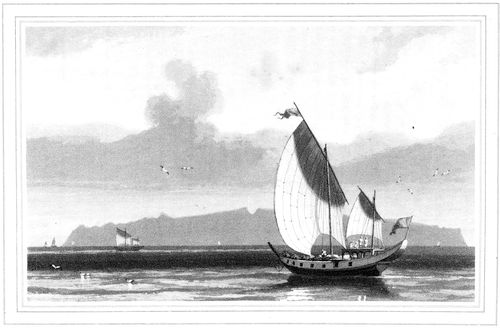
Their rocky summits, split and rent,
Form’d turret, dome, and battlement,
Or seem’d fantastically set
With cupola or minaret,
Wild crests as pagod ever deck’d
Or mosque of eastern architect.
Lady of the Lake, Canto I. xi. p. 14.
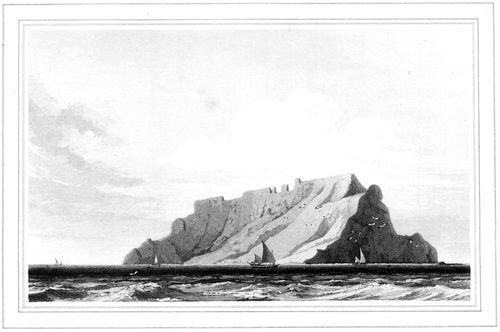
Cape Posmee.
Drawn by James Morier Esqr.
Published by Messrs. Longman, Hurst, Rees, Orme & Brown, Paternoster Row, May 1, 1811.
One piece of land in particular, forming an entrance to the bay behind
Cape Guadel, has the most striking resemblance to a long range of
gothic ruin. We perceived three camels grazing on the heights of the
cape, and some few signs of cultivation, which we had discovered on no
other spot along the coast before.
On the 3d. we saw the town of Chubar; and plainly distinguished
among other objects a walled building, which we at first took to be a
fort, but which according to the Directory, is a place of burial. We
saw several boats with lateen sails, of a canvas very conspicuously
white, cut exactly like the sails of the boats on the coast of Italy and
Sicily. The thermometer was 84°. The 5th. was very sultry, and the
thermometer was 90°. On the 6th. a hot wind came from off the land,
and warped the tables, mathematical rulers, and the furniture in the
cabin, besides slackening all our rigging. This wind brought with it a
thick mist of an impalpable sand, which gradually cleared away, and
left us the first view of Cape Jasques.
Oct. 7th. at about one o’clock in the morning, a breeze sprung
up from the southward, and in five hours we had passed the Quoins, in
the Gulph of Persia, and were abreast of the island of Kishmis. We saw
at the same time the high land of the Arabian shore, terminating in a
lofty and marked peak; it is the land about Cape Musseldom. The
entrance of the gulph may be properly marked between Cape Bombareek
and Cape Musseldom. I call these places by their names, as laid
down in our sea charts; because their more proper appellations would
probably not be understood. Bombareek for instance, which by sailors
is also called Bombay rock, is derived originally from “Moobarek,
happy, fortunate.” Musseldom is still a stronger instance of the perversion
of words. The genuine name of this head-land is Mama Selemeh,
derived according to the story of the country from Selemeh, who was a
female saint of Arabia, and lived on the spot or in its neighbourhood.
The Indians, when they pass the promontory, throw cocoa nuts, fruits
or flowers into the sea, to secure a propitious voyage. My informer
added, that the superstition was not practised by the Persians.
On the shore of Cape Bombareek is an insulated and very singular
mass of rock, in which we could perceive from the ship a large natural
aperture. To me the shape of the whole mass appeared like a
tankard, and the aperture formed its handle. After having rounded
Cape Musseldom (which is eighteen leagues to the westward of Bombareek),
we came to the five small islands generally called altogether
the Quoins.
Kishmis is the largest island in the gulph; and, according to the account
which I received, is capable of being made very productive: it is
at present in almost total abandonment, though still nominally the property
of Persia. We next passed two small and low islands, called the
Great and Little Tomb.
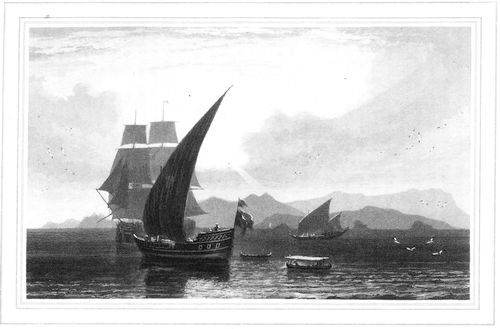
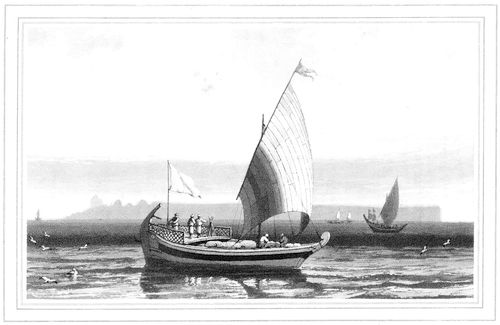
Cape Museldom.
Drawn by James Morier Esqr.
Published by Messrs. Longman, Hurst, Rees, Orme & Brown, Paternoster Row, May 1, 1811.
The strong south wind, with which we were now favoured, was at this
season considered extraordinary. It blew so strong that the Nereide,
with every sail set, went ten and eleven knots. It is accompanied with
much haze, not indeed to be compared to that which came with the hot
wind from off the shore, though in the same manner it warped the furniture
and slackened the rigging.
On the 8th. we passed the island of Busheab, which, in Heather’s
map, is placed much too far to the eastward, and which ought to be
called “Khoshaub, or pleasant water,” from the fresh spring in its territory.
It is a long and low slip, but the land on the continent behind
it is extremely high. We had a light sea breeze all day, that carried us
off Cape Nabon, a part of the province of Farz. The thermometer
stood at 93° in the cabin after dinner. On the morning of the 9th. it
was reported that a fleet of five ships were seen from the mast-head.
We conjectured that they might be Arab ships, bound from Muscat to
Bussorah, which about this season proceed on their voyages. They
carry thither annually eight thousand bales of coffee; and in return
get cargoes of dates. The sea breeze of the day was extremely
light, and set in at noon. In the evening the Barnhill, a remarkable
piece of land, (which derived its name from its resemblance to an
old and decayed thatched building, and which is situated over the
town of Congoon,) bore N. and by W. of us. Here the whole coast is
very high.
On the morning of the 10th. we were off the Barnhill. The
five ships had thus far kept us in a state of suspense; as we imagined
that they might be the fleet of the Imaum of Muscat, who possesses
thirty sail of different descriptions. Some of his ships, indeed, are of a
thousand tons burthen; and one of forty guns, built at Bombay, is rather
a formidable vessel.10 The Imaum in person frequently parades about
the Persian gulph with his armament. He is an independant prince,
and his jurisdiction, though principally confined to Muscat, extends yet
generally over the province of Oman. At present he is friendly to us,
and we have a resident at his court, who seldom remains there long, for
the badness of its air has rendered it the burial place of too many
Englishmen.
At length we boarded the Arabs, and they proved to be, as we had
originally expected, a fleet of the Imaum’s merchantmen, laden with
coffee, rice, &c. bound to Bushire and Bussorah. They had been
fifteen days from Muscat. One of the five was a fine vessel of six hundred
tons burthen, which about four years before was purchased by the
Imaum at the Isle of France, and was then called the Sterling Castle.
There were also two grabs, which are ships in every respect like the
others, except that they have lengthened prows instead of rounded
bows. These grabs the Arabs can manage to build themselves in their
own ports, as it is easy to extend the timbers of a ship, until they connect
themselves into a prow; but they have not yet attained the art of
forming timber fit to construct bows.
Before the sun-set of the preceding day, we had discovered through
our glasses, the town of Congoon, under a peak, close in the eastern
vicinity of the Barnhill. It then appeared in a wood of dates, above
which rose the domes of mosques. The Sheik of Congoon is represented
as a young and spirited Arab, who can raise a body of two thousand
cavalry, and who is able to lead them. His town is resorted to for wood,
but, as far as we could judge at a distance, the date is the only tree of
the neighbourhood.
We suffered much from the heat in the night, but when the moon rose
over the Barnhill, a little refreshing breeze sprang up, which gave us
much relief. An Arab ship was not far from us, and I could just hear
their singing on board. It brought to my recollection some of the moonlight
scenes in the Archipelago; for the music of these Arabs struck me
as being very similar to that which I have heard on board a Greek or
Sclavonian ship, when the lyra accompanies the voice of some naval
Apollo, and is followed by a chorus of his shipmates.
We were off Cape Verdistan this morning, and descried the Hummocks
of Kenn. The shoal that runs out from Cape Verdistan, is rendered
dangerous by a reef of rocks which extends itself about six or seven
miles from the shore. There are good mud soundings on the shoal, and
a ship may cross its extremity without danger, though it is as well to
give it a good birth. We stood off in the night of the 12th. The soundings
in the shoal as laid down by Mac Cluer are not all correspondent
to those which we got. We were in seven fathoms for more than an
hour, and he has not got such a sounding amongst his. From seven we
got to half six, and then to four, when we thought it time to tack. The
cause which has been assigned for our ignorance of the gulph, is the
prudential reserve which has influenced our Indian governments in their
transactions with the states of Persia and Arabia. To avoid suspicion
and complaint, they have never professedly made surveys of the shores,
though much might yet have been done indirectly, if the object had
been considered of sufficient importance. Few, except merchant
vessels visited the gulph; and as the charts, which they already possessed
(and what is better, their own experience) served their purpose
sufficiently in the line of their own navigation, there was seldom any
particular demand for more correct surveys. The geographer and
philosopher indeed require something more, and therefore it is still
matter of regret, that we are comparatively ill-informed in countries,
where we have had easy opportunities of acquiring knowledge.
13th Oct. We were becalmed all night under the Asses Ears. These
are points of land, which stand a little more erect, and are more conspicuous
than the other points which surround them. The whole
displays a line of coast the most rugged, barren, and inhospitable that I
ever saw; and constitutes, after we passed Verdistan shoal, a very bold
shore. We sailed along it, keeping in eleven and twelve fathoms. In
the evening we opened Hallilah peak, which is a high and remarkable
point of land. As we crept along the coast, we marked some ruined
walls embosomed among the date trees.11 At sun-set we just discovered
the low land on which stands the town of Bushire. In the
calms which followed during the night, we were unable to make
much way, and on the morning of the 14th we were still at the same
distance from Bushire, as on the preceding evening. We fired two
shots at a small vessel, to bring her to, but without effect. These
boats are employed mostly in carrying wood to Bushire. They find it
on the coast, probably in recesses of the land, for we could scarcely see
a shrub in the whole passage of the gulph.
At about half past three o’clock on the 14th October, we anchored in
Bushire roads, where we found one of the Company’s cruizers, and a merchantman.
Before we cast anchor, a boat came off from the shore, the
captain of which, a little sharp Persian, answered Sir Harford Jones’s
interrogations with much vivacity, and swore to the truth of every assertion
ten times over by his head and eyes. Having learnt that the East
India Company’s assistant resident, Mr. Bruce, was at Bushire, the
Envoy sent a letter to desire his attendance on board immediately, and at
the same time requesting that he would notify the arrival of the mission
to the Sheik, Abdallah Resoul, who then governed Bushire. We
could see with our glasses Mr. Bruce’s residence, which was at some
distance without the town, and could observe that the letter had been
safely delivered; for in a few minutes we discovered Mr. Bruce on
horseback, riding full speed to the boat. In an hour he was on
board.
He commenced by informing us of a report of the death of our King,
which had reached Bushire from Bagdad; and which, originating from
an article in a French paper, had been circulated in Persia by the
French, for an obvious purpose. The Envoy delivered to Mr. Bruce,
a paper containing all the communications which he wished to be
made to the Sheik of Bushire. He then added, desiring that his object
might be clearly explained, that He expected from the Sheik all the
respect due to the station which he filled, and that if he did not
receive those honours to which the King of England’s Mission was
entitled, the Sheik should be held responsible till the wishes of the
court of Persia were known. Mr. Bruce assured Sir Harford that
the Sheik would make no difficulty in coming off the next day to
pay his respects, and the hour of his visit was in consequence fixed at
ten o’clock.
The colours of the New Factory in the country, and of the Old one in
the town, were hoisted on the morning of the 15th. While we were expecting
the arrival of the Sheik, we regaled ourselves with the grapes,
citrons, and pomegranates, which had been sent to us from the shore.
At length we espied a boat with a crimson awning, and apparently
much filled with passengers. It was beating against the sea breeze,
which, rather unfortunately for the party, had set in uncommonly fresh.
When she came in a line with our ship, the sail was lowered, and the
men took to their oars. In a short time however we observed from the
frigate, that the boat got very slowly a-head, and that the strength of the
crew was nearly exhausted. Captain Corbett then sent his barge to
tow up the Sheik to the ship, which was done in a very masterly style;
and we were delighting in the idea of the enjoyment which the
Persians must have received in the close at least of such an excursion,
when we were mortified at discovering the misery in every face, which
the unusual voyage had too evidently produced. But the sea-sickness
was forgotten as soon as they were on board the frigate. The Sheik was
received with a salute of five guns; the number was esteemed a mark
of particular distinction, as three are considered in Persia a sufficient
allowance for a great man.
The marines were under arms; Captain Corbett with much
courtesy handed him across the quarter-deck, and assisted him with
some difficulty to descend from the deck to the cabin by a steep and
narrow ladder, which, however, no attention could render convenient to
a man encumbered with an immense large cloak and slip-shod slippers.
At the bottom he was received by Sir Harford Jones. The ship was
immediately filled by the suite of the Sheik, who, with all the curiosity
and effrontery of Asiatics, spread themselves through every part. Our
guest was attended on his visit by the principal men and merchants of
Bushire, among whom the Envoy recognised the face of many an early
friend. All the party seemed much pleased with their reception, and
expressed their high admiration of the beauty, order, and cleanliness of
the ship. The conversation was general, and consisted mostly in
inquiries after former friends, and in reviving the recollection of the
histories of old times. Sir Harford Jones had known the Sheik
when he was a fine boy: there was now indeed little left to be admired;
his face was inanimate, and his body bent double with excessive
debauch. The whole party were generally but a rude sample of the
elegance of Persians, nor indeed is the true Persian to be found at
Bushire, where the blood is mostly mixed with that of Arabia.
The only man of the party, whose face interested me, and exhibited
signs of intelligence, was a Turk, by name Abdulla Aga, an old
friend of the Envoy’s, who had been Musselim of Bussorah, and had
ruled that part of the country for many years, with great respectability
and eclat. He had been driven by injustice to take refuge at Bushire;
though from the known integrity of his character, and the attachment
of the people of Bussorah and Bagdad to his person, many still expect
that he will one day attain the Pachalick of Bagdad. After this good
Mussulman, spreading his carpet near one of the twelve pounders, had
said his prayers, (with a fervency, undisturbed by the busy, novel and
noisy scene around him) the visit broke up.
The Sheik and Abdulla Aga, who both had suffered by their long
excursion in the morning, preferred to return on shore in the Nereide’s
boat with Sir Harford Jones. We had not long put off from the
ship, when a salute of fifteen guns commenced for the envoy, to the great
consternation of the remaining part of the Persians, who were just
embarking in their own boat, and who unluckily found themselves under
the muzzles of the guns, where they were involved in clouds of smoke,
with the wads whistling close to their ears. We at length reached the
landing place; an immense crowd was assembled to await our
debarkation. The Sheik had collected all the soldiery of the town to
escort us to his house; and in the moment of our touching the shore, the
whole mob was put in motion, raising a dust so thick that I could scarce
distinguish Englishman from Asiatic. To add to the denseness of
the atmosphere, the boats, which were close to the beach, commenced
a salute; which was immediately answered by a range of guns on the
coast. The whole procession was obliged to pass in the immediate
rear of these guns as they were firing, though they appeared so old
and honey-combed, that I feared they must have burst before the
honours were over. We proceeded in a cloud of dust, and through
streets six feet wide to the Sheik’s house, and at length entered it by a
door so mean and ill-looking, that it might more properly have formed
the entrance to his stable. This door introduced us into a small court
yard, on one side of which was an apartment where we seated ourselves
on chairs placed on purpose for us. A Persian visit, when the guest is
a distinguished personage, generally consists of three acts: first, the
kaleoun, or water pipe, and coffee; second, a kaleoun, and sweet coffee
(so called from its being a composition of rose-water and sugar); and
third, a kaleoun by itself. Sweetmeats are frequently introduced as a
finale. As I shall have many better opportunities of describing all the
ceremonies of these occasions, it is sufficient to add at present, that we
performed the three above acts, and then mounted our horses for Mr.
Bruce’s house in the country.
Part of the same armed rabble, which had escorted us from the boat
to the Sheik’s house, attended us to the Factory. These soldiers are the
militia of the place, and serve without pay. They even find their own
arms, which consist of a matchlock, a sword, and a shield that is slung
behind their back. They consist of working men attached to different
trades, for we discovered the dyer by the black hue of his hands, the
tinker by the smut on his face, the tailor by the shreds that had adhered
to him from his shopboard.
On our arrival at the Factory, we closed our dispatches for Europe,
and then completed a day full of entertainment, by an excellent
dinner.
The Nereide sailed with the dispatches on the morning; and before
daylight was out of sight. The passage between Bombay and Bushire,
which had been made in thirty-four days, was now retraced in twelve.
CHAP. III. RESIDENCE OF THE MISSION AT BUSHIRE .
CORRESPONDENCE WITH THE PERSIAN GOVERNMENT: INTRODUCTION
OF THE EUROPEAN DISCIPLINE AT SHIRAZ—MILITARY
PREPARATIONS—PERSIAN LETTER—(DERVEISHES)—CONDUCT
OF THE NASAKCHEE BASHEE—PRESENT TO THE ENVOY
FROM THE COURT—MEHMANDAR—ARRIVAL OF AN OFFICER
FROM SHIRAZ—DESCRIPTION OF HIS PARTY—HIS VISIT RETURNED—CEREMONIES
OF A VISIT—FEAST OF THE BAIRAM—ACCOUNT
OF THE CAPTURE AND RECAPTURE OF THE SYLPH—DEATH
OF MR. COARE.
The negociation was begun at Bushire. On the day after our landing
the Envoy despatched his letters to Jaffer Ali Khan, the acting
English agent at Shiraz; and through him to the Prince Hossein Ali
Mirza, Governor of Farsistan; to the Prince’s Minister, Nasr
Oalah Khan; and to the Prime Minister at Teheran, Mirza Sheffeea.
These letters all contained the simple statement, that the writer
had arrived as Envoy Extraordinary from the King of Great Britain to
the King of Persia, in order to confirm and augment the amity which
had so long existed between the two countries.
On the 19th of Oct. we received despatches from Jaffer Ali
Khan at Shiraz; which, among the more immediate topics of the
correspondence, contained naturally full accounts of the progress of the
campaign with the Russians, (the most important object in the existing
politics of Persia), and the general sensations which it had excited at
Teheran. These details retain of course little interest; it is enough to
add, rather as a sketch of national character, that the King, in consequence
of his reverses, had distributed alms to the poor, had ordered
prayers to be said in the mosques, and the denunciations of vengeance
on all unbelievers to be read from the Koran. The military preparations
also were hastened at Shiraz (in some measure for a different object);
and the Russian prisoners there were ordered to drill the Persian troops,
who had been raised and equipped after a Russian manner. The account
of this new corps was continued in other letters (which, on the
23d, we received in two days and a half from Shiraz). The Prince
was instructed to form a body of able young men, to shave them if
they had already beards, and to dress them in the Russian uniform.
There was at this time at Shiraz, another body also of seven hundred
hardy and active men, (of the Bolouk or Perganah of Noor in Mazanderan),
who were in the same manner to be subjected to the discipline
of the Russian drill, to lose their beards, to substitute the firelock for
the matchlock gun, (which they had been accustomed to use), and to
assume the whole dress of the Russian soldiery. Mahomed Zeky
Khan and Sheik Roota Khan were appointed their commanders.
The Jezaerchi also, the men who use blunderbusses, were to wear the
new Russian dress. The French at this time were very anxious to proceed
to Shiraz, to drill the new-raised corps; but as the King prevented
them in a former instance from sending a Resident to Bushire lest they
should have found that the English factory was still in Persia, he now
equally prevented their advancing to Shiraz, lest the English in their
turn should discover the arrival of their competitors. New gun-carriages
after the Russian form were ordered (though those before made
after the same pattern broke to pieces at the first fire), and five thousand
new firelocks; but as the Prince found great difficulty in procuring the
execution of a former order of two thousand only, he had in this instance
sent into Laristan for three thousand matchlock guns, and into
other provinces for the remainder, to convert them at Shiraz into firelocks,
by affixing to the original barrel the new lock. Provisions also,
of all sorts, were collecting into magazines at Shiraz. These preparations
were hastened by the Prince himself from personal motives. His
dexterity in hitting a mark with a gun at full gallop, and in cutting
asunder an ass with one blow of his sword had been so much exaggerated,
that the King became desirous of witnessing these exploits, and
would have sent for his son to court, if the apprehensions at this time of
General Malcolm’s return from India with an army had not furnished
a seasonable necessity for the Prince’s presence in his own provinces;
and he prepared himself therefore, with great zeal, to march to Bender-Abassy,
to await there the arrival of the English in the Persian Gulph.
As a specimen of Persian wit, as well as in the relation of a Persian’s
proficiency in English, I extract literally, from Jaffer Ali’s letter, the
following account of the Prince of Shiraz:—“As he is a great quiz
and flatterer, he flattered me much, and I made an equal return to
him. Owing to the immense dust that blown all the while upon the
road, my face and beard covered with dust, and appearing myself to
be white, the Prince therefore sayed to me, that my black beard became
with grey hairs in his service; I returned that whoever serves
Khadmute Boozurk Whan (His Highness) becomes white-faced for
eternity, as the common proverb among the Persians, that when a man
serves his master with zeal, he says to his servant ’roo sefeed, white
face,’ and on the contrary they say ‘roo seeah, black face:’” two
very common expressions in the country, denoting severally honour and
disgrace.20
It is not an unfair criterion of the new impulse which the Court of
Persia had received, to add, that by second orders from Teheran, as they
were reported to us, the Princes of the districts were required to adopt
in their own persons the Russian uniform. The Prince of Tabriz, Abbas
Mirza, had already conformed to the costume; and the Prince at
Shiraz, with a hundred of his immediate attendants, was preparing to
assume the same garb; and as we learned on the 10th, by other dispatches,
already appeared in it. The proposed adoption by Sultan
Selim, of the dress of the Nizam Gedid troops, was the signal of revolt
to his Janizaries, and the direct cause of his dethronement. The national
levity of the Persians counteracts the original rigour of their religious
principles, and disposes them, from the mere love of change, to
admit the encroachments of European manners, which would rouse to
despair and revenge the less volatile character of the Turks, and animate
them in defence of their least usage with all the first enthusiasm of
their faith.21
Though the conduct of the negociations with Persia had no connexion
with the mere change of masters in Bushire, which was effected
during our residence on the spot, and there was, therefore, little direct
political intercourse between the Envoy and the Nasakchee Bashee, (the
Chief Executioner), who superintended those changes: yet as that
officer was the ostensible representative of the Government of Shiraz,
some communications naturally took place. Before the assumption of
the administration of Bushire, (while the Khan’s object was yet unattained),
there was in this intercourse little unsatisfactory; but in his
later conduct to the mission, there was something of the insolence of
newly acquired power; he sent word more than once that he was
coming to pay a visit to the Envoy, and as frequently neglected his
engagement. At length he arrived, puffing in great haste; and as soon
as he had seated himself, he pulled off his black sheep-skin cap, and
begun to read a paper which he took from his pocket. The Envoy
asked him, if he were reading a firman from the court, which ordered
him to sit bald-headed. The reproof startled him, and the Envoy continued;
that, representing as he did his Sovereign, he could not permit
the Khan to do in his presence an act of disrespect which he would not
do before his equals, and much less before his superiors. The Khan
immediately put on his cap, and in his shame waved his hand for his
attendants to withdraw. Sir Harford also ordered his own Persians
to retire, and as the suite were in succession leaving the room the Khan
had some leisure to digest the well-timed rebuke.
The notice which the Envoy had been thus obliged to take of an apparent
disrespect in the Khan’s conduct was the more necessary, as He
had that morning received a letter from the Prince at Shiraz, the form
and terms of which required some explanation; and on which, therefore,
the Envoy felt himself compelled to remark, that the correspondence
during the negociation must be absolutely and in every view independent;
and He desired the Khan accordingly to intimate this determination
to the Prince’s Minister. The representation was immediately
successful; and to the line of conduct thus enforced, both parties
adhered throughout their future communications.
When this matter was adjusted, much friendly conversation followed,
and the affair of the cap and bald-head was laughed over. The Envoy
expressed indeed his wish to render the Khan in his visit as comfortable
as possible; but repeated also his resolution to suffer no act of
inattention before servants and strangers. The Khan accordingly
(though as it was the Ramazan he would not smoke) left us seemingly
well pleased.
But in another instance the same want of respect was visible, though
the effect probably of ignorance only. On the 30th Oct. he sent a
present of some fruit and two horses, one for the Envoy and one for
the East India Company’s Assistant Resident. Sir Harford immediately
returned that destined for himself, to remind the Khan of the
distinction.
On the 8th of Nov. arrived, carried on fourteen mules, the balconah,
the customary present to an Embassador. It consisted of the following
articles:—
| 50 | Lumps of loaf sugar, |
| 35 | Small boxes of different kinds of sweetmeats, |
| 1 | Mule load of lime-juice, consisting of ninety-six bottles, |
| 23 | Bottles of orange and other kinds of sherbet, |
| 22 Bottles of different kinds of preserves, pickles, &c. |
| 4 | Mule loads of musk-melons, |
| 1 | Ditto of Ispahan quinces, |
| Half ditto of apples, |
| 1 | Ditto of pomegranates, |
| 1 | Ditto of wine, thirty-nine bottles. |
The whole was accompanied by a letter from Nasr Oalah Khan,
the Minister at Shiraz, replete with compliment and inquiries about
health, and entrusted to the care of Aga Mahomed Ali, one of the
Prince’s servants, who received for himself from the Envoy a present of
five hundred piastres. The great men profit by these opportunities of
enriching by such returns any servant to whom in their own persons
they may owe an obligation, and to whom they thus, cheaply to themselves,
repay it. But the charge of a present is frequently made the
matter of a bargain among the adherents of the donor, and perhaps is
sometimes purchased directly from the great man himself.
On the 13th of Nov. we were informed, that a Mehmandar had been
appointed by the court to escort the Envoy to Teheran. The title of
Mehmandar has been familiarized to an English reader by His Majesty’s
appointment of Sir Gore Ouseley to fill the station during the residence
in England of Mirza Abul Hassan, late Envoy Extraordinary
from the King of Persia to the Court of London. But the duties
which, in England, the most active Mehmandar could comprize within
his office are comparatively very limited to those which are indispensably
attached to a similar station in Persia. The Mehmandar is the Superintendant
and Purveyor assigned to the dignity and ease of foreign
Embassadors; the relative facility, therefore, with which he can discharge
these functions must vary of course with the state of society
in different countries. In England money procures every accommodation;
but money alone can procure it now: purveyance, however, in
its feudal sense, unfortunately for the people, still exists in its full
force in Persia; and the Mehmandar, under the commission of his Sovereign,
is entitled to demand from the provinces through which he passes
every article in every quantity which he may deem expedient for his
mission. And as there is no public accommodation on the road where,
at every hour as in England, these supplies may be procured, they are
extorted from the private stores of the villagers. Besides every requisite
of provision and conveyance, the firman of the Mehmandar sometimes
includes even specie among the articles thus necessary in the
passage. It is not, therefore, wonderful, that the officer entrusted with
this power, though generally a man of high rank, is generally also understood
to purchase the nomination at very large prices. The proportion
of the purchase is the proportion of course of the demands on the
country: the villager groans under the oppression, but in vain shrinks
from it; every argument of his poverty is answered, if by nothing else,
at least by the bastinado.
The information of the appointment was premature: Mahomed
Hassan Khan, an officer of rank, had indeed been dispatched from
Shiraz, but he was entrusted with a more private commission to the
Envoy. On the 19th his immediate approach to Bushire was announced.
As, independently of the confidence which by this mission
the Government appeared to repose in him, he possessed high personal
rank, (as one of the Chiefs of the Karaguzlou tribe, one of the most numerous,
warlike, and respectable of all under the jurisdiction of Persia,)
the first Minister at Shiraz wrote to the Envoy to desire that He would
send the person next in rank to himself to receive him. The Envoy
accordingly ordered me to proceed on the occasion. I went, accompanied
by Mr. Bruce and Dr. Jukes, and escorted by Cornet Willock
with ten troopers, and five Chattars. The Chattars are those
running footmen who, in fantastical dresses, generally surround the horse
of a great man; but the name is applied not only to these attendants of
shew, but to those messengers also who perform their journies on foot,
and perform them with a dispatch almost incredible. When we had
proceeded about a mile we met the stranger. He was thinly attended,
having travelled in haste. When we approached, our
little squadron drew up in a line as he passed; and we advanced,
and made our respective compliments. We then all turned
back together, and brought him into the presence of the Envoy, who
received him sitting on one corner of the sopha, but rose just as he
approached it. We were all dressed with more or less ornament in
honour of our guest; and during his visit we kept on our hats. The
Nasakchee Bashee had already fallen into his train, when we first met
him; and during the short stay which he now made, the Vice-governor
of Bushire, Aga Mahomed Jaffer, came to pay his respects also.
He advanced immediately to the Khan, seized his hand, which he
kissed, whilst the Khan applied his beard and mouth to the other’s
face, and kissed his cheek. The manners of our guest himself were
pleasant and modest, and spoke the simplicity of a man bred in camps.
When the Envoy had inquired after his health, the health of the Prince,
of the minister, and successively of other great men, the stranger, after
the interchange of a few compliments, departed to take up his abode with
the Vice-governor. As he entered Bushire, the guns at the gate were
fired, but one of them could not bear the shock, and flew out of the
carriage. For fear therefore of the gates and tower, they did not venture
to discharge the sixty-eight pounder, which was mounted in the
town; an apprehension not purely imaginary.
The party appeared particularly gloomy: their clothes were of a dark
hue, and their caps and their beards were of the deepest black. Every
one had a musket, a sword, a brace of pistols, and a great variety of
little conveniences, as powder-flasks, cartouche-boxes, hammers, drivers,
&c. so that the aggregate equipment displayed every man a figure
made up for fighting. The Khan was dressed exactly like his followers,
and was alone distinguished by carrying fewer arms. He
had, indeed, one Yeduk or led horse before him. The trappings of their
horses are very simple, compared to those of the Turks. The head-stall
of the bridle has little bits of gold and silver, or brass fixed to it, without
the tassels, chains, half-moons, or beads of a Turkish bridle. Nor
have they the splendid breast-plate, or the bright and massy stirrup of
the Turkish cavalry. Their saddle itself is much more scanty in the
seat, nor is it so much elevated behind. The only finery of a Persian
saddle is a raised pummel either gilt or silvered; and a saddle-cloth, or
rather an elegant kind of carpetting, trimmed with a deep fringe.
On the next day, the Envoy directed me to return, in his name, the
visit of Mahomed Hassan Khan. He was lodged in the house
which then belonged to the Vice-governor, but which had been the
property of the late Hajee Khelil Khan, (the Embassador of Persia,
who was unfortunately killed at Bombay.) The room into which we
were introduced was very pleasant, and by far more agreeable than any
thing that I had expected at Bushire. Two pillars, neatly inlaid with
looking-glasses, supported it on one side, and thus separated it from a
small court, which was crowded with servants. An orange tree stood in
the centre of the court. The walls of the room were of a beautiful
white stucco, resembling plaster of Paris; and large curtains were suspended
around them, to screen in every position the company from the
sun. The Khan was seated in a corner, and having taken off our shoes
at the door, we paid our respects severally, and then settled ourselves
according to our rank. When we were arranged, he went about separately
to each, and with an inclination of his head, told us we were
welcome, (“Khosh Amedeed.”) The Vice-governor next appeared,
and sat respectfully at a little distance. He was followed by the Governor
of the small neighbouring district of Dasti, a rough looking man,
who exchanged a kiss with the Khan. We had kaleoons, (the water
pipe), then sweet sherbet, then again the kaleoons. Few words passed,
and we did little except look at each other. Two or three Arabs came
in, and were welcomed by the Khan with the “khosh amedeed” as they
seated themselves at the further end of the room. The measurement of
their distances in a visit seems a study of most general application in
Persia; and the knowledge of compliments is the only knowledge displayed
in their meetings; if, indeed, the visits of ceremony, which alone
we witnessed, could be considered a fair specimen of national manners or
the state of society.
When visited by a superior, the Persian rises hastily and meets his
guest nearly at the door of the apartment: on the entrance of an equal,
he just raises himself from his seat, and stands nearly erect; but to an
inferior he makes the motion only of rising. When a great man is
speaking, the style of respect in Persia is not quite so servile as that in
India. In listening the Indians join their hands together, (as in England
little children are taught to do in prayer,) place them on their breast,
and making inclinations of the body sit mute. A visit is much less
luxurious in Persia than in Turkey. Instead of the sophas and the easy
pillows of Turkey, the visitor in Persia is seated on a carpet or mat
without any soft support on either side, or any thing except his hands,
or the accidental assistance of a wall, to relieve the galling posture of
his legs. The misery of that posture in its politest form can scarcely be
understood by description: you are required to sit upon your heels, as
they are tucked up under your hams after the fashion of a camel. To
us, this refinement was impossible; and we thought that we had attained
much merit in sitting cross-legged as tailors. In the presence of his
superiors a Persian sits upon his heels, but only cross-legged before his
equals, and in any manner whatever before his inferiors. To an English
frame and inexperience, the length of time during which the
Persian will thus sit untired on his heels, is most extraordinary; sometimes
for half a day, frequently even sleeping. They never think of
changing their positions, and like other Orientals consider our locomotion
to be as extraordinary as we can regard their quiescence. When
they see us walking to and fro, sitting down, getting up, and moving
in every direction, often have they fancied that Europeans are tormented
by some evil spirit, or that such is our mode of saying our
prayers.
Before the close of our visit, it was settled that the Khan should send
in the course of that evening the letters with which he had been charged
to the Envoy, and that on the morrow he should come to a personal
conference, and open his verbal communications.
The Ramazan was now over: the new moon, which marks the termination,
was seen on the preceding evening just at sun-set, when the ships
at anchor fired their guns on the occasion; and on the morning of our
visit, the Bairam was announced by the discharge of cannon. A large
concourse of people, headed by the Peish Namaz, went down to the seaside
to pray, and when they had finished their prayers, more cannon
were discharged. Just before we passed through the gates of the town
in returning from our visit, we rode through a crowd of men, women,
and children, all in their best clothes, who, by merry-making of every
kind were celebrating the feast. Among their sports, I discovered something
like the round-about of an English fair, except that it appeared
of a much ruder construction. It consisted of two rope-seats suspended,
in the form of a pair of scales, from a large stake fixed in the ground.
In these were crowded full-grown men who, like boys, enjoyed the continual
twirl, in which the conductor of the sport, a poor Arab, was labouring
with all his strength to keep the machine.
The feast itself of the Bairam begins of course successively in every
season of the natural year, for in the formation of their civil year the
Persians, like other Mahomedans, adopt lunar months. When it occurs
in summer, the Ramazan, or month of fasting which precedes it, becomes
extremely severe; every man of every kind of business, the labourer
in the midst of the hardest work, is forbidden to take any kind
of nourishment from sun-rise to sun-set, during the longest days of the
year. Their full day is calculated from sun-set to sun-set, but their sub-division
of time varies like that of the Hindoos and Mussulmans of
India, according to the difference of the length of the natural day. In
their calculation of the close of the fast, and the commencement of the
Bairam, they are seldom assisted by almanacks: it frequently happens,
therefore, that the same feast is celebrated two days earlier, or delayed
two days later in different parts of the country, according to
the state of the atmosphere: as the new moon may be obscured by
clouds in one city or displayed in another by the clearness of the sky.
On the 21st of November Mahomed Hassan Khan Karaguzlou
paid the appointed visit to the Envoy. A part of the body guard was
sent out to meet him, and we received him as before in uniforms and
hats. After the usual ceremonies were over, the Envoy and his guest
retired to an inner apartment; and after a conference, which lasted four
hours, the Khan departed to Bushire with the same escort, to whom on
parting he gave a present of fifty Venetian sequins. The conference
had been satisfactory, as at dinner the Envoy announced to us that we
might now complete all our preparations for a journey to Teheran. Still
with a volatility not unusual in the diplomacy of the East, the Khan
two days afterwards refused to sign, in the name of the Persian Government,
the note of the terms on which they had agreed at their meeting:
and at ten o’clock at night the Vice-Governor, and the two Moonshees,
came to us. After a long debate they departed; and, to the satisfaction
of all parties the business was finally settled the next morning,
when, previous to his return to Shiraz, the Khan paid his farewell visit
to the Envoy.
He returned to Shiraz; and, as we learned by our next dispatches
from Jaffer Ali, immediately appeared before the Prince, where he
talked for “seven hours without stopping once,” on the Envoy and his
merits. Jaffer Ali added, that he himself had dined with the
Prince’s Prime Minister, and that they also had talked till two o’clock
in the morning on the same alluring subject. After having both
agreed that, by the progress of the negociation, they had already rendered
themselves immortal, they retired to rest, and the next morning,
the Minister, on the appointment of a Mehmandar to the mission,
asked Jaffer Ali for the Moodjdéhlook, or customary present, for
which accordingly he received a Cashmirian shawl. In general politics
the dispatches stated, that the Russians had renewed hostilities, though
General Gardanne, the French Embassador in Persia, had sent four
of his officers to the Russian Commander to entreat that he would desist
from any further operations; but the Russian answered, that his
master had ordered him to fight on. The failure of this attempt had
greatly contributed to disgrace the cause of the French; and the Court
retrenched in consequence their daily allowances.
The Mehmandar, who was announced in these dispatches, was Mahomed
Zeky Khan, (the chief of the Noory tribe, one of the new
modeled corps) a great favourite at the Court of Teheran, and with the
Prince of Shiraz, and advanced lately by the King to the dignity of
Khan. It was added also, that his appointments were more magnificent
than any which had ever before been annexed to the Mehmandar
of an English Envoy; and, as a further proof of the estimation in which
His Majesty’s mission was held, Jaffer Ali stated, that the Prince
had prepared for him, as our acting Agent at Shiraz, a rich dress of
honour, which, however, he had found means to decline from a fear of
the jealousy which it might have excited against him. But the Prince,
resolved on bestowing upon him some distinguishing mark of his favour,
had given him a shawl, which belonged to one of his own head-dresses,
and a young and promising Arab horse, which had been sent as a present
to himself by the Governor of Chabi. So well indeed had Jaffer Ali
deserved the confidence of both the negociating parties, that Sir Harford
Jones, now at the close of these preliminary arrangements, sent
him a patent constituting him the Agent for the British affairs at the
Court of Shiraz.
It will be recollected that the Nereide, the Sapphire, and the Sylph,
sailed with the mission from Bombay on the 12th of September. The
Nereide arrived first; the Sapphire also reached Bushire about sun-set
on the 18th October. The Arab ships too, that we passed off Cape
Verdistan, had come in about noon on the same day, and had continued
firing their guns at distant intervals till the evening: but the Sylph, on
board which were the Persian Secretary and some of the presents, was
yet missing; nor indeed had we seen her, since the second day after that
on which we had left together the harbour of Bombay. On the 29th
Oct. arrived the Nautilus, H. C. cruizer, which had sailed from the same
port on the 22d Sept. Though she had neither seen or heard directly
any thing of the Sylph, yet the circumstances of her own passage prepared
us to anticipate the worst. The Nautilus had been attacked off
the large Tomb, in the Gulph of Persia, by the Joasmee pirates; three
only were at first in sight, but on the signal of a gun, a fourth appeared,
and together they bore down, two on the quarters and two on the bows
of the Nautilus; they were full of men, perhaps six hundred in the
four vessels, all armed with swords and spears, and, as they shouted
their religious invocations, they shook their weapons at the ship. When
the engagement became closer, they maintained a fire of twenty-five
minutes, and one of their shot killed the boatswain of the Nautilus.
Of these pirates an interesting account was published in India by Mr.
Loane, who was taken prisoner by them. It is unnecessary, therefore,
to add more on the subject than that their chief resort is at Roselkeim,
on the Arabian coast of the Gulph of Persia: another, but tributary,
chief of the same people resides twenty-five miles from Roselkeim at
Egmaun, S. S. W. of Cape Musseldom, where they possess an extensive
and lucrative pearl fishery. This, with the market which their
plunder finds there, is the principal source of the traffic of the place.
Though it may not be necessary to enter into a detail, which may be
better found in original authorities, it must be very obvious, that the
honour of our flag, as well as the interest of our commerce in the East,
will require the destruction of a fleet of pirates, which, assembling to
the amount of fifty sail in the harbour of Roselkeim, issue thence to
capture every English as well as native ship, and to spread terror
through the Gulph of Persia.22
On the arrival of the Nautilus, under these circumstances, the Envoy
dispatched a letter to Captain Davis of the Sapphire, requesting him
to proceed to the entrance of the Gulph, to secure the Sylph, if possible.
On the 6th Nov. a boat arrived from Roselkeim, at the date of the departure
of which no such capture had been made; but in three days,
another boat came in, which brought an account that four vessels had
been taken, one of which contained a Nawab. We immediately recognized
by this description the unfortunate Persian Secretary, the splendour
of whose dress had imposed him as a Nabob on the pirates. The
next day a still more circumstantial account of the capture reached us,
which convinced us that the vessel taken was the Sylph; but the report
added, that a large vessel from Bushire (which we instantly identified
with the Nereide) came in sight during the action, and having sunk one
of the pirates, (of whose crew of three hundred scarcely any escaped),
retook their prize. In the action too, the pirates lost one of their first
chiefs, Sal ben Sal. The loss of one individual, the most insignificant,
of their tribe is sufficient cause for a declaration of war; but the
destruction of so large a portion of their whole numbers would dispirit
rather than so animate the remainder; and the tribe would probably
agree never again to approach an English ship. The pirates had, in
fact, been so disheartened by their disaster, that when, a few days afterwards,
a single Arab ship (commanded indeed by an Englishman) fell
among them, and, finding herself unable either to fight or to escape,
bore down upon them to try a shew of resistance, they all fled. At
length on the 26th Nov. the Minerva, H. C. cruizer, Captain Hopgood,
arrived, and brought the Persian Secretary, who had been captured in
the Sylph. The Secretary was much connected at Bushire, and his detention
had of course excited great uneasiness among his relations, who
had been putting up prayers in the mosques for his safety. His account
of their fate was not uninteresting.
At the time when the pirates were standing the same course with
herself, the Sylph discovered the Nereide bearing down upon her. When
the Nereide came close, she hove-to; but as the commander of the
Sylph did not send a boat on board of her, she filled her sails and stood
on. When the Nereide had already passed at some distance, the two
dows stood towards the Sylph. The Persian Secretary advised the officer
of the ship not to permit the dows to approach; but he would not
listen to the suggestion, as he declared they would not touch him. The
dows, however, did approach so close, that the Sylph had only time to
fire one gun, and to discharge her musquetry at them, before they were
alongside, and poured on board her in great and overwhelming numbers.
It is unnecessary to state all the circumstances. The Persian Secretary
from the concealment to which he had fled, was still able to ascertain
that, as the first act of possession, the Arabs threw water on the ship
to purify it; that they then proceeded to the deliberate murder of the
men, who were on deck or discoverable; that they brought them one
by one to the gangway, and in the spirit of barbarous fanaticism cut
their throats as sacrifices; crying out before the slaughter of each
victim, “Ackbar” and when the deed was done, “Allah il Allah.”
In the space of an hour they had thus put to death twenty-two persons;
and were proceeding with lights to look for more, when they were astonished
by a shot through the Sylph from the Nereide. On perceiving
the disaster of the Sylph, Captain Corbett had immediately hauled-up;
and though far to the windward his shot still reached. The Arabs
immediately took to their dows; and, elated by the havock of their
success, made for the Nereide. As soon as Captain Corbett perceived
that they were bearing down upon him, he ceased firing altogether.
The Persian Secretary told us, that he saw the dows approach so
close to the frigate, that the Arabs were enabled to commence the attack
in their usual manner by throwing stones. Still the Nereide
did not fire; till at length when both dows were fairly alongside, she
opened two tremendous broadsides. The Secretary said he saw one
dow disappear totally, and immediately; and the other almost as instantaneously:
they went down with the crews crying, “Allah, Allah,
Allah.” Nine men only escaped, who had previously made off in a
boat. The Sylph was taken to Muscat, where the Persian Secretary
was put on board the Minerva.23
We had thus recovered the Persian Secretary; but the mission soon
suffered the less reparable loss of one of its own members. On the
19th November, the Benares H. C. cruizer (which brought our tents,
some of the body guards, presents, &c. from Bussora) landed at
Bushire Mr. Coare, the Persian and Latin Translator. He had carried
with him from Bussora a fever, which was gradually wasting him
away; and after lingering out his few remaining days apparently without
pain, he died on the last day of the month. He was a young man
of whom all spoke well; his talents were promising; and his prospects
in the world were fine. He was laid in the Armenian burying-ground,
without a coffin; because plank is so dear and scarce at Bushire, that
his remains would have been disturbed for the sake of the wood which
had enclosed them. His corpse was escorted to the grave by the body
guard and the seapoy guard, and followed by the Envoy and the gentlemen
of the mission. I read the funeral service over him, amid a
crowd of Persians and Arabs, who were collected to see the ceremony;
and who seemed to partake the interest of the scene. Nothing excites
a better impression of our character than an appearance of devotion
and religious observance. If, therefore, there were no higher obligation
on every christian, religious observances are indispensable in producing
a national influence. We never omitted to perform divine service on
Sundays; suffered no one to intrude upon us during our devotions;
and used every means in our power to impress the natives with a proper
idea of the sanctity of our Sabbath.
CHAP. IV. RESIDENCE OF THE MISSION AT BUSHIRE .
I. PERSIA—ADMINISTRATION OF THE GOVERNMENTS—FARSISTAN—MEKRAN—BALOUCHES—COAST
OF THE GULPH—ISLANDS OF
THE GULPH—PEARL FISHERY.—II. BUSHIRE: SITUATION—DESCRIPTION—TRADE—VIEW—RUINS
OF RESHIRE—HALILA—BUSHIRE
ROADS—WATER—WEATHER—HEALTHINESS—WOMEN
OF BUSHIRE—SUPERSTITIONS.—III. ANIMALS OF THE DASHTISTAN:
HORSES—DOG—WHITE FOX—WILD BEASTS—HAWKS—THE
JERBOA.
I. In historical interest, Persia is perhaps superior to any Asiatic
empire, because more nearly connected with the fortunes of Europe;
and its natural situation shares the importance; for its boundaries (defined
and fortified by lofty ranges, which are pervious only through
passes of very difficult access,) are prominent and decided objects in the
general geography of Asia. We had hitherto seen only the southern
chain: nothing can be more strongly marked than the abrupt and forbidding
surface of those mountains, which bind the shore from Cape
Jasques to the deepest recesses of the gulph. The little plain of the
Dashtistan, (that of Bushire) which seems to have encroached upon the
sea, is yet the most extensive portion of even land, which relieves however
momentarily the constant and chilling succession of high and
dreary lands along the coast. But beyond these mountains are frequently
extensive plains, confined by a second range, which likewise
run parallel to the coast. This is the case behind Congoon: and in the
route to Shiraz we found several successive plains, (of great absolute
elevation indeed, but) thus separated from each other by alternate ranges
of higher land. The plain of Merdasht, beyond Shiraz, is the Hollow
Persis of ancient geography. These great inequalities of surface naturally
produce a corresponding variety of climates.
The administration of the provinces of Persia is now committed to
the Princes. The jurisdiction of Prince Hossein Ali Mirza,
one of the King’s Sons, is very extensive: it comprises, under the
general name of Farsistan, not only the original province of which Shiraz
was the capital (as subsequently it became that of all Persia, and as it
still is of the governments combined under the Prince) but Laristan also,
to the south; and Bebehan to the north-west; which severally, as well
as Farsistan, possessed before their particular Beglerbegs.
Of Farsistan, under this its present more extensive signification, the
hot and desert country is called the Germesir, a generic term for a warm
region, which will be recognised under the ancient appellations of
Germania, Kermania, or Carmania. The termination of the Persian
dominion in this direction, is an undefined tract between the Germesir
and the Mekran. It was the ancient boast of Persia, that its boundaries
were not a petty stream or an imaginary line, but ranges of impervious
mountains or deserts as impervious. In this quarter there is little probability
that the country will ever become less valuable as a frontier,
by becoming more cultivated and better inhabited. The land is put to
so little use, that no power would greatly care to press the extension of
an authority so unprofitable. Every age has marked the unalterable
barbarism of the soil and of the people. The Balouchistan, or the
country of the Balouches, the most desert region of the coast begins
about Minou, on the west of Cape Jasques. Their country is perhaps
nearly the Mekran of geography. They once owned subjection to
Persia, but they have now resumed the independance of Arabs, and live
in wandering communities under the government of their own Sheiks,
of whom two are pre-eminent. They have indeed still some little commercial
connexion with Persia, and occasionally a Balouche is to be
seen in Bushire selling his scanty wares, mostly the mats of their own
manufacture. One of their Sheiks lives at Guadel on the coast of
Mekran; but in the interior, according to the account given by a
Balouche to Captain Salter, there is a very potent king, though I
cannot add from the same authority, whether he is of their own extraction.
They live in continual wars with each other; or let themselves
out to the different small powers in the gulph as soldiers. Many of the
guards of the Sheik of Bushire are Balouches; and the Seapoys also on
board the Arab ships are of the same tribes.
In religion they are Mahomedans; and like all those of India, are
Sunnis: but they have few means of preserving the genuineness of any
profession of faith; and their ignorance has already confounded their
tenets with those of a very different original. The same common barbarism
has indeed blended the Affghan, the Seik, and the Balouche into
one class: there may be among them some beard or whisker more or less,
some animal or food which they hold unclean above all others, some indescribable
difference of opinion which severs them from their neighbours,
but in savageness they are all identified. Those on the coast still live
almost exclusively on fish, as in the days of Nearchus; though I am
told they no longer build their houses with the bones. The grampus
(possibly, the whale of Arrian) is still numerous on the shores. The
Envoy remembered to have seen at Bushire on a former occasion, a dog
of an immense size, which a Balouche had given to Mr. Galley, the
Resident at that time: the man added, that the mountains towards his
country were all very high. His dog seemed to confirm the assertion,
for he was defended against the cold of his native region, by a coat of
thick and tufted hair.
Though the Balouches scarcely advance within the gulph, yet the
native Persians do not fully occupy their own shores. The coast still
retains a great proportion of Arab families. The Dashtistan, which
extends from Cape Bang to the plain of Bushire, was till lately governed
by them. The district of Dasti, also along the coast from Bushire to
below Congoon, still remains under their rule: and the Arab Sheik of
Congoon in the adjoining territory, possesses a kind of independance.
At Tauhree, (or Tahrie) a port just below Congoon, are extensive ruins
and sculptures, with the Persepolitan character. The landmarks for
the entrance of the harbour are two large white spots, on the summit of
a mountain, which the people of the country affirm to have been made
by the hand of man; and which, on the same traditional authority, are
said to have been formerly covered with glass. The reflection thus produced
by the sun’s rays, rendered the object visible to a great distance at
sea, and guided the navigator in safety into the road. Some of the
glass is said to remain at this day. Among the ruins of the city are two
wells pierced to a great depth; and stabling for a hundred horses excavated
from the solid rock: the existence of these remains, I understand,
Mr. B—k of the E. I. Company’s service ascertained himself.
At Kharrack, a place still further in the progress down the Gulph,
between Cape Sertes and Cape Bustion, is a town which was once in
the possession of the Danes; and it is singular that the people who
claim a Danish blood are still very fair complexioned, and have light
red hair, which may confirm their traditional accounts of their origin.
The same nation had also an establishment in a deep bay near Musseldom;
and the fort exists to this day. On Cape Bustion there is a mine
of copper, which was formerly worked by the Portuguese: they built
also a fort there, which still exists, but the mine is no longer worked,
and indeed is almost forgotten. Some years ago, Mr. Bruce, the
Assistant Resident at Bushire, was a prisoner among the Arabs on this
part of the coast. He was told, that immediately behind the range of
mountains which lines their shore, there was a river that came from
near Shiraz, and run down to Gombroon; this is, probably, the Bend-emir,
which, according to other accounts, is traced indeed towards Gombroon,
but there expends itself in the sands. Khoresser is the name of
a small river which falls into the sea nearly under the Asses Ears; and
on the banks of which is situated the town of Tangistoun. At the
mouth of this river is a small island, formed by the sands brought
down; which adapts this situation to Arrian’s account of Hieratemis.
At the place marked by Dr. Vincent as Podargus there is now no
torrent: but I learn from Dr. Jukes and Mr. Bruce, that at Harem,
situated thirty miles inland on the declivity of the mountains to the
eastward, there is a water which finds its way to the sea, and may, perhaps,
accord with the position required.
The islands in the Gulph of Persia retain little of their political celebrity.
Ormus (ever the most barren, its soil being composed of salt and
sulphur) still displays its arched reservoirs, which afford good watering
places for vessels, and which are said never to dry up. On the island of
Kenn, according to the people of the country, is found, after rain, gold
dust in the channels of the torrents. And Bahrein, which is now in
the hands of the Wahabees, is still noted for the fresh springs which issue
from the earth under the sea, and from which the Arabs contrive to
water their ships by placing over the spot a vessel with a syphon attached
to it. Captain Skeine, who commanded an Arab ship, told
the gentleman (who communicated the circumstances to me), that he
had himself drawn the water at the depth of one fathom. The same
submarine springs extend along the neighbouring coast of Arabia.
Kharrack, which is now the principal watering place on the north of
the Gulph, and the island, where the pilots for the Bussorah river are
stationed, is perhaps good for few other purposes. The Sheik indeed,
though enjoying profound peace, presented memorials to the Sheik of
Bushire, representing that his troops and himself were in a state of
starvation. Among the duties entrusted by the Government of Shiraz
to the Nasakchee Bashee, he was instructed to proceed to Kharrack, to
inspect the fortifications, and to report on their capability of defence.
Pearl-Fishery.—There is, perhaps, no place in the world where those
things which are esteemed riches among men, abound more than in
the Persian gulph. Its bottom is studded with pearls, and its coasts
with mines of precious ore. The island of Bahrein, on the Arabian
shore, has been considered the most productive bank of the pearl
oysters: but the island of Kharrack now shares the reputation. The
fishery extends along the whole of the Arabian coast, and to a large
proportion of the Persian side of the gulph. Verdistan, Nabon, and
Busheab, on that side, are more particularly mentioned; but indeed it
is a general rule, that wherever in the gulph there is a shoal, there is also
the pearl oyster.
The fishery, though still in itself as prolific as ever, is not perhaps
carried on with all the activity of former years; since it declined in
consequence by the transfer of the English market to the banks of the
coast of Ceylon. But the Persian pearl is never without a demand;
though little of the produce of the fishery comes direct into Persia.
The trade has now almost entirely centred at Muscat. From Muscat
the greater part of the pearls are exported to Surat; and, as the agents
of the Indian merchants are constantly on the spot, and as the fishers
prefer the certain sale of their merchandize there to a higher but less
regular price in any other market, the pearls may often be bought at a
less price in India, than to an individual they would have been sold in
Arabia. There are two kinds; the yellow pearl, which is sent to the
Mahratta market; and the white pearl, which is circulated through
Bussorah and Bagdad into Asia Minor, and thence into the heart of
Europe; though, indeed, a large proportion of the whole is arrested in
its progress at Constantinople to deck the Sultanas of the Seraglio. The
pearl of Ceylon peels off; that of the Gulph is as firm as the rock upon
which it grows; and, though it loses in colour and water 1 per cent. annually
for fifty years, yet it still loses less than that of Ceylon. It ceases
after fifty years to lose any thing.
About twenty years ago the fishery was farmed out by the different
chiefs along the coast: thus the Sheiks of Bahrein and of El
Katif, having assumed a certain portion of the Pearl Bank, obliged
every speculator to pay them a certain sum for the right of fishing. At
present, however, the trade which still employs a considerable number of
boats is carried on entirely by individuals. There are two modes of speculation:
the first, by which the adventurer charters a boat by the month
or by the season; in this boat he sends his agent to superintend the
whole, with a crew of about fifteen men, including generally five or
six divers. The divers commence their work at sun-rise and finish at
sun-set. The oysters, that have been brought up, are successively confided
to the superintendant, and when the business of the day is done,
they are opened on a piece of white linen: the agent of course keeping
a very active inspection over every shell. The man who, on opening an
oyster, finds a valuable pearl, immediately puts it into his mouth, by
which they fancy that it gains a finer water; and, at the end of the
fishery, he is entitled to a present. The whole speculation costs about
one hundred and fifty piastres a month; the divers getting ten piastres;
and the rest of the crew in proportion. The second and the safest mode
of adventure is by an agreement between two parties, where one defrays
all the expences of the boat and provisions, &c. and the other conducts
the labours of the fishery. The pearl obtained undergoes a valuation,
according to which it is equally divided: but the speculator is further
entitled by the terms of the partnership to purchase the other half of
the pearl at ten per cent. lower than the market price.
The divers seldom live to a great age. Their bodies break out in
sores, and their eyes become very weak and blood-shot. They can remain
under water five minutes; and their dives succeed one another
very rapidly, as by delay the state of their bodies would soon prevent
the renewal of the exertion. They oil the orifice of the ears, and put a
horn over their nose. In general life they are restricted to a certain regimen;
and to food composed of dates and other light ingredients.
They can dive from ten to fifteen fathoms, and sometimes even more;
and their prices increase according to the depth. The largest pearl are
generally found in the deepest water, as the success on the bank of
Kharrack, which lies very low, has demonstrated. From such depths,
and on this bank, the most valuable pearls have been brought up; the
largest indeed which Sir Harford Jones ever saw, was one that had
been fished up at Kharrack in nineteen fathoms water.
It has been often contested, whether the pearl in the live oyster is as
hard as it appears in the market; or whether it acquires its consistence
by exposure. I was assured by a gentleman (who had been encamped
at Congoon close to the bank; and who had often bought the oysters
from the boys, as they came out of the water,) that he had opened the
shell immediately, and when the fish was still alive, had found the pearl
already hard and formed. He had frequently also cut the pearl in two,
and ascertained it to be equally hard throughout, in layers like the coats
of an onion. But Sir Harford Jones, who has had much knowledge
of the fishery, informs me, that it is easy by pressing the pearl between
the fingers, when first taken out of the shell, to feel that it has not yet
attained its ultimate consistency. A very short exposure, however, to
the air gives the hardness. The two opinions are easily reconcileable by
supposing, either a misconception in language of the relative term hard,
(by which one authority may mean every thing in the oyster which is
not gelatinous, while the other would confine it more strictly to the full
and perfect consistency of the pearl;) or by admitting that there may
be an original difference in the character of the two species, the yellow
and the white pearl; while the identity of the specimen, on which either
observation has been formed, has not been noted.
The fish itself is fine eating; nor, indeed in this respect is there any
difference between the common and the pearl oyster. The seed pearls,
which are very indifferent, are arranged round the lips of the oyster, as
if they were inlaid by the hand of an artist. The large pearl
is nearly in the centre of the shell, and in the middle of the fish.
In Persia the pearl is employed for less noble ornaments than in
Europe: there it is principally reserved to adorn the kaleoons or water
pipes, the tassels for bridles, some trinkets, the inlaying of looking
glasses and toys, for which indeed the inferior kinds are used; or, when
devoted more immediately to their persons, it is generally strung as
beads to twist about in the hand, or as a rosary for prayer.
The fishermen always augur a good season of the pearl, when there
have been plentiful rains; and so accurately has experience taught
them, that when corn is very cheap they increase their demands for
fishing. The connexion is so well ascertained, (at least so fully credited,
not by them only, but by the merchants,) that the prices paid
to the fishermen are, in fact, always raised, when there have been
great rains.
II. Bushire (or more properly Abuschahr, for the former is but the
corruption of an English sailor) is now the principal Port of Persia. It
stands in lat. 28°. 59. in long. 50°. 43. E. of Greenwich. It is situated
on the extremity of a peninsula, which is formed by the sea on one side,
and on the other by an inlet terminating in extensive swamps. At the
narrowest part of this neck of land the seas, in the equinoctial spring
tides, have sometimes met and rendered it an island; but this has happened
once only during the ten years which preceded our visit, and the
effect then continued but two or three days; and so visible is the present
encroachment of the land upon the inlet, that the recurrence of such an
overflow will soon be entirely impossible. Every appearance, indeed,
proves, that the whole of the peninsula has been thus gained from the
sea. The extreme flatness of the general surface, the soil itself, the
water, and the relative position of the whole peninsula to the mountains
which rise abruptly from its inland extremities, suggest the supposition
of such an accumulation.
On the southern bank of the inlet is a long range of rocks, which,
though now two or three miles distant, may at one time have been
washed by the sea. In digging for water, the people of the peninsula
have sunk wells to the depth of thirty fathoms; and before they could
reach the spring they have been obliged to perforate three layers of a
soft stone composed of sand and shells. Generally of the whole soil,
sand is the principal ingredient.
The town itself of Bushire occupies the very point of the peninsula,
and forms a triangle, of which the base on the land side is alone fortified.
At unequal distances along the walls, there are twelve towers,
two of which form the town-gate; they are all chequered at the top by
holes, through which the inhabitants may point their musketry, and
those at the gates have a variety of such contrivances. There is at the
the door a large brass Portuguese gun, a sixty-eight pounder, on a very
uncertain carriage; besides two or three in a much ruder state. It is
said that on some invasion when the place was beset, this gun was fired,
but the concussion was so great and unexpected, that it blew open the
gates, shook down fragments of the towers, and gave the enemy an easy
entrance. The materials of the town (a soft sandy stone, incrustated
with shells) are drawn from the ruins of Reshire, in its neighbourhood.
Most of the adjacent villages are built of the same stone, the
only species indeed found in the peninsula, and which was already thus
prepared for their use in the remains of Reshire. But such materials are
continually decomposing; and the dust which falls from them adds to
the already sandy ground-work of their streets, and, when set in motion
by the wind or by a passing caravan, creates an impenetrable cloud.
The streets are from six to eight feet wide, and display on each side
nothing but inhospitable walls. A great man’s dwelling (there are nine
in Bushire) is distinguished by a wind chimney. This is a square turret
on the sides of which are perpendicular apertures, and in the interior of
which are crossed divisions, which form different currents of air, and
communicate some comfort to the heated apartments of the house. But
the comfort is not wholly without danger; as in an earthquake some
years ago the turrets were thrown down to the great damage of the surrounding
buildings.
There are supposed to be in the town four hundred houses, besides
several alleys of date-tree-huts on entering the gates, which may add an
equal number to the whole. The number of inhabitants is disproportionably
large, but it is calculated that there are ten thousand persons in
the place. There are four mosques of the Sheyahs, and three of the
Sunnis; and there are two Hummums and two Caravanserais; but
there is no public building in Bushire which deserves any more particular
description. The old English factory is a large straggling
building near the sea side; the left wing is breaking down. The Bazars
are exactly those of a provincial town in Turkey. The shop is a little
platform, raised about two feet above the foot-path; where the Vender,
just reserving the little space upon which he squats, displays his wares.
The shops, as in Turkey, are opened in the morning and shut at night,
when the trader returns to his dwelling; for the shop is but the receptacle
for his goods.
On the 2d Nov. a large fleet of boats came into Bushire from the
coast, laden with coarse linen for turbans, earthen pots, mats, &c. for
which they carry away dates. These boats keep together for fear of
the Joasmee pirates.
To the east of the town there is a small elevation, which happily
destroys the equalities of the buildings, and renders it no uninteresting
subject for a sketch, when enlivened by its concomitants, water and
shipping. Whatever may have been the former state of the immediate
neighbourhood, it is certain that there are now no longer to be found the
gardens and plantations which Nearchus described, or even those
which Captain Simmons delineated. Had Nearchus again described
Bushire and its territory in this day, he would have said, that a
few cotton bushes, here and there date trees, now and then a Konar
tree, with water melons, berinjauts, and cucumbers, are the only verdant
objects which, in any measure, alleviate the glare of its sandy plain.
I took a sketch of Bushire from a rising spot near a well on a public
road.24 A troop of young camel-drivers, who were going merrily along,
soon discovered me; and long continued to vociferate, with many other
names and jokes, “Frangui, Frangui,” the common appellation in the
East of every European.
The new factory is about one mile seven-eights from the town. The
Resident’s guard is composed of seapoys, who, by the regulations, should
be changed every five years, but they are permitted to remain till they
become so lax in discipline as scarcely to deserve the name of soldiers.
The guard is mustered at sun-set, when they mostly appear in their shirts
and night-caps, and the sentries walk about without their muskets.
In a few days after our landing we rode to the ruins of Reshire. The
more immediate remains occupy an inconsiderable part of the site of
the old city, and indeed consist rather of the fortress than of the general
mass of buildings. The place is surrounded by villages built of the
materials, and (as other fragments about them still attest) upon the site
also of the original town. One of these villages is called Imaum Zadé,
and is exempt from taxes, because its inhabitants claim all to be descended
from Mahomed.
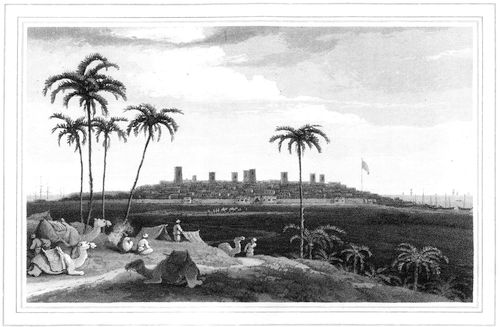
Bushire.
Drawn by James Morier Esqr.
Published by Messrs. Longman, Hurst, Rees, Orme & Brown, Paternoster Row, May 1, 1811.
The fortress itself was built by the Portuguese, though the people
around are jealous of the acknowledgment, and substitute as its founder
their own Shah Abbas. On a hasty calculation it must have been a
square of two hundred yards. The reservoirs for water are still to be
seen; but a lad, whom we met in the enclosure, told us that he and his
companions were at work in destroying the Hummums. Twenty-five
years ago the Envoy saw it in many parts entire, with some of the
houses still standing. It is now a heap of dirt and rubbish. The line
of the fort, indeed, is traced by the ditch, which is excavated from the
rock; and the gateways also are discoverable, and some little masonry
remains to mark their strength. There are some flat and oblong stones
on the outside of the fort, which we conceived to have been placed over
Portuguese tombs. There are, however, some curious characters upon
them, which Sir Harford Jones, who recollects them when they were
more legible, conceives to be between the old Cufick and the Nekshi.
In another excursion we advanced to Halila, about nine miles from
the town, and on the south of the peninsula of Bushire. Here, indeed,
there is a projection of the land, where it is still possible for very high
tides to rise above the surface. The ground is very much broken into
caverns and deep chasms. Halila is a small village; it has a trifling
square fort, with a tower at each angle, but without any guns. Cotton
is sown more systematically in the territory immediately adjacent to
Halila than in that of Bushire. Here and there over the plain are
some little spots sacred to the dead, and defended by small works
of stones.
The Sapphire lay about four miles off the shore, in four feet and
a half low water, and in quarter less five at high. The ground was
marl and very thick mud, so tenacious, that it was necessary every
three or four days to move the anchor. The refraction was so great,
that, for their daily observations at the sun’s meridian, they were obliged
to allow for it more than what is noted in the nautical tables. In my
visit on board, I took the following bearings from the quarter-deck.
Town N. 55 E. Concorde Lodge E. Halila Peak S. 70 E. Asses Ears
and Reshire Point S. 35 E. Cape Bang (the extremity of the land)
N. 11 E.
The water of Bushire has a cathartic quality of most immediate
effect in a stranger’s habit, but after the experience of about a month
it ceases to have so violent a power.
The meteorological journal which I kept may not be useless, and I
give therefore the month of November in the Appendix. On the night
of the 10th of that month, a most violent storm blew from the north-west.
The whole atmosphere was in a blaze of fire; the claps of thunder
succeeded one another with a rapidity, which rendered them scarcely
separable, and the rain poured down in torrents; but when all was
over, the air possessed a freshness which was most grateful. The storms
from the N. W. are very frequent in the winter; and though in no part
of the world do I recollect to have seen one so tremendous as this, I
am told that it was not to be compared with some which are experienced
at Bushire.
In three or four days the mountains which bore N. N. E. from our
dwelling were already covered with snow. This was reckoned early in
the season. The people soon begun to put on their warmer clothing.
Coughs and colds became very prevalent, particularly among the Indian
servants, who were clad more lightly than either the Europeans or the
natives.
About the 20th of November the people commence ploughing; the
soil is so light that it is turned up with very little labour; the plough,
therefore, is dragged mostly by one ox only, and not unfrequently even
by an ass. All their agricultural implements are of the rudest construction.
At this period, larks fly about in large numbers, and feed
upon the seed just sowing. There are also great flocks of pigeons,
cormorants, curlews, and hoobaras (bustards). On the 25th we saw a
white swallow flitting about the house. Sparrows were not so numerous
as in the beginning of the month. Flies appeared with a south wind;
but were scarce when it blew from the northward. The fruits in season
were melons, dates, pomegranates, apples, pears, and sweet limes; and
a small and very pleasant orange was just coming in. Our vegetables
were spinage, bendes, and onions, and cabbages and turnips from Bussora.
Of our meat, the finest was mutton, veal was coarse, but the beef
pretty good, and the fowls were admirable. There were no turkies or
geese indeed; nor ducks, except some that we occasionally got from
Bussora.
The climate of Bushire is healthy, if we might judge from the two
or three examples of strong and active old age which came within our
notice: one, my own Persian master, Mollah Hassan; another in
the Resident’s family, who has trimmed pipes for two-thirds of a century,
and who was a young man with mustachios and a sprouting
beard, when Nadir Shah was at Shiraz. Another is an old fellow of
the name of Ayecal, which, from the keenness of his love of sporting,
has been familiarized by the English into Jackall.
The better sort of women are scarcely ever seen, and when they are,
their faces are so completely covered that no feature can be distinguished.
The poorer women, indeed, are not so confined, for they go
in troops to draw water for the place. I have seen the elder ones sitting
and chatting at the well, and spinning the coarse cotton of the country,
while the young girls filled the skin which contains the water, and which
they all carry on their backs into the town. They do not wear shoes;
their dress consists of a very ample shirt, a pair of loose trowsers, and
the veil which goes over all. Their appearance is most doleful; though
I have still noticed a pretty face through all the filth of their attire. The
colour of their clothes is originally brown, but when they become too
dirty to be worn under that hue, they are sent to the dyer, who is supposed
to clean them by superinducing a dark-blue or black tint. In
almost every situation they might be considered as the attendants on a
burial; but in a real case of death there are professional mourners, who
are hired to see proper respect paid to the deceased, by keeping up the
cries of etiquette to his memory.
Among the superstitions in Persia, that which depends on the crowing
of a cock, is not the least remarkable. If the cock crows at a proper
hour, they esteem it a good omen; if at an improper season, they kill
him. I am told that the favourable hours are at nine, both in the morning
and in the evening, at noon and at midnight.
But the lion, in the popular belief of Persia, has a discernment much
more important to the interests of mankind. A fellow told me with
the gravest face, that a lion of their own country would never hurt a
Sheyah, (the sect of the Mahomedan religion which follows Ali, and
which is established in Persia,) but would always devour a Sunni, (who
recognises before Ali the three first caliphs.) On meeting a lion, you
have only therefore to say, “Ya Ali,” and the beast will walk by you
with great respect; but should you either from zeal or the forgetfulness
of terror, exclaim “Ya Omar! Oh Omar!” he will spring upon you
instantly.
III. Animals of the Dashtistan. About twenty-five years ago, in
the time of Sheik Nasr, who possessed both Bushire and the island of
Bahrein, and who consequently was enabled to improve the native
breed of Persia, by bringing over the Nedj stallion, the Dashtistan
became celebrated for a horse of strength and bottom. But the original
breed of Persia, that which is now restored, is a tall, lank, ill-formed,
and generally vicious animal; useful indeed for hard work, but unpleasant
to ride compared with the elegant action and docility of the
Arab. There is another race of the Turcoman breed, (such as are
seen at Smyrna, and through all Asia Minor), a short, thick, round-necked,
and strong-leg’d horse, short quartered, and inclined behind.
There is also a fine breed produced by the Turcoman mare and the
Nedj stallion. At two different times, large lots of horses were offered
to us for sale: the first, by the people of the Shiraz officer, who asked
immense prices, and when refused, departed in apparent ill-humour, but
generally returned and took the reduced sum which was offered. In
this way also we purchased a lot of forty horses, principally of the
Turcoman breed, which had been destined for the Indian market, and
for which an average price of three hundred and twenty piastres for each
horse had been asked at Bushire, but which at the end of the month
were sold to us for two hundred and fifty. The distinct and characteristic
value of the horses of the country, was exemplified in a present
of two, which the Envoy received from the Sheik of Bushire. One was
a beautiful Arab colt, of the sweetest temper I ever knew in a horse,
frisking about like a lamb, and yet so docile, that though now for the
first time mounted, he seemed to have been long used to the bit, a sure
proof in the estimation of the country of the excellence of his breed.
The other was a Persian colt of the most stubborn and vicious nature;
to the astonishment and admiration however of the Persians, the Envoy’s
Yorkshire groom by mere dint of whip and spur, subdued the creature
and rendered him fit to ride: a triumph which established the groom’s
reputation readily, among a people peculiarly alive to the superiority of
their own horsemanship. A horse more than ordinarily vicious was
tamed in a singular manner by the people of the country. He was
turned out loose (muzzled indeed in his mouth, where his ferociousness
was most formidable) to await in an enclosure the attack of two horses,
whose mouths and legs at full liberty were immediately directed against
him. The success was as singular as the experiment; and the violence
of the discipline which he endured, subdued the nature of the beast, and
rendered him the quietest of his kind. The horses are fastened in the
stables by their fore legs, and pinioned by a rope from the hind leg to
stakes at about six feet distant behind, so that although the animals are
well inclined to quarrel, and are only four or five feet asunder, they can
scarcely in this position succeed in hurting each other: frequently however
they do get loose, and then most furious battles ensue. I have
often admired the courage and dexterity with which the Persian
Jelowdars or grooms throw themselves into the thickest engagement of
angry horses; and, in defiance of the kicks and bites around them, contrive
to separate them.
The Resident’s stud consists of about twenty horses, mules, and
asses; eight of the horses belong to the East India Company, and are
principally employed in carrying choppers or couriers to Shiraz. These
are obliged however to be renewed very frequently, because one such
journey generally destroys the animal that performs it; so difficult are
the passes of the mountains, and so unmerciful are the riders.
They have in Persia a very large and ferocious dog, called the kofla
dog, from his being the watchful and faithful companion of the kofla or
caravan. Each muleteer has his dog, and so correct is the animal’s
knowledge of the mules that belong to his master, that he will discover
those that have strayed, and will bring them back to their associates;
and on the other hand, when at night the whole caravan stops, and the
mules are parcelled in square lots, the guardian dog will permit no
strange mule to join the party under his charge, or to encroach upon
their ground. His strength and his ferocity are equal to his intelligence
and watchfulness.
We chased one day a large white fox. They prey about the open
country round Bushire in great numbers, for the natives do not destroy
them with all the zeal of Englishmen. The wild animals of the Dashtistan
are the wolf, the hyæna, the fox, the porcupine, the mangousti,
the antelope, the wild boar, the jerboa, and sometimes the wild goat.
The mountains of the Dashtistan have also the lion, and he has been
known to descend into the plain. On the 12th December, Captain
Davis, of the Sapphire, shot two cormorants out of a flock that were
squatted on a tree. Partridges also have been seen to settle in the same
situation. The hawks, which are used in hunting, are the cherk, the
balban, and the shahein.
We set off on the 29th of November, before sun-rise, to hunt with
hawks. The freshness, or rather the coldness of the morning, was quite
revivifying. We were accompanied by an old and keen sportsman,
who had long been renowned in the plains of Bushire for his expertness
in training a hawk, and his perseverance in hunting the hoobara or
bustard. The old Reis, the name by which he was known, was one of
the most picturesque figures on horseback that I ever saw. He was
rather tall, with a neck very long, and a beard very grey. His body,
either through age or the long use of a favourite position on horseback,
inclined forwards till it made an angle of 45° with his thighs, which
run nearly parallel to the horse’s back; and his beard projected so much
from his lank neck, that it completed the amusement of the profile. On
his right wrist, which was covered by large gloves, his hawk was
perched. The bird is always kept hood-winked, till the game be near.
On our way we were joined by Hassan Khan, the Governor of
Dasti, who also carried a hawk, and who was attended by about
fifteen men with spears, the kaleoons, or water pipes, &c. We proceeded
to Halila, where we commenced our hunt. A hoobara started almost
under the foot of my horse; as the bird flew, a hawk was unhooded
that he might mark the direction, and was loosed only when it settled.
But the sport was unsuccessful in two or three attempts; in fact, when
the hawk has had one flight, and has missed his prey, he should be fed
with the blood of a pigeon, and then hood-winked, and not permitted
to fly again in that day’s sport. As soon as the hawk has taken his
flight, the sportsmen remain quiet till they can see that their bird has
seized his prey, when they ride up and disengage them.
The Jerboa. On the 1st Dec. we caught some jerboas; and I had
an opportunity of delineating and observing with some nicety all their
different properties. The description of this animal has been given so
minutely by Sonnini, and, with the controversy on the subject, has
occupied indeed so very long a chapter of one of his volumes, that it
would be superfluous to go over again the same tedious ground. As
there are, however, some little exceptions in the jerboa which I saw at
Bushire, I shall endeavour to point them out. In the first place, that
gradation from the bird to the quadruped, which Sonnini traced in
the hopping motion of the jerboa, did not strike me with the same degree
of conviction. When unpursued the animal certainly hops, though this
admission does not imply that he cannot walk without hopping. But
when he is escaping from any alarm, he may almost be said to lay himself
flat on the surface of the ground from the immense tension of his
hind legs, and literally to run ventre à terre. Yet as every observer will
feel that there are shades by which the works of creation gradually
resolve into each other, and which, by a slow operation, connect the
zoophyte with the animated world, and the bird with the quadruped,
the jerboa may still serve as one of the first and most perceptible gradations
between two kingdoms of nature; but kangaroos, a larger and
nobler specimen, would illustrate the connection as correctly.
On the specific description of the animal I agree with Sonnini’s
account of the Egyptian jerboas, except that, in two which I examined,
I could not find the spur or the small rudiment of a fourth toe on the
heel of the hinder foot; on the existence of which depends essentially
the resemblance which he has discovered between the jerboa and the
alagtaga of Tartary. But as the jerboa of Hasselquist, of Bruce,
and of Sonnini all seem to differ from each other, and from those
which I examined, in some minute circumstance, it is reasonable to
conclude, less that there is any incorrectness in the descriptions, than
that there is an essential variety in the animals. The jerboas in the
deserts before us at Bushire, do not live in troops, as those of Egypt, according
to Sonnini; each has his hole to which he retires with the
utmost precipitation; nor is it possible to take him by surprise in the
day, as I learn from Sir Harford Jones, who has had ample opportunities
of examining the history of the jerboas; and therefore the circumstance,
which Bruce mentions, of his Arabs having knocked
them down with sticks, extends probably to no general inference. Nor
can I think that Sonnini is correct in supposing that the animal is
fond of light. Those which I kept in a cage remained huddled together
under some cotton during the day, but in the night made such
a scratching, that I was obliged to send them out of the room. Besides,
one of the most common methods of catching them is by the glare of a
lanthorn, which seems to deprive them of the power of moving,
and subjects them quietly to the hand of the man who bears the light.
There is another and an easy way of catching them, by pouring water
down one of the apertures of their retreat; they immediately jump out.
We hunted several with spaniels, but, although surrounded on all sides,
they escaped with the greatest facility: when very closely pressed, they
have a most dextrous method of springing to an amazing height over
the heads of their pursuers; and, making two or three somersets in the
air, they come down again in all safety on their hinder legs, many yards
from the spot of their ascent. In this leap they probably use their
diminutive paws. Even a greyhound stands no chance with them; for
as soon as he comes near, they take to the somersets, and the dog is
completely thrown out. Their flesh is reckoned very fine, as the
people here who eat them assure me. As the animal is very sensible of
cold, and formed so delicately and apparently so little prepared to
resist frosts and snows, I cannot think, though Sonnini seems to imply
it, that it is found in very northern climates. Rats and hares indeed
are found in the coldest as well as in the warmest parts of the world;
but nature has provided them with a clothing more appropriate to the
change.
CHAP. V. BUSHIRE TO SHIRAZ .
DEPARTURE FROM BUSHIRE—ARRANGEMENTS OF THE CAMP—MEETING
WITH MAHOMED NEBEE KHAN: ENTERTAINMENT—THE
ISTAKBALL—DAULAKEE—MINERAL STREAMS—VEGETATION—PASSAGE
OF THE COTUL—PLAIN OF KHISHT—THE GOVERNOR—CARAVANSERAI—THE
MOUNTAIN ROBBERS—KAMAURIDGE—KAUZERON:
HONORS PAID TO THE ENVOY—RUINS OF SHAPOUR:
GENERAL VIEW; ACROPOLIS; SCULPTURES; ROMAN FIGURES;
THEATRE; TRADITIONS—PASSES OF THE MOUNTAINS—FIRMAN
FROM THE KING—APPROACH TO SHIRAZ—ISTAKBALLS—PRESENT
FROM THE PRINCE.
The preparations for our departure, which had been suspended by
different events, were now resumed with much alacrity. I felt that the
cold, which we should soon encounter, might possibly kill my Indian
servant, and I accordingly sent him back to Bombay. The Ferosh
Bashee, or chief tent-pitcher, an officer of much utility in the progress
of our journey, now brought with him to our camp a large number of
adherents in subordinate capacities, who on their entrance requested the
Envoy’s permission to say their prayers in the manner and time appointed
by their religion. The next morning I was roused by a noise,
which I at last discovered to be compounded of the trumpet of the troop
blowing the reveille, and the voice of a Persian priest calling the faithful
to prayers: lungs originally strong had been so disciplined and exercised
for the purpose, that the voice was more potent than the
trumpet.
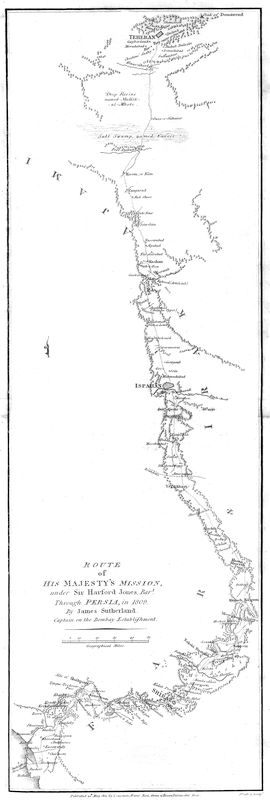
Route of
His Majesty’s Mission under Sir Harford Jones, Bart.
Through PERSIA, in 1809.
By James Sutherland. Captain on the Bombay Establishment.
Published 20th May 1911 by Longman, Hurst, Rees, Orme & Brown, Paternoster Row, May 1, 1811.
Our Mehmandar, Mahomed Zeky Khan, arrived on the 10th; we
went out to meet him, attended by the body guard in their best array,
and accompanied by a host of Persians. As the preparations for our
journey were now completed, the 17th Dec. 1808 was fixed for our departure.
On the 16th the Ternate, Lieut. Sealy, sailed for Bombay
with the Envoy’s dispatches to the Indian government; and on the next
day the Sapphire, which was appointed to convey the dispatches to
England, proceeded to Kharrack to take in water for the voyage.
All our arrangements were closed; and on the same morning, at a
quarter past eleven o’clock, the Envoy mounted his horse to proceed
from Bushire. In order to excite in the people a favourable expectation
of the result of the mission, he had previously desired the astrologers to
mention the time which they might deem lucky for his departure; and
the hour accordingly in which we begun our journey was pronounced, by
their authority, to be particularly fortunate. Sir Harford Jones’s
suite consisted of Mr. Sheridan, Mr. Bruce, Captain Sutherland,
Cornet Willock, Dr. Jukes, and myself. He had two Swiss
servants and an English groom, an English and a Portuguese tailor,
about half a dozen Indians, and a very numerous assortment of
Persians.
The Sapphire saluted us as we set out; shortly after we met the Mehmandar
and his cortège, and after some little exchange of civilities we
all went on together. The order of the cavalcade was as follows:—The
led horses, ten in number, each conducted by a well-clad jelowdar or
groom; then the chief of the jelowdars with his staff of office; then
the arz-beg or lord of requests; after him were six chatters or running
footmen, who immediately preceded the Envoy. The Envoy himself
was mounted on a choice Arab horse; at his right stirrup walked a
picked tall chatter, the chief of his class. Then followed the gentlemen of
the mission, amongst whom were disposed some moonshees. To the right
and left were the pipe-trimmers, who carried all the smoking apparatus
in boxes fashioned for the purpose.25 Behind the gentlemen and the
moonshees came a great crowd of Persians on horseback; and, to close
the whole, the body guard came along in goodly rows, and made an admirable
finish to the groupe.
The baggage all loaded on mules preceded us regularly on our march,
so that when we arrived at the end of our stage we always found our
tents pitched.
The arrangements of our camp were as follows:—There were two
state tents, one for dinner, the other for receiving company. The latter,
with the Envoy’s private tent, were enclosed within walls. Around
these were the tents of the gentlemen of the mission, each person having
his own. There was also one appropriated to cooking, and many others
of a smaller size for the servants, and the guard of cavalry.
After our dinner was over, which was generally an hour or two after
sun-set, the dinner tent was taken down, loaded on the mules, and sent
onwards to the next stage in readiness to receive us. About day-break
in the morning, the camp begun to break up; and before our breakfast
was over, for which one tent was left, all the rest of the ground was
cleared, and the baggage was far on its road to the next stage. The
Persians are so accustomed to this manner of life, that they pitch and
unpitch a camp with the most perfect dexterity and order. Much of
course depends upon the chief of the Feroshes or tent-pitchers, called
the Ferosh-Bashee, who must necessarily be very active. The man who
filled this department in our mission was very clever, but probably a
great rogue, of which at least he displayed a presumptive proof, as he
had lost an ear, the forfeit of some former misdemeanour. The office
of Charwardar or Chief Muleteer, is another also that requires much
activity and watchfulness, to superintend properly the loading and unloading
of the mules with order and dispatch.
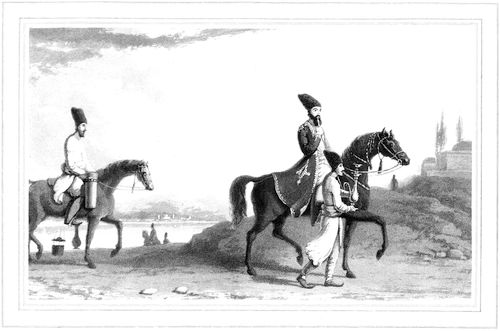
Persian Smoaking.
Drawn by James Morier Esqr.
Published by Messrs. Longman, Hurst, Rees, Orme & Brown, Paternoster Row, May 1, 1811.
We marched for about four miles in a direct bearing with Halila
Peak, (which bore S. 70. E. from Mr. Bruce’s house,) and then came
to the swamps, which terminate the extremity of the inlet of the sea,
from the port of Bushire. Having paced over those swamps for about
two miles more, we took a more easterly direction, and then marched
due E. to Alichangee, the village at which we encamped. The distance
is called five fursungs, but probably is not more than fourteen miles.
The soil over which we passed was sandy, and here and there strata of
rock. The weather was hazy, and gave the country a broken and unconnected
appearance.
As we approached our encampment, we were treated with a scene of
Persian splendour and etiquette, in the meeting of the Envoy with his
old friend and tutor, Mahomed Nebee Khan, the Governor of
Bushire. He had been informed that the Envoy intended passing the
following day with him, and accordingly prepared for his reception.
About a mile from our encampment we met him; a very large
portion of the military of Bushire had already greeted his arrival.
His approach was first announced by a salute from all the matchlock
guns of his guards, who were posted in our way to frighten our horses.
The Khan then appeared himself, surrounded by an immense host,
who, clearing away as soon as they came near our party, gave the two
great men free access to one another. They exchanged embraces, and
once again mounted their horses. We all returned together, and formed
a party so thickly cemented, that the dust of the desert was raised in
masses, which quite obscured the air.
Mahomed Nebee Khan and our Mehmandar escorted the Envoy
to his own tent, and after a short visit, departed amid the same crowd
and noise.
On Sunday the 18th, when I had performed divine service in the
Envoy’s tent, we paid a visit of ceremony to Mahomed Nebee
Khan. According to the fashion of the country, we proceeded on
horseback, although his tent was within a stone’s throw. We were met
by one of his officers, and an escort of ten men, who made their
obeisance to the Envoy, and preceded his horse, until we arrived at the
door, where the Khan himself was waiting. He received us most graciously,
and after we had pulled off our boots and shoes, and Sir Harford
and the Khan had gone through some little polite difficulties
about their seats, we finally settled ourselves on chairs prepared for us.
The Khan’s tent was very neat, and appeared to us a most desirable
residence. It had a large exterior covering, and close to the extremity
a wall all round; and in the interior, there was a clean little recess
closely covered with carpets, and lined with the finest chintz, the
borders of which were adorned with a broad fringe. Our host was a
man of great notoriety both in Persia and in India; his manners were
greatly in his favour, and he was dressed more like a noble than any
other man whom I had yet seen in the country. His beard presented
no plebeian roughness, and the dagger in his girdle glittered with precious
stones. When the usual compliments had been severally paid,
that silence of solemnity, which generally marks the visits of form, succeeded,
till the kaleoons, or water pipes, were introduced to our relief.
The coffees and sherbets followed, and the whole entertainment concluded
with a course of sweetmeats, which was brought upon separate
trays, each serving two guests. The only unsatisfactory part of the visit
was the intended politeness of two lusty attendants, who broke some of
the sweetmeats in their suspicious hands, blew the dust off the fragments
with their more suspicious mouths, and then laid them before us. After
a washing of hands, (in which we felt the full want of towels), and a
parting kaleoon, we took our leave, and left the Envoy to a private conference
with the Khan.
The trays, from which we eat, had the appearance of silver, though
I understood afterwards that they were plated only. They were neatly
carved in flowers and other ornaments. The articles which they contained
were made of almonds, pistachio nuts, and a paste of sugar;
others were like our alicampane and barley sugar, and all were very nice.
The Persians are almost indescribably fond of sweetmeats, which they
eat in very great quantities. The abundance indeed of fruits and sherbets
presented daily to the Envoy by the Mehmandar, proved the immense
supply which the taste of the country demanded. The presents
were arranged prettily in trays and boxes, and carried in great form on
the heads of servants, but they were less acceptable, because for each
the conductor required a present in money. By such means the great
men in Persia pay their servants, who in general receive no other wages.
The person, therefore, to whom such an office as that of Mehmandar is
entrusted, is, of course, surrounded by hordes of adherents, who are allured
by receipts so certain and valuable.
The new Governor had consulted the astrologers of Bushire to determine
the most propitious time for his entrance into the town, which, by
their predictions, was at three hours before sun-set on the 19th. In
conformity therefore to the decision, he was now delaying his advance
till the happier period should arrive. When, on a former occasion, he
was departing from Bushire to embark on board the ship, which was to
carry him on his mission to Calcutta, he was ordered by these astrologers
(as the only means of counteracting the influence of a certain evil
star) to go out of his house in a particular aspect: as unfortunately
there happened to be no door in that direction, he caused a hole to be
made in the wall, and thus made his exit.
In the evening we dined with Mahomed Nebee Khan. We did
not go till the Khan had sent to the Envoy to say, that the entertainment
was ready for his reception, a custom always observed on such
occasions.26 When we arrived at his tent, the same ceremonies passed
as in the morning, except that we sat upon the ground, where the inflexibility
of our knees rendered the position more difficult than can
be described. The Khan, who seemed to commiserate the tightness
of our pantaloons, begged that we would extend our legs at their full
length: fearing, however, to be rude, we chose to be uncomfortable,
and to imitate their fashion as faithfully as possible; and really, with
respect to my own feelings, I thought complaisance was never carried
further. The guests besides ourselves, were our Mehmandar and the
Persian Secretary. I preserved part of the conversation: in talking of
the admirable skill with which the guns of the Nereide were fired in
the re-capture of the Sylph, the Mehmandar said to the Secretary,
“you ought to have kissed the lips of those guns, whose execution was so
effectual; and walked around and around them, and in gratitude for
your deliverance, to have put up prayers to Heaven for their preservation
and prosperity.”
After having sat some time kaleoons were brought in, then coffee,
then kaleoons, then sweet coffee (the composition already noticed of
sugar and rose-water); and then kaleoons again. All this was rapidly
performed, when the Khan called for dinner. On the ground before us
was spread the sofra, a fine chintz cloth, which perfectly entrenched
our legs, and which is used so long unchanged, that the accumulated
fragments of former meals collect into a musty paste, and emit no very
savory smell; but the Persians are content, for they say that changing
the sofra brings ill luck. A tray was then placed before each guest;
on these trays were three fine china bowls, which were filled with sherbets;
two made of sweet liquors, and one of a most exquisite species of
lemonade. There were besides, fruits ready cut, plates with elegant
little arrangements of sweetmeats and confectionary, and smaller cups
of sweet sherbet; the whole of which were placed most symetrically,
and were quite inviting, even by their appearance. In the vases of
sherbet were spoons made of the pear tree, with very deep bowls, and
worked so delicately, that the long handle just slightly bent when
it was carried to the mouth. The pillaus succeeded, three of which were
placed before each two guests; one of plain rice called the chillo, one
made of mutton with raisins and almonds, the other of a fowl, with rich
spices and plumbs. To this were added various dishes with rich sauces,
and over each a small tincture of sweet sauce. Their cooking, indeed,
is mostly composed of sweets. The business of eating was a pleasure
to the Persians, but it was misery to us. They comfortably advanced
their chins close to the dishes, and commodiously scooped the rice or
other victuals into their mouths, with three fingers and the thumb of
their right hand; but in vain did we attempt to approach the dish:
our tight-kneed breeches, and all the ligaments and buttons of our
dress, forbade us; and we were forced to manage as well as we could,
fragments of meat and rice falling through our fingers all around us.
When we were all satisfied, dinner was carried away with the same
state in which it was brought: the servant who officiated, dropping
himself gracefully on one knee, as he carried away the trays, and passing
them expertly over his head with both his hands, extended to the
lacquey, who was ready behind to carry them off. We were treated
with more kaleoons after dinner, and then departed to our beds.
On the morning of the 19th, the camp broke up at sun-rise. We took
a hasty breakfast in the Envoy’s tent, but a visit from Mahomed
Nebee Khan (which was preceded by a present of two horses and his
own sword) kept us on the ground till nine o’clock. The Khan, with
all his attendants, accompanied us about two miles. He was preparing
to enter Bushire, his new government, with all splendour. From the
town to the swamps were erected stages on which bullocks were to be
sacrificed, and from which their heads were to be thrown under his
horse’s feet, as he advanced; a ceremony indeed appropriated to Princes
alone, and to them, only on particular occasions. Yet, however
anxious originally for his station, and however splendid in his present
appearances, he felt the full dangers of his pre-eminence, and betrayed
an absence and uneasiness in his words and actions, which to us
evinced all his apprehensions. He was so conscious indeed of the difficulties
of his situation, that he had transmitted to the King a present of
two thousand tomauns, with a memorial, beseeching to be excused from
his government.
We marched at first north-westerly, till we came to the bed of a river,
or rather of a mountain-torrent, in which the actual stream of water
when we passed, was not above ten feet in breadth, though the channel
itself was perhaps thirty yards. It falls into the sea in a due E. and W.
direction.
At two o’clock we came to Ahmadiéh: at half past two we passed
a small fort called Khosh Aub, where a large body of people were
waiting our passage.27 They were all armed with pikes, matchlocks,
swords and shields; and gave us two vollies as a salute. They then
advanced to us, and being announced by the Arz-beg, wished us
a prosperous journey. They were answered by the usual civility,
“khosh amedeed, you are welcome.” As we proceeded, our party was
headed by the soldiery. They were commanded by a man on horseback,
all in tatters, who with his whip kept them together, and excited
them with his voice where he wanted them to run. Two of the chosen
of the village performed feats before us on their lean horses, and helped
to increase the excessive dust, which involved us. This party kept pace
with us, until we were again met by a similar host, the van of the little
army who were waiting our reception at Borazjoon: these also fired
their muskets.
From Khosh Aub to Borazjoon the ground appeared cultivated; and
as we were approaching the latter village, we saw some of the peasants,
who, after having finished their toil in the fields were walking home with
their ploughs over their shoulders. I think we may fairly reckon at
twenty-five miles the distance from Alichangee to Borazjoon: the Persians
call it nine fursungs. The avenues to Borazjoon are through
plantations of date and tamarisk trees: the village is a collection of
huts, which surround a fort; and the fort, like the rest of those which
I had seen, was a square, with turrets at each corner, which were cut
into small chequers at the top. There are the ruins of many small
forts all over the Dashtistan, which were built by some unsuccessful
rebel, and which were left to decay as soon as he was quelled. I understand
that the population of this district has been decreasing ever
since the happy days of Sheik Nasr. Almost the whole of its geography
present places which have names, but no inhabitants; or if
there are any, they are the refuse only of former more flourishing
families.
In our road to-day, we saw immense flights of the toowee, or desert
partridge, and some ravens. The Mehmandar and the oldest of our
moonshees amused themselves in scouring the plains, and playing at the
dangerous game of the girid, in which the old scribe got a severe blow.
The Persians ride with great courage, for they drive their horses at
their greatest speed over any ground. They of course get frequent
falls, by which they are seldom much injured; for though they generally
alight on their heads, they are there saved by their immense
sheep-skin caps.28
It was a quarter past eight before we mounted our horses on the
morning of the 21st, and ten minutes past twelve when we arrived at
Daulakee, a distance called four fursungs, and which may be computed
at about twelve road miles. The site of Daulakee is marked by a break
in the mountains, where the road which leads among them commences.
It bore N. 30 E. when we mounted. Our road was much broken by
the beds of numerous torrents, which, after the rain and melted snows,
fall from the adjacent mountains. We here and there met with small
encampments of the Elauts. They appear like the Turcomans, whom I
have so frequently seen at Smyrna, and through the whole of Asia
Minor. At the distance of two miles we were met by the Istakball,
who fired their salute, and frightened the horses as before. This ceremony
was repeated every day, so that a repetition of the description
will not be always necessary. They were all arranged on a rising
ground, at the foot of which ran a stream of mineral water, of a most
sulphureous smell. Further on we crossed other streams of the same
quality; the heat of one of which, as it gushed from under the rocks,
was almost scalding. We brought home specimens of the incrustation
which the spray of the bubbles left on the surrounding rocks. The bed
of the stream was mostly of the colour of sulphur, although there were
patches here and there of a copper hue. Still a little further on, on
the left of the road, are two springs of naptha. The oil swims on the
surface of the water, and the peasantry take it off with a branch of
date tree, and collect it into small holes around the spring ready for
their immediate use. They daub the camels all over with it in the
spring, which preserves their coats, and prevents a disease in the skin,
which is common to them.
The huts in the village of Daulakee, as we rode through it, appeared
mostly to be covered on the tops with the entwined leaves of their date
trees, while the better houses are built of mud, and terraced. The
mosque was the most creditable building that met our eye in the whole
place: its interior seemed neatly arranged in arches, and preserved
clean with a white stucco. There was a little bath at the extremity of
the town. The customary fort (for such are found in most of these
villages) was situated in the middle of the huts, at the top of which
many an eager Persian was perched. This place, and indeed all we had
seen, presented a picture of poverty stronger than words can express.
There was nothing but what mere existence required; nor to our very
cursory observation did the most trifling superfluity shew itself.
The river that runs by Daulakee meanders through the plain which
we had passed. All the mineral streams, which crossed our road, fall
into it, and renders its waters salt and brackish. The soil itself indeed,
at the roots of the mountains, is, in some places, saturated with a nitrous
acid, of which, in the neighbourhood of Daulakee, the people
make a pleasant beverage. In one of the recesses of the mountains,
however, there is a stream of pure and delicious water. In the evening
I walked to the spring, which is embosomed in date trees: it is beautifully
clear, and rather tepid. Its short course down into the plain is
marked by a wood, which more immediately flourishes under its
influence, and follows its progress. In the lower country there is an
extensive tract covered with date trees, and forming a mass of verdure
on which the eye delights to rest after the constant glare of an arid
desert. It is extraordinary how vegetation thrives in this country,
wherever there is the least water. It is, indeed, a general rule, that
wherever they can irrigate they can produce vegetation; and indeed
with no other moisture than the dews, and the few occasional showers
of the winter, the plain of Bushire (which all observers have agreed to
call a barren land) produces one hundred for seven. The rude manner
of cultivation here is sufficient to display the intrinsic goodness of the
soil; for they just sprinkle with seed the spot marked out for the
plough, then make the superficial furrows, and obtain most abundant
crops.
We mounted this morning at eight o’clock, and arrived at our encampment
at ten minutes before one. It is called four fursungs, but
we compute it at sixteen miles. We soon entered the mountains, and
followed the road through them to the Eastward. We came to the
river (which in its lower course passes near Daulakee) at half past nine
o’clock: we crossed it a second time about a quarter of an hour after,
and at ten o’clock passed it for the third and last time, at a ruined
bridge, of a structure which had once been neat. After hard rains its
bed is very extensive, and its current most rapid: so that it entirely impedes
the passage of travellers and caravans. At the fords where we
crossed, it was a very fine stream up to the bellies of our horses. After
that, we paced its banks, for the distance perhaps of half a mile, in a
S. E. direction. We saw it for the last time winding on a southern
course, when we had ascended an elevated peak of the Cotul range.
We gained this summit at half past eleven; the road then continued
through the mountains till twelve o’clock, when we came on the plain
of Khisht. At ten minutes before one we reached our encampment.
The extreme capriciousness of the windings of the road, rendered it
almost an impossible task to ascertain the ultimate and exact direction
of our bearing from Daulakee to Khisht. However it was evident, that
we had made a great deal of Easting, with a little Northing. The
mountains rose around in most fantastical forms, their strata having
their highest elevation towards the South, forming a dip of perhaps
forty-five degrees. The soil is mostly of a soft crumbling stone, large
fragments of which seemed just balancing at the brink of the precipice
above, and appearing to require only a touch to impel them into the
great chasms below. The passage of the river by our numerous party,
and the winding of the horsemen and loaded mules in the mountain-passes,
animated the whole of the dreary scenery around into the most
romantic pictures. The only verdure which cheered the sameness of
the glaring yellow of the mountain, was that of a few wild almond
trees.
Before we ascended to the plains of Khisht, a long string of matchlock
men and horsemen (the Istakball) who came out to meet the
Envoy, appeared on the brink of the precipice above us. As we
ascended they fired a volley, the sound of which returned in repeated
echoes through the mountains; and when we came into the midst of
them, the horsemen begun their gambols; moving around us in all
directions, stopping their horses, couching their long lances, throwing
them, and then again galloping forwards. The footmen with their
matchlocks made a charge into the plain, shouting as they advanced,
as a representation perhaps of the ardour of their attack in real combat.
When we approached our encampment, we were met by the Governor
of Khisht himself, Zaul Khan, a man of remarkable appearance,
without eyes, and with the fragment of a tongue, the rest of which he
had forfeited during the troubles of Persia. He came riding on a mule
conducted by a young Persian. But the most extraordinary part of
his history is, that, notwithstanding his tongue is cut, he still talks intelligibly.
Before, indeed, this operation was performed, he had such an
impediment in his speech, that he was scarcely able to make himself
understood; but the mutilation was fortunate, and his articulation
has been improved. This the Envoy, who had known him before the
punishment, avers.
The plain of Khisht seems to form a complete oval, and presented
stronger marks of cultivation than any part of the Dashtistan which
we had seen. The Konar bushes were thickly sprinkled by the roadside,
and apparently all over the plain, besides plantations of date
trees. At Konar-a-Tackta (a village four miles and a half from Khisht,
and the place where we encamped,) there is a Caravanserai, which has
lately been erected by one of the wives of Zaul Khan, and is really a
neat and commodious building. An arched gateway introduces the
traveller into a square yard, around which are rooms, and behind which
are stables. There is also a small suite of rooms over the gateway. In
the centre of the court is an elevated platform, the roof of a subterraneous
chamber called a zeera zemeon, whither travellers retire
during the great heats of the summer, and which in those heats
is a very refreshing habitation. Behind the building is a tank or
reservoir for rain-water, which has newly been added, and is not
indeed yet finished. The whole forms an establishment most acceptable
to travellers, and worthy of the Persian governments of
a better age.
On the 23d we rose before the sun, and though in a region so much
more elevated than the one in which we were on the preceding day,
the temperature of the atmosphere seemed the same. The sky was
clouded all over, and some predicted rain. One of our moonshees, who
was considered an astrologer, told me that, according to his observations,
“it would rain, if God pleased.” However, the day passed
without rain, and the opinion of the astrologer was, at any rate, equally
indisputable.
The trumpet, the signal for departure, sounded at twenty minutes
before eight, and we went off with the usual clatter and parade. The
course of the road bore N. E.: but when we had rode for about
four miles its direction was nearly due East. In an hour after our departure
we came to the banks of a river, which is the same that, flowing
by Zeira, falls into the Daulakee river at Deerooga, and which,
according to my information, takes its rise in the mountains near
Shapour. Immediately on coming on its banks we began to wind
through the difficult passes of the mountains, which in various
parts are very dangerous. The Arab horses, who had been accustomed
to the equal surface of their own sandy plains, trode the rocky
sides of the mountains with fearful and uncertain steps, and one or two
of the most valuable of the Envoy’s stud suffered by severe falls: the
Persian horses, on the contrary, scramble over the threatening eminences,
and confidently walk by the sides of the precipices with an
indifference, which gives an equal consciousness of security to their
riders. Our Mehmandar, by way of bravado, urged his horse over a
rocky heap, which appeared almost as the feat of a madman.
There were some particular points of view in our progress, that were
picturesque and grand in the extreme. The path wound so fantastically
along the side of the mountain, that those who were yet at the bottom
saw the whole surface intersected by the ranges of our procession; and
the travellers at the upper point appeared so diminutive, that man and
brute could scarcely be distinguished from each other. Just before we
reached the very highest top of the mountain we came to a station of
Rhadars, and to the dwelling of a derveish, which was formed in the
crevice of a rock. In parts of our route we saw the Rodo-dendron,
one of the strongest symptoms of the change of our climate. We
reached our encampment at twenty minutes past eleven, and we found
it pitched near a Caravanserai. The village of Khaumauridge is situated
on a small plain, and is distant about a mile N. 20 W. from the Caravanserai.
On an eminence over us was a small tower, where a rebel
stood a long siege.
The mountains through which we passed were infested by a race of
robbers called the Memméh Sunni. They live in the deepest recesses of
their wild valleys, and commit their depredations on the unguarded
travellers with an impunity quite characteristic of the state of the
country. Although some attempts have occasionally been made to
terrify them into submission, by inflicting the severest tortures on the
few individuals who have chanced to be caught, yet the example has
been lost on the living, and the love of independence and plunder has
outweighed the terrors of barbarous punishment and ignominious death.
The abrupt formation of their mountain haunts (labyrinths to those who
have not long practised them,) favours this community so materially,
that instances have been known of their having snatched from the very
centre of a caravan, some traveller who promised less resistance than
his companions, or some well loaded mule, that seemed to announce
more booty than others. When Brigadier-General Malcolm went
through their mountains on a former mission, the robbers bore off
some of his mules which carried part of the rich presents destined for
the King of Persia. So firmly are they now established in their
fastnesses, that the neighbouring Khans and Governors of districts have
chosen, since the evil itself was inevitable, to take a part in its advantages,
and, it is said, maintain their own agents amongst the Memméh
Sunni, with whom they have stipulated agreements about the fruits of
their plunder. They happened to be less predatory at the time of our
passage, and we proceeded through the mountains without the least
molestation.
The Caravanserai close to our encampment was a solid, though rather
ancient structure, and the walls, scribbled over with names or couplets,
attested the passage of frequent travellers. We saw a cock blackbird,
and Sir Harford fired three times on a thrush, which, notwithstanding,
kept its ground, until it was taken up in the hand, and indeed
permitted itself to be taken up frequently without offering to fly
away.
A road is making at the sole expence of Hajee Mahomed Hassan,
a merchant and inhabitant of Bushire, which will cut through the mountains
from Kauzeroon to Khaumauridge, and shorten the distance two
fursungs. Its direction bore E. from us at Khaumauridge.
On the 24th our march commenced at eight, and we arrived at
Kauzeroon at half past two. We were about one hour pacing the plain
of Khaumauridge, and, allowing one mile for the other extremity, (which
we had passed on the preceding day) we may fairly calculate its whole
length at five miles. Its opening towards Kauzeroon is through a pass
called the Tengui Turkoun, between two high branches of the mountains.
There is besides a road to the left, which leads over the mountain, and
which the Envoy and some of the party took, because the pass is very
famous for the attacks of the robbers. The road was, however, guarded
at different stations by matchlock men, who had been placed there by
the direction of the Prince, which was one of the numerous instances of
his great attention to the mission.
Having descended once again, we came into the plains of Kauzeroon.
From the eminence we perceived the river, which we had passed near
Khisht, winding in a N. and S. direction behind the western hills. The
city of Shapour we just discovered at the foot of a mountain, then bearing
N. 50 E. Hills of very subordinate elevation run out from the
great range of mountains, and leave here and there little plains which
are all comprehended under the name of the plain of Kauzeroon.
We were met at Derees by a great crowd, who gambolled and saluted
as usual. As we passed between the huts, the women of the village
were collected on the roofs, and greeted our approach by a loud and
tremendous species of song, which yet at a distance was not disagreeable.
Money was thrown amongst the crowd, which added much to
the confusion of the scene, and excited a most active and querulous
scramble.
About two miles from Kauzeroon we were met by Mahomed Kouli
Khan, the Governor of that place, who was attended by a numerous
company of horsemen. Mr. Bruce, Dr. Jukes, and myself dismounted
to pay him the usual compliment, and he then turned back
with us to his own town. About a mile further, almost the whole male
population was collected to meet us. A bottle, which contained sugar-candy,
was broken under the feet of the Envoy’s horse, a ceremony
never practised in Persia to any but to royal personages; and then
about thirty wrestlers, in party-coloured breeches, (their only covering)
and armed with a pair of clubs called meals, begun each to make the
most curious noise, move in the most extravagant postures, and display
their professional exploits all the way before our horses, until we reached
our encampment. It would be difficult to describe a crowd so wild
and confused. The extreme jolting, running, pushing, and scrambling
almost bewildered me: while the dust, which seemed to powder the
beards of the Persians, nearly suffocated us all. Probably ten thousand
persons of all descriptions were assembled. Officers were dispersed
among them, and with whips and sticks drove the crowd backwards or
forwards, as the occasion required. Nothing could exceed the tumult
and cries. Here men were tumbling one over the other in the inequalities
of the ground; there horses were galloping in every direction,
while their riders were performing feats with their long spears; behind
was an impenetrable crowd; before us were the wrestlers dancing
about to the sound of three copper drums, and twirling round their
clubs. On every side was noise and confusion. This ceremony is
never practised but to princes of the blood, and we considered, therefore,
the honours of this day as a further proof of the reviving influence
of the English name.
On Christmas day Sir Harford Jones and I visited the ruins of
Shapour. We reckoned the distance at fifteen miles, in nearly a north
direction from Kauzeroon. About seven miles from our encampment,
we passed again through the village of Derees, which, from the extent
of the ruined houses, must once have been a large town. Every house
is covered with an arched roof, a mode of building which probably
originated in the scarcity of timber. It is indeed common in all the
places which we have seen; and the doors and porticoes are universally
formed by a Saracenic arch. A miserable population, thinly interspersed
among the ruins of Derees, came out to greet our passage. On
the northern extremity of the town there is a place of burial, and over
one of the tomb-stones there was the figure of a lion.
After having passed two tombs, one on the right side and one on
the left of the road, we came to the bed of a torrent, over which there
seems to have been built an aqueduct; for, on either side of its banks,
are the remains of masonry, and the trace of its conduit is perceived
on the southern bank. The extent of the ruins of Shapour to the
southward is marked by a beautiful stream of water. Over the spring,
from which it issues, the road is built, sustained by fragments of architecture,
which are a part of the entablature of some public building,
and by their dimensions must have appertained to a very
considerable edifice.
Immediately after having passed this spring we came upon the ruins
of Shapour.29 When standing on an eminence we computed the whole
to be comprised, on a rough calculation, within a circumference of
six miles. This circumference enclosed a tract of plain, and a hill on
which the remains of the ancient citadel formed a conspicuous and
commanding object. Whether by a mere caprice of nature, or whether
by the labour of man, this hill or Acropolis is distinctly separated from
the great range of mountains, forming the Eastern boundary of the plain
of Kauzeroon. Between this and another imposing mass of rock runs the
beautiful river of Shapour: we reckoned the space between the two
rocks at thirty yards, which formed a little plain of verdure and shrubbery,
intersected indeed by the stream of the river.30 The opening betwixt
the two grand masses presented a landscape the most varied, the
most tranquil, the most picturesque, and, at the same time, the most
sublime that imagination can form. A black and stupendous rock
(the strata of which were thrown into strong and wild positions, and
formed an acute angle with the horizon) flanked the right of the picture:
whilst another still more extraordinary rock, as richly illumined
as the other was darkened, supported the left. Between both a distant
range of mountains, whose roots were terminated by a plain, filled up
the interstice, forming a fine aerial perspective; whilst the river and its
rich shrubbery completed a most enlivening fore-ground. The hill, on
which the remains of the citadel stand, is covered with the ruins of
walls and turrets. On its eastern aspect, the nature of the fortification
can be traced easily; for walls fill the chasms from rock to rock, forming
altogether a place of defence admirably strong.
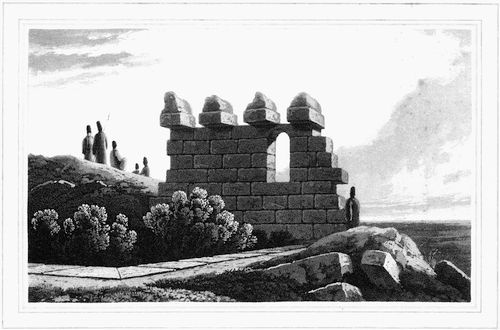
Shapour.
Drawn by James Morier Esqr.
Published by Messrs. Longman, Hurst, Rees, Orme & Brown, Paternoster Row, May 1, 1811.
The first object which arrested our attention, was a mutilated sculpture
of two colossal figures on horseback, carved on the superfices
of the rock. The figure on the right was the most injured; the
only part indeed, which we could ascertain with precision, was one of
the front and two of the hinder feet of a horse, standing over the statue
of a man, who was extended at his full length, his face turning outwardly,
and reposed upon his right hand, and his attire bearing marks
of a Roman costume. A figure in the same dress was placed in an attitude
of supplication at the horse’s knees, and a head in alto-relievo just
appeared between the hinder feet. The equestrian figure on the left
was not quite so much mutilated, the horse and parts of the drapery on
the thighs being still well preserved. The dimensions of the figures are
as follows: length of the foot of the figure under the horse, fifteen
inches; length of the whole figure sixteen feet one inch; length of the
arm five feet; chin to the summit of the head one foot two inches;
length of the horse’s leg from the lower part of the shoulder to the hoof
four feet four; the dress of the figures was a short petticoat, from the
waist downwards just below the knees.
The next piece of sculpture (which, like the former, was carved upon
the mountain of the citadel), is perfect in all its parts. It consists of
three grand compartments, the central and most interesting represents
a figure on horseback, whose dress announces a royal personage. His
head-dress is a crown, on which is placed a globe; his hair flows in
very large and massy curls over both shoulders, whilst a slight mustachio
just covers his upper lip, and gives much expression to a countenance
strongly indicative of pride and majesty. His body is clothed
with a robe which falls in many folds to his girdle, and then extends
itself over his thigh and legs as low as his ancle. A quiver hangs by
his side; in his right hand he holds the hand of a figure behind him,
which stands so as to cover the whole hind quarter of his horse, and
which is dressed in the Roman tunic and helmet. A figure, habited
also in the Roman costume, is on its knees before the head of the
horse, with its hands extended, and with a face betraying entreaty.
Under the feet of the horse is another figure extended, in the same
attire and character as that of the other two Roman figures. To the
right of the tablet stands a figure (behind that in a suppliant attitude)
with his hands also extended, but dressed in a different manner, and,
as far as we could judge, with features more Egyptian than European.
In the angle between the king’s head and the horse’s is a Victory displaying
the scroll of Fame. A figure (part of which is concealed by
the one on its knees) completes the whole of this division. (Plate X.)
The second grand compartment, which is on the right, is divided again
into six sub-compartments; in each of these are carved three figures,
the costumes and general physiognomies of which are all different.
They appear mostly in postures of supplication; and, I should suspect,
are representations of vanquished people. On the left, in the third
grand compartment, are two rows of horsemen divided by one line into
two smaller compartments. They all have the same characteristic
dress and features as the royal figure in the centre, and certainly represent
his forces. The whole of this most interesting monument is
sculptured on a very hard rock, which bears the finest polish, and which
we pronounced to be a coarse species of jasper. The shortness of our
stay did not afford me an opportunity of delineating the detail of the
many figures, which have been so faithfully pourtrayed. The artist
has preserved so much distinction in the countenances and features of
the different characters brought together in this groupe, that, if their
respective countries could be ascertained, (and study and close investigation
would probably secure the discovery) some important point of
ancient history would be elucidated by an evidence as ingenious as it
would be convincing. The dimensions we took are as follows: figures
on foot, height five feet nine inches; figures on horseback from the
rider’s cap to the horse’s hoofs six feet five inches: the minor tablets
are four feet ten inches in length; the grand tablet eleven feet eleven
inches.
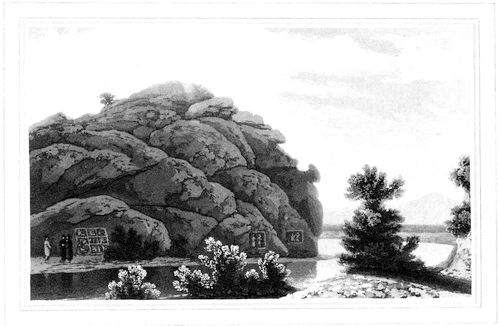
Rock at Shapour.
Drawn by James Morier Esqr.
Published by Messrs. Longman, Hurst, Rees, Orme & Brown, Paternoster Row, May 1, 1811.
Having examined these, we next crossed the river to the sculptures on
the opposite rock. The first is a long tablet, containing a multitude
of figures. The principal person, (who is certainly the King represented
in the former tablet) is placed in the very centre of the piece,
alone in a small compartment, and is seated with a sword placed betwixt
his legs, on the pummel of which rests his left hand. It is a most
ridiculous object, with a head swelled by a singular wig to an immense
circumference. On his right, on the uppermost of two long slips,
are many men who seem to be a mixture of Persians and Romans;
the former are conducting the latter as prisoners. Under these in the
lower slip are others, who by their wigs appear to be Persians: their
leader bears a human head in both hands, and extends it towards the
central figure. On the left are four small compartments; the first
(nearest that figure, and the highest from the ground) incloses a crowd
of men whose arms are placed over one another’s shoulders. Below
these are five figures, one of whom leads a horse without any more furniture
than a bridle. The two other compartments are filled up
with eight figures each. We considered this to represent, in general, a
king seated in his room of audience surrounded by his own people,
and by nations tributary to him. The length is eleven yards
four inches.
On the left of this were two colossal figures on horseback, carved in
an alto relievo. The one to the right had all the dress, character and
features of the King above described; the other, on the left, appeared
also a royal personage, but differing in dress, and in the furniture of his
horse. Both had their hands extended, and held a ring, which we
conceived to be emblematical of peace. The Envoy, who had seen
both these remains and Nakshi Rustam, prepared me to expect a
similar sculpture at the latter: and as I had not leisure to detail all the
subjects of Shapour, I preferred to delineate those, of which no other
specimen might exist, and therefore proceeded in our general examination.
I must not however omit to say, that the sculpture of these two
figures was exquisite; the proportions and anatomy of both horses and
men were accurately preserved, so that the very veins and arteries in
the horses’ legs and belly were most delicately delineated.
Walking forwards we came to a very extensive piece of sculpture,
the lower parts of which were entirely destroyed. We saw, however,
on the right, a row of camels’ and men’s heads intermixed; and under
them a row of horses’ and men’s heads, which were demolished from
the horse’s eye downwards. In front of these, at the distance of about
four feet, was part of a figure on a horse, the King as before, holding a
bow and four arrows in his right hand. We supposed that this might
be the commencement of a hunting piece. [Plate XI.]
Our research terminated in a most perfect sculpture: the extreme
interest of which only increased our regret, that the shortness of our
time would not allow us to give it all the observation and study which
it required. This piece contained a greater number of objects than
any of the others, and a much greater diversity of characters. The
surface of the rock is here divided into a variety of unequal compartments,
all of which are occupied by a multitude of figures. In
the middle, is a rather reduced copy of the second relievo which I
have described (that of the King and the suppliant) except that, facing
the King there is an additional personage with a hand extended holding
a ring. In the first row, at the top on the right, are a number of slight
figures with their arms folded. The second is filled with a crowd, of
which some carry baskets. The third is equally covered; and in the
right corner there is a man conducting a lion by a chain. In the
fourth, and just opposite to the King, is a very remarkable groupe,
whose loose and folded dresses denote Indians: one leads a horse,
whose furniture I have drawn with some care, and behind the horse is
an elephant. Under this, and close to the ground, are men in a Roman
costume; amongst them is a chariot to which two horses are
harnessed; this also I have exactly delineated.31 In five compartments on
the left (corresponding with those on the right) are placed thick
squadrons of Persian cavalry, all in a regular and military order,
marshalled as it were in echelon. Fourteen yards was the length of the
whole sculpture from point to point.
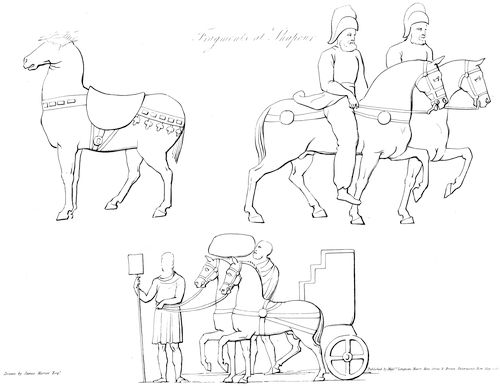
Fragments at Shapour.
Drawn by James Morier Esqr.
Published by Messrs. Longman, Hurst, Rees, Orme & Brown, Paternoster Row, May 1, 1811.
Sculpture at Shapour.
Drawn by James Morier Esqr.
Published by Messrs. Longman, Hurst, Rees, Orme & Brown, Paternoster Row, May 1, 1811.
Sculpture at Shapour.
Drawn by James Morier Esqr.
Published by Messrs. Longman, Hurst, Rees, Orme & Brown, Paternoster Row, May 1, 1811.
The path that conducted us round to these beautiful monuments, is
the course of an aqueduct, which appeared to be of more modern
workmanship. Bordering on the road which winds behind the hill
of the citadel, are numerous canals of water, formed most artificially
and closely cemented with darna. Besides these, there are very deep
wells, in parts of which the channels of the aqueduct are seen to pass.
After having repassed the river, we walked over the numerous mounds
of stones and earth which cover the ruined buildings of Shapour, and
which, if ever explored, would discover innumerable secrets of antiquity.
We were conducted by the peasants who were with us, to the
remains of a very fine wall, which in the symmetry of its masonry
equalled any Grecian work that I have ever seen. Each stone was
four feet long, twenty-seven inches thick, and cut to the finest angles.
This wall formed the front to a square building, the area of which is
fifty-five feet. At the top were placed sphinxes couchant, a circumstance
which we ascertained from discovering accidentally two eyes
and a mutilated foot at the extremity of one of the upper stones. In
this wall there is a window, which is arched by the formation
of its upper stone. Behind this square building, we traced most correctly
the configuration of a theatre, thirty paces in length, and fourteen
in breadth. The place resembled at least those called theatres which I
have seen in Greece. From a comparison of their positions, we were
led to suppose that the building still extant must have been connected
with the other behind it, and may have formed perhaps the entrance
to it. [Plate XIII.]
There are distinct mounds of earth scattered over the whole site of
the city, to each of which there are one or more wells. These we
supposed to be ruins of separate houses. The people of Kauzeroon
relate that there are immense subterraneous passages at Shapour, and
connect the most extraordinary stories with them. Certainly one of
the least extraordinary is, that a horse and mare were lost in them, and
some time after re-appeared with a foal. Our informer added that one
of his own acquaintance was sent into these passages, and had advanced
some way when he perceived a gigantic figure, which to his
fears appeared approaching towards him. He recovered himself however
so far as to venture up to it, when, instead of a living monster, he
found a sculptured figure, the same as those on the exterior of the rock.
As a measure of the extent of these labyrinths, they say, that it would
require twenty mauns of oil, (a maun is seven pounds and a quarter) to
light any one through all their intricacies.
The plants that we noticed near the river, on the site of the city, and
about the surrounding plain, were the palma christi, rodo-dendron, the
willow, wild fig, a plant which the Persians call shauk-a-booz, and caveer,
reeds, and benak or spice plant. The plain towards Shapour is much
more cultivated than towards Kauzeroon, and is intersected by a variety
of small artificial channels, which receive their supplies from the river.
The river itself is a stream of very fine water, but after having run
for about eighteen miles, it meets with a bed of salt among the mountains,
which renders its waters in its farther progress towards the sea
quite salt.
After having enjoyed the pleasure of exploring these remains, we returned
to Kauzeroon. This town covers a large extent of country, but
its walls and skirts are almost all in ruins. There is one green spot
near it, a garden planted chiefly with cypress and orange trees, and
belonging to the Governor. We walked there in the evening: at the
entrance is a pleasure house, from which the principal avenue and
garden are seen. We drank coffee in an upper room, neatly matted
and stuccoed, with painted glass windows; and after having so long
roamed over barren mountains and desert plains, were much pleased to
meet with regular paths, refreshing rivulets, and luxuriant vegetation.32
The blackbird and the thrush were flying from tree to tree, and
reminded us how sensibly we had changed our climate.
We set off at eight o’clock on the morning of the 26th, and arrived at
our encampment in the valley of Abdoui, at half past twelve. The
road led by the walls of Kauzeroon, and through the plain, until we came
to a causeway called the Poul-aub-guinee, which is reckoned two
fursungs from Kauzeroon. From this spot (which is a swamp forming
the termination of the lake from the southward) the road begun to wind
up a high mountain called the Dockter or “Daughter.” Over this, in
the most difficult parts of the ascent, a road has been made, and parapet
walls built to screen the traveller from the dangers of the precipices,
which in some parts form an abrupt boundary to the road. Formerly
this road was singularly dangerous, and all the exertions and ingenuity
of the caravan drivers and leaders of mules were necessary to conduct
their animals in safety to the bottom. We were told that the driver,
when his mule was about descending a very steep part of the pass,
would seize it by the tail, and then with all his might hold it fast, until
the animal had found a footing for his fore feet, when again he helped
it in the same manner, until it was in perfect safety. We reached the
summit of the Dockter at about half past ten, and from thence we
marched over a better road, until we descended into the small and
beautiful valley of Abdoui. It is thickly covered with oak trees, which,
though of a small kind indeed, must in summer render it a verdant and
refreshing spot.
Whilst we were at dinner it was announced to the Envoy, that one
of his old Persian friends Mahomed Reza Khan was about to meet
him on his route; that he was the bearer of good news, and would
therefore demand his moodjdéhlook, the customary present. The news
was the defeat of the Russians at Erivan, whose loss in killed and
prisoners amounted, according to the Persian’s report, to six thousand
men. A firman from the King was also announced to be at this time
on the road for the Envoy.
Our picturesque camp, which was interspersed amongst the oaks of
the valley, was in motion at a quarter before eight on the morning of the
27th. After traversing nearly the full length of the plain, perhaps four
miles, we proceeded to the long and tedious rise of the Peera zun, or
“Old Woman,” a mountain, the greatest height of which formed the
termination of our several ascents. We were at the top at twelve
o’clock, when we commenced our descent into the plain of Desht-e-arjun,
at the north extremity of which is situated the village of the
same name. Before we entered it, we were met by Mahomed Reza
Khan, who presented his letters from the Minister at the court of
Shiraz, and who received our compliments on the success of the Persian
arms. About two miles before we reached our encampment, we were
met by the istakball, which was like all the others, excepting that it
was accompanied by an old man blowing a brass trumpet of most
broken, hoarse and discordant note, and by a ragged boy on an ass,
who was beating two little kettle drums. About a quarter of a mile
from the village there is a burial place, with a lion on one of the tombs
as at Derees, and just under the mountain are a number of willow trees,
watered by a fine gushing spring.
The plain itself is swampy; but the heights which bound it are all
of a hard and inhospitable rock. In the swamp are wild fowl innumerable,
ducks, snipes, and divers. The spring was here most luxuriant,
and rendered the plain of Desht-e-arjun one of the most delightful
spots which we had seen in the country. Some of the eminences are
in summer covered with vines, the seps of which were now seen just
peeping out of the brown soil. We were fortunate in having passed
the mountains; for we had scarcely reached our encampment, when
thick clouds covered their summits, and here and there left extensive
layers of snow.
On the 28th, the morning was extremely cold, when the camp broke
up; we set off at half past eight, and arrived at our resting place at a
quarter to twelve, a distance which we call ten miles. We continued
all the road in the same region as the plain of Desht-e-arjun, nor do I
think that any very considerable descent had brought us much below
the summit of the Peera Zun. The people of the country reckon
Khoné Zenioun colder than Desht-e-arjun, and indeed than any other
habitable place on their side of Persia. These spots are certainly much
more elevated than any other part in the line of our route. At Khoné
Zenioun there is only a Caravanserai; near it a small stream runs to
the Eastward; we came to its banks at half past ten o’clock, but did
not cross it till close under the walls of the Caravanserai.
Whilst sitting quietly in our tents, we were hurried by the information
that Kerim Khan, the bearer of the King’s letter, was within a
mile of our encampment. As it was necessary to receive it with
every honour, we exchanged our travelling clothes for uniforms and
swords, which the Persians have learnt to esteem as the dress of ceremony
among Europeans. We proceeded in all haste to the Shiraz
road, with the body guard in their best clothes, with flying colours
and trumpets sounding; and had advanced scarcely a quarter
of a mile, when we perceived the Khan and his party descending
a neighbouring hill. The Envoy, the Mehmandar, and all the gentlemen
of the suite dismounted from their horses, and walked in form
towards Kerim Khan, who, in the same manner, advanced towards us
with an attendant behind him, bearing the King’s firman. When the
greetings of welcome were interchanged, the Khan took the King’s
letter from under a handkerchief, with which it was covered, and delivered
it into the Envoy’s hands, saying aloud, “This is the King’s
firman.” Sir Harford received it with both his hands, and having carried
it respectfully to his head, placed it in his breast. We then mounted
our horses, and returned to the Envoy’s tent, where all parties were
seated according to their respective ranks. A long exchange of compliments
then took place between the principals, “khosh amedeed” and
“bisgar khosh amedeed,” (you are welcome, you are very welcome),
were repeated again and again. This is the phrase after the “selam
alek,” which is always used in Persia, and which answers to the
“khosh gueldin” of the Turks. The Turks never use the “selam alek”
to a Christian, or to one who is not of the faith; but the Persians are
less scrupulous. Kerim Khan conveyed many flattering compliments
from the King to the Envoy, and added a great number on his
own part. Sir Harford called for Peer Murad Beg, his chief
Moonshee, to read the firman. He arrived barefooted, and stood respectfully
at the end of the tent; when the firman was put into his
hands all the company stood up, and the Europeans took off their
hats: Peer Murad Beg read the firman aloud, with a marked
and song-like emphasis. He then delivered it to Sir Harford,
and we all seated ourselves again. After this, the usual routine
of smoking and coffee was performed, during which the different
gentlemen in the room were presented to Kerim Khan; our Mehmandar
officiated in this instance, and described all our different
qualities and qualifications with a great deal of humour. Kerim
Khan then departed to lodge with the Mehmandar, who, on this
occasion, displayed considerable attention, though, in his general
manners, he had appeared a rough blunt soldier: knowing that the
Envoy (to whom in etiquette the duty devolved) was unprovided for
the reception of such a guest, he requested permission himself to entertain
the stranger.
29th. We departed from Khoné Zenioun this morning at half past
seven; and at a quarter past eleven arrived at the Bagh Shah Cheragh,
a distance of twenty miles. We travelled mostly over a country of
ascents and descents, and on a better road than those of the preceding
days. The same river, by the banks of which we had been
encamped, accompanied us in various directions, and, winding towards
the east, met us at a station of Rahdars,33 (as we were entering the
plain of Shiraz), where we crossed it on a decayed bridge, and saw the
first view of Shiraz at the end of the plain. This day was replete with
attentions and honours to Sir Harford and his Mission; an istakball,
composed of fifty horsemen of our Mehmandar’s tribe, met us about three
miles from our encampment; they were succeeded, as we advanced, by an
assemblage on foot, who threw a glass vessel filled with sweetmeats beneath
the Envoy’s horse, a ceremony which we had before witnessed at
Kauzeroon, and which we again understood to be an honour shared
with the King and his sons alone. Then came two of the principal
merchants of Shiraz, accompanied by a boy, the son of Mahomed
Nebee Khan, the new Governor of Bushire. They, however, incurred
the Envoy’s displeasure by not dismounting from their horses, a form
always observed in Persia by those of lower rank, when they meet a
superior. We were thus met by three istakballs during the course of
the day, and Mahomed Zeky Khan, our Mehmandar, amused us by
the singing of a young boy, one of the first professional performers of
Shiraz. A number of feats were performed by many of the horsemen
who overspread the plain to a great extent; some throwing the girid,
and then firing their pistols and muskets on full gallop, and others
throwing the lance in the air, and catching it again.
On our road the Mehmandar, who had just received the message from
Shiraz, announced that one of the Prince’s own tents was pitched at
Bagh Shah Cheragh for the Envoy, and that the Prince further begged
his acceptance of it. The present, which was offered with so much
attention and delicacy, was worthy of the hand which gave it. On our
arrival we found it displayed in the full elegance of its construction.
It enclosed a large square occupied by a set of walls, the exterior of
which was a crimson field, with green embroidery; on their interior
covering were worked cypress trees and fighting lions. The whole
was supported by three lofty and elegantly painted poles. Rich carpets
were spread on the ground, and the ceilings and hangings were of the
finest Masulipatam chintz, with appropriate poetical mottoes painted
in the cornices. The Feroshes (or tent-pitchers) had contrived to make
a small temporary garden before the entrance, and to introduce a little
stream of water to run through the few green sprouts which they had
planted. Three large trays of sweetmeats were placed in the tent
ready for the Envoy’s reception; upon which, when our visitors were
departed, we fed heartily. During the night, a fall of snow very opportunely
laid the dust for our entrance into the city, in which were to be
displayed all our splendour and finery.