MONOTYPED AND PRINTED BY
CRANE & COMPANY, PRINTERS
TOPEKA
1905
Copyright 1905, By W. Y. MORGAN.
PREFACE.
These letters were written to the Hutchinson Daily
News, and are printed in book form without revision.
With this understanding the reader will kindly overlook
inconsistencies and inaccuracies, which easily
creep into what is only an impression and not a study.
Any other mistakes are to be charged to the printer
and proof-reader, who are likewise to be credited for
the correct grammar and English which may be found
in some places.
There is no excuse for the publication of these letters.
No one is guilty except the writer, and he is
responsible only to his conscience, which is not sensitive.
W. Y. MORGAN.
Hutchinson, Kansas, December 1, 1905.
To the PEOPLE OF HUTCHINSON, Who have stood for much from the same source, and for whom there is no relief in sight, this book is respectfully dedicated.
When one decides to make a European trip he immediately
becomes impressed with the importance of
his intention, and thinks that everyone else is likewise
affected. Of course this is a mistake, but you
have to stop and think before you realize it. You go
down the street imagining everyone is saying, “There
is a man who is going to Europe.” In fact, the other
fellow is probably merely wondering whether or not
you will pay the two dollars you owe him or stand him
off for another thirty days. You are in an exhilarated
state. You think over the cherished desires of a lifetime
to see London, Paris, Rome, and the places made
famous by history. You can’t pick up a paper but
you read some reference to a place or thing which you
are going to see across the Atlantic, and which ordinarily
you would skip as you do a patent-medicine advertisement.
You go to reading the accounts of
Emperor William’s plans as if you would soon meet
William and talk them over with him. You read about
the comings and goings of nobility and wonder if the
pope knows you are likely to call on him some day in
July, and whether the Swiss Guards will realize the
honor of a visit from an American citizen by the name
of Morgan or Jones. You read of European travel
and sights, and, worst of all, you actually get to believe
the things. In fact, you work yourself up to a
fine point of enthusiasm and in your mind go cavorting
around among ancient heroes and crowned heads.
As a first guess I would say that probably the most
successful part of a trip to the Old World is the one
you take in advance.
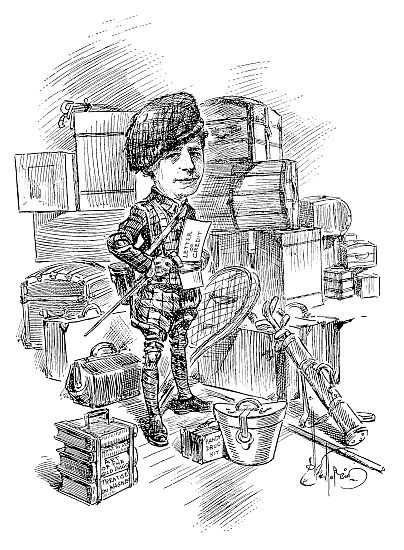
As soon as I disclosed my European intentions, I
began to get advice from friends and old travelers.
This is a trying experience. Everybody has ideas as
to what should be done, and no two will agree. One
of the first questions to be settled is that of clothing.
The importance of this is impressed upon the prospective
tourist. In the first place I am told to take no
baggage except the very simplest that can be carried
in the hand. In the second place I am advised that
when traveling in Europe, even more than in this
country, one should be prepared for all kinds of climate
and be ready with the proper clothes to meet every
emergency. Every bit of information is absolutely as
true as common law or the gospel, for the informant
has either made the trip, or his wife’s cousin has, or he
knows a man who knows another man who did,—and
you are told what happened with all the harrowing
details. Clothes do not make the man or the woman,
but they help out a lot. So that our friends will realize
the difficulties we may meet. I will admit that
we are going to the “simple” extreme, taking only
light baggage, very little more than a clean collar and
a pleasant smile. If royalty wants to call upon us,
royalty will not find us prepared with the clothes required
by the books of etiquette, unless I can hire a
dress suit or borrow one from the head waiter.
I have also discovered that it is going to be difficult
to please everybody with our route. Nearly every
person has something that just must be seen, and not
to do so would make a trip to Europe a flat failure.
Most of these important places are dug up by inspiration
from the memory of some novel or play. There
is the scientific man who urges German universities,
the musically inclined who would make Wagnerian
objects the great points, the historical student who
prescribes battlefields, the sportive gent who urges
Monte Carlo, the classical enthusiast who can think of
nothing less than a thousand years old, the art-lover
who has a list of seventy-seven different styles of
Madonnas, the novel-reader who would wander over
the country of Scott, the social oracle who would spend
the time in London and “Paree,” the enthusiast in
civics who is interested in government railroads, the
initiative and referendum of Switzerland, and the man
whose ideas of a trip abroad are condensed in the parting
injunction, “Take one for me at Munich or Heidelberg.”
It is shocking to see the disappointed look
of the friendly adviser if you do not agree with him
that his recommendation is the great thing in Europe.
A friend of mine who is an archæologist said: “Of
course you are going to Greece?” Now I had not
thought of Greece, and ventured to say so. “What,
not going to Greece!” was the withering answer in a
tone which plainly meant that you were undoubtedly
going to throw your opportunity away like an empty
sack when the peanuts are gone. Another type of
adviser is the man who says: “You must see the Coliseum,”
when you know the man would not know the
Coliseum if he were to meet it in the road. He has
simply heard some one say something about the Coliseum,
and takes that word in order to show off his
superior knowledge of the sights of Europe. During
the weeks of preparation we have made “itineraries”
to suit the suggestions of our friends. It is easy to
make an itinerary, and no trouble at all to change it
the next day when a more profitable route is offered.
On a rough estimate I should say that in the last few
weeks we have made European itineraries enough to
take about seventeen years’ time, and we are intending
to be away only about three months. The fact
is that while Europe is only a little continent, not near
as big as the United States, it has been fought over,
scrapped over, built over, written about and has been
doing business for so many hundreds of years that there
is hardly a pin-point on the map which for some good
reason you do not want to visit. It is like taking a
newspaper article about seven columns long and condensing
it to a small paragraph. You feel you are
cutting out all the really good places, and about the
extent of your trip is to the points to which you have
ordered your mail sent and where you have to go to
change trains.
And then there is the friend who can’t go to Europe
and who could hardly get to Newton if he had to pay
for a round-trip ticket, who comfortingly says: “I
wouldn’t go to Europe until I had seen all of my own
country.” This remark has been made to me so often
in the last few weeks that I have learned to dodge
when I see it coming. I have traveled around some
in the United States, and as a matter of fact the people
in one section are pretty much the same as the people
in another, and it is people that I like to see and not
mountains or museums. Of course some parts are
more so than others. There is no State like Kansas
and no people like Kansans. The object of a trip to
Europe is to see something different, as different as
possible. It is to get the local “color” for the things
you read about. It is to learn if the men and women
of the Old World are as they are pictured in books,
and to compare them with the people whom you associate
with every day at home. I am told that in
Paris even little children can talk French, and that
in Germany the people stand it to have an emperor
and never organize any boss-buster movements or bolt
the party nominations. I have read about these
things all my life, and they may be true. I want to
see them. I am not from Missouri, but I have lived
near enough to want to be shown.
We sailed from Hutchinson on the Santa Fe. After
touching at a few places we reached Boston safely, and
unless the police intervene we will embark this afternoon
on the White Star steamship Arabic. It is still
two hours until we go aboard but I am already seasick,
or am imagining how it will feel, which is nearly as bad.
I am not afraid of water. I have lived too long on the
Arkansas and Cow creek and my boyhood was spent on
the shores of the Cottonwood. But nevertheless and
notwithstanding, I feel as I think everybody must
when he takes his first long ocean voyage. I never
noticed so many accounts of wrecks as I have in the
last month. If there was an item in a newspaper
about the wreck of some ocean steamer or the drowning
of a passenger, and I did not see the piece, some friend
always did, and brought it to me to comfort me. Statistics
prove that it is as safe to travel across the ocean
in a steamship as across Kansas in a railroad train.
This is comforting, but statistics do not look big and
substantial when you contemplate a week’s existence
with nothing but a few boards and bolts between
yourself and the place where McGinty went. One
little man in a little old boat seems mighty small in
the middle of a big ocean.
LEAVING THE LAND.
Steamship Arabic, May 29, 1905.
In spite of the fact that a trip across the Atlantic
is not considered dangerous or exceptional, there is
always a lot of sentiment which comes up into the
throat of the traveler when he goes aboard the ship
that is to take him out of his own country and across
the ocean to a foreign land. Long before the Arabic
was to sail it was filled with passengers and friends
who had come to say good-by and wave farewell. The
custom is whenever a friend is to start on such a trip
to accompany him or her to the dock, send flowers to
be placed in the stateroom, and to stand on the wharf
and wave a handkerchief until the responding figure
on the deck of the ship is no longer recognizable in the
distance. Of course, we were so far from home that
there was nobody to do these honors for wandering
Kansans, so we picked out a few nice-looking people
who seemed to be there for curiosity and vigorously
shouted and waved good-by to them, and they had
the good taste to respond. A Colorado man who had
been on the trip before told me afterward that the
young fellow who had called so cheerily and waved
so vigorously at him as the steamer pulled away from
land, was a hotel porter whom he had hired for a half-dollar
to come to the wharf and bid him godspeed on
his journey.
The Arabic turned away from the dock at 4.30 in the
afternoon of May 25, and steamed slowly and majestically
down the harbor and out toward the ocean
with a half-dozen little pilot-boats and revenue cutters
whistling and dancing like a lot of little dogs frisking
and playing around a big dog as it walks down the
street. The old ship Constitution, heroine of America’s
early naval warfare, was passed, the forts and the navy
yard with the modern warships and guns, the last island
and the last American flag faded into the distance,
and a solemn thought of leaving one’s native land and
of possible seasickness makes one choke with patriotism
and foreboding. It is too late now to back out.
There is no chance to get off. For a week the ship will
never stop, and there will be no place upon which the
eye can rest except water and sky. A flood of sentiment
rushes through one and leaks a little at the eyes
as the mind turns to those who have been so near and
dear and are now to be so far away. That is the feeling
experienced by all travelers, and I want to be recorded
present and voting on the question, although as a
matter of fact while the Arabic was leaving the dock
and country I was quarreling with the purser over the
stateroom and trying to get the steward to help me
handle baggage when he was so full of American liquor
that he could do nothing but say “yessir” (hic) and
smile.
NO TIME FOR SENTIMENT.
No doubt everyone has noticed how the apparently
little things of life occupy us at most critical and important
times. I remember when at a certain stage
I was accomplishing an object to which I had worked
industriously and whole-heartedly. I should have been
filled with happiness and pride as I faced a large crowd
of people. As a matter of fact I was miserable because
my collar did not fit my shirt and kept bobbing
up and down in a refractory way. The first time I saw
Niagara Falls, whither I had gone to be overcome with
the grandeur and beauty of the scene, I put in all my
time trying to find a place to get a sandwich. It is
said that when Gladstone was making his great fight
for Irish home rule he was sitting on his bench in
parliament, apparently wrapped in deep thought. His
colleagues did not disturb him, for they supposed he
was pondering the question which was agitating every
mind. Finally he straightened himself up and said
to himself, but so those near could hear: “After all,
I will plant that rosebush in the front instead of at
the side of the doorway.” The energetic man who
is traveling amid picturesque and historical places puts
in more time figuring out time-tables and wondering
whether he will get dinner in a dining-car or at a lunch
station, than he does in soulful meditation on the wonders
of nature or the handiwork of man. And the
general run of women, I am firmly convinced by circumstantial
evidence, will approach the subject of a
European trip or a church wedding, not with the
thoughts of the lands to be visited or the responsibility
to be assumed, but with minds full of the problem
of whether four shirtwaists and a skirt will do better
than two dresses. This peculiarity of humanity has
often impressed me, so I was not surprised when I
realized as I returned more or less triumphant from
my battles with purser and steward that I missed
most of the thrills and throbs that had been promised
me by all the guidebooks and books of travel that I
had read.
An ocean voyage is being robbed of most of its terrors.
The Arabic is a big ship, one of the largest.
It stretches out over so many waves that it does very
little rolling or plunging. We have been out for three
days and there have been really no cases of seasickness.
I fully expected to be seasick, and it is a great disappointment.
However, I am not going to ask the company
to refund my fare on that account. Everybody
is afraid of seasickness, and down in his heart everybody
wishes that everybody else might be sick and he
alone left to proudly walk the deck and smile at the
victims. The only person who suffers from seasickness
is the individual affected. You may run a sliver
in your finger and the family will gather around with
words of sympathy. You may get a cinder in your
eye and your friends will hurry forward to help get
it out. But if you are suffering with seasickness, and
death would almost be welcome, your friends will only
grin and their words of condolence are false and mocking.
A modern steamship is constructed for safety, comfort,
and almost luxury. When you get those three
qualities there is very little left of the poetry or novelty
of ocean traveling. We still speak of the ship “sailing,”
although, of course, it doesn’t. The modern
ship steams. We have read all of our lives about the
beautiful white-wings and the jolly jack tars. The
reality is a mammoth engine out of sight, a big smoke-stack,
and a lot of black, dust-covered, sweaty firemen.
The “sailors” no longer climb the rigging and the
masts, but go down in the hole and shovel coal. My
ideas of the sea came from Oliver Optic. I want to
hear the boatswain pipe, the mate’s command, “All
hands belay ship,” and see the captain as he stands
at his post and with an occasional “Steady, my hearties,”
direct the seamen as they sing their songs and
clamber up the masts. That is beauty and poetry.
But the reality is that the captain whistles down the
tube to the engineer and he gives the order, “More
coal, you sons of guns; stop that noise and fire up.”
That is fact, and makes traveling comfortable but not
soul-inspiring.
The White Star line, on which we are traveling, belongs
to the big steamship company merger, formed by
Pierpont Morgan a few years ago. It is really owned by
American capital and controlled by American financiers,
but the ships carry the British flag and are manned by
British officers and men. England manages things
so that it pays to carry the English flag. I have a
great deal of respect for England. With all our American
enterprise, energy and ability, we look like a
tallow candle beside an electric light when it comes to
ships and international commerce. The government
of England always looks after its shipping interests
and encourages capital to send English vessels and English
crews carrying English merchandise to the furthermost
parts. Prizes, bounties, subsidies and favors
of all kinds have been used to make the merchant
marine of Great Britain greater than that of the rest
of the world. The English are a great people, and they
are conscious of it. And they see to it that everybody
else understands the fact. There isn’t anything in this
American-owned ship that comes from the United
States except what the passengers have in their baggage.
The crew from captain to cook are English.
The supplies are all bought in England. The ships
are built and repaired at Belfast. Coal for the voyage
both ways comes from Wales. English meats and
even ice-cream are purchased in Liverpool for the round
trip. You can’t buy an American postage stamp, and
United States money is not taken except at exchange
below par. The American who has been going through
life under the impression that America is the whole
thing has his feelings stepped on nearly every time he
turns around.
The daily life on a steamship is a good deal like I am
told it is on a limited Santa Fe Pullman train, only
there is a little more room. There are all kinds of
people on the Arabic, mostly from England, the United
States or Boston. Soon after we left port I met a
fellow who looked like somebody from home. I asked
him where he was from, and he said Nevada. I said
I was from Kansas, and he enthusiastically grasped
my hand and said, “Then we are neighbors.” You
do get a good deal of that feeling. Afterward we met
some folks from Colorado, and to see us warm up to
each other would have made you think we were a
long separated but happily reunited family. When
anyone asks me where I hail from and I say “Kansas,”
the answer is nearly always “Oh.” And then I shut
my eyes and wait for the next remark. It never fails
to come: “Do you know Carrie Nation?” If I get
a fair show I generally manage in the course of conversation
to incidentally ring in a few things about
Kansas that they never heard before (and once in a
long while something I never heard before myself).
I don’t have to confine myself to things I can prove.
Colorado and Nevada will stand by me, and if the returning
English tourists are not regretting they did
not see the wonderful State of Kansas they are simply
figuring me out a liar. The poet said: “How sweet
it is for one’s country to die.” Let us add: “How
sweet it is for one’s country to lie.”
That reminds me of a good joke on myself. An
Englishman was complaining of the voyage and wishing
he was in old. England. I did a little rapture talk
about the ocean, and said I loved to go on the deck,
watching the never-ending blue of water and sky and
just lie and lie and lie there. He said: “I believe you
told me you were a newspaper man.”
CROSSING THE ATLANTIC.
Steamship Arabic, June 1, 1905.
I have come to a realization of the work of Christopher
Columbus. It took nerve to keep on sailing
day in and day out, week in and week out, with no
sight of anything that looked like land,—nothing but
a great stretch of water, not even a stick in it. If I
had been on board the Santa Maria I would surely
have joined the crowd of sailors who wanted to quit
and go home. We have come now nearly 3,000 miles
through the Atlantic, and if someone had not been
over the route before and we did not believe that land
would appear at a certain time it would certainly
look as if the ocean would never end. If Columbus
were to make the trip now on the Arabic he would
probably be as surprised as were the Indians when the
Spaniards landed on San Salvador something over 400
years ago. The monotony of the ocean is only broken
by an occasional passing ship, and a high-strung imagination.
We have met or passed five ships in seven
days. Each one has provided us with excitement for
half a day. We took sides as to whether the strange
vessel was a Cunarder, an American liner, a North
German Lloyd or what not. Every line that crosses
the ocean would have partisans and each corner of the
argument would be vigorously sustained by expert
evidence. I decided on a system. I always maintained
that the ship was an American liner. By
sticking to the text and not changing I hit it once, which
was better than the average. Then we have long and
sometimes bitter discussions as to the number of miles
the Arabic will make in the next twenty-four hours.
Tips are anxiously obtained from officers, sailors, stewards
and cooks. Every man who ever bet in his life
and some who never do at home, back their opinions
with their money. And when we are not arguing or
betting we are eating. Passengers on this line are
full-fed. The day begins with 8 o’clock breakfast,
at 10:30 a lunch is served, on deck, at 1 o’clock an
elaborate lunch, at 4 o’clock tea, cakes and sandwiches
are distributed, and at 7 o’clock a course dinner. People
do all of these and eat sandwiches and stuff between
times and then wonder why their stomachs are “disturbed.”
It takes all kinds of people to make up the world,
and there are samples of most of the varieties on an
ocean steamer. Some of our passengers are very swell
and some are very bum. But they meet on the level—provided
you can call the deck of a ship level when it
is usually tilted one way or the other at an angle of
20 to 30 degrees. In the spirit of investigation I listened
to the talk of a couple of ladies who are society
leaders and members of the 400 at home. The subjects
they discussed were babies, servants and clothes,
and they talked just about like the women-folks of
Kansas. There is a touch of human nature through
all of us.
When I left home I decided not to change my watch
until I got to Europe. At Boston I was only one hour
behind and could easily remember and count on that.
But every day on the ocean the clock has been shoved
up thirty-five minutes for the 400 miles traveled eastward
the preceding twenty-four hours. When it got
so we were eating noonday lunch at 8 A. M. by my
watch I gave it up and turned the hands around. When
we reach London we will be about six hours ahead of
Hutchinson time, and anyone can see the ridiculous
side of getting up at 2 o’clock in the morning and going
to bed at 4 in the afternoon. By a strange coincidence
the sun has changed its time for rising and setting to
agree with the ship’s clock.
There is great system on a big ship. Everything is
done just so and no other way. I have had a hard
time locating the “stewards.” I never realized what
a steward was before. We have a bedroom steward,
who looks after the stateroom, a bath steward who
runs the bathroom, a deck steward in charge of the
deck, an assistant deck steward, a library steward, a
smoking-room steward, a table steward, and a few
more whose titles I can’t remember. One steward
never gets on another’s line of duty. If you want a
deck chair you must see the deck steward, if you want
a blanket you must see the saloon steward, and so on.
If I fall overboard I hope the proper steward will be
around, for the system is so fine that I fear the other
stewards would refuse to act until the proper steward
could be called. Each steward will be expecting a
tip when the voyage is ended, and if he weren’t a “steward,”
he probably could not get it so easily.
Sunday we had religious service in the saloon. (Not
the kind of a saloon that Mrs. Nation holds service in.)
It was the Church of England service, but out of respect
to the American passengers the reader ran in
President Roosevelt’s name in the prayer for the royal
family. It was a quiet, beautiful day and the amount
of the collection was small. I was told by an officer
that when Sunday is a stormy day and the boat acts
as if it might tip over most any time, the passengers
contribute much more liberally to the offering than
they do when the day is fair. Some people go to
church on board ship who never see the inside of a
church on land. I suppose they learn from the sailors
the advantage of casting an anchor out to the windward.
We will see land in a few hours, the southwest coast
of Ireland. A few hours later we will land at Queenstown.
It will be mighty good to get one’s feet on
ground that doesn’t move just when you don’t expect
it to. We will find out what has happened in the
world, for we haven’t had any news for a week. They
are betting on whether or not the Jap and Russian
fleets have met during our absence from the earth.
Like a great many good things, the best part of an
ocean voyage is the end. I have enjoyed the trip
very much, but if I get a chance to walk back to America
I will be mighty glad to take it.
IRELAND.
FIRST DAY IN IRELAND.
Cork, Ireland, June 3.
The first vivid impression made upon me in Ireland
was the morning after we landed. We had come ashore
late at night at Queenstown, and except for the Irish
names and Irish brogue there was nothing to indicate
but that we were going through an American
custom-house into an American hotel. But when we
went to breakfast up came the waiter attired in full
dress and extra long-tailed coat with a red vest. I had
always supposed the pictures of an English or Irish
waiter in such livery at breakfast was a joke. It is
not a joke. It is a most serious and proper attire, and
I suppose an Irish waiter in a first-class hotel would
as soon appear to serve breakfast without any pants
as without the long swallowtail coat. And when I saw
that, I knew I was far away from home.
A European breakfast is “rolls and coffee.” In anticipation
I had thought of hot rolls and delicious
coffee. Put this down: There are no hot rolls in Ireland,
and I am guessing there will be none in Europe.
“Rolls” means plain, very plain, cold bread, hard and
a trifle stale. The coffee is bum and the cream is
skim-milk. An English hotel, for that is what Irish
first-class hotels are, ought to put more into the eating
and less into the waiter’s uniform. Along with other
Americans at that first breakfast, we joined in a howl
and managed to get some eggs.
Queenstown is one of the largest and best of the
British harbors. It has an important navy yard and
several English warships are anchored among the numerous
merchant vessels. The town is on the side of a
high hill which comes down to the water’s edge, and
the narrow streets go up and down the slope at every
angle except a right angle to the street along the waterfront.
The chief resources of Queenstown are sailors
and tourists, and the main occupations of the leading
inhabitants are lodging-houses and saloons. Over
nearly every store is the sign, “Licensed to sell ale,
porter and spirits seven days in the week.”
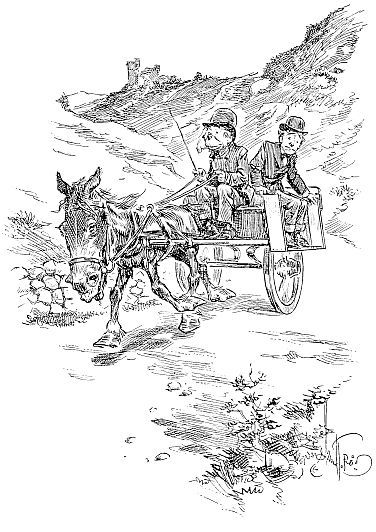
THE IRISH JAUNTING (JOLTING) CAR.
There is nothing much to Queenstown except the
quaintness that comes from age and dirt, and I have
seen enough American towns with the same characteristics
to make this an old story. But we walked and
climbed to the top of the hill, and there I saw a panorama
spread out before me which will stick to my
memory a good long while. The large harbor, locked
on three sides and part of the fourth with land, made
a blue setting for the white of the numerous ships.
Little sailboats drifted over the quiet water and tugs
and launches darted in and out among the big vessels.
Eight-oared boats from the warships, manned with uniformed
sailors from the royal navy, skimmed back and
forth, the eight oars rising and falling as one. Flags
were flying from mastheads, and the decks were lively
with the work of the day. Up from the shore on every
side except where the ocean’s blue appeared, rose the
greenest green hills you ever saw, and they reached to
the bluest blue sky you ever saw, a frame for the picture
which no artist could ever hope to portray.
An Irish woman whose son had gone to America
and sent back for the mother and little sister, had
never been far from home before. Leading the little
girl by the hand she was walking to Queenstown and
came in sight of the harbor from the top of the hill.
The beauty of the scene impressed her, but she added
a lesson for the benefit of the daughter: “Look at the
beautiful sight and see how wonderful is the work of
Nature. See the big ships side by side, and all around
them their little ones.”
Queenstown is the harbor for Cork, which is twelve
miles up the river Lee. It is the commercial metropolis
of southern Ireland and has furnished more policemen
to America than any town of twice its size in
the United States. Of course the first thing we did
was to ride in a jaunting-car and go to Blarney Castle.
The castle looks just about as it did last summer on the
Pike at St. Louis. But the surrounding grounds are
as pretty as they can be. I hesitate when it comes to
describing the park with its stately trees, its beautiful
grassy slopes crowned with wild flowers, its moss and
ivy which cling to wall and tree, covering defects,
revealing charms, enhancing beauties. The castle itself
was built by McCarthy, king of Munster, in 1446,
and while of course uninhabited and in partial ruin,
is in good preservation, to make an Irish bull of it.
We climbed to the top, we reveled in the rich scene
around us, kissed the blarney stone and cheerfully gave
the care-taker twice the usual fee because she said
Americans were the best people on earth. Then we had
the nicest lunch that has come our way since we left
Kansas—an Irish lunch of bread and butter, cold ham
and milk. We had traveled all morning and climbed
among ruins from 12 to 2 o’clock. If you want the
best lunch on earth, no matter what it is made of,
climb towers for a couple of hours.
There are some things that are peculiarly Irish.
The jaunting-car is one of them. It is the favorite
vehicle for driving. It looks like a two-wheel cart,
driver’s seat in the front end and passengers’ seats back
to back, facing outward. My fellow-traveler, Mr. McGregor,
says the Irish brogue has perverted into jaunting-car
the real name, which is jolting-car. The driver
is always a good fellow and he keeps the horse on the
gallop much of the time. You have to learn to keep
your seat on a jaunting-car as you do on a bicycle.
You also have to learn to weigh the statements of
your driver as to distances and legends as you do the
promises of a candidate for office. We suggested to
one that a jaunting-car driver had to lie. “We never
lie, sir,” said the Irishman. “But we stretch it a
little.”
After a week on shipboard, during which time I had
patiently shaved myself, I yearned for the comforting
work of a good barber. At the best hotel in Cork, a
city of 80,000 people, I went to the best barber shop in
town. The chair was just like a common wooden
kitchen chair, only not quite so comfortable. There
was a head-rest made out of a two-by-four scantling,
and when the barber pulled my head back onto that
I knew my dream of a comfortable shave was to be a
nightmare. He made the lather in a wash-basin and
I think he honed the razor on a grindstone. It cut
all right when it didn’t pull out by the roots. When
the operation was finished he combed my hair with my
head still back, washed my face with cold water and
rubbed it with a coarse towel. The barber charged
me twopence (equivalent to four cents). And that
was my first experience with a European tonsorial
artist. Perhaps sometime in my life I have felt cross
at a barber at home because the razor pulled or because
he squirted bay rum into my eye. But in the
future I will never murmur, except to recall my experience
in Cork and thank God for American barbers.
The day we came to Cork there was an election for
poor-law guardians, only a local affair, but I attended.
The voting is by Australian ballot just as in America.
The suffrage is restricted to householders, including
those who pay a certain rent, and women vote the same
as men. The politicians at the polling-place treated
me well and explained all the methods. One of the
workers told the judge that they should let me vote, as
when he had visited his brother in America they had
let him vote twice while there. I proposed that if
they would let me vote for poor-law guardians in the
county of Cork I would let any of them vote for councilman
in the Fourth ward of Hutchinson. We had a
good friendly visit, and it was easy to see that Irishmen
are politicians in the Old World as well as the New.
After a man or woman voted he or she was always given
a drink at the nearest place where “spirits” are sold.
But when the polls closed instead of going ahead and
counting the votes, the judges adjourned until noon the
next day—the invariable custom. It was not until
the afternoon following the election when it was learned
who “stood at the top of the poll.” We couldn’t
stand the pressure that long in America.
There were placards up all around telling the voters
to “vote the straight ticket,” “vote for the interest
of labor,” and “vote for your own interests.” The
newspapers the next day told of the vicious conduct
of the opposition and the immoral practices resorted
to. But as a rule the Irish people are like Americans,
accepting the result with good feeling and promises
of what will be done to the other fellows the next time.
BY KILLARNEY’S LAKES.
Killarney, June 8, 1905.
We have spent four days in the Irish mountains
and have ridden a hundred miles in a jaunting-car
and coach. I have had mountain scenery, lake scenery
and plain scenery for every meal in the day. I enjoy
scenery, but I fear I am getting it in too large quantities
and am having it shaken too well while taking.
Sunday was spent in Glengariff, a picturesque place
where the mountains rise abruptly from the salt water
of Bantry bay. Monday we coached from Glengariff
to Killarney and Tuesday we did the lakes with a
jaunting-car, slightly assisted by a row-boat. The
Irish mountains are not as high as the Rocky Mountains,
but they are a very good imitation. The Rockies
are grand and beautiful. The mountains of Cork and
Kerry are pretty and beautiful. The Irish mountains
are covered with green. It is as if the Rocky Mountains
were smaller, covered with ivy and moss, dotted here
and there with whitewashed cottages and flocks of
sheep, and topped with a blue sky which is bluer than
any indigo and clearer than any crystal.
There are several ruined castles about Killarney.
I am already getting to shy at ruined castles. The
proposal to visit one makes my feet ache as an approaching
thunder-storm affects some people’s corns.
We first went to Muckross Abbey, a well-preserved
ruin about 400 years old. The Muckross family, which
owned the estate, has played out, and the property has
been bought by Guinness, the Dublin brewer, who was
made a lord by Queen Victoria. Whatever the earl
of Kenmare does not own around Killarney belongs to
Guinness. You can imagine how Muckross Abbey
looked 300 years ago when the old monks lived there
and occupied the cells and cloister now unroofed.
The banquet hall has a big fireplace and there are dark
spiral stairways running up and down such as you read
about in Ivanhoe. On the tombstones are inscriptions
telling of the virtues and sanctity of knights and lords
who would be considered tough bats if they lived nowadays
and swaggered around as they did in the good old
times. I like to look at old tombstones and wonder what
the men who lie beneath them would say if they could
read the catalogue of virtues accredited to them. I
always think of the little girl who had evidently been visiting
Muckross Abbey, or some such place, and anxiously
inquired if the people in those days did not bury bad
folks, as all who were interred there were supremely
good. And then the thought comes up that all of
these men were great and strong in their time, making
history and imagining that they were cutting a gash
in the world. Now they are forgotten and their deeds
unknown, and they are the subjects of sportive remarks
by tourists from a country they never heard of.
The lakes of Killarney have been praised in prose
and verse, and they are up to the advance advertising.
They are not large, but they nestle among the mountains
and reflect on their clear surface the heights that
surround them. There is a legend everywhere and the
Irish driver knows them all. Here is a reasonable one:
One of the O’Donohues, which family was once the
royal power in Kerry, was hunting in the mountains.
He met the devil, and the two had an altercation in
which O’Donohue got decidedly the best of the argument.
The devil became so angry that he bit a
big chunk out of a mountain. O’Donohue took his
shillelah and hit the devil so hard a crack that he
dropped the mouthful of mountain into the lake.
This tale must be true, for as the driver said: “There’s
the place the devil bit and it is called so to this day,
and out in the lake is the little island of rock, just as
the devil dropped it into the water.”
Everybody who has read Tom Moore—and if anyone
has not he should do so—will remember the lines:
“There is not in the wide world a valley so sweet
As the vale in whose bosom the bright waters meet.”
The meeting of the three Killarney lakes was referred to,
and Moore was telling truth as well as poetry.
The upper lake and the middle lake narrow to small
streams and flow together as they merge into the little
rosebud of a mouth which the lower lake puts up to
greet them. There is a rapid which the boat shoots for
a sixpence, but it was not thrilling. In the triangular
park made by lakes and mountains are said to be
specimens of every kind of tree known. The driver
told this proudly, but when I called for a cottonwood
he couldn’t produce. Then I told him all about the
wonderful cottonwood, and he promised to see the
keeper and find out why they couldn’t have one in
Killarney.
That reminds me of my experience with music. The
first morning I awoke in Ireland at Queenstown I heard
the voices of a number of sailors of the royal navy, and
as the melodious sounds rolled into the window I was
surprised to realize that they were singing “Under the
Anheuser-Busch.” At the hotel in Cork the orchestra
played the same. At the theatre that night it was
greeted with an encore. The driver on the jaunting-car
whistled the tune. And last night when I had
made friends with a cottager and was sitting with him
by the side of a peat fire and he was telling me of Ireland’s
woes, his little girl came in and he proceeded
to show her off. First he had her sing an old Gaelic
song. Then he said, “Now give us an American
song,” and she responded with “Under the Anheuser-Busch.”
I have hardly met an Irishman but has told me he
had brothers and sisters in America. At Glengariff
the hotel proprietor said at least 2,000 young men and
women had gone to America from that parish in the
last few years—the brightest and best of the young
people, he said—nearly all of them to Boston. From
Killarney nearly all go to New York. I told them how
Boston and New York were ruled by the Irish, and put
the question as to why the Irish couldn’t run Ireland.
I am trying to answer that conundrum to my own
satisfaction, and am gathering ideas on the subject
from everyone I meet.
The ordinary Irish village like Killarney is a quaint
picture. The streets are narrow, mostly eight to
twelve feet wide. The main street is about thirty feet
wide. Nearly all the houses are a story or a story and
a half, thatched roof, whitewashed walls, dirt floors
except in one room, low ceilings, doors and windows,
full of chickens, cats and children. I have not yet
seen a pig in the parlor. The pig is kept in a little
room at one side. But the chickens have as much
liberty of the house as anybody and the goat is monarch
of the outside. There is very seldom any yard,
the houses being built right up to the street. The house
is heated by a fireplace and the cooking is done in the
same. Peat is the fuel, and it is cleaner and not sooty
like coal. The dirt floor and the chickens in the
house sound as though the Irish cottage would be dirty,
but the whitewash and the scrubbing-brush fight on the
other side, and you don’t get that impression. The
women-folks are always neat-looking and everybody is
pleasant and cheerful. Every window has a window-box
of geraniums. There are usually so many children
that the house does not hold them, and the street is
always filled with them. Remember when you are
driving through a town the street is filled with children,
and if you are an American and not used to it your
heart will be jumping into your throat for fear some of
them will be run over—but I am told they never are.
After the chickens and the children the most novel
sight is the donkeys with their two-wheel carts, the
only ordinary carriages for passengers or freight of the
people. The donkey is the size of our mountain burro,
and has the same degree of intelligent expression. All
of the hauling is done by this patient animal, and he
is looked upon as a valued member of the family.
In riding or walking the rule of the country is the
same as in England—turn to the left. I have not yet
gotten over the yearning to grab the lines from the
driver when he turns to the left to avoid a passing
carriage. Fortunately the other driver is always fool
enough to also turn to the left. I confided my trouble
to an Irish driver, and he said it was ridiculous to turn
to the right.
One of my traveling companions is a man who chews
tobacco, and he had neglected to lay in a supply before
leaving America. No one else used the weed
that way and there was no help for him. The Irish
chew and smoke the same plug tobacco, very dry and
not tasting like American tobacco. For a week my
friend had been looking through shops trying to find
something that would touch the spot. Last night
soon after reaching Killarney he came to me greatly
excited and said, “Hurry! the finest scenery since we
left home.” Away we went down the narrow street
and up to a window in which was a familiar shape and
a sign, “Battle Ax.” I don’t chew myself, but I have
some bad habits, and I could appreciate the tear of
joy that glistened in my fellow-traveler’s eye as he
gazed on that sign and felt that he had met an old
friend just from home.
IRELAND AND THE IRISH.
Dublin, June 9, 1905.
In my short stay in the Emerald Isle I have endeavored
to find out what is the matter with Ireland.
Why is it that a country of great beauty and resources,
with a healthful and productive climate, an intelligent
and attractive people, is a country where poverty is
widespread, although disguised by picturesque surroundings,
and is accepted in such a matter-of-fact
and almost nonchalant manner? Why is it that the
population of Ireland is decreasing while the number
of successful and prosperous Irishmen is rapidly increasing
in America, Canada, and Australia? A very
intelligent Irishman at Glengariff told me why it was,
and this in brief is his story:
A thousand years ago Ireland was ahead of all neighbors
in education, religion, and refinement. Then
came the civil wars between the chieftains. Then came
England, and by utilizing the demoralization of the
civil wars and playing one chieftain against another,
acquired sovereignty. But this was only nominal, for
the Irish chieftains did not submit permanently. In
Glengariff country the O’Sullivans maintained practical
independence. Finally the English rulers adopted
the policy of confiscating the land of the rebellious
chieftains and giving it to English soldiers and queen’s
favorites. In many places this meant the massacre
of the people. The O’Sullivans and their fighting men
who escaped went to France and continued to strike
at their Saxon foes. But the land passed into the
ownership of strangers, who kept it only for the profit
they could get out of it. The new Irish nobles lived
in London and their agents ran the estates. When
the nobles needed more money their agents advanced
the rents. If the people who tilled the soil and whose
tenancy had been unquestioned for generations, could
not pay, they were evicted. Families were ejected
from the places they had cultivated and made valuable
and were set out on the road. This was done not without
fighting for their rights by the Irish people, but
by the superior force of English soldiers. No Irish
farmer owns his place—he is only a tenant at the mercy
of his absentee landlord, who does not know him. In
other countries the feudal tenure has not worked so
harshly, because the landlords lived among the people
and were bound to them by ties of race, common history,
and natural affection. But the fact that there
was no way for an Irishman to get his own home, or
have a reasonable chance to advance in fortune or
freedom, sent the brightest to America, and left the
others to struggle hopelessly along, knowing that the
best they could do was to “pay the rent,” which was
fixed like some railroad charges in the United States,
on the basis of “all the traffic would stand.”
From the parish of Glengariff more than half the
young men and at least half the young women have
gone to the land of promise across the sea, and are sending
back money to help the parents and brothers and
sisters at home, either to “pay the rent” or to pay
their passage to America.
What is true at Glengariff applies to the rest of
Ireland. The ancient chieftains, the O’Sullivans, the
O’Donohues, the McCartys and the rest, were succeeded
by absentee landlords, and the law of supply
and demand backed up by the English army simply
worked out. At Killarney whatever land does not
belong to the earl of Kenmare is the property of Guinness.
The lakes and rivers are full of fish, but no Irishman
can catch a fish; the mountains are full of game,
but no one can hunt it except the owner of the estate.
The farms are well tilled, but no one can buy the land
upon which he works. It makes an American mad,
and he says, “How do you stand it?” But it is the
law, and along every country road there is a policeman
and behind the policeman is the power of England.
Far up on the mountain-side, several miles from town
or settlement, I saw a fine stone building which on
inquiry I found was a police station. The police, or
the constabulary, as they are called, were not there to
protect the lives of the citizens, but to prevent hunting
and fishing in the brooks and mountains. So, after
all, it is no wonder the Irishman leaves his beautiful
island and emigrates to America.
The Irish have kept the English Parliament in an
uproar for a generation on this land question, and in
recent years they have secured some friendly legislation.
A court can now fix the rent rate on appeal—but
the English government names the court. So far
as Englishmen of the present day are concerned they
would be glad to get out of the Irish problem and let
the Irish have their land, but of course that can’t be
done. The present parliament provided a plan for
the eventual purchase of land by tenant, at a price to
be fixed by the court if the two parties cannot agree.
This is a step in the right direction and the Irish are
glad of it, but as my Glengariff friend said, “It will not
do any good in this generation.” And the exodus to
America continues.
The Irish are very intelligent. I do not think the
poor people of any other country are naturally so bright
and so full of perception and understanding. They are
kind and gentle. They are affectionate and patriotic.
The English say they are “lazy,” but under the circumstances
you could hardly expect them to be yearning
for work, when more work means more valuable
holdings, and that only means more rent for the landlord.
The Irish have a reputation among the English
for honesty. They are religious, and I thought at
first they gave too much to the church and did not
keep enough for themselves, when I saw the large and
rich cathedrals. But, as an Irishman told me, “We’d
rather give to the Lord than the landlord.” Public
schools are providing education for the rising generation,
and in the public school the boys and girls are
being taught the Irish language and prepared for the
coming fight which the Irish must make to capture
Ireland—not probably for an independent government,
but for actual ownership of the Irish soil.
Taxes are heavy. The burden of taxation is the
income tax. “That falls on the landlord,” the thoughtless
might say. Not on your life. The tax is simply
added to the rent. There are fine public roads in
Ireland, as good in the country districts as Main street
in Hutchinson will be when it is paved. The only
advantage a despotic government has over a popular
government is that it builds better roads. When the
people elect their own road bosses and levy their own
road taxes I notice the roads are not so good as when
some prince or cabinet minister who does not care
what the people think, levies the tax and orders the
road built right. The Irish statesmen are struggling
for Irish ownership of Irish soil and an Irish parliament
to deal with Irish affairs. They are “getting on,”
and, as I said before, they make so much trouble in
the English Parliament that I know the English would
be glad to get rid of Irish local politics and give them
back their parliament, if it were not for pride,—and the
next parliament may cut out the pride.
I want to record one fact which I was surprised to
find. The Irish are very temperate. I have been in
city, town and country for ten days, have not been
careful about keeping in the nice parts of town, and
I have seen only one man under the influence of liquor,
and he was an English sailor at Queenstown. This
is in spite of the fact that every inn and grocery sells
“spirits” and nearly everybody seems to drink them
if he or she has the price. Perhaps the reason is that
in Ireland all the liquor-selling is done by women—barmaids.
Perhaps the influence of women behind the
bar makes for temperance. I won’t state that as my
conclusion, but just submit it for what it is worth to
those who are trying to solve the liquor question in
other countries.
Dublin is a good deal like an American city. It is
full of business and not as Irish as the inland towns
or Cork, although it has statues to O’Connell, Curran
and Grattan, and will have one to Parnell. The lord
lieutenant-governor, the representative of the king,
resides at Dublin, and a big garrison of soldiers gives
it an English tone. There is a fine university, which
we visited. It was started by Queen Elizabeth, and
has only recently been opened to Catholics and to
women. Dublin has some great stores where Irish
linen and Irish lace should naturally be cheap. If
Mrs. Morgan were writing this letter she could add a
chapter. I will only tell this little story: I was telling
an Irish driver how nice everybody had been to us in
Ireland and how pleasant the Irish were to Americans.
“Yis,” he said. “Whin you go down the strate,
everybody sez: ‘There’s some Americans, God bless
’em: mark up the prices on the linen and lace.’”
FRANCE.
THE CITY OF PLEASURE.
Paris, France, June 19, 1905.
Since my last letter to The News we have been
“going some,” and I will leave a few ideas I may have
gleaned about England until I get back there on my
return from the continent. We are pushing for a short
visit to Italy before the summer gets too far advanced.
To use a classical expression, Paris is a bully sort of
a town. If there is anything you want and don’t know
where it is, I am satisfied you will find it in Paris. In
England it was customary to close up and go to bed
sometime after midnight and to rest on Sunday. Nobody
in Paris thinks of either proposition. The only
difference between Paris at midnight and Paris at
midday is that it is livelier at midnight. The performance
is continuous and it is worth the price of
admission.
Coming into a country where your language is not
generally spoken is always a little trying on the nerves.
The French people have made it as easy as possible,
but the ways are strange and the helpless tourist can
only do as others do and trust to Providence and the
power of a little money distributed as well as possible.
I do not know how much Providence has had to do
with it, but I do believe there are mighty few doors in
France which a piece of money will not unlock. When
I came into France I knew only two French expressions,
one meaning “How much?” and the other,
“Thank you.” With that vocabulary we went through
the custom-house examination, a five-hour railroad
journey, landed in a big city station, got a carriage,
reached the hotel and an interpreter without any more
trouble than we would have in Sterling. Of course
everybody from conductor to porter knew we were
Americans and could not speak French, knew what we
ought to do next and showed the way, and all we had
to do was to look pleasant and hand out small change.
And it doesn’t cost much to be liberal in France. I
gave the conductor an equivalent to our 10 cents, and
I know he thought I was rich. The porter who took
my baggage through the custom-house and brought
me a carriage was deeply impressed with my financial
standing when I gave him 6 cents worth of French
coppers. The coachman who brought Mrs. Morgan
and myself with four big grips from the station to the
hotel, two miles, charged me the full price, 30 cents for
everything, and when I tossed him another dime like
a millionaire he took his hat off three times. The
French people I have met have been very polite.
They always tip their hats and go out of their way to
show me, and they are never so discourteous as to refuse
2 cents. Imagine giving a Santa Fe conductor 10
cents for showing you where to sit in the car!
As a lesson in political economy I will put in my
observation so far as I have gone: Everything in
Europe that is made or done by labor is cheap. I was
offered a tailor-made suit of clothes in London for
$18 that would cost $30 in Hutchinson. A farm
laborer in England gets about 50 cents a day and boards
himself. The barber shaves you for 2 or 3 cents.
Bread and meat are higher than in the United States.
You can see how the wage-earner gets it going and coming.
I am learning a few things from experience that
I had been told before, but I want to visit a few more
places before I try to form my conclusions and put
them into print.
Paris is a beautiful city. In spite of the great business
houses, the manufactories and the banks which I
have seen, it strikes me as a kind of play town. Every
day in the week in Paris looks like an American
town on the Fourth of July, and on Sunday it is Fourth
of July and Christmas together and then some. The
men who are working at wages that would make Americans
vicious, are as light-hearted and pleasant appearing
as a Sunday school picnic. The women are as
vivacious as a lot of school ma’ams at institute. As
soon as work is completed it seems as if every Parisian
only goes home to put on his good clothes and then
comes down town accompanied by his wife, or somebody’s
wife. Half the places of business along the
principal streets are restaurants and a good many of
the others are also restaurants. The Frenchman sits
at a little table on the sidewalk in front of the café and
puts in the evening drinking one glass of wine or absinthe,
chatting with his neighbor and watching the
women go by with their good clothes and bright faces.
Every French woman is an artist when it comes to
clothes. The goods may not cost much, but the gown
is tastefully made, and if the lady wants to she sticks
on a bow or jabs a flower in her hat, regardless of every
rule except that it looks pretty there—and it always
does. Bright and light gowns, hats that are up-to-date
or ahead, hair to match the hat and hose to match the
dress—and the artist’s work is done. No wonder the
men hurry down town and sit on the sidewalk!
In the afternoon and evening the Paris streets look
like a spring millinery opening—also like a display of
samples of fine hosiery. Perhaps I ought not to go
into the subject, but it will not be a fair description of
Paris if I leave it out, and I must warn any other Kansan
who may venture this way. When a Parisian lady
walks along a sidewalk that is perfectly clear and clean
she daintily lifts her dress so as to display only the
top of the shoe, maybe an inch or two more. Sometimes
she thoughtlessly raises the gown a little higher.
When she reaches the street-crossing—but I had better
stop, for she doesn’t. I have always been of the opinion
that under such circumstances a plain, respectful
man should look the other way and I have a crick in
my neck from looking—the other way—since I came
to Paris. Remember this is in fine weather when the
walks and crossings are clean. “They say” that when
the walks are muddy the result is even more startling
to a staid observer from Kansas. If the weather gets
bad I don’t know what I will do.
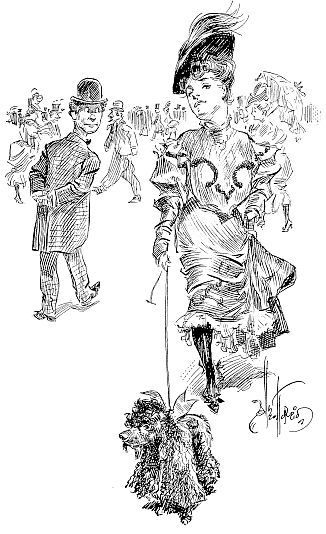
IN PARIS: LOOKING THE OTHER WAY.
The philosophy in the above is that it gives you an
idea of Paris with its brilliantly lighted streets, the
men eating and drinking, sitting at the little tables
along the walks, the well-dressed people, the brilliant
colors, the laughter, the bright and polite conduct of
men and women, the holiday appearance, the pleasure
that everyone is having, and the general gait at which
Parisians travel. As another example let me add, fully
one-third of that part of Paris which in any other city
would be devoted to business, is given up to public
gardens, playgrounds for children, parks and drives,—not
out in the country or to one side, but right through
the center of Paris. The houses, business and residence,
are none of them more than six stories high, and
I am told the law does not permit higher structures.
It is a good idea, for you get air and sunlight, which
you often do not in New York and Chicago, and you
can occasionally see out over the city. About every
so often is a circle or square from which radiate from
six to a dozen avenues and boulevards. These streets
divide into others which reach forward to other squares,
and are intersected at every conceivable angle by cross-streets.
The object of this plan was to place artillery
in the square and thus command the streets and boulevards
against the revolutionists, who have always been
doing or about to do something in Paris. The houses,
five or six stories high, are built right up from the
sidewalk, and have inner courts. Usually there are
stores or shops in the downstairs rooms facing the
street and living-rooms back and above. And speaking
of stores, most of them are about ten by twelve
feet, one-half display window. The interior is lined
with mirrors which make the room look large and two
or three customers like a crowd. The French use
mirrors every chance—there are three beautiful mirrors
in our small bedroom. The shops are generally
decorated with flowers, pictures and statuary and a
sign “English spoken,” the latter being usually a delusion
and a snare. Instead of naming a street or
avenue and then sticking to it, the names of the streets
frequently change. The boulevard our hotel is on
begins as the Madeleine, runs two blocks and then becomes
the Capoucins, two blocks more and it is the
Italiens. We are on the Capoucins part, and besides
the Boulevard des Capoucins, there is street “Rue des
Capoucins,” and a square “Place des Capoucins,” each
in a different section. The necessity of a stranger in
Paris keeping sober is very apparent. The streets,
squares and public buildings are adorned with frequent
statues—good ones. Almost any way you turn there
is something beautiful to look at. The French are
artists and lovers of art. If there were such a thing
as a Kansas joint in Paris it would be decorated like an
art gallery. But the joints in Paris are open and run
twenty-four hours a day, seven days in the week, and
the police never interfere with anything that goes on
except in case of a disturbance of the peace or abuse of
the government.
The French like Americans and don’t like the English
or the Germans. But that does not mean they
refuse anybody’s money. In our country when a man
gets a comfortable income he grows gray-haired and
wrinkled trying to make more. A Frenchman spoke
to me of this trait, and said that when one of his countrymen
reached the point where he could live nicely
on what he had accumulated or the salary he was receiving,
he quit worrying and took to the cafés and
boulevards to enjoy life. Perhaps the French way is
the best, at least the French look happier over mighty
little than we do over much more. They go in for
“pleasure” and they enjoy it as do no other people I
have seen.
PARIS AND PARISIANS.
Paris, June 20, 1905.
Almost the first thing we did after we reached Paris
was to go to the Place de la Concorde, where the guillotine
did its bloody work during the French Revolution.
It is now a beautiful square adorned with statues, and
is the center of the pleasure-ground of Paris. After
tightly shutting our eyes so as to avoid seeing the gay
Parisians passing by, we recalled the terrible scenes
which took place a little more than a hundred years
ago. Here Louis XVI., the unfortunate king, paid
the penalty for the crimes of his family and class.
Here Marie Antoinette was executed, and scores and
hundreds of the French nobility. Poor Marie Antoinette,
who always did and said the wrong thing, has
been the recipient of the sympathy of the world. But
in addition to the sorrow for her I have never been able
to get over my sympathy for the thousands of women
who marched to Versailles and when the king and queen
appeared to quiet them, cried, “Give us bread for our
children!” For France at that time was suffering as
no other nation has suffered from physical oppression
and poverty resulting from misgovernment and utter
disregard of the lives and property of the people. In
order to carry on wars and build monuments and palaces
and indulge in personal dissipation and pleasure,
the rulers of France had sucked the life of the nation
like the juice from an orange. The French still make
a great fuss over Louis XIV., “The grand monarch,”
who made France the leading nation of Europe. But
it was the logical outcome of his methods and grinding
government that resulted in the degradation of the
people, their poverty and distress, and the revolution
which sent his great grandson to the block.
After the French Jacobins executed their king and
queen they began to fall out and “revolute” against
each other, and so nearly all the leaders of the revolution
went to the guillotine and got it where Louis and
Antoinette did—in the neck. In a little more than
two years over 2,800 persons perished here by the guillotine,
and the place is very appropriately called “de la
Concorde.” Around the square are statues representing
eight of the cities of France, the one for Strassburg
still there, but draped in black and with emblems
of mourning for the city and province taken from
France by Germany at the end of the last war. Every
Frenchman has in his heart the intent to lick the Germans
and recover Alsace.
I will not attempt to describe in detail the great
palaces of the Tuileries and the magnificent gardens,
the Louvre with its acres of paintings and statuary,
most of which I did not see because it was like eating
pie—there is a limit. These are historic grounds, for
back and forth among statues of peace and beautiful
works of art the French people have fought each other
time and again, sometimes destroying but always rebuilding.
From Place de la Concorde extends the
Champs-Elysées (pronounced Shame-on-Lizzy, as near
as I can get it). This is a great avenue 400 yards wide
and over a mile long, consisting of parallel boulevards
running through trees and flowers, playgrounds and
palaces here and there, and at all times of the day and
night filled with people and carriages.
The Champs-Elysées and the Bois de Boulogne, a
park of over 2,000 acres in which it terminates, are the
fashionable drives of Paris. It cost only 40 cents an
hour for Mrs. Morgan and I to drive with the Parisian
élite, and we took advantage of the opportunity to see
Paris society. The carriages in the early evening extend
in procession over miles of boulevard, and are
often six or eight abreast. The drives wind around
through woods, by good-sized lakes, along sides of
cascades, and the carriages are filled with the swellest
lot of gowns and cutest little dogs I have ever seen.
Nearly every woman has a dog on her string as well as
a man. In all of this style there is a general lack of
formality which is appropriate to the scenery. It is
not an uncommon sight to see the ladies and gentlemen
with their arms around each other. It isn’t so bad
when you get used to it, and the fashion is considered
strictly proper in France. I am no longer shocked
when I see a young man just ahead of me in the street
put his arm around his girl, and in the street cars and
automobiles the sight is a frequent one and never attracts
comment or disapproval. At first Mrs. Morgan
and I nudged each other at such things, but in less than
a week’s time the novelty has disappeared.
I like the Champs-Elysées, for it looks a good deal
as First avenue in Hutchinson would if it were about
ten times as wide and the city kept up the parking.
And that leads me to repeat an observation which I
have made before. It takes a strong government to
do big things. You couldn’t get the people in America
to put up money to construct palaces, widen boulevards,
set up statues in all directions and devote the
main part of the city to trees, flowers, walks and drives,
playgrounds and art galleries. But whether the government
of France has been a monarchy or a republic
has made no difference in the fact that it exercised
nearly absolute power over such things. The government
appoints the officials in all cities and provinces
and the government has the army. We talk about
“government ownership” as if it were something new.
The government of France has been in business more
than a century. For example, the government has the
monopoly of the tobacco business—manufactures and
sells all the tobacco used in France, charges what it
pleases and puts out mighty poor stuff. The government
has owned the Sèvres china decorating factory
for over a century, and the Gobelin tapestry, and I don’t
know how many more such things. Lack of knowledge
of the language has kept me from finding out
all on these subjects I am going to before I get home,
but it seems to me that whenever the French government
sees some exceptionally profitable business, it
just takes hold of the proposition and passes a law
forbidding anyone else competing. The French are
used to this sort of thing and accept it as the inevitable.
I wonder if Americans would stand for it and for all the
petty regulations that go with it. An army of workingmen
is required to maintain all these parks, palaces,
art galleries, opera-houses and government institutions,
and I suspect the number is never reduced. A
friend was telling how in a short ride on a government
railroad his ticket was examined by five conductors.
We reached the conclusion that this work, which in
America would have been done by one man, was strung
out for the good political reason—more jobs. Of course
nothing like that would happen in America.
The workingmen still wear the long blouse outside
the trousers, which looks like a heavy night-shirt and
reaches below the knees. At the time of the great
revolution the workingmen were so poor that they
could not afford to wear trousers and the long blouses
were all that covered them. Hence came the nickname
“sanscullottes,” meaning “without breeches,”
and as all who have read the story of the revolution or
Victor Hugo’s books will remember, the Sansculottes,
the men without breeches, made up the mob which
upset the throne and established the republic.
The French still worship Napoleon. They have forgiven
the sacrifice of blood and treasure which he
forced from them, and remember the glory and the
greatness of the empire. And in spite of the fact that
Napoleon III. quit the emperor business under a cloud,
having been removed from office after his surrender to
the Germans in 1870, he is well thought of, for during
his reign France and Paris prospered and times were
good. There is a large party in France that favors the
return of the present representative of the Napoleon
family, Prince Victor, to the throne. We went to the
Church of Madeleine, the most beautiful and fashionable
church in Paris, and over the altar is a beautiful painting
of Napoleon receiving the crown from the pope,
with Christ in the background of the picture. That
is just like the French.
I made an effort to get into the meeting of the
Chamber of Deputies, the French congress, but failed.
You have to have a ticket of admission, and it must be
applied for several days in advance. They tell me the
session is a good deal like an old-time Kansas Populist
convention, where everybody said what he wanted to
and then everybody was of the same opinion still.
The meeting often gets so tumultuous that the president
of the body adjourns it. Such an assembly must
be guarded by careful and tactful leadership or it will
end in a row. I can’t understand French politics.
There are really no parties such as we have. A
large majority favor the republic. The minority is
composed of Clericals, Bonapartists, Radicals, and Socialists.
The government party is divided into factions,
and the issues are personal rather than on economic
questions. The minority is of course divided,
and the result is that the government wins somehow or
other nearly every time. If it should lose, a new cabinet
would be formed; but that would be taken from
the same party as the old, and would be merely a different
lot of statesmen. The French republic is all
right so long as there is no serious trouble, but a Dreyfus
incident, or a war, or hard times might overturn the
government, and nobody knows whether the monarchists
might not get on top again. The church is
opposed to the policy of the republic, which has been
to decrease the power of the church, cut off the parochial
schools, and take education out of the hands of
the religious bodies. The men in France are not very
religious, leaving that part of life to the women and
children. But a large and respectable party is in opposition
to the government on account of the way it
has confiscated church property and driven out the
religious orders.
There are only a few electric lines in Paris, and they
are not in the main part of the city. The people use
carriages a great deal, for they are so cheap; and also
omnibuses. The usual means of traveling in the city,
aside from the cab, is the omnibus, which is double-decked,
carrying as many people on top as inside.
This seems a trifle slow to Americans, but it works all
right in Paris. The ’buses make regular processions
up and down the principal streets, and as they are
nearly always filled inside and outside, they add immensely
to the Parisian picture. There is an underground
railroad and there are dummy lines in the
suburbs, but I think the people of Paris like to travel
where they can see and be seen. The cabs are victorias.
Automobiles are everywhere, and if you go to Paris to
live and want to cut any ice you must get one.
I saw a little scene which seemed to show up Parisian
character. A cab collided slightly with another.
Immediately both drivers were off their vehicles, gesticulating
and talking about 300 words a minute. As
they shook their fists and grew red in the face with the
words that came so fast they interfered with each other,
I thought somebody would surely be killed. Nobody
noticed them. No one paid any attention. And
finally the two exhausted men climbed back to their
places and drove on. I know they used French words
to each other that in America would have ensured a
police court trial for disturbance of the peace. A
French friend to whom I mentioned the matter said it
was the invariable way, and he thought the French
method of taking out their wrath in words was better
than the American way of fighting it out. Perhaps
he was right, but as I afterward saw the scene repeated
in different forms it always occurred to me that it was
childish. And that reminds me to say that the Frenchman
is in the habit of playing with his children, taking
part in their games as excitedly as they do.
The French people are industrious and they save
their money. France is really a rich nation. Most
of the money is made in what seem small ways to
Americans. The French are what we call “thrifty.”
No matter how little they earn they save something,
and the whole family works,—men, women and children.
When their day’s labor is ended the whole family
goes out for a good time—cheap, or within their
means. Their natural temperaments and the beautiful
surroundings make it easy for them to do this, and
it is very seldom a Frenchman leaves his native land.
He doesn’t travel much, but he believes in other people
traveling and coming to France to spend their money.
He is willing to help in the good work of separating
foreigners from their cash, but he is gentlemanly about
it. I like the French people even though I can’t
understand some of the ways their minds work.
RURAL FRANCE.
Marseilles, France, June 23, 1905.
Rural France is a picture. Seen from a car-window
it is a succession of fields and villages, at this time of
year a continuous combination of greens and white.
French farms are small. I suppose twenty or thirty
acres is a big place, and many are much less than that.
But the land is fertilized, drained, irrigated and worked
to the limit. The people live in villages and not much
on their own farms. Each village has a common pasture.
During the day the farmers go out onto their
little places and in the evening they return to town to
spend the hours with their neighbors and friends. The
houses are all white stone with red tiled roofs and the
villages are numerous, one every two or three miles in
every direction. A farm of twenty acres is divided
into strips for various crops, so that the landscape is
striped with the fields of wheat, alfalfa, potatoes and
grass, which seem to be the popular products. Cattle
are not so numerous, but sheep are plentiful, goats
abound and hogs (always white that I have seen) are
on every place. A strip of land a hundred yards wide
in wheat will run across the twenty acres, and the next
strip will be some other crop, making the hues of green
vary. The most extensive crop besides grass is grapes,
and hillsides which in our country would be considered
too steep and too stony for cultivation are covered
with vines. Nature is like the French, artistic when
she has a chance, and the combination produces a
beautiful effect. Coming from Paris to Marseilles
through the valleys of the Seine and the Rhone, it was
500 miles of continuous agriculture and pretty towns.
Do you wonder it looks like a picture, with the villages
of white houses and red tops, the fields and hills of
green, and the rivers like ribbons running here and
there?
France is ahead of England and Ireland in this point:
Nearly every French farmer owns his own place, even
if it is small. In Great Britain the big landlords own
the land and rent it to tenants. In France the farmers,
or peasants, as they are called, are landlords of
their own if it is small. The French nobility lost their
possessions and they were bought up by the people. A
French farmer does not have the opportunity to make
himself a large land proprietor. He can work all his
days and only hope to accumulate a little place and
enough to take care of him in his last days. But he is
able to do that, and it has been almost impossible to
do so in Great Britain.
The farms are separated from one another by high
stone walls. In driving along the highway these walls
shut off the view of the fields and you have to get up
above the walls to see the picture. The stone walls
are the evidence that the place is the exclusive property
of the owner. The grass field is inclosed by these high
fences, and the gates are locked at night as if they were
afraid somebody would steal the land. It looks strange
indeed to a tourist from the land of quarter-sections
and barb wires.
Every Frenchman has to serve in the army three
years. This is not militia service, but regular soldiery.
It takes three of the best years out of a young man’s
life. Of course it gives some compensation in the way
of discipline, and in continental Europe every nation
has to keep its pockets full of rocks and its people
ready for war with the neighbors. A republic cannot
neglect this matter any more than a monarchy, and
France loses a great deal by the withdrawal of its young
men from the producing class during a time when they
could be very useful.
In the fields men and women work side by side. The
women of France have plenty of rights. They can
plow or rake hay all day long, and then they can indulge
in the recreation of housework in the evening.
This is harvest-time, and on nearly every farm I saw
the whole family at work, not with reapers and mowers,
but with good sickles and hand-rakes. The women
seem to age earlier than in America, but this fact is
true wherever I have been outside of the United States.
That reminds me of a mistaken notion I had before
coming here. I thought the women of the United
States were more active in a business way than the
women of other countries, and had progressed in taking
hold of what is generally called “men’s work” more
than the women of Europe. That is a mistake. Proportionately
women have more to do with business in
England and France than they do in America. Nearly
all the hotels in Great Britain are managed by women.
Shops, stores and offices are filled with women. The
fact is, the combined labor of husband and wife is necessary
among “the great plain people,” to get enough
to support the family, and in Ireland, England and
France this is taken as a matter of course. Especially
in France do I find women managing business, and doing
so with the skill and success which shows that it is
neither a new thing nor a side occupation. In America
it is generally accepted that a man who can do so will
take the brunt of the work and a woman will find her
time fully occupied with housekeeping. And there is
also a widespread practice of raising the girls to sit in
the parlor while their mother washes the dishes. That
is not the way they do in France. A young woman is
brought up to expect what she will get—a young man
whom she will have to help, or they will go hungry.
There are not many chances for a young man to get
ahead fast. He has no reason to believe that he will
be better fixed than his father or than his grandfather.
In fact, in France a boy usually follows the occupation
of his father, so that a family for generations will be
farmers, shoemakers, shopkeepers, etc. In America
a farmer usually wants his son to study law, while a
lawyer hopes his son will be a business man, and a merchant
sees the advantage of rural life. Our people
change around from generation to generation, and I
doubt on that account if we make as good workmen as
the French do, who are brought up in their occupation.
Of course our people would be discontented with the
French way, but the Frenchmen seem to be satisfied
and they get a good many compensating advantages
to offset the opportunities which young Americans
have, but of which young Frenchmen never dream.
There are some disadvantages under which these
Europeans labor which they should remove. They
never get any pie. Here in a land where the cherries
grow big and red and juicy, a Frenchman will grow to
manhood and old age without knowing the taste of
cherry pie. It is a great misfortune. Since landing
in Europe I have never seen a piece of pie of any description,
from Queenstown to Marseilles. They have
“tarts” and “sweetmeats,” but these can’t approach
pie any more than Cow creek can be compared to the
Mississippi river. Even in the best hotels and restaurants
of London there is no sign of pie on the bill of fare,
and the French cooks, who can make old hash taste
like choice bits of fresh meat or better, have not learned
the science of constructing pie, mince, apple, pumpkin,
cherry or any kind of pie. I do not know how they do
it, but the railroad restaurants are run without pie.
Even the crowned heads go through life without knowing
the taste of pumpkin pie, and one of my ideas of
royalty in my early days was that a king or prince
could have custard pie with flaky brown crust three
times a day. No wonder the rulers of Europe are
afraid of revolution. If they would see that their
subjects had square meals and pie at least for dinner,
the heads that wear the crowns need not be so uneasy.
And the Europeans are trying to live without hot
cakes for breakfast. I suppose there is not a man or
woman in Europe who would recognize by experience
the rich and regal buckwheat cake, or the corn cake,
or the pancake. I can’t understand why the reformers
in this country do not get to the point, and see that the
people have flapjacks for breakfast as well as pie for
dinner, and then let the disbanding of the armies proceed.
Every American citizen who is sane and patriotic
believes that he is a fisherman, and tries to prove it
whenever he gets near a creek or river. Whether he
actually catches any fish or not, he “goes fishing.”
I was somewhat worked up in Ireland and England
because the streams were nearly all private property
and the ordinary citizen had no chance to fish any
more than he did to attend the wedding of the prince.
I was glad to know that it is different in France. Last
Sunday in Paris we walked along the banks of the Seine
as it runs through the city between the stone walls and
under the stone bridges. The stream was lined with
fishermen. One of the privileges the citizens of Paris
enjoy is to fish in the Seine, and I was told that there
were at least 10,000 Frenchmen watching the corks on
the river that afternoon. I waited for a long time to
see them catch a French fish. Occasionally one of the
men or women would pull up a line, but the bait was
never missing. Finally I asked a friend who has been
in Paris some time if anybody ever caught a fish. He
said he had never really heard of anyone but there was
a tradition that along about the time of Napoleon III.
somebody did catch a fish in the Seine. He doubted
the story, but said I could believe it if I wanted to.
And yet there are theologians and doctors of divinity
who say the French people are losing in faith, when
these thousands were demonstrating to the contrary
and were heartily enjoying the privilege the government
gives and for which the Parisians would doubtless
fight, the right to fish in the river.
This city of Marseilles, in which we are spending a
couple of days, is the principal seaport of France. It
was established by the Phœnicians, and was an important
town when Julius Cæsar was setting up the
primaries in Rome. It is the port from which France
does business with southern Europe, Africa, Asia, and
even America. Consequently the harbor is full of all
kinds of shipping, the streets are crowded with Arabs,
Greeks, Spaniards, Turks, Italians, and representatives
of all nations which use the sea, and the town has
the largest collection of odors and smells that I have
met. As a strange fact I will add that Marseilles is the
first large city I have visited in Europe with a good
up-to-date electric railway system. Americans do not
come here very much. So far as I know, Mrs. Morgan
and I are the only Americans in the city, and there is
not a soul at our hotel who can speak English. So you
see we are running up against a little real foreign experience.
ITALY.
GETTING INTO ITALY.
Rome, June 27, 1905.
One can hardly realize until he has had some experience
how quick and how decided is the transition
from one country to another, and especially the change
in language. At 5 o’clock yesterday afternoon we
were in France, everybody around us and on the train
talking French. At 6 o’clock we were in Italy: everybody
was talking Italian, and the French language had
disappeared as quickly as did the English when we
landed at Calais. You know when you are going from
one country to the next, also, because the custom-house
is on the line and you have to haul out all your
dirty clothes and souvenirs for the officials to examine
to see if you are a smuggler. Let me tell how we came
into Italy.
We boarded the train on the French railroad at
Monte Carlo and had an hour’s ride to the frontier.
By this time I had picked up enough French so I could
get along reasonably well with the help of the sign
language and a little money. But neither of us knew
a word of Italian, and there was no one with us that
day who could talk English. At Vintimille, where we
crossed the line, we had to change trains, have our tickets
signed and our baggage examined in forty minutes.
With a full realization that nobody could understand
me and I could understand no one, I tackled the job,
putting my trust in Providence and a pocketful of
small Italian coins which I had secured at Monte Carlo.
When the train stopped in the Vintimille station a
porter came alongside and according to the custom of
the country I handed the four “bags” which constitute
our baggage to him through the car-window.
Then we got out and I told him in English what I
wanted. He reeled off a lot of Italian and two or
three bystanders chipped in, and a hotel runner attempted
to capture us. But I took out my through
ticket, pointed to it, jingled the coins in my pocket, and
the porter understood. Of course I did not know at
first whether he did or not, but we followed him and he
led us into the custom-house and put our grips on a
big table. Up came an inspector and jabbered Italian
and I jabbered back in English. We both laughed,
and of course neither understood what the other
wanted. He asked me several questions, to all of
which I said, “Can’t understand,” and then he gave
me a final grin and said, “Tobac?” To that I said
“No,” and shook my head. Without looking into the
grips at all he chalked something on them which I suppose
corresponds to our “O. K.,” threw up his hands
and said something to the porter which made him and
the surrounding onlookers burst forth in a loud guffaw.
I felt as I suppose a poor Dago does when he
strikes America. I again showed my ticket to the
porter and pointed to the place where it must be signed.
He puzzled over that a while and then took it and
went away for a few minutes and came back with the
work properly done. Then he took us to the Italian
train the other side of the station, put our bags in the
racks and we hoped we were on the right train—we
were. I gave that porter a lot of Italian money, aggregating
about 20 cents American, and he saluted me
as if I were a duke or a saint. Mrs. Morgan says I
spoiled him with my extravagant tip. But I felt so
grateful to him that I didn’t care if I did make him
proud with all that money at once. Let him swell up
inside and parade the avenue all the evening and take
his family out to dinner if he wants to. Let him take
that 20 cents and pose as an Italian Rockefeller.
Then we were in Italy and couldn’t even read the
signs. It makes you foolish to look over the door of
your car and see the words which mean “Smoking
permitted,” or “Smoking forbidden” and not know
which. We were the only people in the compartment,
and the conductor took a great deal of interest in us.
He tried to tell us something and I tried to tell him
something, but when we got through neither of us had
added to our stock of knowledge. After the train had
been going for a while he came to us and began to make
signs and chatter. He held up both hands with the
fingers extended. Mrs. Morgan was quite sure he meant
$10 fine for smoking in that compartment, so I threw
away my cigar, but he didn’t stop. At last I realized
that he was making the signs of a man eating and
drinking. I guessed he meant by both hands that the
train would stop ten minutes for lunch, or that we
wouldn’t get anything to eat until 10 o’clock. When
the train stopped at the next station it turned out that
the first of these two was right.
The road from Vintimille to Genoa is a branch, and
the ticket had to be signed and trains changed again
at Genoa, and we also wanted to get a sleeping-car on to
Rome. We had twenty-seven minutes at the station
in Genoa, which is bigger than the Union Depot at
Kansas City. Again I threw the grips out of the window
and followed the porter. Then I left Mrs. Morgan
with the baggage while the porter led me a merry
chase around the block to the office where the ticket
was to be signed or “viséd.” It was 11 o’clock at
night, and you can imagine how it felt to be guided
around among those Italians wondering all the while
if the porter knew what I wanted. But he did and I
returned in safety, and then I tried to find out about
the sleeping-car. In French this is called a “Litts-salon,”
and in German a “Schlaf-wagen,” literally a
sleep-wagon. I tried English, French and German,
but finally found the sleeper by examining the train,—next
to the engine, of course, just where I wasn’t expecting
it. We got on board safely, and after distributing
a lot more Italian coppers I found we had transacted
the business and had five minutes to spare,—as
good time as I could have made in America to do all
those things. All I then had to do was to hand out
the required sleeper fare, $7.50 to Rome, 300 miles,
three times what Mr. Pullman would have charged.
But I reserve my comments on European sleeping-cars
until I get a little more experience for a letter on railroads
in the Old World.
And this is an old world. When I was in Boston I
looked with awe upon the churches and monuments
of 1776. In England these years seemed recent, and
it took a cathedral or a castle of Elizabeth’s time or
back to William the Conqueror. But here in Rome
the very latest and newest buildings that we look at
are those of the early Christians, and to get a real thrill
they have to show me something B. C. It is really a
good deal like living back in those times. I can’t read
the newspapers and don’t know what has happened
since I left Paris nearly a week ago. At that time the
Russians and Japs were either going to have a conference
or a fight, or both. Sometimes I wonder
what has occurred, but generally I am concerning
myself with what Julius Cæsar did, standing by the
old forum and imagining Mark Antony denouncing
the boss-busters, or wondering if Cicero’s speech against
Catiline was not a political blunder which would make
the old man trouble at the next city election. The
only difficulty is to make the modern Italians fit in
with the old Romans. Somehow or other it is hard to
imagine the lazy gents who hold out their hands for
coppers as real Romans who ruled the world.
The first real striking feature of Italy we noticed at
Vintimille was the policemen. They wear handsome
full-dress uniforms with red braid down the trousers,
gilt lace and epaulets on the coats, tri-cornered hat
with an immense plume, and carry in sight a sword and
revolver. An Italian policeman walking his beat makes
a gorgeous Knight Templar uniform look cheap. You
never see one policeman—there are always two together.
The police of the whole country are appointed
by the royal government, not by local officials, and
are selected from the army. They are good-looking
fellows, and wear their tight, heavy coats buttoned up
in front regardless of the fact that it is Italy and the
climate is not better than Kansas the last of June.
One of the troubles with Italy is that it is really a
second-class power, but it tries to keep up an army and
navy in rivalry with Germany, Russia, and France.
Every Italian must put in three years in active service.
Take a country about the size of Kansas, fill it up with
an army of 300,000 men and you see soldiers in every
direction. Immense cathedrals and palaces filled with
valuable gems and works of art, an army of expensive
uniforms, and a poverty-stricken people,—that is Italy.
The tourist hurries along and shuts his eyes to the distress
as much as he can, visits the galleries and the
churches, the ruins and the historic spots. He tries to
see only the Italy of 2,000 years ago. He is fortunate
if he can keep himself worked up in an ecstasy over
the Cæsars and the old masters, so that the half-clothed
children, the broken-down women and the men working
without hope, do not leave an impression on his
heart. I can’t shut my eyes tight enough to avoid
seeing those things and sympathizing with the poor
Italian people who have no show.
But here we are in Italy, not the Italy of to-day,
but the Italy of Cæsar and Cicero, Nero and Constantine,
the Italy where Paul and Peter planted the
Christian religion and where they died the death of
martyrs; the Italy of temples and colosseums, cathedrals
and catacombs,—the Italy we read about, if you
please, and not the Italy now on the map.
ROME AND ROMANS.
Rome, June 29, 1905.
There is so much in the point of view. Here are
things which I have studied about, read about, wondered
about. Some of them on close inspection are
impressive yet. Others are commonplace. And there
are even some which are ridiculous. On approaching
Rome I had tried to take an inventory of the things I
most wanted to see first: The Forum, St. Peter’s, the
Appian Way, the Coliseum, the Sistine Chapel, the
Tarpeian Rock, the Vatican, and the list was as long
as I could set down. But really the words that kept
haunting me and which were always in my mind were
“the yellow Tiber.” Like every other school-boy of
my time, I had learned and recited “Horatius at the
Bridge,” and I wanted to see the raging torrent which
saved Rome when Horatius held back the foe until
the Romans had cut down the only bridge. I kept
saying to myself:
“Then up spake brave Horatius,
The captain of the gate:
‘To every man upon this earth
Death cometh soon or late;
And how can man die better
Than when facing fearful odds,
For the ashes of his fathers
And the temples of his gods?’”
THE ITALIAN NOBLEMAN OF THE STAGE, AND THE REAL THING
Accordingly the first observation I made in Rome
was of the Tiber. It is yellow, all right, and about as
wide as the Cottonwood river. It seemed impossible
to associate that stream with the Tiber of which historians
had told and poets sung. But it was the
Tiber, all right—from another view-point.
Now with St. Peter’s it was different. I have seen
some right nice churches in America, but of course
they do not come up to European cathedrals. St.
Paul’s in London was disappointing, and Notre Dame
in Paris was not up to the advance advertising. But
when it comes to impressiveness St. Peter’s at Rome
is to my mind the greatest imaginable. It is so big and
yet so proportioned, so grand and yet so substantial,
so full of precious memories of martyrs and divines
and so tastefully and magnificently decorated with pictures
that tell the story of the faith it stands for. All
the people in Hutchinson could worship in one side of
St. Peter’s, and yet there is none of that barny, barracksy
look which usually goes with great size and
capacity. The length is 232 yards, the transept is
150 yards and the height of the nave 151 feet, the dome
is 435 feet to the cross. But figures don’t tell anything
about St. Peter’s. The interior is tapestry and
painting, gold without tinsel, pictures without tawdry
effect, and columns that add and do not detract from
the dignity of the structure. Under the great dome is
the tomb of Peter, the disciple who made so much trouble,
but knowing his energy and power, whom Christ
made the rock upon which the church was to be built.
Next door to St. Peter’s is the Vatican, where the
pope resides, and the first thing we saw there was the
Sistine Chapel. Here is where my view-point differs
from most people. I concede that the paintings in the
Sistine Chapel are beautiful, especially in their design
and their color. The old masters who did the work
under the direction of Michael Angelo have never been
equaled in their ability to make rich color. But I contend
that the subject of a picture should count as well
as the drawing and the color. When Michael Angelo
attempted to paint God Almighty he couldn’t do it.
The color is all right and the proportions are perfect,
but all that Michael Angelo did was to paint a man a
little larger than Adam, and that does not come up to
my ideal of the Divine. The fact is that neither
Michael Angelo nor anyone else can put onto canvas
such a subject, and therefore Michael should not have
tried it. His fault was in his judgment of what can
be painted. The entire effect of the remainder of the
beautiful ceilings and walls with their paintings of
scenes from Old and New Testament, was spoiled for
me when I couldn’t get away from that central figure,
that failure of ability to do the impossible.
I would like to have the support of the women-folks in
my theory in regard to the failure of the Sistine Chapel,
so I will add that in the picture where Michael paints
the devil, he makes the devil half snake and the upper
half a woman. If I remember correctly, the great
painter was an old bachelor,—probably not one of his
own motion.
The paintings mix up the pagan with the Christian.
“The Last Judgment” has Christ the central figure as
judge, surrounded by apostles and saints, and the hell
part of the painting is according to Dante, with the
old Roman idea of the boatman Charon ferrying the
lost across the river. In this picture Michael Angelo
made a hit. He put the face of an enemy of his, an
officer of the pope, on the painting of Minos, one of the
leading devils of hell. The offending official had objected
to some of the artist’s work on account of the
nudity of the figures, and Michael has sent him down
the ages as the face of a devil.
But there is no call for me to describe paintings and
statuary and cathedrals. A hasty sketch like this is
not giving them fair treatment. You can’t go anywhere
in Rome without running into something beautiful
or something historic. Go down a street and
there will be the baths of Diocletian, turn around and
there will be the Forum, and next is the Coliseum, the
Arch of Constantine, Trajan’s forum and column, the
Palace of Tiberius, the Stadium, and so on until you
can’t rest with the long list of things you saw and ought
to remember, and some that you ought to have seen
but didn’t because you were just too tired to look
around. The Forum, the Coliseum and all this kind
of things look just like the pictures, and they are
there,—that’s all I can say about them, although the
feeling of actually having seen and touched is one of
a great deal of satisfaction and worth going to Rome
to have.
I don’t know how many churches there are in Rome.
There are eighty dedicated to the Virgin and fully as
many to St. Peter. They are filled with great paintings
and statuary. Rome is the center of the greatest
Christian church, and for centuries the civilized world,
or a large part of it, has sent its gifts to the temples and
shrines. Thousands and tens of thousands of young
men are studying here for the priesthood. The streets
are filled with their black gowns and hats. Here and
there along the streets and roads are shrines erected
to patron saints. All the churches are open seven days
in the week, and there are always people in them at
their devotions.
As a contrast to the power and greatness of the present
church we went to see the catacombs, the burrows
in the earth to which the Christians of the early centuries
fled for safety, and in which they buried their
dead. The catacombs of St. Calixtus, which we visited
are said to contain twelve miles of underground
passages. Along the sides and in the occasional niches
and chapels are the places where the bodies were put.
The passages go down thirty to forty feet and the catacombs
are from four to six stories downward, just as a
building is that much above ground. In these places
the early Christians kept alive their faith under the terrible
persecution of the emperors. Amid the tombs
they met and worshipped in spite of imperial decree
and certain death if captured. Rude pictures and inscriptions
on the walls tell part of the story which has
made the world wonder ever since as the Roman government
did then, at the power of the faith for which
men and women would so live and so die.
Coming out of the catacombs we drove along the Appian
Way, the great military road constructed over
300 years B. C. I had expected to have a good thrill
of enthusiasm over the Appian Way, but somehow it
did not come. The Appian Way is an ordinary good
country road lined with old houses, wine gardens, ruins
and high fences. There are still a number of villas and
palaces, but the owners are poor and the basements are
usually rented out for stables and the upper apartments
for tenements. Italian noblemen are generally poor,
and if they have palaces are obliged to rent rooms and
keep boarders.
Another cherished hope of mine is gone. I had read
about the beautiful Italian peasant girls and have seen
them on the stage singing in opera and dressed in fetching
short skirts and bright-colored bodices. Italian
girls work in the fields with the boys and then help
their mothers with the children, and most of them look
tired and sickly. The fetching skirts hang like loose
wall-paper and the “bright bodice” looks as if the girl
was wearing her mother’s old corset outside her clothes.
The largest and most numerous ruins in Rome are
those of the public baths erected by the state and by
the emperors. The Romans in those days were sporty,
banqueted all night and bathed all next day to get over
the effects. But there are no public baths now—at
least none of consequence. And judging by the ordinary
senses of sight and smell, bathing has become one
of the lost arts with a large number of the Romans of
to-day.
VENICE, THE BEAUTIFUL.
Venice, July 3, 1905.
I suppose everybody knows about Venice, the city
built in the water. During the sixth century the “barbarians”
from the north were overrunning Italy, killing
or making slaves of the people and destroying the
cities and towns. A number of the inhabitants of
northeast Italy fled for safety to a group of small
islands in the shallow bay of the Adriatic sea, and there
built up little villages which were united in a republic
and became the city and suburbs which we call Venice.
They naturally were a seafaring and trading people,
and Venice was the port of commerce between the Orient
and Europe. The Crusades stimulated business,
and Venice was the most important trading-point on
the Mediterranean. At that time there was no Suez
canal and no knowledge of an ocean route to Asia, and
all commerce passed through Venice. The little republic
grew strong and powerful, captured and retained
possessions in Italy and the islands of the Mediterranean.
Venice was one of the powers of Europe
about the fifteenth century, and thought she had the
world by the tail. But the Turks captured Constantinople,
other routes to Asia were discovered about the
time Columbus reached America, and Venice as a great
political power and business center suffered a collapse.
In other words, the boom in Venice busted and Venice
has never done much on her own account since. The
first few hundred years the government was that of a
republic, but about the close of the thirteenth century
the nobles who had won leadership through trade and
war declared their offices hereditary, and thereafter
Venice was an aristocracy with a president called “the
doge.” During the French Revolution the French captured
Venice, and then Austria got it, and finally, in
1868, it was united with the kingdom of Italy, where it
belongs.
Built on islands, crossed by canals like streets in
other cities, without a carriage or a horse, Venice is a
strange, and to me, an attractive place. The railroad
runs out on a long trestle bridge. It is hardly appropriate
to say “landed” in a place like Venice, but we
arrived here at ten o’clock at night. The porter for the
hotel to which we were going took us through the station
and put us into a gondola, and away we went,
down back streets and under bridges, with no light except
a few corner lamps and the stars. The Venetian
gondoliers may be poetical, but their looks do not invite
the confidence of the traveler when he intrusts
himself to their hands for the first time and late at
night. Little chills creep up and down your back as
you see the gondola going straight for a corner—sure
to hit it, but accidentally doesn’t. After you get acquainted
with the ways of the city you learn to trust
the gondolier, but the first time, late at night, you have
your doubts. You may forget just how you arrived
in other cities, but not in Venice.
The Grand canal, the main street in Venice, is about
seventy-five yards wide and averages sixteen feet deep.
The paving question does not bother the city council
in Venice. Most of their canal streets are only twelve
to thirty feet in width. There are also a few real streets
four to ten feet wide, on the inside of the blocks formed
by the canals, and the total result is a labyrinth of alleys
and canals which are impossible for a stranger to
get head or tail of. Along the Grand canal and many
others the fine houses of the old prosperous times loom
up straight from the water six or seven stories. For
example, the front of our hotel, on the Grand canal,
has absolutely no sidewalk, only marble steps leading
to the water, up which the tide rises about two and a
half feet twice a day. The architecture of Venice is
Oriental, and is refreshing after the Roman and Greek
styles everywhere else in Italy. The churches and public
buildings, mostly constructed between the eleventh
and fifteenth centuries, have round Moorish towers and
are decorated with gold and colors and have very ornate
pillars and façades. That makes Venice a beautiful
city, and so it is,—if you don’t go into the little back
alleys where you see the undecorated side. Of the
125,000 people one-fourth have no means of support
except charity. In the last few years Venice has revived
the glass industry and has developed the lace-making,
and times are better than they were. But
just think of a people where one-fourth have no chance
to earn their living! We visited one of the big lace-making
suburbs on the island of Burano. The lace,
which Mrs. Morgan says is “b-e-a-u-t-i-f-u-l” and over
which all good women rave, is made by girls and women
who sit all day on straight-back chairs and labor
over the pillow,—and get about twenty-five cents a day
wages. We visited the glass-blowers at Murano, the
finest in the world, and skilled workmen get up to two
dollars a day for a dexterity and ability which would
easily command three or four times that amount in
America. The people live mostly on fish and vegetables,
are very poor and apparently very happy.
They are the best-looking folks I have seen in Italy, and
evidently enjoy the improvident life which would drive
an American to strong drink, or if he were in Italy would
drive him to drink the water.
The center of Venice is “the Piazza of St. Mark,” a
square about two hundred yards long and nearly half
as wide, paved with marble and inclosed by fine buildings,
including the great Church of St. Mark, the old
palace of the doge, the present royal palace, and a glittering
array of shops. I should say there were ten
thousand beautiful shops in Venice selling lace, glass,
art works, beads, curios, pictures, etc. Of course there
are not that many, but there seem to be. There is practically
nothing else of importance. Venice is a good
deal like the world’s fair grounds, all glitter and glass,
Oriental towers and marble palaces, beautiful bridges
and lagoons, and everybody trying to separate the
stranger from his money.
Venice is a night town. In the evening the canals
are filled with gondolas and everybody is out for a good
time. Regular musical clubs drift along with the sweetest
Italian opera rendered with real ability, and arias
and Italian serenades and love songs until you think the
world is nothing but lights glancing on the water, drifting
gondolas, song and gladness. Every few minutes
one of the singers will pass the hat and you contribute
two or three cents and remember you are still on earth.
We sit at our hotel and watch the gay crowd in the passing
gondolas, or for a few cents get into one, lean back
on the easy cushions, smoke a two-cent cigar, and forget
all about these poor people with their poverty and
their fleas. They have forgotten them themselves.
The patron saint of Venice is St. Mark. In the early
days, say a thousand years ago and more, some doge
dreamed that Venice would never prosper until the
bones of St. Mark were brought here for burial. The
bones happened to be in Asia or Africa, and for years
the Venetians put in their time fighting the Turks and
trying to capture the relics. Finally the bright idea
struck them that it would be easier to steal St. Mark’s
bones than capture them by battle, and an enterprising
Venetian merchant did the job. The remains of
St. Mark were brought to Venice and a beautiful cathedral
with Oriental towers and rich colors built above
them. The doge’s dream was no fake, for after that
Venice prospered greatly. Tradition says that St.
Mark used to have a winged lion for a companion, and
accordingly the winged lion is the Venetian emblem.
The cathedral and the public buildings are full of Oriental
works of art captured or stolen from the Turks
during the years of the Crusades when Venice was a
stronghold of Christendom. Venetian painters have
done St. Mark and the lion in every conceivable place,
and wherever you go you see his kindly face, the quill
pen he used in writing, and the playful winged lion.
The only horses in the city are of bronze, and decorate
the façade of St. Mark’s cathedral. Except for these
rather poor imitations I suppose nine-tenths of the
people of Venice never saw a horse. Incidentally I will
add that it is a great advantage to live in a city where
you are not awakened at daylight by the rumble of
wagons and carts over stone-paved streets.
The government of Venice during the Middle Ages
was something fierce. Nominally a republic, it was
controlled by the nobles, who had a general assembly,
which selected a senate of seventy-five, of which there
was an inner council of ten and a secret tribunal of
three, who met masked and did not know each other’s
identity. If you lived in Venice at that time and had
an enemy you wanted to do away with, you would drop
a letter accusing him of treason into the letter-box
shaped like a lion’s head in the counter outside the room
of the council of three. It was a pretty sure thing that
he would not be heard from again. Of course you
would have to do this first, for your enemy might be
dropping in a letter while you were thinking about it.
We went through the rooms of the various councils
down the secret stairway and over the “Bridge of
Sighs,” which connected the palace with the prison
across the canal street. This was the way the prisoners
were brought for trial, and if they went back it was
to torture and death. The jails in those times were
not built for health or sanitary purposes, and were
evidently not examined by the county commissioners.
The dungeons are dark and damp, and the guide tells
you some awful stories of the rack, the thumbscrew
and the block. You can imagine the “good old days”
and shudder as you think of the cruelty and the crime.
Paraphrasing Byron, who wrote some lines on the
subject:
I stood in Venice on the Bridge of Sighs,
Visions of Old from those deep dungeons rise,—
The shrieks of pain, the terrifying cries,
Then I reflect: Perhaps it’s mostly lies.
SOME THINGS ON ART.
Venice, Italy, July 3, 1905.
Because I have not been writing much to The News
on the subject of art, it must not be supposed that I am
omitting the regular work of every tourist. Nor do I
want it presupposed that I don’t know enough about
art to tell the difference between a renaissance and a
vermicelli. If industry and a desire to thoroughly
do the job so it will not have to be done a second time
will count for anything, I have been an arduous lover
of art in all its forms since I passed the custom-house
on the Italian border. Everybody knows that the
center of art is Italy and that anything that isn’t old
and Italian is second-class. When you come to Italy
you expect to see the heights of the artistic and you are
expected to have fits of ecstasy over the said heights.
I have had ’em every time the guidebook told me to.
I have endeavored in every way to show that a plain,
common citizen of Kansas knew what to do when
brought face to face with Raphael, Titian, Michael
Angelo and the other gentlemen since whose death the
world has never really seen much in art. According
to my pedometer I have traveled through 171 miles
of cathedrals, 56 miles of public buildings and 85
miles of art galleries—all in ten days. Some people
may think my pedometer is too rapid, but I know
it is too slow. You know a good bird dog learns never
to “set” for anything but a game bird. And it is well
established that people with a certain kind of rheumatism
can tell the approaching changes in the weather
by the twinges in their joints. And it is a fact that even
when I do not know there is a cathedral or an art gallery
within a hundred miles, let me approach one accidentally
and my feet will begin to ache. Then I
know what is before me and I try to do my duty. If
the work of absorbing Italian art should prove too
much for me, the words could be as appropriately put
on my tombstone as they were over the early citizen
of Dodge who died with a dozen bullets in his body and
a half-dozen enemies lying on the floor:
HERE LIES BILL.
HE DONE HIS DAMDEST.
ANGELS COULD DO
NO MORE.
There are three places where you always find art in
Italy: First and foremost, the churches; second, the
public buildings; third, the art galleries and museums.
The churches come first, because the Catholic Church
has always been the support and promoter of art. For
centuries it was the only strong power that encouraged
artists. It had the tasteful men of the age and it had
the money. The great artists both in painting and
sculpture would have had no opportunity and their
works would have been destroyed if it had not been for
the church. In return, the artists took the subjects
of religion and portrayed them most beautifully and
effectively. There is hardly a church in Italy which
does not have paintings by some of those old painters
which would be worth a fortune now if they were for sale.
The Catholic faith especially appeals to the artistic
sense, and the history of the church furnished a boundless
field of subjects. Walls and ceilings of churches are
covered with magnificent pictures, the exteriors are
decorated with sculpture, and the architecture of the
buildings is brilliant and effective. To see paintings,
statues or architecture in Italy you first go to the
churches, and there you see the greatest and best.
After the churches the art treasures and galleries
are found in the public buildings, and there we get
what is left of the art of Greece and Rome, together
with much of a later time. The old pagan mythology
furnished most of the ancient art, together with a few
attempts at transferring abstract ideas into concrete
form. Of course I don’t want to set up as an art
critic—I have trouble enough without that. But according
to the way I was raised, a large per cent. of
ancient sculpture isn’t fit to be exhibited to young
folks—or to old men. Probably the times were different
and fashions in art were acute, but the Grecian
and Roman sculptors paid no attention to the rules of
common decency as generally understood in this generation.
While doing my duty in the art galleries I
have actually blushed so much that it grew noticeable
to the other art critics, and I fear that I lost standing
with them. Of course I am not a regular critic, but I
know a few things, and this is one of them.
Another objection I have to the old masters is that
they never considered any subject too big for them.
I have written something of this when I kicked on
Michael Angelo attempting to make a picture of God
Almighty. There is too much of that kind of business
in Italian art. And another thing is that they couldn’t
paint good animals. Some of the pictures by the great
masters have horses or lions in them, and I believe
even the horses would laugh at their own appearance.
Aside from these unimportant objections and a trifling
criticism of a great deal of ignorance about drawing
and the fitness of things, the “old masters,” by
which is meant the great painters from about 1400 to
1600, are certainly worthy of their reputation. Everybody
I met knew more about art than I did—so they
thought—and everyone said: “What wonderful color.”
The old masters certainly did know how to mix paints
so as to make the most beautiful and most lasting
colors. I think Titian’s red-headed girls are the prettiest
reds I have ever seen. Raphael’s paintings cannot
be criticized by me—their feeling and their execution
will make a cynical Kansan stand and admire.
Michael Angelo I did not take to so well as I did Titian
and Raphael, but he did a lot of work, and he, too,
had the ability to make his pictures like life. The other
great painters of Italy in these two centuries of the
renaissance have not been equaled in any period since,
and in spite of the fact that the experience of one generation
ought to help the next, I do not believe that the
modern Italian painters, or the Englishmen and Americans
who go to Italy and copy, can come within several
blocks of equaling the work of the “old masters.”
There is one more objection I have to the “old masters,”
and I would like to tell it to their faces. They
had the habit of taking a great subject and making it
a means of flattery for wealthy patrons. For example,
a picture of Christ or the Virgin sitting and talking
confidentially with some old scamp of a Medici. Of
course I don’t blame the old artists. The Medici were
a lot of thugs, thieves, highwaymen, murderers, and
lovers of art. They put up handsomely for the great
masters, and undoubtedly assisted much in promoting
art at a time when the princes and nobility of Italy
were not respectable according to our standard. This
flattery by the old masters may have been necessary
to make a living, but I don’t think it is Art.
I had one objection which has been overruled on the
ground that it was simply because my apprenticeship
in art had been too short. Every artist painted a
“Madonna.” Each had a different ideal or model.
Mary was a Jewess. But the Italian artists nearly all
ran in pictures of Italians, and each had a different
style. It makes a confusing aggregation. I think I
have seen a thousand Madonnas, five hundred Magdalens,
and from one to three hundred of each of the
saints. There is a sameness of subject and a variance
in execution which makes me a little nervous. I
haven’t worked at the art business as long as I should,
and therefore I may be too hasty in my judgment,
although I am fairly perspiring art at every pore and the
climate of Italy in the latter part of June and the first
of July has nearly as much cause for perspiration as
the climate of Kansas.
AN ITALIAN FOURTH AND SO FORTH.
Menagio, Italy, July 5, 1905.
At an early hour yesterday morning, July 4, we left
the hotel in Venice in a gondola, and defiantly waving in
the air was an American flag which I carried as proudly
and as exuberantly as a ten-year-old boy would at a
picnic in Kansas. We met several Americans at the
station, and they waved and cheered “Old Glory.”
We met all kinds of Italians, who looked as amused
and curious as a lot of Americans would at an Italian
carrying a green, white and red banner down the
streets of Hutchinson. I flaunted the stars and stripes
in the faces of the Italian policemen, and they seemed
to enjoy it. Several people tried to find out from me
what it all meant, and in spite of the fact that I told
them in good English that this was the Fourth of July,
the anniversary of independence, they shook their
heads and did not “comprehendo.” The weather was
very hot and very dry, the train was dusty, and the
conditions as near ideal for a successful Fourth of July
celebration as could be imagined. The American flag
that day floated in the Italian breeze from Venice to
Milan and then to Lake Como. The inability to make
the Dagoes understand what I meant was embarrassing
at times, and I longed vainly for a pack of firecrackers
or a few good torpedoes. The conductor on the train
was greatly interested. We talked in sign language
and all the Italian I knew and all the English he knew,
but to no effect. Finally I said the word “liberty,”
and as the Italian word is about the same, he caught
on and I could tell he was approving. “Vive l’America!”
I cried, and he took off his hat and said it after
me and smiled agreement to the remarks I was making
on what the old flag meant. I gave him a big tip,
10 cents,—5 cents for hurrahing for America and 5
cents for listening to my speech.
To-night we are out of the heat of the fertile plains
of Lombardy and are in a delightful cool place on the
shore of Lake Como, the prettiest and pleasantest
place I have seen since we left Killarney. The last
part of the day the flag waved over Como, Bellagio,
Cernobio, Nesso, Colomo, Bellano, and all the other
“o’s” that make the list of Italian towns look like the
roster of an Irish Fenian society, only the o is at the
wrong end of the names.
Speaking of “tipping” the conductor reminds me of
the tipping system in Italy, which is a subject of the
greatest importance to the traveler. I think I have
seen only one man in Italy who did not hold out his
hand, and that was an armless beggar at the Milan
station who had a tin cup in which you were expected
to deposit. The tipping custom is general in Europe,
but it reaches its greatest development in Italy.
Everybody you meet is so courteous and polite, willing
to show you or tell you or take you, but always expecting
something. You tip the conductor, the porter,
the hotel manager, the chambermaid, the “man chambermaid,”
the elevator boy, the waiter, the head waiter,
the clerk, the interpreter, the attendants, the driver,
the man who opens the door, the church janitor, the
policeman, and everybody you ask a question or who
is there to answer if you do ask, and then you tip a few
more just because they expect it. This looks like an
alarming expenditure of money. But as a matter of
fact the total amount of tips is not more than is expected
at a big hotel in New York. And when you
tip the waiter at the restaurant he does not keep it,
but all tips go into a common fund that is divided and
is the wages the waiters receive in most cases.
Here is a schedule of “tips,” which, after considerable
study and comparison with that of others, I have
figured as about right:
Baggageman, 2 cents.
Elevator boy, 2 cents.
Chambermaid, 3 cents.
Man chambermaid, 3 cents.
Waiter, per day, 5 cents.
Head waiter, 10 cents.
Manager of hotel, 20 cents.
Miscellaneous men and boys, each 1 cent.
Railroad conductor, 5 cents.
Policeman, 2 cents.
Driver, 2 cents.
Italian nobleman, 3 cents.
Italian merchant, 2 cents.
Clerk in store, 1 cent.
Ordinary civility, 1 cent.
I haven’t met the king or queen, but I estimate that
if I did and asked a favor they would look like about
30 cents.
The Italian money is like the French money, based
on a unit which is equivalent to 20 cents. So when
you give a man 10 cents you give him a half-lire or
half-franc. The lire is divided into 100 centimes, and
when you give a man 2 cents you hand him a great big
copper coin with “ten centimes” on it. This small
unit of measurement causes an American a peculiar
sensation. For example, I had to buy a shirt in Venice
and it was marked 5.50. That looked like a big
price for a shirt, but reduced to American currency
it was only $1.10. I bought some of the long Italian
cigars which look like stogies and have straws down
the center so they will draw. They were 30 centimes
each—only 6 cents American. For a carriage and
driver to go anywhere in Rome, carrying Mrs. Morgan
and myself and a lot of baggage, it was 1.00, twenty
American cents. When two Americans can ride a
couple of miles in a comfortable victoria for 20 cents
they don’t walk much, and they feel as if they were
beating somebody and are perfectly willing to “tip”
the driver an extra 2 cents. So when you are “doing”
Italy and get used to the custom, you do not mind
carrying a pound or so of copper coins and distributing
them whenever you speak to a native.
The effect of this custom on the people must be very
pernicious. And it takes away the charm of recognizing
courtesy and hospitality as a national trait when
you remember that you pay for it and it is cheap.
I wrote from Paris that the government of France
has the monopoly of the tobacco business. In Italy
the government has the monopoly of tobacco and salt,
the two great necessities. It looks funny to go along
the street and see the little government shops with the
sign in Italian, “Tobacco and Salt.” The Italian government
doesn’t sell good tobacco or good salt. The
best cigars are from the island of Luzon, manufactured
into alleged cigars in the government factories in Italy.
The salt is heavy and coarse, something like old-style
yellow-brown sugar. If you don’t like the tobacco or
the salt you can go without, for the government allows
no competitor who might do better.
I have learned a little Italian, not so much but I can
forget it when I cross the line. And that leads me to
tell of a little experience with a moral. I had been
so annoyed by the numerous beggars and vendors of
trinkets that I asked a hotel porter who knew some
English what I should say in Italian to tell them to go
away. He told me something that sounded like “Muffa
tora.” Accordingly I went around for a couple of days
saying “Muffa tora” to all that bothered me. Then
a friend who knew a little more Italian happened to
hear me and suggested that my language was too strong.
The words were about what in America is meant by
“Go-to-hell.” And there I had been going around
St. Peter’s, St. Paul, and all the churches and art galleries
in Rome, saying to half the people who approached
me, “Go-to-hell,” “Go-to-hell.” A little
knowledge is a dangerous thing.
Of course Americans stop at the best hotels, and
they are about the same everywhere, being based on
the French model. They are from one-third to one-half
cheaper than the best hotels in American cities.
We are supposed to get three meals a day: First, rolls
and coffee; second, about 12 o’clock, what is really a
late breakfast but is called “dejeuner” and has three
to five courses: eggs (always—generally omelet), macaroni,
a cutlet or chop with potatoes, a roast meat,
cheese, and fruit. No coffee or tea or anything to drink
except water, which they say is bad and unhealthful.
Dinner at 7 o’clock and a good meal: Soup, fish, cutlet
or chop with macaroni, roast, vegetables, roast chicken
and salad, cheese, small cakes, and fruit. No coffee
or tea. If you want coffee after dinner you have it
served in the lounging-room or out-of-doors, and it is
extra. Nobody but Americans drink water, and they
do not use enough to hurt. When you enter the hotel
you are received by the “hall porter,” really the manager,
who bows and takes you or sends you to a room.
After a while he sends up for your name and nationality,
but that is for the police. There is no hotel register.
When you pay your bill and are leaving the porter
rings a bell and everybody from proprietor to chambermaid
appears to say “good-by,” speed the parting
guest and receive the parting tips. At first your royal
reception and leave-taking makes quite an impression
and you feel “set up,” but after a while it gets to be a
bore and you try to escape it but can’t. The cooking
and service are first-class, better than in America.
There is one kind of dishes I steer clear of, those labeled
on the bill of fare, “a la Americaine.” They are like
those served in Hutchinson, “a la Italia,” or “a la
Français,” which means that they are probably spoiled
by the cook trying to do something he does not understand.
Of course in the small Italian hotels the cooking is
different, but they tell me it is good. The restaurants
where the poorer people eat are full of garlicky smells
which can be heard for a block. The staple articles of
food for Italians are soup, macaroni and vegetables,
all flavored with garlic. The ordinary Italian does
not eat meat. There are probably several reasons
why, but the first one is that he has not the price,
and that is enough. When a man is working for 30
cents a day he is a stranger to roast beef, for meat is as
high as it is in America.
I haven’t seen a real clothing store in Italy. There
are two classes of Italians only: The rich, who have a
tailor, and the poor, who put the goods together themselves.
Again I want to repeat what I have said before:
The things that are cheap in Europe are those
in which labor is the principal factor. When it comes
to hiring a man to do work, you name your price.
That is why carriage-driving, servants, clothes-making,
the building trades and labor of every kind from lace-makers
to railroad engineers, are so low.
The Italian shopkeepers have a well-deserved reputation
as bargainers. Go into a shop, ask a price, and
very likely the proprietor or clerk will say “So much:
what will you give?” Americans have a reputation
of being “easy,” and so they usually start us with a
price of “6 francs,” when they will come down to one
or two rather than lose a sale. When you get through
you never know just how much you have been beaten—you
only know you have been. Some stores advertise
“fixed prices,” but they are unfixed if necessary.
The process of “shopping” thus has another and delicious
feature for the American “shopper.”
I have found the Italians honest. We hardly ever
lock our room. I am always leaving the umbrella,
but somebody always finds it and brings it to me, and
I can’t say that much for Americans. The hackmen
do not overcharge, or at least not near as much as in
Chicago or New York. I think a stranger is better
treated in Rome than in Kansas City. But then comes
the suspicious thought—we pay for it.
Previous to this trip I had often heard people talk
about the fleas in Italy, and had thought it was very
funny. It is no joke. At first I was much amused
when I would see a well-dressed lady stop suddenly
on the street, elevate her skirt and go hunting. I now
consider it a perfectly justifiable and proper action. If
there is a game law in Italy with a closed season on
fleas it is not at this time of the year. I have seen the
anxious, heart-stricken look on the faces of the martyrs
and saints as painted by the old masters, and I know
now where they got their models, for I have seen the
man and the woman conscious of the march of the flea
along the small of the back or in some other unreachable
place, and have seen the haunted, hunted look on
the face as conjecture what the flea would do next
changed into realization. The Italian flea works a
good deal like the American mosquito, only he makes
no music and you can only tell where he is by sad
experience. He can dodge better than some politicians
and he can get in his work early and often. I
am growing accustomed to the sensation myself, but
I do not think I shall ever enjoy it. The Bible says the
wicked flee when no man pursueth, but in Italy the
wicked flea is improving each minute whether anyone
pursueth or not. Mingled with art and old masters,
lagoons, and gondolas, cathedrals and Cæsars, blue
sky and green fields, will always be my recollection of
the flea that never takes a siesta and to whom the poets
have never done justice.
SWITZERLAND.
ACROSS THE ALPS.
Brieg, Switzerland, July 7, 1905.
“Beyond the Alps lies Italy” with all of its art and
history and fleas. After a day on Lake Lugano and
Lake Maggiore, where the two countries of Italy and
Switzerland meet, and where the customs officers examined
our baggage three times in the course of a trip
around the water, we crossed the Alps, among which
we had been for two days, and are now in the oldest
republic on earth, Switzerland. We came over the
Simplon Pass in a stage-coach and not through a tunnel,
as we could have done. The Simplon Pass is historic
and picturesque. As soon as the tunnel is completed,
which has been seven years in building, the
railroad train will rush through the mountains and the
stage-coach will be an old fogy luxury. But the way to
go over the Alps for pleasure and observation is not to
take a tunnel train, but ride over on the outside of a
coach with five horses and see the panorama as you
pass by. After a fortnight spent among the great
works of man, cathedrals, coliseums and galleries, one
day was enough in the Simplon to prove that Nature
is still ahead. The great amphitheatres of the mountains,
the magnificent stage-settings of forest and peak,
left the coliseum and the forum far behind. The
changing hues of the slopes, now gradual and now
precipitate, sometimes bare and sometimes covered
with pasture and vineyard or forest, were in colors
which even the old masters could not equal. It was an
all-day drive over a fine road, through narrow gulches,
alongside rushing rivers, under waterfalls of melted
snow, finally through the snow itself, and then down,
almost sliding, with the coach-wheels locked so they
were like runners, into the quaint little town of Brieg.
The road over the Simplon was built by Napoleon.
All over the map of Europe you will see such monuments
to the name of the great emperor. I do not
give Napoleon much credit for the job, as it was a military
necessity to him. He had to keep an army in
Italy and always be on the lookout for his enemies
there, so he ordered the Simplon Pass, up to the time
only a trail, to be provided with a macadamized road,
and it was done. I have seen so many of such roads
in Europe that I would be willing to support Napoleon
for road overseer or street commissioner any time.
The road was completed in 1807, and the tunnel under
the Pass will be finished in 1906. It is sixteen miles
long, large enough for a double track, and has been
constructed from both ends at the same time. To my
mind it is a great engineering feat to start two small
holes in a mountain, sixteen miles apart, and figure so
accurately that those holes will meet some place in the
center over a mile from the daylight on top. I suppose
it looks easy to the engineer who knows how, but it is
miraculous to me. A good many lives have been lost
and a lot of money spent on this tunnel, but those are
the sacrifices the world demands before it will move on.
The road over the Pass is forty-five miles long.
Soon after starting, all agriculture disappeared, except
vineyards and pasture. The vineyards continued almost
up to the snow. Wherever there was enough
ground there were vines, and in many places the mountain-side
was terraced and in the made land the vines
were growing profusely. Literally speaking, there are
mountains of vineyards in northern Italy and in Switzerland.
Cattle-raising in the Alps is done in small herds and
is mostly on the Swiss side. The stock looks smooth
and fine. Along with a drove of cows are always a
few goats. In the early summer the herdsmen drive
the animals up the paths and trails to the little patches
of rich pasture, where they feed until fall, neither man
nor beast coming down until driven by the cold. I
saw cattle pasturing on the mountain-side where it was
so steep it seemed they must have feet like flies or they
would tumble down. Of course the animals inherit
the mountain knowledge, and I suppose they don’t
know there is such a thing as a level meadow. Here
and there men and women would be cutting grass with
a scythe, spreading the hay out to dry, and then actually
rolling it down the mountain-side. Like all
people who live in mountainous countries, the Swiss
herdsmen along the Simplon looked intelligent, cheerful
and poor.
And that brings me to another broken idol. I had
always heard of a Swiss “chalet,” and had supposed
it was an artistic, smart-looking house perched up on
a peak for everybody to see. A real Swiss chalet is a
half dugout in a valley, built of stone and whitewashed
once, in which the family lives upstairs and the cattle
spend the winter in the basement, never going out
until the springtime comes. Now I can see the economy,
the advantages and the necessity of a Swiss
“chalet,” but I can’t see anything beautiful or poetic,
for such qualities are not present. I had the same
experience with an Italian “villa,” which I found by
observation was usually a plain-appearing stone house
built around a court, inhabited by Italians, goats and
chickens, and principally remembered by the noisome
odor.
I have done some touring in the Rocky Mountains,
and I was curious to see what difference there would
be between the Rockies and the Alps,—both having
peaks of about the same height, and each forming the
backbone of a continent. The Alps have more snow
than the Rockies. All of the peaks are snow-covered
and the gulches of snow run far down the mountain-side
here in July. Only an occasional peak in Colorado
has snow, and then only a little, not enough to
call it “snow-covered.” To my mind the Rockies are
more grandly picturesque. The sides of the Alps are
cultivated and covered with vines, dotted with pasture
and cattle nearly up to the timber-line. The Rockies
are still as nature left them, more stern and desolate,
awe-inspiring and effective. The Alps do not look
like the Rockies, except in height and steepness. The
foliage of the trees is not the same, and the Alps have a
tamer appearance than the American range. A town
in the Rockies is out of harmony with the scenery.
A village in the Alps adds to the beauty. Perhaps I
do not make myself clear, but there is a great difference,
and I think the Rockies are far ahead from a mountain
standpoint.
Switzerland has no language of its own. The Swiss
have four distinct languages, and the people of one
part of the country do not understand the other. In
some of the cantons (corresponding to our states) the
language is French, in some German, in some Italian,
and in some a composite speech based on the Latin
and called “the Romance language.” Remember, this
is a country of about the same area (15,000 miles) as
the Seventh Congressional district of Kansas, but also
remember it is cut up by the mountains into natural
divisions which are hard to overcome. I am getting
used to hearing one language in one town and another
in the next across an imaginary line. But four kinds
of talk within a little country like Switzerland is going
to be hard to contend with.
Right at the top of the Simplon Pass among the
snows that never entirely melt is a “hospice,” maintained
for generations by an order of monks and devoted
to taking care of poor travelers or relieving
those in distress or who lose their way. On every
pass between Switzerland and Italy there is such a
hospice. The monks have the great St. Bernard
dogs (named from the St. Bernard Pass, a little distance
away), and when the snows get deep the dogs
do much of the work of rescue. I had heard of these
great institutions since boyhood, and wondered if
they would turn out badly when actually seen. But
they are all right, and their good work has not been
exaggerated in the thrilling stories in which they have
figured.
There are many very large and very picturesque
waterfalls, many more than in the Rockies. The
constantly melting snow keeps them running, and it
is not uncommon to see the water tumbling or jumping
down a sheer descent of two hundred to five hundred
feet. I would like to take a few waterfalls of
that kind back to Kansas and put them up in the
sand-hills. I offered an Italian gentleman on the
coach who spoke some English to trade him 160 acres
of western Kansas land for a good first-class waterfall.
Almost fifteen minutes after I made the proposition
he laughed. It doesn’t do any good to be funny
with people who don’t know your language.
GENEVA AND CHILLON.
Geneva, July 9, 1905.
This little city, now containing nearly 100,000 inhabitants,
has been a storm-center in Europe for
2000 years. Cæsar mentions it, and during the early
centuries when Rome was conquering and governing
most of the known world, Geneva was an important
place, both from a strategic standpoint as a gate to
Helvetia and as a prosperous and loyal town. It
was either the capital of the country or a ruling city
during all of the Dark and Medieval ages, and was
one of the first where people learned popular sovereignty
and applied it to the detriment of the reigning
king or duke. By playing one side against another
in the struggle for sovereignty the popular leaders
fought for freedom of conscience, and about the year
1500 secured practical independence. Then the Reformation
commenced, and Calvin fled from Paris
to Geneva. The people there were naturally “agin the
government,” and they took up Calvin’s doctrine,
and during the years of fighting over religion Geneva
was the center from which Protestantism drew most
of its leadership and inspiration. They fought for
freedom of conscience and worship, and if anybody
disagreed with them they killed him promptly to
convince him of his error. Calvin ruled Geneva during
his life, and after his death his cause went marching
on. During the last century Geneva has made
a reputation for manufacturing watches, jewelry and
musical instruments. It is only fair to say that the
best Geneva watches are now made in America. The
work here is nearly all done by hand in the home of
the workman, and the watchmakers of Geneva have
had a hard time competing with Yankee machinery
and ingenuity.
The surroundings of Geneva are peaceful and beautiful.
The big lake of blue water comes to an end at
the Geneva quay and rushes out into the world as
the river Rhone, clear and sparkling. Mont Blanc, a
quiet old stager of a mountain, whose head is always
covered with snow, looks over the city like a stately
sentinel at his post. Mountains rise all around the
lake and are covered with vineyards, almost the only
product of the soil, stretching far up the heights connecting
the blue of the lake with the blue of the sky
and the snowy peaks and white clouds which watch
over them. Amid such surroundings we had decided
to rest a few days from our travel, and I found it the
best place in the world just to sit in the hotel garden
from which the lake, Mont Blanc and the entire picture
are visible, and just loaf and loaf and loaf.
THE ALPINE HUNTER OF TO-DAY
The great amusement of tourists who come to
Switzerland is mountain-climbing. I have learned
the game. Men and women come in at night recounting
the wonderful feats they have accomplished and
the dangers they have escaped. Everybody carries
an “alpenstock,” which is a sharp-pointed cane with
a chamois handle, and whenever he climbs a peak he
has a ring burned around the stick, and shows it as
proudly as the Indian once did the notches which meant
deaths of enemies. I am a little skeptical, and listen
to the climbing stories as I do to fish stories at home.
It is too much like golf where you keep your own
count. Perhaps I shall yield to the demands of environment
enough to get me an alpenstock and have a
few rings burned in it so I can have a few chips in the
game, as it were. The men run to knickerbockers,
wear feathers in their hats and carry packs on their
shoulders. The women wear short skirts which don’t
hang well and big shoes with nails in the soles—I am
speaking now of people who do the thing right, and
not those who sit on the porch and loaf.
The Swiss themselves are degenerating from the
simple-hearted people they were. They have fallen
before the temptations of the tourists. They see the
American and the Englishman with lots of money to
spend, and they find it easier to separate the stranger
from his cash than they do to hunt chamois and herd
cattle. It is a cause of much regret to the intelligent
Swiss that this is so, but I do not notice the intelligent
mourners going out into the mountains and setting
an example of industry. They sell the jewelry, the
souvenirs, the milk and the wine at advanced prices,
and they have the greatest number of hotels and
boarding-houses of any country on earth. If you
enjoy handsome little shops with trinkets and gew-gaws,
jewelry and picture cards, carved wood and
imitation stones, as I do, you would thoroughly enjoy
wandering through Geneva. The Geneva artisan
will take a chair-leg and make a musical instrument.
Sit down on a sofa and you will be startled
to hear a piece of Wagner’s played by the concealed
music-box.
The language spoken in Geneva is French. I do
not think it is good French, for the people here do not
understand the French with the fine Parisian accent
I brought from Paris. But a large proportion of the
people understand English. I am of the opinion that
in spite of the fact that French is still the international
language in Europe, the one you can use with educated
people nearly anywhere, the English-American is
the coming language. Very few people in Europe
travel. The Germans do so more than others, but
the French seldom do, the Italians rarely, and the
Spanish and the Russians practically never. The
English come to the continent in great numbers, and
the Americans are in droves. In a place like Geneva
in the principal shops and on the promenades you
would say that fully half the people were English-speaking.
In order to take care of these profitable
guests the Swiss and others are learning enough of
the language to sell them cheap goods at high prices,
and they will learn more. It is not an uncommon
experience to go into a store and after laboriously
constructing a question in alleged French to get an
answer in very fair English.
I am told that up to a few years ago the American
traveler was regarded with a little contempt by the
people of continental Europe, and considered as only
so much soil from which to gather wealth. But Americans
of experience tell me that since the war with
Spain all this has changed. As for myself, these
Europeans have always spoken in the friendliest way
of America, even when they did not know there were
any Yankees around. The theory that we were only
a commercial people and would not fight (the world
loves a fighter) was disproven so thoroughly that they
have rather gone to the other extreme, and Americans
are now very popular as Americans and not
merely for their money. Europe also has the highest
opinion of McKinley and Roosevelt. With a great
deal of pride in my heart I read a leading editorial
in the London Times saying that Roosevelt’s letter
to Russia and Japan urging peace was one of the
greatest of state papers. The Times added that it
was “straightforward, frank and clear—the American
idea of diplomacy.” All of Europe now regards
America as a great and friendly power, and an American
swells up considerably more over his country
when he is in other nations than he does at home,
where he is apt to get fussy and cynical. The English
are not popular on the continent, though England
is feared and respected. The Americans are
liked because they are believed to be fair and square.
At the other end of Lake Geneva is the castle of
Chillon. It is about as big as the court-house in
Hutchinson, and looks like the old sugar-mill, only
more so. Byron did a great deal for the people in
that neck of the woods, for his poem made the castle
famous, and tourists come by the hundreds and buy.
In return they have named the big hotel the Byron,
which shows they are not ungrateful. Byron’s poem
had the poor prisoner confined in a dungeon with two
brothers, and he had the torture of seeing them die.
The facts are that there never was any “prisoner of
Chillon” except in the brilliant imagination of Lord
Byron. Of course many prisoners were confined in
the dungeon. Every castle in Europe has a dungeon,
and none of them were constructed with an idea of
sanitary conditions or the health of the prisoners.
But the dungeon at Chillon is the lightest and airiest
dungeon I have seen. It is as comfortable as a good
many hotel rooms in the United States. The only
prisoner of note that had any such experience was a
preacher named Bonnivard, who was kept there for
two years because he believed or didn’t believe in
Calvin,—I have forgotten which it was. Bonnivard
had no brothers, and lived a number of years afterward
and said he enjoyed his confinement at Chillon
because he had so much time to think. Our guide
showed our party the pathway the prisoner’s feet
had worn in the rock where he had walked back and
forth within the limit of his chains. I couldn’t see
the path, although everybody else did. The rest of
the castle of Chillon is very interesting, as it was the
residence of a fine line of dukes who were always
fighting either for or against the king. Our guide,
who spoke only French, told us all about it, but I
shall not repeat what she said. The people of Hutchinson
would not understand her remarks any better
than I did.
My idea of a good joke is to have a guide who can
only talk French tell an American who can’t understand
French something very important or serious.
The Frenchman tells his story with rapidity, earnestness
and gestures. The American listens with frank
impatience and punctuates the French sentences with
American ejaculations which have no connection with
the subject. The Frenchman acts mad, but he isn’t
at all. The American acts pleasant, but he is really
mad.
The castle of Chillon is in the lake, about sixty
feet from the shore. You reach the entrance over a
bridge after fighting your way through the sellers of
souvenirs. That is one thing the old dukes did not
have to contend with. If they were still doing business
I think they would fill up the dungeon with the
salesmen and salesladies.
SOMETHING OF SWITZERLAND.
Zurich, Switzerland, July 12, 1905.
Switzerland is a succession of beautiful lakes,
mountains and big hotels, dotted here and there with
manufacturing towns and vineyards. It has been
said that you cannot get too much of a good thing,
but that is a mistake. Even the man who loves pie
must admit that after he has had all the pie he can
consume three times a day for a week, he would want
to change the subject. After one has been traveling
through Swiss scenery for seven days he is almost
satisfied. We no longer chase across the car to see
a big mountain-peak, or hurry out of the hotel soon
after our arrival to behold the lake. And men and
women with feathers in their hats and alpenstocks
in their hands do not make us turn our heads. The
sight of a little level country would look mighty good,
and a comfortable seat on the porch comes nearer to filling
the longing in my heart than the sight of a waterfall
or an old castle several minutes’ walk distant.
Lucerne is the center of the tourist travel. All
roads into Switzerland lead to Lucerne, and the
scenery is more varied than at any other of the show
places. The town is on the lake and the mountains are
around it. From my hotel I could see Mount Pilatus,
the place where they say Pontius Pilate finally found
a resting-place. At the other end of the view is the
snow-covered Rigi, and there are all kinds of Alps in
the background. Lucerne looks like an American
summer resort. It is made up of hotels and souvenir
shops, and elegantly dressed women parade up and
down the promenade walks, while rich old gentlemen
sit uncomfortably around the piazzas and wish the
women-folks had let them stay at home. It is astonishing
how many men act as if they would give a good
deal to be at work somewhere rather than in Switzerland
“enjoying themselves.” A lot of people do not
know how to have a good time or how to see a strange
and delightful place. I meet many people who do
not care for Europe, or Italy, or Switzerland,—the
people who bring a stack of trunks and good clothes
and have to put in their time dressing up only to be
out-dressed by somebody else.
But Lucerne has one thing different. It is the
“Lion of Lucerne,” the monument erected in honor
of the Swiss soldiers who died in the French palace
defending the rotten Bourbon dynasty when the revolutionists
broke in and captured the king and queen.
The lion (twenty-eight feet in length) is carved out
of a sandstone ledge, and is the finest monument or
statue I ever saw. The king of beasts is dying, agony
on his face, a broken lance in his side, and his huge
paw resting on a shield of the lilies of France. The
more I looked at the great work of Thorwaldsen the
more I felt it, and I went back again and again to see
it,—the real test of effect. Nearly everyone has seen
copies or pictures of this work, but it is one of the
things that no copy can do justice to, for the size and
substance of the stone, the pathos and power of the
subject and the skill and the genius of the sculptor
have met most perfectly and impressively.
Near Lucerne is the scene of the early struggle for
Swiss liberty. Around the lake of Lucerne are the
three cantons of Uri, Schwyz, and Unterwalden, whose
representatives met some 500 years ago and entered
into the compact to stand together for freedom, a compact
which has never been broken. Here William Tell
refused to take off his hat to the hat the tyrant Gessler
had set up and ordered all to salute. To punish Tell
the governor ordered him to take his bow and arrow
and shoot an apple from the head of his son. Tell’s
aim was true, but as he turned away another arrow
dropped from his coat. When asked why he had that,
he said it was for Gessler if the boy had been hurt.
Gessler took Tell in a boat and was carrying him to a
dungeon, when a storm arose and Tell was released in
order to use his skill as a boatman. He knew that
the world wasn’t big enough for both himself and Gessler,
so he soon after inserted an arrow into the tyrant’s
ribs, and the Austrians had to get a new governor.
Some cynical historians doubt this Tell story, but
I do not. It is just as good a story as a lot which appear
in history and it is good enough to be true.
After the Tell revolution, which was in the thirteenth
century, those Swiss cantons never lost their freedom,
although they had to fight for it about every generation.
The Hapsburg family, which reigned in Austria, was
always trying to conquer the Swiss, and although its
power was great enough to overcome any army they
could collect, it could not cope with the mountains and
gulches in which the Swiss were at home, and where
one man who knew the land was equal in fighting
value to a dozen knights in armor or on horseback.
On that account the Swiss, especially the people of
these “forest cantons,” have been a free people through
all the changes in the world during more than 500
years. Sometimes they have been selfish and narrow
in their ideas of freedom, considering that they were
the only people on earth, and they have until the last
century held serfs and domineered despotically over
weak neighbors. But they were always far in advance
of the rest of the world in their ideas of personal liberty.
Switzerland is the one country which has always
been a refuge to exiled patriots, rebels, conspirators
and pretenders. Switzerland will not surrender a fugitive
from another country on a political charge. The
judges who sentenced Charles I. of England to death
sought refuge in Switzerland when Charles II. came to
the throne. Charles demanded that the judges be
given up to him, and brought every influence to bear,
but the Swiss stood by their law of refuge. To-day
the anarchists and nihilists of Russia and the revolutionists
of every country from Roumania to Spain
have their headquarters in Geneva or some other Swiss
town.
It will be noticed that I think a good deal of the
Swiss, and that I have written some criticism of the
Italians. I went through Italy without ever being
overcharged, “held up,” or worked by cab-drivers,
hotel-keepers, or anyone at all. But in Switzerland,
the land of freedom and education, I have had all these
things done to me. I have been surprised and pleased
by the way the people of Europe treat strangers, even
if they do want tips. I had not been meanly treated
from the time I left Boston until I reached Switzerland.
The last man I did business with in my native land was
a Boston hackman, who charged me twice what he
should when he brought us to the ship. I did not meet
his equal until I got to Lucerne. I hope there is no
connection between personal liberty, republican government,
and the swindling of strangers.
Yesterday we went to St. Gallen, a little industrial
town near Constance. The women will recognize the
name of this town if the men do not, for it is the place
Swiss embroideries come from. I found out one thing
there: Most of the Swiss hand embroidery is made by
machinery. The Swiss are called the Yankees of Europe.
They are up to almost all the tricks of the trade.
They are changing from a pastoral and agricultural
people, except right in the mountains, and are making
money out of manufactories and tourists. The men
and women do not wear the ridiculous and charming
peasant costumes, except in beer-gardens and summer-resort
hotels. In fact, I am impressed with the sameness
of people’s clothes everywhere. There is no longer
any such thing as characteristic costume. I saw the
men’s clothes in Italy all cut and made just as in France,
England, or America. The women have the same
styles in the country districts of Switzerland that they
do in Kansas or in Paris. Of course some people know
how to wear their clothes better than others, and there
is a difference in fit and make, but the styles are the
same from Hutchinson to St. Gallen.
I am learning some things in geography. Mont
Blanc, the biggest mountain in Switzerland, is in
France. Constance, one of the best Swiss resorts, is
in Germany. Switzerland is such a busy little country
that it bulges out all around.
SWISS AND SWITZERLAND.
Neuhausen, Switzerland, July 13, 1905.
Soon after I arrived in Switzerland I inquired at a
Geneva hotel the name of the President of the Republic
of Switzerland. The hall porter (about the same as
chief clerk) could not tell me, nor could he find out on
inquiry around the office. Several times in Geneva I
asked the same question, but always in vain. One
or two men thought they knew, but they were not sure,
and, as I learned afterward, they guessed wrong. I
kept at the work of finding out who was the chief executive
until I reached Lucerne. In a bookstore there
my question aroused the interest of the proprietor,
who spoke good English, and he inquired around until
he found out that the President of Switzerland is
named Brenner. During the process I suppose I asked
a dozen educated Swiss, and three-fourths of them
could give me promptly the name of the President of
the United States, but not the name of their own President.
Of course there is a reason for what would be
fearful ignorance in any other country. The President
of Switzerland doesn’t amount to as much as the
Vice-President of the United States, and it would stagger
a good many Americans to tell who was Vice-President
before Roosevelt. Switzerland is a rather
loosely bound together confederation of cantons
(states). The cantons are jealous of the federal government,
and give it very little power. Up to a few
years ago there would be tariffs in some cantons
against importations from others. The general government
has the power to do the international business,
but Switzerland keeps out of European politics. It
would have little or no power as an offensive nation
with its three million of people, and so it contents itself
with furnishing scenery, wine, watches, music-boxes
and good air to the inhabitants of other countries
who are able to buy. The federal government
consists of a congress composed of representatives
from the cantons made up like our Senate and House.
This congress elects an executive committee of seven,
and the President of Switzerland is merely the chairman
of that executive committee. Berne is the capital
of Switzerland and the congress meets there, but
it can only propose important legislation, which is then
submitted to the people, who usually defeat it. The
cantons of Switzerland have various kinds of republican
government. Some have legislatures, some councils,
and in a few of the small ones, where it is practicable,
the government acts by mass meetings of the
people, with an executive or a committee to carry out
the legislation. The small area of the country and of
the twenty-two cantons (they average about the size
of Reno county, but some are not bigger than a commissioner
district) makes the government a peculiar
proposition. There is no foreign immigration, no uneducated
class, and no one whose ancestors have not
been self-governing for a generation. And yet as they
have remodeled their local and federal constitutions
and charters, they have come closer to the American
methods all the time, the only important difference
being the initiative and referendum, which is after all
only a continuance of their ancient “land gemeinde,”
or mass meetings of the people at which measures
were considered and officers elected, the voting now
being done by ballot instead of holding up the hands.
As I have written before, in some cantons the people
use one language and in some another. Likewise in
some everybody is a Protestant and in others everybody
is a Catholic; very seldom both faiths in one
canton. During the Reformation and for a number of
years afterward the Swiss fought and killed each other
for the love of God as fiercely as in any other country.
Switzerland and southern Germany, which borders on
it, were the fields in which the great Reformers did
their best and worst work. The Reformation in Switzerland
was double-headed. One branch, led by Calvin,
was marked by what we call Puritan austerity, and had
its headquarters at Geneva. From there went John
Knox to Scotland and a host of eminent preachers to
England and other countries, forming what is now
called the Presbyterian Church. Zwingli, at Zurich,
was a milder, gentler teacher, and his kind of Protestantism
grew most in Switzerland. Luther, only a
little way off, had still another kind of Protestantism,
and each of the three differed considerably in confession
of faith, Calvin standing on the principle of predestination,
Luther holding to transubstantiation, or the doctrine
of the actual presence of the body of our Saviour
in communion, Zwingli insisting that communion was
only symbolic. Mutual friends brought Zwingli and
Luther together, and when they could not agree,
Zwingli held out his hand in parting and Luther would
not even shake hands. Zwingli was killed in a battle
in a religious war with the Catholics, but his creed
really became the dominant one in Swiss Protestantism.
Calvin had Servetus burned to death because he denied
the trinity.
So you see in the good old days in Switzerland there
was a hard time for the plain and honest person trying
to do what was right. Those times are past now,
and Protestant and Catholic cantons get along peaceably;
but there is still friction. Each canton in Switzerland
looks after its educational matters and there are
good schools everywhere. In nearly every city is a
big university. I suppose that in proportion to population
there are more university graduates in Switzerland
than in any other country on earth. In America
the young men and women too often cut short their
education in order to get into business. In Switzerland,
there are no such alluring opportunities, and the
students stay till graduation. A young Swiss will go
through the university and then go to work at the
trade of his father. In America the young man would
want to “do better” and really does worse by becoming
a lawyer or an editor. Even good things have their
bad features, and American colleges make mighty poor
professional men out of material which was intended for
good mechanics and farmers.
We spent a couple of days in Zurich, the largest city
of Switzerland. Its special industry is silk-making, and
the silk and embroidery stores are beautiful. The main
business street of Zurich has two rows of trees like
First avenue in Hutchinson, and the result is a delightful
change from the usual hot, bare main street of a
city. And that reminds me that it is a law in Switzerland
or in the forest cantons that no one can cut down
a tree except by official permission, and then another
must be planted to take its place.
In the agricultural and pastoral parts of Switzerland
a great deal of land is held “in common,” that is
government land, under the control of the canton, not
for sale at any price, but for the use of the people of
the community under strict regulations. So a Swiss
peasant will have a few acres of land of his own, a few
cattle, and a right as a citizen to pasture on the common
ground and a share of the profits of the forest.
Immigration is not invited, although tourists with
money are welcomed, for the more people the less the
share of each in the common fund. There can hardly
be any poverty in Switzerland, except, of course, in
the cities. Every Swiss peasant can make a living if
he will work. But neither can he be expected to get
rich nor be a bigger man than his father. He must
follow the beaten path marked out by centuries of
custom and more firmly established than the unwritten
constitution of the country.
I am getting more and more impressed with the
fallacy of “cheapness” in Europe. Comparing prices
with those of Hutchinson, I find that the things which
are cheaper here are silks, kid gloves, diamonds, and
the products of labor like embroidery, lace, clocks,
wood carvings, tailor-made clothes and straw hats
(poorly made). Cotton goods, linen goods, shoes, iron
and steel, bread and meat, coffee, and most of what we
call necessities of life, are higher in Europe than in
America. It is the people who are cheap and not the
things; and when I say “cheap” I do not mean lacking
in energy, ability, or industry, but in opportunity to
make more than a living, to have leisure or the common
luxuries and often necessities.
This is the last night in Switzerland. To-morrow
we cross the line to Constance, which is in Germany,
and which is spelled Konstanz and abbreviated “Kaz.,”
which makes it near to “Kas.” Neuhausen is the
place where the Rhine makes its big leap down the
rocks, a fall of sixty feet, and on account of the volume
of water the grandest in Europe. It is the Niagara
Falls of the Alpine country, but it is not in the same
class with Niagara Falls, U. S. A. The Rhine is about
as wide as the Kaw at Topeka, but much deeper, and
the falls are about four times the height of Bowersock’s
dam at Lawrence. A beautiful hotel faces the
roaring torrent as it precipitates itself over the rocks
amid clouds of spray. The prices at the hotel are higher
than the falls. I can only call to mind one place where
you feel that you are being more genteelly robbed with
your own consent, and that is at Niagara Falls, New
York. But our Niagara Falls are higher to correspond.
GERMANY.
IN THE BLACK FOREST.
Triberg, Germany, July 17, 1905.
This is a small town in the middle of the Black Forest.
I had read a good deal of the Black Forest, but
really had no idea what it was. The name sounded
as if it might be a part of Arkansas or Louisiana, and I
think I was looking for swamps and waste land covered
with underbrush and impenetrable to travelers
except on made roads. But as a matter of fact it is as
delightful and beautiful a country as I have seen since
I left Kansas. The land is mountainous, but it is fertile
and the valleys and hillsides are dotted with thrifty-looking
little farms. The name applies, all right, for
the mountains are covered with dense forests of spruce
trees with a dark-green foliage which looks really black.
The farming land has evidently been cleared in the
centuries that have passed since the roving Germans
settled into peaceful peasants and quit their occupation
of making Rome howl by raiding and pillaging the
towns of the declining empire. The Black Forest covers
a great part of southwest Germany, mostly in the
state or grand duchy of Baden. Up to a short time
ago it had a number of practically independent little
kingdoms about the size of your hat, which were in a
perpetual struggle for existence and recognition. Anthony
Hope used the Black Forest as the scene for his
Zenda stories, and to-day we came through the principality
of Fürstenberg, one of his favorite places, in
which the prince of Fürstenberg still holds an honorary
position but under the actual government of Emperor
William. I also noticed that the prince was proprietor
of a big brewery.
It is harvest-time in the Black Forest, and men
and women are gathering the crops, small grain and
hay, using the hand-sickle and the hand-rake but
doing their work in a thorough manner. When they
get through the raking I don’t suppose there is a waste
straw left lying on the ground or a kernel of grain which
is not carefully picked up. The farmer in Europe
would get rich on what an American farmer drops on
the way from the field to the barn. They have fine
horses and cattle in the Black Forest, and look prosperous.
When one horse is used in a wagon he is harnessed
alongside the pole and not between shafts. I
was told the reason was that it was to make it easy to
add another horse if desired without changing the pole.
That was nearly as strange as the one horse alongside
the pole.
The time is past when the sight of ladies working in
the field excites any interest, although I still have a
little feeling when the woman is sixty or seventy years
old. It is not so bad in Germany, and especially in the
Black Forest, where the air is light and exhilarating;
and then the men work too. In Italy the hauling was
done by animals as follows: Horses, oxen, cows, dogs,
women. Sometimes a woman and a dog were hitched
together to small wagons, especially milk carts. In
Switzerland the dogs were still in harness, but the
women were out of it. And in the Black Forest I believe
the dogs are freed, as all the vehicles I have seen
have been drawn by horses or oxen. Perhaps it will
be different later. I write now only of the Black Forest.
We drove for twelve miles down one of the valleys
and through the little villages. A number of the
old peasant costumes were worn by women and girls,
although most of them were dressed in the same styles
as in Paris or Hutchinson. A very striking head-dress
for the feminine is one of the Black Forest styles, a
bonnet with two large wings extending upward at an
angle of about 40 degrees from the head, and with flowing
bands several feet long down the back. Girls and
unmarried women have bright-colored wings and bands,
married women must wear black. By the way, the
women of continental Europe wherever we have been
have worn earrings,—France, Italy, and Switzerland.
As American women generally discarded these disfiguring
ornaments several years ago, the sight has
been a strange one. Especially in Italy are the earrings
large and imposing, rich and poor vieing with
each other in size of the pendants and rings.
Aside from agriculture the main industry of the
Black Forest is wood-carving and clock-making. There
are some small factories, but as a rule the work is done
at home; and it is very good. We visited one of these
home shops, and the whole family showed us their
handiwork. A beautifully carved wooden hall clock
with a cuckoo and a music-box which played every
half-hour was only $4 American money. It must have
taken the man a week to make it, and in our country the
price would have been several times as large. There
is a big tariff on this ware going into America, and it
is all right. If it were not so, our American wood-workers
would have to learn another trade or work for
$4 or $5 a week. And if they got only $4 or $5 a week
they would not eat much meat, buy much clothing, or
pay for many newspapers. See?
The people of the Black Forest are a charming,
friendly lot. I suppose they are as happy as anybody,
although one of them was very proud of a brother who
had gone to America and was making “much geld,”
and whom he would follow if he could. All through
Europe I meet people who have relatives in America,
and that may account for the friendly treatment I have
everywhere received. These American relatives have
all gotten “rich” according to their European relatives,
which shows that the immigrants to our country
all succeed or keep a stiff upper lip when they write to
the folks in the fatherland.
The architecture of the Black Forest houses is as
striking as any I have seen. Nearly every farmhouse
is very large, at least three stories high, and on one
or more sides the roof “gambrels” off from the high
ridge nearly to the ground. The effect is like a tent-covering,
and the roof is often thatched or tiled in
two or three colors,—on some the green grass is growing.
Part of the house is the barn. The winter here
is said to be severe, and the Forest peasant evidently
believes in having his family and his horses, cows and
chickens where they can be comfortable and sociable.
The houses are extra clean, and the furniture, dishes
and utensils of the kitchen shine with the good polishing
they must receive. The little farms are tilled to
the limit, and are generally irrigated and always fertilized.
Just to show how these people manage to
get a living out of the ground and the care they use
to get it all, I saw women and men on the roadside
with baskets cleaning the road of manure and carrying
it to their land.
We have had to learn a new money system in Germany.
France, Italy, Switzerland and Belgium have
what is called a “Latin league,” with interchangeable
currency, the unit being the franc (France, Switzerland,
and Belgium), and the lire (Italy). But
Germany joins no Latin leagues. The unit of the
German currency is the “mark,” equivalent to twenty-five
cents American. This is divided into one hundred
pfennigs. Prices are carried out to the pfennig, and
one-pfennig coins (in value one-fourth of one cent)
are seen more than our one-cent pieces at home.
That illustrates the close, exact, economical German
spirit. The first time I made a small purchase in
Germany I got a pocketful of change. Mrs. Morgan
wanted a little money, and I gave her a couple of
handfuls. She said she didn’t want so much, as she
only intended to buy inexpensive things. I had
actually given her about fifty cents. When one hundred
copper coins make twenty-five cents and they
are used in most transactions, you can realize what
a heavy load you carry and how you can get that
wealthy feeling without much actual expense.
Soon after leaving Constance our road turned away
from the Rhine, and going through a tunnel we were
in the valley of the Danube. It startled me a little,
as I had always connected the Danube with Austria
and Turkey. But sure enough, we were riding along
the banks of the Danube, which has been made famous
by history, poetry and music. If a raindrop fell
on one side of that hill it would go down to the Rhine
to the Baltic, and if the wind blew it over to the other
side before it struck the earth it would start eastward
and journey down the Danube to the Black sea.
Rivers are like human beings,—they get their directions
from the place where they start and go onward
along the road of least resistance to the place
appointed, unless dammed or taken up by man or
God, in which case they will struggle and work to
seep back to the channel in which it was intended
they should make their course.
By the way, the “Beautiful Blue Danube” is not
blue at all in this part of its career, but almost black,
seemingly taking its hue from the forests in which
it has its origin.
The town of Triberg is a quaint little place near
the top of the mountain, and apparently about one
hundred miles from Nowhere. I have had my first
experience with what I understand is not infrequent
in old German towns. There is a tax on strangers,
thirty pfennigs a day or one mark a week, and our
hotel has to pay and charge in our bill. Ministers
of the gospel, and paupers, are exempt. In America
if they had a fool tax like that they would also exempt
newspaper men. The only way I could get out of
paying the tax was to make affidavit that I was a
minister or a pauper, so I reluctantly gave up the
offer to dodge taxation and the town of Triberg is
fifteen cents to the good on account of our stay. However,
there is a very fine waterfall, and we looked
fifteen cents’ worth at that and called it even.
STORIES OF STRASSBURG.
Strassburg, Germany, July 18, 1905.
To use the American vernacular, Strassburg is a
good town. It has the best-looking stores, the most
energetic acting people and the most thriving appearance
of any city since we left Paris. The reason
for this is probably the mingling of the German and
the French and the location of the city as the metropolis
of a very rich territory lying in both countries.
Strassburg is a German city in which the people are
at heart French. Thirty years ago the treaty which
ended the Franco-German war gave Strassburg and
two of the rich provinces of eastern France, Alsace
and Lorraine, to the German empire. But it did not
give the German emperor a warranty deed to the
hearts of the people, and they long for their old associations.
Probably the new generation is not so
much disposed to France, and the influence of education
and environment will gradually change the
desire of the Alsatians to be sometime reunited with
their old countrymen, but time and again to-day in
talking with the Strassburgers they have given me to
understand that they were not Germans but French.
Strassburg has a history as a city on its own account.
Away back in 1300 the people revolted from
the rule of the bishop who was their sovereign, and
gained their independence. For 400 years Strassburg
was what is known as a “free city,” owing some
allegiance to the German empire but governing itself
and doing about as it pleased. The language,
the customs and the sympathy of the people were
German. In 1681 Louis XIV. of France in a time
of peace seized Strassburg, and a few years later in
a general treaty France was confirmed in the title,
and from that time until 1871 it was a French city.
During the war of 1870 Strassburg did not surrender
to the overwhelming German army until its defenses
were battered down and the city bombarded. And
as I wrote from Paris, in the galaxy of statues representing
the cities of France in the Parisian Place de
la Concorde, the statue of Strassburg is hung with
emblems of mourning, and some day France will
fight to get the city back. Germany knows this,
and the city has been strongly fortified and a garrison
of 15,000 German soldiers is kept there. So many
soldiers in a city of 150,000 people give a showy look
to the streets, the promenades and the public places,
and doubtless is a good thing financially for the merchants.
Since leaving Italy I have sworn off on cathedrals,
but I had to go to the one here because it is a good
one and because of the Strassburg clock. The spire
of the Strassburg cathedral is one of the highest in
Europe, 465 feet, beating by a few feet St. Peter’s
at Rome and St. Paul’s in London. The rest of the
building is just the ordinary cathedral except for the
clock. The first big clock was constructed here in
1352 and it lasted two centuries, when another took
its place, to be succeeded sixty years ago by the present
one. This clock is about the size of the front of
an ordinary church. It not only tells the hour and
minute of the day, but the day of the week, the month
of the year, the feast days of the church, and is regulated
to run for centuries, automatically making the
right figures for leap years and adapting itself to the
revolution of feast and fast days for an almost unlimited
number of years. Every fifteen minutes an
angel figure strikes the bell for the quarter-hour, and
figures representing boyhood, youth, manhood and
old age come out for the appropriate quarters. A
skeleton strikes the hour and another reverses an
hour-glass. At noon there is a parade of the twelve
apostles before the Saviour, and a big rooster at one
side crows loudly twice before Peter gets to the front
and the third time as he passes. I am getting a great
sympathy for Peter because he has that story thrown
up to him in so many cathedrals, churches and pictures
in Europe. It seems to me that Peter did enough
after that to entitle him to a rest on the cock-crow
story.
Next to the cathedral clock the most interesting
sight to my mind was the washerwomen’s boats in
the river. About 500 women were in these canal-shaped
boats washing clothes, rinsing them in the river
and having a good gossiping time of it.
The emperor of Germany has a palace in Strassburg
where he spends at least three days every year
in the month of May. I did not know this, so when
I saw the imperial palace on the city map I told the
driver to take us there. I had never met Emperor
William and he had never met me. I entered the
palace door as directed by the cab-driver and was
pleasantly received by a fine, portly gentleman. Of
course I knew he wasn’t the emperor, so I spoke in a
dignified way as becomes an American citizen toying
with the effete monarchies of Europe, and asked the
gentleman in my best German if the emperor was at
home, at the same time assuring him that if the emperor
was busy not to bother him, as I could come
again after supper when he would be through his work.
The fat gentleman bowed and told me the emperor
was here only in May, and asked me if we would like
to go over the palace. I spoke up abruptly, as if I were
used to running around palaces; that as I had nothing
else to do just then, having laid out to put in a short
time with Emperor Bill, I wouldn’t mind if I did.
He was a very nice man, a court chamberlain, he said,
and he took Mrs. Morgan and me all through the
palace and the big dining-room and ball-room and the
king’s den, and all that sort of thing. Before we
went onto the polished floors of the big rooms we
had to put felt slippers on over our shoes—a good
thing to keep the floors from getting scratched,
and I suppose it is a kind of ground rule that Mrs.
Emperor has made to protect the varnish from the
hobnailed boots of William’s friends. I hope the
custom won’t spread to America.
The German emperor has a mighty good house in
Strassburg, and it has been furnished regardless of
expense. There was a notice up, “Visitors not allowed
to sit on the chairs,” but I wasn’t very tired
anyway. I looked for a sign not to spit on the floor
to go with some of the other wall decoration, but it
must have been overlooked. The house looked stiff,
and I don’t believe Bill has much fun at home and
probably his wife makes him go out on the porch to
smoke. I was sorry not to meet the emperor, as we
will not get to Berlin, and I had some things to tell
him. However, I feel that I have done the proper
thing by calling on him and not waiting for him to
hunt me up.
There is not so much American-made stuff in Europe
as I expected. There is a good deal, but in fact
these Germans and French are up to about everything
that we are, and sometimes they have us bested.
The Singer sewing-machine is everywhere, even in
Italy. American shoes are the leaders in their lines
in every city. American typewriters are sold ahead
of European. Wernicke bookcases and office furniture
are advertised and sold almost as at home. But
the list of American goods is not very long, or else
they are sold under other names and brands. To-day
we bought a good picture of a typical German girl
to take home with us as our art collection from Europe.
Before we had gone a block Mrs. Morgan found
the tag which proclaimed, “Made in Springfield,
Massachusetts, U. S. A.” We were chagrined that
our European purchase had turned out to be an
American importation, sold to us at a higher price
than it would have been at home, but we were proud
that here in Germany they knew the country to send
to in order to get good pictures of fetching Dutch
maidens. At Zurich I started to buy a little office
fixture which I thought I had never seen before and
which I intended to take home to surprise the Kansans,
when I found out just in time that it was made by the
Globe-Wernicke company of Cincinnati, and I knew
we had the same thing for sale at The News office in
Hutchinson. Hereafter in buying souvenirs of Europe
we will look close for the brand.
This is the place where the “pâté de fois gras”
originated. I do not know how many people in Kansas
know what pâté de fois gras is and whether it is
a flower or a dog. I had once seen the words on a
bill of fare in a very swell restaurant, but the figures
which followed the name were so much larger than
those after ham and eggs that I stuck to “ham and.”
But when in Rome you must see the Forum, in Venice
you must see St. Mark’s, and in Strassburg you must
have some pâté de fois gras. The food combination
which the four French words stand for is based on
goose-liver, and corresponds to about what we would
call “goose-liver smothered in roses.” It is very
good, and you never forget the delicious taste or the
price. Strassburg chefs make the stuff, can it and
ship it all over the world to people who like delicate
things to eat and who have sufficient credit to get
a good stand-off. Pâté de fois gras is sweeter than
chocolate, more luscious than peaches and more delicious
than lemon pop at a Fourth of July picnic.
It is a proof that Strassburgers have French stomachs
as well as French hearts.
Speaking of eatables, we had the first loaf of bread
in Switzerland that we had seen since we left home.
After nearly two months on hard, stale rolls the sight
of a reasonably good loaf of bread at Geneva made
as strong an impression on my mind as Mont Blanc.
Anybody who has traveled in Europe or in Arkansas
will appreciate the feelings of a Kansan when he puts
a slice of fairly soft bread between his teeth. It is
better than pâté de fois gras, and it is almost exclusively
an American institution.
IN OLD HEIDELBERG.
Heidelberg, Germany, July 22, 1905.
This is the old and famous university town of Germany.
It is about two miles long and 200 yards
wide, lying between the river Neckar and the steep
hills which rise 500 feet high and which can only be
ascended by terraced roads or a modern tunnel railway.
The town is of comparatively recent origin,
being really started only 850 years ago, when a Rhenish
count who wanted to build a strong and impregnable
fortress selected a spot 400 feet straight up the
hill from the river and built the old castle of Heidelberg.
Being thus the capital of a little German state,
the Palatinate of the Rhine, it was an important
place during the Middle Ages, and was fought over
every few years for several centuries. In the fourteenth
century the ruling count, whose title was Elector,
developed a literary streak and founded the university,
which became the center of learning and
scientific study in Germany, and has continued so
until the present day, although some of the newer
universities like Berlin and Leipsig are now larger.
The valley of the Neckar joins the valley of the Rhine
here and makes a fertile territory and a prosperous
city, but the university and the students are the main
features of modern Heidelberg, now that counts, electors
and castles are ruins or relics. There are many
students in Heidelberg from America and other countries,
but it is the rollicking German “yunkers” who
make the life of the place.
German universities differ somewhat from American
universities in the character and method of work.
There are no recitations—only lectures and examinations.
A student does not have to attend either. He
can attend Heidelberg year in and year out and devote
himself exclusively to the beer-garden and the dueling-ground.
Or he can work hard, receive the ablest instruction
and the highest degrees. The discipline of
the common schools in Germany is severe—military
in its character. But at the university the young man
or young woman (for women now attend lectures at
Heidelberg) can do as they please and go to Hades if
they desire. The university buildings are plain and
ordinary. The picturesque feature is the students, especially
the young men who belong to the various
“corps.” Less than 10 per cent. of the students are
members of these societies, but they color the town,
for each corps has a distinctive cap,—red, yellow, white,
etc. These organizations are the social life of the university,
and at all hours of the day or night they are
in evidence, parading with their caps and canes, occupying
the beer-gardens and the promenade, jollying
the girl waiters and having what is called in America a
High Old Time.
Everybody has heard of the duel or sword-fighting.
It is as much an institution at Heidelberg as football
is at Princeton or K. U. Not many students take part
in it, only members of the six corps, but it is the show
feature of student life. Each corps has about twenty
members. Each member has to fight at least one duel
a term with a member of some other corps. This morning
we went to the dueling-place just outside of the
city and saw the game.
One gets a great deal of misinformation about this
student dueling, but as near as I can find out it is done
in a genteel and cold-blooded manner. When it is the
turn of one of the corps members to fight he makes a
face or refuses to salute a member of another corps.
That constitutes cause for the duel, and the preliminaries
are then arranged by the officers of the respective
corps according to the rules and regulations that
have come down through generations. The fighting
is done in an inner court of a wine-garden. This morning
there were ten duels on the program, and when we
arrived the third was in progress. A young man of the
bright-red-cap corps was trying to slice the face of a
member of the dark-red-cap corps. Each was covered
with felt armor, which protected all of his body, and
also had goggles and nose-pad, a little bit more so than
a football player. The seconds, very similarly attired,
stood by the side of the principals and struck up the
swords at the end of each round or when the blood
came. The only unprotected places were the head and
face, and the game was to slash the opponent there,
not to stick him. Thrusting is evidently against the
rules. A surgeon with an apron like a butcher attended
to the cuts and the members of both corps stood quietly
and calmly by, giving vent to no expression of feeling
whatever. The officers of each corps saluted, the word
was given, the two swords clashed away for a minute,
and each fellow had a nice long cut on his cheek. When
the round was over the seconds sponged the cuts.
There is no specified number of rounds, but whenever
the two seconds are satisfied that one man is cut
enough the other is declared the victor and they salute
and retire to get court-plastered or sewed up as is necessary.
We saw four duels and got tired of the fun.
In the last fought one of the men was apparently an
experienced swordsman and his opponent apparently
a beginner. (I understand that in order to show his
courage a new man always challenges an expert.) After
four rounds the face of the weaker swordsman was
streaming with blood from a half-dozen cuts. I suppose
he looked upon his defeat as a real victory because
he showed the fellows that he could stand up and take
punishment and never wince. Some people have curious
ideas of greatness.
They tell me no one is ever killed in these duels, but
every member of every corps would be considered disfigured
for life in America. Every one of them has
long sears on his face and head. The restaurant where
we eat is a favorite resort for the corps and we see much
of them. It looks like a shame that every one of those
bright young men will have to go through life with a
face like a war map of Manchuria. But they wouldn’t
trade those sears for love nor money. (I am told
they are good for love.) They are the badges of bravery
and ability, and are as highly prized as the bronze
button of the Grand Army man. As I have remarked,
some ambitions are very funny, and if the German
students want to be hand-carved in this manner there
is no use of a football-, prize-fight-loving nation making
any kick.
THE GERMAN WAY.
Heidelberg is a “wet” town. I suppose half the
places on the main street are beer-gardens and some
of the others are wine-rooms. Everybody in Germany
drinks beer and wine. There is this difference between
France and Germany: In France the men do
most of the drinking as they sit in the sidewalk cafés
watching the women go by. In Germany the man
brings his wife and children and they all sit around the
table in the garden or restaurants and drink beer. They
do not seem to get intoxicated. I haven’t seen anyone
drunk, although they drink by the wholesale. Beer
is high in Heidelberg, up to 2½ cents a quart, but out
in the suburbs it is cheaper. I think beer-drinking
makes the Germans have bad forms, for men and
women get round and fat. But in Germany these
forms are considered beautiful, so the sylph-like and
the slender are looked down upon. It is an illustration
of the fact that it is a good thing we don’t all think
alike about such things as personal beauty, or some of
us would have to always be away back sitting down.
I have been in Germany a week, and I have not seen
a half-dozen men smoking pipes. I thought Germans
were great pipe-smokers, but they are not in this part.
The Heidelberg pipes are mostly made to sell to Americans
and English. The Germans smoke a little the
worst cigars I have ever met. They are cheap in price
and the Germans consume them in large quantities.
The kind the high-class Germans use closely resembles
a brand known in our country as “The Pride of the
Sewer,” and sells at about two for 5 cents. An American
who is accustomed at home to buying “a good
nickel cigar” can’t find anything that good in Germany,
unless it may be in the big hotels where they cater to
American and English trade. I had always had Germans
pictured to me as big fat men with long pipes in
their mouths, sitting around tables on which were
large steins of beer. The beer is here all right, but the
men are as bright and energetic as Americans, and they
smoke cigars and not pipes.
Another dream gone up in smoke.
It is a great country for castles and “legends.” I
think the average yield of legends per acre is larger in
Germany than in any other country on earth, especially
in the Black Forest and on the Rhine. That is one
thing our country is short of—legends. Aside from a
few old Indian stories, a tale of woe about the grasshoppers
and reminiscences of the Populists, we haven’t
anything that approaches the legends which hang on
almost every tree in the Black Forest and stick out of
every castle-window. And yet Kansas could raise
legends as well as Germany, for a legend is nothing but
a lie told so often that nobody knows where it started;
and Kansas has her share of liars. Here is a sample
“legend” from the old castle of Heidelberg which we
visited to-day:
A HEIDELBERG LEGEND.
The count of Heidelberg had a beautiful daughter.
(They all do—in legends.) Her reputation for beauty
went all over Germany and reached the shores of Great
Britain. The king of England saw the photograph of
the fair lady dressed in her bicycle suit, and instantly
fell in love with her. But he did not want the German
beauty to marry him for his money and title, so he
disguised himself as a cook, got a job in Heidelberg
castle and made eyes at the princess. It was a case of
two-hearts-that-beat-as-one, and the princess soon began
to make dates and meet the supposed cook back
of the castle and down on the Neckar. He revealed
his real identity to her, but made her promise not to
tell. He then went to the old man and asked him
for the hand of his daughter. The count laughed at
the cook, which made the latter mad and so he blurted
out that the maiden loved him. Then the cook skipped
out and the count sent for his daughter. She confessed
to being in love with the cook, but on account of
her promise did not tell his right name. The old count
got into an awful rage and ordered his daughter
whipped, and the lash was applied so well that the
princess died. Before she passed away she told her
father who the cook really was, and the count of Heidelberg
was truly sorry; but that did no good. A few
days later the king of England with an imposing suite
arrived to ask the hand of the princess, and when he
found out what had happened he took the old man out
behind the barn and sliced him up in fine pieces.
There is a song which tells all about this affair, and
the music is about as good as the legend.
WORMS AND OTHER THINGS.
Worms, Germany, July 23, 1905.
People do not laugh in Germany when you pronounce
the name of this town properly. Say the word as if
it were spelled Vorms and give the o the long sound,
and you will admit that it is better than the way you
used to say it. For many years I have heard of
Luther and the Diet of Worms, and being at Heidelberg,
only a few miles away, we came here to see
Worms, the “Diet,” and to spend Sunday. Four hundred
years ago this was quite a town, one of the free
cities of the Rhine owing allegiance only to the emperor.
It was here that in 1524 Charles V., emperor of Germany,
summoned Luther to appear before a congress
of princes and imperial electors, and wanted him to fix
up a compromise. The emperor of Germany was in a
ticklish position. About half of his subjects were
loyal to the pope and about half had bolted with
Luther. The princes and dukes were divided, and
were fighting each other to prove that they were right.
The German empire was demoralized with internal
dissension and feuds. So Charles thought it would be
a smooth thing to get Luther before the august assemblage,
induce him to concede some and get the
Catholics to concede some, and have a sort of “Missouri
compromise.” Luther went to Worms, although
he was warned not to do so. As a matter of fact,
Luther did not want to separate from the Catholic
Church, and his claim was that he wanted to reform it.
But after the controversy had continued a few years
he kept getting further away, and Charles had made
his move too late. Luther laid down certain doctrines
which he knew the loyal Catholics could not agree to,
and then announced that he took his stand upon them
and would not move. The result of the emperor’s
effort at peace-making was that each side was a little
more infuriated than before, and the war went on.
A hundred years ago Worms had gone down to be a
town of only 5,000 inhabitants, but now it has about
40,000 and is a thriving little city. But in spite of the
growth and progress in the last century there is still
a general air of quaintness and age which makes it
very interesting because it is so different. A magnificent
monument to Luther is the show feature of the
place. On a massive platform ten feet high is the
figure of the great reformer, over nine feet high, surrounded
by statues of Huss, Savonarola, Wyckliffe
and Waldus, and of princes who befriended Luther.
A number of German cities are represented by allegorical
figures or coats of arms, and the entire group
makes an impressive monument and memorial. The
palace where Luther met the emperor and princes has
been destroyed, but another takes its place and with a
right good imagination the tourist can stand where
Luther stood, any day between the hours of 11 and 5
o’clock. Strange to say, the town to which Catholics
and Protestants came is now controlled by the Jews,
who dominate the business interests of Worms as they
do those of many other German cities. Worms is on
the Rhine river, and the valley of the Rhine is the garden-spot
of Germany. Coming over the fertile fields
of the Rhine valley is a good deal like riding in the Arkansas
valley between Nickerson and Haven, with its
rich farms, great orchards and prosperous communities.
But in the hundred miles I have traveled along the
Rhine I have not seen a reaper or a mower, a sulky
rake or any other kind of machinery except a hand-sickle
and a hand-rake. I think there are more women
at work in the fields than there are men. Perhaps the
men are off in the army. Perhaps they are in town
drinking beer and talking politics.
Coming from Heidelberg to Worms we had to change
trains twice in an hour’s time. Changing trains is no
easy job in a foreign country. At Manheim, where the
station is as large and as busy as the Union Depot in
Kansas City, our incoming train was late and when we
arrived our outgoing train was due to leave. With the
assistance of a porter I was handling a half-dozen grips
and bundles when Mrs. Morgan discovered our train
at the other side of the depot. She promptly started
across the tracks just as she would at home. I
thought there was a revolution or a fire, as a dozen
train porters, as many policemen, the station-master
and a lot of assistants set up a yell that fairly made the
air tremble. The station-master rushed after her,
caught up and brought her back, with at least ten men
talking vociferously and gesticulating in German. The
fact was she had broken the law of the empire. It is
not merely violating a railroad rule to cross the track,
but it is against the criminal law and punishable by a
jail sentence. Of course they didn’t do anything to
Americans, but if a German should cross the tracks
where it was forbidden they wouldn’t do a thing to
him! They actually held that train five minutes after
time while we made a circuit of the station to the other
side, when we could have sensibly and reasonably have
been allowed to cross the track in a half-minute.
Speaking of railroads and the management makes
me think of the conductors. I have ridden first-class,
second-class and third-class in Germany. When the
conductor enters the first-class carriage to see the
tickets, he takes off his cap and says in German: “If
you please, will you me your tickets show?” When he
comes into the second-class carriage he says: “Tickets,
if you please,” and when you hand them over he gives
them back with a military salute, but keeps his cap on.
When he comes into the third-class carriage he simply
says: “Tickets!”
When the train starts out of the station the station-master
(dressed in a gorgeous uniform) stands on the
platform at a salute until the last car passes him. This
is a very pretty custom, and I think the station agents
at Hutchinson ought to be required to put on their
uniforms and salute the trains.
The almost universal custom in Germany is to eat
out-of-doors in the summer-time. The hotels have
spacious porches or gardens, and there we eat breakfast,
dinner, and supper. (They have dinner at noon
and supper in the evening in Germany.) There are no
flies, and there seems to be but little wind, so you can
eat comfortably in the open air and not swallow too
much that is not on the bill of fare. It is a sensible and
delightful custom. After the evening meal at the hotels
or restaurants everybody stays at the table for an
hour or so, and there is music by the orchestra or band.
The only good feature I can see to the German army
is that it provides nearly every city with a fine band
which gives concerts frequently. The cities and towns
usually support bands, and most of them own theatres
and opera-houses. I think we have attended a band
concert every evening since we entered Germany, and
we could go in the afternoon if we had time.
By the way, right here in Worms, in the part of the
city that looks about as it did in Luther’s time, we were
wandering down a narrow street when we were stopped
by familiar music, the popular two-step, “Whistling
Rufus.” The German bands play a great deal of
American music, mostly Sousa’s marches or our “ragtime,”
and it always gets an encore. At Heidelberg
the military band played “Hiawatha.” For two years
it has been almost against the law in the United States
to play “Hiawatha.” But the Germans liked it. I
don’t think the German bands play ragtime properly.
They go at it seriously, as they do the selections from
Wagner and such like which make up most of the
program. They add a good deal of noise and they do
not get the “swing” that is given by American musicians.
I have discovered in Germany that Wagner and his
kind of composers wrote a lot of good music that never
gets across the water, the kind that has tune to it,—not
so much tune as Sousa’s pieces, but a good deal more
than is ever rendered in the United States. And I suppose
the German bands understand Wagnerian music
better than the American bands, just as Sousa can direct
a better two-step or march than a German conductor.
A German municipal band or military band,
such as plays every night in one of the public parks in
every city, is as good a band as Sousa or Innes ever
took on the road. I am not a musical critic, I am
thankful to say. I like music whether it is good, bad,
or indifferent. I like grand opera some and light opera
a great deal. I enjoy a fine band or a poor one, a selection
from Chopin or a street piano. I will follow a
band, a drum corps or a bagpipe all over town. I am
even fond of the “Blue Bells of Scotland.” Probably
my recommendations will not be accepted by all the
musical experts at home after these admissions, but
I can’t keep from saying that German band music is
the best in this world to which I have been introduced.
I have written of the growing use of the English-American
language on the continent of Europe. Here
at Worms we are stopping at a very Dutch hotel.
When the waiter came for the first time I went to
work in German. The construction of a supper bill
of fare in German is not easy for me, but I tackled the
job bravely. I know enough German to order meat
and potatoes, but my pronunciation is ragged on the
edges and my verbs are not hitched right and the genders
of the nouns are only likely to be right one guess
in three. After I had floundered along for about three
minutes the waiter gravely and politely interrupted:
“Won’t you please give me the order in English?”
RICH OLD FRANKFORT.
Frankfort, Germany, July 24, 1905.
This is one of the old and wealthy cities of Germany,
with 300,000 people and a fine country around about.
It is the place the Rothschilds came from. A few
years ago when the Populists were pretty much the
whole thing in Kansas and to be against them was to
be in the pay of the Rothschilds and the Great Red
Dragon, I was on the Rothschilds’ side, and never having
received any compensation I thought I would call
and see what was the matter. It was no trouble to
find the Rothschild house, for it is described in every
guidebook and is marked by an inscription on the front.
The morning after we reached the city we went to
formally make a call, and found the place to be an old
and unpretentious building. I rang the bell and asked
the little girl who came to the door if Mr. Rothschild
was at home. She ran away and I went on in and part
way up the stairs, when a man appeared and said
“fifty pfennig.” I told him I was an old friend and
merely wished to pay my respects—pay nothing else,
not even fifty pfennig. I talked English and he talked
German, but I had no difficulty in understanding that
it would cost me 12½ cents American money to go
through the house. This I declined to do, and unless
the gentleman who wanted the fifty pfennig tells Mr.
Rothschild I don’t suppose he will ever know I came.
In fact, I was afterward told that none of the present
members of the Rothschild family live in Frankfort,
but have their homes in Vienna, Paris, and London,
where they dictate the financial policy of the world.
Only a little over a hundred years ago the law of Frankfort
was that every night at sundown and on Sundays
and feast days all Jews must stay in their own part of
town, and the gates inclosing their section were locked
until the following day. As an illustration of how
rapidly the wheel of fortune turns I was told that now,
although comprising but one-tenth of the population,
the Jews handle three-fourths of the business, own
over half the real estate, and hold most of the high and
responsible positions in Frankfort, where their great
grandfathers had no more show than a rabbit.
Goethe, the great German poet, was born in Frankfort,
and we visited the house of his birth and boyhood.
His father was a lawyer, but the poet could not
help that. Young Goethe was a bright lad, and took
to writing poetry as readily as he did to going with the
girls; and he kept at both occupations all his life. A
petty German prince took him under his patronage and
Goethe never had to work for a living, so he went on
writing poetry and having a good time until he died
at the age of 83 years. The Germans love Goethe as
the Americans do Longfellow, for he was a poet who
loved his country, his countrymen and his country-women,
and his works are full of sweet and patriotic
sentiment as well as being beautiful in construction.
Goethe and his friend Schiller and the literary crowd
which followed their lead, made the German language
classical and correct, and occupy the same place in
German literature that Shakespeare does in English.
The “Goethe house” here is under the charge of a historical
society, and has been put in the same shape
that it was when Goethe was a boy. It is an interesting
place, for it is not only full of mementoes of the
poet but of the time in which he lived.
The most interesting public buildings I have seen in
Germany are here, the “Roemer,” a name applied to a
group of twelve old and picturesque houses. In one
of these the electors of the German empire (certain
hereditary princes) would assemble to elect an emperor
whenever there was a vacancy. After the election
they would have a banquet and the fountain in the
public square would run with red and white wine while
the people cheered and drank the health of the new
man. This was calculated to make the emperor very
popular at least that night, but I wonder if the people
were so enthusiastic when the headache came the next
morning. These old buildings are well preserved. In
fact, Frankfort is a city which takes good care of itself
and is like a prosperous man. The most beautiful
public garden I have seen is here, the Palm Garden,
and a fine military band gives concerts afternoon
and evening. Frankfort is not only well off, but old
enough to enjoy the fact, and everywhere the city is
made to look as handsome and be as comfortable as
possible. The best and cheapest eating in Europe is
in Frankfort, and that fact has made a deep and lasting
impression on my heart.
It is doubtless repeating what has been said before,
but I cannot help wonder at the industry of the German
farmers. Of course they were raised right on the place,
and their fathers and forefathers were farmers. They
probably don’t know anything else, and never expect
to sell out and move to town. In this fertile Rhine
country, where there seems to be a model climate, they
irrigate the land as if it were arid and they fertilize
and drain and cultivate with the hoe and rake. I
never believed the story, but it is true. The wealth
of a German farmer can be gauged by the size of the
manure-pile in his front yard. No doubt when a German
farmer brags on what he has done he does not
refer to the purchase of a quarter-section of pasture land
in the next township, but points with pride to the
large and luxuriant heap of fertilizing substance which
he can call his own. Instead of farming more land,
he tries to get more out of what he has than he did,
and his attempt is a success. He does not have a herd
of cattle, but he has one or a half-dozen cows which
live in the other end of the house, and are curried, fed
and looked after as carefully as members of the family,
perhaps more so. The cattle are good-looking, smooth
and polished, evidently well bred, and certainly well
taken care of. They are much better in appearance
than the average of American cattle, but the care bestowed
upon them easily accounts for the fact.
Frankfort is geographically in Hesse, the old state
from which George III. hired soldiers to fight the Americans.
In the good old times a little over a hundred
years ago, a German prince who was hard up for cash
would rent out his soldiers to fight and be shot at. The
pay went to the prince, not to the soldier. It is hard
to believe that such things occurred only a comparatively
short time ago, and yet they did. The Hessians
did not understand American tactics and were not
much of a success in our Revolution, but they were
always good fighters in German wars, and the little
state was a powerful one. Frankfort was a “free
city,” and not under the active rule of the Hessian
princes. For 500 years it kept its independence of
any local prince, but in 1866 it was annexed to Prussia.
The time for the independent cities of Europe was
ended.
Besides Rothschild and Goethe, Frankfort is noted
for the Frankfurter sausages. I was pleased to find
that this was no legend. In Bologna, Italy, I was surprised
to find no bologna, but Frankfort stood the test.
There is also a house where it is said Luther preached
a sermon while on his way to Worms. It is a tobacco-shop
now.
In every German city there is an old bridge with a
history. The old bridge at Frankfort across the Main
river, which is a good big river and lined with freight
boats, is mentioned in a document of 1222. It is constructed
of red sandstone, and looks as if it would easily
stand 700 years more. A bridge like that is really
worth more than an art gallery. The legend connected
with the bridge is not so bad. It seems that the
architect who drew the plans and supervised the construction
had made a mistake in his calculations. He
came to realize that the span would not hold weight,
and he could see the ruin of the bridge and his own
reputation mighty close at hand. Of course he was in
a terrible state of mind, and when he was at his worst
the Devil dropped in to see him. The Devil offered to
show him how the defect could be remedied, the bridge
built and his reputation saved, if he would sign a
contract that the first who crossed the bridge should
become the Devil’s property. The poor architect at
first nobly refused, as most men do when tempted, and
then fell, as men occasionally do. He signed the contract,
the Devil pointed out the correction in the plan,
and the great bridge was successfully finished. Then
the architect had remorse (they always do afterward),
and nearly went wild with thinking of what he had
done. But the day the bridge was formally finished
and turned over, before the mayor and city council
could get into their carriages after the dedicating
speeches, a rooster broke loose from a chicken-house,
ran down the road, across the bridge and went to the
Devil. Of course the Devil kicked, but the architect
stood on the letter of the contract, and they all lived
happy forever afterward. This legend is undoubtedly
true, for on the middle of the bridge is an iron cross
with a figure of Christ and on top of the cross is a
bronze rooster.
DOWN THE RHINE.
Cologne, Germany, July 29, 1905.
The words “Down the Rhine” have a strong significance
to everyone who has read history, poetry, or
romance. From the time when Cæsar crossed the
Rhine to punish the warlike tribes for invading Gaul,
down to the Franco-German war of 1870, every European
war has been fought more or less in the valley
of the Rhine. And for 2,000 years whenever the nations
of Europe were not marching their armies to the
Rhine, the petty princes, potentates and powers of the
valley were fighting one another. The Rhine is the
dividing line in Europe. Those who have read these
letters to The News will appreciate the fact that instead
of going to the large cities of Munich, Berlin and
Hanover, we began with the Rhine as it flowed out of
Lake Constance and plunged over the falls at Neuhausen,
and have followed it through the Black Forest
and Germany on its way “down north” to the sea, and
will finally watch it mingle its blue into the great salt
water at Rotterdam and The Hague.
The last two days we have traveled by boat from
Biebrich to Cologne, that part of the river which is
called the scenic or “the castled Rhine,” the part of
which poets have sung and around which history and
fiction have woven stories and legends in every language.
But the Rhine is not only useful for the poet
and the historian; it is also a plain business proposition.
I am told and I believe that the Rhine carries
more traffic than any other river in the world. It
flows through a rich agricultural country, is lined with
important cities, and especially with manufacturing
places. Freight rates on the water are cheap. Products
of the farm or vineyard, the shop or mill, placed
on the boats, are carried with only one transfer to all
the great markets of the world.
And now imagine the beautiful Rhine gliding among
high hills, with every few miles a handsome castle or
the picturesque ruins of one, with a busy railroad running
on each bank, passenger and freight trains as
frequent as suburban trains near Chicago, and two
endless processions of steamboats, tugs and barges,
one going up and one going down. That is the Rhine
of to-day. The hills and castles reminiscent of the
past, the black smoke of the furnaces and the shrill
whistle of the engine the reminders of the present.
You have to shut your eyes to see either the historic
or the beautiful and keep them from “telescoping”
into the practical present. And I will admit that the
boats and the boatmen, the passengers and the freight
interested me more than the dead-walls and the ivy-covered
towers. If you think it over you will realize
how castles and ruins pall upon your taste. When we
began the trip we would rush from one side of the boat
to the other to see a castle and hardly went below for
lunch for fear we might miss a lofty summit or a
breasted fortress. At the close of the trip a broken-down
abbey or a roofless castle had no charms that
would compare with a comfortable seat and a cigar.
I remember well one of the last and largest castles
we passed, one I had read of and looked forward to seeing.
A friend enthusiastically exclaimed: “There is
the Drachenfels on the other side!” And my coarse
nature revolted, and I murmured that if the Drachenfels
wanted me to see it, the Drachenfels would have to
come around to my side of the boat. My neck was tired.
Really a homeopathic dose of Rhine castles would
be very interesting. A thousand years ago some baron
would build a big stone fortress high up on a hill overlooking
the Rhine, and up to the discovery of gunpowder
it was practically impregnable. The baron
and his followers, according to the rules of the game,
would divide their time between rescuing lovely maidens
from giants and robbing the merchants and traders
who passed by. I never heard of a knight or baron
who worked for a living. History is filled with tales
of deeds the old knights did for religion or for some fair
lady, but it is silent or passes over lightly the fact that
they made their money by robbery and murder, disguised
under the name of expeditions, crusades, knight-errantry,
and war. But when the inventive genius of
man made a gun that would shoot through armor and
discovered that gunpowder could knock down forts,
the days of chivalry and highway robbery on the Rhine
were over. The merchants and artisans no longer had
to hire armies to protect their property and their families,
and the rule of force was followed by the rule of
shrewdness, a change which may not have brought
perfection, but has resulted in a show of decency, fairness
and honesty.
A few old castles transported from the Rhine to
Cow creek or the Kaw would be helpful to the landscape
of Kansas. But there would be no use of stringing
them out for a hundred miles. A castle a thousand
years old is interesting, always provided your imagination
is good. The best way to enjoy castles is to believe
everything the books and guides tell you. I am
getting fascinated with the legends, although I think
I can unfasten. Now here is a choice legend of the
castles of the Two Brothers, which stand on neighboring
hills and which I saw early:
THE TWO BROTHERS.
Once upon a time there were two brothers, both as
valiant and noble knights as ever wore armor or robbed
a traveler. Unfortunately they fell in love with the
same girl, and as she couldn’t accept both and had to
say she would “always be a sister” to the other, the
tension in the family circle got very tight. Finally
the elder brother saw that the maiden loved the younger
best, so he put his broken heart in his pocket, gave the
pair his blessing and lit out for the crusades. In those
days whenever a man lost out in love or was in danger
of being hung for crime, he went to the crusades. The
younger brother was very happy for a while, but he
happened to visit another country and there he fell
in love with another girl, just as much and as eternally
in love with her as with the first one. The second girl
was wise or else she had been warned of the young
man’s record, for she announced the engagement and
the marriage followed soon. Girl No. 1 went to a convent
with an aching heart, everybody settled down,
and even the neighbors quit talking. Just at that time
the elder brother returned from the crusades, and when
he heard what had happened he thought it was awful.
He went to his brother’s castle and challenged him to
fight a duel. The younger brother was worked up over
the interference of the family in his private affairs and
was anxious to fight. The two knights met in a plum-patch
back of the convent and prepared to settle which
was right. Just as they drew their swords the original
girl, who had been informed of what was going on by
some busybody, rushed out of the gate, threw herself
between the brothers and begged them not to fight for
her sake. She made such a good talk that they shook
hands and took a drink together as a sign that it was
all over. The elder brother offered to marry the girl
in the convent, but she refused. The wife of the
younger brother ran off with another chivalrous knight
and the two brothers were left alone in the world.
They built the two castles side by side, and spent all
their days together hunting deer and wealthy travelers,
and died without ever flirting with another woman (so
the legend says). The ruins of the two castles side
by side are evidence of the truth of the story.
THE LEGEND OF COW CREEK.
“Fair Bingen on the Rhine” was somewhat of a disappointment.
Thousands and tens of thousands of
American girls and boys have stood up in front of the
school on Friday afternoons, scared stiff with the awful
prospect of forgetting the next word, and told their
school-mates:
“A soldier of the legion lay dying in Algiers,
There was lack of woman’s nursing,
There was dearth of woman’s tears.”
And when the same moon shone there that shone on
fair Bingen on the Rhine, those countless American
youths have breathed a sigh for the soldier and several
sighs over getting through. Bingen is a good sort of
manufacturing town, and the fact that the poet selected
the name because of its rhythm and not because
it fitted the situation accounts for the success of the
poem. After some reflection on the subject among the
storied regions of Europe I have come to the conclusion
that it is the romancer and the singer who make
a country great and interesting, and not any special
merit of the place itself. If Cow creek had a few
legend-writers in a few years it would rank with the
Rhine, the Black Forest, and even the fields of old
England. How would this do for a Cow creek legend,
a la Europe?
LEGEND OF COW CREEK.
Once upon a time there lived on the creek a wealthy
old farmer who had a beautiful daughter. The fame
of her beauty spread all the way to Sterling and down
to Pretty Prairie, and many young men aspired to the
honor of her hand in marriage. Among those who
loved her was a neighbor boy who had nothing to his
credit but a good name and a rare ability to make
speeches before the literary society which met every
other Friday night at the school-house. As the good
name was no good on a check, he knew the old farmer
would not listen to his suit but would likely kick him
into the middle of next week if he asked him for his
daughter. So all the poor young man could do was to
see her home occasionally after church and talk about
the soulfulness of love and the communion of congenial
souls. The young lady really preferred the aforesaid
young man, but as she did not want to undertake the
job of making a living for two or more, and she knew
her father would never consent to taking him to board,
she could only sigh and pine and sit in the shade of a
cottonwood tree and dream of love. At last the father
told his beautiful daughter that he had selected a husband
for her, a man from Nickerson, a man who owned
two sections of land and a lot of oil stock, but who could
not tell the difference between true love and a pain in
his side. That night the two young people met down
by the creek bank and she told him of the fate in store
for her unless he got a move on himself. Their plan
was formed. That night the lover braced himself
with a good “bracer” and met the maiden behind the
barn. Away they went toward the county seat with
high hopes and enough cash to purchase a marriage
license. Suddenly they heard the gentle murmur of
the father, who had discovered the elopers and was
telling the people for miles around what he would do
to the son of a gun who was running off with his daughter.
It was a race for love and for life, but the old man
was getting the best of it and the lovers could hear him
as he was overtaking them. They came to the creek,
which was on its annual flood, and then they gave
themselves up for lost. But the young man happened
to look around and saw an old cow. An idea came into
his head. He drove the cow into the creek and each
of them grabbed her tail. She swam straight to the
other side while the old man stood on the bank cursing
a blue streak. Away they went to town and were married
by the probate judge before the flood went down
and the old man could get across.
There was nothing for the father to do but to give
them his blessing and eighty acres of sand-hill land, on
which they lived happily ever afterward. The stream
which thus saved the lives and loves of those two young
people has been called Cow creek ever since.
If the people of Kansas will take a few stories like
the above, have them trimmed up and embellished,
tell them to visitors and charge admission to see the
relics, they will have as good a collection of legends
as ever grew on the Rhine.
HOLLAND AND BELGIUM.
COLOGNE WATER AND OTHERS.
Cologne, Germany, July 29, 1905.
This is the place the eau de cologne habit started.
There are over forty manufacturers who advertise
themselves as “the original house” that first made
this perfumed water. A few miles below here on the
Rhine is the Apollinaris spring. I always supposed
Apollinaris water came from the drug store, but there
really is an original spring. It got its name from St.
Apollinaris, who was a prominent church-worker a
thousand years ago, and had his head chopped off by
the heathen. The head is still preserved in a church
and his name goes marching on with a label on the bottle.
The highest cathedral I have seen in Europe is at
Cologne, the top of the spire being 510 feet above the
ground. It is a beautiful cathedral of Gothic architecture.
The plans were made and a good part of the
structure completed about eight hundred years before
it was finished, the latter part of the job being done
only a few years ago. The legend of the beginning of
the cathedral is very authentic. The architect had
spent several years on the drawings, but was not able
to finish them satisfactorily to himself or the building
committee. One night he had a dream, and in the
vision saw just what had been lacking. But when he
awoke he could not remember the design, and as is
usual in such cases he said he would give anything to
have it. The Devil promptly showed up and offered
to reveal the wonderful plan if the architect would
sign a contract to give in payment his own soul and
also the soul of the first who should enter the church
after it was completed. The architect tried to beat
the Devil down on the price, but could not, and finally
signed. The Devil lived up to his part of the contract,
and the completed plans were so beautiful that the
church authorities and the emperor and the city council
were unanimous in declaring the architect the greatest
man in his profession. As the church neared completion
the architect began to worry. He took to drink,
and went around carousing so that his friends thought
he was crazy. Finally he confessed to the archbishop
and it got into the newspapers, so the community was
stirred up. No one was willing to be the first to go
into the church, and yet if the great cathedral was to
amount to anything, somebody must enter it. Finally
a bad woman who was confined in jail sent word to the
church board that she would be the victim. After due
deliberation, and believing that she would go to the
Devil anyhow, they accepted her offer. The day of
dedication came. The people gathered from far and
near. A carriage drove from the police station and
backed up to the church door. Out of the wagon and
into the building dashed a female form and the Devil
in great glee grabbed, and broke its neck. But it was
only a pig which the smart bad woman had fixed up
in her clothes. So the Devil was cheated, the cathedral
was dedicated, and all went right except for the
architect, who was found with a broken neck and smelling
of sulphur, for the Devil in his rage didn’t do a thing
to him.
Cologne has over 300,000 inhabitants and is a very
busy city. This morning we went to the market. The
grocery stores in Cologne and in all the German cities
I have visited practically never keep green groceries.
Everything of that kind is bought at the public market,
which is a very interesting sight. From all the
country around come the farmers and the farmers’
wives with the produce of the garden, and from all
over the city come the housewives or the maids, each
with a big basket. The trading is brisk, and as it is
nearly all done by women on both sides, there is some
talk and the shopping habit is seen in all its glory.
Then there is the fish market, the flower market, the
poultry market, and even the old-clothes market. I
am sure that in the big market-house and on the streets
and the square in Cologne this morning there were
two thousand vendors of goods, from potatoes to second-hand
hats and from luscious fruit to old candle-sticks,—nearly
everything conceivable that could be
brought to the open-air market and sold. The market
is still retained in a few old American towns, but to me
it is a novelty with a never-fading charm, and in nearly
every city where I have stopped the market has been
a sight that I did not miss.
Next to the market the restaurant or beer-and wine-garden
is the place to see the people. The Germans
eat breakfast, dinner at noon, supper at 6 o’clock, and
once more about 10 o’clock. From 7 o’clock to 10
o’clock the whole family sits in the public garden drinking
beer or wine (not much, but long), listening to the
music and getting hungry for the fourth meal of the
day. There are restaurants everywhere—in the public
buildings, the art galleries, the churches, on the
sidewalks, and in the parks. I have not been to a
German cemetery, but I would confidently expect to
find there a garden with tables where one could get
something to eat and drink.
The valley of the Rhine for more than a hundred
miles is one vast vineyard, and the word valley includes
the hillsides. The hills are high. The vines
begin close to the water’s edge, the vineyards being
sometimes terraced and sometimes on a slope so steep
that the men and women who cultivate them must
wear climbers like telegraph linemen. It is a beautiful
sight at this season of the year with the lofty heights
clothed in green and pointing up into the blue sky,
with brown old ruined taverns and castles and white
châteaus and villas here and there among the green.
One would wonder what could be done with all the
grapes that must come from such a great vineyard if
he did not look around him and see everybody drinking
the juice and evidently endeavoring to keep pace with
the production. At Coblentz the Moselle river joins
the Rhine, and it is another charming valley full of
history, poetry and grapes. Coblentz is old and quaint,
with narrow streets, old-fashioned people, and the appearance
of ancient days.
On this trip I have seen a good deal of the German
people. The class distinctions are about all that make
them different from Americans. The poor folks always
expect to be poor and do not move around with
the aggressive action that ours do. I suppose I talked
with a hundred, and every one of them wanted to come
to America. Mechanics and artisans, very skillful, are
not altogether satisfied with conditions, and they, too,
talk America. But the great middle class of farmers
and merchants are as full of patriotism and conceit as
are true American citizens. They think Germany is
the greatest nation on earth, and that all the countries
will eventually admit the fact and take subordinate
places. They don’t like America or England, and they
expect sometime to have war with us unless we give up
easier than they anticipate. The typical German is
not slow or easy-going, as he is often painted, but is
energetic, pushing and “chesty.” He thinks Germany
can lick the United States with one hand tied behind,
and is ready to have the work begin any time. In
fact, Germans are just as offensively and ignorantly
patriotic as are Americans, which is saying a good deal,
for Americans in Europe nearly always go around
with a chip on either shoulder, daring somebody to
knock it off.
But the Germans are gentlemen. For the first time
since I left Paris I saw men in the street cars give their
seats to ladies. In Italy the rule is for the man to have
first consideration. It makes American women furious
when they meet Italian men on the narrow sidewalks
to have to get off into the streets and let the gentlemen
pass by. But they must do it or the men will
simply walk over them. In Germany the women in
the country work in the fields and in the cities they are
in the shops and offices more than in the United States,
but they are treated decently and politely. The German
is in fact more polite than the Frenchman. He
even tips his hat to his man friends. If I go into a
store to buy a cigar the proprietor or clerk who waits
on me will say “good-morning” and “good-by.” They
do this with one another, and do not keep their company
manners for strangers. German hotels are the
best in Europe, and one of the customs is during the
meal at hotel or restaurant for the proprietor to walk
around and pleasantly greet his patrons, whether he
knows them or not, on the comfortable theory that
they are his guests. Germans are always willing to
guide and advise strangers and they don’t take “tips,”
at least not any more than in America. Germany is
wealthy and prosperous as a nation and the Germans
one meets when traveling are about the best folks
you find in Europe.
In Germany a landlord advertises his hotel as “first-class”
or “second-class.” The second-class hotels are
clean and good, but they have some mighty funny
names. I had learned in England not to get worried
over the signs of “The Red Lion,” “The White Bull,”
etc. But German hotel-keepers go still further. They
name their places after animals of all kinds and colors,
and often saints and imaginary creatures. The Golden
Calf, The Winged Lion, The House of the Weaned
Calf, The Wild Man, were some of the names, but at
Heidelberg one extreme was reached by the “Hotel
Jesus,” and at Worms the other extreme by the “Hotel
of the Two Pairs of Drawers.” I suppose every name
has a story or a legend behind it and the name is a valuable
asset of the property. Speaking of names reminds
me that here in Cologne the street that leads to
the market-place is called “Kingdom of Heaven street,”
and not far away is the “Grace of God street.” I can
see how these names might be properly used in Kansas,
but they are out of place in Cologne.
IN DUTCH LAND.
Amsterdam, Holland, July 31, 1905.
The kingdom of Holland is a little bit of a country,
but it has exerted a great influence in history. In
size it is 12,650 square miles, not as large as the Seventh
congressional district of Kansas, but it has over 5,000,000
inhabitants and is busy from one end to the other.
The greater part lies below the level of the sea, which
borders it on the west and has been literally reclaimed
from the water by the energy and work of the people.
The Hollanders are the Dutch, and they have a saying:
“God made the sea, but we made the land.”
The water is held back by immense dikes, and here
in Amsterdam I look toward the sea and the great
lot of shipping along the quay is higher than the tops
of many of the houses; that is, the water is higher
than the roofs in the town. The industry which has
thus driven back and held back the sea has made
little Holland a wealthy nation and Dutch capital
has not only built up business at home, but it has
gone into the farthermost parts of the earth, even to
Missouri and Arkansas, constructed railroads, started
factories and earned dividends or gone into the hands
of receivers in large amounts. The country is covered
with canals about as Kansas is with section-line roads.
These canals are used for commerce, carrying freight
cheaply, and for drainage, irrigation, and in place of
fences. Every farm has its little canal leading to a main
canal as a farmer’s road in Kansas goes out to the
main traveled road. The farmer brings his stuff to
town in a canal-boat, and a farm-wagon is almost
as rare a sight in Holland as a canal-boat is in Kansas.
In wet seasons the canals are used as drains
and in dry seasons as irrigating-ditches. Canals are
built above the level of the land, so that irrigation
is easy, and for drainage the water is collected in
ditches and pumped up into the canals. All of these
facts I had read about, as has everyone else, but to
actually see such a country was like a dream come
true.
There is more sky in Holland than anywhere else.
The land is flatter than a Kansas prairie. The scenery
would be absolutely nothing if it were not for the works
of man upon the surface. There are no hills in Holland,
no rushing streams, no picturesque bits of nature.
Some of the land looks lower than the rest, but none
looks higher, and the water from the big rivers that
enter Holland on the east simply oozes through the
soil and canals, without a perceptible current and really
without river-beds or water-courses. The Rhine
spreads out until it is fifty miles wide, but it is no
longer a river,—merely a network of canals which
it supplies with water, and its old channels are now
made by dikes and drainage into farms and town-sites.
The landscape thus becomes a flat, fertile
country, mostly farmed in grass and pastured with
cattle and sheep, a lace-work of canals in shiny streaks
running in every direction, narrow red brick houses
with white trimmings, and windmills which tower
above everything else and stand like giant sentinels
over the low and level country. These windmills
are big, fifty to a hundred feet high, the lower part
usually used as dwellings, constructed as strongly
and stoutly as government buildings, and with four
immense arms or sails which convert the Dutch
zephyrs into horsepower. The windmills are used
for grinding grain, sawing lumber and in all kinds of
manufacturing, as well as to pump water from the
low ground to the canals and into the sea. A Kansas
windmill compared to a Dutch windmill would be
like a straw beside an oak tree.
Very often in Europe I have been compelled to
draw on my imagination to make the actual facts
come within speaking distance of what had been
written or promised about a country. Not so in Holland.
Everything I have ever read about dikes,
canals and windmills is true, and nothing you have
been able to imagine is beyond the real existing condition
and appearance.
Yes, there is one thing, and I wonder if other people
would feel the same way. In the pictures and on
the china the windmills, the cows and even the people
have always been blue. Of course I knew better,
but when I found that a Holland landscape was not
blue and white, I felt as if I had been deceived. The
sky is blue, but the windmills are browned with exposure,
the cows are black-and-white, and the people
are not any more blue in Holland than they are in
Newton.
The ride from Cologne, Germany, to Amsterdam,
down the valley of the Rhine, which is no longer picturesque
or lined with castles and legends, gave me
my introduction to Holland. Most of it is the kind
of country in which a traveler can enjoy reading
a good book. After the first enthusiastic demonstration
over windmills,—and they are more numerous
than telegraph posts along the Santa Fe,—and
the excitement of watching canal-boats having
died out, Holland is not a country that causes
thrills. There is a strange effect created on seeing
a canal-boat in a canal a little distance off. You see
a sailboat or a steamboat apparently sailing right
through a pasture. You can’t see the water, and the
effect is as if ships were really gliding over the grass
and fields.
The canals are generally at least fifty feet wide and
at least six feet deep. There are many good-sized
boats. The power used is of different kinds: steam,
sails, horses, men, women. Steamboats are numerous.
Sails are used on nearly all, at least to help.
Very often a man is hitched to a rope and sometimes
a woman, with a regular harness so that the pull comes
on the breast and shoulders. Dogs are not used to
haul canal-boats, but they are the usual motive-power
in the towns for small delivery-wagons, milk-wagons
and the like.
CANALLING IN HOLLAND—THE EXTENSION OF WOMAN’S SPHERE.
The people of Holland, especially outside the cities,
stick to their old peculiar costumes better than do the
people of any other country in Europe that I have
seen. The originals of the quaint Dutch pictures
are here and numerous. The women wear the foolish
bonnets, funny short full skirts, woolen stockings and
wooden shoes, and the men the odd hats, clothes that
bag between the hips and knees, and the wooden shoes
that turn up like sled-runners. The wooden shoes
are not worn in the house, but shaken off as the person
enters and a pair of cloth shoes substituted. I
suppose that is a ground rule made by the Dutch
housewives, whose propensity for scrubbing and
cleanliness is well known. But in spite of the deserved
reputation, I do not think that Holland is as
clean a country as it is advertised. The canals are
close to being stagnant water, and as all the dirt and
sewage goes into them there is an odor about Holland
that comes near the smell you get from old cheese.
Especially in the towns and cities where the canals
form the principal streets, I can’t escape the idea
that they are a good deal like open sewers. The
water is changed by pumping, but not often, and
after it stands a while over the stuff thrown in
one would think from the noticeable odor that it
would breed sickness. They say it is not very bad,
but it would cause a big kick in America—the newspapers
would go after the city council a plenty for
permitting such a nuisance.
A good deal has been said and written in the United
States of recent years in regard to the “emancipation
of women.” The extension of civil and legal rights
to persons of the female sex has been properly the
subject of general congratulation. The club movement
has done a great work in forcing a recognition
of the work of women equally with the work of men.
Prior to coming to Europe I had supposed that the
women of the United States had made more progress
along these lines than those of any other country.
But I was mistaken. The women of Europe are far
ahead of the women of America in the equality of
the sexes. A women in continental Europe not only
has the right to go out in the field and labor, but she
can work on the roads, and she can engage in any
business that a man can. In Italy I saw women
harnessed alongside of dogs and in Holland I find
them harnessed to canal-boats, the same as men. If
there is any kind of work in Europe that a man can
do in which women cannot and do not engage I have
not discovered it, except the occupation of wearing
military uniforms. The mercantile and shopkeeping
business is almost entirely given over to women,
and the right to carry trunks, shine shoes, sell papers
and act as porters is not denied them. The men
seem to be perfectly willing to let the women do the
work, and the emancipation seems to have been accomplished
without trouble of any kind.
The Dutch language is more like the English than
like the German, with which it is classed. With my
little knowledge of German I can read the Dutch
signs and make a stagger at the newspapers, for there
is more English than German in the written words.
But the Dutch as a spoken language is like neither
the German nor English. When two Dutchmen
have a social, quiet chat it sounds like a buzz-saw.
I can usually make a Dutchman understand me, but
when it comes to my grasping the meaning of his talk
I had as soon try to interpret the remarks of a file.
It is ridiculous the way you have to change language
every few hours’ ride in Europe. But I quit trying
when I came to the Dutch. They will have to talk
English or make signs in order to get my money; and
again I am brought to the conclusion that no matter
what is the language of the country, “money talks.”
THE DAM DUTCH TOWNS.
The Hague, Holland, Aug. 2, 1905.
Before leaving Amsterdam we took a trip through
several little Dutch villages and to the island of
Maarken, where the fisher-people continue to wear
their eighteenth-century costumes in the progressive,
stylish twentieth century. As a very pleasing incident
of this journey we happened to reach Maarken
at the same time with Queen Wilhelmina, so we not
only got to see a live queen but in the excitement in
the village escaped the attention usually given to
American tourists by a thrifty people who have curios
to sell. Queen Wilhelmina was a disappointment.
I had been prepared to see a charming girlish sovereign,
and I guess I was looking for something like a
bright American girl with her hair hanging down her
back. The queen is only 24 years old, but she looks
30. She wore a cheap-looking white suit which probably
cost 30 cents a yard, American money. Her
face was faded and so was her hat. She has large
feet, wears coarse shoes, and her stockings wrinkled
around the ankle like a fisherwoman’s. The stolidity
of the Dutch was too much for me. The queen
walked through the village, and while everybody
turned out to see her there was not a cheer. When
she passed the little group of a half-dozen Americans
we took off our hats and gave a loud hurrah, just to
show our friendship. She didn’t smile or look around,
and we felt as cheap as she looked. In appearance
she is sad and uninteresting. In America a governor
or a president would have smiled and spoken cheerfully.
But the queen of Holland does not have to
run for reëlection, and I suppose that has a salutary
effect on American statesmen. I will confess right
now that my observations of European nobility
have been made at a distance. I have not been
mingling with the dukes and counts, but have received
most of my impressions from the hotel
clerks, the hackmen, the store-keepers and the workingmen.
They are always glad to talk or make
signs to Americans, and I have not met one laboring
man who did not say he wanted to come to America.
In the smoking-rooms and around the hotels I have
talked some with the so-called “upper classes.” They
don’t like America or England. I think the rulers
of continental Europe and all the lords and valets
are afraid America and England are going to combine
with Japan and rule the world. The leading newspapers
are full of that kind of talk, and while it is
laughable to find that they think the American people
are planning an invasion of Europe, it has a satisfactory
side in the fact that it shows they think we
could do it if we tried. The ruling classes are hostile
politically to America. On the other hand, the working
people are very friendly. The kings and nobles
know that their jobs would not last long under American
ideas. And the workingmen think that America
means a chance to earn more than a mere living.
Both classes have instinctively taken a position on
the American question, and I don’t blame them.
Amsterdam is the biggest city in Holland and is the
capital, but the queen and court reside at The Hague.
Amsterdam is rich in commerce, but is beneath the level
of the sea, rather unsightly, and perhaps unhealthy.
The Hague is about as high as the sea-level and is on
real land, not the drained and reclaimed sort. It has
some beautiful streets and thousands of acres of woods
which are kept in comparatively original condition
and used for parks and drives. The two cities are only
an hour’s ride apart, and The Hague is becoming the
residence city for wealthy Dutchmen. Amsterdam
is one of the financial centers of the world. The
Hague is one of the political centers of the world.
On account of its size Holland is not considered dangerous,
and therefore presents a convenient meeting-place
for international conferences. We visited the
palace known as “The House in the Woods,” where
the peace conference was held in 1899, on the suggestion
of the czar of Russia, and in which twenty-six
governments were represented. The actual result
was not much, but an international court at The
Hague was provided to which nations can submit disputed
questions if they wish, and probably after the
Japs get through with the czar so he can call another
peace conference, further steps will be taken to prevent
or mitigate the horrors of war. Andrew Carnegie,
the same gentleman who put up the money
for the Hutchinson public library, has promised
$1,500,000 to erect an international court-house at The
Hague which will be a suitable place for what might
be called an international supreme court. One great
weight which every European power has holding
down its progress is the necessity of maintaining a
large standing army and thus withdrawing from active
production a big per cent. of its workers. The governments
of Europe know this and talk of “disarming,”
but each one is afraid the others won’t do it. And I
also have a guess coming that some of the kings and
queens would worry a little over the future of their
jobs if they did not have the big armies at their command.
The Dutch are a hard-working lot. They get up
earlier than the people of any other country I have
seen in Europe. And as the entire family works,
from the grandmother to the dog, they accumulate
wealth as a nation and as individuals. The ordinary
dwelling is part of the store, the shop, the barn
or the windmill, so that the women-folks can do their
part of the labor and not lose much time going back
and forth. Whenever the women are not attending
to the farm or the shop they are scrubbing. The smell
of good strong soap is one of the real Dutch landmarks
as much as a windmill or a canal.
From Amsterdam we went to Edam and Monnikendam
and Volendam and Zaandam, and from here we
go to Rotterdam and through several other dams.
The affix “dam” means bridge or embankment, and
in a country of canals it is not surprising that nearly
all the names of towns end with dam, Amsterdam being
on the bank of the Amsel river, and so on. When
I was a boy I heard the story of the teacher who was
having her class give sentences containing the words
they were learning to spell. One day they came to the
word “cofferdam,” and the teacher asked the bright
boy of the class to frame a sentence illustrating the use
of the word. He wrote on the blackboard: “Our old
cow thought some sawdust was bran, and if she don’t
look out she will cofferdam head off.” The word
“dam” is not a cuss-word in Dutch. If it were, all
the dam towns would be printed with a dash for the
last syllable.
The history of Holland has about as much trouble
in it as that of any country. It was not much of a
nation during the dark and medieval ages, as there
was no such state, but a number of petty vassal lords
and bishops. About 1500 a Holland count got the
title of Prince of Orange by marrying a French heiress.
The principal ruler in Holland was the count of Burgundy,
but the Dutch cities developed along business
lines and were to a certain extent independent of kings
and emperors, although nominally a part of the German
empire. In the sixteenth century Philip of Spain inherited
the sovereignty of the country, and by his
bigoted and cruel rule started a civil war in 1568 which
lasted eighty years and ended in the independence of
Holland. During that war the Dutch had to have a
leader, and so they elected William, prince of Orange,
as stadtholder, or governor. Under his management
the war was fought successfully, and when he was assassinated
his son was elected stadtholder. The Dutch
were divided into two parties, the Democratic and
Aristocratic, and when Spain was defeated there was
trouble between them. The so-called Dutch Republic
was only an aristocracy, the privilege of participating
in the government being restricted to a privileged class
of small nobles and wealthy families. The office of
stadtholder was elective, but generally went to the
Oranges. Holland by its wise statesmanship and a
strong navy was a world-power for a while, and in alliance
with England and Sweden generally defeated the
French and Spanish, and when there was war with
England the Dutchmen held their own. Finally William III.
of Orange became king of England, and the
Dutch Republic lost its prestige. In the eighteenth
century it was a tail to the English kite, and in 1806
Napoleon made his brother king of Holland and five
years later annexed the country to France. After
Napoleon’s defeat the European powers created the
kingdom of Holland, joined Belgium to it, and made
William of Orange king of the united country. The
Belgians broke away in 1830, and since that time Holland
has been a monarchy, although the power is with
the people.
I was much struck with the apparent lack of loyalty
to the queen. In England everybody is loyal to King
Edward because he not only represents the sovereignty
of the nation, but he stands for the English constitution,
rights of parliament and the people, and the king
is the result of centuries of English thought and political
action. But the Dutch have been without a
king most of their history and they don’t feel the reverence
for the crown that the English do. Wilhelmina
is not very popular, and her husband, who is a second-rate
German prince that never mixes with the people
and is said to be mean to his wife, is not liked at all.
The Dutch cities have practical self-government, and
it would not be surprising if after the death of Wilhelmina
or in the event of some political upheaval the
Dutch Republic would be revived on a broader basis
than before.
Rotterdam, Holland, Aug. 3, 1905.
To-day we came to Delft, where the Delft china does
not come from any more, and from there to Rotterdam
in a canal-boat. Riding in a canal-boat is a very
pleasant way of traveling. If you want to get off, the
boat simply runs up close to the bank and you make it
with a jump—one jump is better than two. You glide
along through the pastures and back yards and see the
women scrubbing, the men smoking and the dogs pulling
the carts. When you come to a low bridge everybody
lies down flat until the boat is beyond it. Our
canal-boat was propelled by steam, and we went flying
along at the rate of five or six miles an hour, but still
with plenty of time to inspect the country and visit
with the people on the other boats if we could only have
talked their language. As a cure for nervousness or
as an antidote for being in a hurry I recommend a trip
on a canal-boat.
Delft is a quaint old town, with old churches and
clean canals. Two hundred years ago the manufacture
of porcelain made the town famous, but for a hundred
years the business was suspended and now most
of the Delft china is made in New Jersey. Recently a
factory has been started and real Delft ware can be
obtained, but the American kind is just as good.
The canal-boat brought us through the town of
Schiedam, where the celebrated Dutch “schnapps” is
made. They tell me schnapps is closely related to
that brand of American whisky which will make a man
climb a tree. There are 200 distilleries in Schiedam.
The Dutch are given to strong drinks rather than beer.
The result is that the Dutch get wildly and meanly
drunk, whereas the Germans merely get fat.
Near Rotterdam we canalled by Delfthaven. This
is the place from which the Pilgrims sailed for North
America in 1620. They stopped en route in England,
but their original start was from here. They had come
to Holland from England in order to secure freedom of
worship, but they were still Englishmen and did not
want to become Dutch. So they secured a promise
that they would not be disturbed in the New World,
and left their Holland home. If they had stayed in
Delfthaven there would have been no New England,
no Bunker Hill, no United States. But they did not
stay.
THE KINGDOM OF BELGIUM.
Brussels, Belgium, Aug. 5, 1905.
I do not suppose other people are as ignorant as I
was, but I will admit that in my mind I have always
lumped off Holland and Belgium together as two countries
with the same kind of people, the same language,
the same habits and generally the same government.
This is a great mistake. Holland and Belgium are
about as unlike as the United States and Mexico.
Holland is Dutch, with a language related to the German
and English, and with Teutonic characteristics.
Belgium is allied to France, the people speaking French
or a kind of French, and with traits of character like
the Parisians. Holland and Belgium have never agreed
well politically and have never lived together harmoniously.
When the allies had defeated Napoleon
they created the kingdom of Holland and Belgium and
tried to tie the two together. The combination lasted
just fifteen years, and in 1830 the Belgians revolted,
declared their independence and fought successfully
to make it good. This year they are celebrating the
seventy-fifth anniversary of Belgian independence.
Two hundred years ago the king of Spain was sovereign
over both countries. Holland threw off the yoke and
did business on its own account, while Belgium failed
and remained the property of Spain or Austria down
to the time of Napoleon. The Hollanders drink
“schnapps” and the Belgians drink wine. The Hollanders
are Protestant in religion and the Belgians are
Catholics. Except for the fact that they are side by
side along the North sea and are flat and low, the two
countries differ in about everything possible.
The largest city in Belgium is Antwerp, located on
the Scheldt river a little way from the sea, and with one
of the largest and best harbors of Europe. During the
Middle Ages Antwerp was a great commercial city,
monopolizing much of the trade with the Orient, and
being known everywhere for its wealth and business.
In the eighteenth century, under Spanish and Austrian
rule, the city lost its standing and went down to about
40,000 population. During the nineteenth century it
had a boom; now there are 355,000 inhabitants and
Antwerp looks like a great American city,—with many
wide avenues, beautiful buildings, and handsome stores.
Aside from the fact that the streets are often narrow,
a modern city in Europe looks better than one of the
same size and standing in America. The Europeans
have better ideas of architecture, put up their buildings
more substantially and with more regard to their appearance,
and have less of the cheap and shoddy construction
than we do. I suppose we have as good architects
in America as in Belgium, but I know of no
city in our country where the business blocks are so
elegant or so well built. Our folks build in a hurry.
Over here they build for centuries, because they have
already had centuries and know that is the way to do.
I haven’t seen a frame house except in Switzerland.
When people build with stone they are apt to put the
work there to stay. And these modern European
cities, by which I mean cities which have kept pace
with the world’s growth and are not simply living on
history and tourists, have many large squares with
monuments and fountains, parks with gardens and
boulevards with drives,—all over the city, not simply
where the rich folks live as in some American cities.
I reckon I am as conceited about my country as anybody,
but I get it taken out of me every now and then,
and modern city-building is one of the places. It
would pay our town-builders to take a little more time
and do better, more substantial and more tasteful
work.
Brussels is the capital of Belgium. If all the suburbs
were taken in as in Chicago and New York, it would
have a half-million people. It has the reputation of
being one of the handsomest cities of Europe, and is
called “the second Paris.” It has many wide avenues,
beautiful shops, and the people, like those of
Paris, are great on having a good time. Nearly every
other store in Brussels is a lace store, and most of the
rest are jewelry stores. There are said to be 150,000
women in Brussels and vicinity making lace for sale,
and they are paid by the shops for which they work
about 20 cents a day. The country round about is
fertile, but the farming is more what we would call
market gardening. The picturesque costumes have
disappeared, and the Belgians dress and act more like
French and Americans than any other European people
I have seen. Their farm labor is still crude. There
is no machinery, and there need be none so long as
labor is cheap. The dogs pull the carts to town with
the truck for market and the working-people live on
fish and vegetables because they are used to it and because
meat is away beyond their means.
To-day I went to the battlefield of Waterloo. It has
always been a matter of regret to me that Napoleon
did not win that fight. The big powers of Europe had
combined and forced his abdication. They sent Napoleon
to Elba and were quarreling over a division of
the spoils when he escaped and returned to France.
The people received him with joy and his old soldiers
rallied to his standards. The allies ran hither and
thither and were scared almost to death—all but the
English, who never know when to quit. Wellington
with about 70,000 soldiers was near Brussels and Napoleon
rushed his army of the same size to meet him.
If Napoleon had defeated Wellington the backbone of
the alliance against him would have been broken and
the map of Europe would have been very different
from what it is. The battlefield is comparatively
small. The two armies had a front of about two miles
and were less than a mile apart. In those days a cannon
could not shoot a mile and a musket not more than
150 yards. After the first firing the guns had to be
reloaded, so as a matter of fact there would be a few
volleys and then the opposing armies would clinch and
go at it with bayonets, clubbed muskets, and swords.
That was the way at Waterloo. Napoleon made the
attack and Wellington’s army had the help of stone
walls and position. In a space of about forty acres
around one farmhouse there were 6,000 killed and
wounded. Both sides fought like the devil, or rather
like devils, and took few prisoners. The English allies
held their ground all day, beating back the frequent
and ferocious French charges. In the evening the
Prussian army under Blucher came slowly up at one
side and the outnumbered Frenchmen had to retreat.
It was all over with Napoleon, for his army was dead
or missing; so he again gave up, and this time his enemies
were careful to put him at St. Helena where he
could not get away.
A great monument was erected on the battlefield
by the victorious nations. It is a mound of earth 150
feet high, pyramid-shaped, and a half-mile around the
base. On top of the mound is a figure of a colossal
lion. The mound is the highest point for many miles,
and from its top the entire battlefield is easily seen.
It is a very impressive sight. When the great mound
was constructed the earth was carried in baskets by
women who were paid 8 cents a day. That kind of a
price for labor makes a steam shovel sick. The people
who live around the battlefield have a rich tourist
crop. Although they are Belgians I think some of them
are descendants of Napoleon’s soldiers, judging from
the way they charge. Just about the time the visitor
gets excited or interested in the historic spots, he is
reminded that there is “something for the guide,” or
that he can buy maps, picture cards, bullets, buttons
from Napoleon’s coat, or get a drink of water from the
well in which the bodies of 150 French soldiers were
thrown.
Belgium is one of the busiest countries in Europe,
but labor is really not better paid than elsewhere. A
laboring man gets 30 cents a day, skilled laborers up
to a dollar. A woman works at lace-making for 20
cents a day, or a woman will come at 7 o’clock in the
morning and work until 8 o’clock in the evening, a
Belgian working-day, for 20 cents. The cost of good,
decent living is not much if any less than in Kansas,
but of course people who earn only 20 or 30 cents a day
don’t live well. Their home is with the cow or the dog
or with people just as poor, and a beefsteak would
probably give them the gout. I have seen similar
conditions in the slums of American cities, and once,
when the tariff bars were thrown down and our factories
put to competition with Belgian and other European
factories where labor is paid as I have stated,
there was a temporary paralysis of labor attended by
suffering and want. But these are the normal conditions
in Belgium and in Europe at a time which is considered
one of general prosperity. I wonder how it
must be with hard times. The “bugaboo” of “competition
with pauper labor” is not a political imagination,
but would be a sad reality if the American people
should vote for a change in the tariff policy. I have
learned this lesson from the mouths and faces of the
workingmen of Europe.
Of course there are American-made goods that come
into Europe. They are all here because the Europeans
have nothing near as good. The American typewriter,
the sewing-machine, the Wernicke office supplies and
the American shoe are always advertised boldly and
freely. Other American wares are sold without the
American label because of some prejudice, especially
in England. In order to show my patriotism I started
lifting my hat every time I saw the sign or advertisement
of American goods. At first I enjoyed the novelty,
but as I learned to look for the marks I soon had
my hat off most of the time. I didn’t mind honoring
any American article, but it grew wearisome to have
my hand bobbing up to my hat whenever I turned
around, especially as Carter’s liver pills and Quaker
oats have just covered Europe with their posters and
their catch-lines. When the American does start to
do business in Europe he does it right, and is not afraid
to put his name on any place the police will let him.
And it is comforting to a pilgrim in a strange land to
see in big letters on street cars and fences the names
that decorated the old walls and billboards at home.
EUROPEAN ART AND GRUB.
Bruges, Belgium, Aug. 8, 1905.
In this quaint old town we are spending the last day
of our stay on the continent of Europe. To-morrow
we sail from Ostend to Dover, and the prospect of a
return to a land where the English language is spoken
is next to getting home.
Of all the cities of the Netherlands, Bruges has best
held on to the ancient appearance and ways. The
fact may be explained by the figures. During the
boom in Belgium a few centuries ago, Bruges had a
population of 200,000, while now there are only 54,000.
There was no necessity to tear down the old buildings
to make room for modern structures or provide wide
boulevards and promenades. Consequently the old
buildings stand, only modified in appearance by the
wear and tear of weather and years. The sole business
of the town as near as I could see is lace-making, and
as the women do that there is little left for the men,
except to drive cabs and hold the offices. We walked
down a little narrow street, perhaps twelve feet wide,
lined from one end to the other on this pleasant day
with women sitting on stools making lace. The advent
of a few Americans almost caused a riot in the
desire to see and be seen, and the little street seemed
to swarm with women and with children. Working
over the pillow these women make lace to be sold at
15 or 20 cents for their day’s labor. Girls hardly into
their teens and grandmothers up in the 80’s were laboring
side by side. One old lady with whom we had
a most delightful visit, although neither could understand
the other’s language, and from whom Mrs.
Morgan bought some of the handiwork, is 86 years old,
and yet she cheerfully and ably manipulates the hand-shuttles
that make the lace as if she were not half that
age. There is a special provision of Providence that
nearly always applies. These women of all ages who
have to make lace or starve, work in abominable light
and yet have excellent eyesight and never wear spectacles
or glasses. In America, where the lace is bought
and where such work is a delicate, eye-trying task, the
women have trouble with their eyesight and must have
artificial help to see the lace that the Belgian women
make. The wind is tempered to the shorn lamb.
Bruges is also the depository of the earliest specimens
of Dutch and Flemish art, for here nearly 500 years
ago lived Jan Van Eyck, and he and his brother were
the pioneers in the style of painting which is generally
known as “Dutch.” They were followed a few years
later by Rembrandt, Rubens, Van Dyck, De Crayer,
Jordaens, and their crowd, who went to Italy and
learned a good deal, but who were really followers of
the Van Eycks. I have spent some time in the art
galleries at Amsterdam, The Hague, Antwerp and Brussels,
and have picked up a smattering of knowledge of
Dutch and Flemish art which I would like to unload.
The “whole shooting-match,” as the Germans would
say, is generally called Dutch, but there is a perceptible
difference between the work in Holland and Belgium,
although the artists lived so close together that they
naturally formed one great school. Peter Paul Rubens,
who generally gets first place, was a Belgian, although
he was born out of that country when his parents
were politically exiled. He lived at Antwerp and
was brought up in a Jesuit school in a Catholic country.
Rembrandt was a Dutchman, born at Leyden, Holland,
and a politician as well as an artist in a Protestant
country. If one will reflect upon the religious situation
in Europe in the early seventeenth century, he will
see that no matter if both used the same colors and
the same rules for drawing, they were bound to treat
different subjects, or have different conceptions of the
same subject. Van Dyck, the third of the celebrated
trio, was born in Antwerp, but went to London, and
there did most of his work in portrait-painting, his
specialty, because he was better paid by Englishmen.
The Catholic Rubens and his followers painted for the
churches and cathedrals, and for a Catholic constituency,
and usually portrayed religious subjects, while
Rembrandt and his pupils painted for the Dutch
burghers, and their best pictures are of men, grouped
in military companies or trade guilds. Rubens is more
ideal and spiritual, Rembrandt more material and human.
Therefore it is that people who like one often
do not appreciate the other. I really like the Dutch
art better than the Italian, although it is a good deal
like a boy trying to decide whether he will have cherry
pie or custard pie, and wanting both. The influence
of environment and education is clearly seen in the fat
Madonnas and the pictures of public-houses and drinking-bouts
which are favorite subjects. The Dutch artists
also lean to “realism,” and about nine times in
ten a picture of the realist school is unpleasant and
therefore to my mind inartistic. For example, one of
Rubens’s great masterpieces represents the martyrdom
of a saint who had his tongue torn out, and in the
picture the executioner is handing the red, bleeding
tongue to a dog. Another picture shows an execution,
the axeman holding up the head, and the body with
the stump of a neck the main feature of the foreground.
Some people like this sort of thing, but I don’t. For a
hundred years after Rubens and Rembrandt, the Netherlands
produced no art, at the time the countries
themselves were demoralized and the prey of the
larger powers. Recently Dutch art has revived in the
portraying of Dutch landscapes, windmills, canals and
such, and to my mind it is the pleasantest and most
effective art now alive in Europe, away ahead of the
Italians, who persist in imitating the old masters and
tackling subjects which have been thoroughly covered
so much that there is hardly a chance for a new impression.
Every town of any size in Belgium and Holland has
a public art gallery, and the people ought to be artists
merely from association. But as a matter of fact
three-fourths of the visitors to the galleries when I
was there were Americans and English.
Speaking of art reminds me of hotels. Before leaving
Europe I want to pay a tribute to the hotel-keepers
of the continent. I must have been wrongly impressed
by what I had read and heard, for I had looked forward
with dread to the queer ways and the strange
dishes I was to go against on the trip. As a matter of
fact the hotels in Europe are better and cheaper than
those of America. The management is more courteous,
the service better, and the eating far surpasses the
equivalent in the United States. The “tipping system”
is not bad at all and the effort of the landlord to
get at your money is concealed by a show of cordiality
and hospitality which I have never experienced in a
strange hostelry in my own country. I am overcharged
and worked ten times more in Kansas City, Chicago
and New York than in Rome, Cologne, Brussels, or any
other European city.
When a traveler arrives at a continental hotel he is
greeted at the entrance by the hall porter or clerk, and
instead of being bulldozed over a counter by a gentleman
with a diamond stud into paying twice the ordinary
price for a room, he is quietly and pleasantly told
what rooms are vacant, what are their rates, and allowed
to make a selection. He does not have to tip a
porter or a bell-boy for every little favor. From the
proprietor to the “boots” everyone in the hotel is at
your service and nothing to pay—not then. Of course
you expect to do the right thing when you leave, but
for the time this cordial service seems to be spontaneous
and animated with a sincere desire for your comfort.
In Germany the proprietor of the hotel keeps
up the pretense that you are his guest, and every day
he inquires after your welfare. In the German restaurants
the proprietor walks around and speaks pleasantly
to everyone and you feel that he is really glad to
see you without associating that sensation with the
payment of the bill. Everything and everybody in
the hotel is at your service. There is always a reading-room
with newspapers, often American papers, smoking-rooms,
lounging-rooms, and comfortable parlors
where it is a pleasure to spend the time. In nearly
every hotel there is a free library, mostly books of the
country, but always some in English. At the Parker
House in Boston, my last stopping-place in America,
I had been surprised and delighted to find a well-selected
library for the use of the guests of the hotel. I
supposed that was a Boston innovation and was prepared
to brag about it, but I have found a similar
library in nearly every hotel at which I have stayed
in Europe. An American hotel does not give half the
space to the general use and comfort of guests that a
European hotel does, and what it does offer is usually
only a big office and stiff parlors in which people stay
only when they can find nowhere else to go.
European cooking is far ahead of American cooking.
A cook in this country is not an accident, not a man
or woman who is cooking until a better job offers. A
cook is something between a professional man and a
skilled mechanic, and young men learn the business as
thoroughly as they do engineering or banking. Labor
is cheap, so that in the kitchen as well as in the front
rooms there is always plenty of service, and it is by
people who are brought up to it and not by boys or men
who are down on their luck. I expected to be “fussy”
over the cooking and cookery, but I have hardly had a
poor meal in Europe and not a bad one at all. There
is not much difference in the stuff used or in the way
of serving, but the work is better done, and all the
good American dishes like beefsteak and eggs are
found in Europe looking as natural as life. The Europeans
do more with mutton, veal and fish and less
with beef than our cooks, and the small farms raise
vegetables that are delicious.
When one leaves the hotel the proprietor or manager
always comes to see him off and say good-by. There
isn’t such a crowd of servants waiting for tips as is
generally alleged. Your porter, who has polished your
shoes and carried your baggage, is on hand, and the
chambermaid casually meets you on the stairs. The
head waiter expects a tip and so does the hall porter,
and there are usually a couple of other attendants
ready to receive, but not obnoxiously so. I learned
that the best way to do was to be as polite as the Europeans.
A few minutes before time to leave I would
say good-by to the head waiter, the smoking-room attendant,
and any other who had rendered special service,
giving each a small tip which he always took with
many expressions of good-will and appreciation. That
prevented any assemblage at the door when we left,
and the last good-bys and tips were only expected by
the man who brought the baggage and the hall porter
who put us in the carriage and gave me full information
as regards the coming journey and the next stop.
The rates at European hotels are much less than in
ours. The prices for rooms are about half what they
would be in America for similar accommodations in
the same-sized places. The restaurant prices are a
little less than ours. I should say that in Europe you
pay about $2 to $3 a day for what would cost $3 to $4
in America. In small hotels and boarding-houses the
same ratio is maintained, and there is no doubt in my
mind that “room and board” on a European trip for
an American is little more than half what it would be
for a European in America. In these prices I include
tips. The ordinary American will greatly enjoy life
on the continent, provided, of course, he does not always
eat at the “table d’hôte,” or regular meal-table,
which is monotonous everywhere. And also he must
not want a room with a bath, or an elevator. Very
few buildings in Europe have elevators, and the natives
do not use them. It is an inconvenience to walk up
two or three flights of stairs to your room, but in the
hotels that do not have “lifts” you must remember
that is the way the nobility and everybody does in
Europe, and quit kicking. You can get a bath in the
bathroom or you can scrub yourself with the contents
of the washbowl, after you have had some experience.
That is the custom of the country, and the thing to do
is not to be telling about the rooms with baths in America,
but accept the situation, look pleasant, and you
will get along all right. It is the same way in Europe
that it is everywhere else in this vale of tears: if you
look for trouble you easily find it, and if you are constantly
talking and thinking of the conveniences which
American customs have provided and which are not
used in Europe, you can make yourself miserable and
unpopular. But if you accept the ways of the country,
enjoy the novelties even if they seem old-fashioned and
strange, you will have a grand old time and will make
yourself solid with the people.
In Europe the name “United States” is rarely used.
We are “Americans.” The people of Canada are Canadians
and the people of the United States have the
sole use of the title of Americans. They consider us
the whole thing, and we always admit it without argument.
There is a general impression in the Old
World that all Americans are rich. There is a general
impression that sometime we will fight the rest of the
world, and I think there is an impression that we will
lick. So far as I can see, Americans are treated about
as well as dukes, and the ways of traveling are greased
for them by everybody along the line. (Grease to be
paid for, of course.) In two months’ travel on the
continent, usually not knowing the language, we have
never missed a train or connection, been mistreated
or imposed upon, allowed to suffer inconvenience or annoyance.
That is a record it would be hard to equal
in America.
ENGLAND.
IN OLD, OLD ENGLAND.
Warwick, England, June 12, 1905.
When the American tourist reaches old England he
has a large and well-selected stock of emotions which
he can feel, in addition to the thanks in his heart that
the short but “nahsty” trip across the Irish sea is at
an end. No matter where an individual’s ancestors
may have come from, the mother country of America is
England. Up to 1776 our history was only English
history, our customs English customs, our laws English
laws, and when the Continental army began shooting
at the British soldiers, the Continental Congress
accompanied every volley with a resolution declaring
that the colonists had no desire to separate from England,
but were only fighting in self-defense. Our laws,
our language, our literature are English. The fight
of the parliament against the crown has reached practically
the same result in England that the revolution
of Congress against King George did by a short cut.
This is the land of Shakespeare, Milton and Dickens,
who are just as much American as English, except for
the accident of birthplace. This is the home of our
heroes of medieval times, of Ivanhoe, Richard the
Lion-hearted, and the Black Prince. This is the country
which is familiar to us by name and history through
Scott and Thackeray, Dickens and Lytton, and a hundred
other authors whose works are read in the American
homes. We are not strangers to such names as
Kenilworth, York, Shrewsbury, Chester, Stratford,
Oxford, Cambridge, and in fact nearly every town on
the map of England. This is more like the visit to a
long-absent friend and not an entrance into a foreign
land. We are now going among places of which we
have read and among the monuments and works of
men whom we have held close to our hearts through
the pictures painted for us by our authors. We are
going to actually see the things we have so often read
about and which we have so much dreamed about.
Instead of beginning at London, the great center
of trade, we are going to begin here at Warwick, the
center of the oldest Old England left on earth. In
Warwick we are five miles from Kenilworth, the castle
Scott made famous, seven miles from Stratford-on-Avon,
where Shakespeare was born, and surrounded
by beautiful rural England, with a fine old castle only
five minutes walk away, and churches and buildings
which were old when Columbus discovered America.
The first stop in England was at Chester, which was
a town of importance when Julius Cæsar was doing
business. The walls the Romans built were demolished
by the Saxons but rebuilt, and Chester was the
last place in England to surrender to William the Conqueror.
During the Middle Ages it was the scene of
more fights and sieges and the walls then completed
are the same walls which we walked on this week.
The walls are from ten to twenty feet wide at the top,
twenty to thirty feet high, and little towers occupy the
angles and corners. From the wall of Chester Charles
the First saw the parliamentary army defeat his soldiers,
and when Chester surrendered, Cromwell’s men
had all of England.
There are two main streets in Chester, crossing each
other at the center of the town and terminating in the
four city gates. All the other streets of the old town
are alleys from six to ten feet wide. But the curious
part of Chester is “the Rows.” Along a good part of
the main streets there is a second floor, or rather a
stone roof over the sidewalks. On this upstairs street
are stores and shops, and business is going on as briskly
along the second story as on the ground floor. As
there were originally but the two streets in Chester, the
people simply doubled the street capacity,—a thousand
years ago and they haven’t changed. In fact, I suppose
a great many people in Chester who have never
been out of the neighborhood, think that is the proper
and usual way of arranging business streets in all
towns.
The greatest place in England is Stratford-on-Avon,
because Shakespeare was born there. A great many
English towns have ancient cathedrals and are the
birthplaces or the deathplaces of kings and queens,
dukes and ministers, but Stratford is the only place
where Shakespeare was born and there has been but
one Shakespeare. Many great men have several birthplaces,
or perhaps I should say, several towns claim to
be the only birthplace. But Stratford-on-Avon is a
thousand years old or more, and has never done anything
for the world except to provide William Shakespeare,
and the world says that is enough to last another
thousand. I stood in the church and saw the slab
which covers the dust of the great poet and man-knower.
By his side are the graves of his wife and
daughter. Around the chancel are the inscriptions and
memorials which tell of the admiration and affection of
the world.
The house where the poet was born is now owned by
a public association, and great pains have been taken
to gather all the relics of his lifetime that have been
spared. The rooms are arranged just as they were
when his father, a highly respected tradesman who
reached the dignity of a justice of the peace, was running
his little shop and William was poaching in the
neighboring fields and streams and sparking Anne
Hathaway, whose home was a mile away. The Hathaway
cottage is kept in the same way as the Shakespeare
house, and we wandered through the low rooms
and up the narrow stairs just as they were nearly four
centuries ago. In talking with an Englishman at Warwick
he said he believed the Americans thought more
of Shakespeare than the English did, for more of them
went to Stratford. Of course that is hardly correct,
for the English all love Shakespeare, but they probably
do not visit his birthplace so much as American travelers
do. Practically every American goes to Stratford,
some of them perhaps just because the others do.
Coming over on the ship I was being enlightened by an
aggressive American on just what was what. “Going
to Stratford?” he said. I assented. “Yes, you’ll go
there and look around and wonder what in hell you
went there for.” But that is not the sentiment which
fills the hearts of most of the cousins from across the
ocean, as is evidenced by the reverential awe and the
thorough appreciation of every nook and corner shown
by them when they are in the historic village.
The river Avon is about the size of Cow creek, and
looks a good deal like it. The banks are low and the
meadows and fields come right to them, without the
timber that borders most American streams. The
town of Stratford is old-fashioned and quaint. Just
as in Warwick, the hotels or inns bear such names as
“The Red Dog,” “The Bull and Cow,” “The Golden
Lion,” a style of nomenclature which I had always
half-way thought was imaginary with the great authors
who have made such names familiar. Large, stately
trees line the roads and stone walls and hedges conceal
the fields and farms, revealing just enough to enhance
the beauty of the landscape. One can dreamily think
as he rides in the coach from Stratford to Warwick
that he is back in the days of Queen Elizabeth and half
expect ye knights and ladies to appear before the gate
of Kenilworth, but as he does so there is a sudden
whir-r-r, a cloud of dust and a smell, and the automobile
of the twentieth century has rudely broken the
dream.
We visited the castle of the earl of Warwick. The
earl evidently did not know we were coming, for he
was away, but a shilling admitted us through the big
gate in the massive stone walls which surround the
castle and inclose probably twenty acres of ground.
It was originally built by a daughter of Alfred, about
915, and has been more or less knocked down and built
up since. It is said to be one of the finest old castles
in England. A regiment of soldiers could easily parade
in the large court within the walls and be quartered
in the building and towers. Many a time such a garrison
has occupied the place, for the earls of Warwick
have been fighters from the beginning and Shakespeare’s
Warwick was a regular Cy Leland or a Stubbs in his
day, and was known as the king-maker. The castle
is about twice as large as the Hutchinson Reformatory,
and the earl has to keep a good deal of hired help in
these times of peace. Many of the great rooms are
kept just as in the old days of chivalry and are filled
with armor and weapons. The banquet-room is maintained
as it was in the great earl’s time, and much of
the castle is really a museum and gallery full of the
pictures, portraits, furniture and tapestries of the long
ago.
Kings and queens, earls and earlesses, have walked
the halls and had their brief time upon the stage of
life. The noble of to-day does not have the armor or
the power he did then. His band of armed retainers
has changed to a crowd of peaceful laborers. He does
not lead his men to war, but presides at country fairs
and acts as dignified as the spirit of the twentieth
century will permit. He no longer fears a midnight
assault from a neighboring baron, but only dreads the
ravages of the American tourists and sensibly compromises
by letting them ravage at a quarter apiece. The
times of chivalry are gone.
“Their swords are rust;
The knights are dust;
Their souls are with the saints, we trust.”
Here in Warwick and at Kenilworth we take a long
dream backward, and by working our imagination and
our sentiment we see the England of Shakespeare, of
Warwick, of Ivanhoe. It is a good dream, but it is
a past that will never return, a past that is more nearly
connected with the present in Warwick than at any
other place. It is old England, which first learned to
rule herself and then began to rule most of the rest of
the world, and with the assistance of the American
child will undoubtedly do the business in the future.
We are going to London and Liverpool, the castles of
commerce and industry which now command the trade
of the globe. In the England of to-day the castles of
the business man and the banker rule in the place of
the castles of the baron and the earl, and old England
has given place to a new England. But it will be
this old England of Shakespeare, Warwick and Kenilworth
that will live in the hearts of the English people,
and will be the object of pilgrimage for Americans
abroad.
THE GREATEST OF CITIES.
London, Aug. 11, 1905.
We are “out of season” in London. “Everybody
is out of town.” I suppose there are only about
7,000,000 people left within the limits of the city as
laid out for police purposes. With only 7,000,000
people in this district twenty miles square, one naturally
feels lonesome. I suppose it will strike me that
way after I get used to it. But if as many of the inhabitants
of London as there are people in the State of
Kansas should go away, it is probable that I would not
notice it at first. It is curious what funny first impressions
one gets of things. My first of London was that
it looked like a great big ant-heap with the ants excited
over something and swarming in every direction. The
long processions or streams of people which wind in
and out, up and down, make the individual feel
mightily insignificant. In comparison my memory of
Chicago is that it looks like a deserted country town
on Sunday afternoon, and New York a fairly large and
busy village.
The streets of London are laid out with no regard
for plan or regularity. None of them are straight, and
in the course of a few blocks they will be intersected
at every angle and possible curve by other streets,
which in turn are cut into by more streets. Every
now and then there is a “square,” or a “circus,” either
meaning a place where different streets meet head-on
and usually stop. A “circus” is a curved square and
not a show. A map of London looks like a chicken-yard
in which the hens have been very busy scratching.
The stranger loses all idea of direction. When the
sun shines, which is not often, I have seen it in the
north, south, east and west on the same day.
There are no “sky-scrapers.” The height of buildings
is regulated, and I think the limit is usually six
stories. This is a rule which our American cities ought
to have but they won’t. The climate has the effect of
making a new house soon look old, and London is
neither bright nor shining in its appearance. But it is
the greatest city in the world, and that fact is impressed
on the traveler in every direction. There are more
Irishmen in London than in Dublin, more Scotchmen
than in Edinburgh, more Jews than in Palestine, and
in its population are large colonies of people from every
country on the earth. Name any article you want or
have ever heard of, and it is in London. No business
and no trade in any civilized land but has its representative
in this city. No great work is done and no
enterprise attempted but the fact is known to some one
in London. In spite of the great growth and wealth
of America, the industry and success of Germany, the
thrift and saving of France, the financial center of the
world is in London, and other bourses and boards of
trade follow the lead or are in fact only branches of the
English concern. Every active financial institution in
the United States or elsewhere has its London connection
through which it draws when it engages in international
business or when it goes out of the local
sphere of influence. London is the whirlpool to which
all the world contributes and from which all the world
gets something thrown out.
London is not only the center of business but of
literary, artistic and political activity. Especially is
this true for Americans. All of our history prior to
1776 is English, and in the annals of the world 1776 is
only the day before yesterday. Our writers, as soon
as they get their feet on the ground at home, look to
London, this clearing-house of literature as of money.
London writers, from the time of Shakespeare to Dickens,
Thackeray and Kipling, are ours just as much as
they are England’s. Not an American but recognizes
the names of Piccadilly, Hyde Park, Westminster,
Temple Bar, Ludgate, the Tower, Tooley street, London
Bridge, Charing Cross, Drury Lane, Whitechapel,
Billingsgate, and other streets and places in London
as familiarly as he does those of places in the nearest
city to which he lives. A common history for more
than a thousand years, a common literature which cannot
be divided, and a common trend of religious and
political thought make Great Britain and the United
States one people although divided by an ocean and by
arbitrary political lines. I think that up to a few
years ago there was much prejudice in each country
against the other. That has now practically disappeared.
Englishmen on the continent and at home
have fraternized with us Americans at every opportunity,
and no place in London that I have gone but
I have been received with unmistakable heartfelt kindness.
After getting comfortably settled the question comes
to the tourist, “What first?” And there is so much in
London we want to see, that it was a question. I suppose
we answered it as every American would, Westminster
Abbey. There we spent our first afternoon.
I had been afraid of disappointment. I may say I am
getting used to finding things which sounded and
seemed big when viewed from Kansas, actually getting
small and ordinary when right before us. But it was
not so with Westminster. The present building was
put up by Henry III., in the thirteenth century to take
the place of the structure on the same spot erected by
the Saxons soon after the year 1000. A few towers
and façades were added a century later, but for practically
400 years this grand church has been the national
memorial hall of the English people. Although
tombs and monuments are on every side, the spacious
church is used for service every day, and it is an agreeable
memory now that we joined in the afternoon
service that day in the hall where kings are crowned
and where they are buried, and where men greater
than kings have been laid away after their work was
done.
The church is very large, the form of a Latin cross,
beautifully proportioned, rather gloomily lighted, but
impressive in appearance. Of course it was originally
Catholic, but being the state church it went Protestant
when Henry VIII. turned against the pope, partly because
the pope would not recognize his divorce machine.
There are not many statues of saints, but up one side
and down the other of the double aisles and the little
chapels are monuments, usually statues, of the men
whose names are England’s greatness. I do not mean
the kings and queens, for most of them would not by
their own merit deserve the honor, but such as these:
The Pitts, father and son, who ruled in England a hundred
years ago; Fox, Peel, Cobden, statesmen of the
world; Beaconsfield and Gladstone, not far apart now;
Wilberforce, the philanthropist; Darwin, Newton and
Herschel, the scientists; Livingstone, the African explorer,
and Gordon, the general; André, who was shot
as a spy in America; John and Charles Wesley, the
Methodists; Watts, the hymn-writer; Händel, the
composer, and Jenny Lind, the sweet singer of a generation
ago; Addison, Macaulay, Thackeray, and Dickens;
Chaucer, Ben Jonson, and Tennyson, poets laureate;
Booth and Garrick, the actors; Spenser and
Dryden, and many other poets;—a great aristocracy of
learning, and now in the democratic, barrier-razing
grave. Then there are nearly all the great English
generals of the last four centuries, with heroes whose
names are familiar to American school-boys as to English.
And in the chapels are the tombs of England’s
rulers from Edward the Confessor, some great kings
and some little kings, some good and some bad, surrounded
by the graves of queens and lords and ladies
with the familiar names of English nobility. Near the
tomb of the great Queen Elizabeth is that of her rival
whom she executed, Mary Queen of Scots, the remains
of the latter placed there by her son, King James, who
by the irony of fate succeeded his mother’s enemy. I
could go on with the list, but it would be with the
reader as with the visitor, only the general effect, with
here and there some great name singled out from the
rest because of special interest or connection with some
great event. And a fact which impressed me was
that many men and women were executed by one
monarch and their remains brought to Westminster
and monuments erected to them by the next.
In Westminster Abbey the kings and queens of
England have been crowned since the time of its building.
A sovereign may inherit or receive from the representatives
of the people the royal power, but he is not
fully authorized and empowered to perform the duties
of the job, or, to paraphrase a slang expression, his
crown is not on straight until he receives it here.
There are times when the great church is brilliant with
light and resonant with music, when gay uniforms and
gowns fill the galleries and aisles, when bells peal merrily
and the banners wave from choir and column, concealing
for the day the monuments and tombs of the
past with their lesson of the end to earthly greatness
and the fate of human pomp and grandeur.
The way to see London is from the top of an omnibus.
There are no electric or cable lines or any other above-ground
means of transportation in London except cabs
and ’buses. The underground railroad, called “the
tube,” is useful for quick traveling from one part of
the city to the other, but the ’bus is the ordinary conveyance.
It has regular seats on top, and they are
always occupied except when the rain comes in torrents.
An ordinary drizzle rain does not bother a
Londoner. The sight of the long line of omnibuses
with people filling the tops of every one of them is in
itself a show. I am told there is not an hour in the
day when there are not 100,000 people on top of the
London ’buses. We have found that we can learn and
see more of London sitting next to the driver of a ’bus
in an hour than we could in a day with a carriage and
guide. The driver is always glad to trade you all the
news about the street for a sixpence, and a London
’bus-driver is a man of intelligence and learning; he
has to be in order to drive through the jam of traffic
and not get lost in the crooked streets. It was like
reading a story when we rode down the Strand past
St. Paul’s and the Bank of England to the Whitechapel,
as the driver pointed out the house where Peter the
Great lived when in England; William Penn’s old
home; Somerset House, where queens have lived; the
theatre in which the great actors of to-day appear,
Covent Garden; Garrick’s house; the rooms which
Dickens described as David Copperfield’s at Miss Trotwood’s;
the Temple, England’s great lawyer factory;
the grave of Goldsmith; the inn where Johnson and
congenial sports dined and drank; and all kinds of
places mentioned or described by Dickens and Thackeray,
or connected with the history of England. I am
not writing a guidebook, but I can make affidavit that
a ride on a London omnibus is the quickest and easiest
way I know to fill one’s head with a jumble of literature
and history, as well as to test the elastic qualities
of the neck. If I were to advise a tourist coming to
Europe I would not only tell him to read in advance
and bring plenty of money, but he should have all the
rubber possible between his head and his body.
AT KING EDWARD’S HOUSE.
London, Aug. 14, 1905.
We have spent the day at Windsor Castle, the favorite
home of Queen Victoria, and indeed of British
monarchs for several centuries. King Edward and
Queen Alexandra were not at home. We had not advised
them in advance of our intention to visit them,
and Edward had gone off to a hot-springs resort to
recuperate from the festivities of last week, when he
was entertaining the French navy. The queen is visiting
her folks in Copenhagen, and none of the royal
family were at the depot. However, we went direct
to the castle, and, opening it with the usual key (a
shilling), we wandered around in the big and beautiful
rooms, tramped through the stables and saw the horses,
and enjoyed the beautiful view of the valley of the
Thames from the terrace on which Queen Elizabeth
used to stand and shoot deer which her gamekeeper
drove in front of her. King Edward and Queen Alexandra
have a right pretty place at Windsor, but it takes
a lot of help to keep it up. There are fifty men employed
in the stables alone. The queen is a good housekeeper,
as can be told from the well-polished floors,
the shining brass and the absence of dirt and dust from
the walls and furniture. Windsor Castle is about three
times as big as the Reformatory. Part of it was built
over 800 years ago by William the Conqueror, and it
has been added to by nearly every sovereign. It was
a favorite place with Henry VIII., and one of his wives,
Anne Boleyn, was confined and executed in Windsor.
At the time, Henry was over in the next county waiting
until Anne was dead so he could marry another, which
he did within forty-eight hours. The kings and queens
in those days were often tough bats and acted scandalous.
They couldn’t do it now, at least in England.
A few years ago the people of England were worked up
over a gambling scandal in which the present king,
then Prince of Wales, was implicated. But King Edward
has shown himself to be a model monarch, and he
and the queen are both popular.
A king does not have an easy job. He has to attend
state banquets, preside at the laying of corner-stones,
and ride in state on great occasions, always look pleasant
when he is in public, and eternally be entertaining
somebody from somewhere that he does not care about.
This does not sound so bad, but when you read, as you
do in the English papers, just what the king does every
day and realize what a grind it must be after the novelty
is worn off, you begin to feel sorry for Edward.
No wonder he has to go to the hot springs for his health.
I don’t suppose that since he has been king he has had
a whole week off, and he is getting old. Kings and
queens have to do everything, from marrying to visiting,
because it is best for their countries and not because
they want to. Even an independent American
citizen knows how tiresome it is to do “what is best”
rather than what you really like, and poor Edward
never gets a rest. Of course, if the king really had
power there would be some recompense to a man. But
the king of England has little or no power. He is not
allowed to have any views on public questions. When
the Conservative party is in power it speaks for the
king and when the Liberal party is in power it voices
the sentiment of the king. This fiction is a part of
the British constitution, with the further inconsistent
proposition that the king can do no wrong. If the people
disapprove of the public policy they blame the dominant
ministry, and properly so, for the king has no
more to say on political questions in England than a
Republican has in Texas. Edward would no more dare
to take a decided position or make a stand on a government
policy than he would get out in the street with
nothing on but his crown. The people run the government
in Great Britain nearly as much as they do in
the United States, and the monarchical customs and
the restrictions and regulations which seem absurd to
us would be dumped out in the next session of parliament
if the people wished it. But they don’t, for they
are English and they cling to the old ways. They want
the king and nobles and are willing to pay the bills.
But I am getting away from Windsor. It is the biggest
and best castle I have seen in Europe. There are
towers and turrets and moats enough to remind you
that once upon a time a castle was a fort, and there
are gardens and terraces and beautiful pictures which
show that the kings have spent their money, or the
people’s money, with good taste. There are several
other royal residences in England, but Windsor is conceded
to be the best. It is in a beautiful country, and
yet it is close to London, so that the king could spend
a quiet night and in the morning hop on the train and
in thirty minutes be at his office in the city. And the
king has a train of special cars nearly as handsome as
those of a division superintendent on the Santa Fe.
Our guide pointed out to us a neighboring estate
which belonged to William Penn, the first owner of
Pennsylvania, long before Quay’s time. Penn got the
English sovereign to let him have all of Pennsylvania
at a nominal rent. He then settled with the Indians
on a friendly basis, and the result was his Quaker colony
prospered from the start. The contract was that he
and his successors and assigns should pay to the king of
England so many beaver-skins annually. There have
been no payments, so the guide said, since July 4, 1776.
On our way to Windsor we stopped at Stoke Poges,
or rather at the church near there, in the graveyard of
which Gray wrote his great “Elegy.” The little church
stands just as it did when Gray was there about 150
years ago. The yew tree, to which he refers, is a veritable
monarch, and the woman who shows strangers
around said it was 900 years old. In the church are
the graves of Gray and his mother, to whom he owed
his intelligence and his opportunity. The ivy-covered
tower looks down over the crumbling gravestones of
those—
“Far from the madding crowd’s ignoble strife,
Their sober wishes never learned to stray;
Along the cool, sequestered vale of life
They kept the noiseless tenor of their way.”
Gray wrote a great poem. He never wrote another
in the same class. His reputation is based on the
Elegy, and that is enough. It made him famous, and
he was offered the position of poet laureate to the king
and declined it. A man who will decline a good job
like that is almost as rare as a great poet.
We read the poem aloud out in the graveyard underneath
the yew tree. It fitted exactly. Gray had
touched the springs of sublimity by seeing through
nature and telling just what he saw, no more.
In a field near Windsor I saw a mowing-machine, the
first I have noticed in Europe. Everywhere else the
hay and grass has been cut by hand. I mentioned this
fact to the driver, and he was very bitter over the introduction
of machinery because it kept men out of
an opportunity to work. He told me he was going to
America just as soon as he could “raise the funds.”
The women do not work in the field in England, at
least not much. But they are busy in the dairy, at the
stores and behind the bar in the saloons. In every
way I found England ahead of the continent in its
ways of doing things, but there is still enough difference
from our ways to make them seem queer. I also have
a kick coming on another matter. A great many English
people do not speak the English language. They
think they do, but they not only drop their h’s when
they should be on and put them on where they do not
belong, but they pronounce the vowels and some of the
consonants in a manner that would make a dictionary
turn pale. It is often very difficult for me to understand
them, and they are all at sea over my Kansas
brogue. Of course this does not apply to the educated
English people, who only speak differently from us in
using a broad and pleasant accent.
Coming down the street on the way home I saw in a
grocery-store window these signs: “Breakfast eggs, ten
for a shilling;” “Recommended eggs, twelve for a
shilling;” “Select eggs, fourteen for a shilling;”
“Cooking-eggs, sixteen for a shilling.” The frankness
of the signs surprised me. I suppose we have the same
varieties of eggs in Kansas, but we don’t describe them
so exactly and they all go at the same price. As eggs
are a staple item on the bill of fare, I am wondering
to-night whether my landlord buys “breakfast eggs”
or “cooking-eggs,” or just plain “eggs.”
The English money is the hardest to understand in
Europe. It is based on the shilling, worth about a
quarter in our money. Four farthings make a penny,
12 pennies make a shilling, and 20 shillings make a
pound ($4.80). The usual coins are the ½ penny, pronounced
“ha-penny,” penny, “tuppence,” the 3-penny,
pronounced “trippence,” the sixpence, the shilling,
the 10-shilling, the pound, called a sovereign; the
5-shilling piece, called a crown, and the half-crown.
You add 8 pence to 10 pence and it doesn’t make 18,
it makes “one and six.” Add one and six to one and
eight and it makes three and two—yes, it does! Figuring
with English money for an American beginner is
like turning handsprings.
The paper currency is issued by the Bank of England,
and is made of white-fiber paper. In some way
I got possession of a ten-pound note and took it into
a bank to have it changed. The cashier had me sign
my name on the back. I demurred at first, but as I
wanted the change I finally did it, remarking to him
that I was pleased to know that the bank considered
my indorsement necessary to a bank note of the Bank
of England. The cashier did not see the joke, for he
took pains to tell me that it was not to make the note
better and that a Bank of England note was worth its
face in gold anywhere. I have had a hard time with
my alleged jokes. I had a letter of introduction to a
London banker from a New York banker, and presented
it in order to get the opportunity of looking
through an English bank. Wanting to be pleasant and
friendly, I remarked as he finished reading the letter
that I had gotten it so that if I had trouble with the
police I might call on him for help. He gravely assured
me that he did not think I would have any difficulty
with the police. He did not see my little joke. Perhaps
he has seen it by this time, for that was two days
ago.
THE TOWER AND OTHER THINGS.
London, England, Aug. 17, 1905.
After Westminster Abbey I went to looking for the
Tower of London. Since I was a boy and read the
story of the two little princes who were said to have
been murdered in the Tower by order of their royal
uncle, I had pictured the Tower as something awful
and gloomy. As a matter of fact the Tower is rather
imposing in appearance, and with the improvements
that have been made in recent years is a fairly decent
sort of castle right in the city of London. Built for
a fortress by William the Conqueror soon after his capture
of England from the Saxons, it was added to and
used as a royal residence and state prison, mostly the
latter. Kings and queens have been confined within
its walls and nobles have been imprisoned by the hundreds,
many of them only finding it a step toward execution.
It is now a government arsenal, and contains
a number of soldiers and a lot of military supplies as
well as a historical museum. The Tower consists of
a dozen towers inclosed by a wall and moat, and covers
thirteen acres. It is really very interesting, and anyone
who remembers his English history or who has
read English stories of a few centuries ago can feel
delightful thrills as he goes up and down the dark
corridors and stairways, sees the rooms in which so
many of the great men of England, good and bad,
spent the time preliminary to their death, or passed
years in confinement. Kings of England, Scotland and
France, princes, archbishops and ministers of state have
carved or scratched their names on the walls and window-frames
while sojourning here at the expense of the
state. As a usual thing the executions were held outside
the walls so that the public could enjoy the amusement,
but a few of the noble ladies and some men who
were very popular with the people were decapitated in
the little square in the middle of the inclosure, and the
spot is now marked by an iron tablet. The Tower has
not been used as a prison since 1820, and since then it
has been cleaned and renovated so that the only evidence
of the dark old days is contained in the placards
which the government has put up for the benefit of the
public. Henry VIII., who was a bad husband but an
able monarch, had a fad for the collection of old armor,
and a great part of the White Tower, the largest of the
towers in the Tower, is taken up by a splendid exhibition
of the fighting-clothes and weapons of England
and Europe during the Middle Ages. In another tower,
Wakefield Tower, is kept a part of the royal regalia, including
the crown worn by the king when he is formally
inducted into office at Westminster Abbey. This crown
contains 2,818 diamonds, 300 pearls and other precious
stones “too numerous to mention.” The government
charges a sixpence to get into this exhibit, which
is said by the official guidebook to be worth $15,000,000.
You pay another sixpence to see the rest of the buildings,
including the old armor, the place where the bones
of the little princes are said to have been found, the
tower where the Duke of Clarence was drowned in a
large cask of wine, and all the other beautiful horrors
that go with the Tower. I never fail to appreciate the
thrift of these European governments. They always
charge admissions to the castles, palaces and public
buildings. What a howl there would be in America
if the Government should exact a fee of 10 cents to
visit the White House, or the State of Kansas should
charge admission to the Governor’s residence at Topeka.
When we went into the Tower the officers at the gate
made everybody leave packages or boxes outside. Mrs.
Morgan even had to dispose of her chatelaine bag, and
when she wanted to know the reason why, learned that
it was to prevent her carrying dynamite into the Tower
and blowing it to pieces. The powers of the Old World
are always looking for dynamiters.
During our stay in London the French fleet has been
visiting the British fleet at Portsmouth, and a large
number of the officers and men have been brought to
London and entertained. International politics is a
subject of general interest in Europe. Emperor William
of Germany has most of the rest of Europe so
nervous that even the English and French, foes for
centuries, are making up to each other. Just as in
Germany I found a feeling that eventually Germany
would have a war with America and England, I found
the same impression here, and as France hates Germany
more than it does England, the French, with the same
thing in mind, would line up with the Anglo-American
combine. The London papers have had numerous
articles showing that the combined fleets, armies and
financial powers of the three countries and Japan could
lick the rest of the earth to a standstill. The most
ordinary Englishman is posted on international matters
as well as the ordinary American is on local State
affairs. To illustrate the public feeling, at a theatre
when the ballet-girls were carrying banners of the various
nations the climax came with the English representatives
and the French representatives clasping
hands and the American dancers waving the stars and
stripes over them. The audience cheered enthusiastically.
Speaking of theatres reminds me that London has
the best in the world. The English people are great
play-goers, and the city has such a large population
that a play often runs here for a year. Prices are higher
for the best seats and cheaper for the cheap seats than
in America. A parquet seat is called a “stall,” and is
usually $2.50. The “pit” is back of the parquet, and
is about 50 cents. First balcony is called the dress
circle, and is about $2. Second gallery is about 25 or
50 cents. I think the class distinctions account for
the great difference in prices. An imposition in London
theatres is that a charge of 12 cents is made for a
program, filled with advertising, and no better than
those given free in America. When the orchestra
plays “God Save the King” the audience rises. Americans
get up, too, and as the tune is the same as “America”
the Yankees I know sing “Sweet Land of Liberty”
while the English are saving the king.
I saw the procession of the local officials when the
Frenchmen were here. The sheriff of the county rode
in a beautiful old-style yellow coach, wore a three-cornered
hat and a uniform of 200 years ago, with
powdered wig and sword. The lord mayor of London
was dressed the same way, with his hair down his back
in a queue. If the sheriff of Reno county and the
mayor of Hutchinson had any style about them they
would not let these English officials outshine them.
I am told it costs the mayor about a half-million a
year to hold the office, as his principal duty is to entertain
the city’s guests at his own expense. The lord
mayor is more ornamental than useful. The local
government is more like our State organization, with
one legislative body, consisting of 118 county councillors
elected by the boroughs, and another of nineteen
aldermen appointed by the council. As London has
about five times as many people as Kansas and much
harder problems of administration to be solved, the
government is a big thing. And London is well governed,
better, I think, than American cities. The only
thing that would grate on us is the great amount of
regulation. You can’t build a house or go into business
without permission, and then everything must be
just so. The English people are law-abiding, more
patient with regulations and rules than ours, and public
opinion stands for the strict enforcement not only of
laws but of what seem like absurd red-tape rules.
Hardly any stores are open or business commenced
until 9 o’clock. Nearly everybody takes one to two
hours for lunch. Stores close at 6 o’clock and dinner
is in the evening. Saturday afternoons all business
houses are shut up, and there are a great number of
holidays. An American gets nervous over the easy-going
way of doing business. He is always in trouble
because he has forgotten it is Saturday afternoon or a
“bank holiday,” or because he can’t transact important
business between 12 and 2 o’clock. In fact, if he
wants to, an American can find a lot of things in London
to make him miserable and cause him to abuse the
country. But if he is patient and learns a little of the
English ways he finds that he may live a little slower
but he will live just as happily, and probably longer
if he does as the English do. The American way of
rushing things is well known and generally discountenanced
in England. They think we are fools for working
so hard, and resent the rather offensive criticisms
by the Yankees of their slowness. Perhaps they are
right. They tell me that on his first visit an American
always tries to reform English business methods. After
that first attempt he tackles the easier job of sweeping
back the ocean with a broom.
IN RURAL ENGLAND.
London, England, August 21, 1905.
We have just finished a trip of a couple of hundred
miles through southern England in a motor car. In
France and the United States it is an automobile, but
in Great Britain it is a motor car. This is a better way
to see the country than from a railroad train, and not
so good as walking. If you have a motor car or have
a friend who has one, that is the best way to travel.
If you have none and no prospect, a motor car is a delusion
and a mistake. I happened to have a friend
with a motor car and am therefore on the side of the
motorists.
We left London at 10 o’clock in the morning, and
by night had ridden a hundred miles and taken in
Hampton Court, Windsor, Reading, Maidenhead, Alton,
and Winchester, besides a lot of little places and
the country along the way. The English roads are
just about perfection. The main roads are made of
stone or gravel with clay on top, rolled until they are
as smooth as asphalt, and kept free from holes and
bumps. Every bridge and culvert is of stone. There
is no need to slow up except for people and other vehicles.
I doubt if America ever has such roads. Perhaps
in a thousand years, when our country is about
as old as England, we will have equally as good thoroughfares,
but it will be fully a thousand years. These
English roads were good stone roads before the days
of railways. They were constructed as business and
military necessities by the order of the English government.
I don’t think Kansas farmers will ever
build graveled roads on which motorists can make high
speed and kill the chickens and dogs that don’t get out
of the way when the horn blows. However, Kansas
farmers could, profitably to themselves, improve their
roads so that one horse could haul a wagon-load in
place of two horses, and so that the wagon could be
hauled in muddy times. Such roads would be good
enough for Kansas automobiles, and by that time they
will be cheap and every farmer will have one. The
Romans who conquered and held possession of England
from the time of Julius Cæsar to several centuries
later, were great road-builders, and fragments of their
old military roads still exist. Good roads are a sign of
civilization. Fortunately, they are not the only sign,
for if they were, parts of Kansas would be uncivilized.
We can beat the Old World on a good many propositions,
but when it comes to roads and highways the
old country has us skinned a good many blocks.
This is August, but the woods and meadows of England
are as green and fresh as with us in May. An
English summer as I see it is warm and moist. It is
not near so warm as in the Mississippi valley, and the
rain comes nearly every day. Rain does not often fall
in sheets and inches, but drizzle-drazzles down and
soaks in so as to do the most good. The English people
don’t mind the rain at all. It is this moist climate
which covers the walls with ivy and the trees with moss,
and keeps the verdure fresh and green until the fall.
Harvest is just now being finished. There is no corn
in England—although they call barley, wheat and small
grain generally, “corn.” The principal crop is hay
and oats and barley, a little wheat, and vegetables in
great quantities. England has 50,000 square miles,
so it is over half as large as Kansas, but it has 30,000,000
people, and therefore much of the farming is for market
truck. As a matter of fact there is very little actual
“rural life.” The villages are so close together that
it is often hard to tell where one town ends and another
begins, and a country road is as nearly well settled as
a city suburb in America. Here and there are vast
estates, the beautiful show places and curse of England.
With millions of people wanting work and thousands
of tenant farmers who can get no title to the soil
they till, it looks to me like a howling outrage for a lord,
a duke or a brewer to fence up several thousand acres
as a shooting-place, and remove from production a
large per cent. of the land which ought to be doing
good and providing some Englishman a chance to make
a living and a home. The English people do not seem
to mind it at all, and I suppose there is no call for me
to get excited, but I can’t help it. We have gone by
some beautiful parks, with great stately trees, deer
grazing in herds and pheasants and quail flying at the
side of the road. These belong to somebody who is
off for the summer and who got them from his father,
who received them from the king, who originally stole
them from the actual owners.
For quiet beauty the lanes and meadows of England,
lined with fine trees and fenced with hedge or stone
wall, cannot be beaten. The Arkansas valley is just
as beautiful in June, but in August the Kansas sun can
be depended on to do business and spoil the freshness
of the trees and grass. When the wayside is not inclosed
between high hedgerows, the fence is stone, but
over the stone grow ivy and moss, out of the cracks
come grass and flowers, so the coldness and bleakness
of the rock is concealed. Every English farm seems
to have a flock of sheep. I always heard the national
meat of old England was roast beef, but that is a mistake.
It is mutton-chops, and every English family
has them at least once a day if it has the price. Along
the main roads are little inns every mile or so with the
peculiar names and signs that are characteristic. During
the day I counted four called “The Red Lion.”
One was “The Headless Woman,” and over the sign-post
was the picture of a woman with her head chopped
off below the chin. These inns are hotels and public-houses,
and generally look interesting and clean. I am
told their prices are reasonable to Englishmen, but they
charge Americans in an automobile about all the law
would allow.
To-day we came from Southampton to Brighton,
fifty miles along the southern coast. The beach is fine,
and is the summer resort of England. Years ago royalty
and nobility made Brighton their favorite sea-shore
place, but the great plain people have gotten into
the habit of going there in numbers, so the aristocracy
has gone farther, to the continent and to Wales. Nearly
every one of these old English towns has a cathedral
and a Roman wall. The Romans were town-builders
as well as road-makers, and they never even camped
for the night without fortifying. The cathedrals were
mostly built in the Middle Ages, when the church was
a wealthy business organization with lands and revenues.
They look old and quaint and are generally in
good taste. When you read about a cathedral or castle
being a thousand years old you may depend on it that
if it is still in use it has been “restored.” Some of
these very old cathedrals remind me of the boy’s jackknife.
The blades wore out and he got new blades.
The handle wore out and he got a new handle. But
he still had the old jackknife. A cathedral built in
the year 1000 may have new walls, new roof, new interior
and new spire, but it is still the old cathedral, “restored.”
In a little old English inn on the bank of the river
Thames we ate our lunch and watched the endless procession
of boats that passes up and down the stream.
The ocean reaches up the river as far as London, so
that it is really an inlet, with a tide that rises and falls,
and a deep channel for ships. Ten miles above London
the Thames is about the size of the Little Arkansas,
and all the way past Windsor, Henley and Oxford,
historic for the boat-races, it is very little wider than
Cow creek. By a system of dams and locks the Thames
above London is really only a canal. There is a path
alongside, and we saw several young men taking their
sisters, or somebody’s sisters, for a boat-ride, the man
walking the bank, pulling the boat with a rope, and the
lady sitting in the boat. In some countries I have
been in this summer the woman would have been pulling
on the rope and the man would have been reared
back in the seat, comfortably smoking a long cigar.
As a river the Thames above London is not much, but as
a pretty winding stream, carrying little steamboats and
row-boats, filled with gaily dressed people, it is a success.
The place we stopped for lunch was at Runnymede,
just about the greatest spot on earth for English and
Americans. It was here in 1215 that King John met
the rebellious barons and signed the Magna Charta.
Up to that time the king of England had done as he
pleased, regardless of law. King John levied taxes so
heavily that the people could not stand it, and the big
nobles suffered worst of all. So the barons combined,
and when the king started out to lick them, his supporters
nearly all went over to the rebels. In order to
save his neck and his kingdom, John met the barons at
Runnymede and signed the agreement which is at the
basis of the English and American constitutions. He
agreed not to levy any further unusual taxes except by
consent of the Great Council of the nobles (origin of the
English parliament), nor to deny or sell justice, and
confirmed the right of an accused person to a trial by
jury.
It did not make any difference if King John repudiated
the Magna Charta as soon as he could. The
principle was established, and while some English rulers
after that tried to evade and escape its provisions,
the English people held to it as their rock of refuge.
England has no written constitution like ours. The
English constitution is a growth of custom, laws, grants
and statutes, and the Magna Charta is the basis on
which it rests.
When John met the barons at Runnymede the people
had no rights that king or baron was bound to respect.
But John put a provision in the Magna Charta that the
barons must treat their tenants as fairly as the barons
wanted to be treated by the king. I suppose John was
trying to get even with his powerful nobles by thus
recognizing the common people, and deserves no credit
for the article. But in a few centuries the development
of this idea and the discovery that a musket in
the hands of an ordinary man could shoot a hole through
a knight, broadened the Magna Charta so that it protects
every Englishman.
One of the things that strike Americans as odd is the
rule of the road, “turn to the left.” This rule is rigidly
observed everywhere in England. But when your
motor car, running at 30 or 40 miles an hour, meets
another coming at a like speed, and your driver turns
to the left, the American on the rear seat shuts his eyes
so as not to see the collision, while a cold chill travels
down his backbone. Of course there is no accident, for
the other fellow also turns to the left, but it is hard on
the nerves. However, a Kansas man in Europe takes
plenty of nerve with him and he is all right so long as
his money lasts.
RAILROADS IN EUROPE.
Liverpool, Aug. 24, 1905.
A railroad is a railroad anywhere in the world, only
it is sometimes different. Every country has its own
peculiarity in railroads as well as in everything else.
The first European train we saw was at Queenstown,
Ireland, and we laughed. It looked like a toy, small
engine, small coaches and strange in appearance. I
decided to wait until I had more observations on the
subject before putting my ideas into a letter, and since
then have gone from one country to another in Europe,
traveling first, second and third class, on main lines
and branch roads, on through trains and accommodation
trains, and gaining all the knowledge possible for
an American traveler who gets his information from
experience. While each country has its peculiarities,
there are certain ways in common.
In the first place the European idea of a passenger
car is taken directly from the old stage-coach. It is
composed of from three to six compartments, like that
many stages fastened together. In each compartment
there are two seats running across the car, facing each
other, and holding eight or ten passengers. As a rule
there is no communication between the compartments.
You get in the little room, the door is shut and locked,
and there you stay until you get to the next stop, when
the door is opened if anyone wants to come in or go out.
There is no toilet-room, and no way to go to the smoking
compartment unless you are in one, and no way to
get out if you are in. I think all third-class cars are of
this pattern. On the main lines, on a few trains and
in some cars, there is a corridor running along the side,
making it possible to go from one compartment to another,
and sometimes there is a toilet-room. This pattern
of cars is often called “American,” and usually
there are extra charges. The cars are short and light,
with two wheels under each end like wagon-wheels, and
not the double trucks of our cars. There is very seldom
any ventilation at the top, and as the rule is that
the passenger next to the window can regulate its opening,
the other passengers can freeze or roast as the case
may be. In Germany the cars have appliances for
steam heat, but they do not seem to usually have them
in England or elsewhere on the continent. Travelers
carry rugs, blankets and footstones in cold weather.
And right here let me explain a difference in traveling
that accounts for much of the seeming shortcomings
of European cars. The people in Europe hardly
ever take long journeys. Sleeping-cars are rarities and
only carried on a few trains. A European who takes
a twenty-mile railroad trip thinks he is a “traveler.”
They do not have our magnificent distances and long
journeys, and therefore do not expect the comforts and
luxuries which we consider necessities. Almost the
only people who make what are called “long trips” in
Europe, that is, ten or twelve hours, are American and
English tourists, and they are given a shadow of American
comfort on certain first-class trains, for which
they pay right well. For example, Mrs. Morgan and
I wanted to take the night train from Paris to Marseilles,
twelve hours’ ride. One train carried a sleeping-car.
It left Paris at 9 o’clock at night and reached
Marseilles at 9 o’clock the next morning. Only passengers
with first-class tickets can ride on it. I bought
my first-class tickets (nearly twice the second-class,
which is the usual way), and then asked how much the
sleeper would be. “Twenty dollars!” In America
we would have paid $2.50. And this in a land where
we were told everything was cheap! I have often been
heard to rail at the high rates charged by Mr. Pullman,
but I will be slow to do so again. I lifted up my voice
to the French agent on the extortion of charging twenty
dollars for one night, and he shrugged his shoulders and
said we could go on the day train,—that Frenchmen
never used the sleeping-cars, and that if the rich Americans
wanted them they could pay the price. We did
not buy that sleeping-car, but a few days later, when it
became very important to hurry to Rome, we gave up
eight dollars for a sleeper from Genoa to the city of the
Cæsars. A berth in a European sleeping-car is a little
compartment with two beds, one above the other, about
the size of pantry shelves. Two people cannot comfortably
stand in the compartment, and when one is
dressing the other has to stay on his shelf or go out in
the corridor which runs along the side. There is no
ventilation, and the toilet-room, about as big as a barrel,
is for both sexes. As some American said, there is
one good thing about a European sleeping-car, and only
one: you do not mind having to get off at an early hour.
The railroad language is different in England. When
I bought a ticket in London I went to the “booking
office,” and “booked for Liverpool.” There is no conductor,
but a “guard,” who is conductor, brakeman
and porter combined. Freight trains are “goods
trains.” The engineer is a “driver.” Baggage is “luggage.”
A grip is a “bag,” a trunk is a “box,” and anything
is a “parcel.” Nobody calls the stations. When
you reach your destination you get off, and if you are
a stranger you are always in trouble wondering whether
or not you have gone past. I have never learned the
theory of their tickets. When I “book” I get a ticket
about like ours. Often no one looks at it or takes it up
until I leave the station at the end of the trip. We
rode one day in Italy nearly all day before anybody
looked at our tickets, although usually it is necessary
to show them to get on the station platform. It would
seem as if such carelessness would be taken advantage
of, but it does not seem to be. One reason probably
is that in every country it is a crime to ride on a railroad
train without a ticket. In America if the conductor
catches you riding without a ticket he collects
the fare. In Europe he can send you to jail, and I
don’t doubt but he would. In America it is not considered
even bad morals to beat a railroad. In Europe
it is a felony.
I had been told that railroad traveling is cheaper
in Europe than in America, but it is not. To understand
railroad rates you must remember that population
is very dense and traffic heavy, much like suburban
travel around New York or Chicago. England is not
near as large as Kansas, but it has twenty times our
population. Practically all of the travel is short-distance.
The same conditions prevail on the continent.
You can ride third-class, second-class, or first-class.
In most countries third-class is a good deal like riding
in American box-cars fitted up with seats. That costs
about two cents a mile. Second-class means cars such
as I have described with upholstered seats, and the
price is close to three cents a mile. First-class means
plush or leather and a guarantee that your traveling
companions will be nobility or Americans or fools.
The first-class rate is about four cents. In most European
countries no baggage is carried free. You pay
extra for fast trains, “corridor trains,” and for the use
of toilet-rooms. In order to travel in clean company
and in ordinary decent style, after you count in your
“extras,” the railroad fare is just about the same in
Europe as in America, and not as cheap as it is on similar
trains in the populous sections of our country. In
the stations there are separate waiting-rooms and separate
lunch-counters for first, second and third-class
passengers. The high-class European can eat his lunch
with the happy thought that no rude third-class citizen
is on the next stool.
But if the European railroads do not do much for the
comfort and pleasure of the passengers, they are away
ahead of our railroads when it comes to providing for
their safety. Accidents are not unknown, but they
are rare, especially in comparison with the frightful
wrecks which take place in the United States. Nearly
every railroad is double-tracked or has three or four
tracks. The roadbeds are near to perfection. Bridges
are of stone. Rails are not so heavy, but are stronger
when the light cars are considered. And every mile
of European track is patrolled day and night. They
use a half-dozen section-men and track-walkers where
we would have one or two, and they pay the half-dozen
wages that aggregate about as much as the one or
two. In Italy the track-walkers are usually women,
and it was a funny sight to see the Dago lady stand
with a red flag at “present arms” when the train passed.
Most crossings are overhead or under, very rarely on
grade. Embankments are built of stone instead of
mud, and the roadbeds are constructed for centuries,
instead of being just sufficient to “earn the bonds.”
I was in England when an accident occurred on a railroad,
and the next day the matter was brought up in
parliament and the government was asked what it was
doing to prevent a recurrence of such a thing. Just
as the government protects the railroads from beats
it regulates their conduct for the safety of the traveler.
In some European countries, Germany, Belgium, Switzerland
and Italy, the government owns the important
railroads, but in all of them it exercises a strong control.
If a European railroad would attempt to operate
a line like some of the jerkwater branches in Kansas,
the directors would be in jail. The result is that many
of the conveniences are sacrificed to rigid rules and the
lives and limbs of the passengers are not in near as
much danger as in the United States, where competition
has gone in for comfortable cars and often neglected
the track. While the Europeans might copy
some of our methods, our railroad officials could get
some information in the Old World that would save
them lots of wrecks and make their passengers more
secure in their life and health while traveling in the
palatial cars.
As the European does not travel long distances and
has to pay extra for his baggage, he rarely takes anything
but hand-luggage. All through Europe we have
journeyed for three months, carrying all of our baggage
in the car with us. When we reached a station where
we were to stop there was always a porter on hand to
carry our half-dozen grips and bags, and for five or ten
cents put them safely in the carriage that would take
us to the hotel to the hotel for a quarter. During the
three months I don’t think I carried my grip three
times. There is always a man standing around ready
to do such work so cheaply that nobody thinks of carrying
his own grips even across a station platform. If
you have a trunk it is put in a box-car on the end of
the train, and at your destination you go and get it at
once. There are no baggage-checks, and you wonder
the trunks do not get lost. But they don’t.
The station-master always wears a fine uniform, and
in most countries he is a sort of military officer. When
the time for departure arrives he rings a bell or blows
a whistle. The guards close the car-doors. Then the
station-master whistles again and the train starts, the
station-master saluting. The engine does not whistle
or ring a bell. The conductor does not yell “All
aboard!” The station-master is the whole thing. He
is an autocrat and has entire control of the train in
station.
Trains are rarely late in Europe. The schedule is
maintained regardless of connections, and therefore connections
are usually made. The railroad rules have
the same weight as laws and are observed as such.
Railroad employés are polite. When a porter starts
down a platform with a barrow of luggage he does not
try to run over people, or yell “Get out of the way!”
as in America. He goes slowly and calls out “Make
way, if you please.” Baggagemen do not try to break
the trunks, and will answer civilly when you ask questions.
Some of these European ways are not so bad.
Summed up, these are my impressions of European
railroads: Cars small, uncomfortable, unsanitary; road-bed
fine and management good; prices about the same
as in America, and chance of getting to your destination
much better.
A passenger train with the long line of little light
coaches is put over the rails very rapidly in Europe if
they wish. Many regular trains make fifty and sixty
miles an hour. The ordinary trains which stop frequently
and carry the third-class cars principally, are
slow. A freight car, called a “goods van,” is about
the size of a dray. There are not many box-cars, but
the goods are packed on the open drays and covered
with tarpaulins. The effect is about like a thresher
engine pulling a lot of four-wheel wagons and drays.
It looks “dinky” and is a cause of merriment for Americans.
But the Englishman retorts with some reference
to an American railroad wreck and we shut up.
I have learned this summer that while the United
States is the greatest country on earth, it can still
learn lessons from the slow-but-sure-going English, the
sturdy Germans and the energetic French. One of
these lessons is that fast trains and fine cars ought to
be supplemented by solid roadbeds and careful watching.
A New York clothing merchant was showing a customer
some suits. The man tried on a coat and vest,
and when the merchant turned his back he bolted out
of the door. The store-keeper yelled “Stop thief!”
and called the police. All joined in the pursuit. The
policeman drew his revolver and began to fire at the
fugitive. “Shoot him in the pants!” screamed the
merchant, “shoot him in the pants: the coat and vest
are mine.”
So when we begin to fire at the defects of railroading
in the various countries I have to beg the shootist to
shoot at the pants, the coat and vest and some of the
faults are our own.
Transcriber’s Notes
THE TIME TO QUIT.
Liverpool, England, Aug. 24, 1905.
To-morrow we will finish the job of seeing Europe and
sail for home. Just to be sure that we would not miss
the boat, we came to Liverpool two days in advance.
When an American is on his first long stay in a foreign
country and the time grows near when he is to return
once more to the land and the people he loves, he knows
now that he loved them if never before. Strange scenes
are no longer interesting, castles, cathedrals and curious
costumes are tiresome, and the only thoughts are
of the folks at home. Even a man who is ordinarily
cynical and unsentimental finds his heart beating faster
as the hours drag slowly by waiting for the time of departure.
It would be a great relief if one could walk
ahead and be overtaken, but the walking is not good
in the Atlantic this season, so we are painfully killing
time and going through the motions of sight-seeing
while “waiting for the train,” or rather for the boat,
which happens to be the White Star steamship Republic.
On the way here we spent a day in the town of
Oxford. Everybody has read more or less of the great
university and its student life. Of course this is vacation-time
and the colleges are practically deserted, but
we wandered through the buildings and quadrangles
and enjoyed the walks and quaint streets. The phrase
“classic shades” might well have originated here, for
the great trees hundreds of years old, the ivy-covered
walls and towers, the inclosed courts and the low-ceiled
halls and rooms, all make for a peaceful repose
that forms a charming setting for the intellectual life
which ordinarily fills the place. There are twenty-one
colleges in Oxford, each large in size and impressive
in architecture. The style is a quadrangle with a large
court or “quad” within, on which the students’ rooms
face, and usually covered with grass and filled with
stately trees. Each college has from 100 to 300 students,
and the attendance at the whole university is
over 3,000. The “young gentlemen,” as Oxford students
are called, reside in the college buildings, and
each has a bedroom and sitting-room. Meals are either
served in the rooms or in the large dining-hall. There
are no recitations, and not many lectures. Much of the
studying is done with tutors. The intellectual effort
of the student is to acquire sufficient knowledge from
lectures, tutors and books to pass the examinations.
The chief courses of study are the ancient languages,
philosophy, mathematics, history, and either theology,
law, medicine, or natural science. The range is not
near so large as in America and they do not go so much
on what we call “practical studies.” On the side the
men do good work in rowing and cricket, and have all
the fun of American students, even if they are supposed
to be in and with the gates locked every night
at 9 o’clock.
The history of Oxford University dates back to
Alfred the Great, but the first authentic accounts of
the work are of the twelfth century. All learning was
then in the hands of the church, and the first colleges
were primarily for the education of priests. Kings,
queens and bishops, interested in learning, established
first one college and then another, so that by the thirteenth
century Oxford ranked with the most important
universities in Europe; and then, as education
extended to other professions, the colleges widened
their courses of study, and the government, while still
ecclesiastical in form, became broad and liberal. The
colleges have large endowments, plenty of money, and
Oxford and Cambridge have educated most of the
great men of England in the last 500 years.
Liverpool is a good deal like a big American city. A
hundred years ago it was a small town, but by taking
the lead in American trade it has become the most
important port of Great Britain, and, counting suburbs,
has nearly a million population. Its harbor is a deep
river, the Mersey, and the banks are solid walls of
wharves, docks and wholesale buildings. It is a relief
to strike a town where you go to see bridges and
factories instead of churches and art galleries. Liverpool
is a good place in which to taper off from the old
and the curious to the useful and the active. In our
hotel here we have electric lights, bathrooms, and an
elevator that works. Hotels where you go to bed by
candlelight, bathe in a little tub, and walk up four
flights of narrow stairs, are interesting and comfortable,
but they are better for a three months’ stay than for a
steady diet. Nearly every guest at this, the biggest
hotel in Liverpool, is an American who is getting anxious.
One of the subjects in which I have taken an interest
on this trip has been that of the prices of products and
labor, comparing them with those at home. I have
referred to it frequently, but perhaps a summary will
interest the practical American who wants to know
“what it costs.” In the beginning I want to say I
have not yet found a place where “things are cheap,”
according to the American standard. The ordinary
people in Europe get along with things that are cheaper
than in America and they do without others, so their
cost of living is not so high. The ordinary artisan or
mechanic in Europe will live with his family in two or
three rooms poorly lighted, ventilated and uninviting.
His rent is therefore cheaper than the American mechanic
who occupies a little house of his own and has a
front yard or a porch. The European mechanic will
have meat to eat once a week or once a day, and he and
his family will live on what a great many Americans
waste—they have to. Therefore he lives more cheaply,
and so can an American who puts himself and his family
on a diet of soup, potatoes, carrots and turnips.
The ordinary European mechanic is assisted in earning
a living by his wife and all of his children, while the
ordinary American mechanic only expects his wife to
do the housework and look after the little ones, and
his children are at school until they are nearly ready
to work for themselves. The American mechanic will
make from $2 to $5 a day, while the European will get
from 50 cents to $1.50.
Clothing is cheaper in Europe, and there is none
ready made. The family either is wealthy enough to
have tailors and dressmakers or makes its own. A
tailor will get $1 a day wages, a seamstress 25 cents a
day. A “hired girl” gets from a dollar a month to a
dollar a week, so if a European has money enough he
can have servants—but he doesn’t have them, and his
wife and children work out. They don’t do this spasmodically,
or in hard times, but customarily and ordinarily,
just as their parents did before them and their
children will do after them. Shoes are more expensive
in Europe, and not so good. Cotton goods, such as
shirts, underwear, etc., are as high or higher. Silk
goods, kid gloves and perfumery are much cheaper than
in America. The grades of clothing, etc., are different.
In Europe the people use ugly and coarse stuff such as
our people never use. Groceries are at least as high
in Europe as in America. Meat is higher. You can
get a “square meal” in the ordinary American small
town for a quarter. You can’t do it in Europe, but
you can get some soup and bread and carrots for ten
cents.
The ordinary American workingman figures that by
working hard, being economical and having a careful
family, he can save enough to be comfortable, educate
his children and give them as good a chance as anybody
in town. The ordinary European workingman
figures that by working hard, being economical and
having all his family at work he can escape the poor-house,
and his children can have the same chance
he has had.
Of course the best prices are paid in the big cities,
as in our country, and I will illustrate by some of my
own experiences.
In London at one of the finest shops I had my hair
cut and shampooed. It cost me 12 cents American
money, and in Hutchinson would have cost me 50
cents, in New York at least 65 cents. The barber told
me that most English workingmen could not afford to
pay 6 cents (or 4 cents in a plain shop) and therefore
cut their own hair.
I could have had a tailor make a suit in London for
$12 or $15 that would cost me $30 in Hutchinson or
$40 in Kansas City. The American tailor can figure
out how it is done. But here is a thing that pleased
me: The swell shops in London advertise “American
tailoring.” A European tailor sews beautifully, but
he can’t fit. The wealthy Englishmen wear clothes
that would make a tasteful American have fits. Americans
are the best dressed people in the world, and
American tailors are considered the best everywhere.
I could live in a hotel cheaper in Europe. The hotel-keeper
here pays his men from $6 to $10 a month and
his chambermaids and female help from $1 to $3 a
month. His meat and groceries cost as much or more
than they would in America, but he works them more
economically. The main difference is in the “help.”
EUROPEAN CLASS DISTINCTION.
“Big fleas have little fleas
Upon their backs to bite ’em,
And the little fleas have other fleas,
And so on, ad infinitum.”
In women’s wares, silks, embroideries, laces and sewing
are cheaper in Europe. Cotton goods, shoes and
ordinary clothes are higher.
“Things” are just as high in Europe, people and their
labor are cheaper.
England is the natural friend and business competitor
of America. There is a marked difference in
methods and ways. An Englishman will hold fast to
the old and only accept improvements and changes
when he is forced to or when he has fully decided they
are best. In America we usually think a change is a
good thing, and will prefer something new to the old
just because it is new, when it may actually not be as
good. These are differences in temperament which
have their advantages and disadvantages. We could
learn from the English and they from us, and a half-way
compromise would undoubtedly work best.
The class distinctions are the most unpleasant feature
of English life. An American friend was telling
me of an incident which illustrates it. He was visiting
a wealthy English family, and during his stay had a
long and pleasant talk with the gardener. He went
away, and afterward came back for another visit. He
told his host that he wanted to see the gardener and
ask about some shrubs. “Very well,” said the host;
“but you won’t mind if I suggest one thing to you.
Don’t call the gardener ‘Mr. Johnson.’ Just call him
Johnson. We never speak to a servant as ‘Mr.’”
That was not snobbery in England. The host was a
kind and intelligent Englishman. It is the custom of
the country. The custom goes on down the line. The
butler would not associate on equal terms with the
footman or the footman with the porter. And the
host of my friend would take off his hat to the good-for-nothing
son of an earl, who in turn would not presume
to approach a prince unless requested. It reminds
me of the poem:
“Big fleas have little fleas
Upon their backs to bite ’em,
And the little fleas have other fleas,
And so on, ad infinitum.”
It is funny, but it is sickening to an American who
knows that in his country the son of the gardener may
be President and the son of the President may be a
gardener and either of them may be a gentleman if he
is honest and straight and decent.
A thought which comes to me very strongly is that
a little visiting in other countries not only makes a
man a better American, but it gives him the knowledge
that there are other bright, smart and able people
besides those in the United States. The competition
in this world is keen, and every country has its advantages
and its disadvantages, its weak points and
its strong points. There is no profit in belittling the
other fellow. If I have dwelt most upon the differences
between America and England, it is because they are
the interesting things. There is no interest in what
is the same at home and here. The English are a great
people. A little country not as big as Kansas really
dominates the financial and political world. Out of
the false notions of medieval times they have built up
constitutional liberty and have conferred its blessings
upon others. England is the greatest commercial
power on earth, and it is so because of Englishmen and
not because of natural advantages or favored position.
It is old and interesting, wealthy and powerful. It is
good to look upon and pleasant to visit. But as for me,
I am with the Kansan who wrote:
“I’ve been off on a journey—just got home to-day.
I’ve traveled north, and south, and east, and every other way.
I’ve seen a heap of country, and cities on the boom,
But I want to be in Kansas, where the sunflowers bloom.”