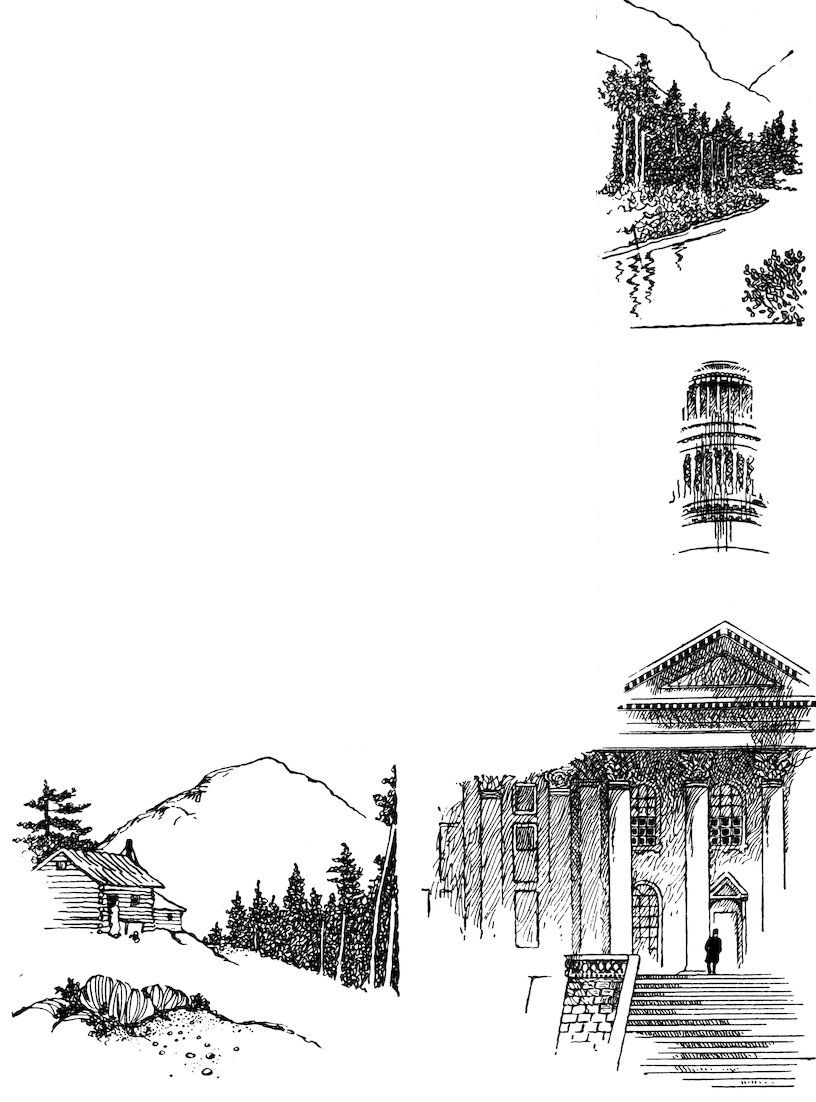
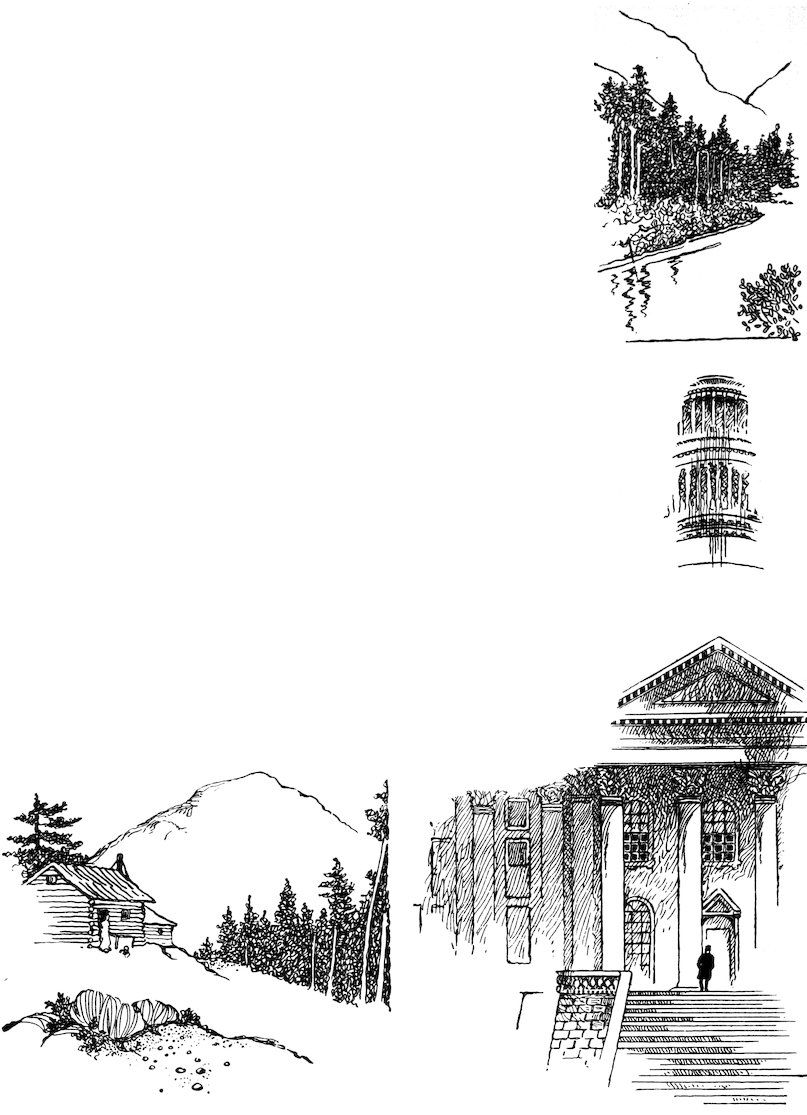
The Governor descended the steps of
the Capitol slowly and with pauses, lifting
a list frequently to his eye. He had
intermittently pencilled it between stages
of the forenoon’s public business, and his
gait grew absent as he recurred now to
his jottings in their accumulation, with
a slight pain at their number, and the
definite fear that they would be more in
seasons to come. They were the names
of his friends’ children to whom his excellent
heart moved him to give Christmas
presents. He had put off this regenerating
evil until the latest day, as
was his custom, and now he was setting
forth to do the whole thing at a
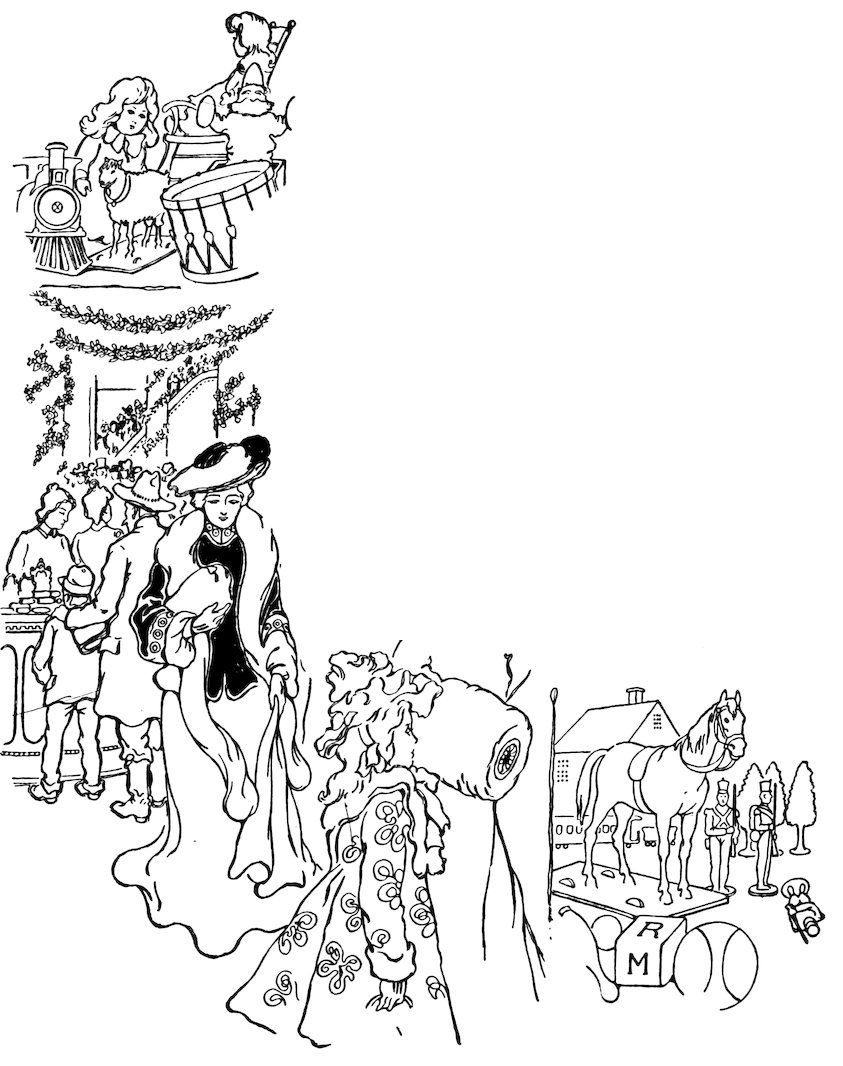
blow, entirely planless among the guns
and rocking-horses that would presently
surround him. As he reached the highway
he heard himself familiarly addressed
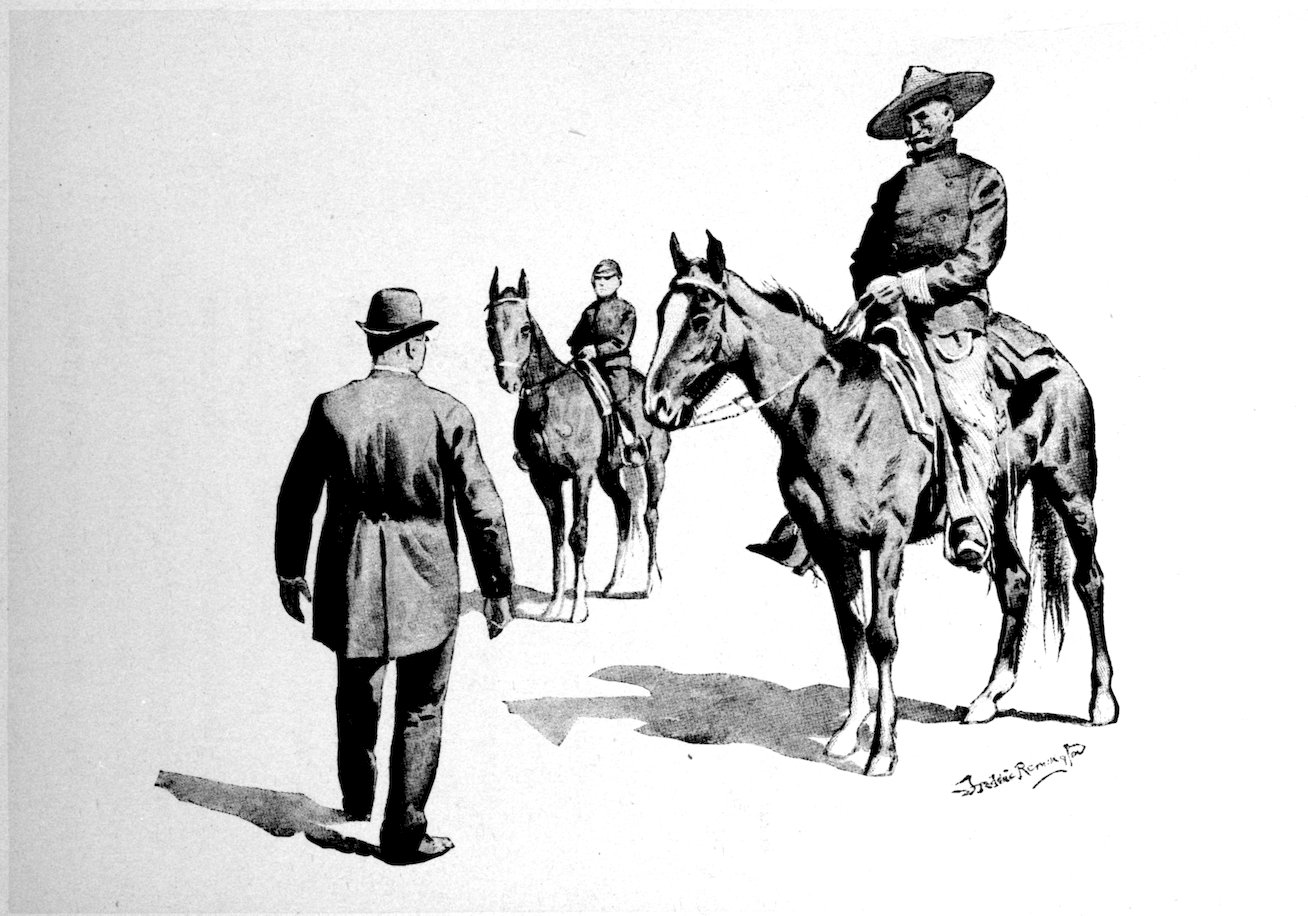
from a distance, and, turning, saw four
sons of the alkali jogging into town from
the plain. One who had shouted to him
galloped out from the others, rounded
the Capitol’s enclosure, and, approaching
with radiant countenance, leaned to reach
the hand of the Governor, and once again
greeted him with a hilarious “Hello, Doc!”
3
Governor Barker, M.D., seeing Mr. McLean
unexpectedly after several years,
hailed the horseman with frank and lively
pleasure, and, inquiring who might be the
other riders behind, was told that they
were Shorty, Chalkeye, and Dollar Bill,
come for Christmas. “And dandies to hit
town with,” Mr. McLean added. “Redhot.”
“I am acquainted with them,” assented
his Excellency.
“We’ve been ridin’ trail for twelve
weeks,” the cow-puncher continued,
“and the money in our pants is talkin’
joy to us right out loud.”
Then Mr. McLean overflowed with talk
and pungent confidences, for the holidays
already rioted in his spirit, and his
tongue was loosed over their coming rites.
4
“We’ve soured on scenery,” he finished,
in his drastic idiom. “We’re heeled for
a big time.”
“Call on me,” remarked the Governor,
cheerily, “when you’re ready for bromides
and sulphates.”
“I ain’t box-headed no more,” protested
Mr. McLean; “I’ve got maturity, Doc,
since I seen yu’ at the rain-making, and
I’m a heap older than them hospital days
when I bust my leg on yu’. Three or four
glasses and quit. That’s my rule.”
“That your rule, too?” inquired the
Governor of Shorty, Chalkeye, and Dollar
Bill. These gentlemen of the saddle were
sitting quite expressionless upon their
horses.
“We ain’t talkin’, we’re waitin’,” observed
Chalkeye; and the three cynics
smiled amiably.
5
“Well, Doc, see yu’ again,” said Mr.
McLean. He turned to accompany his
brother cow-punchers, but in that particular
moment Fate descended, or came
up, from whatever place she dwells in,
and entered the body of the unsuspecting
Governor.
“What’s your hurry?” said Fate, speaking
in the official’s hearty manner. “Come
along with me.”
“Can’t do it. Where’re yu’ goin’?”
“Christmasing,” replied Fate.
“Well, I’ve got to feed my horse.
Christmasing, yu’ say?”
“Yes; I’m buying toys.”
“Toys! You? What for?”
“Oh, some kids.”
“Yourn?” screeched Lin, precipitately.
His Excellency the jovial Governor opened
6his teeth in pleasure at this, for he was a
bachelor, and there were fifteen upon his
list, which he held up for the edification
of the hasty McLean. “Not mine, I’m
happy to say. My friends keep marrying
and settling, and their kids call me uncle,
and climb around and bother, and I forget
their names, and think it’s a girl, and the
mother gets mad. Why, if I didn’t remember
these little folks at Christmas
they’d be wondering—not the kids, they
just break your toys and don’t notice; but
the mother would wonder—‘What’s the
matter with Dr. Barker? Has Governor
Barker gone back on us?’—that’s where
the strain comes!” he broke off, facing
Mr. McLean with another spacious laugh.
But the cow-puncher had ceased to smile,
and now, while Barker ran on exuberantly
7McLean’s wide-open eyes rested upon him,
singular and intent, and in their hazel
depths the last gleam of jocularity went out.
“That’s where the strain comes, you
see. Two sets of acquaintances—grateful
patients and loyal voters—and I’ve
got to keep solid with both outfits, especially
the wives and mothers. They’re
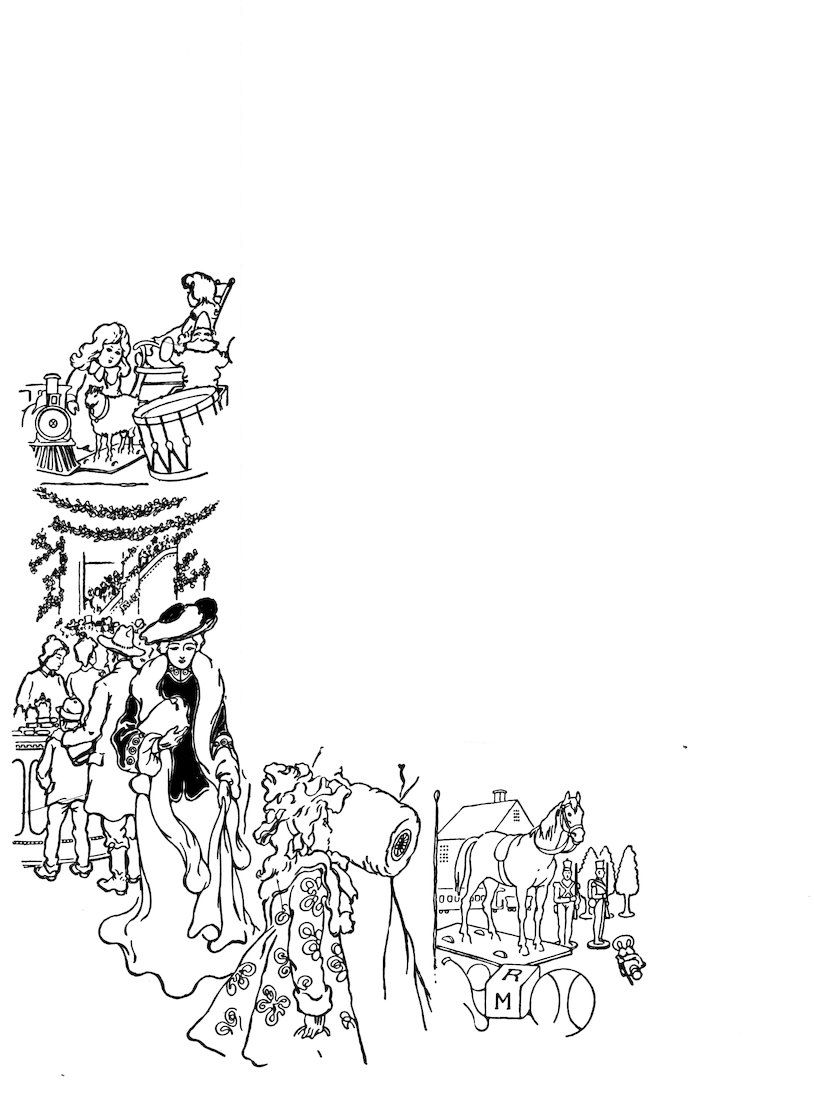
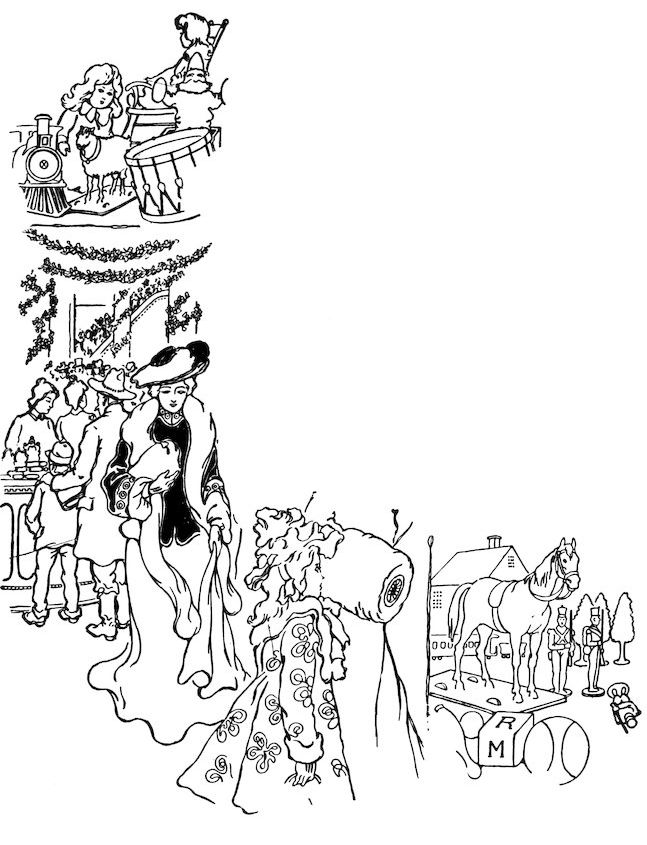
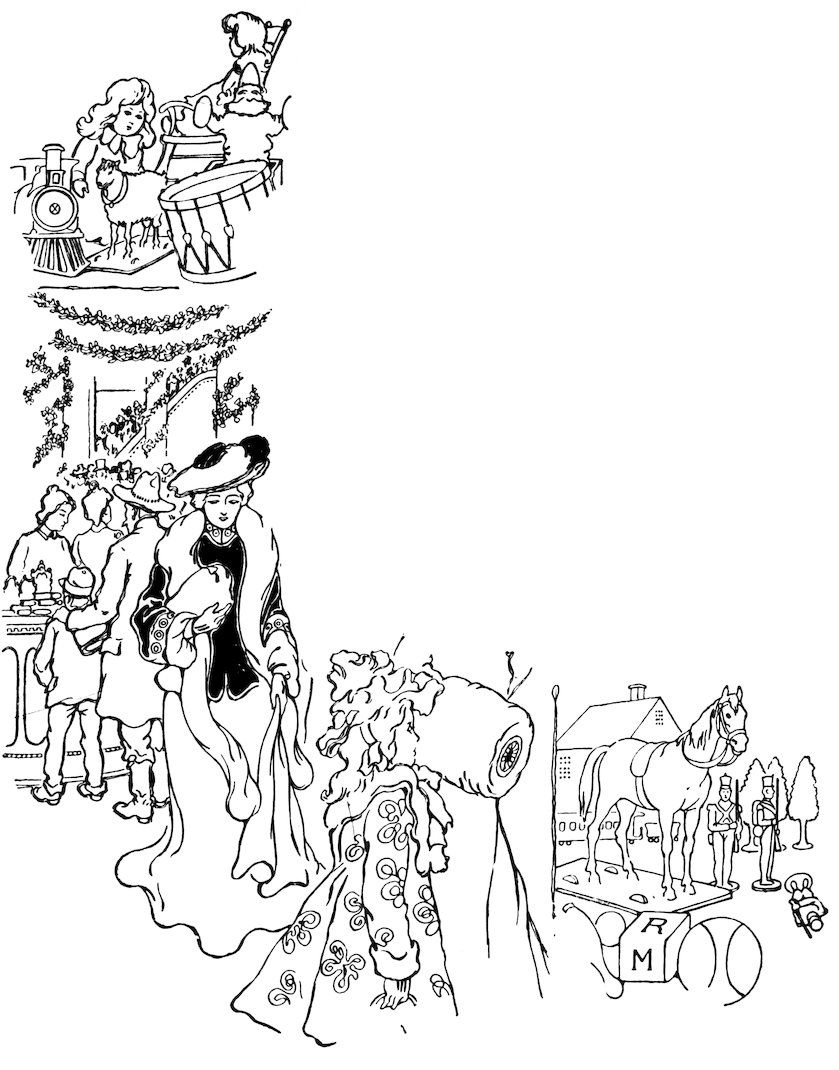
the people. So it’s drums, and dolls, and
sheep on wheels, and games, and monkeys
on a stick, and the saleslady shows you a
mechanical bear, and it costs too much,
and you forget whether the Judge’s second
girl is Nellie or Susie, and—well, I’m just
in for my annual circus this afternoon!
You’re in luck. Christmas don’t trouble a
chap fixed like you.”
Lin McLean prolonged the sentence like
a distant echo.
8
“A chap fixed like you!” The cow-puncher
said it slowly to himself. “No,
sure.” He seemed to be watching Shorty,
and Chalkeye, and Dollar Bill going down
the road. “That’s a new idea—Christmas,”
he murmured, for it was one of his
oldest, and he was recalling the Christmas
when he wore his first long trousers.
“Comes once a year pretty regular,”
remarked the prosperous Governor.
“Seems often when you pay the bill.”
“I haven’t made a Christmas gift,”
pursued the cow-puncher, dreamily, “not
for—for—Lord! it’s a hundred years, I
guess. I don’t know anybody that has
any right to look for such a thing from
me.” This was indeed a new idea, and it
did not stop the chill that was spreading
in his heart.
9
“Gee whiz!” said Barker, briskly, “there
goes twelve o’clock. I’ve got to make
a start. Sorry you can’t come and help
me. Good-bye!”
His Excellency left the rider sitting
motionless, and forgot him at once in his
own preoccupation. He hastened upon his
journey to the shops with the list, not in
his pocket, but held firmly, like a plank
in the imminence of shipwreck. The
Nellies and Susies pervaded his mind, and
he struggled with the presentiment that
in a day or two he would recall some
omitted and wretchedly important child.
Quick hoof-beats made him look up, and
Mr. McLean passed like a wind. The
Governor absently watched him go, and
saw the pony hunch and stiffen in the
check of his speed when Lin overtook his
10companions. Down there in the distance
they took a side street, and Barker rejoicingly
remembered one more name and
wrote it as he walked. In a few minutes
he had come to the shops, and met face
to face with Mr. McLean.
“The boys are seein’ after my horse,”
Lin rapidly began, “and I’ve got to meet
’em sharp at one. We’re twelve weeks
shy on a square meal, yu’ see, and this
first has been a date from ’way back. I’d
like to—” Here Mr. McLean cleared his
throat, and his speech went less smoothly.
“Doc, I’d like just for a while to watch
yu’ gettin’—them monkeys, yu’ know.”
11
The Governor expressed his agreeable
surprise at this change of mind, and was
glad of McLean’s company and judgment
during the impending selections. A picture
of a cow-puncher and himself discussing
a couple of dolls rose nimbly in
Barker’s mental eye, and it was with an
imperfect honesty that he said, “You’ll
help me a heap.”
And Lin, quite sincere, replied, “Thank
yu’.”
So together these two went Christmasing
in the throng. Wyoming’s Chief Executive
knocked elbows with the spurred
and jingling waif, one man as good as another
in that raw, hopeful, full-blooded
cattle era which now the sobered West
remembers as the days of its fond youth.
For one man has been as good as another
in three places—Paradise before the Fall;
the Rocky Mountains before the wire
fence; and the Declaration of Independence.
And then this Governor, besides
being young, almost as young as Lin
McLean or the Chief-Justice (who lately
had celebrated his thirty-second birthday),
had in his doctoring days at Drybone
known the cow-puncher with that
familiarity which lasts a lifetime without
breeding contempt; accordingly, he now
laid a hand on Lin’s tall shoulder and
drew him among the petticoats and toys.
II Lin’s Money is Dumb
13
14
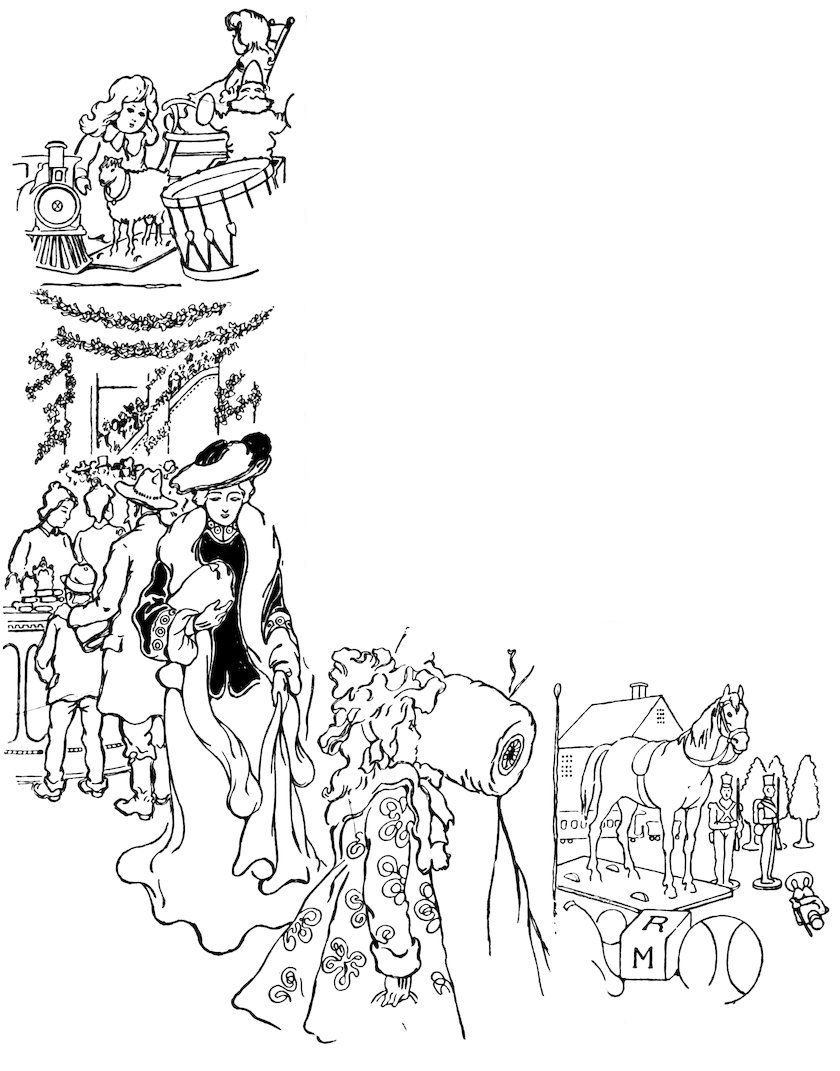
Christmas filled the windows and
Christmas stirred in mankind. Cheyenne,
not over-zealous in doctrine or litanies, and
with the opinion that a world in the hand
is worth two in the bush, nevertheless
was flocking together, neighbor to think
of neighbor, and every one to remember
the children; a sacred assembly, after all,
gathered to rehearse unwittingly the articles
of its belief, the Creed and Doctrine
of the Child. Lin saw them hurry and
smile among the paper fairies; they questioned
and hesitated, crowded and made
decisions, failed utterly to find the right
thing, forgot and hastened back, suffered
all the various desperations of the eleventh
hour, and turned homeward, dropping
their parcels with that undimmed good-will
that once a year makes gracious the
universal human face. This brotherhood
swam and beamed before the cow-puncher’s
brooding eyes, and in his ears the greeting
of the season sang. Children escaped from
their mothers and ran chirping behind the
counters to touch and meddle in places
forbidden. Friends dashed against each
other with rabbits and magic lanterns,
greeted in haste, and were gone, amid the
sound of musical boxes.
15
Through this tinkle and bleating of little
machinery the murmur of the human
heart drifted in and out of McLean’s hearing; fragments of home talk, tendernesses,
economies, intimate first names, and dinner
hours; and whether it was joy or sadness,
it was in common; the world seemed
knit in a single skein of home ties. Two
or three came by whose purses must have
been slender, and whose purchases were
humble and chosen after much nice adjustment;
and when one plain man dropped
a word about both ends meeting, and
the woman with him laid a hand on his
arm, saying that his children must not
feel this year was different, Lin made a
step towards them. There were hours and
spots where he could readily have descended
upon them at that, played the rôle of
clinking affluence, waved thanks aside
with competent blasphemy, and, tossing
off some infamous whiskey, cantered
away in the full, self-conscious strut of
the frontier. But here was not the moment;
the abashed cow-puncher could
make no such parade in this place. The
people brushed by him back and forth,
busy upon their errands, and aware of
him scarcely more than if he had been
a spirit looking on from the helpless
dead; and so, while these weaving needs
and kindnesses of man were within arm’s
touch of him, he was locked outside with
his impulses. Barker had, in the natural
press of customers, long parted from
him, to become immersed in choosing
and rejecting; and now, with a fair part
of his mission accomplished, he was ready
to go on to the next place, and turned
to beckon McLean. He found him obliterated
in a corner beside a life-sized image of Santa Claus, standing as still as
the frosty saint.
16
17
“He looks livelier than you do,” said
the hearty Governor. “’Fraid it’s been
slow waiting.”
“No,” replied the cow-puncher, thoughtfully.
“No, I guess not.”
This uncertainty was expressed with
such gentleness that Barker roared.
“You never did lie to me,” he said,
“long as I’ve known you. Well, never
mind. I’ve got some real advice to ask
you now.”
At this Mr. McLean’s face grew more
alert. “Say, Doc,” said he, “what do yu’
want for Christmas that nobody’s likely
to give yu’?”
“A big practice—big enough to interfere
with my politics.”
18
“What else? Things and truck, I
mean.”
“Oh—nothing I’ll get. People don’t
give things much to fellows like me.”
“Don’t they? Don’t they?”
“Why, you and Santa Claus weren’t
putting up any scheme on my stocking?”
“Well—”
“I believe you’re in earnest!” cried his
Excellency. “That’s simply rich!” Here
was a thing to relish! The Frontier comes
to town “heeled for a big time,” finds
that presents are all the rage, and must
immediately give somebody something.
Oh, childlike, miscellaneous Frontier! So
thought the good-hearted Governor; and
it seems a venial misconception. “My
dear fellow,” he added, meaning as well
as possible, “I don’t want you to spend
your money on me.”
19
“I’ve got plenty all right,” said Lin,
shortly.
“Plenty’s not the point. I’ll take as
many drinks as you please with you. You
didn’t expect anything from me?”
“That ain’t—that don’t—”
“There! Of course you didn’t. Then,
what are you getting proud about? Here’s
our shop.” They stepped in from the
street to new crowds and counters.
“Now,” pursued the Governor, “this is
for a very particular friend of mine.
Here they are. Now, which of those do
you like best?”
20
They were sets of Tennyson in cases
holding little volumes equal in number,
but the binding various, and Mr. McLean
reached his decision after one look. “That,”
said he, and laid a large, muscular hand
upon the Laureate. The young lady behind
the counter spoke out acidly, and
Lin pulled the abject hand away. His
taste, however, happened to be sound, or,
at least, it was at one with the Governor’s;
but now they learned that there was a distressing
variance in the matter of price.
The Governor stared at the delicate article
of his choice. “I know that Tennyson
is what she—is what’s wanted,” he
muttered; and, feeling himself nudged,
looked around and saw Lin’s extended
fist. This gesture he took for a facetious
sympathy, and, dolorously grasping the
hand, found himself holding a lump of
bills. Sheer amazement relaxed him, and
the cow-puncher’s matted wealth tumbled on the floor in sight of all people.
Barker picked it up and gave it back.
“No, no, no!” he said, mirthful over his
own inclination to be annoyed; “you can’t
do that. I’m just as much obliged, Lin,”
he added.
21
“Just as a loan. Doc—some of it. I’m
grass-bellied with spot-cash.”
A giggle behind the counter disturbed
them both, but the sharp young lady was
only dusting. The Governor at once paid
haughtily for Tennyson’s expensive works,
and the cow-puncher pushed his discountenanced
savings back into his clothes.
Making haste to leave the book department
of this shop, they regained a mutual
ease, and the Governor became waggish
over Lin’s concern at being too rich. He
suggested to him the list of delinquent
taxpayers and the latest census from
which to select indigent persons. He had
patients, too, whose inveterate pennilessness
he could swear cheerfully to—“since
you want to bolt from your own money,”
he remarked.
22
“Yes, I’m a green horse,” assented Mr.
McLean, gallantly; “ain’t used to the
looks of a twenty-dollar bill, and I shy
at ’em.”
From his face—that jocular mask—one
might have counted him the most serene
and careless of vagrants, and in his words
only the ordinary voice of banter spoke to
the Governor. A good woman, it may well
be, would have guessed before this the
sensitive soul in the blundering body; but
Barker saw just the familiar, whimsical,
happy-go-lucky McLean of old days, and
so he went gayly and innocently on, treading
upon holy ground. “I’ve got it!” he
exclaimed; “give your wife something.”
23
The ruddy cow-puncher grinned. He
had passed through the world of woman
with but few delays, rejoicing in informal
and transient entanglements, and he welcomed
the turn which the conversation
seemed now to be taking. “If you’ll give
me her name and address,” said he, with
the future entirely in his mind.
“Why, Laramie!” and the Governor
feigned surprise.
“Say, Doc,” said Lin, uneasily, “none
of ’em ’ain’t married me since I saw you
last.”
“Then she hasn’t written from Laramie?”
said the hilarious Governor; and
Mr. McLean understood and winced in
his spirit deep down. “Gee whiz!” went
on Barker. “I’ll never forget you and
Lusk that day!”
24
But the mask fell now. “You’re talking
of his wife, not mine,” said the cow-puncher,
very quietly, and smiling no more;
“and, Doc, I’m going to say a word to yu’,
for I know yu’ve always been my good
friend. I’ll never forget that day myself—but
I don’t want to be reminded of it.”
“I’m a fool, Lin,” said the Governor,
generous instantly. “I never supposed—”
“I know yu’ didn’t. Doc. It ain’t you
that’s the fool. And in a way—in a
way—” Lin’s speech ended among his
crowding memories, and Barker, seeing
how wistful his face had turned, waited.
“But I ain’t quite the same fool I was
before that happened to me,” the cow-puncher resumed, “though maybe my
actions don’t show to be wiser. I know
that there was better luck than a man
like me had any call to look for.”
25
The sobered Barker said, simply, “Yes,
Lin.” He was set to thinking by these
words from the unsuspected inner man.
26
Out in the Bow-Leg country Lin McLean
had met a woman with thick, red cheeks,
calling herself by a maiden name; and this
was his whole knowledge of her when he
put her one morning astride a Mexican
saddle and took her fifty miles to a magistrate
and made her his lawful wife to
the best of his ability and belief. His
sage-brush intimates were confident he
would never have done it but for a rival.
Racing the rival and beating him had
swept Mr. McLean past his own intentions,
and the marriage was an inadvertence.
“He jest bumped into it before he could
pull up,” they explained; and this casualty,
resulting from Mr. McLean’s sporting
blood, had entertained several hundred
square miles of alkali. For the new-made
husband the joke soon died. In the immediate
weeks that came upon him he
tasted a bitterness worse than in all his
life before, and learned also how deep the
woman, when once she begins, can sink beneath
the man in baseness. That was a
knowledge of which he had lived innocent
until this time. But he carried his outward
self serenely, so that citizens in Cheyenne
who saw the cow-puncher with his
bride argued shrewdly that men of that
sort liked women of that sort; and before
the strain had broken his endurance an
unexpected first husband, named Lusk,
had appeared one Sunday in the street,
prosperous, forgiving, and exceedingly
drunk. To the arms of Lusk she went
back in the public street, deserting McLean
in the presence of Cheyenne; and when
Cheyenne saw this, and learned how she
had been Mrs. Lusk for eight long, if intermittent,
years, Cheyenne laughed loudly.
Lin McLean laughed, too, and went
about his business, ready to swagger at
the necessary moment, and with the necessary
kind of joke always ready to shield
his hurt spirit. And soon, of course, the
matter grew stale, seldom raked up in the
Bow-Leg country where Lin had been at
work; so lately he had begun to remember
other things besides the smouldering humiliation.
27
28
“Is she with him?” he asked Barker,
and musingly listened while Barker told
him. The Governor had thought to make
it a racy story, with the moral that the
joke was now on Lusk; but that inner man
had spoken and revealed the cow-puncher
to him in a new and complicated light;
hence he quieted the proposed lively cadence
and vocabulary of his anecdote
about the house of Lusk, and instead of
narrating how Mrs. beat Mr. on Mondays,
Wednesdays, and Fridays, and Mr. took
his turn the odd days, thus getting one
ahead of his lady, while the kid Lusk had
outlined his opinion of the family by recently
skipping to parts unknown. Barker
detailed these incidents more gravely, adding
that Laramie believed Mrs. Lusk addicted
to opium.
29
“I don’t guess I’ll leave my card on
’em,” said McLean, grimly, “if I strike
Laramie.”
“You don’t mind my saying I think
you’re well out of that scrape?” Barker
ventured.
“Shucks, no! That’s all right, Doc.
Only—yu’ see now. A man gets tired
pretending—onced in a while.”
30
Time had gone while they were in talk,
and it was now half after one and Mr.
McLean late for that long-plotted first
square meal. So the friends shook hands,
wishing each other Merry Christmas, and
the cow-puncher hastened towards his
chosen companions through the stirring
cheerfulness of the season. His play-hour
had made a dull beginning among the toys.
He had come upon people engaged in a
pleasant game, and waited, shy and well-disposed,
for some bidding to join, but they
had gone on playing with one another
and left him out. And now he went along
in a sort of hurry to escape from that loneliness
where his human promptings had
been lodged with him useless. Here was
Cheyenne, full of holiday for sale, and he
with his pockets full of money to buy;
and when he thought of Shorty and Chalkeye
and Dollar Bill, those dandies to hit
town with, he stepped out with a brisk,
false hope. It was with a mental hurrah
and a foretaste of a good time coming that
he put on his town clothes, after shaving
and admiring himself, and sat down to the
square meal. He ate away and drank
with a robust imitation of enjoyment that
took in even himself at first. But the sorrowful
31process of his spirit went on, for
all he could do. As he groped for the contentment
which he saw around him he began
to receive the jokes with counterfeit
mirth. Memories took the place of anticipation,
and through their moody shiftings
he began to feel a distaste for the company
of his friends and a shrinking from
their lively voices. He blamed them for
this at once. He was surprised to think
he had never recognized before how light
a weight was Shorty, and here was Chalkeye,
who knew better, talking religion after
two glasses. Presently this attack of noticing
his friends’ shortcomings mastered
him, and his mind, according to its wont,
changed at a stroke. “I’m celebrating
no Christmas with this crowd,” said the
inner man; and when they had next remembered Lin McLean in their hilarity
he was gone.
32
Governor Barker, finishing his purchases
at half-past three, went to meet a
friend come from Evanston. Mr. McLean
was at the railway station buying a ticket
for Denver.
“Denver!” exclaimed the amazed Governor.
“That’s what I said,” stated Mr. McLean,
doggedly.
“Suffering Moses!” said his Excellency.
“What are you going to do there?”
“Get good and drunk.”
“Can’t you find enough whiskey in Cheyenne?”
“I’m drinking champagne this trip.”
33
The cow-puncher went out on the platform
and got aboard, and the train moved
off. Barker had walked out, too, in his
surprise, and as he stared after the last
car Mr. McLean waved his wide hat defiantly
and went inside the door.
34
“And he says he’s got maturity,” Barker
muttered. “I’ve known him since
seventy-nine, and he’s kept about eight
years old right along.” The Governor
was cross and sorry, and presently crosser.
His jokes about Lin’s marriage came
back to him and put him in a rage with
the departed fool. “Yes, about eight.
Or six,” said his Excellency, justifying
himself by the past. For he had first
known Lin, the boy of nineteen, supreme
in length of limb and recklessness, breaking
horses and feeling for an early mustache.
Next, when the mustache was
nearly accomplished, he had mended the
boy’s badly broken thigh at Drybone.
His skill (and Lin’s spotless health) had
wrought so swift a healing that the surgeon
overflowed with the pride of science,
and over the bandages would explain the
human body technically to his wild-eyed
and flattered patient. Thus young Lin
heard all about tibia, and comminuted,
and other glorious new words, and when
sleepless would rehearse them. Then,
with the bone so nearly knit that the patient
might leave the ward on crutches
to sit each morning in Barker’s room as a
privilege, the disobedient child of twenty-one
had slipped out of the hospital and
hobbled hastily to the hog ranch, where
whiskey and variety waited for a languishing
convalescent. Here he grew gay, and
was soon carried back with the leg refractured. Yet Barker’s surgical rage was disarmed,
the patient was so forlorn over his
doctor’s professional chagrin.
35
“I suppose it ain’t no better this morning,
Doc?” he had said, humbly, after a
new week of bed and weights.
“Your right leg’s going to be shorter.
That’s all.”
“Oh, gosh! I’ve been and spoiled your
comminuted fee-mur! Ain’t I a son-of-a-gun?”
You could not chide such a boy as this;
and in time’s due course he had walked
jauntily out into the world with legs of
equal length, after all, and in his stride the
slightest halt possible. And Doctor Barker
had missed the child’s conversation.
To-day his mustache was a perfected thing,
and he in the late end of his twenties.
36
“He’ll wake up about noon to-morrow
in a dive, without a cent,” said Barker.
“Then he’ll come back on a freight and
begin over again.”
III A Transaction in Boot-Blacking
37
38
39
At the Denver station Lin McLean passed
through the shoutings and omnibuses,
and came to the beginning of Seventeenth
Street, where is the first saloon. A customer
was ordering Hot Scotch; and because
he liked the smell and had not thought
of the mixture for a number of years, Lin
took Hot Scotch. Coming out upon the
pavement, he looked across and saw a
saloon opposite with brighter globes and
windows more prosperous. That should
have been his choice; lemon-peel would undoubtedly
be fresher over there; and over
he went at once, to begin the whole thing
properly. In such frozen weather no
drink could be more timely, and he sat, to
enjoy without haste its mellow fitness.
Once again on the pavement, he looked
along the street towards up-town beneath
the crisp, cold electric lights, and three
little bootblacks gathered where he stood,
and cried, “Shine? Shine?” at him. Remembering
that you took the third turn
to the right to get the best dinner in Denver,
Lin hit on the skilful plan of stopping
at all Hot Scotches between; but the next
occurred within a few yards, and it was
across the street. This one being attained
and appreciated, he found that he must
cross back again or skip number four. At
this rate he would not be dining in time
to see much of the theatre, and he stopped
to consider. It was a German place he
had just quitted, and a huge light poured
out on him from its window, which the
proprietor’s fatherland sentiment had
made into a show. Lights shone among
a well-set pine forest, where beery, jovial
gnomes sat on roots and reached upward
to Santa Claus; he, grinning, fat, and Teutonic,
held in his right hand forever a foaming
glass, and forever in his left a string
of sausages that dangled down among
the gnomes. With his American back to
this, the cow-puncher, wearing the same
serious, absent face he had not changed
since he ran away from himself at
Cheyenne, considered carefully the Hot
Scotch question and which side of the
road to take and stick to, while the little
bootblacks found him once more, and
40cried, “Shine? Shine?” monotonous as
snowbirds. He settled to stay over
here with the southside Scotches, and,
the little, one-note song reaching his attention,
he suddenly shoved his foot at
the nearest boy, who lightly sprang
away.
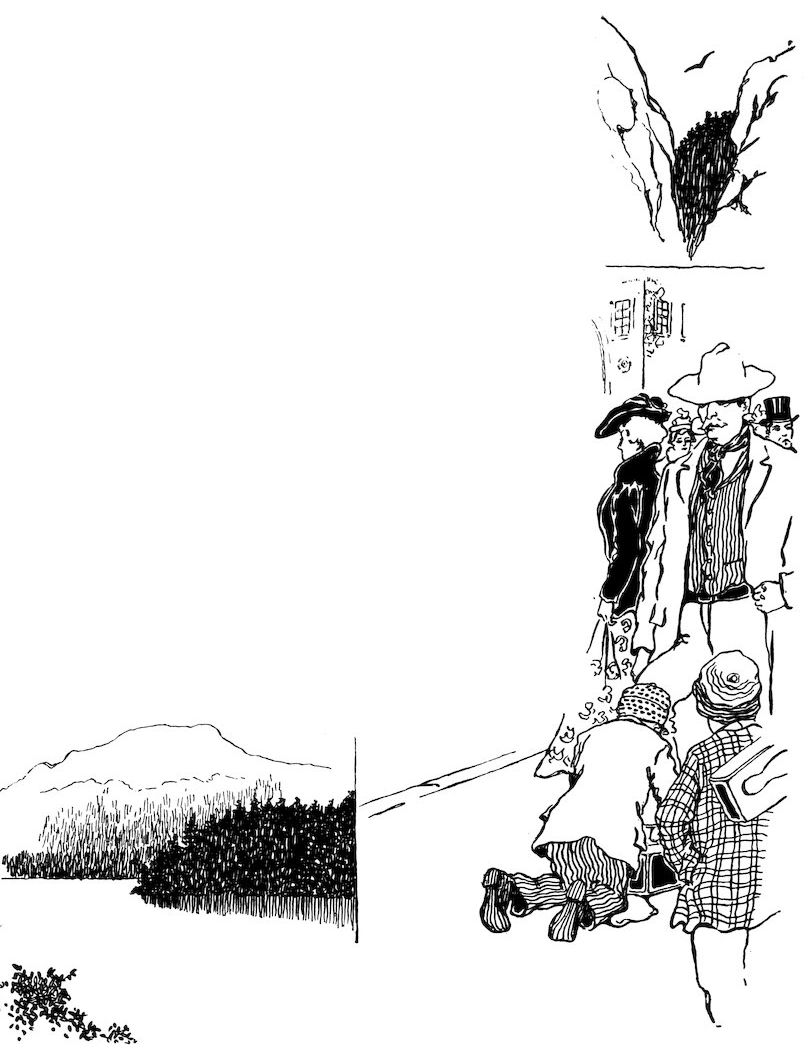
“Dare you to touch him!” piped a snowbird,
dangerously. They were in short
trousers, and the eldest enemy, it may be,
was ten.
“Don’t hit me,” said Mr. McLean. “I’m
innocent.”
“Well, you leave him be,” said one.
“What’s he layin’ to kick you for, Billy?
’Tain’t yer pop, is it?”
“Naw!” said Billy, in scorn. “Father
never kicked me. Don’t know who he
is.”
41
“He’s a special!” shrilled the leading
bird, sensationally. “He’s got a badge,
and he’s going to arrest yer.”
Two of them hopped instantly to the
safe middle of the street, and scattered
with practised strategy; but Billy stood
his ground. “Dare you to arrest me!”
said he.
“What’ll you give me not to?” inquired
Lin, and he put his hands in his pockets,
arms akimbo.
“Nothing; I’ve done nothing,” announced
Billy, firmly. But even in the last syllable
his voice suddenly failed, a terror
filled his eyes, and he, too, sped into the
middle of the street.
“What’s he claim you lifted?” inquired
the leader, with eagerness. “Tell him you
haven’t been inside a store to-day. We
can prove it!” they screamed to the special
officer.
42
“Say,” said the slow-spoken Lin from
the pavement, “you’re poor judges of a
badge, you fellows.”
His tone pleased them where they stood,
wide apart from each other.
Mr. McLean also remained stationary
in the bluish illumination of the window.
“Why, if any policeman was caught wearin’
this here,” said he, following his sprightly
invention, “he’d get arrested himself.”
This struck them extremely. They began
to draw together, Billy lingering the
last.
“If it’s your idea,” pursued Mr. McLean,
alluringly, as the three took cautious steps
nearer the curb, “that blue, clasped hands
in a circle of red stars gives the bearer the
right to put folks in the jug—why, I’ll
get somebody else to black my boots for
a dollar.”
43
The three made a swift rush, fell on simultaneous
knees, and, clattering their
boxes down, began to spit in an industrious
circle.
“Easy!” wheedled Mr. McLean, and
they looked up at him, staring and fascinated.
“Not having three feet,” said the
cow-puncher, always grave and slow, “I
can only give two this here job.”
“He’s got a big pistol and a belt!” exulted
the leader, who had precociously
felt beneath Lin’s coat.
“You’re a smart boy,” said Lin, considering
him, “and yu’ find a man out
right away. Now you stand off and tell
me all about myself while they fix the
boots—and a dollar goes to the quickest
through.”
44
Young Billy and his tow-headed competitor
flattened down, each to a boot,
with all their might, while the leader ruefully
contemplated Mr. McLean.
“That’s a Colt forty-five you’ve got,”
ventured he.
“Right again. Some day, maybe, you’ll
be wearing one of your own, if the angels
don’t pull yu’ before you’re ripe.”
“I’m through!” sang out Towhead,
rising in haste.
Small Billy was struggling still, but leaped
at that, the two heads bobbing to a
level together; and Mr. McLean, looking
down, saw that the arrangement had not
been a good one for the boots.
45
“Will you kindly referee,” said he, forgivingly, to the leader, “and decide which
of them smears is the awfulest?”
But the leader looked the other way
and played upon a mouth-organ.
“Well, that saves me money,” said Mr.
McLean, jingling his pocket. “I guess
you’ve both won.” He handed each of
them a dollar. “Now,” he continued, “I
just dassent show these boots up-town; so
this time it’s a dollar for the best shine.”
The two went palpitating at their brushes
again, and the leader played his mouth-organ
with brilliant unconcern. Lin, tall
and brooding, leaned against the jutting
sill of the window, a figure somehow plainly
strange in town, while through the
bright plate-glass Santa Claus, holding
out his beer and sausages, perpetually
beamed.
46
Billy was laboring gallantly, but it was
labor, the cow-puncher perceived, and
Billy no seasoned expert. “See here,”
said Lin, stooping, “I’ll show yu’ how it’s
done. He’s playin’ that toon cross-eyed
enough to steer anybody crooked. There.
Keep your blacking soft and work with a
dry brush.”
“Lemme,” said Billy. “I’ve got to
learn.” So he finished the boot his own
way with wiry determination, breathing
and repolishing; and this event was also
adjudged a dead heat, with results gratifying
to both parties. So here was their
work done, and more money in their pockets
than from all the other boots and
shoes of this day; and Towhead and Billy
did not wish for further trade, but to
spend this handsome fortune as soon as
might be. Yet they delayed in the brightness
of the window, drawn by curiosity
near this new kind of man whose voice
held them and whose remarks dropped
them into constant uncertainty. Even
the omitted leader had been unable to go
away and nurse his pride alone.
47
“Is that a secret society?” inquired Towhead,
lifting a finger at the badge.
Mr. McLean nodded. “Turruble,” said he.
“You’re a Wells Fargo detective,” asserted
the leader.
“Play your harp,” said Lin.
“Are you a—a desperaydo?” whispered
Towhead.
“Oh, my!” observed Mr. McLean, sadly;
“what has our Jack been readin’?”
“He’s a cattle-man!” cried Billy. “I
seen his heels.”
48
“That’s you!” said the discovered puncher,
with approval. “You’ll do. But I bet
you can’t tell me what we wearers of this
badge have sworn to do this night.”
At this they craned their necks and
glared at him.
“We—are—sworn (don’t yu’ jump,
now, and give me away)—sworn—to—blow
off three bootblacks to a dinner.”
“Ah, pshaw!” They backed away, bristling
with distrust.
“That’s the oath, fellows. Yu’ may as
well make your minds up—for I have it
to do!”
“Dare you to! Ah!”
“And after dinner it’s the Opera-house,
to see ‘The Children of Captain Grant’!”
They screamed shrilly at him, keeping
off beyond the curb.
49
“I can’t waste my time on such, smart
boys,” said Mr. McLean, rising to his full
height from the window-sill. “I am going
somewhere to find boys that ain’t so turruble
quick stampeded by a roast turkey.”
He began to lounge slowly away, serious
as he had been throughout, and they, stopping
their noise short, swiftly picked up
their boxes and followed him. Some
change in the current of electricity that
fed the window disturbed its sparkling
light, so that Santa Claus, with his arms
stretched out behind the departing cow-puncher,
seemed to be smiling more broadly
from the midst of his flickering brilliance.
IV Turkey and Responsibility
50
51
On their way to turkey, the host and his
guests exchanged but few remarks. He
was full of good-will, and threw off a comment
or two that would have led to conversation
under almost any circumstances
save these; but the minds of the guests
were too distracted by this whole state of
things for them to be capable of more
than keeping after Mr. McLean in silence,
at a wary interval, and with their mouths,
during most of the journey, open. The
badge, the pistol, their patron’s talk, and
the unusual dollars wakened wide their
bent for the unexpected, their street affinity
for the spur of the moment; they
believed slimly in the turkey part of it,
but what this man might do next, to be
there when he did it, and not to be trapped,
kept their wits jumping deliciously;
so when they saw him stop they stopped
instantly, too, ten feet out of reach. This
was Denver’s most civilized restaurant—that
one which Mr. McLean had remembered,
with foreign dishes and private
rooms, where he had promised himself,
among other things, champagne. Mr.
McLean had never been inside it, but
heard a tale from a friend; and now he
caught a sudden sight of people among
geraniums, with plumes and white shirtfronts,
very elegant. It must have been
several minutes that he stood contemplating the entrance and the luxurious couples
who went in.
52
“Plumb French!” he observed, at length;
and then, “Shucks!” in a key less confident,
while his guests ten feet away watched
him narrowly. “They’re eatin’ patty
de parley-voo in there,” he muttered, and
the three bootblacks came beside him.
“Say, fellows,” said Lin, confidingly, “I
wasn’t raised good enough for them dude
dishes. What do yu’ say! I’m after a
place where yu’ can mention oyster stoo
without givin’ anybody a fit. What do
yu’ say, boys?”
That lighted the divine spark of brotherhood!
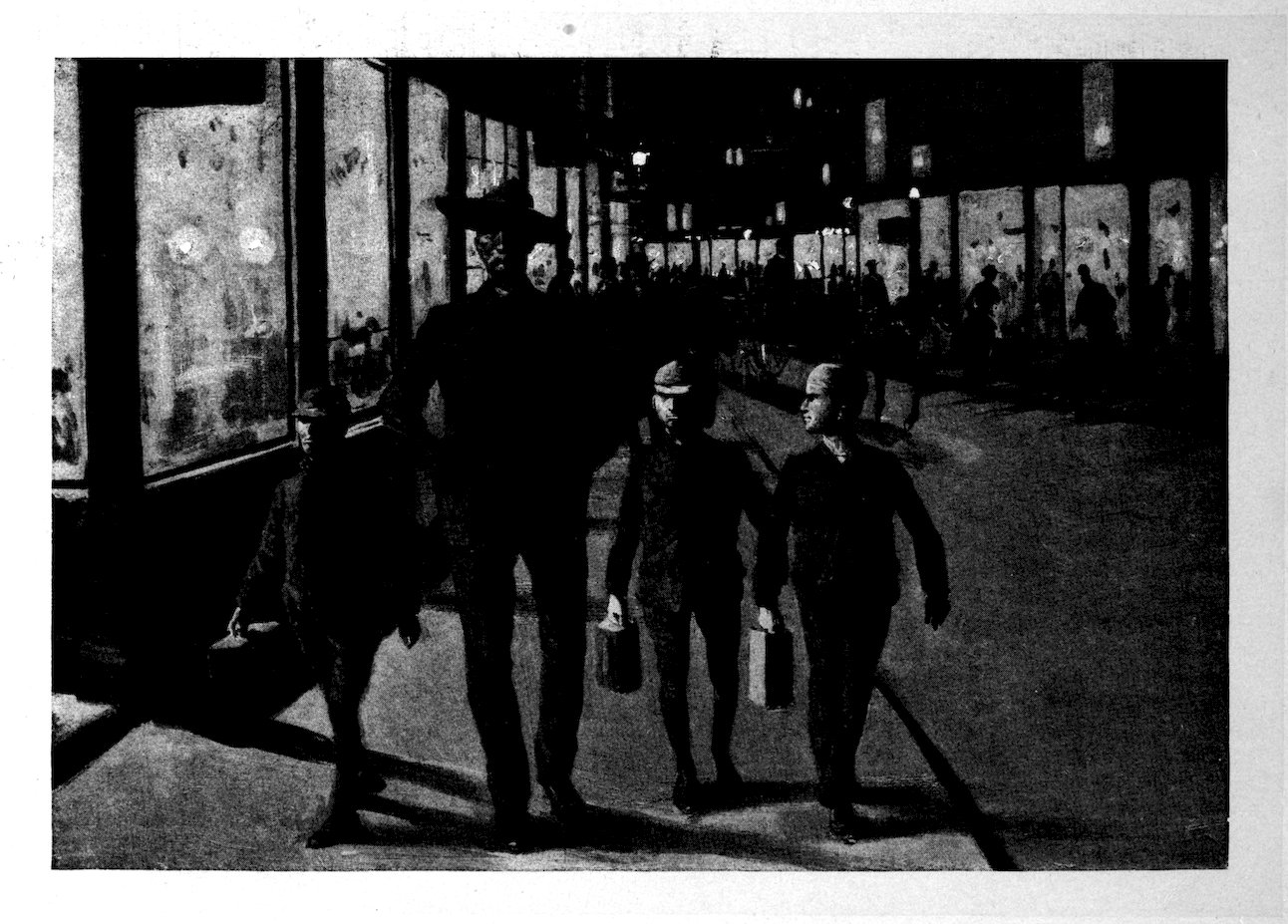
“Lin walked in their charge, they leading the way”
53
“Ah, you come along with us—we’ll
take yer! You don’t want to go in there.
We’ll show yer the boss place in Market
Street. We won’t lose yer.” So, shouting
together in their shrill little city trebles,
they clustered about him, and one pulled
at his coat to start him. He started obediently,
and walked in their charge, they
leading the way.
“Christmas is comin’ now, sure,” said
Lin, grinning to himself. “It ain’t exactly
what I figured on.” It was the first
time he had laughed since Cheyenne, and
he brushed a hand over his eyes, that
were dim with the new warmth in his
heart.
Believing at length in him and his turkey,
the alert street faces, so suspicious
of the unknown, looked at him with ready
intimacy as they went along; and soon, in
the friendly desire to make him acquainted
with Denver, the three were patronizing
him. Only Billy, perhaps, now and then
stole at him a doubtful look.
54
The large Country Mouse listened solemnly
to his three Town Mice, who presently
introduced him to the place in Market
Street. It was not boss, precisely,
and Denver knows better neighborhoods;
but the turkey and the oyster-stew were
there, with catsup and vegetables in season,
and several choices of pie. Here the
Country Mouse became again efficient;
and to witness his liberal mastery of ordering
and imagine his pocket and its
wealth, which they had heard and partly
seen, renewed in the guests a transient
awe. As they dined, however, and found
the host as frankly ravenous as themselves,
this reticence evaporated, and they all
grew fluent with oaths and opinions. At
one or two words, indeed, Mr. McLean
stared and had a slight sense of blushing.
55
“Have a cigarette?” said the leader,
over his pie.
“Thank yu’,” said Lin. “I won’t smoke,
if you’ll excuse me.” He had devised a
wholesome meal with water to drink.
“Chewin’s no good at meals,” continued
the boy. “Don’t you use tobacker?”
“Onced in a while.”
The leader spat brightly. “He ’ain’t
learned yet,” said he, slanting his elbows
at Billy and sliding a match over his rump.
“But beer, now—I never seen anything
in it.” He and Towhead soon left Billy
and his callow profanities behind, and engaged
in a town conversation that silenced
him, and set him listening with all his
admiring young might. Nor did Mr.
McLean join in the talk, but sat embarrassed
by this knowledge, which seemed
about as much as he knew himself.
56
“I’ll be goshed,” he thought, “if I’d
caught on to half that when I was streakin’
around in short pants! Maybe they
grow up quicker now.” But now the Country
Mouse perceived Billy’s eager and attentive
apprenticeship. “Hello, boys!” he
said, “that theatre’s got a big start on us.”
They had all forgotten he had said anything
about theatre; and other topics left
their impatient minds while the Country
Mouse paid the bill and asked to be guided
to the Opera-house. “This man here will
look out for your blackin’ and truck, and
let yu’ have it in the morning.”
57
They were very late. The spectacle had
advanced far into passages of the highest
thrill, and Denver’s eyes were riveted upon
a ship and some icebergs. The party
found its seats during several beautiful
lime-light effects, and that remarkable fly-buzzing
of violins which is pronounced so
helpful in times of peril and sentiment.
The children of Captain Grant had been
tracking their father all over the equator
and other scenic spots, and now the north
pole was about to impale them. The
Captain’s youngest child, perceiving a
hummock rushing at them with a sudden
motion, loudly shouted, “Sister, the ice
is closing in!” and Sister replied, chastely,
“Then let us pray.” It was a superb
tableau: the ice split, and the sun rose and
joggled at once to the zenith. The act-drop
fell, and male Denver, wrung to its
religious deeps, went out to the rum-shop.
58
Of course Mr. McLean and his party did
not do this. The party had applauded
exceedingly the defeat of the elements,
and the leader, with Towhead, discussed
the probable chances of the ship’s getting
farther south in the next act. Until lately
Billy’s doubt of the cow-puncher had lingered;
but during this intermission whatever
had been holding out in him seemed
won, and in his eyes, that he turned
stealthily upon his unconscious, quiet
neighbor, shone the beginnings of hero-worship.
“Don’t you think this is splendid?”
said he.
“Splendid,” Lin replied, a trifle remotely.
“Don’t you like it when they all get
balled up and get out that way?”
59
“Humming,” said Lin.
“Don’t you guess it’s just girls, though,
that do that?”
“What, young fellow?”
“Why, all that prayer-saying an’ stuff.”
“I guess it must be.”
“She said to do it when the ice scared
her, an’ of course a man had to do what
she wanted him.”
“Sure.”
“Well, do you believe they’d ’a’ done
it if she hadn’t been on that boat, an’
clung around an’ cried an’ everything, an’
made her friends feel bad?”
“I hardly expect they would,” replied
the honest Lin, and then, suddenly mindful
of Billy, “except there wasn’t nothin’
else they could think of,” he added, wishing
to speak favorably of the custom.
60
“Why, that chunk of ice weren’t so awful
big, anyhow. I’d ’a’ shoved her off
with a pole. Wouldn’t you?”
“Butted her like a ram,” exclaimed Mr.
McLean.
“Well, I don’t say my prayers any more.
I told Mr. Perkins I wasn’t a-going to, an’
he—I think he’s a flubdub, anyway.”
“I’ll bet he is!” said Lin, sympathetically.
He was scarcely a prudent guardian.
“I told him straight, an’ he looked at
me, an’ down he flops on his knees. An’
he made ’em all flop, but I told him I didn’t
care for them putting up any camp-meeting
over me; an’ he says, ‘I’ll lick you,’ an’
I says, ‘Dare you to!’ I told him mother
kep’ a-licking me for nothing, an’ I’d not
pray for her, not in Sunday-school or anywheres
else. Do you pray much?”
61
“No,” replied Lin, uneasily.
“There! I told him a man didn’t, an’
he said then a man went to hell. ‘You
lie; father ain’t going to hell,’ I says, and
you’d ought to heard the first class laugh
right out loud, girls an’ boys. An’ he was
that mad! But I didn’t care. I came
here with fifty cents.”
“Yu’ must have felt like a millionaire.”
“Ah, I felt all right! I bought papers
an’ sold ’em, an’ got more an’ saved, an’
got my box an’ blacking outfit. I weren’t
going to be licked by her just because she
felt like it, an’ she feeling like it most any
time. Lemme see your pistol.”
“You wait,” said Lin. “After this
show is through I’ll put it on you.”
“Will you, honest? Belt an’ everything?
Did you ever shoot a bear?”
62
“Lord! lots.”
“Honest? Silver-tips?”
“Silver-tips, cinnamon, black; and I
roped a cab onced.”
“O-h! I never shot a bear.”
“You’d ought to try it.”
“I’m a-going to. I’m a-going to camp
out in the mountains. I’d like to see you
when you camp. I’d like to camp with
you. Mightn’t I some time?” Billy had
drawn nearer to Lin, and was looking up
at him adoringly.
“You bet!” said Lin; and though he
did not, perhaps, entirely mean this, it
was with a curiously softened face that he
began to look at Billy. As with dogs and
his horse, so always he played with what
children he met—the few in his sage-brush
world; but this was ceasing to be quite
play for him, and his hand went to the
boy’s shoulder.
63
“Father took me camping with him
once, the time mother was off. Father
gets awful drunk, too. I’ve quit Laramie
for good.”
Lin sat up, and his hand gripped the
boy. “Laramie!” said he, almost shouting
it. “Yu’—yu’—is your name Lusk?”
But the boy had shrunk from him instantly.
“You’re not going to take me
home?” he piteously wailed.
“Heavens and heavens!” murmured Lin
McLean. “So yu’re her kid!”
64
65
He relaxed again, down in his chair, his
legs stretched their straight length below
the chair in front. He was waked from
his bewilderment by a brushing under
him, and there was young Billy diving
for escape to the aisle, like the cornered
City Mouse that he was. Lin nipped that
poor little attempt and had the limp Billy
seated inside again before the two in discussion
beyond had seen anything. He
had said not a word to the boy, and now
watched his unhappy eyes seizing upon
the various exits and dispositions of the
theatre; nor could he imagine anything
to tell him that should restore the perished
confidence. “Why did yu’ head him off?”
he asked himself, unexpectedly, and found
that he did not seem to know; but as he
watched the restless and estranged runaway
he grew more and more sorrowful.
“I just hate him to think that of me,”
he reflected. The curtain rose, and he
saw Billy make up his mind to wait until
they should all be going out in the crowd.
While the children of Captain Grant grew
hotter and hotter upon their father’s geographic
trail, Lin sat saying to himself a
number of contradictions. “He’s nothin’
to me. What’s any of them to me?”
Driven to bay by his bewilderment, he
restated the facts of the past. “Why,
she’d deserted him and Lusk before she’d
ever laid eyes on me. I needn’t to bother
myself. He wasn’t never even my step-kid.”
The past, however, brought no guidance.
“Lord, what’s the thing to do about
this? If I had any home— This is a stinkin’
world in some respects,” said Mr. McLean,
aloud, unknowingly. The lady in the chair
beneath which the cow-puncher had his
legs nudged her husband. They took it for
emotion over the sad fortunes of Captain
Grant, and their backs shook. Presently
each turned, and saw the singular man
with untamed, wide-open eyes glowing at
the stage, and both backs shook again.
66
Once more his hand was laid on Billy.
“Say!”
The boy glanced at him, and quickly
away.
“Look at me, and listen.”
Billy swervingly obeyed.
“I ain’t after yu’, and never was. This
here’s your business, not mine. Are yu’
listenin’ good?”
67
The boy made a nod, and Lin proceeded,
whispering: “You’ve got no call to believe
what I say to yu’—yu’ve been lied to, I
guess, pretty often. So I’ll not stop yu’
runnin’ and hidin’, and I’ll never give it
away I saw yu’, but yu’ keep doin’ what
yu’ please. I’ll just go now. I’ve saw
all I want, but you and your friends stay
with it till it quits. If yu’ happen to wish
to speak to me about that pistol or bears,
yu’ come around to Smith’s Palace—that’s
the boss hotel here, ain’t it?—and if yu’
don’t come too late I’ll not be gone to
bed. By this time of night I’m liable to
get sleepy. Tell your friends good-bye
for me, and be good to yourself. I’ve
appreciated your company.”
Mr. McLean entered Smith’s Palace,
and, engaging a room with two beds in it,
did a little delicate lying by means of the
truth. “It’s a lost boy—a runaway,” he
told the clerk. “He’ll not be extra clean,
I expect, if he does come. Maybe he’ll
give me the slip, and I’ll have a job cut
out to-morrow. I’ll thank yu’ to put my
money in your safe.”
68
The clerk placed himself at the disposal
of the secret service, and Lin walked up
and down, looking at the railroad photographs
for some ten minutes, when Master
Billy peered in from the street.
“Hello!” said Mr. McLean, casually,
and returned to a fine picture of Pike’s
Peak.
Billy observed him for a space, and, receiving
no further attention, came stepping
along. “I’m not a-going back to
Laramie,” he stated, warningly.
“I wouldn’t,” said Lin. “It ain’t half
the town Denver is. Well, good-night.
Sorry yu’ couldn’t call sooner—I’m dead
sleepy.”
“O-h!” Billy stood blank. “I wish
I’d shook the darned old show. Say,
lemme black your boots in the morning?”
69
“Not sure my train don’t go too
early.”
“I’m up! I’m up! I get around to all
of ’em.”
“Where do yu’ sleep?”
“Sleeping with the engine-man now.
Why can’t you put that on me to-night?”
“Goin’ up-stairs. This gentleman
wouldn’t let yu’ go up-stairs.”
But the earnestly petitioned clerk consented,
and Billy was the first to hasten
into the room. He stood rapturous while
Lin buckled the belt round his scanty
stomach, and ingeniously buttoned the
suspenders outside the accoutrement to
retard its immediate descent to earth.
“Did it ever kill a man?” asked Billy,
touching the six-shooter.
70
“No. It ’ain’t never had to do that,
but I expect maybe it’s stopped some
killin’ me.”
“Oh, leave me wear it just a minute!
Do you collect arrow-heads? I think
they’re bully. There’s the finest one you
ever seen.” He brought out the relic,
tightly wrapped in paper, several pieces.
“I foun’ it myself, camping with father.
It was sticking in a crack right on top of
a rock, but nobody’d seen it till I came
along. Ain’t it fine?”
Mr. McLean pronounced it a gem.
“Father an’ me found a lot, an’ they
made mother mad lying around, an’ she
throwed ’em out. She takes stuff from
Kelley’s.”
“Who’s Kelley?”
71
“He keeps the drug-store at Laramie.
Mother gets awful funny. That’s how
she was when I came home. For I told
Mr. Perkins he lied, an’ I ran then. An’
I knowed well enough she’d lick me when
she got through her spell—an’ father can’t
stop her, an’ I—ah, I was sick of it! She’s
lamed me up twice beating me—an’ Perkins
wanting me to say ‘God bless my
mother!’ a-getting up and a-going to bed—he’s
a flubdub! An’ so I cleared out.
But I’d just as leaves said for God to
bless father—an’ you. I’ll do it now if
you say it’s any sense.”
Mr. McLean sat down in a chair. “Don’t
yu’ do it now,” said he.
72
“You wouldn’t like mother,” Billy continued.
“You can keep that.” He came
to Lin and placed the arrow-head in his
hands, standing beside him. “Do you
like birds’ eggs? I collect them. I got
twenty-five kinds—sage-hen, an’ blue
grouse, an’ willow-grouse, an’ lots more
kinds harder—but I couldn’t bring all
them from Laramie. I brought the magpie’s,
though. D’you care to see a magpie
egg? Well, you stay to-morrow an’
I’ll show you that an’ some other things I
got the engine-man lets me keep there, for
there’s boys that would steal an egg. An’
I could take you where we could fire that
pistol. Bet you don’t know what that is!”
He brought out a small tin box shaped
like a thimble, in which were things that
rattled.
Mr. McLean gave it up.
“That’s kinni-kinnic seed. You can
have that, for I got some more with the
engine-man.”
73
Lin received this second token also, and
thanked the giver for it. His first feeling
had been to prevent the boy’s parting with
his treasures, but something that came not
from the polish of manners and experience
made him know that he should take them.
Billy talked away, laying bare his little
soul; the street boy that was not quite
come made place for the child that was not
quite gone, and unimportant words and
confidences dropped from him disjointed
as he climbed to the knee of Mr. McLean,
and inadvertently took that cow-puncher
for some sort of parent he had not hitherto
met. It lasted but a short while, however,
for he went to sleep in the middle of
a sentence, with his head upon Lin’s breast.
The man held him perfectly still, because
he had not the faintest notion that Billy
would be impossible to disturb. At length
he spoke to him, suggesting that bed might
prove more comfortable; and, finding how
it was, rose and undressed the boy and
laid him between the sheets. The arms
and legs seemed aware of the moves required
of them, and stirred conveniently;
and directly the head was upon the pillow
the whole small frame burrowed down,
without the opening of an eye or a change
in the breathing. Lin stood some time
by the bedside, with his eyes on the long,
curling lashes and the curly hair. Then
he glanced craftily at the door of the room,
and at himself in the looking-glass. He
stooped and kissed Billy on the forehead,
and, rising from that, gave himself a hangdog
stare in the mirror, and soon in his
own bed was sleeping the sound sleep of
health.
V Santa Claus Lin
75
He was faintly roused by the churchbells,
and lay still, lingering with his sleep,
his eyes closed and his thoughts unshaped.
As he became slowly aware of the morning,
the ringing and the light reached him,
and he waked wholly, and, still lying quiet,
considered the strange room filled with the
bells and the sun of the winter’s day.
“Where have I struck now?” he inquired;
and as last night returned abruptly upon
his mind, he raised himself on his arm.
There sat Responsibility in a chair,
washed clean and dressed, watching him.
76
“You’re awful late,” said Responsibility.
“But I weren’t a-going without telling
you good-bye.”
“Go?” exclaimed Lin. “Go where?
Yu’ surely ain’t leavin’ me to eat breakfast
alone?” The cow-puncher made his
voice very plaintive. Set Responsibility
free after all his trouble to catch him?
This was more than he could do!
“I’ve got to go. If I’d thought you’d
want for me to stay—why, you said you
was a-going by the early train.”
“But the durned thing’s got away on
me,” said Lin, smiling sweetly from the
bed.
“If I hadn’t a-promised them—”
“Who?”
“Sidney Ellis and Pete Goode. Why,
you know them; you grubbed with them.”
77
“Shucks!”
“We’re a-going to have fun to-day.”
“Oh!”
“For it’s Christmas, an’ we’ve bought
some good cigars, an’ Pete says he’ll learn
me sure. O’ course I’ve smoked some,
you know. But I’d just as leaves stayed
with you if I’d only knowed sooner. I
wish you lived here. Did you smoke whole
big cigars when you was beginning?”
“Do yu’ like flapjacks and maple
syrup?” inquired the artful McLean.
“That’s what I’m figuring on inside
twenty minutes.”
“Twenty minutes! If they’d wait—”
“See here, Bill. They’ve quit expectin’
yu’, don’t yu’ think? I’d ought to
waked, yu’ see, but I slep’ and slep’, and
kep’ yu’ from meetin’ your engagements,
yu’ see—for you couldn’t go, of course.
A man couldn’t treat a man that way
now, could he?”
78
“Course he couldn’t,” said Billy, brightening.
“And they wouldn’t wait, yu’ see.
They wouldn’t fool away Christmas, that
only comes onced a year, kickin’ their
heels, and sayin’ ‘Where’s Billy?’ They’d
say, ‘Bill has sure made other arrangements,
which he’ll explain to us at his leesyure.’
And they’d skip with the cigars.”
The advocate paused, effectively, and
from his bolster regarded Billy with a convincing
eye.
“That’s so,” said Billy.
“And where would yu’ be then, Bill?
In the street, out of friends, out of Christmas,
and left both ways, no tobacker and
no flapjacks. Now, Bill, what do yu’ say
to us puttin’ up a Christmas deal together?
Just you and me?”
79
“I’d like that,” said Billy. “Is it all
day?”
“I was thinkin’ of all day,’ said Lin.
“I’ll not make yu’ do anything yu’d rather
not.”
“Ah, they can smoke without me,” said
Billy, with sudden acrimony. “I’ll see
’em to-morro’.”
“That’s yu’!” cried Mr. McLean. “Now,
Bill, you hustle down and tell them to
keep a table for us. I’ll get my clothes
on and follow yu’.”
80
The boy went, and Mr. McLean procured
hot water and dressed himself, tying his
scarf with great care. “Wished I’d a clean
shirt,” said he. “But I don’t look very
bad. Shavin’ yesterday afternoon was a
good move.” He picked up the arrow-head
and the kinni-kinnic, and was particular
to store them in his safest pocket.
“I ain’t sure whether you’re crazy or not,”
said he to the man in the looking-glass.
“I ’ain’t never been sure.” And he slammed
the door and went down-stairs.
He found young Bill on guard over a
table for four, with all the chairs tilted
against it as a warning to strangers. No
one sat at any other table or came into the
room, for it was late, and the place quite
emptied of breakfasters, and the several
entertained waiters had gathered behind
Billy’s important-looking back. Lin provided
a thorough meal, and Billy pronounced
the flannel cakes superior to flapjacks,
which were not upon the bill of fare.
81
“I’d like to see you often,” said he.
“I’ll come and see you if you don’t live
too far.”
“That’s the trouble,” said the cow-puncher.
“I do. Awful far.” He stared
out of the window.
“Well, I might come some time. I
wish you’d write me a letter. Can you
write?”
“What’s that? Can I write? Oh yes.”
“I can write, an’ I can read, too. I’ve
been to school in Sidney, Nebraska, an’
Magaw, Kansas, an’ Salt Lake—that’s the
finest town except Denver.”
Billy fell into that cheerful strain of
comment which, unreplied to, yet goes
on content and self-sustaining, while Mr.
McLean gave amiable signs of assent, but
chiefly looked out of the window; and when
the now interested waiter said, respectfully,
that he desired to close the room, they
went out to the office, where the money
was got out of the safe and the bill paid.
82
The streets were full of the bright sun,
and seemingly at Denver’s gates stood the
mountains; an air crisp and pleasant wafted
from their peaks; no smoke hung among
the roofs, and the sky spread wide over
the city without a stain; it was holiday
up among the chimneys and tall buildings,
and down among the quiet ground-stories
below as well; and presently from their
scattered pinnacles through the town the
bells broke out against the jocund silence
of the morning.
“Don’t you like music?” inquired Billy.
“Yes,” said Lin.
83
Ladies with their husbands and children
were passing and meeting, orderly yet
gayer than if it were only Sunday, and the
salutations of Christmas came now and
again to the cow-puncher’s ears; but to-day,
possessor of his own share in this, Lin
looked at every one with a sort of friendly
challenge, and young Billy talked along
beside him.
“Don’t you think we could go in here?”
Billy asked. A church door was open,
and the rich organ sounded through to
the pavement. “They’ve good music here,
an’ they keep it up without much talking
between. I’ve been in lots of times.”
84
They went in and sat to hear the music.
Better than the organ, it seemed to them,
were the harmonious voices raised from
somewhere outside, like unexpected visitants;
and the pair sat in their back seat,
too deep in listening to the processional
hymn to think of rising in decent imitation
of those around them. The crystal melody
of the refrain especially reached their
understandings, and when for the fourth
time “Shout the glad tidings, exultingly
sing,” pealed forth and ceased, both the
delighted faces fell.
“Don’t you wish there was more?” Billy
whispered.
“Wish there was a hundred verses,” answered
Lin.
But canticles and responses followed,
with so little talking between them they
were held spellbound, seldom thinking to
rise or kneel. Lin’s eyes roved over the
church, dwelling upon the pillars in their
evergreen, the flowers and leafy wreaths,
the texts of white and gold. “‘Peace,
good-will towards men,’” he read. “That’s
so. Peace and good-will. Yes, that’s so.
I expect they got that somewheres in the
Bible. It’s awful good, and you’d never
think of it yourself.”
85
There was a touch on his arm, and a
woman handed a book to him. “This is
the hymn we have now,” she whispered,
gently; and Lin, blushing scarlet, took it
passively without a word. He and Billy
stood up and held the book together,
dutifully reading the words:
“It came upon the midnight clear,
That glorious song of old,
From angels bending near the earth
To touch their harps of gold;
Peace on the earth—”
This tune was more beautiful than all,
and Lin lost himself in it, until he found
Billy recalling him with a finger upon the
words, the concluding ones:
86
“And the whole world sent back the song
Which now the angels sing.”
The music rose and descended to its lovely
and simple end; and, for a second time in
Denver, Lin brushed a hand across his eyes.
He turned his face from his neighbor,
frowning crossly; and since the heart has
reasons which Reason does not know, he
seemed to himself a fool; but when the
service was over and he came out, he
repeated again, “‘Peace and good-will.’
When I run on to the Bishop of Wyoming
I’ll tell him if he’ll preach on them words
I’ll be there.”
“Couldn’t we shoot your pistol now?”
asked Billy.
87
“Sure, boy. Ain’t yu’ hungry, though?”
“No. I wish we were away off up there.
Don’t you?”
“The mountains? They look pretty—so
white! A heap better ’n houses. Why,
we’ll go there! There’s trains to Golden.
We’ll shoot around among the foot-hills.”
To Golden they immediately went, and,
after a meal there, wandered in the open
country until the cartridges were gone, the
sun was low, and Billy was walked off his
young heels—a truth he learned complete
in one horrid moment and battled to conceal.
“Lame!” he echoed, angrily. “I ain’t.”
“Shucks!” said Lin, after the next ten
steps. “You are, and both feet.”
“Tell you, there’s stones here, an’ I’m
just a-skipping them.”
88
Lin, briefly, took the boy in his arms and
carried him to Golden. “I’m played out
myself,” he said, sitting in the hotel and
looking lugubriously at Billy on a bed.
“And I ain’t fit to have charge of a hog.”
He came and put his hand on the boy’s
head.
“I’m not sick,” said the cripple. “I
tell you I’m bully. You wait an’ see me
eat dinner.”
But Lin had hot water and cold water
and salt, and was an hour upon his knees
bathing the hot feet. And then Billy could
not eat dinner.
There was a doctor in Golden; but in
spite of his light prescription and most
reasonable observations, Mr. McLean passed
a foolish night of vigil, while Billy slept,
quite well at first, and, as the hours passed,
better and better. In the morning he was
entirely brisk, though stiff.
89
“I couldn’t work quick to-day,” he said.
“But I guess one day won’t lose me my
trade.”
“How d’ yu’ mean?” asked Lin.
“Why, I’ve got regulars, you know.
Sidney Ellis an’ Pete Goode has theirs,
an’ we don’t cut each other. I’ve got Mr.
Daniels an’ Mr. Fisher an’ lots, an’ if you
lived in Denver I’d shine your boots every
day for nothing. I wished you lived in
Denver.”
“Shine my boots? Yu’ll never! And
yu’ don’t black Daniels or Fisher, or any of
the outfit.”
“Why, I’m doing first-rate,” said Billy,
surprised at the swearing into which Mr.
McLean now burst. “An’ I ain’t big
enough to get to make money at any other
job.
90
“I want to see that engine-man,” muttered
Lin. “I don’t like your smokin’
friend.”
“Pete has learned me and Sidney a lot,”
pursued Billy, engagingly.
“I’ll bet he has!” growled the cow-puncher;
and again Billy was taken aback at his
language.
“‘This is Mister Billy Lusk’”
91
It was not so simple, this case. To the
perturbed mind of Mr. McLean it grew
less simple during that day at Golden,
while Billy recovered, and talked, and ate
his innocent meals. The cow-puncher
was far too wise to think for a single moment
of restoring the runaway to his debauched
and shiftless parents. Possessed
of some imagination, he went through a
scene in which he appeared at the Lusk
threshold with Billy and forgiveness, and
intruded upon a conjugal assault and battery.
“Shucks!” said he. “The kid
would be off again inside a week. And I
don’t want him there, anyway.”
Denver, upon the following day, saw
the little bootblack again at his corner,
with his trade not lost; but near him stood
a tall, singular man, with hazel eyes and
a sulky expression. And citizens during
that week noticed, as a new sight in the
streets, the tall man and the little boy walking
together. Sometimes they would be in
shops. The boy seemed as happy as possible, talking constantly, while the man seldom
said a word, and his face was serious.
92
Upon New Year’s Eve Governor Barker
was overtaken by Mr. McLean riding
a horse up Hill Street, Cheyenne.
“Hello!” said Barker, staring humorously
through his glasses. “Have a good
drunk?”
“Changed my mind,” said Lin, grinning.
“Proves I’ve got one. Struck Christmas
all right, though.”
“Who’s your friend?” inquired his Excellency.
“This is Mister Billy Lusk. Him and
me have agreed that towns ain’t nice to
live in. If Judge Henry’s foreman and
his wife won’t board him at Sunk Creek—why,
I’ll fix it somehow.”
93
The cow-puncher and his Responsibility
rode on together towards the open plain.
“Suffering Moses!” remarked his Excellency.
THE END
TRANSCRIBER’S NOTES
Silently corrected obvious typographical errors and variations in spelling.
Retained archaic, non-standard, and uncertain spellings as printed.