The cover image was created by the transcriber and is placed in the public domain.
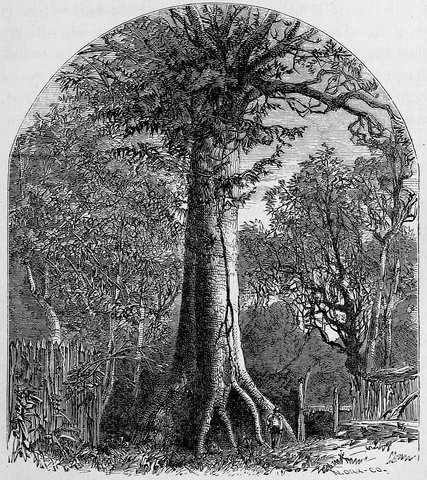
Cocoeiro Palm
BY
PROFESSOR AND MRS. LOUIS AGASSIZ.
And whenever the way seemed long,
Or his heart began to fail,
She would sing a more wonderful song,
Or tell a more marvellous tale.
Longfellow.
BOSTON:
TICKNOR AND FIELDS.
1868.
Entered according to Act of Congress, in the year 1867, by
TICKNOR AND FIELDS,
in the Clerk’s Office of the District Court of the District of Massachusetts.
SECOND EDITION.
University Press: Welch, Bigelow, & Co.,
Cambridge.
TO
MR. NATHANIEL THAYER,
THE FRIEND WHO MADE IT POSSIBLE TO GIVE THIS JOURNEY THE CHARACTER OF A SCIENTIFIC EXPEDITION,
The Present Volume
IS GRATEFULLY INSCRIBED.
PREFACE.
v
In the winter of 1865 it became necessary for me, on
account of some disturbance of my health, to seek a change
of scene and climate, with rest from work. Europe was
proposed; but though there is much enjoyment for a
naturalist in contact with the active scientific life of
the Old World, there is little intellectual rest. Toward
Brazil I was drawn by a lifelong desire. After the death
of Spix, when a student of twenty years of age, I had
been employed by Martius to describe the fishes they
had brought back with them from their celebrated Brazilian
journey. From that time, the wish to study this
fauna in the regions where it belongs had been an
ever-recurring thought with me; a scheme deferred for
want of opportunity, but never quite forgotten. The fact
that the Emperor of Brazil was deeply interested in all
scientific undertakings, and had expressed a warm sympathy
with my efforts to establish a great zoölogical
museum in this country, aiding me even by sending
collections made expressly under his order for the purpose,
was an additional incentive. I knew that the head
of the government would give me every facility for my
investigations. Nevertheless, tempting as was the prospect
viof a visit to Brazil, as a mere vacation it had little
charm for me. Single-handed, I could make slight use
of the opportunities I should have; and though the excursion
might be a pleasant one for myself, it would
have no important result for science. I could not forget
that, had I only the necessary means, I might make collections
on this journey which, whenever our building
could be so enlarged as to give room for their exhibition,
would place the Museum in Cambridge on a level
with the first institutions of the kind. But for this a
working force would be needed, and I saw no possibility
of providing for such an undertaking. While I was
brooding over these thoughts I chanced to meet Mr. Nathaniel
Thayer, whom I have ever found a generous friend
to science. The idea of appealing to him for a scheme
of this magnitude had not, however, occurred to me;
but he introduced the subject, and, after expressing his
interest in my proposed journey, added, “You wish, of
course, to give it a scientific character; take six assistants
with you, and I will be responsible for all their
expenses, personal and scientific.” It was so simply said,
and seemed to me so great a boon, that at first I hardly
believed I had heard him rightly. In the end, I had
cause to see in how large and liberal a sense he proffered
his support to the expedition, which, as is usual in such
cases, proved longer and more costly than was at first
anticipated. Not only did he provide most liberally for
assistants, but, until the last specimen was stored in the
Museum, he continued to advance whatever sums were
viineeded, always desiring me to inform him should any
additional expenses occur on closing up the affairs of the
expedition. It seems to me that the good arising from
the knowledge of such facts justifies me in speaking here
of these generous deeds, accomplished so unostentatiously
that they might otherwise pass unnoticed.
All obstacles thus removed from my path, I made my
preparations for departure as rapidly as possible. The
assistants I selected to accompany me were Mr. James
Burkhardt as artist, Mr. John G. Anthony as conchologist,
Mr. Frederick C. Hartt and Mr. Orestes St. John as geologists,
Mr. John A. Allen as ornithologist, and Mr. George
Sceva as preparator. Beside these, my party was enlarged
by several volunteers, to whom I was indebted for assistance
as untiring and efficient as if they had been engaged
for the purpose. These were Mr. Newton Dexter,
Mr. William James, Mr. Edward Copeland, Mr. Thomas
Ward, Mr. Walter Hunnewell, and Mr. S. V. R. Thayer.
I should not omit to mention my brother-in-law, Mr.
Thomas G. Cary, as one of my aids; for, though not nominally
connected with the expedition, he made collections
for me at Monte Video, Buenos Ayres, and other places.
I was also joined by my friends Dr. and Mrs. Cotting.
Dr. Cotting, like myself, was in need of a vacation, and
it was his intention to remain with us for as long a
time as he could spare from his professional practice.
But the climate proved unfavorable to his health, and
after passing a couple of months in Rio, and sharing
with us all our excursions in that neighborhood, he
viiisailed with Mrs. Cotting for Europe, where they passed
the summer. His presence with us during that time
was most fortunate, for it so happened that the only
serious cases of illness we had among us occurred before
he left, and his medical advice and care were of great
service. I lost the assistance of Mr. Anthony, and Mr.
Allen also, early in the expedition; their health, always
delicate, obliging them to leave for home. With these
exceptions, our working force remained intact, and I am
happy to state that every member of the party returned
in safety to the United States.[1]
No sooner was the Brazilian Expedition known to the
public, than I received a letter from Mr. Allen McLane,
President of the Pacific Mail Steamship Company, offering
to me and my whole party the hospitality of their
magnificent ship the Colorado, then just sailing from
New York for the Pacific coast. She was going almost
empty of passengers, being bound by the way of Cape
Horn for San Francisco. We left New York on board
this beautiful vessel, on the 1st of April, 1865. The
record of our delightful voyage to Rio de Janeiro will
ixbe found in the narrative; but I wish here publicly to
acknowledge my obligation to Mr. McLane for his generosity
to the expedition. Besides the sympathy accorded
me by private individuals, I have to thank the Hon. Gideon
Welles, Secretary of the Navy, for a general order, received
on the eve of my departure, desiring the officers of the
United States Navy, wherever I should fall in with them,
to afford me such assistance in my scientific researches
as would not interfere with the regular service; and I
learned at Rio that Mr. Seward had warmly recommended
the expedition to General Webb, at that time United
States Minister to Brazil. Finally, I would express my
thanks also to Messrs. Garrison and Allen for the free
passage offered to myself and my companions for our
return, on board the line of steamers established between
New York and Rio de Janeiro during our stay in
Brazil.
It will be seen hereafter what facilities were granted
me throughout this journey by the Brazilians themselves,
and that the undertaking, so warmly speeded on its way,
was welcomed no less cordially in the country to which
it was bound.
One word as to the manner in which this volume has
grown into its present shape, for it has been rather the
natural growth of circumstances than the result of any
preconceived design. Partly for the entertainment of her
friends, partly with the idea that I might make some use
of it in knitting together the scientific reports of my
journey by a thread of narrative, Mrs. Agassiz began this
xdiary. I soon fell into the habit of giving her daily the
more general results of my scientific observations, knowing
that she would allow nothing to be lost which was worth
preserving. In consequence of this mode of working,
our separate contributions have become so closely interwoven
that we should hardly know how to disconnect
them, and our common journal is therefore published,
with the exception of a few unimportant changes, almost
as it was originally written. In this volume I have attempted
only to give such an account of my scientific
work and its results as would explain to the public what
were the aims of the expedition, and how far they have
been accomplished. It is my hope to complete a work,
already begun, on the Natural History, and especially on
the Fishes of Brazil, in which will be recorded not only
my investigations during the journey and those of my
assistants in their independent excursions, but also the
researches now regularly carried on in connection with
the immense Brazilian collections stored in the Museum
at Cambridge. This must, however, be the slow labor
of many years, and can only be published very gradually.
In the mean time I hope that this forerunner of the more
special reports may serve to show that our year in Brazil,
full as it was of enjoyment for all the party, was also rich
in permanent results for science.
L. AGASSIZ.
TABLE OF CONTENTS. — APPENDIX.
xi
CHAPTER I.
VOYAGE FROM NEW YORK TO RIO DE JANEIRO.
PAGE
First Sunday at Sea.—Gulf Stream.—Gulf-Weed.—Lectures proposed.—First Lecture: On the Gulf Stream in the Gulf Stream.—Aquarium established on board.—Second Lecture.—Rough Sea.—Peculiar Tint of Water.—Third Lecture: Laying out Work of Expedition in Brazil; Distribution of Fishes in Brazilian Rivers; its Bearing on Origin of Species; Collecting of Eggs.—Tropical Sunset.—Fourth Lecture: Plan of Geological Investigations with special reference to Glacial Phenomena in South America.—Flying-Fish.—Fifth Lecture: Glacial Phenomena, continued.—Second Sunday at Sea.—Rough Water.—Sixth Lecture: Embryological Investigations as a Guide to sound Classification.—Seventh Lecture.—Moonlight Nights.—Trade-Winds.—Eighth Lecture: Importance of Precision in Localizing Specimens.—Southern Cross.—Ninth Lecture: Fresh-water Fishes of Brazil.—Easter Sunday.—First Sight of South American Shore.—Olinda.—Pernambuco.—Catamarans.—Tenth Lecture: Methods of Collecting.—Eleventh Lecture: Classification of Fishes as illustrated by Embryology.—Preparations for Arrival.—Twelfth Lecture: Practical Lesson in Embryology.—Closing Lecture: Transmutation Theory; Intellectual and Political Independence.—Resolutions and Speeches.—Singular Red Patches on the Surface of the Sea
Arrival.—Aspect of Harbor and City.—Custom-House.—First Glimpse of Brazilian Life.—Negro Dance.—Effect of Emancipation in United States upon Slavery in Brazil.—First Aspect of Rio de Janeiro on Land.—Picturesque Street Groups.—Eclipse of the Sun.—At Home in Rio.—Larangeiras.—Passeio Publico.—Excursion on the Dom Pedro Railroad.—Visit of the Emperor to the Colorado.—Cordiality of the Government to the Expedition.—Laboratory.—Botanical Garden.—Alley of Palms.—Excursion to the Corcovado.—Juiz de Fora Road.—Petropolis.—Tropical Vegetation.—Ride from Petropolis to Juiz de Fora.—Visit to Senhor Lage.—Excursion to the Forest of the Empress.—Visit to Mr. Halfeld.—Return to Rio.—News of the Great Northern Victories, and of the President’s Assassination
Botafogo.—Insane Hospital.—Tijuca.—Erratic Drift.—Vegetation.—Birthday Dinner.—Arrangements for Parties to the Interior.—Public Lectures in Rio.—Procession of St. George.—Leave Rio on Excursion to the Fortaleza de Santa Anna.—Localities for Erratic Drift between Rio and Petropolis.—Departure from Juiz de Fora.—Arrival at the Fazenda. Ride in the Forest.—Eve of San João.—Cupim Nests.—Excursion to the Upper Fazenda.—Grand Hunt.—Picnic.—Coffee Plantation.—Return to Rio.—Mimic Snow-Fields.—Coffee Insect spinning its Nest.—Visit to the Fazenda of Commendador Breves.—Botanizing Excursion to Tijuca.—Preparations for leaving Rio.—Major Coutinho.—Collegio Dom Pedro Segundo.
On board the Cruzeiro do Sul.—Members of the Party.—Arrival at Bahia.—Day in the Country.—Return to the Steamer.—Conversation about Slavery in Brazil.—Negro Marriages.—Maceio.—Pernambuco.—Parahyba do Norte.—Ramble on Shore.—Ceará.—Difficult Landing.—Brazilian Baths.—Maranham.—Assai Palm.—Visit to Orphan Asylum.—Detained in Port.—Variety of Medusæ.—Arrival of American Gunboat.—More Medusæ.—Dinner on Shore.—Cordiality toward the Expedition.—Arrival at Pará.—Kind Reception.—Environs of Pará.—Luxuriant Growth.—Markets.—Indian Boats.—Agreeable Climate.—Excursion in the Harbor.—Curious Mushroom.—Success in collecting, with the assistance of our Host and other Friends.—Fishes of the Forests.—Public Expressions of Sympathy for the Expedition.—Generosity of the Amazonian Steamship Company.—Geological Character of the Shore from Rio to Pará.—Erratic Drift.—Letter to the Emperor.
xiiiFirst Sunday on the Amazons.—Geographical Question.—Convenient Arrangements of Steamer.—Vast Dimensions of the River.—Aspect of Shores.—Village of Breves.—Letter about Collections.—Vegetation.—Variety of Palms.—Settlement of Tajapuru.—Enormous Size of Leaves of the Miriti Palm.—Walk on Shore.—Indian Houses.—Courtesy of Indians.—Row in the Forest.—Town of Gurupá.—River Xingu.—Color of Water.—Town of Porto do Moz.—Flat-topped Hills of Almeyrim.—Beautiful Sunset.—Monte Alégre.—Character of Scenery and Soil.—Santarem.—Send off Party on the River Tapajoz.—Continue up the Amazons.—Pastoral Scenes on the Banks.—Town of Villa Bella.—Canoe Journey at Night.—Esperança’s Cottage.—Picturesque Scene at Night.—Success in Collecting.—Indian Life.—Making Farinha.—Dance in the Evening.—Howling Monkeys.—Religious Impressions of Indians.—Cottage of Maia.—His Interest in Educating his Children.—Return to Steamer.—Scientific Results of the Excursion.
Arrival at Manaos.—Meeting of the Solimoens with the Rio Negro.—Domesticated at Manaos.—Return of Party from the Tapajoz.—Generosity of Government.—Walks.—Water-Carriers.—Indian School.—Leave Manaos.—Life on board the Steamer.—Barreira das Cudajas.—Coari.—Wooding.—Appearance of Banks.—Geological Constitution.—Forest.—Sumaumeira-Tree.—Arrow-Grass.—Red Drift Cliffs.—Sand-Beaches.—Indian Huts.—Turtle-Hunting.—Drying Fish.—Teffé.—Doubts about the Journey.—Unexpected Adviser.—Fonte Bôa.—Geological Character of Banks.—Lakes.—Flocks of Water Birds.—Tonantins.—Picturesque Grouping of Indians.—San Paolo.—Land-Slides.—Character of Scenery.—Scanty Population.—Animal Life.—Tabatinga.—Aspect of the Settlement.—Mosquitoes.—Leave one of the Party to make Collections.—On our Way down the River.—Party to the Rivers Iça and Hyutahy.—Aground in the Amazons.—Arrival at Teffé.
Aspect of Teffé.—Situation.—Description of Houses.—Fishing Excursion.—Astonishing Variety of Fishes.—Acará.—Scarcity of Laborers.—Our Indoors Man.—Bruno.—Alexandrina.—Pleasant Walks.—Mandioca-shed in the Forest.—Indian Encampment on the Beach.—Excursion to Fishing Lodge on the Solimoens.—Amazonian Beaches.—Breeding-Places of Turtles, Fishes, etc.—Adroitness of Indians in finding them.—Description of a “Sitio.”—Indian Clay-Eaters.—Cuieira-Tree.—Fish Hunt.—Forest Lake.—Water Birds.—Success in Collecting.—Evening Scene in Sitio.—Alexandrina as Scientific Aid.—Fish Anecdote.—Relations between Fishes as shown by their Embryology.—Note upon the Marine Character of the Amazonian Faunæ.—Acará.—News from the Parties in the Interior.—Return of Party from the Iça.—Preparations for Departure.—Note on General Result of Scientific Work in Teffé.—Waiting for the Steamer.—Sketch of Alexandrina.—Mocuim.—Thunder-Storm.—Repiquete.—Geological Observations.
xivArrival at Manaos.—New Quarters.—The Ibicuhy.—News from Home.—Visit to the Cascade.—Banheiras in the Forest.—Excursion to Lake Hyanuary.—Character and Prospects of the Amazonian Valley.—Reception at the Lake.—Description of Sitio.—Successful Fishing.—Indian Visitors.—Indian Ball.—Character of the Dancing.—Disturbed Night.—Canoe Excursion.—Scenery.—Another Sitio.—Morals and Manners.—Talk with the Indian Women.—Life in the Forest.—Life in the Towns.—Dinner-Party.—Toasts.—Evening Row on the Lake.—Night Scene.—Smoking among the Senhoras.—Return to Manaos.
Photographic Establishment.—Indian Portraits.—Excursion to the Great Cascade.—Its Geological Formation.—Bathing Pool.—Parasitic Plants.—Return by the Igarapé.—Public Ball.—Severity in Recruiting, and its Effects.—Collecting Parties.—Scenes of Indian Life.—Fête Champêtre at the Casa dos Educandos.—Prison at Manaos.—Prison Discipline on the Amazons.—Extracts from Presidential Reports on this Subject.—Prison at Teffé.—General Character of Brazilian Institutions.—Emperor’s Birthday.—Illuminations and Public Festivities.—Return of Collecting Parties.—Remarks on the Races.—Leave Manaos for Mauhes.
Leave Manaos.—On board the Ibicuhy.—Navigation of the River Ramos.—Aspect of the Banks.—Arrival at Mauhes.—Situation of Mauhes.—Tupinambaranas.—Character of Population.—Appearance of the Villages of Mauhes.—Bolivian Indians.—Guaraná.—Excursion to Mucaja-Tuba.—Mundurucu Indians.—Aspect of Village.—Church.—Distribution of Presents.—Generosity of the Indians.—Their Indifference.—Visit to another Settlement.—Return to Mauhes.—Arrival of Mundurucus in the Village.—Description of Tattooing.—Collection.—Boto.—Indian Superstitions.—Palm Collection.—Walk in the Forest.—Leave Mauhes.—Mundurucu Indian and his Wife.—Their Manners and Appearance.—Indian Tradition.—Distinctions of Caste.
Christmas Eve at Manaos.—Ceremonies of the Indians.—Churches on the Amazons.—Leave Manaos for the Rio Negro.—Curious River Formation.—Aspect of the River.—Its Vegetation.—Scanty Population.—Village of Taua Péassu.—Padre of the Village.—Palms.—Village of Pedreira.—Indian Camp.—Making Palm-thatch.—Sickness and Want at Pedreira.—Row in the Forest.—Tropical Shower.—Geology of Pedreira.—Indian Recruits.—Collection of Palms.—Extracts from Mr. Agassiz’s Notes on Vegetation.—Return to Manaos.—Desolation of the Rio Negro.—Its future Prospects.—Humboldt’s Anticipations.—Wild Flowers.—Distribution of Fishes in the Amazonian Waters.—How far due to Migration.—Hydrographic System.—Alternation between the Rise and Fall of the Southern and Northern Tributaries.
Farewell Visit to the Great Cascade at Manaos.—Change in its Aspect.—Arrival at Villa Bella.—Return to the House of the Fisherman Maia.—Excursion to the Lago Maximo.—Quantity of Game and Waterfowl.—Victoria regia.—Leave Villa Bella.—Arrive at Obydos.—Its Situation and Geology.—Santarem.—Visit to the Church.—Anecdote of Martius.—A Row overland.—Monte Alégre.—Picturesque Scenery.—Banheiras.—Excursion into the Country.—Leave Monte Alégre.—Anecdote of Indians.—Almeyrim.—New Geological Facts.—Porto do Moz.—Collections.—Gurupá.—Tajapurú.—Arrive at Pará.—Religious Procession.—Excursion to Marajo.—Sourés.—Jesuit Missions.—Geology of Marajo.—Buried Forest.—Vigia.—Igarapé.—Vegetation and Animal Life.—Geology.—Return to Pará.—Photographing Plants.—Notes on the Vegetation of the Amazons.—Prevalence of Leprosy.
Drift about Rio de Janeiro.—Decomposition of underlying Rock.—Different Aspect of Glacial Phenomena in different Continents.—Fertility of the Drift.—Geological Observations of Messrs. Hartt and St. John.—Correspondence of Deposits along the Coast with those of Rio and those of the Valley of the Amazons.—Primitive Formation of the Valley.—First known Chapter of its History.—Cretaceous Fossil Fishes.—Former Extent of the South-American Coast.—Cretaceous Fossils from the Rio Purus.—Comparison between North and South America.—Geological Formations along the Banks of the Amazons.—Fossil Leaves.—Clays and Sandstones.—Hills of Almeyrim.—Monte Alégre.—Situation and Scenery.—Serra of Ereré.—Comparison with Swiss Scenery.—Boulders of Ereré.—Ancient Thickness of Amazonian Deposits.—Difference between Drift of the Amazons and that of Rio.—Inferences drawn from the present Condition of the Deposits.—Immense Extent of Sandstone Formation.—Nature and Origin of these Deposits.—Referred to the Ice-Period.—Absence of Glacial Marks.—Glacial Evidence of another Kind.—Changes in the Outline of the South-American Coast.—Souré.—Igarapé Grande.—Vigia.—Bay of Braganza.—Anticipation.
xviLeaving Pará.—Farewell to the Amazons.—Ease of Travelling on the Amazons.—Rough Passage.—Arrival at Ceará.—Difficulty of Landing.—Aspect of the Town.—Rainy Season.—Consequent Sickliness.—Our Purpose in stopping at Ceará.—Report of Dr. Felice about Moraines.—Preparations for Journey into the Interior.—Difficulties and Delays in getting off.—On the Way.—Night at Arancho.—Bad Roads.—Carnauba Palm.—Arrival at Monguba.—Kind Reception by Senhor Franklin de Lima.—Geology of the Region.—Evening Games and Amusements.—Pacatuba.—Traces of ancient Glaciers.—Serra of Aratanha.—Climb up the Serra.—Hospitality of Senhor da Costa.—Picturesque Views.—The Sertaō.—Drought and Rains.—Epidemics.—Return to Monguba.—Detained by extraordinary Rains.—Return to Ceará.—Overflowed Roads.—Difficulty of fording.—Arrival at Ceará.—Liberality of the President of the Province toward the Expedition.
Voyage from Ceará.—Freshets at Pernambuco.—Arrival at Rio.—Collections.—Vegetation about Rio as compared with that on the Amazons.—Misericordia Hospital.—Charities connected with it.—Almsgiving in Brazil.—Insane Asylum.—Military School.—The Mint.—Academy of Fine Arts.—Heroism of a Negro.—Primary School for Girls.—Neglected Education of Women.—Blind Asylum.—Lectures.—Character of a Brazilian Audience.—Organ Mountains.—Walk up the Serra.—Theresopolis.—Visit to the St. Louis Fazenda.—Climate of Theresopolis.—Descent of the Serra.—Geology of the Organ Mountains.—The Last Word.
Religion and Clergy.—Education.—Law, Medical, and Scientific Schools.—High and Common Schools.—Public Library and Museum in Rio de Janeiro.—Historical and Geographical Institute.—Social and Domestic Relations.—Public Functionaries.—Agriculture.—Zones of Vegetation.—Coffee.—Cotton.—Timber and other Products of the Amazons.—Cattle.—Territorial Subdivision of the Great Valley.—Emigration.—Foreigners.—Paraguayan War.
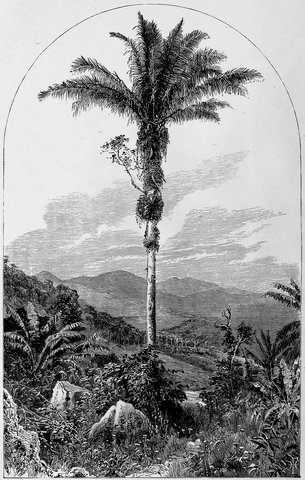
A species of Attalea common in the Serra d’Estrella. It bears two or three large bunches of olive-like berries, hanging immediately below the crown of leaves. The upper part of the stem is often overgrown with parasites, as in the specimen represented here.
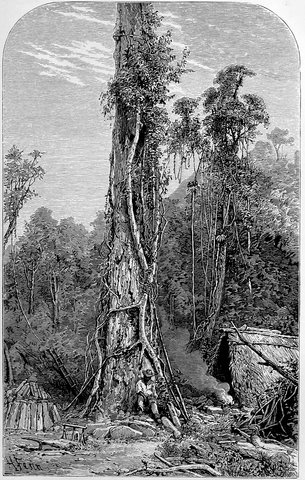
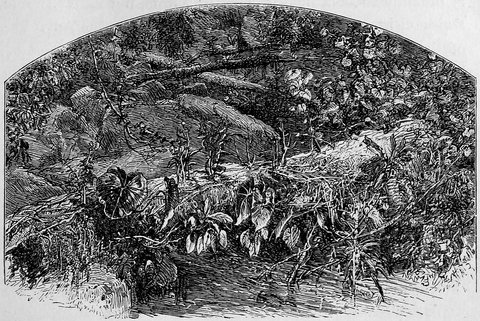
There are a great many parasites, the stem and roots of which are attached to larger trees; this woodcut represents one of those strange “tree-killers,” as they are called by the natives, belonging to the family of the Fig-trees, which, beginning their growth among the upper branches of trees, gradually descend to the ground, throw out branches around the stem they attack, and in the end kill it in their embrace. On the right are Lianas, from which hang parasitic flowers.
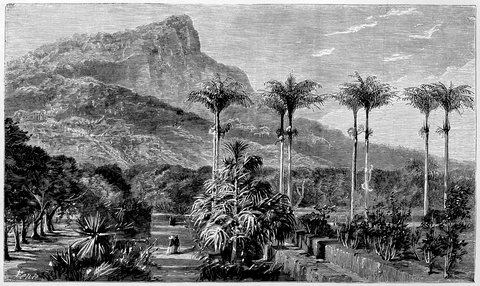
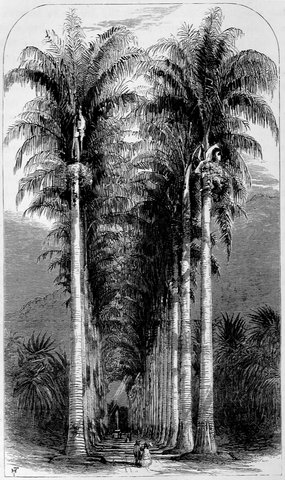
Part of the Botanical Garden in Rio de Janeiro. In the foreground a Pandanus covered with fruits. The Palms standing in pairs in the great alley are commonly called Palma Real. Their botanical name is Oreodoxa oleracea. The peak of Corcovado forms the background.
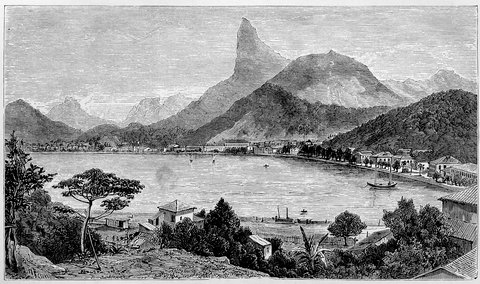
The great southeastern bay in the harbor of Rio de Janeiro. The highest peak in the centre is the Corcovado, at the foot of which stand the Insane Asylum and the Military School. On the left are the Gavia and the Sugar-Loaf; on the right, Tijuca. A beach runs all round the bay.
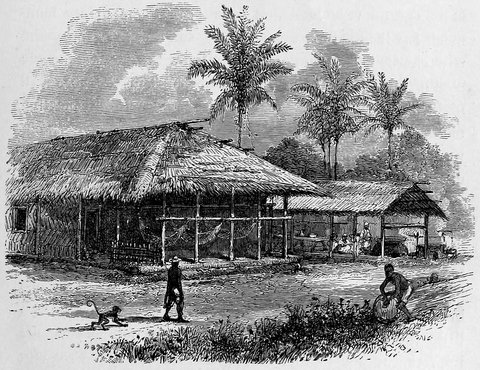
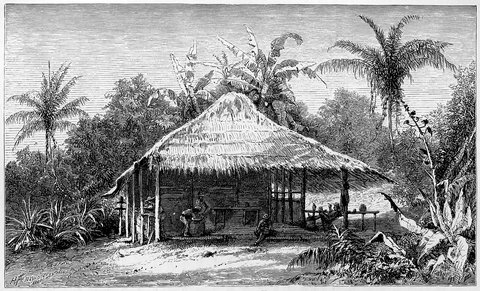
The palm on the left is a Pupunha (Guilielma speciosa); the large-leaved trees back of the building are Bananas, and the Palm on the right a Javari (Astrocaryum Javari).
From a water-colored painting by Mr. J. Burkhardt.
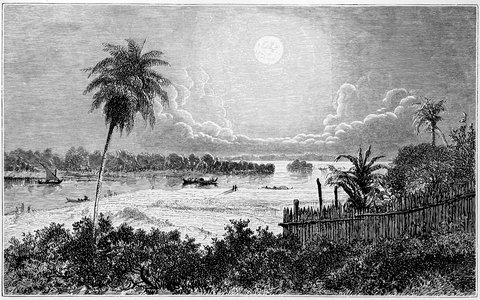
The Palm in the foreground is a Mucaja (Acrocomia lasiospatha); near the fence stand Banana-trees, and in the distance on the right a Tucuma Palm (Astrocaryum Tucuma).
From a water-colored painting by Mr. J. Burkhardt.
This Palm, called Œnocarpus distychius by botanists, is remarkable for the arrangement of its leaves, which are placed opposite to each other on two sides of the trunk, and higher and higher alternately, so that, seen from one side, the two rows of leaves are equally visible, and have the appearance of a wide fan; seen in profile, they look like a narrow plume.
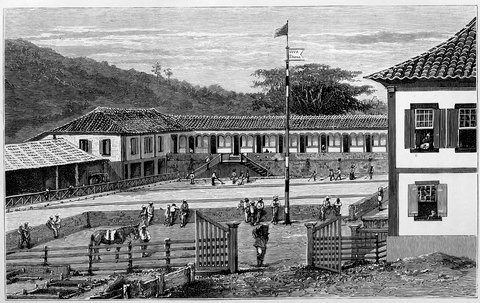
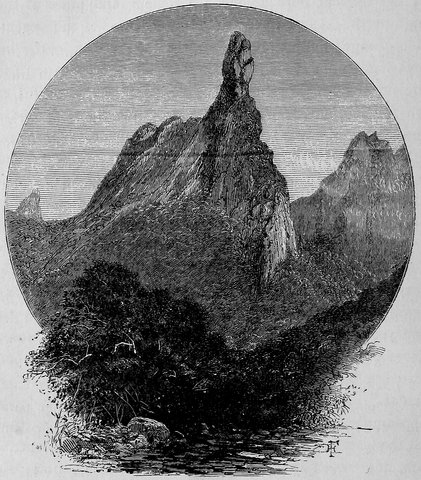
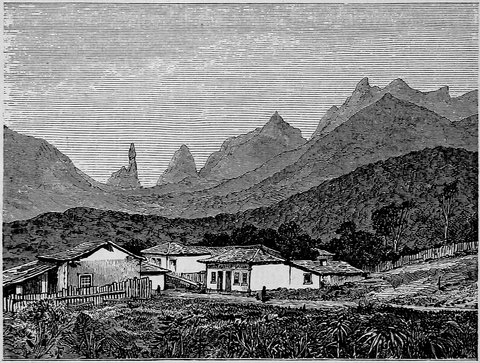
The loose boulder alluded to in the text stands on the fourth peak from the left.
From a photograph by G. Leuzinger.
A JOURNEY IN BRAZIL.
CHAPTER I. VOYAGE FROM NEW YORK TO RIO DE JANEIRO.
1
First Sunday at Sea.—Gulf Stream.—Gulf-Weed.—Lectures proposed.—First
Lecture: “On the Gulf Stream in the Gulf Stream.”—Aquarium
established on board.—Second Lecture.—Rough Sea.—Peculiar
Tint of Water.—Third Lecture: Laying out Work of
Expedition in Brazil; Distribution of Fishes in Brazilian Rivers; its
Bearing on Origin of Species; Collecting of Eggs.—Tropical Sunset.—Fourth
Lecture: Plan of Geological Investigations with special
reference to Glacial Phenomena in South America.—Flying-Fish.—Fifth
Lecture: Glacial Phenomena, continued.—Second Sunday
at Sea.—Rough Water.—Sixth Lecture: Embryological Investigations
as a Guide to sound Classification.—Seventh Lecture.—Moonlight
Nights.—Trade-Winds.—Eighth Lecture: Importance of
Precision in Localizing Specimens.—Southern Cross.—Ninth Lecture:
Fresh-water Fishes of Brazil.—Easter Sunday.—First Sight
of South American Shore.—Olinda.—Pernambuco.—Catamarans.—Tenth
Lecture: Methods of Collecting.—Eleventh Lecture: Classification
of Fishes, as illustrated by Embryology.—Preparations
for Arrival.—Twelfth Lecture: Practical Lesson in Embryology—Closing
Lecture: Transmutation Theory; Intellectual and Political
Independence.—Resolutions and Speeches.—Singular Red
Patches on the Surface of the Sea.
April 2d, 1865.—Our first Sunday at sea. The weather
is delicious, the ship as steady as anything on the water
can be, and even the most forlorn of our party have little
excuse for sea-sickness. We have had service from Bishop
Potter this morning, and since then we have been on deck
reading, walking, watching a singular cloud, which the
captain says is a cloud of smoke, in the direction of Petersburg.
We think it may be the smoke of a great decisive
2engagement going on while we sail peacefully along.
What it means, or how the battle ends, if battle it be, we
shall not know for two months perhaps.[2] Mr. Agassiz is
busy to-day in taking notes, at regular intervals, of the
temperature of the water, as we approach the Gulf Stream.
To-night we cut it at right angles, and he will remain on
deck to continue his observations.
April 3d.—The Professor sat up last night as he intended,
and found his watch, which was shared by one or
two of his young assistants, very interesting. We crossed
the Gulf Stream opposite Cape Hatteras, at a latitude where
it is comparatively narrow, some sixty miles only in breadth.
Entering it at about six o’clock, we passed out of it a
little after midnight. The western boundary of the warm
waters stretching along the coast had a temperature of
about 57°. Immediately after entering it, the temperature
began to rise gradually, the maximum being about 74°,
falling occasionally, however, when we passed through a
cold streak, to 68°. These cold streaks in the Gulf Stream,
which reach to a considerable depth, the warm and cold
waters descending together in immediate contact for at
least a hundred fathoms, are attributed by Dr. Bache to
the fact that the Gulf Stream is not stationary. It sways
as a whole sometimes a little toward the shore, sometimes
a little away from it, and, in consequence of this, the
colder water from the coast creeps in, forming these vertical
layers in its midst. The eastern boundary is warmer
3than the western one, for the latter is chilled by the Arctic
currents, which form a band of cold water all along the
Atlantic shore. Their influence is felt nearly to the latitude
of Florida. On coming out of the Gulf Stream the
temperature of the water was 68°, and so it continued for
an hour longer, after which Mr. Agassiz ceased his observations.
To-day some of the gulf-weed was gathered by a
sailor, and we found it crowded with life. Hydroids, in
numbers, had their home upon it; the delicate branching
plumularia and a pretty campanularia, very like some of
our New England species; beside these, bryozoa, tiny compound
mollusks, crusted its stem, and barnacles were abundant
upon it. These are all the wonders that the deep has
yielded us to-day, though the pretty Portuguese men-of-war
go floating by the vessel, out of reach thus far. Such are
the events of our life: we eat and drink and sleep, read,
study Portuguese, and write up our journals.
April 4th.—It has occurred to Mr. Agassiz, as a means
of preparing the young men who accompany him for the
work before them, to give a course of lectures on ship-board.
Some preparation of the kind is the more necessary,
since much of the work must be done independently of
him, as it will be impossible for so large a party to travel
together; and the instructions needed will be more easily
given in a daily lecture to all, than in separate conversations
with each one singly. The idea finds general favor.
The large saloon makes an excellent lecture-room; a couple
of leaves from the dining-table with a black oil-cloth
stretched across them serve as a blackboard. The audience
consists, not only of our own company, but includes
the few ladies who are on board, Mr. Bradbury, the captain
of our steamer, Bishop Potter, some of the ship’s officers,
4and a few additional passengers, all of whom seem to think
the lecture a pleasant break in the monotony of a sea voyage.
To-day the subject was naturally suggested by the seaweeds
of the Gulf Stream, so recently caught and so crowded
with life,—“A lecture on the Gulf Stream in the Gulf
Stream,” as one of the listeners suggests. It was opened,
however, by a few words on the exceptional character of the
position of this scientific commission on board the Colorado.
“Fifty years ago, when naturalists carried their investigations
to distant lands, either government was obliged to provide
an expensive outfit for them, or, if they had no such
patronage, scanty opportunities grudgingly given might be
granted them on ordinary conveyances. Even if such accommodation
were allowed them, their presence was looked
upon as a nuisance: no general interest was felt in their
objects; it was much if they were permitted, on board some
vessel, to have their bucket of specimens in a corner, which
any sailor might kick over, unreproved, if it chanced to stand
in his way. This ship, and the spirit prevailing in her command,
opens to me a vista such as I never dreamed of till I
stood upon her deck. Here, in place of the meagre chances
I remember in old times, the facilities could hardly be greater
if the ship had been built as a scientific laboratory. If any
such occasion has ever been known before, if any naturalist
has ever been treated with such consideration, and found
such intelligent appreciation of his highest aims, on board
a merchant-ship fitted up for purposes of trade, I am not
aware of it. I hope the first trip of the Colorado will be remembered
in the annals of science. I, at least, shall know
whom to thank for an opportunity so unique. This voyage,
and the circumstances connected with it, are, to me, the
signs of a good time coming; when men of different interests
5will help each other; when naturalists will be more
liberal and sailors more cultivated, and natural science and
navigation will work hand in hand. And now for my
lecture,—my first lecture on ship-board.”
The lecture was given, of course, specimen in hand, the
various inhabitants of the branch of seaweed giving their
evidence in succession of their own structure and way of
life. To these living illustrations were added drawings on
the blackboard to show the transformations of the animals,
their embryological history, &c.[3] Since the lecture, Captain
Bradbury has fitted up a large tank as an aquarium, where
any specimens taken during the voyage may be preserved
and examined. Mr. Agassiz is perfectly happy, enjoying
every hour of the voyage, as well he may, surrounded as
he is with such considerate kindness.
April 6th.—Though I took notes, as usual, of the lecture
yesterday, I had not energy enough to enter them in my
journal. The subject was the Gulf Stream,—the stream
itself this time, not the animals it carries along with it.
Mr. Agassiz’s late observations, though deeply interesting to
himself, inasmuch as personal confirmation of facts already
known is always satisfactory, have nothing novel now-a-days;
yet the history of the facts connected with the discovery
of the Gulf Stream, and their gradual development,
is always attractive, and especially so to Americans, on account
of its direct connection with scientific investigations
6carried on under our government. Mr. Agassiz gave a slight
sketch of this in opening his lecture. “It was Franklin
who first systematically observed these facts, though they
had been noticed long before by navigators. He recorded
the temperature of the water as he left the American continent
for Europe, and found that it continued cold for
a certain distance, then rose suddenly, and after a given
time sank again to a lower temperature, though not so low
as before. With the comprehensive grasp of mind characteristic
of all his scientific results, he went at once beyond
his facts. He inferred that the warm current, keeping its
way so steadily through the broad Atlantic, and carrying
tropical productions to the northern shores of Europe, must
take its rise in tropical regions, must be heated by a tropical
sun.[4] This was his inference: to work it out, to ascertain
the origin and course of the Gulf Stream, has been, in a
great degree, the task of the United States Coast Survey,
under the direction of his descendant, Dr. Bache.”[5]
7We are now fairly in the tropics. “The trades” blow
heavily, and yesterday was a dreary day for those unused to
the ocean; the beautiful blue water, of a peculiar metallic
tint, as remarkable in color, it seemed to me, as the water
of the Lake of Geneva, did not console us for the heavy
moral and physical depression of sea-sick mortals. To-day
the world looks brighter; there is a good deal of motion,
but we are more accustomed to it. This morning the lecture
had, for the first time, a direct bearing upon the work
of the expedition. The subject was, “How to observe,
and what are the objects of scientific explorations in modern
times.”
“My companions and myself have come together so suddenly
and so unexpectedly on our present errand, that we
have had little time to organize our work. The laying out
of a general scheme of operations is, therefore, the first and
one of the most important points to be discussed between
us. The time for great discoveries is passed. No student
of nature goes out now expecting to find a new world, or
looks in the heavens for any new theory of the solar system.
The work of the naturalist, in our day, is to explore worlds
the existence of which is already known; to investigate,
not to discover. The first explorers, in this modern sense,
were Humboldt in the physical world, Cuvier in natural
history, Lavoisier in chemistry, La Place in astronomy.
They have been the pioneers in the kind of scientific work
characteristic of our century. We who have chosen Brazil
as our field must seek to make ourselves familiar with its
physical features, its mountains and its rivers, its animals
and plants. There is a change, however, to be introduced
8in our mode of work, as compared with that of former
investigators. When less was known of animals and plants
the discovery of new species was the great object. This
has been carried too far, and is now almost the lowest kind
of scientific work. The discovery of a new species as such
does not change a feature in the science of natural history,
any more than the discovery of a new asteroid changes
the character of the problems to be investigated by astronomers.
It is merely adding to the enumeration of objects.
We should look rather for the fundamental relations among
animals; the number of species we may find is of importance
only so far as they explain the distribution and limitation
of different genera and families, their relations to
each other and to the physical conditions under which they
live. Out of such investigations there looms up a deeper
question for scientific men, the solution of which is to be
the most important result of their work in coming generations.
The origin of life is the great question of the day.
How did the organic world come to be as it is? It must
be our aim to throw some light on this subject by our present
journey. How did Brazil come to be inhabited by the
animals and plants now living there? Who were its inhabitants
in past times? What reason is there to believe that
the present condition of things in this country is in any
sense derived from the past? The first step in this investigation
must be to ascertain the geographical distribution
of the present animals and plants. Suppose we first examine
the Rio San Francisco. The basin of this river is
entirely isolated. Are its inhabitants, like its waters, completely
distinct from those of other basins? Are its species
peculiar to itself, and not repeated in any other river of
the continent? Extraordinary as this result would seem,
9I nevertheless expect to find it so. The next water-basin
we shall have to examine will be that of the Amazons,
which connects through the Rio Negro with the Orinoco.
It has been frequently repeated that the same species of
fish exist in the waters of the San Francisco and in those
of Guiana and of the Amazons. At all events, our works
on fishes constantly indicate Brazil and Guiana as the
common home of many species; but this observation has
never been made with sufficient accuracy to merit confidence.
Fifty years ago the exact locality from which
any animal came seemed an unimportant fact in its scientific
history, for the bearing of this question on that
of origin was not then perceived. To say that any specimen
came from South America was quite enough; to
specify that it came from Brazil, from the Amazons, the
San Francisco, or the La Plata, seemed a marvellous accuracy
in the observers. In the museum at Paris, for instance,
there are many specimens entered as coming from New
York or from Pará; but all that is absolutely known about
them is that they were shipped from those sea-ports. Nobody
knows exactly where they were collected. So there are
specimens entered as coming from the Rio San Francisco,
but it is by no means sure that they came exclusively from
that water-basin. All this kind of investigation is far too
loose for our present object. Our work must be done with
much more precision; it must tell something positive of
the geographical distribution of animals in Brazil. Therefore,
my young friends who come with me on this expedition,
let us be careful that every specimen has a label,
recording locality and date, so secured that it shall reach
Cambridge safely. It would be still better to attach two
labels to each specimen, so that, if any mischance happens
10to one, our record may not be lost. We must try not to
mix the fishes of different rivers, even though they flow
into each other, but to keep our collections perfectly distinct.
You will easily see the vast importance of thus
ascertaining the limitation of species, and the bearing of
the result on the great question of origin.
“Something is already known. It is ascertained that
the South American rivers possess some fishes peculiar to
them. Were these fishes then created in these separate
water-systems as they now exist, or have they been transferred
thither from some other water-bed? If not born
there, how did they come there? Is there, or has there
ever been, any possible connection between these water-systems?
Are their characteristic species repeated elsewhere?
Thus we narrow the boundaries of the investigation, and
bring it, by successive approaches, nearer the ultimate
question. But the first inquiry is, How far are species
distinct all over the world, and what are their limits? Till
this is ascertained, all theories about their origin, their
derivation from one another, their successive transformation,
their migration from given centres, and so on, are
mere beating about the bush. I allude especially to the
fresh-water fishes, in connection with this investigation,
on account of the precision of their boundaries. Looking
at the matter theoretically, without a positive investigation,
I do not expect to find a single species of the Lower Amazons
above Tabatinga.[6] I base this supposition upon my own observations
11respecting the distribution of species in the European
rivers. I have found that, while some species occur
simultaneously in the many upper water-courses which combine
to form the Rhine, the Rhone, and the Danube, most
of them are not found in the lower course of these rivers;
that, again, certain species are found in two of these water-basins
and do not occur in the third, or inhabit only one
and are not to be met in the two others. The brook trout,
for instance (Salmo Fario), is common to the upper course
and the higher tributaries of all the three river-systems,
but does not inhabit the main bed of their lower course.
So it is, also, and in a more striking degree, with the Salmling
(Salmo Salvelinus). The Huchen (Salmo Hucho) is
only found in the Danube. But the distribution of the
perch family in these rivers is, perhaps, the most remarkable.
The Zingel (Aspro Zingel) and the Schrætzer (Acerina
Schrætzer) are only found in the Danube; while Acerina
cernua is found in the Danube as well as in the Rhine,
but not in the Rhone; and Aspro asper in the Danube as
well as in the Rhone, but not in the Rhine. The Sander
(Lucioperca Sandra) is found in the Danube and the other
large rivers of Eastern Europe, but occurs neither in the
Rhine nor in the Rhone. The common perch (Perca fluviatilis),
on the contrary, is found both in the Rhine and
Rhone, but not in the Danube, which, however, nourishes
another species of true Perca, already described by Schaeffer
as Perca vulgaris. Again, the pickerel (Esox Lucius) is
common to all these rivers, especially in their lower course,
and so is also the cusk (Lota vulgaris). The special distribution
12of the carp family would afford many other
striking examples, but they are too numerous and too little
known to be used as an illustration here.
“This is among the most remarkable instances of what
I would call the arbitrary character of geographical distribution.
Such facts cannot be explained by any theory
of accidental dispersion, for the upper mountain rivulets,
in which these great rivers take their rise, have no connection
with each other; nor can any local circumstance
explain the presence of some species in all the three basins,
while others appear only in one, or perhaps in two, and are
absent from the third, or the fact that certain species
inhabiting the head-waters of these streams are never found
in their lower course when the descent would seem so
natural and so easy. In the absence of any positive explanation,
we are left to assume that the distribution of animal
life has primary laws as definite and precise as those
which govern anything else in the system of the universe.
“It is for the sake of investigations of this kind that
I wish our party to divide, in order that we may cover as
wide a ground as possible, and compare a greater number
of the water-basins of Brazil. I wish the same to be done,
as far as may be, for all the classes of Vertebrates, as
well as for Mollusks, Articulates, and Radiates. As we
have no special botanist in the party, we must be content
to make a methodical collection of the most characteristic
families of trees, such as the palms and tree ferns. A collection
of the stems of these trees would be especially
important as a guide to the identification of fossil woods.
Much more is known of the geographical distribution of
plants than of animals, however, and there is, therefore,
less to be done that is new in that direction.
13“Our next aim, and with the same object, namely, its
bearing upon the question of origin, will be the study of the
young, the collecting of eggs and embryos. This is the
more important, since museums generally show only adult
specimens. As far as I know, the Zoölogical Museum at
Cambridge is the only one containing large collections of
embryological specimens from all the classes of the animal
kingdom. One significant fact, however, is already
known. In their earliest stages of growth all animals of
the same class are much more alike than in their adult
condition, and sometimes so nearly alike as hardly to be
distinguished. Indeed, there is an early period when the
resemblances greatly outweigh the differences. How far
the representatives of different classes resemble one another
remains to be ascertained with precision. There are two
possible interpretations of these facts. One is that animals
so nearly identical in the beginning must have been originally
derived from one germ, and are but modifications or
transmutations, under various physical conditions, of this
primitive unit. The other interpretation, founded on the
same facts, is, that since, notwithstanding this material identity
in the beginning, no germ ever grows to be different
from its parent, or diverges from the pattern imposed upon
it at its birth, therefore some other cause besides a material
one must control its development; and if this be so, we have
to seek an explanation of the differences between animals
outside of physical influences. Thus far both these views
rest chiefly upon personal convictions and opinions. The
true solution of the problem must be sought in the study
of the development of the animals themselves, and embryology
is still in its infancy; for, though a very complete
study of the embryology of a few animals has been made,
14yet these investigations include so small a number of representatives
from the different classes of the animal kingdom
that they do not yet give a basis for broad generalizations.
Very little is known of the earlier stages in the formation
of hosts of insects whose later metamorphoses, including
the change of the already advanced larva, first to the condition
of a chrysalis and then to that of a perfect insect,
have been carefully traced. It remains to be ascertained
to what extent the caterpillars of different kinds of butterflies,
for instance, resemble one another during the time of
their formation in the egg. An immense field of observation
is open in this order alone.
“I have, myself, examined over one hundred species
of bird embryos, now put up in the museum of Cambridge,
and found that, at a certain age, they all have bills, wings,
legs, feet, &c., &c. exactly alike. The young robin and
the young crow are web-footed, as well as the duck. It is
only later that the fingers of the foot become distinct.
How very interesting it will be to continue this investigation
among the tropical birds!—to see whether, for instance,
the toucan, with its gigantic bill, has, at a certain age, a
bill like that of all other birds; whether the spoonbill ibis
has, at the same age, nothing characteristic in the shape
of its bill. No living naturalist could now tell you one
word about all this; neither could he give you any information
about corresponding facts in the growth of the
fishes, reptiles, or quadrupeds of Brazil, not one of the
young of these animals having ever been compared with
the adult. In these lectures I only aim at showing you
what an extensive and interesting field of investigation
opens before us; if we succeed in cultivating even a few
corners of it we shall be fortunate.”
15In the evening, which is always the most enjoyable part
of our day, we sat on the guards and watched the first tropical
sunset we had yet seen. The sun went down in purple
and gold, and, after its departure, sent back a glow that
crimsoned the clouds almost to the zenith, dying off to
paler rose tints on the edges, while heavy masses of gray
vapor, just beginning to be silvered by the moon, swept
up from the south.
April 7th.—To-day the lecture was upon the physical
features of South America, something with reference to
the geological and geographical work in which Mr. Agassiz
hopes to have efficient aid from his younger assistants.
So much of the lecture consisted of explanations given
upon geological maps that it is difficult to record it. Its
principal object, however, was to show in what direction
they should work in order to give greater precision to the
general information already secured respecting the formation
of the continent. “The basin of the Amazons, for
instance, is a level plain. The whole of it is covered
with loose materials. We must watch carefully the character
of these loose materials, and try to track them to
their origin. As there are very characteristic rocks in
various parts of this plain, we shall have a clew to the
nature of at least some portion of these materials. My
own previous studies have given me a special interest in
certain questions connected with these facts. What power
has ground up these loose materials? Are they the result
of disintegration of the rock by ordinary atmospheric
agents, or are they caused by the action of water, or by
that of glaciers? Was there ever a time when large masses
of ice descended far lower than the present snow line of
the Andes, and, moving over the low lands, ground these
16materials to powder? We know that such an agency has
been at work on the northern half of this hemisphere. We
have now to look for its traces on the southern half, where
no such investigations have ever been made within its warm
latitudes; though to Darwin science is already indebted for
much valuable information concerning the glacial phenomena
of the temperate and colder portions of the South American
continent. We should examine the loose materials in every
river we ascend, and see what relation they bear to the dry
land above. The color of the water in connection with the
nature of the banks will tell us something. The waters of
the Rio Branco, for instance, are said to be milky white;
those of the Rio Negro, black. In the latter case the color
is probably owing to the decomposition of vegetation. I
would advise each one of our parties to pass a large amount
of water from any river or stream along which they travel
through a filter, and to examine the deposit microscopically.
They will thus ascertain the character of the detritus,
whether from sand, or lime, or granite, or mere river mud
formed by the decomposition of organic matter. Even the
smaller streams and rivulets will have their peculiar character.
The Brazilian table-land rises to a broad ridge
running from west to east, and determining the direction
of the rivers. It is usually represented as a mountain
range, but is in fact nothing but a high flat ridge serving as
a water-shed, and cut transversely by deep fissures in which
the rivers flow. These fissures are broad in their lower
parts, but little is known of their upper range; and whoever
will examine their banks carefully will do an important
work for science. Indeed, very little is known accurately
of the geology of Brazil. On the geological maps almost
the whole country is represented as consisting of granite.
17If this be correct, it is very inconsistent with what we know
of the geological structure of other continents, where the
stratified rocks are in much larger proportions.”
Upon this followed some account of the different kinds of
valley formation and of terraces. “Do the old terraces
above the rivers of South America correspond to the river
terraces on any of our rivers,—those of the Connecticut,
for instance,—showing that their waters had formerly a
much greater depth and covered a much wider bottom?
There must of course have been a cause for this great
accumulation of water in ancient periods. I account for it
in the northern half of the hemisphere by the melting of
vast masses of ice in the glacial period, causing immense
freshets. There is no trustworthy account of the river
terraces in Brazil. Bates, however, describes flat-topped
hills between Santarem and Pará in the narrow part of the
valley, near Almeyrim, rising 800 feet above the present
level of the Amazons. If this part of the valley were
flooded in old times, banks might have been formed of which
these hills are a remnant. But because such a theory
might account for the facts it does not follow that the
theory is true. Our work must be to study the facts, to
see, among other things, of what these hills are built,
whether of rock or of loose materials. No one has told
us anything as yet of their geological constitution.”[7]
To-day we have seen numbers of flying-fish from the
deck, and were astonished at the grace and beauty of their
motion, which we had supposed to be rather a leap than
actual flight. And flight indeed it is not, their pectoral
18fins acting as sails rather than wings, and carrying them
along on the wind. They skim over the water in this way
to a great distance. Captain Bradbury told us he had
followed one with his glass and lost sight of it at a considerable
distance, without seeing it dip into the water again.
Mr. Agassiz has great delight in watching them.[8] Having
never before sailed in tropical seas, he enjoys every day some
new pleasure.
April 9th.—Yesterday Mr. Agassiz lectured upon the
traces of glaciers as they exist in the northern hemisphere,
and the signs of the same kind to be sought for in Brazil.
After a sketch of what has been done in glacial investigation in
Europe and the United States, showing the great extension of
ice over these regions in ancient times, he continued as follows:
“When the polar half of both hemispheres was covered
by such an ice shroud, the climate of the whole earth must
have been different from what it is now. The limits of the
ancient glaciers give us some estimate of this difference,
though of course only an approximate one. A degree of
temperature in the annual average of any given locality
corresponds to a degree of latitude; that is, a degree of
temperature is lost for every degree of latitude as we travel
northward, or gained for every degree of latitude as we travel
southward. In our times, the line at which the average
annual temperature is 32°, that is, at which glaciers may be
formed, is in latitude 60° or thereabouts, the latitude of
Greenland; while the height at which they may originate in
latitude 45° is about 6,000 feet. If it appear that the ancient
southern limit of glaciers is in latitude 36°, we must admit
that in those days the present climate of Greenland
extended to that line. Such a change of climate with
19reference to latitude must have been attended by a corresponding
change of climate with reference to altitude.
Three degrees of temperature correspond to about one
thousand feet of altitude. If, therefore, it is found that
the ancient limit of glacier action descends on the Andes,
for instance, to 7,000 feet above the level of the sea under
the equator, the present line of perpetual snow being at
15,000, it is safe to infer that in those days the climate
was some 24° or thereabouts below its present temperature.
That is, the temperature of the present snow line then prevailed
at a height of 7,000 feet above the sea level, as the
present average temperature of Greenland then prevailed in
latitude 36°. I am as confident that we shall find these
indications at about the limit I have pointed out as if I had
already seen them. I would even venture to prophesy that
the first moraines in the valley of the Marañon should be
found where it bends eastward above Jaen.”[9]
Although the weather is fine, the motion of the ship
continues to be so great that those of us who have not what
are popularly called “sea-legs,” have much ado to keep our
balance. For my own part, I am beginning to feel a personal
animosity to “the trades.” I had imagined them to be soft,
genial breezes wafting us gently southward; instead of
which they blow dead ahead all the time, and give us no
rest night or day. And yet we are very unreasonable to
grumble; for never were greater comforts and conveniences
20provided for voyagers on the great deep than are to be
found on this magnificent ship. The state-rooms large and
commodious, parlor and dining-hall well ventilated, cool, and
cheerful, the decks long and broad enough to give a chance
for extensive “constitutionals” to everybody who can stand
upright for two minutes together, the attendance punctual
and admirable in every respect; in short, nothing is left to
be desired except a little more stable footing.
April 10th.—A rough sea to-day, notwithstanding which
we had our lecture as usual, though I must say, that, owing
to the lurching of the ship, the lecturer pitched about more
than was consistent with the dignity of science. Mr. Agassiz
returned to the subject of embryology, urging upon his
assistants the importance of collecting materials for this
object as a means of obtaining an insight into the deeper
relations between animals.
“Heretofore classification has been arbitrary, inasmuch
as it has rested mainly upon the interpretation given to
structural differences by various observers, who did not
measure the character and value of these differences by
any natural standard. I believe that we have a more
certain guide in these matters than opinion or the individual
estimate of any observer, however keen his insight
into structural differences. The true principle of classification
exists in Nature herself, and we have only to decipher
it. If this conviction be correct, the next question is,
How can we make this principle a practical one in our
laboratories, an active stimulus in our investigations? Is it
susceptible of positive demonstration in material facts? Is
there any method to be adopted as a correct guide, if we
set aside the idea of originating systems of classification
of our own, and seek only to read that already written in
21nature? I answer, Yes. The standard is to be found in
the changes animals undergo from their first formation
in the egg to their adult condition.
“It would be impossible for me here and now to give
you the details of this method of investigation, but I can
tell you enough to illustrate my statement. Take a homely
and very familiar example, that of the branch of Articulates.
Naturalists divide this branch into three classes,—Insects,
Crustacea, and Worms; and most of them tell you that Worms
are lowest, Crustacea next in rank, and that Insects stand
highest, while others have placed the Crustacea at the head
of the group. We may well ask why. Why does an insect
stand above a crustacean, or, vice versa, why is a grasshopper
or a butterfly structurally superior to a lobster or a
shrimp? And indeed there must be a difference in opinion
as to the respective standing of these groups so long as
their classification is allowed to remain a purely arbitrary
one, based only upon interpretation of anatomical details.
One man thinks the structural features of Insects superior,
and places them highest; another thinks the structural
features of the Crustacea highest, and places them at the
head. In either case it is only a question of individual
appreciation of the facts. But when we study the gradual
development of the insect, and find that in its earliest stages
it is worm-like, in its second, or chrysalis stage, it is crustacean-like,
and only in its final completion it assumes the
character of a perfect insect, we have a simple natural scale
by which to estimate the comparative rank of these animals.
Since we cannot suppose that there is a retrograde movement
in the development of any animal, we must believe
that the insect stands highest, and our classification in this
instance is dictated by Nature herself. This is one of the
22most striking examples, but there are others quite as much
so, though not as familiar. The frog, for instance, in its
successive stages of development, illustrates the comparative
standing of the orders composing the class to which it
belongs. These orders are differently classified by various
naturalists, according to their individual estimate of their
structural features. But the growth of the frog, like that
of the insects, gives us the true grade of the type.[10] There
are not many groups in which this comparison has been
carried out so fully as in the insects and frogs; but wherever
it has been tried it is found to be a perfectly sure test.
Occasional glimpses of these facts, seen disconnectedly, have
done much to confirm the development theory, so greatly
in vogue at present, though under a somewhat new form.
Those who sustain these views have seen that there was a
gradation between animals, and have inferred that it was a
material connection. But when we follow it in the growth
of the animals themselves, and find that, close as it is, no
animal ever misses its true development, or grows to be
anything but what it was meant to be, we are forced to
23admit that the gradation which unquestionably unites all
animals is an intellectual, not a material one. It exists in
the Mind which made them. As the works of a human
intellect are bound together by mental kinship, so are the
thoughts of the Creator spiritually united. I think that
considerations like these should be an inducement for us all
to collect the young of as many animals as possible on this
journey. In so doing we may change the fundamental
principles of classification, and confer a lasting benefit on
science.
“It is very important to select the right animals for such
investigations. I can conceive that a lifetime should be
passed in embryological studies, and yet little be learned of
the principles of classification. The embryology of the
worm, for instance, would not give us the natural classification
of the Articulates, because we should see only the first
step of the series; we should not reach the sequence of the
development. It would be like reading over and over again
the first chapter of a story. The embryology of the Insects,
on the contrary, would give us the whole succession of a
scale on the lowest level of which the Worms remain forever.
So the embryology of the frog will give us the classification
of the group to which it belongs, but the embryology of the
Cecilia, the lowest order in the group, will give us only the
initiatory steps. In the same way the naturalist who, in
studying the embryology of the reptiles, should begin with
their lowest representatives, the serpents, would make a
great mistake. But take the alligator, so abundant in the
regions to which we are going. An alligator’s egg in the
earliest condition of growth has never been opened by a
naturalist. The young have been occasionally taken from
the egg just before hatching, but absolutely nothing is known
24of their first phases of development. A complete embryology
of the alligator would give us not only the natural classification
of reptiles as they exist now, but might teach us something
of their history from the time of their introduction
upon earth to the present day. For embryology shows us
not only the relations of existing animals to each other, but
their relations to extinct types also. One prominent result
of embryological studies has been to show that animals in
the earlier stages of their growth resemble ancient representatives
of the same type belonging to past geological ages.
The first reptiles were introduced in the carboniferous epoch,
and they were very different from those now existing.
They were not numerous at that period; but later in the
world’s history there was a time, justly called the ‘age of
reptiles,’ when the gigantic Saurians, Plesiosaurians, and
Ichthyosaurians abounded. I believe, and my conviction is
drawn from my previous embryological studies, that the
changes of the alligator in the egg will give us the clew to
the structural relations of the Reptiles from their first creation
to the present day,—will give us, in other words, their
sequence in time as well as their sequence in growth. In
the class of Reptiles, then, the most instructive group we
can select with reference to the structural relations of the
type as it now exists, and their history in past times, will be
the alligator. We must therefore neglect no opportunity of
collecting their eggs in as large numbers as possible.
“There are other animals in Brazil, low in their class to
be sure, but yet very important to study embryologically, on
account of their relation to extinct types. These are the
sloths and armadillos,—animals of insignificant size in our
days, but anciently represented in gigantic proportions.
The Megatherium, the Mylodon, the Megalonyx, were some
25of these immense Mammalia. I believe that the embryonic
changes of the sloths and armadillos will explain the structural
relations of those huge Edentata and their connection
with the present ones. South America teems with the fossil
bones of these animals, which indeed penetrated into the
northern half of the hemisphere as high up as Georgia and
Kentucky, where their remains have been found. The
living representatives of the family are also numerous in
South America, and we should make it one of our chief
objects to get specimens of all ages and examine them from
their earliest phases upward. We must, above all, try not to
be led away from the more important aims of our study by
the diversity of objects. I have known many young naturalists
to miss the highest success by trying to cover too
much ground,—by becoming collectors rather than investigators.
Bitten by the mania for amassing a great number
and variety of species, such a man never returns to the
general consideration of more comprehensive features. We
must try to set before ourselves certain important questions,
and give ourselves resolutely to the investigation of these
points, even though we should sacrifice less important
things more readily reached.
“Another type full of interest, from an embryological
point of view, will be the Monkeys. Since some of our scientific
colleagues look upon them as our ancestors, it is important
that we should collect as many facts as possible concerning
their growth. Of course it would be better if we could
make the investigation in the land of the Orangs, Gorillas,
and Chimpanzees,—the highest monkeys and the nearest to
man in their development. Still even the process of growth
in the South American monkey will be very instructive.
Give a mathematician the initial elements of a series, and
26he will work out the whole; and so I believe when the laws
of embryological development are better understood, naturalists
will have a key to the limits of these cycles of growth,
and be able to appoint them their natural boundaries even
from partial data.
“Next in importance I would place the Tapirs. This is
one of a family whose geological antecedents are very
important and interesting. The Mastodons, the Palæotherium,
the Dinotherium, and other large Mammalia of the
Tertiaries, are closely related to the Tapir. The elephant,
rhinoceros, and the like, are of the same family. From its
structural standing next to the elephant, which is placed
highest in the group, the embryology of the Tapir would
give us a very complete series of changes. It would seem
from some of the fossil remains of this family that the
Pachyderms were formerly more nearly related to the
Ruminants and Rodents than they now are. Therefore it
would be well to study the embryology of the Capivari, the
Paca, and the Peccary, in connection with that of the Tapir.
Lastly, it will be important to learn something of the embryology
of the Manatee or Sea-Cow of the Amazons. It is
something like a porpoise in outline, and seems to be the
modern representative of the ancient Dinotherium.”
April 12th.—The lecture to-day was addressed especially
to the ornithologists of the party, its object being to show
how the same method of study,—that of testing the classification
by the phases of growth in the different groups,—might
be applied to the birds as profitably as to other types.
We have made good progress in the last forty-eight hours,
and are fast leaving our friends “the trades” behind. The
captain promises us smooth waters in a day or two. With
the dying away of the wind will come greater heat, but as
27yet we have had no intensely warm weather. The sun,
however, keeps us within doors a great part of the day,
but in the evening we sit on the guards, watch the sunset
over the waters, and then the moonlight, and so while away
the time till nine or ten o’clock, when one by one the party
disperses. The sea has been so rough that we have not
been able to capture anything, but when we get into
smoother waters, our naturalists will be on the look out
for jelly-fish, argonautas, and the like.
April 13th.—In to-day’s lecture Mr. Agassiz returned
again to the subject of geographical distribution and the
importance of localizing the collections with great precision.
“As Rio de Janeiro is our starting-point, the water-system
in its immediate neighborhood will be as it were a schoolroom
for us during the first week of our Brazilian life.
We shall not find it so easy a matter as it seems to keep
our collections distinct in this region. The head-waters of
some of the rivers near Rio, flowing in opposite directions,
are in such close proximity that it will be difficult sometimes
to distinguish them. Outside of the coast range, to which the
Organ Mountains belong, are a number of short streams, little
rills, so to speak, emptying directly into the ocean. It will
be important to ascertain whether the same animals occur
in all these short water-courses. I think this will be found
to be the case, because it is so with corresponding small
rivers on our northern coast. There are little rivers along
the whole coast from Maine to New Jersey; all these disconnected
rivers contain a similar fauna. There is another
extensive range inland of the coast ridge, the Serra de
Mantiquera, sloping gently down to the ocean south of the
Rio Belmonte or Jequitinhonha. Rivers arising in this
range are more complex; they have large tributaries.
28Their upper part is usually broken by waterfalls, their
lower course being more level; probably in the lower
courses of these rivers we shall find fishes similar to those
of the short coast streams, while in the higher broken
waters we shall find distinct faunæ.” The lecture closed
with some account of the excursions likely to be undertaken
in the neighborhood of Rio de Janeiro on arriving, and with
some practical instructions about collecting, based upon Mr.
Agassiz’s personal experience.[11]
29April 14th.—Last evening was the most beautiful we
have had since we left home; perfectly clear with the
exception of soft white masses of cloud on the horizon,
all their edges silvered by the moonlight. We looked our
last for many months to come on the north star, and saw the
southern cross for the first time. With the visible image I
lost a far more wonderful constellation which had lived in
my imagination; it has vanished with all its golden glory, a
celestial vision as amazing as that which converted Constantine,
and in its place stands the veritable constellation with
its four little points of light.
The lecture to-day was upon the fishes of South America.
“I will give you this morning a slight sketch of the characteristic
fishes in South America, as compared with those of
the Old World and North America. Though I do not know
how the fishes are distributed in the regions to which we
are going, and it is just upon the investigation of this point
that I want your help, I know their character as distinguished
from those of other continents. We must remember
that the most important aim of all our studies in
this direction will be the solution of the question whether
any given fauna is distinct and has originated where it now
exists. To this end I shall make you acquainted with the
Brazilian animals so far as I can in the short time we have
before beginning our active operations, in order that you
may be prepared to detect the law of their geographical
distribution. I shall speak to-day more especially of the
fresh-water fishes.
“In the northern hemisphere there is a remarkable group
of fishes known as the Sturgeons. They are chiefly found
in the waters flowing into the Polar seas, as the Mackenzie
River on our own continent, the Lena and Yenissei in the
30Old World, and in all the rivers and lakes of the temperate
zone, communicating with the Atlantic Ocean. They occur
in smaller numbers in most tributaries of the Mediterranean,
but are common in the Volga and Danube, as well
as in the Mississippi, in some of the rivers on our northern
Atlantic and Pacific coasts, and in China. This family
has no representatives in Africa, Southern Asia, Australia,
or South America, but there is a group corresponding
in a certain way to it in South America,—that of the Goniodonts.
Though some ichthyologists place them widely
apart in their classifications, there is, on the whole, a
striking resemblance between the Sturgeons and Goniodonts.
Groups of this kind, reproducing certain features
common to both, but differing by special structural modifications,
are called ‘representative types.’ This name applies
more especially to such groups when they are distributed
over different parts of the world. To naturalists the comparison
of one of these types with another is very interesting,
as touching upon the question of origin of species. To
those who believe that animals are derived from one another
the alternative here presented is very clear: either one of
these groups grew out of the other, or else they both had
common ancestors which were neither Sturgeons nor Goniodonts,
but combined the features of both and gave birth to
each.
“There is a third family of fishes, the Hornpouts or Bullheads,
called Siluroids by naturalists, which seem by their
structural character to occupy an intermediate position between
the Sturgeons and Goniodonts. There would seem
to be, then, in these three groups, so similar in certain features,
so distinct in others, the elements of a series. But
while their structural relations suggest a common origin,
31their geographical distribution seems to exclude it. Take,
for instance, the Hornpouts; they are very few in the northern
hemisphere, hardly ever occurring in those rivers where
the Sturgeons abound, and they are very numerous in the
southern hemisphere, in southern Asia, Australia, Africa,
and South America, where the Sturgeons are altogether
wanting. In South America the Siluroids everywhere exist
with the Goniodonts, in all other parts of the world without
them; the Goniodonts being only found in South America.
If these were the ancestors of the Siluroids in South America,
they were certainly not their ancestors anywhere else.
If the Sturgeons were the ancestors of the Siluroids and of
the Goniodonts, it is strange that their progeny should consist
of these two families in South America, and in the Old
World of the Siluroids only. But if all three had some
other common ancestry, it would be still more extraordinary
that its progeny should exhibit so specific a distribution upon
the surface of our globe. The Siluroids lay very large eggs,
and as they are very abundant in South America we shall
no doubt have opportunities of collecting them. Of the reproduction
of the Goniodonts absolutely nothing is known.
Of course the embryology of both these groups would have
a direct bearing on the problem of their origin.
“Another family very abundant in various parts of the
world is that of the Perches. They are found all over North
America, Europe, and Northern Asia; but there is not one
to be found in the fresh waters of the southern hemisphere.
In South America and in Africa they are represented however
by a very similar group, that of the Chromids. These
two groups are so much akin that from their structure it
would seem natural to suppose that the Chromids were
transformed Perches; the more so, since in the western
32hemisphere the latter extend from the high north to Texas,
south of which they are represented by the Chromids. Here
the geographical as well as the structural transition would
seem an easy one. But look at the eastern hemisphere.
Perches abound in Asia, Europe, and Australia, but there
are no Chromids there. How is it that the Perches of this
continent have been so fertile in producing Chromids, and
the Perches of all other continents, except Africa, absolutely
sterile in this respect? Or if we reverse the proposition,
and suppose the Perches to have grown out of the Chromids,
why have their ancestry disappeared so completely on the
Asiatic side of the world, while they do not seem to have
diminished on this? And if Perches and Chromids should
be represented as descending from an older common type,
I would answer that Palæontology knows nothing of such a
pedigree.
“Next come the Chubs, or in scientific nomenclature the
Cyprinoids. These fishes, variously called Chubs, Suckers,
or Carps, abound in all the fresh waters of the northern
hemisphere. They are also numerous in the eastern part
of the southern hemisphere, but have not a single representative
in South America. As the Goniodonts are characteristic
of the southern hemisphere in its western half, so
this group seems to be characteristic of it in its eastern
half. But while the Cyprinoids have no representative in
South America, there is another group there, structurally
akin to them, called the Cyprinodonts. They are all small-sized;
our Minnows belong to this group. From Maine to
Texas they are found in all the short rivers or creeks all
along the coast. It is for this reason that I expect to find
the short coast rivers of South America abounding in Minnows.
I remember to have found in the neighborhood of
33Mobile no less than six new species in the course of an afternoon’s
ramble. These fishes are almost all viviparous, or
at least lay their eggs in a very advanced state of development
of the young. The sexes differ so greatly in appearance
that they have sometimes been described as distinct
species, nay, even as distinct genera.[12] We must be on our
guard against a similar mistake. Here again we have two
groups, the Cyprinoids and Cyprinodonts, so similar in
their structural features that the development of one out
of the other naturally suggests itself. But in South America
there are no Cyprinoids at all, while the Cyprinodonts
abound; in Europe, Asia, and North America on the contrary,
the Cyprinoids are very numerous and the Cyprinodonts
comparatively few.” The Characines were next considered
with reference to their affinities as well as their
geographical distribution; and a few remarks were added
upon the smaller families known to have representatives in
the fresh waters of South America, such as the Erythrinoids,
the Gymnotines, &c. “I am often asked what is my
chief aim in this expedition to South America? No doubt
in a general way it is to collect materials for future study.
But the conviction which draws me irresistibly, is that the
combination of animals on this continent, where the faunæ
are so characteristic and so distinct from all others, will give
me the means of showing that the transmutation theory is
wholly without foundation in facts.” The lecture closed
with some account of the Salmonidæ, found all over the
northern hemisphere, but represented in South America by
the Characines, distinct species of which may be looked for
in the separate water-basins of Brazil; and also of several
other important families of South American fishes, especially
34the Osteoglossum, the Sudis, &c., interesting on account
of their relation to an extinct fossil type, that of the
Cœlacanths.[13]
April 17th.—Yesterday was Easter Sunday, and the day
was beautiful. The services from Bishop Potter in the
morning were very interesting; the more so for us on account
of the God speed he gave us. Wind and weather
permitting, it is the last Sunday we shall pass on board ship
together. The Bishop spoke with much earnestness and
sympathy of the objects of the expedition, addressing himself
especially to the young men, not only with reference
to their duties as connected with a scientific undertaking,
but as American citizens in a foreign country at this time
of war and misapprehension.
This morning we were quite entertained at meeting a
number of the so-called “Catamarans,” the crazy crafts of
the fishermen, who appear to be amphibious animals on this
coast. Their boats consist of a few logs lashed together,
over which the water breaks at every moment without apparently
disturbing the occupants in the least. They fish,
walk about, sit, lie down or stand, eat, drink, and sleep, to
all appearance as contented and comfortable as we are in
our princely steamer. Usually they go into port at nightfall,
but are occasionally driven out to sea by the wind, and
may sometimes be met with two hundred miles and more
from the shore. To-day we have fairly come upon the South
American coast. Yesterday we could catch sight occasionally
35of low sand banks; but this morning we have sailed
past the pretty little town of Olinda, with its convent on
the hill, and the larger city of Pernambuco, whose white
houses come quite down to the sea-shore. Immediately in
front of the town lies the reef, which runs southward along
the coast for a hundred miles and more, enclosing between
itself and the shore a strip of quiet waters, forming admirable
anchorage for small shipping. Before Pernambuco
this channel is quite deep, and directly in front of the town
there is a break in the reef forming a natural gateway
through which large vessels can enter. We have now left
the town behind, but the shore is still in sight; a flat coast
rising into low hills behind, and here and there dotted with
villages and fishing-huts.
The lecture on Saturday was rather practical than scientific,
on the best modes of collecting and preserving specimens,
the instruments to be used, &c. To-day it was upon
the classification of fishes as illustrated by embryology; the
same method of study as that explained the other day and
now applied to the class of fishes. “All fishes at the time
when the germ becomes distinct above the yolk have a
continuous fin over the whole back, around the tail, and
under the abdomen. The naked reptiles, those which have
no scales, such as frogs, toads, salamanders, and the like,
share in this embryological feature of the fishes. From this
identity of development I believe the naked reptiles to be
structurally nearer to the true fishes than to the scaly reptiles.
All fishes, and indeed all Vertebrates, even the highest,
have, at this early period, fissures in the side of the neck.
These are the first indications of gills, an organ the basis for
which exists in all Vertebrates at a certain period of their
life, but is fully developed and functionally active only in
36the lower ones, in which it acquires a special final structure;
giving place to lungs in the higher ones before they reach
their adult condition. From this time forward not only the
class characters, but those of the family, begin to be distinguished.
I will show you to-day how we may improve
the classification of fishes by studying their embryology.
Take, for instance, the family of Cods in its widest acceptation.
It consists of several genera, among which are
the Cod proper, the Cusk, and the Brotula. Naturalists
may differ in their estimation of the relative rank of these
genera, and even with reference to their affinity, but the
embryology of the Cod seems to me to give the natural
scale. In its early condition the Cod has the continuous fin
of the Brotula, next the dorsal and caudal fins become distinct,
as in the Cusk, and lastly the final individualization of
the fins takes place, and they break up into the three dorsals
and two anals of the Cod. Thus the Brotula represents the
infantile condition of the Cod, and of course stands lowest,
while the Cusk has its natural position between the two.
There are other genera belonging to this family, as, for instance,
the Lota or fresh-water Cusk and the Hake, the relative
position of which may be determined by further embryological
studies. I had an opportunity of observing something
in the development of the Hake which throws some
light on the relation of the Ophidini to the Cod family, though
thus far they have been associated with the Eel. The little
embryonic Hake on which I made my investigation was about
an inch and a half in length; it was much more slender
and elongated in proportion to its thickness than any of the
family of Cods in their adult condition, and had a continuous
fin all around the body. Although the structural relations
of the Eels are not fully understood, some of them, at
37least, now united as a distinct family under the name of
Ophidini, are known to be closely connected with the Cods,
and this character of the Hake in its early condition would
seem to show that this type of Eel is a sort of embryonic
form of the Cod family.
“Another well-known family of fishes is that of the Lophioides.
To this group belongs the Lophius or Goose-fish,
with which the Cottoids or Sculpins, and the Blennioids,
with Zoarces and Anarrhichas, the so-called Sea-cat, ought to
be associated. It was my good fortune to have an opportunity
of studying the development of the Lophius, and to my
surprise I found that its embryonic phases included the
whole series here alluded to, thus presenting another of
those natural scales on which I hope all our scientific classifications
will be remodelled when we obtain a better knowledge
of embryology. The Lophius in its youngest stage recalls
the Tænioids, being long and compressed; next it resembles
the Blennioids, and growing stouter passes through
a stage like Cottus, before it assumes the depressed form of
Lophius. In the family of Cyprinodonts I have observed the
young of Fundulus. They are destitute of ventrals, thus
showing that the genus Orestias stands lowest in its family.
I would allude to one other fact of this kind observed by Professor
Wyman. There has been a doubt among naturalists
as to the relative standing of the Skates and Sharks. On
geological evidence I had placed the Skates highest, because
the Sharks precede them in time; but this fact had not been
established on embryological evidence. Professor Wyman
has followed the embryology of the Skate through all its
phases, and has found that in its earlier condition it is slender
in outline, with the appearance of a diminutive shark,
and that only later it assumes the broad shield-like form and
38long tapering tail of the skate. Were it only that they
enable us to set aside all arbitrary decisions and base our
classifications on the teachings of nature, these investigations
would be invaluable; but their importance is increased
by the consideration that we are thus gradually led to
recognize the true affinities which bind all organized beings
into one great system.”
April 20th.—The day after to-morrow we shall enter
the Bay of Rio de Janeiro. One begins to see already
that little disturbance in the regularity of sea life which
precedes arrival. People are making up their letters, and
rearranging their luggage; there is a slight stir pervading
our small party of passengers and breaking up the even
tenor of the uniform life we have been leading together
for the last three weeks. It has been a delightful voyage,
and yet, under the most charming circumstances, life at
sea is a poor exchange for life on land, and we are all
glad to be near our haven.
On Tuesday the lecture was upon the formation and
growth of the egg; a sort of practical lesson in the study
of embryology; yesterday, upon the importance of ascertaining,
at the outset, the spawning season of the animals
in Brazil, and the means to that end. “It will often be
impossible for us to learn the breeding season of animals, a
matter in which country people are generally very ignorant.
But when we cannot obtain it from persons about us,
there are some indications in the animals themselves
which may serve as a guide. During my own investigations
upon the development of the turtles, when I opened
many thousands of eggs, I found that in these animals,
at least, the appearance of the ovaries is a pretty good
guide. They always contain several sets of eggs. Those
39which will be laid this year are the largest; those of
the following year are next in size; those of two years
hence still smaller, until we come to eggs so small that
it is impossible to perceive any difference between their
various phases of development. But we can readily tell
whether there are any eggs so advanced as to be near
laying, and distinguish between the brood of the year
and those which are to be hatched later. When the eggs
are about to be laid the whole surface is covered with
ramifying blood-vessels, and the yolk is of a very clear
bright yellow. Before the egg drops from the ovary this
network bursts; it shrivels up and forms a little scar
on the side of the ovary. Should we, therefore, on examining
the ovary of a turtle, find that these scars are
fresh, we may infer that the season for laying is not
over; or if we find some of the eggs much larger than
the rest and nearly mature, we shall know that it is
about to begin. How far this will hold good with respect
to alligators and other animals I do not know. I have
learned to recognize these signs in the turtles from my
long study of their embryology. With fishes it could
hardly be possible to distinguish the different sets of eggs
because they lay such numbers, and they are all so small.
But if we cannot distinguish the eggs of the different
years, it will be something to learn the size of their broods,
which differs very greatly in different families.”
The lecture concluded with some advice as to observing
and recording the metamorphoses of insects. “Though
much has been written on the societies of ants and other
like communities in Brazil, the accounts of different naturalists
do not agree. It would be well to collect the larvæ
of a great many insects, and try to raise them; but as this
40will be difficult and often impossible in travelling, we must
at least get the nests of ants, bees, wasps, and the like, in
order to ascertain all we can respecting their communities.
When these are not too large it is easy to secure them by
slipping a bag over them, thus taking the whole settlement
captive. It may then be preserved by dipping into alcohol,
and examined at leisure, so as to ascertain the number and
nature of the individuals contained in it, and learn something
at least of their habits. Nor let us neglect the domestic
establishments of spiders. There is an immense
variety of spiders in South America, and a great difference
in their webs. It would be well to preserve these on
sheets of paper, to make drawings of them, and examine
their threads microscopically.”
April 21st.—Yesterday Mr. Agassiz gave his closing
lecture, knowing that to-day all would be occupied with
preparations for landing. He gave a little history of Steenstrup
and Sars, and showed the influence their embryological
investigations have had in reforming classification, and
also their direct bearing upon the question of the origin of
species. To these investigators science owes the discovery
of the so-called “alternate generations,” in which the Hydroid,
either by budding or by the breaking up of its own
body, gives rise to numerous jelly-fishes; these lay eggs
which produce Hydroids again, and the Hydroids renew
the process as before.[14]
“These results are but recently added to the annals of science,
41and are not yet very extensively known in the community;
but when the facts are more fully understood, they
cannot fail to affect the fundamental principles of zoölogy.
I have been astonished to see how little weight Darwin
himself gives to this series of transformations; he hardly
alludes to it, and yet it has a very direct bearing on his
theory, since it shows that, however great the divergence
from the starting-point in any process of development, it
ever returns to the road of its normal destiny; the cycle
may be wide, but the boundaries are as impassable as if it
were narrower. However these processes of development
may approach, or even cross each other, they never end in
making any living being different from the one which gave
it birth, though in reaching that point it may pass through
phases resembling other animals.
“In considering these questions we should remember how
slight are most of those specific differences, the origin of
which gives rise to so much controversy, in comparison with
the cycle of changes undergone by every individual in the
course of its development. There are numerous genera,
including many very closely allied species, distinguished by
differences which, were it not for the fact that they have
remained unchanged and invariable through ages, might be
termed insignificant. Such, for instance, are the various
species of corals found in the everglades of Florida, where
they lived and died ages ago, and had the identical
specific differences by which we distinguish their successors
in the present Florida reefs. The whole science of
zoölogy in its present condition is based upon the fact that
these slight differences are maintained generation after generation.
And yet every individual on such a coral stock,—and
the same is true of any individual in any class whatsoever
42of the whole animal kingdom, whether Radiate, Mollusk,
Articulate, or Vertebrate,—before reaching its adult
condition and assuming the permanent characters which distinguish
it from other species, and have never been known to
vary, passes in a comparatively short period through an extraordinary
transformation, the successive phases of which
differ far more from each other than do the adult species.
In other words, the same individual differs more from himself
in successive stages of his growth than he does in his
adult condition from kindred species of the same genus.
The conclusion seems inevitable, that, if the slight differences
which distinguish species were not inherent, and if
the phases through which every individual has to pass were
not the appointed means to reach that end, themselves invariable,
there would be ever-recurring deviations from the
normal types. Every naturalist knows that this is not the
case. All the deviations known to us are monstrosities, and
the occurrence of these, under disturbing influences, are to
my mind only additional evidence of the fixity of species.
The extreme deviations obtained in domesticity are secured,
as is well known, at the expense of the typical characters,
and end usually in the production of sterile individuals.
All such facts seem to show that so-called varieties or
breeds, far from indicating the beginning of new types, or
the initiating of incipient species, only point out the range
of flexibility in types which in their essence are invariable.
“In the discussion of the development theory in its present
form, a great deal is said of the imperfection of the
geological record. But it seems to me that, however fragmentary
our knowledge of geology, its incompleteness does
not invalidate certain important points in the evidence. It
is well known that the crust of our earth is divided into a
43number of layers, all of which contain the remains of distinct
populations. These different sets of inhabitants who
have possessed the earth at successive periods have each
a character of their own. The transmutation theory insists
that they owe their origin to gradual transformations,
and are not, therefore, the result of distinct creative acts.
All agree, however, that we arrive at a lower stratum where
no trace of life is to be found. Place it where we will:
suppose that we are mistaken in thinking that we have
reached the beginning of life with the lowest Cambrian
deposit; suppose that the first animals preceded this epoch,
and that there was an earlier epoch, to be called the Laurentian
system, beside many others older still; it is nevertheless
true that geology brings us down to a level at which the character
of the earth’s crust made organic life impossible. At
this point, wherever we place it, the origin of animals by development
was impossible, because they had no ancestors.
This is the true starting-point, and until we have some facts
to prove that the power, whatever it was, which originated
the first animals has ceased to act, I see no reason for referring
the origin of life to any other cause. I grant that we
have no such evidence of an active creative power as Science
requires for positive demonstration of her laws, and that
we cannot explain the processes which lie at the origin of
life. But if the facts are insufficient on our side, they are
absolutely wanting on the other. We cannot certainly consider
the development theory proved, because a few naturalists
think it plausible: it seems plausible only to the
few, and it is demonstrated by none. I bring this subject
before you now, not to urge upon you this or that theory,
strong as my own convictions are. I wish only to warn
you, not against the development theory itself, but against
44the looseness in the methods of study upon which it is
based. Whatever be your ultimate opinions on this subject,
let them rest on facts and not on arguments, however
plausible. This is not a question to be argued, it is one
to be investigated.
“As I have advanced in these talks with you, I have
become more and more dissatisfied, feeling the difficulty
of laying out our work without a practical familiarity
with the objects themselves. But this is the inevitable
position of one who is seeking the truth: till we have
found it, we are more or less feeling our way. I am aware
that in my lectures I have covered a far wider range of
subjects than we can handle, even if every man do his
very best; if we accomplish one tenth of the work I
have suggested, I shall be more than satisfied with the
result of the expedition. In closing, I can hardly add
anything to the impressive admonitions of Bishop Potter
in his parting words to us last Sunday, for which I thank
him in your name and my own. But I would remind
you, that, while America has recovered her political independence,
while we all have that confidence in our institutions
which makes us secure, that so far as we are
true to them, doing what we do conscientiously and in
full view of our responsibilities we shall be in the right
path, we have not yet achieved our intellectual independence.
There is a disposition in this country to refer
all literary and scientific matters to European tribunals;
to accept a man because he has obtained the award of
societies abroad. An American author is often better
satisfied if he publish his book in England than at home.
In my opinion, every man who publishes his work on the
other side of the water deprives his country of so much
45intellectual capital to which she has a right. Publish
your results at home, and let Europe discover whether
they are worth reading. Not until you are faithful to
your citizenship in your intellectual as well as your political
life, will you be truly upright and worthy students
of nature.”
At the conclusion of these remarks a set of resolutions
was read by Bishop Potter.[15] They were followed by a
few little friendly speeches, all made in the most informal
and cordial spirit; and so ended our course of lectures
on board the Colorado. Later in the day we observed
singular bright red patches in the sea. Some were not
less than seven or eight feet in length, rather oblong,
and the whole mass looked as red as blood. Sometimes they
seemed to lie on the very top of the water, sometimes to
be a little below it, so as only to tinge the rippling surface.
One of the sailors succeeded in catching a portion of it in a
bucket, when it was found to consist of a solid mass of
little crustaceans, bright red in color. They were all very
lively, keeping up a constant rapid motion. Mr. Agassiz
examined them under the microscope and found them to
be the young of a crab. He has no doubt that every such
patch is a single brood, floating thus compactly together
like spawn.
CHAPTER II. RIO DE JANEIRO AND ITS ENVIRONS.—JUIZ DE FORA.
46
Arrival.—Aspect of Harbor and City.—Custom-House.—First Glimpse
of Brazilian Life.—Negro Dance.—Effect of Emancipation in United
States upon Slavery in Brazil.—First Aspect of Rio de Janeiro on
Land.—Picturesque Street Groups.—Eclipse of the Sun.—At Home
in Rio.—Larangeiras.—Passeio Publico.—Excursion on the Dom
Pedro Railroad.—Visit of the Emperor to the Colorado.—Cordiality
of Government to the Expedition.—Laboratory.—Botanical
Garden.—Alley of Palms.—Excursion to the Corcovado.—Juiz
de Fora Road.—Petropolis.—Tropical Vegetation.—Ride from
Petropolis to Juiz de Fora.—Visit to Senhor Lage.—Excursion to
the “Forest of the Empress.”—Visit to Mr. Halfeld.—Return to
Rio.—News of the Great Northern Victories, and of the President’s
Assassination.
April 23d.—Yesterday at early dawn we made Cape
Frio light, and at seven o’clock were aroused by the welcome
information that the Organ Mountains were in sight.
The coast range here, though not very lofty, (its highest
summits ranging only from two to three thousand feet,) is
bold and precipitous. The peaks are very conical, and
the sides slope steeply to the water’s edge, where, in many
places, a wide beach runs along their base. The scenery
grew more picturesque as we approached the entrance of
the bay, which is guarded by heights rising sentinel-like
on either side. Once within this narrow rocky portal,
the immense harbor, stretching northward for more than
twenty miles, seems rather like a vast lake enclosed by
mountains than like a bay. On one side extends the
ridge which shuts it from the sea, broken by the sharp
peaks of the Corcovado, the Tijuca, and the flat-topped
Gavia; on the other side, and more inland, the Organ
47Mountains lift their singular needle-like points, while
within the entrance rises the bare bleak rock so well
known as the Sugar Loaf (Paō de Assucar). Were it not
for the gateway behind us, through which we still have a
glimpse of the open ocean, and for the shipping lying
here at anchor, leaving the port or entering it, we might
easily believe that we were floating on some great quiet
sheet of inland water.
We reached our anchorage at eleven o’clock, but were
in no haste to leave the ocean home where we have been
so happy and so comfortable for three weeks past; and
as the captain had kindly invited us to stay on board till
our permanent arrangements were made, we remained on
deck, greatly entertained by all the stir and confusion
attending our arrival. Some of our young people took
one of the many boats which crowded at once around
our steamer, and went directly to the city; but we were
satisfied with the impressions of the day, and not sorry
to leave them undisturbed. As night came on, sunset
lit up the mountains and the harbor. In this latitude,
however, the glory of the twilight is soon over, and as
darkness fell upon the city it began to glitter with innumerable
lights along the shore and on the hillsides.
The city of Rio de Janeiro spreads in a kind of crescent
shape around the western side of the bay, its environs
stretching out to a considerable distance along the beaches,
and running up on to the hills behind also. On account
of this disposition of the houses, covering a wide area
and scattered upon the water’s edge, instead of being
compact and concentrated, the appearance of the city at
night is exceedingly pretty. It has a kind of scenic effect.
The lights run up on the hill-slopes, a little cluster crowning
48their summits here and there, and they glimmer all
along the shore for two or three miles on either side of
the central, business part of the town.
Soon after our arrival Mr. Agassiz received an official
visit from a custom-house agent, saying that he had
orders to land all our baggage without examination, and
that a boat would be sent at any day and hour convenient
to him to bring his effects on shore. This was a great
relief, as the scientific apparatus, added to the personal
luggage of so large a party, makes a fearful array of boxes,
cases, &c. It would be a long business to pass it all
through the cumbrous ceremonies of a custom-house.
This afternoon, while Mr. Agassiz had gone to San Christovāo[16]
to acknowledge this courtesy and to pay his respects
to the Emperor, we were wandering over a little island
(Ilha das Enxadas) near which our ship lies, and from
which she takes in coal for her farther voyage. The
proprietor, besides his coal-wharf, has a very pretty house
and garden, with a small chapel adjoining. It was my
first glimpse of tropical vegetation and of Brazilian life,
and had all the charm of novelty. As we landed, a group
of slaves, black as ebony, were singing and dancing a
fandango. So far as we could understand, there was a
leader who opened the game with a sort of chant, apparently
addressed to each in turn as he passed around
the circle, the others joining in chorus at regular intervals.
Presently he broke into a dance which rose in wildness
and excitement, accompanied by cries and ejaculations.
The movements of the body were a singular combination
of negro and Spanish dances. The legs and feet had the
short, jerking, loose-jointed motion of our negroes in
49dancing, while the upper part of the body and the arms
had that swaying, rhythmical movement from side to side
so characteristic of all the Spanish dances. After looking
on for a while we went into the garden, where there
were cocoa-nut and banana trees in fruit, passion-vines
climbing over the house, with here and there a dark
crimson flower gleaming between the leaves. The effect
was pretty, and the whole scene had, to my eye, an aspect
half Southern, half Oriental. It was nearly dark when
we returned to the boat, but the negroes were continuing
their dance under the glow of a bonfire. From time to
time, as the dance reached its culminating point, they
stirred their fire, and lighted up the wild group with
its vivid blaze. The dance and the song had, like the
amusements of the negroes in all lands, an endless monotonous
repetition. Looking at their half-naked figures
and unintelligent faces, the question arose, so constantly
suggested when we come in contact with this race,
“What will they do with this great gift of freedom?”
The only corrective for the half doubt is to consider the
whites side by side with them: whatever one may think
of the condition of slavery for the blacks, there can be
no question as to its evil effects on their masters. Captain
Bradbury asked the proprietor of the island whether he
hired or owned his slaves. “Own them,—a hundred and
more; but it will finish soon,” he answered in his broken
English. “Finish soon! how do you mean?” “It finish
with you; and when it finish with you, it finish here, it
finish everywhere.” He said it not in any tone of regret
or complaint, but as an inevitable fact. The death-note
of slavery in the United States was its death-note everywhere.
We thought this significant and cheering.
50April 24th.—To-day we ladies went on shore for a few
hours, engaged our rooms, and drove about the city a little.
The want of cleanliness and thrift in the general aspect
of Rio de Janeiro is very striking as compared with the
order, neatness, and regularity of our large towns. The
narrow streets, with the inevitable gutter running down the
middle,—a sink for all kinds of impurities,—the absence
of a proper sewerage, the general aspect of decay (partly
due, no doubt, to the dampness of the climate), the indolent
expression of the people generally, make a singular impression
on one who comes from the midst of our stirring,
energetic population. And yet it has a picturesqueness
that, to the traveller at least, compensates for its defects.
All who have seen one of these old Portuguese or Spanish
tropical towns, with their odd narrow streets and many-colored
houses with balconied windows and stuccoed or
painted walls, only the more variegated from the fact
that here and there the stucco has peeled off, know the
fascination and the charm which make themselves felt,
spite of the dirt and discomfort. Then the groups in the
street,—the half-naked black carriers, many of them
straight and firm as bronze statues under the heavy loads
which rest so securely on their heads, the padres in their
long coats and square hats, the mules laden with baskets
of fruit or vegetables,—all this makes a motley scene,
entertaining enough to the new-comer. I have never
seen such effective-looking negroes, from an artistic point
of view, as here. To-day a black woman passed us in
the street, dressed in white, with bare neck and arms,
the sleeves caught up with some kind of armlet, a large
white turban of soft muslin on her head, and a long
bright-colored shawl passed crosswise under one arm and
51thrown over the other shoulder, hanging almost to the
feet behind. She no doubt was of the colored gentry.
Just beyond her sat a black woman on the curbstone,
almost without clothing, her glossy skin shining in the
sun, and her naked child asleep across her knees. Or
take this as another picture: an old wall several feet wide,
covered with vines, overhung with thick foliage, the top
of which seems to be a stand for the venders of fruits,
vegetables, &c. Here lies at full length a powerful negro
looking over into the street, his jetty arms crossed on a
huge basket of crimson flowers, oranges and bananas,
against which he half rests, seemingly too indolent to lift
a finger even to attract a purchaser.
April 25th.—Nature seems to welcome our arrival, not
only by her most genial, but also by her exceptional moods.
There has been to-day an eclipse of the sun, total at
Cape Frio, sixty miles from here, almost total here. We
saw it from the deck of the ship, not having yet taken
up our quarters in town. The effect was as strange as
it was beautiful. There was a something weird, uncanny
in the pallor and chill which came over the landscape;
it was not in the least like a common twilight, but had
a ghastly, phantom-like element in it. Mr. Agassiz passed
the morning at the palace where the Emperor had invited
him to witness the eclipse from his observatory. The clouds
are poor courtiers, however, and unfortunately a mist hung
over San Christovāo, obscuring the phenomenon at the
moment of its greatest interest. Our post of observation
was better for this special occasion than the Imperial
observatory, and yet, though the general scene was perhaps
more effective in the harbor than on the shore, Mr.
Agassiz had an opportunity of making some interesting
52observations on the action of animals under these novel
circumstances. The following extract is from his notes.
“The effect of the waning light on animals was very
striking. The bay of Rio is daily frequented by large numbers
of frigate-birds and gannets, which at night fly to the
outer islands to roost, while the carrion-crows (urubús)
swarming in the suburbs, and especially about the slaughterhouses
of the city, retire to the mountains in the neighborhood
of Tijuca, their line of travel passing over San Christovāo.
As soon as the light began to diminish, these birds
became uneasy; evidently conscious that their day was
strangely encroached upon, they were uncertain for a moment
how to act. Presently, however, as the darkness increased,
they started for their usual night quarters, the water-birds
flying southward, the vultures in a northwesterly direction,
and they had all left their feeding-grounds before the
moment of greatest obscurity arrived. They seemed to fly
in all haste, but were not half-way to their night home when
the light began to return with rapidly increasing brightness.
Their confusion was now at its height. Some continued
their flight towards the mountains or the harbor, others
hurried back to the city, while others whirled about wholly
uncertain what to do next. The re-establishment of the
full light of noon seemed to decide them, however, upon
making another day of it, and the whole crowd once more
moved steadily toward the city.”
The cordial interest shown by the Emperor in all the
objects of the present expedition is very encouraging to
Mr. Agassiz. So liberal a spirit in the head of the government
will make his own task comparatively easy. He has
also seen several official persons on business appertaining
to his scientific schemes. Everywhere he receives the
53warmest expressions of sympathy, and is assured that the
administration will give him every facility in its power
to carry out his plans. To-night finds us established in
our rooms, and our Brazilian life begins; with what success
remains to be seen. While still on board the “Colorado”
we seemed to have one foot on our own soil.
April 26th.—This morning Mrs. C—— and myself
devoted to the arranging of our little domestic matters,
getting out our books, desks, and other knickknacks, and
making ourselves at home in our new quarters, where
we suppose we are likely to be for some weeks to come.
This afternoon we drove out on the Larangeiras road
(literally, the “orangery”). Our first drive in Rio left
upon my mind an impression of picturesque decay; things
seemed falling to pieces, it is true, but mindful of artistic
effect even in their last moments. This impression was
quite effaced to-day. Every city has its least becoming
aspect, and it seems we had chosen an unfavorable direction
for our first tour of observation. The Larangeiras road is
lined on either side by a succession of country houses;
low and spreading, often with wide verandas, surrounded
by beautiful gardens, glowing at this season with the scarlet
leaves of the Poinsettia, or “Estrella do Norte” as they
call it here, with blue and yellow Bignonias, and many other
shrubs and vines, the names of which we have hardly
learned as yet. Often, as we drove along, a wide gateway,
opening into an avenue of palms, would give us a glimpse
of Brazilian life. Here and there a group of people were
sitting in the garden, or children were playing in the
grounds under the care of their black nurses. Farther
out of town the country houses were less numerous, but
the scenery was more picturesque. The road winds immediately
54under the mountains to the foot of the Corcovado,
where it becomes too steep for carriages, the farther
ascent being made on mules or horses. But it was too late
for us,—the peak of the Corcovado was already bathed in
the setting sun. We wandered a little way up the romantic
path, gathered a few flowers, and then drove back
to the city, stopping on our return to ramble for half an hour
in the “Passeio Publico.” This is a pretty public garden
on the bay, not large but tastefully laid out, its great
charm being a broad promenade built up from the water’s
edge with very solid masonry, against which the waves
break with a refreshing coolness. To-morrow we are invited
by Major Ellison, chief engineer of the Dom Pedro
Railroad, to go out to the terminus of the road, some hundred
miles through the heart of the Serra do Mar.
Tree entwined by Sipos.
April 27th.—Perhaps in all our journeyings through
Brazil we shall not have a day more impressive to us all
than this one; we shall, no doubt, see wilder scenery,
but the first time that one looks upon nature, under an
entirely new aspect, has a charm that can hardly be repeated.
The first view of high mountains, the first glimpse
of the broad ocean, the first sight of a tropical vegetation
in all its fulness, are epochs in one’s life. This wonderful
South American forest is so matted together and intertwined
with gigantic parasites that it seems more like a
solid, compact mass of green than like the leafy screen,
vibrating with every breeze and transparent to the sun,
which represents the forest in the temperate zone. Many
of the trees in the region we passed through to-day seemed
in the embrace of immense serpents, so large were the
stems of the parasites winding about them; orchids of
various kinds and large size grew upon their trunks; and
55vines climbed to their summits and threw themselves
down in garlands to the ground. On the embankments
also between which we passed, vines of many varieties
were creeping down, as if they would fain clothe in green
garments the ugly gaps the railroad had made. Yet it
must be confessed that, in this instance, the railroad has
not destroyed, but rather heightened, the picturesque scenery,
cutting, as it does, through passes which give beautiful
vistas into the heart of the mountain range. Once, as
we issued from a tunnel, where the darkness seemed tangible,
upon an exquisite landscape all gleaming in the
sunshine, a general shout from the whole party testified
their astonishment and admiration. We were riding on
an open car in front of the engine, so that nothing impeded
our view, and we had no inconvenience from smoke
or cinders. During the latter part of the ride we came
into the region of the most valuable coffee-plantations;
and indeed the road is chiefly supported by the transportation
of the immense quantities of coffee raised along its
track or beyond it. Near its terminus is an extensive
fazenda, from which we were told that five or six hundred
tons of coffee are sent out in a good year. These
fazendas are singular-looking establishments, low (usually
only one story) and very spreading, the largest of them
covering quite an extensive area. As they are rather
isolated in situation, they must include within their own
borders all that is needed to keep them up. There is
something very primitive in the way of life of these
great country proprietors. Major Ellison told me that
some time ago a wealthy Marqueza living at some distance
beyond him in the interior, and going to town for
a stay of a few weeks, stopped at his house to rest.
56She had a troop of thirty-one pack-mules, laden with all
conceivable baggage, besides provisions of every sort, fowls,
hams, &c., and a train of twenty-five servants. Their hospitality
is said to be unbounded; you have only to present
yourself at their gates at the end of a day’s journey, and
if you have the air of a respectable traveller, you are sure
of a hearty welcome, shelter and food. The card of a
friend or a note of introduction insures you all the house
can afford for as long as you like to stay.
The last three miles of our journey was over what is
called the “temporary road,” the use of which will be
discontinued as soon as the great tunnel is completed.
I must say, that to the inexperienced this road looks exceedingly
perilous, especially that part of it which is
carried over a wooden bridge 65 feet high, with a very
strong curvature and a gradient of 4 per cent (211 feet
per mile). As you feel the engine laboring up the steep
ascent, and, looking out, find yourself on the edge of a
precipitous bank, and almost face to face with the hindmost
car, while the train bends around the curve, it is difficult
to resist the sense of insecurity. It is certainly greatly
to the credit of the management of the line that no
accident has occurred under circumstances where the least
carelessness would be fatal.[17]
It gives one an idea of the labor expended on this
railroad, to learn that for the great tunnel alone, now
almost completed (one of fourteen), a corps of some three
57hundred men, relieving each other alternately, have been
at work day and night, excepting Sundays, for seven
years. The sound of hammer and pick during that time
has hardly ever been still, and so hard is the rock through
which the tunnel is pierced, that often the heaviest blows
of the sledge yield only a little dust,—no more in bulk
than a pinch of snuff.[18]
On our return we were detained for half an hour at
a station on the bank of the river Parahyba. This first
visit to one of the considerable rivers of Brazil was not
without its memorable incident. One of our friends of
the Colorado, who parts from us here on his way to San
Francisco, said he was determined not to leave the expedition
58without contributing something to its results. He
improvised a fishing apparatus, with a stick, a string, and
a crooked pin, and caught two fishes, our first harvest
from the fresh waters of Brazil, one of which was entirely
new to Mr. Agassiz, while the other he had never
seen, and only knew from descriptions.
April 28th.—This morning we went over to the Colorado,
which still lies in the harbor, and where the visit of the
Emperor was expected. We all felt an interest in the
occasion, for we have a kind of personal pride in the
fine ship whose first voyage has been the source of so
much enjoyment to us. The Imperial yacht arrived punctually
at twelve o’clock, and was received by the captain
with a full salute from his Parrott guns, fired with a promptness
and accuracy which the Emperor did not fail to notice.
His Majesty went over the whole steamer; and really an
exploring expedition over such a world in little, with its
provision-shops, its cattle stalls, its pantries and sculleries,
its endless accommodations for passengers and freight, its
variety of decks and its great central fires, deep below
all, is no contemptible journey for a tropical morning.
The arrangements of the vessel seemed to excite the interest
and admiration both of the Emperor and his suite.
Captain Bradbury invited his Majesty to lunch on board;
he very cordially accepted, and remained some time afterward,
conversing chiefly about scientific subjects, and especially
on matters connected with the expedition. The
Emperor is still a young man; but though only forty,
he has been the reigning sovereign of Brazil for more than
half that time, and he looks careworn and somewhat older
than his years. He has a dignified, manly presence, a face
rather stern in repose, but animated and genial in conversation;
his manner is courteous and friendly to all.
59May 1st.—We celebrated May-day in a strange land,
where May ushers in the winter, by driving to the Botanical
Garden. When I say we, I mean usually the unprofessional
members of the party. The scientific corps are too busily
engaged to be with us on many of our little pleasure
excursions. Mr. Agassiz himself is chiefly occupied in
seeing numerous persons in official positions, whose influence
is important in matters relative to the expedition.
He is very anxious to complete these necessary preliminaries,
to despatch his various parties into the interior, and
to begin his personal investigations. He is commended to
be patient, however, and not to fret at delays; for, with the
best will in the world, the dilatory national habits cannot
be changed. Meanwhile he has improvised a laboratory in
a large empty room over a warehouse in the Rua Direita,
the principal business street of the city. Here in one
corner the ornithologists, Mr. Dexter and Mr. Allen, have
their bench,—a rough board propped on two casks, the
seat an empty keg; in another, Mr. Anthony, with an
apparatus of much the same kind, pores over his shells;
a dissecting-table of like carpentry occupies a conspicuous
position; and in the midst the Professor may generally be
seen sitting on a barrel, for chairs there are none, assorting
or examining specimens, or going from bench to bench to
see how the work progresses. In the midst of the confusion
Mr. Burkhardt has his little table, where he is making
colored drawings of the fish as they are brought in fresh
from the fishing-boats. In a small adjoining room Mr.
Sceva is preparing skeletons for mounting. Every one, in
short, has his special task and is busily at work. A very
questionable perfume, an “ancient and fish-like smell,”
strongly tinged with alcohol, guides one to this abode of
60Science, where, notwithstanding its unattractive aspect,
Mr. Agassiz receives many visitors, curious to see the
actual working process of a laboratory of Natural History,
and full of interest in the expedition. Here also pour in
specimens from all quarters and of every kind; voluntary
contributions, which daily swell the collections.[19] Those of
the party who are not engaged here have their work elsewhere.
Mr. Hartt and Mr. St. John are at various stations
along the railroad line, making geological sections of the
road; several of the volunteers are collecting in the
country, and Mr. Hunnewell is studying at a photographic
establishment, fitting himself to assist Mr. Agassiz in
this way when we are beyond the reach of professional
artists.
Side View of the Alley of Palms.
Vista down the Alley of Palms.
Our excursion of to-day took us to another of those
exquisite drives in the neighborhood of the city, always
along the harbor or some inlet of it, always in sight of
the mountains, always bordered by pretty country houses
and gardens. The Botanical Garden is about eight miles
from the centre of the town. It is beautiful, because the
situation is admirably well chosen, and because anything
61that calls itself a garden can hardly fail to be beautiful
in a climate where growth is so luxuriant. But it is
not kept with great care. Indeed, the very readiness with
which plants respond to the least culture bestowed upon
them here makes it very difficult to keep grounds in that
trim order which we think so essential. This garden boasts,
however, one feature as unique as it is beautiful, in its long
avenue of palms, some eighty feet in height. I wish it were
possible to give in words the faintest idea of the architectural
beauty of this colonnade of palms, with their
green crowns meeting to form the roof. Straight, firm,
and smooth as stone columns, a dim vision of colonnades
in some ancient Egyptian temple rises to the imagination
as one looks down the long vista.[20]
May 6th.—Yesterday, at the invitation of our friend
Mr. B——, we ascended the famous Corcovado peak. Leaving
the carriages at the terminus of the Larangeiras road,
we made the farther ascent on horseback by a winding
narrow path, which, though a very fair road for mountain
travelling in ordinary weather, had been made exceedingly
slippery by the late rains. The ride was lovely through
the fragrant forest, with enchanting glimpses of view here
and there, giving promise of what was before us. Occasionally
a brook or a little cascade made pleasant music by
the roadside, and when we stopped to rest our horses we
heard the wind rustle softly in the stiff palms overhead.
The beauty of vegetation is enhanced here by the singular
character of the soil. The color of the earth is peculiar
all about Rio; of a rich warm red, it seems to glow
beneath the mass of vines and large-leaved plants above
it, and every now and then crops out in vivid, striking
62contrast to the surrounding verdure. Frequently our path
followed the base of such a bank, its deep ochre and vermilion
tints looking all the softer for their framework
of green. Among the larger growth, the Candelabra-tree
(Cecropia) was conspicuous. The strangely regular structure
of the branches and its silvery-tinted foliage make it
stand out in bold relief from the darker background. It
is a striking feature of the forest in this neighborhood.
A wide panoramic prospect always eludes description, but
certainly few can combine such rare elements of beauty as
the one from the summit of the Corcovado. The immense
landlocked harbor, with its gateway open to the sea, the
broad ocean beyond, the many islands, the circle of mountains
with soft fleecy clouds floating about the nearer peaks,—all
these features make a wonderful picture. One great
charm of this landscape consists in the fact, that, though
very extensive, it is not so distant as to deprive objects
of their individuality. After all, a very distant view is
something like an inventory: so many dark, green patches,
forests; so many lighter green patches, fields; so many
white spots, lakes; so many silver threads, rivers, &c.
But here special effects are not lost in the grandeur of
the whole. On the extreme peak of the height a wall
has been built around the edge, the descent on one side
being so vertical that a false step might hurl one to instant
destruction. At this wall we dismounted and lingered long,
unwilling to leave the beautiful view before sunset. We
were, however, anxious to return by daylight, and, to
confess the truth, being a timorous and inexperienced
rider at best, I was not without some anxiety as to the
descent, for the latter part of the slippery road had been
a sheer scramble. Putting a bold face on the matter,
63however, I resumed my seat, trying to look as if it were
my habit to mount horses on the tops of high mountains
and slide down to the bottom. This is really no inaccurate
description of our descent for the first ten minutes, after
which we regained the more level path at the little station
called “the Païneiras.” We are told to-day that parties
usually leave their horses at this station and ascend the
rest of the way on foot, the road beyond that being so
steep that it is considered unsafe for riding. However,
we reached the plain without accident, and I look back
upon yesterday’s ride with some complacency as a first
lesson in mountain travelling.[21]
May 20th.—On Friday, the 12th of May, we left Rio on
our first excursion of any length. A day or two after our
arrival Mr. Agassiz had received an invitation from the
President of the Union and Industry Company to go with
some of his party over their road from Petropolis to Juiz
de Fora, in the Province of Minas Geräes, a road celebrated
not only for the beauty of its scenery, but also for its own
excellence. A word as to the circumstances under which it
has been built may not be amiss here; and it must be
confessed, that, if the Brazilians are, as they are said to
be, slow in their progress, the improvements they do undertake
are carried out with great thoroughness. It is
true that the construction of the road has been intrusted
to French engineers, but the leading man in its projection
and ultimate completion has been a Brazilian, Senhor
64Mariano Procopio Ferreira Lage, a native of the province
of Minas Geräes. This province is said to be remarkable
for the great energy and intelligence of its inhabitants,
as compared with those of the adjoining provinces. Perhaps
this may be owing to its cooler climate, most of its
towns lying among the highlands of the Serras, and enjoying
a fresher, more stimulating air than those nearer
the sea-coast. Before undertaking the building of this
road, Senhor Lage travelled both in Europe and America
with the purpose of learning all the modern improvements
in works of a similar character. The result bears testimony
to the energy and patience with which he has carried out
his project.[22] Twelve years ago the only means of going
into the interior from Petropolis was through narrow,
dangerous, broken mule-tracks, and a journey of a hundred
miles involved a difficult ride of three or four days. Now
one travels from Petropolis to Juiz de Fora between sunrise
and sunset over a post-road equal to any in the world,
changing mules every ten or twelve miles at pretty little
stations, built somewhat in the style of Swiss châlets,
each one of which is a settlement for the German colonists
who have been induced to come out as workmen on the
road. This emigration in itself is a great advantage to
the country; wherever these little German villages occur,
nestled down among the hills, there are the neat vegetable
and flower gardens, the tidy houses, the general
aspect of thrift and comfort, so characteristic of the better
classes of the German peasantry. Nominally no slaves are
65allowed on the service of the road, Portuguese and German
workmen being chiefly employed. This is a regulation
which applies not only here, but on other public works
about Rio. The contracts granted by the government
expressly exclude the employment of slaves, though unfortunately
this rule is not adhered to strictly, because
for the performance of certain kinds of work no substitute
for slave labor has yet been found. In the direct care
of the road, however, in the repairs, for instance, requiring
gangs of men who are constantly at work blasting
rock and cracking the fragments into small pieces for the
fresh macadamizing of any imperfect spot, mending any
defects in the embankments or walls, &c., none but free
labor is employed.
This attempt to exclude slaves from the public works
is an emancipation movement, undertaken with the idea
of gradually limiting slave labor to agricultural processes,
and ridding the large cities and their neighborhood of
the presence of slavery. The subject of emancipation is
no such political bugbear here as it has been with us. It
is very liberally and calmly discussed by all classes; the
general feeling is against the institution, and it seems to
be taken for granted that it will disappear before many
years are over. During this very session of the Assembly
one or two bills for emancipation have been brought
forward. Even now any enterprising negro may obtain
his freedom, and, once obtained, there is no obstacle to
his rising in social or political station. But while from
this point of view slavery is less absolute than it was
with us, it has some appalling aspects. The slaves, at
least in the cities, are literally beasts of burden. One
sees the most cumbersome furniture,—pianos and the like,
66and the heaviest trunks or barrels, piled one on top of
the other, or bales of sugar and coffee weighing hundreds
of pounds,—moving about the streets on the heads of the
negroes. The result of this is that their limbs often
become crippled, and it is common to see negroes in the
prime of life who are quite crooked and maimed, and
can hardly walk without a stick to lean upon. In justice
I must add, however, that this practice, though it shocks
a stranger even now, is gradually disappearing. We are
told that a few years ago there were hardly any baggage-wagons
except these living ones, and that the habit of
using the blacks in this way is going out of vogue. In
this as in other matters the Emperor’s opinions are those
of an enlightened and humane man, and were his power
equal to his will, slavery would vanish from his dominions
at once. He is, however, too wise not to know that all
great social changes must be gradual; but he openly
declares his abhorrence of the system.[23]
But to return from this digression to the road of the
Union and Industry Company. It is now completed as
far as Juiz de Fora, affording every convenience for the
transport of the rich harvest of coffee constantly travelling
over it from all the fazendas in the region. As the whole
district is very rich in coffee-plantations, the improvement
in the means of transportation is of course very important
to the commercial interests of the country, and
67Senhor Lage is making practicable roads to the smallest
settlements in his neighborhood. He has not, however,
been free from the difficulties which men encounter whose
schemes are in advance of their surroundings. No doubt
a great part of the dissatisfaction is owing to the fact that
the road is not so remunerative as was anticipated, the
advance of the Dom Pedro Railroad having impaired its
success. Still it must be considered as a monument to
the public spirit and energy of the men who undertook it.
Not wishing to interrupt the course of the narrative, I have
thought it best to preface the story of our journey by some
account of this road, the building of which is a significant
fact in the present history of Brazil. I will now take up
again the thread of our personal adventures.
Leaving the city at two o’clock in the ferry-boat, we
kept up the harbor some fifteen miles. There was a cool
breeze, and the day, though warm, was not oppressive.
Passing the large Ilha do Governador, the smaller but
exceedingly pretty island of Paqueta, and many others,
with their palms, banana and acacia trees, dotting the
harbor of Rio and adding another grace to its beauty,
we landed in about an hour and a quarter at the little
town of Mauá.[24] Here we took the cars, and an hour’s
ride through low and marshy grounds brought us to the
foot of the Serra (Raiz da Serra), where we left the railroad
for the post-coach, which runs regularly from this
station. The drive was delightful, in an open diligence
drawn by four mules on the full gallop over a road as
smooth as a floor. It wound zigzag up the mountains,
68through the wildest scenery, while below us lay the valley
broken into a billowy sea of green hills, and the harbor
with the coast range beyond, growing soft and mellow
in the afternoon sunshine. To complete the picture, one
must clothe it in palms and acacias and tree-ferns, and
drape it in a tangle of parasitic growth, with abundant
bloom of the purple Quaresma (Flower of Lent),[25] the
Thunbergia vine, with its little straw-colored blossoms
creeping over every wall and shrub, and the blue and
yellow Bignonias. We are constantly astonished at the
variety of palms. A palm is such a rarity in our hot-houses,
that we easily forget how numerous and varied
they are in their native forests. We have the scarlet-oak,
the white-oak, the scrub-oak, the chestnut-oak, the swamp-oak,
and many others. And so in the tropical forest there
is the cocoanut-palm, with its swollen, bulb-like stem when
young, its tall, straight trunk when full grown, its cluster
of heavy fruit, and its long, plume-like, drooping flower;[26]
the Coccoeiro, with its slighter trunk and pendant branches
of small berry-like fruit; the Palmetto, with its tender
succulent bud on the summit of the stem, which is used
as a vegetable here, and makes an excellent substitute
for cabbage; the thorny Icaree or Cari, a variety of fan-palms,
with their leaves cut like ribbons; and very many
others, each with its characteristic foliage and appearance.[27]
69The mountains along the road, as indeed throughout the
neighborhood of Rio, are of very peculiar forms, steep and
conical, suggesting at first sight a volcanic origin. It is this
abruptness of outline which gives so much grandeur to
mountain ranges here, the average height of which does
not exceed two or three thousand feet. A closer examination
of their structure shows that their wild, fantastic forms
are the result of the slow processes of disintegration, not
of sudden convulsions. Indeed, the rocks here differ so
much in external character from those of the Northern
Hemisphere, that the European geologist stands at first
bewildered before them, and feels that the work of his
life is to be done over again. It is some time before he
obtains a clew to the facts and brings them into harmony
with his previous knowledge. Thus far Mr. Agassiz finds
himself painfully perplexed by this new aspect of phenomena
so familiar to him in other regions, but so baffling here.
70He comes upon a rock, for instance, or a rounded elevation
which by its outline he would suppose to be a “roche moutonnée,”
but approaching it more nearly he finds a decomposed
crust instead of a glaciated surface. It is the same
with the loose materials corresponding to the drift of the
Northern hemisphere, and with all boulders or detached
masses of rock; on account of their disintegration wherever
they are exposed to the atmosphere, nothing is to
be learned from their external appearance. There is not
a natural surface of rock, unless recently broken, to be
found anywhere.
The sun had set before we drove into the pretty town
of Petropolis, the summer paradise of all Rio Janeirans
whose circumstances enable them to leave the heat and
dirt and vile smells of the city, for the pure air and
enchanting views of the Serra. In a central position
stands the summer palace of the Emperor, a far gayer
and more cheerful-looking edifice than the palace at San
Christovāo. Here he passes six months of the year.
Through the midst of the town runs the pretty river
Piabanha, a shallow stream, now rippling along in the
bottom of its bed between high green banks; but we
were told that a night of rain in the hot season is enough
to swell its waters till they overflow and flood the road. I
could not but think how easy it would be for any one who
cares to see tropical scenery to come here, when the direct
line of steamers from New York is established, and, instead
of going to Newport or Nahant, to take a house in Petropolis
for the summer. It commands all the most beautiful
scenery about Rio, and the horseback rides are without
end. During our summer the weather is delightful here,
just admitting a semblance of wood-fire morning and evening,
71while the orange orchards are golden with fruit, and
flowers are everywhere. We had little time to become
acquainted with the beauty of the place, which we hope to
explore more at our leisure on some future visit, for sunrise
the next morning saw us on our road again. The soft
clouds hanging over the tops of the mountains were just
tinged with the first rays of the sun when we drove out
of the town on the top of the diligence, the mules at
full gallop, the guard sounding a gay reveille as we rattled
over the little bridge and past the pretty houses where
closed windows and doors showed that the inhabitants were
hardly yet astir.
The first part of our road lay through the lovely valley of
the Piabanha, the river whose acquaintance we had already
made in Petropolis, and which accompanied us for the first
forty or fifty miles of our journey, sometimes a restless
stream broken into rapids and cascades, sometimes spreading
into a broad, placid river, but always enclosed between
mountains rising occasionally to the height of a few thousand
feet, lifting here and there a bare rocky face seamed
with a thousand scars of time and studded with Bromelias
and Orchids, but more often clothed with all the glory of
the Southern forest, or covered from base to summit with
coffee shrubs. A thriving coffee plantation is a very pretty
sight; the rounded, regular outline of the shrubs gives a
tufted look to the hillside on which they grow, and their
glittering foliage contrasts strikingly at this season with
their bright red berries. One often passes coffee plantations,
however, which look ragged and thin; in this case
the trees are either suffering from the peculiar insect so
injurious to them, (a kind of Tinea,) or have run out
and become exhausted. As we drove along, the scenes
72upon the road were often as amusing as they were picturesque.
Now we came upon a troop of pack mules
with a tropeiro (driver) at their head; if a large troop,
they were divided into companies of eight, with a man
to guide each company. The guard wound his horn to
give warning of our coming, and a general struggle, garnished
with kicks, oaths, and many lashes, ensued, to
induce the mules to make way for the coach. These
troops of mules are beginning to disappear from the seaboard
since the modern improvements in railroads and
stage lines, making transportation so much easier; but
until lately it was the only way of bringing down the
produce from the interior. Or again we fell in with a
line of country wagons made of plaited bamboo, a kind of
fabric which is put to a variety of uses here, such as the
building of fences and lining of ceilings or roofs, as well
as the construction of carts. Here and there the laborers
were sitting in groups at the roadside, their work suspended
while they cooked their midday meal, their kettles hanging
over the fire, their coffee-pot simmering over the coals,
and they themselves lying about in gypsy-like freedom
of attitude.
At Posse, the third stage of our road, after having
gone some thirty miles, we also stopped to breakfast, a
meal which was by no means unacceptable after our three
hours’ ride. It is an almost universal custom with the
Brazilians, especially when travelling, to take their cup of
black coffee on rising, and defer their more solid breakfast
till ten or eleven o’clock. I do not know whether
my readers will sympathize with me, but I am always disappointed
myself if any book of travels, having led me
along the weary road, does not tell me what the hungry
73wanderers had to eat. It seems hardly fair, having shared
their fatigues, that I should not also share their refreshment
and be invited to sit down at table with them.
Doing, therefore, as I would be done by, I shall give
our bill of fare, and take an opportunity of saying a word
at the same time of the characteristic Brazilian dishes.
In the first place we had black beans stewed with carne
secca (dried meat), the invariable accompaniment of every
meal in Brazil. There is no house so poor that it does
not have its feijōes, no house so rich as to exclude this
homely but most excellent dish, a favorite alike with high
and low. Then there was chicken stewed with potatoes
and rice, almost as marked a feature of the Brazilian
cuisine as the black beans. Beside these, there were eggs
served in various ways, cold meat, wine, coffee, and bread.
Vegetables seem to be rare, though one would expect a
plentiful variety in this climate.[28] At Posse Mr. Agassiz
found a cordial co-operator in Mr. Charles Taylor, who
expressed a warm interest in his scientific researches, and
kept one of the collecting cans that he might fill it with
fishes from the neighboring rivers and streams.[29]
Our kind friend Senhor Joaō Baptista da Fonseca,
who was our guide and our host on this journey, had
neglected nothing which could contribute to the success
74and pleasure of the party, and had so prepared the way
for the scientific objects of the excursion that at several
points of the road we found collections of fishes and other
animals awaiting us by the roadside. Once or twice, as we
passed a fazenda, a negro carrying a basket came out to
stop the diligence, and, lifting the cool green leaves which
covered them, showed freshly caught fishes of all hues and
sizes. It was rather aggravating, especially as we approached
the end of our long drive, and the idea of
dinner readily suggested itself, to see them disappear in
the alcohol cans.[30]
At about midday we bade good by to the pretty river we
had followed thus far, and at the Estaçaō d’Entre Rios
(between the rivers) crossed the fine bridge which spans
the Parahyba at this point. The Parahyba is the large
river which flows for a great part of its course between
the Serra do Mar and the Serra da Mantiqueira, emptying
into the Atlantic at San Joaō da Barra considerably to the
northeast of Rio de Janeiro. One is a little bewildered
at first by the variety of Serras in Brazil, because the
75word is used to express not only important chains of
mountains, but all their spurs. Any mountainous elevation
is a Serra; but though there is an endless number of
them between the Serra do Mar and the Serra da Mantiqueira,
these are the two most important chains, running
parallel with the sea-coast. Between them flows the Parahyba
with its many branches. It is important to make collections
here, as the peculiar character of this water basin,
the many tributaries of which drain the southern water-shed
of the Serra da Mantiqueira, and the northern water-shed
of the Serra do Mar, make it of especial interest
for the naturalist. On account of its neighborhood to
the sea, it is also desirable to compare its inhabitants
with those of the many short, disconnected rivers which
empty into the Atlantic on the other side of the coast
range. In short, it gives a good opportunity for testing
those questions of the geographical distribution of living
beings, as connected with their origin, which Mr. Agassiz
so strongly urged upon his assistants during our voyage.
Soon after crossing the Parahyba, the road strikes the
Parahybuna, a tributary which enters the main river on
its northern side, nearly opposite the Piabanha. The latter
part of the journey is less wild than the first half; the
mountains fall away in somewhat gentler slopes, and do
not shut in the road with the steep rugged precipices so
striking in the valley of the Piabanha. But though perhaps
less picturesque on approaching Juiz de Fora,[31] the scenery
is beautiful enough throughout the whole ride to satisfy
the most fastidious and keep the attention constantly awake.
We arrived at the end of our journey at about six o’clock,
and found most comfortable accommodations prepared for
76us at a little cottage, built somewhat in the style of a
Swiss châlet, and kept by the company for the use of
their guests or for the directors of the road. An excellent
dinner awaited us at the little hotel just opposite, the door
of which is shaded by two stately palms; and with a ramble
in the neighboring grounds of Senhor Lage, and a concert
by a band of German musicians, consisting of employees on
the road, our day closed,—a day full of pleasure.
The following morning we were indebted to Senhor Lage
for a walk, as instructive as it was charming, through his
gardens and orange orchards. Not only has he arranged his
grounds with exquisite taste, but has endeavored to bring
together the shrubs and trees most characteristic of the
country, so that a stroll through his place is a valuable
lesson to the botanist, the more so if he is fortunate enough
to have the proprietor as a companion, for he may then
learn the name and history of every tree and flower he
passes. Such a guide is invaluable here, for the Brazilians
seem to remain in blissful ignorance of systematic nomenclature;
to most of them all flowers are “flores,” all
animals, from a fly up to a mule or an elephant, “bixos.”
One of the most beautiful features of Senhor Lage’s
grounds is a plantation of parasites,—an extensive walk,
bordered on either side by a rustic fence, over which are
trained some of the most exquisite parasitic plants of the
Brazilian forests. In the midst of this walk is the Grotto
of the Princesses, so called after the daughters of the Emperor
who, on occasion of a visit made by the Imperial
family to Juiz de Fora, at the opening of the road, were
exceedingly pleased with this pretty spot, where a spring all
overhung with parasitic vines, orchids, &c. flows out from
the rock. The spring, however, is artificial, and is a part
77of the admirable system of irrigation introduced over the
whole estate. So rapid is the growth of everything here
that one can hardly believe this beautiful country place to
have been under cultivation only five or six years; a few
years more under the same direction will make it a tropical
paradise.
A variety of plans combining pleasure and science had
been arranged for the next day. First on the list was a
drive to the “Forest of the Empress.” Everything of any
interest in the neighborhood recalls the visit of the Imperial
family at the opening of the road. From this event
all loyal Juiz de Forans date, and the virgin forest we were
to visit is consecrated by the fact that on this great occasion
the Emperor with his family and suite breakfasted here in
presence of a numerous assemblage of their loving subjects.
Surely a more stately banqueting-hall could scarcely be
found. The throne was cut in the broad buttressed trunk
of a huge figueira; the rustic table, built of rough stems,
stood under the shadow of great palm-trees; and around
was the tropical forest, tapestried with vines, and embroidered
with Orchids. These were royal accompaniments,
even though the whole entertainment was conducted with
a simplicity in harmony with the scene. Neither gold nor
silver nor glass was brought to vie with the beauties
of nature; the drinking-cups were made from the hollow
stems of the wild bamboo-tree, and all the service was
of the same rustic description. The tables, seats, &c.
stand, undisturbed, as they were on that day, and of course
this spot remains a favorite resort for humbler picnics than
the one by which it was inaugurated. We wandered about
for some time in the cool shade of the wood, lunched under
the rustling palms, and then drove homeward, stopping for a
78while by the side of the river, where a pretty cascade rushes
over the stones, and a rustic house built for the same
memorable occurrence makes a pleasant resting-place. In
the afternoon a heavy rain kept us within doors, but we
were not sorry, for we were in danger of having a surfeit
of pleasure, and quiet was very grateful.
A great part of our last day at Juiz de Fora was spent
at the hospitable house of Mr. Halfeld, the German engineer
who has gained an honorable distinction by his
explorations in the interior. His work on the Rio San
Francisco was well known to Mr. Agassiz, so that they
found themselves at once on familiar ground, and Mr.
Halfeld was able to give him a great deal of valuable
information respecting the prospects of the present expedition,
especially that department of it which will go to
the Amazons by way of the Rio San Francisco and the
Tocantins. He has also an interesting collection of objects
of natural history, and cordially offered his assistance in
obtaining the fishes of the neighborhood. As for the
collections, they had been going on famously during our
whole visit. We had hardly been in Juiz de Fora twenty-four
hours before a dozen collectors were actively at work.
All the urchins of the neighborhood and many of the
Germans employed on the road lent a helping hand.
Even the ladies did their full share, and Mr. Agassiz
was indebted to our friend Mrs. K—— for some of the
most interesting specimens from this locality. No doubt
such as were left of the “bixos” of Juiz de Fora must
have congratulated themselves on our departure the following
morning.
We enjoyed our return over the same road scarcely less
than our first introduction to it; but the latter part of
79the day was full of an interest which touched us more
nearly. At Posse, where we had breakfasted on our way
up, Mr. Taylor welcomed us with a Portuguese paper
containing a bulletin announcing the great victories of
the North. Petersburg and Richmond taken,—Lee in
full retreat,—the war virtually over. This was the substance
of the news received with delight and acclamation,
not without tears of gratitude also, and we went on our
way rejoicing. As we drove up to the Hotel Inglez after
dark that evening, hoping to get a glimpse of an American
paper, or at least to have the good news confirmed through
the American Minister, General Webb, whose residence is
at Petropolis, we were greeted by the announcement of the
assassination of Lincoln and Seward, both believed at
this time to be dead. At first it seemed absolutely incredible,
and the more sanguine among us persisted in
regarding it as a gigantic street rumor, invented perhaps
by Secession sympathizers, till on our return to town the
next morning our worst fears were confirmed by the French
steamer just arrived. The days seemed very long till the
next mail, which reassured us somewhat, as it brought
the news of Mr. Seward’s probable recovery and strengthened
our faith in the stability of the national character.
All the accounts, public and private, assure us that, though
there is mourning throughout the land, there is no disturbance
of the general regularity and order.
CHAPTER III. LIFE IN RIO CONTINUED.—FAZENDA LIFE.
80
Botafogo.—Insane Hospital.—Tijuca.—Erratic Drift.—Vegetation.—Birthday
Dinner.—Arrangements for Parties to the Interior.—Public
Lectures in Rio.—Procession of St. George.—Leave Rio on
Excursion to the Fortaleza de Santa Anna.—Localities for Erratic
Drift between Rio and Petropolis.—Departure from Juiz de Fora.—Arrival
at the Fazenda.—Ride in the Forest.—Eve of San Joaō.—Cupim
Nests.—Excursion to the Upper Fazenda.—Grand Hunt.—Picnic.—Coffee
Plantation.—Return to Rio.—Mimic Snow-Fields.—Coffee
Insect spinning its Nest.—Visit to the Fazenda of Commendador
Breves.—Botanizing Excursion to Tijuca.—Preparations
for leaving Rio.—Major Coutinho.—Collegio Dom Pedro Segundo.
Botafogo Bay.
May 22d.—This afternoon Dr. and Mrs. C—— and
myself went out for a country ramble, somewhat at a
venture, it is true, but feeling sure that in the beautiful
scenery about Rio we could hardly go amiss. We took
one of the many ferry-boats in the neighborhood of our
hotel, and presently found ourselves on the way to Botafogo.
Almost all the environs of the city are built along beaches;
there is the beach or Praia of Botafogo, the Praia of San
Christovāo, the Praia of San Domingo, and half a dozen
others, all of which mean some suburb of the town situated
on the shore with a beach in front of it. As it is rather the
fashion for the better class of people to live out of town, the
houses and gardens in these suburbs are often delightful.
We enjoyed the sail exceedingly. For a part of the way
the boat keeps close under the mountains, and no description
can give an idea of their picturesque outlines, or of
the wonderful coloring which softens all their asperities
and mellows the whole landscape. We landed at a jetty
81thrown out from a romantic-looking road, and as we found
no carriage on the wharf, and ascertained that the boat did
not return for two hours, we wandered up this road to see
where chance would lead us. The afternoon would have
been full of interest had it ended in the walk along the
crescent-shaped bay, with the water rippling on the sands,
and the mountains opposite all purple in the afternoon
sunshine. The road brought us, however, to a magnificent
hospital for the insane, the hospital of Dom Pedro Segundo,
which we had seen and admired from the deck of
the steamer on the day of our arrival. We entered the
grounds, and as the great door of the building was open
and the official on guard looked by no means forbidding,
we ascended the steps and went in. It is difficult to
imagine an edifice more appropriate for the purpose to
which it is devoted. It is true we saw only the public
rooms and corridors, as a permit was required to enter
the wards; but a plan hanging near the entrance gave
us an idea of the arrangement of the building, and its
general aspect bore testimony to the cleanliness, cheerfulness,
and order of the establishment. Some of the public
rooms were very handsome,—especially one, at the end
of which stands a statue of the boy Emperor, taken,
no doubt, at the time of his coronation. In the man of
forty you still recognize the frank, intelligent, manly face
of the lad on whom such great responsibility was thrown
at the age of fifteen. As we went up the spacious staircase,
the sound of music brought us to the door of the
chapel, where the evening service was going on. Patients
and nurses were kneeling together; a choir of female
voices was singing sweetly a calm, peaceful kind of
music; that somewhat monotonous chanting, so passionless
82in its regular movement, which one hears in the
Catholic Church; the candles were burning before the
altar, but the great window just outside the door was open
to the setting sun, and, as I stood in the balcony looking
out on the mountains and listening to the music, I thought
that a mind which had gone astray might find its way back
again in such scenes and under such influences. Certainly,
if nature has any healing power, it must be felt here. We
lingered and listened as long as we dared, and stole away as
the services were closing, just in time to take the evening
boat.
83
Mina Negress.
May 25th.—The fish-market is, in all seaport towns, a
favorite haunt with Mr. Agassiz, and here it has an especial
interest for him on account of the variety and beauty of the
fishes brought in every morning. I sometimes accompany
him in these rambles for the pleasure of seeing the fresh
loads of oranges, flowers, and vegetables, and of watching
the picturesque negro groups selling their wares or
sitting about in knots to gossip. We have already learned
that the fine-looking athletic negroes of a nobler type, at
least physically, than any we see in the States, are the
so-called Mina negroes, from the province of Mina, in
Western Africa. They are a very powerful-looking race,
and the women especially are finely made and have quite
a dignified presence. I am never tired of watching them
in the street and market, where they are to be seen in
numbers, being more commonly employed as venders of
fruit and vegetables than as house-servants. It is said that
a certain wild and independent element in their character
makes them unfit for domestic service. The women always
wear a high muslin turban, and a long, bright-colored shawl,
either crossed on the breast and thrown carelessly over the
shoulder, or, if the day be chilly, drawn closely around
them, their arms hidden in its folds. The amount of expression
they throw into the use of this shawl is quite
amazing. I watched a tall, superbly made woman in the
street to-day who was in a great passion. Gesticulating violently,
she flung her shawl wide, throwing out both arms,
then, drawing it suddenly in, folded it about her, and
stretched herself to her full height; presently opening it
once more, she shook her fist in the face of her opponent,
84and then, casting one end of her long drapery over her
shoulder, stalked away with the air of a tragedy queen.
It serves as a cradle also, for, tying it loosely round their
hips, they slip the baby into the folds behind, and there
it hangs, rocked to sleep by the mother’s movement as she
walks on with her long, swinging tread. The Mina negress
is almost invariably remarkable for her beautiful
hand and arm. She seems to be conscious of this, and
usually wears close-fitting bracelets at the wrist, made of
some bright-colored beads, which set off the form of the
hand and are exceedingly becoming on her dark, shining
skin. These negroes are Mohammedans, and are said to
remain faithful to their prophet, though surrounded by the
observances of the Catholic Church. They do not seem
to me so affable and responsive as the Congo negroes, but
are, on the contrary, rather haughty. One morning I came
upon a cluster of them in the market breakfasting after
their work was done, and I stopped to talk with them, asking
what they had for breakfast, and trying various subjects
on which to open an acquaintance. But they looked at
me coldly and suspiciously, barely answering my questions,
and were evidently relieved when I walked away.
Mina Negress and Child.
85May 26th.—Tijuca. In the pleasant environs of Rio
there is no resort more frequented than the establishment
of Mr. Bennett at Tijuca, and we were not sorry the day
before yesterday to leave the hot, dusty city, with a pleasant
party of friends, for this cluster of mountains, some eighteen
hundred feet above the sea level and about eight miles
from Rio. It takes its name from the peak of Tijuca, so
conspicuous an object in the coast range. On our arrival
we were very cordially welcomed by our host himself, who
was not quite a stranger to us, for Mr. Agassiz has been
already indebted to him for valuable collections. Mr. Bennett
has an Englishman’s love of nature, and is very familiar
with the botany and zoölogy of the beautiful region
which has been his home for many years. Under his guidance,
we have taken a number of pleasant rambles and
rides, regretting only that we cannot avail ourselves for a
longer time of his intimate knowledge of the locality and
its productions.
I have alluded before to the perplexing character of the
86geology, and the almost universal decomposition of the
rock surfaces, making it difficult to decipher them. The
presence of the drift phenomena, so universal in the Northern
hemisphere, has been denied here; but, in his long
walk to-day, Mr. Agassiz has had an opportunity of observing
a great number of erratic boulders, having no
connection with the rocks in place, and also a sheet of
drift studded with boulders and resting above the partially
stratified metamorphic rock in immediate contact with it.
I introduce here a letter written by him to his friend,
Professor Peirce of Harvard University, under the first
impression of the day’s experience, which will best explain
his view of the subject.
“May 27th, 1865, Tijuca.
“My dear Peirce:—
“Yesterday was one of the happiest days of my life, and
I want to share it with you. Here I am at Tijuca, a cluster
of hills, about eighteen hundred feet high and some
seven or eight miles from Rio, in a charming cottage-like
hotel, from the terrace of which you see a drift hill with
innumerable erratic boulders, as characteristic as any I
have ever seen in New England. I had before seen sundry
unmistakable traces of drift, but there was everywhere connected
with the drift itself such an amount of decomposed
rocks of various kinds, that, though I could see the drift and
distinguish it from the decomposed primary rocks in place,
on account of my familiarity with that kind of deposits, yet
I could probably never have satisfied anybody else that there
is here an equivalent of the Northern drift, had I not found
yesterday, near Bennett’s hotel at Tijuca, the most palpable
superposition of drift and decomposed rocks, with a distinct
line of demarcation between the two, of which I shall secure
87a good photograph. This locality afforded me at once an
opportunity of contrasting the decomposed rocks which
form a characteristic feature of the whole country (as far
as I have yet seen it) with the superincumbent drift, and
of making myself familiar with the peculiarities of both
deposits; so that I trust I shall be able hereafter to distinguish
both, whether they are in contact with one another
or found separately. These decomposed rocks are quite a
new feature to me in the structure of the country. Imagine
granite, gneiss, mica slate, clay slate, and in fact all the
various kinds of rocks usually found in old metamorphic
formations, reduced to the condition of a soft paste, exhibiting
all the mineralogical elements of the rocks, as
they may have been before they were decomposed, but
now completely disintegrated and resting side by side, as
if they had been accumulated artificially in the manner
you have seen glass cylinders filled with variously colored
sands or clays to imitate the appearance of the beds of
Gay-Head. And through this loose mass there run, here
and there, larger or smaller dikes of quartz-rock or of
granite or other rocks equally disintegrated; but they
retain the arrangement of their materials, showing them
to be disintegrated dikes in large disintegrated masses of
rock; the whole passing unmistakably to rocks of the
same kind in which the decomposition or disintegration
is only partial, or no trace of it visible, and the whole
mass exhibiting then the appearance of an ordinary metamorphic
set of rocks.
“That such masses forming everywhere the surface of the
country should be a great obstacle to the study of the
erratic phenomena is at once plain, and I do not therefore
wonder that those who seem familiar with the country
88should now entertain the idea that the surface rocks are
everywhere decomposed, and that there is no erratic formation
or drift here. But upon close examination it is easy
to perceive that, while the decomposed rocks consist of
small particles of the primitive rocks which they represent,
with their dikes and all other characteristic features, there
is not a trace of larger or smaller boulders in them; while
the superincumbent drift, consisting of a similar paste,
does not show the slightest sign of the indistinct stratification
characteristic of the decomposed metamorphic rocks
below it, nor any of the decomposed dikes, but is full of
various kinds of boulders of various dimensions. I have
not yet traced the boulders to their origin; but the majority
consist of a kind of greenstone composed of equal amounts
of a greenish black hornblende and feldspar. In Entre
Rios on the Parahyba, I was told by an engineer on the
road that in Minas Geräes iron mines are worked in a
rock like these boulders. This week I propose to explore
the Serra da Mantiqueira,[32] which separates the province
of Rio from Minas, and may advance the question further.
But you see that I need not go to the Andes to find
erratics, though it may yet be necessary for me to go,
in order to trace the evidence of glacier action in the
accumulation of this drift; for you will notice that I
have only given you the evidence of extensive accumulations
of drift similar in its characteristics to Northern
drift. But I have not yet seen a trace of glacial action
properly speaking, if polished surfaces and scratches and
furrows are especially to be considered as such.
“The decomposition of the surface rocks to the extent
to which it takes place here is very remarkable, and points
89to a new geological agency, thus far not discussed in our
geological theories. It is obvious here (and to-day with
the pouring rain which keeps me in doors I have satisfactory
evidence of it) that the warm rains falling upon the
heated soil must have a very powerful action in accelerating
the decomposition of rocks. It is like torrents of hot water
falling for ages in succession upon hot stones. Think of
the effect, and, instead of wondering at the large amount
of decomposed rocks which you meet everywhere, you will
be surprised that there are any rocks left in their primitive
condition. It is, however, the fact, that all the rocks you
see are encased, as it were, in a lining of the decomposed
part of their surface; they are actually covered with a
rotten crust of their own substance.
“Ever truly yours,
“L. Agassiz.”
Among the objects of special interest which we have
seen here for the first time are the colossal fruits of the
Sapucaia-tree, a species of Lecythis, belonging to the same
family as the Brazilian nuts. These fruits, of which there
are a number of species, vary from the size of an apple to
that of an ordinary melon; they resemble an urn closed
with a lid, and contain about fifty seeds as large as almonds.
The woods all over these Tijuca hills are beautiful and
wonderfully luxuriant; but I lack names for the various
trees. We are not yet familiar enough with the aspect
of the forest to distinguish readily its different forms of
vegetation; and it is besides exceedingly difficult here to
ascertain the common names of plants. The Brazilians do
not seem to me observant of nature in its details; at all
events, I never get a satisfactory answer to the question I
90am constantly putting, “What do you call this tree or
flower?” And if you ask a botanist, he invariably gives
you the scientific, not the popular name, nor does he seem
to be aware that any such exists. I have a due respect for
nomenclature, but when I inquire the name of some very
graceful tree or some exquisite flower, I like to receive a
manageable answer, something that may fitly be introduced
into the privacy of domestic life, rather than the ponderous
official Latin appellation. We are struck with the variety
of Melastomas in full flower now, and very conspicuous,
from their large purple blossoms, and have remarked also
several species of the Bombaceæ, easily distinguished by
their peculiar foliage and large cotton fruits. The Candelabra-tree
(Cecropia) is abundant here, as throughout the
neighborhood of Rio, and is covered at this season with
fruit resembling somewhat the fruit of the bread-tree, but
more slender and cylindrical in form. Large Euphorbias,
of the size of forest-trees, also attract our attention, for
it is the first time we have seen them except as shrubs,
such as the “Estrella do Norte” (Poinsettia). But there
is before Mr. Bennett’s house a very large nut-tree, “Nogueira,”
of this family. The palms are numerous; among
them the Astrocaryum Cari, whose spiny stems and leaves
make it difficult to approach, is very common. Its bunches
of bright chestnut-brown fruit hang from between the leaves
which form its crown, each bunch about a foot in length,
massive and compact, like a large cluster of black Hamburg
grapes. The Syagrus palm is also frequent; it has a
greenish fruit not unlike the olive in appearance, also
hanging in large pendent bunches just below the leaves.
The mass of foliage is everywhere knit together by parasitic
vines without number, and every dead branch or fallen
91trunk is overgrown by parasites. Foreign tropical trees
are cultivated about the houses everywhere,—bread-fruit
trees and Ameixas, a kind of plum of the hawthorn family,
bananas, etc. The bamboo of the East Indies also is used
to form avenues in Rio de Janeiro and its environs. The
alleys of bamboo in the grounds of the palace at San Christovāo
are among its most beautiful ornaments.
Fallen Trunk overgrown by Parasites.
Mr. Agassiz has been surprised to find that shrimps of
considerable size are common in all the brooks and even
in the highest pools of Tijuca. It seems strange to meet
with Crustacea of marine forms in mountain streams.
To-day we are kept in the house by a violent rain, but
there is enough to do in looking over specimens, working
up journals, writing letters, &c., to prevent the time from
hanging heavy on our hands. To-morrow we return to
town.
92May 28th, Rio.—To-day is Mr. Agassiz’s birthday,
and it has been so affectionately remembered here that it
is difficult to believe ourselves in a foreign country. The
Swiss citizens gave him a dinner yesterday on the eve
of the anniversary, where everything recalled the land of
his birth, without excluding the land of his adoption. The
room was draped with the flags of all the Cantons, while
the ceiling was covered by two Swiss national flags, united
in the centre just above his own seat by the American flag,
thus recognizing at once his Swiss nationality and his American
citizenship.[33] The Brazilian flag which gave them all
hospitality and protection had also an honored place. The
fête is reported to have been most genial and gay, closing
with a number of student songs in which all bore their
share, and succeeded by a serenade under our windows.
To-day our room is festive with flowers and other decorations,
and friendly greetings on every side remind us that,
though in a foreign land, we are not among strangers.
June 14th.—Since our return from Tijuca we have been
almost constantly in town, Mr. Agassiz being engaged, often
from early morning till deep into the night, in taking care
of the specimens which come in from every quarter, and
making the final preparations for the parties which he
intends sending into the interior. The most important of
these, or rather the one for which it is most difficult to
procure the necessary facilities, is bound for the upper
course of the San Francisco. At this point one or
more of their number will strike across the country to
93the Tocantins, and descend that river to the Amazons,
while the others will follow the valley of the Piauhy to
the coast. This is a long, difficult, but, as we are assured,
not a dangerous journey for young and vigorous
men. But wishing to anticipate every trouble that may
befall them, Mr. Agassiz has made it his business to ascertain,
as far as possible, the nature of the route, and
to obtain letters to the most influential people for every
step of the road. This has been no light task; in a
country where there are no established means of internal
communication, where mules, guides, camaradas, and even
an armed escort may be necessary, and must be provided
for in advance, the preparation for a journey through the
interior requires a vast deal of forethought. Add to this
the national habit of procrastination, the profound conviction
of the Brazilian that to-morrow is better than to-day,
and one may understand how it happens that, although it
has been a primary object since our arrival to expedite the
party to the Tocantins, their departure has been delayed
till now. And yet it would be the height of ingratitude
to give the impression that there has been any backwardness
on the part of the Brazilians themselves, or of their
government, to facilitate the objects of the expedition. On
the contrary, they not only show a warm interest, but the
utmost generosity, and readiness to give all the practical
aid in their power. Several leading members of the Cabinet,
the Senate, and the House of Representatives have
found time now, when they have a war upon their hands,
and when one ministry has been going out and another
coming in, not only to prepare the necessary introductions
for these parties from Rio to the Amazons, but also to write
out the routes, giving the most important directions and
94information for the separate journeys.[34] Yet with the best
will in the world the Brazilians know comparatively little
of the interior of their own country. It is necessary to
collect all that is known from a variety of sources, and then
to combine it as well as may be, so as to form an organized
plan. Even then a great deal must be left to be decided in
accordance with circumstances which no one can foresee.
No pains have been spared to anticipate all the probable
difficulties, and to provide for them as far as it is humanly
possible to do so; and we feel that this journey, a part
of which has been made by very few persons before, has
never been undertaken under better auspices. This party
will explore the upper course of the Rio Doce, the Rio
das Velhas, and the San Francisco, with the lower course
of the Tocantins and its tributaries, as far as they can;
making also collections of fossils in certain regions upon
the route. Another party, starting at about the same time,
is to keep nearer the coast, exploring the lower course of
the Rio Doce and the San Francisco. Mr. Agassiz thus
hopes to make at least a partial survey of this great water
system, while he himself undertakes the Amazons and its
tributaries.[35] In the mean time, the result of the weeks
he has been obliged to spend in Rio, while organizing the
work of these parties and making the practical arrangements
for its prosecution, has been very satisfactory. The
collections are large, and will give a tolerably complete
idea of the fauna of this province, as well as a part of
95that of Minas Geräes. A survey of the Dom Pedro Railroad,
made under his direction by his two young friends,
Messrs. Hart and St. John, is also an excellent beginning
of the work in this department, and his own observations
on the drift phenomena have an important bearing on
the great questions on which he hoped to throw new
light in coming here. The closing words of a lecture
delivered by him last evening at the Collegio Dom Pedro
Segundo will best express his own estimation of the facts
he has collected in their bearing on the drift phenomena in
other parts of the world. After giving some account of
the erratic blocks and drift observed by him at Tijuca
and already described in his letter to Mr. Peirce, he
added: “I wish here to make a nice distinction that I
may not be misunderstood. I affirm that the erratic phenomena,
viz. erratic drift, in immediate superposition with
partially decomposed stratified rock, exist here in your
immediate neighborhood; I believe that these phenomena
are connected, here as elsewhere, with the action of ice.
It is nevertheless possible that a more intimate study of
these subjects in tropical regions may reveal some phase
of the phenomena not hitherto observed, just as the investigation
of the glacial action in the United States has
shown that immense masses of ice may move over a
plain, as well as over a mountain slope. Let me now
urge a special study of these facts upon the young geologists
of Rio, as they have never been investigated and
their presence is usually denied. If you ask me, ‘To
what end?—of what use is such a discovery?’—I answer,
It is given to no mortal man to predict what may
be the result of any discovery in the realms of nature.
When the electric current was discovered, what was it?
96A curiosity. When the first electric machine was invented,
to what use was it put? To make puppets dance
for the amusement of children. To-day it is the most
powerful engine of civilization. But should our work
have no other result than this,—to know that certain
facts in nature are thus and not otherwise, that their
causes were such and no others,—this result in itself is
good enough, and great enough, since the end of man, his
aim, his glory, is the knowledge of the truth.”
One word upon these lectures, since we are told by the
Brazilians themselves that the introduction of public lectures
among them is a novelty and in a certain sense an
era in their educational history. If any subject of science
or letters is to be presented to the public here, it is done
under special conditions before a selected audience, where
the paper is read in presence of the Emperor with all
due solemnity. Popular instruction, with admittance for
all who care to listen or to learn, has been hitherto a
thing unknown. The suggestion was made by Dr. Pacheco,
the Director of the Collegio Dom Pedro II., a man of liberal
culture and great intelligence, who has already done much
for the progress of education in Rio de Janeiro; it found
favor with the Emperor, who is keenly alive to anything
which can stimulate the love of knowledge among his
people, and at his request Mr. Agassiz has given a course of
lectures in French on a variety of scientific subjects. He
was indeed very glad to have an opportunity of introducing
here a means of popular education which he believes to
have been very salutary in its influence among us. At
first the presence of ladies was objected to, as too great an
innovation on national habits; but even that was overcome,
and the doors were opened to all comers, the lectures being
97given after the true New England fashion. I must say that,
if the absolutely uninterrupted attention of an audience is
any test of its intelligence, no man could ask a better one
than that which Mr. Agassiz has had the pleasure of addressing
in Rio de Janeiro. It has also been a great pleasure
to him, after teaching for nearly twenty years in English, to
throw off the fetters of a foreign tongue and speak again in
French. After all, with a few exceptions, a man’s native
language remains for him the best; it is the element in
which he always moves most at ease.
The Emperor, with his family, has been present at all
these lectures, and it is worthy of note, as showing the
simplicity of his character, that, instead of occupying the
raised platform intended for them, he caused the chairs
to be placed on a level with the others, as if to show that
in science at least there is no distinction of rank.[36]
June 11th.—To-day has been a festa, but one the significance
of which it is somewhat difficult to understand,
so singularly is the religious element mingled with the
grotesque and quaint. In the Church it is the feast of
Corpus Christi, but it happens to fall on the same date as
another festival in honor of St. George, which is kept with
all sorts of antique ceremonies. I went in the morning
with our young friend, Mr. T——, to the Imperial chapel,
where high mass was celebrated, and at the close of the
services we had some difficulty in finding our way back
to the hotel, before which the procession was to pass, for
the street was already draped with all sorts of gay colors
98and crowded with spectators. First in order came the
religious part of the procession; a long array of priests
and church officials carrying lighted candles, pyramids of
flowers, banners, &c. Then came the host, under a canopy
of white satin and gold, supported by massive staffs; the
bearers were the highest dignitaries of the land, first
among them being the Emperor himself and his son-in-law,
the Duke of Saxe. In strange contrast with these
solemnities was the stuffed equestrian figure of St. George,
a huge, unwieldy shape on horseback, preceded and followed
by riders almost as grotesque as himself. With him came a
number of orders resembling, if not the same as, the Free-Masons,
the Odd Fellows, and like societies. The better
educated Brazilians speak of this procession as an old
legacy from Portugal, which has lost its significance for
them, and which they would gladly see pass out of use, as
it is already out of date.
This evening Mr. Agassiz gave the closing lecture of his
course. It is to be followed next week by a lecture from
Dr. Capanema, the Brazilian geologist, and there will be
an attempt made to organize courses of public lectures on
the same plan hereafter. Our numbers are gradually diminishing.
Last week the party for the interior, consisting
of Messrs. St. John, Allen, Ward, and Sceva, started, and
Messrs. Hartt and Copeland leave in a day or two to undertake
an exploration of the coast between the Parahyba do
Sul and Bahia.
June 30th.—On the 21st we left Rio on our way to
the province of Minas Geräes, where we were to pass a
week at the coffee fazenda of Senhor Lage, who received
us so courteously on our former visit to Juiz de Fora,
and who was so influential in projecting and carrying out
99the Union and Industry road. The journey to Juiz de Fora,
though we had made it once before, had lost nothing of its
beauty by familiarity, and had gained in interest of another
kind; for his examination of the erratic drift at Tijuca has
given Mr. Agassiz the key to the geological constitution of
the soil, and what seemed to him quite inexplicable on
our first excursion over this road is now perfectly legible.
It is interesting to watch the progress of an investigation of
this character, and to see how the mental process gradually
clears away the obscurity. The perception becomes sharpened
by dwelling upon the subject, and the mind adapts
itself to a difficult problem as the eye adapts itself to darkness.
That which was confused at first presently becomes
clear to the mental vision of the observer, who watches and
waits for the light to enter. There is one effect of the
atmospheric influence here, already alluded to in the
previous pages, which at first sight is very deceptive.
Wherever there is any cut through drift, unless recently
opened, it becomes baked at the surface so as to simulate
stone in such a way as hardly to be distinguished from
the decomposed rock surfaces in place, unless by a careful
examination. This, together with the partial obliteration
of the stratification in many places, makes it, at first glance,
difficult to recognize the point of contact between the
stratified rock and the drift resting above it. A little
familiarity with these deceptive appearances, however,
makes it as easy to read the broken leaves of the book
of nature here as elsewhere, and Mr. Agassiz has now
no more difficulty in following the erratic phenomena in
these Southern regions than in the Northern hemisphere.
All that is wanting to complete the evidence of the actual
presence of ice here, in former times, is the glacial writing,
100the striæ and furrows and polish which mark its track
in the temperate zone. These one can hardly hope to
find where the rock is of so perishable a character and
its disintegration so rapid. But this much is certain,—a
sheet of drift covers the country, composed of a homogeneous
paste without trace of stratification, containing
loose materials of all sorts and sizes, imbedded in it
without reference to weight, large boulders, smaller stones,
pebbles, and the like. This drift is very unevenly distributed;
sometimes rising into high hills, owing to the
surrounding denudations; sometimes covering the surface
merely as a thin layer; sometimes, and especially on steep
slopes, washed completely away, leaving the bare face of
the rock; sometimes deeply gullied, so as to produce a succession
of depressions and elevations alternating with each
other. To this latter cause is due, in great degree, the billowy,
undulating character of the valleys. Another cause
of difficulty in tracing the erratic phenomena consists in
the number of detached fragments which have fallen from
the neighboring heights. It is not always easy to distinguish
these from the erratic boulders. But a number of localities
exist, nevertheless, where the drift rests immediately
above stratified rock, with the boulders protruding from
it, the line of contact being perfectly distinct. It is a curious
fact, that one may follow the drift everywhere in this
region by the prosperous coffee plantations. Here as elsewhere
ice has been the great fertilizer,—a gigantic plough
grinding the rocks to powder and making a homogeneous
soil in which the greatest variety of chemical elements are
brought together from distant localities. So far as we have
followed these phenomena in the provinces of Rio and Minas
Geräes, the thriving coffee plantations are upon erratic
101drift, the poorer growth upon decomposed rock in place.
Upon remarking this, we were told that the farmers who
are familiar with the soil select that in which they find
loose rocks imbedded, because it is the most fertile.
They unconsciously seek the erratic drift. It may not
be amiss to point out some of the localities in which
these geological phenomena may be most readily studied,
since they lie along the public road, and are easy of access.
The drift is very evident in the swamp between Mauá and
Raiz da Serra on the way to Petropolis. In ascending
the Serra at the half-way house there is an excellent
locality for observing drift and boulders; and beyond one
may follow the drift up to the very top of the road. The
whole tract between Villa Theresa and Petropolis is full
of drift. Just outside of Petropolis, the Piabanha has
excavated its bed in drift, while the banks have been
ravined by the rains. At the station of Correio, in front
of the building, is also an admirable opportunity for observing
all the erratic phenomena, for here the drift, with
large boulders interspersed throughout the mass, overlies
the rock in place. A few steps to the north of the station
Pedro do Rio there is another great accumulation of large
boulders in drift. These are but a few of the localities
where such facts may be observed.
On the evening of the 22d we arrived at Juiz de Fora,
and started at sunrise the next morning for the fazenda
of Senhor Lage, some thirty miles beyond. We had a
gay party, consisting of the family of Senhor Lage and that
of his brother-in-law, Senhor Machado, with one or two
other friends and ourselves. The children were as merry
as possible, for a visit to the fazenda was a rarity, and looked
upon by them as a great festivity. To transport us all with
102our luggage, two large coaches were provided, several mules,
and a small carriage, while a travelling photographic machine,
belonging to Senhor Machado, who is an admirable
photographist, brought up the rear.[37] The day was beautiful
and our road lay along the side of the Serra, commanding
fine views of the inland country and the coffee plantations
which covered the hillsides wherever the primeval
forest had been cut down. The road is another evidence
of the intelligence and energy of the proprietor. The old
roads are mere mule tracks up one side of the Serra and
down the other, gullied of course by all the heavy rains
and rendered at times almost impassable. Senhor Lage
has shown his neighbors what may be done for their
comfort in a country life by abandoning the old method,
and, instead of carrying the road across the mountain,
cutting it in the side with so gradual an ascent as to
make the ride a very easy one. It is but a four hours’
drive now from Juiz de Fora to the fazenda, whereas,
until the last year, it was a day’s, or even in bad weather
a two days’ journey on horseback. It is much to be desired
that his example should be followed, for the absence of any
tolerable roads in the country makes travelling in the
interior almost an impossibility, and is the most serious
obstacle to the general progress and prosperity. It seems
strange that the governments of the different provinces,
at least of the more populous ones, such as Minas Geräes
and Rio, should not organize a system of good highways
for the greater facility of commerce. The present mode
of transportation on mule back is slow and cumbrous
in the highest degree; it would seem as if, where the produce
of the interior is so valuable, good roads would pay for
themselves very soon.
Fazenda de Santa Anna in Minas Geraës.
103At about eleven o’clock we arrived at the “Fazenda,”
the long, low, white buildings of which enclosed an oblong,
open space divided into large squares, where the
coffee was drying. Only a part of this extensive building
is occupied as the living rooms of the family; the
rest is devoted to all sorts of objects connected with the
care of the coffee, provision for the negroes, and the like.
When we reached the plantation the guests had not all
arrived. The special occasion of this excursion to the fazenda
was the festival of San João, kept always with great
ceremonies in the country; the whole week was to be devoted
to hunting, and Senhor Lage had invited all the best
sportsmen in the neighborhood to join in the chase. It will
be seen in the end that these hunters formed themselves
into a most valuable corps of collectors for Mr. Agassiz.
After an excellent breakfast we started on horseback for
the forest with such of the company as had already assembled.
The ride through the dense, deep, quiet wood
was beautiful; and the dead pause when some one thought
the game was near, the hushed voices, the breathless waiting
for the shot which announced success or failure, only added
a charm to the scene. They have a strange way of hunting
here; as the forest is perfectly impenetrable, they scatter
food in a cleared space for the animals, and build green
screens, leaving holes to look through; behind such a screen
the hunter waits and watches for hours perhaps, till the
paca, or peccary, or capivara steals out to feed. The ladies
dismounted and found a cool seat in one of these forest
lodges, where they waited for the hunt. No great success,
104after all, this afternoon, but some birds which were valuable
as specimens. We rode home in the evening to a late
dinner, after which an enormous bonfire, built by the
negroes in honor of the Eve of St. João, was lighted in
front of the house. The scene was exceedingly picturesque,
the whole establishment, the neighboring negro
huts, and the distant forest being illuminated by the
blaze, around which the blacks were dancing, accompanying
their wild gestures with song and drum. Every
now and then a burst of fireworks added new brightness
to the picture.
The next day, the 24th, began with a long ride on horseback
before breakfast, after which I accompanied Mr. Agassiz
on a sort of exploration among the Cupim nests (the nests
of the Termites). These are mounds sometimes three or
four or even six feet high, and from two to three or four
feet in diameter, of an extraordinary solidity, almost as
hard as rock. Senhor Lage sent with us several negroes
carrying axes to split them open, which, with all their
strength, proved no easy task. These nests appear usually
to have been built around some old trunk or root as a
foundation; the interior, with its endless serpentine passages,
looked not unlike the convolutions of a meandrina or
brain coral; the walls of the passages seemed to be built of
earth that had been chewed or kneaded in some way, giving
them somewhat the consistency of paper. The interior
was quite soft and brittle, so that as soon as the negroes
could break through the outer envelope, about six inches
in thickness, the whole structure readily fell to pieces.
It had no opening outside, but we found, on uprooting
one of these edifices from the bottom, that the whole
base was perforated with holes leading into the ground
105beneath. The interior of all of them swarmed with the
different kinds of inhabitants; the little white ones, the
larger black ones with brown heads and powerful forceps,
and in each were found one or two very large swollen
white ones, quite different in dimensions and appearance
from the rest, probably the queens. With the assistance
of the negroes, Mr. Agassiz made, for future examination,
a large collection of all the different kinds of individuals
thus living together in various numeric proportions, and
he would gladly have carried away one of the nests, but
they are too cumbersome for transportation. The Cupim
nests are very different from the dwellings of the Sauba
ants, which have large external openings. The latter
make houses by excavating, and sometimes undermine a
hill so extensively, with their long galleries, that when
a fire is lighted at one of the entrances to exterminate
them, the smoke issues at numerous openings, distant perhaps
a quarter of a mile from each other, showing in how
many directions they have tunnelled out the hill, and
that their winding passages communicate with each other
throughout. So many travellers have given accounts of
these ant-houses, and of the activity of their inhabitants
in stripping and carrying off the leaves of trees to deposit
them in their habitations, that it hardly seems worth while
to repeat the story. Yet no one can see without astonishment
one of these ant-armies travelling along the road
they have worn so neatly for themselves, those who are
coming from the trees looking like a green procession, almost
hidden by the fragments of leaves they carry on their
backs, while the returning troops, who have already deposited
their burden, are hurrying back for more. There
seems to be another set of individuals running to and fro,
106whose office is not quite so clear, unless it be to marshal
the whole swarm and act as a kind of police. This view
is confirmed by an anecdote related by an American resident
here, who told us that he once saw an ant, returning
without his load to the house, stopped by one of these
anomalous individuals, severely chastised and sent back to
the tree apparently to do his appointed task. The Sauba
ants are very injurious to the coffee shrubs, and difficult to
exterminate.[38]
In the afternoon, the hunters of the neighborhood began
to come in and the party was considerably enlarged. This
fazenda life, at least on an informal jovial occasion like this,
has a fascinating touch of the Middle Ages in it. I am
always reminded of this when we assemble for dinner
in the large dimly lighted hall, where a long table, laden
with game and with large haunches of meat, stands ready
for the miscellaneous company, daily growing in numbers.
At the upper end sit the family with their immediate guests;
below, with his family, is the “Administrador,” whose office
I suppose corresponds to that of overseer on a Southern
plantation. In this instance he is a large picturesque-looking
man, generally equipped in a kind of gray blouse
strapped around the waist by a broad black belt, in which
are powder-flask and knife, with a bugle slung over his
shoulder, a slouched hat, and high top-boots. During dinner
a number of chance cavaliers drop in, entirely without
ceremony, in hunter’s costume, as they return from the
chase. Then at night, or rather early in the morning,
(for the Brazilian habit is “early to bed and early to rise,”
in order to avoid the heat,) what jollity and song, sounding
107the bugles long before the dawn, twanging the guitar and
whistling on the peculiar instrument used here to call the
game. Altogether it is the most novel and interesting
collection of social elements, mingling after a kind of picnic
fashion without the least formality, and we feel every
day how much we owe to our kind hosts for admitting
us to an occasion where one sees so much of what is
national and characteristic. The next day we went to
breakfast at a smaller fazenda belonging also to Senhor
Lage, higher up on the Serra da Babylonia. Again, starting
before sunrise, we went slowly up the mountain, the
summit of which is over 3,000 feet above the sea level.
We were preceded by the “liteira,” a queer kind of car
slung between two mules, in which rode the grandmamma
and the baby; as carriages are impossible on these mountain
roads, some such conveyance is necessary for those
who are too old or too young for horseback travelling.
The view was lovely, the morning cool and beautiful, and
after a two hours’ ride we arrived at the upper fazenda.
Here we left our horses and went on foot into the forest,
where the ladies and children wandered about, gathering
flowers and exploring the wood walks, while the gentlemen
occupied themselves with fishing and hunting till
midday, when we returned to the house to breakfast.
The result of the chase was a monkey, two caititú (wild
pigs), and a great variety of birds, all of which went to
swell the scientific collections.[39] We returned to dine at
108the lower fazenda, and all retired soon after, for the next
day the great hunt of the week would take place, and we
were to be early astir.
At dawn the horses were at the door, and we were mounting
the Serra before sunrise. We were bound to a fazenda
on the Serra da Babylonia, some two leagues from the one
at which we were staying, and on higher ground, too high
indeed for the culture of coffee, and devoted to pasture
land. It is here that Senhor Lage has his horses and
cattle. The ride along the zigzag road winding up the
Serra was delightful in the early morning. The clouds
were flushed with the dawn; the distant hills and the forest,
spreading endlessly beneath us, glowed in the sunrise.
The latter part of the road lay mostly through the woods,
and brought us out, after some two hours’ ride, on the
brow of a hill overlooking a small lake, sunk in a cuplike
depression of the mountain, just beyond which was
the fazenda. The scenic effect was very pretty, for the
border of the lake was ornamented with flags, and on
its waters floated a little miniature steamer with the
American flag at one end and the Brazilian at the other.
Our host invited us to ride in at the gate of the fazenda,
in advance of the rest of our cavalcade, a request which
we understood when, as we passed the entrance, the little
steamer put into shore, and, firing a salute in our honor,
showed its name, Agassiz, in full. It was a pleasant surprise
very successfully managed. After the little excitement
of this incident was over, we went to the house to tie
up our riding-habits and prepare for the woods. We then
embarked in the newly-christened boat and crossed the lake
to a forest on the other side. Here were rustic tables and
seats arranged under a tent where we were to breakfast;
109but while the meal was making ready and a fire building
for the boiling of coffee, the stewing of chicken, rice, and
other creature comforts, we wandered at will in the wood.
This was the most beautiful, because the wildest and most
primitive, specimen of tropical forest we have yet seen.
I think no description prepares one for the difference
between this forest and our own, even though the latter
be the “forest primeval.” It is not merely the difference
of the vegetation, but the impenetrability of the mass here
that makes the density, darkness, and solemnity of the
woods so impressive. It seems as if the mode of growth—many
of the trees shooting up to an immense height, but
branching only toward the top—were meant to give room
to the legion of parasites, sipos, lianas, and climbing plants
of all kinds which fill the intervening spaces. There is one
fact which makes the study of the tropical forest as interesting
to the geologist as to the botanist, namely, its relation
to the vegetable world of past ages hidden in the
rocks. The tree-ferns, the Chamærops, the Pandanus, the
Araucarias, are all modern representatives of past types,
and this walk in the forest was an important one to Mr.
Agassiz, because he made out one of those laws of growth
which unite the past and the present. The Chamærops is a
palm belonging to the ancient vegetable world, but having
its representatives in our days. The modern Chamærops,
with its fan-like leaves spreading on one level, stands structurally
lower than the Palms with pinnate leaves, which
belong almost exclusively to our geological age, and have
numerous leaflets arranged along either side of a central
axis. The young Palms were exceedingly numerous, springing
up at every step upon our path, some of them not more
than two inches high, while their elders towered fifty feet
110above them. Mr. Agassiz gathered and examined great
numbers of them, and found that the young Palms, to
whatever genus they may belong, invariably resemble the
Chamærops, having their leaves extending fan-like on one
plane, instead of being scattered along a central axis, as
in the adult tree. The infant Palm is in fact the mature
Chamærops in miniature, showing that among plants as
among animals, at least in some instances, there is a correspondence
between the youngest stages of growth in the
higher species of a given type and the earliest introduction
of that type on earth.[40]
At the close of our ramble, from which the Professor
returned looking not unlike an ambulatory representative
of tropical vegetation, being loaded down with palm-branches,
tree-ferns, and the like, we found breakfast awaiting us.
Some of our party were missing, however, the hunters
having already taken their stations at some distance near
the water. The game was an Anta (Tapir), a curious
animal, abounding in the woods of this region. It has a
special interest for the naturalist, because it resembles
certain ancient mammalia now found only among the
fossils, just as the tree-fern, Chamærops, &c. resemble
past vegetable types. Although Mr. Agassiz had seen it
in confinement, he had a great desire to observe it in
action under its natural condition, and in the midst of a
tropical forest as characteristic of old geological times
as the creature itself. It was, in fact, to gratify this desire
that Mr. Lage had planned the hunt. “L’homme propose
et Dieu dispose,” however, and, as the sequel will show,
111we were not destined to see an Anta this day. The forest
being, as I have said, impenetrable to the hunter, except
where paths have been cut, the game is roused by sending
the dogs into the wood, the sportsmen stationing themselves
at certain distances on the outskirts. The Anta has his
haunts near lakes or rivers, and when wearied and heated
with the chase he generally makes for the water, and,
springing in, is shot as he swims across. As we were
lingering over the breakfast-table we heard the shout of
Anta! Anta! In an instant every man sprang to his
gun and ran down to the water-side, while we all stood
waiting, listening to the cries of the dogs, now frantic
with excitement, and expecting every moment the rush
of the hunted animal and his spring into the lake. But
it was a false alarm; the cries of the dogs died away in the
distance: the day was colder than usual, the Anta turned
back from the water, and, leading his pursuers a weary
chase, was lost in the forest. After a time the dogs
returned, looking tired and dispirited. But though we
missed the Tapir, we saw enough of the sport to understand
what makes the charm to the hunter of watching
for hours in the woods, and perhaps returning, after all,
empty-handed. If he does not get the game, he has the
emotion; every now and then he thinks the creature is
at hand, and he has a momentary agitation, heightened by
the cries of the dogs and the answering cry of the sportsmen,
who strive to arouse them to the utmost by their
own shouts, and then if the animal turns back into the
thicket all sound dies away, and to a very pandemonium
of voices succeed the silence and solitude of the forest.
All these things have their fascination, and explain to
the uninitiated, to whom it seems at first incomprehensible,
112why these men will wait motionless for hours, and think
themselves repaid (as I heard one of them declare) if they
only hear the cry of the dogs and know they have roused
the game, even if there be no other result. However, in
this instance, we had plenty of other booty. The Anta lost,
the hunters, who had carefully avoided firing hitherto, lest
the sounds of their guns should give him warning, now
turned their attention to lesser game, and we rode home
in the afternoon rich in spoils, though without a Tapir.
The next day was that of our departure. Before leaving,
we rode with Mr. Lage through his plantation, that
we might understand something of the process of coffee
culture in this country. I am not sure that, in giving
an account of this model fazenda, we give a just idea
of fazendas in general. Its owner carries the same large
and comprehensive spirit, the same energy and force of will,
into all his undertakings, and has introduced extensive
reforms on his plantations. The Fazenda da Fortaleza
de Santa Anna lies at the foot of the Serra da Babylonia.
The house itself, as I have already said, makes a part of a
succession of low white buildings, enclosing an oblong
square divided into neat lots, destined for the drying of
coffee. This drying of the coffee in the immediate vicinity
of the house, though it seems a very general custom, must
be an uncomfortable one; for the drying-lots are laid down
in a dazzling white cement, from the glare of which, in this
hot climate, the eye turns wearily away, longing for a green
spot on which to rest. Just behind the house on the slope
of the hill is the orangery. I am never tired of these
golden orchards, and this was one of especial beauty.
The small, deep-colored tangerines, sometimes twenty or
thirty in one cluster, the large, choice orange, “Laranja
113selecta,” as it is called, often ten or twelve together in a
single bunch, and bearing the branches to the ground
with their weight; the paler “Limaō dôce,” or sweet
lemon, rather insipid, but greatly esteemed here for its
cool, refreshing properties,—all these, with many others,—for
the variety of oranges is far greater than we of the
temperate zone conceive it to be,—make a mass of color
in which gold, deep orange, and pale yellow are blended
wonderfully with the background of green. Beyond the
house enclosure, on the opposite side of the road, are
the gardens, with aviary, and fish-ponds in the centre.
With these exceptions, all of the property which is not
forest is devoted to coffee, covering all the hillsides for
miles around. The seed is planted in nurseries especially
prepared, where it undergoes its first year’s growth. It
is then transplanted to its permanent home, and begins
to bear in about three years, the first crop being of course
a very light one. From that time forward, under good
care and with favorable soil, it will continue to bear and
even to yield two crops or more annually, for thirty
years in succession. At that time the shrubs and the soil
are alike exhausted, and, according to the custom of the
country, the fazendeiro cuts down a new forest and begins
a new plantation, completely abandoning his old
one, without a thought of redeeming or fertilizing the
exhausted land. One of the long-sighted reforms undertaken
by our host is the manuring of all the old, deserted
plantations on his estate; he has already a number of
vigorous young plantations, which promise to be as good
as if a virgin forest had been sacrificed to produce them.
He wishes not only to preserve the wood on his own
estate, and to show that agriculture need not be cultivated
114at the expense of taste and beauty, but to remind
his country people also, that, extensive as are the forests,
they will not last forever, and that it will be necessary
to emigrate before long to find new coffee grounds, if
the old ones are to be considered worthless. Another
of his reforms is that of the roads, already alluded to.
The ordinary roads in the coffee plantations, like the mule-tracks
all over the country, are carried straight up the
sides of the hills between the lines of shrubs, gullied by
every rain, and offering, besides, so steep an ascent that
even with eight or ten oxen it is often impossible to drive
the clumsy, old-fashioned carts up the slope, and the negroes
are obliged to bring a great part of the harvest down on
their heads. An American, who has been a great deal on
the coffee fazendas in this region, told me that he had seen
negroes bringing enormous burdens of this kind on their
heads down almost vertical slopes. On Senhor Lage’s
estate all these old roads are abandoned, except where
they are planted here and there with alleys of orange-trees
for the use of the negroes, and he has substituted
for them winding roads in the side of the hill with a
very gradual ascent, so that light carts dragged by a
single mule can transport all the harvest from the summit
of the plantation to the drying-ground. It was the
harvesting season, and the spectacle was a pretty one.
The negroes, men and women, were scattered about the
plantations with broad, shallow trays, made of plaited grass
or bamboo, strapped over their shoulders and supported at
their waists; into these they were gathering the coffee,
some of the berries being brilliantly red, some already
beginning to dry and turn brown, while here and there
was a green one not yet quite ripe, but soon to ripen in the
115scorching sun. Little black children were sitting on the
ground and gathering what fell under the bushes, singing
at their work a monotonous but rather pretty snatch of
song in which some took the first and others the second,
making a not inharmonious music. As their baskets were
filled they came to the Administrador to receive a little
metal ticket on which the amount of their work was
marked. A task is allotted to each one,—so much to
a full-grown man, so much to a woman with young children,
so much to a child,—and each one is paid for whatever
he may do over and above it. The requisition is a
very moderate one, so that the industrious have an opportunity
of making a little money independently. At night
they all present their tickets and are paid on the spot for
any extra work. From the harvesting-ground we followed
the carts down to the place where their burden is deposited.
On their return from the plantation the negroes divide the
day’s harvest, and dispose it in little mounds on the drying-ground.
When pretty equally dried, the coffee is
spread out in thin even layers over the whole enclosure,
where it is baked for the last time. It is then hulled by
a very simple machine in use on almost all the fazendas,
and the process is complete. At noon we bade good by
to our kind hosts, and started for Juiz de Fora. Our stage
was not a bad imitation of Noah’s ark, for we carried with
us the beasts of the field and the birds of the air and the
fishes from the waters,[41] to say nothing of the trees from
the forest. The party with whom we had passed such
pleasant days collected to bid us farewell, and followed
116us, as we passed out from the gate, with vivas and
waving hats and handkerchiefs.
The following day we were fortunate in having cool
weather with a somewhat cloudy sky, so that our ride of
ten hours from Juiz de Fora to Petropolis, on the top of the
stage, was delightful. The next morning in driving down
the Serra to Mauá we witnessed a singular phenomenon,
common enough, I suppose, to those who live in high regions.
As we turned the corner of the road which first
brings us in sight of the magnificent view below the Serra,
there was a general exclamation of surprise and admiration.
The valley and harbor, quite out to the sea, were changed
to a field of snow, white, soft, and fleecy, as if fallen that
night. The illusion was perfect, and though recognized
at once as simply an effect of the heavy morning fog,
we could hardly believe that it would disperse at our
approach and not prove to be the thing it seemed. Here
and there the summit of a hill pierced through it like
an island, making the deception more complete. The
incident was especially interesting to us as connecting
itself with our late discussions as to the possible former
existence of glaciers in this region. In his lecture a
few nights before, describing the greater extension of
the ice in former geological ages, when the whole plain
of Switzerland between the Alps and Jura must have
been filled with glaciers, Mr. Agassiz had said “there is
a phenomenon not uncommon in the autumn in Switzerland
which may help us to reconstruct this wonderful
picture. Sometimes in a September morning the whole
plain of Switzerland is filled with vapor which, when its
pure white, undulating surface is seen from the higher
summits of the Jura, looks like a snowy ‘mer de glace,’
117appearing to descend from the peaks of the Alps and extending
toward the Jura, while from all the tributary
valleys similar masses pour down to meet it.” It was
as if the valley and harbor of Rio had meant to offer us
a similar picture of past times, with the image of which
our minds had been filled for the last few days in consequence
of the glacial phenomena constantly presented to us
on our journey.
July 6th.—To-morrow was to have been the day of
our departure for the Amazons, but private interests must
yield to public good, and it seems that the steamer which
was to have left for Pará to-morrow has been taken by the
government to transport troops to the seat of war. The
aspect of the war grows daily more serious, and the
Emperor goes himself the day after to-morrow to Rio
Grande do Sul, accompanied by his son-in-law, the Duke
of Saxe, soon to be followed by the Conte d’Eu, who is
expected by the French steamer of the 18th of this month.
Under these circumstances, not only are we prevented from
going at the appointed date, but it seems not improbable
that the exigencies of war may cause a still further delay,
should other steamers be needed. A very pleasant public
dinner, intended to be on the eve of his departure, was
given to Mr. Agassiz yesterday by Messrs. Fleiuss and Linde.
Germans, Swiss, French, Americans, and Brazilians made
up the company, a mingling of nationalities which resulted
in a very general harmony.
July 9th.—For some time Mr. Agassiz has been trying
to get living specimens of the insect so injurious to the
coffee-tree; the larva of a little moth akin to those which
destroy the vineyards in Europe. Yesterday he succeeded
in obtaining some, and among them one just spinning
118his cocoon on the leaf. We watched him for a long time
with the lens as he wove his filmy tent. He had
arched the threads upwards in the centre, so as to leave a
little hollow space into which he could withdraw; this tiny
vault seemed to be completed at the moment we saw him,
and he was drawing threads forward and fastening them at
a short distance beyond, thus lashing his house to the leaf
as it were. The exquisite accuracy of the work was
amazing. He was spinning the thread with his mouth,
and with every new stitch he turned his body backward,
attached his thread to the same spot, then drew it forward
and fastened it exactly on a line with the last, with a
precision and rapidity that machinery could hardly imitate.
It is a curious question how far this perfection of workmanship
in many of the lower animals is simply identical with
their organization, and therefore to be considered a function,
as inevitable in its action as digestion or respiration, rather
than an instinct. In this case the body of the little animal
was his measure: it was amazing to see him lay down his
threads with such accuracy, till one remembered that he
could not make them longer or shorter; for, starting from
the centre of his house, and stretching his body its full
length, they must always reach the same point. The same
is true of the so-called mathematics of the bee. The bees
stand as close as they can together in their hive for
economy of space, and each one deposits his wax around
him, his own form and size being the mould for the
cells, the regularity of which when completed excites so
much wonder and admiration. The mathematical secret
of the bee is to be found in his structure, not in his
instinct. But in the industrial work of some of the
lower animals, the ant for instance, there is a power of
119adaptation which is not susceptible of the same explanation.
Their social organization, too intelligent, it seems,
to be the work of any reasoning powers of their own, yet
does not appear to be directly connected with their structure.
While we were watching our little insect, a breath
stirred the leaf and he instantly contracted himself and
drew back under his roof; but presently came out again
and returned to his work.
July 14th.—I have passed two or three days of this
week very pleasantly with a party of friends who invited
me to join them on a visit to one of the largest fazendas
in this neighborhood, belonging to the Commendador Breves.
A journey of some four hours on the Dom Pedro Railroad
brought us to the “Barra do Pirahy,” and thence we
proceeded on mule-back, riding slowly along the banks of
the Parahyba through very pleasant, quiet scenery, though
much less picturesque than that in the immediate vicinity
of Rio. At about sunset we reached the fazenda, standing
on a terrace just above the river, and commanding a lovely
view of water and woodland. We were received with a
hospitality hardly to be equalled, I think, out of Brazil,
for it asks neither who you are nor whence you come,
but opens its doors to every wayfarer. On this occasion
we were expected; but it is nevertheless true that at such
a fazenda, where the dining-room accommodates a hundred
persons if necessary, all travellers passing through the
country are free to stop for rest and refreshment. At the
time of our visit there were several such transient guests;
among others a couple quite unknown to our hosts, who
had stopped for the night, but had been taken ill and detained
there several days. They seemed entirely at home.
On this estate there are about two thousand slaves, thirty
120of whom are house-servants; it includes within its own
borders all that would be required by such a population
in the way of supplies: it has its drug-shop and its
hospital; its kitchens for the service of the guests and
for that of the numerous indoor servants, its church, its
priest, and its doctor. Here the church was made by
throwing open a small oratory, very handsomely fitted
up with gold and silver service, purple altar-cloth, &c.,
at the end of a very long room, which, though used for
other purposes, serves on such an occasion to collect the
large household together. The next morning our hostess
showed us the different working-rooms. One of the most
interesting was that where the children were taught to
sew. I have wondered, on our Southern plantations, that
more pains was not taken to make clever seamstresses
of the women. Here plain sewing is taught to all the
little girls, and many of them are quite expert in embroidery
and lace-making. Beyond this room was a storeroom
for clothing, looking not unlike one of our sanitary
rooms, with heaps of woollen and cotton stuffs which the
black women were cutting out and making up for the field
hands. The kitchens, with the working and lodging rooms of
the house negroes, enclosed a court planted with trees and
shrubs, around which extended covered brick walks where
blacks, young and old, seemed to swarm, from the withered
woman who boasted herself a hundred, but was still proud to
display her fine lace-work, and ran like a girl, to show us
how sprightly she was, to the naked baby creeping at her
feet. The old woman had received her liberty some time
ago, but seemed to be very much attached to the family
and never to have thought of leaving them. These are the
things which make one hopeful about slavery in Brazil;
121emancipation is considered there a subject to be discussed,
legislated upon, adopted ultimately, and it seems no uncommon
act to present a slave with his liberty. In the evening,
while taking coffee on the terrace after dinner, we had very
good music from a brass-band composed of slaves belonging
to the estate. The love of the negroes for music is always
remarkable, and here they take pains to cultivate it. Senhor
Breves keeps a teacher for them, and they are really
very well trained. At a later hour we had the band in
the house and a dance by the black children which was
comical in the extreme. Like little imps of darkness they
looked, dancing with a rapidity of movement and gleeful
enjoyment with which one could not but sympathize.
While the music was going on, every door and window
was filled with a cloud of dusky faces, now and then a
fair one among them; for here, as elsewhere, slavery
brings its inevitable and heaviest curse, and white slaves
are by no means uncommon. The next morning we left
the fazenda, not on mule-back, however, but in one of
the flat-bottomed coffee-boats, an agreeable exchange for
the long, hot ride. We were accompanied to the landing
by our kind hosts, and followed by quite a train of blacks,
some of them bringing the baggage, others coming only for
the amusement of seeing us off. Among them was the
old black woman who gave us the heartiest cheers of all,
as we put off from the shore. The sail down the river was
very pleasant; the coffee-bags served as cushions, and, with
all our umbrellas raised to make an awning, we contrived
to shelter ourselves from the sun. Neither was the journey
without excitement, the river being so broken by rocks in
many places that there are strong rapids, requiring a skilful
navigation.
122July 15th.—A long botanizing excursion to-day among
the Tijuca hills with Mr. Glaziou, director of the Passeio
Publico, as guide. It has been a piece of the good fortune
attending Mr. Agassiz thus far on this expedition to find in
Mr. Glaziou a botanist whose practical familiarity with
tropical plants is as thorough as his theoretical knowledge.
He has undertaken to enrich our scientific stores with a
large collection of such palms and other trees as illustrate
the relation between the present tropical vegetation and the
ancient geological forests. Such a collection will be invaluable
as a basis for palæontological studies at the Museum of
Comparative Zoölogy in Cambridge.
July 23d.—At last our plans for the Amazons seem
definitely settled. We sail the day after to-morrow by the
Cruzeiro do Sul. The conduct of the government toward
the expedition is very generous; free passages are granted
to the whole party, and yesterday Mr. Agassiz received an
official document enjoining all persons connected with the
administration to give him every facility for his scientific
objects. We have another piece of good fortune in the
addition to our party of Major Coutinho, a member of
the government corps of engineers, who has been engaged
for several years in explorations on the Amazonian rivers.
Happily for us, he returned to Rio a few weeks ago, and a
chance meeting at the palace, where he had gone to report
the results of the journey just completed, and Mr.
Agassiz to discuss the plans for that about to begin, brought
them together. This young officer’s investigations had made
his name familiar to Mr. Agassiz, and when the Emperor
asked the latter how he could best assist him, he answered
that there was nothing he so much desired or which would
so materially aid him as the companionship of Major Coutinho.
123The Emperor cordially consented, Major Coutinho
signified his readiness, and the matter was concluded.
Since then there have been frequent conferences between
Mr. Agassiz and his new colleague, intent study of maps
and endless talk about the most desirable mode of laying
out and dividing the work. He feels that Major Coutinho’s
familiarity with the scenes to which we are going will
lighten his task of half its difficulties, while his, scientific
zeal will make him a most sympathetic companion.[42] We
found to-day some large leaves of the Terminalia Catappa
of the most brilliant colors; red and gold as bright as any
of our autumnal leaves. This would seem to confirm the
opinion that the turning of the foliage with us is not an
effect of frost, but simply the ripening of the leaf; since
here, where there is no frost, the same phenomenon takes
place as in our northern latitudes.
July 24th.—Our last preparations for the journey are
completed; the collections made since our arrival, amounting
to upwards of fifty barrels and cases, are packed, in
readiness for the first opportunity which occurs for the
United States, and to-morrow morning we shall be on
our way to the great river. We went this morning to
the Collegio Dom Pedro Segundo to bid farewell to our
excellent friend Dr. Pacheco, to whose kindness we owe
much of our enjoyment during our stay here. The College
building was once a “seminario,” a charitable institution
where boys were taken to be educated as priests.
124The rules of the establishment were strict; no servants
were kept, the pupils were obliged to do their own work,
cooking, &c., and even to go out into the streets to beg
after the fashion of the mendicant orders. One condition
only was attached to the entrance of the children,
namely, that they should be of pure race; no mulattoes or
negroes were admitted. I do not know on what ground
this institution was broken up by the government and the
building taken as a school-house. It has still a slightly
monastic aspect, though it has been greatly modified; but
the cloisters running around closed courts remind one of
its origin. The recitations were going on at the moment
of our visit, and as we had seen nothing as yet of the
schools, Dr. Pacheco took us through the establishment.
A college here does not signify a university as with us,
but rather a high school, the age of the pupils being
from twelve to eighteen. It is difficult to judge of
methods of education in a foreign language with which
one is not very familiar. But the scholars appeared bright
and interested, their answers came promptly, their discipline
was evidently good. One thing was very striking
to a stranger in seeing so many young people collected
together; namely, the absence of pure type and the feeble
physique. I do not know whether it is in consequence
of the climate, but a healthy, vigorous child is a rare
sight in Rio de Janeiro. The scholars were of all colors,
from black through intermediate shades to white, and even
one of the teachers having the direction of a higher class in
Latin was a negro. It is an evidence of the absence of any
prejudice against the blacks, that, on the occasion of a recent
vacancy among the Latin professors, this man, having passed
the best examination, was unanimously chosen in preference
125to several Brazilians, of European descent, who presented
themselves as candidates at the same time. After hearing
several of the classes we went over the rest of the building.
The order and exquisite neatness of the whole establishment,
not forgetting the kitchen, where the shining brasses
and bright tins might awaken the envy of many a housekeeper,
bear testimony to the excellence of the general
direction. Since the institution passed into Dr. Pacheco’s
hands he has done a great deal to raise its character.
He has improved the library, purchased instruments for
the laboratory, and made many judicious changes in the
general arrangement.
CHAPTER IV. VOYAGE UP THE COAST TO PARÁ.
126
On board the “Cruzeiro do Sul.”—Members of the Party.—Arrival
at Bahia.—Day in the Country.—Return to the Steamer.—Conversation
about Slavery in Brazil.—Negro Marriages.—Maceio.—Pernambuco.—Parahyba
do Norte.—Ramble on Shore.—Ceará.—Difficult
Landing.—Brazilian Baths.—Maranham.—Assai Palm.—Visit to
Orphan Asylum.—Detained in Port.—Variety of Medusæ.—Arrival
of American Gunboat.—More Medusæ.—Dinner on Shore.—Cordiality
toward the Expedition.—Arrival at Pará.—Kind Reception.—Environs
of Pará.—Luxuriant Growth.—Markets.—Indian Boats.—Agreeable
Climate.—Excursion in the Harbor.—Curious Mushroom.—Success
in collecting, with the assistance of our Host and other
Friends.—Fishes of the Forests.—Public Expressions of Sympathy
for the Expedition.—Generosity of the Amazonian Steamship Company.—Geological
Character of the Shore from Rio to Pará.—Erratic
Drift.—Letter to the Emperor.
July 25th.—On board the “Cruzeiro do Sul.” We
sailed to-day at 11 o’clock, bidding good by with regret,
though not without hope of return, to the beautiful bay
and mountains on which we have been looking for three
months. Our party consists of Major Coutinho, Mr. Burkhardt,
Monsieur Bourget, who accompanies Mr. Agassiz
to the Amazons as collector and preparator, our two young
friends Mr. Hunnewell and Mr. James, and ourselves. At
Bahia we shall be joined by Mr. Dexter and Mr. Thayer,
two of our party who have preceded us up the coast, and
have been collecting in the neighborhood of Bahia for two
or three weeks. The aspect of the steamer is not very
inviting, for it has been used of late for the transportation
of troops to the south, in consequence of which it is very
dirty; it is also overcrowded on account of the number of
persons bound northward, who have been detained in Rio
127by the interruption of the regular trips on this line. We
are promised better accommodations after a few days, however,
as many of the passengers will drop off at Bahia and
Pernambuco.
July 28th.—Bahia. Half the enjoyment of life borrows
intensity from contrast, and to this principle we certainly
owe a part of our pleasure to-day. After three half sea-sick
days on a dirty, crowded steamer, the change is delightful
to a breezy country house, where we are received
with that most gracious hospitality which relieves both
host and guests of the sense of entertaining or being
entertained. Here I have been sitting under the deep
shade of a huge mango-tree, with a number of the “Revue
des Deux Mondes” on my knee, either reading or
listening lazily to the rustle of the leaves or the cooing
of the pigeons as they patter up and down on the tiled
floor of the porch near by, or watching the negroes as
they come and go with trays of vegetables or baskets
of fruit and flowers on their heads, for the service of
the house. In the mean time, Mr. Agassiz is engaged in
examining the collections made by Mr. Dexter and Mr.
Thayer during their visit here. They have been aided
most cordially by our friend Mr. Antonio de Lacerda, at
whose hospitable house we are staying, and where we
found our travelling companions quite domesticated. He
received them on their arrival, and has given them every
facility during their stay here for the objects they had in
view, his own love of natural history, to which he devotes
every spare hour from his active business life, rendering
him an efficient ally. He has a large and very valuable
collection of insects, admirably arranged and in excellent
preservation. They are also greatly indebted to Mr. Nicolai,
128the resident English clergyman here, who has accompanied
them on some of their excursions, and put them in the way
of seeing whatever was most interesting in the neighborhood.
On arriving in South America one should land first
in Bahia, for in its aspect it is the most national and
characteristic of the cities. As we passed directly through
the town this morning, we can give but little account of
it, and yet we saw enough to confirm all that has been said
of its quaint and picturesque character. On first disembarking,
you find yourself at the foot of an almost perpendicular
hill, and negro-bearers appear at your side
to carry you up the steep ascent, almost impassable for
carriages, in a “cadeira,” or curtained chair. This is
in itself an odd experience for one to whom it is new,
and the rest of the city, with its precipitous streets, its
queer houses, its old churches, is as quaint and antique
as these original carriages.
July 29th.—To-day we have the “revers de la médaille”;
we have returned to our prison, and a violent rain drives us
all to take refuge in the hot, close dining-room, our only
resort when the weather is bad.
July 30th.—Off Maceió. Last evening, when the rain
was over and the moonlight tempted every one on deck,
we had a long conversation with our pleasant travelling
companion, Mr. Sinimbu, senator from the province of
Alagôas, on the aspect of slavery in Brazil. It seems to
me that we may have something to learn here in our own
perplexities respecting the position of the black race among
us, for the Brazilians are trying gradually and by installments
some of the experiments which are forced upon
us without previous preparation. The absence of all restraint
129upon the free blacks, the fact that they are eligible
to office, and that all professional careers are open to them,
without prejudice on the ground of color, enables one to
form some opinion as to their ability and capacity for
development. Mr. Sinimbu tells us that here the result
is on the whole in their favor; he says that the free
blacks compare well in intelligence and activity with the
Brazilians and Portuguese. But it must be remembered,
in making the comparison with reference to our own country,
that here they are brought into contact with a less
energetic and powerful race than the Anglo-Saxon. Mr.
Sinimbu believes that emancipation is to be accomplished
in Brazil by a gradual process which has already begun.
A large number of slaves are freed every year by the
wills of their masters; a still larger number buy their
own freedom annually; and as there is no longer any
importation of blacks, the inevitable result of this must
be the natural death of slavery. Unhappily, the process
is a slow one, and in the mean while slavery is doing its
evil work, debasing and enfeebling alike whites and blacks.
The Brazilians themselves do not deny this, and one constantly
hears them lament the necessity of sending their
children away to be educated, on account of the injurious
association with the house-servants. In fact, although
politically slavery has a more hopeful aspect here than
elsewhere, the institution from a moral point of view has
some of its most revolting characters in this country, and
looks, if possible, more odious than it did in the States.
The other day, in the neighborhood of Rio, I had an
opportunity of seeing a marriage between two negroes,
whose owner made the religious, or, as it appeared to
me on this occasion, irreligious ceremony, obligatory. The
130bride, who was as black as jet, was dressed in white muslin,
with a veil of coarse white lace, such as the negro women
make themselves, and the husband was in a white linen
suit. She looked, and I think she really felt, diffident,
for there were a good many strangers present, and her
position was embarrassing. The Portuguese priest, a bold,
insolent-looking man, called them up and rattled over
the marriage service with most irreverent speed, stopping
now and then to scold them both, but especially the woman,
because she did not speak loud enough and did not take the
whole thing in the same coarse, rough way that he did.
When he ordered them to come up and kneel at the
altar, his tone was more suggestive of cursing than praying,
and having uttered his blessing he hurled an amen
at them, slammed the prayer-book down on the altar,
whiffed out the candles, and turned the bride and bridegroom
out of the chapel with as little ceremony as one
would have kicked out a dog. As the bride came out,
half crying, half smiling, her mother met her and showered
her with rose-leaves, and so this act of consecration,
in which the mother’s benediction seemed the only grace,
was over. I thought what a strange confusion there must
be in these poor creature’s minds, if they thought about
it at all. They are told that the relation between man
and wife is a sin, unless confirmed by the sacred rite of
marriage; they come to hear a bad man gabble over them
words which they cannot understand, mingled with taunts
and abuse which they understand only too well, and side
by side with their own children grow up the little fair-skinned
slaves to tell them practically that the white man
does not keep himself the law he imposes on them. What
a monstrous lie the whole system must seem to them if they
131are ever led to think about it at all. I am far from supposing
that the instance I have given should be taken as
representing the state of religious instruction on plantations
generally. No doubt there are good priests who
improve and instruct their black parishioners; but it does
not follow because religious services are provided on a
plantation, the ceremony of marriage observed, &c., that
there is anything which deserves the name of religious
instruction. It would be unjust not to add the better
side of the question in this particular instance. The man
was free, and I was told that the woman received her
liberty and a piece of land from her master as her
marriage dower.
We arrived at Maceió this morning, and went on shore
with Mr. Sinimbu, who leaves us here, and with whose
family we passed a delightful day, welcomed with that
hearty cordiality so characteristic of Brazilians in their
own homes. Although our stay was so short, a considerable
addition was made here to the collections. On
arriving at any port the party disperses at once, the
young men going in different directions to collect, Mr.
Bourget hurrying to the fish-market to see what may
be found there of interest, and Mr. Agassiz and Mr.
Coutinho generally making a geological excursion. In
this way, though the steamer remains but a few hours
at each station, the time is not lost.
July 31st.—Pernambuco. Arrived to-day off Pernambuco,
and were too happy, after a stormy night, to find
ourselves behind the famous reef which makes such a
quiet harbor at this port. Our countryman, Mr. Hitch,
met us on landing, and drove us at once out to his
“chacara,” (country place,) where it was delightful to
132be welcomed, like old friends, to an American home.[43]
Pernambuco is by no means so picturesque as Bahia or
Rio de Janeiro. It has a more modern air than either
of these, but looks also more cleanly and more prosperous.
Many of the streets are wide, and the river running
through the business part of the city, crossed by broad,
handsome bridges, is itself suggestive of freshness. The
country is more open and flat than farther south. In
our afternoon drive some of the views across wide, level
meadows, if we could have put elms here and there in
the place of palms, would have reminded us of scenery at
home.
August 2d.—Yesterday we left Pernambuco, and this
morning found ourselves at the mouth of the Parahyba
do Norte, a broad, beautiful river, up which we steamed
to within a few miles of the little town bearing the same
name. Here we took a boat and rowed to the city, where
we spent some hours in rambling about, collecting specimens,
examining drift formations, &c. In the course of
our excursion we fell in with some friends of Major Coutinho’s,
who took us home with them to an excellent
breakfast of fresh fish, with bread, coffee, and wine. The
bread is to be noticed here, for it is said to be the best
in Brazil. The flour is the same as elsewhere, and the
people generally attribute the superiority of their bread to
some quality of the water. Whatever be the cause, there
is no bread in all Brazil so sweet, so light, and so white as
that of Parahyba do Norte.
August 5th.—We arrived yesterday at Ceará, where we
were warmly welcomed and most hospitably entertained
133at the house of Dr. Mendes, an old acquaintance of Major
Coutinho. It was blowing hard and raining when we left
the steamer; our boat put into the beach in a heavy surf,
and I was wondering how I should reach the shore, when
two of our negro rowers jumped into the water, and, standing
at the side of the boat behind me, motioned me to
come, crossing their arms basket-fashion, as we do sometimes
to carry children. They looked as if it were the ordinary
mode of conveyance, so I seated myself, and with
one arm around the neck of each of my black bearers,
they laughing as heartily as I did, I was landed triumphantly
on the sands. After the first greetings at the house
of Dr. Mendes were over, we were offered the luxury of
a bath before breakfast. The bath is a very important
feature in a Brazilian household. This one was of the size
of a small room, the water (about two feet deep and of a
delicious, soft, velvety character) constantly flowing through
over the smooth sand floor. They are often larger than
this, from four to five feet deep, and sometimes lined
with blue and white tiles, which make a very clean and
pretty floor. It is a great luxury in this warm climate,
and many persons bathe several times a day. The bathhouse
is usually in the garden, at a convenient distance
from the house, but not immediately adjoining it. The
bath was followed by an excellent breakfast, after which
we drove through the city. Ceará is a wonderfully progressive
town for Brazil. Five years ago it had not a
paved street; now all the streets are well paved, with
good sidewalks, and the city is very carefully laid out,
with a view to its future growth.[44] To-day we are again
134coasting along within sight of land, with a quiet sea and
a delicious breeze. The ocean is covered with white caps,
and of a very peculiar greenish, aquamarine tint, the same
which I observed as soon as we reached these latitudes in
coming out. This singular color is said to be owing to
the nature of the sea bottom and the shallowness of the
water, combined, farther north, with the admixture of fresh
water along the coast.
August 6th.—Arrived early this morning before Maranham,
and went on shore to breakfast at the hotel; for, wonderful
to relate, Maranham possesses a hotel, a great rarity in
many Brazilian towns. We passed the greater part of the day
in driving about the city with Dr. Braga, who kindly undertook
to show us everything of interest.[45] The town and
harbor are very pretty, the city itself standing on an island,
formed by two bays running up on either side and enclosing
it. The surrounding country is flat and very thickly wooded,
though the woods are rather low. Here, at the house of
Dr. Braga’s brother-in-law, we saw, for the first time, the
slender, graceful Assai palm, from which the drink is made
so much appreciated in Pará and on the Lower Amazons.
It is curious to see the negroes go up the tree to gather
135the fruit. The trunk is perfectly smooth, the fruit growing
in a heavy cluster of berries, just below the crown of leaves
on its summit. The negro fastens a cord or a strip of palm-leaf
around his insteps, thus binding his feet together that
they may not slide apart on the smooth stem, and by means
of this kind of stirrup he contrives to cling to the slippery
trunk and scramble up.
We were much interested in seeing here an admirably
well conducted institution for the education of poor orphans.
Its chief aim is to educate them, not as scholars,
though they receive elementary instruction in reading,
writing, and ciphering, but to teach them a variety of
occupations by which they can earn an honest livelihood.
They are trained in several trades, are taught to play on
a number of instruments, and there is also a school of
design connected with the establishment. A faultless order
and scrupulous neatness prevailed through the whole
building, which was not the result of an exceptional preparation,
since our visit was wholly unexpected. This surprised
us the more, because, notwithstanding their fondness
for bathing, order and neatness in their houses are
not a virtue among the Brazilians. This may be owing to
slave labor,—rarely anything better than eye-service. The
large dormitories looked fresh and airy, with the hammocks
rolled up and laid on a shelf, each one above the peg to
which it belonged; the shoes were hung on nails along
the walls, and the little trunks, holding the clothing of
each scholar, were neatly arranged beneath them. On the
upper story was the hospital, a large, well-ventilated room,
with numerous windows commanding beautiful views, and
a cool breeze blowing through it. Here were cots instead
of hammocks, but I thought the sick boys might prefer
136the swinging, cradle-like beds to which they were accustomed,
and which they evidently find very comfortable.
When Mr. Agassiz remarked, as we passed through the
dormitory, that sleeping in a hammock was an experience
he had yet to make, one of the boys took his down from
the shelf, and, hanging it up, laughingly threw himself
into it, with a lazy ease which looked quite enviable. The
kitchen and grocery rooms were as neat as the rest of the
house, and the simplicity of the whole establishment, while
it admitted everything necessary for comfort and health,
was well adapted for its objects. A pretty little chapel
adjoined the house, and the house itself was built around
an open square planted with trees,—a pleasant playground
for the boys, who have their music there in the evening.
On our return to town we heard that, owing to the breakage
of some part of the machinery, the steamer would be
detained in this port for a couple of days. We have, however,
returned to our quarters on board, preferring to spend
the night on the water rather than in the hot, close town.
August 7th.—To-day we have all been interested in
watching the beautiful Medusæ swept along by the tide, so
close to the side of the steamer that they could easily be
reached from the stairway. We have now quite a number
disposed about the deck in buckets and basins, and Mr.
Burkhardt is making colored sketches of them. They are
very beautiful, and quite new to Mr. Agassiz. In some
the disk has a brown tracery like seaweed over it, while
its edge is deeply lobed, every lobe being tinged with an
intensely brilliant dark blue; the lobes are divided into
eight sets of four each, making thirty-two in all, and an
eye is placed on the margin between each set; the tubes
running to the eyes are much larger than those in the intervals
137between, and the network of vessels on the margin is
wonderfully fine and delicate; the curtains hanging from the
mouth are white and closely fringed with full flounces, somewhat
like our Aurelia. The movement is quick, the margin
of the disk beating with short, rapid pants. Another is altogether
brown and white, the seaweed-like pattern being carried
down to the edge of the lobes, and the lobes themselves
being more delicate than those of the blue-edged one,
the disk thinning out greatly towards the periphery. The
brown marks are, however, darker, more distinct, and
cover a larger space in some specimens than in others.
This is also true of those with the blue margin, the
brown pattern covering the whole disk in some, confined
to a simple zone around the disk in others, and even
entirely absent occasionally. Mr. Agassiz inclines to think,
from the similarity of their other features, however, that,
notwithstanding their difference of color, they all belong to
the same species, the variety in coloration being probably
connected with difference of sex. He has, at any rate,
ascertained that all the wholly brown specimens caught
to-day are males.
We were rejoiced this morning by the sight of our own
flag coming into harbor. We presently found that the
ship was the gunboat Nipsic. She had sailed from Boston
on the 4th of July, and brought papers of a later date than
any we have seen. The officers were kind enough to send
us a large bundle of papers, which we have been eagerly
devouring.
August 8th.—Another quite new and beautiful Medusa
to-day. As we were waiting for breakfast this morning a
number floated past, so dark in color that in the water
they appeared almost black. Two of our party took a boat
138and went in search of them, but the tide was so swift
that they swept past like lightning, and one had hardly
time to point them out before they were gone again.
However, after many efforts, we succeeded in getting
one, whose portrait Mr. Burkhardt is now taking. The
disk is of a chocolate-brown, shading into a darker, more
velvety hue toward the edge, which is slightly scalloped,
but not cut up into deep lobes like those of yesterday.
The eyes, eight in number, are distinctly visible as lighter-colored
specks on the margin. The appendages hanging
from the mouth are more solid and not so thickly fringed
as in those of yesterday. It moves rather slowly in its
glass prison, the broad margin shading from lighter brown
to a soft chocolate color almost verging on black, as it flaps
up and down somewhat languidly, but still with a regular,
steady pulsation.[46]
August 9th.—We passed yesterday afternoon with the
Braga family in town. The weather was charming, a
cool breeze blowing through the veranda where we dined.
There were a number of guests to meet us, and we had
again cause to acknowledge how completely the stranger
is made to feel himself at home among these hospitable
people. We sailed this morning, Mr. Agassiz taking with
him a valuable collection, though our time was so short.
The fact is, that, not only here, but at every town where
we have stopped in coming up the coast, the ready, cordial
desire of the people to help in the work has enabled him
to get together collections which it would otherwise have
been impossible to make in so short a time. If he is
139unexpectedly successful in this expedition, it is as much
owing to the active sympathy of the Brazilians themselves,
and to their interest in the objects he has so much at heart,
as to the efforts of himself and his companions.
August 11th.—Pará. Early yesterday morning, a few
yellowish patches staining the ocean here and there gave us
our first glimpse of the water of the Amazons. Presently
the patches became broad streaks, the fresh waters encroaching
gradually upon the sea, until, at about ten o’clock, we
fairly entered the mouth of the river, though, as the shores
are some hundred and fifty miles apart, we might have
believed ourselves on the broad ocean. As we neared the
city, the numerous islands closing up about Pará and
sheltering its harbor limited the view and broke the enormous
expanse of the fresh-water basin. We anchored
off the city at about three o’clock, but a heavy thundershower,
with violent rain, prevented us from going on
shore till the next morning. None of the party landed
except Major Coutinho. He went to announce our arrival
to his friend, Mr. Pimenta Bueno, who has kindly invited
us to make his house our home while we stay in Pará.
The next morning was beautiful after the rain, and at seven
o’clock two boats were sent to take us and our effects on
shore. On landing we went at once to Mr. Pimenta’s
large business establishment near the wharves. Here he
has provided several excellent working-rooms to serve as
laboratories and storage-places for the specimens, and besides
these a number of airy, cool chambers on the floor
above, for the accommodation of our companions, who
have already slung their hammocks, arranged their effects,
and are keeping a kind of bachelor’s hall. Having
disposed of the scientific apparatus, we drove out to Mr.
140Pimenta’s “chacara,” some two miles out of town, on
the Rua de Nazareth, where we were received with the
utmost kindness. Mr. Agassiz and Major Coutinho soon
returned to town, where no time is to be lost in beginning
work at the laboratory. I remained at home and
passed a pleasant morning with the ladies of the family,
who made me acquainted with the peculiar beverage so
famous in these regions, prepared from the berries of
the Assai palm. They are about the size of cranberries,
and of a dark-brown color. Being boiled and crushed
they yield a quantity of juice, which when strained has
about the consistency of chocolate, and is of a dark purplish
tint like blackberry juice. It has a sweetish taste, and is
very nice eaten with sugar and the crisp “farinha d’agua,”
a kind of coarse flour made from the mandioca root.
People of all classes throughout the province of Pará
are exceedingly fond of this beverage, and in the city
they have a proverb which runs thus:—
“Who visits Pará is glad to stay,
Who drinks Assai goes never away.”
August 12th.—This morning we rose early and walked
into town. Great pains have been taken with the environs
of Pará, and the Rua de Nazareth is one of the broad
streets leading into the country, and planted with large
trees (chiefly mangueiras) for two or three miles out of
town. On our way we saw a lofty palm-tree completely
overpowered and stifled in the embrace of an enormous
parasite. So luxuriant is the growth of the latter that
you do not perceive, till it is pointed out to you, that its
spreading branches and thick foliage completely hide the
tree from which it derives its life; only from the extreme
summit a few fan-like palm-leaves shoot upwards as if
141trying to escape into the air and light. The palm cannot
long survive, however, and with its death it seals the doom
of its murderer also. There is another evidence, and a
more pleasing one, of the luxuriance of nature on this
same road. The skeleton of a house stands by the wayside;
whether a ruin or unfinished, I am unable to say,
but at all events only the walls are standing, with the
openings for doors and windows. Nature has completed
this imperfect dwelling;—she has covered it over with
a green roof, she has planted the empty enclosure with
a garden of her own choosing, she has trained vines around
the open doors and windows; and the deserted house, if it
has no other inmates, is at least a home for the birds.
It makes a very pretty picture. I never pass it without
wishing for a sketch of it. On our arrival in town we
went at once to the market. It is very near the water,
and we were much amused in watching the Indian canoes
at the landing. The “montaria,” as the Indian calls his
canoe, is a long, narrow boat, covered at one end with
a thatched roof, under which is the living-room of the
family. Here the Indian has his home; wife and children,
hammock, cooking utensils,—all his household goods, in
fact. In some of the boats the women were preparing breakfast,
cooking the coffee or the tapioca over a pan of coals.
In others they were selling the coarse pottery, which they
make into all kinds of utensils, sometimes of quite graceful,
pretty forms. We afterwards went through the market.
It is quite large and neatly kept; but the Brazilian
markets are only good as compared with each other.
The meats are generally poor; there is little game to be
seen; they have no variety of vegetables, which might be
so easily cultivated here, and even the display of fruit
142in the market is by no means what one would expect it
to be. To-night Mr. Agassiz goes off with a party of
gentlemen on an excursion to some of the islands in the
harbor. This first expedition in the neighborhood of Pará,
from which the Professor promises himself much pleasure,
is planned by Dr. Couto de Magalhaês, President of the
Province.[47]
August 14th.—We are very agreeably surprised in the
climate here. I had expected from the moment of our
arrival in the region of the Amazons to be gasping in a
fierce, unintermitting, intolerable heat. On the contrary,
the mornings are fresh; a walk or ride between
six and eight o’clock is always delightful; and though
during the middle of the day the heat is certainly very
great, it cools off again towards four o’clock; the evenings
are delightful, and the nights always comfortable.
Even in the hottest part of the day the heat is not dead;
there is always a breeze stirring. Mr. Agassiz returned
this afternoon from his excursion in the harbor, more
deeply impressed than ever with the grandeur of this
entrance to the Amazons and the beauty of its many
islands, “An archipelago of islands,” as he says, “in an
ocean of fresh water.” He describes the mode of fishing
of the Indians as curious. They row very softly up the
143creek, having first fastened the seine across from shore
to shore at a lower point, and when they have gained
a certain distance above it, they spring into the water
with a great plash and rush down the creek in a line,
driving the fish before them into the net. One draught
alone filled the boat half full of fish. Mr. Agassiz was
especially interested in seeing alive for the first time the
curious fish called “Tralhote” by the Indians, and known
to naturalists as the Anableps tetrophthalmus. This name,
signifying “four-eyed,” is derived from the singular structure
of the eye. A membranous fold enclosing the bulb of
the eye stretches across the pupil, dividing the visual
apparatus into an upper and lower half. No doubt this
formation is intended to suit the peculiar habits of the
Anableps. These fishes gather in shoals on the surface
of the water, their heads resting partly above, partly below
the surface, and they move by a leaping motion somewhat
like that of frogs on land. Thus, half in air, half in water,
they require eyes adapted for seeing in both elements, and
the arrangement described above just meets this want.
August 19th.—To-night at ten o’clock we go on board
the steamer, and before dawn shall be on our way up
the river. This has been a delicious week of rest and
refreshment to me. The quiet country life, with morning
walks in the fresh, fragrant lanes and roads immediately
about us, has been very soothing after four months of
travel or of noisy hotel life. The other day as we were
going into town we found in the wet grass by the roadside
one of the most beautiful mushrooms I have ever
seen. The stem was pure white, three or four inches in
height, and about half an inch in diameter, surmounted by
a club-shaped head, brown in color, with a blunt point,
144and from the base of this head was suspended an open
white net of exquisitely delicate texture, falling to within
about an inch of the ground; a fairy web that looked fit
for Queen Mab herself.[48] The week, so peaceful for me, has
been one, if not of rest, at least of intense interest for Mr.
Agassiz. The very day of his arrival, by the kindness
of our host, his working-rooms were so arranged as to
make an admirable laboratory, and, from the hour he
entered them, specimens have poured in upon him from
all quarters. His own party make but a small part of
the scientific corps who have worked for and with him
here. In Pará alone he has already more than fifty new
species of fresh-water fishes; enough to reveal unexpected
and novel relations in the finny world, and to give the basis
of an improved classification. He is far from attributing
this great success wholly to his own efforts. Ready as he
is to work, he could not accomplish half that he does, except
for the active good-will of those about him. Among the
most valuable of these contributions is a collection made
by Mr. Pimenta Bueno, of the so-called fishes of the forest.
When the waters overflow after the rainy season and fill
the forest for a considerable distance on either side, these
fish hover over the depressions and hollows, and as the
waters subside are left in the pools and channels. They
do not occur in the open river, but are always found in
145these forest retreats, and go by the name of the “Peixe do
Mato.”
Mr. Agassiz has not only to acknowledge the untiring
kindness of individuals here, but also the cordial expression
of sympathy from public bodies in the objects of the expedition.
A committee from the municipality of the city has
waited upon him to express the general satisfaction in the
undertaking, and he has received a public demonstration
of the same kind from the college. The bishop of the
province and his coadjutor have also been most cordial in
offers of assistance. Nor does the interest thus expressed
evaporate in empty words. Mr. Pimenta Bueno is director
of the Brazilian line of steamers from Pará to Tabatinga.[49]
The trip to Manaos, at the mouth of the Rio Negro, is
generally made in five days, allowing only for stoppages
of an hour or two at different stations, to take or leave
passengers and to deposit or receive merchandise. In order
that we may be perfectly independent, however, and stop
wherever it seems desirable to make collections, the company
places at our disposition a steamer for one month
between Pará and Manaos. There are to be no passengers
but ourselves, and the steamer is provided with
everything necessary for the whole company during that
period,—food, service, &c. I think it may fairly be said
that in no part of the world could a private scientific undertaking
be greeted with more cordiality or receive a more
liberal hospitality than has been accorded to the present
146expedition. I dwell upon these things and recur to them
often, not in any spirit of egotism, but because it is due
to the character of the people from whom they come to
make the fullest acknowledgment of their generosity.
While Mr. Agassiz has been busy with the zoölogical
collections, Major Coutinho has been no less so in making
geological, meteorological, and hydrographic investigations.
His regular co-operation is invaluable, and Mr. Agassiz
blesses the day when their chance meeting at the Palace
suggested the idea of his joining the expedition. Not
only his scientific attainments, but his knowledge of the
Indian language (lingua geral), and his familiarity with
the people, make him a most important coadjutor. With
his aid Mr. Agassiz has already opened a sort of scientific
log-book, in which, by the side of the scientific name
of every specimen entered by the Professor, Major Coutinho
records its popular local name, obtained from the
Indians, with all they can tell of its haunts and habits.
I have said nothing of Mr. Agassiz’s observations on the
character of the soil since we left Rio, thinking it best
to give them as a whole. Along the entire length of the
coast he has followed the drift, examining it carefully at
every station. At Bahia it contained fewer large boulders
than in Rio, but was full of small pebbles, and rested
upon undecomposed stratified rock. At Maceió, the capital
of the province of Alagôas, it was the same, but
resting upon decomposed rock, as at Tijuca. Below this
was a bed of stratified clay, containing small pebbles.
In Pernambuco, on our drive to the great aqueduct, we
followed it for the whole way; the same red clayey homogeneous
paste, resting there on decomposed rock. The
line of contact at Monteiro, the aqueduct station, was very
147clearly marked, however, by an intervening bed of pebbles.
At Parahyba do Norte the same sheet of drift, but containing
more and larger pebbles, rests above a decomposed
sandstone somewhat resembling the decomposed rock of
Pernambuco. In the undecomposed rock below, Mr. Agassiz
found some fossil shells. In the neighborhood of
Cape St. Roque we came upon sand-dunes resembling
those of Cape Cod, and wherever we sailed near enough
to the shore to see the banks distinctly, as was frequently
the case, the bed of drift below the shifting superficial
sands above was distinctly noticeable. The difference in
color between the white sand and the reddish soil beneath
made it easy to perceive their relations. At Ceará, where
we landed, Mr. Agassiz had an opportunity of satisfying
himself of this by closer examination. At Maranham
the drift is everywhere conspicuous, and at Pará equally
so. This sheet of drift which he has thus followed from
Rio de Janeiro to the mouth of the Amazons is everywhere
of the same geological constitution. It is always
a homogeneous clayey paste of a reddish color, containing
quartz pebbles; and, whatever be the character of the rock
in place, whether granite, sandstone, gneiss, or lime, the
character of the drift never changes or partakes of that
of the rocks with which it is in contact. This certainly
proves that, whatever be its origin, it cannot be referred
to the localities where it is now found, but must have
been brought from a distance. Whoever shall track it
back to the place where this peculiar red soil with its
constituent elements forms the primitive rock, will have
solved the problem. I introduce here a letter written
by Mr. Agassiz, a few days later, to the Emperor, which
will better give his views on the subject.
148A BORD DE L’ICAMIABA, SUR L’AMAZONE,
le 20 Aout, 1865.
Sire:—Permettez moi de rendre un compte rapide à
Votre Majesté, de ce que j’ai observé de plus intéressant
depuis mon départ de Rio. La première chose qui m’a
frappé en arrivant à Bahia, ce fut d’y trouver le terrain erratique,
comme à la Tijuca et comme dans la partie méridionale
de Minas, que j’ai visitée. Ici comme là, ce terrain,
d’une constitution identique, repose sur les roches en place
les plus diversifiées. Je l’ai retrouvé de même à Maceio,
à Pernambuco, à Parahyba do Norte, à Ceará, à Maranham,
et au Pará. Voilà donc un fait établi sur la plus grande
échelle! Cela démontre que les matériaux superficiels,
que l’on pourrait désigner du nom de drift, ici comme
dans le Nord de l’Europe et de l’Amérique, ne sauraient
être le résultat de la décomposition des roches sous-jacentes,
puisque celles-ci sont tantôt du granit, tantôt du gneiss,
tantôt du schiste micacé ou talqueux, tantôt du grès, tandis
que le drift offre partout la même composition. Je n’en
suis pas moins aussi éloigné que jamais de pouvoir signaler
l’origine de ces matériaux et la direction de leur transport.
Aujourd’hui que le Major Coutinho a appris à distinguer
le drift des roches décomposées, il m’assure que nous le
retrouverons dans toute la vallée de l’Amazône. L’imagination
la plus hardie recule devant toute espèce de généralisation
à ce sujet. Et pourtant, il faudra bien en venir
à se familiariser avec l’idée que la cause qui a dispersé
ces matériaux, quelle qu’elle soit, a agi sur la plus
grande échelle, puisqu’on les retrouvera probablement sur
tout le continent. Déjà j’apprends que mes jeunes compagnons
de voyage ont observé le drift dans les environs
de Barbacena et d’Ouro-Preto et dans la vallée du Rio das
149Velhas. Mes résultats zoologiques ne sont pas moins satisfaisants;
et pour ne parler que des poissons, j’ai trouvé à
Pará seulement, pendant une semaine, plus d’espèces qu’on
n’en a décrit jusqu’à présent de tout le bassin de l’Amazône;
c. à. d. en tout soixante-trois. Cette étude sera, je
crois, utile à l’ichthyologie, car j’ai déjà pu distinguer cinq
familles nouvelles et dix-huit genres nouveaux et les espèces
inédites ne s’élèvent pas à moins de quarante-neuf. C’est
une garantie que je ferai encore une riche moisson, lorsque
j’entrerai dans le domaine de l’Amazône proprement dit;
car je n’ai encore vu qu’un dixième des espèces fluviatiles
que l’on connait de ce bassin et les quelques espèces marines
qui remontent jusqu’au Pará. Malheureusement M. Burkhardt
est malade et je n’ai encore pu faire peindre que
quatre des espèces nouvelles que je me suis procurées, et puis
près de la moitié n’ont été prises qu’en exemplaires uniques.
Il faut absolument qu’à mon retour je fasse un plus long
séjour au Pará pour remplir ces lacunes. Je suis dans le
ravissement de la nature grandiose que j’ai sous les yeux.
Votre Majesté régne sans contredit sur le plus bel empire
du monde et toutes personelles que soient les attentions que
je reçois partout où je m’arrête, je ne puis m’empêcher
de croire que n’était le caractère généreux et hospitalier
des Brésiliens et l’intérêt des classes supérieures pour le
progrès des sciences et de la civilisation, je n’aurais point
rencontré les facilités qui se pressent sous mes pas. C’est
ainsi que pour me faciliter l’exploration du fleuve, du Pará
à Manaos, M. Pimenta Bueno, au lieu de m’acheminer par
le steamer régulier, a mis à ma disposition, pour un mois
ou six semaines, un des plus beaux bateaux de la compagnie,
où je suis instalé aussi commodément que dans mon Musée
à Cambridge. M. Coutinho est plein d’attention et me
150rend mon travail doublement facile en le préparant à
l’avance par tous les renseignements possibles.
Mais je ne veux pas abuser des loisirs de Votre Majesté
et je la prie de croire toujours au dévouement le plus complet
et à l’affection la plus respectueuse
First Sunday on the Amazons.—Geographical Question.—Convenient
Arrangements of Steamer.—Vast Dimensions of the River.—Aspect
of Shores.—Village of Breves.—Letter about Collections.—Vegetation.—Variety
of Palms.—Settlement of Tajapurú.—Enormous
Size of Leaves of the Miriti Palm.—Walk on Shore.—Indian Houses.—Courtesy
of Indians.—Row in the Forest.—Town of Gurupá.—River
Xingu.—Color of Water.—Town of Porto do Moz.—Flat-topped
Hills of Almeyrim.—Beautiful Sunset.—Monte Alégre.—Character
of Scenery and Soil.—Santarem.—Send off Party on
the River Tapajos.—Continue up the Amazons.—Pastoral Scenes on
the Banks.—Town of Villa Bella.—Canoe Journey at Night to the
Lake of José Assú.—Esperança’s Cottage.—Picturesque Scene at
Night.—Success in Collecting.—Indian Life.—Making Farinha.—Dance
in the Evening.—Howling Monkeys.—Religious Impressions
of Indians.—Cottage of Maia the Fisherman.—His Interest in educating
his Children.—Return to Steamer.—Scientific Results of
the Excursion.
August 20th.—On board the “Icamiaba.” Our first
Sunday on the Amazons; for, notwithstanding the warm
dispute as to whether both the rivers enclosing the island
of Marajó must be considered as parts of the great river,
it is impossible not to feel from the moment you leave
Pará that you have entered upon the Amazons. Geology
must settle this knotty question. If it should be seen
that the continent once presented an unbroken line, as
Mr. Agassiz believes, from Cape St. Roque to Cayenne,
the sea having encroached upon it so as to give it its
present limits, the Amazons must originally have entered
the ocean far to the east of its present mouth, at a time
when the Island of Marajó divided the river in two channels
flowing on either side of it and uniting again beyond it.
153We came on board last night, accompanied to the boat by
a number of the friends who have made our sojourn in
Pará so agreeable, and who came off to bid us farewell.
Thus far the hardships of this South American journey
seem to retreat at our approach. It is impossible to travel
with greater comfort than surrounds us here. My own
suite of rooms consists of a good-sized state-room, with
dressing-room and bath-room adjoining, and, if the others
are not quite so luxuriously accommodated, they have
space enough. The state-rooms are hardly used at night,
for a hammock on deck is far more comfortable in this
climate. Our deck, roofed in for its whole length, and
with an awning to let down on the sides, if needed, looks
like a comfortable, unceremonious sitting-room. A table
down the middle serving as a dinner-table, but which is at
this moment strewn with maps, journals, books, and papers
of all sorts, two or three lounging-chairs, a number of camp-stools,
and half a dozen hammocks, in one or two of which
some of the party are taking their ease, furnish our drawing-room,
and supply all that is needed for work and rest. At
one end is also a drawing-table for Mr. Burkhardt, beside a
number of kegs and glass jars for specimens. This first day,
however, it is almost impossible to do more than look and
wonder. Mr. Agassiz says: “This river is not like a river;
the general current in such a sea of fresh water is hardly
perceptible to the sight, and seems more like the flow of
an ocean than like that of an inland stream.” It is true
we are constantly between shores, but they are shores, not
of the river itself, but of the countless islands scattered
throughout its enormous breadth. As we coast along
their banks, it is delightful to watch the exquisite vegetation
with which we have yet to become familiar. The
154tree which most immediately strikes the eye, and stands
out from the mass of green with wonderful grace and
majesty, is the lofty, slender Assai palm, with its crown
of light plume-like leaves, and its bunches of berry-like
fruit, hanging from a branch that shoots out almost horizontally,
just below the leaves. Houses on the shore
break the solitude here and there. From this distance
they look picturesque, with thatched, overhanging roofs,
covering a kind of open porch. Just now we passed a
cleared nook at the water-side, where a wooden cross
marked a single mound. What a lonely grave it seemed!
We are now coasting along the Isle of Marajó, keeping up
the so-called Pará river; we shall not enter the undisputed
waters of the Amazons till the day after to-morrow. This
part of the river goes also by the name of the Bay of Marajó.
August 21st.—Last evening we stopped at our first station,—the
little town of Breves. Its population, like that
of all these small settlements on the Lower Amazons, is
made up of an amalgamation of races. You see the regular
features and fair skin of the white man combined with
the black, coarse, straight hair of the Indian, or the mulatto
with partly negro, partly Indian features, but the crisp taken
out of the hair; and with these combinations comes in the
pure Indian type, with its low brow, square build of face,
and straight line of the shoulders. In the women especially
the shoulders are rather high. In the first house we entered
there was only an old half-breed Indian-woman, standing
in the broad open porch of her thatched home, where
she seemed to be surrounded with live stock,—parrots and
parroquets of all sorts and sizes, which she kept for sale.
After looking in at several of the houses, buying one or two
monkeys, some parroquets, and some articles of the village
155pottery, as ugly, I must say, as they were curious, we
wandered up into the forest to gather plants for drying.
The palms are more abundant, larger, and in greater
variety than we have seen them hitherto. At dusk
we returned to the steamer, where we found a crowd
of little boys and some older members of the village
population, with snakes, fishes, insects, monkeys, &c.
The news had spread that the collecting of “bixos”
was the object of this visit to their settlement, and all
were thronging in with their live wares of different kinds.
Mr. Agassiz was very much pleased with this first harvest.
He added a considerable number of new species to his
collection of Amazonian fishes made in Pará, already so
full and rare. We remained at the Breves landing all
night, and this morning we are steaming along between
islands, in a channel which bears the name of the river
Aturia. It gives an idea of the grandeur of the Amazons,
that many of the channels dividing the islands by which
its immense breadth is broken are themselves like ample
rivers, and among the people here are known by distinct
local names. The banks are flat; we have seen no cliffs
as yet, and the beauty of the scenery is wholly in the
forest. I speak more of the palms than of other trees,
because they are not to be mistaken, and from their peculiar
port they stand out in bold relief from the mass
of foliage, often rising above it and sharply defined against
the sky. There are, however, a host of other trees, the
names of which are unknown to us as yet, many of which
I suppose have no place even in botanical nomenclature,
forming a dense wall of verdure along the banks of the
river. We have sometimes heard it said that the voyage
up the Amazons is monotonous; but to me it seems delightful
156to coast along by these woods, of a character so
new to us, to get glimpses into their dark depths or into
a cleared spot with a single stately palm here and there,
or to catch even the merest glance at the life of the people
who live in the isolated settlements, consisting only of one or
two Indian houses by the river-side. We are keeping so
near to the banks to-day, that we can almost count the
leaves on the trees, and have an excellent opportunity
of studying the various kinds of palms. At first the
Assai was most conspicuous, but now come in a number
of others. The Mirití (Mauritia) is one of the most beautiful,
with its pendant clusters of reddish fruit and its
enormous, spreading, fan-like leaves cut into ribbons, one
of which Wallace says is a load for a man. The Jupatí
(Rhaphia), with its plume-like leaves, sometimes from forty
to fifty feet in length, seems, in consequence of its short
stem, to start almost from the ground. Its vase-like form
is peculiarly graceful and symmetrical. Then there is the
Bussù (Manicaria), with stiff, entire leaves, some thirty
feet in length, more upright and close in their mode of
growth, and serrated along their edges. The stem of this
palm also is comparatively short. The banks in this part
of the river are very generally bordered by two plants
forming sometimes a sort of hedge along the shore; namely,
the Aninga (Arum), with large, heart-shaped leaves on
the summit of tall stems, and the Murici, a lower growth,
just on the water’s edge. We are passing out of the
so-called river Aturia into another channel of like character,
the river Tajapurú. In the course of the day we
shall arrive at a little settlement bearing the same name,
where is to be our second station.
August 22d.—Yesterday we passed the day at the settlement
157mentioned above. It consists only of the house of
a Brazilian merchant,[51] who lives here with his family, having
no neighbors except the inhabitants of a few Indian houses
in the forest immediately about. One wonders at first what
should induce a man to isolate himself in this solitude.
But the India-rubber trade is very productive here. The
Indians tap the trees as we tap our sugar-maples, and
give the produce in exchange for various articles of their
own domestic consumption. Our day at Tajapurú was a
very successful one in a scientific point of view, and the
collections were again increased by a number of new
species. Much as has been said of the number and variety
of fishes in the Amazons, the fauna seems far richer
than it has been reported. For those of my readers who
care to follow the scientific progress of the expedition as
well as the thread of personal adventure, I add here a
letter on the subject, written a day or two later by Mr.
Agassiz to Mr. Pimenta Bueno, in Pará, the generous
friend to whom he owes in a great degree the facilities
he enjoys in this voyage.
22 Aout, au matin: entre Tajapurú et Gurupá.
Mon cher Ami:—La journée d’hier a été des plus
instructives, surtout pour les poissons “do Mato.” Nous
avons obtenu quinze espèces en tout. Sur ce nombre il y
en a dix nouvelles, quatre qui se trouvent aussi au Pará et
une déjà décrite par moi dans le voyage de Spix et Martius;
mais ce qu’il y a de plus intéressant, c’est la preuve
que fournissent ces espèces, à les prendre dans leur totalité,
que l’ensemble des poissons qui habitent les eaux à l’ouest
158du groupe d’îles qu’on appelle Marajó, diffère de ceux
des eaux du Rio do Pará. La liste des noms que nous
avons demandée aux Indiens prouve encore que le nombre
des espèces qui se trouvent dans ces localités est beaucoup
plus considérable que celui des espèces que nous avons
pu nous procurer; aussi avons nous laissé des bocaux à
Breves et à Tajapurú pour compléter la collection.
Voici quelques remarques qui vous feront mieux apprécier
ces différences, si vous voulez les comparer avec le
catalogue des espèces du Pará que je vous ai laissé. À
tout prendre, il me parait évident dès à présent que notre
voyage fera une révolution dans l’Ichthyologie. Et d’abord,
le Jacundá de Tajapurú est différent des espèces du Pará;
de même l’Acará; puis nous avons une espèce nouvelle de
Sarapó et une espèce nouvelle de Jeju; une espèce nouvelle
de Rabeca, une espèce nouvelle d’Anojá, un genre nouveau
de Candiru, un genre nouveau de Bagre, un genre nouveau
d’Acary et une espèce nouvelle d’Acary du même genre
que celui du Pará; plus une espèce nouvelle de Matupirim.
Ajoutez à ceci une espèce d’Aracu déjà décrite, mais qui ne
se trouve pas au Pará et vous aurez à Tajapurú onze espèces
qui n’existent pas au Pará, auxquelles il faut ajouter encore
quatre espèces qui se trouvent à Tajapurú aussi bien qu’au
Pará, et une qui se trouve au Pará, à Brèves, et à Tajapurú.
En tout vingt espèces, dont quinze nouvelles, en deux jours.
Malheureusement les Indiens ont mal compris nos directions,
et ne nous ont rapporté qu’un seul exemplaire de chacune
de ces espèces. Il reste donc beaucoup à faire dans ces
localités, surtout à en juger d’après le catalogue des noms
recueillis par le Major Coutinho qui renferme vingt-six
espèces “do Mato” et quarante-six “do Rio.” Il nous en
manque donc au moins cinquante-deux de Tajapurú, même
159à supposer que cette localité renferme aussi les cinq espèces
de Breves. Vous voyez que nous laisserons encore énormément
à faire à nos successeurs.
160The Indians here are very skilful in fishing, and instead
of going to collect, Mr. Agassiz, immediately on arriving
at any station, sends off several fishermen of the place,
remaining himself on board to superintend the drawing
and putting up of the specimens as they arrive.[53] He
161made at Tajapurú a collection of the leaves and fruit of
palms, of which there were several very beautiful ones
near the shore. I sat for a long time on the deck watching
an Indian cutting a leaf from a Mirití palm. He was
sitting in the crotch of a single leaf, as safe and as perfectly
supported as if he had been on the branch of an oak-tree,
and it took many blows of his heavy axe to separate the
leaf at his side which he was trying to bring down. The
heat during the day was intense, but at about five o’clock
it became quite cool and R—— and I strolled on shore.
Walking here is a peculiar process, and seems rather
alarming till you become accustomed to it. A great part
of the land, even far up into the forest, is overflowed,
and single logs are thrown across the streams and pools,
over which the inhabitants walk with as much security
as on a broad road, but which seem anything but safe
to the new-comer. After we had gone a little way we
came to an Indian house on the border of the wood.
Here we were very cordially invited to enter, and had
again cause to comment on the tidy aspect of the porch,
which is their general reception-room. A description of
one of these dwellings will do for all. Their materials are
drawn from the forest about them. The frames are made
162of tall, slender tree-trunks, crossing each other at right
angles. Between these are woven long palm-leaves, making
an admirable thatch, or sometimes the walls are filled
in with mud. The roof overhangs, covering the wide,
open porch, which extends the length of one side of the
house, and is as deep as a good-sized room; it is usually left
open on the sides as well as in front. Within, the rest
of the house is divided off into one or more chambers,
according to its size. I have not penetrated into these,
but can bear testimony to the usual cleanliness and order
of the outer room. The hard mud-floor is neatly swept,
there is no litter about, and, except for the mosquitoes,
I should think it no hardship to sling my hammock for
the night under the thatched roof of one of these primitive
veranda-like apartments. There is one element
of dirt common in the houses of our own poor which is absent
here. Instead of the mass of old musty bedding, a
nest for vermin, the Indians have their cool hammocks,
slung from side to side of the room. One feature
in their mode of building deserves to be mentioned.
Owing to the submerged state of the ground on which
they live, the Indians often raise their houses on piles
sunk in the water. Here we have the old lacustrine
buildings, so much discussed of late years, reproduced
for us. One even sees sometimes a little garden lifted
in this way above the water.
But to return to our walk. One of the Indians invited
us to continue our ramble to his house, which he said was
not far beyond, in the forest. We readily complied, for
the path he pointed out to us looked tempting in the
extreme, leading into the depth of the wood. Under
his guidance we continued for some distance, every now
163and then crossing one of the forest creeks on the logs.
Seeing that I was rather timid, he cut for me a long pole,
with the aid of which I felt quite brave. But at last we
came to a place where the water was so deep that I could
not touch bottom with my pole, and as the round log on
which I was to cross was rather rocking and unsteady,
I did not dare to advance. I told him, in my imperfect
Portuguese, that I was afraid. “Naō, mia branca” (No,
my white) he said, reassuringly; “naō tem medo” (don’t
be afraid). Then, as if a thought struck him, he motioned
me to wait, and, going a few steps up the creek, he unloosed
his boat, brought it down to the spot where we stood, and
put us across to the opposite shore. Just beyond was his
pretty, picturesque home, where he showed me his children,
telling me their ages, and introduced me to his wife. There
is a natural courtesy about these people which is very attractive,
and which Major Coutinho, who has lived among
them a great deal, tells me is a general characteristic of
the Amazonian Indians. When we took leave of them
and returned to the canoe, I supposed our guide would
simply put us across to the other shore, a distance of a
few feet only, as he had done in coming. Instead of that
he headed the canoe up the creek into the wood. I shall
never forget that row, the more enchanting that it was
so unexpected, through the narrow water-path, overarched
by a solid roof of verdure, and black with shadows; and
yet it was not gloomy, for outside, the sun was setting in
crimson and gold, and its last beams struck in under the
boughs and lit the interior of the forest with a warm glow.
Nor shall I easily forget the face of our Indian friend, who
had welcomed us so warmly to his home, and who evidently
enjoyed our exclamations of delight and the effect of the
164surprise he had given us. The creek led by a detour back
into the river, a few rods above the landing where our
steamer lay. Our friendly boatman left us at the stairway
with a cordial good-by, and many thanks from us at
parting.
We left our landing early this morning, and at about
half past ten turned into the main Amazons. Thus far
we have been in what is called the Pará river, and the
branches connecting it with the Amazons proper. The proportions
of everything in nature amaze one here, however
much one may have heard or read about them. For two
days and nights we have been following the isle of Marajo,
which, though but an island in the mouth of the Amazons,
is half as large as Ireland. I add here a second letter from
Mr. Agassiz to Mr. Pimenta Bueno, giving a short summary
of his scientific progress.
Mon cher Ami:—Je suis exténué de fatigue, mais je ne
veux pas aller me reposer avant de vous avoir écrit un
mot. Hier soir nous avons obtenu vingt-sept espèces de
poissons à Gurupá et ce matin, cinquante-sept à Porto do
Moz, en tout quatre-vingt-quatre espèces en moins de douze
heures et, sur ce nombre, il y en à cinquante et une nouvelles.
C’est merveilleux. Je ne puis plus mettre en ordre
ce qu’on m’apporte au fur et à mesure que cela arrive; et
quant à obtenir des dessins coloriés du tout, il n’en est
plus question, à moins qu’à notre retour nous ne passions
une semaine entière ici.
165August 23d.—Yesterday morning, before reaching the
little town of Gurupá, we passed a forest of Miriti palms;
it is the first time we have seen a palm wood exclusive of
other trees. In the afternoon we stopped at Gurupá and
went on shore; but just as we landed, a violent thunder-storm
burst upon us with sheets of rain, and we saw little
of the town except the inside of the house where we took
shelter. Mr. Agassiz obtained a most valuable collection of
“forest fishes,” containing a number of new species; the
Indians enumerate, however, some seventy distinct species
of forest fishes in this vicinity, so that, notwithstanding his
success, he leaves much to be done by those who shall come
after him. We left during the night, and this morning we
entered the river Xingu, stopping at Porto do Moz. The
water is very blue and dark as compared with the muddy
waters of the main river. Here Mr. Agassiz found two
collections, one of forest fishes, the other of river fishes,
awaiting him, Mr. Pimenta Bueno having sent messengers
by the last steamer to a number of ports, desiring that
collections should be in readiness for him. The harvest
of this morning, however, was such an one as makes an era
in the life of a naturalist, for it contained forty-eight new
species,—more, Mr. Agassiz said, than it had ever fallen
to his lot to find in the course of a single day. Ever since
we entered the Amazons the forest seems to me, though
more luxuriant, less sombre than it did about Rio. It
is more transparent and more smiling; one sees into it,
166and sees the sunshine glimmering through it and lighting
up its depths. The steamer has just left behind the first
open land we have passed,—wide, extensive flats, with
scarcely a tree, and covered with thick, coarse grass.
August 24th.—Yesterday afternoon we saw, on the
north side of the river, the first elevations of any consequence
one meets on the Amazons, the singular flat-topped
hills of Almeirim. They are cut off as squarely on the top
as if levelled with a plane, and divided from each other by
wide openings, the sides being shaved down with the same
evenness as the summits. Much has been said about the
geology of these singular hills, but no one has fairly investigated
it. Von Martius landed, and ascertained their height
to be about eight hundred feet above the level of the river,
but beyond this, no one seems to know anything of their
real nature. They are generally represented as spurs of the
higher table-land of Guiana.[55] Last evening was the most
beautiful we have seen on the Amazons. We sat on the
front upper deck as the crimson sun went down, his broad
red pathway across the water followed presently by the
pale trembling line of light from the crescent moon above.
After the sun had vanished, broad rays of rose-color,
shooting almost to the zenith, still attested his power,
lending something of their glow also to a great mass of
white clouds in the east, the reflection of which turned
the yellow waters of the river to silver, while between
glory and glory the deep blue sky of night gathered over
the hills of Almeirim. This morning at dawn we stopped
at the little settlement of Prainha, but did not land, and
we are now on our way to Monte Alégre, where we shall
pass a day and a half.
167August 25th.—Monte Alégre. We arrived before this
town, situated on the north side of the Amazons, at the
mouth of the river Gurupatuba, yesterday at about midday,
but the heat was so great that I did not go on
shore till towards evening. The town is situated on the
summit of a hill sloping rather steeply upward from the
shore, and it takes its name from a mountain some four
leagues to the northwest of it. But though the ground
is more broken and various than we have seen it hitherto,
the place does not seem to me to deserve its name of
Monte Alégre (the gay mountain). To me the aspect
of the country here is, on the contrary, rather sombre;
the soil consists everywhere of sand, the forest is low,
while here and there intervene wide, swampy flats, covered
with coarse grass. The sand rests above the same
reddish drift, filled with smooth rounded quartz pebbles,
that we have followed along our whole road. Here and
there the pebbles are disposed in undulating lines, as if a
partial stratification had taken place; and in some localities
we saw indications of the drift having been worked over
by water, though not absolutely stratified. Both at sunset
and sunrise I took a walk to the village churchyard, which
commands the prettiest view in the neighborhood. It is
enclosed in a picket fence, a large wooden cross stands
in the centre, and there are a few other small crosses
marking graves; but the place looked uncared for, grown
over, wherever the sand was not bare, by the same coarse,
rank shrubs which spring up everywhere in this ungenial
soil.[56] At a little distance from the churchyard, the hill
168slopes abruptly down, and from its brow one looks across
a wide plain covered with low forest, to the mountain on
the other side, from which the town takes its name. Looking
southward, the foreground is filled with lakes divided
from each other by low alluvial lands, forming the level
flats alluded to above. Though one of the earliest settlements
on the Amazons, this town is, by all accounts,
rather decreasing than increasing in population. In the
midst of its public square stands what seems at first to
be the ruin of a large stone church, but which is, in fact,
the framework of a cathedral begun forty years ago, and
standing unfinished to this day. Cows were pastured in
its grass-grown aisles, and it seemed a rather sad memorial,
bespeaking a want of prosperity in the place. We were
most kindly entertained in the house of Senhor Manuel,
who, finding that the mosquitoes were likely to be very
thick on board the steamer, invited us to pass the night
under his roof. This morning we are sailing about in
the neighborhood, partly for the sake of getting fish, but
passing also a couple of hours at a cattle-farm near by,
in order to bring on board a number of cows and oxen
for the Manaos market. It seems that one of the chief
occupations here is the raising of cattle. This, with the
sale of fish, cacáo, and India-rubber, constitutes the commerce
of the place.
August 26th.—This morning found us again on the
southern side of the river, off Santarem, at the mouth of one
of the great branches of the Amazons, the Tapajoz. Here
we leave a number of our party. Mr. Dexter, Mr. James,
and Mr. Talisman, a young Brazilian who joined our party
at Pará, go on a collecting expedition up the Tapajoz.
Mr. Bourget and Mr. Hunnewell remain at Santarem, the
169former to make collections, the latter to attend to the
repairs of his photographing apparatus, which has met
with some disasters. We are all to meet again at Manaos
for our farther voyage up to Tabatinga.[57] We remained
at Santarem only long enough to see the party fitted out
with a canoe and the necessary supplies, and as they put
off from the steamer we weighed anchor and proceeded
on our way, reserving our visit to Santarem for our return.
As we left the port the black waters of the Tapajoz met
the yellow stream of the Amazons, and the two ran together
for a while, like the waters of the Arve and Rhone in
Switzerland, meeting but not mingling. Instead of returning
at once to the main river, the Captain, who omits
nothing which can add to the pleasure or the profit of our
voyage, put the steamer through a narrow channel, which,
on the Mississippi, would be called a “bayou,” but goes
here by the name of an “Igarapé.” Nothing could be
prettier than this “Igarapé Assú,” hardly more than wide
enough to admit the steamer, and bordered on either side
by a thick wood, in which are conspicuous the Munguba,
170with its oval, red fruit, the Imbauba-tree, neither so lofty
nor so regular in form as about Rio, and the Taxi, with its
masses of white flowers and brown buds. For two days
past we have lost the palms in a great degree; about Monte
Alégre they were comparatively few, and here we see
scarcely any.
The shore between Santarem and Obydos, where we
shall arrive this evening, seems more populous than the
regions we have been passing through. As we coast
along, keeping close to the land, the scenes revive all our
early visions of an ancient pastoral life. Groups of Indians—men,
women, and children—greet us from the shore,
standing under the overarching trees, usually trained or
purposely chosen to form a kind of arbor over the landing-place,—the
invariable foreground of the picture, with the
“montaria” moored in front. One or two hammocks are
often slung in the trees, and between the branches one
gets a glimpse of the thatched roof and walls of the little
straw cottage behind. Perhaps if we were to look a little
closer at these pictures of pastoral life, we should find they
have a coarse and prosaic side. But let them stand. Arcadia
itself would not bear a too minute scrutiny, nor
could it present a fairer aspect than do these Indian homes
on the banks of the Amazons. The primitive forest about
the houses is usually cleared, and they stand in the midst
of little plantations of the cacáo-tree, mingled with the
mandioca shrub, from the roots of which the Indians
make their flour, and occasionally also with the India-rubber-tree,
though, as the latter grows plentifully in the
forest, it is not often cultivated. The cacáo and the India-rubber
they send to Pará, in exchange for such domestic
goods as they require. We have passed so close to the
171shore to-day that it has been easy to make geological
observations from the deck. For a considerable distance
above Santarem we have followed drift cliffs, resting upon
sandstone; the drift of the same reddish color, and pasty,
clayey consistence, and the sandstone seemingly the same
in character, as that of Monte Alégre.
August 27th.—Villa Bella. Last evening we stopped
to wood at the town of Obydos, but without landing;
keeping straight on to this port, on the southern side of the
river, at the mouth of the river Tupinambaranas. Here we
were very cordially received by Dr. Marcus, an old correspondent
of Mr. Agassiz, who has several times sent specimens
from the Amazons to the Cambridge Museum. To-night
we are to start in canoes on an excursion to some
of the lakes in the neighborhood of this port.
August 28th.—In the porch of an Indian house on the
lake José Assú. We passed a pleasant day yesterday at
the house of Dr. Marcus, keeping the Sabbath rather after
the Jewish than the Christian rule, as a veritable day of
rest, lounging in hammocks, and the gentlemen smoking.
We returned to the steamer at five o’clock, intending to
start at six, in order to have the benefit of the night fishing,
said to be always the most successful. But a violent thunder-storm,
with heavy rain, lasting almost till midnight,
delayed our departure. We loaded the boats, however,
before night, that we might be ready to start whenever
the weather should clear. We have two canoes, in one
of which Mr. Agassiz, myself, and Mr. Burkhardt have
our quarters, while Major Coutinho, Dr. Marcus, who
accompanies us, and Mr. Thayer occupy the other. The
former, which is rather the larger of the two, has a tiny
cabin at one end, some three feet high and six feet long,
172roofed in with wood; the other has also one end covered
in, but with thatch instead of wood. In the larger boat
we have our luggage, compressed to the utmost, the live
stock,—a small sheep, a turkey, and several fowls,—besides
a number of barrels and kegs, containing alcohol, for
specimens. The Captain has supplied us not only with all
the necessaries, but, so far as is possible, with every luxury,
for a week’s voyage. All our preparations being made, and
no prospect of clear weather, at nine o’clock we betook ourselves
to our hammocks,—or those of us who had stowed
their hammocks out of reach,—to chairs and benches, and
had a broken sleep till three o’clock. The stars were then
shining, and everything looked fair for our voyage. The
wind had gone down, the river was smooth as glass when
we paddled away from the side of the steamer, and,
though we had no moon, one or two planets threw a
bright reflection across the water to cheer our way. After
keeping for some time down the river, we turned, just at
dawn, into a very narrow channel leading through the
forest. It was hardly day, but perhaps the scene was
none the less impressive for the dim half-light in which
we saw it. From the verdant walls, which rose on either
side and shut us in, lofty trees, clothed from base to summit
in vines, stood out here and there like huge green
columns, in bold relief against the morning sky; hidden
flowers filled the air with fragrance, great roots stretched
out into the water, and now and then a floating log narrowed
the passage so as just to leave room for the canoe to pass.
After a while a broader, fuller light shone under the boughs,
and we issued from this narrow pathway into an extensive
lake. Here it was found that the large net, which was to
have made a part of the outfit of the canoe, had been left
173behind, and, after calling at two or three Indian houses
to see if we could supply the deficiency, we were obliged
to send back to Villa Bella for it. In the mean time
we moored our boats at the foot of a little hill, on which
stands an Indian house, where we stopped to breakfast,
and where we are still waiting for the return of our
messengers. I must say, that a near view of Arcadia tends
to dispel illusions; but it should be added, that this specimen
is by no means a favorable one. The houses at Tajapurú
were far more attractive, and the appearance of their
inhabitants much neater and more respectable, than those
of our friends here. Yet at this moment the scene is
not altogether uninviting. Some of the party are lounging
in the hammocks, which we have slung under the
great porch, as we are to pass several hours here; an
improvised rustic table, consisting of a board resting on
forked sticks, stands at one side; the boatmen are clearing
away the remains of our late repast; the Indian women,
dirty, half clad, with their hair hanging uncombed around
their faces, are tending their naked children, or kneading
the mandioca in a huge trough. The men of the house
have just returned from fishing, the morning having been
more successful in that respect than was expected, and
are now fitting up a rough forge, in which they are repairing
some of their iron instruments. In the mean
time Science has its sacred corner, where Mr. Agassiz is
investigating new species, the result of the morning’s fishing,
while Mr. Burkhardt is drawing them.
August 29th.—Finding yesterday that our shelter grew
more uncomfortable as the day wore on, and being obliged
to wait for the night fishing, we determined to cross the
lake to a “Sitio” (as the inhabitants call their plantations)
174on the other side of the lake. Here we found one of the
better specimens of Indian houses. On one side of the
house is the open porch, quite gay at this moment with
our brightly colored hammocks; adjoining this is a large
chamber, opening into the porch by a wide straw, or rather
palm-leaf door; which does not swing on hinges, however,
but is taken down and put up like a mat. On the other
side of the room is an unglazed window, closed at will
in the same way by a palm-leaf mat. For the present
this chamber is given up to my use. On the other side
of the porch is another veranda-like room, also open at
the sides, and apparently the working-room of the family;
for here is the great round oven, built of mud, where the
farinha is dried, and the baskets of mandioca-root are standing
ready to be picked and grated, and here also is the rough
log table where we take our meals. Everything has an air
of decency and cleanliness; the mud-floors are swept, the
ground about the house is tidy and free from rubbish, the
little plantation around it of cacáo and mandioca, with here
and there a coffee-shrub, is in nice order. The house stands
on a slightly rising ground, sloping gently upward from the
lake, and just below, under some trees on the shore, are
moored the Indian’s “Montaria” and our two canoes. We
were received with the most cordial friendliness, the Indian
women gathering about me and examining, though not in a
rough or rude way, my dress, the net on my hair, touching
my rings and watch-chain, and evidently discussing the
“branca” between themselves. In the evening, after dinner,
I walked up and down outside the house, enjoying the
picturesqueness of the scene. The husband had just come
in from the lake, and the fire on the ground, over which the
fresh fish was broiling for the supper of the family, shone
175on the figures of the women and children as they moved
about, and shed its glow under the thatched roof of the
working-room, making its interior warm and ruddy; a
lantern in the corner of the porch threw a dim, uncertain
light over hammocks and half-recumbent figures, and without,
the moon shone over lake and forest. The mosquitoes,
however, presently began to disturb the romance of the
scene, and, as we were all rather tired from our broken
rest the night before, we retired early. My own sleep,
under an excellent mosquito-net, was very quiet and
refreshing, but there were some of the party who had
not provided themselves with this indispensable accompaniment
of a hammock, and they passed the night in
misery, affording a repast to the voracious hordes buzzing
about them. I was awakened shortly after daylight by
the Indian women, bringing me a bouquet of roses and
jessamine from the vines which grew about the cottage,
and wishing me good morning. After such a kindly greeting,
I could not refuse them the pleasure of assisting at my
toilet, of watching the opening of my valise, and handling
every article as it came out.
The night fishing was unfavorable, but this morning the
fishermen have brought in new species enough to keep
Mr. Agassiz and his artist busy for many hours, so that
we are likely to pass another night among these hospitable
people. I must say that the primitive life of the better
class of Indians on the Amazons is much more attractive
than the so-called civilized life in the white settlements.
Anything more bald, dreary, and uninviting than life in the
Amazonian towns, with an attempt at the conventionalisms
of civilization, but without one of its graces, I can hardly
conceive. This morning my Indian friends have been
176showing me the various processes to which the Mandioca
is subjected. This plant is invaluable to these people. It
gives them their farinha,—a coarse kind of flour, their only
substitute for bread,—their tapioca, and also a kind of
fermented juice called tucupi,—a more questionable blessing,
perhaps, since it affords them the means of getting
intoxicated. After being peeled, the roots of the mandioca
are scraped on a very coarse grater; in this condition they
make a moist kind of paste, which is then packed in elastic
straw tubes, made of the fibres of the Jacitará Palm (Desmonchus).
When her tube, which has always a loop at
either end, is full, the Indian woman hangs it on the
branch of a tree; she then passes a pole through the lower
loop and into a hole in the trunk of the tree, and, sitting
down on the other end of the pole, she thus transforms it
into a primitive kind of lever, drawing out the tube to its
utmost length by the pressure of her own weight. The
juice is thus expressed, flowing into a bowl placed under
the tube. This juice is poisonous at first, but after being
fermented becomes quite harmless, and is then used for
the tucupi. The tapioca is made by mixing the grated
mandioca with water. It is then pressed on a sieve, and
the fluid which flows out is left to stand. It soon makes
a deposit like starch, and when hardened they make it
into a kind of porridge. It is a favorite article of food
with them.
August 30th.—As time goes on, we grow more at home
with our rustic friends here, and begin to understand their
relations to each other. The name of our host is Laudigári
(I spell the name as it sounds), and that of his wife
Esperança. He, like all the Indians living upon the Amazons,
is a fisherman, and, with the exception of such little
177care as his small plantation requires, this is his only occupation.
An Indian is never seen to do any of the work of the
house, not even to bring wood or water or lift the heavy
burdens, and as the fishing is done chiefly at certain seasons,
he is a very idle fellow for a great part of the time. The
women are said, on the contrary, to be very industrious; and
certainly those whom we have an opportunity of seeing here
justify this reputation. Esperança is always busy at some
household work or other,—grating mandioca, drying farinha,
packing tobacco, cooking or sweeping. Her children are
active and obedient, the older ones making themselves useful
in bringing water from the lake, in washing the mandioca,
or in taking care of the younger ones. Esperança can
hardly be called pretty, but she has a pleasant smile and a
remarkably sweet voice, with a kind of child-like intonation,
which is very winning; and when sometimes, after her work
is over, she puts on her white chemise, falling loose from
her brown shoulders, her dark skirt, and a rose or a sprig
of white jessamine in her jetty hair, she is by no means
unattractive in her personal appearance, though I must
confess that the pipe which she is apt to smoke in the
evening injures the general effect. Her husband looks
somewhat sombre; but his hearty laugh occasionally, and
his enjoyment of the glass of cachaça which rewards him
when he brings in a new lot of specimens, shows that he
has his bright side. He is greatly amused at the value
Mr. Agassiz attaches to the fishes, especially the little
ones, which appear to him only fit to throw away. It
seems that the other family who have been about here
since our arrival are neighbors, who have come in to help
in the making of mandioca. They come in the morning
with all their children and remain through the day. The
178names of the father and mother are Pedro Manuel and
Michelina. He is a tall, handsome fellow, whose chief
occupation seems to be that of standing about in picturesque
attitudes, and watching his rather pretty wife, as
she bustles round in her various work of grating or
pressing or straining the mandioca, generally with her
baby astride on her hip,—the Indian woman’s favorite way
of carrying her child. Occasionally, however, Pedro Manuel
is aroused to bear some part in the collecting; and the
other day, when he brought in some specimens which seemed
to him quite valueless, Mr. Agassiz rewarded him with a
chicken. His surprise and delight were great, perhaps a
little mingled with contempt for the man who would barter
a chicken for a few worthless fishes, fit only to throw into
the river.
179
Esperança’s Cottage.
Last evening, with some difficulty, we induced Laudigári
to play for us on a rough kind of lute or guitar,—a favorite
instrument with the country people, and used by them
as an accompaniment for dancing. When we had him
fairly en train with the music, we persuaded Esperança
and Michelina to show us some of their dances; not
without reluctance, and with an embarrassment which
savored somewhat of the self-consciousness of civilized life,
they stood up with two of our boatmen. The dance is
very peculiar; so languid that it hardly deserves the name.
There is almost no movement of the body; they lift the
arms, but in an angular position with no freedom of motion,
snapping the fingers like castanets in time to the music,
and they seem rather like statues gliding from place to
place than like dancers. This is especially true of the
women, who are still more quiet than the men. One of
the boatmen was a Bolivian, a finely formed, picturesque-looking
man, whose singular dress heightened the effect
of his peculiar movements. The Bolivian Indians wear
a kind of toga; at least I do not know how otherwise
to designate their long straight robe of heavy twilled
cotton cloth. It consists of two pieces, hanging before
and behind, fastened on the shoulder; leaving only an
aperture for the head to pass through. It is belted
around the waist, leaving the sides open so that the legs
and arms are perfectly free. The straight folds of his
heavy white drapery gave a sort of statuesque look to
our Bolivian as he moved slowly about in the dance.
After it was over, Esperança and the others urged me to
show them the dance “of my country,” as they said, and
180my young friend R—— and I waltzed for them, to their
great delight. It seemed to me like a strange dream.
The bright fire danced with us, flickering in under the
porch, fitfully lighting its picturesque interior and the
group of wondering Indians around us, who encouraged
us every now and then with a “Mûito bonito, mia branca,
mûito bonito” (Very pretty, my white, very pretty). Our
ball kept up very late, and after I had gone to my hammock
I still heard, between waking and sleeping, the plaintive
chords of the guitar, mingling with the melancholy
note of a kind of whippoorwill, who sings in the woods all
night. This morning the forest is noisy with the howling
monkeys. They sound very near and very numerous; but
we are told that they are deep in the forest, and would
disappear at the slightest approach.
September 1st.—Yesterday morning we bade our friendly
hosts good-by, leaving their pretty picturesque home with
real regret. The night before we left, they got together
some of their neighbors in our honor, and renewed the
ball of the previous evening. Like things of the same
kind in other classes, the second occasion, got up with a
little more preparation than the first, which was wholly
impromptu, was neither so gay nor so pretty. Frequent
potations of cachaça made the guests rather noisy, and
their dancing, under this influence, became far more animated,
and by no means so serious and dignified as the
evening before. One thing which occurred early in the
entertainment, however, was interesting, as showing something
of their religious observances. In the morning Esperança’s
mother, a hideous old Indian woman, had come
into my room to make me a visit. Before leaving, I was
rather surprised to see her kneel down by a little trunk
181in the corner, and, opening the lid slightly, throw in repeated
kisses, touching her lips to her fingers and making
gestures as if she dropped the kisses into the trunk, crossing
herself at intervals as she did so. In the evening she was
again at the dance, and, with the other two women, went
through with a sort of religious dance, chanting the while,
and carrying in their hands a carved arch of wood which
they waved to and fro in time to the chant. When I asked
Esperança the meaning of this, she told me that, though
they went to the neighboring town of Villa Bella for the
great fête of our Lady of Nazareth, they kept it also
at home on their return, and this was a part of their
ceremonies. And then she asked me to come in with
her, and, leading the way to my room, introduced me to
the contents of the precious trunk; there was our Lady of
Nazareth, a common coarse print, framed in wood, one or
two other smaller colored prints and a few candles; over the
whole was thrown a blue gauze. It was the family chapel,
and she showed me all the things, taking them up one by
one with a kind of tender, joyful reverence, only made the
more touching by their want of any material value.
We are now at another Indian house on the bank of an
arm of the river Ramos, connecting the Amazons, through
the Mauhes, with the Madeira. Our two hours’ canoe-journey
yesterday, in the middle of the day, was somewhat hot
and wearisome, though part of it lay through one of the
shady narrow channels I have described before. The Indians
have a pretty name for these channels in the forest;
they call them Igarapés, that is, boat-paths, and they literally
are in many places just wide enough for the canoe. At
about four o’clock we arrived at our present lodging, which
is by no means so pretty as the one we have left, though it
182stands, like that, on the slope of a hill just above the shore,
with the forest about it. But it lacks the wide porch and
the open working-room which made the other house so
picturesque. Mosquitoes are plentiful, and at nightfall
the house is closed and a pan of turf burned before the
door to drive them away. Our host and hostess, by name
José Antonio Maia and Maria Joanna Maia, do what they
can, however, to make us comfortable, and the children as
well as the parents show that natural courtesy which has
struck us so much among these Indians. The children are
constantly bringing me flowers and such little gifts as they
have it in their power to bestow, especially the painted cups
which the Indians make from the fruit of the Crescentia, and
use as drinking-cups, basins, and the like. One sees numbers
of them in all the Indian houses along the Amazons.
My books and writing seem to interest them very much, and
while I was reading at the window of my room this morning,
the father and mother came up, and, after watching me a
few minutes in silence, the father asked me, if I had any
leaves out of some old book which was useless to me, or
even a part of any old newspaper, to leave it with him when
I went away. Once, he said, he had known how to read a
little, and he seemed to think if he had something to practise
upon, he might recover the lost art. His face fell when
I told him all my books were English: it was a bucket
of cold water to his literary ambition. Then he added,
that one of his little boys was very bright, and he was
sure he could learn, if he had the means of sending him
to school. When I told him that I lived in a country
where a good education was freely given to the child of
every poor man, he said if the “branca” did not live so
far away, he would ask her to take his daughter with her,
183and for her services to have her taught to read and write.
The man has a bright, intelligent face, and speaks with
genuine feeling of his desire to give an education to his
children.
September 3d.—Yesterday we started on our return,
and after a warm and wearisome row of four hours reached
our steamer at five o’clock in the afternoon. The scientific
results of this expedition have been most satisfactory.
The collections, differing greatly from each other in character,
are very large from both our stations, and Mr.
Burkhardt has been indefatigable in making colored drawings
of the specimens while their tints were yet fresh.
This is no easy task, for the mosquitoes buzz about him
and sometimes make work almost intolerable. This morning
Maia brought in a superb Pirarara (fish parrot). This
fish is already well known to science; it is a heavy, broad-headed
hornpout, with a bony shield over the whole head;
its general color is jet black, but it has bright yellow sides,
deepening into orange here and there. Its systematic name
is Phractocephalus bicolor. The yellow fat of this fish has
a curious property; the Indians tell us that when parrots
are fed upon it they become tinged with yellow, and they
often use it to render their “papagaios” more variegated.[58]
184During our absence the commander of our steamer,
Captain Anacleto, and one or two gentlemen of the town,
among others Senhor Augustinho, and also Father Torquato,
whose name occurs often in Bates’s work on the Amazons,
have been making a collection of river fishes, in which Mr.
Agassiz finds some fifty new species. Thus the harvest of
the week has been a rich one. To-day we are on our way
to Manaos, where we expect to arrive in the course of to-morrow.
CHAPTER VI. LIFE AT MANAOS.—VOYAGE FROM MANAOS TO TABATINGA.
185
Arrival at Manaos.—Meeting of the Solimoens with the Rio Negro.—Domesticated
at Manaos.—Return of Party from the Tapajoz.—Generosity
of Government.—Walks.—Water-Carriers.—Indian
School.—Leave Manaos.—Life on board the Steamer.—Barreira
das Cudajas.—Coari.—Wooding.—Appearance of Banks.—Geological
Constitution.—Forest.—Sumaumeira-Tree.—Arrow-Grass.—Red
Drift Cliffs.—Sand-Beaches.—Indian Huts.—Turtle-Hunting.—Drying
Fish.—Teffé.—Doubts about the Journey.—Unexpected Adviser.—Fonte
Bôa.—Geological Character of Banks.—Lakes.—Flocks
of Water Birds.—Tonantins.—Picturesque Grouping of Indians.—San
Paolo.—Land-Slides.—Character of Scenery.—Scanty
Population.—Animal Life.—Tabatinga.—Aspect of the Settlement.—Mosquitoes.—Leave
one of the Party to make Collections.—On
our Way down the River.—Party to the Rivers Iça and Hyutahy.—Aground
in the Amazons.—Arrival at Teffé.
September 5th.—Manaos. Yesterday morning we entered
the Rio Negro and saw the meeting of its calm, black waters
with the rushing yellow current of the Amazons, or the
Solimoens, as the Upper Amazon is called. They are well
named by the Indians the “living and the dead river,” for
the Solimoens pours itself down upon the dark stream of
the Rio Negro with such a vital, resistless force, that the
latter does indeed seem like a lifeless thing by its side.
It is true, that at this season, when the water in both
the rivers is beginning to subside, the Rio Negro seems
to offer some slight resistance to the stronger river; it
struggles for a moment with the impetuous flood which
overmasters it, and, though crowded up against the shore,
continues its course for a little distance side by side with
the Solimoens. But at the season when the waters are
highest, the latter closes the mouth of the Rio Negro so
186completely that not a drop of its inky stream is seen to
mingle with the yellow waters outside. It is supposed
that at this season the Rio Negro sinks at once under
the Solimoens; at all events, the latter flows across its
mouth, seeming to bar it completely. It must not be
supposed, from the change of name, that the Solimoens
is anything more than the continuation of the Amazons;
just as the so-called river Marañon is its continuation
above Nauta, after crossing the Brazilian frontier. It is
always the same gigantic stream, traversing the continent
for its whole breadth; but it has received in its lower,
middle, and upper course the three local names of the
Amazons, the Solimoens, and the Marañon. At the point
where the Brazilians give it the name of Solimoens it
takes a sudden turn to the south, just where the Rio Negro
enters it from the north, so that the two form a sharp
angle.
We landed at Manaos and went at once to the house
which Major Coutinho, with his usual foresight, has provided
for us. As the day of our arrival was uncertain,
the arrangements were not completed, and the house was
entirely empty when we entered it. In about ten minutes,
however, chairs and tables—brought, I believe, from the
house of a friend—made their appearance, the rooms were
promptly furnished, and presently assumed a very cosey and
comfortable look, notwithstanding their brick floors and bare
walls. We have some pleasant neighbors in a family living
almost next door to us, old and intimate friends of Major
Coutinho, who receive us for his sake as if we also had
a claim on their affection. Here we rest from our wanderings,
for a week at least, until the steamer sails for Tabatinga.
187September 9th.—We have passed such quiet days here, so
far as any variety of incident is concerned, that there is little
to record. Work has gone on as usual; the whole collection
of fishes, made since we left Pará, has been so repacked
as to leave it in readiness to be shipped for that port.
Our companions have rejoined us on their return from the
Tapajoz, bringing with them considerable collections from
that river also. They seem to have enjoyed their excursion
greatly, and describe the river as scarcely inferior to the
Amazons itself in breadth and grandeur, having wide sand-beaches
where the waves roll in, when the wind is high,
almost as upon a sea-shore. Mr. Agassiz has done nothing
in the way of collecting here, with the exception of securing
such fishes as are to be had in the immediate neighborhood;
he reserves his voyage on the Rio Negro for our return.
And, by the way, we are met here by another practical
evidence of the good-will of the Brazilian government.
On leaving Rio, the Emperor had offered Mr. Agassiz the
use of a small government steamer to make explorations
on the Negro and Madeira rivers. On our arrival at Pará
he was told that the steamer had been found to be so much
out of repair that she was considered unsafe. Under these
circumstances, he supposed that we should be obliged to
resort to the small boats generally used. But to-day an
official communication informs him that, as the Piraja is
found not to be serviceable, another steamer will be furnished,
which will meet us at Manaos on our return from
the Upper Amazons. The following letter, acknowledging
this favor, to the President of Pará, through whom it was
received, contains some account of the scientific results thus
far, and may not be uninteresting.
188Manaos, 8 Septembre, 1865.
A Son Excellence M. Couto de Magalhaēs, Président du Pará.
Mon cher Monsieur:—Je vous remercie infiniment de
l’aimable lettre que vous avez eu la bonté de m’écrire la
semaine dernière et je m’empresse de vous faire part des
succès extraordinaires qui continuent à couronner nos efforts.
Il est certain dès-à-présent que le nombre des poissons
qui peuplent l’Amazone excède de beaucoup tout ce que
l’on avait imaginé jusqu’ici et que leur distribution est
très limitée en totalité, bien qu’il y ait un petit nombre
d’espèces qui nous suivent depuis Pará et d’autres pour
une étendue plus ou moins considérable. Vous vous rappelez
peut-être qu’en faisant allusion à mes espérances je
vous dis un jour que je croyais à la possibilité de trouver
deux cent cinquante à trois cents espèces de poissons dans
tout le bassin de l’Amazone; et bien aujourd’hui, même
avant d’avoir franchi le tiers du cours principal du
fleuve et remonté par ci par là seulement quelques lieues
au delà de ses bords j’en ai déjà obtenu plus de trois
cents. C’est inouï; surtout si l’on considère que le
nombre total connu des naturalistes ne va pas au tiers
de ce que j’ai déjà recueilli. Ce résultat laisse à peine
entrevoir ce qu’on découvrira un jour lorsqu’on explorera
avec le même soin tous les affluents du grand fleuve.
Ce serait une entreprise digne de vous de faire explorer
l’Araguay dans tout son cours pour nous apprendre combien
d’assemblages differents d’espèces distinctes se rencontrent
successivement depuis ses sources jusqu’à sa
jonction avec le Tocantins et plus bas jusqu’à l’Amazone.
Vous avez déjà une sorte de propriété scientifique sur ce
fleuve à laquelle vous ajouteriez de nouveaux droits en
fournissant à la science ces renseignements.
189Permettez moi de vous exprimer toute ma gratitude pour
l’intérêt que vous prenez à mon jeune compagnon de voyage.
M. Ward le mérite également par sa grande jeunesse, son
courage et son dévouement à la science. M. Epaminondas
vient de me faire part de vos généreuses intentions à mon
égard et de me dire que vous vous proposez d’expédier un
vapeur à Manaos pour prendre la place du Piraja et faciliter
notre exploration du Rio Negro et du Rio Madeira. Je ne
sais trop comment vous remercier pour une pareille faveur;
tout ce que je puis vous dire dès-à-présent c’est que cette
faveur me permettra de faire une exploration de ces fleuves
qui me serait impossible sans cela. Et si le résultat de ces
recherches est aussi favorable que je l’attends, l’honneur
en reviendra avant tout à la libéralité du gouvernement
Brésilien. Entraîné par les résultats que j’ai obtenus
jusqu’ici, je pense que si les circonstances nous sont favorables
en arrivant à Tabatinga, nous ferons une poussée
jusque dans la partie inférieure du Pérou[59] tandis que mes
compagnons exploreront les fleuves intermédiaires entre cette
ville et Teffé; en sorte que nous ne serons probablement
pas de retour à Manaos avant la fin du mois d’Octobre.
Agréez, mon cher Monsieur, l’assurance de ma haute consideration
et de mon parfait dévouement.
190There is little to be said of the town of Manaos. It consists
of a small collection of houses, half of which seem
going to decay, and indeed one can hardly help smiling
at the tumble-down edifices, dignified by the name of public
buildings, the treasury, the legislative hall, the post-office,
191the custom-house, the President’s mansion, &c. The
position of the city, however, at the junction of the Rio
Negro, the Amazons, and the Solimoens, is commanding;
and, insignificant as it looks at present, Manaos will no
doubt be a great centre of commerce and navigation at
some future time.[61]
But when we consider the vast extent of land covered
by almost impenetrable forest and the great practical difficulties
in the way of the settler here, arising from the climate,
the insects, the obstacles to communication, the day
seems yet far distant when a numerous population will
cover the banks of the Amazons, when steamers will ply
between its ports as between those of the Mississippi, and
when all nations will share in the rich products of its
valley.[62] One of my greatest pleasures in Manaos has been
to walk toward the neighboring forest at nightfall, and see
the water-carriers, Indian and negro, coming down from the
narrow pathways with their great red earthen jars on their
192heads. They make quite a procession at morning and
evening; for the river water is not considered good, and
the town is chiefly supplied from pools and little streamlets
in the woods. Many of these pools, very prettily
situated and embowered in trees, are used as bathing-places;
one, which is quite large and deep, is a special
favorite; it has been thatched over with palm, and has
also a little thatched shed adjoining, to serve as a dressing-room.
Yesterday we passed an interesting morning at a school
for Indian children a little way out of the city. We were
astonished at the aptness they showed for the arts of civilization
so uncongenial to our North American Indians: it reminded
one that they are the successors, on the same soil,
of the races who founded the ancient civilizations of Peru
and Mexico, so much beyond any social organization known
to have existed among the more northern tribes. In one
room they were turning out very nice pieces of furniture,—chairs,
tables, book-stands, &c., with a number of smaller
articles, such as rulers and paper-knives. In another room
they were working in iron, in another making fine fancy
articles of straw. Besides these trades, they are taught
to read, write, and cipher, and to play on various musical
instruments. For music they are said to have, like the
negro, a natural aptitude. In the main building were
the school-rooms, dormitories, store-rooms, kitchen, &c.
We were there just at the breakfast hour, and had the
satisfaction of seeing them sit down to a hearty meal,
consisting of a large portion of bread and butter and a
generous bowl of coffee. I could not help contrasting the
expression of these boys, when they were all collected,
with that of a number of negro children assembled together;
193the latter always so jolly and careless, the former
shy, serious, almost sombre. They looked, however, very
intelligent, and we were told that those of pure Indian
descent were more so than the half-breeds. The school
is supported by the province, but the fund is small, and
the number of pupils is very limited. Our pleasure in
this school was somewhat marred by hearing that, though
it purports to be an orphan asylum, children who have
parents loath to part with them are sometimes taken by
force from the wild Indian tribes to be educated here.
The appearance of a dark cell, barred up like the cell
of a wild animal, which was used as a prison for refractory
scholars, rather confirmed this impression. Whenever
I have made inquiries about these reports, I have been
answered, that, if such cases occur, it is only where children
are taken from an utterly savage and degraded condition,
and that it is better they should be civilized by
main force than not civilized at all. It may be doubted,
however, whether any providence but the providence of
God is so wise and so loving that it may safely exercise a
compulsory charity. Speaking of the education of the
Indians reminds me that we have been fortunate enough
to meet a French padre here who has furnished Mr. Agassiz
with a package of simple elementary Portuguese books,
which he has already sent to our literary Indian friend,
José Maia. This kind priest offers also to take the boy,
for whom Maia was so anxious to secure an education,
into the seminary of which he is director, and where he
receives charity scholars.
September 12th.—On Sunday we left Manaos in the steamer
for Tabatinga, and are again on our way up the river.
I insert here a letter which gives a sort of résumé of the
194scientific work up to this moment, and shows also how
constantly we were attended by the good-will of the employés
on the Amazonian line of steamers, and that of
their excellent director, Mr. Pimenta Bueno.
Manaos, 8 Septembre, 1865.
Senhor Pimenta Bueno.
Mon cher Ami:—Vous serez probablement surpris de
recevoir seulement quelques lignes de moi après le temps
qui s’est écoulé depuis ma dernière lettre. Le fait est que
depuis Obydos je suis allé de surprise en surprise et que j’ai
à peine eu le temps de prendre soin des collections que
nous avons faites, sans pouvoir les étudier convenablement.
C’est ainsi que pendant le semaine que nous avons passée
dans les environs de Villa Bella, au Lago José Assú et
Lago Maximo, nous avons recueilli cent quatre-vingts espèces
de poissons dont les deux tiers au moins sont nouvelles et
ceux de mes compagnons qui sont restés à Santarem et dans
le Tapajoz en ont rapporté une cinquantaine, ce qui fait déjà
bien au delà de trois cents espèces en comptant celles de
Porto do Moz, de Gurupá, de Tajapurú et de Monte Alégre.
Vous voyez qu’avant même d’avoir parcouru le tiers du
cours de l’Amazone, le nombre des poissons est plus du triple
de celui de toutes les espèces connues jusqu’à ce jour, et je
commence à m’apercevoir que nous ne ferons qu’effleurer
la surface du centre de ce grand bassin. Que sera-ce lorsqu’on
pourra étudier à loisir et dans l’époque la plus favorable
tous ses affluents. Aussi je prends dès-à-présent la
résolution de faire de plus nombreuses stations dans la partie
supérieure du fleuve et de prolonger mon séjour aussi
long-temps que mes forces me le permettront. Ne croyez
pas cependant que j’oublie à qui je dois un pareil succès.
C’est vous qui m’avez mis sur la voie en me faisant
195connaître les ressources de la fôret et mieux encore en
me fournissant les moyens d’en tirer parti. Merci, mille
fois, merci. Je dois aussi tenir grand compte de l’assistance
que m’ont fournie les agents de la compagnie
sur tous les points où nous avons touché. Notre aimable
commandant s’est également évertué, et pendant que j’explorais
les lacs des environs de Villa Bella il a fait lui-même
une très belle collection dans l’Amazone même,
où il a recueilli de nombreuses petites espèces que les
pecheurs négligent toujours. A l’arrivée du Belem, j’ai
reçu votre aimable lettre et une partie de l’alcohol que
j’avais demandé à M. Bond. Je lui écris aujourd’hui
pour qu’il m’en envoie encore une partie à Teffé et plus tard
davantage à Manaos. Je vous remercie pour le catalogue
des poissons du Pará; je vous le restituerai à notre retour,
avec les additions que je ferai pendant le reste du voyage.
Adieu, mon cher ami.
196Although no longer on board an independent steamer, we
are still the guests of the company, having government
passages. Nothing can be more comfortable than the
travelling on these Amazonian boats. They are clean
and well kept, with good-sized state-rooms, which most
persons use, however, only as dressing-rooms, since it is
always more agreeable to sleep on the open deck in one’s
hammock. The table is very well kept, the fare good,
though not varied. Bread is the greatest deficiency, but
hard biscuit makes a tolerable substitute. Our life is after
this fashion. We turn out of our hammocks at dawn, go
down stairs to make our toilets, and have a cup of hot
coffee below. By this time the decks are generally washed
and dried, the hammocks removed, and we can go above
again. Between then and the breakfast hour, at half
past ten o’clock, I generally study Portuguese, though
my lessons are somewhat interrupted by watching the
197shore and the trees, a constant temptation when we are
coasting along near the banks. At half past ten or eleven
o’clock breakfast is served, and after that the glare of the
sun becomes trying, and I usually descend to the cabin,
where we make up our journals, and write during the
middle of the day. At three o’clock I consider that the
working hours are over, and then I take a book and sit
in my lounging-chair on deck, and watch the scenery, and
the birds and the turtles, and the alligators if there are
any, and am lazy in a general way. At five o’clock dinner
is served, (the meals being always on deck,) and after that
begins the delight of the day. At that hour it grows deliciously
cool, the sunsets are always beautiful, and we go
to the forward deck and sit there till nine o’clock in the
evening. Then comes tea, and then to our hammocks; I
sleep in mine most profoundly till morning.
To-day we stopped at a small station on the north side of
the river called Barreira das Cudajas. The few houses stand
on a bank of red drift, slightly stratified in some parts, and
affording a support for the river-mud, shored up against it.
Since then, in our progress, we have seen the same formation
in several localities.
September 13th.—This morning the steamer dropped
anchor at the little town of Coari on the Coari River,—one
of the rivers of black water. We were detained at
this place for some hours, taking in wood; so slow a process
here, that an American, accustomed to the rapid methods of
work at home, looks on in incredulous astonishment. A
crazy old canoe, with its load of wood, creeps out from the
shore, the slowness of its advance accounted for by the fact
that of its two rowers one has a broken paddle, the other a
long stick, to serve as apologies for oars. When the boat
198reaches the side of the steamer, a line of men is formed
some eight or ten in number, and the wood is passed
from hand to hand, log by log, each log counted as it
arrives. Mr. Agassiz timed them this morning, and found
that they averaged about seven logs a minute. Under
these circumstances, one can understand that stopping to
wood is a long affair. Since we left Coari we have been
coasting along close to the land, the continental shore,
and not that of an island. The islands are so large and
numerous in the Amazons, that often when we believe ourselves
between the northern and southern margins of the
river, we are in fact between island shores. We have followed
the drift almost constantly to-day,—the same red
drift with which we have become so familiar in South
America. Sometimes it rises in cliffs and banks above
the mud deposit, sometimes it crops out through the mud,
occasionally mingling with it and partially stratified, and in
one locality it overlaid a gray rock in place, the nature of
which Mr. Agassiz could not determine, but which was
distinctly stratified and slightly tilted. The drift is certainly
more conspicuous as we ascend the river; is this
because we approach its source, or because the nature
of the vegetation allows us to see more of the soil?
Since we left Manaos the forest has been less luxuriant;
it is lower on the Solimoens than on the Amazons, more
ragged and more open. The palms are also less numerous
than hitherto, but there is a tree here which rivals them in
dignity. Its flat dome, rounded but not conical, towers
above the forest, and, when seen from a distance, has an
almost architectural character, so regular is its form. This
majestic tree, called the Sumaumeira (Eriodendron Sumauma),
is one of the few trees in this climate which shed
199their leaves periodically, and now it lifts its broad rounded
summit above the green mass of vegetation around it, quite
bare of foliage. Symmetrical as it is, the branches are
greatly ramified and very knotty. The bark is white. It
would seem that the season approaches when the Sumaumeiras
should take on their green garb again, for a few are
already beginning to put out young leaves. Beside this
giant of the forest, the Imbauba (Cecropia), much lower
here, however, than in Southern Brazil, and the Taxi,
with its white flowers and brown buds, are very conspicuous
along the banks. Close upon the shore the arrow-grass,
some five or six feet in height, grows in quantity;
it is called “frexas” here, being used by the Indians to
make their arrows.
September 14th.—For the last day or two the shore has
been higher than we have seen it since leaving Manaos.
We constantly pass cliffs of red drift with a shallow beach
of mud deposit resting against them; not infrequently a
gray rock, somewhat like clay slate, crops out below the
drift; this rock is very distinctly stratified, tilting sometimes
to the west, sometimes to the east, always unconformable
with the overlying drift.[64] The color of the drift
changes occasionally, being sometimes nearly white in this
neighborhood instead of red. We are coming now to that
part of the Amazons where the wide sand-beaches occur,
the breeding-places of the turtles and alligators. It is not
yet quite the season for gathering the turtle-eggs, making
the turtle-butter, &c., but we frequently see the Indian
200huts on the beaches, and their stakes set up for spreading
and drying fish, which is one of the great articles of
commerce here. This morning we have passed several
hours off the town of Ega, or Teffé as the Brazilians
call it. It takes its name from the river Teffé, but the
town itself stands on a small lake, formed by the river
just before it joins the Amazons. The entrance to the
lake, which is broken by a number of little channels or
igarapés, and the approach to the town, are exceedingly
pretty. The town itself, with a wide beach in front, standing
on the slope of a green hill, where sheep and cattle,
a rare sight in this region, are grazing, looks very inviting.
We examined it with interest, for some of the party at
least will return to this station for the purpose of making
collections.
September 15th.—For the last two or three days we have
been holding frequent discussions as to the best disposition
of our forces after reaching Tabatinga;—a source
of great anxiety to Mr. Agassiz, the time we have to
spend being so short, and the subjects of investigation
so various and so important. Should he give up the
idea of continuing, in person, his study of the fishes in
the upper Amazons, leaving only some parties to make
collections, and going himself into Peru, to visit at least
the first spur of the Andes, with the purpose of ascertaining
whether any vestiges of glaciers are to be found
in the valleys, and also of making a collection of fishes
from the mountain streams; or should he renounce the
journey into Peru for the present, and, making a station
somewhere in this region for the next month or two, complete,
as far as may be, his investigation of the distribution
and development of fishes in the Solimoens? Had the
201result of the Peruvian journey been more certain, the
decision would have been easier; but it is more than
likely that the torrential rains of this latitude have decomposed
the surface and swept away all traces of glaciers,
if they ever existed at so low a level. To go on, therefore,
seemed a little like giving up a certain for an uncertain
result. Earnestly desirous of making the best use of his
time and opportunities here, this doubt has disturbed Mr.
Agassiz’s waking and sleeping thoughts for several days
past. Yesterday morning, at Teffé, a most unexpected
adviser appeared in the midst of our council of war.
Insignificant in size, this individual, nevertheless, brought
great weight to the decision. The intruder was a small
fish with his mouth full of young ones. The practical
plea was irresistible,—embryology carried the day. A
chance of investigating so extraordinary a process of development,
not only in this species but in several others
said to rear their young in the same fashion, was not to
be thrown away; and, besides, there was the prospect of
making a collection and a series of colored drawings, from
the life, of the immense variety of fishes in the river and
lake of Teffé, and perhaps of studying the embryology of
the turtles and alligators in their breeding season. Mr.
Agassiz, therefore, decides to return to Teffé with his
artist and two or three other assistants, and to make a
station there for a month at least, leaving Mr. Bourget,
with our Indian fisherman, at Tabatinga to collect in that
region, and sending Mr. James and Mr. Talisman to the
river Putumayo, or Iça, and afterwards to the Hyutahy
for the same purpose. This dispersion of parties to collect
simultaneously in different areas, divided from each
other by considerable distances, will show how the fishes
202are distributed, and whether their combinations differ in
these localities as they have been found to do in the
Lower Amazons.
I insert here a letter to the Emperor on the subject of
this curious fish, which happened to be one which Mr.
Agassiz had formerly dedicated to him.
Teffé, 14 Septembre, 1865.
Sire:—En arrivant ici ce matin j’ai eu la surprise la
plus agréable et la plus inattendue. Le premier poisson
qui me fut apporté était l’Acara que votre Majesté a bien
voulu me permettre de lui dédier et par un bonheur inouï
c’était l’époque de la ponte et il avait la bouche pleine de
petits vivants, en voie de développement. Voilà donc le
fait le plus incroyable en embryologie pleinement confirmé,
et il ne me reste plus qu’à étudier en detail et à
loisir tous les changements que subissent ces petits jusqu’au
moment où ils quittent leur singulier nid, afin que
je puisse publier un récit complet de cette singulière
histoire. Mes prévisions sur la distribution des poissons
se confirment; le fleuve est habité par plusieurs faunes
ichthyologiques très distinctes, qui n’ont pour lien commun
qu’un très petit nombre d’espèces qu’on rencontre
partout. Il reste maintenant à préciser les limites de
ces régions ichthyologiques et peut-être me laisserai-je
entraîner à consacrer quelque temps à cette étude, si je
trouve les moyens d’y parvenir. Il y a maintenant une
question qui devient fort intéressante, c’est de savoir
jusqu’à quel point le même phénomène se reproduit dans
chacun des grands affluents du Rio Amazonas, ou en
d’autres termes si les poissons des régions supérieures du
Rio Madeira et du Rio Negro, etc., etc., sont les mêmes
203que ceux du cours inférieur de ces fleuves. Quant à la
diversité même des poissons du bassin tout entier mes
prévisions sont de beaucoup dépassées. Avant d’arriver
à Manaos j’avais déjà recueilli plus de trois cents espèces,
c. à. d. le triple des espèces connues jusqu’à ce jour au
moins. La moitié environ out pu être peintes sur le vivant
par M. Burkhardt; en sorte que si je puis parvenir à publier
tous ces documents, les renseignements que je pourrai fournir
sur ce sujet dépasseront de beaucoup tout ce que l’on
a publié jusqu’à ce jour.
Je serais bien heureux d’apprendre que Votre Majesté
n’a pas rencontré de difficultés dans son voyage et qu’Elle
a atteint pleinement le but qu’Elle se proposait. Nous
sommes ici sans nouvelles du Sud, depuis que nous avons
quitté Rio, et tout ce que nous avions appris alors était
qu’après une traversée assez orageuse votre Majesté avait
atteint le Rio Grande. Que Dieu protège et bénisse votre
Majesté! Avec les sentiments du plus profond respect et
de la reconnaissance la plus vive,
204The character of the banks yesterday and to-day continues
unchanged; they are rather high, rising now and then in
bluffs and presenting the same mixture of reddish drift and
mud deposit, with the gray, slaty rock below, cropping out
occasionally. This morning we are stopping to wood at a
station opposite the village of Fonte Bôa. Here Mr. Agassiz
has had an opportunity of going on shore and examining this
formation. He finds a thick bed of ferruginous sandstone
underlying a number of thinner beds of mud clay, resembling
old clay slate with cleavage. These beds are overlaid
by a bank of ochre-colored sandy clay (designated as drift
above), with hardly any signs of stratification. Yesterday
we passed several lakes, shut out from the river by mud-bars,
205and seemingly haunted by waterfowl. In one we saw
immense flocks of what looked at that distance either
like red Ibises or red spoonbills, and also numbers of
gulls. Our sportsmen looked longingly at them, and are
impatient for the time when we shall be settled on land,
and they can begin to make havoc among the birds.
September 17th.—Last evening we took in wood from
the shore some miles below the town of Tonantins. I sat
watching the Indians on the bank, of whom there were
some fifteen or twenty, men, women, and children; the
men loading the wood, the women and children being
there apparently to look on. They had built a fire on
the bank, and hung their nets or cotton tents, under which
they sleep, on the trees behind. They made a wild group,
passing to and fro in the light of the fire, the care of which
seemed the special charge of a tall, gaunt, weird-looking
woman, who would have made a good Meg Merrilies.
She seemed to have but one garment,—a long, brown,
stuff robe, girt round the waist; as she strode about the
fire, throwing on fresh logs and stirring the dying embers,
the flames blazed up in her face, lighting her tawny
skin and long, unkempt hair, flickering over the figures of
women and children about her, and shedding a warm glow
over the forest which made the setting to the picture. This
is the only very tall Indian woman I have seen; usually
the women are rather short of stature. When the Indians
had made their preparations for the night, they heaped
damp fuel on the fire till it smouldered down and threw
out thick clouds of smoke, enveloping the sleeping-tents,
and no doubt driving off effectually the clouds of mosquitoes,
from which the natives seem as great sufferers as
strangers. These upper stations on the Amazons are
206haunted by swarms of mosquitoes at night, and during
the day by a little biting fly called Pium, no less annoying.
September 18th.—Another pause last evening at the village
of San Paolo, standing on a ridge which rises quite
steeply from the river and sinks again into a ravine behind.
Throughout all this region the banks are eaten away
by the river, large portions falling into the water at a time,
and carrying the trees with them. These land-slides are
so frequent and so extensive as to make travelling along
the banks in small boats quite dangerous. The scenery
of the Solimoens is by no means so interesting as that of
the Lower Amazons. The banks are ragged and broken,
the forest lower, less luxuriant, and the palm growth very
fitful. For a day or two past we have scarcely seen any
palms. One kind seems common, however, namely, the
Paxiuba Barriguda—Pa-shee-oo-ba (Iriartea ventricosa),
a species not unlike the Assai in dignity of port, but
remarkable for the swelling of its stem at half height,
giving it a sort of spindle shape. The cut of the foliage
is peculiar also, each leaflet being wedge-shaped. The
steamer is often now between the shores of the river itself
instead of coasting along by the many lovely islands which
make the voyage between Pará and Manaos so diversified;
what is thus gained in dimensions is lost in picturesqueness
of detail. Then the element of human life and habitations
is utterly wanting; one often travels for a day without
meeting even so much as a hut. But if men are not to
be seen, animals are certainly plenty; as our steamer puffs
along, great flocks of birds rise up from the shore, turtles
pop their black noses out of the water, alligators show
themselves occasionally, and sometimes a troop of brown
207Capivari scuttles up the bank, taking refuge in the trees
at our approach. To-morrow morning we reach Tabatinga,
and touch the farthest point of our journey.
September 20th.—On Monday evening we arrived at Tabatinga,
remaining there till Wednesday morning to discharge
the cargo,—a lengthy process, with the Brazilian
method of working. Tabatinga is the frontier town between
Brazil and Peru, and is dignified by the name of a military
station, though when one looks at the two or three small
mounted guns on the bank, the mud house behind them
constituting barracks, with half a dozen soldiers lounging
in front of it, one cannot but think that the fortification is
not a very formidable one.[66] The town itself standing on a
mud bluff, deeply ravined and cracked in many directions,
consists of some dozen ruinous houses built around an open
square. Of the inhabitants I saw but little, for it was toward
evening when I went on shore, and they were already
driven under shelter by the mosquitoes. One or two looked
out from their doors and gave me a friendly warning not to
proceed unless I was prepared to be devoured, and indeed
the buzzing swarm about me soon drove me back to the
208steamer. The mosquitoes by night and the Piums by day
are said to render life almost intolerable here. Under these
circumstances we could form little idea of the character of
the vegetation in our short stay. But we made the acquaintance
of one curious palm, the Tucum, a species of
Astrocaryum, the fibre of which makes an excellent material
for weaving hammocks, fishing-nets, and the like. It is gradually
becoming an important article of commerce. The
approach to Tabatinga, with two or three islands in the
neighborhood, numerous igarapés opening out of the river,
and the Hyavary emptying into it, is, however, one of the
prettiest parts of the Solimoens. We found here four
members of a Spanish scientific commission, who have
been travelling several years in South and Central America,
and whose track we have crossed several times without
meeting them. They welcomed the arrival of the steamer
with delight, having awaited their release at Tabatinga for
two or three weeks. The party consisted of Drs. Almagro,
Spada, Martinez, and Isern. They had just accomplished
an adventurous journey, having descended the
Napo on a raft, which their large collection of live animals
had turned into a sort of Noah’s ark. After various
risks and exposures they had arrived at Tabatinga, having
lost almost all their clothing, except what they wore, by
shipwreck. Fortunately, their papers and collections were
saved.[67] We are now on our way down the river again,
having left Mr. Bourget at Tabatinga to pass a month in
making collections in that region, and dropped Mr. James
209and Mr. Talisman last evening at San Paolo, where they are
to get a canoe and Indians for their further journey to the
Iça. This morning, while stopping to wood at Fonte Bôa,
Mr. Agassiz went on shore and collected a very interesting
series of fossil plants in the lower mud deposit; he was also
very successful in making a small collection of fishes, containing
several new species, during the few hours we passed
at this place.
September 25th.—Teffé. On Friday, the day after my last
date, we were within two or three hours of Teffé; we had
just finished packing our various effects, and were closing
our letters to be mailed from Manaos, when the steamer
came to a sudden pause with that dead, sullen, instantaneous
stop which means mischief. The order to reverse
the engines was given instantly, but we had driven with
all our force into the bed of the river, and there we
remained, motionless. This is sometimes rather a serious
accident at the season when the waters are falling, steamers
having been occasionally stranded for a number of weeks.
It is not easily guarded against, the river bottom changing
so constantly and so suddenly that even the most experienced
pilots cannot always avoid disaster. They may pass
with perfect safety in their upward voyage over a place
where, on their return, they find a formidable bank of mud.
During three hours the crew worked ineffectually, trying to
back the steamer off, or sinking the anchor at a distance to
drag her back upon it. At five o’clock in the afternoon the
sky began to look black and lowering, and presently a violent
squall, with thunder and rain, broke upon us. The
wind did, in an instant, what man and steam together had
failed to do in hours. As the squall struck the steamer on
her side, she vibrated, veered and floated free. There was
210a general stir of delight at this sudden and unexpected
liberation, for the delay was serious to all. One or two
of the passengers were merchants, to whom it was important
to meet the steamer of the 25th at Manaos, which
connects with other steamers all along the coast; and the
members of the Spanish scientific commission, if they could
not at once transfer their effects to the other steamer, would
not only miss the next European steamer, but must be at
the expense and care of storing their various luggage and
maintaining their live stock at Manaos for a fortnight.
And lastly, to Mr. Agassiz himself it was a serious disappointment
to lose two or three days out of the precious
month for investigations at Teffé. Therefore, every face
beamed when the kindly shock of the wind set us afloat
again; but the work, so vainly spent to release us, was
but too efficient in keeping us prisoners. The anchor,
which had been sunk in the mud at some distance, was so
deeply buried that it was difficult to raise it, and in the
effort to do so we grounded again. Indeed, environed
as we were by mud and sand, it was no easy matter to
find a channel out of them. We now remained motionless
all night, though the Captain was unremitting in his
efforts and kept the men at work till morning, when, at
about seven o’clock, the boat worked herself free at last,
and we thought our troubles fairly over. But the old proverb
“There’s many a slip ‘twixt the cup and the lip” never
was truer; on starting once more we found that, in the
strain and shock to which the ship had been submitted,
the rudder was broken. In view of this new disaster, the
passengers for Pará gave up all hope of meeting the
steamer at Manaos, and the rest resigned themselves to
waiting with such philosophy as they could muster. The
211whole of that day and the following night were spent in
rigging up a new rudder, and it was not until eight o’clock
on Sunday morning that we were once more on our way,
arriving at Teffé at eleven o’clock.
CHAPTER VII. LIFE IN TEFFÉ.
212
Aspect of Teffé.—Situation.—Description of Houses.—Fishing Excursion.—Astonishing
Variety of Fishes.—Acara.—Scarcity of Laborers.—Our
indoors Man.—Bruno.—Alexandrina.—Pleasant Walks.—Mandioca-shed
in the Forest.—Indian Encampment on the
Beach.—Excursion to Fishing Lodge on the Solimoens.—Amazonian
Beaches.—Breeding-Places of Turtles, Fishes, etc.—Adroitness of
Indians in finding them.—Description of a “Sitio.”—Indian Clay-Eaters.—Cuieira-Tree.—Fish
Hunt.—Forest Lake.—Water Birds.—Success
in collecting.—Evening Scene in Sitio.—Alexandrina as
“aide scientifique.”—Fish Anecdote.—Relations between Fishes
as shown by their Embryology.—Note Upon the Marine Character
of the Amazonian Faunæ.—Acara.—News from the Parties in the
Interior.—Return of Party from the Iça.—Preparations for Departure.—Note
on General Result of Scientific Work in Teffé.—Waiting
for the Steamer.—Sketch of Alexandrina.—Mocuim.—Thunder-Storm.—Repiquete.—Geological
Observations.
September 27th.—Of all the little settlements we have
seen on the Amazons, Teffé looks the most smiling and
pleasant. Just now the town, or, as it should rather be
called, the village, stands, as I have said, above a broad
sand-beach; in the rainy season, however, we are told that
the river covers this beach completely, and even encroaches
on the fields beyond, coming almost to the threshold of some
of the dwellings. The houses are generally built of mud,
plastered over and roofed with tiles, or thatched with palm.
Almost all have a little ground about them, enclosed in a
picket fence, and planted with orange-trees and different
kinds of palms,—Cocoa-nut, Assais, and Pupunhas or
peach-palms. The latter bears, in handsome clusters, a
fruit not unlike the peach in size and coloring; it has a
mealy character when cooked, and is very palatable, eaten
213with sugar. The green hill behind the town, on which
cows and sheep are grazing,[68] slopes up to the forest, and
makes a pretty background to the picture. In approaching
the village, many little inlets of the lake and river give
promise of pleasant canoe excursions. Through our friend
Major Coutinho we had already bespoken lodgings, and
to-day finds us as comfortably established as it is possible
for such wayfarers to be. Our house stands on an open
green field, running down to the water, and is enclosed
only on two sides by buildings. In front, it commands a
pretty view of the beach and of the opposite shore across
the water. Behind, it has a little open ground planted
with two or three orange-trees, surrounding a turtle-tank,
which will be very convenient for keeping live specimens.
A well-stocked turtle-tank is to be found in almost every
yard, as the people depend largely upon turtles for their
food. The interior of the house is very commodious. On
the right of the flagged entry is a large room already
transformed into a laboratory. Here are numerous kegs,
cans, and barrels for specimens, a swinging-shelf to keep
birds and insects out of the way of the ants, a table for
drawing, and an immense empty packing-case, one side
of which serves as a table for cleaning and preparing
birds, while the open space beneath makes a convenient
cupboard for keeping the instruments and materials of
one sort and another, used in the process. After a little
214practice in travelling one learns to improvise the conveniences
for work almost without the accessories which seem
indispensable at home. Opposite to the laboratory on the
other side of the entry is a room of the same size, where
the gentlemen have slung their hammocks; back of this is
my room, from the window of which, looking into the court
behind, I get a glimpse of some lovely Assai palms and one
or two orange-trees in full flower; adjoining that is the
dining-room, with a large closet leading out of it, used
as a storage-place for alcohol, and serving at this moment
as a prison-house for two live alligators who are awaiting
execution there. The news of our arrival has already
gone abroad, and the fishermen and boys of the village
are bringing in specimens of all sorts,—alligators, turtles,
fish, insects, birds. Enough is already gathered to show
what a rich harvest may be expected in this neighborhood.
Veranda and Dining-room at Teffé.
215September 28th.—Yesterday afternoon, between sunset
and moonlight, our neighbor Dr. Romualdo invited us to go
with him and his friend Senhor Joaō da Cunha on a fishing
excursion into one of the pretty bayous that open out to the
lake. As our canoe entered it, lazy alligators were lying
about in the still glassy water, with their heads just resting
above the surface; a tall, gray heron stood on the shore,
as if watching his reflection, almost as distinct as himself,
and a variety of water-birds sailed over our heads as we
intruded upon their haunts. When we had reached a
certain point, the Indians sprang up to their necks in the
water, (which was, by the way, unpleasantly warm,) and
stretched the net. After a few minutes, they dragged it
into shore with a load of fish, which seemed almost as
wonderful as Peter’s miraculous draught. As the net was
landed the fish broke from it in hundreds, springing through
the meshes and over the edges, and literally covering the
beach. The Indians are very skilful in drawing the net,
going before it and lashing the water with long rods to
frighten the fish and drive them in. Senhor da Cunha,
who is a very ardent lover of the sport, worked as hard
as any of the boatmen, plunging into the water to lend
a hand at the net or drive in the fish, and, when the
draught was landed on the beach, rushing about in the
216mud to catch the little fishes which jumped in myriads
through the meshes, with an enthusiasm equal to that
of Mr. Agassiz himself. The operation was repeated several
times, always with the same success, and we returned
by moonlight with a boat-load of fish, which Mr.
Agassiz is examining this morning, while Mr. Burkhardt
makes colored drawings of the rarer specimens. Here,
as elsewhere in the Amazonian waters, the variety of
species is bewildering. The collections already number
more than four hundred, including those from Pará, and,
while every day brings in new species, new genera are by
no means infrequent. The following letter to Professor
Milne Edwards, of the Jardin des Plantes, gives some account
of the work in this department.
Teffé, le 22 Septembre, 1865.
Mon cher Ami et très honoré Confrère:—Me voici
depuis deux mois dans le bassin de l’Amazone et c’est
ici que j’ai eu la douleur de recevoir la nouvelle de la mort
de mon vieil ami Valenciennes. J’en suis d’autant plus
affecté que personne plus que lui n’aurait apprécié les
résultats de mon voyage, dont je me réjouissais déjà de lui
faire part prochainement. Vous concevrez naturellement
que c’est à la classe des poissons que je consacre la meilleure
partie de mon temps et ma récolte excède toutes mes prévisions.
Vous en jugerez par quelques données. En atteignant
Manaos, à la jonction du Rio Negro et de l’Amazonas,
j’avais déjà recueilli plus de trois cents espèces de
poissons, dont la moitié au moins ont été peintes sur le
vivant c. à. d. d’après le poisson nageant dans un grand
vase en verre devant mon dessinateur. Je suis souvent
peiné de voir avec quelle légèreté on a publié des planches
coloriées de ces animaux. Ce n’est pas seulement tripler
217le nombre des espèces connues, je compte les genres nouveaux
par douzaines et j’ai cinq ou six familles nouvelles
pour l’Amazone et une voisine des Gobioides entièrement
nouvelle pour l’Ichthyologie. C’est surtout parmi les petites
espèces que je trouve le plus de nouveautés. J’ai des Characins
de cinq à six centimètres et au-dessous, ornés des
teintes les plus élégantes, des Cyprinodontes, se rapprochant
un peu de ceux de Cuba et des Etats-Unis, des Scomberésoces
voisins du Bélone de la Méditerranée, un nombre considérable
de Carapoides, des Raies de genres differents de ceux
de l’océan, et qui par conséquent ne sont pas des espèces
qui remontent le fleuve. Une foule de Goniodontes et
de Chromides de genres et d’espèces inédits. Mais ce que
j’apprécie surtout c’est la facilité que j’ai d’étudier les
changements que tous ces poissons subissent avec l’âge et
les différences de sexe qui existent entr’eux et qui sont
souvent très considérables. C’est ainsi que j’ai observé
une espèce de Geophagus dont le mâle porte sur le
front une bosse très-saillante qui manque entièrement à la
femelle et aux jeunes. Ce même poisson a un mode de
reproduction des plus extraordinaires. Les œufs passent,
je ne sais trop comment, dans la bouche dont ils tapissent
le fond, entre les appendices intérieurs des arcs branchiaux
et surtout dans une poche formée par les pharyngiens supérieurs
qu’ils remplissent complètement. Là ils éclosent
et les petits, libérés de leur coque, se développent jusqu’à
ce qu’ils soient en état de fournir à leur existence. Je ne
sais pas encore combien de temps cela va durer; mais j’ai
déjà rencontré des exemplaires dont les jeunes n’avaient
plus de sac vitellaire, qui hébergeaient encore leur progéniture.
Comme je passerai environ un mois à Teffé, j’espère
pouvoir compléter cette observation. L’examen de la
218structure d’un grand nombre de Chromides m’a fait entrevoir
des affinités entre ces poissons et diverses autres
familles dont on ne s’est jamais avisé de les rapprocher. Et
d’abord je me suis convaincu que les Chromides, répartis
autrefois parmi les Labroides et les Sciènoides, constituent
bien réellement un groupe naturel, reconnu à peu près en
même temps et d’une manière indépendante par Heckel et
J. Müller. Mais il y a plus; les genres Enoplosus, Pomotis,
Centrarchus et quelques autres genres voisins, rangés
parmi les Percoides par tous les Ichthyologistes, me paraissent,
d’ici et sans moyen de comparaison directe, tellement
voisins des Chromides que je ne vois pas comment
on pourra les en séparer, surtout maintenant que je sais
que les pharyngiens inférieurs ne sont pas toujours soudés
chez les Chromides. Et puis l’embryologie et les métamorphoses
des Chromides que je viens d’étudier m’ont
convaincu que les “Poissons à branchies labyrinthiques”
séparés de tous les autres poissons par Cuvier comme une
famille entièrement isolée, à raison de la structure étrange
de ses organes respiratoires, se rattachent de très-près aux
Chromides. Ce groupe devient ainsi par ses affinités variées,
l’un des plus intéressants de la classe des poissons, et le
bassin de l’Amazone paraît être la vraie patrie de cette
famille. Je ne veux pas vous fatiguer de mes recherches
ichthyologiques; permettez moi seulement d’ajouter que
les poissons ne sont point uniformément répandus dans ce
grand bassin. Déjà j’ai acquis la certitude qu’il faut y
distinguer plusieurs faunes ichthyologiques, très-nettement
caractérisées; c’est ainsi que les espèces qui habitent la
rivière du Pará, des bords de la mer jusque vers l’embouchure
du Tocantins, diffèrent de celles que l’on rencontre
dans le réseau d’anastomoses qui unissent la rivière de Pará
219à l’Amazone propre. Les espèces de l’Amazone, au-dessous
du Xingu, diffèrent de celles que j’ai rencontrées plus haut;
celles du cours inférieur du Xingu, diffèrent de celles du
cours inférieur du Tapajos. Celles des nombreux igarapés
et lacs de Manaos diffèrent également de celles du cours
principal du grand fleuve et de ses principaux affluents.
Il reste maintenant à étudier les changements qui peuvent
survenir dans cette distribution, dans le cours de l’année,
suivant la hauteur des eaux et peut-être aussi suivant
l’époque à laquelle les différentes espèces pondent leurs
œufs. Jusqu’à présent je n’ai rencontré qu’un petit
nombre d’espèces qui aient une aire de distribution très
étendue. C’est ainsi que le Sudis gigas se trouve à-peu-près
partout. C’est le poisson le plus important du fleuve;
celui qui comme aliment remplace le bétail pour les populations
riveraines. Un autre problème à résoudre c’est de
savoir jusqu’à quel point les grands affluents de l’Amazone
répètent ce phénomène de la distribution locale des poissons.
Je vais chercher à le résoudre en remontant le Rio Negro
et le Rio Madeira et comme je reviendrai à Manaos, je
pourrai comparer mes premières observations dans cette
localité, avec celles d’une autre saison de l’année. Adieu,
mon cher ami. Veuillez faire mes amitiés à M. Elie de
Beaumont et me rappeler aux bons souvenirs de ceux de
mes collègues de l’Académie qui veulent bien s’intéresser à
mes travaux actuels. Faites aussi, je vous prie, mes amitiés
à M. votre fils.
220Mr. Agassiz has already secured quite a number of the
singular type of Acarà, which carries its young in its mouth,
221and he has gathered a good deal of information about its
habits. The fishermen here say that this mode of caring
222for the young prevails more or less in all the family of
Acarà. They are not all born there, however; some lay
their eggs in the sand, and, hovering over their nest,
take up the little ones in their mouth, when they are
hatched. The fishermen also add, that these fish do not
always keep their young in the mouth, but leave them
sometimes in the nest, taking them up only on the approach
of danger.[70]
223Our household is now established on a permanent basis.
We had at first some difficulty in finding servants; at this
fishing season, when the men are going off to dry and salt
fish, and when the season for hunting turtle-eggs and
making turtle-butter is coming on, the town is almost
deserted by the men. It is like haying-time in this country,
when every arm is needed in the fields. Then the
habits of the Indians are so irregular, and they care so
little for money, finding, as they do, the means of living
almost without work immediately about them, that even
if one does engage a servant, he is likely to disappear
the next day. An Indian will do more for good-will and
a glass of cachaça (rum) than he will do for wages, which
are valueless to him. The individual, who has been supplying
the place of indoors man while we have been looking
for a servant, is so original in his appearance that he
deserves a special description. He belongs to a neighbor
who has undertaken to provide our meals, and he brings
them when they are prepared and waits on the table.
He is rather an elderly Indian, and his dress consists of
a pair of cotton drawers, originally white, but now of
many hues and usually rolled up to the knees, his feet
being bare; the upper part of his person is partially
224(very partially) concealed by a blue rag, which I suppose
in some early period of the world’s history must have been
a shirt; this extraordinary figure is surmounted by an old
straw hat full of holes, bent in every direction, and tied
under the chin by a red string. Had he not been a temporary
substitute, we should have tried to obtain a more
respectable livery for him; but to-day he gives place to an
Indian lad, Bruno by name, who presents a more decent
appearance, though he seems rather bewildered by his new
office. At present his idea of waiting on the table seems
to be to sit on the floor and look at us while we eat. However,
we hope to break him in gradually. He looks as if
he had not been long redeemed from the woods, for his
face is deeply tattooed with black, and his lips and nose
are pierced with holes, reminding one of the becoming
vanities he has renounced in favor of civilization.[71] Besides
Bruno we have a girl, Alexandrina by name, who,
by her appearance, has a mixture of Indian and black blood
in her veins. She promises very well, and seems to have
the intelligence of the Indian with the greater pliability
of the negro.
September 29th.—One of the great charms of our residence
here is, that we have so many pleasant walks within
easy reach. My favorite walk in the early morning is to
the wood on the brow of the hill. From the summit, the
sunrise is lovely over the village below, the lake with its
many picturesque points and inlets, and the forests on the
opposite shores. From this spot a little path through the
bushes brings one at once into a thick, beautiful wood.
225Here one may wander at will, for there are a great many
paths, worn by the Indians, through the trees; and one
is constantly tempted on by the cool, pleasant shade, and
by the perfume of moss and fern and flower. The forest
here is full of life and sound. The buzz of insects, the
shrill cry of the cicadas, the chattering talk of the papagaios,
and occasionally busy voices of the monkeys, make the
woods eloquent. The monkeys are, however, very difficult
of approach, and though I hear them often, I have not yet
seen them on the trees; but Mr. Hunnewell told me that
the other day, when shooting in this very wood, he came
upon a family of small white monkeys sitting on a bough
together, and talking with much animation. One of the
prettiest of the paths, with which my daily walks made
me familiar, leads over an igarapé to a house, or rather
to a large thatched shed, in the forest, used for preparing
mandioca. It is supplied with four large clay ovens,
having immense shallow pans fitted on to the top, with
troughs for kneading, sieves for straining, and all the
apparatus for the various processes to which the mandioca
is subjected. One utensil is very characteristic; the large,
empty turtle-shells, which may be seen in every kitchen,
used as basins, bowls, &c. I suppose this little establishment
is used by a number of persons, for in my morning
walks I always meet troops of Indians going to it, the
women with their deep working baskets,—something like
the Swiss “hotte,”—in which they carry their tools, on
their backs, supported by a straw band fastened across
the forehead, and their babies astride on their hips, so as
to leave their hands perfectly free. They always give me a
cordial morning greeting and stop to look at the plants and
flowers with which I am usually laden. Some of the women
226are quite pretty, but as a general thing the Indians in this
part of the country do not look very healthy, and are apt to
have diseases of the eyes and skin. It is a curious thing
that the natives seem more liable to the maladies of the
country than strangers. They are very subject to intermittent
fevers, and one often sees Indians worn to mere
skin and bone by this terrible scourge.
If the morning walk in the woods is delightful, the evening
stroll on the beach in front of the house is no less so,
when the water is dyed in the purple sunset, and the quiet
of the scene is broken here and there by a fire on the sands,
around which a cluster of Indians are cooking their supper.
As Major Coutinho and I were walking on the shore last
evening we came on such a group. They were a family
who had come over from their home on the other side
of the lake, with a boat-load of fish and turtle to sell
in the village. When they have disposed of their cargo,
they build their fire on the beach, eat their supper of
salted or broiled fish, farinha, and the nuts of a particular
kind of palm (Atalea), and then sleep in their canoe.
We sat down with them, and, that they should not think
we came merely out of curiosity, we shared their nuts
and farinha, and they were soon very sociable. I am constantly
astonished at the frank geniality of these people,
so different from our sombre, sullen Indians, who are so
unwilling to talk with strangers. The cordiality of their
reception, however, depends very much on the way in
which they are accosted. Major Coutinho, who has passed
years among them, understands their character well, and
has remarkable tact in his dealings with them. He speaks
their language a little also, and this is important here
where many of the Indians speak only the “lingua geral.”
227This was the case with several of the family whose acquaintance
we made last evening, though some of them
talked in Portuguese fluently enough, telling us about
their life in the forest, their success in disposing of their
fish and turtle, and inviting us to come to their house.
They pointed out to us one of the younger girls, who
they said had never been baptized, and they seemed to
wish to have the rite performed. Major Coutinho promised
to speak to the priest about it for them. So far as we can
learn, the white population do little to civilize the Indians
beyond giving them the external rites of religion. It is the
old sad story of oppression, duplicity, and license on the
part of the white man, which seems likely to last as long
as skins shall differ, and which necessarily ends in the
degradation of both races.
October 4th.—On Saturday morning at four o’clock, Major
Coutinho, Mr. Agassiz, and myself left Teffé in company
with our neighbor and landlord Major Estolano, on our way
to his “sitio,” a rough sort of Indian lodge on the other
side of the Solimoens, where he goes occasionally with
his family to superintend the drying and salting of fish,
a great article of commerce here. It had rained heavily
all night, but the stars were bright, and the morning was
cool and fresh when we put off in the canoe. When we
issued from Teffé lake it was already broad day, and by
the time we entered the Solimoens we began to have
admonitions that breakfast-time was approaching. There
is something very pleasant in these improvised meals; the
coffee tastes better when you have made it yourself, setting
up the coffee-machine under the straw-roof of the canoe,
dipping up the water from the river over the side of the
boat, and cooking your own breakfast. One would think
228it a great bore at home, with all the necessary means and
appliances; but with the stimulus of difficulty and the
excitement of the journey it is quite pleasant, and gives
a new relish to ordinary fare. After we had had a
cup of hot coffee and a farinha biscuit, being somewhat
cramped with sitting in the canoe, we landed for a walk
on a broad beach along which we were coasting. There
is much to be learned on these Amazonian beaches; they
are the haunts and breeding-places of many different kinds
of animals, and are covered by tracks of alligators, turtles,
and capivari. Then there are the nests, not only of
alligators and turtles, but of the different kind of fishes
and birds that lay their eggs in the mud or sand. It is
curious to see the address of the Indians in finding the
turtle-nests; they walk quickly over the sand, but with
a sort of inquiring tread, as if they carried an instinctive
perception in their step, and the moment they set their
foot upon a spot below which eggs are deposited, though
there is no external evidence to the eye, they recognize
it at once, and, stooping, dig straight down to the eggs,
generally eight or ten inches under the surface. Besides
these tracks and nests, there are the rounded, shallow
depressions in the mud, which the fishermen say are the
sleeping-places of the skates. They have certainly about
the form and size of the skate, and one can easily believe
that these singular impressions in the soft surface have
been made in this way. The vegetation on these beaches
is not less interesting than these signs of animal life. In
the rainy season more than half a mile of land, now uncovered
along the margins of the river, is entirely under
water, the river rising not only to the edge of the forest,
but penetrating far into it. At this time of the year,
229however, the shore consists, first of the beach, then of a
broad band of tall grasses, beyond which are the lower
shrubs and trees, leading up, by a sort of gradation, to
the full forest growth. During this dry season the vegetation
makes an effort to recover its lost ground; one sees
the little Imbauba (Cecropia) and a kind of willow-tree
(Salix humboldiana), the only familiar plant we met,
springing up on the sand, and creeping down to the
water’s edge, only to be destroyed again with the next
rise of the river. While we were walking, the boatmen
were dragging the net, and though not with such astonishing
success as the other day, yet it landed not only an ample
supply of fresh fish for breakfast, but also a number of interesting
specimens. At about eleven o’clock we turned
from the Solimoens into the little river on which Mr. Estolano’s
fishing-lodge is situated, and in a few minutes found
ourselves at the pretty landing, where a rough flight of steps
led up to the house. In this climate a very slight shelter
will serve as a house. Such a dwelling is indeed nothing
but a vast porch; and a very airy, pleasant, and picturesque
abode it makes. A palm-thatched roof to shed the rain and
keep off the sun, covering a platform of split logs that one
may have a dry floor under foot; these, with plenty of posts
and rafters for the swinging of hammocks, are the essentials.
It was somewhat after this fashion that Major Estolano’s lodge
was built. The back part of it consisted of one very large,
high chamber, to which the family retired in the hottest part
of the day, when the sun was most scorching; all the rest
was roof and platform, the latter stretching out considerably
beyond the former, thus leaving an open floor on one side
for the stretching and drying of fish. The whole structure
was lifted on piles about eight feet above the ground, to
230provide against the rising of the river in the rainy season.
In front of the house, just on the edge of the bank, were
several large, open, thatched sheds, used as kitchen and
living-rooms for the negroes and Indians employed in the
preparation of the fish. In one of these rooms were several
Indian women who looked very ill. We were told they had
been there for two months, and they were worn to skin and
bone with intermittent fever. Major Coutinho said they
were, no doubt, suffering in part from the habit so prevalent
among these people of eating clay and dirt, for which
they have a morbid love. They were wild-looking creatures,
lying in their hammocks or squatting on the ground,
often without any clothes, and moaning as if in pain. They
were from the forest, and spoke no Portuguese.
We were received most cordially by the ladies of the
family, who had gone up to the lodge the day before, and
were offered the refreshment of a hammock, the first act
of hospitality in this country, when one arrives from any
distance. After this followed an excellent breakfast of the
fresh fish we had brought with us, cooked in a variety of
ways, broiled, fried, and boiled. The repast was none the
less appetizing that it was served in picnic fashion, the cloth
being laid on the floor, upon one of the large palm-mats,
much in use here to spread over the uncarpeted brick floors
or under the hammocks. For several hours after breakfast
the heat was intense, and we could do little but rest in the
shade, though Mr. Agassiz, who works at all hours if specimens
are on hand, was busy in making skeletons of some
fish too large to be preserved in alcohol. Towards evening
it grew cooler, and we walked in the banana plantation near
the house, and sat under an immense gourd-tree on the
bank, which made a deep shade; for it was clothed not only
231by its own foliage, but the branches were covered with parasites,
and with soft, dark moss, in contrast with which the
lighter green, glossy fruit seemed to gain new lustre. I call
it a gourd-tree, simply from the use to which the fruit is
put. But it goes here by the name of the Cuieira-tree
(Crescentia Cajeput), the cup made from the fruit being
called a Cuia. The fruit is spherical, of a light green,
shiny surface, and grows from the size of an apple to that
of the largest melon. It is filled with a soft, white pulp,
easily removed when the fruit is cut in halves; the rind is
then allowed to dry. Very pretty cups and basins, of
many sizes, are made in this way; and the Indians, who
understand how to prepare a variety of very brilliant colors,
are very skilful in painting them. It would seem that the
art of making colors is of ancient date among the Amazonian
Indians, for in the account of Francisco Orellana’s
journey down the Amazons in 1541, “the two fathers of the
expedition declare that in this voyage they found all the
people to be both intelligent and ingenious, which was shown
by the works which they performed in sculpture and painting
in bright colors.”[72] Their paints are prepared from a particular
kind of clay and from the juices of several plants
which have coloring properties. In an Amazonian cottage
one hardly sees any utensils for the table except such as the
Indians have prepared and ornamented themselves from the
fruits of the Cuieira-tree. I longed to extend my walk into
the woods which surrounded us on all sides; but the forest
is very tantalizing here, so tempting and so impenetrable.
The ladies told me there were no paths cut in the neighborhood
of the house.
232The next morning we were off early in the canoes on
a fish hunt; I call it a hunt advisedly, for the fish are the
captives of the bow and spear, not of the net and line.
The Indians are very adroit in shooting the larger fish
with the bow and arrow, and in harpooning some of the
veritable monsters of their rivers, such as the Peixe-boi
(“fish-cow”), Manatee or Dugon, with the spear. We
made two parties this morning, some of us going in the
larger canoe to drag a forest lake with the net, while some
of the fishermen took a smaller, lighter boat, to be able to
approach their larger prey. Our path lay through a pretty
igarapé, where, for the first time, I saw monkeys in a tree
by the water-side. On coming to the Amazons we expect
to see monkeys as frequently as squirrels are seen at home;
but, though very numerous, they are so shy that one rarely
gets a fair view of them. After an hour’s row we landed
at a little point jutting out into the water, and went through
the forest, the men cutting the way before us, clearing the
path of branches, fallen trees, and parasitic vines which
obstructed it. I was astonished to see the vigor and
strength with which Dona Maria, the mother-in-law of our
host, made her way through the tangled trees, helping
to free the road, and lopping off branches with her great
wood-knife. We imagine all the ladies in this warm
country to be very indolent and languid; and in the cities,
as a general thing, their habits are much less vigorous than
those of our women. But here, in the Upper Amazons, the
women who have been brought up in the country and in
the midst of the Indians are often very energetic, bearing a
hand at the oar or the fishing-net with the strength of a
man. A short walk brought us out upon a shallow forest
lake, or, as the Indians call it, “round water.” The Indian
233names are often very significant. I have mentioned the
meaning of igarapé, “boat path”; to this, when they wish
to indicate its size more exactly, they affix either the word
“assù” (large) or “mirim” (small). But an igarapé,
whether large or small, is always a channel opening out of
the main river and having no other outlet. For a channel
connecting the upper and lower waters of the same river, or
leading from one river to another, they have another word,
“Paraná” (signifying river), which they modify in the same
way, as Paraná-assú or Paraná-mirim. Paraná-assú, the big
river, means also the sea. A still more significant name
for a channel connecting two rivers is the Portuguese word
“fúro,” meaning bore.
The lake was set in the midst of long, reed-like grass,
and, as we approached it, thousands of white water-birds
rustled up from the margin and floated like a cloud above
us. The reason of their numbers was plain when we
reached the lake: it was actually lined with shrimps; one
could dip them out by the bucketful. The boatmen now
began to drag the net, and perhaps nowhere, from any
single lake or pond, has Mr. Agassiz made a more valuable
collection of forest fishes. Among them was a pipe-fish,
one of the Goniodont family, very similar to our ordinary
Syngnathus in appearance, but closely related to Acestra,
and especially interesting to him as throwing light on certain
investigations of his, made when quite a young man.
This specimen confirmed a classification by which he then
associated the pipe-fish with the Garpikes and Sturgeons,
a combination which was scouted by the best naturalists
of the time, and is even now repudiated by most of them.
Without self-glorification, it is impossible not to be gratified
when the experience of later years confirms the premonitions
234of youth, and shows them to have been not mere
guesses, but founded upon an insight into the true relations
of things. Wearied after a while with watching the fishing
in the sun, I went back into the forest, where I found
the coffee-pot already boiling over the fire. It was pleasant
to sit down on a fallen, moss-grown trunk, and breakfast
in the shade. Presently the fishermen came back from
the lake, and we found our way to the boats again, laden
with an immense number of fishes. The gentlemen returned
to the house in one of the smaller montarias, taking
the specimens with them, and leaving me to return in the
larger canoe with the Senhoras. It seemed to me strange
on this Sunday morning, when the bells must be ringing
and the people trooping to church under the bright October
sky, in our far-off New England home, to be floating down
this quiet igarapé, in a boat full of half-naked Indians, their
wild, monotonous chant sounding in our ears as they kept
time to their oars. In these excursions one learns to understand
the fascination this life must have for a people
among whom civilization is as yet but very incomplete;
it is full of physical enjoyment, without any mental effort.
Up early in the morning and off on their fishing
or hunting excursions long before dawn, they return by
the middle of the day, lie in their hammocks and smoke
during the hours of greatest heat; cook the fish they
have brought with them, and, unless sickness comes to
them, know neither want nor care. We reached the house
in time for a twelve o’clock breakfast of a more solid character
than the lighter one in the forest, and by no means
unacceptable after our long row. In the course of the day
two “Peixe-bois” (Manatees) were brought in, also a Boto
(porpoise), and some large specimens of Pirarucu (Sudis).
235All these are too clumsy to preserve in alcohol, especially
when alcohol is so difficult to obtain and so expensive
as it is here; but Mr. Agassiz has had skeletons made
of them, and will preserve the skins of the Peixe-bois
for mounting. He obtained at the same time an entirely
new genus of the Siluroid family. It is a fish weighing
some ten pounds, called here the Pacamum, and of a bright
canary color.
The evening scene at the “Sitio” was always very pretty.
After dinner, when the customary “boa noite,” the universal
greeting at the close of the day, had been exchanged,
the palm-mats, spread over the platforms, had each their
separate group, Indians or negroes, children, members of
the family or guests, the central figure being usually that
of Major Coutinho, who was considered to be especially
successful in the making of coffee and who generally had
a mat to himself, where he looked, as the blue flame of
his alcohol lamp flickered in the wind, not unlike a magician
of old, brewing some potent spell. Little shallow
cups, like open antique lamps, filled with oil and having
a bit of wick hanging over the edge, were placed about
the floors, and served to light the interior of the porch,
though after a glimmering and uncertain fashion. On
Monday morning we left the “Sitio” and returned to
Teffé, where Mr. Agassiz had the pleasure of receiving
all his collections, both those he had sent on before him
and those which accompanied us, in good condition.
October 9th.—Alexandrina turns out to be a valuable
addition to the household, not only from a domestic, but
also from a scientific point of view. She has learned to
prepare and clean skeletons of fish very nicely, and makes
herself quite useful in the laboratory. Besides, she knows
236many paths in the forest, and accompanies me in all my
botanizing excursions; with the keen perceptions of a
person whose only training has been through the senses,
she is far quicker than I am in discerning the smallest
plant in fruit or flower, and now that she knows what I
am seeking, she is a very efficient aid. Nimble as a monkey,
she thinks nothing of climbing to the top of a tree to bring
down a blossoming branch; and here, where many of the
trees shoot up to quite a height before putting out their
boughs, such an auxiliary is very important. The collections
go on apace, and every day brings in new species;
more than can be easily cared for,—far more than our artist
can find time to draw. Yesterday, among other specimens,
a hollow log was brought in, some two feet and a half in
length, and about three inches in diameter, crowded with
Anojas (a common fish here) of all sizes, from those
several inches long to the tiniest young. The thing was
so extraordinary that one would have been inclined to
think it was prepared in order to be passed off as a curiosity,
had not the fish been so dexterously packed into
the log from end to end, that it was impossible to get them
out without splitting it open, when they were all found
alive and in perfectly good condition. They could not
have been artificially jammed into the hollow wood, in
that way, without injuring them. The fishermen say that
this is the habit of the family; they are often found thus
crowded into dead logs at the bottom of the river, making
their nests as it were in the cavities of the wood.[73]
October 14th.—Mr. Agassiz has a corps of little boys
237engaged in catching the tiniest fishes, so insignificant in
size that the regular fishermen, who can never be made
to understand that a fish which is not good to eat can
serve any useful purpose, always throw them away. Nevertheless,
these are among the most instructive specimens
for the ichthyologist, because they often reveal the relations
not only between parent and offspring, but wider relations
between different groups. Mr. Agassiz’s investigations on
these little fish here have shown repeatedly that the young
of some species resemble closely the adult of others. Such
a fish, not more than half an inch long, was brought to him
yesterday. It constitutes a new genus, Lymnobelus, and
belongs to the bill-fish family, Scomberesoces, with Belone
and others,—that long, narrow type, with a long beak,
which has such a wide distribution over the world. In the
Northern United States, as well as in the Mediterranean, it
has a representative of the genus Scomberesox, in which the
jaws of its long snout are gaping; in the Mediterranean,
and almost everywhere in the temperate and torrid zones,
Belones are found in which, on the contrary, the bill is
closed; in Florida and on the Brazilian coast, as well as in
the Pacific, species of Hemirhamphus occur in which the two
jaws are unequal, the upper one being very short and the
lower one enormously long, while the Amazonian bill-fish
has a somewhat different cut of the bill from either of
those mentioned above, though both jaws are very long,
as in Belone. When, then, the young of this Amazonian
species was brought to Mr. Agassiz, he naturally expected
to find it like its parent. On the contrary, he found it far
more like the species of Florida and the Brazilian coast,
having the two jaws unequal, the upper one excessively
short, the lower enormously long, showing that the Amazonian
238species, before taking on its own characteristic
features, passes through a stage resembling the permanent
adult condition of the Hemirhamphus. It is interesting
to find that animals, which have their natural homes so
far from each other that there is no possibility of any material
connection between them, are yet so linked together by
structural laws, that the development of one species should
recall the adult form of another.[74] The story of the Acaras,
239the fish which carries its young in its mouth, grows daily
more wonderful. This morning Mr. Agassiz was off before
240dawn, on a fishing excursion with Major Estolano, and
returned with numerous specimens of a new species of
241that family. These specimens furnished a complete embryological
series, some of them having their eggs at the back
of the gills, between the upper pharyngeals and the branchial
arches, others their young in the mouth in different
stages of development, up to those a quarter of an inch
long and able to swim about, full of life and activity,
when removed from the gills and placed in water. The
most advanced were always found outside of the gills,
within the cavity formed by the gill-covers and the wide
branchiostegal membrane. In examining these fishes Mr.
Agassiz has found that a special lobe of the brain, similar
to those of the Triglas, sends large nerves to that part
of the gills which protects the young; thus connecting
the care of the offspring with the organ of intelligence.
The specimens of this morning seem to invalidate the
statement of the fishermen, that the young, though often
found in the mouth of the parent, are not actually developed
there, but laid and hatched in the sand. The
series, in these specimens, was too complete to leave any
doubt that in this species at least the whole process of
development is begun and completed in the gill-cavity.
October 17th.—Teffé. Yesterday, to our great pleasure,
our companions, Mr. James and Mr. Talisman, returned
from their canoe expedition on the rivers Iça and
Hyutahy, bringing most valuable collections. Mr. Agassiz
has felt some anxiety about their success, as, in consequence
of their small supply of alcohol, for preserving
specimens, which was, nevertheless, all he could spare
from the common store, a great deal of judgment in the
choice of specimens was required in order to make a truly
characteristic collection. The commission could not have
been better executed, and the result raises the number
242of species from the Amazonian waters to more than six
hundred, every day showing more clearly how distinctly
the species are localized, and that this immense basin is
divided into numerous zoölogical areas, each one of which
has its own combination of fishes. Our stay at Teffé draws
to a close, and to-day begins the great work of packing, in
preparation for the arrival of the steamer at the end of the
week. These days are the most laborious of all; on leaving
every station, all the alcoholic specimens have to be
overhauled, their condition ascertained, the barrels, kegs,
and cans examined, to make sure that the hoops are fast,
and that there are no leakages. Fortunately, there are
some of our party who are very dexterous as coopers and
joiners, and at these times the laboratory is turned into
a workshop. We were reminded of the labors of the day
by a circular distributed at breakfast this morning:—
“Sir:—The ‘United Coopers’ Association’ will meet in the laboratory
after breakfast. You are particularly requested to attend.
“Teffé, Oct. 17th, 1865.”
And at this moment the laboratory rings with click of hammer,
and nails, and iron hoops. As usual, there are a
number of uninvited spectators watching the breaking up
of the scientific establishment, which has been, during the
past month, a source of constant entertainment to the vagrant
population of Teffé. In this country of open doors
and windows one has not the same protection against intrusion
as in a colder climate, and we have had a constant
succession of curious visitors hanging about our premises.
I have dwelt especially on the fish collection; but we do
not go away empty-handed in other respects. Mr. Dexter
has prepared a large number of the forest birds for mounting,—papagaios,
toucans, and a great variety of smaller species
243of very brilliant plumage, not to speak of the less showy
water-birds. He has been often in the woods shooting,
with Mr. Hunnewell and Mr. Thayer, and has employed
several sportsmen of the place to assist him. Turtles,
jacarés, and snakes are also largely represented in the
collections; and Mr. Agassiz has obtained, by purchase,
a large and well-preserved collection of insects, made by
a Frenchman during a several years’ residence in this
little town. In Teffé and its neighborhood we constantly
tread in the footsteps of the English naturalist, Mr. Bates,
“Senhor Henrique,” as the people call him here, whose
charming book, “The Naturalist on the Amazons,” has
been a very pleasant companion to us in our wanderings.[75]
245
Head of Alexandrina.
October 21st.—Since Thursday afternoon our canoe has
been loaded, all the specimens, amounting to something
more than thirty barrels, kegs, and boxes, packed and
waiting the arrival of the steamer. We have paid our
parting visits to friends and acquaintances here. I have
taken my last ramble in the woods where I have had so
many pleasant walks, and now we are sitting in the midst
of valises and carpet-bags, waiting to see the steamer round
the wooded point in front of the house, before we turn the
key on our four weeks’ home, and close this chapter of our
Amazonian life. In this country, where time seems to be
of comparatively little importance, one is never sure whether
the boat will leave or arrive on the appointed day. One
has only to make the necessary preparations, and then
practise the favorite Brazilian virtue, “paciencia.” The
246adjoining sketch is a portrait of my little house-maid,
Alexandrina, who, from her mixture of Negro and Indian
blood, is rather a curious illustration of the amalgamation
of races here. She consented yesterday, after a good deal
of coy demur, to have her portrait taken. Mr. Agassiz
wanted it especially on account of her extraordinary hair,
which, though it has lost its compact negro crinkle, and
acquired something of the length and texture of the Indian
hair, retains, nevertheless, a sort of wiry elasticity, so that,
when combed out, it stands off from her head in all directions
as if electrified. In the examples of negro and Indian
half-breeds we have seen, the negro type seems the first to
yield, as if the more facile disposition of the negro, as
compared with the enduring tenacity of the Indian, showed
itself in their physical as well as their mental characteristics.
A few remarks, gathered from Mr. Agassiz’s notes on the
general character of the population in this region may not
be without interest.
“Two things are strongly impressed on the mind of the
traveller in the Upper Amazons. The necessity, in the first
place, of a larger population, and, secondly, of a better class
of whites, before any fair beginning can be made in developing
the resources of the country; and, as an inducement to
this, the importance of taking off all restraint on the navigation
of the Amazons and its tributaries, opening them to
the ambition and competition of other nations. Not only
is the white population too small for the task before it,
but it is no less poor in quality than meagre in numbers.
It presents the singular spectacle of a higher race receiving
the impress of a lower one, of an educated class adopting
the habits and sinking to the level of the savage. In the
towns of the Solimoens the people who pass for the white
247gentry of the land, while they profit by the ignorance of
the Indian to cheat and abuse him, nevertheless adopt his
social habits, sit on the ground and eat with their fingers
as he does. Although it is forbidden by law to enslave the
Indian, there is a practical slavery by which he becomes
as absolutely in the power of the master as if he could
be bought and sold. The white man engages an Indian
to work for him at a certain rate, at the same time promising
to provide him with clothes and food until such time
as he shall have earned enough to take care of himself.
This outfit, in fact, costs the employer little; but when
the Indian comes to receive his wages he is told that he
is already in debt to his master for what has been advanced
to him; instead of having a right to demand
money, he owes work. The Indians, even those who live
about the towns, are singularly ignorant of the true value
of things. They allow themselves to be deceived in this
way to an extraordinary extent, and remain bound to the
service of a man for a lifetime, believing themselves under
the burden of a debt, while they are, in fact, creditors.
Besides this virtual slavery, an actual traffic of the Indians
does go on: but it is so far removed from the power of the
authorities that they cannot, if they would, put a stop to it.
A better class of emigrants would suppress many of these
evils. Americans or Englishmen might be sordid in their
transactions with the natives; their hands are certainly not
clean in their dealings with the dark-skinned races; but
they would not degrade themselves to the social level of
the Indians as the Portuguese do; they would not adopt
his habits.”
I cannot say good by to Teffé without a word in commemoration
of one class of its inhabitants who have
248interfered very seriously with our comfort. There is a
tiny creature called the Mocuim, scarcely visible except
for its bright vermilion color, which swarms all over the
grass and low growth here. It penetrates under the skin
so that one would suppose a red rash had broken out over
the body, and causes excessive itching, ending sometimes
in troublesome sores. On returning from a walk it is
necessary to bathe in alcohol and water, in order to allay
the heat and irritation produced by these little wretches.
Mosquitoes are annoying, piums are vexatious, but for
concentrated misery commend me to the Mocuim.
October 23d.—We left Teffé on Saturday evening on
board the Icamiaba, which now seems quite like a home
to us; we have passed so many pleasant hours in her
comfortable quarters since we left Pará. We are just
on the verge of the rainy season here, and almost every
evening during the past week has brought a thunder-storm.
The evening before leaving Teffé we had one of the most
beautiful storms we have seen on the Amazons. It came
sweeping up from the east; these squalls always come
from the east, and therefore the Indians say “the path of
the sun is the path of the storm.” The upper, lighter
layer of cloud, travelling faster than the dark, lurid mass
below, hung over it with its white, fleecy edge, like an
avalanche of snow just about to fall. We were all sitting
at the doorstep watching its swift approach, and Mr. Agassiz
said that this tropical storm was the most accurate representation
of an avalanche on the upper Alps he had ever seen.
It seems sometimes as if Nature played upon herself, reproducing
the same appearances under the most dissimilar
circumstances. It is curious to mark the change in the
river. When we reached Teffé it was rapidly falling at
249the rate of about a foot a day. It was easy to measure its
retreat by the effect of the occasional rains on the beach.
The shower of one day, for instance, would gully the sand
to the water’s edge, and the next day we would find the water
about a foot below the terminus of all the cracks and ruts
thus caused, their abrupt close showing the line at which
they met the water the previous day. Ten days or a fortnight
before we left, and during which we had heavy
rains at the close of every day, continuing frequently
through the night, those oscillations in the river began,
which the people here call “repiquete,” and which, on
the Upper Amazons, precede the regular rise of the water
during the winter. The first repiquete occurs in Teffé
toward the end of October, accompanied by almost daily
rains. After a week or so the water falls again; in ten
or twelve days it begins once more to ascend, and sinks
again after the same period. In some seasons there is a
third rise and fall, but usually the third repiquete begins
the permanent annual rise of the river. On board the
steamer we were joined by Mr. Bourget, with his fine
collections from Tabatinga. He, like both the other parties,
has been hindered, by want of alcohol, from making
as large collections as he might otherwise have done; but
they are, nevertheless, very valuable, exceedingly well put
up, and embracing a great variety of species, from the
Marañon as well as from the Hyavary. Thus we have a
rich harvest from all the principal tributaries of the Upper
Amazons, within the borders of Brazil, above the Rio Negro,
except the Purus, which must be left unexplored for want
of time and a sufficient working force.
On leaving Teffé I should say something of the nature
of the soil in connection with Mr. Agassiz’s previous
250observations on this subject. Although he has been almost
constantly occupied with his collections, he has,
nevertheless, found time to examine the geological formations
of the neighborhood. The more he considers the
Amazons and its tributaries, the more does he feel convinced
that the whole mass of the reddish, homogeneous
clay, which he has called drift, is the glacial deposit
brought down from the Andes and worked over by
the melting of the ice which transported it. According
to his view, the whole valley was originally filled with
this deposit, and the Amazons itself, as well as the rivers
connected with it, are so many channels worn through the
mass, having cut their way just as the igarapé now wears
its way through the more modern deposits of mud and sand.
It may seem strange that any one should compare the formation
of these insignificant forest-streams with that of
the vast river which pours itself across a whole continent;
but it is, after all, only a reversal of the microscopic process
of investigation. We magnify the microscopically small in
order to see it, and we must diminish that which transcends
our apprehension by its great size, in order to understand
it. The naturalist who wishes to compare an elephant with
a Coni (Hyrax),[76] turns the diminishing end of his glass
upon the former, and, reducing its clumsy proportions, he
finds that the difference is one of size rather than structure.
The essential features are the same. So the little
igarapé, as it wears its channel through the forest to-day,
explains the early history of the great river and feebly
reiterates the past.
CHAPTER VIII. RETURN TO MANAOS.—AMAZONIAN PICNIC.
251
Arrival at Manaos.—New Quarters.—The “Ibicuhy.”—News from
Home.—Visit to the Cascade.—Banheiras in the Forest.—Excursion
to Lake Hyanuary.—Character and Prospects of the Amazonian
Valley.—Reception at the Lake.—Description of Sitio.—Successful
Fishing.—Indian Visitors.—Indian Ball.—Character of the Dancing.—Disturbed
Night.—Canoe Excursion.—Scenery.—Another
Sitio.—Morals and Manners.—Talk with the Indian Women.—Life
in the Forest.—Life in the Towns.—Dinner-Party.—Toasts.—Evening
Row on the Lake.—Night Scene.—Smoking among the
Senhoras.—Return to Manaos.
October 24th.—Manaos. We reached Manaos yesterday.
As we landed in the afternoon, and as our arrival had not
been expected with any certainty, we had to wait a little
while for lodgings; but before night we were fairly established,
our corps of assistants and all our scientific apparatus,
in a small house near the shore, Mr. Agassiz and
myself in an old, rambling edifice, used when we were
here before for the public treasury, which is now removed
to another building. Our abode has still rather the air of
a public establishment, but it is very quaint and pleasant
inside, and, from its open, spacious character, is especially
agreeable in this climate. The apartment in which we
have taken up our quarters, making it serve both as
drawing-room and chamber, is a long, lofty hall, opening
by a number of doors and windows on a large, green
enclosure, called by courtesy a garden, but which is, after
all, only a ragged space overgrown with grass, and having
a few trees in it. Nevertheless, it makes a pleasant background
of shade and verdure. At the upper end of our
252airy room hang our hammocks, and here are disposed our
trunks, boxes, &c.; in the other half are a couple of writing-tables,
a Yankee rocking-chair that looks as if it might have
come out of a Maine farmer’s house, a lounging-chair, and
one or two other pieces of furniture, which give it a domestic
look and make it serve very well as a parlor. There
are many other apartments in this rambling, rickety castle
of ours, with its brick floors and its rat-holes, its lofty, bare
walls, and rough rafters overhead; but this is the only one
we have undertaken to make habitable, and to my eye it
presents a very happy combination of the cosey and the
picturesque. We have been already urged by some of
our hospitable friends here to take other lodgings; but we
are much pleased with our quarters, and prefer to retain
them, at least for the present.
On our arrival we were greeted by the tidings that the
first steamer of the line recently opened between New
York and Brazil had touched at Pará on her way to
Rio. According to all accounts, this has been made the
occasion of great rejoicing; and, indeed, there appears to
be a strong desire throughout Brazil to strengthen in
every way her relations with the United States. The
opening of this line seems to bring us nearer home, and
its announcement, in connection with excellent news, public
and private, from the United States, made the day of
our return to Manaos a very happy one. A few hours
after our own arrival the steamer “Ibicuhy,” provided by
the government for our use, came into port. To our great
pleasure, she brings Mr. Tavares Bastos, deputy from Alagoas,
whose uniform kindness to us personally ever since
our arrival in Brazil, as well as his interest in the success
of the expedition, make it a great pleasure to meet him
253again. This morning Mr. Agassiz received the official
document placing the steamer at his disposition, and also
a visit from her commander, Captain Faria.
October 26th.—Yesterday morning at six o’clock we
made our first excursion to a pretty spot much talked
of in Manaos on account of its attractions for bathing,
picnics, and country enjoyments of all sorts. It is called
the “little cascade,” to distinguish it from a larger and,
it is said, a much more picturesque fall, half a league from
the city on the other side. Half an hour’s row through a
winding river brings you to a rocky causeway, over which
the water comes brawling down in a shallow rapid. Here
you land, and a path through the trees leads along the
edge of the igarapé to a succession of “banheiras,” as
they call them here; and they are indeed woodland bathing-pools
fit for Diana and her nymphs, completely surrounded
by trees, and so separated from each other by leafy screens,
that a number of persons may bathe in perfect seclusion.
The water rushes through them with a delicious freshness,
forming a little cascade in each. The inhabitants make the
most of this forest bathing establishment while it lasts;
the rise of the river during the rainy season overflows
and effaces it completely for half the year. While we were
bathing, the boatmen had lighted a fire, and when we returned
to the landing we found a pot of coffee simmering
very temptingly over the embers. Thus refreshed, we returned
to town just as the heat of the day was beginning to
be oppressive.
October 28th.—Yesterday morning, at about half past
six o’clock, we left Manaos on an excursion to the Lake
of Hyanuary on the western side of the Rio Negro. The
morning was unusually fresh for these latitudes, and a
254strong wind was blowing up so heavy a sea in the river,
that, if it did not make one actually sea-sick, it certainly
called up very vivid and painful associations. We were
in a large eight-oared custom-house barge, our company
consisting of His Excellency Dr. Epaminondas, President
of the province, his Secretary, Senhor Codicera, Senhor
Tavares Bastos, Major Coutinho, Mr. Agassiz and myself,
Mr. Burkhardt, Mr. Dexter, and Mr. James. We were
preceded by a smaller boat, an Indian montaria, in which
was our friend Senhor Honorio, who has been so kind as to
allow us to breakfast and dine with him during our stay
here, and who, having undertaken to provide for our creature
comforts, had the care of a boatful of provisions. After
an hour’s row we left the rough waters of the Rio Negro,
and, rounding a wooded point, turned into an igarapé
which gradually narrowed up into one of those shaded,
winding streams, which make the charm of such excursions
in this country. A ragged drapery of long, faded
grass hung from the lower branches of the trees, marking
the height of the last rise of the river to some eighteen
or twenty feet above its present level. Here and there a
white heron stood on the shore, his snowy plumage glittering
in the sunlight, and numbers of Ciganas (Opistocomus),
the pheasants of the Amazons, clustered in the bushes; once
a pair of large king vultures (Sarcorhamphus papa) rested
for a moment within gunshot, but flew out of sight as our
canoe approached; and now and then an alligator showed
his head above water. As we floated along through this
picturesque channel, so characteristic of the wonderful
region to which we were all more or less strangers, Dr.
Epaminondas and Senhor Tavares Bastos being here also
for the first time, the conversation turned naturally enough
255upon the nature of this Amazonian valley, its physical conformation,
its origin and resources, its history past and to
come, both alike obscure, both the subject of wonder and
speculation. Senhor Tavares Bastos, although not yet thirty
years of age, is already distinguished in the politics of his
country, and from the moment he entered upon public life
to the present time the legislation of the Amazons, its
relation to the future progress and development of the
Brazilian Empire, have been the object of his deepest
interest. He is a leader in that class of men who advocate
the most liberal policy with regard to this question,
and has already urged upon his countrymen the importance,
even from selfish motives, of sharing their great treasure
with the world. He was little more than twenty years of
age when he published his papers on the opening of the
Amazons, which have done more, perhaps, than anything
else, of late years, to attract attention to the subject.[77]
There are points where the researches of the statesman
and the investigator meet, and natural science is not without
a voice even in the practical bearings of this question.
Shall this region be legislated for as sea or land? Shall
the interests of agriculture or navigation prevail in its
councils? Is it essentially aquatic or terrestrial? Such
were some of the inquiries which came up in the course
of the discussion. A region of country which stretches
across a whole continent and is flooded for half the year,
where there can never be railroads or highways, or even
pedestrian travelling to any great extent, can hardly be
256considered as dry land. It is true that in this oceanic
river-system the tidal action has an annual instead of a
daily ebb and flow, that its rise and fall obey a larger
orb, and is ruled by the sun and not the moon; but it
is, nevertheless, subject to all the conditions of a submerged
district, and must be treated as such. Indeed,
these semiannual changes of level are far more powerful
in their influence on the life of the inhabitants than any
marine tides. People sail half the year above districts
where for the other half they walk, though hardly dry
shod, over the soaked ground; their occupations, their
dress, their habits are modified in accordance with the
dry and wet seasons. And not only the ways of life, but
the whole aspect of the country, the character of the
landscape, are changed. The two picturesque cascades,
at one of which we took our bath the other morning,
and at this season such favorite resorts with the inhabitants
of Manaos, will disappear in a few months, when
the river rises for some forty feet above its lowest level.
Their bold rocks and shady nooks will have become river
bottom. All that we hear or read of the extent of
the Amazons and its tributaries fails to give an idea of
its immensity as a whole. One must float for months
upon its surface, in order to understand how fully water
has the mastery over land along its borders. Its watery
labyrinth is rather a fresh-water ocean, cut up and divided
by land, than a network of rivers. Indeed, this
whole valley is an aquatic, not a terrestrial basin; and
it is not strange, when looked upon from this point of
view, that its forests should be less full of life, comparatively,
than its rivers.
While we were discussing these points, talking of the
257time when the banks of the Amazons will teem with a
population more active and vigorous than any it has yet
seen,—when all civilized nations will share in its wealth,
when the twin continents will shake hands and Americans
of the North come to help Americans of the South in
developing its resources,—when it will be navigated from
north to south as well as from east to west, and small
steamers will run up to the head-quarters of all its tributaries,—while
we were speculating on these things, we
were approaching the end of our journey; and as we
neared the lake, there issued from its entrance a small
two-masted canoe, evidently bound on some official mission,
for it carried the Brazilian flag, and was adorned
with many brightly-colored streamers. As it drew near
we heard music, and a salvo of rockets, the favorite Brazilian
artillery on all festive occasions, whether by day
or night, shot up into the air. Our arrival had been
announced by Dr. Canavaro, of Manaos, who had come
out the day before to make some preparations for our
reception, and this was a welcome to the President on
his first visit to the Indian village. When they came
within speaking distance, a succession of hearty cheers
went up for the President, for Tavares Bastos, whose
character as the political advocate of the Amazons makes
him especially welcome here, for Major Coutinho, already
well known from his former explorations in this region,
and for the strangers within their gates,—for the Professor
and his party. After this reception they fell into line behind
our boat, and so we came into the little port with
something of state and ceremony.
This pretty Indian village is hardly recognized as a
village at once, for it consists of a number of sitios
258scattered through the forest; and though the inhabitants
look on each other as friends and neighbors, yet from our
landing-place only one sitio is to be seen,—that at which
we are staying. It stands on a hill sloping gently up
from the lake-shore, and consists of a mud-house containing
two rooms, besides several large, open palm-thatched
rooms outside. One of these outer sheds is the mandioca
kitchen, another is the common kitchen, and a third, which
is just now used as our dining-room, serves on festal days
and occasional Sundays as a chapel. It differs from the
others in having the upper end closed in with a neat
thatched wall, against which, in time of need, the altar-table
may stand, with candles and rough prints or figures
of the Virgin and saints. We were very hospitably received
by the Senhora of the mud-house, an old Indian
woman, whose gold ornaments, necklace, and ear-rings were
rather out of keeping with her calico skirt and cotton
waist. This is, however, by no means an unusual combination
here. Beside the old lady, the family consists, at
this moment, of her “afilhada”[78] (god-daughter), with
her little boy, and several other women employed about
the place; but it is difficult to judge of the population
of the sitios now, because a great number of the men
have been taken as recruits for the war with Paraguay
and others are hiding in the forest for fear of being
pressed into the same service. The situation of this sitio
is exceedingly pretty, and as we sit around the table in
our open, airy dining-room, surrounded by the forest, we
command a view of the lake and wooded hillside opposite
and of the little landing below, where are moored our
barge with its white awning, the gay canoe, and two or
three Indian montarias. After breakfast our party dispersed,
some to rest in their hammocks, others to hunt
or fish, while Mr. Agassiz was fully engaged in examining
a large basket of fish, Tucanarés (Cichla), Acaras (Heros
and other genera), Curimatas (Anodus), Surubims (Platystoma),
&c., just brought up from the lake for his inspection,
and showing again, what every investigation demonstrates
afresh, namely, the distinct localization of species
in each different water basin, be it river, lake, igarapé, or
forest pool.
Dining Room at Hyanuary.
259One does not see much of the world between one o’clock
and four, in this climate. These are the hottest hours of
the day, and there are few who can resist the temptation
of the cool, swinging hammock, slung in some shady spot
within doors or without. After a little talk with our
Indian hostess and her daughter, I found a quiet retreat
by the lake-shore, where, though I had a book in my
hand, the wind in the trees overhead, the water rippling
softly around the montarias moored at my side, lulled
me into that mood of mind when one may be lazy without
remorse or ennui. The highest duty seems then to
be to do nothing. The monotonous notes of a “Viola”
came to me from a group of trees at a little distance,
where our boatmen were resting in the shade, the red
fringes of their hammocks giving to the landscape just
the bit of color which it needed; occasionally a rustling
flight of parroquets or ciganas overhead startled me for
a moment, or a large pirarucu plashed out of the water,
but except for these sounds nature was still, and animals
as well as men seemed to pause in the heat and seek
shelter. Dinner brought us all together again at the
260close of the afternoon. As we are with the President
of the province, our picnic is of a much more magnificent
character than our purely scientific excursions have been.
Instead of our usual makeshifts,—teacups doing duty
as tumblers, and empty barrels acting as chairs,—we
have a silver soup-tureen, and a cook, and a waiter, and
knives and forks enough to go round, and many other
luxuries which such wayfarers as ourselves learn to do
without. While we were dining, the Indians began to
come in from the surrounding forest to pay their respects
to the President, for his visit was the cause of great rejoicing,
and there was to be a ball in his honor in the
evening. They brought an enormous cluster of game as
an offering. What a mass of color it was!—more like a
gorgeous bouquet of flowers than a bunch of birds. It
was composed entirely of Toucans, with their red and
yellow beaks, blue eyes, and soft white breasts bordered
with crimson; and of parrots, or papagaios as they call
them here, with their gorgeous plumage of green, blue,
purple, and red. When we had dined, we took coffee
outside, while our places around the table were filled
by the Indian guests, who were to have a dinner-party
in their turn. It was pleasant to see with how much
courtesy several of the Brazilian gentlemen of our party
waited upon these Indian Senhoras, passing them a variety
of dishes, helping them to wine, and treating them
with as much attention as if they had been the highest
ladies of the land. They seemed, however, rather shy
and embarrassed, scarcely touching the nice things placed
before them, till one of the gentlemen, who has lived a good
deal among the Indians, and knows their habits perfectly,
took the knife and fork from one of them, exclaiming,
261“Make no ceremony, and don’t be ashamed; eat with
your fingers as you’re accustomed to do, and then you’ll
find your appetites and enjoy your dinner.” His advice
was followed, and I must say they seemed much more
comfortable in consequence, and did more justice to the
good fare. Although the Indians who live in the neighborhood
of the towns have seen too much of the conventionalities
of life not to understand the use of a knife and
fork, no Indian will eat with one if he can help it.
When the dinner was over, the room was cleared of the
tables and swept; the music, consisting of a viola, flute, and
violin, was called in, and the ball was opened. The forest
belles were rather shy at first in the presence of strangers;
but they soon warmed up and began to dance with more
animation. They were all dressed in calico or muslin
skirts, with loose, cotton waists, finished around the neck
with a kind of lace they make themselves by drawing the
threads from cotton or muslin, so as to form an open
pattern, sewing those which remain over and over to secure
them. Some of this lace is quite elaborate and very
fine. Many of the women had their hair dressed either
with white jessamine or with roses stuck into their round
combs, and several wore gold beads and ear-rings. The
dances were different from those I saw in Esperança’s
cottage, and much more animated; but the women preserved
the same air of quiet indifference which I noticed
there. Indeed, in all the Indian dances I have seen the
man makes the advances, while the woman is coy and
retiring, her movements being very languid. Her partner
throws himself at her feet, but does not elicit a smile or
a gesture; he stoops and pretends to be fishing; making
motions as if he were drawing her in with a line, he
262dances around her, snapping his fingers as if he were
playing on castanets, and half encircling her with his
arms, but she remains reserved and cold. Now and then
they join together in something like a waltz, but this
is only occasionally and for a moment. How different
from the negro dances which we saw frequently in the
neighborhood of Rio, and in which the advances generally
come from the women, and are not always of the most
modest character. The ball was gayer than ever at ten
o’clock when I went to my room,—or rather to the room
where my hammock was slung, and which I shared with
Indian women and children, with a cat and her family
of kittens, who slept on the edge of my mosquito-net
and made frequent inroads upon the inside, with hens
and chickens and sundry dogs, who went in and out.
The music and dancing, the laughter and talking outside,
continued till the small hours. Every now and then an
Indian girl would come in to rest for a while, take a nap
in a hammock, and then return to the dance. When we
first arrived in South America we could hardly have slept
soundly under such circumstances; but one soon becomes
accustomed, on the Amazons, to sleeping in rooms with
mud floors and mud walls, or with no walls at all, where
rats and birds and bats rustle about in the thatch overhead,
and all sorts of unwonted noises in the night suggest
that you are by no means the sole occupant of your apartment.
There is one thing, however, which makes it far
pleasanter to lodge in the houses of the Indians here than
in those of our poorer class at home. One is quite independent
in the matter of bedding; nobody travels without
his own hammock, and the net which in many places is a
necessity on account of the mosquitoes. Beds and bedding
263are almost unknown; and there are none so poor as not
to possess two or three of the strong and neat twine
hammocks made by the Indians themselves from the fibres
of the palm. Then the open character of the houses and
the personal cleanliness of the Indians make the atmosphere
fresher and purer in their houses than in those of
our poor. However untidy they may be in other respects,
they always bathe once or twice a day, if not oftener,
and wash their clothes frequently. We have never yet
entered an Indian house where there was any disagreeable
odor, unless it might be the peculiar smell from the
preparation of the mandioca in the working-room outside,
which has, at a certain stage of the process, a slightly
sour smell. We certainly could not say as much for
many houses where we have lodged when travelling in
the West, or even “Down East,” where the suspicious
look of the bedding and the close air of the room often
make one doubtful about the night’s rest.
This morning we were up at five o’clock, and at six we
had had coffee and were ready for the various projects suggested
for our amusement. Our sportsmen were already in
the forest, others had gone off on a fishing excursion in a
montaria, and I joined a party on a visit to a sitio higher
up on the lake. Mr. Agassiz was obliged to deny himself
all these parties of pleasure, for the novelty and variety
of the fish brought in kept him and his artist constantly
at work. In this climate the process of decomposition
goes on so rapidly, that, unless the specimens are attended
to at once, they are lost; and the paintings must be made
while they are quite fresh, in order to give any idea of
their vividness of tint. Mr. Burkhardt is indefatigable,
always busy with his drawing, in spite of heat, mosquitoes,
264and other discomforts; occasionally he makes not less than
twenty colored sketches of fishes in one day. Of course,
made with such rapidity, they are mere records of color
and outline; but they will be of immense service in working
up the finished drawings.[79] Leaving Mr. Agassiz, therefore,
busy with the preparation of his collections, and Mr.
Burkhardt painting, we went up the lake through a strange,
half-aquatic, half-terrestrial region, where land seemed at
odds with water. Groups of trees rose directly from the
lake, their roots hidden below its surface, while numerous
blackened and decayed trunks stood up from the water
in all sorts of picturesque and fantastic forms. Sometimes
the trees had thrown down from their branches those singular
aerial roots so common here, and seemed standing on
stilts. Here and there, where we coasted along by the
bank, we had a glimpse into the deeper forest, with its
drapery of lianas and various creeping vines, and its parasitic
sipos twining close around the trunks or swinging
themselves from branch to branch like loose cordage.
But usually the margin of the lake was a gently sloping
bank, covered with a green so vivid and yet so soft, that
it seemed as if the earth had been born afresh in its six
months’ baptism, and had come out like a new creation.
Here and there a palm lifted its head above the line of
forest, especially the light, graceful Assai, its crown of
feathery leaves vibrating above the tall, slender, smooth
stem with every breeze. Half an hour’s row brought
us to the landing of the sitio for which we were bound.
Usually the sitios stand on the bank of the lake or river,
a stone’s throw from the shore, for convenience of fishing,
265bathing, &c. But this one was at some distance, with a
very nicely kept path winding through the forest. It stood
on the brow of a hill which dipped down on the other
side into a wide and deep ravine; through this ravine
ran an igarapé, beyond which the land rose again in
an undulating line of hilly ground, most refreshing to
the eye after the flat character of the Upper Amazonian
scenery. The fact that this sitio, standing now on a hill
overlooking the valley and the little stream at its bottom,
will have the water nearly flush with the ground around it,
when the igarapé is swollen by the rise of the river, gives
an idea of the difference of aspect between the dry and
wet seasons. The establishment consisted of a number
of buildings, the most conspicuous being a large open
room, which the Indian Senhora who did the honors of
the house told me was their reception-room, and was
often used, she said, by the “brancas” from Manaos and
the neighborhood for an evening dance, when they came
out in a large company and passed the night. A low
wall, some three or four feet in height, ran along the
sides, wooden benches being placed against them for their
whole length. The two ends were closed from top to
bottom with a wall made of palm-thatch, exceedingly
pretty, fine, and smooth, and of a soft straw color. At
the upper end stood an immense embroidery-frame, looking
as if it might have served for Penelope’s web, but
in which was stretched an unfinished hammock of palm-thread,
the Senhora’s work. She sat down on a low stool
before it and worked a little for my benefit, showing me
how the two layers of transverse threads were kept apart
by a thick, polished piece of wood, something like a long,
broad ruler. Through the opening thus made the shuttle
266is passed with the cross thread, which is then pushed down
and straightened in its place by means of the same piece
of wood. After we had rested for a while, hammocks
of various color and texture being immediately brought
and hung up for our accommodation, the gentlemen went
down to bathe in the igarapé, while the Senhora and her
daughter, a very pretty Indian woman, showed me the
rest of the establishment. The elder of the two had the
direction of everything now, as the master of the house
was absent, having a captain’s commission in the army.
In the course of our conversation I was reminded of a
social feature which strikes us as the more extraordinary
the longer we remain on the Amazons, on account
of its generality. Here were people of gentle condition,
although of Indian blood, lifted above everything like
want, living in comfort and, as compared with people
about them, with a certain affluence,—people from whom,
therefore, in any other society, you might certainly expect
a knowledge of the common rules of morality. Yet when
I was introduced to the daughter, and naturally asked
something about her father, supposing him to be the absent
captain, the mother answered, smiling, quite as a matter
of course, “Naō tem pai; é filha da fortúna,”—“She
hasn’t any father; she is the daughter of chance.” In
the same way, when the daughter showed me two children
of her own,—little fair people, many shades lighter than
herself,—and I asked whether their father was at the war,
like all the rest of the men, she gave me the same answer,
“They haven’t any father.” It is the way the Indian or
half-breed women here always speak of their illegitimate
children; and though they say it without an intonation of
sadness or of blame, apparently as unconscious of any
267wrong or shame as if they said the father was absent or
dead, it has the most melancholy significance; it seems to
speak of such absolute desertion. So far is this from being
an unusual case, that among the common people the opposite
seems the exception. Children are frequently quite
ignorant of their parentage. They know about their
mother, for all the care and responsibility falls upon
her, but they have no knowledge of their father; nor
does it seem to occur to the woman that she or her
children have any claim upon him.
But to return to the sitio. The room I have described
stood on one side of a cleared and neatly swept ground,
about which, at various distances, stood a number of
little thatched “casinhas,” as they call them, consisting
mostly of a single room. But beside these there was one
larger house, with mud walls and floor, containing two
or three rooms, and having a wooden veranda in front.
This was the Senhora’s private establishment. At a little
distance farther down on the hill was the mandioca kitchen
and all the accompanying apparatus. Nothing could be
neater than the whole area of this sitio, and while we
were there two or three black girls were sent out to
sweep it afresh with their stiff twig-brooms. Around lay
the plantation of mandioca and cacao, with here and
there a few coffee-shrubs. It is difficult to judge of the
extent of these sitio plantations, because they are so irregular
and comprise such a variety of trees,—mandioca, coffee,
cacao, and often cotton, being planted pellmell together.
But this one, like the whole establishment, seemed larger
and better cared for than those usually seen. On the
return of the gentlemen from the igarapé we took leave,
though very warmly pressed to stay and breakfast. At
268parting, our Indian hostess presented me with a wicker-basket
of fresh eggs and some abacatys, or alligator pears
as we call them.[80] We reached the house just in time for
a ten o’clock breakfast, which assembled all the different
parties once more from their various occupations, whether
of work or play. The sportsmen returned from the forest,
bringing a goodly supply of toucans, papagaios, and parroquets,
with a variety of other birds, and the fisherman
brought in new treasures for Mr. Agassiz.
October 29th.—Yesterday, after breakfast, I retreated to
the room where we had passed the night, hoping to find
time and quiet for writing letters and completing my journal.
But I found it already occupied by the old Senhora
and her guests, who were lounging in the hammocks or
squatting on the floor and smoking their pipes. The
house is indeed full to overflowing, as the whole party assembled
for the ball are to stay during the President’s
visit. But in this way of living it is an easy matter to
accommodate any number of people, for if they cannot all
be received under the roof, they can hang their hammocks
under the trees outside. As I went to my room last evening,
I stopped to look at a pretty picture of an Indian
mother with her two little children asleep on either arm,
all in one hammock, in the open air. My Indian friends
were too much interested in my occupations to allow of
my continuing them uninterruptedly. They were delighted
with my books (I happened to have “The Naturalist
on the Amazons” with me, in which I showed them some
pictures of Amazonian scenery and insects), and asked me
many questions about my country, my voyage, and my
travels here. In return they gave me much information
269about their own way of life. They said the present gathering
of neighbors and friends was no unusual occurrence,
for they have a great many festas, which, though partly
religious in character, are also occasions of great festivity.
These festas are celebrated at different sitios in turn, the
saint of the day being carried, with all his ornaments, candles,
bouquets, &c., to the house where the ceremony is to
take place, and where all the people of the village congregate.
Sometimes the festa lasts for several days, and is
accompanied with processions, music, and dances in the
evening. But the women said the forest was very sad
now, because their men had all been taken as recruits,
or were seeking safety in the woods. The old Senhora
told me a sad story of the brutality exercised in recruiting
the Indians. She assured me that they were taken
wherever found, without regard to age or circumstances,
women and children often being dependent upon them;
and if they made resistance, were carried off by force, and
frequently handcuffed or had heavy weights attached to
their feet. Such proceedings are entirely illegal; but these
forest villages are so remote, that the men employed to
recruit may practice any cruelty without being called to
account for it. If the recruits are brought in in good
condition, no questions are asked. These women said
that all the work of the sitios—the making of farinha,
the fishing, the turtle-hunting—was stopped for want of
hands. The appearance of things certainly confirms this,
for we scarcely see any men in the villages, and the canoes
we meet are mostly rowed by women.
Yet I must say that the life of the Indian woman, so
far as we have seen it, seems enviable, in comparison with
that of the Brazilian lady in the Amazonian towns. The
270former has a healthful out-of-door life; she has her canoe
on the lake or river and her paths through the forest, with
perfect liberty to come and go; she has her appointed daily
occupations, being busy not only with the care of her house
and children, but in making farinha or tapioca, or in drying
and rolling tobacco, while the men are fishing and turtle-hunting;
and she has her frequent festa-days to enliven
her working life. It is, on the contrary, impossible to
imagine anything more dreary and monotonous than the
life of the Brazilian Senhora in the smaller towns. In
the northern provinces especially the old Portuguese notions
about shutting women up and making their home-life
as colorless as that of a cloistered nun, without even
the element of religious enthusiasm to give it zest, still
prevail. Many a Brazilian lady passes day after day without
stirring beyond her four walls, scarcely ever showing
herself at the door or window; for she is always in a
slovenly dishabille, unless she expects company. It is sad
to see these stifled existences; without any contact with
the world outside, without any charm of domestic life,
without books or culture of any kind, the Brazilian Senhora
in this part of the country either sinks contentedly
into a vapid, empty, aimless life, or frets against her chains,
and is as discontented as she is useless.
On the day of our arrival the dinner was interrupted
by the entrance of the Indians with their greetings and
presents of game to the President; yesterday it was enlivened
by quite a number of appropriate toasts and speeches.
I thought, as we sat around the dinner-table, there had
probably never been gathered under the palm-roof of an
Indian house on the Amazons just such a party before,
combining so many different elements and objects. There
271was the President, whose chief interest was of course in
administering the affairs of the province, in which the
Indians shared largely his attention; there was the young
statesman, whose whole heart is in the great national
question of peopling the Amazons and opening it to the
world, and the effect this movement is to have upon his
country; there was the able engineer, much of whose
scientific life has been passed in surveying the great river
and its tributaries with a view to their future navigation;
and there was the man of pure science, come to
study the distribution of animal life in their waters, without
any view to practical questions. The speeches touched
upon all these different interests, and were received with
enthusiasm, each one closing with a toast and music;
for our little band of the night before was brought in
to enliven the occasion. The Brazilians are very happy
in their after-dinner speeches, expressing themselves with
great facility, either from a natural gift or because speech-making
is an art in which they have had much practice.
The habit of drinking healths and giving toasts is very
general throughout the country, and the most informal
dinner among intimate friends does not conclude without
some mutual greetings of this kind.
As we were taking coffee under the trees afterwards,
having yielded our places, in the primitive dining-room, to
the Indian guests, the President suggested a sunset row
on the lake. The hour and the light were most tempting,
and we were soon off in the canoe, taking no boatmen,
the gentlemen preferring to row themselves. We
went through the same lovely region, half water, half
land, which we had passed in the morning, floating between
patches of greenest grass, and by large forest trees,
272and blackened trunks standing out of the lake like ruins.
We did not go very fast nor very far, for our amateur
boatmen found the evening warm, and their rowing was
rather play than work; they stopped, too, every now and
then, to get a shot at a white heron or to shoot into a flock
of parroquets or ciganas, whereby they wasted a good deal
of powder to no effect. As we turned to come back we
were met by one of the prettiest sights I have ever seen.
The Indian women, having finished their dinner, had taken
the little two-masted canoe, dressed with flags, which had
been prepared for the President’s reception, and had come
out to meet us. They had the music on board and there
were two or three men in the boat; but the women were
some twelve or fifteen in number, and seemed, like genuine
Amazons, to have taken things into their own hands. They
were rowing with a will; and as the canoe drew near, with
music playing and flags flying, the purple lake, dyed in the
sunset and smooth as a mirror, gave back the picture.
Every tawny figure at the oars, every flutter of the crimson
and blue streamers, every fold of the green and yellow
national flag at the prow, was as distinct below the surface as
above it. The fairy boat—for so it looked—floating between
glowing sky and water, and seeming to borrow color
from both, came on apace; and as it approached, our friends
greeted us with many a Viva, to which we responded as
heartily. Then the two canoes joined company and we
went on together, the guitar sometimes being taken into
one canoe and sometimes into the other, while Brazilian and
Indian songs followed each other. Anything more national,
more completely imbued with tropical coloring and character
than this evening scene on the lake, can hardly be
conceived. When we reached the landing, the gold and
273rose-colored clouds were fading into soft masses of white
and ashen gray, and moonlight was taking the place of
sunset. As we went up the green slope to the sitio, a
dance on the grass was proposed, and the Indian girls
formed a quadrille; for thus much of civilization has
crept into their native manners, though they throw into
it so much of their own characteristic movements, that
it loses something of its conventional aspect. Then we
returned to the house, where the dancing and singing
were renewed, while here and there groups sat about on
the ground laughing and talking, the women smoking
with as much enjoyment as the men. Smoking is almost
universal among the common women here, yet is not confined
to the lower classes. Many a Senhora (at least in
this part of Brazil, for we must distinguish between the
civilization on the banks of the Amazons and in the interior
and that in the cities along the coast) enjoys her
pipe, while she lounges in her hammock through the heat
of the day.
October 30th.—Yesterday our party broke up. The
Indian women came to bid us good-by after breakfast,
and dispersed to their several homes, going off in various
directions through the forest-paths in little groups, their
babies, of whom there were a goodly number, astride on
their hips, as usual, and the older children following.
Mr. Agassiz passed the morning in packing and arranging
his fishes, having collected in those two days more than
seventy new species.[81] His studies have been the subject
274of great curiosity to the people about the sitio; one or
two were always hovering about to look at his work and
to watch Mr. Burkhardt’s drawing. They seemed to think
it extraordinary that any one should care to take the portrait
of a fish. The familiarity of these children of the
forest with the natural objects about them—plants, birds,
insects, fishes, etc.—is remarkable. They frequently ask to
see the drawings; and in turning over a pile containing several
hundred colored sketches of fishes, they scarcely make
a mistake,—even the children giving the name instantly,
and often adding, “É filho d’este,” (it is the child of such
an one,) thus distinguishing the young from the adult, and
pointing out their relation.
We dined rather earlier than usual, our chief dish being
a stew of parrots and toucans, and left the sitio at about
five o’clock, in three canoes, the music accompanying us
in the smaller boat. Our Indian friends stood on the
shore as we left, giving us farewell greetings, waving
their hats and hands, and cheering heartily. The afternoon
row through the lake and igarapé was delicious;
but the sun had long set as we issued from the little
river, and the Rio Negro, where it opens broadly out into
the Amazons, was a sea of silver. The boat with the
music presently joined our canoe, and we had a number
of the Brazilian “modinhas,” as they call them,—songs
which seem especially adapted for the guitar. These modinhas
275have a quite peculiar character. They are little
graceful, lyrical snatches of song, with a rather melancholy
cadence; even those of which the words are gay
not being quite free from this undertone of sadness.
This put us all into a somewhat dreamy mood, and we
approached the end of our journey rather silently. But
as we drew near the landing, we heard the sound of a
band of brass instruments, effectually drowning our feeble
efforts, and saw a crowded canoe coming towards us.
They were the boys from the Indian school which we
visited on our previous stay at Manaos. The canoe
looked very pretty as it came towards us in the moonlight;
it seemed full to overflowing, the children all
dressed in white uniforms and standing up. This little
band comes always on Sunday evenings and festa-days
to play before the President’s house. They were just
going home, it being nearly ten o’clock; but the President
called to them to turn back, and they accompanied us to
the beach, playing all the while. Thus our pleasant three
days’ picnic ended with music and moonlight.
CHAPTER IX. MANAOS AND ITS NEIGHBORHOOD.
276
Photographic Establishment.—Indian Portraits.—Excursion to the
“Great Cascade.”—Its Geological Formation.—Bathing Pool.—Parasitic
Plants.—Return by the Igarapé.—Public Ball.—Severity
in Recruiting, and its Effects.—Collecting Parties.—Scenes of Indian
Life.—Fête Champêtre at the “Casa dos Educandos.”—Prison
at Manaos.—Prison Discipline on the Amazons.—Extracts from
Presidential Reports on this Subject.—Prison at Teffé.—General
Character of Brazilian Institutions.—Emperor’s Birthday.—Illuminations
and Public Festivities.—Return of Collecting Parties.—Remarks
on the Races.—Leave Manaos for Mauhes.
Saturday, November 4th.—Manaos. This week has been
rather uneventful. Mr. Agassiz is prevented from undertaking
new expeditions by the want of alcohol. The next steamer
will bring a fresh supply from Pará; and meanwhile,
being interrupted in his collections, he is making a study
of the various intermixture of races, Indians and Negroes,
with their crossings, of which a great number are found
here. Our picturesque barrack of a room, which we
have left for more comfortable quarters in Mr. Honorio’s
house, serves as a photographic saloon, and here Mr. Agassiz
is at work half the day with his young friend Mr. Hunnewell,
who spent almost the whole time of our stay in Rio
in learning photography, and has become quite expert in
taking likenesses. The grand difficulty is found in the
prejudices of the people themselves. There is a prevalent
superstition among the Indians and Negroes that a portrait
absorbs into itself something of the vitality of the sitter,
and that any one is liable to die shortly after his picture
is taken. This notion is so deeply rooted that it has been
277no easy matter to overcome it. However, of late the desire
to see themselves in a picture is gradually gaining the
ascendant, the example of a few courageous ones having
emboldened the more timid, and models are much more
easily obtained now than they were at first.
Yesterday our quiet life was interrupted by an excursion
to the great cascade, where we went with a party of friends
to breakfast and dine. We were called with the dawn,
and were on the road at six o’clock, the servants following
laden with baskets of provisions. The dewy walk through
the woods in the early morning was very pleasant, and we
arrived at the little house above the cascade before the
heat of the day began. This house stands on a hill in a
cleared ground entirely surrounded by forest; just below
it the river comes rushing through the wood, and falls
some ten feet over a thin platform of rock. By its formation,
this cascade is a Niagara in miniature; that is, the
lower layer of rock being softer than the upper, the water
has worn it away until there now remains only a thin
slab of harder rock across the river. Deprived of its support,
this slab must break down eventually, as Table-rock
has done, when the cascade will, of course, retreat by so
much and begin the same process a little higher up. It
has, no doubt, thus worn its way upward already from a
distant point. The lower deposit is clay, the upper consists
of the constantly recurring reddish sandstone,—in other
words, drift worked over by water. Below the fall, the
water goes tearing along through a narrow passage, over
boulders, fallen trees, and decaying logs, which break
it into rapids. At a little distance from the cascade
there is a deep, broad basin in the wood, with a sand
bottom, so overshadowed by great trees that it looks dark
278even in tropical midday. The bathing here, as we found
by experience at a later hour, is most delicious. The
shade over the pool is so profound and the current runs
through it so swiftly that the water is exceedingly cold,—an
unusual thing here,—and it seems very refreshing to
those coming from the hot sun outside. At the side of this
pool I saw a very large parasitic plant in flower. Since we
have been on the Amazons most of these parasites have been
out of bloom, and, though we have seen beautiful collections
in private gardens, we have not met them in the woods.
This one was growing in the lofty notch of a great tree,
overhanging the water; a tuft of dark green leaves with
large violet and straw-colored blossoms among them. It
was quite out of reach, and the little garden looked so
pretty in its airy perch, that I was almost glad we had no
power to disturb it. After breakfast some of the guests,
and Mr. Agassiz among them, were obliged to return to
town on business. They rejoined us in time for a late
dinner, arriving in a canoe instead of coming on foot,
an experiment which we had been prevented from trying
in the morning, because we had been told that, as the
igarapé was low and the bottom very rocky, it would be
impossible to ascend the whole distance in a boat. They
came, however, in perfect safety, and were delighted with
the picturesque beauty of the row. After a very cheerful
dinner, closing with a cup of coffee in the open air, we
started at twilight for town, by different roads. Desirous
to see the lower course of the igarapé, which Mr. Agassiz
reported as so beautiful, and being assured that there was
no real danger, I returned in the little canoe with Mr.
Honorio. It was thought best not to overload it, so the
others took the forest road by which we had come in the
279morning. I must say that as I went down the rough
steps to the landing, in the very pool where we had
bathed, it struck me that the undertaking was somewhat
perilous; if this overshadowed nook was dark at noonday,
it was black at nightfall, and the turbulent little stream,
rushing along over rocks and logs, looked mischievous. The
rest of the party went with us to the embarkation, and,
as we disappeared in the darkness under the overhanging
branches, one of them called after us, laughingly,
“Lasciate ogni speranza, voi che ’ntrate.”
However, there was only danger enough to laugh at, none
to give real concern, and I enjoyed the row through the
narrow channel, where the trees met overhead, and where
the boatmen were obliged to jump into the water to guide
the canoe among the boulders and fallen trunks. We
reached home in perfect safety, and in time to welcome
the others when they arrived on foot.
November 8th.—Manaos has been in unwonted agitation,
for the last few days, on the subject of a public ball to be
given in honor of Mr. Tavares Bastos. Where it should
take place, what should be the day and hour, and, among
the Senhoras, what one should wear, have been the subjects
of discussion. The doubtful questions were at last settled,
and it was appointed for the fifth of the month, in the
President’s palace. “Palace” is the name always given
to the residence of the President of the province, however
little the house may be in keeping with the title. The
night was not so auspicious as could have been wished;
it was very dark, and, as no such luxury as a carriage is
known here, the different parties might be seen groping
through the streets at the appointed hour, lighted with
280lanterns. Every now and then, as we were on our way,
a ball-dress would emerge from the darkness of an opposite
corner, picking its way with great care along the
muddy ruts. When we had all assembled, however, I
did not see that any toilet had suffered seriously on the
road. The dresses were of every variety, from silks and
satins to stuff gowns, and the complexions of all tints,
from the genuine negro through paler shades of Indian
and negro to white. There is absolutely no distinction
of color here; a black lady, always supposing her to be
free, is treated with as much consideration and meets
with as much attention as a white one. It is, however,
rare to see a person in society who can be called a genuine
negro; but there are many mulattoes and mamelucos, that
is, persons having black or Indian blood. There is little
ease in Brazilian society, even in the larger cities; still
less in the smaller ones, where, to guard against mistakes,
the conventionalities of town life are exaggerated. The Brazilians,
indeed, though so kind and hospitable, are a formal
people, fond of etiquette and social solemnities. On their
arrival, all the Senhoras were placed in stiff rows around
the walls of the dancing-room. Occasionally an unfortunate
cavalier would stray in and address a few words
to this formidable array of feminine charms; but it was
not until the close of the evening, when the dancing had
broken up the company into groups, that the scene became
really gay. At intervals, trays of “doces” and tea were
handed round, and at twelve there was a more solid repast,
at which all the ladies were seated, their partners standing
behind their chairs and waiting upon them. Then began
the toasts and healths, which were given and received with
great enthusiasm. After supper the dancing was renewed
281and continued till after midnight, when the steamer from
Pará was seen coming into port, throwing up rockets and
burning blue-lights as she advanced, to announce that she
was the bearer of good tidings from the war. This, of
course, gave general satisfaction, and the ball broke up
in great hilarity. There were some who did not sleep
at all that night, for many of the gentlemen went from
the ball-room to the steamer in search of the papers,
which brought the news of a decided victory over the Paraguayans,
at Uruguayana, where the Emperor commanded
in person. It is said that seven thousand prisoners were
taken. The next night the ball was renewed in honor
of this victory; so that Manaos, whose inhabitants complain
of the life as very dull, has had a most unwonted
rush of gayety this week.
November 9th.—The severity in recruiting, of which we
heard so much at the Lake of Hyanuary, is beginning to
bear its fruits in general discontent. Some of the recruits
have made their escape, and, on Tuesday and Wednesday,
before the steamer in which they were to go down to Pará
sailed, the disturbance was so great among them that they
were kept under lock and key. The impression seems
to be general here that the province of the Amazonas has
been called upon to bear more than its share of the
burden, and that the defencelessness of the Indians in
the scattered settlements has made them especially victims.
As there was no other armed force here, several of the
crew of the “Ibicuhy” were taken to go down to Pará
as guard over the unruly troops. Partly in consequence
of this, we have resolved to remain at Manaos till the
end of the month; a delay which Mr. Agassiz does not
regret, as it enables him to continue the comparison of
282the races which he has begun, and for which the circumstances
here are unusually favorable. In the mean time
the President has provided him with canoes and men for
three separate expeditions, on which he sends off three parties
this week: Mr. Talisman and Mr. Dexter to the Rio
Negro and Rio Branco, to be absent six weeks; Mr. Thayer
and Mr. Bourget to Lake Cudajas, to be gone ten days;
Mr. James to Manacapuru, for about the same time.
We feel the generosity of this conduct the more, knowing
how greatly the administration stands in need of men
and of all the resources at its command in the present
disturbed state of things.
November 18th.—One can hardly walk in any direction
out of the town without meeting something characteristic
of the people and their ways of living. At seven o’clock,
to-day, I took my morning walk through the wood near
the house to an igarapé, which is the scene of much of
the out-of-doors life here,—fishing, washing, bathing, turtle-shooting.
As I returned along the little path leading
by the side of the stream, two naked Indian boys were
shooting fish with bow and arrows from a fallen tree
which jutted out into the stream. Like bronze statues
they looked, as they stood quiet and watchful, in attitudes
full of grace and strength, their bows drawn ready to let
the arrow fly the moment they should catch sight of the
fish. The Indian boys are wonderfully skilful in this
sport, and also in shooting arrows through long blow-pipes
(Sarabatanas) to kill birds. This is no bad way of shooting,
for the report of the gun startles the game so effectually in
these thick forests, that after a few shots the sportsman
finds the woods in his immediate neighborhood deserted;
whereas the Indian boy creeps stealthily up to the spot
283from which he takes aim and discharges his noiseless
arrow with such precision, that the bird or monkey drops
down from among its companions, without their perceiving
the cause of its disappearance. While I was watching the
boys, a canoe came up the stream, paddled by women, and
loaded with fruit and vegetables, on the top of which sat
two bright green parrots. Two of the women were old
and hideous, very wrinkled and withered, as these people
usually are in old age; but the third was the handsomest
Indian woman I have ever seen, with a tinge of white
blood to be sure, for her skin was fairer and her features
more regular than those of the Indians generally. They
were coming from their sitio, as I learned afterwards.
When they had moored their boat to a tree, the younger
woman began to unload, tucking her petticoat about her
hips, and wading to and fro with baskets of fruit and
vegetables on her head. Her hair was dressed with flowers,
as is usual with these women; however scanty their
clothing, they seldom forget this ornament.
November 20th.—The President, Dr. Epaminondas, added
yesterday to the many kindnesses by which he has rendered
our stay here doubly pleasant, in giving an exceedingly
pretty fête in honor of Mr. Agassiz. The place chosen
was the asylum for Indian children already described,
well adapted for the purpose on account of its large, airy
rooms and beautiful situation; and the invitation was given
out in the name of the “Province of the Amazonas.”[82]284The day was most propitious; a rain during the night
had cooled the air, and a slightly overcast sky, combined
with the freshness of the atmosphere, gave just the conditions
most desirable for any such excursion in this
climate. When we reached the beach from which we
were to leave, people were beginning to assemble, and a
number of canoes were already on their way, looking
very gay with their white awnings above and the bright
dresses inside. Twenty minutes’ row brought us to our
destination. The scene was very pretty; the path from
the landing to the main house was lined with flags and
285with palm-trees brought from the forest for the occasion,
and the open sides of the large rooms outside, usually
working-rooms, but now fitted up for the breakfast, were
all filled in with green arches built of trees and flowers,
so that the whole space was transformed, for the time
being, into an arbor. We were received with music and
conducted to the main building, where all the guests
gradually assembled, some two hundred in number. At
about one o’clock the President led the way to the green
arcades which, as yet, we had seen only from a distance.
Nothing could be more tasteful than the arrangements.
The tables were placed around a hollow square, in the
centre of which was the American flag, with the Brazilian
on either side of it; while a number of other flags
draped the room and made the whole scene bright with
color. The landscape, framed in the open green arches,
made so many pictures, pretty glimpses of water and
wood, with here and there a palm-thatched roof among
the trees on the opposite side of the river. A fresh breeze
blew through the open dining-room, stirring the folds of
the flags, and making a pleasant rustle in the trees, which
added their music to that of the band outside. Since we
are on the Amazons, a thousand miles from its mouth,
it is worth while to say a word of the breakfast itself.
There is such an exaggerated idea of the hardships and
difficulty of a voyage on the Amazons, (at least so I infer
from many remarks made to us, not only at home, but
even in Rio de Janeiro by Brazilians themselves, when
we were on the eve of departure for this journey,) that
it will hardly be believed that a public breakfast, given
in Manaos, should have all the comforts, and almost all
the luxuries, of a similar entertainment in any other part
286of the world. It is true, that we had neither ices nor
champagne, the former being of course difficult to obtain
in this climate; but these two exceptions were more than
compensated for by the presence of tropical fruits not
to be had elsewhere at any price,—enormous Pineapples,
green and purple Abacatys (alligator pears), crimson Pitangas,
Attas (fruta do Conde), Abios, Sapotis, Bananas
of the choicest kinds and in the greatest profusion, and a
variety of Maracujas (the fruit of the passion-flower).[83]
The breakfast was gay, the toasts were numerous, the
speeches animated, and long after the Senhoras had left the
table the room still echoed with Vivas, as health followed
health. At the close of the dinner there was a little
scene which struck us as very pretty; I do not know
whether it is a custom here, but, as it excited no remark,
I suppose it may be. When the gentlemen returned to the
house, bringing the music with them, all the waiters assembled
in line before the door, decanter and glass in hand, to
finish the remains of the wine with a toast on their own
account. The head-waiter then stood in front of them
and gave the health, first, of the persons for whom the
banquet was given, followed by that of the President,
all of which were answered with Vivas as they filled their
glasses. Then one of the gentlemen stepping forward gave,
amid shouts of laughter, the health of the head-waiter
287himself, which was drank in a closing bumper with perhaps
more animation than either of the others. The afternoon
closed with dancing, and at sunset the canoes
assembled and we returned to the city, all feeling, I
believe, that the festival had been a very happy one.
It certainly was so for those to whom it was intended to
give pleasure, and could hardly fail to be likewise for
those who had planned and executed it. It will seem
strange to many of my readers that Sunday should be
chosen for such a fête; but here, as in many parts of
continental Europe, even in Protestant districts, Sunday is
a holiday and kept as such.
November 27th.—Yesterday I visited the prison where
the wife of the chief of police had invited me to see some
of the carved articles, straw work, &c., made by the prisoners.
I had expected to be pained, because I thought, from
the retrograde character of things in general here, the
prison system would be bad. But the climate in these
hot countries regulates the prison life in some degree.
Men cannot be shut up in close, dark cells, without endangering
not only their own lives, but the sanitary condition
of the establishment also. Therefore the prison is
light and airy, with plenty of doors and windows, secured
by bars, but not otherwise closed. I infer, however, from
a passage on the prisons of the province, contained in one
of the able reports of President Adolfo de Barros (1864),
that within the last year there has been a great improvement,
at least in the prison of Manaos. He says: “The
state of the prisons exceeds all that can be said to their
disadvantage. Not only is it true that there is not to be
found throughout the province a prison which fulfils the
conditions imposed by the law, but there is not one which
288deserves the name of prison with the exception of that in
the capital. And even this one, while it does not possess
one of the conditions exacted by similar institutions, contains
so disproportionate a number of prisoners of all
classes, so indiscriminately mingled, that, setting aside the
other difficulties arising from this association, it is only
by the mercy of Providence that the jail has not been
converted into a focus of epidemics during the great heat
prevailing in this city for a great part of the year. In
four small rooms, insufficiently ventilated and lighted, are
assembled forty prisoners (including the sick) of various
classes and conditions. Without air, without cleanliness,
almost without room to move in their smothered and damp
enclosure, these unhappy beings, against all precepts of
law and humanity, suffer far more than the simple and
salutary rigor of punishment.” These strictures must
have led to a great amendment, for the prison does not
now appear to be deficient in light or in ventilation, and
there is a hospital provided apart for the sick. Some of
the prisoners, especially those who were there for political
offences, having been concerned in a recent revolt at Serpa,
were very heavily ironed; but, excepting this, there were
no signs, visible at least to the transient observer, of cruelty
or neglect. After some remarks on the best modes of reforming
these abuses and the means to be employed for
that object, Dr. Adolfo goes on to speak of the ruinous
condition of the prisons in other cities of the province.
“Such is the state of the prison in the town of Teffé.
The edifice in which it is established is an old and crumbling
house, belonging to the municipality, thatched with
straw, and so ruinous, that it seemed to me, when I
visited it, rather like a deserted habitation than like a
289building destined for the detention of criminals. There
were but a few prisoners, some of whom were already
condemned. I formed a favorable judgment of them all,
for it seemed to me they must have either great confidence
in their own innocence, or scruples as to compromising the
few soldiers who acted as guards. In no other way could
I explain the fact that they remained in prison, when
flight seemed so easy.” I well remember one evening
when walking in Teffé seeing a number of men leaning
against the wooden grating of a dimly lighted room in
a ruinous thatched house, and being told that this was
the prison. I asked myself the same question which presented
itself to the President’s mind,—why these wild-looking,
half-naked creatures had not long ago made their
escape from a prison whose bars and bolts would hardly
have imposed restraint upon a child. The report continues:
“A more decent and, above all, a more secure
prison at this point, the most important in the whole
Solimoens, is an urgent and even indispensable necessity.
Of the sixteen prisons in the whole province, only two,
that of the capital and of Barcellos, have their own buildings.
With these exceptions, the prisoners occupy either
a part of the houses of the legislative chambers, or are
placed in private houses hired for the purpose, or in the
quarters of the military detachments. In these different
prisons 538 prisoners were received during the current
year, inclusive of recruits and deserters.” This last
clause, “inclusive of recruits and deserters,” and the
association of the two classes of men together, as if
equally delinquent, touches upon a point hardly to be
overlooked by the most superficial observer, and which
makes a very painful impression on strangers. The system
290of recruiting, or rather the utter want of system,
leads to the most terrible abuse of authority in raising
men for the army. I believe that the law provides for a
constitutional draft levied equally on all classes, excluding
men below or above a certain age, or having certain responsibilities
at home. But if such a law exists it is certainly
not enforced; recruiting parties, as bad as the old “press-gangs”
of England, go out into the forest and seize the
Indians wherever they can find them. All who resist this
summary treatment or show any inclination to escape are
put into prison till the steamer leaves, by which they are
despatched to Pará and thence to the army. The only
overcrowded room I saw at the prison was that where
the recruits were confined. Coming from a country where
the soldier is honored, where men of birth and education
have shown that they are not ashamed to serve in the line
if necessary, it seemed to me strange and sad to see these
men herded with common criminals. The record of the
province of the Amazonas will read well in the history
of the present war, for the number of troops contributed
is very large in proportion to the population. But as
most of them are obtained in this way, it may be doubted
whether the result is a very strong evidence of patriotism.
The abuses mentioned above are not, however, confined to
these remote regions.[84] It is not uncommon, even in the
291more populous and central parts of Brazil, to meet recruits
on the road, so-called volunteers, chained two and two by
the neck like criminals, under an armed guard. When we
first met a squad of men under these circumstances, on
the Juiz de Fora road, we supposed them to be deserters,
but the Brazilians who were with us, and who seemed
deeply mortified at the circumstance, said that they were
no doubt ordinary recruits, arrested without inquiry on the
one side, or power of resistance on the other. They asserted
that this mode of recruiting was illegal, but that
their chains would be taken off before entering the city,
and no questions asked. A Brazilian told me that he had
known an instance in which a personal pique against an
enemy had been gratified by pointing out its object to the
recruiting officer, who had the man at once enlisted, though
a large family was entirely dependent upon him. Our
informant seemed to know no redress for tyranny like
this.
The hospitality we have received in Brazil, the sympathy
shown to Mr. Agassiz in his scientific undertakings, as well
as our own sentiments of gratitude and affection for our
many friends here, forbid us to enter into any criticism of
Brazilian manners or habits which could have a personal
application. Neither do I believe that a few months’ residence
in a country entitles any one to a judgment upon
the national character of its people. Yet there are certain
features of Brazilian institutions and politics which cannot
but strike a stranger unfavorably, and which explain the
complaints one constantly hears from foreign residents.
The exceedingly liberal constitution, borrowed in great
part from our own, prepares one to expect the largest
practical liberty. To a degree this exists; there is no
292censorship of the press; there is no constraint upon the
exercise of any man’s religion; nominally, there is absolute
freedom of thought and belief. But in the practical
working of the laws there is a very arbitrary element, and a
petty tyranny of the police against which there seems to be
no appeal. There is, in short, an utter want of harmony
between the institutions and the actual condition of the
people. May it not be, that a borrowed constitution, in
no way the growth of the soil, is, after all, like an ill-fitting
garment, not made for the wearer, and hanging
loosely upon him? There can be no organic relation between
a truly liberal form of government and a people for
whom, taking them as a whole, little or no education is
provided, whose religion is administered by a corrupt clergy,
and who, whether white or black, are brought up under
the influence of slavery. Liberty will not abide in the
laws alone; it must have its life in the desire of the
nation, its strength in her resolve to have and to hold it.
Another feature which makes a painful impression on the
stranger is the enfeebled character of the population. I
have spoken of this before, but in the northern provinces
it is more evident than farther south. It is not merely
that the children are of every hue; the variety of color
in every society where slavery prevails tells the same story
of amalgamation of race; but here this mixture of races
seems to have had a much more unfavorable influence on
the physical development than in the United States. It
is as if all clearness of type had been blurred, and the result
is a vague compound lacking character and expression.
This hybrid class, although more marked here because
the Indian element is added, is very numerous in
all the cities and on the large plantations; perhaps the
293fact, so honorable to Brazil, that the free negro has full
access to all the privileges of any free citizen, rather tends
to increase than diminish the number.[85]
December 3d.—Yesterday was the Emperor’s birthday,
always kept as a holiday throughout Brazil, and this year
with more enthusiasm than usual, because he has just
returned from the army, and has made himself doubly
dear to his people, not only by the success which attended
his presence there, but by his humanity toward the
soldiers. We had our illuminations, bouquets, music, &c.,
as well as the rest of the world; but as Manaos is not
overflowing with wealth, the candles were rather few,
and there were long lapses of darkness alternating with
the occasional brilliancy. We went out in the evening
to make a few calls, and listen to the music in the open
ground dignified by the name of the public square. Here
all the surrounding buildings were brightly illuminated;
there was a very pretty tent in the centre, where the band
of Indian children from the Casa dos Educandos was playing;
preparations were making for the ascension of a
294lighted balloon at a later hour, and so on. But whenever
we have been present at public festivities in Brazil,—and
our observation is confirmed by other foreigners,—we have
been struck with the want of gayety, the absence of merriment.
There is a kind of lack-lustre character in their
fêtes, so far as any demonstration of enjoyment is concerned.
Perhaps it is owing to their enervating climate,
but the Brazilians do not seem to work or play with a
will. They have not the activity which, while it makes
life a restless fever with our people, gives it interest also;
neither have they the love of amusement of the continental
Europeans.
December 6th.—Manaos. Mr. Thayer returned to-day
from Lake Alexo, bringing a valuable collection of fish,
obtained with some difficulty on account of the height of
water; it is rapidly rising now, and the fish are in consequence
daily scattered over a wider space. This addition
with the collections brought in by Mr. Bourget and Mr.
Thayer from Cudajas, by Mr. James from Manacapuru,
and by Major Coutinho from Lake Hyanuary, José-Fernandez,
Curupira, &c., &c., brings the number of Amazonian
species up to something over thirteen hundred.
Mr. Agassiz still carries out his plan of dispersing his working
force in such a manner as to determine the limits of the
distribution of species; to ascertain, for instance, whether
those which are in the Amazons at one season may be in
the Solimoens at another or at the same time, and also
whether those which are found about Manaos extend higher
up in the Rio Negro. For this reason, as we have seen,
while at Teffé himself he kept parties above in various localities,—at
Tabatinga and on the rivers Iça and Hyutahy;
and now, while he and some of his assistants are collecting
295in the immediate neighborhood of Manaos, Mr. Dexter
and Mr. Talisman are on the Rio Negro and Rio Branco.
Following the same plan in descending the river, he intends
to establish one station at Serpa, another at Obydos, another
at Santarem, while he will go himself to the river
Mauhes, which connects the Amazons with the Madeira.
December 10th.—To-day Mr. Dexter and Mr. Talisman
returned from their canoe excursion to the Rio Branco.
They are rather disappointed in the result of their expedition,
having found the state of the waters most extraordinary
for the season and very unfavorable for their purpose.
The Rio Negro was so full that the beaches had entirely
disappeared, and it was impossible to draw the nets; while
on the Rio Branco the people stated that the water had
not fallen during the whole year,—an unheard-of phenomenon,
and unfortunate for the inhabitants, who were
dreading famine for want of their usual supply of dried
and salted fish, on which they so largely depend for food.
This provision is always made when the waters are lowest,
and when the large fish, driven into shallower and narrower
basins, are easily caught. Though their collection of fish
is therefore small, including only twenty-eight new species,
Mr. Dexter and Mr. Talisman bring several monkeys, a very
large alligator, some beautiful birds, among them the blue
Mackaw, and a number of very fine palms. To-morrow we
leave Manaos in the Ibicuhy, on an excursion to the little
town of Mauhes, where we are to pass a week or ten days.
Though we return for a day or two on our way to the Rio
Negro, yet we feel that our permanent stay in Manaos is
over. The six weeks we have passed here have been very
valuable in scientific results. Not only has Mr. Agassiz
largely increased his knowledge of the fishes, but he has had
296an opportunity of accumulating a mass of new and interesting
information on the many varieties of the colored races,
produced by the crossing of Indians, negroes, and whites,
which he has recorded not only in notes, but in a very complete
series of photographs. Perhaps nowhere in the world
can the blending of types among men be studied so fully
as in the Amazons, where mamelucos, cafuzos, mulattoes,
cabocos, negroes, and whites are mingled in a confusion that
seems at first inextricable. I insert below a few extracts
from his notes on this subject, which he purposes to treat
more in detail, should he find time hereafter to work up
the abundant material he has collected.
“However naturalists may differ respecting the origin of
species, there is at least one point on which they agree,
namely, that the offspring from two so-called different
species is a being intermediate between them, sharing the
peculiar features of both parents, but resembling neither so
closely as to be mistaken for a pure representative of the
one or the other. I hold this fact to be of the utmost
importance in estimating the value and meaning of the
differences observed between the so-called human races.
I leave aside the question of their probable origin, and
even that of their number; for my purpose, it does not
matter whether there are three, four, five, or twenty
human races, and whether they originated independently
from one another or not. The fact that they differ by
constant permanent features is in itself sufficient to justify a
comparison between the human races and animal species.
We know that, among animals, when two individuals of
different sex and belonging to distinct species produce an
offspring, the latter does not closely resemble either parent,
but shares the characteristics of both; and it seems to
297me of the highest significance that this fact is equally
true of any two individuals of different sexes, belonging
to different human races. The child born of negro and
white parents is neither black nor white, but a mulatto;
the child born of white and Indian parents is neither
white nor Indian, but a mameluco; the child born of
negro and Indian parents is neither a negro nor an Indian,
but a cafuzo; and the cafuzo, mameluco, and mulatto
share the peculiarities of both parents, just as the mule
shares the characteristics of the horse and ass. With
reference to their offspring, the races of men stand, then,
to one another in the same relation as different species
among animals; and the word races, in its present significance,
needs only to be retained till the number of human
species is definitely ascertained and their true characteristics
fully understood. I am satisfied that, unless it can be shown
that the differences between the Indian, negro and white
races are unstable and transient, it is not in keeping with
the facts to affirm a community of origin for all the varieties
of the human family, nor in keeping with scientific
principles to make a difference between human races and
animal species in a systematic point of view. In these
various forms of humanity there is as much system as in
anything else in nature, and by overlooking the thoughtful
combinations expressed in them we place ourselves at once
outside of the focus from which the whole may be correctly
seen. In consequence of their constancy, these differences
are so many limitations to prevent a complete melting of
normal types into each other and consequent loss of their
primitive features. That these different types are genetically
foreign to one another, and do not run together by
imperceptible, intermediate degrees, appears plain when
298their mixtures are compared. White and negro produce
mulattoes, white and Indian produce mamelucos, negro and
Indian produce cafuzos, and these three kinds of half-breeds
are not connecting links between the pure races,
but stand exactly in that relation to them in which all
hybrids stand to their parents. The mameluco is as truly
a half-breed between white and Indian, the cafuzo as truly
a half-breed between negro and Indian, as is the mulatto,
commonly so called, a half-breed between white and negro.
They all share equally the peculiarities of both parents,
and though more fertile than half-breeds in other families
of the animal kingdom, there is in all a constant tendency
to revert to the primary types in a country where
three distinct races are constantly commingling, for they
mix much more readily with the original stocks than with
each other.[86] Children between mameluco and mameluco,
or between cafuzo and cafuzo, or between mulatto and
mulatto, are seldom met with where the pure races occur;
while offspring of mulattoes with whites, Indians and negroes,
or of mamelucos with whites, Indians, and negroes,
or of cafuzos with whites, Indians, and negroes, form the
bulk of these mixed populations. The natural result
of an uninterrupted contact of half-breeds with one another
is a class of men in which pure type fades away
as completely as do all the good qualities, physical and
moral, of the primitive races, engendering a mongrel
crowd as repulsive as the mongrel dogs, which are apt
to be their companions, and among which it is impossible
to pick out a single specimen retaining the intelligence,
the nobility, or the affectionateness of nature which makes
299the dog of pure type the favorite companion of civilized
man. The question respecting the relation of the human
races to each other is complicated by the want of precision
in the definition of species. Naturalists differ greatly in
their estimation of the characters by which species are to
be distinguished, and of their natural limitations. I have
published elsewhere my own views on this subject. I
believe the boundaries of species to be precise and unvarying,
based upon a category of characters quite distinct
from those on which the other groups of the animal kingdom,
as genera, families, orders, and classes, are founded.
This category of characters consists chiefly in the relation
of individuals to one another and to their surroundings,
and in the relative dimensions and proportions of parts.
These characters are no less permanent and constant in
the different species of the human family than in those
of any other family in the animal kingdom, and my observations
upon the cross-breeds in South America have
convinced me that the varieties arising from contact between
these human species, or so-called races, differ from
true species just as cross-breeds among animals differ from
true species, and that they retain the same liability to
revert to the original stock as is observed among all so-called
varieties or breeds.”
Our visit to Mauhes will be the pleasanter and doubtless
the more successful, because Dr. Epaminondas, who has
already done so much to facilitate the objects of the expedition,
takes this opportunity of visiting a region with
which, as President of the province, he is desirous of becoming
acquainted. He is accompanied by our host, Mr.
Honorio, whose house has been such a pleasant home for
us during our stay in Manaos, and also by Mr. Michelis,
300Lieutenant-Colonel of the National Guard of Mauhes, returning
to his home there, after a stay of several weeks
in Manaos. Besides these, our party consists of Major
Coutinho, Mr. Burkhardt, and ourselves. The position of
Mauhes, on the southern side of the Amazons, and its
proximity to Manaos and Serpa, may make this excursion
especially instructive, with reference to the study of the
geographical distribution of the Fishes in the great network
of rivers connecting the Rio Madeira and the Rio
Tapajoz with the Amazons.
CHAPTER X. EXCURSION TO MAUHES AND ITS NEIGHBORHOOD.
301
Leave Manaos.—On board the “Ibicuhy.”—Navigation of the River
Ramos.—Aspect of the Banks.—Arrival at Mauhes.—Situation of
Mauhes.—Tupinambaranas.—Character of Population.—Appearance
of the Villages of Mauhes.—Bolivian Indians.—Guaranà.—Excursion
to Mucaja-Tuba.—Mundurucu Indians.—Aspect of Village.—Church.—Distribution
of Presents.—Generosity of the Indians.—Their
Indifference.—Visit to another Settlement.—Return to
Mauhes.—Arrival of Mundurucus in the Village.—Description of
Tattooing.—Collection.—Boto.—Indian Superstitions.—Palm Collection.—Walk
in the Forest.—Leave Mauhes.—Mundurucu Indian
and his Wife.—Their Manners and Appearance.—Indian Tradition.—Distinctions
of Caste.
December 12th.—We left Manaos, according to our intention,
on Sunday evening (the 10th), raising the anchor
with military exactness at five o’clock, the very moment
appointed, somewhat to the disappointment of a boatful
of officials from the National Guard, who were just on
their way to pay their parting compliments to the President,
at the hour fixed for his departure. In Brazil it
may safely be assumed that things will always be a little
behind time; on this occasion, however, our punctuality
was absolute, and the officers were forced to wave their
adieux as we proceeded on our way, leaving their canoe
behind. The hour was of good omen,—a cool breeze, the
one blessing for which the traveller sighs in these latitudes,
blowing up the Amazons; and as we left the Rio Negro,
it lay behind us, a golden pathway to the setting sun, which
was going down in a blaze of glory. We were received on
board with all possible hospitality by the commander, Captain
302Faria. He has made every arrangement for our comfort
which a vessel of war, not intended for passengers, can
afford, giving up his own quarters for my accommodation.
On deck he has arranged a little recess, sheltered by a tarpaulin
from the sun and rain, to serve as a dining-room,
that we may take our meals in the fresh air instead of
dining in the close cabin below decks intended for this
purpose.
The morning following our departure was an interesting
one, because we found ourselves at the mouth of the Ramos,
unknown to steam navigation, and about which the Captain
had some apprehensions, as he was by no means sure that
he should find water enough for his vessel. It was, therefore,
necessary to proceed with great caution, sounding at
every step and sending out boats in advance, to ascertain
the direction of the channel. Once within the river, we
had depth of water enough to float much larger vessels.
The banks of this stream are beautiful. The forest was
gay with color, and the air laden with the rich perfume
of flowers, which, when we came up the Amazons six
months ago, were not yet in bloom. We were struck also
with the great abundance and variety of the palms, so
much more numerous on the lower course of the Amazons
than on the Solimoens. The shores were dotted with
thrifty-looking plantations, laid out with a neatness and
care which bespeak greater attention to agriculture than we
have seen elsewhere. Healthy-looking cattle were grazing
about many of the sitios. As the puff of our steam was
heard, the inhabitants ran out to gaze in amazement at
the unwonted visitant, standing in groups on the shores,
almost too much lost in wonder to return our greetings.
The advent of a steamer in their waters should be to them
303a welcome harbinger of the time, perhaps not far distant,
when, instead of their present tedious and uncertain canoe
journeys to Serpa or Villa Bella, they will be able to
transport their produce to either of these points in a
few hours, in small steamboats, connecting all these settlements,
and adapted to the navigation. Any such prophetic
vision was, however, no doubt very far from their
thoughts; if they had any idea as to the object of our
coming, it was probably a fear lest we should be on a
recruiting expedition. If so, it is certainly a very innocent
one, fishes being the only recruits we aim at entrapping.
From the Ramos we turned into the Mauhes,
ascending to the town of the same name, where to-day
we are enjoying the hospitality of Mr. Michelis.
If any of my readers are as ignorant as I was myself
before making this voyage, a bit of geography may not
be out of place here. As everybody knows, the river
Madeira, that great affluent of the Amazons, all whose
children are giants, except when compared with their royal
father, enters the main stream on its southern side at a
point nearly opposite Serpa. But this is not its only connection
with the Amazons. The river Mauhes starting
about twenty-five leagues from its mouth, runs from the
river Madeira almost parallel with the Amazons until it
joins the river Ramos, which continues its course in the
same direction to a lower point, where it empties into the
main stream. The district of land thus enclosed between
four rivers, having the Madeira on the west, the Amazons
on the north, and the Ramos and the Mauhes on the south,
is known on the map as the island of Tupinambaranas.
It is a network of rivers, lakes, and islands; one of those
watery labyrinths which would be in itself an extensive
304river system in any other country, but is here absolutely
lost in the world of waters of which it forms a part. Indeed,
the vastness of the Amazons is not felt chiefly when
following its main course, but rather on its lesser tributaries,
where streams to which a place on the map is
hardly accorded are found to be in fact large rivers.
The region of Mauhes is comparatively little known, because
it is off the line of steam navigation; but, thanks
to the efforts of its most prominent citizen, Mr. Michelis,
who has made his home there for twenty-five years, and
contributed, by his energy, intelligence, and honorable
character, to raise the tone of the whole district, it is one of
the most prosperous in the province. It is melancholy to
see how little is done in other districts, when an instance
like this shows what one man can do to improve the forest
population along the banks of the Amazons. His example
and its successful results should be an encouragement to all
intelligent settlers on the Amazons. The little village of
Mauhes stands on a sort of terrace, in front of which, at
this season when the waters are still considerably below
high-water mark, runs a broad, white beach, rendered all
the prettier at the moment of our arrival by a large party
of Bolivian Indians, who had built their camp-fires on its
sands. We looked at these people with a kind of wonder,
thinking of the perilous voyages they constantly make in
their heavily-laden canoes, forced to unload their cargo
over and over again as they shoot the cataracts of the
Madeira on their way down, or drag their boats wearily
up them on their return. It seems strange, when this
river is the highway of commerce from Bolivia, Matto-Grosso,
and through Matto-Grosso from Paraguay to the
Amazons, that the suggestion made by Major Coutinho
in his interesting account of his journey on the Rio Madeira,
has not been adopted. He says that a road carried
along the shore of the river for a distance of forty leagues
would obviate all the difficulty and danger of this arduous
journey.
Mauhes River.
305Mauhes is not a cluster of houses, but is built in line
along a broad, grass-grown street running the length of
the terrace formed by the top of the river-bank. In an
open space, at one end of this village street, stands the
church, a small but neat-looking building, with a wooden
cross in front. Most of the houses are low and straw-thatched,
but here and there a more substantial house,
with tiled roof, like that of Mr. Michelis, breaks the
ordinary level of the buildings. Notwithstanding the modest
appearance of this little town, all who know something
of its history speak of it as one of the most promising
of the Amazonian settlements, and as having a
better moral tone than usually prevails. One of its great
staples is the Guaraná. This shrub, or rather vine,—for
it is a trailing plant somewhat like our high-bush
blackberry,—is about eight feet high when full grown,
and bears a bean the size of a coffee-bean, two being enclosed
in each envelope. This bean, after being roasted,
is pounded in a small quantity of water, until it becomes,
when thoroughly ground, a compact paste, and when dry
is about the color of chocolate, though much harder.
In this state it is grated, (the grater being always the
rough tongue of the Pirarucu,) and when mixed with
sugar and water it makes a very pleasant, refreshing
drink. It is said to have medicinal properties also, and
is administered with excellent effect in cases of diarrhœa.
In certain parts of Brazil it is very extensively used as
306well as in Bolivia, and will, no doubt, have a wider distribution
when its value is more generally known. The
Indians display no little fancy in the manufacture of this
article, moulding the paste into the shape of mounted
soldiers, horses, birds, serpents, &c.
This morning I was attracted by voices in the street,
and going to the window I saw the door of the house
where the President is lodged besieged by a crowd of
Bolivian Indians. They had brought some of their robes
to sell, and it was not long before several of our party,
among whom were ready purchasers, made their appearance
in Bolivian costume. This dress is invariable; always
the long robe, composed of two pieces, one hanging
before, the other behind, belted around the waist and
fastened on the shoulders, with an opening for the head to
pass through. Such a robe, with a broad-brimmed, coarse
straw hat, constitutes the whole dress of these people.
Their ordinary working garb is made of bark; their better
robe, for more festive occasions, consists of a twilled cotton
of their own manufacture, exceedingly soft and fine,
but very close and strong. These dresses may be more
or less ornamented, but are always of the same shape.
The Bolivian Indians seem to be more industrious than
those of the Amazons, or else they are under more rigorous
discipline.
December 14th.—At the settlement of Mucaja-Tuba.
Mucaja signifies a particular kind of palm, very abundant
here; Tuba means a place. Thus we are among the
woods of Acrocomia. Yesterday we were to have left
Mauhes with the dawn on an excursion to this place, but
at the appointed hour a flood of rain, such as is seen only
in these latitudes, was pouring down in torrents, accompanied
307by thunder and lightning. The delay occasioned by
this interruption, however, proved a good fortune in the end.
By eleven o’clock the storm was over, but the sky continued
overcast during the rest of the day. Our way lay up
the river Mauhes, past the mouths of nameless streams
and lakes,—broad sheets of water, perfectly unknown out
of their immediate neighborhood. Night brought us to our
destination, and at about eight o’clock we anchored before
this little village. As we approached it a light or two was
seen glimmering on the shore, and we could not help again
wondering what was the feeling of the people who saw and
heard for the first time one of these puffing steam monsters.
This morning, with a boat-load of goods of all sorts, intended
by the President as presents for the Indians, we
put off for the shore. Landing on the beach we went
at once to the house of the chief, a most respectable looking
old man, who stood at the door to receive us. He
was an old acquaintance of Major Coutinho, having formerly
accompanied him on his exploration of the Rio
Madeira. The inhabitants of this village are Mundurucu
Indians, one of the most intelligent and kindly disposed
of the Amazonian tribes. Although they are too civilized
to be considered as illustrating in any way the wild
life of the primitive Indians, yet, as it is the first time we
have seen one of their isolated settlements, removed from
every civilizing influence except the occasional contact of
the white man, the visit was especially interesting to us.
It is astonishing to see the size and solidity of their houses,
with never a nail driven, the frame consisting of rough
trunks bound together by withes made of long, elastic sipos,
the cordage of the forest. Major Coutinho tells us that
they know very well the use of nails in building, and say
308to one another derisively, when they want another sipo,
“Hand me a nail.” The ridge-pole of this chief’s house
could not have been less than twenty-five to thirty-eight feet
high, and the room was spacious in proportion. Hammocks
were hung in the corners, one of which was partitioned off
by a low wall of palm-thatch; bows and arrows, guns and
oars, hung on the walls or were leaning against them, and
adjoining this central apartment was the mandioca kitchen.
There were a number of doors and windows in the room,
closed by large palm-mats. The house of the chief stood
at the head of a line of houses differing from his only in
being somewhat smaller; they made one side of an open
square, on the opposite side of which was a corresponding
row of buildings. With a few exceptions these houses
were empty, for the population gather only three or four
times in the course of the year, at certain festival seasons.
Generally they are scattered about in their different sitios,
attending to their plantations. But at these fêtes they
assemble to the number of several hundred, all the dwellings
are crowded with families, and the square in the centre
is cleared of grass, swept and garnished for their evening
dances. Such festivities last for ten days or a fortnight;
then they all disperse to their working life again. At
this time there are not more than thirty or forty persons
in the village. The most interesting object we saw was
their church, which stands at the head of the square,
and was built entirely by the Indians themselves. It is
quite a large structure, capable of holding an assembly
of five or six hundred persons. The walls are of mud,
very neatly finished inside, and painted in colors made
by the Indians from the bark, roots, and fruits of certain
trees, and also from a particular kind of clay. The front
309part of the church is wholly unfurnished, except for the
rough wooden font standing just within the door. But
the farther end is partitioned off to make a neat chancel,
within which several steps lead up to the altar and niche
above, where is placed the rude image of the Mother and
the Child. Of course the architecture and the ornaments
are of the coarsest description; the painting consists only
of stripes or lines of blue, red, and yellow, with here and
there an attempt at a star or a diamond, or a row of
scalloping; but there is something touching in the idea
that these poor, uneducated people of the forest have
cared to build themselves a temple with their own hands,
lavishing upon it such ideas of beauty and taste as they
have, and bringing at least their best to their humble
altar. None of our city churches, on which millions have
been expended, have power to move one like this church,
the loving work of the worshippers themselves, with its
mud walls so coarsely painted, its wooden cross before the
door, and little thatched belfry at one side. It is sad
that these people, with so much religious sensibility, are
not provided with any regular service. At long intervals
a priest, on his round of visitations, makes his way to
them, but, except on such rare occasions, they have no
one to administer the rites of burial or baptism, or to
give religious instruction to them or to their children.
And yet their church was faultlessly clean, the mud floor
was strewn with fresh green leaves, and everything about
the building showed it to be the object of solicitude and
care. Their houses were very neat, and they themselves
were decently dressed in the invariable costume of the civilized
Indian,—the men in trousers and white cotton shirts,
the women in calico petticoats, with short, loose chemises,
310either of cotton or calico, and their long, thick black hair
drawn up and fastened on the top of their head by a semicircular
comb, brought so far forward that the edge is about
on a line with the forehead. A bunch of flowers is generally
stuck under the comb on one side. I have never seen
an Indian woman who did not wear one of these round
combs; although of foreign manufacture, they find their
way to the most isolated forest settlements, brought, I
suppose, by the travelling pedlers, “regataō.” These
gentry are known everywhere on the banks of the Amazons
and its tributaries, and are said to be most unprincipled
in their dealings with the Indians, who fall
readily into the traps set for them by the wily traders.
In one of the reports of Dr. Adolfo, who, during his
short but able administration, exposed, and as far as it
was in his power reformed, abuses in the province of
the Amazonas, he says, after speaking of the great need
of religious instruction in the more remote settlements:
“To-day who goes to seek the Indian in the depth of
his virgin forests along the shores of these endless rivers?
No one, if it be not the ‘regataō,’ less barbarous certainly
than he, but much more corrupt; who spies upon him,
depraves and dishonors him, under the pretext of trading.”
After our visit to the church, the whole population, men,
women, and children, accompanied us down to the beach
to receive their presents, distributed by the President in
person: common jewelry, which they appreciate highly,
calico dresses, beads, scissors, needles, and looking-glasses
for the women; knives, fish-hooks, hatchets, and other
working tools for the men; and a variety of little trinkets
and playthings for the children. But though a cordial,
kindly people, they have the impassiveness of the
311genuine Indian. I did not see a change of expression on
any face or hear a word of acknowledgment or pleasure.
The only smile was when, being tired with standing in the
sun, I sat down among the women, and, as the things were
passed rapidly around the circle, I was taken for one of
them, and received a very gay gown for my share. This
caused a general shout of laughter, and seemed to delight
them greatly. We returned to the steamer to breakfast
at ten o’clock, and in the afternoon the whole village came
out to satisfy their curiosity about the vessel. They are
a generous people. I never go among them without receiving
some little present, which it would be an insult
to refuse. Such as they have they offer to the stranger;
it may be a fruit, or a few eggs, or a chicken, a cuia,
a basket or a bunch of flowers, but their feelings would
be wounded were you to go away empty-handed. On
this occasion the daughter of the chief brought me a
fine fat fowl, another woman gave me a basket, and another
a fruit which resembles very much our winter
squash, and is used in the same way. I was glad to
have with me some large beads and a few little pictures
of saints with which to acknowledge their gifts. But I
believe they do not think of any return; it is simply a
rite of hospitality with them to make their guest a
present. They went over the vessel, heard the cannon
fired off, and, as the captain took them on a little excursion,
they saw the machine and the wheels in action;
but they looked at all with the same calm, quiet air of
acceptance, above, or perhaps one should rather say below,
any emotion of surprise. For is not the readiness to receive
new impressions, to be surprised, delighted, moved,
one of the great gifts of the white race, as different from
312the impassiveness of the Indian as their varying complexion
from the dark skin, which knows neither blush nor pallor?
We could have but little conversation with these people,
for, with the exception of the chief and one or two men
who acted as interpreters, they spoke only the “lingua
geral,” and did not understand Portuguese.
December 15th.—After the Indians had left us yesterday,
we proceeded on our way to another settlement, where we
expected to find a considerable village. We arrived after
dark, and some of the party went on shore; but they found
only a grass-grown path and deserted houses. The whole
population was in the forest. To-day, however, two or
three canoesful of people have come off to the steamer
to greet the President and receive their presents. Among
them was an old woman who must have come originally
from some more primitive settlement. The lower part
of her face was tattooed in a bluish-black tint, covering
the mouth and lower part of the cheeks to the base of
the ears. Below this the chin was tattooed in a kind of
network, no doubt considered very graceful and becoming
in her day and generation. A black line was drawn across
the nose, and from the outer corner of the eyes to the
ears, giving the effect of a pair of spectacles. The upper
part of the breast was tattooed in an open-work, headed
by two straight lines drawn around the shoulders as if
to represent a coarse lace finish, such as one constantly
sees around the necks of their chemises. They left us at
breakfast, and we are now on our way back to Mauhes,
after a most interesting excursion.
December 16th.—Mauhes. We arrived here yesterday
at midday, and, as it happened, we found in the village
an Indian and his wife, who, as specimens of the genuine
Mundurucus, were more interesting than those we had
visited. They came on trading business from a distant settlement
some twenty days’ journey from Mauhes. The
man’s whole face is tattooed in bluish black, this singular
mask being finished on the edge by a fine, open
pattern, about half an inch broad, running around the
314jaws and chin. His ears are pierced with very large
holes, from which, when his costume is complete, pieces
of wood are suspended, and his whole body is covered
with a neat and intricate network of tattooing. At present,
however, being in civilized regions, he is dressed in
trousers and shirt. In the woman the mask of tattooing
covers only the lowest part of the face, the upper part
being free, with the exception of the line across the nose
and eyes. Her chin and neck are also ornamented like
that of the old woman we saw yesterday. They speak
no Portuguese, and seem rather reluctant to answer the
questions of the interpreter.
Mundurucu Indian (Female).
315Mr. Agassiz has been very fortunate in collecting in this
region. Although we are at so short a distance from
Manaos, where he already knows the fishes tolerably well,
he finds a surprising number of new genera and species
about Mauhes and its neighborhood. As usual, wherever
we go, everybody turns naturalist in his behalf. Our
kind friend, the President, always ready to do everything
in his power to facilitate his researches, has several boats
out, manned by the best fishermen of the place, fishing for
him. The commander, while his ship lies at anchor, has
his men employed in the same way; and Mr. Michelis and
his friends are also indefatigable. Occasionally, however,
in the midst of his successes, he has to bear disappointments,
arising from the ignorance and superstition of the working
people. Ever since he came to the Amazons he has been
trying to obtain a specimen of a peculiar kind of porpoise,
native to these waters. It is, however, very difficult to
obtain, because, being useless for food, there is nothing to
induce the Indian to overcome the difficulty of catching it.
Mr. Michelis has, however, impressed upon the fishermen
the value of the prize, and, yesterday evening, just as we
were rising from the dinner-table, it was announced that
one was actually on its way up from the beach. Followed
by the whole party of sympathizing friends,—for all had
caught the infection,—Mr. Agassiz hastened out to behold
his long-desired treasure; and there was his Boto, but
sadly mutilated, for one Indian had cut off a piece of the
fin as a cure for a sick person, another had taken out an
eye as a love-charm, which, if it could be placed near the
316person of the girl he loved, would win him her favor,
and so on. Injured as it was, Mr. Agassiz was, nevertheless,
very glad to have the specimen; but he locked it up
carefully for the night, not knowing what other titbits
might be coveted by the superstitious inhabitants.
December 18th.—In the midst of the zoölogical work,
the collection of palms, which is now becoming very considerable,
is not forgotten. This morning we went into
the forest for the purpose of gathering young palms to
compare with the full-grown ones, already cut down and
put up for transportation. In these woods a thousand objects
attract the eye, beside that which you especially
seek. How many times we stopped to wonder at some
lofty tree which was a world of various vegetation in
itself, parasites established in all its nooks and corners,
sipos hanging from its branches or twining themselves so
close against the bark that they often seem as if sculptured
on its trunk; or paused to listen to the quick rustle of
the wind in palm-leaves fifty feet above our heads, not at
all like the slow, gathering rush of the wind in pine-trees
at home, but like rapidly running water. Through the
narrow path an immense butterfly, of that vivid blue
which excites our wonder in collections of Brazilian insects,
came sailing towards us. He alighted in our immediate
neighborhood, folding all his azure glories out of
sight, and looking, when still, like a great brown moth,
spotted with white. We crept softly nearer, but the first
leaf trodden under foot warned him, and he was off
again, dazzling us with the beauty of his wonderful coloring
as he opened his wings and, bidding us a gay good-by,
vanished among the trees. The sailing motion of these
Morphos, though rapid, contrasts strikingly with the more
317fluttering flight of the Heliconians. The former give broad,
strong strokes with their wide wings, the latter beat the air
with quick, impatient, tremulous movements.
December 20th.—This morning we left Mauhes, accompanied
by our Mundurucu Indian and his wife. The
President takes them to Manaos, in the hope of obtaining
their portraits to enlarge Mr. Agassiz’s collection. I
am interested in watching the deportment of these people,
which is marked by a striking propriety that wins respect.
They have remained in the seat where the Captain has
placed them, not moving, except to bring their little baggage,
from which the woman has taken out her work and
is now busy in sewing, while her husband makes cigarette
envelopes from a bark used by the Indians for this purpose;—certainly
very civilized occupations for savages. As they
speak no Portuguese, we can only communicate with them
through the interpreter or through Mr. Coutinho, who has
considerable familiarity with the “lingua geral.” They
seem more responsive, more ready to enter into conversation
now than when we first saw them; but the woman,
when addressed, or when anything is offered to her, invariably
turns to her husband, as if the decision of everything
rested with him. It might be thought that the fantastic
ornaments of these Indians would effectually disguise
all pretence to beauty; but it is not so with this pair.
Their features are fine, the build of the face solid and
square, but not clumsy, and there is a passive dignity in
their bearing which makes itself felt, spite of their tattooing.
I have never seen anything like the calm in the man’s
face; it is not the stolidity of dulness, for his expression is
sagacious and observant, but a look of such abiding tranquillity
that you cannot imagine that it ever has been or
318ever will be different. The woman’s face is more mobile;
occasionally a smile lights it up, and her expression is sweet
and gentle. Even her painted spectacles do not destroy the
soft, drooping look in the eyes, very common among the
Indian women here, and, as it would seem, characteristic of
the women in the South American tribes; for Humboldt
speaks of it in those of the Spanish provinces to the north.
Major Coutinho tells us that the tattooing has nothing to
do with individual taste, but that the pattern is appointed
for both sexes, and is invariable throughout the tribe. It
is connected with their caste, the limits of which are very
precise, and with their religion. The tradition runs thus,
childish and inconsequent, like all such primitive fables.
The first man, Caro Sacaibu, was also divine. Associated
with him was his son, and an inferior being named Rairu,
to whom, although he was as it were his prime minister
and executed his commands, Caro Sacaibu was inimical.
Among other stratagems he used to get rid of him was
the following. He made a figure in imitation of a tatu
(armadillo), and buried it partly in the earth, leaving
only the tail exposed. He covered the tail with a kind
of oil, which when touched adheres to the skin. He then
commanded Rairu to drag the half-buried tatu out of its
hole and bring it to him. Rairu seized it by the tail, but
was of course unable to withdraw his hand, and the tatu,
suddenly endowed with life by the Supreme Being, dived
into the earth, dragging Rairu with him. The story does
not say how Rairu found his way out of the earth again,
but, being a spirit of great cunning and invention, he
contrived to reach the upper air once more. On his return,
he informed Caro Sacaibu that he had found in the
earth a great many men and women, and that it would
319be an excellent thing to get them out to till the soil and
make themselves useful above ground. This advice seems
to have found favor in the sight of Caro Sacaibu, who
forthwith planted a seed in the ground. From this seed
sprang a cotton-tree, for into this fantastic tale is thus
woven the origin of cotton. The tree throve and grew
apace, and from the soft white contents of its pods Caro
Sacaibu made a long thread, with one end of which Rairu
descended once more into the earth by the same hole
through which he had entered before. He collected the
people together, and they were dragged up through the
hole by means of the thread. The first who came out
were small and ugly, but gradually they improved in
their personal appearance, until at last the men began
to be finely formed and handsome, and the women beautiful.
Unfortunately, by this time the thread was much
worn, and being too weak to hold them, the greater
number of handsome people fell back into the hole and
were lost. It is for this reason that beauty is so rare a
gift in the world. Caro Sacaibu now separated the population
he had thus drawn from the bowels of the earth,
dividing them into different tribes, marking them with
distinct colors and patterns, which they have since retained,
and appointing their various occupations. At the
end there remained over a residue, consisting of the ugliest,
smallest, most insignificant representatives of the
human race; to these he said, drawing at the same
time a red line over their noses, “You are not worthy to
be men and women,—go and be animals.” And so they
were changed into birds, and ever since, the Mutums, with
their red beaks and melancholy wailing voices, wander
through the woods.
320The tattooing of the Mundurucus is not only connected
with this dim idea of a primitive creative command; it is
also indicative of aristocracy. A man who neglected this
distinction would not be respected in his tribe; and so
strong is this traditional association, that, even in civilized
settlements where tattooing is no longer practised, an
instinctive respect is felt for this mark of nobility. A
Mundurucu Indian, tattooed after the ancient fashion of
his tribe, arriving in a civilized village, such as the one
we visited, is received with the honor due to a person of
rank. “Il faut souffrir pour être beau,” was never truer
than among these savages. It requires not less than ten
years to complete the tattooing of the whole face and body;
the operation being performed, however, only at intervals.
The color is introduced by fine puncturings over the whole
surface; a process which is often painful, and causes swelling
and inflammation, especially on such sensitive parts as
the eyelids. The purity of type among the Mundurucus
is protected by stringent laws against close intermarriages.
The tribe is divided into certain orders or classes, more
or less closely allied; and so far do they carry their
respect for that law, which, though recognized in the
civilized world, is so constantly sinned against, that marriage
is forbidden, not only between members of the
same family, but between those of the same order. A
Mundurucu Indian treats a woman of the same order
with himself as a sister; any nearer relation between them
is impossible. Major Coutinho, who has made a very careful
study of the manners and habits of these people, assures
us that there is no law more sacred among them, or more
rigidly observed, than this one. Their fine physique, for
which they are said to be remarkable, is perhaps owing
321to this. They are free from one great source of degeneration
of type. It is to be hoped that Major Coutinho, who,
while making his explorations as an engineer on the Amazonian
rivers, has also made a careful study of the tribes
living along their margins, will one day publish the result
of his investigations. It is to him we owe the greater
part of the information we have collected on this subject.
CHAPTER XI. RETURN TO MANAOS.—EXCURSION ON THE RIO NEGRO.—LEAVE MANAOS.
322
Christmas Eve at Manaos.—Ceremonies of the Indians.—Churches
on the Amazons.—Leave Manaos for the Rio Negro.—Curious River
Formation.—Aspect of the River.—Its Vegetation.—Scanty Population.—Village
of Taua Péassu.—Padre of the Village.—Palms.—Village
of Pedreira.—Indian Camp.—Making Palm-thatch.—Sickness
and Want at Pedreira.—Row in the Forest.—Tropical
Shower.—Geology of Pedreira.—Indian Recruits.—Collection of
Palms.—Extracts from Mr. Agassiz’s Notes on the Vegetation of
the Amazons and the Rio Negro.—Return to Manaos.—Desolation
of the Rio Negro.—Its future Prospects.—Humboldt’s Anticipations.—Wild
Flowers.—Distribution of Fishes in the Amazonian
Waters.—How far due to Migration.—Hydrographic System.—Alternation
between the Rise and Fall of the Southern and Northern
Tributaries.
December 25th.—Manaos. The Indians have a pretty
observance here for Christmas eve. At nightfall, from the
settlements at Hyanuary, two illuminated canoes come
across the river to Manaos; one bearing the figure of Our
Lady, the other of Saint Rosalia. They look very brilliant
as they come towards the shore, all the light concentrated
about the figures carried erect in the prows. On landing,
the Indians, many of whom have come to the city in
advance, form a procession,—the women dressed in white,
and with flowers in their hair, the men carrying torches
or candles; and they follow the sacred images, which are
borne under a canopy in front of the procession, to the
church, where they are deposited, and remain during Christmas
week. We entered with them, and saw the kneeling,
dusky congregation, and the two saints,—one a wooden,
323coarsely painted image of the Virgin, the other a gayly
dressed doll,—placed on a small altar, where was also a
figure of the infant Jesus, surrounded by flowers. At a
later hour the midnight mass was celebrated; less interesting
to me than the earlier ceremony, because not so exclusively
a service of the Indians, though they formed a large
part of the congregation; and the music, as usual, was
performed by the band of Indian boys from the Casa dos
Educandos. But there is nothing here to make the Catholic
service impressive; the churches on the Amazons generally
are of the most ordinary kind, and in a ruinous condition.
There is a large unfinished stone church in Manaos, standing
on the hill, and occupying a commanding position,
which will make it a conspicuous object if it is ever
completed; but it has stood in its present state for years,
and seems likely to remain so for an indefinite length of
time. It is a pity they have not the custom here of
dressing their churches with green at Christmas, because
they have so singularly beautiful and appropriate a tree
for it in the palms. The Pupunha palm, for instance, so
architectural in its symmetry, with its columnar-like stem
and its dark-green vault of drooping leaves, would be
admirable for this purpose. To-morrow we leave Manaos
in the “Ibicuhy,” in order to ascend the Rio Negro as
far as Pedreira, where the first granitic formation is said to
occur.
December 27th.—On board the “Ibicuhy.” There was
little incident to mark our day yesterday, and yet it was
one full of enjoyment. The day itself was such as rarely
occurs in these regions; indeed, I should say it is the only
time, during the whole six months we have passed on the
Amazons, when we have had cool weather with a clear
324sky. Cool weather here is usually the result of rain.
As soon as the sun shows his face the heat is great. But
yesterday a strong wind was blowing down the Rio Negro;
and its usually black, still waters were freshened to blue,
and their surface broken by white caps. It is a curious
fact in the history of this river, that, while tributary to
the Amazons, it also receives branches from it. A little
above its junction with the Solimoens, the latter sends several
small affluents into the Rio Negro, the entrance to which
we passed yesterday. The contrast between their milky-white
waters and the clear, dark, amber tint of the main
river makes them very conspicuous. It would seem that
this is not a solitary instance of river formation in this
gigantic fresh-water system; for Humboldt says, speaking
of the double communication between the Cassiquiare and
the Rio Negro, and the great number of branches by which
the Rio Branco and the Rio Hyapura enter into the Rio
Negro and the Amazons: “At the confluence of the Hyapura
there is a much more extraordinary phenomenon.
Before this river joins the Amazons, the latter, which is the
principal recipient, sends off three branches, called Uaranapu,
Manhama, and Avateparana, to the Hyapura, which
is but a tributary stream. The Portuguese astronomer,
Ribeiro, has proved this important fact. The Amazons
gives waters to the Hyapura itself before it receives that
tributary stream.” So does it also to the Rio Negro.
The physiognomy of the Rio Negro is peculiar, and very
different from that of the Amazons or the Solimoens. The
shores jut out in frequent promontories, which, while they
form deep bays between, narrow the river from distance
to distance, and, as we advance towards them, look like
the entrances to harbors or lakes. Indeed, we have already
325passed several large lakes; but great sheets of water so
abound here that they are nameless, and hardly attract
attention. The vegetation also is different from that of
the Amazons. As yet we have seen few palms; and the
forest is characterized by a great number of trees, the
summits of which are evenly and gently arched, forming
flattened domes. The most remarkable of these, on account
of its lofty height and spreading foliage, is the
Sumauméra, to which I have alluded before. But this
umbrella-like mode of growth is by no means confined
to one tree, but, like the buttressed trunks, characterizes
a number of Brazilian trees. It is, however, more frequent
here than we have seen it elsewhere. The shores seem
very scantily inhabited; indeed, during our whole journey
yesterday, we met but one canoe, which we hailed, in order
to inquire our distance from the little hamlet of Taua
Péassu, where we meant to drop anchor for the night.
It was the boat of an Indian family going down the
river. We were reminded that we were leaving inhabited
regions, for the man who was rowing was quite
naked; his wife and children peeped out from under the
tolda in the stern of the boat. We received from them
the welcome intelligence that we were not far from our
destination, where we accordingly arrived soon after nightfall.
At this hour we could form but little idea of the appearance
of the place; yet, by the moonlight, we could see
that its few houses (some eight or ten, perhaps) stood on a
crescent-shaped terrace, formed by the bank of a little bay
which puts in just at this point. The gentlemen went on
shore, and brought back the padre of the village to tea.
He seems a man of a good deal of intelligence, and was
eloquent upon the salubrity of the village, its freedom
326from mosquitoes, piums, and all kinds of noxious insects.
At first a life so remote and isolated seems a hard lot,
and one would think only the greatest devotion could
induce a man to undertake it. But there is hardly a
corner so remote in Brazil as not to be reached by the
petty local politics; and the padre is said to be a great
politician, his campaign before election among the poor
people with whom his lot is cast being as exciting to
him as that of any man who canvasses in a more distinguished
arena; the more satisfactory, perhaps, because
he has the game very much in his own hands. We left
Taua Péassu with the dawn, and are again on our way
to Pedreira. The weather still continues most favorable
for travelling,—an overcast sky and a cool breeze. But
to-day the black river sleeps without a ripple; and, as we
pass along, the trees meet the water, and are so perfectly
reflected in it that we can hardly distinguish the dividing
line. I have said that the forest is not characterized by
palms, and yet we see many species which we have not
met before; among these is the Jara-assú, with its tall,
slender stem, and broom-like tuft of stiff leaves. Mr.
Agassiz has just gone on shore in the montaria, to cut
down some palms of another kind, new to him. As he
returns, the little boat seems to have undergone some
marvellous change; it looks like a green raft floating on
the water, and we can hardly see the figures of the
rowers for the beautiful crowns of the palm-trees.
December 29th.—Pedreira. I have said little about
the insects and reptiles which play so large a part in most
Brazilian travels, and, indeed, I have had much less annoyance
from this source than I had expected. But I must
confess the creature who greeted my waking sight this
327morning was not a pleasant object to contemplate. It was
an enormous centipede close by my side, nearly a foot in
length, whose innumerable legs looked just ready for a
start, and whose two horns or feelers were protruded with a
most venomous expression. These animals are not only
hideous to look upon, but their bite is very painful, though
not dangerous. I crept softly away from my sofa without
disturbing my ugly neighbor, who presently fell a victim to
science; being very adroitly caught under a large tumbler,
and consigned to a glass jar filled with alcohol. Captain
Faria says that centipedes are often brought on board with
the wood, among which they usually lie concealed, seldom
making their appearance, unless disturbed and driven out
of their hiding-place. To less noxious visitors of this kind
one gets soon accustomed. As I shake out my dress, I hear
a cold flop on the floor, and a pretty little house-lizard,
who has found a warm retreat in its folds, makes his
escape with all celerity. Cockroaches swarm everywhere,
and it would be a vigilant housekeeper who could keep
her closets free of them. Ants are the greatest nuisance
of all, and the bite of the fire-ant is really terrible. I
remember once, in Esperança’s cottage, having hung some
towels to dry on the cord of my hammock; I was about
to remove them, when suddenly my hand and arm
seemed plunged into fire. I dropped the towels as if they
had been hot coals, which for the moment they literally
seemed to be, and then I saw that my arm was covered
with little brown ants. Brushing them off in all haste,
I called Laudigari, who found an army of them passing
over the hammock, and out of the window, near which
it hung. He said they were on their way somewhere,
and, if left undisturbed, would be gone in an hour or
328two. And so it proved to be. We saw no more of
them. Major Coutinho says that, in certain Amazonian
tribes, the Indian bridegroom is subjected to a singular
test. On the day of his marriage, while the wedding
festivities are going on, his hand is tied up in a paper
bag filled with fire-ants. If he bears this torture smilingly
and unmoved, he is considered fit for the trials of matrimony.
Yesterday we arrived at Pedreira, a little village consisting
of some fifteen or twenty houses hemmed in by
forest. The place certainly deserves its name of the
“place of stones,” for the shore is fringed with rocks
and boulders. We landed at once, and Mr. Coutinho
and Mr. Agassiz spent the morning in geologizing and
botanizing. In the course of our ramble we came upon
an exceedingly picturesque Indian camp. The river is now
so high that the water runs far up into the forest. In such
an overflowed wood, a number of Indian montarias were
moored; while, on a tract of dry land near by, the Indians
had cleared a little grove, cutting down the inner trees,
and leaving only the outer ones standing, so as to make
a shady, circular arbor. Within this arbor the hammocks
were slung; while outside were the kettles and water-jugs,
and utensils of one sort and another. In this little
camp were several Indian families, who had left their
mandioca plantations in the forest, to pass the Christmas
festa in the village. I asked the women what they did,
they and their babies, of which there were a goodly number,
when it rained; for a roof of foliage is poor shelter
in these tropical rains, descending, not in drops, but in
sheets. They laughed, and, pointing to their canoes, said
they crept under the tolda, the arched roof of palm-thatch
329which always encloses the stern of an Indian montaria,
and were safe. Even this, in the open river, would not
be a protection; but, moored as the boats are in the midst
of a thick wood, they do not receive the full force of the
showers. In returning from our walk we stopped at a
house where an Indian was making palm-thatch from the
leaflets of the Curua palm. When quite young, they are
packed closely around the midrib. The Indians turn them
down, leaving them attached to the axis by a few fibres
only, so that, when the midrib is held up, they hang from
it like so many straw-colored ribands, being, at that age,
of a very delicate color. With these leaves they thatch
their walls and roofs, setting the midrib, which is strong
and sometimes four or five yards long, across, to serve as
a support, and binding down the pendent leaves. Such a
thatch will last for years, and is an excellent protection
from rain as well as sun. I should add, that, in other
parts of the country, different kinds of palms are used for
this purpose.
On our return to the village we were met by the padre,
who invited us to rest at his house, stopping on the way,
at our request, to show us the church. The condition of
a settlement is generally indicated by the state of the
church. This one was sadly in want of repairs, the mud
walls being pierced with more windows than they were
originally intended to possess; but the interior was neat,
and the altar prettier than one would expect to find in
so poor a place as Pedreira appears to be. Perhaps the
church was in better order than usual, being indeed in
festival trim. Christmas week was not yet over, and the
baby Christ lay on his green bed in a little arbor of leaves
and flowers, evidently made expressly for the purpose.
330The padre of this little village, Father Samuel, an Italian
priest, who has passed many years of his life among the
Indians of South America, partly in Bolivia and partly in
Brazil, had not so much to say in favor of the healthfulness
of his parish as the padre whom we had seen the
night before in Taua Péassu. He told us that intermittent
fever, from which he had suffered much himself, is
frequent, and that the people are poorly and insufficiently
fed. When they have had no recent arrival from Manaos,
neither coffee, sugar, tea, nor bread are to be had in the
village. As there is no beach here, the fishing is done at
a distance on the other side of the river; and when the
waters are very high, fish are not obtained even there. At
such times the Indians live exclusively on farinha d’agua
and water. This meagre diet, though injurious to the health,
satisfies the cravings of hunger with those accustomed to
it; but the few whites in this solitary place suffer severely.
What a comment is this scarcity of food on the indolence
and indifference of the population in a region where
an immense variety of vegetables might be cultivated with
little labor, where the pasturage is excellent (as is attested by
the fine condition of the few cows at Pedreira), and where
coffee, cacao, cotton, and sugar have a genial climate and
soil, and yield more copious crops than in many countries
from which large exports of these productions are made!
And yet, in this land of abundance, the people live in dread
of actual want. The village consists, as I have said, of
some fifteen or twenty houses, all of which are at this
moment occupied; but Father Samuel tells us that we see
the little place at its flood-tide, Christmas week having
brought together the inhabitants of the neighborhood.
They will disperse again, after a few days, to their palm-houses
331and mandioca plantations in the forest; and the
padre says that, on many a Sunday throughout the year,
his congregation consists only of himself and the boys
who assist at the service.
After we had rested for half an hour at the priest’s
house, he proposed to send us to his little mandioca plantation
at a short distance in the forest, where a particular
kind of palm, which Mr. Agassiz greatly coveted, was
to be obtained. Such a proposition naturally suggests a
walk; but in this country of inundated surfaces land
journeys, as will be seen, are often made by water. We
started in a montaria, and, after keeping along the river
for some time, we turned into the woods and began to
navigate the forest. The water was still and clear as glass:
the trunks of the trees stood up from it, their branches
dipped into it; and as we wound in and out among them,
putting aside a bough here and there, or stooping to float
under a green arbor, the reflection of every leaf was so perfect
that wood and water seemed to melt into each other,
and it was difficult to say where the one began and the
other ended. Silence and shade so profound brooded over
the whole scene that the mere ripple of our paddles seemed
a disturbance. After half an hour’s row we came to dry
land, where we went on shore, taking our boatmen with
us; and the wood soon resounded with the sound of their
hatchets, as the palms fell under their blows. We returned
with a boat-load of palms, besides a number of plants of
various kinds which we had not seen elsewhere. We
reached the “Ibicuhy” just in time; for scarcely were
we well on board and in snug quarters again, when the
heavens opened and the floods came down. I am not
yet accustomed to the miraculous force and profusion of
332these torrents of water, and every shower is a fresh surprise.
Yet the rainy season is no such impediment to
travelling and working as we had supposed it would be.
The rain is by no means continuous, and there are often
several days together of clear weather. Indeed, it no
more rains all the time in the rainy season here than
it snows all the time in the winter with us. One word
of the geology. The Pedreira granite, of which we had
heard, proves to be a granitoid mica-slate,—a highly
metamorphic rock, indistinctly stratified, but resembling
granite in its composition. It is in immediate contact
with the red drift which rests above it.
This morning we had a melancholy proof of the brutality
of recruiting here, of which we have already heard
so much. Several Indians, who had been kept in confinement
in Pedreira for some days, waiting for an opportunity
to send them to Manaos, were brought out to the ship.
These poor wretches had their feet passed through heavy
blocks of wood, the holes being just large enough to fit
around the ankles. Of course they could only move
with the greatest difficulty; and they were half pushed,
half dragged up the side of the vessel, one of them having
apparently such a fit of ague upon him that, when he
was fairly landed on his feet, I could see him shake from
my seat at a distance of half the deck. These Indians
can speak no Portuguese: they cannot understand why
they are forced to go; they only know that they are
seized in the woods and treated as if they were the worst
criminals; punished with barbarity for no crime, and then
sent to fight for the government which so misuses them.
To the honor of our commander be it said, that he showed
the deepest indignation at the condition in which these
333men were delivered into his hands: he caused the blocks
of wood to be sawed off their feet immediately, gave
them wine and food, and showed them every kindness.
He protested that the whole proceeding was illegal, and
contrary to the intentions of the central authority. It
is, however, the way in which the recruiting is accomplished
throughout this Indian district; and the defence
made by those who justify it is, that the Indians, like any
other citizens, must fight for the maintenance of the laws
which protect them; that the government needs their services;
and that this is the only way to secure them, as
they are very unwilling to go, and very cunning and
agile in escaping. Beside these three men, there were
two others; one a volunteer, and the other from a better
class, the pilot of the cataract on the Rio Branco. A
man so employed ought, for the sake of the community,
to be exempt from military service, as few persons understand
the dangerous navigation of the river, where broken
by cascades. He will doubtless be sent back when his case
is represented to the President of the province.
December 31st.—Again on our way back to Manaos,
having made, on our return, another short stay at Taua
Péassu, where, during the two days of our absence, the
padre of the village had prepared a large collection of
palms for Mr. Agassiz. Our collection of palms is becoming
quite numerous; and though they must of course, in
the process of drying, lose all their beauty of coloring, we
hope they may retain something of the grace and dignity
of their bearing. But even should this not be the case,
they will answer every purpose of study, as with each one
specimens of its fruit and flowers are preserved in alcohol.
A palm has just been brought on board—the Baccába, or
334wine-palm (Œnocarpus)—from which the flowers droop in
long crimson cords, with bright-green berries from distance
to distance along their length, like an immense coral
tassel, flecked here and there with green, hanging from
the dark trunk of the tree. The mode of flowering of
the cocoa-nut palm, which we see everywhere though
it is not indigenous here, is very beautiful. The flowers
burst from the sheath in a long plume of soft, creamy-white
blossoms: such a plume is so heavy with the
weight of pendent flowers that it can hardly be lifted;
and its effect is very striking, hanging high up on the
trunk, just under the green vault of leaves. I think
there is nothing among the characteristic features of tropical
scenery of which one forms less idea at home than
of the palms. Their name is legion; the variety of their
forms, of their foliage, fruit, and flowers, is perfectly bewildering;
and yet, as a group, their character is unmistakable.
The following extracts are taken from Mr. Agassiz’s
notes on palms, written during this excursion on the
Rio Negro.
335
Fan Baccába (Œnocarpus distychius).
“The palms, as a natural group, stand out among all
other plants with remarkable distinctness and individuality.
And yet this common character, uniting them so closely as
a natural order, does not prevent the most striking difference
between various kinds of palms. As a whole, no family of
trees is more similar; generically and specifically none is
more varied, even though other families include a greater
number of species. Their differences seem to me to be determined
in a great measure by the peculiar arrangement
of their leaves; indeed, palms, with their colossal leaves,
few in number, may be considered as ornamental diagrams
of the primary laws according to which the leaves of all
plants throughout the whole vegetable kingdom are arranged;
laws now recognized by the most advanced botanists
of the day, and designated by them as Phyllotaxis. The
simplest arrangement in these mathematics of the vegetable
world is that of the grasses, in which the leaves are placed
alternately on opposite sides of the stem, thus dividing the
space around it in equal halves. As the stem of the grasses
elongates, these pairs of leaves are found scattered along its
length; and it is only in ears or spikes of some genera that
we find them growing so compactly on the axis as to form a
close head. Of this law of growth the palm known as the
Baccába of Pará (Œnocarpus distychius) is an admirable
336illustration; its leaves being disposed in pairs one above
another at the summit of the stem, but in such immediate
contact as to form a thick crown. On account of this disposition
of the leaves, its appearance is totally different from
that of any other palm with which I am acquainted. I do
not know any palm in which the leaves are arranged in
three directions only, as in the reeds and sedges of our
marshes, unless it be the Jacitara (Desmonchus), whose
winding slender stem, however, makes the observation uncertain.
An arrangement in five different directions is
common in all those palms which, when young, have only
a cluster of five fully developed leaves above the ground,
with a spade-like sixth leaf rising from the centre. When
full grown, they usually exhibit a crown of ten or fifteen
leaves and more, divided into tiers of five, one above the other,
but so close together that the whole appears like a rounded
head. Sometimes, however, the crown is more open, as in
the Maximiliana regia (Inaja), for instance, in which the
stem is not very high, and the leaves, always in cycles of
five, spread slightly, so as to form an open vase rising from a
slender stem. The Assai (Euterpe edulis) has an eight-leaved
arrangement, and has never more than a single cycle
of leaves, though it may sometimes have seven leaves when
the first of the old cycle has dropped, before the ninth, with
which the new cycle begins, has opened; or nine, if the first
leaf of the new cycle (the ninth in number) has opened,
before the first of the old cycle has dropped. These leaves,
of a delicate, pale green, are cut into a thousand leaflets,
which tremble in the lightest breeze, and tell you that the
air is stirring even when the heat seems breathless. A more
elegant and attractive diagram of the Phyllotaxis of ⅜ probably
does not exist in nature. The common Cocoa-nut tree
337has its leaves arranged according to the fraction of 5 13; but,
though the crown consists of several cycles of leaves, they
do not form a close head, because the older ones become
pendent, while the younger are more erect. The Pupunha,
or peach palm (Guilielma), follows the Phyllotaxis of 8 21;
but in this instance all the leaves are evenly arched over,
so that the whole forms a deep-green vault, the more beautiful
from the rich color of the foliage. When the heavy
cluster of ripe, red fruit hangs under this dark vault, the
tree is in its greatest beauty. As the leaves of this palm
are not so closely set in the younger specimens as in the
older ones, its aspect changes at different stages of growth;
the leaves in the younger trees being distributed over a
greater length of the trunk, while, in the adult taller ones,
they are more compact. This arrangement is repeated in
the Javari and Tucuma (Astrocaryum); but in these the
closely-set leaves stand erect, broom-like, at the head of the
long stalk. In the Mucaja (Acrocomia) the leaves are arranged
according to the fraction 13 34. Thus, under the
same fundamental principle of growth, an infinite variety is
introduced, among trees of one order, by the slight differences
in the distribution and constitution of the leaves
themselves. In the Musaceæ, or Scytamineæ, the Bananas,
another order of the same class of plants, a diversity equally
remarkable is produced in the same way, namely, by slight
modifications of this fundamental law. What can differ
more in appearance than the common Banana (Musa paradisiaca),
with its large simple leaves, so loosely arranged
around the stem, so graceful and easy in their movements,
and the Banana of Madagascar (Ravenala madagascariensis),
commonly known as the Traveller’s tree, which, like the
Baccába of Pará, has its leaves alternating regularly on opposite
338sides of the trunk, and so closely packed together as
to form an immense flat fan on a colossal stem? Yet, in all
these plants the arrangement of leaves obeys the same law,
which is illustrated with equal distinctness by each one.
This mathematical disposition of leaves is thus shown to be
compatible with a great variety of essentially different structures;
and though the law of Phyllotaxis prevails in all
plants, being limited neither to class, orders, families, genera,
nor species, but running in various combinations through
the whole kingdom, I believe it can be studied to especial
advantage in the group of palms, on account of the prominence
of their few large leaves. The most abundant and
characteristic palms of the Rio Negro are the Javari (Astrocaryum
Javari), the Muru-Muru (Astrocaryum Murumuru),
the Uauassu (Attalea speciosa), the Inaja (Maximiliana regia),
the Baccába (Œnocarpus Baccába), the Paxiuba (Iriartea
exorhiza), the Carana (Mauritia Carana), the Caranai
(Mauritia horrida), the Ubim (Geonoma), and the Curua
(Attalea spectabilis); of these the two latter are the most
useful. The remarkable Piassaba (Leopoldinia Piassaba)
occurs only far above the junction of the Rio Negro and Rio
Branco. We obtained, however, a specimen that had been
planted at Itatiassu. The many small kinds of Ubim (Geonoma),
and Maraja (Bactris), and even the Jara (Leopoldinia),
are so completely overshadowed by the larger trees
that they are only noticed where clustered along the river-banks.
Bussus (Manicaria), Assais (Euterpe) Mucaja
(Acrocomia), grow also on the Rio Negro, but it remains
to be ascertained whether they are specifically identical with
those of the Lower Amazons. So peculiar is the aspect of
the different species of palms that, from the deck of the
steamer, they can be singled out as easily as the live-oaks
339or pecan-nut trees, so readily distinguished on the lower
course of the Mississippi, or the different kinds of oaks,
birches, beeches, or walnut-trees which attract observation
when sailing along the shores of our Northern lakes. It
seems, however, impossible to discriminate between all the
trees of this wonderful Amazonian forest; partly because
they grow in such heterogeneous associations. In the
temperate zone we have oak-forests, pine-forests, birch,
beech, and maple woods, the same kinds of trees congregating
together on one soil. Not so here; there is
the most extraordinary diversity in the combination of
plants, and it is a very rare thing to see the soil occupied
for any extent by the same kind of tree. A large
number of the trees forming these forests are still unknown
to science, and yet the Indians, those practical botanists
and zoölogists, are well acquainted, not only with their
external appearance, but also with their various properties.
So intimate is their practical knowledge of the natural objects
about them, that I believe it would greatly contribute
to the progress of science if a systematic record were made
of all the information thus scattered through the land; an
encyclopædia of the woods, as it were, taken down from
the tribes which inhabit them. I think it would be no bad
way of collecting, to go from settlement to settlement, sending
the Indians out to gather all the plants they know, to
dry and label them with the names applied to them in the
locality, and writing out, under the heads of these names,
all that may thus be ascertained of their medicinal and
otherwise useful properties, as well as their botanical character.
A critical examination of these collections would at
once correct the information thus obtained, especially if the
person intrusted with the care of gathering these materials
340had so much knowledge of botany as would enable him to
complete the collections brought in by the Indians, adding
to them such parts as might be wanted for a complete systematic
description. The specimens ought not to be chosen,
however, as they have hitherto been, solely with reference to
those parts which are absolutely necessary to identify the
species; the collections, to be complete, ought to include the
wood, the bark, the roots, and the soft fruits in alcohol. The
abundance and variety of timber in the Amazonian Valley
strikes us with amazement. We long to hear the saw-mill
busy in these forests, where there are several hundred kinds
of woods, admirably suited for construction as well as for the
finest cabinet-work; remarkable for the beauty of their grain,
for their hardness, for the variety of their tints and their
veining, and for their durability. And yet so ignorant are
the inhabitants of the value of timber that, when they want
a plank, they cut down a tree, and chop it to the desired
thickness with a hatchet. There are many other vegetable
products, besides those already exported from the Amazons,
which will one day be poured into the market from its fertile
shores. The clearest and purest oils are made from
some of the nuts and palm fruits, while many of the palms
yield the most admirable fibrous material for cordage, singularly
elastic and resistant. Besides its material products,—and
of these the greater part rot on the ground for want
of hands to gather them,—the climate and soil are favorable
for the growth of sugar, coffee, cocoa, and cotton; and
I may add, that the spices of the East might be cultivated in
the valley of the Amazons as well as in the Dutch possessions
of Asia.”
Sunday, 31st.—Manaos. We had wished exceedingly
to extend our excursion on the Rio Negro to the mouth
341of the Rio Branco, but our pilot would not undertake
to conduct the “Ibicuhy” beyond Pedreira, as he said
the stones in the bed of the river were numerous and
large and the channel at this season not very deep. We
were, therefore, obliged to return without accomplishing
the whole object of this voyage; but though short, it
was nevertheless most interesting, and has left with us
a vivid impression of the peculiar character of this great
stream. Beautiful as are the endless forests, however, we
could not but long, when skirting them day after day
without seeing a house or meeting a canoe, for the sight
of tilled soil, for pasture-lands, for open ground, for wheat-fields
and haystacks,—for any sign, in short, of the presence
of man. As we sat at night in the stern of the vessel,
looking up this vast river, stretching many hundred leagues,
with its solitary, uninhabited shores and impenetrable forests,
it was difficult to resist an oppressive sense of loneliness.
Though here and there an Indian settlement or a
Brazilian village breaks the distance, yet the population is
a mere handful in such a territory. I suppose the time
will come when the world will claim it, when this river,
where, in a six days’ journey, we have passed but two
or three canoes, will have its steamers and vessels of all
sorts going up and down, and its banks will be busy
with life; but the day is not yet. When I remember the
poor people I have seen in the watch-making and lace-making
villages of Switzerland, hardly lifting their eyes
off their work from break of day till night, and even
then earning barely enough to keep them above actual want,
and think how easily everything grows here, on land to be
had for almost nothing, it seems a pity that some parts of
the world should be so overstocked that there is not nourishment
342for all, and others so empty that there are none to
gather the harvest. We long to see a vigorous emigration
pour into this region so favored by Nature, so bare of
inhabitants. But things go slowly in these latitudes;
great cities do not spring up in half a century, as with us.
Humboldt, in his account of his South-American journey,
writes: “Since my departure from the banks of the Orinoco
and the Amazon, a new era has unfolded itself in the social
state of the nations of the West. The fury of civil dissensions
has been succeeded by the blessings of peace, and
a freer development of the arts of industry. The bifurcations
of the Orinoco, the isthmus of Tuamini, so easy to
be made passable by an artificial canal, will erelong fix
the attention of commercial Europe. The Cassiquiare, as
broad as the Rhine, and the course of which is one hundred
and eighty miles in length, will no longer form uselessly a
navigable canal between two basins of rivers which have
a surface of one hundred and ninety thousand square
leagues. The grain of New Granada will be carried to
the banks of the Rio Negro; boats will descend from the
sources of the Napo and the Ucuyale, from the Andes of
Quito and of Upper Peru, to the mouths of the Orinoco,—a
distance which equals that from Timbuctoo to Marseilles.”
Such were the anticipations of Humboldt more than sixty
years ago; and at this day the banks of the Rio Negro
and the Cassiquiare are still as luxuriant and as desolate,
as fertile and as uninhabited, as they were then.
January 8th.—Manaos. The necessity for some days of
rest, after so many months of unintermitted work, has
detained Mr. Agassiz here for a week. It has given us
an opportunity of renewing our walks in the neighborhood
of Manaos, of completing our collection of plants,
343and also of refreshing our memory of scenes which we shall
probably never see again, and among which we have had
a pleasant home for nearly three months. The woods are
much more full of flowers than they were when I first
became acquainted with their many pleasant paths. Passion-flowers
are especially abundant. There is one kind
which has a delicious perfume, not unlike Cape Jessamine.
It hides itself away in the shade, but its fragrance betrays
it; and if you put aside the branches of the trees, you are
sure to find its large white-and-purple flowers, and dark,
thick-leaved vine, climbing up some neighboring trunk.
Another, which seems rather to court than avoid observation,
is of a bright red; and its crimson stars are often
seen set, as it were, in the thick foliage of the forest.
But, much as I enjoy the verdure here, I appreciate, more
than ever before, the marked passage of the seasons in our
Northern hemisphere. In this unchanging, green world,
which never alters from century to century, except by a
little more or less moisture, a little more or less heat, I
think with the deepest gratitude of winter and spring,
summer and autumn. The circle of nature seems incomplete,
and even the rigors of our climate are remembered
with affection in this continual vapor-bath. It is literally
true that you cannot move ten steps without being drenched
in perspiration. However, this character of the heat prevents
it from being scorching; and we have no reason to
change our first impression, that, on the whole, the climate
is much less oppressive than we expected to find it, and the
nights are invariably cool.
At the end of this week we resume our voyage on board
the “Ibicuhy,” going slowly down to Pará, stopping at several
points on the way. Our first station will be at Villa Bella,
344where Mr. Agassiz wishes to make another collection of
fishes. It may seem strange that, after having obtained,
nearly five months ago, very large collections from the Amazons
itself at this point, as well as from the lakes in the
neighborhood, he should return to the same locality, instead
of choosing another region for investigation. Were his
object merely or mainly to become acquainted with the endless
diversity of fishes he now knows to exist in this immense
fresh-water basin, such a repetition of specimens from
the same locality would certainly be superfluous, since it is
probable that a different point would be more prolific in new
species. The mere accumulation of species is, however,
entirely subordinate to the object which he has kept in view
ever since he began his present researches, namely, that of
ascertaining by direct observation the geographical range of
the fishes, and determining whether their migrations are so
frequent and extensive as they are said to be. I make an
extract from Mr. Agassiz’s notes on this subject.
“I have been frequently told here that the fishes were
very nomadic, the same place being occupied at different
seasons of the year by different species. My own investigations
have led me to believe that these reports are founded
on imperfect observations, and that the localization of species
is more distinct and permanent in these waters than has been
supposed; their migrations being, indeed, very limited, consisting
chiefly in rovings from shallower to deeper waters,
and from these to shoals again, at those seasons when the
range of the shore in the same water-basin is affected by
the rise and fall of the river;—that is to say, the fishes
found at the bottom of a lake covering perhaps a square
mile in extent, when the waters are lowest, will appear near
the shores of the same lake when, at the season of high
345waters, it extends over a much wider area. In the same
way, fishes which gather near the mouth of a rivulet, at
the time of low waters, will be found as high as its origin
at the period of high waters; while fishes which inhabit
the larger igarapés on the sides of the Amazons when they
are swollen by the rise of the river, may be found in the
Amazons itself when the stream is low. There is not a
single fish known to ascend from the sea to the higher
courses of the Amazons at certain seasons, and to return
regularly to the ocean. There is no fish here corresponding
to the salmon, for instance, which ascends the streams of
Europe and North America to deposit its spawn in the cool
head-waters of the larger rivers, and then returns to the sea.
The wanderings of the Amazonian fishes are rather a result
of the alternate widening and contracting of their range
by the rise and fall of the waters, than of a migratory
habit; and may be compared to the movements of those
oceanic fishes which, at certain seasons, seek the shoals
near the shore, while they spend the rest of the year in
deeper waters.
“Take our shad as an example. It is caught on the coast
of Georgia in February, on the Carolina shores a little
later; in March it may be found in Washington and Baltimore,
next in Philadelphia and New York; and it does not
make its appearance in the Boston market (except when
brought from farther south) before the latter part of April,
or the beginning of May. This sequence has led to the
belief that the shad migrates from Georgia to New England.
An examination of the condition of these fishes, during the
months when they are sold in our markets, shows at once
that this cannot be the case. They are always full of roe,
and, being valued for the table at this period, they are
346brought to market at each locality until the spawning season
is over. Now, as they cannot breed twice within a few weeks,
it is evident that the shad which make their appearance successively
along the Atlantic coast from February to May are
not the same. It is the spring which migrates northward,
calling up the shoals of shad from the deeper sea, as it
touches in succession different points along the shore.
Such movements, if thus connected with the advancing
spring along a whole coast, appear to be migrations from
south to north, when they are, in fact, only the successive
rising of the same species from deeper to shallower waters
at the breeding season. In the same way it is probable that
the inequality in the seasons of rise and fall, between the
different tributaries of the Amazons and the various parts
of its own course, may give a sequence to the appearance of
the fish in certain localities, which seems like migration without
being so, in fact.
“Keeping in view all the information I could obtain upon
this subject, I have attempted, wherever it was possible to
do so, to make collections simultaneously at different points
of the Amazons: thus, while I was collecting at Villa Bella
six months ago, some of my assistants were engaged in the
same way at Santarem, and higher up on the Tapajoz; while
I was working at Teffé, parties were busy in the Hyavary, the
Iça, and the Hyutahy; and during my last stay at Manaos,
parties have been collecting at Cudajas and at Manacaparu,
and higher up on the Rio Negro, as well as at some lower
points on the main river. At some of these stations I have
been able to repeat my investigations at different seasons,
though the intervals between the earlier and later collections
made at the same localities have, of course, not been the
same. Between the first collections made at Teffé and the
347last, hardly two months intervened, while those made on
our first arrival at Manaos in September up to the present
time cover an interval of four months; from the first to
the last at Villa Bella more than five months will have
elapsed. On this account I attach great importance to the
renewal of my investigations at that place, as well as to
the later collections from Obydos, Santarem, Monte Alegre,
Porto do Moz, Gurupá, Tajapurú, and Pará. As far as
these comparisons have gone, they show that the distinct
faunæ of the above-named localities are not the result of
migrations; for not only have different fishes been found
in all these basins at the same time, but at different times
the same fishes have been found to recur in the same basins,
whenever the fishing was carried on, not merely in favored
localities, but as far as possible over the whole area indiscriminately,
in deep and shoal waters. Should it prove that
at Pará, as well as at the intervening stations, after an interval
of six months, the fishes are throughout the same as
when we ascended the river, the evidence against the supposed
extensive migrations of the Amazonian fishes will
certainly be very strong. The striking limitation of species
within definite areas does not, however, exclude the presence
of certain kinds of fish simultaneously throughout the whole
Amazonian basin. The Pirarucu, for instance, is found
everywhere from Peru to Pará; and so are a few other
species more or less extensively distributed over what may
be considered distinct ichthyological faunæ. But these wide-spread
species are not migratory; they have normally and
permanently a wide range, just as some terrestrial animals
have an almost cosmopolite character, while others are circumscribed
within comparatively narrow limits. Though
most quadrupeds of the United States, for instance, differ
348from those of Mexico and Brazil, constituting several distinct
faunæ, there is one, the puma or red lion, the panther
of the North, which is found on the east of the Rocky Mountains
and the Andes, from Patagonia to Canada.
“The movement of the waters, which affects so powerfully
the distribution of the fishes, forms in itself a very curious
phenomenon. There is, as it were, a rhythmical correspondence
in the rise and fall of the affluents on either shore of
the Amazons, causing the great body of the water, in its
semiannual tides, to sway alternately more to the north or
to the south. On the southern side of the valley, the rains
begin in the months of September and October. They pour
down from the table-lands of Brazil and the mountains of
Bolivia with cumulative force, gathering strength as the
rainy season progresses, swelling the head-waters of the
Purus, Madeira, Tapajoz, and other southern tributaries,
and gradually descending to the main stream. The process
is a slow one, however, and the full force of the new flood
is not felt in the Amazons until February and March. During
the month of March, in the region below the confluence
of the Madeira, for instance, the rise of the Amazons averages
a foot in twenty-four hours, so great is the quantity of
water poured into it. At about the same period with the
southern rains, or a little earlier, say in the months of August
and September, the snows in the Andes begin to melt
and flow down towards the plain. This contribution from
the Cordilleras of Peru and Equador, coinciding with that
from the highlands of Brazil and Bolivia, swells the Amazons
in its centre and on its southern side to such an extent
that the bulk of the water pushes northward, crowding upon
its northern shore, and flowing even into the tributaries
which open on that side of the river, and are now at their
349lowest ebb. Presently, however, the rains on the table-lands
of Guiana, and on the northern spurs of the Andes, where
the rainy season prevails chiefly in February and March,
repeat the same process in their turn. During April and
May the northern tributaries are rising, and they reach
their maximum in June. Thus, at the end of June, when
the southern rivers have already fallen considerably, the
northern rivers are at their flood-tide. The Rio Negro, for
instance, rises at Manaos to about forty-five feet above its
lowest level. This mass of water from the north now presses
against that in the centre, and bears it southward again.
The rainy season along the course of the Amazons is from
December till March, corresponding very nearly, in the time
of the year and in duration, with our winter. It must be
remembered that the valley of the Amazons is not a valley
in the ordinary sense, bordered by walls or banks enclosing
the waters which flow between. It is, on the contrary, a
plain some seven or eight hundred miles wide and between
two and three thousand miles long, with a slope so slight
that it hardly averages more than a foot in ten miles. Between
Obydos and the sea-shore, a distance of about eight
hundred miles, the fall is only forty-five feet; between Tabatinga
and the sea-shore, a distance of more than two thousand
miles in a straight line, the fall is about two hundred
feet. The impression to the eye is, therefore, that of an
absolute plain; and the flow of the water is so gentle that,
in many parts of the river, it is hardly perceptible. Nevertheless,
it has a steady movement eastward, descending the
gentle slope of this wide plain, from the Andes to the sea;
this movement, aided by the interflow from the south and
north at opposite seasons, presses the bulk of the water to
its northernmost reach during our winter months, and to
350its southernmost limit during our summer months. In consequence
of this, the bottom of the valley is constantly shifting,
and there is a tendency to form channels from the main
river to its tributaries, such as we have seen to exist between
the Solimoens and the Rio Negro,—such as Humboldt
mentions between the Hyapura and the Amazons. Indeed,
all these rivers are bound together by an extraordinary
network of channels, forming a succession of natural
highways which will always make artificial roads, to a great
degree, unnecessary. Whenever the country is settled, it
will be possible to pass from the Purus, for instance, to the
Madeira, from the Madeira to the Tapajoz, from the Tapajoz
to the Xingu, and thence to the Tocantins, without entering
the course of the main river. The Indians call these passes
‘furo,’ literally, a bore,—a passage pierced from one river
to another. Hereafter, when the interests of commerce
claim this fertile, overflowed region, these channels will be
of immense advantage for intercommunication.”
CHAPTER XII. DESCENDING THE RIVER TO PARÁ.—EXCURSIONS ON THE COAST.
351
Farewell Visit to the Great Cascade at Manaos.—Change in its Aspect.—Arrival
at Villa Bella.—Return to the House of the Fisherman
Maia.—Excursion to the Lago Maximo.—Quantity of Game And
Waterfowl.—Victoria Regia.—Leave Villa Bella.—Arrive at Obydos.—Its
Situation and Geology.—Santarem.—Visit to the Church.—Anecdote
of Martius.—A Row overland.—Monte Alégre.—Picturesque
Scenery.—“Banheiras.”—Excursion into the Country.—Leave
Monte Alégre.—Anecdote of Indians.—Almeyrim.—New
Geological Facts.—Porto do Moz.—Collections.—Gurupá.—Tajapurú.—Arrive
at Pará.—Religious Procession.—Excursion To Marajo.—Sourés.—Jesuit
Missions.—Geology of Marajo.—Buried Forest.—Vigia.—Igarapé.—Vegetation
and Animal Life.—Geology.—Return
to Pará.—Photographing Plants.—Extract from Mr. Agassiz’s
Notes on the Vegetation of the Amazons.—Prevalence Of
Leprosy.
January 15th.—To-day finds us on our way down the
Amazons in the “Ibicuhy.” The day before leaving Manaos
we paid a last visit to the great cascade, bathed once more
in its cool, delicious waters, and breakfasted by the side
of the fall. Before many weeks are over, the cascade will
have disappeared; it will be drowned out, as it were, for
the igarapé is filling rapidly with the rise of the river,
and will soon reach the level of the sandstone shelf over
which the water is precipitated. Already the appearance
of the spot is greatly changed since we were there before.
The banks are overflowed; the rocks and logs which stood
out from the water are wholly covered; and where there
was only a brawling stream, so shallow that it hardly
afforded depth for the smallest canoe, there is now a not
insignificant river. Indeed, everywhere we see signs of
352the changes wrought by the “enchente.” The very texture
of the Amazons is changed; it is thicker and yellower
than when we ascended it, and much more laden with
floating wood, detached grasses, and débris of all sorts
washed from the shore. Wild-flowers are also more abundant
than they were when we came up the river in September;
not delicate, small plants, growing low among moss
and grass, as do our violets, anemones, and the like; but
large blossoms, covering tall trees, and resembling exotics
at home, by their rich color and powerful odor. Indeed,
the flowers of the Amazonian forests always remind me
of hot-house plants: and there often comes a warm breath
from the depths of the woods, laden with moisture and
perfume, like the air from the open door of a conservatory.
January 17th.—We reached Villa Bella at eight o’clock
yesterday morning, but waited there only a few hours to
make certain necessary arrangements, and then kept on
to the mouth of the river Ramos, an hour’s sail from the
town,—the same river which we had ascended from its
upper point of juncture with the Amazons, on our excursion
to Mauhes. We anchored at a short distance
from the entrance, before the house of our old acquaintances,
the Maias, where, it may be remembered, we passed
a few days when collecting in this neighborhood before.
Fortunately, Maia himself was in Manaos when we left,
employed as a soldier in the National Guard; and the
President kindly gave him leave to accompany us, that
Mr. Agassiz might have the advantage of his familiarity
with the locality, and his experience in fishing. The man
himself was pleased to have an opportunity of visiting his
family, to whom his coming was an agreeable surprise. We
went on shore this morning to make them a visit, taking
353with us some little souvenirs, such as beads, trinkets,
knives, &c. We were received as old friends, and made
welcome to all the house would afford; but, though as
clean as ever, it looked poorer than on our former visit.
I saw neither dried fish nor mandioca nor farinha, and
the woman told me that she found it very hard to support
her large family, now that the husband and father
was away.
The quantity of detached grass, shrubs, &c. carried
past the vessel, as we lie here at anchor, is amazing,—floating
gardens, sometimes half an acre in extent. Some
of these green rafts are inhabited; water-birds go sailing
by upon them, and large animals are occasionally carried
down the river in this way. The commander told me that,
on one occasion, when an English vessel was lying at
anchor in the Parana, one of these grassy gardens was
seen coming down the river with two deer upon it. The
current brought it directly against the ship, and the captain
had only to receive on board the guests who arrived thus
unexpectedly to demand his hospitality. In the same river
another floating island brought with it a less agreeable
inhabitant: a large tiger had possessed himself of it and
was sailing majestically with the current, passing so near
the shores that he was distinctly seen from the banks;
and people went out in montarias to get a nearer view
of him, though keeping always at a respectful distance.
The most conspicuous of the plants thus detached from
the shore are the Canarana (a kind of wild cane), a variety
of aquatic Aroides, Pistia among the number, Ecornia,
and a quantity of graceful floating Marsileaceæ.
January 18th.—To-day we have been on a hunt after
the Victoria regia. We have made constant efforts to
354see this famous lily growing in its native waters; but,
though frequently told that it was plenty at certain seasons
in the lakes and igarapés, we have never been able
to find it. Yesterday some of the officers of the ship,
who had been on an excursion to a neighboring lake,
returned laden with botanical treasures of all sorts, and,
among other plants, an immense lily-leaf, which, from its
dimensions, we judged must be the Victoria regia, though
it had not the erect edge so characteristic of it. This
morning, accompanied by two or three of yesterday’s
party, who kindly undertook to be our guides, we went
to visit the same lake. A short walk from the river-bank
brought us to the shore of a large sheet of water,—the
Lago Maximo,—which connects with the Ramos
by a narrow outlet, but at a point so distant from our
anchorage that it would have been necessary to make
a great detour in order to reach it in a canoe. We
found an old montaria, with one or two broken paddles,
left, as it seemed, at the lake-shore for whom it might
concern, and in that we embarked at once. The banks
of this lake are bordered with beautiful forests, which do
not, however, rise immediately from the water, but are
divided from it by a broad band of grass. We saw many
water-birds on this grassy edge, as well as on several
dead trees, the branches of which were completely covered
with gulls, all in exactly the same attitude, facing
one way, to meet the wind which blew strongly against
them. Ducks and ciganas were plenty; and once or
twice we startled up from the woods small flocks of
mackaws,—not only the gaudy red, green, and yellow
species, but the far more beautiful blue mackaw. They
flew by us, with their gorgeous plumage glittering in the
355sun, and disappeared again among the trees, seeking deeper
and more undisturbed retreats. From the reedy grasses
came also the deep note of the unicorn, so greatly prized
in Brazil,—a large bird, half wader, half fowl, belonging
to the genus Palamedea; but as we were only prepared
for a botanizing expedition, we could not avail
ourselves of any of the opportunities thus offered; and
the birds, however near and tempting the shots, had
little to fear from us. At the upper end of the lake we
came upon the bed of water-lilies from which the trophies
of yesterday had been gathered. The leaves were very
large, many of them from four to five feet in diameter;
but, perhaps from having lost their first freshness and
something therefore of their natural texture, the edge
of the leaf was scarcely perceptibly raised, and in most
instances lay perfectly flat upon the water. We found
buds, but no perfect flower. In the afternoon, however,
one of the daughters of our fisherman Maia, hearing that
we wished to see one of the flowers, brought us a very
perfect specimen from another more distant locality, which
we had not time to visit. The Indians, by the way, have
a characteristic name for the leaf. They call it “forno,”
on account of its resemblance to the immense shallow
pans in which they bake their farinha over the mandioca
ovens. The Victoria regia, with its formidable armor
of spines, its gigantic leaves, and beautiful flowers, deepening
in color from the velvety white outer leaves through
every shade of rose to deepest crimson, and fading again
to a creamy, yellowish tint in the heart of the flower,
has been described so often that I hardly dare dwell
upon it, for fear of wearying the reader. And yet we
could not see it growing in its native waters—a type,
356as it were, of the luxuriance of tropical nature—without
the deepest interest. Wonderful as it is when seen in
the tank of a greenhouse, and perhaps even more impressive,
in a certain sense, from its isolation, in its
own home it has the charm of harmony with all that
surrounds it,—with the dense mass of forest, with palm
and parasite, with birds of glowing plumage, with insects
of all bright and wonderful tints, and with fishes which,
though hidden in the water beneath it, are not less brilliant
and varied than the world of life above. I do not remember
to have seen an allusion, in any description, to the beautiful
device by which the whole immense surface of the adult
leaf is contained within the smaller dimensions of the
young one; though it is well worth notice, as one of
the neatest specimens of Nature’s packing. All know the
heavy scaffolding of ribs by which the colossal leaf, when
full grown, is supported on its under side. In the young
leaf these ribs are comparatively small, but the whole green
expanse of the adult leaf is gathered in between them in
regular rows of delicate puffings. At this period, the leaf
is far below the surface of the water, growing slowly up
from the base of the stock from which it springs. Thus
drawn up, it has the form of a deep cup or vase; but
in proportion as the ribs grow, their ramifications stretching
in every direction, the leaf lets out one by one its
little folds, to fill the ever-widening spaces; till at last,
when it reaches the surface of the water, it rests horizontally
above it, without a wrinkle. Mr. Agassiz caused
several stocks to be dragged up from the bottom (no
easy matter, on account of the spines), and found the
leaf-buds just starting between the roots,—little white
caps, not more than half an inch in height. There was
357another lily growing in this lake, which, though diminutive
by the side of the Victoria, would be a giant among
our water-lilies. The leaf measured more than a foot in diameter,
and was slightly scolloped around the edge. There
were no open flowers, but the closed buds resembled those
of our common white water-lilies, and were no larger.
The stalk and ribs, unlike those of the Victoria, were
quite smooth, and free from thorns. After our visit to
the lilies, we paddled in among the trees along the overflowed
margin of the lake, in order that the boatmen
might cut down several palms new to us. While waiting
under the trees in the boat, we had cause to admire the
variety and beauty of the insects fluttering about us; the
large blue butterflies (Morpho), and the brilliant dragon-flies,
with crimson bodies and burnished wings, glittering
with metallic lustre.[88]
January 21st.—Obydos. We left Villa Bella yesterday
with a large collection of fishes, and some valuable additions
to the collection of palms. The general character of the
fish collections, both from the river Ramos and the Lago
Maximo, shows the faunæ to be the same now as when we
were here five months ago. Certainly, during this interval,
migration has had no perceptible influence upon the
distribution of life in these waters. Leaving Villa Bella at
night, we reached Obydos early this morning. This pretty
town is one of the most picturesque in position, on the
358Amazons. It stands on a steep bluff, commanding an extensive
view of the river west and east, and is one of the few
points at which the southern and northern shores are seen
at the same time. The bluff of Obydos is crowned by a
fortress, which has stood here for many years without
occasion to test its power. It may be doubted whether it
would be very effectual in barring the river against a hostile
force, inasmuch as its guns, though they carry perfectly
well to the opposite side, are powerless nearer home. The
slope of the cliff on which the fortress stands intervenes
between it and the water below, so that by keeping well in
to shore the enemy could pass with impunity immediately
under the guns. The hill consists entirely of the same red
drift so constantly recurring on the banks of the Amazons
and its tributaries. Here it is more full of pebbles than at
Manaos or at Teffé; and we saw these pebbles disposed in
lines or horizontal beds, such as are found in the same deposit
along the coast and in the neighborhood of Rio. The
city of Obydos is prettily laid out, its environs are very
picturesque, its soil extremely fertile; but it has the same
aspect of neglect and hopeless inactivity so painfully striking
in all the Amazonian towns.
January 23d. Yesterday, in the early morning, we
arrived at Santarem, and went on shore for a walk at half
past seven. The town stands on a point of land dividing
the black waters of the Tapajoz, on the one side, from the
yellow flood of the Amazons on the other, and has a very
attractive situation, enhanced by its background of hills
stretching away to the eastward. Our first visit was to the
church, fronting on the beach and standing invitingly open.
We had, however, a special object in entering it. In 1819
Martius, the naturalist, on his voyage of exploration on the
359Amazons, since made famous by his great work on the
Natural History of Brazil, was wrecked off the town of
Santarem, and nearly lost his life. In his great danger he
took a vow to record his gratitude, should he live, by making
a gift to the church of Santarem. After his return to
Europe, he sent from Munich a full-length figure of Christ
upon the cross, which now hangs against the wall, with a
simple inscription underneath, telling in a few words the
story of his peril, his deliverance, and his gratitude. As a
work of art it has no special value, but it attracts many
persons to the church who never heard of Martius or his
famous journey; and to Mr. Agassiz it was especially interesting,
as connected with the travels and dangers of his old
friend and teacher.
After a walk through the town, which is built with more
care, and contains some houses having more pretensions to
comfort and elegance than we have seen elsewhere on the
Amazons, we returned to the ship for breakfast. At a later
hour we went on a very pleasant canoe excursion to the other
side of the Tapajoz, again in search of the Victoria regia,
said to grow in great perfection in this neighborhood. Our
guide was Senhor Joachim Rodriguez, to whom Mr.
Agassiz has been indebted for much personal kindness, as
well as for a very valuable collection made since we stopped
here on our way up the river, partly by himself and partly
by his son, a bright boy of some thirteen years of age.
Crossing to the opposite side of the river, we came upon a
vast field of coarse, high grass, looking like an extensive
meadow. To our surprise, the boatmen turned the canoe
into this green field, and we found ourselves apparently
navigating the land, for the narrow boat-path was entirely
concealed by the long reedy grasses and tall mallow-plants
360with large pink blossoms rising on either side, and completely
hiding the water below. This marshy, overflowed
ground, above which the water had a depth of from four to
six feet, was full of life. As the rowers pushed our canoe
through the mass of grass and flowers, Mr. Agassiz gathered
from the blades and stalks all sorts of creatures; small
bright-colored toads of several kinds, grasshoppers, beetles,
dragon-flies, aquatic snails, bunches of eggs,—in short, an
endless variety of living things, most interesting to the
naturalist. The harvest was so plentiful that we had only
to put out our hands and gather it; the oarsmen, when they
saw Mr. Agassiz’s enthusiasm, became almost as interested
as he was; and he had soon a large jar filled with objects
quite new to him. After navigating these meadows for
some time, we came upon open water-spaces where the Victoria
regia was growing in great perfection. The specimens
were much finer than those we had seen before in the
Lago Maximo. One leaf measured five feet and a half in
diameter, and another five feet, the erect edge being three
inches and a half in height. A number of leaves grew from
the same stalk; and seen thus together they are very beautiful,
the bright rose-color of the outer edge contrasting with
the vivid green of the inner surface of the leaf. As before,
there were no open flowers to be seen; Senhor Rodriguez
told us that they are cut by the fishermen almost as soon as
they open. When Mr. Agassiz expressed a wish to get the
roots, two of our boatmen plunged into the water with an
alacrity which surprised me, as we had just been told that
these marshes are the haunts of Jacarés. They took turns
in diving to dig up the plants, and succeeded in bringing to
the surface three large stalks, one with a flower-bud. We
returned well pleased with our row overland.
361Our live-stock is increasing as we descend the river, and
we have now quite a menagerie on board; a number of
parrots, half a dozen monkeys, two exquisite little deer from
the region of Monte Alégre, and several Agamis, as tame
and gentle as barn-yard fowls, stepping about the deck with
graceful, dainty tread, and feeding from the hand. Their
voices are singularly harsh, however, and out of keeping
with their pretty looks and ways. Every now and then
they raise their heads, stretch their long necks, and utter a
loud, gurgling sound, more like the roll of a drum than the
note of a bird. Last, but not least, we have a sloth on
board, the most fascinating of all our pets to me, not certainly
for his charms, but for his oddities. I am never tired
of watching him, he looks so deliciously lazy. His head
sunk in his arms, his whole attitude lax and indifferent, he
seems to ask only for rest. If you push him, or if, as
often happens, a passer-by gives him a smart tap to arouse
him, he lifts his head and drops his arms so slowly, so
deliberately, that they hardly seem to move, raises his heavy
lids and lets his large eyes rest upon your face for a moment
with appealing, hopeless indolence; then the lids fall softly,
the head droops, the arms fold heavily about it, and he collapses
again into absolute repose. This mute remonstrance
is the nearest approach to activity I have seen him make.
These live animals are not all a part of the scientific collections;
many of them belong to the captain and officers. The
Brazilians are exceedingly fond of pets, and almost every
house has its monkeys, its parrots, and other tame animals
and birds.
January 26th.—Monte Alégre. Leaving Santarem on
Tuesday we arrived here on Wednesday morning, and, as
on our former visit, were received most hospitably at the
362house of Senhor Manuel. Mr. Agassiz and Mr. Coutinho
have gone on a geologizing excursion to the Serra d’Ereré,
that picturesque range of hills bounding the campos, or
open sandy plain, to the northwest of the town. They took
different routes, Major Coutinho, with Captain Faria and one
or two other friends, crossing the campos on horseback,
while Mr. Agassiz went by canoe. They will meet at the
foot of the Serra, and pass two or three days in that neighborhood.
Little is as yet known of the geological structure
of the Amazonian Serras,—those of Santarem, of Monte
Alégre, and of Almeyrim. Generally they have been considered
as prolongations either of the table-land of Guiana
on the north, or that of Brazil on the south. Mr. Agassiz
believes them to be independent of both, and more directly
connected with the formation of the Amazonian Valley itself.
The solution of this question is his special object, while
Major Coutinho has taken barometers to determine the
height of the range. In the mean time, I am passing a few
quiet days here, learning to be more familiar with the scenery
of a region very justly called one of the most picturesque
on the borders of the Amazons. Not only are the views extensive,
but the friable nature of the soil, so easily decomposed,
combined with the heavy rains, has led to the formation
of a variety of picturesque dells and hollows, some of
which have springs running into them, surrounded by rocky
banks and overhung with trees. One of these is especially
pretty; the excavation is large, and has the form of an amphitheatre;
its rocky walls are crowned with large forest-trees,
palms, mimosas, etc., making a deep shade; and at
one side the spring flows down from the top of the cliff, with
a pleasant ripple. Here the negro or Indian servants come
to fill their water-jars. They often have with them the children
363under their charge; and you may sometimes see the
large red jars standing under the mouth of the spring above,
while white babies and dark nurses splash about in the cool
water-basin below. Although in the campos the growth is
low, and the soil but scantily covered with coarse grass and
shrubs, yet, in some localities, and especially in the neighborhood
of the town, the forest is beautiful. We have seen nowhere
larger and more luxuriant mimosas, sometimes of a
green so rich and deep, and a foliage so close that it is difficult
to believe, at a distance, that its dense mass is formed
by the light, pinnate leaves of a sensitive plant. The palms
are also very lofty and numerous, including some kinds
which we have not met before.
January 28th.—Yesterday our kind host arranged an
excursion into the country, for my especial pleasure, that I
might see something of the characteristic amusements of
Monte Alégre. One or two neighbors joined us, and the
children, a host of happy little folks, for whom anything
out of the common tenor of every-day life is “festa,” were
not left behind. We started on foot to walk out into a very
picturesque Indian village called Surubiju. Here we were
to breakfast, returning afterwards in one of the heavy carts
drawn by oxen, the only conveyance for women and children
in a country where a carriage-road and a side-saddle
are equally unknown. Our walk was very pleasant, partly
through the woods, partly through the campos; but as it was
early in the day, we did not miss the shade when we chanced
to leave the trees. We lingered by the wayside, the children
stopping to gather wild fruits, of which there were
a number on the road, and to help me in making a
collection of plants. It was about nine o’clock when we
reached the first straw-house, where we stopped to rest.
364Though it has no longer the charm of novelty for me, I am
always glad to visit an Indian cottage. You find a cordial
welcome; the best hammock, the coolest corner, and a cuia
of fresh water are ready for you. As a general thing, the
houses of the Indians are also more tidy than those of the
whites; and there is a certain charm of picturesqueness
about them which never wears off.
After a short rest, we went on through the settlement,
where the sitios are scattered at considerable distances, and
so completely surrounded by trees that they seem quite isolated
in the forest. Although the Indians are said to be a
lazy people, and are unquestionably fitful and irregular in
their habits of work, in almost all these houses some characteristic
occupation was going on. In two or three the women
were making hammocks, in one a boy was plaiting the leaves
of the Curua palm into a tolda for his canoe, in another the
inmates were making a coarse kind of pottery; and in still another
a woman, who is quite famous in the neighborhood for
her skill in the art, was painting cuias. It was the first time
I had seen the prepared colors made from a certain kind of
clay found in the Serra. It is just the carnival season, and, as
every one has a right to play pranks on his neighbors, we did
not get off without making a closer acquaintance than was
altogether pleasant with the rustic artist’s colors. As we
were leaving the cottage, she darted out upon us, her hands
full of blue and red paints. If they had been tomahawks,
they could not have produced a more sudden rout; and
it was a complete sauve qui peut of the whole company
across the little bridge which led to the house. As a
stranger, I was spared; but all were not fortunate enough
to escape, and some of the children carried their blue and
red badges to the end of the day.
365The prettiest of all these forest sitios was one at the bottom
of a deep dell, reached by a steep, winding path through
a magnificent wood abounding in palms. But though the
situation was most picturesque, the sickly appearance of the
children and the accounts of prevailing illness showed that
the locality was too low and damp to be healthful. After a
very pleasant ramble we returned to breakfast at our first
resting-place, and at about one o’clock started for town in
two ox-carts which had come out to meet us. They consist
only of a floor set on very heavy, creaking wooden wheels,
which, from their primitive, clumsy character, would seem
to be the first wheels ever invented. On the floor a straw-mat
was spread, an awning was stretched over a light
scaffolding above, and we were soon stowed away in our
primitive vehicle, and had a very gay and pleasant ride back
to town. Yesterday evening Mr. Agassiz returned from his
excursion to the Serra Ereré. I add here a little account
of the journey, written out from his notes, and containing
some remarks on the general aspect of the country, its vegetation
and animals. A summary of the geological results
of the excursion will be found in a separate chapter at the
close of our Amazonian journey.
“I started before daylight; but as the dawn began to
redden the sky large flocks of ducks, and of the small
Amazonian goose, might be seen flying towards the lakes.
Here and there a cormorant sat alone on the branch of a
dead tree, or a kingfisher poised himself over the water,
watching for his prey. Numerous gulls were gathered
in large companies on the trees along the river-shore;
alligators lay on its surface, diving with a sudden plash
at the approach of our canoe; and occasionally a porpoise
emerged from the water, showing himself for a moment
366and then disappearing again. Sometimes we startled a
herd of capivaras, resting on the water’s edge; and once
we saw a sloth, sitting upon the branch of an Imbauba
tree (Cecropia), rolled up in its peculiar attitude, the
very picture of indolence, with its head sunk between its
arms. Much of the river-shore consisted of low, alluvial
land, and was covered with that peculiar and beautiful
grass known as Capim; this grass makes an excellent
pasturage for cattle, and the abundance of it in this
region renders the district of Monte Alégre very favorable
for agricultural purposes. Here and there, where
the red-clay soil rose above the level of the water, a
palm-thatched cabin stood on the low bluff, with a few
trees about it. Such a house was usually the centre of
a cattle-farm, and large herds might be seen grazing in
the adjoining fields. Along the river-banks, where the
country is chiefly open, with extensive low, marshy
grounds, the only palm to be seen is the Maraja (Geonoma).
After keeping along the Rio Gurupatuba for some distance,
we turned to the right into a narrow stream, which has
the character of an igarapé in its lower course, though
higher up it drains the country between the serra of
Ereré and that of Tajury, and assumes the appearance
of a small river. It is named after the serra, and is
known as the Rio Ereré. This stream, narrow and picturesque,
and often so overgrown with capim that the
canoe pursued its course with difficulty, passed through
a magnificent forest of the beautiful fan-palm, called the
Miriti (Mauritia flexuosa). This forest stretched for miles,
overshadowing, as a kind of underbrush, many smaller trees
and innumerable shrubs, some of which bore bright, conspicuous
flowers. It seemed to me a strange spectacle,—a
367forest of monocotyledonous trees with a dicotyledonous
undergrowth; the inferior plants thus towering above and
sheltering the superior ones. Among the lower trees were
many Leguminosæ,—one of the most striking, called Fava,
having a colossal pod. The whole mass of vegetation was
woven together by innumerable lianas and creeping vines,
in the midst of which the flowers of the Bignonia, with
its open, trumpet-shaped corolla, were conspicuous. The
capim was bright with the blossoms of the mallow, growing
in its midst; and was often edged with the broad-leaved
Aninga, a large aquatic Arum.
“Through such a forest, where the animal life was no
less rich and varied than the vegetation, our boat glided
slowly for hours. The number and variety of birds struck
me with astonishment. The coarse, sedgy grasses on either
side were full of water birds, one of the most common of
which was a small chestnut-brown wading bird, the Jaçana
(Parra), whose toes are immensely long in proportion to its
size, enabling it to run upon the surface of the aquatic vegetation,
as if it were solid ground. It was now the month
of January, their breeding season; and at every turn of
the boat we started them up in pairs. Their flat, open
nests generally contained five flesh-colored eggs, streaked
in zigzag with dark brown lines. The other waders were
a snow-white heron, another ash-colored, smaller species,
and a large white stork. The ash-colored herons were
always in pairs; the white ones always single, standing
quiet and alone on the edge of the water, or half hidden
in the green capim. The trees and bushes were full of
small warbler-like birds, which it would be difficult to
characterize separately. To the ordinary observer they
might seem like the small birds of our woods; but there
368was one species among them which attracted my attention
by its numbers, and also because it builds the most extraordinary
nest, considering the size of the bird itself,
that I have ever seen. It is known among the country
people by two names, as the Pedreiro or the Forneiro;
both names referring, as will be seen, to the nature of
its habitation. This singular nest is built of clay, and
is as hard as stone (pedra), while it has the form of the
round mandioca oven (forno) in which the country people
prepare their farinha, or flour, made from the mandioca
root. It is about a foot in diameter, and stands edgewise
upon a branch, or in the crotch of a tree. Among the
smaller birds I noticed bright Tanagers, and also a species
resembling the Canary. Besides these, there were the
wagtails; the black and white widow-finches; the hang-nests,
or Japi, as they are called here, with their pendent,
bag-like dwellings, and the familiar “Bem ti vi.”
Humming-birds, which we are always apt to associate with
tropical vegetation, were very scarce. I saw but a few
specimens. Thrushes and doves were more frequent, and
I noticed also three or four kinds of woodpeckers, beside
parrots and paroquets; of these latter there were countless
numbers along our canoe path, flying overhead in dense
crowds, and at times drowning every other sound in their
high, noisy chatter.
“Some of these birds made a deep impression upon me.
Indeed, in all regions, however far away from his own home,
in the midst of a fauna and flora entirely new to him, the
traveller is startled occasionally by the song of a bird or the
sight of a flower so familiar that it transports him at once
to woods where every tree is like a friend to him. It seems
as if something akin to what in our own mental experience
369we call reminiscence or association existed in the workings
of Nature; for though the organic combinations are so distinct
in different climates and countries, they never wholly
exclude each other. Every zoölogical and botanical province
retains some link which binds it to all the others, and
makes it part of the general harmony. The Arctic lichen
is found growing under the shadow of the palm on the
rocks of the tropical serra; and the song of the thrush and
the tap of the woodpecker mingle with the sharp, discordant
cries of the parrot and paroquet.
“Birds of prey, also, were not wanting. Among them was
one about the size of our kite, and called the Red Hawk,
which was so tame that, even when our canoe passed immediately
under the low branch on which he was sitting, he
did not fly away. But, of all the groups of birds, the most
striking as compared with corresponding groups in the temperate
zone, and the one which reminded me the most distinctly
of the fact that every region has its peculiar animal
world, was that of the gallinaceous birds. The most frequent
is the Cigana, to be seen in groups of fifteen or twenty,
perched upon trees overhanging the water, and feeding upon
berries. At night they roost in pairs, but in the daytime
are always in larger companies. In their appearance they
have something of the character of both the pheasant and
peacock, and yet do not closely resemble either. It is a
curious fact, that, with the exception of some small partridge-like
gallinaceous birds, all the representatives of this
family in Brazil, and especially in the valley of the Amazons,
belong to types which do not exist in other parts of
the world. Here we find neither pheasants, nor cocks of the
woods, nor grouse; but in their place abound the Mutum,
the Jacu, the Jacami, and the Unicorn (Crax, Penelope,
370Psophia, and Palamedea), all of which are so remote from
the gallinaceous types found farther north that they remind
one quite as much of the bustard, and other ostrich-like
birds, as of the hen and pheasant. They differ also from
northern gallinaceous birds in the greater uniformity of the
sexes, none of them exhibiting those striking differences
between the males and females which we see in the pheasants,
the cocks of the woods, and in our barn-yard fowls,
though the plumage of the young has the yellowish-mottled
color distinguishing the females of most species of this family.
While birds abounded in such numbers, insects were
rather scarce. I saw but few and small butterflies, and
beetles were still more rare. The most numerous insects
were the dragon-flies,—some with crimson bodies, black
heads, and burnished wings; others with large green
bodies, crossed by blue bands. Of land-shells I saw but
one, creeping along the reeds; and of water-shells I gathered
only a few small Ampullariæ.
“Having ascended the river to a point nearly on a line
with the serra, I landed, and struck across the campos on
foot. Here I entered upon an entirely different region,—a
dry, open plain, with scanty vegetation. The most prominent
plants were clusters of Cacti and Curua palms, a kind
of stemless, low palm, with broad, elegant leaves springing
vase-like from the ground. In these dry, sandy fields, rising
gradually toward the serra, I observed in the deeper
gullies formed by the heavy rains the laminated clays which
are everywhere the foundation of the Amazonian strata.
They here presented again so much the character of ordinary
clay-slates that I thought I had at last come upon
some old geological formation. Instead of this I only obtained
fresh evidence that, by baking them, the burning sun
371of the tropics may produce upon laminated clays of recent
origin the same effect as plutonic agencies have produced
upon the ancient clays,—that is, it may change them into
metamorphic slates. As I approached the serra, I was
again reminded how, under the most dissimilar circumstances,
similar features recur everywhere in nature. I
came suddenly upon a little creek, bordered with the usual
vegetation of such shallow water-courses, and on its brink
stood a sand-piper, which flew away at my approach, uttering
its peculiar cry, so like what we hear at home that,
had I not seen him, I should have recognized him by his
voice. After an hour’s walk under the scorching sun, I
was glad to find myself at the hamlet of Ereré, near the
foot of the serra, where I rejoined my companions. This
is almost the only occasion in all my Amazonian journey
when I have passed a day in the pure enjoyment of nature,
without the labor of collecting, which in this hot climate,
where specimens require such immediate and constant attention,
is very great. I learned how rich a single day may
be in this wonderful tropical world, if one’s eyes are only
open to the wealth of animal and vegetable life. Indeed, a
few hours so spent in the field, in simply watching animals
and plants, teaches more of the distribution of life than a
month of closet study; for under such circumstances all
things are seen in their true relations. Unhappily, it is not
easy to present the picture as a whole; for all our written descriptions
are more or less dependent on nomenclature, and
the local names are hardly known out of the districts where
they belong, while systematic names are familiar to few.”
January 30th.—On board the “Ibicuhy.” Yesterday
we parted from our kind hosts, and bade good by to Monte
Alégre. I shall long retain a picture, half pleasant, half sad,
372of its shady, picturesque walks and dells; of its wide green
square, with the unfinished cathedral in the centre, where
trees and vines mantle the open doors and windows, and
grass grows thick over the unfrequented aisles; of its neglected
cemetery, and the magnificent view it commands over
an endless labyrinth of lakes on one side, beyond which
glitter the yellow waters of the Amazons, while, on the other,
the level campos is bordered by the picturesque heights of
the distant Serra. I have never been able to explain quite to
my own satisfaction the somewhat melancholy impression
which this region, lovely as it unquestionably is, made upon
me when I first saw it,—an impression not wholly destroyed
by a longer residence. Perhaps it is the general aspect of
incompleteness and decay, the absence of energy and enterprise,
making the lavish gifts of Nature of no avail. In the
midst of a country which should be overflowing with agricultural
products, neither milk, nor butter, nor cheese,
nor vegetables, nor fruit, are to be had. You constantly
hear people complaining of the difficulty of procuring even
the commonest articles of domestic consumption, when, in
fact, they ought to be produced by every land-owner. The
agricultural districts in Brazil are rich and fertile, but there
is no agricultural population. The nomad Indian, floating
about in his canoe, the only home to which he has a genuine
attachment, never striking root in the soil, has no genius
for cultivating the ground. As an illustration of the Indian
character, it may not be amiss to record an incident which
occurred yesterday when we were leaving Monte Alégre. On
his journey to Ereré, Major Coutinho had been requested by
an Indian and his wife, whose acquaintance he had made in
former excursions there, to take one of their boys, a child
about eight years of age, with him to Rio. This is very common
373among the Indians; they are not unwilling to give up
their children, if they can secure a maintenance for them,
and perhaps some advantages of education besides. On the
day of departure, the mother and father and two sisters
accompanied the child to the steamer, but I think, as the
sequel showed, rather for the sake of seeing the ship, and
having a day of amusement, than from any sentiment about
parting with the child. When the moment of separation
came, the mother, with an air of perfect indifference, gave the
little boy her hand to kiss. The father seemed to be going
off without remembering his son at all; but the little fellow
ran after him, took his hand and kissed it, and then stood
crying and broken-hearted on the deck, while the whole
family put off in the canoe, talking and laughing gayly,
without showing him the least sympathy. Such traits are
said to be very characteristic of the Indians. They are
cold in their family affections; and though the mothers are
very fond of their babies, they seem comparatively indifferent
to them as they grow up. It is, indeed, impossible to
rely upon the affection of an Indian, even though isolated
cases of remarkable fidelity have been known among them.
But I have been told over and over again, by those who
have had personal experience in the matter, that you may
take an Indian child, bring him up, treat him with every
kindness, educate him, clothe him, and find him to be a
useful and seemingly faithful member of the household; one
day he is gone, you know not where, and in every probability
you will never hear of him again. Theft is not one
of their vices. On the contrary, such an Indian, if he
deserts the friend who has reared him and taken care of
him, is very likely to leave behind him all his clothes, except
those he has on, and any presents he may have received.
374The only thing he may be tempted to take will be a canoe
and a pair of oars: with these an Indian is rich. He only
wants to get back to his woods; and he is deterred by no
sentiment of affection, or consideration of interest.
To-day we are passing the hills of Almeyrim. The last
time we saw them it was in the glow of a brilliant sunset;
to-day, ragged edges of clouds overhang them, and they are
sombre under a leaden, rainy sky. It is delightful to Mr.
Agassiz, in returning to this locality, to find that phenomena,
which were a blank to him on our voyage up the river, are
perfectly explicable now that he has had an opportunity of
studying the geology of the Amazonian Valley. When we
passed these singular flat-topped hills before, he had no clew
to their structure or their age,—whether granite, as they have
been said to be, or sandstone or limestone; whether primitive,
secondary, or tertiary: and their strange form made the
problem still more difficult. Now he sees them simply as
the remnants of a plain which once filled the whole valley of
the Amazons, from the Andes to the Atlantic, from Guiana
to Central Brazil. Denudations on a colossal scale, hitherto
unknown to geologists, have turned this plain into a labyrinth
of noble rivers, leaving only here and there, where the
formation has resisted the rush of waters, low mountains
and chains of hills to tell what was its thickness.[89]
February 1st.—On Tuesday evening we reached Porto do
Moz, on the river Xingú, where we had expected to be detained
several days, as Mr. Agassiz wished especially to
obtain the fishes from this river, and, if possible, from its
upper and lower course, between which rapids intervene.
He found, however, his harvest ready to his hand. Senhor
Vinhas, with whom, when stopping here for a few hours on
375his voyage up the river, he had had some conversation respecting
the scientific objects of his visit to the Amazons, has made
during our absence one of the finest collections obtained in
the whole course of our journey, containing, in separate lots,
the fishes from above and below the cascade. By means of
this double collection, which Mr. Agassiz has already examined
carefully, he ascertains the fact that the faunæ on either
side of the falls are entirely distinct from each other, as are
those of the upper and lower courses of the Amazons, and also
those of its tributaries, lakes, and igarapés. This is a most
important addition to the evidence already obtained of the
distinct localization of species throughout the waters of the
Amazonian Valley. We regretted that, on account of the
absence of Senor Vinhas from the town, we could not thank
him in person for this valuable contribution. Finding that the
efforts of this gentleman had really left nothing to be done
in this locality, unless, indeed, we could have stayed long
enough to make collections in all the water-basins connected
with the Xingu, we left early in the morning and reached
Gurupá yesterday. This little town stands on a low cliff
some thirty feet above the river. On a projecting point of
this cliff there is an old, abandoned fort; and in the open
place adjoining it stands a church of considerable size, and
seemingly in good repair. But the settlement is evidently
not prosperous. Many of its houses are ruinous and deserted,
and there is even less of activity in the aspect of the
place than in most of the Amazonian villages. We heard
much of its insalubrity, and found very severe cases of intermittent
fever in one or two of the houses we entered. While
Mr. Agassiz made a call upon the subdelegado, who was
himself confined to his room with fever, I was invited to rest
in the open veranda of a neighboring house, which looked
376pretty and attractive enough; for it opened into a sunny
garden, where bananas and oranges and palm-trees were
growing. But the old woman who received me complained
bitterly of the dampness, to which, indeed, her hoarse cough
and rheumatism bore testimony; and a man was lying in his
hammock, slung under the porch, who was worn to mere
skin and bone with fever. Here also we received some
valuable specimens, collected, since our previous visit, by
the subdelegado and one or two other residents.
February 3d.—On Thursday we reached Tajapuru, where
we were detained for two days on account of some little repair
needed on the steamer. The place is interesting as
showing what may be done on the Amazons in a short
time by enterprise and industry. A settler in these regions
may, if he has the taste and culture to appreciate it, surround
himself with much that is attractive in civilized life.
Some seventeen years ago Senhor Sepeda established himself
at this spot, then a complete wilderness. He has now
a very large and pleasant country-house, with a garden in
front and walks in the forest around. The interior of the
house is commodious and tasteful; and we could not but
wish, while we enjoyed Senhor Sepeda’s hospitality, that his
example might be followed, and that there might be many
such homes on the banks of the Amazons. This morning
we are again on our way down the river.
February 4th.—We reached Pará to-day, parting, not
without regret, from the “Ibicuhy,” on board of which we
have spent so many pleasant weeks. Before we left the
vessel, Captain Faria ordered the carpenter to take down
our little pavilion on deck. It had been put up for our
accommodation, and had served as our dining-room and
our working-room, our shelter from the sun, and our snug
377retreat in floods of rain.[90] On arriving in Pará we found
ourselves at once at home in the house of our kind friend,
Senhor Pimenta Bueno, where we look forward to a pleasant
rest from our wanderings. I insert here a letter to the
Emperor, written two or three weeks later, and containing
a short summary of the scientific work on the Amazons.
Pará, 23 Février, 1866.
Sire:—En arrivant à Pará, au commencement de ce
mois j’ai eu le bonheur d’y trouver l’excellente lettre
de Votre Majesté, qui m’attendait depuis quelques jours.
J’aurais dû y répondre immédiatement; mais je n’étais
pas en état de le faire, tant j’étais accablé de fatigue. Il
y a trois ou quatre jours seulement que je commence de
nouveau à m’occuper de mes affaires. J’avouerai même
que le pressentiment des regrets qui m’auraient poursuivi
le reste de mes jours m’a seul empêché de retourner directement
aux Etats-Unis. Aujourd’hui encore j’ai de
la peine à vaquer aux occupations les plus simples. Et
cependant je ne suis pas malade; je suis seulement épuisé
par un travail incessant et par la contemplation tous les
jours plus vive et plus impressive des grandeurs et des beautés
de cette nature tropicale. J’aurais besoin pour quelque
temps de la vue monotone et sombre d’une forêt de sapins.
Que vous êtes bon, Sire, de penser à moi au milieu des
affaires vitales qui absorbent votre attention et combien
vos procédés sont pleins de délicatesse. Le cadeau de
nouvel-an que vous m’annoncez m’enchante. La perspective
378de pouvoir ajouter quelques comparaisons des poissons
du bassin de l’Uruguay à celles que j’ai déjà faites des
espèces de l’Amazone et des fleuves de la côte orientale
du Brésil a un attrait tout particulier. Ce sera le premier
pas vers la connaissance des types de la zône tempérée dans
l’Amérique du Sud. Aussi est-ce avec une impatience
croissante que je vois venir le moment où je pourrai les
examiner. En attendant, permettez-moi de vous donner
un aperçu rapide des résultats obtenus jusqu’à ce jour
dans le voyage de l’Amazone.
Je ne reviendrai pas sur ce qu’il y a de surprenant dans
la grande variété des espèces de poissons de ce bassin, bien
qu’il me soit encore difficile de me familiariser avec l’idée
que l’Amazone nourrit à peu-près deux fois plus d’espèces
que la Méditerrannée et un nombre plus considérable que
l’Océan Atlantique d’un pôle à l’autre. Je ne puis cependant
plus dire avec la même précision quel est le
nombre exact d’espèces de l’Amazone que nous nous
sommes procurées, parceque depuis que je reviens sur mes
pas, en descendant le grand fleuve, je vois des poissons prêts
à frayer que j’avais vus dans d’autres circonstances et
vice versâ, et sans avoir recours aux collections que j’ai
faites il y a six mois et qui ne me sont pas accessibles
aujourd’hui, il m’est souvent impossible de déterminer de
mémoire si ce sont les mêmes espèces ou d’autres qui
m’avaient échappé lors de mon premier examen. J’estime
cependant que le nombre total des espèces que je possède
actuellement dépasse dix-huit cents et atteint peut-être
à deux mille. Mais ce n’est pas seulement le nombre des
espèces qui surprendra les naturalistes; le fait qu’elles
sont pour la plupart circonscrites dans des limites restreintes
est bien plus surprenant encore et ne laissera
379pas que d’avoir une influence directe sur les idées qui
se répandent de nos jours sur l’origine des êtres vivants.
Que dans un fleuve comme le Mississippi, qui, du Nord
au Sud, passe successivement par les zones froide, tempérée
et chaude, qui roule ses eaux tantôt sur une formation
géologique, tantôt sur une autre, et traverse des
plaines couvertes au Nord d’une végétation presque arctique
et au Sud d’une flore subtropicale,—que dans un
pareil bassin on rencontre des espèces d’animaux aquatiques
différentes, sur différents points de son trajet, ça
se comprend dès qu’on s’est habitué à envisager les conditions
générales d’existence et le climat en particulier
comme la cause première de la diversité que les animaux
et les plantes offrent entre eux, dans les différentes
localités; mais que, de Tabatinga au Pará, dans un fleuve
où les eaux ne varient ni par leur température, ni par
la nature de leur lit, ni par la végétation qui les borde,
que dans de pareilles circonstances on rencontre, de distance
en distance, des assemblages de poissons complètement
distincts les uns des autres, c’est ce qui a lieu d’étonner.
Je dirai même que dorénavant cette distribution, qui peut
être vérifiée par quiconque voudra s’en donner la peine,
doit jeter beaucoup de doute sur l’opinion qui attribue
la diversité des êtres vivants aux influences locales.
Un autre côté de ce sujet, encore plus curieux peut-être,
est l’intensité avec laquelle la vie s’est manifestée dans
ces eaux. Tous les fleuves de l’Europe réunis, depuis le
Tage jusqu’au Volga, ne nourissent pas cent cinquante espèces
de poissons d’eau douce; et cependant, dans un petit
lac des environs de Manaos, nommé Lago Hyanuary, qui a
à peine quatre ou cinq-cents mètres carrés de surface,
nous avons découvert plus de deux-cents espèces distinctes,
380dont la plupart n’ont pas encore été observées
ailleurs. Quel contraste!
L’étude du mélange des races humaines qui se croisent
dans ces régions m’a aussi beaucoup occupé et je me suis
procuré de nombreuses photographies de tous les types
que j’ai pu observer. Le principal résultat auquel je suis
arrivé est que les races se comportent les unes vis-à-vis
des autres comme des espèces distinctes; c. à. d. que les hybrides
qui naissent du croisement d’hommes de race différente
sont toujours un mélange des deux types primitifs
et jamais la simple reproduction des caractères de l’un ou
de l’autre des progéniteurs, comme c’est le cas pour les
races d’animaux domestiques.
Je ne dirai rien de mes autres collections qui ont pour
la plupart été faites par mes jeunes compagnons de voyage,
plutôt en vue d’enrichir notre musée que de résoudre
quelques questions scientifiques. Mais je ne saurais laisser
passer cette occasion sans exprimer ma vive reconnaissance
pour toutes les facilités que j’ai dues à la bienveillance de
Votre Majesté, dans mes explorations. Depuis le Président
jusqu’au plus humbles employés des provinces que j’ai parcourues,
tous ont rivalisé d’empressement pour me faciliter
mon travail et la Compagnie des vapeurs de l’Amazone a
été d’une libéralité extrême à mon égard. Enfin, Sire, la
générosité avec laquelle vous avez fait mettre un navire de
guerre à ma disposition m’a permis de faire des collections
qui seraient restées inaccessibles pour moi, sans un moyen
de transport aussi vaste et aussi rapide. Permettez-moi
d’ajouter que de toutes les faveurs dont Votre Majesté m’a
comblé pour ce voyage, la plus précieuse a été la présence
du Major Coutinho, dont la familiarité avec tout ce qui regarde
l’Amazone a été une source intarissable de renseignements
381importants et de directions utiles pour éviter des
courses oiseuses et la perte d’un temps précieux. L’étendue
des connaissances de Coutinho, en ce qui touche l’Amazone,
est vraiment encyclopédique, et je crois que ce serait
un grand service à rendre à la science que de lui fournir
l’occasion de rédiger et de publier tout ce qu’il a observé
pendant ses visites répétées et prolongées dans cette partie
de l’Empire. Sa coopération pendant ce dernier voyage
a été des plus laborieuses; il s’est mis à la zoologie comme
si les sciences physiques n’avaient pas été l’objet spécial
de ses études, en même temps qu’il a fait par devers lui de
nombreuses observations thermométriques, barométriques,
et astronomiques, qui ajouteront de bons jalons à ce que
l’on possède déjà sur la météorologie et la topographie de
ces provinces. C’est ainsi que nous avons les premiers
porté le baromètre au milieu des collines d’Almeyrim, de
Monte Alégre, et d’Ereré et mesuré leurs sommets les
plus élevés.
L’étude de la formation de la vallée de l’Amazone
m’a naturellement occupé, bien que secondairement, dès
le premier jour que je l’ai abordée.
Mais il est temps que je finisse cette longue épître en
demandant pardon à Votre Majesté d’avoir mis sa patience
à une aussi rude épreuve.
De Votre Majesté le serviteur le plus dévoué et le plus
affectueux,
382February 24th.—Pará, Nazareth. Our time has passed
so quietly here that it gives me nothing to record. Mr.
Agassiz has found himself in such absolute need of rest,
after having arranged and put in order for transportation to
383the United States the collections accumulated, that our intended
trip to the island of Marajo has been postponed day
after day. Yesterday I witnessed a religious procession in
384Pará,—one of the many festas said to be gradually dying
out, and to be already shorn of much of their ancient glory.
It represented a scene from the passion of Christ. The
385life-size figure of the Saviour, sinking under the cross, is
borne on a platform through the streets. Little girls,
dressed as angels, walk before it, and it is accompanied by
numerous dignitaries of the Church. Altars are illuminated
in the different churches; the populace, even down
to the children, are dressed in black; and the balconies of
every house filled with figures in mourning, waiting for the
sad procession to pass by.
February 28th.—Off Marajo, in the steamer Tabatinga.
All great rivers, as the Nile, the Mississippi, the Ganges, the
Danube, have their deltas; but the largest river in the
world, the Amazons, is an exception to this rule. What,
then, is the geological character of the great island which
obstructs its opening into the ocean? This is the question
which has made a visit to Marajo of special interest to Mr.
Agassiz. Leaving Pará at midnight, we reached the little
town of Sourés early this morning. It is a village lying on
the southeastern side of the island, and so far seaward that,
in the dry season, when the diminished current of the Amazonian
waters is overborne by the tides, the water is salt
enough to afford excellent sea-bathing, and is resorted to for
that purpose by many families from Pará. At this moment,
however, the water has not even a brackish character. The
only building of any interest in the town is the old Jesuit
church, a remnant of the earliest chapter in the civilization
of South America. However tinged with ambition and a
love of temporal power, the work of the Jesuits in Brazil
tended toward the establishment of an organized system of
labor, which one cannot but wish had been continued. All
that remains of the Jesuit missions goes to prove that they
were centres of industry. These men contrived to impart,
even to the wandering Indian, some faint reflection of their
386own persistency and steadfastness of purpose. Farms were
connected with all the Indian missions; under the direction
of the fathers, the Indians learned something of agriculture,
which the Jesuits readily saw to be one of the great civilizing
influences in a country so fertile. They introduced a
variety of vegetables and grains, and had herds of cattle
where cattle now are hardly known. Humboldt, speaking
of the destruction of the Jesuit missions, says, in reference
to the Indians of Atures, on the Orinoco: “Formerly, being
excited to labor by the Jesuits, they did not want for food.
The fathers cultivated maize, French beans, and other European
vegetables. They even planted sweet oranges and
tamarinds round the villages; and they possessed twenty
or thirty thousand head of cows and horses in the savannas
of Atures and Carichana.... Since the year 1795,
the cattle of the Jesuits have entirely disappeared. There
now remain as monuments of the ancient cultivation of
these countries, and the active industry of the first missionaries,
only a few trunks of the orange and tamarind in the
savannas, surrounded by wild trees.”[92]
Our walk through the little village of Sourés brought us
to the low cliffs on the shore, which we had already seen
from the steamer. The same formations prevail all along
the coast of this island that we have found everywhere on
the banks of the Amazons. Lowest, a well-stratified, rather
coarse sandstone, immediately above which, and conformable
with it, are finely laminated clays, covered by a crust.
Upon this lies the highly ferruginous sandstone, in which
an irregular cross stratification frequently alternates with
the regular beds; above this, following all the undulations
387of its surface, is the well-known reddish sandy clay, with
quartz pebbles scattered through its mass, and only here
and there faint traces of an indistinct stratification. This
afternoon Mr. Agassiz has been again on shore, examining
the formation of both banks of the Igarapé Grande, the
river at the mouth of which stands the town of Sourés.
He has returned delighted with the result of his day’s
work, having not only obtained the most complete evidence
that the geological formation of Marajo corresponds exactly
with that of the Amazonian Valley, but having also
obtained some very important data with respect to the
present encroachments of the sea upon the shore. He
found upon the beach, partially covered by sea-sand, the
remains of a forest which evidently grew in a peat-bog, and
which the ocean is gradually laying bare.
February 29th.—Early this morning we crossed the Pará
River, and anchored at the entrance of the bay within which
stands the town of Vigia. We landed, and while the boatmen
were dragging the net, we wandered along the beach,
which is bordered by thick forest, now full of flowers. Here
we found the same geological formations as on the Marajo
shore, and on the beach the counterpart of the ancient forest
which Mr. Agassiz unearthed yesterday on the opposite
coast. There can hardly be more convincing evidence that
the rivers which empty into the Amazons near its mouth,
like all those higher up, as well as the main stream itself,
have cut their way through identical formations, which
were once continuous. Evidently these remains of forests
on the beaches of Vigia Bay and at the mouth of the Igarapé
Grande are parts of one forest, formerly uninterrupted
and covering the whole of the intervening space now filled
by the so-called Pará River. We followed the beach to the
388entrance of an igarapé, which here opens into the river, and
which looked most tempting with the morning shadows
darkening its cool recesses. As the boatmen had not been
very successful in fishing, I proposed we should put their
services to better use and row up this inviting stream. To
this day, though I have become accustomed to these forest
water-paths and have had so many excursions in them,
they have lost none of their charm. I never see one without
longing to follow its picturesque windings into the depths
of the wood; and to me the igarapé remains the most
beautiful and the most characteristic feature of the Amazonian
scenery. This one of Vigia was especially pretty.
Clumps of the light, exquisitely graceful Assai palm shot
up everywhere from the denser forest; here and there
the drooping bamboo, never seen in the higher Amazons,
dipped its feathery branches into the water, covered sometimes
to their very tips with purple bloom of convolvulus;
yellow Bignonias carried their golden clusters to the very
summits of some of the more lofty trees; while white-flowering
myrtles and orange-colored mallows bordered the
stream. Life abounded in this quiet retreat. Birds and
butterflies were numerous; and we saw an immense number
of crabs of every variety of color and size upon the
margin of the water. However, it was not so easy to catch
them as it seemed. They would sit quietly on the trunks
of all the old trees or decaying logs projecting from the
bank, apparently waiting to be taken; but the moment
we approached them, however cautiously, they vanished
like lightning either under the water or into some crevice
near by. Notwithstanding their nimbleness, however, Mr.
Agassiz succeeded in making a considerable collection.
We saw also an immense army of caterpillars, evidently following
389some concerted plan of action. They were descending
the trunk of a large tree in a solid phalanx about two
handbreadths in width, and six or eight feet in length;
no doubt coming down to make their chrysalids in the sand.
We returned to the steamer at ten o’clock; and, after breakfast,
finding our anchorage-ground somewhat rough as the
tide came in, we went a little higher up, and entered the
Bahia do Sul. Here again we went on shore to see the
net drawn, this time more successfully. We should have
had a delightful walk on the beach again, had it not been
for hosts of minute flies which hovered about us, and had
a power of stinging quite disproportionate to their size. On
returning we met with an unforeseen difficulty. The tide
had been falling during our walk, and the canoe could
not approach the beach within several yards. The gentlemen
plunged in, and walked out over knees in water;
while the boatmen made a chair of their arms and carried
me through the surf.
March 5th.—Our excursion in the harbor closed with
a visit to the small island of Tatuatuba, distant about
six miles from Pará. In order to examine the shores, we
made the circuit of the island on foot. Here again the
same geological structure presented itself; and there was
one spot in particular where the sharp, vertical cut of the
bank facing the beach presented an admirable section of the
formations so characteristic of the Amazonian Valley;
the red, sandy clay of the upper deposit filling in all the
undulations and inequalities of the sandstone below, the
surface of which was remarkably irregular. The sea is
making great encroachments on the shore of this island.
Senhor Figueiredo, who lives here with his family and by
whom we were received with much hospitality, told us that
390during the last eighteen or twenty years, the beach had receded
considerably in some places; the high-water line being
many yards beyond its former limit. The result of this excursion
has shown that, with the exception of some low mud-islands
nearly level with the water, all the harbor islands
lying in the mouth of the Amazons are, geologically
speaking, parts of the Amazonian Valley, having the same
structure. They were, no doubt, formerly continuous
with the shore, but are separated now, partly by the fresh
waters cutting their way through the land to the ocean,
partly by the progress of the sea itself.
March 24th.—Our quiet life at Nazareth, though full of
enjoyment for tired travellers, affords little material for a
journal. A second excursion along the coast has furnished
Mr. Agassiz with new evidence of the rapid changes in the
outline of the shore, produced by the encroachment of the
sea. So fast is this going on that some of the public works
near the coast are already endangered by the advance of
the ocean upon the land. During the past week he has
been especially occupied in directing the work of a photographist
employed by Senhor Pimenta Bueno, who, with his
usual liberality towards the scientific objects of the expedition,
is collecting in this way the portraits of some remarkable
palms and other trees about his house and grounds.
One of the most striking is a huge Sumauméra, with buttressed
trunk. These buttresses start at a distance of about
eight or ten feet from the ground, spreading gradually toward
the base; they are from ten to twelve feet in depth.
The lower part of the trunk is thus divided into open compartments,
sometimes so large that two or three persons can
stand within them. This disposition to throw out flanks or
wings is not confined to one kind of tree, but occurs in
391many families; it seems, indeed, a characteristic feature of
forest vegetation here. Occasionally the buttresses partially
separate from the main trunk, remaining attached to it only
at the point from which they start, so that they look like
distinct supports propping the tree. I copy here an extract
from Mr. Agassiz’s notes upon the vegetation of the
Amazons, in which allusion is made to the Sumauméra.
Buttressed Tree (Eriodendrum Sumauma).
“Any one coming from the North to the Tropics, if he
has been in the habit of observing the vegetation about
392him, even without having made botany a special study,
is, in a measure, prepared to appreciate the resemblances
and the differences between plants of the tropical and
those of the temperate regions. An acquaintance with
the Robinia (Locust-trees), for instance, or with the large
shrub-like Lotus, and other woody Leguminosæ, will enable
him to recognize the numerous representatives of
that family, forming so large a part of the equatorial
vegetation; and, even should he never have seen specimens
of the Mimosa in gardens or hot-houses, their delicate,
susceptible foliage will make them known to him;
he cannot fail to be struck with the inexhaustible combinations
and forms of their pinnate leaves, as well as with
the variety in their tints of green, the diversity in their
clusters of leaves and in their pods and seeds. But there
are families with which he fancies himself equally familiar,
the tropical representatives of which will never seem to him
like old acquaintances. Thus the tree which furnishes the
Indian rubber belongs to the Milk-weed family. Every
one knows the Milk-weeds of the North, to be seen, as
humble herbs, all along the roadsides, on the edges of
our woods and in the sands of our beaches. Yet on the
Amazons, the Euphorbiaceæ, so small and unobtrusive with
us, assume the form of colossal trees, constituting a considerable
part of its strange and luxuriant forest-growth.
The giant of the Amazonian woods, whose majestic flat
crown towers over all other trees, while its white trunk
stands out in striking relief from the surrounding mass
of green (the Sumauméra), is allied to our mallows.
Some of the most characteristic trees of the river-shore
belong to these two families. Our paleontologists who
attempt to restore the forests of older geological times
393should keep in mind this fact of the striking contrasts
presented under different latitudes by the same families.
Of course the equatorial regions teem with plants and
trees belonging to families either entirely unknown or
but poorly represented in more temperate latitudes; and
these distinct groups naturally arrest the attention of the
botanist, and perhaps awaken his interest more than those
with which he is already familiar under other forms.
But, while these different families are recognized as distinct,
and no doubt deserve to be considered by themselves
as natural groups, I believe that much might be
learned of the deeper relations of plants by studying,
not only the representatives of the same families in different
latitudes, such as the Mimosas and the Milk-weeds,
but also what I may call botanical equivalents,—groups
which balance each other in the different climatic zones.
This idea is suggested to me by my zoölogical studies in
the Amazons, which have led me to perceive new relations
between the animals of the temperate and the tropical zone:
it seems probable that corresponding relations should exist
in the vegetable world also. Struck, for instance, by
the total absence of sturgeons, perches, pickerels, trouts,
carps and other white fishes, cusks, sculpins, &c., I have
asked myself, while studying the fishes of the Amazons,
what analogy could exist between those of our Western
rivers and those of the tropics, as well as between the
latter and those of the intermediate latitudes. Looking
at them with this view, I have been surprised to find
how closely related the Goniodonts are to the Sturgeons;
so much so, that the Loricariæ may be considered as genuine
Sturgeons, with more extensive shields upon the body.
I am satisfied also that the Cychla is a perch to all intents
394and purposes, that the Acaras are Sunfishes, the Xiphorhamphus
(Pirà pucu) Pickerels, and the Curimatas genuine
Carps. Now, may not a similar relation exist between
the families of plants belonging to the North and those
forming the most prominent vegetation of the South?
What are the tropical trees which take the place of our
elms, maples, lindens? By what families are our oaks,
chestnuts, willows, poplars, represented under the burning
sun of the equinoctial regions? The Rosaceæ in the temperate
and the Myrtaceæ in the tropical regions seem to
me such botanical equivalents. The family of Rosaceæ
gives to the North its pears, its apples, its peaches, its
cherries, its plums, its almonds; in short, all the most
delicious fruits of the Old World, as well as its most beautiful
flowers. The trees of this family, by their foliage, play
a distinguished part in the vegetation of the temperate zone,
and impart to it a character of their own. The Myrtaceæ
give to the South its guavas, its pitangas, its araçàs, the
juicy plum-like fruit of the swamp-myrtles, many of its
nuts, and other excellent fruits. This family, including
the Melastomaceæ, abounds in flowering shrubs, like the
purple Queresma and many others not less beautiful;
and some of its representatives, such as the Sapucaia and
the Brazilian nut-tree, rise to the height of towering trees.
Both of these families sink to insignificance in the one
zone, while they assume a dignified port and perform an
important part in the other. If this investigation be extended
to the shrubs and humbler plants, I believe the
botanist who undertakes it will reap a rich harvest.”
The day after to-morrow we leave Pará in the Santa Cruz
for Ceará. It will be like leaving a sort of home to say good
by to our kind friends in the Rua de Nazareth. We have
395become attached to this neighborhood also from its beauty.
The wide street, bordered for two or three miles with
mangueiras, leads into the wooded country, where many a
narrow green path in the forest tempts one to long rambles.
One of these paths has been a favorite walk of mine on account
of the beauty and luxuriance of the vegetation, making
some parts of it shady even at noonday. I have often
followed it for two or three miles in the early morning, between
six and eight o’clock, when the verdant walls on
either side are still fresh and dewy. Beautiful as it is, it
leads to one of the saddest of all abodes. For a long time I
could not understand why this lane was always in such
good condition, the heavy rains making unfrequented forest-paths
almost impassable in the wet season. I found on inquiry
that it led to a hospital for lepers, and was kept in
good repair because the various stores and supplies for the
hospital were constantly carried over it. The prevalence of
leprosy has made it necessary to provide separate establishments
for its victims; and both at Pará and Santarem, where
it is still more common, there are hospitals devoted exclusively
to this purpose. This terrible disease is not confined
wholly to the lower classes, and where it occurs in families
whose circumstances are good the invalid is often kept at
home under the care of his own friends. Bates states that
leprosy is supposed to be incurable, and also adds that, during
his eleven years’ residence on the Amazons, he has never
known a foreigner to be attacked by it. We have, however,
been told by a very intelligent German physician in Rio de
Janeiro, that he has known several cases of it among his
own countrymen there, and has been so fortunate as to
effect permanent cures in some instances. He says it is a
mistake to suppose that it does not yield to treatment when
396taken in time, and the statistics of the disease show that,
where there are good physicians, it is found to be gradually
disappearing.
We must not leave Pará without alluding to our evening
concerts from the adjoining woods and swamps. When I first
heard this strange confusion of sounds, I thought it came
from a crowd of men shouting loudly, though at a little distance.
To my surprise, I found that the rioters were the
frogs and toads in the neighborhood. I hardly know how to
describe this Babel of woodland noises; and if I could do it
justice, I am afraid my account would hardly be believed.
At moments it seems like the barking of dogs, then like the
calling of many voices on different keys, but all loud, rapid,
excited, full of emphasis and variety. I think these frogs,
like ours, must be silent at certain seasons of the year; for,
on our first visit to Pará, we were not struck by this singular
music, with which the woods now resound at nightfall.
Note.—Before leaving the Amazons, I wish to acknowledge attentions
received from several friends, whose names do not appear in the narrative.
To Senhor Danin, Chef de Police at Pará, I was indebted for valuable Indian
curiosities, and for specimens of other kinds; to Doctor Malcher for a
collection of birds; to Senhor Penna for important additions to my collection
of fishes; to Senhor Laitaō da Cunha for aid in collecting, and for many introductions
to persons of influence along our route; and to Mr. Kaulfuss, a German
resident at Pará, for fossils from the Andes.
I have to thank Mr. James Bond, United States Consul at Pará, for unwearied
efforts in my behalf during the whole time of my stay in the Amazons. He
supplied me with alcohol; received the collections on their arrival at Pará; examined
the cases and barrels, causing those which were defective to be repaired,
that they might reach their destination in safety, and finally despatched them to
the United States, free of charge, on board sailing-vessels in which he had an
interest. We owe it in great degree to him that our immense Amazonian collections
arrived in Cambridge in good condition, suffering little loss or injury
in the process of transportation.—L. A.
But it is time that I should close this long letter, begging your Majesty to
pardon me for putting your patience to so hard a trial.
Your Majesty’s most humble and most affectionate servant,
L. Agassiz.
CHAPTER XIII. PHYSICAL HISTORY OF THE AMAZONS.
397
Drift about Rio de Janeiro.—Decomposition of underlying Rock.—Different
Aspect of Glacial Phenomena in different Continents.—Fertility
of the Drift.—Geological Observations of Messrs. Hartt
and St. John.—Correspondence of Deposits along the Coast with
those of Rio and those of the Valley of the Amazons.—Primitive
Formation of the Valley.—First known Chapter of its History.—Cretaceous
Fossil Fishes.—Former Extent of the South-American
Coast.—Cretaceous Fossils from the Rio Purus.—Comparison between
North and South America.—Geological Formations along
the Banks of the Amazons.—Fossil Leaves.—Clays and Sandstones.—Hills
of Almeyrim.—Monte Alégre.—Situation and Scenery.—Serra
Ereré.—Comparison with Swiss Scenery.—Boulders of
Ereré.—Ancient Thickness of Amazonian Deposits.—Difference
between Drift of the Amazons and that of Rio.—Inferences drawn
from the present Condition of the Deposits.—Immense Extent of
Sandstone Formation.—Nature and Origin of these Deposits.—Referred
to the Ice-Period.—Absence of Glacial Marks.—Glacial
Evidence of another Kind.—Changes in the Outline of the South-American
Coast.—Souré.—Igarapé Grande.—Vigia.—Bay of Braganza.—Anticipation.
A few days before we left Pará, Senhor Pimenta Bueno
invited his friends and acquaintances, who had expressed
a wish to hear Mr. Agassiz’s views on the geological character
of the Amazonian Valley, to meet at his house in
the evening for that purpose. The guests were some two
hundred in number, and the whole affair was very unceremonious,
assuming rather the character of a meeting for
conversation or discussion than that of an audience collected
to hear a studied address. The substance of this
talk or lecture, as subsequently written out by Mr. Agassiz,
afterward appeared in the Atlantic Monthly, and is inserted
here, with some few alterations under the head
398of a separate chapter. The reader will find occasional
repetitions of facts already stated in the earlier part of
the narrative; but they are retained for the sake of giving
a complete and consistent review of the subject at
this point of our journey, where it became possible to
compare the geological structure of the Amazonian Valley
with that of the southern provinces of Brazil and of
those bordering on the Atlantic coast.
The existence of a glacial period, however much derided
when first announced, is now a recognized fact. The
divergence of opinion respecting it is limited to a question
of extent; and after my recent journey in the Amazons,
I am led to add a new chapter to the strange history
of glacial phenomena, taken from the southern hemisphere,
and even from the tropics themselves.
I am prepared to find that the statement of this new
phase of the glacial period will awaken among my scientific
colleagues an opposition even more violent than
that by which the first announcement of my views on
this subject was met. I am, however, willing to bide my
time; feeling sure that, as the theory of the ancient extension
of glaciers in Europe has gradually come to be
accepted by geologists, so will the existence of like phenomena,
both in North and South America, during the
same epoch, be recognized sooner or later as part of a
great series of physical events extending over the whole
globe. Indeed, when the ice-period is fully understood,
it will be seen that the absurdity lies in supposing that
climatic conditions so different could be limited to a small
portion of the world’s surface. If the geological winter
399existed at all, it must have been cosmic; and it is quite
as rational to look for its traces in the Western as in the
Eastern hemisphere, to the south of the equator as to the
north of it. Impressed by this wider view of the subject,
confirmed by a number of unpublished investigations
which I have made during the last three or four years
in the United States, I came to South America, expecting
to find in the tropical regions new evidences of a
bygone glacial period, though, of course, under different
aspects. Such a result seemed to me the logical sequence
of what I had already observed in Europe and in
North America.
On my arrival in Rio de Janeiro,—the port at which
I first landed in Brazil,—my attention was immediately
attracted by a very peculiar formation consisting of an
ochraceous, highly ferruginous, sandy clay. During a stay of
three months in Rio, whence I made many excursions into
the neighboring country, I had opportunities of studying
this deposit, both in the province of Rio de Janeiro and in
the adjoining province of Minas Geraes. I found that it
rested everywhere upon the undulating surfaces of the
solid rocks in place, was almost entirely destitute of stratification,
and contained a variety of pebbles and boulders.
The pebbles were chiefly quartz, sometimes scattered
indiscriminately throughout the deposit, sometimes
lying in a seam between it and the rock below; while
the boulders were either sunk in its mass, or resting loosely
on the surface. At Tijuca, a few miles out of the city
of Rio, among the picturesque hills lying to the southwest
of it, these phenomena may be seen in great perfection.
Near Bennett’s Hotel there are a great number
of erratic boulders, having no connection whatever
400with the rock in place; and also a bluff of this superficial
deposit studded with boulders, resting above the
partially stratified metamorphic rock.[96] Other excellent
opportunities for observing this formation, also within
easy reach from the city, are afforded along the whole
line of the Dom Pedro Segundo Railroad, where the
cuts expose admirable sections, showing the red, unstratified,
homogeneous mass of sandy clay resting above the
solid rock, and often divided from it by a thin bed of
pebbles. There can be no doubt, in the mind of any
one familiar with similar facts observed in other parts of
the world, that this is one of the many forms of drift
connected with glacial action. I was, however, far from
anticipating, when I first met it in the neighborhood
of Rio, that I should afterwards find it spreading over
the surface of the country from north to south and from
east to west, with a continuity which gives legible
connection to the whole geological history of the continent.
It is true that the extensive decomposition of the underlying
rock, penetrating sometimes to a considerable
depth, makes it often difficult to distinguish between it
and the drift; and the problem is made still more puzzling
by the fact that the surface of the drift, when
baked by exposure to the hot sun, often assumes the
appearance of decomposed rock, so that great care is
required for a correct interpretation of the facts. A
little practice, however, trains the eye to read these appearances
aright; and I may say that I have learned to
recognize everywhere the limit between the two formations.
There is indeed one safe guide, namely, the undulating
401line, reminding one of roches moutonnées,[97] and
marking the irregular surface of the rock on which the
drift was accumulated; whatever modifications the one
or the other may have undergone, this line seems never
to disappear. Another deceptive feature, arising from the
frequent disintegration of the rocks and from the brittle
character of some of them, is the presence of loose fragments,
which simulate erratic boulders, but are in fact only
detached masses of the rock in place. A careful examination
of their structure, however, will at once show the geologist
whether they belong where they are found, or have been
brought from a distance to their present resting-place.
But, while the features to which I have alluded are
unquestionably drift phenomena, they present in their
wider extension, and especially in the northern part of
Brazil, some phases of glacial action hitherto unobserved.
Just as the investigation of the ice-period in the United
States has shown us that ice-fields may move over open
level plains, as well as along the slopes of mountain valleys,
so does a study of the same class of facts in South
America reveal new and unlooked-for features in the history
of the ice-period. Some will say that the fact of
the advance of ice-fields over an open country is by no
means established, inasmuch as many geologists believe
all the so-called glacial traces—viz. striæ, furrows, polish,
etc., found in the United States—to have been made by
floating icebergs at a time when the continent was submerged.
402To this I can only answer that, in the State
of Maine, I have followed, compass in hand, the same
set of furrows, running from north to south in one unvarying
line, over a surface of one hundred and thirty
miles, from the Katahdin Iron Range to the sea-shore.[98]
These furrows follow all the inequalities of the country,
ascending ranges of hills varying from twelve to fifteen
hundred feet in height, and descending into the intervening
valleys only two or three hundred feet above the
sea, or sometimes even on a level with it. I take it to
be impossible that a floating mass of ice should travel
onward in one rectilinear direction, turning neither to
the right nor to the left, for such a distance. Equally
impossible would it be for a detached mass of ice, swimming
on the surface of the water, or even with its base
sunk considerably below it, to furrow in a straight line the
summits and sides of the hills, and the bottoms of the intervening
valleys. It would be carried over the inequalities of
the country without touching the lowest depressions. Instead
of ascending the mountains, it would remain stranded
against any elevation which rose greatly above its own base,
and, if caught between two parallel ridges, would float up
and down between them. Moreover, the action of solid, unbroken
ice, moving over the ground in immediate contact
with it, is so different from that of floating ice-rafts or icebergs
that, though the latter have unquestionably dropped
erratic boulders, and made furrows and striæ on the surface
where they happened to be grounded, these phenomena will
easily be distinguished from the more connected tracks of
glaciers, or extensive sheets of ice, resting directly upon the
face of the country and advancing over it.
403There seems thus far to be an inextricable confusion in
the ideas of many geologists as to the respective action of
currents, icebergs, and glaciers. It is time that they should
learn to distinguish between classes of facts so different
from each other, and so easily recognized after the discrimination
has once been made. As to the southward movement
of an immense field of ice, extending over the whole
North, it seems inevitable, the moment we admit that snow
may accumulate around the pole in such quantities as to
initiate a pressure radiating in every direction. Snow,
alternately thawing and freezing, must, like water, find its
level at last. A sheet of snow ten or fifteen thousand feet
in thickness, extending all over the northern and southern
portions of the globe, must necessarily lead, in the end, to
the formation of a northern and southern cap of ice, moving
toward the equator.
I have spoken of Tijuca and the Dom Pedro Railroad as
favorable localities for studying the peculiar southern drift;
but one meets it in every direction. A sheet of drift, consisting
of the same homogeneous, unstratified paste, and
containing loose materials of all sorts and sizes, covers the
country. It is of very uneven thickness,—sometimes
thrown into relief, as it were, by the surrounding denudations,
and rising into hills; sometimes reduced to a thin
layer; sometimes, as, for instance, on steep slopes, washed
entirely away, leaving the bare face of the rock exposed.
It has, however, remained comparatively undisturbed on
some very abrupt ascents; as may be seen on the Corcovado,
along the path leading up the mountain, where there are
some very fine banks of drift, the more striking from the
contrast of their deep-red color with the surrounding vegetation.
I have myself followed this sheet of drift from Rio
404de Janeiro to the top of the Serra do Mar, where, just outside
the pretty town of Petropolis, the river Piabanha may
be seen flowing between banks of drift, in which it has excavated
its bed; thence I have traced it along the beautiful
macadamized road leading to Juiz de Fora in the province
of Minas Geraes, and beyond this to the farther side of the
Serra da Babylonia. Throughout this whole tract of country
the drift may be seen along the roadside, in immediate
contact with the native crystalline rock. The fertility of
the land, also, is a guide to the presence of drift. Wherever
it lies thickest over the surface, there are the most flourishing
coffee-plantations; and I believe that a more systematic
regard to this fact would have a most beneficial influence
upon the agricultural interests of the country. No doubt
the fertility arises from the great variety of chemical elements
contained in the drift, and the kneading process it
has undergone beneath the gigantic ice-plough,—a process
which makes glacial drift everywhere the most fertile soil.
Since my return from the Amazons, my impression as to
the general distribution of these phenomena has been confirmed
by the reports of some of my assistants, who have
been travelling in other parts of the country. Mr. Frederick
C. Hartt, accompanied by Mr. Copeland, one of the
volunteer aids of the expedition, has been making collections
and geological observations in the province of Spiritu Santo,
in the valley of the Rio Doce, and afterwards in the valley
of the Mucury. He informs me that he has found everywhere
the same sheet of red, unstratified clay, with pebbles
and occasional boulders overlying the rock in place. Mr.
Orestes St. John, who, taking the road through the interior,
has visited, with the same objects in view, the
valleys of the Rio San Francisco and the Rio das Velhas,
405and also the valley of Piauhy, gives the same account, with
the exception that he found no erratic boulders in these
more northern regions. The rarity of erratic boulders, not
only in the deposits of the Amazons proper, but in those of
the whole region which may be considered as the Amazonian
basin, is accounted for, as we shall see hereafter, by
the mode of their formation. The observations of Mr.
Hartt and Mr. St. John are the more valuable, because I
had employed them both, on our first arrival in Rio, in
making geological surveys of different sections on the Dom
Pedro Railroad, so that they had a great familiarity with
those formations before starting on their separate journeys.
Recently, Mr. St. John and myself met in Pará on our return
from our respective explorations, and I have had an
opportunity of comparing on the spot his geological sections
from the valley of the Piauhy with the Amazonian deposits.
There can be no doubt of the absolute identity of the formations
in these valleys.
Having arranged the work of my assistants, and sent
several of them to collect and make geological examinations
in other directions, I myself, with the rest of my companions,
proceeded up the coast to Pará. I was surprised to
find at every step of my progress the same geological phenomena
which had met me at Rio. It was my friend,
Major Coutinho, already an experienced Amazonian
traveller, who first told me that this formation continued
through the whole valley of the Amazons, and was also to
be found on all of its affluents which he had visited,
although he had never thought of referring it to so recent
a period. And here let me say that the facts I now
state are by no means exclusively the result of my own
investigations. They are in great part due to Major
406Coutinho, a member of the Brazilian government corps
of engineers, who, by the kindness of the Emperor, was
associated with me in my Amazonian expedition. I can
truly say that he has been my good genius throughout the
whole journey, saving me, by his previous knowledge of the
ground, from the futile and misdirected expenditure of
means and time often inevitable in a new country, where
one is imperfectly acquainted both with the people and
their language. We have worked together in this investigation;
my only advantage over him being my greater
familiarity with like phenomena in Europe and North
America, and consequent readiness in the practical handling
of the facts and in perceiving their connection.
Major Coutinho’s assertion, that on the banks of the Amazons
I should find the same red, unstratified clay as in Rio
and along the southern coast, seemed to me at first almost
incredible, impressed as I was with the generally received
notions as to the ancient character of the Amazonian deposits,
referred by Humboldt to the Devonian, and by
Martius to the Triassic period, and considered by all
travellers to be at least as old as the Tertiaries. The
result, however, confirmed his report, at least so far as the
component materials of the formation are concerned; but,
as will be seen hereafter, the mode of their deposition, and
the time at which it took place, have not been the same at
the north and south; and this difference of circumstances
has modified the aspect of a formation essentially the same
throughout. At first sight, it would indeed appear that
this formation, as it exists in the valley of the Amazons, is
identical with that of Rio; but it differs from it in the
rarity of its boulders, and in showing occasional signs of
stratification. It is also everywhere underlaid by coarse,
407well-stratified deposits, resembling somewhat the Recife of
Bahia and Pernambuco; whereas the unstratified drift of
the south rests immediately upon the undulating surface
of whatever rock happens to make the foundation of the
country, whether stratified or crystalline. The peculiar
sandstone on which the Amazonian clay rests exists nowhere
else. Before proceeding, however, to describe the
Amazonian deposits in detail, I ought to say something
of the nature and origin of the valley itself.
The valley of the Amazons was first sketched out by
the elevation of two tracts of land; namely, the plateau
of Guiana on the north, and the central plateau of Brazil
on the south. It is probable that, at the time these
two table-lands were lifted above the sea-level, the Andes
did not exist, and the ocean flowed between them
through an open strait. It would seem (and this is a
curious result of modern geological investigations) that
the portions of the earth’s surface earliest raised above
the ocean have trended from east to west. The first
tract of land lifted above the waters in North America
was also a long continental island, running from Newfoundland
almost to the present base of the Rocky Mountains.
This tendency may be attributed to various causes,—to
the rotation of the earth, the consequent depression
of its poles, and the breaking of its crust along the
lines of greatest tension thus produced. At a later
period, the upheaval of the Andes took place, closing
the western side of this strait, and thus transforming it
into a gulf, open only toward the east. Little or nothing
is known of the earlier stratified deposits resting against
the crystalline masses first uplifted along the borders of the
Amazonian Valley. There is here no sequence, as in North
408America, of Azoic, Silurian, Devonian, and Carboniferous
formations, shored up against each other by the gradual
upheaval of the continent; although, unquestionably, older
palæozoic and secondary beds underlie, here and there,
the later formations. Indeed, Major Coutinho has found
palæozoic deposits, with characteristic Brachiopods, in the
valley of the Rio Tapajos, at the first cascade, and carboniferous
deposits have been noticed along the Rio
Guapore and the Rio Mamore. But the first chapter
in the valley’s geological history about which we have
connected and trustworthy data is that of the cretaceous
period. It seems certain, that, at the close of the secondary
age, the whole Amazonian basin became lined with a cretaceous
deposit, the margins of which crop out at various
localities on its borders. They have been observed along
its southern limits, on its western outskirts along the
Andes, in Venezuela along the shore-line of mountains,
and also in certain localities near its eastern edge. I well
remember that one of the first things which awakened
my interest in the geology of the Amazonian Valley was
the sight of some cretaceous fossil fishes from the province
of Ceará. These fossil fishes were collected by Mr. George
Gardner, to whom science is indebted for the most extensive
information yet obtained respecting the geology
of that part of Brazil. In this connection, let me say
that I shall speak of the provinces of Ceará, Piauhy, and
Maranham as belonging geologically to the valley of the
Amazons, though their shore is bathed by the ocean and
their rivers empty directly into the Atlantic. But I
entertain no doubt that, at an earlier period, the north-eastern
coast of Brazil stretched much farther seaward
than in our day; so far, indeed, that in those times the
409rivers of all these provinces must have been tributaries
of the Amazons in its eastward course. The evidence for
this conclusion is substantially derived from the identity
of the deposits in the valleys belonging to these provinces
with those of the valleys through which the actual tributaries
of the Amazons flow; as, for instance, the Tocantins,
the Xingu, the Tapajos, the Madeira, etc. Besides the
fossils above alluded to from the eastern borders of this
ancient basin, I have had recently another evidence of its
cretaceous character from its southern region. Mr. William
Chandless, on his return from a late journey on the
Rio Purus, presented me with a series of fossil remains
of the highest interest, and undoubtedly belonging to the
cretaceous period. They were collected by himself on the
Rio Aquiry, an affluent of the Rio Purus. Most of them
were found in place between the tenth and eleventh degrees
of south latitude, and the sixty-seventh and sixty-ninth
degrees of west longitude from Greenwich, in localities
varying from four hundred and thirty to six hundred
and fifty feet above the sea-level. There are among them
remains of Mosasaurus, and of fishes closely allied to those
already represented by Faujas in his description of Maestricht,
and characteristic, as is well known to geological
students, of the most recent cretaceous period.
Thus in its main features the valley of the Amazons,
like that of the Mississippi, is a cretaceous basin. This
resemblance suggests a further comparison between the
twin continents of North and South America. Not only
is their general form the same, but their framework, as
we may call it,—that is, the lay of their great mountain-chains
and of their table-lands, with the extensive intervening
depressions,—presents a striking similarity. Indeed,
410a zoölogist, accustomed to trace a like structure under
variously modified animal forms, cannot but have his
homological studies recalled to his mind by the coincidence
between certain physical features in the northern
and southern parts of the Western hemisphere. And yet
here, as throughout all nature, these correspondences are
combined with a distinctness of individualization which
leaves its respective character, not only to each continent
as a whole, but also to the different regions circumscribed
within its borders. In both, however, the highest mountain-chains,
the Rocky Mountains and the Western Coast Range,
with their wide intervening table-land in North America, and
the chain of the Andes, with its lesser plateaux in South
America, run along the western coast; both have a great
eastern promontory, Newfoundland in the Northern continent,
and Cape St. Roque in the Southern: and though
the resemblance between the inland elevations is perhaps
less striking, yet the Canadian range, the White Mountains,
and the Alleghanies may very fairly be compared to the
table-lands of Guiana and Brazil, and the Serra do Mar.
Similar correspondences may be traced among the river-systems.
The Amazons and the St. Lawrence, though so
different in dimensions, remind us of each other by their
trend and geographical position; and while the one is
fed by the largest river-system in the world, the other
drains the most extensive lake surfaces known to exist
in immediate contiguity. The Orinoco, with its bay, recalls
Hudson’s Bay and its many tributaries, and the Rio Magdalena
may be said to be the South-American Mackenzie;
while the Rio de la Plata represents geographically our
Mississippi, and the Paraguay recalls the Missouri. The
Parana may be compared to the Ohio; the Pilcomayo,
411Vermejo, and Salado rivers, to the river Platte, the Arkansas,
and the Red River in the United States; while
the rivers farther south, emptying into the Gulf of
Mexico, represent the rivers of Patagonia and the southern
parts of the Argentine Republic. Not only is there
this general correspondence between the mountain elevations
and the river-systems, but as the larger river-basins
of North America—those of the St. Lawrence, the Mississippi,
and the Mackenzie—meet in the low tracts
extending along the foot of the Rocky Mountains, so do
the basins of the Amazons, the Rio de la Plata, and
the Orinoco join each other along the eastern slope of
the Andes.
But while in geographical homology the Amazons compares
with the St. Lawrence, and the Mississippi with the
Rio de la Plata, the Mississippi and the Amazons, as has
been said, resemble each other in their local geological
character. They have both received a substratum of cretaceous
beds, above which are accumulated more recent
deposits, so that, in their most prominent geological features,
both may be considered as cretaceous basins, containing
extensive deposits of a very recent age. Of the
history of the Amazonian Valley during the periods immediately
following the Cretaceous, we know little or
nothing. Whether the Tertiary deposits are hidden under
the more modern ones; or whether they are wholly wanting,
the basin having, perhaps, been raised above the
sea-level before that time; or whether they have been
swept away by the tremendous inundations in the valley,
which have certainly destroyed a great part of the cretaceous
deposit,—they have never been observed in any part
of the Amazonian basin. Whatever Tertiary deposits are
412represented in geological maps of this region are so marked
in consequence of an incorrect identification of strata
belonging, in fact, to a much more recent period.
A minute and extensive survey of the valley of the Amazons
is by no means an easy task, and its difficulty is greatly
increased by the fact that the lower formations are only
accessible on the river margins during the vasante, or dry
season, when the waters shrink in their beds, leaving a great
part of their banks exposed. It happened that the first three
or four months of my journey (August, September, October,
and November) were those when the waters are lowest,—reaching
their minimum in September and October, and
beginning to rise again in November,—so that I had an
excellent opportunity, in ascending the river, of observing
its geological structure. Throughout its whole length,
three distinct geological formations may be traced, the two
lower of which have followed in immediate succession, and
are conformable with one another, while the third rests unconformably
upon them, following all the inequalities of the
greatly denudated surface presented by the second formation.
Notwithstanding this seeming interruption in the
sequence of these deposits, the third, as we shall presently
see, belongs to the same series, and was accumulated in the
same basin. The lowest set of beds of the whole series is
rarely visible; but it seems everywhere to consist of sandstone,
or even of loose sands well stratified, the coarser
materials lying invariably below, and the finer above. Upon
this lower set of beds rests everywhere an extensive deposit
of fine laminated clays, varying in thickness, but frequently
dividing into layers as thin as a sheet of paper. In some
localities they exhibit, in patches, an extraordinary variety
of beautiful colors,—pink, orange, crimson, yellow, gray,
413blue, and also black and white. It is from these beds that
the Indians prepare their paints. These clay deposits assume
occasionally a peculiar appearance, and one which
might mislead the observer as to their true nature. When
their surface has been long exposed to the action of the
atmosphere and to the heat of the burning sun, they look
so much like clay-slates of the oldest geological epochs that,
at first sight, I took them for primary slates, my attention
being attracted to them by a regular cleavage as distinct as
that of the most ancient clay-slates. And yet at Tonantins,
on the banks of the Solimoens, in a locality where their
exposed surfaces had this primordial appearance, I found in
these very beds a considerable amount of well-preserved
leaves, the character of which proves their recent origin.
These leaves do not even indicate as ancient a period as the
Tertiaries, but resemble so closely the vegetation of to-day
that I have no doubt, when examined by competent authority,
they will be identified with living plants. The presence
of such an extensive clay formation, stretching over a
surface of more than three thousand miles in length and
about seven hundred in breadth, is not easily explained
under any ordinary circumstances. The fact that it is so
thoroughly laminated shows that, in the basin in which it
was formed, the waters must have been unusually quiet,
containing identical materials throughout, and that these
materials must have been deposited over the whole bottom
in the same way. It is usually separated from the superincumbent
beds by a glazed crust of hard, compact sandstone,
almost resembling a ferruginous quartzite.
Upon this follow beds of sand and sandstone, varying in
the regularity of their strata, reddish in color, often highly
ferruginous, and more or less nodulous or porous. They
414present frequent traces of cross-stratification, alternating
with regularly stratified horizontal beds, with here and there
an intervening layer of clay. It would seem as if the character
of the water-basin had now changed, and as if the
waters under which this second formation was deposited
had vibrated between storm and calm, had sometimes
flowed more gently, and again had been tossed to and fro,
giving to some of the beds the aspect of true torrential
deposits. Indeed, these sandstone formations present a
great variety of aspects. Sometimes they are very regularly
laminated, or assume even the appearance of the hardest
quartzite. This is usually the case with the uppermost
beds. In other localities, and more especially in the lowermost
beds, the whole mass is honeycombed, as if drilled by
worms or boring shells, the hard parts enclosing softer sands
or clays. Occasionally the ferruginous materials prevail to
such an extent that some of these beds might be mistaken
for bog-ore, while others contain a large amount of clay,
more regularly stratified, and alternating with strata of
sandstone, thus recalling the most characteristic forms
of the Old Red or Triassic formations. This resemblance
has, no doubt, led to the identification of the Amazonian
deposits with the more ancient formations of Europe. At
Monte Alégre, of which I shall presently speak more in
detail, such a clay bed divides the lower from the upper
sandstone. The thickness of these sandstones is extremely
variable. In the basin of the Amazons proper, they hardly
rise anywhere above the level of high water during the rainy
season; while at low water, in the summer months, they may
be observed everywhere along the river-banks. It will be
seen, however, that the limit between high and low water
gives no true measure of the original thickness of the whole
series.
415In the neighborhood of Almeyrim, at a short distance
from the northern bank of the river, and nearly parallel
with its course, there rises a line of low hills, interrupted
here and there, but extending in evident connection from
Almeyrim through the region of Monte Alégre to the heights
of Obydos. These hills have attracted the attention of
travellers, not only from their height, which appears greater
than it is, because they rise abruptly from an extensive plain,
but also on account of their curious form; many of them
being perfectly level on top, like smooth tables, and very abruptly
divided from each other by low, intervening spaces.[99]
Nothing has hitherto been known of the geological structure
of these hills, but they have been usually represented as
the southernmost spurs of the table-land of Guiana. On
ascending the river, I felt the greatest curiosity to examine
them; but at the time I was deeply engrossed in studying
the distribution of fishes in the Amazonian waters, and in
making large ichthyological collections, for which it was
very important not to miss the season of low water, when
the fishes are most easily obtained. I was, therefore, obliged
to leave this most interesting geological problem, and content
myself with examining the structure of the valley so
far as it could be seen on the river-banks and in the neighborhood
of my different collecting stations. On my return,
however, when my collections were completed, I was free to
pursue this investigation, in which Major Coutinho was as
much interested as myself. We determined to select Monte
Alégre as the centre of our exploration, the serra in that
region being higher than elsewhere. As I was detained by
416indisposition at Manaos for some days at the time we had
appointed for the excursion, Major Coutinho preceded me,
and had already made one trip to the serra, with some very
interesting results, when I joined him, and we took a second
journey together. Monte Alégre lies on a side arm of
the Amazons, a little off from its main course. This side
arm, called the Rio Gurupatuba, is simply a channel, running
parallel with the Amazons, and cutting through from
a higher to a lower point. Its dimensions are, however,
greatly exaggerated in all the maps thus far published,
where it is usually made to appear as a considerable northern
tributary of the Amazons. The town stands on an
elevated terrace, separated from the main stream by the Rio
Gurupatuba and by an extensive flat, consisting of numerous
lakes divided from each other by low, alluvial land, and
mostly connected by narrow channels. To the west of the
town this terrace sinks abruptly to a wide sandy plain
called the Campos, covered with a low forest-growth, and
bordered on its farther limit by the picturesque serra of
Ereré. The form of this mountain is so abrupt, its rise
from the plains so bold and sudden, that it seems more
than twice its real height. Judging by the eye and comparing
it with the mountains I had last seen,—the Corcovado,
the Gavia, and Tijuca range in the neighborhood of
Rio,—I had supposed it to be three or four thousand feet
high, and was greatly astonished when our barometric observations
showed it to be somewhat less than nine hundred
feet in its most elevated point. This, however, agrees with
Martius’s measurement of the Almeyrim hills, which he
says are eight hundred feet in height.
We passed three days in the investigation of the Serra
of Ereré, and found it to consist wholly of the sandstone
417deposits already described, and to have exactly the same
geological constitution. In short, the Serra of Monte
Alégre, and of course all those connected with it on the
northern side of the river, lie in the prolongation of the
lower beds forming the banks of the river, their greater
height being due simply to the fact that they have not
been worn to the same low level. The opposite range
of Santarem, which has the same general outline and
character, shares, no doubt, the same geological structure.
In one word, all these hills were formerly part of
a continuous formation, and owe their present outline and
their isolated position to a colossal denudation. The surface
of the once unbroken strata, which in their original
condition must have formed an immense plain covered
by water, has been cut into ravines or carried away over
large tracts, to a greater or less depth, leaving only such
portions standing as, from their hardness, could resist the
floods which swept over it. The longitudinal trend of
these hills is to be ascribed to the direction of the current
which caused the denudation, while their level summits
are due to the regularity of the stratification. They
are not all table-topped, however; among them are many
of smaller size, in which the sides have been gradually
worn down, producing a gently rounded surface. Of
course, under the heavy tropical rains this denudation is
still going on, though in a greatly modified form.
I cannot speak of this Serra without alluding to the great
beauty and extraordinary extent of the view to be obtained
from it. Indeed, it was here that for the first time the
geography of the country presented itself to my mind as
a living reality in all its completeness. Insignificant as
is its actual height, the Serra of Ereré commands a
418wider prospect than is to be had from many a more imposing
mountain; for the surrounding plain, covered with
forests and ploughed by countless rivers, stretches away
for hundreds of leagues in every direction, without any
object to obstruct the view. Standing on the brow of the
Serra, with the numerous lakes intersecting the lowlands
at its base, you look across the valley of the Amazons,
as far as the eye can reach, and through its centre you
follow for miles on either side the broad flood of the great
river, carrying its yellow waters to the sea. As I stood
there, panoramas from the Swiss mountains came up to
my memory, and I fancied myself on the Alps, looking
across the plain of Switzerland instead of the bed of the
Amazons; the distant line of the Santarem hills on the
southern bank of the river, and lower than the northern
chain, representing the Jura range. As if to complete
the comparison, Alpine lichens were growing among the
cacti and palms, and a crust of Arctic cryptogamous
growth covered rocks, between which sprang tropical flowers.
On the northern flank of this Serra I found the
only genuine erratic boulders I have seen in the whole
length of the Amazonian Valley from Pará to the frontier
of Peru, though there are many detached masses of rock,
as, for instance, at Pedreira, near the junction of the Rio
Negro and Rio Branco, which might be mistaken for
them, but are due to the decomposition of the rocks in
place. The boulders of Ereré are entirely distinct from the
rock of the Serra, and consist of masses of compact hornblende.
It would seem that these two ranges skirting a part of
the northern and southern banks of the Lower Amazons are
not the only remnants of this arenaceous formation in its
419primitive altitude. On the banks of the Rio Japura, in the
Serra of Cupati, Major Coutinho has found the same beds
rising to the same height. It thus appears, by positive
evidence, that over an extent of a thousand miles these
deposits had a very considerable thickness, in the present
direction of the valley. How far they extended in width
has not been ascertained by direct observation; for we
have not seen how they sink away to the northward, and
towards the south the denudation has been so complete
that, except in the very low range of hills in the neighborhood
of Santarem, they do not rise above the plain. But
the fact that this formation once had a thickness of more
than eight hundred feet within the limits where we have
had an opportunity of observing it, leaves no doubt that
it must have extended to the edge of the basin, filling it
to the same height throughout its whole extent. The
thickness of the deposits gives a measure for the colossal
scale of the denudations by which this immense accumulation
was reduced to its present level. Here, then, is a
system of high hills, having the prominence of mountains
in the landscape, produced by causes to whose agency
inequalities on the earth’s surface of this magnitude have
never yet been ascribed. We may fairly call them denudation
mountains.
At this stage of the inquiry we have to account for two
remarkable phenomena,—first, the filling of the Amazonian
bottom with coarse arenaceous materials and finely laminated
clays, immediately followed by sandstones rising to a
height of more than eight hundred feet above the sea,
the basin meanwhile having no rocky barrier towards the
ocean on its eastern side; secondly, the wearing away and
reduction of these formations to their present level by a
420denudation more extensive than any thus far recorded
in the annals of geology, which has given rise to all the
most prominent hills and mountain-chains along the northern
bank of the river. Before seeking an explanation of
these facts, let us look at the third and uppermost deposit.
This deposit is essentially the same as the Rio drift;
but in the north it presents itself under a somewhat different
aspect. As in Rio, it is a clayey deposit, containing
more or less sand, and reddish in color, though varying
from deep ochre to a brownish tint. It is not so absolutely
destitute of stratification here as in its more southern
range, though the traces of stratification are rare,
and, when they do occur, are faint and indistinct. The
materials are also more completely comminuted, and, as I
said above, contain hardly any large masses, though quartz
pebbles are sometimes scattered throughout the deposit,
and occasionally a thin seam of pebbles, exactly as in the
Rio drift, is seen resting between it and the underlying
sandstone. In some places this bed of pebbles intersects
even the mass of the clay, giving it, in such instances,
an unquestionably stratified character. There can be no
doubt that this more recent formation rests unconformably
upon the sandstone beds beneath it; for it fills all
the inequalities of their denudated surfaces, whether they
be more or less limited furrows, or wide, undulating depressions.
It may be seen everywhere along the banks
of the river, above the stratified sandstone, sometimes
with the river-mud accumulated against it; at the season
of the enchente, or high water, it is the only formation left
exposed above the water-level. Its thickness is not great;
it varies from twenty or thirty to fifty feet, and may occasionally
rise nearly to a hundred feet in height, though this
421is rarely the case. It is evident that this formation also was
once continuous, stretching over the whole basin at one
level. Though it is now worn down in many places, and
has wholly disappeared in others, its connection may be
readily traced; since it is everywhere visible, not only
on opposite banks of the Amazons, but also on those
of all its tributaries, as far as their shores have been examined.
I have said that it rests always above the sandstone
beds. This is true, with one exception. Wherever
the sandstone deposits retain their original thickness, as
in the hills of Monte Alégre and Almeyrim, the red clay
is not found on their summits, but occurs only in their
ravines and hollows, or resting against their sides. This
shows that it is not only posterior to the sandstone, but
was accumulated in a shallower basin, and consequently
never reached so high a level. The boulders of Ereré
do not rest on the stratified sandstone of the Serra, but
are sunk in the unstratified mass of the clay. This
should be remembered, as it will presently be seen that
their position associates them with a later period than
that of the mountain itself. The unconformability of
the ochraceous clay and the underlying sandstones might
lead to the idea that the two formations belong to distinct
geological periods, and are not due to the same agency
acting at successive times. One feature, however, shows
their close connection. The ochraceous clay exhibits a
remarkable identity of configuration with the underlying
sandstones. An extensive survey of the two, in their
mutual relations, shows clearly that they were both deposited
by the same water-system within the same basin,
but at different levels. Here and there the clay formation
has so pale and grayish a tint that it may be confounded
422with the mud deposits of the river. These latter,
however, never rise so high as the ochraceous clay, but
are everywhere confined within the limits of high and
low water. The islands also, in the main course of the
Amazons, consist invariably of river-mud; while those
arising from the intersection and cutting off of portions
of the land by diverging branches of the main stream
always consist of the well-known sandstones, capped by
the ochre-colored clay.
It may truly be said that there does not exist on the
surface of the earth a formation known to geologists resembling
that of the Amazons. Its extent is stupendous;
it stretches from the Atlantic shore, through the whole
width of Brazil, into Peru, to the very foot of the Andes.
Humboldt speaks of it “in the vast plains of the Amazons,
in the eastern boundary of Jaen de Bracamoros,” and
says, “This prodigious extension of red sandstone in the
low grounds stretching along the east of the Andes is
one of the most striking phenomena I observed during
my examination of rocks in the equinoctial regions.”[100]
When the great natural philosopher wrote these lines, he
had no idea how much these deposits extended beyond
the field of his observations. Indeed, they are not limited
to the main bed of the Amazons; they have been followed
423along the banks of its tributaries to the south and
north as far as these have been ascended. They occur on
the margins of the Huallaga and the Ucayale, on those
of the Iça, the Hyutahy, the Hyurua, the Hyapura, and
the Purus. On the banks of the Hyapura, where Major
Coutinho has traced them, they are found as far as the
Cataract of Cupati. I have followed them along the Rio
Negro to its junction with the Rio Branco; and Humboldt
not only describes them from a higher point on this
same river, but also from the valley of the Orinoco. Finally,
they may be tracked along the banks of the Madeira, the
Tapajos, the Xingu, and the Tocantins, as well as on the
shores of the Guatuma, the Trombetas, and other northern
affluents of the Amazons. The observations of Martius,
those of Gardner, and the recent survey above alluded
to, made by my assistant, Mr. St. John, of the valley of
the Rio Guruguea and that of the Rio Paranahyba, show
that the great basin of Piauhy is also identical in its
geological structure with the lateral valleys of the Amazons.
The same is true of the large island of Marajo,
lying at the mouth of the Amazons. And yet I believe
that even this does not cover the whole ground, and
that some future writer may say of my estimate, as I
have said of Humboldt’s, that it falls short of the truth;
for, if my generalizations are correct, the same formation
will be found extending over the whole basin of the Paraguay
and the Rio de la Plata, and along their tributaries,
to the very heart of the Andes.
Such are the facts. The question now arises, How
were these vast deposits formed? The easiest answer,
and the one which most readily suggests itself, is that of
a submersion of the continent at successive periods, to
424allow the accumulation of these materials, and its subsequent
elevation. I reject this explanation for the simple
reason that the deposits show no sign whatever of a
marine origin. No sea-shells, nor remains of any marine
animal, have as yet been found throughout their whole
extent, over a region several thousand miles in length
and from five to seven hundred miles in width. It is
contrary to all our knowledge of geological deposits to
suppose that an ocean basin of this size, which must have
been submerged during an immensely long period in order
to accumulate formations of such a thickness, should not
contain numerous remains of the animals formerly inhabiting
it.[101] The only fossil remains of any kind truly belonging
to it, which I have found in the formation, are leaves
taken from the lower clays on the banks of the Solimoens
at Tonantins; and these show a vegetation similar in
general character to that which prevails there to-day.
Evidently, then, this basin was a fresh-water basin; these
deposits are fresh-water deposits. But as the valley of
425the Amazons exists to-day, it is widely open to the ocean
on the east, with a gentle slope from the Andes to the
Atlantic, determining a powerful seaward current. When
these vast accumulations took place, the basin must have
been closed; otherwise the loose materials would constantly
have been carried down to the ocean.
It is my belief that all these deposits belong to the ice-period
in its earlier or later phases, and to this cosmic
winter, which, judging from all the phenomena connected
with it, may have lasted for thousands of centuries, we must
look for the key to the geological history of the Amazonian
Valley. I am aware that this suggestion will appear extravagant.
But is it, after all, so improbable that, when Central
Europe was covered with ice thousands of feet thick; when
the glaciers of Great Britain ploughed into the sea, and
when those of the Swiss mountains had ten times their
present altitude; when every lake in Northern Italy was
filled with ice, and these frozen masses extended even into
Northern Africa; when a sheet of ice, reaching nearly
to the summit of Mount Washington in the White Mountains
(that is, having a thickness of nearly six thousand
feet), moved over the continent of North America,—is
it so improbable that, in this epoch of universal cold,
the valley of the Amazons also had its glacier poured
down into it from the accumulations of snow in the Cordilleras,
and swollen laterally by the tributary glaciers
descending from the table-lands of Guiana and Brazil?
The movement of this immense glacier must have been
eastward, determined as well by the vast reservoirs of snow
in the Andes as by the direction of the valley itself. It
must have ploughed the valley-bottom over and over again,
grinding all the materials beneath it into a fine powder
426or reducing them to small pebbles, and it must have
accumulated at its lower end a moraine of proportions
as gigantic as its own; thus building a colossal sea-wall
across the mouth of the valley. I shall be asked at once
whether I have found here also the glacial inscriptions,—the
furrows, striæ, and polished surfaces so characteristic
of the ground over which glaciers have travelled.
I answer, not a trace of them; for the simple reason that
there is not a natural rock-surface to be found throughout
the whole Amazonian Valley. The rocks themselves
are of so friable a nature, and the decomposition caused
by the warm torrential rains and by exposure to the
burning sun of the tropics so great and unceasing, that
it is hopeless to look for marks which in colder climates
and on harder substances are preserved through ages unchanged.
With the exception of the rounded surfaces
so well known in Switzerland as the roches moutonnées
heretofore alluded to, which may be seen in many localities,
and the boulders of Ereré, the direct traces of glaciers
as seen in other countries are wanting in Brazil.
I am, indeed, quite willing to admit that, from the nature
of the circumstances, I have not here the positive evidence
which has guided me in my previous glacial investigations.
My conviction in this instance is founded, first, on the
materials in the Amazonian Valley, which correspond
exactly in their character to materials accumulated in
glacier bottoms; secondly, on the resemblance of the upper
or third Amazonian formation to the Rio drift,[102] of the
427glacial origin of which there cannot, in my opinion, be any
doubt; thirdly, on the fact that this fresh-water basin must
have been closed against the sea by some powerful barrier,
the removal of which would naturally give an outlet to
the waters, and cause the extraordinary denudations, the
evidences of which meet us everywhere throughout the
valley.
On a smaller scale, phenomena of this kind have long
been familiar to us. In the present lakes of Northern
Italy, in those of Switzerland, Norway, and Sweden, as
well as in those of New England, especially in the State of
Maine, the waters are held back in their basins by moraines.
In the ice-period these depressions were filled with glaciers,
which, in the course of time, accumulated at their lower
end a wall of loose materials. These walls still remain,
and serve as dams to prevent the escape of the waters.
But for their moraines, all these lakes would be open
valleys. In the Roads of Glen Roy, in Scotland, we have
428an instance of a fresh-water lake, which has now wholly
disappeared, formed in the same manner, and reduced successively
to lower and lower levels by the breaking down or
wearing away of the moraines which originally prevented
its waters from flowing out. Assuming then that, under
the low temperature of the ice-period, the climatic conditions
necessary for the formation of land-ice existed in the
valley of the Amazons, and that it was actually filled with
an immense glacier, it follows that, when these fields of ice
yielded to a gradual change of climate, and slowly melted
away, the whole basin, then closed against the sea by a
huge wall of débris, was transformed into a vast fresh-water
lake. The first effect of the thawing process must
have been to separate the glacier from its foundation, raising
it from immediate contact with the valley bottom, and
thus giving room for the accumulation of a certain amount
of water beneath it; while the valley as a whole would still
be occupied by the glacier. In this shallow sheet of water
under the ice, and protected by it from any violent disturbance,
those finer triturated materials always found at a
glacier bottom, and ground sometimes to powder by its
action, would be deposited, and gradually transformed from
an unstratified paste containing the finest sand and mud,
together with coarse pebbles and gravel, into a regularly
stratified formation. In this formation the coarse materials
would of course fall to the bottom, while the most minute
would settle above them. It is at this time and under
such circumstances that I believe the first formation of
the Amazonian Valley, with the coarse, pebbly sand beneath,
and the finely laminated clays above, to have been accumulated.
I shall perhaps be reminded here of my fossil leaves,
429and asked how any vegetation would be possible under
such circumstances. But it must be remembered, that,
in considering all these periods, we must allow for immense
lapses of time and for very gradual changes; that
the close of this first period would be very different from
its beginning; and that a rich vegetation springs on the
very borders of the snow and ice fields in Switzerland.
The fact that these were accumulated in a glacial basin
would, indeed, at once account for the traces of vegetable
life, and for the absence, or at least the great scarcity,
of animal remains in these deposits. For while fruits
may ripen and flowers bloom on the very edge of the
glaciers, it is also well known that the fresh-water lakes
formed by the melting of the ice are singularly deficient
in life. There are, indeed, hardly any animals to be found
in glacial lakes.
The second formation belongs to a later period, when,
the whole body of ice being more or less disintegrated,
the basin contained a larger quantity of water. Beside
that arising from the melting of the ice, this immense
valley bottom must have received, then as now, all which
was condensed from the atmosphere above, and poured into
it in the form of rain or dew at present. Thus an amount
of water equal to that flowing in from all the tributaries
of the main stream must have been rushing towards the
axis of the valley, seeking its natural level, but spreading
over a more extensive surface than now, until, finally
gathered up as separate rivers, it flowed in distinct beds.
In its general movement toward the central and lower
part of the valley, the broad stream would carry along
all the materials small enough to be so transported, as
well as those so minute as to remain suspended in the
430waters. It would gradually deposit them in the valley
bottom in horizontal beds more or less regular, or here
and there, wherever eddies gave rise to more rapid and
irregular currents, characterized by torrential stratification.
Thus has been consolidated in the course of ages the
continuous sand formation spreading over the whole Amazonian
basin, and attaining a thickness of eight hundred
feet.
While these accumulations were taking place within
this basin, it must not be forgotten that the sea was beating
against its outer wall,—against that gigantic moraine
which I suppose to have closed it at its eastern end.
It would seem that, either from this cause, or perhaps in
consequence of some turbulent action from within, a
break was made in this defence, and the waters rushed
violently out. It is very possible that the waters, gradually
swollen at the close of this period by the further
melting of the ice, by the additions poured in from lateral
tributaries, by the rains, and also by the filling of the basin
with loose materials, would overflow, and thus contribute
to destroy the moraine. However this may be, it follows
from my premises that, in the end, these waters obtained
a sudden release, and poured seaward with a violence
which cut and denuded the deposits already formed, wearing
them down to a much lower level, and leaving only a
few remnants standing out in their original thickness,
where the strata were solid enough to resist the action
of the currents. Such are the hills of Monte Alégre, of
Obydos, Almeyrim, and Cupati, as well as the lower ridges
of Santarem. This escape of the waters did not, however,
entirely empty the whole basin; for the period of denudation
was again followed by one of quiet accumulation,
431during which was deposited the ochraceous sandy clay
resting upon the denudated surfaces of the underlying
sandstone. To this period I refer the boulders of Ereré,
sunk as they are in the clay of this final deposit. I suppose
them to have been brought to their present position
by floating ice at the close of the glacial period, when
nothing remained of the ice-fields except such isolated
masses,—ice-rafts as it were; or perhaps by icebergs
dropped into the basin from glaciers still remaining in
the Andes and on the edges of the plateaus of Guiana
and Brazil. From the general absence of stratification
in this clay formation, it would seem that the comparatively
shallow sheet of water in which it was deposited
was very tranquil. Indeed, after the waters had sunk
much below the level which they held during the deposition
of the sandstone, and the currents which gave rise
to the denudation of the latter had ceased, the whole sheet
of water would naturally become much more placid. But
the time arrived when the water broke through its boundaries
again, perhaps owing to the further encroachment
of the sea and consequent destruction of the moraine.[103]
In this second drainage, however, the waters, carrying
away a considerable part of the new deposit, furrowing
it to its very foundation, and even cutting through it
into the underlying sandstone, were, in the end, reduced
to something like their present level, and confined within
their present beds. This is shown by the fact that in
this ochre-colored clay, and penetrating to a greater or
less depth the sandstone below, are dug, not only the great
432longitudinal channel of the Amazons itself, but also the
lateral furrows through which its tributaries reach the
main stream, and the network of anastomosing branches
flowing between them; the whole forming the most extraordinary
river system in the world.
My assumption that the sea has produced very extensive
changes in the coast of Brazil—changes more than sufficient
to account for the disappearance of the glacial wall
which I suppose to have closed the Amazonian Valley in the
ice period—is by no means hypothetical. This action is
still going on to a remarkable degree, and is even now rapidly
modifying the outline of the shore. When I first arrived
at Pará, I was struck with the fact that the Amazons, the
largest river in the world, has no delta. All the other rivers
which we call great, though some of them are insignificant
as compared with the Amazons,—the Mississippi,
the Nile, the Ganges, and the Danube,—deposit extensive
deltas, and the smaller rivers also, with few exceptions, are
constantly building up the land at their mouths by the materials
they bring along with them. Even the little river
Kander, emptying into the lake of Thun, is not without its
delta. Since my return from the Upper Amazons to Pará,
I have made an examination of some of the harbor islands,
and also of parts of the coast, and have satisfied myself that,
with the exception of a few small, low islands, never rising
above the sea-level, and composed of alluvial deposit, they
are portions of the main-land detached from it, partly by the
action of the river itself, and partly by the encroachment of
the ocean. In fact, the sea is eating away the land much
faster than the river can build it up. The great island of
Marajo was originally a continuation of the valley of the
Amazons, and is identical with it in every detail of its geological
433structure. My investigation of the island itself, in
connection with the coast and the river, leads me to suppose
that, having been at one time an integral part of the deposits
described above, at a later period it became an island in the
bed of the Amazons, which, dividing in two arms, encircled
it completely, and then, joining again to form a single
stream, flowed onward to the sea-shore, which in those days
lay much farther to the eastward than it now does. I suppose
the position of the island of Marajo at that time to have
corresponded very nearly to the present position of the island
of Tupinambaranas, just at the junction of the Madeira with
the Amazons. It is a question among geographers whether
the Tocantins is a branch of the Amazons, or should be considered
as forming an independent river system. It will be
seen that, if my view is correct, it must formerly have borne
the same relation to the Amazons that the Madeira River
now does, joining it just where Marajo divided the main
stream, as the Madeira now joins it at the head of the island
of Tupinambaranas. If in countless centuries to come the
ocean should continue to eat its way into the Valley of the
Amazons, once more transforming the lower part of the
basin into a gulf, as it was during the cretaceous period,
the time might arrive when geographers, finding the Madeira
emptying almost immediately into the sea, would ask
themselves whether it had ever been indeed a branch of the
Amazons, just as they now question whether the Tocantins
is a tributary of the main stream or an independent river.
But to return to Marajo, and to the facts actually in our
possession.
The island is intersected, in its southeastern end, by a
considerable river called the Igarapé Grande. The cut
made through the land by this stream seems intended to
434serve as a geological section, so perfectly does it display
the three characteristic Amazonian formations above described.
At its mouth, near the town of Souré, and at Salvaterra,
on the opposite bank, may be seen, lowest, the well-stratified
sandstone, with the finely laminated clays resting
upon it, overtopped by a crust; then the cross-stratified,
highly ferruginous sandstone, with quartz pebbles here and
there; and, above all, the well-known ochraceous, unstratified
sandy clay, spreading over the undulating surface of
the denudated sandstone, following all its inequalities, and
filling all its depressions and furrows. But while the Igarapé
Grande has dug its channel down to the sea, cutting
these formations, as I ascertained, to a depth of twenty-five
fathoms, it has thus opened the way for the encroachments
of the tides, and the ocean is now, in its turn, gaining upon
the land. Were there no other evidence of the action of the
tides in this locality, the steep cut of the Igarapé Grande,
contrasting with the gentle slope of the banks near its mouth,
wherever they have been modified by the invasion of the sea,
would enable us to distinguish the work of the river from
that of the ocean, and to prove that the denudation now going
on is due in part to both. But besides this, I was so
fortunate as to discover, on my recent excursion, unmistakable
and perfectly convincing evidence of the onward movement
of the sea. At the mouth of the Igarapé Grande, both
at Souré and at Salvaterra, on the southern side of the Igarapé,
is a submerged forest. Evidently this forest grew in
one of those marshy lands constantly inundated, for between
the stumps is accumulated the loose, felt-like peat characteristic
of such grounds, and containing about as much mud
as vegetable matter. Such a marshy forest, with the stumps
of the trees still standing erect in the peat, has been laid
435bare on both sides of the Igarapé Grande by the encroachments
of the ocean. That this is the work of the sea is undeniable,
for all the little depressions and indentations of the
peat are filled with sea-sand, and a ridge of tidal sand divides
it from the forest still standing behind. Nor is this all. At
Vigia, immediately opposite to Souré, on the continental
side of the Pará River, just where it meets the sea, we have
the counterpart of this submerged forest. Another peat-bog,
with the stumps of innumerable trees standing in it, and
encroached upon in the same way by tidal sand, is exposed
here also. No doubt these forests were once all continuous,
and stretched across the whole basin of what is now called
the Pará River.
Since I have been pursuing this inquiry, I have gathered
much information to the same effect from persons living on
the coast. It is well remembered that, twenty years ago,
there existed an island, more than a mile in width, to the
northeast of the entrance of the Bay of Vigia, which has
now entirely disappeared. Farther eastward, the Bay of
Braganza has doubled its width in the last twenty years,
and on the shore, within the bay, the sea has gained upon
the land for a distance of two hundred yards during a
period of only ten years. The latter fact is ascertained
by the position of some houses, which were two hundred
yards farther from the sea ten years ago than they now
are. From these and the like reports, from my own observations
on this part of the Brazilian coast, from some
investigations made by Major Coutinho at the mouth of
the Amazons on its northern continental shore near Macapa,
and from the reports of Mr. St. John respecting the
formations in the valley of the Paranahyba, it is my belief
that the changes I have been describing are but a small
436part of the destruction wrought by the sea on the north-eastern
shore of this continent. I think it will be found,
when the coast has been fully surveyed, that a strip of
land not less than a hundred leagues in width, stretching
from Cape St. Roque to the northern extremity of South
America, has been eaten away by the ocean. If this be
so, the Paranahyba and the rivers to the northwest of it,
in the province of Maranham, were formerly tributaries
of the Amazons; and all that we know thus far of their
geological character goes to prove that this was actually
the case. Such an extensive oceanic denudation must
have carried away not only the gigantic glacial moraine
here assumed to have closed the mouth of the Amazonian
basin, but the very ground on which it formerly stood.
Although the terminal moraine has disappeared, there is,
however, no reason why parts of the lateral moraines
should not remain. And I expect in my approaching
visit to Ceará to find traces of the southern lateral moraine
in that neighborhood.
During the last four or five years I have been engaged in
a series of investigations, in the United States, upon the
subject of the denudations connected with the close of the
glacial period there, and the encroachments of the ocean
upon the drift deposits along the Atlantic coast. Had
these investigations been published in detail, with the necessary
maps, it would have been far easier for me to
explain the facts I have lately observed in the Amazonian
Valley, to connect them with facts of a like character on
the continent of North America, and to show how remarkably
they correspond with facts accomplished during
the same period in other parts of the world. While the
glacial epoch itself has been very extensively studied in
437the last half-century, little attention has been paid to
the results connected with the breaking up of the geological
winter and the final disappearance of the ice. I
believe that the true explanation of the presence of a
large part of the superficial deposits lately ascribed to
the agency of the sea, during temporary subsidences of
the land, will be found in the melting of the ice-fields.
To this cause I would refer all those deposits which I
have designated as remodelled drift. When the sheet of
ice, extending from the Arctic regions over a great part
of North America and coming down to the sea, slowly
melted away, the waters were not distributed over the
face of the country as they now are. They rested upon
the bottom deposits of the ice-fields, upon the glacial paste,
consisting of clay, sand, pebbles, boulders, etc., underlying
the ice. This bottom deposit did not, of course, present
an even surface, but must have had extensive undulations
and depressions. After the waters had been drained off
from the more elevated ridges, these depressions would
still remain full. In the lakes and pools thus formed,
stratified deposits would be accumulated, consisting of the
most minutely comminuted clay, deposited in thin laminated
layers, or sometimes in considerable masses, without
any sign of stratification; such differences in the formation
being determined by the state of the water, whether perfectly
stagnant or more or less agitated. Of such pool
deposits overlying the drift there are many instances in
the Northern United States. By the overflowing of some
of these lakes, and by the emptying of the higher ones
into those on a lower level, channels would gradually be
formed between the depressions. So began to be marked
out our independent river-systems,—the waters always
438seeking their natural level, gradually widening and deepening
the channels in which they flowed, as they worked
their way down to the sea. When they reached the shore,
there followed that antagonism between the rush of the
rivers and the action of the tides,—between continental
outflows and oceanic encroachments,—which still goes on,
and has led to the formation of our Eastern rivers, with
their wide, open estuaries, such as the James, the Potomac,
and the Delaware. All these estuaries are embanked by
drift, as are also, in their lower course, the rivers connected
with them. Where the country was low and flat,
and the drift extended far into the ocean, the encroachment
of the sea gave rise, not only to our large estuaries,
but also to the sounds and deep bays forming the most
prominent indentations of the continental coast, such as
the Bay of Fundy, Massachusetts Bay, Long Island Sound,
and others. The unmistakable traces of glacial action upon
all the islands along the coast of New England, sometimes
lying at a very considerable distance from the main-land,
give an approximate, though a minimum, measure of the
former extent of the glacial drift seaward, and the subsequent
advance of the ocean upon the land. Like those
of the harbor of Pará, all these islands have the same
geological structure as the continent, and were evidently
continuous with it at some former period. All the rocky islands
along the coast of Maine and Massachusetts exhibit
the glacial traces wherever their surfaces are exposed by the
washing away of the drift; and where the drift remains,
its character shows that it was once continuous from one
island to another, and from all the islands to the main-land.
It is difficult to determine with precision the ancient
limit of the glacial drift, but I think it can be shown
439that it connected the shoals of Newfoundland with the
continent; that Nantucket, Martha’s Vineyard, and Long
Island made part of the main-land; that, in like manner
Nova Scotia, including Sable Island, was united to the
southern shore of New Brunswick and Maine, and that
the same sheet of drift extended thence to Cape Cod,
and stretched southward as far as Cape Hatteras;—in
short, that the line of shallow soundings along the whole
coast of the United States marks the former extent of
glacial drift. The ocean has gradually eaten its way into
this deposit, and given its present outlines to the continent.
These denudations of the sea no doubt began as
soon as the breaking up of the ice exposed the drift to
its invasion; in other words, at a time when colossal
glaciers still poured forth their load of ice into the Atlantic,
and fleets of icebergs, far larger and more numerous
than those now floated off from the Arctic seas,
were launched from the north-eastern shore of the United
States. Many such masses must have stranded along the
shore, and have left various signs of their presence. In
fact, the glacial phenomena of the United States and
elsewhere are due to two distinct periods: the first of
these was the glacial epoch proper, when the ice was a
solid sheet; while to the second belongs the breaking up
of this epoch, with the gradual disintegration and dispersion
of the ice. We talk of the theory of glaciers and
the theory of icebergs in reference to these phenomena,
as if they were exclusively due to one or the other, and
whoever accepted the former must reject the latter, and
vice versa. When geologists have combined these now
discordant elements, and consider these two periods as
consecutive,—part of the phenomena being due to the
440glaciers, part to the icebergs and to freshets consequent on
their breaking up,—they will find that they have covered
the whole ground, and that the two theories are perfectly
consistent with each other. I think the present disputes
upon this subject will end somewhat like those which divided
the Neptunic and Plutonic schools of geologists in
the early part of this century; the former of whom would
have it that all the rocks were due to the action of water,
the latter that they were wholly due to the action of fire.
The problem was solved, and harmony restored, when it
was found that both elements have been equally at work
in forming the solid crust of the globe. To the stranded
icebergs alluded to above, I have no doubt, is to be referred
the origin of the many lakes without outlets existing
all over the sandy tract along our coast, of which
Cape Cod forms a part. Not only the formation of these
lakes, but also that of our salt marshes and cranberry-fields,
I believe to be connected with the waning of the
ice period.
I hope at some future time to publish in detail, with
the appropriate maps and illustrations, my observations
upon the changes of our coast, and other phenomena connected
with the close of the glacial epoch in the United
States. To give results without an account of the investigations
which have led to them, inverts the true method
of science; and I should not have introduced the subject
here except to show that the fresh-water denudations and
the oceanic encroachments which have formed the Amazonian
Valley, with its river system, are not isolated facts,
but that the process has been the same in both continents.
The extraordinary continuity and uniformity of the Amazonian
deposits are due to the immense size of the basin
441enclosed, and the identity of the materials contained
in it.
A glance at any geological map of the world will show
the reader that the Valley of the Amazons, so far as
an attempt is made to explain its structure, is represented
as containing isolated tracts of Devonian, Triassic,
Jurassic, cretaceous, tertiary, and alluvial deposits. This
is wholly inaccurate, as is shown by the above sketch,
and whatever may be thought of my interpretation of the
actual phenomena, I trust that, in presenting for the first
time the formations of the Amazonian basin in their natural
connection and sequence, as consisting of three uniform
sets of comparatively recent deposits, extending throughout
the whole valley, the investigations here recorded have contributed
something to the results of modern geology.
CHAPTER XIV. CEARÁ.
442
Leaving Pará.—Farewell to the Amazons.—Ease of Travelling on
the Amazons.—Rough Passage.—Arrival at Ceará.—Difficulty
of Landing.—Aspect of the Town.—Rainy Season.—Consequent
Sickliness.—Our Purpose in stopping at Ceará.—Report of Dr.
Felice about Moraines.—Preparations for Journey into the Interior.—Difficulties
and Delays in getting off.—On the Way.—Night
at Arancho.—Bad Roads.—Carnauba Palm.—Arrival at
Monguba.—Kind Reception by Senhor Franklin de Lima.—Geology
of the Region.—Evening Games and Amusements.—Pacatuba.—Traces
of ancient Glaciers.—Serra of Aratanha.—Climb up the
Serra.—Hospitality of Senhor da Costa.—Picturesque Views.—The
Sertaō.—Drought and Rains.—Epidemics.—Return to Monguba.—Detained
by extraordinary Rains.—Return to Ceará.—Overflowed
Roads.—Difficulty of fording.—Arrival at Ceará.—Liberality
of the President of the Province toward the Expedition.
April 2d.—Ceará. We left Pará on the 26th of March,
in the evening, feeling for the first time that we were indeed
bidding good by to the Amazons. Our pleasant voyages on
its yellow waters, our canoe excursions on its picturesque
lakes and igarapés, our lingerings in its palm-thatched cottages,
belonged to the past; except in memory, our Amazonian
travels were over. When we entered upon them, what
vague anticipations, what visions of a new and interesting
life, not, as we supposed, without its dangers and anxieties,
were before us. So little is known, even in Brazil, of the
Amazons, that we could obtain only very meagre and, usually,
rather discouraging information concerning our projected
journey. In Rio, if you say you are going to ascend their
great river, your Brazilian friends look at you with compassionate
wonder. You are threatened with sickness, with intolerable
443heat, with the absence of any nourishing food or
suitable lodgings, with mosquitoes, with Jacarés and wild
Indians. If you consult a physician, he gives you a good
supply of quinine, and tells you to take a dose every other
day as a preventive against fever and chills; so that if you
escape intermittent fever you are at least sure of being poisoned
by a remedy which, if administered incautiously, may
cause a disease worse than the one it cures. It will take
perhaps from the excitement and novelty of Amazonian
travelling to know that the journey from Pará to Tabatinga
may be made with as much ease as a reasonable traveller
has a right to expect, though of course not without some
privations, and also with no more exposure to sickness than
the traveller incurs in any hot climate. The perils and adventures
which attended the voyages of Spix and Martius,
or even of more recent travellers, like Castelnau, Bates, and
Wallace, are no longer to be found on the main course of
the Amazons, though they are met at every step on its great
affluents. On the Tocantins, on the Madeira, on the Purus,
on the Rio Negro, the Trombetas, or any of the large tributaries,
the traveller must still work his way slowly up in
a canoe, scorched by the sun or drenched by the rain; sleeping
on the beach, hearing the cries of the wild animals in
the woods around him, and waking perhaps in the morning,
to find the tracks of a tiger in unpleasant proximity to his
hammock. But along the course of the Amazons itself,
these days of romantic adventure and hair-breadth escapes
are over; the wild beasts of the forest have disappeared before
the puff of the engine; the canoe and the encampment
on the beach at night have given place to the prosaic conveniences
of the steamboat. It is no doubt true of the
Amazons, as of other tropical regions, that a long residence
444may reduce the vigor of the constitution, and perhaps make
one more liable to certain diseases; but during our journey
of eight months none of our large company suffered from
any serious indisposition connected with the climate, nor
did we see in any of our wanderings as many indications of
intermittent fever as are to be met constantly on our Western
rivers. The voyage on the Amazons proper has now
become accessible to all who are willing to endure heat and
mosquitoes for the sake of seeing the greatest river in the
world, and the magnificent tropical vegetation along its
shores. The best season for the journey is from the close
of June to the middle of November,—July, August, September,
and October being the four driest months of the
year, and the most salubrious throughout that region.
We had a rough and boisterous passage from Pará to
Ceará, with unceasing rain, in consequence of which the
decks were constantly wet. Indeed, the cabins were not
free from water, and it was only by frequent bailing that
the floor of our state-room was kept tolerably dry. At
Maranham we had the relief of a night on shore; and Mr.
Agassiz and Major Coutinho profited by the occasion the
following morning to examine the geology of the coast
more carefully than they had formerly done. They found
the structure identical with that of the Amazonian Valley,
except that the formations were more worn down and disturbed.
We arrived before Ceará at two o’clock on Saturday,
March 31st, expecting to go on shore at once; but
the sea ran high, the tide was unfavorable, and during the
day not even a “jangada,” those singular rafts that here
take the place of boats, ventured out to our steamer as
she lay rocking in the surf. Ceará has no harbor, and the
sea drives in with fearful violence on the long sand-beach
445fronting the town, making it impossible, at certain states
of the tide and in stormy weather, for any boat to land,
unless it be one of these jangadas (catamarans), over which
the waves break without swamping them. At about nine
o’clock in the evening a custom-house boat came out, and,
notwithstanding the lateness of the hour and the rough sea,
we determined to go on shore, for we were told that in the
morning the tide would be unfavorable, and if the wind
continued in the present quarter it might be still more difficult,
if not impossible, to land. It was not without some
anxiety that I stood waiting my turn to enter the boat; for
though at one moment it rose, on the swell of the sea, close
to the stair, in the twinkling of an eye it was a couple of
yards away. Some presence of mind and agility were
needed in order to make the leap just at the right instant;
and I was glad to find myself in the boat and not in the
water, the chances being about even. As we rode in over
the breakers, the boatmen entertained us with so many stories
of the difficulty of landing, the frequent accidents, and
especially of one which had occurred a few days before when
three Englishmen had been drowned, that I began to think
reaching the shore must be more perilous than leaving the
ship. As we approached the town the scene was not without
its picturesque charm. The moon, struggling through
gray, watery clouds, threw a fitful light over the long sand-beach,
on which the crested waves were driving furiously.
A number of laden boats were tossing in the surf, and the
roar of the breakers mingled with the cries of the black
porters, as they waded breast high through the water, unloading
the cargoes and carrying their burdens to the shore
on their heads. We were landed much in the same way,
the boatmen carrying us over the surf. This is the ordinary
446mode of embarking or landing passengers; it is but
rarely, and at particular states of the tide, that it is possible
to disembark at the pier which has been thrown out
from the shore. Major Coutinho had written to a friend
to engage lodgings for us, and we found a house ready.
I was glad to sink into my comfortable hammock, to exchange
the pitching and rolling of the steamer for its gentle
rocking, to be out of reach of the hungry waves, and yet to
hear their distant rush on the shore as I fell asleep.
The next morning was rainy, but in the afternoon it
cleared, and toward evening we took a long drive with our
host, Dr. Felice. I like the aspect of Ceará. I like its
wide, well-paved, cleanly streets, which are bright with
color, for the substantial houses on either side are of many
hues. If it chance to be a Sunday or a festa day, every
balcony is filled with gayly-dressed girls, while groups of
men sit smoking and talking on the sidewalks before the
doors. This town has not the stagnant, inanimate look of
many Brazilian towns. It tells of movement, life, prosperity.[104]
Beyond the city the streets stretch out into the
campos, bordered on its inland side by beautiful serras;
the Serra Grande and the Serra de Baturité. In front
of the city stretches the broad sand-beach, and the murmur
of the surf comes up into the heart of the town.
It seems as if, so lying between sea and mountain, Ceará
should be a healthy place, and it is usually so reputed.
But at this moment, owing, it is thought, to the unusual
continuance of the dry season and the extraordinary violence
of the rains, now that they have begun, the town
447is very sickly. Yellow-fever is prevalent, and there have
been a good many deaths from it recently, though it is
said not to have assumed the character of an epidemic
as yet. Still more fatal is the malignant dysentery, which
has been raging both in town and country for the last
two months.
We are trying to hasten the arrangements for our inland
journey, but do not find it very easy. Mr. Agassiz’s object
in stopping here is to satisfy himself by direct investigation
of the former existence of glaciers in the serras of this
province, and, if possible, to find some traces of the southern
lateral moraine, marking the limit of the mass of ice
which he supposes to have filled the Amazonian basin in
the glacial period. In the Amazonian Valley itself he has
seen that all the geological phenomena are connected with
the close of the glacial period, with the melting of the
ice and the immense freshets consequent upon its disappearance.
On leaving the Amazons, the next step in the
investigation was to seek the masses of loose materials
left by the glacier itself. On arriving here he at once
made inquiries to this effect, from a number of persons
who have travelled a great deal in the province, and are
therefore familiar with its features. The most valuable
information he has obtained,—valuable from the fact,
that the precision with which it is given shows that it
may be relied upon,—is from Dr. Felice. His occupation
as land-surveyor has led him to travel a great deal
in the region of the Serra Grande. He has made a valuable
map of this portion of the province, and he tells Mr.
Agassiz that there is a wall of loose materials, boulders,
stones, &c., running from east to west for a distance of
some sixty leagues from the Rio Aracaty-Assù to Bom Jesu,
448in the Serra Grande. From his account, this wall resembles
greatly the “Horsebacks” in Maine, those remarkable
ridges accumulated by the ancient glaciers, and running
sometimes uninterruptedly for thirty or forty miles. The
horsebacks are, however, covered with soil and turf, whereas
Dr. Felice describes this wall as rough and bare. Mr.
Agassiz has no doubt that this accumulation or dike of
loose materials, the position and direction of which corresponds
exactly with his conjecture based upon the evidence
obtained in the Amazonian Valley, is a portion of
the lateral moraine, marking the southeastern limit of the
great Amazonian glacier. Unhappily, it is impossible for
him to visit it himself, for even could he devote the time
necessary for so long a journey in the interior, we are
told that at this season the state of the roads makes it
almost impossible. He must therefore leave the identification
of this colossal moraine to some younger and
more fortunate investigator, and content himself with a
direct examination of the next link in the chain of evidence,
namely, the traces of local glaciers in the serras in
the more immediate neighborhood of Ceará. If the basin
of the Amazons was actually filled with ice, all the mountains
lying outside of its limits in the neighboring provinces
must have had their glaciers also. It is in search of these
local glaciers that we undertake our present journey, hoping
to reach the Serra of Baturité.
April 6th.—Pacatuba (at the foot of the Serra of Aratanha).
After endless delays and difficulties about horses,
servants, and other preparations for our journey, we succeeded
in getting off on the afternoon of the 3d. The mode
of travelling in the interior as well as the character of the
people, makes it almost impossible to accomplish any journey
449with promptness and punctuality. While the preparations
for our excursion were going on, neighbors and acquaintances
would stroll in to see how things were advancing; one
would propose that we should postpone our departure till
the day after to-morrow, on account of some trouble about
the horses; another that we should wait a week or two
for more favorable weather. Evidently it did not occur to
any one that it could be of much importance whether we
started to-day or to-morrow, or next week or next month.
The lotus-eaters in the “land in which it seemed always
afternoon” could not have been more happily indifferent
to the passage of time. Now this calm superiority to
laws obeyed by the rest of mankind, this ignoring of the
great dictum “tempus fugit,” is rather exasperating to a
man who has only the fortnight intervening between two
steamers in which to accomplish his journey, and knows
the time to be all too short for the objects he has in view.
These habits of procrastination are much less marked in
those parts of Brazil where railroad and steam travel have
been introduced; though it cannot be said that promptness
and despatch are anywhere familiar qualities in this country.
Our delays in this particular instance were in no way
owing to any want of interest in our plans; on the contrary,
we met here, as everywhere, the most cordial sympathy with
the objects of the expedition, and the President of the
province, as well as other persons, were ready to give every
assistance in their power. But a stranger cannot of course
expect the habits of the people to be changed to suit his
convenience, and we did but share in the general slowness
of movement. However, we were at last on the way;
our party consisting of Major Coutinho, Senhor Pompeo,
Government Engineer of the province, whom the President
450had kindly detailed to accompany us, Mr. Agassiz,
and myself. We had a servant, also provided by the
President, one of his guard, and two men, with a couple
of pack-mules for baggage and provisions. We started
so late in the day, that our first ride was but a league
or so out of the town; short as it was, however, we did
not escape several showers, always to be expected at this
season. Yet the ride was pleasant; a smell as of huckleberry
meadows came from the low growth of shrubs covering
the fields for miles around, and the very earth was
fragrant from the rain. As we left the city, low clouds,
full of distant showers, hung over the serras, and gave
them a sombre beauty, more impressive, if less cheerful,
than their sunshine look. At six o’clock we reached Arancho,
a village where we were to pass the night. As we
rode in at dusk, it seemed to me only a little cluster of low
mud-houses; but I found, by daylight, there were one or
two buildings of more pretentious character. We stopped
at the end of the principal street, before the venda (village
inn). At the door, which opened across the middle, allowing
its lower half to serve as a sort of gate, stood
the host, little expecting guests on this dark, rainy night.
He was a fat old man, with a head as round as a bullet,
covered with very short white curly hair, and a face
beaming with good nature, but reddened also by many
potations. He was dressed in white cotton drawers with
a shirt hanging loose over them; his feet were stockingless,
but he had on a pair of the wooden-soled slippers,
down at heel, of which you hear the “clack, clack” in
every town and village during the rainy season. He
opened the gate and admitted us into a small room furnished
with a hammock, a sofa, and a few chairs, the mud
451walls adorned with some coarse prints, of which the old
gentleman seemed very proud. He said if we could be
satisfied with such accommodation as he had, the gentlemen
to sling their hammocks in the sitting-room with him,
the Senhora to sleep with his wife and the children in the
only other room he had to offer, he should be happy to
receive us. I confess that the prospect was not encouraging;
but I was prepared to meet with inconveniences,
knowing that even a short journey into the interior involved
discomforts, and when the hostess presently entered and
made me heartily welcome to a corner of her apartment,
I thanked her with such cordiality as I could muster. She
was many years younger than her husband, and still very
handsome, with an Oriental kind of beauty, rather enhanced
by her dress. She wore a red muslin wrapper, somewhat
the worse for wear, but still brilliant in color; and her long
black hair hung loose and unbraided over her shoulders.
An hour or two later supper was announced. We had
brought the greater part of it with us from the city, but
we invited all the family to sup with us, according to the
fashion of the country. The old gentleman completed
his toilet by adding to it a gaudy-flowered cotton dressing-gown,
and seating himself at the table, contemplated
the roast-chickens and claret with no little satisfaction.
From the appearance of things, such a meal must have
been a rarity in his house. The mud floor of the kitchen
where we supped was sloppy, and its leaky roof and broken
walls were but dimly lighted by the coarse guttering candles
made from the Carnauba palm. I presently heard a loud
gobbling close by my side; and, looking down, saw by
the half-light a black pig feeding at a little table with
the two children, assisted also by the dog and the cat.
452Supper over, I proposed to go to the common sleeping
apartment, preferring to be in advance of my companions.
It was a little room, some ten feet square, behind the
one where we had been received, and without any window.
This is not, however, so great an objection here, where
the roofs are so open that a great deal of air comes from
above. Once ensconced in my hammock I began to watch
the arrival of my room-mates with some curiosity. First
entered a young girl and her little sister, who stowed
themselves away in one of the beds; then came the servant-maid
and hung herself up in her hammock in a
corner; and lastly arrived the landlady, who took possession
of the other bed, and completed the charms of the
scene by lighting her pipe to have a quiet smoke before
she went to sleep. I cannot say the situation was favorable
to rest; the heavy showers which rattled on the tiles
throughout the night penetrated the leaky roof, and, however
I changed my position in the hammock, it rained
into my face; fleas were abundant; the silence was occasionally
broken by the crying of the children, or the grunting
of the pig at the door, and for my part I was very
glad when five o’clock called us all to get up, our plan
being to start at six and ride three leagues before breakfast.
However, on a journey of this kind, it is one thing to intend
going anywhere at a particular time and quite another to
accomplish it. When we met at six o’clock in readiness
for our journey, two of the horses were not to be found;
they had strayed away during the night. Though accidents
of this kind are a constant subject of complaint, it does
not seem to occur to any one to secure the horses for the
night; it is indeed far easier to let them roam about and
provide for themselves. The servants were sent to look for
453them, and we sat waiting, and losing the best hours
of the morning, till, in their own good time, men and
beasts reappeared. We were at last on the road at half
past eight o’clock; but, unhappily, it was just during
our two hours of inaction that the rain, which had been
pouring in torrents all night, had ceased for a time. We
had scarcely started when it began again, and accompanied
us for a great part of the way on our long three leagues’ ride.
We came now for the first time on the Carnauba palm
(Copernicia cerifera), so invaluable for its many useful
properties. It furnishes an admirable timber, strong and
durable, from which the rafters of all the houses in this
region are made; it yields a wax which, if the process
of refining and bleaching it were understood, would make
an excellent candle, and which, as it is, is used for
light throughout the province; from its silky fibre very
strong thread and cordage are manufactured; the heart
of the leaves, when cooked, makes an excellent vegetable,
resembling delicate cabbage; and, finally, it provides a
very nourishing fodder for cattle. It is a saying in the
province of Ceará, that where the Carnauba palm abounds
a man has all he needs for himself and his horse. The
stem is tall, and the leaves so arranged around the summit
as to form a close spherical crown, entirely unlike
that of any other palm.[105]
If we had to lament the rain, we were fortunate in not
having the sun on our journey, for the forest is low and
affords but little shade. The road was in a terrible condition
from the long-continued rains, and though there
454are no rivers of any importance between the town and
the Serra of Monguba, to which we were bound, yet
in several places the little streams were swollen to a considerable
depth; and, owing to the broken condition of the
bottom, full of holes and deep ruts, they were by no means
easy to ford. After a fatiguing ride of four hours, during
which we inquired, two or three times, how far we had still
to go, and always received the same answer, “uma legua,”
that league never seeming to diminish with our advance,
we were delighted to find ourselves at the little bridle-path
which turned off from the main road and led us to the
fazenda of Senhor Franklin de Lima. The traveller is
always welcome who asks hospitality at a Brazilian country
house, but Major Coutinho had already stayed at this
fazenda on previous journeys, and we shared the welcome
given to him as an old friend. The hospitality of our
excellent hosts repaid us for all the fatigues of our journey,
and our luggage being still on the road, their kindness
supplied the defects of our toilet, which was in a lamentable
condition after splashing through muddy water two or three
feet deep. Mr. Agassiz, however, could not spare time to
rest; we had followed a morainic soil for a great part of
our journey, had passed many boulders on the road, and
he was anxious to examine the Serra of Monguba, on
the slope of which Senhor Franklin has his coffee plantation,
and at the foot of which his house stands. He
was, therefore, either on foot or on horseback the greater
part of this day and the following one, examining the
geological structure of the mountain, and satisfying himself
that, here too, all the valleys have had their glaciers,
and that these valleys have brought down from the hillsides
into the plains boulders, pebbles, and débris of
455all sorts. In this pleasant home, in the midst of the
bright, intelligent circle composing the family of Senhor
Franklin, we passed two days. After breakfast we dispersed
to our various occupations, the gentlemen being
engaged in excursions in the neighborhood; the evening
brought us together again, and was enlivened with music,
dancing, and games. The Brazilians are fond of games,
and play them with much wit and animation. One of
their favorite games is called “the market of saints”;
it is very amusing when there are two or three bright
people to act the prominent parts. One person performs
the salesman, another the padre who comes to purchase
a saint for his chapel; the company enact the saints,
covering their faces with their handkerchiefs, and remaining
as motionless as possible. The salesman brings in the
padre, and, taking him from one to another in turn, describes
all their extraordinary miraculous qualities, their
wonderful lives and pious deaths. After a few introductory
remarks on the subject of the purchase, the handkerchief
is drawn off, and if the saint keeps his countenance
and remains immovable during all the ridiculous
things that are said about him, he comes off scot free;
but if he laughs he is subject to a forfeit. There are
indeed few who stand the test; for if the salesman has
any tact in the game, he knows how to seize upon any
funny incident or characteristic quality connected with the
individual, and give it prominence. Perhaps the reader,
knowing something of our hunt for glaciers, may guess
this saint, Major Coutinho being salesman. “This, Senhor
Padre, is rather a stout saint, but still of most pious
disposition, and, O meu Padre! a wonderful worker of
miracles; he can fill these valleys with ice, he covers the
456mountains with snow in the hottest days, he brings the
stones from the top of the serra to the bottom, he finds
animals in the bowels of the earth and brings out their
bones.” “Ah!” replies the padre, “a wonderful saint,
truly! such an one as I need for my chapel; let me
look upon his face.” Handkerchief withdrawn, and the
saint in question of course loses his forfeit. Yesterday,
after breakfast, we left our pleasant friends and came on
to the little village of Pacatuba, a league farther inland,
and most picturesquely situated at the foot of the Serra
of Aratanha. Here we are fortunate in finding an empty
“sobrada” (two-storied house), in which we shall establish
ourselves for the two or three days we mean to spend in
this neighborhood. We have had it swept out, have hung
our hammocks in the vacant rooms, which, with the exception
of a straw sofa and a few chairs, are innocent of
furniture; and if we find it rather forlorn within doors,
we have at least beautiful views from all our windows.
April 7th.—Pacatuba. We have already ascertained
that our exploration must be confined to the serras in the
midst of which we find ourselves; for every one tells us
that, in the present state of the roads, it would be impossible
to go to Baturité and return in the short time we have
at our disposal. However, Mr. Agassiz is not disappointed;
for he says a farther journey could only give him glacial
phenomena on a larger scale, which he finds here immediately
about him in the greatest perfection. On this very
Serra of Aratanha, at the foot of which we happen to have
taken up our quarters, the glacial phenomena are as legible
as in any of the valleys of Maine, or in those of the mountains
of Cumberland in England. It had evidently a local
glacier, formed by the meeting of two arms, which descended
457from two depressions spreading right and left on
the upper part of the serra, and joining below in the main
valley. A large part of the medial moraine formed by
the meeting of these two arms can still be traced in the
central valley. One of the lateral moraines is perfectly preserved,
the village road cutting through it; while the village
itself is built just within the terminal moraine, which
is thrown up in a long ridge in front of it. It is a curious
fact that, in the centre of the medial moraine, formed by a
little mountain stream making its way through the ridge of
rocks and boulders, is a delicious bathing pool, overgrown
by orange-trees and palms. As Mr. Agassiz came down
from the serra yesterday, heated with his hunt after glaciers
under a tropical sun, he stopped to bathe in this pool. He
said, as he enjoyed its refreshing coolness, he could not but
be struck with the contrast between the origin of this basin
and the vegetation which now surrounds it; to say nothing
of the odd coincidence that he, a naturalist of the nineteenth
century, should be bathing under the shade of palms
and orange-trees on the very spot where he sought and
found the evidence of a cold so intense that it heaped the
mountains with ice.
April 9th.—Yesterday, at seven o’clock in the morning,
we left Pacatuba for the house of Senhor da Costa, lying
half-way up the serra, at a height of about eight hundred
feet above the level of the sea. The path up the serra is
wild and picturesque, lined with immense boulders, and
shaded with large trees; while here and there a little cascade
comes brawling down over the rocks. In this climate,
a road so broken by boulders is especially beautiful, on account
of the luxuriance of the vegetation. Exquisite vines,
shrubs, and even trees spring up wherever they can find the
458least soil in which to strike root; and many of these isolated
rocks are gardens in themselves. One immense
boulder in the path is split, and from its centre springs a
palm all draperied in vines. Of the native trees, the Genipapu
(Genipa braziliensis), the Imbauba (Cecropia), the
Carnauba (Copernicia cerifera), the Catolé (Attalea humilis),
and the Paō d’Arco (Tecoma speciosa) are most
prominent. The latter is so named because the Indians
make their bows from its tough, elastic wood. Though not
native to the soil, bananas, cocoa-nut palms, orange-trees,
as well as cotton and coffee shrubs, are abundant. The
cultivation of coffee, which thrives admirably on the slopes
of all the serras, is the great source of prosperity here; but,
at least in the sitios we have visited, it is difficult to judge
of the extent of the plantations on account of the irregular
manner of planting. The crops are, however, very large,
and the coffee superior in quality. I found the climb up the
precipitous serra exceedingly fatiguing. The people who
live on the mountain come and go constantly, even with their
children, on horseback; but as our horses were from the
city, and unaccustomed to mountain paths, we had preferred
ascending on foot, especially as the rains had made the road
more rough and broken than usual. A mountain scramble
in this country is very different from the same thing in temperate
climates. The least exertion induces excessive perspiration;
and if, when thus drenched to the skin, you stop to
rest, you are chilled by the slightest breeze. I was very glad
when, after about an hour’s climbing, we reached the sitio
of Senhor da Costa, on the slope of the serra. Donna Maria
laughed at me for coming up on foot, and said I should have
mounted like a man, as she does, and ascended the serra on
horseback. Indeed, I think a lady who is obliged to make a
459journey in the interior of Brazil should dress Bloomer-fashion
and mount en cavalier. A lady’s seat on horseback is too
insecure for dangerous mountain roads, or for fording
streams; and her long skirt is another inconvenience.
Nothing can be more picturesque than the situation of
this sitio. It is surrounded by magnificent masses of rock,
which seem embedded in the forest, as it were; and by its
side a cascade comes leaping down through the trees, so hidden
by them that, though you hear the voice of the water
constantly, you only see its glimmer here and there among
the green foliage. The house itself stands on a fine specimen
of moraine, flanked on one side by a bank of red morainic
soil, overtopped by boulders. It is so built in among
huge masses of rock that its walls seem half natural. At
the foot of the mountain spreads the Sertaō, stretching
level for the most part to the ocean, though broken here
and there by billowy hills rising isolated from its surface.
Beyond it many miles away may be seen the yellow lines
of the sand-dunes on the shore, and the white glitter of the
sea. The Sertaō (desert) is beautifully green now, and
spreads out like a verdant prairie below. But in the dry
season it justifies its name and becomes a very desert indeed,
being so parched that all vegetation is destroyed. The
drought is so great during eight months of the year, that
the country people living in the Sertaō are often in danger
of famine from the drying up of all the crops.[106] After this
long dry season the rains often set in with terrible violence,
460and it is at this time that epidemics are developed, such as
prevail now. It rains day and night for weeks at a time, till
everything is penetrated with dampness; and when the hot
sun comes out upon the soaked and steaming earth, it is far
more injurious than in the dry season. One cannot wonder
at the prevailing sickness, for the humidity seems to permeate
everything with subtle power. The walls, the floors,
the very furniture,—your hammock at night and your
clothes in the morning,—feel damp and have a sort of
clammy chill; and the sun comes out with such fitful
gleams, that, intense as is its heat while it lasts, nothing becomes
thoroughly dried.
Toward nightfall we went to see the sunset from a boulder
of enormous size, which seems to have stopped inexplicably
on the steep descent. It juts out from the mountain-side,
and commands even a more extensive view than the
house above. I could not help thinking, as we stood on the
edge of this immense mass of rock, that, as it seemed to
have stopped for no particular reason, it might start again
at any minute, and bring one to the bottom of the serra
with unpleasant rapidity.
April 10th.—Yesterday afternoon we returned to Pacatuba,
descending the serra much more rapidly and with far
less fatigue than we had ascended. We would gladly have
availed ourselves longer of the pleasant hospitality of our
hosts, who very graciously urged us to stay; but time is
precious, and we are anxious not to miss the next steamer.
Donna Maria’s kindness followed us down the mountain,
however, for scarcely had we reached the house before an
excellent dinner—stewed fowls, beef, vegetables, etc.—arrived,
borne on the heads of two negroes. When I saw the
load these men had brought so steadily down the same path
461over which I had come rolling, pitching, tumbling, sliding,—any
way, in short, but walking,—I envied their dexterity,
and longed to be as sure-footed as these shoeless, half naked,
ignorant blacks. To-day we leave Pacatuba for the house
of Senhor Franklin, on our way back to Ceará.
April 12th.—On the 10th we returned to Monguba,
where we passed that day and the following night at the
fazenda of our friends, the Franklins. The next morning
we had intended to start at six o’clock on our way to the
city. No sooner were the horses at the door, however, and
the pack-mules ready, than a pouring rain began. We
waited for it to pass, but it was followed by shower after
shower, falling in solid sheets. So the day wore on till
twelve o’clock, when there was a lull, with a prospect of
fine weather, and we started. I could not help feeling some
anxiety, for I remembered the streams we had forded in
coming, and wondered what they would be after these torrents.
Fortunately, before we reached the first of them, we
met two negroes, who warned us that there was a great deal
of water on the road. We hired them to come on with us,
and guide my horse. When we reached the spot it really
looked appalling. The road was inundated to a considerable
distance, and the water rushed across it with great violence,
having in many places a depth of four or five feet,
and a strong current. If there had been a sound bottom
to rely upon, the wetting would have been nothing; but
the road, torn up by the rains, was full of holes and deep
gullies, so that the horses, coming unexpectedly on these
inequalities, would suddenly flounder up to their necks in
water, and recover their footing only by kicking and plunging.
We crossed four such streams, one man leading my
horse while the gentlemen followed close behind, and the
462second negro walking in front to see where it was possible to
pass without getting completely out of depth. These streams,
not quite deep enough to allow the horse to swim, and with
such a broken bottom that he is in constant danger of falling,
are sometimes more difficult of passage than a river.
We met with only one accident, however, which, as it did no
harm, was rather ludicrous than otherwise. The negroes had
left us, saying there was no more deep water in the road, and
when we came presently to a shallow stream we entered it
quite confidently. It was treacherous, however, for just on
its edge was a soft, adhesive bog-mud. In entering, the horses
stepped across this quagmire, but their hind legs were instantly
caught in it. Major Coutinho, who was riding at my
side, seized my bridle, and, spurring his own horse violently,
both the animals extricated themselves at once by a
powerful effort. Our servant, who followed behind, was not
so fortunate; he was mounted on a small mule, which
seemed likely to be swallowed up bodily for a moment, so
suddenly did it disappear in the mire; the man fell off, and
it was some minutes before he and his animal regained the
road, a mass of mud and dripping with water. We reached
Ceará at five in the afternoon, having made a journey of five
leagues. Every one tells us that the state of the roads is
most unusual, such continuous rains not having been known
for many years. The sickness in the city continues unabated,
and a young man who was attacked with yellow-fever
in the next house before we left has died in our
absence. Everywhere on our journey we have heard the
same complaints of prevalent epidemics, and the authorities
are beginning to close the schools in the town on account of
them. The steamer is due in a day or two, and we are making
our preparations for departure. We should not bid good
463by to Ceará without acknowledging the sympathy shown by
the President of the Province, Senhor Homem de Mello, in
the objects of the expedition. Mr. Agassiz has received a collection
of palms and fishes, the directions for which he had
given before starting for the Serra, but the expenses of
which are defrayed by the President, who insists upon their
being received as a contribution from the province. Mr.
Agassiz is also greatly indebted to Senhor Felice, at whose
house we have lodged, for efficient help in collecting, and to
Senhor Cicero de Lima for a collection of fishes and insects
from the interior. I conclude this chapter with a few passages
from notes made by Mr. Agassiz during his examination
of the Serra of Aratanha and the site of Pacatuba.
“I spent the rest of the day in a special examination of
the right lateral moraine, and part of the front moraine of
the glacier of Pacatuba; my object was especially to ascertain
whether what appeared a moraine at first might not,
after all, be a spur of the serra, decomposed in place. I ascended
the ridge to its very origin, and there crossed into an
adjoining depression, immediately below the Sitio of Captain
Henriquez, where I found another glacier bottom of smaller
dimensions, the ice of which probably never reached the
plain. Everywhere in the ridges encircling these depressions
the loose materials and large boulders are so accumulated
and embedded in clay or sand that their morainic
character is unmistakable. Occasionally, where a ledge
of the underlying rock crops out, in places where the drift
has been removed by denudation, the difference between the
moraine and the rock decomposed in place is recognized at
once. It is equally easy to distinguish the boulders which
here and there have rolled down from the mountain and
stopped against the moraine. The three things are side by
464side, and might at first be easily confounded; but a little
familiarity makes it easy to distinguish them. Where the
lateral moraine turns toward the front of the ancient glacier,
near the point at which the brook of Pacatuba cuts through
the former, and a little to the west of the brook, there are
colossal boulders leaning against the moraine, from the summit
of which they have probably rolled down. Near the
cemetery the front moraine consists almost entirely of small
quartz pebbles; there are, however, a few larger blocks
among them. The medial moraine extends nearly through
the centre of the village, while the left-hand lateral moraine
lies outside of the village, at its eastern end, and is traversed
by the road leading to Ceará. It is not impossible that eastwards
a third tributary of the serra may have reached the
main glacier of Pacatuba. I may say, that in the whole
valley of Hasli there are no accumulations of morainic materials
more characteristic than those I have found here,—not
even about the Kirchet; neither are there any remains
of the kind more striking about the valleys of Mount Desert
in Maine, where the glacial phenomena are so remarkable,
nor in the valleys of Lough Fine, Lough Augh, and Lough
Long in Scotland, where the traces of ancient glaciers are
so distinct. In none of these localities are the glacial phenomena
more legible than in the Serra of Aratanha. I hope
that before long some members of the Alpine Club, thoroughly
familiar with the glaciers of the Old World, not only
in their present, but also in their past condition, will come
to these mountains of Ceará and trace the outlines of their
former glaciers more extensively than it has been possible
for me to do in this short journey. It would be an easy excursion,
since steamers from Liverpool and Bordeaux reach
Pernambuco in about ten days, arriving twice a month, while
465Brazilian steamers make the trip from Pernambuco to Ceará
in two days. The nearest serra in which I have observed
traces of ancient glaciers is reached from Ceará in one day
on horseback. The best season for such a journey would be
June and July, at the close of the rainy season, and before
the great droughts of the dry season have began.”
CHAPTER XV. PUBLIC INSTITUTIONS OF RIO DE JANEIRO.—ORGAN MOUNTAINS.
466
Voyage from Ceará.—Freshets at Pernambuco.—Arrival at Rio.—Collections.—Vegetation
about Rio as compared with that on the
Amazons.—Misericordia Hospital.—Charities connected with it.—Almsgiving
in Brazil.—Insane Asylum.—Military School.—The
Mint.—Academy of Fine Arts.—Heroism of a Negro.—Primary
School for Girls.—Neglected Education of Women in Brazil.—Blind
Asylum.—Lectures.—Character of the Brazilian Audience.—Organ
Mountains.—Walk up the Serra.—Theresopolis.—Visit to
the “St. Louis” Fazenda.—Climate of Theresopolis.—Descent of
the Serra.—Geology of the Organ Mountains.—The Last Word.
May 29th.—We arrived in Rio more than a month ago,
having left Ceará on the 16th of April. There was nothing
worth recording in our voyage down the coast, except that
at Pernambuco we found the country even more overflowed
by the recent rains than it had been at Ceará. Going to
breakfast with our friends, Mr. and Mrs. R——, only four
or five miles from the city, we passed through portions of
the road where the water was nearly level with the floor of
the carriage; and temporary ferries were established by
negroes, who were plying rafts and canoes between the
shores for the benefit of foot-passengers. A mile or two
beyond Mr. R——’s house we were told that the road,
though one of the most frequented in the neighborhood of
the city, had become quite impassable. We saw many overflowed
gardens and houses abandoned because the water
was already above the windows of the ground-floor.
We had a warm welcome back to the beautiful bay of
Rio, on board the “Susquehanna,” just then in the harbor.
467Captain Taylor sent his boat at once to our steamer, and
we were soon on his deck, received so cordially by him and
his officers, and by a party of American friends who were
making a visit to his ship, that it seemed like an anticipation
of our arrival at home. There is nothing so pleasant
as an unexpected meeting with one’s own fellow-citizens on
coming into a foreign port, and this was a delightful surprise
to us.
We are again in our old quarters in the Rua Direita,
and, except that our fellow-travellers are all scattered, it
would seem as if we had stepped back a year. Since our
return, Mr. Agassiz has been arranging and despatching to
the United States the numerous specimens which have been
sent in during our absence. Among them is the large and
very complete collection made for him by the Emperor last
summer, when in command of the army at the South. It
contains fishes from several of the southern fresh-water
basins, and includes a great number of new species. Taken
in connection with the Amazonian collections and those
from the interior, it affords material for an extensive comparison
of the faunæ of the southern and northern fresh-waters
in Brazil.
Our excursions since our return have been only in the
neighborhood of the city to Petropolis and the Dom Pedro
Railroad. We are surprised, on returning to this road
while our Amazonian impressions are fresh in our minds,
to find that the vegetation, the richness of which amazed us
when we first arrived in Brazil, looks almost meagre in comparison
to that with which we have since been familiar. It
is dwarfed, to our eye, by the still more luxuriant growth
of the north.
Yesterday was Mr. Agassiz’s birthday, again made very
468bright to us by the cordial testimony of kind feeling and
sympathy from his friends and country people. In the evening
we were pleasantly surprised by a torchlight procession
in his honor, formed by the German and Swiss residents of
Rio de Janeiro. The festivities concluded with a serenade
under our windows by the German club.
June 4th.—When we were in Rio de Janeiro last year,
Mr. Agassiz was so much occupied with the plans of the
expedition that he was unable to visit the schools of the
city, its charitable institutions, and the like. Being unwilling
to leave Brazil without knowing something of the public
works in its largest capital, we are now engaged in
“sight-seeing.” This morning we visited the Misericordia
Hospital. Perhaps it will give a better idea of this institution,
and of the influences under which it at present exists,
to speak of it first as it was formerly. Nearly forty years
ago there was in Rio de Janeiro a hospital called “De la
Misericordia.” Its wards were low, its entries were confined
and close, its staircases steep and narrow. According
to the accounts of physicians who were medical students
there in those days, its internal organization was as sordid
as its general aspect. The floors were wet and dirty, the
beds wretched, the linen soiled; and the absence of a system
of ventilation made itself the more felt on account of the
want of general cleanliness. The corpses awaited burial in
a room where the rats held high festival; and a physician,
who has since occupied a distinguished position in Rio de Janeiro,
told us that when, as a student, he went to seek there
the materials for his anatomical studies, he often found life
stirring in this chamber of the dead, and startled away these
unseemly visitors. Such, in brief, was the Misericordia Hospital
at the time when Brazil secured her independence.
469Let us see what it is now. On the same spot, though occupying
a much larger space, stands the present hospital.
When completed, it will consist of three parallel buildings,
long in proportion to their breadth, connected by cross corridors
enclosing courts between them. The central edifice,
intended for male patients, has been long in use. The front
building, looking on the bay, is nearly completed, and is to
be devoted to the stores, to accommodations for hospital
physicians, nurses, &c. The rear building, not yet begun,
will be for the use of women and children, who now occupy
the old hospital. Let us look first at the central division.
We enter a spacious hall tiled with marble. A smaller
hall, leading out of it, connects with one or two reception-rooms,
where visitors are received, and medicines given
out gratis to poor applicants. A broad staircase of dark
wood brings us to the wide corridors, on which the wards
open, and which look out upon green gardens enclosed
between the buildings, where convalescents may be seen
strolling about, or resting in the shade. At the first
ward we are received by a Sister of Charity, who, in the
absence of the Superior, is to show us the establishment.
A description of one ward will answer for all, since they
are identical. It is a long, lofty room, the beds in rows
on either side, facing outward, and having a broad, open
space down the centre. The beds are arranged two and
two in pairs, each pair being divided by a door or window.
Between every two beds is a little niche in the
wall, with a shelf to draw out underneath. In the niche
are one or two pitchers or goblets holding the patient’s
drink; on the shelf is his mug, ready to his hand. To a
height of some six or eight feet the wall is wainscoted with
blue-and-white porcelain tiles. They are easily washed, do
470not contract dampness, and look very cool and fresh. The
floor is made of the dark Brazilian wood, partly inlaid, and
waxed carefully; not a stain is to be seen anywhere on its
shining surface. The bedding consists of a well-stuffed
straw-mattress below, with a thick hair-mattress above.
The sheets and pillow-cases are spotless. Indeed, everything
in this fresh, well-aired, spacious room bespeaks an
exquisite order and neatness. The bath-rooms are in convenient
relation to the wards, furnished with large marble
bath-tubs, and with hot and cold water in abundance.
From the public wards we pass into large corridors, upon
which open private apartments for the use of persons who,
not having convenient arrangements at home, or being
strangers in the city, prefer, in case of illness, to go to the
hospital. The rent of these chambers is exceedingly moderate;—for
a room to one’s self, $1.50 a day; for a room
shared with one other person, $1 a day; for a bed in a
larger room occupied by half a dozen, but withdrawn from
the general throng, 75 cents. These charges include medical
attendance, nursing, and food. From the wards devoted
to ordinary diseases, fevers and the like, we went to
the surgical wards. It need not be said that here the same
neatness and care prevailed; the operating rooms, the surgery
lined with cases containing instruments, lint, bandages,
&c. were all in faultless order.
From this building—looking, as we went, into the kitchen,
where the contents of the great shiny copper kettles smelt
very invitingly—we passed through a paved court to the
old hospital, in which are the wards for women and children.
This gave us an opportunity of comparing, at least
in its general arrangement, the ancient establishment with
the modern one. The neatness and order prevailing throughout
471make even this part of the hospital attractive and cheerful;
but one feels at once the difference between the high,
airy rooms and open corridors of the new building and
the more confined quarters of the old one. In both parts
of the hospital the mingling of color impresses the stranger.
Blacks and whites lie side by side, and the proportion of
negroes is considerable, both among the men and women.
The charity of the Misericordia is a very comprehensive
one; it includes not only maladies susceptible of
cure, but has also its ward for old and infirm persons,
who will never leave it except for their last home. The day
before our visit a very aged woman had been buried thence,
who had lived under this roof for seventeen years. There
is also a provision for children whose parents die in the
hospital, and who have no natural protector. They remain
there, receive an elementary education, being taught to
read, write, and cipher; and are not turned into the world
until they are of age to marry or to enter into service.
There is a chapel connected with the hospital, and many of
the wards are furnished with an altar at one end, above
which is placed a statue of the Virgin, a crucifix, or a picture
of some saint. I could not help asking myself if regular
religious services would not be a wise addition to all
charitable institutions of this kind, whether Protestant or
Catholic. To the respectable poor, their church is a great
deal. Many a convalescent would be glad to hear the
Sunday hymn, to join in the prayer put up for his recovery;
and would think himself the better, body and
soul, because he had listened to a sermon. To be sure,
in our country, where creeds are so various, and almost
every patient might have his own doctrinal speciality, there
might be some difficulties which do not exist where there
472is a state religion, and one form of service is sure to
suit all. Still, many would be comforted and consoled, and
would come without asking whether the clergyman were
of this or that denomination, if they felt him to be genuine
and truly devout.
I have presented the old hospital and the present one in
direct contrast, because the comparison gives a measure of
the progress which, in some directions at least, has taken
place during the last thirty or forty years in Rio de Janeiro.
It is true, that all their institutions have not advanced in
proportion to their benevolent establishments; charity, like
hospitality, may be said to be a national virtue among
the Brazilians. They hold almsgiving a religious duty,
and are more liberal to their churches and to the public
charities connected with them than to their institutions
of learning. Unhappily, a great deal of their liberality
of this kind is expended upon church festas, street processions,
saint days, and the like, more calculated to feed
superstition than to stimulate pure religious sentiment.
We should not leave the Misericordia without some allusion
to the man to whom it chiefly owes its present character.
José Clemente Pereira would have been gratefully remembered
by the Brazilians as a statesman of distinguished
merit, who was intimately associated with more than one of
the most important events in their history, even had he no
other claim on their esteem. He was born in Portugal,
and distinguished himself as a young man in the Peninsular
war. Though he was already twenty-eight years of
age when he left Europe, he seems to have been as true
a lover of Brazil as if born on her soil. His merit was
soon recognized in his adopted country, and he occupied,
at different times, some of the highest offices of the
473realm. The early part of his political career fell upon the
stormy times when Brazil was struggling for her national
existence as an independent Empire; but during the more
tranquil close of his life he seems to have been chiefly
occupied in works of benevolence, in founding charitable
institutions, and even in personal attendance upon the sick
and suffering.
The name of this benevolent Brazilian is associated not
only with the Misericordia hospital, but also with the admirable
asylum for the insane at Botafogo, which bears
the name of the present Emperor. A great part of the
funds for this establishment were obtained in an original
way, which shows that Pereira knew how to turn the
weaknesses of his countrymen to good account. The
Brazilians are addicted to titles, and the government offered
distinctions of this kind to wealthy citizens who
would endow the insane asylum. They were to be either
commendadores or barons, the importance of the title being
in proportion to the magnitude of their donations. Large
sums were actually obtained in this way, and several of
the titled men of Rio thus purchased their patents of
nobility. When I first arrived in Rio de Janeiro, mere
chance led me to visit this asylum. Entering as a stranger,
I saw only the outer rooms, listened to the evening
service in the chapel for a few moments, and was struck
with the order and quiet which seemed to prevail. It
certainly never would have occurred to me that I was
in an insane hospital. To-day Mr. Agassiz and myself,
accompanied by our friend Dr. Pacheco da Silva, passed
several hours there, and saw the whole establishment in
detail. The building faces upon Botafogo Bay, having the
beach immediately before it; on its right the picturesque
474gap, one side of which is made by the Paō de Assucar, and
on its left the beautiful valley running up toward Corcovado.
Thus, looking on the sea and surrounded by mountains,
it commands exquisite views on every side. The
plan of the building, in its general arrangement, is not
unlike that of the Misericordia. It is a handsome solid
stone structure, rather long in proportion to its height,
and consists of two parallel buildings, connected by cross
corridors. These corridors enclose courts, planted with
trees and flowers, and making very pleasant gardens. The
entrance hall is in the centre, and has on either side the
statues of Pinel and Esquirol, the two French masters in
the treatment of mental diseases. The statues have no
merit as works of art; but it was pleasant to see them
there, as showing a recognition of what these men have
done for science and for humanity. A broad, low staircase
of dark wood leads up to the chapel. Here we
looked with interest at the ornaments on the altar, because
they are the work of the patients, who take great pleasure
in making artificial flowers and other decorations for the
church. On the same floor with the chapel is a large hall,
where stands the statue of the youthful Emperor Dom Pedro
Segundo. Opposite to it is that of Pereira. It is worthy
of note that this statue was presented by the Emperor,
and at his request placed opposite his own. The face,
quite in keeping with the history of the man, is expressive
both of great benevolence and remarkable decision. Connected
with this hall are several reception-halls, parlors,
and antechambers; indeed, too much room is assigned
to mere state apartments in an establishment where
space must be precious. One of this suite of rooms was
devoted to the various fancy-work made by the patients,—embroidery
475of all sorts, artificial flowers and the like.
Thence we passed to the wards. As in the Misericordia,
the rooms are very large and high, wainscoted with tiles,
and opening upon wide corridors, which look out into the
enclosed gardens. Some of the dormitories have fifteen
or twenty beds, but many of the sleeping-rooms are
smaller, it being better, no doubt, to separate the patients
at night. We saw but little indication of suffering or
distress among them. There were one or two cases of
religious melancholy, with the look of fixed, absorbed sadness
characteristic of that form of insanity. We were
met once or twice by the vacant stare, and heard the
senseless chatter and laugh always to be found in these
saddest of all asylums for human suffering. But, on the
whole, an air of cheerfulness prevailed; with few exceptions
all the patients were occupied, the women with plain
sewing or embroidery, the men with carpentering, shoemaking,
or tailoring, making cigars for the use of the
establishment, or picking over old cordage. The Superior
told us that occupation was found to be the most efficient
remedy, and that though work was not compulsory, with
few exceptions all the patients preferred to share in it.
The whole service of the house—washing, sweeping, waxing
the floors, cleaning the chambers and putting them in
order—is performed by them. Sunday is found to be the
most difficult day, because much of the ordinary occupation
is suspended, and the patients become unruly in proportion
as they are unemployed. From these apartments, where all
were busy and comparatively quiet, we passed to a corridor
enclosing a large court, where some of the lunatics, too restless
for employment, were walking about, gesticulating and
talking loudly. The corridor was lined on its inner side with
476chambers devoted to the use of those whose violence made it
necessary to confine them. The doors and windows were
grated, the rooms empty of furniture, but well lighted, spacious,
and airy; not at all like cells, except in being so
strongly secured. They were mostly without occupants; but
as we passed one of them a man rushed to the door, and
called out to us that he was not a prisoner because he
was mad, but that he had killed Lopez, and was now
the rightful Emperor of Brazil. This corridor led us to
the bath-rooms, which are really on a magnificent scale.
A number of immense marble tubs are sunk in the tiled
floors. They are of different depths, adapted for standing,
sitting, or lying down, and have every variety of arrangement
for douche, shower, or sponge baths.
This hospital, like the Misericordia, is under the care of
the Sisters of Charity, and is a model of neatness and order.
The Superior has a face remarkable for its serenity, expressive
at once of sweetness and good sense. From her we
learned some interesting facts respecting insanity in this
country. She says furious maniacs are rare, and that violence
generally yields readily to treatment. She also told
us that insanity is more common among the poor than
among the better classes. Though the asylum contains
apartments for private patients, there are seldom more than
eight or ten persons of this description to occupy them.
This is not because they have any choice of establishments,
for there is no other insane hospital in Rio de Janeiro, though
there are one or two “Maisons de Santé” where insane persons
are received. There were more blacks among the
patients than we had expected to see, the general impression
being that insanity is rare among the negroes. We left
this hospital impressed by its superiority. A country which
477has so high a standard of excellence in its charities can
hardly fail, sooner or later, to bring its institutions of learning
and its public works generally up to the same level.
Excellence in one department leads to excellence in all.
From the hospital we continued our walk to the military
school, some quarter of a mile farther. It stands in the gap
between the Paō de Assucar and the opposite range of hills,
and has the Botafogo Bay on one side, the Praia Vermelha
on the other. Here, as elsewhere in the public schools of
Rio de Janeiro, there is a progressive movement; but old
and theoretical methods still prevail to a great degree.
The maps are poor; there are no bas-reliefs, no large globes,
few dissections or chemical analyses, no philosophical experiments,
and no library deserving the name. The school,
however, has been in efficient operation only six years, and
improvements in the building, as well as in the apparatus
for instruction, are made daily. So far as its domestic
economy is concerned, the appointments of the establishment
are excellent; indeed, one is rather inclined to criticise
it as over-luxurious for boys educated to be soldiers.
The school-rooms and dormitories, as well as the dining-room,
where the tables were laid with a nice service of
crockery and glass, and also the kitchens, were clean and
orderly. We cannot but wonder that the streets of Rio
de Janeiro should be dirtier and more offensive than
those of any other city we have visited, when we see
the scrupulous neatness characteristic of all its public
establishments. The observance of cleanliness in this respect
shows that the Brazilians recognize its importance,
and it seems strange that they should tolerate nuisances
in their streets which make it almost impossible to pass
through many of them on foot.
478June 7th.—Yesterday we visited the Mint, the Academy
of Fine Arts, and a primary school for girls. Of the Mint it
is scarcely fair to judge in its present condition; a new
building is nearly completed, and all improvements in
machinery are wisely deferred until the establishment is
removed. When this change takes place, much that is
antiquated will be improved, and its many deficiencies
supplied.
There is little knowledge of, or interest in, art in Brazil.
Pictures are as rare as books in a Brazilian house; and
though Rio de Janeiro has an Academy of Fine Arts, including
a school of design and sculpture, it is still in too elementary
a condition to warrant criticism. The only interesting
picture in the collection derives its attraction wholly
from the circumstances connected with it, not at all from
any merit in the execution. It is a likeness of a negro who,
in a shipwreck off the coast, saved a number of lives at the
risk of his own. When he had brought several passengers
to the shore, he was told that two children remained in the
ship. He swam back once more and brought them safely
to the beach, but sank down himself exhausted, and was
seized with hemorrhage. A considerable sum was raised
for him in the city of Rio, and his picture was placed in
the Academy to commemorate his heroism.
Of the public school for girls not much can be said.
The education of women is little regarded in Brazil, and the
standard of instruction for girls in the public schools is low.
Even in the private schools, where the children of the better
class are sent, it is the complaint of all teachers that they
are taken away from school just at the time when their
minds begin to develop. The majority of girls in Brazil
who go to school at all are sent at about seven or eight
479years of age, and are considered to have finished their education
at thirteen or fourteen. The next step in their life is
marriage. Of course there are exceptions; some parents
wisely leave their children at school, or direct their instruction
at home, till they are seventeen or eighteen years
of age, and others send their girls abroad. But usually,
with the exception of one or two accomplishments, such
as French or music, the education of women is neglected,
and this neglect affects the whole tone of society. It does
not change the general truth of this statement, that there
are Brazilian ladies who would be recognized in the best
society as women of the highest intelligence and culture.
But they are the exceptions, as they inevitably must be
under the present system of instruction, and they feel its
influence upon their social position only the more bitterly.
Indeed, many of the women I have known most intimately
here have spoken to me with deep regret of their limited,
imprisoned existence. There is not a Brazilian senhora,
who has ever thought about the subject at all, who is not
aware that her life is one of repression and constraint. She
cannot go out of her house, except under certain conditions,
without awakening scandal. Her education leaves her
wholly ignorant of the most common topics of a wider interest,
though perhaps with a tolerable knowledge of French
and music. The world of books is closed to her; for there
is little Portuguese literature into which she is allowed to
look, and that of other languages is still less at her command.
She knows little of the history of her own country,
almost nothing of that of others, and she is hardly aware
that there is any religious faith except the uniform one
of Brazil; she has probably never heard of the Reformation,
nor does she dream that there is a sea of thought
480surging in the world outside, constantly developing new
phases of national and individual life; indeed, of all but
her own narrow domestic existence she is profoundly ignorant.
On one occasion, when staying at a fazenda, I took up a
volume which was lying on the piano. A book is such a
rare sight, in the rooms occupied by the family, that I was
curious to see its contents. As I stood turning over the
leaves (it proved to be a romance), the master of the
house came up, and remarked that the book was not suitable
reading for ladies, but that here (putting into my hand
a small volume) was a work adapted to the use of women
and children, which he had provided for the senhoras of
his family. I opened it, and found it to be a sort of textbook
of morals, filled with commonplace sentiments, copybook
phrases, written in a tone of condescending indulgence
for the feminine intellect. Women being, after all,
the mothers of men, and understood to have some little
influence on their education, I could hardly wonder, after
seeing this specimen of their intellectual food, that the wife
and daughters of our host were not greatly addicted to
reading. Nothing strikes a stranger more than the absence
of books in Brazilian houses. If the father is a professional
man, he has his small library of medicine or law, but books
are never seen scattered about as if in common use; they
make no part of the daily life. I repeat, that there are exceptions.
I well remember finding in the sitting-room of a
young girl, by whose family we had been most cordially received,
a well-selected library of the best literary and historical
works in German and French; but this is the only
instance of the kind we met with during our year in Brazil.
Even when the Brazilian women have received the ordinary
481advantages of education, there is something in their home-life
so restricted, so shut out from natural contact with external
influences, that this in itself tends to cripple their
development. Their amusements are as meagre and scanty
as their means of instruction.
In writing these things I but echo the thought of many
intelligent Brazilians, who lament a social evil which they
do not well know how to reform. If among our Brazilian
friends there are some who, familiar with the more progressive
aspect of life in Rio de Janeiro, question the
accuracy of my statements, I can only say that they do
not know the condition of society in the northern cities
and provinces. Among my own sex, I have never seen
such sad lives as became known to me there,—lives deprived
of healthy, invigorating happiness, and intolerably
monotonous,—a negative suffering, having its source, it is
true, in the absence of enjoyment rather than in the presence
of positive evils, but all the more to be deplored because
so stagnant and inactive.
Behind all defects in methods of instruction, there lies a
fault of domestic education, to be lamented throughout
Brazil. This is the constant association with black servants,
and, worse still, with negro children, of whom there
are usually a number in every house. Whether the low
and vicious habits of the negroes are the result of slavery
or not, they cannot be denied; and it is singular to see
persons, otherwise careful and conscientious about their
children, allowing them to live in the constant companionship
of their blacks, waited upon by the older ones, playing
all day with the younger ones. It shows how blind we
may become, by custom, to the most palpable dangers. A
stranger observes at once the evil results of this contact
482with vulgarity and vice, though often unnoticed by the
parents. In the capital, some of these evils are fast disappearing;
indeed, those who remember Rio de Janeiro forty
years ago have witnessed, during that short period, a remarkable
change for the better in the state of society. Nor
should it be forgotten that the highest authority in the
community is exerted in the cause of a liberal culture for
women. It is well known that the education of the Imperial
princesses has been not only superintended, but in a
great measure personally conducted, by their father.
July 8th.—I was prevented yesterday from going to the
Blind Asylum with Mr. Agassiz, but I transcribe his notes
upon this, as well as upon the Marine Arsenal, which he
also visited without me.
“The building is old and in a ruinous condition. I was
not allowed to go over it, everything being brought to the
reception-room for my inspection, though I told the director
that I did not care about the external arrangements, but
simply wished to know by what means the privations of the
blind were alleviated in his establishment. The same processes
of routine prevail here as in other schools and colleges
I have seen in Rio. This, however, is not peculiar to
Portuguese or Brazilian habits of instruction. The old
habit of overrating memory, and neglecting the more active
and productive faculties of the mind, still prevails more or
less in education everywhere. I learned little of the general
system pursued. The teachers were more anxious to
show off the ability of special pupils in reading, writing
from dictation, and music, than to explain their methods
of instruction. Vocal and instrumental music seemed the
favorite occupation; but though it is very pathetic to hear
the blind deplore their misfortune and express their craving
483for light in harmonious sounds, it does not, after all, give
much information as to the way in which their calamity is
relieved. I should add, that their musical performance is
excellent, and does great credit to their German professor.
It struck me that very little use was made of object-teaching,
such as is so much in vogue for children in Germany.
There are not as many models in the whole establishment
as would be found in any nursery in certain parts of Germany.
The maps also are very poor.
“One of the most interesting of the public establishments
at Rio de Janeiro is the Marine Arsenal. From the Gulf
of Mexico to Cape Horn there is not to be found on the
Atlantic coast another port where a vessel of war, or even a
merchant vessel of large tonnage, could undergo important
repairs. The machine-shops and saw-mills are well directed,
and are deficient in none of the improvements belonging to
modern establishments of the kind. The dock is large and
constructed of granite. A considerable number of large
vessels have been built at this shipyard during the last
few years, and all its appointments have been constantly
improving under the direction of several successive ministers
of the navy. Such an establishment is, in fact, a
necessity for Brazil; possessing as she does eleven hundred
leagues of coast, it is impossible for her to depend
upon other countries for her maritime supplies. The
Marine Arsenal sends out from its school and shipyard
many able engineers and clever artisans, who carry into
ordinary branches of industry the ability they have acquired
in the public service. Indeed, this establishment
may be considered as a sort of school of industrial arts,
furnishing the country with good workmen in various departments
of labor.”
484This week Mr. Agassiz has concluded another course of
six lectures given at the College of Dom Pedro II.; the
subject, “The Formation of the Amazonian Valley, and its
Productions.” It is worthy of remark, that the appearance
of ladies on such occasions no longer excites comment.
There were many more senhoras among the listeners
than at the previous lectures, when their presence was
a novelty. A Brazilian audience is very sympathetic; in
this they resemble a European assembly more than our own
quiet, undemonstrative crowds. There is always a little
stir, a responsive thrill, when anything pleases them, and
often a spoken word of commendation or criticism.
June 10th.—Theresopolis. Yesterday, accompanied by
Mr. Glaziou, Director of the Passeio Publico, and Dr.
Nägeli, we started on an excursion to the Organ Mountains,
leaving Rio in the boat for Piedade, and stopping on our
way at the little island of Paquetá. This is one of the
prettiest islands of the harbor, abounding in palms, populous
with pleasant country-houses, and having a very picturesque
shore, broken into bays and inlets. We reached
the little cluster of houses called Piedade about five o’clock,
and took the omnibus to the foot of the serra. The hours
of public conveyance on this road seem ingeniously arranged
to prevent the traveller from seeing its beauties.
The greater part of the four hours’ drive is made after
nightfall; and the return offers no compensation, the second
journey taking place before daybreak. We passed the night
at the foot of the serra, and started at seven o’clock the
next morning to walk up the mountain. It is impossible to
describe the beauty of this walk, especially on such a day as
we were favored with, varying between sunshine and shade,
and with a fresh breeze which saved us any discomfort from
485the heat. The road winds gently up the serra, turning
sometimes with so sharp an angle that below we could
see all the ground we had travelled over. On one hand is
the mountain-side, clothed with a vegetation of surpassing
beauty, bright with crimson parasites, with the rich purple
flowers of the Quaresma and the delicate blue blossoms
of the Utricularia, as fragile and as graceful as the harebell.
On the other hand, we looked down sometimes into narrow
gorges, clothed with magnificent forest, from which huge
masses of rock projected here and there; sometimes into
wider valleys opening out into the plain below, and giving
a distant view of the harbor and its archipelago of islands
surrounded by mountains, the whole scene glittering in the
sunshine, or veiled by shadows, as the fitful day showed it
to us.
486
Garrafaō, among the Organ Mountains.
The ascent may be easily accomplished on foot in three or
four hours. We had nothing to urge us forward, however,
except a growing desire for breakfast, appeased every now
and then by an orange, of which we had a good supply in
the tin case for plants, and many a slow train of laden mules
passed us in their upward march, and left us far behind as we
loitered along, though not lazily. On the contrary, Mr. Agassiz
and his friends found plenty of occupation in botanizing
and geologizing. They stopped constantly to gather parasites,
to study ferns and mosses, to break boulders, to collect
insects and the little land-shells found here and there along
the road. We saw one most beautiful insect, hardly larger
than a lady-bug, but of the most exquisite colors and gleaming
like a jewel on the leaf where it had alighted. In
breaking the stones along the roadside Mr. Agassiz found
many evidences of erratics, several of them being Diorite,
entirely distinct from the rock in place. The surfaces of
the boulders were universally decomposed and covered with
a uniform crust, so that it was necessary to split them in
order to ascertain their true nature. From distance to
distance along the road were immense fragments of rock,
sometimes twenty or thirty feet in height. These huge
masses were frequently seen hanging on the brink of steep
declivities, as if, having broken off from the heights above,
and rolled down, they had been prevented from advancing
farther by some obstacle, and had become gradually embedded
487in the soil. Many of these boulders were clothed
in soft, thick reindeer moss, so like the reindeer moss of the
Arctics that, if specifically distinct, the difference could not
be detected except by the most careful examination. It
suggests the question whether there are any representatives
of the tropical flora among the lichens and pines of the
high north. As we advanced, the character of the vegetation
changed considerably, and we began to feel, by the increasing
freshness of the air, that we were getting into
higher regions. The near view became more beautiful as
we approached the heart of the mountains, coming under
the shadow of their strange peaks, which looked sharp and
attenuated from a distance, but changed into wonderful
masses of bare rock, very grand in their effect, as we drew
closer to them. We reached the hotel at Theresopolis at
about two o’clock. After our long walk, the answer we
received to our inquiry about breakfast at the little grocery
adjoining the inn was rather discouraging. What could
they give us on short notice? “Only four eggs and some
sausage.” However, the master of the hotel made his appearance,
opened his house, where, to judge from its closed
doors and windows, the advent of guests is rare, and comforted
us with the information that breakfast “pode se arranjar.”
Indeed, from the dish of eggs which made its
appearance soon afterwards, we might have supposed that
all the hens in the village had been called upon to contribute,
and we enjoyed a breakfast for which mountain air
and exercise had supplied the best sauce.
The village of Theresopolis is very prettily situated, lying
in a dip between the mountains and commanding a magnificent
view of the peaks, one of which stands out like a
tall, narrow tower against the sky. Near it is another sharp
488summit, on the extreme point of which a large boulder is
placed. It looks as if a touch would dislodge it; and yet
for how many a long year has it held its place there through
storm and sunshine! We looked up at this huge fragment
of rock on its dizzy height, and wondered whether it was
erratic, or simply an effect of decomposition on the spot,—a
point impossible of decision at that distance. If the latter,
it seems strange that the weather should have worn
and excavated such a mass underneath, without destroying
its upper surface, thus detaching it from the mountain, till
it stands, as now, in bold relief, only supported by a single
point of attachment on the extreme summit. We spent the
rest of the day in a walk to a very pretty cascade which
comes rushing down through the wood a mile or two from
the village.
June 11th.—We left the inn at half past seven this morning,
to pass the day again in rambling. Following the main
road for a quarter of a mile or so beyond the village, we
presently turned to the left into a narrow, shady pathway.
It led us through the woods to the edge of a deep basin
sunk between the mountains, on the slopes of which were
strewn many immense boulders. A curious feature of the
Organ Mountains which we have observed repeatedly even
in this short excursion is, that between their strangely
fantastic forms the country sinks down into well-defined
basins, which usually have no outlet. Following the brink
of such a basin for a couple of miles, and crossing an intervening
ridge, we came out upon a kind of plateau overhanging
another depression of the same character, and commanding
a magnificent view of the chain, in the very centre
of which it seems to be, for the mountains rise tier upon
tier around it on every side. On this plateau stands the
489fazenda called St. Louis, belonging to Mr. d’Escragnolle.
The exquisite beauty of the site and the hospitality of its
owner have made this fazenda a favorite resort for travellers.
The grounds are laid out with much taste, and Mr.
d’Escragnolle’s success in raising many of the European
fruits and vegetables, as well as those of his own country,
makes it the more to be regretted that this beautiful region
should be so little cultivated. Pears, peaches, strawberries,
thrive admirably, as also do green peas, asparagus, artichokes,
and cauliflowers. The climate strikes a happy
medium between the heat in the neighborhood of Rio de
Janeiro, which brings these products to too rapid a development,
drying them up before they have time to
mature, and the sharp cold of higher mountain regions.
But though at so short a distance from the capital, the
transport is so difficult and expensive that Mr. d’Escragnolle,
instead of sending the produce of his farm to the
city market, as he would gladly do, feeds his pigs with
cauliflowers. We passed the rest of the day most delightfully
in this charming country place. Mr. Agassiz and
Mr. Glaziou ascended one of the near mountain summits,
but did not gain so extensive a view as they had hoped, on
account of an intervening spur. They were able to distinguish
three parallel ridges, however, separated by intervening
depressions. Toward evening, while the mountains were
still bright with the purple glory of the sunset, though
shadows were settling over the valleys, we started on our return,
bidding good by with great regret to our kind host,
who warmly pressed us to stay. The path we had followed
in the morning, without giving a thought to its irregularities,
seemed quite broken and difficult by night. The
slopes along which it ran were changed, in the dim light, to
490sudden precipices, and we picked our steps with care between
rocks and over fallen logs and rivulets. It was bright
starlight as we came out of the woods upon the high road.
The village lay below, its lights twinkling cheerily, and the
peaks and towers behind it drawn with strange distinctness
against the night sky.
Organ Mountains.
June 12th.—Barreira. This morning at seven o’clock
we were on our way down the serra. Mr. Agassiz deplores
the necessity which obliges him to leave this region after so
short an examination of its striking features. A naturalist
might pass months here, and find every day rich in results.
As we left the hotel the sun was just gilding the highest
summits, while white clouds rose softly from the valleys,
and, floating upward, broke into fleecy fragments against
the mountain-sides. Having the day before us, we descended
491as slowly as we had mounted the serra, stopping
almost at every step to gather plants, to examine rocks, to
wonder at the strange position of the immense boulders
hanging often just on the brow of some steep declivity.
I wandered on beyond the others and sat down to wait for
them on the low stone wall, forming a parapet on the edge
of the road. Directly before me rose the bare, rocky surface
of one of the great peaks; a vapory white cloud hung
midway upon it; shadows floated over it. On the other
side I looked down upon wooded valleys and mountains in
strange confusion, while far below, stretching out to the sea,
lay the billowy plain tossed into endless soft green waves.
The stillness made the scene more impressive, the silence
being only occasionally broken by the click of hoofs, as a
train of mules came cautiously down the flagged road.
While I sat there a liteira passed me slung between mules;
a mode of travelling fast disappearing with the improvements
of the roads, but still in use for women and children
in certain parts of the country. We stopped to breakfast at
a little venda about half-way down the serra; here the boulders
are most remarkable from their great size and singular
position. We reached the inn at the bottom of the serra
between two and three o’clock, and are now sitting in the
little piazza, while a drenching rain, which fortunately did
not begin till we were under shelter, swells the stream near
by, and is fast changing it to a rapid torrent. I will add
here such observations respecting the geological structure
of this mountain range as Mr. Agassiz has been able to
make in our short excursion.
“The chain is formed by the sharp folding up of strata,
sometimes quite vertically, in other instances with a slope
more or less steep, but always rather sudden. To one standing
492on the hill to the east of Theresopolis, the whole range
presents itself in a perfect profile; the axis, on either side
of which dip the almost vertical beds of metamorphic rocks
composing the chain, occupies about the centre of the range.
To the north, though very steeply inclined, the beds are not
so vertical as in the southern prolongation of the range.
The consequence of this difference is the formation of more
massive and less disconnected summits on the north side;
while on the south side, where the strata are nearly or
quite vertical, the harder sets of beds alone have remained
standing, the softer intervening beds having been gradually
disintegrated. By this process have been formed those
strange peaks which appear from a distance like a row
of organ-pipes, and have suggested the name by which the
chain is known. They consist of vertical beds isolated
from the general mass in consequence of the disappearance
of contiguous strata. The aspect of these mountains from
Rio is much the same as from Theresopolis, only that from
the two points of view—one being to the northeast, the
other to the southwest of the range—their summits present
themselves in the reverse order. When seen in complete
profile their slender appearance is most striking.
Viewed from the side, the broad surfaces of the strata,
though equally steep, exhibit a triangular form rather than
that of vertical columns. It is strange that the height of
the Organ Mountain peaks, so conspicuous a feature in
the landscape of Rio de Janeiro, should not have been accurately
measured. The only precise indication I have
been able to find is recorded by Liais, who gives 7,000 feet
as the maximum height observed by him.
“These abrupt peaks frequently surround closed basins,
very symmetrical in shape, but without any outlet. On
493account of this singular formation, the glacial phenomena
which abound in the Organ Mountains are of a peculiar
character. At first, I was at a loss to explain how loose
masses of rock, descending from the heights above, should
be caught on the edges of these basins, instead of rolling
to the bottom. But their position becomes quite natural
when we remember that the ice must have remained in
these depressions long after it had disappeared, or nearly
disappeared, from the slopes above. Hindered from advancing,
these huge masses of rock have become gradually
embedded in the soil, and are now solidly fixed in positions
which would be perfectly inexplicable, unless we suppose
the basin to have been formerly filled with something which
offered an obstacle to their farther descent. Moraines also
abut upon these depressions, coming to an abrupt close
upon their margin. Morainic soil—that is, masses of drift
with all sorts of loose materials buried in it—abounds
everywhere in this region; but, on the whole, the glacial
phenomena are difficult to study, because the heavy growth
of forest has covered all inequalities of the soil, and, except
where sections have been made or ground has been cleared,
the outlines are lost.”
This was our final excursion in Brazil. The next morning
we returned to the city; and the few remaining days
were spent in preparations for departure, and in bidding
farewell to the friends who had made Rio de Janeiro almost
like a home to us. Among the pleasant incidents of this
last week, was a breakfast given by Mr. Ledgerwood, who
was then conducting the business of the American legation
in the temporary absence of our Minister, General Webb.
This occasion, at which Mr. Agassiz was invited to meet
several members of the Brazilian administration, gave him
494an opportunity of expressing his sense of their uniform
kindness and consideration in furthering to the utmost the
scientific objects which had brought him to Brazil. On the
following day (the 2d of July), we sailed for the United
States, carrying with us to our northern home a store of
pleasant memories and vivid pictures to enrich our life
hereafter with tropical warmth and color.
CHAPTER XVI. GENERAL IMPRESSIONS OF BRAZIL.
495
Religion and Clergy.—Education.—Law, Medical, and Scientific
Schools.—High and Common Schools.—Public Library and Museum
in Rio de Janeiro.—Historical and Geographical Institute.—Social
and Domestic Relations.—Public Functionaries.—Agriculture.—Zones
of Vegetation.—Coffee.—Cotton.—Timber and other Products
of the Amazons.—Cattle.—Territorial Subdivision of the Great
Valley.—Emigration.—Foreigners.—Paraguayan War.
I cannot close this book, written for the most part by
another hand, without a few words as to my general impressions
of Brazil. No one will expect from me an essay on
the social and political aspects of the whole country, even
had I remained there long enough to acquire the right
of judgment on these matters. I am so unaccustomed to
dealing with them that my opinions would be entitled to
little weight. There is, however, another point of view,
more general, but perhaps more comprehensive also, from
which every intelligent man may form an estimate of the
character of a people which, if sincere, will be in the main
sound and just, without including an intimate knowledge
of their institutions, or the practical working of their laws.
My scientific life has brought me into relations with a world
wholly unknown to me before; under conditions more favorable
than were possible for my predecessors in the same
region, I have studied this tropical nature, so rich, so
grandiose, so instructive; I have seen a great Empire
founded in the midst of unlimited material resources, and
advancing to higher civilization under the inspiration of a
496sovereign as enlightened as he is humane. I must have
been blind to everything except my science, had I not a
word to say of Brazil as a nation,—of her present condition
and her future prospects.
There is much that is discouraging in the aspect of
Brazil, even for those who hope and believe as I do, that
she has before her an honorable and powerful career.
There is much also that is very cheering, that leads me to
believe that her life as a nation will not belie her great gifts
as a country. Should her moral and intellectual endowments
grow into harmony with her wonderful natural
beauty and wealth, the world will not have seen a fairer
land. At present there are several obstacles to this progress;
obstacles which act like a moral disease upon the
people. Slavery still exists among them. It is true that it
is on the wane; true that it has received a mortal blow;
but the natural death of slavery is a lingering illness,
wasting and destroying the body it has attacked. Next
to this I would name, among the influences unfavorable
to progress, the character of the clergy. In saying this I
disclaim any reference to the national religion. It is of the
character of the clergy I speak, not of the church they represent.
Whatever be the church organization in a country
where instruction is still so intimately linked with a state
religion as it is in Brazil, it is of infinite importance that the
clergy themselves should not only be men of high moral
character, but of studious, thoughtful lives. They are the
teachers of the people, and as long as they believe that the
mind can be fed with tawdry street processions, with lighted
candles, and cheap bouquets; and as long as the people
accept this kind of instruction, they will be debased and enfeebled
by it. Shows of this kind are of almost daily occurrence
497in all the large cities of Brazil. They interfere with
the ordinary occupations, and make working days the exception
rather than the rule. It must be remembered that
in Brazil there is no laborious, cultivated class of priests,
such as have been an honor to ecclesiastical literature in
the Old World; there are no fine institutions of learning
connected with the Church. As a general thing, the ignorance
of the clergy is universal, their immorality patent,
their influence very extensive and deep-rooted. There are
honorable exceptions, but they are not numerous enough to
elevate the class to which they belong. But if their private
life is open to blame, the Brazilian priests are distinguished
for their patriotism. At all times they have occupied high
public stations, serving in the Legislative Assembly, in the
Senate, and even nearer to the throne; yet their power has
never been exerted in favor of Ultramontane tendencies.
Independent religious thought seems, however, rare in
Brazil. There may perhaps be scepticism; but I think
this is not likely to be extensively the case, for the Brazilians
are instinctively a believing people, tending rather
to superstition than to doubt. Oppression in matters of
faith is contrary to the spirit of their institutions. Protestant
clergymen are allowed to preach freely; but, as a
general thing, Protestantism does not attract the Southern
nations, and it may be doubted whether its advocates
will have a very wide-spread success. However this may
be, every friend to Brazil must wish to see its present
priesthood replaced by a more vigorous, intelligent, and
laborious clergy.
In order to form a just estimate of the present condition
of education in Brazil, and its future prospects, we must
not consider it altogether from our own stand-point. The
498truth is that all steady progress in Brazil dates from her
declaration of independence, and that is a very recent fact
in her history. Since she has passed from colonial to national
life her relations with other countries have enlarged,
antiquated prejudices have been effaced, and with a more
intense individual existence she has assumed also a more
cosmopolitan breadth of ideas. But a political revolution
is more rapidly accomplished than the remoulding of the
nation which is its result,—its consequence rather than
its accompaniment. Even now, after half a century of independent
existence, intellectual progress in Brazil is manifested
rather as a tendency, a desire, so to speak, giving
a progressive movement to society, than as a positive fact.
The intellectual life of a nation when fully developed has
its material existence in large and various institutions
of learning, scattered throughout the country. Except in
a very limited and local sense, this is not yet the case in
Brazil.
I did not visit San Paolo, and I cannot therefore speak
from personal observation of the Faculty which stands
highest in general estimation; I can, however, testify to
the sound learning and liberal culture of many of its
graduates whom it has been my good fortune to know,
and whose characters as gentlemen and as students bear
testimony to the superior instruction they have received at
the hands of their Alma Mater. I was told that the best
schools, after those of San Paolo, were those of Bahia and
Pernambuco. I did not visit them, as my time was too
short; but I should think that the presence of the professional
faculties established in both these cities would tend
to raise the character of the lower grades of education.
The regular faculties embrace only medical and legal
499studies. The instruction in both is thorough, though perhaps
limited; at least I felt that, in the former, in which
my own studies have prepared me to judge, those accessory
branches which, after all, lie at the foundation of a
superior medical education, are either wanting or are
taught very imperfectly. Neither zoölogy, comparative
anatomy, botany, physics, nor chemistry is allowed sufficient
weight in the medical schools. The education is
one rather of books than of facts. Indeed, as long as the
prejudice against manual labor of all kinds exists in Brazil,
practical instruction will be deficient; as long as students
of nature think it unbecoming a gentleman to handle his
own specimens, to carry his own geological hammer, to
make his own scientific preparations, he will remain a mere
dilettante in investigation. He may be very familiar with
recorded facts, but he will make no original researches. On
this account, and on account of their personal indolence,
field studies are foreign to Brazilian habits. Surrounded as
they are by a nature rich beyond comparison, their naturalists
are theoretical rather than practical. They know more
of the bibliography of foreign science than of the wonderful
fauna and flora with which they are surrounded.
Of the schools and colleges in Rio de Janeiro I have more
right to judge than of those above mentioned. Several of
them are excellent. The Ecole Centrale deserves a special
notice. It corresponds to what we call a scientific school,
and nowhere in Brazil have I seen an educational institution
where improved methods of teaching were so highly
appreciated and so generally adopted. The courses of
mathematics, chemistry, physics, and the natural sciences
are comprehensive and thorough. And yet even in this
institution I was struck with the scantiness of means for
500practical illustration and experiment; its professors do not
yet seem to understand that it is impossible to teach any
of the physical sciences wholly or mainly from text-books.
The facilities granted to pupils in this school, and perhaps
still more in the military school, are very great. The instruction
is entirely gratuitous, and in the military school
the students are not only fed and clothed, etc.; they are
even paid for their attendance, being considered as belonging
to the army from the time they enter the school.
The Dom Pedro Segundo College is the best school of
that class I have seen in Brazil. It may be compared to
our New England high schools, and fully deserves the
reputation it enjoys.
Of the common schools I saw little. Of course, in a
country where the population is sparsely scattered over
very extensive districts, it must be difficult to gather the
children in schools, outside of the large cities. Where such
schools have been organized the instruction is gratuitous;
but competent teachers are few, the education very limited,
and the means of instruction scanty. Reading, writing,
and ciphering, with the least possible smattering of
geography, form the groundwork of all these schools. The
teachers labor under great difficulties, because they have
not the strong support of the community. There is little
general appreciation of the importance of education as the
basis without which all higher civilization is impossible.
I have, however, noticed throughout Brazil a disposition to
give a practical education, a training in some trade, to the
poor children. Establishments of this kind exist in almost
all the larger cities. This is a good sign; it shows that
they attach a proper value to labor, at least for the lower
classes, and aim at raising a working population. In these
501schools blacks and whites are, so to speak, industrially
united. Indeed, there is no antipathy of race to be overcome
in Brazil, either among the laboring people or in the
higher walks of life. I was pleased to see pupils, without
distinction of race or color, mingling in the exercises.
It is surprising that, in a country so rich in mineral
wealth, there should exist no special Mining School, and
that everything connected with the working of the mines
should be under the immediate supervision of the Minister
of Public Works, without the assistance of a special office
for the superintendence of mining operations. Nothing
would more speedily increase the value of the mineral lands
of the whole country than a regular geological survey,
which has not yet been begun.[107]
The Imperial Library at Rio de Janeiro should not be
omitted from an enumeration of its educational establishments.
It is very fairly supplied with books in all departments
of learning, and is conducted in a very liberal spirit,
suffering no limitation from religious or political prejudice.
In fact, tolerance and benevolence are common characteristics
of the institutions of learning in Brazil. The Imperial
Museum of Natural History in the Capital is antiquated;
to any one acquainted with Museums which are living and
progressive, it is evident that the collections it contains
have been allowed to remain for years in their present condition,
502without additions or improvements. The mounted
animals, mammalia and birds, are faded; and the fishes,
with the exception of a few beautifully stuffed specimens
from the Amazons, give no idea of the variety to be
found in the Brazilian waters. A better collection might
be made any morning in the fish-market. The Museum
contains some very fine fossil remains from the valley of the
San Francisco and from Ceará, but no attempt has as yet
been made to arrange them.
The only learned society deserving a special mention is
the Historical and Geographical Institute. Its Transactions
are regularly published, and form already a series of many
volumes, full of valuable documents, chiefly relative to the
history of South America. The meetings are held in the
Imperial Palace of Rio, and are habitually presided over by
his Majesty the Emperor.
I cannot close what I have to say of instruction in
Brazil without adding that, in a country where only half
the nation is educated, there can be no complete intellectual
progress. Where the difference of education makes
an intelligent sympathy between men and women almost
impossible, so that their relation is necessarily limited to
that of the domestic affections, never raised except in some
very exceptional cases to that of cultivated companionship,
the development of the people as a whole must remain imperfect
and partial. I believe, however, that, especially in
this direction, a rapid reform may be expected. I have heard
so many intelligent Brazilians lament the want of suitable
instruction for women in their schools, that I think the
standard of education for girls will steadily be raised. Remembering
the antecedents of the Brazilians, their inherited
notions as to what is becoming in the privacy and
503restraint of a woman’s life, we are not justified, however
false these ideas may seem to us, in considering the present
generation as responsible for them; they are also too
deeply rooted to be changed in a day.
On several occasions I have alluded in terms of praise to
the working of the institutions of Brazil. Nothing can be
more liberal than the Constitution of the land; every
guaranty is therein secured to the freest assertion of all
the natural rights of man. And yet there are some features
in the habits of the people, probably the results of
an antiquated social condition, which impede the progress
of the nation. It should not be forgotten that the white
population of Brazil is chiefly descended from the Portuguese,
and that of all Europe Portugal is the country which
at the time of the discovery and settlement of Brazil, had
least been affected by the growth of our modern civilization.
Indeed, the great migrations which convulsed Europe in
the Middle Ages, and the Reformation, upon which the new
social order chiefly rests, have scarcely affected Portugal;
so that Roman ways, Roman architecture, and a degenerate
Latin were still flourishing when her Transatlantic colonies
were founded; and, as in all colonies, the conditions
of the mother country were but slowly modified. No
wonder, therefore, that the older structures of Rio de
Janeiro should recall, in the most surprising manner,
the architecture of ancient Rome, as disclosed by the excavations
of Herculaneum and Pompeii, and that the social
condition of Brazil should remind us of the habits of a
people among whom women played so subordinate a part.
It seems to me that even now the administration of the
provinces, as in the Roman civilization, is calculated to enforce
the law, rather than to develop the material resources
504of the country. I have been surprised to find young lawyers
almost invariably at the head of the administration of
the provinces, where practical men, conversant with the interests
of agriculture, commerce, and the mechanical arts,
would, in my opinion, have been better adapted to the
pressing duty of stimulating all pursuits connected with
the active life of a young and aspiring nation.
The exaggerated appreciation of political employment
prevailing everywhere is a misfortune. It throws into the
shade all other occupations, and loads the government with
a crowd of paid officials who uselessly encumber the public
service and are a drain upon the public funds. Every man
who has received an education seeks a political career, as
at once the most aristocratic and the easiest way of gaining
a livelihood. It is but recently that gentlemen have begun
to engage in mercantile pursuits.
It seems to me, that, though the character and habits
of the Brazilians are not those of an agricultural people,
Brazil is an essentially agricultural country, and some
occurrences in her recent history confirm this view. Brazil
had formerly a great variety of agricultural products,
but now the number of plants under culture is rather
limited. Agricultural operations are at present centred
upon coffee, cotton, sugar, tobacco, mandioca, some cereals,
beans, and cocoa. Owing to her climate and her geographical
position, the vegetable zones of Brazil are not so marked
as those of other countries. It would not be difficult to
divide the whole Empire, with reference to its productions,
into three great regions. The first of these, stretching from
the borders of Guiana to Bahia, along the great rivers, is
more especially characterized by the wild products of the
forest: Indian-rubber, cocoa, vanilla, sarsaparilla, and an
505infinite variety of gums, resins, barks, and textile fibres still
unknown to commerce in Europe and the United States.
To these Brazil might add spices, the monopoly of which
belongs now to the Sunda Islands. The second region,
extending from Bahia to Santa Catarina, is that of
coffee. The third, from Santa Catarina to Rio Grande,
and in the interior of the high plateaux, is that of the
grains; and, in connection with their culture, the raising
of cattle. Rice, which is easily grown throughout Brazil,
and cotton, which yields magnificent crops in all the
provinces, bind together these three zones, sugar and tobacco
following in their train. An important step with
reference to agriculture, which has scarcely been thought
of as yet, is the cultivation of the heights of the Organ
Mountains, as well as those of the Serra do Mar and the
Serra do Mantiqueira. On these high lands might be
raised all the products characteristic of the warmer portions
of the temperate zones, and Rio de Janeiro would
receive daily from the mountains in her immediate neighborhood
all those vegetables and garden fruits which she
now procures in small quantities and at high prices from
the provinces bordering on the La Plata. The slopes of
these Serras might also be covered with plantations of cascarilla,
and, as the production of quinine must sooner or
later be greatly diminished by the devastation of the Cinchora-trees
on the upper Amazonian tributaries, it is the
more important that their culture should be introduced
upon the largest scale on the heights above Rio. The
attempts of Mr. Glaziou in that direction deserve every
encouragement.
The sugar-cane has long been the chief object of cultivation
in Brazil, and the production of sugar is still
506considerable; but within several years the planting of
sugar-cane has given way in many districts to that of coffee.
I have taken pains to ascertain the facts respecting the culture
of coffee during the last fifty years; the immense
development of this branch of industry and the rapidity
of the movement, especially in a country where labor
is so scarce, is among the most striking economical phenomena
of our century. Thanks to their perseverance
and to the favorable conditions presented by the constitution
of their soil, the Brazilians have obtained a sort of
monopoly of coffee. More than half the coffee consumed
in the world is of Brazilian growth. And yet the coffee of
Brazil has little reputation, and is even greatly underrated.
Why is this? Simply because a great deal of the best produce
of Brazilian plantations is sold under the name of Java
or Mocha, or as the coffee of Martinique or Bourbon. Martinique
produces only six hundred sacks of coffee annually;
Guadaloupe, whose coffee is sold under the name of the
neighboring island, yields six thousand sacks, not enough to
provide the market of Rio de Janeiro for twenty-four hours,
and the island of Bourbon hardly more. A great part of
the coffee which is bought under these names, or under that
of Java coffee, is Brazilian, while the so-called Mocha coffee
is often nothing but the small round beans of the Brazilian
plant found at the summits of the branches and very carefully
selected. If the fazendeiros, like the Java planters,
sold their crops under a special mark, the great purchasers
would learn with what merchandise they have to deal, and
the agriculture of Brazil would be greatly benefited. But
there intervenes between the fazendeiro and the exporter a
class of merchants—half bankers, half brokers—known as
commissarios, who, by mixing different harvests, lower the
507standard of the crop, thus relieving the producer of all
responsibility and depriving the product of its true characteristics.
If the provinces adjacent to Rio de Janeiro offer naturally
the most favorable soil for the culture of coffee, it must
not be forgotten that coffee is planted with advantage in
the shade of the Amazonian forest, and even yields two
annual crops wherever pains are taken to plant it. In the
province of Ceará, where the coffee is of a superior quality,
it is not planted on the plains, or in the low grounds, or in
the shadow of the forest, as in the valley of the Amazons,
but on the slopes of the hills and on the mountain heights,
to an elevation of from fifteen hundred to two thousand
feet and more above the level of the sea, in the Serras of
Aratanha and Baturité and in the Serra Grande. The
channels opened to these products should augment their
importance, and should give rise to numerous establishments
in the valley of the Amazons.
The increased exportation of cotton from Brazil during
the last few years is a still more marked feature in its industrial
history than the large coffee crops. When, towards the
close of the last century, cotton began to assume in England
an importance which has ever since been increasing, Brazil
naturally became one of the great providers of the English
market. But it soon lost this advantage, because our
Southern States acquired, with an extraordinary rapidity,
an almost complete monopoly of this product. Favored by
exceptional circumstances, North America succeeded, about
the year 1846, in furnishing cotton at such low rates that
all competition became impossible, and the culture of cotton
was almost abandoned in other countries. Brazil, however,
persisted. Her annual production showed a slow but
508steady progress; even the cessation of the slave-trade did
not interrupt this advance. Indeed, it is a striking fact,
which may well be mentioned in this connection, that the
statistics of Brazilian agriculture have been steadily rising
ever since the abolition of the slave-trade. When the
Rebellion broke out in our Southern States, Brazil thus
found herself prepared to give a considerable impulse to
the cultivation of a product as much sought for as bread
in time of famine. Spite of the want of population, which
is an obstacle to all industrial enterprises in Brazil, she
found labor, and, what was still more important, free labor,
for this object. It seemed as if it were a point of national
honor to show what could be done. Provinces like San
Paolo, where a foot of ground had never before been
planted with cotton; others, as for instance Alagoas,
Parahyba do Norte, Ceará, where the cultivation of cotton
had been abandoned, produced extraordinary quantities,—so
large, indeed, that two lines of steamers were established,
and have prospered, between Liverpool and the
above-mentioned ports, chiefly for the transport of this
crop. It will be remembered that during the whole of
this time Brazil was in want of laborers, that she received
no foreign capital for this undertaking, that she imported
neither Coolies nor Chinese, that almost immediately after
the movement began her war with Paraguay broke out,
and yet her production of cotton has quadrupled and
quintupled. This fact assumed such importance in the
estimate of industrial interests at the late Paris Exposition,
that an exceptional prize was awarded to Brazil, on the
ground that, in supplying the European market so largely
with this indispensable staple, she had rendered it independent
of the former monopoly of the United States. It
509is true that the same prize was also granted to Algeria
and to Egypt. But the Brazilian planter had not, like the
colonists of Africa, the stimulus of a large subsidy from
government; he could not, like the Viceroy of Egypt, seize
80,000 men in a single district and transport them to his
plantations; neither did he, like the Egyptian fellah, abandon
all other branches of agriculture in order to devote
himself exclusively to that of cotton. In fact, the general
interests of agriculture prospered in Brazil, in the midst
of this new enterprise.
I have insisted on these facts, which I think are little
known, because they seem to me to show a greater energy
and vitality than is usually supposed to exist in the productive
forces of Brazil. To stimulate this movement,
the government has recently taken the initiatory steps in
the organization of an Agricultural School in the vicinity
of Bahia, in which all the modern improvements suggested
by the progress of science and invention, are to be
tested in their application to the natural products of the
tropics.
The importance of the basin of the Amazons to Brazil,
from an industrial point of view, can hardly be overestimated.
Its woods alone have an almost priceless value.
Nowhere in the world is there finer timber, either for solid
construction or for works of ornament; and yet it is scarcely
used even for the local buildings, and makes no part
whatever of the exports. It is strange that the development
of this branch of industry should not even have begun in
Brazil, for the rivers which flow past these magnificent
forests seem meant to serve, first as a water-power for
the saw-mills which ought to be established along their
borders, and then as a means of transportation for the
510material so provided. Setting aside the woods as timber,
what shall I say of the mass of fruits, resins, oils, coloring
matters, textile fibres, which they yield? When I stopped
at Pará, on my way home to the United States, an exhibition
of Amazonian products, brought together in preparation
for the World’s Fair at Paris, was still open. Much
as I had admired, during my journey, the richness and
variety of the materials native to the soil, I was amazed
when I saw them thus side by side. There I noticed,
among others, a collection of no less than one hundred and
seventeen different kinds of highly valuable woods, cut
from a piece of land less than half a mile square. Of
these many were dark-colored, veined woods susceptible
of a high polish,—as beautiful as rosewood or ebony.
There was a great variety of vegetable oils, all remarkable
for their clearness and purity. There were a number
of fabrics made from the fibres of the palm, and an endless
variety of fruits. An empire might esteem itself rich
in any one of the sources of industry which abound in
this valley, and yet the greater part of its vast growth
rots on the ground, and goes to form a little more river-mud
or to stain the waters on the shores of which its
manifold products die and decompose. But what surprised
me most was to find that a great part of this
region was favorable to the raising of cattle. Fine sheep
are fed on the grassy plains and on the hills which stretch
between Obydos and Almeyrim, and I have rarely eaten
better mutton than at Ereré, in the midst of these serras.
And yet the inhabitants of this fertile region suffer from
hunger. The insufficiency of food is evident; but it
arises solely from the inability of the people to avail
themselves of the natural productions of the soil. As
511an instance of this, I may mention that, though living on
the banks of rivers which abound in delicious fish, they
make large use of salt cod, imported from other countries!
While travelling upon the Amazons, I have often asked
myself what would be the best plan for developing the
natural resources of that incomparable region. No doubt
the opening of the great river to the commerce of all
nations was a first step in the right direction; and this
measure in itself shows what extraordinary progress Brazil
is making, for it is hardly more than half a century,
since, owing to the narrow policy and jealous disposition
of the Portuguese government, the greatest traveller of
modern times was forbidden to enter the valley of the
Amazons; while to-day a scientific errand of a similar
character is welcomed and fostered in every possible way
by the government of a nation now independent of Europe.
But a free competition is a necessary complement
to the freedom already granted, and competition is scarcely
possible where monopolies are kept up. I hold, therefore,
that all the exceptional facilities granted by the Brazilian
government to private companies are detrimental to its
best interests. There is, however, another direct obstacle
to progress which ought at once to be removed, since the
change could in no way injure the general welfare. The
present limitation of the provinces of Pará and of the Amazons
is entirely unnatural. The whole valley is cut in two
transversely, so that its lower half is of necessity a bar
to the independent growth of the upper half. Pará, being
made the centre of everything, drains the whole country
without vitalizing the interior. The great river which
should be an international highway has become an inland
stream. But suppose for a moment that the Amazons,
512like our Mississippi, were made the boundary between a
succession of independent provinces on either side of it;
suppose that on the southern banks of the Amazons the
province of Teffé should extend from the borders of Peru
to the banks of the Madeira, the province of Santarem from
the Madeira to the Xingu, and that of Pará be reduced
to the country east of the Xingu, including the Island of
Marajo; each of these separate provinces would then be
at once bounded and traversed by great streams, securing
the double activity of competition and the stimulus of internal
conveniences. In like manner should the lands on
the northern banks of the Amazons form several independent
provinces; that of Monte Alégre, for instance, extending
from the Rio Trombetas to the sea; that of Manaos,
from the Rio Trombetas to the Rio Negro; and perhaps
that of the Hyapura, enclosing the present wilderness
between the Rio Negro and the Solimoens. It will, no
doubt, be objected that such a change would involve an
administrative staff quite disproportionate to the present
population; but the government of such provinces, even
with the few inhabitants they might number, if organized
upon the plan of the territorial governments of our infant
States, would only stimulate local energies, and develop
local resources, without interfering in the least with the
central government. Moreover, any one familiar with the
working of the present system in the valley of the Amazons
must be aware that all the cities started during the past
century along the great river and its tributaries, far from
progressing, are going to ruin and decay; and this is unquestionably
owing to the centralization at Pará of all the
real activity of the whole country.
Without a much denser population, the best efforts of
513Brazil to increase its prosperity must be slow and ineffective.
No wonder, then, that, immediately after the declaration
of independence, Dom Pedro I. attempted to attract
German emigrants to his new empire. From that period
dates the Colony of San Leopoldo, near Porto Alégre, on the
Rio Grande do Sul. It was not, however, till the year
1850, when the slave-trade was actually abolished, and it
was no longer possible to import labor from Africa, that
these colonization schemes assumed a more definite and
settled character. In this attempt the planters and the
government were agreed, but with a different object. The
plan of the government, undertaken in perfect good faith,
was to create a laboring population, and a class of small
landed proprietors. The planters, on the contrary, accustomed
to compulsory labor, thought only of recruiting
their slave ranks by substituting Europeans for Africans.
This led to terrible abuses; under pretence of advancing
their passage-money, poor emigrants, and especially the
ignorant Portuguese from the Azores, were virtually sold
under a contract which they subsequently found it very
difficult to break. These abuses have thrown discredit
upon the attempts of the Brazilian government to colonize
the interior, but the iniquities practised under the name
of emigration are now corrected. In fact, the colonies
established directly by the government, on public lands,
have never suffered wrong; on the contrary, the German
settlements in Sta Catherina, on the Rio Grande do Sul
and on the San Francisco do Sul are very prosperous.
The best evidence of the improvement in the condition
of the colonists, and of the more liberal spirit of the nation
towards them, is the spontaneous formation in Rio
de Janeiro of an international society of emigration independent
514of all government influence, consisting of Brazilians,
Portuguese, Germans, Swiss, Americans, French, &c.
The objects of this society, of which Mr. Tavares Bastos is
one of the most influential members, are, first, to reform
the constitution in all which may place the foreigner at a
disadvantage; second, to redress the wrongs of the emigrants;
third, to provide them with such assistance and
information as they may need on arriving. This society
has been in existence only two years, but has already
rendered valuable services. It is to be hoped that the
government will persevere in the liberal course it has
entered upon, and, above all, put an end to the unnecessary
legal formalities by which the emigrant is prevented from
taking immediate possession of his new home. This is
especially important in the region of the Amazons, where
the new-comer finds none of those facilities which welcome
the emigrant in the United States. I cannot too often
repeat, also, that all monopoly of transport in the Amazons
should speedily be abolished. As soon as the wild products
of its shores are subjected to a regular culture, even
of a very imperfect kind, and are no longer gathered at
random,—as soon as organized labor, directed by an intelligent
activity, takes the place of the thoughtless and
uncertain efforts of the Indians, the variety and excellence
of its staples will be increased beyond all expectation. As
it is, a little foresight would prevent an immense deal of
suffering in this fertile region, where food abounds and
people die of hunger. Accustomed to live upon fish, the
natives make little use either of milk or meat, and the fine
pasturage which might maintain herds of cattle is allowed
to run to waste. Careless of the inclemency of the weather
when gathering the harvest of the forest, they scarcely
515build a shelter against the heavy rains, allow their wet
clothes to dry upon their skin, and expose themselves to
constant alternations of heat and cold. Add to this, that
they do not hesitate to drink stagnant water, if it be nearer
at hand than spring water, and we have causes enough
for the prevalence of intermittent fever and malarious
diseases, without attributing them to a climate which is
in the main salubrious, and far more moderate in temperature
than is generally supposed. The false notions
generally current, even in Brazil, in regard to the climate
of the Amazons might have been removed long ago, were
the public officers of the northern provinces of the Empire
not interested in keeping up the delusion. The Amazonian
provinces are made stepping-stones to higher employments.
The young candidates who accept these posts
claim a reward for the disinterestedness they have shown
in exposing themselves to disease, and make the reputed
fatality of the climate an excuse for leaving these remote
stations after a few months’ sojourn. The northern provinces
of Brazil need an administration less liable to change,
and based upon patient study of their local interests, and
a faithful adherence to them. It is impossible that the
president who comes for six months, and is daily longing
for his return to the society and amusements of the larger
cities, should even initiate, far less complete, any systematic
improvements. Like every country struggling for recognition
among the self-reliant nations of the world, Brazil has
to contend with the prejudiced reports of a floating foreign
population, indifferent to the welfare of the land they temporarily
inhabit, and whose appreciations are mainly influenced
by private interest. It is much to be regretted
that the government has not thought it worth while to
516take decided measures to correct the erroneous impressions
current abroad concerning its administration, and that its
diplomatic agents do so little to circulate truthful and
authoritative statements of their domestic concerns. As
far as I know, the recent World’s Fair at Paris was the
first occasion when an attempt was made to present a comprehensive
report of the resources of the Empire, and the
prizes awarded to the Brazilians testify to their success.
Imperfect as is this sketch, I trust I have been able to
show, what I deeply feel, that there are elements of a high
progress in Brazil, that it has institutions which are shaping
the country to worthy ends, that it has a nationality already
active, showing its power at the present moment in carrying
on one of the most important wars ever undertaken in South
America. Neither is this struggle maintained by Brazil for
selfish ends; in her conflict with Paraguay she may truly be
counted among the standard-bearers of civilization. The
facts which have come to my knowledge respecting this war
have convinced me that it originated in honorable purposes,
and, setting aside the selfish intrigues of individuals, inevitably
connected with such movements, is carried on with disinterestedness.
It deserves the sympathy of the civilized
world, for it strikes at a tyrannical organization, half clerical,
half military, which, calling itself a republic, disgraces
the name it assumes.
Will my Brazilian friends who read this summary say
that I have given but grudging praise to their public institutions,
accompanied by an unkind criticism of their social
condition? I hope not. I should do myself great wrong
did I give the impression that I part from Brazil with any
feeling but that of warm sympathy, a deep-rooted belief in
517her future progress and prosperity, and sincere personal
gratitude toward her. I recognize in the Brazilians as a
nation their susceptibility to lofty impulses and emotions,
their love of theoretical liberty, their natural generosity,
their aptness to learn, their ready eloquence; if also I miss
among them something of the stronger and more persistent
qualities of the Northern races, I do but recall a distinction
which is as ancient as the tropical and temperate zones
themselves.
APPENDIX. — I.—THE GULF STREAM. — II.—FLYING-FISHES. — III.—RESOLUTIONS PASSED ON BOARD THE COLORADO. — IV.—DOM PEDRO SEGUNDO RAILROAD. — V.—PERMANENCE OF CHARACTERISTICS IN DIFFERENT HUMAN SPECIES. — VI.—SKETCH OF SEPARATE JOURNEYS UNDERTAKEN BY DIFFERENT MEMBERS OF THE EXPEDITION.
519
As the results of the systematic investigation of the Gulf Stream
upon a plan laid out by Dr. A. D. Bache, and executed, under his
direction, by his most able assistants, have hardly yet been presented
in a popular form, a sketch of the whole may not be out of place
here. This investigation embraced not only surface-phenomena,
but the whole internal structure and movement of this wonderful
current. It is well known that the Gulf Stream has its origin in
the equatorial current which, starting from the Gulf of Guinea,
flows for a time in a westerly direction, till it approaches Cape St.
Roque. This great projection of the eastern coast of South America
interrupts its onward progress, and causes it to divide into two
branches, one of which follows the coast of Brazil, in a southerly
direction, while the other continues its course to the northwest,
until it reaches the Caribbean Sea. After pouring into that basin,
the great stream turns to the east to enter the Atlantic again off
Cape Florida. The high temperature of the equatorial current is
owing to its origin in the tropical zone, its westward course being
determined by the rotation of the earth and by the trade-winds.
On issuing from the Gulf of Mexico the stream is encased between
the island of Cuba and the Bahamas on one side and the coast of
Florida on the other. Here it meets the Atlantic in a latitude where
the ocean-waters have no longer the high temperature of the tropics,
whereas the stream itself has acquired an increased warmth on
the shoals of the Gulf. This accounts for the great difference of
temperature between the waters of the stream and those of the
520ocean to the east of it; while the still greater cold of the sea-water
on its western side, between the Gulf Stream and the continental
shore, is explained by the great Arctic current, pouring down from
Baffin’s Bay, and skirting the shore of North America as far as the
Coast of Florida, until it is lost in that latitude under the Gulf
Stream. The object of Dr. Bache’s investigation was to trace the
mutual relations of these two great currents of warm and cold
water, flowing side by side in opposite directions, and to discover
the conditions which regulate their movements and keep them
within definite limits.
The investigation is even now by no means complete, though it has
been going on for many years. It has, however, been ascertained
that, while the ocean-bed deepens more or less rapidly as we recede
from the shore, forming a trough in which the Gulf Stream flows,
this trough is limited on its eastern side by a range of hills trending
in the direction of the current, outside of which is another depression
or valley. Indeed, the sea-bottom exhibits parallel ridges
and depressions, running like the shore of the continent itself, in a
northeasterly direction. The water presents differences of temperature,
not only on the surface, but at various depths below.
These inequalities have been determined by a succession of
thermometric observations along several lines, crossing the Gulf
Stream from the shore to the ocean water on its eastern side, at
intervals of about a hundred miles. The observations have been
made first at the surface, and then at successively greater depths,
varying from ten to twenty, thirty, one hundred, two hundred, and
even three and four hundred fathoms. This survey has shown
that, while the Gulf Stream has a temperature higher than that
of the waters on either side, it is also alternately warmer and
colder within itself, being made up as it were of distinct streaks
of water of different temperature. These alternations continue to
as great a depth as the observations have been carried, and are
found to extend even to the very bottom of the sea, where this has
been reached. The most surprising part of this result is the
521abruptness of the change along the line where the two great currents
touch each other. So sharp is this division that the boundary
of the Arctic current is now technically designated as the “Cold
wall” of the Gulf Stream. Of course as the latter flows northward
and eastward it gradually widens, and its temperature is
lowered; but even as far north as Sandy Hook the difference
between its temperature at the surface and that of the surrounding
waters is still marked.
Off Cape Florida the width of the Gulf Stream is not over forty
miles; off Charleston it is one hundred and fifty miles; while at
Sandy Hook it exceeds three hundred miles.
The inequality of the bottom may be appreciated by the soundings
off Charleston, where, from the shore to a distance of two
hundred miles, the following depth was successively measured:
10, 25, 100, 250, 300, 600, 350, 550, 450, 475, 450, and
400 fathoms.
The following table may give some idea of the temperature of
the stream in connection with its depth:—
Off Sandy Hook, at successive distances from the coast, of
100,
150,
200,
250,
300,
350,
and
400
miles,
the temperature near the surface to a depth of thirty fathoms averages:
65°,
66°,
64°,
81°,
80°,
and
75°
Fahr.;
at a depth of between forty and a hundred fathoms it averages:
50°,
52°,
50°,
47°,
72°,
68°,
and
65°
Fahr.;
at a depth below three hundred fathoms it averages:
37°,
39°,
40°,
37°,
55°,
57°,
and
55°
Fahr.
The rapid rise of the temperature after the fourth column of figures
indicates the position of the Cold wall.
For further details see the United States Coast Survey Report
for 1860, page 165, and the accompanying maps,—which should
be copied into all our school atlases.
522
The motions of animals vary greatly with reference to the
medium in which they live. Our present knowledge renders it,
however, necessary that we should weigh these differences with
reference to the structural character of the organs of locomotion
themselves, as well as to that of the peculiar resistance of the
element in which they move. When we speak of the flight of
Birds, of Insects, of Fishes, of Bats, &c., and designate their
locomotive organs indiscriminately as wings, it is evident that the
character of the motion and not the special structure of the organs
has determined our nomenclature. We are influenced by the same
consideration when we give the name of fins to the organs of all
animals which swim in the water, be they Whales, Turtles, Fishes,
Crustacea, or Mollusks. It requires but a superficial acquaintance
with the anatomy of the flying-fishes to perceive that their organs
of flight are built upon exactly the same pattern as the pectoral
fins of most fishes, and differ entirely from the wing of birds, as
also from the wing of bats, the latter being in all essentials a paw,
identical with the paw of ordinary quadrupeds, save the length of
the fingers and the absence of nails on the longest of them. No
wonder, then, that the flight of the flying-fishes should entirely
differ from that of birds or bats.
I have had frequent occasions to observe the flying-fishes attentively.
I am confident not only that they change the direction
of their flight, but that they raise or lower their line of movement
repeatedly, without returning to the water. I avoid the word
falling designedly, for all the acts of these fishes during their
flight seem to me completely voluntary. They raise themselves
from the surface of the water by rapidly repeated blows with the
tail, and more than once have I seen them descend again to the
523surface of the water in order to repeat this movement; thus renewing
the impulse and enabling themselves to continue for a longer
time their passage through the air. Their changes of direction,
either to the right and left or in rising and descending, are not due
to the beating of the wings, that is to say, of the great pectoral fins,
but simply to an inflexion of the whole surface, in one or the other
direction, by the contraction of the muscles controlling the action
of the fin-rays, their pressure against the air determining the movement.
The flying-fish is in fact a living shuttlecock, capable of
directing its own course by the bending of its large fins. It probably
maintains itself in the air until the necessity of breathing compels
it to return to the water. The motive of its flight seems to me to
be fear; for it is always in the immediate neighborhood and in front
of the vessel that they are seen to rise; or perhaps at a distance
when they are pursued by some large fish. Now that I have studied
their movements, I am better able to appreciate the peculiarities of
their structure, especially the inequality of the caudal fin. It is perfectly
clear that the greater length of the lower lobe of the caudal
is intended to facilitate the movements by which the whole body is
thrown out of water and carried through the air; while the amplitude
of the pectoral fins affords only a support during the passage
through the lighter medium. Nothing shows more plainly the
freedom of their movements than the fact that, when the surface
of the sea is swelling into billows, the flying-fishes may hug its
inequalities very closely and do not move in a regular curve, first
ascending from and then descending again to the level of the
water. Nor do they appear to fall into their natural element, as
if the power that had impelled them was exhausted; they seem
rather to dive voluntarily into the water, sometimes after a very
short and sometimes after a rather protracted flight, during which
they may change their direction, as well as the height at which
they move.
The most common flying-fishes of the Atlantic belong to the
genus Exocetus, and are closely allied to our Billfish (Belone).
524J. Müller has shown that they differ greatly from the Herrings,
with which they were formerly associated, and should form a
distinct family, to which he has given the name of Scomberesoces.
The other flying-fishes belong to the family of the Cottoids, of
which our common Sculpins are the chief representatives.
525
Resolved, That the cordial thanks of this meeting are due to
Professor Agassiz for the highly interesting and instructive lectures
which he has delivered daily during our voyage, and
which, though intended more immediately to prepare his party
for their proposed expedition, have furnished to all of us a rich
repast.
Resolved, That the Professor and his companions will carry
with them to their beneficent work the earnest prayers and good
wishes of all with whom they have been associated on board
this ship, that health and abundant success may be vouchsafed to
them.
Resolved, That in this mission of science from one country convulsed
by war to another not entirely at peace, we behold the
humanizing and pacific influence of its aims and studies, and that
we cannot but look forward to a day when nations engaged in the
common pursuits of science and industry, and bound together by
commerce and by enlightened views of interest and of Christian
duty, will refer all questions in dispute to peaceful arbitrament
rather than to one of violence and bloodshed.
Resolved, That in the facilities afforded by the government of
the United States to this scientific expedition, in the munificent
contribution of a single citizen of Boston towards its expenses, and
in the generous manner in which the owners of this ship have
placed its unsurpassed comforts and luxuries at the free use of
Professor Agassiz and his party, this meeting beholds a pledge
of the profound and growing interest of our entire people in the
advancement of liberal and useful knowledge.
Resolved, That we cannot approach the capital of Brazil for the
purpose of leaving this party, without expressing our admiration
526for the personal and political character of him who presides over
this vast Empire, and who may well be held forth to all rulers as
a model of intelligence, of virtue, and devotion to the public
weal.
Resolved, That we cannot close this part of our voyage without
tendering to Captain Bradbury, and his subordinate officers, our
special thanks, not only for the masterly manner with which their
vessel is handled, but for their unwearied devotion to the comfort
of their guests.
527
The part taken by American engineers in this great undertaking
induces me to give here a short account of its history.
The decree conceding to one or more companies the entire or
partial construction of a railway which, commencing in the municipality
of Rio de Janeiro, should terminate in such points in the
Provinces of Minas and St. Paulo as should be most advantageous,
was promulgated in 1852. A company was organized with a capital
of thirty-eight thousand Contos of reis, or nineteen millions of
dollars; the general plan being to construct a trunk line from the
city of Rio de Janeiro to the River Parahyba, a distance of about
67 miles from the coast. A contract was made with an English
engineer, Mr. Edward Price, for the building of the first section of
this road, extending a distance of 38½ miles, from Rio de Janeiro to
Belem. For the construction of the second section, which embraced
the mountain barrier separating the valley of Parahyba from the
sea-coast, and in which the greatest difficulties were therefore to be
encountered, it was proposed by Senhor Christiano B. Ottoni, President
of the road, to employ American engineers, and if possible to
engage the services of men who had actually constructed railways
across mountain ranges in the United States. To this effect,
Colonel C. F. M. Garnett was engaged as chief engineer, and came
to Brazil in 1856, accompanied by Major A. Ellison, as his principal
assistant. Colonel Garnett remained in the country somewhat more
than two years, during which time the portion of the road known
as the second section, and extending from Belem to Parahyba, was
laid out and its construction commenced, surveys being also made
of the branches up and down the river, constituting the third and
fourth sections. On Colonel Garnett’s departure, Major Ellison remained
as chief engineer, having his brother, Mr. Wm. S. Ellison,
associated with him in the direction of the road. In July, 1865, at
528which time the road was actually completed as far as Barro de
Pirahy, the company being unable to raise funds for the continuation
of the work, it was assumed by the government, as a national
undertaking, and Major Ellison, resigning his position, was
succeeded by Mr. Wm. S. Ellison as chief engineer.
The difficulties of construction throughout the second section
were immense; indeed, there was an almost universal distrust of
the practicability of the work. Even after it was considerably
advanced, it would probably have been abandoned but for the energy
of the President, who shared the confidence of the engineers,
and pushed forward the enterprise almost single-handed, in spite of
the incredulity of its friends and the objections of its opponents.
The sharpness of the mountain spurs rendering it impossible in
many cases to pass around them, tunnels became necessary, and
fifteen were actually made, varying from 300 to more than 7,300 feet
in length, forming, in the aggregate, three miles of subterraneous
line. Of those tunnels, three pass through rock decomposed to such
a degree that lining throughout was necessary, while the rest are
pierced, for the greater part, through solid rock, though requiring
the same precaution occasionally. The total length of lining with
masonry is 5,700 feet. In the course of this operation constant
danger and difficulty arose from the breaking in of the rock, and
in one instance the whole mountain spur through which the tunnel
had been driven parted from the main mass and, sliding down,
obliterated the work, so that it was necessary to begin the perforation
again, contending continually against the enormous pressure
of the loose superincumbent débris. Were this the fitting
place, it would be interesting to give the history of this enterprise
more in detail; especially that of the work connected with building
the great tunnel and the temporary track which was in use when
I first passed over the road. Suffice it to say, that all that portion
of the road which is included within the second section is a triumph
of engineering, which excites the admiration of the most competent
judges, and is in the highest degree creditable to those under
whose direction it has been accomplished.
529
As my special object of study in the Amazons had reference to
the character and distribution of the fluviatile faunæ, I could not
undertake those more accurate investigations of the human races,
based upon minute measurements repeated a thousand-fold, which
characterize the latest researches of anthropologists. A thorough
study of the different nations and cross-breeds inhabiting the Amazonian
Valley would require years of observation and patient examination.
I was forced to be satisfied with such data as I could
gather aside from my other labors, and to limit myself in my study
of the races to what I would call the natural history method; viz.
the comparison of individuals of different kinds with one another,
just as naturalists compare specimens of different species. This
was less difficult in a hot country, where the uncultivated part of
the population go half naked, and are frequently seen entirely undressed.
During a protracted residence in Manaos, Mr. Hunnewell
made a great many characteristic photographs of Indians and
Negroes, and half-breeds between both these races and the Whites.
All these portraits represent the individuals selected in three normal
positions, in full face, in perfect profile, and from behind. I hope
sooner or later to have an opportunity of publishing these illustrations,
as well as those of pure negroes made for me in Rio by
Messrs. Stahl and Wahnschaffe.
What struck me at first view, in seeing Indians and Negroes
together, was the marked difference in the relative proportions
of the different parts of the body. Like long-armed monkeys the
Negroes are generally slender, with long legs, long arms, and
a comparatively short body, while the Indians are short-legged,
short-armed, and long-bodied, the trunk being also rather heavy
in build. To continue the comparison, I may say that if the Negro
530by his bearing recalls the slender, active Hylobates, the Indian
is more like the slow, inactive, stout Orang. Of course there are
exceptions to this rule; short, thick-built Negroes are occasionally
to be seen, as well as tall, lean Indians; but, so far as my
observation goes, the essential difference between the Indian and
Negro races, taken as a whole, consists in the length and square
build of the trunk and the shortness of limbs in the Indian as
compared with the lean frame, short trunk, deep-cleft legs, and
long arms of the Negro.
Another feature not less striking, though it does not affect the
whole figure so much, is the short neck and great width of the
shoulders in the Indian. This peculiarity is quite as marked in the
female as in the male, so that, when seen from behind, the Indian
woman has a very masculine air, extending indeed more or less to
her whole bearing; for even her features have rarely the feminine
delicacy of higher womanhood. In the Negro, on the contrary,
the narrowness of chest and shoulder characteristic of woman is
almost as marked in the man; indeed, it may well be said, that,
while the Indian female is remarkable for her masculine build, the
Negro male is equally so for his feminine aspect. Nevertheless,
the difference between the sexes in the two races is not equally
marked. The female Indian resembles in every respect much more
the male than is the case with the Negroes; the females among
the latter having generally more delicate features than the males.
On following out the details concomitant with these general differences,
we find that they agree most strikingly. In a front
view of an Indian woman and a Negress the great difference is in
the width between the breasts of the former as compared with their
close approximation in the latter. In the Indian the interval between
the two breasts is nearly equal to the diameter of one of
them; while in the Negro they stand in almost immediate contact.
But this is not all; the form of the breast itself is very different
in the two. The Indian woman has a conical breast, firm and well
supported, the point being turned so far sideways that the breast
531seems to arise under the arm-pit, the nipple being actually projected
on the arm in a full-faced view of the chest. In the negress
the breast is more cylindrical, looser, and more flaccid, the nipple
being turned forward and downward, so that in a front view it is
projected on the chest. In the Indian the inguinal region is
broad and distinctly set off from the prominence of the abdomen,
while in the Negro it is a mere fold. As to the limbs, they are not
only much longer in proportion in the Negro than the Indian;
their form and carriage differs also. The legs of the Indians are
remarkably straight, in the Negro the knees are bent in, and the hip
as well as knee-joint habitually flexed. Similar differences in other
parts of the body are visible from behind; in the Indians the interval
between the two shoulders, the shoulder-blades being comparatively
short in themselves, is much greater than in any other
race. In this respect the women do not differ from the men, but
share in a feature characteristic of the whole race. This peculiarity
is especially noticeable in a profile view of the figure, in
which the broad rounded shoulder marks the outline in the upper
part of the trunk and tapers gradually to a well-shaped arm, terminating
usually in a rather small hand; the little finger is remarkably
short. In the Negro, on the contrary, the shoulder-blades
are long and placed more closely together, the shoulder being rather
slim and narrow, and the hand disproportionately slender, though
the fingers are more extensively webbed than in any other race.
In this respect there is little difference between male and female,
the build of the male being more muscular, but hardly stouter; in
both, a profile view shows the back and breast projected forwards
and backwards of the arm. The proportions between the length
and width of the trunk, as compared with each other, and, measured
from the shoulder to the base of the trunk, hardly differ in the
Indian and Negro; this renders the difference in the relative length
and strength of the arms and legs the more apparent.
I need not allude to the difference of the hair; everybody knows
the heavy, straight black hair of the Indian, and the wrinkled,
532woolly hair of the Negro. Nor is it necessary for me to recall the
characteristic features of the Whites in order to contrast them with
what has been said above of the Indians and Negroes.
Only a few words more concerning half-breeds are needed to show
how deeply seated are the primary differences between the pure
races. Like distinct species among animals, different races of men,
when crossing, bring forth half-breeds; and the half-breeds between
these different races differ greatly. The hybrid between White and
Negro, called Mulatto, is too well known to require further description.
His features are handsome, his complexion clear, and his
character confiding, but indolent. The hybrid between the Indian
and Negro, known under the name of Cafuzo, is quite different.
His features have nothing of the delicacy of the Mulatto; his complexion
is dark; his hair long, wiry, and curly; and his character
exhibits a happy combination between the jolly disposition of the
Negro and the energetic, enduring powers of the Indian. The
hybrid between White and Indian, called Mammeluco in Brazil, is
pallid, effeminate, feeble, lazy, and rather obstinate; though it
seems as if the Indian influence had only gone so far as to obliterate
the higher characteristics of the White, without imparting
its own energies to the offspring. It is very remarkable how, in
both combinations, with Negroes as well as Whites, the Indian impresses
his mark more deeply upon his progeny than the other races,
and how readily, also, in further crossings, the pure Indian characteristics
are reclaimed and those of the other races thrown off.
I have known the offspring of an hybrid between Indian and
Negro with an hybrid between Indian and White resume almost
completely the characteristics of the pure Indian.
533
It is not possible for me to give here at length the narrative of
the separate journeys undertaken by my young companions. To do
them any justice, their reports should be illustrated by the accompanying
maps, geological sections, &c., which are more appropriate
in a special scientific account. I trust that I shall hereafter find
resources for publishing all these materials in a fitting manner;
but, in the mean while, I should do a wrong to my own feelings as
well as to my assistants, did I not add to this volume such a sketch
of their separate work as will show with how much energy, perseverance,
and intelligence they carried out the instructions I had
given them. It will be remembered by the reader that one object
was kept constantly in view throughout this expedition,—namely,
that of ascertaining how the fresh-water fishes are distributed
throughout the great river-systems of Brazil. All the independent
journeys, of which short sketches are given in this summary, were
laid out with reference to this idea; the whole expedition being,
in fact, a unit so far as its purpose and general plan were concerned.
In this sense my own exploration, and those of all my assistants,
belong together, as parts of one connected scheme.
That detachment of the party which was conducted by Mr.
Orestes St. John left Rio de Janeiro on the 9th of June, 1865.
This company consisted of Messrs. St. John, Allen, Ward, and
Sceva. The first two were to reach the Atlantic coast by way of
the Rio San Francisco and the Rio Paranahyba; while Mr. Ward
was to descend the Tocantins to the Amazons, and Mr. Sceva to
remain for some time in the fossiliferous region about Lagoa Sancta
for the purpose of collecting. As far as Juiz de Fora they followed
534the road described in the foregoing narrative. Thence they crossed
the Serra do Mantiqueira to Barbacena, and kept on from that
place through Lagoa Dourada and Prados across the Rio Carandahy
to the divide separating the head-waters of the Rio Grande
on the south from those of the Rio Paraopeba on the north. They
crossed the Paraopeba just above the water gap of the Serras of
Piedade and Itatiaiassu, traversing the former Serra into the mountain
valley in which the village of Morro Velho is situated. They
thus found themselves successively in the basins of the Rio Parahyba,
the Rio La Plata, and the Rio San Francisco; all these
great streams being fed by rivulets which arise in this vicinity.
On leaving the mountainous districts they continued their route
through alternate campos and wooded tracts to Gequitibá, passing
through Saburá, Santa Luzia, Lagoa Sancta, and Sette Lagoas.
At Lagoa Sancta, as had been previously agreed, Mr. Sceva left
the party, with the purpose of exploring the caves of that region
in search of fossil bones, and making skeletons of mammalia. He
remained for some time in this neighborhood, and brought away a
number of specimens, though he did not succeed in finding many
fossils, the caves having been already despoiled of their fossil remains
by Dr. Lund, whose indefatigable researches in this direction
are so well known. Mr. Sceva, however, made very valuable
collections of other kinds, and I am indebted to him for numerous
carefully prepared specimens of Brazilian mammalia, which now
await mounting in the Museum. On leaving Lagoa Sancta, Mr.
Sceva returned to Rio de Janeiro, taking his collections with him.
He passed some days there, in order to repack and put in safety
his own specimens as well as those which had been sent back to
Rio by other members of the party. He then proceeded to Canta-Gallo,
and passed the remainder of the time in collecting and preparing
specimens from that part of the country, until he joined
me subsequently at Rio just before we returned to the United
States. His contributions to our stores were exceedingly valuable,
both on account of the localities from which they came and from
the care with which they were put up.
535Mr. Ward had already separated from his fellow-travellers at
Barbacena, on his way to the Tocantins, taking the route by Ouro-Preto
and Diamantina. And in order to keep together the adventures
of the little band who left Rio in company, I may give here
a short sketch of his journey, before completing the account of
the route pursued by Messrs. St. John and Allen. After leaving
the valley of the Rio Parahyba and crossing the Mantiqueira the
party found itself in the water-basin of the Rio Grande, one of the
principal tributaries of the Rio Parana, which, emptying into the
Rio La Plata, reaches the ocean below Buenos Ayres. Eastward
of this basin, on the ocean-side of the great ridge which bounds the
valley of the Rio San Francisco, arise several large rivers,—the
Rio Doce, the Rio Mucury, and the Rio Jequitinhonha. It was
one of my most earnest desires to secure the means of comparing
their inhabitants with each other and with those of the great rivers
flowing north and east. As will be seen hereafter, Mr. Hartt,
with the assistance of Mr. Copeland, had undertaken to explore the
lower course of these rivers; but it was equally important that
specimens should be obtained from their head-waters. While,
therefore, Mr. St. John and his companion pursued their way
across the region drained by the head-waters of the Rio San Francisco,
Mr. Ward crossed the mountains, passing from one river-basin
into another, in order to examine as many of the tributaries
of the Rio Doce and the Rio Jequitinhonha as possible. To him
I owe the materials necessary for a general comparison of the river
faunæ in these different basins. His journey was a laborious and a
lonely one. Separating from his companions at Barbacena he kept
on by Ouro-Preto and Santa Barbara into the basin of the Rio
Doce, which he followed nearly to the point where the Rio Antonio
empties into it. This part of the journey gave him an opportunity
of making a collection not only in the head-waters of the Rio
Doce, but in one of its principal tributaries also. Thence crossing
the Serra das Esmeraldas Mr. Ward entered the water-basin of the
Rio Jequitinhonha, commonly called Rio Belmonte on the maps,
536and after passing Diamantina explored several arms of this great
stream. The collections he made in this region are of special interest
with reference to those gathered by Messrs. Hartt and Copeland
on the lower course of the same rivers, and in many other
streams along the Atlantic coast between Bahia and Rio de Janeiro.
Having accomplished this part of his journey, Mr. Ward
crossed the San Francisco at Januaria, making a number of excursions
in that vicinity; then passing in a northwesterly direction
over the ridges which separate the valley of the San Francisco
from that of the Tocantins, he followed the whole course of this
great stream to the Amazons. It was a daring and adventurous
journey to be accomplished with no other companionship than that
of the camarado who served him as guide, or the Indian boatmen
who rowed his canoe, and it was a day of rejoicing for our whole
party when we heard, in the month of January, 1866, of his safe
arrival in Pará, whence he embarked a few weeks later for the
United States.
From Lagoa Sancta, where they parted from Mr. Sceva, Messrs.
St. John and Allen kept on to Januaria together, but at this point
Mr. Allen, whose health had been failing from the time he left Rio
de Janeiro, found himself unable to prosecute the journey farther,
and he resolved to strike across the country to Bahia, taking in
charge the collections they had brought together thus far. After a
short rest at Januaria, he made his way to Chique-Chique on the
Rio San Francisco; and his separate journal begins from the time
he left this point, on his journey to Bahia. It gives a very full
account of the physical features of the region through which he
passed, of the geographical character of the soil, and of the distribution
of plants and animals, including many original observations
concerning the habits of birds, with a detailed itinerary of the route
through Jacobina, Espelto, and Caxoeira. Prostrated by illness as
he was, he has nevertheless furnished a report the character of
which shows how completely his interest in the work overcame the
lassitude of disease.
537From Januaria Mr. St. John followed the San Francisco to the
Villa do Barra, where he made a short stay, and then resumed
his journey by land through the valley of the Rio Grande to the
Villa da Santa Rita, thence to Mocambo and across the table-land
separating the basin of the Rio San Francisco from that of the Rio
Paranahyba. At Paranaguá he remained several days, and made
a considerable collection from this vicinity. Thence he followed
the valley of the Rio Gurugueia to Manga, one hundred and twenty
leagues from Paranaguá. At Manga he embarked on one of the
singular river-boats made of the leafstalks of the Buriti palm, and
descended the Paranahyba to the villa of San Gonçallo. Here he
stayed for some time to collect, and forwarded from this vicinity a
considerable number of specimens, chiefly reptiles, birds, and insects.
His next station was at Therezina, the capital of the province of
Piauhy, where he made one of the most interesting collections of
the whole journey from the waters of the Rio Poty. The Poty is a
tributary of the Paranahyba, into which it empties below Therezina.
In examining this collection, I was particularly struck with the general
similarity of the fishes contained in it to those of the Amazons.
They exhibit throughout the same kind of combination of genera
and families, although the species are entirely distinct. Thus, from
a zoölogical point of view, the basin of the Parahyba, though completely
separated from it by the ocean, would seem to belong to the
Amazonian basin, as it unquestionably does from a geological point
of view. The character of the drift deposits along the Rio Gurugueia
and the Rio Paranahyba shows this area to have been continuous
with the basin in which the Amazonian drift was deposited;
and the similarity of their zoölogical features is but another evidence,
from an entirely different source, of the extensive denudations
which have isolated these regions from one another by removing
the tracts which formerly made them a unit.
From Therezina Mr. St. John proceeded to Caxias, and finally
arrived in Maranham, by the way of the Rio Itapicurú, on the 8th
January, 1866; having completed a journey of more than seven
538hundred leagues in seven months, over a route the greater part of
which had never been examined from a zoölogical or geological point
of view. His collections, though necessarily limited by the difficulty
of transport and the insufficient provision of alcohol, were very valuable,
and arrived at their destination in good condition. Of his
geological observations I have said little; but it is from him I have
obtained the data which have enabled me to compare the basin of
Piauhy with that of the Amazons. He made careful geological
surveys wherever he was able to do so, and has recorded the result
of his observations in a manner which shows that he never
lost sight of the general relations between the great structural features
of the country through which he passed. At Maranham, the
intermittent fever, under which Mr. St. John had been suffering
during the latter part of his journey, culminated in a severe illness,
from which he recovered under the care of Dr. Braga, who took
him into his own house, and did not allow him to leave his roof until
he was restored to health. From Maranham Mr. St. John joined
me at Pará, where I had an opportunity of comparing notes with
him on the spot.
During the first two months of his stay in Rio de Janeiro, Mr.
Hartt was chiefly occupied with Mr. St. John in examining sections
of the Dom Pedro Railroad, of which he prepared a very clear and
careful geological survey, with ample illustrations. On the 19th of
June, 1865, he left the city to explore the coast between the Rio
Parahyba do Sul and Bahia; being accompanied by Mr. Edward
Copeland, one of our volunteers, who gave him very efficient assistance
in collecting, during the whole time they remained together.
At Campos, on the Rio Parahyba, they obtained a large number of
fishes, beside other specimens. From that point they went up the
Rio Muriahy for some distance, and then, returning to Campos, ascended
the Rio Parahyba to San Fidelis, where they again added
largely to their collections. Taking mules at San Fidelis, they
traversed the forest northward to Bom-Jesu, on the Rio Itabapuana,
and then descended that river, stopping to collect at Porto da Limeira
539and at the Barra. Thence they followed the coast to Victoria;
and it was their intention to have proceeded northward to the Rio
Doce, but, for want of mules and money (their supplies having given
out), they were obliged to make Nova Almeida, their farthest point.
Thence they returned by way of Victoria to Rio de Janeiro in a
sailing-vessel. In the course of this journey they obtained valuable
collections both on the Rio Itapemérim and at Guarapary. Mr.
Hartt also made a careful study of the geology of the coast, the result
of which forms an interesting portion of his report.
On their return to Rio, Mr. Hartt and Mr. Copeland were detained
for some time by the failure of a steamer. They occupied themselves
in the mean while in various work for the expedition, making
excursions in the vicinity, and collecting in the harbor of Rio. Disappointed
in the steamer, they started on board a sailing-vessel, and
had a slow and tedious voyage to San Matheos, collecting on their
way wherever the stopping of the vessel enabled them to do so.
Neither did Mr. Hartt neglect, on every such occasion, to examine
the coast, and the phenomena connected with its general rise, of
which he obtained unquestionable evidence. From San Matheos,
where they made considerable collections, they took conveyance to
the Rio Doce, and ascended this river for ninety miles to the first
fall, Porto de Souza. Descending its course again to Linhares, they
explored the river and lake of Juparanaā, and then returned to San
Matheos; making large marine collections at Barra Secca, half-way
between the Rio Doce and San Matheos. Thence they proceeded
to the Rio Mucury, stopping a few days at its mouth to collect, and
then ascending the river to Santa Clara. Here Mr. Copeland remained,
and secured a fine collection of fishes; while Mr. Hartt
crossed over the river Peruhype to the Colonia Leopoldina. On
his return he was detained for some days by illness, but was soon
able to resume his journey; and he and Mr. Copeland then went on
with Mr. Schïeber[108] to Philadelphia, in the province of Minas
540Geraes, collecting on the way at the Rio Urucu, and afterwards at
Philadelphia. Along the coast, and indeed throughout his whole
journey, Mr. Hartt continued his geological observations, which
he carefully recorded. From Philadelphia he and his companion
proceeded by land to Calháo, on the Rio Arassuahy; making a
detour from Alahú to Alto dos Bois, in order to study the drift and
the geological structure of the elevated Chapadas. At Calháo they
also made good collections of fishes. Returning to Calháo from a
visit to Minas Novas and a study of its gold-mines, Mr. Hartt descended
the Rio Jequitinhonha three hundred and sixty miles to
the sea. Mr. Copeland had preceded him in order to make an
excursion to Caravellas; and they met again at Cannavieiras.
At Cannavieiras they made good collections, and then ascended
the Rio Pardo to its first fall, fishing and geologizing along their
route. They visited also Belmonte, and then went southward to
Porto Seguro, where they stayed for several days, collecting corals
and marine invertebrates. Here, as at several other points along
the coast, Mr. Hartt made a careful examination of the stone-reefs.
His researches on these “recifes,” which constitute so remarkable
a feature along the Atlantic coast of Brazil, are exceedingly interesting;
and I do not know that any geologist has made a more
careful and connected examination of them. He believes them to
be formed by the solidification of beach ridges; the lower part of
which being cemented by the lime dissolved from the shells contained
in them remains intact, while the upper portion was carried
off by storms; thus leaving a solid wall running along the coast,
broken through here and there, and divided from the land by a
narrow channel. He studied the coast reefs both at Santa Cruz
and at Porto Seguro, and ascertained their southward extension to
the Abrolhos. From Porto Seguro Messrs. Hartt and Copeland
went northward to Bahia, touching at several points along the coast,
and thence returned to Rio de Janeiro, whence we sailed together
for the United States in the month of July, 1866.
Cambridge: Stereotyped and Printed by Welch, Bigelow, & Co.
1. There is but one sad record I have to make connected with this journey.
My friend and companion of many years, Mr. Burkhardt, died about ten
months after his return, of a disease which, though not contracted in Brazil,
since it was of some years’ standing, was no doubt aggravated by the hot
climate. His great desire to accompany me led him, against my advice,
to undertake a journey which, in his case, was a dangerous one. He suffered
very much during our stay on the Amazons, but I could not persuade him to
leave his work; and in the following pages it will be seen that his industry
was unflagging.
2. On the 17th of May, nearly a month after our arrival in Rio, this cloud
was interpreted to us. It was, indeed, charged with the issues of life and death,
for it was on this day and the following that the final assaults on Petersburg
were made, and the cloud which marred an otherwise stainless sky, as we were
passing along the shores of Virginia, was, no doubt, the mass of smoke gathered
above the opposing lines of the two armies.
3. The species of Hydroids most numerous upon the gulf-weed have not yet
been described, and would form a valuable addition to the Natural History of
the Acalephs. For an account of the animals of this class inhabiting the Atlantic
coast of North America, and especially the New England shores, I may refer
to the third volume of my Contributions to the Natural History of the United
States, and to the second number of the Illustrated Catalogue of the Museum
of Comparative Zoloögy at Cambridge.—L. A.
4. “This stream,” he writes, “is probably generated by the great accumulation
of water on the eastern coast of America, between the tropics, by the
trade-winds which constantly blow there.” These views, though vaguely
hinted at by old Spanish navigators, were first distinctly set forth by Franklin,
and, as is stated in a recent printed report of the Coast Survey Explorations,
“they receive confirmation from every discovery which the advance of
scientific research brings to aid in the solution of the great problem of oceanic
circulation.”
5. No one can read the account of the explorations undertaken by the
Coast Survey in the Gulf Stream, and continued during a number of successive
years, and the instructions received by the officers thus employed from the
Superintendent, Dr. A. D. Bache, without feeling how comprehensive, keen,
and persevering was the intellect which has long presided over this department
of our public works. The result is a very thorough survey of the stream, especially
along the coast of our own continent, with sections giving the temperature
to a great depth, the relations of the cold and warm streaks, the form of
the ocean bottom, as well as various other details respecting the direction and
force of the current, the density and color of the water, and the animal and
vegetable productions contained in it. (See Appendix No. I.)—L. A.
6. This anticipation was more than confirmed by the result of the journey. It
is true that Mr. Agassiz did not go beyond the Peruvian frontier, and therefore
could not verify his prophecy in that region. But he found the localization of
species in the Amazons circumscribed within much narrower limits than he expected,
the whole length of the great stream, as well as its tributaries, being
broken up into numerous distinct faunæ. There can be no doubt that what is
true for nearly three thousand miles of its course is true also for the head-waters
of the Amazons; indeed, other investigators have already described some species
from its higher tributaries differing entirely from those collected upon this
expedition.
7. Mr. Agassiz afterward visited these hills himself, and an account of their
structure and probable origin will be found in the chapter on the physical
history of the Amazons.
9. It proved in the sequel unnecessary to seek the glacial phenomena of
tropical South America in its highest mountains. In Brazil the moraines are
as distinct and as well preserved in some of the coast ranges on the Atlantic
side, not more than twelve or fifteen hundred feet high, as in any glaciated
localities known to geologists in more northern parts of the world. The
snow line, even in those latitudes, then descended so low that masses of ice
formed above its level actually forced their way down to the sea-coast.—L. A.
10. In copying the journal from which these notes are taken, I have hesitated
to burden the narrative with anatomical details. But for those who take
an interest in such investigations it may be well to add here that the frog,
when first hatched, is simply an oblong body, without any appendages, and
tapering slightly towards its posterior end. In that condition it resembles the
Cecilia. In its next stage, that of the tadpole, when the extremity has
elongated into a tail, the gills are fairly developed, and it has one pair of
imperfect legs, it resembles the Siren, with its rudimentary limbs. In its
succeeding stages, when the same animal has two pairs of legs and a fin around
the tail, it recalls the Proteus and Menobranchus. Finally the gills are
suppressed, the animal breathes through lungs, but the tail still remains; it
then recalls Menopoma and the Salamanders. At last the tail shrinks and
disappears, and the frog is complete. This gives us a standard by which
the relative position of the leading groups of the class may safely be determined.—L.
A.
11. On account of the many exploring expeditions for which the Bay of
Rio de Janeiro has been a favorite port, it has acquired a special interest for
the naturalist. It may seem at first sight as if the fact that French, English,
German, Russian, and American expeditions have followed each other in this
locality, during the last century, each bringing away its rich harvest of specimens,
by diminishing its novelty would rather lessen than increase its interest
as a collecting ground. On the contrary, for the very reason that the specimens
from which the greater part of the descriptions and figures contained in
the published accounts of these voyages were obtained from Rio de Janeiro
and its neighborhood, it becomes indispensable that every zoölogical museum
aiming at scientific accuracy and completeness should have original specimens
from that very locality for the identification of species already described.
Otherwise doubts respecting the strict identity or specific difference of specimens
obtained on other parts of the Atlantic shore, not only in South America
but in Central and North America, may at any time invalidate important generalizations
concerning the distribution of animals in these seas. From this
point of view, the Bay of Rio de Janeiro forms a most important centre of
comparison, and it was for this reason that we made so prolonged a stay there.
Although the prospect of discovering any novelties was diminished by the
extensive investigations of our predecessors, I well knew that whatever we
collected there would greatly increase the value of our collections elsewhere.
One of my special aims was to ascertain how far the marine animals inhabiting
the coast of Brazil to the south of Cape Frio differed from those to the north
of it, and furthermore, how the animals found along the coast between Cape
Frio and Cape St. Roque differed from or agreed with those inhabiting the
more northern shore of the continent and the West Indian Islands. In the
course of the following chapters I shall have occasion to return, more in detail,
to this subject.—L. A.
13. This lecture was accompanied by careful descriptions and drawings on the
blackboard, showing the structural differences between these groups. These
are omitted, as they would have little interest for the general reader. The
chief object in reporting these lectures is to show the aims which Mr. Agassiz
placed before himself and his companions in laying out the work of the expedition,
and these are made sufficiently clear without further scientific details.
14. As these investigations have been published with so much detail (Steenstrup,
Alternate Generation, Sars’s Fauna Norwegica; L. Agassiz, Contr. to
Nat. Hist. of U. S.), it has not been thought necessary to reproduce this part
of the lecture here. Any one who cares to read a less technical account of
these investigations than those originally published, will find it in “Methods
of Study,” by L. Agassiz.
17. Some weeks after this I chanced to ask a beautiful young Brazilian
woman, recently married, whether she had ever been over this temporary
road for the sake of seeing the picturesque scenery. “No,” she answered
with perfect seriousness, “I am young and very happy, and I do not wish
to die yet.” It was an amusing comment on the Brazilian estimate of the
dangers attending the journey.
18. This road, which is but the beginning of railroad travel in Brazil,
opens a rich prospect for scientific study. From this time forward the difficulty
of transporting collections from the interior to the seaboard will be diminishing.
Instead of the few small specimens of tropical vegetation now preserved
in our museums, I hope that hereafter, in every school where geology and
palæontology are taught, we shall have large stems and portions of trunks
to show the structure of palms, tree-ferns, and the like,—trees which represent
in modern times the ancient geological forests. The time is coming when our
text-books of botany and zoölogy will lose their local, limited character, and
present comprehensive pictures of Nature in all her phases. Then only will
it be possible to make true and pertinent comparisons between the condition
of the earth in former times and its present aspect under different zones
and climates. To this day the fundamental principle guiding our identification
of geological formations in different ages rests upon the assumption that each
period has had one character throughout; whereas the progress of geology is
daily pressing upon us the evidence that at each period different latitudes and
different continents have always had their characteristic animals and plants, if
not as diversified as now, at least varied enough to exclude the idea of uniformity.
Not only do I look for a vast improvement in our collections with
improved methods of travel and transportation in Brazil, but I hope that
scientific journeys in the tropics will cease to be occasional events in the
progress and civilization of nations, and will be as much within the reach of
every student as journeys in the temperate zone have hitherto been. For further
details respecting the building of this road, see Appendix No. IV.—L. A.
19. Among the frequent visitors at the laboratory, and one to whom Mr.
Agassiz was indebted for most efficient aid in making his collection of fishes
from the harbor of Rio, was our friend Dr. Pacheco de Silva, who never lost
an opportunity of paying us all sorts of friendly attentions. He added quite
a number of luxuries to the working-room described above. Another friend
who was often at the laboratory was Dr. Nägeli. Notwithstanding his large
practice, he found time to assist Mr. Agassiz not only with collections but
with drawings of various specimens. Being himself an able naturalist, his
co-operation was very valuable. The collections were indeed enriched by
contributions from so many sources that it would be impossible to enumerate
them all here. In the more technical reports of the expedition all such gifts
are recorded, with the names of those persons from whom the specimens
were received.
21. Leuzinger’s admirable photographs of the scenery about the Corcovado,
as well as from Petropolis, the Organ Mountains, and the neighborhood of
Rio generally, may now be had in the print-shops of Boston and New York.
I am the more desirous to make this fact known as I am indebted to Mr.
Leuzinger for very generous assistance in the illustration of scientific objects.—L.
A.
22. A commemorative tablet, set in the rocks on the dividing line between
the provinces of Rio de Janeiro and Minas Geräes, recording the speech
of the Emperor on the occasion of the opening of the road, testifies the
appreciation in which this undertaking was held by the government of Brazil.
23. Since this was written the Emperor, at a large pecuniary sacrifice, has
liberated all the slaves belonging to the property of the crown, and a general
scheme of emancipation has been announced by the Brazilian government,
the wisdom, foresight, and benevolence of which can hardly be too highly
praised. If this be adopted, slavery in Brazil will disappear within the
century by a gradual process, involving no violent convulsion, and perilling
neither the safety of the slave nor the welfare of his master.
24. To the Baron de Mauá, a leader in the great improvements now going on
in Brazil, the citizens of Rio de Janeiro owe their present convenient road to
Petropolis, their favorite summer residence.
25. A species of Melastoma, with very large, conspicuous flowers.—L. A.
27. Indeed, their diversity is much greater even than that of our Oaks, and it
would require a comprehensive comparison with a majority of our forest-trees
to match the differences they exhibit among themselves; and their native
names, far more euphonic than the systematic names under which they are
entered in our scientific works, are as familiar to the Indians as those of our
beeches, birches, hazels, chestnuts, poplars, or willows to our farmers. There
are four essentially different forms among the palms: the tall ones, with a
slender and erect stem, terminating with a crown of long feathery leaves,
or with broad fan-shaped leaves; the bushy ones, the leaves of which rise
as it were in tufts from the ground, the stem remaining hidden under the
foliage; the brush-like ones, with a small stem, and a few rather large leaves;
and the winding, creeping, slender species. Their flowers and fruits are as
varied as their stock. Some of these fruits may be compared to large woody
nuts, with a fleshy mass inside; others have a scaly covering; others resemble
peaches or apricots, while others still are like plums or grapes. Most of them
are eatable and rather pleasant to the taste. It is a thousand pities that so
many of these majestic trees should have been deprived of their sonorous native
names, to bear henceforth, in the annals of science, the names of some unknown
princes, whom flattery alone could rescue from oblivion. The Inaja has become
a Maximiliana, the Jara a Leopoldinia, the Pupunha a Guilielma, the Pachiuba
an Iriartea, the Carana a Mauritia. The changes from Indian to Greek names
have not been more felicitous. I would certainly have preferred Jacitara to
Desmonchus, Mucaja to Acrocomia, Baccába to Œnocarpus, Tucuma to
Astrocaryum. Even Euterpe for Assai is hardly an improvement.—L. A.
28. This observation was confirmed by our year’s travel. The Brazilians care
little for a variety of vegetables, and do not give much attention to their cultivation.
Those they do use are chiefly imported in cans from Europe.
29. On our return from the Amazons a year later we heard with great regret
of the death of Mr. Taylor For many months he took an active part in the
objects of the Expedition, being himself a good naturalist, and not only made
valuable collections for Mr. Agassiz, but also some admirable colored drawings
of fishes and insects, which it is hoped may be published at a future time
with the other scientific results of this journey.
30. My experience of this day might well awaken the envy of any naturalist,
and I was myself no less astonished than grateful for its scientific results.
Not only had Senhor Lage provided us with the most comfortable private conveyance,
but he had sent messengers in advance to all the planters residing
near our line of travel, requesting them to provide all the fishes that were to be
had in the adjoining rivers and brooks. The agents of the stations situated
near water-courses had also received instructions to have similar collections in
readiness, and in two places I found large tanks filled with living specimens of
all the species in the neighborhood. The small number of species subsequently
added, upon repeated excursions to different parts of the basin of the Parahyba,
convinced me that in this one day, thanks to the kindness of our host and his
friends, I had an opportunity of examining nearly its whole ichthyological
fauna, and of making probably as complete a collection from it as may be
found from any of the considerable rivers of Europe in the larger museums
of the Old World.—L. A.
31. In some maps this place is inscribed under the name of Parahybuna.
32. Mr. Agassiz was prevented from making this excursion.
33. Though a resident of the United States for nearly twenty years, Mr.
Agassiz was only naturalized in 1863. At the moment when a general
distrust of our institutions prevailed in Europe, it was a satisfaction to him
to testify by some personal and public act his confidence in them.
34. A short account of these explorations may be found at the end of the
volume.—L. A.
35. I am particularly indebted to Senator Th. Ottoni, Baron de Prados,
Senator Pompeo, Senator Paranagua, Senhor Paula Souza, and Senhor J. B.
da Fonseca, for information, maps, and other documents relative to the regions
intended to be explored by my young friends and myself.—L. A.
36. Since it was reported in the newspapers that the proceeds of these
lectures were devoted to the expedition, it may be well to mention here
that they were free, given simply at the request of the Emperor, and open
to all without charge.
37. Mr. Agassiz was indebted to Senhor Machado for a valuable series of
photographs and stereoscopic views of this region, begun on this excursion
and completed during our absence in the North of Brazil.
38. The most complete account of these curious animals is to be found in
Bates’s “Naturalist on the Amazons.”
39. I was especially interested in examining the vegetable productions of a
little lake, hardly larger than a mill-pond, near this fazenda. It was strange
to see Potamogeton and Myriophyllum, plants which we associate exclusively
with the fresh waters of the temperate zone, growing in the shadow of tropical
forests where monkeys have their home. Such combinations are very puzzling
to the student of the laws of geographical distribution.—L. A.
40. In the same way, it may be said that in its incipient growth the Dicotyledonous
Plant exhibits, in the structure of its germinative leaves, the characteristic
features of Monocotyledonous Plants.—L. A.
41. Senhor Lage had caused an extensive collection of fishes to be gathered
from the waters of the Rio Novo, so that this excursion greatly extended
the range of my survey of the basin of the Parahyba.—L. A.
42. Never were pleasant anticipations more delightfully fulfilled. During
eleven months of the most intimate companionship I had daily cause to be
grateful for the chance which had thrown us together. I found in Major
Coutinho an able collaborator, untiring in his activity and devotion to scientific
aims, an admirable guide, and a friend whose regard I trust I shall ever
retain.—L. A.
43. 151Mr. Agassiz was indebted to Mr. Hitch for valuable additions to his
collections, and for many acts of kindness in behalf of the expedition.
44. Here, as elsewhere, I found ready and willing coadjutors among amateur
collectors. On my return from the Amazons, many months later, I found
collections made in my absence by Dr. Mendes and Senhor Barroso, who
had been our companions on board the steamer. At Parahyba do Norte I
was indebted in the same way to Dr. Justa. These collections will afford invaluable
materials for the comparison of the Coast Faunæ.—L. A.
45. At a later period I owed to Dr. Braga far more than the ordinary courtesy
extended to a stranger. I had informed him that Mr. St. John, then following
the course of the Rio San Francisco, on his way to the province of Piauhy,
would arrive in Maranham at the close of his journey. When he reached that
city he was very seriously ill with fever. Dr. Braga took him into his house,
where he was attended by him and his family as if he had been one of their kindred.
I have, indeed, little doubt that my young friend owed his recovery to
the considerate care with which he was treated under their kindly roof.—L. A.
46. These two Medusæ belong to the Rhizostomidæ, and I shall take an early
opportunity to publish a description of them, with the drawings of Mr. Burkhardt.—L. A.
47. To Dr. Couto de Magalhaês Mr. Agassiz was indebted for unremitting
attentions during our stay in the region of the Amazons. He never failed to
facilitate the success of the expedition by every means in his power, and the
large collections made under his directions during our sojourn upon the
Upper Amazons were among the most valuable contributions to its scientific
results. When he heard that Mr. Ward, one of our young companions, was
coming down the Tocantins, he sent a boat and boatmen to meet him, and
on his arrival in Pará received him in his own house, where he remained his
guest during his stay in the city.
48. This mushroom belongs to the genus Phallus, and seems to be an undescribed
species. I preserved it in alcohol, but was unable to have any drawing
made from it before its beauty and freshness were quite gone. In the early
morning, while the grass was still damp, we often found a peculiar snail, a species
of Bulimus, creeping by the roadside. The form of the anterior part of
the foot was unlike that of any species known thus far from this group. Such
facts show the desirableness of making drawings from the soft parts of these
animals as well as from their solid envelopes.—L. A.
49. The President of this line is the Baron de Mazá, esteemed by his countrymen
as a financier of great ability and a man of rare energy, perseverance, and
patriotism. As he was in Europe during the year of my visit to Brazil, I had
not the pleasure of a personal acquaintance with him, and I therefore welcome
this opportunity of thanking him for the liberality shown in all their dealings
with me by the company of which he is the moving spirit.—L. A.
Sire:—Allow me to give your Majesty a rapid sketch of the most interesting
facts observed by me since leaving Rio. The first thing which struck me
on arriving at Bahia was the presence of the erratic soil, corresponding to
that of Tijuca and the southern part of Minas-Geräes, which I have visited.
Here, as there, this soil, identical in its constitution, rests upon rocks in
place, of the most diversified character. I have found it also at Maceió,
at Pernambuco, at Parahyba do Norte, at Ceará, at Maranham, and at
Pará. This is a fact, then, established on the largest scale. It shows that
the superficial materials which, here as in the North of Europe and America,
may be designated as drift, cannot be the result of the decomposition of
underlying rocks, since the latter are sometimes granite, sometimes gneiss,
sometimes mica or talcose slate, sometimes sandstone, while the drift presents
the same composition everywhere. I am as far as ever from being able to
point out the origin of these materials and the direction of their transportation.
Now that Major Coutinho has learned to distinguish the drift from
the decomposed rocks, he assures me that we shall find it throughout the
valley of the Amazons. The boldest imagination shrinks from any generalization
on this subject, and yet we must gradually familiarize ourselves with
the idea that the cause which has dispersed these materials, whatever it be,
has acted on the largest scale, since they are probably to be found all over
the continent. Already I learn that my young travelling companions have
observed the drift in the environs of Barbacena and Ouro-Preto, and in the
valley of the Rio das Velhas. My zoölogical results are not less satisfactory;
and to speak of the fishes alone, I have found at Pará during one week more
species than have as yet been described from the whole basin of the Amazons,—sixty-three
in all. This study will be useful, I hope, to ichthyology,
for I have already succeeded in distinguishing five new families and eighteen
new genera, while the unpublished species do not number less than forty-nine.
It is a guaranty of the rich harvest I shall make when I enter upon the
domain of the Amazons properly so called; for I have seen as yet but a tenth
part of the fluviatile species known from this basin, and some of the marine
species which come up to Pará. Unhappily, Mr. Burkhardt is ill, and has been
able to paint but four of the new species we have procured; and of nearly
half the number, only single specimens have been secured. On my return
I must make a longer stay in Pará in order to fill these deficiencies. I am
enchanted with the grandeur of nature here. Your Majesty certainly reigns
over the most beautiful empire of the world; and, personal as are the attentions
which I receive wherever I stop, I cannot but believe that, were it not for
the generous and hospitable character of the Brazilians and the interest of the
higher classes in the progress of science and civilization, I should not have
met with the facilities which crowd my path. Thus, in order to render the
exploration of the river from Pará to Manaos more easy, Mr. Pimenta Bueno,
instead of allowing me to take the regular steamer, has put at my disposition,
for a month or six weeks, one of the finest boats of the company, where I am
installed as conveniently as in my Museum at Cambridge. Mr. Coutinho is
full of attention, and renders my work doubly light by procuring, in advance,
all the information possible. But I will not further abuse your Majesty’s
leisure, only begging you to believe in the complete devotion and respectful
affection of
Your humble and obedient servant,
L. Agassiz.
51. Senhor Sepeda, a most hospitable and courteous gentleman, to whom we
were indebted then and afterwards for much kindness, and also for valuable
collections put up during our journey to the Upper Amazons.
My dear Friend:—Yesterday was a most instructive day,—above all, in
the “forest fishes.” We have obtained fifteen species in all. Out of this number
ten are new, four are found also in Pará, and one has been already described
by me in the voyage of Spix and Martius; but what is most interesting is the
proof furnished by these species, taken in their totality, that the fishes inhabiting
the waters west of the group of islands called Marajó, when considered as
a whole, differ from those of the Pará river. The list of names which we
have asked from the Indians shows, further, that the number of species found
in these localities exceeds greatly that which we have been able to procure;
for this reason we have left cans at Breves and at Tajapurú in order to complete
the collection. I add some remarks which will help you to appreciate these
differences, if you wish to compare them with the catalogue of the Pará species
which I left with you. Considering all, it seems to me already apparent that
our voyage will make a revolution in Ichthyology. In the first place, the
Jacundá of Tajapurú is different from those of Pará; so is the Acará; then
we have a new species of Sarapó, and also one of Jeju; a new species of Rabeca,
a new species of Anojá, a new genus of Candiru, a new genus of Bagre, a
new genus of Acary, and a new species of Acary belonging to the same genus
as that of Pará; also a new species of Matupirim. Add to this a species
of Aracú, already described, but which is not found at Pará, and you will
have at Tajapurú eleven species which do not exist at Pará, to which must
be added four species which are found at Tajapurú as well as at Pará, and one
which occurs at Pará, Breves, and Tajapurú. In all twenty species, of which
fifteen are new, in two days. Unhappily, the Indians have misunderstood our
directions, and have brought us but one specimen of each species. There
remains, then, much to do in these localities, judging from the catalogue
of names collected by Major Coutinho, which includes twenty-six species from
the forest and forty-six from the river. We are still lacking at least fifty-two
species from Tajapurú, even supposing that this locality contains also the five
species from Breves. You see that we shall yet leave a large share of the
work to our successors.
Adieu for to-day, your affectionate
L. Agassiz.
53. The opportunity of watching these fishes in their natural element, and
keeping many of them alive for hours or days in our glass tanks, was very
instructive, and suggested comparisons not dreamed of before. Our arrangements
were very convenient; and as the commander of the steamer allowed me
to encumber the deck with all sorts of scientific apparatus, I had a number of
large glass dishes and wooden tubs in which I kept such specimens as I wished
to investigate with special care and to have drawn from life. One of the most
striking changes made by J. Müller, in the classification of the spiny fishes,
was the separation into a distinct order, under the name of Pharyngognathi,
of all those in which the pharyngeal bones are soldered together. With these
the illustrious German anatomist has associated a number of soft-rayed types,
formerly united with the Pickerels and Herrings, and characterized by the same
structure. It would thus seem that there is here a definite anatomical character
easily traceable, by the aid of which a vast number of fishes might be correctly
classified. But the question at once arises, Are these fishes truly related to one
another, and so combined in this new order of Pharyngognathi as to include all
which properly belong with them, and none others? I think not. I believe that
Müller has always placed too much value upon isolated anatomical characters;
and, while he was undoubtedly one of the greatest anatomists and physiologists
of our age, he lacked zoölogical tact. This is especially evident with reference
to the order of Pharyngognathi, for though the Scomberesoces have fixed pharyngeals
like Chromides, Pomacentrides, Labroids, Holconotes, and Gerrides,
they have no real affinities with these families. Again, the character assigned
to this order is not constant even in the typical Pharyngognathi. I have found
Chromides and Gerrides with movable pharyngeals; in the genus Cychla they
are normally so. It is therefore not out of place to state here that the Chromides
of South America are in reality closely related to a group of fishes very
generally found in the United States, known as Pomotis, Bryttus, Centrarchus,
etc., and usually referred to the family of Perches, from which they have,
however, been separated by Dr. Holbrook under the name of Helichthyoids.
They not only resemble the Chromides in their form, but even in their habits,
mode of reproduction, peculiar movements, and even in their coloration.
Cuvier has already shown that Enoplosus is not a member of the family
of Chætodonts, and I may now add that it is a near relative of the Chromides,
and should stand by the side of Pterophyllum in a natural system. Monocirrus
of Heckel, which I consider as the type of a small family under the name
of Folhidæ, is also closely allied to these, though provided with a barbel,
and should be placed with Polycentrus side by side with the Chromides and
Helichthyoids. The manner in which Pterophyllum moves is quite peculiar.
The profile of the head and the extended anterior margin of the high dorsal
are brought on a level, parallel to the surface of the water, when the long
ventrals and high anal hang down vertically, and the fish progresses slowly by
the lateral beating of the tail.—L. A.
My dear Friend:—I am worn out with fatigue, but I will not go to rest
before writing you a word. Yesterday evening we obtained twenty-seven
species of fish at Gurupá and this morning fifty-seven at Porto do Moz,—eighty-four
species in all, in less than twelve hours, and of this number fifty-one
are new. It is wonderful. I can no longer put in order what is brought to
me as fast as it arrives, and as to obtaining colored drawings of all, it is no
longer possible, unless we pass a whole week here on our return.
Wholly yours,
L. Agassiz.
55. Representations of these hills may be found in the Atlas of Martius and
in Bates’s “Naturalist on the Amazons.”
56. Afterwards I made a longer stay at Monte Alégre, and learned to know its
picturesque nooks and dells, where a luxuriant vegetation is watered by delicious
springs. I feel that the above description is superficial; but I let it
remain, as perfectly true to my first impressions.
57. I soon became convinced after leaving Pará that the faunæ of our different
stations were not repetitions of each other. On the contrary, at Breves, Tajapurú,
Gurupá,—in short, at each stopping-place, as has been seen,—we found
another set of inhabitants in the river, if not wholly different from the last,
at least presenting so many new species that the combination was no longer
the same. It became at once very important to ascertain whether these differences
were permanent and stationary, or were, in part at least, an effect
of migration. I therefore determined to distribute our forces in such a way as
to keep collecting parties at distant points, and to repeat collections from the
same localities at different seasons. I pursued this method of investigation
during our whole stay in the Amazons, dividing the party for the first time at
Santarem, where Messrs. Dexter, James, and Talisman separated from us to
ascend the Tapajoz, while Mr. Bourget remained at Santarem, and I, with the
rest of my companions, kept on to Obydos and Villa Bella.—L. A.
58. I was especially interested in seeing living Gymnotini. I do not here
allude to the electric Gymnotus, already so fully described by Humboldt that
nothing remains to be said about it; but to the smaller representatives of that
curious family, known as Carapus, Sternopygus, Sternarchus and Rhamphichthys.
The Carapus, called Sarapos throughout Brazil, are very numerous,
and the most lively of the whole group. Their motions are winding and
rapid like those of the Eel, but yet different, inasmuch as they do not glide
quickly forward, but, like Cobitis and Petromyzon, turn frequent somersets and
change their direction constantly. This is also the case with the Sternopygus
and Sternarchus, and even the larger and more slender Rhamphichthys have a
kind of rolling motion. Though I had expected to find many Cyprinodonts,
yet their great variety astonished me, and still more was I struck by their
resemblance to Melanura, Umbra, and the Erythrinoids. The presence of
Belone and allied forms also surprised me. Our stay on the shores of José
Assú and Lago Maximo was particularly instructive on account of the numerous
specimens of each species daily brought in by Laudigári and Maia.
It afforded me a welcome opportunity for studying the differences exhibited
by these fishes at different periods of life. No type passes, in that respect,
through greater changes than the Chromides, and among them the genus
Cychla is perhaps the most variable. I am sure that no ichthyologist could
at first sight believe that their young are really the early stage of the forms
known in our ichthyological works as Cychla monocolus, Cychla temensis, and
Cychla saxatilis. The males and females also vary greatly during the spawning
season, and the hump on the top of the head described as a specific character
in Cychla nigro-maculata is a protuberance only found in the male, swelling
during the period of spawning and soon disappearing. Once familiar with the
young brood of some species of Chromides, it became easy for me to distinguish
a great variety of small types, no doubt hitherto overlooked by naturalists travelling
in this region, simply under the impression that they must be the young
of larger species. A similar investigation of the young of Serrasalmo,
Myletes, Tetragonopterus, Cynodon, Anodus, &c. led me to the discovery
of an equally large number of diminutive types of Characines, many of which,
when full grown, do not exceed one inch in length; among them are some of
the most beautiful fishes I have ever seen, so far as the brilliancy and variety
of their colors are concerned. Thus everything contributed to swell the collections,—the
localities selected as well as the mode of investigating. I should
add here, that, several years before my own journey on the Amazons, I had
been indebted to the Rev. Mr. Fletcher for a valuable collection of fishes from
this and other Amazonian localities. The familiarity thus obtained with them
was very useful to me in pursuing my studies on the spot.—L. A.
59. As will be seen hereafter, want of time and the engrossing character of
his work in the Amazons, compelled Mr. Agassiz to renounce the journey into
Peru, as also the ascent of the river Madeira.
To His Excellency M. Couto de Magalhaēs, President of Pará.
My dear Sir:—I thank you sincerely for the kind letter you were so good
as to write me last week, and I hasten to inform you of the extraordinary
success which continues to crown our efforts. It is certain from this time forth,
that the number of fishes inhabiting the Amazons greatly exceeds all that has
hitherto been imagined, and that their distribution is very limited on the whole,
though a small number of species have followed us since we left Pará and others
have a range more or less extensive. You remember, perhaps, that, when alluding
to my hopes, I told you one day that I believed in the possibility of finding
from two hundred and fifty to three hundred species of fish in the whole basin
of the Amazons; even now, having passed over less than one third of the main
stream, and only diverged here and there to some points beyond its shores, I
have already obtained more than three hundred. It is incredible, above all, if
one considers that the total number known to naturalists does not reach one
third of what I have already collected. This result scarcely allows one to foresee
the discoveries to be made whenever the affluents of the great river are
explored with the same care. An exploration of the Araguay for its whole
course, in order to teach us how many different combinations of distinct species
occur in succession, from its sources to its junction with the Tocantins and
lower down till it meets the Amazons, would be an enterprise worthy of you.
You have already a sort of scientific property in this river, to which you would
add new rights in furnishing science with this information.
Permit me to express to you all the gratitude I feel for the interest you take
in my young travelling companion. Mr. Ward is worthy of it, alike from his
youth, his courage, and his devotion to science. Mr. Epaminondas has just
communicated to me your generous intentions towards myself, and your
purpose of sending a steamer to Manaos to take the place of the Piraja,
and facilitate our exploration of the Rio Negro and the Rio Madeira. I do
not know how to thank you enough; all that I can say is, that this favor
will allow me to make an exploration of these rivers which would be otherwise
impossible. If the result of these researches be as favorable as my hopes,
the honor will be due, in the first instance, to the liberality of the Brazilian
government. Encouraged by the results thus far obtained, I think that, if the
circumstances are favorable, on arriving at Tabatinga, we shall make a push
into the lower part of Peru, while my companions will explore the rivers intermediate
between this town and Teffé; so that we shall probably not return to
Manaos before the end of October.
Accept, my dear Sir, the assurance of my high regard, &c., &c.
L. Agassiz.
61. Some English travellers have criticised the position of the town, and regretted
that it is not placed lower down, at the immediate junction of the Rio
Negro with the Solimoens. But its actual situation is much better, on account
of the more quiet port, removed as it is from the violent currents caused by
the meeting of the two rivers.—L. A.
62. When this was written there was hardly any prospect of the early opening
of the Amazons to the free commerce of the world. The circumstance that
since the 7th of September last this great fresh-water ocean has been made
free to the mercantile shipping of all nations will, no doubt, immensely accelerate
the development of civilization in these desert regions. No act could have
exhibited more unequivocally the liberal policy which actuates the Brazilian
government than this. To complete the great work, two things are still wanting,—a
direct high road between the upper tributaries of the Rio Madeira
and Rio Paraguay, and the abolition of the subsidies granted to privileged companies,
that the colossal traffic of which the whole basin is susceptible may
truly be thrown open to a fair competition.—L. A.
My dear Friend:—You will probably be surprised to receive only a
few lines from me after the time which has elapsed since my last letter.
The truth is, that, since Obydos, I have passed from surprise to surprise,
and that I have scarcely had time to take care of the collections we have
made, without being able to study them properly. Thus, during the week
we spent in the environs of Villa Bella, at Lago José Assú and Lago Maximo,
we have collected one hundred and eighty species of fishes, two thirds of which,
at least, are new, while those of my companions who remained at Santarem and
upon the Tapajoz have brought back some fifty more, making already more
than three hundred species, including those of Porto do Moz, of Gurupá, of
Tajapurú, and of Monte Alégre. You see that before having ascended the
Amazons for one third of its course, the number of fishes is more than triple
that of all the species known thus far, and I begin to perceive that we shall not
do more than skim over the surface of the centre of this great basin. What
will it be when it becomes possible to study all its affluents at leisure and in the
most favorable season! I have resolved to make more numerous stations in the
upper part of the river and to stay as long as my strength and means will
allow. Do not think, however, that I forget to whom I owe such a success.
It is you who have put me on the path, by making known to me the resources
of the forest, and, better still, by furnishing me with the means to profit by
them. Thanks, a thousand times, thanks. I ought also to acknowledge the
assistance afforded me by the agents of the Company, at all the points where
we have touched. Our amiable commander has also exerted himself, and
while I explored the lakes in the neighborhood of Villa Bella, he made a
very fine collection in the Amazons, especially of the numerous small species
always overlooked by fishermen. On the arrival of the Belem I received
your kind letter and a part of the alcohol I had asked from Mr. Bond. I
am writing to-day to ask him to send me a part to Teffé, and, somewhat
later, more to Manaos. Thank you for the catalogue of Pará fishes; I shall
give it back on our return, with the additions I shall make during the remainder
of the voyage. Adieu, my dear friend.
Ever yours,
L. Agassiz.
64. In the course of the investigation, I have ascertained that this slaty rock,
as well as the hard sandstone seen along the river-banks at Manaos, forms part
of the great drift formation of the Amazons, and that there is neither old red
sandstone, nor trias, here, as older observers supposed.—L. A.
Sire:—On arriving here this morning I had the most agreeable and unexpected
surprise. The first fish brought to me was the Acara, which your
Majesty kindly permitted me to dedicate to you, and by an unlooked-for
good fortune it was the breeding season, and it had its mouth full of little
young ones in the process of development. Here, then, is the most incredible
fact in embryology fully confirmed, and it remains for me only to study,
in detail and at leisure, all the changes which the young undergo up to the
moment when they leave their singular nest, in order that I may publish
a complete account of this curious history. My anticipations as to the
distribution of fishes are confirmed; the river is inhabited by several very
distinct ichthyological faunæ, which have, as a common link, only a very
small number of species to be met with everywhere. It remains now to ascertain
with precision the limits of these ichthyological regions, and I may
perhaps be drawn on to devote some time to this study, if I find the means
of accomplishing it. There is a question which now becomes very interesting;
it is to know how far the same phenomenon is reproduced in each one of
the great affluents of the river Amazons, or, in other words, whether the fishes
of the upper regions of the Rio Madeira, the Rio Negro, &c., &c., are the same
as those of the lower course of these rivers. As to the diversity of fishes in
the whole basin, my expectations are far surpassed. Before arriving at Manaos
I had already collected more than three hundred species, that is to say, at least
three times the number of species thus far known. About half have been painted
from life by Mr. Burkhardt; if I can succeed in publishing all these documents,
the information I shall be able to furnish on this subject will exceed all
that has been thus far made known. I should be very glad to learn that your
Majesty has not met with difficulties on the voyage, and has been able fully to
accomplish the ends proposed. We are here without news from the South
since we left Rio, and all we had learned then was, that after a very stormy
passage your Majesty had reached the Rio Grande. May God protect and
bless your Majesty!
With sentiments of the most profound respect and the liveliest gratitude,
I am
Your Majesty’s very humble and obedient servant,
L. Agassiz.
66. At this point the Amazonian meets the Peruvian steamer, and they
exchange cargoes. Formerly the Brazilian company of Amazonian steamers
extended its line of travel to Laguna, at the mouth of the Huallaga. Now
this part of the journey has passed into the hands of a Peruvian company,
whose steamers run up to Urimaguas on the Huallaga. They are, however,
by no means so comfortable as the Brazilian steamers, having little or no
accommodation for passengers. The upper Marañon is navigable for large
steamers as far as Jaen, as are also its tributaries, the Huallaga and
Ucayali on the south, the Moronha, Pastazza, and Napo on the north, to
a great distance above their junction with the main stream. There is
reason to believe that all these larger affluents of the Amazons will before
long have their regular lines of steamers like the great river itself. The
opening of the Amazons, no doubt, will hasten this result.—L. A.
67. These gentlemen descended the river with us as far as Teffé, and we
afterwards heard of their safe arrival in Madrid. They had, however,
suffered much in health, and Mr. Isern died soon after his return to his native
land.
68. It is a curious fact, that though a large number of cows were owned in
Teffé, and were constantly seen feeding about the houses, milk was among the
unattainable luxuries. Indeed, milk is little used in Brazil, so far as our
observation goes. It is thought unhealthy for children, and people will
rather give coffee or tea to a two-year-old baby than pure milk. The cows
are never milked regularly, but the quantity needed for the moment is drawn
at any time.
My dear Friend and honored Colleague:—Here I have been for
two months in the basin of the Amazons, and it is here that I have heard
with sorrow of the death of my old friend Valenciennes. I am the more
affected by it, because no one would have appreciated more than he the
results of my journey, which I had hoped soon to share with him. You
will naturally understand that it is to the class of fishes I consecrate the
better part of my time, and my harvest exceeds all my anticipations. You
will judge of it by a few statements.
On reaching Manaos, at the junction of the Rio Negro and the Amazons,
I had already collected more than three hundred species of fishes, half of
which have been painted from life, that is, from the fish swimming in a
large glass tank before my artist. I am often pained to see how carelessly
colored plates of these animals have been published. Not only have we tripled
the number of species, but I count new genera by dozens, and I have five or
six new families for the Amazons, and one allied to the Gobioides entirely
new to Ichthyology. Among the small species especially I have found novelties.
I have Characines of five or six centimetres and less, adorned with
the most beautiful tints, Cyprinodonts resembling a little those of Cuba and
the United States, Scomberesoces allied to the Belone of the Mediterranean,
a considerable number of Carapoides, and Rays of different genera from those
of the ocean, and therefore not species which ascend the river; and a crowd
of Goniodonts and Chromides of unpublished genera and species. But what
I appreciate most highly is the facility I have for studying the changes which
all these fishes undergo with age and the differences of sex among them; which
are often very considerable. Thus I have observed a species of Geophagus in
which the male has a very conspicuous protuberance on the forehead, wholly
wanting in the female and the young. This same fish has a most extraordinary
mode of reproduction. The eggs pass, I know not how, into the mouth,
the bottom of which is lined by them, between the inner appendages of the
branchial arches, and especially into a pouch, formed by the upper pharyngials,
which they completely fill. There they are hatched, and the little ones, freed
from the egg-case, are developed until they are in a condition to provide for
their own existence. I do not yet know how long this continues; but I have
already met with specimens whose young had no longer any vitelline sac, but
were still harbored by the progenitor. As I shall still pass a month at Teffé
I hope to be able to complete this observation. The examination of the structure
of a great number of Chromides has led me to perceive the affinities between
these fishes and several other families with which we have never thought
of associating them. In the first place, I have convinced myself that the Chromides,
formerly scattered among the Labroides and the Sciænoids, really constitute
a natural group recognized nearly at the same time and in an independent
manner by Heckel and J. Müller. But, beside these, there are the genera
Enoplosus, Pomotis, Centrarchus, and some other neighboring genera, classed
among the Percoids by all Ichthyologists, which seem to me, from this distance
and without means of direct comparison, so near the Chromides that I do not
see how they can be separated, especially now that I know the lower pharyngials
not to be invariably soldered in the Chromides. And then the embryology
and metamorphoses of the Chromides, which I have just been studying,
have convinced me that the fishes with labyrinthic branchiæ, separated from all
other fishes by Cuvier, as a family entirely isolated on account of the strange
structure of its respiratory organs, are closely related to the Chromides. Thus
this group becomes, by its various affinities, one of the most interesting of the
class of fishes, and the basin of the Amazons seems to be the true home of this
family. I will not fatigue you with my ichthyological researches; let me only
add, that the fishes are not uniformly spread over this great basin. I have
already acquired the certainty that we must distinguish several ichthyological
faunæ very clearly characterized. Thus the species inhabiting the river of
Pará, from the borders of the sea to the mouth of the Tocantins, differ from
those which are met in the network of anastomoses uniting the river of Pará
with the Amazons proper. The species of the Amazons below the Xingu
differ from those which occur higher up; those of the lower course of the
Xingu differ from those of the lower course of the Tapajoz. Those of the
numerous igarapés and lakes of Manaos differ as much from those of the
principal course of the great river and of its great affluents. It remains now
to study the changes which may take place in this distribution in the course
of the year, according to the height of the waters, and perhaps also according
to the epoch at which the different species lay their eggs. Thus far I
have met but a small number of species having a very extensive area of distribution.
One of those is the Sudis gigas, found almost everywhere. It is
the most important fish of the river, that which, as food, corresponds to cattle
for the population along the banks. Another problem to be solved is, how far
this phenomenon of the local distribution of fishes is repeated in the great
affluents of the Amazons. I shall try to solve it in ascending the Rio Negro
and Rio Madeira, and as I return to Manaos I shall be able to compare my
first observations in this locality with those of another season of the year.
Adieu, my dear friend. Remember me to M. Elie de Beaumont and to those
of my colleagues of the Academy who are interested in my present studies.
My kind remembrance also to your son.
Always yours,
L. Agassiz.
70. We found that this information was incorrect, at least for some species, as
will be seen hereafter. I let the statement stand in the text, however, as an
instance of the difficulty one has in getting correct facts, and the danger of
trusting to the observations even of people who mean to tell the real truth. No
doubt some of these Acaras do occasionally deposit their young in the sand,
and continue a certain care of them till they are able to shift for themselves.
But the story of the fisherman was one of those half truths as likely to mislead,
as if it had been wholly false. I will add here a few details concerning these
Acaras, a name applied by the natives to all the oval-shaped Chromides. The
species which lay their eggs in the sand belong to the genera Hydrogonus and
Chætobranchus. Like the North American Pomotis, they build a kind of flat
nest in the sand or mud, in which they deposit their eggs, hovering over them
until the young are hatched. The species which carry their young in the
mouth belong to several genera, formerly all included under the name of
Geophagus by Heckel. I could not ascertain how the eggs are brought into
the mouth, but the change must take place soon after they are laid, for I have
found in that position eggs in which the embryo had just begun its development
as well as those in a more advanced stage of growth. Occasionally, instead
of eggs, I have found the cavity of the gills, as also the space enclosed by
the branchiostegal membrane, filled with a brood of young already hatched.
The eggs before hatching are always found in the same part of the mouth,
namely, in the upper part of the branchial arches, protected or held together by
a special lobe or valve formed of the upper pharyngeals. The cavity thus occupied
by the eggs corresponds exactly to the labyrinth of that curious family
of fishes inhabiting the East Indian Ocean, called Labyrinthici by Cuvier. This
circumstance induces me to believe that the branchial labyrinth of the eastern
fishes may be a breeding pouch, like that of our Chromides, and not simply a
respiratory apparatus for retaining water. In the Amazonian fish a very sensitive
network of nerves spreads over this marsupial pouch, the principal stem
of which arises from a special nervous ganglion, back of the cerebellum, in the
medulla oblongata. This region of the central nervous system is strangely
developed in different families of fishes, and sends out nerves performing very
varied functions. From it arise, normally, the nerves of movement and sensation
about the face; it also provides the organs of breathing, the upper part
of the alimentary canal, the throat and the stomach. In the electric fishes the
great nerves entering the electric battery arise from the same cerebral region,
and now I have found that the pouch in which the egg of the Acara is incubated
and its young nursed for a time, receives its nerves from the same
source. This series of facts is truly wonderful, and only shows how far our
science still is from an apprehension of the functions of the nervous system.—L. A.
71. It is a very general habit among the South American Indians to pierce
the nose, ears, and lips with holes, in which they hang pieces of wood and
feathers, as ornaments.
72. See “Expeditions into the Valley of the Amazons,” published by the
Hakluyt Society.
73. This species belongs to one of the subdivisions of the genus Auchenipterus;
it is undescribed, and Mr. Burkhardt has made five colored sketches of a
number of specimens of different sizes, varying in their markings.—L. A.
74. When I attempted to record my impression of the basin of the Amazons,
and characterized it as a fresh-water ocean with an archipelago of islands, I
did not mean to limit the comparison to the wide expanse of water and the
large number of islands. The resemblance extends much further, and the
whole basin may be said to be oceanic also, in the character of its fauna. It is
true, we are accustomed to consider the Chromides, the Characines, the Siluroids,
and the Goniodonts, which constitute the chief population of this network
of rivers, as fresh-water fishes; but in so doing we shut our eyes to their
natural affinities, and remember only the medium in which they live. Let any
one enter upon a more searching comparison, and he will not fail to perceive
that, under the name of Chromides, fishes are united which in their form and
general appearance recall several families of the class, only known as inhabitants
of the sea. The genus Pterophyllum, for instance, might be placed side
by side with the Chætodonts, without apparently violating its natural affinities,
since even Cuvier considered it as a Platax. The genera Symphysodon
and Uaru would not seem very much out of place, by the side of Brama. The
genus Geophagus and allied forms recall at once the Sparoids, with which
some of them were associated by earlier ichthyologists; while the genus
Crenicichla forms a striking counterpart to the genus Malacanthus. Finally,
the genus Acara and their kindred closely resemble the Pomacentroids. Indeed,
had not the fresh-water genera Pomotis, Centrarchus, and the like, been
erroneously associated with the Percoids, the intimate relations which bind
them to the Chromides, and these again to the marine types mentioned above,
would long ago have been acknowledged. The genus Monocirrus is a miniature
Toxotes, with a barbel. Polycentrus, which is also found in the Amazons,
stands nearest to Acara and Heros; it has only a larger number of
anal spines. In this connection it ought not to be overlooked that these
fishes are not pelagic, like the Scomberoids, but rather archipelagic, if I
may use this word to designate fishes dwelling among low islands. If
we discard the long-prevailing idea of a close relationship between the
Characines and Salmonides, based solely upon the presence of an adipose
fin, we may at once perceive how manifold are the affinities between the
Characines on one hand, and on the other the Scopelines and Clupeoids,
all of which are essentially marine. These relations may be traced to the
details of the genera; Gasteropelecus, from the family of Characines, is the
pendant of Pristigaster among the Clupeoids, as Chalcinus recalls Pellona.
In the same way may Stomias and Chauliodus be compared to Cynodon and
the like; or Sudis and Osteoglossum to Megalops, and Erythrinus to Ophicephalus,
&c., &c. The Goniodonts may at first sight hardly seem to have any
kindred among marine fishes; but if we take into account the affinity which
unquestionably links the genus Loricaria and its allies with Pegasus, and
further remember that to this day all the ichthyologists, with the sole exception
of C. Duméril, have united Pegasus in one order with the Pipe-fishes, it
will no longer be doubted that the Goniodonts have at least a remarkable analogy
with the Lophobranches, if they should not be considered as bearing a close
structural relation to them. But this relation truly exists. The extraordinary
mode of rearing their young, which characterizes the various representatives of
the old genus Syngnathus, is only matched by the equally curious incubation
of the eggs in Loricaria. And as to the other families represented in the basin
of the Amazons, such as the Skates, the Sharks, the Tetraodonts, the Flat-fishes
(Pleuronectides), the Bill-fishes (Scomberesoces), the Anchovis, Herrings,
and other forms of the family of Clupeoids, the Murænoids, the genuine
Sciænoids, the Gobioids, &c., &c., they are chiefly known as marine types;
while the Cyprinodonts occur elsewhere both in salt and fresh water. The
Gymnotines are thus far only known as fresh-water fishes, nor do I see any
ground for comparing them to any marine type. They cannot be compared
to the Murænoids, with which they have thus far been associated. The only
real affinity I can trace in them is with the Mormyri of the Nile and Senegal,
and with the Notopteri of the Sunda Islands. Eel-shaped fishes are by no
means all related to one another, and their elongated form, with a variety of
patterns, is no indication of their relationship. It may, nevertheless, be inferred
from what precedes, that the fishes of the Amazons have, as a whole, a
marine character peculiarly their own, and not at all to be met with among
the inhabitants of the other great rivers of the world.
These peculiarities extend to other classes besides fishes. Among the Bivalve
shells, it has long been known that the Amazons nourishes genera of Naiades
peculiar to its waters, or only found besides in the other great rivers of South
America; such as Hyria, Castalia, and Mycetopus, to which I would add
another genus, founded upon slender, sickle-shaped Unios, common to North
and South America. But what seems to have escaped the attention of conchologists
is the striking resemblance of Hyria and Avicula, of Castalia and
Arca, of Mycetopus and Solen, &c. Thus exhibiting another repetition of
marine types in a family exclusively limited to fresh waters, and having structural
characters of its own, entirely distinct from the marine genera, the
appearance of which they so closely ape. In this connection I cannot suppress
the remark, that it would be puerile to consider such mimicry as indicative of
a community of origin. Some of the land shells even recall marine forms;
such are some of the Bulimus tribe, which resemble the genus Phasianella and
Littorina far more than their own relatives. The similarity of the fringes of
the anterior margin of the foot is particularly striking. The Ampullariæ
remind one also, in a measure, of the marine genera Struthiolaria, Natica,
&c., and many fossils of the latter family have been confounded with fresh-water
Ampullariæ.
The most noticeable feature of the Amazonian fauna, considered with reference
to its oceanic character, is, however, the abundance of Cetaceans through
its whole extent. Wherever I have navigated these waters, from Pará, where
the tides still send the salt brine up the river, to Tabatinga on the borders
of Peru, in all the larger and smaller tributaries of the great stream as well
as in the many lakes connected with their ever-changing course, I have seen
and heard them, gamboling at the surface and snoring rhythmically, when
undisturbed in their breathing. At night, especially, when quietly at anchor
in the river, you hardly ever fail to be startled by the noise they make, when
reaching the surface to exhale forcibly the air they have long retained in their
lungs while under water. I have noticed five different species of this order
of animals in the waters of the Amazons, four of which belong to the family
of Porpoises and one to that of Manatees. Mr. Burkhardt has drawn three
of them from fresh specimens for me, and I hope before long to secure equally
faithful representations of the others, when I shall describe them all comparatively.
One of the Porpoises belongs to the genus Inia, and may be
traced on the upper tributaries of the Amazons to Bolivia, another resembles
more our common Porpoise, while still another recalls the Dolphin of
the sea-coast; but I have been unable to ascertain whether any one of them
is identical with the marine species. At all events, the black Porpoise of the
bay of Marajo, frequently seen in the vicinity of Pará, is totally different from
the gray species seen higher up the stream.—L. A.
75. As from the beginning our arrangements were made to stay at least a
month in Teffé, it became possible to lay out our work in a more systematic
form than during our rambling travels. It was here that I secured the largest
number of fish skeletons and had several of the larger animals of the country
prepared for the Museum; such as Manatees, Porpoises, Pirarucus, Sorubims,
and the like. I also undertook here, for the first time, a regular search for the
young of all the species of fishes that could be obtained. Here again my
neighbors, and indeed all the inhabitants of the place, vied with one another
in their efforts to procure specimens for me. Senhor Joaō da Cunha and
Dr. Romualdo made frequent fishing excursions for my benefit; and when I
could not accompany them, a boatful of fish was nevertheless moored to the
shore, in the evening, from which I could select whatever was useful or interesting.
The grocer of the place, Mr. Pedro Mendez, who employed a skilful fisherman
daily to supply his large family, gave directions that all the fishes caught
should be brought in, and before the kitchen received its provisions, I had my
choice of everything. This was a great favor, especially since the Indian fisherman,
José, whom I had engaged in Manaos to accompany me through the
rest of my journey, was now at Tabatinga, assisting Mr. Bourget, who had
been left there when I returned to Teffé. An old Passé Indian, who was as
familiar with the fishes of the waters as with the animals of the forest, and
whom Major Coutinho had befriended for many years, rendered also great
service in hunting particular kinds of fishes and reptiles, the haunts of which he
alone seemed to know. The schoolmaster and his boys, in short, everybody
who knew how to catch fish or fowl, was out at work, and, with the assistance
of my young friends Dexter, Hunnewell, and Thayer, and the co-operation
of Major Coutinho and Mr. Burkhardt, our daily progress was unmistakable.
They generally took care of the collections of land animals, while I reserved the
fishes to myself, and Major Coutinho was busy with geological and meteorological
observations. Even the servants helped in cleaning the skeletons. I made
here a very extensive collection of fish brains, embracing most genera found
in this locality, but it was unfortunately lost on arriving at Manaos. Aware
of the difficulty of transporting preparations so delicate, I kept them always
by my side, simply packed in an open barrel, in the hope of bringing them
safely home, and also that I might, without difficulty, add to the number. In
an unguarded moment, however, while landing, one of our attendants capsized
the whole into the Rio Negro. It is the only part of my collections
which was completely lost.
After setting my whole party well under way in Teffé, I made the very
instructive excursion with Major Estolano, of which an account is given in
the text, to the Lago do Boto, a small sheet of water, by the side of his sitio
on the banks of the main course of the Amazons, where I had a fair opportunity
of ascertaining how widely different the fishes may be that inhabit
adjoining faunæ in the same hydrographic basin. To this day I have not
yet recovered from my surprise at finding that shores which, from a geographic
point of view, must be considered simply as opposite banks of the same stream,
were, nevertheless, the abode of an essentially different ichthyological population.
Among the most curious fishes obtained here, I would mention a new
genus, allied to Phractocephalus, of which I know only a single very large
species, remarkable for its uniform canary-yellow color. Doras, Acestra,
Pterygoplichthys, &c., were particularly common. Small as this lake is, the
largest animals known in the whole basin are found in it: such as Manatees
Botos,—the Porpoise of the Amazons, which has given its name to the lake,
Alligators, Pirarucus,—the Sudis gigas of systematic writers; Sorubims, the
large flat-headed Hornpouts; Pacamums, the large, yellow Siluroid above alluded
to, &c., &c.—L. A.
76. It was Cuvier who first ascertained that the small Hyrax belongs to the
same order as the elephant.
77. The most accurate information upon the industrial resources of the Valley
of the Amazons may be found in a work published by Senhor Tavares Bastos,
on his return to Rio de Janeiro, after this journey, entitled “O Valle do Amazonas—Estudo
sobre a livre Navegaçaō do Amazonas, Estatistica, Producçöes,
Commercio, Questöes Fiscaes do Valle do Amazonas.” Rio de Janeiro, 1866.
78. This relation is a much nearer one throughout Brazil than with us. A
god-child is treated as a member of their own family by its sponsors.
79. In the course of our journey on the Amazons, Mr. Burkhardt made more
than eight hundred paintings of fishes, more or less finished.—L. A.
81. I was indebted to the President for many valuable specimens on this
excursion, many of the birds and fishes brought in by the Indians for the
table being turned over to the scientific collections. My young friends
Dexter and James were also efficient, passing always a part of the day in
the woods, and assisting me greatly in the preparation and preservation of the
specimens. Among others we made a curious skeleton of a large black Doras,
a species remarkable for the row of powerful scales extending along the side,
each one provided with a sharp hook bent backward. It is the species I have
described, in Spix and Martius’s great work, under the name of Doras Humboldti.
The anterior vertebræ form a bony swelling of a spongeous texture,
resembling drums, on each side of the backbone.—L. A.
82. I trust that the motive will not be misunderstood which induces me to add
here a translation of the general cards of invitation distributed on this occasion.
The graceful expression of a thought so kind, and the manner in which the
President merges his own personality in the name of the Province of which
he is the administrative head, are so characteristic of his mingled courtesy and
modesty, that I am tempted to insert the note, notwithstanding its personal
character. Unfortunately, I cannot always do full justice to the kindness
shown Mr. Agassiz throughout our journey, or to the general appreciation
of his scientific objects, without introducing testimonials into this narrative
which it would perhaps be more becoming in me to suppress. But I do not
know how otherwise to acknowledge our obligations, and I trust it will be
attributed, by candid readers, to the true motive,—to gratitude and not to
egotism.
“The scientific labors undertaken at this time by the learned and illustrious
Professor Agassiz in this Province, merit from the Amazonenses the most
sincere gratitude and acknowledgment, and elicit on our part a manifestation
by which we seek to show due appreciation of his high intellectual merit.
I wish that for this object I could dispose of more abundant resources, or
that the Province had in readiness better means of showing the veneration
and cordial esteem we all bear to him, the respect and admiration we feel
for his scientific explorations. But the uncertainty of his stay among us
obliges me to offer at once some proof, however insignificant, of our profound
esteem for this most deserving American.
“To this end, the accomplishment of which I cannot longer defer, I invite all
to join me in offering to Professor Agassiz and to his wife, in the name of the
Province of the Amazonas, a modest rural breakfast (almoço campestre) in the
Casa dos Educandos, on Sunday, the 18th of this month, at 11 o’clock in the
morning. I hereby invite you and your family to be present, in order that this
festival, great in the earnestness of our intentions, however small as compared
with the importance of those to whom it is offered, should be gay and brilliant.
“Antonio Epaminondas de Mello.
“Palace of the Government at Manaos, 13 November, 1865.”
83. As I do not wish to mislead, and this narrative may perhaps influence
some one to make a journey in this region, I should add, that, while the above
is strictly true, there are many things essential to the comfort of the traveller
not to be had. There is not a decent hotel throughout the whole length of the
Amazons, and any one who thinks of travelling there must provide himself
with such letters as will secure accommodation in private houses. So recommended,
he may safely depend upon hospitality, or upon such assistance from
individuals as will enable him to find a private lodging.
84. Much of what follows upon social abuses, tyranny of the local police,
prison discipline, &c., though not quoted in his own words, has been gathered
from conversations with Mr. Agassiz, or from discussions between him and his
Brazilian friends. The way in which this volume has grown up, being as it
were the result of a double experience, makes it occasionally difficult to draw
the exact line marking the boundaries of authorship; the division being
indeed somewhat vague in the minds of the writers themselves. But since
criticisms of this sort would have little value, except as based upon larger
opportunities for observation than fell to my share, I am the more anxious
to refer them, wherever I can, to their right source.
85. Let any one who doubts the evil of this mixture of races, and is inclined,
from a mistaken philanthropy, to break down all barriers between them, come
to Brazil. He cannot deny the deterioration consequent upon an amalgamation
of races, more wide-spread here than in any other country in the world,
and which is rapidly effacing the best qualities of the white man, the negro, and
the Indian, leaving a mongrel nondescript type, deficient in physical and mental
energy. At a time when the new social status of the negro is a subject of vital
importance in our statesmanship, we should profit by the experience of a country
where, though slavery exists, there is far more liberality toward the free
negro than he has ever enjoyed in the United States. Let us learn the double
lesson: open all the advantages of education to the negro, and give him
every chance of success which culture gives to the man who knows how to
use it; but respect the laws of nature, and let all our dealings with the black
man tend to preserve, as far as possible, the distinctness of his national characteristics,
and the integrity of our own.—L. A.
86. For some remarks concerning the structural peculiarities of the Indians
and Negroes, see Appendix No. V.
87. I did not succeed in getting good likenesses of this Mundurucu pair. The
above wood-cuts do no justice to their features and expression, though they
give a faithful record of the peculiar mode of tattooing.—L. A.
88. During my short stay in the neighborhood of Villa Bella and Obydos I was
indebted to several residents of these towns for assistance in collecting; especially
to Padre Torquato and to Padre Antonio Mattos. My friend, Mr. Honorio,
who accompanied me to this point, with the assistance of the Delegado, at
Villa Bella, made also a very excellent collection of fishes in this vicinity. At
Obydos Colonel Bentos contributed a very large collection of fishes from the
Rio Trombetas.—L. A.
89. See Chapter XIII., on the Physical History of the Amazons.
90. It is but fitting that I should express here my thanks to Captain Faria
for the courteous manner in which he accomplished the task assigned him by
the government. He was not only a most hospitable host on board his vessel,
but he allowed me to encumber his deck with all kinds of scientific apparatus,
and gave me very efficient assistance in collecting.—L. A.
Sire:—On arriving at Pará in the beginning of this month, I had the
pleasure to find your Majesty’s kind letter, which had been awaiting me for
several days. I ought to have acknowledged it immediately, but I was not in
a condition to do so, being overcome by fatigue. It is only during the last
two or three days that I begin once more to occupy myself as usual. I confess
that nothing but the presentiment of regrets which would have pursued
me to the end of my days has prevented me from returning directly to the
United States. Even now I find it difficult to take up the most simple occupations.
And yet I am not ill; I am only exhausted by incessant work,
and by the contemplation, each day more vivid and impressive, of the grandeur
and beauty of this tropical nature. I need to look for a time upon the sombre
and monotonous aspect of a pine forest.
How good you are, Sire, to think of me in the midst of the vital affairs
which absorb your attention, and how considerate are your acts! The New
Year’s present you announce enchants me.[93] The prospect of being able
to add some comparisons of the fishes from the basin of the Uruguay to such
as I have already made between the Amazonian species and those of the rivers
on the eastern coast of Brazil has a special attraction for me. It will be the
first step towards a knowledge of the types of the temperate zone in South
America. I wait with increasing impatience for the moment when I shall be
able to examine them. In the mean while allow me to give you a rapid
sketch of the results thus far obtained in my voyage on the Amazons.
I will not return to the surprising variety of species of fishes contained in
this basin, though it is very difficult for me to familiarize myself with the
idea that the Amazons nourishes nearly twice as many species as the Mediterranean,
and a larger number than the Atlantic, taken from one pole to
the other. I can no longer say, however, with precision, what is the exact
number of species which we have procured from the Amazons, because, on
retracing my steps as I descended the great river, I have seen fishes about
to lay their eggs which I had seen at first under other conditions, and vice
versa; and without consulting the collections made six months ago, and which
are not now accessible to me, it is often impossible for me to determine from
memory whether they are the same species, or different ones which escaped
my observation in my first examination. However, I estimate the total
number of species which I actually possess at eighteen hundred, and it may be
two thousand.[94] But it is not only the number of species which will astonish
naturalists; the fact that they are for the most part circumscribed within
definite limits is still more surprising, and cannot but have a direct influence
on the ideas now prevalent respecting the origin of living beings. That in a
river like the Mississippi, which from the north to the south passes successively
through cold, temperate, and warm zones,—whose waters flow sometimes over
one geological formation, sometimes over another, and across plains covered
at the north by an almost arctic vegetation, and at the south by a sub-tropical
flora,—that in such a basin aquatic animals of different species should be met
at various points of its course is easily understood by those who are accustomed
to consider general conditions of existence, and of climate especially,
as the first cause of the difference between animals and plants inhabiting separate
localities. But that from Tabatinga to Pará, in a river where the waters
differ neither in temperature nor in the nature of their bed, nor in the vegetation
along their borders,—that under such circumstances there should be met,
from distance to distance, assemblages of fishes completely distinct from each
other, is indeed astonishing. I would even say that henceforth this distribution,
which may be verified by any one who cares to take the trouble, must throw
much doubt on the opinion which attributes the diversity of living beings to
local influences. Another side of this subject, still more curious perhaps, is the
intensity with which life is manifested in these waters. All the rivers of
Europe united, from the Tagus to the Volga, do not nourish one hundred and
fifty species of fresh-water fishes; and yet, in a little lake near Manaos, called
Lago Hyanuary, the surface of which covers hardly four or five hundred
square yards, we have discovered more than two hundred distinct species, the
greater part of which have not been observed elsewhere. What a contrast!
The study of the mixture of human races in this region has also occupied
me much, and I have procured numerous photographs of all the types which
I have been able to observe. The principal result at which I have arrived is,
that the races bear themselves towards each other as do distinct species; that is
to say, that the hybrids, which spring from the crossing of men of different
races, are always a mixture of the two primitive types, and never the simple reproduction
of the characters of one or the other progenitor, as is the case among
the races of domestic animals.
I will say nothing of my other collections, which have been made for the
most part by my young companions, rather with a view to enrich our Museum
than to solve scientific questions. But I cannot allow this occasion to pass
without expressing my lively gratitude for all the facilities, in my explorations,
which I have owed to the kindness of your Majesty. From the President to
the most humble employés of the provinces I have visited, all have competed
with each other to render my work more easy; and the steamship company of
the Amazons has shown an extreme liberality towards me. Finally, Sire, the
generosity with which you have placed at my disposition a vessel of war has
allowed me to make collections which, with less ample and rapid means of transport,
must have remained utterly inaccessible to me. Permit me to add, that,
of all the favors with which your Majesty has crowned this voyage, the most
precious has been the presence of Major Coutinho, whose familiarity with all
which concerns the Amazons has been an inexhaustible source of important information
and of useful directions; by means of which the loss of time in unremunerative
excursions has been avoided. His co-operation during this journey
has been most laborious; he has applied himself to zoölogy as if the physical
sciences had not hitherto been the special object of his study, while at the
same time he has made numerous thermometric, barometric, and astronomical
observations, which will furnish important additions to what is already known
concerning the meteorology and topography of these provinces. We have, for
instance, been the first to carry the barometer into the midst of the hills of Almeyrim,
of Monte Alégre and Ereré, and to measure their highest summits.
The study of the formation of the valley of the Amazons has naturally occupied
me, though in a secondary degree, from the first day of my arrival.[95]
92. Humboldt’s Personal Narrative, Bohn’s Scientific Library, Vol. II. Chap.
XX. p. 267.
93. The Emperor had written to Mr. Agassiz that, during the time when he
took command of the Brazilian army on the Rio Grande, he had caused collections
of fishes to be made for him from several of the southern rivers.
94. To-day I cannot give a more precise account of the final result of my
survey. Though all my collections are safely stored in the Museum, every
practical zoölogist understands that a critical examination of more than eighty
thousand specimens cannot be made in less than several years.—L. A.
95. The rest of this letter is omitted, as its substance is contained in Chapter
XIII., on the Physical History of the Amazons.
97. The name consecrated by De Saussure to designate certain rocks in Switzerland
which have had their surfaces rounded under the action of the glaciers.
Their gently swelling outlines are thought to resemble sheep resting on the
ground, and for this reason the people in the Alps call them roches moutonnées.
98. See “Glacial Phenomena in Maine,” Atlantic Monthly, 1866.
99. The atlas in Martius’s “Journey to Brazil,” or the sketch accompanying
Bates’s description of these hills in his “Naturalist on the Amazons,” will
give an idea of their aspect.
100. Bohn’s edition of Humboldt’s Personal Narrative, Chap. II. p. 134. Humboldt
alludes to these formations repeatedly: it is true that he refers them to
the ancient conglomerates of the Devonian age, but his description agrees so
perfectly with what I have observed along the banks of the Amazons and
the Rio Negro that there can be no doubt he speaks of the same thing. He
wrote at a time when many of the results of modern geology were unknown,
and his explanation of the phenomena was then perfectly natural.
The passage from which the few lines in the text are taken shows that these
deposits extend even to the Llanos.
101. I am aware that Bates mentions having heard that at Obydos calcareous
layers, thickly studded with marine shells, had been found interstratified
with the clay, but he did not himself examine the strata. The Obydos
shells are not marine, but are fresh-water Unios, greatly resembling Aviculas,
Solens, and Arcas. Such would-be marine fossils have been brought to me
from the shore opposite to Obydos, near Santarem, and I have readily recognized
them for what they truly are,—fresh-water shells of the family of
Naiades. I have myself collected specimens of these shells in the clay-beds
along the banks of the Solimoens, near Teffé, and might have mistaken
them for fossils of that formation had I not known how Naiades burrow in
the mud. Their resemblance to the marine genera mentioned above is very
remarkable, and the mistake as to their true zoölogical character is as natural
as that by which earlier ichthyologists, and even travellers of very recent
date, have confounded some fresh-water fishes from the Upper Amazons, of
the genus Pterophyllum (Heckel), with the marine genus Platax.
102. As I have stated in the beginning, I am satisfied that the unstratified
clay deposit of Rio and its vicinity is genuine glacial drift, resulting from the
grinding of the loose materials interposed between the glacier and the solid
rock in place, and retaining to this day the position in which it was left by the
ice. Like all such accumulations, it is totally free from stratification. If this
be so, it is evident, on comparing the two formations, that the ochraceous
sandy clay of the valley of the Amazons has been deposited under different
circumstances; that, while it owes its resemblance to the Rio drift to the fact
that its materials were originally ground by glaciers in the upper part of the
valley, these materials have subsequently been spread throughout the whole
basin and actually deposited under the agency of water. A survey of the
more southern provinces of Brazil, extending to the temperate zone, where the
combined effects of a tropical sun and of tropical rains must naturally be wanting,
will, I trust, remove all the difficulties still attending this explanation.
The glacial phenomena, with all their characteristic features, are already known
to cover the southernmost parts of South America. The intervening range,
between 22° and 36° of south latitude, cannot fail to exhibit the transition
from the drift of the cold and temperate zone to the formations of a kindred
character described above from the tropical zone. The knowledge of these deposits
will definitely settle the question; and either prove the correctness of my
generalizations or show their absurdity. I feel no anxiety as to the result. I
only long for a speedy removal of all doubts.
103. I would here remind the reader of the terraces of Glen Roy, which indicate
successive reductions of the barrier encasing the lake, similar to those assumed
to have taken place at the mouth of the Amazons.
104. The prosperous province of Ceará has found in Senator Pompeo a worthy
exponent of its interests; not only does he represent the province at Rio de
Janeiro, but, by the publication of careful statistics, has largely contributed to
its progress.—L. A.
105. For a very interesting treatise on this palm, and the various branches
of industry it may be made to subserve, see “Notice sur le Palmier Carnauba,”
par M. A. de Macedo, Paris, 1867, 8º.
106. But for the existence of a shrub allied to our hawthorn, and known to
botanists as Zizyphus Joazeiro, the cattle would suffer excessively during the
drought. This shrub is one of the few plants common to this latitude which
does not lose its foliage during the dry season, and, happily for the inhabitants,
all the herbivorous domesticated animals delight to feed upon it.—L. A.
107. 518I deeply regret that I could not visit the mining districts of Brazil. Especially
would I have liked to examine for myself the Cascalho, in which the
diamonds are found. From collections which I owe to the kindness of Dr.
Vieira de Mattos in Rio de Janeiro, and Senhor Antonio de Lacerda in Bahia,
I am prepared to find that the whole diamond-bearing formation is glacial
drift. I do not mean the rocks in which the diamonds occur in their primary
position, but the secondary agglomerations of loose materials from which they
are washed.
108. This gentleman, who is thoroughly familiar with the whole country, was
untiring in his attentions to Messrs. Hartt and Copeland, and gave them, so
far as he could, every facility for their researches.
TRANSCRIBER’S NOTES
Silently corrected typographical errors.
Retained anachronistic and non-standard spellings as printed.