[Words and Dates not in the MS. have been placed within square
brackets.]
 N the name of God. Amen!
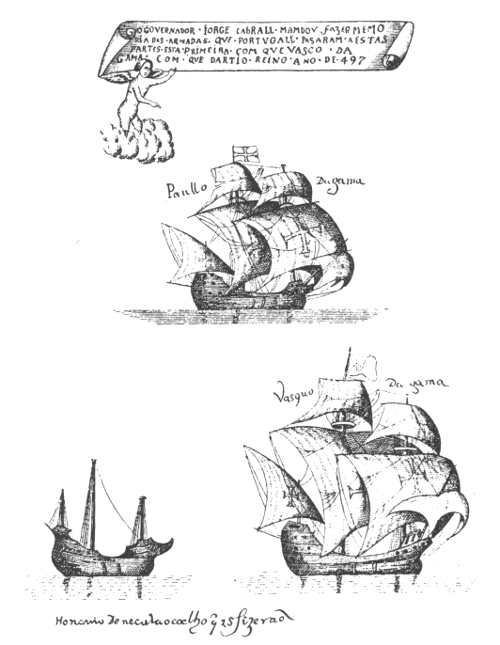
In the year 1497 King Dom
Manuel, the first of that name in
Portugal, despatched four vessels to
make discoveries and go in search
of spices. Vasco da Gama was the
captain-major of these vessels; Paulo da Gama, his
brother, commanded one of them, and Nicolau Coelho
another.27
[Lisbon to the Cape Verde Islands.]
We left Restello28 on Saturday, July 8, 1497. May God
our Lord permit us to accomplish this voyage in his service.
Amen!
On the following Saturday [July 15] we sighted the
Canaries, and in the night passed to the lee of Lançarote.
During the following night, at break of day [July 16] we
made the Terra Alta, where we fished for a couple of
hours, and in the evening, at dusk, we were off the Rio
do Ouro.29
The fog30 during the night grew so dense that Paulo da
Gama lost sight of the captain-major, and when day broke
[July 17] we saw neither him nor the other vessels. We
therefore made sail for the Cape Verde islands, as we had
been instructed to do in case of becoming separated.
On the following Saturday, [July 22], at break of day,
we sighted the Ilha do Sal,31 and an hour afterwards discovered
three vessels, which turned out to be the store-ship,
and the vessels commanded by Nicolau Coelho and
Bartholameu Diz [Dias], the last of whom sailed in our
company as far as the Mine.32 They, too, had lost sight of
the captain-major. Having joined company we pursued
our route, but the wind fell, and we were becalmed until
Wednesday [July 26]. At ten o’clock on that day we
sighted the captain-major, about five leagues ahead of us,
and having got speech with him in the evening we gave
expression to our joy by many times firing off our bombards33
and sounding the trumpets.
The day after this, a Thursday [July 27], we arrived at
the island of Samtiago [São Thiago],34 and joyfully anchored
in the bay of Santa Maria, where we took on board meat,
water and wood, and did the much-needed repairs to
our yards.
[Across the Southern Atlantic.]
On Thursday, August 3, we left in an easterly direction.
On August 18,35 when about 200 leagues from Samtiaguo,
going south, the captain-major’s main yard broke, and we
lay to under foresail and mainsail for two days and
a night. On the 22nd of the same month, when going
S. by W., we saw many birds resembling herons.36 On
the approach of night they flew vigorously to the S.S.E., as
if making for the land.37 On the same day, being then
quite 800 leagues out at sea [i.e., reckoning from S. Thiago],
we saw a whale.
On Friday, October 27, the eve of St. Simon and Jude,
we saw many whales, as also quoquas38 and seals.39
On Wednesday, November 1, the day of All Saints, we
perceived many indications of the neighbourhood of land,
including gulf-weed,40 which grows along the coast.
On Saturday, the 4th of the same month, a couple of
hours before break of day, we had soundings in 110
fathoms,41 and at nine o’clock we sighted the land.42 We
then drew near to each other, and having put on our gala
clothes, we saluted the captain-major by firing our bombards,
and dressed the ships with flags and standards. In
the course of the day we tacked so as to come close to the
land, but as we failed to identify it, we again stood out
to sea.
[The Bay of St. Helena.]
On Tuesday [November 7] we returned to the land,
which we found to be low, with a broad bay opening into
it. The captain-major sent Pero d’Alenquer43 in a boat to
take soundings and to search for good anchoring ground.
The bay was found to be very clean, and to afford shelter
against all winds except those from the N.W. It extended
east and west, and we named it Santa Helena.
On Wednesday [November 8] we cast anchor in this
bay, and we remained there eight days, cleaning the ships,
mending the sails, and taking in wood.
The river Samtiagua [S. Thiago]44 enters the bay four
leagues to the S.E. of the anchorage. It comes from the
interior (sertão), is about a stone’s throw across at the
mouth, and from two to three fathoms in depth at all states
of the tide.45
The inhabitants of this country are tawny-coloured.46
Their food is confined to the flesh of seals, whales and
gazelles, and the roots of herbs. They are dressed in skins,
and wear sheaths over their virile members.47 They are
armed with poles of olive wood to which a horn, browned
in the fire, is attached.48 Their numerous dogs resemble
those of Portugal, and bark like them. The birds of the
country, likewise, are the same as in Portugal, and include
cormorants, gulls, turtle doves, crested larks, and many
others. The climate is healthy and temperate, and produces
good herbage.
On the day after we had cast anchor, that is to say on
Thursday [November 9], we landed with the captain-major,
and made captive one of the natives, who was small of
stature like Sancho Mexia. This man had been gathering
honey in the sandy waste, for in this country the bees
deposit their honey at the foot of the mounds around the
bushes. He was taken on board the captain-major’s ship,
and being placed at table he ate of all we ate. On the
following day the captain-major had him well dressed and
sent ashore.49
On the following day [November 10] fourteen or fifteen
natives came to where our ships lay. The captain-major
landed and showed them a variety of merchandise, with
the view of finding out whether such things were to
be found in their country. This merchandise included
cinnamon, cloves, seed-pearls, gold, and many other things,
but it was evident that they had no knowledge whatever of
such articles, and they were consequently given round bells
and tin rings. This happened on Friday, and the like
took place on Saturday.
On Sunday [November 12] about forty or fifty natives
made their appearance, and having dined, we landed, and
in exchange for the çeitils50 with which we came provided,
we obtained shells, which they wore as ornaments in their
ears, and which looked as if they had been plated, and fox-tails
attached to a handle, with which they fanned their
faces. I also acquired for one çeitil one of the sheaths
which they wore over their members, and this seemed to
show that they valued copper very highly; indeed, they
wore small beads of that metal in their ears.
On that day Fernão Velloso, who was with the captain-major,
expressed a great desire to be permitted to accompany
the natives to their houses, so that he might find out
how they lived and what they ate. The captain-major
yielded to his importunities, and allowed him to accompany
them, and when we returned to the captain-major’s vessel
to sup, he went away with the negroes. Soon after they
had left us they caught a seal, and when they came to the
foot of a hill in a barren place they roasted it, and gave
some of it to Fernão Velloso, as also some of the roots
which they eat. After this meal they expressed a desire
that he should not accompany them any further, but return
to the vessels. When Fernão Velloso came abreast of the
vessels he began to shout, the negroes keeping in the bush.
We were still at supper; but when his shouts were
heard the captain-major rose at once, and so did we others,
and we entered a sailing boat. The negroes then began
running along the beach, and they came as quickly up with
Fernão Velloso51 as we did, and when we endeavoured to
get him into the boat they threw their assegais, and
wounded the captain-major and three or four others. All
this happened because we looked upon these people as
men of little spirit, quite incapable of violence, and had
therefore landed without first arming ourselves. We then
returned to the ships.
[Rounding the Cape].
At daybreak of Thursday the 16th of November, having
careened our ships and taken in wood, we set sail. At that
time we did not know how far we might be abaft the Cape
of Good Hope. Pero d’Alenquer thought the distance
about thirty leagues,52 but he was not certain, for on his
return voyage [when with B. Dias] he had left the Cape in
the morning and had gone past this bay with the wind
astern, whilst on the outward voyage he had kept at sea,
and was therefore unable to identify the locality where
we now were. We therefore stood out towards the S.S.W.
and late on Saturday [November 18] we beheld the Cape.
On that same day we again stood out to sea, returning to
the land in the course of the night. On Sunday morning,
November 19, we once more made for the Cape, but were
again unable to round it, for the wind blew from the S.S.W.,
whilst the Cape juts out towards the S.W. We then
again stood out to sea, returning to the land on Monday
night. At last, on Wednesday [November 22], at noon,
having the wind astern, we succeeded in doubling the Cape,
and then ran along the coast.53
To the south of this Cape of Good Hope, and close to it,
a vast bay, six leagues broad at its mouth, enters about six
leagues into the land.54
[The Bay of São Braz].55
Late on Saturday, November 25, the day of St.
Catherine’s, we entered the bay (angra) of Sam Brás,
where we remained for thirteen days, for there we broke
up our store-ship and transferred her contents to the other
vessels.56
On Friday [December 1], whilst still in the bay of Sam
Brás, about ninety men resembling those we had met at
St. Helena Bay made their appearance. Some of them
walked along the beach, whilst others remained upon the
hills. All, or most of us, were at the time in the captain-major’s
vessel. As soon as we saw them we launched and
armed the boats, and started for the land. When close to
the shore the captain-major threw them little round bells,
which they picked up. They even ventured to approach
us, and took some of these bells from the captain-major’s
hand. This surprised us greatly, for when Bartholomeu
Dias57 was here the natives fled without taking any of the
objects which he offered them. Nay, on one occasion,
when Dias was taking in water, close to the beach, they
sought to prevent him, and when they pelted him with
stones, from a hill, he killed one of them with the arrow of
a cross-bow. It appeared to us that they did not fly on
this occasion, because they had heard from the people at
the bay of St. Helena (only sixty leagues distant by sea)58
that there was no harm in us, and that we even gave away
things which were ours.
The captain-major did not land at this spot, because
there was much bush, but proceeded to an open part of the
beach, when he made signs to the negroes to approach.
This they did. The captain-major and the other captains
then landed, being attended by armed men, some of
whom carried cross-bows. He then made the negroes
understand, by signs, that they were to disperse, and to
approach him only singly or in couples. To those who
approached he gave small bells and red caps, in return for
which they presented him with ivory bracelets, such as
they wore on their arms, for it appears that elephants are
plentiful in this country. We actually found some of their
droppings near the watering place where they had gone
to drink.
On Saturday [December 2] about two hundred negroes
came, both young and old. They brought with them about
a dozen oxen and cows and four or five sheep. As soon
as we saw them we went ashore. They forthwith began to
play on four or five flutes,59 some producing high notes and
others low ones, thus making a pretty harmony for negroes
who are not expected to be musicians; and they danced
in the style of negroes. The captain-major then ordered
the trumpets to be sounded, and we, in the boats, danced,
and the captain-major did so likewise when he rejoined
us. This festivity ended, we landed where we had landed
before, and bought a black ox for three bracelets. This ox
we dined off on Sunday. We found him very fat, and his
meat as toothsome as the beef of Portugal.
On Sunday [December 3] many visitors came, and brought
with them their women and little boys, the women remaining
on the top of a hill near the sea. They had with them
many oxen and cows. Having collected in two spots on
the beach, they played and danced as they had done on
Saturday. It is the custom of this people for the young
men to remain in the bush with their weapons. The
[older] men came to converse with us. They carried a
short stick in the hand, attached to which was a fox’s
tail, with which they fan the face. Whilst conversing with
them, by signs, we observed the young men crouching in
the bush, holding their weapons in their hands. The
captain-major then ordered Martin Affonso, who had
formerly been in Manicongo [Congo] to advance, and to
buy an ox, for which purpose he was supplied with bracelets.
The natives, having accepted the bracelets, took him by
the hand, and, pointing to the watering place, asked him
why we took away their water, and simultaneously drove
their cattle into the bush. When the captain-major
observed this he ordered us to gather together, and called
upon Martin Affonso to retreat, for he suspected some
treachery. Having drawn together we proceeded [in our
boats] to the place where we had been at first. The negroes
followed us. The captain-major then ordered us to land,
armed with lances, assegais, and strung cross-bows, and
wearing our breast-plates, for he wanted to show that we
had the means of doing them an injury, although we had
no desire to employ them. When they observed this they
ran away. The captain-major, anxious that none should
be killed by mischance, ordered the boats to draw together;
but to prove that we were able, although unwilling to hurt
them, he ordered two bombards to be fired from the poop
of the long boat. They were by that time all seated close
to the bush, not far from the beach, but the first discharge
caused them to retreat so precipitately that in their flight
they dropped the skins with which they were covered and
their weapons. When they were in the bush two of them
turned back to pick up the articles which had been dropped.
They then continued their flight to the top of a hill, driving
their cattle before them.
The oxen of this country are as large as those of Alemtejo,
wonderfully fat and very tame. They are geldings,
and hornless. Upon the fattest among them the negroes
place a packsaddle made of reeds, as is done in Castille,
and upon this saddle they place a kind of litter made of
sticks, upon which they ride. If they wish to sell an
ox they pass a stick through his nostrils, and thus lead
him.
There is an island in this bay, three bowshots from the
land, where there are many seals.60 Some of these are as
big as bears, very formidable, with large tusks. These
attack man, and no spear, whatever the force with
which it is thrown, can wound them. There are others
much smaller and others quite small. And whilst the big
ones roar like lions, the little ones cry like goats. One day,
when we approached this island for our amusement, we
counted, among large and small ones, three thousand, and
we fired among them with our bombards from the sea.
On the same island there are birds as big as ducks, but
they cannot fly, because they have no feathers on their
wings. These birds, of whom we killed as many as we
chose, are called Fotylicayos, and they bray like asses.61
Whilst taking in water in this bay of Sam Brás, on a
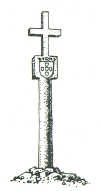
Wednesday, we erected a cross and a pillar.62 The cross was
made out of a mizzen-mast, and very high. On the following
Thursday [December 7], when about to set sail, we
saw about ten or twelve negroes, who demolished both the
cross and the pillar before we had left.
[São Braz to Natal.]
Having taken on board all we stood in need of we took
our departure, but as the wind failed us we anchored the
same day, having proceeded only two leagues.
On Friday morning, the day of the Immaculate Concepcion
[December 8], we again set sail. On Tuesday
[December 12], the eve of Santa Lucia, we encountered a
great storm, and ran before a stern-wind with the foresail
much lowered. On that day we lost sight of Nicolau
Coelho, but at sunset we saw him from the top four or five
leagues astern, and it seemed as if he saw us too. We
exhibited signal lights and lay to. By the end of the first
watch he had come up with us, not because he had seen
us during the day, but because the wind, being scant, he
could not help coming in our waters.
On the morning of Friday [December 15] we saw the
land near the Ilhéos chãos (Flat Islands). These are five
leagues beyond the Ilhéo da Cruz (Cross Island). From
the Bay of Sam Brás to Cross Island is a distance of
sixty leagues, and as much from the Cape of Good Hope
to the Bay of Sam Brás. From the Flat Islands to the
last pillar erected by Bartholomeu Dias is five leagues,
and from this pillar to the Rio do Infante is fifteen
leagues.63
On Saturday [December 16] we passed the last pillar,
and as we ran along the coast we observed two men
running along the beach in a direction contrary to that
which we followed. The country about here is very charming
and well wooded; we saw much cattle, and the further
we advanced the more did the character of the country
improve, and the trees increase in size.
During the following night we lay to. We were then
already beyond the last discovery made by Bartholomeu
Dias.64 On the next day [December 17], till vespers, we
sailed along the coast before a stern-wind, when the wind
springing round to the east we stood out to sea. And thus
we kept making tacks until sunset on Tuesday [December
19], when the wind again veered to the west. We then
lay to during the night, in order that we might on the
following day examine the coast and find out where we
were.
In the morning [December 20] we made straight for the
land, and at ten o’clock found ourselves once more at the
Ilhéo da Cruz (Cross Island), that is sixty leagues abaft
our dead reckoning! This was due to the currents, which
are very strong here.65
That very day we again went forward by the route we
had already attempted, and being favoured during three or
four days by a strong stern-wind, we were able to overcome
the currents which we had feared might frustrate our
plans. Henceforth it pleased God in His mercy to allow
us to make headway! We were not again driven back.
May it please Him that it be thus alway!
[Natal.]
By Christmas Day, the 25th of December, we had discovered
seventy leagues of coast [beyond Dias’ furthest].
On that day, after dinner, when setting a bonnet we discovered the
mast was sprung ... and ... secured it with lashings
below the top, and that the crack opened and shut. We
patched it up with backstays, hoping to be able to repair
it thoroughly as soon as we should reach a sheltered port.
On Thursday [December 28] we anchored near the
coast, and took much fish.66 At sunset we again set sail
and pursued our route. At that place the mooring-rope
snapped and we lost an anchor.
We now went so far out to sea, without touching any
port, that drinking-water began to fail us, and our food
had to be cooked with salt water. Our daily ration of
water was reduced to a quartilho.67 It thus became necessary
to seek a port.
[Terra da boa Gente and Rio do Cobre.]
On Thursday, January 11th [1498]68 we discovered a
small river and anchored near the coast. On the following
day we went close in shore in our boats, and saw a crowd
of negroes, both men and women. They were tall people,
and a chief (“Senhor”) was among them. The captain-major
ordered Martin Affonso, who had been a long time
in Manicongo, and another man, to land. They were
received hospitably. The captain-major in consequence
sent the chief a jacket, a pair of red pantaloons, a Moorish
cap and a bracelet. The chief said that we were welcome
to anything in his country of which we stood in need: at
least this is how Martin Affonso understood him. That
night, Martin Affonso and his companion accompanied
the chief to his village, whilst we returned to the ships.
On the road the chief donned the garments which had been
presented to him, and to those who came forth to meet
him he said with much apparent satisfaction, “Look, what
has been given to me!” The people upon this clapped
hands as a sign of courtesy, and this they did three or four
times until he arrived at the village. Having paraded the
whole of the place, thus dressed up, the chief retired to his
house, and ordered his two guests to be lodged in a
compound, where they were given porridge of millet, which
abounds in that country, and a fowl, just like those of
Portugal. All the night through, numbers of men and
women came to have a look at them. In the morning the
chief visited them, and asked them to go back to the ships.
He ordered two men to accompany them, and gave them
fowls as a present for the captain-major, telling them at
the same time that he would show the things that had
been given him to a great chief, who appears to be the
king of that country. When our men reached the landing
place where our boats awaited them, they were attended
by quite two hundred men, who had come to see them.
This country seemed to us to be densely peopled. There
are many chiefs,69 and the number of women seems to be
greater than that of the men, for among those who came to
see us there were forty women to every twenty men.
The houses are built of straw. The arms of the people
include long bows and arrows and spears with iron blades.
Copper seems to be plentiful, for the people wore [ornaments]
of it on their legs and arms and in their twisted
hair. Tin, likewise, is found in the country, for it is to be seen
on the hilts of their daggers, the sheaths of which are made
of ivory. Linen cloth is highly prized by the people, who
were always willing to give large quantities of copper in
exchange for shirts. They have large calabashes in which
they carry sea-water inland, where they pour it into pits, to
obtain the salt [by evaporation].
We stayed five days at this place, taking in water, which
our visitors conveyed to our boats. Our stay was not,
however, sufficiently prolonged to enable us to take in as
much water as we really needed, for the wind favoured a
prosecution of our voyage.
We were at anchor here, near the coast, exposed to the
swell of the sea. We called the country Terra da Boa Gente
(land of good people), and the river Rio do Cobre (copper
river).70
[Rio dos Bons Signaes.]71
On Monday [January 22] we discovered a low coast
thickly wooded with tall trees. Continuing our course we
perceived the broad mouth of a river. As it was necessary
to find out where we were, we cast anchor. On Thursday
[January 25], at night, we entered. The Berrio was
already there, having entered the night before—that is eight
days before the end of January [i.e., January 24.]72
The country is low and marshy, and covered with tall
trees yielding an abundance of various fruits, which the
inhabitants eat.
These people are black and well made. They go naked,
merely wearing a piece of cotton stuff around their loins,
that worn by the women being larger than that worn by the
men. The young women are good-looking. Their lips
are pierced in three places, and they wear in them bits of
twisted tin. These people took much delight in us. They
brought us in their almadias73 what they had, whilst we
went into their village to procure water.
When we had been two or three days at this place
two gentlemen (senhores) of the country came to see us.
They were very haughty, and valued nothing which we
gave them. One of them wore a touca,74 with a fringe
embroidered in silk, and the other a cap of green satin. A
young man in their company—so we understood from their
signs—had come from a distant country, and had already
seen big ships like ours. These tokens (signaes) gladdened
our hearts, for it appeared as if we were really
approaching the bourne of our desires. These gentlemen
had some huts built on the river bank, close to the ships,
in which they stayed seven days, sending daily to the ships,
offering to barter cloths which bore a mark of red ochre.
And when they were tired of being there, they left in their
almadias for the upper river.
As to ourselves, we spent thirty-two days75 in the river
taking in water, careening the ships,76 and repairing the mast
of the Raphael. Many of our men fell ill here, their feet
and hands swelling, and their gums growing over their teeth,
so that they could not eat.77
We erected here a pillar which we called the pillar of
St. Raphael,78 because it had been brought in the ship
bearing that name. The river we called Rio dos Bons
Signaes (River of good signs or tokens).
[To Moçambique.]
On Saturday [February 24] we left this place and gained
the open sea. During the night we stood N.E., so as to
keep away from the land, which was very pleasing to look
upon. On Sunday [February 25] we still stood N.E., and
at vesper time discovered three small islands, out in the
open, of which two were covered with tall trees, while the
third and smallest was barren. The distance from one
island to the other was four leagues.79
On the following day we pursued our route, and did so
during six days, lying to at night.80
On Thursday, the 1st of March, we sighted islands and
the mainland, but as it was late we again stood out to sea,
and lay to till morning. We then approached the land, of
which I shall speak in what follows.
[Moçambique.]81
On Friday morning [March 2] Nicolau Coelho, when
attempting to enter the bay, mistook the channel and came
upon a bank in tacking towards the other ships, which were astern, Coelho perceived some
sailing boats approaching from a village on this island, in
order to welcome the captain-major and his brother. As
for ourselves we continued in the direction of our proposed
anchorage, these boats following us all the while, and
making signs for us to stop. When we had cast anchor in
the roadstead of the island from which these boats had
come, there approached seven or eight of them, including
almadias, the people in them playing upon anafils.82 They
invited us to proceed further into the bay, offering to take us
into port if we desired it. Those among them who
boarded our ships ate and drank what we did, and went
their way when they were satisfied.83
The captain thought that we should enter this bay in
order that we might find out what sort of people we had to
deal with; that Nicolau Coelho should go first in his vessel,
to take soundings at the entrance, and that, if found practicable,
we should follow him. As Coelho prepared to
enter he struck the point of the island and broke his helm,
but he immediately disengaged himself and regained deep
water. I was with him at the time. When we were again
in deep water we struck our sails and cast anchor at a
distance of two bowshots from the village.84
The people of this country are of a ruddy complexion85
and well made. They are Mohammedans, and their language
is the same as that of the Moors.86 Their dresses
are of fine linen or cotton stuffs, with variously coloured
stripes, and of rich and elaborate workmanship. They all
wear toucas with borders of silk embroidered in gold.
They are merchants, and have transactions with white
Moors, four of whose vessels were at the time in port,
laden with gold, silver, cloves, pepper, ginger, and silver
rings, as also with quantities of pearls, jewels,87 and rubies,
all of which articles are used by the people of this country.
We understood them to say that all these things, with
the exception of the gold, were brought thither by these
Moors; that further on, where we were going to, they
abounded, and that precious stones, pearls and spices were
so plentiful that there was no need to purchase them as
they could be collected in baskets. All this we learned
through a sailor the captain-major had with him, and who,
having formerly been a prisoner among the Moors, understood
their language.88
These Moors, moreover, told us that along the route which
we were about to follow we should meet with numerous
shoals; that there were many cities along the coast, and
also an island, one half the population of which consisted
of Moors and the other half of Christians,89 who were at
war with each other. This island was said to be very
wealthy.
We were told, morever, that Prester John90 resided not far
from this place; that he held many cities along the coast,
and that the inhabitants of those cities were great merchants
and owned big ships. The residence of Prester
John was said to be far in the interior, and could be reached
only on the back of camels. These Moors had also brought
hither two Christian captives from India.91 This information,
and many other things which we heard, rendered
us so happy that we cried with joy, and prayed God to
grant us health, so that we might behold what we so much
desired.
In this place and island of Moncobiquy [Moçambique]
there resided a chief [senhor] who had the title of Sultan,
and was like a vice-roy.92 He often came aboard our ships
attended by some of his people. The captain-major gave
him many good things to eat, and made him a present of
hats, marlotas,93 corals and many other articles. He was,
however, so proud that he treated all we gave him with
contempt, and asked for scarlet cloth, of which we had
none. We gave him, however, of all the things we had.
One day the captain-major invited him to a repast, when
there was an abundance of figs and comfits, and begged
him for two pilots to go with us. He at once granted this
request, subject to our coming to terms with them. The
captain-major gave each of them thirty mitkals94 in gold
and two marlotas, on condition that from the day on which
they received this payment one of them should always
remain on board if the other desired to go on land. With
these terms they were well satisfied.
On Saturday, March 10, we set sail and anchored one
league out at sea, close to an island,95 where mass was
said on Sunday, when those who wished to do so confessed
and joined in the communion.
One of our pilots lived on the island, and when we had
anchored we armed two boats to go in search of him.
The captain-major went in one boat and Nicolau Coelho
in the other. They were met by five or six boats (barcas)
coming from the island, and crowded with people armed
with bows and long arrows and bucklers,96 who gave them
to understand by signs that they were to return to the
town. When the captain saw this he secured the pilot
whom he had taken with him, and ordered the bombards
to fire upon the boats. Paulo da Gama, who had remained
with the ships, so as to be prepared to render succour in
case of need, no sooner heard the reports of the bombards
than he started in the Berrio. The Moors, who were
already flying, fled still faster, and gained the land before
the Berrio was able to come up with them. We then
returned to our anchorage.
The vessels of this country are of good size and decked.
There are no nails, and the planks are held together by
cords,97 as are also those of their boats (barcos). The sails
are made of palm-matting.98 Their mariners have Genoese
needles,99 by which they steer, quadrants, and navigating
charts.
The palms of this country yield a fruit as large as a
melon, of which the kernel is eaten.100 It has a nutty flavour.
There also grow in abundance melons and cucumbers,
which were brought to us for barter.
On the day in which Nicolau Coelho entered the port,
the Lord of the place came on board with a numerous
suite. He was received well, and Coelho presented him
with a red hood, in return for which the Lord handed him
a black rosary, which he made use of when saying his
prayers, to be held as a pledge. He then begged Nicolau
Coelho for the use of his boat, to take him ashore. This
was granted. And after he had landed he invited those
who had accompanied him to his house, where he gave them
to eat. He then dismissed them, giving them a jar of
bruised dates made into a preserve with cloves and cumin,
as a present for Nicolau Coelho. Subsequently he sent
many things to the captain-major. All this happened at
the time when he took us for Turks or for Moors from
some foreign land, for in case we came from Turkey he
begged to be shown the bows of our country and our books
of the Law. But when they learnt that we were Christians
they arranged to seize and kill us by treachery. The pilot,
whom we took with us, subsequently revealed to us all
they intended to do, if they were able.
[False Start and Return to Moçambique.]
On Sunday [March 11] we celebrated mass beneath a
tall tree on the island [of S. Jorge]. We returned on
board and at once set sail, taking with us many fowls,
goats and pigeons, which had been given us in exchange
for small glass-beads.
On Tuesday [March 13] we saw high mountains rising
on the other side of a cape. The coast near the cape was
sparsely covered with trees, resembling elms. We were
at that time over twenty leagues from our starting-place,
and there we remained becalmed during Tuesday and
Wednesday. During the following night we stood off
shore with a light easterly wind, and in the morning
[March 15] found ourselves four leagues abaft Moçambique,
but we went again forward on that day until the evening,
when we anchored once more close to the island [of S.
Jorge] on which mass had been celebrated the preceding
Sunday, and there we remained eight days waiting for a
favourable wind.
During our stay here the King of Moçambique sent word
that he wanted to make peace with us and to be our friend.
His ambassador was a white Moor and sharif,101 that is
priest, and at the same time a great drunkard.
Whilst at this place a Moor with his little son came on
board one of our ships, and asked to be allowed to accompany
us, as he was from near Mecca, and had come to
Moçambique as pilot of a vessel from that country.
As the weather did not favour us it became necessary
once more to enter the port of Moçambique, in order to
procure the water of which we stood in need, for the watering
place is on the mainland. This water is drunk by the
inhabitants of the island, for all the water they have there
is brackish.102
On Thursday [March 22] we entered the port, and when
it grew dark we lowered our boats. At midnight the
captain-major and Nicolau Coelho, accompanied by some
of us, started in search of water. We took with us the
Moorish pilot, whose object appeared to be to make his
escape, rather than to guide us to a watering-place. As a
matter of fact he either would not or could not find a
watering-place, although we continued our search until
morning. We then withdrew to our ships.
In the evening [March 23] we returned to the main
land, attended by the same pilot. On approaching the
watering-place we saw about twenty men on the beach.
They were armed with assegais, and forbade our approach.
The captain-major upon this ordered three bombards to
be fired upon them, so that we might land. Having
effected our landing, these men fled into the bush, and we
took as much water as we wanted. When the sun was
about to set we discovered that a negro belonging to João
de Coimbra had effected his escape.
On Sunday morning, the 24th of March, being the eve
of Lady Day, a Moor came abreast our ships, and
[sneeringly] told us that if we wanted water we might go
in search of it, giving us to understand that we should
meet with something which would make us turn back.
The captain-major no sooner heard this [threat] than he
resolved to go, in order to show that we were able to do
them harm if we desired it. We forthwith armed our
boats, placing bombards in their poops, and started for the
village [town]. The Moors had constructed palisades by
lashing planks together, so that those behind them could
not be seen. They were at the time walking along the beach,
armed with assegais, swords,103 bows, and slings, with which
they hurled stones at us. But our bombards soon made it
so hot for them that they fled behind their palisades; but
this turned out to their injury rather than their profit.
During the three hours that we were occupied in this
manner [bombarding the town] we saw two men killed,
one on the beach and the other behind the palisades.
When we were weary of this work we retired to our
ships to dine. They at once began to fly, carrying
their chattels in almadias to a village on the mainland.
After dinner we started in our boats, in the hope of
being able to make a few prisoners, whom we might
exchange for the two Indian Christians whom they held
captive and the negro who had deserted. With this object
in view we chased an almadia, which belonged to the
sharif and was laden with his chattels, and another in
which were four negroes.104 The latter was captured by
Paulo da Gama, whilst the one laden with chattels was
abandoned by the crew as soon as they reached the land.
We took still another almadia which had likewise been
abandoned. The negroes we took on board our ships.
In the almadias we found fine cotton-stuffs, baskets
made of palm-fronds, a glazed jar containing butter, glass
phials with scented water, books of the Law, a box containing
skeins of cotton, a cotton net, and many small
baskets filled with millet. All these things, with the
exception of the books, which were kept back to be shown
to the king, were given by the captain-major to the sailors
who were with him and with the other captains.
On Sunday [March 25] we took in water, and on Monday
we proceeded in our armed boats to the village, when
the inhabitants spoke to us from their houses, they daring
no longer to venture on the beach. Having discharged a
few bombards at them we rejoined our ships.
On Tuesday [March 27] we left the town and anchored
close to the islets of São Jorge,105 where we remained for
three days, in the hope that God would grant us a favourable
wind.
[Moçambique to Mombaça].
On Thursday, the 29th of March, we left these islets of
S. Jorge, and as the wind was light, we only covered
twenty-eight leagues up to the morning of Saturday, the
31st of the month.106
In the morning of that day we were once more abreast
of the land of the Moors, from which powerful currents had
previously carried us.107
On Sunday, April 1, we came to some islands close to
the mainland. The first of these we called Ilha do Açoutado
(“Island of the flogged-one”), because of the flogging
inflicted upon our Moorish pilot, who had lied to the
captain on Saturday night, by stating that these islands
were the mainland. Native craft take their course between
these islands and the mainland, where the water is four
fathoms deep, but we kept outside of them. These islands
are numerous, and we were unable to distinguish one from
the other; they are inhabited.
On Monday [April 2] we sighted other islands five
leagues off the shore.108
On Wednesday, the 4th of April, we made sail to the
N.W., and before noon we sighted an extensive country,
and two islands close to it, surrounded with shoals. And
when we were near enough for the pilots to recognise
these islands, they told us that we had left three leagues
behind us an island109 inhabited by Christians. We manœuvred
all day in the hope of fetching this island, but in vain,
for the wind was too strong for us. After this we thought it
best to bear away for a city called Mombaça, reported to
be four days ahead of us.
The above island was one of those which we had come
to discover, for our pilots said that it was inhabited by
Christians.
When we bore away for the north it was already late,
and the wind was high. At nightfall we perceived a large
island, which remained to the north of us.110 Our pilot told
us that there were two towns on this island, one of
Christians and the other of Moors.
That night we stood out to sea, and in the morning
[April 5] we no longer saw the land. We then steered to
the N.W., and in the evening we again beheld the land.
During the following night we bore away to the N. by W.,
and during the morning-watch we changed our course to
the N.N.W. Sailing thus before a favourable wind, the
S. Raphael, two hours before break of day [April 6], ran
aground on a shoal, about two leagues from the land.
Immediately the Raphael touched bottom, the vessels
following her were warned by shouts, and these were no
sooner heard than they cast anchor about the distance of a
gunshot from the stranded vessel, and lowered their boats.
When the tide fell the Raphael lay high and dry. With
the help of the boats many anchors were laid out, and when
the tide rose again, in the course of the day, the vessel
floated and there was much rejoicing.
On the mainland, facing these shoals, there rises a lofty
range of mountains, beautiful of aspect. These mountains
we called Serras de São Raphael, and we gave the same
name to the shoals.111
Whilst the vessel was high and dry, two Almadias
approached us. One was laden with fine oranges, better
than those of Portugal. Two of the Moors remained on
board, and accompanied us next day to Mombaça.
On Saturday morning, the 7th of the month, and eve of
Palm Sunday, we ran along the coast and saw some islands
at a distance of fifteen leagues from the mainland, and
about six leagues in extent. They supply the vessels
of the country with masts. All are inhabited by Moors.112
[Mombaça].
On Saturday [April 7] we cast anchor off Mombaça,
but did not enter the port. No sooner had we been perceived
than a zavra113 manned by Moors came out to us:
in front of the city there lay numerous vessels all dressed
in flags.114 And we, anxious not to be outdone, also dressed
our ships, and we actually surpassed their show, for we
wanted in nothing but men, even the few whom we had
being very ill. We anchored here with much pleasure, for
we confidently hoped that on the following day we might
go on land and hear mass jointly with the Christians
reported to live there under their own alcaide115 in a quarter
separate from that of the Moors.
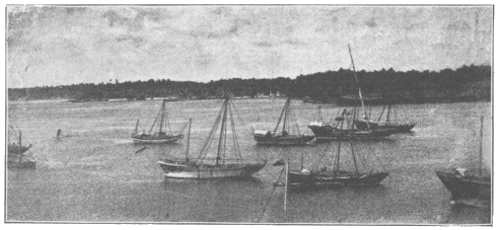
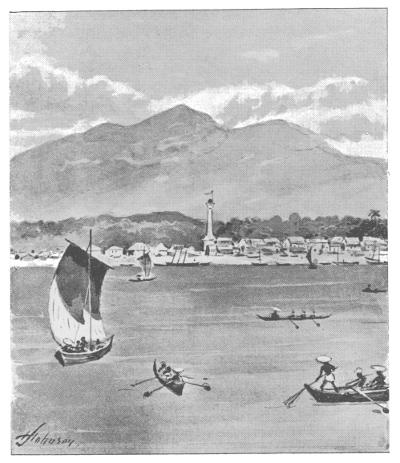
Native Craft in the Harbour of Mombasa.
(From a photograph by the late Capt. Foot, R.N.)
The pilots who had come with us told us there resided
both Moors and Christians in this city; that these latter
lived apart under their own lords, and that on our arrival
they would receive us with much honour and take us to
their houses. But they said this for a purpose of their own,
for it was not true. At midnight there approached us a
zavra with about a hundred men, all armed with cutlasses
(tarçados) and bucklers. When they came to the vessel
of the captain-major they attempted to board her, armed
as they were, but this was not permitted, only four or five
of the most distinguished men among them being allowed
on board. They remained about a couple of hours, and it
seemed to us that they paid us this visit merely to find out
whether they might not capture one or the other of our
vessels.
On Palm Sunday [April 8] the King of Mombaça sent
the captain-major a sheep and large quantities of oranges,
lemons and sugar-cane, together with a ring, as a pledge
of safety, letting him know that in case of his entering the
port he would be supplied with all he stood in need of.
This present was conveyed to us by two men, almost white,
who said they were Christians, which appeared to be the
fact. The captain-major sent the king a string of coral-beads
as a return present, and let him know that he purposed
entering the port on the following day. On the
same day the captain-major’s vessel was visited by four
Moors of distinction.
Two men were sent by the captain-major to the king,
still further to confirm these peaceful assurances. When
these landed they were followed by a crowd as far as the
gates of the palace. Before reaching the king they passed
through four doors, each guarded by a doorkeeper with
a drawn cutlass. The king received them hospitably, and
ordered that they should be shown over the city. They
stopped on their way at the house of two Christian merchants,
who showed them a paper (carta), an object of
their adoration, on which was a sketch of the Holy Ghost.116
When they had seen all, the king sent them back with
samples of cloves, pepper and corn,117 with which articles he
would allow us to load our ships.
On Tuesday [April 10], when weighing anchor to enter
the port, the captain-major’s vessel would not pay off, and
struck the vessel which followed astern. We therefore
again cast anchor. When the Moors who were in our
ship saw that we did not go on, they scrambled into a
zavra attached to our stern; whilst the two pilots whom
we had brought from Moçambique jumped into the water,
and were picked up by the men in the zavra. At night
the captain-major “questioned” two Moors [from Moçambique]118
whom we had on board, by dropping boiling oil
upon their skin, so that they might confess any treachery
intended against us. They said that orders had been given
to capture us as soon as we entered the port, and thus to
avenge what we had done at Moçambique. And when
this torture was being applied a second time, one of the
Moors, although his hands were tied, threw himself into the
sea, whilst the other did so during the morning watch.
About midnight two almadias, with many men in them,
approached. The almadias stood off whilst the men
entered the water, some swimming in the direction of the
Berrio, others in that of the Raphael. Those who swam
to the Berrio began to cut the cable. The men on watch
thought at first that they were tunny fish, but when they
perceived their mistake they shouted to the other vessels.
The other swimmers had already got hold of the rigging
of the mizzen-mast. Seeing themselves discovered, they
silently slipped down and fled. These and other wicked
tricks were practised upon us by these dogs, but our Lord
did not allow them to succeed, because they were unbelievers.
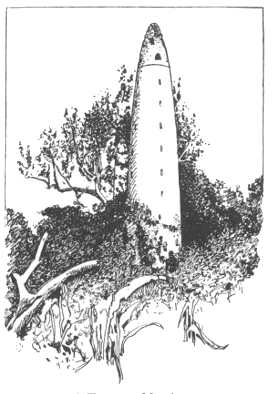
A Tower at Mombasa.
(From a photograph by Sir John Kirk.)
Mombaça is a large city seated upon an eminence
washed by the sea. Its port is entered daily by
numerous vessels. At its entrance stands a pillar, and by
the sea a low-lying fortress.119 Those who had gone on
shore told us that in the town they had seen many men
in irons; and it seemed to us that these must be Christians,
as the Christians in that country are at war with the
Moors.
The Christian merchants in the town are only temporary
residents, and are held in much subjection, they not being
allowed to do anything except by the order of the Moorish
King.
It pleased God in his mercy that on arriving at this
city all our sick recovered their health, for the climate
(“air”) of this place is very good.
After the malice and treachery planned by these dogs
had been discovered, we still remained on Wednesday and
Thursday [April 11 and 12].120
[Mombaça to Malindi.]
We left in the morning [April 13], the wind being light, and
anchored about eight leagues from Mombaça, close to the
shore. At break of day [April 14] we saw two boats (barcas)
about three leagues to the leeward, in the open sea, and at
once gave chase, with the intention of capturing them, for
we wanted to secure a pilot who would guide us to where
we wanted to go. At vesper-time we came up with one of
them, and captured it, the other escaping towards the land.
In the one we took we found seventeen men, besides gold,
silver, and an abundance of maize and other provisions; as
also a young woman, who was the wife of an old Moor of
distinction, who was a passenger. When we came up with
the boat they all threw themselves into the water, but we
picked them up from our boats.
That same day [April 14] at sunset, we cast anchor off a
place called Milinde (Malindi),121 which is thirty leagues
from Mombaça. The following places are between
Mombaça and Milinde, viz., Benapa, Toça and Nuguoquioniete.122
[Malindi.]123
On Easter Sunday [April 15] the Moors whom we had
taken in the boat told us that there were at this city of
Melinde four vessels belonging to Christians from India,124
and that if it pleased us to take them there, they would
provide us, instead of them, Christian pilots and all we
stood in need of, including water, wood and other things.
The captain-major much desired to have pilots from the
country, and having discussed the matter with his Moorish
prisoners, he cast anchor off the town, at a distance of about
half a league from the mainland. The inhabitants of the
town did not venture to come aboard our ships, for they
had already learnt that we had captured a vessel and made
her occupants prisoners.
On Monday morning [April 16] the captain-major had
the old Moor taken to a sandbank in front of the town,
where he was picked up by an almadia.125 The Moor
explained to the king the wishes of the captain-major,
and how much he desired to make peace with him. After
dinner the Moor came back in a zavra, accompanied by
one of the king’s cavaliers and a sharif: he also brought
three sheep. These messengers told the captain-general
that the king would rejoice to make peace with him, and
to enter into friendly relations; that he would willingly
grant to the captain-major all his country afforded,
whether pilots or anything else. The captain-major
upon this sent word that he proposed to enter the port on
the following day, and forwarded by the king’s messengers
a present consisting of a balandrau,126 two strings of coral,
three wash-hand basins, a hat, little bells and two pieces
of lambel.127
Consequently, on Tuesday [April 17] we approached
nearer to the town. The king sent the captain-major six
sheep, besides quantities of cloves, cumin, ginger, nutmeg
and pepper, as also a message, telling him that if he desired
to have an interview with him he (the king) would come
out in his zavra, when the captain-major could meet him
in a boat.
On Wednesday [April 18], after dinner, when the king
came up close to the ships in a zavra, the captain-major
at once entered one of his boats, which had been well
furnished, and many friendly words were exchanged when
they lay side by side. The king having invited the
captain-major to come to his house to rest, after which he
(the king) would visit him on board his ship, the captain-major
said that he was not permitted by his master to go on
land, and if he were to do so a bad report would be given
of him. The king wanted to know what would be said of
himself by his people if he were to visit the ships, and what
account could he render them? He then asked for the
name of our king, which was written down for him, and
said that on our return he would send an ambassador with
us, or a letter.
When both had said all they desired, the captain-major
sent for the Moors whom he had taken prisoner, and
surrendered them all. This gave much satisfaction to the
king, who said that he valued this act more highly than if
he had been presented with a town. And the king, much
pleased, made the circuit of our ships, the bombards of
which fired a salute. About three hours were spent in
this way. When the king went away he left in the ship
one of his sons and a sharif, and took two of us away
with him, to whom he desired to show his palace. He,
moreover, told the captain that as he would not go ashore
he would himself return on the following day to the
beach, and would order his horsemen to go through some
exercises.
The king wore a robe (royal cloak) of damask trimmed
with green satin, and a rich touca. He was seated on two
cushioned chairs of bronze, beneath a round sunshade of
crimson satin attached to a pole. An old man, who
attended him as page, carried a short sword in a silver
sheath. There were many players on anafils, and two
trumpets of ivory,128 richly carved, and of the size of a man,
which were blown from a hole in the side, and made sweet
harmony with the anafils.
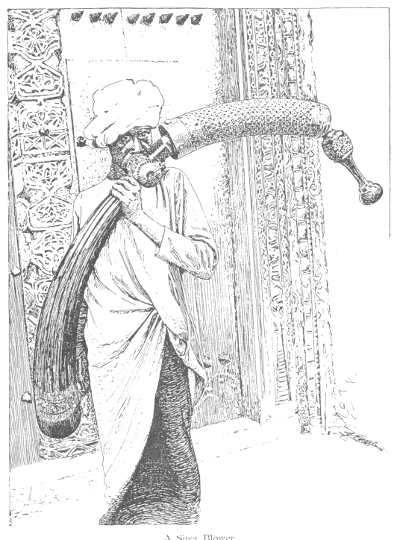
A Siwa Blower.
(From a photograph by Sir John Kirk.)
On Thursday [April 19] the captain-major and Nicolau
Coelho rowed along the front of the town, bombards having
been placed in the poops of their long-boats. Many people
were along the shore, and among them two horsemen, who
appeared to take much delight in a sham-fight. The king
was carried in a palanquin from the stone steps of his
palace to the side of the captain-major’s boats. He again
begged the captain to come ashore, as he had a helpless
father who wanted to see him, and that he and his sons
would go on board the ships as hostages. The captain,
however, excused himself.129
We found here four vessels belonging to Indian Christians.
When they came for the first time on board Paulo da
Gama’s ship, the captain-major being there at the time,
they were shown an altar-piece representing Our Lady at
the foot of the cross, with Jesus Christ in her arms and the
apostles around her. When the Indians saw this picture
they prostrated themselves, and as long as we were there
they came to say their prayers in front of it, bringing
offerings of cloves, pepper, and other things.130
These Indians are tawny men; they wear but little
clothing and have long beards and long hair, which they
braid. They told us that they ate no beef. Their language
differs from that of the Arabs, but some of them know a
little of it, as they hold much intercourse with them.
On the day on which the captain-major went up to the
town in the boats, these Christian Indians fired off many
bombards from their vessels, and when they saw him pass
they raised their hands and shouted lustily Christ! Christ!131
That same night they asked the king’s permission to
give us a night-fête. And when night came they fired off
many bombards, sent up rockets, and raised loud shouts.
These Indians warned the captain-major against going
on shore, and told him not to trust to their “fanfares”, as
they neither came from their hearts nor from their good
will.
On the following Sunday, the 22nd of April, the king’s
zavra brought on board one of his confidential servants,
and as two days had passed without any visitors, the
captain-major had this man seized, and sent word to the
king that he required the pilots whom he had promised.
The king, when he received this message, sent a Christian
pilot,132 and the captain-major allowed the gentleman, whom
he had retained in his vessel, to go away.
We were much pleased with the Christian pilot whom
the king had sent us. We learnt from him that the island
of which we heard at Moçambique as being inhabited by
Christians was in reality an island subject to this same
King of Moçambique; that half of it belonged to the
Moors and the other half to the Christians; that many
pearls were to be found there, and that it was called
Quyluee.133 This is the island the Moorish pilots wanted to
take us to, and we also wished to go there, for we believed
that what they said was true.
The town of Malindi lies in a bay and extends along
the shore. It may be likened to Alcouchette.134 Its houses
are lofty and well white-washed, and have many windows;
on the landside are palm-groves, and all around it maize
and vegetables are being cultivated.
We remained in front of this town during nine days,135
and all this time we had fêtes, sham-fights, and musical
performances (“fanfares”).
[Across the Gulf—the Arabian Sea.]
We left Malindi on Tuesday, the 24th of the month [of
April] for a city called Qualecut [Calecut], with the pilot
whom the king had given us. The coast there runs north
and south, and the land encloses a huge bay with a strait.
In this bay,136 we were told, were to be found many large
cities of Christians and Moors, including one called Quambay
[Cambay], as also six-hundred known islands, and
within it the Red Sea and the “house” [Kaabah] of Mecca.
On the following Sunday [April 29] we once more saw
the North Star, which we had not seen for a long time.
On Friday, the 18th of May,137 after having seen no land
for twenty-three days,138 we sighted lofty mountains, and
having all this time sailed before the wind we could not
have made less than 600 leagues. The land, when first
sighted,139 was at a distance of eight leagues, and our lead
reached bottom at forty-five fathoms. That same night
we took a course to the S.S.W., so as to get away from the
coast. On the following day [May 19] we again approached
the land, but owing to the heavy rain and a thunderstorm,140
which prevailed whilst we were sailing along the coast, our
pilot was unable to identify the exact locality. On Sunday
[May 20] we found ourselves close to some mountains,141
and when we were near enough for the pilot to recognise
them he told us that they were above Calecut, and that
this was the country we desired to go to.
[Arrival.] That night [May 20] we anchored two
leagues from the city of Calecut, and we did so because
our pilot mistook Capua,142 a town at that place, for
Calecut. Still further143 there is another town called
Pandarani.144 We anchored about a league and a half
from the shore. After we were at anchor, four boats
(almadias) approached us from the land, who asked of
what nation we were. We told them, and they then
pointed out Calecut to us.
On the following day [May 21] these same boats came
again alongside, when the captain-major sent one of the
convicts145 to Calecut, and those with whom he went took
him to two Moors from Tunis, who could speak Castilian
and Genoese.146 The first greeting that he received was in
these words: “May the Devil take thee! What brought
you hither?” They asked what he sought so far away
from home, and he told them that we came in search of
Christians and of spices. They said: “Why does not the
King of Castile, the King of France, or the Signoria of
Venice send hither?” He said that the King of Portugal
would not consent to their doing so, and they said he did
the right thing. After this conversation they took him to
their lodgings and gave him wheaten bread and honey.
When he had eaten he returned to the ships, accompanied
by one of the Moors, who was, no sooner on board, than he
said these words: “A lucky venture, a lucky venture!
Plenty of rubies, plenty of emeralds! You owe great
thanks to God, for having brought you to a country holding
such riches!” We were greatly astonished to hear his
talk, for we never expected to hear our language spoken
so far away from Portugal.147
[A description of Calecut.] The city of Calecut is inhabited
by Christians. They are of a tawny complexion.
Some of them have big beards and long hair, whilst others
clip their hair short or shave the head, merely allowing a
tuft to remain on the crown as a sign that they are
Christians. They also wear moustaches. They pierce the
ears and wear much gold in them. They go naked down
to the waist, covering their lower extremities with very
fine cotton stuffs. But it is only the most respectable who
do this, for the others manage as best they are able.148
The women of this country, as a rule, are ugly and of
small stature. They wear many jewels of gold round the
neck, numerous bracelets on their arms, and rings set with
precious stones on their toes. All these people are well-disposed
and apparently of mild temper. At first sight
they seem covetous and ignorant.
[A messenger sent to the King]. When we arrived at
Calecut the king was fifteen leagues away.149 The captain-major
sent two men150 to him with a message, informing
him that an ambassador had arrived from the King of
Portugal with letters, and that if he desired it he would
take them to where the king then was.
The king presented the bearers of this message with
much fine cloth. He sent word to the captain bidding him
welcome, saying that he was about to proceed to Qualecut
(Calecut). As a matter of fact, he started at once with a
large retinue.
[At Anchor at Pandarani, May 27]. A pilot accompanied
our two men, with orders to take us to a place called
Pandarani, below the place [Capua] where we anchored at
first. At this time we were actually in front of the city of
Calecut. We were told that the anchorage at the place to
which we were to go was good, whilst at the place we were
then it was bad, with a stony bottom, which was quite
true;151 and, moreover, that it was customary for the ships
which came to this country to anchor there for the sake of
safety. We ourselves did not feel comfortable, and the
captain-major had no sooner received this royal message
than he ordered the sails to be set, and we departed.
We did not, however, anchor as near the shore as the
king’s pilot desired.
When we were at anchor, a message arrived informing
the captain-major that the king was already in the city.
At the same time the king sent a bale,152 with other men of
distinction, to Pandarani, to conduct the captain-major to
where the king awaited him. This bale is like an alcaide,
and is always attended by two hundred men armed with
swords and bucklers. As it was late when this message
arrived, the captain-major deferred going.
[Gama goes to Calecut.] On the following morning,
which was Monday, May 28th, the captain-major set out
to speak to the king, and took with him thirteen men, of
whom I was one.153 We put on our best attire, placed
bombards in our boats, and took with us trumpets and
many flags. On landing, the captain-major was received
by the alcaide, with whom were many men, armed and
unarmed. The reception was friendly, as if the people
were pleased to see us, though at first appearances looked
threatening, for they carried naked swords in their hands.
A palanquin was provided for the captain-major, such as
is used by men of distinction in that country, as also by
some of the merchants, who pay something to the king for
this privilege. The captain-major entered the palanquin,
which was carried by six men by turns. Attended by all
these people we took the road of Qualecut, and came first
to another town, called Capua. The captain-major was
there deposited at the house of a man of rank, whilst we
others were provided with food, consisting of rice, with
much butter, and excellent boiled fish. The captain-major
did not wish to eat, and when we had done so, we embarked
on a river close by, which flows between the sea and the
mainland, close to the coast.154 The two boats in which
we embarked were lashed together,155 so that we were not
separated. There were numerous other boats, all crowded
with people. As to those who were on the banks I say
nothing; their number was infinite, and they had all come
to see us. We went up that river for about a league, and
saw many large ships drawn up high and dry on its banks,
for there is no port here.
When we disembarked, the captain-major once more
entered his palanquin. The road was crowded with a
countless multitude anxious to see us. Even the women
came out of their houses with children in their arms and
followed us.
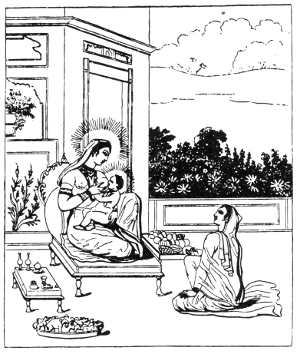
Krishna nursed by Devaki.
[Christian Church.]156 When we arrived [at Calecut]
they took us to a large church, and this is what we saw:—
The body of the church is as large as a monastery, all
built of hewn stone and covered with tiles. At the main
entrance rises a pillar of bronze as high as a mast, on the
top of which was perched a bird, apparently a cock. In
addition to this, there was another pillar as high as a man,
and very stout. In the centre of the body of the church
rose a chapel,157 all built of hewn stone, with a bronze door
sufficiently wide for a man to pass, and stone steps leading
up to it. Within this sanctuary stood a small image which
they said represented Our Lady.158 Along the walls, by
the main entrance, hung seven small bells.159 In this
church the captain-major said his prayers, and we with
him.160
We did not go within the chapel, for it is the custom that
only certain servants of the church, called quafees,161 should
enter. These quafees wore some threads passing over the
left shoulder and under the right arm, in the same manner
as our deacons wear the stole. They threw holy water
over us, and gave us some white earth,162 which the
Christians of this country are in the habit of putting on
their foreheads, breasts, around the neck, and on the
forearms. They threw holy water upon the captain-major
and gave him some of the earth, which he gave in
charge of someone, giving them to understand that he
would put it on later.
Many other saints were painted on the walls of the
church, wearing crowns. They were painted variously,
with teeth protruding an inch from the mouth, and four or
five arms.
Below this church there was a large masonry tank,
similar to many others which we had seen along the road.
[Progress through the Town.] After we had left that
place, and had arrived at the entrance to the city [of
Calecut] we were shown another church, where we saw
things like those described above. Here the crowd grew
so dense that progress along the street became next to
impossible, and for this reason they put the captain into a
house, and us with him.
The king sent a brother of the bale, who was a lord of
this country, to accompany the captain, and he was
attended by men beating drums, blowing anafils and bagpipes,
and firing off matchlocks. In conducting the captain
they showed us much respect, more than is shown in Spain
to a king. The number of people was countless, for in
addition to those who surrounded us, and among whom
there were two thousand armed men, they crowded the
roofs and houses.
[The King’s Palace.]163 The further we advanced in the
direction of the king’s palace, the more did they increase
in number. And when we arrived there, men of much
distinction and great lords came out to meet the captain,
and joined those who were already in attendance upon him.
It was then an hour before sunset. When we reached the
palace we passed through a gate into a courtyard of great
size, and before we arrived at where the king was, we passed
four doors, through which we had to force our way, giving
many blows to the people. When, at last, we reached the
door where the king was, there came forth from it a little
old man, who holds a position resembling that of a bishop,
and whose advice the king acts upon in all affairs of the
church. This man embraced the captain when he entered
the door. Several men were wounded at this door,164 and
we only got in by the use of much force.
[A Royal Audience, May 28.]165 The king was in a small
court, reclining upon a couch covered with a cloth of green
velvet, above which was a good mattress, and upon this
again a sheet of cotton stuff, very white and fine, more so
than any linen. The cushions were after the same fashion.
In his left hand the king held a very large golden cup
[spittoon], having a capacity of half an almude [8 pints].
At its mouth this cup was two palmas [16 inches] wide,
and apparently it was massive. Into this cup the king
threw the husks of a certain herb which is chewed by the
people of this country because of its soothing effects, and
which they call atambor.166 On the right side of the king
stood a basin of gold, so large that a man might just
encircle it with his arms: this contained the herbs. There
were likewise many silver jugs. The canopy above the
couch was all gilt.
The captain, on entering, saluted in the manner of the
country: by putting the hands together, then raising them
towards Heaven, as is done by Christians when addressing
God, and immediately afterwards opening them and shutting
the fists quickly. The king beckoned to the captain
with his right hand to come nearer, but the captain did
not approach him, for it is the custom of the country for
no man to approach the king except only the servant who
hands him the herbs, and when anyone addresses the king
he holds his hand before the mouth, and remains at a
distance. When the king beckoned to the captain he
looked at us others, and ordered us to be seated on a stone
bench near him, where he could see us. He ordered that
water for our hands should be given us, as also some fruit,
one kind of which resembled a melon, except that its outside
was rough and the inside sweet, whilst another kind of
fruit resembled a fig, and tasted very nice.167 There were
men who prepared these fruits for us; and the king looked
at us eating, and smiled; and talked to the servant who
stood near him supplying him with the herbs referred to.
Then, throwing his eyes on the captain, who sat facing
him, he invited him to address himself to the courtiers
present, saying they were men of much distinction, that he
could tell them whatever he desired to say, and they would
repeat it to him (the king). The captain-major replied
that he was the ambassador of the King of Portugal, and
the bearer of a message which he could only deliver to
him personally. The king said this was good, and
immediately asked him to be conducted to a chamber.
When the captain-major had entered, the king, too, rose
and joined him, whilst we remained where we were.168 All
this happened about sunset. An old man who was in the
court took away the couch as soon as the king rose, but
allowed the plate to remain. The king, when he joined
the captain, threw himself upon another couch, covered
with various stuffs embroidered in gold, and asked the
captain what he wanted.
And the captain told him he was the ambassador of a
King of Portugal, who was Lord of many countries and the
possessor of great wealth of every description, exceeding
that of any king of these parts; that for a period of sixty
years his ancestors had annually sent out vessels to make
discoveries in the direction of India, as they knew that
there were Christian kings there like themselves. This, he
said, was the reason which induced them to order this
country to be discovered, not because they sought for gold
or silver, for of this they had such abundance that they
needed not what was to be found in this country. He further
stated that the captains sent out travelled for a year or two,
until their provisions were exhausted, and then returned to
Portugal, without having succeeded in making the desired
discovery. There reigned a king now whose name was
Dom Manuel, who had ordered him to build three vessels,
of which he had been appointed captain-major, and who
had ordered him not to return to Portugal until he should
have discovered this King of the Christians, on pain of
having his head cut off. That two letters169 had been
intrusted to him to be presented in case he succeeded in
discovering him, and that he would do so on the ensuing
day; and, finally, he had been instructed to say by word
of mouth that he [the King of Portugal] desired to be his
friend and brother.
In reply to this the king said that he was welcome;
that, on his part, he held him as a friend and brother, and
would send ambassadors with him to Portugal. This
latter had been asked as a favour, the captain pretending
that he would not dare to present himself before his king
and master unless he was able to present, at the same time,
some men of this country.
These and many other things passed between the two in
this chamber, and as it was already late in the night, the
king asked the captain with whom he desired to lodge,
with Christians or with Moors? And the captain replied,
neither with Christians nor with Moors, and begged as a
favour that he be given a lodging by himself. The king
said he would order it thus, upon which the captain took
leave of the king and came to where we were, that is, to a
veranda lit up by a huge candlestick. By that time four
hours of the night had already gone.170
[A Night’s Lodging.] We then all went forth with the
captain in search of our lodgings, and a countless crowd
with us. And the rain poured down so heavily that the
streets ran with water. The captain went on the back of
six men [in a palanquin], and the time occupied in passing
through the city was so long that the captain at last grew
tired, and complained to the king’s factor, a Moor of distinction,
who attended him to the lodgings. The Moor
then took him to his own house,171 and we were admitted
to a court within it, where there was a veranda roofed in
with tiles. Many carpets had been spread, and there were
two large candlesticks like those at the Royal palace. At
the top of each of these were great iron lamps, fed with oil
or butter, and each lamp had four wicks, which gave much
light. These lamps they use instead of torches.
This same Moor then had a horse brought for the captain
to take him to his lodgings, but it was without a saddle,
and the captain refused to mount it.172 We then started for
our lodgings, and when we arrived we found there some of
our men [who had come from the ships] with the captain’s
bed, and with numerous other things which the captain had
brought as presents for the king.173
[Presents for the King.] On Tuesday [May 29] the
captain got ready the following things to be sent to the
king, viz., twelve pieces of lambel,174 four scarlet hoods, six
hats, four strings of coral, a case containing six wash-hand
basins, a case of sugar, two casks of oil, and two of honey.
And as it is the custom not to send anything to the king
without the knowledge of the Moor, his factor, and of the
bale, the captain informed them of his intention. They
came, and when they saw the present they laughed at it,
saying that it was not a thing to offer to a king, that the
poorest merchant from Mecca, or any other part of India,
gave more, and that if he wanted to make a present it should
be in gold, as the king would not accept such things. When
the captain heard this he grew sad, and said that he had
brought no gold, that, moreover, he was no merchant, but
an ambassador; that he gave of that which he had, which
was his own [private gift] and not the king’s;175 that if the
King of Portugal ordered him to return he would intrust
him with far richer presents; and that if King Camolim176
would not accept these things he would send them back to
the ships. Upon this they declared that they would not
forward his presents, nor consent to his forwarding them
himself. When they had gone there came certain Moorish
merchants, and they all depreciated the present which the
captain desired to be sent to the king.
When the captain saw that they were determined not to
forward his present, he said, that as they would not allow
him to send his present to the palace he would go to speak
to the king, and would then return to the ships. They
approved of this, and told him that if he would wait a short
time they would return and accompany him to the palace.
And the captain waited all day, but they never came back.
The captain was very wroth at being among so phlegmatic
and unreliable a people, and intended, at first, to go
to the palace without them. On further consideration,
however, he thought it best to wait until the following day.
As to us others, we diverted ourselves, singing and dancing
to the sound of trumpets, and enjoyed ourselves much.
[A Second Audience, May 30.] On Wednesday morning
the Moors returned, and took the captain to the palace, and
us others with him. The palace was crowded with armed
men. Our captain was kept waiting with his conductors
for fully four long hours, outside a door, which was only
opened when the king sent word to admit him, attended
by two men only, whom he might select. The captain
said that he desired to have Fernão Martins with him,
who could interpret, and his secretary.177 It seemed to
him, as it did to us, that this separation portended no
good.
When he had entered, the king said that he had expected
him on Tuesday. The captain said that the long road had
tired him, and that for this reason he had not come to see
him. The king then said that he had told him that he
came from a very rich kingdom, and yet had brought him
nothing; that he had also told him that he was the bearer
of a letter, which had not yet been delivered. To this the
captain rejoined that he had brought nothing, because the
object of his voyage was merely to make discoveries, but
that when other ships came he would then see what they
brought him; as to the letter, it was true that he had
brought one, and would deliver it immediately.
The king then asked what it was he had come to discover:
stones or men? If he came to discover men, as he
said, why had he brought nothing? Moreover, he had
been told that he carried with him the golden image of a
Santa Maria. The captain said that the Santa Maria was
not of gold, and that even if she were he would not part with
her, as she had guided him across the ocean, and would
guide him back to his own country. The king then asked
for the letter. The captain said that he begged as a favour,
that as the Moors wished him ill and might misinterpret
him, a Christian able to speak Arabic should be sent for.
The king said this was well, and at once sent for a young
man, of small stature, whose name was Quaram. The
captain then said that he had two letters, one written in
his own language and the other in that of the Moors; that
he was able to read the former, and knew that it contained
nothing but what would prove acceptable; but that as to
the other he was unable to read it, and it might be good,
or contain something that was erroneous. As the Christian
was unable to read Moorish, four Moors took the letter and
read it between them, after which they translated it to the
king, who was well satisfied with its contents.
The king then asked what kind of merchandise was to
be found in his country. The captain said there was much
corn, cloth, iron, bronze, and many other things. The
king asked whether he had any merchandise with him.
The captain replied that he had a little of each sort, as
samples, and that if permitted to return to the ships he
would order it to be landed, and that meantime four or
five men would remain at the lodgings assigned them.
The king said no! He might take all his people with him,
securely moor his ships, land his merchandise, and sell it to
the best advantage. Having taken leave of the king the
captain returned to his lodgings, and we with him. As it
was already late no attempt was made to depart that night.
[Return to Pandarani, May 31.] On Thursday morning
a horse without a saddle was brought to the captain, who
declined to mount it, asking that a horse of the country,
that is a palanquin, might be provided, as he could not ride
a horse without a saddle. He was then taken to the house
of a wealthy merchant of the name of Guzerate,178 who
ordered a palanquin to be got ready. On its arrival the
captain started at once for Pandarani, where our ships were,
many people following him. We others, not being able to
keep up with him, were left behind. Trudging thus along
we were overtaken by the bale, who passed on to join the
captain. We lost our way, and wandered far inland, but
the bale sent a man after us, who put us on the right road.
When we reached Pandarani we found the captain inside a
rest-house, of which there were many along the road, so
that travellers and wayfarers might find protection against
the rain.
[Detention at Pandarani, May 31 to June 2.] The bale
and many others were with the captain. On our arrival
the captain asked the bale for an almadia, so that we might
go to our ships; but the bale and the others said that it
was already late—in fact, the sun had set—and that he
should go next day. The captain said that unless he provided
an almadia he would return to the king, who had
given orders to take him back to the ships, whilst they tried
to detain him—a very bad thing, as he was a Christian like
themselves. When they saw the dark looks of the captain
they said he was at liberty to depart at once, and that they
would give him thirty almadias if he needed them. They
then took us along the beach, and as it seemed to the
captain that they harboured some evil design, he sent three
men in advance, with orders that in case they found the
ship’s boats and his brother, to tell him to conceal himself.
They went, and finding nothing, turned back; but as we
had been taken in another direction we did not meet.
They then took us to the house of a Moor—for it was
already far in the night—and when we got there they told
us that they would go in search of the three men who had
not yet returned. When they were gone, the captain
ordered fowls and rice to be purchased, and we ate,
notwithstanding our fatigue, having been all day on our
legs.
Those who had gone [in search of the three men] only
returned in the morning, and the captain said that after
all they seemed well disposed towards us, and had acted
with the best intentions when they objected to our departure
the day before. On the other hand we suspected
them on account of what had happened at Calecut, and
looked upon them as ill-disposed.
When they returned [June 1] the captain again asked
for boats to take him to his ships. They then began to
whisper among themselves, and said that we should have
them if we would order our vessels to come nearer the shore.
The captain said that if he ordered his vessels to approach
his brother would think that he was being held a prisoner,
and that he gave this order on compulsion, and would hoist
the sails and return to Portugal. They said that if we
refused to order the ships to come nearer we should not
be permitted to embark. The captain said that King
Çamolin had sent him back to his ships, and that as they
would not let him go, as ordered by the king, he should
return to the king, who was a Christian like himself. If the
king would not let him go, and wanted him to remain in
his country, he would do so with much pleasure. They
agreed that he should be permitted to go, but afforded him
no opportunity for doing so, for they immediately closed all
the doors, and many armed men entered to guard us, none
of us being allowed to go outside without being accompanied
by several of these guards.
They then asked us to give up our sails and rudders.
The captain declared that he would give up none of these
things: King Çamolin having unconditionally ordered him
to return to his ships, they might do with him whatever
they liked, but he would give up nothing.
The captain and we others felt very down-hearted,
though outwardly we pretended not to notice what they
did. The captain said that as they refused him permission
to go back, they would at least allow his men to do so, as
at the place they were in they would die of hunger. But
they said that we must remain where we were, and that if
we died of hunger we must bear it, as they cared nothing
for that. Whilst thus detained, one of the men whom we
had missed the night before turned up. He told the captain
that Nicolau Coelho had been awaiting him with the boats
since last night. When the captain heard this he sent a
man away secretly to Nicolau Coelho, because of the guards
by whom we were surrounded, with orders to go back to
the ships and place them in a secure place. Nicolau
Coelho, on receipt of this message, departed forthwith.
But our guards having information of what was going on,
at once launched a large number of almadias and pursued
him for a short distance. When they found that they
could not overtake him they returned to the captain, whom
they asked to write a letter to his brother, requesting him
to bring the ships nearer to the land and further within the
port [roadstead]. The captain said he was quite willing,
but that his brother would not do this; and that even if he
consented those who were with him, not being willing to
die, would not do so. But they asked how this could
be, as they knew well that any order he gave would be
obeyed.
The captain did not wish the ships to come within the
port, for it seemed to him—as it did to us—that once inside
they could easily be captured, after which they would first
kill him, and then us others, as we were already in their
power.
We passed all that day most anxiously. At night more
people surrounded us than ever before, and we were no
longer allowed to walk in the compound, within which we
were, but confined within a small tiled court, with a multitude
of people around us. We quite expected that on the
following day we should be separated, or that some harm
would befall us, for we noticed that our gaolers were much
annoyed with us. This, however, did not prevent our
making a good supper off the things found in the village.
Throughout that night we were guarded by over a
hundred men, all armed with swords, two-edged battleaxes,179
shields, and bows and arrows. Whilst some of these
slept, others kept guard, each taking his turn of duty
throughout the night.
On the following day, Saturday, June 2, in the morning,
these gentlemen [i.e., the bale and others] came back, and
this time they “wore better faces.” They told the captain
that as he had informed the king that he intended to land his
merchandise, he should now give orders to have this done,
as it was the custom of the country that every ship on
its arrival should at once land the merchandise it brought,
as also the crews, and that the vendors should not return
on board until the whole of it had been sold. The captain
consented, and said he would write to his brother to see to
its being done. They said this was well, and that immediately
after the arrival of the merchandise he would be
permitted to return to his ship. The captain at once wrote
to his brother to send him certain things, and he did so at
once. On their receipt the captain was allowed to go on
board, two men remaining behind with the things that had
been landed.180
At this we rejoiced greatly, and rendered thanks to God
for having extricated us from the hands of people who had
no more sense than beasts, for we knew well that once the
captain was on board those who had been landed would
have nothing to fear. When the captain reached his ship
he ordered that no more merchandise should be sent.
[The Portuguese Merchandise at Pandarani, June 2-23.]
Five days afterwards [on June 7] the captain sent word
to the king that, although he had sent him straight back to
his ships, certain of his people had detained him a night
and a day on the road; that he had landed his merchandise
as he had been ordered, but that the Moors only came to
depreciate it; and that for these reasons he looked forward
to what he (the king) would order; that he placed no
value upon this merchandise, but that he and his ships were
at his service. The king at once sent word saying that
those who acted thus were bad Christians, and that he would
punish them. He, at the same time, sent seven or eight
merchants to inspect the merchandise, and to become
purchasers if they felt inclined. He also sent a man of
quality to remain with the factor already there, and
authorised them to kill any Moor who might go there,
without fear of punishment.
The merchants whom the king had sent remained
about eight days, but instead of buying they depreciated
the merchandise. The Moors no longer visited
the house where the merchandise was, but they bore
us no good-will, and when one of us landed they spat
on the ground, saying: “Portugal, Portugal.” Indeed
from the very first they had sought means to take and
kill us.
When the captain found that the merchandise found no
buyers at that place, he applied to the king for permission
to forward it to Calecut. The king at once ordered the
bale to get a sufficient number of men who were to
carry the whole on their backs to Calecut, this to be
done at his expense, as nothing belonging to the King
of Portugal was to be burthened with expenses whilst
in his country. But all this was done because it was
intended to do us some ill-turn, for it had been reported
to the king that we were thieves and went about
to steal. Nevertheless, he did all this in the manner
shown.
[The Merchandise removed to Calecut, June 24.]
On Sunday, the 24th of June, being the day of St. John
the Baptist, the merchandise left for Calecut. The captain
then ordered that all our people should visit that town by
turns, and in the following manner:—Each ship was to
send a man ashore, on whose return another should be
sent. In this way all would have their turn, and would be
able to make such purchases as they desired. These men
were made welcome by the Christians along the road, who
showed much pleasure when one of them entered a house,
to eat or to sleep, and they gave them freely of all they
had. At the same time many men came on board our
ships to sell us fish in exchange for bread, and they
were made welcome by us. Many of them were accompanied
by their sons and little children, and the captain
ordered that they should be fed. All this was done for
the sake of establishing relations of peace and amity, and
to induce them to speak well of us and not evil. So great
was the number of these visitors that sometimes it was
night before we could get rid of them; and this was due to
the dense population of the country and the scarcity of
food. It even happened that when some of our men were
engaged in mending a sail, and took biscuits with them to
eat, that old and young fell upon them, took the biscuits
out of their hands, and left them nothing to eat.
In this manner all on board ship went on land by twos
and threes, taking with them bracelets, clothes, new shirts,
and other articles, which they desired to sell. We did not,
however, effect these sales at the prices hoped for when
we arrived at Moncobiquy [Moçambique], for a very fine
shirt which in Portugal fetches 300 reis, was worth here
only two fanôes,181 which is equivalent only to 30 reis, for
30 reis in this country is a big sum. And just as we sold
shirts cheaply so we sold other things, in order to take some
things away from this country, if only for samples. Those
who visited the city bought there cloves, cinnamon, and
precious stones; and having bought what they desired they
came back to the ships, without any one speaking to them.
When the captain found the people of the country so
well disposed, he left a factor with the merchandise, together
with a clerk and some other men.
[Diogo Dias Carries a Message to the King, August 13.]
When the time arrived for our departure the captain-major
sent a present to the king, consisting of amber, corals,
and many other things. At the same time he ordered the
king to be informed that he desired to leave for Portugal,
and that if the king would send some people with him to the
King of Portugal, he would leave behind him a factor, a clerk
and some other men, in charge of the merchandise. In return
for the present he begged on behalf of his lord [the King
of Portugal] for a bahar182 of cinnamon, a bahar of cloves, as
also samples of such other spices as he thought proper, saying
that the factor would pay for them, if he desired it.
Four days were allowed to pass after the dispatch of this
message before speech could be had with the king. And
when the bearer of it entered the place where the king was,
he (the king) looked at him with a “bad face,” and asked
what he wanted. The bearer then delivered his message,
as explained above, and then referred to the present which
had been sent. The king said that what he brought ought
to have been sent to his factor, and that he did not want
to look at it. He then desired the captain to be informed
that as he wished to depart he should pay him 600
xerafins,183 and that then he might go: this was the custom
of the country and of those who came to it. Diogo Dias,
who was the bearer of the message, said he would return with
this reply to the captain. But when he left [the palace]
certain men followed him, and when he arrived at the house
in Calecut where the merchandise was deposited, they put
a number of men inside with him to watch that none of
it was sent away. At the same time proclamation was
made throughout the town prohibiting all boats from
approaching our ships.
When they [the Portuguese] saw that they were prisoners,
they sent a young negro who was with them along the
coast to seek for some one to take him to the ships, and to
give information that they had been made prisoners by
order of the king. The negro went to the outskirts of the
town, where there lived some fishermen, one of whom took
him on board, on payment of three fanôes. This the
fisherman ventured to do because it was dark, and they
could not be seen from the city; and when he had put his
passenger on board he at once departed. This happened
on Monday, the 13th August, 1498.
This news made us sad; not only because we saw some
of our men in the hands of our enemies, but also because
it interfered with our departure. We also felt grieved
that a Christian king, to whom we had given of ours,
should do us such an ill turn. At the same time we
did not hold him as culpable as he seemed to be, for
we were well aware that the Moors of the place, who
were merchants from Mecca and elsewhere, and who knew
us, could ill digest us. They had told the king that we
were thieves, and that if once we navigated to his country,
no more ships from Mecca, nor from Quambaye [Cambay],
nor from Imgros,184 nor from any other part, would
visit him. They added that he would derive no profit
from this [trade with Portugal] as we had nothing to give,
but would rather take away, and that thus his country
would be ruined. They, moreover, offered rich bribes to
the king to capture and kill us, so that we should not
return to Portugal.
All this the captain learnt from a Moor of the country,185
who revealed all that was intended to be done, warning the
captains, and more especially the captain-major, against
going on shore. In addition to what we learnt through
the Moor, we were told by two Christians that if the captains
went ashore their heads would be cut off, as this was the
way the king dealt with those who came to his country
without giving him gold.
Such then was the state of affairs. On the next day
[August 14] no boats came out to the ships. On the day
after that [August 15] there came an almadia, with four
young men, who brought precious stones for sale; but it
appeared to us that they came rather by order of the
Moors, in order to see what we should do to them, than for
the purpose of selling stones. The captain, however,
made them welcome, and wrote a letter to his people on
shore, which they took away with them. When the people
saw that no harm befell them, there came daily many merchants,
and others who were not merchants, from curiosity,
and all were made welcome by us and given to eat.
On the following Sunday [August 19] about twenty-five
men came. Among them were six persons of quality, and
the captain perceived that through these we might recover
the men who were detained as prisoners on land. He therefore
laid hands upon them, and upon a dozen of the
others, being eighteen186 in all. The rest he ordered to be
landed in one of his boats, and gave them a letter to be
delivered to the king’s Moorish factor, in which he declared
that if he would restore the men who were being kept
prisoners he would liberate those whom he had taken.
When it became known that we had taken these men, a
crowd proceeded to the house where our merchandise was
kept, and conducted our men to the house of the factor,
without doing them any harm.
On Thursday, the 23rd,187 of the same month, we made
sail, saying we were going to Portugal, but hoped to be
back soon, and that then they would know whether we
were thieves. We anchored about four leagues to the
leeward of Calecut, and we did this because of the headwind.
On the next day [August 24] we returned towards the
land, but not being able to weather certain shoals in front
of Calecut, we again stood off and anchored within sight of
the city.
On Saturday [August 25] we again stood off and
anchored so far out at sea that we could scarcely see
the land. On Sunday [August 26] whilst at anchor,
waiting for a breeze, a boat which had been on the lookout
for us approached, and informed us that Diogo Dias
was in the king’s house, and that if we liberated those
whom we detained, he should be brought on board. The
captain, however, was of opinion that he had been killed,
and that they said this in order to detain us until they
had completed their armaments, or until ships of Mecca able
to capture us had arrived. He therefore bade them retire,
threatening otherwise to fire his bombards upon them, and
not to return without bringing him [Dias] and his men, or
at least a letter from them. He added that unless this
were done quickly he intended to take off the heads of his
captives. A breeze then sprang up, and we sailed along
the coast until we anchored.
[The King sends for Diogo Dias.]
When the king heard that we had sailed for Portugal, and
that he was thus no longer able to carry his point, he
thought of undoing the evil he had done. He sent for
Diogo Dias, whom he received with marked kindness, and
not in the way he did when he was the bearer of [Vasco’s]
present. He asked why the captain had carried off these
men. Diogo Dias said it was because the king would not
allow him and his to return to the ships, and detained them
as prisoners in the city. The king said he had done well.
He then asked whether his factor had asked for anything,188
giving us to understand that he was ignorant of the matter,
and that the factor alone was responsible for this extortion.
Turning to his factor, he asked whether he was unaware
that quite recently he had killed another factor because he
had levied tribute upon some merchants that had come to
this country? The king then said: “Go you back to the
ships, you and the others who are with you; tell the
captain to send me back the men he took; that the pillar,
which I understood him to say he desires to be erected on
the land shall be taken away by those who bring you back,
and put up; and, moreover, that you will remain here with
the merchandise.” At the same time he forwarded a letter
to the captain, which had been written for him by Diogo
Dias with an iron pen upon a palm-leaf, as is the custom
of the country, and which was intended for the King of
Portugal. The tenor189 of this letter was as follows:—
“Vasco da Gama, a gentleman of your household, came to my
country, whereat I was pleased. My country is rich in cinnamon,
cloves, ginger, pepper, and precious stones. That which I ask of
you in exchange is gold, silver, corals and scarlet cloth.”
[Off Calecut, August 27-30.] On Monday, the 27th of
this month, in the morning, whilst we were at anchor,
seven boats with many people in them brought Diogo
Dias and the other [Portuguese] who were with him. Not
daring to put him on board, they placed him in the captain’s
long boat, which was still attached to the stern.
They had not brought the merchandise, for they believed
that Diogo Dias would return with them. But once the
captain had them back on board, he would not allow them
to return to the land. The pillar190 he gave to those in the
boat, as the king had given orders for it to be set up. He
also gave up, in exchange, the six most distinguished
among his prisoners, keeping six others, whom he promised
to surrender if on the morrow the merchandise were
restored to him.
On Tuesday [August 28], in the morning, whilst at
anchor, a Moor of Tunis,191 who spoke our language, took
refuge on board one of our ships, saying, that all he had
had been taken from him, that worse might happen, and
that this was his usual luck. The people of the country,
he said, charged him with being a Christian, who had come
to Calecut by order of the King of Portugal; for this
reason he preferred going away with us, rather than remain
in a country where any day he might be killed.
At ten o’clock seven boats with many people in them
approached us. Three of them carried on their benches
the striped cloth which we had left on land, and we were
given to understand that this was all the merchandise
which belonged to us.192 These three came to within a
certain distance of the ships, whilst the other four kept
away. We were told that if we sent them their men in
one of our boats they would give our merchandise in
exchange for them. However, we saw through their
cunning, and the captain-major told them to go away,
saying that he cared nought for the merchandise, but
wanted to take these men to Portugal.193 He warned them
at the same time to be careful, as he hoped shortly to be
back in Calecut, when they would know whether we were
thieves, as had been told them by the Moors.
On Wednesday, the 29th [of August], the captain-major
and the other captains agreed that, inasmuch that we had
discovered the country we had come in search of, as also
spices and precious stones, and it appeared impossible to
establish cordial relations with the people, it would be as
well to take our departure. And it was resolved that we
should take with us the men whom we detained, as, on our
return to Calecut, they might be useful to us in establishing
friendly relations. We therefore set sail and left for
Portugal, greatly rejoicing at our good fortune in having
made so great a discovery.
On Thursday [August 30], at noon, being becalmed
about a league below [that is, north of] Calecut, about
seventy boats approached us.194 They were crowded with
people wearing a kind of cuirass made of red cloth, folded.
Their weapons for the body, the arms and the head were
these195.... When these boats came within the range of
our bombards, the captain-major ordered us to fire upon
them. They followed us for about an hour and a half,
when there arose a thunderstorm which carried us out to
sea; and when they saw they could no longer do us harm
they turned back, whilst we pursued our route.
[Calecut and its Commerce.]
From this country of Calecut, or Alta India,196 come the
spices which are consumed in the East and the West,
in Portugal, as in all other countries of the world, as also
precious stones of every, description. The following spices
are to be found in this city of Calecut, being its own
produce: much ginger and pepper and cinnamon, although
the last is not of so fine a quality as that brought from an
island called Çillan [Ceylon],197 which is eight days journey
from Calecut. Calecut is the staple for all this cinnamon.
Cloves are brought to this city from an island called
Melequa [Malacca].198 The Mecca vessels carry these spices
from there to a city in Mecca199 called Judeâ [Jidda], and from
the said island to Judeâ is a voyage of fifty days sailing before
the wind, for the vessels of this country cannot tack. At
Judeâ they discharge their cargoes, paying customs duties
to the Grand Sultan.200 The merchandise is then transshipped
to smaller vessels, which carry it through the Red
Sea to a place close to Santa Catarina of Mount Sinai,
called Tuuz,201 where customs dues are paid once more.
From that place the merchants carry the spices on the
back of camels, which they hire at the rate of 4 cruzados
each, to Quayro [Cairo], a journey occupying ten days.
At Quayro duties are paid again. On this road to Cairo
they are frequently robbed by thieves, who live in that
country, such as the Bedouins and others.
At Cairo the spices are embarked on the river Nile,
which rises in Prester John’s country in Lower India, and
descending that river for two days they reach a place
called Roxette [Rosetta], where duties have to be paid
once more. There they are placed on camels, and are
conveyed in one day to a city called Alexandria, which is
a sea-port. This city is visited by the galleys of Venice
and Genoa, in search of these spices, which yield the Grand
Sultan a revenue of 600,000 cruzados202 in customs duties,
out of which he pays to a king called Cidadym203 an annual
subsidy of 100,000 cruzados for making war upon Prester
John. The title of Grand Sultan is bought for money, and
does not pass from father to son.
I now again speak of our voyage home.
Going thus along the coast we kept tacking, with the aid
of the land and sea breezes, for the wind was feeble.
When becalmed in the day we lay to.
On Monday, September 10, the captain-major landed
one of the men whom we had taken, and who had lost an
eye, with a letter to the Çamolin, written in Moorish
[Arabic] by one of the Moors who came with us.204 The
country where we landed this Moor was called Compia,205
and its king, Biaquolle, was at war with the King of
Calecut.
On the following day [September 11], whilst becalmed,
boats approached the ships, and the boatmen, who offered
fish for sale, came on board without exhibiting any fear.
[Santa Maria Islands.]206
On Saturday, the 15th of said month, we found ourselves
near some islets, about two leagues from the land. We
there launched a boat and put up a pillar on one of these
islets, which we called Santa Maria, the king having ordered
three pillars (padrãos), to be named S. Raphael, S. Gabriel,
and Santa Maria. We had thus succeeded in erecting
these three, scilicet, the first, that of S. Raphael, on the Rio
dos bons signaes; the second, that of S. Gabriel, at
Calecut; and this, the last, named Santa Maria.
Here again many boats came to us with fish, and the
captain made the boatmen happy by presenting them with
shirts. He asked them whether they would be glad if he
placed a pillar upon the island. They said that they
would be very glad indeed, for its erection would confirm
the fact that we were Christians like themselves. The
pillar was consequently erected in much amity.
[Anjediva, September 20 to October 5.]207
That same night, with a land breeze, we made sail and
pursued our route. On the following Thursday, the 20th
of the month,208 we came to a hilly country, very beautiful
and salubrious, close to which there were six small islands.
There we anchored, near the land, and launched a boat to
take in water and wood to last us during our voyage across
the Gulf, which we hoped to accomplish, if the wind
favoured us. On landing we met a young man, who pointed
out to us a spring of excellent water rising between two
hills on the bank of a river. The captain-major gave this
man a cap, and asked whether he was a Moor or a Christian.
The man said that he was a Christian, and when told that
we too were Christians he was much pleased.
On the following day [September 21] an almadia came
to us with four men, who brought gourds and cucumbers.
The captain-major asked whether cinnamon, ginger, or any
other spices were to be found in this country. They said
there was plenty of cinnamon, but no other kind of spice.
The captain at once sent two men with them to the mainland
to bring him a sample, and they were taken to a wood
where a large number of trees yielding cinnamon were
growing, and they cut off two big branches, with their
foliage. When we went in our boats to fetch water we
met these two men with their cinnamon branches, and they
were accompanied by about twenty others, who brought the
captain fowls, cow-milk and gourds. They asked the captain
to send these two men along with them, as there was
much dry cinnamon not far off, which they would show
them, and of which they would bring samples.209
Having taken in water we returned to the ships, and
these men promised to come on the ensuing day to bring
a present of cows, pigs and fowls.
Early on the next morning [September 22] we observed
two vessels close to the land, about two leagues off, but
took no further notice of them. We cut wood whilst waiting
for the tide to enable us to enter the river to take in water,
and being thus engaged it struck the captain that these
vessels were larger than he had thought at first. He therefore
ordered us into the boats, as soon as we had eaten,
and sent us to find out whether these vessels belonged to
Moors or Christians. After his return on board, the captain-major
ordered a mariner to go aloft and look out for
vessels, and this man reported that out in the open sea
and at a distance of about six leagues he saw eight vessels
becalmed. The captain, when he heard this, at once gave
orders to sink these vessels. They, as soon as they felt
the breeze, put the helm hard a-lee, and when they were
abreast of us, at a distance of a couple of leagues, and we
thought they might discover us, we made for them. When
they saw us coming they bore away for the land. One
of them being disabled, owing to her helm breaking, the
men in her made their escape in the boat, which they
dragged astern, and reached the land in safety. We,
who were nearest to that vessel, at once boarded her, but
found nothing in her except provisions, coco-nuts, four jars
of palm-sugar, and arms, all the rest being sand used as
ballast. The seven other vessels grounded, and we fired
upon them from our boats.
On the following morning [September 23], whilst at
anchor, seven men in a boat visited us, and they told us that
these vessels had come from Calecut in search of us, and
that if they had succeeded in taking us we should have
been killed.210
On the following morning, having left this place, we
anchored at a distance of two bombard-shots from the
place at which we had been at first, and close to an island,
where we had been told that water would be found.211 The
captain-major at once sent Nicolau Coelho in an armed
boat in search for this watering place. He came there
upon the ruins of a large stone church which had been
destroyed by the Moors, with the exception of a chapel
which had been roofed with straw. This, at least, was told
us by the natives of the country, who prayed there to three
black stones which stood in the middle of the chapel.212
Beside this church we discovered a tank of the same
workmanship as the church itself—that is, built of hewn
stone—from which we took as much water as we needed.
Another tank, of large size and four fathoms deep, occupied
the highest part of the island. On the beach, in front of
the church, we careened the Berrio and the ship of the
captain-major. The Raphael was not drawn up on the
beach, on account of difficulties which will be referred to
further on.
Being one day in the Berrio, which was drawn up on the
beach, there approached two large boats, or fustas,213
crowded with people. They rowed to the sound of drums
and bagpipes, and displayed flags at the masthead. Five
other boats remained on the coast for their protection.
As they came nearer we asked the people whom we had
with us who they were. They told us not to allow them
to come on board, as they were robbers who would seize
us if they could. The people of this country, they said,
carried arms and boarded vessels as if they came as friends,
and having succeeded, and feeling strong enough, they laid
hands upon them. For this reason they were fired upon from
the Raphael and the captain-major’s ship, as soon as they
came within range of our bombards. They began to shout
“Tambaram,”214 which meant that they were Christians,
for the Christians of India call God “Tambaram.” When
they found that we took no notice of this, they fled towards
the land. Nicolau Coelho pursued them for a short distance,
when he was recalled by a signal flag on the ship of
the captain-major.
On the following day, whilst the captain and many of
our people were on land, careening the Berrio, there arrived
two small boats with a dozen well-dressed men in them,
who brought a bundle of sugar-cane as a present for the
captain-major. After they had landed they asked permission
to see the ships. The captain thought they were
spies, and grew angry. Just then two other boats, with
as many people, made their appearance, but those who
had come first, seeing that the captain was not favourably
disposed towards them, warned these new-comers not to
land, but to turn back. They, too, re-embarked at once,
and went away.
Whilst the ship of the captain-major was being careened
there arrived a man,215 about forty years of age, who spoke
Venetian well. He was dressed in linen, wore a fine touca
on his head, and a sword in his belt. He had no sooner
landed than he embraced the captain-major and the captains,
and said that he was a Christian from the west, who
had come to this country in early youth; that he was now
in the service of a Moorish lord,216 who could muster
40,000 horsemen; that he, too, had become a Moor,
although at heart still a Christian. He said that, being one
day at his master’s house, news was brought that men had
arrived at Calecut, whose speech none could understand,
and who were wholly clad; that when he heard this he
said that these strangers must be Franks, for this is the
name by which we [Europeans] are known in these parts.
He then begged permission of his master to be allowed to
visit us, saying that a refusal would cause him to die of
sorrow. His master thereupon had told him to go and tell
us that we might have anything in his country which
suited us, including ships and provisions, and that if we
desired to remain permanently it would give him much
pleasure. When the captain had cordially thanked him
for these offers, which appeared to him to have been made
in good faith, our visitor asked as a favour that a cheese
be given him, which he desired to take to one of his companions
who had remained on the mainland, as a token
that all had gone well. The captain ordered a cheese and
two soft loaves to be given to him. He remained on the
island, talking so much and about so many things, that at
times he contradicted himself.
Paulo da Gama, in the meanwhile, had sought the
Christians who had come with this visitor, and asked who
he was. They said he was a pirate (armador), who had
come to attack us, and that his ships, with many people in
them, had remained on the coast. Knowing this much, and
conjecturing the rest, we seized him, took him to the vessel
drawn up on the beach, and there began to thrash him,
in order to make him confess whether he was really a
pirate, or what was the object with which he had come
to us. He then told us that he was well aware that the
whole country was ill-disposed towards us, and that
numbers of armed men were around, hidden within the
creeks, but that they would not for the present venture to
attack us, as they were expecting some forty vessels which
were being armed to pursue us. He added that he did not
know when they would be ready to attack us. As to
himself he said nothing except what he had said at first.
Afterwards he was “questioned”217 three or four times, and
although he did not definitely say so, we understood from
his gestures that he had come to see the ships, so that he
might know what sort of people we were, and how we
were armed.
At this island we remained twelve days, eating much fish,
which was brought for sale from the mainland, as also
many pumpkins and cucumbers. They also brought us
boat-loads of green cinnamon-wood with the leaves still on.
When our ships had been careened, and we had taken in as
much water as we needed, and had broken up the vessel
which we had captured, we took our departure. This
happened on Friday, October 5.218
Before the vessel referred to was broken up, its captain
offered us 1000 fanões for it, but the captain-major said
that it was not for sale, and as it belonged to an enemy he
preferred to burn it.
When we were about two hundred leagues out at sea,
the Moor whom we had taken with us declared that the
time for dissembling was now past. It was true that he
had heard at the house of his master that we had lost
ourselves along the coast, and were unable to find our
way home; that for this reason many vessels had been
despatched to capture us; and that his master had sent him
to find out what we were doing and to entice us to his
country, for if a privateer had taken us he would not have
received a share of the booty, whilst if we had landed
within his territory we should have been completely in
his power, and being valiant men, he could have employed
us in his wars with the neighbouring kings. This reckoning,
however, was made without the host.
[The Voyage across the Arabian Sea.]
Owing to frequent calms and foul winds it took us three
months less three days to cross this gulf,219 and all our
people again suffered from their gums, which grew over their
teeth, so that they could not eat. Their legs also swelled,
and other parts of the body, and these swellings spread
until the sufferer died, without exhibiting symptoms of any
other disease. Thirty of our men died in this manner—an
equal number having died previously—and those able
to navigate each ship were only seven or eight, and even
these were not as well as they ought to have been. I
assure you that if this state of affairs had continued for
another fortnight, there would have been no men at all to
navigate the ships. We had come to such a pass that all
bonds of discipline had gone. Whilst suffering this
affliction we addressed vows and petitions to the saints on
behalf of our ships. The captains had held council, and
they had agreed that if a favourable wind enabled us we
would return to India whence we had come.
But it pleased God in his mercy to send us a wind which,
in the course of six days, carried us within sight of land,
and at this we rejoiced as much as if the land we saw had
been Portugal, for with the help of God we hoped to
recover our health there, as we had done once before.220
This happened on January 2, 1499.221 It was night
when we came close to the land, and for this reason we
put about ship and lay to. In the morning [January 3]
we reconnoitred the coast, so as to find out whither the
Lord had taken us, for there was not a pilot on board, nor
any other man who could tell on the chart in what place
we were. Some said that we must be among certain
islands off Moçambique, about 300 leagues from the mainland;222
and they said this because a Moor whom we had
taken at Moçambique had asserted that these islands were
very unhealthy, and that their inhabitants suffered from
the same disease which had afflicted us.
[Magadoxo.]
We found ourselves off a large town, with houses of several
stories, big palaces in its centre, and four towers around it.
This town faced the sea, belonged to the Moors, and was
called Magadoxo.223 When we were quite close to it we
fired off many bombards,224 and continued along the coast
with a fair wind. We went on thus during the day, but
lay to at night, as we did not know how far we were from
Milingue [Malindi] whither we wished to go.
On Saturday, the 5th of the month, being becalmed, a
thunderstorm burst upon us, and tore the ties of the
Raphael. Whilst repairing these a privateer came out from
a town called Pate225 with eight boats and many men, but
as soon as he came within reach of our bombards we fired
upon him, and he fled. There being no wind we were not
able to follow him.
[Malindi.]
On Monday, the 7th [of January]226 we again cast anchor
off Milindy, when the king at once sent off to us a long boat
holding many people, with a present of sheep, and a message
to the captain-major, bidding him welcome. The
king said that he had been expected for days past, and
gave expression to his amicable and peaceable sentiments.
The captain-major sent a man on shore with these messengers
with instructions to bring off a supply of oranges,
which were much desired by our sick. These he brought
on the following day, as also other kinds of fruit; but our
sick did not much profit by this, for the climate affected
them in such a way that many of them died here. Moors
also came on board, by order of the king, offering fowls
and eggs.
When the captain saw that all this attention was shown
us at a time when we stood so much in need of it, he
sent a present to the king, and also a message by the
mouth of one of our men who spoke Arabic, begging for a
tusk of ivory to be given to the King [of Portugal], his
Lord, and asking that a pillar be placed on the land as a
sign of friendship. The king replied that he would do
what was asked out of love for the King of Portugal, whom
he desired to serve; and, in fact, he at once ordered a tusk
to be taken to the captain and ordered the pillar to be
erected.227
He also sent a young Moor,228 who desired to go with us
to Portugal, and whom he recommended strongly to the
captain-major, saying that he sent him in order that the
King of Portugal might know how much he desired his
friendship.
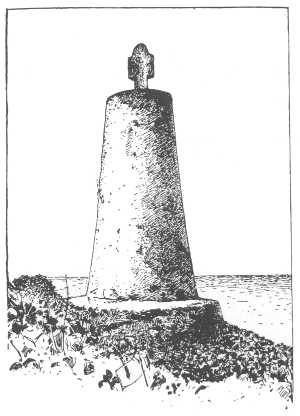
Vasco da Gama’s Pillar at Malindi.
(From a photograph by Sir John Kirk.)
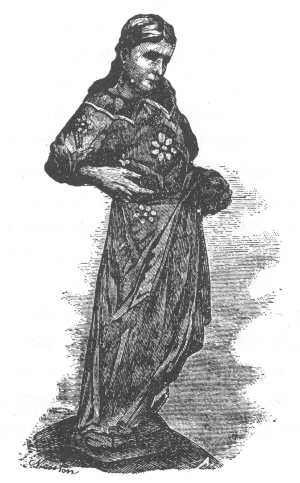
The Figure-head of the S. Raphael.
We remained five days at this place enjoying ourselves,
and reposing from the hardships endured during a passage
in the course of which all of us had been face to face with
death.
[Malindi to São Braz.]
We left on Friday [January 11], in the morning, and on
Saturday, which was the 12th of the month, we passed
close to Mombaça. On Sunday [January 13] we anchored
at the Baixos de S. Raphael,229 where we set fire to the ship
of that name, as it was impossible for us to navigate three
vessels with the few hands that remained to us. The
contents of this ship were transferred to the two other
ships. We were here fifteen days,230 and from a town
in front of us, called Tamugate,231 many fowls were
brought to us for sale or barter in exchange for shirts
and bracelets.
On Sunday, the 27th, we left this place with a fair
wind. During the following night we lay to, and in the
morning [January 28] we came close to a large island
called Jamgiber [Zanzibar], which is peopled by Moors,
and is quite ten leagues232 from the mainland. Late on
February 1, we anchored off the island of S. Jorge, near
Moçambique and left at once. On the following day [February 2], in the
morning, we set up a pillar in that island, where we had
said mass on going out. The rain fell so heavily that we
could not light a fire for melting the lead to fix the cross,
and it therefore remained without one. We then returned
to the ships.
On March 3 we reached the Angra de São Braz, where
we caught many anchovies, seals and penguins, which we
salted for our voyage. On the 12th we left, but when ten
or twelve leagues from the watering-place the wind blew
so strongly from the west, that we were compelled to return
to this bay.
[São Braz to the Rio Grande.]
When the wind fell we started once more, and the Lord
gave us such a good wind that on the 20th we were able to
double the Cape of Good Hope. Those who had come so
far were in good health and quite robust, although at
times nearly dead from the cold winds which we experienced.
This feeling, however, we attributed less to the
cold than to the heat of the countries from which we had
come.
We pursued our route with a great desire of reaching
home. For twenty-seven days233 we had the wind astern,
and were carried by it to the neighbourhood of the island
of São Thiago. To judge from our charts we were within
a hundred leagues from it, but some supposed we were
quite near. But the wind fell and we were becalmed.
The little wind there was came from ahead. Thunderstorms,234
which came from the land, enabled us to tell our
whereabouts, and we plied to windward as well as we
could.
On Thursday, the 25th of April, we had soundings of
35 fathoms. All that day we followed our route, and the
least sounding we had was 20 fathoms. We nevertheless
could get no sight of the land, but the pilots told us that
we were near the shoals of the Rio Grande.235
[Here the Journal ends abruptly. The succeeding events
may be shortly stated. Vasco da Gama and Coelho were
separated in a storm, according to Resende. Coelho continued
his voyage, arriving at Cascaes, below Lisbon, on
July 10, 1499. Vasco da Gama, having waited one day
for his consort, proceeded to the island of São Thiago,
placed João de Sá in charge of the S. Gabriel, and chartered
a caravel in which he conveyed his dying brother Paulo to
the island of Terceira. João de Sá arrived soon after Coelho,
and certainly anterior to August 28th, on which day the
king addressed a letter to the Cardinal Protector of Portugal
(see Appendix). Paulo died a day after he had landed at
the Angra of Terceira, and was buried in the church of the
Monastery of S. Francisco.236 A resident of Terceira, one
Arthur Rodriguez, at once started in a caravel to carry the
news of Vasco da Gama’s arrival to Lisbon.
The date of Vasco da Gama’s return to Lisbon is not
known with certainty. The commission appointed in 1871
to remove the remains of Vasco da Gama from the church
of Vidigueira to Belem made every effort to ascertain the
exact date, but in vain; and whilst Barros, Goes, and Pero
Barretto de Resende state that it happened on August 29th,
Castanheda fixes upon September 8th, and a MS. in the
Torre do Tombo, consulted by Texeira de Aragão, has
September 18th. Herculano, in a note to the second
edition of the “Roteiro”, is content with saying that it
happened at the end of August or at the beginning of
September. Texeira de Aragão assumes (on the ground
of a vague expression in De Barros) that he reached
Terceira on August 29th, arrived at Lisbon on September
9th, and made his triumphal entry into the town on September
18th. This assumption is partly supported by
the statement of Barros that Vasco da Gama, after his
arrival at Belem, on account of the loss he had suffered
in the death of a beloved brother, spent nine days in
retirement.237
I am myself inclined to believe that Vasco da Gama
reached Lisbon on August 29th, and made his triumphal
entry on September 8th.]
The following are the names of certain kingdoms on the
coast to the south of Calecut, together with the productions
of each, and what they are worth, all of which I have
learnt in the most trustworthy manner from a man who
spoke our language and who had come to those parts
from Alexandria thirty years before.238
Calecut, where we were. The articles of merchandise
mentioned below are sent to it, and the vessels of Mecca
take their cargoes to that city. The King, who is called
Çamolim, can muster 100,000 fighting men, including
auxiliaries, for the number under his proper jurisdiction
is very small.
In the following we give the articles of merchandise
brought thither in the vessels of Mecca, and their value
throughout this part of India239:—
Copper, of which the frazila of nearly 30 pounds is worth
50 fanãos or 3 cruzados.
Stone of Baqua,240 which is worth its weight in silver.
Knives, worth one fanão each.
Rosewater, worth 50 fanãos the frazila.
Alum, worth 50 fanãos the frazila.
Camlot, worth 7 cruzados the piece.
Red cloth, worth 2 cruzados the pequy241 of three spans
(palmas).
Quicksilver, worth 10 cruzados the frazila.
Quorongoliz [Corongolor]242 is a Christian country and
the king is a Christian. Its distance from Calecut by
sea, and with a favourable wind, is 3 days. The king
can muster 40,000 fighting men. There is much pepper,
the frazila being worth 9 fanãos, whilst at Calecut it is
worth 14.
Coleu [Colam, Coulão]243 is Christian. Its distance from
Calecut by sea, and with a good wind, is 10 days. The
king can muster 10,000 men. There is much cotton-cloth
in this country, but little pepper.
Caell [Cael],244 the king of which is a Moor, whilst
the people are Christians. Its distance from Calecut,
by sea, is 10 days. The king can assemble 4,000 fighting
men, and owns 100 war-elephants. There are many
pearls.
Chomandarla [Choramandel]245 is inhabited by Christians,
and the king is a Christian. He can muster 100,000
men. There is much lac here, worth half a cruzado the
frazila, and an extensive manufacture of cotton cloths.
Ceylam [Ceylon] is a very large island inhabited by
Christians under a Christian king. It is 8 days from
Calecut, with a favourable wind. The king can muster 4,000
men, and has moreover many elephants for war as well as
for sale. All the fine cinnamon of India is found here,
as well as many sapphires, superior to those of other
countries,246 besides rubies, few but of good quality.
Camatarra [Sumatra] is Christian. It is 30 days from
Calecut with a favourable wind. The king can muster
4,000 fighting men, and has 1,000 horsemen and 300 war-elephants.
In this country much spun247 silk is found,
worth 8 cruzados the frazila. There is also much lac,
worth 10 cruzados the bahar of 20 frazilas [208 kilo.].
Xarnauz248 is Christian and has a Christian king. Its
distance from Calecut is 50 days with a good wind. The
king can muster 20,000 fighting men and 4,000 horse, and
owns 400 war-elephants. In this country is found much
benzoin,249 worth 3 cruzados the frazila, as also much
aloes,250 worth 25 cruzados the frazila.
Tenacar251 is Christian with a Christian king. It is
40 days’ sail from Calecut, if the wind is favourable. The
king can muster 10,000 fighting men and possesses 500
fighting elephants. In this country is found much Brazil-wood252
which yields a red dye, as fine as kermes, and is
worth 3 cruzados the bahar, whilst at Quayro [Cairo] it
fetches 60. There is likewise a little aloes.
Bemgala [Bengal].253 In this kingdom there are many
Moors and few Christians, and the king is a Christian. He
can muster 20,000 fighting men on foot and 10,000 horse.
In this country there is much cloth made of cotton and
of silk, and much silver. The distance from Calecut is 40
days’ sail, with a favourable wind.
Melequa [Malacca] is Christian with a Christian king.
It is 40 days’ sail from Qualecut [Calecut], with a good
wind. The king can muster 10,000 fighting men, including
1,200 horse. All cloves254 come from here, being worth on
the spot 9 cruzados the bahar,255 as also nutmeg, which is
worth the like amount. There is also much porcelain, much
silk and much tin, of which last they coin money; but this
money is heavy and of little value, 3 frazilas being worth
only 1 cruzado. There are many big parrots in this
country, whose plumage is red, like fire.
Peguo [Pegu] is Christian and has a Christian king. The
inhabitants are as white as we are. The king can muster
20,000 fighting men, scilicet 10,000 horse and the others on
foot, besides 400 war-elephants. This country produces
all the musk256 of the world. The king possesses an island
about four days’ sail, with a good wind, from the mainland.
In this island there are animals like deer, who have pouches
containing this musk, attached to their navels. At a certain
period of each year they rub themselves against trees,
when the pouches come off. It is then that the people of
the country gather them. Their abundance is such that
they give you four large pouches, or ten to twelve small
ones, which would fill a large chest, for one cruzado. On
the mainland many rubies257 and much gold are found.
For ten cruzados as much gold may be bought here as for
twenty-five at Calecut. There is also much lac and benzoin
of two kinds, white and black. The frazila of white
benzoin is worth three cruzados, of black only a cruzado
and a half. The silver to be obtained here for ten cruzados
is worth fifteen at Calecut.
The distance of this country from Calecut is thirty days
with a fair wind.
Bemguala [Bengal]258 has a Moorish king, and is
inhabited by both Moors and Christians. Its distance
from Calecut is thirty-five days with a fair wind. There
may be 25,000 fighting men, scilicet 10,000 horse and the
remainder on foot, as also 400 war-elephants. In this
country the following merchandise is found:—much corn
and much cloth of great value. Cloth which may be
bought here for ten cruzados is worth forty at Calecut.
There is also much silver.
Conimata259 has a Christian king and Christian inhabitants.
It is fifty days’ sail from Calecut, with a good wind.
The king can assemble five or six thousand men, and owns
one thousand fighting elephants. In this country there
are many sapphires and much brazil-wood.
Pater260 has Christian inhabitants and a Christian king,
and there is not a single Moor. The king can assemble
four thousand fighting men, and has a hundred war-elephants.
In this country is found much rhubarb, the
frazila on the spot being worth nine cruzados. There are
also many spinel rubies and much lac, a bahar of which is
worth four cruzados. The distance from Calecut is fifty
days with a fair wind.
How the Elephants fight in this country.
They make a house of wood holding four men, and this
house is put on the back of the elephant with the four men
in it. The elephant has attached five naked swords to each
of his tusks, being ten for the two tusks. This renders
him so redoubtable that none awaits his attack if flight is
possible. Whatever those seated on the top order to be
done is done as if he were a rational creature, for if they
tell him “kill this one, or do this thing or another”, he
does it.
How they capture Elephants in the Primeval Forests.
When they wish to capture a wild elephant they take a
tame female, and dig a large hole on the track frequented
by elephants, and cover its mouth with brushwood. They
then tell the female “Go! and if you meet with an elephant,
entice him to this hole, in such a way that he falls
into it, but take care that you do not fall into it yourself.”
She then goes away, and does as she has been told, and
when she meets one she draws him on in such a way that
he must fall into the hole, and the hole is so deep that
unaided he could never get out of it.
How they are got out of the hole and broken-in.
After the elephant has fallen into this hole, five or six
days are allowed to pass before he is given anything to
eat. When that time has elapsed, a man brings him a
very small supply of food, the supply being increased from
day to day until he eats by himself. This is continued
for about a month, during which time those who bring
him food gradually tame him, until at last they venture to
descend into the hole. This is done for several days until
he permits the man to put his hands upon his tusks.
He then goes into the hole and puts heavy chains around
the legs, and whilst in this condition they train him so well
that he learns all but to speak.
These elephants are kept in stables like horses, and a
good elephant is worth 2,000 cruzados.261
| | [Value per
Pound.] |
| |
£. | s. | d. |
| One quintal of cinnamon | is worth | 25 | cruzados, |
|
2 |
5 |
| One”quin”al ofcloves | ” | 20 | cruz” |
| 1 | 11 |
| One”quin”al ofpepper | ” | 15 | cruz” |
| 1 | 5 |
| One”quin”al ofginger | ” | 21 | cruz” |
| 2 | 0 |
| (At Calecut one bahar, equal to 5 quintals, is worth 20 cruzados) |
| 0 | 5 |
| One quintal of nutmeg | is worth | 16 | cruz” |
0 | 1 | 7 |
| One”quin”al oflac | ” | 25 | cruz” |
0 | 2 | 5 |
| One”quin”al ofBrazil-wood | ” | 10 | cruz” |
0 | 1 | 10 |
| One ratel of rhubarb | ” | 25 | cruz” |
5 | 16 | 0 |
| One mitikal of musk | ” | 1 | cruz” |
50 | 5 | 4 |
| One ratel of aloe-wood | ” | 2 | cruz” |
0 | 19 | 4 |
| One ratel of benzoin | ” | 1 | cruz” |
0 | 9 | 8 |
| One quintal of frankincense | ” | 2 | cruz” |
0 | 0 | 2½ |
| (At Mecca the bahar is worth 2 cruzados) |
0 | 0 | 0½ |
This is the Language of Calecut.263
| See, look! | nocane [nōkka]. |
| Hearest thou? | que que ne [kēlka]. |
| Take him away | criane. |
| To draw | balichene [walikkān]. |
| Rope | coraoo [kayara]. |
| Largely | lacany. |
| Give me | cornda. |
| To drink | carichany [kutippān]. |
| Eat | tinane [tinmān]. |
| Take | y na. |
| I do not wish to | totenda. |
| To go | mareçane. |
| Go away! | poo [pō]. |
| Come here! | baa [bā or wā]. |
| Be silent! | pote. |
| Rise! | legany. |
| To throw | carecane [karikkān]. |
| To speak | para ne [parane, speak thou]. |
| Mad, silly | moto. |
| Serious | monday decany. |
| Lame | mura call [murakāl]. |
| To fall | biamçe. |
| Many, much | balidu [walare]. |
| Bad | betall [chītta]. |
| Wind | clarle [kātta]. |
| Little | chiredu [chiratu?]. |
| Give him | criane. |
| Timber, wood | mara [maram]. |
| Stone | calou [kallu]. |
| Teeth | faley. |
| Lips | çire [chīra?]. |
| Nose | muco [mūkka]. |
| Eyes | cana [kanna]. |
| Forehead | necheim [nīcha?]. |
| Hair | talanay [talla]. |
| Head | tabu. |
| Ears | cadee [chewi]. |
| Tongue | naoo [nākka]. |
| Neck | caestez. |
| [Breast] | mulay [mula]. |
| Breasts | nane. |
| Arms | carit. |
| Stomach | barri [wayara]. |
| Legs | cali [kāla]. |
| — | canay. |
| — | seyrim. |
| — | cudo. |
| Hands | lamguajem [kai]. |
| Fingers | beda. |
| — | cula. |
| Fish | miny [mīna]. |
| Mast | mana. |
| Light, fire | tiir [tī]. |
| To sleep | teraquy. |
| Man | amoo [āna]. |
| Women | pena [penna]. |
| Chin, beard | tari. |
| Lobster | xame. |
| Parrot | tata [tatta]. |
| Doves | cayninaa. |
| — | baly. |
| To kiss | mucane. |
| To bite | canchany [katikkān]. |
| To see, look | noquany [nokkuwān]. |
| To hear | çegade [kēlkawān]. |
| To beat | catane. |
| Wound | morubo. |
| Sword | batany. |
| Shield | cutany. |
| Bow | cayny. |
| Arrow | ambum [anpa]. |
| Spear | concudoo. |
| To shoot with a bow | heany. |
| Sun | nerara. |
| Moon | neelan. |
| Heaven | mana. |
| The earth | caraa. |
| The sea | caralu. |
| Ship | capell [kappal]. |
| Boat | çambuco. |
| Night | erabut. |
| Day | pagalala. |
| Eat | tinane [tinmān]. |
| — | matara. |
| To mount | arricany. |
| To be on foot | anicany. |
| To go, travel | narecane. |
| To embrace | traigany. |
| Blows | talancy. |
| To mourn, wail | que ne. |
| To raise | alagany. |
| To dance | canechane. |
| To throw with stones or wood | ouriany. |
| To sing | fareny. |
| Rain | ma jaa [mara]. |
| Water | tany [tanni]. |
| Blind | curuge [kurutan, blind man]. |
| Maimed of a hand | muruquay [murukai]. |
| — | panany. |
| Take! | ennay. |
| Let us go! | pomga [pomka]. |
| East | careçache [kirakka]. |
| West | mecache [patinynyara]. |
| North | barcangache [watakka]. |
| South | tycamgarche [tekka]. |
| Dog | naa [nāya]. |
| Bitch | pena [pennāya]. |
| Young man | hum nee. |
| Girl | co poo. |
| House | pura [pura]. |
| Needle | cu doo. |
| Rod | parima. |
| Oar | tandii [tandu]. |
| A great gun | ve dii. |
| Top-sail | talii. |
| Halyard | anguaa. |
| Anchor | napara. |
| Flag | çoti [koti]. |
| Rudder, helm | xoca. |
| Pilot | cu pajaoo. |
| Shoe | cacu paja. |
| Cap | tupy [topi]. |
The following are some of the Names [of Persons].
| Tenae. | Aja paa. | Anapa. |
| Pumi. | A rreco. | Canapa. |
| Paramganda. | A xirama. | Gande. |
| Uja pee. | Cuerapa. | Rremaa. |
| Quilaba. | Cutotopa. | Mamgala. |
| Gouaa. | | |