Note.—Initials in italics refer to Japanese people, and in ordinary
capitals to Westerners.
August 6, 1907.—We lost a good deal of the
wonderful Inland Sea at night, and there is no
moon, but all this morning we have seen fairy-like
islands. I was up at five, and saw the morning
sun lighting the mists. Scattered all over the sea
are green islands and little cliffs, sometimes with a
single tree on them, perched in just the most effectively
pretty attitude. These beautiful lands must
have been made on the seventh day, when God
was resting and dreaming of Paradise.
August 10.—I am much surprised to find how
like Venice Tokio is, with its numerous waterways.
This hotel is on a very tiny island with six bridges,
which connect it with the numerous other islands
which seem to compose a large part of Tokio—there
are waterways, lakes, docks, or rivers everywhere.
It takes more than half an hour’s rickshaw drive to
get to the Embassy, where I called this morning.
At first I was a little disappointed in the streets,
pretty and quaint though they were, but when we
came to the broad roads outside the moats of the
Imperial Palace, I found far more of beauty and
wonder than I had expected. Roads, grey sloping
walls, green banks running up from the green water
which shadowed the great trunks of fantastic trees—the
heart of the city, and no sign of its life. In the
grey sloping walls was a silent strength and majesty,
in the beautiful trees a fantastic charm; the whole
being one of the most impressive views I have ever
seen in a city—a sight that brought tears to one’s eyes.
Then just as I was passing, a few regiments of
soldiers crossed from one great gate into another—regiments
with none of the new smartness of ours.
All their clothes were travel-stained and dusty, the
reserve boots packed on their backs were patched,
their swords clean, but not with the cleanness of the
new metal. The two leaders of each company had
instruments like wide bugles, and one by one they
answered each other with a few notes up and down
the line—only one sounding at once, and apparently
at haphazard, but together giving a weird chant as the
sun-scorched men went forward. Again that pull at
the heart-strings that Japan knows so well how to give.
The Embassy lies quite near the palace enclosure.
I found Mr. L—— (representative of the Ambassador)
away, of course, as in August no one remains here
who can go. His subordinate, however, got a series
of blue letters out referring to my case, and put me
on my way. Apparently they have taken a lot of
trouble, and I shall find things very smooth sailing in
one way, but already I find the under-currents are
swift and difficult to steer through.
In the afternoon I went to the Botanical Gardens
and Institute, of which I cannot speak fully yet. The
first impression, however, must be recorded. The
gardens are beautiful. The part with the little lakes
and streams, distant views and wistaria arbours, more
beautiful than anything of the kind I have yet seen.
Some of the Gymnosperm trees are also very fine
indeed. Parts of the garden are allowed to run wild,
and there is a want of gardeners—the old story. The
low, wooden-built, picturesque Institute, with palms
growing almost into its windows, can show London
and Manchester a good deal. A wonderful lot of
special apparatus and conveniences are there. At
first I was most struck by this “primitive” place
possessing a large aetherising apparatus for hastening
germination in seeds, two chambers with double
blackened doors, etc., for the breeding of fungi, a
special oven-room with a variety of furnaces and
ovens—in fact, several pieces of apparatus the usual
Botanical Department lacks.
When returning in the rickshaw at night (it is an
hour’s drive to the hotel) the pretty Japanese lanterns
decorated the dark streets. Our festival arrangements
are here the daily custom. Alas, that there are now
several red and white brick abominations of buildings
in this low-built, grey wooden town. These brick
buildings are quite new; but some of the older
Europeanised buildings are beautiful, for example,
the Japan Bank is dignified and graceful, of grey
stone, set in brilliant green gardens.
August 11.—I had an exciting time going about
Tokio; of course I could (and did until to-day) go
in a rickshaw, but then one is simply a parcel of
goods to be delivered. To-day I sallied forth to a
place three miles away, and to get there had to take
three different tram-cars and walk a mile through
little twisting streets. I took a map and got there
without losing myself once until within a hundred
yards of the place; then my guardian angel (in the
shape of Professor F——) turned up and rescued
me, though as I had planned this expedition without
his knowledge, and spoken of it to no one, it was
nothing short of a miracle. Tokio is enormous, for
its two millions or so live in single-storied houses,
and there are many parks and gardens, so that it is
very easy to get thoroughly lost, and no one of the
common people can speak English. In the afternoon
I got one of my desires, and saw a real Japanese
house. It was perfectly exquisite in snowy white,
soft straw colour, and grey—I took the shoes from off
my feet. It belonged to the widow of an officer
killed in the war and her daughter; and as a most
exceptional favour I am to be allowed to take
part of the house and live with them as a kind of
lodger. I could sing for joy. My rooms, of course,
are small, but exquisite as a sea-shell; I shall live as
nearly as possible in true Japanese style. The house
is on rising ground, fifteen minutes from the Botanical
Gardens, in a part that is almost country, near a
great Buddhist Temple; the air fresh and inspiring
after that on the flats down here in Tsukiji.
August 12.—Glorious weather. I conveyed my
luggage to my house and found that boxes look detestably
out of place in such a dwelling, and appear
more unutterably hideous than ever.
In the afternoon I had tea in the big summer-house
in the Botanical Gardens. The room is really a good-sized
lecture hall, only flat and open after Japanese
style; the three side walls had their screens taken out,
and so we looked on to the lakes and streams of the
landscape garden. At tea there was quite a party.
Professor M—— most kind and jolly—also several
of the younger botanists, and the Director of the
Geological Survey, representing both himself and the
Minister of Agriculture and Commerce, within whose
jurisdiction I come.
The Stimmung is strange and fascinating, and
quite indescribable. Professor M—— is in Japanese
dress; real Japanese tea (totally unlike our tea) and
real Japanese cakes, also as unlike cakes as possible.
One is a kind of jelly, made of seaweed, and is very
nice. I had my first lesson in eating with chop-sticks,
and have “graduated.”
I had dinner with Dr. M—— and Professor F——,
and then returned for my first night in a true Japanese
house. It is a myth that the daughter of the house
can speak English, and so I have to speak Japanese!
They all kneel on the matting and touch the floor
with their hands and foreheads, and I do a half-hearted
imitation of the courtesy. It crushes my
frocks, but otherwise does me no harm to be polite.
The matting on the floor is delightful, so springy to
walk on as well as pleasing to the eye.
My futons (soft, thick quilt-like mats) are beauties—silk
and velvet—and I feel ashamed to lie on them.
The mosquito curtains are nearly as big as the room,
and make a high, four-square tent when erected, but
everything is put away in the day, and no sign of
sleeping remains; hence everything gets aired and
there is no possibility of dust collecting under beds.
In many of the household arrangements we are far
behind the Japanese. They have reduced simplicity
to a fine art. The bath, where one sits upright
instead of lying down, is most comfortable; but of
course mine was too hot after a short time in it, as
the fire is inside it, and I had to rush out and get help—in
Japanese!
At night the stillness was absolute, but the strangeness
of the day kept sleep away.
August 13.—If things go on at this rate, my
Journal must cease to record anything but bald facts.
I visited the Imperial University, a series of buildings
scattered among landscape gardens and little patches
of wood, covering many acres. I saw the specimens
of all kinds in the Geological Museum from Hokkaido
preparatory to going there, and after that I was taken
to lunch in another open house in the midst of the
University grounds, looking down on a lake called
the Goten. Afterwards I was allowed to examine
further specimens, and then went to a tea-party at
Professor F——’s house—a gem of a house, with
three little distinct gardens. We had the most
wonderful dishes of quaintly decorated rice and seaweed,
fish, and cakes. I am glad to say chop-sticks
are now mastered. This afternoon’s visit deserves a
chapter instead of a paragraph. I dined alone in
the same restaurant as with the party last night, the
food European, but all else Japanese. On my way
home I bargained in the shops for some trifles and
succeeded in buying them. As I passed the great
temple near my house and looked across the grove
of trees toward it, I saw the wonderful Fujii mountain
standing out against a sky of crimson and gold, with
a crescent moon riding near—a view never to be
forgotten.
One of the events of the day was a long newspaper
interview, and when I returned at 8 o’clock there
was another reporter most politely waiting for another
interview—a nice, polite, pretty boy, who sat on the
floor and bowed and wrote down my honourable views
on Japanese houses, people, and customs, and on other
things in general. It appears, that though I have
not been aware of it, the papers have published endless
“facts” about me—perhaps it is as well they are in
Japanese characters and therefore a sealed book to me.
I have protested my little best against the erection
of hideous red brick buildings in this sweet city, a
desecration which I see beginning, and I hope they
will take it to heart, and forbid their erection.
August 14.—Some of the Professors kindly took
me to visit the Principal of the University in solemn
state; he was most gracious, and (through an interpreter)
said most ridiculously flattering things.
According to him only one “specialist” lady has
visited Japan before, and she was elderly. Therefore
they all marvel at me, as though I were some curious
kind of butterfly! We then visited the Director of
the Imperial Geological Survey. The Director is
most kind, as is also the chief Inspector of Mines, and
they put every facility in my way. The Director
gave me all the information he could and the largest
geological map of the district, which is very small,
only about one-hundredth part of the scale I am
accustomed to do geological work with, so that things
will be difficult. The Government here has kindly
written to the Governor of Hokkaido and to the
owners of the Mines, so that I should fare as well
as possible. The Director of the Survey gave me an
enormous, delightfully cooked, but curious lunch—beginning
with cold roast beef and salad, going to
hot fish, and then three kinds of meats, and ice-cream!
They showed me the Survey Museum; the specimens
are just being shifted to a fine new building, but some
were arranged, and a few cases had been specially
laid out for me. I feel quite ashamed that they take
so much trouble for me.
Tea at Professor M——’s private house, which is
even more fascinating than Professor F——’s, with
a beautiful green garden all round it. He has brought
several pictures and many things back from England,
and speaks as though he had enjoyed his visit very
much. Both Japanese and English tea were served,
one after the other, as well as cakes and fruit, which
a daintily-dressed maid knelt beside us to prepare.
August 15.—I spent the day at Enoshima, an island
about two hours’ journey from Tokio. It is perfectly
exquisite. The island is connected with the mainland
by a very long narrow bridge of rickety planks, over
the mile of sand which may be covered by the tide,
or may be dry, according as the sand drifts year
by year. The little island is very steeply hilly and
well-wooded, and is laid out in long flights of stone
steps up and down the hills, leading to the numerous
temples and shrines. It is a sacred island, sacred to
the goddess of Luck (and a few others), and except for
bazaars, where wonderful shells are sold, and the
houses for the pilgrims to rest in, there is almost
nothing but temples and shrines on the island. At
every turn of the pathway something quaint or pretty
meets the eye, while the views out to sea, across to
the mainland and other islands, are magnificent.
Going across the bridge homeward the wind was so
strong that we were nearly blown off it several times,
but the waves were grand, and a heavy rainstorm
added to the effect.
August 16.—A day of many final preparations for
what is going to be an arduous time in Hokkaido.
August 17.—Before starting for the northern wilds
I received the last pieces of advice and information at
the station from the Director of the Survey, Professor
M——, Professor F——, Dr. Ye——, and others, who
all saw me off, and I am now alone and really started.
The life in this train is different from anything I
have yet seen in trains, yet very comfortable, with
dining-car where they cook beside you what you order.
Near me was sitting a smart man, cultured-looking,
and extremely well-dressed in perfect English style.
Thus he remained for an hour; then, the heat being
great, he took off his coat, then his waistcoat, and
finally came to his shirt alone! Then he pulled over
him a loose kimono and removed every stitch but that,
finally winding a soft silk sash round his waist and
sitting down, all without removing his gold-rimmed
glasses or turning a hair! The transformation
was extraordinary, and during the whole ridiculous
scene, acted within two feet of me, he was so utterly
unconscious and dignified, and so many others in
the long car did the same, that I began to wonder if
we aren’t a little super-prudish in England. During
the night that man was most thoughtful and kind to
me, insisting on my using his rug, and finally doing
an act of service that called for such unselfishness that
I am sure we underrate the innate courtesy of Japanese
men to women; and he was, of course, a perfect
stranger.
The scenery nearly all the way is simply glorious.
These hackneyed words are totally unfit for use in
describing this fairy-like land; one would choose to
pick words freshly coined, beaten out of pure gold of
love by an artist, words as fresh as the greenness of
this earth’s garment, and as dainty as its feathery
decorations of bamboos. Words, in fact, which do
not exist are the only ones fit to use about the country
of Japan.
The bamboo is so different from what I had
imagined it, and is, in fact, more like a graceful and
unusually symmetrical birch tree than anything else!
These pretty trees (for one must look on each sprout
as a tree) grow in groves, but many of them stand
singly, or scattered in small numbers among the pines,
with which they make a contrast similar to that we
sometimes see in England where birch and pine grow
together. Among the low wood, and through the
hedges, stand numbers of our tall white “Madonna
lilies,” with even larger flowers than our best ones,
and a few red tiger-lilies; while in the ponds, though
it is late, are still blooming the huge white flowers of
the lotus. The white lilies are particularly wonderful—I
have seen thousands to-day.
August 18.—I arrived at Aomori early this morning,
and lost much temper because I had to lose
much time in getting on to the ship. The language,
of course, was partly the difficulty, but the natives are
excruciatingly slow to move. After three hours of
talking and arguing and going over things again and
again, at last I reached the steamer—a very good
little ship with nice state-rooms and saloons; of course
very small. The state-rooms have three berths, and
I find my two companions are men. It was a shock
at first, but they seemed so surprised at my being
surprised, that I thought again that we have too much
of the trail of the serpent about our customs. I slept
in the train with men near me, why not in the
steamer? It is only for one night.
August 19.—At Sapporo, the capital of Hokkaido,
I was met by Professor My—— and Professor Y——;
both very kind. They brought me to Mrs. B——, an
English missionary lady, who is kindly putting me
up. Her husband is away; he is the renowned
authority on the Aino race, and they have adopted
an Aino girl as their daughter. Professors My——
and Y—— are kindly making inquiries about my trip
inland, and we are to call on the Governor to-morrow.
The most striking thing about Japanese travelling
is the care they take of the railway carriages. Every
two hours the floors were washed down. At night the
guard came along and put every one’s boots and
shoes or sandals perfectly tidy and symmetrical in
front of them as they slept. My boots, with their
long legs, caused him much trouble, as they would
not remain in a tidy position, the legs flopping first
on one side and then on the other as he tried to make
them stand up.
There are now torrents of rain, so that I have seen
little of Sapporo yet, beyond the fact that its pretty
green streets melt into the country whilst still being
in the town, and that their vista is closed by green
wooded hills. If this fearful rain continues my start
must be delayed.
August 20.—It is still raining; as they have not
had any for weeks, I fear it may last some time, and
as I have to work in the rivers any way, it will be
rather serious. Otherwise I am very content to
remain here for a while. This morning we went to
call on the Governor in state. He is old, and not at
all like a typical Japanese, for he is large and stout,
and looks very German. He had studied in Germany
in the ’seventies and still spoke some German. All his
Cabinet came in, one after the other, and were introduced,
and the process was very solemn and awe-inspiring.
They insisted on giving me two whole
sets of maps of Hokkaido, though I only needed the
sheets of quite a small district. Also the Governor
insists that as well as Professor Y—— (who is to be
interpreter), as well as an official from the Department
of Agriculture and Commerce, as well as several
coolies, I must have a policeman to escort me to the
mountains. I besought him not to force him on me,
but it is an honour they delight to give me, and I had
to submit. Too much zeal and too much kindness
are as difficult to contend with as too little. We
then called on the Department of Agriculture and
Commerce, and there were more formalities and more
talk—when I shall get to the actual hammering of
rocks I can’t imagine. They showed me the College
of Agriculture in the afternoon, a huge campus with
well-fitted departments scattered over it. It is to be
converted into a University on the 11th of next
month.
With the help of Professor Y—— this evening I
made a variety of purchases, among them the cloth
leggings and curious tabi or stiff socks, with a special
place for the big toe, which we shall use with straw
sandals in the mountains.
August 21.—We started very early this morning
and reached Yubari (headquarters of a coal mine)
about 3 P.M., the scenery by the way being beautiful
but not very striking. The valleys show how recently
they had been cleared of forest, by the numerous
stumps still left standing through the cultivated
fields. The hills all clad with untouched, impenetrable
virgin forest. Yubari is a “big” town,
almost entirely consisting of the 4000 to 5000 workers
in the coal mines. We put up at the Club-house of
the coal mine. I have one room, which serves also
as dining- and drawing-room; my party, including
the policeman (mercifully in plain clothes), has the
other. There were visits from the Head of the coal
mine and others, and more talk, and we got some
information which will be valuable if it proves to
be reliable. Geology is peculiarly difficult here,
however, as the ground is so covered with forest and
thick undergrowth that uncertainty is inevitable
about many things.
August 22.—We began the day at 5, and the
regular escort is now raised to 10, with temporary
additions between every stage! I have given up
protesting that so many people require quantities of
food, which will have to be carried, and would now
look on 100 without a murmur. Life in the Club-house
last night was not without its interest. I
couldn’t get to bed for constant visits and interviews
from officials; the last gentleman came after I had
prepared for bed, and I conversed with him in my
night-gown (which, mercifully, was long and rather
like a tea-gown), but he never turned a hair—coming
in on me before I could put on a dressing-gown.
The maids are all excessively sweet and polite, but
they slide open the partitions noiselessly, with no
warning, and catch me unawares.
We went a short distance farther by rail and then
changed into very small coal-trucks, which run on a
small track to the coal mine of Ōyubari, which has
been recently opened. The vegetation of the clearing
through which the track was laid was very striking.
The dominant plant was Sasa, a species something
like a bamboo, which reaches 3 feet to 6 feet in
height, and grows over everything, and forms a dense
undergrowth all through the forests also. Sub-dominant
plants were Vitis, a very luxuriant
specimen with huge tendrils, and an extremely
prickly shrub that caught one round the feet. A
noticeable plant was a very large Viburnum, which
has a liane-like habit and clambers up high trees.
At the end of the track lies a group of houses for the
people who are beginning to work the mine, the little
wooden dwellings surrounded by the limitless,
untouched forest, and standing on its very visible
remains in the clearing. More bowing, kindness,
and talk, the Manager giving me for my absolute
use and sole habitation his very own house, where
things are surprisingly pretty and comfortable.
As I am the first foreigner many of the work-people
have seen, a certain amount of staring was done,
though they are by no means so rude as some
travellers would have us believe.
We went through the forest and up the river
prospecting, and found scrambling along the steep
banks of friable shale by no means easy; but the
escort assists me greatly, and one of them carries me
on his back on the frequent occasions when it is
necessary to cross the river. The only use the
policeman has been so far, was to lend his sword to
cut chop-sticks, which had been forgotten, and of
course we had no knives and forks with us at
all, for I have learnt to get on very comfortably
without.
August 23.—A long day going up-stream
collecting nodules, which are very big and very hard
to break. The scenery up the rivers, with the
magnificent forests, is very fine. It is a curious
sensation to be in the midst of this boundless forest
and see peak after peak densely clad by trees which
no man has touched. Trouble with the coolies—a
traveller hasn’t all his time to gaze at Nature.
August 24.—Really it is hard work to carry tents
and everything along these rivers. Often I alone
find it difficult to go, and I have nothing to carry—except
my fan and my hammer, both of which are in
constant use. Sometimes it would be impossible to
go where we have been with boots, the straw sandals
give such a clinging grasp that we are able to get a
foothold on a steep rock which in boots it would be
mad to attempt.
Fortunately the river into which one would be
precipitated is seldom deep enough to be dangerous.
The day’s scientific results are solid, but not thrilling.
Tents are a luxury, but I would rather sleep out
under the stars. With all these coolies and people
I am not allowed to do my own cooking, but I most
fervently wish I might. The food is rendered
needlessly trying by their attempts at European
cooking—but they mean so well! They even carried
a chicken for my consumption, but will only cook it
for ten minutes, so it is as hard as the stones we are
hunting for.
August 25.—This morning the whole party got up
very early and went off fishing in the river. Line
fishing being slow, they used dynamite, which is
against the law of the land. However, it was
suggested by our policeman that the method should
be used, and he provided the dynamite! As he was
the only representative of the law within miles, our
consciences were clear. They chose a deep still part
of the river, the dynamite exploded with foam, and
many dead fish floated up, which the coolies plunged
into the water to obtain. Our breakfast trout were
very fresh, and tasted delicious after being roasted on
sticks over the camp-fire. The camp is on a tiny
island mid-stream, and with the white tent, and the
shelter of boughs for the coolies, is extremely
picturesque. On the bank opposite, luxuriant trees
and ferns hang over the clear water; if I were
only here unofficially I should be perfectly happy.
It is a curious feeling being the leader of an expedition
and being fussed after so much, and determining
whether a dozen men shall go up-stream or down,
sleep here or walk on farther. We are returning
to the little coal mine settlement of Ōyubari to-night,
after collecting a good many specimens.
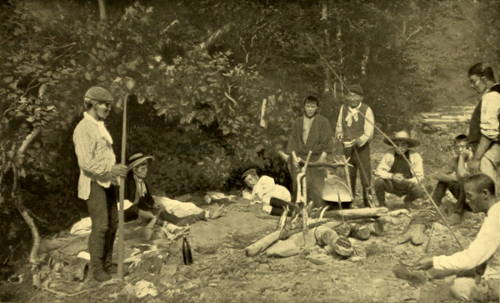
COOKING THE BREAKFAST FISH ROUND THE CAMP FIRE
August 26.—We went into the Ōyubari mine.
One of its seams is 22 feet thick. There are quite
simple workings, and no fossils. We then returned
along the track in trucks to meet the train for Yubari,
where I examined the rubbish tip of the mines,
without much success. The policeman never leaves
me, and scrambles up and down the stones after
me with an extremely amused smile. The whole
expedition causes him considerable trouble, but also
it is a source of many future jokes and stories, for
him as well as for me. To-day he was dressed in the
dignified flowing robes of grey and black silk worn
by Japanese gentlemen (policemen are of a much
higher class here than with us), and he looked far too
beautiful to mess about the coal. (He is pictured in
the photograph which faces p. 12.)
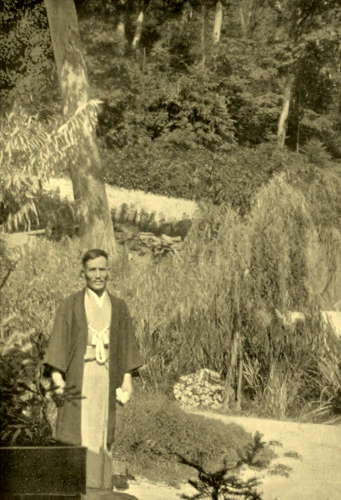
MY POLICEMAN IN HIS PRIVATE DRESS
August 27.—Mining and river work.
August 28.—We came to Poronai, which is often
called Horonai, as no Japanese name begins with P,
and the word being Aino it is softened in this way.
The distance traversed was really very small, but
mountains and other things interfered, so that it
took a long time to get here. I went down the coal
mine, which is very interesting. I proved to be a
source of intense excitement to the natives, who
crowded round in tiers, and formed a sea of faces
with round staring eyes. The policemen frequently
drove them off in a friendly way.
August 29.—Rather a sad day. Mr. Y——, my
trusty and well-beloved friend, was called away by
telegram to Hakodate, where a fearful fire has
practically swept the town away, destroying more
than fourteen thousand buildings, and among them
all the property of his parents and other relatives.
To look at the outer man, with his long arms and
legs sticking out beyond a white suit, 6 inches too
small in every direction, with several patches on his
knees, and his hideous tie sticking straight out in
front of him as he walks through the streets of the
capital of Hokkaido, no one could imagine him to
be a Professor. After a glance at his quaint eyes,
twinkling in his comical face above his spectacles,
one might suspect him of having a character, but
after travelling with him as I have done for these
two weeks, under very unusual circumstances, it is easy
to recognise and admire his exceptional character.
He is one of the small dozen of men whom I really
like and respect. Now he is gone, and I must
wrestle with an escort which cannot speak as much
English as I can Japanese, which latter is next to
nothing. The complexities of life are bad enough
when one travels with a policeman, a land-surveyor,
a special courier and correspondent, an interpreter,
a local guide, and half a dozen coolies, all in one’s
private train! But when the interpreter is the one
to be snatched away, they are rather worse. Without
him we went a stiff journey to-day, over a track
6 inches wide, through the mountains. The sasa
grows solidly over the whole land, usually shoulder
high, but often over my head, and the path is only
on the ground, and is usually quite invisible—one’s
feet feel it, but one’s eyes cannot see it. A hatefully
prickly shrub and thick tangles of vine complicate
matters further. And an English botanist before my
start said that Japanese vegetation was like English!
This endless sasa and forest goes on for miles,
broken only by the streams. Down some of the
streams we walked, where blue hydrangeas and
passion-flowers bend over the water, and where
little crayfish live in thousands. It poured with rain
after mid-day, and we were glad to discover a seam
of coal cropping out in the stream, and make a huge
roasting fire. Coming back through the sasa in that
rain was like walking in a river up to one’s neck.
August 30.—We all came on the few miles to
Ikushimbets. As regards food the tide has turned
indeed, and I am literally stuffed with good things,
till I feel ashamed that I have not an infinite capacity
for containing them; yet this is the tiniest hamlet,
existing only because of the coal mine. We entered
the mine in the afternoon; it has very unusual
workings, as the beds are practically vertical, and
is most interesting. How true was Lady Cicely
Wainflete’s estimate of an escort! One of my
“protectors” took fright in the mine, and had to be
gently led by the hand and soothed with soft words,
while I was left to come alone down the slope while
the sensation lasted.
August 31.—Another wet day. We worked up
the river collecting. It is rougher than Yubari river.
The coolies manage to make roaring fires even in
the pouring rain. One of the escort is splendid, and
does nearly everything, including carrying me across
the deep parts of the river, which is really a coolie’s
work. It is only a pity he can’t speak English.
In the rain the coolies wear very effective coats
made of straw, which make them look like the
most veritable hairy Ainos; for the straw stands out
all round for about 2 feet, and sheds the rain
splendidly.
September 1.—This morning was by far the most
difficult time we have had. The recent heavy rains
have swollen the rivers, and as we depend entirely
on the river bed for our track, it is serious. The
water is also muddy instead of clear, and there are
very deep pools into which it is easy to slip, so that
every crossing is rather risky, and we have to cross
innumerable times. This river is much worse than
Yubari, being deeper, and often at the deep parts,
where it is impossible to go in the water, the rocks
are steep or overhanging on either side. Mercifully,
even the apparently crumbling shale is not
treacherous. At last the escort made me realise its
value; without a couple of them to put their feet to
make steps, or to give a hand round corners, I could
not have got along at all. Also in crossing a river
we were so many and all kept hands, and so there
was no real danger. How the loaded coolies could
manage I cannot imagine. It was only the feeling
that as I was the leader I daren’t show fright, that
kept me going over some of those places. However,
we were well rewarded, for the fossils I got that
afternoon were the best obtained so far, and after
several hours’ brilliant sunshine the water perceptibly
lessened. (The photograph opposite shows the round
nodules which I was collecting in the river.)
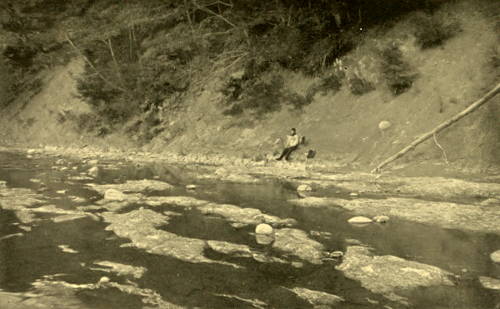
THE SHALLOWS OF THE RIVER, SHOWING THE ROUNDED NODULES WHICH CONTAIN
THE FOSSILS I WAS SEEKING
September 2.—We came on to Itashinai—a distance
which should have taken one hour, but really took
four and a half. In the lower part of the valleys
where cultivation has begun there are many little
houses scattered—houses made entirely of straw!
Rice straw is put to all imaginable uses: sandals,
ropes, walls, roofs, cushions, coats, bags, and many
other things are made of it. Of these things the
walls are the least effective, and afford but a miserable
shelter for the people in the straw houses. In the
fields where countless tree-stumps still stand up
through the crops, millet, beans, and maize are
principally grown. There are also small patches of
leeks, carrots, potatoes, “egg plants,” and herbs.
There are no formal gardens, and flowers are few,
except for a large-flowered convolvulus and red tiger-lilies.
The forest and sasa come right down to the
edge of the cultivated patches, and in it one could
be lost in five minutes.
I spent the afternoon and evening trying to obtain
information, and the difficulties, not only of language,
are immense. Every question must be asked in at
least half a dozen different ways, and an average
conclusion drawn; it requires more than the patience
of Job.
September 3.—Coal-mining from early morning;
the engineer of the mines is very intelligent and speaks
English, and I found some good specimens, so the
day was successful. With some of the other people I
have been driven to despair. The land-surveyor distracted
me the other day. After we had been walking
for about four hours steadily up-stream, I wished to
find the exact spot where we were on the map, and,
among other data, asked him how far he thought
we had come (a matter of 6 or 7 miles). “Oh,”
he said, with pride, “nearly 500 feet!” I always
ask for all distances several times, in miles and
Japanese ri which I can make out; but they like to
show off by telling me in feet, and nothing is so
difficult to obtain as the answer to the question
asked.
September 4.—Sapporo once more. A day of
official calls, bowing, compliments and formalities.
They asked me to lecture to the women’s Aikoku-fujin-kai:
the request of the Governor can hardly be
refused after all he has done, so it had to be. The
lecture was held in the large hall of the Government
House, the body of the hall filled with women,
the galleries with men; the Governor acting as
chairman and giving an immensely lengthy introductory
speech, of which I could only guess the drift
from words here and there,—Professor My——
following on with another. It is easy to speak in an
interpreted address, because there is so much time to
think between the paragraphs; but I am sure it has
not the same effect on an audience as the direct
address. Some, of course, understood my English.
Before the lecture there was a reception, and I was
regaled with tea and cakes and left to the tender
mercies of the ladies, and men who can only speak
Japanese; later, however, the Governor’s German
was available, and so it was all right, and we were
quite cheerful till the interpreter arrived with a solemn
face and a black suit.
The Japanese audience does not clap or make any
sound,[1] but bows low at the beginning and end of the
speeches, and when I began, “Your Excellency,”
the Governor got up out of his chair and bowed. All
the ladies were in native costume, I was glad to see
(how I detest the semi-European clothes of the
streets!), and some were in beautiful taste, but,
curiously enough, of all the 300 I alone had embroidery
on my dress, in the land where we imagine
embroidery is rife! I have already found that the
“Jap” things we see so much of in England are in
small relation to the real Japanese things, but are
chiefly “export articles,” which is a Japanese term of
reproach.
After reaching home, in about an hour, a courteous
secretary followed, bringing with him all the cakes
which I had not eaten at the reception. Alas, that
etiquette demanded that I should return the pretty red
lacquer trays they came in!
September 5.—I spent the morning seeing the
Museum (pathetic) and the Botanical Gardens (most
interesting) of Sapporo. Mr. B—— took me out
in the afternoon, and we had a long and delightful
talk—even though he is a missionary! I received
a most valuable and magnificent present from the
people to whom I lectured last night. Apparently
the lecture pleased them—for of course no well-bred
Japanese will tell one to one’s face that he is pleased
or otherwise with anything one does. Mr. Y——
came to supper and we were all very merry.
September 6.—Another present! The Inspector
of Mines “fears I shall not be able to get good food
when I leave Sapporo” and brings me a dozen tins of
the best meats! chicken, beef, and all kinds of things.
I often wonder why people say that the Japanese are
not sincere in their kindness.
I saw a most interesting method of laying a
foundation of a native building—two dozen women
pulling on a fan of ropes, and singing in a weird way,
half drawing and twisting between each pull. A
couple of men directed the heavy pounder which they
raised in this way, and let it fall with a crash to
stamp down the earth.
In the afternoon I paid two official and one delightful
call, and saw the beginning of the “Opening of the
University” decorations. The College attains the
dignity of a University on September 11. They are
still actively building new departments and have
unlimited ground for more; the whole temple of
learning is most pleasing, extensive, and picturesque.
September 7.—I left early for Shiroi, a small
village which is largely pure Aino. A contingent
saw me off at Sapporo, and I was extremely sorry to
say farewell to some of them; but to be alone once
more is a real pleasure. At Shiroi I saw all there
was to be seen; the little straw homes and boats (it is
a fishing village) of the Aino are very different from
those of the Japanese.
Some of the Aino are extremely picturesque and
dignified-looking, their long, thick, black hair standing
out all round their patriarchal heads. They are
not all small; most of the men I have seen are taller
than I am, and very thick-set. The women are terribly
disfigured by green tattoo marks on their faces, the
most essential of which is the one across the lips,
which has the appearance of a moustache. One or
two of the young women who have not been tattooed
are very handsome. They are a fundamentally
different race from the Japanese, and there is very
good evidence that they are actually descended from
the stone-tool using people, who once covered all
the Japanese islands.
I came on to Noboribetsu to spend the night. It
is about ten miles from the station, and to it runs the
first road I have yet seen outside a village. Such a
road! It is a marvel to me how we ever got out of its
swamps and ruts, and how the wheels could all be at
such extremely various and varying angles without
coming off. Half-way there it got dark, and the rest
of the journey we went tearing down little slopes or
crashing and jolting over the ruts, when there was
only a margin of about a foot between us and a
ravine. Yet nothing happened.
September 8.—I spent last night in the crater of a
semi-active volcano! Yet it was not so thrilling as it
sounds. The crater is nearly a mile across, and much
of it is just like a deep-wooded circular valley, in
which are a little hotel and one or two houses. Only
a couple of hundred yards or so away from the hotel
the active part remains, however, and there are vents
and small cones, bubbling streams of boiling water,
and piles of sulphur in any quantity. Some of the
boiling basins are black and solid-looking, and some
frisky with little geysers—most of them tame enough
for close acquaintance, but a few dangerous and
impossible to approach. As I look out on the hotel
garden the steam rises in thick clouds from the boiling
stream bubbling through it, which is utilised for
baths. The Guide-book naively says: “The only
drawback to a visit to the springs of Noboribetsu is
the chance of meeting naked bathers.” I would say
“certainty of meeting.” But I got off quite alone
and went up through the woods, following a track of
course—it would be mad to leave it here—and saw
three snakes in an hour, one nearly 4 feet long
hardly moved from the path. I met an Aino, tattooing
and all, and we exchanged a few courtesies in
bad Japanese. Aino itself is a curiously hard
language, nearly all k’s.
September 9.—A wet drizzling day, which blurs
all the landscape, so that trees, sky, rain and
sulphurous clouds all merge into one another. The
air is heavy, and full of the odour of rotten eggs. I
am the only European here, and am living absolutely
à la Japonaise. The place is entirely untouched by
our civilisation, and my room is a gem of native art:
the delicate wooden trellis-work and bands of black
lacquer on the paper doors and windows, the beautiful
heavy metal fire-pot and embossed kettle are real
Japanese of good quality. I sincerely wish I could
bring such a room to London, it would delight those
followers of the art nouveau who have retained
some of their original conceptions of the beauty of
simplicity. I was rather glad to leave the hot
choking fumes, however, and reach Mororan at
night. It is a pretty little port, in a beautiful bay
forming a splendid natural harbour. I went on
board at 9 o’clock at night.
September 10.—We should have arrived at 10 or
11 o’clock this morning at Aomori (on the main
island), but there was a storm, the tail of one of the
typhoons which are abounding this year, and we did
not get in until after 4 in the afternoon. While
waiting three hours to catch the train I saw a little of
the town, and spent some time soothing a distracted
missionary and his wife, recently from America, and
not yet accustomed to waiting, and trusting large
sums of money to Japanese porters with no guarantee
that they would get the tickets they wanted. Japan
takes some learning, and a highly-strung American
accustomed to New York bustle must find it a
peculiarly hard lesson.
September 11.—I arrived at Matsushima station
at 5 o’clock this morning and took a kuruma[2] to the
place itself, on the way stopping to climb a small
hill which overlooks the wonderful archipelago—one
of the three greatest sights of Japan. As I sat there
the sun rose, and lit up the gleaming water and the
thousand pine-decked islands, whose shapes are so
fantastic that one can only imagine them to be the
work of the drollest of trolls, who with his drollery
had a soul that was rare enough to combine nobility
of beauty with fantastic form.
The hamlet of Matsushima is built among similar
rocks on the dry land, which has certainly risen from
the sea. This little place, utterly unspoiled by
European influence (I did not even see a European
hat), is the Japan I have dreamed of, and had begun
to fear I should not find. I cannot describe it here;
if anything can move me to write literature some day,
it may be that place as I saw it at sunrise.
I sailed among the fairy islands in a dreamland
boat—which went so slowly and so smoothly that I
thought it did not move—to Shiogama, in which I
saw no romance, and took a kuruma for 5 miles off
the line of beaten roads, and the railway to a tiny
hamlet by the sea. Here I put up in an inn built on
a little rocky peninsula, which is just big enough to
hold it and a few pine trees. When the tide is in
we cannot get into the front door! The room which
I have opens on two sides to the sea, the front is
shut off only by folding-doors from another with
three sides open to the sea, so that at will I could
have my three walls removed and the sea view all
round. A more ideally beautiful situation it would
be quite impossible to find: on either side stretch
blue bays with sandy shores, and rocky islets with
twisted pines growing on them in all manner of ways,
and beyond lie line after line of blue hills, which in
the distance merge into the blue sky.
September 12.—To-day was spent in finding out
paths to tiny fishing hamlets along the coast, and
seeing ever new and delightful rocks—one is pierced
by a big hole, 30 feet or so above sea-level.
At night there was a great sensation in the bay,
as many big fishing-boats came in. On the shore
they lit huge blazing fires, the men and women singing
all the time, and every now and then one of them
seizing a burning brand and rushing into the water
with it up to their necks, and even swimming out
with it to the boats. The new moon rose clear and
sparkling above the bay. It seemed wicked to go
to bed. I am the only visitor of any kind staying in
this hotel.
September 13.—My hours are primitive: rising
with the sun about 6, and breakfasting; eating again
at 12 and 6, and going to bed after seeing the sunset
shadows deepen into night and the stars rise over the
sea—i.e. about 7 o’clock.
I walked into Shiogama for some shopping, but
was much noticed by the country people, for I wore
a white blouse, a skirt, and hat. Here the women all
wear long blue trousers and short tunic-like kimonos,
and I found they took no notice of me at all when I
wore what I wore in the mountains, namely, short
close knickers and coat to match.
September 15.—Alas, it is the last day of my short
holiday. The weather has been perfect these four
days.
September 16.—A long and tedious day travelling,
beginning at 5 in the morning. I did not reach
my Tokio home till 11 at night, and then found that
they had given me up and all gone to bed. On the
way I had to change and wait two hours at Sendai,
which I therefore explored a little. It is noted for
ornaments and trays made of fossil wood so-called,
which is found in quantity in a mountain near by.
It seems to be gymnospermic, however, and to correspond
more to our “bog-oak” than to an actual
fossil, so I lost scientific interest in it, but liked it well
enough as a curiosity to buy some specimens.
September 17.—After a month’s absence my correspondence
has accumulated, and to-day has been spent
largely in reading and writing letters. Also, this is
just the last day or so for the swimming out of the
spermatozoids of Ginkgo, and I spent a few delightful
hours in the Laboratory watching their infusorian-like
movements and the quick vibrations of their
spiral crowns of cilia. Fancy cutting up dozens of
juicy Ginkgo seeds! I lunched in the Institute with
the botanical staff, who have a wonderfully detailed
knowledge of all my doings, likes and dislikes—from
the newspaper! Apparently one or other of my
retinue has acted as special correspondent for the
papers. Mercifully, it is all published in Japanese
characters, so that the European residents can’t read
it, or I should not dare to present my introductions.
September 18.—A quiet day at the Institute, trying
to overtake my writing arrears. The last forty-eight
hours it has rained incessantly, and the roads are
an interesting study. They may be divided into
three main classes, viz. those which are well made,
and which have been washed spotlessly clean by the
rain—these are very few and far between; those which
have retained the water, and mixed it with their own
soil until there is a swamp of thick, boggy, squashy
mud from 2 to 10 inches deep—these predominate;
and those on which water alone is to be seen,
varying from 2 inches to 3 feet in depth. Through a
quarter of a mile of the latter I had to come, in a
kuruma of course, but the man was up to his hips in
water, and I was glad indeed that my house is on the
top of a hill as I saw the floods rushing through the
houses.
September 22.—The roads of Tokio are a never-ending
source of delight when their muddiness does
not force itself home. A hundred times in a walk,
even in the heart of the city, one comes upon a bend
of the road where groves of bamboo or pine trees are
seen, as though one were far away in the country; or a
rivulet will cross the lane (so many of the city roads
are like nothing but our country lanes), and its mossy
banks hanging with ferns are luxuriant, as only our
Lake District streams are luxuriant, in their glorious
greenery of delicate fronds. Or perhaps a bend of
the road will take one away from a little village of
shops into a narrow avenue of straight-growing
cryptomerias, leading to a tiny shrine or temple with
its garden and moss-grown stepping-stones. Along
the line of the electric city railway we all walk freely,
and to-day I found corners of woodland and scraps
of meadow along its course—little forgotten scraps of
land where small bamboos and feathery grasses, and
sweet white and blue flowers grow in brilliant, fresh,
dustless perfection. A hundred times a day I ask
myself, “Can this be a city?” While the main streets
are “streety” enough, the charming spots are always
only a few yards away from them.
I cannot understand how it is that land and rents
are so outrageously dear, dearer even than in the
parts of London just outside the city. Here so much
seems to be left to run wild, or to form a garden
or field round a tiny house—wasted commercially—but
what a rich delight to those who live in this sweet
garden city!
Early this morning I had a real Japanese experience.
I was wakened at about 5 o’clock by a tremendous
sensation among my walls and floor, as though they
were all striving to part company. I at once thought
of a typhoon, and as my floor was swaying like the
ocean waves, I started to rush downstairs, my room
being the only one on the second story. Then I
rushed back, thinking of all the awful tales of
robberies I had heard, and seeing a figure approaching
me, I accosted it angrily and demanded it to
give an account of itself and be off! It was some
time before I recognised myself in the glass! All
the time the floor was swaying violently in what I
fancied was a fearful wind—when it suddenly stopped,
and I lay down feeling very sea-sick. Then, and then
only, did I remember that I was in a land of earthquakes,
and had just experienced my first. I heard
later in the day that it had been a moderately bad one.
September 23.—A rather broken day with papers
at the Institute. I have not yet worked off my
Hokkaido debt of letters and presents.
There was a local festival in the temple near my
house, and the houses were gay with scarlet and
white lanterns, and branches of scarlet and white
paper flowers.
September 24.—A universal holiday, and the Institute
is shut. The day was filled with sight-seeing,
temples and gardens. Of the several I saw, two in
the heart of the city were in such striking contrast as
to be worth an attempt at description.
To the one, the approach was lined by rows of
little open shops, whose trivial gaudy wares were
pressed upon the throngs of passers-by. In the open
court of the temple were many stalls and small tea-houses,
and hundreds of pigeons fluttering about to
be fed. One could buy one sen’s worth (about a
farthing’s worth) of peas and rice from the numerous
little stalls kept by ancient women. The birds did
not appreciate my offering properly, as it was a
festival, and they were already overfed, and so contented
themselves with pruning their feathers perched
on the great eaves of the temple, or on the nose or
curly tail of some of the many great dragons. In
the vestibule of the temple (this is hardly the right
word, but I know no other to express it) hundreds of
people clattered in their wooden clogs, and chattered
loudly, gazing through the wire-netting into the
inner portion, where the priests and readers in
gorgeous array and pomp were carrying on a service.
The whole effect was not unlike that of a good Roman
Catholic Church, but more glittering and richer. As
I was watching, a large part of the ceremony seemed
to consist in turning over the folds of manuscript
very rapidly, giving the effect of endless streams of
writing. Into a money-box, as large as a small
swimming bath, the devotees threw their small coins,
often over the heads of the groups in front of them.
Glitter, bustle, noise, and crowds characterise this
temple. The other I found by chance in one of the
dear little side roads I love. It stood grey and solemn
in the midst of its green garden, its great bell in a
little house beside it, and its old stone figures and
great lotus of copper. Twisted pines and moss-grown
paths around it, and behind a silent grove of pine
and bamboo. Complete silence in the heart of the
city, and though I remained in the garden some time
no person came to disturb its peace. Greyness and
greenness—and one brilliant golden butterfly dancing
above the great green copper lotus, one shrub with
scarlet flowers flung against a grey sky—and in the
heart of it all the silence of Buddha, whose heart does
not seem to beat as he contemplates the universe.
September 25.—A tiring day, but little to show
for it. Tokio certainly makes one very sleepy, and
also demands the expenditure of much time to get a
small result.
September 26.—Official visit to the Director of
the Survey—time spent getting there and back, three
hours—length of visit, ten minutes. The rest of the
day at the Institute.
September 27.—An amusing day spent at the sale
by auction of all the household effects of the Spanish
consul. It appears that these sales are recognised
social functions, and all the good Society was represented,
from the Embassy and some Baronesses
downwards. I managed to get two feather pillows
for twice what they cost in England, but half what
they cost here in the shops; and so hope to rest more
peacefully at night now. There is such a frightful
duty on all foreign goods that every one here buys
what they can at these sales; as they are all the goods
of friends, which have sometimes been the round of
several distinguished families, there is no feeling
against obtaining them. It only wanted tea and a
little music to be like an “At Home.”
September 28.—A quiet day at the Institute. The
gardens surrounding it are largely situated on
elevated ground, so that one looks down on tree tops
and out over an expanse of clear blue sky and lovely
light clouds. Now the temperature is like our best
days in June, and the actual sunshine still hotter and
brighter.
September 29.—Sunday—so we went to visit
temples. This time to a tiny lonely one in the
country to the north of the town. Though it was
less than 10 miles out of Tokio, everything was
fresh and beautiful, and quite untainted with the
horrible suburban effect of our environs—it was real
country, though not at all solitary. Between the
green fields, where the crops looked as fresh and
vigorously sprouting and green as with us in the
late spring, were quiet lanes and narrow roads overhung
by the swaying feathery shafts of the tall
bamboos. Every quarter of a mile or so in all
directions were little woods of bamboo and pine or
cryptomeria, in the midst of which generally one or
two small houses nestled, their thick thatches overgrown
by the blue-flowered relative of tradescantia,
which is here so pretty and so plentiful. Surrounded
by its little grove of cryptomerias the wooden temple
stands apart from all houses—a small closed building,
hung with gaudy pictures from the devotees whose
prayers have been answered. Leading to it is an
imposing flight of well-kept stone steps, but as there
is no gate, and a dozen paths through the wood lead
to the temple by easier grades, they are more for
show than use. A big stone trough stands filled with
water for the worshippers to wash their hands before
folding them in prayer—but I saw no worshippers,
and I stayed there in the quiet for a number of hours.
A fraction of a mile away was the small ill-kept
cemetery, with little grey headstones and forlorn
wooden laths with the names of the dead, but no
visible graves.
The tall tsuzuki reed, with its clusters of feathery
fruits standing out against the sky at evening, and
the stars twinkling through the beautiful bamboo and
the trees of sweet chestnuts, all seemed far too fresh
and unsullied to be so near a city. The Japanese
can certainly populate a place without defacing it.
The absence of all railings and notice boards is also
very soothing.
September 30.—A cut-up day at the Institute.
Dr. Y——, one of the geologists from the Survey,
visited me and we spent some time discussing the
beds of Hokkaido. This country is an extremely
difficult one for us all, so little is yet quite reliably
finished, as exposures are so scarce.
October 1.—A long morning down at the Survey
Offices with the Director and Dr. Y——, chiefly
planning for the next venture, which is to be in the
directly opposite direction from the last, and promises
difficulties not a few. This time I will not go with
a huge escort like the last.
On the way back to the Institute I looked into the
biggest drapers while the sale of the year was on—all
Japanese of course, and very amusing.
October 6.—A miserable, wet day, spent with
small profit at the Institute preparing for another
long expedition. The least heavy rain seems to give
rise to floods at some place or other, and again the
roads were quite impassable except for the coolies,
who drew my kuruma through.
October 8.—I arrived at last at Okayama at about
3 in the afternoon, very dirty after the night in the
train, and tired for want of food—to be met by a
party of Japanese, most kind and welcoming, who
took me to a charming hotel and kept me sitting
and talking for two hours without a chance of even
washing! They also took me to see the renowned
Koraku-en garden, and it was half-past six before I
could get a bath, and while I was still dressing
the kuruma came to take me off to a meeting of
Naturalists, which took the form of a dinner in my
honour.
The gardens of Koraku-en were certainly very
pretty, but less so than one would expect from the
descriptions of them one reads. They were once the
private property of the owner of the castle at the foot
of which they lie. In them are vistas and views
cleverly constructed, and many pretty little rocky
islands and bridges. There are also some sacred
cranes which live in separate apartments in a house
of their own, and which take the air and sun themselves
in the best part of the day. What pleased me
far more than these much-praised gardens were the
little courts and gardens of the hotel in which I was
staying. From my room I could look down from the
verandah on to two little gardens, with dwarf trees
and green paths and grey stepping-stones leading to
imaginary distances.
On my way out, for the house was large and
rambling, with several ways, I could pass a square
garden but 10 feet or so big, in which was a little
temple, with lanterns and lions and gateway all
complete. Here every evening the lanterns were lit,
and incense sticks glowed, sending a sweet scent
along the corridors. It was the smallest temple I
have seen, and also one of the prettiest additions to
a house.
The dinner with the Naturalists was a somewhat
trying affair. There was but one lady and she was
obviously asked for my sake, and was put next me at
the table. The President and I sat opposite to each
other in the middle of the long table, and kept
something of a conversation going, though I had to
furnish all the subjects, which was a little difficult
after more than twenty-four hours’ travelling and no
rest after my arrival. The others were mute, except
when I turned to ask a definite question, or said
something which the President repeated to them,
and suggested discussion. All could speak English
nominally. The dinner was in foreign style and
included four meat courses, and I found few of those
present knew which things to eat with which table
implement, so I was repaid in kind for the entertainment
I must have afforded while learning to use
chop-sticks. Fortunately it was possible to leave very
early, and I welcomed a good night in my charming
Japanese room.
October 9.—I was up at 6 to start to the real
place for work and was seen off by a deputation, and
shaken for some time in the train of a local branch
line. After that came the truly awful business of the
day—four hours in a kuruma!
The kuruma is a kind of mail-cart on two wheels
(country specimens have no springs), and is drawn
by a man over stony roads. The works of the thing
jolt, jingle, and clang till one’s head splits and one’s
bones feel sore.
The road lay along a very beautiful valley,
however, cut out of the steep rocky sides running
along the broad and beautiful river of Takahashi. I
entirely escaped the Guide-book—not so easy a job
either, as it is written by Chamberlain, who knows
the country better than most Japanese, and who has
numerous collaborators who seem to inform him of
minute details, even of very out-of-the-way places.
At the end of the journey I found a much better inn
than I expected under the circumstances.
Then the excitement began—and I had to explain
at the Prefecture that I had come to see coal, and
to find out where it was. The maps are so small
(Geol. Survey though they be) that one is extremely
dependent on local information. To do all this in
Japanese with people who did not understand a
syllable of English, was no joke! It is the first time
I have been so absolutely cut off from English; they
could not even read Japanese names in Romaji print,
in which my maps and all scientific things are now
done. It was interesting—and I hammered away till
I got my end, and found the Triassic coal I sought,
but, alas, there was nothing in it of value to me.
The trouble I had to get it began in Tokio, where
they told me first it didn’t exist, second, that it was
finished and the mines stopped down. In Okayama
also they said no coal in this district existed—instinct
kept me at it, however, and though the people even
here said there was none, I insisted there was—and
lo! after a while they took me to it. It was the very
smallest and most primitive coal mine I ever saw, it
is true—but it was coal. To-morrow I am going to
another place: it is sad to find no fossils just here,
they would have been such a triumph!
My dinner consisted of rice, green peas, and boiled
chestnuts, with a little fish as well. One learns to
value green peas, even though they be cold and
floating in the water in which they were boiled, and
eaten one by one with chop-sticks!
No three consecutive minutes of peace were allowed
to me. I was desperately tired, and though I sat
with my eyes shut for quite long periods and hardly
spoke to them at all, my visitors sat on and on till I
was frantic. I have a fellow-feeling now for animals
at the Zoo.
October 10.—While still in bed, visitors began
again this morning, and I had to shout to prevent an
official visitor from coming in while I was taking off
my night-gown. On starting two of them came with
me, and their number more than doubled before the
day was out. More terrible hours of kuruma riding—but
the little village of Jito was worth a visit.
Early in the morning heavy downy mists hung round
the hills, and swirled up from the trees as the sun
caught them. All the thousands of cobwebs were
like fairy banners on the trees, and the rocky sides of
the mountains rose from the rivers to be lost in the
alluring distances. It was a sight well worth the
shivering and the jolting, and directly the sun shone
on one it gave a comforting heat. The nights are
extremely cold, almost wintry, but the days are as
hot as midsummer, hence the thick mists.
We entered the mine, which, unfortunately, though
Triassic, is of no interest to me. A kind of dinner
was given at the hotel at 2 o’clock, and I saw many
rather crude native customs.
The man who had led me in the mine, whom I
took to be a coolie, and to whom I gave sixpence,
turned up at dinner. In the mine his entire costume
had consisted of a striped flannelette shirt, very short,
and a stand-up white collar!! Literally no more,
and that was donned of course in my honour.
Trousers with a red stripe down each leg, and socks,
were added for the dinner.
Everything in this country seems to be the reverse
of what it is with us, and here the dinner starts with
much drinking of saké and very frequent exchange
of the small cups; then no more is drunk and the
food begins and finishes the feast.
After the coal mine business was finished, I was
taken to a big school where there were festive sports
going on, very similar in the main to our school
sports, and obviously in imitation of them. Many of
the boys and girls (the schools are mixed) were
pretty and bright, though the Japanese child has not
yet appealed to me as it does to those who gush
over it.
October 11.—Things began at 6 this morning,
when all the world was shivering in its thick white
mantle of mist. After riding for a couple of hours
the sun drove it all away, and by 10 o’clock I was
streaming with perspiration from every pore as I
went up the hills toward the little coal mine I had
come out to see.
I thought I had fully impressed on the Japanese
man who acted as local guide that I was desperately
pressed for time and must return to the railroad
town to-night—but after a couple of hours I found
myself inside the big “middle school,” bowing to an
English-speaking head, who soon asked me to give
a lecture! Of course I refused, and said I was going
at once to the coal mine, and would then return to
Tatai, but he accompanied me to the mine, leaving
his rightful duties with not the smallest compunction,
and on the way requested me to stop and have
my photograph taken. The Japanese are perfectly
infuriating to one with a definite object and precious
time. I cannot here retail the multitudinous instances
of senseless delay I have had to suffer from, nor the
irrelevant things I have had to examine. If I were
to go at their rate I should be still looking at coal
mines in Japan ten years hence. But I must not
forget that I am seeing the country if I am not
getting directly to my goal, and that I am in myself
a certain amount of entertainment for them, a kind
of creature they have not heard of before.
After a rather fruitless couple of hours in the mine
(results locally interesting, as the Imperial Survey has
mapped the district as solid granite) I had six hours
in a kuruma returning to Tatai. The kuruma was
just as uncomfortable as country ones always are, and
as I was packed in with my fossils so that I could not
change my position, and the roads were in places
very bad, I was hardly in the mood at the end of the
journey to be put into a train, merely to wait stock-still
at the first local stopping-place for three-quarters
of an hour. I am becoming far more patient than Job
ever was, but at times my stock of patience runs out.
Apart from the mere weariness of one’s bones, the
kuruma ride was very delightful. Every time I see
the little groves of feathery bamboo in their grace
and sweetness I rejoice anew. The valleys along
which the road wound were very steep, and the great
granite hills majestic and beautiful. The plants, too,
are often charming, and one frequently sees a single
trail of ampelopsis flung across the grey boulders.
One great wall of granite was covered with blood-red
ampelopsis and capped with the native pine, which
is so rich in curious curves, and so green against the
sapphire sky.
Although the country is quite wild and unspoiled,
all along the flatter part of the valleys were very
many houses—clusters of houses or hamlets lying
at intervals of about one-eighth of a mile. It seems
curious how the little rice fields, which are tucked
into every available damp corner, can support so
many people. Straw plaiting is also a source of
income, and in almost every house some one was
twisting the short lengths of gleaming white straw
into braids.
The greatest charm of Japan is the way the natives
have of inhabiting, even thickly populating, a district
without in the least spoiling it—except of course
where there is a railway, a few yards on either side
are necessarily spoiled a little.
The single line of telegraph wire puzzled me not
a little to-day. I could not imagine why, when it
was raised in the usual way on posts 20 feet or
more, it should be made of barbed wire, when I
discovered that the effect was caused by millions of
dragon-flies, perched singly on it at intervals of
about 6 inches from each other! I never saw two
closer than that, or more than 18 inches apart, for
about 10 miles! Now and then one would fly off,
or another settle, but most of them sat quite motionless
on the wire. So the only “barbed wire” I have
seen in Japan was made voluntarily by blue dragon-flies
who sat there to sun themselves.
October 12.—The hour for rising gets earlier
every day. This morning it was 5 o’clock, with the
prospect of 12–14 hours in a wretched slow train. I
am writing in the train now, at the stoppings, which
are never less than five minutes, and often ten or
fifteen minutes long, at every station. The whole
distance in all these hours of travel will be less than
200 miles. The people in the train are, of course,
a little interesting, but far more saddening. Where
the train with its Western atmosphere has penetrated,
the beautiful and dignified robes, the silken skirts
and kimonos of both men and women, though
principally of the men, are giving place to a hybrid
mixture of all the vulgar and hideous garments of
“civilisation.” Only a few of the most cultured
Japanese know how to dress in good taste in our
things, the others are unspeakable.
Just now the train is skirting a part of the coast
of the famous “Inland Sea,” and small islands lie
thickly scattered in it, with their pines clinging by
great twisting roots on to their rocks. The persimmon
trees, with their great golden fruits, look
very beautiful beside the pines, and are richly laden
with their delicious fruit, so that they are noticeable
from quite a distance.
After arriving at Tokuyama in the evening I went
at once to the Naval Briquette factory of the Government,
who own the coal mine farther on which I wish
to see. A most courteous and charming Director,
who had been in both France and England, put me
on my way.
October 13.—I started early by train for Omine,
where the mine lies on a little railway built on
purpose for it during the last war. The coal is one
of the very few smokeless ones in Japan, and therefore
very important. Omine is a tiny hamlet,
practically composed of miners and mine officials,—where
the inn is poor but every one only too anxious
to please.
The mines are interesting scientifically, of Rhaetic
age. As they belong to the Navy, the surgeon
attached to the mines wears the uniform of a Naval
Officer, little sword and all, and is very smart. The
coal is carried for a long distance by iron baskets on
wires across valleys—stretches of wire 200 yards, with
no support. It is so strange to find the mixture of
modern engineering and science with such primitive
native ways.
The weather is lovely, still scorching midsummer
sunshine floods the hills, on which a tree here and
there shows a flare of crimson autumn colouring.
October 14.—The Chief Engineer here is most
helpful, and offered to come with me to Habu, a very
small mine 20 kilometres or so distant, where we
had to travel by kuruma. At first I refused, but
afterwards I was very glad his importunity had
prevented my coming alone. The kuruma left us
to walk the last 3–4 kilometres. There was no
definite road, and an old woman volunteered to guide
us across little tracks through rice fields and along
the sandy seashore, and through rice fields again.
The maps of course show none of these footpaths,
and without Japanese help it would have been
impossible to find the place. The mine, when we
got there, was the most primitive I have ever seen,
smaller than at Nariwa. On the way our old woman
leader took us up from the shore to a big house
standing by itself, telling us that here the manager
of the mine lived. As we had despaired of ever
finding the mine, this encouraged us, but we found
the house was only in the process of building, and
was of course not inhabited. It was a beautiful
house, with a great temple-like porch gate, an inner
courtyard, and quite a number of out-houses and
servants’ dwellings. Then, when we came to the
mine, we found the owner to be a common working
man, and we saw his wife going into the mine to
work like the rest of the peasant women! The whole
situation seemed so ridiculously incongruous. A
case of nouveau riche retaining their old habits while
their palace was being built.
In the mines I have often come across women,
naked to the waist and up to the knee, working
underground with the men. To-day I saw such a
pretty girl, and her beautiful rounded body was far
too sweet to be smeared with coal.
To-night we went on to Shimonoseki, and my
Omine companion kindly took me to his father’s
house there. A delightful house, with a great flight
of rough granite steps leading up to it like those
to a temple. Here I inhabited three big rooms, opening
out of each other, as well as a dressing-room.
They were extremely kind, and only spoiled things
by refusing to believe that I could prefer not to
have chairs, etc. brought into their rooms for my
use. I pleaded with them, and was allowed to sit
on cushions on the floor, but could not escape a
European dinner instead of the true Japanese meal.
However, it was very good, and I made up for several
past meals of poor quality. I was given the seat of
honour, and my host and I ate alone—his father,
mother, aunt, and sister visiting us for short intervals,
and bringing various things, but never sitting with
us. They are certainly wealthy people, and not very
cultured, yet there was not the slightest attempt at
display. All that the rooms contained were a single
vase of beautiful flowers in the corner by the
kakemono (long picture), a couple of quaint ornaments,
cushions, and in one of the rooms a beautiful
polished table 6 inches high, on which was a carved
tray with hand-painted tea-cups, and the hibachi
(charcoal brazier) with an ornamental kettle boiling
on it.
October 15.—I got up about 5.30, and crossed
over to Kiushiu—my host coming to see me off and
giving all possible help. I did not arrive at the
mine—Namazuta—till 12.30. The mine is a large
one, and though of Tertiary age, contains very many
interesting stones.
After examining the mine I returned very late
at night to Fukuoka, having escaped proper meals
all day. The chief of the coal mine kindly gave me
fish and rice and a few real Japanese things at 4.30.
At Fukuoka the inn very noisy, but otherwise all right.
October 16.—Noise kept me awake till after 12,
and I had to get up about 6.30. I visited the head
office, where officials are arranging for my introduction
to several small mines in Amakusa, which
is an island off the island of Kiushiu—and on which
no human being speaks a word of English, and all
the natives speak such a curious dialect that even the
Japanese themselves cannot understand it. I guess I
shall have a gay time. On this whole expedition the
amount of hours of travelling per hour in a coal mine
is very great, and I seem to be going night and day
to see a mine here and there. (Things have got
wrong here somehow. I have forgotten to mention
the Miike mine.)
Some of the scenery is very beautiful, and though,
of course, I am missing all the regulation sights, I see
glimpses of beauty here and there.
The train arrived very late at Misumi, a little port,
from which I shall go to Amakusa. The moon was
shining over the calm sea, stretching into many
inlets and set with many islands, and the effect was
most beautiful and romantic. Though I thought the
train had landed me in Misumi, it turned out that I
had to take a kuruma to the hotel, and it went right
out into the country, over a hill where not a human
being or habitation was to be seen, and I began to
think the kuruma man had designs on my life and
purse. After half an hour he landed me on the other
side of the peninsula, where the village proper lies,
and where there is a moderately good hotel. On the
ride we passed many mud-walled thatched cottages,
without a sign of life in them. The Japanese live in
open houses by day, but at night they put boarded
shutters up before every window, so that no one
(at least no Japanese, I insist on mine being opened)
in Japan sleeps with fresh air round him, which, I
believe, is the reason there is so much consumption.
They cannot see the silliness of doing this, and are
constantly bragging that they live in the open air,
when all their eight to nine hours of sleep are spent
in these very stuffy rooms, with a lamp and generally
a charcoal fire burning beside them.
October 17.—The boat was supposed to start at
9 A.M. this day, but 1 P.M. saw it still gaily coaling.
It is the very smallest steamer I have ever been in,
not really as good as a ferry-boat, but the prospective
journey is to last twelve hours. While waiting about
the landing-place I saw many strange fish which
were being brought in. One big fishing-boat had
a load of huge creatures, bigger than men, of two
kinds. One kind like lovely dragons, with long
snouts and great wing-like fins, the other fish the
most curious I have ever seen, and apparently, though
I don’t know at all, some kind of shark. They were
about 8 feet long and thick as a man’s body, and
their heads were quite flat and square-ended.
I could not have imagined such strange creatures,
a drawing gives none of the extraordinary effect
they made lying there in numbers, their great flat
bodies heavier than a man could lift unaided. They
are to be eaten, but seem to me to be terribly coarse.
There is no first class on this steamer, and I am
the only second class passenger, but as my portion
should be in a minute cabin with stuffy curtains and
tightly fixed port-holes, I am squatting on deck with
the third class people, who are as thick as flies round
a honey-pot. There are mats spread on the deck,
and most of the people are lying on them wedged
against each other. I am sitting on my bags,
leaning fairly comfortably against the rail and next
to the only man who is a real cute traveller. He
has spread his blanket (Japanese always travel with
blankets, generally white ones!) its full size, and is
lying in the middle, with a clear 2 feet of spare space
all round him, and it is characteristic of Japanese
travellers that though the others are terribly crowded
no one sits on his blanket or asks him to curtail its
extent. The scenery is lovely, and the sea without
a ripple. On every side are hills with range after
range of jagged peaks, and in the sea countless pine-decked
islands; land lies all round, and it is difficult
to believe one is at sea. 2 P.M.—I am certainly seeing
life: we have just had tea in picnic fashion, squatting
here together—and indeed most picnics are made to
far less beautiful places than this island-dotted sea.
One of the women had brought a tray of small cakes,
all looking excellent, but most of them made with the
sweet bean paste I have not yet learned to like,
though there were delicious sponge-cakes as well,
five of which I got for 1¼d.—and I paid three
farthings for my tea, which was three times what
any one else did. They would have given it to the
foreigner for nothing—but one must support the
honour of one’s country in a far land, and I have
learned that though the Japanese give very freely
and refuse a dozen times to take payment, they are
not really at all averse to receiving it.[3]
We are twisting in and out of the inlets and
coming very close to the islands, and if the landscape
were not so much softer and greener and more
rounded, I could well imagine we were in the Fjords
of Norway. The rocks are in places very white,
and here and there near villages are groups of lime-kilns
of primitive type. There are fleets of fishing-boats
everywhere—and I believe (by this time I have
seen a good deal of the country) that there are no
consecutive 2 miles along the whole coast of Japan
without a fishing village! It is not on the coast, but
in the mountains that the really solitary places are to
be found.
I arrived almost in the middle of the night, to be
welcomed on the ship by various folk, from the inn-keeper
upwards and downwards—there was a regular
lantern procession of people. They all stopped
round or in my room to talk or stare, according to
their social stations; the landlord coming midway, he
sat just outside the limit of the room—which was, of
course, widely opened on three sides—and held converse
with all of us within, or hurled abuse at all the
maids and boys and small children who collected
without. Fortunately the chief official of the mines
left soon, intimating that it was late, so I got to bed
earlier than I expected and slept well, though, as my
window-walls were wide open, it was so light that I
had to put up my umbrella. It is getting quite usual
for me to sleep under my open umbrella, and as the
mats they spread on the floor are never more than 3 or
4 inches thick, it feels very like sleeping on the seashore,
and I quite enjoy it, though at first I used to
wake up and wonder where I could be.
October 18.—Early this morning I started to look
at mines—with five people in my official train. This
island is one of the least civilised of Japan, and there
are practically no roads on it, though tracks here and
there, and some surprisingly big coal mines. We
went from place to place on foot and in small fishing-boats
across the bays, which would have caused very
long detours to walk round; and these were numerous,
for these islands are very much cut up, and the sea
surprises one everywhere one goes, generally on two
or three sides at once.
Some of the bigger fishing-boats we passed were
most interesting, and looked, on a small scale, exactly
like my imagination of what an old Egyptian boat
must have been. The six oars (one can hardly call
them oars in our sense of the word, for they are thick,
and much the same shape from end to end, and with
a little twist in them) were manned each by three
naked men, all standing clad in their skins (which
the scorching hot sun had burnt a lovely brown gold
colour), and with the minutest white-and-blue waist
cloth. Round their heads they had a white or white-and-blue
towel tied fillet fashion, with a bow on one
side. As they bent and rose over the oars they
shouted all the time and very hoarsely a sort of
meaningless refrain—but it was very good for keeping
time and could be heard a long way off. Of the
three oars on each side of the ships, two were pulled
one way and one the other, and as the pullers kept
forgetting which was which, I could not understand
how the boats ever progressed, but they did, and at
a pretty good speed, but far out at sea they put up
sails. My little boat tried a sail for a short time. It
was nearly square, with a bamboo to keep it out at
each end, but the peg which held it down gave out
when a puff of wind came and the boat tipped over
gaily. The mast was tied in a very primitive fashion,
and I wondered how the fishermen ever dared to go
out to sea in such a craft. It landed us safely, however.
One coal mine we went to was high up, 700
feet straight up from the sea, and amid pretty scenery.
At one mine, where the people were most kind, they
had gone to the extent of carrying a tea-cup with a
handle for me, because they said I could not use their
kind without a handle (as though I never drank out
of glasses), but the owner of the mine took off all his
English clothes, down to the shortest shirt I have ever
seen, which was open up the back, and did not think
I might find that a little more difficult to put up with
than a cup without a handle. It is a good thing that
I had all the up-to-date ideas of hygiene before I
came!
October 19.—To-day was spent in returning to the
main island of Kiushiu, for the little ship took nine
to ten hours about it. The start to-day was made in
good time, so that three separate sets of people were
late, and the steamer stopped to take them on one by
one. A skiff came along propelled by three boards
pulled up from the bottom of the boat, and left us
two passengers. In order to get to the north of this
small island of Amakusa, though only 25 miles or
so from the south of the island, I must go back to
the main island, to Mogi, and take another steamer
back to the northern port of Amakusa!—multiplying
the distance a hundred-fold, but there seems nothing
else to do, it is impossible (they assert) to go on foot,
and very dangerous to go in a small boat round the
coast, and no steamer runs. The chief manager of
the mines, who has some in the north and some in
the south, has to go this ridiculous round every time
he goes between them.
As the northern mines are the same formation and
contain identical specimens with those I have collected
in sufficient quantity in the south, I shall not return,
it is too ridiculous and too expensive of time.
October 20.—I reached Nagasaki and found Mr.
G—— (the half Japanese son of a Scotchman and an
important person here) most kind. He arranged for
a delightful steam-launch all to myself to take me
to Takashima, a small island which exists for, and
is entirely populated by, the coal-mining people, to
whom it belongs.
The mine was the first opened in Japan, and was
for some time owned by Mr. G——’s father; it is
the most completely arranged I have yet seen, probably
owing to its age, but is rather dangerous to
work, as it goes miles under the sea, and there is a
large quantity of gas. Last year 300 men were killed
in it—I was on the very spot where the chief
engineer was found dead.
There is another little island very near to it, with
a coast-line of only 4000 feet and a population
of 2500! It also has a mine which is entirely under
the sea. If the little islands had not stuck up out
of the sea to show where the coal lay hid below it,
Japan would have been much the poorer. As well
as working huge quantities, the quality of this coal
is the best they have. They must use salt water, of
course, so they combine their engine work with salt
making, and thus make a lot of money, as well as
provide their thousands of people with distilled
water for domestic purposes. It was very funny to
go only a couple of yards from the black coal sacks
to the great room filled with snowy salt.
In the evening I went to dinner with the G——s,
and then they took me to a kind of semi-amateur
theatrical performance at the theatre. About 3000
people were in the theatre, very crowded, and nearly
all sitting on the floor in the little divisions corresponding
to boxes, but which fill practically all the space of
a Japanese theatre. The only amusing thing—except
the spectators themselves—was a huge dragon made
to move and wriggle by a dozen men, and which
darted in and out after a golden ball—it depends on
some legend or other which I have not yet learned.
October 21.—Mrs. G—— saw me off at the station
and brought butter and fruit, and the largest pear I
have ever seen in my life, which is most delicious.
A prospect of two nights and three days before
reaching Tokio.
October 22.—As this train only stops about every
fifty miles or so, and we have to pay extra for its
being an express, there are relatively few passengers,
and none of them at all amusing except one old man,
whom I take to be a Chinaman. He is tall and
dressed in widest garments, the trousers being of
such flowing description that he hitches them up
behind when he walks, as a lady does her skirts. He
has an amber-coloured silk jacket, slashed up the
front, and into this and the front of his lower garments
he has stuffed so many things that he looks very
rotund, which he isn’t by nature. His long hair is
done on the top of his head inside a little fine gauze
hat, with a band under his chin, and he wears
enormous brown horn spectacles attached to the hat.
He smokes a pipe a yard long, and sits all day,
with his swathed feet crossed Buddha fashion, on a
brilliant cerise-pink blanket. He cannot speak a word
of Japanese, but can of course write Chinese, so that
when any one wants his ticket or anything from him
it must be written down, or else his three attendants
sent for. The attendants are travelling third class,
two in a costume like his, but simpler, the third in a
European knicker-suit combined with a similar
gauze hat! Here we see Chinese writing acting as
a medium of communication between these people,
who cannot understand a word of the other’s spoken
language.
October 23.—I am surprised how well I sleep in
these rackety trains—but the East is very soporific.
Much of the scenery is pretty, particularly the hilly
distances. Indeed, most of Japan seems to be
beautiful. I am spending the day reading through
the dictionary, a word here and there sticks and is
useful sometimes. It is awful to be so entirely without
literature—nothing is obtainable but character
Japanese, of which, of course, I cannot read a
word, and I have had nothing to read for weeks on
these tedious journeyings. This express train is
quite good, and there is an excellent luncheon car
attached.
October 24.—A day spent at the Institute seeing
after letters, etc., which of course have all been awaiting
my return. I also received congratulatory and
other visits from several people. They seem to think it
some wonderful thing that I go into the mines! At
Nagasaki, the trouble I had to escape interviewers!
Two telephoned up for permission to see me, two
came to the hotel, and I refused to see them, and
one followed me to the station, and though I used
some insulting Japanese to him, he bought a ticket
and followed me to the train. I wouldn’t speak a
word to him, so I guess very unfavourable comments
appeared.
October 25.—A very full day, which I began by
calling on the Vice-Minister of Education, to whom
an official call has long been due. Once more I had
to grieve over the poverty and bad taste of the
European furniture with which so many official
Japanese are replacing their own simple and dignified
arrangements.
I then went to a Faculty lunch at the University—to-day
being the day when all the professors of the
Science College meet and lunch together. Through
the week the other colleges and faculties have their
day. I met many friendly people, Professor S——
being particularly charming. The dining-hall is in
Japanese style, but tables and food European. The
floor mats being Japanese, we must take off our boots
and patter about in slippers, which are all made of
one size and belong to the University. I can’t
keep them on, and people are always fetching me
new ones when I quietly discard an importunate
pair.
The Minister of Education has this year started a
sort of Academy of Pictures, and gave me an invitation
for the private view. There were three sections,
Japanese paintings proper, oils after the manner of
foreigners, and sculpture. The latter very bad; the
two former sections, though containing only about
a couple of hundred exhibits, yet had a larger number
of beautiful things than our Academy ever shows.
The selection had been very careful, eight out of
every ten rejected, and each hung with at least 1 foot
of wall space all round it, and nothing skied!
October 26.—A party from the Botanical Institute
went on a botanical excursion to Nikko, a very
renowned and lovely district about 2000 feet above
the sea. The temples there are marvellous, and the
whole region one of the “three places” of Japan,
and so well known and often described that I shall
not attempt to give any account of its technical
glories. A few things struck me specially, but the
glorious carving and gilding and rich beauty of the
temples I am not qualified to describe. In the temple
I specially liked the Sacred Horse. Dear beast (he
is alive, of course), he had been at the war and come
through safely, but his rider, a prince of the Imperial
house, who had been a High Priest up to the dis-establishment
of the priesthood, was killed. The
horse now lives in his beautiful dwelling in the
temple, and is fed by the faithful on beans, which
are sold at a farthing a dish. It seems so cruel to
give him such small helpings at a time that I gave
him half a dozen simultaneously, and so the keeper-priest
gave me a picture of this animal in all his
sacred trappings.
One of the principal glories of the temples is the
magnificent avenue of giant cryptomeria trees,—an
avenue more than 20 miles long, all planted 300
years ago by a single Daimio. Along the turbulent
stony river a quiet paved path runs beneath tall trees,
and beside it are many little shrines and temples.
On the hill above, with a great flight of stone steps
leading to it, is the tomb of the first great Shogun,
a man in his time mightier than the Mikado. The
stones used in the building of the steps and foundations
are enormous, and one wonders how it was
possible to engineer them 300 years ago. Now it
would be almost an impossibility to build in such
a grand style. Close to the temples is the small
Alpine garden belonging to the University, and
really a branch of the Tokio Botanical Garden. It
is small, but charming, with many little streams and
rocky pinnacles on which the alpine plants are
growing, and from it is a splendid view of the fine
hills beyond. Every tourist goes to Nikko, and every
book on Japan describes it, so I need say nothing.
October 27.—We continued on foot up the hills
to Chuzenji, a large lake about 4500 feet up—the
steep valleys up which we went were quite indescribably
glorious, with the autumnal colourings of the
maples and other trees.
Crimson and scarlet, chrome, ochre, vermilion
and orange, gold and copper coloured trees, covering
the grey rocks and massed against a sapphire sky.
Such magnificence of colouring was beyond all
imagination—and was indeed a “botanical lesson.”
We passed several notable waterfalls, one of which
had a particularly interesting geological structure.
October 28.—We returned down to Nikko and
took the train to Tokio. Though it is sad to leave
their beauty we are glad to get back to warmth, for
the lovely heights were very cold.
October 29.—The day was spent at the Institute
and paying official calls. The fossil cutting-machine
is going on splendidly. Professor F—— is showing
engineering genius in getting its house built.
October 30.—I was at work at the Institute all
day, chiefly writing letters to try to catch up the
arrears. Late in the afternoon I called at the
Embassy, and found that the Ambassador is a very
genial man, who professes to be interested in fossils
and asks permission to come and see them. Will he,
I wonder?
November 1.—A glorious sunny day, which lured
me out from my room in the Institute, and made me
take my book to the little grove of pine trees by the
Laboratory, where I lay in the sun, as solitary as in
the middle of a forest—the blue sky above as brilliant
as one can imagine it.
November 2.—All to-day was spent in moving to
my new rooms, which are both upstairs, and open out
of each other in the convenient Japanese fashion, and
as I am planning to sleep on the true Japanese quilts
(which are put away during the day), I shall have two
reception rooms, or one big drawing-room, at will.
Along the rooms is a broad verandah, so that, as the
partitions can be moved between it and the rooms, I
have quite a lot of space if I like to give a party.
November 3.—I am increasingly charmed with my
rooms. The hostess is so friendly and nice, and the
five dogs keep us so safe from robbers that I can have
all my walls and windows open at night if I like.
I looked out on to my little Japanese garden this
morning and saw my host with a watering-can, but
the hasty conclusion which an Englishman would
come to, that he was watering the plants, was wide of
the mark—he was watering the stones, which are carefully
chosen to lie in an irregular fashion, and so
simulate the rocky bed of a little stream. There is
also a pond in this garden, and a forest and a shrine,
and the whole thing is not more than 30 feet square.
Dr. H—— took me to a Nō performance. These
are extremely interesting old plays, some of them
written about 300 years ago, and they are still acted
in the same way as they were originally. The
intonation (which is most peculiar), dresses, steps,
even the movements of the hands, are all according to
prescribed rules, and all so highly specialised and
conventionalised that it is hard even for most Japanese
to understand them. The arrangements of stage,
actors, chairs, musicians, etc. remind one partly of
the old Greek plays and partly of the original
Shakespearean style of acting. There is no scenery,
but one pine tree and a few necessary implements;
the music-makers and chorus sit on the stage at
the back and side, and chant in unison with the
“dancing” (which by the way is a series of slow and
very stiff poses, not dancing at all in our sense of the
word). The stage is square, and projects out so that
the audience sit on three sides of it.
The performance began at 9 in the morning, but I
was there soon after half-past eight to see the audience
come in. There was no artificial light, and as it poured
with rain it was at times rather dark, and the rain
came in in places. I left at 3.30 and it was still going
on—not being over till 4.30. This was not all one
piece, but a series of about six short plays, each
representing only one incident or situation, and quite
disconnected. As the Japanese themselves do not
fully understand it without years of study, I could not
expect to, but was most interested nevertheless. Mr.
Poel would have enjoyed it vastly, for, as he considers
should be the case with great literature, nearly all
scenery and such things are left to the imagination,
and the whole interest of the audience centres in the
principal actor’s words. It is impossible to describe
this fully, the Nō is totally different from the Japanese
theatre proper, and is only visited by refined or
highly-cultured people, who study it deeply. Dr.
Mk——, who was to interpret for me, went to sleep!
Dr. H—— has studied the pieces for years and knows
them well, but can explain very little to me about
them. All the pieces are contained in half a dozen
volumes, and therefore the study is a possible one,
just as the study of Shakespeare is possible, but may
take a lifetime. None of the pieces are less than 150
years old.
To-day was the Mikado’s birthday, and pouring
wet!
November 4–8.—An uneventful week in Tokio,
doing little, but spending a lot of time and energy
thereon. On the 8th (Friday) I lunched once more
with the Science Faculty at the Goten, and was treated
most kindly. There are, naturally, no other women
there, but I sit between the President and the Dean,
and have quite a good time.
November 9.—The King’s Birthday and gloriously
fine! I had luncheon with the P——s, and went
with them to the Ambassador’s garden party, where
we sat on the lawn and ate ices and strolled about.
Numerous ambassadors, princes, and ministers, and
other big-wigs were on show, some wearing massive
decorations. The ball-room was open, and at about
4.30 we began to dance. Several Japanese in
European costume danced, but the prettiest Japanese
ladies were those who wore their own lovely ceremonial
dress, which is far more dignified than ours.
I had dinner out, and then went to a dance in the
evening, where the belle of the ball was a girl whose
father was English and mother was Japanese. She
had such lovely shoulders that I longed to be a man
and marry her.
November 10.—I stopped all night with the
P——s. Poor Professor P—— had to go off somewhere
at 6 in the morning. As one can hear a
whisper from one room in the next, of course it woke
me up, but I was glad, because the sunrise was one
of magically lovely clear tints, that I have never seen
out of Japan, and it shed a fairy radiance on glowing
crimson maple and golden Ginkgo trees.
In the afternoon we had tea with Professor M——
and Professor F——. The latter took me to the
famous popular shows of chrysanthemums, where the
chief feature is the life-size models of actors and
theatre scenes, all made of millions of minute flowering
chrysanthemums still growing, the red skirt, white
sleeves or golden shield all being masses of self-coloured
flowers. The effect is, of course, simply
curious, and an evidence of gardener’s skill—not
pretty. Some of the other exhibits were huge plants,
with a “thousand” blooms (really 300–400) all simultaneously
open, and other plants with every imaginable
kind of chrysanthemum growing from one main
stem, a triumph of grafting, but not of beauty.
November 15.—A quiet day’s work, and in the
late afternoon tea at the British Embassy. In the
evening an invitation “by order of the Emperor”
arrived for the Imperial garden party at Akasaka
Palace. It was amusing to see the awe with which
my landlady viewed it—the Imperial Crest being
almost sacred in this country. She took it in her
hands as a good Catholic might a piece of the true
cross, and raised it three times to her forehead, and
asked leave to take it to show her husband. I shine
from the reflected glory.
November 16.—The morning was spent at the
Institute, and then the afternoon at the lovely house
and garden of Professor S——. It is a very large
and beautifully unspoiled Japanese garden of the old
style. The maple trees were red and the pines green—and
here and there among them were bushes
bearing the loveliest fresh pink and crimson roses.
October and November are called by some “the
little Spring,” and these rose bushes might well be
those of June with us. The scent of the roses is not
so sweet as with us, but the texture of the petals
more delicate, so that they have a wonderful semi-transparency,
which ours seldom attain.
November 19.—The Emperor’s garden party took
place to-day, and was attended by numerous Princes
and Princesses, Ambassadors, Ministers and the
“élite of Tokio Society.” Americans flock by the
hundred, as their Ambassador asks invitations for
them, and as they have no court and “all men are
equal,” some very queer ones come. The other
nations resent it, and the English Ambassador is
particularly strict, so that very few English can come—unless
they hold some official position with the
Japanese Government. My scientific mission secured
me the much-coveted invitation, and I am right glad
I went, for the palace gardens were extremely lovely.
They are in the best style of landscape gardening,
and are most extensive. The glowing crimson of
the Japanese maple, and the golden of the Ginkgo
showed up brilliantly against the many green pines;
small waterfalls and lakes abound, and I think we
must have walked nearly half a mile before reaching
the point where the show of chrysanthemums and the
meeting of the guests took place. The chrysanthemums
were very much like those at the popular shows,
but of course rather finer, and were spoiled by being
tied to straight sticks and arranged symmetrically.
Some had enormous numbers of flowers, 800 or so
from a single plant and all flowering simultaneously.
The flowers were arranged like the jets of a huge
candelabra, and in one way were most effective, but
the people were by far the most interesting part of the
entertainment. The Empress was a little indisposed,
so we had to be content with the Crown Prince and
Princess and a train of minor Princes and Princesses.
The Empress has, unfortunately, made European dress
compulsory at all Court functions, so that most
Japanese ladies do not come, and those who do are
got up in garments which they do not thoroughly
understand and therefore cannot wear with grace.
Also they go hopelessly wrong in choosing the
colours. And as to hats! But this cannot be an
article on millinery. The quaintest lady there was in
early Victorian costume—a hat like a Cambridge pork
pie and a skirt of rusty brown, that was hooped and
looped up like those our mothers wore when they
were young.
Her husband was equally pathetic. She was a
great contrast to the rest of them, who were in ultra
fashionable and befeathered robes, of a style unknown
to our “élite.”
The quaintest gentleman there was in a top hat of
prehistoric date, a frock-coat which showed every
seam, and sand-shoes! And he was a high official,
who doubtless in his beautiful native dress looked
dignified and inspired respectful admiration.
When it came to feeding I was surprised to find
that the Imperial allowance was but one plate each,
and on this the guests put ham, tongue, and chicken,
jelly, rolls, and ice-cream, sweets and cakes, and ate
them indiscriminately; even my English knights did
not hesitate to bring me jelly, ice-cream, sandwiches
and cakes on one plate. There was champagne galore,
and beautiful cut-glass glasses, which one appreciates
in this land where glass is so expensive and bad, and
where most glass articles of everyday use at home are
not obtainable. (This reminds me that I have spent
a fortnight hunting for a little glass jug and cannot
get one.) Admiral Togo was the most impressive
figure there, shorter than most of the Japanese, thick-set
and upright, and conversing with very few people.
Baron Kikuchi remembered me, which, as he saw me
for only half an hour five months ago, speaks much
for his social gifts. As he came up smiling, and
waited for me to speak, I remembered him, for he is
quite unlike any other Japanese I have ever seen.
After the party the catching of one’s kuruma was
an exciting game; there was no system of getting at
them, and the several hundreds of guests and several
hundreds of coolies simply wandered about in the
maze of kurumas shouting and looking for each other.
When the police were directly applied to they were
helpful for a foreigner, as there were few of us, and of
course we are more easily spotted than the natives.
I forgot to note that the only Princess with whom
I chatted had a strong American accent; it sounded
very strange. She had found a lot of fossils in her
garden where they are sinking a well, and seemed a
little interested in them.
November 22.—Professor S—— took me to visit
Count Okuma in the morning; he is reported to be
the second greatest statesman in Japan, and has a
lovely house and grounds, which he was gracious
enough to show me. Every ordinary day he has
about thirty or forty visitors, and is one of the busiest
men in the country. He has an old face, with almost
no hair, and is tall for a Japanese, and dignified in
his silken robes, and distinctly pleasing. He could
speak no English, so that conversation was rather
limited, as he spoke more than usually indistinctly,
but he was amused with Professor S——’s account
of me, and very gracious. The rooms are nearly all
provided with European chairs and tables, rich and
handsome, the drawing-room in which he received
me upholstered in gold brocaded silk, which harmonised
well with the handsome old gold and painted
screens from ancient Japan which stood round the
room. I begged to see the Japanese wing of the
house, which he showed me. His Japanese guest
chambers were, to my taste, far more beautiful,
though perforce less able to display his wealth. He
is the Chamberlain of Japan in one sense, and has the
finest orchid houses in the country. They were very
beautiful, but not on the same scale as with us. The
Japanese landscape garden is the chief glory of his
place. He has also a fine collection of dwarf trees,
and I watched one of his gardeners pruning a mighty
forest of pines three inches high, growing on a headland
jutting out to sea in a porcelain dish.
In the evening the Biologists gave a dinner in
honour of Professor M——’s safe return from Java,
and my advent. About forty or so were there (all
men, of course), and it was a very jolly dinner indeed,
commencing at 5.30, and as I was a foreigner and
used to late hours (!), continuing till 9. Nearly
every one had been abroad, and between them they
knew almost all my European and American scientific
friends—so I did not feel at all as though I was in a
strange land. They all stood up to drink the health
of the guests, so I had to make a little after-dinner
speech,—a thing I hate, and am not able to do very
well.
November 23.—This morning I got up while it
was dark, and only arrived here after dark—here
being a district where beautiful fossil Angiosperms
are reported. There was a four-hours’ ride in a
kuruma, along one of the straightest roads I ever saw,
for the first half of the time. After that the mountains
were lovely, clad with pine and maple, a few of
which were still crimson, with the clear water rushing
over the green rocks. Though they told me it would
be frightfully cold up in the mountains so late, I am
very comfortable in this inn, where the hot water
for the baths runs perpetually from a boiling natural
spring. The baths are delightful, and if cyanophyceae
make them slippery, what matter?
November 24.—This morning early I started off
on foot in glorious hot sunshine to get the fossils,
and succeeded in getting more than my coolie could
carry. I am almost the only visitor in the place, and
every one is very kind and very interested. My
colloquial Japanese comes a cropper now and then—but
I get what I want, which is the main thing. The
rocky valleys and woods are very lovely, and I appreciate
the loneliness after these Tokio weeks. I should
like always to live in complete solitude two days in
seven.
The rocks in the neighbourhood are volcanic and
are of a lovely green, so that the water rushing over
them is particularly beautiful. The woody valleys
are quite deserted, but are still warm in the sun, and
gay with crimson leaves and berries, and some brilliant
purple berries of a colour I never saw in Nature
before—it is just like one of my detested aniline dyes,
but looks quite beautiful when painting the skin of a
berry!
November 25.—Hours and hours of kuruma riding,
and then five hours in the train, which in that time
managed to do less than 100 miles, though it was on
the main line and there was no change anywhere.
During the kuruma ride I saw the first flock of
sheep I have seen in Japan, about a dozen good-sized,
clean, and healthy-looking animals.
I also learned that monkeys are wild in the woods,
but did not see any.
November 26.—I spent the day at the Institute
with the new fossils and minor matters. At two
o’clock I went to see the Marquis and Marchioness
N——, who have a fine house and garden in the
centre of the town near the palace. They were very
kind, and showed me over the houses and garden,
the former in European style, rich, but not quite
aesthetic, the latter in Japanese style, with dwarf trees
and quaint cut bushes, placed with an eye to effect,
and where the outlook is over the tops of the town
(where, I grieve to say, smoky chimneys of factories
are rising up to curse and kill the beauty of the town)
to the bay, with its ships on the blue water. Tea
was served twice in two different drawing-rooms, and
I found I had to risk insulting my hostess by speaking
my low-class Japanese. I had expected her to
speak English, as the invitation had been in excellent
English, but I was forced to speak to a Court lady in
the language of the vulgar. In Japan there are
more grades of language, and even more varieties of
vocabulary, than one can imagine, e.g. I already
know for the word is the following:—
| is |
Gosarimasu |
(arranged according to the politeness). |
| Gosaimasu |
| Gosaimas |
| Arimasu |
| Arimas |
| Desu |
| Des |
And of course there must be heaps and heaps of other
forms I don’t know yet.
November 27.—The morning was spent at the
Institute; at 12.30 Baron and Baroness K—— had
invited me to lunch with several of the Japanese professors.
Everything was in the best European style,
with excellent food and ten courses for lunch! After
that the Baroness kindly took me to the Japanese
part of the house, where the dolls were being aired.
This, I think, must be explained. Dolls in Japan
are very important things, and have a feast and
ceremony once a year, in March; and these dolls are
very valuable—wonderfully dressed figures of ancient
kings and their attendants, court ladies and ministers,
with houses and exquisite lacquered furniture, chariots
and sedan-chairs, boxes and swords and fans—the
dolls from 4 to 10 inches high, and the furniture in
rough proportion, exquisitely lacquered and finished—little
gems, some of the things, and, of course, never
given to the children to play with.
I sleep just now with a sword by my hand, in case
of robbers, who, by the way, visited us every day
last week but one. The dogs bark when they come,
and after ten minutes or so of furious noise my house
Herr gets up, armed with a mild wrath and a sword,
and the robbers beat a retreat. Now one day it
chanced that Professor M—— had given me a huge
quince, hard as a stone. The quince had been given
to me because I had pined for quince jam, in the
making of which I pride myself. Well, I had made
my jam one evening, and its fine smell rejoiced my
heart (and perhaps attracted the robbers), but the
core of the quince remained, weighing about half a
pound, and as hard as a brick. At night the robbers
came, the dogs barked in vain for my house Herr to
arise. At last I looked out of my window, aimed the
core of the stony quince with all my might, and presumably
hit the robber, for he decamped suddenly,
and with much more noise than he made coming.
Hence I gather that housewifely instincts in women
may have uses hitherto undreamed of.
November 28.—A day at the Institute spent in
soaking the fossils in gelatine—a tedious but necessary
job which I must do myself. Oh, Tokio in the rain,
what a place it is! In London we grumble if by
accident we step into a “mud pie” left by the street
cleaners at some corner of the road, but in Tokio in
the wet one must walk through one continuous soft
mud pie, along roads where there is no footpath.
Of course, take a kuruma, is the native reply, but
kurumas, though cheap, will easily run up into three
or four shillings a day at that rate, and they jolt one’s
spine to a jelly. The Japanese who walk do so on
wooden clogs of a curious kind, with two high stilt-like
parts of quite thin wood, so that it is difficult to
balance. I fall off even the low kind, and could not
walk in them any distance, even if I didn’t fall, as one
must take such short steps.
November 29.—Still pouring wet. I went to lunch
at the Faculty lunch; however, the Dean was most
charming, and the President of the University did
his best to be, but speaks very little English, so that
we say much the same kind of things to each other
every day. How ridiculous are the people who
imagine “all Japanese are alike”; as I look along
the table I see every possible type (except the brutally
coarse or sensual one), which may be seen in the
English nation, so beyond the fact that all are rather
darkly brown or slightly yellow, what need to describe
them?
In one way, how much more important the University
professors are to their country than is a similar
body of Englishmen to England! They represent
practically all the science in the country, and the
Emperor receives them at Court thrice a year, when
they wear beautiful uniforms covered with gold lace,
and in their hands lies largely the honour of the
country, the old spirit of nobility, as distinct from
commercialism and apart from mere militarism, both
of which are now getting so rampant here.
November 30 to December 6.—No time to write
this up, though I have been doing a lot of things.
December 7.—There was an interesting meeting
at the University to-day, when Professor S—— was
fêted, because it is the 25th anniversary of his professorship,
as well as his silver wedding. The meeting
was held in the hall in the Botanical Gardens,
where the room opens out Japanese fashion on to the
garden, just where it is prettiest, with its ponds and
landscape trees. About 200 were there, I should
imagine, and I was the only foreigner—his wife and
daughters the only other ladies. The speeches, of
course, were in Japanese, so I understood very little,
but things were explained to me. They have collected
about £300, and will devote it to a prize for
research in chemistry. They have also got a nice
likeness of him, which goes to his family. Baron
Kikuchi made the chief speech; he had met him
first in England, when they were university students
together.
As I cannot understand enough to follow the sense
of the speeches, my attention is concentrated on the
eloquence or otherwise of the speakers and the musical
qualities of the language. Judged from the individual
words one would expect it to be a very flowing and
beautiful speech, as every syllable ends in a vowel,
but alas, it loses so much from the abrupt breaks
they make in the middle of the sentences, e.g.
“Ano-né—anata nó—kiodai wa—uchi ní—mairimasho
ká.” It is impossible to give the rather
staccato effect with pauses between the words. Also,
even the good speakers are very apt to hesitate for
exactly the right word, even more than our speakers
do. This is not to be wondered at, for, as well as
their own language, they have incorporated the
entire Chinese language and classics (with a special
pronunciation of their own), as well as a good many
words from other tongues. I know a man who has
studied steadily for forty years and is making a
dictionary which surpasses any that the Japanese
themselves have produced, and yet every day he
learns some new fact about a word, or some new word.
December 8.—To-day was wet and cold, so I
stopped at home (it was Sunday) and had visitors in
the afternoon. We have had some frightfully cold
weather these last few days, and my furs are very
useful. One curious thing that I have noticed here,
the gravel of the path to the Institute is lifted several
inches up in the air by little delicate ice pillars, and
these support the pebbles and sheets of mud so that
the path looks quite as usual until one treads on it,
when, of course, down one goes. The pillars are of
clear ice, 1 or 2 inches high, and less than a pencil
stem in thickness, growing in a forest like moss
together. They even raise very heavy slabs of solid
stone 20 or 30 pounds in weight, but they only come
when the night is clear and still.
December 11.—A beautiful, warm, sunny day, the
sky as blue as midsummer and the air sweet. At
the Institute doing nothing worth recording in the
day-time. In the evening I had been asked to give a
short address to some of the students of the Law
Department of the Imperial University. I spent
more than an hour getting there, for “No. 3” Y——
Street represents at least thirty houses, as is so often
the case in Tokio, so that one must go from door to
door asking the householder’s name. Indeed, this is a
“Land of Approximate Time.”
The club was small and very jolly, and I quite
enjoyed the evening. There was only one Japanese
lady there, the mother of one of the students, who
was herself half German. She was very charming and
much more intelligent-looking than the pure Japanese
women. There was a small earthquake this evening.
December 12.—Another earthquake this morning!
but quite small, and still a third at midday, also too
small to be any fun. We are having lovely, hot,
sunny weather, and for the first time there were a
number of house flies in my room.
December 13.—A bright sunny day with a clear
blue sky and ice pillars on the ground—such heavenly
weather that I hated to remain in the Institute.
Dinner with the G——s at the Embassy in the
evening.
December 17.—The machinery for the fossils is
now installed and very fine it is. It is far and away
more compact, more ingeniously contrived, and
grander than our English outfit. I have been endlessly
astonished at the resource displayed by Professor
F—— in the whole business.
December 18.—A day at the Institute testing the
cutting-machine. As to-day the machinery goes for
the first time, all the workmen have to be treated to
Soba (a kind of macaroni made of buckwheat), and
we had the chief engineer from the factory to tea.
The machinery goes almost noiselessly, and the
ingenious shield round the wheel makes it very
clean. At present, however, it cuts rather slowly,
probably because the wheels are new and have not got
thoroughly penetrated by the carborundum. In the
evening I went to a nice dance.
December 19.—A quiet day at the Institute. The
Japanese fossils are harder than the English ones, and
take a lot of cutting.
In the evening the Geologists of Tokio gave me
a dinner—European style, of course; they cannot
understand that I would much prefer Japanese style.
There were no other ladies, and no foreigners, and
the dinner was very enjoyable; as nearly all of them
could speak English or German, conversation did
not flag. I am beginning not to be so afraid of after-dinner
speeches, though I make them very short.
Afterwards we sat round and talked music the
whole evening, some examples of all their kinds being
given by a dear old fat professor, whose name I have
forgotten, and who looked very German. It seemed
rude to refuse to let them hear English and other
European music, so I sang a Norwegian, a Scotch,
an English, and a German song; the two latter they
did not like—the two former pleased them, as I
knew they would. Their music is so fundamentally
different that they cannot like our music without
training, particularly soprano singing; the minor key
Scotch things appeal to them much more directly. I
rather like their music, which is somewhat unusual
for a foreigner—but the strained sound in it which
they cultivate (a question largely of breathing) spoils
it for me. On the other hand, our clear notes, with
no sound of the breath, do not please them!
But, as they are always telling me, a foreigner
cannot understand their tastes.
Two of the party saw me home at the modest hour
of half-past nine, but as the dinner began at five, my
entertaining powers were pretty well exhausted.
December 20.—A day at the Institute cutting slices
of the fossils.
December 21.—I spent the morning at the Institute
and the afternoon shopping for Christmas, and the
latter was most entertaining. The shops are delightful,
but the kankobas are much nicer. They are
a kind of bazaar or arcade, where all manner of things
are sold, and one walks as through a maze between
the stalls in little winding alleys. They are filled
with lower and middle-class Japanese, all buying their
year-end presents. Gifts are given from the 25th to
the 30th of the month, and every one has to give every
one something. Also every one has to pay every
farthing he owes by the New Year, so that it is a
great time of settling up, and those who cannot make
two ends meet, though honest for the rest of the year,
are very apt to turn burglar for the few days before the
1st. Householders have to be very careful just now.
December 22.—The fascination of Tokio streets
is upon me. How often does one come out into a
lonely country lane, or turn into a gem of a little
temple garden so near a busy street!
Coming home down a steep hill at sunset I saw
the great Fuji Mountain standing out in all its calm
magnificence, black and grey against a crimson sky.
The huge single cone, with sweeping curves, was
like a silhouette, and below rolled a tumbled wave of
smaller hills, while high above the one clear evening
star shone over the great peak.
Every evening on my way home I see the clear
evening star, that seems larger and more brilliant
in this land than anywhere else I have been. The
days and nights are heavenly now.
December 23.—All to-day I worked at the Institute—the
cutting-machine is now getting finally smartened
up. The Hokkaido fossils are unfortunately harder,
and therefore slower to cut, than the English ones
were at home, as we have been testing to-day.
December 24.—More presents, and further work
on the cutting-machine.
December 25.—A brilliant sunny Christmas. I
was taken to church by the P——s. Then went to
midday dinner with Mrs. W——.
After that I went for tea (though after the dinner
it was quite impossible to eat anything) to the
English Sh——s. Then in the evening had dinner
at the P——s, where I spent the night. We had a
very jolly time, and I won the prize (a silver spoon)
at the Geography Game, of all things!
December 26.—In the morning we all spent the
time skipping in the garden to work off yesterday’s
feeds, and as the afternoon was my day at home, I
went home: several nice people called, among them
Professor S——, who brought gifts, one of which
was a huge and beautifully executed enlargement of
the group at the University the day of his silver
professorship celebrations.
December 27 and 28.—The fossils fill all my time,
so I cannot have Christmas holidays. I worked at
the Institute; nothing special arose.
December 29.—Round my house the garden is
now ready for the onslaught of winter. All the
delicate shrubs done up in straw, and decorated with
little top-knots, they look quaint. Then the bare
ground is covered with straw, and very neatly
edged with rope to look pretty. Some of the pine
trees which have rather brittle branches have a
kind of tent of string over them, which is to
prevent the weight of the snow breaking them, so
that everything looks neat and well prepared for
the cold.
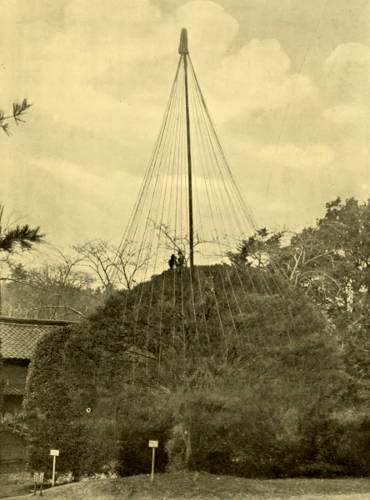
THE PINE TREE TIED UP FOR THE WINTER
The Camellia tree has still opening flowers, out in
this neatly packed-up little garden, and they look gay
among its glossy leaves.
It is only at nights that it is so cold, and then
often there is more than an inch of ice on our little
pond, all to be melted in the sun of midday.
December 30.—The University is shut for the New
Year holiday, so I cannot work there now, and
played tennis in the morning and spent the rest of
the day “domestically.” The climate rots one’s
clothes so, that there is plenty to do. I also made
up some writing.
January 1, 1908.—This is the greatest day of the
year in Japan. Until long past midnight the people
in my house were up preparing for it. Outside the
door of every house is a pair of leafy bamboos and
pines, and over every front door a line of pointed
straws. Most also have a wreath with fern leaves,
sea-weed, fish, and a large kind of bitter orange—each
of these symbolic of some special aspect of good
luck. In the house are found the mochi cakes, a kind
of round cake made with much-pounded rice-paste,
a horrid glutinous sticky mass, but very essential for
the future welfare of the household! These are put
two together in little piles; and there is a pair of big
ones, 10 inches or so across, and a number of little
ones all round it. The little ones are distributed on
white papers in various nooks and crannies of the
house, and are said to be for the rats, though those I
have watched have not appealed as yet to those
ubiquitous creatures. At the end of the year there is
a rampage of present-giving, in which, of course, I
had to join. The gift from my house lord overwhelmed
me with its splendour: he presented a
beautiful ancient sword, with pearl-inlaid sheath, a
handle richly set, and ornamented with gold flowers.
I had given very small things, only cotton dresses to
the maids, and a silk bag to the lady. The sword is
a gem, and I love it very much—but perhaps it is
only lent me for the year I am here: I don’t quite
know, but gathered from their flow of words that I
was to take it to England.
On the first day of the year every one wears their
very grandest silk robes, and instead of my usual
breakfast I was requested to partake of the prescribed
New Year dishes. The two maids and the mistress,
all in their best (and in their best the Japanese
women are truly butterfly-like and fascinating),
brought a tray, and on the tray a stand of old valuable
lacquer with three lacquer drinking-cups, out of all of
which I should have drunk, and exchanged with her,
the special sweet saké that is a vital element in the
proceedings. To pacify my hostess I sipped from
one, and handed it to her. She raised the cup to her
forehead and drank also a sip. Then I had to eat
the three foods. A kind of paste, or rather “shape,”
of finely-pounded fish, a kind of rolled omelette, and
a mash of sweet stuff made principally of chestnuts,
and, of course, mochi. The three subsidiary dishes
I did not eat, one of which looked too queer, a kind
of foundation of small brown beans with brilliantly
coloured pickles. The dishes were covered with
beautifully embroidered silk crape, representing a
gold tortoise or turtle (old age luck), storks (ditto),
pine, plum blossom, and other New Year symbolic
plants and animals.
I had a present from one of the men at the Institute
of a dear little dwarf plum tree, with sweet-smelling
pink blossoms, which scented the room. There is
not a sign of a leaf on the little tree, which is now
covered with blossom.
The streets of Tokio are simply enchanting, the
pine and bamboo at every door, and wherever there
are shops, strings of gay red and white lanterns. At
night it is a fairy-land. All the girls, and a good
many of the boys, all in their very best, are out in the
streets playing battledore and shuttlecock with gaily
decorated bats and light feathered cocks—such
bright, pretty groups.
In the afternoon I went to the reception at the
British Embassy, held after the Court, with nearly
every one in Court dress and uniforms—some too
magnificent. There was quite a crush of Pomp
and Circumstance, and the brilliance can only be
imagined by those who have been to Court, and they
need no description of it. Yes, clothes make the
man, and ’tis well that gold lace is so dear, or we
would all be Personages.
January 2.—This morning I started to the seaside,
Kamakura, with the P——s. This little village is
only thirty miles or so from Tokio, and one can run
down in a couple of hours (quick for Japanese
railways), and get a nice sandy beach and wild hills.
At the hotel, which is quite European, there was a
number of other English, and we joined forces, and
went picnics and had games and dances together in
high feather.
The principal sight of the place is the great Dai
Butsu, or gigantic metal statue of a seated Buddha.
Most Japanese Buddhas are travesties of nature and
abominations of art—but this one compels reverence
and attracts devotion. Its stillness (a stillness far
greater than that of a house, a statue, or any ordinary
inanimate thing), its great size and the wonderful
calm on the face, the beautiful human lips and broad-based
nose, all make one dream and presently drop
a tear or two if no one is looking. Several of us
went together by day to see it—but in the evening I
slipped off alone to its little grove and saw it in the
starlight. Unfortunately there was no moon that
night. For technical descriptions of its size, etc. you
can see the guide-books or hear any traveller’s gossip.
It is one of the sights of Japan.
January 3.—We all went for a picnic all day on
the hills, looking out over the sea on three sides: and
we had a sleep on the hill-top at noon, and came
back as it grew cold at 4 o’clock for tea.
January 4.—Also a lovely day, only I wandered
off alone and got lost in the long bamboo grass, 10
feet high, and got no lunch. I came back for tea
at 4 all right, however. It is a curious sensation
coming down a steep hill-side with no path through
this high stuff. I don’t want to repeat it.
January 6.—The day was spent at the Institute:
the floor of the fossil laboratory is being concreted, so
it is locked up for a bit. All my time was taken up
with the welcome letters which I found awaiting me,
having accumulated for a number of days, during
which there was an exceptional lot of mails.
January 7.—All day at the Institute, picking up
dropped stitches. The term has not yet begun for
the students.
January 8.—I was at the Institute in the morning,
and at Professor F——’s for tea in the afternoon,
where some New Year customs and flowers were
shown, the New Year plants being the pine, the
plum, and the bamboo.
January 9.—The New Year decorations are
beginning to be pulled down from the streets, but a
little tuft of pine is left in the place of each, and
sometimes surrounded with a garland of rope.
As I was at home this afternoon, I had long talks
with my landlady, to whom I seem to afford a great
amount of interest. The clothes of a Japanese
woman are really very cold and draughty for winter,
because of the way the skimpy skirt opens in front
(there is no front seam, it is only folded and confined
by the broad obi or belt), though they may have as
many as half a dozen padded garments on at once.
She sees me, of course, in all stages of dress and
undress, and greatly admires my warm spun knickers
and stockings!
January 10.—I have been in this house now nearly
two and a half months—except, of course, when I have
been away—and every night I have had identically
the same things for dinner. Dreadful! Not at all—I
have come to the conclusion that it is a most
excellent plan. How many men and women are
worried and bored by the never-ending question,
“What can we have for dinner?” If you always
have the same things this most troublesome of all
domestic problems disappears. No one wants anything
but water to bathe in, unless they be fairy
princesses or Queens of Scots, and yet the delight of
a bath never palls: in these months I have had the
same things to eat daily and relished them hugely.
Consciously or unconsciously, we are so much the
creatures of habit that if we are led to expect variety
in our dinners, the same menu repeated twice becomes
tiring and three times insufferable. We even remember
what we had last week—but if we have daily
food always the same, we judge only its quality, and
if it is well cooked, relish it. Of course the menu
must be wide and well chosen. I, for example, have
the same five kinds of vegetables always served with
my small piece of steak, and the frying of the fish is
superb. From this peace I am now driven out by
my landlady, who has at last realised that some
variety would be, to say the least of it, usual. She
consulted me about it, and has bought a cookery
book of “sea food,” as foreign cookery is called, so I
gave her a lesson in soups for a beginning, that
being the part of the menu she managed least well.
Oh me!—those dear peaceful dinners—I recommend
every one to try the plan; it is philosophically sound
and practically excellent.
I went to lunch at the Faculty and found many,
but not all, the Professors there. Term has only
theoretically begun. The day has been gloriously
brilliant, so that one could shout for joy, though after
sunset it was frightfully cold. At half-past five the
stars came out, brilliant points of diamond light
through the trees.
January 11.—I spent all the morning testing
copper disks and the gas-engine, etc., though it was
Saturday. Late in the afternoon I called on a Mrs.
K—— with a card of introduction. Unfortunately, I
have been far too busy to present half my introductions,
but I wanted to know some more Japanese
ladies, so called on this one. What a contrast she
was to the others I have met! Running downstairs
to meet me and chattering all kinds of greetings,
expostulating against my removing my shoes (a
thing, by the way, which is absolutely essential in all
true Japanese houses, because of their beautiful
floors), commenting on the weather, and thanking me
for coming till my breath was quite taken away.
Soon I discovered the reason for all these unusual
things—she had been eleven years in America, and had
studied at one of the Universities. Her husband had
been eight years in America. She was exceedingly
nice, but so unlike a Japanese! with her thickly
scattered adjectives of “dear,” “sweet,” and “lovely,”
though she was dressed in Japanese style.
We were comparing the marriage customs of the
different nations. In Japan a man asks, “Whom does
my father and mother wish for me,” if he does ask
anything at all. In New York the man asks, “How
much money has she?”—in Boston, “In which
College did she study?”—in Philadelphia, “Who
were her ancestors?”—and in England, “Does she
love me?” Mrs. K——’s marriage seems to have
been made in Boston: her subject was zoology and
her husband’s medicine—all very unusual in a
Japanese. She informed me that Japanese clothes
are so much more difficult to make than foreign,
which astonished me, for there are only straight lines
in a Japanese dress. But it has to be evenly padded
and lined, which makes the trouble. She also
informed me that all the English and Americans
married to Japanese are so “sweet and dear”—the
different customs making their characters patient and
charming.
It is true that in their eyes the average Westerner
is childishly quick-tempered and troublesome.
January 12.—New Year calls on Professor and
Mrs. S——, and a dinner-party at Professor F——’s,
where every one but I was Japanese. Though the
food was all European, we sat on the floor all the
time and ate off a table a foot high. After dinner
numerous reproductions of famous pictures were
brought out, and I amused myself (and them also, I
expect) by making them give their real opinions on
the beauty or otherwise of the people in them. Most
of our beautiful women would be wasted in Japan.
Blue eyes are hard and unloving! Burne-Jones’
chins are laughable; Botticelli’s Madonna has no
beauty and the saints are ugly. But Burne-Jones’
women’s hands are lovely, and the reflection in the
water of one of his attendants of Venus very lovely
too. Turner’s pictures are too crowded with detail!!
Kaulbach was much admired.
January 13–15.—These three days have been very
cold, and I have been at the Institute practically
all the time cutting fossils; the machine going at
normal speed, giving finally very good results. But
who would have imagined that on the amount of
water dropping on the revolving wheel depends the
rate at which you cut through your stone—or that
carborundum put on at 1 inch or 2 inches from the
cutting point makes all the difference in the world?
These and a thousand little details like them have
to be learnt by series of experiments. The weather
has been lovely, and even wonderful. One day
there was snow, and it covers these little Japanese
houses so picturesquely, picking out the detail and
making them more like picture-book-land than ever.
The sky is brilliantly blue, and the hot sun melts the
snow on the little pine trees, so that they are like
fountains of glittering drops, while from the grassy
banks beneath them soft wreathing clouds of white
steam curl up and are lost in the blue, and I long to
be a poet. But the next day! The roads were quite
unspeakable, and for many days following.
January 17.—At the Institute all day again. At
2 o’clock Sir Claude Macdonald (the Ambassador)
and Mr. Clive (the Secretary) came to see me and the
stones. The former is huge, and with his glorious
fur-lined coat and pale-green suède-edged waistcoat,
looked sadly out of place in my work-room, which is
nearly filled with packing-cases and lumps of coal,
but they stayed ever so long. The people are much
honoured that the representative of his Britannic
Majesty should have visited their Institute.
January 18.—I worked at fossils all day, and this
evening, commencing at 5, was the Biologists’ supper.
Every biologist in Tokio comes, from head professors
to first-year students, about 130 in all, and I
was the only lady, of course. This time we ate from
high tables, sitting on European chairs, but we ate
Japanese food with chop-sticks! The most thrilling
things were sagittaria and ginkgo seeds! cooked quite
soft in a dish which is a kind of cross between
a soup and a custard (a gay thing to eat with chop-sticks
any way!), and by carefully biting the tiniest
piece off the top of the seed one can see the embryo
and suspensors; the endosperm alone, of course, is
the only part eaten. Just as we have chocolates or
almonds on the table through the meal, they had tins of
tiny dried fish, about half an inch or so big and quite
crisp, like roasted pea-nuts. It was a very frivolous
meeting; there was story-telling with much laughter,
and comic pictures of various professors and students
under amusing circumstances; and a drawing by lot
for gifts of all sorts of things, from an old newspaper
or a turnip to books or ornaments.
January 24.—Canada Balsam is causing much
trouble in the fossil work-shop, and I spent most of
the day over its little fads and vagaries. The young
man who is to learn how to cut the fossils (after we
have learnt ourselves and can teach him) is very
quaint in his personal appearance, and reminds me
constantly of the Golliwog, his hair grows so far
down his neck and the back of his head is so flat.
I fear some day I shall give vent to the amusement he
causes me. But he is undoubtedly quick in some
ways and very tidy in his methods.
January 25.—I had to mess round over the gas-engine
all the morning, and in the afternoon (Saturday)
went to watch some of the mad foreigners playing,
or trying to play, I should say, Hockey. They
were only six a side, but I really wouldn’t join in
spite of their entreaties, for they were not playing on
grass, but on bare earth! The dust was awful, and I
should think very unhealthy. It is simply impossible
to get any grass in Tokio, it is only to be seen in
small quantities in a few sacred places, and even then
dies down all through the winter, so that it is quite
unusable. Moss and liverworts grow here so well
that it is very curious that grass is so impossible to
cultivate. Professor M—— is trying experiments
with English grass seed at the gardens, but it isn’t
very successful, though better than the native product.
January 26.—I called on Mrs. G—— at the
Embassy. I heard a true story of certain small
children in Yokohama, a girl and a boy: the former
caused her mother much sorrow because of her habit
of fibbing. Her brother fell out of the window
and was helpless in bed for some time, and she was
left to amuse him one Sunday afternoon. When
the mother returned she found pencil scribbling all
over her white dimities, and said, “Who did this?”
(a form of question she usually avoided, using subtler
means). “Brother,” promptly answered the maiden.
When asked why she told that lie, said, “Because I
forgot Brother couldn’t get out of bed to do it!”
January 27.—A day spent on work of various sorts
on the fossils. A terrible wind suddenly arose in the
afternoon, and going home along the streets it blew
first on one side and then on the other, and the dust
it raised hung like a fog all over the city, while the
sun, usually a fiery brilliance at which one dare not
blink, hung like a disk of pale gold in the fawn-coloured
sky. Along the road, as one walked,
fancying peace, suddenly a snake-like form would
rise, its cobra head would expand till it formed a
huge surging wave, that spit and stung and blinded;
or a little whirlpool would start at one’s feet, shake
itself and open in a second into a great torrent, that
showered upwards instead of downwards. I never
saw such dust, but they say it will be worse in
February.
January 30.—A national holiday, so no work was
allowed at the Institute. I gave a tea-party, only to
about twenty people, of whom the merriest and jolliest
was Baron K——! When I have seen him hitherto
it has been in solemn manners. The intense agitation
this caused in my house all day cannot be
imagined by you English people who give tea-parties
every little while! The entire household for the
entire day was quivering with excitement; and I
must add to their credit that they produced several
treasures of art, kakemonos and gold screens, from
the go-down (or safe), where they are kept.
January 31.—I was fossil-cutting all day, a nice
new stem and leaf turned up to cheer us on. The
following cutting may be amusing; it was in the
Japan Gazette a few days ago:—
An amusing incident occurred at an “At home” in Tokyo this
week. A matron, talking to a slender young woman in a pretty
art gown of blue velvet, said, “Oh, I hear Dr. Stopes is here. I
want to meet the delightful old party. I understand he is strong
on fossils.” Later on she said to her hostess, “Who is that girl
I’ve been talking to, in the blue dress? seems a nice girl.” “That
is Dr. Stopes, the learned geologist,” said the hostess, and the
Yokohama matron collapsed.
February 1.—I was fossil-cutting all morning.
Aluminium, of all metals, seems to be forging ahead
as the prize saw-maker.
February 2.—A dull day, so I didn’t go out
exploring as I had intended, but snuggled into bed
all the morning to counteract the cutting-machine,
which is really rather wearing.
February 3.—At work all day on the fossils.
Dinner at the P——s, after which I had to give the
long-promised lecture on fossils to the Literary
Society of Tokio. Naturally, to an audience in
which missionaries played an important part, but
little science was desirable. However, they seemed
pleased to hear about the various adventures connected
with fossil collecting.
February 4.—At work in the Institute over fossils
all day. In the course of my walk to the Institute,
which takes about forty minutes, I pass quiet streets
which are little frequented by the foreigner. In all
these months I have never yet met a single foreigner
between my house and the Institute, though in other
parts of the town they are common enough.
Every day I see something or other I long to
record, and forget when it comes to writing this
journal what it was.
The shops are now full of oranges. Small ones,
like our “Tangerines,” but native grown, and
seedless. They are sent to the shops in little
boxes, universally the same size. How sensible the
Japanese are about such things—in spots! But
oranges are a little tedious, and there is really almost
nothing else to be had but tasteless and expensive
apples. This country is still in that primitive state
when we can only get the fruits and flowers that are
locally in season. Even well-off people, who at
home could command strawberries in March and
roses in December, must here eat the things at the
time Nature intended. It has a certain charm but—I
am a Londoner.
Another striking thing about this country’s products
is the extraordinary richness and variety of
the vegetation,—palms and pines, bamboos and magnolias,
chestnuts and orange trees, rice and roses;
the number of plant species in the little country of
Japan alone exceeds that in all Europe. Also the
number of species of birds and insects is extraordinarily
great, and their brilliance and beauty quite
unusual. Yet it has been said by one who knows the
country, “The flowers have no scent, the fruit no
flavour, and the birds no song!”
To this, I myself would add, “and the people no
souls.” And in the whole saying there is truth
enough to justify its existence, probably as much
truth as there is in any saying, for in all our sheaves
of words there are but a few ears bearing the grains
of truth. Now I hasten to add that a spray of plum
blossom in January scents a whole room with its
fragrance; that the native-grown figs are the most
luscious and sweet I ever tasted, and the nightingales’
thrilling melody to be heard even in the cities; while
I have met men and women who are as the plum, the
fig, and the nightingale. And yet on the whole, that
hard saying is true.
February 5.—At the fossil workshop all day.
Nearly every day in this clear weather I see the great
Fujisan, its whiteness high up in the clouds on the
horizon. The pearl of mountains, that, alas, I have
not seen yet except from this great distance. From
her superb height she looks down on this grey-roofed
city, and I wonder if she sees in it all the things
I see! The dirt, for instance, and the horrors of
disease. I have praised so much in Tokio that I
think you can bear to hear something of the other
side, of the sights that sicken and appal. Of these,
the ones that struck me first were the numerous
children (only very young ones) with frightful
eczema; the one that now haunts me is the sight of
lepers. They are not allowed to live in the city,
when in an advanced state of disease, but they are
allowed to come in and beg. One may easily touch
one by accident! To-day I was within a foot of one
before I noticed it. They hold out their hands, with
the fingers eaten away, gruesome sights, and mumble
prayers for alms. Once one died, or nearly died,
on the road, a crowd formed round, with a policeman
on guard, but no one would touch it to give
assistance.
On the whole, the Japanese do not fear leprosy
nearly so much as we do, they say we over-rate its
contagion; but how can they pretend to civilisation
with such sights in their streets?
One hears on all sides, from themselves and from
others, that the Japanese are pre-eminently a clean
people. In their houses that is true, but just outside!
Even to-day in all the smaller streets of Tokio a little
gutter or ditch runs along on either side and carries
away, or is blocked by, as the case may be, all the
refuse and drainage of the houses near by. No
wonder that even Ambassadresses get typhoid. I am
thankful there are chickens kept by so many poor
people, that roam the streets and pick at the dainties,
but I wonder if it is wise to take a raw egg beaten
into milk.
February 6.—There are more stars in Japan than
in (or over, should I say?) England. After the
glowing sun sinks from the cloudless blue sky, the
stars spring out at once, and by 6 o’clock the
heavens are crowded. In the milky way one sees not
a haze of white, but a glittering stream of bright
minute gems. Sometimes too the stars have haloes,
quite big ones, such as we only see round our moon,
and when they shine out of the clear sky they almost
dazzle.
February 7.—I was at the fossil laboratory all day,
cutting away at my stones. Dinner with the P——s,
and after that the Tokio Bachelors’ Ball—a truly
delightful function. I left at 2 A.M. and walked the
3 odd miles home with two nice men. It was really
too cold to ride in these open kurumas, even with
two rugs and an eiderdown. The walk through the
quiet streets under these ever enchanting stars was
delightful. One of the men was a military attaché
here, and has been to camp with Japanese regiments.
I find every one who knows only military men thinks
less highly of the Japanese character than do those
who mix with the University men. It is not unnatural
that the army is rather suffering from
“swelled head”—and then, who would give a German
Professor for half a dozen or more of the German
officers!
February 8.—Though Saturday, and though I did
not get to bed till 4, I went to the fossils from 10
till 4, and then to tea with Professor F——, where
we discussed dancing, which does not seem to find
favour in his eyes, or in those of most Japanese.
February 9.—A nice quiet morning in bed; after
lunch I went with Miss C—— and J—— to see the
temple of Kwannon at Akasaka. People who
habitually drive in carriages see less of the truly
Japanese streets than do the kuruma riders. Most
of the old roads are so narrow that a carriage cannot
pass, and they must perforce go through the newer
or widened streets, where they encounter electric
trams and maybe glass-windowed stores for “Foreign
Goods.” Not that these latter do not afford amusement—one
may see a Store that carries on the
“Import and Manufacture of Grocers”—another that
sells “Unnecessary Provisions.” Of which latter I
may add there are many in Tokio, to wit, the beaded
mittens, crochet atrocities, Paisley shawls, etc., ad
infinitum, that are destroying the beauty and harmony
of the national costume, and are making the people
ludicrous in their hybrid garb. An irritating little
habit the coachman and Betto[4] have, is to cry in
hoarse duet to every child or old woman (of which
not less than several thousand seem to be encountered
in a drive) to warn them off the road. It becomes
inexpressibly irritating to the unfortunates in the
carriage.
I think I have already spoken of the temple, the
most popular one in Japan, where incessant crowds
are praying or clattering through, or come with
aches and pains to lay their hands on the wooden
figure that will heal. It is a case of physician heal
thyself, for the poor god has all its features rubbed
flat by the hands of a sick humanity. The temple
is so popular and so certainly described in every
book of travel, that I shall not stop to do so. It is
situated in the Whitechapel of Tokio, and the stalls
and entertainments in the neighbouring grounds are
reminiscent in some degree of a Bank Holiday—though
noisy behaviour is lacking.
February 11.—A national holiday, so that schools,
etc. are closed. To-day the Emperor ceremoniously
worships his ancestors, attended by practically all the
Government head officials, including Professor M——,
who wears a uniform smothered with gold lace. I
went to lunch with Mr. Mj—— in his house in Azabu,
which is surrounded by a lovely garden, with pines
and a pond and regular scenery. The party was
composed of foreigners, and we sat at a table 1 foot
high, and had a sumptuous Japanese luncheon. His
two little girls—aged six and eight, in brilliant true
Japanese kimonos—were very gay in entertaining us,
pouring out the saké and singing many little songs
(“God save the King” among them), and bringing
their dolls to table. Not at all shy, and not at all
like Japanese children in this, and yet not forward,
they were pretty, bright little things.
February 13.—Fossil-cutting all morning. We
are getting on finely now; it is nice to see the actual
structure at last, leaves, stems, and roots are turning
up with all their cells very well preserved in the
stone.
February 15.—Fossil-cutting all the day. The
engine has a curious way of giving little explosions
when it is not quite clean at the burner—they make
the boy jump to such an extent that I fear he is a
coward. Also, when I put the molten pans of metal
into water and they fizzle, he won’t go on working
near me till I have assured him that it is perfectly safe.
I sometimes wonder if the Japanese are really brave
except when worked up to it en masse. Several people
who have been here some time tell me they think they
are not.
February 16.—I spent the day out of Tokio in a
country place, about an hour-and-a-half’s walk from
Akabane. The country was slightly hilly, the sunshine
brilliantly hot, and the jagged snow-covered
hills in the distance very lovely. The fields were
cultivated with wheat and green stuff, and here and
there patches filled with the round tea bushes. The
houses were all set amid trees, tall and red-brown
trees, though “evergreens.” The same leaves, now
looking so dead, revive their chlorophyll, and become
green in the spring. The plum trees, pink and
white, were in bloom, but they were the only flowers
we saw. In the plain were rice fields, all dead and
brown, but here and there along the little irrigating
canals green grass roots flourished. Japanese grass
all goes brown in the winter, but I am beginning
to suspect that it is the dryness that does it, for
here and there in damper, very shady places, I find
brilliant green roots. By the broad river, with only
one house near it, and that set some way back in
clumps of bamboo, was a plain of tall coarse reed-like
plants, partly cut down for mat-making. Here we
are promised masses of pink primroses in the spring.
Some young bamboos were green, and amid these we
lay and listened to the absolute silence, undisturbed
all the day. There was not even a bird’s song or an
insect’s buzz, and one might have imagined it the top
of some snowy peak for the stillness of it all.
In the evening I went to dinner at the G——s, and
enjoyed it very much; there were some entertaining
people there.
February 17.—On my way to the College I pass a
small factory, whose owner keeps his coal piled up in
a great heap on the road against the wall. It doesn’t
seriously interfere with the traffic, as the road is quite
wide enough for a good-sized cart to pass even with it
there, and I have never seen two trying to pass. The
coal has been there many weeks now, but no one
seems even to think of stealing it, though the houses
around are extremely poor. I thought it wonderful
honesty till I remembered that the Japanese think
coal horrid, smoky, dirty stuff, quite unfit for use in
rooms, but even so, in their bath-tubs they burn
wood, and it might well tempt them to go after dark
and help themselves. The streets, of course, are
totally devoid of “street lamps.”
February 19.—I often wonder why I have not
mentioned before the most extraordinary furs worn by
the Japanese men. Though the fox is a kind of evil
witch, a devil in popular imagination, yet practically
every man wears a great fox skin round his neck.
No pretence about making up into “boas” or anything:
it is simply the whole skin, unlined, and
doubled, fur outwards, along the middle of the back.
The tail is then put through a hole in the animal’s
head or neck, and both hang down in front of the
wearer. A really rich man has so fine a skin that
the bushy, brilliant red-yellow tail hangs down to
his waist, waving around when he walks. Japanese
ladies almost never wear furs, except when in foreign
costume.
February 20.—Quietly busy over the fossils.
There is no need to relate the innumerable details
that require attention or exasperate one—the sections
are yielding good results, all things considered, and
I quite enjoy the cutting.
February 21.—Though the sun is so hot through
the day that I sit in it with almost nothing on but a
thin slip, night and morning are so cold that one
shivers, and the ice is thick on the little pond in my
garden. Yet a stark-naked youth comes to the well
in the next garden, and a trim little maid works the
rope and brings up buckets of cold water, which he
pours over himself, and then proceeds to dry himself
with a towel which he first carefully soaks in water
(in the true Japanese way). This corner of the garden
is the meeting-place of three gardens, and the well is
common to the three households, so that sometimes
a second maid may assist in his morning amusement.
Behind the trees I can see the painted wood walls of
the Mission church, where people go in European
clothes to sing hymns.
February 22.—I had been really bullied into
playing Hockey to represent the world against
Japanese-born British. They were, of course, far
stronger than we, as nearly all live together in Yokohama
and practice twice a week, while none of us
had played together before. We got 2 goals to their
4, however, and patted ourselves on the back.
Returning by train (Yokohama to Tokio, of course,
is the chief line of rail in the country, so that the
incident should not be compared with doings in some
far-off highland place in Scotland), the train suddenly
drew up with a jerk, far from one station and about
the same distance from the next. The passengers
were surprised, some slightly alarmed, and the train
calmly waited for some time and then started racing
back to the station from which we had come. We all
resigned ourselves to a broken bridge, overturned
carriages on the track, or something of the sort, and
finally drew up at the station we had just left—much
commotion on the platform, and we learned that from
the luggage van some parcels had not been delivered!
They were delivered over to the proper person and
the train started off once more, to reach Tokio not
a little late.
February 24.—There have been signs of the coming
Dolls’ Festival, to take place on the 3rd day of the
3rd month. I have mentioned them already (see p. 74).
The shops are now full of them, and most fascinating
they are, but too expensive to indulge in as I should
like. The figures are all in little boxes, and sit
solemnly, with their stiff robes spread out, as though
they were really the nobles that they represent, and
every one is interested in buying them, or at least
gazing at them in their temporary homes. Several
shops have sprung up this week filled with these
boxes of dolls, and selling nothing else.
February 25.—At work all day at fossils, the
record so far, for with the boy I cut and finished
eleven sections in one day, some very nice. A ball
at the British Embassy in the evening, very pleasant.
Many interesting and amusing things happened, but
unless given in great detail would not appeal to any
one outside local gossip. Captain von L—— introduced
me to the loveliest woman there—an American
(sad to hear their awful accent coming out of such
patrician lips!), the one who at a previous dance
had so entranced me and my young partner that we
spent our sitting-out time following her around to see
her eat ices and laugh; her manner was perfection—calm,
still, and gracious, honey-sweet looks in eyes
that never smiled while one was speaking to her, and
that just broke into little curls of smiles as she
answered—a suggestion of humility while waiting
to hear another’s banalities, yet with it a commanding
dignity that forbade any one else to interrupt
the person who was speaking to her. Her name is
Mrs. D——, and I am going to see her, as she very
graciously invited me to do. I wonder if she includes
thought-reading among her other charms and read
my admiration? Her high-heeled pink satin slippers
twinkled gaily in the dance; she did not hesitate to
lift the Worth frock very high—with such ankles I
wouldn’t! On her white soft neck were the loveliest
little blue veins, I never saw anything so suggestive
of living marble. She was like white marble, with
an underflush of rose and violet. The little wrinkles
at the corners of her eyes added to her charm rather
than detracted from it. She is the only woman in
Tokio who has bewitched me.
There was a very striking-looking girl, daughter
of a French mother and a Japanese father, her
hair done cavalier fashion, with a side bunch of
ringlets under a big white bow; her very French
frock and tiny waist became her well, and she strode
through the Lancers with such a devil-may-care
manner that we could not but remark her—favourably
too in spite of it all.
Tokio is a fine soil for gossip, very good-natured
and amusing. I love it, it’s such a relaxation after
gas-engines and fossils.
February 27.—Sunshine wonderful again—just
the remains of the recent snow left here and there.
I regret to find that the people in my house have
been lying to me for long about a point on which I
laid some stress—a whole complex of lies as well as
the actual disobedience.
February 28.—I visited the Charmer to-day, and
stayed an unconscionably long time. No one has
bewitched me in this way since my school-days.
She had a lovely gown of blue-and-white chiffon.
Several people were there—Baron and Baroness S——,
Count C——, and the wife of the Swiss Minister. I
had about half an hour of the Charmer to myself—her
husband is the Naval Attaché. She was simply
alluring, and her house is far the prettiest I have
yet seen in Tokio. She was telling me how all the
Corps Diplomatique agree that there is no capital
in the world where the social life is so delightful, and
where there is so much gaiety and friendliness among
the Corps as a whole, as in Tokio. Also there is
really no other capital where other people can enter
the charmed circle; that, of course, is the result of
the small number of Westerners in the place, and
their social position; as I have remarked before, there
are almost no commercial people in Tokio.
At lunch at the Faculty to-day. Dr. Y—— brought
me a paper on fossils to correct the English, he is
soon starting for Europe. I have mentioned him
before as being a rising paleontologist, such a shy,
young-looking creature, utterly lacking in all social
gifts; I wonder how he will fare in Europe, perhaps
some of you who read this may meet him. He is
predestined to be professor in a new University about
four years hence.
February 29.—I worked at the fossils till 12, and
then set out for Baron H——’s long arranged luncheon
party.
We were received in rooms with tables and chairs,
and an oil-painting! There were the “lace” curtains
found in every “foreign style” Japanese house, alas!
The Baroness was very gracious and sweet, and
acceded to my request to play on the Koto, playing
a very charming piece.
As we sat on the cushions I could just see out of
the small panes of glass put into the paper soji, and
I delighted in the garden, with its trees of pink and
white plum just bursting into blossom. After some
time the men came in and Baron H—— showed us
his collection of sword rings and knives, etc., all
good, and some very beautiful.
March 1.—It was terribly wet all night and this
morning; I went to lunch with Miss B—— (before
mentioned as a very amusing lady, despite the fact
that she is a missionary). I think no one would be
better qualified to write memoirs than she. I was
hearing something about the inner life of the Court
at Korea. She is a friend of the English lady doctor
who attended the royal ladies, and it was all extremely
amusing, but it is not my place to tell her anecdotes.
I returned early to do some writing, but was greeted
by my landlady with the announcement that to-day,
to-morrow, and the next day are the Festival of the
Dolls. I must, therefore, drink some special sweet
thick saké and eat various sweets, some nice little
ones like fried caterpillars being very tasty. I was
also asked to come and see the pictures and screens
brought up from the store-house, two of them 200
years old, and one, a really magnificent one, 500
years,—gold with plum blossom and birds. I am
constantly seeing new treasures they have in hiding.
They gave me a lovely granite hill with clustering
rosy flowers growing round its base—all 6 inches
square—and we admired together the wet pine leaves
in the garden.
March 2.—Fossil-cutting all day; a very nice
dance in the evening after dinner with the P——s,
where I spent the night.
March 3.—The Dolls’ Festival. Mr. Mj—— and his
three little girls have a very gorgeous collection; the
dolls, however, are far too exalted for any child to play
with them. The Mj——s must literally have hundreds
of these expensive little miniatures of the Emperor and
Empress in the old-style garments, of historical and
mythological figures, of musicians and actors from
the Nō—all of whose dress is a wonder of design and
execution. Then there were all the household utensils
in tiny lacquered form, and on the little trays and
dishes was real food arranged, as well as large models
of fish in sugar. There was even a little temple,
with most of the appointments correct. A large room
was given over to them, and looked like a bazaar, but
the arrangement was not merely chosen to display
the detail, it was all according to prescribed rule—the
Emperor and Empress on the top shelf, with their
jingling elaborate head-dresses and long silk tassels
on their many robes; below them the musicians; on the
lowest shelf the tray of food, the little houses, screens
and fans in inexhaustible variety. The children
are provided with special sweet food which they
themselves eat, the crisp sweet “puffed” rice, sweet
blocks of jelly and sugar concoctions of many kinds.
The guests were also provided with these dainties,
and some of them were delicious, but I could not
drink the sauce-like saké.
In the evening there was our inaugural dinner of the
London University Union in Japan. I found there was
quite a number of old U.C.L. students in Japan, and
so started the idea, which was very keenly taken up
by Professor S——; others joined in, Baron K——,
Professor S——, Professor F——, Professors L——,
S——, etc. etc., up to the number of twenty-one, are
members, and the first dinner was quite a success.
Professor S——, Baron K—— and I form the Committee
elected then, and I hope the Union will live.
Cambridge and Harvard, etc. all have their Unions,
why should London be less honoured and remembered
by her children?
March 4.—A long day at fossils.
March 5.—Fossils till 4—then I went to tea
with Mrs. D——. She had invited the American
Ambassadress and her niece to meet me, and I liked
them both. The former is very like a slightly
slimmer and handsomer Miss S—— of Wintersdorf!
Mrs. D—— had another lovely frock, and was a
dream of sweetness and beauty. Why do I always
fall in love with women!
March 7.—Fossils all day till 4.30, then to tea with
Dr. H—— and his wife, recently married and very
cordial; they live in a really tiny Japanese house,
no room more than six mats, but so spick and span,
with a dear little garden. Though I have done my
best to teach that man how to treat a wife—and he
always seemed to be drinking it in quite properly—she
herself brought the tea for us two, taking none herself
(I know she has a maid), and sitting in the corner
away from us, and not even taking a cushion to sit
on, when he had been shamed into giving her one
by my remarking that she had none. However, they
seem happy, and she looks quite well, and she has
not a soul quivering with every touch of the material
things of life. She says he loves her very much, and
has loved no other woman.
March 8.—To-day I visited the sick. Poor Mrs.
G—— was riding in a kuruma a week ago and the
Embassy carriage ran into her, knocked the kuruma
to pieces, and the horse fell on Mrs. G—— and rolled
over! How she escaped fearful injuries no one
knows, but a muscle is severed and she can’t walk
just now. She looked very pretty in bed, and was
holding quite a court. Horses in Japan are really
dangerous and constantly run away.
I called my duty call on Baroness H—— after the
luncheon party, and the conversation did not flag,
though what she thought of my Japanese (the horrors
of which I am daily realising more acutely) I don’t
know, as she held it under with her fine native
politeness.
I have read two interesting books this week—Lieutenant
Sakurai’s Human Bullets and As the
Hague Ordains, the supposed journal of the wife of
a Russian prisoner who comes to him in Japan, and
is gradually converted to love the Japanese. The
first book was rather a shock to all one’s preconceived
notions about the unflinching bravery and repression
of feelings among the Japanese soldiers! They were
either weeping or embracing each other or writing
sentimental letters—on every other page. I was quite
sick of all their tears and self-adulation, though the
writer gave a vivid picture of the ghastly carnage of
the siege of Port Arthur. Yet people praise the book
and don’t seem to notice the sentimentality as much
as I do. I wonder if those who praise it have read it.
I heard from an old resident (thirty years here)
that the Japanese are the most sentimental people
under the sun. Oh, ye who stop at home and dream
your dreams about Japan! Stay there.
March 9.—The following happened a few days ago,
and I should have put it in then, but I forgot. The
day was miserable, wet, cold, and windy, with snow
blustering about, and instead of quietly having lunch
in the warm Institute I was told we were to go to the
big state-rooms at the other side of the gardens. There
I found that all the Biology students and the Botanical
and garden staff were lunching in Japanese style.
There was a special kind of pink rice, with small beans
boiled with it, and the various more or less savoury
pieces of fish, vegetables, and a kind of pancake that
go to make up a bento. Afterwards we all had packets
of highly ornamental sticky cakes, chiefly made of
the stodgy bean-paste I cannot eat, but some were
good. This was the feast of the God Inari (the God
of Rice), who is very appropriately worshipped by
the botanists. After the feast we cowered under our
umbrellas and went a pilgrimage through the gardens
to his shrine, where we found the hundred-year-old
blue cotton banner put up outside. Within the shrine
was incense, lit by the Botanical Laboratory attendant,
and a great tray of cakes, the same as we had been
eating. Led by the Staff, we all rang the bell to call
Inari’s attention to our visit, and clapping our hands
in prayer we gave him a few sens each, throwing the
copper coins in among the cakes. Then we ploughed
our way through the bog-like paths to the Institute.
March 10.—So seedy that I did not get up at all.
It is the very first day in my life that I have ever
spent in bed (except for the measles, when I was too
ill to notice anything much), and I feel it a solemn
and important event. The first half of the day sped
on magic wings, and I wondered how one could be
so bête as to find bed a wearisome place when one
is surrounded by the lovely golden lights on bare
wood. How we spoil wood by staining and painting
it! The range of delicate colour in the woodwork
of my room is a perfect delight. Then I had also
a little tree, shaped like a weeping-willow, but one
mass of rosy pink plum blossom, some flowers wide
open, with recurved petals and a flare of silver stamens,
others in perfectly round crimson buds, alluring as
only roundness can be.
Till 3 o’clock in the afternoon that tree and the
wood made me blissfully happy, but the hours between
3 and 5 seemed terribly long, and by night I
was sated with the delights of bed. The next day
seemed very far off.
March 13.—I went to the Institute in the morning
and cut some fossils. It has simply been an influenza
cold, but it has rather played havoc; after lunch at
the Faculty and a long and varied talk with the Dean,
I wasn’t fit to do any more, so I called on the B——s
and went to tea with the Charmer on my way home
to bed. I went to bed before 6 o’clock, and was so
worn out that I howled for an hour, but dinner revived
me, and I am now as cheerful as if I hadn’t contemplated
suicide two hours ago. Tokio is a terrible place
for ups and downs. To-day it is fearfully cold, even
my bath towel frozen; and a week ago it was like
summer for two days—one day a miserable snowstorm,
the next glowing blue skies.
March 14.—In the afternoon a party had been
arranged to visit a noted plum garden at Omori, and
have tea in a tea-house. As the H——s had asked
me to go home with them to dinner and sleep, I went,
though by the end of the day I was far too tired out.
We carried cakes, trusting the tea-house for cups
and hot water. The plum garden was indescribably
beautiful, and a typical “Japanese” scene. The
garden sloped in the double hollow of a shell-shaped
valley, and the rich white bloom on the trees surged
up it as the thick drifting mists surge up a mountain
pass. Standing out from the cloud-sea of blossoms,
like peaks from out the mists, were two or three tea-houses,
white papered and inhabited by gaily-decked
maidens, and men who admired the plums, in grey
silk. The sky was clear sapphire, and the sea beyond
lay like a blue gauze veil along the horizon. While
the others went on into the midst of the trees, I left
the garden and sat in the sun on the steps of a little
temple, which was a perfect harmony of curves, and
behind lay a bamboo grove.
Tea was amusing, for Captain S—— would not
take off his boots, and therefore had to walk with his
feet in the air; which he did on his knees or hands.
The tea-house was perched on the side of a hill, and
looked down on rice fields and woody patches on
little elevations. After tea we explored the temple
and its pretty groves, and had a lovely merry-go-round
ride on the old revolving library, a huge thing, but
so perfectly poised that we could all sit on it and go
round without its even creaking.
March 16.—Called on Mrs. P—— on my way to
the Institute in the morning. She captured me, and
then and there my clothes were taken off and I was
put to bed—and was secretly thankful to be there.
She is quite exceptionally kind to take me in in this
way.
March 25.—At work all day over fossils—then
dressed in my green-and-gold Venetian dress and
called on Mrs. G—— on the way to the Embassy
dinner. She and her children were having a preliminary
view of some of the gowns—she is, alas,
still in bed. The party was splendid—several
Japanese were there in magnificent old court dresses
and simply marvellous arrangements for their hair.
Baroness S—— also wore Japanese court dress.
Perhaps I had better shortly describe it. The lower
part consists of scarlet trousers with extremely wide
stiff legs, and the garment is much like our “divided
skirt” of some years ago, but
the cloth is much stiffer. Over
it is a gorgeously embroidered
kimono, with sweeping train.
Some of the hair ornaments
are extremely bizarre, others
(according to the period) rather
simple, the hair falling down
the back and tied in three
places.
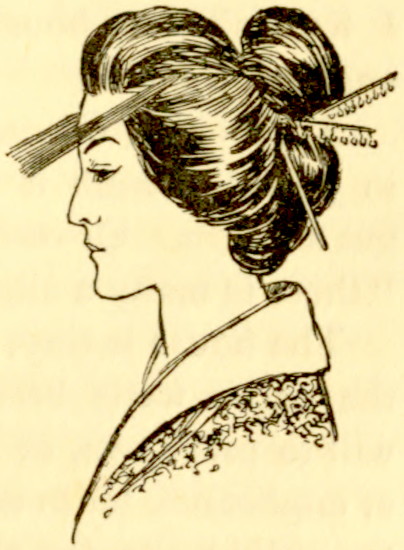
One, something like the
sketch, was very effective, the
funny little brush of hair coming straight out at
either side being its speciality. Several of the
Englishmen came as Japanese pirates, etc., with
great wigs of long hair, rich gold-embroidered robes
and swords; the girls were not remarkable. After
dinner we all went along to the German Embassy,
and met there the parties from all the other Embassies.
The scene in the reception-rooms and in the beautiful
white ball-room was vivid and gorgeous beyond my
power to describe. Whom to describe, when nearly
all were beautiful or striking, and nearly all of the
important folk in Tokio were present? Count H——
(the foreign minister) was in old daimio dress, with
two swords and rich brocade—and one could not
imagine how he ever came to wear anything else!
The evening was one to remember, with its brilliance
and beauty and courtliness.
March 26.—Yesterday morning at breakfast I had
imagined I would remain in my present house as
long as I was in Japan. This morning by ten o’clock
I had taken a house and garden of my own and
engaged a maid!
Apparently, one can do things quickly sometimes
in Japan, though it is usually a terrible business to
get a house. Of course, I haven’t yet moved in, and
“there is many a slip,” etc.
The house is tiny, but is said to have five rooms—the
paper walls between these can be taken out at
will to make two, or even one room. There are lots
of cupboards, for in this, as in all true Japanese houses,
the solid walls are all lined with great cupboards, a
yard deep and reaching from floor to ceiling. The
rent of the house with its garden is about 7s. a
week! Less than I have been paying for my two
rooms.
The joy of these houses is that one needs almost
no furniture, they are provided with the soft, thick
straw mats (tatami), and these serve as carpets if one
likes. I infinitely prefer their delicate straw colour
and black borders, which harmonise with the cream
walls and unpainted woodwork, to the clashing
carpets most people have. Then fireplaces being
absent, overmantels, fenders, coal-scuttles and fire-irons
are all represented by a little china bowl of
ashes, manipulated with metal chop-sticks. Beds,
though introduced by many foreigners into such houses,
I dispense with, and use the native mattresses on the
mats, so that they are folded away in the big cupboards
by day and the room is used for what one
will. Wardrobes are also needless incumbrances,
the wall cupboards serving excellently—wash-stands
are but eyesores, as the little bath-rooms are so
arranged that one can splash at will and the water
all runs away from the sloping floor. So I am a
householder, and prepared to lead the simple life.
Providence must have arranged it all, for the cook
next door (that is at Mrs. P——’s, I forgot to state) has
a protégée who wants an easy place in a foreigner’s
house, and doesn’t care so much for money, as she
is timid and wants experience before going to a big
house—but she can bake bread and Scotch scones
and cakes! I pay her 18s. a month and give her no
food at all! She even brings her own saucepans and
mattresses! Well, it all looks too good to be true,
and until I have moved in I had better say no more
about my own little house.
I went back to my present abode, for it was my
At Home day, and I entertained some Japanese, who
were charmed with Arthur Rackham’s illustrations
of Rip Van Winkle, and thought they showed something
of the spirit of Japanese art, which I think is
true.
I flew down to the station for Yokohama, and
dined there with Mrs. L——, and dressed in a fancy
dress costume and set out with her and her daughter
to a mi-carême ball. I enjoyed the dance hugely.
March 27.—Rushed up to Tokio in the morning;
to the University for lunch, where I had a long talk
with the Dean. The Mitsui family (the Japanese
Rothschilds) gave the money for the fossil laboratory
and part of the apparatus, and the Dean proposes
(now that everything is practically finished in the
making of the arrangements) to give a tea-party in
the Botanic Gardens to show the building apparatus
and slides (I have cut 221 so far), as well as the new
herbarium buildings. As I have often remarked, he
is very English in his tastes and culture, and he
planned to give what would be usual in England—tea
and coffee and cakes. But when I saw him
yesterday, how he had fallen! Nothing less than
meats and wines and jellies would satisfy him. It
was not his own wish, but he had been driven into
it by the strength of the custom in Japan, which
demands that if you have guests at all (even at 3 or
4 in the afternoon) you must give them a meat feed,
and that they must eat like greedy schoolboys.
Whence comes it? This mad ostentatious display,
and the guzzling, which is so foreign to their real
culture. A mutation derived from crossing such
distinct cultures as those of Japan and Europe, not
even a hybrid with the characters of one of the parents.
Well, I laughed at Professor S——, for he said he
hated the custom and had hoped to set the fashion for
simplicity in this party of his, but that he was really
afraid to do so; he would be the laughing-stock of
the Japanese if he only gave tea, coffee, and chocolate,
ice-cream, cakes and sandwiches from 3 to 6 o’clock!
I asked him where the spirit of his Samurai ancestors
lay sleeping—asked him who could set the fashion
for reasonable entertainments if not himself, in his
exalted position of Dean of the University—and got
him to swear to me that he would be a pioneer, that
he would be brave and face the ordeal of being the
laughing-stock of the Japanese. I wonder how it
will go.
This unwritten law, which demands such a lavish
hospitality if any is given, is, I see, one of the chief
causes that there is so little social life, in our sense
of the thing, among the Japanese. It is a real strain
on their purse and their time, and they naturally ask
guests seldom when they give so much trouble.
To ask a guest to come to your house and give
him only tea and cake, or a dinner of no greater
magnificence than the one you eat yourself every
night, is almost impossibly rude.
After cutting fossils till 5, I went home to entertain
a Japanese to the same food that I eat every day.
Am I a laughing-stock among them? Doubtless,
and for more things than one.
March 28.—Fossil-cutting all morning. Late in
the afternoon I called on Mr. and Mrs. B——, who
have come up to Tokio for a couple of weeks from
Sapporo, where the snow is in parts 28 feet deep—the
worst they have had for more than twenty years.
They have brought up their adopted daughter—the
Aino girl I described from Sapporo—this time we
were able to talk in Japanese, which of course she
generally speaks.
March 31.—I am making the experiment of going
on a walking tour for a few days with friends, and
we have chosen Boshu peninsula, as it is little
frequented and beautiful. We were up at 5 o’clock
this morning. Very late too, as we should have got
up at 4.30. However, we managed to catch the boat
which is to take us to Boshu Province, the scene of
our tour. The sail past Tokio down the bay was very
calm and lovely; we had perfect weather and were
allowed, as a special privilege, to go on the top front
part of the deck, where we had a good view. Fuji
gleamed white over clouds and pine tree foregrounds,
and the sky was blue. The journey lasted seven
hours, and we saw many small bays and islands
down the coast, of perfect loveliness.
Landing at Hojo in Boshu about 1 o’clock, we
walked across a point of the peninsula to Mera.
Here the inn we expected to find was demolished,
but we found another and got put up. It was next
door to a big school, however, and we had a very
large and very interested audience of about a hundred
children in constant attendance. C—— had never
been to a Japanese inn before, and we were a very
merry party indeed. The scenery here was in no way
striking, that I hope is to come.
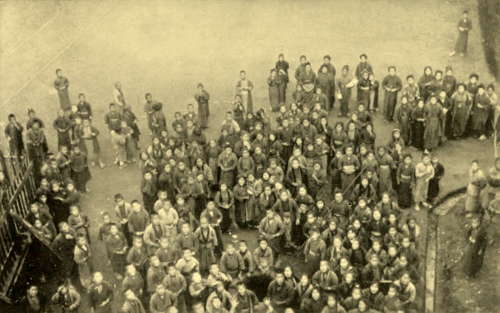
A LARGE AND INTERESTED AUDIENCE OF SCHOOL CHILDREN WATCHED OUR
PROCEEDINGS AT MERA
April 1–5.—We have been walking all day all these
days, and there was no time to write in this journal,
for though we have walked and slept very little we
have eaten and talked and laughed so much that we
had time for nothing else.
The first day’s walk was disappointing, flat, not
very near the sea, and with villages every half-mile
or so, but we reached a pretty place by 5 o’clock,
and slept at Chikura in greater comfort than we did
at Mera.
Between Chikura and Wada, our next day’s walk,
the coast was prettier, but the weather dull, raining, in
fact, and we did not get the sea-bathing we had hoped.
At luncheon-time it was very wet, and we sat in a
row under the porch of a Buddhist temple (it is like a
country lich-gate) and ate our cold rations. An old
woman stopped to gaze at us, and M—— (who speaks
excellent Japanese, having been here since she was
two years old) asked her if she thought we were funny
to sit there. “No,” she said, “you came to play and
you are playing. This child” (pointing to a baby of
nine months on her back) “also plays.” Parts of the
road were fascinating, through bits of pine wood and
past many a little temple. I particularly noticed the
great hedges, walls really, of podocarpus, and the
numerous lovely blooming camellias, peach and
cherry trees. Between Wada and Kominato the road
was still prettier, with rocky bays and pines. We
attracted a good deal of attention, because C—— and
M—— had red hair and J—— yellow. I alone
escaped most of it. The evenings were really very
funny. We all dropped into Japanese ways soon
enough. We had many jokes, but none of them
would interest folk eleven thousand miles away.
Wada to Kominato was our longest day, and half
the walking party got driven! What with our pack-horse
laden with luggage and the two kurumas,
M—— and I were highly amused at the walking
tour. We were able to get milk nearly everywhere,
which is noteworthy in Japan, where it is usually a
great difficulty to find it outside the cities. The
Boshu people drink it themselves, and excellent it was.
Kominato to Katsuura was a short walk, but a
very wet one, and we became more Japanese than ever.
I discarded boots and walked with my skirts up to my
knees, bare legs and Japanese tabi, as did J—— and
C——. We bought the great round bamboo hats the
coolies wear, and were altogether very picturesque.
I came to no harm, but the others were not so well
wrapped up in woollen under-things, and C—— in
particular suffered. It was funny, when she broke
down, to see her gobble up three hard-boiled eggs
faster than M—— could peel them for her! It
became one of the jokes of the party. My saucepan
(the little one I have carried in all my walking and
many other tours, and that I bought in beloved
München and made jam in) has also become proverbial.
I told every one to bring one, but they all
laughed the advice to scorn, and now grudgingly
acknowledge the service mine does, though it runs
itself off its legs to provide them with cocoa, and to
turn hard uneatable meat into soup.
The hotels we have stopped at have been fairly
good, but Japanese cooking does not always coincide
with our tastes.
At Katsuura we turned in, wet to the skin, and very
hungry, to the inn recommended to us, but found it
rather more of a pot-house than any we had been in,
so M—— and I went out in the torrents and sought
another and found it—one with three stories (the first
I have seen outside the city), the top one consisting of
two lovely rooms, with verandah, which we took, and
the beauty of the wooden trellis-work in the soji, the
reverential politeness of the men and maids, and the
luxury of silk to lie on and to cover us, was well
worth the 5s. a day it cost! Hotels in Boshu are very
cheap, and for the first time I have been astonished by
the smallness of our bills—of course it is out of the
way of Tokio and Yokohama people (seven hours in
a small steamer, with sudden and frequent storms,
keeps off a crowd), and there are no mines or special
industries to bring commercial people. It seems to be
a little scrap of Japan of thirty years ago, where the
people were all simple-minded and polite, and content
with little money. The beauty is not superlative, but
is really very charming, and unspoiled, and with the
lovely shore and blue sea, the place is well worth the
visit.
On Sunday (5th) it was simply pelting with rain,
and the roads were unspeakably awful with the heavy
recent rains, so that we were quite gloomy. The
third miserable day in succession, and we had such
brilliant weather in Tokio for weeks! Ōhara is about
10 miles off, and we had reckoned to walk in there
in time to catch the 3 train to Tokio, but it was
impossible, and we chartered a basha (a kind of
carriage), reputed to hold eight, but we four found it a
tight fit. I went with the others in it, instead of walking,
though I felt like a shorn Samson, because I
wanted to see them off at Ōhara, and really walking
was an impossibility. After seeing them to the train,
I was going on farther by myself. They had to
return, because they teach in a school, and the
holidays were to be over on Monday—but I am free a
little longer.
Well, that basha, it was quite worth going into!
No windows, but sides of beaten brass that would let
down at our pleasure. The only drawback to brass as
a window is that it necessitates patience. Unless we
opened the windows we couldn’t see out, if we shut
them they crashed and clattered like drums and
cymbals. If we shut them we were stuffy, and if we
opened them we were frozen and drowned by driving
rain. We managed with forbearance and care to fit
our knees into the space between the seats, but thought
with wonder how a single other knee could get in, and
the space was legally that for four more! The road
was as indescribably rutty and muddy as a country
road can be in any country of the world, and it
had further a dash of a Swiss mountain road as it
came along some of the cliffs by the sea. We were
frightfully cold, and stopped at a tea-house to fill
“Tommy,” the hot-water bottle, who had hitherto
been a useless burden to the party, but was at a
premium to-day. At this tea-house we also bought
three bright red lobsters for 1¼d. each, and they helped
to amuse us. Not long after we found that the wheel
was only held together by its rim, and it had to be
knocked into shape every few minutes; fortunately it
was the off-side one from the cliff. When I said
farewell at the train we were loath to part—but as I
tucked up my skirts, slung on my knapsack and put
on my mountaineering cloak, I was consoled by the
thought I was really off walking and alone, and once
more had the open road before me and my fancy as
my guide.
As the roads were so terrible, and it was late and
wet, I decided to stop off for the night near by—and
went about a mile and a half to the coast and found a
perfectly ideal inn. It was in a tiny bay, all by itself,
or rather on the cliff above a tiny bay, on the
peninsular point of which was a miniature temple.
No human foot-print but mine was on the sand of the
shore, and none but the maids of the house within
call. I took a small room upstairs, facing the sea,
where the breakers dashed on to the cliffs, and found
that though inside the house, on one side it was open,
because a big piece of cliff stuck right into the
building. This gave a charming view of moss-grown
rocks, and a hollow stone with a lake in it, all lying
between me and the next-door room.
The bath-room was downstairs, and to reach it one
went along a long corridor hewn out of solid rock.
The bath-room itself was also built in the solid rock,
and was a great vault-like place. How J—— and
M—— would have revelled in it!
The food was such that my saucepan worked
wonders with it, and converted stony chicken, hard
rice, and half-cooked green pickle into a very tasty
stew. The beds were excellent, though not of silk, and
I slept splendidly. Last night we had talked till one
o’clock, so to-night I turned in at 8.30 and slept till
8.15. Alternations of solitude and company are
refreshing, and though I enjoyed those girls immensely,
and laughed as I haven’t done since I left
England, it is delicious to be alone with the grey sea
in a hotel half hewn out of solid rock.
April 6. After pouring all night the clouds broke
about 9 o’clock, and I set forth in sight of gleams
of blue between the grey; the hotel people were all
very polite, though all they got out of me was 2s. 8d.
It is a hotel I shall note and hope to return to, I wish
I could bring some of my friends there from home.
In the next little bay, where the cliffs are also very
steep right down to the sea, so that there is no beach
at high tide, the fishermen beach their boats on a
series of piles and trestles, and very picturesque and
quaint they look.
The cliffs here are all limestony and sandy, and
seem rather recent and unfossiliferous.
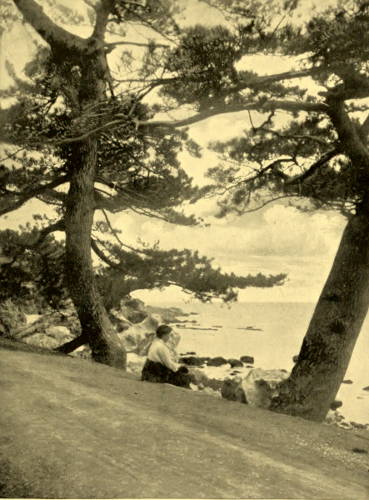
THE COAST ROAD ALONG WHICH WE WALKED
ROUND BOSHU
I walked partly by road, partly along the shore
about 14 miles, a short distance, but the way was very
heavy and the day hot. About half-way were some
lovely pine woods with mossy floor and May-flowers,
and I lay there for lunch. Violets of many kinds had
been the chief, almost I might say the only, wild
flower we had noted hitherto, but here were several
others. Daisies, like our home ones, only bigger and
purple; a lovely intense blue sedum, and a small
shrub, with crimson flowers, the Japonica, were the
most striking and beautiful of those I noticed.
The last 4 or 5 miles lay along a curious shore.
A greater contrast to that of my last night’s lodging
could not be imagined. The whole coast was flat
for several miles inland, and the beach was a great
stretch of dark grey sand with the small beginnings of
dunes here and there, and must have been more than
a mile in width. Along its desolate extent were
dotted little houses, grey as the sand, and built with
their roofs touching the ground on two sides!—these
sides presumably being those of the prevailing winds.
They looked as though the full tide should sweep over
them, the beach behind them appeared so unreclaimed,
but they seem to have stood there for long, some were
almost buried under the piled-up sand. I can give
no idea of the vastness and the desolation of this
view. The houses seemed mere hummocks in the
wilderness, for under the eaves a man can hardly stand
upright, and the boats look almost as big as the
houses. There is absolutely no vegetation near them,
only, at the edge of the dunes, a few small pine trees
venture farther out than anything, but the little ones
run grave risks of being buried. I had intended to
spend the night at Jehinomiya, but found it lies a mile
from the coast, so when I found groves of pine trees,
a broad river, with a tiny village and a lot of country
houses of the summer-house type, I put up at the inn,
which is not bad. The hamlet is called Sendocre,
and the inn looks out over a broad river and into
deep groves of pine. The frogs are all making as
much noise as they can with their watchman’s rattle-like
voices, but otherwise there is perfect peace;
everything is in complete contrast to last night’s cliff-perched,
spray-splashed, storm-tossed house.
April 7.—What a day of sights and impressions!
I cannot tell a quarter of them, or to-day’s experiences
would fill this volume.
The mile to Jehinomiya lay along the river by a
narrow foot-path, with pine plantations near at hand.
From thence to the next town (Mobara) was 10 miles
of road, at first between villages and large farm-houses.
The rice fields lying on each side of the
road were the scene of the country people’s labours,
men and women working together up to their knees
in the soft black squelchy mud. They were dressed
quite alike, with dark-blue cotton clothes, very tight-fitting
trousers down to the ankle, and long tunics
with a blue-and-white towel tied over their heads.
Some of them burrowed in the mud for roots of
weeds, some used a heavy fork to bring the soil into
ridges, and in one field I saw a wooden plough
dragged by a dejected-looking horse. The chickens,
everywhere abundant, seem a particularly large and
healthy type, and they too worked in the rice fields,
hopping from ridge to ridge after the workers had
turned it over and revealed small grains and worms,
which they captured. As in Boshu, so in this province,
cows are remarkably plentiful and good-looking.
The clusters of cottages with their grey thatched
roofs made a series of lovely pictures, beside each was
one or more glowing bush of apricot or peach, and
the white feathery branches of cherry flower, soft,
rich, and with a feeling like whipped-cream when you
kissed them, floated over the rest like white clouds.
For 3 or 4 miles the road lay through pine woods,
real pine woods, with a soft mossy floor and violets,
not the high, coarse bamboo usual in Japan, that
makes it impossible to pass. At the edge of the
road were many low shrubs with thick masses of the
terra-cotta-coloured flowers, like Japonica, so that a
line glowed on either side of the sandy track. There
were also purple pansies and pale violets, and the
world seemed a very fair place.
At Mobara I passed a school just coming out, and
very few of the little boys even troubled to follow
me; none called out any remarks. My knapsack is
carried in somewhat the native fashion for slinging
bundles, and even though I wear skirts, they think I
am a man—their men wear skirts too, and a plain
panama sun hat very like mine. Thank heaven my
hair isn’t red. A few discover I am a woman, but
the fact excites little interest.
A less beautiful 5 miles took me to Chōnan, and
from there 2½ more to the place where I branched
off across the rice fields to see a famous temple
of great age. The last mile of the road was splendidly
hilly and well wooded, and on the banks
were huge blue forget-me-nots. The road passed
under one of the hills by a bent tunnel, pitch dark,
and very weirdly echoing. I could not see where my
feet were going, and wondered if any local bandits
made it their headquarters; they could not have
found a more excellent place. Slightly disappointing,
was it not, that I went through that cavernous tunnel
alone and without any incident? To reach the temple
I had then to follow narrow paths across the rice
fields, and was not surprised to learn from the people
at a tea-house at the foot of the temple hill that they
had never seen a foreign lady before. The hill on
which the Buddhist temple of Kasamori is built is
magnificently wooded; on the summit stands a high
isolated pyramid of rock, and on the top of this the
temple is built. This main building dates from 1028,
extremely old for Japan, where the original buildings
of the oldest temples have usually been destroyed by
fire and rebuilt again and again.
The view from the temple itself was superb. One
stood on a level with the topmost branches of the
giant trees, and looking through them saw all round
stretch after stretch of green valleys, and crest after
crest of darkly wooded hills. The trunks of the trees
near by were covered with epiphytes and creepers, and
in the valleys grew ferns and violets.
In a little tea-house I made myself some cocoa in
my saucepan, and the people wanted to taste it, and
seemed highly amused with me, particularly with my
folding knife and spoon, and the metal cup that fitted
on so neatly. Thus fortified I retraced my steps to
Chōnan, and towards Mobara. I expected to find an
inn on the way, but none appeared, and I had to walk
right back to Mobara. Then troubles began, and
after walking these 27 miles I was tossed from inn to
inn, no room anywhere! Not that there were so
many inns, for it is a small town, and at last, in
despair, I decided to go to the station and take a
train to Chiba, the provincial capital, where there
would surely be room, but I was tired and hungry,
and had two hours to wait for the train. In Japanese
inns it is very different from ours; if you have no
room you cannot get a meal, as there is no such thing
as a dining-room.
However, I found a charming little tea-house,
where I got a rest and a meal, and they arranged
with a hotel by the station to put me up, or shall I
say “take me in”? for certainly I would not have
gone to the place under other conditions.
April 8.—Came back by the 8.15 train and reached
Tokio early in the afternoon. After calling on Miss
B—— I went to the P——s to dinner and to make
the finishing touches to the arrangements about my
removal, which is planned for two days hence.
The blow that awaited me should not have been
unexpected in this land, where no one seems to consider
a promise more binding than a compliment is
true. Well! though I had taken it before I went to
Boshu on certain understandings, I found my house
sold to some one else when I returned! As I had
arranged with my present people to leave directly on
my return from Boshu, I was not a little vexed, particularly
as the house suited me so perfectly in every
way.
The new owner was willing to let it at a rent of
40% higher than I had taken it for, and he further
refused to do any of the necessary papering and
plastering that I had had guaranteed me, so that
instead of ordering the removal carts, I have to sit
down and argue with the landlord, and it may take
three weeks to settle. I really grieve that it is so
utterly impossible to trust the Japanese; I had loved
them so before I had suffered so much of this sort of
thing.
April 9.—The cherry flowers yesterday were like
great clouds touched rosy by the setting sun, and
to-morrow is the garden party of Professor S——’s
ambitions, and to-day! nearly a foot of snow on
my window ledge—everything buried and broken, as
none have seen them before. There is more snow
to-day than there was through all the winter put
together, and the pink cherry flowers are cloaked so
as to conceal their very existence; they do not lend
the snow even a flush of pink.
There was no way of getting to the Botanical
Institute but by walking, and I am very glad indeed
that I did choose to venture out, instead of listening to
the counsels of the Japanese and remaining at home.
The streets were almost deserted, and I trod unspoiled
snow, which sometimes reached half-way to my knees.
It still snowed heavily, and the weight of the umbrella
became a burden, as well as being a useless encumbrance,
as I was always putting it to one side or the
other to gaze at some new delight, while the gusts
whirled in and under it from every side. Devastation
and ruin lay on every side; great boughs were blown
off the cherry trees and lay across the road. The
magnolias which yesterday sent up glittering white
chalices to heaven, to-day hung limp yellow rags
beneath the snow-laden boughs; even the glow of
the flaring crimson plum was quenched. In front of a
temple I daily pass, a great cryptomeria was shattered
across the road, its main shaft broken into three pieces,
so that the whole tree shut down like a concertina.
Every telegraph and telephone wire was broken,
the ends lying like traps curled under the snow ready
for one’s legs, and the rest looped from pole to pole
in festoons of white rope, for the snow stuck to the
wires till they were as thick as my arm. On the tram
lines a few snowed-up and deserted trams stood helpless,
and not even a kuruma passed to jeer at them.
It continued snowing all day, and as the roads
were so unspeakably and unusually bad, I decided
to go calling and see the town thoroughly when I
was about it. So I walked to the Embassy, about 2½
miles or so, and saw the streets, one after the other,
in the same condition of ruin. The traffic was still
almost nil, but some people had been up and down
the big main street by the Kudan, and a certain
amount of snow had melted. That Kudan hill was a
bog on the surface and a river below, and as there
were no footpaths, I was through it nearly to my
knees. After paying several calls in the neighbourhood,
I decided to go and see what Azabu looked
like, and walked over there; the P——s would not let
me away again, the roads were too terrible, and so I
stopped the night there.
Obviously the garden party is postponed.
April 10.—The snow is still lying thickly everywhere,
but on the road the foot tracks are nearly
knee-deep in slush. The papers are full of accounts
of yesterday’s storm. It appears that all the railways,
as well as trams and telegraphs, were cut off. There
was no possibility of getting to Yokohama even, and
the Kobe express was snowed up for the day 10 miles
from Tokio. A few trams are running this morning—they
are repairing wires as quickly as possible.
By the end of the day nearly all the cars were in
working order; I think they have been quite remarkably
quick over them, but the telegraph wires are
still hanging in festoons or tripping one up.
It is quite a good thing the snow put the party
off, for it is the funeral day of the young Prince
Arusigawa, and also we were not nearly ready with
the cutting-machine—the automatic carborundum
apparatus is still far from complete.
April 11.—I removed from Yakuojimaimachi to my
own little house. After there was the bother of them
having sold it while I was away, there was so much
talk and bother about rent, cleaning, papering, and
everything, that I got cross and said I would move
on the 11th, as I originally said I would, and when I
was in the house I would discuss all these points!
That soon settled matters; my goods were put on
two man-carts with great care by the entire family,
and plants and all were safely brought to my little
Azabu house. I began to pack this morning at 8.30,
and was ready for the carts at 10.30! That is the
outcome of the Japanese feruské (a square ornamental
cloth in which goods are tied), it is so easy to tie up
quilts, cushions, and looking-glasses all together in
one huge coloured pocket-handkerchief. The placing
of my few goods on the little carts took till 12.30, but
they were in Azabu, unpacked and paid, by 2.30.
Some things are cheap in Japan. Fortunately it was
a lovely bright day, so nothing got wet.
I found the house being cleaned by my bright
little maid, whose name is O Fuji-san, and who
seems to like to have me for a mistress and to live
next to the P——s, whose cook is her great friend, and
trained her. She is rather a better-class girl than
most servants, and was early left an orphan, and her
guardian is glad for her to be with people who will
look after her. She is quite pretty, and unusually
bright and intelligent-looking. I expect it will seem
to you a preposterous thing to do, to take a house
and go in for “furnishing” and all the worries and
expense of a household. But in Japan it is very
different from in England—the houses need practically
no furniture, the huge cupboards in every room hold
all one’s goods, and so wardrobes, etc. etc. are
superfluous (and, besides, they utterly ruin the look
of a Japanese room), while the soft tatami (special
thick mats in every house) serve as carpets, bedstead,
and mattress, and all one needs is a thick quilt to lie
on, another to cover one, with a couple of sheets and
a pillow. I have the few chairs and the table and
cabinet I had for the last house, and with a lovely
brilliant blue cloisonné vase on an ebony stand, a
dwarf pine tree, and a bunch of white cherry flowers
in the tokonomo, my room looks an aesthetic dream,
with its cream walls, cream floors, and wooden trellis-work
with white paper windows. If I could but
carry it as it is to London! Yet here people prefer
Brussels carpets and rooms packed with knick-knacks.
They are living in the realisation of the dream of
our aesthetes and “simple livers,” and they prefer
the things we are trying to escape. I speak of the
foreigners, but even the richer Japanese are casting
aside the exquisite refinement, the studied and
cultured beauty of simplicity, to add a mêlée of
“foreign” additions and “luxuries” to their rooms.
The soothing harmonies of form and tone are broken,
and there is a strife of shrieking colour, of glaring
inharmonies.
April 12.—I gave my little maid carte blanche to
buy the essentials for her kitchen. One stove, costing
5s., I had already arranged for, the rest she had to
buy. At the end of the day she came with all the
items written down in a bill 3 yards long. I went in
fear and trembling to inspect it and the purchases,
and was greatly relieved to find the sum total under
ten shillings. Many of the items were deliciously
amusing; for instance, 1 sen 5 rin (a sum equal to a
farthing plus half a farthing) attracted my attention.
It was a fan to fan the charcoal when it refused to
burn. For one farthing she got a splendid lamp
cleaner, for 8d. a lamp with white glass shade, while
¾d. more provided the chain to hang it up by. The
second stove cost 5½d. and burns splendidly; it is
made of red earthenware, and has a little door that
opens and shuts. These items will make you think
that I am either making game of you or of myself,
but seriously, I set no limit to the girl’s purchases,
and she has got the usual things an unsophisticated
Japanese uses in her kitchen. Of course, I have a
few things, and bought some expensive items like
enamel saucepans and frying-pans—but I think this
little house has not cost me £3 to fit up, and, as I said
before, to fit up comfortably, and with a distinct
beauty. I only hope the housekeeping will run as
smoothly as it promises to do, and the house prove as
convenient to live in as it is pretty to look at.
April 13.—The way that maid manages a four-course
dinner, with three saucepans and half a dozen bits of
charcoal in the fivepenny stove, is nothing short of
miraculous—everything was very well cooked too.
I wasted about an hour over the house this morning,
but got off to the Institute after that. It is rather
farther to go now, and takes some time even with the
tram, but one can’t get everything one wants, and
were I near the Institute, I should be so far from all
the foreigners as to be quite isolated, and that, I find,
in this climate, is not very healthy.
April 14.—The cherry trees are now wonderfully
beautiful; contrary to the croakings of the pessimists,
the snow has not ruined them, and the trees are
covered with bloom. They say they are bleached,
and certainly the pink is so delicate as to be entirely
elusive when one looks at an individual bloom. I
went to the renowned Oyeno Park, where groves of
trees are laden with bloom. It was a little late, and
some of the petals were falling, so that there seemed
to be a whirling snowstorm of flakes that gleamed
pearly white in the sunshine. The ground was
covered, and all the pools of water left by the recent
snows were thickly fringed with white. Tokio is
everywhere a fairy-land of beauty, for cherry trees by
the hundred are blooming in it. One has the impression
of being in the midst of clouds that float between
the branches of the pine trees, and rest over grey
roofed cottages. The strip of soil in front of the
Embassy is covered with a treble avenue of flowering
trees, and the paths are petal-strewn between the
brilliant green grass patches. The difference in the
grass in the last two weeks is very noticeable—from a
brown patchy covering over bare earth it has become
a thick emerald cloak.
April 15.—My little maid’s guardian came to see
me and to thank me for taking care of her. As a
matter of fact it is she who is taking care of me; I
couldn’t have imagined a house run more smoothly.
The guardian is a nice man, good-looking, though
middle-aged, and able to speak German, so we got
on all right. He brought me some pots of pretty
flowers, and some pansies with scent which are treasures,
as the lovely pansies here are scentless. It is
a very curious point, how well English flowers grow
here, getting lovely large blooms, but one and all
losing their scent. It makes one quite sad when great
luscious roses, pansies, and even mignonette, are
scentless—they seem to have lost their souls.
April 19.—I spent the morning gardening; in my
little garden nothing much is growing yet, the last
people were very careless. I have dug and planted,
the chief thing I planted being stones. I have learnt
their value in a garden, and I also go out with a
watering-can and water my poor little stones. Alas,
all the really beautiful ones were too expensive to buy.
I went in to lunch with the P——s, because they were
having ice-cream, and afterwards went to tea with old
Mr. G—— (father of the Mr. G—— I mentioned at
the Takashima coal mines, near Nagasaki). His
house is surrounded by an extremely lovely garden,
with masses of flowers, and a view right across to
Fujis. While we were standing on the lawn a lady
visitor turned down her glove and rubbed some bites
on her arm. Mr. G—— bent over her, and with an
air of courteous solicitude, said, “That is not one of
my fleas, I hope.” No one seemed to think the
remark in any way curious till I said I wished I had
a snapshot of that to send to Punch.
April 22.—Cutting fossils till 3.30, and then I went
to Professor M——, and then on to the S——s to
pay my party call. Professor S—— was out, but Mrs.
S—— at home, and as nice and talkative as could be
expected in Japanese, when the concrete bounds the
realm of my speech. When I got home I found
Professor S—— had just been to see me! and we
had each travelled 6 miles to visit each other, and
crossed. I was very sorry. He had brought some
butter, made by the agricultural students, hoping I
should like it. I had once mentioned how difficult
it was to get butter fit to eat in Tokio.
To-day I saw the first bewitchingly pretty child I
have seen in this country—with great round black
eyes, with a look of heaven in them. She was dressed
in a scarlet flowered kimono that showed the outlines
of her little limbs, and her hair was tied with scarlet
ribbon in a little tuft at either side. She was dancing
along with a parasol held high over her head, but she
would not even smile at me, and I would gladly have
taken her in my arms and kissed her, she looked so
perfectly in tune with the dancing cherry clusters and
the blue heavens.
April 23.—I feel that I can never go into a tram
again. The horror of my last ride! A leper came
and sat down beside me, almost on top of me, and the
cars are so crowded I could not get away. He was
not in the worst stages, of course, but some of his
finger-tips were eaten away and one eye was blinded—there
is none of the “white as snow” business
about lepers, it is an eating away of the digits, and
finally the limbs. I was only near him for five
minutes, till the first stopping-place—but——. I
have said before, I think, that the Japanese don’t
think it really contagious; there was perhaps not the
least danger, but we are accustomed to think mere
contact with a leper fatal.
The single cherries are now over, and the long
double ones beginning. They are rose pink and
really as big as small rambler roses, each head
hanging down on its long stalk. The rich clusters
on the branches are quite unimaginably beautiful;
could one suppose the kisses of tiny children materialised
and hung by fairies against the blue sky, one
might well believe the cherry flowers to be the kisses
of all the golden-haired pink-cheeked babies.
April 24.—Friday again—how fast and furious fly
the weeks, and there are only four in a month, four
and a few days ōmaki. When they give you a one-sen
present after a five-dollar purchase, they call it
ōmaki here, and many a sen have I received that way.
I wish Nature would give me a few years ōmaki here
and now, I want to stay here longer. I went to lunch
at the Faculty, the first of the term. Professor S——
very nice; afterwards I went to inquire how Professor
F—— was, but he was too ill to see me.
April 25.—Saturday. Fossil-cutting all morning.
The double cherries are now beginning and are showing
masses of colour between the trees of single cherry,
which are quite green. Pansies are everywhere in
the little shops, and so are gold-fish. Many small
shops have suddenly added glass globes of gold-fish
to their wares; the white glass sparkles in the sun,
and the fish are very bright and pretty. They are
very clever at grafting gold-fish. One may get them
with two or more tails so neatly grafted on that the
creatures live very happily, and look quite as though
they had been born so, and were rather proud of it
than otherwise.
April 26.—A very beautiful sunny day. I dried
my hair in my little garden—it will break my heart to
leave this house and garden, there is no doubt about
it. It isn’t more than 20 yards square, but it is full
of features—two ponds, a river, stepping-stones,
woodland glades, pansy beds, and tiny grass plots.
As I sit in it and look over the roof of my tiny house
I see the blue sky through a group of tall cryptomerias,
with a tall silver ash stem, a maple and
chestnut clothed in vivid green to throw up their
blackness in strong relief. I picked the dead flowers
off the blooming plants, and then set out with sandwiches
and some writing to the woods, which I was
optimistic enough to expect to find in Tokio! And I
found them! Within half an hour of my house I
came upon a sudden steep track off the high road, and
followed it into a wood on a hill, where I lay all day,
with a vast panorama of green valleys below my feet,
violets and wild wistaria around me, and pine trees
over my head, and no human being near me all the
time. Thank God for the quiet woods. It is the
best source of strength and comfort I know, to lie on
a hill alone all day.
This little wood is the first quite solitary comfortable
place I have found in Tokio’s immediate neighbourhood—one
could hardly have expected to get so
sweet a place so near a big city. But I trust to my
feet to lead me to woods wherever I am, even in
London’s suburbs, and they generally do.
April 27.—A quiet day at work at the University;
some new delight in the way of flowers appears every
day and charms me. I put a new plant into my
garden most evenings.
April 28.—After this week of glorious weather that
to-day should be wet—cruel! The day when the
Emperor and Empress had invited me (as well as a
few hundred other people!) to the Imperial garden
party. All the morning it literally streamed with
rain, but I hoped against hope, uselessly, of course,
for the early morning decides whether the Emperor
will be there or not. However, about half-past one
my hope was rewarded, for the rain stopped, though
it was not bright, and that meant we would be allowed
to see the gardens, which, of course, is a thing in
itself well worth doing. So I decided to set off, not,
of course, in my best bib and tucker, and Mrs. P——
went with me, a little against her will. The others
would not come, though J—— had bought a new
frock and a four-guinea hat for the occasion, which
is the event of the summer season. Right glad I was
that I went—the gardens were lovely, and there were
a lot of people in semi-garden-party state. We ate
the chicken and ice-cream, fruit and champagne
intended for the whole party, and had really a much
more enjoyable, if less distinguished, time than if the
official party had taken place and the Emperor been
present. A number of the diplomats were there.
By far the most striking individual was an Indian
prince, in a glorious pale-blue and gold uniform, with
turban and a delicious gold pompon. He was extremely
tall and thin, and held himself erect as a
young pine.
The cherry petals were falling, and whitened the
pines and floated on the lake in wind-blown drifts.
The wistarias were covered with buds just clouded
with a purple haze, and every one of the many pines
and other gymnosperms gleamed brilliant green
among trees, the young shoots’ vividness giving an
effect of bloom, where the maple leaves were crimson.
The maple, which has crimson leaves in spring, does
not get the brilliant colouring in the autumn, like the
other species, but is equally highly prized for its
spring beauty. The garden slopes down to the sea,
which runs along one wall of stone, and in the trees
were hundreds of sea-gulls. The benevolent despot
has fenced off a part of the garden; here no one is
allowed to enter, and here the wild-birds nest—the
sea-gulls building and rearing their young on branches
of trees covered with luxuriant epiphytes! Some of
the trees are very old, and in one I found a big tufted
bamboo growing as an epiphyte in the ancient stem
of a flowering cherry tree. Something disturbed the
nesting birds—was it the smell of champagne and
cigars in the neighbourhood, or the clanking of spurs
and swords?—and they rose in hundreds and wheeled
in the sky, such a flight of them I have never seen.
Some were pure white and gleamed like cherry petals
in the grey sky, but most were grey, like the drifting
clouds.
April 29.—A quiet day’s work, the weather was
bright, lovely, out of sheer perversity. My maid
gave me some fritters for dinner, of a kind I had not
ordered, and when I asked her what they were, she
said hassu, that is, the lotus. The sacred flower
makes delicious fritters! I daresay if one could
capture the rosy-tinted evening clouds they would
make good ice-cream.
May 2.—I went to Professor Fw——’s: he was kindly
taking me as his guest to an afternoon luncheon-party
at the Admiralty gardens. At his house I met
an interesting Japanese who spoke excellent English,
and who is said to be one of the greatest Japanese
musicians. He invented an organ of some sort, and
has had a special audience with the Kaiser Wilhelm.
We drove to the Admiralty, passing safely the fierce
bayoneted sentries, and across a yard hideous with
brick buildings and smoky chimneys—through a gate
in a high wall, and were—in a deep forest glade,
under shade of palm trees and ferns, back in time
three hundred years! The gardens were those of
a very famous Daimio, and were laid out with the
greatest care and at a boundless expense. In them
are all the stages of the Tokkaido,—scenes from China,
wild mountain views and iris gardens, falls of water
and lakes. In fact a series of scenes of wonderful
beauty, of peace and suggestion, of dreamland poetry—only
the tallest of the cryptomerias and pines were
standing as dead skeletons, killed by the smoky
chimneys on the other side of the boundary wall.
These great gardens are entirely closed, and it is very
difficult even to get permission to see them, the
authorities of the Admiralty are so afraid of spies.
The special party to-day was to welcome the
married daughter of one of the earliest and most
useful of the American missionaries, a Dr. Brown,
who had had a school in Yokohama, and who
had as pupils many men now very distinguished.
Among other people I was introduced to a very
charming, thoroughly Europeanised, and handsome
man—and of course did not catch his name. He
walked with me a little while through the gardens,
and we talked of the beauty of Tokio and the
destruction of that beauty by “reformations” some
years ago, before the Japanese had learned to appreciate
native art as well as they do now (though much
of the same sort goes on to-day), and I quoted one
of the specially terrible places, the hideous red-brick
Exhibition-like buildings (Government buildings) that
ruin the view of the grey moat with green banks and
trees and old white and grey buildings round the
palace, one of the most lovely sights any city in the
world can show. I exclaimed against the vandalism,
the criminal folly of the architect, whom I surmised
was some second-rate foreigner. “Yes,” my companion
answered, “it is bad. I was the Chairman of
the Building Committee at that time, but I suppose
the architect was morally responsible.”
You may imagine my feelings. I knew, of course,
by the look of the man he was some one of importance,
but how could I guess who he was? I am not sorry,
however, that he heard it.
A further surprise awaited me; he made the
speech of the evening, and turns out to have been
Dr. Brown’s youngest and most promising pupil, and
to-day to be the world-known Ambassador Tsuzuki,
representative at the last Hague Conference! He
said good-bye very graciously—his laurels don’t rest
on the beauty of those buildings, and I had not
touched him on a vital point after all.
May 3.—I really had to make up my mind once for
all to learn to get on a bicycle by myself without the
aid of a devoted male friend. Hitherto I have always
ridden with people who put me on—here I am alone.
I bought a bicycle from the missionaries, which had
been discarded by one of their number. But after
being at the bicycle shop for a little it seems in good
order, for it was an excellent frame, and now I determined
to ride, as Tokio’s distances waste so many
hours a day that I can stand it no longer. After a few
hours’ steady determination, I find I can get on very
well without the male friend. But those of you who
read this and have played that part, don’t think I
could have got on without you at the time.
About midday I decided to go and see the renowned
Azalea gardens at the village of Okabu, some few
miles off, and so I took my maid as a treat for both of
us (she never having seen the flowers), and shut up
the house. There is no lock or key, and any thief
had only to slide a paper screen and slip in, but we
told the cook next door to keep a weather eye open,
and set off gaily in the sunshine.
Along the main street of Okabu are a dozen nursery
gardens, all filled with azaleas, and so laid open that
you can walk round and see everything, and buy
what you please, but not unless you please. Even
when you want to buy it is rather difficult to find
any one who will sell to you. When you do, he will
just seize the flowering bush and pull it up, shake the
mud off the roots, wrap them in paper and tie a big
loop of string to it; you carry it home, stick it anywhere
in your garden, and it goes on as though it had
never moved an inch. The sunshine and rain make
things grow so easily here, it certainly doesn’t depend
on any special “skill of the Japanese” in this case,
for I myself stuffed the azaleas into my garden and
saw the man pull them up like weeds.
In one garden there was an entry fee—of three
farthings. Here the whole garden was filled with
plants all one height (about 3 feet), and all flat on
the top, and all covered with flowers—a crimson sea.
Generally speaking, though, the flowers individually
were far less beautiful in colour, and smaller in size
than our azaleas, the interest and special charm lay
in the masses of them, and the number of gardens one
after the other that cultivated them.
There were crowds of people in their best clothes,
and stalls on the road selling sweets, and the inevitable
hair ribbons of brilliant colour; with here and there a
gold-fish dealer or a seedsman.
We lunched in a little tea-house and came back
laden with flowers—four beautiful glowing azaleas, a
brilliant fern-like green shrub, and a budding yellow
broom, for which I paid a sum total of exactly elevenpence.
The roots were all tied up neatly in paper—and
then they wouldn’t let us on the car! Other people
were carrying them tied up in feruskés just exactly as
ours were in paper, so I was furious and asked a
policeman why. “Had we no feruskés? Then we
must cover them completely in paper, and the officials
would not see them.” “But the roots were covered
in paper,” I replied, “other people have them like
that.” “Ah, they have roots in feruskés or handkerchiefs,
then the officials cannot see that the roots
are there, but they can see the roots through paper.
If, however, you cover them completely, then they will
not know they are flowers at all. Roots are not
allowed on the tram.”
We went to a shop and got newspapers to cover
them up, and the same officials who had barred my
way smiled approval!
May 4.—A pouring day, the roads simply awful, as
it came down in torrents all night. My little plans
for getting to work early on my bicycle were all
knocked on the head. I saw not a soul in the
Institute all day, and was glad when Mrs. P—— came
across to have a little chat. I am arranging about
a Debate, Tokio doesn’t seem really to know what
that is! But we meet at parties and talk endless
gossip, so I am going to give a tea-party, have an
amusing Debate (if possible), and found a society
which, I hope, will live for ever, like Mother’s Norwood
one. I forgot, because in a way it came in between
two days, that the other night we went to the Greek
Church Easter Service. It is held at midnight, and
the Russian Greek Church is by far the most successful
of the churches here. It is the only one with an
imposing building, the only one with a great choir,
and a sense of wealth and success in the appearance
of the interior. The great domed building stands
high on a hill, and can be seen from most parts of
Tokio. We found a huge crowd of Japanese waiting
to go into the gates, and as they entered each bought
a candle and lit it, so that, as well as the regular
altar and other candles, the church was illuminated
with hundreds of these tapers. The Bishop, in
gorgeous white and gold, was seated in the centre of
the church, and swung incense over the people, while
a choir, quite unaccompanied, sang the whole service.
This choir is splendid, though composed of Japanese,
and is one of the wonders of the church. The
congregation crowded into the church area, where
there were no seats, but the floor was covered with
carpet (which would certainly be a sea of candle
grease in the morning), on which the people stood or
sat. There were very many children present, some
very tiny, and all in their best. A few of them were
charmingly beautiful pictures. The service, sung by
the choir, was followed by few of the congregation;
they stood or sat reverently, seeing to their candles
and sometimes crossing themselves, but they did not
hesitate to go through their ceremonial bows if they
met an acquaintance, some going down on the floor
and touching it with their foreheads, to the peril of
the tapers. The service was principally chanted, but
sometimes the voices rose into a grand chorus, and
all the time the Bishop and his clergy kept up a
picturesque ceremonial. The altar was magnificent,
vast, and gilded and lit with huge candles. We felt
the whole ceremonial and its setting splendid, impressive,
but almost weird. The power of the Bishop
is clear, if one only knew that he got all those
hundreds of Japanese out at midnight, while for social
functions they find 9 o’clock too late.
We had to walk home, and came through the outer
palace gardens and under the ancient Japanese gates,
lovely in the moonlight, and palpitating with the lives
of the past.
May 5.—The weather cleared up nicely and I set
off gaily on my bicycle, but a dozen things went
wrong with it, and I left it at a shop, hoping they
would steal it, and I should never see it again. I cut
fossils all day without seeing a soul to speak a word
to, and went back to the shop and found they had not
stolen the bicycle, but had put it right, so that it went
quite well. I set off on it to cross Tokio and call on
Miss H——, who had a private view of some copper-plate
etchings done by a friend of hers, and very
charming they were. The roads of Tokio should be
simply blood-curdling. There is no rule for the
traffic, the electric cars are the only things that keep
any kind of order, and foot-passengers and playing
children simply swarm. Fortunately there are few
carts or carriages, but those few dart about anyhow,
and the horses often run away. One has simply to
thread one’s way through this stream of things. The
children are particularly trying, and take no notice
of violent bells and shouts.
May 8. Professor M—— came to take me to the
Faculty lunch. A serio-comic incident happened just
before we started. He came for me to the fossil
laboratory, and waited a minute while I was finishing
a stone. As he stood there, a stone, which I was
heating in molten zinc, exploded, and the zinc flew
in drops all over the room, and settled on all of us,
but fortunately only on our clothes. The bright
hard drops looked quite funny on his coat and hat,
and some of them wouldn’t peel off. There must
have been some internal moisture or gas in the stone;
it is the first time such a thing has happened. After
lunch Professor S—— took me and Professor Y——
to see his garden (he lives within easy walking
distance of the University), and it was a delightful
sight. I have described the house and garden
before, and now it was gay with pink roses and many
different coloured azaleas. His tiny daughter was
running about with “bells on her shoes.” Little
bells were fastened on the under-side of the wooden
clog, “on the same principle,” the Professor said,
“as the bell is round the neck of a kitten—it is
convenient to know where it is.”
After an hour’s rest I returned to the fossils, and
at 4 bicycled off to Baroness d’A——’s garden
party,—bicycled in a white muslin frock, which, had
the people not thrown buckets of water into the roads,
would have come through scathless, but as it was,
was heavily specked with mud all up the front, and I
felt all the carriage folk staring at me. Otherwise I
had a good time, and arranged some details about
the forthcoming Debate.
May 9.—At work all day on fossils. Dr. M——
came to the laboratory about 2, and we had a long
chat; he is one of the very few Japanese who know
enough of my work to be really interested.
May 10.—On Sunday Professor S—— asked me
to go to see the celebrated Buton flowers (paeonies),
and I set off at 9 and met him and his wife at
Ryonokubashi at 10. We then drove to the gardens,
which lie across the river, in quite a slummy part
of the town. The south part of Tokio, across the
river, corresponds in a way with the south of London,
and is distinctly its working quarter.
The paeonies were under the shade of straw mats,
which roofed them and the spectators in, and a lovely
sight they were. Each flower was really huge, about
a foot across, but, as a rule, there was but one on a
plant. White, pink, crimson, and almost black, and
all the shades so beautiful and artistic, they were
infinitely more pleasing than the chrysanthemums.
In the same garden were also a number of dwarf
trees—now I have bought several at various times,
and was always astonished at the cheapness and
prettiness, but here, a very (to me) inartistic one
cost £4, and the only one I really liked was £9!
After lunch we took the train, and went out of
Tokio for some distance to a place where there was
a very renowned wistaria flower. The trunk of this
enormous tree was twisted and gnarled with intertwining
branches, and all together was about 12 feet
in diameter. The branches were all trained on props
over bamboo, and formed a great flat roof, over an
appreciable part of an acre! The flower clusters
hang so thickly and evenly as to give the appearance
of a ceiling of long tassels. The tails seemed to be
only a foot or so long, but when measured were
found to be 2 or 3, some even 3 feet 6 inches long!
The whole sight was very charming, and quite
startling, but perhaps less romantically beautiful than
one had imagined it. The gardens had only this one
tree on show, and under it the people sat and walked
about and drank tea.
On returning we missed the connecting train and
had an hour and a half to wait; it was cold and
began to rain. I didn’t mind, for Professor S——
was very interesting, and we talked of nearly everything
under heaven and earth—but the more I see
of him the less I think he is a typical Japanese; he
is an exceptional one. I was sorry for poor Mrs.
S——, however, who could not follow our conversation
very well, and who had no one else to talk to.
We dined at a restaurant in Tokio, and I got back
home after a thirteen-hours outing, practically tête à
tête with a Japanese man—and bored I had not been
for a moment, and people here say you can’t get any
real companionship from the Japanese. I say it is
those people’s own faults.
May 11.—Torrents of rain all day, so that I did
nothing but work at the Institute—which was somewhat
hampered by the absence of the boy who runs
the engine. I got home in an awfully bad temper,
after battling with everything all day—but the bright
dripping green of the trees all round me, and the
peace of my little house, soon soothed me up.
May 12.—Pouring rain all day again; it was so
hateful ploughing through these streets, with no side-walks
and mud 6 inches deep, that I decided not to go
to-morrow, but stop at home. There was a dance at
the K——’s, and I had a good time. A charming
American was there, who smiled all the time and
made one happy just to look at him. There was also
a young, fair-haired Mr. B——. His teachers must
have been very proud of him; he had the bright
smile and the “good” look of a favourite boy,
and an ornament to the Y.M.C.A. I felt sure he
must be a missionary, but he turned out to be an
artist, just out, and to stay a year, painting all sorts
of things, Japanese portraits among them. He
seemed much astonished when he found I had
travelled alone—I am sure his sisters never would,—and
when I tried to soothe him by quoting my
French and other tours (to show I thought it an
everyday sort of thing to do), he seemed so very
astonished that I drew in the rein and got him to
talk of his own character, which causes him trouble
and interest.
May 13.—The rain cleared off, but the roads are
still bad, yet by the time I came home they were
beginning to be dusty.
They dry here at a quite wonderful rate, and in
the most terrible weather one has always the consolation
of knowing that when it clears it will do so
thoroughly and completely.
May 14.—After the day’s work I called round to
see how Professor F—— was, as I had heard nothing
of any kind for a fortnight. I saw him for a short
time—his face was rather swollen, for they have been
injecting strychnine, but otherwise he looked all right,
only he could see so little. The cure seems to make
almost no progress.
As I was near, I called on the S——s as a duty
(and pleasure) call, and came away with a lovely
bunch of roses, the Professors, when caught unawares
like this, are always in true Japanese dress—and look
so nice in it.
In the evening was the last Cinderella—and a
very nice dance it was.
May 16.—I stopped at home to-day—as the great
Debate began at 3, and I had to borrow chairs from
several neighbours. I hope to-day to found a
Debating Society in Tokio (there is such a dearth of
anything more than dances and gossip, you at home
couldn’t believe!), and have been raking people out—I
have got Miss C—— and Miss H—— to oppose
each other on the subject, “Chaperons should be
abolished.” Frivolous enough—but one must put
the pill in jam here in Tokio, and I hope gradually
to get sober and instructive. The Debate was really
more of a success than I had dared to hope, and I
got nearly every one to speak by the little device of
drawing numbers by lot, even Baroness d’A—— and
Mrs. P——, who swore they wouldn’t. I had
thought, after founding it to-day, to leave it till the
hot season passed, but people are keen to have one
in June—so it is encouraging. The use of a Japanese
house came out strikingly to-day—when I took out
my sliding partitions and made nearly my whole
house one big room. The weather and the garden
behaved themselves—and mercifully everything went
off well. Of course the motion was lost, only two
people wishing to abolish chaperons.
May 18.—A nice bright day. I bicycled home by
the library and got some books of Hearn’s; I am
thinking of getting up a Debate on Lafcadio Hearn
next time, if I can; most people here knew him
personally—and so few seem to realise that he was
great, and almost all run him down! So I expect a
very interesting time of it; there will be no difficulty
in getting speakers to condemn, but who is going to
stand up for him!
May 19.—I just called in on Miss B—— on my
way home, and asked her to propose “That the
picture of Japan presented in Lafcadio Hearn’s books
is totally fallacious.” She consents—I anticipate
some fun, and she is (I believe I have remarked
before) quite the best conversationalist in Tokio, and
a missionary (whom Hearn detested) to boot.
May 20.—Fossil cutting and examining all day.
I have been arranging the fossil slides, the series
got mixed, and it is no joke to keep them straight.
Professor Y—— called in to see me (he is off to
Europe very soon); and invited me to “tiffin at 5” in
a few days. The wording is a little puzzling, isn’t it?
I called to inquire how Professor F—— is, and
was glad to find him a little better, though very little,
but with no prospect of perfect recovery.
Strawberries are beginning in the shops; it is
such a treat after having had only apples and oranges
for all these months. The temperature is delightful,
like our July, and I enjoy it greatly, but the
nights are still very cool, so that I have a hot-water
bottle and the winter quilt. Things are beginning
to bite me again, great horrid things of all kinds.
Spiders and centipedes come out at night, and all
sorts of creatures I never saw before; already I am
rendered unnecessarily hideous with bites, what it
will be later on I don’t know. I saw the J——s
to-day, who once lived here twenty years; they said
that Japan is a country that “grows on one” till it is
heart-breaking to leave it. I feel that already, it is a
pity I have stopped so long. I don’t ever want to go
now except to escape insects. The horrid “semi”
have begun to sizzle to-night. They are the things
that sit in the trees all night and make a sound as
though you have a headache; only when they stop
for a second or two, you realise you haven’t got one
inside your head—but outside. Well, even in Eden
there was the serpent, and I suppose sizzling semis
aren’t as bad as serpents, at any rate their influence
is less far-reaching.
May 21.—Fossilising all morning, and in the
afternoon I was “at home”—blessed day! These
two days in the month I look forward to hugely. A
number of people came, among them Mrs. H——, a
charming woman, young Mr. M——, son of the
man who was Dean of the University before Professor
S——, and Professor S—— himself. He came at an
interval between Mrs. G——’s call and some others,
and we started on Japanese poetry. It seems to be
very subtle, so subtle, in fact, that even such a
cultivated man can’t understand it right away.
Though there is no rhyme and the form lies in the
middle of syllables, there is great ingenuity shown in
finding words with double meaning suggestive of
some poetical idea. The G——s, who called also,
have been here thirty years, at least the Mrs. G——
has, and both she and her daughter like the Japanese
greatly, and are much liked by them. I am going to
get Miss G—— to oppose Miss B—— in the Debate
on Hearn. I am glad to find some one who will stand
up so sincerely and heartily for Lafcadio Hearn.
May 22.—After fossil-cutting walked along to the
Faculty lunch with Professor M—— and talked nothing
particular, as usual. At 5 I went over to Professor
Y—— “for tiffin,” and was received in a foreign style
room, and sad it was. Though so tiny a man, he
has a large family, as all the Professors seem to have,
unlike the corresponding men in our country. A
Mrs. N—— was there, and a Miss X——, a teacher in a
school. I resent very much the fact that all women
school teachers (as well as girl pupils) have to wear
a special kind of skirt (and very hideously ungraceful
it is) over their kimonos, so that every one knows them
to be teachers, just as we know hospital nurses.
Perhaps it is the hideousness of the skimpy skirt, all
open at both sides, that I resent, as much as the fact
that it is a uniform marking these women out as apart
from their fellows. Once, when I asked why it was
all the teachers I saw were so plain featured, I was
answered by a Japanese man, “well, if a girl is
pretty, she can be married and does not need to
go in for teaching.” And we hear so much of the
“reverence of the Japanese for teachers.” It seems
to me the Japan that we Europeans have at last
learned to know, and whose characteristics we have
had drummed into our ears, is already a thing of
the past, and as altmodisch as our early Victorian
furniture, which the Japanese are picking up as “new
styles.” But though our furniture may change so
fast as to bewilder them, does our national character
too change with a startling rapidity equal to the
Japanese?
The streets to-day looked unusually upset, and the
reason of it is that it is the time of universal spring
cleaning,—a spring cleaning that does not originate
from the domestic tyrant, but from the main Government,
and that is inspected by the police before you
have a little yellow tab of paper pasted on your door
to say that you are clean. All the tatami must be
taken up and beaten, all the boards in the kitchen
floor, under which lie hidden oil cans and charcoal,
shoes or saucepans, according to the pleasure of the
maids, must be taken out and the glory holes cleaned
and smothered in white disinfectant powder; the front
step of your hall, which, of course, is also a box in
disguise, is cleared of its winter geta and powdered
white, while the props of your house (all Japanese
houses are raised about 1½ feet above the ground) are
smothered till one thinks it has snowed. When the
policeman is satisfied that all this has been done, and
then only, will he give you the yellow ticket. It seems
to me an excellent plan—one which would be applied
with advantage to some of our slums. The smaller
streets to-day were perfect markets, as from the little
houses every single thing is turned out on to the
road, and the mats beaten there. It added not a little
to the thrills of bicycling, and was an instructive
illustration of the simplicity of the smallest households.
May 23.—After working at fossils all morning,
I cycled over to Miss B—— for lunch. She was as
entertaining as usual. I often think she is one of the
best talkers I have met. After lunch she took me to
call on Mrs. M——, and I followed her kuruma on my
bicycle. The M——s, of course, live in a splendid
house, equally, of course, it was “foreign style,” with
signs everywhere of wealth. The hall was like that of
a hotel, and not a modern Waring furnished hotel
either, and the drawing-room filled with chairs
“upholstered” (there is no other word for it) in various
brocades, with different heavy-patterned brocade
curtains hung over every door and window in the
stiff symmetrical style of last century’s low-water
period. On the lovely verandah, looking out into a
splendid garden, were round iron marble-topped tables,
one was almost surprised there was no advertisement
for whisky, or at least Cerebos salt match-holders.
That was all I saw of the house to-day, except one
little statue carved out of marble, so pure and transparent
that the light shone through it as it stood in
the window, among a tableful of various articles of
cost. Its lovely curves were transfigured by the
light behind it, so that they shone ethereal, and one
could fancy it a fairy form coming in on a sunbeam—I
had not realised fully before how transparent white
marble is, and how suited to suggest unearthly beauty
when carved in human form. I fixed my eyes on
this and forgot the pink-and-green upholstered chairs.
The Women’s University owed much to this
family at its foundation, and they asked me if I would
like to see over it, which of course I would, so they
are to take me on Friday. It will perhaps seem
curious that I have made no previous effort to see
this very important Institution, but I had my reasons,
and the M——s are the best possible people to take me
now; I am glad to go. I did not know before going
there, but found out afterwards, that they gave the
land on which it was built, and that Mrs. H—— (sister
of Mrs. M——) was, with Marquis Ito, one of the first
people to whom President N—— went with his plans
fourteen years ago, and from whom he got much
encouragement and practical help.
May 25.—I am getting quite an expert on my
bicycle. The people in the street, too, seem to have
got used to seeing me, and do not bump into me as
often as they used to! Though there are some who
are unspeakably idiotic; one to-day, for instance,
walking toward me steadily for a long way, seeing
me clearly, went suddenly at a right angle into the
front wheel. The traffic here is exasperating, as the
roads are very narrow; there is no foot-path and no
rule of the road, and people dodge about like flies,
while just this week Diabolo has arrived in Tokio
apparently, and is played now in the middle of the
road. It is quite startling, the suddenness of this
universal appearance of Diabolo, and it is made in
a form that the poorest children can buy for a few
farthings. Yet with it all I think there is less danger
of a real accident in Tokio than in any place in
England, because nothing goes fast, no motors or
hansoms come on fleet-tyred wheels, and if one
bicycles moderately it is really very safe. I have
only knocked one baby over, but I shall never forget
its eyes looking up at me through the spokes of the
wheel, it looked so reproachful, but it was entirely
its own fault, and it was not hurt a bit.
May 26.—Why do the Japanese lie so circumstantially,
and then not even blush when they are
found out? I had ordered some cards to be printed
for the Debating Society and went round to see why
they did not come. The man whom I asked went
away and came back saying that the printer foreman
had sent me three or four proofs, and having received
no reply could not proceed with the work. I said I had
returned a corrected proof some time ago, and sent
him back to inquire again (knowing of old that
determination generally produces the thing you
want); he returned saying my proof had not come,
but if I here corrected it the cards would be printed
to-night; still I was not satisfied, and sent him back
again, and lo, he brought the 300 cards all printed,
and with the corrections in them I had added in the
proof I returned.
And each succeeding story was uttered with such
an amount of detail and an air of conviction!
May 28.—I got to the M——s, as arranged, at 9
o’clock, and there found Mrs. H——, who wished to
come with us to the Women’s University. She was
very unlike Mrs. M——, and dressed in European
style, but her hair was very slightly streaked with
grey, and I thought her 45—she told me she was 60.
President N—— told me she herself had opened a
coal mine in Kyshyu twenty-five years ago, and she
was the first woman who had ever done anything of
the kind here. We drove over in their carriage, as
it is a long way to the University, and I was very
agreeably surprised. I had heard a good deal about
it, particularly that it was more of a school than a
College, and not a University at all—partly this is
true, but it is already a College with the foundations
of University teaching and equipment, and particularly
in chemistry, for which there are four laboratories,
strangely enough, the arrangements are excellent.
The University buildings practically amount to a
village, for there are 700 or more students in
residence, and more than 1000 students altogether,
and there are numerous different subjects taught,
from chemistry to cooking, and from flower arrangement
and tea-making to law and mathematics.
Law, by the way, is compulsory in the Domestic
faculty—not a bad idea, is it? There are two
children’s classes and schools, and a kindergarten,
all part of the University—the idea being that
women should be brought up in touch with children.
Another very good feature is, that by far the largest
number of the women graduates go back to their
homes and get married, so that nearly all the students
are studying to get the culture, not working for
exams., so as to be able to become teachers.
Mr. A——, the Dean, was with us nearly all the
time, and was dressed in Japanese ceremonial robes
and a bowler hat. When he took off the bowler,
one saw that he had a fine forehead, and that his
face was altogether one of considerable beauty. His
was undeniably a face with ideals. Mr. N——, the
President, was rather a similar type of man, but
perhaps less artistically fine. Both were very cordial,
and we had an interesting talk, for they were all-round
developed men, and one could talk to them as
to an Englishman—not like so many of these Japanese
scientists, who are (or try to be) that and nothing
more.
The M——s then took me back to lunch, which was
in European style; the food was excellent, but with all
their wealth, they had no dainty silver on the table,
whose large extent looked rather drear.
After lunch they showed me the garden, taking
me to the Japanese part, which was splendid, hilly
with green groves and streams, and a waterfall. I
saw also their Japanese rooms, most beautiful, except
that they had a blue plush carpet put over the mats;
there was, however, nothing else in them but the
proper appointments—and I delighted in their quiet
harmonies.
I got back to the laboratory in time to get in
an afternoon’s work.
May 30.—Fossils all morning—and preparing
microscope, etc. for my Monday’s expedition, when
I am going after cycads. Went along to tea with
Professor F——, who is a little better now, and from
whom I needed some information about the place I
was going to.
June 1.—The household was up at 5 this morning,
and I got off to the station a good deal too early for
the train, which is a fault on the right side. After
seven hours along the renowned old Tokkaido, where
to-day a railway runs, I landed at Yejiri, and went in
a kuruma about a couple of miles farther to a very
noted cycad temple. I deposited my microscope and
baggage on the temple steps, which I converted into
a temporary laboratory, and scratched myself sadly
on the cycas leaves while examining the coming
fruits. The cycads are really wonderful—so tall, and
curved and branched innumerably.
After pottering around for a while, I broached the
subject of stopping all night at the temple, and soon
got my way. The priest is extremely old and frail,
and looks stupid, but I don’t think he is; there is also
an old woman, whom I presume is his wife, who will
do what little cooking I shall get.
It is a charmingly situated temple, and the gardens
are very sweet, so decked with the beauties of age.
It lies on the slope of a hill, just midway between the
top and the flat rice fields below us, and is one of the
most peaceful habitations it is possible to imagine.
The priest seems to spend all his time, clad like one
of the poorest peasants, working in the gardens,
which are very well kept, and which, like all true
old Japanese gardens, suggest that the little details
had been planned to please a child. On tiny islands
are perched minute lanterns, and across streams
over which one could step are bridges or stepping-stones.
There are such hundreds of frogs just at present,
as he walks one would think the priest was spilling
his basket of plants into the water, there are so many
splashes where he passes, but it is only the countless
frogs hopping out of his way into their native
element.
After a rather meagre supper of eggs and rice (it
is quite surprising how tired one gets of eggs and
rice, even in one meal) I wandered round the garden,
tottering along with great circumspection, for I was
mounted on geta (the wooden clog-like things I have
previously mentioned). The stillness was complete,
as the temple was closed to visitors and the old priest
and his wife were in the house. Range after range
of hills stood back from the sea towards Fuji
mountain, whose position I knew, but who was
hidden in the clouds. In the valley the ripe barley
glowed golden, and between its little fields were the
bare wet patches waiting for the rice to be planted out,
and reflecting now the clouds that hung low in the
sky. Brilliant emerald squares marked the nurseries
of the tiny rice plants, growing in neat little oblongs
by themselves, and still less than 6 inches high.
Suddenly I felt an electric presence, and looked
behind me at a cleft in the hill to see the slimmest
silver curve of a new moon that I had ever seen.
She rode in the sky so swiftly that, as I watched, I
could fancy the waves of blue ether tossed from the
prow of the little boat, and while I gazed she passed
again behind the hill. So delicate a moon, a silver
thread curved on a bow, but its fairy light was
more bewitching than many a great round moon’s
brilliance.
In the night the priest woke, and gave a cry to his
wife, and I looked out, but the night was black, the
fleet moon had lured every star away.
June 2.—Early they rose, and though I took about
an hour leisurely eating my breakfast, it was finished
before half-past eight. I went to the cycad trees for
a while and worked at them. How huge they are!
The one on which I am now sitting, eight feet or so
above the ground, spreads all round me like a grove
of trees, but is only one much-branched individual.
At my feet, in the main trunk of the tree, is a minute
temple, but I think the gods have deserted it, for
within is only one image half a foot high, from which
the paint has worn away.
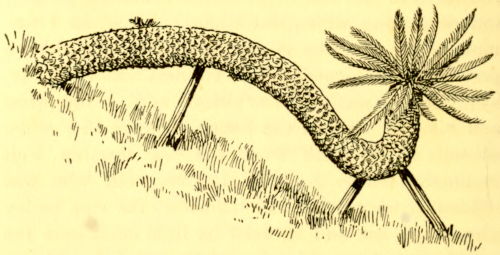
THE CURIOUS BENT CYCAD IN THE TEMPLE GROUNDS.
Opposite me is a funny old cycad, not branched
at all but bent. It grows on a slope, and is propped
up with legs here and there. In the morning I saw
Mount Fuji quite magnificently. She stands alone in
the sky, three times higher in appearance (and more
in fact) than any hill near, with a coronet of snow,
and a cloak of clouds round her shoulders, which cut
her off from the earth. Immensely more impressive
than when seen from Tokio.
What a peaceful day! I stop in the midst of my
examination of the cycads to fall into an aimless
reverie, and am waked up by a frog croaking from a
porcelain-green throat at my side. Big black butterflies
come lumbering along, and one thinks they are
stupid birds till they settle on a crimson azalea flower,
and coming up from the rice fields is a low-toned
rattling chorus of frogs and semi. Just before supper
I went up the next little hill to see the temple of
Kwannon on its top. There are 270 solid stone steps
up to the temple, all neatly squared and nearly 8 feet
wide—but the temple itself is built of mouldering
wood. It commands a splendid view of the rice and
barley fields, and then the sea, which lies but a mile
away. Behind the temple is a hilly country with
many trees and little cultivated patches here and
there. There are lots of white Canterbury bells
among the tall grasses, and the wild Fuji wistaria
branches climb round many a trunk.
After supper the moon rode high in the pale grey
sky—but it is so small even now, only what I would
have thought was a first day moon in England.
Perhaps the brilliantly clear air of Japan last night
allowed me to see the crescent before it was really a moon
at all, but was the soul of a moon before it was born.
June 3.—To get me to the station by 8.30 the good
people started getting up at 5, and talked so that I
could hear every word, repeating again and again the
time that they must wake me. But once they had
“waked” me, not a word did they say, and crept
about like mice. The contrariness of the Japanese
is incomprehensible. The kuruma came an hour
before I ordered it—and I kept him waiting more
than an hour by their clock, and then got to the
station sixty-five minutes too soon for the train!
After a few stations, I was struck by a pretty
beach, and hopped off the train, determined to have
a bathe and go on by the next, whenever it might be,
to-day or to-morrow. The station-master was very
nice, and took charge of my luggage, from which I
extracted a towel. The village—Kanbara by name—was
very small, and there were a good many fishing-boats
at intervals along the shore, but they were
nearly deserted. The water was just delicious, so
warm that one could not feel it at all, I never bathed
in such a perfect temperature, but I expect our
creeping cold water is more bracing. I sunned on
the beach for a while, and found a train at midday
that will take me a good deal quicker than the one I
left, as it is a semi-express.
I had to wait about twenty minutes on the platform
for it, and was of course gazed at solemnly by a
number of small children who did not offer a remark,
they were so young that very likely I was the first
foreigner they had really seen at close quarters.
There was a good deal of difference of opinion as to
my sex. My panama hat always bewilders them, as
only men wear them here.
The station-master came up and had a little chat,
and took me to his room, because there was a chair
there, which was very nice of him; though the chair
was no more comfortable really than the bench, the
quiet and coolness of his room was pleasant.
When I got off the train I had not told him that
it was my intention simply to get a bathe, but had
diplomatically said I wished to see his neighbourhood,
which had evidently pleased him. I told him
about the bathe afterwards, which seemed also to
please him, for I had enjoyed it very much. I got to
Tokio quite uneventfully before night.
June 8.—Fossil-cutting all day. In the afternoon
there was a quite terrific thunder-storm, one peal
seemed to break inside the very house. Then hail!
The largest known for forty years, and really the hailstones
were as large as eggs, some were measured
by Professor P——, and were 2½ inches in diameter!
By a really quaint coincidence it was the Festival
of the God of Thunder, and the storm took place in
the middle of the temple festival. There seems some
justification for a folk-belief in mythology. When
the worshippers prayed for mercy from the fearful
hail, the sun soon shone.
June 9.—Professor F—— came to tea in my house,
which he now saw for the first time—and when I
think how he had to arrange everything with my
landlady in the last one, I feel quite proud of my
progress. He is still ill, though a little better,
and to-morrow goes away to some celebrated hot
springs.
June 11.—Working at fossils all day: I developed
some photos of cycads I took at Yejiri, but the
weather is so hot the gelatine dissolves!
The air is now filled with mosquitoes and minute
biting flies, and I would like to be a hedgehog.
They sing so loudly outside the net that I can’t sleep,
and though they don’t get inside the net much they
are so vexed about it, and I am “so sweet to eat,” as
my little maid says, they just howl on the top note of
rage.
June 12.—A working day, in which the only
attempt at excitement was the lunch at the Goten,
but as Professor S—— was away it was a little like
flat soda-water.
June 13.—I went to see the Agricultural University;
it is at the end of the Aoyama tram, and quite away
into the country. It possesses a very impressively
beautiful stretch of ground, over which the different
Institute Buildings are dotted. Dr. M—— met me
and took me over. The botanical department is not
very big, but those who do research there get every
convenience. The only noteworthy thing was the
curious arrangement of the paraffin oven, stuck right
down in the ground like the hut of a cave-dweller,
with steep steps into it and a metal entrance door.
This is an old arrangement as a precaution against
fire, for, of course, all the buildings are of wood. Of
the other departments, I was principally interested in
the silk-worm houses, where huge numbers of worms
were reared. A scientist was there doing experiments
with hybrids, and working at Mendel’s laws
and the commercial value of different crosses. More
convenient creatures for such a purpose one could
hardly imagine. They need no cages, for they can
neither fly nor run! When the moths hatch out you
can pick them up, pop them down beside any other
one you like, and they stay where you put them and
mate, and you get a new generation in about thirty
days. They are kind enough to fasten their eggs
themselves in series on numbered cards, and are, in
fact, as well behaved as any scientifically constructed
animal could ever be imagined to be.
It was very wet, so the picnic planned for the
afternoon did not come off, and I stayed a long time.
It was interesting to notice some native Indians
studying here, and to find that they, and one or two
others who could not speak Japanese, had special
classes held in English and given by a Japanese
teacher for the various subjects. Who needs to learn
any “world language” but English?
June 15.—An uneventful working day, but in the
evening there was the Debate. We are going to
have alternately afternoon and evening meetings, so
as to try to please all varieties of people.
Miss B——’s paper was very amusing, as we all
expected it would be, but very superficial also, so
that I felt she had been convinced on the side of
Hearn, for she brought no real serious argument
against him. Miss G—— opposed her well, and
brought far more solid reasons in favour of Hearn’s
view of Japan; the two supporters were good, particularly
“the Poetess,” who supported Hearn.
Many of the audience spoke very well, but when it
came to voting so many refrained that the votes were
level, and I had to give the casting vote, of course in
favour of Hearn.
June 19.—All yesterday the Institute had been
undergoing extensive cleaning, and this morning
was spent in expectation and preparation of exhibits—the
great Dr. Koch, the world-famed German
bacteriologist, was coming to see the Institute.
Professor F—— was brought back from the mountain
before his cure was finished to be on duty; my fossil
slides were borrowed and put under microscope, and
the spermatozoids of ginkgo were on show. He
came, after the whole Institute and Baron H—— had
waited in a flutter of excitement for nearly an hour;
he is a big stout man, not very intellectual-looking.
Though interested he had evidently been trotted
round a great deal. He seemed to like the fossils,
and asked me to show him a section of a leaf, as well
as those I had under the microscope.
Then he was trotted off to a purely masculine
dinner at the garden house. The newspapers have
been full of his coming, his doings, and sayings. They
say they are going to put a telephone up Mount Fuji,
so as to be able to interview him from the top!
June 22 and 23.—Uneventful working days, with
a little reading of Matthew Arnold’s Essays in
Criticism in the evening. I am reading aloud to
Mrs. St——, who lives next door but one, and who
must not use her eyes at present. We are doing
Arnold pretty thoroughly, life, poems, and essays,
and patted ourselves on the back when we found in
an essay on his work that he “appeals exclusively
to the cultured section of the educated classes!”
June 24.—At work all day; in the evening I gave
a farewell party for the P——s (who leave on Friday),
and invited about 30 people, of whom 26 or so accepted.
It would have been preposterously ambitious in
England, but here my little house, with the rooms
thrown into one, and the garden lit with Chinese
lanterns, made it a pleasure to play at entertaining.
The room lit with lanterns looked very pretty; chairs
and lemonade glasses I borrowed from next door,
and all went merry as a marriage bell. Though it
was the rainy season, the night was gloriously fine.
The Dean and one or two Professors of the University,
two clergymen and some minor folk from the
Embassy disported themselves like children. Even
the Poetess came, and entered into the games. We
had a collection of 20 sen toys for Professor P——,
and some of the things people brought were charming.
By 11.30 all but a select few departed, but it was after
12 before these went. What a simple happy thing
life in a Japanese house can be!
June 25.—Fossil-cutting all day. Miss M——,
Mrs. H——, and President N—— came to see the
fossil cutting-machine at work, and also some of the
slides under the microscope. They were interested,
but of course did not fully realise their significance,
for fossils are principally for specialists.
June 26.—At 6.30 this afternoon Professor and
Mrs. P—— left. What a crowd there was to see
them off! By the same train the wife and daughter
of the Austrian Ambassador were leaving, and that
brought all the Legations’ representatives. Really
the platform was so packed we could hardly move—and
if there had been tea going round it would have
seemed like a garden party. The train looked comfortable,
with wagons-lit—and every one was entertained
by the huge “send-off,” so that few tears were
shed—but I am deeply sorry to lose the friends that
train carries away.
June 30.—A good day’s work. In the evening
there was a dinner where met all the botanists of
Tokio. One or two could not come, but there were
18 men there. Seemingly foreign food is greatly
appreciated—certainly there were more courses than
the laws of health allow. It was amusing to note
knives slipped furtively down after they had touched
asparagus when their owners noted me holding a
spike aloft in bare fingers—but otherwise the company
behaved and looked much as a similar set of people
would look anywhere. The sky, seen out of the
windows, was the most astonishingly blue I have
ever seen. The soft velvety depth of it suggested
the impossibility of stars gleaming on its surface (as
they usually do at night), they would have been
drowned. The brilliant blueness like that of a cornflower
or a solid mass of cornflowers that had flung
off their colour into the surrounding air, till every
particle for miles, each separate and distinct, was
blue. Usually the sky seems a flat or a dome-shaped
sheet of colour over us, to-night it was a solid vapoury
mass of quivering blue particles—indescribable, but
thrilling as an electric shock, and as unforgettable.
After we had dined we talked, until I suggested Dr.
H—— should give us a piece of Nō recitation; he
studies its peculiar singing-like declamation and
renders it well. Then others sang, and I was convulsed
by “Home, Sweet Home,” sung by one of the young
lecturers, “to prevent me feeling home-sick.” His
rendering of it was intensely funny, but his voice was
pretty good. Afterwards he sang a long Japanese
battle song. We left at 9.45, and some of us, I fear,
will be ill after that dinner.
July 1.—An uneventful and solitary day’s work.
Professor F—— too ill to come. I only suffered
spasmodic anger from an outraged digestive mechanism,
and continued my usual occupations, and dined
with the Sh——s in the evening. The little Japanese
girl I have mentioned as staying with her is pretty
nice. Alas, to-morrow she is going to be put into
foreign dress! She is going to marry Prince S——,
however, who is very pro-English, and as she will
be much about the court, is compelled to wear it by
that sad decree of the Empress.
I heard one good story of a little English girl who
went home after having spent all her early years
in Japan. In the train between Southampton and
London she was much interested with the outlook,
the sheep particularly fascinating her, and she called
on her mother to admire them: “Look, what a lot!”
“Why, here is another!” “There, mother, look,
look!” she kept exclaiming, when a benevolent old
gentleman said, “Why are the sheep so interesting,
little girl? Haven’t you seen a sheep before?”
“Of course I have,” she answered, drawing herself
up; “of course—we have two in the Zoo in Tokio.”
July 2.—Fossil-cutting all morning—I seem to be
followed by misfortune, for the boy who works the
engine has been away all this week, and my scientific
colleague here only one afternoon! However, I keep
at it, and slides are slowly accumulating, with a few
nice things in them.
July 3.—Fossils in the morning and lunch at the
Goten; Professor S—— jolly and talkative, and a
great pleasure to meet. Professor F—— came in the
afternoon, and we did a lot of looking through slides.
There are a number of pretty little things among the
fossils that puzzle us completely.
July 5.—There was a luncheon party with some
nice neighbours to-day, and while we were there
some strolling Japanese singers came to the door,
and we gave them a few sen and watched them.
There were an old woman and a young woman, both
good-looking, and with the quaint huge round hats
of their class, the young man wore a battered European-style
hat—a jarring note, that was repeated in
the little girl’s hat, red stockings, and European
shoes. It is always the men and the children who
wear the horrors of civilisation.
The child danced, clumsily and heavily with her
feet, but moving her little body in all kinds of ways
with wonderful grace and agility, and a strength in
holding difficult curves; her hands too, so prettily
shaped, were carefully posed and moved, now rigid,
almost bending back, and now swiftly fluttering; she
had an old gilt fan, which she opened and manœuvred,
but her round pretty face was absolutely set. There
was a haunting suggestion of bedraggled beauty in it
all, beauty that had once adorned a noble’s palace and
had been cast into the streets, and from soft white
tabi and silk robes had taken to tight cotton gowns
and old red stockings, with a hole showing above
the down-trodden heel of a shoe.
Yesterday the Ministry resigned—and the commercial
people are on the verge of revolt against the
fearful expenditure on army and navy, while the
country is so poverty-stricken. I could weep with
Hearn over this country, and the hats they wear are
enough to start me off!
I have read every word of the cross-examination
and trial of Bethell over the Korean matters; you
have probably heard of it at home; in many ways
I feel that the Japanese use their catch phrases, “love
of country”—“love of Emperor,” as cloaks for unscrupulous
behaviour public and private, just as our
county councillors seem to lose private honesty in
dealing with public affairs. The Japanese have
20,000 troops active in Korea, and cannot keep order—my
only surprise is that any Koreans submit at all
without decent open warfare; they were not conquered,
but tricked and coerced into having their Government
absolutely controlled by the Japanese Government.
Were I a Korean I should at least demand to be
properly conquered. Yet, of course, from the point
of view of world politics Japan must control Korea,
only—God pity the Koreans who have themselves a
spark of “love of country” or “love of Emperor.”
July 6.—A solitary day’s work—on the way home
I called to inquire after Mrs. M——, who has been
in bed for about a month, and I noticed that the
ceiling of their big drawing-room is all of satin, embroidered
with huge flowers and life-size peacocks
and other birds. One can only think of the cost of
it, and deplore that it was not put as hangings where
one could admire the work.
I had to go by tram to-day, as the bicycle is in
hospital, and noticed such a quaint sign over a shop.
Most of the very funny ones have been gradually
weeded out by thoughtless people informing the
owners of their eccentricity, so that the streets are
not nearly so entertaining as they were years ago.
This I saw, however:—
“Au Klnds wool are sell in her.”
I also noticed “Fruit’s Shops.”
How lazy a bicycle makes one, it feels a serious
imposition to have to walk 2 miles of city road, though
the Tokio streets do not seem to get any less entertaining
because I am accustomed to them.
July 7.—We had a fine afternoon, so I did a little
tidying up in my garden. During these many days
of heavy rain the leaves have grown luxuriantly, but
the flowers have quite ceased to come out in a world
where they are only drenched with unkind torrents
instead of being kissed by the warm sun they will
get if they wait a few weeks longer. My four little
lawns, altogether no bigger than a billiard table, are
now like a jungle, and I planted them so few weeks
ago. It is very pretty to watch the little side paths,
where the moss and lichens and liverworts seem to
grow every day; the small paths where O Fuji-san
(my maid) does not walk are now quite green—more
aged-looking than paths a hundred years old with us.
The little stone lantern I bought the day of the paeony
flowers, is also green, with a faint haze of centuries
over it! It is the lovely greenness of Tokio that marks
it out from every city I have seen before. To-day,
bicycling along the road above the moat, I could well
have believed myself far in the country, with the high
green grass on the steep banks of the moat and the
grey-green pines growing above and shading it. The
green and the grey and the blue that lies in and over
this city, blue in the sky and blue in the gowns of
every one; grey on the tree trunks, the moats, and the
houses; green everywhere there is foot-hold for a
moss plant, are a harmony that thrills one’s very soul.
July 9.—Work till 5.30, and then dinner at 6, with
Professor S——. This was arranged to suit Professor
B——, from New Zealand, who goes to bed at 8.30 or
so. Professor O——, the seismologist, and Professor
T——, the anthropologist, were also there. It was, of
course, a “foreign style” dinner, and was done with
great magnificence. Professor B—— talked with
almost no comments from any one, but the conversation
was never dull.
Professor S——’s garden was more of a dream
than ever,—lit with stone lanterns and with a few red
roses among the green, the moon being in a watery
mist, and we turned the light down, and listened to
the bell-like tones of a little “Bell insect,” hanging in
a 2-inch cage in the garden. The note was slightly
muffled, but musical, penetrating, and sad—one of
those notes that act as an “Open Sesame” to the gate
of emotions—that is, I should say, to some people’s
emotions. Professor B—— had the insect under a
“scientific scrutiny” for a whole minute, and then
produced his note-book, and the light was turned up
while he wrote down his observation that the noise is
made by the rubbing of the wings where they slightly
overlap.
July 10.—The last day’s lunch at the Goten, and a
lot of work of one sort and another got out of hand.
Collecting plant-material, etc., takes more time than
one would think. The fossil lab.-boy is ill again, and
fossils are hanging fire a little, for I can’t do more
than three things at once.
July 12.—Writing all morning; the weather is
glorious, and the rainy season seems to be pretty well
over, and has been a record one. The rain came at
the right time, lasted the right length of time, and
was cool instead of “steamy hot,” as it often is—we
cannot be too thankful for these mercies. Even as it
is, the inside of my writing case and the whole of
my shoes and straps are covered with blue mould.
I paid several calls in the afternoon—my neighbours
are off to the mountains first thing to-morrow
morning—lucky people! How I wish I could feel
free to do the same, instead of grinding over these old
fossils. Soon Tokio will be empty of all the sane
people who inhabit it in the winter.
As I am writing I hear the tune of “Auld Lang
Syne” set to Japanese and sung lustily. It is one of
the favourite foreign tunes among the Japanese, and
many sing it without knowing it isn’t Japanese, I
believe.
July 13.—I was in the garden with Professor F——
for the first time this year. We were getting some
gymnosperm material, and found a brilliant green
frog sitting in the sunshine on a brilliant green leaf.
He told me he would be brown on a barky branch,
so I picked the frog up and put him on the curve of a
broad brown branch, and, sure enough, the webs of
his feet went quite brown in a minute, and his back
went a much darker, duller green, but we couldn’t
wait to see him all turn brown, it took too long.
July 14.—Absolutely alone all day. The engine
and fossil boy and Professor F—— are all ill again,
and the other people not visible. I felt more than a
little ill myself, and my bicycle was so bad it had to
go into hospital. A very grey day—and in the
evening torrents of rain fell from the heavens, and I
began to feel inclined to weep also, when Mrs.
F——’s little daughter came round to ask me to go
in to dinner, as the weather was so depressing.
Eastern life has its share of compensations.
July 15.—At 11 I started my work, and took some
micro-photos, and I am also seeing about chemical
analysis of nodules, covering glasses of great size for
fossil slides, printing of photos, artificial cultivation of
ginkgo prothallia (and the wretches insist on going
mouldy, like my boots), collecting of gymnosperm
material, and half a hundred other things that are
pulling me in as many directions as the points of a
compass for a universe of six dimensions. Why I
was such an ass as to undertake both fossil and recent
work, I can’t imagine—one must go to the wall.
Coming home late to-day (Professor F—— turned
up about 3.30), I passed through the road to a temple
where there was a children’s festival, along whose
sides were rows of gay little stalls with all manner of
bright things to tempt the children, who throng in
holiday attire. I never saw more children and fewer
elders, and all the children were so bright, and,
excepting for the crude, almost savage decorations
in their hair, so prettily dressed. The various toys
and eatables are indescribable, all brilliant and all
ridiculously cheap, from half of a farthing up to a
penny or so being the normal prices. Among the
eatables were little brown germinating beans, with
long white rootlets sticking out, then there was a
special stall for a kind of clear seaweed jelly, which
was squeezed into a glass cup through a bamboo squirt.
Very decorative little stalls were arranged with
brilliant seaweed and shells, and one man did quite a
lively trade cutting up small wriggling living fish.
That is one thing about eating raw fish, it should be
alive to be really good. As you may imagine, I have
not yet tested it. Then there is the man that “pops”
sugary beans over a charcoal fire, and makes a
delicious noise with his shaking grid-like box. The
dealer of live red crabs attracts a crowd, and the crabs
crawl up the sides of his cage as he pours water down
on their backs. Though why any one should buy the
crabs, I don’t know, for they are less than 2 inches
from toe to toe. One boy I met had a lovely toy—a
great dragon-fly, 6 inches across the wings, eagerly
flying attached to a red thread—but alas! I soon saw
it was real.
All the sentimental nonsense that is written about
Japanese love of animals is simply not worth the
paper it is written on, and as for their treatment of
horses! In England I would go up and beat a man
myself that I only pass quickly here, with a prayer for
his horse.
There was inevitably among the stalls one for
second-hand odds and ends. These I examined carefully,
for it is just at such times one can get lovely
curios very cheaply. This time I got a tiny double
figure, most delicately carved, and an old carved horn
comb.
July 16.—My “At Home” day—and therefore,
of course, pouring in torrents. When I get to the
level ground below the Botanical Gardens I found the
road under 2 feet of water. Fortunately there were
kurumas waiting to ferry one across, and I got in one,
and had a man to carry my bicycle on his shoulders.
It was serio-comic to see the houses with 2 and 3 feet
of water in them, and clothes hung up out of reach of
the dirty flood. The channels between the houses are
deep, and I saw several people waist high, with a
pole, feeling their way. To think that less than six
hours’ rain made that flood, and that it is in the city of
Tokio, and that it happens every few weeks in the
summer, fills one with surprise. How can they put
up with it? It only means the deepening of the
channel of the little stream which drains the district—but
men and women tuck up their skirts and wade a
quarter of a mile up to their knees, and those whose
houses the water invades place what they can of their
goods out of its way—and probably the last thing any
one of them would do would be to grumble at the
City Council.
I bought some peaches coming back, they are now
in season, and in Tokio more than in any place I
know it is a case of “gather ye roses while ye may.”
They were very big, soft, and glowing crimson, and
cost one halfpenny each. When we cut them the
stones separated perfectly, and the rich blood-red flesh
stained one’s lips and fingers with its juice. In
buying fruit and vegetables the only Chinese character
I know is of great use, it is that for “Mountain,” and
is used for piles of cucumbers or trios of peaches, and
I can read “one mountain cost 10 sen,” or whatever
it may be that a cucumber mountain costs.
By the way, it may interest you at home to know
that a pile of four cucumbers costs 3 sen, which is
exactly 3 farthings the lot. Are you surprised that I
eat boiled cucumbers with white sauce? It is at home
a vegetable we could not often indulge in, with
cucumbers 1s. each, but here, where all things are
ridiculous prices, being either too dear or too
cheap, I have the power to indulge in this delicate
dish.
Eggs are funny things here; they get dear in the
summer, just when the man in Punch finds his
hens begin to lay. Here the extreme heat enervates
the hens for a couple of months in the summer.
July 17.—A long solitary day’s work till the late
afternoon, when Professor F—— came, and we did
a little “joint work”—it is beginning to be almost
farcical; however, without him I should never have
got on at first, so it is all right.
July 18.—Work till 2, when a party of provincial
botanists came to the laboratory, and I met once more
the Mr. O—— who was kind to me at Okoyama in
my second tour, as funny and as amusing as ever,
with his twinkling black eyes and mobile eyebrows,
that so incongruously reminded me of “the silk-worm
moth eyebrows of a woman.” At 3 I left the party,
who had, of course, to see all the sights of the Institute,
among which was the “Fossil Lab.”
July 19.—At 6.30 I got up to go and see the
“Morning Glories,” huge brilliant convolvulus
flowers, which are specially cultivated in a number of
gardens in a part of the town near Oyeno Park. We
went to about a dozen gardens, and saw many of the
flowers, though it is still a little early in the season.
The flowers are trained in pots to grow round light
bamboo frames, and are specially cultivated to be very
large. Each morning at ten o’clock all the flowers
that have bloomed that day are picked off, so as to
ensure the next day’s blooms shall not be deprived
of any nourishment. The bells are very large and
extremely brilliant, blue, purple, magenta, all the
possible intense shades of each. The flowers are
almost a little crude, some verging on vulgarity in
their flaring tones. Many of them are delightful, and
some so large they are said to reach 8 inches or so
across a single bloom; such huge ones I did not see,
but what I saw made it possible to believe in the
bigger ones.
In some of the gardens there are many other
beautiful things to be seen, one in particular was almost
like a museum of precious things. There were open
rooms in it, with the flowers arranged according to
the best artistic styles, with valuable dwarf trees and
curios placed beside them; there were three old
kakemonos I should have loved to possess. In this
garden also was a wonderful collection of landscape
stones, arranged as islands on flat porcelain trays
filled with water. It was indeed a case of bringing
the mountain to Mahomet—perfect rocky scenes, with
gleaming waterfalls made by streaks of white quartz.
The innumerable lovely stones—from an inch to a
foot high—represented perfectly, enchantingly, all
types of grand, beautiful, natural scenery. The one
I liked best was (even in Japanese things my fancy
usually hits on the most expensive) just a thousand
yen in price!
An old man, apparently master of the garden, came
up and talked to us, he was curious to see a foreigner
so interested in stones, and wished to hear which I
liked best, and so on. I wished I could speak fluently
with him, he was just the type of character that seems
to be dying out, and that is so rich in interest and
quaint wisdom and remote culture. His deep wrinkles
and keen light eyes were so attractive. I wished I
had gold to spend in that garden, he and I would
enjoy the good old Japanese way of spending several
days over selecting the treasures. He had a pretty
little piece of carved white jade among his flowers, six
inches long and an inch high—a foil for a dark foliage
arrangement, £20 it cost, he said, and he didn’t
lie as to its worth.
This is the first nursery garden I have been in that
seems to be the creation of an old artistic Japanese, it
was indeed charming.
Afterwards we lunched in Oyeno Park, and then I
went a round of calls on my bicycle, then home to
have two friends to tea, and a view of copies of old
Japanese prints: half a chapter I forced myself to
write in the evening sent me to sleep.
July 20–24.—An uneventful week of work, all the
Institute seems asleep, and Professor F—— only
came an hour or two for some of the days till Friday,
when we worked very hard.
July 25.—The cycads in Tokio won’t flower, and it
is a long way to go to the places they are reported to
grow, so that when I heard they were to be found in
Yokohama, I went off at once by an early train to
visit the various gardens where they are said to be
found. There were two female trees and a male, but
they were not very healthy; still, as the Tokio ones
refuse to bloom, and as I need them, they will be
visited by my pilgrimages.
What a hideous influence is the “foreign” style at
Yokohama, where red brick warehouses and treeless
streets covered with a pall of smoke remind one of the
“advance” made by modern Japan. Fortunately the
plague spots are not very extensive, one needs to go
but a very little way to find beauty again, but I
shudder for the future when moss-grown walls and
green hedges shall have been ousted from the cities,
as they are from ours.
July 26.—I got up at 6 to go to Boshu after more
cycads, as the temple, Awajinja, is reported to have
fine ones. The sail down the coast in the little
steamer was very pleasant. It took seven and a half
hours, but we passed very pretty scenery, and for
some time seemed out of sight of land in a sea dotted
with innumerable white-sailed fishing-boats. In the
middle of the day many of the fishers were taking a
siesta, the square sail lowered so as to lie along the
boat and form an awning, under whose shade they
slept.
When we neared the coast, it required but the
smallest imagination to picture myself in a savage
country, for over the rocks ran and scrambled dark
brown men, stark naked, not even the proverbial
string of beads to adorn them. They had long
bamboo poles in their hands, which they waved like
savage spears, and gave them a truly wild aspect.
After landing I bicycled about 8 miles to the
temple, and found splendid male flowers on the
cycads, but no female. Last year there were lots of
female. It is too bad, this year seems to be so
unfavourable for the seeds.
I put up at a little hotel near the sea, and after six
went down for a bathe. The coast was perfect, shelving
rocks sloping out to sea, with little bathing coves
and sheltering rocks, and, as I imagined, perfect
solitude. But, of course, in this out of the way place
I had been noticed, and before I was in the water a
minute a crowd of women and children had collected.
Nothing I could do or say would drive them away,
and so I had to get out and dress under the fire of
their eyes and criticisms. In their long-drawn
country tones they kept up a running commentary,
“Ooā—how white she is!” “Is she married?”
“Why does she wear a dress in the sea?” “How
old can she be?” “Perhaps twenty years.” There
was no escape from nearly fifty people forming a
cordon but 3 feet away from me; if I had fled they
would have followed; so I dressed as leisurely and as
unconcernedly as if I were at home, and gravely
buttoned the little buttons of my bodice and put on
my stockings while I returned the compliment and
made a searching examination of them.
The boy children were naked, with smooth glowing
copper limbs like sun-burned clay—as indeed they
were. The girl children had usually some floating
robe of a dressing-gown nature, open to show the
whole body, or caught at the waist and turned down
to leave the upper part free. Bright-eyed they were
and muddy-cheeked, but neither pretty nor attractive.
The women were naked to below the waist, the kimono
being turned down over the girdle to form a kind of
double skirt. No one wore any ornament of any kind,
save a few coloured beads to tie their hair, but few
of them had even that. The men wore 3 inches of
cloth round their waists and sometimes a band round
their heads made of a small Japanese towel. All were
perfectly quiet, and the remarks were made one at a
time by the older women; the children stood open-mouthed.
I know that the blue of the sea-water
makes one gleam like white ivory, and as all my
clothes were white, I suppose the effect must have
seemed novel to them. The deep colour of the
Japanese is chiefly due to sunburn, but as they are
exposed to it from their earliest days it gets so ingrained
that they may not realise it is an attempt
at clothing on the part of a body otherwise so
unprotected.
July 27.—I rode back again to the starting-point of
the steamer, and got there twenty minutes too soon,
and so went along the shore and had a bathe. The
steamer was very crowded and hot—I wonder who it
was that started the fiction that a Japanese crowd does
not possess an odour? Why, the detestable smell of
the rancid oil in the women’s hair is enough for one
alone, without any of the other items, which include
a peculiarly virulent pickle, daikon, and an odour of
decayed fish that hangs over a good many in a poor
crowd.
The heat is now upon us, and as I returned on my
cycle through the Tokio streets I met gentlemen with
fans, schoolboys with fans, errand-boys with big
baskets and fans, kuruma men with fans, even the
men dragging heavy carts fanned themselves as they
struggled along. Yet very few women had fans, only
the ladies riding in kurumas.
July 28.—I had to go up to the University and to
several places and get ready for my start to-morrow.
Fearfully hot.
July 29.—Started for Hakone. After the railway
journey there was a tram ride for several miles along
the old Tokkaido road; a beautiful avenue of Cryptomerias
shaded it most of the way, and on one side
gleams of the blue sea shone between the tree trunks.
After reaching the foot of the hills there was a four-hours’
walk up the pass, by a steep and very rough
path, with beautiful views of a clear river rushing
over big rocks, and blue hills rising peak by peak
behind the trees.
My luggage was carried by the quaintest human
being to whom I have ever spoken—a dwarf. He
hardly reached up to my elbow, and had bent legs
and long arms, yet he was very strong and very
genial, though so hideous. His back view was like
this sketch, and his short stick, about 18 inches long,
was very thick and used as a walking-stick or a
support to prop up the saddle-like luggage-holder
when he rested.
Going with him quite alone through the narrow
paths in the woods I felt as though I had been transported
into the Middle Ages, where damsels were
served by strange dwarfs who led them to witches’
haunts and fairies’ palaces. I walked slowly in this
dreamland, and he pattered along, half in a run, for his
legs were so short that my slow pace was haste for him.
But I need not have felt that
his burden was too heavy,
I met several charcoal-burners
carrying six and
seven times more than his
load. It is wonderful what
the natives can carry here.
We passed a mountain
hamlet, a double row of
houses built along a path.
There was a runnel of
clear water rushing down
the middle of the road, and
a tributary stream brought
between each of the houses
to join it. In its building
the village must be very old,
and is not so “Japanese”
looking as the buildings
of the plain. There seemed
to be no gardens, but in
the space between the houses grew banks of blue
hydrangeas, crimson phlox, and great white lilies.
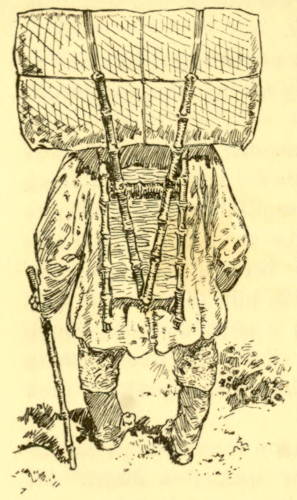
THE QUAINTEST BOW-LEGGED
DWARF CARRIED MY LUGGAGE,
AND TROTTED ON AHEAD LIKE
A BEAR.
After a long and rather weary pull up the hills,
where the road was bad and very stony, we crested
them, and looked down on the lake of Hakone, girt
with Cryptomerias.
In the evening I was housed in an old dwelling
where daimios used to sleep when they travelled along
the Tokkaido—by the lake whose farther shore was
cut off by driving clouds. One could imagine it an
ocean, and cool fresh breezes made me forget the
stifling heat of Tokio.
July 30.—We are living in the clouds; below,
above, and around us they swirl and writhe in the
wind, sometimes breaking a little to show us the edge
of the lake, but then directly driving together again
and shutting us out from all but our own garden.
Below us in the plain the sun will be shining
and the people sweltering, but we are cool—and
damp.
July 31.—Still the mist and clouds dance past and
wreathe round the trees in such enchanting wise that
they make poems and pictures and mysteries of the
swift visions they are allowed to reveal.
Sad that I am ill—terrible pain in the night, so
that I had to rouse the house; and all day I have done
nothing—but grin sometimes when it returned.
August 1.—Clouds still there; and I am a little
better though not well. The household in which I
am staying is unconsciously amusing. It is to join
J—— that I came; the other inmates are missionaries
of uncertain age,—very high church, with prayers
night and morning, grace before and after meat, with
devout crossings and bows, till I long to tell them
they are popish idolaters, but refrain, for J——’s sake.
The first night I felt too crushed to venture a remark
at meals; the book I brought (a clever light thing by
Barry Pain) was said to be “such weak rubbish it
seemed a pity to read it” by the lady who told us all
one evening that she “had read a very great deal—and
among it no rubbish!”
J—— begs me not to catch her eye at meals, and
I refrain. The Pan-Anglican Congress and the
Bishops attending it are the staple articles of interest
at present.
While we are not supposed to be seen in a kimono
“because the Japanese think us ridiculous in them”
(with which I quite agree in one way), the Japanese
servants are brought into prayers, and I wonder
whether prayers said in Japanese by an English
woman escape the ridiculous!
The village street was illuminated last night and
to-night with square paper lanterns, for to-day is a
great festival at the temple by the lake; and there will
be a week’s matsuri, during which time the carpenter
cannot mend the boat because he wishes to play with
his children. Sunshine came for a couple of hours
and we went in a boat to the temple. The boat was
beached at the end of a little path, leading straight up
from the water to the temple, by a flight of grey stone
steps, moss-grown and decked with ferns. On either
side were great Cryptomerias and bamboo, a cool
deep wood in which the greyness and the greenness
were set off by huge white lilies and their visitors,
black butterflies with blue-tipped wings. Our path
was solitary, but by another meeting it trooped gaily
dressed villagers, brilliant in blue, red, and pink—sometimes
whole families, father, mother, sons, and
daughters in blue kimonos all alike.
The temple service was already well begun before
we got there, but we came in time to see the presentation
of the first-fruits. In the outer part of the temple
the congregation sat on the floor,—the front rows all
occupied by elderly gentlemen clad in their black
haori with white mons, behind them sat the small
boys, and at the back the young girls. By accident,
or for some reason I do not understand, there were no
women at all in the temple, though a few old ones
with babies stood outside. They made no difficulty
about us entering, so perhaps it was the preparations
for the feasts to follow which kept (as it so often does
at home) the women from worship. While the
solemnity of presentation went on a man with a
ridiculously flat face, dressed in semi-foreign style,
played a harmonium, like the ones missionaries use on
the seashore in the summer holidays. It was only
given the chance of droning half a dozen notes with
no tune audible to Western ears, but it was solemn
enough, and had a certain fitness for the occasion.
Three priests officiated, one in white and one in
yellow over-dress with baggy trousers, just like a
Turkish lady’s, beneath, and one in a lovely peach-coloured
satin dress, an exquisite “Liberty” colour,
and a great contrast to the harsh yellow one. The
other brought the lacquer trays of offerings to him,
with many slow reverences, and he walked up the
altar steps and presented them. The walking up the
steps was quite a feat—he turned his body sideways,
at right angles to the steps, and brought both his feet
together on each step. I noticed that his toes were
moved up and down in the way prescribed in the
ceremonial walk of the Nō.
One of the missionary ladies amused me as we were
coming away. She dropped behind with another
missionary and said in a tragical stage whisper, “Did
you see that English lady in a red-striped dress?
She was buying charms and mementoes of the priest!
Oh, I hope she is not one of them! It is so horrible
to think of——” This dear lady takes all things very
seriously, and is as devoid of humour as any one
I have met. I marked the lady in a red-striped dress,
and discovered that she was carrying a quite new
scarlet Kelly & Walsh (a little phrase-book used by
all tourists). We all buy little odds and ends when
we are touristing.
August 2.—I feel still ill. I expect it was the
relative cold and the constant wet, for all the time
the clouds were driving through us. So I walked
down the pass and went back to Tokio—a long hot
journey. Last summer I described all the varieties
of undress one can study in the railway carriage,
and as the Kobe express cars are as big as big
Pullmans and crowded, you can imagine I did not
lack entertainment.
August 3.—I went up to the University and the
Bank in the morning, and in the afternoon Professor
B—— came to tea. He is as talkative as ever, but
is now thoroughly disgusted with the Japanese.
Their “futility,” their “absurd waste of time,” their
“indirectness” irritate him, as they must irritate
any one; and he sees no deeper to the things one
loves, and which in some degree compensate. He
proclaims, infuriated, that all the mysticism that was
ever in Japan was brought there by Lafcadio Hearn
himself.
August 4.—I set off with my bicycle, carrying all
my luggage, for a fossil-insect hunt in Shiobara.
The train takes five hours, according to the time-table,
to go to the nearest station, and after that I had about
16 miles to ride to the haunt of the fossil insects.
Fossil insects are shy and scarce, and I am the first to
stalk them here, so I came with a double lot of
patience; and I believe I remarked half a year ago,
I have been so battered and worn in this country,
where my impetuous spirit tugs at Oriental passivity in
vain, that I have now normally the patience of two Jobs.
The train journey was remarkable only for the
small quantity of clothing the passengers in the
cushioned second class (pauper as I am, I only once
travelled third) considered essential. Then the bicycle
began, and as I spun past the jolting kurumas the
other travellers engaged, my heart rejoiced, for not
only was I safe from their horrors, but I should reach
the hotel first and get the pick of what rooms there
might be; for it is a hot-spring place, and much
frequented in August.
The first half of the journey was nearly flat, and I
have described it before, when I came to this place
hunting plants; and then the hills began, but the
road was splendidly graded, and I rode up all but
one with great ease. The road followed the winding
valley, and sometimes seemed to hang over the
roaring flood of the river beneath, so precipitous was
the slope. At each curve of the road a broiling sun
shone on me, and at each convex bend there was a
waterfall, which seemed to emanate the coolness of
hidden ice, and as the road curved and wound in and
out like a Chinese dragon’s tail, I did not lack
sensations. The beauty of the solitude of a million
trees whispering together, of the silvery blue water
and the grey rocks, shone with a clearness and
brilliance that is so rare in England, and that is one
of the chief charms of this country.
When I arrived and settled into my rooms, I had a
bath. It was a big hotel, built for the hot springs
which ran directly into the baths, and I was ushered
into a bath-room where a man and woman were disporting
themselves after the manner of Adam and Eve
before the Fall. I felt like the serpent; but refused,
with more tact than he showed, to form a third. This
surprised the bath-attendant, who, however, allowed
me to wait, and then stood outside the door all the
time I was bathing to keep others out, and only
peeped through the broken glass in the door now and
then just to see whether I was ready to come out.
After the bath he escorted me across the road (I had
to sleep in the annexe), holding the umbrella over
me, as I trotted along in a kimono and a pair of stilt-like
gheta. In the luxury of idleness after supper I
watched a woman in the house opposite. She was
clad in a brilliant blue kimono, just the right old
china blue—open at the throat, and her face and neck
were the colour of warm sun-tanned unstained wood.
“Olive,” I suppose people call the complexion,
but it was warmer, and more beautiful than that, while
her hair was smooth and black as polished ebony,
arranged with a series of rich curves in it. The old
abused word “chaste” expressed her more exactly
than any other I know. The tawdry fluffiness of most
of our women’s dress and hair seemed like flannelette
beside rich satin as compared with her. Yet a curl
may bewitch one and entangle one’s soul, I know—a
curl, but not the frippery and broken lines that
are so rife in Europe. I wonder till I verge on
lunacy how it is that the West has not yet discovered
the glory that lies in smooth curves and gleaming
surfaces, and in lines of cloth, unbroken by frilling
and tucking and ruching and pleating.
August 5.—I hunted fossil insects morning and
afternoon, and got a haul, better than I might have
expected, if not so good as I had hoped. I left the
bicycle at a primitive little saw-mill, turned by the
river one has to cross to get the fossil quarry. The
people are all greatly interested in it, never having
seen a woman’s bicycle before. The hotel is about a
couple of miles from the fossil place, so I go on it as
far as I can get, for it is hot to walk, and stones are
heavy to carry.
August 6.—Another quiet day. I took a walk over
the stream up a branch valley. How gloriously
limpid and clear the water is. The solitude is complete,
and yet there are footpaths where one can
wander without battling with sasa. It is a particularly
charming place.
August 7.—I got very wet while getting fossils,
indeed, it was like fishing rather than anything else.
After I got back there was a terrible storm, really a
small typhoon; one realised then why the houses are
built with such greatly projecting roofs. The rain
washed over them in a torrent, a white cascade, and
streamed off the sides and swirled up into the air like
a great waterfall. I have never seen anything like it;
the whole building was like a giant fountain of dashing
white water, and the wind blew till I feared for
our roof.
August 8.—I had great luck cycling back to the
station in excellent weather, but found the train was
two hours late, owing to the destruction of last night’s
storm; and before we got back to Tokio it was three
hours late, so that instead of getting home just in
time for dinner, I arrived, famished, at nearly 10.
A kind Japanese lady gave me some biscuits in the
train, for which I was grateful indeed; they were
Huntley and Palmers’ “Osborne,” and M’Vitie and
Price’s Shortbread! The joy of meeting these dear
old friends in such an unexpected place was even
greater than the relief my internal economy felt. They
must have been wealthy people to have such biscuits,
as, indeed, I had previously suspected, for the girls’
blue and white kimonos, that would naturally have
been of cotton, were made of silk—poor children! for
it is really much hotter than the plebeian cotton.
August 9.—A quiet day of rest. It is very hot, and
I expect I am the only foreigner fool enough to be in
Tokio.
August 10–12.—I spent a short time at the Institute
and the rest at home, writing in my garden, and
battling with mosquitoes and mould, but really having
a restful time, for I ran away (thinking it the better
part of valour) from the former, and write inside a
mosquito net.
August 13.—I set off with my bicycle to Yejiri to see
the cycads again. As it is 7½ hours’ journey by slow
train, I went to the farther station of Shizuoka, at
which the express stops, and got there in five hours,
to bicycle 7 miles back to the temple. The wicked
old sinner of a priest had written to me, in answer to
my requests, to say that there were no cones this year,
and I had believed him till I heard by chance it was
false. And I found quantities of cones—twenty-six
huge things, a foot and a half long, on one tree!
The smell of these cones is very strong, like pineapple
and cake fermented together; it is a very thick
smell, and in a room one of the cones was very
persistent and penetrating, though it did not seem
to attract any insects at all.
I had difficulty with the females, for the trees are
awfully tall and shaky, but by tying two ladders
together I got at them, and clung for my life to the
sturdy leaves. The temple is as sweet as ever, but
the evening was wet. As I sat over my supper in the
house, which is all opened up so as to look very big,
the priest unconcernedly took off his only garment
and had his bath without closing the bath-room partition,
while his wife went about all the time with about
a yard of cotton round her hips.
Clothes, you will say, fill a large part of this
journal, but Japan is one great exhibition in the art,
mistakes, or want of clothes. Everything from perfection
to nothingness is to be seen nearly every day.
Everything from a soul-thrilling beauty and dignity
to a side-aching farce of incongruity.
August 14.—I set off at half-past six to get back to
Shizuoka, as I expected Professor B—— to tea in the
afternoon in Tokio. Well, first they put me on the
sea road, which at the start seems more direct than
the one I came by, but actually follows the bays and
hills, and adds several up and down miles to the
journey. Then, even when I started, it was steadily
pouring with rain. Then both my tyres went flat
with punctures, quite unmendable in those wilds.
Then the road was bad and narrow, and made of
stones the size of marbles up to the size of a doubled
fist. Then the streams flooded, and I had to go
through thirty or forty of them which had decided to
go over instead of under or beside the road. Then
the roar of a landslip added a fillip of excitement.
Then the growl of thunder and the brilliance of lightning,
which I fancied might be attracted by my
spokes. Then, not torrents of rain, but cataracts,
waterspouts, Niagara falls!
I said naughty things ever so many times, but
stuck on my bicycle and wouldn’t get off for the stony-bedded
little torrents that impertinently crossed the
roads, and just went through them. What matter if
I couldn’t see the bottom upon my bicycle, I couldn’t
see it any better if I waded them. I folded up the
sheets (I always travel with sheets for sleeping), put
them in a pad under my cloak to try and keep my
back dry, but soon they were saturated and merely
added to the general weight of water. I never felt
more depressed and more weary; what with the road
as it was, the floods, and the punctures, I couldn’t go
much more than 5 miles an hour, and that with
jolting like an Irish cart, and at an expense of effort
that would have taken me 20 miles an hour the day
before. All the time I ploughed along I remembered
the part I was to act by 4 o’clock in Tokio, clad in
white samite (I mean muslin), gracefully dispensing
tea and small talk to a distinguished visitor.
There was nothing to do to counterbalance the
leg-aching pedalling or to lend a little warmth to the
clammy, dripping mass that I was. I got to the
station and missed the train! There was two hours’
interval to the next, and I was so drowned I couldn’t
go to a hotel, for the abominable sun had come out as
I got to the station and the sky was blue and innocent-looking,
and every one was dry, and supercilious to a
creature who left pools at every step. A little sweet-shop
provided hot water and peppermint, and things
drained off a little as I rode slowly back, and then
walked round and round and round the waiting-room
reading Thackeray’s Pendennis, as the crowd entertained
itself with speechless staring, and the porters
volubly sympathised as I took a towel out of my bag,
which was less saturated than the rest of me, and
dried my hair a little.
When the next train came it was mercifully the
Nagasaki express, with a dining-car attached, so I
left my car and went along and had coffee. The
waiters were so sympathetic, that as I was the only
customer, one offered to lend me a nice dry kimono
of his own while I took everything off, and they dried
them over the train fire. As every other passenger
was in a kimono I felt less shy than the situation
warranted, till I saw the stuck-up nose of an English
lady tourist at the far end of the passenger car as I
returned in my Japanese rig-out.
However, it was better than sitting five hours in a
super-saturated condition. They dried my things
very quickly, for fortunately they had nothing else to
do (the weather was now glorious), and except that
all the colours from belts, books, and cases had got
on to the garments I was normal again, and got
back to Tokio in time to have just changed my dress,
when the cheery voice of Professor B—— hailed me
in the garden.
August 17.—What a thunder-storm! I never could
have imagined anything like it. One peal lasted
eleven minutes, and another began again after a
couple of seconds’ interval, and so they kept it up for
an hour and a half, rolling round and round the
heavens, as though the gods played nine-pins with
Mount Fuji. The lightning was almost continuous,
too, and filled the heavens with broad sheets of flame.
Yet with all the terrific massiveness and grandeur of
the storm, it lacked the point of sharp concentration
that would have added terror. I always enjoy a
storm, unless it is centred and concentrated just above
me. And this stupendous storm was the finest display
I have ever imagined, let alone experienced, and I
did not grudge the hours of sleep of which it
robbed me.
The morning dawned clear and still, but the garden
was full of wrecked things.
August 19.—Are the gods never going to have
mercy and stop their cruel play of battering Professor
F——, and through him me and our fossil work? Instead
of coming early in the morning, as we arranged,
he came very late, with the horrible news that he had
just heard that the people who lived in his house
before him (he moved last year) had a leper in the
family! Consequently he and his household have
stood grave danger of getting this ghastly disease,
and may actually have it now, the latent period is so
uncertain and often so long that the doctor cannot tell
for some time to come. It sometimes lies dormant
for years. Of course, he must move at once, and in
the meantime take every possible precaution. A nice
waste of time, even if there were not the horror hanging
over it all!
How this country can possibly pretend to be a first-class
Power, how it can build warships and drill
armies to the blare of trumpets, how it can have a
“World’s Fair” in a few years, and invite all the
nations to join in its Exhibition, and all the time have
hundreds and thousands of lepers scattered about the
country, and marrying—how they can do this simply
passes my comprehension.
In this land of islands why don’t they take one,
fenced round by the sea, and isolate the fearful disease?
In a generation Norway cleared the country
of lepers—but here one may touch one any day. On
my way back I saw several beggars, ghastly creatures,
kneeling by the wayside, with fingerless hands, all
purple blotched. True, it is not so contagious as we
imagine it to be, being chiefly hereditary, but that
makes it all the easier to stamp out if they will do it.
I am not really afraid (not terrified, at least) for
Professor F—— (and through him, for myself), but I
fear the removal will still further hinder the progress
of the fossil work.
August 21.—I worked all day at fossils, and was
much vexed to find that the powerful heat has brought
bubbles in the Canada Balsam of nearly every slide!
Botanists alone will understand the tragic significance
of this, and they will sympathise and be merciful
when I bring the bubbly preparations home!
You at home can hardly understand how hot the
sun is, really burning hot, and many of my trays
were so placed that the sun has been falling on them
all the time I was away, resulting in thousands of
bubbles. I discovered it by chance to-day, when I
had mounted and examined some, and then left them
for an hour where the sun got at them, and I found a
thousand minute bubbles in each of the scorching
slides. Alack!
August 27.—This morning at breakfast, thinking
over cones, a question arose in my mind about those
of Cryptomeria which I could not settle without a
specimen, and which checked my line of thought, so
I gave it up and glanced out of the window beside
which I was sitting in search of lighter amusement
(for there is a nice vine there whose tendrils curl
round and round in a very pretty way), and by my
hand, growing on the little hedge I had never noticed
very specially before, was a Cryptomeria cone!
Having associated the Cryptomeria always with the
stately giants that surround the temples, I had never
associated these green hedges, three feet high, with
them, nor did I realise that they could bear cones
while so young. It still remains a problem whether
perhaps a fairy, listening to my thoughts, had not
touched with her magic wand the branch nearest me,
so that it produced the cone, for not another was to
be found anywhere around.
I gathered it, cut it open, and settling the point I
wanted, was able to pick up all the dropped stitches
of the argument and carry it on. Fairies are most
useful creatures to scientists!
August 28.—As my bicycle was once more having a
puncture mended, I had to go in the tram, as it is far
too hot to walk all the way. In this boiling weather
the tram was as full as ever, 50 people where but 20
should be, standing so thickly all down the middle
that they were pressed against each other on all sides,
and every window and every ventilator and the door
all closed! I slammed down two windows, but could
not reach the ventilators, as they are so high up;
directly I got the chance, I opened a window on the
opposite side, but no one else followed the example,
though the Japanese seem to feel the heat much more
than I do, when not in a foreign style vehicle or
house.
Taking this in conjunction with the remarks
Japanese have often made to me about the foreigners’
dislike of fresh air, and in conjunction also with
numerous other observations of a similar nature, I am
forced to conclude that the Japanese, as a nation, are
not at all sensitive to bad air. Their houses, built
according to the ancient plan, force them, by their
construction, to live in ideally fresh rooms, but put
them in a foreign house, and everything is hermetically
sealed.
August 29.—I went into one of the Laboratories
to-day, and found four men, three gas burners, and a
stove at work, without an inch of window open—it
nearly stifled me. I have noticed this Laboratory
before, and never, all through this scorching summer,
have I seen the windows unclasped. It is a foreign
style building, of course.
August 30.—I got up very early and set off on my
bicycle to see the sacred lotus flowers on the great
pond near Oyeno Park, but I did not get there in
time to see them burst open, for that takes place at
sunrise, but the flowers were fresh and fair, still
unfaded by the heat of the day when I got to the edge
of the water. There must have been several acres of
them, with their great leaves overtopped by huge
rosy flowers. The purity and radiance of their opaque
yet lustrous petals is something I have never seen
surpassed in any other flowers, and as they stand
up in a rich succession of curves to form a 9-inch
bowl, their cumulative effect is magnificent, while in
them glows a golden radiance of captured sun-rays.
Glorious flowers!
A little island lies in the pond, which is reached
by a bridge, and on it is a temple, with shrines
standing on it. There those who come to see the
lotus worship in their simple way, pulling the temple
bell and clapping their hands to ensure that the gods
hear the short muttered prayer and put to their
credit the half-farthings they bestow. One is always
hearing of the lack of religion among the Japanese,
but there never was a land with so many shrines and
temples. On my way back I passed a shrine under
a tree trunk on a crowded thoroughfare. It was only
a toy building a couple of feet high, but a workman
was busy arranging his offering of dangling white
papers. Religion and daily life are mingled here.
September 2.—I set off for Hayama, a little
seaside place not far from Tokio, hoping to escape
this dreadful heat. Though really a very trifling
journey, it takes several hours, as the trains are so
slow. It lies beyond the well-known Kamakura, and
is much more beautiful and open, as it is round the
point of the bay, and is mercifully free from most of
the crowd that overwhelms Kamakura in summer.
The little hotel I went to stands on a hill among
the woods, looking down on the sea; it was beautifully
quiet, but it was “foreign style,” and the beds were
miserable. I made a most interesting observation
very shortly after my arrival: some ants had built
the most extraordinary galleries all up the branches of
a tree, and they had taken the leaves and rolled them
up, and built houses inside them.
Then in some cases they had covered the whole
twig over with their sandy houses, and just left little
bits of leaves sticking out here and there.[5] I
was ever so much interested, and found several
plants of the same kind (a species of smooth-leaved
holly) with the same thing happening. I fancy it is
new to science, and I wish now I had brought down
some instruments and reagents to examine it properly,
but I brought nothing as I decided I would have one
week’s real holiday.
It was amusing to find how difficult it was to get
anything to fix the specimens and bring them back
home. There was only one shop that sold foreign
biscuits and so had tins, but they wouldn’t sell or
give a tin for love or money. No, they said, they had
no tins; of course I did not believe them, and roamed
round the shop opening every tin to see what was in
it, and I found one that was empty. But they refused
absolutely to sell it. They were returning to Tokio,
it was the end of the season, and they needed it for
packing their own things, and they would not sell it—no,
not for a yen. But I grew desperate in the
thought of my specimens, probably new to the
scientific world, and whose preservation depended on
that tin; the man who owned it sat and smiled on his
Japanese mats, his geta (sandals) were not in sight,
and I knew I could run fast enough to get a start
any way. So I took the tin under my arm (a huge
square biscuit one it was too) and smiling, explained
that I must and would have that tin, and put down
30 sen on his table and said I was just going to take
it, and off I went. He didn’t chase me; I suppose
he thought it hopeless, and besides, I had paid a
very good price, for the tin was ancient and bent.
Then came the search for spirit to preserve it in,
for I wanted to have the ants and all in situ; but one
could not expect to find spirit in such a village, and
it was no shock to find there was none. Then I
bethought me of saké, the poet-famed drink, the
wine of the marriage cups and the friendly festival,
and I sent a maid for a jorum of saké; the wine is
reported to be very highly alcoholic, I know two
spoonfuls sent me to sleep after weeks of sleeplessness,
and in the saké I plunged my specimens and hoped
for the best.
September 3.—I moved to a Japanese hotel down
on the shore, far more comfortable for bathing—and
with much cosier sleeping arrangements. It is curious,
but I am miserable in a bed now unless it is soft and
safe feeling. If it is hard and rises up in the middle
I dream of precipices all night, for all this year I
have slept on the floor, which seems so nice and safe,
and really the obvious thing to do when you have
tatami floors.
This hotel has a garden with pine trees, and a
swing and cross bars, so I can exercise myself to my
heart’s content, while it is quite isolated, the last
house in the village and far from its neighbours. A
delightful spot, to which I shall hope to return. The
maid, O Sayo San, is the politest I ever met; and
of all wonderful things, they refused Chadai money
the first night when I offered it in an envelope in the
ultra best Japanese way on my arrival.
September 4.—It is rather too bad, but the weather
has turned miserably cold, both here and in Tokio,
and I should have been at work in comfort, while
bathing is not the pleasure it would have been the
week before in the broiling sun. But there are several
nice people down here, Tokio friends.
September 5.—I got the loan of the “Bromide”
book from Mrs. C——, how good it is. Have all you
who read this read the little book called “Are you
a Bromide?” If not, do so; for I fear if you haven’t,
much of the humour of life is a sealed book to you.
It has added greatly to my enjoyment, and it can be
read in half an hour.
Coming home I looked into the grove of the village
temple, a pretty little place on a small hill, and
was at first much puzzled by an apparition.
You know (or more probably don’t know) that the
most usual form of decoration in a temple is torn
strips of white paper, which hang down. Real paper
usually—only very grand temples have gold as a
symbol of torn paper! Such hanging strips are put
in the mouths of the sacred animals very often, and
you may see a pair of foxes sitting, carved in stone,
with these paper spouts streaming from their mouths
or floating on the breeze as they sit immovable.
These foxes are often more dog-like than fox-like,
and sometimes cleverly painted, but no one could
confuse them with a real dog. But in this temple
grove was a wonderful creature—a single one, not a
pair as is usual—and instead of sitting on either side
of the path to the shrine, he sat absolutely in the
middle of the path—upright, pointed nose straight
ahead, ears erect, and from his mouth the long
fluttering streamer of sacred paper; so he sat, immovable,
and before him I stood immovable but
astonished, so marvellously was he wrought and
coloured; could he but move, one would swear he was
alive, but his gleaming eyes fixed glassy and unwinking
on the distance to infinity in front of him, and
only the paper fluttered in the breeze. I walked to
either side and gazed—there was something impellingly
arresting about this silent image—and for
ten minutes I must have lingered near it, perhaps
hypnotised by the fluttering white paper and the
gleaming eyes; and then the creature rose, still holding
the sacred paper in its mouth, and without a
sound or a movement except the inevitable placing
of its feet, walked down the centre of the path into
the shadows of the shrine.
A dog?—a spirit? A wonderful dog then, and
surely a spirit such as one only meets in the haunts
of medieval religions.
September 7.—A simple day—bathing and walking
and emptying my mind of thought as much as
possible. Fuji mountain, alas, I cannot see, as the
rain clouds cloak her, but on the horizon lies, dimly,
Oshima, the burning island, and round the points of
the rocky shore are countless islets crowned with a
twisted pine or girt with white-fringed waves. From
the hills one looks down on a long series of bays with
brilliant blue horizon and solid white line at the shore—the
Japanese artists are much truer to nature than
we think.
September 9.—I went early to the Institute, where
there is grand excitement over Ginkgo; the sperms
are just swimming out, and they only do it for a day
or two each year. It is no such easy business to
catch them, in 100 seeds you can only get five with
sperms at the best of times, and may get one and be
thankful. I spent pretty well the whole day over them,
and got three, and several in the pollen tube, not yet
quite ripe. It is most entertaining to watch them
swimming, their spiral of cilia wave energetically.
September 10 and 11.—Hunting Ginkgo sperms
nearly all the time; but about 3 on Friday I began
to feel so queer and feverish that I went home and
took my temperature; it was 103°, so I went to bed.
September 12.—Still so feverish and queer feeling
that I stopped in bed, though the temperature is
down a little; but this is usually the case with fever,
and I have been almost delirious in the night with
the most absurd ideas.
All this long quiet day I lay and enjoyed the
beauty of my room. I had the quilts which make a
Japanese bed laid in the drawing-room, as several
people came to see me, and for my own pleasure; it
is nicer in the room with one’s favourite vase and
kakemono. How funny this mixture of bedroom and
drawing-room will sound in England! But there is
nothing “bedroomy” in a Japanese house.
People who have seen my rooms may wonder
where the beauty was that could keep me occupied
a whole day in its contemplation, because most people
seem to judge rooms by the number of beautiful things
massed into them, and to think that twenty beautiful
vases massed together on a stand counteract the
clashing effects of three discordant antimacassars
(this word is so old-fashioned, I never learnt how to
spell it!)
As I lay I faced a wall of pale, warm, creamy distemper,
with a band of cream unpainted wood about
two feet from the unpainted beams of the ceiling,
which show so beautifully their graining and the
curving designs of their natural growth. In one
side of the wall is a window, with wooden bars crossing
and re-crossing till it looks like a diamond-paned
window, only the glass is replaced by semi-transparent
paper. This is taken down though, and I look out
on to the smooth grey bark of a tree whose leaves are
like the shining laurel leaves in a Burne-Jones design,
and interlaid against the vivid blue of the sky. The
window-ledge is inside the room (not outside in our
mad Western way), and on it stands a low grey-green
dish in which is growing a graceful spraying plant
beside a gnarled grey stone that looks like a piece of
a forest rock. Beside the window are short grey-green
curtains, edged with a broad band of Chinese
embroidery in which blue, pink, and coral run riot
with half the other colours on the palette of a Watts.
The other half of the wall is occupied with a bamboo
settee, covered with the same cloth as the curtains,
above which is a square of Japanese embroidery—a
great golden flower (a richer tone of the colour of
the walls) on a grey-green ground, with butterflies
hovering over it—framed in dark brocade with a
thread of gold. Above the band of wood is a picture,
yellow, brown, and grey, a river scene at dusk. At
right angles to this wall I can see the Tokonoma
recess—a yard deep and two yards long and nearly
as high as the room. It is dark brown, with one
long kakemono—a grey-brown bird on a withered,
gnarled branch, the work of an old and valued
Chinese artist (lent me by Professor S——); below it to
one side a stand of ebony, with a brilliant blue cloisonné
vase round the slender stem of which curls a fiery
dragon, and its colour is living and gleams against
the brown. Then on the other side grows a little
bent and twisted tree, in a flat earthenware bowl,
and in the corner stands my sword. The left side of
the house as I lie is open to the garden; there is no
wall, and I look out over my own little green plot,
with its Thuya trees and glowing “morning glories,”
to the tree tops of the land around. In the verandah
hangs a square black lamp which I had lit as the
swift night fell, and from whose opaque white sides
shines a light so soft that it does not frighten the
moon or the fire-flies. Then the floor of my room is
covered with tatami—straw mats closely fitted and
edged with black, and the sliding walls of the cupboard
recesses that make the room solid are also
straw-coloured, with a narrow border of black. The
wooden fretwork of the soji supports the white paper
through which light shines so radiantly and softly;
then there are a few straw-coloured chairs, a dark
wood table and grey-green cushions—and that is all.
September 14.—As my temperature rose to 104°
last night I felt I ought to have a doctor—the first
doctor I have called in in my whole life! I felt it a
serious and terrible event. But I am not seriously
ill, an internal chill (probably the cold bathing at
Hayama, one gets chills here so easily) and a
temperature which runs up very soon in this country.
He is taking the temperature down with drugs. I
told him I must go to the Institute to-morrow, but he
laughs.
September 22–24.—Quiet uneventful days at the
Institute, working at fossils hard. What a lot of
results you will expect! But to get one line of result
often means days of labour over petty detail that does
not show.
September 26.—At work all day till I went to the
meeting of the Botanical Society where Professor
M—— spoke of his visit to China during the vacation,
but I couldn’t understand very much.
September 28.—At the Institute all day, at night
how it rained! Like a typhoon rain, only lasting all
night at high pitch; I couldn’t sleep for it.
September 29.—The results of that rain! It was
fair in the morning so I bicycled, thinking that as
the rain was so heavy it would have cleaned the
roads. And so it had, cleaned them just as long
boiling cleans the bones of a chicken, and there was
only left the stony skeleton of most of the roads; but
in the high ground of Azabu, where the roads are
pretty well made, they were passably good.
But then I got to Koishikawa, and about a mile
from the Institute the entertainment began. Coming
down a tram-line road I had been rather astonished
to see straw piled up all round the telegraph posts,
and several domestic articles such as pillows lying
about the road, but where the tram stops I saw the
reason, this road, a big main high road, was entirely
under a rushing flood of water. I asked a policeman
if there was any way of getting to the Botanical
Gardens without going through it, but there was none.
I got a kuruma man to take me and my cycle on
a kuruma, and by keeping in the central ridge of the
road, he waded with me through this mile of water.
But what devastation on either side! Men walking
by their houses (placed a little lower than the road) up
to their shoulders in water, though it had subsided
a good deal already, all sorts of things floating about,
and signs of ruin everywhere. The underground
channel they had made for the river burst through
in one place, and at the side of the road a regular
roaring waterfall. As we went along floating tatami
(heavy mats of straw, as much as one can lift and
about 6 feet long and 2–3 inches thick) rushed on the
kuruma, and my man had difficulty in getting round
them, for he couldn’t drop the shafts to free his hands
for that would have landed me in the water. We
got there without mishap, but saw many tragi-comic
sights, for the loss and wreckage among the small
one-storied shops is terrible.
Coming back the water had subsided a little, but
there was still much to go through. It was funny to
watch people wading through it; on the shore on
either side men balanced themselves on one leg on
their high stilt-like geta (no easy feat I can assure
you) and drew off their trousers, but not always
without a spill. Piles and piles of straw mats, washed
into pulp, were all over the place. When I returned
home I heard that in the low ground in my neighbourhood
six children had been drowned.
September 30.—In the papers one reads of many
deaths and terrible loss of property from the floods,
which were almost universal in the low ground of
the city. There are regular hills of straw and
wreckage all along the main highway I passed
yesterday in a kuruma and the smell is far from
pleasing, but there is no other way into the gardens,
as the other roads are still under water.
In the evening we had a Debate, “That lies may
be justifiable”; an excellent meeting, nearly all of the
people speaking, and very amusing. One missionary
got up and said she was most strongly in favour of
lying and that she told three or four every day!
Shrieks of laughter, for she spoke immediately after
a very sweet missionary who spoke in favour of truth.
All the rest of us were about equally divided, and the
truth only won by three votes on more than thirty.
October 4.—Went to Ōmori and walked on to the
temple on the hill beyond. Its green groves and
quietness were very peaceful and lovely. It is almost
woodland there, and there are few people. In the
temple grove was a scarlet high pagoda, which gleamed
between the stately trees. The spot is so peaceful
and sweet and I was so tired of working that the day
was very pleasant. We collected moss, and some
little stones covered with it, and I had five Cryptomeria
seedlings to make a forest, and with them I
made a miniature landscape in a flat earthenware
dish when I returned home—but it isn’t half as easy
as it looks!
October 5.—At work on the fossils; at 2 o’clock
I gave the first of my course of lectures at the
University, the room was more than full, several
standing all through the hour, and there were several
Professors and the Dean there. I didn’t do so badly
as I feared, after being so long out of practice, but
the flying chalk made me hoarse. It was a little
terrifying, and half of them didn’t understand very
much owing to the language difficulty, but the others
did. It is nice lecturing again, it is an excellent
tonic.
October 12.—At work at fossils in the morning—my
lecture at 2. I find as I have to speak so slowly
to be clear, that there isn’t much time in an hour.
There is a sort of demonstration with microscopics
afterwards which helps.
It is now very cold at night and in the early
morning, but still warm enough to wear cotton
frocks in the middle of the day. The clear moon is
wonderful.
October 13.—At work all day on fossils, cycled
back in time to dress for a dance, to which I cycled,
as it was a lovely night. It was a very jolly dance
and not the least pleasure of the evening was cycling
back with Mr. G—— instead of jolting and freezing
and catching cold in a slow kuruma. Out of every
24 hours the cycle saves me one to two or more in
this slow Tokio, so that I shouldn’t grumble at it.
October 16.—At work all the morning, lunch with
the Faculty at the Goten, and then at work all the
afternoon. The fossils proved so enticing that though
I had worn a traily frock all day intending to go to
the Belgian Legation garden party, when it came to
the point the fossils won, and I didn’t go. In the
evening I cycled down to dinner at our Embassy.
When once one makes up one’s mind to a cycle,
one can even go out to dinner on it. I wondered,
however, what the footman thought when he had to
lift it into the Embassy hall in case of thieves getting
it in the garden (I was told he has a brother who is an
attaché at the French Embassy! The Japanese are
very quaint that way—one Count or Baron or other
is driven up to the door every day by his own brother
as a coachman). Thanks to the unmoved countenance
of flunkeydom, added to the immobility of the Japanese,
I could sail into the dining-room, past the same man,
trailing a pink silk skirt with apparent dignity.
October 21.—Fossils all day. I cycled round on
my way home and paid my dance calls. The streets,
particularly in the neighbourhood of the Ginza and
the station, are now very gay and crowded for the
American Fleet, of which a really enormous fuss is
being made. There are arches, and bands, and
processions, and all manner of things all over the
place. Bands of school children go about with flags,
and—for the first time since I have been in Japan—I
was insulted on my cycle by grown men, not once,
but six times in the course of half an hour! Not
badly, but in a coarse rude tone I was called out to,
and one madman waved a lantern suddenly in my face
on the cycle and nearly upset me. I suppose they are
over-excited, for everywhere the echo rings with
protestations of undying devotion to the Americans,
for one of whom I would naturally be taken.
October 22.—A horribly wet morning, but by
midday a lovely sun came out, and it felt almost like
midsummer. When I got to the Embassy garden
party (it was given to welcome Admiral Sperry) I
found it had been postponed in the morning, but as
the weather was now so lovely, it was put on again.
That is to say, it was half on and would be repeated
to-morrow. So we had one of the bands, and quite
a lot of the American officers and other people turned
up. The chief sight was seeing Admiral Sperry and
Admiral Togo sitting side by side looking on at a
kind of sword-dance. The dance itself was very dull,
as all Japanese posture dances are unless you understand
them intimately, but there were some sparks
when the swords clashed, and one of the swords broke
by accident, which was entertaining. It was rather
wonderful the way the dancer to whom this happened
kept his countenance, and put it in the sheath at the
appointed time as calmly as if it hadn’t been a mere
stump.
The American officers were a sad disillusionment.
One fancies good class Americans must be all like
the soulful adoring youths at the feet of the Gibson
girls, but they aren’t—at least those officers aren’t.
In fact, though they would be mad to hear it, they
were mostly not easy to distinguish from Japanese
when both stood with their caps down over their eyes,
as they always wear them, except that the Americans
looked the less smart owing to the untidy appearance
of their small squash caps. So many of them were
short and insignificant. Admiral Sperry, though not
imposing or impressive in any way, seemed pleasant
and keen, and was tall.
October 23.—Lunch at the Goten, with quite a
lot of foreign visitors,—two Russians, a geologist
and a botanist, and two Germans interested in law
or some such thing. I hear we are to have Sven
Hedin, which will be really interesting. I hope I
shall see him.
October 24.—The Fleet left to-day, and the following
was put in the paper: “Gentlemen will not be
allowed on the platform except in frock-coats and
silk hats; ladies in corresponding dress.”
The passion of the Japanese for the silk hat is
intense, fervid, one might almost say it has become
a fetish. But we have hitherto been spared a corresponding
dress!
Think of its parallel in England—no gentleman
allowed into Euston Station without a silk hat.
After working at fossils all morning (as you can
imagine, I didn’t go to the station) I went along to
preside at a Debate at Baroness d’A——’s. This
Debate was on marriage. I had asked a very cultured
missionary lady, with silver hair, to take a literary
debate. No, said she, she was not interested in that,
but if she might propose that “The unmarried life
is the happier, then she would take the Debate.” So
we had quite an amusing Debate, fortunately rather
superficial.
The people here are not in touch with all our
modern types, and I did not need to speak against
the ranting type, who rave against men and marriage
and prove themselves deformed. No, there were no
such “problem” people here, only young spinsters
who didn’t dare to say they would like to be married,
and wives who didn’t dare or wish to speak against
marriage, and elderly spinsters who were clever
enough to be amusing without touching a fundamental
note. The ranting type seems mercifully to
be confined to big communities; I suppose it is an
inevitable result of city life, where some must sterilise,
but it is a pity when they have the power to write books.
In the evening I had a few of the Japanese
botanists to dinner, and they seemed pretty well
amused, or were sufficiently polite to pretend to be
so. Fortunately they are not accustomed to violent
amusement, nor have they the jaded palate of the
European city dweller, so they are less exacting, for
which I am thankful, as it was the first dinner-party
I have given.
October 25.—In the afternoon I went to tea with
Professor F—— and met Professor R—— from Russia,
and others. We taught Professor R—— to use chop-sticks,
and we examined dwarf trees, of which Professor
F—— has some beautiful specimens. In a room in
which dwarf trees are displayed everything must be
specially simple and dignified. If the tree is not in
the tokonomo, for instance, the screen behind it must
be white, pure white, not even flecked with gold-dust.
And when one sees it arranged rightly, one realises
the true rightness of it, and the beauty seems to stand
out clearly, with the outline of the tree against the
background of white. I love more and more the
simple culture of the old style Japanese when in
harmonious surroundings. Though they have quite
lovely and valuable dwarf trees in Kew, they are lost
in the greenhouse with all the other things; the rays
and suggestions from the other plants around them
intermingle and conflict, till they produce a grey haze
of mist in which the spirit of beauty envelops herself
and is invisible; but if you place but one of those
trees in the right place, she steals out and is radiant
before you.
October 28.—A long quiet day of work. While
we were at lunch an envelope was brought to Professor
F—— containing 75 sen, partly in copper coins. It
was a present from the Emperor! When I had done
laughing he explained to me the reason. It is soon
the Emperor’s birthday, and therefore all Government
officials are expected to go to the palace to pay their
respects, when they would receive a cup of saké and
some light food. But to go one must have a grand
gold-laced uniform, and many of the younger men
don’t have it, also if every one went there would be
an impossible crush, so that only the seniors go.
The juniors now dispense with the formal letter
stating that they are ill, but continue to receive the
price of a cup of saké from the Emperor! Though
the sum may seem ridiculous, it is an interesting
survival, and as there are about ten thousand officials
in the country, it is no joke for the Emperor!
October 30.—An uneventful day lunch at the
Goten. I had been invited to go to the Peeresses
School for their sports, as the Emperor was to be
there, and I wished to see the school and the Royalty
watching sports—but was prevented by the fossils.
October 31.—Frightfully cold and raining in
torrents. I lit the lamp in my room in the Institute
to try to warm me a little, but with lots of thick
clothes as well, I shivered all day. In the evening
I put on a fur-lined coat over my gown, and even
then was too cold to write. There will be floods
again if the rain continues so torrential.
November 1.—Gloriously sunny and clear. In a
tussore silk frock I sat all day writing in my garden.
One need never despair during rainy weather in
Japan,—it doesn’t leave one in the clouds for long.
Fresh green peas were brought in the pods for my
approval, which they naturally got. There is a kind
of second spring in November, and the roses are
blooming in beauty. In the evening I went up the
mound near me and looked down on the tree-covered
country below, where curled white mists between
the black trunks. Straight opposite stood Fuji
mountain, with a coronet of golden clouds and a cloak
of crimson, while in the deep blue behind began to
peep out tiny stars.
November 3.—A national holiday, so the laboratory
was locked up, and I couldn’t get work done
there.
In the afternoon I went to a tea-party with friends.
Coming home we did a lot of shopping, and had
quite a festive time, as there was a kind of fair on and
the streets were gay with lanterns and a bright crowd,
and the shops full of the most delightful trifles. This
street near our hostess is one of the best for shopping,
as it is little frequented by foreigners and is a well-known
shopping place for the Japanese. We went
into both the kankobas (a kind of open bazaar I have
described before), and I only wished for a bottomless
purse. Nevertheless one must not run away with the
idea, so often suggested by tourists, that all the native
Japanese things are artistic and beautiful. Many are,
but by far the greater number are not, and even
when prepared to buy I often have to wait long and
examine many stalls before finding the thing I want.
November 4.—Fossils all day. On the way home
I called at the American Embassy—had the good
luck to find the O——s alone.
I often wish Mrs. O—— were not the Ambassadress,
as she is so charming and beautiful, I should like to
know her intimately, but as it is, of course she is
always overrun with people.
November 7.—Work in the morning. In the
afternoon I went to a garden party at a Japanese
Professor’s. He has a pretty garden, with houses
in it for the various scions of the family. He had a
lottery and all the guests had presents, some very
pretty Japanese things. There were a number of
remarkably bright and attractive little Japanese girls
in brilliant kimonos, and some pretty maids a little
older. At 4 we sat down to a typical “first class
party” tea—cold meats of a dozen kinds, savoury
jellies, hot soup, cakes, sweets, fruit, beer, ginger-beer
and tea (at the end) were served to every one.
And yet if you ask a Japanese about the old customs
of the country he will assure you that simplicity and
frugality is the chief note in their entertainments, and
so it is and was in the pure Japanese style, but when
they touch anything “foreign” they must outdo the
foreigners.
We were placed curiously at the tables, the
Japanese ladies put indoors, where the room opens
wide on the garden, the foreign ladies in the garden,
and the gentlemen somewhere else in the garden,
quite out of sight of the ladies! And the men were
perhaps quite happy that way, for they could smoke
in peace.
The weather is lovely, and one could not
imagine it was really November, but for the swiftly
waning light. The roads riding home are terribly
dark, but fortunately fewer children play in them at
night than by day.
November 8.—I rode over to Shingawa to lunch
with the D——s (he is Naval Attaché). They haven’t
been in the house long, but they had brought out
with them treasures given to their parents years ago,
and so have many gems of Japanese carving and
porcelain. The house is pretty within, and it was
nice to meet some one who had recently come from
home.
Afterwards I rode over to Hongo—an awful way
across the country and city, to dinner with Professor
S——, his wife and family. He had his lovely
dream of a garden lit by a brilliant full moon, and
the translucent stone lanterns among the trees.
Roses grew on the trees, huge dainty ones, and
sweet-scented rose-hearted buds. It was a vision of
perfect beauty to be remembered. Afterwards he
and his brother, who is an excellent singer, sang me
some Nō songs, and everything was so harmonious,
so lovely, so simply dignified.
November 9.—At work on fossils all day after my
lecture, which was the last. Professor S—— spoke
and “made me blush,”—his English is simply
wonderful, I know few Englishmen who speak better,—the
substance of what he said for me was more than
kind, though I must deduct something from him, as
from all Japanese, for, whatever faults they may
have, they really are polite to people they know.
November 11.—Fossils all day. In the evening the
great event—my farewell dinner from the University,
given at the famous Maple Club. A farewell dinner,
and they all know quite well that I do not sail till
January! The reason it is given now is partly to
thank me for the lectures and partly because of the
weather! As the entertainment is to be true Japanese
style, in a Japanese house, it is deemed necessary to
have it before it becomes really cold.
I have looked forward very much to this party, for
it is quite one of the treats of Tokio to be entertained
at the Maple Club. My hosts were, of course, all
Japanese, the University Professors, among them
were a few Japanese ladies, one of whom I knew
pretty well, the daughter of Baron H——. I was the
only foreigner.
The rooms are splendidly large, about 100 mats
when all opened out. It took me quite a long time
to count up the mats, for I am rather stupid at it.
In an ordinary room one can estimate immediately
whether it is an 8 or 10 mat room, by the way they
are placed, and without any counting. We were
seated all round the edge of the end room, I in front
of the tokonomo, as the chief guest. It left a large
space in the middle to start with, but very soon the
maids began to bring dishes of things to eat, and
every guest had the same placed before him on the
ground; as dish after dish was placed in front of us
all, each in the same relative position before every
guest, there grew up a symmetrical border pattern
all round the room, which slowly encroached on
the centre.
It made all moving about very difficult, really
impossible for one with skirts, which most of us had,
as a number of the men came in hakama (stiff silk
divided skirts worn by men when dressed for
ceremony). Moving about would not have been at
all out of place, as the feeding was very intermittent,
and it was only towards the very end of the evening
that they brought the rice. While we were eating, a
kind of superior geisha danced; three girls dressed in
ancient-time costumes performed an old well-known
dance supposed to bring good luck. Afterwards
they brought in a red-arched bridge and some
flowers, and did the butterfly dance—two red-and-white
and two white, in such lovely embroidered
dresses with butterfly wings on their backs, which
they opened and shut. The whole effect was
charmingly pretty. They said they were the same
girls who waited on us earlier, but I did not recognise
them. All the rooms and dishes and lacquer were
ornamented with maple leaves, and they brought
sweet cakes in the form of coloured maple leaves,
which we ate before dinner and through the evening.
Professor S—— made a speech which really made
me blush. He, in the goodness of his heart, may
have meant what he said, but I can’t believe it voiced
the views of any of the others. Then they all
banzaied, and drank my health. Of course, I had
to make a reply speech—after one of the men who
had come to the lectures thanked me,—and read a
poem he had made about me—it is a thousand times
harder to make an “after-dinner-return-thanks”
speech than a long scientific lecture. I did it
somehow. Later, I proposed the health of the future
of Japan, amid hearty banzais—but always feel a
miserable failure at such things.
Baron K—— sat next me—he had just returned to
Tokio, because to-morrow the great Sven Hedin is
going to arrive, and he is on the reception committee.
The dinner began at 5.30 and I went at 9.30, though
I could have enjoyed it still longer, for the border of
dishes had begun to melt, and we could move about
a little. There is a beautiful garden, too, with a
view of the sea in day-time, the Club being situated
on the crest of the hill above Shiba Park. The
whole building and atmosphere of the place is very
charming, and I enjoyed the evening greatly.
I was shopping in the Ginza—the so-called
“Regent Street” of Tokio. I need hardly say that
the name is given by the Japanese. Paper was one of
the things I needed. It is curious, in this land where
so much is made of paper, how very difficult it is
to get anything like our strong brown paper for
parcels, or our letter paper, or our manuscript paper.
The native sheets are unglazed, and though tough in
one way are useless for parcels unless one gets oil
paper, and even then the sheets are very small and
are pasted together.
November 16.—Sven Hedin lectured to-day at the
University, and I had been asked to tea previously
to meet him before it. He is rather short, but
sturdy, and very bronzed and rosy. His face is
narrow, his eyes close together, and looking still
closer, as he is evidently short-sighted, and has an
exceptionally deep vertical groove between them.
He gave me the impression of being a genial, friendly,
hardy, pushful, but not a great man. The only
other lady there was Madame G——, the mother of
the French Ambassador, whom I think I have
mentioned before. She was very gracious, as she
always is, but cannot speak a word of anything but
French. We all walked over to the Lecture Hall
from the Goten—a slow and solemn procession.
About the only people who spoke were Hedin and
Madame G——, a few people said a sentence or two
to me, but even the genial Dean seemed to be overpowered
by the funereal solemnity of the march. I
had my cycle, and the French Ambassador helped me
to haul it up the steps! His only remark was, “Très
moderne,” which was very moderate of him. In the
lecture I was placed in the front row, between
Madame G—— and Baron K——, and got into nice
hot water! The poor lady couldn’t understand a
word of the lecture, and Hedin often said things to
make us laugh, and she could not join in, so now
and then I translated a word or two for her. This
upset Baron K——, who nudged me violently from
the other side, so I had to stop, but then I hurt the
lady, for I didn’t dare answer her further questions.
After the lecture, when Hedin said he knew we were
all interested, because no one spoke a word, and that
was the sure test of interest, I felt worse and worse!
Hedin was received with tremendous applause,
and spoke for two hours or more. His account was
most interesting, though once or twice we felt he
“drew the long bow.” His English was fluent, but
amusing—“Here was I catched”—“There I did a
beautiful discovery”—“We took camels laden with
ice” (pronounced “eyes”)—so that I wondered quite
a while what on earth “eyes” were for, and I worked
up a little theory that they were part of the devotional
paraphernalia of the Lamas before he said that they
melted the “eyes” to give water in the desert. There
is no need to give an account of his lecture—it has
already appeared in Harper’s, and he is writing a
book. He is not at all shy about his work, and is
very clever at “buttering” the Japanese, so will be
popular here. The students were very quiet while he
spoke, and seemed to follow all his jokes.
November 17.—After fossils all day, I went to
Hedin’s second lecture at the University. Several of
the American Legation people and some ladies came
this time, and he lectured for more than two and a
half hours! Yesterday he tried to draw a tadpole on
the board, and failed miserably, showing complete
ignorance of its shape and of how to draw, but to-day
there were many excellent sketches of the country and
people given as slides on a screen. I did not get
home and begin dinner until 8.30, and the lecture
began at 4.30. He was cheered splendidly after his
lecture; the papers are full of him and his doings.
I thought I would escape Baron K—— this time, and
got in a filled row behind the American Ambassador,
but some people moved along—in came Baron
K—— and sat down by me! However, as I had no
one to talk to to-day, I behaved quite like a model
schoolgirl, and took off my hat when the views came
on without being asked, so perhaps I have reinstated
myself in his eyes.
November 23.—A national holiday, so the Institute
was locked, and I had, perforce, to take a holiday.
It blew a perfect hurricane all day, and I was
thankful to be able to stay at home. The dead
leaves whirled into the garden, but the sky was
brilliant, and the crimson maple trees glowed in the
sunshine. My little house was protected, and I sat
all day on a wide-open verandah. The day passed
very peacefully and swiftly and I did some sewing
for my clothes, that, even with an ideal maid, requires
one’s own attention. At 4.30 the sun left the house,
and the cold descended on me.
November 24.—From an early hour preparations
were made to have a Botanical Demonstration for
Sven Hedin. Ginkgo and cycas spermatozoids were
provided, yeast of the native wine, fossil slides under
the microscope—all in working order. But the poor
man is being rushed all over Tokio to such an extent
that but a short time was available for each thing.
He was cordial and nice, and professed to like the
fossils, and seemed fairly intelligently interested, and
made every one feel pleased with him.
He lunched in the festival rooms at the foot of the
garden, and when he had gone Professor S—— sang
a Te Deum, and Professor K—— came back and
looked at the fossils again, and with Professor F——
we had a merry tea-party. After the day was done I
called in at the Embassy on the Z——s, who returned
recently, and found them at home with a few guests.
It amuses me very much to note the conversations in
the different Tokio sets. The continual cry among
the diplomats is, “There are no women in Tokio!”
“So few women, we can’t give dinners,” etc. etc.
Up the old cry came again to-day. But in the houses
of the permanent residents, the clergy, missionaries,
University professors, etc., the cry is, “There are so
many, too many, girls, so difficult to get men for
the dances.” Professedly the two sets mix, but
practically they don’t to any real extent. But the
tactless bad manners of the diplomats, who will
announce to the ordinary people in Tokio that there
are no women in Tokio, while those same ordinary
people know that there are, and that the diplomats
know that there are, is very amusing to one
outside it all. One of my secret seldom-expressed
ambitions, even as a girl at College, was to be an
Ambassadress. Who would believe it? But now I
am only too thankful that I know what a life it is, and
will never need to fear that I drop into it dazzled and
unawares. It is an endless round of calling and
dining: they profess to complain of it themselves, but
take little interest in anything else. Some one said to
me, “The diplomats have no interest but themselves,
and no subject of conversation but themselves,” and it
really isn’t far from the truth.
November 25.—After working till it was dark, and
worrying the laboratory attendants (for, nominally, we
should all clear off at 4 now, but I can’t get out of the
habit of working later, particularly now that there is so
much to do), I called on Mrs. N——. She is the
American wife of a Japanese journalist—a writer
whose articles I have noticed. We started a correspondence,
and she came to see me, but I was out.
It was no easy job to find the house, for she had
recently moved, so I went to the old house, but as it
led to a little incident which illustrates the courtesy of
the nice Japanese, I will relate it. I went to the house
called No. 90, but, as I have remarked before, there
may be twenty houses of the same number. Of
course it was the wrong one, but they told me the
N——s had left the house, and gone to Kamakura.
The little lady of the house at which I inquired sent
her maid to fetch the address, and asked me to sit
down while she went. Then, with gentle voice, she
asked all the polite questions—where I lived? how
long I had been in the country? what was my native
land? All capped by compliments on my Japanese.
She fetched a book of picture post cards to entertain
me, and when her maid returned, sent her again to
make sure if Mrs. N—— was not living in the
neighbourhood. When she found that she was, the
lady herself came with me a little way to show me
the road to follow, as if I had been an honoured
guest.
As at last the gate was reached, a young lad came
out in the dusk, and of him I inquired if it was really
the house. He too had a soft voice and a courteous
manner, and helped me to open the gate. After I had
conversed with Mrs. N—— a little while, I learned
that he was Lafcadio Hearn’s eldest son, the one he
loved so, and wrote of so sweetly in many of his
letters.
Mrs. N—— was dressed in grey: perhaps it was
the shadow of the lamplight, but I received the
impression that her life was in grey shadows. Her
little son, however, was a bright contrast—round eyes,
rosy cheeks, with a woollen cap with a long point
and a dangling tassel—he was like a pixy. He was
only four years old, but acted as interpreter between
his mother and the maid. There was also the merriest
kitten I ever saw—round, soft, and tailless, with a
scatter of claws and a jump like a grasshopper, as it
dashed after the shadow of the tail it never had. The
grey woman spoke with such a sad lifeless voice—slowly,
as though it were rather troublesome to have to
speak at all, but not in unfriendly fashion. I heard
much of the Hearns, as Mr. N—— is a very
intimate friend of the family, and Mrs. N—— has
come close to the eldest lad, and teaches him.
I heard from her what I have heard from many
people, that Mrs. Hearn can neither speak nor write a
single word of English. That baby English at the
end of the Life and Letters is either a translation
or a concoction.
There are many letters of Hearn’s to his wife in
childish Japanese, that, since the appearance of Gould’s
atrocious book, Mrs. Hearn has placed in Mr. N——’s
hands for publication, though before that she had not
wished to make them public.
November 27.—After the morning’s work, I went
to the Goten for the Faculty lunch. Professor T——
took me from there to see the Anthropological Department
of the University. They have a very considerable
space, and lots of specimens of all kinds, though
I did not see many European ones. The stone
implements naturally interested me most. There are
extraordinary numbers of arrowheads, and a good
many celts of rough polished stone. It appears that
there are no palaeoliths in the country; it is certainly
true that none have been found, but that does not
satisfy me that palaeolithic man did not live in Japan.
Shell mounds of late Neolithic age seem to be the
chief fundorts for the tools. In many cases earthenware,
beads, and such like are found with them. The
arrowheads are made of flint, rather more opaque and
with a duller patina than English flint. But many of
them are of obsidian, some of which are beautifully
clear. There are also agate and chert ones, and one
perfect gem of pure quartz. Their shapes are much
like those common in Scotland, but a few were a little
unusual with particularly fine edges, and some were
very minute. The arrowheads rather preponderated,
but I was more struck by the scrapers, which were particularly
beautiful, and of a type I have not discovered
anywhere before. There were many variations among
the scrapers, the top edge being beautifully chipped;
it was evident that a thong had kept them in a
handle. Of the type composed of a straight single
flake, so common at home, I saw very few.
Professor T—— has made the best arrangement
for keeping the specimens I have ever seen—small tin
boxes, with glass tops, and fastened by a tight ring
clasp. The specimens, placed on cotton-wool in it, are
immovable when the lid is shut, and the boxes can be
placed in any position, but directly they are open they
are free, and can be handled, unlike those sewn on to
the irritating museum cards.
December 5.—At the Institute all day. I don’t at
all approve of this Saturday work, but am too busy to
feel justified in taking a single day off, as I can only
work in the Institute; even writing for this work I
can’t do at home, because I need the specimens and
books at my hand.
December 6.—Lovely brilliant sunshine, but a
heavy wind, so I am spending the day lying on a
futon on the engawa (open verandah all along the
house), in perfect shelter, for the ∠ shape of the house
keeps off all the wind and cuts off none of the sun,
and I am lying in a pink cotton kimono with my hair
down, and can fancy myself on an August beach!
but I know directly the sun goes in, Jack Frost will
pop out, and in my thickest padded clothes I shall
shiver. The sunshine is everything here—no wonder
they put the sun and nothing else on their flag. The
sky is more blue than our August heaven—and
although dead leaves are whirling, the cryptomerias
are green and the maples blood-red, while my rose
bush has flawless leaves, with crimson petioles.
Would it were always November in Japan!
December 11.—I have been too busy to write all
these days, and as it happened, there has really been
nothing worth recording except my discontent with
the artisans and trades-people, which had perhaps
better be left untold. To-day I lunched at the Goten
and met Baron M——, last year the Minister of
Education. He was very friendly and “made conversation”
in quite a European and un-Japanese style,
though I thought him stiff last year.
In the evening we had the second dinner of the
University of London Union. Viscount I—— was
there, the first Japanese to come to London to study,
and a very entertaining brusque old man he is!
Count H——, recently Ambassador to England, took
me in, and there were sixteen of us altogether, seven
foreigners and nine Japanese. It was quite a jolly
dinner.
Count H—— proposed the toast “The University,”
and later on Professor S—— proposed the
toast “M. C. S.,” which they all stood and drank
with banzai, so I have had my health drank by an
Ambassador and a Viscount. But one has to pay for
these delights—and the price is heavy—an after-dinner-return-thanks
speech! Now I can lecture without
feeling quite a fool, and I can speak at Debates, but
when it comes to after-dinner speeches I am done for.
I don’t know why I remain so stupid over it; this
time in the return-thanks speech I entirely forgot the
thanks! After dinner there was some business, and
we elected Professor L—— to the Committee. Then
various of us told stories or gave recitations, and we
had a little laughter. I walked my bicycle back with
Professor L—— to the broad road, and we discussed
Dante, Milton, and other great ones on the way, and I
am much relieved to find he doesn’t approve of the
translation of Dante I have been reading. I began
to fear I must be a monster, as I couldn’t feel the
expected respect for Dante.
I then mounted my iron steed—which was champing
its bit, a habit it has lately, and I can’t break
it off with any amount of oil—and rode through the
silent streets with an undertoned caroling. There
is something very exhilarating about a ride under
brilliant stars, through silent roads where silhouettes
of pine trees cut the sky—after a good dinner and jolly
company.
December 12.—Went over to Oyeno Park to see the
Imperial Museum. It is really very fine indeed, a
much more extensive and beautiful collection than I
had expected, particularly of lacquer, kakemonos, and
costumes of old Japan. Their Japanese collections
were magnificent. But as I expect they are described
by a thousand other pens, I won’t repeat. Suffice it
to say that we had planned to go out to lunch at 1,
though the usual University time is 12, and when we
thought to look at a watch it was half-past two! and
we were very cold as well as hungry. There are nice
gardens round the Museum, which lie in the Park,
and it was a very pleasant morning altogether.
December 13.—It has been a brilliant day with
glowing sun, and at one Mrs. N—— and the Brownie
son of hers came to lunch. The Brownie looked and
acted splendidly, and was a pleasure, and his eyes
twinkled a keen appreciation rare in men of four years
old when, after warning him to be good and not to
spill anything, I tipped the pheasant’s bread-crumbs
into my own lap, and he got through the meal without
a mishap of any sort. Almost immediately after lunch
we went over to—Where do you think?—Lafcadio
Hearn’s house, to see his wife and family! A rare
privilege, for the sanctum is unusually well guarded.
But Mrs. N——’s friendship has won me the way in,
for, as I said, the eldest boy learns English from her
and is devoted to her.
The house is some way out of town, in pure
Japanese style, with a Japanese name on the lamp, for
you will remember Hearn became a Japanese and took
a Japanese name, which is written in Chinese characters
over his door. “Koizumi,” we pronounce it.
There is a nice garden, visible partly from the
entrance, where was the children’s swing. As we
entered we passed along an engawa (verandah)
bounding a tiny internal square of garden on our
way to the reception-room. This was in the purest
Japanese style, well built, with pretty woodwork, a
thing one learns to notice in this country. I immediately
observed the kakemono, which was exceptionally
beautiful, tall peaks of bare rock pillars
standing up against a grey sky, where a moon half
shone through a band of cloud. A picture that one
could never forget and yet would ever wish to see
instead of merely remembering. I remarked on it to
Mrs. Hearn, who told me that “Lafcadio had very
good taste in kakemonos,” and always bought only
what pleased him exactly. Wise man! when he had
the cash! There was also a bronze in the room, the
bent stalk of a fading lotus leaf with the collapsed
blade of the leaf, and though there sounds no beauty
in that, the bronze throbbed with it. Mrs. Hearn was
very friendly: less shy and quiet than most Japanese
women, she was yet distinctly Japanese in her shyness
and quietness. Without beauty, she pleased.
She and the children were all in usual Japanese
costume, and the only “foreign” things in the room
were ourselves and the cakes and cups of tea she
brought us. I inquired if she liked foreign food, and
she told me that she did, very much, and that
“Lafcadio” always ate it, for though he liked all the
things to be pure Japanese, and would have nothing
he could help that was not, Japanese food upset him,
and he always had foreign food, but that now she
never prepared it. We chatted about many things,
and she spoke freely of Hearn, of whom I did not dare
at first to ask any questions till she had spoken
voluntarily so much, to show that she liked to speak
of him.
After the tea and cakes we went to Hearn’s study,
and got a sight of the real Japanese garden at the
back of the house. The study was lined with low
book-shelves filled with many charming volumes in
French and English. There was a very high table
made specially for him, for his extremely short sight,
and the famous pipe box, with dozens of long tiny-bowled
Japanese pipes.
The children were with us freely, and also a friend,
a Mr. ——, who was the first student Hearn had in
Japan, and who has remained faithful through everything,
and now acts as adviser and friend of the family,
and lives in part of the house. He was bright and
intellectual-looking, beyond the average, and speaks
excellent English.
Mrs. Hearn insisted on us staying to a meal, which
we could not avoid doing without positive rudeness,
though we had only expected afternoon tea. It was a
“first-class” Japanese meal, with nearly all the things
I like (sometimes the things are quite uneatable, as, for
example, the “sea-cucumbers” in a raw salad, which
are also first-class things), and I enjoyed it, but I got
home at 8 instead of 5 as I expected.
The children were with us most of the evening,
showing Brownie picture-books, of which they had
a fine stock. Hearn evidently liked Andrew Lang’s
fairy books, for they were nearly all there.
In his study, where we had supper, was the little
family shrine, built rather like a miniature temple of
plain wood; within was Hearn’s photo, and before
it burnt a tiny lamp and stood dainty vases of small
flowers. According to Japanese ideas, the spirit of the
departed inhabits this dwelling and needs the love
and attention of his kindred, and takes part in their
life. Is Christianity more consoling to the bereaved
than this? From the window by the shrine could be
seen the grove of the tall bamboo Hearn loved, and
in the room floated one or two of the mosquitoes with
which he had such sympathy.
To see the eldest son, after having read that tender,
wonderful letter of Hearn’s about his birth, was, I
believe, a mistake. Hearn’s words had made me love
the child—but he isn’t a child any longer, and is
now a thin lanky youth, shy of manner and slow in
English speech. But perhaps—for there is promise in
his face—I shall like him well as a man in the years
to come. How Hearn wove words into an opalescent
cobweb! I could imagine him feeling intoxicated
with the beauty of words—nay, he must have been,
for as a reader I am intoxicated by words of his,
which must have affected him a thousand times more
strongly.
December 16.—It has been blowing a perfect
hurricane, and is blowing still, so that I panted on my
cycle to the University, but enjoyed the ride back, for
by a most unusual chance the wind didn’t turn and
face me on my home way also, as it generally does,
but stopped respectfully behind me and blew me gaily
at full speed up hills which always make me dismount
on usual days. The sky was brilliantly clear, and
Mount Fuji shone blue-and-white in the morning, and
purple-black in front of a copper-and-gold sky at
night. Wonderful mountain! “The only thing in
Japan that is not overrated,” as some one told me
he felt it was.
December 20.—Writing all the early part of the
day, but went along to tea with the D——’s and met
Ambassador O——. We had a cosy time; in the
course of conversation the Ambassador told me to
listen,—and then said that it was not necessarily the
cleverest people who made the most mark in the world,
but the people who wrote what they knew, who gave to
the world of their knowledge, instead of letting it die
with them, as so many of the truly great have done.
The D——’s house is peculiarly charming—it is not, of
course, a “salon” in any sense of the word, but more
there than anywhere I know people really converse and
sometimes say things that the Autocrat of the Breakfast
Table might pop straight into his book. Though
what they actually are I cannot record, the after effect
is much the same as reading a chapter of a light,
well-written book.
And the rooms too are so pretty, a charming
mixture of Japanese and Western daintiness, like a
black-eyed rosy-cheeked Eurasian, who sparkles with
the beauty of both the parent countries.
December 21.—I worked hard all day. Professor
F—— is back and we got quite a lot done. In the
evening I went to some pretty tableau from Pride
and Prejudice, arranged by a number of people I
know, and at 10 went into the Opera House, where
I met a party of friends. This Opera House merits a
word of description. As in the newspaper it said—“For
the first time we in Tokio can sit in a foreign
theatre, listen to a foreign orchestra, and see a foreign
play played by foreigners all at one time.” The
theatre, or Opera House, built partly on the Vienna
model, was opened only a few days ago, and is now
playing Dorothy, by amateurs, but many of them
have professional talent and training. The white-and-gilt
interior, the brilliant lights without, and the real
“home” effect of the piece were delightful after all
these months without the possibility of anything of
the sort. To permanent residents here it will be a
very great boon, and is already patronised by all the
Legations and many of the best Japanese. Outside
were panting motors, and—I discovered that the smell
of petrol is delightful in its reminder of home!
December 23.—I learn that last evening the D——’s
house was burnt to the ground! That pretty house I
liked so much! I am indeed grieved. The danger of
the houses, which are all wood, is very great here.
I have been in Japan about eighteen months, and in
that time the Naval Attachés of both the British and
American Embassies have been utterly burnt out. If
a Japanese house goes, only one or two of the curios
which are in use will be destroyed, the rest are safe in
a “go-down,” but in a foreign house all the curios are
about and in use, and a fire sweeps the whole away.
How extravagant we foreigners are!
December 24.—I went up to the University intending
to have a day’s quiet work—but at 9.30 Mrs. M——
(one of the family who gave the gas-engine) brought
her sons to see the fossils being cut. Not much was
done before lunch, when Dr. Mk—— was there. Soon
after that the Dean came, and made a delightful stay,
and we had just finished tea with him when the
President, Baron H——, came and wanted to see
some fossils, so we showed him some of the prettier
ones under the microscope. I am glad he came and
really saw the things. So that, after all, the Christmas
eve I had expected to work through became a series
of “parties” all the time, and I enjoyed it more than
I had expected to, though I worked less.
December 26.—I got to the University at 9.30,
though this same morn I crept into bed at 1 A.M.
Work did not seem very exciting, but it was soon
laid on one side, for the Dean came again. This time
in an official capacity, bearing a huge box tied up
nicely. This he solemnly opened up, and we found
another box inside tied with broad green silk cord,
which when opened revealed cotton-wool and yellow
wrappings, which when removed gave place to squares
of heavy rich white silk brocade, which were wrapped
round the most wonderful blue-grey silver cloisonné
vases—not the ordinary, but the special, new, rare and
precious kind, made with very few silver wires, so
that the colours melt into each other, and it looks like
Markazu or Copenhagen porcelain. Far more than
half are marred in the manufacture, so that a perfect
pair are gems. These two of mine (for now I am the
proud owner of them) are as beautiful as can be, on
little carved ebony stands. Only far too beautiful for
me. They are an official present from the University,
in “recognition of the stimulus I have been to botany
in Japan!”
I went round to call on Baron H—— (the President)
on my way back home, to say my few halting words
of thanks—but what can one say on such occasions,
when, moreover, the present should come from me,
who have accepted their hospitality so long? But
they, out of their goodness of heart or courtesy,
reverse everything, and profess to be indebted to me!
I cannot cope with it at all.
December 27.—Time is now so precious, and the
College will be shut for the New Year very soon, so I
went to the laboratory to-day and worked till nearly
4 o’clock. A miserable wet day, with the streets
ankle deep in slush. The pines and bamboos of the
New Year are beginning to appear before the doors,
and at the corners are stalls which sell the knotted
rope festoons which every house will have over its
gate. But the weather has a depressing effect to-day,
and lanterns and gay street stalls are few and far
between.
December 28.—A bright sunny day, but the roads
are just unspeakable. My bicycle got quite blocked
up a dozen times, so that the space between the mud-guard
and the tyre was filled tight from top to bottom.
Hard at work at the Institute all day, for this is the
last day before we are locked out for the New Year’s
holiday.
December 29.—The Institute was quite locked up
to-day, not even the attendant coming, but as we are
so hard pressed I got permission to go and the garden
porter unlocked the door for me, and let me into the
cold echoing building. I was dripping wet and very
cross at coming in the rain, no one who could possibly
arrange otherwise would ever go out in the rain in
Tokio. The old man brought me a little fire of charcoal,
which started the stove, and then left me all alone
in the place, where the only sound was the rain dripping
and the scratching of an occasional rat, which
made me think robbers had come to the place when the
whole responsibility lay on me. After an hour I heard
soft stealthy footsteps, and stood prepared to pounce on
the unlawful intruder—when there was a knock at the
door and in walked the Dean. He came nominally
about the farewell party the University Union is
getting up for me, but I expect it was also semi-official,
as to have the place open was rather an anxiety, I
fear. His stealthiness was the result of the rain, for
he came in rubbers!
Later on Professor F—— came, and we got on well
with the work, because there were none of the usual
disturbing demands of the other workers in the
Institute. On the way home it was forced in upon
me that life was not worth living in Tokio when it
rained.
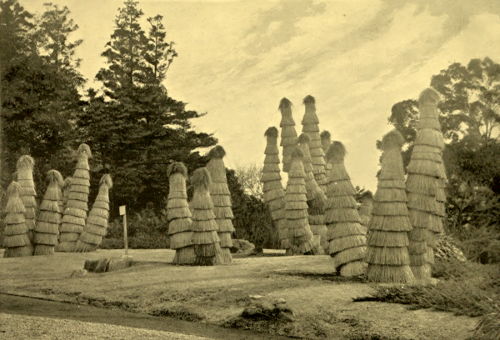
THE BOTANICAL GARDENS IN WINTER DRESS. A GROUP OF CYCADS
PROTECTED AGAINST SNOW
December 30.—At work again in the locked Institute,
but the sun shone and we were consequently
more cheerful.
December 31.—As it is the day before the New Year,
Professor F—— is too busy to work, so I brought
home my microscope and some fossils to do here, and
had a nice quiet day at home. The days before the
New Year are the busiest of the whole three hundred
and sixty-five for every Japanese. In the evening
Flora and I went down to the Ginza to see the big
Matsuri and buy what took our fancy, provided our
purses were large enough. This Ginza Matsuri is
one of the features of Tokio this time of the year, and
is particularly attractive on the last night of the year.
The pavements on both sides of the streets are
thronged with people, and lined with mats on the
kerb, covered with curios and oddments and modern
articles of all kinds. The pavement spaces are marked
off and numbered, and let out by the police long
before. As every one must pay all his debts by the
end of the year, lots of curios go cheaper then than at
any other time—though great bargains are not to
be had in Tokio any more, too many foreigners have
visited it. It was entertaining to watch the crowds,
and lots of the curios were very nice. Gold screens
I should love—but their size would make them
terrible to pack for the journey. Fortunately the rain
held off to-night, else many a poor person would
suffer for his debts!
January 1, 1909.—A bright sunny day for the New
Year. This year I did not enter at all into the national
customs, but went for a walk with Flora to see her
school, the Convent of which, I think, I have spoken
before. The new grounds they now have are very
extensive and beautiful—how delicious the reality of
country one can get in Tokio! It is possible in their
garden to feel miles from any habitation and in the
midst of woodland. When we returned I found I had
missed an event—a visit from the Dean in his Court
uniform, cocked-feathered hat, gold lace, sword and
all. He had much impressed my maid,—alas, that I
should have missed the great sight of a University
Professor in the panoply of state! All the higher
Government officials must go to the palace (unless ill)
and pay their respects to the Emperor on the morning
of the New Year, after which they make a tour of calls
on each other. In the evening I dined with the
F——s; we were a merry party and danced till late.
January 5.—A national holiday, so work was once
more impossible; instead, we went down to see the
sea at Enoshima. I had great hopes that the cone of
Fuji mountain would show above the coast over the
water. It is one of the loveliest views of Fuji, and I
have never yet seen it. The day was fine, but not
clear enough for that, however. Enoshima island,
reached by the long bridge from the sandy shore, has
often been described, so there is no need to reiterate
its beauties.
It was a solemnly lovely day—not a glowing one,
and the line of black foreground on the opposite coast,
overtopped by fainter and fainter jagged ridges of
hills, had the beauty of an old Japanese master.
Alas, that the jewel of it all, Mount Fuji, was not to
be seen. In all the eighteen months here I have never
yet seen the cone above the coast hills from the sea,
which is the most lovely view of all, they say, and
this is my last chance. After buying a few strings of
shells from the countless stores on the little island,
and watching a naked brown man dive into the deep
waves and come up with a living fish in his hand,
which he presented to me, and doing all the other
things essential to be done in Enoshima, we returned
to the mainland, and as we had half an hour to wait
I insisted on going up an attractive-looking hill. It
was a Temple hill, with beauty and solitude for its
crown, and such a view as I shall never forget of
rocky coast and grey villages, of the sea with its jewel
islands, and of the wave-like crested hills, a grey and
black and purple view, with a dull green foreground
and an atmosphere of mystery. Tokio! most favoured
city, to have such a coast so very near. What we
miss in London!
January 6–8.—Working hard, morning, noon, and
night, with packing of fossils and books, and household
goods thrown in.
January 9.—At work all day at the Institute; in the
late afternoon a call at the Embassy about the official
thanks to the Japanese, then on to Miss C—— about
the next Debate, and, finally, a scamper to dress for
dinner at Mrs. W——’s. When dressed it was too
late to do anything but cycle there, but half-way on
my road it began to snow! We had a very jolly
dinner, and I felt increasingly affectionate towards
Tokio, the people were all so kind. The snow
had stopped, so I cycled back, though it lay thick on
the ground, and it came on again before I got home,
but a chiffon scarf protects one wonderfully from
snow, and it was so pretty riding through it, instead
of being cooped up in a kuruma, with danger of the
men falling and breaking one’s neck. Kurumas
aren’t at all safe in snowy weather, and are bitterly
cold.
January 10.—The snow must have fallen nearly all
the night, for it lay deep this morning. Soon after
10 it became bright and clear, and I set off to see
the temples in Shiba Park. Very few people were
about, and in the park just a stray poet or two and a
photographer. I climbed one of the hills in it, and
before me lay the sea, beneath the snow-clad trees and
temple roofs. I turned, and scarlet through the
festoons of gleaming white glowed the fretwork of a
pagoda. Up and down little hills I wandered, the
great trees standing free as in a forest, and the
ground, as in a forest, trellised with big roots. The
snow hid the low bamboos and gave the whole hilly
landscape such a look that one needed no imagination
to fancy oneself in a distant mountain forest, till the
curved roof and crimson sides of a temple showed
between the trees. In absolute solitude I walked, on
untrodden snow, with no sight or sound of man—round
me the musical clouds of snow that fell as the
wind swayed the boughs of the tall cryptomerias
above my head. And this is the heart of a capital
city, Tokio, queen of cities. The long line of stone
lanterns, the crimson bridge, the temples and trees, as
well as the forest beauty, were rendered indescribably
lovely by this snow. A friend was to have come with
me to see the temples, and the snow prevented him—poor
foolish man! But I am glad I was there
alone.
January 11.—A brilliant, clear day. I was at work
all the morning. In the afternoon was the party at
the Nobles Club, given as a farewell for me by the
London University Union. Quite a lot of people
came, and I was transfixed in the middle of it all by
a presentation from Baron K——, in the name of
the Union, of three lovely gold lacquer boxes. Gold
lacquer! A thing I have longed to possess, and a
gift as well as a party from the dear Union, which I
never dreamed would notice my departure.
It was not a little overwhelming, and I had to
make a speech of thanks, and bungled it, of course.
Most of the fifty or so people who came to the
party were my friends, guests of the Union, and one
of them, as she said “Good-bye,” said to me also
“Thank you.” I answered, of course, “Oh, you
mustn’t thank me, I did not give the party.” “Well,
then,” she said hurriedly, “thank you for going
away.” My raised eyebrows and appealing eyes
perhaps made her add, as she did going out of the
door, “so that we can have a party.” She was not a
humorist, but one of those dear, solemn people who
take life seriously.
This party and the beautiful gift has touched me
deeply; all the members of the Union contributed,
English and Japanese alike.
January 14.—The last lunch at the Goten, I expect,
for next week will certainly be busy. These Faculty
lunches have certainly been very pleasant, and I am
sorry they are coming to an end, like many another
thing in this country for me. More P.P.C. calls in the
afternoon. As I returned in the dark I met more
than one man running with tinkling bell, clad in only
a white cotton kimono. I have noticed several such
quaint folk lately, and Professor F—— told me that
in the coldest season a number of people will do
this. It is a kind of remnant of the old “hardening”
processes of Bushido, when children were sent
barefoot and hungry across the snow, or sent supper-less
to bed. None of those I saw running looked
very robust, and I wondered whether such spasmodic
hardening as a run on a cold winter’s night, practically
naked, might not defeat its own ends. It looks
on the face of it as though daily hardening might be
more effective, in which case these same youths could
discard the thick woollen mufflers they wear over
mouths and ears and noses as they go out in the
sunny streets.
January 17.—At 1 o’clock I sallied forth with a
long calling list. Fortunately, one can call early on
Japanese ladies. Baron and Baroness H—— were
both in, and very gracious. It is difficult to say
“good-bye.”
There were several other short calls, and then my
last visit to the S——s’ pretty house, from which I saw
the beautiful garden for the last time.
Afterwards I went to see the grey lady, Mrs.
N——. Four-year-old Brownie remembered me and
welcomed me in, doing the honours of the house and
showing me all his toys. The grey lady is revealing
herself a little—I am sorry I must go, and so will not
see her again; people who really interest one are not
too many on this earth. She started life as a scientist,
but found chemistry so easy that it was no mental
discipline, so she took to history, where dates have no
reasons and are therefore hard to remember, but
here, too, she came out top of the classes. She lies
behind the poetry of that Japanese poet who wrote in
English, and was so praised by Rossetti, the N—— of
American fame, if I am not much mistaken, though
she does not tell one so consciously.
January 18.—A long day at the Institute working
and packing, and then to the M——s’ to dinner. The
house is being re-done up, and some of the rooms are
now very charming. Mr. M——, Mrs. M——, Mrs.
H——, and several others were there, and the dinner
was pleasant, but afterwards the treat came. When
we went into the drawing-room I noticed a tray with
lots and lots of white vases and cups and plates, and
wondered what they were for. They told us almost
at once. They had a great porcelain-maker there,
and on the stone verandah were set up the furnaces
and ovens and attendants, and we were to paint the
porcelain, and it would be baked and glazed and
finished before our eyes that evening! What it is to
be a millionaire, and how much more to be one who
could devise such charming pleasures. We all set to
work gaily, the sons and little girl came in, and we
had a very merry time. The quality of our painting
doubtless left something to be desired, but we did
not think of that till after, and really some of them
were pretty, even the next day. The baking was the
great excitement. The little furnaces were surrounded
by glowing charcoal, fanned by the white-clad potters
till a cloud of sparks rose over the fiery clay. We
were half shut in in the verandah, but could see
between the fires the snowy garden. The heat was
so great that we rushed in and out of the drawing-room
with no thought of cold, and multiplied our pots
and vases rapidly. The time flew too swiftly, and I
had to leave many still to be baked and to be seen
to-morrow. This, too, was a farewell party for me,
and the kindness and grace of my hostess made it a
very pleasant one.
January 19.—Called at 9.30 at the M——s’, just to
see the exhibition of our last night’s pottery-making,
and found a big show, only one piece having been
broken in the baking, which seems very good for
furnaces erected in a private house. I had to hurry
away to the Institute, for every moment is now
urgently needed for my scientific work, and, fortunately,
got on pretty well with it to-day.
January 22. A busy day—calls on the way home
and a dinner at the P——s’, where I am now going to
stop the two nights till I leave, as my house must get
packed up and sold up. Professor S—— came to
dinner, and the F——s. Professor P—— has only
been back a few days from London by Siberia, and
had home news. After the guests left at 11.30 I went
over to my house, took off my evening frock, and prepared
for a night’s work. There was no help for it—packing,
letters, P.P.C. cards, and a hundred things
had to be done, and still there was work at the
Institute. The night flew by, with cocoa and cake at
3.30, and after breakfast I went to the Institute to
finish up things there. A few calls had to be paid
on the way back, so much kindness from so many
friends necessitates calling. After dinner I was
approaching insanity over the folly of the men who
were padlocking my trunks.
January 24.—The P——s were very good, and let
me wake them up at 6.30; then there were a few little
things to do, a look round mine own little house, all
empty and forlorn, and we set off for the station.
As I left at 8.20 on Sunday morning I never
expected any one to see me off, except perhaps one or
two special friends, but there was quite a big crowd
of kindly folk, the M——s with lovely flowers from
their greenhouse, and all with good wishes. Why I
didn’t break down and howl on the platform I don’t
know. Professor S——, Professor F——, Dr. M——,
Dr. H——, and my maid came to Yokohama to the
boat with me, where they cheered me till it started by
photographing the party in groups and writing picture
post cards, and walking round the deck with me one
at a time in friendly converse.
Then, just before we sailed, I saw a gleam of what
looked like Fuji mountain. Was she going to forget
her cruelty and coyness and show herself to me over
the water at last, at the latest possible moment? But
the clouds closed again, the tender took my last
friends from me, the ladder was up, and we steamed
away as the bell sounded for lunch. Then after it I
went on deck, and before me lay a wonderful panorama,
near rocky coast, pine-crested, then beyond a
dark line of more distant woods and bays, and in
the midst, perfect, peerless, cloudless, the cone of the
snow-white Fuji mountain!
I gazed and gazed for an hour at the changing
view of ever lovely coast and ever lovely mountain!
Round the mountain top light clouds collected and
dispersed like flying veils; one rose from the crater
and dissolved like a puff of smoke, some circled the
base and shut off the crown from the black fringing
trees below.
So, as I left Japan, her greatest beauty showed
herself to me.


