These letters were printed in the Hutchinson
Daily News during the summer of 1911.
There was no ulterior motive, no lofty purpose,
just the reporter’s idea of telling what
he saw.
They are now put in book form without
revision or editing, because the writer would
probably make them worse if he tried to make
them better.
W. Y. MORGAN.
Hutchinson, Kansas, November 1, 1911.
To the Jayhawkers
who stay at home and take their European trips
in their minds and in the books, this
volume is respectfully dedicated
by one of the
gadders
The last day on American soil before starting
on a trip to other lands should be marked
with a proper spirit of seriousness, and I would
certainly live up to the propriety of the occasion
if it were not for two things,—the
baggage and the weather. But how can a
man heave a sigh of regret at departing from
home, when he is chasing over Jersey City and
Hoboken after a stray trunk, and the thermometer
is breaking records for highness and
the barometer for humidity? I have known
some tolerably warm zephyrs from the south
which were excitedly called “hot winds,” but
they were balmy and pleasant to the touch
in comparison with the New York hot wave
which wilts collar, shirt and backbone into
one mass. The prospect of tomorrow being
out on the big water with a sea breeze and a
northeast course does not seem bad, even if
you are leaving the Stars and Stripes and
home and friends. There is nothing like hot,
humid weather to destroy patriotism, love,
affection, and common civility. I speak in
mild terms, but I have returned from Hoboken,
the station just the other side of the
place whose existence is denied by the Universalists.
This is the place the ship starts
from, and not from New York, as it is advertised
to do.
Speaking of weather reminds me that the
West is far ahead of New York in the emancipation
of men. The custom here is for men
to wear coats regardless of the temperature,
whereas in the more intelligent West a man is
considered dressed up in the evening if he
takes off his gallusses along with his coat.
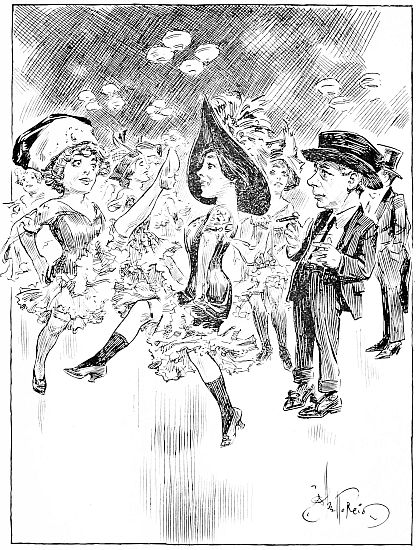
Last night we went to a “roof garden” and
expected that it would be a jolly Bohemian
affair, but every man sat with his coat on and
perspired until he couldn’t tell whether the
young ladies of the stage were kicking high
or not, and worse than that, he did not care.
I have been again impressed with the fact
that there are no flies in New York City.
There are no screens on the windows, not
even of the dining-rooms, and yet I have not
seen a fly. I wish Dr. Crumbine would tell
us why it is that flies swarm out in Kansas
and leave without a friendly visit such a rich
pasture-ground as they would find on the
millions of humans on Manhattan island. If
I were a fly I would leave the swatters and the
hostile board of health of Kansas, and take
the limited train for New York and one perpetual
picnic for myself and family.
This afternoon I went to the ball game, of
course. Some people would have gone to the
art exhibit or the beautiful public library.
But New York and Chicago were to play and
Matthewson was to pitch, and the call of duty
prevailed over the artistic yearnings which
would have taken me elsewhere. Coming
home from the game I had an idea—which is
a dangerous thing to do in hot weather. There
has been a good deal of talk in the newspapers
about the Republicans not agreeing on a candidate,
and the question as to whether Taft
can be reëlected or not is being vigorously
debated. Put ’em all out and nominate
Christy Matthewson. This would insure the
electoral vote of New York, for if the Republicans
put “Matty” on the ticket the election
returns would be so many millions for
Matthewson and perhaps a few scattering.
There were about as many errors and boneheads
in the game between Chicago and New
York as there would be in a Kansas State
League game, and more than would come to
pass in the match between the barbers and
the laundrymen of Hutchinson. The players
did not indulge in that brilliant repartee with
the umpire which is a feature of the Kansas
circuit, and the audience, while expressing its
opinion of the judgments, had no such wealth
of phrases as pours over the boxes from the
grandstand at home. The language used
could have come from the ministerial alliance,
and sometimes the game seemed more like a
moving-picture show than a real live game of
baseball. Chicago won, 3 to 2 in ten innings,
and I feel that my European trip is a decided
success so far.
This morning I took a little walk down Wall
street and saw the place in which the Great
Red Dragon lives. These New York bankers
and brokers are not so dangerous as I have
been led to believe by reading some of the
speeches in Congress. There was no blood
around the Standard Oil building, and the
office of J. Pierpont was filled with men who
looked as uncomfortable and unhappy as I
felt with the heat. Sometimes I think the
men of Wall street, New York, are just like
the men at home,—getting all they can under
the rules of the game and only missing the
bases when the umpire looks the other way.
The few with whom I talked were really concerned
about the crops and the welfare of the
people of Kansas, perhaps because they have
some of their money invested in our State, and
I got the idea that Wall street and all it
represents is interested in the prosperity of
the country and knows that hard times anywhere
mean corresponding trouble for some
of them in New York.
New York is a growing city. In many respects
it is like Hutchinson. The street paving
is full of holes and new buildings are going
up in every direction. Every few months
“the highest skyscraper” is erected, and now
one is being constructed that will have fifty or
sixty stories—it doesn’t matter which. The
buildings are faced with brick or stone, but
really built of iron. I saw one today on which
the bricklaying had been begun at the seventh
story and was proceeding in both directions.
That was the interesting feature of the building
to me. That and the absence of flies and
the baseball game are the general results of
my efforts today to see something of the greatest
city in America.
We sail tomorrow morning. Then it will
be ten days on the ship for us. One thing
about an ocean voyage is reasonably sure:
If you don’t like it you can’t get off and walk.
A really attractive feature is that there is no
dust and you don’t watch the clouds and wish
it would rain so you will not have to water the
lawn.
Breaking Away
Steamship Potsdam, July 11.
The sailing of an ocean steamer is always a
scene of delightful confusion and excitement.
Thousands of people throng the pier and the
ship, saying goodbyes to the hundreds who are
about to leave. The journey across the ocean,
though no longer a matter of danger or hardship,
is yet enough of an event to start the
emotions and make the emoters forget everything
but the watery way and the long absence.
The crowd is anxious, expectant, sad, and
unrestrained. Men who rarely show personal
feeling look with glistening eyes on the friends
to be left behind. Women, who are always
seeing disaster to their loved ones, strive with
pats, caresses and fond phrases to say the
consoling words or to express the terror in
their hearts. The timid girl, off for a year’s
study, wishes she had not been so venturesome.
The father rubs his eyes and talks
loudly about the baggage. The mother clings
to her son’s arm and whispers to him how she
will pray for him every night, and hopes he
will change his underclothes when the days are
cool. Young folks hold hands and tell each
other of the constant remembrance that they
will have. Big bouquets of flowers are brought
on by stewards, the trunks go sliding up the
plank and into the ship, the officers strut up
and down, conscious of the admiring glances
of the curious, orders are shouted, sailors go
about tying and untying ropes, the rich family
parades on with servants and boxes, the
whistle blows for the visitors to leave, and the
final goodbyes and “write me” and “lock the
back door” and “tell Aunt Mary” and such
phrases fill the air while handkerchiefs alternately
wipe and wave.
Slowly the big boat backs into the stream
amid a fog of cheers and sobs, then goes
ahead down the harbor, past the pier still
alive with fluttering handkerchiefs, the voices
no longer to be heard, and the passengers feel
that sinking of the heart that comes from the
knowledge of the separation by time and distance
coming to them for weeks and months,
perhaps forever. Sorrowfully they strain for
a last look at the crowd, now too far away to
distinguish the wanted face, and then they
turn around, look at their watches, and
wonder how long it will be before lunch.
Of course the Dutch band played the Star-Spangled
Banner as the boat trembled and
started; of course the last passenger arrived
just a minute late and was prevented from
making an effort to jump the twenty feet of
water which then separated the ship from the
pier. Of course the boys sold American flags
and souvenir post cards. Of course the tourists
wondered if they would be seasick and
their friends rather hoped they would be,
though they did not say so. The steamboats
whistled salutes, and the band changed its
tune to a Dutch version of “The Girl I Left
Behind Me,” and with flags flying the Potsdam
moved past the big skyscrapers, past the
Battery, alongside the Statue of Liberty, and
out toward the Atlantic like a swan in Riverside
Park. The voyage has begun. The
traveler has to look after his baggage, which
is miraculously on board, find his deck chairs
and his dining-room seats, and between times
rush out occasionally to get one more glimpse
of the New Jersey coast, which is never very
pretty except when you are homeward bound,
when even Oklahoma would look good.
This boat, the Potsdam, of the Holland-American
line, is not one of the big and magnificent
floating hotels which take travelers
across the Atlantic so rapidly that they do not
get acquainted with each other and in such
style that they think they are at a summer
resort. But it is a good-sized, easy-sailing,
slow-going ship that will take about ten days
across and has every comfort which the Dutch
can think of, and they are long on having
things comfortable. It has a reputation for
steadiness and good meals which makes it
popular with people who have traveled the
Atlantic and who enjoy the ocean voyage as
the best part of a trip abroad. It lands at
Rotterdam, one of the best ports of Europe
and right in the center of the most interesting
part of the Old World.
The pilot left us at Sandy Hook, and now
the Potsdam is sailing right out into the big
water. A cool breeze has taken the place of
the hot air of New York. The ocean is
smooth; there is neither roll nor heave to the
ship. Everybody is congratulating himself
that this is to be a smooth voyage. A substantial
luncheon is still staying where it belongs,
and we are looking over the other passengers
and being looked over by them. There
is no chance to get off and go back if we
wanted to do so. And we don’t want to—not
yet.
On the Potsdam
Steamship Potsdam, July 14.
The daily life on shipboard might be considered
monotonous if one were being paid for
it, but under the present circumstances and
surroundings the time goes rapidly. Everybody
has noticed that the things he is obliged
to do are dull and uninteresting. Any ordinary
American would demand about $10 a day
for fastening himself in a boat and remaining
there for ten days. He would get tired of
the society, sick of the meals and sore on his
job. But call it “fun” and he pays $10 a day
for the pleasure of the ride. The Potsdam is
560 feet long, sixty-two feet wide, and seven
stories high,—four above the water-line and
three below. On this trip its first-class accommodations
are filled, about 260 people;
but the second class is not crowded, and less
than a hundred steerage passengers occupy
that part of the ship which often carries 2,100
people. The steerage is crowded on the trip
to America, filled with men and women who
are leaving home and fatherland in order to
do better for themselves and their children.
They go back in later years, for a visit, but
they do not travel in the steerage. They
carry little American flags and scatter thoughts
of freedom and free men in the older lands.
This is a Dutch ship and the language of
the officers and crew is Dutch. While a few of
them speak some English and most of them
know a little, the general effect is that of
getting into an entirely foreign environment.
The Dutch language is a peculiar blend. It
seems to be partly derived from the German,
partly from the English, and partly from the
Choctaw. The pronunciation is difficult because
it is unlike the German, the English
or the Latin tongues. An ordinary word
spelled out looks like a freight train of box
cars with several cabooses. As one of my
Dutch fellow-passengers said when he was instructing
me how to pronounce the name of
the capital of Holland, “Don’t try to say it;
sneeze it.” A great deal of interest is added to
the smallest bits of conversation by the doubt
as to whether the Dutch speaker is telling you
that it is dinner-time or whether he has
swallowed his store teeth.
Which reminds me of a little story Ben
Nusbaum told me of the Dutchman who came
into the Oxford café, sat up to the counter
and in proper Dutch etiquette greeted the
waiter with the salutation, “Wie gehts?”
Turning toward the kitchen the waiter sang
out, “wheat cakes!” “Nein! nein!” shouted
the Dutchman. “Nine,” said the waiter,
scornfully; “you’ll be dam lucky if you get
three!”
The principal occupation on board a Dutch
ship is eating, and the next most important
is drinking. The eats begin with a hearty
breakfast from 8 to 10 o’clock. At 11 o’clock,
beef soup, sandwiches and crackers. At 12:30,
an elaborate luncheon. At 4 o’clock, afternoon
tea, with sandwiches and fancy cakes. At 7
o’clock, a great dinner. At 9 o’clock, coffee,
sandwiches, etc. Any time between these
meals you can get something to eat, anything
from beef to buns, and the table in the smoking-room
is always loaded with cheese, sausage,
ham, cakes and all the little knick-knacks
that tempt you to take one as you go by.
And yet there is surprise that some people
are seasick.
You can get anything you want to drink
except water, which is scarce, and apparently
only used for scrubbing and bathing. Of
course the steward will find you a little water,
if you are from Kansas, but he thinks you are
sick, wants to add a hot-water bag, and suggests
that the ship doctor might help you
some.
I have spoken before of the Dutch band.
It is a good one, and loves to play. The first
concert is at 10 in the morning. There is
orchestra music during luncheon and dinner,
and band concerts afternoon and evening. I
like a German band, or a Dutch band, so long
as it sticks to its proper répertoire. But there
never was a German band that could play
“My Old Kentucky Home” and “Swanee
River,” and every German band persists in
doing so in honor of the Americans. I suppose
this desire to do something you can’t do
is not confined to Dutch musicians. I know
a man who can whistle like a bird, but he insists
that he is a violinist, and plays second
fiddle. I know a singer with a really great
voice who persists in the theory that he can
recite, which he can’t. Therefore he is a
great bore, and nobody thinks he can even
sing. Nearly all of us are afflicted some along
this line, and the Dutch band on the Potsdam
is merely accenting the characteristic in brass.
Today I saw a whale. Every time I am on
the ocean I see a whale. At first nobody else
could see it, but soon a large number could.
There was a good deal of excitement, and the
passengers divided into two factions, those
who saw the whale and those who didn’t and
who evidently thought we didn’t. The argument
lasted nearly all the morning, and would
be going on yet if a ship had not appeared in
the distance, and our passengers divided
promptly as to whether it was a Cunarder, a
French liner, or a Norwegian tramp freighter.
This discussion will take our valuable time all
the afternoon. Friends will become enemies,
and some of those who rallied around the whale
story are almost glaring at each other over
the nationality of that distant vessel. I am
trying to keep out of this debate, as I am
something of a Hero because I saw the whale.
I have already told of my nautical experience
on Cow creek, so while I feel I would be considered
an authority, it is better to let some
of the other ambitious travelers get a reputation.
The Lions of the Ship
Steamship Potsdam, July 19.
There are always "lions" on a ship, not the
kind that roar and shake their manes, but
those the other passengers point at and afterward
recall with pride. I often speak carelessly
of the time I crossed with Willie Vandergould,
although he never left his room during
the voyage and was probably sleeping off the
effects of a long spree. Once I was a fellow-passenger
with Julia Marlowe, a fact Julia
never seemed to recognize. There are always
a few counts and capitalists on an ocean
steamer, and a ship without a lion is unfortunate.
Our largest and finest specimen is
Booth Tarkington, the head of the Indiana
school of fiction, an author whose books have
brought him fame and money, and a playwright
whose dramatizations have won success.
He is the tamest lion I ever crossed with.
He is delightfully democratic, not a bit chesty,
but rather modest, and as friendly to a traveling
Jayhawker as he is to the distinguished
members of the company. In fact, he understands
and speaks the Kansas language like
a native. His ideal of life is to have a home
on an island in the track of the ocean steamers
so he can sit on the porch and watch the ships
come and go. Not for me. It is too much
like living in a Kansas town where No. 3 and
No. 4 do not stop, and every day the locomotives
snort and go by without even hesitating.
Tarkington is an honest man, so he says,
and he tells good sea stories. His favorite
true story is of Toboga Bill, a big shark which
followed ships up and down the South-American
coast, foraging off the scraps the cooks
threw overboard. Tarkington’s friend, Captain
Harvey, got to noticing that on every trip
his boat was escorted by Toboga Bill, whose
bald spot on top and a wart on the nose made
him easily recognizable. Harvey got to feeding
him regularly with the spoiled meat and
vegetables, and Toboga Bill would come to the
surface, flop his fin at the captain and thank
him as plainly as a shark could do. After
several years of this mutual acquaintance the
captain happened to be in a small-boat going
out to his ship at a Central-American port.
The boat upset, and the captain and sailors
were immediately surrounded by a herd of
man-eating sharks. The shore was a mile
away and the captain swam that distance, the
only one who escaped; and all the way he
could see Toboga Bill with his fin standing up
straight, keeping the other sharks from his
old friend. Occasionally Toboga would give
the captain a gentle shove, and finally pushed
him onto the beach.
This story Tarkington admitted sounded
like a fish story, but he has a motor-boat
named Toboga Bill, which verifies the tale.
That reminded me of a Kansas fish story
which I introduced to the audience. Everybody
in Kansas knows of the herd of hornless
catfish which has been bred near the Bowersock
dam at Lawrence. Some years ago Mr.
Bowersock, who owns the dam that furnishes
power for the mill and other factories, conceived
the idea that big Kaw river catfish
going through the mill-race and onto the water-wheel
added much to the power generated.
Then he read that fish are very sensitive to
music. So he hired a man with an accordion
to stand over the mill-race and play. The
catfish came from up and down stream to
hear the music, and almost inevitably drifted
through the race, onto the wheel, and increased
the power. The fishes’ horns used to
get entangled in the wheel and injure the fish;
so Mr. Bowersock, who is a kind-hearted man
and very persistent, had a lot of the fish caught
and dehorned, and in a year or two he had a
large herd of hornless catfish. These fish not
only turn out to hear the music, but they have
learned to enjoy the trip through the mill-race
and over the wheel, so that every Sunday
or oftener whole families of catfish—and they
have large families—come to Bowersock’s dam
to shoot the chutes something as people go
out to ride on the scenic railway. Whenever
the water in the river gets low Mr. Bowersock
has the band play: the catfish gather and go
round and round over the wheel, furnishing
power for the Bowersock mill when every
other wheel on the river is idle from lack of
water.
There were some skeptical folks who heard
my simple story and affected to disbelieve.
But I assured them that it could be easily
proven, and if they would go to Lawrence I
would show them the Bowersock dam and the
catfish. It is always a good idea to have the
proofs for a fish story.
The next “lion” on board is Gov. Fook,
returning from the Dutch West Indies, where
he has been governing the islands and Dutch
Guiana. The governor is a well-informed
gentleman, and a splendid player of pinochle.
The Dutch have the thrifty habit of making
their colonies pay. They are not a “world
power” and do not have to be experimenting
with efforts to lift the white man’s burden.
Their idea is that the West-Indian and the
East-Indian who live under the Dutch flag
shall work. The American idea is to educate
and convert the heathen and pension them
from labor. Our theory sounds all right, but
it results in unhappy Filipinos and increased
expense for Americans. The Dutch colonials
pay their way whether they get an education
or not.
One unfamiliar with modern steamship
travel would think that the captain and his
first and second officers were the important
officials on board. They are not. The officers
rank about as follows: 1st, the cook; 2nd,
the engineer; 3rd, the barber, and after that
the rest. The cook on an ocean steamer gets
more pay than the captain, and is now ranked
as an officer. The managing director of a big
German company was accustomed on visiting
any ship of their line, to first shake hands with
the cook and then with the captain. When
one of the officers suggested that he was not
following etiquette he answered that there
was no trouble getting captains and lieutenants
but it was a darned hard job to find a
cook. The cook has to buy, plan meals,
supervise the kitchen and run it economically
for the company and satisfactorily for the
passengers, for over 2,000 people.
The barber is the man on the ship who
knows everything for sure. Ask the captain
when we will get to Rotterdam and he will
qualify and trim his answer by referring to
possible winds and tides, and he won’t say
exactly. Ask the barber and he will tell you
we will get there at 10 o’clock on Friday
night. He knows everything going on in the
boat, from the kind of freight carried in the
hold to the meaning of the colors painted on
the smokestack. During this voyage I have
had more numerous and interesting facts than
anybody, because I have not fooled with talking
to the captain or the purser or the steward,
but gotten my information straight from the
fountain of knowledge, the barber shop. However,
this is not peculiar to ships. The same
principle applies at Hutchinson and every
other town.
Ocean Currents
Steamship Potsdam, July 21.
This is the eleventh day of the voyage from
New York, and if the Potsdam does not have
a puncture or bust a singletree she will arrive
at Rotterdam late tonight. The Potsdam
is a most comfortable boat, but it is
in no hurry. It keeps below the Hutchinson
speed limit of fifteen miles an hour.
But a steamship never stops for water or oil,
or to sidetrack or to wait for connections.
This steady pounding of fourteen miles an
hour makes an easy speed for the passenger,
and the verdict of this ship’s company is that
the Potsdam is a bully ship and the captain
and the cook are all right.
Nearly all the way across the Atlantic we
have been in the Gulf stream. I have read
of this phenomenal current which originates
in the Gulf of Mexico and comes up the eastern
coast of the United States so warm that
it affects the climate wherever it touches.
Then nearly opposite New England it turns
and crosses the Atlantic, a river of warm
water many miles wide, flowing through the
ocean, which is comparatively cold. This
stream is a help to the boats going in its direction,
although it has the bad feature of frequent
fogs caused by the condensation which
comes when the warm and cold air currents
meet. The Gulf stream is believed to be responsible
for the green of Ireland and for
the winter resorts of southern England. It
goes all the way across the Atlantic and into
the English Channel, with a branch off to
Ireland. What causes the Gulf stream? I
forget the scientific terms, but this is the way
it is, according to my friend Mr. Vischer,
formerly of the German navy. The water
in the Gulf of Mexico is naturally warm.
The motion of the earth, from west to east,
and other currents coming into the gulf,
crowd the warm water out and send the big
wide stream into the Atlantic with a whirl
which starts it in a northerly and easterly
direction. The same Providence that makes
the grass grow makes the course of the current,
and it flows for thousands of miles,
gradually dissipating at the edges, but still
a warm-water river until it breaks on the
coast of the British Isles and into the North
Sea. Perhaps Mr. Vischer would not recognize
this explanation, but I have translated
it into a vernacular which I can understand.
The Gulf stream reminds me of the Mediterranean.
Not having much else to worry
about, I have gone to worrying over the Mediterranean
Sea. The ocean always flows into
the sea. The current through the strait of
Gibraltar is always inward. Many great
rivers contribute to the blue waters of the
great sea. There is no known outlet. Why
does not the Mediterranean run over and fill
the Sahara desert, which is considerably below
the sea-level? Scientists have tried to
figure this out, and the only tangible theory
is that the bottom of the Mediterranean leaks
badly in some places, and that the water finds
its way by subterranean channels back to
the ocean. What would happen if an eruption
of Vesuvius should stop up the drain-pipe?
Now worry.
Tonight we saw another phenomenon, the
aurora borealis. It looked to me like a beautiful
sunset in the north. We are sailing in
the North Sea along the coast of Belgium,
and the water reaches northward to the pole.
The aurora borealis is another phenomenon
not easily explained, but Mr. Vischer says it
is probably the reflection of the sun from the
ice mirror of the Arctic. And it does make you
feel peculiar to see what is apparently the
light of the sunset flare up toward the “Dipper”
and the North Star.
Some of our passengers disembarked today
at Boulogne. This was the first time the
Potsdam had paused since she left New York
a week ago last Tuesday. This was the stop
for the passengers who go direct to Paris.
The Dutch who are homeward bound and
those of us who think it best to fool around
a little before encountering the dangers of
Paris, continue to Rotterdam. We should be
spending the evening with maps and guide
books preparing ourselves for the art galleries,
cathedrals, canals and windmills. As a matter
of fact, we are wondering what is going
on at home. There is a balance-wheel in
the human heart that makes the ordinary
citizen who is far afield or afloat turn to the
thoughts of the home which he left, seeking a
change.
A smoking-room story: An American in
a European art gallery was heading an aggregation
of family and friends for a study of
art. His assurance was more pronounced
than his knowledge. “See this beautiful
Titian,” he said. “What glorious color, and
mark the beauty of the small lines. Isn’t
it a jim dandy? And next to it is a Rubens
by the same artist!”
The Dutch Folks
Rotterdam, Holland, July 23.
It seemed to me unnecessary, but I had to
explain to some friends why I was going
especially to Holland. It is the biggest little
country in the world. In art it rivals Italy,
in business it competes with England, historically
it has had more thrills to the mile
than France, and in appearance it is the
oddest, queerest, and most different from our
own country, of all the nations of central
Europe. Holland gives you more for your
money and your time than any other, and
that’s why I am back here to renew the hurried
acquaintance with the Dutch made a
few years ago.
Landing in Rotterdam was an experiment.
The guide books and the tourist authorities
pass Rotterdam over with brief mention.
Baedeker, the tripper’s friend, suggests that
you can see Rotterdam in a half-day. That
is because Rotterdam is short on picture galleries
and cathedrals. It is a great, busy
city of a half-million people, and one of the
most active commercially in the world. It
is the port where the boats from the Rhine
meet the ships of the sea. It is the greatest
freight shipping and receiving port of northern
Europe. It is the coming city of the
north, because of its natural advantages in
cheap freight rates. After looking it over
hurriedly it seems to me to be one of the most
interesting of cities. I am not going to run
away from cathedrals and galleries. I am
not intending to dodge when I see a beautiful
landscape coming. But I have done my
duty in the past and have seen the great
cathedrals and the exhibitions of art. No
one can come to Europe and not see these
things once, for if he did he would not be
able to lift up his head in the presence of
other travelers. But he does not have to do
them a second time. If I want to see pictures
of Dutch ladies labeled “Madonna,”
I will see them. If I don’t want to, I do not
have to. In other words, if I go to the “tourist
delights” it will be my own fault.
I would rather see the people themselves
than the pictures of them. I want to observe
how they work, what they work for, what
their prospects are, and wherein they differ
from the great Americans.
Man made most of Holland. Nearly all
of the country is below the level of the sea,
much of it many feet below. All that keeps
the tide of the North Sea from flooding the
country with from ten to a hundred feet of
water every day are the dikes which man has
built. Behind these huge embankments lies
a country as flat as the flattest prairie in Kansas.
A few sandhills and an occasional little
rise of ground might stick out of the water
if the dikes broke, but I doubt it. This
“made” land has been fertilized and built
up by the silt of the rivers, added to by the
labor and science of man, until it is a vast
market garden. The water of the rivers is
diverted in every direction into canals. There
is no current to the rivers; the surface is too
flat, and the fresh water is backed up twice
a day by the ocean tides at the mouths.
There are practically no locks and the movement
of the water is hardly perceptible, except
near the coast, where it responds to the
advance and retreat of the sea. These canals
are an absolute necessity for drainage, otherwise
the country would be a swamp. Then
they are used as roads, and practically all the
freight is carried to market cheaply in canal-boats.
The canals also serve as fences. The
drainage water is pumped by windmills, which
are then used to furnish power for every
imaginable manufacturing purpose, from sawing
lumber to grinding wheat. The cheap
wind-power enabled the people to clear the
land of water. So you see why there are
dikes, canals and windmills in Holland: because
they were the only available instruments
in the hand of man to beat back the
sea and build a productive soil. They were
not inserted in the Holland landscape for
beauty or for art’s sake, but because they
were necessities; and yet great artists come
to Holland to paint pictures of these practical
things, and when they want to add more
beauty they insert Dutch cattle and wooden
shoes. All of which shows that the plain
everyday things around us are really picturesque;
and they are, whether you look at
the sandhills along the Arkansas or the dunes
along the North Sea.
In this little country, containing 12,500
square miles of land and water, smaller than
the seventh congressional district of Kansas,
live almost 6,000,000 of the busiest people
on earth. Their character may be drawn
from their history. They first beat the ocean
out of the arena and then made the soil.
They met and overcame more obstacles than
any other people in getting their land. And
then for several centuries they had to fight
all the rest of Europe to keep from being absorbed
by one or the other of the great powers.
They drove out the Spaniards at a time when
Spain was considered invincible. They licked
England on the sea, and the Dutch Admiral
Tromp sailed up and down the Channel with
a broom at the mast of his ship. They drove
Napoleon’s soldiers and his king out of the
country. They never willingly knuckled down
to anybody, and they never stayed down long
when they were hit.
The Dutch have for centuries been considered
the best traders in Europe. They
have the ports for commerce and they have
the money. They own 706,000 square miles
of colonies, with a population six times as
large as their own. From the beginning they
have been ruled by merchants and business
men, rather than by kings and princes, by
men who knew how to buy and sell and fight.
They have been saving and thrifty, and can
dig up more cash than any other bunch of inhabitants
on the globe. They have sunk
some money in American railroads, but they
have made it back, and they always take interest.
Market-gardening and manufacturing
and trade have been their resources, and
nothing can beat that three of a kind for
piling up profits and providing a way to keep
the money working.
Of course these characteristics and this environment
have made the Dutch peculiar in
some ways, and they are generally counted
a little close or “near.” They habitually use
their small coin, the value of two-fifths of an
American cent, and they want and give all
that is coming. They have good horses, fat
stomachs, and lots of children. They are
pleasant but not effusive, and they are as
proud of their country as are the inhabitants
of any place on earth. They believe in everybody
working, including the women and the
dogs. Their struggle with the sea never ends,
and they follow the same persistent course in
every line of development. They are so clean
it is a wonder they are comfortable, and they
believe in eating and drinking and having a
good time, just so it doesn’t cost too much.
They are a great people, and here’s looking
at them.
In Old Dordrecht
Dordrecht, July 23.
This is the oldest town in Holland, and once
upon a time was the great commercial city.
It is about fifteen miles from Rotterdam, and
remember that fifteen miles is a long distance
in this country. It is built upon an island;
two rivers and any number of canals run
around it and through it whenever the tide
ebbs or flows. Good-sized ocean steamers
come to its wharves, and until other cities
developed deeper harbors Dordrecht was the
Hutchinson of southwest Holland. And now
let me explain that the people of this country
do not call it Holland, but The Netherland.
Originally Holland was the western part of
the present Netherland. Dordrecht is in old
South Holland. About nine hundred years
ago the Count of Holland, who then ruled in
this precinct, decided to levy a tax or a tariff
on all goods shipped on this route, the main
traveled road from England to the Orient.
The other counts and kings and bishops
kicked, but after a fight the right of the Count
of Holland was vindicated, and he built the
city of Dordrecht as a sort of customs house.
This was in 1008. For several hundred years
Dordrecht prospered and was known as a
great commercial city. Then Antwerp, Rotterdam
and Amsterdam came forward with
better harbors, and Dordrecht took a back
seat. But it has always been one of the important
places in The Netherland. When
William of Orange took hold of the revolution
against Spain, the first conference of the representatives
of the Dutch states was held in
Dordrecht, and it was always loyal to the
cause of Dutch freedom. The best hotel and
restaurant in the city today is The Orange,
named for the royal house which has so long
been at the head of the Dutch government.
My idea of a really important statesman is
one for whom hotels and cigars are named
centuries after he has passed away.
This is Sunday, and I am forced to believe
that the Dutch are not good churchgoers. We
went to the evening service in the great cathedral.
In fact, we went to the cathedral and
suddenly the service began without our having
time to retire gracefully. So we decided
to stay, and in a prominent place was a list
of the prices of seats. Some cost ten cents,
some five cents, and some were marked free.
I handed ten cents to the lady in charge, and
we took two seats in the rear, which I afterward
discovered were free. The women seem
to run the church much as they do at home.
The Dutch hymns were not so bad, but the
Dutch sermon was not interesting to me.
During the closing song, we thought we would
slip out quietly, but when we reached the door
we found it locked. The custom is to lock
the door and allow no one to enter or leave
during the service, but as a special favor to
Americans, who evidently did not know what
they were doing, the guardian of the door unlocked
it, and out we went amid general
interest of the congregation.
We came from Rotterdam on a little steam-boat,
which scooted along the rivers and canals
like a street car. Very often the canal was
built higher than the adjoining land, and it
gave the peculiar feeling of boating in the air.
There is no waste ground. Every foot of it
not occupied by a house or a chicken-yard, is
pasture or under cultivation. Every farmer
has a herd of those black-and-white cattle.
Some of the herds are as many as six or seven
cows. But every cow acted as if she were
doing her full duty toward making Holland
the wealthiest of nations.
The streets of Dordrecht are generally narrow,
like those of all old towns. Many of the
buildings are very old, and a favorite style of
architecture is to have the front project several
feet forward over the street. The tops of
opposite buildings often almost meet. I don’t
see why they do not meet and come down
kerwhack, but they don’t. Imagine these
quaint streets with old Dutch houses, white
and blue, with red tiled roofs, and green and
yellow thrown in to give them color, with
angles and dormers and curious corners, the
tops projecting toward one another, and you
can see how interesting a Dutch street can
be if it tries, as it does in Dordrecht. Of course
in the outer and newer parts of the town are
larger streets and more modern houses, with
beautiful gardens and flower beds that would
baffle a painter for color, but old Dordrecht
is the most interesting. Add to the street
picture a canal down the middle, and you get
a frequent variation. Put odd Dutch boats in
the water, fill them with freight and children,
and you have another. If this were not
picturesque it would be grotesque to American
eyes, but it is the actual development of Dutch
civilization, and it is the thing you pay money
for when some artist catches the inspiration
which he can get here if anywhere.
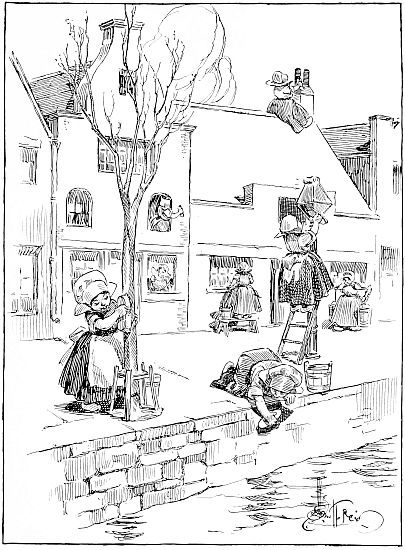
THE SCRUBBING-BRUSH THE NATIONAL EMBLEM OF HOLLAND
Of course the streets are paved, and they
are as clean as the floor of an ordinary American
dwelling. Everyone knows that the
Dutch are clean and that their national emblem
ought to be a scrubbing-brush. They
are so clean that it almost hurts. Very often
there are no sidewalks, and when there are
they are not level, and are generally fenced in.
They belong to the abutting property, and
are not to be walked on by the public. The
people walk in the street, and that custom is
a little hard to get used to. Before the front
window of nearly every house is a mirror, so
fastened that those within the house can see
up and down the street, observe who is coming
and who is going, and where. This custom,
if introduced at home, would save a good
deal of neck-stretching. But at first one is
overly conscious of the many eyes which are
observing his walk and the many minds which
are undoubtedly trying to guess just where
and why and who. But this mirror custom
does not bother the Dutch young folks, not
much. It is also the custom for the young
man and his sweetheart to parade along the
street hand in hand, arm in arm, or catch-as-catch-can,
if they want to,—and they want to
a great deal. At first this looked like a rude
demonstration of affection, but after you have
observed it some, say for an hour or so, it
doesn’t seem half bad,—if you were only
Dutch.
Dordrecht has about 40,000 people, and all
of them are on the street or at the window on
Sunday. The saloons are open, but nothing
is sold stronger than gin. The Dutch in a
quiet, gentlemanly and ladylike way, are evidently
trying to consume all the beer that can
be made in Holland or imported. Of course
they can’t succeed, but, as the story goes, they
can probably make the breweries work nights.
There is really a need for a temperance organization
in this country, and I should say it
would have work enough to last it several
thousand years.
The Dutchesses
Rotterdam, July 24.
The secret of the success of the Dutch is no
secret at all. Everybody works, not excepting
father, grandfather and grandmother. I
suppose this habit began with the unceasing
fight against the sea, the building of the dikes,
the pumping out of the water, and the construction
of a soil. It has continued until
there is no other people more persistently industrious.
They rise early and get busy.
The women cook and scrub and work on the
canal-boats, in the shops and in the fields.
The children go to school eleven months in
the year. The men are stout, quick, and work
from early to late. Even the dogs work in
Holland. At first it seemed rather hard to
see the dogs hitched to the little carts and
pulling heavy loads, sometimes a man riding
on the cart. This is a serious country for
the canine, and must be the place where the
phrase “worked like a dog” got its start. In
most places the dog is the companion and pet
of man, but in Holland he has to do his part
in making a living, and he soon learns to draw
the load, pulling hard and conscientiously on
the traces. He has little time to fight and
frolic, but he has the great pleasure of the rest
that comes from hard labor. However, if I
were a dog and were picking out a country for
a location, I would stay far away from Holland.
It is no uncommon sight to see a
woman with a strap over her shoulders dragging
a canal-boat or pulling a little wagon.
In fact, the women of The Netherland have
rights which they are not even asking in the
United States, and no one disputes their
prerogative of hard work. There are no “Suffragettes”
in Holland, but a woman can do
nearly anything she wants to unless it is
vote, which she apparently does not care for.
There are many rich Hollanders; in fact, there
are few that are poor. But they do not constitute
a leisure class. The wealthy Dutch
gent merely works the harder and the wealthy
Dutch “vrouw” scrubs and manages the
household or runs the store just as she did in
the earlier years of struggle.
Speaking of the Dutch women, I think they
are good-looking. They are almost invariably
strong and well in appearance, with good
complexions, clever eyes and capable expression.
They may weigh a little strong for some,
but that is a matter of taste. The old Dutch
peasant costumes are still worn in places, but
as a rule their clothes come from the same
models as those for the American women.
The Dutchess has been reared to work, to
manage, and to advise with her man. She is
intelligent in appearance and quick in action.
She is educated and companionable. What
if her waist line disappears? What if she has
no ankles, only feet and legs? Perhaps it
will be thought that I am going too far in my
investigation, but the Dutch ladies ride bicycles
so generally that even a man from
America can see a few things, no matter how
hard he tries to look the other way and comes
near getting run over.
The Queen of Holland is a woman. This is
not a startling statement, for so far as I know
a man has never been a queen in any country.
But there is no king. Queen Wilhelmina’s
husband, Prince Henry, is not a king. If
there is any ruling to do in Holland it is done
by Wilhelmina. Henry can’t even appoint a
notary public. No one pays any attention to
him, and I understand Wilhelmina has given
it out that what Henry says does not go with
her. I am trying to investigate the status of
affairs in the royal family, because I had
entertained the idea that Wilhelmina was an
unfortunate young queen with a bad husband.
That may have been so a few years ago, but
now I understand she bats poor Henry around
scandalously, pays no heed to his wishes, and
pointedly calls his attention about three times
a day to the fact that he is nothing but a one-horse
prince while she is the boss of the family
and the kingdom. This pleases the Dutch
immensely, for Henry is a German and the
Dutch don’t like the Germans. They think
the Germans are conceited and arrogant, and
that Emperor William is planning to eventually
annex The Netherland to Germany. So
every time Wilhelmina turns down the German
prince all the Dutch people think it is
fine, and her popularity is immense. Henry
gets a good salary, but his job would be a hard
one for a self-respecting American. I understand
he is much dissatisfied, but he was not
raised to a trade, and if Wilhelmina should
stop his pay he would go hungry and thirsty,
two conditions which would make life intolerable
for a German prince.
Wilhelmina has a daughter, two years old,
named Juliana. I suppose Henry is related to
Juliana, but he gets no credit for it. Everywhere
you go you see pictures of Wilhelmina
and Juliana, but not of Henry. A princess
is really what the Dutch want, for their monarch
has actually no power, and the government
is entirely managed by the representatives
of the people. But a prince would likely
be wild, and might want to mix into public
affairs. A princess makes a better figurehead
of the state. She will be satisfied with a new
dress and a hand-decorated crown, and not be
wanting an army and battleships as a prince
might do. Wilhelmina represents to the Dutch
people the ruling family of Orange, which
brought them through many crises, and
Juliana is another Orange. Henry is only a
lemon which the Germans handed to them.
The royal family are off on a visit to Brussels,
and I have not met any of them. This information
I have gleaned from the hotel
porters, the boat captains, the chambermaids,
and the clerks who speak English. I imagine
I have come nearer getting the facts than if I
had sent in my card at the royal palace.
The Pilgrims’ Start
Delftshaven, July 25.
This is the town from which the Pilgrims
sailed on the trip which was to make Plymouth
Rock famous. Nearly a hundred of
the congregation of Rev. John Robinson at
Leyden came to this little suburb of Rotterdam,
and embarked on the Speedwell. The
night before the start was spent by the congregation
in exhortation and prayer in a little
church which still stands, and has the fact
recorded on a big tablet. The Pilgrims went
to Southampton, discovered the Speedwell
was not seaworthy, and transferred to the
Mayflower.
Those English Puritans who had emigrated
from their own country to Holland were considered
“religious cranks” even in those days
when fighting and killing for religion was regarded
the proper occupation of a Christian.
The Puritans in England were strong in numbers,
and while Queen Elizabeth had frowned
upon them as dissenters from the church of
which she was the head, she was politician
enough to restrain the persecution of them, for
they were useful citizens and loved to die fighting
Spaniards. But a few extremists who persisted
in preaching in public places were
sentenced to jail, and some of these skipped
to Holland. Queen Elizabeth died and James
became the King of England, and he was a pinhead.
He hated non-conformists as much as
Catholics. So, more of the Puritans who
could not pretend to conform went to Holland,
and in Leyden and Amsterdam they founded
little settlements. Holland was a land of
liberty, and the Puritans wanted the right to
disagree, non-conform, argue and debate over
disputed questions. There were several congregations
of them, and they did not agree
on important doctrines, such as whether John
the Baptist’s hair was parted on the side or
in the middle. Public debates were held and
great enjoyment therefrom resulted, although
there is no record of anyone having his opinion
changed by the arguments, and the side whose
story you are reading always overcame the
other.
The Puritans did not mix much with the
Dutch, and naturally grew lonesome in their
exile. They conceived the plan of emigrating
to the New World and there establishing
the right to worship God in accord with their
own conscience. Influential Puritans in England
who had not been so cranky as to leave
home, helped with the king, and finally they
secured permission from James to settle in
America and to own the land they should
develop. James remarked at the time he
would prefer that they go to Hell, where they
belonged, but he was needing a loan from the
English Puritans, so he gave the permit. The
Puritans in old England also provided a good
part of the money with which to fit out the
expedition. At the time there was a general
movement among the Puritans in England
for a big migration to the New World. This
was to be a sort of experiment station. At the
time, James was king, and Charles, a dissolute
prince, was to follow. The Puritans were sick
at heart and ready to leave their native land.
But soon after the Pilgrims had made their
settlement in New England, the Puritans at
home developed leaders who put them into
the fight for Old England. Then along came
Cromwell, and for many years English Puritans
were running the government, and the
necessity for a safe place across the sea and an
asylum for religious liberty disappeared so far
as they were concerned, though their interest
in the Colonists was maintained. The sons
of these Puritans who crossed the ocean rather
than go to the established church, refused to
pay a tax on tea, about 150 years later, and
formed a new country with a new flag. That
was part of the result of the sailing of the little
company from Rev. Mr. Robinson’s flock after
a night spent in prayer in this town of Delftshaven,
just about this time of the year in 1620.
The stay of the Puritans in Holland had no
effect on the Dutch. They let the Puritans
shoot their mouths any way they pleased, and
the Puritan only prospers and proselytes on
opposition. But the Dutch of the present
day are getting good returns for that investment
of long ago. There are a dozen places
in Holland, here and at Amsterdam and Leyden,
visited by Americans every year because
they are historic spots in connection with the
Pilgrims. At each and every place the contribution-box
is in sight, and the Dutch church
or town which owns the property gets a handsome
revenue. New England churches give
liberally to the fixing up of the Dutch churches
which can show a record of having been just
once the place where some Puritan preached.
Wooden shoes have not gone out of style in
Holland. They are still worn generally in the
country, and by the poorer children and men
in the cities. They are cheap, which is a big
recommendation to the Dutch. They are
warm, said to be much warmer than leather.
It does not hurt them to be wet, a very desirable
feature in this water-soaked country.
These are all good reasons, and as soon as you
get used to the clatter and the apparent awkwardness
you appreciate the fact that the
“klompen,” as the Dutch call them, are a
reasonable style for Holland. They are not
worn in the house but dropped in the entryway,
and house shoes or stocking feet go within.
The Dutch farmer is proud of his clogs,
paints them, carves them, and scrubs them.
A man with idle time, like a fisherman, will
often spend months decorating a pair of
wooden shoes. They are considered a proper
present from a young husband to his bride,
and she will use them when scrubbing, which
is a good part of the time. The shoes are
generally made of poplar, and to the size of
the foot. When the foot grows you can hollow
out a little more shoe. Wooden shoes are as
common here as overalls in America, and they
will not grow less popular unless Holland goes
dry—of which I see no indication.
The farm-houses are usually built in connection
with the barns, the family living in
front and the stock and feed occupying the
rear. This is rather customary in cold climates,
and you must remember that Holland
is farther north than Quebec. The winters
get very cold and the canals and rivers freeze
over. Skating is the great national sport.
There does not seem to be much summer sport
except scrubbing. All through the summer
the people dig and weed and fertilize and prepare
for market. The dikes and canals must
be maintained and the best made of a short
season. In the winter they can live with the
pretty black-and-white cattle, the sheep and
the horses, and have a good time.
Amsterdam, and Others
Amsterdam, July 27
This is the largest and most important city
of Holland. It has about as much commerce
as Rotterdam, and is longer on history, manufactures,
art, and society. It was the first
large city built up on a canal system, and its
600,000 population is a proof that something
can be built out of nothing. Along about
1300 and 1400 it was a small town in a swamp.
When the war for independence from Spain
began, in 1656, Amsterdam profited by its
location on the Zuyder Zee. The Spaniards
ruined most of the rival towns and put an end
to the commerce of Antwerp for a while, and
Amsterdam received the mechanics and merchants
fleeing from the soldiers of Alva. The
name means a “dam,” or dike, on the Amstel
river. The swamp was reclaimed from the
water by dikes and drainage canals, but even
now every house in the city must have its
foundation on piles. The word dam, or its
inclusion in a name, means just about what
it does in English, provided you refer to the
proper dam, not the improper damn. As
nearly all of the Dutch towns are built on dam sites
a great many of them are some-kind-of-a-dam.
Amsterdam is built below the level of the sea,
which is just beside it, and the water in the
canals is pumped out by big engines and forced
over the dike into the sea. If this were not
done the water would come over the town site
and Amsterdam would go back to swamp and
not be worth a dam site.
Amsterdam is the chief money market of
Holland, and one of the financial capitals of
the world. It is the place an American promoter
makes for when he is out after the stuff
with which to make the female horse travel.
A large part of its business men are Jews, and
their ability and wealth have maintained the
credit of Dutch interests in all parts of the
globe. At a time when the Jews were being
persecuted nearly everywhere they were given
liberty in Holland, and much of the country’s
progress is due to that fact and to the religious
toleration of all kinds of sects.
The canals run along nearly all the streets,
and are filled with freight-boats from the country
and from other cities. Thousands of these
canal boats lie in the canals of Amsterdam and
are the homes of the boatmen, who are the
commerce carriers of Holland. Under our
window is tied up a canal-boat which could
carry as much freight as a dozen American
box cars. The power is a sail or a pole or a
man or a woman, whichever is most convenient.
The boatman and his wife and ten or
fifteen children, with a dog and a cat, live
comfortably in one end, and we can watch
them at their work and play. A dozen more
such boats are lying in this block, some with
steam engines and some with gasoline engines.
The Standard Oil Company does a great business
in Holland, and as usual is a great help to
the people. It is introducing cheap power for
canal-boats by means of proper engines, and
in a short time will probably free the boatman
and his wife from the pull-and-push system
received from the good old days.
The canals are lined with big buildings,
business and residence, mostly from four to
six stories high, with the narrow, peaked and
picturesque architecture made familiar to us
by the pictures. All kinds of color are used
and ornamented fronts are common. Imagine
a street such as I describe and you have this
one that is under our hotel window and which
is the universal street scene of Amsterdam.
Some one called this the Venice of the North,
but to my mind it is prettier than Venice,
although it lacks some of the oriental architecture
and smell.
Last night we went to the Rembrandt
theatre to see “The Mikado,” in Dutch. Of
course we could follow the music of the old-time
friend, and the language made the play
funnier than ever. The Dutch are not near so
strong on music as are their German or French
neighbors. They utilize compositions of other
nations, and American airs are very common.
The window of a large fine music store is
playing up “Has Anybody Here Seen Kelly?”
A few Americans were at the big garden
Krasnapolsky, listening to a really fine orchestra
with an Austrian leader. We sent up a request
for the American national air and it
came promptly: “Whistling Rufus.” The
Europeans think the cake-walk is something
like a national dance in our country, and whenever
they try to please us they turn loose
one of our rag-time melodies. They do not
mind chucking the “Georgia Campmeeting”
or “Rings on My Fingers and Bells on My
Toes,” into a program of Wagner and Tschudi
and other composers whom we are taught at
home to consider sacred.
The most entertaining feature of the Amsterdam
landscape that I have seen is a Dutch
lady in a hobble skirt. The fashion is here
all right, and it would make an American
hobble appear tame and common. In the
first place, the Dutch lady is not of the proper
architecture, and in the second place, she still
wears a lot more underskirts, or whatever
they are, than are considered necessary in
Paris or Hutchinson. But she does not expand
the hobble. The shopping street of
Amsterdam is filled with fashionably dressed
Dutch ladies who look like tops, and who are
worth coming a long ways to see. Far be it
from me to criticize the freaks of female
fashion. I never know what they are until
after they are past due. But if the Dutch
hobble ever reaches the American side of the
Atlantic it will be time for the mere men to
organize.
The greatest art gallery in Europe is here,
The Rijks Museum. I went to see it—once.
I do not get the proper thrills from seeing a
thousand pictures in thirty minutes. They
make me tired. But Rembrandt’s Night
Watch, or nearly anything a good Dutch
artist has painted, is a real pleasure. The
Dutch are recognizing their own modern art,
and in that way they are going to distance the
Italians. The Dutch artists are good at portraying
people and common things, such as
cats and dogs and ships. They are not strong
in allegory or imaginative work, and you do
not have to be educated up to enjoy them.
And they run a little fun into their work occasionally,
which would shock a Dago artist
out of his temperament.
Wages are higher in Holland than elsewhere
in Europe. A street car conductor gets a
dollar a day. Ordinary labor is paid sixty to
eighty cents a day. Farm laborer about $15
per month, but boards himself. A good all-around
hired girl is a dollar a week. Mechanics
receive from one dollar to two dollars
a day. The necessaries of life are not so high
as with us. Vegetables are cheaper. Tobacco
is much less. Meats are about as high.
Clothing is cheaper, but our people wouldn’t
wear it. Beer is two cents a glass and lemonade
is five cents. The ordinary workingman
lives on soup, vegetables, and very little
meat; gets a new suit of clothes about once
in five years, and takes his family to a garden
for amusement, where they get all they want
for ten cents. The Dutch citizen on foot is
plain, honest, a little rude, but of good heart
and very accommodating. I have not met the
citizens in carriages and on horseback, who
make up a very small part of the procession
in Holland.
Cheeses and Bulbses
Alkmaar, July 28.
Of course Holland is the greatest cheese
country on earth, and Alkmaar is the biggest
cheese market in Holland. Every Friday the
cheesemakers of the district bring their product
to the public market, and buyers, local
and foreign, bargain for and purchase the
cheeses. That is why we came to Alkmaar
on Friday. The cheese market is certainly
an interesting and novel sight. All over the
big public square are piled little mounds of
cheeses, shaped like large grape-fruit and colored
in various shades of red and yellow.
Each wholesaler has his carriers in uniform
of white, and a straw hat and ribbons colored
as a livery. When a sale is made, two
carriers take a barrow which they carry suspended
from their shoulders and with a sort
of two-step and many cries to get out of the
way they bring their load to the public weigh-house,
where it is officially weighed. Then
off the cheeses go to the store-rooms or to
the canal-boats which line one side of the
square, waiting to take their freight to the
cities or to the sea. The farmers look over
each other’s cheeses as they do hogs at the
Kansas State Fair, with comments of praise
or criticism. There is much chaffing and chaffering
between them and the buyers. In
about two hours the cheeses are gone, the
square is empty and the beer-houses are full.
The women-folks do not take an active part
in the market, but they are present and looking
things over, and I suspect they had been
permitted to milk the cows and make the
cheese.
About $3,000,000 worth of cheese is sold
annually in the Alkmaar market. The country
round about, North Holland, is all small
farms, with gardens and pastures and little
herds of the black-and-white cattle. The
cheese wholesales at about 60 cents a cheese,
and in America we pay about twice that much
for the same, or for the Edam, which is like
it. The farmers look prosperous, drive good
horses and very substantial gaily painted
wagons.
Alkmaar has 18,000 population, and is therefore
about the size of Hutchinson. But it is
a good deal older. Back in 1573 it successfully
defended itself against the Spaniards.
The name means “all sea,” because the country
was originally covered with water. The
land is kept above the water now by pumping
and pouring into canals which are higher
than the farms through which they flow.
This is done very systematically and by windmills.
A district thus maintained is called a
“polder,” something like our irrigation district,
and on one of them near Alkmaar, about
the size of a Kansas township, six miles
square, there are 51 windmills working all
the time, pumping the water. These are not
little windmills like those in a Kansas pasture,
but great fellows with big arms fifty feet long,
and they stand out over the polder like so
many giants. The picture of these mills in a
most fertile garden-spot, with canal streaks
here and there and boats on the canals looming
up above the land, is certainly a striking one.
And it shows clearly what energy can do
when properly applied.
The soil is as sandy as in South Hutchinson.
But dirt and fertilizer are brought from
the back country and the soil is kept constantly
renewed. It seems to me that with
comparatively little work the sandy soil of
the Arkansas valley can be made into a market
garden, producing many times its present
value, whenever our people take it into
their heads to manufacture their own soil
and apply water when needed and not just
when it rains. That time will come, but
probably not until a dense population forces
a great increase in production.
I have another idea. Along the coast of
Holland are the “sand dunes,” which are
exactly like our sand hills. What we should
do is to change the name from sand hills
to “dunes,” brag about them and charge
people for visiting them. The city of Amsterdam
gets its supply of drinking-water from
the dunes. This was important news to me,
for it confirmed my theory as to the similarity
of the dunes and the sand hills, and
also suggested that somebody in Amsterdam
used water for drinking purposes, a fact I
had not noticed while there.
We spent part of a day in Haarlem, where
the tulips come from. The soil conditions
are like those at Alkmaar, but the country
is a mass of nurseries, flower gardens, and
beautiful growing plants. We are out of
season for tulips, but this is the time when
the bulbs are being collected and dried to be
shipped in all directions. Not only tulips
but crocuses, hyacinths, lilies, anemones, etc.,
are raised for the market,—cut flowers to the
cities, bulbs to all parts of the world. Just
now the gardens are filled with phlox, dahlias,
larkspurs, nasturtiums,—by the acre. The
flowers are about the same as at home. Out
of this thin, scraggly, sandy soil the gardeners
of North Holland are taking money for
flowers and bulbs faster than miners in gold-fields.
With flowers and cheeses these Dutch
catch about all kinds of people.
Haarlem is the capital of the province of
North Holland, and is full of quaint houses
of ancient architecture. It was one of the
hot towns for independence when the war
with Spain began. The Spaniards besieged
it, and after a seven months gallant defense,
in which even the women fought as
soldiers, the town surrendered under promise
of clemency. The Spaniards broke their
promise and put to death the entire garrison
and nearly all the townspeople. This outrage
so incensed the Dutch in other places
that the war was fought more bitterly than
before, and the crime—for such it was—really
aided in the final expulsion of the Spaniards.
Along in the seventeenth century was the
big boom in Haarlem. The tulip mania developed
and bulbs sold for thousands of dollars.
Capitalists engaged in the speculation
and the trade went into big figures. Millions
of dollars were spent for the bulbs, and so
long as the demand and the market continued
every tulip-raiser was rich. Finally the reaction
came, as it always does to a boom, and
everybody went broke. A bulb which sold
for $5,000 one year was not worth 50 cents
the next. The government added to the confusion
by decreeing that all contracts for future
deliveries were illegal. The usual phenomenon
of a panic followed, everybody losing
and nobody gaining. A hundred years
later there was about the same kind of a
boom in hyacinths, and the same result. It
will be observed that the Dutch are not so
much unlike Americans when it comes to
booms, only it takes longer for them to forget
and calls for more experience.
Frans Hals, a great Dutch painter, almost
next to Rembrandt, was born in Haarlem,
and a number of his pictures are in the city
building. It was customary in those days
for the mayor and city council to have a group
picture painted and hung in the town hall.
This was the way most of the Dutch artists
got their start, for the officials were always
wealthy citizens who were willing to pay more
for their own pictures than for studies of nature
or allegory. I wonder if the officials paid
their own money or did they voucher it
through the city treasury and charge it to
sprinkling or street work?
Both Alkmaar and Haarlem are interesting
because they are intensely Dutch. Their
principal occupations, cheesemaking and flower-raising,
have been their principal occupations
for centuries. They had nothing to
start with and had to fight for that. Now
they are loaning money to the world. If the
people of Kansas worked as hard as do the
Dutch and were as economical and saving,
in one generation they would have all the
money in the world. But they wouldn’t have
much fun.
The American way of economizing may be
illustrated by a story. Once upon a time in
a certain town—which I want to say was not
in Kansas, for I have no desire to be summoned
before the attorney-general to tell all
about it—a man and his wife were in the
habit of sending out every night and getting
a quart of beer for 10 cents. They drank this
before retiring, and were reasonably comfortable.
Prosperity came to them, and the man
bought a keg of beer. That night he drew off
a quart, and as he sat in his stocking-feet he
philosophized to his wife and said: “See how
we are saving money. By buying a keg of
beer at a time this quart we are drinking costs
only 6 cents. So we are saving 4 cents.”
She looked at him with admiration, and replied:
“How fine! Let’s have another quart
and save 4 cents more.”
Historic Leyden
Leyden, July 31.
We came to Leyden to spend the night,
and have stayed three days. This was partly
because it is necessary to sometimes rest your
neck and feet, and partly because the Hotel
Levedag is one of those delightful places where
the beds are soft, the eats good and the help
around the hotel does its best to make you
comfortable. Leyden itself is worth while,
but ordinarily it would be disposed of in two
walks and a carriage-ride. It is a college
town, and this is vacation; so everybody in
the place has had the time to wait on wandering
Americans and make the process of extracting
their money as sweet and as long
drawn out as possible.
Leyden is a good deal like Lawrence, Kansas.
It is full of historic spots, and is very
quiet in the summer-time. In Leyden they
refer to the siege by the Spaniards in 1573
just as the Lawrence people speak of the
Quantrill raid. The Dutch were in their war
for independence, and the Duke of Alva’s
army besieged Leyden. They began in October,
and as the town was well fortified it
resisted bravely. Early in the year the neighboring
town of Haarlem had surrendered and
the Spaniards had tied the citizens back to
back and chucked them into the river. The
Leydenites preferred to die fighting rather
than surrender and die. They had just about
come to starvation in March of the next year,
when they decided to break down the dikes
and let the sea take the country. The sea
brought in a relief fleet sent by William the
Silent, Prince of Orange, and the Spaniards
retreated before the water. Then the wind
changed, drove back the waves, and William
fixed the dikes. This siege of Leyden was
really one of the great events in history, and
the story goes that out of gratitude to the
people of the town William offered to exempt
them from taxes for a term of years or to establish
a University in their city. Leyden
took the University, which is hard to believe
of the Dutch, unless they were farseeing
enough to know that the students would be
a never-ending source of income and that the
taxes would come back. The university thus
established by William of Orange in 1575 has
been one of the best of the educational institutions
in Europe, and has produced many
great scholars. It now has 1700 students and
a strong faculty. Some of the boys must be
making up flunks by attending summer school,
for last night at an hour when all good Dutchmen
should be in bed, the sweet strains came
through the odor of the canal, same old tune
but Dutch words: “I don’t care what becomes
of me, while I am singing this sweet
melody, yip de yaddy aye yea, aye yea, yip-de
yaddy, aye yea.”
NO PLACE FOR A MAN FROM KANSAS
The river Rhine filters through Leyden and
to the sea. It never would get there, for
Leyden is several feet below the sea-level, but
by the use of big locks the Dutch raise the
river to the proper height and pour it in.
These are the dikes the Dutch opened to
drive out the Spaniards. It is so easy I
wonder they did not do it earlier. At any
rate, the Spaniards never got much of a hold
in this part of Holland again. The sandhills
along the beach make an ideal bathing-place.
I took a canal-boat and in three hours
time covered the six miles from Leyden to
Katryk. The Dutch ladies and gentlemen
were playing in the water and on the sand,
and it was no place for a man from Kansas.
I have no criticism of these big bathing-beaches
and we have some in our own fair
land where the scenery is just as startling.
But the Dutch ladies consider a skirt which
does not touch the ground the same as immodest.
And no Dutch gentleman will appear
in public without his vest as well as his
coat. On the beach the reaction is great, so
great that I don’t blame the Spaniards for
running away.
It was in Leyden that the congregation of
Puritans resided which sent the delegation
of Pilgrim Fathers across the Atlantic in
1620. In St. Peter’s church John Robinson,
the pastor, lies buried, and there he is said
to have preached. A tablet tells of the house
across the way which occupies the site of the
little church in which Robinson held forth for
years. The present house was not built until
1683, but that is close enough to make it
interesting. The Puritans had several congregations
in Leyden, but the Robinson
church is the only one that made history.
When the civil war broke out in England and
Cromwell was leading the cause of liberty,
all of the Puritans in Leyden who had not
gone to America and who could raise the fare,
returned to England and disappeared from
the Dutch records. They were fine people
in many ways, but the Dutch did not try to
get them to stay. They dearly loved to
argue, and when it was necessary to promote
religious freedom by punching the heads of
those who did not believe as they did, the
Puritans were there with the punch.
Rembrandt, the great Dutch painter, was
born in Leyden, in 1606. A stable now marks
the spot where he first saw the light. It is
a little difficult to get up a thrill in a livery
stable, but we did our best. Rembrandt’s
father was a miller, and operated one of these
big Dutch windmills. When Rembrandt was
about 25 years old he married and moved to
Amsterdam, but he did not settle down.
While he became popular and made a good
deal of money, he was no manager and he
spent like a true sport. When his wife died
he went broke, and lived the last years of his
life in a modest way. About 550 paintings
are now known and attributed to him, together
with about 250 etchings and more
than a thousand drawings. His portrayals
of expression and of lights and shadows are
the great points of excellence in his work, but
he was a master of every detail of the art.
His pictures command more money than those
of any other artist, and to my notion he is
the greatest of all the great painters. Most
of the other old fellows have left but few
masterpieces, while Rembrandt never did anything
but great work. The Dutch worship
God, Rembrandt and William of Orange, and
I never can tell which comes first with them.
There is a hill in Leyden, eighty feet high
and several hundred yards around the base.
It is well covered with trees, and was topped
with a fort in the good old days. Unfortunately,
the buildings around it—for it is in
the middle of town—keep it from being seen
at a distance. People come from far and
near to see the hill. It is as much of a novelty
in this part of Holland as a Niagara
would be in Kansas.
The public market is a feature in every
Dutch town, as it is in most European countries.
A large square is devoted to the purpose,
and here the fish, the vegetables and
everything from livestock to second-hand
books is offered for sale. The square and
the sidewalks are covered with the market
displays, the farmers, the fishermen, the buyers,
and the curious. There is only one small
newspaper in this city of 60,000 inhabitants,
but I suppose everybody hears the news at
the market. It is better than a show, or an
art gallery, or a cathedral, to see the dickering,
hear the talk and watch the people.
The housewives or their representatives are
there with baskets and comments, and the
men of the town have some excuse to be
around. Peasant costumes, peculiar headdresses,
large fat ladies, wooden shoes, and
all the odd and picturesque things that you
can put into a landscape surrounded by quaint
buildings and a canal, are mixed in confusion
and yet in order. The colors which the
painters put into their Holland pictures are
present, and the sturdy, thrifty, trafficking
Dutch people are there with the petticoats
or the tobacco-smoke, which their sex calls
for under such circumstances. Here in Leyden,
where a house less than a hundred years
old is a curiosity and where Dutch traditions
are held as sacred, we have enjoyed the wonderful
nature-picture of this moving market.
And I might add that we have contributed
greatly to the hilarity of the occasion by our
own peculiar appearance and ways—peculiar
from the view-point of the other fellow.
The Dutch Capital
The Hague, Aug. 2.
This is the capital of Holland and soon will
be, in a way, of the civilized world. The first
international peace conference was held here,
followed by the establishment of an international
tribunal to decide disputes between
nations, and now, thanks to President Taft’s
statesmanship, the nations are agreeing to
arbitrate all differences, and this Hague tribunal
will doubtless be the court of last resort
for the world. The propriety of the selection
of The Hague is not questioned. Holland is
a small nation, with practically no forts or
standing army or navy. It is not a factor in
international politics, and its own independence
and integrity are guaranteed by the
various treaties between the nations. Its importance
is commercial and not political, it
has no alliances, and occupies a unique position
among the countries of Europe. Paris
or London or Berlin would not do for the
location of an international tribunal, because
each would be subject to local influence and
force, but all nations can come to The Hague,
the capital of the country whose territory
they have promised to protect. As the arbitration
treaties increase in number the practice
of referring disputes to The Hague will become
almost universal, and it seems to me
that this will make the beautiful Dutch city
the capital of the world. Other cities will
strive for commercial supremacy, but The
Hague will be the center for statesmanship
and government.
The Dutch have abbreviated the old name
S’Gravenhage to Den Haag, and they pronounce
the name of the capital just as we do
the word hog. The old word meant “The
Count’s Hedge” or wood, because there was
a small forest here belonging to the Counts
of Holland. The forest is still here, a beautiful
piece of natural woods about a mile and a half
long and half as wide. At the farther end of
this forest is “The House in the Wood,”
which is in fact a beautiful little palace built
in 1645 by Princess Amalia, the widow of
Prince Frederick Henry of Orange. Amalia
had a new idea in memorials, for the principal
room of the palace, the orange room, is decorated
by pictures from the brushes of pupils of
Rubens, and while they portray scenes in the
life of the Prince they are full of fat cherubs,
scantily dressed ladies and very racy suggestion.
I am told Amalia was that way, but
I have no personal knowledge. All this happened
nearly 300 years ago, and in any event
she had a most charming palace. Several
rooms are filled with gifts from the Emperors
of China and Japan to Wilhelmina, and they
add to the general hilarity of the memorial.
Although The Hague was the center of the
Dutch government practically all the time
from 1584, when the representatives of the
Dutch provinces met here to form a League
against Spain, it had no representation in the
government until the last century. The original
cities in the federation refused to admit
The Hague, and it was a sort of District of
Columbia until Napoleon took possession of
Holland on the theory that it was formed from
the deposits of dirt made by French rivers.
Napoleon gave The Hague a local government,
which it has since retained. It has grown
much in late years, and is a beautiful city with
good architecture, many wide streets, fine
public buildings, handsome private homes,
pretty canals, and shaded avenues. It is a
custom in Holland and the Dutch colonies
for men of wealth to come to The Hague, put
up fine houses and spend some of their money,
just as the “town farmers” do in Hutchinson.
We went to see the Gevangenpoort, an
ancient tower in which prisoners were confined,
tortured and executed. They still keep
some of the interesting machines with which
justice was dealt out in the good old days. A
prisoner whom the authorities desired to convict
would be allowed to prove his innocence
by the ordeal of fire. He was permitted to
walk with bare feet on a red hot gridiron. If
he was innocent the heat would not affect his
naked soles, if guilty it would. But that is
nothing. Our own dear old Pilgrim fathers
used to take a woman charged with witchcraft
and toss her into a pond. If she were a witch,
the evil spirit would keep her from drowning
and the Puritans would put her to death. If
she drowned, her innocence of the charge was
proven—and they buried her in the churchyard.
The Dutch got their early ideas of prison
reform from the Spaniards. There is a machine
in the Gevangenpoort which dropped
water onto a man’s head for hours. If he lived
he was crazy. Then they had a 1611 model
of a rack which would break the bones in the
arms and legs and not kill the prisoner, and
he could be tortured later. Pincers to pull
out finger-nails, branding-irons, and stocks
that kept a man or a woman standing on the
toes for hours, were light punishments for
petty thievery. A very popular form of punishment
was to hang the prisoner by his feet,
head down, and let the populace come in and
enjoy the sight. Of course these old instruments
are mere relics now, but just remember
they were the real thing only 300 years ago,
and 300 years is not long in the history of the
world. We never think that it was just as
long between 1311 and 1611 as it has been
from 1611 to now. We confusedly jumble all
the events of about 500 years into “Middle
Ages,” and can’t remember which was in
which century. The last 300 years seem long
and full of events, while the three centuries
before are remembered as all of one time. I
wonder if the people on earth in 2211 will look
over some Gevangenpoort of ours and shudder
at the savagery of 1911?
Incidentally I want to report that the people
of Europe are looking on President Taft as
the great man of the age—I mean the great
common people are. His successful advocacy
of international arbitration is hailed as the
coming of an era of peace. You don’t know
what that means to Europe, where nearly
every man has to give years of his life to army
service, where heavy taxes for forts and ships
bear down on the people, and where there is
always a possibility of war with a neighboring
nation, which would mean great loss of life.
Nearly all of this war sacrifice falls upon the
people, and while they patriotically sustain
their governments they hail Taft’s policy of
peace as the greatest help that has come to
them in countless years, the advance step that
will relieve the burden that bends the back
of what Mr. Bryan calls “the plain common
people.” No wonder these people are for
Taft but of course they can’t vote for him
in 1912.
The government of Holland is a sort of
aristocratic republic with a monarch for ornament.
There is a lower house of congress
elected by popular vote, with some restrictions
as to property on the right of suffrage. There
is an upper house selected with still more restrictions.
The upper house only can introduce
bills. The lower house only can enact
them into laws. The queen signs when the
Dutch congress, or states-general, tells her to
sign. She gets a salary of about $400,000 a
year and is rich in her own right. The business
men complain that she is stingy and the
women say she is slouchy. Taxes are high,
and in all the forms imaginable. They tax
theatre tickets, bank checks, receipts, all documents,
incomes and lands, and in some places
the number of windows in a house. Taxes
are “high” everywhere I go. I thought perhaps
when I got where I could not understand
the language I would no longer be bored by
the man who complains about taxes. But I
have not yet found that place. I suppose
when I quit traveling on this earthly sphere
the first thing I will hear will be a kick on the
cost of paving the golden streets, or a complaint
that the tax on sulphur is going to kill
the prosperity of the country.
“The Dutch Company.”
Arnhem, August 5th.
This is the “last chance” station in Holland.
About ten miles more and we cross the line
into Germany. This is also the only hilly
part of Holland, and it really is a surprise to
find that somewhere in this little country there
are neither canals nor dikes. The river Rhine
flows here with some current, and the official
documents say that at Arnhem it is 35 feet
above the level of the sea. Right sharp little
hills, as big as those about Strong City, rise
from the river bank, and are covered with
woods and handsome homes. Queen Wilhelmina
has her summer residence near here,
and Dutch colonials, who have made their
fortunes and returned to the native land, are
fond of this small and elevated piece of Netherland.
The Dutch make a great deal of money
out of their East India colonies, one of which
is Java. They are not so much interested in
preparing the Javanese or the Mochans for
the work of self-government as our folks are
the Filipinos. The Dutch theory is to treat
the natives kindly but make them work as
the dogs do in Holland. And the Javanese or
the Javans, or whatever you call them, are
too busy to get dissatisfied and plan revolutions.
This question of what to do with the
white man’s burden is a hard one to settle
offhand. The brown people do not understand
the American motives, and the Americans are
probably the most detested people in the
Orient. And yet the Americans are the only
conquering nation which does not regard colonies
as personal property and which tries to
elevate the citizenship it finds. The English
hold India by fear, but some day the English
are going to be chased out of that part of Asia
by the Indians they try to keep down. The
other European nations make no bones of the
fact that they own and operate their foreign
possessions for what they can get out of them.
A Hollander makes a very strong American
when he is caught young. On shipboard I
made the acquaintance of a young man about
25 years old who had been in America nine
years, and was now going to his birthplace,
The Hague, on business for the Chicago firm
with which he is connected. I met him in The
Hague this week. He wore a western cowboy
hat, had a small American flag in his button-hole,
and wore no vest. The stories he was
telling about the United States to his Dutch
friends showed that he would have made a
success as a real-estate man if he had settled
in western Kansas. And the manner in which
he did not take off his hat when he met a
doctor or a lawyer or a duke or a notary public
was shocking to his family, but was sweet
American patriotism to him. He was still
loyal to Holland, but he would not trade his
new home with its opportunities for all the
comforts of canals and clean streets. “You
see,” he said, “in Holland every man has to
take off his hat to those above him—and there
are always those above him.” Of course we
have classes, in a way, in our country, but a
man never has to take off his hat or pay
homage to another man, and the real American,
home-grown or imported, can’t get that
feeling of equality out of his system. I think
the Europeans must grow very tired of us
Americans, our blustering ways and bragging
talk, but they are kind enough not to mention
it so long as our money holds out.
Passenger fares on trains are cheaper in
Holland than with us. But of course their
railroad business is really like an interurban
street-car system. Freight rates are higher
than with us. The wages paid railway employés
run from 60 cents a day to section
hands up to $2 a day for an engineer—just
about one-third to one-half our schedule. The
service is good, the stations and tracks are
better, every little country road-crossing is
protected by a flagman or a flagwoman. Of
course the canals and rivers do so much of the
carrying business, and distances are so small,
that comparisons are hard to make. There is
no such thing in Holland as a sandwich or a
piece of pie, and yet there are very successful
and excellent lunch-rooms in every station.
The first-and second-class passengers usually
have a lunch-room with upholstered furniture,
while the third-class travelers are compelled
to use wooden benches or stand up, a la Americaner.
The first-class railroad cars are fitted
out with plush, and there are sometimes toilet
accommodations on the cars. The second-class
cars are comfortably upholstered; the
third-class have plain seats like our street
cars. But remember you can go clear across
Holland in a couple of hours, and do not need
some of the comforts which are considered
necessities in America.
The Dutch are great on fixing things comfortably
and neatly. If the beautiful Cow
Creek which winds its way through Hutchinson
were transferred to a Dutch town it would
be diked, the banks graded and covered with
grass and flowers and trees. The government
would do this, and would put seats along
the little park, and a band-stand from which
music would be heard, and swings for the
children, and almost every block there would
be a “garden” with tables and all the beer you
could drink—if you were Dutch—for two
cents. And the Government would make a
nice profit out of the restaurant business and
go ahead and dike another stream.
The Dutchman is a great business man.
He works and saves and then he is not afraid
to spend—if he has a sure thing. I have seen
a business man smoking a cigarette, take out
of his vest pocket a pair of scissors, snip off
the burning end and put the unconsumed half
of a cigarette back in his case. No Dutchman
is afraid to demand cheap prices while traveling
at home. The average American who
goes through Europe with the theory of spending
his money like a sport must fill the Dutchman
with disgust. You don’t impress the
Hollanders that way. On the other hand,
these Dutchmen will investigate and spend
barrels of money on dikes, drains, railroads,
buildings and large investments in all parts of
the world. I suppose the almost penurious
saving comes from the fight with the sea, in
which everything had to be watched and
worked for, while the ability to handle big
affairs results from the consciousness of having
wrested a lot of land from the ocean and having
made good with it.
The Dutch are proverbially honest. Of
course I have been over-charged some, but I
have never been anywhere on either side of
the Atlantic where the rule was not observed,
“he was a stranger and I took him in.” They
hold a visitor up much more in Kansas City
than in Amsterdam, and a man from Kansas
who goes to New York is not even given the
protection of the game laws. In fact, a
stranger who does not know the language is
treated much better in Europe than in America.
I have often had a man walk half a block
to show me the way when I could not understand
his words. I say “walk a block,” but
there is no such phrase in Dutch. There are
no regular sized blocks, so a direction is given
as “five minutes” or “two minutes, then to
the right three minutes.” That is supposed
to mean an average walk; but as legs differ
in size and rapidity it is often confusing. I
am told in the rural districts a distance is given
as so many smokes, meaning the number of
pipefuls of tobacco that a Dutchman would
consume in going that far. But I have discovered
that in Holland a pipe is a rarity. The
men smoke cigars and smoke them incessantly.
They are cheap. I get a good cigar, equivalent
to a Tom Moore, for two cents American
money. When I buy cigars I want to stay
in Holland. But practically everything except
cigars, beer and wooden shoes costs as
much here as in the United States. Yes, there
is one thing that costs less, and that is labor.
Therefore hand-carved wood, hand-crocheted
lace, hand-made shoes, tailored clothes, and
houses are less expensive than with us. The
more I see of a country where everything
labor produces is cheap, the more I am in
favor of high prices and good wages. Holland
is probably the best country in Europe for a
laboring man, but I don’t see how one can get
ahead, unless he does without meat and wears
the same suit for years, and his family economize
the same way. Here in the land of cheese
and butter, both articles are out of reach and
the workingman uses “margarine.”
But now it is goodby to the land of the dikes,
the canals, the windmills and the wooden
shoes. They are all here as advertised, and
they color the lives of the people as they do the
landscape of the country. To the eye they
are artistic and beautiful, but in practice they
are common, plain necessities, and in these
signs the Dutch have conquered.
The Great River
Koenigswinter, Germany, August 7.
The river Rhine is in many respects the
greatest river in the world. It is greatest in
commercial importance, historical interest and
artistic development. It has been the line of
battle in Europe for centuries, since Cæsar
first crossed the stream and met the original
Germans. After that time it was the frontier
of the Roman empire until Rome fell, and
then it became the object for which Europe
fought. The Germans and the French met
on the Rhine, the other “civilized countries”
got in the game, and the valley was filled with
feudal counts and princes who sometimes took
one side and sometimes the other, whichever
seemed to offer them the best pickings. The
broad and deep stream was a highway of
commerce, and the old champions of chivalry,
with whom robbery and murder were the
principal business, built castles on the hills,
and whenever they saw a merchant with a rich
caravan of goods, down they would swoop on
him, grab his valuables and kill the defenders.
These adventures and wars were what the
world called history, and during the Middle
Ages the place where hell was continually
breaking out was along this beautiful valley.
The use of gunpowder finally put an end to
knights in armor, and the Germans and the
French struggled for the Rhine. Napoleon
conquered the valley, organized it into a republic,
and finally annexed it to France. The
Allies conquered Napoleon and restored the
Prussian king and the petty princes to their
possessions. The war of 1870 between Germany
and France pushed the boundary a considerable
distance west, and made the Rhine
valley all German, under the newly organized
empire.
Most rivers begin in a small way, from
springs, creeks and little streams. The Rhine
is the outlet of Lake Constance, and rushes out
of that inland sea a great river ready-made,
and begins with a magnificent waterfall
second only to Niagara. It is a wide, deep
river, and as soon as it emerges from the Swiss
mountains becomes the great highway through
Germany and Holland to the ocean. Along its
banks are timber, coal and iron, great cities
with factories, and fertile lands tilled to the
utmost point. The freight rate is the lowest
possible, and the productive value of the
country is increased by the ease and cheapness
with which the markets of the world are
reached. Steamboats and barges go up and
down in much greater numbers than do the
freight trains of America’s greatest railroad.
For much of its length the banks are walled,
and the cities, towns and villages are almost
continuous. In width the river is from 500
to 1500 feet, and it is about 550 miles long.
The last 360 miles, from Manheim to the
German ocean, has a channel of not less than
thirty feet in depth, and in that 360 miles
the fall is only 280 feet, the last hundred miles
only 33 feet.
So much for the Rhine from a business
viewpoint. This little town of Koenigswinter
is on “the picturesque Rhine,” at the foot of
the Drachenfels, the last of the big hills or
mountains by which the Rhine flows in its
course from Manheim to Cologne. We stopped
at the little city of Bonn, seat of a good university,
and an old town. Beethoven was born
in Bonn, and we visited the little house he
selected for that event in his life. It was most
interesting to see the things used by the great
composer, among them the original drafts of
many of his great works. Beethoven’s folks
were poor, and when only a boy he played the
pipe organ at the church and was in the Bonn
string band. When 22 years of age he went to
Vienna, where he was taken care of financially
by the Austrian emperor. He never married.
He and a countess fell in love with each other,
but her folks did not approve of her marrying
a musician. Beethoven’s father sang tenor
and his grandfather had led the Bonn brass
band, and Beethoven himself was giving
lessons. So they could not marry, though I
don’t see why the countess did not arrange
it later when Beethoven became famous. But
he was very deaf and probably very cranky,
for he was a great musician, and perhaps the
Lady Amelia backed out herself.
This is what is called the picturesque Rhine,
for here the river runs through some German
mountains, which rise almost abruptly from
the banks. The mountain-sides are cultivated
as we do first-bottom land. The principal product
is the grape, which gets just the proper
sunlight on these mountain-sides to make its
juice command more money than the wine
from the back country. There are also many
truck farms, small pastures, patches of alfalfa
and wheat, all tilted up from the river
at an angle of 45 to 90 degrees. The roads are
good and white, the fields just now are green,
the sky is a blue like the sky in Italy and
Kansas. The little towns with their white-washed
houses and red-tiled roofs cluster
every mile or so along the river, and the view
from the mountains or from the river is one
that makes the tickle come around the heart.
In this beautiful spot where nature and man
have both been busy for so many hundred
years we are spending a few days for rest.
THE POET BYRON BUILDING CASTLES
Of course I climbed the Drachenfels, the
mountain which looms up like a sentinel and
has on its top a ruined castle with a view and
a legend. Byron told of the great view, and
every tourist who stops has to climb the
mountain. So we climbed. Mr. Byron was
right this time, for the view is grand. Ordinarily
I take little stock in Byron’s fits over
scenery. He traveled through Europe and had
thrills over some very ordinary things. Byron
could take a few drinks and then reel off some
verses which gave an old ruin or a tumble-down
castle a reputation which it will use
forever as a bait for tourists. But this time
Byron was right, for the panorama of the
Rhine valley, made up of the river, the hills,
the sky, the shades of growing green, the white-and-red
towns, and the boats as noiseless as
birds, is one worth more than the twenty-five
American cents it takes to make the climb on a
cog-wheel railroad.
The ruined castle, which stands about 1,000
feet above the Rhine and yet so near it seems
that one could throw a stone from the parapet
into the river, was occupied by a line of the
fiercest gentlemen that ever robbed an innocent
traveler. For several hundred years no
one was safe to go this way unless he paid
the robber barons, who had a sort of confederacy
or union, in which the Count of
Drachenfels was one of the main guys. The
name means the dragon’s rock, and comes
from the fact that a Dragon once resided in a
cave near the top. The legend says that it
was customary among the old heathen to feed
prisoners to the Dragon, so he would look
pleasant and not roar at night. Returning
from a trip into the west they brought a
number of captives, among them a beautiful
Christian maiden. The heathen young men
all wanted the girl, so the wise chief decided
that she should be given to the Dragon, thus
preventing a scrap among the brethren and
paying special tribute to the Drag. They
formed a procession and marched to the big
rock where they were accustomed to lay out
provisions for his nibs. The beautiful girl was
bound hand and foot, covered with flowers, and
then the crowd got back to see the Dragon do
the rest. The Dragon came out roaring like a
stuck pig, but when the girl held out a crucifix
toward him he bolted, ran and jumped from
the rock into the river. The best-looking
young man among the heathen then rushed
forward and released the lady, married her,
and they lived happily ever afterward,—so
the legend says. And there is no reason to
doubt the legend, for there is the rock, there
is the river into which the Dragon leaped, and
he never did come back.
Along the Rhine
Koenigswinter, August 8.
Next to riding on a Dutch canal comes a
trip on the Rhine. The passenger steamers and
motor-boats go up and down this part of the
Rhine like street cars. Every boat is comfortably
equipped with refreshment parlors and
restaurants, and the waiters keep trying to
please the thirsty traveler by offering him wine
and beer. It is hard on a Kansan. What
these Germans need is a governor and an attorney-general
and a row over the joint
question. Poor Germans! they do not know
it, and they keep right on drinking beer and
growing fat and looking happy. Aside from
this unfortunate habit, which does not seem
to hurt them as it ought to, the Germans are
a fine lot of folks. They are immensely proud
of their country, which is a trifle hard on us
modest Americans. They really believe Germany
can lick the world, and they have a
notion that there is no nation so progressive
as theirs. In some respects they are right,
and in many phases of business and scientific
advancement the Germans lead the world.
I am inclined to attribute this to their
public-school system, which is superior to ours
in some respects. Without going into an extended
argument on the subject, I will explain
my reason for this opinion. The German
system of education is very rigid for the boys
and girls. The discipline in the common
schools is military. The children go to school
more months in the year and they are compelled
to learn. There is no foolishness, no
excuses from fond parents, no late parties, no
indifference, no any-thing-to-get-through.
The German teachers are not content with
getting the children to pass, but they insist
they shall know their studies. This severe
training is kept up until the boy or girl goes
to the university, and then discipline is relaxed
and he or she can do about as they
please so far as personal conduct is concerned.
In America the parents and the government
let the little folks do as they please outside of
short school hours, and then tighten up the
in high school and university. Our
scheme doesn’t work well. Our grade schools
turn out indifferent scholars and boys and
girls who have not been trained to study.
Our course of study is fixed to make it easy,
when every one knows that hard work is
needed to develop character. If the Germans
go ahead of the Americans in the next generation
it will be because their school system is
better than ours, because it trains the children
better for the work to come. The Germans
think just as much of their children as do the
Americans of theirs, but they do not spoil
them,—which is a great American fault and
which counts against the children ever afterward.
We rode on the boat to Godesberg, and
Rolandseck and Heisterbach, and Johannisberg,
and Niersteiner, and all the other places
which are recorded on the wine-card at a
Kansas City hotel. The very names are
enough to make a Kansas man file an information
with the county attorney. Each town has
its brand of wine, its old castles, its flourishing
business, its comfortable hotels, and its legends
of olden times. Most of the legends tell of the
triumph of True Love, but here is an exception:
An old knight whose castle at Schoenberg
was an important place in the feudal system
of tax collection, had seven beautiful daughters.
He died; these seven girls ruled in the
castle, and all they cared for was a good time.
They went hunting, gave late supper parties,
and were much talked about; but their beauty
and the castle of their inheritance kept them
popular with the men. Many knights asked
them to marry, but each and every suitor was
given the merry ha-ha by the maiden he
sought. Knights even fought and killed each
other, disputing as to the merits of the sisters,
and the ladies made such funerals the scenes
of great enjoyment. Finally the knights had
a mass meeting, and resolved that the seven
sisters be required to select husbands. When
this news was conveyed to the sisters they
said this was just what they wanted. They
proposed that they would give a picnic, to
which all the would-be husbands should be invited,
and after lunch they would announce
the knights of their choice. The picnic day
came, and it rained in the morning as it always
does on picnic days. The knights came with
their swords and their lunch-baskets and stood
around throwing balls for the cigars and shaking
for the lemonade, until the skies cleared
and it was announced that the seven sisters
would be in at once or as soon as they had
finished dressing. Then came another hour’s
wait. Suddenly a boat appeared around the
bend, and in it were the Seven, all decked out
with big hats and rhinestone buckles. The
eldest sister stood up in the boat, screaming
as it rocked, and said: “We don’t care to
marry any of you country jakes. We are going
to Cologne to visit a cousin, and there we
propose to have a good time without being
obliged to throw down some knight who wants
a bride and a meal ticket every so often.”
The other sisters joined in singing the old-time
version of “Goodby, my lover, goodby,” and
the boat sailed for Cologne. The knights
cussed, and laid the blame onto each other;
but suddenly a storm arose, and the boat
began to bob around in the waves. The seven
sisters screamed, but it did them no good.
The boat upset, and all on board were
drowned.
This legend teaches flirtatious young ladies
not to trifle with the home boys.
On the spot where the boat went under,
seven pointed rocks appear above the surface
of the water even up to today. I saw them,
and I guess that proves the legend.
I have always believed that Kansas people
make a mistake in neglecting the legend crop.
For example, a good legend about Elmdale
Park in Hutchinson would cause thousands of
people to visit it and pay 10 cents apiece, besides
buying post-cards and printed copies
of the beautiful story, which might go something
like this:
Once upon a time there lived in the First
Ward a man and his wife who had an only
daughter. They were the only father and
mother she had, so honors were about even
on that point. They loved this Daughter so
much that when she grew up she was not
taught to sew or to cook, but to play the piano
and to sing “Love Me and the World is Mine.”
She was very beautiful as she sat on the front
porch reading the latest novel, “The Soul of
My Soul,” while her mother fried the beefsteak
for supper. Suitors came from far and
near, one of them a brakeman on the Missouri
Pacific, and another an assistant chief clerk
in a hash foundry. But her choice fell upon a
handsome young knight she met at Elmdale
Park, who wore an open-faced vest and a
Brazilian diamond on his shirt front, but who
had quit school in order to go to work and then
forgot about it. He saw the clean home and
he smelled the fried steak and thought the
young lady did it all, when in fact the young
lady could not boil an egg. They were married,
and he at once came to live with his wife’s
folks. The old Father developed an unexpected
trait, and insisted that the Bridegroom
should pay board, which he proudly refused
to do, took his bride and went to Wichita.
There he was offered a position as chamber-maid
in a livery stable and the Girl found it
necessary at odd times to do the laundry work
for a small boarding-house. Thus they lived
for nearly two years, when she borrowed a
postage stamp and wrote home: “I have a
Divorce and two children.” The father and
mother promptly sent her enough money to
pay her fare, and she returned to the castle
of her childhood. But she had learned a
lesson. The next time she got married she did
not pick up a friend in Elmdale Park, but
made him show her his bank book and his receipt
for dues in the Modern Woodmen. At
the place in Elmdale Park where she met her
first soul-mate she planted a cottonwood tree,
which is there yet, and under its shade lovers
now meet, remember this legend and buy post-cards
which tell the story.
THE HANDSOME KNIGHT SHE MET IN ELMDALE PARK
In German Towns
Cologne, Germany, August 9.
This is the big town of the lower Rhine
country in Germany, though it has rivals
which may sometime take the title away. It
is also the old town, and there have been
many hot times in its history. It was started
in the first century of the Christian era as a
colony by Aggripina, the mother of Nero, and
a lot of Roman soldiers were given extra rights
for settling in the new town. A couple of
hundred years later a bridge was built across
the Rhine, and Cologne became of commercial
importance. When Christianity was extended
to this section it was made the seat of a bishop
and then of an archbishop. It grew rapidly
and was independent in its tendencies, so
when the break-up came of the old Roman
empire it became a free city, and with some
bossing by the archbishop the people ruled,
that is, the wealthier and more important, a
sort of aristocracy. Napoleon annexed Cologne
to France, but when he was overthrown
the city was handed over to the king of Prussia,
and it has been Prussian ever since. In the
last hundred years Cologne has developed as
the great jobbing and commercial city of this
section. It is full of quaint old houses, narrow
streets, medieval architecture, and has the
best cathedral in Europe. Dutch and German
cathedrals are generally Protestant, but the
Cologne cathedral is Catholic. When the
Reformation came the Lutherans especially
enjoyed capturing a cathedral, tearing down
the images and statues, destroying all the
artistic beauty they could, and making the
house of God as plain and uncomfortable as
possible. On the other hand, the Catholics
believed in beautifying and adorning their
churches. The present-day Protestants doubtless
wish their predecessors had been less
zealous and that the beautiful decorations and
paintings had not been defaced by whitewash.
The Cologne cathedral is the finest specimen
of Gothic architecture in the world. Of course
it is in the shape of a cross, and is 157 yards
long, 94 yards wide, 201 feet to the roof, 357
feet to the tower over the center, and the
towers are 515 feet high. These figures give
no idea of the impressive and imposing interior;
and the exterior, which is a profusion
of turrets, gargoyles, cornices, galleries and
other decorations, makes the visitor catch his
breath as he looks at this great structure. The
foundation of this cathedral was laid in 1248
and the work was completed thirty years ago;
so there was no rush about the job.
Twenty-five miles below Cologne is Düsseldorf,
also on the Rhine, and the place where
the iron and coal development of Germany
seeks its market. You know what iron and
coal did for Pittsburg, and it is the same with
Düsseldorf. It is the growing city of the section,
and threatens to pass Cologne. As
Düsseldorf is largely modern, having developed
since the days of railroads and steel
bridges, it has wide streets, beautiful buildings,
and its architecture is of the present
generation. Düsseldorf is noted for its municipal
ownership, and is often called a model
city. The town owns the street cars, the light
system, the docks on the river, the water
plant, a pawn-shop and a lot of other things,
including a couple of breweries. Municipal
ownership comes easier in the Old World than
in the New. It was formerly the custom of the
government to own everything, and to lay
out parks and provide utilities for the people,
who were then too poor to do much themselves.
So the modern European government,
which is largely popular, succeeds to the power
of the ancient monarchical rule, and provides
the big things for the people. A strong-handed
ruler who can condemn private property, and
wisely put the good of the entire community
above the property and welfare of individuals,
does these public works much better than our
own municipal governments, which have restricted
powers and which have to do what the
people want rather than tell the people what
they ought to do. Generally speaking the
public ownership of utilities is a good thing,
provided the government has the power and
the integrity to do the business right. Düsseldorf
has a mayor and twelve salaried aldermen,
a common council of 56 members, and
over 5,000 city employés.
One great difference between Germans and
Americans is the regard in which they hold the
law. Unfortunately, our new civilization has
brought about a general feeling that the law
is meant for the other fellows and we obey
it if we have to. For that reason it is easier
for a German municipality to manage business
than it is for an American—and especially
for a Kansan. Imagine what would happen
in Hutchinson if the city owned a couple of
breweries like the city of Düsseldorf. The next
spring election the candidates would be running
on the beer issue, and there would be all
kinds of opinions. In Düsseldorf they hire
expert brewers, sell the product, and the city
takes a good profit. In Hutchinson the First
Ward would be kicking because they didn’t
like the head brewer, the Sixth Ward would
demand a reduction in the price of beer, and
the Third Ward would make the candidates
pledge themselves to another beer garden in
the south part of town, where it would be poor
business. The final result would be that
Mayor Vincent and Dr. Winans and the rest
of the commission would be charged with
favoritism and defeated for reëlection, and
their successors would make beer at a loss and
nobody would be satisfied. The curse of
American municipal affairs is this playing of
politics with every petty question. The Germans
take the wiser method of cutting out
politics, selecting their best men for public
office, giving great respect to them personally,
and accepting the laws they enact. When the
mayor of Düsseldorf comes out for a walk
everybody he meets takes off his hat and
salutes. In our country everybody the mayor
meets has a kick about something, and as for
taking off his hat to the mayor—the American
citizen would see him in Halifax first.
A Kansas man, Clarence Price, of Pittsburg,
stirred up all kinds of trouble in the
German empire recently. Price has a moving-picture
show, travel scenes and such, and is in
Europe to get some of the best and see the
local color. He thought it would be a fine
thing to compliment the German army with a
picture; so he had his machine at one of the
forts of Berlin taking views of the drill of an
artillery squad. The police saw him, and he
nearly spent the night in the Hotel de Jail.
It was all the American Consul and the Associated
Press could do to save him, for the
police believed he was a French spy, and as
they could not understand the Pittsburg
language and Price could not talk their German,
it was only with difficulty that he got
word to his friends and was finally released.
A German jail is not fitted up for pleasure
and comfort, but to make people sorry they
get there, and as the picture machine had been
confiscated there was not even the consolation
for the Kansas showman of being able
to present to the American public the sight
of German justice administered on the spot.
Everywhere in Germany the load the people
are carrying is militarism. The young men of
the country lose several of the best years of
their life in their army service, and heavy
taxes burden business and industry. The
people are patriotic, and this army is necessary,
for there is always the prospect of a
war, and of course they want to lick the other
fellow. But the newspapers are praising Taft
and urging that arbitration and disarmament
are practicable if the course marked out by
the United States is followed. It makes an
American really proud of his country and his
President when he hears the praise that is
everywhere bestowed on both for taking the
lead in the most important movement of the
times. There has been a marked change in
sentiment toward Americans among the educated
and upper classes the last few years.
The poor people always were strong for us.
But the business men and the newspapers, as
well as the brass collars, sneered at Americans
as mere money-makers. McKinley
brought the change when the United States
jumped into a war with Spain to help Cuba.
Dewey at Manila pounded it into their heads
with language the Europeans could understand.
Roosevelt’s dashing policies and his
stand for peace between Japan and Russia
impressed them wonderfully. And now Taft’s
policy of arbitration instead of war is receiving
the commendation of uppers and lowers,
and they recognize the statesmanship in the
treaties. To use one of Roosevelt’s favorite
words, it is bully to be an American and travel
in Europe, just to see how much better it is
at home and to feel the respect paid to our
great nation and its leaders.
Arriving in Paris
Paris, August 11.
Paris is a good deal like a circus, a three-ringed
one which strains the rubber in your
neck trying to see all you can before the acts
change. Even the arrival is theatrical. As
the train pulled into the Gare du Nord, after
making the last forty-five miles in fifty-five
minutes, I passed our hand baggage out
through the open car window to a porter, and,
going out the door myself, told him in a confident
tone “voiture,” which is the foolish
French word for cab. He understood, piloted
us through the big station and called a little
victoria with a seat for two. The driver wears
a white celluloid plug hat and a red face. He
drives a horse which probably fought with
Napoleon. He nods assent to the name of the
hotel as I mispronounce it, takes our three
grips on his seat, and away we go down the
street, the Lord and the cabby only knowing
where. On the sidewalks are busy people
talking French, walking French, and gesturing
French. The stores and shops are attractive,
for the French shopkeeper puts his best stuff
in the front window, whether he is selling hats
or sausages. Big busses, with people on top as
well as inside, motor cars and motor busses
with horns and honks, loaded wagons drawn
by heavy Norman horses, street sweepers
with brooms, policemen in red-and-blue uniforms,
maids in cap and gown, porters with
their work shirts outside their trousers, restaurants
and little cafés with tables and chairs on
the sidewalk and French men sipping absinthe
or cold coffee, buildings almost uniformly
six stories high, built with courts in
the center which are often seen through open
doors, and everybody talking, gesticulating
and screaming in a language you cannot understand,—that
is the confusion through which
we drive for two miles and for which journey
the cabman takes off his hat when I pay him
35 cents, which includes a 4-cent tip for himself.
The hotel porter, or chief clerk, the head
waiter, the pages, the manager and several
assistants meet us at the hotel door, and in
response to inquiries assure us that there is a
bath-room in the hotel and that they have a
“very nice” room. As an additional and decisive
argument why we should stop there the
chief clerk asserts that they have ice-water,
and the entire company falls back in an
ecstatic gesture which evidently means “What
do you think of that?” We examine the room,
agree upon a price, and then and not till then
do we dismiss the cabman and proceed to get
settled. We are in Paris, the dirtiest and
prettiest city in the world.
Of course the first thing to do is to get out
and see the sights, but of course it is not. The
first thing is to get the mail and the next is to
clean up. After traveling eight hours on a fast
train through a country which has had no
rain for two months, one really does not care
for the wonderful things which the world talks
about. Then comes the French dinner, which
is something of an affair. A dinner in France
goes like this: Soup, fish or eggs, veal, beef or
mutton, and a vegetable and salad, cakes or
tarts, fruit or ice. No coffee is served with
the meal, but it is usually taken later and is an
additional charge. Any attempt to vary this
bill of fare is regarded as insane. I tried my
best to get string beans served with my veal
course, but I couldn’t. The waiter said “Oui,”
then went and called the other waiters, and I
could see them looking at the crazy American.
That made me persistent, and I sent for the
head waiter and told him I wanted beans—and
I knew they had them ready. The head
waiter said “Oui” and disappeared, and soon
the clerks from the office strolled by and
looked in. By this time the veal was cold,
and I realized that any further attempt might
result in calling the police, so I gave it up. No
one refused to get my beans, but each time I
was told “oui,” which means “yes” and is
pronounced “we,” and each time nothing
further happened except the sympathizing
and curious mob. Once I traveled in Europe
with a friend named McGregor, who wanted
his coffee served with his meal, as it is in
Illinois. He was willing to pay any price and
he would put in his order hours ahead of mealtime.
Did he get it? Certainly not. Coffee
is not served with the dinner in France, and
that is all there is to it.
American travelers have won on one point—ice.
Every hotel and restaurant which caters
to American trade advertises ice-water. No
Frenchman will drink it, but in some way the
managers found that ice could be procured in
the summer-time, and as a special favor to
Americans, at a small increase in rates, the
hotels give us ice-water.
No real French hotel has a bath-room, to
say nothing of a room with bath. I suppose
the French, who look clean, either go to the
creek or swim in the washbowl. Again the
American influence is felt. First-class hotels
now have bath-rooms, or a bath-room, and
when it is used the charge appears on the bill,
so much for a “grand bath.”
After dinner we went for a walk on the
boulevards, just as every Frenchman who can,
does every evening. The boulevards are the
wide streets which run through the city in
different directions, and were constructed at
first for military purposes. In the little narrow
streets of old Paris it was easy to start a
revolution by merely throwing a barricade
across a “rue,” prying up cobblestones for
weapons and stationing a few old women on
the housetops with pots of scalding water,
which are harder on soldiers than leaden
bullets. The revolution habit got so strong in
Paris that the boulevards were constructed
so the soldiers could march through the city
without being stopped by barricades and
mobs. They are likely to be used for that
purpose again sometime, but just now the
boulevards are largely for parades in which
French millinery and hosiery are placed on
exhibition every afternoon and evening. The
sidewalks are occupied by cafés, miles of them
it seems to me, and for the price of a drink,
from one cent up, and in substance from coffee
down, a Frenchman can occupy a comfortable
seat and observe the wonders of art and
glimpses of nature which pass by. An American
can do the same, only a real American can
never put in a whole evening consuming one
small cup of coffee or whatever other beverage
he can call for in the French language.
So when I say we “went for a stroll,” we
did so in the Parisian sense. We went for a
sit, and let the promenaders do the strolling.
Here and there an orchestra was playing some
frivolous air, the street lights flashed from the
lamp-posts, old ladies sold newspapers and
post-cards, and the chattering but musical
French language filled the air with a suggestive
touch of the bohemian accent. The later the
hour the larger the crowd, until midnight
came, and then the Parisians went to the
dances and parties and the American visitors
to the hotels.
The French Character
Paris, August 13.
It is a little hard to take Paris seriously,
because Paris refuses to take herself that
way. There is a cheerfulness and a playfulness
about the French folks that is hard to
appreciate from the calm viewpoint of an
Englishman or American. Our standards are
different along so many lines that comparisons
are unfair without explanations; and
who cares for long-winded explanations? According
to all the rules that are laid down in
the books of American etiquette, the people
of this city should be behind the rest of the
world in all the serious and necessary works
of life. And yet French generals have fought
and defeated larger armies with their French
soldiers, French engineers have performed
marvelous feats, French scientists are authority,
French musicians command the highest
prices, French business men do great things,
the French people are wealthy, and when it
comes to literature and art we in America are
really small potatoes. The fact seems to be
that the Frenchman who promenades the
boulevard and the French lady who startles
the Puritan in us, are accomplishing just as
much with somewhat limited resources, as
we do, and we are the greatest people on
earth as we admit ourselves.
The show place in Paris is the parallelogram
along the Seine, consisting of the
Champs-Élysées, the Place de la Concorde,
the Tuileries gardens, and the Louvre art
gallery. This district is about three miles
long and averages a quarter of a mile wide.
It contains the Champs with beautiful gardens
and woods intersected by wide avenues,
then the Place de la Concorde, one of the
most beautiful squares in the world, the
Tuileries’ commodious public playgrounds,
with ponds and fountains; palaces with pictures,
statues and monuments historical and
allegorical; and the end is in the Louvre,
which is said to be the greatest collection of
art in existence. There is not a chord in the
human mind and heart which is not touched
beautifully and effectively by some part of
this magnificent public place, which belongs
to the people and is used by them. The more
one thinks over this feature, the more he must
realize that although the French do not conform
to our methods they are certainly able
to reach many of our best ideals, and whether
they go around or cross-lots to get there depends
upon the viewpoint of the critic.
The old Bourbon kings of France understood
their people. While they made it hard
for the common people to get a living they
made it easy for them to have a good time.
Whenever the public kicked on taxes, the
king laid out a new park and gave a fête with
free drinks and fireworks. The Bourbons
would probably be reigning yet if Louis the
Sixteenth and his wife, Marie Antoinette, had
had any sense. Antoinette was German and
did not understand the French ways, Louis
was a poor politician, and when a storm came
they lost their heads figuratively and then lost
them actually. The republic lasted a few
years and then Napoleon, who was as great
a player to the grandstand as he was a general,
became emperor, and only his foolish desire
to conquer everybody lost him his job. The
Bourbons came back as kings, but they had
no sense. The French people want to be
fooled, and these kings couldn’t fool anybody.
So there was another republic, and then Napoleon
the Third came to the front on the
reputation of his uncle, the great Napoleon.
He worked the French people to a finish,
built palaces, boulevards and playgrounds
until he had everybody for him, and then got
captured by the Germans, lost his reputation
and throne, and France became a republic
for the third time. This was in 1871, and
the republic has lasted forty years, much
longer than expected, but in fact the government
has been wisely conducted and has understood
the French character well. There
is another Napoleon, by the name of Victor,
who is likely to come back, and sometime
when the government does an imprudent thing
the people will remember the good old times
of Napoleon and return to a monarchy. Victor
married the daughter of the old Emperor
of Belgium, and has a big campaign fund.
Of course everybody knows these facts,
and I have recited them to illustrate the
French national character. The French are
not false, but they are fickle. They like a
change, a novelty, an excitement. A revolution,
or a new government, appeals to their
sense of enjoyment just as does a new picture,
a new hat, or a new coiffure. In spite
of this trait they have done great things in
all the great lines of advancement and progress.
Theoretically they should be failures,
but in fact they are successful. They consider
Paris the greatest city of the world, and
the way the people of other countries come
here and add to the circulating medium seems
to prove they are right. They practically
refuse to learn any other language, but all
other countries study French. Thousands of
English and American Puritans come to Paris
every year, but the Frenchman who travels
for pleasure is unknown. Why is it? I give
it up, unless we have some French tastes along
with our English standards.
The French people are the most temperate,
most economical and most saving of any of
the peoples of Europe—or America. With
all their fun they love money, and never forget
the necessity of having some in their old
age. Get off the Parisian boulevards, which
are spoiled by visitors, and you see the French,
pure and simple, though not so very pure and
not at all simple. They will bargain and
figure down to the “sou,” the popular coin,
worth two American cents. Every French
family figures on spending less than it makes,
and does it. There are practically no savings
banks and no one much has a bank account,
but as soon as a little money is saved
it is invested in government bonds or municipal
or railroad bonds, which bear four per
cent interest. Every family has government
bonds, and this habit of investing in securities
is the reason which makes France so great
and strong financially. The people pile their
savings into the government treasury, the
only bank they know. The family, which is
always small in France, must save for the
daughter’s dot, or she will never be married,
and for the last years of the parents’ lives.
There are practically no abjectly poor people
in France. It is not fashionable to be poor,
and French men and French women must be
fashionable.
The Place de la Concorde is a wonderful
square, larger than a couple of our city blocks.
In the center is an obelisk, presented by
Mohammed Ali when he was viceroy of
Egypt and before the bargain sale of obelisks
took place. It is a block of red granite, 75
feet high and covered with hieroglyphics
which tell the deeds of an Egyptian gentleman
named Rameses. The obelisk is surrounded
by large fountains with mermaids
and Tritons and dolphins spouting water into
lower basins. Around the square are statues
representing the eight principal cities of
France. Since the monuments were erected
one of these cities, Strassburg, has been taken
by the Germans. This was forty years ago,
but the monument still stands, and it is
draped in mourning. In any other country
the statue would have been quietly removed,
but the French are not built that way.
They hang their wreaths around Strassburg,
swear vengeance on the Germans, and have
a good time.
This mourning habit is very popular in
Paris. The ladies who are called upon to
mourn do so with proper regard for appearances.
As near as I can figure it out the
death of a second cousin puts all the female
members of a family into deep black. A
mourning-gown with a very hobble skirt,
with the hoisery and millinery to match and
with plumes and décolleté neck to strengthen
the effect,—well, it does not detract from the
human interest one naturally takes at such
a time.
The Latin Quarter
Paris, August 15.
As everyone knows, the city of Paris is
cut into two parts by the river Seine, which
runs through it from east to west and with its
curves is about seven miles in length within
the town. The river is crossed by many
bridges, all stone and substantial, many ornamented
by statues. Little steamboats run
up and down like street cars, and the banks
are covered with massive stone walls. About
half-way through the city are two islands, one
called the Cité and the other the Isle of St.
Louis. The Cité is the most ancient part
of Paris, and was a town in the time of Cæsar.
The coming of Christianity was marked by
the erection of a church, and about the 12th
century by the present cathedral Notre-Dame,
one of the famous buildings in Europe,
but not one of the finest cathedrals. By this
time the city had spread out on the banks,
and the organization of France into a kingdom
with Paris as the capital was followed by
a removal of the royal residence and of most
of the activities to the sides of the stream.
On the south side developed the university,
the artists’ studios, and eventually the military
establishments. Big business, the large
residences and industrial enterprises went to
the north bank. The Latin Quarter, as the
educational and artistic section is known, on
the south, while equipped with large stores,
palaces and public buildings, is a most interesting
and quaint place, and though still
Bohemian is very respectable, from a Parisian
viewpoint.
The University of Paris, the original part
of which was the Sorbonne, now an immense
structure, has about 15,000 students. It differs
from American universities in many respects.
There are no recitations. The instruction
is given by lectures, and a famous
authority on law, or philosophy or science,
can lecture to hundreds as easily as to a small
class. There are no dormitories, no fraternities,
no football clubs, no spring parties,
no classes, no sports, no colors, no badges,
none of the essential parts of American higher
education. Students of any age or previous
training may enroll and become members of
the University, go to the lectures they desire,
or not go at all if they prefer. The public
can attend the lectures and the University
is open to women, though the proportion of
women students is not large. The most efficient
instruction and the greatest sources of
information are open to the students—if they
desire. The Sorbonne was erected in 1629
by Cardinal Richelieu, and named for Robert
de Sorbonne, who started a school for the
education of poor boys in theology about
1250. It has been rebuilt and enlarged until
it is a vast pile 800 feet long and 300 feet
wide. This building houses the schools in
literature and science, the schools of law and
medicine occupying buildings near by.
Although the students at the University
of Paris do not have the fun in athletics and
society that the students do in the University
of Kansas, they have a good time in the
French way. The quarter is filled with cafés,
large and small, where students and artists
congregate and eat, drink and make merry.
The back room of the café is something of a
club, and discussions on art and science
mingle with the perfume of tobacco and fermented
grape-juice. While there is a lack
of co-eds there is no scarcity of ladies, who
constitute a part of the course taken by many
of the students, not leading to a degree, not
even to matrimony. All of this, which would
be regarded with horror in Lawrence, is quite
the thing in Paris and seems to work out most
satisfactorily to the University authorities,
for even the professors do not hesitate to
mingle with their students at the evening
sessions in the joints of the Latin Quarter.
The men take examinations and degrees and
go their way to promote the advancement of
learning, while the ladies stay and aid in the
instruction of the next generation of students.
The original of the old college story took
place in the Sorbonne. A father who had
graduated many years before came for a visit
with his son, who had matriculated as a student.
The son had gone to the same lodging-place
which his father had occupied in the
years gone by. The old man was recalling
his student days, looking over the familiar
place, noticing the changes and the old scenes.
“The same old beamed ceiling, where I
carved my name, and here it is,” he exclaimed
with delight. “The same old view
from the window. The same old furniture—”
and just then the back door opened and a
dashing lady appeared. “Same old girl,” he
cried with rapture. The boy tried to explain
that she was a friend of a friend. “Same
old story,” was the happy comment, “Same
old game.”
Near the Sorbonne is the Pantheon, originally
built for a church, in the shape of a
Greek cross, located on a hill which is the
highest place on the south side of the river,
and with a noble dome that can be seen for
many miles. This is a new building, having
been constructed in the eighteenth century.
It was dedicated to Saint Genevieve, the
patron saint of Paris. The revolution converted
it into a memorial temple and named
it the Pantheon. It has been a church a
couple of times since then, but is now not
used for religious purposes. It is the burying-place
of great Frenchmen. Here are
buried Victor Hugo, Mirabeau, Rousseau,
Carnot, and others distinguished in literature
and statecraft. You can see the last resting-place
of these great men by securing an
order from the Government or by tipping
the custodian: the latter way I always find
the easiest and best. The Pantheon is beautifully
decorated, and the interior with Corinthian
columns and mural paintings is most
effective. If it makes any difference to these
men where they are buried they should be
glad, for it is the finest memorial building in
Europe.
That leads me to a rather grave subject.
As a matter of fact, funerals are very important
events in France. Three or four directors
in black clothes and three-cornered
hats march ahead, and the hearse is heavily
draped. If the departed was a man of prominence
there are a number of orations delivered,
the crowd goes away excited over the
condition of the republic, and is likely to
break windows and show its feeling toward
the political opponents of the deceased. When
Zola was buried a hundred thousand people
marched in the procession, and there were a
number of street fights and duels as a climax.
But the biggest thing in the Latin Quarter
so far as American tourists are concerned is
the Bon Marché, I suppose the largest retail
general store in the world. In most ways it
is like our department stores, and announces
that it has made its success by reason of faithful
dealings with the public and by advertising.
It has been running about fifty years;
the original proprietor is dead, but the business
moves on smoothly. The corporation
has a method of division of profits among
employés who have been with the store more
than ten years. It also pensions its old employés,
provides lectures and amusements for
its workers, and has a paternal and cöoperative
side that is interesting, although the
corporation is in fact controlled by a few
heavy stockholders.
Somehow I had the idea that our own country
was the leader in the big department store
business. But the Bon Marché and others
in Paris took the idea out of me. It has many
clerks who speak foreign languages, and it
is said that a native of Timbuctoo or Arkansas
could slip into the store and find some one
who could speak his language.
The clerks in the Bon Marché get from $3
to $6 a week, with the exception of a few who
have special qualifications. So I guess the
old-age pension business is necessary. That
is the ordinary wage paid store clerks in
Paris.
It was at the Bon Marché that the ancient
joke happened to me. I was looking at a
price-mark, and, not understanding the figure,
inquired in my pigeon French, “Est sees [6]
auter set? [7].” The clerk answered “It is
six.”
My French is a joke. From necessity I
have learned enough French words to order
a meal, buy a ticket and ask how much. I
have found that a good bluff, plenty of signs
and the throwing in of French and German
words on the subject generally get about
what I want. But often I fall down. The
word for potatoes in French is “pommes.”
I told a waiter I wanted “fried pommes,”
and as the word for cold is “froid,” I got cold
potatoes.
I went for a ride in the underground tube.
Bought my tickets and got onto a train I
knew was in the right direction. It stopped,
everybody got out, and the porter insisted
that I go too. I knew something was wrong,
and I tackled the platform boss with good
English. He couldn’t understand a word, so
he waved his hands and clawed the air and
talked French for a couple of minutes. Then
he tried to walk off, but I hung on. I was
away down below the surface of the ground
and didn’t even know straight up. “Correspond”
he kept saying, and I assured him
I would be glad to do so if he would give me
his address, but first I wanted to know where
I was “at.” I knew he was swearing, but
it was French swear and I didn’t mind. Finally
he took me by the arm and walked me
through a couple of passages and pointed to
another platform. A light broke in on me,
and I took the train which soon came. I
learned afterward that “correspond” is French
for “transfer.”
The Boulevards of Paris
Paris, August 18.
The boulevards of Paris are one of the
wonders of the world. Strictly speaking there
are a number of broad avenues which are
called boulevards, but usually “the boulevards”
is a phrase which means the one long
wide boulevard extending for several miles,
from near the Place de la Concorde to the
Place de la Bastille, built in a semi-circle on
the north of the old city and on the fortifications
which defended the city in the Middle
Ages. Of course later walls and fortifications
were built farther out, and the “grand boulevards”
are through the heart of the present
Paris. The boulevard—for it is one continuous
highway—changes its name every few blocks,
a fact that is characteristically French and
somewhat confusing to the stranger. The beginning
is a short distance from the Place de
la Concorde at the church of the Madeleine,
the fashionable church of Paris. The building
is in the style of a Roman temple, and has an
imposing colonnade of Corinthian columns.
The interior decorations are very good, and
include a large fresco above the altar in which
Christ, Napoleon and Pope Pius the Seventh
are classified more or less together. The boulevard
is called The Madeleine for about 200
yards, when the name changes to the Capucines
and sticks for a couple of blocks until
the grand opera house is reached. Along this
short stretch are some of the wildest music
halls and the greatest cafés of the world. The
greatest is the Café de la Paix, where everybody
who visits Paris goes for at least one
drink of ginger ale or cold coffee.
The Opera is the largest theatre in the
world, covering about three acres. The site
alone cost $2,000,000 and the building over
$7,000,000. The materials are marble and
costly stone, and there are statues of Poetry,
Music, Drama, Dance, with other figures, medallions
and allegorical statuary until your
head swims. The front of the roof is sculptured
with gilded masks and with collossal
groups representing Music and Poetry attended
by the Muses and Goddesses of Fame.
Apollo with a golden lyre and two Pegasuses
occupy the dome. The interior has a grand
staircase of marble with a rail of onyx, and
the rest of the interior is be-columned and be-frescoed
to match. It is the most beautiful
building in Paris, and could hardly be surpassed
if the attempt were made regardless
of expense. I would not try a detailed description,
for it would not convey the real
effect, best described by the word gorgeous.
From the Opera a street runs southerly
called the Avenue de l’Opera, the great shopping
street of Paris, and at another angle goes
the Street de la Paix, where the most expensive
jewelry stores and millinery establishments are
located. The name of this street is properly
pronounced de la Pay.
But the Boulevard continues, no longer the
Capucines, but the Italiens. Some years ago
this was the great shopping-place, and it is
not bad now. As the ladies promenade past
the Opera and into the Italiens, the skirts
unconsciously go a little higher. The boulevard
proceeds, the next section being called
the Montmartre. This part interested me a
great deal. On the rue Montmartre, a side
street to the right, is the Y. M. C. A., and on
Mt. Montmartre, a little to the left, is the
Moulin Rouge.
The Y. M. C. A. in Paris is one of the best
things in the city, but it does not get much
newspaper notoriety. It is an English-speaking
organization, with convenient quarters,
parlor, reception, billiard, smoking-and dining-rooms.
It is one place in Paris where
there is no café or bar, and it is a great help
to young men from America who are in this
city by reason of their business or to study or
to visit the historic places. A great many use
the Y. M. C. A. facilities, and a membership
card from Hutchinson or any other association
in the world is good for these privileges
in the heart of Paris. I would recommend to
every American that when he goes to Paris
he make his headquarters at the Y. M. C. A.,
but I am not going to count on many of them
doing it. The Paris atmosphere has the same
effect on a Y. M. C. A. that a nice, warm
August sun has on a cake of ice left on the
sidewalk in Hutchinson. I am not telling what
I would like to, but I setting down the facts
as they appear to me. The man who goes to
Paris and sticks to the Y. M. C. A. as his
loafing-place should have his halo ordered at
once. He has a cinch.
In the other direction, on Mt. Montmartre,
is the Moulin Rouge. I do not recommend it
to nervous men, but it is one of the sights of
this city. When I was a boy I read somewhere
about a “gilded palace of sin,” and now I know
what that means. The cowboys out west used
to have what they called “free-and-easies,”
but the Moulin Rouge is not free. I shut my
eyes as the dancers loped by until a friend
said the next dance would be a quadrille. I
once danced quadrilles myself, and I thought
there would be a breathing-place. The young
people arranged themselves as if they were
going to dance a Virginia Reel, and I could
feel consciousness returning. The music
struck up and the quadrille began. At first
it went as smooth as if it were at the Country
Club. Then each young lady passed the toe
of her right foot over the head of her partner.
Then she turned and pointed the toe of her
left foot at the chandelier which hung from
the ceiling. And then came the most wonderful
display of things that are put in the store
windows at home and marked “white goods
sale,” or “lingerie.”
THE PLAIN QUADRILLE AT THE MOULIN ROUGE
It was dreadfully embarrassing to me, as it
must have been to any other Kansas man
present, but I braced myself, for I knew the
worst was yet to come. I felt like getting right
up on my chair and saying, “Ladies, there are
gentlemen present.” But I didn’t, and I have
been glad ever since, for they might not have
understood English and thought I wanted a
partner for the next quadrille.
Afterwards the proceedings became almost
immodest.
So I do not recommend the Moulin Rouge,
though I fear that this failure on my part will
not detract from the rush of strangers who are
visiting in Paris and who might go to the
Y. M. C. A. But I will say in passing that it
is no place for a man unless his wife is with
him, and it is somewhat distracting even then.
Returning to the boulevard. It changes its
name to the Poissoniere, and on this part is
the office of the Matin, the great newspaper,
which has 750,000 circulation, prints only six
pages, and pretends not to care for advertising.
The Matin differs from most Parisian
newspapers in really printing news. The
general run of papers here are purely political,
and put their editorials on the front page.
They are very abusive, and the editor has to
fight frequent duels. The fighting is done with
pistols at a safe distance, and after an exchange
of shots with nobody hurt, the principals
rush together and clinch, but it is to kiss
each other on both cheeks and rejoice that
Honor has been Satisfied. I wouldn’t mind the
dueling, but I positively would not kiss these
Frenchmen, and so far as I can learn the
society editresses do not duel.
The Matin is the paper that cleared Dreyfus
after his trial and conviction a few years ago.
The story is interesting. Dreyfus was made
the victim of a conspiracy, and a document
showing details of the French army was attributed
to him as a German spy. Everybody
remembers the trial and the fuss at the time.
It became a contest between the Honor of the
French Army and Dreyfus. The Matin took
little part, but, like most of the French, sided
with the army. One evening at a dinner an
officer of the court exhibited the original of
the document which Dreyfus had been convicted
of writing. Mr. Bueno-Varilla, editor
of the Matin, was present, and as the paper
was passed around he looked at it carelessly.
That night when he reached home he remembered
that a few years before this same
Dreyfus had written him a letter about some
engineering, and he dug up the letter. The
handwriting was not at all what he had seen
that evening. He rushed to the telephone and
got the official who had shown the document,
who promised to bring it to him in the morning.
They compared the spy information and
the Dreyfus letter which Bueno-Varilla had,
and they were utterly unlike. Next day the
Matin printed a photograph copy of the document,
and appealed to anyone who knew the
handwriting to advise the Matin. In a day or
two a gentleman wrote and said it was the
writing of a drunken bankrupt army officer,
named Esterhazey, inclosing letters from the
latter which proved it. Dreyfus was brought
back from prison and pardoned, Esterhazey
skipped the country, and the honor of the
French army was flyspecked. All of this because
Bueno-Varilla happened to keep an old
letter, and because he owned the Matin.
The boulevard next becomes the Bonne-Nouvelle,
and then St. Denis and then St.
Martin, and has several other names before
it reaches its end in the Place de la Bastille.
This place is even more important in French
history than Independence Hall in ours. The
14th of July is celebrated every year, just as
we do the 4th of July as Independence Day,
because on that date in 1789 the Bastille
prison was destroyed by an uprising of the
people which became the French Revolution.
The Bastille was especially odious because
political prisoners were confined there, and
it only took an order from the police to send
a man or woman to its dungeons. Its use for
this purpose was so flagrant and so despotic
that the first fury of the revolution was directed
against its walls, and it was entirely
destroyed, and the jailers and soldiers defending
it were killed. The place is now a large
square surrounded by business houses and
ornamented by a statue of Liberty on a
column 150 feet high. From the beginning to
the end of this great boulevard with the many
names, are places made historic by great men
and hard fights. Now it is a peaceful, broad
avenue, with shops and cafés and handsome
buildings, the promenade-ground for the Parisian
and of tourists from all countries.
Some French Ways
Paris, August 20.
There are practically no athletic sports in
France, none at all in and around Paris. In
America the men put in a lot of time talking
baseball, football, boating and such-like. In
France the men talk only politics or gossip.
There are no lodges and no clubs in France.
This ought to be applauded by the women, but
as a matter of fact they probably wish the men
would do a little something in that line. There
is a secret order or two, but they are not strong
and not recognized by the orders in other
countries. Frenchmen do not seem to care for
athletics of any kind. The nearest approach
to it is fencing, and the young Frenchman
learns to use the sword so he can fight duels.
The popular Hero is not a ball-player nor a
prize-fighter, but a man who has invented
something new or who has run off with the
wife of a friend. They are venturesome and
personally brave, but they can’t stand for
team work. The attempt has been made to
introduce a mild form of football, but every
man on the team wanted to be the star. I
suppose if the French should organize a baseball
club every one of them would insist on
being pitcher. They will go up in balloons or
airships with dashing recklessness and are
brave enough, if that trait is not merely the
absence of caution and calculation. French
aviators are numerous and successful, though
the fatalities are still many. They have shown
themselves good fighters but not good losers.
They will quarrel over a trifle and then forgive
and kiss each other in a manner that
makes an American seasick. They are polite
in a veneer, for they will lift their hats and
make goo-goo eyes at every pretty woman,
and they will let an old woman stand up in a
street car. They are industrious, thrifty, temperate,
and cheerful. Just because they look
at some things from a different viewpoint is no
reason why we should criticize them, and yet
they are so different from the neighbors that
I can’t help mentioning a few things that are
very noticeable.
The French Government has a president,
whose name few people know, and a senate
which has little power, and therefore the main
factor is the lower house. This kind of government
is a mistake, for the large legislative
body rushes from one extreme to another;
whenever its majority changes, the cabinet
resigns, and the result is inconstancy and instability.
Public sentiment is the controlling
factor, and it takes an acrobat to be a statesman
in France. Sometimes the flippety-flop
is popular in America, but on the long run he
loses. In France he is succeeded by another
just as good.
The French are great lovers of art, and in the
Louvre they claim the largest collection of
pictures in the world. They looted Italy to
get them, but they have them. No living
artist has a picture in the Louvre. The fellows
now on earth have to hang their pictures in the
Salon or the Luxembourg or some other
gallery, a sort of artistic tryout, with the judging
done after they are no longer able to exert
any personal influence. I think modern art
is as good as ancient art, or better, except that
every modern picture is not art. And I may
add that in the Paris Salon the pictures
painted by the artists of today have just as
good color, better drawing and just as few
clothes as the works of the old masters in the
Louvre. I get along right well with the old
masters until they paint Mary de Medici and
Mary the mother of Christ sitting and talking
together, and then I want to go outside and
say a few things.
But while Paris is important in the world,
politically, historically, and artistically, its
great distinction nowadays is in millinery and
dressmaking. The women go to Paris to shop,
and the men go on account of the women.
The men of Paris are about the worst dressers
in the world. The women are the best. The
Parisienne has the natural ability to take a
hat and stick a feather in it so the effect is
brilliant. She can wear a dress that costs
much less than the gown of an English woman
or an American woman, and she can look
stylish when the other women have hard
work to look decent. The American woman is
second, and in a few respects, like shoes and
gloves, she can beat the French; but take it
all around, and the world removes its hat to
the French milliner. Of course the milliner
is often a man, but he has to have his Parisian
model or he would fail. Let M. Worth or
any of the other Monsieurs who dictate styles
in feminine attire go to London and he would
be a second-rater at once. This is true,
whether you want to believe it or not, and the
doubter need only spend a few days on the
Paris boulevards to be convinced.
There may be some who think that the
latest development in costumes, the hobble
skirt, has reached America. They are mistaken.
No real French hobble skirt could go
down the street of an American city without
starting a riot. When one does get to the
territory of the Stars and Stripes the railroads
will run excursion trains. The first day or
two in Paris I was nervous about this style
of gown. When I saw a saucy French lady
in a dress which looked as if it was put on by
a glove-fitter, I felt that I ought to blush and
look at the statuary. I was told by the best
feminine authority with me that in order to
wear one of those skirts it was necessary to
discard any wearing apparel which is usually
beneath the female skirt. The poor, pretty
things would go along the street like boys in a
sack-race trying to walk, and by a slit up one
side which was not buttoned for several feet
from the bottom, a little motion was secured.
But when the lady crossed the street, or when
she climbed to the top of a bus or even stepped
into a cab, it was necessary in order that she
maintain appearances that there be not even
a hole in her stocking above the knee. Of
course I do not speak from personal observation.
Far be it from me to watch a lady cross
the street or climb into a vehicle. But I
knew how it must be from a careless study of
the environment, and my theory was confirmed
by the evidence of all those who did
not hide their eyes or observe the scenery.
And I will add that it is extremely difficult
to keep the blinders on while seeing the sights.
I only speak of these matters because they
are much more in evidence in Paris than are
the Statue of Liberty, or the Column of Vendôme,
or any of the great places that the
guide-books tell about.
The French are delightfully “natural”
about many things. It is quite the proper
thing for a man and woman to hug and kiss
each other in public. At first this startled
me and I felt that perhaps they were excited.
But no, it is just the proper way to manifest
their feelings at the time. Just imagine how
it would be if the Frenchman across the table
from you put his arm around the lady next to
him and she snuggled up to him and patted
his cheek with her unengaged hand. I felt like
getting right up and saying, “Excuse me. Am
I intruding?” But I soon learned that they
didn’t mind us at all. Their idea of love is to
let go all holds and l-o-v-e. Their theory of
matrimony is that it is an arrangement based
on family position, business and prospects.
No young woman can get a husband unless
she has a dot, so much capital. The parents
arrange the matches, and usually do so carefully
and thoughtfully. The girl, who has
not even been allowed to go to school with the
boys, has no idea of any other arrangement;
and the man, who has never thought of
matrimony in another way, considers it a
part of his “career.”
A man in France cannot marry without
the consent of his parents until he is 25 and a
woman not till she is 21. This law is strictly
obeyed, and there is no running off to some
other state where the rule is different. I suppose
French marriages arranged in this apparently
cold-blooded manner by the parents
turn out on the average as well as they would
if they let the young people rush in and
“marry for love.” But it doesn’t seem right
to us, any more than our ways seem good to
them. Of course a Frenchman does not insist
that his “sweetheart” shall have a “dot,”
so that kind of an arrangement is made by
the parties themselves. All of which seems
very wrong to English and Americans; and
yet the French prove it is the best way by
using the divorce figures, for divorce is practically
unknown in France. The French
woman is the business partner of her husband,
and necessity makes them pull together just
as they were taught to do from their youth up.
She doesn’t belong to clubs any more than
her husband does. She has a great deal of
liberty, and in fact is often the head of the
firm.
In Dover Town
Dover, England, August 22.
One of the strange things in this old world
is a boundary line. You are on a railway in
Germany, hearing no language but German.
The train crosses the imaginary line and you
hear an entirely different language, and if you
try to use the words which were understood
ten minutes before, the people do not understand
you. They are French, and they not
only speak a different language but they differ
in custom, tastes and looks. It would be just
like a traveler from Hutchinson to Kansas
City being able to speak and understand what
people said at Argentine, but on arrival at
the union depot in Kansas City finding a
different looking and different talking lot, who
could not understand a word he said. And
arriving in the Kansas City depot neither understanding
nor being understood, would be
something of an ordeal, especially if you were
trying to change trains and make a sharp
connection. It is no wonder that an ordinary
Kansan traveling in this European land puts
in much of his time figuring out his route and
a lot more doing it.
Of course it is a joy to arrive in England
and be able to talk and to understand everything
that is said. Two hours after we left
the fish-smelly Boulogne I was quarreling in
right fair English with a railroad official because
a train was late. In France we would
have had to stand around and look pleasant,
for the official would not have known whether
we were cross about the train or the reciprocity
treaty. It often relieves your mind to tell a
Frenchman or a German what you think of
him or his country in English, but it doesn’t
cause him any discomfort.
Dover is a most interesting town, with a
castle, a harbor, a garrison, and a history.
It is the closest English port to France, and
on a clear day with good eyes and a vivid imagination
you can see Calais in France, 21
miles away. Ever since William the Conqueror
came over and did his conquering, the
English have kept Dover fortified in such a
way that it would be difficult for another
conqueror to follow his example. The town
lies along the shore and back into a small
river valley. The hills, about 300 feet high,
begin at the water’s edge and go up very
rapidly. The biggest hill is on the east, and
rises straight up from the sea 375 feet. The
face of the cliff is white, for the rock formation
is chalk, and, topped with green trees and
a big stone castle, makes a fine appearance
from the water or from the beach. There is
not only this old castle, which is a fort with a
regiment of soldiers, but the cliff is mined and
tunneled, and big cannon are at the opening
in the earth, ready to shoot the stuffing out of
any hostile fleet or army which comes this
way. The only time the castle was ever
captured was when Cromwell worked some
strategem and got it away from the Royalists.
After looking it all over I don’t see how any
army could possibly capture Dover castle so
long as the defenders stayed awake.
The Romans first built a fort here, and the
remains of the old Roman walls are still a
small part of the present fortifications. The
Saxons built some, then the Normans, and
after that various generations of English,—so
that the castle contains specimens of a lot
of different styles of architecture. On the
whole it is one of the most imposing castles in
Europe, both by location and by construction.
This castle business is peculiar. Sometimes
a little runt of a building with a tower and a
high fence is famous in history and story because
of a great fight, or a brilliant robber
who lived there. To the tourist it is a disappointment.
I suppose every one gets his
idea of what a castle looks like from the reading
done in his youth. When I was a boy I
thought a castle must be a good deal like the
court-house at Cottonwood Falls, which is 80
feet high, with a mansard roof and a jail with
barred windows in the rear. Then I got a
larger idea, something like the Reformatory
at Hutchinson. And when I came to personally
see these ancient castles I have frequently
had to back up to my early theories.
Now I am an expert in castles, and can talk
of them without admitting to myself it is all
guess-work. When we started up the Rhine
from Bonn I occupied an unquestioned place
as an authority, for I had been in the great
castle country before. But this time my trip
was reversed. To an admiring company of
boat acquaintances I pointed out in the distance
a magnificent castle we were approaching.
I started to tell the legend of the castle,
when it became apparent that the structure
was a cement plant. Then I was more careful,
but soon located another, a really splendid
castle standing off a little from the river. I
would have gotten through all right if some
smart aleck had not butted in with the uncalled
for information that the building was a
brewery. But that is what a real castle looks
like, the Hutchinson Reformatory, a cement
plant, or a brewery, whichever comparison
comes easiest for you to understand.
Dover was one of the “Cinque Ports.”
Five little towns along the coast of the channel
had a sort of organization which was given
recognition by the government under the
early Norman kings. The towns were granted
privileges and relieved from burdens of taxation
in consideration of furnishing ships in
time of war. The principal work of a navy
at that time was to capture merchant vessels,
slug the crews and keep the cargoes; so the
towns prospered under the arrangement. It
has been only a couple of hundred years since
there was a standing army or a royal navy.
When the king declared war he issued a call
and the lords and knights responded with
their men, and the army was formed for the
campaign. If any of the nobles got sore on the
king, they took their troops and went home.
A navy was raised in the same way, only by
the towns along the coast instead of by individuals.
Such an army and navy was not
satisfactory, but the English parliament refused
to furnish money for a standing army
until after the days of good Queen Anne, about
200 years ago. Now the English army is not
near as large as the armies on the continent,
but the English navy is kept twice the size
of any other navy in the world. Germany is
the country that England suspects as a possible
enemy. Germany and France are crossways
right now over which shall get the most
of Morocco, and England is bound to stand
by France in case of trouble. Morocco isn’t
worth anything to anybody, but it may cause
a terrible war between the most highly civilized
nations of Europe. And yet some people
are opposed to arbitration because of “national
honor.” The opponents of arbitration
ought to come over to these poor countries
laboring under the weight of big armies and
navies, and see how people are suffering because
of the foolish feudal notion that the
way to decide which is right is to fight it out.
We ate our lunch today in a restaurant
which proudly boasts that its steps were the
place where David Copperfield rested during
his search for his aunt, Betsey Trotwood.
Little Dorrit lived at Dover, and the men and
women of Dickens land often visited or made
their homes in this quaint old seaport or in its
vicinity. Shut your eyes to the big cliff and
its imposing fortress, forget the harbor with
its ships and men of war, quit observing the
narrow streets and crooked lanes which run
up and down the side of the hill, and live with
the people that Dickens made so real that to
most of us they surely existed. That is Dover,
a different Dover from the red-coated, fish-smelling,
quaintly architectured place in which
people are buying and selling, and a Dover
which will live as long as the English language
is read.
Old Canterbury Today
Canterbury, England, August 24.
This little city of 25,000 inhabitants is the
ecclesiastical capital of England, and has been
for over a thousand years. Some time before
the year 600 Queen Bertha, wife of the Saxon
king, became a Christian and built a small
church in Canterbury. Then when St. Augustine
came in 597 and took the king and all
his army into the church at one big baptizing,
the king gave him the palace and the
heathen church, and they were converted into
a cathedral and monastery. St. Augustine
and succeeding archbishops were the heads
of the church in England, and when the Normans
came in 1066 they continued the rule.
The first Norman archbishop began the construction
of the present cathedral, and as
money was plenty and labor cheap, it was
built magnificently. The Archbishop of Canterbury
received the title of Primate of All
England, and he wears it to this day. The
English Church is a government institution,
the archbishop is a member of the House of
Lords, and the position is easily the greatest
in the Protestant world.
The murder of Archbishop Thomas Becket,
in 1170, was the greatest thing that ever happened
for Canterbury. He was in a controversy
with King Henry, and made life so uncomfortable
for the king that Henry remarked
to some of his followers that if he
had a few real friends there would be no
Thomas Becket to worry him. Henry was
probably drunk when he made this talk, although
it doubtless was an expression of his
real feelings. Four of his knights took him
at his word, hiked to Canterbury, and killed
the archbishop right in the cathedral. The
murder was a shock to Christendom. The
dead archbishop was canonized as a saint,
and the people generally refused to believe
Henry’s statement that he didn’t mean what
he said. Everything went wrong with Henry,
and the sacrilegious act was held responsible.
Two years later the king went to Canterbury
and took a whipping on his bare back as a
penance for his remarks, and for years pilgrims
came to Canterbury, miracles were reported
wrought by the relics, and the cathedral
and Canterbury got rich from the pilgrim
business and the valuable gifts showered
upon the shrine of St. Thomas.
It is customary to consider Thomas Becket
a martyr to the cause of liberty and to indulge
in great eulogy of him as a saint. But
he was really a plain man like the rest of us.
His trouble with the king came because Henry
wanted to recognize some other bishops, and
Thomas, who was proud and stubborn,
claimed that he alone had the power. It
was really a conflict of authority between
the church and the state, and a good deal to
be said on both sides. Thomas abused the
king viciously and had several bishops excommunicated
because they agreed with
Henry. He also threatened the king, and
the disagreement was all over jobs and money.
Those were tough times, and the usual way
to get rid of an enemy was to kill him if you
could. Unfortunately for Henry, his self-appointed
friends did a bungling job, Thomas
became a saint, and the king had to concede
to the church all the privileges that had been
claimed. Three hundred years later King
Henry the Eighth, in order to secure a divorce
and a new queen, overthrew the authority of
the church, made himself the head of it, and
incidentally sent to Canterbury, took all the
valuables that had been placed on the shrine
of St. Thomas, and put them in the national
treasury, that is, his own pocket.
But during that 300 years the supremacy
of Canterbury as the religious head of the
nation became fixed. The archbishops generally
had to go into politics, many of them
achieved greatness, and some were executed
publicly. The cathedral was added to, “restored,”
improved, and is now one of the very
finest cathedrals in Europe. To an Englishman
or an American it is more interesting
than any other church in England, except
perhaps Westminster Abbey. It has specimens
of all kinds of architecture in its different
parts, but they have been so harmoniously
put together that the edifice is imposing on
the outside and most impressive on the inside.
Canterbury itself is a sleepy old town, very
full of quaint houses and with plenty of tradition
to make things interesting. Chaucer,
Dickens, Thackeray and other English writers
have woven Canterbury into their stories,
and on every side you are shown the places
where heroes and heroines of fiction made
their homes. But this week Canterbury is
busy. The last game of the cricket season
is being played, and Canterbury is as crazy
over cricket as Hutchinson was over baseball
when in the Western Association. The cricket
association of England is made up of the counties,
and I had the opportunity of seeing the
game between Kent and Yorkshire. Fully
ten thousand people attended, and I suppose
they enjoyed the game, though English cricket
is as tame to an American as the moo of a
cow would seem to a roaring lion, or as spring-water
lemonade would taste to a colonel from
Kentucky. The game began at 10 o’clock
in the morning, with Yorkshire, the visiting
team, at the bat. At one o’clock the
Yorks were put out after making 75 runs.
Then there was lunch, and the crowd stayed
on the field and under the trees for what
looked to me like a harvest home picnic in
Kansas. At 2 o’clock play was resumed, and
continued till 4 o’clock, when the game
stopped for the players and spectators to
have tea. Yes, tea! Imagine an American
ball game suspended for a half-hour while
the ball-players enjoyed tea and sandwiches!
It was too much for me. I saw the last half
of the first inning would not be ended in one
day, so I quit the cricketers and their tea
and went off to look at an old church, which
was more exciting.
There are some peculiarities about cricket
when viewed from an American standpoint.
The association or league corresponds very
well to our National or American League.
A club of eleven men may be all professionals,
or, as is usually the case, some may be amateurs.
A professional is a player who is paid,
and on the score his name appears without
prefix, just “Brown.” But if he is an amateur
and plays without pay, his name is on
the score card “J. M. Brown, Esq.” He is
then called a “gentleman player.” The game
usually lasts two days. The side that is in
stays in until ten men are put out. The
pitcher or bowler tries to hit the wicket, three
little posts that stand like our baseball home
plate, and if he does, the batter is out. The
batter, or in English the batsman, defends
the “wicket,” and when he hits the ball far
enough runs to the other wicket, which is
located at the pitcher’s box. If he knocks a
fly and it is caught he is out, or if a fielder
gets the ball and hits the wicket while he is
running, he is out. Two batsmen are up at
a time, and a man may make a lot of runs.
I saw Woolley, the pride of Kent, score 56
runs, and players often exceed the hundred
mark. If the game is not finished in three
days it is declared off.
The crowd was quiet and ladylike. Occasionally
they would applaud and say “Well
bowled, sir,” but they did not tell the umpire
he was rotten and they never urged the visiting
club to warm up another pitcher. Not a
word was said by the players, not a pop-bottle
was thrown, nobody was benched and
there was never a thought of such a thing.
The English are better sportsmen than we
are, and they applaud a good play by a visitor.
A man who tried to rattle the bowler
by screaming that his arm was glass, would
be arrested and probably hung.
Besides the cathedral, the quaint buildings
and the cricket, Canterbury also offered an
opportunity to see the moving pictures of the
Jeffries-Johnson prize fight in a theater next
to the church. Of course I did not go. I
told several Englishmen that in America we
considered these pictures degrading, and as
between the fight pictures and the cathedral
I preferred the cathedral. Besides, I had seen
the fight pictures before.
Another very interesting church in Canterbury
is St. Martin’s, a little one, but considered
the mother church of England. It
is said to be the one erected for Queen Bertha
before her Saxon husband, Ethelbert, was
converted. This was prior to 600. It is on
a foundation which was used for a Roman
temple. Within the church is a big stone
font said to have been used for the baptizing
of Ethelbert. There is little doubt but that
the history of St. Martin’s is clear and it is
the oldest Christian church in all England.
Associating with old cathedrals and Saxon
churches makes one feel a few thrills. Even
the inn where Chaucer put up his pilgrims
seems modern. But cricket and the prize-fight
pictures make up a sort of balance, and
second-hand shops with wonderful salesmen
bring one back to the 20th century. Canterbury
has a famous brewery which is better
patronized locally than is the cathedral, and
farmers are in town trying to get hop-pickers
just like Kansas farmers after hands in harvest-time.
If St. Thomas could come back
and see the automobiles running around his
old monastery, notice the electric lights in
the cathedral crypt, observe the American
tourists with their guide-books and their gall,
he would probably have some thrills himself.
The English Strike
London, August 28.
There was a great strike of railway men in
England last week, the news of which was
sent over the world. As a subject of conversation
and discussion it has taken the
place of ordinary sights and tourist stunts.
A very large per cent of the railway employés
went out, there was rioting in several places,
the soldiers were called upon, there was almost
war in spots, and several people, innocent by-standers
usually, were killed. The government
secured a cessation of the strike by
getting men and managers to agree to submit
the differences to a national commission
and be bound by it—an agreement both sides
will break if it does not suit them. A railroad
strike is a most serious thing in England,
for in London and the manufacturing centers
the people depend on the railroads to bring
in their provisions, and as ice is almost unknown
very few shops have more than a day’s
supply of meats, fish and fresh eatables on
hand. So the strike was pinching millions of
people who had no personal interest in its
result.
If I were a railroad employé in England
I would strike, or at least I’d strike out for
America or some other land where a man has
a show. Railroad men are not well paid in
England, rather worse than other working-men.
Engineers, or drivers as they are called,
rarely get to exceed 30 to 35 shillings a week
(seven to nine dollars). Firemen, switch-men,
baggagemen, station-men, operators,
conductors and brakemen get from 20 shillings
to 35 shillings a week (five to nine dollars).
And yet both passenger fares and
freight charges are higher in England than in
Kansas. In discussing the subject with an
educated Englishman I complained that a
man with a family could not live on these
wages. “Yes, but they do,” he said; “but
the family doesn’t get meat every day—and
the family doesn’t need meat every day.” I
argued on, that a man can’t buy a home, or
save anything for trouble or old age. “That’s
true,” he said, “and it is unfortunate. But
his children won’t let him starve, and there
is some light job he can do to help out. The
government is now preparing a plan for the
pensioning of old people. When that law is
working, a man won’t have to worry about
the future.”
Which is a rotten theory. It merely means
that with the prospect of a pension of less
than two dollars a week an English laborer
can be kept working at the present low standard.
I am for the old-age pension, but I am
for the proper payment of a workingman while
he is at the age to enjoy life. This beautiful
England with its castles and palaces and picture
galleries and great history is far behind
every other nation in its treatment of the
workingman, and consequently England is
now sitting on a keg of dynamite which is
likely to explode. Once get it out of the
heads of the English workmen that they have
to submit to these things and these wages
because their fathers did, and that it is a
great blessing to have a king and lords, and
the English working-men will raise Hades
with the present political and social conditions
in merry England. It seems to me that the
time is not far distant when the explosion
will take place. Only very skillful management
on the part of the English statesmen
and the very conservative habits of thought
of the English people prevented most serious
trouble last week.
An English workman usually has a large
family, and the only way they can keep from
going hungry or to the poorhouse is for the
whole family to work and mother and children
earn money to put into the common treasury.
Meat, vegetables, fruit, everything to eat,
costs more in England than it does in Kansas.
Rent is less, but our workmen wouldn’t live
as these have to. Clothing is cheaper in
some respects and dearer in others. But the
item is small with an English workman. You
can see that after he pays rent and buys food
he has very little left for wearing apparel, so
father wears his suit until it is worn out,
mother gets along on second-hand clothing,
which is generally used, and the children have
a cheaper grade and little of it.
I am not knocking on the English. This
condition which seems so distressing to me is
a product of their conditions and is not the
deliberate purpose of the people. I think it
comes from the conservatism of the English
character, and also from the fact that the
English workman competes against the world.
English manufactures and commerce have
been built up because in England labor is intelligent,
high-class, and cheap. I can have
a tailor-made suit of clothes for twelve dollars
in London. That’s fine for me, but how
is it for the tailor? And it doesn’t help the
other English workingman, for he does not
have the twelve. On the other hand, the
ability of the American workman to buy has
brought it to pass that he can get just as good
a suit, better fitted and better looking, at a
Hutchinson clothing store for twelve to fifteen
dollars,—and he has the money and buys!
There is going to be some discussion of clothing
and the woolen schedule in the United
States, and I want to put in this testimony.
Before I left home I bought a suit in Hutchinson
for fifteen dollars. No English tailor-made
suit for that price looks near so well,
and the way it fits and hangs is complimented
by the English. The only kind of stuff that
is cheaper in England than with us is that
in which hand labor is employed. Women
buy laces because they are made by intelligent
working-women who are paid 25 to 50
cents a day. Silk hats are cheaper, but the
same quality hat I buy at home cost me just
as much in London, and shirts, underwear,
sox, etc., are as expensive here as in Hutchinson.
I am told the same rule applies to
women’s clothes. Americans who come to
England and continue to live on the same
standard they do in America say that living
is more expensive here. Of course they can
have three or four servants for the same price
they paid the one hired girl at home, and can
pose as being “upper class.”
I went to a barber shop, a first-class one.
I was shaved for a “tuppence” (four American
cents) and had my hair cut for a “trippence”
(six American cents). I gave the barber
a tip of a penny, for which he was very
thankful, and then I went out of the shop
growling at a country where I could get
shaved so cheaply and where a tailor-made
suit cost only $12. In this world of ours we
are so dependent on one another that you can’t
cheapen one man without cheapening all the
rest. I asked the street-car conductor and
he told me he was paid five dollars a week—and
he has a family of six. The chamber-maid
at the hotel works for a dollar a week
and board. A good coachman or a house-man
gets one to two dollars a week and board.
A clerk in a store does well to beat five dollars
a week. How do they live? I don’t
know, but they do; but they have all heard
of America and Canada and Australia, and
would go there if they could raise the fare, or
if it were not for leaving family and home.
I am getting away from the strike subject.
I make myself unpopular with some of the
English, the wealthier people and their foot-men,
by insisting that the railroad men ought
to strike and ought to have their wages
doubled, when I have to pay more than two
cents a mile for a second-class fare, and about
twice as much for shipping freight as I would
in Kansas. And I always compare with Kansas,
a place most of them never heard of,
and I suppose they think I am describing a
fictitious land where the millennium has already
arrived.
We spent an afternoon at Richmond, where
high hills rise from the valley of the Thames
and the view of English farm and village,
river and forest, is one of the finest in the
world. Far away in the distance is Windsor
Castle, the favorite royal dwelling-place, the
Thames like a silver streak dotted with boats
and wooded islands, quaint towns with old
churches, and winding roads white with the
macadam of chalky stone, occasional tram-ways,
busses with the passengers on top, gardens
and orchards, little strips of pasture
with sheep and cows, fences of hedges and
ivy-covered walls,—all of these things are a
panorama which make the breath come fast,
the heart beat more rapidly. The ground
is historic, for it has been the living-place
and fighting-place of great men from the time
of the Saxons, and every town and hill is
like a page of English history. Beautiful
homes adorn the hillside and comfortable
inns offer entertainment to the traveler and
the visitor. It is a great picture, and artists
have copied it onto their canvases. Turner
and Gainsborough lived here, and their pictures
of English scenery are more beautiful
than their conceptions of saints and their
portraits of sinners. Here is where good King
Edward, the most popular monarch England
has had in many years, came for a view and
a night out. In the road-house on the height
is the place where Lilly Langtry achieved fame
by slipping a chunk of ice down the back of
Edward’s princely neck.
We had lunch at The Boar’s Head and took
tea at The Red Dog, two of the many taverns
which show the English taste in names
is just the same now as it was when Pickwick
traveled and motor cars were unknown.
Englishman the Great
London, August 31.
London is easily the capital of the world.
As much as every other large nation might
argue the question, there is general acceptance
of the fact that Great Britain is the
greatest force politically. The English navy,
superior in size and quality to any other two
navies, the English commerce which goes under
the English flag to the furthermost parts,
the great English colonies (almost independent
states) Canada and Australia, the rich
English possessions like India and South
Africa, the English “spheres of influence”
like Egypt and Persia, and the supremacy of
English capital and banking methods,—all of
these and the capable, self-possessed, educated
English manhood and womanhood have
made the power of Great Britain foremost
among the nations. And London is not only
the political capital of England and its dependencies,
but it is the capital in business,
books, art, fashion, science, and money. The
wealth and the literature and the commerce
of the world depend on the judgment of London.
The very thought of the power thus
included is impressive. I walked down
Threadneedle street and Lombard street, each
about as large as an alley in Hutchinson, and
thought of the millions and millions of money
and capital which those plain buildings contained,
and of the power which the men within
them possessed. Then I thought of the eight
million people of London, moving around like
ants in a hill, and the size, the activity, and
the never-ending motion, brought most forcibly
to mind how insignificant is one man,
especially if he is from Kansas and doesn’t
know a soul in all that aggregation.
SEEING LONDON FROM THE OLD ENGLISH BUS
But there is one part of London in which
all English-speaking people have a part—the
London of history, of Dickens, Thackeray,
Johnson, Shakespeare and those men whose
names are living long after the money-lender
and the broker are forgotten. A little way
from the Bank and the bankers is the old
Curiosity Shop, the Cheshire Cheese, the
Cock, the Temple Courts, and hundreds of
names familiar to every reader of English
literature, and instead of being lonesome and
oppressed by the weight of the millions of
people and money, I felt that I had met old
friends, and that Little Dorrit, or David Copperfield,
or Samuel Johnson, or Pendennis,
or Oliver Twist or some other acquaintance
whom I knew very well was expected every
minute. That is the great beauty of being
an American in London, for all of the history
and literature that have centered here is ours
as well as our English cousins’.
The hansom cab and the old omnibus are
disappearing before the taxi and the motor-bus.
It is a shame, but the world will move
on. Every Englishman or traveler remembers
the London cab, with its two wheels and
hood-shaped carriage, and the driver up behind.
There are still a few, but the taxis are
faster, and the London cab horse will soon
be freed. So it is with the old bus, drawn by
two good horses and driven by an expert
driver who knew all of the history and romance
of the buildings along the route, and
who would impart said information with decorations
and embellishments to the traveler
with a sixpence. All of this so-called progress,
the motor cars and the wider streets, are
doubtless more efficient and more sanitary,
but they are not near so picturesque or interesting.
The taxicabs go through the London
crowds, the jam of vehicles and the congestion
of traffic at a speed that would not
be tolerated in a small town in Kansas. The
policeman stands on the corner and regulates
the moving mass, but apparently there is no
speed limit, only punishment for bad driving.
The motor-driver who runs over a man is
severely punished, and that makes him careful.
The rule works well, but not quite so
well as the one in Paris, which punishes the
pedestrian who gets in the way of the motor
car.
Next to the wages problem is the land problem
in England. Three or four men own half
the real estate in London. Their ancestors
got it in a fairly legitimate way when it was
outlying country, and now it is the heart of
a great city. The English law of heredity
keeps the estate together. The English land
conditions are the worst I know of in any
nation in the world. The rich old dukes who
own so much of London cannot be pried loose
from their holdings, and the actual residents
cannot buy their homes or their business
houses. The proprietor usually leases for 99
years, but every improvement goes to him
eventually; he will do nothing himself, and
the renter pays the taxes. On Piccadilly
street, in the center of the fashionable residence
and shop district, the Marquis of Landsup,
or some such title, has a park of twenty
acres which is surrounded by a high stone
wall. It is a pretty park, but the owner’s
family is there only a couple of months in
the year when the weather is cold and the
park is not usable. The rest of the time no
one but servants and caretakers occupy that
beautiful tract, with the city all around it.
And thousands and tens of thousands of
people are walking the streets or living in
miserable tenements. I suspect I’d be a Socialist
if I stayed long in London and thought
much about such things as this. With all
their brain and intellect the English statesmen
have not solved the land problem in
England, and they never will solve it until
they upset the table.
It is a great thing to be able to speak the
language and not have to rely so much on
holding up your fingers and making faces.
We have been for so many weeks among the
Dutch and the French that it is a positive
pleasure to just listen to the conversation
around us and know that we can understand.
A little knowledge of a foreign tongue leads
to many mistakes. I heard a Frenchman in
a London hotel giving an account of his day’s
experience to an English lady. Among other
things he said he went to a linen store and
left an order for table linen, and added, “and
I will have my entrails on it.” Of course he
meant his initials, but he had been careless
with his dictionary. And yet it is very hard
for us to understand the ordinary London
cab-driver or workman. His accent is so
different that it is almost like another language.
And even an educated Englishman
will give you a direction like this: “Go to
the next turning on the left, bear a bit to the
right until you get to the top of the street.”
Which means in American go to the next
corner, turn to the left, then a little to the
right to the end of the street. I never can
understand why the English people generally
murder their language as they do. But perhaps
I am like the little American girl I met
in Germany. She had learned German at
home, and I asked her how she got along in
Berlin. “Not very well,” she said, “they
talk such bad German.”
The transportation in the center of London
is confined entirely to busses and cabs. There
is too much traffic and the streets are too
narrow for street railways. In the outer parts
of the city a number of street cars, or “trams”
as they are called, are operated. Every bus
and every tram has seats on the roof, and they
are the choice seats on the vehicle. From one
of these top seats is the place to see London,
and the traveler has the advantage of not
only being able to note the sights on the pavement
and the walks, but he can look in the
second-story windows and see how people live.
There are no great skyscrapers in London, the
business houses usually being six stories or
less in height. The residences are nearly always
three or four stories, and either built
flush to the street, with a garden or court in
the rear, or back from the street and the yard
inclosed by a high stone wall. The Englishman
goes on the old principle that an Englishman’s
house is his castle, and puts up
high walls between himself and his neighbors.
A front porch, or an open lawn in front of a
private house, would be regarded as freakish
or an evidence of insanity. On the other
hand, there are many public parks and pretty
green squares in London which are breathing-spots
for the congestion of humanity within
this great city.
The “City of London” which has a Lord
Mayor is the little old city which is the hub
of the whole business. It is the section of the
banks and the great institutions of finance,
and is about the size of Hutchinson, but a
solid mass of stone structures and narrow
streets. Only about 30,000 people reside
there. The London of the present is London
County, covers about 900 square miles and
is therefore about the size of Reno county.
That is the area in which 8,000,000 people
live. It is governed by a County Council,
elected by the taxpayers, which is a very
active body and is doing much to improve
the conditions. London has fine water and
visitors are even urged to drink it—something
new in Europe. Taxes, or “rates” as
they are called, are high, and include everything
from real estate and personal to income
tax and a stamp tax on receipts and drafts.
The great problem of improving a city is to
get the money without distressing the people.
It requires large sums to make and care for
parks, streets, schools, paving, water-works,
light, and the other things that the city must
have in order to be modern, healthful, and
comfortable. The citizens everywhere groan
under the weight of taxation, and yet they
should not if the money is properly spent.
These streets, police, schools, fire departments
and such are as necessary as the walls of our
homes, which also require money to build
and maintain. The certainty of death and
taxes is proverbial. There is no way to avoid
the former and the only way to dodge taxes
is to go to an uninhabited island and live
by yourself. And then if some other individual
comes along, the first thing the original
tax-dodger will do is to tax the other
fellow.
The ordinary English home has the front
room of the house for the dining-room. The
“drawing-room” is at the rear and the
kitchen quite a distance from the dining-room.
The drawing-room is used only on special
occasions and the dining-room is the family
living-room. The English are great home-makers,
and their houses are always well furnished
and look as if folks lived there. On the
continent the fashion is to go out for the evening
meal to restaurant or café, but the Englishman
comes home and stays there. The
table is spread with the family and intimate
friends around, and supper is served at 8
o’clock or later. You see the Englishman has
already had three meals—breakfast, luncheon,
and tea; so the evening meal is late. To me
the most attractive part of English life is
that in the home. The Englishman gathers
his family about him, pulls down the blinds,
reads his newspaper and is in his castle, which
no lord or duke can enter without his consent.
This simple virtue of home-living is rare in
Europe, and in the family circle which gathers
at the table and at the altar the young Englishman
gets the habit of thought and manner
which marks him wherever he goes, and
which has made his country the greatest of
all the nations.
The North of Ireland
Londonderry, Ireland, September 8.
Crossing the Irish Sea from Fishguard in
southern Wales to Rosslare in southern Ireland,
I met a jolly Irishman from Cork. When
I told him I was going to the North of Ireland
he remonstrated. “Don’t do it, mon. Every
Irishman up there is a Scotchman!” But I
had seen the beautiful South of Ireland and
we had to come to Londonderry to take the
ship for home, so the warning of the Corker
was in vain. I found that he was right. Soon
after we left Dublin we came upon linen
factories and distilleries and Presbyterian
churches, people too busy to jolly a stranger,
and cannily seeking the surest way to a sixpence.
In the South of Ireland no one is too
busy to talk with the stranger and to tell him
all the legendary lore of the country, while
in the North one shrinks from stopping the
busy worker, even to ask him which way is
straight up. The people of both ends of Ireland
are pleasant and the American dollar is
greatly admired, but the process of extracting
it is painless, even pleasant, in Cork, while it
hurts enough to notice in Belfast. The South
is almost entirely agricultural and is social,
while the North is filled with factories and
notices not to allow your heads to stick out of
the windows. The people of the South are
poorer but happier; the people of the North
are busier and more worried in their looks.
The Irishman in the South smiles pleasantly
without an apparent thought of the money he
is going to make, the Irishman in the North
smiles after he gets the money.
All of this Emerald isle is green, and picturesque
scenery with lakes and falls, glens
and fields, rugged coasts and beautiful beaches
is to be found from Queenstown to Portrush.
We stopped a day in Dublin, which is an
Irish city with a large tinge of English. It
was the capital of Ireland prior to the consolidation
of the Irish Parliament with that of
Great Britain, and may still be called so because
the Lord-Lieutenant Governor lives here
and has a sort of a court. There are about
400,000 people, packed in too tightly and
with not enough work to keep many of them
in decent living and style. That is the trouble
in Ireland—one of their troubles, the lack of
opportunity for work. There is not much for
the energetic young Irishman to do but to
emigrate, and he goes to America or Canada
or Australia, or even to England, to get a job
and a chance. The land is nearly all owned by
men who do not live in Ireland, and is rented
to farmers who find that when they improve
their places it means a raise in rent. The new
land law which gives a man a sort of title to
his leased land, and makes a court of arbitration
as to rent and purchase, is improving
conditions in Ireland and they are better off
now in respect to land than they are in England,
except for the blight of absentee landlordism,
the system which takes the rent-money
and spends it in London or in Paris.
Dublin is perking up some on the prospect
of home rule, which would bring an Irish
legislature to Dublin and make the city a real
capital. But the prospect for home rule is
dubious. The Irish party holds the balance
of power in the English Parliament and has
been allied with the Liberals in their reforms
and the dehorning of the House of Lords.
The Liberals have promised the Irish home
rule, and the leaders will try to fulfill the
promise, but they may find it hard work to
line up their followers, and let it go until another
general election. There are so many
other questions involved in English politics
that home rule may be lost in the shuffle, but
as the Irish are the best politicians in the
world they are looking forward to success after
a lovely fight.
The city of Belfast, a hundred miles north
of Dublin, is the center of the linen trade.
The English Parliament a couple of hundred
years ago prohibited the manufacture of wool
in Ireland because it competed with English
trade, but promoted the spinning of linen.
The climate is just right, labor is cheap, and
Irish linen is the best in the world. We visited
a linen mill, and also a cottage where the hand
looms were at work. The wages paid to good
hands are 50 to 75 cents a day. This would
be fair wages in Europe, but the work is not
always steady and many days are lost in
setting the patterns and fixing the looms.
The manager of the factory said that most of
his best men went to America—he himself
had two sons in New York. The wages here
will keep soul and body together if the body
is willing to get along on fish and potatoes.
But there is no outcome, no prospect of a
future which shall include a beefsteak once a
week. The manager had been in America and
he knew the difference. “Our workmen are all
right because they don’t know the luxuries
the American workman has, except by hearsay.
Of course if they once get the appetite
for meat and a new suit of clothes every year
they have to leave us. But a two-eyed beefsteak
makes a good meal.” A two-eyed beefsteak
is an Irish name for a herring.
Belfast has great ship-building yards, next
to Glasgow the greatest in the world. It also
has large distilleries which supply England
and America. I am told that the consumption
of liquor is on the decrease in Ireland. I hope
so. But the distilleries keep building additions
and enlarging their plants.
Which recalls the old story of the Illinois
statesman who was a great drinker and was
ruining the prospect of a useful life. His
family and friends tried to stop him, but the
habit or disease could not be overcome. One
night a friend had him out for a walk, trying
to sober him up for important business the
next day. They passed a distillery and the
friend said: “John, what a fool you are to
try to drink all the whisky that is made. You
can’t do it. See that busy distillery with its
bright lights and throbbing engines. You
can’t beat it.” John looked, and then with
drunken dignity replied: “Perhaps you’re
right. But don you shee I’m making ’em
work nights?”
The drink problem is the hardest to solve
in Great Britain, England, Ireland and Scotland.
It is worse than the wage problem or
the land problem. In no other countries that
I have visited are the evils of booze so plainly
in evidence as in the British Isles. In Germany
the sight of the family in the beer garden
with their mugs of creamy liquid, their
good-nature and their temperance, does not
make an unpleasant impression. In France
and the southern countries, where wine is the
common beverage, one does not worry about
this custom. But in England, Ireland and
Scotland, where you see men and women
drunk in the streets and in the gutters, where
you see children ragged and barefooted, homes
cheerless and pauperism prevalent, all plainly
because of the drink, the sensibility of even
the most seasoned is shocked. Public-houses
with women behind the bars, open seven days
in the week and handing out the whisky which
temporarily exhilarates and then stupefies and
degrades, are one of the companion pictures
to the great buildings, wonderful achievements
and artistic developments which one
sees in every British town. The temperance
societies work hard, the government would
help if it dared, but the drinking, the suffering
and the pauperizing process goes on.
The distilleries are enlarging, and working
nights.
I talked this matter over with an intelligent
Irishman, and he agreed with me that if
the drinking of liquor could be abolished it
would do away with nine-tenths of the poverty.
“But see these poor fellows and how
they work,” he said. “Saturday night comes,
and who can blame them for having a few
pleasant hours even if it is all imagination,
and even if they do go to work on blue Monday
with aching heads and a little tremble.”
Which is very poor argument, for it does
not take in the dependent wives and children.
And the Saturday night drunk makes a poor
workman on Monday.
On the northern coast of Ireland, near
Portrush and a number of beautiful summer
resorts, is the Giant’s Causeway. The origin
of this really wonderful freak of nature is
said by archæologists to be volcanic, and that
the Causeway, the adjoining cliffs and several
islands are products that came from a volcano
in the shape of burning lava, and were
then thrown into shape by later explosions
as the molten mass was cooling. The Causeway
is a formation like a pier extending into
the ocean and made up of 40,000 pillars (by
Irish count), each a separate column and
usually five-or six-sided. They are about
twenty feet long, twenty inches in diameter
and jointed like mason-work, or more like
a bamboo rod. The theory is that as the
lava cooled it cracked and shrunk. Perhaps
so. Nobody saw it.
I prefer the Irish version, which is simpler
and easy to understand.
Fin MacCoul, the giant, was the champion
of Ireland. He had knocked out all rivals
and no one could stand in front of him for
a second round. He was as great a man in
Ireland as John L. Sullivan used to be in
Boston. Over in Scotland a certain Caledonia
giant boasted that he could lick any
man on earth, Irish preferred. He gave out
an interview to the newspapers, saying that
if it were not for the wetting he would cross
over and take the Irish championship from
Fin. After much of the usual mouth-work
between the champions, Fin got permission
from the king, constructed the Causeway
from Ireland to Scotland, and dared the Caledonian
to come across. The Scot was game,
and the match was pulled off without police
interference, resulting in a victory for Fin,
who kindly allowed his beaten rival to settle
in Ireland and open a saloon. Ireland was
then, as it is now, the finest country in the
world, so the Scotchman lived happily ever
afterward. The Causeway gradually sank
into the sea, and all that is now in sight is
the Irish end and a few islands between it and
the Scottish coast.
The formation of the coast for several
miles each side of the Causeway is the same
volcanic rock, and it rises abruptly hundreds
of feet high from the sea. Caves and caverns
with arches and vaults and echoes, and
natural amphitheatres with the pipe organ
Fin used to play and the bathtub which he
used, are visited by the visitors who go out
upon the Atlantic in a row-boat. I have
seen Niagara and the Falls of the Rhine, and
the Garden of the Gods in Colorado, and a
few hundred more wonderful works of Nature
or of giants, and the Causeway is not
second to any of them.
Our last stop in Ireland is this town of
Londonderry, known in Ireland as “Derry.”
The London end of the name was put on by
King James the First, who was so devoted
to his religion that he killed or exiled the
Catholic Irish in Ulster and Derry and gave
their lands to Protestant emigrants from England.
A few years later Cromwell finished
the job and got the name of “Thorough,”
because of his theory that the only good Irishman
was a dead Irishman. There were terrible
religious wars in Ireland for years, each
side getting even for outrages committed by
the other. One great event in the series
was the siege of Londonderry by an Irish
army under James the Second, who had been
run out of England by William of Orange.
James was about to enter the city with the
consent of the governor, when thirteen apprentice
boys banged down the portcullis,
closing the entrance. That started the fight,
and the people of Londonderry decided to
stand the siege. They repulsed the soldiers
and James tried to starve ’em out. The siege,
which began with no preparation for defense,
lasted seven months, and half the population
died of starvation. The people ate dogs and
cats and rats, a rat selling for three shillings.
At last an English fleet broke through the obstruction
in the river, and the remnant of the
people of Londonderry was saved.
Those were “good old times.” The Protestants
of Londonderry knew if they surrendered
they would meet the same fate that they had
accorded to the Catholics on the capture of
Irish towns, and there is hardly a town in
Ireland which cannot duplicate the story of
the siege of Londonderry. Those days are
gone, Irish and English have laid aside their
weapons, and except for St. Patrick’s Day or
the 12th of July, which is the anniversary of
the battle of the Boyne in which William defeated
James, there is hardly a broken head
in the country from religious causes.
The walls still stand in Londonderry, and
some of the cannon of 1689 are mounted at
the old stand. But the walls are now a
promenade and the cannon are only relics.
A Protestant cathedral and a Catholic cathedral,
a Presbyterian college and a Catholic
college, are doing business side by side, and
all are doing good. Two steamship lines have
made Derry a regular stop on their way from
Glasgow to America. The principal business
of the town is the manufacture of linen
and whisky, most of which is exported to the
United States. And Irishmen from the North
of the isle, who want an opportunity and a
chance, come to Derry on their way to the
best land of all, discovered by the Spanish,
developed by the English, and ruled generally
by the Irish, known and loved as home
now by more Irish than are in Ireland, the
U. S. A.
Scotland and the Scotch
Glasgow, Scotland, September 7.
Scotland is one of the oldest countries of the
civilized world. Although it is now united
with England and is a part of Great Britain,
up to two hundred years ago it had nothing
to do with the English except to fight
them. The original inhabitants were Celts,
and came into history as Picts and Scots, who
held possession of the northern part of the
country when the Romans conquered England.
After the Romans went away the
Saxons arrived and practically wiped out all
the old Britons in England, but made no headway
against the Caledonians or “people of
the hills,” as they called the residents of the
north. About the ninth century the various
tribes were gotten together under one chief
or king, and from that time until the union of
England and Scotland in 1706 the chief occupation
of the Scotch was to fight the English,
who were always trying to conquer Scotland,
but never succeeding. The Scotch and
the English were of different race, language,
customs and habits. Much of Scotland, the
Highlands, has little room for agriculture, and
the people lived a roving life, raising a few
sheep and oats, and, whenever they felt like
it, making a raid into the Lowlands and into
England and bringing back cattle and supplies
to last them until the next raid. They were
converted to Christianity, but their idea of
morality never included an injunction against
killing the Lowlander and running off his
herd. War was the name under which nations
concealed their crimes of robbery, and the
Highlanders of Scotland had war all the
time; so they were officially justified. When
you analyze their romantic history and the
great deeds of their heroes you will always
find that no matter how strict their character
and honor among themselves, they never considered
it anything but a praiseworthy action
to kill and rob an Englishman. The reformation
by John Knox and his contemporaries
filled the Scottish heads with religious enthusiasm
and devotion, but it did not interfere
with the Scottish theory that the English
were the natural enemy who must always be
fought. And the English, on their side, reciprocated
the regard in which they were held
by the Scotch, and every king of England who
had a chance put in his time trying to conquer
the clansmen. Often the English would defeat
the Scotch armies and capture their
chiefs, but they couldn’t any more hold the
Scotch territory than they could hold the red-hot
end of a poker.
When Elizabeth, Queen of England, died,
the next heir to the English throne was the
son of Mary, Queen of Scots, then reigning as
James the Sixth, King of Scotland. He was
not only the heir, but he was a Protestant,
and was, therefore, acceptable, and he was
duly crowned as James the First of England.
Of course, he went to London to reside, and
from that time to the present England and
Scotland have had the same king, although it
was 100 years later before there was any union
of the two governments. In 1706 the Scottish
Parliament adopted the act of union, the majority
being secured by shameful and open
bribery and against the protests of the Scottish
people, who did not want to be the tail
of the English kite. But the union resulted
very beneficially to Scotland, as it changed
the occupation from war to commerce and
from raising hell to raising sheep. The natural
shrewdness of the Celt was stimulated by the
industry required in a country where hard
work is necessary, and all over the world
Scotchmen are known for their ability, their
keenness in argument, their thrift and their
success. Scotland is as far north as Labrador
and Hudson Bay. It has a short growing
season and very little fertile soil. I am
wearing an overcoat and shivering with cold.
That kind of a country raises sturdy and
energetic people.
It has rained every day and nearly all the
time since we arrived. The Scotch do not
seem to mind the wet, but go about their
business, clad in rough, warm clothing. I had
quite a talk with a bright old Scotchman, and,
after I had admitted—just as well give in to a
Scotchman without argument—that Scotland
was the most beautiful country on earth, I
started a diversion by asking him if it rained
all the time in Scotland. In very broad dialect
he said he would tell us a story that would
answer the question. A ship arrived off the
Scotch coast, and, as it was raining, the captain
decided to delay landing until the storm
was over. He waited three weeks before the
rain stopped, but finally the sun came out
and he put for the shore. Just as he climbed
onto the land the sky darkened and the rain
began to fall again. Of a Scotch lad standing
by, the captain asked: “Does it rain all the
time in Scotland?”
“Naw,” said the lad; “sometimes it
snaws.”
The agricultural products of Scotland are
oats, grass, barley, and a little wheat. The
farms are generally small and the soil poor,
and the great industry is the raising of sheep.
In the manufacturing towns the wool is made
into cloth. The chief industry, aside from
this, is the distillery, and a great deal of the
product is consumed at home. The people
are poor, and there is little chance for them to
improve their condition and stay in Scotland.
The land is owned by big landlords, and hundreds
of square miles are kept for hunting by
the proprietors of the estates. Work as hard
as he may, the Scotch tenant farmer has very
little ahead of him except poverty and heaven.
The tourists bring a good deal of money to the
country, and are separated from it in every
way the canny Scot can devise. But in spite
of poverty and notwithstanding the evil of
intemperance, there is no doubt of the natural
brightness of the Scotch.
I had heard all my life of the Scotch heather,
and it is one thing in which I was not disappointed.
The Scotch moor, which is something
between a barren field and a swamp, will raise
nothing else, and most of Scotland is moor.
Heather is like a weed cedar, if there could be
such a thing, and at this season, when it is in
bloom, covers the ground with a mat of blue.
There is also a white heather, which is rare
and to find which is good luck. I was very
fortunate, for I picked a bunch of white
heather the first attempt. I picked it from
a lad for a penny, and I recommend that way
of hunting for the white kind. But the blue
heather is everywhere, as buffalo-grass used
to be on western prairies. Heather is good
for nothing, except as a flower, and it will not
grow anywhere but in Scotland. It is like
the hills and woods and lakes of this country-fair
to look upon but not convertible into
cash. It is worn by the people, and a man is
hardly dressed up unless he has a bunch in his
cap or his button-hole. The shamrock will
not grow except in Ireland and the heather
only in Scotland, and each is held in loving
affection by the people of the country because
of its constancy and patriotism.
The Scotch have a way of making oatmeal
porridge that justifies its reputation. But I
tried the “haggis,” and once was enough. I
do not know what the component elements of
Scotch “haggis” may be, but I suspect that
they are the remnants of the last meal minced
together, with oatmeal and sheep-blood added
to make them palatable. The Scotch people
are not high livers. Whatever cannot be
made out of oats and mutton is too high-priced
for the ordinary citizen. The farm-house
is generally divided by a solid wall, the
family on one side and the cows and sheep
on the other. The people of Scotland always
have been poor, and they are not ashamed of
it; but they consider it disgraceful to be
ignorant or irreligious, so they have as good
schools and churches as can be found anywhere
outside of America. The men no
longer go around with guns and plaids, calling
themselves by the names of their clans, but
there is much family pride, and the traditions
of the good old times of murder and robbery
are kept in mind. The English language has
taken the place of the old Gaelic for general
use, but the English as spoken in Scotland is
only about second cousin to the English
language as known in Kansas.
Walter Scott wrote the history of Scotland
for the world, and it is very fortunate for the
clansmen that he did. Scott had a picturesque
way of dressing up the costume and character
of a dirty highwayman so that he would appear
to be the soul of honor and the pride of
chivalry. He has given some of the kings
and dukes, who committed every crime from
arson to murder, the reputation and standing
of good and respectable citizens. His historical
novels, in so far as their description
of royal character is concerned, have the merit
of beauty and interest, but not of truth. The
Scots were fierce fighters, and in the days
when war meant conquest and conquest
meant pillage the Scots were unexcelled in all
lines. Now that the world is putting up a
different standard for success we find the
Scotchmen adapting themselves to modern
ideas; and in science, invention, law and commerce
they can show down with any lot of
people twice their size on earth. They are
proud of their country, and can recite its
legends and its poems of Burns even if they
are so poor that they don’t have a square meal
a day. They love to argue, state their views
positively, contradict flatly, and do not object
to taking as good as they send. They are not
polite like the Germans, insinuating like the
French, or reserved like the English. They
are abrupt and inconsiderate, though kind-hearted
and helpful, proud and poor, quick-witted
and industrious. If they had any
other country’s natural advantages they would
own the earth.
The Land of Burns
Ayr, Scotland, September 9.
Today we have spent in Ayr, the village
which bases a claim on fame because in a
humble little cottage, just outside its limits,
Robert Burns, the great Scottish poet, was
born. I call Burns “the great Scottish poet”
because it is right that his beloved country
should be linked with his name, but, as a
matter of fact, Burns is the poet of humanity
in every land and every clime. His writings
jingle like a familiar song, his thoughts are
the thoughts we all think but cannot express,
and his music touches the heartstrings like
recollections of childhood, a letter from home,
or the memory of those who are dear and
away. Burns wrote in rhyme the thoughts
that came themselves and not thoughts he
had worked up for the occasion. A child of
poverty himself, he was neither blinded to its
troubles nor overcome by its restrictions, and
he tells us of the joys and pleasures, the griefs
and sorrows of the people. He puts epigrams
into verse and he tells of things as they are,
looking through the shams and deceits and
making good-natured fun of weakness and
folly. He never gets away from the human
interest and he never fails in knowledge of
human nature.
Burns’s father was a farmer, and not a very
successful one. He spelled his name Burness,
but for some unknown reason the poet shortened
it. The father was an honest and religious
man who was highly respected, but
never made good in a business way. His
mother was brighter, and used to sing Scotch
songs and ballads, and if there is anything in
heredity Robert got his poetic instincts from
that side of the house. They were trying to
make a nursery pay when Robert was born,
and I visited the cottage where that event
took place. One end of the shanty with three
rooms was for the family and the other with
two rooms was for the cattle. The Burnses
failed in the nursery business, and rented a
small farm near by, on which Robert spent
his boyhood days, not far from the taverns
in Ayr and Irvine, where he learned how to be
a “good fellow” and thus shortened his life.
He was 15 years old when he wrote his first
verses, and was helping on the farm and going
to school. After the father died Robert and
his brother tried to run the farm, but the poet
got discouraged, and decided to emigrate to
Jamaica. A publisher printed his poems, and
he intended to take the money he received for
them to pay his passage. But the book made
a hit from the start, a second edition was
called for, and Burns at once attained great
popularity. He gave up the idea of leaving
Scotland, and put in most of the remainder of
his days writing, besides holding a small job
which his friends got for him, in the revenue
service. He bought a farm near Dumfries,
and lived there and in the town the rest of his
short life, for he died in 1796, when he was
only 37 years of age.
Burns not only enjoyed popularity in his
own generation, but in the more than a
century since he wrote his fame has grown
steadily and his genius and talent are appreciated
in every part of the world. There
are statues and monuments to Burns all over
Scotland, but the greatest memorial is in the
hearts of the people of his own country and
of all others into which his songs have gone.
Wherever there is a son or daughter of Scotland
there is a lover of “Bobby Burns.”
It was a little thrilling to be shown the inn
where “Tam O’Shanter” loitered that stormy
night in Ayr—
“Auld Ayr, wham ne’er a town surpasses,
For honest men and bonnie lasses.”
It will be remembered that Tam and his
crony, Souter Johnny, (both honored by
statues now,) had spent the evening most
merrily, and it came time for Tam to go home
to his wife, who had frequently told Tam
what would happen to him after one of those
sprees. And the poet philosophizes:
“Ah, gentle dames! it gars me greet
To think how mony counsels sweet,
How mony lengthen’d sage advices,
The husband frae the wife despises!”
Tam started for home on his good gray
mare, Meg, but when he reached old Alloway
Church he saw lights, and, made brave by the
Scotch whisky, he boldly looked in. He saw
the witches dancing, the devil playing the
fifes, and a young woman he knew was in the
carousal. Tam foolishly called, the lights
went out, and it was up to Meg to get away
from the swarm of witches who came in hot
pursuit. The leading lady of the gang was
right upon poor Tam when he came to the
bridge, his hope of escape, for witches cannot
cross running water. With one great jump
Meg saved her master.
“Ane spring brought off her master, hale,
But left behind her ain grey tail;
The carlin claught her by the rump,
And left poor Maggie scarce a stump.”
I have seen the tavern, the church, the
bridge, the statue of Tam, but a grateful
public has forgotten to properly commemorate
the services of Meg and the sacrifice of the
tail.
Across the river Ayr are “the auld brig”
and “the new brig” which held a joint debate
as reported by Burns’s muse. The city
council was recently about to take down the
auld brig because it was unsafe, but a general
howl went up, and the bridge is to be preserved.
All of the relics of Burns are being
taken care of, and so far as possible the old
cottage and other places connected with his
life are restored to the condition they were in
when Burns was plowing and quit work to
write poetry to a mouse he had stirred out of
its nest. I can readily understand why Burns
did not make a success as a farmer, for like
other poets he did not like to work. However,
the dislike for work is not confined to poets,
who have more of an excuse for this fault than
the rest of us.
I have not yet found a Scotchman who cannot
quote Burns’s poetry by the yard. It is
all I can do to read most of Burns’s lines, and
the words I skip often look rough and jagged.
But when a Scotchman recites Burns, the
dialect and the broad accent make the rhymes
sound like music. The strange syllables fit
together in harmony so that one can understand
that Burns knew what he was about
when he used the local phrases and words in so
much of his writing. Burns was a good
scholar, and could and did write the purest of
English, but he took the homely phrases of
the Scottish life to make the common things
he writes about ring clear and right.
Ayr is about forty miles from Glasgow. As
soon as you leave the Burns neighborhood you
get into a country of coal mines, factories, and
golf links. There are miles of golf grounds on
the moors along the road. Most of the land
is only fit to raise heather and lose golf balls.
No wonder Burns’s father failed and Robert
was going to emigrate. The more I see of
Scottish soil the more I take off my hat to
the Scotch farmers, who must be the bravest
men in the world.
About fifty years ago Andrew Carnegie,
then a lad of a half-dozen years, took his
father by the hand and led him onto the ship
at Glasgow which brought them to America.
In all the Scotch towns there are Carnegie
libraries and other benefactions from the
Scotch boy. His shrewdness and industry
are the result of Scotch character when given
full play in an open field. On the other hand,
Burns with his talent and his weakness exhibits
another result of the sentimental yet
canny Scot who sees through humanity and
analyzes it.
To read the poetry of Robert Burns is to
be wiser, better and happier. The day spent
in this little nook in which he began his life
has brought much of Burns’s surroundings
vividly to my mind. The little hovel in
which he was born contrasts with the great
monument reared by a grateful country, and
proves his words if they needed proof:
“A king can make a belted knight,
A marquis, duke, and a’ that,
But an honest man’s aboon his might,
Guid faith, he mauna fa’ that.
For a’ that and a’ that,
Their dignities and a’ that,
The pith of sense and pride o’ worth,
Are higher rank, than a’ that.”
The Journey’s End — Transcriber’s Note
Steamship Cameronia, September 21.
For some unexplainable reason the ship
homeward-bound is always slow. When one
leaves his own country on a journey to other
lands he is in no hurry. The new pictures
that constantly present themselves, the new
objects and the talk that suggests new ideas,
hopes and plans, make the days go swiftly
by and the voyage is never too long or tiresome.
But when months of travel have exhausted
the appetite for sights, and the occurrence
of the strange no longer starts a
thrill, the thoughts of the traveler far exceed
the speed of the ship and the fastest boat that
crosses the Atlantic is too slow. This is the
only excuse I can find for the Cameronia,
which sailed four days later than scheduled,
and has developed no traits which will be
affectionately remembered by the present passengers.
She is a new ship, and not finished.
I suppose the Anchor line needed the money
or it would not have started a vessel across
the ocean with so many things not completed
and untried. And then the Cameronia
has shown great ability as a pitcher,
also as a roller, and if a contest is begun as
to what ship can pitch and roll, kick and
buck and snort the best, I will back the
Cameronia against the field.
The ocean along the northern coast of Ireland
has a habit of being busy. The currents
from the south and the Arctic meet the turbulent
waves from the Irish Sea, and a watery
Donnybrook fair is the result. The Cameronia
enjoyed the opportunity, and although
the passengers generally took their evening
meal a majority of them went dinnerless to
bed, and they went early and with much haste.
There is no known remedy for seasickness.
The Rockefeller foundation which is discovering
wonderful germs, on which every other
ill can be laid, has not found the bacillus
which started the trouble on the Cameronia.
The ship’s doctor calmly advises you to put
your finger down your throat and aid nature
in her work. He assures you that the disease
is not fatal, although you may wish it were,
and he encourages you in the faith that every
minute will be your next. The seasick ones
lose temporarily any other trouble or ailments,
and often forget their own names,
imagining probably that these have gone with
the rest. The story is told of a time like the
one in question, that a sympathizing officer
came to a man and woman who were leaning
against each other with a common misery.
“Is your husband very sick?” he inquired
of the evidently cultured and modest lady.
“He’s not my husband,” she faintly answered,
as she leaned on her companion once again.
“Your brother?” continued the butter-in.
“I never saw him before,” she murmured,
clasping again at the wobbly supporter under
discussion.
This is a Scotch boat, and she has some
Scotch traits. The Scotch people are wonderful.
In a land which is nearly all poor
pasture and good golf links, they have developed
a citizenship which intellectually leads
the world. But they are not given to covering
up unpleasant spots and they do not go
too strong for things of mere beauty or comfort.
There is no blarney-stone in the Highlands.
The Scotch are probably the poorest
hotel managers in the world. The graces and
the pleasantry of the continent are despised,
and everything coming to a Scotchman is
expected on the day it is due. This habit
of thrift is necessary in a land where it has
always been a fight for man to get a result
in the way of bread or meat or porridge.
There is little humor in the Scotch nature,
and every action is based on serious thought.
The Cameronia is getting us across just as
was promised, but with no frills or furbelows
in the way of personal attention or entertainment.
Of course there is a great deal in their viewpoint,
and what seems right and proper in
one country is often looked upon with horror
in another. Sunday on the Cameronia was
Sunday as it is in Glasgow. The Anchor line
would no more sail a ship without divine
service than it would without a rudder. It
would no more permit the pianist to play
secular music like “America” or “Swanee
River” on Sunday than it would allow a passenger
to take the captain’s place. But all
the Sabbath Day the Anchor line sells booze
openly and without a compunction of conscience.
A compulsorily closed piano and an
open bar look strange from the viewpoint of
a traveler from Kansas.
I do not want to seem to be faultfinding,
so I will only say that the grand concert on
the Cameronia was not much worse than is
usual on shipboard. Everybody knows that
during a voyage some night is designated as
concert night, a program is given by the passengers,
and a collection taken for the benefit
of the Sailors’ Home or some such charitable
object. But only those who have actually
made the trip and attended a concert realize
the painful nature of the operation. A notice
is posted on the bulletin board asking
for volunteers for the program, and aspiring
genius directly or through friends offers itself
for the entertainment. A dignified gentleman
who can’t tell a funny story but thinks
he can is selected for chairman. Sometimes
a really good musician or entertainer is inadvertently
included in the program, but this
is not often. No mistake is made in the choice
of pretty girls who take up the collection.
Our concert was opened by a bass solo, the
guilty party being a man with his name
parted in the middle and old enough to know
better. He rendered (that’s the proper word)
the old Roman favorite, “Only a Pansy Blossom.”
When he came to the chorus about
a faded flower he waved a yellow chrysanthemum
in the air to a tremulo accompaniment.
This was not a comic song, but a serious,
sentimental selection, and the singer was an
Englishman. The Scotch and English in the
room heaved sighs and said to each other,
“How beautiful!” The Americans poked
each other in the ribs and almost wept in the
effort to restrain their laughter. Of course
he was encored, and he rendered again.
This time it was a ballad about the golden
tress of my darling, and in the touchiest of
the touching lines he drew forth from his
vest a piece of female switch, peroxide in
color and horsetailish in effect. It was a
great effort, and the serious fellow-country-men
heaved more sighs of appreciation, while
an American girl at my right whispered out
of her handerchief, “I know I’m going to
scream!” Then a Scotchman sang an Irish
song. Now a Scotchman can’t get the Irish
brogue any more than he can understand an
American joke. He was enthusiastically encored,
and responded with a French dialect
story, in broad Scotch. It was funnier than
he knew. An amateur violinist contributed
an execution of a sonata or a nocturne or a
cordial of some kind. A famous story-teller
recited a few choice bits from the column of
some London magazine, on which the American
copyright expired many years ago. The
chairman in a few touching words then explained
the object of the charity for which
the fund was to be collected, and the touching
was completed by the young ladies with
pleasant smiles.
Such is a ship’s concert, and with slight variations
it is one of the features of every
ocean voyage.
INTRODUCING A JOKE TO OUR BRITISH COUSINS
I have alluded to the lack of humor in
Great Britain, from the American viewpoint.
I heard a good joke on the Scotch, and told
it to a small crowd in the smoking-room.
The story was of the boy who asked his father
why there was such a coin as a farthing, the
fourth part of a penny. The father replied
that it was to enable the Scotch to be charitable.
Nobody laughed, and I resumed a
discussion of the weather. About five minutes
afterward an Englishman roared with
mirth, and shouted to me, “I follow you! I
follow you!” I didn’t understand why he
was following me until he began my story,
which he repeated with explanations and reminders
of the proverbial Scotch thrift. Then
he told it again and laughed loudly. The
others smiled courteously and then face after
face broadened, they all “followed,” and nobody
appreciated the joke more than the
Scotchmen. They told the story to each
other and laughed, then hunted up friends
and told it until the friends “followed,” and
I was pointed out as a humorist. But it
was a long and painful operation, and I did
not have the courage to try it again. These
British cousins are not devoid of humor but
their speed limit is far below ours.
The harbor of New York is in sight and the
pilot just came aboard. I witnessed an affecting
scene. A fellow-passenger shouted vigorously
to get the attention of a man who was
sitting in the pilot boat. The man looked
up, and I could tell the passenger was nervously
preparing to ask for important news,
perhaps of the strike, or the English elections.
He called, “Who’s ahead in the National
League?”
No coast looks as beautiful as the shore of
home. Even New Jersey looms magnificently
at such a time. The passengers are
all on deck except those who are hiding articles
from the customs officer. The returning
Americans are full of enthusiasm. They have
seen enough of other lands to know that there
is none to compare with the United States,
none which comes nearer to giving a man a
chance. The foreigners in the first cabin
watch the approaching scene with quiet interest.
Over in the steerage hundreds of
would-be Americans gaze eagerly at the land
of hope and promise. Soon they will be
welcomed by the Statue of Liberty which holds
out the torch of citizenship to every alien with
ten dollars in cash and a certificate of health.
The American flag appears on passing boats,
and it is the most beautiful as it is the most
meaning of all the ensigns of all the nations.
A man with a German accent tells me how
forty years ago, when a mere boy, he came
from the fatherland to try his fortune in the
New World. This year he went back for a
visit, but he had a stateroom and was not
in the steerage. He saw the struggle and the
lack of opportunity in the country of his
birth. Now he is homeward-bound, satisfied
that in spite of trusts and politics and
coon songs, this is really the land of the free,
the nation of opportunity; and as the pilot
took charge and the American flag went to
the top of the Cameronia’s mast, a tear
trickled down his cheek, telling of the joy
in his heart.
Hyphenation has been standardised.
A Table of Illustrations has been created by the Transcriber and is placed in the public domain.
Because some of the illustration borders are not square they do not
show as even.