THE JOURNEY TO THE FEAST.
(FROM THEOCRITUS.)
This, instead of an “overflowing,” ought to have been a constituent part
of the Jar, because it supplies what has been wanting to complete our
specimens of Theocritus; namely, a sample of the happiest and most
enjoying portion of his genius. The original is one of his finest
productions. The chief part of it relates what befell him on his way to a
friend’s house out of town, to join a party at harvest-home. He overtakes
a brother poet, who, in respect to his condition in life, might have been
to Theocritus what a Burns from the plough might have been to a
“gentleman,” had any such rival poet existed in Burns’ time. This inspired
rustic, who (with the propriety noticed in our remarks on the subject)
speaks as well as the gentleman himself, is represented as reciting a poem
of his composition, to beguile the way. Theocritus, in return, recites a
composition of his own; and the whole piece concludes with a description
of the luxurious orchard nest which awaited our author on his arrival at
the house he was going to:—
Once on a time myself and Eùcritus
Went out of town, taking Amyntas with us,
To join a feast of Ceres, that was given
By Phrasidàmus and Antìgenes,
Sons of Lycòpeus, and descended too
(If that is anything) from Clitias,
Ay, and from Calcon, who with his strong foot
Dug from the rock the fount there, at Burinna,
Where you perceive such a thick bower of elms
And poplars, making quite a roof o’erhead.
We had not got half way, nor yet discern’d
The tomb of Brasilas, when we overtook,
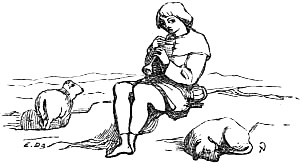
Travelling along, a favourite of the Muse,—
A goatherd, of the name of Lycidas;
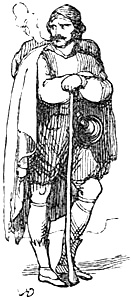
And goatherd well he seem’d; for on his shoulders
Hung a right simple goatskin, hairy and thick,
Smelling as if ’twas new; about his body
Was an old jerkin, tied with platted straw;
And in his hand he bore a crooked stick
Made of wild olive. Placidly he turned,
A little smile parting his kindly lips,
And with a genial eye accosting me,
Said, “Ah, Theocritus! and where go you
At noon, when all the lizards are asleep,
And not a lark but sobers? Is’t a feast
You’re making haste to, or some vintager’s,
That thus you dash the pebbles with your sandals?”
“Lycidas,” answered I, “the world, my friend,
Shepherds, reapers, and all, count you a poet
Of the first pastoral order,—which delights me:
Nevertheless, I hope you see another.
It is a feast we’re going to. Some friends
Keep one to-day to holy Mother Earth,
For gratitude, their garners are so full.
But come;—as we are going the same way,
And love the same good pastime, let’s indulge
Each other’s vein a little; for my lips
Breathe also of the Muse; and people call me
Greatest of living song;—a praise, however,
Of which I am not credulous,—no, by Earth;
For there’s Philetas, and our Samian too,
Whom I no more pretend to have surpass’d,
Than frogs the grasshoppers.”
Well;—we agreed;
And Lycidas, with one of his sweet smiles,
Said, “You must let me give you, when we finish,
This olive-stick, for you have proved yourself
A scion truly from the stock of Jove.
I also hate the builder that pretends
To rival mountain-tops, and just as much
Those dunghill cocks that tear their throats in vain
With trying to outcrow Homer himself!
But come, let us begin, Theocritus.—
Well,—I’ll be first then. Tell me if you like
This little piece, friend, which I hammered out
The other day as I was pacing Ætna.”
Lycidas here commences his recitation of the following verses, which are
in honour of a friend who has gone abroad, and include the Legend of
Comatas:—
“Ageanax, if he forgets me not
His faithful friend, shall safely cross the seas
To Mitylene, both when the south wind,
Warned by the westering Kids,[19] adds wet to wet,
And when Orion dips his sparkling feet.
Let halcyons smooth the billows, and make still
The west wind and the fiercer east, which stirs
The lowest sea-weeds;—halcyons, of all birds
Dear to the blue-eyed Nymphs, and fed by them.
Let all things favour the kind voyager,
And land him safely;—and that day, will I,
Wearing a crown of roses or white violets,
Quaff by my fireside Pteleatic wine;
And some one shall dress beans; and I will have
A noble couch, to lie at ease upon,
Heaped up of asphodel and yielding herbs;
And there I’ll drink in a divine repose,
Calling to mind Ageanax, and drain
With clinging lips the goblet to the dregs:
And there shall be two shepherds to play to me
Upon the pipe; and Tityrus, standing by,
Shall sing how Daphnis was in love with Xenia,
And used to walk the Mountain, while the oaks
Moaned to him on the banks of Himera;
And how he melted in his love away,
Like snows on Athos, or on Rhodope,
Or Hæmus, or the farthest Caucasus;—
And Tityrus shall sing also, how of old
The goatherd by his cruel lord was bound,
And left to die in a great chest; and how
The busy bees, up coming from the meadows
To the sweet cedar, fed him with soft flowers,
Because the Muse had filled his mouth with nectar.
Yes, all those sweets were thine, blessed Comatas
And thou wast put into the chest, and fed
By the blithe bees, and passed a pleasant time.
Would that in my time also thou wert living,
That we might keep our flocks upon the Mountain,
And I might hear thy voice, while thou shouldst lie
Under the oak-trees or the pines, and modulate
Thy pipe deliciously, divine Comatas.”
Here ended he his song, and thus in turn
I took up mine:—“Dear Lycidas, the Nymphs
Have taught me also, while I kept my flocks,
Excellent subjects; and the best of all
I’ll tell you now, since you are dear to them.”
Theocritus here commences his recitation in turn, the subject of which is
an unsuccessful passion of his friend Aratus, supposed to be the
contemporary poet of that name, author of the Phænomena:—
“—’Twas on the unlucky side the Loves sneezed to me,
For I love Myrto, as the goats love spring,
But to no purpose. Meanwhile too, Aratus,
My best of friends, becomes in love with Pholoe.
Aristis has long known it,—good Aristis,
To whom Apollo’s self would not disdain
To play his harp from his own golden seat.—
O Pan, who gained by lot the lovely grounds
Of Homole,—Oh, send her to his arms,
Her, or another girl as beautiful!
Oh, do but so, and the Arcadian youth
Shall scourge thee not with squills, when they have miss’d
Their hunted game:—but if thou dost it not,
Thou shalt be flayed, and sent to sleep in straw:
In mountains and by rivers of the north
Mid winter shalt thou pass; and then in summer
Be changed to utmost Æthiopia, there
To tend thy flocks under the Blemyan rock,
Where thou canst see not Nile.[20]—But you, ye Loves,
With your sweet apple cheeks, leave the moist nooks
Of Hyetis and Byblis and fly up
To Venus’s own heaven, and thence, ah thence,
Shoot with your arrows for me this desir’d one,
Shoot,—since she pities not my friend and guest.
Riper is she than the moist pear; and yet
The women say to her, ‘Alas, alas,
Your flower will wither, Pholoe, on the stalk!’
Come then, Aratus; let us lie no more
At these proud doors, nor wear our feet with journeys;
But let another, if he chooses, start
With sleepless eyes to hear the crowing cock;
And leave such labours to the wrestler Molon.
Care we for nought but comfort: let us seek
Some ancient dame, who, muttering o’er a charm,
Shall keep away from us all things unkindly.”
I ended; and with one of his old smiles,
He gave me his poetic gift, the olive-stick;
And turning to the left, struck off for Pyxa.
We then went on to Phrasidamus’s,—
Eucritus, I, and the good little Amyntas,—
And gladly rested upon deep thick couches
Of lentisk, and of vine-leaves freshly cut.
Above our heads a throng of elms and poplars
Kept stirring; and from out a cave o’ the Nymphs
A sacred runnel, pouring forth, ran gurgling.
Hot in the greenest leaves, labour’d away
Those chatterers the cicadas; the sad tree-frog
Kept his good distance in the thorny bush;
The larks and linnets sang; the stock-dove mourned;
And round the fountain spun the yellow bees:
All things smelt rich of summer, rich of autumn:
Pears were about our feet, and by our side
Apples on apples roll’d; the boughs bent down
To the very earth with loads of damson plums;
And from the casks of wine of four years old,
We broke the corking pitch.—O ye who keep
Parnassus’ top, ye Nymphs of Castaly,
Did ever Chiron, in the rocky cave
Of Pholos, set such goblets before Hercules?
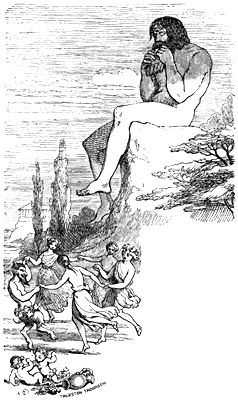
Did ever that old shepherd of Anapus,
Great Polyphemus, who could throw the rocks,
Compose such nectar to go dance withal,—
As on that day ye broached for us, O Nymphs,
Before the altar of Earth’s generous Mother?
Oh, may I riot in her heaps again
With a great winnow; while she stands and smiles,
Holding, in either hand, poppies and wheat.
ELEGY ON THE DEATH OF BION.
(FROM MOSCHUS.)
The chief characteristic both of this Sicilian poet Moschus and his friend
Bion was a tender and elegant sweetness. We have endeavoured to modulate
our version accordingly.
This is the pastoral poetry of books, as distinguished from that of real
life; yet it has a real echo in the minds of those who can pass from one
region to the other; nor is it wanting in some touches exquisitely human,
as we have seen in the famous passage already quoted from the Elegy
respecting the (supposed) difference between the transitory nature of man
and the rejuvenescence of flowers:—
Moan with me, moan, ye woods and Dorian waters,
And weep, ye rivers, the delightful Bion;
Ye plants, now stand in tears; murmur, ye groves;
Ye flowers, sigh forth your odours with sad buds;
Flush deep, ye roses and anemones;
And more than ever now, O hyacinth, show
Your written sorrows;[21]—the sweet singer’s dead.
Raise, raise the dirge, Muses of Sicily.
Ye nightingales, that mourn in the thick leaves,
Tell the Sicilian streams of Arethuse,
Bion the shepherd’s dead; and that with him
Melody’s dead, and gone the Dorian song.
Raise, raise the dirge, Muses of Sicily.
Weep on the waters, ye Strymonian swans,
And utter forth a melancholy song,
Tender as his whose voice was like your own;
And say to the Œagrian girls, and say
To all the nymphs haunting in Bistony,
The Doric Orpheus is departed from us.
Raise, raise the dirge, Muses of Sicily.
No longer pipes he to the charmed herds,
No longer sits under the lonely oaks,
And sings; but to the ears of Pluto now
Tunes his Lethean verse; and so the hills
Are voiceless; and the cows that follow still
Beside the bulls, low and will not be fed.
Raise, raise the dirge, Muses of Sicily.
Apollo, Bion, wept thy sudden fate:
The Satyrs too, and the Priapuses
Dark-veiled, and for that song of thine the Pans,
Groan’d; and the fountain-nymphs within the woods
Mourn’d for thee, melting into tearful waters;
Echo too mourn’d among the rocks that she
Must hush—and imitate thy lips no longer;
Trees and the flowers put off their loveliness;
Milk flows not as ’twas used; and in the hive
The honey moulders,—for there is no need,
Now that thy honey’s gone, to look for more.
Raise, raise the dirge, Muses of Sicily.
Not so the dolphins mourn’d by the salt sea,
Not so the nightingale among the rocks,
Not so the swallow over the far downs,
Not so Ceyx called for his Halcyone,
Not so in the eastern valleys Memnon’s bird
Scream’d o’er his sepulchre for the Morning’s son,
As all have mourned for the departed Bion.
Raise, raise the dirge, Muses of Sicily.
Ye nightingales and swallows every one
Whom he once charm’d and taught to sing at will
Plain to each other midst the green tree boughs
With other birds o’erhead. Mourn too, ye doves.
Raise, raise the dirge, Muses of Sicily.
Who now shall play thy pipe, O most desir’d one!
Who lay his lip against thy reeds? who dare it?
For still they breathe of thee and of thy mouth,
And Echo comes to seek her voices there.
Pan’s be they; and ev’n he shall fear perhaps
To sound them, lest he be not first hereafter.
Raise, raise the dirge, Muses of Sicily.
And Galatea weeps, who loved to hear thee,
Sitting beside thee on the calm sea-shore;
For thou didst play far better than the Cyclops,
And him the fair one shunn’d: but thee, but thee,
She used to look at sweetly from the water.
But now forgetful of the deep, she sits
On the lone sands, and feeds thy herd for thee.
Raise, raise the dirge, Muses of Sicily.
The Muse’s gifts all died with thee, O shepherd,
Men’s admiration, and sweet women’s kisses.
The Loves about thy sepulchre weep sadly,
For Venus loved thee, much more than the kiss
With which of late she kiss’d Adonis, dying.
Thou too, O Meles, sweetest-voiced of rivers,
Thou too hast undergone a second grief;
For Homer first, that sweet mouth of Calliope,
Was taken from thee; and they say thou mournedst
For thy great son with many-sobbing streams,
Filling the far-seen ocean with a voice.
And now, again, thou weepest for a son,
Melting away in misery. Both of them
Were favourites of the fountain-nymphs; one drank
The Pegasean fount, and one his cup
Fill’d out of Arethuse; the former sang
The bright Tyndarid lass, and the great son
Of Thetis, and Atrides Menelaus;
But he, the other, not of wars or tears
Told us, but intermix’d the pipe he play’d
With songs of herds, and as he sung he fed them;
And he made pipes, and milk’d the gentle heifer,
And taught us how to kiss, and cherish’d love
Within his bosom, and was worthy of Venus.
Raise, raise the dirge, Muses of Sicily.
Every renowned city and every town
Mourns for thee, Bion;—Ascra weeps thee more
Than her own Hesiod; the Bœotian woods
Ask not for Pindar so; nor patriot Lesbos
For her Alcæus; nor th’ Ægean isle
Her poet; nor does Paros so wish back
Archilochus; and Mitylene now,
Instead of Sappho’s verses, rings with thine.
All the sweet pastoral poets weep for thee,—
Sicelidas the Samian; Lycidas,
Who used to look so happy; and at Cos,
Philetas; and at Syracuse, Theocritus;
All in their several dialects: and I,
I too, no stranger to the pastoral song,
Sing thee a dirge Ausonian, such as thou
Taughtest thy scholars, honouring us as all
Heirs of the Dorian Muse. Thou didst bequeath
Thy store to others, but to me thy song.
Raise, raise the dirge, Muses of Sicily.
Alas, when mallows in the garden die,
Green parsley, or the crisp luxuriant dill,
They live again, and flower another year;
But we, how great soe’er, or strong, or wise,
When once we die, sleep in the senseless earth
A long, an endless, unawakeable sleep.
Thou too in earth must be laid silently:
But the nymphs please to let the frog sing on;
Nor envy I, for what he sings is worthless.
Raise, raise the dirge, Muses of Sicily.
There came, O Bion, poison to thy mouth,
Thou didst feel poison; how could it approach
Those lips of thine, and not be turn’d to sweet!
Who could be so delightless as to mix it,
Or bid be mix’d, and turn him from thy song!
Raise, raise the dirge, Muses of Sicily.
But justice reaches all;—and thus, meanwhile,
I weep thy fate. And would I could descend
Like Orpheus to the shades, or like Ulysses,
Or Hercules before him: I would go
To Pluto’s house, and see if you sang there,
And hark to what you sang. Play to Prosèrpina
Something Sicilian, some delightful pastoral,
For she once play’d on the Sicilian shores,
The shores of Ætna, and sang Dorian songs,
And so thou wouldst be honour’d; and as Orpheus
For his sweet harping, had his love again,
She would restore thee to our mountains, Bion.
Oh, had I but the power, I, I would do it.
THE SHIP OF HIERO.
“We find an ample but interesting description, in Athenæus, of a
magnificent and prodigious galley, that had twenty benches of rowers,
contained an extraordinary number of persons, and was not only provided
with dreadful means of assault, but with all that could delight the mind,
and charm the sense. Baths of bronze and of Taurominian marble, stables, a
gymnasium, small gardens planted with various trees and watered by pipes,
the twining vine and ivy, a library, and a sun-dial, were all in this
galley. It had three decks; the second of which was inlaid with variegated
mosaic-work, containing the whole history of Homer’s Iliad. Every
necessary for repose by night, and banqueting by day, was provided with a
regal luxury.
“As much timber was brought from the forest of Ætna, for the building of
this galley, as would have sufficed for sixty ordinary galleys. It had
three masts; and, on the upper deck, it was fortified round with a wall,
and eight towers like a citadel. Each of the towers contained four
combatants, completely armed, and two archers. Within, the towers were
provided with missiles and stones, and on the walls stood a kind of
artillery-machine, invented by Archimedes, which threw stones of three
hundred-weight, and a lance twelve ells in length, to the distance of a
stadium, or six hundred feet.
“Each side of the wall was provided with sixty young men, well armed; and
there were shooters even in the mast-cages.[22] Round the upper deck was
an iron rim; where there were machines placed which would act immediately
against an enemy’s ship, hold it fast, and draw it to the galley. A tree
sufficiently large for the mainmast was long sought for in vain, till a
hog-driver found one in Brettia, or Bruttium, the present South
Calabria. The lower deck could be pumped by a single man, with the aid of
a machine which the Greeks called κοχλίον, the Latins cochlea, and which
we, after its inventor, name the screw of Archimedes.
“When the wonderful work was completed, it was discovered that some of the
havens of Hiero would not contain it, and that in others it was not safe.
Hiero therefore sent the galley to King Ptolemy (Ptolomæus Philadelphus,
I suppose), as a present, to Alexandria.
“You will pardon me this borrowed but abbreviated description, taken from
Athenæus, as it appears to me not only interesting in itself, but usefully
instructive to those who have formed no just idea of the mechanics of the
ancients. To such persons, I recommend the chapter in Athenæus which
contains this description, as well as others, in which greater ships of
the Ptolemies are described; and of one which was built by Ptolomæus
Philopater, that, rowers and warriors included, could contain seven
thousand men.”—Stolberg’s Travels through Germany, Switzerland, Italy,
and Sicily (translated by Holcroft), vol. iv. p. 177.
SERENADES IN SICILY AND NAPLES.
“We reached Alcamo in the evening; a well-built town, that contains above
8,000 inhabitants. It was built in the year 828, on the fruitful hill
Bonifacio, by the Saracen Adalcamo, or Halcamo, who came from
Africa; but its site was removed by the Emperor Frederick the Second to
the plain in which it now stands.
“Alcamo boasts of having produced famous men; and, among others, Ciullo
del Camo, who is generally called Vincentio di Alcamo. He was the
contemporary of Frederick the Second, and is supposed by some to be the
first who wrote poetry in the Italian language; at least, he was one of
the first Italian poets. As it was Sunday, we were not surprised to see a
great part of the inhabitants tumultuously crowding the streets, for this
is a custom through all Italy. They begin on the Saturday evening, after
the labour of the week is over, to collect in the market-places and
streets. He who should be unacquainted with their manners, would imagine
that some extraordinary event or insurrection had caused them to assemble;
for they usually speak all together, with loud voices, rapid articulation,
and animated gestures. In the midst of their violent contentions, you
every moment expect they will seize each other by the throat, and are
agreeably surprised to hear them end in a loud laugh.
“Thus it was at Alcamo, where the streets seemed to be in an uproar till
after midnight, when singing and music began; yet, as early as three in
the morning, the people were going about, crying aloud the bread and meat,
which they sold to the workmen that were preparing for their labour in the
fields. The Sicilians, like the Italians, need but little sleep, and
willingly part with that little for any diversion; hence the custom of
serenading ever has and ever will prevail. Horace, in the ninth ode of his
first book, speaks of the serenades of his days. He has been, hitherto,
misinterpreted by some commentators; and, although the manners of the
south of Italy and of Sicily might have pointed out what the poet intended
to describe, yet I should probably still have misunderstood him, if a
lucky accident had not informed me of the true meaning of the verse.
“A volume of the Gazette Littéraire de l’Europe fell into my hands at
Naples, a journal which gave extracts from the commentator, Abbate
Galiana, a writer who died some years ago at Naples, a man of
understanding, and famous for his numerous works. I do not believe that
the whole of his commentary has yet been made public.
“The ode of which I am speaking begins—
‘Vides ut alta stet nive candidum
Soracte.’
—Horace, 1. i. Od. 9.
‘Behold Soracte’s airy height,
Made heavy with a weight of snow.’
—Francis.
“The verses
‘Lenesque sub noctem susurri
Composita repetantur hora.’
‘An assignation sweetly made,
With gentle whispers in the dark.’
—Francis.
have generally been understood as if the poet spoke of social friends who
met together in the evening. But why should they speak in whispers? And
why at an appointed hour? Is not the unexpected visit of a friend often
the most pleasant?
“Others came nearer to the meaning, without attaining it. They supposed
the poet had spoken of two lovers conversing together. Let us hear our
acute Neapolitan.
“‘These lenes susurri,’ says Galiana, ‘are not the soft whispers of two
lovers; they are serenades. To elucidate my meaning, it will be necessary
for me to enlarge a little on the manners of the ancient Romans—manners
which are still preserved in the lower parts of Italy, Spain, and the
East. Love, that ever powerful, but ever hypocritical passion, suffers
itself to be fettered and constrained as long as it can endure; but when
it gathers sufficient strength, it breaks its chains and recovers its
freedom. In Spain and Italy, where the climate will permit, the lover
declares his passion in the street and at the windows. In France and
Germany, where the winds are more rude, love is obliged to open the door,
and tell his tale by the fire-side. In the country of Horace, the door was
impassable and the house considered as sacred, particularly if it
contained a young maiden that was marriageable.
“‘But let us not deceive ourselves: neither Arab nor Turk first introduced
the jealousy of the seraglio to Greece and Asia. The custom is much older;
it is attached to the soil, it still exists in Italy, or rather did exist,
till, at the end of the last century, French manners prevailed all over
Italy. In the south, however, this ancient custom still remains in full
force;[23] the doors there are yet impassable to lovers. Watched as they
are in Turkey, the girls spend a great part of their time at the window,
especially by night, listening to the songs which the lovers sing in a low
voice, that they may not disturb the neighbourhood. The maiden conceals
the light of her chamber, and her lover only knows that she is present by
her soft whispers which he hears from the balcony. I have a thousand times
witnessed the scenes which Horace describes. On a sudden the girl is
silent, and returns no more answers to the discourse of her lover, who,
being in the dark, knows not whether she still listens or is gone. He
speaks again, again waits to hear, and at last receiving no reply, is
persuaded that his beloved is retired to rest; or that, frightened by a
noise in her mother’s chamber, she has thrown herself under the
bed-clothes and counterfeited sleep.
“‘These accidents of fright are so common that the lover is not astonished
if he be suddenly left in the middle of his nightly colloquy. Dejected, he
puts his mandoline in its case, and is about to be gone, when, in an
instant, his young mistress, who had retired to a corner of her chamber,
gives a loud laugh to inform him that she still listens, and that she had
only been sportively playing him a trick. Overjoyed, enraptured, he
returns, and again begins his amorous endless tale.
“‘This agrees with the description of Horace:—
“Nunc et latentis proditor intimo
Gratus puellæ risus ab angulo:
Pignusque dereptum lacertis,
Aut digito male pertinaci.”
“The laugh that from the corner flies,
The sportive fair one shall betray;
Then boldly snatch the joyful prize,
A ring or bracelet tear away:
While she, not too severely coy,
Struggling shall yield the willing toy.”
—Francis.
“‘In the last two lines, Horace gives us a picture of what happens at a
house door. In Italy the young girls are permitted to step to the door for
a moment, especially at the beginning of night. The lover is careful to
pass and repass, that he may catch the instant in which he may remind his
mistress of the hour of their nightly meetings, press her to observe her
promise, and endeavour to obtain a token. The last is generally no more
than a pretext that he may squeeze her hand, and take a ring from her
finger which is weakly defended.’
“Thus far Galiana, and I have no difficulty in admitting that the two last
lines explain what actually happens. The girl has played tricks with and
laughed at her lover; and, being inclined to be reconciled, runs down to
the house door. She quarrels with him only for the pleasure of making it
up. Our vetturino, a lively young man, who has several times travelled
over all Sicily, was not so weary by riding in the heat, but that he
willingly touched the strings of his instrument nightly before many a
window.”—Stolberg’s Travels, vol. iii. p. 447.
SICILIAN BANDITTI IN THE YEAR 1770.
“We are just returned from the prince’s” (the Prince of Villafranca).[24]
“He received us politely, but with a good deal of state. He offered us the
use of his carriages, as there are none to be hired; and, in the usual
style, begged to know in what he could be of service to us. We told him
(with an apology for our abrupt departure) that we were obliged to set off
to-morrow, and begged his protection on our journey. He replied that he
would immediately give orders for guards to attend us, that should be
answerable for everything; that we need give ourselves no further trouble;
that whatever number of mules we had occasion for should be ready at the
door of the inn, at any hour we should think proper to appoint. He added
that we might entirely rely on these guards, who were people of the most
determined resolution, as well as of the most approved confidence, and
would not fail to chastise on the spot any person that should presume to
impose upon us.
“Now, who do you think these trusty and well-beloved guards are composed
of? Why, of the most daring and most hardened villains, perhaps, that are
to be met with upon earth, who, in any other country, would have been
broken upon the wheel, or hung in chains, but are here publicly protected,
and universally feared and respected. It was this part of the police of
Sicily that I was afraid to give you an account of. However, I have now
conversed with the prince’s people on the subject, and they have confirmed
every circumstance that Mr. Maestre made me acquainted with.
“He told me, that in this east part of the island, called Val Demoni, from
the devils that are supposed to inhabit Mount Ætna, it has ever been found
altogether impracticable to extirpate the banditti; there being
numberless caverns and subterraneous passages around that mountain, where
no troops could possibly pursue them. That, besides, as they are known to
be perfectly determined and resolute, never failing to take a dreadful
revenge on all who have offended them, the Prince of Villafranca has
embraced it, not only as the safest, but likewise as the wisest and most
political scheme, to become their declared patron and protector. And such
of them as think proper to leave their mountains and forests, though
perhaps only for a time, are sure to meet with good encouragement, and a
certain protection in his service, where they enjoy the most unbounded
confidence, which, in no instance, they have ever yet been found to make
an improper or a dishonest use of. They are clothed in the prince’s
livery, yellow and green, with silver lace, and wear likewise a badge of
their honourable order, which entitles them to universal fear and respect
from the people.
“I have just been interrupted by an upper servant of the prince’s, who,
both by his looks and language, seems to be of the same worthy fraternity.
He tells us, that he has ordered our muleteers, at their peril, to be
ready by daybreak; but that we need not go till we think proper: for it is
their business to attend on nostre eccellenze. He says he has likewise
ordered two of the most desperate fellows in the whole island to accompany
us; adding, in a sort of whisper, that we need be under no apprehension,
for that if any person should presume to impose upon us a single
baiocc,[25] they would certainly put him to death. I gave him an
ounce,[26] which I knew was what he expected, on which he redoubled his
bows, and his eccellenzas, and declared we were the most honorabili
Signori he had ever met with, and that, if we pleased, he himself should
have the honour of attending us, and would chastise any person that should
dare to take the wall of us, or injure us in the most minute trifle. We
thanked him for his zeal, showing him we had swords of our own. On which,
bowing respectfully, he retired.
“I can now, with more assurance, give you some account of the conversation
I had with Signor Maestre, who seems to be a very intelligent man, and has
resided here for these great many years.
“He says that in some circumstances these banditti are the most
respectable people of the island; and have by much the highest and most
romantic notions of what they call their point of honour. That, however
criminal they may be with regard to society in general, yet, with respect
to one another, and to every person to whom they have once professed it,
they have ever maintained the most unshaken fidelity. The magistrates have
often been obliged to protect them, and pay them court, as they are known
to be perfectly determined and desperate, and so extremely vindictive,
that they will certainly put any person to death that has ever given them
just cause of provocation. On the other hand, it never was known that any
person who had put himself under their protection, and showed that he had
confidence in them, had cause to repent of it, or was injured by any of
them, in the most minute trifle; but on the contrary, they will protect
him from impositions of every kind, and scorn to go halves with the
landlord, like most other conductors and travelling servants; and will
defend him with their lives, if there is occasion: that those of their
number who have thus enlisted themselves in the service of society, are
known and respected by the other banditti all over the island; and the
persons of those they accompany are ever held sacred. For these reasons,
most travellers choose to hire a couple of them from town to town; and may
thus travel over the whole island in safety. To illustrate their character
the more, he added two stories, which happened but a few days ago, and are
still in everybody’s mouth.
“A number of people were found digging in a place where some treasure was
supposed to have been hid during the plague. As this has been forbid
under the most severe penalties, they were immediately carried to prison,
and expected to have been treated without mercy; but, luckily for the
others, one of these heroes happened to be of the number. He immediately
wrote to the Prince of Villafranca, and made use of such powerful
arguments in their favour, that they were all immediately set at liberty.
“This will serve to show their consequence with the civil power. The other
story will give you a strong idea of their barbarous ferocity, and the
horrid mixture of stubborn vice and virtue (if I may call it by that name)
that seems to direct their actions. I should have mentioned, that they
have a practice of borrowing money from the country people, who never dare
refuse them; and if they promise to pay it, they have ever been found
punctual and exact, both as to the time and the sum; and would much rather
rob and murder an innocent person, than fail of payment on the day
appointed. And this they have often been obliged to do, only in order, as
they say, to fulfil their engagements, and to save their honour.
“It happened within this fortnight that the brother of one of these heroic
banditti having occasion for money, and not knowing how to procure it,
determined to make use of his brother’s name and authority, an artifice
which he thought could not easily be discovered; accordingly he went to a
country priest, and told him his brother had occasion for twenty ducats,
which he desired he would immediately lend him. The priest assured him
that he had not so large a sum, but that if he would return in a few days
it should be ready for him. The other replied that he was afraid to return
to his brother with this answer, and desired that he would by all means
take care to keep out of his way—at least till such time as he had
pacified him, otherwise he could not be answerable for the consequences.
As bad fortune would have it, the very next day the priest and the robber
met in a narrow road; the former fell a-trembling as the latter
approached, and at last dropped on his knees to beg for mercy. The robber,
astonished at this behaviour, desired to know the cause of it. The
trembling priest answered, ‘Il denaro, il denaro. The money—the money;
but send your brother to-morrow, and you shall have it.’ The haughty
robber assured him that he disdained taking money of a poor priest;
adding, that if any of his brothers had been low enough to make such a
demand, he himself was ready to advance the sum. The priest acquainted him
with the visit he had received the preceding night from his brother, by
his order, assuring him, that if he had been master of the sum, he should
immediately have supplied it. ‘Well,’ says the robber, ‘I will now
convince you whether my brother or I are most to be believed; you shall go
with me to his house, which is but a few miles distant.’ On their arrival
before the door the robber called on his brother, who, never suspecting
the discovery, immediately came to the balcony; but on perceiving the
priest he began to make excuses for his conduct. The robber told him there
was no excuse to be made, that he only desired to know the fact, if he had
gone to borrow money of that priest in his name or not? On his owning it,
the robber with deliberate coolness lifted his blunderbuss to his shoulder
and shot him dead, and turning to the astonished priest, ‘You will now be
persuaded,’ said he, ‘that I had no intention of robbing you at least.’
“You may now judge how happy we must be in company of our guards. I don’t
know but this very hero may be one of them.”—Brydone’s Tour through
Sicily and Malta, vol. i. (first edition), p. 67.
GOOD-NATURED HOSPITALITY, AND FACETIOUS IGNORANT OLD GENTLEMAN.
(CHRISTMAS DAY, 1777.)
“Having spent the best part of the day in examining, measuring, and
drawing this noble building, I hastened back to Calatafimi, as eager for
refreshment as I had been in the morning for antiquities. I found the best
fare provided for me the place could afford; the lodging, however, was
old, crazy, and cold, but the owners so civil and attentive that it was
impossible to complain of any inconveniences; the master of the house was
a notary, and his wife one of the prettiest women I had yet seen in
Sicily. I was afterwards distressed beyond measure to learn that they had
not suffered my man to pay for the least thing, and had sitten up all
night to accommodate us with beds. To enliven the evening conversation
they invited the principal people of the town with their wives, who were
very free and sociable; this rather surprised me, as many travellers, and
those very modern ones, tell us that the Sicilians are so jealous and
severe to their wives that they never suffer them to come into the company
of strangers, much less to join in conversation with them. I suspect these
persons have copied authors who wrote in times when such mistrust reigned
more than it does at present, or have formed general inductions from
partial evidence. There seems to be very little constraint laid upon the
intercourse of the two sexes among the nobility at Palermo, and none among
my visitors at Calatafimi, people of a lower class; the observation,
therefore, does not hold good in every instance. The assembly was very
attentive to all my words and motions, that they might anticipate my
wishes and save me trouble; but their civility was of an unpolished kind.
I was frequently the subject of their discourse, and those that knew
anything about me, either from the archbishop’s letter or from my
servants, communicated their knowledge aloud to every new-comer, as if I
were deaf or did not understand their language. An old gentleman, the wit
of the circle, put many questions to me, and in return acquainted me with
the politics and scandal of the town. He was possessed of great
cheerfulness and native humour, but so totally ignorant of every thing and
place beyond the limits of Sicily, that I never could make him comprehend
where England is situated, or how circumstanced with regard to its
colonies, of which he has learned something from the gazettes. Finding my
answers to his questions were incapable of conveying instruction, I gave
myself no farther trouble, but suffered him without interruption to smoke
his pipe, and in the intervals of his puffing to run on in a long string
of stories, confounding times, names, places, and persons, in so
ridiculous a manner, that the most inflexible features must have been
betrayed into a smile: fortunately he took my laugh for a compliment, and
joined very heartily in it.”—Swinburne’s Travels in the Two Sicilies,
vol. iii p. 357.
SPECIMEN OF HIGHER SOCIETY.
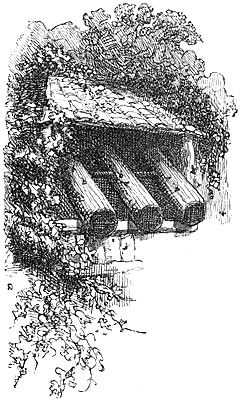
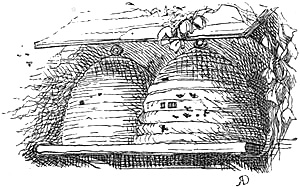
“Wild honey is found in great abundance in these woods” (between Terranova
and Calatagerone), “but the inhabitants have also hives near their houses;
its flavour is delicious, and has been celebrated from the remotest
antiquity, for Hybla was situated in the centre of this country. Men may
degenerate, may forget the arts by which they acquired renown;
manufactures may fail, and commodities be debased; but the sweets of the
wild-flowers of the wilderness, the industry and natural mechanics of the
bee, will continue without change or derogation. From the quality of soil,
and the want of water, this upper part of the province must always have
had a great deal of waste land.
“The corn wore the most promising appearance: the fallow land seemed to be
excellent soil. Twenty-three pair of oxen were ploughing together within a
square of thirty acres.
“Beyond the town we entered a very fine tract of vineyards, which improved
as we gradually approached the mountains of Calatagerone.
“Calatagerone, a royal city, containing about 17,000 inhabitants, living
by agriculture and the making of potter’s ware, is twenty miles from the
sea, and situated on the summit of a very high, insulated hill, embosomed
in thick groves of cypresses; the road to it, though paved, is very steep,
difficult, and dangerous for anything but a mule or an ass. I was
conducted to the college of the late Jesuits; and as the house was
completely stripped of furniture, full of dirt and cobwebs, I apprehended
my night’s lodgings would be but indifferent. The servant belonging to the
gentleman who has the management of this forfeited estate, and to whom I
had brought a letter requesting a lodging in the college, perceiving the
difficulties we lay under in making our settlement, ran home, and returned
in a short time with a polite invitation to his master’s house. There was
no refusing such an offer, though I was far from expecting anything beyond
a comfortable apartment and homely fare in a family settled among the
inland mountains of Sicily; but, to my great surprise, I found the house
of the Baron of Rosabia large, convenient, and fitted up in a modern taste
with furniture that would be deemed elegant in any capital city in Europe.
Everything suited this outward show, attendance, table, plate, and
equipage. The baron and his lady having both travelled and seen a great
deal of the world, had returned to settle in their native city, where they
assured me I might find many families equally improved by an acquaintance
with the manners of foreign countries, or at least a frequentation of the
best company in their own metropolis. Nothing could be more easy and
polite than their address and conversation, and my astonishment was hourly
increasing during my whole stay. After I had refreshed myself with a short
but excellent meal, they took me out in a very handsome coach. It was a
singular circumstance to meet a string of carriages full of well-dressed
ladies and gentlemen on the summit of a mountain which no vehicle can
ascend, unless it be previously taken to pieces and placed upon the back
of mules. We seemed to be seated among the clouds. As the vast expanse of
the hills and vales grew dim with the evening vapours, our parading
resembled the amusements of the heathen gods in some poems and pictures,
driving about Olympus, and looking down at the mortals below.
“The hour of airing being expired, which consisted of six turns of about
half a mile each, a numerous assembly was formed at the baron’s house; the
manners of the company were extremely polished, and the French language
familiar to the greatest part of it. When the card-tables were removed, a
handsome supper, dressed by a French cook, was served up, with excellent
foreign and Sicilian wines; the conversation took a lively turn, and was
well supported till midnight, when we all retired to rest. Calatagerone
has several houses that live in the same elegant style, and its
inhabitants have the reputation of being the politest people in the
island.”—Swinburne’s Travels, vol. iii. p. 337.
POETICAL TURN OF THE SICILIANS.
“Next to the lava-labours of Ætna, nothing has struck me more in this
beautiful island than the poetical turn of the people. Theocritus was
the father of Idylls; and Virgil is always appealing to the ‘Sicelides
Musæ.’ I suspect the experience detailed in his Georgics, his most
perfect work, was most mainly drawn from hence. The words ‘Calabri
rapuêre’ in the epitaph attributed to him for his own tomb, whether they
were really his or no, prove, by inference, that he was close opposite
this coast at the most observant period of life; and no doubt he crossed
over. Dante allows that the first Italian effusions in playful satire
were termed ‘Siciliani.’ Even Petrarch savours of Trinacria. The speech
of the inhabitants is to this day rather poetical than prosaic, abounding
in lively images and picturesque modes of expression. The studied cringing
so common in Naples is rare here: during a stay of six weeks in the
island, I have only twice heard the title ‘Cellenza,’ which is
everlastingly ringing in your ears in the metropolis. Their similitudes
are endless, and sometimes very striking. In Florence you will hear ‘Bello
come il campanile’ (‘as handsome as the belfry,’—built by Giotto): but
here, if a lady is fair, she is ‘una candela di cera’ (‘a wax taper’); if
too languid, ‘ha un viso come un pesce bollito’ (‘has a face like a boiled
fish’); gentlemen who sit sluggishly on their mules instead of springing
off to aid the weaker sex up the hill, are designated as ‘pezzi di lava’
(‘lumps of lava’). If a little girl has anything remarkable about her, ‘E
molto simpatica, una cosa particolare’ (‘She is very sympathetic;—a
special sort of thing’). ‘Buscar qualche cosa’ (‘to look for something’),
I am sorry to say, has here, as in Ischia, the double meaning, either to
earn a carline or steal it, as the case may be. Their humour is never
richer than when shown in describing their own peculiarities of
character.”—Notes from a Journal kept in Italy and Sicily, by J. F.
Francis, B.A.
A MEETING OF ENGLISH AND SICILIAN DISHES ON CHRISTMAS DAY.
“We paid a visit to Messina a week ago, where we had the pleasure of being
wind-bound on Christmas day. In merry England on Christmas day people eat
roast beef and plum-pudding, turkeys and mince-pies. You may eat most of
these here also, but the special dish in honour of the ‘Natività’ is
capitoni, enormous eels, stewed in a rich sauce. Indeed there was an
unusual supply, for a shipload of them, intended for the Naples market,
could not leave port in time owing to the gale, and thus the speculator, a
sea-captain, was fain to get rid of them in Messina at half-price. Now I
can only say they are very good; but we took the precaution of having
another string to our bow, in shape of a respectable roast joint of beef,
and a real, good, English-looking plum-pudding. After that it is very hard
if we are left for the year of grace ‘eighteen forty-six’ without
Victoria’s bonny face in our purse.”—Francis’ Notes, p. 240.
THE END.
LONDON: PRINTED BY
SPOTTISWOODE AND CO., NEW-STREET SQUARE
AND PARLIAMENT STREET
SMITH, ELDER, & CO.’S POPULAR LIBRARY.
Fcp. 8vo. Limp Cloth.
By the Sisters BRONTË.
2s. 6d. each.
JANE EYRE. By Charlotte Brontë.
SHIRLEY. By Charlotte Brontë.
VILLETTE. By Charlotte Brontë.
THE TENANT OF WILDFELL HALL. By Anne Brontë.
WUTHERING HEIGHTS. By Emily Brontë. AGNES GREY. By Anne Brontë. With
Preface and Memoir of the Sisters, by Charlotte Brontë.
THE PROFESSOR. By Charlotte Brontë. To which are added the Poems of
Charlotte, Emily, and Anne Brontë.
By Mrs. GASKELL.
2s. 6d. each.
RUTH.
SYLVIA’S LOVERS.
WIVES AND DAUGHTERS.
MARY BARTON.
NORTH AND SOUTH.
LIFE OF CHARLOTTE BRONTË.
MY LADY LUDLOW, and other Tales included in ‘ROUND THE SOFA.’
By LEIGH HUNT.
2s. 6d. each.
IMAGINATION AND FANCY; or, Selections from the English Poets.
THE TOWN: Its Memorable Characters and Events. Illustrated.
AUTOBIOGRAPHY OF LEIGH HUNT.
MEN, WOMEN, AND BOOKS; a Selection of Sketches, Essays, and Critical
Memoirs.
WIT AND HUMOUR: Selected from the English Poets.
A JAR OF HONEY FROM MOUNT HYBLA; or, Sweets from Sicily in Particular;
and Pastoral Poetry in General.
TABLE TALK. To which are added IMAGINARY CONVERSATIONS OF POPE AND
SWIFT.
Uniform with the above, 2s. 6d. each.
THE SMALL HOUSE AT ALLINGTON. By Anthony Trollope.
THE CLAVERINGS. By Anthony Trollope.
FRAMLEY PARSONAGE. By Anthony Trollope.
ROMOLA. By George Eliot.
BELOW THE SURFACE. By Sir A. H. Elton, Bart.
TRANSFORMATION. By Nathaniel Hawthorne.
DEERBROOK. By Harriet Martineau.
HOUSEHOLD EDUCATION. By Harriet Martineau.
AUTOBIOGRAPHY OF LUTFULLAH.
LECTURES ON THE ENGLISH HUMOURISTS OF THE EIGHTEENTH CENTURY. By W. M.
Thackeray.
THE FOUR GEORGES. With Illustrations by the Author. By W. M.
Thackeray.
PAUL THE POPE AND PAUL THE FRIAR. By T. A. Trollope.
THE ROSE-GARDEN. By the Author of ‘Unawares.’
CHRONICLES OF DUSTYPORE. A Tale of Modern Anglo-Indian Society. By the
Author of ‘Wheat and Tares.’
IN THE SILVER AGE. By Holme Lee.
Pictorial Covers, price Two Shillings each.
By WILKIE COLLINS.
NO NAME. AFTER DARK. ARMADALE.
⁂ The above may also be had in Limp Cloth, price 2s. 6d. each.
By the Author of ‘JOHN HALIFAX, GENTLEMAN.’
ROMANTIC TALES. DOMESTIC STORIES.
By HOLME LEE.
AGAINST WIND AND TIDE.
SYLVAN HOLT’S DAUGHTER.
KATHIE BRANDE.
WARP AND WOOF.
ANNIS WARLEIGH’S FORTUNES.
THE WORTLEBANK DIARY.
BASIL GODFREY’S CAPRICE.
MAUDE TALBOT.
COUNTRY STORIES.
KATHERINE’S TRIAL.
MR. WYNYARD’S WARD.
THE BEAUTIFUL MISS BARRINGTON.
By Captain GRONOW.
RECOLLECTIONS AND ANECDOTES OF THE CAMP, THE COURT, AND THE CLUBS.
ANECDOTES OF CELEBRITIES OF LONDON AND PARIS. To which are added LAST
RECOLLECTIONS OF THE CAMP, THE COURT, AND THE CLUBS.
Uniform with the above.
GRASP YOUR NETTLE. By E. Lynn Linton.
AGNES OF SORRENTO. By Mrs. H. B. Stowe.
TALES OF THE COLONIES; or, Adventures of an Emigrant. By C. Rowcroft.
LAVINIA. By the Author of ‘Dr. Antonio’ and ‘Lorenzo Benoni.’
THE MOORS AND THE FENS. By Mrs. J. H. Riddell.
HESTER KIRTON. By Katharine S. Macquoid.
BY THE SEA. By Katharine S. Macquoid.
THE HÔTEL DU PETIT ST. JEAN.
VERA. By the Author of ‘The Hôtel du Petit St. Jean.’
IN THAT STATE OF LIFE. By Hamilton Aïdé.
MORALS AND MYSTERIES. By Hamilton Aïdé.
MR. AND MRS. FAULCONBRIDGE. By Hamilton Aïdé.
SIX MONTHS HENCE. By the Author of ‘Behind the Veil,’ &c.
THE STORY OF THE PLÉBISCITE. By MM. Erckmann-Chatrian.
THE CONSCRIPT and WATERLOO. By MM. Erckmann-Chatrian. In one volume.
GABRIEL DENVER. By Oliver Madox Brown.
TAKE CARE WHOM YOU TRUST. By Compton Reade.
PEARL AND EMERALD. By R. E. Francillon.
ISEULTE. By the Author of ‘The Hôtel du Petit St. Jean.’
PENRUDDOCKE. By Hamilton Aïdé.
A GARDEN OF WOMEN. By Sarah Tytler.
BRIGADIER FREDERIC. By MM. Erckmann-Chatrian.
MOLLY BAWN. By the Author of ‘Phyllis,’ &c.
MATRIMONY. By W. E. Norris.
PHYLLIS. By the Author of ‘Molly Bawn,’ &c.
MADEMOISELLE DE MERSAC. By W. E. Norris.
London: SMITH, ELDER, & CO., 15 Waterloo Place.
Footnotes:
[1] See that beautiful book, Amadis of Gaul, vol. i. chap. 12, in the
admirable translation by Southey.
[2] There have been writers who concluded that Theocritus did not write
some of these poems, because the style of them differed from that of his
pastorals. “As though” (says Mr. Chapman, his best translator) “the same
poet could not possibly excel in different styles.” But this is the way
the opinions we have alluded to come up. A writer’s powers are turned
against himself, and his very property is to be denied him, because
critics of this kind have brains for nothing but one species of
handicraft. It is lucky for the human being in the abstract, that he is
gifted with tears and smiles; otherwise one or the other of those natural
possessions would assuredly have been called in question. In fact, the
marvel is, not that genius should deal in both, but that it should ever
show itself incapable of either. Exclusive gravity and exclusive levity
are alike a solecism, as far as regards the common source of emotion,
which is sensitiveness to impressions.
[3] ’Αδηφάγον—Literally, insatiably eating, voracious; one who has
never had enough. Observe how the same instinctive phraseology is used
by strong sensations all over the world. The “Fancy” pugilistic, and fancy
poetical, like differently bred relations, thus find themselves, to their
astonishment, of the same family; so the like metaphors of “flashing one’s
ivories” (for suddenly showing the teeth), “tapping the claret,” and other
jovial escapes from vulgarity into elegance.
[4] An epithet applied by the Sicilians to Proserpine.
[5] The Greek Pastoral Poets, Theocritus, Bion, and Moschus, done into
English by M. J. Chapman, M.A., of Trinity College, Cambridge, pp. 7,
331.—We like the good faith of Mr. Chapman’s “done into English.”
[6] Perhaps from a Greek root, expressing carelessness or quiet.
[7] Travels through Germany, Switzerland, Italy, &c. Translated by
Holcroft, vol. iv. p. 298.
[8] Quoted in Evans’s Classic and Connoisseur in Italy and Sicily, vol.
ii. p. 358.
[9] Swinburne’s Travels in the Two Sicilies, vol. iv. p. 148.
[10] Voyage Critique à l’Ætna, tom. i. p. 529.
[11] Vide the Letters appended to a View of the Present State of Italy,
translated from the Italian, by Thomas Wright Vaughan, Esq., p. 70.
[12] “Olives and bread form the principal part of the food of the lower
classes in Sicily, and oil is a necessary of life.”
[13] “About equivalent to ‘zounds’ and ‘gadzooks.’”
[14] View of Italy, ut supra, p. 79.
[15] It is calculated that 40,000 souls perished in this convulsion. In
the greatest of all the Sicilian earthquakes, that of 1693, the earth
shook but four minutes, and overthrew almost all the towns on the eastern
side of the island.
[16] “Prettily pilfered,” says Lamb, “from the sweet passage in the
Midsummer Night’s Dream, where Helena recounts to Hermia their
school-days’ friendship:—
‘We, Hermia, like two artificial gods,
Created with our needles both one flower,
Both on one sampler, sitting on one cushion.’”
[17] Why does not Mr. Edward Holmes do it? or Mr. Chorley? We have heard
that M. Berlioz has some such work in hand, with a translation of which
his friends are to favour the public. Such a production, if copious, might
form an epoch in the critical history of the art. We hope a time will come
when music will be as freely quoted in books as poetry is.
[18] See a pleasant allusion to this charge by Theocritus himself, at page
84 of the present book, where Praxinoe disburses a quantity of a’s.
[19] The constellation so called.
[20] This sample, strange as it may appear, of the familiarity which
breeds contempt, even towards objects of worship, and which Theocritus
must have smiled while he was describing, has not been confined to
Paganism.
[21] Alluding to the letters AI, which simply signifies “Alas,” and which
are to be found (so to speak) in the dark lines or specks observable in
the petals of the Turk’s-cap Lily; which Professor Martyn has shown to be
the true hyacinth of the ancients.
[22] Similar perhaps to the Top, or Round-top, of a man-of-war.—Note by
the Translator.
[23] “This extreme restraint originates in a mistrust of women, and the
ill opinion which prevails of the sex. A prudent and chaste education
honours and ennobles the fair, who are most injuriously debased by
oriental confinement. The German and English women are the most virtuous
of their sex. Nowhere are unmarried women so innocent, or the married so
happy. Nowhere are wives so honoured, and so full of worth, as among the
Germans and the English. Neither have our women that cold reserve which is
frequently the lot of an Englishwoman. What Galiana says of the hypocrisy
of love is in part explained by the text, and in part must be understood
only of this passion in the South.”
[24] Probably the one mentioned in the list of Meli’s subscribers.
[25] A small coin.
[26] About eleven shillings.