THE SHOPPER-ROON
Of course Aunt Milly kept us waiting. There
is no telling what rite she performed in her cabin
in preparation for the momentous occasion of
chaperoning. We were all seated in the boats
waiting, the lunch stowed carefully in the locker
of the launch and the bathing suits tucked under
the seats, when Willie came racing up in a light
red-wheeled buggy, one side so bent down with
Aunt Milly's great weight that the springs were
touching.
"Gawd pertec' me!" she prayed as Harvie
and Zebedee between them handed her into the
launch. The little craft did some perceptible
sinking with the extra load and had to be
lightened a bit.
"Sleepy, you had better get out," teased
Rags.
Poor Sleepy had been having a strenuous week
trying to monopolize Annie Pore. This was a
difficult thing to do, as Annie seemed to attract
the male sex willy nilly. She had no idea of
flirting and never meant to hurt anyone, but
there was something about her that appealed to
the masculine element irresistibly. Wherever
she went she made conquests by a certain clinging
vine attitude she had towards the whole
world. Mere man likes to be looked upon as a
protector and Annie's timidity was meat and
drink to his vanity. George Massie, alias
Sleepy, was her slave; Harvie Price thought he
looked upon her as a little sister, but I have never
yet seen a big brother quite so anxious for the
comfort of nothing but a sister; Jack Bennett
seemed to find her very attractive and divided his
allegiance between her and Dee; nothing but his
loyalty to Sleepy kept Ben Raglan from entering
the lists for the favor of the little English
maid. He occasionally teased poor Sleepy, but
that young giant never did know what I knew:
that Rags really cared for Annie.
Sleepy, knowing that the launch was the safest
place in which to embark for a picnic and understanding
how timid Annie was and how poor a
swimmer, had ensconced her in that vessel in a
protected spot, and had found a place at her feet
where he could look up into her pretty face.
"Me get out? Get out yourself!" he cried indignantly.
"But it is not quality they want out but quantity,"
answered Rags. "You and Aunt Milly,
being in the same boat, can't ride in the same
boat."
Now George Massie was not really fat, but
because of his great bulk he was usually thought
of as being so. Certainly his bones were well
covered but his muscles were hard as iron. What
fat was there was well hammered down. He
must have weighed at that time at least two hundred
and twenty pounds, but then his six feet two
inches could carry a good many pounds. He
was cursed with money if ever a young man was.
His father was very wealthy and George had
never been denied a single thing in all his life.
His principal ambition had been to make the
football team at the University and even that had
been granted him,—not because of money but
because of brawn.
He was studying medicine in a desultory way,
taking a year longer to finish his course than the
more ambitious Wink, who was not cursed at all
with money but had unbounded energy and ambition.
Sleepy's friends, and he had many of
those necessary things, all adored him. He was
so honest, so straightforward, so sympathetic.
They deplored his lack of ambition, however. I
used to feel that Sleepy was a lesson to all of the
young men in his set because they realized that
after all too much money often had a softening
effect on character. There seemed to be no especial
use for George Massie to graduate, because
after he got his diploma what difference
would it make whether he got patients or not?
His adoration of Annie Pore had had a good effect
on him, so Jim Hart had told me. The last
year at the University he had done better studying
than he ever had in his life, and his friends
had hopes of his waking up to the fact that the
world might need him, even if he did not need the
world's money in doctor's fees.
"Yes, Sleepy! You'll have to vamoose," insisted
Jack Bennett, trying to squeeze himself
down between George Massie and Annie.
"You are as big as any two other passengers,"
declared Rags.
"If that is the case, then suppose two other
passengers take to the life-boats," suggested
Zebedee. "Come on, Page, you are light and
easy to row and there is a nice little brown boat
waiting for us."
Dum and Billy Somers had already started in
their picturesque red skiff, and Mary Flannagan
and Shorty were well on their way in the canoe.
They had been independent and had not had to
wait while Aunt Milly arrayed herself in all the
glories of a brand new purple calico and bright
plaid head handkerchief.
"All right!" I acquiesced to Mr. Tucker's
proposal.
After we were transferred to the little brown
boat and on our way to Croxton's Ford, he said:
"I am afraid I was selfish to ask you to come
with me. I know I should not have taken you
away from all of your young friends."
"Why, Zebedee! How absurd! You are the
youngest friend I have, much the youngest."
"But you gave a very sad and unenthusiastic
'all right' to my proposition to come by skiff.
Now, didn't you?"
"But it wasn't that I didn't want to come with
you," I declared.
"Perhaps not, but merely that you didn't
want to leave someone else to come with me.
Now fess up, honey!"
"I have nothing to fess up about."
"Well, then, why did you look so crestfallen
when I put it up to you to leave the launch?"
and Zebedee dug his oars in the water with some
viciousness.
"I didn't mean to. I—I——"
"You what?"
"I had a reason for wanting to stay in the
launch."
"Didn't I say so? Who was the reason?"
"It wasn't a who, at all—it was a which."
"A which?" he asked somewhat mystified.
"Yes, a which! If you must know, I wanted
to be under the awning because of my freckled
nose," and I blushed until it hurt. My nose was
a great annoyance to me. It was such a little
nose to get so many freckles on it. The fact that
they disappeared in the winter was but cold comfort
to me.
"But I like freckles," he said quite solemnly,
but his eyes were dancing with amusement.
"But I don't, and it's my nose. You are the
only person who does like 'em."
"Who has been telling you he doesn't like
them?"
"Nobody to my face, or rather to my freckles,
but I heard Jessie Wilcox talking to someone
about me and she called me a speckled beauty,—just
exactly as though I were a trout or a coach
dog or a turkey egg or something. And I know
after this day on the water I'll be a sight."
"Do you care what she says?"
"I care what anybody says."
"Why, little friend, I did not dream you put
so much value on the opinion of others, especially
where mere personal appearance is concerned."
I thought I detected a note of disappointment in
his voice.
"I don't about everything, but one's nose is
mighty close to one, somehow."
"So it is," he laughed, "and I am so sorry to
have been the means of injuring that touchy
member. I can't help feeling kind of happy,
though, that it was the awning you were loath to
leave and not some one of those boys. Here's a
nice linen handkerchief; why don't you tie that
over your nose?"
Mr. Tucker always had the nicest linen handkerchiefs
I ever saw, and he seemed to have clean,
folded ones ready to produce for every emergency.
I accepted his offer and tied it over the
lower part of my face.
"Now you look like a little Turkish lady.
Please say you are glad you came in the little
brown boat," and my boatman shipped his oars
and drifted with the current.
It was a very easy thing to say because I was
very glad. Now that my poor little nose was
protected, I was perfectly happy. I always enjoyed
being with Zebedee. We never talked out
and we seldom had a disagreement; not that we
agreed on every subject by any means, but we
could disagree without having a disagreement.
We talked about everything under the sun from
Shakespeare to the musical glasses. I couldn't
help comparing this boat ride to the one I had
been overpersuaded to take with Wink only a
few days before. We had started out with the
best of intentions on my part to avoid all shoals
in conversation, but before we had been out ten
minutes Wink was gnawing his little moustache
in fury and I was wishing I had stayed on shore.
A row with Wink was sure to end in a row (pronounced
rou).
The launch arrived at Croxton's Ford long before
we did, but we came as fast as the current
allowed, having drifted a good part of the way.
The party had landed and had begun to make the
camp for the day. It was a wonderful spot
chosen for the picnic. A large creek, flowing
into the river, broadened out almost into a lake,
and in the mouth of this creek were innumerable
small islands. Some of them had large trees
growing on them, lovely sandy beaches and strips
of verdure; others were too young to have trees
but were covered with grass. The camp was
pitched on the largest island, right at the mouth
of the creek that afforded a landing for the
launch. There was a famous spring on this island
that was thought by the county people to
have some great curative power. What it cured
you of I don't know, but it tasted too good to be
much good as a medicine, I imagine.
Aunt Milly, who had proven herself to be an
ideal chaperone, having slept during the entire
journey, was now ensconced under a water oak
on a warm sand bank with nothing to do but enjoy
herself. This she did immediately by falling
asleep again.
"Whin I ain't a-wuckin', I's a-sleepin'," she
droned as slumber enfolded her.
Of course the camp fire must be made and potatoes
and corn put to roast and the coffee-pot
filled with the sparkling spring water. The trip
down had made everybody hungry, whether accomplished
without exertion as by those in the
launch; or with the sweat of the brow as by Mary
and Shorty in the canoe, or Dum and Billy Somers
in the red skiff; or with just enough work to
keep the boat in the current which was Zebedee's
and my method of locomotion: one and all were
hungry.
"While dinner is cooking, let's have a swim,"
suggested Harvie. "You girls take this side of
the island for a dressing-room and we'll take the
other. Here are some low willows that make
splendid walls."
Bathing suits were produced and while our
chaperone slumbered and slept, we got into them
and then into the water. Such water! It was
clear and soft, so much more so than the water
of the big river. The bottom was clean sand
with no disturbing rocks and snags. The trees
shaded the place chosen for our swim where the
sloping beach made it safe for the timid close to
shore, but ten yards of perseverance plunged the
bold swimmer into really deep water.
The shouts of joy would have waked the dead
had there been any on the island, but nothing
waked the sleeping Aunt Milly. She had burrowed
down in the unresisting sand almost as
deep as some meteoric stone might have done.
There she lay, having the rest that she deserved
after the "mos' a hun'erd years er cookin'" that
she declared she had served at Maxton.
"This is my island!" cried Dum, swimming
over to a beautiful spot about twenty yards from
camp. She clambered out on the strip of sand
and stood with arms outstretched looking very
handsome, her lithe young figure drawn up to
its full height. "I am monarch of all I survey!
I'm queen of this land!"
"Let me come help you rule," pleaded Billy
Somers, who had followed her.
"I don't need a prime minister just now,
thank you, but you might get in the waiting list."
"Thanks awfully!" and the young Kentuckian
threw himself on the warm sand at her feet.
What nice fellows those Kentuckians were, anyhow!
They were full of life and fun, clean
minded, clear thinking, well-mannered boys.
Dum and Billy were friends from the moment
they met and were usually the ringleaders in
any larks that were started on the house-party.
The strange thing about the friendship was that
they looked alike, so very much alike that I believe
some pioneer ancestor of Billy's must have
come from the Tucker stock.
Billy's hair had a bit more red in it than
Dum's, not much, just enough to make his hair in
the shade about the color Dum's was in the sun.
Their foreheads were identical and their chins
had the same tendency to get square when an
argument was under way. They really looked
quite as much alike as the twins themselves did.
Zebedee declared that Billy made him feel a
hundred years old because he looked so like his
son, if he had ever had one. Billy was about
three years older than the twins, and when we
consider that the twins were born when their
father was only twenty, no wonder the possibility
of a son at seventeen made poor Mr. Tucker
blue.
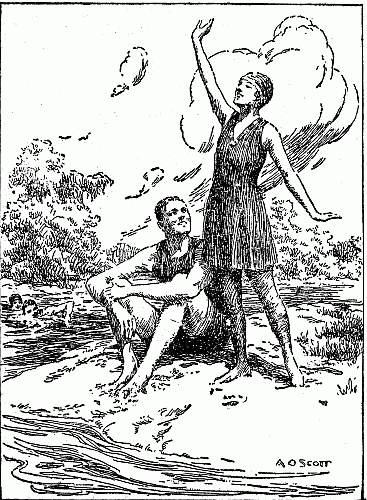 "THIS IS OUR ISLAND AND WE ARE GOING TO PERMIT NO ALIENS TO LAND HERE." Page 178.
"This is our island and we are going to permit
no aliens to land here," called Dum as a challenge
to all of us. "I am Queen Dum and Billy
is General Billdad. We have held counsel and
herewith make the proclamation that there is to
be no immigration to this kingdom."
It took only a moment for us to answer the
challenge. Dee headed the opposing forces,
making a long dive that brought her up almost
on the beach of the little kingdom. Dum was
ready to push her back in the water and kerflop!
she went before Zebedee could come to her aid.
Then ensued such a battle as had not been
fought in the United States since Custer's last
rally.
Of course Dum and Billy had the advantage
of position, but we so far outnumbered them that
it took all of their strength to keep us from landing.
"Mary! Mary! You and Shorty come be our
allies!" called Queen Dum to the couple who
had gone to housekeeping on a small island near
her own. Mary slid into the water like a turtle
and Shorty followed. They landed from the
rear and now the battle raged fiercely.
I know I got pitched back into the water at
least a dozen times. Having learned to swim
only the summer before at Willoughby, I was
not a past master in the art, but I could keep
above water indefinitely, thanks to Zebedee, my
instructor, who had made floating the first requisite.
The odds were in our favor but the vantage
they had in position was well-nigh discouraging
us, when Zebedee and Wink made a flank movement
and landed on the other side of the island,
immediately pushing over the opposing forces
into the foaming torrent and then pulling all of
us onto dry land.
"Victory! Victory!" we shouted; and then
for the first time since the battle began to rage
we remembered our chaperone. She had awakened
and dug herself out of her warm sand nest.
What were her charges up to? It never entered
the old woman's head that we were playing a
game, and I fancy we looked in dead earnest.
When she had dozed off after landing we were
all of us clothed and in our right minds, and
suddenly she awoke to find us anything but
clothed, according to her strict ideas of propriety
among the quality, never having seen girls in
bathing suits; and not only were we in disgraceful
dishabille, but we were engaged in a distressing
brawl.
"My Gawd! My Gawd!" she wailed. "Here
I been a-slumberin' an' sleepin' an' Miss Maria
done tol' me to shopper-roon. I trus'ed de
white folks an' look at 'em!" She covered her
face with her hands and wept aloud.
I fancy we were something to look at. Bathing
caps were off and hair wet and tangled
streaming down our backs. Dee had lost a
stocking in the tussle and Rags had been bereft
of more than half of his shirt, so that his white
back gleamed forth in a most immodest abandon.
Shorty had tapped Harvie on the nose and that
scion of a noble race was bleeding like a stuck
pig. The gore added color to the scene, and had
not Aunt Milly already been certain that this
was a real war we were raging, the blood of her
young master would have convinced her.
"Hi, you! You!" she called. "Quit dat!"
The battle being won, we had stopped for repairs
but there were still here and there some fitful
hostilities. For instance: Shorty had determined
that Harvie needed some cold water on
his bleeding nose and was rolling him into the
creek. Both of them were shouting and pommelling
each other as they rolled.
As they approached the large island where our
camp was pitched, Aunt Milly became very much
excited. Who were these vile wretches who had
accepted the hospitality of the Prices and then
turned against them, and while she, the natural
protector of the young master, was sleeping, had
well-nigh stripped him of his clothes and then
bloodied him all over with his own blue blood,
which was certainly flowing very redly?
"Hi, you! You little low flung, no 'count,
bench-legged trash! What you a-doin' ter Mr.
Harbie?" she called to the all-unconscious
Shorty, who was having the time of his life as
he and his friend wallowed in the water, wrestling
as they swam.
But Aunt Milly saw no joke in such doings.
She looked around for something to use as a
weapon and spied the camp fire where the corn
and potatoes were being prepared to fulfill their
mission. They were done to a turn by that tune
and the fire had died down to a bed of red embers.
The old woman grabbed from the ashes a great
yam and with an aim that astonished one, she
threw it and hit Shorty a sounding whack on his
back.
"Wow!" yelled that young warrior.
"You'd better wow! An' don' you lan' here;
you go back ter dem Injuns whar you come
wid."
"Why, Aunt Milly! What on earth?"
gasped Harvie as he saw the old woman stooping
for more ammunition.
"Yo' ol' Milly gwine he'p you, dat's what!"
She aimed another at the astonished Shorty, but
that young man turned himself into a submarine
and disappeared.
Harvie clambered out of the water spluttering
and laughing. His nose had stopped bleeding
now and the water had washed off all traces of
the gory disaster. He caught the rampant Milly
by the arm:
"Aunt Milly, it's all a joke, a game! Nobody
was abusing me. Don't throw away the potatoes,
we are so hungry."
"Lawsamussy, chile! You can't fool this ol'
nigger. I's seen folks a-playin' an' I's a-seen
folks a-fightin', an' if'n that there warn't a battle
royal, I neber seed one."
By this time all of us were headed for camp.
As we came ashore her expression was still a belligerent
one and she had a hot potato which she
tossed from hand to hand ready for an emergency.
It took all the tact the Tuckers could muster
among them to convince Aunt Milly that we had
not been fighting, and even after she seemed to
be convinced, she growled a bit when Shorty appeared
all dressed and spruce, with his hair
plastered down tight and his arm linked in Harvie's.
She had the fidelity of some old dog for
its master and it would take some time to erase
from her mind and heart that terrible scene of
Mr. Harbie being beaten and blooded and
pitched into the water.
We led her back to her seat in the sand and
brought her dinner to her. We would not let
her help cook or serve, but treated her like a real
chaperone and waited on her right royally. She
rolled her eyes a bit when to Shorty was relegated
the task of taking her a cup of coffee. He
pretended to be very much frightened and trembled
violently as he handed her the brimming
cup.
"Aunt Milly, how did you learn how to throw
so well? You hit me with that potato just as
though you belonged to a baseball nine."
"I been a-practicin' all my life a-throwin' at
rats," she growled.
This brought down the house.
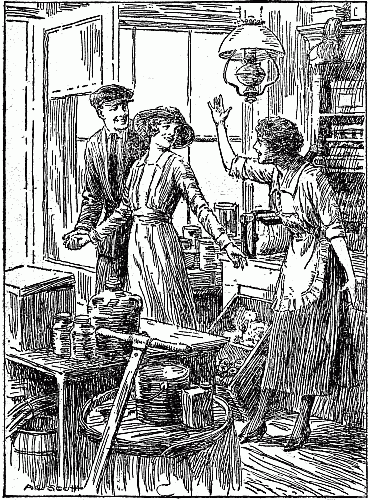 SLEEPY TOOK HER BY THE ARM AND CARRIED HER OFF, PROTESTING, * * * BUT HAPPY IN BEING COERCED. Page 37.