“When did you
come?”
“Arrived at sundown.”
“Where from?”
“Salt Lake.”
“Are you in the service?”
“No. Trade.”
“Pirate trade, I reckon.”
“What do you know about it?”
“I saw you when you came. I recognized your
master. He is a bad sort. Trap-robber, horse-thief,
squaw-man, renegado—Hank Butters—I know him very
well. Stole you, didn’t he?”
“Well, it amounted to that.”
“I thought so. Where is his pard?”
“He stopped at White Cloud’s camp.”
“He is another of the same stripe, is Blake
Haskins.” (Aside.) They are laying for
Buffalo Bill again, I guess. (Aloud.)
“What is your name?”
“Which one?”
“Have you got more than one?”
“I get a new one every time I’m stolen. I
used to have an honest name, but that was early; I’ve
forgotten it. Since then I’ve had thirteen
aliases.”
“Aliases? What is alias?”
“A false name.”
“Alias. It’s a fine large word, and is in my
line; it has quite a learned and cerebrospinal incandescent
sound. Are you educated?”
“Well, no, I can’t claim it. I can take down
bars, I can distinguish oats from shoe-pegs, I can blaspheme a
saddle-boil with the college-bred, and I know a few other
things—not many; I have had no chance, I have always had to
work; besides, I am of low birth and no family. You speak
my dialect like a native, but you are not a Mexican Plug, you are
a gentleman, I can see that; and educated, of course.”
“Yes, I am of old family, and not illiterate. I am
a fossil.”
“A which?”
“Fossil. The first horses were fossils. They
date back two million years.”
“Gr-eat sand and sage-brush! do you mean it?”
“Yes, it is true. The bones of my ancestors are
held in reverence and worship, even by men. They do not
leave them exposed to the weather when they find them, but carry
them three thousand miles and enshrine them in their temples of
learning, and worship them.”
“It is wonderful! I knew you must be a person of
distinction, by your fine presence and courtly address, and by
the fact that you are not subjected to the indignity of hobbles,
like myself and the rest. Would you tell me your
name?”
“You have probably heard of it—Soldier
Boy.”
“What!—the renowned, the illustrious?”
“Even so.”
“It takes my breath! Little did I dream that ever
I should stand face to face with the possessor of that great
name. Buffalo Bill’s horse! Known from the
Canadian border to the deserts of Arizona, and from the eastern
marches of the Great Plains to the foot-hills of the
Sierra! Truly this is a memorable day. You still
serve the celebrated Chief of Scouts?”
“I am still his property, but he has lent me, for a
time, to the most noble, the most gracious, the most excellent,
her Excellency Catherine, Corporal-General Seventh Cavalry and
Flag-Lieutenant Ninth Dragoons, U.S.A.,—on whom be
peace!”
“Amen. Did you say her
Excellency?”
“The same. A Spanish lady, sweet blossom of a
ducal house. And truly a wonder; knowing everything,
capable of everything; speaking all the languages, master of all
sciences, a mind without horizons, a heart of gold, the glory of
her race! On whom be peace!”
“Amen. It is marvellous!”
“Verily. I knew many things, she has taught me
others. I am educated. I will tell you about
her.”
“I listen—I am enchanted.”
“I will tell a plain tale, calmly, without excitement,
without eloquence. When she had been here four or five
weeks she was already erudite in military things, and they made
her an officer—a double officer. She rode the drill
every day, like any soldier; and she could take the bugle and
direct the evolutions herself. Then, on a day, there was a
grand race, for prizes—none to enter but the
children. Seventeen children entered, and she was the
youngest. Three girls, fourteen boys—good riders
all. It was a steeplechase, with four hurdles, all pretty
high. The first prize was a most cunning half-grown silver
bugle, and mighty pretty, with red silk cord and tassels.
Buffalo Bill was very anxious; for he had taught her to ride, and
he did most dearly want her to win that race, for the glory of
it. So he wanted her to ride me, but she wouldn’t;
and she reproached him, and said it was unfair and unright, and
taking advantage; for what horse in this post or any other could
stand a chance against me? and she was very severe with him, and
said, ‘You ought to be ashamed—you are proposing to
me conduct unbecoming an officer and a gentleman.’ So
he just tossed her up in the air about thirty feet and caught her
as she came down, and said he was ashamed; and put up his
handkerchief and pretended to cry, which nearly broke her heart,
and she petted him, and begged him to forgive her, and said she
would do anything in the world he could ask but that; but he said
he ought to go hang himself, and he must, if he could get
a rope; it was nothing but right he should, for he never, never
could forgive himself; and then she began to cry, and they
both sobbed, the way you could hear him a mile, and she clinging
around his neck and pleading, till at last he was comforted a
little, and gave his solemn promise he wouldn’t hang
himself till after the race; and wouldn’t do it at all if
she won it, which made her happy, and she said she would win it
or die in the saddle; so then everything was pleasant again and
both of them content. He can’t help playing jokes on
her, he is so fond of her and she is so innocent and
unsuspecting; and when she finds it out she cuffs him and is in a
fury, but presently forgives him because it’s him; and
maybe the very next day she’s caught with another joke; you
see she can’t learn any better, because she hasn’t
any deceit in her, and that kind aren’t ever expecting it
in another person.
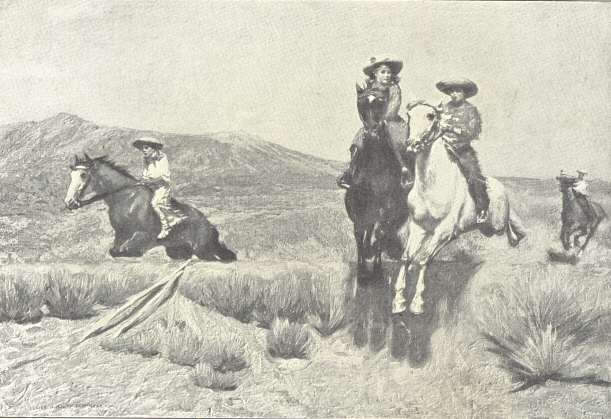
“It was a grand race. The whole post was there,
and there was such another whooping and shouting when the
seventeen kids came flying down the turf and sailing over the
hurdles—oh, beautiful to see! Half-way down, it was
kind of neck and neck, and anybody’s race and
nobody’s. Then, what should happen but a cow steps
out and puts her head down to munch grass, with her broadside to
the battalion, and they a-coming like the wind; they split apart
to flank her, but she?—why, she drove the spurs home
and soared over that cow like a bird! and on she went, and
cleared the last hurdle solitary and alone, the army letting
loose the grand yell, and she skipped from the horse the same as
if he had been standing still, and made her bow, and everybody
crowded around to congratulate, and they gave her the bugle, and
she put it to her lips and blew ‘boots and saddles’
to see how it would go, and BB was as proud as you can’t
think! And he said, ‘Take Soldier Boy, and
don’t pass him back till I ask for him!’ and I can
tell you he wouldn’t have said that to any other person on
this planet. That was two months and more ago, and nobody
has been on my back since but the Corporal-General Seventh
Cavalry and Flag-Lieutenant of the Ninth Dragoons,
U.S.A.,—on whom be peace!”
“Amen. I listen—tell me more.”
“She set to work and organized the Sixteen, and called
it the First Battalion Rocky Mountain Rangers, U.S.A., and she
wanted to be bugler, but they elected her Lieutenant-General and
Bugler. So she ranks her uncle the commandant, who is only
a Brigadier. And doesn’t she train those little
people! Ask the Indians, ask the traders, ask the soldiers;
they’ll tell you. She has been at it from the first
day. Every morning they go clattering down into the plain,
and there she sits on my back with her bugle at her mouth and
sounds the orders and puts them through the evolutions for an
hour or more; and it is too beautiful for anything to see those
ponies dissolve from one formation into another, and waltz about,
and break, and scatter, and form again, always moving, always
graceful, now trotting, now galloping, and so on, sometimes near
by, sometimes in the distance, all just like a state ball, you
know, and sometimes she can’t hold herself any longer, but
sounds the ‘charge,’ and turns me loose! and you can
take my word for it, if the battalion hasn’t too much of a
start we catch up and go over the breastworks with the front
line.
“Yes, they are soldiers, those little people; and
healthy, too, not ailing any more, the way they used to be
sometimes. It’s because of her drill.
She’s got a fort, now—Fort Fanny Marsh.
Major-General Tommy Drake planned it out, and the Seventh and
Dragoons built it. Tommy is the Colonel’s son, and is
fifteen and the oldest in the Battalion; Fanny Marsh is
Brigadier-General, and is next oldest—over thirteen.
She is daughter of Captain Marsh, Company B, Seventh
Cavalry. Lieutenant-General Alison is the youngest by
considerable; I think she is about nine and a half or
three-quarters. Her military rig, as Lieutenant-General,
isn’t for business, it’s for dress parade, because
the ladies made it. They say they got it out of the Middle
Ages—out of a book—and it is all red and blue and
white silks and satins and velvets; tights, trunks, sword,
doublet with slashed sleeves, short cape, cap with just one
feather in it; I’ve heard them name these things; they got
them out of the book; she’s dressed like a page, of old
times, they say. It’s the daintiest outfit that ever
was—you will say so, when you see it. She’s
lovely in it—oh, just a dream! In some ways she is
just her age, but in others she’s as old as her uncle, I
think. She is very learned. She teaches her uncle his
book. I have seen her sitting by with the book and reciting
to him what is in it, so that he can learn to do it himself.
“Every Saturday she hires little Injuns to garrison her
fort; then she lays siege to it, and makes military approaches by
make-believe trenches in make-believe night, and finally at
make-believe dawn she draws her sword and sounds the assault and
takes it by storm. It is for practice. And she has
invented a bugle-call all by herself, out of her own head, and
it’s a stirring one, and the prettiest in the
service. It’s to call me—it’s
never used for anything else. She taught it to me, and told
me what it says: ‘It is I,
Soldier—come!’ and when those thrilling notes
come floating down the distance I hear them without fail, even if
I am two miles away; and then—oh, then you should see my
heels get down to business!
“And she has taught me how to say good-morning and
good-night to her, which is by lifting my right hoof for her to
shake; and also how to say good-bye; I do that with my left
foot—but only for practice, because there hasn’t been
any but make-believe good-byeing yet, and I hope there
won’t ever be. It would make me cry if I ever had to
put up my left foot in earnest. She has taught me how to
salute, and I can do it as well as a soldier. I bow my head
low, and lay my right hoof against my cheek. She taught me
that because I got into disgrace once, through ignorance. I
am privileged, because I am known to be honorable and
trustworthy, and because I have a distinguished record in the
service; so they don’t hobble me nor tie me to stakes or
shut me tight in stables, but let me wander around to suit
myself. Well, trooping the colors is a very solemn
ceremony, and everybody must stand uncovered when the flag goes
by, the commandant and all; and once I was there, and ignorantly
walked across right in front of the band, which was an awful
disgrace: Ah, the Lieutenant-General was so ashamed, and so
distressed that I should have done such a thing before all the
world, that she couldn’t keep the tears back; and then she
taught me the salute, so that if I ever did any other unmilitary
act through ignorance I could do my salute and she believed
everybody would think it was apology enough and would not press
the matter. It is very nice and distinguished; no other
horse can do it; often the men salute me, and I return it.
I am privileged to be present when the Rocky Mountain Rangers
troop the colors and I stand solemn, like the children, and I
salute when the flag goes by. Of course when she goes to
her fort her sentries sing out ‘Turn out the guard!’
and then . . . do you catch that refreshing early-morning whiff
from the mountain-pines and the wild flowers? The night is
far spent; we’ll hear the bugles before long. Dorcas,
the black woman, is very good and nice; she takes care of the
Lieutenant-General, and is Brigadier-General Alison’s
mother, which makes her mother-in-law to the
Lieutenant-General. That is what Shekels says. At
least it is what I think he says, though I never can understand
him quite clearly. He—”
“Who is Shekels?”
“The Seventh Cavalry dog. I mean, if he is
a dog. His father was a coyote and his mother was a
wild-cat. It doesn’t really make a dog out of him,
does it?”
“Not a real dog, I should think. Only a kind of a
general dog, at most, I reckon. Though this is a matter of
ichthyology, I suppose; and if it is, it is out of my depth, and
so my opinion is not valuable, and I don’t claim much
consideration for it.”
“It isn’t ichthyology; it is dogmatics, which is
still more difficult and tangled up. Dogmatics always
are.”
“Dogmatics is quite beyond me, quite; so I am not
competing. But on general principles it is my opinion that
a colt out of a coyote and a wild-cat is no square dog, but
doubtful. That is my hand, and I stand pat.”
“Well, it is as far as I can go myself, and be fair and
conscientious. I have always regarded him as a doubtful
dog, and so has Potter. Potter is the great Dane.
Potter says he is no dog, and not even poultry—though I do
not go quite so far as that.
“And I wouldn’t, myself. Poultry is one of
those things which no person can get to the bottom of, there is
so much of it and such variety. It is just wings, and
wings, and wings, till you are weary: turkeys, and geese, and
bats, and butterflies, and angels, and grasshoppers, and
flying-fish, and—well, there is really no end to the tribe;
it gives me the heaves just to think of it. But this one
hasn’t any wings, has he?”
“No.”
“Well, then, in my belief he is more likely to be dog
than poultry. I have not heard of poultry that hadn’t
wings. Wings is the sign of poultry; it is what you
tell poultry by. Look at the mosquito.”
“What do you reckon he is, then? He must be
something.”
“Why, he could be a reptile; anything that hasn’t
wings is a reptile.”
“Who told you that?”
“Nobody told me, but I overheard it.”
“Where did you overhear it?”
“Years ago. I was with the Philadelphia Institute
expedition in the Bad Lands under Professor Cope, hunting
mastodon bones, and I overheard him say, his own self, that any
plantigrade circumflex vertebrate bacterium that hadn’t
wings and was uncertain was a reptile. Well, then, has this
dog any wings? No. Is he a plantigrade circumflex
vertebrate bacterium? Maybe so, maybe not; but without ever
having seen him, and judging only by his illegal and spectacular
parentage, I will bet the odds of a bale of hay to a bran mash
that he looks it. Finally, is he uncertain? That is
the point—is he uncertain? I will leave it to you if
you have ever heard of a more uncertainer dog than what this one
is?”
“No, I never have.”
“Well, then, he’s a reptile. That’s
settled.”
“Why, look here, whatsyourname—”
“Last alias, Mongrel.”
“A good one, too. I was going to say, you are
better educated than you have been pretending to be. I like
cultured society, and I shall cultivate your acquaintance.
Now as to Shekels, whenever you want to know about any private
thing that is going on at this post or in White Cloud’s
camp or Thunder-Bird’s, he can tell you; and if you make
friends with him he’ll be glad to, for he is a born gossip,
and picks up all the tittle-tattle. Being the whole Seventh
Cavalry’s reptile, he doesn’t belong to anybody in
particular, and hasn’t any military duties; so he comes and
goes as he pleases, and is popular with all the house cats and
other authentic sources of private information. He
understands all the languages, and talks them all, too.
With an accent like gritting your teeth, it is true, and with a
grammar that is no improvement on blasphemy—still, with
practice you get at the meat of what he says, and it serves. . .
Hark! That’s the reveille. . . .
“Faint and far, but isn’t it clear, isn’t it
sweet? There’s no music like the bugle to stir the
blood, in the still solemnity of the morning twilight, with the
dim plain stretching away to nothing and the spectral mountains
slumbering against the sky. You’ll hear another note
in a minute—faint and far and clear, like the other one,
and sweeter still, you’ll notice. Wait . . .
listen. There it goes! It says, ‘It is
I, Soldier—come!’ . . .
. . . Now then, watch me leave a blue streak
behind!”


![Soldier Boy’s Bugle Call [music score]](images/p81b.jpg "Soldier Boy’s Bugle Call [music score]")

![Reveille [music score]](images/p138b.jpg "Reveille [music score]")
![The Assembly [music score]](images/p139ab.jpg "The Assembly [music score]")
![To the Standard [music score]](images/p139bb.jpg "To the Standard [music score]")
![Boots and Saddles [music score]](images/p140b.jpg "Boots and Saddles [music score]")
![Taps [music score]](images/p141b.jpg "Taps [music score]")

![Taps [music score]](images/p153b.jpg "Taps [music score]")